US12288883B2 - Method of improving cycle-life of a lithium metal secondary battery - Google Patents
Method of improving cycle-life of a lithium metal secondary battery Download PDFInfo
- Publication number
- US12288883B2 US12288883B2 US16/014,623 US201816014623A US12288883B2 US 12288883 B2 US12288883 B2 US 12288883B2 US 201816014623 A US201816014623 A US 201816014623A US 12288883 B2 US12288883 B2 US 12288883B2
- Authority
- US
- United States
- Prior art keywords
- lithium
- anode
- layer
- metal
- sulfonated
- Prior art date
- Legal status (The legal status is an assumption and is not a legal conclusion. Google has not performed a legal analysis and makes no representation as to the accuracy of the status listed.)
- Active
Links
Images


Classifications
-
- H—ELECTRICITY
- H01—ELECTRIC ELEMENTS
- H01M—PROCESSES OR MEANS, e.g. BATTERIES, FOR THE DIRECT CONVERSION OF CHEMICAL ENERGY INTO ELECTRICAL ENERGY
- H01M4/00—Electrodes
- H01M4/02—Electrodes composed of, or comprising, active material
- H01M4/62—Selection of inactive substances as ingredients for active masses, e.g. binders, fillers
- H01M4/624—Electric conductive fillers
-
- H—ELECTRICITY
- H01—ELECTRIC ELEMENTS
- H01M—PROCESSES OR MEANS, e.g. BATTERIES, FOR THE DIRECT CONVERSION OF CHEMICAL ENERGY INTO ELECTRICAL ENERGY
- H01M10/00—Secondary cells; Manufacture thereof
- H01M10/05—Accumulators with non-aqueous electrolyte
- H01M10/052—Li-accumulators
- H01M10/0525—Rocking-chair batteries, i.e. batteries with lithium insertion or intercalation in both electrodes; Lithium-ion batteries
-
- H—ELECTRICITY
- H01—ELECTRIC ELEMENTS
- H01M—PROCESSES OR MEANS, e.g. BATTERIES, FOR THE DIRECT CONVERSION OF CHEMICAL ENERGY INTO ELECTRICAL ENERGY
- H01M10/00—Secondary cells; Manufacture thereof
- H01M10/05—Accumulators with non-aqueous electrolyte
- H01M10/056—Accumulators with non-aqueous electrolyte characterised by the materials used as electrolytes, e.g. mixed inorganic/organic electrolytes
- H01M10/0561—Accumulators with non-aqueous electrolyte characterised by the materials used as electrolytes, e.g. mixed inorganic/organic electrolytes the electrolyte being constituted of inorganic materials only
- H01M10/0563—Liquid materials, e.g. for Li-SOCl2 cells
-
- H—ELECTRICITY
- H01—ELECTRIC ELEMENTS
- H01M—PROCESSES OR MEANS, e.g. BATTERIES, FOR THE DIRECT CONVERSION OF CHEMICAL ENERGY INTO ELECTRICAL ENERGY
- H01M10/00—Secondary cells; Manufacture thereof
- H01M10/05—Accumulators with non-aqueous electrolyte
- H01M10/056—Accumulators with non-aqueous electrolyte characterised by the materials used as electrolytes, e.g. mixed inorganic/organic electrolytes
- H01M10/0564—Accumulators with non-aqueous electrolyte characterised by the materials used as electrolytes, e.g. mixed inorganic/organic electrolytes the electrolyte being constituted of organic materials only
- H01M10/0565—Polymeric materials, e.g. gel-type or solid-type
-
- H—ELECTRICITY
- H01—ELECTRIC ELEMENTS
- H01M—PROCESSES OR MEANS, e.g. BATTERIES, FOR THE DIRECT CONVERSION OF CHEMICAL ENERGY INTO ELECTRICAL ENERGY
- H01M10/00—Secondary cells; Manufacture thereof
- H01M10/42—Methods or arrangements for servicing or maintenance of secondary cells or secondary half-cells
- H01M10/4235—Safety or regulating additives or arrangements in electrodes, separators or electrolyte
-
- H—ELECTRICITY
- H01—ELECTRIC ELEMENTS
- H01M—PROCESSES OR MEANS, e.g. BATTERIES, FOR THE DIRECT CONVERSION OF CHEMICAL ENERGY INTO ELECTRICAL ENERGY
- H01M4/00—Electrodes
- H01M4/02—Electrodes composed of, or comprising, active material
- H01M4/13—Electrodes for accumulators with non-aqueous electrolyte, e.g. for lithium-accumulators; Processes of manufacture thereof
- H01M4/134—Electrodes based on metals, Si or alloys
-
- H—ELECTRICITY
- H01—ELECTRIC ELEMENTS
- H01M—PROCESSES OR MEANS, e.g. BATTERIES, FOR THE DIRECT CONVERSION OF CHEMICAL ENERGY INTO ELECTRICAL ENERGY
- H01M4/00—Electrodes
- H01M4/02—Electrodes composed of, or comprising, active material
- H01M4/13—Electrodes for accumulators with non-aqueous electrolyte, e.g. for lithium-accumulators; Processes of manufacture thereof
- H01M4/139—Processes of manufacture
- H01M4/1395—Processes of manufacture of electrodes based on metals, Si or alloys
-
- H—ELECTRICITY
- H01—ELECTRIC ELEMENTS
- H01M—PROCESSES OR MEANS, e.g. BATTERIES, FOR THE DIRECT CONVERSION OF CHEMICAL ENERGY INTO ELECTRICAL ENERGY
- H01M4/00—Electrodes
- H01M4/02—Electrodes composed of, or comprising, active material
- H01M4/36—Selection of substances as active materials, active masses, active liquids
- H01M4/362—Composites
- H01M4/366—Composites as layered products
-
- H—ELECTRICITY
- H01—ELECTRIC ELEMENTS
- H01M—PROCESSES OR MEANS, e.g. BATTERIES, FOR THE DIRECT CONVERSION OF CHEMICAL ENERGY INTO ELECTRICAL ENERGY
- H01M4/00—Electrodes
- H01M4/02—Electrodes composed of, or comprising, active material
- H01M4/36—Selection of substances as active materials, active masses, active liquids
- H01M4/38—Selection of substances as active materials, active masses, active liquids of elements or alloys
- H01M4/381—Alkaline or alkaline earth metals elements
- H01M4/382—Lithium
-
- H—ELECTRICITY
- H01—ELECTRIC ELEMENTS
- H01M—PROCESSES OR MEANS, e.g. BATTERIES, FOR THE DIRECT CONVERSION OF CHEMICAL ENERGY INTO ELECTRICAL ENERGY
- H01M4/00—Electrodes
- H01M4/02—Electrodes composed of, or comprising, active material
- H01M4/62—Selection of inactive substances as ingredients for active masses, e.g. binders, fillers
- H01M4/621—Binders
- H01M4/622—Binders being polymers
-
- H—ELECTRICITY
- H01—ELECTRIC ELEMENTS
- H01M—PROCESSES OR MEANS, e.g. BATTERIES, FOR THE DIRECT CONVERSION OF CHEMICAL ENERGY INTO ELECTRICAL ENERGY
- H01M4/00—Electrodes
- H01M4/02—Electrodes composed of, or comprising, active material
- H01M4/62—Selection of inactive substances as ingredients for active masses, e.g. binders, fillers
- H01M4/628—Inhibitors, e.g. gassing inhibitors, corrosion inhibitors
-
- H—ELECTRICITY
- H01—ELECTRIC ELEMENTS
- H01M—PROCESSES OR MEANS, e.g. BATTERIES, FOR THE DIRECT CONVERSION OF CHEMICAL ENERGY INTO ELECTRICAL ENERGY
- H01M4/00—Electrodes
- H01M4/86—Inert electrodes with catalytic activity, e.g. for fuel cells
- H01M2004/8678—Inert electrodes with catalytic activity, e.g. for fuel cells characterised by the polarity
- H01M2004/8684—Negative electrodes
-
- Y—GENERAL TAGGING OF NEW TECHNOLOGICAL DEVELOPMENTS; GENERAL TAGGING OF CROSS-SECTIONAL TECHNOLOGIES SPANNING OVER SEVERAL SECTIONS OF THE IPC; TECHNICAL SUBJECTS COVERED BY FORMER USPC CROSS-REFERENCE ART COLLECTIONS [XRACs] AND DIGESTS
- Y02—TECHNOLOGIES OR APPLICATIONS FOR MITIGATION OR ADAPTATION AGAINST CLIMATE CHANGE
- Y02E—REDUCTION OF GREENHOUSE GAS [GHG] EMISSIONS, RELATED TO ENERGY GENERATION, TRANSMISSION OR DISTRIBUTION
- Y02E60/00—Enabling technologies; Technologies with a potential or indirect contribution to GHG emissions mitigation
- Y02E60/10—Energy storage using batteries
-
- Y—GENERAL TAGGING OF NEW TECHNOLOGICAL DEVELOPMENTS; GENERAL TAGGING OF CROSS-SECTIONAL TECHNOLOGIES SPANNING OVER SEVERAL SECTIONS OF THE IPC; TECHNICAL SUBJECTS COVERED BY FORMER USPC CROSS-REFERENCE ART COLLECTIONS [XRACs] AND DIGESTS
- Y02—TECHNOLOGIES OR APPLICATIONS FOR MITIGATION OR ADAPTATION AGAINST CLIMATE CHANGE
- Y02E—REDUCTION OF GREENHOUSE GAS [GHG] EMISSIONS, RELATED TO ENERGY GENERATION, TRANSMISSION OR DISTRIBUTION
- Y02E60/00—Enabling technologies; Technologies with a potential or indirect contribution to GHG emissions mitigation
- Y02E60/30—Hydrogen technology
- Y02E60/50—Fuel cells
Definitions
- the present invention relates to the field of rechargeable lithium metal battery having a lithium metal layer (in a form of thin lithium foil, coating, or sheet of lithium particles) as an anode active material and a method of manufacturing same.
- Lithium-ion and lithium (Li) metal cells are considered promising power sources for electric vehicle (EV), hybrid electric vehicle (HEV), and portable electronic devices, such as lap-top computers and mobile phones.
- EV electric vehicle
- HEV hybrid electric vehicle
- Lithium metal has the highest capacity (3,861 mAh/g) compared to any other metal or metal-intercalated compound (except Li 4.4 Si) as an anode active material.
- rechargeable Li metal batteries have a significantly higher energy density than lithium ion batteries.
- rechargeable lithium metal batteries were produced using non-lithiated compounds having high specific capacities, such as TiS 2 , MoS 2 , MnO 2 , CoO 2 and V 2 O 5 , as the cathode active materials, which were coupled with a lithium metal anode.
- non-lithiated compounds having high specific capacities such as TiS 2 , MoS 2 , MnO 2 , CoO 2 and V 2 O 5
- lithium ions were dissolved from the lithium metal anode and transferred to the cathode through the electrolyte and, thus, the cathode became lithiated.
- the lithium metal resulted in the formation of dendrites that ultimately caused unsafe conditions in the battery.
- the production of these types of secondary batteries was stopped in the early 1990's giving ways to lithium-ion batteries.
- Fauteux, et al. [D. Fauteux, et al., “Secondary Electrolytic Cell and Electrolytic Process,” U.S. Pat. No. 5,434,021, Jul. 18, 1995] applied to a metal anode a protective surface layer (e.g., a mixture of polynuclear aromatic and polyethylene oxide) that enables transfer of metal ions from the metal anode to the electrolyte and back.
- the surface layer is also electronically conductive so that the ions will be uniformly attracted back onto the metal anode during electrodeposition (i.e. during battery recharge).
- Alamgir, et al. [M. Alamgir, et al. “Solid polymer electrolyte batteries containing metallocenes,” U.S. Pat. No. 5,536,599, Jul. 16, 1996] used ferrocenes to prevent chemical overcharge and dendrite formation in a solid polymer electrolyte-based rechargeable battery.
- Protective coatings for Li anodes may be obtained from plasma assisted deposition [S. J. Visco, et al., “Protective Coatings for Negative Electrodes,” U.S. Pat. No. 6,025,094 (Feb. 15, 2000)].
- Complex, multi-layer protective coatings were also proposed by Visco, et al. [S. J. Visco, et al., “Protected Active Metal Electrode and Battery Cell Structures with Non-aqueous Interlayer Architecture,” U.S. Pat. No. 7,282,295 (Oct. 16, 2007); U.S. Pat. No. 7,282,296 (Oct. 16, 2007); and U.S. Pat. No. 7,282,302 (Oct. 16, 2007)].
- solid electrolyte as the sole electrolyte in a cell or as an anode-protecting layer (interposed between the lithium film and the liquid electrolyte) does not have and cannot maintain a good contact with the lithium metal. This effectively reduces the effectiveness of the electrolyte to support dissolution of lithium ions (during battery discharge), transport lithium ions, and allowing the lithium ions to re-deposit back to the lithium anode (during battery recharge).
- lithium metal anode Another major issue associated with the lithium metal anode is the continuing reactions between electrolyte and lithium metal, leading to repeated formation of “dead lithium-containing species” that cannot be re-deposited back to the anode and become isolated from the anode. These reactions continue to irreversibly consume electrolyte and lithium metal, resulting in rapid capacity decay. In order to compensate for this continuing loss of lithium metal, an excessive amount of lithium metal (3-5 times higher amount than what would be required) is typically implemented at the anode when the battery is made. This adds not only costs but also a significant weight and volume to a battery, reducing the energy density of the battery cell. This important issue has been largely ignored and there has been no plausible solution to this problem in battery industry.
- an object of the present invention is to provide an effective way to overcome the lithium metal dendrite and reaction problems in all types of Li metal batteries having a lithium metal anode.
- a specific object of the present invention is to provide a lithium metal cell that exhibits a high specific capacity, high specific energy, high degree of safety, and a long and stable cycle life.
- a lithium metal secondary battery comprising a cathode, an anode, and an electrolyte or separator-electrolyte assembly disposed between the cathode and the anode, wherein the anode comprises: (a) a layer of lithium or lithium alloy (in the form of a foil, coating, or multiple particles aggregated together) as an anode active material; and (b) a thin anode-protecting layer comprising a conductive sulfonated elastomer composite having from 0.01% to 50% by weight of a conductive reinforcement material dispersed in a sulfonated elastomeric matrix material and said layer of conductive sulfonated elastomer composite has a thickness from 1 nm to 100 ⁇ m, a fully recoverable tensile strain from 2% to 500%, a lithium ion conductivity from 10 ⁇ 7 S/cm to 5 ⁇ 10 ⁇ 2 S/cm, and an electrical conductivity from 10
- the foil or coating of lithium or lithium alloy may be supported by a current collector (e.g. a Cu foil, a Ni foam, a porous layer of nanofilaments, such as graphene sheets, carbon nanofibers, carbon nanotubes, etc.).
- a porous separator may not be necessary if the electrolyte is a solid-state electrolyte.
- the invented lithium metal secondary battery does not include a lithium-sulfur cell or lithium-selenium cell.
- the cathode does not include sulfur, lithium polysulfide, selenium and lithium polyselenide.
- the sulfonated elastomer is a high-elasticity material which exhibits an elastic deformation that is at least 2% (preferably at least 5%) when measured under uniaxial tension.
- the “elastic deformation” is defined as a deformation of a material (when being mechanically stressed) that is essentially fully recoverable upon release of the load and the recovery process is essentially instantaneous (no or little time delay).
- the elastic deformation is more preferably greater than 10%, even more preferably greater than 30%, further more preferably greater than 50%, and still more preferably greater than 100%.
- the conductive reinforcement material is selected from graphene sheets, carbon nanotubes, carbon nanofibers, carbon or graphite fibers, expanded graphite flakes, metal nanowires, conductive polymer fibers, or a combination thereof.
- the sulfonated elastomer composite preferably and more typically has a fully recoverable tensile strain from 5% to 300% (most typically from 10% to 150%), a thickness from 10 nm to 20 ⁇ m, a lithium ion conductivity of at least 10 ⁇ 5 S/cm, and an electrical conductivity of at least 10 ⁇ 3 S/cm when measured at room temperature on a cast thin film 20 ⁇ m thick.
- the sulfonated elastomeric matrix material contains a sulfonated version of an elastomer selected from natural polyisoprene, synthetic polyisoprene, polybutadiene, chloroprene rubber, polychloroprene, butyl rubber, styrene-butadiene rubber, nitrile rubber, ethylene propylene rubber, ethylene propylene diene rubber, metallocene-based poly(ethylene-co-octene) (POE) elastomer, poly(ethylene-co-butene) (PBE) elastorner, styrene-ethylene-butadiene-styrene (SEBS) elastomer, epichlorohydrin rubber, polyacrylic rubber, silicone rubber, fluorosilicone rubber, perfluoroelastomers, polyether block amides, chlorosulfonated polyethylene, ethylene-vinyl acetate, thermoplastic e
- sulfonated elastomers or rubbers when present without graphene sheets, exhibit a high elasticity (having a fully recoverable tensile strain from 2% to 800%). In other words, they can be stretched up to 800% (8 times of the original length when under tension) and, upon release of the tensile stress, they can fully recover back to the original dimension.
- the fully recoverable tensile strains are typically reduced down to 2%-500% (more typically from 5% to 300% and most typically from 10% to 150%).
- the conducting reinforcement material is preferably in a filamentary or sheet-like form, such as a nanotube, nanofiber, nanowire, nanoplatelet, or nanodisc.
- the conductive reinforcement material is selected from graphene sheets, carbon nanotubes, carbon nanofibers, carbon or graphite fibers, expanded graphite flakes, metal nanowires, conductive polymer fibers, or a combination thereof. These are electron-conducting materials and the sulfonated elastomer matrix is a lithium ion- and sodium ion-conducting material.
- the graphene sheets to be dispersed in a sulfonated elastomer matrix are preferably selected from pristine graphene, graphene oxide, reduced graphene oxide, graphene fluoride, graphene chloride, nitrogenated graphene, hydrogenated graphene, doped graphene, functionalized graphene, or a combination thereof.
- the graphene sheets preferably comprise single-layer graphene or few-layer graphene, wherein the few-layer graphene is defined as a graphene platelet formed of less than 10 graphene planes.
- the carbon nanotubes (CNTs) can be a single-walled CNT or multi-walled CNT.
- the carbon nanofibers may be vapor-grown carbon nanofibers or electrospinning based carbon nanofibers (e.g. electrospun polymer nanofibers that are subsequently carbonized).
- the conducting reinforcement material is preferably in a filamentary or sheet-like form, such as a nanotube, nanofiber, nanowire, nanoplatelet, or nanodisc.
- the conductive reinforcement material is selected from graphene sheets, carbon nanotubes, carbon nanofibers, metal nanowires, conductive polymer fibers, or a combination thereof. These are electron-conducting materials and the sulfonated elastomer matrix is a lithium ion- and sodium ion-conducting material.
- the electrically conducting material may be selected from an electron-conducting polymer, a metal particle or wire (or metal nanowire), a graphene sheet, a carbon fiber, a graphite fiber, a carbon nanofiber, a graphite nanofiber, a carbon nanotube, a graphite particle, an expanded graphite flake, an acetylene black particle, or a combination thereof.
- the electrically conducting material e.g. metal nanowire, nanofiber, etc.
- the electrically conducting material preferably has a thickness or diameter less than 100 nm.
- This sulfonated elastomer composite layer may be a thin film disposed against a lithium foil/coating layer surface or a thin coating deposited on the lithium foil/coating surface. It may be noted that lithium foil/coating layer may decrease in thickness due to dissolution of lithium into the electrolyte to become lithium ions as the lithium battery is discharged, creating a gap between the current collector and the protective layer if the protective layer were not elastic. Such a gap would make the re-deposition of lithium ions back to the anode impossible.
- the instant sulfonated elastomer composite is capable of expanding or shrinking congruently or conformably with the anode layer. This capability helps to maintain a good contact between the current collector (or the lithium film itself) and the protective layer, enabling the re-deposition of lithium ions without interruption.
- the sulfonated elastomer composite may further contain a lithium salt selected from lithium perchlorate (LiClO 4 ), lithium hexafluorophosphate (LiPF 6 ), lithium borofluoride (LiBF 4 ), lithium hexafluoroarsenide (LiAsF 6 ), lithium trifluoro-methanesulfonate (LiCF 3 SO 3 ), bis-trifluoromethyl sulfonylimide lithium (LiN(CF 3 SO 2 ) 2 ), lithium bis(oxalato)borate (LiBOB), lithium oxalyldifluoroborate (LiBF 2 C 2 O 4 ), lithium nitrate (LiNO 3 ), Li-fluoroalkyl-phosphates (LiPF 3 (CF 2 CF 3 ) 3 ), lithium bisperfluoro-ethylsulfonylimide (LiBETI), lithium bis(trifluoromethanes
- the sulfonated elastomer composite for the protective layer has a lithium ion conductivity no less than 10 ⁇ 5 S/cm, more preferably no less than 10 ⁇ 4 S/cm, and most preferably no less than 10 ⁇ 3 S/cm. Some of the selected sulfonated elastomer composites exhibit a lithium-ion conductivity greater than 10 ⁇ 2 S/cm. In some embodiments, the sulfonated elastomer composite is an elastomer containing no additive or filler dispersed therein.
- the sulfonated elastomer composite is an elastomer matrix composite containing from 0.1% to 50% by weight (preferably from 1% to 35% by weight) of a lithium ion-conducting additive dispersed in a sulfonated elastomer matrix material.
- the sulfonated elastomer composite contains from 0.1% by weight to 10% by weight of a reinforcement nanofilament selected from carbon nanotube, carbon nanofiber, graphene, or a combination thereof.
- the sulfonated elastomer matrix material is selected from a sulfonated version of natural polyisoprene (e.g. cis-1,4-polyisoprene natural rubber (NR) and trans-1,4-polyisoprene gutta-percha), synthetic polyisoprene (IR for isoprene rubber), polybutadiene (BR for butadiene rubber), chloroprene rubber (CR), polychloroprene (e.g.
- natural polyisoprene e.g. cis-1,4-polyisoprene natural rubber (NR) and trans-1,4-polyisoprene gutta-percha
- synthetic polyisoprene IR for isoprene rubber
- polybutadiene BR for butadiene rubber
- chloroprene rubber CR
- polychloroprene e.g.
- Neoprene, Baypren etc. butyl rubber (copolymer of isobutylene and isoprene, IIR), including halogenated butyl rubbers (chloro butyl rubber (CIIR) and bromo butyl rubber (BIIR), styrene-butadiene rubber (copolymer of styrene and butadiene, SBR), nitrile rubber (copolymer of butadiene and acrylonitrile, NBR), EPM (ethylene propylene rubber, a copolymer of ethylene and propylene), EPDM rubber (ethylene propylene diene rubber, a terpolymer of ethylene, propylene and a diene-component), epichlorohydrin rubber (ECO), polyacrylic rubber (ACM, ABR), silicone rubber (SI, Q, VMQ), fluorosilicone rubber (FVMQ), fluoroelastomers (FKM, and FEPM; such as Viton,
- Hypalon and ethylene-vinyl acetate (EVA), thermoplastic elastomers (TPE), protein resilin, protein elastin, ethylene oxide-epichlorohydrin copolymer, polyurethane, urethane-urea copolymer, and combinations thereof.
- TPE thermoplastic elastomers
- protein resilin protein resilin
- protein elastin ethylene oxide-epichlorohydrin copolymer
- polyurethane urethane-urea copolymer
- the lithium ion-conducting additive is selected from Li 2 CO 3 , Li 2 O, Li 2 C 2 O 4 , LiOH, LiX, ROCO 2 Li, HCOLi, ROLi, (ROCO 2 Li) 2 , (CH 2 OCO 2 Li) 2 , Li 2 S, Li x SO y ,
- the sulfonated elastomer composite may form a mixture, blend, co-polymer, or semi-interpenetrating network (semi-IPN) with an electron-conducting polymer selected from polyaniline, polypyrrole, polythiophene, polyfuran, a bi-cyclic polymer, derivatives thereof (e.g. sulfonated versions), or a combination thereof.
- an electron-conducting polymer selected from polyaniline, polypyrrole, polythiophene, polyfuran, a bi-cyclic polymer, derivatives thereof (e.g. sulfonated versions), or a combination thereof.
- the sulfonated elastomer composite may form a mixture, blend, or semi-IPN with a lithium ion-conducting polymer selected from poly(ethylene oxide) (PEO), polypropylene oxide (PPO), poly(acrylonitrile) (PAN), poly(methyl methacrylate) (PMMA), poly(vinylidene fluoride) (PVDF), poly bis-methoxy ethoxyethoxide-phosphazene, polyvinyl chloride, polydimethylsiloxane, poly(vinylidene fluoride)-hexafluoropropylene (PVDF-HFP), a sulfonated derivative thereof, or a combination thereof.
- Sulfonation is herein found to impart improved lithium ion conductivity to a polymer.
- the cathode active material may be selected from an inorganic material, an organic material, a polymeric material, or a combination thereof.
- the inorganic material may be selected from a metal oxide, metal phosphate, metal silicide, metal selenide, metal sulfide, or a combination thereof.
- the inorganic material may be selected from a lithium cobalt oxide, lithium nickel oxide, lithium manganese oxide, lithium vanadium oxide, lithium-mixed metal oxide, lithium iron phosphate, lithium manganese phosphate, lithium vanadium phosphate, lithium mixed metal phosphate, lithium metal silicide, or a combination thereof.
- the inorganic material is selected from a metal fluoride or metal chloride including the group consisting of CoF 3 , MnF 3 , FeF 3 , VF 3 , VOF 3 , TiF 3 , BiF 3 , NiF 2 , FeF 2 , CuF 2 , CuF, SnF 2 , AgF, CuCl 2 , FeCl 3 , MnCl 2 , and combinations thereof.
- a metal fluoride or metal chloride including the group consisting of CoF 3 , MnF 3 , FeF 3 , VF 3 , VOF 3 , TiF 3 , BiF 3 , NiF 2 , FeF 2 , CuF 2 , CuF, SnF 2 , AgF, CuCl 2 , FeCl 3 , MnCl 2 , and combinations thereof.
- the inorganic material is selected from a lithium transition metal silicate, denoted as Li 2 MSiO 4 or Li 2 Ma x Mb y SiO 4 , wherein M and Ma are selected from Fe, Mn, Co, Ni, V, or VO; Mb is selected from Fe, Mn, Co, Ni, V, Ti, Al, B, Sn, or Bi; and x+y ⁇ 1.
- Li 2 MSiO 4 Li 2 Ma x Mb y SiO 4
- M and Ma are selected from Fe, Mn, Co, Ni, V, or VO
- Mb is selected from Fe, Mn, Co, Ni, V, Ti, Al, B, Sn, or Bi
- x+y ⁇ 1 lithium transition metal silicate
- the inorganic material is selected from a transition metal dichalcogenide, a transition metal trichalcogenide, or a combination thereof.
- the inorganic material is selected from TiS 2 , TaS 2 , MoS 2 , NbSe 3 , MnO 2 , CoO 2 , an iron oxide, a vanadium oxide, or a combination thereof.
- the cathode active material layer may contain a metal oxide containing vanadium oxide selected from the group consisting of VO 2 , Li x VO 2 , V 2 O 5 , Li x V 2 O 5 , V 3 O 8 , Li x V 3 O 8 , Li x V 3 O 7 , V 4 O 9 , Li x V 4 O 9 , V 6 O 13 , Li x V 6 O 13 , their doped versions, their derivatives, and combinations thereof, wherein 0.1 ⁇ x ⁇ 5.
- the cathode active material layer may contain a metal oxide or metal phosphate, selected from a layered compound LiMO 2 , spinel compound LiM 2 O 4 , olivine compound LiMPO 4 , silicate compound Li 2 MSiO 4 , tavorite compound LiMPO 4 F, borate compound LiMBO 3 , or a combination thereof, wherein M is a transition metal or a mixture of multiple transition metals.
- a metal oxide or metal phosphate selected from a layered compound LiMO 2 , spinel compound LiM 2 O 4 , olivine compound LiMPO 4 , silicate compound Li 2 MSiO 4 , tavorite compound LiMPO 4 F, borate compound LiMBO 3 , or a combination thereof, wherein M is a transition metal or a mixture of multiple transition metals.
- the inorganic material is selected from: (a) bismuth selenide or bismuth telluride, (b) transition metal dichalcogenide or trichalcogenide, (c) sulfide, selenide, or telluride of niobium, zirconium, molybdenum, hafnium, tantalum, tungsten, titanium, cobalt, manganese, iron, nickel, or a transition metal; (d) boron nitride, or (e) a combination thereof.
- the cathode active material layer may contain an organic material or polymeric material selected from poly(anthraquinonyl sulfide) (PAQS), a lithium oxocarbon, 3,4,9,10-perylenetetracarboxylic dianhydride (PTCDA), poly(anthraquinonyl sulfide), pyrene-4,5,9,10-tetraone (PYT), polymer-bound PYT, quino(triazene), redox-active organic material, tetracyanoquinodimethane (TCNQ), tetracyanoethylene (TCNE), 2,3,6,7,10,11-hexamethoxytriphenylene (HMTP), poly(5-amino-1,4-dyhydroxy anthraquinone) (PADAQ), phosphazene disulfide polymer ([(NPS 2 ) 3 ]n), lithiated 1,4,5,8-naphthalenetetraol
- the thioether polymer is selected from poly[methanetetryl-tetra(thiomethylene)](PMTTM), poly(2,4-dithiopentanylene) (PDTP), a polymer containing poly(ethene-1,1,2,2-tetrathiol) (PETT) as a main-chain thioether polymers, a side-chain thioether polymer having a main-chain consisting of conjugating aromatic moieties, and having a thioether side chain as a pendant, poly(2-phenyl-1,3-dithiolane) (PPDT), poly(1,4-di(1,3-dithiolan-2-yl)benzene) (PDDTB), poly(tetrahydrobenzodithiophene) (PTHBDT), poly[1,2,4,5-tetrakis(propylthio)benzene] (PTKPTB, or poly[3,4(ethylenedithio)thiophene] (PED
- the cathode active material layer contains an organic material selected from a phthalocyanine compound, such as copper phthalocyanine, zinc phthalocyanine, tin phthalocyanine, iron phthalocyanine, lead phthalocyanine, nickel phthalocyanine, vanadyl phthalocyanine, fluorochromium phthalocyanine, magnesium phthalocyanine, manganous phthalocyanine, dilithium phthalocyanine, aluminum phthalocyanine chloride, cadmium phthalocyanine, chlorogallium phthalocyanine, cobalt phthalocyanine, silver phthalocyanine, a metal-free phthalocyanine, a chemical derivative thereof, or a combination thereof.
- a phthalocyanine compound such as copper phthalocyanine, zinc phthalocyanine, tin phthalocyanine, iron phthalocyanine, lead phthalocyanine, nickel phthalocyanine, vanadyl phthalocyanine, fluorochrom
- the cathode active material is preferably in a form of nanoparticle (spherical, ellipsoidal, and irregular shape), nanowire, nanofiber, nanotube, nanosheet, nanobelt, nanoribbon, nanodisc, nanoplatelet, or nanohorn having a thickness or diameter less than 100 nm. These shapes can be collectively referred to as “particles” unless otherwise specified or unless a specific type among the above species is desired. Further preferably, the cathode active material has a dimension less than 50 nm, even more preferably less than 20 nm, and most preferably less than 10 nm. In some embodiments, one particle or a cluster of particles may be coated with or embraced by a layer of carbon disposed between the particle(s) and/or a sulfonated elastomer composite layer (an encapsulating shell).
- the cathode layer may further contain a graphite, graphene, or carbon material mixed with the cathode active material particles.
- the carbon or graphite material is selected from polymeric carbon, amorphous carbon, chemical vapor deposition carbon, coal tar pitch, petroleum pitch, mesophase pitch, carbon black, coke, acetylene black, activated carbon, fine expanded graphite particle with a dimension smaller than 100 nm, artificial graphite particle, natural graphite particle, or a combination thereof.
- Graphene may be selected from pristine graphene, graphene oxide, reduced graphene oxide, graphene fluoride, hydrogenated graphene, nitrogenated graphene, functionalized graphene, etc.
- the cathode active material particles may be coated with or embraced by a conductive protective coating, selected from a carbon material, graphene, electronically conductive polymer, conductive metal oxide, or conductive metal coating.
- a conductive protective coating selected from a carbon material, graphene, electronically conductive polymer, conductive metal oxide, or conductive metal coating.
- the cathode active material in the form of a nanoparticle, nanowire, nanofiber, nanotube, nanosheet, nanobelt, nanoribbon, nanodisc, nanoplatelet, or nanohorn is pre-intercalated or pre-doped with lithium ions to form a prelithiated anode active material having an amount of lithium from 0.1% to 54.7% by weight of said prelithiated anode active material.
- the present invention also provides a lithium metal-air battery comprising an air cathode, an anode comprising a sulfonated elastomer composite based protective layer as defined above, and electrolyte, or electrolyte combined with a separator, disposed between the anode and the air cathode.
- oxygen from the open air or from an oxygen supplier external to the battery
- the air cathode needs an inert material to support the lithium oxide material formed at the cathode.
- an integrated structure of conductive nanofilaments can be used as an air cathode intended for supporting the discharge product (e.g., lithium oxide).
- a further embodiment of the present invention is a lithium metal-air battery, wherein the air cathode comprises an integrated structure of electrically conductive nanometer-scaled filaments that are interconnected to form a porous network of electron-conducting paths comprising interconnected pores, wherein the filaments have a transverse dimension less than 500 nm (preferably less than 100 nm).
- These nanofilaments can be selected from carbon nanotubes (CNTs), carbon nanofibers (CNFs), graphene sheets, carbon fibers, graphite fibers, etc.
- the invention also provides a method of manufacturing a lithium battery, the method comprising: (a) providing a cathode active material layer and an optional cathode current collector to support the cathode active material layer; (b) providing an anode active material layer (containing a lithium metal or lithium alloy foil or coating) and an optional anode current collector to support the lithium metal or lithium alloy foil or coating; (c) providing an electrolyte in contact with the anode active material layer and the cathode active material layer and an optional separator electrically separating the anode and the cathode; and (d) providing an anode-protecting layer of a sulfonated elastomer composite having a recoverable tensile elastic strain from 2% to 800% (preferably from 5% to 300%), a lithium ion conductivity no less than 10 ⁇ 6 S/cm at room temperature, and a thickness from 1 nm to 100 ⁇ m (preferably from 10 nm to 10 ⁇ m).
- the invention also provides a method of improving the cycle-life of a lithium metal secondary battery (not including a lithium-sulfur battery or lithium-selenium battery).
- the method comprises implementing an anode-protecting layer between an anode active material layer and a porous separator/electrolyte, wherein the anode-protecting layer comprises a conductive sulfonated elastomer composite having from 0.01% to 50% by weight of a conductive reinforcement material dispersed in a sulfonated elastomeric matrix material and the layer of conductive sulfonated elastomer composite has a thickness from 1 nm to 100 ⁇ m, a fully recoverable tensile strain from 2% to 500%, a lithium ion conductivity from 10 ⁇ 7 S/cm to 5 ⁇ 10 ⁇ 2 S/cm, and an electrical conductivity from 10 ⁇ 7 S/cm to 100 S/cm when measured at room temperature.
- this protecting layer is both electron-
- the conductive reinforcement material used in the method is selected from graphene sheets, carbon nanotubes, carbon nanofibers, carbon or graphite fibers, expanded graphite flakes, metal nanowires, conductive polymer fibers, or a combination thereof.
- the sulfonated elastomeric matrix material contains a material selected from a sulfonated version of natural polyisoprene, synthetic polyisoprene, polybutadiene, chloroprene rubber, polychloroprene, butyl rubber, styrene-butadiene rubber, nitrile rubber, ethylene propylene rubber, ethylene propylene diene rubber, metallocene-based poly(ethylene-co-octene) elastomer, poly(ethylene-co-butene) elastomer, styrene-ethylene-butadiene-styrene elastomer, epichlorohydrin rubber, polyacrylic rubber, silicone rubber, fluorosilicone rubber, perfluoroelastomers, polyether block amides, chlorosulfonated polyethylene, ethylene-vinyl acetate, thermoplastic elastomer, protein resilin, protein elastomers, poly
- the step of implementing an anode-protecting layer is conducted by depositing a layer of a sulfonated elastomer composite onto one primary surface of the anode active material layer to form a protected anode, optionally compressing the protected anode to improve a contact between the anode-protecting layer and the anode active material layer, followed by combining the protected anode, the separator/electrolyte, and the cathode together to form the lithium metal secondary battery.
- a good contact between the anode active material layer and the anode-protecting layer is essential.
- the step of implementing an anode-protecting layer is conducted by depositing a layer of first sulfonated elastomer composite onto one primary surface of the separator to form a coated separator, followed by combining the anode, the coated separator, the cathode, and the electrolyte together to form the lithium metal secondary battery.
- a compressive stress may be advantageously applied (e.g. via press-rolling) to improve the contact between the anode-protecting layer and the anode active material layer to be protected.
- the step of implementing an anode-protecting layer is conducted by forming a layer of a sulfonated elastomer composite, followed by laminating the anode layer, the layer of sulfonated elastomer composite, the separator layer, the cathode layer, along with the electrolyte to form the lithium metal secondary battery, wherein an optional (but desirable) compressive stress is applied to improve the contact between the anode-protecting layer and the anode active material layer during or after this laminating step.
- the sulfonated elastomer composite has a lithium-ion conductivity from 10 ⁇ 5 S/cm to 5 ⁇ 10 ⁇ 2 S/cm.
- the sulfonated elastomer composite has a recoverable tensile strain from 10% to 300% (more preferably >30%, and further more preferably >50%).
- the procedure of providing a sulfonated elastomer composite contains providing a mixture/blend/composite of a sulfonated elastomer with an electronically conductive polymer (e.g. polyaniline, polypyrrole, polythiophene, polyfuran, a bi-cyclic polymer, a sulfonated derivative thereof, or a combination thereof), a lithium-ion conducting material, a reinforcement material (e.g. carbon nanotube, carbon nanofiber, and/or graphene), or a combination thereof.
- an electronically conductive polymer e.g. polyaniline, polypyrrole, polythiophene, polyfuran, a bi-cyclic polymer, a sulfonated derivative thereof, or a combination thereof
- a lithium-ion conducting material e.g. carbon nanotube, carbon nanofiber, and/or graphene
- the lithium ion-conducting material is dispersed in the sulfonated elastomer composite and is selected from lithium perchlorate (LiClO 4 ), lithium hexafluorophosphate (LiPF 6 ), lithium borofluoride (LiBF 4 ), lithium hexafluoroarsenide (LiAsF 6 ), lithium trifluoro-methanesulfonate (LiCF 3 SO 3 ), bis-trifluoromethyl sulfonylimide lithium (LiN(CF 3 SO 2 ) 2 ), lithium bis(oxalato)borate (LiBOB), lithium oxalyldifluoroborate (LiBF 2 C 2 O 4 ), lithium nitrate (LiNO 3 ), Li-fluoroalkyl-phosphates (LiPF 3 (CF 2 CF 3 ) 3 ), lithium bisperfluoro-ethylsulfonylimide (L
- the anode-protecting layer implemented between the anode active layer and the separator (or the solid-state electrolyte) is mainly for the purpose of reducing or eliminating the lithium metal dendrite by providing a more stable Li metal-electrolyte interface that is more conducive to uniform deposition of Li metal during battery charges.
- This anode-protecting layer also acts to block the penetration of any dendrite, if initiated, from reaching the separator or cathode.
- This anode-protecting layer being highly elastic, also can shrink or expand responsive to the thickness increase or decrease of the anode active material layer.
- FIG. 1 Schematic of a prior art lithium metal battery cell, containing an anode layer (a thin Li foil or Li coating deposited on a surface of a current collector, Cu foil), a porous separator, and a cathode active material layer, which is composed of particles of a cathode active material, a conductive additive (not shown) and a resin binder (not shown).
- anode layer a thin Li foil or Li coating deposited on a surface of a current collector, Cu foil
- a porous separator a porous separator
- a cathode active material layer which is composed of particles of a cathode active material, a conductive additive (not shown) and a resin binder (not shown).
- a cathode current collector supporting the cathode active layer is also shown.
- FIG. 2 Schematic of a presently invented lithium metal battery cell containing an anode layer (a thin Li foil or Li coating deposited on a surface of a current collector, Cu foil), a sulfonated elastomer composite-based anode-protecting layer, a porous separator/electrolyte layer (or a layer of solid-state electrolyte), and a cathode active material layer, which is composed of particles of a cathode active material, a conductive additive (not shown) and a resin binder (not shown).
- a cathode current collector supporting the cathode active layer is also shown.
- FIG. 3 The specific intercalation capacity curves of four lithium cells: 2 cells each having a cathode containing V 2 O 5 particles (one cell having an anode-protecting layer and the other not) and 2 cells each having a cathode containing graphene-embraced V 2 O 5 particles (one cell having a rotaxane polymer-based protective layer and the other not).
- FIG. 4 The specific capacity values of two lithium-LiCoO 2 cells (initially the cell being lithium-free) featuring (1) high-elasticity sulfonated elastomer composite layer at the anode and (2) no protection layer at the anode, respectively.
- FIG. 5 The discharge capacity curves of two coin cells having a FeF 3 -based of cathode active materials: (1) having a high-elasticity sulfonated elastomer composite-protected anode; and (2) no anode-protecting layer.
- FIG. 6 Specific capacities of two lithium-FePc (organic) cells, each having Li foil as an anode active material and FePc/RGO mixture particles as the cathode active material (one cell containing a sulfonated elastomer composite-protected anode and the other no anode protection layer).
- This invention is directed at a lithium metal secondary battery, which is preferably based on an organic electrolyte, a polymer gel electrolyte, an ionic liquid electrolyte, a quasi-solid electrolyte, or a solid-state electrolyte.
- the shape of a lithium metal secondary battery can be cylindrical, square, button-like, etc.
- the present invention is not limited to any battery shape or configuration or any type of electrolyte.
- the invented lithium secondary battery does not include a lithium-sulfur cell or lithium-selenium cell.
- the invention provides a lithium metal secondary battery, comprising a cathode, an anode, and electrolyte (e.g. solid-state electrolyte) or separator-electrolyte assembly (porous separator and liquid electrolyte, gel electrolyte, quasi-solid electrolyte, etc.) disposed between the cathode and the anode, wherein the anode comprises: (a) a lithium metal (e.g.
- a thin layer of a conductive sulfonated elastomer composite (anode-protecting layer) having from 0.01% to 50% by weight of a conductive reinforcement material dispersed in a sulfonated elastomeric matrix material and this layer of conductive sulfonated elastomer composite has a thickness from 1 nm to 100 ⁇ m, a fully recoverable tensile strain from 2% to 500%, a lithium ion conductivity from 10 ⁇ 7 S/cm to 5 ⁇ 10 ⁇ 2 S/cm, and an electrical conductivity from 10 ⁇ 7 S/cm to 100 S/cm when measured at room temperature, wherein the sulfonated elastomer composite is disposed (interposed) between the lithium metal and the porous separator (or solid-state electrolyte.
- the foil or coating of lithium or lithium alloy may be supported by a current collector (e.g. a Cu foil, a Ni foam, a porous layer of nanofilaments, such as graphene sheets, carbon nanofibers, carbon nanotubes, etc. forming a 3D interconnected network of electron-conducting pathways).
- a current collector e.g. a Cu foil, a Ni foam, a porous layer of nanofilaments, such as graphene sheets, carbon nanofibers, carbon nanotubes, etc. forming a 3D interconnected network of electron-conducting pathways.
- the sulfonated elastomer composite layer has a lithium ion conductivity no less than 10 ⁇ 6 S/cm (typically from 10 ⁇ 5 S/cm to 5 ⁇ 10 ⁇ 2 S/cm, measured at room temperature), and a thickness from 10 nm to 20 ⁇ m.
- the sulfonated elastomer composite has from 0.01% to 50% by weight (based on the total weight of the sulfonated elastomer composite) of a conductive reinforcement material dispersed in a sulfonated elastomeric matrix material, wherein the conductive reinforcement material is selected from graphene sheets, carbon nanotubes, carbon nanofibers, metal nanowires, conductive polymer fibers, or a combination thereof.
- the conducting reinforcement material is preferably in a filamentary or sheet-like form, such as a nanotube, nanofiber, nanowire, nanoplatelet, or nanodisc.
- the conductive reinforcement material is selected from graphene sheets, carbon nanotubes, carbon nanofibers, carbon or graphite fibers, expanded graphite flakes, metal nanowires, conductive polymer fibers, or a combination thereof. These are electron-conducting materials and the sulfonated elastomer matrix is a lithium ion- and sodium ion-conducting material.
- sulfonated elastomer By combining such a sulfonated elastomer and a conducting reinforcement (0-50% by weight, preferably 0.1%-30%, and more preferably 0.1-15%), one obtains a composite that is both electron conducting and ion-conducting and capable of allowing electrons and lithium ions to migrate in and out of the particulate without much resistance.
- the graphene sheets to be dispersed in a sulfonated elastomer matrix are preferably selected from pristine graphene, graphene oxide, reduced graphene oxide, graphene fluoride, graphene chloride, nitrogenated graphene, hydrogenated graphene, doped graphene, functionalized graphene, or a combination thereof.
- the graphene sheets preferably comprise single-layer graphene or few-layer graphene, wherein the few-layer graphene is defined as a graphene platelet formed of less than 10 graphene planes.
- the carbon nanotubes (CNTs) can be a single-walled CNT or multi-walled CNT.
- the carbon nanofibers may be vapor-grown carbon nanofibers or electrospinning based carbon nanofibers (e.g. electrospun polymer nanofibers that are subsequently carbonized).
- the sulfonated elastomeric matrix material contains a sulfonated version of an elastomer selected from natural polyisoprene, synthetic polyisoprene, polybutadiene, chloroprene rubber, polychloroprene, butyl rubber, styrene-butadiene rubber, nitrile rubber, ethylene propylene rubber, ethylene propylene diene rubber, metallocene-based poly(ethyl ene-co-octene) (POE) elastomer, poly(ethylene-co-butene) (PBE) elastomer, styrene-ethylene-butadiene-styrene (SEBS) elastomer, epichlorohydrin rubber, polyacrylic rubber, silicone rubber, fluorosilicone rubber, perfluoroelastomers, polyether block amides, chlorosulfonated polyethylene, ethylene-vinyl a
- this anode-protecting layer is different in composition than the electrolyte per se used in the lithium battery and maintains as a discrete layer (not to be dissolved in the electrolyte) that is disposed between the anode active material layer (e.g. Li foil or Li coating on a current collector) and the electrolyte (or electrolyte-separator layer).
- the anode-protecting layer may contain a liquid electrolyte that permeates or impregnates into the sulfonated elastomer composite.
- this protective layer provides several unexpected benefits: (a) the formation of dendrite has been essentially eliminated; (b) uniform deposition of lithium back to the anode side is readily achieved; (c) the layer ensures smooth and uninterrupted transport of lithium ions from/to the lithium foil/coating and through the interface between the lithium foil/coating and the protective layer with minimal interfacial resistance; and (d) cycle stability can be significantly improved and cycle life increased.
- the anode active material (lithium) is deposited in a thin film form or a thin foil form directly onto an anode current collector (e.g. a Cu foil).
- the battery is a lithium metal battery, lithium sulfur battery, lithium-air battery, lithium-selenium battery, etc. As previously discussed in the Background section, these lithium secondary batteries have the dendrite-induced internal shorting and “dead lithium” issues at the anode.
- This protective layer comprises a sulfonated elastomer composite having a recoverable (elastic) tensile strain no less than 2% (preferably no less than 5%) under uniaxial tension and a lithium ion conductivity no less than 10 ⁇ 6 S/cm at room temperature (preferably and more typically from 1 ⁇ 10 ⁇ 5 S/cm to 5 ⁇ 10 ⁇ 2 S/cm).
- the sulfonated elastomer composite contains a sulfonated elastomer composite network having a rotaxane structure or a sulfonated elastomer composite structure at a crosslink point of said sulfonated elastomer composite network.
- one embodiment of the present invention is a lithium metal battery cell containing an anode layer (a thin Li foil or Li coating deposited on a surface of a current collector, Cu foil), a sulfonated elastomer composite-based anode-protecting layer, a porous separator, and a cathode active material layer, which is composed of particles of a cathode active material, a conductive additive (not shown) and a resin binder (not shown).
- a cathode current collector e.g. Al foil supporting the cathode active layer is also shown in FIG. 2 .
- the lithium metal or alloy in the anode may be in a form of particles (e.g. surface-protected or surface-stabilized particles of Li or Li alloy).
- Sulfonated elastomer composite exhibits an elastic deformation of at least 2% when measured under uniaxial tension.
- the “elastic deformation” is defined as a deformation of a material (when being mechanically stressed) that is essentially fully recoverable upon release of the load and the recovery is essentially instantaneous.
- the elastic deformation is preferably greater than 5%, more preferably greater than 10%, further more preferably greater than 30%, and still more preferably greater than 100% but less than 500%.
- FIG. 2 shows a lithium coating preexisting at the anode when the lithium battery is made, this is but one embodiment of the instant invention.
- An alternative embodiment is a lithium battery that does not contain a lithium foil or lithium coating at the anode (only an anode current collector, such as a Cu foil or a graphene/CNT mat) when the battery is made.
- the needed lithium to be bounced back and forth between the anode and the cathode is initially stored in the cathode active material (e.g. lithium vanadium oxide Li x V 2 O 5 , instead of vanadium oxide, V 2 O 5 ; or lithium transition metal oxide or phosphate, instead of, say, MoS 2 ).
- lithium comes out of the cathode active material, migrates to the anode side, and deposits on the anode current collector.
- the presence of the presently invented sulfonated elastomer composite layer enables uniform deposition of lithium ions on the anode current collector surface.
- Such an alternative battery configuration avoids the need to have a layer of lithium foil or coating being present during battery fabrication. Bare lithium metal is highly sensitive to air moisture and oxygen and, thus, is more challenging to handle in a real battery manufacturing environment.
- This strategy of pre-storing lithium in the lithiated (lithium-containing) cathode active materials makes all the materials safe to handle in a real manufacturing environment.
- Cathode active materials such as Li x V 2 O 5 and Li 2 S x , are typically less air-sensitive.
- the presently invented lithium secondary batteries can contain a wide variety of cathode active materials.
- the cathode active material layer may contain a cathode active material selected from an inorganic material, an organic material, a polymeric material, or a combination thereof.
- the inorganic material may be selected from a metal oxide, metal phosphate, metal silicide, metal selenide, transition metal sulfide, or a combination thereof.
- the inorganic material may be selected from a lithium cobalt oxide, lithium nickel oxide, lithium manganese oxide, lithium vanadium oxide, lithium-mixed metal oxide, lithium iron phosphate, lithium manganese phosphate, lithium vanadium phosphate, lithium mixed metal phosphate, lithium metal silicide, or a combination thereof.
- the inorganic material is selected from a metal fluoride or metal chloride including the group consisting of CoF 3 , MnF 3 , FeF 3 , VF 3 , VOF 3 , TiF 3 , BiF 3 , NiF 2 , FeF 2 , CuF 2 , CuF, SnF 2 , AgF, CuCl 2 , FeCl 3 , MnCl 2 , and combinations thereof.
- a metal fluoride or metal chloride including the group consisting of CoF 3 , MnF 3 , FeF 3 , VF 3 , VOF 3 , TiF 3 , BiF 3 , NiF 2 , FeF 2 , CuF 2 , CuF, SnF 2 , AgF, CuCl 2 , FeCl 3 , MnCl 2 , and combinations thereof.
- the inorganic material is selected from a lithium transition metal silicate, denoted as Li 2 MSiO 4 or Li 2 Ma x Mb y SiO 4 , wherein M and Ma are selected from Fe, Mn, Co, Ni, V, or VO; Mb is selected from Fe, Mn, Co, Ni, V, Ti, Al, B, Sn, or Bi; and x+y ⁇ 1.
- Li 2 MSiO 4 Li 2 Ma x Mb y SiO 4
- M and Ma are selected from Fe, Mn, Co, Ni, V, or VO
- Mb is selected from Fe, Mn, Co, Ni, V, Ti, Al, B, Sn, or Bi
- x+y ⁇ 1 lithium transition metal silicate
- the inorganic material is selected from a transition metal dichalcogenide, a transition metal trichalcogenide, or a combination thereof.
- the inorganic material is selected from TiS 2 , TaS 2 , MoS 2 , NbSe 3 , MnO 2 , CoO 2 , an iron oxide, a vanadium oxide, or a combination thereof.
- the cathode active material layer may contain a metal oxide containing vanadium oxide selected from the group consisting of VO 2 , Li x VO 2 , V 2 O 5 , Li x V 2 O 5 , V 3 O 8 , Li x V 3 O 8 , Li x V 3 O 7 , V 4 O 9 , Li x V 4 O 9 , V 6 O 13 , Li x V 6 O 13 , their doped versions, their derivatives, and combinations thereof, wherein 0.1 ⁇ x ⁇ 5.
- the cathode active material layer may contain a metal oxide or metal phosphate, selected from a layered compound LiMO 2 , spinel compound LiM 2 O 4 , olivine compound LiMPO 4 , silicate compound Li 2 MSiO 4 , tavorite compound LiMPO 4 F, borate compound LiMBO 3 , or a combination thereof, wherein M is a transition metal or a mixture of multiple transition metals.
- a metal oxide or metal phosphate selected from a layered compound LiMO 2 , spinel compound LiM 2 O 4 , olivine compound LiMPO 4 , silicate compound Li 2 MSiO 4 , tavorite compound LiMPO 4 F, borate compound LiMBO 3 , or a combination thereof, wherein M is a transition metal or a mixture of multiple transition metals.
- the inorganic material is selected from: (a) bismuth selenide or bismuth telluride, (b) transition metal dichalcogenide or trichalcogenide, (c) sulfide, selenide, or telluride of niobium, zirconium, molybdenum, hafnium, tantalum, tungsten, titanium, cobalt, manganese, iron, nickel, or a transition metal; (d) boron nitride, or (e) a combination thereof.
- the cathode active material layer may contain an organic material or polymeric material selected from poly(anthraquinonyl sulfide) (PAQS), a lithium oxocarbon, 3,4,9,10-perylenetetracarboxylic dianhydride (PTCDA), poly(anthraquinonyl sulfide), pyrene-4,5,9,10-tetraone (PYT), polymer-bound PYT, Quino(triazene), redox-active organic material, Tetracyanoquinodimethane (TCNQ), tetracyanoethylene (TCNE), 2,3,6,7,10,11-hexamethoxytriphenylene (HMTP), poly(5-amino-1,4-dyhydroxy anthraquinone) (PADAQ), phosphazene disulfide polymer ([(NPS 2 ) 3 ]n), lithiated 1,4,5,8-naphthalenetetraol formalde
- the thioether polymer is selected from poly[methanetetryl-tetra(thiomethylene)](PMTTM), poly(2,4-dithiopentanylene) (PDTP), a polymer containing poly(ethene-1,1,2,2-tetrathiol) (PETT) as a main-chain thioether polymers, a side-chain thioether polymer having a main-chain consisting of conjugating aromatic moieties, and having a thioether side chain as a pendant, poly(2-phenyl-1,3-dithiolane) (PPDT), poly(1,4-di(1,3-dithiolan-2-yl)benzene) (PDDTB), poly(tetrahydrobenzodithiophene) (PTHBDT), poly[1,2,4,5-tetrakis(propylthio)benzene] (PTKPTB, or poly[3,4(ethylenedithio)thiophene] (PED
- the cathode active material layer contains an organic material selected from a phthalocyanine compound, such as copper phthalocyanine, zinc phthalocyanine, tin phthalocyanine, iron phthalocyanine, lead phthalocyanine, nickel phthalocyanine, vanadyl phthalocyanine, fluorochromium phthalocyanine, magnesium phthalocyanine, manganous phthalocyanine, dilithium phthalocyanine, aluminum phthalocyanine chloride, cadmium phthalocyanine, chlorogallium phthalocyanine, cobalt phthalocyanine, silver phthalocyanine, a metal-free phthalocyanine, a chemical derivative thereof, or a combination thereof.
- a phthalocyanine compound such as copper phthalocyanine, zinc phthalocyanine, tin phthalocyanine, iron phthalocyanine, lead phthalocyanine, nickel phthalocyanine, vanadyl phthalocyanine, fluorochrom
- the sulfonated elastomer composite has a lithium ion conductivity no less than 10 ⁇ 5 S/cm, more preferably no less than 10 ⁇ 4 S/cm, further preferably no less than 10 ⁇ 3 S/cm, and most preferably no less than 10 ⁇ 2 S/cm.
- the sulfonated elastomer composite comprises from 0.1% to 50% (preferably 1% to 35%) by weight of a lithium ion-conducting additive dispersed in a sulfonated elastomer composite matrix material.
- the sulfonated elastomer composite must have a high elasticity (elastic deformation strain value>2%).
- An elastic deformation is a deformation that is fully recoverable and the recovery process is essentially instantaneous (no significant time delay).
- the sulfonated elastomer composite can exhibit an elastic deformation from 2% up to 800% (8 times of its original length), more typically from 5% to 500%, and further more typically from 10% to 300%, and most typically and desirably from 30% to 300%. It may be noted that although a metal typically has a high ductility (i.e. can be extended to a large extent without breakage), the majority of the deformation is plastic deformation (non-recoverable) and only a small amount of elastic deformation (typically ⁇ 1% and more typically ⁇ 0.2%).
- a sulfonated elastomer composite is originally in a monomer or oligomer states that can be cured to form a cross-linked polymer that is highly elastic.
- these polymers or oligomers Prior to curing, these polymers or oligomers are soluble in an organic solvent to form a polymer solution.
- An ion-conducting or electron-conducting additive may be added to this solution to form a suspension.
- This solution or suspension can then be formed into a thin layer of polymer precursor on a surface of an anode current collector.
- the polymer precursor (monomer or oligomer and initiator) is then polymerized and cured to form a lightly cross-linked polymer.
- This thin layer of polymer may be tentatively deposited on a solid substrate (e.g.
- Polymer layer formation can be accomplished by using one of several procedures well-known in the art; e.g. spraying, spray-painting, printing, coating, extrusion-based film-forming, casting, etc.
- Sulfonation of an elastomer or rubber may be accomplished by exposing the elastomer/rubber to a sulfonation agent in a solution state or melt state, in a batch manner or in a continuous process.
- the sulfonating agent may be selected from sulfuric acid, sulfonic acid, sulfur trioxide, chlorosulfonic acid, a bisulfate, a sulfate (e.g. zinc sulfate, acetyl sulfate, etc.), a mixture thereof, or a mixture thereof with another chemical species (e.g. acetic anhydride, thiolacetic acid, or other types of acids, etc.).
- metal sulfates that may be used as a sulfonating agent; e.g. those sulfates containing Mg, Ca, Co, Li, Ba, Na, Pb, Ni, Fe, Mn, K, Hg, Cr, and other transition metals, etc.
- a triblock copolymer poly(styrene-isobutylene-styrene) or SIBS
- sulfonated may be performed in solution with acetyl sulfate as the sulfonating agent.
- acetic anhydride reacts with sulfuric acid to form acetyl sulfate (a sulfonating agent) and acetic acid (a by-product).
- SIBS is then mixed with the mixture of acetyl sulfate and acetic acid.
- Such a sulfonation reaction produces sulfonic acid substituted to the para-position of the aromatic ring in the styrene block of the polymer.
- Elastomers having an aromatic ring may be sulfonated in a similar manner.
- a sulfonated elastomer also may be synthesized by copolymerization of a low level of functionalized (i.e. sulfonated) monomer with an unsaturated monomer (e.g. olefinic monomer, isoprene monomer or oligomer, butadiene monomer or oligomer, etc.).
- a low level of functionalized (i.e. sulfonated) monomer with an unsaturated monomer (e.g. olefinic monomer, isoprene monomer or oligomer, butadiene monomer or oligomer, etc.).
- the elastomeric material may be selected from natural polyisoprene (e.g. cis-1,4-polyisoprene natural rubber (NR) and trans-1,4-polyisoprene gutta-percha), synthetic polyisoprene (IR for isoprene rubber), polybutadiene (BR for butadiene rubber), chloroprene rubber (CR), polychloroprene (e.g.
- natural polyisoprene e.g. cis-1,4-polyisoprene natural rubber (NR) and trans-1,4-polyisoprene gutta-percha
- synthetic polyisoprene IR for isoprene rubber
- BR polybutadiene
- CR chloroprene rubber
- polychloroprene e.g.
- Neoprene, Baypren etc. butyl rubber (copolymer of isobutylene and isoprene, IIR), including halogenated butyl rubbers (chloro butyl rubber (CIIR) and bromo butyl rubber (BIIR), styrene-butadiene rubber (copolymer of styrene and butadiene, SBR), nitrile rubber (copolymer of butadiene and acrylonitrile, NBR), EPM (ethylene propylene rubber, a copolymer of ethylene and propylene), EPDM rubber (ethylene propylene diene rubber, a terpolymer of ethylene, propylene and a diene-component), epichlorohydrin rubber (ECO), polyacrylic rubber (ACM, ABR), silicone rubber (SI, Q, VMQ), fluorosilicone rubber (FVMQ), fluoroelastomers (FKM, and FEPM; such as Viton,
- Hypalon and ethylene-vinyl acetate (EVA), thermoplastic elastomers (TPE), protein resilin, protein elastin, ethylene oxide-epichlorohydrin copolymer, polyurethane, urethane-urea copolymer, and combinations thereof.
- TPE thermoplastic elastomers
- protein resilin protein resilin
- protein elastin ethylene oxide-epichlorohydrin copolymer
- polyurethane urethane-urea copolymer
- the sulfonated elastomer composite can be mixed with a lithium ion-conducting additive, which contains a lithium salt selected from lithium perchlorate (LiClO 4 ), lithium hexafluorophosphate (LiPF 6 ), lithium borofluoride (LiBF 4 ), lithium hexafluoroarsenide (LiAsF 6 ), lithium trifluoro-methanesulfonate (LiCF 3 SO 3 ), bis-trifluoromethyl sulfonylimide lithium (LiN(CF 3 SO 2 ) 2 ), lithium bis(oxalato)borate (LiBOB), lithium oxalyldifluoroborate (LiBF 2 C 2 O 4 ), lithium nitrate (LiNO 3 ), Li-fluoroalkyl-phosphates (LiPF 3 (CF 2 CF 3 ) 3 ), lithium bisperfluoro-ethylsulfon
- the sulfonated elastomer composite may form a mixture, blend, or interpenetrating network with an electron-conducting polymer selected from polyaniline, polypyrrole, polythiophene, polyfuran, a bi-cyclic polymer, derivatives thereof (e.g. sulfonated versions), or a combination thereof.
- the sulfonated elastomer composite may form a mixture, co-polymer, or semi-interpenetrating network with a lithium ion-conducting polymer selected from poly(ethylene oxide) (PEO), polypropylene oxide (PPO), poly(acrylonitrile) (PAN), poly(methyl methacrylate) (PMMA), poly(vinylidene fluoride) (PVDF), poly bis-methoxy ethoxyethoxide-phosphazene, polyvinyl chloride, polydimethylsiloxane, poly(vinylidene fluoride)-hexafluoropropylene (PVDF-HFP), a derivative thereof (e.g. sulfonated versions), or a combination thereof.
- a lithium ion-conducting polymer selected from poly(ethylene oxide) (PEO), polypropylene oxide (PPO), poly(acrylonitrile) (PAN), poly(methyl methacrylate) (PMMA), poly
- the electrolyte for a lithium secondary cell may be an organic electrolyte, ionic liquid electrolyte, gel polymer electrolyte, solid-state electrolyte (e.g. polymer solid electrolyte or inorganic solid electrolyte), quasi-solid electrolyte or a combination thereof.
- the electrolyte typically contains an alkali metal salt (lithium salt, sodium salt, and/or potassium salt) dissolved in a solvent.
- the solvent may be selected from 1,3-dioxolane (DOL), 1,2-dimethoxyethane (DME), tetraethylene glycol dimethylether (TEGDME), poly(ethylene glycol) dimethyl ether (PEGDME), diethylene glycol dibutyl ether (DEGDBE), 2-ethoxyethyl ether (EEE), sulfone, sulfolane, ethylene carbonate (EC), dimethyl carbonate (DMC), methylethyl carbonate (MEC), diethyl carbonate (DEC), ethyl propionate, methyl propionate, propylene carbonate (PC), gamma-butyrolactone ( ⁇ -BL), acetonitrile (AN), ethyl acetate (EA), propyl formate (PF), methyl formate (MF), toluene, xylene, methyl acetate (MA), fluoroethylene carbonate (FEC), vinylene carbonate (VC), ally
- the electrolytic salts to be incorporated into a non-aqueous electrolyte may be selected from a lithium salt such as lithium perchlorate (LiClO 4 ), lithium hexafluorophosphate (LiPF 6 ), lithium borofluoride (LiBF 4 ), lithium hexafluoroarsenide (LiAsF 6 ), lithium trifluoro-methanesulfonate (LiCF 3 SO 3 ), bis-trifluoromethyl sulfonylimide lithium [LiN(CF 3 SO 2 ) 2 ], lithium bis(oxalato)borate (LiBOB), lithium oxalyldifluoroborate (LiBF 2 C 2 O 4 ), lithium nitrate (LiNO 3 ), Li-fluoroalkyl-phosphates (LiPF 3 (CF 2 CF 3 ) 3 ), lithium bisperfluoroethylsulfonylimide (LiBETI), an
- LiPF 6 , LiBF 4 and LiN(CF 3 SO 2 ) 2 are preferred for Li—S cells, NaPF 6 and LiBF 4 for Na—S cells, and KBF 4 for K—S cells.
- the content of aforementioned electrolytic salts in the non-aqueous solvent is preferably 0.5 to 3.0 M (mol/L) at the cathode side and 3.0 to >10 M at the anode side.
- the ionic liquid is composed of ions only.
- Ionic liquids are low melting temperature salts that are in a molten or liquid state when above a desired temperature. For instance, a salt is considered as an ionic liquid if its melting point is below 100° C. If the melting temperature is equal to or lower than room temperature (25° C.), the salt is referred to as a room temperature ionic liquid (RTIL).
- RTIL room temperature ionic liquid
- the IL salts are characterized by weak interactions, due to the combination of a large cation and a charge-delocalized anion. This results in a low tendency to crystallize due to flexibility (anion) and asymmetry (cation).
- a typical and well-known ionic liquid is formed by the combination of a 1-ethyl-3-methylimidazolium (EMI) cation and an N,N-bis(trifluoromethane)sulphonamide (TFSI) anion.
- EMI 1-ethyl-3-methylimidazolium
- TFSI N,N-bis(trifluoromethane)sulphonamide
- Ionic liquids are basically composed of organic ions that come in an essentially unlimited number of structural variations owing to the preparation ease of a large variety of their components.
- various kinds of salts can be used to design the ionic liquid that has the desired properties for a given application. These include, among others, imidazolium, pyrrolidinium and quaternary ammonium salts as cations and bis(trifluoromethanesulphonyl) imide, bis(fluorosulphonyl)imide, and hexafluorophosphate as anions.
- ionic liquids come in different classes that basically include aprotic, protic and zwitterionic types, each one suitable for a specific application.
- RTILs room temperature ionic liquids
- RTILs include, but not limited to, tetraalkylammonium, di-, tri-, and tetra-alkylimidazolium, alkylpyridinium, dialkyl-pyrrolidinium, dialkylpiperidinium, tetraalkylphosphonium, and trialkylsulfonium.
- RTILs include, but not limited to, BF 4 ⁇ , B(CN) 4 ⁇ , CH 3 BF 3 ⁇ , CH 2 CHBF 3 ⁇ , CF 3 BF 3 ⁇ , C 2 F 5 BF 3 ⁇ , n-C 3 F 7 BF 3 ⁇ , n-C 4 F 9 BF 3 ⁇ , PF 6 ⁇ , CF 3 CO 2 ⁇ , CF 3 SO 3 ⁇ , N(SO 2 CF 3 ) 2 ⁇ , N(COCF 3 )(SO 2 CF 3 ) ⁇ , N(SO 2 F) 2 ⁇ , N(CN) 2 ⁇ , C(CN) 3 ⁇ , SCN ⁇ , SeCN ⁇ , CuCl 2 ⁇ , AlCl 4 ⁇ , F(HF) 2.3 ⁇ , etc.
- RTILs can possess archetypical properties such as high intrinsic ionic conductivity, high thermal stability, low volatility, low (practically zero) vapor pressure, non-flammability, the ability to remain liquid at a wide range of temperatures above and below room temperature, high polarity, high viscosity, and wide electrochemical windows. These properties, except for the high viscosity, are desirable attributes when it comes to using an RTIL as an electrolyte ingredient (a salt and/or a solvent) in a lithium metal cell.
- Example 1 Sulfonation of Triblock Copolymer Poly(Styrene-Isobutylene-Styrene) or SIBS
- the S-SIBS samples were dissolved in a mixed solvent of toluene/hexanol (85/15, w/w) with concentrations ranging from 0.5 to 2.5% (w/v). Desired amounts of graphene sheets (if not added at an earlier stage) were then added into the solution to form slurry samples.
- the slurry samples were slot-die coated into layers of sulfonated elastomer composite.
- PB-TA thioacetylated polybutadiene
- a desired amount of anode active material particles from 10 to 100 grams
- graphene sheets may be added at different stages of the procedure: before, during or after BZP is added or before/during/after the active material particles are added.
- SBS Sulfonated styrene-butadiene-styrene triblock copolymer
- ESBS was first dissolved in toluene to form a solution with a concentration of 10 g/100 mL, into which was added 5 wt % TEAB/ESBS as a phase transfer catalyst and 5 wt % DMA/ESBS as a ring-opening catalyst.
- TEAB tetraethyl ammonium bromide
- DMA N,N-dimethyl aniline.
- An aqueous solution of NaHSO 3 and Na 2 SO 3 (optionally along with graphene sheets or CNTs, if not added earlier) was then added with vigorous stirring at 60° C.
- the reaction was terminated by adding a small amount of acetone solution containing antioxidant.
- the mixture was washed with distilled water and then precipitated by ethanol while being cast into thin films, followed by drying in a vacuum dryer at 50° C. It may be noted that graphene sheets (or CNTs, etc.) may be added during various stages of the aforementioned procedure (e.g. right from the beginning, or prior to the ring opening reaction).
- the reaction is autocatalytic and strongly exothermic!
- the conductive reinforcement material was added before or after this reaction.
- the resulting slurry was stirred for 1 h, and then most of the solvent was distilled off in vacuum at 35° C.
- the slurry containing the sulfonated elastomer was added with acetonitrile, cast into films, washed with fresh acetonitrile, and dried in vacuum at 35° C. to obtain layers of sulfonated elastomers.
- elastomers e.g. polyisoprene, EPDM, EPR, polyurethane, etc.
- All the rubbers or elastomers can be directly immersed in a solution of sulfuric acid, a mixture of sulfuric acid and acetyl sulfate, or other sulfonating agent discussed above to produce sulfonated elastomers/rubbers.
- graphene sheets or other conductive reinforcement material may be added at various stages of the procedure.
- Example 5 Lithium Battery Containing a Sulfonated Elastomer Composite-Protected Lithium Anode and a Cathode Containing V 2 O 5 Particles
- Cathode active material layers were prepared from V 2 O 5 particles and graphene-embraced V 2 O 5 particles, respectively.
- the V 2 O 5 particles were commercially available.
- Graphene-embraced V 2 O 5 particles were prepared in-house.
- vanadium pentoxide gels were obtained by mixing V 2 O 5 in a LiCl aqueous solution.
- the Li + -exchanged gels obtained by interaction with LiCl solution (the Li:V molar ratio was kept as 1:1) was mixed with a GO suspension and then placed in a Teflon-lined stainless steel 35 ml autoclave, sealed, and heated up to 180° C. for 12 h.
- the green solids were collected, thoroughly washed, ultrasonicated for 2 minutes, and dried at 70° C. for 12 h followed by mixing with another 0.1% GO in water, ultrasonicating to break down nanobelt sizes, and then spray-drying at 200° C. to obtain graphene-embraced V 2 O 5 composite particulates. Selected amounts of V 2 O 5 particles and graphene-embraced V 2 O 5 particles, respectively, were then each made into a cathode layer following a well-known slurry coating process.
- the sulfonated elastomer composite films for anode protection were SIBS as prepared in Example 1.
- Several tensile testing specimens were cut from the film and tested with a universal testing machine. The results indicate that this series of sulfonated elastomer films have an elastic deformation from approximately 150% to 465%.
- CNTs, graphene, CNFs, etc. typically reduces this elasticity down to a reversible tensile strain from 7% to 130%.
- the working electrodes were prepared by mixing 85 wt. % V 2 O 5 or 88% of graphene-embraced V 2 O 5 particles, 5-8 wt. % CNTs, and 7 wt. % polyvinylidene fluoride (PVDF) binder dissolved in N-methyl-2-pyrrolidinoe (NMP) to form a slurry of 5 wt. % total solid content.
- PVDF polyvinylidene fluoride
- NMP N-methyl-2-pyrrolidinoe
- Electrochemical measurements were carried out using CR2032 (3V) coin-type cells with lithium metal as the counter electrode (actually an anode of a Li-transition metal oxide cell), Celgard 2400 membrane as separator, and 1 M LiPF 6 electrolyte solution dissolved in a mixture of ethylene carbonate (EC) and diethyl carbonate (DEC) (EC-DEC, 1:1 v/v).
- the cell assembly was performed in an argon-filled glove-box.
- the CV measurements were carried out using a CH-6 electrochemical workstation at a scanning rate of 1 mV/s.
- the electrochemical performance of the cell featuring sulfonated elastomer composite binder and that containing PVDF binder were evaluated by galvanostatic charge/discharge cycling at a current density of 50 mA/g using an Arbin electrochemical workstation.
- the presently invented sulfonated elastomer composite protection layer provides the battery cell with a significantly more stable and high specific capacity for a large number of cycles.
- the sulfonated elastomer composite protective layer appears to be capable of reversibly deforming to a great extent without breakage when the lithium foil decreases in thickness during battery discharge.
- the protective layer also prevents the continued reaction between liquid electrolyte and lithium metal at the anode, reducing the problem of continuing loss in lithium and electrolyte. This also enables a significantly more uniform deposition of lithium ions upon returning from the cathode during a battery re-charge step; hence, no lithium dendrite.
- Example 6 Sulfonated Elastomer Composite Implemented in the Anode of a Lithium-LiCoO 2 Cell (Initially the Cell Anode has an Ultra-Thin Lithium Layer, ⁇ 1 ⁇ m Thick)
- the sulfonated elastomer composite as a lithium-protecting layer was based on the sulfonated polybutadiene (PB) prepared according to a procedure used in Example 2. Tensile testing was also conducted on the sulfonated elastomer films (without the conductive reinforcement material). This series of sulfonated elastomers can be elastically stretched up to approximately 135% (having some lithium salt or conductive reinforcement material dispersed therein) or up to 770% (with no additive).
- PB polybutadiene
- FIG. 4 shows that the cell having an anode-protecting polymer layer offers a significantly more stable cycling behavior.
- the sulfonated elastomer composite also acts to isolate the electrolyte from the lithium coating yet still allowing for easy diffusion of lithium ions.
- Example 7 Li Metal Cells Containing Transition Metal Fluoride Nanoparticle-Based Cathode and a Sulfonated Elastomer Composite-Protected Lithium Anode
- This sulfonated elastomer composite layers were based on sulfonated styrene-butadiene-styrene triblock copolymer (SBS). Tensile testing was conducted on some cut pieces of these layers.
- This series of cross-linked polymers can be elastically stretched up to approximately 820% (without any additive). The addition of additives results in an elasticity of approximately 5% (e.g. with 20% carbon black) to 160% (e.g. with 5% graphene sheets, as a conductive additive).
- FIG. 5 Shown in FIG. 5 are the discharge capacity curves of two coin cells having the same cathode active material (FeF 3 ), but one cell having a sulfonated elastomer composite-protected anode and the other having no protective layer.
- the sulfonated elastomer composite appears to be capable of reversibly deforming without breakage when the anode layer expands and shrinks during charge and discharge.
- the polymer also prevents continued reaction between the liquid electrolyte and the lithium metal. No dendrite-like features were found with the anode being protected by a sulfonated elastomer composite. This was confirmed by using SEM to examine the surfaces of the electrodes recovered from the battery cells after some numbers of charge-discharge cycles.
- Example 8 Li-Organic Cell Containing a Naphthalocyanine/Reduced Graphene Oxide (FePc/RGO) Particulate Cathode and a Protected Li Foil Anode
- FePc/graphene sheets Particles of combined FePc/graphene sheets were obtained by ball-milling a mixture of FePc and RGO in a milling chamber for 30 minutes.
- the resulting FePc/RGO mixture particles were potato-like in shape.
- Two lithium cells were prepared, each containing a Li foil anode, a porous separator, and a cathode layer of FePc/RGO particles; one cell containing an anode-protecting layer and the other no protecting layer.
- FIG. 6 The cycling behaviors of these 2 lithium cells are shown in FIG. 6 , which indicates that the lithium-organic cell having a sulfonated elastomer composite protection layer in the anode exhibits a significantly more stable cycling response.
- This protective layer reduces or eliminates the undesirable reactions between the lithium metal and the electrolyte, yet the sulfonated elastomer layer itself remains in ionic contact with the lithium metal and is permeable to lithium ions. This approach has significantly increased the cycle life of all lithium-organic batteries.
- lithium ion-conducting additives were added to several different polymer matrix materials to prepare anode protection layers.
- the lithium ion conductivity vales of the resulting complex materials are summarized in Table 1 below.
- these composite materials are suitable anode-protecting layer materials provided that their lithium ion conductivity at room temperature is no less than 10 ⁇ 6 S/cm. With these materials, lithium ions appear to be capable of readily diffusing through the protective layer having a thickness no greater than 1 ⁇ m.
- a lithium ion conductivity at room temperature of these sulfonated elastomer composites no less than 10 ⁇ 4 S/cm would be required.
- Example 10 Cycle Stability of Various Rechargeable Lithium Battery Cells
- cycle life of a battery In lithium-ion battery industry, it is a common practice to define the cycle life of a battery as the number of charge-discharge cycles that the battery suffers a 20% decay in capacity based on the initial capacity measured after the required electrochemical formation. Summarized in Table 2 below are the cycle life data of a broad array of batteries featuring an anode with or without an anode-protecting polymer layer.
- the sulfonated elastomer composite-based anode-protecting layer strategy is surprisingly effective in alleviating the problems of lithium metal dendrite formation and lithium metal-electrolyte reactions that otherwise lead to rapid capacity decay and potentially internal shorting and explosion of the lithium secondary batteries.
- the sulfonated elastomer composite is capable of expanding or shrinking congruently or conformably with the anode layer. This capability helps to maintain a good contact between the current collector (or the lithium film itself) and the protective layer, enabling uniform re-deposition of lithium ions without interruption.
- the anode-protecting layer appears to be capable of performing at least the following three functions:
Landscapes
- Chemical & Material Sciences (AREA)
- Chemical Kinetics & Catalysis (AREA)
- Electrochemistry (AREA)
- General Chemical & Material Sciences (AREA)
- Engineering & Computer Science (AREA)
- Manufacturing & Machinery (AREA)
- Materials Engineering (AREA)
- Composite Materials (AREA)
- Inorganic Chemistry (AREA)
- Physics & Mathematics (AREA)
- Condensed Matter Physics & Semiconductors (AREA)
- Dispersion Chemistry (AREA)
- General Physics & Mathematics (AREA)
- Battery Electrode And Active Subsutance (AREA)
- Secondary Cells (AREA)
Abstract
Description
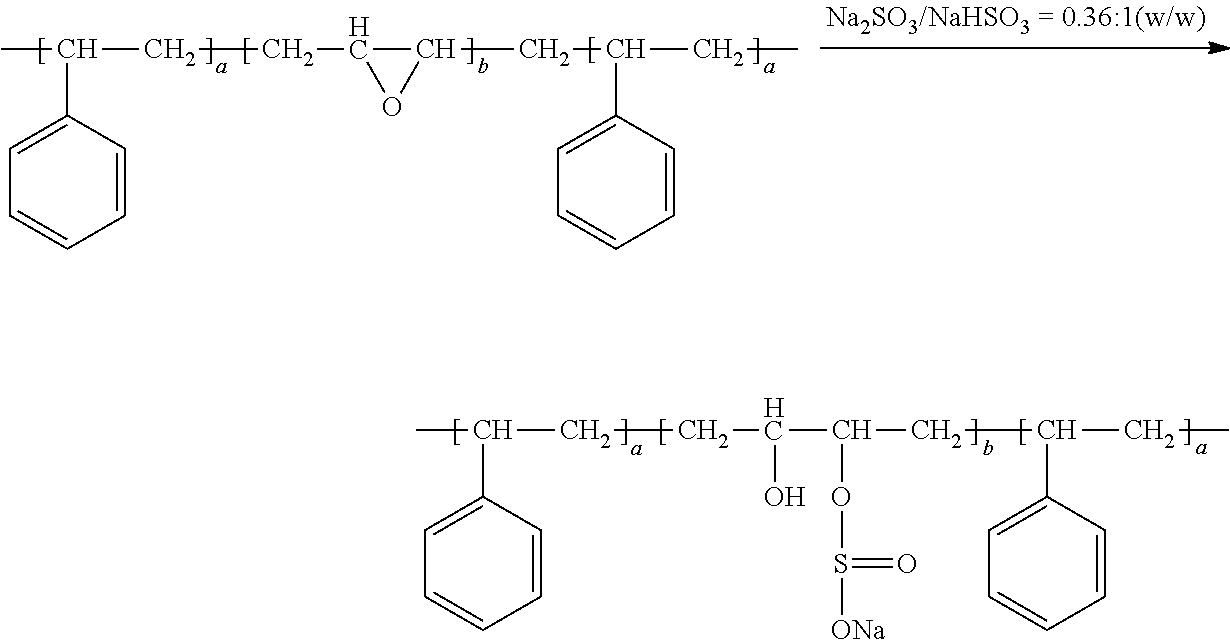
The reaction was terminated by adding a small amount of acetone solution containing antioxidant. The mixture was washed with distilled water and then precipitated by ethanol while being cast into thin films, followed by drying in a vacuum dryer at 50° C. It may be noted that graphene sheets (or CNTs, etc.) may be added during various stages of the aforementioned procedure (e.g. right from the beginning, or prior to the ring opening reaction).
| TABLE 1 |
| Lithium ion conductivity of various sulfonated elastomer composite composite |
| compositions as a lithium metal-protecting layer. |
| Sample | Lithium-conducting | % sulfonated elastomer | |
| No. | additive | (1-2 μm thick) | Li-ion conductivity (S/cm) |
| E-1p | Li2CO3 + (CH2OCO2Li)2 | 70-99% | 1.3 × 10⁻⁴ to 3.3 × 10⁻³ S/cm |
| B1p | LiF + LiOH + Li2C2O4 | 60-90% | 4.2 × 10⁻⁵ to 2.6 × 10⁻³ S/cm |
| B2p | LiF + HCOLi | 80-99% | 1.2 × 10⁻⁴ to 1.4 × 10⁻³ S/cm |
| B3p | LiOH | 70-99% | 8.5 × 10⁻⁴ to 1.1 × 10⁻² S/cm |
| B4p | Li2CO3 | 70-99% | 4.3 × 10⁻³ to 9.5 × 10⁻³ S/cm |
| B5p | Li2C2O4 | 70-99% | 8.2 × 10⁻⁴ to 1.3 × 10⁻² S/cm |
| B6p | Li2CO3 + LiOH | 70-99% | 1.5 × 10⁻³ to 1.7 × 10⁻² S/cm |
| C1p | LiClO4 | 70-99% | 4.0 × 10⁻⁴ to 2.2 × 10⁻³ S/cm |
| C2p | LiPF6 | 70-99% | 2.1 × 10⁻⁴ to 6.2 × 10⁻³ S/cm |
| C3p | LiBF4 | 70-99% | 1.2 × 10⁻⁴ to 1.7 × 10⁻³ S/cm |
| C4p | LiBOB + LiNO3 | 70-99% | 1.4 × 10⁻⁴ to 3.2 × 10⁻³ S/cm |
| S1p | Sulfonated polyaniline | 85-99% | 3.2 × 10⁻⁵ to 9.5 × 10⁻⁴ S/cm |
| S2p | Sulfonated PEEK | 85-99% | 1.4 × 10⁻⁴ to 1.3 × 10⁻³ S/cm |
| S3p | Sulfonated PVDF | 80-99% | 1.7 × 10⁻⁴ to 1.5 × 10⁻⁴ S/cm |
| S4p | Polyethylene oxide | 80-99% | 4.2 × 10⁻⁴ to 3.4 × 1034 S/cm |
| TABLE 2 |
| Cycle life data of various lithium secondary (rechargeable) batteries. |
| Initial | Cycle life | |||
| Anode-protecting | Type & % of cathode active | capacity | (No. of | |
| Sample ID | polymer | material | (mAh/g) | cycles) |
| CuCl2-1e | sulfonated elastomer | 85% by wt. CuCl2 particles (80 | 536 | 1450 |
| composite | nm) + 7% graphite + 8% binder | |||
| CuCl2-2e | none | 85% by wt. CuCl2 particles (80 | 536 | 115 |
| nm) + 7% graphite + 8% binder | ||||
| BiF3-1e | none | 85% by wt. BiFe3 particles + 7% | 275 | 115 |
| graphene + 8% binder | ||||
| BiF3-2e | Sulfonated elastomer | 85% by wt. BiFe3 particles + 7% | 276 | 1,446 |
| composite + 50% | graphene + 8% binder | |||
| ethylene oxide | ||||
| Li2MnSiO4- | sulfonated elastomer | 85% C-coated Li2MnSiO4 + 7% | 255 | 2,460 |
| 1e | composite | CNT + 8% binder | ||
| Li2MnSiO4- | none | 85% C-coated Li2MnSiO4 + 7% | 252 | 543 |
| 2e | CNT + 8% binder | |||
| Li6C6O6-1e | sulfonated elastomer | Li6C6O6-graphene ball-milled | 441 | 1,520 |
| composite + 20% | ||||
| polyanniline | ||||
| Li6C6O6-2e | none | Li6C6O6-graphene ball-milled | 438 | 116 |
| MoS2-1e | sulfonated elastomer | 85% MoS2 + 8% graphite + | 226 | 1,755 |
| composite | binder | |||
| MoS2-2e | none | 85% MoS2 + 8% graphite + | 225 | 156 |
| binder | ||||
-
- 1) Being highly elastic, the sulfonated elastomer composite layer helps to maintain a good contact between a Li metal layer (e.g. lithium metal foil, as the anode active material) and an electrolyte phase (e.g. an electrolyte/separator assembly or a solid-state electrolyte phase) when the Li metal layer decreases in thickness (e.g. due to dissolution of Li in the electrolyte when the battery is discharged) or increases in thickness (e.g. due to re-deposition of lithium metal back to the Cu foil or lithium metal when the battery is recharged). The sulfonated elastomer composite can expand and shrink responsive to the shrinkage and expansion of the anode active material layer. Such a conformal or congruent expansion/shrinkage of the sulfonated elastomer composite helps to eliminate the potential gap between the anode active material layer and the electrolyte or separator, thereby maintaining the lithium ion migration paths required of an operational Li metal battery.
- 2) The sulfonated elastomer matrix, infiltrated with a liquid electrolyte (before, during, or after the cell is fabricated) and coupled with its high-elasticity nature (good electrode-electrolyte contact), enables the returning Li+ ions to uniformly and successfully deposit back to the Li metal surface or current collector surface, reducing the formation of dead lithium particles, which otherwise become inactive. The uniform deposition of Li metal also reduces the tendency to form dangerous Li dendrites.
- 3) The presence of the conductive reinforcement material (graphene sheets, CNTs, CNFs, etc.) are high-strength materials, capable of stopping or deflecting the growth of dendrites (if initiated), preventing the dendrite from penetrating the separator to reach the cathode side to induce internal shorting, which otherwise is a fire and explosion hazard.
Claims (19)
Priority Applications (6)
| Application Number | Priority Date | Filing Date | Title |
|---|---|---|---|
| US16/014,623 US12288883B2 (en) | 2018-06-21 | 2018-06-21 | Method of improving cycle-life of a lithium metal secondary battery |
| US16/113,676 US12218346B2 (en) | 2018-06-21 | 2018-08-27 | Method of extending cycle-life of a lithium metal secondary battery |
| US16/120,875 US20190393486A1 (en) | 2018-06-21 | 2018-09-04 | Method of improving anode stability in a lithium metal secondary battery |
| US16/123,218 US20190393482A1 (en) | 2018-06-21 | 2018-09-06 | Method of protecting the lithium anode layer in a lithium metal secondary battery |
| US16/166,574 US20190393542A1 (en) | 2018-06-21 | 2018-10-22 | Method of improving the cycle stability and energy density of a lithium metal secondary battery |
| PCT/US2019/038367 WO2019246474A1 (en) | 2018-06-21 | 2019-06-21 | Lithium metal secondary battery featuring an anode-protecting layer |
Applications Claiming Priority (1)
| Application Number | Priority Date | Filing Date | Title |
|---|---|---|---|
| US16/014,623 US12288883B2 (en) | 2018-06-21 | 2018-06-21 | Method of improving cycle-life of a lithium metal secondary battery |
Related Child Applications (4)
| Application Number | Title | Priority Date | Filing Date |
|---|---|---|---|
| US16/113,676 Continuation-In-Part US12218346B2 (en) | 2018-06-21 | 2018-08-27 | Method of extending cycle-life of a lithium metal secondary battery |
| US16/120,875 Continuation-In-Part US20190393486A1 (en) | 2018-06-21 | 2018-09-04 | Method of improving anode stability in a lithium metal secondary battery |
| US16/123,218 Continuation-In-Part US20190393482A1 (en) | 2018-06-21 | 2018-09-06 | Method of protecting the lithium anode layer in a lithium metal secondary battery |
| US16/166,574 Continuation-In-Part US20190393542A1 (en) | 2018-06-21 | 2018-10-22 | Method of improving the cycle stability and energy density of a lithium metal secondary battery |
Publications (2)
| Publication Number | Publication Date |
|---|---|
| US20190393508A1 US20190393508A1 (en) | 2019-12-26 |
| US12288883B2 true US12288883B2 (en) | 2025-04-29 |
Family
ID=68981118
Family Applications (1)
| Application Number | Title | Priority Date | Filing Date |
|---|---|---|---|
| US16/014,623 Active US12288883B2 (en) | 2018-06-21 | 2018-06-21 | Method of improving cycle-life of a lithium metal secondary battery |
Country Status (1)
| Country | Link |
|---|---|
| US (1) | US12288883B2 (en) |
Families Citing this family (5)
| Publication number | Priority date | Publication date | Assignee | Title |
|---|---|---|---|---|
| US11251430B2 (en) | 2018-03-05 | 2022-02-15 | The Research Foundation For The State University Of New York | ϵ-VOPO4 cathode for lithium ion batteries |
| CN112259789B (en) * | 2020-10-13 | 2022-07-12 | 北京卫国创芯科技有限公司 | Polyether solid polymer electrolyte, preparation method thereof and solid battery comprising polyether solid polymer electrolyte |
| US20220359857A1 (en) * | 2021-04-29 | 2022-11-10 | Global Graphene Group, Inc. | Prelithiated anode, lithium-ion batteries containing a prelithiated anode and method of producing same |
| JP7455096B2 (en) * | 2021-10-15 | 2024-03-25 | 本田技研工業株式会社 | lithium metal secondary battery |
| CN118899561B (en) * | 2024-09-30 | 2025-01-24 | 江苏中兴派能电池有限公司 | Positive electrode lithium supplement additive and its application, positive electrode sheet, lithium-ion battery |
Citations (189)
| Publication number | Priority date | Publication date | Assignee | Title |
|---|---|---|---|---|
| US2798878A (en) | 1954-07-19 | 1957-07-09 | Nat Lead Co | Preparation of graphitic acid |
| US3836511A (en) | 1971-03-12 | 1974-09-17 | Exxon Research Engineering Co | Process for sulfonating unsaturated elastomers |
| US4322317A (en) * | 1980-03-03 | 1982-03-30 | Exxon Research & Engineering Co. | Composition for chalcogenide electrodes |
| US4720910A (en) | 1987-06-16 | 1988-01-26 | Mhb Joint Venture | Method for preparing encapsulated cathode material |
| US5057339A (en) | 1988-12-29 | 1991-10-15 | Matsushita Electric Industrial Co., Ltd. | Metallized polyacetylene-type or polyacene-type ultralong conjugated polymers and process for producing the same |
| US5270417A (en) | 1992-01-14 | 1993-12-14 | Matsushita Electric Industrial Co., Ltd. | Method of manufacturing a polyacetylene conjugate polymer |
| US5342710A (en) | 1993-03-30 | 1994-08-30 | Valence Technology, Inc. | Lakyer for stabilization of lithium anode |
| US5350647A (en) | 1990-12-24 | 1994-09-27 | Hope Stephen F | Electrodes for electrochemical devices |
| US5409785A (en) | 1991-12-25 | 1995-04-25 | Kabushikikaisha Equos Research | Fuel cell and electrolyte membrane therefor |
| US5424151A (en) | 1993-08-04 | 1995-06-13 | Valence Technology, Inc. | Cathode composition and method of making same |
| US5434021A (en) | 1994-08-12 | 1995-07-18 | Arthur D. Little, Inc. | Secondary electrolytic cell and electrolytic process |
| US5460905A (en) | 1993-06-16 | 1995-10-24 | Moltech Corporation | High capacity cathodes for secondary cells |
| US5536599A (en) | 1994-05-16 | 1996-07-16 | Eic Laboratories Inc. | Solid polymer electrolyte batteries containing metallocenes |
| US5648187A (en) | 1994-02-16 | 1997-07-15 | Moltech Corporation | Stabilized anode for lithium-polymer batteries |
| US5961672A (en) | 1994-02-16 | 1999-10-05 | Moltech Corporation | Stabilized anode for lithium-polymer batteries |
| US6025094A (en) | 1994-11-23 | 2000-02-15 | Polyplus Battery Company, Inc. | Protective coatings for negative electrodes |
| US6218055B1 (en) | 1998-06-05 | 2001-04-17 | Mine Safety Appliances Company | Electrochemical power cells and method of improving electrochemical power cell performance |
| US20020034685A1 (en) | 2000-09-01 | 2002-03-21 | Takaya Sato | Lithium based battery |
| US6447952B1 (en) | 1999-06-07 | 2002-09-10 | Eltron Research, Inc. | Polymer electrolytes |
| US6451484B1 (en) | 1999-04-21 | 2002-09-17 | Samsung Sdi Co., Ltd. | Lithium secondary battery and manufacturing method thereof |
| US6475678B1 (en) | 1999-08-24 | 2002-11-05 | Japan Storage Battery Co., Ltd. | Nonaqueous electrolyte battery |
| US20020182488A1 (en) | 2001-05-31 | 2002-12-05 | Cho Chung-Kun | Method for forming lithium metal anode protective layer for lithium battery and lithium battery having such protective layer |
| US20020195591A1 (en) | 1999-04-30 | 2002-12-26 | Nathalie Ravet | Electrode materials with high surface conductivity |
| US6515101B1 (en) | 1998-09-25 | 2003-02-04 | Iowa State University Research Foundation, Inc. | High performance fluorinated polymers and methods |
| KR20030050475A (en) | 2001-12-18 | 2003-06-25 | 삼성에스디아이 주식회사 | Cathode electrode, manufacturing method thereof, and lithium sulfur battery using the same |
| US6620547B1 (en) | 1998-09-16 | 2003-09-16 | Korea Kumho Petrochemical Co., Ltd. | Cathode including transition metal/matrix polymer composition and a secondary polymer battery therefrom |
| US20030180619A1 (en) | 2000-09-20 | 2003-09-25 | Noriyuki Tamura | Electrode for lithium secondary cell and lithium secondary cell |
| US20040018430A1 (en) | 2002-07-26 | 2004-01-29 | A123 Systems, Inc. | Electrodes and related devices |
| US6733924B1 (en) | 1999-11-23 | 2004-05-11 | Moltech Corporation | Lithium anodes for electrochemical cells |
| US6797428B1 (en) | 1999-11-23 | 2004-09-28 | Moltech Corporation | Lithium anodes for electrochemical cells |
| US20050034993A1 (en) | 2003-06-23 | 2005-02-17 | A123 Systems, Inc. | Polymer composition for encapsulation of electrode particles |
| US20050098914A1 (en) | 2003-08-18 | 2005-05-12 | Ashish Varma | Process for producing a hyper-elastic, high strength dilatation balloon made from multi-block copolymers |
| US20050118508A1 (en) | 2003-11-05 | 2005-06-02 | Lg Chem, Ltd. | Functional polymer film-coated electrode and electrochemical device using the same |
| US20050136330A1 (en) | 2003-12-19 | 2005-06-23 | Zhenhua Mao | Carbon-coated silicon particle power as the anode material for lithium batteries and the method of making the same |
| US20060263697A1 (en) | 2005-05-17 | 2006-11-23 | Dahn Jeffrey R | Substituted phenothiazine redox shuttles for rechargeable lithium-ion cell |
| KR100670527B1 (en) | 2005-10-06 | 2007-01-16 | 삼성에스디아이 주식회사 | Positive electrode plate having an elution preventing film, a manufacturing method thereof and a secondary battery using the same |
| US20070122700A1 (en) * | 2003-12-26 | 2007-05-31 | Mariko Miyachi | Anode material for secondary battery, anode for secondary battery and secondary battery therewith |
| US7247408B2 (en) | 1999-11-23 | 2007-07-24 | Sion Power Corporation | Lithium anodes for electrochemical cells |
| US20070218369A1 (en) | 2006-03-17 | 2007-09-20 | Atsushi Kaiduka | Non-aqueous electrolyte battery and method of manufacturing the same |
| WO2007108424A1 (en) | 2006-03-17 | 2007-09-27 | Sanyo Electric Co., Ltd. | Nonaqueous electrolyte battery and method for manufacturing same |
| US7282296B2 (en) | 2002-10-15 | 2007-10-16 | Polyplus Battery Company | Ionically conductive composites for protection of active metal anodes |
| US7282302B2 (en) | 2002-10-15 | 2007-10-16 | Polyplus Battery Company | Ionically conductive composites for protection of active metal anodes |
| US7282295B2 (en) | 2004-02-06 | 2007-10-16 | Polyplus Battery Company | Protected active metal electrode and battery cell structures with non-aqueous interlayer architecture |
| US20070289879A1 (en) | 2004-10-01 | 2007-12-20 | Polyone Corporation | Use of Cathodic Protection Compounds on Treated Metal Articles |
| US20080248393A1 (en) | 2007-04-03 | 2008-10-09 | Toyota Engineering & Manufacturing North America, Inc. | Tin in an active support matrix |
| US20080318128A1 (en) | 2007-06-22 | 2008-12-25 | Sion Power Corporation | Lithium alloy/sulfur batteries |
| US20090155676A1 (en) * | 2007-12-14 | 2009-06-18 | Aruna Zhamu | Anode protective layer compositions for lithium metal batteries |
| US20090169725A1 (en) | 2008-01-02 | 2009-07-02 | Aruna Zhamu | Method of producing hybrid nano-filament electrodes for lithium metal or lithium ion batteries |
| US20100099029A1 (en) | 2008-10-17 | 2010-04-22 | Masahiro Kinoshita | Lithium ion secondary battery |
| US20100112454A1 (en) | 2005-08-09 | 2010-05-06 | Polyplus Battery Company | Compliant seal structures for protected active metal anodes |
| US20100143798A1 (en) | 2008-12-04 | 2010-06-10 | Aruna Zhamu | Nano graphene reinforced nanocomposite particles for lithium battery electrodes |
| US20100173198A1 (en) | 2009-01-02 | 2010-07-08 | Aruna Zhamu | Secondary lithium ion battery containing a prelithiated anode |
| JP2010160984A (en) | 2009-01-08 | 2010-07-22 | Nissan Motor Co Ltd | Anode for lithium-ion secondary battery and lithium-ion secondary battery |
| KR20100138607A (en) | 2009-06-25 | 2010-12-31 | 삼성전자주식회사 | Anode active material, anode comprising same, method for producing anode and lithium battery |
| US20110027658A1 (en) * | 2009-07-29 | 2011-02-03 | Hyundai Motor Company | Method for preparing cross-linked ceramic-coated separator containing ionic polymer, ceramic-coated separator prepared by the method, and lithium secondary battery using the same |
| WO2011015866A1 (en) * | 2009-08-06 | 2011-02-10 | Bac2 Limited | Electrical device |
| US20110059361A1 (en) | 2009-08-28 | 2011-03-10 | Sion Power Corporation | Electrochemical cells comprising porous structures comprising sulfur |
| US20110104571A1 (en) | 2009-11-02 | 2011-05-05 | Aruna Zhamu | Nano-structured anode compositions for lithium metal and lithium metal-air secondary batteries |
| US20110143211A1 (en) * | 2009-12-11 | 2011-06-16 | Konica Minolta Holdings, Inc. | Electrochemical device |
| US20110177388A1 (en) | 2008-02-25 | 2011-07-21 | Lg Chem, Ltd. | Anode coated with lithium fluoride compounds, method for preparing the same, and lithium secondary battery having the same |
| JP2011524611A (en) | 2008-06-16 | 2011-09-01 | ポリプラス バッテリー カンパニー | Aqueous lithium-air battery cell |
| US20110244337A1 (en) | 2009-02-04 | 2011-10-06 | Kabushiki Kaisha Toyota Chuo Kenkyusho | Garnet-type lithium ion-conducting oxide and all-solid-state lithium ion secondary battery containing the same |
| US20110262816A1 (en) | 2009-01-12 | 2011-10-27 | Glenn Amatucci | Polyhydrogen fluoride based battery |
| US20120064409A1 (en) | 2010-09-10 | 2012-03-15 | Aruna Zhamu | Graphene-enhanced anode particulates for lithium ion batteries |
| US20120070708A1 (en) | 2009-05-22 | 2012-03-22 | Koji Ohira | Cathode active material, cathode and nonaqueous secondary battery |
| US20120088154A1 (en) | 2010-10-07 | 2012-04-12 | Battelle Memorial Institute | Graphene-Sulfur Nanocomposites for Rechargeable Lithium-Sulfur Battery Electrodes |
| US20130052544A1 (en) | 2010-03-01 | 2013-02-28 | The Furukawa Battery Co., Ltd | Cathode active material, cathode, secondary battery and manufacturing methods for the same |
| US20130054061A1 (en) | 2010-08-30 | 2013-02-28 | Sony Corporation | Non-aqueous electrolyte battery, method of manufacturing non-aqueous electrolyte battery, insulating material, method of manufacturing insulating material, battery pack, electronic device, electromotive vehicle, power storage apparatus, and electric power system |
| US20130122373A1 (en) * | 2010-07-28 | 2013-05-16 | Nec Energy Devices, Ltd. | Lithium ion secondary battery |
| US20130157141A1 (en) | 2003-07-09 | 2013-06-20 | Maxwell Technologies, Inc. | Battery with a recyclable dry particle based electrode |
| US20130164615A1 (en) | 2011-12-22 | 2013-06-27 | Arumugam Manthiram | Conductive polymer-coated, shaped sulfur-nanocomposite cathodes for rechargeable lithium-sulfur batteries and methods of making the same |
| US20130171339A1 (en) | 2011-12-28 | 2013-07-04 | Hon Hai Precision Industry Co., Ltd. | Method for making sulfur-graphene composite material |
| CN103258990A (en) | 2013-04-24 | 2013-08-21 | 中国科学院苏州纳米技术与纳米仿生研究所 | Lithium sulfur battery cathode material and preparation method thereof |
| US20130224603A1 (en) | 2012-02-27 | 2013-08-29 | Guorong Chen | Lithium-ion cell having a high-capacity anode and a high-capacity cathode |
| US20130292613A1 (en) | 2010-11-04 | 2013-11-07 | Marcus Wegner | Cathode material for a lithium-sulfur battery |
| US8597828B2 (en) | 2007-08-24 | 2013-12-03 | Commissariat A L'energie Atomique | Lithium battery using an aqueous electrolyte |
| US20140072879A1 (en) | 2012-09-10 | 2014-03-13 | Guorong Chen | Encapsulated phthalocyanine particles, high-capacity cathode containing these particles, and rechargeable lithium cell containing such a cathode |
| US20140147751A1 (en) | 2011-03-18 | 2014-05-29 | Jun Yang | Silicon-carbon Composite Anode Material for Lithium Ion Batteries and A Preparation Method Thereof |
| US20140147738A1 (en) | 2011-06-11 | 2014-05-29 | Positec Power Tools (Suzhou) Co., Ltd | Electrode Composite Material, Preparation Method Thereof, Cathode And Battery Including The Same |
| US20140154572A1 (en) | 2012-05-07 | 2014-06-05 | Seeo, Inc. | Coated particles for lithium battery cathodes |
| US20140162121A1 (en) | 2012-12-12 | 2014-06-12 | Hyundai Motor Company | Powder for cathode of lithium-sulfur secondary battery and method of fabricating the same |
| US20140178747A1 (en) | 2012-12-25 | 2014-06-26 | Industrial Technology Research Institute | Composite electrode material of lithium secondary battery and lithium secondary battery |
| KR20140101640A (en) | 2013-02-12 | 2014-08-20 | (주)포스코켐텍 | Negative electrode active material for rechargeable lithium battery, and method for preparing the same |
| US20140234702A1 (en) | 2011-09-30 | 2014-08-21 | The Regents Of The University Of California | Graphene oxide as a sulfur immobilizer in high performance lithium/sulfur cells |
| US20140235513A1 (en) | 2013-02-19 | 2014-08-21 | Nanotech Industrial Solutions, Inc. | Coating including inorganic fullerene-like particles and inorganic tubular-like particles |
| EP2787563A1 (en) | 2011-11-30 | 2014-10-08 | Kokam Co., Ltd. | Lithium secondary battery having improved safety and stability |
| US20140363746A1 (en) | 2013-06-10 | 2014-12-11 | Hui He | Lithium secondary batteries containing non-flammable quasi-solid electrolyte |
| US20150044556A1 (en) | 2013-08-08 | 2015-02-12 | Yanbo Wang | Cathode active material-coated discrete graphene sheets for lithium batteries and process for producing same |
| US20150064574A1 (en) | 2013-08-30 | 2015-03-05 | Hui He | Non-flammable quasi-solid electrolyte and non-lithium alkali metal or alkali-ion secondary batteries containing same |
| US20150064568A1 (en) * | 2013-08-30 | 2015-03-05 | Sila Nanotechnologies Inc. | Electrolyte or electrode additives for increasing metal content in metal-ion batteries |
| US20150079485A1 (en) | 2013-09-13 | 2015-03-19 | Samsung Electronics Co., Ltd. | Composite membrane, preparation method thereof, and lithium-air battery including the composite membrane |
| JP2015084320A (en) | 2013-09-17 | 2015-04-30 | 株式会社東芝 | Battery active material, electrode, non-aqueous electrolyte battery and battery pack |
| US20150162641A1 (en) | 2013-12-09 | 2015-06-11 | Polyplus Battery Company | Protected lithium electrodes having a liquid anolyte reservoir architecture and associated rechargeable lithium battery cells |
| US20150180000A1 (en) | 2013-11-18 | 2015-06-25 | California Institute Of Technology | Separator enclosures for electrodes and electrochemical cells |
| US20150180037A1 (en) | 2013-12-19 | 2015-06-25 | Sion Power Corporation | Polymer for use as protective layers and other components in electrochemical cells |
| US20150218323A1 (en) | 2013-05-09 | 2015-08-06 | Lg Chem, Ltd. | Polymer film, flexible light emitting element display device, and rollable display device |
| US20150221935A1 (en) | 2014-02-05 | 2015-08-06 | GM Global Technology Operations LLC | Sulfur based active material for a positive electrode |
| US20150236372A1 (en) | 2014-02-20 | 2015-08-20 | Georgia Tech Research Corporation | Metal sulfide composite materials for batteries |
| US20150244025A1 (en) | 2014-02-26 | 2015-08-27 | Sogang University Research Foundation | Solid polymer electrolyte composition and lithium secondary battery including the same |
| WO2015141799A1 (en) | 2014-03-19 | 2015-09-24 | 積水化学工業株式会社 | Sheet-laminated lithium ion secondary battery and production method for sheet-laminated lithium ion secondary battery |
| JP2015176656A (en) | 2014-03-13 | 2015-10-05 | 本田技研工業株式会社 | positive electrode material |
| US20150318532A1 (en) | 2014-05-05 | 2015-11-05 | Board Of Regents, The University Of Texas System | Bifunctional separators for lithium-sulfur batteries |
| US20150325844A1 (en) | 2013-01-25 | 2015-11-12 | Toyota Jidosha Kabushiki Kaisha | Cathode for secondary batteries, method for producing cathode for secondary batteries, and all-solid-state secondary battery |
| US20150372294A1 (en) | 2013-01-29 | 2015-12-24 | Sanyo Electric Co., Ltd. | Negative electrode active material for nonaqueous electrolyte secondary battery, negative electrode for nonaqueous electrolyte secondary battery using negative electrode active material, and nonaqueous electrolyte secondary battery using negative electrode |
| US20160013481A1 (en) | 2014-07-11 | 2016-01-14 | Oci Company Ltd. | Anode active material for lithium secondary battery and method for preparing same |
| WO2016015915A1 (en) | 2014-07-30 | 2016-02-04 | Bayerische Motoren Werke Aktiengesellschaft | Composite electrode for an electrochemical cell and electrochemical cell |
| CN105322132A (en) | 2014-07-31 | 2016-02-10 | 中国科学院上海硅酸盐研究所 | Positive electrode of lithium-sulfur battery with multifunctional elastic protection layer |
| US20160043384A1 (en) | 2014-08-07 | 2016-02-11 | Aruna Zhamu | Graphene foam-protected anode active materials for lithium batteries |
| US20160087266A1 (en) | 2014-09-18 | 2016-03-24 | Toyota Motor Engineering & Manufacturing North America, Inc. | Encapsulated sulfur sub-micron particles as electrode active material |
| US20160126543A1 (en) | 2014-11-03 | 2016-05-05 | Naoki Ota | Pre-Lithiation of Electrode Materials in a Semi-Solid Electrode |
| KR20160052351A (en) | 2014-10-31 | 2016-05-12 | 주식회사 엘지화학 | Lithium metal electrode for lithium secondary battery with safe protective layer and lithium secondary battery comprising the same |
| US20160149216A1 (en) | 2013-07-08 | 2016-05-26 | Sanyo Chemical Industries, Ltd. | Resin for coating lithium-ion-battery active material, resin composition for coating lithium-ion-battery active material, and coated active material for lithium-ion battery |
| US20160181611A1 (en) | 2014-12-18 | 2016-06-23 | Unist Academy-Industry Research Corporation | Composite cathode active material, method of preparing the same, and cathode and lithium battery including the composite cathode active material |
| US20160204431A1 (en) | 2013-09-27 | 2016-07-14 | Sanyo Electric Co., Ltd. | Negative electrode for nonaqueous electrolyte secondary batteries |
| KR20160085386A (en) | 2015-01-07 | 2016-07-18 | 에스케이이노베이션 주식회사 | Anode active material, secondary battery, and manufacturing method of anode active material |
| KR20160087511A (en) | 2015-01-14 | 2016-07-22 | 주식회사 엘지화학 | Positive electrode for lithium-sulfur battery and method for manufacturaing the same and lithium-sulfur battery comprising the same |
| US20160218341A1 (en) | 2015-01-26 | 2016-07-28 | University Of Dayton | Lithium batteries having artificial solid electrolyte interphase membrane for anode protection |
| US20160240896A1 (en) | 2014-09-10 | 2016-08-18 | Battelle Memorial Institute | High coulombic efficiency cycling of metal batteries |
| US20160301075A1 (en) | 2015-04-08 | 2016-10-13 | Aruna Zhamu | Dendrite-Intercepting layer for alkali metal secondary battery |
| US20160344035A1 (en) * | 2015-05-21 | 2016-11-24 | Aruna Zhamu | Alkali Metal Secondary Battery Containing a Carbon Matrix- or Carbon Matrix Composite-based Dendrite-Intercepting Layer |
| US20160351909A1 (en) | 2012-11-19 | 2016-12-01 | Fraunhofer-Gesellschaft zur Förderung der angewandten Forschung e.V. | Particulate electrode material having a coating made of a crystalline inorganic material and/or an inorganic-organic hybrid polymer and method for the production thereof |
| US20160351877A1 (en) | 2014-02-06 | 2016-12-01 | Nissan Motor Co., Ltd. | Non-Aqueous Electrolyte Secondary Battery |
| US20160372743A1 (en) | 2015-06-19 | 2016-12-22 | SolidEnergy Systems | Multi-layer polymer coated li anode for high density li metal battery |
| US20160372784A1 (en) | 2015-06-22 | 2016-12-22 | SiNode Systems, Inc. | Cathode Additives to Provide an Excess Lithium Source for Lithium Ion Batteries |
| US20170002154A1 (en) | 2014-03-12 | 2017-01-05 | Toray Industries, Inc. | Sizing agent-coated reinforcing fibers, method for producing sizing agent-coated reinforcing fibers, prepreg, and fiber-reinforced composite material |
| US20170018799A1 (en) | 2014-04-03 | 2017-01-19 | Soongsil University Research Consortium Techno-Park | Flexible lithium secondary battery and method for manufacturing the same |
| US20170033357A1 (en) | 2014-04-09 | 2017-02-02 | Orange Power Ltd. | Negative electrode active material for secondary battery and method for manufacturig same |
| US20170047584A1 (en) | 2014-05-09 | 2017-02-16 | Lg Chem, Ltd. | Graphene-coated porous silicon-carbon composite and method of manufacturing the same |
| US20170062827A1 (en) | 2014-02-28 | 2017-03-02 | Wacker Chemie Ag | Polymer compositions as a binder system for lithium-ion batteries |
| US20170062830A1 (en) | 2015-08-31 | 2017-03-02 | The Board Of Trustees Of The Leland Stanford Junior University | High performance battery anodes with polymeric coatings |
| KR20170001069U (en) | 2015-09-14 | 2017-03-22 | 주식회사 서연전자 | Mothproof apparatus for vehicle |
| US20170098824A1 (en) | 2012-07-24 | 2017-04-06 | Quantumscape Corporation | Protective coatings for conversion material cathodes |
| US20170098856A1 (en) | 2015-10-02 | 2017-04-06 | Aruna Zhamu | Process for producing lithium batteries having an ultra-high energy density |
| US20170104204A1 (en) | 2015-10-08 | 2017-04-13 | Aruna Zhamu | Continuous process for producing electrodes and alkali metal batteries having ultra-high energy densities |
| US20170104217A1 (en) | 2015-10-07 | 2017-04-13 | City University Of Hong Kong | Material for use in a battery, a battery and a method of manufacturing a material for use in a battery |
| US20170117589A1 (en) | 2015-10-27 | 2017-04-27 | Semiconductor Energy Laboratory Co., Ltd. | Power storage device electronic device |
| US20170117535A1 (en) | 2015-10-23 | 2017-04-27 | Samsung Electronics Co., Ltd. | Composite anode active material, anode including the same, and lithium secondary battery including the anode |
| US20170117538A1 (en) | 2015-10-23 | 2017-04-27 | Ensor, Inc. | Nanocomposite anode structure and methods of manufacture thereof |
| US20170141387A1 (en) | 2015-11-13 | 2017-05-18 | SiNode Systems, Inc. | Graphene-encapsulated electroactive material for use in a lithium ion electrochemical cell |
| US20170166722A1 (en) | 2015-12-10 | 2017-06-15 | Aruna Zhamu | Chemical-free production of graphene-reinforced polymer matrix composites |
| US20170179468A1 (en) | 2014-06-06 | 2017-06-22 | Robert Bosch Gmbh | Polymer electrolyte for a lithium sulfur cell |
| US20170194640A1 (en) | 2015-12-30 | 2017-07-06 | Toyota Motor Engineering & Manufacturing North America, Inc. | Hybrid sulfur particles and cathode active materials containing the hybrid particles |
| US20170194648A1 (en) | 2015-12-30 | 2017-07-06 | Toyota Motor Engineering & Manufacturing North America, Inc. | Functionalization of carbon for embedding in chalcogen particles to enhance electronic conductivity |
| US20170200943A1 (en) | 2014-07-15 | 2017-07-13 | Soichiro Kawakami | Negative electrode material for power storage device, electrode structure, power storage device, and production method for each |
| US20170207484A1 (en) | 2016-01-15 | 2017-07-20 | Aruna Zhamu | Alkali Metal-Sulfur Batteries Having High Volumetric and Gravimetric Energy Densities |
| KR20170086003A (en) | 2014-10-23 | 2017-07-25 | 주식회사 엘지화학 | Li metal electrode with multi-layer and forming method thereof |
| WO2017135794A1 (en) * | 2016-02-05 | 2017-08-10 | 주식회사 엘지화학 | Negative electrode active material and secondary battery comprising same |
| US20170279125A1 (en) | 2014-08-25 | 2017-09-28 | Nissan Motor Co., Ltd. | Electrode |
| US20170288211A1 (en) | 2016-03-30 | 2017-10-05 | Nanotek Instruments, Inc. | Elastomer-Encapsulated particles of high-capacity anode active materials for lithium batteries |
| US20170294643A1 (en) | 2016-04-07 | 2017-10-12 | StoreDot Ltd. | Tin silicon anode active material |
| US20170309917A1 (en) | 2016-04-20 | 2017-10-26 | Samsung Electronics Co., Ltd. | Cathode and lithium battery including the same |
| KR20170126404A (en) | 2016-05-09 | 2017-11-17 | 삼성전자주식회사 | Negative electrode for lithium metal battery and lithium metal battery comprising the same |
| WO2017200798A1 (en) | 2016-05-17 | 2017-11-23 | Nanotek Instruments, Inc. | Chemical-free production of graphene-encapsulated electrode active material particles for battery applications |
| US20170338490A1 (en) | 2016-05-20 | 2017-11-23 | GM Global Technology Operations LLC | Polymerization process for forming polymeric ultrathin conformal coatings on electrode materials |
| US20170338474A1 (en) | 2014-10-30 | 2017-11-23 | The Regents Of The University Of Colorado, A Body Corporate | Stable silicon-ionic liquid interface lithium-ion batteries |
| US20180053978A1 (en) | 2016-08-17 | 2018-02-22 | Hyundai Motor Company | Anode for lithium air battery and preparation method thereof |
| US9905856B1 (en) | 2016-12-28 | 2018-02-27 | Nanotek Instruments, Inc. | Flexible and shape-conformal rope-shape alkali metal-sulfur batteries |
| US20180083265A1 (en) | 2013-06-18 | 2018-03-22 | Seeo, Inc. | Method for determining state of charge in lithium batteries through use of a novel electrode |
| KR20180035752A (en) | 2018-03-23 | 2018-04-06 | 주식회사 엘지화학 | Surface coated porous silicon based anode active material and preparation method thereof |
| WO2018075538A1 (en) | 2016-10-17 | 2018-04-26 | The Board Of Trustees Of The University Of Illinois | Protected anodes and methods for making and using same |
| US20180190975A1 (en) | 2015-07-02 | 2018-07-05 | Showa Denko K. K. | Negative electrode material for lithium-ion batteries and use therefor |
| US20180219215A1 (en) | 2017-02-01 | 2018-08-02 | Toyota Motor Engineering & Manufacturing North America, Inc. | Sulfur particles coated with inorganic-organic hybrid membranes as cathode active material and batteries containing the particles |
| US20180233736A1 (en) | 2017-02-16 | 2018-08-16 | Nanotek Instruments, Inc. | Method of Manufacturing a Lithium Secondary Battery Having a Protected High-Capacity Anode Active Material |
| WO2018148090A1 (en) | 2017-02-13 | 2018-08-16 | Nanotek Instruments, Inc. | Alkali metal-sulfur secondary battery containing a nano sulfur-loaded cathode and manufacturing method |
| US20180241032A1 (en) | 2017-02-20 | 2018-08-23 | Nanotek Instruments, Inc. | Lithium Secondary Batteries Containing Protected Particles of Anode Active Materials and Method of Manufacturing |
| US20180241031A1 (en) | 2017-02-23 | 2018-08-23 | Nanotek Instruments, Inc. | Alkali Metal-Sulfur Secondary Battery Containing a Protected Sulfur Cathode and Manufacturing Method |
| US20180248173A1 (en) | 2017-02-24 | 2018-08-30 | Nanotek Instruments, Inc. | Polymer Binder for Lithium Battery and Method of Manufacturing |
| US20180248162A1 (en) * | 2015-08-31 | 2018-08-30 | Zeon Corporation | Composition for non-aqueous secondary battery functional layer, functional layer for non-aqueous secondary battery, and non-aqueous secondary battery |
| US20180277913A1 (en) | 2017-03-23 | 2018-09-27 | Nanotek Instruments, Inc. | Non-flammable Quasi-Solid Electrolyte and Lithium Secondary Batteries Containing Same |
| US20180277829A1 (en) * | 2015-10-05 | 2018-09-27 | Toray Industries, Inc. | Positive electrode for lithium ion secondary battery, graphene/positive electrode active material composite particles, manufacturing methods for same, and positive electrode paste for lithium ion secondary battery |
| US20180287142A1 (en) | 2017-04-03 | 2018-10-04 | Nanotek Instruments Inc. | Encapsulated Anode Active Material Particles, Lithium Secondary Batteries Containing Same, and Method of Manufacturing |
| US20180294476A1 (en) | 2017-04-10 | 2018-10-11 | Nanotek Instruments, Inc. | Lithium Metal Secondary Battery Containing an Anode-Protecting Polymer Layer and Manufacturing Method |
| US20180294475A1 (en) | 2017-04-10 | 2018-10-11 | Nanotek Instruments, Inc. | Alkali Metal-Sulfur Secondary Battery Containing a Polymer-Encapsulated Sulfur Cathode and Manufacturing Method |
| US20180301707A1 (en) | 2017-04-12 | 2018-10-18 | Nanotek Instruments, Inc. | Lithium Anode-Protecting Polymer Layer for a Lithium Metal Secondary Battery and Manufacturing Method |
| CN108899472A (en) | 2018-07-23 | 2018-11-27 | 中国科学技术大学 | A kind of lithium metal battery electrode slice and preparation method thereof and a kind of lithium metal battery |
| US20190051905A1 (en) | 2017-08-14 | 2019-02-14 | Nanotek Instruments, Inc. | Anode-Protecting Layer for a Lithium Metal Secondary Battery and Manufacturing Method |
| US20190058185A1 (en) * | 2016-08-19 | 2019-02-21 | Lg Chem, Ltd. | Anode comprising multiple protective layers, and lithium secondary battery comprising same |
| US20190081325A1 (en) | 2017-09-14 | 2019-03-14 | Toyota Jidosha Kabushiki Kaisha | Graphite material for negative electrode of lithium ion secondary cell and method for producing the same |
| US20190077669A1 (en) | 2017-09-11 | 2019-03-14 | Nanotek Instruments, Inc. | Production of graphene materials directly from carbon/graphite precursor |
| US20190088958A1 (en) * | 2017-09-15 | 2019-03-21 | Sion Power Corporation | Protective membrane for electrochemical cells |
| US20190260028A1 (en) | 2018-02-21 | 2019-08-22 | Nanotek Instruments, Inc. | Protected Particles of Anode Active Materials for Lithium Batteries |
| US20190319303A1 (en) | 2017-02-16 | 2019-10-17 | Fujifilm Corporation | Solid electrolyte composition, solid electrolyte-containing sheet, all-solid state secondary battery, and methods for manufacturing solid electrolyte-containing sheet and all-solid state secondary battery |
| US10483533B2 (en) | 2017-04-10 | 2019-11-19 | Global Graphene Group, Inc. | Encapsulated cathode active material particles, lithium secondary batteries containing same, and method of manufacturing |
| US20190386332A1 (en) | 2018-06-18 | 2019-12-19 | Nanotek Instruments, Inc. | Alkali metal-sulfur secondary battery containing a conductive electrode- protecting layer |
| US20190393466A1 (en) | 2018-06-25 | 2019-12-26 | Ningde Amperex Technology Limited | Electrochemical device |
| US20190393543A1 (en) | 2018-06-21 | 2019-12-26 | Nanotek Instruments, Inc. | Lithium metal secondary battery featuring an anode-protecting layer |
| US20190393495A1 (en) | 2018-06-21 | 2019-12-26 | Nanotek Instruments, Inc. | Lithium metal secondary battery containing an electrochemically stable anode-protecting layer |
| US20190393510A1 (en) | 2018-06-25 | 2019-12-26 | Nanotek Instruments, Inc. | Lithium-selenium battery containing an electrode-protecting layer and method of improving cycle-life |
| US10629899B1 (en) | 2018-10-15 | 2020-04-21 | Global Graphene Group, Inc. | Production method for electrochemically stable anode particulates for lithium secondary batteries |
-
2018
- 2018-06-21 US US16/014,623 patent/US12288883B2/en active Active
Patent Citations (196)
| Publication number | Priority date | Publication date | Assignee | Title |
|---|---|---|---|---|
| US2798878A (en) | 1954-07-19 | 1957-07-09 | Nat Lead Co | Preparation of graphitic acid |
| US3836511A (en) | 1971-03-12 | 1974-09-17 | Exxon Research Engineering Co | Process for sulfonating unsaturated elastomers |
| US4322317A (en) * | 1980-03-03 | 1982-03-30 | Exxon Research & Engineering Co. | Composition for chalcogenide electrodes |
| US4720910A (en) | 1987-06-16 | 1988-01-26 | Mhb Joint Venture | Method for preparing encapsulated cathode material |
| US5057339A (en) | 1988-12-29 | 1991-10-15 | Matsushita Electric Industrial Co., Ltd. | Metallized polyacetylene-type or polyacene-type ultralong conjugated polymers and process for producing the same |
| US5350647A (en) | 1990-12-24 | 1994-09-27 | Hope Stephen F | Electrodes for electrochemical devices |
| US5409785A (en) | 1991-12-25 | 1995-04-25 | Kabushikikaisha Equos Research | Fuel cell and electrolyte membrane therefor |
| US5270417A (en) | 1992-01-14 | 1993-12-14 | Matsushita Electric Industrial Co., Ltd. | Method of manufacturing a polyacetylene conjugate polymer |
| US5342710A (en) | 1993-03-30 | 1994-08-30 | Valence Technology, Inc. | Lakyer for stabilization of lithium anode |
| US5460905A (en) | 1993-06-16 | 1995-10-24 | Moltech Corporation | High capacity cathodes for secondary cells |
| US5424151A (en) | 1993-08-04 | 1995-06-13 | Valence Technology, Inc. | Cathode composition and method of making same |
| US5961672A (en) | 1994-02-16 | 1999-10-05 | Moltech Corporation | Stabilized anode for lithium-polymer batteries |
| US5648187A (en) | 1994-02-16 | 1997-07-15 | Moltech Corporation | Stabilized anode for lithium-polymer batteries |
| US5536599A (en) | 1994-05-16 | 1996-07-16 | Eic Laboratories Inc. | Solid polymer electrolyte batteries containing metallocenes |
| US5434021A (en) | 1994-08-12 | 1995-07-18 | Arthur D. Little, Inc. | Secondary electrolytic cell and electrolytic process |
| US6025094A (en) | 1994-11-23 | 2000-02-15 | Polyplus Battery Company, Inc. | Protective coatings for negative electrodes |
| US6218055B1 (en) | 1998-06-05 | 2001-04-17 | Mine Safety Appliances Company | Electrochemical power cells and method of improving electrochemical power cell performance |
| US6620547B1 (en) | 1998-09-16 | 2003-09-16 | Korea Kumho Petrochemical Co., Ltd. | Cathode including transition metal/matrix polymer composition and a secondary polymer battery therefrom |
| US6515101B1 (en) | 1998-09-25 | 2003-02-04 | Iowa State University Research Foundation, Inc. | High performance fluorinated polymers and methods |
| US6451484B1 (en) | 1999-04-21 | 2002-09-17 | Samsung Sdi Co., Ltd. | Lithium secondary battery and manufacturing method thereof |
| US20020195591A1 (en) | 1999-04-30 | 2002-12-26 | Nathalie Ravet | Electrode materials with high surface conductivity |
| US6447952B1 (en) | 1999-06-07 | 2002-09-10 | Eltron Research, Inc. | Polymer electrolytes |
| US6475678B1 (en) | 1999-08-24 | 2002-11-05 | Japan Storage Battery Co., Ltd. | Nonaqueous electrolyte battery |
| US6797428B1 (en) | 1999-11-23 | 2004-09-28 | Moltech Corporation | Lithium anodes for electrochemical cells |
| US6733924B1 (en) | 1999-11-23 | 2004-05-11 | Moltech Corporation | Lithium anodes for electrochemical cells |
| US7247408B2 (en) | 1999-11-23 | 2007-07-24 | Sion Power Corporation | Lithium anodes for electrochemical cells |
| US6936381B2 (en) | 1999-11-23 | 2005-08-30 | Moltech Corporation | Lithium anodes for electrochemical cells |
| US20020034685A1 (en) | 2000-09-01 | 2002-03-21 | Takaya Sato | Lithium based battery |
| US20030180619A1 (en) | 2000-09-20 | 2003-09-25 | Noriyuki Tamura | Electrode for lithium secondary cell and lithium secondary cell |
| US20020182488A1 (en) | 2001-05-31 | 2002-12-05 | Cho Chung-Kun | Method for forming lithium metal anode protective layer for lithium battery and lithium battery having such protective layer |
| KR20030050475A (en) | 2001-12-18 | 2003-06-25 | 삼성에스디아이 주식회사 | Cathode electrode, manufacturing method thereof, and lithium sulfur battery using the same |
| US20040018430A1 (en) | 2002-07-26 | 2004-01-29 | A123 Systems, Inc. | Electrodes and related devices |
| US7282302B2 (en) | 2002-10-15 | 2007-10-16 | Polyplus Battery Company | Ionically conductive composites for protection of active metal anodes |
| US7282296B2 (en) | 2002-10-15 | 2007-10-16 | Polyplus Battery Company | Ionically conductive composites for protection of active metal anodes |
| US20050034993A1 (en) | 2003-06-23 | 2005-02-17 | A123 Systems, Inc. | Polymer composition for encapsulation of electrode particles |
| US20130157141A1 (en) | 2003-07-09 | 2013-06-20 | Maxwell Technologies, Inc. | Battery with a recyclable dry particle based electrode |
| US20050098914A1 (en) | 2003-08-18 | 2005-05-12 | Ashish Varma | Process for producing a hyper-elastic, high strength dilatation balloon made from multi-block copolymers |
| US20050118508A1 (en) | 2003-11-05 | 2005-06-02 | Lg Chem, Ltd. | Functional polymer film-coated electrode and electrochemical device using the same |
| US7618678B2 (en) | 2003-12-19 | 2009-11-17 | Conocophillips Company | Carbon-coated silicon particle powders as the anode material for lithium ion batteries and the method of making the same |
| US20050136330A1 (en) | 2003-12-19 | 2005-06-23 | Zhenhua Mao | Carbon-coated silicon particle power as the anode material for lithium batteries and the method of making the same |
| US20070122700A1 (en) * | 2003-12-26 | 2007-05-31 | Mariko Miyachi | Anode material for secondary battery, anode for secondary battery and secondary battery therewith |
| US7282295B2 (en) | 2004-02-06 | 2007-10-16 | Polyplus Battery Company | Protected active metal electrode and battery cell structures with non-aqueous interlayer architecture |
| US20070289879A1 (en) | 2004-10-01 | 2007-12-20 | Polyone Corporation | Use of Cathodic Protection Compounds on Treated Metal Articles |
| US20060263697A1 (en) | 2005-05-17 | 2006-11-23 | Dahn Jeffrey R | Substituted phenothiazine redox shuttles for rechargeable lithium-ion cell |
| US20100112454A1 (en) | 2005-08-09 | 2010-05-06 | Polyplus Battery Company | Compliant seal structures for protected active metal anodes |
| KR100670527B1 (en) | 2005-10-06 | 2007-01-16 | 삼성에스디아이 주식회사 | Positive electrode plate having an elution preventing film, a manufacturing method thereof and a secondary battery using the same |
| WO2007108424A1 (en) | 2006-03-17 | 2007-09-27 | Sanyo Electric Co., Ltd. | Nonaqueous electrolyte battery and method for manufacturing same |
| US20070218369A1 (en) | 2006-03-17 | 2007-09-20 | Atsushi Kaiduka | Non-aqueous electrolyte battery and method of manufacturing the same |
| US20080248393A1 (en) | 2007-04-03 | 2008-10-09 | Toyota Engineering & Manufacturing North America, Inc. | Tin in an active support matrix |
| US20080318128A1 (en) | 2007-06-22 | 2008-12-25 | Sion Power Corporation | Lithium alloy/sulfur batteries |
| US8597828B2 (en) | 2007-08-24 | 2013-12-03 | Commissariat A L'energie Atomique | Lithium battery using an aqueous electrolyte |
| US20090155676A1 (en) * | 2007-12-14 | 2009-06-18 | Aruna Zhamu | Anode protective layer compositions for lithium metal batteries |
| US20090169725A1 (en) | 2008-01-02 | 2009-07-02 | Aruna Zhamu | Method of producing hybrid nano-filament electrodes for lithium metal or lithium ion batteries |
| US20110177388A1 (en) | 2008-02-25 | 2011-07-21 | Lg Chem, Ltd. | Anode coated with lithium fluoride compounds, method for preparing the same, and lithium secondary battery having the same |
| JP2011524611A (en) | 2008-06-16 | 2011-09-01 | ポリプラス バッテリー カンパニー | Aqueous lithium-air battery cell |
| US20100099029A1 (en) | 2008-10-17 | 2010-04-22 | Masahiro Kinoshita | Lithium ion secondary battery |
| US20100143798A1 (en) | 2008-12-04 | 2010-06-10 | Aruna Zhamu | Nano graphene reinforced nanocomposite particles for lithium battery electrodes |
| US20100173198A1 (en) | 2009-01-02 | 2010-07-08 | Aruna Zhamu | Secondary lithium ion battery containing a prelithiated anode |
| JP2010160984A (en) | 2009-01-08 | 2010-07-22 | Nissan Motor Co Ltd | Anode for lithium-ion secondary battery and lithium-ion secondary battery |
| US20110262816A1 (en) | 2009-01-12 | 2011-10-27 | Glenn Amatucci | Polyhydrogen fluoride based battery |
| US20110244337A1 (en) | 2009-02-04 | 2011-10-06 | Kabushiki Kaisha Toyota Chuo Kenkyusho | Garnet-type lithium ion-conducting oxide and all-solid-state lithium ion secondary battery containing the same |
| US20120070708A1 (en) | 2009-05-22 | 2012-03-22 | Koji Ohira | Cathode active material, cathode and nonaqueous secondary battery |
| KR20100138607A (en) | 2009-06-25 | 2010-12-31 | 삼성전자주식회사 | Anode active material, anode comprising same, method for producing anode and lithium battery |
| US20110027658A1 (en) * | 2009-07-29 | 2011-02-03 | Hyundai Motor Company | Method for preparing cross-linked ceramic-coated separator containing ionic polymer, ceramic-coated separator prepared by the method, and lithium secondary battery using the same |
| WO2011015866A1 (en) * | 2009-08-06 | 2011-02-10 | Bac2 Limited | Electrical device |
| US20110059361A1 (en) | 2009-08-28 | 2011-03-10 | Sion Power Corporation | Electrochemical cells comprising porous structures comprising sulfur |
| US20110104571A1 (en) | 2009-11-02 | 2011-05-05 | Aruna Zhamu | Nano-structured anode compositions for lithium metal and lithium metal-air secondary batteries |
| US20110143211A1 (en) * | 2009-12-11 | 2011-06-16 | Konica Minolta Holdings, Inc. | Electrochemical device |
| US20130052544A1 (en) | 2010-03-01 | 2013-02-28 | The Furukawa Battery Co., Ltd | Cathode active material, cathode, secondary battery and manufacturing methods for the same |
| US20130122373A1 (en) * | 2010-07-28 | 2013-05-16 | Nec Energy Devices, Ltd. | Lithium ion secondary battery |
| US20130054061A1 (en) | 2010-08-30 | 2013-02-28 | Sony Corporation | Non-aqueous electrolyte battery, method of manufacturing non-aqueous electrolyte battery, insulating material, method of manufacturing insulating material, battery pack, electronic device, electromotive vehicle, power storage apparatus, and electric power system |
| US20120064409A1 (en) | 2010-09-10 | 2012-03-15 | Aruna Zhamu | Graphene-enhanced anode particulates for lithium ion batteries |
| US20120088154A1 (en) | 2010-10-07 | 2012-04-12 | Battelle Memorial Institute | Graphene-Sulfur Nanocomposites for Rechargeable Lithium-Sulfur Battery Electrodes |
| US20130292613A1 (en) | 2010-11-04 | 2013-11-07 | Marcus Wegner | Cathode material for a lithium-sulfur battery |
| US20140147751A1 (en) | 2011-03-18 | 2014-05-29 | Jun Yang | Silicon-carbon Composite Anode Material for Lithium Ion Batteries and A Preparation Method Thereof |
| US20140147738A1 (en) | 2011-06-11 | 2014-05-29 | Positec Power Tools (Suzhou) Co., Ltd | Electrode Composite Material, Preparation Method Thereof, Cathode And Battery Including The Same |
| US20140234702A1 (en) | 2011-09-30 | 2014-08-21 | The Regents Of The University Of California | Graphene oxide as a sulfur immobilizer in high performance lithium/sulfur cells |
| EP2787563A1 (en) | 2011-11-30 | 2014-10-08 | Kokam Co., Ltd. | Lithium secondary battery having improved safety and stability |
| US20130164615A1 (en) | 2011-12-22 | 2013-06-27 | Arumugam Manthiram | Conductive polymer-coated, shaped sulfur-nanocomposite cathodes for rechargeable lithium-sulfur batteries and methods of making the same |
| US20130171339A1 (en) | 2011-12-28 | 2013-07-04 | Hon Hai Precision Industry Co., Ltd. | Method for making sulfur-graphene composite material |
| US20130224603A1 (en) | 2012-02-27 | 2013-08-29 | Guorong Chen | Lithium-ion cell having a high-capacity anode and a high-capacity cathode |
| US20140154572A1 (en) | 2012-05-07 | 2014-06-05 | Seeo, Inc. | Coated particles for lithium battery cathodes |
| US20170098824A1 (en) | 2012-07-24 | 2017-04-06 | Quantumscape Corporation | Protective coatings for conversion material cathodes |
| US20140072879A1 (en) | 2012-09-10 | 2014-03-13 | Guorong Chen | Encapsulated phthalocyanine particles, high-capacity cathode containing these particles, and rechargeable lithium cell containing such a cathode |
| US20160351909A1 (en) | 2012-11-19 | 2016-12-01 | Fraunhofer-Gesellschaft zur Förderung der angewandten Forschung e.V. | Particulate electrode material having a coating made of a crystalline inorganic material and/or an inorganic-organic hybrid polymer and method for the production thereof |
| US20140162121A1 (en) | 2012-12-12 | 2014-06-12 | Hyundai Motor Company | Powder for cathode of lithium-sulfur secondary battery and method of fabricating the same |
| US20140178747A1 (en) | 2012-12-25 | 2014-06-26 | Industrial Technology Research Institute | Composite electrode material of lithium secondary battery and lithium secondary battery |
| US20150325844A1 (en) | 2013-01-25 | 2015-11-12 | Toyota Jidosha Kabushiki Kaisha | Cathode for secondary batteries, method for producing cathode for secondary batteries, and all-solid-state secondary battery |
| US20150372294A1 (en) | 2013-01-29 | 2015-12-24 | Sanyo Electric Co., Ltd. | Negative electrode active material for nonaqueous electrolyte secondary battery, negative electrode for nonaqueous electrolyte secondary battery using negative electrode active material, and nonaqueous electrolyte secondary battery using negative electrode |
| KR20140101640A (en) | 2013-02-12 | 2014-08-20 | (주)포스코켐텍 | Negative electrode active material for rechargeable lithium battery, and method for preparing the same |
| US20140235513A1 (en) | 2013-02-19 | 2014-08-21 | Nanotech Industrial Solutions, Inc. | Coating including inorganic fullerene-like particles and inorganic tubular-like particles |
| CN103258990A (en) | 2013-04-24 | 2013-08-21 | 中国科学院苏州纳米技术与纳米仿生研究所 | Lithium sulfur battery cathode material and preparation method thereof |
| US20150218323A1 (en) | 2013-05-09 | 2015-08-06 | Lg Chem, Ltd. | Polymer film, flexible light emitting element display device, and rollable display device |
| US20140363746A1 (en) | 2013-06-10 | 2014-12-11 | Hui He | Lithium secondary batteries containing non-flammable quasi-solid electrolyte |
| US20180083265A1 (en) | 2013-06-18 | 2018-03-22 | Seeo, Inc. | Method for determining state of charge in lithium batteries through use of a novel electrode |
| US20160149216A1 (en) | 2013-07-08 | 2016-05-26 | Sanyo Chemical Industries, Ltd. | Resin for coating lithium-ion-battery active material, resin composition for coating lithium-ion-battery active material, and coated active material for lithium-ion battery |
| US20150044556A1 (en) | 2013-08-08 | 2015-02-12 | Yanbo Wang | Cathode active material-coated discrete graphene sheets for lithium batteries and process for producing same |
| US20150064568A1 (en) * | 2013-08-30 | 2015-03-05 | Sila Nanotechnologies Inc. | Electrolyte or electrode additives for increasing metal content in metal-ion batteries |
| US20150064574A1 (en) | 2013-08-30 | 2015-03-05 | Hui He | Non-flammable quasi-solid electrolyte and non-lithium alkali metal or alkali-ion secondary batteries containing same |
| US20150079485A1 (en) | 2013-09-13 | 2015-03-19 | Samsung Electronics Co., Ltd. | Composite membrane, preparation method thereof, and lithium-air battery including the composite membrane |
| JP2015084320A (en) | 2013-09-17 | 2015-04-30 | 株式会社東芝 | Battery active material, electrode, non-aqueous electrolyte battery and battery pack |
| US20160204431A1 (en) | 2013-09-27 | 2016-07-14 | Sanyo Electric Co., Ltd. | Negative electrode for nonaqueous electrolyte secondary batteries |
| US20150180000A1 (en) | 2013-11-18 | 2015-06-25 | California Institute Of Technology | Separator enclosures for electrodes and electrochemical cells |
| US20150162641A1 (en) | 2013-12-09 | 2015-06-11 | Polyplus Battery Company | Protected lithium electrodes having a liquid anolyte reservoir architecture and associated rechargeable lithium battery cells |
| US20150180037A1 (en) | 2013-12-19 | 2015-06-25 | Sion Power Corporation | Polymer for use as protective layers and other components in electrochemical cells |
| US20150221935A1 (en) | 2014-02-05 | 2015-08-06 | GM Global Technology Operations LLC | Sulfur based active material for a positive electrode |
| US20160351877A1 (en) | 2014-02-06 | 2016-12-01 | Nissan Motor Co., Ltd. | Non-Aqueous Electrolyte Secondary Battery |
| US20150236372A1 (en) | 2014-02-20 | 2015-08-20 | Georgia Tech Research Corporation | Metal sulfide composite materials for batteries |
| US20150244025A1 (en) | 2014-02-26 | 2015-08-27 | Sogang University Research Foundation | Solid polymer electrolyte composition and lithium secondary battery including the same |
| US20170062827A1 (en) | 2014-02-28 | 2017-03-02 | Wacker Chemie Ag | Polymer compositions as a binder system for lithium-ion batteries |
| US20170002154A1 (en) | 2014-03-12 | 2017-01-05 | Toray Industries, Inc. | Sizing agent-coated reinforcing fibers, method for producing sizing agent-coated reinforcing fibers, prepreg, and fiber-reinforced composite material |
| JP2015176656A (en) | 2014-03-13 | 2015-10-05 | 本田技研工業株式会社 | positive electrode material |
| US20170092986A1 (en) | 2014-03-19 | 2017-03-30 | Sekisui Chemical Co., Ltd. | Sheet-laminated lithium ion secondary battery and production method for sheet-laminated lithium ion secondary battery |
| WO2015141799A1 (en) | 2014-03-19 | 2015-09-24 | 積水化学工業株式会社 | Sheet-laminated lithium ion secondary battery and production method for sheet-laminated lithium ion secondary battery |
| US20170018799A1 (en) | 2014-04-03 | 2017-01-19 | Soongsil University Research Consortium Techno-Park | Flexible lithium secondary battery and method for manufacturing the same |
| US20170033357A1 (en) | 2014-04-09 | 2017-02-02 | Orange Power Ltd. | Negative electrode active material for secondary battery and method for manufacturig same |
| US20150318532A1 (en) | 2014-05-05 | 2015-11-05 | Board Of Regents, The University Of Texas System | Bifunctional separators for lithium-sulfur batteries |
| US20170047584A1 (en) | 2014-05-09 | 2017-02-16 | Lg Chem, Ltd. | Graphene-coated porous silicon-carbon composite and method of manufacturing the same |
| US20170179468A1 (en) | 2014-06-06 | 2017-06-22 | Robert Bosch Gmbh | Polymer electrolyte for a lithium sulfur cell |
| US20160013481A1 (en) | 2014-07-11 | 2016-01-14 | Oci Company Ltd. | Anode active material for lithium secondary battery and method for preparing same |
| US20170200943A1 (en) | 2014-07-15 | 2017-07-13 | Soichiro Kawakami | Negative electrode material for power storage device, electrode structure, power storage device, and production method for each |
| US20170141399A1 (en) | 2014-07-30 | 2017-05-18 | Bayerische Motoren Werke Aktiengesellschaft | Composite Electrode for an Electrochemical Cell and Electrochemical Cell |
| WO2016015915A1 (en) | 2014-07-30 | 2016-02-04 | Bayerische Motoren Werke Aktiengesellschaft | Composite electrode for an electrochemical cell and electrochemical cell |
| CN105322132A (en) | 2014-07-31 | 2016-02-10 | 中国科学院上海硅酸盐研究所 | Positive electrode of lithium-sulfur battery with multifunctional elastic protection layer |
| US20160043384A1 (en) | 2014-08-07 | 2016-02-11 | Aruna Zhamu | Graphene foam-protected anode active materials for lithium batteries |
| US20170279125A1 (en) | 2014-08-25 | 2017-09-28 | Nissan Motor Co., Ltd. | Electrode |
| US20160240896A1 (en) | 2014-09-10 | 2016-08-18 | Battelle Memorial Institute | High coulombic efficiency cycling of metal batteries |
| US20160087266A1 (en) | 2014-09-18 | 2016-03-24 | Toyota Motor Engineering & Manufacturing North America, Inc. | Encapsulated sulfur sub-micron particles as electrode active material |
| KR20170086003A (en) | 2014-10-23 | 2017-07-25 | 주식회사 엘지화학 | Li metal electrode with multi-layer and forming method thereof |
| US20170338474A1 (en) | 2014-10-30 | 2017-11-23 | The Regents Of The University Of Colorado, A Body Corporate | Stable silicon-ionic liquid interface lithium-ion batteries |
| KR20160052351A (en) | 2014-10-31 | 2016-05-12 | 주식회사 엘지화학 | Lithium metal electrode for lithium secondary battery with safe protective layer and lithium secondary battery comprising the same |
| US20160126543A1 (en) | 2014-11-03 | 2016-05-05 | Naoki Ota | Pre-Lithiation of Electrode Materials in a Semi-Solid Electrode |
| US20160181611A1 (en) | 2014-12-18 | 2016-06-23 | Unist Academy-Industry Research Corporation | Composite cathode active material, method of preparing the same, and cathode and lithium battery including the composite cathode active material |
| KR20160085386A (en) | 2015-01-07 | 2016-07-18 | 에스케이이노베이션 주식회사 | Anode active material, secondary battery, and manufacturing method of anode active material |
| KR20160087511A (en) | 2015-01-14 | 2016-07-22 | 주식회사 엘지화학 | Positive electrode for lithium-sulfur battery and method for manufacturaing the same and lithium-sulfur battery comprising the same |
| US20160218341A1 (en) | 2015-01-26 | 2016-07-28 | University Of Dayton | Lithium batteries having artificial solid electrolyte interphase membrane for anode protection |
| US20160301075A1 (en) | 2015-04-08 | 2016-10-13 | Aruna Zhamu | Dendrite-Intercepting layer for alkali metal secondary battery |
| US20160344035A1 (en) * | 2015-05-21 | 2016-11-24 | Aruna Zhamu | Alkali Metal Secondary Battery Containing a Carbon Matrix- or Carbon Matrix Composite-based Dendrite-Intercepting Layer |
| US20160372743A1 (en) | 2015-06-19 | 2016-12-22 | SolidEnergy Systems | Multi-layer polymer coated li anode for high density li metal battery |
| US20160372784A1 (en) | 2015-06-22 | 2016-12-22 | SiNode Systems, Inc. | Cathode Additives to Provide an Excess Lithium Source for Lithium Ion Batteries |
| US20180190975A1 (en) | 2015-07-02 | 2018-07-05 | Showa Denko K. K. | Negative electrode material for lithium-ion batteries and use therefor |
| US20170062830A1 (en) | 2015-08-31 | 2017-03-02 | The Board Of Trustees Of The Leland Stanford Junior University | High performance battery anodes with polymeric coatings |
| US20180248162A1 (en) * | 2015-08-31 | 2018-08-30 | Zeon Corporation | Composition for non-aqueous secondary battery functional layer, functional layer for non-aqueous secondary battery, and non-aqueous secondary battery |
| KR20170001069U (en) | 2015-09-14 | 2017-03-22 | 주식회사 서연전자 | Mothproof apparatus for vehicle |
| US20170098856A1 (en) | 2015-10-02 | 2017-04-06 | Aruna Zhamu | Process for producing lithium batteries having an ultra-high energy density |
| US20180277829A1 (en) * | 2015-10-05 | 2018-09-27 | Toray Industries, Inc. | Positive electrode for lithium ion secondary battery, graphene/positive electrode active material composite particles, manufacturing methods for same, and positive electrode paste for lithium ion secondary battery |
| US20170104217A1 (en) | 2015-10-07 | 2017-04-13 | City University Of Hong Kong | Material for use in a battery, a battery and a method of manufacturing a material for use in a battery |
| US20170104204A1 (en) | 2015-10-08 | 2017-04-13 | Aruna Zhamu | Continuous process for producing electrodes and alkali metal batteries having ultra-high energy densities |
| US20170117538A1 (en) | 2015-10-23 | 2017-04-27 | Ensor, Inc. | Nanocomposite anode structure and methods of manufacture thereof |
| US20170117535A1 (en) | 2015-10-23 | 2017-04-27 | Samsung Electronics Co., Ltd. | Composite anode active material, anode including the same, and lithium secondary battery including the anode |
| US20170117589A1 (en) | 2015-10-27 | 2017-04-27 | Semiconductor Energy Laboratory Co., Ltd. | Power storage device electronic device |
| US20170141387A1 (en) | 2015-11-13 | 2017-05-18 | SiNode Systems, Inc. | Graphene-encapsulated electroactive material for use in a lithium ion electrochemical cell |
| US20170166722A1 (en) | 2015-12-10 | 2017-06-15 | Aruna Zhamu | Chemical-free production of graphene-reinforced polymer matrix composites |
| US20170194640A1 (en) | 2015-12-30 | 2017-07-06 | Toyota Motor Engineering & Manufacturing North America, Inc. | Hybrid sulfur particles and cathode active materials containing the hybrid particles |
| US20170194648A1 (en) | 2015-12-30 | 2017-07-06 | Toyota Motor Engineering & Manufacturing North America, Inc. | Functionalization of carbon for embedding in chalcogen particles to enhance electronic conductivity |
| US20170207484A1 (en) | 2016-01-15 | 2017-07-20 | Aruna Zhamu | Alkali Metal-Sulfur Batteries Having High Volumetric and Gravimetric Energy Densities |
| WO2017135794A1 (en) * | 2016-02-05 | 2017-08-10 | 주식회사 엘지화학 | Negative electrode active material and secondary battery comprising same |
| US20170288211A1 (en) | 2016-03-30 | 2017-10-05 | Nanotek Instruments, Inc. | Elastomer-Encapsulated particles of high-capacity anode active materials for lithium batteries |
| WO2017172104A1 (en) | 2016-03-30 | 2017-10-05 | Nanotek Instruments, Inc. | Elastomer-encapsulated particles of high-capacity anode active materials for lithium batteries |
| US20170294643A1 (en) | 2016-04-07 | 2017-10-12 | StoreDot Ltd. | Tin silicon anode active material |
| US20170309917A1 (en) | 2016-04-20 | 2017-10-26 | Samsung Electronics Co., Ltd. | Cathode and lithium battery including the same |
| KR20170126404A (en) | 2016-05-09 | 2017-11-17 | 삼성전자주식회사 | Negative electrode for lithium metal battery and lithium metal battery comprising the same |
| US20170338472A1 (en) | 2016-05-17 | 2017-11-23 | Aruna Zhamu | Chemical-Free Production of Graphene-Encapsulated Electrode Active Material Particles for Battery Applications |
| WO2017200798A1 (en) | 2016-05-17 | 2017-11-23 | Nanotek Instruments, Inc. | Chemical-free production of graphene-encapsulated electrode active material particles for battery applications |
| US20170338490A1 (en) | 2016-05-20 | 2017-11-23 | GM Global Technology Operations LLC | Polymerization process for forming polymeric ultrathin conformal coatings on electrode materials |
| US20180053978A1 (en) | 2016-08-17 | 2018-02-22 | Hyundai Motor Company | Anode for lithium air battery and preparation method thereof |
| US20190058185A1 (en) * | 2016-08-19 | 2019-02-21 | Lg Chem, Ltd. | Anode comprising multiple protective layers, and lithium secondary battery comprising same |
| WO2018075538A1 (en) | 2016-10-17 | 2018-04-26 | The Board Of Trustees Of The University Of Illinois | Protected anodes and methods for making and using same |
| US9905856B1 (en) | 2016-12-28 | 2018-02-27 | Nanotek Instruments, Inc. | Flexible and shape-conformal rope-shape alkali metal-sulfur batteries |
| US20180219215A1 (en) | 2017-02-01 | 2018-08-02 | Toyota Motor Engineering & Manufacturing North America, Inc. | Sulfur particles coated with inorganic-organic hybrid membranes as cathode active material and batteries containing the particles |
| WO2018148090A1 (en) | 2017-02-13 | 2018-08-16 | Nanotek Instruments, Inc. | Alkali metal-sulfur secondary battery containing a nano sulfur-loaded cathode and manufacturing method |
| US20190319303A1 (en) | 2017-02-16 | 2019-10-17 | Fujifilm Corporation | Solid electrolyte composition, solid electrolyte-containing sheet, all-solid state secondary battery, and methods for manufacturing solid electrolyte-containing sheet and all-solid state secondary battery |
| US20180233736A1 (en) | 2017-02-16 | 2018-08-16 | Nanotek Instruments, Inc. | Method of Manufacturing a Lithium Secondary Battery Having a Protected High-Capacity Anode Active Material |
| US20180241032A1 (en) | 2017-02-20 | 2018-08-23 | Nanotek Instruments, Inc. | Lithium Secondary Batteries Containing Protected Particles of Anode Active Materials and Method of Manufacturing |
| US10084182B2 (en) | 2017-02-23 | 2018-09-25 | Nanotek Instruments, Inc. | Alkali metal-sulfur secondary battery containing a protected sulfur cathode and manufacturing method |
| US20180241031A1 (en) | 2017-02-23 | 2018-08-23 | Nanotek Instruments, Inc. | Alkali Metal-Sulfur Secondary Battery Containing a Protected Sulfur Cathode and Manufacturing Method |
| US20180248173A1 (en) | 2017-02-24 | 2018-08-30 | Nanotek Instruments, Inc. | Polymer Binder for Lithium Battery and Method of Manufacturing |
| US20180277913A1 (en) | 2017-03-23 | 2018-09-27 | Nanotek Instruments, Inc. | Non-flammable Quasi-Solid Electrolyte and Lithium Secondary Batteries Containing Same |
| US20180287142A1 (en) | 2017-04-03 | 2018-10-04 | Nanotek Instruments Inc. | Encapsulated Anode Active Material Particles, Lithium Secondary Batteries Containing Same, and Method of Manufacturing |
| US20180294476A1 (en) | 2017-04-10 | 2018-10-11 | Nanotek Instruments, Inc. | Lithium Metal Secondary Battery Containing an Anode-Protecting Polymer Layer and Manufacturing Method |
| US20180294475A1 (en) | 2017-04-10 | 2018-10-11 | Nanotek Instruments, Inc. | Alkali Metal-Sulfur Secondary Battery Containing a Polymer-Encapsulated Sulfur Cathode and Manufacturing Method |
| US10483533B2 (en) | 2017-04-10 | 2019-11-19 | Global Graphene Group, Inc. | Encapsulated cathode active material particles, lithium secondary batteries containing same, and method of manufacturing |
| US20180301707A1 (en) | 2017-04-12 | 2018-10-18 | Nanotek Instruments, Inc. | Lithium Anode-Protecting Polymer Layer for a Lithium Metal Secondary Battery and Manufacturing Method |
| US20190051905A1 (en) | 2017-08-14 | 2019-02-14 | Nanotek Instruments, Inc. | Anode-Protecting Layer for a Lithium Metal Secondary Battery and Manufacturing Method |
| US20190077669A1 (en) | 2017-09-11 | 2019-03-14 | Nanotek Instruments, Inc. | Production of graphene materials directly from carbon/graphite precursor |
| US20190081325A1 (en) | 2017-09-14 | 2019-03-14 | Toyota Jidosha Kabushiki Kaisha | Graphite material for negative electrode of lithium ion secondary cell and method for producing the same |
| US20190088958A1 (en) * | 2017-09-15 | 2019-03-21 | Sion Power Corporation | Protective membrane for electrochemical cells |
| US20190260028A1 (en) | 2018-02-21 | 2019-08-22 | Nanotek Instruments, Inc. | Protected Particles of Anode Active Materials for Lithium Batteries |
| KR20180035752A (en) | 2018-03-23 | 2018-04-06 | 주식회사 엘지화학 | Surface coated porous silicon based anode active material and preparation method thereof |
| US20190386332A1 (en) | 2018-06-18 | 2019-12-19 | Nanotek Instruments, Inc. | Alkali metal-sulfur secondary battery containing a conductive electrode- protecting layer |
| US20190393543A1 (en) | 2018-06-21 | 2019-12-26 | Nanotek Instruments, Inc. | Lithium metal secondary battery featuring an anode-protecting layer |
| US20190393495A1 (en) | 2018-06-21 | 2019-12-26 | Nanotek Instruments, Inc. | Lithium metal secondary battery containing an electrochemically stable anode-protecting layer |
| US20190393466A1 (en) | 2018-06-25 | 2019-12-26 | Ningde Amperex Technology Limited | Electrochemical device |
| US20190393510A1 (en) | 2018-06-25 | 2019-12-26 | Nanotek Instruments, Inc. | Lithium-selenium battery containing an electrode-protecting layer and method of improving cycle-life |
| CN108899472A (en) | 2018-07-23 | 2018-11-27 | 中国科学技术大学 | A kind of lithium metal battery electrode slice and preparation method thereof and a kind of lithium metal battery |
| US10629899B1 (en) | 2018-10-15 | 2020-04-21 | Global Graphene Group, Inc. | Production method for electrochemically stable anode particulates for lithium secondary batteries |
Non-Patent Citations (134)
| Title |
|---|
| "Nylon" en.wikipedia.org/wiki/Nylon. Accessed Feb. 18, 2020 (Year: 2020). |
| An et al., "Diameter-Selected Synthesis of Single Crystalline Trigonal Selenium Nanowires" Materials Chemistry and Physics (2007) vol. 101, No. 2-3, pp. 357-361. |
| An et al., "Large-Scale Synthesis of High Quality Trigonal Selenium Nanowires" European Journal of Inorganic Chemistry (2003) vol. 17, pp. 3250-3255. |
| Arai et al., "Versatile supramolecular cross-linker: a rotaxane cross-linker that directly endows vinyl polymers with movable cross-links" Chemistry (2013) vol. 19, pp. 5917-5923. |
| AZO Materials Table of Properties on Styrene Butadiene Rubber, 5 pages. |
| Buonerba et al., "Novel Synthetic Strategy for the Sulfonation of Polybutadiene and Styrene-Butadiene Copolymers" Macromolecules (2013) vol. 46, pp. 778-784. |
| Chen et al., "Selenium nanowires and nanotubes synthesized via a facile template-free solution method" Materials Research Bulletin (2010) vol. 45, pp. 699-704. |
| Choi et al., "Highly elastic binders integrating polyrotaxanes for silicon microparticle anodes in lithium ion batteries" Science (2017) vol. 357, No. 6348, pp. 279-283. |
| Dwivedi et al., "An Organic Acid-induced Synthesis and Characterization of Selenium Nanoparticles" Journal of Nanotechnology (2011) Article ID 651971, 6 pages. |
| Elabd et al., "Sulfonation and Characterization of Poly(styrene-isobutylene-styrene) Triblock Copolymers at High Ion-Exchange Capacities" Polymer (2004) vol. 45, pp. 3037-3043. |
| Fan et al., "Hollow selenium encapsulated into 3D graphene hydrogels for lithium-selenium batteries with high rate performance and cycling stability" RSC Adv. (2017) vol. 7, pp. 21281-21286. |
| Gao et al., "Hollow Sphere Selenium Nanoparticles: Their In-Vitro Anti Hydroxyl Radical Effect" Advanced Materials (2002), vol. 14, No. 4, pp. 290-293. |
| Habib et al., "Elastomeric Nanocomposite Based on Exfoliated Graphene Oxide and Its Characteristics without Vulcanization" Hindawi Journal of Nanomaterials (2017) vol. 2017, Article ID 8543137, 11 pages. |
| Ji et al., "A highly ordered nanostructured carbon-sulphur cathode for lithium-sulphur batteries" Nature Materials (2009) vol. 8, pp. 500-506. |
| Karlicky et al., "Halogenated Graphenes: Rapidly Growing Family of Graphene Derivatives" ACS Nano (2013) vol. 7, No. 8, pp. 6434-6464. |
| KR-10-2015-0044333 English language translation. |
| Li et al., "Mixed Surfactant Template Method for Preparation of Nanometer Selenium" E-Journal of Chemistry (2009) vol. 6, No. S1, pp. S304-S310. |
| Lin et al., "Observation in the Growth of Selenium Nanoparticles" Journal of Chinese Chemical Society (2004) vol. 51, No. 2, pp. 239-242. |
| Liu et al., "Solutions for the problems of silicon-carbon anode materials for lithium-ion batteries" Royal Society Open Science (2018) vol. 5, p. 172370. |
| Luesakul et al., "Shape-controlled synthesis of cubic-like selenium nanoparticles via the self-assembly method" Carbohydrate Polymers (2016) vol. 153, pp. 435-444. |
| PCT/US17/18452 International Search Report and Written Opinion dated Apr. 25, 2017, 9 pages. |
| PCT/US18/16404 International Search Report and Written Opinion dated Apr. 13, 2018, 11 pages. |
| PCT/US18/16410 International Search Report and Written Opinion dated Apr. 20, 2018, 10 pages. |
| PCT/US18/16418 International Search Report and Written Opinion dated Apr. 25, 2018, 9 pages. |
| PCT/US18/16423 International Search Report and Written Opinion dated Apr. 24, 2018, 9 pages. |
| PCT/US18/16426 International Search Report and Written Opinion dated Apr. 24, 2018, 9 pages. |
| PCT/US18/16431 International Search Report and Written Opinion dated Apr. 26, 2018, 6 pages. |
| PCT/US18/20892 International Search Report and Written Opinion dated May 2, 2018, 6 pages. |
| PCT/US18/25135 International Search Report and Written Opinion dated Jun. 27, 2018, 14 pages. |
| PCT/US18/25150 International Search Report and Written Opinion dated Jun. 29, 2018, 14 pages. |
| PCT/US18/25160 International Search Report and Written Opinion dated Nov. 21, 2018, 12 pages. |
| PCT/US18/25163 International Search Report and Written Opinion dated Jul. 27, 2018, 19 pages. |
| PCT/US18/43421 International Search Report and Written Opinion dated Oct. 11, 2018, 13 pages. |
| PCT/US18/43435 International Search Report and Written Opinion dated Jan. 7, 2019, 14 pages. |
| PCT/US19/18931 International Search Report and Written Opinion dated May 8, 2019, 13 pages. |
| PCT/US19/19061 International Search Report and Written Opinion dated May 13, 2019, 11 pages. |
| PCT/US19/19062 International Search Report and Written Opinion dated May 13, 2019, 9 pages. |
| PCT/US19/20214 International Search Report and Written Opinion dated May 2, 2019, 7 pages. |
| PCT/US19/20222 International Search Report and Written Opinion dated May 3, 2019, 7 pages. |
| PCT/US19/21137 International Search Report and Written Opinion dated Jun. 18, 2019, 13 pages. |
| PCT/US19/27147 International Search Report and Written Opinion dated Aug. 1, 2019, 16 pages. |
| PCT/US19/36748 International Search Report and Written Opinion dated Oct. 16, 2019, 11 pages. |
| PCT/US19/37690 International Search Report and Written Opinion dated Oct. 18, 2019, 18 pages. |
| PCT/US19/37692 International Search Report and Written Opinion dated Oct. 21, 2019, 18 pages. |
| PCT/US19/37700 International Search Report and Written Opinion dated Oct. 23, 2019, 17 pages. |
| PCT/US19/38367 International Search Report and Written Opinion dated Oct. 18, 2019, 17 pages. |
| PCT/US19/38368 International Search Report and Written Opinion dated Oct. 18, 2019, 18 pages. |
| PCT/US19/38436 International Search Report and Written Opinion dated Oct. 16, 2019, 17 pages. |
| PCT/US19/38455 International Search Report and Written Opinion dated Oct. 18, 2019, 10 pages. |
| PCT/US19/38456 International Search Report and Written Opinion dated Oct. 16, 2019, 16 pages. |
| PCT/US19/38881 International Search Report and Written Opinion dated Oct. 18, 2019, 14 pages. |
| PCT/US19/47642 International Search Report and Written Opinion dated Dec. 6, 2019, 16 pages. |
| PCT/US19/48084 International Search Report and Written Opinion dated Dec. 16, 2019, 9 pages. |
| PCT/US19/55758 International Search Report and Written Opinion dated Jan. 31, 2020, 15 pages. |
| PCT/US20/14869 International Search Report and Written Opinion dated May 19, 2020, 13 pages. |
| U.S. Appl. No. 14/999,080 Nonfinal Office Action dated Nov. 9, 2018. |
| U.S. Appl. No. 14/999,080 Nonfinal Office Action dated Oct. 30, 2019, 15 pages. |
| U.S. Appl. No. 15/434,632 Final Office Action dated Dec. 26, 2019, 20 pages. |
| U.S. Appl. No. 15/434,632 Nonfinal Office Action dated Jun. 26, 2020, 19 pages. |
| U.S. Appl. No. 15/442,278 Final Office Action dated Oct. 21, 2019, 16 pages. |
| U.S. Appl. No. 15/442,278 Nonfinal Office Action dated Feb. 28, 2020, 16 pages. |
| U.S. Appl. No. 15/442,803 Final Office Action dated Feb. 24, 2020, 36 pages. |
| U.S. Appl. No. 15/442,803 Nonfinal Office Action dated Dec. 28, 2018, 24 pages. |
| U.S. Appl. No. 15/442,803 Nonfinal Office Action dated Jul. 20, 2020, 8 pages. |
| U.S. Appl. No. 15/442,803 Nonfinal Office Action dated Jul. 25, 2019, 37 pages. |
| U.S. Appl. No. 15/442,807 Nonfinal Office Action dated Dec. 14, 2018, 7 pages. |
| U.S. Appl. No. 15/478,125 Final Office Action dated Aug. 23, 2019, 14 pages. |
| U.S. Appl. No. 15/478,125 Final Office Action dated Sep. 3, 2020, 19 pages. |
| U.S. Appl. No. 15/478,125 Nonfinal Office Action dated Mar. 5, 2020, 11 pages. |
| U.S. Appl. No. 15/483,342 Final Office Action dated Mar. 22, 2019, 52 pages. |
| U.S. Appl. No. 15/483,342 Nonfinal Office Action dated Nov. 2, 2018, 37 pages. |
| U.S. Appl. No. 15/483,347 Final Office Action dated Apr. 16, 2019, 23 pages. |
| U.S. Appl. No. 15/483,347 Final Office Action dated Dec. 27, 2019, 22 pages. |
| U.S. Appl. No. 15/483,347 Nonfinal Office Action dated Jun. 17, 2020, 14 pages. |
| U.S. Appl. No. 15/483,347 Nonfinal Office Action dated Nov. 2, 2018, 20 pages. |
| U.S. Appl. No. 15/483,347 Nonfinal Office Action dated Sep. 17, 2019, 20 pages. |
| U.S. Appl. No. 15/483,348 Advisory Action dated Jul. 18, 2019, 9 pages. |
| U.S. Appl. No. 15/483,348 Final Office Action dated Apr. 9, 2019, 28 pages. |
| U.S. Appl. No. 15/483,348 Final Office Action dated Jan. 20, 2020, 9 pages. |
| U.S. Appl. No. 15/483,348 Nonfinal Office Action dated Nov. 21, 2018, 22 pages. |
| U.S. Appl. No. 15/483,348 Nonfinal Office Action dated Sep. 16, 2019, 22 pages. |
| U.S. Appl. No. 15/485,934 Nonfinal Office Action dated May 26, 2020, 12 pages. |
| U.S. Appl. No. 15/676,677 Nonfinal Office Action dated Feb. 5, 2020, 15 pages. |
| U.S. Appl. No. 15/676,680 Nonfinal Office Action dated May 20, 2020, 8 pages. |
| U.S. Appl. No. 15/901,367 Nonfinal Office Action dated Jun. 10, 2019, 12 pages. |
| U.S. Appl. No. 15/903,788 Nonfinal Office Action dated Jun. 4, 2020, 11 pages. |
| U.S. Appl. No. 15/903,808 Final Office Action dated May 15, 2020, 9 pages. |
| U.S. Appl. No. 15/903,808 Nonfinal Office Action dated Jan. 28, 2020, 8 pages. |
| U.S. Appl. No. 15/910,465 Final Office Action dated May 15, 2020, 13 pages. |
| U.S. Appl. No. 15/910,465 Nonfinal Office Action dated Nov. 1, 2019, 12 pages. |
| U.S. Appl. No. 15/910,471 Nonfinal Office Action dated May 13, 2020, 11 pages. |
| U.S. Appl. No. 15/910,471 Non-final Office Action dated Nov. 8, 2019, 12 pages. |
| U.S. Appl. No. 15/914,213 Nonfinal Office Action dated Aug. 31, 2020, 8 pages. |
| U.S. Appl. No. 15/914,216 Final Office Action dated Dec. 19, 2019, 9 pages. |
| U.S. Appl. No. 15/954,088 Final Office Action dated Aug. 7, 2020, 8 pages. |
| U.S. Appl. No. 15/954,088 Nonfinal Office Action dated Mar. 13, 2020, 9 pages. |
| U.S. Appl. No. 16/010,213 Final Office Action dated Jun. 15, 2018, 10 pages. |
| U.S. Appl. No. 16/010,213 Nonfinal Office Action dated Mar. 27, 2020, 12 pages. |
| U.S. Appl. No. 16/010,225 Final Office Action dated Jul. 8, 2020, 7 pages. |
| U.S. Appl. No. 16/010,225 Nonfinal Office Action dated Mar. 27, 2020, 13 pages. |
| U.S. Appl. No. 16/010,965 Nonfinal Office Action dated Jan. 8, 2020, 5 pages. |
| U.S. Appl. No. 16/010,975 Nonfinal Office Action dated Jan. 8, 2020, 5 pages. |
| U.S. Appl. No. 16/017,294 Nonfinal Office Action dated Jan. 23, 2020, 6 pages. |
| U.S. Appl. No. 16/112,208 Nonfinal Office Action dated Apr. 2, 2020, 7 pages. |
| U.S. Appl. No. 16/112,225 Nonfinal Office Action dated May 13, 2020, 9 pages. |
| U.S. Appl. No. 16/113,676 Final Office Action dated Apr. 9, 2020, 15 pages. |
| U.S. Appl. No. 16/113,676 Nonfinal Office Action dated Oct. 4, 2019, 9 pages. |
| U.S. Appl. No. 16/114,959 Final Office Action dated Jul. 22, 2020, 6 pages. |
| U.S. Appl. No. 16/116,329 Final Office Action dated Jul. 23, 2020, 6 pages. |
| U.S. Appl. No. 16/116,329 Nonfinal Office Action dated Mar. 30, 2020, 6 pages. |
| U.S. Appl. No. 16/116,341 Final Office Action dated Jul. 23, 2020, 6 pages. |
| U.S. Appl. No. 16/116,341 Nonfinal Office Action dated Mar. 30, 2020, 6 pages. |
| U.S. Appl. No. 16/120,875 Final Office Action dated Apr. 9, 2020, 14 pages. |
| U.S. Appl. No. 16/120,875 Nonfinal Office Action dated Oct. 4, 2019, 10 pages. |
| U.S. Appl. No. 16/123,218 Final Office Action dated Apr. 9, 2020, 13 pages. |
| U.S. Appl. No. 16/123,218 Nonfinal Office Action dated Oct. 4, 2019, 9 pages. |
| U.S. Appl. No. 16/126,736 Final Office Action dated Jul. 23, 2020, 6 pages. |
| U.S. Appl. No. 16/126,736 Nonfinal Office Action dated Mar. 30, 2020, 6 pages. |
| U.S. Appl. No. 16/126,745 Final Office Action dated Jul. 23, 2020, 6 pages. |
| U.S. Appl. No. 16/126,745 Nonfinal Office Action dated Mar. 30, 2020, 6 pages. |
| U.S. Appl. No. 16/160,257 Nonfinal Office Action dated Apr. 3, 2020, 16 pages. |
| U.S. Appl. No. 16/166,536 Nonfinal Office Action dated May 14, 2020, 5 pages. |
| U.S. Appl. No. 16/166,574 Final Office Action dated Apr. 9, 2020, 12 pages. |
| U.S. Appl. No. 16/166,574 Nonfinal Office Action dated Oct. 4, 2019, 9 pages. |
| U.S. Appl. No. 16/238,052 Nonfinal Office Action dated Apr. 3, 2020, 14 pages. |
| U.S. Appl. No. 16/238,061 Nonfinal Office Action dated Aug. 14, 2020, 8 pages. |
| U.S. Appl. No. 16/256,321 Nonfinal Office Action dated Jul. 27, 2020, 8 pages. |
| U.S. Appl. No. 16/256,346 Nonfinal Office Action dated May 19, 2020, 16 pages. |
| Vaikhanski et al., "Fiber-reinforced composite foam from expandable PVC microspheres" Composites Part A (2003) vol. 34, pp. 1245-1253. |
| Wikipedia contributors. "Anode." Wikipedia, The Free Encyclopedia, Mar. 4, 2019, Web. Mar. 18, 2019. (Year: 2019). |
| Wikipedia contributors. "Molar mass distribution." Wikipedia, The Free Encyclopedia, Feb. 1, 2019, Web. Mar. 18, 2019. (Year: 2019). |
| Xie et al., "A Novel Method for Synthesis of Sulfonated SBS Ionomers by Ring-Opening Reaction of Epoxidized SBS, Their Characterization, Properties, and Blends" Journal of Elastomers and Plastics (2007) vol. 39, pp. 317-334. |
| Zeng et al., "Solvothermal synthesis of trigonal selenium with butterfly-like microstructure" Particuology (2013) vol. 11, No. 5, pp. 614-617. |
| Zhang et al., "Synthesis of selenium nanoparticles in the presence of polysaccharides" Materials Letters (2004) vol. 58, No. 21, pp. 2590-2594. |
Also Published As
| Publication number | Publication date |
|---|---|
| US20190393508A1 (en) | 2019-12-26 |
Similar Documents
| Publication | Publication Date | Title |
|---|---|---|
| US10727531B2 (en) | Lithium metal secondary battery featuring an anode-protecting layer | |
| US10734646B2 (en) | Lithium metal secondary battery containing an electrochemically stable anode-protecting layer | |
| US11276852B2 (en) | Lithium metal secondary battery containing an elastic anode-protecting layer | |
| US10777810B2 (en) | Lithium metal secondary battery containing a protected lithium anode | |
| US20190393486A1 (en) | Method of improving anode stability in a lithium metal secondary battery | |
| US10784509B2 (en) | Lithium metal secondary battery containing two anode-protecting layers | |
| US10873088B2 (en) | Lithium-selenium battery containing an electrode-protecting layer and method of improving cycle-life | |
| US10862157B2 (en) | Alkali metal-sulfur secondary battery containing a conductive electrode-protecting layer | |
| KR102673528B1 (en) | Lithium metal secondary battery containing anode-protective polymer layer and manufacturing method | |
| US12218346B2 (en) | Method of extending cycle-life of a lithium metal secondary battery | |
| US20190393482A1 (en) | Method of protecting the lithium anode layer in a lithium metal secondary battery | |
| US10985365B2 (en) | Lithium-sulfur battery containing two anode-protecting layers | |
| US11658290B2 (en) | Lithium metal secondary battery containing a conducting polymer network-based anode-protecting layer | |
| US10978744B2 (en) | Method of protecting anode of a lithium-sulfur battery | |
| US11881564B2 (en) | Method of improving the cycle stability of lithium metal secondary batteries | |
| US11024840B2 (en) | Alkali metal-sulfur secondary battery containing a non-electronically conductive anode-protecting layer | |
| US20190393542A1 (en) | Method of improving the cycle stability and energy density of a lithium metal secondary battery | |
| WO2020050896A1 (en) | Lithium metal secondary battery containing a protected lithium anode | |
| US12288883B2 (en) | Method of improving cycle-life of a lithium metal secondary battery | |
| WO2020050895A1 (en) | Lithium metal secondary battery containing two anode-protecting layers | |
| WO2020086117A1 (en) | Lithium metal secondary battery containing an elastic anode-protecting layer | |
| US10770748B2 (en) | Lithium-selenium battery containing an electrode-protecting layer and method for improving cycle-life | |
| US10854927B2 (en) | Method of improving cycle-life of alkali metal-sulfur secondary battery | |
| WO2019246474A1 (en) | Lithium metal secondary battery featuring an anode-protecting layer | |
| WO2020046444A1 (en) | Lithium metal secondary battery containing an electrochemically stable anode-protecting layer |
Legal Events
| Date | Code | Title | Description |
|---|---|---|---|
| FEPP | Fee payment procedure |
Free format text: ENTITY STATUS SET TO UNDISCOUNTED (ORIGINAL EVENT CODE: BIG.); ENTITY STATUS OF PATENT OWNER: SMALL ENTITY |
|
| AS | Assignment |
Owner name: NANOTEK INSTRUMENTS, INC., OHIO Free format text: ASSIGNMENT OF ASSIGNORS INTEREST;ASSIGNORS:ZHAMU, ARUNA;JANG, BOR Z;REEL/FRAME:046178/0712 Effective date: 20180622 |
|
| FEPP | Fee payment procedure |
Free format text: ENTITY STATUS SET TO SMALL (ORIGINAL EVENT CODE: SMAL); ENTITY STATUS OF PATENT OWNER: SMALL ENTITY |
|
| AS | Assignment |
Owner name: GLOBAL GRAPHENE GROUP, INC., OHIO Free format text: ASSIGNMENT OF ASSIGNORS INTEREST;ASSIGNOR:NANOTEK INSTRUMENTS, INC.;REEL/FRAME:050444/0315 Effective date: 20190919 |
|
| STPP | Information on status: patent application and granting procedure in general |
Free format text: NON FINAL ACTION MAILED |
|
| STPP | Information on status: patent application and granting procedure in general |
Free format text: RESPONSE TO NON-FINAL OFFICE ACTION ENTERED AND FORWARDED TO EXAMINER |
|
| STPP | Information on status: patent application and granting procedure in general |
Free format text: FINAL REJECTION MAILED |
|
| STPP | Information on status: patent application and granting procedure in general |
Free format text: DOCKETED NEW CASE - READY FOR EXAMINATION |
|
| STPP | Information on status: patent application and granting procedure in general |
Free format text: NON FINAL ACTION MAILED |
|
| STPP | Information on status: patent application and granting procedure in general |
Free format text: RESPONSE TO NON-FINAL OFFICE ACTION ENTERED AND FORWARDED TO EXAMINER |
|
| STPP | Information on status: patent application and granting procedure in general |
Free format text: FINAL REJECTION MAILED |
|
| STPP | Information on status: patent application and granting procedure in general |
Free format text: RESPONSE AFTER FINAL ACTION FORWARDED TO EXAMINER |
|
| STPP | Information on status: patent application and granting procedure in general |
Free format text: ADVISORY ACTION MAILED |
|
| STPP | Information on status: patent application and granting procedure in general |
Free format text: DOCKETED NEW CASE - READY FOR EXAMINATION |
|
| STPP | Information on status: patent application and granting procedure in general |
Free format text: NON FINAL ACTION MAILED |
|
| STPP | Information on status: patent application and granting procedure in general |
Free format text: RESPONSE TO NON-FINAL OFFICE ACTION ENTERED AND FORWARDED TO EXAMINER |
|
| STPP | Information on status: patent application and granting procedure in general |
Free format text: FINAL REJECTION MAILED |
|
| STPP | Information on status: patent application and granting procedure in general |
Free format text: RESPONSE AFTER FINAL ACTION FORWARDED TO EXAMINER |
|
| STPP | Information on status: patent application and granting procedure in general |
Free format text: ADVISORY ACTION MAILED |
|
| STPP | Information on status: patent application and granting procedure in general |
Free format text: DOCKETED NEW CASE - READY FOR EXAMINATION |
|
| STPP | Information on status: patent application and granting procedure in general |
Free format text: NON FINAL ACTION MAILED |
|
| STPP | Information on status: patent application and granting procedure in general |
Free format text: FINAL REJECTION MAILED |
|
| STPP | Information on status: patent application and granting procedure in general |
Free format text: RESPONSE AFTER FINAL ACTION FORWARDED TO EXAMINER |
|
| STPP | Information on status: patent application and granting procedure in general |
Free format text: FINAL REJECTION MAILED |
|
| AS | Assignment |
Owner name: HONEYCOMB BATTERY COMPANY, OHIO Free format text: ASSIGNMENT OF ASSIGNORS INTEREST;ASSIGNOR:GLOBAL GRAPHENE GROUP, INC.;REEL/FRAME:066957/0745 Effective date: 20230208 Owner name: HONEYCOMB BATTERY COMPANY, OHIO Free format text: ASSIGNMENT OF ASSIGNOR'S INTEREST;ASSIGNOR:GLOBAL GRAPHENE GROUP, INC.;REEL/FRAME:066957/0745 Effective date: 20230208 |
|
| STPP | Information on status: patent application and granting procedure in general |
Free format text: DOCKETED NEW CASE - READY FOR EXAMINATION |
|
| STPP | Information on status: patent application and granting procedure in general |
Free format text: NON FINAL ACTION MAILED |
|
| STPP | Information on status: patent application and granting procedure in general |
Free format text: RESPONSE TO NON-FINAL OFFICE ACTION ENTERED AND FORWARDED TO EXAMINER |
|
| STPP | Information on status: patent application and granting procedure in general |
Free format text: NOTICE OF ALLOWANCE MAILED -- APPLICATION RECEIVED IN OFFICE OF PUBLICATIONS |
|
| STCF | Information on status: patent grant |
Free format text: PATENTED CASE |