US12220604B2 - Treatment of metastatic brain tumor by administration of an antibody-drug conjugate - Google Patents
Treatment of metastatic brain tumor by administration of an antibody-drug conjugate Download PDFInfo
- Publication number
- US12220604B2 US12220604B2 US17/264,250 US201917264250A US12220604B2 US 12220604 B2 US12220604 B2 US 12220604B2 US 201917264250 A US201917264250 A US 201917264250A US 12220604 B2 US12220604 B2 US 12220604B2
- Authority
- US
- United States
- Prior art keywords
- antibody
- cancer
- amino acid
- seq
- drug conjugate
- Prior art date
- Legal status (The legal status is an assumption and is not a legal conclusion. Google has not performed a legal analysis and makes no representation as to the accuracy of the status listed.)
- Active, expires
Links
Images


Classifications
-
- A—HUMAN NECESSITIES
- A61—MEDICAL OR VETERINARY SCIENCE; HYGIENE
- A61K—PREPARATIONS FOR MEDICAL, DENTAL OR TOILETRY PURPOSES
- A61K39/00—Medicinal preparations containing antigens or antibodies
- A61K39/395—Antibodies; Immunoglobulins; Immune serum, e.g. antilymphocytic serum
-
- A—HUMAN NECESSITIES
- A61—MEDICAL OR VETERINARY SCIENCE; HYGIENE
- A61K—PREPARATIONS FOR MEDICAL, DENTAL OR TOILETRY PURPOSES
- A61K31/00—Medicinal preparations containing organic active ingredients
- A61K31/33—Heterocyclic compounds
- A61K31/395—Heterocyclic compounds having nitrogen as a ring hetero atom, e.g. guanethidine or rifamycins
- A61K31/435—Heterocyclic compounds having nitrogen as a ring hetero atom, e.g. guanethidine or rifamycins having six-membered rings with one nitrogen as the only ring hetero atom
- A61K31/47—Quinolines; Isoquinolines
- A61K31/4738—Quinolines; Isoquinolines ortho- or peri-condensed with heterocyclic ring systems
- A61K31/4745—Quinolines; Isoquinolines ortho- or peri-condensed with heterocyclic ring systems condensed with ring systems having nitrogen as a ring hetero atom, e.g. phenantrolines
-
- A—HUMAN NECESSITIES
- A61—MEDICAL OR VETERINARY SCIENCE; HYGIENE
- A61K—PREPARATIONS FOR MEDICAL, DENTAL OR TOILETRY PURPOSES
- A61K47/00—Medicinal preparations characterised by the non-active ingredients used, e.g. carriers or inert additives; Targeting or modifying agents chemically bound to the active ingredient
- A61K47/50—Medicinal preparations characterised by the non-active ingredients used, e.g. carriers or inert additives; Targeting or modifying agents chemically bound to the active ingredient the non-active ingredient being chemically bound to the active ingredient, e.g. polymer-drug conjugates
- A61K47/51—Medicinal preparations characterised by the non-active ingredients used, e.g. carriers or inert additives; Targeting or modifying agents chemically bound to the active ingredient the non-active ingredient being chemically bound to the active ingredient, e.g. polymer-drug conjugates the non-active ingredient being a modifying agent
- A61K47/54—Medicinal preparations characterised by the non-active ingredients used, e.g. carriers or inert additives; Targeting or modifying agents chemically bound to the active ingredient the non-active ingredient being chemically bound to the active ingredient, e.g. polymer-drug conjugates the non-active ingredient being a modifying agent the modifying agent being an organic compound
- A61K47/545—Heterocyclic compounds
-
- A—HUMAN NECESSITIES
- A61—MEDICAL OR VETERINARY SCIENCE; HYGIENE
- A61K—PREPARATIONS FOR MEDICAL, DENTAL OR TOILETRY PURPOSES
- A61K47/00—Medicinal preparations characterised by the non-active ingredients used, e.g. carriers or inert additives; Targeting or modifying agents chemically bound to the active ingredient
- A61K47/50—Medicinal preparations characterised by the non-active ingredients used, e.g. carriers or inert additives; Targeting or modifying agents chemically bound to the active ingredient the non-active ingredient being chemically bound to the active ingredient, e.g. polymer-drug conjugates
- A61K47/51—Medicinal preparations characterised by the non-active ingredients used, e.g. carriers or inert additives; Targeting or modifying agents chemically bound to the active ingredient the non-active ingredient being chemically bound to the active ingredient, e.g. polymer-drug conjugates the non-active ingredient being a modifying agent
- A61K47/68—Medicinal preparations characterised by the non-active ingredients used, e.g. carriers or inert additives; Targeting or modifying agents chemically bound to the active ingredient the non-active ingredient being chemically bound to the active ingredient, e.g. polymer-drug conjugates the non-active ingredient being a modifying agent the modifying agent being an antibody, an immunoglobulin or a fragment thereof, e.g. an Fc-fragment
-
- A—HUMAN NECESSITIES
- A61—MEDICAL OR VETERINARY SCIENCE; HYGIENE
- A61K—PREPARATIONS FOR MEDICAL, DENTAL OR TOILETRY PURPOSES
- A61K47/00—Medicinal preparations characterised by the non-active ingredients used, e.g. carriers or inert additives; Targeting or modifying agents chemically bound to the active ingredient
- A61K47/50—Medicinal preparations characterised by the non-active ingredients used, e.g. carriers or inert additives; Targeting or modifying agents chemically bound to the active ingredient the non-active ingredient being chemically bound to the active ingredient, e.g. polymer-drug conjugates
- A61K47/51—Medicinal preparations characterised by the non-active ingredients used, e.g. carriers or inert additives; Targeting or modifying agents chemically bound to the active ingredient the non-active ingredient being chemically bound to the active ingredient, e.g. polymer-drug conjugates the non-active ingredient being a modifying agent
- A61K47/68—Medicinal preparations characterised by the non-active ingredients used, e.g. carriers or inert additives; Targeting or modifying agents chemically bound to the active ingredient the non-active ingredient being chemically bound to the active ingredient, e.g. polymer-drug conjugates the non-active ingredient being a modifying agent the modifying agent being an antibody, an immunoglobulin or a fragment thereof, e.g. an Fc-fragment
- A61K47/6801—Drug-antibody or immunoglobulin conjugates defined by the pharmacologically or therapeutically active agent
- A61K47/6803—Drugs conjugated to an antibody or immunoglobulin, e.g. cisplatin-antibody conjugates
-
- A—HUMAN NECESSITIES
- A61—MEDICAL OR VETERINARY SCIENCE; HYGIENE
- A61K—PREPARATIONS FOR MEDICAL, DENTAL OR TOILETRY PURPOSES
- A61K47/00—Medicinal preparations characterised by the non-active ingredients used, e.g. carriers or inert additives; Targeting or modifying agents chemically bound to the active ingredient
- A61K47/50—Medicinal preparations characterised by the non-active ingredients used, e.g. carriers or inert additives; Targeting or modifying agents chemically bound to the active ingredient the non-active ingredient being chemically bound to the active ingredient, e.g. polymer-drug conjugates
- A61K47/51—Medicinal preparations characterised by the non-active ingredients used, e.g. carriers or inert additives; Targeting or modifying agents chemically bound to the active ingredient the non-active ingredient being chemically bound to the active ingredient, e.g. polymer-drug conjugates the non-active ingredient being a modifying agent
- A61K47/68—Medicinal preparations characterised by the non-active ingredients used, e.g. carriers or inert additives; Targeting or modifying agents chemically bound to the active ingredient the non-active ingredient being chemically bound to the active ingredient, e.g. polymer-drug conjugates the non-active ingredient being a modifying agent the modifying agent being an antibody, an immunoglobulin or a fragment thereof, e.g. an Fc-fragment
- A61K47/6801—Drug-antibody or immunoglobulin conjugates defined by the pharmacologically or therapeutically active agent
- A61K47/6803—Drugs conjugated to an antibody or immunoglobulin, e.g. cisplatin-antibody conjugates
- A61K47/68037—Drugs conjugated to an antibody or immunoglobulin, e.g. cisplatin-antibody conjugates the drug being a camptothecin [CPT] or derivatives
-
- A—HUMAN NECESSITIES
- A61—MEDICAL OR VETERINARY SCIENCE; HYGIENE
- A61K—PREPARATIONS FOR MEDICAL, DENTAL OR TOILETRY PURPOSES
- A61K47/00—Medicinal preparations characterised by the non-active ingredients used, e.g. carriers or inert additives; Targeting or modifying agents chemically bound to the active ingredient
- A61K47/50—Medicinal preparations characterised by the non-active ingredients used, e.g. carriers or inert additives; Targeting or modifying agents chemically bound to the active ingredient the non-active ingredient being chemically bound to the active ingredient, e.g. polymer-drug conjugates
- A61K47/51—Medicinal preparations characterised by the non-active ingredients used, e.g. carriers or inert additives; Targeting or modifying agents chemically bound to the active ingredient the non-active ingredient being chemically bound to the active ingredient, e.g. polymer-drug conjugates the non-active ingredient being a modifying agent
- A61K47/68—Medicinal preparations characterised by the non-active ingredients used, e.g. carriers or inert additives; Targeting or modifying agents chemically bound to the active ingredient the non-active ingredient being chemically bound to the active ingredient, e.g. polymer-drug conjugates the non-active ingredient being a modifying agent the modifying agent being an antibody, an immunoglobulin or a fragment thereof, e.g. an Fc-fragment
- A61K47/6835—Medicinal preparations characterised by the non-active ingredients used, e.g. carriers or inert additives; Targeting or modifying agents chemically bound to the active ingredient the non-active ingredient being chemically bound to the active ingredient, e.g. polymer-drug conjugates the non-active ingredient being a modifying agent the modifying agent being an antibody, an immunoglobulin or a fragment thereof, e.g. an Fc-fragment the modifying agent being an antibody or an immunoglobulin bearing at least one antigen-binding site
- A61K47/6843—Medicinal preparations characterised by the non-active ingredients used, e.g. carriers or inert additives; Targeting or modifying agents chemically bound to the active ingredient the non-active ingredient being chemically bound to the active ingredient, e.g. polymer-drug conjugates the non-active ingredient being a modifying agent the modifying agent being an antibody, an immunoglobulin or a fragment thereof, e.g. an Fc-fragment the modifying agent being an antibody or an immunoglobulin bearing at least one antigen-binding site the antibody targeting a material from animals or humans
-
- A—HUMAN NECESSITIES
- A61—MEDICAL OR VETERINARY SCIENCE; HYGIENE
- A61K—PREPARATIONS FOR MEDICAL, DENTAL OR TOILETRY PURPOSES
- A61K47/00—Medicinal preparations characterised by the non-active ingredients used, e.g. carriers or inert additives; Targeting or modifying agents chemically bound to the active ingredient
- A61K47/50—Medicinal preparations characterised by the non-active ingredients used, e.g. carriers or inert additives; Targeting or modifying agents chemically bound to the active ingredient the non-active ingredient being chemically bound to the active ingredient, e.g. polymer-drug conjugates
- A61K47/51—Medicinal preparations characterised by the non-active ingredients used, e.g. carriers or inert additives; Targeting or modifying agents chemically bound to the active ingredient the non-active ingredient being chemically bound to the active ingredient, e.g. polymer-drug conjugates the non-active ingredient being a modifying agent
- A61K47/68—Medicinal preparations characterised by the non-active ingredients used, e.g. carriers or inert additives; Targeting or modifying agents chemically bound to the active ingredient the non-active ingredient being chemically bound to the active ingredient, e.g. polymer-drug conjugates the non-active ingredient being a modifying agent the modifying agent being an antibody, an immunoglobulin or a fragment thereof, e.g. an Fc-fragment
- A61K47/6835—Medicinal preparations characterised by the non-active ingredients used, e.g. carriers or inert additives; Targeting or modifying agents chemically bound to the active ingredient the non-active ingredient being chemically bound to the active ingredient, e.g. polymer-drug conjugates the non-active ingredient being a modifying agent the modifying agent being an antibody, an immunoglobulin or a fragment thereof, e.g. an Fc-fragment the modifying agent being an antibody or an immunoglobulin bearing at least one antigen-binding site
- A61K47/6849—Medicinal preparations characterised by the non-active ingredients used, e.g. carriers or inert additives; Targeting or modifying agents chemically bound to the active ingredient the non-active ingredient being chemically bound to the active ingredient, e.g. polymer-drug conjugates the non-active ingredient being a modifying agent the modifying agent being an antibody, an immunoglobulin or a fragment thereof, e.g. an Fc-fragment the modifying agent being an antibody or an immunoglobulin bearing at least one antigen-binding site the antibody targeting a receptor, a cell surface antigen or a cell surface determinant
-
- A—HUMAN NECESSITIES
- A61—MEDICAL OR VETERINARY SCIENCE; HYGIENE
- A61K—PREPARATIONS FOR MEDICAL, DENTAL OR TOILETRY PURPOSES
- A61K47/00—Medicinal preparations characterised by the non-active ingredients used, e.g. carriers or inert additives; Targeting or modifying agents chemically bound to the active ingredient
- A61K47/50—Medicinal preparations characterised by the non-active ingredients used, e.g. carriers or inert additives; Targeting or modifying agents chemically bound to the active ingredient the non-active ingredient being chemically bound to the active ingredient, e.g. polymer-drug conjugates
- A61K47/51—Medicinal preparations characterised by the non-active ingredients used, e.g. carriers or inert additives; Targeting or modifying agents chemically bound to the active ingredient the non-active ingredient being chemically bound to the active ingredient, e.g. polymer-drug conjugates the non-active ingredient being a modifying agent
- A61K47/68—Medicinal preparations characterised by the non-active ingredients used, e.g. carriers or inert additives; Targeting or modifying agents chemically bound to the active ingredient the non-active ingredient being chemically bound to the active ingredient, e.g. polymer-drug conjugates the non-active ingredient being a modifying agent the modifying agent being an antibody, an immunoglobulin or a fragment thereof, e.g. an Fc-fragment
- A61K47/6835—Medicinal preparations characterised by the non-active ingredients used, e.g. carriers or inert additives; Targeting or modifying agents chemically bound to the active ingredient the non-active ingredient being chemically bound to the active ingredient, e.g. polymer-drug conjugates the non-active ingredient being a modifying agent the modifying agent being an antibody, an immunoglobulin or a fragment thereof, e.g. an Fc-fragment the modifying agent being an antibody or an immunoglobulin bearing at least one antigen-binding site
- A61K47/6851—Medicinal preparations characterised by the non-active ingredients used, e.g. carriers or inert additives; Targeting or modifying agents chemically bound to the active ingredient the non-active ingredient being chemically bound to the active ingredient, e.g. polymer-drug conjugates the non-active ingredient being a modifying agent the modifying agent being an antibody, an immunoglobulin or a fragment thereof, e.g. an Fc-fragment the modifying agent being an antibody or an immunoglobulin bearing at least one antigen-binding site the antibody targeting a determinant of a tumour cell
-
- A—HUMAN NECESSITIES
- A61—MEDICAL OR VETERINARY SCIENCE; HYGIENE
- A61K—PREPARATIONS FOR MEDICAL, DENTAL OR TOILETRY PURPOSES
- A61K47/00—Medicinal preparations characterised by the non-active ingredients used, e.g. carriers or inert additives; Targeting or modifying agents chemically bound to the active ingredient
- A61K47/50—Medicinal preparations characterised by the non-active ingredients used, e.g. carriers or inert additives; Targeting or modifying agents chemically bound to the active ingredient the non-active ingredient being chemically bound to the active ingredient, e.g. polymer-drug conjugates
- A61K47/51—Medicinal preparations characterised by the non-active ingredients used, e.g. carriers or inert additives; Targeting or modifying agents chemically bound to the active ingredient the non-active ingredient being chemically bound to the active ingredient, e.g. polymer-drug conjugates the non-active ingredient being a modifying agent
- A61K47/68—Medicinal preparations characterised by the non-active ingredients used, e.g. carriers or inert additives; Targeting or modifying agents chemically bound to the active ingredient the non-active ingredient being chemically bound to the active ingredient, e.g. polymer-drug conjugates the non-active ingredient being a modifying agent the modifying agent being an antibody, an immunoglobulin or a fragment thereof, e.g. an Fc-fragment
- A61K47/6835—Medicinal preparations characterised by the non-active ingredients used, e.g. carriers or inert additives; Targeting or modifying agents chemically bound to the active ingredient the non-active ingredient being chemically bound to the active ingredient, e.g. polymer-drug conjugates the non-active ingredient being a modifying agent the modifying agent being an antibody, an immunoglobulin or a fragment thereof, e.g. an Fc-fragment the modifying agent being an antibody or an immunoglobulin bearing at least one antigen-binding site
- A61K47/6851—Medicinal preparations characterised by the non-active ingredients used, e.g. carriers or inert additives; Targeting or modifying agents chemically bound to the active ingredient the non-active ingredient being chemically bound to the active ingredient, e.g. polymer-drug conjugates the non-active ingredient being a modifying agent the modifying agent being an antibody, an immunoglobulin or a fragment thereof, e.g. an Fc-fragment the modifying agent being an antibody or an immunoglobulin bearing at least one antigen-binding site the antibody targeting a determinant of a tumour cell
- A61K47/6855—Medicinal preparations characterised by the non-active ingredients used, e.g. carriers or inert additives; Targeting or modifying agents chemically bound to the active ingredient the non-active ingredient being chemically bound to the active ingredient, e.g. polymer-drug conjugates the non-active ingredient being a modifying agent the modifying agent being an antibody, an immunoglobulin or a fragment thereof, e.g. an Fc-fragment the modifying agent being an antibody or an immunoglobulin bearing at least one antigen-binding site the antibody targeting a determinant of a tumour cell the tumour determinant being from breast cancer cell
-
- A—HUMAN NECESSITIES
- A61—MEDICAL OR VETERINARY SCIENCE; HYGIENE
- A61K—PREPARATIONS FOR MEDICAL, DENTAL OR TOILETRY PURPOSES
- A61K47/00—Medicinal preparations characterised by the non-active ingredients used, e.g. carriers or inert additives; Targeting or modifying agents chemically bound to the active ingredient
- A61K47/50—Medicinal preparations characterised by the non-active ingredients used, e.g. carriers or inert additives; Targeting or modifying agents chemically bound to the active ingredient the non-active ingredient being chemically bound to the active ingredient, e.g. polymer-drug conjugates
- A61K47/51—Medicinal preparations characterised by the non-active ingredients used, e.g. carriers or inert additives; Targeting or modifying agents chemically bound to the active ingredient the non-active ingredient being chemically bound to the active ingredient, e.g. polymer-drug conjugates the non-active ingredient being a modifying agent
- A61K47/68—Medicinal preparations characterised by the non-active ingredients used, e.g. carriers or inert additives; Targeting or modifying agents chemically bound to the active ingredient the non-active ingredient being chemically bound to the active ingredient, e.g. polymer-drug conjugates the non-active ingredient being a modifying agent the modifying agent being an antibody, an immunoglobulin or a fragment thereof, e.g. an Fc-fragment
- A61K47/6889—Conjugates wherein the antibody being the modifying agent and wherein the linker, binder or spacer confers particular properties to the conjugates, e.g. peptidic enzyme-labile linkers or acid-labile linkers, providing for an acid-labile immuno conjugate wherein the drug may be released from its antibody conjugated part in an acidic, e.g. tumoural or environment
-
- A—HUMAN NECESSITIES
- A61—MEDICAL OR VETERINARY SCIENCE; HYGIENE
- A61P—SPECIFIC THERAPEUTIC ACTIVITY OF CHEMICAL COMPOUNDS OR MEDICINAL PREPARATIONS
- A61P35/00—Antineoplastic agents
-
- A—HUMAN NECESSITIES
- A61—MEDICAL OR VETERINARY SCIENCE; HYGIENE
- A61P—SPECIFIC THERAPEUTIC ACTIVITY OF CHEMICAL COMPOUNDS OR MEDICINAL PREPARATIONS
- A61P35/00—Antineoplastic agents
- A61P35/02—Antineoplastic agents specific for leukemia
-
- A—HUMAN NECESSITIES
- A61—MEDICAL OR VETERINARY SCIENCE; HYGIENE
- A61P—SPECIFIC THERAPEUTIC ACTIVITY OF CHEMICAL COMPOUNDS OR MEDICINAL PREPARATIONS
- A61P35/00—Antineoplastic agents
- A61P35/04—Antineoplastic agents specific for metastasis
-
- C—CHEMISTRY; METALLURGY
- C07—ORGANIC CHEMISTRY
- C07K—PEPTIDES
- C07K16/00—Immunoglobulins [IGs], e.g. monoclonal or polyclonal antibodies
- C07K16/18—Immunoglobulins [IGs], e.g. monoclonal or polyclonal antibodies against material from animals or humans
-
- C—CHEMISTRY; METALLURGY
- C07—ORGANIC CHEMISTRY
- C07K—PEPTIDES
- C07K16/00—Immunoglobulins [IGs], e.g. monoclonal or polyclonal antibodies
- C07K16/18—Immunoglobulins [IGs], e.g. monoclonal or polyclonal antibodies against material from animals or humans
- C07K16/28—Immunoglobulins [IGs], e.g. monoclonal or polyclonal antibodies against material from animals or humans against receptors, cell surface antigens or cell surface determinants
-
- C—CHEMISTRY; METALLURGY
- C07—ORGANIC CHEMISTRY
- C07K—PEPTIDES
- C07K16/00—Immunoglobulins [IGs], e.g. monoclonal or polyclonal antibodies
- C07K16/18—Immunoglobulins [IGs], e.g. monoclonal or polyclonal antibodies against material from animals or humans
- C07K16/28—Immunoglobulins [IGs], e.g. monoclonal or polyclonal antibodies against material from animals or humans against receptors, cell surface antigens or cell surface determinants
- C07K16/2803—Immunoglobulins [IGs], e.g. monoclonal or polyclonal antibodies against material from animals or humans against receptors, cell surface antigens or cell surface determinants against the immunoglobulin superfamily
- C07K16/2827—Immunoglobulins [IGs], e.g. monoclonal or polyclonal antibodies against material from animals or humans against receptors, cell surface antigens or cell surface determinants against the immunoglobulin superfamily against B7 molecules, e.g. CD80, CD86
-
- C—CHEMISTRY; METALLURGY
- C07—ORGANIC CHEMISTRY
- C07K—PEPTIDES
- C07K16/00—Immunoglobulins [IGs], e.g. monoclonal or polyclonal antibodies
- C07K16/18—Immunoglobulins [IGs], e.g. monoclonal or polyclonal antibodies against material from animals or humans
- C07K16/28—Immunoglobulins [IGs], e.g. monoclonal or polyclonal antibodies against material from animals or humans against receptors, cell surface antigens or cell surface determinants
- C07K16/30—Immunoglobulins [IGs], e.g. monoclonal or polyclonal antibodies against material from animals or humans against receptors, cell surface antigens or cell surface determinants from tumour cells
-
- C—CHEMISTRY; METALLURGY
- C07—ORGANIC CHEMISTRY
- C07K—PEPTIDES
- C07K16/00—Immunoglobulins [IGs], e.g. monoclonal or polyclonal antibodies
- C07K16/18—Immunoglobulins [IGs], e.g. monoclonal or polyclonal antibodies against material from animals or humans
- C07K16/32—Immunoglobulins [IGs], e.g. monoclonal or polyclonal antibodies against material from animals or humans against translation products of oncogenes
-
- A—HUMAN NECESSITIES
- A61—MEDICAL OR VETERINARY SCIENCE; HYGIENE
- A61K—PREPARATIONS FOR MEDICAL, DENTAL OR TOILETRY PURPOSES
- A61K39/00—Medicinal preparations containing antigens or antibodies
- A61K2039/505—Medicinal preparations containing antigens or antibodies comprising antibodies
-
- A—HUMAN NECESSITIES
- A61—MEDICAL OR VETERINARY SCIENCE; HYGIENE
- A61K—PREPARATIONS FOR MEDICAL, DENTAL OR TOILETRY PURPOSES
- A61K39/00—Medicinal preparations containing antigens or antibodies
- A61K2039/80—Vaccine for a specifically defined cancer
-
- C—CHEMISTRY; METALLURGY
- C07—ORGANIC CHEMISTRY
- C07K—PEPTIDES
- C07K2317/00—Immunoglobulins specific features
- C07K2317/20—Immunoglobulins specific features characterized by taxonomic origin
- C07K2317/24—Immunoglobulins specific features characterized by taxonomic origin containing regions, domains or residues from different species, e.g. chimeric, humanized or veneered
Definitions
- the present invention relates to a therapeutic agent for a metastatic brain tumor comprising a specific antibody-drug conjugate, and/or a method of treatment for a metastatic brain tumor comprising administering a specific antibody-drug conjugate to a subject.
- a metastatic brain tumor is a disease which develops when a primary cancer metastasizes to the brain and is known to occur in 20 to 40% of cancer patients. Cancer metastasis to the brain not only has a significant impact on prognosis but also leads to notable decline in QOL, and so the development of an effective method of treatment for a metastatic brain tumor is required (Non Patent References 1, 2).
- lung cancer, breast cancer, melanoma, renal cell cancer, kidney cancer, colorectal cancer, gastric cancer, head and neck cancer, hepatocellular cancer, liver cancer, ovarian cancer, prostate cancer, bladder cancer, pancreatic cancer, endometrial cancer, thyroid cancer, malignant lymphoma and sarcoma can be exemplified.
- lung cancer, breast cancer, melanoma, renal cell cancer, kidney cancer, colorectal cancer, gastric cancer, head and neck cancer, hepatocellular cancer, liver cancer, ovarian cancer, prostate cancer, bladder cancer, pancreatic cancer, endometrial cancer, thyroid cancer, malignant lymphoma and sarcoma can be exemplified.
- it is known that particularly metastatic brain tumors originated from lung cancer, breast cancer and melanoma as primary cancers are present at high percentages (Non Patent References 1, 2).
- Non Patent Reference 3 For the treatment of metastatic brain tumors originated from lung cancer as a primary cancer, clinical studies using gefitinib (Non Patent Reference 3), erlotinib (Non Patent Reference 4), afatinib (Non Patent Reference 5) and osimertinib (Non Patent Reference 6), which are epidermal growth factor receptor (EGFR) tyrosine kinase inhibitors, and crizotinib (Non Patent Reference 7), which is an ALK inhibitor, or the like, are known.
- EGFR epidermal growth factor receptor
- crizotinib Non Patent Reference 7
- trastuzumab which is an anti-HER2 antibody (Non Patent Reference 8)
- lapatinib which is a human epidermal growth factor receptor 2 (HER2) tyrosine kinase inhibitor (Non Patent Reference 9), or the like, are known.
- vemurafenib which is a BRAF inhibitor (Non Patent Reference 10), or the like.
- An antibody-drug conjugate having a drug with cytotoxicity conjugated to an antibody capable of binding to an antigen expressed on the surface of cancer cells and cellular internalization, can deliver the drug selectively to cancer cells and can thus be expected to cause accumulation of the drug within cancer cells and to kill the cancer cells (Non-Patent References 11 to 15).
- an antibody-drug conjugate comprising an antibody and a derivative of exatecan, which is a topoisomerase I inhibitor, as its components is known (Patent References 1 to 5, Non Patent References 16 to 19). These antibody-drug conjugates, which exert a superior antitumor effect and safety, are currently under clinical studies.
- BBB blood-brain barrier
- antibodies have extremely high molecular weight, they cannot be substantially expected to pass through the blood-brain barrier (Bendell J C., et al., Cancer 2003; 97(12):2972-7).
- an antibody intravenously administered for the purpose of treating a metastatic brain tumor passed through the Blood-brain barrier (Tamura K., et al., J. Nucl. Med. 2013; 54(11):1869-75). The reason therefor is inferred to be that the blood-brain barrier had been destroyed by the tumor that had metastasized to the brain, and thus the ability of the antibody to migrate to the brain relatively increased.
- BTB blood-tumor barrier
- An object of the present invention is to verify whether or not a specific antibody-drug conjugate including a derivative of exatecan as a component passes through the blood-brain barrier and whether or not it exerts an intended antitumor effect on a metastatic brain tumor which has acquired drug resistance. Additionally, another object is to provide a therapeutic agent for a metastatic brain tumor comprising the antibody-drug conjugate, and/or a method of treatment for a metastatic brain tumor comprising administering the antibody-drug conjugate to a subject.
- a specific antibody-drug conjugate including a derivative of exatecan as a component exhibits an excellent antitumor effect on metastatic brain tumors, thereby accomplishing the present invention.
- the present invention provides the following [1] to [272].
- a therapeutic agent for a metastatic brain tumor comprising, as an active component, an antibody-drug conjugate in which a drug-linker represented by the following formula:
- the present invention provides a therapeutic agent for a metastatic brain tumor comprising a specific antibody-drug conjugate, and/or a method of treatment for a metastatic brain tumor comprising administering a specific antibody-drug conjugate to a subject.
- FIG. 1 is a diagram showing the amino acid sequence of a heavy chain of an anti-HER2 antibody (SEQ ID NO: 1).
- FIG. 2 is a diagram showing the amino acid sequence of a light chain of an anti-HER2 antibody (SEQ ID NO: 2).
- FIG. 3 is a diagram showing the amino acid sequence of a heavy chain of an anti-HER3 antibody (SEQ ID NO: 3).
- FIG. 4 is a diagram showing the amino acid sequence of a light chain of an anti-HER3 antibody (SEQ ID NO: 4).
- FIG. 5 is a diagram showing the amino acid sequence of a heavy chain of an anti-TROP2 antibody (SEQ ID NO: 5).
- FIG. 6 is a diagram showing the amino acid sequence of a light chain of an anti-TROP2 antibody (SEQ ID NO: 6).
- FIG. 7 is a diagram showing the amino acid sequence of a heavy chain of an anti-B7-H3 antibody (SEQ ID NO: 7).
- FIG. 8 is a diagram showing the amino acid sequence of a light chain of an anti-B7-H3 antibody (SEQ ID NO: 8).
- FIG. 9 is a diagram showing the life-prolonging effects of an antibody-drug conjugate (1) on mice with intracranially transplanted KPL-4-Luc.
- FIG. 10 is a diagram showing the antitumor effects of an antibody-drug conjugate (1) on mice with intracranially transplanted KPL-4-Luc. The amount of tumor is confirmed by the luminescence intensity of KPL-4-Luc.
- FIG. 11 is diagrams showing brain pathological images by hematoxylin and eosin staining on mice (No. 1 and No. 2) of a solvent-administered group.
- the center images show overall pathological images, and the left and right images show enlarged pathological images. Tumor masses are found in the area surrounded by a dotted line or the area shown by arrows.
- FIG. 12 is a diagram showing the amino acid sequence of a heavy chain of an anti-GPR20 antibody (SEQ ID NO: 9).
- FIG. 13 is a diagram showing the amino acid sequence of a light chain of an anti-GPR20 antibody (SEQ ID NO: 10).
- FIG. 14 is a diagram showing the amino acid sequence of a heavy chain of an anti-CDH6 antibody (SEQ ID NO: 11).
- FIG. 15 is a diagram showing the amino acid sequence of a light chain of an anti-CDH6 antibody (SEQ ID NO: 12).
- the term “metastatic brain tumor” means a tumor developed by metastasis of a primary cancer (a cancer developed in biological tissues other than the brain) to the brain.
- the metastatic brain tumor in the present invention includes not only tumors metastasized into the brain parenchyma, but also tumors invading the pia mater and the arachnoid membrane (meningeal carcinomatosis).
- the metastasis site may be one or several sites.
- the metastatic brain tumor is mostly found after symptoms of a primary cancer appear, but may also be found before symptoms of a primary cancer appear.
- the symptoms of the metastatic brain tumor for example, headache, vomiting, visual impairment, consciousness disorder, convulsive seizure, paralysis and language disorder can be exemplified. These symptoms are inferred to be caused by direct damage of brain tissues by a tumor and an increased intracranial pressure.
- Examination of the metastatic brain tumor can be carried out by, for example, CT (Computed Tomography), PET (Positron Emission Tomography), MRI (Magnetic Resonance Imaging), or the like.
- CT Computer Tomography
- PET PET
- MRI Magnetic Resonance Imaging
- lung cancer, breast cancer, melanoma for the primary cancer for metastatic brain tumors, lung cancer, breast cancer, melanoma, renal cell cancer, kidney cancer, colorectal cancer, gastric cancer, head and neck cancer, hepatocellular cancer, liver cancer, ovarian cancer, prostate cancer, bladder cancer, pancreatic cancer, endometrial cancer, thyroid cancer, malignant lymphoma and sarcoma can be exemplified.
- lung cancer, breast cancer and melanoma are particularly found as primary cancers for metastatic brain tumors at high percentages.
- the antibody-drug conjugate used in the present invention is an antibody-drug conjugate in which a drug-linker represented by the following formula:
- the partial structure consisting of a linker and a drug in the antibody-drug conjugate is referred to as a “drug-linker”.
- the drug-linker is connected to a thiol group (in other words, the sulfur atom of a cysteine residue) formed at an interchain disulfide bond site (two sites between heavy chains, and two sites between a heavy chain and a light chain) in the antibody.
- the drug-linker of the present invention includes exatecan (IUPAC name: (1S,9S)-1-amino-9-ethyl-5-fluoro-1,2,3,9,12,15-hexahydro-9-hydroxy-4-methyl-10H,13H-benzo[de]pyrano[3′,4′:6,7]indolizino[1,2-b]quinolin-10,13-dione, (also expressed as chemical name: (1S,9S)-1-amino-9-ethyl-5-fluoro-2,3-dihydro-9-hydroxy-4-methyl-1H,12H-benzo[de]pyrano[3′,4′:6,7]indolizino[1,2-b]quinolin-10,13(9H,15H)-dione)), which is a topoisomerase I inhibitor, as a component.
- Exatecan is a camptothecin derivative having an antitumor effect, represented by the following formula:
- the antibody-drug conjugate used in the present invention can also be represented by the following formula:
- the antibody-drug conjugate used in the present invention releases the compound represented by the following formula:
- the aforementioned compound is inferred to be the original source of the antitumor activity of the antibody-drug conjugate used in the present invention, and has been confirmed to have a topoisomerase I inhibitory effect (Ogitani Y. et al., Clinical Cancer Research, 2016 Oct. 15; 22(20):5097-5108, Epub 2016 Mar. 29).
- the antibody-drug conjugate used in the present invention is also known to have a bystander effect (Ogitani Y. et al., Cancer Science (2016) 107, 1039-1046).
- the bystander effect is exerted through a process such that the antibody-drug conjugate used in the present invention is internalized in cancer cells expressing the target and the aforementioned compound is released and then exerts an antitumor effect also on cancer cells which are present therearound and not expressing the target.
- the antibody in the antibody-drug conjugate used in the present invention may be derived from any species, and is preferably an antibody derived from a human, a rat, a mouse, or a rabbit. In cases when the antibody is derived from species other than human species, it is preferably chimerized or humanized using a well-known technique.
- the antibody of the present invention may be a polyclonal antibody or a monoclonal antibody and is preferably a monoclonal antibody.
- the antibody in the antibody-drug conjugate used in the present invention is an antibody preferably having the characteristic of being able to target cancer cells, and is preferably an antibody possessing the property of being able to recognize a cancer cell, the property of being able to bind to a cancer cell, the property of being incorporated and internalized in a cancer cell, and/or cytocidal activity against cancer cells.
- the binding activity of the antibody against cancer cells can be confirmed using flow cytometry.
- the internalization of the antibody into cancer cells can be confirmed using (1) an assay of visualizing an antibody incorporated in cells under a fluorescence microscope using a secondary antibody (fluorescently labeled) binding to the therapeutic antibody (Cell Death and Differentiation (2008) 15, 751-761), (2) an assay of measuring a fluorescence intensity incorporated in cells using a secondary antibody (fluorescently labeled) binding to the therapeutic antibody (Molecular Biology of the Cell, Vol. 15, 5268-5282, December 2004), or (3) a Mab-ZAP assay using an immunotoxin binding to the therapeutic antibody wherein the toxin is released upon incorporation into cells to inhibit cell growth (Bio Techniques 28: 162-165, January 2000).
- a recombinant complex protein of a diphtheria toxin catalytic domain and protein G may be used.
- the antitumor activity of the antibody can be confirmed in vitro by determining inhibitory activity against cell growth.
- a cancer cell line overexpressing a target protein for the antibody is cultured, and the antibody is added at varying concentrations into the culture system to be able to determine inhibitory activity against focus formation, colony formation, and spheroid growth.
- the antitumor activity can be confirmed in vivo, for example, by administering the antibody to a nude mouse with a transplanted cancer cell line highly expressing the target protein, and determining changes in the cancer cells.
- the antibody-drug conjugate exerts an antitumor effect
- the antibody should have the property of being internalized to migrate into cancer cells.
- the antibody in the antibody-drug conjugate used in the present invention can be obtained by a procedure known in the art.
- the antibody of the present invention can be obtained using a method usually carried out in the art, which involves immunizing animals with an antigenic polypeptide and collecting and purifying antibodies produced in vivo.
- the origin of the antigen is not limited to humans, and the animals may be immunized with an antigen derived from a non-human animal such as a mouse, a rat and the like.
- the cross-reactivity of antibodies binding to the obtained heterologous antigen with human antigens can be tested to screen for an antibody applicable to a human disease.
- antibody-producing cells which produce antibodies against the antigen can be fused with myeloma cells according to a method known in the art (e.g., Kohler and Milstein, Nature (1975) 256, p. 495-497; Kennet, R. ed., Monoclonal Antibodies, p. 365-367, Plenum Press, N.Y. (1980)) to establish hybridomas, from which monoclonal antibodies can in turn be obtained.
- a method known in the art e.g., Kohler and Milstein, Nature (1975) 256, p. 495-497; Kennet, R. ed., Monoclonal Antibodies, p. 365-367, Plenum Press, N.Y. (1980)
- the antigen can be obtained by genetically engineering host cells to produce a gene encoding the antigenic protein. Specifically, vectors that permit expression of the antigen gene are prepared and transferred to host cells so that the gene is expressed. The antigen thus expressed can be purified.
- the antibody can also be obtained by a method of immunizing animals with the above-described genetically engineered antigen-expressing cells or a cell line expressing the antigen.
- the antibody in the antibody-drug conjugate used in the present invention is preferably a recombinant antibody obtained by artificial modification for the purpose of decreasing heterologous antigenicity to humans such as a chimeric antibody or a humanized antibody, or is preferably an antibody having only the gene sequence of an antibody derived from a human, that is, a human antibody.
- a recombinant antibody obtained by artificial modification for the purpose of decreasing heterologous antigenicity to humans
- a chimeric antibody or a humanized antibody or is preferably an antibody having only the gene sequence of an antibody derived from a human, that is, a human antibody.
- chimeric antibody an antibody in which antibody variable and constant regions are derived from different species, for example, a chimeric antibody in which a mouse- or rat-derived antibody variable region is connected to a human-derived antibody constant region can be exemplified (Proc. Natl. Acad. Sci. USA, 81, 6851-6855, (1984)).
- an antibody obtained by integrating only the complementarity determining region (CDR) of a heterologous antibody into a human-derived antibody (Nature (1986) 321, pp. 522-525), an antibody obtained by grafting a part of the amino acid residues of the framework of a heterologous antibody as well as the CDR sequence of the heterologous antibody to a human antibody by a CDR-grafting method (WO 90/07861), and an antibody humanized using a gene conversion mutagenesis strategy (U.S. Pat. No. 5,821,337) can be exemplified.
- CDR complementarity determining region
- human antibody an antibody generated by using a human antibody-producing mouse having a human chromosome fragment including genes of a heavy chain and a light chain of a human antibody (see Tomizuka, K. et al., Nature Genetics (1997) 16, p. 133-143; Kuroiwa, Y. et. al., Nucl. Acids Res. (1998) 26, p. 3447-3448; Yoshida, H. et. al., Animal Cell Technology: Basic and Applied Aspects vol. 10, p. 69-73 (Kitagawa, Y., Matsuda, T. and Iijima, S. eds.), Kluwer Academic Publishers, 1999; Tomizuka, K.
- an antibody obtained by phage display can be exemplified.
- an antibody obtained by phage display the antibody being selected from a human antibody library (see Wormstone, I. M. et. al, Investigative Ophthalmology & Visual Science. (2002)43 (7), p. 2301-2308; Mé, S. et. al., Briefings in Functional Genomics and Proteomics (2002), 1(2), p. 189-203; Siriwardena, D. et. al., Ophthalmology (2002) 109(3), p. 427-431, etc.) can be exemplified.
- modified variants of the antibody are also included.
- the modified variant refers to a variant obtained by subjecting the antibody according to the present invention to chemical or biological modification.
- Examples of the chemically modified variant include variants including a linkage of a chemical moiety to an amino acid skeleton, variants including a linkage of a chemical moiety to an N-linked or O-linked carbohydrate chain, etc.
- the biologically modified variant examples include variants obtained by post-translational modification (such as N-linked or O-linked glycosylation, N- or C-terminal processing, deamidation, isomerization of aspartic acid, or oxidation of methionine), and variants in which a methionine residue has been added to the N terminus by being expressed in a prokaryotic host cell.
- an antibody labeled so as to enable the detection or isolation of the antibody or an antigen according to the present invention for example, an enzyme-labeled antibody, a fluorescence-labeled antibody, and an affinity-labeled antibody are also included in the meaning of the modified variant.
- Such a modified variant of the antibody according to the present invention is useful for improving the stability and blood retention of the antibody, reducing the antigenicity thereof, detecting or isolating an antibody or an antigen, and so on.
- antibodies subjected to such modification and functional fragments of the antibody are also included, and deletion variants in which one or two amino acids have been deleted at the carboxyl terminus of the heavy chain, variants obtained by amidation of the deletion variants (for example, a heavy chain in which the carboxyl terminal proline residue has been amidated), and the like are also included.
- the type of deletion variant having a deletion at the carboxyl terminus of the heavy chain of the antibody according to the present invention is not limited to the above variants as long as the antigen-binding affinity and the effector function are conserved.
- the two heavy chains constituting the antibody according to the present invention may be of one type selected from the group consisting of a full-length heavy chain and the above-described deletion variant, or may be of two types in combination selected therefrom.
- the ratio of the amount of each deletion variant can be affected by the type of cultured mammalian cells which produce the antibody according to the present invention and the culture conditions; however, an antibody in which one amino acid residue at the carboxyl terminus has been deleted in both of the two heavy chains in the antibody according to the present invention can be preferably exemplified.
- IgG immunoglobulin G
- IgG1, IgG2, IgG3, IgG4 can be exemplified
- IgG1 or IgG2 can be exemplified preferably.
- antibodies in the antibody-drug conjugate used in the present invention can include, but are not particularly limited to, an anti-HER2 antibody, an anti-HER3 antibody, an anti-TROP2 antibody, an anti-B7-H3 antibody, an anti-CD3 antibody, an anti-CD30 antibody, an anti-CD33 antibody, an anti-CD37 antibody, an anti-CD56 antibody, an anti-CD98 antibody, an anti-DR5 antibody, an anti-EGFR antibody, an anti-EPHA2 antibody, an anti-FGFR2 antibody, an anti-FGFR4 antibody, an anti-FOLR1 antibody, an anti-VEGF antibody, an anti-CD20 antibody, an anti-CD22 antibody, an anti-CD70 antibody, an anti-PSMA antibody, an anti-CEA antibody, an anti-Mesothelin antibody, an anti-A33 antibody, an anti-CanAg antibody, an anti-Cripto antibody, an anti-G250 antibody, an anti-MUC1 antibody, an anti-GPNMB antibody, an anti-Integrin antibody,
- an anti-HER2 antibody, an anti-HER3 antibody, an anti-TROP2 antibody, an anti-B7-H3 antibody, an anti-GPR20 antibody, and an anti-CDH6 antibody can be preferably exemplified, and an anti-HER2 antibody can be more preferably exemplified.
- anti-HER2 antibody refers to an antibody which binds specifically to HER2 (Human Epidermal Growth Factor Receptor Type 2; ErbB-2), and preferably has an activity of internalization in HER2-expressing cells by binding to HER2.
- trastuzumab U.S. Pat. No. 5,821,337
- pertuzumab International Publication No. WO 01/00245
- trastuzumab can be exemplified.
- anti-HER3 antibody refers to an antibody which binds specifically to HER3 (Human Epidermal Growth Factor Receptor Type 3; ErbB-3), and preferably has an activity of internalization in HER3-expressing cells by binding to HER3.
- HER3 Human Epidermal Growth Factor Receptor Type 3; ErbB-3
- anti-HER3 antibody examples include patritumab (U3-1287), U1-59 (International Publication No. WO 2007/077028), MM-121 (seribantumab), an anti-ERBB3 antibody described in International Publication No. WO 2008/100624, RG-7116 (lumretuzumab), and LJM-716 (elgemtumab).
- patritumab and U1-59 can be exemplified.
- anti-TROP2 antibody refers to an antibody which binds specifically to TROP2 (TACSTD2: Tumor-associated calcium signal transducer 2; EGP-1), and preferably has an activity of internalization in TROP2-expressing cells by binding to TROP2.
- TROP2 Tumor-associated calcium signal transducer 2
- anti-TROP2 antibody examples include hTINA1-H1L1 (International Publication No. WO 2015/098099).
- anti-B7-H3 antibody refers to an antibody which binds specifically to B7-H3 (B cell antigen #7 homolog 3; PD-L3; CD276), and preferably has an activity of internalization in B7-H3-expressing cells by binding to B7-H3.
- anti-B7-H3 antibody examples include M30-H1-L4 (International Publication No. WO 2014/057687).
- anti-GPR20 antibody refers to an antibody which binds specifically to GPR20 (G Protein-coupled receptor 20), and preferably has an activity of internalization in GPR20-expressing cells by binding to GPR20.
- anti-GPR20 antibody examples include h046-H4e/L7 (International Publication No. WO 2018/135501).
- anti-CDH6 antibody refers to an antibody which binds specifically to CDH6 (Cadherin-6), and preferably has an activity of internalization in CDH6-expressing cells by binding to CDH6.
- anti-CDH6 antibody examples include H01L02 (International Publication No. WO 2018/212136).
- a drug-linker intermediate for use in the production of the antibody-drug conjugate used in the present invention is represented by the following formula.
- the drug-linker intermediate can be expressed as the chemical name N-[6-(2,5-dioxo-2,5-dihydro-1H-pyrrol-1-yl)hexanoyl]glycylglycyl-L-phenylalanyl-N-[(2- ⁇ [(1S,9S)-9-ethyl-5-fluoro-9-hydroxy-4-methyl-10,13-dioxo-2,3,9,10,13,15-hexahydro-1H,12H-benzo[de]pyrano[3′,4′:6,7]indolizino[1,2-b]quinolin-1-yl]amino ⁇ -2-oxoethoxy)methyl]glycinamide, and can be produced with reference to descriptions in International Publication No. WO 2014/057687, International Publication No. WO 2015/098099, International Publication No. WO 2015/115091, International Publication No. WO 2015/155998, International Publication No
- the antibody-drug conjugate used in the present invention can be produced by reacting the above-described drug-linker intermediate and an antibody having a thiol group (alternatively referred to as a sulfhydryl group).
- the antibody having a sulfhydryl group can be obtained by a method well known in the art (Hermanson, G. T, Bioconjugate Techniques, pp. 56-136, pp. 456-493, Academic Press (1996)). For example, by using 0.3 to 3 molar equivalents of a reducing agent such as tris(2-carboxyethyl)phosphine hydrochloride (TCEP) per interchain disulfide within the antibody and reacting with the antibody in a buffer solution containing a chelating agent such as ethylenediamine tetraacetic acid (EDTA), an antibody having a sulfhydryl group with partially or completely reduced interchain disulfides within the antibody can be obtained.
- a reducing agent such as tris(2-carboxyethyl)phosphine hydrochloride (TCEP) per interchain disulfide within the antibody
- TCEP tris(2-carboxyethyl)phosphine hydrochloride
- an antibody-drug conjugate in which 2 to 8 drug molecules are conjugated per antibody molecule can be produced.
- the average number of conjugated drug molecules per antibody molecule of the antibody-drug conjugate produced can be determined, for example, by a method of calculation based on measurement of UV absorbance for the anti-HER2 antibody-drug conjugate and the conjugation precursor thereof at two wavelengths of 280 nm and 370 nm (UV method), or a method of calculation based on quantification through HPLC measurement for fragments obtained by treating the antibody-drug conjugate with a reducing agent (HPLC method).
- UV method UV absorbance for the anti-HER2 antibody-drug conjugate and the conjugation precursor thereof at two wavelengths of 280 nm and 370 nm
- HPLC method a method of calculation based on quantification through HPLC measurement for fragments obtained by treating the antibody-drug conjugate with a reducing agent
- anti-HER2 antibody-drug conjugate refers to an antibody-drug conjugate such that the antibody in the antibody-drug conjugate according to the present invention is an anti-HER2 antibody.
- the anti-HER2 antibody is preferably an antibody comprising a heavy chain consisting of an amino acid sequence consisting of amino acid residues 1 to 449 of SEQ ID NO: 1 and a light chain consisting of an amino acid sequence consisting of amino acid residues 1 to 214 of SEQ ID NO: 2, or an antibody comprising a heavy chain consisting of an amino acid sequence represented by SEQ ID NO: 1 and a light chain consisting of an amino acid sequence represented by SEQ ID NO: 2.
- the average number of units of the drug-linker conjugated per antibody molecule in the anti-HER2 antibody-drug conjugate is preferably 2 to 8, more preferably 3 to 8, even more preferably 7 to 8, even more preferably 7.5 to 8, and even more preferably about 8.
- the anti-HER2 antibody-drug conjugate can be produced with reference to descriptions in International Publication No. WO 2015/115091 and so on.
- anti-HER3 antibody-drug conjugate refers to an antibody-drug conjugate such that the antibody in the antibody-drug conjugate according to the present invention is an anti-HER3 antibody.
- the anti-HER3 antibody is preferably an antibody comprising a heavy chain comprising CDRH1 consisting of an amino acid sequence consisting of amino acid residues 26 to 35 of SEQ ID NO: 3, CDRH2 consisting of an amino acid sequence consisting of amino acid residues 50 to 65 of SEQ ID NO: 3, and CDRH3 consisting of an amino acid sequence consisting of amino acid residues 98 to 106 of SEQ ID NO: 3 and a light chain comprising CDRL1 consisting of an amino acid sequence consisting of amino acid residues 24 to 39 of SEQ ID NO: 4, CDRL2 consisting of an amino acid sequence consisting of amino acid residues 56 to 62 of SEQ ID NO: 4, and CDRL3 consisting of an amino acid sequence consisting of amino acid residues 95 to 103 of SEQ ID NO: 4,
- the average number of units of the drug-linker conjugated per antibody molecule in the anti-HER3 antibody-drug conjugate is preferably 2 to 8, more preferably 3 to 8, even more preferably 7 to 8, even more preferably 7.5 to 8, and even more preferably about 8.
- the anti-HER3 antibody-drug conjugate can be produced with reference to descriptions in International Publication No. WO 2015/155998 and so on.
- anti-TROP2 antibody-drug conjugate refers to an antibody-drug conjugate such that the antibody in the antibody-drug conjugate according to the present invention is an anti-TROP2 antibody.
- the anti-TROP2 antibody is preferably an antibody comprising a heavy chain comprising CDRH1 consisting of an amino acid sequence consisting of amino acid residues 50 to 54 of SEQ ID NO: 5, CDRH2 consisting of an amino acid sequence consisting of amino acid residues 69 to 85 of SEQ ID NO: 5, and CDRH3 consisting of an amino acid sequence consisting of amino acid residues 118 to 129 of SEQ ID NO: 5 and a light chain comprising CDRL1 consisting of an amino acid sequence consisting of amino acid residues 44 to 54 of SEQ ID NO: 6, CDRL2 consisting of an amino acid sequence consisting of amino acid residues 70 to 76 of SEQ ID NO: 6, and CDRL3 consisting of an amino acid sequence consisting of amino acid residues 109 to 117 of SEQ ID NO: 6,
- the average number of units of the drug-linker conjugated per antibody molecule in the anti-TROP2 antibody-drug conjugate is preferably 2 to 8, more preferably 3 to 5, even more preferably 3.5 to 4.5, and even more preferably about 4.
- the anti-TROP2 antibody-drug conjugate can be produced with reference to descriptions in International Publication No. WO 2015/098099 and so on.
- anti-B7-H3 antibody-drug conjugate refers to an antibody-drug conjugate such that the antibody in the antibody-drug conjugate according to the present invention is an anti-B7-H3 antibody.
- the anti-B7-H3 antibody is preferably an antibody comprising a heavy chain comprising CDRH1 consisting of an amino acid sequence consisting of amino acid residues 50 to 54 of SEQ ID NO: 7, CDRH2 consisting of an amino acid sequence consisting of amino acid residues 69 to 85 of SEQ ID NO: 7, and CDRH3 consisting of an amino acid sequence consisting of amino acid residues 118 to 130 of SEQ ID NO: 7 and a light chain comprising CDRL1 consisting of an amino acid sequence consisting of amino acid residues 44 to 53 of SEQ ID NO: 8, CDRL2 consisting of an amino acid sequence consisting of amino acid residues 69 to 75 of SEQ ID NO: 8, and CDRL3 consisting of an amino acid sequence consisting of amino acid residues 108 to 116 of SEQ ID NO: 8,
- the average number of units of the drug-linker conjugated per antibody molecule in the anti-B7-H3 antibody-drug conjugate is preferably 2 to 8, more preferably 3 to 5, even more preferably 3.5 to 4.5, and even more preferably about 4.
- the anti-B7-H3 antibody-drug conjugate used in the present invention can be produced with reference to descriptions in International Publication No. WO 2014/057687 and so on.
- anti-GPR20 antibody-drug conjugate refers to an antibody-drug conjugate wherein the antibody in the antibody-drug conjugate according to the present invention is an anti-GPR20 antibody.
- the anti-GPR20 antibody is preferably an antibody comprising a heavy chain comprising CDRH1 consisting of an amino acid sequence consisting of amino acid residues 45 to 54 of SEQ ID NO: 9, CDRH2 consisting of an amino acid sequence consisting of amino acid residues 69 to 78 of SEQ ID NO: 9, and CDRH3 consisting of an amino acid sequence consisting of amino acid residues 118 to 131 of SEQ ID NO: 9 and a light chain comprising CDRL1 consisting of an amino acid sequence consisting of amino acid residues 44 to 54 of SEQ ID NO: 10, CDRL2 consisting of an amino acid sequence consisting of amino acid residues 70 to 76 of SEQ ID NO: 10, and CDRL3 consisting of an amino acid sequence consisting of amino acid residues 109 to 117 of SEQ ID NO: 10,
- the average number of units of the drug-linker conjugated per antibody molecule in the anti-GPR20 antibody-drug conjugate is preferably 2 to 8, more preferably 3 to 8, even more preferably 7 to 8, even more preferably 7.5 to 8, and even more preferably about 8.
- the anti-GPR20 antibody-drug conjugate can be produced with reference to descriptions in International Publication No. WO 2018/135501 and so on.
- anti-CDH6 antibody-drug conjugate refers to an antibody-drug conjugate wherein the antibody in the antibody-drug conjugate according to the present invention is an anti-CDH6 antibody.
- the anti-CDH6 antibody is preferably an antibody comprising a heavy chain comprising CDRH1 consisting of an amino acid sequence consisting of amino acid residues 45 to 54 of SEQ ID NO: 11, CDRH2 consisting of an amino acid sequence consisting of amino acid residues 69 to 78 of SEQ ID NO: 11, and CDRH3 consisting of an amino acid sequence consisting of amino acid residues 118 to 130 of SEQ ID NO: 11, and a light chain comprising CDRL1 consisting of an amino acid sequence consisting of amino acid residues 44 to 54 of SEQ ID NO: 12, CDRL2 consisting of an amino acid sequence consisting of amino acid residues 70 to 76 of SEQ ID NO: 12, and CDRL3 consisting of an amino acid sequence consisting of amino acid residues 109 to 116 of SEQ ID NO: 12,
- the average number of units of the drug-linker conjugated per antibody molecule in the anti-CDH6 antibody-drug conjugate is preferably 2 to 8, more preferably 3 to 8, even more preferably 7 to 8, even more preferably 7.5 to 8, and even more preferably about 8.
- the anti-CDH6 antibody-drug conjugate can be produced with reference to descriptions in International Publication No. WO 2018/212136 and so on.
- the therapeutic agent of the present invention comprises the antibody-drug conjugate used in the present invention. Further, the method of treatment of the present invention comprises administering the antibody-drug conjugate used in the present invention.
- the therapeutic agent and the method of treatment can be used for treatment of a metastatic brain tumor.
- Primary cancers for the metastatic brain tumor for which the therapeutic agent and/or method of treatment of the present invention can be used are not particularly limited as long as they have a potential to metastasize to the brain, and breast cancer, lung cancer (including small cell lung cancer and non-small cell lung cancer), melanoma, renal cell cancer, kidney cancer, colorectal cancer (also called colon and rectal cancer, and including colon cancer and rectal cancer), gastric cancer (also called gastric adenocarcinoma), head and neck cancer, hepatocellular cancer, liver cancer, ovarian cancer, prostate cancer, bladder cancer, pancreatic cancer, endometrial cancer, thyroid cancer, malignant lymphoma and sarcoma can be exemplified, and breast cancer, lung cancer and melanoma can be preferably exemplified, breast cancer and lung cancer can be more preferably exemplified, and breast cancer can be even more preferably exemplified.
- a preferable antibody-drug conjugate particularly having a specific antibody, can be determined by examining the characteristics of the primary cancer and tumor markers.
- an anti-HER2 antibody-drug conjugate can be preferably used in the case that the primary cancer is breast cancer or lung cancer and the expression of HER2 is found; in the case that the expression of HER3 is found, an anti-HER3 antibody-drug conjugate can be preferably used; in the case that the expression of TROP2 is found, an anti-TROP2 antibody-drug conjugate can be preferably used; and in the case that the expression of B7-H3 is found, an anti-B7-H3 antibody-drug conjugate can be preferably used.
- an anti-HER3 antibody-drug conjugate can be preferably used; in the case that the expression of TROP2 is found, an anti-TROP2 antibody-drug conjugate can be preferably used; and in the case that the expression of B7-H3 is found, an anti-B7-H3 antibody-drug conjugate can be preferably used. Further, in the case that the primary cancer is kidney cancer and the expression of CDH6 is found, an anti-CDH6 antibody-drug conjugate can be preferably used.
- the presence or absence of HER2, HER3, TROP2, B7-H3, GPR20 and CDH6, and other tumor markers can be checked by, for example, collecting tumor tissues from a cancer patient and subjecting the formalin fixed paraffin embedded specimen (FFPE) to an examination at a gene product (protein) level, such as an immunohistochemistry (IHC) method, a flow cytometry, a western blot method, or an examination at a gene transcription level, such as an in situ hybridization method (ISH), a quantitative PCR method (q-PCR), or a microarray analysis; alternatively, it can also be checked by collecting cell-free blood circulating tumor DNA (ctDNA) from a cancer patient and subjecting to an examination which uses a method such as next-generation sequencing (NGS).
- FFPE formalin fixed paraffin embedded specimen
- IHC immunohistochemistry
- ISH in situ hybridization method
- q-PCR quantitative PCR method
- NGS next-generation sequencing
- the therapeutic agent and method of treatment of the present invention can be preferably used for mammals, and can be more preferably used for humans.
- the antitumor effect of the therapeutic agent and method of treatment of the present invention can be confirmed by, for example, generating a model in which cancer cells derived from a primary cancer into which a marker gene (for example, luciferase gene) has been transfected are transplanted into the brain of a test animal, and measuring, using any imaging technique, the life-prolonging effects and the transition of luminescence intensity of the marker when the therapeutic agent or method of treatment of the present invention is applied.
- a marker gene for example, luciferase gene
- luciferin is administered to investigate the luminescence intensity, and in the case that the luminescence intensity is diminished as compared with a control group when the therapeutic agent or method of treatment of the present invention is applied, an antitumor effect is recognized.
- the antitumor effect of the therapeutic agent and method of treatment of the present invention can also be confirmed by generating a model in which a test animal is transplanted with a biopsy derived from a patient with a metastatic brain tumor (for example, a PDX brain transplant model) and applying the therapeutic agent or method of treatment of the present invention, and further can also be confirmed by administering the therapeutic agent or applying the method of treatment of the present invention to a patient with a metastatic brain tumor.
- the measurement of the antitumor effect can be carried out, for example, using CT, PET, and/or MRI, by confirming change in tumor volumes before and after applying the therapeutic agent or method of treatment of the present invention.
- the antitumor effect of the therapeutic agent and method of treatment of the present invention can be confirmed, in a clinical study, with the Response Evaluation Criteria in Solid Tumors (RECIST) evaluation method, WHO's evaluation method, Macdonald's evaluation method, measurement of body weight, and other methods; and can be determined by indicators such as Complete response (CR), Partial response (PR), Progressive disease (PD), Objective response rate (ORR), Duration of response (DoR), Progression-free survival (PFS), and Overall survival (OS).
- RECIST Response Evaluation Criteria in Solid Tumors
- the foregoing methods can provide confirmation of superiority in terms of the antitumor effect of the therapeutic agent and method of treatment of the present invention against metastatic brain tumors compared to existing anticancer agents.
- the therapeutic agent and method of treatment of the present invention can show not only an antitumor effect against metastatic brain tumors, but also an antitumor effect against metastatic cancers other than metastatic brain tumors.
- metastatic cancers other than metastatic brain tumors can include metastatic bone tumors, metastatic lung tumors and metastatic liver cancer, and metastatic bone tumors can be preferably exemplified.
- Metastatic cancers other than metastatic brain tumors may occur intercurrently with a metastatic brain tumor or may occur separately from a metastatic brain tumor, and the therapeutic agent and method of treatment of the present invention can exert an antitumor effect in both cases.
- the therapeutic agent and method of treatment of the present invention can retard growth of cancer cells, suppress their proliferation, and further can kill cancer cells. These effects can allow cancer patients to be free from symptoms caused by cancer or can achieve an improvement in the QOL of cancer patients and attain a therapeutic effect by sustaining the lives of the cancer patients. Even if the therapeutic agent and method of treatment do not accomplish the killing of cancer cells, they can achieve higher QOL of cancer patients while achieving longer-term survival, by inhibiting or controlling the growth of cancer cells.
- the therapeutic agent of the present invention can be expected to exert a therapeutic effect by application as systemic therapy to patients, and additionally, by local application to cancer tissues.
- the therapeutic agent of the present invention can be administered as a pharmaceutical composition containing at least one pharmaceutically suitable ingredient.
- the pharmaceutically suitable ingredients can be appropriately selected and applied from formulation additives or the like that are generally used in the art, in view of the dosage, the administration concentration or the like of the antibody-drug conjugate used in the present invention.
- the therapeutic agent of the present invention can be administered as a pharmaceutical composition (hereinafter, referred to as “the pharmaceutical composition of the present invention”) containing a buffer such as a histidine buffer, an excipient such as sucrose or trehalose, and a surfactant such as polysorbate 80 or 20.
- the pharmaceutical composition of the present invention can be preferably used as an injection, can be more preferably used as an aqueous injection or a lyophilized injection, and can be even more preferably used as a lyophilized injection.
- the pharmaceutical composition of the present invention is an aqueous injection
- it can be preferably diluted with a suitable diluent and then given as an intravenous infusion.
- a suitable diluent a dextrose solution, physiological saline, and the like, can be exemplified, and a dextrose solution can be preferably exemplified, and a 5% dextrose solution can be more preferably exemplified.
- the pharmaceutical composition of the present invention is a lyophilized injection
- it can be preferably dissolved in water for injection, subsequently a required amount can be diluted with a suitable diluent and then given as an intravenous infusion.
- a suitable diluent a dextrose solution, physiological saline, and the like, can be exemplified, and a dextrose solution can be preferably exemplified, and a 5% dextrose solution can be more preferably exemplified.
- Examples of the administration route which may be used to administer the pharmaceutical composition of the present invention include intravenous, intradermal, subcutaneous, intramuscular and intraperitoneal routes, and preferably include an intravenous route.
- the pharmaceutical composition of the present invention can also be administered by direct injection to the brain parenchyma, the pia mater or the arachnoid membrane.
- the antibody-drug conjugate used in the present invention can be administered to a human once at intervals of 1 to 180 days, and can be preferably administered once a week, once every 2 weeks, once every 3 weeks or once every 4 weeks, and can be even more preferably administered once every 3 weeks. Also, the antibody-drug conjugate used in the present invention can be administered at a dose of about 0.001 to 100 mg/kg, and can be preferably administered at a dose of 0.8 to 12.4 mg/kg.
- the antibody-drug conjugate used in the present invention is an anti-HER2 antibody-drug conjugate
- it can be preferably administered once every 3 weeks at a dose of 0.8 mg/kg, 1.6 mg/kg, 3.2 mg/kg, 5.4 mg/kg, 6.4 mg/kg, 7.4 mg/kg or 8 mg/kg, can be more preferably administered once every 3 weeks at a dose of 5.4, 6.4, or 7.4 mg/kg, and can be even more preferably administered once every 3 weeks at a dose of 5.4 mg/kg or 6.4 mg/kg.
- the antibody-drug conjugate used in the present invention is an anti-HER3 antibody-drug conjugate
- it can be preferably administered once every 3 weeks at a dose of 1.6 mg/kg, 3.2 mg/kg, 4.8 mg/kg, 5.6 mg/kg, 6.4 mg/kg, 8.0 mg/kg, 9.6 mg/kg or 12.8 mg/kg, and can be more preferably administered once every 3 weeks at a dose of 4.8 mg/kg, 5.6 mg/kg or 6.4 mg/kg.
- the antibody-drug conjugate used in the present invention is an anti-TROP2 antibody-drug conjugate
- it can be preferably administered once every 3 weeks at a dose of 0.27 mg/kg, 0.5 mg/kg, 1.0 mg/kg, 2.0 mg/kg, 4.0 mg/kg, 6.0 mg/kg or 8.0 mg/kg, and can be more preferably administered once every 3 weeks at a dose of 4.0 mg/kg, 6.0 mg/kg or 8.0 mg/kg.
- the therapeutic agent of the present invention can also be administered in combination with a cancer therapeutic agent other than the antibody-drug conjugate used in the present invention, thereby enhancing the antitumor effect.
- Other cancer therapeutic agents used for such purpose may be administered to a subject simultaneously with, separately from, or subsequently to the therapeutic agent of the present invention, and may be administered while varying the administration interval for each.
- cancer therapeutic agents are not limited as long as they are agents having antitumor activity, and can be exemplified by at least one selected from the group consisting of irinotecan (CPT-11), cisplatin, carboplatin, oxaliplatin, fluorouracil (5-FU), gemcitabine, capecitabine, paclitaxel, docetaxel, doxorubicin, epirubicin, cyclophosphamide, mitomycin C, tegafur-gimeracil-oteracil combination, cetuximab, panitumumab, bevacizumab, ramucirumab, regorafenib, trifluridine-tipiracil combination, gefitinib, erlotinib, afatinib, methotrexate, pemetrexed, tamoxifen, toremifene, fulvestrant, leuprorelin, goserelin, letrozole, anastr
- the therapeutic agent of the present invention can also be used in combination with radiotherapy.
- a cancer patient may receive radiotherapy before and/or after receiving, or simultaneously with, the treatment by the therapeutic agent of the present invention.
- the radiotherapy method can include Whole brain radiation therapy (WBRT), Stereotactic irradiation (STI) and Stereotactic radiosurgery (SRS).
- the therapeutic agent of the present invention can also be used as an adjuvant chemotherapy in combination with a surgical procedure. Surgical procedures are carried out by, for example, removing the whole or a part of a brain tumor.
- the therapeutic agent of the present invention may be administered for the purpose of diminishing the size of a brain tumor before a surgical procedure (referred to as pre-operative adjuvant chemotherapy, or neoadjuvant therapy), or may be administered after a surgical procedure for the purpose of preventing the recurrence of a brain tumor (referred to as post-operative adjuvant chemotherapy, or adjuvant therapy).
- a humanized anti-HER2 antibody an antibody comprising a heavy chain consisting of an amino acid sequence consisting of amino acid residues 1 to 449 of SEQ ID NO: 1 and a light chain consisting of an amino acid sequence consisting of amino acid residues 1 to 214 of SEQ ID NO: 2
- a drug-linker represented by the following formula:
- mice 5 to 6-week-old female BALB/c nude mice (Charles River Laboratories Japan, Inc.) were subjected to the experiment.
- the antibody-drug conjugate (1) was diluted with ABS buffer (10 mM acetate buffer (pH 5.5), 5% sorbitol) and intravenously administered into the tail vein at a solution volume of 10 mL/kg.
- KPL-4-Luc was used, in which a luciferase gene was transfected into KPL-4 cells, a human breast cancer line obtained from Dr. Junichi Kurebayashi, Kawasaki Medical School (British Journal of Cancer, (1999) 79 (5/6). 707-717).
- KPL-4-Luc was suspended in physiological saline, 1 ⁇ 10 4 cells were intracranially transplanted to female nude mice, and the mice were randomly grouped 7 days after the transplantation (Day 0).
- the antibody-drug conjugate (1) was intravenously administered at a dose of 10 mg/kg to the tail vein on Days 0 and 21.
- a solvent was administered to the control groups. The number of mice in each group was five and the presence or absence of survival was observed up to Day 28.
- luciferin was intraperitoneally administered to each mouse on Days 14, 21 and 28 to confirm tumor localization and amount of tumor with the luciferase activity of KPL-4-Luc as an indicator, and luminescence of the head was measured using In Vivo Imaging System (IVIS).
- IVIS In Vivo Imaging System
- FIGS. 9 to 11 The results are shown in FIGS. 9 to 11 .
- death was found from Day 14, and all of the mice died by Day 26.
- all of the mice survived until Day 28 ( FIG. 9 ).
- luminescence by KPL-4-Luc the tumor growth was found in the mice of the antibody-drug conjugate (1)-administered groups by Day 21, but luminescence diminishment was found on Day 28, which was 1 week after the second administration, suggesting that the antibody-drug conjugate (1) exerts efficacy to tumors in the brain ( FIG. 10 ).
- tumor masses were found around the olfactory bulb, in the nasal concha, the cerebral parenchyma, at the base of the brain, in the cerebral ventricle and around the cerebellum in 2/2 cases ( FIG. 11 ).
Landscapes
- Health & Medical Sciences (AREA)
- Chemical & Material Sciences (AREA)
- Life Sciences & Earth Sciences (AREA)
- Medicinal Chemistry (AREA)
- General Health & Medical Sciences (AREA)
- Immunology (AREA)
- Bioinformatics & Cheminformatics (AREA)
- Engineering & Computer Science (AREA)
- Organic Chemistry (AREA)
- Pharmacology & Pharmacy (AREA)
- Animal Behavior & Ethology (AREA)
- Public Health (AREA)
- Veterinary Medicine (AREA)
- Epidemiology (AREA)
- Cell Biology (AREA)
- Genetics & Genomics (AREA)
- Biophysics (AREA)
- Molecular Biology (AREA)
- Proteomics, Peptides & Aminoacids (AREA)
- Biochemistry (AREA)
- Oncology (AREA)
- Chemical Kinetics & Catalysis (AREA)
- General Chemical & Material Sciences (AREA)
- Nuclear Medicine, Radiotherapy & Molecular Imaging (AREA)
- Zoology (AREA)
- Hematology (AREA)
- Microbiology (AREA)
- Mycology (AREA)
- Peptides Or Proteins (AREA)
- Medicinal Preparation (AREA)
- Medicines Containing Antibodies Or Antigens For Use As Internal Diagnostic Agents (AREA)
- Pharmaceuticals Containing Other Organic And Inorganic Compounds (AREA)
Abstract

Description
- Patent Reference 1: International Publication No. WO 2014/057687
- Patent Reference 2: International Publication No. WO 2015/098099
- Patent Reference 3: International Publication No. WO 2015/115091
- Patent Reference 4: International Publication No. WO 2015/155998
- Patent Reference 5: International Publication No. WO 2018/066626
- Non Patent Reference 1: Lorenzo R., et al., Ther Adv Med Oncol. 2017 December; 9(12): 781-796.
- Non Patent Reference 2: Rahmathulla G., et al., Journal of Oncology 2012, Article ID 723541.
- Non Patent Reference 3: Kim J-E., et al., Lung Cancer 2009; 65: 351-354.
- Non Patent Reference 4: Iuchi T., et al., Cancer 2013; 82: 282-287.
- Non Patent Reference 5: Hoffknecht P., et al., J. Thorac. Oncol. 2015; 10: 156-163.
- Non Patent Reference 6: Ahn M J., et al., Eur. J. Cancer 2015; 51: S625-S626.
- Non Patent Reference 7: Costa D B., et al., J. Clin. Oncol. 2015; 33: 1881-1888.
- Non Patent Reference 8: Bartsch R., et al., J. Neurooncol. 2007; 85: 311-317.
- Non Patent Reference 9: Lin N U., et al., Clin. Cancer Res. 2009; 15: 1452-1459.
- Non Patent Reference 10: Dummer R., et al., Eur. J. Cancer 2014; 50: 611-621.
- Non Patent Reference 11: Ducry L., et al., Bioconjugate Chem. (2010) 21, 5-13.
- Non Patent Reference 12: Alley S. C., et al., Current Opinion in Chemical Biology (2010) 14, 529-537.
- Non Patent Reference 13: Damle N. K., Expert Opin. Biol. Ther. (2004) 4, 1445-1452.
- Non Patent Reference 14: Senter P. D., et al., Nature Biotechnology (2012) 30, 631-637.
- Non Patent Reference 15: Howard A., et al., J Clin Oncol 29: 398-405.
- Non Patent Reference 16: Ogitani Y., et al., Clinical Cancer Research (2016) 22(20), 5097-5108.
- Non Patent Reference 17: Ogitani Y., et al., Cancer Science (2016) 107, 1039-1046.
- Non Patent Reference 18: Doi T., et al., Lancet Oncol 2017; 18: 1512-22.
- Non Patent Reference 19: Takegawa N., et al., Int. J. Cancer: 141, 1682-1689 (2017)
- Non Patent Reference 20: Bartsch R., et al., Clin. Exp. Metastasis (2015) 32:729-737.
- Non Patent Reference 21: Askoxylakis V., et al., J. Natl. Cancer Inst. (2016) 108(2): djv313.
- Non Patent Reference 22: Ricciardi G R R., et al., BMC Cancer (2018) 18:97.
- Non Patent Reference 23: Okines A., et al., Breast J. 2018; 24:253-259.

-
- wherein A represents a connecting position to an antibody;
is conjugated to the antibody via a thioether bond.
[2] The therapeutic agent according to [1], wherein the primary cancer for the metastatic brain tumor is at least one selected from the group consisting of breast cancer, lung cancer, melanoma, renal cell cancer, kidney cancer, colorectal cancer, gastric cancer, head and neck cancer, hepatocellular cancer, liver cancer, ovarian cancer, prostate cancer, bladder cancer, pancreatic cancer, endometrial cancer, thyroid cancer, malignant lymphoma and sarcoma.
[3] The therapeutic agent according to [1], wherein the primary cancer for the metastatic brain tumor is at least one selected from the group consisting of breast cancer, lung cancer and melanoma.
[4] The therapeutic agent according to [1], wherein the primary cancer for the metastatic brain tumor is breast cancer.
[5] The therapeutic agent according to [1], wherein the primary cancer for the metastatic brain tumor is lung cancer.
[6] The therapeutic agent according to [1], wherein the primary cancer for the metastatic brain tumor is melanoma.
[7] The therapeutic agent according to any one of [1] to [6], wherein the antibody in the antibody-drug conjugate is an anti-HER2 antibody, an anti-HER3 antibody, an anti-TROP2 antibody, an anti-B7-H3 antibody, an anti-GPR20 antibody, or an anti-CDH6 antibody.
[8] The therapeutic agent according to [7], wherein the antibody in the antibody-drug conjugate is an anti-HER2 antibody.
[9] The therapeutic agent according to [8], wherein the anti-HER2 antibody is an antibody comprising a heavy chain consisting of an amino acid sequence consisting ofamino acid residues 1 to 449 of SEQ ID NO: 1 and a light chain consisting of an amino acid sequence consisting ofamino acid residues 1 to 214 of SEQ ID NO: 2.
[10] The therapeutic agent according to [8], wherein the anti-HER2 antibody is an antibody comprising a heavy chain consisting of an amino acid sequence represented by SEQ ID NO: 1 and a light chain consisting of an amino acid sequence represented by SEQ ID NO: 2.
[11] The therapeutic agent according to any one of [8] to [10], wherein the average number of units of the drug-linker conjugated per antibody molecule in the antibody-drug conjugate is in the range of from 7 to 8.
[12] The therapeutic agent according to [7], wherein the antibody in the antibody-drug conjugate is an anti-HER3 antibody.
[13] The therapeutic agent according to [12], wherein the anti-HER3 antibody is an antibody comprising a heavy chain consisting of an amino acid sequence represented by SEQ ID NO: 3 and a light chain consisting of an amino acid sequence represented by SEQ ID NO: 4.
[14] The therapeutic agent according to [13], wherein the anti-HER3 antibody lacks a lysine residue at the carboxyl terminus of the heavy chain.
[15] The therapeutic agent according to any one of [12] to [14], wherein the average number of units of the drug-linker conjugated per antibody molecule in the antibody-drug conjugate is in the range of from 7 to 8.
[16] The therapeutic agent according to [7], wherein the antibody in the antibody-drug conjugate is an anti-TROP2 antibody.
[17] The therapeutic agent according to [16], wherein the anti-TROP2 antibody is an antibody comprising a heavy chain consisting of an amino acid sequence consisting ofamino acid residues 20 to 470 of SEQ ID NO: 5 and a light chain consisting of an amino acid sequence consisting ofamino acid residues 21 to 234 of SEQ ID NO: 6.
[18] The therapeutic agent according to [17], wherein the anti-TROP2 antibody lacks a lysine residue at the carboxyl terminus of the heavy chain.
[19] The therapeutic agent according to any one of [16] to [18], wherein the average number of units of the drug-linker conjugated per antibody molecule in the antibody-drug conjugate is in the range of from 3.5 to 4.5.
[20] The therapeutic agent according to [7], wherein the antibody in the antibody-drug conjugate is an anti-B7-H3 antibody.
[21] The therapeutic agent according to [20], wherein the anti-B7-H3 antibody is an antibody comprising a heavy chain consisting of an amino acid sequence consisting ofamino acid residues 20 to 471 of SEQ ID NO: 7 and a light chain consisting of an amino acid sequence consisting ofamino acid residues 21 to 233 of SEQ ID NO: 8.
[22] The therapeutic agent according to [21], wherein the anti-B7-H3 antibody lacks a lysine residue at the carboxyl terminus of the heavy chain.
[23] The therapeutic agent according to any one of [20] to [22], wherein the average number of units of the drug-linker conjugated per antibody molecule in the antibody-drug conjugate is in the range of from 3.5 to 4.5.
[24] The therapeutic agent according to [7], wherein the antibody in the antibody-drug conjugate is an anti-GPR20 antibody.
[25] The therapeutic agent according to [24], wherein the anti-GPR20 antibody is an antibody comprising a heavy chain consisting of an amino acid sequence consisting ofamino acid residues 20 to 472 of SEQ ID NO: 9 and a light chain consisting of an amino acid sequence consisting ofamino acid residues 21 to 234 of SEQ ID NO: 10.
[26] The therapeutic agent according to [25], wherein the anti-GPR20 antibody lacks a lysine residue at the carboxyl terminus of the heavy chain.
[27] The therapeutic agent according to any one of [24] to [26], wherein the average number of units of the drug-linker conjugated per antibody molecule in the antibody-drug conjugate is in the range of from 7 to 8.
[28] The therapeutic agent according to [7], wherein the antibody in the antibody-drug conjugate is an anti-CDH6 antibody.
[29] The therapeutic agent according to [28], wherein the anti-CDH6 antibody is an antibody comprising a heavy chain consisting of an amino acid sequence consisting ofamino acid residues 20 to 471 of SEQ ID NO: 11 and a light chain consisting of an amino acid sequence consisting ofamino acid residues 21 to 233 of SEQ ID NO: 12.
[30] The therapeutic agent according to [29], wherein the anti-CDH6 antibody lacks a lysine residue at the carboxyl terminus of the heavy chain.
[31] The therapeutic agent according to any one of [28] to [30], wherein the average number of units of the drug-linker conjugated per antibody molecule in the antibody-drug conjugate is in the range of from 7 to 8.
[32] A therapeutic agent for a metastatic brain tumor comprising, as an active component, an antibody-drug conjugate represented by the following formula:
- wherein A represents a connecting position to an antibody;

-
- wherein the drug-linker is conjugated to the antibody via a thioether bond, and n is the average number of units of the drug-linker conjugated per antibody molecule.
[33] The therapeutic agent according to [32], wherein the primary cancer for the metastatic brain tumor is at least one selected from the group consisting of breast cancer, lung cancer, melanoma, renal cell cancer, kidney cancer, colorectal cancer, gastric cancer, head and neck cancer, hepatocellular cancer, liver cancer, ovarian cancer, prostate cancer, bladder cancer, pancreatic cancer, endometrial cancer, thyroid cancer, malignant lymphoma and sarcoma.
[34] The therapeutic agent according to [32], wherein the primary cancer for the metastatic brain tumor is at least one selected from the group consisting of breast cancer, lung cancer and melanoma.
[35] The therapeutic agent according to [32], wherein the primary cancer for the metastatic brain tumor is breast cancer.
[36] The therapeutic agent according to [32], wherein the primary cancer for the metastatic brain tumor is lung cancer.
[37] The therapeutic agent according to [32], wherein the primary cancer for the metastatic brain tumor is melanoma.
[38] The therapeutic agent according to any one of [32] to [37], wherein the antibody in the antibody-drug conjugate is an anti-HER2 antibody, an anti-HER3 antibody, an anti-TROP2 antibody, an anti-B7-H3 antibody, an anti-GPR20 antibody, or an anti-CDH6 antibody.
[39] The therapeutic agent according to [38], wherein the antibody in the antibody-drug conjugate is an anti-HER2 antibody.
[40] The therapeutic agent according to [39], wherein the anti-HER2 antibody is an antibody comprising a heavy chain consisting of an amino acid sequence consisting ofamino acid residues 1 to 449 of SEQ ID NO: 1 and a light chain consisting of an amino acid sequence consisting ofamino acid residues 1 to 214 of SEQ ID NO: 2.
[41] The therapeutic agent according to [39], wherein the anti-HER2 antibody is an antibody comprising a heavy chain consisting of an amino acid sequence represented by SEQ ID NO: 1 and a light chain consisting of an amino acid sequence represented by SEQ ID NO: 2.
[42] The therapeutic agent according to any one of [39] to [41], wherein the average number of units of the drug-linker conjugated per antibody molecule in the antibody-drug conjugate is in the range of from 7 to 8.
[43] The therapeutic agent according to [38], wherein the antibody in the antibody-drug conjugate is an anti-HER3 antibody.
[44] The therapeutic agent according to [43], wherein the anti-HER3 antibody is an antibody comprising a heavy chain consisting of an amino acid sequence represented by SEQ ID NO: 3 and a light chain consisting of an amino acid sequence represented by SEQ ID NO: 4.
[45] The therapeutic agent according to [44], wherein the anti-HER3 antibody lacks a lysine residue at the carboxyl terminus of the heavy chain.
[46] The therapeutic agent according to any one of [43] to [45], wherein the average number of units of the drug-linker conjugated per antibody molecule in the antibody-drug conjugate is in the range of from 7 to 8.
[47] The therapeutic agent according to [38], wherein the antibody in the antibody-drug conjugate is an anti-TROP2 antibody.
[48] The therapeutic agent according to [47], wherein the anti-TROP2 antibody is an antibody comprising a heavy chain consisting of an amino acid sequence consisting ofamino acid residues 20 to 470 of SEQ ID NO: 5 and a light chain consisting of an amino acid sequence consisting ofamino acid residues 21 to 234 of SEQ ID NO: 6.
[49] The therapeutic agent according to [48], wherein the anti-TROP2 antibody lacks a lysine residue at the carboxyl terminus of the heavy chain.
[50] The therapeutic agent according to any one of 47 to 49, wherein the average number of units of the drug-linker conjugated per antibody molecule in the antibody-drug conjugate is in the range of from 3.5 to 4.5.
[51] The therapeutic agent according to [38], wherein the antibody in the antibody-drug conjugate is an anti-B7-H3 antibody.
[52] The therapeutic agent according to [51], wherein the anti-B7-H3 antibody is an antibody comprising a heavy chain consisting of an amino acid sequence consisting ofamino acid residues 20 to 471 of SEQ ID NO: 7 and a light chain consisting of an amino acid sequence consisting ofamino acid residues 21 to 233 of SEQ ID NO: 8.
[53] The therapeutic agent according to [52], wherein the anti-B7-H3 antibody lacks a lysine residue at the carboxyl terminus of the heavy chain.
[54] The therapeutic agent according to any one of [51] to [53], wherein the average number of units of the drug-linker conjugated per antibody molecule in the antibody-drug conjugate is in the range of from 3.5 to 4.5.
[55] The therapeutic agent according to [38], wherein the antibody in the antibody-drug conjugate is an anti-GPR20 antibody.
[56] The therapeutic agent according to [55], wherein the anti-GPR20 antibody is an antibody comprising a heavy chain consisting of an amino acid sequence consisting ofamino acid residues 20 to 472 of SEQ ID NO: 9 and a light chain consisting of an amino acid sequence consisting ofamino acid residues 21 to 234 of SEQ ID NO: 10.
[57] The therapeutic agent according to [56], wherein the anti-GPR20 antibody lacks a lysine residue at the carboxyl terminus of the heavy chain.
[58] The therapeutic agent according to any one of [55] to [57], wherein the average number of units of the drug-linker conjugated per antibody molecule in the antibody-drug conjugate is in the range of from 7 to 8.
[59] The therapeutic agent according to [38], wherein the antibody in the antibody-drug conjugate is an anti-CDH6 antibody.
[60] The therapeutic agent according to [59], wherein the anti-CDH6 antibody is an antibody comprising a heavy chain consisting of an amino acid sequence consisting ofamino acid residues 20 to 471 of SEQ ID NO: 11 and a light chain consisting of an amino acid sequence consisting ofamino acid residues 21 to 233 of SEQ ID NO: 12.
[61] The therapeutic agent according to [60], wherein the anti-CDH6 antibody lacks a lysine residue at the carboxyl terminus of the heavy chain.
[62] The therapeutic agent according to any one of [59] to [61], wherein the average number of units of the drug-linker conjugated per antibody molecule in the antibody-drug conjugate is in the range of from 7 to 8.
[63] A method of treatment for a metastatic brain tumor, comprising administering an antibody-drug conjugate in which a drug-linker represented by the following formula:
- wherein the drug-linker is conjugated to the antibody via a thioether bond, and n is the average number of units of the drug-linker conjugated per antibody molecule.

-
- wherein A represents a connecting position to an antibody, is conjugated to the antibody via a thioether bond; to a subject in need of the treatment for a metastatic brain tumor.
[64] The method of treatment according to [63], wherein the primary cancer for the metastatic brain tumor is at least one selected from the group consisting of breast cancer, lung cancer, melanoma, renal cell cancer, kidney cancer, colorectal cancer, gastric cancer, head and neck cancer, hepatocellular cancer, liver cancer, ovarian cancer, prostate cancer, bladder cancer, pancreatic cancer, endometrial cancer, thyroid cancer, malignant lymphoma and sarcoma.
[65] The method of treatment according to [63], wherein the primary cancer for the metastatic brain tumor is at least one selected from the group consisting of breast cancer, lung cancer and melanoma.
[66] The method of treatment according to [63], wherein the primary cancer for the metastatic brain tumor is breast cancer.
[67] The method of treatment according to [63], wherein the primary cancer for the metastatic brain tumor is lung cancer.
[68] The method of treatment according to [63], wherein the primary cancer for the metastatic brain tumor is melanoma.
[69] The method of treatment according to any one of [63] to [68], wherein the antibody in the antibody-drug conjugate is an anti-HER2 antibody, an anti-HER3 antibody, an anti-TROP2 antibody, an anti-B7-H3 antibody, an anti-GPR20 antibody or an anti-CDH6 antibody.
[70] The method of treatment according to [69], wherein the antibody in the antibody-drug conjugate is an anti-HER2 antibody.
[71] The method of treatment according to [70], wherein the anti-HER2 antibody is an antibody comprising a heavy chain consisting of an amino acid sequence consisting ofamino acid residues 1 to 449 of SEQ ID NO: 1 and a light chain consisting of an amino acid sequence consisting ofamino acid residues 1 to 214 of SEQ ID NO: 2.
[72] The method of treatment according to [70], wherein the anti-HER2 antibody is an antibody comprising a heavy chain consisting of an amino acid sequence represented by SEQ ID NO: 1 and a light chain consisting of an amino acid sequence represented by SEQ ID NO: 2.
[73] The method of treatment according to any one of [70] to [72], wherein the average number of units of the drug-linker conjugated per antibody molecule in the antibody-drug conjugate is in the range of from 7 to 8.
[74] The method of treatment according to [69], wherein the antibody in the antibody-drug conjugate is an anti-HER3 antibody.
[75] The method of treatment according to [74], wherein the anti-HER3 antibody is an antibody comprising a heavy chain consisting of an amino acid sequence represented by SEQ ID NO: 3 and a light chain consisting of an amino acid sequence represented by SEQ ID NO: 4.
[76] The method of treatment according to [75], wherein the anti-HER3 antibody lacks a lysine residue at the carboxyl terminus of the heavy chain.
[77] The method of treatment according to any one of [74] to [76], wherein the average number of units of the drug-linker conjugated per antibody molecule in the antibody-drug conjugate is in the range of from 7 to 8.
[78] The method of treatment according to [69], wherein the antibody in the antibody-drug conjugate is an anti-TROP2 antibody.
[79] The method of treatment according to [78], wherein the anti-TROP2 antibody is an antibody comprising a heavy chain consisting of an amino acid sequence consisting ofamino acid residues 20 to 470 of SEQ ID NO: 5 and a light chain consisting of an amino acid sequence consisting ofamino acid residues 21 to 234 of SEQ ID NO: 6.
[80] The method of treatment according to [79], wherein the anti-TROP2 antibody lacks a lysine residue at the carboxyl terminus of the heavy chain.
[81] The method of treatment according to any one of [78] to [80], wherein the average number of units of the drug-linker conjugated per antibody molecule in the antibody-drug conjugate is in the range of from 3.5 to 4.5.
[82] The method of treatment according to [69], wherein the antibody in the antibody-drug conjugate is an anti-B7-H3 antibody.
[83] The method of treatment according to [82], wherein the anti-B7-H3 antibody is an antibody comprising a heavy chain consisting of an amino acid sequence consisting ofamino acid residues 20 to 471 of SEQ ID NO: 7 and a light chain consisting of an amino acid sequence consisting ofamino acid residues 21 to 233 of SEQ ID NO: 8.
[84] The method of treatment according to [83], wherein the anti-B7-H3 antibody lacks a lysine residue at the carboxyl terminus of the heavy chain.
[85] The method of treatment according to any one of [82] to [84], wherein the average number of units of the drug-linker conjugated per antibody molecule in the antibody-drug conjugate is in the range of from 3.5 to 4.5.
[86] The method of treatment according to [69], wherein the antibody in the antibody-drug conjugate is an anti-GPR20 antibody.
[87] The method of treatment according to [86], wherein the anti-GPR20 antibody is an antibody comprising a heavy chain consisting of an amino acid sequence consisting ofamino acid residues 20 to 472 of SEQ ID NO: 9 and a light chain consisting of an amino acid sequence consisting ofamino acid residues 21 to 234 of SEQ ID NO: 10.
[88] The method of treatment according to [87], wherein the anti-GPR20 antibody lacks a lysine residue at the carboxyl terminus of the heavy chain.
[89] The method of treatment according to any one of [86] to [88], wherein the average number of units of the drug-linker conjugated per antibody molecule in the antibody-drug conjugate is in the range of from 7 to 8.
[90] The method of treatment according to [69], wherein the antibody in the antibody-drug conjugate is an anti-CDH6 antibody.
[91] The method of treatment according to [90], wherein the anti-CDH6 antibody is an antibody comprising a heavy chain consisting of an amino acid sequence consisting ofamino acid residues 20 to 471 of SEQ ID NO: 11 and a light chain consisting of an amino acid sequence consisting ofamino acid residues 21 to 233 of SEQ ID NO: 12.
[92] The method of treatment according to [91], wherein the anti-CDH6 antibody lacks a lysine residue at the carboxyl terminus of the heavy chain.
[93] The method of treatment according to any one of [90] to [92], wherein the average number of units of the drug-linker conjugated per antibody molecule in the antibody-drug conjugate is in the range of from 7 to 8.
[94] A method of treatment for a metastatic brain tumor, comprising administering an antibody-drug conjugate represented by the following formula:
- wherein A represents a connecting position to an antibody, is conjugated to the antibody via a thioether bond; to a subject in need of the treatment for a metastatic brain tumor.

-
- wherein the drug-linker is conjugated to the antibody via a thioether bond, and n is the average number of units of the drug-linker conjugated per antibody molecule; to a subject in need of the treatment for a metastatic brain tumor.
[95] The method of treatment according to [94], wherein the primary cancer for the metastatic brain tumor is at least one selected from the group consisting of breast cancer, lung cancer, melanoma, renal cell cancer, kidney cancer, colorectal cancer, gastric cancer, head and neck cancer, hepatocellular cancer, liver cancer, ovarian cancer, prostate cancer, bladder cancer, pancreatic cancer, endometrial cancer, thyroid cancer, malignant lymphoma and sarcoma.
[96] The method of treatment according to [94], wherein the primary cancer for the metastatic brain tumor is at least one selected from the group consisting of breast cancer, lung cancer and melanoma.
[97] The method of treatment according to [94], wherein the primary cancer for the metastatic brain tumor is breast cancer.
[98] The method of treatment according to [94], wherein the primary cancer for the metastatic brain tumor is lung cancer.
[99] The method of treatment according to [94], wherein the primary cancer for the metastatic brain tumor is melanoma.
[100] The method of treatment according to any one of [94] to [99], wherein the antibody in the antibody-drug conjugate is an anti-HER2 antibody, an anti-HER3 antibody, an anti-TROP2 antibody, an anti-B7-H3 antibody, an anti-GPR20 antibody or an anti-CDH6 antibody.
[101] The method of treatment according to [100], wherein the antibody in the antibody-drug conjugate is an anti-HER2 antibody.
[102] The method of treatment according to [101], wherein the anti-HER2 antibody is an antibody comprising a heavy chain consisting of an amino acid sequence consisting ofamino acid residues 1 to 449 of SEQ ID NO: 1 and a light chain consisting of an amino acid sequence consisting ofamino acid residues 1 to 214 of SEQ ID NO: 2.
[103] The method of treatment according to [101], wherein the anti-HER2 antibody is an antibody comprising a heavy chain consisting of an amino acid sequence represented by SEQ ID NO: 1 and a light chain consisting of an amino acid sequence represented by SEQ ID NO: 2.
[104] The method of treatment according to any one of [101] to [103], wherein the average number of units of the drug-linker conjugated per antibody molecule in the antibody-drug conjugate is in the range of from 7 to 8.
[105] The method of treatment according to [100], wherein the antibody in the antibody-drug conjugate is an anti-HER3 antibody.
[106] The method of treatment according to [105], wherein the anti-HER3 antibody is an antibody comprising a heavy chain consisting of an amino acid sequence represented by SEQ ID NO: 3 and a light chain consisting of an amino acid sequence represented by SEQ ID NO: 4.
[107] The method of treatment according to [106], wherein the anti-HER3 antibody lacks a lysine residue at the carboxyl terminus of the heavy chain.
[108] The method of treatment according to any one of [105] to [107], wherein the average number of units of the drug-linker conjugated per antibody molecule in the antibody-drug conjugate is in the range of from 7 to 8.
[109] The method of treatment according to [100], wherein the antibody in the antibody-drug conjugate is an anti-TROP2 antibody.
[110] The method of treatment according to [109], wherein the anti-TROP2 antibody is an antibody comprising a heavy chain consisting of an amino acid sequence consisting ofamino acid residues 20 to 470 of SEQ ID NO: 5 and a light chain consisting of an amino acid sequence consisting ofamino acid residues 21 to 234 of SEQ ID NO: 6.
[111] The method of treatment according to [110], wherein the anti-TROP2 antibody lacks a lysine residue at the carboxyl terminus of the heavy chain.
[112] The method of treatment according to any one of [109] to [111], wherein the average number of units of the drug-linker conjugated per antibody molecule in the antibody-drug conjugate is in the range of from 3.5 to 4.5.
[113] The method of treatment according to [100], wherein the antibody in the antibody-drug conjugate is an anti-B7-H3 antibody.
[114] The method of treatment according to [113], wherein the anti-B7-H3 antibody is an antibody comprising a heavy chain consisting of an amino acid sequence consisting ofamino acid residues 20 to 471 of SEQ ID NO: 7 and a light chain consisting of an amino acid sequence consisting ofamino acid residues 21 to 233 of SEQ ID NO: 8.
[115] The method of treatment according to [114], wherein the anti-B7-H3 antibody lacks a lysine residue at the carboxyl terminus of the heavy chain.
[116] The method of treatment according to any one of [113] to [115], wherein the average number of units of the drug-linker conjugated per antibody molecule in the antibody-drug conjugate is in the range of from 3.5 to 4.5.
[117] The method of treatment according to [100], wherein the antibody in the antibody-drug conjugate is an anti-GPR20 antibody.
[118] The method of treatment according to [117], wherein the anti-GPR20 antibody is an antibody comprising a heavy chain consisting of an amino acid sequence consisting ofamino acid residues 20 to 472 of SEQ ID NO: 9 and a light chain consisting of an amino acid sequence consisting ofamino acid residues 21 to 234 of SEQ ID NO: 10.
[119] The method of treatment according to [118], wherein the anti-GPR20 antibody lacks a lysine residue at the carboxyl terminus of the heavy chain.
[120] The method of treatment according to any one of [117] to [119], wherein the average number of units of the drug-linker conjugated per antibody molecule in the antibody-drug conjugate is in the range of from 7 to 8.
[121] The method of treatment according to [100], wherein the antibody in the antibody-drug conjugate is an anti-CDH6 antibody.
[122] The method of treatment according to [121], wherein the anti-CDH6 antibody is an antibody comprising a heavy chain consisting of an amino acid sequence consisting ofamino acid residues 20 to 471 of SEQ ID NO: 11 and a light chain consisting of an amino acid sequence consisting ofamino acid residues 21 to 233 of SEQ ID NO: 12.
[123] The method of treatment according to [122], wherein the anti-CDH6 antibody lacks a lysine residue at the carboxyl terminus of the heavy chain.
[124] The method of treatment according to any one of [121] to [123], wherein the average number of units of the drug-linker conjugated per antibody molecule in the antibody-drug conjugate is in the range of from 7 to 8.
[125] An antibody-drug conjugate, for use in treating a metastatic brain tumor, in which a drug-linker represented by the following formula:
- wherein the drug-linker is conjugated to the antibody via a thioether bond, and n is the average number of units of the drug-linker conjugated per antibody molecule; to a subject in need of the treatment for a metastatic brain tumor.

-
- wherein A represents a connecting position to an antibody;
is conjugated to the antibody via a thioether bond.
[126] The antibody-drug conjugate according to [125], wherein the primary cancer for the metastatic brain tumor is at least one selected from the group consisting of breast cancer, lung cancer, melanoma, renal cell cancer, kidney cancer, colorectal cancer, gastric cancer, head and neck cancer, hepatocellular cancer, liver cancer, ovarian cancer, prostate cancer, bladder cancer, pancreatic cancer, endometrial cancer, thyroid cancer, malignant lymphoma and sarcoma.
[127] The antibody-drug conjugate according to [125], wherein the primary cancer for the metastatic brain tumor is at least one selected from the group consisting of breast cancer, lung cancer and melanoma.
[128] The antibody-drug conjugate according to [125], wherein the primary cancer for the metastatic brain tumor is breast cancer.
[129] The antibody-drug conjugate according to [125], wherein the primary cancer for the metastatic brain tumor is lung cancer.
[130] The antibody-drug conjugate according to [125], wherein the primary cancer for the metastatic brain tumor is melanoma.
[131] The antibody-drug conjugate according to any one of [125] to [130], wherein the antibody in the antibody-drug conjugate is an anti-HER2 antibody, an anti-HER3 antibody, an anti-TROP2 antibody, an anti-B7-H3 antibody, an anti-GPR20 antibody or an anti-CDH6 antibody.
[132] The antibody-drug conjugate according to [131], wherein the antibody in the antibody-drug conjugate is an anti-HER2 antibody
[133] The antibody-drug conjugate according to [132], wherein the anti-HER2 antibody is an antibody comprising a heavy chain consisting of an amino acid sequence consisting ofamino acid residues 1 to 449 of SEQ ID NO: 1 and a light chain consisting of an amino acid sequence consisting ofamino acid residues 1 to 214 of SEQ ID NO: 2.
[134] The antibody-drug conjugate according to [132], wherein the anti-HER2 antibody is an antibody comprising a heavy chain consisting of an amino acid sequence represented by SEQ ID NO: 1 and a light chain consisting of an amino acid sequence represented by SEQ ID NO: 2.
[135] The antibody-drug conjugate according to any one of [132] to [134], wherein the average number of units of the drug-linker conjugated per antibody molecule in the antibody-drug conjugate is in the range of from 7 to 8.
[136] The antibody-drug conjugate according to [131], wherein the antibody in the antibody-drug conjugate is an anti-HER3 antibody.
[137] The antibody-drug conjugate according to [136], wherein the anti-HER3 antibody is an antibody comprising a heavy chain consisting of an amino acid sequence represented by SEQ ID NO: 3 and a light chain consisting of an amino acid sequence represented by SEQ ID NO: 4.
[138] The antibody-drug conjugate according to [137], wherein the anti-HER3 antibody lacks a lysine residue at the carboxyl terminus of the heavy chain.
[139] The antibody-drug conjugate according to any one of [136] to [138], wherein the average number of units of the drug-linker conjugated per antibody molecule in the antibody-drug conjugate is in the range of from 7 to 8.
[140] The antibody-drug conjugate according to [131], wherein the antibody in the antibody-drug conjugate is an anti-TROP2 antibody.
[141] The antibody-drug conjugate according to [140], wherein the anti-TROP2 antibody is an antibody comprising a heavy chain consisting of an amino acid sequence consisting ofamino acid residues 20 to 470 of SEQ ID NO: 5 and a light chain consisting of an amino acid sequence consisting ofamino acid residues 21 to 234 of SEQ ID NO: 6.
[142] The antibody-drug conjugate according to [141], wherein the anti-TROP2 antibody lacks a lysine residue at the carboxyl terminus of the heavy chain.
[143] The antibody-drug conjugate according to any one of [140] to [142], wherein the average number of units of the drug-linker conjugated per antibody molecule in the antibody-drug conjugate is in the range of from 3.5 to 4.5.
[144] The antibody-drug conjugate according to [131], wherein the antibody in the antibody-drug conjugate is an anti-B7-H3 antibody.
[145] The antibody-drug conjugate according to [144], wherein the anti-B7-H3 antibody is an antibody comprising a heavy chain consisting of an amino acid sequence consisting ofamino acid residues 20 to 471 of SEQ ID NO: 7 and a light chain consisting of an amino acid sequence consisting ofamino acid residues 21 to 233 of SEQ ID NO: 8.
[146] The antibody-drug conjugate according to [145], wherein the anti-B7-H3 antibody lacks a lysine residue at the carboxyl terminus of the heavy chain.
[147] The antibody-drug conjugate according to any one of [144] to [146], wherein the average number of units of the drug-linker conjugated per antibody molecule in the antibody-drug conjugate is in the range of from 3.5 to 4.5.
[148] The antibody-drug conjugate according to [131], wherein the antibody in the antibody-drug conjugate is an anti-GPR20 antibody.
[149] The antibody-drug conjugate according to [148], wherein the anti-GPR20 antibody is an antibody comprising a heavy chain consisting of an amino acid sequence consisting ofamino acid residues 20 to 472 of SEQ ID NO: 9 and a light chain consisting of an amino acid sequence consisting ofamino acid residues 21 to 234 of SEQ ID NO: 10.
[150] The antibody-drug conjugate according to [149], wherein the anti-GPR20 antibody lacks a lysine residue at the carboxyl terminus of the heavy chain.
[151] The antibody-drug conjugate according to any one of [148] to [150], wherein the average number of units of the drug-linker conjugated per antibody molecule in the antibody-drug conjugate is in the range of from 7 to 8.
[152] The antibody-drug conjugate according to [131], wherein the antibody in the antibody-drug conjugate is an anti-CDH6 antibody.
[153] The antibody-drug conjugate according to [152], wherein the anti-CDH6 antibody is an antibody comprising a heavy chain consisting of an amino acid sequence consisting ofamino acid residues 20 to 471 of SEQ ID NO: 11 and a light chain consisting of an amino acid sequence consisting ofamino acid residues 21 to 233 of SEQ ID NO: 12.
[154] The antibody-drug conjugate according to [153], wherein the anti-CDH6 antibody lacks a lysine residue at the carboxyl terminus of the heavy chain.
[155] The antibody-drug conjugate according to any one of [152] to [154], wherein the average number of units of the drug-linker conjugated per antibody molecule in the antibody-drug conjugate is in the range of from 7 to 8.
[156] An antibody-drug conjugate, for use in treating a metastatic brain tumor, represented by the following formula:
- wherein A represents a connecting position to an antibody;
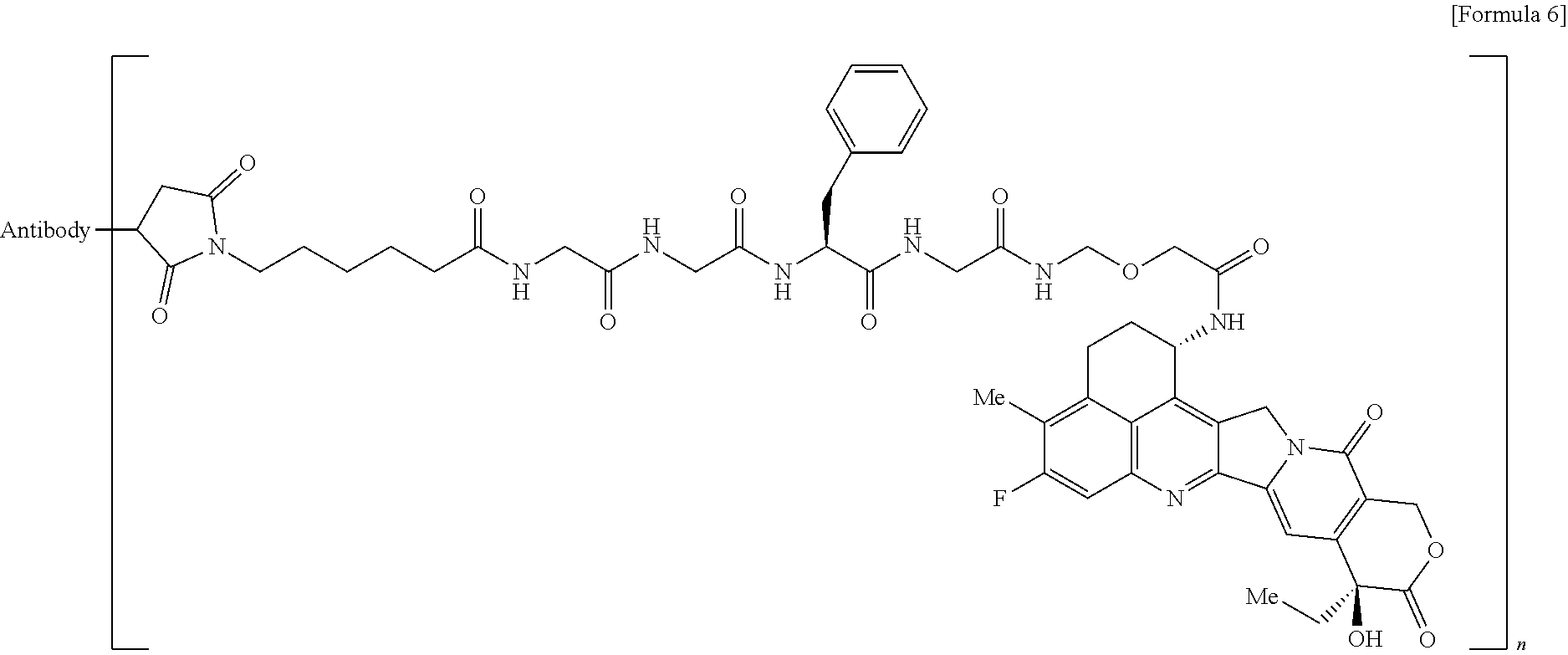
-
- wherein the drug-linker is conjugated to the antibody via a thioether bond, and n is the average number of units of the drug-linker conjugated per antibody molecule.
[157] The antibody-drug conjugate according to [156], wherein the primary cancer for the metastatic brain tumor is at least one selected from the group consisting of breast cancer, lung cancer, melanoma, renal cell cancer, kidney cancer, colorectal cancer, gastric cancer, head and neck cancer, hepatocellular cancer, liver cancer, ovarian cancer, prostate cancer, bladder cancer, pancreatic cancer, endometrial cancer, thyroid cancer, malignant lymphoma and sarcoma.
[158] The antibody-drug conjugate according to [156], wherein the primary cancer for the metastatic brain tumor is at least one selected from the group consisting of breast cancer, lung cancer and melanoma.
[159] The antibody-drug conjugate according to [156], wherein the primary cancer for the metastatic brain tumor is breast cancer.
[160] The antibody-drug conjugate according to [156], wherein the primary cancer for the metastatic brain tumor is lung cancer.
[161] The antibody-drug conjugate according to [156], wherein the primary cancer for the metastatic brain tumor is melanoma.
[162] The antibody-drug conjugate according to any one of [156] to [161], wherein the antibody in the antibody-drug conjugate is an anti-HER2 antibody, an anti-HER3 antibody, an anti-TROP2 antibody, an anti-B7-H3 antibody, an anti-GPR20 antibody or an anti-CDH6 antibody.
[163] The antibody-drug conjugate according to [162], wherein the antibody in the antibody-drug conjugate is an anti-HER2 antibody.
[164] The antibody-drug conjugate according to [163], wherein the anti-HER2 antibody is an antibody comprising a heavy chain consisting of an amino acid sequence consisting ofamino acid residues 1 to 449 of SEQ ID NO: 1 and a light chain consisting of an amino acid sequence consisting ofamino acid residues 1 to 214 of SEQ ID NO: 2.
[165] The antibody-drug conjugate according to [163], wherein the anti-HER2 antibody is an antibody comprising a heavy chain consisting of an amino acid sequence represented by SEQ ID NO: 1 and a light chain consisting of an amino acid sequence represented by SEQ ID NO: 2.
[166] The antibody-drug conjugate according to any one of [163] to [165], wherein the average number of units of the drug-linker conjugated per antibody molecule in the antibody-drug conjugate is in the range of from 7 to 8.
[167] The antibody-drug conjugate according to [162], wherein the antibody in the antibody-drug conjugate is an anti-HER3 antibody.
[168] The antibody-drug conjugate according to [167], wherein the anti-HER3 antibody is an antibody comprising a heavy chain consisting of an amino acid sequence represented by SEQ ID NO: 3 and a light chain consisting of an amino acid sequence represented by SEQ ID NO: 4.
[169] The antibody-drug conjugate according to [168], wherein the anti-HER3 antibody lacks a lysine residue at the carboxyl terminus of the heavy chain.
[170] The antibody-drug conjugate according to any one of [167] to [169], wherein the average number of units of the drug-linker conjugated per antibody molecule in the antibody-drug conjugate is in the range of from 7 to 8.
[171] The antibody-drug conjugate according to [162], wherein the antibody in the antibody-drug conjugate is an anti-TROP2 antibody.
[172] The antibody-drug conjugate according to [171], wherein the anti-TROP2 antibody is an antibody comprising a heavy chain consisting of an amino acid sequence consisting ofamino acid residues 20 to 470 of SEQ ID NO: and a light chain consisting of an amino acid sequence consisting ofamino acid residues 21 to 234 of SEQ ID NO: 6.
[173] The antibody-drug conjugate according to [172], wherein the anti-TROP2 antibody lacks a lysine residue at the carboxyl terminus of the heavy chain.
[174] The antibody-drug conjugate according to any one of [171] to [173], wherein the average number of units of the drug-linker conjugated per antibody molecule in the antibody-drug conjugate is in the range of from 3.5 to 4.5.
[175] The antibody-drug conjugate according to [162], wherein the antibody in the antibody-drug conjugate is an anti-B7-H3 antibody.
[176] The antibody-drug conjugate according to [175], wherein the anti-B7-H3 antibody is an antibody comprising a heavy chain consisting of an amino acid sequence consisting ofamino acid residues 20 to 471 of SEQ ID NO: 7 and a light chain consisting of an amino acid sequence consisting ofamino acid residues 21 to 233 of SEQ ID NO: 8.
[177] The antibody-drug conjugate according to [176], wherein the anti-B7-H3 antibody lacks a lysine residue at the carboxyl terminus of the heavy chain.
[178] The antibody-drug conjugate according to any one of [175] to [177], wherein the average number of units of the drug-linker conjugated per antibody molecule in the antibody-drug conjugate is in the range of from 3.5 to 4.5.
[179] The antibody-drug conjugate according to [162], wherein the antibody in the antibody-drug conjugate is an anti-GPR20 antibody.
[180] The antibody-drug conjugate according to [179], wherein the anti-GPR20 antibody is an antibody comprising a heavy chain consisting of an amino acid sequence consisting ofamino acid residues 20 to 472 of SEQ ID NO: 9 and a light chain consisting of an amino acid sequence consisting ofamino acid residues 21 to 234 of SEQ ID NO: 10.
[181] The antibody-drug conjugate according to [180], wherein the anti-GPR20 antibody lacks a lysine residue at the carboxyl terminus of the heavy chain.
[182] The antibody-drug conjugate according to any one of [179] to [181], wherein the average number of units of the drug-linker conjugated per antibody molecule in the antibody-drug conjugate is in the range of from 7 to 8.
[183] The antibody-drug conjugate according to [162], wherein the antibody in the antibody-drug conjugate is an anti-CDH6 antibody.
[184] The antibody-drug conjugate according to [183], wherein the anti-CDH6 antibody is an antibody comprising a heavy chain consisting of an amino acid sequence consisting ofamino acid residues 20 to 471 of SEQ ID NO: 11 and a light chain consisting of an amino acid sequence consisting ofamino acid residues 21 to 233 of SEQ ID NO: 12.
[185] The antibody-drug conjugate according to [184], wherein the anti-CDH6 antibody lacks a lysine residue at the carboxyl terminus of the heavy chain.
[186] The antibody-drug conjugate according to any one of [183] to [185], wherein the average number of units of the drug-linker conjugated per antibody molecule in the antibody-drug conjugate is in the range of from 7 to 8.
[187] Use of an antibody-drug conjugate for the manufacture of a medicament for treating a metastatic brain tumor, in which a drug-linker represented by the following formula:
- wherein the drug-linker is conjugated to the antibody via a thioether bond, and n is the average number of units of the drug-linker conjugated per antibody molecule.

-
- wherein A represents a connecting position to an antibody;
is conjugated to the antibody via a thioether bond.
[188] The use according to [187], wherein the primary cancer for the metastatic brain tumor is at least one selected from the group consisting of breast cancer, lung cancer, melanoma, renal cell cancer, kidney cancer, colorectal cancer, gastric cancer, head and neck cancer, hepatocellular cancer, liver cancer, ovarian cancer, prostate cancer, bladder cancer, pancreatic cancer, endometrial cancer, thyroid cancer, malignant lymphoma and sarcoma.
[189] The use according to [187], wherein the primary cancer for the metastatic brain tumor is at least one selected from the group consisting of breast cancer, lung cancer and melanoma.
[190] The use according to [187], wherein the primary cancer for the metastatic brain tumor is breast cancer.
[191] The use according to [187], wherein the primary cancer for the metastatic brain tumor is lung cancer.
[192] The use according to [187], wherein the primary cancer for the metastatic brain tumor is melanoma.
[193] The use according to any one of [187] to [192], wherein the antibody in the antibody-drug conjugate is an anti-HER2 antibody, an anti-HER3 antibody, an anti-TROP2 antibody, an anti-B7-H3 antibody, an anti-GPR20 antibody or an anti-CDH6 antibody.
[194] The use according to [193], wherein the antibody in the antibody-drug conjugate is an anti-HER2 antibody.
[195] The use according to [194], wherein the anti-HER2 antibody is an antibody comprising a heavy chain consisting of an amino acid sequence consisting ofamino acid residues 1 to 449 of SEQ ID NO: 1 and a light chain consisting of an amino acid sequence consisting ofamino acid residues 1 to 214 of SEQ ID NO: 2.
[196] The use according to [194], wherein the anti-HER2 antibody is an antibody comprising a heavy chain consisting of an amino acid sequence represented by SEQ ID NO: 1 and a light chain consisting of an amino acid sequence represented by SEQ ID NO: 2.
[197] The use according to any one of [194] to [196], wherein the average number of units of the drug-linker conjugated per antibody molecule in the antibody-drug conjugate is in the range of from 7 to 8.
[198] The use according to [193], wherein the antibody in the antibody-drug conjugate is an anti-HER3 antibody.
[199] The use according to [198], wherein the anti-HER3 antibody is an antibody comprising a heavy chain consisting of an amino acid sequence represented by SEQ ID NO: 3 and a light chain consisting of an amino acid sequence represented by SEQ ID NO: 4.
[200] The use according to [199], wherein the anti-HER3 antibody lacks a lysine residue at the carboxyl terminus of the heavy chain.
[201] The use according to any one of [198] to [200], wherein the average number of units of the drug-linker conjugated per antibody molecule in the antibody-drug conjugate is in the range of from 7 to 8.
[202] The use according to [193], wherein the antibody in the antibody-drug conjugate is an anti-TROP2 antibody.
[203] The use according to [202], wherein the anti-TROP2 antibody is an antibody comprising a heavy chain consisting of an amino acid sequence consisting ofamino acid residues 20 to 470 of SEQ ID NO: 5 and a light chain consisting of an amino acid sequence consisting ofamino acid residues 21 to 234 of SEQ ID NO: 6.
[204] The use according to [203], wherein the anti-TROP2 antibody lacks a lysine residue at the carboxyl terminus of the heavy chain.
[205] The use according to any one of [202] to [204], wherein the average number of units of the drug-linker conjugated per antibody molecule in the antibody-drug conjugate is in the range of from 3.5 to 4.5.
[206] The use according to [193], wherein the antibody in the antibody-drug conjugate is an anti-B7-H3 antibody.
[207] The use according to [206], wherein the anti-B7-H3 antibody is an antibody comprising a heavy chain consisting of an amino acid sequence consisting ofamino acid residues 20 to 471 of SEQ ID NO: 7 and a light chain consisting of an amino acid sequence consisting ofamino acid residues 21 to 233 of SEQ ID NO: 8.
[208] The use according to [207], wherein the anti-B7-H3 antibody lacks a lysine residue at the carboxyl terminus of the heavy chain.
[209] The use according to any one of [206] to [208], wherein the average number of units of the drug-linker conjugated per antibody molecule in the antibody-drug conjugate is in the range of from 3.5 to 4.5.
[210] The use according to [193], wherein the antibody in the antibody-drug conjugate is an anti-GPR20 antibody.
[211] The use according to [210], wherein the anti-GPR20 antibody is an antibody comprising a heavy chain consisting of an amino acid sequence consisting ofamino acid residues 20 to 472 of SEQ ID NO: 9 and a light chain consisting of an amino acid sequence consisting ofamino acid residues 21 to 234 of SEQ ID NO: 10.
[212] The use according to [211], wherein the anti-GPR20 antibody lacks a lysine residue at the carboxyl terminus of the heavy chain.
[213] The use according to any one of [210] to [212], wherein the average number of units of the drug-linker conjugated per antibody molecule in the antibody-drug conjugate is in the range of from 7 to 8.
[214] The use according to [193], wherein the antibody in the antibody-drug conjugate is an anti-CDH6 antibody.
[215] The use according to [214], wherein the anti-CDH6 antibody is an antibody comprising a heavy chain consisting of an amino acid sequence consisting ofamino acid residues 20 to 471 of SEQ ID NO: 11 and a light chain consisting of an amino acid sequence consisting ofamino acid residues 21 to 233 of SEQ ID NO: 12.
[216] The use according to [215], wherein the anti-CDH6 antibody lacks a lysine residue at the carboxyl terminus of the heavy chain.
[217] The use according to any one of [214] to [216], wherein the average number of units of the drug-linker conjugated per antibody molecule in the antibody-drug conjugate is in the range of from 7 to 8.
[218] Use of an antibody-drug conjugate for the manufacture of a medicament for treating a metastatic brain tumor, represented by the following formula:
- wherein A represents a connecting position to an antibody;

-
- wherein the drug-linker is conjugated to the antibody via a thioether bond, and n is the average number of units of the drug-linker conjugated per antibody molecule.
[219] The use according to [218], wherein the primary cancer for the metastatic brain tumor is at least one selected from the group consisting of breast cancer, lung cancer, melanoma, renal cell cancer, kidney cancer, colorectal cancer, gastric cancer, head and neck cancer, hepatocellular cancer, liver cancer, ovarian cancer, prostate cancer, bladder cancer, pancreatic cancer, endometrial cancer, thyroid cancer, malignant lymphoma and sarcoma.
[220] The use according to [218], wherein the primary cancer for the metastatic brain tumor is at least one selected from the group consisting of breast cancer, lung cancer and melanoma.
[221] The use according to [218], wherein the primary cancer for the metastatic brain tumor is breast cancer.
[222] The use according to [218], wherein the primary cancer for the metastatic brain tumor is lung cancer.
[223] The use according to [218], wherein the primary cancer for the metastatic brain tumor is melanoma.
[224] The use according to any one of [218] to [223], wherein the antibody in the antibody-drug conjugate is an anti-HER2 antibody, an anti-HER3 antibody, an anti-TROP2 antibody, an anti-B7-H3 antibody, an anti-GPR20 antibody or an anti-CDH6 antibody.
[225] The use according to [224], wherein the antibody in the antibody-drug conjugate is an anti-HER2 antibody.
[226] The use according to [225], wherein the anti-HER2 antibody is an antibody comprising a heavy chain consisting of an amino acid sequence consisting ofamino acid residues 1 to 449 of SEQ ID NO: 1 and a light chain consisting of an amino acid sequence consisting ofamino acid residues 1 to 214 of SEQ ID NO: 2.
[227] The use according to [225], wherein the anti-HER2 antibody is an antibody comprising a heavy chain consisting of an amino acid sequence represented by SEQ ID NO: 1 and a light chain consisting of an amino acid sequence represented by SEQ ID NO: 2.
[228] The use according to any one of [225] to [227], wherein the average number of units of the drug-linker conjugated per antibody molecule in the antibody-drug conjugate is in the range of from 7 to 8.
[229] The use according to [224], wherein the antibody in the antibody-drug conjugate is an anti-HER3 antibody.
[230] The use according to [229], wherein the anti-HER3 antibody is an antibody comprising a heavy chain consisting of an amino acid sequence represented by SEQ ID NO: 3 and a light chain consisting of an amino acid sequence represented by SEQ ID NO: 4.
[231] The use according to [230], wherein the anti-HER3 antibody lacks a lysine residue at the carboxyl terminus of the heavy chain.
[232] The use according to any one of [229] to [231], wherein the average number of units of the drug-linker conjugated per antibody molecule in the antibody-drug conjugate is in the range of from 7 to 8.
[233] The use according to [224], wherein the antibody in the antibody-drug conjugate is an anti-TROP2 antibody.
[234] The use according to [233], wherein the anti-TROP2 antibody is an antibody comprising a heavy chain consisting of an amino acid sequence consisting ofamino acid residues 20 to 470 of SEQ ID NO: 5 and a light chain consisting of an amino acid sequence consisting ofamino acid residues 21 to 234 of SEQ ID NO: 6.
[235] The use according to [234], wherein the anti-TROP2 antibody lacks a lysine residue at the carboxyl terminus of the heavy chain.
[236] The use according to any one of [233] to [235], wherein the average number of units of the drug-linker conjugated per antibody molecule in the antibody-drug conjugate is in the range of from 3.5 to 4.5.
[237] The use according to [224], wherein the antibody in the antibody-drug conjugate is an anti-B7-H3 antibody.
[238] The use according to [237], wherein the anti-B7-H3 antibody is an antibody comprising a heavy chain consisting of an amino acid sequence consisting ofamino acid residues 20 to 471 of SEQ ID NO: 7 and a light chain consisting of an amino acid sequence consisting ofamino acid residues 21 to 233 of SEQ ID NO: 8.
[239] The use according to [238], wherein the anti-B7-H3 antibody lacks a lysine residue at the carboxyl terminus of the heavy chain.
[240] The use according to any one of [237] to [239], wherein the average number of units of the drug-linker conjugated per antibody molecule in the antibody-drug conjugate is in the range of from 3.5 to 4.5.
[241] The use according to [224], wherein the antibody in the antibody-drug conjugate is an anti-GPR20 antibody.
[242] The use according to [241], wherein the anti-GPR20 antibody is an antibody comprising a heavy chain consisting of an amino acid sequence consisting ofamino acid residues 20 to 472 of SEQ ID NO: 9 and a light chain consisting of an amino acid sequence consisting ofamino acid residues 21 to 234 of SEQ ID NO: 10.
[243] The use according to [242], wherein the anti-GPR20 antibody lacks a lysine residue at the carboxyl terminus of the heavy chain.
[244] The use according to any one of [241] to [243], wherein the average number of units of the drug-linker conjugated per antibody molecule in the antibody-drug conjugate is in the range of from 7 to 8.
[245] The use according to [244], wherein the antibody in the antibody-drug conjugate is an anti-CDH6 antibody.
[246] The use according to [245], wherein the anti-CDH6 antibody is an antibody comprising a heavy chain consisting of an amino acid sequence consisting ofamino acid residues 20 to 471 of SEQ ID NO: 11 and a light chain consisting of an amino acid sequence consisting ofamino acid residues 21 to 233 of SEQ ID NO: 12.
[247] The use according to [246], wherein the anti-CDH6 antibody lacks a lysine residue at the carboxyl terminus of the heavy chain.
[248] The use according to any one of [245] to [247], wherein the average number of units of the drug-linker conjugated per antibody molecule in the antibody-drug conjugate is in the range of from 7 to 8.
[249] A therapeutic agent for metastatic cancer comprising, as an active component, an antibody-drug conjugate in which a drug-linker represented by the following formula:
- wherein the drug-linker is conjugated to the antibody via a thioether bond, and n is the average number of units of the drug-linker conjugated per antibody molecule.

-
- wherein A represents a connecting position to an antibody;
- is conjugated to the antibody via a thioether bond.
[250] The therapeutic agent according to [249], wherein the metastatic cancer is at least one selected from the group consisting of a metastatic brain tumor, a metastatic bone tumor, a metastatic lung tumor and metastatic liver cancer.
[251] The therapeutic agent according to [250], wherein the metastatic cancer is a metastatic bone tumor.
[252] A therapeutic agent for metastatic cancer comprising, as an active component, an antibody-drug conjugate represented by the following formula:

-
- wherein the drug-linker is conjugated to the antibody via a thioether bond, and n is the average number of units of the drug-linker conjugated per antibody molecule.
[253] The therapeutic agent according to [252], wherein the metastatic cancer is at least one selected from the group consisting of a metastatic brain tumor, a metastatic bone tumor, a metastatic lung tumor and metastatic liver cancer.
[254] The therapeutic agent according to [253], wherein the metastatic cancer is a metastatic bone tumor.
[255] A method of treatment for metastatic cancer, comprising administering an antibody-drug conjugate in which a drug-linker represented by the following formula:
- wherein the drug-linker is conjugated to the antibody via a thioether bond, and n is the average number of units of the drug-linker conjugated per antibody molecule.

-
- wherein A represents a connecting position to an antibody, is conjugated to the antibody via a thioether bond; to a subject in need of the treatment for metastatic cancer.
[256] The method of treatment according to [255], wherein the metastatic cancer is at least one selected from the group consisting of a metastatic brain tumor, a metastatic bone tumor, a metastatic lung tumor and metastatic liver cancer.
[257] The method of treatment according to [256], wherein the metastatic cancer is a metastatic bone tumor.
[258] A method of treatment for metastatic cancer, comprising administering an antibody-drug conjugate represented by the following formula:
- wherein A represents a connecting position to an antibody, is conjugated to the antibody via a thioether bond; to a subject in need of the treatment for metastatic cancer.

-
- wherein the drug-linker is conjugated to the antibody via a thioether bond, and n is the average number of units of the drug-linker conjugated per antibody molecule; to a subject in need of the treatment for metastatic cancer.
[259] The method of treatment according to [258], wherein the metastatic cancer is at least one selected from the group consisting of a metastatic brain tumor, a metastatic bone tumor, a metastatic lung tumor and metastatic liver cancer.
[260] The method of treatment according to [259], wherein the metastatic cancer is a metastatic bone tumor.
[261] An antibody-drug conjugate for use in treating metastatic cancer, in which a drug-linker represented by the following formula:
- wherein the drug-linker is conjugated to the antibody via a thioether bond, and n is the average number of units of the drug-linker conjugated per antibody molecule; to a subject in need of the treatment for metastatic cancer.

-
- wherein A represents a connecting position to an antibody;
- is conjugated to the antibody via a thioether bond.
[262] The antibody-drug conjugate according to [261], wherein the metastatic cancer is at least one selected from the group consisting of a metastatic brain tumor, a metastatic bone tumor, a metastatic lung tumor and metastatic liver cancer.
[263] The antibody-drug conjugate according to [262], wherein the metastatic cancer is a metastatic bone tumor.
[264] An antibody-drug conjugate for use in treating metastatic cancer, represented by the following formula:
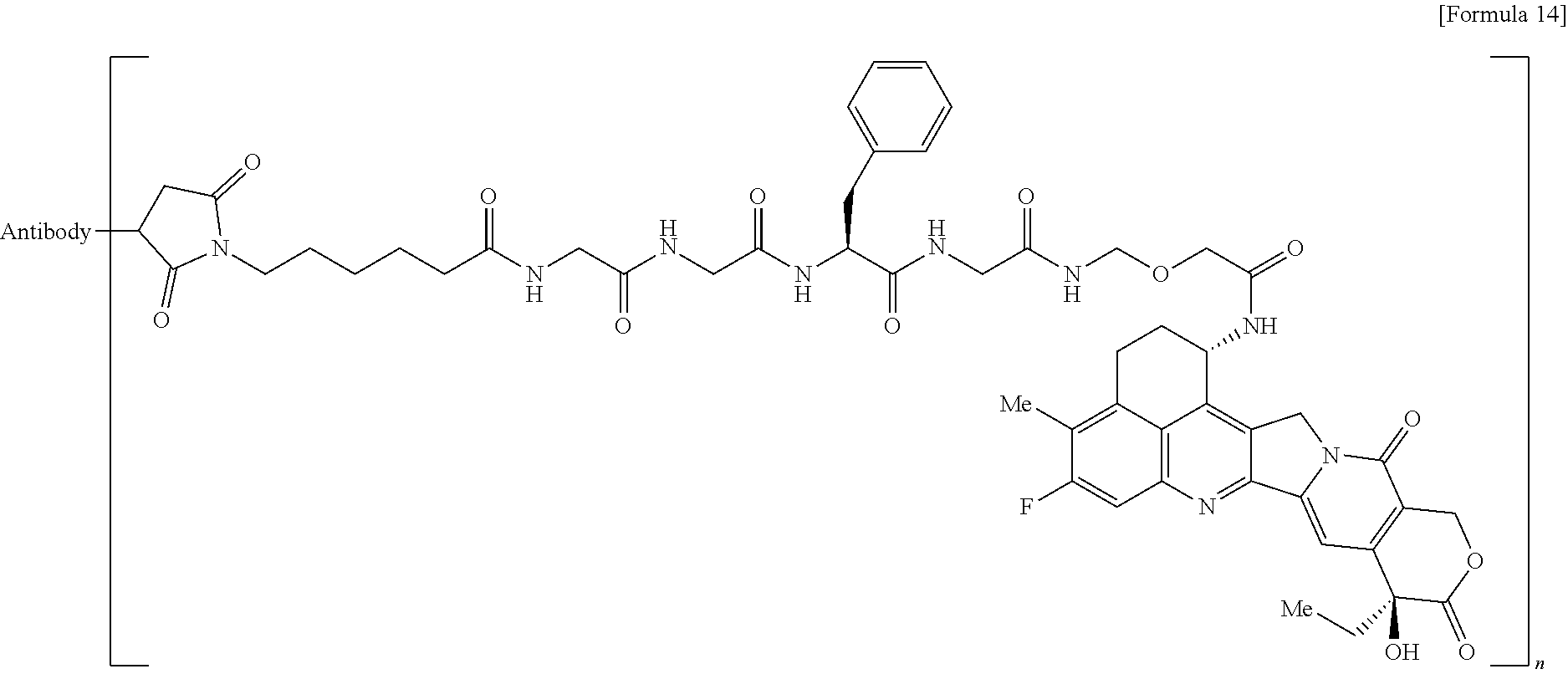
-
- wherein the drug-linker is conjugated to the antibody via a thioether bond, and n is the average number of units of the drug-linker conjugated per antibody molecule.
[265] The antibody-drug conjugate according to [264], wherein the metastatic cancer is at least one selected from the group consisting of a metastatic brain tumor, a metastatic bone tumor, a metastatic lung tumor and metastatic liver cancer.
[266] The antibody-drug conjugate according to [265], wherein the metastatic cancer is a metastatic bone tumor.
[267] Use of an antibody-drug conjugate for the manufacture of a medicament for treating metastatic cancer, in which a drug-linker represented by the following formula:
- wherein the drug-linker is conjugated to the antibody via a thioether bond, and n is the average number of units of the drug-linker conjugated per antibody molecule.
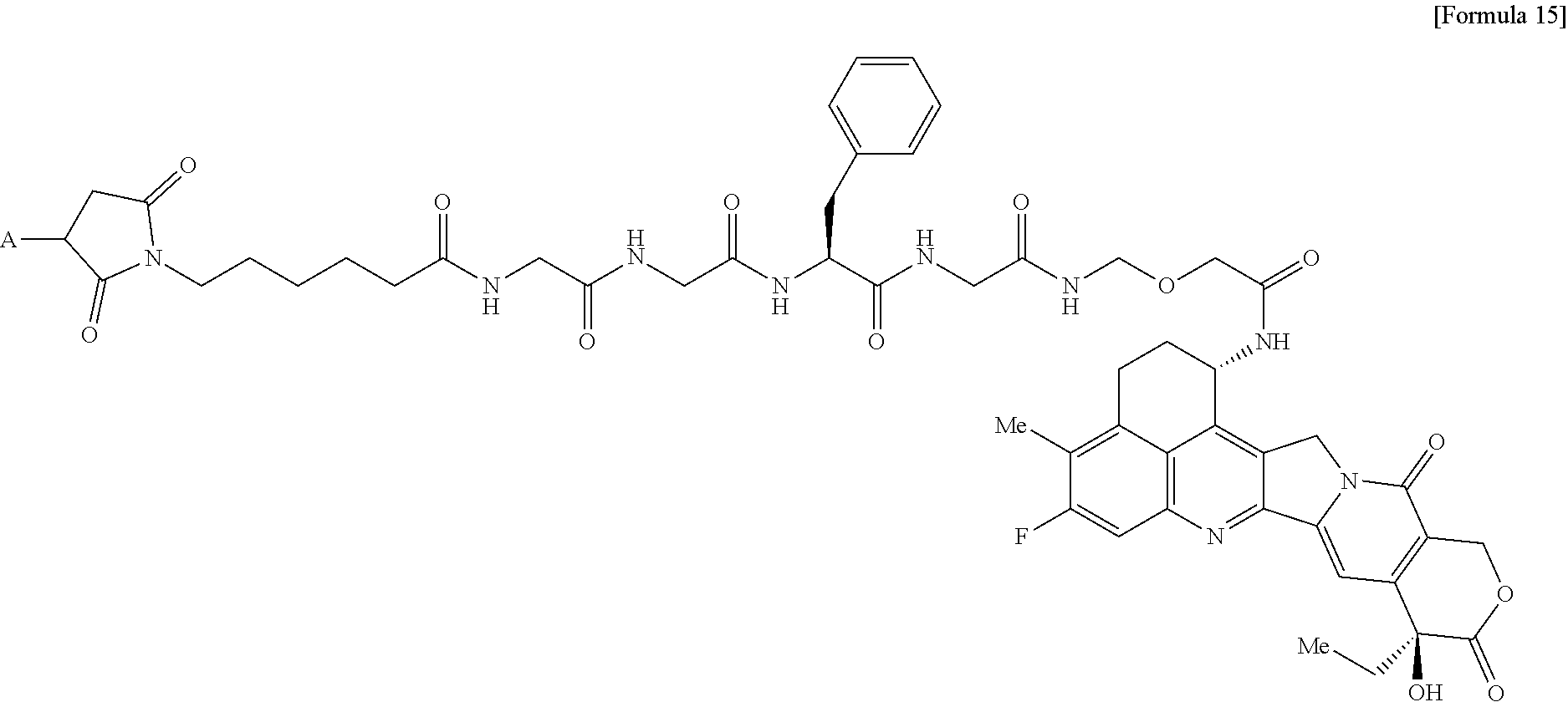
-
- wherein A represents a connecting position to an antibody;
- is conjugated to the antibody via a thioether bond.
[268] The use according to [267], wherein the metastatic cancer is at least one selected from the group consisting of a metastatic brain tumor, a metastatic bone tumor, a metastatic lung tumor and metastatic liver cancer.
[269] The use according to [268], wherein the metastatic cancer is a metastatic bone tumor.
[270] Use of an antibody-drug conjugate for the manufacture of a medicament for treating metastatic cancer, represented by the following formula:

-
- wherein the drug-linker is conjugated to the antibody via a thioether bond, and n is the average number of units of the drug-linker conjugated per antibody molecule.
[271] The use according to [270], wherein the metastatic cancer is at least one selected from the group consisting of a metastatic brain tumor, a metastatic bone tumor, a metastatic lung tumor and metastatic liver cancer.
[272] The use according to [271], wherein the metastatic cancer is a metastatic bone tumor.
- wherein the drug-linker is conjugated to the antibody via a thioether bond, and n is the average number of units of the drug-linker conjugated per antibody molecule.

-
- wherein A represents a connecting position to an antibody;
is conjugated to the antibody via a thioether bond.
- wherein A represents a connecting position to an antibody;


-
- wherein, the drug-linker is conjugated to an antibody via a thioether bond. The meaning of n is the same as that of what is called the average number of conjugated drug molecules (DAR; Drug-to-Antibody Ratio), and indicates the average number of units of the drug-linker conjugated per antibody molecule.

-
- and thereby exerts an antitumor effect.

-
- more preferably an antibody comprising a heavy chain comprising a heavy chain variable region consisting of an amino acid sequence consisting of
amino acid residues 1 to 117 of SEQ ID NO: 3 and a light chain comprising a light chain variable region consisting of an amino acid sequence consisting ofamino acid residues 1 to 113 of SEQ ID NO: 4, and - even more preferably an antibody comprising a heavy chain consisting of an amino acid sequence represented by SEQ ID NO: 3 and a light chain consisting of an amino acid sequence represented by SEQ ID NO: 4, or a variant of the antibody in which a lysine residue at the carboxyl terminus of the heavy chain is deleted.
- more preferably an antibody comprising a heavy chain comprising a heavy chain variable region consisting of an amino acid sequence consisting of
-
- more preferably an antibody comprising a heavy chain comprising a heavy chain variable region consisting of an amino acid sequence consisting of
amino acid residues 20 to 140 of SEQ ID NO: 5 and a light chain comprising a light chain variable region consisting of an amino acid sequence consisting ofamino acid residues 21 to 129 of SEQ ID NO: 6, and - even more preferably an antibody comprising a heavy chain consisting of an amino acid sequence consisting of
amino acid residues 20 to 470 of SEQ ID NO: 5 and a light chain consisting of an amino acid sequence consisting ofamino acid residues 21 to 234 of SEQ ID NO: 6, or a variant of the antibody in which a lysine residue at the carboxyl terminus of the heavy chain is deleted.
- more preferably an antibody comprising a heavy chain comprising a heavy chain variable region consisting of an amino acid sequence consisting of
-
- more preferably an antibody comprising a heavy chain comprising a heavy chain variable region consisting of an amino acid sequence consisting of
amino acid residues 20 to 141 of SEQ ID NO: 7 and a light chain comprising a light chain variable region consisting of an amino acid sequence consisting ofamino acid residues 21 to 128 of SEQ ID NO: 8, and - even more preferably an antibody comprising a heavy chain consisting of an amino acid sequence consisting of
amino acid residues 20 to 471 of SEQ ID NO: 7 and a light chain consisting of an amino acid sequence consisting ofamino acid residues 21 to 233 of SEQ ID NO: 8, or a variant of the antibody in which a lysine residue at the carboxyl terminus of the heavy chain is deleted.
- more preferably an antibody comprising a heavy chain comprising a heavy chain variable region consisting of an amino acid sequence consisting of
-
- more preferably an antibody comprising a heavy chain comprising a heavy chain variable region consisting of an amino acid sequence consisting of
amino acid residues 20 to 142 of SEQ ID NO: 9 and a light chain comprising a light chain variable region consisting of an amino acid sequence consisting ofamino acid residues 21 to 129 of SEQ ID NO: 10, and - even more preferably an antibody comprising a heavy chain consisting of an amino acid sequence consisting of
amino acid residues 20 to 472 of SEQ ID NO: 9 and a light chain consisting of an amino acid sequence consisting ofamino acid residues 21 to 234 of SEQ ID NO: 10, or a variant of the antibody in which a lysine residue at the carboxyl terminus of the heavy chain is deleted.
- more preferably an antibody comprising a heavy chain comprising a heavy chain variable region consisting of an amino acid sequence consisting of
-
- more preferably an antibody comprising a heavy chain comprising a heavy chain variable region consisting of an amino acid sequence consisting of
amino acid residues 20 to 141 of SEQ ID NO: 11 and a light chain comprising a light chain variable region consisting of an amino acid sequence consisting ofamino acid residues 21 to 128 of SEQ ID NO: 12, and - even more preferably an antibody comprising a heavy chain consisting of an amino acid sequence consisting of
amino acid residues 20 to 471 of SEQ ID NO: 11 and a light chain consisting of an amino acid sequence consisting ofamino acid residues 21 to 233 of SEQ ID NO: 12, or a variant of the antibody in which the lysine residue at the carboxyl terminus of the heavy chain is deleted.
- more preferably an antibody comprising a heavy chain comprising a heavy chain variable region consisting of an amino acid sequence consisting of

-
- wherein A represents a connecting position to an antibody,
is conjugated to the anti-HER2 antibody via a thioether bond (hereinafter, referred to as the “antibody-drug conjugate (1)”) was produced. DAR of the antibody-drug conjugate (1) is 7.8.
- wherein A represents a connecting position to an antibody,
-
- SEQ ID NO: 1—Amino acid sequence of a heavy chain of the anti-HER2 antibody
- SEQ ID NO: 2—Amino acid sequence of a light chain of the anti-HER2 antibody
- SEQ ID NO: 3—Amino acid sequence of a heavy chain of the anti-HER3 antibody
- SEQ ID NO: 4—Amino acid sequence of a light chain of the anti-HER3 antibody
- SEQ ID NO: 5—Amino acid sequence of a heavy chain of the anti-TROP2 antibody
- SEQ ID NO: 6—Amino acid sequence of a light chain of the anti-TROP2 antibody
- SEQ ID NO: 7—Amino acid sequence of a heavy chain of the anti-B7-H3 antibody
- SEQ ID NO: 8—Amino acid sequence of a light chain of the anti-B7-H3 antibody
- SEQ ID NO: 9—Amino acid sequence of a heavy chain of the anti-GPR20 antibody
- SEQ ID NO: 10—Amino acid sequence of a light chain of the anti-GPR20 antibody
- SEQ ID NO: 11—Amino acid sequence of a heavy chain of the anti-CDH6 antibody
- SEQ ID NO: 12—Amino acid sequence of a light chain of the anti-CDH6 antibody
Claims (57)

Applications Claiming Priority (3)
| Application Number | Priority Date | Filing Date | Title |
|---|---|---|---|
| JP2018-143372 | 2018-07-31 | ||
| JP2018143372 | 2018-07-31 | ||
| PCT/JP2019/029765 WO2020027100A1 (en) | 2018-07-31 | 2019-07-30 | Treatment of metastatic brain tumor by administration of antibody-drug conjugate |
Publications (2)
| Publication Number | Publication Date |
|---|---|
| US20210290777A1 US20210290777A1 (en) | 2021-09-23 |
| US12220604B2 true US12220604B2 (en) | 2025-02-11 |
Family
ID=69230857
Family Applications (1)
| Application Number | Title | Priority Date | Filing Date |
|---|---|---|---|
| US17/264,250 Active 2042-05-14 US12220604B2 (en) | 2018-07-31 | 2019-07-30 | Treatment of metastatic brain tumor by administration of an antibody-drug conjugate |
Country Status (13)
| Country | Link |
|---|---|
| US (1) | US12220604B2 (en) |
| EP (1) | EP3831412A4 (en) |
| JP (2) | JP7473474B2 (en) |
| KR (2) | KR102894505B1 (en) |
| CN (1) | CN112805036A (en) |
| AU (1) | AU2019315177A1 (en) |
| BR (1) | BR112021001509A2 (en) |
| CA (1) | CA3108044A1 (en) |
| EA (1) | EA202190403A1 (en) |
| IL (1) | IL280510B1 (en) |
| SG (1) | SG11202100947SA (en) |
| TW (3) | TWI885529B (en) |
| WO (1) | WO2020027100A1 (en) |
Cited By (1)
| Publication number | Priority date | Publication date | Assignee | Title |
|---|---|---|---|---|
| US20230270870A1 (en) * | 2019-05-29 | 2023-08-31 | Daiichi Sankyo Company, Limited | Dosage of an antibody-drug conjugate |
Families Citing this family (7)
| Publication number | Priority date | Publication date | Assignee | Title |
|---|---|---|---|---|
| AU2018320470B2 (en) * | 2017-08-23 | 2025-04-24 | Daiichi Sankyo Company, Limited | Antibody-drug conjugate preparation and lyophilization for same |
| CA3173263A1 (en) * | 2020-03-30 | 2021-10-07 | Yasuhiro Matsumura | Antibody drug conjugate |
| TW202508643A (en) * | 2021-09-15 | 2025-03-01 | 日商第一三共股份有限公司 | Use of antibody-drug conjugate |
| CN119053342A (en) * | 2022-01-21 | 2024-11-29 | 礼进生物医药控股有限公司 | Multispecific antibodies for affinity receptor cross-linking and immunomodulation |
| KR20250012631A (en) * | 2022-05-24 | 2025-01-24 | 다이이찌 산쿄 가부시키가이샤 | Dosing of anti-CDH6 antibody-drug conjugates |
| EP4451526A1 (en) * | 2023-04-18 | 2024-10-23 | HSP Hochspannungsgeräte GmbH | Method for joining electrical sheet metal laminations and device for carrying out a method of this type |
| CN119546347A (en) * | 2023-06-29 | 2025-02-28 | 石药集团巨石生物制药有限公司 | Antibody-drug conjugates and their uses |
Citations (94)
| Publication number | Priority date | Publication date | Assignee | Title |
|---|---|---|---|---|
| EP0495432A1 (en) | 1991-01-16 | 1992-07-22 | Daiichi Pharmaceutical Co., Ltd. | Hexa-cyclic compound |
| JPH0687746A (en) | 1992-07-16 | 1994-03-29 | Dai Ichi Seiyaku Co Ltd | Antitumor agent |
| US5480968A (en) | 1989-12-01 | 1996-01-02 | The United States Of America As Represented By The Department Of Health And Human Services | Isolated polypeptide erbB-3, related to the epidermal growth factor receptor and antibody thereto |
| EP0737686A1 (en) | 1995-04-10 | 1996-10-16 | Daiichi Pharmaceutical Co., Ltd. | Camthothecin derivative with antitumour activity |
| JPH08337584A (en) | 1995-04-10 | 1996-12-24 | Dai Ichi Seiyaku Co Ltd | Fused hexacyclic amino compound, pharmaceutical containing the same, and process for producing the same |
| US5677171A (en) | 1988-01-12 | 1997-10-14 | Genentech, Inc. | Monoclonal antibodies directed to the HER2 receptor |
| WO1997046260A1 (en) | 1996-06-06 | 1997-12-11 | Daiichi Pharmaceutical Co., Ltd. | Drug complexes |
| JPH1095802A (en) | 1995-12-28 | 1998-04-14 | Tanabe Seiyaku Co Ltd | Camptothecin derivatives |
| US5821337A (en) | 1991-06-14 | 1998-10-13 | Genentech, Inc. | Immunoglobulin variants |
| US5834476A (en) | 1991-01-16 | 1998-11-10 | Daiichi Pharmaceutical Co., Ltd. | Hexa-cyclic compound |
| US5837673A (en) | 1995-08-02 | 1998-11-17 | Tanabe Seiyaku Co., Ltd. | Camptothecin derivatives |
| JPH1171280A (en) | 1997-06-26 | 1999-03-16 | Tanabe Seiyaku Co Ltd | Pharmaceutical composition |
| JPH1192405A (en) | 1997-09-19 | 1999-04-06 | Dai Ichi Seiyaku Co Ltd | Medicinal complex |
| US5892043A (en) | 1995-12-28 | 1999-04-06 | Tanabe Seiyaku Co., Ltd. | Camptothecin derivatives |
| WO1999046296A1 (en) | 1998-03-11 | 1999-09-16 | Smithkline Beecham Corporation | Ecr673: a 7-transmembrane g-protein coupled receptor |
| US5968511A (en) | 1996-03-27 | 1999-10-19 | Genentech, Inc. | ErbB3 antibodies |
| WO2000025825A1 (en) | 1998-10-30 | 2000-05-11 | Daiichi Pharmaceutical Co., Ltd. | Dds compounds and method for assaying the same |
| WO2001000244A2 (en) | 1999-06-25 | 2001-01-04 | Genentech, Inc. | METHODS OF TREATMENT USING ANTI-ErbB ANTIBODY-MAYTANSINOID CONJUGATES |
| US6214345B1 (en) | 1993-05-14 | 2001-04-10 | Bristol-Myers Squibb Co. | Lysosomal enzyme-cleavable antitumor drug conjugates |
| KR20010052385A (en) | 1998-05-22 | 2001-06-25 | 스즈키 다다시 | Drug Composites |
| US6291671B1 (en) | 1996-06-06 | 2001-09-18 | Daiichi Pharmaceutical Co., Ltd. | Process for producing drug complexes |
| WO2002000734A1 (en) | 2000-06-29 | 2002-01-03 | Daiichi Pharmaceutical Co., Ltd. | Dds compound and process for the preparation thereof |
| JP2002060351A (en) | 2000-03-22 | 2002-02-26 | Dai Ichi Seiyaku Co Ltd | Dds compound comprising drug having hydroxy group |
| US20030018989A1 (en) | 2001-03-29 | 2003-01-23 | Brennan Thomas J. | Transgenic mice containing GPCR5-1 gene disruptions |
| WO2003013602A1 (en) | 2001-08-09 | 2003-02-20 | MAX-PLANCK-Gesellschaft zur Förderung der Wissenschaften e.V. | Inhibitors of her3 activity |
| WO2003015826A1 (en) | 2001-08-21 | 2003-02-27 | Tanabe Seiyaku Co., Ltd. | Pharmaceutical compositions comprising polysaccharide conjugates for inhibiting the metastsis or preventing the recurrence of maligant tumor |
| WO2003043583A2 (en) | 2001-11-20 | 2003-05-30 | Seattle Genetics, Inc. | Treatment of immunological disorders using anti-cd30 antibodies |
| US20030148931A1 (en) | 2000-07-13 | 2003-08-07 | Masayuki Takahashi | Pharmaceutical compositions containing dds compounds |
| WO2003074566A2 (en) | 2002-03-01 | 2003-09-12 | Immunomedics, Inc. | Rs7 antibodies |
| WO2004040000A2 (en) | 2002-09-09 | 2004-05-13 | Nura, Inc | G protein coupled receptors and uses thereof |
| US20040185053A1 (en) | 2002-12-13 | 2004-09-23 | Immunomedics, Inc. | Immunoconjugates with an intracellularly-cleavable linkage |
| WO2005040825A2 (en) | 2003-10-24 | 2005-05-06 | Bayer Healthcare Ag | Diagnostics and therapeutics for diseases associated with g protein-coupled receptor 20 (gpr20) |
| US20050228007A1 (en) | 2004-02-26 | 2005-10-13 | Prakash Jagtap | Isoquinoline derivatives and methods of use thereof |
| WO2005112919A2 (en) | 2004-05-19 | 2005-12-01 | Medarex, Inc. | Self-immolative linkers and drug conjugates |
| US20050271671A1 (en) | 2003-01-24 | 2005-12-08 | Immunomedics, Inc. | Anthracycline-antibody conjugates |
| US20050276812A1 (en) | 2004-06-01 | 2005-12-15 | Genentech, Inc. | Antibody-drug conjugates and methods |
| US20060018899A1 (en) | 2004-07-22 | 2006-01-26 | Genentech, Inc. | HER2 antibody composition |
| WO2006065533A2 (en) | 2004-11-29 | 2006-06-22 | Seattle Genetics, Inc. | Engineered antibodies and immunoconjugates |
| US20060193865A1 (en) | 2002-12-13 | 2006-08-31 | Immunomedics, Inc. | Camptothecin-binding moiety conjugates |
| WO2006092230A2 (en) | 2005-02-28 | 2006-09-08 | Ktb Tumorforschungsgesellschaft Mbh | Protein-binding camptothecin peptide derivatives and medicaments comprising the same |
| US20070071764A1 (en) | 2005-04-22 | 2007-03-29 | Sullivan John K | Toxin peptide therapeutic agents |
| WO2007077028A2 (en) | 2005-12-30 | 2007-07-12 | U3 Pharma Ag | Antibodies directed to her-3 and uses thereof |
| US20080050310A1 (en) | 2006-05-30 | 2008-02-28 | Genentech, Inc. | Antibodies and immunoconjugates and uses therefor |
| US20080131363A1 (en) | 2002-03-01 | 2008-06-05 | Immunomedics, Inc. | Rs7 antibodies |
| US20080161245A1 (en) | 2005-02-28 | 2008-07-03 | Ktb Tumorforschungsgesellschaft Mbh | Protein-Binding Anthracycline Peptide Derivatives and Drugs Containing Them |
| WO2008100624A2 (en) | 2007-02-16 | 2008-08-21 | Merrimack Pharmaceuticals, Inc. | Antibodies against erbb3 and uses thereof |
| WO2008116219A2 (en) | 2007-03-22 | 2008-09-25 | Sloan-Kettering Institute For Cancer Research | Uses of monoclonal antibody 8h9 |
| US20080260744A1 (en) | 2002-09-09 | 2008-10-23 | Omeros Corporation | G protein coupled receptors and uses thereof |
| US7449184B2 (en) | 2005-01-21 | 2008-11-11 | Genentech, Inc. | Fixed dosing of HER antibodies |
| WO2008144891A1 (en) | 2007-05-30 | 2008-12-04 | F. Hoffmann-La Roche Ag | Humanized and chimeric anti-trop-2 antibodies that mediate cancer cell cytotoxicity |
| CN101490087A (en) | 2006-05-30 | 2009-07-22 | 健泰科生物技术公司 | Antibodies and immunoconjugates and uses thereof |
| US20090274713A1 (en) | 2008-04-30 | 2009-11-05 | Immunogen Inc. | Cross-linkers and their uses |
| US20090286258A1 (en) | 2008-05-13 | 2009-11-19 | Surinder Kaur | Analysis of antibody drug conjugates by bead-based affinity capture and mass spectrometry |
| US20100068181A1 (en) | 2006-12-21 | 2010-03-18 | Schering Corporation | Pyrrolo [3, 2-a] pyridine derivatives for inhibiting ksp kinesin activity |
| US20100120816A1 (en) | 2006-07-26 | 2010-05-13 | Indena S.P.A. | Camptothecin derivatives with antitumor activity |
| US7837980B2 (en) | 2004-03-02 | 2010-11-23 | Seattle Genetics, Inc. | Partially loaded antibodies and methods of their conjugation |
| US20100303802A1 (en) | 2007-05-15 | 2010-12-02 | Sannah Zoffmann Jensen | Antibody directed to g protein coupled receptors (gpcr) |
| WO2011011474A1 (en) | 2009-07-22 | 2011-01-27 | Enzon Pharmaceuticals, Inc. | Methods of treating her2 positive cancer with her2 receptor antagonist in combination with multi-arm polymeric conjugates of 7-ethyl-10-hydroxycamptothecin |
| WO2011021397A1 (en) | 2009-08-20 | 2011-02-24 | 国立大学法人千葉大学 | Colchicine derivatives |
| US20110059076A1 (en) | 2008-11-18 | 2011-03-10 | Mcdonagh Charlotte | Human serum albumin linkers and conjugates thereof |
| US20110070248A1 (en) | 2009-09-24 | 2011-03-24 | Seattle Genetics, Inc. | Dr5 ligand drug conjugates |
| WO2011068845A1 (en) | 2009-12-02 | 2011-06-09 | Immunomedics, Inc. | Combining radioimmunotherapy and antibody-drug conjugates for improved cancer therapy |
| US7999083B2 (en) | 2002-12-13 | 2011-08-16 | Immunomedics, Inc. | Immunoconjugates with an intracellularly-cleavable linkage |
| US20110229406A1 (en) | 2009-11-13 | 2011-09-22 | U3 Pharma Gmbh | Material and methods for treating or preventing HER-3 associated diseases |
| CA2927832A1 (en) | 2010-05-18 | 2011-11-24 | Cerulean Pharma Inc. | Cyclodextrin-containing polymer-therapeutic agent conjugates and their use |
| WO2011145744A1 (en) | 2010-05-17 | 2011-11-24 | 株式会社リブテック | Anti-human trop-2 antibody having antitumor activity in vivo |
| WO2011155579A1 (en) | 2010-06-10 | 2011-12-15 | 北海道公立大学法人札幌医科大学 | ANTI-Trop-2 ANTIBODY |
| WO2012019024A2 (en) | 2010-08-04 | 2012-02-09 | Immunogen, Inc. | Her3-binding molecules and immunoconjugates thereof |
| CA2815154A1 (en) | 2010-08-06 | 2012-02-09 | U3 Pharma Gmbh | Use of her3 binding agents in prostate treatment |
| US20120121615A1 (en) | 2010-11-17 | 2012-05-17 | Flygare John A | Alaninyl maytansinol antibody conjugates |
| WO2012064733A2 (en) | 2010-11-09 | 2012-05-18 | Medimmune, Llc | Antibody scaffold for homogenous conjugation |
| US20120201809A1 (en) | 2010-07-12 | 2012-08-09 | Covx Technologies Ireland, Limited | Multifunctional antibody conjugates |
| US20130123178A1 (en) | 2010-05-13 | 2013-05-16 | Indiana University Research And Technology Corporation | Glucagon superfamily peptides exhibiting nuclear hormone receptor activity |
| WO2013068946A2 (en) | 2011-11-11 | 2013-05-16 | Rinat Neuroscience Corp. | Antibodies specific for trop-2 and their uses |
| WO2013077458A1 (en) | 2011-11-22 | 2013-05-30 | 株式会社リブテック | Anti-human trop-2 antibody exhibiting antitumor activity in vivo |
| CA2859255A1 (en) | 2011-12-14 | 2013-06-20 | Seattle Genetics, Inc. | New antibody drug conjugates (adcs) and the use thereof |
| WO2013126810A1 (en) | 2012-02-24 | 2013-08-29 | Stem Centrx, Inc. | Anti sez6 antibodies and methods of use |
| WO2013163229A1 (en) | 2012-04-24 | 2013-10-31 | Seattle Genetics, Inc. | Dr5 ligand drug conjugates |
| WO2013188740A1 (en) | 2012-06-14 | 2013-12-19 | Ambrx, Inc. | Anti-psma antibodies conjugated to nuclear receptor ligand polypeptides |
| WO2014057687A1 (en) | 2012-10-11 | 2014-04-17 | 第一三共株式会社 | Antibody-drug conjugate |
| WO2014061277A1 (en) | 2012-10-19 | 2014-04-24 | 第一三共株式会社 | Antibody-drug conjugate produced by binding through linker having hydrophilic structure |
| WO2014107024A1 (en) | 2013-01-03 | 2014-07-10 | 셀트리온 | Antibody-linker-drug conjugate, preparation method therefor, and anticancer drug composition containing same |
| US8802820B2 (en) | 2004-11-12 | 2014-08-12 | Xencor, Inc. | Fc variants with altered binding to FcRn |
| WO2015098099A1 (en) | 2013-12-25 | 2015-07-02 | 第一三共株式会社 | Anti-trop2 antibody-drug conjugate |
| CA2928794A1 (en) | 2014-01-31 | 2015-08-06 | Daiichi Sankyo Company, Limited | Anti-her2 antibody-drug conjugate |
| WO2015142675A2 (en) | 2014-03-15 | 2015-09-24 | Novartis Ag | Treatment of cancer using chimeric antigen receptor |
| WO2015155998A1 (en) | 2014-04-10 | 2015-10-15 | Daiichi Sankyo Company, Limited | Anti-her3 antibody-drug conjugate |
| WO2016024195A1 (en) | 2014-08-12 | 2016-02-18 | Novartis Ag | Anti-cdh6 antibody drug conjugates |
| WO2017133682A1 (en) | 2016-02-04 | 2017-08-10 | 浙江昭华生物医药有限公司 | Anti-her2 antibody-drug conjugate and application thereof |
| WO2017180813A1 (en) | 2016-04-15 | 2017-10-19 | Macrogenics, Inc. | Novel b7-h3 binding molecules, antibody drug conjugates thereof and methods of use thereof |
| WO2018066626A1 (en) | 2016-10-07 | 2018-04-12 | 第一三共株式会社 | Therapy for drug-resistant cancer by administration of anti-her2 antibody/drug conjugate |
| WO2018135501A1 (en) | 2017-01-17 | 2018-07-26 | 第一三共株式会社 | Anti-gpr20 antibody and anti-gpr20 antibody-drug conjugate |
| WO2018185618A1 (en) | 2017-04-03 | 2018-10-11 | Novartis Ag | Anti-cdh6 antibody drug conjugates and anti-gitr antibody combinations and methods of treatment |
| WO2018212136A1 (en) | 2017-05-15 | 2018-11-22 | 第一三共株式会社 | Anti-cdh6 antibody and anti-cdh6 antibody-drug conjugate |
Family Cites Families (12)
| Publication number | Priority date | Publication date | Assignee | Title |
|---|---|---|---|---|
| IL162181A (en) | 1988-12-28 | 2006-04-10 | Pdl Biopharma Inc | A method of producing humanized immunoglubulin, and polynucleotides encoding the same |
| PT1071700E (en) | 1998-04-20 | 2010-04-23 | Glycart Biotechnology Ag | Glycosylation engineering of antibodies for improving antibody-dependent cellular cytotoxicity |
| ES2601882T5 (en) | 1999-04-09 | 2021-06-07 | Kyowa Kirin Co Ltd | Procedure to monitor the activity of an immunofunctional molecule |
| PL204629B1 (en) | 1999-06-25 | 2010-01-29 | Genentech Inc | Humanized antibodies of anti-ERBB2 and treatment with antibodies of anti-ERBB2 |
| HU231090B1 (en) | 2000-10-06 | 2020-07-28 | Kyowa Kirin Co., Ltd. | Cells producing antibody compositions |
| CA2487692A1 (en) | 2002-05-29 | 2003-12-11 | Immunomedics, Inc. | Methods and compositions for radioimmunotherapy of brain and cns tumors |
| EP2001358B1 (en) | 2006-03-27 | 2016-07-13 | University Of Maryland, Baltimore | Glycoprotein synthesis and remodeling by enzymatic transglycosylation |
| AU2008236993A1 (en) | 2007-04-10 | 2008-10-16 | Myrexis, Inc. | Method of treating brain cancer |
| EP2300011A4 (en) | 2008-05-27 | 2012-06-20 | Dmi Life Sciences Inc | METHODS AND THERAPEUTIC COMPOUNDS |
| US9434786B2 (en) | 2012-02-10 | 2016-09-06 | University Of Maryland, Baltimore | Chemoenzymatic glycoengineering of antibodies and Fc fragments thereof |
| AU2018327171B2 (en) | 2017-08-31 | 2023-03-09 | Daiichi Sankyo Company, Limited | Improved method for producing antibody-drug conjugate |
| HRP20230787T1 (en) * | 2018-05-18 | 2023-10-27 | Glycotope Gmbh | Anti-muc1 antibody |
-
2019
- 2019-07-30 KR KR1020217005657A patent/KR102894505B1/en active Active
- 2019-07-30 US US17/264,250 patent/US12220604B2/en active Active
- 2019-07-30 TW TW112139757A patent/TWI885529B/en active
- 2019-07-30 WO PCT/JP2019/029765 patent/WO2020027100A1/en not_active Ceased
- 2019-07-30 BR BR112021001509-4A patent/BR112021001509A2/en unknown
- 2019-07-30 TW TW114115042A patent/TW202537643A/en unknown
- 2019-07-30 AU AU2019315177A patent/AU2019315177A1/en active Pending
- 2019-07-30 SG SG11202100947SA patent/SG11202100947SA/en unknown
- 2019-07-30 TW TW108126926A patent/TWI822822B/en active
- 2019-07-30 KR KR1020257039689A patent/KR20250172902A/en active Pending
- 2019-07-30 CA CA3108044A patent/CA3108044A1/en active Pending
- 2019-07-30 CN CN201980064765.2A patent/CN112805036A/en active Pending
- 2019-07-30 JP JP2020534654A patent/JP7473474B2/en active Active
- 2019-07-30 EP EP19844078.6A patent/EP3831412A4/en active Pending
- 2019-07-30 EA EA202190403A patent/EA202190403A1/en unknown
-
2021
- 2021-01-29 IL IL280510A patent/IL280510B1/en unknown
-
2024
- 2024-04-11 JP JP2024063679A patent/JP7769032B2/en active Active
Patent Citations (177)
| Publication number | Priority date | Publication date | Assignee | Title |
|---|---|---|---|---|
| US5677171A (en) | 1988-01-12 | 1997-10-14 | Genentech, Inc. | Monoclonal antibodies directed to the HER2 receptor |
| US5480968A (en) | 1989-12-01 | 1996-01-02 | The United States Of America As Represented By The Department Of Health And Human Services | Isolated polypeptide erbB-3, related to the epidermal growth factor receptor and antibody thereto |
| JPH0559061A (en) | 1991-01-16 | 1993-03-09 | Dai Ichi Seiyaku Co Ltd | Hexacyclic compound |
| EP0495432A1 (en) | 1991-01-16 | 1992-07-22 | Daiichi Pharmaceutical Co., Ltd. | Hexa-cyclic compound |
| US5834476A (en) | 1991-01-16 | 1998-11-10 | Daiichi Pharmaceutical Co., Ltd. | Hexa-cyclic compound |
| US5821337A (en) | 1991-06-14 | 1998-10-13 | Genentech, Inc. | Immunoglobulin variants |
| JPH0687746A (en) | 1992-07-16 | 1994-03-29 | Dai Ichi Seiyaku Co Ltd | Antitumor agent |
| US6214345B1 (en) | 1993-05-14 | 2001-04-10 | Bristol-Myers Squibb Co. | Lysosomal enzyme-cleavable antitumor drug conjugates |
| EP0737686A1 (en) | 1995-04-10 | 1996-10-16 | Daiichi Pharmaceutical Co., Ltd. | Camthothecin derivative with antitumour activity |
| JPH08337584A (en) | 1995-04-10 | 1996-12-24 | Dai Ichi Seiyaku Co Ltd | Fused hexacyclic amino compound, pharmaceutical containing the same, and process for producing the same |
| US5837673A (en) | 1995-08-02 | 1998-11-17 | Tanabe Seiyaku Co., Ltd. | Camptothecin derivatives |
| US5892043A (en) | 1995-12-28 | 1999-04-06 | Tanabe Seiyaku Co., Ltd. | Camptothecin derivatives |
| JPH1095802A (en) | 1995-12-28 | 1998-04-14 | Tanabe Seiyaku Co Ltd | Camptothecin derivatives |
| US5968511A (en) | 1996-03-27 | 1999-10-19 | Genentech, Inc. | ErbB3 antibodies |
| CN1227499A (en) | 1996-06-06 | 1999-09-01 | 第一制药株式会社 | drug compound |
| US6291671B1 (en) | 1996-06-06 | 2001-09-18 | Daiichi Pharmaceutical Co., Ltd. | Process for producing drug complexes |
| EP0916348A1 (en) | 1996-06-06 | 1999-05-19 | Daiichi Pharmaceutical Co., Ltd. | Drug complexes |
| WO1997046260A1 (en) | 1996-06-06 | 1997-12-11 | Daiichi Pharmaceutical Co., Ltd. | Drug complexes |
| JPH1171280A (en) | 1997-06-26 | 1999-03-16 | Tanabe Seiyaku Co Ltd | Pharmaceutical composition |
| JPH1192405A (en) | 1997-09-19 | 1999-04-06 | Dai Ichi Seiyaku Co Ltd | Medicinal complex |
| WO1999046296A1 (en) | 1998-03-11 | 1999-09-16 | Smithkline Beecham Corporation | Ecr673: a 7-transmembrane g-protein coupled receptor |
| US6071719A (en) | 1998-03-11 | 2000-06-06 | Smithkline Beecham Corporation | DNA encoding ECR 673: A 7-transmembrane G-protein coupled receptor |
| US6096868A (en) | 1998-03-11 | 2000-08-01 | Smithkline Beecham Corporation | ECR 673: A 7-transmembrane G-protein coupled receptor |
| US6835807B1 (en) | 1998-05-22 | 2004-12-28 | Daiichi Pharmaceuticals Co., Ltd. | Drug complex and drug delivery system |
| KR20010052385A (en) | 1998-05-22 | 2001-06-25 | 스즈키 다다시 | Drug Composites |
| WO2000025825A1 (en) | 1998-10-30 | 2000-05-11 | Daiichi Pharmaceutical Co., Ltd. | Dds compounds and method for assaying the same |
| EP1155702A1 (en) | 1998-10-30 | 2001-11-21 | Daiichi Pharmaceutical Co., Ltd. | Dds compounds and method for assaying the same |
| US7041818B2 (en) | 1998-10-30 | 2006-05-09 | Daiichi Pharmaceutical Co., Ltd. | DDS compound and method for measurement thereof |
| TWI232930B (en) | 1998-10-30 | 2005-05-21 | Daiichi Seiyaku Co | Method for measuring drug delivery system compound (DDS) |
| WO2001000244A2 (en) | 1999-06-25 | 2001-01-04 | Genentech, Inc. | METHODS OF TREATMENT USING ANTI-ErbB ANTIBODY-MAYTANSINOID CONJUGATES |
| JP2002060351A (en) | 2000-03-22 | 2002-02-26 | Dai Ichi Seiyaku Co Ltd | Dds compound comprising drug having hydroxy group |
| WO2002000734A1 (en) | 2000-06-29 | 2002-01-03 | Daiichi Pharmaceutical Co., Ltd. | Dds compound and process for the preparation thereof |
| US20030166513A1 (en) | 2000-06-29 | 2003-09-04 | Akihiro Imura | Dds compound and process for the preparation thereof |
| US20030148931A1 (en) | 2000-07-13 | 2003-08-07 | Masayuki Takahashi | Pharmaceutical compositions containing dds compounds |
| US20030018989A1 (en) | 2001-03-29 | 2003-01-23 | Brennan Thomas J. | Transgenic mice containing GPCR5-1 gene disruptions |
| WO2003013602A1 (en) | 2001-08-09 | 2003-02-20 | MAX-PLANCK-Gesellschaft zur Förderung der Wissenschaften e.V. | Inhibitors of her3 activity |
| WO2003015826A1 (en) | 2001-08-21 | 2003-02-27 | Tanabe Seiyaku Co., Ltd. | Pharmaceutical compositions comprising polysaccharide conjugates for inhibiting the metastsis or preventing the recurrence of maligant tumor |
| US20050123536A1 (en) | 2001-11-20 | 2005-06-09 | Che-Leung Law | Treatment of immunological disorders using anti-dc30 antibodies |
| JP2005511627A (en) | 2001-11-20 | 2005-04-28 | シアトル ジェネティクス,インコーポレーテッド | Treatment of immunological diseases using anti-CD30 antibodies |
| WO2003043583A2 (en) | 2001-11-20 | 2003-05-30 | Seattle Genetics, Inc. | Treatment of immunological disorders using anti-cd30 antibodies |
| US20080131363A1 (en) | 2002-03-01 | 2008-06-05 | Immunomedics, Inc. | Rs7 antibodies |
| WO2003074566A2 (en) | 2002-03-01 | 2003-09-12 | Immunomedics, Inc. | Rs7 antibodies |
| US20090178153A1 (en) | 2002-09-09 | 2009-07-09 | Omeros Corporation | G protein coupled receptors and uses thereof |
| US20080260744A1 (en) | 2002-09-09 | 2008-10-23 | Omeros Corporation | G protein coupled receptors and uses thereof |
| WO2004040000A2 (en) | 2002-09-09 | 2004-05-13 | Nura, Inc | G protein coupled receptors and uses thereof |
| US20160282365A1 (en) | 2002-09-09 | 2016-09-29 | Omeros Corporation | G protein coupled receptors and uses thereof |
| US20160219845A1 (en) | 2002-09-09 | 2016-08-04 | Omeros Corporation | G protein coupled receptors and uses thereof |
| US20060134109A1 (en) | 2002-09-09 | 2006-06-22 | Nura Inc. | G protein coupled receptors and uses thereof |
| US20110185439A1 (en) | 2002-09-09 | 2011-07-28 | Omeros Corporation | G protein coupled receptors and uses thereof |
| US20130247233A1 (en) | 2002-09-09 | 2013-09-19 | Omeros Corporation | G protein coupled receptors and uses thereof |
| US20170188555A1 (en) | 2002-09-09 | 2017-07-06 | Omeros Corporation | G Protein Coupled Receptors and Uses Thereof |
| US8425912B2 (en) | 2002-12-13 | 2013-04-23 | Immunomedics, Inc. | Immunoconjugates with an intracellularly-cleavable linkage |
| JP2006511526A (en) | 2002-12-13 | 2006-04-06 | イミューノメディクス、インコーポレイテッド | Immunoconjugates with cleavable linkages in cells |
| US20060193865A1 (en) | 2002-12-13 | 2006-08-31 | Immunomedics, Inc. | Camptothecin-binding moiety conjugates |
| US20130216561A1 (en) | 2002-12-13 | 2013-08-22 | Immunomedics, Inc. | Immunoconjugates with an Intracellularly-Cleavable Linkage |
| US20040185053A1 (en) | 2002-12-13 | 2004-09-23 | Immunomedics, Inc. | Immunoconjugates with an intracellularly-cleavable linkage |
| US20140004078A1 (en) | 2002-12-13 | 2014-01-02 | Immunomedics, Inc. | Immunoconjugates with an Intracellularly-Cleavable Linkage |
| US20110293513A1 (en) | 2002-12-13 | 2011-12-01 | Immunomedics, Inc. | Immunoconjugates with an Intracellularly-Cleavable Linkage |
| US20090291093A1 (en) | 2002-12-13 | 2009-11-26 | Immunomedics, Inc. | Immunoconjugates with an Intracellularly-Cleavable Linkage |
| US7999083B2 (en) | 2002-12-13 | 2011-08-16 | Immunomedics, Inc. | Immunoconjugates with an intracellularly-cleavable linkage |
| US7585491B2 (en) | 2002-12-13 | 2009-09-08 | Immunomedics, Inc. | Immunoconjugates with an intracellularly-cleavable linkage |
| US20120328634A1 (en) | 2002-12-13 | 2012-12-27 | Immunomedics, Inc. | Immunoconjugates with an Intracellularly-Cleavable Linkage |
| US8268319B2 (en) | 2002-12-13 | 2012-09-18 | Immunomedics, Inc. | Immunoconjugates with an intracellularly-cleavable linkage |
| US20160287722A1 (en) | 2002-12-13 | 2016-10-06 | Immunomedics, Inc. | Immunoconjugates with an Intracellularly-Cleavable Linkage |
| US20050271671A1 (en) | 2003-01-24 | 2005-12-08 | Immunomedics, Inc. | Anthracycline-antibody conjugates |
| CN1764478A (en) | 2003-01-24 | 2006-04-26 | 免疫医疗公司 | Anti-cancer anthracycline drug-antibody conjugates |
| WO2005040825A2 (en) | 2003-10-24 | 2005-05-06 | Bayer Healthcare Ag | Diagnostics and therapeutics for diseases associated with g protein-coupled receptor 20 (gpr20) |
| US20050228007A1 (en) | 2004-02-26 | 2005-10-13 | Prakash Jagtap | Isoquinoline derivatives and methods of use thereof |
| JP2007527872A (en) | 2004-02-26 | 2007-10-04 | イノテック ファーマシューティカルズ コーポレイション | Isoquinoline derivatives and methods of use thereof |
| US7837980B2 (en) | 2004-03-02 | 2010-11-23 | Seattle Genetics, Inc. | Partially loaded antibodies and methods of their conjugation |
| WO2005112919A2 (en) | 2004-05-19 | 2005-12-01 | Medarex, Inc. | Self-immolative linkers and drug conjugates |
| RU2404810C2 (en) | 2004-06-01 | 2010-11-27 | Дженентек, Инк. | Conjugates antibody-medicinal agent and methods |
| US20050276812A1 (en) | 2004-06-01 | 2005-12-15 | Genentech, Inc. | Antibody-drug conjugates and methods |
| CN101023100A (en) | 2004-07-22 | 2007-08-22 | 健泰科生物技术公司 | HER2 antibody composition |
| US20060018899A1 (en) | 2004-07-22 | 2006-01-26 | Genentech, Inc. | HER2 antibody composition |
| US8802820B2 (en) | 2004-11-12 | 2014-08-12 | Xencor, Inc. | Fc variants with altered binding to FcRn |
| US20080305044A1 (en) | 2004-11-29 | 2008-12-11 | Seattle Genetics, Inc. | Engineered Antibodies and Immunoconjugates |
| WO2006065533A2 (en) | 2004-11-29 | 2006-06-22 | Seattle Genetics, Inc. | Engineered antibodies and immunoconjugates |
| JP2008521828A (en) | 2004-11-29 | 2008-06-26 | シアトル ジェネティックス, インコーポレイテッド | Engineered antibodies and immunoconjugates |
| US7449184B2 (en) | 2005-01-21 | 2008-11-11 | Genentech, Inc. | Fixed dosing of HER antibodies |
| WO2006092230A2 (en) | 2005-02-28 | 2006-09-08 | Ktb Tumorforschungsgesellschaft Mbh | Protein-binding camptothecin peptide derivatives and medicaments comprising the same |
| US20080161245A1 (en) | 2005-02-28 | 2008-07-03 | Ktb Tumorforschungsgesellschaft Mbh | Protein-Binding Anthracycline Peptide Derivatives and Drugs Containing Them |
| US7833979B2 (en) | 2005-04-22 | 2010-11-16 | Amgen Inc. | Toxin peptide therapeutic agents |
| US8907071B2 (en) | 2005-04-22 | 2014-12-09 | Amgen Inc. | Toxin peptide therapeutic agents |
| JP2012100671A (en) | 2005-04-22 | 2012-05-31 | Amgen | Toxin peptide with extended blood half life |
| US20070071764A1 (en) | 2005-04-22 | 2007-03-29 | Sullivan John K | Toxin peptide therapeutic agents |
| US20110045587A1 (en) | 2005-04-22 | 2011-02-24 | Amegen Inc. | Toxin peptide therapeutic agents |
| WO2007077028A2 (en) | 2005-12-30 | 2007-07-12 | U3 Pharma Ag | Antibodies directed to her-3 and uses thereof |
| US8226945B2 (en) | 2006-05-30 | 2012-07-24 | Genentech, Inc. | Antibodies and immunoconjugates and uses therefor |
| KR20110044808A (en) | 2006-05-30 | 2011-04-29 | 제넨테크, 인크. | Antibodies and immunoconjugates and uses therefor |
| JP2009538629A (en) | 2006-05-30 | 2009-11-12 | ジェネンテック・インコーポレーテッド | Antibodies and immunoconjugates and methods for their use |
| US8394607B2 (en) | 2006-05-30 | 2013-03-12 | Genentech, Inc. | Anti-CD22 antibodies and immunoconjugates and methods of use |
| TW200817434A (en) | 2006-05-30 | 2008-04-16 | Genentech Inc | Antibodies and immunoconjugates and uses therefor |
| US20080050310A1 (en) | 2006-05-30 | 2008-02-28 | Genentech, Inc. | Antibodies and immunoconjugates and uses therefor |
| US8524865B2 (en) | 2006-05-30 | 2013-09-03 | Genentech, Inc. | Antibodies and immunoconjugates and uses therefor |
| US8968741B2 (en) | 2006-05-30 | 2015-03-03 | Genentech, Inc. | Anti-CD22 antibodies and immunoconjugates and methods of use |
| CN101490087A (en) | 2006-05-30 | 2009-07-22 | 健泰科生物技术公司 | Antibodies and immunoconjugates and uses thereof |
| RU2450008C2 (en) | 2006-07-26 | 2012-05-10 | Индена С.П.А. | Camptothecin derivatives with anticancer activity |
| US20100120816A1 (en) | 2006-07-26 | 2010-05-13 | Indena S.P.A. | Camptothecin derivatives with antitumor activity |
| JP2010513524A (en) | 2006-12-21 | 2010-04-30 | シェーリング コーポレイション | Pyrrolo [3,2-A] pyridine derivatives for inhibiting KSP kinesin activity |
| US20100068181A1 (en) | 2006-12-21 | 2010-03-18 | Schering Corporation | Pyrrolo [3, 2-a] pyridine derivatives for inhibiting ksp kinesin activity |
| WO2008100624A2 (en) | 2007-02-16 | 2008-08-21 | Merrimack Pharmaceuticals, Inc. | Antibodies against erbb3 and uses thereof |
| WO2008116219A2 (en) | 2007-03-22 | 2008-09-25 | Sloan-Kettering Institute For Cancer Research | Uses of monoclonal antibody 8h9 |
| US20100303802A1 (en) | 2007-05-15 | 2010-12-02 | Sannah Zoffmann Jensen | Antibody directed to g protein coupled receptors (gpcr) |
| WO2008144891A1 (en) | 2007-05-30 | 2008-12-04 | F. Hoffmann-La Roche Ag | Humanized and chimeric anti-trop-2 antibodies that mediate cancer cell cytotoxicity |
| JP2011519864A (en) | 2008-04-30 | 2011-07-14 | イミュノジェン・インコーポレーテッド | Crosslinkers and their use |
| US20090274713A1 (en) | 2008-04-30 | 2009-11-05 | Immunogen Inc. | Cross-linkers and their uses |
| JP2011524001A (en) | 2008-05-13 | 2011-08-25 | ジェネンテック, インコーポレイテッド | Analysis of antibody drug conjugates by bead-based affinity capture and mass spectrometry |
| US20090286258A1 (en) | 2008-05-13 | 2009-11-19 | Surinder Kaur | Analysis of antibody drug conjugates by bead-based affinity capture and mass spectrometry |
| US20110059076A1 (en) | 2008-11-18 | 2011-03-10 | Mcdonagh Charlotte | Human serum albumin linkers and conjugates thereof |
| JP2012509259A (en) | 2008-11-18 | 2012-04-19 | メリマック ファーマシューティカルズ インコーポレーティッド | Human serum albumin linker and its conjugates |
| US20120171201A1 (en) | 2009-07-22 | 2012-07-05 | Enzon Pharmaceuticals, Inc. | Methods of treating her2 positive cancer with her2 receptor antagonist in combination with multi-arm polymeric conjugates of 7-ethyl-10-hydroxycamptothecin |
| CN102481364A (en) | 2009-07-22 | 2012-05-30 | 安龙制药公司 | Method for treating HER2-positive cancer with a multi-arm polymeric conjugate of HER2 receptor antagonist combined with 7-ethyl-10-hydroxycamptothecin |
| JP2013500253A (en) | 2009-07-22 | 2013-01-07 | エンゾン ファーマシューティカルズ,インコーポレーテッド | Method for treating HER2-positive cancer using HER2 receptor antagonist combined with multi-arm polymer complex of 7-ethyl-10-hydroxycamptothecin |
| WO2011011474A1 (en) | 2009-07-22 | 2011-01-27 | Enzon Pharmaceuticals, Inc. | Methods of treating her2 positive cancer with her2 receptor antagonist in combination with multi-arm polymeric conjugates of 7-ethyl-10-hydroxycamptothecin |
| WO2011021397A1 (en) | 2009-08-20 | 2011-02-24 | 国立大学法人千葉大学 | Colchicine derivatives |
| US20110070248A1 (en) | 2009-09-24 | 2011-03-24 | Seattle Genetics, Inc. | Dr5 ligand drug conjugates |
| US20110229406A1 (en) | 2009-11-13 | 2011-09-22 | U3 Pharma Gmbh | Material and methods for treating or preventing HER-3 associated diseases |
| WO2011068845A1 (en) | 2009-12-02 | 2011-06-09 | Immunomedics, Inc. | Combining radioimmunotherapy and antibody-drug conjugates for improved cancer therapy |
| US20130123178A1 (en) | 2010-05-13 | 2013-05-16 | Indiana University Research And Technology Corporation | Glucagon superfamily peptides exhibiting nuclear hormone receptor activity |
| JP2013534906A (en) | 2010-05-13 | 2013-09-09 | インディアナ ユニバーシティー リサーチ アンド テクノロジー コーポレーション | Peptides of the glucagon superfamily exhibiting nuclear hormone receptor activity |
| WO2011145744A1 (en) | 2010-05-17 | 2011-11-24 | 株式会社リブテック | Anti-human trop-2 antibody having antitumor activity in vivo |
| US20130089872A1 (en) | 2010-05-17 | 2013-04-11 | Livtech, Inc. | Anti-human trop-2 antibody having anti-tumor activity in vivo |
| CA2927832A1 (en) | 2010-05-18 | 2011-11-24 | Cerulean Pharma Inc. | Cyclodextrin-containing polymer-therapeutic agent conjugates and their use |
| EP2594589A1 (en) | 2010-06-10 | 2013-05-22 | Sapporo Medical University | ANTI-Trop-2 ANTIBODY |
| WO2011155579A1 (en) | 2010-06-10 | 2011-12-15 | 北海道公立大学法人札幌医科大学 | ANTI-Trop-2 ANTIBODY |
| US8741291B2 (en) | 2010-07-12 | 2014-06-03 | Covx Technologies Ireland, Limited | Multifunctional antibody conjugates |
| US20120201809A1 (en) | 2010-07-12 | 2012-08-09 | Covx Technologies Ireland, Limited | Multifunctional antibody conjugates |
| JP2013534535A (en) | 2010-07-12 | 2013-09-05 | コヴェックス・テクノロジーズ・アイルランド・リミテッド | Multifunctional antibody complex |
| WO2012019024A2 (en) | 2010-08-04 | 2012-02-09 | Immunogen, Inc. | Her3-binding molecules and immunoconjugates thereof |
| CA2815154A1 (en) | 2010-08-06 | 2012-02-09 | U3 Pharma Gmbh | Use of her3 binding agents in prostate treatment |
| WO2012064733A2 (en) | 2010-11-09 | 2012-05-18 | Medimmune, Llc | Antibody scaffold for homogenous conjugation |
| US20120121615A1 (en) | 2010-11-17 | 2012-05-17 | Flygare John A | Alaninyl maytansinol antibody conjugates |
| WO2013068946A2 (en) | 2011-11-11 | 2013-05-16 | Rinat Neuroscience Corp. | Antibodies specific for trop-2 and their uses |
| EP2799452A1 (en) | 2011-11-22 | 2014-11-05 | Livtech, Inc. | Anti-human trop-2 antibody exhibiting antitumor activity in vivo |
| WO2013077458A1 (en) | 2011-11-22 | 2013-05-30 | 株式会社リブテック | Anti-human trop-2 antibody exhibiting antitumor activity in vivo |
| CA2859255A1 (en) | 2011-12-14 | 2013-06-20 | Seattle Genetics, Inc. | New antibody drug conjugates (adcs) and the use thereof |
| JP2015509948A (en) | 2012-02-24 | 2015-04-02 | ステム セントリックス, インコーポレイテッド | Anti-SEZ6 antibody and method of use |
| WO2013126810A1 (en) | 2012-02-24 | 2013-08-29 | Stem Centrx, Inc. | Anti sez6 antibodies and methods of use |
| WO2013163229A1 (en) | 2012-04-24 | 2013-10-31 | Seattle Genetics, Inc. | Dr5 ligand drug conjugates |
| WO2013188740A1 (en) | 2012-06-14 | 2013-12-19 | Ambrx, Inc. | Anti-psma antibodies conjugated to nuclear receptor ligand polypeptides |
| US9808537B2 (en) | 2012-10-11 | 2017-11-07 | Daiichi Sankyo Company, Limited | Antibody-drug conjugate |
| US20160279259A1 (en) | 2012-10-11 | 2016-09-29 | Daiichi Sankyo Company, Limited | Antibody-drug conjugate |
| EP2907824A1 (en) | 2012-10-11 | 2015-08-19 | Daiichi Sankyo Company, Limited | Antibody-drug conjugate |
| WO2014057687A1 (en) | 2012-10-11 | 2014-04-17 | 第一三共株式会社 | Antibody-drug conjugate |
| US10195288B2 (en) | 2012-10-11 | 2019-02-05 | Daiichi Sankyo Company, Limited | Antibody-drug conjugate |
| JP2018008982A (en) | 2012-10-11 | 2018-01-18 | 第一三共株式会社 | Antibody-drug conjugates |
| US20150297748A1 (en) | 2012-10-11 | 2015-10-22 | Daiichi Sankyo Company, Limited | Antibody-drug conjugate |
| US9872924B2 (en) | 2012-10-19 | 2018-01-23 | Daiichi Sankyo Company, Limited | Antibody-drug conjugate produced by binding through linker having hydrophilic structure |
| US20150352224A1 (en) | 2012-10-19 | 2015-12-10 | Daiichi Sankyo Company, Limited | Antibody-drug conjugate produced by binding through linker having hydrophilic structure |
| EP2910573A1 (en) | 2012-10-19 | 2015-08-26 | Daiichi Sankyo Company, Limited | Antibody-drug conjugate produced by binding through linker having hydrophilic structure |
| WO2014061277A1 (en) | 2012-10-19 | 2014-04-24 | 第一三共株式会社 | Antibody-drug conjugate produced by binding through linker having hydrophilic structure |
| WO2014107024A1 (en) | 2013-01-03 | 2014-07-10 | 셀트리온 | Antibody-linker-drug conjugate, preparation method therefor, and anticancer drug composition containing same |
| US10227417B2 (en) | 2013-12-25 | 2019-03-12 | Daiichi Sankyo Company, Limited | Anti-TROP2 antibody-drug conjugate |
| WO2015098099A1 (en) | 2013-12-25 | 2015-07-02 | 第一三共株式会社 | Anti-trop2 antibody-drug conjugate |
| US20160297890A1 (en) | 2013-12-25 | 2016-10-13 | Daiichi Sankyo Company, Limited | Anti-trop2 antibody-drug conjugate |
| US9850312B2 (en) | 2013-12-25 | 2017-12-26 | Daiichi Sankyo Company, Limited | Anti-TROP2 antibody-drug conjugate |
| JP2017197523A (en) | 2013-12-25 | 2017-11-02 | 第一三共株式会社 | Anti-TROP2 antibody-drug conjugate |
| CA2928794A1 (en) | 2014-01-31 | 2015-08-06 | Daiichi Sankyo Company, Limited | Anti-her2 antibody-drug conjugate |
| JP2017105789A (en) | 2014-01-31 | 2017-06-15 | 第一三共株式会社 | Anti-HER2 antibody-drug conjugate |
| WO2015115091A1 (en) | 2014-01-31 | 2015-08-06 | 第一三共株式会社 | Anti-her2 antibody-drug conjugate |
| WO2015142675A2 (en) | 2014-03-15 | 2015-09-24 | Novartis Ag | Treatment of cancer using chimeric antigen receptor |
| WO2015155998A1 (en) | 2014-04-10 | 2015-10-15 | Daiichi Sankyo Company, Limited | Anti-her3 antibody-drug conjugate |
| JP2017503784A (en) | 2014-04-10 | 2017-02-02 | 第一三共株式会社 | Anti-HER3 antibody-drug conjugate |
| JP2017222638A (en) | 2014-04-10 | 2017-12-21 | 第一三共株式会社 | Anti-HER3 antibody-drug conjugate |
| US20170021031A1 (en) | 2014-04-10 | 2017-01-26 | Daiichi Sankyo Company, Limited | Anti-her3 antibody-drug conjugate |
| US10383878B2 (en) | 2014-04-10 | 2019-08-20 | Daiichi Sankyo Company, Limited | Anti-HER3 antibody-drug conjugate |
| US20190151328A1 (en) | 2014-04-10 | 2019-05-23 | Daiichi Sankyo Company, Limited | Anti-her3 antibody-drug conjugate |
| WO2016024195A1 (en) | 2014-08-12 | 2016-02-18 | Novartis Ag | Anti-cdh6 antibody drug conjugates |
| EA201790334A1 (en) | 2014-08-12 | 2017-06-30 | Новартис Аг | Conjugates Anti-CDH6 Antibodies With Medicinal Products |
| US20190091345A1 (en) | 2016-02-04 | 2019-03-28 | Zhejiang Zova Biotherapeutics Inc. | Anti-her2 antibody-drug conjugate and application thereof |
| WO2017133682A1 (en) | 2016-02-04 | 2017-08-10 | 浙江昭华生物医药有限公司 | Anti-her2 antibody-drug conjugate and application thereof |
| WO2017180813A1 (en) | 2016-04-15 | 2017-10-19 | Macrogenics, Inc. | Novel b7-h3 binding molecules, antibody drug conjugates thereof and methods of use thereof |
| WO2018066626A1 (en) | 2016-10-07 | 2018-04-12 | 第一三共株式会社 | Therapy for drug-resistant cancer by administration of anti-her2 antibody/drug conjugate |
| WO2018135501A1 (en) | 2017-01-17 | 2018-07-26 | 第一三共株式会社 | Anti-gpr20 antibody and anti-gpr20 antibody-drug conjugate |
| WO2018185618A1 (en) | 2017-04-03 | 2018-10-11 | Novartis Ag | Anti-cdh6 antibody drug conjugates and anti-gitr antibody combinations and methods of treatment |
| WO2018212136A1 (en) | 2017-05-15 | 2018-11-22 | 第一三共株式会社 | Anti-cdh6 antibody and anti-cdh6 antibody-drug conjugate |
Non-Patent Citations (223)
| Title |
|---|
| Abstract of Davoli, et al., "Progression and treatment of HER2-positive breast cancer", Cancer Chemother Pharmacol. 65(4): 611-23 (2010). |
| Acchione et al., "Impact of linker and conjugation chemistry on antigen binding, Fc receptor binding and thermal stability of model antibody-drug conjugates," mAbs, vol. 4, No. 3, May/Jun. 2012, pp. 362-372. |
| Adams et al., "Humanization of a recombinant monoclonal antibody to produce a therapeutic HER dimerization inhibitor, pertuzumab," Cancer Immunol. Immunother. 55:717-727 (2006). |
| Ahn et al., "3083 AZD9291 activity in patients with EGFR-mutant advanced non-small cell lung cancer (NSCLC) and brain metastases: Data from Phase II studies," European Journal of Cancer, vol. 51, Sep. 2015, pp. S625-S626. |
| Alimandi et al., "Cooperative signaling of ErbB3 and ErbB2 in neoplastic transformation and human mammary carcinomas," Oncogene 10:1813-1821 (1995)—9 Pages. |
| Allander et al., "Gastrointestinal Stromal Tumors with KIT Mutations Exhibit a Remarkably Homogeneous Gene Expression Profile," Cancer Research, vol. 61, pp. 8624-8628, Dec. 15, 2001. |
| Alley et al., "Antibody-drug conjugates: targeted drug delivery for cancer," Current Opinion in Chemical Biology, vol. 14, 2010, pp. 529-537. |
| Allowance issued in connection with Taiwanese Patent Application No. 104103127, dated Apr. 11, 2018. |
| Askoxylakis et al., "Abstract P6-17-02: Ado-trastuzumab emtansine (T-DM1) is effective against established HER2-positive breast cancer brain metastases in mice," Cancer Research, vol. 76, Issue 4, 2016. |
| Askoxylaks et al., "Preclinical Efficacy of Ado-trastuzumab Emtansine in the Brain Microenvironment," Journal of the National Cancer Institute, vol. 108, Issue 2, Feb. 2016, 10 pages. |
| Australian Intellectual Property Office, "Examination Report No. 2 for Standard Patent Application," Australian Patent Application No. 2014371934, dated Sep. 13, 2019. |
| Barginear et al., "Trastuzumab-DM1: A Review of the Novel Immuno-Conjugate for HER2-Overexpressing Breast Cancer," The Open Breast Cancer Journal, vol. 1, 2009, pp. 25-30. |
| Barok et al., "Trastuzumab-DM1 is highly effective in preclinical models of HER2-positive gastric cancer," Cancer Letters, vol. 306, 2011, pp. 172-179. |
| Bartsch et al., "Activity of T-DM1 in Her2-positive breast cancer brain metastases," Clinical & Experimental Metastasis, vol. 32, 2015, pp. 729-737. |
| Bartsch et al., "Trastuzumab prolongs overall survival in patients with brain metastases from Her2 positive breast cancer," Journal of Neuro-Oncology, vol. 85, 2007, pp. 311-317. |
| Baselga et al., "Phase II Study of Weekly Intravenous Recombinant Humanized Anti-p185HER2 Monoclonal Antibody in Patients with HER2/neu-Overexpressing Metastatic Breast Cancer," J. Clin. Oncol. 14(3):737-744 (Mar. 1996). |
| Basu et al., "The Epithelial/Carcinoma Antigen EGP-1 Recognized by Monoclonal Antibody RS7-3G11, is Phosphorylated on Serine 303," Int. J. Cancer 62(4):472-479 (1995). |
| Bauer et al., "Emerging Agents for the Treatment of Advanced, Imatinib-Resistant Gastrointestinal Stromal Tumors: Current Status and Future Directions," Drugs, vol. 75, 2015, pp. 1323-1334. |
| Beck, Alain, "The Next Generation of Antibody-drug Conjugates Comes of Age," Discovery Medicine, vol. 10, No. 53, Oct. 16, 2010 (8 pages). |
| Behrens et al., "Methods for site-specific drug conjugation to antibodies," mAbs, vol. 6, No. 1, 2014, pp. 46-53. |
| Blok et al., "Cytoplasmic Overexpression of HER2: a Key Factor in Colorectal Cancer," Clinical Medicine Insights: Oncology, vol. 7, 2013, pp. 41-51. |
| Bouchard et al., "Antibody-drug conjugates—A new wave of cancer drugs," Bioorganic & Medicinal Chemistry Letters, vol. 24, 2014, pp. 5357-5363. |
| Burke et al., "Design, Synthesis, and Biological Evaluation of Antibody-Drug Conjugates Comprised of Potent Camptothecin Analogues", Bioconjugate Chemistry, vol. 20, No. 6, 2009, pp. 1242-1250. |
| Burris, III et al., "Phase II Study of the Antibody Drug Conjugate Trastuzumab-DM1 for the Treatment of Human Epidermal Growth Factor Receptor 2 (HER2)—Positive Breast Cancer After Prior HER2-Directed Therapy," Journal of Clinical Oncology, vol. 29, No. 4, Feb. 1, 2011, pp. 398-405. |
| Calabrese et al., "Assignment of TACSTD1 (alias TROP1, M4S1) to human chromosome 2p21 and refinement of mapping of TACSTD2 (alias TROP2, M1S1) to human chromosome 1p32 by in situ hybridization," Cytogenet Cell Genet. 92(1-2):164-165 (2001). |
| Callahan and Hurvitz, "HER2-Positive Breast Cancer: Current Management of Early, Advanced, and Recurrent Disease", Curr Opin Obstet Gynecol. 23(1): 37-43 (2011). |
| Canadian Intellectual Property Office, "Interview Summary," issued in connection with Canadian Patent Application No. 2,885,800, dated Mar. 28, 2017. |
| Canadian Intellectual Property Office, "Office Action," issued in connection with Canadian Patent Application No. 2,939,802, dated Apr. 13, 2018. |
| Cardillo, T., "Humanized Anti-Trop-2 lgG-SN-38 Conjugate for Effective Treatment of Diverse Epithelial Cancers: Preclinical Studies in Human Cancer Xenograft Models and Monkeys," Clinical Cancer Research 17(10): 3157-3169 (2011). |
| Carl U. Bialucha et al: "Discovery and Optimization of HKT288, a Cadherin-6-Targeting ADC for the Treatment of Ovarian and Renal Cancers", Cancer Discovery, vol. 7, No. 9, Sep. 1, 2017 (Sep. 1, 2017), pp. 1030-1045, XP055484340. |
| Chi et al., "ETV1 is a lineage survival factor that cooperates with KIT in gastrointestinal stromal tumours," Nature, vol. 467, Oct. 14, 2010, pp. 849-855. |
| Chinese Office Action dated Nov. 1, 2016 in corresponding application No. 201380053256.2. |
| Chinese Office Action dated Nov. 8, 2019 for corresponding Application No. 201580019138.9—4 pages. |
| Chinese Search Report dated Jun. 24, 2020 for corresponding Application No. 108114649. |
| Cho et al., "Differential expression and function of cadherin-6 during renal epithelium development," Development, vol. 125, 1998, pp. 803-812. |
| Colombian Reconsideration Petition dated Mar. 15, 2018 in corresponding application No. NC2016/0000187. |
| Corada M et al: "Monoclonal antibodies directed to different regions of vascular endothelial cadherin extracellular domain affect adhesion and clustering of the protein and modulate endothelial permeability", Blood, the American Society of Hematology, US, vol. 97, No. 6, Mar. 15, 2001 (Mar. 15, 2001), pp. 1679-1684, XP002187985. |
| Corless et al., "Gastrointestinal stromal tumours: origin and molecular oncology," Nature Reviews, Cancer, vol. 11, Dec. 2011, pp. 865-878. |
| Costa et al., "Clinical Experience With Crizotinib in Patients With Advanced ALK-Rearranged Non-Small-Cell Lung Cancer and Brain Metastases," Journal of Clinical Oncology, vol. 33, No. 17, Jun. 2015, pp. 1881-1888. |
| Coussens et al., "Tyrosine Kinase Receptor with Extensive Homology to EGF Receptor Shares Chromosomal Location with neu Oncogene," Science 230(4730):1132-1139 (Dec. 1985). |
| Damle, Nitin K., "Tumour-targeted chemotherapy with immunoconjugates of calicheamicin," Expert Opin. Biol. Ther., vol. 4, No. 9, 2004, pp. 1445-1452. |
| De Jager et al., "DX-8951f: Summary of Phase I Clinical Trials," Ann. N.Y. Acad. Sci., vol. 922, 2000, pp. 260-273. |
| Defazio et al., "Expression of c-erbB Receptors, Heregulin and Oestrogen Receptor in Human Breast Cell Lines," Int. J. Cancer 87:487-498 (2000)—12 Pages. |
| Demetri et al., "NCCN Task Force Report: Update on the Management of Patients with Gastrointestinal Stromal Tumors," Journal of the National Comprehensive Cancer Network, vol. 8, Supplement 2, Apr. 2010, pp. S-1-S-41. |
| Di Fiore et al., "erbB-2 Is a Potent Oncogene When Overexpressed in NIH/3T3 Cells," Science 237:178-182 (Jul. 1987). |
| Di Lorenzo et al., "Targeted therapy of brain metastases: latest evidence and clinical implications," Therapeutic Advances in Medical Oncology, vol. 9, No. 12, Dec. 2017, pp. 781-796. |
| Doi et al., "Safety, pharmacokinetics, and antitumour activity of trastuzumab deruxtecan (DS-8201), a HER2-targeting antibody-drug conjugate, in patients with advanced breast and gastric or gastro-oesophageal tumours: a phase 1 dose-escalation study," The Lancet Oncology, vol. 18, Issue 11, Nov. 1, 2017, pp. 1512-1522. |
| Donaghy, Heather, "Effects of antibody, drug and linker on the preclinical and clinical toxicities of antibody-drug conjugates," mAbs, vol. 8, No. 4, 2016, pp. 659-671. |
| Dosio et al., "Antibody-targeted leucinostatin A", Journal of Controlled Release, No. 32, (1994), pp. 37-44. |
| Ducry et al., "Antibody—Drug Conjugates: Linking Cytotoxic Payloads to Monoclonal Antibodies," Bioconjugate Chem, vol. 21, 2010, pp. 5-13. |
| Dummer et al., "Vemurafenib in patients with BRAFV600 mutation-positive melanoma with symptomatic brain metastases: Final results of an open-label pilot study," European Journal of Cancer, vol. 50, Issue 3, Feb. 2014, pp. 611-621. |
| El Sewedy et al., "Cloning of the Murine Trop2 Gene: Conservation of a PIP2-Binding Sequence in the Cytoplasmic Domain of Trop-2," Int. J. Cancer 75(2):324-330 (1998). |
| English-language translation of International Search Report issued in International Patent Application No. PCT/JP2015/002020 mailed Jul. 20, 2015. |
| Esteva et al., "A Phase II Study of Intravenous Exatecan Mesylate (DX-89511) Administered Daily for 5 Days Every 3 Weeks to Patients with Metastatic Breast Carcinoma", American Cancer Society,2003,900-907. |
| European Patent Office, "Communication with extended European Search Report," issued in connection with European Patent Application No. 13845596.9, dated May 6, 2016. |
| European Patent Office, "Communication with extended European Search Report," issued in connection with European Patent Application No. 13847461.4, dated May 13, 2016. |
| European Patent Office, "Extended European Search Report," issued in connection with European Patent Application No. 19206764.3., dated Feb. 4, 2020. |
| European Search Report issued in corresponding application No. 14874745.4 dated May 10, 2017. |
| Examination Report issued in corresponding Indian Patent Application No. 202117006725 dated Sep. 5, 2023 (9 pages). |
| Extended European Search Report dated Jan. 19, 2021 for corresponding European Patent Application No. 18802536.5. |
| Extended European Search Report dated Nov. 30, 2020 for corresponding European Patent Application No. 18742022.9. |
| Extended European Search Report issued in European Patent Application No. 15743738.5 dated Aug. 9, 2017. |
| Extended European Search Report issued in European Patent Application No. 15776810.2 dated Aug. 11, 2017. |
| Faulk et al., "Antigens of human trophoblasts: A working hypothesis for their role in normal and abnormal pregnancies," Proc. Natl. Acad. Sci. USA 75(4):1947-1951 (1978). |
| Fendly et al., "Characterization of Murine Monoclonal Antibodies Reactive to Either the Human Epidermal Growth Factor Receptor or HER2/neu Gene Product," Cancer Research 50:1550-1558 (1990). |
| Final Office Action issued in U.S. Appl. No. 15/221,851 mailed Nov. 13, 2017. |
| Fong et al., "High expression of TROP2 correlates with poor prognosis in pancreatic cancer," Br. J. Cancer 99(8):1290-1295 (2008). |
| Fong et al., "TROP2: a novel prognostic marker in squamous cell carcinoma of the oral cavity," Mod. Pathol. 21(2):186-191 (2008). |
| Fornaro et al., "Cloning of the Gene Encoding Trop-2, a Cell-Surface Glycoprotein Expressed by Human Carcinomas," Int. J. Cancer 62(5):610-618 (1995). |
| Fukushige et al., "Localization of a Novel v-erbB-Related Gene, c-erbB-2, on Human Chromosome 17 and Its Amplification in a Gastric Cancer Cell Line," Mol. Cell. Biol. 6(3):955-958 (1986). |
| Giridhar, "HER2-positive breast cancer: What is it?", Mayo Clinic, Mayo Foundation for Medical Education and Research (2020). |
| Goeppert et al., "Cadherin-6 is a putative tumor suppressor and target of epigenetically dysregulated miR-429 in cholangiocarcinoma," Epigenetics, vol. 11, No. 11, 2016, pp. 780-790. |
| Goldenberg et al., "Trop-2 is a novel target for solid cancer therapy with sacituzumab govitecan (IMMU-132), an antibody-drug conjugate (ADC)*", Oncotarget, Jun. 18, 2015, vol. 6, No. 26, pp. 22496-22512. |
| Gomez-Monterrey et al., "Design, Synthesis, and Cytotoxic Evaluation of Acyl Derivatives of 3-Aminonaphtho[2,3-b]thiophene-4,9-dione, a Quinone-Based System," Journal of Medicinal Chemistry, 2011, 54(12):4077-4091, abstract. |
| Graus-Porta et al., "ERbB-2, the preferred heterodimerization partner of all ErbB receptors, is a mediator of lateral signaling," EMBO J. 16(7):1647-1655 (1997). |
| Gravalos et al., "HER2 in gastric cancer: a new prognostic factor and a novel therapeutic target," Ann. Oncol. 19:1523-1529 (2008). |
| Gugnoni et al., "Cadherin-6 promotes EMT and cancer metastasis by restraining autophagy," Oncogene, vol. 36, 2017, pp. 667-677. |
| Haasen Dorothea et al: "G protein-coupled receptor internalization assays in the high-content screening format", Biomembranes: Transport Theory': Cells and Model Membranes; [Methods in Enzymology, ISSN 0076-6879], Elsevier, Academic Press, NL, vol. 414, Jan. 1, 2006 (Jan. 1, 2006), pp. 121-139. |
| Hardwick et al., "Immunohistochemical detection of p53 and c-erbB-2 in oesophageal carcinoma; no correlation with prognosis," Eur. J. Surg. Oncol. 23:30-35 (1997). |
| Hase et al., "Characterization of an Orphan G Protein-coupled Receptor, GPR20, That Constitutively Activates Gi Proteins*," the Journal of Biological Chemistry, vol. 283, No. 19, May 9, 2008, pp. 12747-12755. |
| Hinrichs et al., "Antibody Drug Conjugates: Nonclinical Safety Considerations," the AAPS Journal, vol. 17, No. 5, Sep. 2015, pp. 1055-1064. |
| Hirata T: "Producing monoclonal antibody of extracellular domain of metabotropic glutamate receptor 1, by hybridizing spleen cell of non-human animal immunized by olfactory tract, with myeloma cell, culturing hybridoma, screening culture supernatant", WPI/Thomson,, vol. 2004, No. 36, Apr. 22, 2004 (Apr. 22, 2004). |
| Hoffknecht et al., "Efficacy of the irreversible ErbB family blocker afatinib in epidermal growth factor receptor (EGFR) tyrosine kinase inhibitor (TKI)-pretreated non-small-cell lung cancer patients with brain metastases or leptomeningeal disease," Journal of Thoracic Oncology, vol. 10, No. 1, 2015, pp. 156-163. |
| Hoon, Lee Seung, "[Internal Medicine] Diagnosis and Treatment of Brain Metastatic Cancer", MediForum, Jul. 31, 2009, pp. 1-11. |
| Hudis, M.D., Clifford A., "Trastuzumab—Mechanism of Action and Use in Clinical Practice," N. Engl. J. Med. 357(1):39-51 (2007). |
| Hudziak et al., "Increased expression of the putative growth factor receptor p185HER2 causes transformation and tumorigenesis of NIH 3T3 cells," Proc. Natl. Acad. Sci. USA 84:7159-7163 (1987). |
| I. Sullivan, et al. "Osimertinib in the treatment of patients with epidermal growth factor receptor T790M mutation-positive metastatic non-small cell lung cancer: clinical trial evidence and experience", Therapeutic Advances in Respiratory Disease, vol. 10(6), pp. 549-565, 2016 (17 pages). |
| IN Office Action issued in the corresponding Indian Patent Application Ser. No. 201647013640, dated Jul. 19, 2019. |
| Inoue et al., "Cadherin-6 Expression Transiently Delineates Specific Rhombomeres, Other Neural Tube Subdivisions, and Neural Crest Subpopulations in Mouse Embryos," Developmental Biology, vol. 183, 1997, pp. 183-194. |
| Inoue et al., "CM-Dextran-Polyalcohol-Camptothecin Conjugate: DE-310 with a Novel Carrier System and Its Preclinical Data," Polymer Drugs in the Clinical Stage, 2003, pp. 145-153. |
| Intellectual Property Office of Singapore, "Invitation to Respond to Written Opinion," Issued in connection with Singaporean Patent Application No. 11201502887W, dated Apr. 22, 2016. |
| International Search Report and Written Opinion for correspondence Application No. PCT/JP2018/007152 dated Apr. 24, 2018. |
| International Search Report for corresponding Application No. PCT/JP2014/006421 mailed Mar. 17, 2015. |
| International Search Report issued in International Patent Application No. PCT/JP2015/000355 mailed Apr. 21, 2015. |
| International Searching Authority, "International Search Report," issued in connection with International Patent Application No. PCT/JP2013/006069, dated Dec. 17, 2013. |
| International Searching Authority, "International Search Report," issued in connection with International Patent Application No. PCT/JP2013/006178, dated Dec. 17, 2013. |
| International Searching Authority, "International Search Report," issued in connection with International Patent Application No. PCT/JP2018/001065, dated Apr. 17, 2018. |
| International Searching Authority, "International Search Report," issued in connection with International Patent Application No. PCT/JP2018/018572, dated Aug. 7, 2018. |
| International Searching Authority, "International Search Report," issued in connection with International Patent Application No. PCT/JP2019/029765, dated Oct. 29, 2019. |
| International Searching Authority, "Written Opinion," issued in connection with International Patent Application No. PCT/JP2018/001065, dated Apr. 17, 2018. |
| International Searching Authority, "Written Opinion," issued in connection with International Patent Application No. PCT/JP2018/018572, dated Aug. 7, 2018. |
| International Searching Authority, "Written Opinion," issued in connection with International Patent Application No. PCT/JP2019/029765, dated Oct. 29, 2019. |
| Janne, P., et al., "Phase 1 study of the Anti-HER3 Antibody Drug Conjugate U3-1402 in Metastic or Unresectable EGFR-mutant NSCLC.", Journal of Thoracic Oncology, vol. 12, No. 11, Supp. Supplement 2, pp. S2290, abstract No. P3.04-013, Nov. 2017 (3 pages). |
| Japanese Notice of Allowance dated Oct. 18, 2016 in corresponding application No. 2016-166850. |
| Japanese Office Action dated Dec. 6, 2016 in corresponding application No. 2016-540705. |
| Japanese Patent Office, "Decision to Grant a Patent," in connection with Japanese Patent Application No. 2016-166850, dated Oct. 18, 2016. |
| Japanese Patent Office, "Decision to Grant Patent," issued in connection with Japanese Patent Application No. 2016-117096, dated Jul. 4, 2017. |
| Japanese Patent Office, "Notification of Reasons for Refusal," in connection with Japanese Patent Application No. 2016-540705, dated Dec. 6, 2016. |
| Joto et al., "DX-8951F, A Water-Soluble Camptothecin Analog, Exhibits Potent Antitumor Activity Against a Human Lung Cancer Cell Line and its SN-38-Resistant Variant," Int. J. Cancer, vol. 72, 1997, pp. 680-686. |
| Kamath et al., "Challenges and advances in the assessment of the disposition of antibody-drug conjugates," Biopharmaceutics & Drug Disposition, 2015, 9 pages. |
| Kang et al, "Engineering multivalent antibodies to target heregulin-induced HER3 signaling in breast cancer cells, mAbs", Mar./Apr. 2014, vol. 6, No. 2, pp. 340-353. |
| Kaptain et al., "Her-2/neu and Breast Cancer," Diagn. Mol. Pathol. 10(3):139-152 (2001). |
| Karunagaran et al., "ErbB-2 is a common auxiliary subunit of NDF and EGF receptors: implications for breast cancer," EMBO J. 15(2):254-264 (1996). |
| Kawakami et al—"The anti-HER3 antibody patritumab abrogates cetuximab resistance mediated by heregulin in colorectal cancer cells", Oncotarget, vol. 5, No. 23, Dec.-May 2014, 11847-11856—10 pages. |
| Kim et al., "Epidermal growth factor receptor tyrosine kinase inhibitors as a first-line therapy for never-smokers with adenocarcinoma of the lung having asymptomatic synchronous brain metastasis," Lung Cancer, vol. 65, Issue 3, Sep. 2009, pp. 351-354. |
| Kimio Yonesaka, "Anti-HER3 Antibody Patritumab Overcomes Resistance to EGFR Inhibitor in Non-small Cell Lung Cancer", The Japan Lung Cancer Society, vol. 55, pp. 948-955, 2015 (8 pages). |
| Koebel et al., "Ovarian Carcinoma Subtypes Are Different Diseases: Implications for Biomarker Studies," PLoS Medicine, vol. 5, Issue 12, e232, Dec. 2008, pp. 1749-1760. |
| Korkaya et al., "HER2 regulates the mammary stem/progenitor cell population driving tumorigenesis and invasion," Oncogene 27:6120-6130 (2008). |
| Kraus et al., "Demonstration of ligand-dependent signaling by the erbB-3 tyrosine kinase and its constitutive activation in human breast tumor cells," Proc. Natl. Acad. Sci. USA 90:2900-2904 (Apr. 1993)—5 Pages. |
| Kraus et al., "Isolation and characterization of ERBB3, a third member of the ERBB/epidermal growth factor receptor family: Evidence for overexpression in a subset of human mammary tumors," Proc. Natl. Acad. Sci. USA 86:9193-9197 (Dec. 1989)—5 pages. |
| Krop IE, et al. (2015) Annals of Oncology 26:113-119. (doi: :10.1093/annonc/mdu486. Published online Oct. 29, 2014). * |
| Kumazawa et al., "Antitumor activity of DX-8951f: a new camptothecin derivative," Exp. Opin. Invest. Drugs 7(4):625-632 (1998)—8 Pages. |
| Kumazawa et al., "DE-310, a novel macromolecular carrier system for the camptothecin analog DX-8951f: Potent antitumor activities in various murine tumor models," Cancer Sci., vol. 95, No. 2, Feb. 2004, pp. 168-175. |
| Kumazawa et al., "Potent and broad antitumor effects of DX-8951f, a water-soluble camptothecin derivative, against various human tumors xenografted in nude mice," Cancer Chemother. Pharmacol., vol. 42, 1998, pp. 210-220. |
| Lin et al., "Multicenter Phase II Study of Lapatinib in Patients with Brain Metastases from HER2-Positive Breast Cancer," Clinical Cancer Research, vol. 15, Issue 4, 2009, pp. 1452-1459. |
| Linnenbach et al., "Sequence investigation of the major gastrointestinal tumor-associated antigen gene family, GA733," Proc. Natl. Acad. Sci. 86(1):27-31 (Jan. 1989). |
| Lipinski et al., "Human trophoblast cell-surface antigens defined by monoclonal antibodies," Proc. Natl. Acad. Sci. 78(8):5147-5150 (Aug. 1981). |
| Loo et al., "Development of an Fc-Enhanced Anti-B7-H3 Monoclonal Antibody with Potent Antitumor Activity," Clinical Cancer Research, vol. 18, No. 4, Jul. 15, 2012, pp. 3834-3845. |
| Luchi et al., "Phase II trial of gefitinib alone without radiation therapy for Japanese patients with brain metastases from EGFR-mutant lung adenocarcinoma," Lung Cancer, vol. 82, Issue 2, Nov. 2013, pp. 282-287. |
| Mah et al., "Kidney Development in Cadherin-6 Mutants: Delayed Mesenchyme-to-Epithelial Conversion and Loss of Nephrons," Developmental Biology, vol. 223, 2000, pp. 38-53. |
| Martin et al., "Constitutive Activity among Orphan Class-A G Protein Coupled Receptors," PLOS One, Sep. 18, 2015, pp. 1-12. |
| Masubuchi, N., "Pharmacokinetics of DE-310, a novel macromolecular carrier system for the camptothecin analog DX-8951f, in tumor-bearing mice," Pharmazie, vol. 59, No. 5, 2004, pp. 374-377. |
| McDonagh et al., "Engineered antibody-drug conjugates with defined sites and stoichiometries of drug attachment," Protein Engineering, Design & Selection, 2006, 19(7):299-307. |
| Mitsui et al., "A New Water-soluble Camptothecin Derivative, DX-8951f, Exhibits Potent Antitumor Activity against Human Tumors in vitro and in vivo," Jpn. J. Cancer Res, vol. 86, Aug. 1995, pp. 776-782. |
| Moghaddas et al., "Whether HER2-positive non-breast cancers are candidates for treatment with Ado-trastuzumab emtansine?" Journal of Research in Pharmacy Practice, vol. 5, No. 4, Oct.-Dec. 2016, pp. 227-233. |
| Momoko Hase et al: Characterization of an Orphan G Protein-coupled Receptor, GPR20, That Constitutively Activates G i Proteins:, Journal of Biological Chemistry, vol. 283, No. 19, May 9, 2008 (May 9, 2008), pp. 12747-12755. |
| Mühlmann et al., "TROP2 expression as prognostic marker for gastric carcinoma," J. Clin. Pathol. 62(2):152-158 (2009). |
| Naidu et al., "Expression of c-erbB3 protein in primary breast carcinomas," British Journal of Cancer 78(10): 1385-1390 (1998)—6 Pages. |
| Nakada et al., "Novel antibody drug conjugates containing exatecan derivative-based cytotoxic payloads," Bioorganic & Medicinal Chemistry Letters, vol. 26, 2016, pp. 1542-1545. |
| Ning et al., "TROP2 expression and its correlation with tumor proliferation and angiogenesis in human gliomas," Neurol. Sci. 34(10):1745-1750 (2013). |
| Non-Final Office Action issued in U.S. Appl. No. 14/435,114 mailed Jul. 21, 2016. |
| Non-Final Office Action issued in U.S. Appl. No. 14/436,458 mailed Jul. 19, 2016. |
| Non-Final Office Action issued in U.S. Appl. No. 15/180,203 mailed Jul. 25, 2016. |
| Non-Final Office Action issued in U.S. Appl. No. 15/187,179 mailed Oct. 21, 2016. |
| Non-Final Office Action issued in U.S. Appl. No. 15/221,851 mailed Jul. 7, 2017. |
| Notice of Allowance issued in U.S. Appl. No. 15/187,179 mailed Aug. 25, 2017. |
| Notice of Allowance issued in U.S. Appl. No. 15/187,179 mailed May 18, 2017. |
| Notice of Allowance issued in U.S. Appl. No. 15/221,851 mailed Jun. 13, 2018. |
| Notice of Grounds for Rejection issued in connection with Korean Patent Application No. 10-2016-7015961, dated May 1, 2018. |
| Nounou et al., "Anti-cancer antibody trastuzumab-melanotransferrin conjugate (BT2111) for the treatment of metastatic HER2 breast cancer tumors in the brain: An in-vivo study", Pharm Res., vol. 33, No. 12, Dec. 2016, pp. 2930-2942. |
| Ochi et al., "A possible mechanism for the long-lasting antitumor effect of the macromolecular conjugate DE-310: mediation by cellular uptake and drug release of its active camptothecin analog DX-8951," Cancer Chemother Pharmacol, vol. 55, 2005, pp. 323-332. |
| O'Dowd et al., "Cloning and chromosomal mapping of four putative novel human G-protein-coupled receptor genes," Gene. vol. 187, 1997, pp. 75-81. |
| Office Action dated Apr. 16, 2021 for corresponding Brazilian Patent Application No. BR112015006521-0. |
| Office Action in corresponding application No. PCT/JP2017/036215 dated Nov. 21, 2017. |
| Office Action issued in corresponding Canadian Patent Application No. 3108044 dated Apr. 13, 2022. |
| Office Action issued in corresponding Chinese Patent Application No. 201980064765.2 dated Jun. 1, 2024 (11 pages). |
| Office Action issued in corresponding Eurasian Patent Application No. 202490678 dated Aug. 15, 2024 (8 pages). |
| Office Action issued in corresponding Israeli Patent Application No. 280,510 dated May 12, 2024 (7 pages). |
| Office Action issued in corresponding Japanese Patent Application No. 2020-534654 dated Aug. 29, 2023 (6 pages). |
| Office Action issued in corresponding Korean Patent Application No. 10-2021-7005657 dated Nov. 13, 2024. |
| Office Action issued in corresponding Taiwanese Patent Application No. 112139757 dated May 17, 2024 (8 pages). |
| Office Action issued on Oct. 7, 2020 for corresponding Japanese Patent Application No. 2019-518773. |
| Office Action with Search Report dated Aug. 29, 2017, in RU 2015113767. |
| Ogitani et al., "Bystander killing effect of DS-8201a, a novel anti-human epidermal growth factor receptor 2 antibody-drug conjugate, in tumors with human epidermal growth factor receptor 2 heterogeneity," Cancer Science, vol. 107, 2016, pp. 1039-1046. |
| Ogitani et al., "DS-8201a, A Novel HER2-Targeting ADC with a Novel DNA Topoisomerase I Inhibitor, Demonstrates a Promising Antitumor Efficacy with Differentiation from T-DM1," Clinical Cancer Research, vol. 22, No. 20, Oct. 15, 2016, pp. 5097-5108. |
| Ogitani et al., "Wide application of a novel topoisomerase I inhibitor-based drug conjugation technology," Bioorganic & Medicinal Chemistry Letters, vol. 26, 2016, 5069-5072. |
| Oguma et al., "Validation study of a method for assaying DE-310, a macromolecular carrier conjugate containing an anti-tumor camptothecin derivative, and the free drug in tumor tissue by high performance liquid chromatography/atmospheric pressure chemical ionization tandem mass spectrometry," Biomedical Chromatography, vol. 19, 2005, pp. 19-26. |
| Ohmachi et al., "Clinical Significance of TROP2 Expression in Colorectal Cancer," Clin. Cancer Res. 12(10):3057-3063 (May 15, 2006). |
| Okines et al., "Development and responses of brain metastases during treatment with trastuzumab emtansine (T-DM1) for HER2 positive advanced breast cancer: A single institution experience," the Breast Journal, vol. 24, No. 3, May 2018, pp. 253-259. |
| Opposition dated May 9, 2017, against CO NC2016/0000187, with partial English translation. |
| Osterhout et al., "Cadherin-6 Mediates Axon-Target Matching in a Non-Image-Forming Visual Circuit," Neuron Report, vol. 71, Aug. 25, 2011, pp. 632-639. |
| Paul et al., "Cadherin-6, a Cell Adhesion Molecule Specifically Expressed in the Proximal Renal Tubule and Renal Cell Carcinoma," Cancer Research, vol. 57, Jul. 1, 1997, pp. 2741-2748. |
| Perez et al., "Antibody-drug conjugates: current status and future directions," Drug Discovery Today, vol. 19, No. 7, Jul. 2014, pp. 869-881. |
| Peter's et al., "Antibody-drug conjugates as novel anti-cancer chemotherapeutics," Bioscience Reports, vol. 35, 2015, pp. 1-20. |
| Plowman et al., "Molecular cloning and expression of an additional epidermal growth factor receptor-related gene," Proc. Natl. Acad. Sci. USA 87:4905-4909 (Jul. 1990)—5 Pages. |
| Polakis, Paul, "Antibody Drug Conjugates for Cancer Therapy," Pharmacological Reviews, vol. 68, pp. 3-19, Jan. 2016. |
| Rahmatulla et al., "The Molecular Biology of Brain Metastasis," Journal of Oncology, vol. 2012, Article ID 723541, 16 pages. |
| Ricciardi et al., "Efficacy of T-DM1 for leptomeningeal and brain metastases in a HER2 positive metastatic breast cancer patient: new directions for systemic therapy—a case report and literature review," BMC Cancer, vol. 18, Article No. 97, 2018, 8 pages. |
| Ripani et al., "Human Trop-2 is a Tumor-Associated Calcium Signal Transducer," Int. J. Cancer 76(5):671-676 (1998). |
| Rowinsky et al., "Preclinical and Clinical Development of Exatecan (DX-8951f), A Hexacyclic Camptothecin Analog," Camptothecins in Cancer Therapy, Chapter 14, 2005, pp. 317-341. |
| Russian Office Action dated Mar. 5, 2019 in corresponding application No. 2016143351. |
| Russian Office Action dated Oct. 11, 2018 in corresponding application No. 2016123597. |
| Scott et al., "Antibody therapy of cancer," Nature Reviews, vol. 12, Apr. 2012, pp. 278-287. |
| Search Report and Written Opinion dated Apr. 8, 2021 for corresponding Brazil Patent Application No. BR112016013482-6. |
| Search Report and Written Opinion dated Apr. 8, 2021 for corresponding Brazil Patent Application No. BR122020020973-9. |
| Search Report issued in connection with Eurasian Appl. No. 202490679 dated Jul. 2, 2024. |
| Search Report issued in connection with Eurasian Appl. No. 202490680 dated Jul. 2, 2024. |
| Search Report issued in connection with Eurasian Appl. No. 202490681 dated Jul. 2, 2024. |
| Senter et al., "The discovery and development of brentuximab vedotin for use in relapsed Hodgkin lymphoma and systemic anaplastic large cell lymphoma," Nature Biotechnology, vol. 30, No. 7, Jul. 2012, pp. 631-637. |
| Sergina, N.V., et al. "Escape from HER-family tyrosine kinase inhibitor therapy by the kinase-inactive HER3", Nature, vol. 445, pp. 437-441, 2007 (6 pages). |
| Shen et al., "Conjugation site modulates the in vivo stability and therapeutic activity of antibody-drug conjugates," Nature Biotechnology, vol. 30, Jan. 22, 2012, pp. 184-189. |
| Shimazui et al., "The Level of Cadherin-6 mRNA in Peripheral Blood Is Associated with the Site of Metastasis and with the Subsequent Occurrence of Metastases in Renal Cell Carcinoma," Cancer, vol. 101, No. 5, Sep. 1, 2004, pp. 963-968. |
| Shimoyama et al., "Isolation and Sequence Analysis of Human Cadherin-6 Complementary DNA for the Full Coding Sequence and Its Expression in Human Carcinoma Cells," Cancer Research, vol. 55, May 15, 1995, pp. 2206-2211. |
| Shiose et al., "Relationship between Drug Release of DE-310, Macromolecular Prodrug of DX-8951f, and Cathepsins Activity in Several Tumors," Biol. Pharm. Bull., 2007, 30(12):2365-2370. |
| Shiose et al., "Systematic Research of Peptide Spacers Controlling Drug Release from Macromolecular Prodrug System, Carboxymethyldextran Polyalcohol-Peptide-Drug Conjugates," Bioconjugate Chem., vol. 20, 2009, pp. 60-70. |
| Sievers et al., "Antibody-Drug Conjugates in Cancer Therapy," Annual Review of Medicine, vol. 64, 2013, pp. 15-29. |
| Slamon et al., "Human Breast Cancer: Correlation of Relapse and Survival with Amplification of the HER-2/neu Oncogene," Science 235:177-182 (1987). |
| Slamon et al., "Studies of the HER-2/neu Proto-oncogene in Human Breast and Ovarian Cancer," Science 244:707-712 (1989). |
| Sliwkowski et al., "Coexpression of erbB2 and erbB3 Proteins Reconstitutes a High Affinity Receptor for Heregulin." J. Biol. Chem. 269(20):14661-14665 (1994). |
| Sliwkowski et al., "Nonclinical Studies Addressing the Mechanism of Action of Trastuzumab (Herceptin)," Semin. Oncol. 26(4) Suppl. 12: 60-70 (Aug. 1999). |
| Soepenberg et al., "Liquid chromatographic assays for DE-310, a novel camptothecin analog, and two major enzymatic products in human matrices," Journal of Chromatography B, vol. 799, 2004, pp. 15-22. |
| Soepenberg et al., "Phase I and Pharmacokinetic Study of DE-310 in Patients with Advanced Solid Tumors," Clin. Cancer Res. 11:703-711 (Jan. 15, 2005)—9 Pages. |
| Stepan et al., "Expression of Trop2 Cell Surface Glycoprotein in Normal and Tumor Tissues: Potential Implications as a Cancer Therapeutic Target," Journal of Histochemistry & Cytochemistry vol. 59, No. 7, pp. 701-710. (Jul. 2011). |
| Taiwanese Office Action dated Jul. 30, 2018 in corresponding application No. 104111534. |
| Taiwanese Office Action dated May 15, 2017 in corresponding application No. 102136742. |
| Takegawa et al., "DS-8201a, a new HER2-targeting antibody-drug conjugate incorporating a novel DNA topoisomerase I inhibitor, overcomes HER2-positive gastric cancer T-DM1 resistance," International Journey of Cancer, vol. 141, 2017, pp. 1682-1689. |
| Takiguchi et al., "Antitumor Effect of DX-8951, a Novel Camptothecin Analog, on Human Pancreatic Tumor Cells and Their CPT-11-resistant Variants Cultured in vitro and Xenografted in Nude Mice," Jpn. J. Cancer Res., vol. 88, Aug. 1997, pp. 760-769. |
| Tamura et al., "64Cu-DOTA-Trastuzumab PET Imaging in Patients with HER2-Positive Breast Cancer", The Journal of Nuclear Medicine, vol. 54, No. 11, Sep. 12, 2013, pp. 1869-1875. |
| Terrell-Hall et al., "Trastuzumab distribution in an in-vivo and in-vitro model of brain metastases of breast cancer," Oncotarget, vol. 8, No. 48, Oct. 2017, pp. 83734-83744. |
| The State Intellectual Property Office of People's Republic of China, "The First Office Action," issued in connection with Chinese Patent Application No. 201380053256.2, dated Nov. 1, 2016. |
| The State Intellectual Property Office of People's Republic of China, "The First Office Action," issued in connection with Chinese Patent Application No. 201480071134.0, dated Aug. 20, 2019. |
| Tsuchikama et al., "Antibody-drug conjugates: recent advances in conjugation and linker chemistries," Protein & Cell, Oct. 14, 2016, 14 pages. |
| U.S. Patent and Trademark Office, "Non-Final Office Action", issued in connection with U.S. Appl. No. 15/821,662, dated Jan. 17, 2018. |
| United States Office Action dated Apr. 5, 2019 in U.S. Appl. No. 15/821,697. |
| US Patent and Trademark Office, "Notice of Allowance," issued in connection with U.S. Appl. No. 15/821,662, dated Nov. 2, 2018. |
| Velez et al., "APOE*E2 allele delays age of onset in PSEN1 E280A Alzheimer's disease," Molecular Psychiatry, 2015, pp. 1-9. |
| Vogel et al., "Efficacy and Safety of Trastuzumab as a Single Agent In First-Line Treatment of HER2-Overexpressing Metastatic Breast Cancer," J. Clin. Oncol. 20(3):719-726 (Feb. 2002). |
| Wang et al., "Identification of Trop-2 as an oncogene and an attractive therapeutic target in colon cancers," Mol. Cancer Ther. 7(2):280-285 (Feb. 2008). |
| Wente et al., "DE-310, a macromolecular prodrug of the topoisomerase-I-inhibitor exatecan (DX- 8951), in patients with operable solid tumors," Investigational New Drugs, vol. 23, 2005, pp. 339-347. |
| Yamaguchi, Teruhide, "Current situations and the future prospect of monoclonal antibody products," Report of the National Institute of Health, vol. 132, 2014, pp. 36-46. |
| Yano et al., "Comparison of HER2 gene amplification assessed by fluorescence in situ hybridization and HER2 protein expression assessed by immunohistochemistry in gastric cancer," Oncol. Rep. 15:65-71 (2006). |
| Yokoi et al., "A Novel Target Gene, SKP2, within the 5p13 Amplicon That Is Frequently Detected in Small Cell Lung Cancers," The American Journal of Pathology, vol. 161, Issue 1, Jul. 2002, pp. 207-216. |
| Yonesaka, K., et al., "Anti-HER3 monoclonal antibody patritumab sensitizes refractory non-small cell lung cancer to the epidermal growth factor receptor inhibitor erlotinib", Oncogene vol. 35, pp. 878-886, 2016 (10 pages). |
Cited By (1)
| Publication number | Priority date | Publication date | Assignee | Title |
|---|---|---|---|---|
| US20230270870A1 (en) * | 2019-05-29 | 2023-08-31 | Daiichi Sankyo Company, Limited | Dosage of an antibody-drug conjugate |
Also Published As
| Publication number | Publication date |
|---|---|
| JP7769032B2 (en) | 2025-11-12 |
| KR102894505B1 (en) | 2025-12-02 |
| TW202537643A (en) | 2025-10-01 |
| EA202190403A1 (en) | 2021-05-24 |
| TW202415410A (en) | 2024-04-16 |
| JP7473474B2 (en) | 2024-04-23 |
| IL280510A (en) | 2021-03-25 |
| WO2020027100A1 (en) | 2020-02-06 |
| TW202011998A (en) | 2020-04-01 |
| EP3831412A1 (en) | 2021-06-09 |
| AU2019315177A1 (en) | 2021-02-25 |
| TWI822822B (en) | 2023-11-21 |
| TWI885529B (en) | 2025-06-01 |
| KR20250172902A (en) | 2025-12-09 |
| BR112021001509A2 (en) | 2021-04-27 |
| JP2024095789A (en) | 2024-07-10 |
| JPWO2020027100A1 (en) | 2021-08-02 |
| SG11202100947SA (en) | 2021-03-30 |
| KR20210038625A (en) | 2021-04-07 |
| CN112805036A (en) | 2021-05-14 |
| US20210290777A1 (en) | 2021-09-23 |
| CA3108044A1 (en) | 2020-02-06 |
| IL280510B1 (en) | 2026-02-01 |
| EP3831412A4 (en) | 2022-04-27 |
Similar Documents
| Publication | Publication Date | Title |
|---|---|---|
| US12220604B2 (en) | Treatment of metastatic brain tumor by administration of an antibody-drug conjugate | |
| KR102905497B1 (en) | Combination of antibody-drug conjugates and PARP inhibitors | |
| US12497465B2 (en) | Combination of antibody-drug conjugate and tubulin inhibitor | |
| EP4245322A1 (en) | Treatment for mesothelioma through administration of anti-b7-h3 antibody-drug conjugate | |
| JP2024109885A (en) | Treatment of HER3-mutated cancer by administration of anti-HER3 antibody-drug conjugate | |
| CN116615248A (en) | Combination of antibody-drug conjugate and CDK9 inhibitor | |
| US20250296966A1 (en) | Combination of an antibody specific for a tumor antigen and a cd47 inhibitor | |
| JP2026021441A (en) | Treatment of metastatic brain tumors by administration of antibody-drug conjugates | |
| JP2026021442A (en) | Treatment of metastatic brain tumors by administration of antibody-drug conjugates | |
| HK40045208A (en) | Treatment of metastatic brain tumor by administration of antibody-drug conjugate | |
| EA046932B1 (en) | TREATMENT OF METASTATIC BRAIN TUMOR BY ADMINISTRATION OF ANTIBODY-DRUG CONJUGATE | |
| BR122023026672A2 (en) | USE OF AN ANTIBODY-DRUG CONJUGATE | |
| BR122023026673A2 (en) | USE OF AN ANTIBODY-DRUG CONJUGATE | |
| BR122023026671A2 (en) | USE OF AN ANTIBODY-DRUG CONJUGATE | |
| BR122023026675A2 (en) | USE OF AN ANTIBODY-DRUG CONJUGATE | |
| US20230293714A1 (en) | Combination of anti-her2 antibody-drug conjugate with her dimerization inhibitor | |
| HK40091702A (en) | Treatment for mesothelioma through administration of anti-b7-h3 antibody-drug conjugate | |
| HK40064358A (en) | Combination of antibody-drug conjugate with parp inhibitor |
Legal Events
| Date | Code | Title | Description |
|---|---|---|---|
| FEPP | Fee payment procedure |
Free format text: ENTITY STATUS SET TO UNDISCOUNTED (ORIGINAL EVENT CODE: BIG.); ENTITY STATUS OF PATENT OWNER: LARGE ENTITY |
|
| AS | Assignment |
Owner name: DAIICHI SANKYO COMPANY, LIMITED, JAPAN Free format text: ASSIGNMENT OF ASSIGNORS INTEREST;ASSIGNORS:SUGIHARA, KIYOSHI;ISHII, CHIAKI;SIGNING DATES FROM 20201215 TO 20201224;REEL/FRAME:055846/0284 |
|
| STPP | Information on status: patent application and granting procedure in general |
Free format text: DOCKETED NEW CASE - READY FOR EXAMINATION |
|
| STPP | Information on status: patent application and granting procedure in general |
Free format text: NON FINAL ACTION MAILED |
|
| STPP | Information on status: patent application and granting procedure in general |
Free format text: RESPONSE TO NON-FINAL OFFICE ACTION ENTERED AND FORWARDED TO EXAMINER |
|
| STPP | Information on status: patent application and granting procedure in general |
Free format text: NON FINAL ACTION MAILED |
|
| STPP | Information on status: patent application and granting procedure in general |
Free format text: RESPONSE TO NON-FINAL OFFICE ACTION ENTERED AND FORWARDED TO EXAMINER |
|
| STPP | Information on status: patent application and granting procedure in general |
Free format text: NOTICE OF ALLOWANCE MAILED -- APPLICATION RECEIVED IN OFFICE OF PUBLICATIONS |
|
| ZAAB | Notice of allowance mailed |
Free format text: ORIGINAL CODE: MN/=. |
|
| STPP | Information on status: patent application and granting procedure in general |
Free format text: AWAITING TC RESP., ISSUE FEE NOT PAID |
|
| STPP | Information on status: patent application and granting procedure in general |
Free format text: NOTICE OF ALLOWANCE MAILED -- APPLICATION RECEIVED IN OFFICE OF PUBLICATIONS |
|
| STPP | Information on status: patent application and granting procedure in general |
Free format text: PUBLICATIONS -- ISSUE FEE PAYMENT RECEIVED |
|
| STPP | Information on status: patent application and granting procedure in general |
Free format text: PUBLICATIONS -- ISSUE FEE PAYMENT VERIFIED |
|
| STCF | Information on status: patent grant |
Free format text: PATENTED CASE |
|
| CC | Certificate of correction |