US10512264B2 - Herbicidal mixtures - Google Patents
Herbicidal mixtures Download PDFInfo
- Publication number
- US10512264B2 US10512264B2 US15/562,652 US201615562652A US10512264B2 US 10512264 B2 US10512264 B2 US 10512264B2 US 201615562652 A US201615562652 A US 201615562652A US 10512264 B2 US10512264 B2 US 10512264B2
- Authority
- US
- United States
- Prior art keywords
- compound
- metolachlor
- methyl
- bicyclopyrone
- mesotrione
- Prior art date
- Legal status (The legal status is an assumption and is not a legal conclusion. Google has not performed a legal analysis and makes no representation as to the accuracy of the status listed.)
- Expired - Fee Related
Links
- 0 *N1C(=O)C([1*])=C([2*])C1O Chemical compound *N1C(=O)C([1*])=C([2*])C1O 0.000 description 7
- XXWLNHJUAVLDLM-UHFFFAOYSA-N COC1=C(C)C(O)N(C2=NC=NC(C(C)(C)C)=C2)C1=O Chemical compound COC1=C(C)C(O)N(C2=NC=NC(C(C)(C)C)=C2)C1=O XXWLNHJUAVLDLM-UHFFFAOYSA-N 0.000 description 7
- RHBNKTPFSUZPRD-UHFFFAOYSA-N COC1=C(C)C(O)N(C2=NOC(C(C)(C)C)=C2)C1=O Chemical compound COC1=C(C)C(O)N(C2=NOC(C(C)(C)C)=C2)C1=O RHBNKTPFSUZPRD-UHFFFAOYSA-N 0.000 description 6
- VJGIDIYWFIVNRO-UHFFFAOYSA-N CC1=C(Cl)C(=O)N(C2=NOC(C(C)(C)C)=C2)C1O Chemical compound CC1=C(Cl)C(=O)N(C2=NOC(C(C)(C)C)=C2)C1O VJGIDIYWFIVNRO-UHFFFAOYSA-N 0.000 description 4
- DNJZRNGLMAZVAN-UHFFFAOYSA-N C.CC1=C(Cl)C(=O)N(C2=NN(C)C(C(C)(C)C)=C2)C1O.CC1=C(Cl)C(=O)N(C2=NOC(C(C)(C)C)=C2)C1O.CC1=C(Cl)C(C)N(C2=NN(C)C(C(C)(C)C)=C2)C1=O.COC1=C(C)C(C)N(C2=NC=NC(C(C)(C)C)=C2)C1=O.COC1=C(C)C(O)N(C2=NOC(C(C)(C)C)=C2)C1=O Chemical compound C.CC1=C(Cl)C(=O)N(C2=NN(C)C(C(C)(C)C)=C2)C1O.CC1=C(Cl)C(=O)N(C2=NOC(C(C)(C)C)=C2)C1O.CC1=C(Cl)C(C)N(C2=NN(C)C(C(C)(C)C)=C2)C1=O.COC1=C(C)C(C)N(C2=NC=NC(C(C)(C)C)=C2)C1=O.COC1=C(C)C(O)N(C2=NOC(C(C)(C)C)=C2)C1=O DNJZRNGLMAZVAN-UHFFFAOYSA-N 0.000 description 1
Classifications
-
- A—HUMAN NECESSITIES
- A01—AGRICULTURE; FORESTRY; ANIMAL HUSBANDRY; HUNTING; TRAPPING; FISHING
- A01N—PRESERVATION OF BODIES OF HUMANS OR ANIMALS OR PLANTS OR PARTS THEREOF; BIOCIDES, e.g. AS DISINFECTANTS, AS PESTICIDES OR AS HERBICIDES; PEST REPELLANTS OR ATTRACTANTS; PLANT GROWTH REGULATORS
- A01N43/00—Biocides, pest repellants or attractants, or plant growth regulators containing heterocyclic compounds
- A01N43/34—Biocides, pest repellants or attractants, or plant growth regulators containing heterocyclic compounds having rings with one nitrogen atom as the only ring hetero atom
- A01N43/36—Biocides, pest repellants or attractants, or plant growth regulators containing heterocyclic compounds having rings with one nitrogen atom as the only ring hetero atom five-membered rings
-
- A—HUMAN NECESSITIES
- A01—AGRICULTURE; FORESTRY; ANIMAL HUSBANDRY; HUNTING; TRAPPING; FISHING
- A01N—PRESERVATION OF BODIES OF HUMANS OR ANIMALS OR PLANTS OR PARTS THEREOF; BIOCIDES, e.g. AS DISINFECTANTS, AS PESTICIDES OR AS HERBICIDES; PEST REPELLANTS OR ATTRACTANTS; PLANT GROWTH REGULATORS
- A01N37/00—Biocides, pest repellants or attractants, or plant growth regulators containing organic compounds containing a carbon atom having three bonds to hetero atoms with at the most two bonds to halogen, e.g. carboxylic acids
- A01N37/18—Biocides, pest repellants or attractants, or plant growth regulators containing organic compounds containing a carbon atom having three bonds to hetero atoms with at the most two bonds to halogen, e.g. carboxylic acids containing the group —CO—N<, e.g. carboxylic acid amides or imides; Thio analogues thereof
- A01N37/22—Biocides, pest repellants or attractants, or plant growth regulators containing organic compounds containing a carbon atom having three bonds to hetero atoms with at the most two bonds to halogen, e.g. carboxylic acids containing the group —CO—N<, e.g. carboxylic acid amides or imides; Thio analogues thereof the nitrogen atom being directly attached to an aromatic ring system, e.g. anilides
-
- A—HUMAN NECESSITIES
- A01—AGRICULTURE; FORESTRY; ANIMAL HUSBANDRY; HUNTING; TRAPPING; FISHING
- A01N—PRESERVATION OF BODIES OF HUMANS OR ANIMALS OR PLANTS OR PARTS THEREOF; BIOCIDES, e.g. AS DISINFECTANTS, AS PESTICIDES OR AS HERBICIDES; PEST REPELLANTS OR ATTRACTANTS; PLANT GROWTH REGULATORS
- A01N41/00—Biocides, pest repellants or attractants, or plant growth regulators containing organic compounds containing a sulfur atom bound to a hetero atom
- A01N41/02—Biocides, pest repellants or attractants, or plant growth regulators containing organic compounds containing a sulfur atom bound to a hetero atom containing a sulfur-to-oxygen double bond
- A01N41/10—Sulfones; Sulfoxides
-
- A—HUMAN NECESSITIES
- A01—AGRICULTURE; FORESTRY; ANIMAL HUSBANDRY; HUNTING; TRAPPING; FISHING
- A01N—PRESERVATION OF BODIES OF HUMANS OR ANIMALS OR PLANTS OR PARTS THEREOF; BIOCIDES, e.g. AS DISINFECTANTS, AS PESTICIDES OR AS HERBICIDES; PEST REPELLANTS OR ATTRACTANTS; PLANT GROWTH REGULATORS
- A01N43/00—Biocides, pest repellants or attractants, or plant growth regulators containing heterocyclic compounds
- A01N43/34—Biocides, pest repellants or attractants, or plant growth regulators containing heterocyclic compounds having rings with one nitrogen atom as the only ring hetero atom
- A01N43/40—Biocides, pest repellants or attractants, or plant growth regulators containing heterocyclic compounds having rings with one nitrogen atom as the only ring hetero atom six-membered rings
-
- A—HUMAN NECESSITIES
- A01—AGRICULTURE; FORESTRY; ANIMAL HUSBANDRY; HUNTING; TRAPPING; FISHING
- A01N—PRESERVATION OF BODIES OF HUMANS OR ANIMALS OR PLANTS OR PARTS THEREOF; BIOCIDES, e.g. AS DISINFECTANTS, AS PESTICIDES OR AS HERBICIDES; PEST REPELLANTS OR ATTRACTANTS; PLANT GROWTH REGULATORS
- A01N43/00—Biocides, pest repellants or attractants, or plant growth regulators containing heterocyclic compounds
- A01N43/48—Biocides, pest repellants or attractants, or plant growth regulators containing heterocyclic compounds having rings with two nitrogen atoms as the only ring hetero atoms
- A01N43/54—1,3-Diazines; Hydrogenated 1,3-diazines
-
- A—HUMAN NECESSITIES
- A01—AGRICULTURE; FORESTRY; ANIMAL HUSBANDRY; HUNTING; TRAPPING; FISHING
- A01N—PRESERVATION OF BODIES OF HUMANS OR ANIMALS OR PLANTS OR PARTS THEREOF; BIOCIDES, e.g. AS DISINFECTANTS, AS PESTICIDES OR AS HERBICIDES; PEST REPELLANTS OR ATTRACTANTS; PLANT GROWTH REGULATORS
- A01N43/00—Biocides, pest repellants or attractants, or plant growth regulators containing heterocyclic compounds
- A01N43/48—Biocides, pest repellants or attractants, or plant growth regulators containing heterocyclic compounds having rings with two nitrogen atoms as the only ring hetero atoms
- A01N43/56—1,2-Diazoles; Hydrogenated 1,2-diazoles
-
- A—HUMAN NECESSITIES
- A01—AGRICULTURE; FORESTRY; ANIMAL HUSBANDRY; HUNTING; TRAPPING; FISHING
- A01N—PRESERVATION OF BODIES OF HUMANS OR ANIMALS OR PLANTS OR PARTS THEREOF; BIOCIDES, e.g. AS DISINFECTANTS, AS PESTICIDES OR AS HERBICIDES; PEST REPELLANTS OR ATTRACTANTS; PLANT GROWTH REGULATORS
- A01N43/00—Biocides, pest repellants or attractants, or plant growth regulators containing heterocyclic compounds
- A01N43/64—Biocides, pest repellants or attractants, or plant growth regulators containing heterocyclic compounds having rings with three nitrogen atoms as the only ring hetero atoms
- A01N43/66—1,3,5-Triazines, not hydrogenated and not substituted at the ring nitrogen atoms
- A01N43/68—1,3,5-Triazines, not hydrogenated and not substituted at the ring nitrogen atoms with two or three nitrogen atoms directly attached to ring carbon atoms
- A01N43/70—Diamino—1,3,5—triazines with only one oxygen, sulfur or halogen atom or only one cyano, thiocyano (—SCN), cyanato (—OCN) or azido (—N3) group directly attached to a ring carbon atom
-
- A—HUMAN NECESSITIES
- A01—AGRICULTURE; FORESTRY; ANIMAL HUSBANDRY; HUNTING; TRAPPING; FISHING
- A01N—PRESERVATION OF BODIES OF HUMANS OR ANIMALS OR PLANTS OR PARTS THEREOF; BIOCIDES, e.g. AS DISINFECTANTS, AS PESTICIDES OR AS HERBICIDES; PEST REPELLANTS OR ATTRACTANTS; PLANT GROWTH REGULATORS
- A01N43/00—Biocides, pest repellants or attractants, or plant growth regulators containing heterocyclic compounds
- A01N43/72—Biocides, pest repellants or attractants, or plant growth regulators containing heterocyclic compounds having rings with nitrogen atoms and oxygen or sulfur atoms as ring hetero atoms
- A01N43/80—Biocides, pest repellants or attractants, or plant growth regulators containing heterocyclic compounds having rings with nitrogen atoms and oxygen or sulfur atoms as ring hetero atoms five-membered rings with one nitrogen atom and either one oxygen atom or one sulfur atom in positions 1,2
-
- A—HUMAN NECESSITIES
- A01—AGRICULTURE; FORESTRY; ANIMAL HUSBANDRY; HUNTING; TRAPPING; FISHING
- A01N—PRESERVATION OF BODIES OF HUMANS OR ANIMALS OR PLANTS OR PARTS THEREOF; BIOCIDES, e.g. AS DISINFECTANTS, AS PESTICIDES OR AS HERBICIDES; PEST REPELLANTS OR ATTRACTANTS; PLANT GROWTH REGULATORS
- A01N2300/00—Combinations or mixtures of active ingredients covered by classes A01N27/00 - A01N65/48 with other active or formulation relevant ingredients, e.g. specific carrier materials or surfactants, covered by classes A01N25/00 - A01N65/48
Definitions
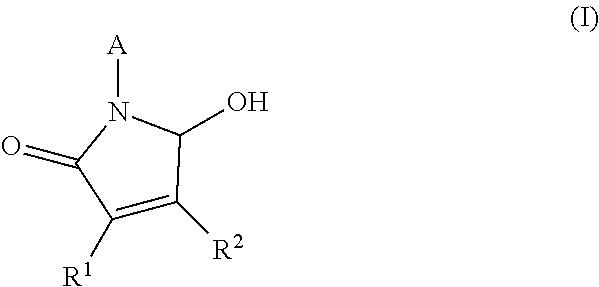
- the present invention relates novel herbicidal compositions and their use in controlling plants or inhibiting plant growth.
- A is hydroxy, halogen or OAcyl; and R is an optionally substituted aryl, aralkyl or heteroaryl group are taught in Swiss patent application CH633678.
- R is, inter alia, OH, R 1 is H or alkyl, and R 2 and R 3 are alkyl, haloalkyl, or alkylene are taught in EP0286816A1.
- A is e.g. OH
- R is H, halogen, alkyl, haloalkyl, or alkoxyl
- R 1 to R 3 are each H, halogen, alkyl, haloalkyl, alkyoxyalkyl, or R 2 and R 3 together form a 3 to 7 membered ring; are disclosed in EP0297378A2.
- R 1 is H, alkyl, haloalkyl, alkenyl, haloalkenyl, alkynyl, alkoxyalkyl or optionally substituted aryl or aralkyl
- R 2 is H, alkyl, haloalkyl, alkenyl, haloalkenyl, alkynyl, alkoxyalkyl, alkylthioalkyl or optionally substituted cycloalkyl or aryl
- R 3 , R 4 and R 5 are, inter alia, H or alkyl and R 6 is, inter alia, OH are disclosed in EP0334133.
- the object of the present invention is to provide herbicidal mixtures which are highly effective against various weed species at low does and/or have increased crop tolerance.
- the present invention therefore provides a composition comprising (A) a compound of formula (I):
- R 1 is methyl, methoxy or chloro
- R 2 is methyl or chloro
- A is a substituted heteroaryl group and wherein said compound is selected from the group consisting of
- herbicides selected from the group comprising acetochlor, acifluorfen-sodium, aclonifen, alachlor, alloxydim, ametryn, amicarbazone, amidosulfuron, aminocyclopyrachlor, aminopyralid, amitrole, asulam, atrazine, beflubutamid, benfluralin, bensulfuron-methyl, bentazone, bicyclopyrone, bifenox, bispyribac-sodium, bromacil, bromoxynil, butafenacil, cafenstrole, carfentrazone-ethyl, chloransulam, chlorimuron-ethyl, chlorotoluron, chlorsulfuron, cinosulfuron, cinidon-ethyl, clethodim, clodinafop-propargyl, clomazone, clopyralid,
- the invention provides the use of a composition of the invention as a herbicide.
- the invention provides a method of controlling plants, comprising applying to the plants or to the locus of the plants, a herbicidally effective amount of a composition of the invention.
- the invention provides a method of inhibiting plant growth, comprising applying to the plants or to the locus thereof, a herbicidally effective amount of a composition of the invention.
- the invention provides a method of controlling weeds in crops of useful plants, comprising applying to the weeds or to the locus of the weeds, or to the useful plants or to the locus of the useful plants, a herbicidally effective amount of a composition of the invention.
- the invention provides a method of selectively controlling grasses and/or weeds in crops of useful plants which comprises applying to the useful plants or locus thereof or to the area of cultivation a herbicidally effective amount of a composition of the invention.
- (B) is a herbicide selected from the group consisting of acetochlor, acifluorfen-sodium, alachlor, amidosulfuron, aminopyralid, atrazine, beflubutamid, benfluralin, bensulfuron-methyl, bicyclopyrone, bifenox, bispyribac-sodium, bromoxynil, butafenacil, carfentrazone-ethyl, chloransulam, chlorimuron-ethyl, chlorotoluron, chlorsulfuron, cinosulfuron, cinidon-ethyl, clethodim, clodinafop-propargyl, clopyralid, cycloxydim, 2,4-D (including the choline salt and 2-ethylhexyl ester thereof), dicamba (including the aluminum, aminopropyl, bis-aminopropylmethyl, choline, diglycolamine, di
- (B) is a herbicide selected from the group consisting of acetochlor, alachlor, amidosulfuron, aminopyralid, atrazine, beflubutamid, benfluralin, bicyclopyrone, bifenox, bromoxynil, butafenacil, carfentrazone-ethyl, chlorotoluron, clodinafop-propargyl, clopyralid, 2,4-D (including the choline salt and 2-ethylhexyl ester thereof), dicamba (including the aluminum, aminopropyl, bis-aminopropylmethyl, choline, diglycolamine, dimethylamine, dimethylammonium, potassium and sodium salts thereof), diclofop-methyl, diflufenican, dimethachlor, dimethenamid-P, diquat dibromide, fenoxaprop-P-ethyl, florasulam, fluaz
- (B) is a herbicide selected from the group consisting of acetochlor, alachlor, atrazine, benfluralin, bicyclopyrone, clopyralid, 2,4-D (including the choline salt and 2-ethylhexyl ester thereof), dicamba (including the aluminum, aminopropyl, bis-aminopropylmethyl, choline, diglycolamine, dimethylamine, dimethylammonium, potassium and sodium salts thereof), diflufenican, dimethachlor, dimethenamid-P, diquat dibromide, fluazifop-P-butyl, flufenacet, glufosinate (including the ammonium salt thereof), glyphosate (including the diammonium, isopropylammonium and potassium salts thereof), hexazinone, isoxaflutole, mesotrione, metribuzin, nicosulfuron, paraquat dichlor
- (B) is a herbicide selected from the group consisting of atrazine, bicyclopyrone, dimethachlor, flufenacet, glyphosate (including the diammonium, isopropylammonium and potassium salts thereof), isoxaflutole, mesotrione, nicosulfuron, S-metolachlor and terbuthylazine.
- (B) is a herbicide selected from the group consisting of atrazine, bicyclopyrone, mesotrione, S-metolachlor and terbuthylazine.
- (B) is atrazine.
- (B) is bicyclopyrone.
- (B) is mesotrione.
- (B) is S-metolachlor.
- (B) is terbuthylazine.
- (A) is compound 1.1.
- (A) is compound 1.2.
- (A) is compound 1.3.
- (A) is compound 1.4.
- (A) is compound 1.5.
- compositions of the invention comprise:
- compositions comprising the three-way mixtures listed in Table 1 above, wherein the compound 1.1 is replaced with compound 1.2.
- compositions comprising the three-way mixtures listed in Table 1 above, wherein the compound 1.1 is replaced with compound 1.3.
- compositions comprising the three-way mixtures listed in Table 1 above, wherein the compound 1.1 is replaced with compound 1.4.
- compositions comprising the three-way mixtures listed in Table 1 above, wherein the compound 1.1 is replaced with compound 1.5.
- compositions of the invention can further include one or more safeners.
- the following safeners are particularly preferred: AD 67 (MON 4660), benoxacor, cloquintocet-mexyl, cyometrinil, cyprosulfamide, dichlormid, dicyclonon, dietholate, fenchlorazole-ethyl, fenclorim, flurazole, fluxofenim, furilazole, furilazome, isoxadifen-ethyl, mefenpyr-diethyl, mephenate, oxabetrinil, naphthalic anhydride (CAS RN 81-84-5), TI-35, N-isopropyl-4-(2-methoxy-benzoylsulfamoyl)-benzamide (CAS RN 221668-34-4) and N-(2-methoxybenzoyl)-4-[(methylaminocarbonyl)amino]benzenesulf
- Particularly preferred safeners are cloquintocet-mexyl, cyprosulfamide, isoxadifen-ethyl, mefenpyr-diethyl and N-(2-methoxybenzoyl)-4-[(methylaminocarbonyl)amino]benzenesulfonamide.
- compositions of the invention and safeners include:
- Safeners can also be used in the three-way compositions detailed above and, in addition, in further multiple combinations comprising the two-way mixtures.
- the compounds (A) may exist as different geometric isomers, or in different tautomeric forms.
- This invention covers all such isomers and tautomers, and mixtures thereof in all proportions, as well as isotopic forms such as deuterated compounds. They may contain one or more asymmetric centers and may thus give rise to optical isomers and diastereomers. While shown without respect to stereochemistry, the present invention includes all such optical isomers and diastereomers as well as the racemic and resolved, enantiomerically pure R and S stereoisomers and other mixtures of the R and S stereoisomers and agrochemically acceptable salts thereof. It is recognized certain optical isomers or diastereomers may have favorable properties over the other. Thus when disclosing and claiming the invention, when a racemic mixture is disclosed, it is clearly contemplated that both optical isomers, including diastereomers, substantially free of the other, are disclosed and claimed as well.
- Suitable salts include those derived from alkali or alkaline earth metals and those derived from ammonia and amines.
- Preferred cations include sodium, potassium, magnesium, and ammonium cations of the formula N + (R 19 R 20 R 21 R 22 ) wherein R 19 , R 20 , R 21 and R 22 are independently selected from hydrogen, C 1 -C 6 alkyl and C 1 -C 6 hydroxyalkyl.
- Salts of the compounds of formula (I) can be prepared by treatment of compounds of formula (I) with a metal hydroxide, such as sodium hydroxide, or an amine, such as ammonia, trimethylamine, diethanolamine, 2-methylthiopropylamine, bisallylamine, 2-butoxyethylamine, morpholine, cyclododecylamine, or benzylamine.
- a metal hydroxide such as sodium hydroxide
- an amine such as ammonia, trimethylamine, diethanolamine, 2-methylthiopropylamine, bisallylamine, 2-butoxyethylamine, morpholine, cyclododecylamine, or benzylamine.
- Amine salts are often preferred forms of the compounds of formula (I) because they are water-soluble and lend themselves to the preparation of desirable aqueous based herbicidal compositions.
- Acceptable salts can be formed from organic and inorganic acids, for example, acetic, propionic, lactic, citric, tartaric, succinic, fumaric, maleic, malonic, mandelic, malic, phthalic, hydrochloric, hydrobromic, phosphoric, nitric, sulfuric, methanesulfonic, naphthalenesulfonic, benzenesulfonic, toluenesulfonic, camphorsulfonic, and similarly known acceptable acids when a compound of this invention contains a basic moiety.
- organic and inorganic acids for example, acetic, propionic, lactic, citric, tartaric, succinic, fumaric, maleic, malonic, mandelic, malic, phthalic, hydrochloric, hydrobromic, phosphoric, nitric, sulfuric, methanesulfonic, naphthalenesulfonic, benzenesulfonic, toluene
- Compounds 1.1 to 1.5 of the invention may be prepared by techniques detailed in WO 2014/180740, WO 2015/018431, WO 2015/018433 and WO 2015/018434.
- Herbicides of component (B) referred to herein using their common name are known, for example, from “The Pesticide Manual”, 15th Ed., British Crop Protection Council 2009. As noted in The Pesticide Manual, the herbicides (B) may also be in the form of esters or salts.
- the reference to acifluorfen-sodium also applies to acifluorfen
- the reference to dimethenamid also applies to dimethenamid-P
- the reference to glufosinate-ammonium also applies to glufosinate
- the reference to bensulfuron-methyl also applies to bensulfuron
- the reference to cloransulam-methyl also applies to cloransulam
- the reference to flamprop-M also applies to flamprop
- the reference to pyrithiobac-sodium also applies to pyrithiobac, etc.
- the safeners of the compositions of the invention may also be in the form of esters or salts, as mentioned e.g. in The Pesticide Manual, 15th Ed. (BCPC), 2009.
- BCPC Pesticide Manual, 15th Ed.
- the reference to cloquintocet-mexyl also applies to cloquintocet and to a lithium, sodium, potassium, calcium, magnesium, aluminium, iron, ammonium, quaternary ammonium, sulfonium or phosphonium salt thereof as disclosed in WO02/34048 and the reference to fenchlorazole-ethyl also applies to fenchlorazole, etc.
- compositions according to the invention are generally formulated in various ways using formulation adjuvants, such as carriers, solvents and surface-active substances.
- the formulations can be in various physical forms, e.g. in the form of dusting powders, gels, wettable powders, water-dispersible granules, water-dispersible tablets, effervescent pellets, emulsifiable concentrates, micro-emulsifiable concentrates, oil-in-water emulsions, oil-flowables, aqueous dispersions, oily dispersions, suspo-emulsions, capsule suspensions, emulsifiable granules, soluble liquids, water-soluble concentrates (with water or a water-miscible organic solvent as carrier), impregnated polymer films or in other forms known e.g.
- Such formulations can either be used directly or diluted prior to use.
- the dilutions can be made, for example, with water, liquid fertilisers, micronutrients, biological organisms, oil or solvents.
- the formulations can be prepared e.g. by mixing the active ingredient with the formulation adjuvants in order to obtain compositions in the form of finely divided solids, granules, solutions, dispersions or emulsions.
- the active ingredients can also be formulated with other adjuvants, such as finely divided solids, mineral oils, oils of vegetable or animal origin, modified oils of vegetable or animal origin, organic solvents, water, surface-active substances or combinations thereof.
- the active ingredients can also be contained in very fine microcapsules.
- Microcapsules contain the active ingredients in a porous carrier. This enables the active ingredients to be released into the environment in controlled amounts (e.g. slow-release).
- Microcapsules usually have a diameter of from 0.1 to 500 microns. They contain active ingredients in an amount of about from 25 to 95% by weight of the capsule weight.
- the active ingredients can be in the form of a monolithic solid, in the form of fine particles in solid or liquid dispersion or in the form of a suitable solution.
- the encapsulating membranes can comprise, for example, natural or synthetic rubbers, cellulose, styrene/butadiene copolymers, polyacrylonitrile, polyacrylate, polyesters, polyamides, polyureas, polyurethane or chemically modified polymers and starch xanthates or other polymers that are known to the person skilled in the art.
- very fine microcapsules can be formed in which the active ingredient is contained in the form of finely divided particles in a solid matrix of base substance, but the microcapsules are not themselves encapsulated.
- liquid carriers there may be used: water, toluene, xylene, petroleum ether, vegetable oils, acetone, methyl ethyl ketone, cyclohexanone, acid anhydrides, acetonitrile, acetophenone, amyl acetate, 2-butanone, butylene carbonate, chlorobenzene, cyclohexane, cyclohexanol, alkyl esters of acetic acid, diacetone alcohol, 1,2-dichloropropane, diethanolamine, p-diethylbenzene, diethylene glycol, diethylene glycol abietate, diethylene glycol butyl ether, diethylene glycol ethyl ether, diethylene glycol methyl ether, N,N-dimethylformamide, dimethyl sulfoxide, 1,4-dioxane, dipropylene glycol
- Suitable solid carriers are, for example, talc, titanium dioxide, pyrophyllite clay, silica, attapulgite clay, kieselguhr, limestone, calcium carbonate, bentonite, calcium montmorillonite, cottonseed husks, wheat flour, soybean flour, pumice, wood flour, ground walnut shells, lignin and similar substances.
- a large number of surface-active substances can advantageously be used in both solid and liquid formulations, especially in those formulations which can be diluted with a carrier prior to use.
- Surface-active substances may be anionic, cationic, non-ionic or polymeric and they can be used as emulsifiers, wetting agents or suspending agents or for other purposes.
- Typical surface-active substances include, for example, salts of alkyl sulfates, such as diethanolammonium lauryl sulfate; salts of alkylarylsulfonates, such as calcium dodecylbenzenesulfonate; alkylphenol/alkylene oxide addition products, such as nonylphenol ethoxylate; alcohol/alkylene oxide addition products, such as tridecylalcohol ethoxylate; soaps, such as sodium stearate; salts of alkylnaphthalenesulfonates, such as sodium dibutylnaphthalenesulfonate; dialkyl esters of sulfosuccinate salts, such as sodium di(2-ethylhexyl)sulfosuccinate; sorbitol esters, such as sorbitol oleate; quaternary amines, such as lauryltrimethylammonium chloride, polyethylene glycol esters of fatty
- Further adjuvants that can be used in pesticidal formulations include crystallisation inhibitors, viscosity modifiers, suspending agents, dyes, anti-oxidants, foaming agents, light absorbers, mixing auxiliaries, antifoams, complexing agents, neutralising or pH-modifying substances and buffers, corrosion inhibitors, fragrances, wetting agents, take-up enhancers, micronutrients, plasticisers, glidants, lubricants, dispersants, thickeners, antifreezes, microbicides, and liquid and solid fertilisers.
- the formulations according to the invention can include an additive comprising an oil of vegetable or animal origin, a mineral oil, alkyl esters of such oils or mixtures of such oils and oil derivatives.
- the amount of oil additive in the composition according to the invention is generally from 0.01 to 10%, based on the mixture to be applied.
- the oil additive can be added to a spray tank in the desired concentration after a spray mixture has been prepared.
- Preferred oil additives comprise mineral oils or an oil of vegetable origin, for example rapeseed oil, olive oil or sunflower oil, emulsified vegetable oil, alkyl esters of oils of vegetable origin, for example the methyl derivatives, or an oil of animal origin, such as fish oil or beef tallow.
- Preferred oil additives comprise alkyl esters of C 8 -C 22 fatty acids, especially the methyl derivatives of C 12 -C 18 fatty acids, for example the methyl esters of lauric acid, palmitic acid and oleic acid (methyl laurate, methyl palmitate and methyl oleate, respectively).
- Many oil derivatives are known from the Compendium of Herbicide Adjuvants, 10 th Edition, Southern Illinois University, 2010.
- the formulations generally comprise from 0.1 to 99% by weight, especially from 0.1 to 95% by weight, of compounds (A) and (B) and from 1 to 99.9% by weight of a formulation adjuvant which preferably includes from 0 to 25% by weight of a surface-active substance.
- a formulation adjuvant which preferably includes from 0 to 25% by weight of a surface-active substance.
- the rates of application vary within wide limits and depend on the nature of the soil, the method of application, the crop plant, the pest to be controlled, the prevailing climatic conditions, and other factors governed by the method of application, the time of application and the target crop.
- a general guideline compounds may be applied at a rate of from 1 to 2000 I/ha, especially from 10 to 1000 I/ha.
- Preferred formulations can have the following compositions (weight %):
- active ingredient 1 to 95%, preferably 60 to 90%
- surface-active agent 1 to 30%, preferably 5 to 20%
- liquid carrier 1 to 80%, preferably 1 to 35%
- active ingredient 0.1 to 10%, preferably 0.1 to 5%
- solid carrier 99.9 to 90%, preferably 99.9 to 99%
- active ingredient 5 to 75%, preferably 10 to 50%
- surface-active agent 1 to 40%, preferably 2 to 30%
- active ingredient 0.5 to 90%, preferably 1 to 80%
- surface-active agent 0.5 to 20%, preferably 1 to 15%
- solid carrier 5 to 95%, preferably 15 to 90%
- active ingredient 0.1 to 30%, preferably 0.1 to 15%
- solid carrier 99.5 to 70%, preferably 97 to 85%
- Wettable powders a) b) c) active ingredients 25% 50% 75% sodium lignosulfonate 5% 5% — sodium lauryl sulphate 3% — 5% sodium diisobutylnaphthalenesulfonate — 6% 10% phenol polyethylene glycol ether — 2% — (7-8 mol of ethylene oxide) highly dispersed silicic acid 5% 10% 10% Kaolin 62% 27% — The combination is thoroughly mixed with the adjuvants and the mixture is thoroughly ground in a suitable mill, affording wettable powders that can be diluted with water to give suspensions of the desired concentration.
- Powders for dry seed treatment a) b) c) active ingredients 25% 50% 75% light mineral oil 5% 5% 5% highly dispersed silicic acid 5% 5% — Kaolin 65% 40% — Talcum — 20 The combination is thoroughly mixed with the adjuvants and the mixture is thoroughly ground in a suitable mill, affording powders that can be used directly for seed treatment.
- Emulsifiable concentrate active ingredients 10% octylphenol polyethylene glycol ether 3% (4-5 mol of ethylene oxide) calcium dodecylbenzenesulfonate 3% castor oil polyglycol ether (35 mol of ethylene oxide) 4% Cyclohexanone 30% xylene mixture 50% Emulsions of any required dilution, which can be used in plant protection, can be obtained from this concentrate by dilution with water.
- Dusts a) b) c) Active ingredients 5% 6% 4% Talcum 95% — — Kaolin — 94% — mineral filler — — 96% Ready-for-use dusts are obtained by mixing the combination with the carrier and grinding the mixture in a suitable mill. Such powders can also be used for dry dressings for seed.
- Suspension concentrate active ingredients 40% propylene glycol 10% nonylphenol polyethylene glycol ether (15 mol of ethylene oxide) 6% Sodium lignosulfonate 10% Carboxymethylcellulose 1% silicone oil (in the form of a 75% emulsion in water) 1% Water 32%
- the finely ground combination is intimately mixed with the adjuvants, giving a suspension concentrate from which suspensions of any desired dilution can be obtained by dilution with water.
- living plants as well as plant propagation material can be treated and protected against infestation by microorganisms, by spraying, pouring or immersion.
- Flowable concentrate for seed treatment active ingredients 40% propylene glycol 5% copolymer butanol PO/EO 2% Tristyrenephenole with 10-20 moles EO 2% 1,2-benzisothiazolin-3-one (in the form of a 20% solution 0.5% in water) monoazo-pigment calcium salt 5% Silicone oil (in the form of a 75% emulsion in water) 0.2% Water 45.3%
- the finely ground combination is intimately mixed with the adjuvants, giving a suspension concentrate from which suspensions of any desired dilution can be obtained by dilution with water. Using such dilutions, living plants as well as plant propagation material can be treated and protected against infestation by microorganisms, by spraying, pouring or immersion.
- Slow Release Capsule Suspension 28 parts of the combination are mixed with 2 parts of an aromatic solvent and 7 parts of toluene diisocyanate/polymethylene-polyphenylisocyanate-mixture (8:1).
- This mixture is emulsified in a mixture of 1.2 parts of polyvinylalcohol, 0.05 parts of a defoamer and 51.6 parts of water until the desired particle size is achieved.
- a mixture of 2.8 parts 1,6-diaminohexane in 5.3 parts of water is added.
- the mixture is agitated until the polymerization reaction is completed.
- the obtained capsule suspension is stabilized by adding 0.25 parts of a thickener and 3 parts of a dispersing agent.
- the capsule suspension formulation contains 28% of the active ingredients.
- the medium capsule diameter is 8-15 microns.
- the resulting formulation is applied to seeds as an aqueous suspension in an apparatus suitable for that purpose.
- composition stands for the various mixtures or combinations of components (A) and (B), for example in a single “ready-mix” form, in a combined spray mixture composed from separate formulations of the single active ingredient components, such as a “tank-mix”, and in a combined use of the single active ingredients when applied in a sequential manner, i.e. one after the other with a reasonably short period, such as a few hours or days.
- the order of applying the components (A) and (B) is not essential for working the present invention.
- herbicide as used herein means a compound that controls or modifies the growth of plants.
- herbicidally effective amount means the quantity of such a compound or combination of such compounds that is capable of producing a controlling or modifying effect on the growth of plants. Controlling or modifying effects include all deviation from natural development, for example killing, retardation, leaf burn, albinism, dwarfing and the like.
- locus means fields in or on which plants are growing, or where seeds of cultivated plants are sown, or where seed will be placed into the soil. It includes soil, seeds, and seedlings, as well as established vegetation.
- plants refers to all physical parts of a plant, including seeds, seedlings, saplings, roots, tubers, stems, stalks, foliage, and fruits.
- plant propagation material denotes all generative parts of a plant, for example seeds or vegetative parts of plants such as cuttings and tubers. It includes seeds in the strict sense, as well as roots, fruits, tubers, bulbs, rhizomes, and parts of plants.
- safener means a chemical that when used in combination with a herbicide reduces the undesirable effects of the herbicide on non-target organisms, for example, a safener protects crops from injury by herbicides but does not prevent the herbicide from killing the weeds.
- Crops of useful plants in which the composition according to the invention can be used include perennial and annual crops, such as berry plants for example blackberries, blueberries, cranberries, raspberries and strawberries; cereals for example barley, maize (corn), millet, oats, rice, rye, sorghum triticale and wheat; fibre plants for example cotton, flax, hemp, jute and sisal; field crops for example sugar and fodder beet, coffee, hops, mustard, oilseed rape (canola), poppy, sugar cane, sunflower, tea and tobacco; fruit trees for example apple, apricot, avocado, banana, cherry, citrus, nectarine, peach, pear and plum; grasses for example Bermuda grass, bluegrass, bentgrass, centipede grass, fescue, ryegrass, St.
- perennial and annual crops such as berry plants for example blackberries, blueberries, cranberries, raspberries and strawberries
- cereals for example barley, maize (corn), mille
- Augustine grass and Zoysia grass herbs such as basil, borage, chives, coriander, lavender, lovage, mint, oregano, parsley, rosemary, sage and thyme; legumes for example beans, lentils, peas and soya beans; nuts for example almond, cashew, ground nut, hazelnut, peanut, pecan, pistachio and walnut; palms for example oil palm; ornamentals for example flowers, shrubs and trees; other trees, for example cacao, coconut, olive and rubber; vegetables for example asparagus, aubergine, broccoli, cabbage, carrot, cucumber, garlic, lettuce, marrow, melon, okra, onion, pepper, potato, pumpkin, rhubarb, spinach and tomato; and vines for example grapes.
- herbs such as basil, borage, chives, coriander, lavender, lovage, mint, oregano, parsley, rosemary, sage and thyme
- legumes for example beans, lentils, peas and soya beans
- Crops are to be understood as being those which are naturally occurring, obtained by conventional methods of breeding, or obtained by genetic engineering. They include crops which contain so-called output traits (e.g. improved storage stability, higher nutritional value and improved flavour).
- output traits e.g. improved storage stability, higher nutritional value and improved flavour.
- Crops are to be understood as also including those crops which have been rendered tolerant to herbicides like bromoxynil or classes of herbicides such as ALS-, EPSPS-, GS-, HPPD- and PPO-inhibitors.
- herbicides like bromoxynil or classes of herbicides such as ALS-, EPSPS-, GS-, HPPD- and PPO-inhibitors.
- An example of a crop that has been rendered tolerant to imidazolinones, e.g. imazamox, by conventional methods of breeding is Clearfield® summer canola.
- crops that have been rendered tolerant to herbicides by genetic engineering methods include e.g. glyphosate- and glufosinate-resistant maize varieties commercially available under the trade names RoundupReady®, Herculex I® and LibertyLink®.
- Crops are also to be understood as being those which naturally are or have been rendered resistant to harmful insects. This includes plants transformed by the use of recombinant DNA techniques, for example, to be capable of synthesising one or more selectively acting toxins, such as are known, for example, from toxin-producing bacteria. Examples of toxins which can be expressed include ⁇ -endotoxins, vegetative insecticidal proteins (Vip), insecticidal proteins of bacteria colonising nematodes, and toxins produced by scorpions, arachnids, wasps and fungi.
- Vip vegetative insecticidal proteins
- insecticidal proteins of bacteria colonising nematodes and toxins produced by scorpions, arachnids, wasps and fungi.
- An example of a crop that has been modified to express the Bacillus thuringiensis toxin is the Bt maize KnockOut® (Syngenta Seeds).
- An example of a crop comprising more than one gene that codes for insecticidal resistance and thus expresses more than one toxin is VipCot® (Syngenta Seeds).
- Crops or seed material thereof can also be resistant to multiple types of pests (so-called stacked transgenic events when created by genetic modification).
- a plant can have the ability to express an insecticidal protein while at the same time being herbicide tolerant, for example Herculex I® (Dow AgroSciences, Pioneer Hi-Bred International).
- Compositions of the invention can typically be used to control a wide variety of monocotyledonous and dicotyledonous weed species.
- monocotyledonous species that can typically be controlled include Alopecurus myosuroides, Avena fatua, Brachiaria plantaginea, Bromus tectorum, Cyperus esculentus, Digitaria sanguinalis, Echinochloa crus - galli, Lolium perenne, Lolium multiflorum, Panicum miliaceum, Poa annus, Setaria viridis, Setaria faberi and Sorghum bicolor .
- dicotyledonous species that can be controlled include Abutilon theophrasti, Amaranthus retroflexus, Bidens pilosa, Chenopodium album, Euphorbia heterophylla, Galium aparine, Ipomoea hederacea, Kochia scoparia, Polygonum convolvulus, Sida spinosa, Sinapis arvensis, Solanum nigrum, Stellaria media, Veronica persica and Xanthium strumarium.
- the weeds e.g. to be controlled and/or growth-inhibited may be monocotyledonous or dicotyledonous weeds, which are tolerant or resistant to one or more other herbicides for example, HPPD inhibitor herbicides such as mesotrione, PSII inhibitor herbicides such as atrazine or EPSPS inhibitors such as glyphosate.
- HPPD inhibitor herbicides such as mesotrione
- PSII inhibitor herbicides such as atrazine or EPSPS inhibitors
- glyphosate glyphosate.
- Such weeds include, but are not limited to resistant Amaranthus biotypes.
- compositions of this invention can also be mixed with one or more further pesticides including fungicides, insecticides, nematocides, bactericides, acaricides, growth regulators, chemosterilants, semiochemicals, repellents, attractants, pheromones, feeding stimulants or other biologically active compounds to form a multi-component pesticide giving an even broader spectrum of agricultural protection.
- further pesticides including fungicides, insecticides, nematocides, bactericides, acaricides, growth regulators, chemosterilants, semiochemicals, repellents, attractants, pheromones, feeding stimulants or other biologically active compounds to form a multi-component pesticide giving an even broader spectrum of agricultural protection.
- compositions of the invention can advantageously be used in the above-mentioned formulations (in which case “active ingredient” relates to the respective mixture of compound of formula (I) with the herbicide (B) or, when a safener is also used, the respective mixture of the compound of formula (I) with the herbicide (B) and the safener).
- the mixing ratio (by weight) of the compound of formula (I) to the herbicide (B) is from 0.01:1 to 100:1, more preferably from 0.05:1 to 20:1, even more preferably from 0.1:1 to 20:1 and most preferably from 0.2:1 to 20:1, for example, 0.3125:1, 0.625:1, 1.25:1, 2.5:1, 5:1, 10:1 and 20:1.
- compositions according to the invention to be applied will depend on various factors, such as the compounds employed; the subject of the treatment, such as, for example plants, soil or seeds; the type of treatment, such as, for example spraying, dusting or seed dressing; the purpose of the treatment, such as, for example prophylactic or therapeutic; the type of fungi to be controlled or the application time.
- component (A) When applied to the useful plants component (A) is typically applied at a rate of 50 to 2000 g a.i./ha, particularly 100 to 1000 g a.i./ha and more particularly 300 to 500 g a.i./ha e.g. 300, 350, 400, 450 or 500 g a.i./ha, typically in association with 50 to 2000 g a.i./ha of component (B).
- the rate of application of component (B) depends on its identity. For example:
- component B when component B is mesotrione, it is typically applied at a rate of 80-300 g a.i./ha, e.g. 80, 100, 150, 200, 250 or 300 g a.i./ha;
- component B when component B is S-metolachlor, it is typically applied at a rate of 500-1800 g a.i./ha, e.g. 500, 600, 700, 800, 900, 1000, 1100, 1200, 1300, 1400, 1500, 1600 or 1800 g a.i./ha;
- component B when component B is bicyclopyrone, it is typically applied at a rate of 50-250 g a.i/ha, e.g. 50, 100, 150, 200 or 250 g a.i./ha;
- component B when component B is atrazine, it is typically applied at a rate of 840-2000 g a.i./ha, e.g. 840, 900, 1000, 1100, 1200, 1300, 1400, 1500, 1600, 1700, 1800, 1900 or 2000 g a.i./ha;
- component B when component B is terbuthylazine, it is typically applied at a rate of 700-900 g a.i./ha, e.g. 700, 750, 800, 840, 850, 900 g a.i./ha;
- the application rates of the composition according to the invention depend on the type of effect desired, and typically range from 100 to 4000 g of total composition per hectare.
- the mixing ratio of compound of formula (I) to safener is from 100:1 to 1:10, especially from 20:1 to 1:1.
- the compounds of the invention can be applied before or after planting of the crops, before weeds emerge (pre-emergence application) or after weeds emerge (post-emergence application), and are particularly effective when applied pre-emergence to the weeds.
- the safener and the compositions of the invention are applied simultaneously.
- the safener and the composition of the invention might be applied to the locus pre-emergence or might be applied to the crop post-emergence.
- the safener and the composition of the invention are applied sequentially.
- the safener might be applied before sowing the seeds as a seed treatment and the composition of the invention might be applied to the locus pre-emergence or might be applied to the crop post-emergence.
- composition of the invention may show a synergistic effect. This occurs whenever the action of an active ingredient combination is greater than the sum of the actions of the individual components.
- ppm milligrams of active ingredient (a.i.) per liter
- Y % action by second active ingredient sing q ppm of the active ingredient.
- synergism corresponds to a positive value for the difference of (O-E).
- said difference (O-E) is zero.
- a negative value of said difference (O-E) signals a loss of activity compared to the expected activity.
- composition according to the invention may also have further surprising advantageous properties.
- advantageous properties are: more advantageuos degradability; improved toxicological and/or ecotoxicological behaviour; or improved characteristics of the useful plants including: emergence, crop yields, more developed root system, tillering increase, increase in plant height, bigger leaf blade, less dead basal leaves, stronger tillers, greener leaf colour, less fertilizers needed, less seeds needed, more productive tillers, earlier flowering, early grain maturity, less plant verse (lodging), increased shoot growth, improved plant vigor, and early germination.
- Seeds of a variety of test species were sown in standard soil in pots. After cultivation for one day (pre-emergence) under controlled conditions in a glasshouse (at 24/18° C., at day/night; 16 hours light; 65% humidity), the plants were sprayed with an aqueous spray solution derived from the formulation of the technical active ingredient dissolved in acetone plus formulation A containing 10.56 wt % Emulsogen EL, 42.22 wt % N-MethylPyrrolidon, 2.22 wt % DPG-Monoethyl ether at a 1:20 ratio (technical active ingredient:formulation A). To achieve the mixture treatments, the appropriate concentration of the mixture partner (commercial formulation) was added to the solution in order to achieve the desired experimental compound:mixture partner ratio).
Landscapes
- Life Sciences & Earth Sciences (AREA)
- Agronomy & Crop Science (AREA)
- Pest Control & Pesticides (AREA)
- Plant Pathology (AREA)
- Health & Medical Sciences (AREA)
- Engineering & Computer Science (AREA)
- Dentistry (AREA)
- General Health & Medical Sciences (AREA)
- Wood Science & Technology (AREA)
- Zoology (AREA)
- Environmental Sciences (AREA)
- Agricultural Chemicals And Associated Chemicals (AREA)
Abstract
Description

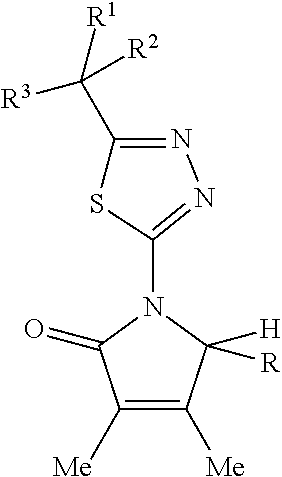
wherein R is, inter alia, OH, R1 is H or alkyl, and R2 and R3 are alkyl, haloalkyl, or alkylene are taught in EP0286816A1.
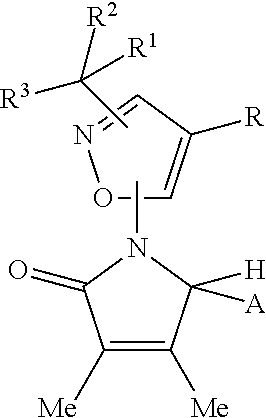
wherein A is e.g. OH, R is H, halogen, alkyl, haloalkyl, or alkoxyl, R1 to R3 are each H, halogen, alkyl, haloalkyl, alkyoxyalkyl, or R2 and R3 together form a 3 to 7 membered ring; are disclosed in EP0297378A2.
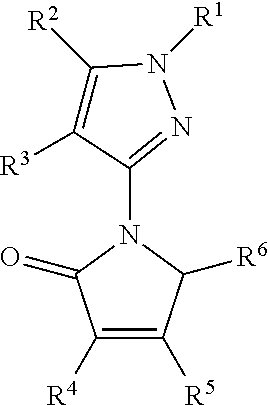
wherein R1 is H, alkyl, haloalkyl, alkenyl, haloalkenyl, alkynyl, alkoxyalkyl or optionally substituted aryl or aralkyl, R2 is H, alkyl, haloalkyl, alkenyl, haloalkenyl, alkynyl, alkoxyalkyl, alkylthioalkyl or optionally substituted cycloalkyl or aryl, R3, R4 and R5 are, inter alia, H or alkyl and R6 is, inter alia, OH are disclosed in EP0334133.
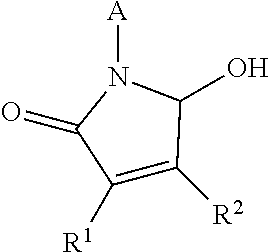
wherein R1 is methyl, methoxy or chloro, R2 is methyl or chloro and A is a substituted heteroaryl group and wherein said compound is selected from the group consisting of

or an N-oxide or salt form thereof,
and (B) one or more herbicides selected from the group comprising acetochlor, acifluorfen-sodium, aclonifen, alachlor, alloxydim, ametryn, amicarbazone, amidosulfuron, aminocyclopyrachlor, aminopyralid, amitrole, asulam, atrazine, beflubutamid, benfluralin, bensulfuron-methyl, bentazone, bicyclopyrone, bifenox, bispyribac-sodium, bromacil, bromoxynil, butafenacil, cafenstrole, carfentrazone-ethyl, chloransulam, chlorimuron-ethyl, chlorotoluron, chlorsulfuron, cinosulfuron, cinidon-ethyl, clethodim, clodinafop-propargyl, clomazone, clopyralid, cycloxydim, cyhalofop-butyl, 2,4-D (including the choline salt and 2-ethylhexyl ester thereof), daimuron, desmedipham, dicamba (including the aluminum, aminopropyl, bis-aminopropylmethyl, choline, diglycolamine, dimethylamine, dimethylammonium, potassium and sodium salts thereof), diclofop-methyl, diclosulam, difenzoquat, diflufenican, diflufenzopyr, dimethachlor, dimethenamid-P, diquat dibromide, diuron, esprocarb, ethametsulfuron, ethofumesate, fenoxaprop-P-ethyl, fenquinotrione, flazasulfuron, florasulam, fluazifop-P-butyl, flucarbazone-sodium, flufenacet, flumetralin, flumetsulam, flumioxazin, flupyrsulfuron-methyl-sodium, fluroxypyr-meptyl, flurtamone, fluthiacet-methyl, fomesafen, foramsulfuron, glufosinate (including the ammonium salt thereof), glyphosate (including the diammonium, isopropylammonium and potassium salts thereof), halauxifen-methyl, halosulfuron-methyl, haloxyfop-methyl, hexazinone, imazamethabenz, imazamox, imazapic, imazapyr, imazaquin, imazethapyr, indaziflam, iodosulfuron-methyl-sodium, iofensulfuron, iofensulfuron-sodium, ioxynil, ipfencarbazone, isoproturon, isoxaben, isoxaflutole, lactofen, linuron, MCPA, MCPP, mecoprop-P, mefenacet, mesosulfuron, mesosulfuron-methyl, mesotrione, metamitron, metazachlor, metobromuron, metolachlor, metoxuron, metribuzin, metsulfuron, molinate, napropamide, nicosulfuron, norflurazon, orthosulfamuron, oxadiargyl, oxadiazon, oxasulfuron, oxyfluorfen, paraquat dichloride, pendimethalin, penoxsulam, pethoxamid, phenmedipham, picloram, picolinafen, pinoxaden, pretilachlor, primisulfuron-methyl, prodiamine, prometryn, propachlor, propanil, propaquizafop, propham, propoxycarbazone, propyzamide, prosulfocarb, prosulfuron, pyrasulfotole, pyrazolynate, pyrazosulfuron-ethyl, pyribenzoxim, pyridate, pyriftalid, pyrithiobac-sodium, pyroxasulfone, pyroxsulam, quinclorac, quizalofop-P-ethyl, rimsulfuron, saflufenacil, sethoxydim, S-metolachlor, sulcotrione, sulfentrazone, sulfometuron-methyl, sulfosulfuron, tebuthiuron, tefuryltrione, tembotrione, terbuthylazine, terbutryn, thiencarbazone, thifensulfuron, tiafenacil, tolpyralate, topramezone, tralkoxydim, triafamone, triallate, triasulfuron, tribenuron-methyl, triclopyr, trifloxysulfuron-sodium, trifludimoxazin, trifluralin, tritosulfuron and 4-amino-3-chloro-6-(4-chloro-2-fluoro-3-methoxyphenyl)-5-fluoropyridine-2-carboxylate.
compound 1.2+acetochlor, compound 1.2+acifluorfen-sodium, compound 1.2+aclonifen, compound 1.2+alachlor, compound 1.2+alloxydim, compound 1.2+ametryn, compound 1.2+amicarbazone, compound 1.2+amidosulfuron, compound 1.2+aminocyclopyrachlor, compound 1.2+aminopyralid, compound 1.2+amitrole, compound 1.2+asulam, compound 1.2+atrazine, compound 1.2+beflubutamid, compound 1.2+benfluralin, compound 1.2+bensulfuron-methyl, compound 1.2+bentazone, compound 1.2+bicyclopyrone, compound 1.2+bifenox, compound 1.2+bispyribac-sodium, compound 1.2+bromacil, compound 1.2+bromoxynil, compound 1.2+butafenacil, compound 1.2+cafenstrole, compound 1.2+carfentrazone-ethyl, compound 1.2+chloransulam, compound 1.2+chlorimuron-ethyl, compound 1.2+chlorotoluron, compound 1.2+chlorsulfuron, compound 1.2+cinosulfuron, compound 1.2+cinidon-ethyl, compound 1.2+clethodim, compound 1.2+clodinafop-propargyl, compound 1.2+clomazone, compound 1.2+clopyralid, compound 1.2+cycloxydim, compound 1.2+cyhalofop-butyl, compound 1.2+2,4-D (including the choline salt and 2-ethylhexyl ester thereof), compound 1.2+daimuron, compound 1.2+desmedipham, compound 1.2+dicamba (including the aluminum, aminopropyl, bis-aminopropylmethyl, choline, diglycolamine, dimethylamine, dimethylammonium, potassium and sodium salts thereof), compound 1.2+diclofop-methyl, compound 1.2+diclosulam, compound 1.2+difenzoquat, compound 1.2+diflufenican, compound 1.2+diflufenzopyr, compound 1.2+dimethachlor, compound 1.2+dimethenamid-P, compound 1.2+diquat dibromide, compound 1.2+diuron, compound 1.2+esprocarb, compound 1.2+ethametsulfuron, compound 1.2+ethofumesate, compound 1.2+fenoxaprop-P-ethyl, compound 1.2+fenquinotrione, compound 1.2+flazasulfuron, compound 1.2+florasulam, compound 1.2+fluazifop-P-butyl, compound 1.2+flucarbazone-sodium, compound 1.2+flufenacet, compound 1.2+flumetralin, compound 1.2+flumetsulam, compound 1.2+flumioxazin, compound 1.2+flupyrsulfuron-methyl-sodium, compound 1.2+fluroxypyr-meptyl, compound 1.2+flurtamone, compound 1.2+fluthiacet-methyl, compound 1.2+fomesafen, compound 1.2+foramsulfuron, compound 1.2+glufosinate (including the ammonium salt thereof), compound 1.2+glyphosate (including the diammonium, isopropylammonium and potassium salts thereof), compound 1.2+halauxifen-methyl, compound 1.2+halosulfuron-methyl, compound 1.2+haloxyfop-methyl, compound 1.2+hexazinone, compound 1.2+imazamethabenz, compound 1.2+imazamox, compound 1.2+imazapic, compound 1.2+imazapyr, compound 1.2+imazaquin, compound 1.2+imazethapyr, compound 1.2+indaziflam, compound 1.2+iodosulfuron-methyl-sodium, compound 1.2+iofensulfuron, compound 1.2+iofensulfuron-sodium, compound 1.2+ioxynil, compound 1.2+ipfencarbazone, compound 1.2+isoproturon, compound 1.2+isoxaben, compound 1.2+isoxaflutole, compound 1.2+lactofen, compound 1.2+linuron, compound 1.2+MCPA, compound 1.2+MCPP, compound 1.2+mecoprop-P, compound 1.2+mefenacet, compound 1.2+mesosulfuron, compound 1.2+mesosulfuron-methyl, compound 1.2+mesotrione, compound 1.2+metamitron, compound 1.2+metazachlor, compound 1.2+metobromuron, compound 1.2+metolachlor, compound 1.2+metoxuron, compound 1.2+metribuzin, compound 1.2+metsulfuron, compound 1.2+molinate, compound 1.2+napropamide, compound 1.2+nicosulfuron, compound 1.2+norflurazon, compound 1.2+orthosulfamuron, compound 1.2+oxadiargyl, compound 1.2+oxadiazon, compound 1.2+oxasulfuron, compound 1.2+oxyfluorfen, compound 1.2+paraquat dichloride, compound 1.2+pendimethalin, compound 1.2+penoxsulam, compound 1.2+pethoxamid, compound 1.2+phenmedipham, compound 1.2+picloram, compound 1.2+picolinafen, compound 1.2+pinoxaden, compound 1.2+pretilachlor, compound 1.2+primisulfuron-methyl, compound 1.2+prodiamine, compound 1.2+prometryn, compound 1.2+propachlor, compound 1.2+propanil, compound 1.2+propaquizafop, compound 1.2+propham, compound 1.2+propoxycarbazone, compound 1.2+propyzamide, compound 1.2+prosulfocarb, compound 1.2+prosulfuron, compound 1.2+pyrasulfotole, compound 1.2+pyrazolynate, compound 1.2+pyrazosulfuron-ethyl, compound 1.2+pyribenzoxim, compound 1.2+pyridate, compound 1.2+pyriftalid, compound 1.2+pyrithiobac-sodium, compound 1.2+pyroxasulfone, compound 1.2+pyroxsulam, compound 1.2+quinclorac, compound 1.2+quizalofop-P-ethyl, compound 1.2+rimsulfuron, compound 1.2+saflufenacil, compound 1.2+sethoxydim, compound 1.2+S-metolachlor, compound 1.2+sulcotrione, compound 1.2+sulfentrazone, compound 1.2+sulfometuron-methyl, compound 1.2+sulfosulfuron, compound 1.2+tebuthiuron, compound 1.2+tefuryltrione, compound 1.2+tembotrione, compound 1.2+terbuthylazine, compound 1.2+terbutryn, compound 1.2+thiencarbazone, compound 1.2+thifensulfuron, compound 1.2+tiafenacil, compound 1.2+tolpyralate, compound 1.2+topramezone, compound 1.2+tralkoxydim, compound 1.2+triafamone, compound 1.2+triallate, compound 1.2+triasulfuron, compound 1.2+tribenuron-methyl, compound 1.2+triclopyr, compound 1.2+trifloxysulfuron-sodium, compound 1.2+trifludimoxazin, compound 1.2+trifluralin, compound 1.2+tritosulfuron and compound 1.2+4-amino-3-chloro-6-(4-chloro-2-fluoro-3-methoxyphenyl)-5-fluoropyridine-2-carboxylate;
compound 1.3+acetochlor, compound 1.3+acifluorfen-sodium, compound 1.3+aclonifen, compound 1.3+alachlor, compound 1.3+alloxydim, compound 1.3+ametryn, compound 1.3+amicarbazone, compound 1.3+amidosulfuron, compound 1.3+aminocyclopyrachlor, compound 1.3+aminopyralid, compound 1.3+amitrole, compound 1.3+asulam, compound 1.3+atrazine, compound 1.3+beflubutamid, compound 1.3+benfluralin, compound 1.3+bensulfuron-methyl, compound 1.3+bentazone, compound 1.3+bicyclopyrone, compound 1.3+bifenox, compound 1.3+bispyribac-sodium, compound 1.3+bromacil, compound 1.3+bromoxynil, compound 1.3+butafenacil, compound 1.3+cafenstrole, compound 1.3+carfentrazone-ethyl, compound 1.3+chloransulam, compound 1.3+chlorimuron-ethyl, compound 1.3+chlorotoluron, compound 1.3+chlorsulfuron, compound 1.3+cinosulfuron, compound 1.3+cinidon-ethyl, compound 1.3+clethodim, compound 1.3+clodinafop-propargyl, compound 1.3+clomazone, compound 1.3+clopyralid, compound 1.3+cycloxydim, compound 1.3+cyhalofop-butyl, compound 1.3+2,4-D (including the choline salt and 2-ethylhexyl ester thereof), compound 1.3+daimuron, compound 1.3+desmedipham, compound 1.3+dicamba (including the aluminum, aminopropyl, bis-aminopropylmethyl, choline, diglycolamine, dimethylamine, dimethylammonium, potassium and sodium salts thereof), compound 1.3+diclofop-methyl, compound 1.3+diclosulam, compound 1.3+difenzoquat, compound 1.3+diflufenican, compound 1.3+diflufenzopyr, compound 1.3+dimethachlor, compound 1.3+dimethenamid-P, compound 1.3+diquat dibromide, compound 1.3+diuron, compound 1.3+esprocarb, compound 1.3+ethametsulfuron, compound 1.3+ethofumesate, compound 1.3+fenoxaprop-P-ethyl, compound 1.3+fenquinotrione, compound 1.3+flazasulfuron, compound 1.3+florasulam, compound 1.3+fluazifop-P-butyl, compound 1.3+flucarbazone-sodium, compound 1.3+flufenacet, compound 1.3+flumetralin, compound 1.3+flumetsulam, compound 1.3+flumioxazin, compound 1.3+flupyrsulfuron-methyl-sodium, compound 1.3+fluroxypyr-meptyl, compound 1.3+flurtamone, compound 1.3+fluthiacet-methyl, compound 1.3+fomesafen, compound 1.3+foramsulfuron, compound 1.3+glufosinate (including the ammonium salt thereof), compound 1.3+glyphosate (including the diammonium, isopropylammonium and potassium salts thereof), compound 1.3+halauxifen-methyl, compound 1.3+halosulfuron-methyl, compound 1.3+haloxyfop-methyl, compound 1.3+hexazinone, compound 1.3+imazamethabenz, compound 1.3+imazamox, compound 1.3+imazapic, compound 1.3+imazapyr, compound 1.3+imazaquin, compound 1.3+imazethapyr, compound 1.3+indaziflam, compound 1.3+iodosulfuron-methyl-sodium, compound 1.3+iofensulfuron, compound 1.3+iofensulfuron-sodium, compound 1.3+ioxynil, compound 1.3+ipfencarbazone, compound 1.3+isoproturon, compound 1.3+isoxaben, compound 1.3+isoxaflutole, compound 1.3+lactofen, compound 1.3+linuron, compound 1.3+MCPA, compound 1.3+MCPP, compound 1.3+mecoprop-P, compound 1.3+mefenacet, compound 1.3+mesosulfuron, compound 1.3+mesosulfuron-methyl, compound 1.3+mesotrione, compound 1.3+metamitron, compound 1.3+metazachlor, compound 1.3+metobromuron, compound 1.3+metolachlor, compound 1.3+metoxuron, compound 1.3+metribuzin, compound 1.3+metsulfuron, compound 1.3+molinate, compound 1.3+napropamide, compound 1.3+nicosulfuron, compound 1.3+norflurazon, compound 1.3+orthosulfamuron, compound 1.3+oxadiargyl, compound 1.3+oxadiazon, compound 1.3+oxasulfuron, compound 1.3+oxyfluorfen, compound 1.3+paraquat dichloride, compound 1.3+pendimethalin, compound 1.3+penoxsulam, compound 1.3+pethoxamid, compound 1.3+phenmedipham, compound 1.3+picloram, compound 1.3+picolinafen, compound 1.3+pinoxaden, compound 1.3+pretilachlor, compound 1.3+primisulfuron-methyl, compound 1.3+prodiamine, compound 1.3+prometryn, compound 1.3+propachlor, compound 1.3+propanil, compound 1.3+propaquizafop, compound 1.3+propham, compound 1.3+propoxycarbazone, compound 1.3+propyzamide, compound 1.3+prosulfocarb, compound 1.3+prosulfuron, compound 1.3+pyrasulfotole, compound 1.3+pyrazolynate, compound 1.3+pyrazosulfuron-ethyl, compound 1.3+pyribenzoxim, compound 1.3+pyridate, compound 1.3+pyriftalid, compound 1.3+pyrithiobac-sodium, compound 1.3+pyroxasulfone, compound 1.3+pyroxsulam, compound 1.3+quinclorac, compound 1.3+quizalofop-P-ethyl, compound 1.3+rimsulfuron, compound 1.3+saflufenacil, compound 1.3+sethoxydim, compound 1.3+S-metolachlor, compound 1.3+sulcotrione, compound 1.3+sulfentrazone, compound 1.3+sulfometuron-methyl, compound 1.3+sulfosulfuron, compound 1.3+tebuthiuron, compound 1.3+tefuryltrione, compound 1.3+tembotrione, compound 1.3+terbuthylazine, compound 1.3+terbutryn, compound 1.3+thiencarbazone, compound 1.3+thifensulfuron, compound 1.3+tiafenacil, compound 1.3+tolpyralate, compound 1.3+topramezone, compound 1.3+tralkoxydim, compound 1.3+triafamone, compound 1.3+triallate, compound 1.3+triasulfuron, compound 1.3+tribenuron-methyl, compound 1.3+triclopyr, compound 1.3+trifloxysulfuron-sodium, compound 1.3+trifludimoxazin, compound 1.3+trifluralin, compound 1.3+tritosulfuron and compound 1.3+4-amino-3-chloro-6-(4-chloro-2-fluoro-3-methoxyphenyl)-5-fluoropyridine-2-carboxylate;
compound 1.4+acetochlor, compound 1.4+acifluorfen-sodium, compound 1.4+aclonifen, compound 1.4+alachlor, compound 1.4+alloxydim, compound 1.4+ametryn, compound 1.4+amicarbazone, compound 1.4+amidosulfuron, compound 1.4+aminocyclopyrachlor, compound 1.4+aminopyralid, compound 1.4+amitrole, compound 1.4+asulam, compound 1.4+atrazine, compound 1.4+beflubutamid, compound 1.4+benfluralin, compound 1.4+bensulfuron-methyl, compound 1.4+bentazone, compound 1.4+bicyclopyrone, compound 1.4+bifenox, compound 1.4+bispyribac-sodium, compound 1.4+bromacil, compound 1.4+bromoxynil, compound 1.4+butafenacil, compound 1.4+cafenstrole, compound 1.4+carfentrazone-ethyl, compound 1.4+chloransulam, compound 1.4+chlorimuron-ethyl, compound 1.4+chlorotoluron, compound 1.4+chlorsulfuron, compound 1.4+cinosulfuron, compound 1.4+cinidon-ethyl, compound 1.4+clethodim, compound 1.4+clodinafop-propargyl, compound 1.4+clomazone, compound 1.4+clopyralid, compound 1.4+cycloxydim, compound 1.4+cyhalofop-butyl, compound 1.4+2,4-D (including the choline salt and 2-ethylhexyl ester thereof), compound 1.4+daimuron, compound 1.4+desmedipham, compound 1.4+dicamba (including the aluminum, aminopropyl, bis-aminopropylmethyl, choline, diglycolamine, dimethylamine, dimethylammonium, potassium and sodium salts thereof), compound 1.4+diclofop-methyl, compound 1.4+diclosulam, compound 1.4+difenzoquat, compound 1.4+diflufenican, compound 1.4+diflufenzopyr, compound 1.4+dimethachlor, compound 1.4+dimethenamid-P, compound 1.4+diquat dibromide, compound 1.4+diuron, compound 1.4+esprocarb, compound 1.4+ethametsulfuron, compound 1.4+ethofumesate, compound 1.4+fenoxaprop-P-ethyl, compound 1.4+fenquinotrione, compound 1.4+flazasulfuron, compound 1.4+florasulam, compound 1.4+fluazifop-P-butyl, compound 1.4+flucarbazone-sodium, compound 1.4+flufenacet, compound 1.4+flumetralin, compound 1.4+flumetsulam, compound 1.4+flumioxazin, compound 1.4+flupyrsulfuron-methyl-sodium, compound 1.4+fluroxypyr-meptyl, compound 1.4+flurtamone, compound 1.4+fluthiacet-methyl, compound 1.4+fomesafen, compound 1.4+foramsulfuron, compound 1.4+glufosinate (including the ammonium salt thereof), compound 1.4+glyphosate (including the diammonium, isopropylammonium and potassium salts thereof), compound 1.4+halauxifen-methyl, compound 1.4+halosulfuron-methyl, compound 1.4+haloxyfop-methyl, compound 1.4+hexazinone, compound 1.4+imazamethabenz, compound 1.4+imazamox, compound 1.4+imazapic, compound 1.4+imazapyr, compound 1.4+imazaquin, compound 1.4+imazethapyr, compound 1.4+indaziflam, compound 1.4+iodosulfuron-methyl-sodium, compound 1.4+iofensulfuron, compound 1.4+iofensulfuron-sodium, compound 1.4+ioxynil, compound 1.4+ipfencarbazone, compound 1.4+isoproturon, compound 1.4+isoxaben, compound 1.4+isoxaflutole, compound 1.4+lactofen, compound 1.4+linuron, compound 1.4+MCPA, compound 1.4+MCPP, compound 1.4+mecoprop-P, compound 1.4+mefenacet, compound 1.4+mesosulfuron, compound 1.4+mesosulfuron-methyl, compound 1.4+mesotrione, compound 1.4+metamitron, compound 1.4+metazachlor, compound 1.4+metobromuron, compound 1.4+metolachlor, compound 1.4+metoxuron, compound 1.4+metribuzin, compound 1.4+metsulfuron, compound 1.4+molinate, compound 1.4+napropamide, compound 1.4+nicosulfuron, compound 1.4+norflurazon, compound 1.4+orthosulfamuron, compound 1.4+oxadiargyl, compound 1.4+oxadiazon, compound 1.4+oxasulfuron, compound 1.4+oxyfluorfen, compound 1.4+paraquat dichloride, compound 1.4+pendimethalin, compound 1.4+penoxsulam, compound 1.4+pethoxamid, compound 1.4+phenmedipham, compound 1.4+picloram, compound 1.4+picolinafen, compound 1.4+pinoxaden, compound 1.4+pretilachlor, compound 1.4+primisulfuron-methyl, compound 1.4+prodiamine, compound 1.4+prometryn, compound 1.4+propachlor, compound 1.4+propanil, compound 1.4+propaquizafop, compound 1.4+propham, compound 1.4+propoxycarbazone, compound 1.4+propyzamide, compound 1.4+prosulfocarb, compound 1.4+prosulfuron, compound 1.4+pyrasulfotole, compound 1.4+pyrazolynate, compound 1.4+pyrazosulfuron-ethyl, compound 1.4+pyribenzoxim, compound 1.4+pyridate, compound 1.4+pyriftalid, compound 1.4+pyrithiobac-sodium, compound 1.4+pyroxasulfone, compound 1.4+pyroxsulam, compound 1.4+quinclorac, compound 1.4+quizalofop-P-ethyl, compound 1.4+rimsulfuron, compound 1.4+saflufenacil, compound 1.4+sethoxydim, compound 1.4+S-metolachlor, compound 1.4+sulcotrione, compound 1.4+sulfentrazone, compound 1.4+sulfometuron-methyl, compound 1.4+sulfosulfuron, compound 1.4+tebuthiuron, compound 1.4+tefuryltrione, compound 1.4+tembotrione, compound 1.4+terbuthylazine, compound 1.4+terbutryn, compound 1.4+thiencarbazone, compound 1.4+thifensulfuron, compound 1.4+tiafenacil, compound 1.4+tolpyralate, compound 1.4+topramezone, compound 1.4+tralkoxydim, compound 1.4+triafamone, compound 1.4+triallate, compound 1.4+triasulfuron, compound 1.4+tribenuron-methyl, compound 1.4+triclopyr, compound 1.4+trifloxysulfuron-sodium, compound 1.4+trifludimoxazin, compound 1.4+trifluralin, compound 1.4+tritosulfuron and compound 1.4+4-amino-3-chloro-6-(4-chloro-2-fluoro-3-methoxyphenyl)-5-fluoropyridine-2-carboxylate;
compound 1.5+acetochlor, compound 1.5+acifluorfen-sodium, compound 1.5+aclonifen, compound 1.5+alachlor, compound 1.5+alloxydim, compound 1.5+ametryn, compound 1.5+amicarbazone, compound 1.5+amidosulfuron, compound 1.5+aminocyclopyrachlor, compound 1.5+aminopyralid, compound 1.5+amitrole, compound 1.5+asulam, compound 1.5+atrazine, compound 1.5+beflubutamid, compound 1.5+benfluralin, compound 1.5+bensulfuron-methyl, compound 1.5+bentazone, compound 1.5+bicyclopyrone, compound 1.5+bifenox, compound 1.5+bispyribac-sodium, compound 1.5+bromacil, compound 1.5+bromoxynil, compound 1.5+butafenacil, compound 1.5+cafenstrole, compound 1.5+carfentrazone-ethyl, compound 1.5+chloransulam, compound 1.5+chlorimuron-ethyl, compound 1.5+chlorotoluron, compound 1.5+chlorsulfuron, compound 1.5+cinosulfuron, compound 1.5+cinidon-ethyl, compound 1.5+clethodim, compound 1.5+clodinafop-propargyl, compound 1.5+clomazone, compound 1.5+clopyralid, compound 1.5+cycloxydim, compound 1.5+cyhalofop-butyl, compound 1.5+2,4-D (including the choline salt and 2-ethylhexyl ester thereof), compound 1.5+daimuron, compound 1.5+desmedipham, compound 1.5+dicamba (including the aluminum, aminopropyl, bis-aminopropylmethyl, choline, diglycolamine, dimethylamine, dimethylammonium, potassium and sodium salts thereof), compound 1.5+diclofop-methyl, compound 1.5+diclosulam, compound 1.5+difenzoquat, compound 1.5+diflufenican, compound 1.5+diflufenzopyr, compound 1.5+dimethachlor, compound 1.5+dimethenamid-P, compound 1.5+diquat dibromide, compound 1.5+diuron, compound 1.5+esprocarb, compound 1.5+ethametsulfuron, compound 1.5+ethofumesate, compound 1.5+fenoxaprop-P-ethyl, compound 1.5+fenquinotrione, compound 1.5+flazasulfuron, compound 1.5+florasulam, compound 1.5+fluazifop-P-butyl, compound 1.5+flucarbazone-sodium, compound 1.5+flufenacet, compound 1.5+flumetralin, compound 1.5+flumetsulam, compound 1.5+flumioxazin, compound 1.5+flupyrsulfuron-methyl-sodium, compound 1.5+fluroxypyr-meptyl, compound 1.5+flurtamone, compound 1.5+fluthiacet-methyl, compound 1.5+fomesafen, compound 1.5+foramsulfuron, compound 1.5+glufosinate (including the ammonium salt thereof), compound 1.5+glyphosate (including the diammonium, isopropylammonium and potassium salts thereof), compound 1.5+halauxifen-methyl, compound 1.5+halosulfuron-methyl, compound 1.5+haloxyfop-methyl, compound 1.5+hexazinone, compound 1.5+imazamethabenz, compound 1.5+imazamox, compound 1.5+imazapic, compound 1.5+imazapyr, compound 1.5+imazaquin, compound 1.5+imazethapyr, compound 1.5+indaziflam, compound 1.5+iodosulfuron-methyl-sodium, compound 1.5+iofensulfuron, compound 1.5+iofensulfuron-sodium, compound 1.5+ioxynil, compound 1.5+ipfencarbazone, compound 1.5+isoproturon, compound 1.5+isoxaben, compound 1.5+isoxaflutole, compound 1.5+lactofen, compound 1.5+linuron, compound 1.5+MCPA, compound 1.5+MCPP, compound 1.5+mecoprop-P, compound 1.5+mefenacet, compound 1.5+mesosulfuron, compound 1.5+mesosulfuron-methyl, compound 1.5+mesotrione, compound 1.5+metamitron, compound 1.5+metazachlor, compound 1.5+metobromuron, compound 1.5+metolachlor, compound 1.5+metoxuron, compound 1.5+metribuzin, compound 1.5+metsulfuron, compound 1.5+molinate, compound 1.5+napropamide, compound 1.5+nicosulfuron, compound 1.5+norflurazon, compound 1.5+orthosulfamuron, compound 1.5+oxadiargyl, compound 1.5+oxadiazon, compound 1.5+oxasulfuron, compound 1.5+oxyfluorfen, compound 1.5+paraquat dichloride, compound 1.5+pendimethalin, compound 1.5+penoxsulam, compound 1.5+pethoxamid, compound 1.5+phenmedipham, compound 1.5+picloram, compound 1.5+picolinafen, compound 1.5+pinoxaden, compound 1.5+pretilachlor, compound 1.5+primisulfuron-methyl, compound 1.5+prodiamine, compound 1.5+prometryn, compound 1.5+propachlor, compound 1.5+propanil, compound 1.5+propaquizafop, compound 1.5+propham, compound 1.5+propoxycarbazone, compound 1.5+propyzamide, compound 1.5+prosulfocarb, compound 1.5+prosulfuron, compound 1.5+pyrasulfotole, compound 1.5+pyrazolynate, compound 1.5+pyrazosulfuron-ethyl, compound 1.5+pyribenzoxim, compound 1.5+pyridate, compound 1.5+pyriftalid, compound 1.5+pyrithiobac-sodium, compound 1.5+pyroxasulfone, compound 1.5+pyroxsulam, compound 1.5+quinclorac, compound 1.5+quizalofop-P-ethyl, compound 1.5+rimsulfuron, compound 1.5+saflufenacil, compound 1.5+sethoxydim, compound 1.5+S-metolachlor, compound 1.5+sulcotrione, compound 1.5+sulfentrazone, compound 1.5+sulfometuron-methyl, compound 1.5+sulfosulfuron, compound 1.5+tebuthiuron, compound 1.5+tefuryltrione, compound 1.5+tembotrione, compound 1.5+terbuthylazine, compound 1.5+terbutryn, compound 1.5+thiencarbazone, compound 1.5+thifensulfuron, compound 1.5+tiafenacil, compound 1.5+tolpyralate, compound 1.5+topramezone, compound 1.5+tralkoxydim, compound 1.5+triafamone, compound 1.5+triallate, compound 1.5+triasulfuron, compound 1.5+tribenuron-methyl, compound 1.5+triclopyr, compound 1.5+trifloxysulfuron-sodium, compound 1.5+trifludimoxazin, compound 1.5+trifluralin, compound 1.5+tritosulfuron and compound 1.5+4-amino-3-chloro-6-(4-chloro-2-fluoro-3-methoxyphenyl)-5-fluoropyridine-2-carboxylate.
| TABLE 1 | ||
| Compound of | ||
| formula (I) | Mixing Partner 1 | Mixing Partner 2 |
| 1.1 | Mesotrione | Bicyclopyrone |
| 1.1 | Mesotrione | Atrazine |
| 1.1 | Mesotrione | S-metolachlor |
| 1.1 | Mesotrione | Terbuthylazine |
| 1.1 | Mesotrione | Dimethachlor |
| 1.1 | Mesotrione | Flufenacet |
| 1.1 | Mesotrione | Glyphosate |
| 1.1 | Mesotrione | Isoxaflutole |
| 1.1 | Mesotrione | Nicosulfuron |
| 1.1 | Mesotrione | Ametryn |
| 1.1 | Mesotrione | Hexazinone |
| 1.1 | Mesotrione | Paraquat |
| 1.1 | Mesotrione | Diquat |
| 1.1 | Mesotrione | Pyridate |
| 1.1 | Mesotrione | Acetochlor |
| 1.1 | Mesotrione | Dimethenamid-P |
| 1.1 | Mesotrione | Pendimethalin |
| 1.1 | Mesotrione | Alachlor |
| 1.1 | Mesotrione | Pethoxamid |
| 1.1 | Mesotrione | Pyroxasulfone |
| 1.1 | Mesotrione | Trifloxysulfuron-sodium |
| 1.1 | Mesotrione | Flazasulfuron |
| 1.1 | Mesotrione | Prosulfocarb |
| 1.1 | Mesotrione | Metolachlor |
| 1.1 | Bicyclopyrone | Atrazine |
| 1.1 | Bicyclopyrone | S-metolachlor |
| 1.1 | Bicyclopyrone | Terbuthylazine |
| 1.1 | Bicyclopyrone | Dimethachlor |
| 1.1 | Bicyclopyrone | Flufenacet |
| 1.1 | Bicyclopyrone | Glyphosate |
| 1.1 | Bicyclopyrone | Isoxaflutole |
| 1.1 | Bicyclopyrone | Nicosulfuron |
| 1.1 | Bicyclopyrone | Ametryn |
| 1.1 | Bicyclopyrone | Hexazinone |
| 1.1 | Bicyclopyrone | Paraquat |
| 1.1 | Bicyclopyrone | Diquat |
| 1.1 | Bicyclopyrone | Pyridate |
| 1.1 | Bicyclopyrone | Acetochlor |
| 1.1 | Bicyclopyrone | Dimethenamid-P |
| 1.1 | Bicyclopyrone | Pendimethalin |
| 1.1 | Bicyclopyrone | Alachlor |
| 1.1 | Bicyclopyrone | Pethoxamid |
| 1.1 | Bicyclopyrone | Pyroxasulfone |
| 1.1 | Bicyclopyrone | Trifloxysulfuron-sodium |
| 1.1 | Bicyclopyrone | Flazasulfuron |
| 1.1 | Bicyclopyrone | Prosulfocarb |
| 1.1 | Bicyclopyrone | Metolachlor |
| 1.1 | Atrazine | S-metolachlor |
| 1.1 | Atrazine | Terbuthylazine |
| 1.1 | Atrazine | Dimethachlor |
| 1.1 | Atrazine | Flufenacet |
| 1.1 | Atrazine | Glyphosate |
| 1.1 | Atrazine | Isoxaflutole |
| 1.1 | Atrazine | Nicosulfuron |
| 1.1 | Atrazine | Ametryn |
| 1.1 | Atrazine | Hexazinone |
| 1.1 | Atrazine | Paraquat |
| 1.1 | Atrazine | Diquat |
| 1.1 | Atrazine | Pyridate |
| 1.1 | Atrazine | Acetochlor |
| 1.1 | Atrazine | Dimethenamid-P |
| 1.1 | Atrazine | Pendimethalin |
| 1.1 | Atrazine | Alachlor |
| 1.1 | Atrazine | Pethoxamid |
| 1.1 | Atrazine | Pyroxasulfone |
| 1.1 | Atrazine | Trifloxysulfuron-sodium |
| 1.1 | Atrazine | Flazasulfuron |
| 1.1 | Atrazine | Prosulfocarb |
| 1.1 | Atrazine | Metolachlor |
| 1.1 | S-metolachlor | Terbuthylazine |
| 1.1 | S-metolachlor | Dimethachlor |
| 1.1 | S-metolachlor | Flufenacet |
| 1.1 | S-metolachlor | Glyphosate |
| 1.1 | S-metolachlor | Isoxaflutole |
| 1.1 | S-metolachlor | Nicosulfuron |
| 1.1 | S-metolachlor | Ametryn |
| 1.1 | S-metolachlor | Hexazinone |
| 1.1 | S-metolachlor | Paraquat |
| 1.1 | S-metolachlor | Diquat |
| 1.1 | S-metolachlor | Pyridate |
| 1.1 | S-metolachlor | Acetochlor |
| 1.1 | S-metolachlor | Dimethenamid-P |
| 1.1 | S-metolachlor | Pendimethalin |
| 1.1 | S-metolachlor | Alachlor |
| 1.1 | S-metolachlor | Pethoxamid |
| 1.1 | S-metolachlor | Pyroxasulfone |
| 1.1 | S-metolachlor | Trifloxysulfuron-sodium |
| 1.1 | S-metolachlor | Flazasulfuron |
| 1.1 | S-metolachlor | Prosulfocarb |
| 1.1 | S-metolachlor | Metolachlor |
| 1.1 | Terbuthylazine | Dimethachlor |
| 1.1 | Terbuthylazine | Flufenacet |
| 1.1 | Terbuthylazine | Glyphosate |
| 1.1 | Terbuthylazine | Isoxaflutole |
| 1.1 | Terbuthylazine | Nicosulfuron |
| 1.1 | Terbuthylazine | Ametryn |
| 1.1 | Terbuthylazine | Hexazinone |
| 1.1 | Terbuthylazine | Paraquat |
| 1.1 | Terbuthylazine | Diquat |
| 1.1 | Terbuthylazine | Pyridate |
| 1.1 | Terbuthylazine | Acetochlor |
| 1.1 | Terbuthylazine | Dimethenamid-P |
| 1.1 | Terbuthylazine | Pendimethalin |
| 1.1 | Terbuthylazine | Alachlor |
| 1.1 | Terbuthylazine | Pethoxamid |
| 1.1 | Terbuthylazine | Pyroxasulfone |
| 1.1 | Terbuthylazine | Trifloxysulfuron-sodium |
| 1.1 | Terbuthylazine | Flazasulfuron |
| 1.1 | Terbuthylazine | Prosulfocarb |
| 1.1 | Terbuthylazine | Metolachlor |
| 1.1 | Dimethachlor | Flufenacet |
| 1.1 | Dimethachlor | Glyphosate |
| 1.1 | Dimethachlor | Isoxaflutole |
| 1.1 | Dimethachlor | Nicosulfuron |
| 1.1 | Dimethachlor | Ametryn |
| 1.1 | Dimethachlor | Hexazinone |
| 1.1 | Dimethachlor | Paraquat |
| 1.1 | Dimethachlor | Diquat |
| 1.1 | Dimethachlor | Pyridate |
| 1.1 | Dimethachlor | Acetochlor |
| 1.1 | Dimethachlor | Dimethenamid-P |
| 1.1 | Dimethachlor | Pendimethalin |
| 1.1 | Dimethachlor | Alachlor |
| 1.1 | Dimethachlor | Pethoxamid |
| 1.1 | Dimethachlor | Pyroxasulfone |
| 1.1 | Dimethachlor | Trifloxysulfuron-sodium |
| 1.1 | Dimethachlor | Flazasulfuron |
| 1.1 | Dimethachlor | Prosulfocarb |
| 1.1 | Dimethachlor | Metolachlor |
| 1.1 | Flufenacet | Glyphosate |
| 1.1 | Flufenacet | Isoxaflutole |
| 1.1 | Flufenacet | Nicosulfuron |
| 1.1 | Flufenacet | Ametryn |
| 1.1 | Flufenacet | Hexazinone |
| 1.1 | Flufenacet | Paraquat |
| 1.1 | Flufenacet | Diquat |
| 1.1 | Flufenacet | Pyridate |
| 1.1 | Flufenacet | Acetochlor |
| 1.1 | Flufenacet | Dimethenamid-P |
| 1.1 | Flufenacet | Pendimethalin |
| 1.1 | Flufenacet | Alachlor |
| 1.1 | Flufenacet | Pethoxamid |
| 1.1 | Flufenacet | Pyroxasulfone |
| 1.1 | Flufenacet | Trifloxysulfuron-sodium |
| 1.1 | Flufenacet | Flazasulfuron |
| 1.1 | Flufenacet | Prosulfocarb |
| 1.1 | Flufenacet | Metolachlor |
| 1.1 | Glyphosate | Isoxaflutole |
| 1.1 | Glyphosate | Nicosulfuron |
| 1.1 | Glyphosate | Ametryn |
| 1.1 | Glyphosate | Hexazinone |
| 1.1 | Glyphosate | Paraquat |
| 1.1 | Glyphosate | Diquat |
| 1.1 | Glyphosate | Pyridate |
| 1.1 | Glyphosate | Acetochlor |
| 1.1 | Glyphosate | Dimethenamid-P |
| 1.1 | Glyphosate | Pendimethalin |
| 1.1 | Glyphosate | Alachlor |
| 1.1 | Glyphosate | Pethoxamid |
| 1.1 | Glyphosate | Pyroxasulfone |
| 1.1 | Glyphosate | Trifloxysulfuron-sodium |
| 1.1 | Glyphosate | Flazasulfuron |
| 1.1 | Glyphosate | Prosulfocarb |
| 1.1 | Glyphosate | Metolachlor |
| 1.1 | Isoxaflutole | Nicosulfuron |
| 1.1 | Isoxaflutole | Ametryn |
| 1.1 | Isoxaflutole | Hexazinone |
| 1.1 | Isoxaflutole | Paraquat |
| 1.1 | Isoxaflutole | Diquat |
| 1.1 | Isoxaflutole | Pyridate |
| 1.1 | Isoxaflutole | Acetochlor |
| 1.1 | Isoxaflutole | Dimethenamid-P |
| 1.1 | Isoxaflutole | Pendimethalin |
| 1.1 | Isoxaflutole | Alachlor |
| 1.1 | Isoxaflutole | Pethoxamid |
| 1.1 | Isoxaflutole | Pyroxasulfone |
| 1.1 | Isoxaflutole | Trifloxysulfuron-sodium |
| 1.1 | Isoxaflutole | Flazasulfuron |
| 1.1 | Isoxaflutole | Prosulfocarb |
| 1.1 | Isoxaflutole | Metolachlor |
| 1.1 | Nicosulfuron | Ametryn |
| 1.1 | Nicosulfuron | Hexazinone |
| 1.1 | Nicosulfuron | Paraquat |
| 1.1 | Nicosulfuron | Diquat |
| 1.1 | Nicosulfuron | Pyridate |
| 1.1 | Nicosulfuron | Acetochlor |
| 1.1 | Nicosulfuron | Dimethenamid-P |
| 1.1 | Nicosulfuron | Pendimethalin |
| 1.1 | Nicosulfuron | Alachlor |
| 1.1 | Nicosulfuron | Pethoxamid |
| 1.1 | Nicosulfuron | Pyroxasulfone |
| 1.1 | Nicosulfuron | Trifloxysulfuron-sodium |
| 1.1 | Nicosulfuron | Flazasulfuron |
| 1.1 | Nicosulfuron | Prosulfocarb |
| 1.1 | Nicosulfuron | Metolachlor |
| 1.1 | Ametryn | Hexazinone |
| 1.1 | Ametryn | Paraquat |
| 1.1 | Ametryn | Diquat |
| 1.1 | Ametryn | Pyridate |
| 1.1 | Ametryn | Acetochlor |
| 1.1 | Ametryn | Dimethenamid-P |
| 1.1 | Ametryn | Pendimethalin |
| 1.1 | Ametryn | Alachlor |
| 1.1 | Ametryn | Pethoxamid |
| 1.1 | Ametryn | Pyroxasulfone |
| 1.1 | Ametryn | Trifloxysulfuron-sodium |
| 1.1 | Ametryn | Flazasulfuron |
| 1.1 | Ametryn | Prosulfocarb |
| 1.1 | Ametryn | Metolachlor |
| 1.1 | Hexazinone | Paraquat |
| 1.1 | Hexazinone | Diquat |
| 1.1 | Hexazinone | Pyridate |
| 1.1 | Hexazinone | Acetochlor |
| 1.1 | Hexazinone | Dimethenamid-P |
| 1.1 | Hexazinone | Pendimethalin |
| 1.1 | Hexazinone | Alachlor |
| 1.1 | Hexazinone | Pethoxamid |
| 1.1 | Hexazinone | Pyroxasulfone |
| 1.1 | Hexazinone | Trifloxysulfuron-sodium |
| 1.1 | Hexazinone | Flazasulfuron |
| 1.1 | Hexazinone | Prosulfocarb |
| 1.1 | Hexazinone | Metolachlor |
| 1.1 | Paraquat | Diquat |
| 1.1 | Paraquat | Pyridate |
| 1.1 | Paraquat | Acetochlor |
| 1.1 | Paraquat | Dimethenamid-P |
| 1.1 | Paraquat | Pendimethalin |
| 1.1 | Paraquat | Alachlor |
| 1.1 | Paraquat | Pethoxamid |
| 1.1 | Paraquat | Pyroxasulfone |
| 1.1 | Paraquat | Trifloxysulfuron-sodium |
| 1.1 | Paraquat | Flazasulfuron |
| 1.1 | Paraquat | Prosulfocarb |
| 1.1 | Paraquat | Metolachlor |
| 1.1 | Diquat | Pyridate |
| 1.1 | Diquat | Acetochlor |
| 1.1 | Diquat | Dimethenamid-P |
| 1.1 | Diquat | Pendimethalin |
| 1.1 | Diquat | Alachlor |
| 1.1 | Diquat | Pethoxamid |
| 1.1 | Diquat | Pyroxasulfone |
| 1.1 | Diquat | Trifloxysulfuron-sodium |
| 1.1 | Diquat | Flazasulfuron |
| 1.1 | Diquat | Prosulfocarb |
| 1.1 | Diquat | Metolachlor |
| 1.1 | Pyridate | Acetochlor |
| 1.1 | Pyridate | Dimethenamid-P |
| 1.1 | Pyridate | Pendimethalin |
| 1.1 | Pyridate | Alachlor |
| 1.1 | Pyridate | Pethoxamid |
| 1.1 | Pyridate | Pyroxasulfone |
| 1.1 | Pyridate | Trifloxysulfuron-sodium |
| 1.1 | Pyridate | Flazasulfuron |
| 1.1 | Pyridate | Prosulfocarb |
| 1.1 | Pyridate | Metolachlor |
| 1.1 | Acetochlor | Dimethenamid-P |
| 1.1 | Acetochlor | Pendimethalin |
| 1.1 | Acetochlor | Alachlor |
| 1.1 | Acetochlor | Pethoxamid |
| 1.1 | Acetochlor | Pyroxasulfone |
| 1.1 | Acetochlor | Trifloxysulfuron-sodium |
| 1.1 | Acetochlor | Flazasulfuron |
| 1.1 | Acetochlor | Prosulfocarb |
| 1.1 | Acetochlor | Metolachlor |
| 1.1 | Dimethenamid-P | Pendimethalin |
| 1.1 | Dimethenamid-P | Alachlor |
| 1.1 | Dimethenamid-P | Pethoxamid |
| 1.1 | Dimethenamid-P | Pyroxasulfone |
| 1.1 | Dimethenamid-P | Trifloxysulfuron-sodium |
| 1.1 | Dimethenamid-P | Flazasulfuron |
| 1.1 | Dimethenamid-P | Prosulfocarb |
| 1.1 | Dimethenamid-P | Metolachlor |
| 1.1 | Pendimethalin | Alachlor |
| 1.1 | Pendimethalin | Pethoxamid |
| 1.1 | Pendimethalin | Pyroxasulfone |
| 1.1 | Pendimethalin | Trifloxysulfuron-sodium |
| 1.1 | Pendimethalin | Flazasulfuron |
| 1.1 | Pendimethalin | Prosulfocarb |
| 1.1 | Pendimethalin | Metolachlor |
| 1.1 | Alachlor | Pethoxamid |
| 1.1 | Alachlor | Pyroxasulfone |
| 1.1 | Alachlor | Trifloxysulfuron-sodium |
| 1.1 | Alachlor | Flazasulfuron |
| 1.1 | Alachlor | Prosulfocarb |
| 1.1 | Alachlor | Metolachlor |
| 1.1 | Pethoxamid | Pyroxasulfone |
| 1.1 | Pethoxamid | Trifloxysulfuron-sodium |
| 1.1 | Pethoxamid | Flazasulfuron |
| 1.1 | Pethoxamid | Prosulfocarb |
| 1.1 | Pethoxamid | Metolachlor |
| 1.1 | Pyroxasulfone | Trifloxysulfuron-sodium |
| 1.1 | Pyroxasulfone | Flazasulfuron |
| 1.1 | Pyroxasulfone | Prosulfocarb |
| 1.1 | Pyroxasulfone | Metolachlor |
| 1.1 | Trifloxysulfuron-sodium | Flazasulfuron |
| 1.1 | Trifloxysulfuron-sodium | Prosulfocarb |
| 1.1 | Trifloxysulfuron-sodium | Metolachlor |
| 1.1 | Flazasulfuron | Prosulfocarb |
| 1.1 | Flazasulfuron | Metolachlor |
| 1.1 | Prosulfocarb | Metolachlor |
compound 1.1, mesotrione and cloquintocet-mexyl, compound 1.1, mesotrione and cyprosulfamide, compound 1.1, mesotrione and isoxadifen-ethyl, compound 1.1, mesotrione and mefenpyr-diethyl, compound 1.1, mesotrione and N-(2-methoxybenzoyl)-4-[(methylaminocarbonyl)amino]benzenesulfonamide;
compound 1.1, bicyclopyrone and cloquintocet-mexyl, compound 1.1, bicyclopyrone and cyprosulfamide, compound 1.1, bicyclopyrone and isoxadifen-ethyl, compound 1.1, bicyclopyrone and mefenpyr-diethyl, compound 1.1, bicyclopyrone and N-(2-methoxybenzoyl)-4-[(methylaminocarbonyl)amino]benzenesulfonamide;
compound 1.1, atrazine and cloquintocet-mexyl, compound 1.1, atrazine and cyprosulfamide, compound 1.1, atrazine and isoxadifen-ethyl, compound 1.1, atrazine and mefenpyr-diethyl, compound 1.1, atrazine and N-(2-methoxybenzoyl)-4-[(methylaminocarbonyl)amino]benzenesulfonamide;
compound 1.1, terbuthylazine and cloquintocet-mexyl, compound 1.1, terbuthylazine and cyprosulfamide, compound 1.1, terbuthylazine and isoxadifen-ethyl, compound 1.1, terbuthylazine and mefenpyr-diethyl, compound 1.1, terbuthylazine and N-(2-methoxybenzoyl)-4-[(methylaminocarbonyl)amino]benzenesulfonamide;
compound 1.2, S-metolachlor and cloquintocet-mexyl, compound 1.2, S-metolachlor and cyprosulfamide, compound 1.2, S-metolachlor and isoxadifen-ethyl, compound 1.2, S-metolachlor and mefenpyr-diethyl, compound 1.2, S-metolachlor and N-(2-methoxybenzoyl)-4-[(methylaminocarbonyl)amino]benzenesulfonamide;
compound 1.2, mesotrione and cloquintocet-mexyl, compound 1.2, mesotrione and cyprosulfamide, compound 1.2, mesotrione and isoxadifen-ethyl, compound 1.2, mesotrione and mefenpyr-diethyl, compound 1.2, mesotrione and N-(2-methoxybenzoyl)-4-[(methylaminocarbonyl)amino]benzenesulfonamide;
compound 1.2, bicyclopyrone and cloquintocet-mexyl, compound 1.2, bicyclopyrone and cyprosulfamide, compound 1.2, bicyclopyrone and isoxadifen-ethyl, compound 1.2, bicyclopyrone and mefenpyr-diethyl, compound 1.2, bicyclopyrone and N-(2-methoxybenzoyl)-4-[(methylaminocarbonyl)amino]benzenesulfonamide;
compound 1.2, atrazine and cloquintocet-mexyl, compound 1.2, atrazine and cyprosulfamide, compound 1.2, atrazine and isoxadifen-ethyl, compound 1.2, atrazine and mefenpyr-diethyl, compound 1.2, atrazine and N-(2-methoxybenzoyl)-4-[(methylaminocarbonyl)amino]benzenesulfonamide;
compound 1.2, terbuthylazine and cloquintocet-mexyl, compound 1.2, terbuthylazine and cyprosulfamide, compound 1.2, terbuthylazine and isoxadifen-ethyl, compound 1.2, terbuthylazine and mefenpyr-diethyl, compound 1.2, terbuthylazine and N-(2-methoxybenzoyl)-4-[(methylaminocarbonyl)amino]benzenesulfonamide;
compound 1.3, S-metolachlor and cloquintocet-mexyl, compound 1.3, S-metolachlor and cyprosulfamide, compound 1.3, S-metolachlor and isoxadifen-ethyl, compound 1.3, S-metolachlor and mefenpyr-diethyl, compound 1.3, S-metolachlor and N-(2-methoxybenzoyl)-4-[(methylaminocarbonyl)amino]benzenesulfonamide;
compound 1.3, mesotrione and cloquintocet-mexyl, compound 1.3, mesotrione and cyprosulfamide, compound 1.3, mesotrione and isoxadifen-ethyl, compound 1.3, mesotrione and mefenpyr-diethyl, compound 1.3, mesotrione and N-(2-methoxybenzoyl)-4-[(methylaminocarbonyl)amino]benzenesulfonamide;
compound 1.3, bicyclopyrone and cloquintocet-mexyl, compound 1.3, bicyclopyrone and cyprosulfamide, compound 1.3, bicyclopyrone and isoxadifen-ethyl, compound 1.3, bicyclopyrone and mefenpyr-diethyl, compound 1.3, bicyclopyrone and N-(2-methoxybenzoyl)-4-[(methylaminocarbonyl)amino]benzenesulfonamide;
compound 1.3, atrazine and cloquintocet-mexyl, compound 1.3, atrazine and cyprosulfamide, compound 1.3, atrazine and isoxadifen-ethyl, compound 1.3, atrazine and mefenpyr-diethyl, compound 1.3, atrazine and N-(2-methoxybenzoyl)-4-[(methylaminocarbonyl)amino]benzenesulfonamide;
compound 1.3, terbuthylazine and cloquintocet-mexyl, compound 1.3, terbuthylazine and cyprosulfamide, compound 1.3, terbuthylazine and isoxadifen-ethyl, compound 1.3, terbuthylazine and mefenpyr-diethyl, compound 1.3, terbuthylazine and N-(2-methoxybenzoyl)-4-[(methylaminocarbonyl)amino]benzenesulfonamide;
compound 1.4, S-metolachlor and cloquintocet-mexyl, compound 1.4, S-metolachlor and cyprosulfamide, compound 1.4, S-metolachlor and isoxadifen-ethyl, compound 1.4, S-metolachlor and mefenpyr-diethyl, compound 1.4, S-metolachlor and N-(2-methoxybenzoyl)-4-[(methylaminocarbonyl)amino]benzenesulfonamide;
compound 1.4, mesotrione and cloquintocet-mexyl, compound 1.4, mesotrione and cyprosulfamide, compound 1.4, mesotrione and isoxadifen-ethyl, compound 1.4, mesotrione and mefenpyr-diethyl, compound 1.4, mesotrione and N-(2-methoxybenzoyl)-4-[(methylaminocarbonyl)amino]benzenesulfonamide;
compound 1.4, bicyclopyrone and cloquintocet-mexyl, compound 1.4, bicyclopyrone and cyprosulfamide, compound 1.4, bicyclopyrone and isoxadifen-ethyl, compound 1.4, bicyclopyrone and mefenpyr-diethyl, compound 1.4, bicyclopyrone and N-(2-methoxybenzoyl)-4-[(methylaminocarbonyl)amino]benzenesulfonamide;
compound 1.4, atrazine and cloquintocet-mexyl, compound 1.4, atrazine and cyprosulfamide, compound 1.4, atrazine and isoxadifen-ethyl, compound 1.4, atrazine and mefenpyr-diethyl, compound 1.4, atrazine and N-(2-methoxybenzoyl)-4-[(methylaminocarbonyl)amino]benzenesulfonamide;
compound 1.4, terbuthylazine and cloquintocet-mexyl, compound 1.4, terbuthylazine and cyprosulfamide, compound 1.4, terbuthylazine and isoxadifen-ethyl, compound 1.4, terbuthylazine and mefenpyr-diethyl, compound 1.4, terbuthylazine and N-(2-methoxybenzoyl)-4-[(methylaminocarbonyl)amino]benzenesulfonamide;
compound 1.5, S-metolachlor and cloquintocet-mexyl, compound 1.5, S-metolachlor and cyprosulfamide, compound 1.5, S-metolachlor and isoxadifen-ethyl, compound 1.5, S-metolachlor and mefenpyr-diethyl, compound 1.5, S-metolachlor and N-(2-methoxybenzoyl)-4-[(methylaminocarbonyl)amino]benzenesulfonamide;
compound 1.5, mesotrione and cloquintocet-mexyl, compound 1.5, mesotrione and cyprosulfamide, compound 1.5, mesotrione and isoxadifen-ethyl, compound 1.5, mesotrione and mefenpyr-diethyl, compound 1.5, mesotrione and N-(2-methoxybenzoyl)-4-[(methylaminocarbonyl)amino]benzenesulfonamide;
compound 1.5, bicyclopyrone and cloquintocet-mexyl, compound 1.5, bicyclopyrone and cyprosulfamide, compound 1.5, bicyclopyrone and isoxadifen-ethyl, compound 1.5, bicyclopyrone and mefenpyr-diethyl, compound 1.5, bicyclopyrone and N-(2-methoxybenzoyl)-4-[(methylaminocarbonyl)amino]benzenesulfonamide;
compound 1.5, atrazine and cloquintocet-mexyl, compound 1.5, atrazine and cyprosulfamide, compound 1.5, atrazine and isoxadifen-ethyl, compound 1.5, atrazine and mefenpyr-diethyl, compound 1.5, atrazine and N-(2-methoxybenzoyl)-4-[(methylaminocarbonyl)amino]benzenesulfonamide;
compound 1.5, terbuthylazine and cloquintocet-mexyl, compound 1.5, terbuthylazine and cyprosulfamide, compound 1.5, terbuthylazine and isoxadifen-ethyl, compound 1.5, terbuthylazine and mefenpyr-diethyl, compound 1.5, terbuthylazine and N-(2-methoxybenzoyl)-4-[(methylaminocarbonyl)amino]benzenesulfonamide.
| Wettable powders | a) | b) | c) |
| active ingredients | 25% | 50% | 75% |
| sodium lignosulfonate | 5% | 5% | — |
| sodium lauryl sulphate | 3% | — | 5% |
| sodium diisobutylnaphthalenesulfonate | — | 6% | 10% |
| phenol polyethylene glycol ether | — | 2% | — |
| (7-8 mol of ethylene oxide) | |||
| highly dispersed silicic acid | 5% | 10% | 10% |
| Kaolin | 62% | 27% | — |
The combination is thoroughly mixed with the adjuvants and the mixture is thoroughly ground in a suitable mill, affording wettable powders that can be diluted with water to give suspensions of the desired concentration.
| Powders for dry seed treatment | a) | b) | c) | ||
| active ingredients | 25% | 50% | 75% | ||
| light mineral oil | 5% | 5% | 5% | ||
| highly dispersed silicic acid | 5% | 5% | — | ||
| Kaolin | 65% | 40% | — | ||
| Talcum | — | 20 | |||
The combination is thoroughly mixed with the adjuvants and the mixture is thoroughly ground in a suitable mill, affording powders that can be used directly for seed treatment.
| Emulsifiable concentrate |
| active ingredients | 10% | ||
| octylphenol polyethylene glycol ether | 3% | ||
| (4-5 mol of ethylene oxide) | |||
| calcium dodecylbenzenesulfonate | 3% | ||
| castor oil polyglycol ether (35 mol of ethylene oxide) | 4% | ||
| Cyclohexanone | 30% | ||
| xylene mixture | 50% | ||
Emulsions of any required dilution, which can be used in plant protection, can be obtained from this concentrate by dilution with water.
| Dusts | a) | b) | c) | ||
| Active ingredients | 5% | 6% | 4% | ||
| Talcum | 95% | — | — | ||
| Kaolin | — | 94% | — | ||
| mineral filler | — | — | 96% | ||
Ready-for-use dusts are obtained by mixing the combination with the carrier and grinding the mixture in a suitable mill. Such powders can also be used for dry dressings for seed.
| Extruded granules |
| Active ingredients | 15% | ||
| sodium lignosulfonate | 2% | ||
| Carboxymethylcellulose | 1% | ||
| Kaolin | 82% | ||
The combination is mixed and ground with the adjuvants, and the mixture is moistened with water. The mixture is extruded and then dried in a stream of air.
| Coated granules |
| Active ingredients | 8% | ||
| polyethylene glycol (mol. wt. 200) | 3% | ||
| Kaolin | 89% | ||
The finely ground combination is uniformly applied, in a mixer, to the kaolin moistened with polyethylene glycol. Non-dusty coated granules are obtained in this manner.
Suspension Concentrate
| Suspension concentrate |
| active ingredients | 40% |
| propylene glycol | 10% |
| nonylphenol polyethylene glycol ether (15 mol of ethylene oxide) | 6% |
| Sodium lignosulfonate | 10% |
| Carboxymethylcellulose | 1% |
| silicone oil (in the form of a 75% emulsion in water) | 1% |
| Water | 32% |
The finely ground combination is intimately mixed with the adjuvants, giving a suspension concentrate from which suspensions of any desired dilution can be obtained by dilution with water. Using such dilutions, living plants as well as plant propagation material can be treated and protected against infestation by microorganisms, by spraying, pouring or immersion.
Flowable Concentrate for Seed Treatment
| Flowable concentrate for seed treatment |
| active ingredients | 40% |
| propylene glycol | 5% |
| copolymer butanol PO/EO | 2% |
| Tristyrenephenole with 10-20 moles EO | 2% |
| 1,2-benzisothiazolin-3-one (in the form of a 20% solution | 0.5% |
| in water) | |
| monoazo-pigment calcium salt | 5% |
| Silicone oil (in the form of a 75% emulsion in water) | 0.2% |
| Water | 45.3% |
The finely ground combination is intimately mixed with the adjuvants, giving a suspension concentrate from which suspensions of any desired dilution can be obtained by dilution with water. Using such dilutions, living plants as well as plant propagation material can be treated and protected against infestation by microorganisms, by spraying, pouring or immersion.
Slow Release Capsule Suspension
28 parts of the combination are mixed with 2 parts of an aromatic solvent and 7 parts of toluene diisocyanate/polymethylene-polyphenylisocyanate-mixture (8:1). This mixture is emulsified in a mixture of 1.2 parts of polyvinylalcohol, 0.05 parts of a defoamer and 51.6 parts of water until the desired particle size is achieved. To this emulsion a mixture of 2.8 parts 1,6-diaminohexane in 5.3 parts of water is added. The mixture is agitated until the polymerization reaction is completed. The obtained capsule suspension is stabilized by adding 0.25 parts of a thickener and 3 parts of a dispersing agent. The capsule suspension formulation contains 28% of the active ingredients. The medium capsule diameter is 8-15 microns. The resulting formulation is applied to seeds as an aqueous suspension in an apparatus suitable for that purpose.
| TABLE 2 |
| Activity (% of untreated) against Euphorbia heterophylla (EPHHL) |
| Compound:Mixing | Activity (% of untreated) |
| a/a | Bicyclopyrone (g/ha) | partner | Observed | Expected | |
| Compound 1.1 (g/ha) | |||||
| 1 | 0 | 10 | 32.5 | ||
| 2 | 0 | 25 | 77.5 | ||
| 3 | 100 | 0 | 12.5 | ||
| 4 | 250 | 0 | 70 | ||
| 5 | 100 | 10 | 10:1 | 50 | 41 |
| 6 | 250 | 25 | 10:1 | 100 | 93 |
| Compound 1.2 (g/ha) | |||||
| 1 | 0 | 10 | 32.5 | ||
| 2 | 0 | 25 | 77.5 | ||
| 3 | 100 | 0 | 10 | ||
| 4 | 250 | 0 | 80 | ||
| 5 | 100 | 10 | 10:1 | 62.5 | 39 |
| 6 | 250 | 25 | 10:1 | 100 | 96 |
| Compound 1.3 (g/ha) | |||||
| 1 | 0 | 25 | 95 | ||
| 2 | 0 | 50 | 98.5 | ||
| 3 | 0 | 100 | 100 | ||
| 4 | 31.25 | 0 | 5 | ||
| 5 | 62.5 | 0 | 15 | ||
| 6 | 125 | 0 | 35 | ||
| 7 | 250 | 0 | 87.5 | ||
| 8 | 500 | 0 | 100 | ||
| 9 | 31.25 | 25 | 1.25:1 | 97.5 | 95 |
| 10 | 62.5 | 25 | 2.5:1 | 97.5 | 96 |
| 11 | 125 | 25 | 5:1 | 100 | 97 |
| 12 | 250 | 25 | 10:1 | 99.5 | 99 |
| 13 | 500 | 25 | 20:1 | 100 | 100 |
| TABLE 3 |
| Activity (% of untreated) against Ipomea purpurea (PHBPU) |
| Activity | |||
| Bicyclopyrone | Compound:Mixing | (% of untreated) |
| a/a | Compound 1.1 (g/ha) | (g/ha) | partner | Observed | Expected |
| 1 | 0 | 10 | 0 | ||
| 2 | 0 | 25 | 0 | ||
| 3 | 100 | 0 | 0 | ||
| 4 | 250 | 0 | 5 | ||
| 5 | 100 | 10 | 10:1 | 0 | 0 |
| 6 | 250 | 25 | 10:1 | 60 | 5 |
| Bicyclopyrone | Compound:Mixing | ||||
| a/a | Compound 1.2 (g/ha) | (g/ha) | partner | Observed | Expected |
| 1 | 0 | 10 | 0 | ||
| 2 | 0 | 25 | 0 | ||
| 3 | 100 | 0 | 2.5 | ||
| 4 | 250 | 0 | 35 | ||
| 5 | 100 | 10 | 10:1 | 0 | 3 |
| 6 | 250 | 25 | 10:1 | 55 | 35 |
| Compound:Mixing | |||||
| a/a | Compound 1.3 (g/ha) | Mesotrione (g/ha) | partner | Observed | Expected |
| 1 | 0 | 25 | 0 | ||
| 2 | 0 | 50 | 0 | ||
| 3 | 0 | 100 | 50 | ||
| 4 | 31.25 | 0 | 67.5 | ||
| 5 | 62.5 | 0 | 97.5 | ||
| 6 | 125 | 0 | 40 | ||
| 7 | 250 | 0 | 85 | ||
| 8 | 500 | 0 | 100 | ||
| 9 | 31.25 | 50 | 0.625:1 | 86.5 | 68 |
| 10 | 62.5 | 50 | 1.25:1 | 97.5 | 98 |
| 11 | 125 | 50 | 2.5:1 | 82.5 | 40 |
| 12 | 250 | 50 | 5:1 | 100 | 85 |
| 13 | 500 | 50 | 10:1 | 100 | 100 |
| Bicyclopyrone | Compound:Mixing | ||||
| a/a | Compound 1.3 (g/ha) | (g/ha) | partner | Observed | Expected |
| 1 | 0 | 25 | 0 | ||
| 2 | 0 | 50 | 0 | ||
| 3 | 0 | 100 | 50 | ||
| 4 | 31.25 | 0 | 67.5 | ||
| 5 | 62.5 | 0 | 97.5 | ||
| 6 | 125 | 0 | 50 | ||
| 7 | 250 | 0 | 72.5 | ||
| 8 | 500 | 0 | 90 | ||
| 9 | 125 | 50 | 2.5:1 | 75 | 50 |
| 10 | 250 | 50 | 5:1 | 100 | 73 |
| 11 | 500 | 50 | 10:1 | 99 | 90 |
| 12 | 31.25 | 100 | 0.3125:1 | 87.5 | 84 |
| 13 | 62.5 | 100 | 0.625:1 | 100 | 99 |
| 14 | 125 | 100 | 1.25:1 | 100 | 75 |
| 15 | 250 | 100 | 2.5:1 | 100 | 86 |
| 16 | 500 | 100 | 5:1 | 100 | 95 |
| TABLE 4 |
| Activity (% of untreated) against Ambrosia artimisifolia (AMBEL) |
| Activity | ||
| Compound:Mixing | (% of untreated) |
| a/a | Compound 1.1 (g/ha) | Mesotrione (g/ha) | partner | Observed | Expected |
| 1 | 0 | 10 | 7.5 | ||
| 2 | 0 | 25 | 50 | ||
| 3 | 100 | 0 | 37.5 | ||
| 4 | 250 | 0 | 85 | ||
| 5 | 100 | 10 | 10:1 | 57.5 | 42 |
| 6 | 250 | 25 | 10:1 | 92 | 93 |
| Bicyclopyrone | Compound:Mixing | ||||
| a/a | Compound 1.1 (g/ha) | (g/ha) | partner | Observed | Expected |
| 1 | 0 | 10 | 70 | ||
| 2 | 0 | 25 | 90 | ||
| 3 | 100 | 0 | 37.5 | ||
| 4 | 250 | 0 | 85 | ||
| 5 | 100 | 10 | 10:1 | 94 | 81 |
| 6 | 250 | 25 | 10:1 | 99 | 99 |
| Compound:Mixing | |||||
| a/a | Compound 1.2 (g/ha) | Mesotrione (g/ha) | partner | Observed | Expected |
| 1 | 0 | 10 | 7.5 | ||
| 2 | 0 | 25 | 50 | ||
| 3 | 100 | 0 | 42.5 | ||
| 4 | 250 | 0 | 92.5 | ||
| 5 | 100 | 10 | 10:1 | 72.5 | 47 |
| 6 | 250 | 25 | 10:1 | 99 | 96 |
| Bicyclopyrone | Compound:Mixing | ||||
| a/a | Compound 1.2 (g/ha) | (g/ha) | partner | Observed | Expected |
| 1 | 0 | 10 | 70 | ||
| 2 | 0 | 25 | 90 | ||
| 3 | 100 | 0 | 42.5 | ||
| 4 | 250 | 0 | 92.5 | ||
| 5 | 100 | 10 | 10:1 | 94 | 83 |
| 6 | 250 | 25 | 10:1 | 99 | 99 |
| Compound:Mixing | |||||
| a/a | Compound 1.3 (g/ha) | Mesotrione (g/ha) | partner | Observed | Expected |
| 1 | 0 | 25 | 0 | ||
| 2 | 0 | 50 | 12.5 | ||
| 3 | 0 | 100 | 25 | ||
| 4 | 31.25 | 0 | 85 | ||
| 5 | 62.5 | 0 | 97 | ||
| 6 | 125 | 0 | 85 | ||
| 7 | 250 | 0 | 86 | ||
| 8 | 500 | 0 | 98.5 | ||
| 9 | 31.25 | 100 | 0.3125:1 | 98.5 | 89 |
| 10 | 62.5 | 100 | 0.625:1 | 99.5 | 98 |
| 11 | 125 | 100 | 1.25:1 | 100 | 89 |
| 12 | 250 | 100 | 2.5:1 | 100 | 90 |
| 13 | 500 | 100 | 5:1 | 100 | 99 |
| Bicyclopyrone | Compound:Mixing | ||||
| a/a | Compound 1.3 (g/ha) | (g/ha) | partner | Observed | Expected |
| 1 | 0 | 25 | 0 | ||
| 2 | 0 | 50 | 12.5 | ||
| 3 | 0 | 100 | 25 | ||
| 4 | 31.25 | 0 | 85 | ||
| 5 | 62.5 | 0 | 97 | ||
| 6 | 125 | 0 | 98.5 | ||
| 7 | 250 | 0 | 99 | ||
| 8 | 500 | 0 | 99 | ||
| 9 | 31.25 | 25 | 1.25:1 | 93.5 | 85 |
| 10 | 62.5 | 25 | 2.5:1 | 98 | 97 |
| 11 | 125 | 25 | 5:1 | 98 | 99 |
| 12 | 250 | 25 | 10:1 | 100 | 99 |
| 13 | 500 | 25 | 20:1 | 99.5 | 99 |
| TABLE 5 |
| Activity (% of untreated) against Digitaria sanguinalis (DIGSA) |
| Activity | ||
| Compound:Mixing | (% of untreated) |
| a/a | Compound 1.1 (g/ha) | Mesotrione (g/ha) | partner | Observed | Expected |
| 1 | 0 | 10 | 45 | ||
| 2 | 0 | 25 | 96 | ||
| 3 | 100 | 0 | 0 | ||
| 4 | 250 | 0 | 65 | ||
| 5 | 100 | 10 | 10:1 | 50 | 45 |
| 6 | 250 | 25 | 10:1 | 98.5 | 99 |
| Bicyclopyrone | Compound:Mixing | ||||
| a/a | Compound 1.1 (g/ha) | (g/ha) | partner | Observed | Expected |
| 1 | 0 | 10 | 87.5 | ||
| 2 | 0 | 25 | 98.5 | ||
| 3 | 100 | 0 | 0 | ||
| 4 | 250 | 0 | 65 | ||
| 5 | 100 | 10 | 10:1 | 96.5 | 88 |
| 6 | 250 | 25 | 10:1 | 100 | 99 |
| S-Metolachlor | Compound:Mixing | ||||
| a/a | Compound 1.1 (g/ha) | (g/ha) | partner | Observed | Expected |
| 1 | 0 | 80 | 65 | ||
| 2 | 0 | 200 | 100 | ||
| 3 | 100 | 0 | 0 | ||
| 4 | 250 | 0 | 65 | ||
| 5 | 100 | 80 | 1.25:1 | 75 | 65 |
| 6 | 250 | 200 | 1.25:1 | 99.5 | 100 |
| Compound:Mixing | |||||
| a/a | Compound 1.2 (g/ha) | Mesotrione (g/ha) | partner | Observed | Expected |
| 1 | 0 | 10 | 45 | ||
| 2 | 0 | 25 | 96 | ||
| 3 | 100 | 0 | 0 | ||
| 4 | 250 | 0 | 5 | ||
| 5 | 100 | 10 | 10:1 | 60 | 45 |
| 6 | 250 | 25 | 10:1 | 94.5 | 96 |
| Bicyclopyrone | Compound:Mixing | ||||
| a/a | Compound 1.2 (g/ha) | (g/ha) | partner | Observed | Expected |
| 1 | 0 | 10 | 87.5 | ||
| 2 | 0 | 25 | 98.5 | ||
| 3 | 100 | 0 | 0 | ||
| 4 | 250 | 0 | 5 | ||
| 5 | 100 | 10 | 10:1 | 85 | 88 |
| 6 | 250 | 25 | 10:1 | 98.5 | 99 |
| S-Metolachlor | Compound:Mixing | ||||
| a/a | Compound 1.2 (g/ha) | (g/ha) | partner | Observed | Expected |
| 1 | 0 | 80 | 65 | ||
| 2 | 0 | 200 | 100 | ||
| 3 | 100 | 0 | 0 | ||
| 4 | 250 | 0 | 5 | ||
| 5 | 100 | 80 | 1.25:1 | 85 | 65 |
| 6 | 250 | 200 | 1.25:1 | 100 | 100 |
| Compound:Mixing | |||||
| a/a | Compound 1.3 (g/ha) | Mesotrione (g/ha) | partner | Observed | Expected |
| 1 | 0 | 25 | 0 | ||
| 2 | 0 | 50 | 5 | ||
| 3 | 0 | 100 | 0 | ||
| 4 | 31.25 | 0 | 0 | ||
| 5 | 62.5 | 0 | 65 | ||
| 6 | 125 | 0 | 99 | ||
| 7 | 250 | 0 | 100 | ||
| 8 | 500 | 0 | 99 | ||
| 9 | 31.25 | 25 | 1.25:1 | 99.5 | 0 |
| 10 | 62.5 | 25 | 2.5:1 | 100 | 65 |
| 11 | 125 | 25 | 5:1 | 99.5 | 99 |
| 12 | 250 | 25 | 10:1 | 100 | 100 |
| 13 | 500 | 25 | 20:1 | 100 | 99 |
| 14 | 31.25 | 50 | 0.625:1 | 95 | 5 |
| 15 | 62.5 | 50 | 1.25:1 | 100 | 67 |
| 16 | 125 | 50 | 2.5:1 | 100 | 99 |
| 17 | 250 | 50 | 5:1 | 100 | 100 |
| 18 | 500 | 50 | 10:1 | 100 | 99 |
| 19 | 31.25 | 100 | 0.3125:1 | 100 | 0 |
| 20 | 62.5 | 100 | 0.625:1 | 100 | 65 |
| 21 | 125 | 100 | 1.25:1 | 100 | 99 |
| 22 | 250 | 100 | 2.5:1 | 100 | 100 |
| 23 | 500 | 100 | 5:1 | 100 | 99 |
| Bicyclopyrone | Compound:Mixing | ||||
| a/a | Compound 1.3 (g/ha) | (g/ha) | partner | Observed | Expected |
| 1 | 0 | 25 | 0 | ||
| 2 | 0 | 50 | 5 | ||
| 3 | 0 | 100 | 0 | ||
| 4 | 31.25 | 0 | 0 | ||
| 5 | 62.5 | 0 | 65 | ||
| 6 | 125 | 0 | 99 | ||
| 7 | 250 | 0 | 100 | ||
| 8 | 500 | 0 | 99.5 | ||
| 9 | 31.25 | 25 | 1.25:1 | 100 | 0 |
| 10 | 62.5 | 25 | 2.5:1 | 100 | 65 |
| 11 | 125 | 25 | 5:1 | 99.5 | 99 |
| 12 | 250 | 25 | 10:1 | 100 | 100 |
| 13 | 500 | 25 | 20:1 | 100 | 100 |
| 14 | 31.25 | 50 | 0.625:1 | 100 | 5 |
| 15 | 62.5 | 50 | 1.25:1 | 100 | 67 |
| 16 | 125 | 50 | 2.5:1 | 100 | 99 |
| 17 | 250 | 50 | 5:1 | 100 | 100 |
| 18 | 500 | 50 | 10:1 | 100 | 100 |
| 19 | 31.25 | 100 | 0.3125:1 | 100 | 0 |
| 20 | 62.5 | 100 | 0.625:1 | 100 | 65 |
| 21 | 125 | 100 | 1.25:1 | 100 | 99 |
| 22 | 250 | 100 | 2.5:1 | 100 | 100 |
| 23 | 500 | 100 | 5:1 | 100 | 100 |
| TABLE 6 |
| Activity (% of untreated against Setaria fabarii (SETFA) |
| Activity | ||
| Compound:Mixing | (% of untreated) |
| a/a | Compound 1.1 (g/ha) | Mesotrione (g/ha) | partner | Observed | Expected |
| 1 | 0 | 10 | 0 | ||
| 2 | 0 | 25 | 0 | ||
| 3 | 100 | 0 | 0 | ||
| 4 | 250 | 0 | 70 | ||
| 5 | 100 | 10 | 10:1 | 0 | 0 |
| 6 | 250 | 25 | 10:1 | 65 | 70 |
| Bicyclopyrone | Compound:Mixing | ||||
| a/a | Compound 1.1 (g/ha) | (g/ha) | partner | Observed | Expected |
| 1 | 0 | 10 | 17.5 | ||
| 2 | 0 | 25 | 77.5 | ||
| 3 | 100 | 0 | 0 | ||
| 4 | 250 | 0 | 70 | ||
| 5 | 100 | 10 | 10:1 | 65 | 18 |
| 6 | 250 | 25 | 10:1 | 100 | 93 |
| S-Metolachlor | Compound:Mixing | ||||
| a/a | Compound 1.1 (g/ha) | (g/ha) | partner | Observed | Expected |
| 1 | 0 | 80 | 85 | ||
| 2 | 0 | 200 | 98.5 | ||
| 3 | 100 | 0 | 0 | ||
| 4 | 250 | 0 | 70 | ||
| 5 | 100 | 80 | 1.25:1 | 92.5 | 85 |
| 6 | 250 | 200 | 1.25:1 | 100 | 100 |
| Compound:Mixing | |||||
| a/a | Compound 1.2 (g/ha) | Mesotrione (g/ha) | partner | Observed | Expected |
| 1 | 0 | 10 | 0 | ||
| 2 | 0 | 25 | 0 | ||
| 3 | 100 | 0 | 0 | ||
| 4 | 250 | 0 | 72.5 | ||
| 5 | 100 | 10 | 10:1 | 5 | 0 |
| 6 | 250 | 25 | 10:1 | 81.5 | 73 |
| Bicyclopyrone | Compound:Mixing | ||||
| a/a | Compound 1.2 (g/ha) | (g/ha) | partner | Observed | Expected |
| 1 | 0 | 10 | 17.5 | ||
| 2 | 0 | 25 | 77.5 | ||
| 3 | 100 | 0 | 0 | ||
| 4 | 250 | 0 | 72.5 | ||
| 5 | 100 | 10 | 10:1 | 70 | 18 |
| 6 | 250 | 25 | 10:1 | 99.5 | 94 |
| S-Metolachlor | Compound:Mixing | ||||
| a/a | Compound 1.2 (g/ha) | (g/ha) | partner | Observed | Expected |
| 1 | 0 | 80 | 85 | ||
| 2 | 0 | 200 | 98.5 | ||
| 3 | 100 | 0 | 0 | ||
| 4 | 250 | 0 | 72.5 | ||
| 5 | 100 | 80 | 1.25:1 | 90 | 85 |
| 6 | 250 | 200 | 1.25:1 | 100 | 100 |
| Compound:Mixing | |||||
| a/a | Compound 1.3 (g/ha) | Mesotrione (g/ha) | partner | Observed | Expected |
| 1 | 0 | 25 | 15 | ||
| 2 | 0 | 50 | 35 | ||
| 3 | 0 | 100 | 57.5 | ||
| 4 | 31.25 | 0 | 90 | ||
| 5 | 62.5 | 0 | 100 | ||
| 6 | 125 | 0 | 0 | ||
| 7 | 250 | 0 | 20 | ||
| 8 | 500 | 0 | 40 | ||
| 9 | 125 | 25 | 5:1 | 60 | 15 |
| 10 | 250 | 25 | 10:1 | 92.5 | 32 |
| 11 | 500 | 25 | 20:1 | 96 | 49 |
| 12 | 125 | 50 | 2.5:1 | 60 | 35 |
| 13 | 250 | 50 | 5:1 | 90 | 48 |
| 14 | 500 | 50 | 10:1 | 100 | 61 |
| 15 | 125 | 100 | 1.25:1 | 67.5 | 58 |
| 16 | 250 | 100 | 2.5:1 | 100 | 66 |
| 17 | 500 | 100 | 5:1 | 100 | 75 |
| Bicyclopyrone | Compound:Mixing | ||||
| a/a | Compound 1.3 (g/ha) | (g/ha) | partner | Observed | Expected |
| 1 | 0 | 25 | 15 | ||
| 2 | 0 | 50 | 35 | ||
| 3 | 0 | 100 | 57.5 | ||
| 4 | 31.25 | 0 | 90 | ||
| 5 | 62.5 | 0 | 100 | ||
| 6 | 125 | 0 | 67.5 | ||
| 7 | 250 | 0 | 96.5 | ||
| 8 | 500 | 0 | 98 | ||
| 9 | 31.25 | 50 | 0.625:1 | 99 | 94 |
| 10 | 62.5 | 50 | 1.25:1 | 98.5 | 100 |
| 11 | 125 | 50 | 2.5:1 | 99.5 | 79 |
| 12 | 250 | 50 | 5:1 | 100 | 98 |
| 13 | 500 | 50 | 10:1 | 100 | 99 |
| 14 | 31.25 | 100 | 0.3125:1 | 100 | 96 |
| 15 | 62.5 | 100 | 0.625:1 | 100 | 100 |
| 16 | 125 | 100 | 1.25:1 | 100 | 86 |
| 17 | 250 | 100 | 2.5:1 | 100 | 99 |
| 18 | 500 | 100 | 5:1 | 100 | 99 |
| TABLE 7 |
| Activity (% of untreated) against Bidens pilosa (BIDPI) |
| Activity | ||
| Compound:Mixing | (% of untreated) |
| a/a | Compound 1.2 (g/ha) | partner | Observed | Expected | |
| Mesotrione (g/ha) | |||||
| 1 | 0 | 10 | 10 | ||
| 2 | 0 | 25 | 30 | ||
| 3 | 100 | 0 | 65 | ||
| 4 | 250 | 0 | 85 | ||
| 5 | 100 | 10 | 10:1 | 70 | 69 |
| 6 | 250 | 25 | 10:1 | 99.5 | 90 |
| Bicyclopyrone | |||||
| 1 | 0 | 10 | 0 | ||
| 2 | 0 | 25 | 5 | ||
| 3 | 100 | 0 | 65 | ||
| 4 | 250 | 0 | 85 | ||
| 5 | 100 | 10 | 10:1 | 87.5 | 65 |
| 6 | 250 | 25 | 10:1 | 99.5 | 86 |
Claims (13)

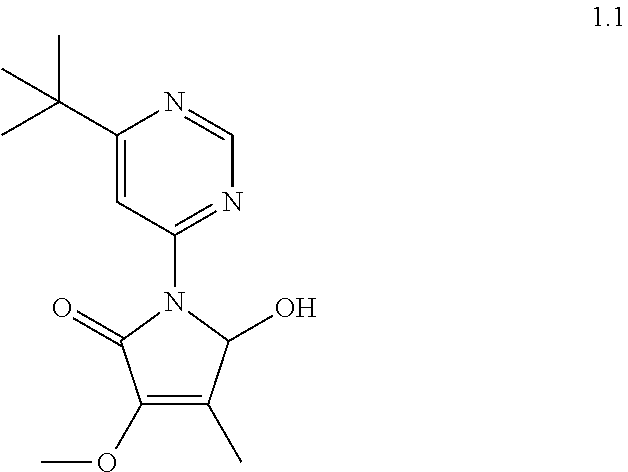

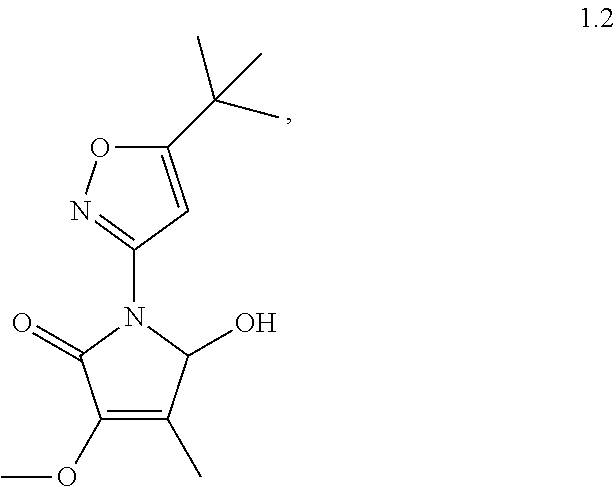
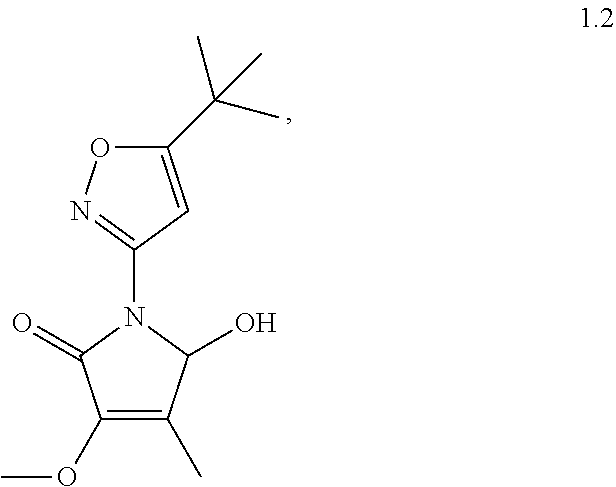
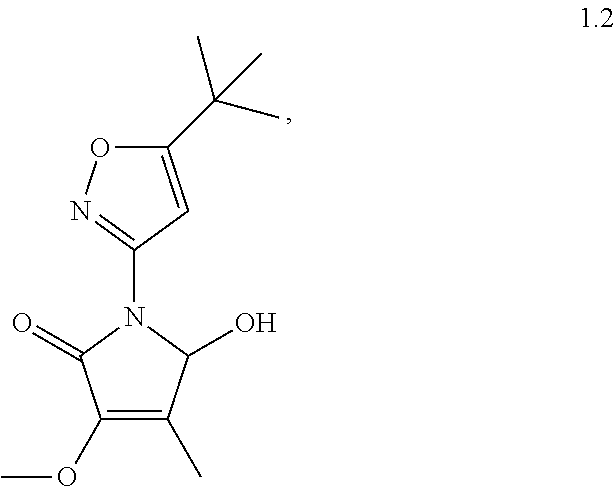

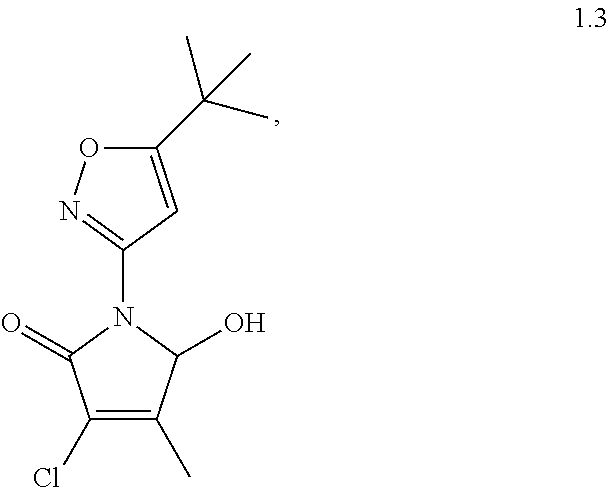

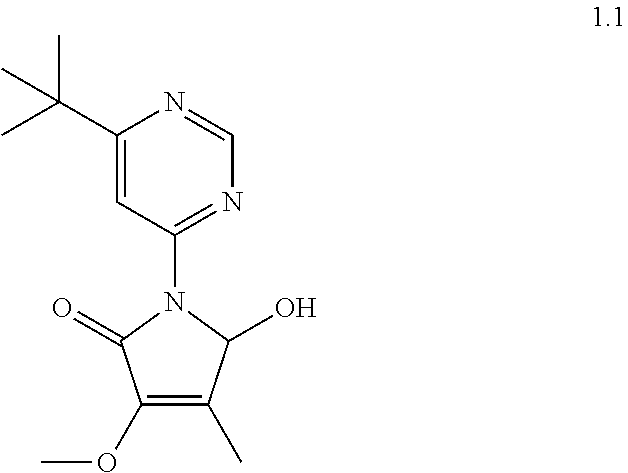
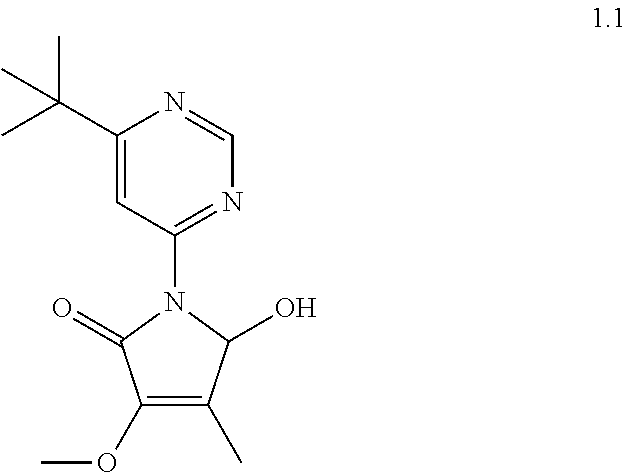
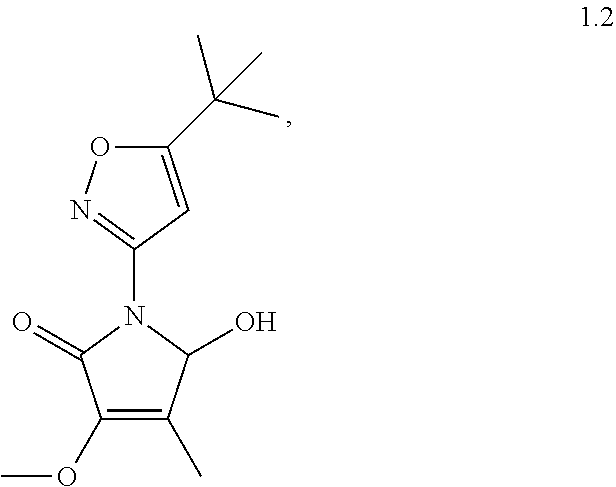
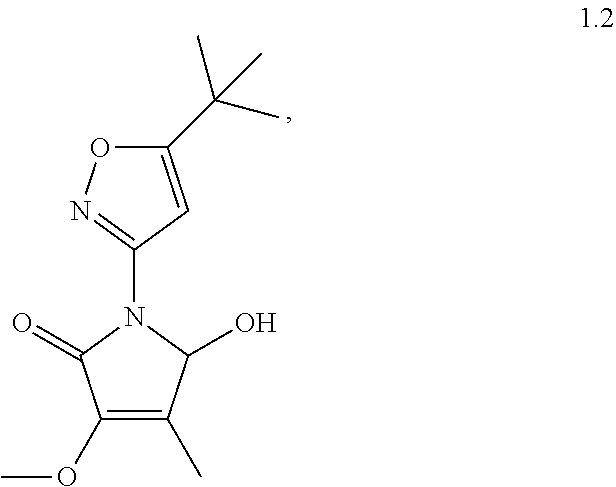
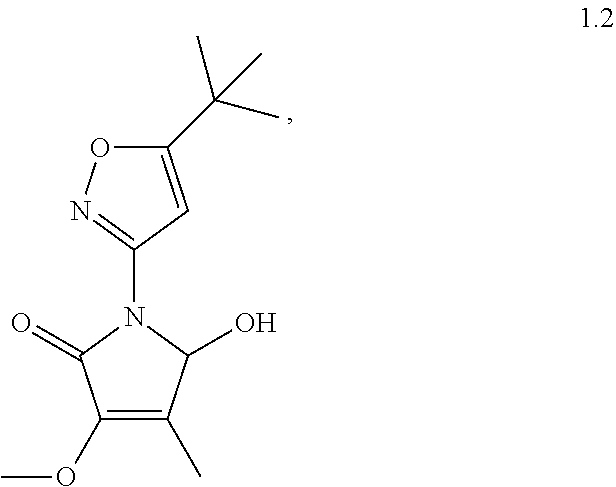

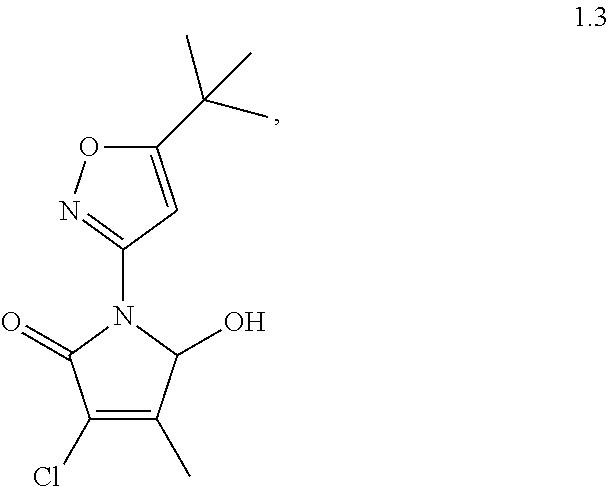
Applications Claiming Priority (3)
| Application Number | Priority Date | Filing Date | Title |
|---|---|---|---|
| GB1505740.9 | 2015-04-02 | ||
| GBGB1505740.9A GB201505740D0 (en) | 2015-04-02 | 2015-04-02 | Herbicidal mixtures |
| PCT/EP2016/056631 WO2016156241A1 (en) | 2015-04-02 | 2016-03-24 | Herbicidal mixtures |
Publications (2)
| Publication Number | Publication Date |
|---|---|
| US20180084778A1 US20180084778A1 (en) | 2018-03-29 |
| US10512264B2 true US10512264B2 (en) | 2019-12-24 |
Family
ID=53190132
Family Applications (1)
| Application Number | Title | Priority Date | Filing Date |
|---|---|---|---|
| US15/562,652 Expired - Fee Related US10512264B2 (en) | 2015-04-02 | 2016-03-24 | Herbicidal mixtures |
Country Status (5)
| Country | Link |
|---|---|
| US (1) | US10512264B2 (en) |
| EP (1) | EP3277089A1 (en) |
| AR (1) | AR104272A1 (en) |
| GB (1) | GB201505740D0 (en) |
| WO (1) | WO2016156241A1 (en) |
Cited By (1)
| Publication number | Priority date | Publication date | Assignee | Title |
|---|---|---|---|---|
| US20250000090A1 (en) * | 2021-10-15 | 2025-01-02 | Syngenta Crop Protection Ag | Composition |
Families Citing this family (60)
| Publication number | Priority date | Publication date | Assignee | Title |
|---|---|---|---|---|
| WO2018108612A1 (en) | 2016-12-14 | 2018-06-21 | Basf Se | Herbicidal compositions comprising isoxazolo[5,4-b]pyridines |
| UY37588A (en) | 2017-01-31 | 2018-11-30 | Upl Ltd | HERBICIDE COMBINATIONS CONTAINING SAFLUFENACILO |
| EP3654770A1 (en) | 2017-07-18 | 2020-05-27 | Helm AG | Herbicidal composition comprising mesotrione and pyridate and method of use thereof |
| KR102727205B1 (en) | 2018-05-15 | 2024-11-06 | 바스프 에스이 | Mixtures containing benzpyrimoxane and oxazosulpirin, uses thereof and methods of application thereof |
| US20220132854A1 (en) | 2019-02-19 | 2022-05-05 | Gowan Company, L.L.C. | Stable liquid compositions and methods of using the same |
| BR112022017563A2 (en) | 2020-03-04 | 2022-10-18 | Basf Se | USE OF COMPOUNDS, AGROCHEMICAL COMPOSITION AND METHOD TO FIGHT HARMFUL PHYTOPATOGENIC FUNGI |
| EP3903581A1 (en) | 2020-04-28 | 2021-11-03 | Basf Se | Use of strobilurin type compounds for combating phytopathogenic fungi containing an amino acid substitution f129l in the mitochondrial cytochrome b protein conferring resistance to qo inhibitors i |
| EP3903584A1 (en) | 2020-04-28 | 2021-11-03 | Basf Se | Use of strobilurin type compounds for combating phytopathogenic fungi containing an amino acid substitution f129l in the mitochondrial cytochrome b protein conferring resistance to qo inhibitors iv |
| EP3903583A1 (en) | 2020-04-28 | 2021-11-03 | Basf Se | Use of strobilurin type compounds for combating phytopathogenic fungi containing an amino acid substitution f129l in the mitochondrial cytochrome b protein conferring resistance to qo inhibitors iii |
| EP3903582A1 (en) | 2020-04-28 | 2021-11-03 | Basf Se | Use of strobilurin type compounds for combating phytopathogenic fungi containing an amino acid substitution f129l in the mitochondrial cytochrome b protein conferring resistance to qo inhibitors ii |
| EP3945089A1 (en) | 2020-07-31 | 2022-02-02 | Basf Se | Use of strobilurin type compounds for combating phytopathogenic fungi containing an amino acid substitution f129l in the mitochondrial cytochrome b protein conferring resistance to qo inhibitors v |
| WO2021249800A1 (en) | 2020-06-10 | 2021-12-16 | Basf Se | Substituted [1,2,4]triazole compounds as fungicides |
| EP3960727A1 (en) | 2020-08-28 | 2022-03-02 | Basf Se | Use of strobilurin type compounds for combating phytopathogenic fungi containing an amino acid substitution f129l in the mitochondrial cytochrome b protein conferring resistance to qo inhibitors vi |
| EP3939961A1 (en) | 2020-07-16 | 2022-01-19 | Basf Se | Strobilurin type compounds and their use for combating phytopathogenic fungi |
| WO2022017836A1 (en) | 2020-07-20 | 2022-01-27 | BASF Agro B.V. | Fungicidal compositions comprising (r)-2-[4-(4-chlorophenoxy)-2-(trifluoromethyl)phenyl]-1- (1,2,4-triazol-1-yl)propan-2-ol |
| EP3970494A1 (en) | 2020-09-21 | 2022-03-23 | Basf Se | Use of strobilurin type compounds for combating phytopathogenic fungi containing an amino acid substitution f129l in the mitochondrial cytochrome b protein conferring resistance to qo inhibitors viii |
| US20230397607A1 (en) | 2020-10-27 | 2023-12-14 | BASF Agro B.V. | Compositions comprising mefentrifluconazole |
| WO2022090069A1 (en) | 2020-11-02 | 2022-05-05 | Basf Se | Compositions comprising mefenpyr-diethyl |
| WO2022090071A1 (en) | 2020-11-02 | 2022-05-05 | Basf Se | Use of mefenpyr-diethyl for controlling phytopathogenic fungi |
| WO2022106304A1 (en) | 2020-11-23 | 2022-05-27 | BASF Agro B.V. | Compositions comprising mefentrifluconazole |
| EP4018830A1 (en) | 2020-12-23 | 2022-06-29 | Basf Se | Pesticidal mixtures |
| CN115067349A (en) * | 2021-03-11 | 2022-09-20 | 青岛清原化合物有限公司 | Weeding composition containing nicosulfuron and ametryn and application thereof |
| BR112023023592A2 (en) | 2021-05-11 | 2024-03-12 | Basf Se | FUNGICIDAL MIXTURE, AGROCHEMICAL COMPOSITION, USE OF THE MIXTURE AND METHOD TO CONTROL HARMFUL PHYTOPATHOGENIC FUNGI |
| CN117355520A (en) | 2021-05-18 | 2024-01-05 | 巴斯夫欧洲公司 | New substituted quinolines for use as fungicides |
| US20240270727A1 (en) | 2021-05-18 | 2024-08-15 | Basf Se | New substituted pyridines as fungicide |
| WO2022243107A1 (en) | 2021-05-18 | 2022-11-24 | Basf Se | New substituted pyridines as fungicides |
| EP4094579A1 (en) | 2021-05-28 | 2022-11-30 | Basf Se | Pesticidal mixtures comprising metyltetraprole |
| US20250019361A1 (en) | 2021-08-02 | 2025-01-16 | Basf Se | (3-quinolyl)-quinazoline |
| AU2022321882A1 (en) | 2021-08-02 | 2024-02-15 | Basf Se | (3-pirydyl)-quinazoline |
| WO2023072670A1 (en) | 2021-10-28 | 2023-05-04 | Basf Se | Use of strobilurin type compounds for combating phytopathogenic fungi containing an amino acid substitution f129l in the mitochondrial cytochrome b protein conferring resistance to qo inhibitors x |
| WO2023072671A1 (en) | 2021-10-28 | 2023-05-04 | Basf Se | Use of strobilurin type compounds for combating phytopathogenic fungi containing an amino acid substitution f129l in the mitochondrial cytochrome b protein conferring resistance to qo inhibitors ix |
| EP4198023A1 (en) | 2021-12-16 | 2023-06-21 | Basf Se | Pesticidally active thiosemicarbazone compounds |
| EP4342885A1 (en) | 2022-09-20 | 2024-03-27 | Basf Se | N-(3-(aminomethyl)-phenyl)-5-(4-phenyl)-5-(trifluoromethyl)-4,5-dihydroisoxazol-3-amine derivatives and similar compounds as pesticides |
| EP4361126A1 (en) | 2022-10-24 | 2024-05-01 | Basf Se | Use of strobilurin type compounds for combating phytopathogenic fungi containing an amino acid substitution f129l in the mitochondrial cytochrome b protein conferring resistance to qo inhibitors xv |
| CN120202195A (en) | 2022-11-16 | 2025-06-24 | 巴斯夫欧洲公司 | Substituted benzodiazepines as fungicides |
| WO2024104822A1 (en) | 2022-11-16 | 2024-05-23 | Basf Se | Substituted tetrahydrobenzodiazepine as fungicides |
| EP4619393A1 (en) | 2022-11-16 | 2025-09-24 | Basf Se | Substituted benzodiazepines as fungicides |
| EP4619399A1 (en) | 2022-11-16 | 2025-09-24 | Basf Se | New substituted tetrahydrobenzoxazepine |
| EP4389210A1 (en) | 2022-12-21 | 2024-06-26 | Basf Se | Heteroaryl compounds for the control of invertebrate pests |
| WO2024165343A1 (en) | 2023-02-08 | 2024-08-15 | Basf Se | New substituted quinoline compounds for combatitng phytopathogenic fungi |
| AU2024238668A1 (en) | 2023-03-17 | 2025-09-25 | Basf Se | Substituted pyridyl/pyrazidyl dihydrobenzothiazepine compounds for combatting phytopathogenic fungi |
| EP4455137A1 (en) | 2023-04-24 | 2024-10-30 | Basf Se | Pyrimidine compounds for the control of invertebrate pests |
| CN121335882A (en) | 2023-04-26 | 2026-01-13 | 巴斯夫欧洲公司 | The use of umbelliferone-type compounds to combat plant pathogenic fungi containing amino acid substitutions in mitochondrial cytochrome b proteins that confer resistance to the Qo inhibitor XVI, specifically F129L. |
| EP4467535A1 (en) | 2023-05-25 | 2024-11-27 | Basf Se | Lactam pesticidal compounds |
| WO2025008227A1 (en) | 2023-07-05 | 2025-01-09 | Basf Se | Substituted pyridyl/pyrazinyl dihydropyrrolotriazine compounds for combatting phytopath-ogenic fungi |
| WO2025008226A1 (en) | 2023-07-05 | 2025-01-09 | Basf Se | Substituted quinolyl/quinoxalyl dihydropyrrolotriazine compounds for combatting phyto-pathogenic fungi |
| EP4488269A1 (en) | 2023-07-06 | 2025-01-08 | Basf Se | Triazole compounds for the control of invertebrate pests |
| EP4488273A1 (en) | 2023-07-06 | 2025-01-08 | Basf Se | Triazole compounds for the control of invertebrate pests |
| EP4488270A1 (en) | 2023-07-06 | 2025-01-08 | Basf Se | Triazole compounds for the control of invertebrate pests |
| WO2025031843A1 (en) | 2023-08-09 | 2025-02-13 | Basf Se | New substituted benzoxazine picolinonitrile compounds for combatting phytopathogenic fungi |
| WO2025031842A1 (en) | 2023-08-09 | 2025-02-13 | Basf Se | New substituted benzoxazepine picolinonitrile compounds for combatting phytopathogenic fungi |
| EP4574819A1 (en) | 2023-12-22 | 2025-06-25 | Basf Se | Diazinone compounds for the control of invertebrate pests |
| WO2025180964A1 (en) | 2024-03-01 | 2025-09-04 | Basf Se | New substituted benzoxazepine compounds for combatting phytopathogenic fungi |
| EP4640052A1 (en) | 2024-04-24 | 2025-10-29 | Basf Se | Mixtures of strobilurin type compounds for combating phytopathogenic fungi containing an amino acid substitution f129l in the mitochondrial cytochrome b protein conferring resistance to qo inhibitors with at least one further pesticide i |
| WO2025223904A1 (en) | 2024-04-24 | 2025-10-30 | Basf Se | Mixtures of strobilurin type compounds for combating phytopathogenic fungi containing an amino acid substitution f129l in the mitochondrial cytochrome b protein conferring resistance to qo inhibitors with at least one further pesticide i |
| WO2026012814A1 (en) | 2024-07-10 | 2026-01-15 | Basf Se | Compositions and methods to enhance crop yield and plant health |
| WO2026021910A1 (en) | 2024-07-23 | 2026-01-29 | Basf Se | New substituted benzothiazine pyridine compounds for combatting phytopathogenic fungi |
| WO2026021909A1 (en) | 2024-07-23 | 2026-01-29 | Basf Se | New substituted benzothiazine pyridine compounds for combatting phytopathogenic fungi |
| WO2026021911A1 (en) | 2024-07-23 | 2026-01-29 | Basf Se | New substituted benzothiazine pyridine compounds for combatting phytopathogenic fungi |
| WO2026021912A1 (en) | 2024-07-23 | 2026-01-29 | Basf Se | New substituted benzothiazine pyridine compounds for combatting phytopathogenic fungi |
Citations (3)
| Publication number | Priority date | Publication date | Assignee | Title |
|---|---|---|---|---|
| WO2014180740A1 (en) | 2013-05-08 | 2014-11-13 | Syngenta Participations Ag | Herbicidal compounds |
| WO2015018431A1 (en) | 2013-08-05 | 2015-02-12 | Syngenta Participations Ag | Pyrazolyl pyrrolinones and their use as herbicides |
| WO2015018434A1 (en) | 2013-08-05 | 2015-02-12 | Syngenta Participations Ag | Pyrazolyl pyrrolinones and their use as herbicides |
-
2015
- 2015-04-02 GB GBGB1505740.9A patent/GB201505740D0/en not_active Ceased
-
2016
- 2016-03-24 WO PCT/EP2016/056631 patent/WO2016156241A1/en not_active Ceased
- 2016-03-24 US US15/562,652 patent/US10512264B2/en not_active Expired - Fee Related
- 2016-03-24 EP EP16714342.9A patent/EP3277089A1/en not_active Withdrawn
- 2016-04-01 AR ARP160100877A patent/AR104272A1/en unknown
Patent Citations (4)
| Publication number | Priority date | Publication date | Assignee | Title |
|---|---|---|---|---|
| WO2014180740A1 (en) | 2013-05-08 | 2014-11-13 | Syngenta Participations Ag | Herbicidal compounds |
| US9936701B2 (en) * | 2013-05-08 | 2018-04-10 | Syngenta Limited | Herbicidal compounds |
| WO2015018431A1 (en) | 2013-08-05 | 2015-02-12 | Syngenta Participations Ag | Pyrazolyl pyrrolinones and their use as herbicides |
| WO2015018434A1 (en) | 2013-08-05 | 2015-02-12 | Syngenta Participations Ag | Pyrazolyl pyrrolinones and their use as herbicides |
Non-Patent Citations (1)
| Title |
|---|
| Notification of Transmittal of the International Search Report for International Application No. PCT/EP2016/056631 dated May 23, 2017. |
Cited By (1)
| Publication number | Priority date | Publication date | Assignee | Title |
|---|---|---|---|---|
| US20250000090A1 (en) * | 2021-10-15 | 2025-01-02 | Syngenta Crop Protection Ag | Composition |
Also Published As
| Publication number | Publication date |
|---|---|
| EP3277089A1 (en) | 2018-02-07 |
| AR104272A1 (en) | 2017-07-12 |
| WO2016156241A1 (en) | 2016-10-06 |
| US20180084778A1 (en) | 2018-03-29 |
| GB201505740D0 (en) | 2015-05-20 |
Similar Documents
| Publication | Publication Date | Title |
|---|---|---|
| US10512264B2 (en) | Herbicidal mixtures | |
| WO2016162265A1 (en) | Herbicidal mixtures | |
| US20200010444A1 (en) | Herbicidal mixtures | |
| WO2020234422A1 (en) | Herbicidal compositions | |
| AU2024224570A1 (en) | Herbicidal compositions | |
| KR20230091113A (en) | Mixtures of pyrimidines as herbicidal compositions | |
| AU2022274138B2 (en) | Herbicidal compositions | |
| US20200010443A1 (en) | Herbicidal mixtures | |
| WO2024132649A1 (en) | Herbicidal compositions | |
| WO2024175475A1 (en) | Herbicidal compositions | |
| WO2025016885A1 (en) | Herbicidal compositions | |
| AU2024293377A1 (en) | Herbicidal compositions | |
| US20260026505A1 (en) | Herbicidal compositions | |
| KR20230091112A (en) | A mixture of pyridazine as a herbicidal composition |
Legal Events
| Date | Code | Title | Description |
|---|---|---|---|
| FEPP | Fee payment procedure |
Free format text: ENTITY STATUS SET TO UNDISCOUNTED (ORIGINAL EVENT CODE: BIG.); ENTITY STATUS OF PATENT OWNER: LARGE ENTITY |
|
| AS | Assignment |
Owner name: SYNGENTA PARTICIPATIONS AG, SWITZERLAND Free format text: ASSIGNMENT OF ASSIGNORS INTEREST;ASSIGNORS:MORRIS, JAMES ALAN;BOEHMER, JUTTA ELISABETH;WHITTINGHAM, WILLIAM GUY;AND OTHERS;SIGNING DATES FROM 20160104 TO 20160523;REEL/FRAME:045169/0687 |
|
| STPP | Information on status: patent application and granting procedure in general |
Free format text: RESPONSE TO NON-FINAL OFFICE ACTION ENTERED AND FORWARDED TO EXAMINER |
|
| STPP | Information on status: patent application and granting procedure in general |
Free format text: FINAL REJECTION MAILED |
|
| STPP | Information on status: patent application and granting procedure in general |
Free format text: RESPONSE AFTER FINAL ACTION FORWARDED TO EXAMINER |
|
| STPP | Information on status: patent application and granting procedure in general |
Free format text: NOTICE OF ALLOWANCE MAILED -- APPLICATION RECEIVED IN OFFICE OF PUBLICATIONS |
|
| STPP | Information on status: patent application and granting procedure in general |
Free format text: PUBLICATIONS -- ISSUE FEE PAYMENT VERIFIED |
|
| STCF | Information on status: patent grant |
Free format text: PATENTED CASE |
|
| FEPP | Fee payment procedure |
Free format text: MAINTENANCE FEE REMINDER MAILED (ORIGINAL EVENT CODE: REM.); ENTITY STATUS OF PATENT OWNER: LARGE ENTITY |
|
| LAPS | Lapse for failure to pay maintenance fees |
Free format text: PATENT EXPIRED FOR FAILURE TO PAY MAINTENANCE FEES (ORIGINAL EVENT CODE: EXP.); ENTITY STATUS OF PATENT OWNER: LARGE ENTITY |
|
| STCH | Information on status: patent discontinuation |
Free format text: PATENT EXPIRED DUE TO NONPAYMENT OF MAINTENANCE FEES UNDER 37 CFR 1.362 |
|
| FP | Lapsed due to failure to pay maintenance fee |
Effective date: 20231224 |