US10143405B2 - Wearable performance monitoring, analysis, and feedback systems and methods - Google Patents
Wearable performance monitoring, analysis, and feedback systems and methods Download PDFInfo
- Publication number
- US10143405B2 US10143405B2 US14/079,621 US201314079621A US10143405B2 US 10143405 B2 US10143405 B2 US 10143405B2 US 201314079621 A US201314079621 A US 201314079621A US 10143405 B2 US10143405 B2 US 10143405B2
- Authority
- US
- United States
- Prior art keywords
- user
- garment
- sensors
- muscles
- activity
- Prior art date
- Legal status (The legal status is an assumption and is not a legal conclusion. Google has not performed a legal analysis and makes no representation as to the accuracy of the status listed.)
- Active, expires
Links
Images


Classifications
-
- A—HUMAN NECESSITIES
- A61—MEDICAL OR VETERINARY SCIENCE; HYGIENE
- A61B—DIAGNOSIS; SURGERY; IDENTIFICATION
- A61B5/00—Measuring for diagnostic purposes; Identification of persons
- A61B5/103—Measuring devices for testing the shape, pattern, colour, size or movement of the body or parts thereof, for diagnostic purposes
- A61B5/11—Measuring movement of the entire body or parts thereof, e.g. head or hand tremor or mobility of a limb
- A61B5/1118—Determining activity level
-
- A—HUMAN NECESSITIES
- A41—WEARING APPAREL
- A41D—OUTERWEAR; PROTECTIVE GARMENTS; ACCESSORIES
- A41D1/00—Garments
- A41D1/04—Vests, jerseys, sweaters or the like
-
- A—HUMAN NECESSITIES
- A61—MEDICAL OR VETERINARY SCIENCE; HYGIENE
- A61B—DIAGNOSIS; SURGERY; IDENTIFICATION
- A61B5/00—Measuring for diagnostic purposes; Identification of persons
- A61B5/0002—Remote monitoring of patients using telemetry, e.g. transmission of vital signals via a communication network
- A61B5/0004—Remote monitoring of patients using telemetry, e.g. transmission of vital signals via a communication network characterised by the type of physiological signal transmitted
-
- A—HUMAN NECESSITIES
- A61—MEDICAL OR VETERINARY SCIENCE; HYGIENE
- A61B—DIAGNOSIS; SURGERY; IDENTIFICATION
- A61B5/00—Measuring for diagnostic purposes; Identification of persons
- A61B5/0002—Remote monitoring of patients using telemetry, e.g. transmission of vital signals via a communication network
- A61B5/0015—Remote monitoring of patients using telemetry, e.g. transmission of vital signals via a communication network characterised by features of the telemetry system
-
- A—HUMAN NECESSITIES
- A61—MEDICAL OR VETERINARY SCIENCE; HYGIENE
- A61B—DIAGNOSIS; SURGERY; IDENTIFICATION
- A61B5/00—Measuring for diagnostic purposes; Identification of persons
- A61B5/0002—Remote monitoring of patients using telemetry, e.g. transmission of vital signals via a communication network
- A61B5/0015—Remote monitoring of patients using telemetry, e.g. transmission of vital signals via a communication network characterised by features of the telemetry system
- A61B5/0022—Monitoring a patient using a global network, e.g. telephone networks, internet
-
- A61B5/0402—
-
- A61B5/0488—
-
- A61B5/0492—
-
- A—HUMAN NECESSITIES
- A61—MEDICAL OR VETERINARY SCIENCE; HYGIENE
- A61B—DIAGNOSIS; SURGERY; IDENTIFICATION
- A61B5/00—Measuring for diagnostic purposes; Identification of persons
- A61B5/24—Detecting, measuring or recording bioelectric or biomagnetic signals of the body or parts thereof
- A61B5/25—Bioelectric electrodes therefor
- A61B5/279—Bioelectric electrodes therefor specially adapted for particular uses
- A61B5/296—Bioelectric electrodes therefor specially adapted for particular uses for electromyography [EMG]
-
- A—HUMAN NECESSITIES
- A61—MEDICAL OR VETERINARY SCIENCE; HYGIENE
- A61B—DIAGNOSIS; SURGERY; IDENTIFICATION
- A61B5/00—Measuring for diagnostic purposes; Identification of persons
- A61B5/68—Arrangements of detecting, measuring or recording means, e.g. sensors, in relation to patient
- A61B5/6801—Arrangements of detecting, measuring or recording means, e.g. sensors, in relation to patient specially adapted to be attached to or worn on the body surface
- A61B5/6802—Sensor mounted on worn items
- A61B5/6804—Garments; Clothes
-
- A—HUMAN NECESSITIES
- A61—MEDICAL OR VETERINARY SCIENCE; HYGIENE
- A61B—DIAGNOSIS; SURGERY; IDENTIFICATION
- A61B5/00—Measuring for diagnostic purposes; Identification of persons
- A61B5/68—Arrangements of detecting, measuring or recording means, e.g. sensors, in relation to patient
- A61B5/6801—Arrangements of detecting, measuring or recording means, e.g. sensors, in relation to patient specially adapted to be attached to or worn on the body surface
- A61B5/6802—Sensor mounted on worn items
- A61B5/6804—Garments; Clothes
- A61B5/6805—Vests, e.g. shirts or gowns
-
- A—HUMAN NECESSITIES
- A61—MEDICAL OR VETERINARY SCIENCE; HYGIENE
- A61B—DIAGNOSIS; SURGERY; IDENTIFICATION
- A61B5/00—Measuring for diagnostic purposes; Identification of persons
- A61B5/68—Arrangements of detecting, measuring or recording means, e.g. sensors, in relation to patient
- A61B5/6801—Arrangements of detecting, measuring or recording means, e.g. sensors, in relation to patient specially adapted to be attached to or worn on the body surface
- A61B5/684—Indicating the position of the sensor on the body
- A61B5/6841—Indicating the position of the sensor on the body by using templates
-
- G06F19/00—
-
- G—PHYSICS
- G09—EDUCATION; CRYPTOGRAPHY; DISPLAY; ADVERTISING; SEALS
- G09B—EDUCATIONAL OR DEMONSTRATION APPLIANCES; APPLIANCES FOR TEACHING, OR COMMUNICATING WITH, THE BLIND, DEAF OR MUTE; MODELS; PLANETARIA; GLOBES; MAPS; DIAGRAMS
- G09B19/00—Teaching not covered by other main groups of this subclass
- G09B19/003—Repetitive work cycles; Sequence of movements
- G09B19/0038—Sports
-
- G—PHYSICS
- G16—INFORMATION AND COMMUNICATION TECHNOLOGY [ICT] SPECIALLY ADAPTED FOR SPECIFIC APPLICATION FIELDS
- G16H—HEALTHCARE INFORMATICS, i.e. INFORMATION AND COMMUNICATION TECHNOLOGY [ICT] SPECIALLY ADAPTED FOR THE HANDLING OR PROCESSING OF MEDICAL OR HEALTHCARE DATA
- G16H40/00—ICT specially adapted for the management or administration of healthcare resources or facilities; ICT specially adapted for the management or operation of medical equipment or devices
- G16H40/60—ICT specially adapted for the management or administration of healthcare resources or facilities; ICT specially adapted for the management or operation of medical equipment or devices for the operation of medical equipment or devices
- G16H40/67—ICT specially adapted for the management or administration of healthcare resources or facilities; ICT specially adapted for the management or operation of medical equipment or devices for the operation of medical equipment or devices for remote operation
-
- A—HUMAN NECESSITIES
- A41—WEARING APPAREL
- A41D—OUTERWEAR; PROTECTIVE GARMENTS; ACCESSORIES
- A41D2500/00—Materials for garments
- A41D2500/50—Synthetic resins or rubbers
- A41D2500/52—Synthetic resins or rubbers in sheet form
-
- A—HUMAN NECESSITIES
- A61—MEDICAL OR VETERINARY SCIENCE; HYGIENE
- A61B—DIAGNOSIS; SURGERY; IDENTIFICATION
- A61B2503/00—Evaluating a particular growth phase or type of persons or animals
- A61B2503/10—Athletes
-
- A—HUMAN NECESSITIES
- A61—MEDICAL OR VETERINARY SCIENCE; HYGIENE
- A61B—DIAGNOSIS; SURGERY; IDENTIFICATION
- A61B2560/00—Constructional details of operational features of apparatus; Accessories for medical measuring apparatus
- A61B2560/02—Operational features
- A61B2560/0223—Operational features of calibration, e.g. protocols for calibrating sensors
-
- A—HUMAN NECESSITIES
- A61—MEDICAL OR VETERINARY SCIENCE; HYGIENE
- A61B—DIAGNOSIS; SURGERY; IDENTIFICATION
- A61B2562/00—Details of sensors; Constructional details of sensor housings or probes; Accessories for sensors
- A61B2562/02—Details of sensors specially adapted for in-vivo measurements
- A61B2562/0209—Special features of electrodes classified in A61B5/24, A61B5/25, A61B5/283, A61B5/291, A61B5/296, A61B5/053
-
- A—HUMAN NECESSITIES
- A61—MEDICAL OR VETERINARY SCIENCE; HYGIENE
- A61B—DIAGNOSIS; SURGERY; IDENTIFICATION
- A61B2562/00—Details of sensors; Constructional details of sensor housings or probes; Accessories for sensors
- A61B2562/18—Shielding or protection of sensors from environmental influences, e.g. protection from mechanical damage
-
- A—HUMAN NECESSITIES
- A61—MEDICAL OR VETERINARY SCIENCE; HYGIENE
- A61B—DIAGNOSIS; SURGERY; IDENTIFICATION
- A61B5/00—Measuring for diagnostic purposes; Identification of persons
- A61B5/02—Detecting, measuring or recording for evaluating the cardiovascular system, e.g. pulse, heart rate, blood pressure or blood flow
- A61B5/0205—Simultaneously evaluating both cardiovascular conditions and different types of body conditions, e.g. heart and respiratory condition
- A61B5/02055—Simultaneously evaluating both cardiovascular condition and temperature
-
- A61B5/04004—
-
- A—HUMAN NECESSITIES
- A61—MEDICAL OR VETERINARY SCIENCE; HYGIENE
- A61B—DIAGNOSIS; SURGERY; IDENTIFICATION
- A61B5/00—Measuring for diagnostic purposes; Identification of persons
- A61B5/24—Detecting, measuring or recording bioelectric or biomagnetic signals of the body or parts thereof
- A61B5/30—Input circuits therefor
-
- A—HUMAN NECESSITIES
- A63—SPORTS; GAMES; AMUSEMENTS
- A63B—APPARATUS FOR PHYSICAL TRAINING, GYMNASTICS, SWIMMING, CLIMBING, OR FENCING; BALL GAMES; TRAINING EQUIPMENT
- A63B24/00—Electric or electronic controls for exercising apparatus of preceding groups; Controlling or monitoring of exercises, sportive games, training or athletic performances
- A63B24/0003—Analysing the course of a movement or motion sequences during an exercise or trainings sequence, e.g. swing for golf or tennis
- A63B24/0006—Computerised comparison for qualitative assessment of motion sequences or the course of a movement
- A63B2024/0009—Computerised real time comparison with previous movements or motion sequences of the user
-
- A—HUMAN NECESSITIES
- A63—SPORTS; GAMES; AMUSEMENTS
- A63B—APPARATUS FOR PHYSICAL TRAINING, GYMNASTICS, SWIMMING, CLIMBING, OR FENCING; BALL GAMES; TRAINING EQUIPMENT
- A63B24/00—Electric or electronic controls for exercising apparatus of preceding groups; Controlling or monitoring of exercises, sportive games, training or athletic performances
- A63B24/0075—Means for generating exercise programs or schemes, e.g. computerized virtual trainer, e.g. using expert databases
- A63B2024/0078—Exercise efforts programmed as a function of time
Definitions
- the present application relates generally to computer software, mobile electronics, wireless communication links, and wearable monitoring systems. More specifically, techniques, systems, sensors, circuitry, algorithms and methods for wearable monitoring devices and associated exercise apparatus are described.
- ECG electrocardiogram
- a plurality of ECG electrodes may be adhesively attached to the skin of the human test subject in order to record information pertaining to the heart.
- the measured bio-potential information indicative of the heart functions may typically be recorded on ECG graph paper or stored in computer memory for later analysis.
- ECG electrodes may be formed of a conductive gel embedded in an adhesive pad onto which a cable is coupled. Examples include an adhesive conductive hydrogel formed over a conductive rigid sensor to which the cable is coupled or otherwise attached. ECG electrodes may be adhesively attached to different locations on the skin of the human test subject to obtain heart-related information from different angles (e.g., left arm, right arm, left leg, etc.).
- the electrical signals obtained by the ECG electrodes may then be interpreted by a knowledgeable expert to obtain certain information pertaining to the heart functions (e.g., heart rate (HR), heart rhythm, etc.) as well as to detect symptoms of pathological conditions (e.g., hypocalcaemia, coronary ischemic, hypokalemia, myocardial infarction, etc.), for example.
- HR heart rate
- pathological conditions e.g., hypocalcaemia, coronary ischemic, hypokalemia, myocardial infarction, etc.
- Gel-based and/or adhesive-based electrodes may be unsuitable for long-term monitoring applications.
- gel-based and/or adhesive-based electrodes tend to dry out over time and thus tend to be one-time-use-only devices.
- gel-based and/or adhesive-based electrodes such as those employing Silver-Silver chloride (Ag/AgCl) electrodes, may cause skin irritation to some human subjects, especially if those electrodes are used over a long period of time.
- the expertise and/or dexterity required to adhesively attach the gel-based and/or adhesive-based electrodes at various specific locations on the body often requires the use of an expert human assistant. The need for such expert involvement may be inconvenient and/or awkward for the user, and may drive up the cost associated with long-term monitoring.
- gel-based and/or adhesive-based electrodes may also render gel-based and/or adhesive-based electrodes unsuitable for use in the consumer market.
- consumers may be resistant to purchasing, using, and discarding one-time-use gel-based and/or adhesive-based electrodes due to cost concerns and/or environmental impact concerns.
- the attachment of gel-based and/or adhesive-based electrodes at specific locations on the skin may be intimidating and time-consuming to an average consumer and may require a level of expertise and/or dexterity that an unaided consumer typically may not possess.
- dry electrodes have been proposed as an alternative electrode that addresses the aforementioned shortcomings of gel-based and/or adhesive-based electrodes.
- dry electrodes may be based on conductive rubber rather than gel or adhesive
- dry electrodes typically do not dry out like typical gel-based and/or adhesive-based electrodes. Skin compatibility and reusability may be greatly enhanced by using dry electrodes.
- SPCDs smart personal communication devices
- processing e.g., multiple core and/or faster processors
- communication capabilities e.g., WiFi, Bluetooth, NFC, Cellular, 2G, 3G, 4G, and 5G
- SPCDs smart personal communication devices
- SPCDs have been widely adopted by consumers and are ubiquitous in the consumer market.
- SPCDs incorporating both cellular telephony capability and computer-like data processing and communication capabilities have been widely adopted by consumers for communication, work, Internet surfing, health, personal fitness, and entertainment (e.g., movie watching, gaming, streaming media, social and professional networking, etc.).
- SPCDs examples include smart phones and tablets incorporating operating systems such as iOSTM (available from Apple, Inc. of Cupertino, Calif.), AndroidTM (available from Google, Inc. of Mountain View, Calif.), WindowsTM (available from Microsoft Corporation of Redmond, Wash.), and the like.
- Operating systems such as iOSTM (available from Apple, Inc. of Cupertino, Calif.), AndroidTM (available from Google, Inc. of Mountain View, Calif.), WindowsTM (available from Microsoft Corporation of Redmond, Wash.), and the like.
- Well-known contemporary brands of smart phones and tablets include, for example, iPhoneTM, iPadTM, Samsung GalaxyTM, Motorola DroidTM BlackBerryTM, etc.
- SPCDs are now ubiquitous and possess powerful communication and processing capabilities. The popularity and utility of SPCD's have resulted in them being carried by their users at all times or at least being kept nearby and ready for use.
- FIG. 1A depicted an example of a simplified representation of various components of a textile-based human monitoring, analysis, and feedback (MAF) system;
- MAF human monitoring, analysis, and feedback
- FIG. 1B one example of various components of the textile-based human MAF system depicted in FIG. 1A ;
- FIG. 2 depicts an example use scenario for the textile-based human MAF system depicted in FIG. 1A .
- Various embodiments or examples may be implemented in numerous ways, including as a system, a process, an apparatus, a user interface, or a series of program instructions disposed in a non-transitory computer readable medium such as a computer readable storage medium (e.g., RAM, SRAM, DRAM, ROM, Cache, Register, Flash, SSD, HHD, Volatile memory, Non-volatile memory, Optical media, Magnetic media, etc.) or a computer network where the program instructions are sent over optical, electronic, or wireless communication links.
- a computer readable storage medium e.g., RAM, SRAM, DRAM, ROM, Cache, Register, Flash, SSD, HHD, Volatile memory, Non-volatile memory, Optical media, Magnetic media, etc.
- a computer network where the program instructions are sent over optical, electronic, or wireless communication links.
- operations of disclosed processes may be performed in an arbitrary order, unless otherwise provided in the claims.
- the described techniques may be implemented as a computer program or application (“application”) or as a plug-in, module, or sub-component of another application.
- application may be implemented as software, hardware, firmware, circuitry, Integrated Circuit (IC), ASIC, FPGA, or a combination thereof.
- the described techniques may be implemented using various types of programming, development, scripting, or formatting languages, frameworks, syntax, applications, protocols, objects, compilers, or techniques, including but not limited to ASP, ASP.net, .Net framework, Ruby, Ruby on Rails, C, Objective C, C++, C#, Adobe® Integrated RuntimeTM (Adobe® AIRTM), ActionScriptTM, FlexTM LingoTM, JavaTM, JavascriptTM, Ajax, Perl, COBOL, Fortran, ADA, XML, MXML, HTML, DHTML, XHTML, HTTP, XMPP, PHP, an objected oriented language, and others.
- Database management systems i.e., “DBMS”
- search facilities and platforms i.e., web crawlers
- web crawlers i.e., computer programs that automatically or semi-automatically visit, index, archive or copy content from, various websites (hereafter referred to as “crawlers”)
- other features may be implemented using various types of proprietary or open source technologies, including MySQL, Oracle (from Oracle of Redwood Shores, Calif.), Solr and Nutch from The Apache Software Foundation of Forest Hill, Md., among others and without limitation.
- the described techniques may be varied and are not limited to the examples or descriptions provided.
- a form-fitting sensor garment may include at least one sensor (e.g., a bio-potential sensor) and associated processing and communications electronics.
- the one or more sensors may be washable sensors that may be borne or otherwise coupled with a garment and configured to be unaffected and/or undamaged by washing or otherwise cleaning or maintaining the garment.
- One or more form-fitting sensor garments may be made to be conformal to any part of the human body as desired.
- one or more form-fitting sensor garments may be made to be conformal to any part of a structure, such as on the body of a non-human species (e.g., animals, mammals, pets, avian livestock, equine, sea creatures, denizens of the deep, etc.), for example.
- a non-human species e.g., animals, mammals, pets, avian livestock, equine, sea creatures, denizens of the deep, etc.
- Stretchable, compressive and form-fitting fabric made of natural or preferably synthetic fibers (e.g., nylon, lycra, polyester, spandex, or other suitable fibers and blends thereof) may be configured to exert a biasing force on the sensors, which are built-in to the form-fitting sensor garment, to bias (e.g., urge into contact) the washable sensors against the skin to maintain good electrical and/or mechanical contact and to reduce motion artifacts that may be caused if there is relative motion between the skin and the sensor(s) (e.g., the sensors and/or skin sliding against each other along their mutual contacting surfaces).
- a biasing force e.g., nylon, lycra, polyester, spandex, or other suitable fibers and blends thereof
- Bioimpedance sensors may include but are not limited to ECG sensors, electromyography (EMG) sensors, respiration, galvanic skin response (GSR), or others. Other types of sensors may also be incorporated into the form-fitting sensor garment. These auxiliary sensors may include but are not limited to accelerometers (single or multi-axis), vibration sensors, GPS sensors, magnetometers, location sensors, galvanic skin response (GSR), bioimpedance, gyroscopes, respiration, heart rate, bend-angle measurement sensors and/or flex angle measurement sensors (e.g., to measure joint angle or joint angles), etc.
- sensors may be incorporated in a permanent manner into the fabric of the form-fitting sensor garment itself or in a detachable manner and/or in pockets or under or on top of flaps if desired.
- the sensors including the non-detachable sensors, are constructed and built such that they can withstand repeated washing and drying cycles typical of wearable clothing.
- the present application describes implementation of a combination of a multitude of sensors including, but not limited to electromyography (EMG), electrocardiograph (ECG), galvanic skin response (GSR), temperature, acceleration, bend angle, etc.
- EMG electromyography
- ECG electrocardiograph
- GSR galvanic skin response
- HR heart rate
- accelerometers e.g., a gyroscope
- sensors may be incorporated into fabric or other material in a semi-permanent manner (using, e.g., loop-and-hook fasteners or other detachable fastening means) to allow re-positioning of the sensors.
- processing electronics may be configured to acquire the sensed signals from the sensors and/or to amplify/filter the sensed signals from the sensors may be incorporated into the form-fitting sensor garment in a permanent or detachable manner.
- the sensors are detachably mounted to the garment to for a purpose including but not limited to repairs, replacement, upgrades, updates to software, sensor calibration, power source maintenance, to install on a different garment, to exchange for another sensor or type of sensor, just to name a few.
- processing electronics may be configured to perform data processing/analysis on the sensed data which are derived from the sensed signals from the electrodes).
- Processing electronics may also be incorporated into the form-fitting sensor garment in a permanent or detachable manner.
- the processing electronics may also include one or more radios for wireless communication with external devices and/or other systems in the garment.
- the processing electronics may comprise a system-on-chip (SoC) that may include one or more radios (e.g., BT, WiFi, NFC, etc.).
- SoC system-on-chip
- the term sensor may include one or more electrodes and associated sensor electronics (e.g., in a processor or other circuitry) electrically coupled with the electrodes and configured to acquire signals from the electrodes and to process the acquired signals in an analog domain, a digital domain or both.
- a sensor may comprise electrodes and associated sensor electronics integrated into a common structure such as an electrode pad, or may comprise electrodes and sensor electronics that are disposed remotely from one another, such as electrodes coupled to a remotely positioned processor (e.g., positioned at another location in the garment) or other circuitry using an electrically conductive structure such as a conductive trace, wire, cable, or the like, for example.
- a remotely positioned processor e.g., positioned at another location in the garment
- an electrically conductive structure such as a conductive trace, wire, cable, or the like, for example.
- communication electronics may be configured to transmit and/or receive information wirelessly and may be incorporated into the form-fitting sensor garment in a permanent or detachable manner.
- a network of signal conductors may be configured to facilitate communication among the sensors and/or communication electronics and/or processing electronics may be permanently incorporated into the fabric of the form-fitting sensor garment.
- a power source such as one or more batteries (which may be rechargeable by various means or may be one-time-use, disposable batteries) may be incorporated into the form-fitting sensor garment in a permanent or detachable manner. If the electronics and/or power source are/is non-detachable, it is preferable that these components are constructed such that they can withstand repeated washing and drying cycles typical of wearable clothing.
- electromyography sensors are described only as an example to facilitate discussion. It should be understood, however, that the present application contemplates that other types of sensor may be implemented additionally and/or alternatively to the electromyography sensors discussed in connection with the examples herein.
- multiple washable electromyography (WE) sensors may be used to measure muscle activity at different sites on the human body.
- the WE sensors may be configured to measure muscle activity associated with different muscles to measure muscle exertion intensity. When groups of muscles are measured together, more complex analysis and feedback may be performed and made available to the user (e.g., wirelessly via an application (APP) running on a smartphone, tablet, pad, or the like).
- APP application
- One example of the complex analysis and feedback possible using multiple WE sensors comprises a bench-press exercise routine because the bench press routine exercises a plurality of different muscles in the human body.
- the bench press routine exercises a plurality of different muscles in the human body.
- information such as whether the human subject is using the proper form, whether a muscle is injured and compensation by one or more other muscles is taking place, whether the user is exercising with the optimal number of repetition and intensity, whether the full range of motion is involved, etc., may be acquired (e.g., from signals from multiple sensors) and provided as instant feedback to the user and/or to adjust the exercise the equipment (e.g., in real time) to optimize the exercise session.
- Other types of sensors such as one or more of the aforementioned bend-angle measurement sensors, GSR, HR, temperature, and accelerometers, for example may also provide information to enrich the analysis and feedback regarding the example bench-press routine.
- the set of WE sensors may be permanently incorporated into the fabric of the form-fitting sensor garment.
- the form-fitting sensor garment may come in various sizes to accommodate various body sizes (e.g., similar to the sizing system currently used with exercise or casual clothing).
- it is recognized that the difference in skin condition and/or subcutaneous fat content from human subject to human subject may give rise to data acquisition error if left uncorrected.
- raw sensor signals acquired from a user with a higher body fat percentage may differ from raw sensor signals acquired from a leaner user even though they both may weigh the same and may fit into the same size garment.
- the subcutaneous fat layer between muscle tissue and skin surface may attenuate an electromyography signal resulting in different acquired amplitudes for different body types.
- the output from the sensor may be calibrated, in one or more embodiments, to improve analysis and feedback accuracy.
- the number of electrodes/sensors that are built into the fabric exceeds the number actually required to obtain the necessary muscle activity data.
- Logic and/or heuristics may be employed to select the sensors that provide the best signals for the group of muscles of interest. This is particularly advantageous since the human subject may position the garment slightly differently at different times or in different work-out sessions. Further, the optimal measurement sites for one user may be different from the optimal measurement sites for other users. Prior to work out, intelligent logics and/or algorithms may be employed to select the optimal group of sensors on the form-fitting sensor garment to use for actual monitoring and analysis.
- the user may be guided to engage in a training or a teaching routine to allow the textile-based MAFS to properly recognize and select the optimal group of sensors on the form-fitting sensor garment to use in the actual monitoring and analysis. Signals from sensors that are not selected may be ignored or given less weight or may be employed in other ways, for example.
- all sensor data from all available sensors may be collected and/or stored (e.g., in memory), and analysis may be performed only on the subset of sensors that are relevant and/or deemed to generate most optimal signals for analysis. In other embodiments, only the relevant subset of sensor data may be collected and/or stored and/or analyzed.
- One or more of the collecting, the storing, or the analyzing may occur internally (e.g., on one or more processors or controllers in the garment), externally (e.g., in an external device such as the SPCD or other wireless device) or both.
- the design of the garment and geometry of the electrodes may be configured to account for variations in user body types and resulting alignment concerns.
- Intuitive features may be added to the garment to ensure proper alignment. These may include, but are not limited to, visible lines, markers and cut-outs for thumb, elbow, etc.
- alignment marks or markers including but not limited to visible lines may provide a guide where the user only needs to ensure the line is straight for proper alignment.
- the electrode geometry may be designed to account for different muscle sizes. In one example, increasing a dimension of the electrode orthogonal to the muscle fiber direction may accommodate varying fiber radii and resulting muscle volume.
- the garment may include designed structures configured to urge and/or force the user to correctly position the garment and its sensors with proper and/or orientation with respect to the muscles or other portions of the user's body to be sensed.
- a shirt-like garment may include a cut-out portion for one or more body parts such as one for an elbow and another for a thumb and/or one or more fingers. The user aligning the elbow cut-out with the elbow of his/her arm and the fingers and/or thumb with their respective cut-outs may be used to ensure at least approximately accurate alignment of sensors in an arm portion of the shirt-like garment with the muscles in the arm that are to be sensed by the sensors disposed in the arm portion of the shirt-like garment.
- a pant-like garment may include for each leg, a heel loop and a knee cut-out configured to align sensors in a leg portion of the pant-like garment with the intended muscles in the user's legs.
- Other types of design structures may be configured into a garment were appropriate and may be used in conjunction with one or more alignment marks included with the garment. The above are non-limiting examples of designed structures and the present application is not limited to the above examples.
- the user may be given real-time feedback based not only on the sensed bio-signals, but also on analysis of the sensor outputs (e.g., acquired signals from electrodes and/or other auxiliary sensors).
- pattern recognition algorithms may be employed to detect whether the muscle exertion data from a group of muscles indicates that the user is engaging in incorrect form or in a non-optimal workout.
- exercises targeting the biceps brachii are meant to isolate exertion of that muscle from the rest of the body.
- a less efficient workout occurs when the user generates momentum using the shoulder and/or lower back. Identifying activity in these momentum-influencing muscles can determine incorrect form. Accelerometer or bend-angle data may be incorporated to complement the aforementioned.
- the feedback is preferably made in visual or audible form to allow the user to easily understand muscle activity and how to improve and/or correct a workout routine. In this manner, virtual coaching may be accomplished in real time to coach the user over the course of the workout.
- the form-fitting sensor garment may be part of a textile-based human MAF system.
- Processing and communication electronics on the form-fitting sensor garment may allow for data exchange (e.g., via a wireless communications link) with the exercise equipment, the smart personal communication device (SPCD), the feedback device and/or the Internet (e.g., computers implemented remotely and available via the Internet).
- SPCD smart personal communication device
- the Internet e.g., computers implemented remotely and available via the Internet.
- user-friendly techniques for pairing and communicating among the various components of the textile-based human MAF system are disclosed.
- FIG. 1A depicted an example of a simplified representation of various components of a textile-based human monitoring, analysis, and feedback (MAF) system 100 .
- MAF human monitoring, analysis, and feedback
- a form-fitting sensor garment 102 representing a compressive, stretchable, and form-fitting garment to be worn by a human subject (not shown).
- form-fitting sensor garment 102 is shown to be a shirt, it can take any other garment form factor including but not limited to shorts, pants, elbow pad, knee pad, undergarment, neck wrap, glove, and the like, etc.
- a plurality of sensors 104 A, 104 B, and 104 C are depicted as being disposed at various positions on the fabric of form-fitting sensor garment 102 .
- a pair of electrodes and associated electronics may form a sensor, which may receive as inputs a potential difference generated on the human skin due to ions flowing in muscle fibers as a result of muscle activity.
- the associated electronics of the sensor may include filtering and impedance transferring.
- the electrodes of the sensor may be disposed on the inside of the garment such that they make electrical contact with the skin generally at locations where muscles of interest are expected to be located adjacently when the form-fitting sensor garment 102 is worn.
- redundant sensors may be incorporated into the garment to take into account the fact that the human subject may not wear the garment exactly the same way every time or different human subjects may be built differently.
- intelligent logic may then determine, from all available sensors, the optimal for use in monitoring performance in connection with a particular exercise routine.
- designed structures, alignment marks, markers or other visual indicia may be positioned on and/or woven into, or otherwise integrated with the form-fitting sensor garment 102 to aid the user in correct placement of the sensors when putting on (e.g., donning garment 102 ) the form-fitting sensor garment 102 .
- the designed structures, alignment marks or other visual indicia may be configured or otherwise designed to include an esthetic element, a logo, an icon, a fashion design, a distinctive pattern, or a color scheme, for example.
- the alignment marks or other visual indicia may serve a variety of purposes, such as in machine/computer vision analysis of the motion of the human subject's body during an activity being monitored by the sensors 104 A- 104 C, where a machine/computer vision apparatus may use the alignment marks or other visual indicia to track body motion or motion of a portion of the body the alignment marks or other visual indicia are positioned on.
- Analysis of sensor data from the sensors as well as data from the vision analysis (e.g., in real-time) may be used for a variety of purposes including but not limited to coaching the user, physical therapy, choreography, stunts and/or special effects in movies and/or TV, athletic pursuits, competitions, or other endeavors that involve motion of the body.
- Other sensors such as gyroscopes, magnetometers, accelerometers, temperature, GSR, HR, bioimpedance, etc., may be used in in some combination in conjunction with sensors 104 A- 104 C and the machine/computer vision apparatus.
- electrodes of sensors 104 A- 104 C may be a solid conductive material bonded or woven or a conductive resin (e.g., polymers, silicone, neoprene, thermoplastics, etc.) applied through a screening, printing or gluing process, or combination thereof, in either a permanent or detachable manner, to the fabric or to another conductive substrate attached to the fabric of the form-fitting sensor garment 102 .
- the electrodes may be formed from a flexible PCB substrate (e.g., Kapton or other laminates) that may be bonded to the garment 102 .
- sensors 104 A- 104 C may be washable electromyography sensors although it should be understood, as mentioned, that other types of sensors may well be alternatively or additionally employed.
- sensors 104 A- 104 C are constructed such that they may withstand repeated wash-and-dry cycles typical of wearable clothing.
- sensors 104 A- 104 C are constructed such that they may withstand repeated wash-and-hang-dry cycles typical of wearable clothing.
- Form-fitting sensor garment 102 may be made from materials, circuitry, structures or the like that may be amendable to any number of wash cycles (e.g., in a washing machine or hand washing) and/or drying cycles (e.g., in a gas or electric dryer).
- Form-fitting sensor garment 102 may be made from materials, circuitry, structures or the like that may be amendable to dry-cleaning processes and the chemicals used in dry-cleaning processes. However, in some applications it may be preferable to hang-dry (e.g., air dry) garment 102 , to preserve an appearance of the material (e.g., fabrics, colors, dyes, etc.) used for the garment 102 , to prevent dryer lint or the like from gathering on the garment 102 , and to prevent damage to the garment 102 , its electronics, fabrics, sensors, or the like due to inadvertently drying the garment 102 at too high a temperature. In some applications garment 102 may be configured for machine drying, air drying, or both. Actual washing and/or drying instructions and/or processes for the garment 102 will be application dependent and are not limited to the examples described herein.
- hang-dry e.g., air dry
- a controller 106 may be coupled with sensors 104 A- 104 C via a network of flexible signal conductors 108 (which may be electrically conductive or optical).
- sensors 104 A- 104 C may communicate with controller 106 via a wired (e.g., hard wired) interface.
- sensors 104 A- 104 C may communicate with controller 106 via a wireless interface that may user a variety of wireless protocols including but not limited to NFC, Bluetooth, any variety of 802.x, just to name a few.
- signal conductors 108 may be constructed such that they can also withstand repeated wash-and-dry cycles or wash and hang-dry cycles that typical of wearable clothing.
- Bonded insulated conductors such as Kapton and laminate based printed circuit boards, wire, cable, coaxial conductors, shielded conductors, flexible printed circuits (FPC), flat flexible cable (FFC), electrically conductive threads, or silk-screened/printed electrically conductive resins are examples of technologies that may be used to implement signal conductors 108 .
- sensors 104 A- 104 C may communicate with controller 106 using a combination of wired and wireless communications links.
- Controller 106 may comprise one or more controllers or one or more processors. In some examples controller 106 may alternatively be referred to as a processor or processor 106 .
- controller 106 may include communication electronics (e.g., one or more radios for a wireless communications link) to permit form-fitting sensor garment 102 to communicate (e.g., wireless data) with one or more of exercise equipment communication device 110 , smart personal communication device (SPCD) 112 (e.g., a smart phone, tablet, or pad), feedback device 114 (if such feedback device is other than SPCD 112 ), or the Internet 120 via an appropriate router/access point arrangement, such as a wireless network (e.g., Bluetooth (BT), BT Low Energy, NFC, WiFi, any variety of IEEE 802.x, etc.).
- BT Bluetooth
- NFC Wireless Fidelity
- WiFi any variety of IEEE 802.x, etc.
- controller 106 may be permanently attached to the fabric of form-fitting garment (in which case controller 106 may be constructed such that it can withstand repeated wash-and-dry and/or wash and hang dry cycles typical of wearable clothing) or may be detachable from the garment 102 prior to washing/drying the garment 102 .
- Controller 106 may also include processing electronics for performing some or all required signal processing on the sensed signals acquired from electrodes in sensors 104 A- 104 C. In one or more embodiments, such signal processing (e.g., amplifying or filtering) may be performed locally in one or more of the sensors 104 A- 104 C, at the controller 106 , or both, for example. Controller 106 may also include signal processing for performing data analysis and feedback data generation. In one or more embodiments, such data analysis and feedback data generation may be performed at one or more of controller 106 , SPCD 112 , feedback device 114 (if such feedback device is other than SPCD 112 ), or the Internet 120 .
- signal processing e.g., amplifying or filtering
- Controller 106 may also include signal processing for performing data analysis and feedback data generation. In one or more embodiments, such data analysis and feedback data generation may be performed at one or more of controller 106 , SPCD 112 , feedback device 114 (if such feedback device is other than SPCD 112 ), or the Internet 120
- signal processing for performing data analysis and feedback data generation may occur solely in the garment 102 and its associated electronic circuitry, external to garment 102 , or both where some portion of the processing is done in the garment and other portions are done external to the garment 102 using processors and resources of external devices and/or systems.
- Controller 106 may include one or more processors, multi-core processors, one or more digital signal processors (DSP), one or more micro-processors ( ⁇ P), one or more micro-controllers ( ⁇ C), one or more application specific integrated circuits (ASIC), one or more field programmable gate arrays (FPGA), one or more analog-to-digital converters (ADC), one or more digital-to-analog converters (DAC), a system on chip (SoC), one or more operational amplifiers, custom logic, programmable logic, analog circuitry, mixed analog and digital circuitry, or the like, just to name a few.
- DSP digital signal processor
- ⁇ P micro-processors
- ⁇ C micro-controllers
- ASIC application specific integrated circuits
- FPGA field programmable gate arrays
- ADC analog-to-digital converters
- DAC digital-to-analog converters
- SoC system on chip
- operational amplifiers custom logic, programmable logic, analog circuitry, mixed analog and digital
- Garment 102 may include one or more radios configured to transmit, receive, or both, radio frequency (RF) signals for one or more wireless communications links as described above in reference to FIGS. 1A-1B .
- a plurality of radios may communicate using a plurality of wireless protocols and the plurality of wireless protocols may be different protocols.
- FIG. 1A also depicts an example of an optional equipment detector (ED) 116 , representing a communication device (e.g., a wireless device) for obtaining information from exercise equipment communicating device 110 .
- ED equipment detector
- FIG. 1A also depicts an example of an optional equipment detector (ED) 116 , representing a communication device (e.g., a wireless device) for obtaining information from exercise equipment communicating device 110 .
- a communication device e.g., a wireless device
- each piece of exercise equipment in a gym or other exercise facility may be equipped with its own exercise equipment communicating device 110 (e.g., a wired or wireless communications link).
- exercise equipment communicating devices 110 may be implemented using RFID (Radio Frequency ID) devices, NFC (Near Field Communication) devices, some form of tag implemented in computer readable code such as QR (Quick Response) code or bar code, or even communication electronics that broadcast (e.g., wirelessly, either on its own or in response to an inquiry) information regarding the exercise equipment (e.g., 190 ) or the types of exercises that may be performed on the exercise equipment.
- RFID Radio Frequency ID
- NFC Near Field Communication
- QR Quick Response
- bar code some form of tag implemented in computer readable code
- communication electronics that broadcast (e.g., wirelessly, either on its own or in response to an inquiry) information regarding the exercise equipment (e.g., 190 ) or the types of exercises that may be performed on the exercise equipment.
- the information from the exercise equipment communicating devices 110 may be read by equipment detector 116 in order to acquire the aforementioned information regarding the exercise equipment or the types of exercises that may be performed on the exercise equipment.
- Battery pack 118 may represent a one-time-use, disposable battery or may represent a rechargeable battery pack (e.g., Lithium-Ion, Nickel Metal Hydride, or the like) to be recharged for use via a charging port (e.g., a micro USB connector) implemented with battery pack 118 or on form-fitting sensor garment 102 or via a wireless charging technology such as inductive charging.
- a charging port e.g., a micro USB connector
- the battery pack 118 (rechargeable or otherwise) may be configured to be replaceable (e.g., by the user) in the event the battery fails or to swap out a battery with low charge or no charge, with a freshly charged battery, for example.
- Battery pack 118 may be configured to accept batteries with different amp-hour capacities to provide sufficient duration of operation of garment 102 and its associated electronics, such as 1500 mAh, 3000 mAh, etc. Battery pack 118 may be configured to endure several wash cycles, dry cycles or both. Alternatively, battery pack 118 may be configured to be removable from garment 102 when the garment 102 is to be washed and/or dried.
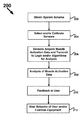
- FIG. 2 depicts an example use scenario 200 for the textile-based human MAF system 100 depicted in FIG. 1A .
- the stages depicted in FIG. 2 may be better understood when reviewed together with FIG. 1B which depicts one example of various components of the textile-based human MAF system 100 depicted in FIG. 1A .
- Components depicted in FIG. 1B may have similar reference numbers to components depicted in FIG. 1A and may be intended to represent similar components.
- a system schema is obtained.
- the system schema may represent the reference muscle exertion data associated with a given exercise.
- a bicep curl exercise may be represented by a system schema that specifies the level of exertion that should be experienced by the bicep muscle (e.g., fairly high) and lower back muscle (e.g., fairly low).
- the system schema may include one or more other schemas including but not limited to a user schema, a workout schema, and an environmental schema, just to name a few.
- System schema may be a combination of workout and/or exercise parameters, user specific parameters (e.g., BMI, percent body fat, weight, amount of bodily hair, etc.).
- a system schema associated with a particular exercise may be automatically obtained in a user-friendly manner (e.g., wirelessly) without requiring data entry by the human subject.
- equipment detector (ED) 116 may be brought into range (e.g., wireless range or near-field wireless range for NFC) or enabled to read information from or communicate with exercise equipment communicating device 110 , which is affixed to the exercise equipment (e.g., a bench press machine 190 or other piece of equipment) or associated therewith.
- Information obtained from exercise equipment communicating device 110 may be as simple as a code that identifies the exercise equipment (e.g., “bench press equipment”) or the exercise to be performed (e.g., “bench press”). This information may be relayed (e.g., wirelessly) from ED 116 to controller 106 (e.g., see paths 150 / 152 in FIG. 1B ) so that controller 106 may decode the information to obtain the system schema at the stage 202 .
- This information may be relayed (e.g., wirelessly) from ED 116 to controller 106 (e.g., see paths 150 / 152 in FIG. 1B ) so that controller 106 may decode the information to obtain the system schema at the stage 202 .
- the information acquired by ED 116 may be relayed from ED 116 to controller 106 and then to SPCD 112 (e.g., see paths 150 / 152 / 154 of FIG. 1B ) so that SPCD 112 may decode the information to obtain the system schema.
- the information may be further relayed from SPCD 112 to the Internet 120 (e.g., see paths 150 / 152 / 154 / 156 ) or from controller 106 to the Internet 120 and bypassing SPCD 120 (e.g., see paths 150 / 152 / 158 ).
- One or more computers 198 and 199 may be implemented remotely and may communicate ( 198 a , 198 b ) via Internet 120 may then decode the relayed information to obtain the system schema and to send the information back.
- the information from the exercise equipment communicating device 110 may be obtained directly by controller 106 and may bypass ED 116 (e.g., see path 160 ) or by SPCD 112 and may bypass both ED 116 and controller 106 (e.g., see path 162 ).
- controller 106 or SPCD 112 may directly read or sense the information from exercise equipment communicating device 110 in one or more embodiments.
- the information from exercise equipment communicating device 110 may be processed in any of the manners discussed above (e.g., by controller 106 , by SPCD 112 , or by Internet 120 via any other paths depicted in FIG. 1B ) to obtain the system schema at the stage 202 .
- Internet 120 may be a resource such as a web site, web page, cloud storage, cloud computing, a server farm, network attached storage (NAS), RAID storage, or other resource that may provide compute engines (e.g., 198 , 199 ) and/or data storage.
- Computers 198 and 199 may be directly coupled with data storage (not shown) or in communication with external data storage (e.g., Internet 120 ) (not shown). Examples of data storage include but are not limited to hard disc drives (HDD), solid state drives (SSD), RAID, NAS, Optical Disc, Flash memory, just to name a few.
- HDD hard disc drives
- SSD solid state drives
- NAS Optical Disc
- Flash memory just to name a few.
- the information provided from exercise equipment communicating device 110 to ED 116 or controller 106 or SPCD 112 may be as complete as the entire system schema itself. In this example, no decoding is necessary to obtain the system schema at the stage 202 .
- SPCD 112 may retrieve the system schema at the stage 202 from a locally stored and pre-determined workout regimen or from the Internet 120 based on a user profile, for example. In this example, information from communicating device 110 may not be required provided that the user follows the predetermined regimen as instructed using SPCD 112 .
- sensors 104 A- 104 C may be selected and/or calibrated in preparation for monitoring at a stage 204 .
- Sensor selection may be performed if the form-fitting sensor garment 102 has redundant sensors.
- Calibration may be performed to take into account effects including but not limited to different body fat percentages. BMI's, bodily hair, or other factors associated with different human subjects, for example.
- muscle activation data may be acquired by sensors 104 A- 104 C (or other sensors) while the user performs the exercise and transmitted to logic for analysis.
- the muscle activation data may be communicated via signal conductors 108 (as mentioned in connection with FIG. 1A ) to controller 106 .
- Analysis may be performed at controller 106 if controller 106 is endowed with logic and/or algorithms (e.g., software and/or hardware and/or firmware) to perform the analysis (in which case controller 106 may have to access to the earlier discussed system schema at the stage 202 for analysis purpose). This is shown by a path for signal conductors 108 in FIG. 1B .
- sensors 104 A- 104 C are depicted directly coupled to a single controller 106 , it should be understood that such coupling may be an actual/physical coupling or may be a logical coupling.
- multiple controllers e.g., multiple controllers 106
- the muscle activation data may be communicated from sensors 104 A- 104 C to controller 106 and then may be relayed to SPCD 112 for analysis (in which case SPCD 112 may have access to the earlier discussed system schema at the stage 202 for analysis purpose). This is depicted by paths 108 / 154 in FIG. 1B .
- wireless communication among components of textile-based human MAF system 100 may employ any suitable air interface, including for example BluetoothTM (in its various implementations, including low power Bluetooth), ANTTM, WiFiTM, WiMAXTM, infrared, cellular technology (such as for example GSMTM, CDMATTM, 2GTM, 3GTM, 4GTM, 5GTM, LTETM, GPRSTM), etc.
- BluetoothTM in its various implementations, including low power Bluetooth
- ANTTM ANTTM
- WiFiTM Wireless Fidelity
- WiMAXTM wireless technology
- infrared such as for example GSMTM, CDMATTM, 2GTM, 3GTM, 4GTM, 5GTM, LTETM, GPRSTM
- the selection of the appropriate air interface for communication depends on the air interface availability in the devices and/or at the location, cost, convenience, and/or other factors.
- the muscle activation data may be forwarded from SPCD 112 to Internet 120 (e.g., via path 164 / 156 or path 108 / 154 / 156 ) or from controller 106 to Internet 120 bypassing SPCD 120 (e.g., path 108 / 158 ) for analysis by one or more remotely implemented computers (e.g., 198 , 199 ) through Internet 120 .
- the muscle activation data may be communicated from sensors 104 A- 104 C directly to Internet 120 for analysis (in which case the sensors 104 A- 104 C may be equipped with communication circuitry such as wireless communication circuitry, and computers (e.g., 198 , 199 ) implemented via the Internet 120 may have access to the earlier discussed system schema at the stage 202 for analysis purpose). This is shown by example path 178 in FIG. 1B .
- Computers e.g., 198 , 199
- analysis may be performed not only on a single muscle, but on a plurality of muscles in accordance to the system schema at the stage 202 . Analysis may be performed at one or more of the controller 106 , the SPCD 112 , the Internet 120 , or any combination thereof, for example.
- Analysis at a stage 208 may include, in one or more embodiments, comparing the exertion level of individual muscles (e.g., obtained from the muscle activation data from the sensors 104 A- 104 C) with the reference exertion level of those muscles (e.g., obtained from the system schema at the stage 202 ).
- This analysis may reveal, for example, whether the human subject is performing the exercise at the appropriate intensity level (e.g., by looking at the intensity data from the sensors 104 A- 104 C and comparing such information with corresponding information in the reference system schema at the stage 202 ).
- This analysis may also reveal, for example, whether the human subject is performing the exercise incorrectly.
- Analysis at the stage 208 may include, alternatively or additionally, comparing the duration of the exertion of individual muscles (e.g., obtained from the muscle activation data from the sensors 104 A- 104 C) with the reference exertion duration of those muscles (e.g., obtained from the system schema at the stage 202 ). Analysis may include, alternatively or additionally, comparing the number of exertion repetitions in a set (obtained from the muscle activation data from the sensors 104 A- 104 C) with the reference exertion repetitions for those muscles (e.g., obtained from the system schema at the stage 202 ).
- Analysis at the stage 208 may include, alternatively or additionally accumulating an activity score based on an electromyography signal. Such a score may be in different resolution forms such as the overall body or individual muscles. This allows the user to compare intensity level as measured through muscle exertion over time.
- Analysis at the stage 208 may include, alternatively or additionally determining the number of repetitions and an approximation of the weight used. Such analysis may be determined by statistical analysis on saved user data or by comparing the user data against a larger data set of all active users stored in Internet 120 in FIG. 2 . User data may be stored on one of controller 106 , SPCD 112 or equipment 110 .
- Analysis at the stage 208 may include, alternatively or additionally updating a user profile and comparing against profiles of one or more other users.
- user profile data may include a history of workout sessions including overall exertion as well as individually monitored muscles.
- profile data may include goals set by the user and additionally or alternatively challenges from other users (e.g., to motivate the user).
- the challenges may come from other persons or users who may be associated with a social network (e.g., Facebook®, Twitter®), professional network (e.g., LinkedIn®), or the like.
- a social network e.g., Facebook®, Twitter®
- professional network e.g., LinkedIn®
- challenges may be proposed by the system (e.g., controller 106 and/or other system in communication with controller 106 ).
- a combination of progressive challenges e.g., a series of challenges, each with higher goals to be achieved
- gameificaiton of the challenges may comprise the user taking on progressive challenges against goals set by the user, the system, others, or by other competitors in the game, for example.
- a result of the analysis at the stage 208 may be immediately communicated to the user at a stage 210 via a display 112 a of device 112 (e.g., a smartphone, table, pad, eyeglasses 182 , etc.) or an auxiliary feedback device such as devices 114 substantially in real time (e.g., immediately after data acquisition and analysis is completed, factoring in real-world delays in data transmission and processing).
- Feedback at the stage 210 may, for example, include a representation of the body and visually depict the muscles being exerted, along with a color gradient or an overlay with relative exertion or other data depiction scheme to communicate the intensity level and/or duration and/or number of repetitions associated with each muscle.
- the feedback at the stage 210 may also include recommendations (e.g., “push more with the left arm” “slow down when lowering your arm”) or warning (e.g., “do not swing while lifting”) or other coaching information while the human subject is performing the exercise.
- the feedback at the stage 210 may be alternatively or additionally be in the form of audio feedback (e.g., on SPCD 112 or device 180 ), in one or more embodiments.
- feedback at the stage 210 may be stored on either the controller 106 , the SPCD 112 or the Internet 120 for later viewing and/or audio playback.
- the user may “playback” visual features including the body representation with muscle depiction. This allows the user to get feedback at a time that is convenient and not during a strenuous activity.
- Other features can be added to compare the “playback” with other users who may be a part of the system environment. For example using a professional athlete as a benchmark of comparison.
- Feedback device 114 may be implemented by a built-in display 112 a of SPCD 112 (e.g., a LCD, OLED, touch screen, etc.) by an external display 170 , by audio playback device (such as headset 180 , which may be in communication with controller 106 , SPCD 112 , external display 170 and/or Internet 120 ), or by digital eyewear (see 182 in FIG. 1A ).
- Feedback device 114 may provide feedback information in either graphical, video, or audio format to the user.
- the analysis result at the stage 208 may be displayed on the display screen 112 a of SPCD 112 after analysis by SPCD 112 .
- the analysis result may be displayed (e.g., using wireless communication if necessary) on the display screen 112 a of SPCD 112 if analysis takes place elsewhere (e.g., communicated via path 154 if analysis is performed on controller 106 or via path 156 if analysis is performed via Internet 120 ).
- the analysis result may be displayed on an external display 170 (e.g., communicated via path 172 or path 154 / 174 if analysis is performed on controller 106 or communicated via path 156 / 174 or path 176 if analysis is performed by Internet 120 ).
- an external display 170 e.g., communicated via path 172 or path 154 / 174 if analysis is performed on controller 106 or communicated via path 156 / 174 or path 176 if analysis is performed by Internet 120 ).
- the analysis result at the stage 208 may be displayed on digital eyeglasses (see 182 in FIG. 1A ) instead of external display 170 .
- the analysis result at the stage 208 may be converted to an audio format and played back using a headset 180 (e.g., a wireless headset, earpiece, headphones, or the like).
- the analysis result at the stage 208 may be employed to alter the behavior of the exercise equipment 190 in order to improve the exercise experience and/or exercise efficacy for the human user at a stage 212 .
- the resistance level of a stationary bicycle or the incline angle of a treadmill or the resistance level of a resistance exercise equipment may be automatically reduced (e.g., in real time, using a motor or transducer operating under the command of controller 106 or SPCD 112 ) in order to help improve the exercise form of the user.
- the resistance level of a stationary bicycle or the incline angle of a treadmill or the resistance level of a resistance exercise equipment may be changed (e.g., in real time) in order to present a more meaningful or beneficial exercise to the human subject.
- the system schema at the stage 202 may be individualized and/or customized using data such as the user's profile/objective data (e.g., BMI, weight, height, training experience, past exercise session data) or the user's subjective input (e.g., training goal, desired exertion level/duration/number of repetitions/number of sets).
- Objective data could be simplified by asking the user to identify with visual representations (e.g., using a GUI on display 112 a ) of different body types to reduce the amount of manual input required.
- the human subject's workout session may be individualized and/or customized when the muscle activation data is compared against the individualized and/or customized system schema at the stage 202 .
- the system schema at the stage 202 may also be customized using social and/or professional network input. For example, recommendations from coaches or challenges from other workout partners may be employed to change the system schema at the stage 202 in order to provide the human subject with a more optimal workout session. Customization using social and/or professional network input may be accomplished in real-time (e.g., to optimize the present workout session) or may occur post workout in preparation for future workout sessions where the recommendations may be acted on to optimize the workout session.
- form-fitting sensor garment 102 may automatically pair with SPCD 112 . Pairing, in the context of the present invention, may pertain to the association of a specific device with another specific device to facilitate wireless data communication and/or wireless data security/confidentiality. Likewise, form-fitting sensor garment 102 (or more specifically controller 106 of form-fitting sensor garment 102 ) may automatically pair (e.g., BT paring) with exercise equipment 190 (or more specifically with exercise equipment communication device 110 thereof). Likewise, SPCD 112 may automatically pair with exercise equipment 190 (or more specifically with exercise equipment communication device 110 ).
- Pairing in the context of the present invention, may pertain to the association of a specific device with another specific device to facilitate wireless data communication and/or wireless data security/confidentiality.
- form-fitting sensor garment 102 may automatically pair (e.g., BT paring) with exercise equipment 190 (or more specifically with exercise equipment communication device 110 thereof).
- SPCD 112 may automatically pair with exercise equipment 190 (or more specifically with exercise equipment communication device
- form-fitting sensor garment 102 may intelligently pair with SPCD 112 to reduce power consumption (e.g., from battery pack 118 ).
- the communication apparatus would be turned off during periods of inactivity, such as when the user is resting.
- controller 106 through algorithmic implementation, detects the commencing of activity the communicating apparatus would be turned on and pairing completed.
- form-fitting sensor garment 102 (or more specifically controller 106 of form-fitting sensor garment 102 ) may intelligently pair with exercise equipment 190 (or more specifically with exercise equipment communication device 110 thereof) to reduce power consumption.
- SPCD 112 may intelligently pair with exercise equipment 190 (or more specifically with exercise equipment communication device 110 ) to extend battery life.
- processor 106 may scan for sensor activity from one or more of the sensors (e.g., 104 A- 104 C) and if no sensor activity is detected, then processor 106 may switch to a low power mode of operation (e.g., to conserve battery power). Upon detecting sensor activity, processor 106 may exit the low power mode, analyze the detected sensor activity (e.g., analyze signals from the sensors) and take appropriate action. In some examples, the appropriate action may comprise the processor 106 switching back to the low power mode of operation, because the signals analyzed were not indicative of the type of activity the sensor is intended to sense, for example.
- Lack of motion or other physical activity or lack thereof by user may serve to trigger entry into the low power mode of operation for processor 106 .
- sensor not detecting muscle activity may prompt processor 106 to switch to the low power mode of operation.
- detection of muscle activity may prompt processor 106 to exit the low power mode of operation.
- a motion sensor e.g., an accelerometer, motion detector, or gyroscope
- motion detector may generate a signal indicative of sufficient activity by user (e.g., running, walking, etc.) and processor 106 may switch out of the low power mode of operation to another mode where the signal from motion detector is analyzed and acted on.
- form-fitting sensor garment 102 may automatically pair with the external display 170 or the headset 180 or the digital eyeglass 182 as described earlier.
- SPCD 112 may automatically pair or otherwise establish a wireless communication link (e.g., via BT, WiFi, 2G, 3G, 4G, 5G, or other protocol) with one or more of the external display 170 , the headset 180 , or the digital eyeglass 182 as described above.
- pairing may be assumed when two communication devices establish wireless communication (e.g., such as by the act of bringing the two devices closer together or by passing the devices over one another or tapping the devices together as in NFC or other low power close proximity RF protocol, or causing one device to communicate with another device).
- the proposed pairing may be detected and optionally presented to the human subject (e.g., such as via a display screen 112 a of SPCD 112 ) for approval by the human subject prior to the actual pairing.
- pairing may be made automatic (e.g., with no user intervention) or substantially automatic (e.g., with minimal user intervention), greatly improving user friendliness aspect of the textile-based human MAF system 100 .
- sensor data and/or analysis data may be time-stamped and automatically stored in one or more of controller 106 , SPCD 112 , and remote computer ( 198 , 199 ) via Internet 120 in order to build up one or more user profiles over time, for example.
- This user profile data may be employed for historical analysis of workout sessions for a particular user, for customizing the system schema, for tracking workout progress, or for scientific/medical analysis by a third party, or for social/professional network sharing, and for challenges, for example.
- This aspect of automatic active management and updating the user profile presents a significant improvement over conventional workout data logging methods, which typically involve tediously manually writing down on paper or typing into an electronic device parameters regarding a workout session. Automatic paring and data logging make it more likely that the user would continue to use the textile-based human MAF system 100 .
- statistical correlations may be made over time to predict the weight that the human subject employs in a particular weight training exercise. Since data pertaining to the type of exercise and the equipment (obtained from the system schema at the stage 202 ) and pertaining to the user profile (e.g., body mass index (BMI), height, age, exercise history) is available, examples may correlate the weight employed (either input by the user initially via an appropriate input device or guessed by the system and confirmed or rejected by the human subject) with specific signature profile in the sensor signals. If a large set of such data is collected over time, statistical inferences may be made in the future to predict the weight being employed by the human subject even without an explicit input by the user pertaining to the weight employed.
- BMI body mass index
- This statistical inference may be made based on, for example, the sensor signal amplitude or signature, the type of exercise and the equipment employed, the user profile, etc.
- Feedback by the human subject pertaining to weight prediction accuracy may be employed to refine the prediction model over time, thereby improving prediction accuracy as time goes by.
- Once weight prediction becomes more accurate and practical, record keeping may be further simplified since the user no longer has to manually enter the amount of weight used.
- Instant feedback and coaching may also become more meaningful when weight information is always accurately tracked and rendered available to the feedback/coaching logic.
- statistical correlation may also be made between sensor signals and exercise repetitions to automatically generate and log repetition data as the human subject exercises. Correlation can be made across multiple sensor signals to identify a particular workout or correlation on the signal itself to identify patterns representative or exercise repetitions. Likewise, statistical correlation may also be made between sensor signals and exercise duration to automatically generate and log duration data as the human subject exercises. Such duration data may be tracked with high granularity (e.g., time duration/repetition, time duration/set, time duration/exercise session, etc.) and with a high degree of consistency. Once repetition and duration information is automatically harvested, record keeping may be further simplified since the user no longer has to manually enter the repetition and duration information. Instant feedback and coaching may also become more meaningful when repetition and duration information is automatically tracked and rendered available to the feedback/coaching logic. Since information pertaining to the exercise involved and the exercise machine involved may also be automatically harvested and tracked, instant feedback, analysis, and coaching may be further enhanced.
- embodiments and exampled described herein may provide for a consumer-friendly system or platform for performing health-related and performance-related human monitoring, analyzing and feedback.
- the exercise data may be efficiently logged and the human subject may be given detailed and useful feedback and coaching pertaining not only to whether the muscle is being exercised, but also whether the right group of muscles are being exercised for a specific workout profile, whether a specific muscle is optimally exercised, whether the exercise form is correct, whether the pattern of muscle activation and/or intensity thereof indicates potential injury to one or more of the muscles in the relevant group, etc.
- embodiments and examples described herein may provide for a comprehensive and user-friendly textile-based human MAF system 100 .
- a plurality of sensors e.g., 104 A- 104 C or more
- problems associated with the aforementioned conventional gel-based and/or adhesive-based electrodes may be advantageously avoided.
- the sensors e.g., 104 A- 104 C or more
- Calibration may help to improve data acquisition accuracy by taking into account different body types when acquiring data from the sensors (e.g., 104 A- 104 C or more).
- a electromyography sensor and a bend-angle sensor and accelerometers greatly improves the accuracy and richness of the performance data acquired as well as improving the type of analysis and/or recommendation/coaching that can be provided.
- Real-time feedback and/or real time equipment alteration based on analysis result may also help optimize the exercise session and/or help reduce injury.
Landscapes
- Health & Medical Sciences (AREA)
- Life Sciences & Earth Sciences (AREA)
- Engineering & Computer Science (AREA)
- Biomedical Technology (AREA)
- Public Health (AREA)
- General Health & Medical Sciences (AREA)
- Medical Informatics (AREA)
- Physics & Mathematics (AREA)
- Pathology (AREA)
- Biophysics (AREA)
- Molecular Biology (AREA)
- Surgery (AREA)
- Animal Behavior & Ethology (AREA)
- Heart & Thoracic Surgery (AREA)
- Veterinary Medicine (AREA)
- Business, Economics & Management (AREA)
- Computer Networks & Wireless Communication (AREA)
- Physiology (AREA)
- General Business, Economics & Management (AREA)
- Epidemiology (AREA)
- Primary Health Care (AREA)
- Entrepreneurship & Innovation (AREA)
- Educational Administration (AREA)
- Educational Technology (AREA)
- General Physics & Mathematics (AREA)
- Theoretical Computer Science (AREA)
- Textile Engineering (AREA)
- Dentistry (AREA)
- Oral & Maxillofacial Surgery (AREA)
- Measurement And Recording Of Electrical Phenomena And Electrical Characteristics Of The Living Body (AREA)
- Cardiology (AREA)
Abstract
The present application relates generally to computer software, mobile electronics, wireless communication links, and wearable monitoring systems. More specifically, techniques, systems, sensors, circuitry, algorithms and methods for wearable monitoring devices and associated exercise apparatus are described. A garment borne sensor system may acquire data on a user's performance during exercise, for example. The data may be analyzed in real time and feedback may be provided to the user based on the analysis. Analysis may be used to alter behavior of the user and/or an apparatus the user is engaged with during an activity, such as exercise, conditioning, therapy, etc. A piece of exercise equipment may be instrumented and in communication with the sensor system or other system and may be controlled in real time to adjust its settings to affect the user during the exercise routine. Communication between the sensor system and other systems may be wireless.
Description
This application claims priority to the following U.S. Provisional Patent Applications: U.S. Provisional Patent Application Ser. No. 61/726,470, filed on Nov. 14, 2012, and titled “Human Performance Monitoring, Analysis, And Feedback Systems And Methods Therefor”; and U.S. Provisional Patent Application Ser. No. 61/726,474, filed on Nov. 14, 2012, and titled “Architecture And Methods For Human Performance Monitoring, Analysis, And Feedback”, all of which are herein incorporated by reference in their entirety for all purposes.
The present application relates generally to computer software, mobile electronics, wireless communication links, and wearable monitoring systems. More specifically, techniques, systems, sensors, circuitry, algorithms and methods for wearable monitoring devices and associated exercise apparatus are described.
Human bio-potentials have long been measured in clinical settings for heath and/or performance monitoring purposes. For example, the heart rate (HR) of a human test subject may be monitored in a health clinic or other health care venue using an electrocardiogram (ECG) system. In a typical electrocardiography test, a plurality of ECG electrodes may be adhesively attached to the skin of the human test subject in order to record information pertaining to the heart. The measured bio-potential information indicative of the heart functions may typically be recorded on ECG graph paper or stored in computer memory for later analysis.
In general, conventional ECG electrodes may be formed of a conductive gel embedded in an adhesive pad onto which a cable is coupled. Examples include an adhesive conductive hydrogel formed over a conductive rigid sensor to which the cable is coupled or otherwise attached. ECG electrodes may be adhesively attached to different locations on the skin of the human test subject to obtain heart-related information from different angles (e.g., left arm, right arm, left leg, etc.). The electrical signals obtained by the ECG electrodes may then be interpreted by a knowledgeable expert to obtain certain information pertaining to the heart functions (e.g., heart rate (HR), heart rhythm, etc.) as well as to detect symptoms of pathological conditions (e.g., hypocalcaemia, coronary ischemic, hypokalemia, myocardial infarction, etc.), for example.
There are some disadvantages to conventional gel-based electrodes. Gel-based and/or adhesive-based electrodes may be unsuitable for long-term monitoring applications. For example, gel-based and/or adhesive-based electrodes tend to dry out over time and thus tend to be one-time-use-only devices. Furthermore, gel-based and/or adhesive-based electrodes, such as those employing Silver-Silver chloride (Ag/AgCl) electrodes, may cause skin irritation to some human subjects, especially if those electrodes are used over a long period of time. Moreover, the expertise and/or dexterity required to adhesively attach the gel-based and/or adhesive-based electrodes at various specific locations on the body often requires the use of an expert human assistant. The need for such expert involvement may be inconvenient and/or awkward for the user, and may drive up the cost associated with long-term monitoring.
The same issues may also render gel-based and/or adhesive-based electrodes unsuitable for use in the consumer market. For example, in addition to the aforementioned bio-compatibility issue, consumers may be resistant to purchasing, using, and discarding one-time-use gel-based and/or adhesive-based electrodes due to cost concerns and/or environmental impact concerns. As mentioned above, the attachment of gel-based and/or adhesive-based electrodes at specific locations on the skin may be intimidating and time-consuming to an average consumer and may require a level of expertise and/or dexterity that an unaided consumer typically may not possess.
Conventional dry electrodes have been proposed as an alternative electrode that addresses the aforementioned shortcomings of gel-based and/or adhesive-based electrodes. In that dry electrodes may be based on conductive rubber rather than gel or adhesive, dry electrodes typically do not dry out like typical gel-based and/or adhesive-based electrodes. Skin compatibility and reusability may be greatly enhanced by using dry electrodes.
Conventional dry electrodes and associated amplifying circuitry have been incorporated into textiles (e.g., garments), resulting in textile-based monitoring clothing. See, for example, “Fabric-Based Active Electrode Design And Fabrication For Health Monitoring Clothing” by Carey R. Merit and H. Troy Nagle (IEEE Transactions On Information Technology In Biomedicine, Vol. 13, No. 2, March 2009). Textile-based monitoring garments based on textile monitoring fabric have further been manufactured and made commercially available by different manufacturers.
One of the seismic shifts in consumer electronic trends in recent years has been the increase in processing (e.g., multiple core and/or faster processors) and communication capabilities (e.g., WiFi, Bluetooth, NFC, Cellular, 2G, 3G, 4G, and 5G) of smart personal communication devices (SPCDs) and the ubiquitous nature of the Internet in everyday life. More importantly, SPCDs have been widely adopted by consumers and are ubiquitous in the consumer market. For example, SPCDs incorporating both cellular telephony capability and computer-like data processing and communication capabilities have been widely adopted by consumers for communication, work, Internet surfing, health, personal fitness, and entertainment (e.g., movie watching, gaming, streaming media, social and professional networking, etc.). Examples of such SPCDs include smart phones and tablets incorporating operating systems such as iOS™ (available from Apple, Inc. of Cupertino, Calif.), Android™ (available from Google, Inc. of Mountain View, Calif.), Windows™ (available from Microsoft Corporation of Redmond, Wash.), and the like. Well-known contemporary brands of smart phones and tablets include, for example, iPhone™, iPad™, Samsung Galaxy™, Motorola Droid™ BlackBerry™, etc. These SPCDs are now ubiquitous and possess powerful communication and processing capabilities. The popularity and utility of SPCD's have resulted in them being carried by their users at all times or at least being kept nearby and ready for use.
The ubiquitous nature of the Internet, the pervasiveness of wireless communications networks, and the widespread adoption of SPCDs and their constant access and use by consumers has provided an opportunity to create comprehensive textile-based monitoring garment systems that may provide a level of capability and user-friendliness unavailable with the above mentioned conventional textile-based monitoring garment solutions.
Therefore, there is a need for improved electrodes, materials, ease of use, reduced costs and features in textile-based monitoring garment systems.
Various embodiments or examples (“examples”) are disclosed in the following detailed description and the accompanying drawings:
It is to be understood that, in the drawings, like reference numerals designate like structural elements. Also, it is understood that the drawings are not necessarily to scale.
Various embodiments or examples may be implemented in numerous ways, including as a system, a process, an apparatus, a user interface, or a series of program instructions disposed in a non-transitory computer readable medium such as a computer readable storage medium (e.g., RAM, SRAM, DRAM, ROM, Cache, Register, Flash, SSD, HHD, Volatile memory, Non-volatile memory, Optical media, Magnetic media, etc.) or a computer network where the program instructions are sent over optical, electronic, or wireless communication links. In general, operations of disclosed processes may be performed in an arbitrary order, unless otherwise provided in the claims.
A detailed description of one or more examples is provided below along with accompanying figures of the drawings. The detailed description is provided in connection with such examples, but is not limited to any particular example. The scope is limited only by the claims and numerous alternatives, modifications, and equivalents are encompassed. Numerous specific details are set forth in the following description in order to provide a thorough understanding. These details are provided for the purpose of example and the described techniques may be practiced according to the claims without some or all of these specific details. For clarity, technical material that is known in the technical fields related to the examples has not been described in detail to avoid unnecessarily obscuring the description.
In some examples, the described techniques may be implemented as a computer program or application (“application”) or as a plug-in, module, or sub-component of another application. The described techniques may be implemented as software, hardware, firmware, circuitry, Integrated Circuit (IC), ASIC, FPGA, or a combination thereof. If implemented as software, the described techniques may be implemented using various types of programming, development, scripting, or formatting languages, frameworks, syntax, applications, protocols, objects, compilers, or techniques, including but not limited to ASP, ASP.net, .Net framework, Ruby, Ruby on Rails, C, Objective C, C++, C#, Adobe® Integrated Runtime™ (Adobe® AIR™), ActionScript™, Flex™ Lingo™, Java™, Javascript™, Ajax, Perl, COBOL, Fortran, ADA, XML, MXML, HTML, DHTML, XHTML, HTTP, XMPP, PHP, an objected oriented language, and others. Design, publishing, and other types of applications such as Dreamweaver®, Shockwave®, Flash®, Drupal and Fireworks® may also be used to implement the described techniques. Database management systems (i.e., “DBMS”), search facilities and platforms, web crawlers (i.e., computer programs that automatically or semi-automatically visit, index, archive or copy content from, various websites (hereafter referred to as “crawlers”)), and other features may be implemented using various types of proprietary or open source technologies, including MySQL, Oracle (from Oracle of Redwood Shores, Calif.), Solr and Nutch from The Apache Software Foundation of Forest Hill, Md., among others and without limitation. The described techniques may be varied and are not limited to the examples or descriptions provided.
In some examples, a form-fitting sensor garment may include at least one sensor (e.g., a bio-potential sensor) and associated processing and communications electronics. In other examples, the one or more sensors may be washable sensors that may be borne or otherwise coupled with a garment and configured to be unaffected and/or undamaged by washing or otherwise cleaning or maintaining the garment. One or more form-fitting sensor garments may be made to be conformal to any part of the human body as desired. In other examples, one or more form-fitting sensor garments may be made to be conformal to any part of a structure, such as on the body of a non-human species (e.g., animals, mammals, pets, avian livestock, equine, sea creatures, denizens of the deep, etc.), for example. Stretchable, compressive and form-fitting fabric made of natural or preferably synthetic fibers (e.g., nylon, lycra, polyester, spandex, or other suitable fibers and blends thereof) may be configured to exert a biasing force on the sensors, which are built-in to the form-fitting sensor garment, to bias (e.g., urge into contact) the washable sensors against the skin to maintain good electrical and/or mechanical contact and to reduce motion artifacts that may be caused if there is relative motion between the skin and the sensor(s) (e.g., the sensors and/or skin sliding against each other along their mutual contacting surfaces).
Bioimpedance sensors may include but are not limited to ECG sensors, electromyography (EMG) sensors, respiration, galvanic skin response (GSR), or others. Other types of sensors may also be incorporated into the form-fitting sensor garment. These auxiliary sensors may include but are not limited to accelerometers (single or multi-axis), vibration sensors, GPS sensors, magnetometers, location sensors, galvanic skin response (GSR), bioimpedance, gyroscopes, respiration, heart rate, bend-angle measurement sensors and/or flex angle measurement sensors (e.g., to measure joint angle or joint angles), etc. These sensors may be incorporated in a permanent manner into the fabric of the form-fitting sensor garment itself or in a detachable manner and/or in pockets or under or on top of flaps if desired. Preferably, most or all the sensors, including the non-detachable sensors, are constructed and built such that they can withstand repeated washing and drying cycles typical of wearable clothing.
The present application describes implementation of a combination of a multitude of sensors including, but not limited to electromyography (EMG), electrocardiograph (ECG), galvanic skin response (GSR), temperature, acceleration, bend angle, etc. The use of multiple sensors provides a level of insight that is not available by measuring only a single metric such as heart rate (HR) or motion based on accelerometers or other types of motion sensors (e.g., a gyroscope), as is currently available.
Conventional products do not enable washable electromyography sensors and associated electrodes attached to a form-fitting garment in the manners disclosed in one or more embodiments herein. The various combinations of embodiments disclosed herein that include electromyography sensors, dry electrodes, analysis and feedback methods, normalization and/or communication scope have not existed in conventional sensor garments.
In one or more embodiments, sensors may be incorporated into fabric or other material in a semi-permanent manner (using, e.g., loop-and-hook fasteners or other detachable fastening means) to allow re-positioning of the sensors.
In one or more embodiments, processing electronics may be configured to acquire the sensed signals from the sensors and/or to amplify/filter the sensed signals from the sensors may be incorporated into the form-fitting sensor garment in a permanent or detachable manner. In some examples, the sensors are detachably mounted to the garment to for a purpose including but not limited to repairs, replacement, upgrades, updates to software, sensor calibration, power source maintenance, to install on a different garment, to exchange for another sensor or type of sensor, just to name a few. Further, in one or more embodiments, processing electronics may be configured to perform data processing/analysis on the sensed data which are derived from the sensed signals from the electrodes). Processing electronics may also be incorporated into the form-fitting sensor garment in a permanent or detachable manner. The processing electronics may also include one or more radios for wireless communication with external devices and/or other systems in the garment. For example, the processing electronics may comprise a system-on-chip (SoC) that may include one or more radios (e.g., BT, WiFi, NFC, etc.). As described herein, the term sensor may include one or more electrodes and associated sensor electronics (e.g., in a processor or other circuitry) electrically coupled with the electrodes and configured to acquire signals from the electrodes and to process the acquired signals in an analog domain, a digital domain or both. A sensor may comprise electrodes and associated sensor electronics integrated into a common structure such as an electrode pad, or may comprise electrodes and sensor electronics that are disposed remotely from one another, such as electrodes coupled to a remotely positioned processor (e.g., positioned at another location in the garment) or other circuitry using an electrically conductive structure such as a conductive trace, wire, cable, or the like, for example.
In one or more embodiments, communication electronics may be configured to transmit and/or receive information wirelessly and may be incorporated into the form-fitting sensor garment in a permanent or detachable manner. In one or more embodiments, a network of signal conductors may be configured to facilitate communication among the sensors and/or communication electronics and/or processing electronics may be permanently incorporated into the fabric of the form-fitting sensor garment.
To provide power to the processing electronics and/or communication electronics and/or sensors, a power source such as one or more batteries (which may be rechargeable by various means or may be one-time-use, disposable batteries) may be incorporated into the form-fitting sensor garment in a permanent or detachable manner. If the electronics and/or power source are/is non-detachable, it is preferable that these components are constructed such that they can withstand repeated washing and drying cycles typical of wearable clothing.
In the following discussion, electromyography sensors are described only as an example to facilitate discussion. It should be understood, however, that the present application contemplates that other types of sensor may be implemented additionally and/or alternatively to the electromyography sensors discussed in connection with the examples herein. In one or more embodiments, multiple washable electromyography (WE) sensors may be used to measure muscle activity at different sites on the human body. The WE sensors may be configured to measure muscle activity associated with different muscles to measure muscle exertion intensity. When groups of muscles are measured together, more complex analysis and feedback may be performed and made available to the user (e.g., wirelessly via an application (APP) running on a smartphone, tablet, pad, or the like).
In the following discussion, concepts of the present application will be described using athletics as well as strength and conditioning as an example application. The benefit of a garment that includes a multitude of WE sensors and specifically the ability to monitor multiple muscles, without requiring conventional adhesive based and manually placed alternatives may be utilized for other applications. The end use application in which the sensors and garment described herein may be used does not change the form or function of the concepts described in the present application. For example, applied to ergonomics the ability to critique form and posture discussed herein can be used to train proper procedures in a manufacturing environment, work environment, and athletic endeavors, just to name a few. Critiquing posture may provide injury prevention in the workplace in the same way as in an athletic training setting. As another example, in that the present application builds on clinical methods and provides a more user-friendly experience, the present application may be applied for use in self-guided rehabilitation and injury prevention training.
One example of the complex analysis and feedback possible using multiple WE sensors comprises a bench-press exercise routine because the bench press routine exercises a plurality of different muscles in the human body. By detecting muscle exertion intensity associated with each of the plurality of muscles, information such as whether the human subject is using the proper form, whether a muscle is injured and compensation by one or more other muscles is taking place, whether the user is exercising with the optimal number of repetition and intensity, whether the full range of motion is involved, etc., may be acquired (e.g., from signals from multiple sensors) and provided as instant feedback to the user and/or to adjust the exercise the equipment (e.g., in real time) to optimize the exercise session. Other types of sensors (such as one or more of the aforementioned bend-angle measurement sensors, GSR, HR, temperature, and accelerometers, for example) may also provide information to enrich the analysis and feedback regarding the example bench-press routine.
In one or more embodiments, the set of WE sensors may be permanently incorporated into the fabric of the form-fitting sensor garment. In one or more embodiments, the form-fitting sensor garment may come in various sizes to accommodate various body sizes (e.g., similar to the sizing system currently used with exercise or casual clothing). In one or more embodiments, it is recognized that the difference in skin condition and/or subcutaneous fat content from human subject to human subject may give rise to data acquisition error if left uncorrected. For example, raw sensor signals acquired from a user with a higher body fat percentage may differ from raw sensor signals acquired from a leaner user even though they both may weigh the same and may fit into the same size garment. The subcutaneous fat layer between muscle tissue and skin surface may attenuate an electromyography signal resulting in different acquired amplitudes for different body types. The output from the sensor may be calibrated, in one or more embodiments, to improve analysis and feedback accuracy.
In one or more embodiments, the number of electrodes/sensors that are built into the fabric exceeds the number actually required to obtain the necessary muscle activity data. Logic and/or heuristics may be employed to select the sensors that provide the best signals for the group of muscles of interest. This is particularly advantageous since the human subject may position the garment slightly differently at different times or in different work-out sessions. Further, the optimal measurement sites for one user may be different from the optimal measurement sites for other users. Prior to work out, intelligent logics and/or algorithms may be employed to select the optimal group of sensors on the form-fitting sensor garment to use for actual monitoring and analysis. As another example, the user may be guided to engage in a training or a teaching routine to allow the textile-based MAFS to properly recognize and select the optimal group of sensors on the form-fitting sensor garment to use in the actual monitoring and analysis. Signals from sensors that are not selected may be ignored or given less weight or may be employed in other ways, for example.
In one or more embodiments, all sensor data from all available sensors may be collected and/or stored (e.g., in memory), and analysis may be performed only on the subset of sensors that are relevant and/or deemed to generate most optimal signals for analysis. In other embodiments, only the relevant subset of sensor data may be collected and/or stored and/or analyzed. One or more of the collecting, the storing, or the analyzing may occur internally (e.g., on one or more processors or controllers in the garment), externally (e.g., in an external device such as the SPCD or other wireless device) or both.
In one or more embodiments, the design of the garment and geometry of the electrodes may be configured to account for variations in user body types and resulting alignment concerns. Intuitive features may be added to the garment to ensure proper alignment. These may include, but are not limited to, visible lines, markers and cut-outs for thumb, elbow, etc. For example, alignment marks or markers including but not limited to visible lines may provide a guide where the user only needs to ensure the line is straight for proper alignment. The electrode geometry may be designed to account for different muscle sizes. In one example, increasing a dimension of the electrode orthogonal to the muscle fiber direction may accommodate varying fiber radii and resulting muscle volume. In other examples, the garment may include designed structures configured to urge and/or force the user to correctly position the garment and its sensors with proper and/or orientation with respect to the muscles or other portions of the user's body to be sensed. For example, a shirt-like garment may include a cut-out portion for one or more body parts such as one for an elbow and another for a thumb and/or one or more fingers. The user aligning the elbow cut-out with the elbow of his/her arm and the fingers and/or thumb with their respective cut-outs may be used to ensure at least approximately accurate alignment of sensors in an arm portion of the shirt-like garment with the muscles in the arm that are to be sensed by the sensors disposed in the arm portion of the shirt-like garment. As another example, a pant-like garment may include for each leg, a heel loop and a knee cut-out configured to align sensors in a leg portion of the pant-like garment with the intended muscles in the user's legs. Other types of design structures may be configured into a garment were appropriate and may be used in conjunction with one or more alignment marks included with the garment. The above are non-limiting examples of designed structures and the present application is not limited to the above examples.
In one or more embodiments, the user may be given real-time feedback based not only on the sensed bio-signals, but also on analysis of the sensor outputs (e.g., acquired signals from electrodes and/or other auxiliary sensors). For example, pattern recognition algorithms may be employed to detect whether the muscle exertion data from a group of muscles indicates that the user is engaging in incorrect form or in a non-optimal workout. For example, exercises targeting the biceps brachii are meant to isolate exertion of that muscle from the rest of the body. A less efficient workout occurs when the user generates momentum using the shoulder and/or lower back. Identifying activity in these momentum-influencing muscles can determine incorrect form. Accelerometer or bend-angle data may be incorporated to complement the aforementioned. The feedback is preferably made in visual or audible form to allow the user to easily understand muscle activity and how to improve and/or correct a workout routine. In this manner, virtual coaching may be accomplished in real time to coach the user over the course of the workout.
In one or more embodiments, the form-fitting sensor garment may be part of a textile-based human MAF system. Processing and communication electronics on the form-fitting sensor garment may allow for data exchange (e.g., via a wireless communications link) with the exercise equipment, the smart personal communication device (SPCD), the feedback device and/or the Internet (e.g., computers implemented remotely and available via the Internet). In one or more embodiments, user-friendly techniques for pairing and communicating among the various components of the textile-based human MAF system are disclosed.
The features and advantages of various embodiments of the textile-based human MAF system may be better understood with reference to the figures and discussions that follow.
With reference to FIG. 1A , there is depicted a form-fitting sensor garment 102, representing a compressive, stretchable, and form-fitting garment to be worn by a human subject (not shown). Although form-fitting sensor garment 102 is shown to be a shirt, it can take any other garment form factor including but not limited to shorts, pants, elbow pad, knee pad, undergarment, neck wrap, glove, and the like, etc. A plurality of sensors 104A, 104B, and 104C are depicted as being disposed at various positions on the fabric of form-fitting sensor garment 102. As described above, a pair of electrodes and associated electronics may form a sensor, which may receive as inputs a potential difference generated on the human skin due to ions flowing in muscle fibers as a result of muscle activity. The associated electronics of the sensor may include filtering and impedance transferring. Although only three sensors (104A-104C) are depicted, it should be understood that there is no limit to the number and different types of sensors that may be employed and more or fewer sensors may be implemented than are depicted in the example of FIG. 1A .
In an embodiment, the electrodes of the sensor may be disposed on the inside of the garment such that they make electrical contact with the skin generally at locations where muscles of interest are expected to be located adjacently when the form-fitting sensor garment 102 is worn. As mentioned above, in an embodiment, redundant sensors may be incorporated into the garment to take into account the fact that the human subject may not wear the garment exactly the same way every time or different human subjects may be built differently. Also as mentioned, intelligent logic may then determine, from all available sensors, the optimal for use in monitoring performance in connection with a particular exercise routine. Moreover, as described above, designed structures, alignment marks, markers or other visual indicia may be positioned on and/or woven into, or otherwise integrated with the form-fitting sensor garment 102 to aid the user in correct placement of the sensors when putting on (e.g., donning garment 102) the form-fitting sensor garment 102. The designed structures, alignment marks or other visual indicia may be configured or otherwise designed to include an esthetic element, a logo, an icon, a fashion design, a distinctive pattern, or a color scheme, for example. In other examples, the alignment marks or other visual indicia may serve a variety of purposes, such as in machine/computer vision analysis of the motion of the human subject's body during an activity being monitored by the sensors 104A-104C, where a machine/computer vision apparatus may use the alignment marks or other visual indicia to track body motion or motion of a portion of the body the alignment marks or other visual indicia are positioned on. Analysis of sensor data from the sensors as well as data from the vision analysis (e.g., in real-time) may be used for a variety of purposes including but not limited to coaching the user, physical therapy, choreography, stunts and/or special effects in movies and/or TV, athletic pursuits, competitions, or other endeavors that involve motion of the body. Other sensors such as gyroscopes, magnetometers, accelerometers, temperature, GSR, HR, bioimpedance, etc., may be used in in some combination in conjunction with sensors 104A-104C and the machine/computer vision apparatus.
Typically, electrodes of sensors 104A-104C may be a solid conductive material bonded or woven or a conductive resin (e.g., polymers, silicone, neoprene, thermoplastics, etc.) applied through a screening, printing or gluing process, or combination thereof, in either a permanent or detachable manner, to the fabric or to another conductive substrate attached to the fabric of the form-fitting sensor garment 102. The electrodes may be formed from a flexible PCB substrate (e.g., Kapton or other laminates) that may be bonded to the garment 102. Thus, unlike the conventional electrodes described above, the user does not have to manually attach the sensor to different specific locations on the skin in the manner required for conventional physiological monitoring apparatus. In the example herein, sensors 104A-104C may be washable electromyography sensors although it should be understood, as mentioned, that other types of sensors may well be alternatively or additionally employed. Preferably, sensors 104A-104C are constructed such that they may withstand repeated wash-and-dry cycles typical of wearable clothing. In other examples, sensors 104A-104C are constructed such that they may withstand repeated wash-and-hang-dry cycles typical of wearable clothing. Form-fitting sensor garment 102 may be made from materials, circuitry, structures or the like that may be amendable to any number of wash cycles (e.g., in a washing machine or hand washing) and/or drying cycles (e.g., in a gas or electric dryer). Form-fitting sensor garment 102 may be made from materials, circuitry, structures or the like that may be amendable to dry-cleaning processes and the chemicals used in dry-cleaning processes. However, in some applications it may be preferable to hang-dry (e.g., air dry) garment 102, to preserve an appearance of the material (e.g., fabrics, colors, dyes, etc.) used for the garment 102, to prevent dryer lint or the like from gathering on the garment 102, and to prevent damage to the garment 102, its electronics, fabrics, sensors, or the like due to inadvertently drying the garment 102 at too high a temperature. In some applications garment 102 may be configured for machine drying, air drying, or both. Actual washing and/or drying instructions and/or processes for the garment 102 will be application dependent and are not limited to the examples described herein.
A controller 106 may be coupled with sensors 104A-104C via a network of flexible signal conductors 108 (which may be electrically conductive or optical). In one embodiment, sensors 104A-104C may communicate with controller 106 via a wired (e.g., hard wired) interface. In another embodiment, sensors 104A-104C may communicate with controller 106 via a wireless interface that may user a variety of wireless protocols including but not limited to NFC, Bluetooth, any variety of 802.x, just to name a few. Preferably, signal conductors 108 may be constructed such that they can also withstand repeated wash-and-dry cycles or wash and hang-dry cycles that typical of wearable clothing. Bonded insulated conductors, such as Kapton and laminate based printed circuit boards, wire, cable, coaxial conductors, shielded conductors, flexible printed circuits (FPC), flat flexible cable (FFC), electrically conductive threads, or silk-screened/printed electrically conductive resins are examples of technologies that may be used to implement signal conductors 108. In some examples, sensors 104A-104C may communicate with controller 106 using a combination of wired and wireless communications links. Controller 106 may comprise one or more controllers or one or more processors. In some examples controller 106 may alternatively be referred to as a processor or processor 106.
Typically, controller 106 may include communication electronics (e.g., one or more radios for a wireless communications link) to permit form-fitting sensor garment 102 to communicate (e.g., wireless data) with one or more of exercise equipment communication device 110, smart personal communication device (SPCD) 112 (e.g., a smart phone, tablet, or pad), feedback device 114 (if such feedback device is other than SPCD 112), or the Internet 120 via an appropriate router/access point arrangement, such as a wireless network (e.g., Bluetooth (BT), BT Low Energy, NFC, WiFi, any variety of IEEE 802.x, etc.). The electronics for implementing controller 106 may be permanently attached to the fabric of form-fitting garment (in which case controller 106 may be constructed such that it can withstand repeated wash-and-dry and/or wash and hang dry cycles typical of wearable clothing) or may be detachable from the garment 102 prior to washing/drying the garment 102.
Electrical power for equipment detector (ED) 116, sensors 104A-104C, and controller 106 may be provided by a battery pack 118, which may be attached to form-fitting sensor garment 102 in a permanent or detachable manner. Battery pack 118 may represent a one-time-use, disposable battery or may represent a rechargeable battery pack (e.g., Lithium-Ion, Nickel Metal Hydride, or the like) to be recharged for use via a charging port (e.g., a micro USB connector) implemented with battery pack 118 or on form-fitting sensor garment 102 or via a wireless charging technology such as inductive charging. The battery pack 118 (rechargeable or otherwise) may be configured to be replaceable (e.g., by the user) in the event the battery fails or to swap out a battery with low charge or no charge, with a freshly charged battery, for example. Battery pack 118 may be configured to accept batteries with different amp-hour capacities to provide sufficient duration of operation of garment 102 and its associated electronics, such as 1500 mAh, 3000 mAh, etc. Battery pack 118 may be configured to endure several wash cycles, dry cycles or both. Alternatively, battery pack 118 may be configured to be removable from garment 102 when the garment 102 is to be washed and/or dried.
Referring again to FIG. 2 , at a stage 202, a system schema is obtained. As the term is employed herein, the system schema may represent the reference muscle exertion data associated with a given exercise. For example, a bicep curl exercise may be represented by a system schema that specifies the level of exertion that should be experienced by the bicep muscle (e.g., fairly high) and lower back muscle (e.g., fairly low). The system schema may include one or more other schemas including but not limited to a user schema, a workout schema, and an environmental schema, just to name a few. System schema may be a combination of workout and/or exercise parameters, user specific parameters (e.g., BMI, percent body fat, weight, amount of bodily hair, etc.).
In accordance with a highly advantageous aspect of the present application, a system schema associated with a particular exercise may be automatically obtained in a user-friendly manner (e.g., wirelessly) without requiring data entry by the human subject. In an embodiment, equipment detector (ED) 116 may be brought into range (e.g., wireless range or near-field wireless range for NFC) or enabled to read information from or communicate with exercise equipment communicating device 110, which is affixed to the exercise equipment (e.g., a bench press machine 190 or other piece of equipment) or associated therewith.
Information (e.g., data) obtained from exercise equipment communicating device 110 may be as simple as a code that identifies the exercise equipment (e.g., “bench press equipment”) or the exercise to be performed (e.g., “bench press”). This information may be relayed (e.g., wirelessly) from ED 116 to controller 106 (e.g., see paths 150/152 in FIG. 1B ) so that controller 106 may decode the information to obtain the system schema at the stage 202.
Alternatively, the information acquired by ED 116 may be relayed from ED 116 to controller 106 and then to SPCD 112 (e.g., see paths 150/152/154 of FIG. 1B ) so that SPCD 112 may decode the information to obtain the system schema. Alternatively, the information may be further relayed from SPCD 112 to the Internet 120 (e.g., see paths 150/152/154/156) or from controller 106 to the Internet 120 and bypassing SPCD 120 (e.g., see paths 150/152/158). One or more computers 198 and 199 may be implemented remotely and may communicate (198 a, 198 b) via Internet 120 may then decode the relayed information to obtain the system schema and to send the information back.
Alternatively, the information from the exercise equipment communicating device 110 may be obtained directly by controller 106 and may bypass ED 116 (e.g., see path 160) or by SPCD 112 and may bypass both ED 116 and controller 106 (e.g., see path 162). For example, controller 106 or SPCD 112 may directly read or sense the information from exercise equipment communicating device 110 in one or more embodiments. After direct acquisition by controller 106 or by SPCD 112, the information from exercise equipment communicating device 110 may be processed in any of the manners discussed above (e.g., by controller 106, by SPCD 112, or by Internet 120 via any other paths depicted in FIG. 1B ) to obtain the system schema at the stage 202. In some examples Internet 120 may be a resource such as a web site, web page, cloud storage, cloud computing, a server farm, network attached storage (NAS), RAID storage, or other resource that may provide compute engines (e.g., 198, 199) and/or data storage. Computers 198 and 199 may be directly coupled with data storage (not shown) or in communication with external data storage (e.g., Internet 120) (not shown). Examples of data storage include but are not limited to hard disc drives (HDD), solid state drives (SSD), RAID, NAS, Optical Disc, Flash memory, just to name a few.
In one or more examples, the information provided from exercise equipment communicating device 110 to ED 116 or controller 106 or SPCD 112 (e.g., depending on implementation) may be as complete as the entire system schema itself. In this example, no decoding is necessary to obtain the system schema at the stage 202.
In an additional example, SPCD 112 may retrieve the system schema at the stage 202 from a locally stored and pre-determined workout regimen or from the Internet 120 based on a user profile, for example. In this example, information from communicating device 110 may not be required provided that the user follows the predetermined regimen as instructed using SPCD 112.
Referring again to FIG. 2 , sensors 104A-104C may be selected and/or calibrated in preparation for monitoring at a stage 204. Sensor selection may be performed if the form-fitting sensor garment 102 has redundant sensors. Calibration may be performed to take into account effects including but not limited to different body fat percentages. BMI's, bodily hair, or other factors associated with different human subjects, for example.
At a stage 206, muscle activation data may be acquired by sensors 104A-104C (or other sensors) while the user performs the exercise and transmitted to logic for analysis. The muscle activation data may be communicated via signal conductors 108 (as mentioned in connection with FIG. 1A ) to controller 106. Analysis may be performed at controller 106 if controller 106 is endowed with logic and/or algorithms (e.g., software and/or hardware and/or firmware) to perform the analysis (in which case controller 106 may have to access to the earlier discussed system schema at the stage 202 for analysis purpose). This is shown by a path for signal conductors 108 in FIG. 1B . Although all of the sensors 104A-104C are depicted directly coupled to a single controller 106, it should be understood that such coupling may be an actual/physical coupling or may be a logical coupling. For example, multiple controllers (e.g., multiple controllers 106) may cooperate to share the data processing task or to relay information from one or more sensors to the appropriate controller or controllers for further data processing.
Alternatively, the muscle activation data may be communicated from sensors 104A-104C to controller 106 and then may be relayed to SPCD 112 for analysis (in which case SPCD 112 may have access to the earlier discussed system schema at the stage 202 for analysis purpose). This is depicted by paths 108/154 in FIG. 1B .
At this point, a short description regarding wireless communication may be useful. Typically, wireless communication among components of textile-based human MAF system 100 may employ any suitable air interface, including for example Bluetooth™ (in its various implementations, including low power Bluetooth), ANT™, WiFi™, WiMAX™, infrared, cellular technology (such as for example GSM™, CDMAT™, 2G™, 3G™, 4G™, 5G™, LTE™, GPRS™), etc. The selection of the appropriate air interface for communication depends on the air interface availability in the devices and/or at the location, cost, convenience, and/or other factors.
Alternatively or additionally, the muscle activation data may be forwarded from SPCD 112 to Internet 120 (e.g., via path 164/156 or path 108/154/156) or from controller 106 to Internet 120 bypassing SPCD 120 (e.g., path 108/158) for analysis by one or more remotely implemented computers (e.g., 198, 199) through Internet 120.
Alternatively, the muscle activation data may be communicated from sensors 104A-104C directly to Internet 120 for analysis (in which case the sensors 104A-104C may be equipped with communication circuitry such as wireless communication circuitry, and computers (e.g., 198, 199) implemented via the Internet 120 may have access to the earlier discussed system schema at the stage 202 for analysis purpose). This is shown by example path 178 in FIG. 1B . Computers (e.g., 198, 199) may be in wired or wireless communication (198 a, 198 b) with the Internet 120.
In accordance with a particularly advantageous aspect of the present application, analysis may be performed not only on a single muscle, but on a plurality of muscles in accordance to the system schema at the stage 202. Analysis may be performed at one or more of the controller 106, the SPCD 112, the Internet 120, or any combination thereof, for example.
Analysis at a stage 208 may include, in one or more embodiments, comparing the exertion level of individual muscles (e.g., obtained from the muscle activation data from the sensors 104A-104C) with the reference exertion level of those muscles (e.g., obtained from the system schema at the stage 202). This analysis may reveal, for example, whether the human subject is performing the exercise at the appropriate intensity level (e.g., by looking at the intensity data from the sensors 104A-104C and comparing such information with corresponding information in the reference system schema at the stage 202). This analysis may also reveal, for example, whether the human subject is performing the exercise incorrectly. This may be the case if, for example, one muscle in the group of muscles under monitoring by the sensors 104A-104C is over-exerted or under-exerted. Other sensor data such as bend-angle sensor data or accelerometer sensor data may be used to improve the accuracy of the analysis at the stage 208.
Analysis at the stage 208 may include, alternatively or additionally, comparing the duration of the exertion of individual muscles (e.g., obtained from the muscle activation data from the sensors 104A-104C) with the reference exertion duration of those muscles (e.g., obtained from the system schema at the stage 202). Analysis may include, alternatively or additionally, comparing the number of exertion repetitions in a set (obtained from the muscle activation data from the sensors 104A-104C) with the reference exertion repetitions for those muscles (e.g., obtained from the system schema at the stage 202).
Analysis at the stage 208 may include, alternatively or additionally accumulating an activity score based on an electromyography signal. Such a score may be in different resolution forms such as the overall body or individual muscles. This allows the user to compare intensity level as measured through muscle exertion over time.
Analysis at the stage 208 may include, alternatively or additionally determining the number of repetitions and an approximation of the weight used. Such analysis may be determined by statistical analysis on saved user data or by comparing the user data against a larger data set of all active users stored in Internet 120 in FIG. 2 . User data may be stored on one of controller 106, SPCD 112 or equipment 110.
Analysis at the stage 208 may include, alternatively or additionally updating a user profile and comparing against profiles of one or more other users. In one embodiment, user profile data may include a history of workout sessions including overall exertion as well as individually monitored muscles. In another embodiment, profile data may include goals set by the user and additionally or alternatively challenges from other users (e.g., to motivate the user). For example, the challenges may come from other persons or users who may be associated with a social network (e.g., Facebook®, Twitter®), professional network (e.g., LinkedIn®), or the like. Through social and/or professional networking of user profiles including historical workout data, motivation is increased by the competitive environment created. Additionally, challenges may be proposed by the system (e.g., controller 106 and/or other system in communication with controller 106). A combination of progressive challenges (e.g., a series of challenges, each with higher goals to be achieved) may lead the user to higher and higher levels as in a gaming scenario were gameificaiton of the challenges may comprise the user taking on progressive challenges against goals set by the user, the system, others, or by other competitors in the game, for example.
In accordance with a particularly advantageous aspect of the present application, a result of the analysis at the stage 208 may be immediately communicated to the user at a stage 210 via a display 112 a of device 112 (e.g., a smartphone, table, pad, eyeglasses 182, etc.) or an auxiliary feedback device such as devices 114 substantially in real time (e.g., immediately after data acquisition and analysis is completed, factoring in real-world delays in data transmission and processing). Feedback at the stage 210 may, for example, include a representation of the body and visually depict the muscles being exerted, along with a color gradient or an overlay with relative exertion or other data depiction scheme to communicate the intensity level and/or duration and/or number of repetitions associated with each muscle. The feedback at the stage 210 may also include recommendations (e.g., “push more with the left arm” “slow down when lowering your arm”) or warning (e.g., “do not swing while lifting”) or other coaching information while the human subject is performing the exercise. The feedback at the stage 210 may be alternatively or additionally be in the form of audio feedback (e.g., on SPCD 112 or device 180), in one or more embodiments.
Additionally, feedback at the stage 210 may be stored on either the controller 106, the SPCD 112 or the Internet 120 for later viewing and/or audio playback. In one example, after completing a set or portion of a workout session the user may “playback” visual features including the body representation with muscle depiction. This allows the user to get feedback at a time that is convenient and not during a strenuous activity. Other features can be added to compare the “playback” with other users who may be a part of the system environment. For example using a professional athlete as a benchmark of comparison.
For example, the analysis result at the stage 208 (e.g., as a type of feedback at the stage 210) may be displayed on the display screen 112 a of SPCD 112 after analysis by SPCD 112. Alternatively, the analysis result may be displayed (e.g., using wireless communication if necessary) on the display screen 112 a of SPCD 112 if analysis takes place elsewhere (e.g., communicated via path 154 if analysis is performed on controller 106 or via path 156 if analysis is performed via Internet 120). Alternatively or additionally, the analysis result may be displayed on an external display 170 (e.g., communicated via path 172 or path 154/174 if analysis is performed on controller 106 or communicated via path 156/174 or path 176 if analysis is performed by Internet 120).
Alternatively or additionally, the analysis result at the stage 208 may be displayed on digital eyeglasses (see 182 in FIG. 1A ) instead of external display 170. Alternatively or additionally, the analysis result at the stage 208 may be converted to an audio format and played back using a headset 180 (e.g., a wireless headset, earpiece, headphones, or the like).
In accordance with a particularly advantageous aspect of the present application, the analysis result at the stage 208 may be employed to alter the behavior of the exercise equipment 190 in order to improve the exercise experience and/or exercise efficacy for the human user at a stage 212. For example, if the user is perceived to employ bad form while exercising at the maximum intensity level, the resistance level of a stationary bicycle or the incline angle of a treadmill or the resistance level of a resistance exercise equipment may be automatically reduced (e.g., in real time, using a motor or transducer operating under the command of controller 106 or SPCD 112) in order to help improve the exercise form of the user. Contrarily, if the analysis at the stage 208 reveals that the user can rapidly perform the exercise without much muscle strain, the resistance level of a stationary bicycle or the incline angle of a treadmill or the resistance level of a resistance exercise equipment may be changed (e.g., in real time) in order to present a more meaningful or beneficial exercise to the human subject.
In accordance with a particularly advantageous aspect of the present application, the system schema at the stage 202 may be individualized and/or customized using data such as the user's profile/objective data (e.g., BMI, weight, height, training experience, past exercise session data) or the user's subjective input (e.g., training goal, desired exertion level/duration/number of repetitions/number of sets). Objective data could be simplified by asking the user to identify with visual representations (e.g., using a GUI on display 112 a) of different body types to reduce the amount of manual input required. In this manner, the human subject's workout session may be individualized and/or customized when the muscle activation data is compared against the individualized and/or customized system schema at the stage 202.
In one or more embodiments, the system schema at the stage 202 may also be customized using social and/or professional network input. For example, recommendations from coaches or challenges from other workout partners may be employed to change the system schema at the stage 202 in order to provide the human subject with a more optimal workout session. Customization using social and/or professional network input may be accomplished in real-time (e.g., to optimize the present workout session) or may occur post workout in preparation for future workout sessions where the recommendations may be acted on to optimize the workout session.
In accordance with one or more embodiments, form-fitting sensor garment 102 (or more specifically controller 106 of form-fitting sensor garment 102) may automatically pair with SPCD 112. Pairing, in the context of the present invention, may pertain to the association of a specific device with another specific device to facilitate wireless data communication and/or wireless data security/confidentiality. Likewise, form-fitting sensor garment 102 (or more specifically controller 106 of form-fitting sensor garment 102) may automatically pair (e.g., BT paring) with exercise equipment 190 (or more specifically with exercise equipment communication device 110 thereof). Likewise, SPCD 112 may automatically pair with exercise equipment 190 (or more specifically with exercise equipment communication device 110).
In one or more embodiments, form-fitting sensor garment 102 (or more specifically controller 106 of form-fitting sensor garment 102) may intelligently pair with SPCD 112 to reduce power consumption (e.g., from battery pack 118). In an example of intelligent pairing, the communication apparatus would be turned off during periods of inactivity, such as when the user is resting. When controller 106, through algorithmic implementation, detects the commencing of activity the communicating apparatus would be turned on and pairing completed. Likewise, form-fitting sensor garment 102 (or more specifically controller 106 of form-fitting sensor garment 102) may intelligently pair with exercise equipment 190 (or more specifically with exercise equipment communication device 110 thereof) to reduce power consumption. Likewise, SPCD 112 may intelligently pair with exercise equipment 190 (or more specifically with exercise equipment communication device 110) to extend battery life. In other embodiments, processor 106 may scan for sensor activity from one or more of the sensors (e.g., 104A-104C) and if no sensor activity is detected, then processor 106 may switch to a low power mode of operation (e.g., to conserve battery power). Upon detecting sensor activity, processor 106 may exit the low power mode, analyze the detected sensor activity (e.g., analyze signals from the sensors) and take appropriate action. In some examples, the appropriate action may comprise the processor 106 switching back to the low power mode of operation, because the signals analyzed were not indicative of the type of activity the sensor is intended to sense, for example. Lack of motion or other physical activity or lack thereof by user may serve to trigger entry into the low power mode of operation for processor 106. For example, sensor not detecting muscle activity may prompt processor 106 to switch to the low power mode of operation. Subsequently, detection of muscle activity may prompt processor 106 to exit the low power mode of operation. As another example, a motion sensor (e.g., an accelerometer, motion detector, or gyroscope) may output a signal indicative of no motion or motion below a threshold indicative of sufficient activity by user and that signal may prompt processor 106 to switch to the low power mode of operation. Subsequently, motion detector may generate a signal indicative of sufficient activity by user (e.g., running, walking, etc.) and processor 106 may switch out of the low power mode of operation to another mode where the signal from motion detector is analyzed and acted on.
Likewise, form-fitting sensor garment 102 (or more specifically controller 106 of form-fitting sensor garment 102) may automatically pair with the external display 170 or the headset 180 or the digital eyeglass 182 as described earlier. Likewise, SPCD 112 may automatically pair or otherwise establish a wireless communication link (e.g., via BT, WiFi, 2G, 3G, 4G, 5G, or other protocol) with one or more of the external display 170, the headset 180, or the digital eyeglass 182 as described above.
In an example, pairing may be assumed when two communication devices establish wireless communication (e.g., such as by the act of bringing the two devices closer together or by passing the devices over one another or tapping the devices together as in NFC or other low power close proximity RF protocol, or causing one device to communicate with another device). In one or more embodiments, the proposed pairing may be detected and optionally presented to the human subject (e.g., such as via a display screen 112 a of SPCD 112) for approval by the human subject prior to the actual pairing. In this manner, pairing may be made automatic (e.g., with no user intervention) or substantially automatic (e.g., with minimal user intervention), greatly improving user friendliness aspect of the textile-based human MAF system 100.
In one or more embodiments, sensor data and/or analysis data may be time-stamped and automatically stored in one or more of controller 106, SPCD 112, and remote computer (198, 199) via Internet 120 in order to build up one or more user profiles over time, for example. This user profile data may be employed for historical analysis of workout sessions for a particular user, for customizing the system schema, for tracking workout progress, or for scientific/medical analysis by a third party, or for social/professional network sharing, and for challenges, for example. This aspect of automatic active management and updating the user profile presents a significant improvement over conventional workout data logging methods, which typically involve tediously manually writing down on paper or typing into an electronic device parameters regarding a workout session. Automatic paring and data logging make it more likely that the user would continue to use the textile-based human MAF system 100.
In accordance with an aspect of the present application, statistical correlations may be made over time to predict the weight that the human subject employs in a particular weight training exercise. Since data pertaining to the type of exercise and the equipment (obtained from the system schema at the stage 202) and pertaining to the user profile (e.g., body mass index (BMI), height, age, exercise history) is available, examples may correlate the weight employed (either input by the user initially via an appropriate input device or guessed by the system and confirmed or rejected by the human subject) with specific signature profile in the sensor signals. If a large set of such data is collected over time, statistical inferences may be made in the future to predict the weight being employed by the human subject even without an explicit input by the user pertaining to the weight employed. This statistical inference may be made based on, for example, the sensor signal amplitude or signature, the type of exercise and the equipment employed, the user profile, etc. Feedback by the human subject pertaining to weight prediction accuracy may be employed to refine the prediction model over time, thereby improving prediction accuracy as time goes by. Once weight prediction becomes more accurate and practical, record keeping may be further simplified since the user no longer has to manually enter the amount of weight used. Instant feedback and coaching may also become more meaningful when weight information is always accurately tracked and rendered available to the feedback/coaching logic.
In other examples, statistical correlation may also be made between sensor signals and exercise repetitions to automatically generate and log repetition data as the human subject exercises. Correlation can be made across multiple sensor signals to identify a particular workout or correlation on the signal itself to identify patterns representative or exercise repetitions. Likewise, statistical correlation may also be made between sensor signals and exercise duration to automatically generate and log duration data as the human subject exercises. Such duration data may be tracked with high granularity (e.g., time duration/repetition, time duration/set, time duration/exercise session, etc.) and with a high degree of consistency. Once repetition and duration information is automatically harvested, record keeping may be further simplified since the user no longer has to manually enter the repetition and duration information. Instant feedback and coaching may also become more meaningful when repetition and duration information is automatically tracked and rendered available to the feedback/coaching logic. Since information pertaining to the exercise involved and the exercise machine involved may also be automatically harvested and tracked, instant feedback, analysis, and coaching may be further enhanced.
As may be appreciated from the foregoing description, embodiments and exampled described herein may provide for a consumer-friendly system or platform for performing health-related and performance-related human monitoring, analyzing and feedback. By monitoring multiple muscles simultaneously and/or using multiple electromyography sensors and/or different types of sensors, and by leveraging technology widely adopted by consumers (e.g., the Internet, wireless interface, smart phones, etc.), the exercise data may be efficiently logged and the human subject may be given detailed and useful feedback and coaching pertaining not only to whether the muscle is being exercised, but also whether the right group of muscles are being exercised for a specific workout profile, whether a specific muscle is optimally exercised, whether the exercise form is correct, whether the pattern of muscle activation and/or intensity thereof indicates potential injury to one or more of the muscles in the relevant group, etc.
As may be appreciated from the foregoing description, embodiments and examples described herein may provide for a comprehensive and user-friendly textile-based human MAF system 100. By providing a plurality of sensors (e.g., 104A-104C or more) integrated on a compressive, form-fitting garment 102, problems associated with the aforementioned conventional gel-based and/or adhesive-based electrodes may be advantageously avoided. Since the sensors (e.g., 104A-104C or more) may monitor groups of muscles instead of an individual muscle, more sophisticated and useful analysis results (e.g., pertaining to form and injury monitoring) become possible. Calibration may help to improve data acquisition accuracy by taking into account different body types when acquiring data from the sensors (e.g., 104A-104C or more).
The use of different types of sensors together (e.g., a electromyography sensor and a bend-angle sensor and accelerometers) to monitor a human subject performance on a particular exercise routine greatly improves the accuracy and richness of the performance data acquired as well as improving the type of analysis and/or recommendation/coaching that can be provided. Real-time feedback and/or real time equipment alteration based on analysis result may also help optimize the exercise session and/or help reduce injury.
While the present application has been described in terms of several preferred embodiments and/or examples, there may be alterations, permutations, and equivalents, which fall within the scope of the present application. If the term “set” is employed herein, such term is intended to have its commonly understood mathematical meaning to cover zero, one, or more than one member. The present application should be understood to also encompass these alterations, permutations, and equivalents. It should also be noted that there are many alternative ways of implementing the systems, methods, computer readable media, and apparatuses of the present application. Although various examples are provided herein, it is intended that these examples be illustrative and not limiting with respect to the present application.
Although the foregoing examples have been described in some detail for purposes of clarity of understanding, the above-described concepts are not limited to the details provided. There are many alternative ways of implementing the above-described concepts for the present application. The disclosed embodiments and/or examples are illustrative and not restrictive.
Claims (26)
1. A method comprising:
receiving a system schema for a plurality of muscles of a user, the system schema including a reference muscle activation data for each of the plurality of muscles;
receiving signals from a set of sensors embedded into a garment such that the sensors make electrical contact with a skin surface of the user when the garment is worn by the user, wherein the received signals represent muscle activation data of the plurality of muscles acquired while the user performs an activity that exercises the plurality of muscles;
comparing, for each muscle of a subset of the plurality of muscles, the acquired muscle activation data for the muscle to the reference muscle activation data for the muscle;
generating feedback on the performance of the activity by the user based on the comparison, wherein the generated feedback comprises text including one or more of an exercise instruction, a form suggestion, or an injury warning; and
modifying a display of a user device to include the generated feedback on the performance of the activity to the user.
2. The method of claim 1 , wherein at least some acquired muscle activation data corresponds to one of an exertion level of a muscle of the plurality of muscles.
3. The method of claim 1 , wherein the generated feedback is provided to the user during the performance of the activity or after the performance of the activity.
4. The method of claim 1 , wherein the feedback is generated by one or more of the garment, a controller coupled to the garment, or a mobile device communicatively coupled to the garment.
5. The method of claim 1 , further comprising displaying, by a mobile device of the user, the provided feedback, the mobile device wirelessly coupled to the garment.
6. The method of claim 1 , wherein the set of sensors comprises less than all sensors embedded into the garment.
7. The method of claim 6 , wherein the set of sensors is selected based on a type of the activity being performed by the user.
8. The method of claim 7 , wherein the type of activity being performed is determined from information received from exercise equipment communicatively coupled to the garment or from an exercise plan associated with the user.
9. The method of claim 1 , wherein the subset of the plurality of muscles comprises less than all of the plurality of muscles.
10. The method of claim 1 , wherein the generated feedback comprises a recommendation to the user about the performance of the activity.
11. The method of claim 1 , wherein the generated feedback comprises a warning to the user.
12. The method of claim 1 , wherein the system schema and corresponding reference muscle activation data are determined based on one or more of previous usage of the garment by the user, demographic information of the user, information selected by the user, or information provided by a third party.
13. The method of claim 1 , wherein the set of sensors embedded into the garment comprises redundant sensors.
14. The method of claim 13 , wherein comparing the acquired muscle activation data to the reference muscle activation data for the muscle comprises selecting a subset of the acquired muscle activation data that corresponds to a subset of the set of sensors embedded into the garment.
15. A non-transitory computer-readable storage medium storing executable instructions that, when executed by a processor, perform steps comprising:
receiving a system schema for a plurality of muscles of a user, the system schema including a reference muscle activation data for each of the plurality of muscles;
receiving signals from a set of sensors embedded into a garment such that the sensors make electrical contact with a skin surface of the user when the garment is worn by the user, wherein the received signals represent muscle activation data of the plurality of muscles acquired while the user performs an activity that exercises the plurality of muscles;
comparing, for each muscle of a subset of the plurality of muscles, the acquired muscle activation data for the muscle to the reference muscle activation data for the muscle;
generating feedback on the performance of the activity by the user based on the comparison, wherein the generated feedback comprises text including one or more of an exercise instruction, a form suggestion, or an injury warning; and
modifying a display of a user device to include the generated feedback on the performance of the activity to the user.
16. The non-transitory computer-readable storage medium of claim 15 , wherein at least some acquired muscle activation data corresponds to one of an exertion level of a muscle of the plurality of muscles.
17. The non-transitory computer-readable storage medium of claim 15 , wherein the generated feedback is provided to the user during the performance of the activity or after the performance of the activity.
18. The non-transitory computer-readable storage medium of claim 15 , wherein the feedback is generated by one or more of the garment, a controller coupled to the garment, and a mobile device communicatively coupled to the garment.
19. The non-transitory computer-readable storage medium of claim 15 , further comprising displaying, by a mobile device of the user, the provided feedback, the mobile device wirelessly coupled to the garment.
20. The non-transitory computer-readable storage medium of claim 15 , wherein the set of sensors comprises less than all sensors embedded into the garment.
21. The non-transitory computer-readable storage medium of claim 20 , wherein the set of sensors is selected based on a type of the activity being performed by the user.
22. The non-transitory computer-readable storage medium of claim 21 , wherein the type of activity being performed is determined from information received from exercise equipment communicatively coupled to the garment or from an exercise plan associated with the user.
23. The non-transitory computer-readable storage medium of claim 15 , wherein the subset of the plurality of muscles comprises less than all of the plurality of muscles.
24. The non-transitory computer-readable storage medium of claim 15 , wherein the generated feedback comprises a recommendation to the user about the performance of the activity.
25. The non-transitory computer-readable storage medium of claim 15 , wherein the generated feedback comprises a warning to the user.
26. The non-transitory computer-readable storage medium of claim 15 , wherein the system schema and corresponding reference muscle activation data are determined based on one or more of previous usage of the garment by the user, demographic information of the user, information selected by the user, or information provided by a third party.
Priority Applications (3)
| Application Number | Priority Date | Filing Date | Title |
|---|---|---|---|
| US14/079,621 US10143405B2 (en) | 2012-11-14 | 2013-11-13 | Wearable performance monitoring, analysis, and feedback systems and methods |
| US16/164,427 US10952646B2 (en) | 2012-11-14 | 2018-10-18 | Wearable performance monitoring, analysis, and feedback systems and methods |
| US17/164,461 US20210153780A1 (en) | 2012-11-14 | 2021-02-01 | Wearable performance monitoring, analysis, and feedback systems and methods |
Applications Claiming Priority (3)
| Application Number | Priority Date | Filing Date | Title |
|---|---|---|---|
| US201261726474P | 2012-11-14 | 2012-11-14 | |
| US201261726470P | 2012-11-14 | 2012-11-14 | |
| US14/079,621 US10143405B2 (en) | 2012-11-14 | 2013-11-13 | Wearable performance monitoring, analysis, and feedback systems and methods |
Related Child Applications (1)
| Application Number | Title | Priority Date | Filing Date |
|---|---|---|---|
| US16/164,427 Continuation US10952646B2 (en) | 2012-11-14 | 2018-10-18 | Wearable performance monitoring, analysis, and feedback systems and methods |
Publications (2)
| Publication Number | Publication Date |
|---|---|
| US20140142459A1 US20140142459A1 (en) | 2014-05-22 |
| US10143405B2 true US10143405B2 (en) | 2018-12-04 |
Family
ID=50682350
Family Applications (6)
| Application Number | Title | Priority Date | Filing Date |
|---|---|---|---|
| US14/079,629 Expired - Fee Related US9498128B2 (en) | 2012-11-14 | 2013-11-13 | Wearable architecture and methods for performance monitoring, analysis, and feedback |
| US14/079,621 Active 2034-09-16 US10143405B2 (en) | 2012-11-14 | 2013-11-13 | Wearable performance monitoring, analysis, and feedback systems and methods |
| US15/331,869 Expired - Fee Related US10413219B2 (en) | 2012-11-14 | 2016-10-23 | Wearable architecture and methods for performance monitoring, analysis, and feedback |
| US16/164,427 Expired - Fee Related US10952646B2 (en) | 2012-11-14 | 2018-10-18 | Wearable performance monitoring, analysis, and feedback systems and methods |
| US16/530,333 Abandoned US20200000378A1 (en) | 2012-11-14 | 2019-08-02 | Wearable Architecture and Methods for Performance Monitoring, Analysis, and Feedback |
| US17/164,461 Abandoned US20210153780A1 (en) | 2012-11-14 | 2021-02-01 | Wearable performance monitoring, analysis, and feedback systems and methods |
Family Applications Before (1)
| Application Number | Title | Priority Date | Filing Date |
|---|---|---|---|
| US14/079,629 Expired - Fee Related US9498128B2 (en) | 2012-11-14 | 2013-11-13 | Wearable architecture and methods for performance monitoring, analysis, and feedback |
Family Applications After (4)
| Application Number | Title | Priority Date | Filing Date |
|---|---|---|---|
| US15/331,869 Expired - Fee Related US10413219B2 (en) | 2012-11-14 | 2016-10-23 | Wearable architecture and methods for performance monitoring, analysis, and feedback |
| US16/164,427 Expired - Fee Related US10952646B2 (en) | 2012-11-14 | 2018-10-18 | Wearable performance monitoring, analysis, and feedback systems and methods |
| US16/530,333 Abandoned US20200000378A1 (en) | 2012-11-14 | 2019-08-02 | Wearable Architecture and Methods for Performance Monitoring, Analysis, and Feedback |
| US17/164,461 Abandoned US20210153780A1 (en) | 2012-11-14 | 2021-02-01 | Wearable performance monitoring, analysis, and feedback systems and methods |
Country Status (1)
| Country | Link |
|---|---|
| US (6) | US9498128B2 (en) |
Cited By (15)
| Publication number | Priority date | Publication date | Assignee | Title |
|---|---|---|---|---|
| US20180007138A1 (en) * | 2016-07-04 | 2018-01-04 | Casio Computer Co., Ltd. | Electronic device, selection control system, selection method, and recording medium |
| US10568570B1 (en) | 2019-02-14 | 2020-02-25 | Trungram Gyaltrul Sherpa | Methods and systems for providing a preferred fitness state of a user |
| US10981047B2 (en) | 2018-05-29 | 2021-04-20 | Curiouser Products Inc. | Reflective video display apparatus for interactive training and demonstration and methods of using same |
| US11071498B2 (en) | 2013-09-17 | 2021-07-27 | Medibotics Llc | Smart clothing with inertial, strain, and electromyographic sensors for human motion capture |
| US11167172B1 (en) | 2020-09-04 | 2021-11-09 | Curiouser Products Inc. | Video rebroadcasting with multiplexed communications and display via smart mirrors |
| US11304628B2 (en) | 2013-09-17 | 2022-04-19 | Medibotics Llc | Smart clothing with dual inertial sensors and dual stretch sensors for human motion capture |
| US11465030B2 (en) | 2020-04-30 | 2022-10-11 | Curiouser Products Inc. | Reflective video display apparatus for interactive training and demonstration and methods of using same |
| US11529025B2 (en) | 2012-10-11 | 2022-12-20 | Roman Tsibulevskiy | Technologies for computing |
| US11540762B2 (en) | 2014-10-30 | 2023-01-03 | West Affum Holdings Dac | Wearable cardioverter defibrtillator with improved ECG electrodes |
| US11745006B2 (en) | 2014-10-30 | 2023-09-05 | West Affum Holdings Dac | Wearable cardiac defibrillation system with electrode assemblies having pillow structure |
| US11892286B2 (en) | 2013-09-17 | 2024-02-06 | Medibotics Llc | Motion recognition clothing [TM] with an electroconductive mesh |
| WO2024137510A1 (en) * | 2022-12-23 | 2024-06-27 | Meta Platforms Technologies, Llc | Detecting neuromuscular signals at a wearable device to facilitate performance of physical activities, and methods and systems thereof |
| US12295746B2 (en) | 2020-10-16 | 2025-05-13 | Whoop, Inc. | Adjustable strap for wearable monitor |
| US12521069B2 (en) | 2021-12-23 | 2026-01-13 | Marani Health, Inc. | System for acquisition and analysis of maternal and/or fetal physiological signals |
| US12527521B2 (en) | 2013-09-17 | 2026-01-20 | Medibotics Llc | Motion recognition clothing™ with inertial sensors and electrical or optical strain sensors |
Families Citing this family (193)
| Publication number | Priority date | Publication date | Assignee | Title |
|---|---|---|---|---|
| US10569134B2 (en) | 2005-01-26 | 2020-02-25 | K-Motion Interactive, Inc. | Method and system for athletic motion analysis and instruction |
| US10124205B2 (en) | 2016-03-14 | 2018-11-13 | Tau Orthopedics, Llc | Toning garment with modular resistance unit docking platforms |
| US9656117B2 (en) | 2009-06-19 | 2017-05-23 | Tau Orthopedics, Llc | Wearable resistance garment with power measurement |
| WO2012176193A1 (en) * | 2011-06-20 | 2012-12-27 | Cardio-Healthwatch Innovative Solutions Ltd. | Independent non-interfering wearable health monitoring and alert system |
| US10921886B2 (en) | 2012-06-14 | 2021-02-16 | Medibotics Llc | Circumferential array of electromyographic (EMG) sensors |
| US10201310B2 (en) | 2012-09-11 | 2019-02-12 | L.I.F.E. Corporation S.A. | Calibration packaging apparatuses for physiological monitoring garments |
| US8945328B2 (en) | 2012-09-11 | 2015-02-03 | L.I.F.E. Corporation S.A. | Methods of making garments having stretchable and conductive ink |
| US10159440B2 (en) | 2014-03-10 | 2018-12-25 | L.I.F.E. Corporation S.A. | Physiological monitoring garments |
| US9817440B2 (en) | 2012-09-11 | 2017-11-14 | L.I.F.E. Corporation S.A. | Garments having stretchable and conductive ink |
| US10462898B2 (en) | 2012-09-11 | 2019-10-29 | L.I.F.E. Corporation S.A. | Physiological monitoring garments |
| US9282893B2 (en) | 2012-09-11 | 2016-03-15 | L.I.F.E. Corporation S.A. | Wearable communication platform |
| US11246213B2 (en) | 2012-09-11 | 2022-02-08 | L.I.F.E. Corporation S.A. | Physiological monitoring garments |
| US9498128B2 (en) * | 2012-11-14 | 2016-11-22 | MAD Apparel, Inc. | Wearable architecture and methods for performance monitoring, analysis, and feedback |
| US9254409B2 (en) | 2013-03-14 | 2016-02-09 | Icon Health & Fitness, Inc. | Strength training apparatus with flywheel and related methods |
| US9168002B2 (en) * | 2013-03-14 | 2015-10-27 | Malecare, Inc. | Device and method for measuring radiation exposure |
| DK3014394T3 (en) * | 2013-07-05 | 2022-07-11 | Jacob A Rubin | WHOLE BODY HUMAN COMPUTER INTERFACE |
| US11219396B2 (en) | 2013-11-23 | 2022-01-11 | MAD Apparel, Inc. | System and method for monitoring biometric signals |
| US10321832B2 (en) | 2013-11-23 | 2019-06-18 | MAD Apparel, Inc. | System and method for monitoring biometric signals |
| US10292652B2 (en) | 2013-11-23 | 2019-05-21 | MAD Apparel, Inc. | System and method for monitoring biometric signals |
| US9135347B2 (en) * | 2013-12-18 | 2015-09-15 | Assess2Perform, LLC | Exercise tracking and analysis systems and related methods of use |
| EP3623020B1 (en) | 2013-12-26 | 2024-05-01 | iFIT Inc. | Magnetic resistance mechanism in a cable machine |
| EP3089727B1 (en) * | 2013-12-31 | 2024-10-09 | Iftech Inventing Future Technology Inc. | Wearable devices for sensory stimulation and manipulation, and physiological data acquisition |
| AU2014100006A4 (en) * | 2014-01-03 | 2014-02-13 | Wearable Experiments Pty Ltd | Fan Garment |
| WO2015103620A1 (en) | 2014-01-06 | 2015-07-09 | Andrea Aliverti | Systems and methods to automatically determine garment fit |
| JP6518696B2 (en) * | 2014-02-03 | 2019-05-22 | コピン コーポレーション | Smart Bluetooth Headset for Voice Command |
| US20150379880A1 (en) * | 2014-03-06 | 2015-12-31 | Maneesh SETHI | Device for training behavior |
| US20150254992A1 (en) * | 2014-03-06 | 2015-09-10 | Maneesh SETHI | Memory-enhancing and habit-training methods and devices |
| US20160063890A1 (en) * | 2014-03-06 | 2016-03-03 | Maneesh SETHI | Method for training behavior |
| US20220273187A1 (en) * | 2014-03-13 | 2022-09-01 | Myolex Inc. | Quantitative Measurement of Muscle Fatigue by Electrical Impedance Myography |
| WO2015139089A1 (en) * | 2014-03-18 | 2015-09-24 | Faccioni Adrian | System, method and apparatus for providing feedback on exercise technique |
| CN103870220A (en) * | 2014-03-19 | 2014-06-18 | 惠州Tcl移动通信有限公司 | Control method and control system for working modes of mobile device |
| US10520378B1 (en) | 2014-03-20 | 2019-12-31 | Invent.Ly, Llc | Wearable user input device and sensors system to detect injury |
| US9185167B2 (en) * | 2014-04-01 | 2015-11-10 | Google Inc. | Associating broadcasting device data with user account |
| US10617354B2 (en) | 2014-04-29 | 2020-04-14 | MAD Apparel, Inc. | Biometric electrode system and method of manufacture |
| CN106470739B (en) | 2014-06-09 | 2019-06-21 | 爱康保健健身有限公司 | Cable system incorporated into the treadmill |
| US9763056B2 (en) * | 2014-06-30 | 2017-09-12 | Polar Electro Oy | Bluetooth beacon transmission |
| JP6596945B2 (en) * | 2014-07-31 | 2019-10-30 | セイコーエプソン株式会社 | Motion analysis method, motion analysis apparatus, motion analysis system, and motion analysis program |
| US10668305B2 (en) | 2014-08-26 | 2020-06-02 | Elwha Llc | Garment system including at least one therapeutic stimulation delivery device and related methods |
| US10232165B2 (en) | 2015-01-29 | 2019-03-19 | Elwha Llc | Garment system including at least one sensor and at least one actuator responsive to the sensor and related methods |
| US9687404B2 (en) | 2014-08-26 | 2017-06-27 | Elwha Llc | Garment system including at least one muscle or joint activity sensor and at least one actuator responsive to the sensor and related methods |
| US10456604B2 (en) | 2014-08-26 | 2019-10-29 | Elwha Llc | Garment system including at least one therapeutic stimulation delivery device and related methods |
| US11638676B2 (en) | 2014-08-26 | 2023-05-02 | Ventrk, Llc | Garment system including at least one sensor and at least one actuator responsive to the sensor and related methods |
| CA2959758C (en) * | 2014-09-04 | 2024-03-12 | Heinz HOENECKE | Shoulder monitoring and treatment system |
| US11918375B2 (en) | 2014-09-05 | 2024-03-05 | Beijing Zitiao Network Technology Co., Ltd. | Wearable environmental pollution monitor computer apparatus, systems, and related methods |
| US10617342B2 (en) | 2014-09-05 | 2020-04-14 | Vision Service Plan | Systems, apparatus, and methods for using a wearable device to monitor operator alertness |
| US10448867B2 (en) | 2014-09-05 | 2019-10-22 | Vision Service Plan | Wearable gait monitoring apparatus, systems, and related methods |
| US10524734B2 (en) | 2014-10-08 | 2020-01-07 | MAD Apparel, Inc. | Method and system for measuring beat parameters |
| EP3212076A4 (en) * | 2014-10-31 | 2018-07-11 | Swinburne University of Technology | Soft tissue management method and system |
| US9913611B2 (en) * | 2014-11-10 | 2018-03-13 | MAD Apparel, Inc. | Garment integrated sensing system and method |
| ES2570585B1 (en) * | 2014-11-17 | 2017-01-25 | Sensing Tex, S.L. | Control and textile wire feeding between mobile devices and smart textiles |
| EP3028587B1 (en) * | 2014-12-03 | 2020-03-11 | Clothing Plus MBU Oy | Device for determining effects of aging of a wearable device |
| US20160174901A1 (en) * | 2014-12-18 | 2016-06-23 | Id Guardian Ltd. | Child health monitoring toy |
| CN107106013B (en) * | 2014-12-19 | 2020-11-24 | T&W工程公司 | Active electrode with closed loop unity gain amplifier with chopper modulation |
| KR101722489B1 (en) * | 2014-12-24 | 2017-04-03 | 주식회사 홍인터내셔날 | Wearable device for measuring recode of dart sport |
| WO2016105166A1 (en) | 2014-12-26 | 2016-06-30 | Samsung Electronics Co., Ltd. | Device and method of controlling wearable device |
| US10215568B2 (en) | 2015-01-30 | 2019-02-26 | Vision Service Plan | Systems and methods for tracking motion, performance, and other data for an individual such as a winter sports athlete |
| US10918924B2 (en) * | 2015-02-02 | 2021-02-16 | RLT IP Ltd. | Frameworks, devices and methodologies configured to enable delivery of interactive skills training content, including content with multiple selectable expert knowledge variations |
| CN107636752A (en) * | 2015-02-02 | 2018-01-26 | Gn 股份有限公司 | It is configured as that interactive skill training content is provided including transmits the framework of adaptive training program, apparatus and method based on the analysis to performance sensing data |
| DE202015001313U1 (en) | 2015-02-18 | 2015-04-17 | Ronge Tall | Apparatus and system for receiving EMG signals and / or transmitting EMS signals to a human body for training |
| EP3259016A2 (en) * | 2015-02-18 | 2017-12-27 | Wearable Life Science GmbH | Device, system and method for the transmission of stimuli |
| GB2537809B (en) * | 2015-03-12 | 2021-03-03 | Cambridge temperature concepts ltd | Monitoring vital signs |
| WO2016146817A1 (en) * | 2015-03-19 | 2016-09-22 | Meloq Ab | Method and device for anatomical angle measurement |
| US11684260B2 (en) * | 2015-03-23 | 2023-06-27 | Tracpatch Health, Inc. | System and methods with user interfaces for monitoring physical therapy and rehabilitation |
| WO2016149751A1 (en) * | 2015-03-23 | 2016-09-29 | Repono Pty Ltd | Muscle activity monitoring |
| WO2016154271A1 (en) * | 2015-03-23 | 2016-09-29 | Tau Orthopedics, Llc | Dynamic proprioception |
| US10942968B2 (en) | 2015-05-08 | 2021-03-09 | Rlt Ip Ltd | Frameworks, devices and methodologies configured to enable automated categorisation and/or searching of media data based on user performance attributes derived from performance sensor units |
| CN107851457A (en) * | 2015-05-08 | 2018-03-27 | Gn 股份有限公司 | It is configured as realizing the framework and method of the analysis of the technical ability to physical performance for the transmission for including being applied to interaction skill training content |
| US9497907B2 (en) * | 2015-05-15 | 2016-11-22 | Zepplin Anderson | Indoor/outdoor hydroponic nutrient delivery system for plants |
| US10537403B2 (en) | 2015-05-21 | 2020-01-21 | Drexel University | Passive RFID based health data monitor |
| CN107847789A (en) * | 2015-05-27 | 2018-03-27 | Gn 股份有限公司 | Frameworks, devices, and methods configured to enable gamification, including location-specific gamification, via sensor-based monitoring of physically performed skills |
| US9864844B2 (en) | 2015-06-26 | 2018-01-09 | Intel Corporation | Wearable device normalization of fitness equipment settings and characteristics |
| US9962576B2 (en) * | 2015-06-26 | 2018-05-08 | Intel Corporation | System and method for measuring and adjusting physical resistance for athletic activities and fitness equipment |
| US9729921B2 (en) | 2015-06-30 | 2017-08-08 | International Business Machines Corporation | Television program optimization for user exercise |
| CA2994362C (en) | 2015-07-20 | 2023-12-12 | L.I.F.E. Corporation S.A. | Flexible fabric ribbon connectors for garments with sensors and electronics |
| US11874716B2 (en) | 2015-08-05 | 2024-01-16 | Suunto Oy | Embedded computing device management |
| US10940360B2 (en) | 2015-08-26 | 2021-03-09 | Icon Health & Fitness, Inc. | Strength exercise mechanisms |
| TWI644702B (en) | 2015-08-26 | 2018-12-21 | 美商愛康運動與健康公司 | Strength exercise mechanisms |
| WO2017034090A1 (en) * | 2015-08-26 | 2017-03-02 | 주식회사 퓨처플레이 | Smart interaction device |
| US10362993B2 (en) * | 2015-09-14 | 2019-07-30 | MAD Apparel, Inc. | Determining sensor data quality based on bioimpedance information |
| US10046234B2 (en) | 2015-10-20 | 2018-08-14 | OBE Gaming Inc. | Interactive movement tracking system applicable to articles of clothing |
| US20170136296A1 (en) * | 2015-11-18 | 2017-05-18 | Osvaldo Andres Barrera | System and method for physical rehabilitation and motion training |
| CN108136194B (en) * | 2015-11-23 | 2021-10-26 | Zoll医疗公司 | Garment for wearable medical device |
| WO2017090783A1 (en) * | 2015-11-23 | 2017-06-01 | 엘지전자 주식회사 | System and control method therefor |
| SG11201804374XA (en) * | 2015-11-24 | 2018-06-28 | Razer Asia Pacific Pte Ltd | Wearable devices, methods for controlling a wearable device, and computer-readable media |
| EP3387634B1 (en) * | 2015-12-10 | 2021-02-24 | GN IP Pty Ltd | Frameworks and methodologies configured to enable real-time adaptive delivery of skills training data based on monitoring of user performance via performance monitoring hardware |
| US20170164890A1 (en) * | 2015-12-11 | 2017-06-15 | Intel Corporation | System to facilitate therapeutic positioning for a body part |
| EP3389803B1 (en) * | 2015-12-14 | 2021-08-11 | Procedos AB | An exercise device including an optically readable code |
| US9770171B2 (en) | 2015-12-17 | 2017-09-26 | General Electric Company | Systems and methods for transfer of on-body medical devices between networks |
| US10357688B2 (en) | 2016-11-18 | 2019-07-23 | MAD Apparel, Inc. | Exercise biofeedback using sensor-equipped athletic garments |
| US20170173391A1 (en) * | 2015-12-18 | 2017-06-22 | MAD Apparel, Inc. | Adaptive calibration for sensor-equipped athletic garments |
| US11857842B2 (en) * | 2015-12-21 | 2024-01-02 | Suunto Oy | Apparatus and exercising device |
| US11838990B2 (en) | 2015-12-21 | 2023-12-05 | Suunto Oy | Communicating sensor data in wireless communication systems |
| GB2545668B (en) | 2015-12-21 | 2020-05-20 | Suunto Oy | Sensor based context management |
| US11587484B2 (en) | 2015-12-21 | 2023-02-21 | Suunto Oy | Method for controlling a display |
| US11541280B2 (en) | 2015-12-21 | 2023-01-03 | Suunto Oy | Apparatus and exercising device |
| US11284807B2 (en) * | 2015-12-21 | 2022-03-29 | Amer Sports Digital Services Oy | Engaging exercising devices with a mobile device |
| TWI590806B (en) * | 2016-01-22 | 2017-07-11 | Far Eastern New Century Corp | Wearable motion sensing device |
| US20170212769A1 (en) * | 2016-01-26 | 2017-07-27 | Ge Yang | Wearable clothing accessory incorporating an open computing platform |
| US10441840B2 (en) | 2016-03-18 | 2019-10-15 | Icon Health & Fitness, Inc. | Collapsible strength exercise machine |
| US10293211B2 (en) | 2016-03-18 | 2019-05-21 | Icon Health & Fitness, Inc. | Coordinated weight selection |
| US20190029594A1 (en) * | 2016-03-30 | 2019-01-31 | Shenzhen Royole Technologies Co. Ltd. | Smart garment and training method |
| US10255700B2 (en) | 2016-04-06 | 2019-04-09 | Indiggo Associates LLC | Apparatus and methods for generating data structures to represent and compress data profiles |
| US10373074B2 (en) | 2016-04-06 | 2019-08-06 | Indiggo Associates LLC | Adaptive correlation of user-specific compressed multidimensional data profiles to engagement rules |
| US10098558B2 (en) * | 2016-04-25 | 2018-10-16 | General Electric Company | Wireless patient monitoring system and method |
| US10671930B2 (en) * | 2016-05-01 | 2020-06-02 | Indiggo Associates LLC | Knowledge inference apparatus and methods to determine emerging industrial trends and adapt strategic reasoning thereof |
| US10252109B2 (en) | 2016-05-13 | 2019-04-09 | Icon Health & Fitness, Inc. | Weight platform treadmill |
| DE102016118001A1 (en) * | 2016-05-25 | 2017-11-30 | Teiimo Gmbh | Textile product with expandable electrode and / or external contact of the electrode or other sensor, and method for its preparation |
| KR102446675B1 (en) | 2016-06-03 | 2022-09-27 | 삼성전자주식회사 | Wearable electronic device and its operating method |
| US20170361159A1 (en) * | 2016-06-21 | 2017-12-21 | Christian Malcolm | Ergonomic held weight units, related computing device applications and methods of use |
| US10642356B1 (en) | 2016-06-26 | 2020-05-05 | Apple Inc. | Wearable interactive user interface |
| KR20190025965A (en) | 2016-07-01 | 2019-03-12 | 엘.아이.에프.이. 코포레이션 에스.에이. | Identification of biometrics by garments having multiple sensors |
| JP6642515B2 (en) * | 2016-07-04 | 2020-02-05 | カシオ計算機株式会社 | Electronic device, selection control system, selection method, and program |
| KR101845323B1 (en) * | 2016-07-12 | 2018-04-04 | 주식회사 에이치에이치에스 | The exercise managing method and system using emg sensors |
| JP6742196B2 (en) * | 2016-08-24 | 2020-08-19 | Cyberdyne株式会社 | Life activity detection device and life activity detection system |
| US10661114B2 (en) | 2016-11-01 | 2020-05-26 | Icon Health & Fitness, Inc. | Body weight lift mechanism on treadmill |
| GB2555638B (en) * | 2016-11-07 | 2021-12-08 | Rheon Labs Ltd | Electronic devices |
| US10530083B2 (en) | 2016-11-16 | 2020-01-07 | Honeywell Safety Products Usa, Inc. | Printed circuit board biosensing garment connector |
| US11179601B2 (en) | 2016-11-18 | 2021-11-23 | MAD Apparel, Inc. | Training program customization using sensor-equipped athletic garments |
| GB2548663B (en) * | 2016-12-09 | 2018-05-09 | Polar Electro Oy | System for providing wrist device with cellular communication capability |
| US11185270B1 (en) * | 2017-02-03 | 2021-11-30 | Yongwu Yang | Wearable device and method for monitoring muscle tension and other physiological data |
| JP6689881B2 (en) * | 2017-02-08 | 2020-04-28 | グーグル エルエルシー | How to judge an ergonomic rating |
| US11395628B2 (en) * | 2017-02-16 | 2022-07-26 | Samsung Electronics Co., Ltd. | Method of providing service based on biometric information and wearable electronic device |
| US10493323B2 (en) * | 2017-02-23 | 2019-12-03 | Elwha Llc | Personal therapy and exercise monitoring and oversight devices, systems, and related methods |
| US9910298B1 (en) | 2017-04-17 | 2018-03-06 | Vision Service Plan | Systems and methods for a computerized temple for use with eyewear |
| US10180721B2 (en) | 2017-06-14 | 2019-01-15 | Apple Inc. | Fabric-based devices with force sensing |
| US12232886B2 (en) * | 2017-06-30 | 2025-02-25 | Myant Inc. | Method for sensing of biometric data and use thereof for determining emotional state of a user |
| US10825328B2 (en) * | 2017-07-03 | 2020-11-03 | Motorola Solutions, Inc. | Apparatus for managing a plurality of devices in a portable communication system |
| US10357066B2 (en) | 2017-08-07 | 2019-07-23 | Under Armour, Inc. | System and method for apparel identification |
| US20210153778A1 (en) * | 2017-08-10 | 2021-05-27 | Intel Corporation | Smart apparel for monitoring athletics and associated systems and methods |
| JPWO2019065585A1 (en) * | 2017-09-26 | 2020-09-10 | 東洋紡株式会社 | Biological information presentation system and training method |
| US10878952B1 (en) | 2017-11-10 | 2020-12-29 | Shamik Sunil Patel | System and method for exercise tracking |
| CN108113662A (en) * | 2017-11-20 | 2018-06-05 | 深圳市德正智能有限公司 | Wearable ECG detecting equipment |
| EP3727156A4 (en) * | 2017-12-18 | 2021-01-06 | AUT Ventures Limited | A device, system and method for determining a physiological parameter |
| US11673024B2 (en) | 2018-01-22 | 2023-06-13 | Pg Tech, Llc | Method and system for human motion analysis and instruction |
| EP3745346A4 (en) * | 2018-01-23 | 2021-01-27 | Sony Corporation | INFORMATION PROCESSING DEVICE, INFORMATION PROCESSING PROCESS AND RECORDING MEDIA |
| EP3723873B1 (en) * | 2018-01-24 | 2025-02-12 | Lumos Holdings US Acquisition Co. | An exercise machine monitoring system for monitoring one or more exercise machines |
| JP2019129999A (en) * | 2018-01-31 | 2019-08-08 | 株式会社ソシオネクスト | Electrocardiograph and electrocardiographic system |
| WO2019213012A1 (en) * | 2018-04-30 | 2019-11-07 | Vanderbilt University | Wearable device to monitor musculoskeletal loading, estimate tissue microdamage and provide injury risk biofeedback |
| WO2022026658A1 (en) * | 2020-07-29 | 2022-02-03 | Vanderbilt University | System and method for monitoring musculoskeletal loading and applications of same |
| US11246531B2 (en) | 2018-05-10 | 2022-02-15 | MAD Apparel, Inc. | Fatigue measurement in a sensor equipped garment |
| ES3016007T3 (en) * | 2018-05-10 | 2025-05-08 | Univ Washington | Multi-detector personalized home dosimetry garment |
| EP3573071A1 (en) * | 2018-05-23 | 2019-11-27 | Bogumil Zieba | An electrocardiography telemetry system and method |
| US10779748B2 (en) * | 2018-07-15 | 2020-09-22 | Ifgcure Holdings, Llc | Biometric electromyography sensor device for fatigue monitoring and injury prevention and methods for using same |
| WO2020023479A1 (en) * | 2018-07-23 | 2020-01-30 | Cornerstone Research Group, Inc. | Health monitoring garment and system |
| US10722128B2 (en) | 2018-08-01 | 2020-07-28 | Vision Service Plan | Heart rate detection system and method |
| DE102018120619A1 (en) * | 2018-08-23 | 2020-02-27 | B-Horizon GmbH | Process for making a piece of textile |
| US11065506B2 (en) * | 2018-08-30 | 2021-07-20 | Industrial Technology Research Institute | Muscle training equipment, muscle training system and muscle training method |
| US11227507B2 (en) | 2018-10-11 | 2022-01-18 | International Business Machines Corporation | Wearable technology employed in injury detection, prevention and skills training |
| US20220151556A1 (en) * | 2019-02-26 | 2022-05-19 | Nec Corporation | Optical fiber sensing system, state detection device, state detection method, and non-transitory computer-readable medium |
| CN110115571B (en) * | 2019-04-12 | 2022-09-30 | 铂元智能科技(北京)有限公司 | Wireless physical sign monitoring equipment and wireless connection establishing method thereof |
| ZA202001371B (en) * | 2019-05-02 | 2021-04-28 | Dlamini Lindelani Mfundo Xulu Ka | Wearable networking and activity monitoring device |
| US10817058B1 (en) * | 2019-06-19 | 2020-10-27 | Eagle Technology, Llc | Electronic device with EMG sensor based scaling control output and related methods |
| WO2020256747A1 (en) * | 2019-06-21 | 2020-12-24 | Taro06, LLC | Communication device |
| US11039530B2 (en) * | 2019-06-21 | 2021-06-15 | Taro06 Llc | Communication device |
| CN110507323A (en) * | 2019-09-05 | 2019-11-29 | 咸阳市第一人民医院 | A kind of neurosurgery checking with EMG method device |
| CN110755071A (en) * | 2019-10-23 | 2020-02-07 | 西安交通大学 | Split type wireless electromyographic signal sensor |
| GB2591434B (en) | 2019-10-29 | 2022-04-20 | Prevayl Innovations Ltd | Wearable article, textile article and method |
| DK3960260T3 (en) * | 2019-11-04 | 2023-08-28 | Boreal Tech & Investment S L | BODY-WORN DEVICE AND METHOD THEREOF |
| GB2589568B (en) | 2019-11-28 | 2025-10-10 | Prevayl Innovations Ltd | Sensor device, system and wearable article |
| WO2021105676A1 (en) * | 2019-11-28 | 2021-06-03 | Prevayl Limited | Sensor semiconductor package, article comprising the same and manufacturing method thereof |
| GB2589567B (en) * | 2019-11-28 | 2024-07-10 | Prevayl Innovations Ltd | Semiconductor package, article and method |
| GB2589359A (en) | 2019-11-28 | 2021-06-02 | Prevayl Ltd | Sensor device, system and wearable article |
| GB2593949B (en) | 2020-01-21 | 2023-04-26 | Prevayl Innovations Ltd | Electronics module for a wearable article |
| GB2585729B (en) * | 2020-01-21 | 2021-08-25 | Prevayl Ltd | Electronics module for a wearable article |
| GB2592900B (en) * | 2020-01-21 | 2022-12-28 | Prevayl Innovations Ltd | Electronics module for a wearable article |
| WO2021170994A1 (en) | 2020-02-26 | 2021-09-02 | Prevayl Limited | Signal measuring apparatus and system |
| WO2021178692A1 (en) | 2020-03-05 | 2021-09-10 | K-Motion Interactive, Inc. | Method and system for analyzing an athletic throwing motion by an individual |
| EP3881761B1 (en) | 2020-03-20 | 2024-11-20 | Tata Consultancy Services Limited | Sensor based wearable fabric design for identifying distortion in movements and quantifying range of motion |
| US11857843B2 (en) | 2020-04-23 | 2024-01-02 | Dynamic Accession LLC | Dynamic motion force sensor module |
| CA3181783A1 (en) * | 2020-05-01 | 2021-11-04 | Reperio Health, Inc. | Wearable physical health testing systems and associated devices and methods |
| GB2594820B (en) * | 2020-05-07 | 2022-04-13 | Prevayl Innovations Ltd | Electronics module for a wearable article |
| GB2585753B (en) | 2020-05-07 | 2021-08-11 | Prevayl Ltd | Controller for a wearable article |
| US11130000B1 (en) * | 2020-05-19 | 2021-09-28 | Biothread Llc | Light therapy wearable |
| KR102416420B1 (en) | 2020-07-07 | 2022-07-01 | 연세대학교 원주산학협력단 | Lung rehabilitation training apparatus based on cardiopulmonary function measurement |
| EP4185910A4 (en) * | 2020-07-24 | 2024-08-21 | University Of Louisville Research Foundation, Inc. | DEVICE AND SYSTEM FOR MEASURING A DIMENSION OF AN OBJECT |
| JP2022060098A (en) * | 2020-10-02 | 2022-04-14 | トヨタ自動車株式会社 | Rehabilitation assistance system, rehabilitation assistance method, and program |
| CN113142699A (en) * | 2021-02-08 | 2021-07-23 | 成都拟合未来科技有限公司 | Intelligent detection body shaping clothes |
| KR102874256B1 (en) | 2021-03-18 | 2025-10-21 | 삼성디스플레이 주식회사 | Display device |
| CN113616222A (en) * | 2021-07-28 | 2021-11-09 | 复旦大学 | Occlusion movement condition monitoring and analyzing system based on high-density myoelectricity acquisition array |
| DE102021212183A1 (en) * | 2021-10-28 | 2023-05-04 | Fresenius Medical Care Deutschland Gmbh | Device for measuring vital parameters |
| GB2613591A (en) * | 2021-12-07 | 2023-06-14 | Prevayl Innovations Ltd | Electronic module, a controller for an electronics module and a method performed by a controller |
| US20230194370A1 (en) * | 2021-12-21 | 2023-06-22 | Shuhari Group, LLC | Wearable Garments Having Force And Inertial Sensing Capabilities |
| DE102022110523A1 (en) * | 2022-04-29 | 2023-11-02 | Ntt New Textile Technologies Gmbh | Electrode for a piece of clothing, a belt or a bandage |
| IT202200025131A1 (en) | 2022-12-06 | 2024-06-06 | Techinnova Spa | “SMART” BAG AND GARMENT INCLUDING SUCH “SMART” BAG |
| US12470075B2 (en) | 2022-12-08 | 2025-11-11 | Dynamic Accession LLC | Self contained, regenerative, dynamic motion resistance module |
| US11896875B1 (en) | 2022-12-08 | 2024-02-13 | Dynamic Accession, LLC | Dynamic motion force sensor module |
| CN120417962A (en) * | 2022-12-28 | 2025-08-01 | 诺沃库勒有限责任公司 | Wearable garment with integrated tumor treatment electric field voltage generator |
| US20240238665A1 (en) * | 2023-01-17 | 2024-07-18 | Carl Littles | Proximity Based Game Playing Assembly And Method Of Use |
| EP4666289A1 (en) | 2023-02-13 | 2025-12-24 | Pomaki Pomakidou, Sofia | Personalized testing of muscle performance |
| US12458078B2 (en) * | 2023-03-29 | 2025-11-04 | Telecare LLC | Harness system for displaced individuals |
| IT202300010938A1 (en) * | 2023-05-30 | 2024-11-30 | Marco Ceccarelli | Vehicle Driver Monitoring Vest |
| US12299557B1 (en) | 2023-12-22 | 2025-05-13 | GovernmentGPT Inc. | Response plan modification through artificial intelligence applied to ambient data communicated to an incident commander |
| US12392583B2 (en) | 2023-12-22 | 2025-08-19 | John Bridge | Body safety device with visual sensing and haptic response using artificial intelligence |
Citations (66)
| Publication number | Priority date | Publication date | Assignee | Title |
|---|---|---|---|---|
| US3534727A (en) | 1967-03-24 | 1970-10-20 | Nasa | Biomedical electrode arrangement |
| US3973099A (en) | 1974-11-11 | 1976-08-03 | American Micro-Systems, Inc. | Push button switch for electronic watch |
| US4400341A (en) | 1980-10-14 | 1983-08-23 | Universal Commerce And Finance N.V. | Injection molding of thermoplastics in sandwich mold employing desynchronized opening, extended and closing periods |
| US4729377A (en) | 1983-06-01 | 1988-03-08 | Bio-Stimu Trend Corporation | Garment apparatus for delivering or receiving electric impulses |
| US6002957A (en) | 1997-04-15 | 1999-12-14 | Paraspinal Diagnostic Corporation | EMG electrode array support belt |
| US6350129B1 (en) | 2000-10-11 | 2002-02-26 | The Aerospace Corporation | Wearable electronics conductive garment strap and system |
| US6381482B1 (en) | 1998-05-13 | 2002-04-30 | Georgia Tech Research Corp. | Fabric or garment with integrated flexible information infrastructure |
| US20030212319A1 (en) | 2000-10-10 | 2003-11-13 | Magill Alan Remy | Health monitoring garment |
| US6755795B2 (en) | 2001-10-26 | 2004-06-29 | Koninklijke Philips Electronics N.V. | Selectively applied wearable medical sensors |
| US20040187184A1 (en) | 2003-03-27 | 2004-09-30 | Rubin Aaron Cole | Apparel articles including flexible personal device and information displays |
| US20040254624A1 (en) | 2003-06-06 | 2004-12-16 | Prizm Medical, Inc. | Electrical stimulator and garment electrode connection system |
| US20050177059A1 (en) * | 2003-12-22 | 2005-08-11 | Mega Elektronikka Oy And Suunto Oy | Method for measuring exercise |
| US6970731B1 (en) | 1998-09-21 | 2005-11-29 | Georgia Tech Research Corp. | Fabric-based sensor for monitoring vital signs |
| US6978684B2 (en) | 2003-11-10 | 2005-12-27 | Nike, Inc. | Apparel that dynamically, consciously, and/or reflexively affects subject performance |
| WO2006119345A2 (en) | 2005-05-03 | 2006-11-09 | Aware Technologies, Inc. | Method and system for wearable vital signs and physiology, activity, and environmental monitoring |
| US20060264730A1 (en) | 2002-08-22 | 2006-11-23 | Bodymedia, Inc. | Apparatus for detecting human physiological and contextual information |
| US7152470B2 (en) | 2002-06-27 | 2006-12-26 | Mega Elektroniikka Oy | Method and outfit for measuring of action of muscles of body |
| US7173437B2 (en) | 2004-06-10 | 2007-02-06 | Quantum Applied Science And Research, Inc. | Garment incorporating embedded physiological sensors |
| US20070038057A1 (en) | 2005-08-12 | 2007-02-15 | Nam Seung H | Garment for measuring physiological signal |
| US20080092341A1 (en) | 2006-10-20 | 2008-04-24 | Biometric Lingerie, Inc. | Biometric garment and method of operation |
| US20080096726A1 (en) * | 2006-09-07 | 2008-04-24 | Nike, Inc. | Athletic Performance Sensing and/or Tracking Systems and Methods |
| US7474910B2 (en) | 2005-03-16 | 2009-01-06 | Textronics Inc. | Textile-based electrode |
| US20090012408A1 (en) | 2004-03-24 | 2009-01-08 | Dainippon Sumitomo Pharma Co., Ltd. | Garment for bioinformation measurement having electrode, bioinformtion measurement system and bioinformation measurement device, and device control method |
| US20090024017A1 (en) | 2006-07-19 | 2009-01-22 | Starlab Barcelona, Sl | Electrophysiological sensor, weak electrical signal conditioning circuit and method for controlling said circuit |
| US7559902B2 (en) | 2003-08-22 | 2009-07-14 | Foster-Miller, Inc. | Physiological monitoring garment |
| US7602301B1 (en) | 2006-01-09 | 2009-10-13 | Applied Technology Holdings, Inc. | Apparatus, systems, and methods for gathering and processing biometric and biomechanical data |
| US20100185398A1 (en) | 2009-01-22 | 2010-07-22 | Under Armour, Inc. | System and Method for Monitoring Athletic Performance |
| US20100234715A1 (en) | 2007-08-03 | 2010-09-16 | Electronics And Telecommunications Research Institute | Garment for measuring physiological signals and method of fabricating the same |
| US20100251454A1 (en) | 2009-04-03 | 2010-10-07 | Pamela Kiernan | Garments for providing access for sensors to contact skin |
| US20100259407A1 (en) * | 2009-04-08 | 2010-10-14 | Polar Electro Oy | Portable Apparatus |
| US20100324405A1 (en) | 2007-07-26 | 2010-12-23 | Koninklijke Philips Electronics N.V. | Electrode for acquiring physiological signals of a recipient |
| US8006633B2 (en) | 2003-05-31 | 2011-08-30 | Koninklijke Philips Electronics N.V. | Embroidered electrode |
| US8032199B2 (en) | 2004-06-23 | 2011-10-04 | Ditf Deutsche Institute Fur Textil-Und Faserforschung | Garment with integrated sensor system |
| US20110257546A1 (en) | 2010-04-19 | 2011-10-20 | Upek, Inc. | Biometric Sensor And Heart Function Monitoring Apparatus |
| US20110288605A1 (en) * | 2010-05-18 | 2011-11-24 | Zoll Medical Corporation | Wearable ambulatory medical device with multiple sensing electrodes |
| US8082762B2 (en) | 2006-10-27 | 2011-12-27 | Textronics, Inc. | Wearable article with band portion adapted to include textile-based electrodes and method of making such article |
| US20120068759A1 (en) | 2009-03-06 | 2012-03-22 | Clark Andrew C | Contact sensors and methods for making same |
| US8146171B2 (en) | 2008-02-26 | 2012-04-03 | Korea Institute Of Industrial Technology | Digital garment using digital band and fabricating method thereof |
| US20120165645A1 (en) | 2010-12-23 | 2012-06-28 | Zephyr Technology Corporation | System method and device for monitoring physiological parameters of a person |
| US8214007B2 (en) | 2006-11-01 | 2012-07-03 | Welch Allyn, Inc. | Body worn physiological sensor device having a disposable electrode module |
| US20120208156A1 (en) | 2011-02-14 | 2012-08-16 | Adam Rocklin | Exercise Encouragement Device |
| US8267701B2 (en) | 2010-05-19 | 2012-09-18 | International Business Machines Corporation | Alignment structure having a frame structure and bridging connections to couple and align segments of a socket housing |
| US8280503B2 (en) | 2008-10-27 | 2012-10-02 | Michael Linderman | EMG measured during controlled hand movement for biometric analysis, medical diagnosis and related analysis |
| US20120330126A1 (en) | 2009-12-23 | 2012-12-27 | Delta, Dansk Elektronik, Lys Og Akustik | Monitoring device for attachment to a surface of a subject |
| US20130077263A1 (en) | 2011-09-27 | 2013-03-28 | Under Armour, Inc. | Electronic Housing and Sensor Connection Arrangement |
| US20130137956A1 (en) | 2011-11-08 | 2013-05-30 | Seiko Instruments Inc. | Biological information detection device |
| US20130137943A1 (en) | 2010-07-08 | 2013-05-30 | Fiorima, S.A. | Sock for integrated biometric monitoring |
| US8475371B2 (en) | 2009-09-01 | 2013-07-02 | Adidas Ag | Physiological monitoring garment |
| US20130172722A1 (en) | 2010-07-13 | 2013-07-04 | Christian Ninane | Textile Electrode |
| US20130192071A1 (en) | 2012-01-30 | 2013-08-01 | Heapsylon LLC | Sensors, interfaces and sensor systems for data collection and integrated remote monitoring of conditions at or near body surfaces |
| US8560044B2 (en) | 2007-05-16 | 2013-10-15 | Medicomp, Inc. | Garment accessory with electrocardiogram sensors |
| US20130324368A1 (en) | 2012-06-04 | 2013-12-05 | Nike, Inc. | Fitness Training System With Energy Expenditure Calculation That Uses Multiple Sensor Inputs |
| US20140070949A1 (en) * | 2012-09-11 | 2014-03-13 | Paul Chen | Muscle activity training facility for lower body of user |
| US20140097944A1 (en) | 2012-10-09 | 2014-04-10 | Mc10, Inc. | Conformal electronics integrated with apparel |
| US8750959B2 (en) | 2006-06-08 | 2014-06-10 | Suunto Oy | Wearing apparel with a sensor for measuring a physiological signal |
| US20140172134A1 (en) | 2012-12-13 | 2014-06-19 | Nike, Inc. | Apparel Having Sensor System |
| US20140189928A1 (en) | 2011-09-27 | 2014-07-10 | Under Armour, Inc. | Garment with Receptacle and Electronic Module |
| US8798708B2 (en) | 2007-09-28 | 2014-08-05 | Covidien Lp | Physiological sensor placement and signal transmission device |
| US8818478B2 (en) | 2011-03-31 | 2014-08-26 | Adidas Ag | Sensor garment |
| US20140275888A1 (en) | 2013-03-15 | 2014-09-18 | Venture Gain LLC | Wearable Wireless Multisensor Health Monitor with Head Photoplethysmograph |
| US20140296651A1 (en) | 2013-04-01 | 2014-10-02 | Robert T. Stone | System and Method for Monitoring Physiological Characteristics |
| US20140352023A1 (en) | 2013-05-28 | 2014-12-04 | Globe Holding Company Llc | Wearable Sensor Retaining Device |
| US8909318B2 (en) | 2011-03-18 | 2014-12-09 | Nike Inc. | Apparel for physiological telemetry during athletics |
| US20150047091A1 (en) | 2012-03-16 | 2015-02-19 | Carre Technologies Inc. | Washable intelligent garment and components thereof |
| US20150148619A1 (en) | 2013-11-23 | 2015-05-28 | Athos Works, Inc. | System and Method for Monitoring Biometric Signals |
| US20150181692A1 (en) | 2013-12-20 | 2015-06-25 | Christopher Jezewski | Electronic fabric with incorporated chip and interconnect |
Family Cites Families (2)
| Publication number | Priority date | Publication date | Assignee | Title |
|---|---|---|---|---|
| US4170225A (en) * | 1976-09-20 | 1979-10-09 | Somatronics, Inc. | Biofeedback device |
| US9498128B2 (en) * | 2012-11-14 | 2016-11-22 | MAD Apparel, Inc. | Wearable architecture and methods for performance monitoring, analysis, and feedback |
-
2013
- 2013-11-13 US US14/079,629 patent/US9498128B2/en not_active Expired - Fee Related
- 2013-11-13 US US14/079,621 patent/US10143405B2/en active Active
-
2016
- 2016-10-23 US US15/331,869 patent/US10413219B2/en not_active Expired - Fee Related
-
2018
- 2018-10-18 US US16/164,427 patent/US10952646B2/en not_active Expired - Fee Related
-
2019
- 2019-08-02 US US16/530,333 patent/US20200000378A1/en not_active Abandoned
-
2021
- 2021-02-01 US US17/164,461 patent/US20210153780A1/en not_active Abandoned
Patent Citations (75)
| Publication number | Priority date | Publication date | Assignee | Title |
|---|---|---|---|---|
| US3534727A (en) | 1967-03-24 | 1970-10-20 | Nasa | Biomedical electrode arrangement |
| US3973099A (en) | 1974-11-11 | 1976-08-03 | American Micro-Systems, Inc. | Push button switch for electronic watch |
| US4400341A (en) | 1980-10-14 | 1983-08-23 | Universal Commerce And Finance N.V. | Injection molding of thermoplastics in sandwich mold employing desynchronized opening, extended and closing periods |
| US4729377A (en) | 1983-06-01 | 1988-03-08 | Bio-Stimu Trend Corporation | Garment apparatus for delivering or receiving electric impulses |
| US6002957A (en) | 1997-04-15 | 1999-12-14 | Paraspinal Diagnostic Corporation | EMG electrode array support belt |
| US6381482B1 (en) | 1998-05-13 | 2002-04-30 | Georgia Tech Research Corp. | Fabric or garment with integrated flexible information infrastructure |
| US6970731B1 (en) | 1998-09-21 | 2005-11-29 | Georgia Tech Research Corp. | Fabric-based sensor for monitoring vital signs |
| US20030212319A1 (en) | 2000-10-10 | 2003-11-13 | Magill Alan Remy | Health monitoring garment |
| US6350129B1 (en) | 2000-10-11 | 2002-02-26 | The Aerospace Corporation | Wearable electronics conductive garment strap and system |
| US6755795B2 (en) | 2001-10-26 | 2004-06-29 | Koninklijke Philips Electronics N.V. | Selectively applied wearable medical sensors |
| US7152470B2 (en) | 2002-06-27 | 2006-12-26 | Mega Elektroniikka Oy | Method and outfit for measuring of action of muscles of body |
| US20060264730A1 (en) | 2002-08-22 | 2006-11-23 | Bodymedia, Inc. | Apparatus for detecting human physiological and contextual information |
| US20140180023A1 (en) | 2002-08-22 | 2014-06-26 | Bodymedia, Inc. | Adhesively mounted apparatus for determining physiological and contextual status |
| US20040187184A1 (en) | 2003-03-27 | 2004-09-30 | Rubin Aaron Cole | Apparel articles including flexible personal device and information displays |
| US8006633B2 (en) | 2003-05-31 | 2011-08-30 | Koninklijke Philips Electronics N.V. | Embroidered electrode |
| US20040254624A1 (en) | 2003-06-06 | 2004-12-16 | Prizm Medical, Inc. | Electrical stimulator and garment electrode connection system |
| US20100041974A1 (en) | 2003-08-22 | 2010-02-18 | Joseph Ting | Physiological monitoring garment |
| US7559902B2 (en) | 2003-08-22 | 2009-07-14 | Foster-Miller, Inc. | Physiological monitoring garment |
| US6978684B2 (en) | 2003-11-10 | 2005-12-27 | Nike, Inc. | Apparel that dynamically, consciously, and/or reflexively affects subject performance |
| US20050177059A1 (en) * | 2003-12-22 | 2005-08-11 | Mega Elektronikka Oy And Suunto Oy | Method for measuring exercise |
| US20090012408A1 (en) | 2004-03-24 | 2009-01-08 | Dainippon Sumitomo Pharma Co., Ltd. | Garment for bioinformation measurement having electrode, bioinformtion measurement system and bioinformation measurement device, and device control method |
| US7173437B2 (en) | 2004-06-10 | 2007-02-06 | Quantum Applied Science And Research, Inc. | Garment incorporating embedded physiological sensors |
| US8032199B2 (en) | 2004-06-23 | 2011-10-04 | Ditf Deutsche Institute Fur Textil-Und Faserforschung | Garment with integrated sensor system |
| US7474910B2 (en) | 2005-03-16 | 2009-01-06 | Textronics Inc. | Textile-based electrode |
| WO2006119345A2 (en) | 2005-05-03 | 2006-11-09 | Aware Technologies, Inc. | Method and system for wearable vital signs and physiology, activity, and environmental monitoring |
| US20070038057A1 (en) | 2005-08-12 | 2007-02-15 | Nam Seung H | Garment for measuring physiological signal |
| US7783334B2 (en) | 2005-12-08 | 2010-08-24 | Electronics And Telecommunications Research Institute | Garment for measuring physiological signal |
| US7978081B2 (en) | 2006-01-09 | 2011-07-12 | Applied Technology Holdings, Inc. | Apparatus, systems, and methods for communicating biometric and biomechanical information |
| US7602301B1 (en) | 2006-01-09 | 2009-10-13 | Applied Technology Holdings, Inc. | Apparatus, systems, and methods for gathering and processing biometric and biomechanical data |
| US20100204616A1 (en) | 2006-01-09 | 2010-08-12 | Applied Technology Holdings, Inc. | Apparatus, systems, and methods for gathering and processing biometric and biomechanical data |
| US20100117837A1 (en) | 2006-01-09 | 2010-05-13 | Applied Technology Holdings, Inc. | Apparatus, systems, and methods for gathering and processing biometric and biomechanical data |
| US8821305B2 (en) | 2006-01-09 | 2014-09-02 | Applied Technology Holdings, Inc. | Apparatus, systems, and methods for gathering and processing biometric and biomechanical data |
| US7821407B2 (en) | 2006-01-09 | 2010-10-26 | Applied Technology Holdings, Inc. | Apparatus, systems, and methods for gathering and processing biometric and biomechanical data |
| US7825815B2 (en) | 2006-01-09 | 2010-11-02 | Applied Technology Holdings, Inc. | Apparatus, systems, and methods for gathering and processing biometric and biomechanical data |
| US8750959B2 (en) | 2006-06-08 | 2014-06-10 | Suunto Oy | Wearing apparel with a sensor for measuring a physiological signal |
| US20090024017A1 (en) | 2006-07-19 | 2009-01-22 | Starlab Barcelona, Sl | Electrophysiological sensor, weak electrical signal conditioning circuit and method for controlling said circuit |
| US20080096726A1 (en) * | 2006-09-07 | 2008-04-24 | Nike, Inc. | Athletic Performance Sensing and/or Tracking Systems and Methods |
| US20080092341A1 (en) | 2006-10-20 | 2008-04-24 | Biometric Lingerie, Inc. | Biometric garment and method of operation |
| US8082762B2 (en) | 2006-10-27 | 2011-12-27 | Textronics, Inc. | Wearable article with band portion adapted to include textile-based electrodes and method of making such article |
| US8214007B2 (en) | 2006-11-01 | 2012-07-03 | Welch Allyn, Inc. | Body worn physiological sensor device having a disposable electrode module |
| US8560044B2 (en) | 2007-05-16 | 2013-10-15 | Medicomp, Inc. | Garment accessory with electrocardiogram sensors |
| US20100324405A1 (en) | 2007-07-26 | 2010-12-23 | Koninklijke Philips Electronics N.V. | Electrode for acquiring physiological signals of a recipient |
| US20100234715A1 (en) | 2007-08-03 | 2010-09-16 | Electronics And Telecommunications Research Institute | Garment for measuring physiological signals and method of fabricating the same |
| US8798708B2 (en) | 2007-09-28 | 2014-08-05 | Covidien Lp | Physiological sensor placement and signal transmission device |
| US8146171B2 (en) | 2008-02-26 | 2012-04-03 | Korea Institute Of Industrial Technology | Digital garment using digital band and fabricating method thereof |
| US8280503B2 (en) | 2008-10-27 | 2012-10-02 | Michael Linderman | EMG measured during controlled hand movement for biometric analysis, medical diagnosis and related analysis |
| US20100185398A1 (en) | 2009-01-22 | 2010-07-22 | Under Armour, Inc. | System and Method for Monitoring Athletic Performance |
| US20120068759A1 (en) | 2009-03-06 | 2012-03-22 | Clark Andrew C | Contact sensors and methods for making same |
| US20100251454A1 (en) | 2009-04-03 | 2010-10-07 | Pamela Kiernan | Garments for providing access for sensors to contact skin |
| US20100259407A1 (en) * | 2009-04-08 | 2010-10-14 | Polar Electro Oy | Portable Apparatus |
| US8475371B2 (en) | 2009-09-01 | 2013-07-02 | Adidas Ag | Physiological monitoring garment |
| US20120330126A1 (en) | 2009-12-23 | 2012-12-27 | Delta, Dansk Elektronik, Lys Og Akustik | Monitoring device for attachment to a surface of a subject |
| US20110257546A1 (en) | 2010-04-19 | 2011-10-20 | Upek, Inc. | Biometric Sensor And Heart Function Monitoring Apparatus |
| US20110288605A1 (en) * | 2010-05-18 | 2011-11-24 | Zoll Medical Corporation | Wearable ambulatory medical device with multiple sensing electrodes |
| US8267701B2 (en) | 2010-05-19 | 2012-09-18 | International Business Machines Corporation | Alignment structure having a frame structure and bridging connections to couple and align segments of a socket housing |
| US20130137943A1 (en) | 2010-07-08 | 2013-05-30 | Fiorima, S.A. | Sock for integrated biometric monitoring |
| US20130172722A1 (en) | 2010-07-13 | 2013-07-04 | Christian Ninane | Textile Electrode |
| US20120165645A1 (en) | 2010-12-23 | 2012-06-28 | Zephyr Technology Corporation | System method and device for monitoring physiological parameters of a person |
| US20120208156A1 (en) | 2011-02-14 | 2012-08-16 | Adam Rocklin | Exercise Encouragement Device |
| US8909318B2 (en) | 2011-03-18 | 2014-12-09 | Nike Inc. | Apparel for physiological telemetry during athletics |
| US8818478B2 (en) | 2011-03-31 | 2014-08-26 | Adidas Ag | Sensor garment |
| US20130077263A1 (en) | 2011-09-27 | 2013-03-28 | Under Armour, Inc. | Electronic Housing and Sensor Connection Arrangement |
| US20140189928A1 (en) | 2011-09-27 | 2014-07-10 | Under Armour, Inc. | Garment with Receptacle and Electronic Module |
| US20130137956A1 (en) | 2011-11-08 | 2013-05-30 | Seiko Instruments Inc. | Biological information detection device |
| US20130192071A1 (en) | 2012-01-30 | 2013-08-01 | Heapsylon LLC | Sensors, interfaces and sensor systems for data collection and integrated remote monitoring of conditions at or near body surfaces |
| US20150047091A1 (en) | 2012-03-16 | 2015-02-19 | Carre Technologies Inc. | Washable intelligent garment and components thereof |
| US20130324368A1 (en) | 2012-06-04 | 2013-12-05 | Nike, Inc. | Fitness Training System With Energy Expenditure Calculation That Uses Multiple Sensor Inputs |
| US20140070949A1 (en) * | 2012-09-11 | 2014-03-13 | Paul Chen | Muscle activity training facility for lower body of user |
| US20140097944A1 (en) | 2012-10-09 | 2014-04-10 | Mc10, Inc. | Conformal electronics integrated with apparel |
| US20140172134A1 (en) | 2012-12-13 | 2014-06-19 | Nike, Inc. | Apparel Having Sensor System |
| US20140275888A1 (en) | 2013-03-15 | 2014-09-18 | Venture Gain LLC | Wearable Wireless Multisensor Health Monitor with Head Photoplethysmograph |
| US20140296651A1 (en) | 2013-04-01 | 2014-10-02 | Robert T. Stone | System and Method for Monitoring Physiological Characteristics |
| US20140352023A1 (en) | 2013-05-28 | 2014-12-04 | Globe Holding Company Llc | Wearable Sensor Retaining Device |
| US20150148619A1 (en) | 2013-11-23 | 2015-05-28 | Athos Works, Inc. | System and Method for Monitoring Biometric Signals |
| US20150181692A1 (en) | 2013-12-20 | 2015-06-25 | Christopher Jezewski | Electronic fabric with incorporated chip and interconnect |
Non-Patent Citations (1)
| Title |
|---|
| Merrit, C.R. et al., "Fabric-Based Active Electrode Design and Fabrication for Health Monitoring Clothing," IEEE Transactions on Information Technology in Biomedicine, Mar. 2009, pp. 274-280, vol. 13, No. 2. |
Cited By (72)
| Publication number | Priority date | Publication date | Assignee | Title |
|---|---|---|---|---|
| US12178368B2 (en) | 2012-10-11 | 2024-12-31 | Roman Tsibulevskiy | Technologies for computing |
| US11882967B2 (en) | 2012-10-11 | 2024-01-30 | Roman Tsibulevskiy | Technologies for computing |
| US11529025B2 (en) | 2012-10-11 | 2022-12-20 | Roman Tsibulevskiy | Technologies for computing |
| US11304628B2 (en) | 2013-09-17 | 2022-04-19 | Medibotics Llc | Smart clothing with dual inertial sensors and dual stretch sensors for human motion capture |
| US12527521B2 (en) | 2013-09-17 | 2026-01-20 | Medibotics Llc | Motion recognition clothing™ with inertial sensors and electrical or optical strain sensors |
| US11892286B2 (en) | 2013-09-17 | 2024-02-06 | Medibotics Llc | Motion recognition clothing [TM] with an electroconductive mesh |
| US11071498B2 (en) | 2013-09-17 | 2021-07-27 | Medibotics Llc | Smart clothing with inertial, strain, and electromyographic sensors for human motion capture |
| US11745006B2 (en) | 2014-10-30 | 2023-09-05 | West Affum Holdings Dac | Wearable cardiac defibrillation system with electrode assemblies having pillow structure |
| US11540762B2 (en) | 2014-10-30 | 2023-01-03 | West Affum Holdings Dac | Wearable cardioverter defibrtillator with improved ECG electrodes |
| US10574756B2 (en) * | 2016-07-04 | 2020-02-25 | Casio Computer Co., Ltd. | Electronic device, selection control system, selection method, and recording medium |
| US20180007138A1 (en) * | 2016-07-04 | 2018-01-04 | Casio Computer Co., Ltd. | Electronic device, selection control system, selection method, and recording medium |
| US11623129B2 (en) | 2018-05-29 | 2023-04-11 | Curiouser Products Inc. | Reflective video display apparatus for interactive training and demonstration and methods of using same |
| US11701566B2 (en) | 2018-05-29 | 2023-07-18 | Curiouser Products Inc. | Reflective video display apparatus for interactive training and demonstration and methods of using same |
| US11135503B2 (en) | 2018-05-29 | 2021-10-05 | Curiouser Products Inc. | Reflective video display apparatus for interactive training and demonstration and methods of using same |
| US11135505B2 (en) | 2018-05-29 | 2021-10-05 | Curiouser Products Inc. | Reflective video display apparatus for interactive training and demonstration and methods of using same |
| US11135504B1 (en) | 2018-05-29 | 2021-10-05 | Curiouser Products, Inc. | Reflective video display apparatus for interactive training and demonstration and methods of using same |
| US10981047B2 (en) | 2018-05-29 | 2021-04-20 | Curiouser Products Inc. | Reflective video display apparatus for interactive training and demonstration and methods of using same |
| US11173377B1 (en) | 2018-05-29 | 2021-11-16 | Curiouser Products Inc. | Reflective video display apparatus for interactive training and demonstration and methods of using same |
| US11173378B2 (en) | 2018-05-29 | 2021-11-16 | Curiouser Products Inc. | Reflective video display apparatus for interactive training and demonstration and methods of using same |
| US11179620B2 (en) | 2018-05-29 | 2021-11-23 | Curiouser Products Inc. | Reflective video display apparatus for interactive training and demonstration and methods of using same |
| US11219816B2 (en) | 2018-05-29 | 2022-01-11 | Curiouser Products Inc. | Reflective video display apparatus for interactive training and demonstration and methods of using same |
| US11253770B2 (en) | 2018-05-29 | 2022-02-22 | Curiouser Products Inc. | Reflective video display apparatus for interactive training and demonstration and methods of using same |
| US11298606B2 (en) | 2018-05-29 | 2022-04-12 | Curiouser Products Inc. | Reflective video display apparatus for interactive training and demonstration and methods of using same |
| US11117038B2 (en) | 2018-05-29 | 2021-09-14 | Curiouser Products Inc. | Reflective video display apparatus for interactive training and demonstration and methods of using same |
| US11890524B2 (en) | 2018-05-29 | 2024-02-06 | Curiouser Products Inc. | Reflective video display apparatus for interactive training and demonstration and methods of using same |
| US11376484B2 (en) | 2018-05-29 | 2022-07-05 | Curiouser Products Inc. | Reflective video display apparatus for interactive training and demonstration and methods of using same |
| US11383146B1 (en) | 2018-05-29 | 2022-07-12 | Curiouser Products Inc. | Reflective video display apparatus for interactive training and demonstration and methods of using same |
| US11383148B2 (en) | 2018-05-29 | 2022-07-12 | Curiouser Products Inc. | Reflective video display apparatus for interactive training and demonstration and methods of using same |
| US11383147B2 (en) | 2018-05-29 | 2022-07-12 | Curiouser Products Inc. | Reflective video display apparatus for interactive training and demonstration and methods of using same |
| US11400357B2 (en) | 2018-05-29 | 2022-08-02 | Curiouser Products Inc. | Reflective video display apparatus for interactive training and demonstration and methods of using same |
| US20210146222A1 (en) | 2018-05-29 | 2021-05-20 | Curiouser Products Inc. | Reflective video display apparatus for interactive training and demonstration and methods of same |
| US11883732B2 (en) | 2018-05-29 | 2024-01-30 | Curiouser Products Inc. | Reflective video display apparatus for interactive training and demonstration and methods of using same |
| US11045709B2 (en) | 2018-05-29 | 2021-06-29 | Curiouser Products Inc. | Reflective video display apparatus for interactive training and demonstration and methods of same |
| US11117039B2 (en) | 2018-05-29 | 2021-09-14 | Curiouser Products Inc. | Reflective video display apparatus for interactive training and demonstration and methods of using same |
| US11110336B2 (en) | 2018-05-29 | 2021-09-07 | Curiouser Products Inc. | Reflective video display apparatus for interactive training and demonstration and methods of using same |
| US11872467B2 (en) | 2018-05-29 | 2024-01-16 | Curiouser Products Inc. | Reflective video display apparatus for interactive training and demonstration and methods of using same |
| USD982032S1 (en) | 2018-05-29 | 2023-03-28 | Curiouser Products Inc. | Display screen or portion thereof with graphical user interface |
| US11090547B2 (en) | 2018-05-29 | 2021-08-17 | Curiouser Products Inc. | Reflective video display apparatus for interactive training and demonstration and methods of using same |
| US11872469B2 (en) | 2018-05-29 | 2024-01-16 | Curiouser Products Inc. | Reflective video display apparatus for interactive training and demonstration and methods of using same |
| USD1006821S1 (en) | 2018-05-29 | 2023-12-05 | Curiouser Products Inc. | Display screen or portion thereof with graphical user interface |
| US11679318B2 (en) | 2018-05-29 | 2023-06-20 | Curiouser Products Inc. | Reflective video display apparatus for interactive training and demonstration and methods of using same |
| US11697056B2 (en) | 2018-05-29 | 2023-07-11 | Curiouser Products Inc. | Reflective video display apparatus for interactive training and demonstration and methods of using same |
| US11123626B1 (en) | 2018-05-29 | 2021-09-21 | Curiouser Products Inc. | Reflective video display apparatus for interactive training and demonstration and methods of using same |
| US11833410B2 (en) | 2018-05-29 | 2023-12-05 | Curiouser Products Inc. | Reflective video display apparatus for interactive training and demonstration and methods of using same |
| US11712614B2 (en) | 2018-05-29 | 2023-08-01 | Curiouser Products Inc. | Reflective video display apparatus for interactive training and demonstration and methods of using same |
| US11717739B2 (en) | 2018-05-29 | 2023-08-08 | Curiouser Products Inc. | Reflective video display apparatus for interactive training and demonstration and methods of using same |
| US11731026B2 (en) | 2018-05-29 | 2023-08-22 | Curiouser Products Inc. | Reflective video display apparatus for interactive training and demonstration and methods of using same |
| US11065527B2 (en) | 2018-05-29 | 2021-07-20 | Curiouser Products Inc. | Reflective video display apparatus for interactive training and demonstration and methods of using same |
| US11752416B2 (en) | 2018-05-29 | 2023-09-12 | Curiouser Products Inc. | Reflective video display apparatus for interactive training and demonstration and methods of using same |
| US11759693B2 (en) | 2018-05-29 | 2023-09-19 | Curiouser Products Inc. | Reflective video display apparatus for interactive training and demonstration and methods of using same |
| US11771978B2 (en) | 2018-05-29 | 2023-10-03 | Curiouser Products Inc. | Reflective video display apparatus for interactive training and demonstration and methods of using same |
| US11786798B2 (en) | 2018-05-29 | 2023-10-17 | Curiouser Products Inc. | Reflective video display apparatus for interactive training and demonstration and methods of using same |
| US11813513B2 (en) | 2018-05-29 | 2023-11-14 | Curiouser Products Inc. | Reflective video display apparatus for interactive training and demonstration and methods of using same |
| US10568570B1 (en) | 2019-02-14 | 2020-02-25 | Trungram Gyaltrul Sherpa | Methods and systems for providing a preferred fitness state of a user |
| US12064260B2 (en) | 2019-02-14 | 2024-08-20 | Summit Innovations Group, Llc | Methods and systems for providing a preferred fitness state of a user |
| US11465030B2 (en) | 2020-04-30 | 2022-10-11 | Curiouser Products Inc. | Reflective video display apparatus for interactive training and demonstration and methods of using same |
| US12161928B2 (en) | 2020-04-30 | 2024-12-10 | Curiouser Products Inc. | Reflective video display apparatus for interactive training and demonstration and methods of using same |
| US11986721B2 (en) | 2020-04-30 | 2024-05-21 | Curiouser Products Inc. | Reflective video display apparatus for interactive training and demonstration and methods of using same |
| US11497980B2 (en) | 2020-04-30 | 2022-11-15 | Curiouser Products Inc. | Reflective video display apparatus for interactive training and demonstration and methods of using same |
| US11602670B2 (en) | 2020-09-04 | 2023-03-14 | Curiouser Products Inc. | Video rebroadcasting with multiplexed communications and display via smart mirrors |
| US11433275B2 (en) | 2020-09-04 | 2022-09-06 | Curiouser Products Inc. | Video streaming with multiplexed communications and display via smart mirrors |
| US11351439B2 (en) | 2020-09-04 | 2022-06-07 | Curiouser Products Inc. | Video rebroadcasting with multiplexed communications and display via smart mirrors, and smart weight integration |
| US11819751B2 (en) | 2020-09-04 | 2023-11-21 | Curiouser Products Inc. | Video rebroadcasting with multiplexed communications and display via smart mirrors |
| US11633661B2 (en) | 2020-09-04 | 2023-04-25 | Curiouser Products Inc. | Video rebroadcasting with multiplexed communications and display via smart mirrors, and smart weight integration |
| US11633660B2 (en) | 2020-09-04 | 2023-04-25 | Curiouser Products Inc. | Video rebroadcasting with multiplexed communications and display via smart mirrors, and smart weight integration |
| US11167172B1 (en) | 2020-09-04 | 2021-11-09 | Curiouser Products Inc. | Video rebroadcasting with multiplexed communications and display via smart mirrors |
| US12357899B2 (en) | 2020-09-04 | 2025-07-15 | Curiouser Products Inc. | Video rebroadcasting with multiplexed communications and display via smart mirrors |
| US11707664B2 (en) | 2020-09-04 | 2023-07-25 | Curiouser Products Inc. | Video rebroadcasting with multiplexed communications and display via smart mirrors |
| US12295746B2 (en) | 2020-10-16 | 2025-05-13 | Whoop, Inc. | Adjustable strap for wearable monitor |
| US12484850B2 (en) | 2020-10-16 | 2025-12-02 | Whoop, Inc. | Wireless battery for physiological monitoring system |
| US12521069B2 (en) | 2021-12-23 | 2026-01-13 | Marani Health, Inc. | System for acquisition and analysis of maternal and/or fetal physiological signals |
| WO2024137510A1 (en) * | 2022-12-23 | 2024-06-27 | Meta Platforms Technologies, Llc | Detecting neuromuscular signals at a wearable device to facilitate performance of physical activities, and methods and systems thereof |
Also Published As
| Publication number | Publication date |
|---|---|
| US20140142459A1 (en) | 2014-05-22 |
| US20210153780A1 (en) | 2021-05-27 |
| US20170035354A1 (en) | 2017-02-09 |
| US20140135593A1 (en) | 2014-05-15 |
| US20200000378A1 (en) | 2020-01-02 |
| US9498128B2 (en) | 2016-11-22 |
| US10413219B2 (en) | 2019-09-17 |
| US10952646B2 (en) | 2021-03-23 |
| US20190046086A1 (en) | 2019-02-14 |
Similar Documents
| Publication | Publication Date | Title |
|---|---|---|
| US10952646B2 (en) | Wearable performance monitoring, analysis, and feedback systems and methods | |
| US20230135146A1 (en) | Activity monitoring device with assessment of exercise intensity | |
| Seshadri et al. | Wearable sensors for monitoring the internal and external workload of the athlete | |
| US10105098B2 (en) | Garment integrated sensing system and method | |
| US12277864B2 (en) | Systems and methods for facilitating mind-body-emotion state self-adjustment and functional skills development by way of biofeedback and environmental monitoring | |
| KR102144599B1 (en) | Personal wellness management platform | |
| US20210084999A1 (en) | Dynamic proprioception | |
| TWI546101B (en) | Fitness testing device | |
| EP3302729B1 (en) | Activity monitoring device with assessment of exercise intensity | |
| KR20150065780A (en) | Personal biosensor accessory attachment | |
| CN204445908U (en) | Wearable muscle strength measuring device | |
| Tedesco et al. | A multi-sensors wearable system for remote assessment of physiotherapy exercises during ACL rehabilitation | |
| US10646120B2 (en) | Body-worn biometric sensor | |
| Onnia | Development and evaluation of a heart rate sensor software for team sports monitoring | |
| EP4358838B1 (en) | Musculoskeletal strain | |
| Celkova et al. | ACLeeve | |
| JP2026020203A (en) | Musculoskeletal strain | |
| GB2621222A (en) | Method and system for estimating cardiovascular fitness and maximum heart rate for a user | |
| Szuster et al. | Development of wireless medical systems for recording biomedical parameters, created at ITAM in recent years, in light of global achievements in the field | |
| HK1209877B (en) | Fitness testing device |
Legal Events
| Date | Code | Title | Description |
|---|---|---|---|
| AS | Assignment |
Owner name: MAD APPAREL, INC., CALIFORNIA Free format text: ASSIGNMENT OF ASSIGNORS INTEREST;ASSIGNORS:JAYALATH, DHANANJA;WIEBE, CHRISTOPHER;REEL/FRAME:032335/0001 Effective date: 20140228 |
|
| STCF | Information on status: patent grant |
Free format text: PATENTED CASE |
|
| MAFP | Maintenance fee payment |
Free format text: PAYMENT OF MAINTENANCE FEE, 4TH YR, SMALL ENTITY (ORIGINAL EVENT CODE: M2551); ENTITY STATUS OF PATENT OWNER: SMALL ENTITY Year of fee payment: 4 |