US11395628B2 - Method of providing service based on biometric information and wearable electronic device - Google Patents
Method of providing service based on biometric information and wearable electronic device Download PDFInfo
- Publication number
- US11395628B2 US11395628B2 US15/837,338 US201715837338A US11395628B2 US 11395628 B2 US11395628 B2 US 11395628B2 US 201715837338 A US201715837338 A US 201715837338A US 11395628 B2 US11395628 B2 US 11395628B2
- Authority
- US
- United States
- Prior art keywords
- value
- user
- service
- information
- biometric information
- Prior art date
- Legal status (The legal status is an assumption and is not a legal conclusion. Google has not performed a legal analysis and makes no representation as to the accuracy of the status listed.)
- Active, expires
Links
Images




Classifications
-
- A—HUMAN NECESSITIES
- A61—MEDICAL OR VETERINARY SCIENCE; HYGIENE
- A61B—DIAGNOSIS; SURGERY; IDENTIFICATION
- A61B5/00—Measuring for diagnostic purposes; Identification of persons
- A61B5/48—Other medical applications
- A61B5/4869—Determining body composition
- A61B5/4872—Body fat
-
- A—HUMAN NECESSITIES
- A61—MEDICAL OR VETERINARY SCIENCE; HYGIENE
- A61B—DIAGNOSIS; SURGERY; IDENTIFICATION
- A61B5/00—Measuring for diagnostic purposes; Identification of persons
- A61B5/05—Detecting, measuring or recording for diagnosis by means of electric currents or magnetic fields; Measuring using microwaves or radio waves
- A61B5/053—Measuring electrical impedance or conductance of a portion of the body
-
- A—HUMAN NECESSITIES
- A61—MEDICAL OR VETERINARY SCIENCE; HYGIENE
- A61B—DIAGNOSIS; SURGERY; IDENTIFICATION
- A61B5/00—Measuring for diagnostic purposes; Identification of persons
- A61B5/05—Detecting, measuring or recording for diagnosis by means of electric currents or magnetic fields; Measuring using microwaves or radio waves
- A61B5/053—Measuring electrical impedance or conductance of a portion of the body
- A61B5/0537—Measuring body composition by impedance, e.g. tissue hydration or fat content
-
- A—HUMAN NECESSITIES
- A61—MEDICAL OR VETERINARY SCIENCE; HYGIENE
- A61B—DIAGNOSIS; SURGERY; IDENTIFICATION
- A61B5/00—Measuring for diagnostic purposes; Identification of persons
- A61B5/68—Arrangements of detecting, measuring or recording means, e.g. sensors, in relation to patient
- A61B5/6801—Arrangements of detecting, measuring or recording means, e.g. sensors, in relation to patient specially adapted to be attached to or worn on the body surface
- A61B5/6802—Sensor mounted on worn items
-
- A—HUMAN NECESSITIES
- A61—MEDICAL OR VETERINARY SCIENCE; HYGIENE
- A61B—DIAGNOSIS; SURGERY; IDENTIFICATION
- A61B5/00—Measuring for diagnostic purposes; Identification of persons
- A61B5/68—Arrangements of detecting, measuring or recording means, e.g. sensors, in relation to patient
- A61B5/6801—Arrangements of detecting, measuring or recording means, e.g. sensors, in relation to patient specially adapted to be attached to or worn on the body surface
- A61B5/6802—Sensor mounted on worn items
- A61B5/681—Wristwatch-type devices
-
- A—HUMAN NECESSITIES
- A61—MEDICAL OR VETERINARY SCIENCE; HYGIENE
- A61B—DIAGNOSIS; SURGERY; IDENTIFICATION
- A61B5/00—Measuring for diagnostic purposes; Identification of persons
- A61B5/72—Signal processing specially adapted for physiological signals or for diagnostic purposes
- A61B5/7271—Specific aspects of physiological measurement analysis
-
- G—PHYSICS
- G04—HOROLOGY
- G04G—ELECTRONIC TIME-PIECES
- G04G21/00—Input or output devices integrated in time-pieces
-
- G—PHYSICS
- G06—COMPUTING OR CALCULATING; COUNTING
- G06F—ELECTRIC DIGITAL DATA PROCESSING
- G06F3/00—Input arrangements for transferring data to be processed into a form capable of being handled by the computer; Output arrangements for transferring data from processing unit to output unit, e.g. interface arrangements
- G06F3/01—Input arrangements or combined input and output arrangements for interaction between user and computer
- G06F3/048—Interaction techniques based on graphical user interfaces [GUI]
-
- G—PHYSICS
- G16—INFORMATION AND COMMUNICATION TECHNOLOGY [ICT] SPECIALLY ADAPTED FOR SPECIFIC APPLICATION FIELDS
- G16H—HEALTHCARE INFORMATICS, i.e. INFORMATION AND COMMUNICATION TECHNOLOGY [ICT] SPECIALLY ADAPTED FOR THE HANDLING OR PROCESSING OF MEDICAL OR HEALTHCARE DATA
- G16H20/00—ICT specially adapted for therapies or health-improving plans, e.g. for handling prescriptions, for steering therapy or for monitoring patient compliance
- G16H20/30—ICT specially adapted for therapies or health-improving plans, e.g. for handling prescriptions, for steering therapy or for monitoring patient compliance relating to physical therapies or activities, e.g. physiotherapy, acupressure or exercising
-
- G—PHYSICS
- G16—INFORMATION AND COMMUNICATION TECHNOLOGY [ICT] SPECIALLY ADAPTED FOR SPECIFIC APPLICATION FIELDS
- G16H—HEALTHCARE INFORMATICS, i.e. INFORMATION AND COMMUNICATION TECHNOLOGY [ICT] SPECIALLY ADAPTED FOR THE HANDLING OR PROCESSING OF MEDICAL OR HEALTHCARE DATA
- G16H20/00—ICT specially adapted for therapies or health-improving plans, e.g. for handling prescriptions, for steering therapy or for monitoring patient compliance
- G16H20/60—ICT specially adapted for therapies or health-improving plans, e.g. for handling prescriptions, for steering therapy or for monitoring patient compliance relating to nutrition control, e.g. diets
-
- G—PHYSICS
- G16—INFORMATION AND COMMUNICATION TECHNOLOGY [ICT] SPECIALLY ADAPTED FOR SPECIFIC APPLICATION FIELDS
- G16H—HEALTHCARE INFORMATICS, i.e. INFORMATION AND COMMUNICATION TECHNOLOGY [ICT] SPECIALLY ADAPTED FOR THE HANDLING OR PROCESSING OF MEDICAL OR HEALTHCARE DATA
- G16H40/00—ICT specially adapted for the management or administration of healthcare resources or facilities; ICT specially adapted for the management or operation of medical equipment or devices
- G16H40/60—ICT specially adapted for the management or administration of healthcare resources or facilities; ICT specially adapted for the management or operation of medical equipment or devices for the operation of medical equipment or devices
- G16H40/67—ICT specially adapted for the management or administration of healthcare resources or facilities; ICT specially adapted for the management or operation of medical equipment or devices for the operation of medical equipment or devices for remote operation
-
- G—PHYSICS
- G16—INFORMATION AND COMMUNICATION TECHNOLOGY [ICT] SPECIALLY ADAPTED FOR SPECIFIC APPLICATION FIELDS
- G16H—HEALTHCARE INFORMATICS, i.e. INFORMATION AND COMMUNICATION TECHNOLOGY [ICT] SPECIALLY ADAPTED FOR THE HANDLING OR PROCESSING OF MEDICAL OR HEALTHCARE DATA
- G16H50/00—ICT specially adapted for medical diagnosis, medical simulation or medical data mining; ICT specially adapted for detecting, monitoring or modelling epidemics or pandemics
- G16H50/30—ICT specially adapted for medical diagnosis, medical simulation or medical data mining; ICT specially adapted for detecting, monitoring or modelling epidemics or pandemics for calculating health indices; for individual health risk assessment
-
- A—HUMAN NECESSITIES
- A61—MEDICAL OR VETERINARY SCIENCE; HYGIENE
- A61B—DIAGNOSIS; SURGERY; IDENTIFICATION
- A61B5/00—Measuring for diagnostic purposes; Identification of persons
- A61B5/72—Signal processing specially adapted for physiological signals or for diagnostic purposes
- A61B5/7271—Specific aspects of physiological measurement analysis
- A61B5/7275—Determining trends in physiological measurement data; Predicting development of a medical condition based on physiological measurements, e.g. determining a risk factor
-
- A—HUMAN NECESSITIES
- A61—MEDICAL OR VETERINARY SCIENCE; HYGIENE
- A61B—DIAGNOSIS; SURGERY; IDENTIFICATION
- A61B5/00—Measuring for diagnostic purposes; Identification of persons
- A61B5/74—Details of notification to user or communication with user or patient; User input means
- A61B5/742—Details of notification to user or communication with user or patient; User input means using visual displays
-
- G—PHYSICS
- G06—COMPUTING OR CALCULATING; COUNTING
- G06T—IMAGE DATA PROCESSING OR GENERATION, IN GENERAL
- G06T11/00—2D [Two Dimensional] image generation
- G06T11/20—Drawing from basic elements, e.g. lines or circles
- G06T11/206—Drawing of charts or graphs
-
- G06T11/26—
Definitions
- the present inventive concept relates to a method of providing a service based on biometric information and to a wearable electronic device.
- biosensors which obtain biometric information of users, have become more commonly used, various applications using biometric information have been developed.
- biometric information obtained by electronic devices including biosensors was merely provided to users.
- the present, inventive concept may provide a useful service to a user by using biometric information obtained by an electronic device including a biosensor.
- the present inventive concept may include a wearable electronic device providing a service based on biometric information.
- a method of providing a service may include measuring by the biosensor a bioelectrical impedance of a user at a first time point to obtain a first value representing biometric information of the user; predicting, by a processor of the electronic device, the biometric information of the user at a third time point subsequent to the first time point, to obtain a third value, by utilizing the first value representing biometric information of the user at the first time point and a second value representing the biometric information of the user at a second time point prior to the first time point; calculating, by the processor, a difference between a fourth value representing a target related to the biometric information of the user, input by the user in advance, and the third value; and outputting, by the electronic device, information to the user regarding a health management service based on the difference between the fourth value and the third value.
- a method of providing a service by an electronic device including at least one biosensor may include receiving body information from a user; measuring, by the at least one biosensor, bioelectrical impedance of the user at a first time point; obtaining biometric information of the user from the bioelectrical impedance and the body information; and displaying at least two of a plurality of parameters included in the body information and the biometric information, in a single graph.
- a method of providing a service may include obtaining a fat mass and a body mass index (BMI) of a user; obtaining body type information of the user by inputting the fat mass and the BMI of the user to a database providing a classification standard of a body type based on the fat mass and the BMI; and providing the body type information to the user.
- BMI body mass index
- a wearable electronic device may include a body part including a circuit board having a biosensor to obtain biometric information of a user, a display outputting the biometric information of the user, a first surface on which the display is disposed, and a second surface opposing the first surface; a first electrode part including a pair of electrodes disposed to be adjacent, to each other on the first surface; a second electrode part, including a pair of electrodes disposed to be adjacent to each other on the second surface; and a fixing part to fix the body part to a body of the user. At least, one of the first electrode part and the second electrode part, is connected to a contact part of the circuit board by an operation in which the user presses the second surface.
- the outputting of the information to the user regarding the health management service is displayed by the electronic device.
- the outputting of the information to the user regarding the health management service is wirelessly transmitted to a mobile device of the user.
- the outputting of the information to the user regarding the health management service may be initiated by sending a link to a mobile device of the user.
- FIG. 1 is a view of a wearable electronic device communicating with a mobile device according to an example embodiment of the inventive concept
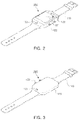
- FIG. 2 is a perspective view of a front surface a wearable electronic device according to an example embodiment of the inventive concept
- FIG. 3 is a perspective view of a rear surface of a wearable electronic device according to an example embodiment of the inventive concept
- FIG. 4A illustrates an embodiment of a wearable electronic device according to an example embodiment in which a pair of electrodes has a concentric shape
- FIG. 4B illustrates an arrangement of electrodes of a wearable electronic device having a semi-circular shape according to an example embodiment of the inventive concept
- FIG. 5 is a view illustrating an operation of a wearable electronic device being operated by a user, according to an example embodiment of the inventive concept
- FIG. 6A illustrates a first surface of the wearable electronic device being provided as an outwardly exposed surface
- FIG. 6B illustrates a process in which the electrodes of a wearable electronic device according to an example embodiment of the inventive concept are in contact with a body of a user
- FIG. 7 illustrates a wearable electronic device including a fixing part and a body part of the inventive concept
- FIG. 8 illustrates the operation of a wearable electronic device according to an example embodiment of the inventive concept
- FIG. 9 is a flowchart illustrating a method of providing a service according to an example embodiment of the inventive concept.
- FIG. 10 illustrates a method of providing a service according to an example embodiment of the inventive concept
- FIG. 11 illustrates a change prediction service regarding a range of biometric information displayed by a mobile device.
- FIG. 12 illustrates a health care service displayed by a mobile device.
- FIG. 13 is a flowchart illustrating a method of providing a service according to an example embodiment of the inventive concept
- FIG. 14 is a flowchart illustrating a method of providing body type information in a method of providing a service according to an example embodiment of the inventive concept
- FIG. 15 is a graph illustrating a method of providing body type information in a method of providing a service according to an example embodiment.
- FIG. 16 is a view illustrating a method of providing a service according to an example embodiment of the inventive concept
- FIG. 17 shows a selection table and a resulting graph according to an embodiment of the inventive concept.
- FIG. 18 shows a display of user-selected overall parameters displayed by a mobile device.
- FIGS. 1, 2 and 3 are views of a wearable electronic device according to an example embodiment of the inventive concept.
- a wearable electronic device 100 may include a fixing part 110 for affixing the wearable electronic device 100 to a body of a user.
- the fixing part may include, but is not limited to a band, strap, etc.
- the wearable electronic device includes a body part 120 that may include a display 121 , an input part 122 , a first electrode part 123 , etc.
- the wearable electronic device 100 may be provided as a smartwatch.
- a person of ordinary skill in the art also understands the wearable electronic device could be manufactured and sold without a fixing part, which could be sold separately and attached to the body part.
- the fixing part could also be a lanyard (e.g. for wearing the device as though it is a pendent), or even to attach the wearable electronic device to, for example, a decorative string or chain similar to a pocket watch.
- the wearable electronic device 100 may include a biosensor that obtains biometric information of the user, by using body information and bioelectrical impedance of the user, or the like.
- the biosensor may measure, for example, the bioelectrical impedance of a user by applying a predetermined electrical signal to a body of the user when the user brings a part of their body into contact with the first electrode part 123 .
- a predetermined electrical signal is applied to a body of the user, and an electric current and a voltage are detected.
- the first electrode part 123 may include, for example, a pair of electrodes, while the pair of electrodes may be disposed to be adjacent to each other.
- the user may be simultaneously in contact, with the pair of electrodes included in the first electrode part 123 , using a single finger, thereby increasing user convenience in a process of measuring the bioelectrical impedance.
- a space of the wearable electronic device 100 having a limited form factor may be more efficiently used in such a manner when constructed such that the pair of electrodes (as in this example embodiment) are disposed to be adjacent to each other.
- the biometric information of the user obtained by the biosensor of the wearable electronic device 100 may be output on the display 121 of the wearable electronic device 100 or may be output, to the user by an external electronic device (e.g. in this example a mobile device 10 ) connected to the wearable electronic device 100 to communicate therewith.
- an external electronic device e.g. in this example a mobile device 10
- the mobile device 10 is illustrated as a mobile device, such as a smartphone and a tablet PC.
- the mobile device 10 shown in FIG. 1 may be substituted, with various types of devices, including but not in any way limited to, for example, a television, a refrigerator, a desktop computer, and exercise equipment.
- biometric information obtained by the biosensor of the wearable electronic device 100 may be stored and managed in a secure area of a memory included in the wearable electronic device 100 .
- Biometric information when obtained by unauthorized users, cannot be reset, such as a password, or credit card number. Accordingly, the security of such biometric information should be safeguarded, for example, by an authentication process.
- the wearable electronic device 100 or the mobile device 10 may provide the user with a predetermined authentication process. In other words, only when the user passes the authentication process, then may the biometric information ma displayed on the display 121 , or may be shared with the mobile device 10 , thereby allowing the biometric information to be safely stored and managed.
- the link may be displayed on the wearable device, or it can be transmitted to the mobile device 10 .
- an authentication process may be executed that resides with the wearable device, or within the mobile device 10 , or may be provided by an authenticated server.
- the user may respond to authentication prompts and/or addition biometric information such as an iris scan or fingerprint may be required to complete the authentication.
- the mobile device 10 may include a housing 11 , a display 12 , a camera portion 13 , a fingerprint sensor 14 , and the like.
- the user may have access authority to the biometric information stored in the wearable electronic device 100 by passing the authentication process, which may include one or more of the recognition of a fingerprint, input of a password and a pattern, recognition of an iris and a face, detection of em electrocardiogram (ECG) signal and an electromyogram (EMG) signal, or the like, provided by the mobile device 10 or the wearable electronic device 100 .
- ECG electrocardiogram
- EMG electromyogram
- At least one of the authentication processes may be provided by the mobile device 10 , while the other of the authentication processes may be provided by the wearable electronic device 100 .
- the authentication process such as the detection of an ECG signal or an EMG signal
- the wearable electronic device 100 the user may perform the authentication process in such a manner that the user brings a part (e.g. a portion) of his/her body into contact with the pair of electrodes included in the first electrode part 123 .
- FIGS. 2 and 3 are perspective views of a front and a rear of a wearable electronic device 100 according to an example embodiment of the present inventive concept.
- a wearable electronic device 100 may include, for example, a fixing part 110 and a body part 120 , while the body part 120 may include a display 121 , an input part 122 , a first electrode part 123 , and a second electrode part 124 .
- the wearable electronic device 100 is illustrated as a smartwatch, but may include various devices wearable on a body of a user, in addition to a smartwatch.
- the body part 120 may have a first surface on which the display 121 is disposed and a second surface opposed thereto.
- the second surface may be provided as a surface with which skin of the user is in contact, when the user wears the wearable electronic device 100 .
- the first surface may be provided as an outwardly exposed surface.
- the first electrode part 123 may be disposed on the first surface (e.g. FIG. 2 ), while the second electrode part 124 may be disposed on the second surface (e.g. FIG. 3 ).
- Each of the first electrode part 123 and the second, electrode part 124 may include a pair of electrodes.
- the pair of electrodes included in each of the first electrode part 123 and the second electrode part 124 may be disposed to be adjacent to each other.
- a biosensor may be included in the body part 120 of the wearable electronic device 100 .
- the biosensor may obtain various biometric information, such as fat mass, body mass index (BMI), muscle mass, total body water, fat mass index, and fat free mass index, by measuring, for example, bioelectrical impedance of the user.
- the biosensor may be mounted on a circuit board, while the circuit board may be electrically connected to electrodes included in the first electrode part 123 and the second electrode part 124 .
- the first electrode part 123 and the second electrode part 124 may simultaneously be in contact with a body of the user.
- the second electrode part 124 may be in contact with the skin on the wrist of the user wearing the electronic device, and a finger of the user may touch the first electrode part 123 of the wearable device. While the first electrode part 123 and the second electrode part 124 are simultaneously in contact with the body of the user, the biosensor may apply an electrical signal thereto through the first electrode part 123 and the second electrode part 124 , thereby measuring bioelectrical impedance of the user.
- the wearable electronic device 100 is provided as a smartwatch
- the user may wear the wearable electronic device 100 on his wrist.
- a human's wrist has a curved form.
- the first electrode part 123 and the second electrode part 124 are not appropriately designed, the second electrode part 124 may be detached from the body of the user by an operation in which the body of the user is in contact with the first electrode part 123 .
- the first electrode part 123 and the second electrode part 124 may be disposed to face each other so that the first electrode part 123 and the second electrode part 124 may be simultaneously in contact with the body of the user. If it within the inventive concept that the first electrode part 123 and the second electrode part can be arranged on the same surface, or different surfaces of the wearable device according to need.
- the electrodes included in the first electrode part 123 and the second electrode part 124 are illustrated as having a rectangular shape, but the shapes of the electrode are not limited thereto.
- the electrodes included in the respective first electrode part 123 and the second electrode part 124 can have respectively different shapes and sizes.
- an example embodiment will be described with reference to FIGS. 4A and 4B .
- FIGS. 4A and 4B are views illustrating an arrangement of electrodes of a wearable electronic device according to an example embodiment of the inventive concept.
- a wearable electronic device 100 A may include a body part 120 , a display 121 , an input part 122 , and the like.
- a first electrode part 130 may be disposed on a side of a first surface defined as an upper surface of the body part 120 .
- the first electrode part 130 may include a pair of electrodes 130 a and 130 b.
- the pair of electrodes 130 a and 130 b may have a concentric shape, but the inventive concept is not limited to this depiction.
- the user may bring a part of their body, for example, a finger, into contact with the first electrode part 130 , thereby allowing the body part to be simultaneously in contact with the pair of electrodes 130 a and 130 b.
- a first electrode part 131 included in a wearable electronic, device 100 B may include a pair of electrodes 131 a and 131 b .
- the pair of electrodes 131 a and 131 b shown in FIG. 4B may include an internal electrode 131 a and an external electrode 131 b , while the external electrode 131 b may have a semicircular shape surrounding the internal electrode 131 a .
- the user may bring a part of their body, such as a finger, into contact with the first electrode part 131 , thereby allowing his body to be simultaneously in contact with the pair of electrodes 131 a and 131 b .
- the internal electrode 131 a and the internal electrode 131 b are not limited to corresponding shapes.
- the external electrode 131 b may be semicircular in shape
- the internal electrode 131 a may be circular, rectangular, or have an irregular shape.
- FIG. 5 is a view illustrating an operation of a wearable electronic device according to an example embodiment.
- inventive concept is not limited to devices worn on the wrist, and for example, could be worn on an ankle a finger, attached to a lanyard and worn as a pedant, or may be temporarily affixed to the skin, for example, via an adhesive.
- the wearable electronic device may also be attached to a user's article of clothing, which may have a predetermined opening or base by which the wearable electronic device is detachably connected.
- a wearable electronic device 100 is illustrated as a smartwatch, but may be changed into devices having various other forms that a user may wear on his body, in addition thereto.
- the user may wear the wearable electronic device 100 on a wrist 140 .
- the wearable electronic device 100 may be fixed to the wrist 140 of the user by a fixing part 110 provided to have a strap form.
- the fixing part could contain one or more electrodes.
- the fixing part could have an electrode in the portion of the strap that is in contact with the user's wrist, and there may be an internal conductive channel with an interface that is electrically connected to a port of the wearable device.
- a body part 120 may have a first surface on which a display 121 and a first electrode part 123 are disposed and a second surface opposed thereto.
- a second electrode part may be disposed on the second surface.
- the second electrode part 124 ( FIG. 6B ), may be disposed in a position of opposing the first electrode part 123 , e.g., below the first electrode part 123 .
- the user may bring a finger 141 into contact with the first electrode part 123 .
- the user may bring the finger 141 into contact with the first electrode part 123 , so that the finger 141 may be simultaneously in contact with a pair of electrodes included in the first electrode part 123 .
- the second electrode part 124 disposed below the first electrode part 123 may be in contact with skin on the wrist 140 of the user by an operation in which the first electrode part 123 is pressed using the finger 141 .
- an entirety of the first electrode part 123 and the second electrode part may be in stable contact with a body of the user.
- the inventive concept as embodied in the example of FIG. 5 may have a function of measuring biometric information in which, for example, the wearable electronic device 100 may obtain the biometric information only by an operation in which the user brings a finger 141 into contact with the first electrode part 123 .
- the finger 141 may be in simultaneous contact, with the pair of electrodes included in the first electrode part 123 , so that a circuit, a software algorithm, or the like, which compensates for the resistance component of the finger 141 , may be disposed in the wearable electronic device 100 .
- the first electrode part 123 may be provided as an electrode for detecting a fingerprint of the user.
- a biosensor in the wearable electronic device may measure bioelectrical impedance of the user, and obtain the biometric information of the user.
- FIGS. 6A and 6B are views illustrating an embodiment of a process of the inventive concept, in which electrodes of a wearable electronic device are in contact with a body of a user.
- the wearable electronic device may include a fixing part 110 and a body part 120 .
- the body part 120 may include a first electrode part 123 disposed on a first surface of the body part 120 and a second electrode part 124 ′ disposed on a second surface of the body part 120 .
- the first surface may be provided as an outwardly exposed surface while the user wears the wearable electronic device.
- the second surface may be provided as a surface opposed thereto.
- the first electrode part 123 may include a pair of electrodes 123 a and 123 b disposed to be adjacent to each other on a side of the first surface.
- a pair of electrodes 124 a ′ and 124 b ′ included in the second electrode part 124 ′ may be disposed to be spaced apart from each other on the second surface.
- the space between the pair of electrodes 132 a , 123 b is different from, (and in this case less than) the space between the [air of electrodes 124 a ′ and 124 b′.
- a biosensor of the wearable electronic device may measure the bioelectrical impedance of the user.
- the first electrode part 123 and the second electrode part 124 ′ shown in FIG. 6A may be simultaneously in contact with, the body of the user.
- second force F 2 may be generated in an opposite direction by first force F 1 that the user applies to the first electrode part 123 .
- the first force F 1 may cause the body part 120 to slightly tilt such that at least one of the pair of electrodes 121 a ′ and 124 b ′ included in the second electrode part 124 ′ may be detached from the body of the user by the second force F 2 .
- the bioelectrical impedance of the user may not be accurately measured, or an error may occur in a measurement process.
- a second electrode part 124 may be disposed on a side of the second surface, which may enhance the accuracy of the bioelectrical impedance measured by the wearable electronic device.
- the second force F 2 applied between the second electrode part 124 and a wrist 140 of the user may be generated by the first force F 1 that the user applies to the first electrode part 123 using the finger 141 .
- a pair of electrodes 124 a and 124 b included in the second electrode part 124 may be disposed to be adjacent, to each other below the first electrode part 123 .
- the first force F 1 and the second force F 2 may be generated in the substantially same position. Due to the position of the second force F 2 shown in FIG. 6B , the pair of electrodes 124 a and 124 b included in the second electrode part 124 may be in stable contact with the wrist 140 of the user.
- FIGS. 7 and 8 are views illustrating an operation of the wearable electronic device according to an example embodiment of the inventive concept.
- the wearable electronic device may include a fixing part 210 and a body part 220 .
- a circuit board 221 including a biosensor 222 mounted thereon may be disposed in the body part 220 .
- the biosensor 222 may be provided as an integrated circuit chip package to be mounted on the circuit board 221 .
- a memory, an application process, and the like may be mounted together, in addition to the biosensor 222 .
- the user may bring a part of his/her body, such as a finger 241 , into contact with a first electrode part 223 disposed on a first surface of the body part 220 of the wearable electronic device, so that the biosensor 222 may measure the bioelectrical impedance of the user.
- a second electrode part 224 may be disposed on a second surface of the body part 220 .
- the second electrode part 224 may be in contact (or may come into contact) with a wrist 240 of the user by the force applied to the first electrode part 223 by the finger 241 .
- the electrodes respectively included in each of the first electrode part 223 and the second electrode part 224 may include a connection portion protruding toward a circuit board.
- the circuit board 221 may include, for example, contact parts 225 and 226 that are conductive.
- the contact parts 225 and 226 may electrically connect with a respective connection portion of the first electrode part 223 and the second, electrode part 224 by force the user applies to the first electrode part 223 .
- the connection portion of the first electrode part 223 may form an electrical connection with the contact part 225
- the second, electrode part 224 may form an electrical connection with contact part 226 when the finger 241 applies sufficient force to the first electrode.
- the biosensor 222 may apply an electrical signal to each of the first electrode part 223 and the second electrode part 224 through the contact parts 225 and 226 and may detect an electric current and a voltage to measure the bioelectrical impedance of the user.
- first electrode part 223 the second electrode part 224 , and the contact parts 225 and 226 will be described in more detail.
- an electrode included in the first electrode part 223 may include a connection part 223 a of the first electrode part 223 protruding toward the circuit board 221 . More particularly, the connection part 223 a of the first, electrode part 223 may be arranged to protrude toward the contact part 225 of the circuit board 221 so as to be connectable with regard to the contact part. A concave portion 223 b may be disposed on an end of the connection part 223 a . The connection part 223 a may electrically connect to the contact part 225 disposed on the circuit board 221 by an operation in which the user presses the first electrode part 223 .
- the contact part 225 may include an elastic member 225 a that offsets the force applied when being in contact with the first electrode part 223 and may include a protruding portion 225 b connected to the elastic member 225 a .
- the protruding portion 225 b of the contact part 225 may become interlocked with the concave portion 223 b of the first electrode part 223 upon application of a force to the first electrode part, so that the first electrode part 223 is connected to the contact part 225 to apply an electrical signal, such as an electric current and a voltage. Structures of the first electrode part 223 and the contact part 225 that have been described with reference to FIG. 8 may be similarly applied, to the second electrode part 224 and a contact part 226 .
- FIG. 9 is a flowchart illustrating a method of providing a service according to an example embodiment of the inventive concept.
- the method, of providing a service described with reference to a flowchart; illustrated in FIG. 9 may be implemented by a biometric information measuring device that is configured to include a function of measuring biometric information, or by other electronic devices connected, to the biometric information measuring device to be able to communicate therewith.
- the method of providing a service may begin at operation S 10 by measuring bioelectrical impedance of a user at a first time point.
- an electrical signal may be applied to the body of the user, and an electric current and a voltage may be detected, thereby measuring bioelectrical impedance.
- a first value representing specific bioelectrical impedance of the user may be obtained.
- the first value may foe provided as biometric information calculated from bioelectrical impedance measured at a first time point, body information input by the user, and the like.
- the first value may be provided as a value representing biometric information at the first time point.
- Body information input by the user to calculate the first value may include, for example, race, gender, age, height, body weight, and the like.
- the first value may be provided as a value representing at least one of fat mass, BMI, muscle mass, total body water, fat mass index, and fat free mass index, included in biometric information of the user.
- the second value representing biometric information at a second time point before (e.g. prior to) the first time point may be obtained.
- the second value may be provided as a value that was obtained earlier in time than the first time point.
- the second value representing biometric information at the second time point may have been stored in a memory, or the like.
- the biometric information measuring device may obtain a third value representing biometric information at a third time point that occurs after the first time point, by using the first value and the second value.
- the third value calculated in operation 340 may be provided as a value to predict any change among pieces of biometric information of the user.
- a difference between a fourth value and the third value may be calculated.
- the fourth value may be a target value input by the user in advance.
- a health management service may be provided.
- a trend may be analyzed based on the first value representing a present state of biometric information of the user and the second value representing a past state of the biometric information.
- the third value which predicts a future state of the biometric information based on the past state and the present state, may be calculated based thereon.
- the difference between the fourth value, a target value of the biometric information input by the user in advance and the third value may be calculated.
- a diet management service, an exercise guidance service, or the like, utilized to achieve goals may be provided to the user.
- the first value, the second value, the third value, and the fourth value, representing specific biometric information of the user may be managed by being linked to identity information of the user.
- identity information of the user may include information such as a name input by the user in advance and an authentication process set by the user in advance.
- the health management, service based on the first value, the second value, the third value, and the fourth value may not be provided (see operation S 60 in FIG. 9 ).
- biometric information including sensitive personal information of the user may be more securely managed.
- FIGS. 10, 11 and 12 are views illustrating a method of providing a service according to an example embodiment.
- the wearable electronic device 300 may include a body part 301 .
- a display 302 In the body part 301 , a display 302 , an input part 303 , an electrode part 304 , and the like, may be provided.
- the wearable electronic device 300 may measure bioelectrical impedance of the user.
- a health management service provided in an example embodiment illustrated in FIG. 10 may include a fat mass change prediction service.
- a service screen 310 On a service screen 310 , a graph illustrating fat mass values A, B, C, D 1 , and D 2 in each of a plurality of instances T 1 , T 2 , T 3 , and T 4 may be displayed.
- the fat mass change may be gradually reduced.
- the wearable electronic device 300 may predict a changing fat mass trend using fat mass values A and B obtained in each of the first time point T 1 and a second time point T 2 , representing the past, and a fat mass value C obtained in the third time point T 3 representing the present.
- an expected fat mass value D 1 calculated from the changing trend of fat mass may be displayed on the graph.
- the expected fat mass value D 1 may be displayed together with a target fat mass value D 2 input by the user in advance, in the graph.
- Information that can be used to reduce a difference between the expected fat mass value D 1 and the target fat mass value D 2 together with the graph may be provided to the user.
- the information may include a diet information service for the sake of the user, an exercise guidance service, a recommended calorie consumption information service, and the like, required by the user.
- a change prediction service regarding a range of biometric information such as body weight, BMI, body type, fat mass, skeletal muscle mass, or the like, may be provided by the method of providing a service according to an example embodiment of the inventive concept.
- a change prediction service of biometric information may be provided by an electronic device 400 having a function of measuring biometric information, or there may be change prediction service that is in communication with a biometric information measuring device to be able to communicate therewith.
- the electronic device 400 may include a housing 410 , a fingerprint sensor 411 , a camera part 412 , and the like.
- a service screen 420 disposed on a display of the electronic device 400 may include a table 421 in which a past value, a present value, an expected value, and a target value of a plurality of biometric information parameters are displayed together.
- the table 421 is provided for illustrative purposes, and the inventive concept is not limited to displaying the types of items shown in the table 421 .
- the table 421 may display more parameters or fewer parameters than shown and while this table may be initially set as a default, the user, manufacturer of the wearable device, or the service prediction provider may update or change the items displayed in table 421 .
- the target value of at least one of the parameters displayed in the table 421 may be provided as a value inversely calculated from a target value pf a different parameter set by the user.
- the electronic device 400 may calculate a target body weight value using a target fat mass value and a target skeletal muscle mass value input by the user.
- the user may calculate the target value of a parameter easily discernible by the user from target values input by the user, thereby providing a more intuitive health management service.
- the user in a case in which a parameter most discernible to the user is body weight, and the body weight of the user reaches 74 kg, a target value, the user may determine that fat mass and skeletal muscle mass has reached a value close to a target, value set by the user.
- the service screen 420 may provide a graph analysis service 422 on a bottom portion thereof.
- the electronic device 400 may produce a graph of a selected parameter to be displayed.
- FIG. 12 an example embodiment will be described with reference to FIG. 12 .
- the graph analysis service may be displayed in a various ways, and could be displayed, for example, in response to a user touch, voice command, icon selection, etc,
- FIG. 12 illustrates an example embodiment in which the user has selected the fat mass and body weight in the graph analysis service 422 such as shown in FIG. 11 .
- a first graph 423 predicting a changing trend of fat mass and a second graph 424 predicting a changing trend of body weight may be displayed.
- target values of fat mass and body weight may be displayed together.
- the electronic device 400 may provide information about diet and the amount of exercise to permit reaching a target value input by the user in advance and may provide the information to the user.
- FIG. 13 is a flowchart illustrating a method of providing a service according to an example embodiment of the inventive concept.
- the method of providing a service may be started by storing body information input by a user.
- the body information input by the user in S 200 may include height, body weight, and the like, of the user.
- the user may input also input information, such as an age, race, and gender, in addition to height and body weight.
- bioelectrical impedance of the user may be measured at a first time. Bioelectrical impedance may be measured such that a predetermined electrical signal is applied through electrodes in contact with a body of the user, and an electric current and a voltage is detected.
- biometric information of the user may be obtained using body information input by the user in S 200 and bioelectrical impedance in operation S 220 .
- the biometric information obtained in operation S 220 may include fat mass, total body water, skeletal muscle mass, BMI, body type, and the like.
- the method of providing a service may display two or more parameters among parameters included in body information and biometric information in a single graph in S 230 .
- a plurality of parameters may be selected to be displayed as a single graph.
- a single graph displayed in S 230 may include a plurality of axes illustrating the plurality of parameters.
- the body type among the parameters included in the biometric information may be determined based on, for example, BMI calculated from height and body weight of the user and fat mass calculated from bioelectrical impedance of the user. Since the body type may be determined by more than a relationship between height and body weight, and may also be determined by a percentage of fat mass by weight, in an example embodiment, the body type of the user may be determined in full consideration of BMI and fat mass.
- BMI calculated from height and body weight of the user
- fat mass calculated from bioelectrical impedance of the user. Since the body type may be determined by more than a relationship between height and body weight, and may also be determined by a percentage of fat mass by weight, in an example embodiment, the body type of the user may be determined in full consideration of BMI and fat mass.
- FIGS. 14 and 15 an example embodiment will be described herein below with reference to FIGS. 14 and 15 .
- FIG. 14 is a flowchart illustrating a method of providing body type information in a method of providing a service according to an example embodiment
- FIG. 15 is a graph illustrating the method of providing body type information in a method of providing a service according to an example embodiment.
- the method of providing body type information may be started by calculating BMI based on height and body weight of a user.
- the height and the weight of the user may be provided as a value directly input by the user.
- a different calculation method of calculating BMI may be applied depending on an age, gender, or the like, of the user.
- bioelectrical impedance of the user may be measured.
- the bioelectrical impedance of the user may be measured in such a manner that an electrical signal is applied through electrodes in contact with a body of the user, and an electric current and a voltage is detected through the electrodes.
- the bioelectrical impedance that has been measured may be used in calculating fat mass, together with body information, such as the height and the weight, previously input by the user in operation S 300 .
- the BMI and the fat mass of the user may be input to a database already stored, thereby obtaining body information of the user.
- the database may include information in which body type information of the user is classified depending on BMI and fat mass.
- the body type information provided in S 330 may be provided to the user in S 340 .
- body information may be provided to be schematized as a single graph, together with other information, such as fat mass, body weight, BMI, total body water, and muscle mass of the user.
- FIG. 15 is a graph illustrating the method of providing body type information.
- FIG. 15 is a graph illustrating the method of providing body type information of the user using BMI and fat mass as an example.
- a database required in providing the body type information may be stored to have a format different from that of FIG. 15 .
- a horizontal axis may refer to BMI
- a vertical axis may refer to fat mass.
- a combination of BMI-fat mass of a number of people may be stored in a database and may be schematized on a graph, as illustrated in FIG. 15 , thereby schematically determining a trend line TL.
- the database displayed on the graph of FIG. 15 may vary depending on race, an age, gender, or the like, of the user.
- a classification standard of body type information of the user may be provided using a body type standard based on BMI provided by the World Health Organization (WHO) and the trend line TL displayed on the graph.
- the body type standard based on BMI provided by WHO is illustrated in Table 1 below
- boundary values of BMI determining classification of body type are displayed on the horizontal axis of the graph of FIG. 15 .
- Four reference values B 1 to B 4 displayed on the horizontal axis of the graph of FIG. 15 may be 18.5, 25.0, 30.0, and 40.0 in. sequence.
- reference values F 1 to F 4 classifying fat mass on the graph of FIG. 15 may be determined by reference values B 1 to B 4 of BMI in a combination of BMI-fat mass included in the database.
- at least eight pieces of body type information may be determined by the reference values B 1 to B 4 of BMI, the reference values F 1 to F 4 of fat mass, and the trend line TL.
- a first area A 1 may be defined as an underweight-low fat body type in which body weight is relatively light, as compared with height, and fat mass is relatively low.
- a second area A 2 may be defined as a thin-obese body type in which body weight is relatively light, as compared with height, but fat mass is relatively high.
- a case in which an area is disposed below the trend line TL may be construed as a body type in which an amount of fat is low, as compared with body weight.
- a case in which an area is above the trend line TL may be construed as a body type in which the amount of fat is high, as compared with body weight.
- various parameters included in body information and biometric information and body type information obtained using a method described with reference to FIGS. 14 and 15 may be schematized as a single graph, thereby being provided to the user.
- an example embodiment will be described with reference to FIGS. 16 to 18 .
- FIGS. 16, 17 and 18 are views illustrating a method of providing a service according to an example embodiment of the inventive concept.
- FIG. 17 shows a selection table and a resulting graph according to an embodiment of the inventive concept
- FIG. 18 shows a display of user-selected overall parameters displayed by a mobile device.
- FIGS. 16 to 18 illustrate a case in which the method of providing a service according to an example embodiment is provided through an electronic device 500 .
- the method of providing a service may also be provided using a wearable device, or the like, that a user wears on his body.
- the electronic device 500 may include a housing 510 , a camera 511 , a fingerprint sensor 512 , and the like.
- the camera 511 may be used to perform an authentication process, such as face recognition, as well as to capture an image.
- the fingerprint sensor 512 may perform an authentication process by detecting a fingerprint of the user.
- a service according to an example embodiment may be provided in a case in which the authentication process provided by the camera 511 , the fingerprint sensor 512 , or the like.
- FIGS. 16 to 18 are merely examples of a service providing screen according to example embodiments, bat the inventive concept is not limited to shapes thereof illustrated in FIGS. 16 to 18 .
- a display 520 may display a resulting graph 540 , together with a selection table 530 in which a display item may be selected.
- the user may have selected, weight, skeletal muscle mass, and fat mass in the selection table 530 .
- parameters such as body weight, skeletal muscle mass, and fat mass, selected by the user in the selection table 530 may be displayed.
- the resulting graph 540 may include three axes corresponding to three parameters selected by the user.
- the resulting graph 540 may display a first graph 541 displaying a present state of each parameter and a second graph 542 displaying a target state thereof input by the user, together.
- the user may obtain information in which body weight and fat mass should be reduced, and skeletal muscle mass should be increased, to assist in reaching a goal.
- the electronic device 500 may further provide a service informing the user of a particular lifestyle that is recommended to reach a target, state set by the user in advance.
- the selection table 530 and a resulting graph 550 may be displayed.
- the user may have selected body weight, body type, skeletal muscle mass, fat mass, and total body water, among parameters displayed in the selection table 530 .
- the resulting graph 550 may include five axes corresponding to five parameters selected by the user.
- the resulting graph 550 may display a first graph 551 displaying a present state of each parameter, a second graph 552 displaying a past state thereof, and a third graph 553 displaying an expected future state thereof, together.
- the first graph 551 may be provided as a graph displaying a value of each parameter obtained at a first time point corresponding to the present time.
- the second graph 522 may be provided as a graph displaying a value of each parameter obtained at a second time point prior to the first time point, and such parameters may have been previously stored.
- the present lifestyle such as diet and an amount of exercise
- the user may determine an expected change in each parameter through the third graph 553 and control the diet, the amount, of exercise, or the like, based thereon.
- FIG. 18 may illustrate an example embodiment in which the user selected overall parameters displayed in the selection table 530 .
- a resulting graph 560 of FIG. 18 may include eight axes corresponding to eight parameters.
- the resulting graph 560 may display a first graph 561 displaying a present state of each parameter, a second graph 562 displaying an expected future state thereof, and a third graph 553 displaying a target state thereof input by the user in advance, together.
- the user may determine lifestyle recommended to reach the target state by comparing the second graph 562 and the third graph 563 .
- the electronic device 500 may inform the user of a lifestyle, such as types of exercise, the amount of exercise, diet, and sleep, that, are recommended to reach the target state by comparing the second graph 562 and the third graph 563 .
- resulting graphs 540 , 550 , and 560 may display an entirety of a past, state, a present state, an expected, state, and a target state of parameters selected by the user in the selection table 530 .
- a plurality of parameters from among parameters included in body information, such as height, and body weight directly input by the user and biometric information obtained, by measuring bioelectrical impedance of the user may be displayed as a single resulting graph 540 , 550 , or 560 .
- the user may determine the present state of his body more intuitively and easily in such a manner that the plurality of parameters among parameters included in the body information and the biometric information are displayed as a single resulting graph 540 , 550 , or 560 .
- a health management service may be provided to a user using biometric information obtained by a biosensor.
- biometric information obtained by a biosensor.
- useful information may be provided to a user by combining two or more pieces of biometric information, or a changing trend of biometric information may be provided to the user, thereby providing the user with a range of useful information using biometric information.
Landscapes
- Health & Medical Sciences (AREA)
- Life Sciences & Earth Sciences (AREA)
- Engineering & Computer Science (AREA)
- Public Health (AREA)
- Medical Informatics (AREA)
- General Health & Medical Sciences (AREA)
- Biomedical Technology (AREA)
- Physics & Mathematics (AREA)
- Biophysics (AREA)
- Pathology (AREA)
- Heart & Thoracic Surgery (AREA)
- Molecular Biology (AREA)
- Surgery (AREA)
- Animal Behavior & Ethology (AREA)
- Veterinary Medicine (AREA)
- Epidemiology (AREA)
- Primary Health Care (AREA)
- Radiology & Medical Imaging (AREA)
- Nuclear Medicine, Radiotherapy & Molecular Imaging (AREA)
- Theoretical Computer Science (AREA)
- General Engineering & Computer Science (AREA)
- General Physics & Mathematics (AREA)
- Physical Education & Sports Medicine (AREA)
- Nutrition Science (AREA)
- Data Mining & Analysis (AREA)
- General Business, Economics & Management (AREA)
- Business, Economics & Management (AREA)
- Databases & Information Systems (AREA)
- Human Computer Interaction (AREA)
- Artificial Intelligence (AREA)
- Computer Vision & Pattern Recognition (AREA)
- Physiology (AREA)
- Psychiatry (AREA)
- Signal Processing (AREA)
- Measurement And Recording Of Electrical Phenomena And Electrical Characteristics Of The Living Body (AREA)
Abstract
Description
| TABLE 1 |
| Classification Standard Based on BMI |
| Classification of Body Type | BMI | ||
| Underweight | ~18.5 |
| Normal Range | 18.5~24.9 |
| Overweight - | 25.0~29.9 |
| Brink of Obesity |
| Obese | Class I | 30.0~34.9 | ||
| Class II | 35.0~39.9 | |||
| Class III | 40.0~ | |||
Claims (10)
Applications Claiming Priority (4)
| Application Number | Priority Date | Filing Date | Title |
|---|---|---|---|
| KR10-2017-0021002 | 2017-02-16 | ||
| KR20170021002 | 2017-02-16 | ||
| KR1020170077894A KR102419892B1 (en) | 2017-02-16 | 2017-06-20 | Method for providing service based on biometric information and wearable electronic device |
| KR10-2017-0077894 | 2017-06-20 |
Publications (2)
| Publication Number | Publication Date |
|---|---|
| US20180228432A1 US20180228432A1 (en) | 2018-08-16 |
| US11395628B2 true US11395628B2 (en) | 2022-07-26 |
Family
ID=63105954
Family Applications (1)
| Application Number | Title | Priority Date | Filing Date |
|---|---|---|---|
| US15/837,338 Active 2039-03-15 US11395628B2 (en) | 2017-02-16 | 2017-12-11 | Method of providing service based on biometric information and wearable electronic device |
Country Status (2)
| Country | Link |
|---|---|
| US (1) | US11395628B2 (en) |
| CN (1) | CN108433724A (en) |
Families Citing this family (8)
| Publication number | Priority date | Publication date | Assignee | Title |
|---|---|---|---|---|
| CN105408898B (en) | 2013-03-15 | 2019-05-28 | 弗兰克公司 | Automatic recording and graph generation of measurement data |
| US11633160B2 (en) * | 2015-12-15 | 2023-04-25 | Renato Romani | Weight management system |
| CN109171704A (en) * | 2018-09-19 | 2019-01-11 | 深圳市理邦精密仪器股份有限公司 | Method, apparatus, terminal and the computer readable storage medium of ecg wave form analysis |
| KR102786164B1 (en) * | 2019-07-08 | 2025-03-26 | 삼성전자주식회사 | Method of registering fingerprint based on optical fingerprint recognition and method of performing optical fingerprint recognition using the same |
| US11604862B2 (en) * | 2020-08-18 | 2023-03-14 | International Business Machines Corporation | Biometric user authentication |
| CN115590493A (en) * | 2021-07-07 | 2023-01-13 | 华为技术有限公司(Cn) | A wearable device and a method for measuring physiological parameters |
| KR20230146347A (en) | 2022-04-12 | 2023-10-19 | 삼성전자주식회사 | Apparatus and method for estimating body water state |
| CN116167035B (en) * | 2023-04-14 | 2023-06-27 | 深圳曼瑞德科技有限公司 | Method and system for carrying out identity recognition by collecting hand actions of intelligent watch |
Citations (58)
| Publication number | Priority date | Publication date | Assignee | Title |
|---|---|---|---|---|
| US20020123695A1 (en) * | 2000-04-18 | 2002-09-05 | Shozo Kawanishi | Visceral fat meter |
| US20020151815A1 (en) * | 2000-05-31 | 2002-10-17 | Shozo Kawanishi | Visceral fat meter |
| US20020183624A1 (en) | 2001-06-05 | 2002-12-05 | Rio Grande Medical Technologies, Inc. | Apparatus and method of biometric determination using specialized optical spectroscopy systems |
| US20030023186A1 (en) * | 2001-07-24 | 2003-01-30 | Tanita Corporation | Body fat measuring system for pregnant woman and health care system for pregnant woman |
| US20040059242A1 (en) * | 2000-11-29 | 2004-03-25 | Yoshihisa Masuo | Body composition measurement method and apparatus |
| US20040243020A1 (en) * | 2003-05-30 | 2004-12-02 | Tanita Corporation | Body composition management apparatus for pregnant woman |
| US20050209528A1 (en) * | 2004-03-16 | 2005-09-22 | Omron Healthcare Co., Ltd. | Body composition measuring device capable of comparing current measured value with past measured value |
| US20060235327A1 (en) * | 2005-04-13 | 2006-10-19 | Tanita Corporation | Trunk visceral fat measuring method and apparatus, trunk skeletal muscle amount measuring apparatus, trunk subcutaneous fat measuring method and apparatus, and trunk visceral and subcutaneous fat measuring method and apparatus |
| US20060282005A1 (en) * | 2005-06-06 | 2006-12-14 | Tanita Corporation | Abdominal impedance-based body composition measuring apparatus |
| KR100669169B1 (en) | 2005-08-09 | 2007-01-16 | 주식회사 바이오스페이스 | Body composition analysis device capable of outputting comparative data and its method |
| US20070038140A1 (en) * | 2005-07-07 | 2007-02-15 | Tanita Corporation | Truncal visceral/subcutaneous fat measuring method and apparatus |
| US20070043302A1 (en) * | 2005-08-18 | 2007-02-22 | Tanita Corporation | Apparatus for assuming information on the amount accumulated visceral fat of a human body |
| US20080177569A1 (en) | 2007-01-24 | 2008-07-24 | Qualcomm Incorporated | Mobile Phone Based Authentication and Authorization System and Process to Manage Sensitive Individual Records |
| US20090024053A1 (en) * | 2007-07-19 | 2009-01-22 | Tanita Corporation | Body composition measuring apparatus |
| US20090106563A1 (en) | 2007-10-17 | 2009-04-23 | Spansion Llc | Tamper reactive memory device to secure data from tamper attacks |
| US20090204018A1 (en) * | 2006-03-17 | 2009-08-13 | Omron Healthcare Co., Ltd. | Body composition measuring instrument for recognizing changes in body composition |
| US20100100146A1 (en) * | 2006-09-25 | 2010-04-22 | Andreas Blomqvist | Medical device comprising an impedance measurement means to measure visceral fat |
| US7711961B2 (en) | 2003-08-27 | 2010-05-04 | Sony Corporation | Electronic apparatus and authenticating method |
| KR100974815B1 (en) | 2003-03-20 | 2010-08-10 | 주식회사 비즈모델라인 | Dual Biometric Authentication System |
| US20110106553A1 (en) * | 2007-08-28 | 2011-05-05 | Omron Healthcare Co., Ltd. | Health management guideline advising device |
| US20110165996A1 (en) | 2008-08-22 | 2011-07-07 | David Paulus | Computer controlled exercise equipment apparatus and method of use thereof |
| US20110245711A1 (en) * | 2010-04-05 | 2011-10-06 | Corventis, Inc. | Method and apparatus for personalized physiologic parameters |
| US20120004570A1 (en) * | 2009-02-20 | 2012-01-05 | Omron Healthcare Co., Ltd. | Biological information measurement device, biological information measurement method, and body composition measurement device |
| US20120253206A1 (en) * | 2011-03-30 | 2012-10-04 | Shinichi Fukuda | Measurement apparatus, measurement method, information processing apparatus, information processing method, and program |
| US20130197389A1 (en) * | 2010-10-15 | 2013-08-01 | Fresenius Medical Care Holdings, Inc. | Dry weight predictor |
| JP2013208374A (en) | 2012-03-30 | 2013-10-10 | Tanita Corp | Body balance decision system and body balance decision program |
| US8585615B2 (en) * | 2010-07-14 | 2013-11-19 | Tanita Corporation | Abdominal obesity index measuring apparatus |
| US20140031713A1 (en) * | 2011-02-03 | 2014-01-30 | Impedimed Limited | Tissue mass indicator determination |
| US20140142459A1 (en) * | 2012-11-14 | 2014-05-22 | MAD Apparel, Inc. | Wearable performance monitoring, analysis, and feedback systems and methods |
| US20140212850A1 (en) * | 2011-09-26 | 2014-07-31 | Omron Healthcare Co., Ltd. | Body weight management device for managing a measurement subject's body weight using a target |
| US20140243699A1 (en) * | 2011-10-07 | 2014-08-28 | Fresenius Medical Care Deutschland Gmbh | Method and arrangement for determining an overhydration parameter or a body composition parameter |
| US20140245784A1 (en) * | 2013-03-04 | 2014-09-04 | Hello Inc. | Wearable device with interior frame |
| US20140288435A1 (en) * | 2012-06-22 | 2014-09-25 | Fitbit, Inc. | Heart rate data collection |
| US20140343443A1 (en) * | 2011-01-09 | 2014-11-20 | Fitbit, Inc. | Biometric monitoring device having a body weight sensor, and methods of operating same |
| US20150093725A1 (en) * | 2013-10-02 | 2015-04-02 | Access Business Group International Llc | Diet adherence system |
| US20150220109A1 (en) | 2013-11-29 | 2015-08-06 | Mechio Inc. | Wearable computing device |
| US20150310444A1 (en) | 2014-04-25 | 2015-10-29 | Broadcom Corporation | Adaptive biometric and environmental authentication system |
| US20150347689A1 (en) | 2012-06-04 | 2015-12-03 | Pharmalto, Llc | System and Method for Comprehensive Health and Wellness Mobile Management |
| KR20150136808A (en) | 2014-05-28 | 2015-12-08 | 주식회사 인바디 | Method and system for providing health report |
| US20150373019A1 (en) | 2014-06-24 | 2015-12-24 | Abdulmotaleb El Saddik | Electrocardiogram (ecg) biometric authentication |
| US20150379238A1 (en) * | 2012-06-14 | 2015-12-31 | Medibotics Llc | Wearable Imaging Device for Monitoring Food Consumption Using Gesture Recognition |
| KR101584090B1 (en) | 2014-03-13 | 2016-01-12 | 계명대학교 산학협력단 | Mirror device, wearable device and exercise management system |
| KR20160016263A (en) | 2014-08-04 | 2016-02-15 | 엘지전자 주식회사 | Mirror display device and operating method thereof |
| KR101624525B1 (en) | 2015-11-06 | 2016-05-26 | 주식회사 자원메디칼 | Apparatus, server and computer program stored in computer-readable medium for measuring body information |
| US20160234206A1 (en) | 2015-02-06 | 2016-08-11 | NXT-ID, Inc. | Distributed Method and System to Improve Collaborative Services Across Multiple Devices |
| US20160249857A1 (en) * | 2015-02-26 | 2016-09-01 | Samsung Electronics Co., Ltd. | Electronic device and body composition measuring method of electronic device capable of automatically recognizing body part to be measured |
| US20160302677A1 (en) * | 2015-04-14 | 2016-10-20 | Quanttus, Inc. | Calibrating for Blood Pressure Using Height Difference |
| US9474934B1 (en) * | 2013-10-11 | 2016-10-25 | Fit Intuition, LLC | Biometric assessment in fitness improvement |
| US20160359864A1 (en) | 2015-06-04 | 2016-12-08 | Hcl Technologies Limited | System and method for controlling resources in an internet of things network |
| US20160378100A1 (en) | 2015-06-29 | 2016-12-29 | International Business Machines Corporation | Prosthetic device control with a wearable device |
| US9554274B1 (en) | 2015-09-30 | 2017-01-24 | Bank Of America Corporation | System for authentication levels associated with a wearable device |
| KR101701114B1 (en) | 2016-05-02 | 2017-02-02 | 주식회사 셀바스헬스케어 | Body composition measuring apparatus and server providing a personalized information |
| US20170148240A1 (en) * | 2015-11-20 | 2017-05-25 | PhysioWave, Inc. | Scale-based biometric authorization of communication between scale and a remote user-physiologic device |
| US20170143268A1 (en) * | 2015-11-20 | 2017-05-25 | PhysioWave, Inc. | Aggregation and analysis of scale-based user data and remote user-physiologic device-based user data |
| US20170149773A1 (en) * | 2015-11-20 | 2017-05-25 | PhysioWave, Inc. | Secure data communication and storage using scale-based systems |
| US10007709B2 (en) * | 2013-12-06 | 2018-06-26 | Seiko Epson Corporation | Information processing device and information processing method |
| US20180199824A1 (en) * | 2015-07-10 | 2018-07-19 | Bodyport Inc. | Device for measuring biological signals |
| US20190357776A1 (en) * | 2016-02-16 | 2019-11-28 | Impedimed Limited | Body state classification |
Family Cites Families (25)
| Publication number | Priority date | Publication date | Assignee | Title |
|---|---|---|---|---|
| US6587702B1 (en) * | 1999-01-22 | 2003-07-01 | Instrumentation Metrics, Inc | Classification and characterization of tissue through features related to adipose tissue |
| JP3722678B2 (en) * | 1999-10-27 | 2005-11-30 | 株式会社タニタ | Body fat scale |
| US6885883B2 (en) * | 2000-05-16 | 2005-04-26 | Cygnus, Inc. | Methods for improving performance and reliability of biosensors |
| JP4840952B2 (en) * | 2000-09-19 | 2011-12-21 | 株式会社フィジオン | Bioelectrical impedance measurement method and measurement device, and health guideline management advice device using the measurement device |
| JP3792547B2 (en) * | 2001-07-19 | 2006-07-05 | 株式会社タニタ | Biometric device |
| KR20050033776A (en) * | 2003-10-07 | 2005-04-13 | 삼성전자주식회사 | Electronic equipment and method for measuring fat, health management system using them |
| RU2539162C2 (en) * | 2008-08-25 | 2015-01-10 | Конинклейке Филипс Электроникс Н.В. | Method for weight control |
| JP5409637B2 (en) * | 2008-09-10 | 2014-02-05 | 国立大学法人 筑波大学 | Biosignal measurement wearing device and wearable movement assist device |
| JP5065457B2 (en) * | 2010-08-06 | 2012-10-31 | パナソニック株式会社 | Body composition weight measuring device |
| JP5708136B2 (en) * | 2011-03-30 | 2015-04-30 | オムロンヘルスケア株式会社 | Weight management device |
| CN103946732B (en) * | 2011-09-26 | 2019-06-14 | 微软技术许可有限责任公司 | Video display modification based on sensor input to see-through, near-eye displays |
| JP5853533B2 (en) * | 2011-09-26 | 2016-02-09 | オムロンヘルスケア株式会社 | Weight management device |
| US10922383B2 (en) * | 2012-04-13 | 2021-02-16 | Adidas Ag | Athletic activity monitoring methods and systems |
| WO2014049984A1 (en) * | 2012-09-28 | 2014-04-03 | パナソニック株式会社 | Biological information acquisition terminal, information management method, and information display method |
| JP6149274B2 (en) * | 2013-08-06 | 2017-06-21 | 株式会社タニタ | Muscle evaluation device |
| CN103577686A (en) * | 2013-09-11 | 2014-02-12 | 奥美之路(北京)技术顾问有限公司 | Chinese people health-related fitness evaluation model |
| EP3058493A1 (en) * | 2013-10-16 | 2016-08-24 | ZBH Enterprises, LLC | Method and system for health plan management |
| US9592007B2 (en) * | 2014-05-23 | 2017-03-14 | Samsung Electronics Co., Ltd. | Adjustable wearable system having a modular sensor platform |
| US10575741B2 (en) * | 2014-08-18 | 2020-03-03 | Samsung Electronics Co., Ltd | Wearable biometric information measurement device |
| KR102335768B1 (en) * | 2014-10-21 | 2021-12-06 | 삼성전자주식회사 | Apparatus and method for measuring body fat |
| KR102516797B1 (en) * | 2015-02-05 | 2023-04-03 | 삼성전자주식회사 | Method and Electronic Device for arranging electrodes |
| KR102420009B1 (en) * | 2015-04-08 | 2022-07-12 | 삼성전자주식회사 | apparatus for measuring biological information |
| KR102436728B1 (en) * | 2015-07-07 | 2022-08-26 | 삼성전자주식회사 | Apparatus and method for measuring bio-signal |
| US20170020431A1 (en) * | 2015-07-24 | 2017-01-26 | Johnson & Johnson Vision Care, Inc. | Biomedical devices for biometric based information communication related to fatigue sensing |
| CN205568946U (en) * | 2016-03-07 | 2016-09-14 | 河北省体育科学研究所 | Portable equipment and system of monitoring health |
-
2017
- 2017-12-11 US US15/837,338 patent/US11395628B2/en active Active
-
2018
- 2018-02-12 CN CN201810147839.6A patent/CN108433724A/en active Pending
Patent Citations (59)
| Publication number | Priority date | Publication date | Assignee | Title |
|---|---|---|---|---|
| US20020123695A1 (en) * | 2000-04-18 | 2002-09-05 | Shozo Kawanishi | Visceral fat meter |
| US20020151815A1 (en) * | 2000-05-31 | 2002-10-17 | Shozo Kawanishi | Visceral fat meter |
| US20040059242A1 (en) * | 2000-11-29 | 2004-03-25 | Yoshihisa Masuo | Body composition measurement method and apparatus |
| US20020183624A1 (en) | 2001-06-05 | 2002-12-05 | Rio Grande Medical Technologies, Inc. | Apparatus and method of biometric determination using specialized optical spectroscopy systems |
| US20030023186A1 (en) * | 2001-07-24 | 2003-01-30 | Tanita Corporation | Body fat measuring system for pregnant woman and health care system for pregnant woman |
| KR100974815B1 (en) | 2003-03-20 | 2010-08-10 | 주식회사 비즈모델라인 | Dual Biometric Authentication System |
| US20040243020A1 (en) * | 2003-05-30 | 2004-12-02 | Tanita Corporation | Body composition management apparatus for pregnant woman |
| US7711961B2 (en) | 2003-08-27 | 2010-05-04 | Sony Corporation | Electronic apparatus and authenticating method |
| US20050209528A1 (en) * | 2004-03-16 | 2005-09-22 | Omron Healthcare Co., Ltd. | Body composition measuring device capable of comparing current measured value with past measured value |
| US20060235327A1 (en) * | 2005-04-13 | 2006-10-19 | Tanita Corporation | Trunk visceral fat measuring method and apparatus, trunk skeletal muscle amount measuring apparatus, trunk subcutaneous fat measuring method and apparatus, and trunk visceral and subcutaneous fat measuring method and apparatus |
| US20060282005A1 (en) * | 2005-06-06 | 2006-12-14 | Tanita Corporation | Abdominal impedance-based body composition measuring apparatus |
| US20070038140A1 (en) * | 2005-07-07 | 2007-02-15 | Tanita Corporation | Truncal visceral/subcutaneous fat measuring method and apparatus |
| KR100669169B1 (en) | 2005-08-09 | 2007-01-16 | 주식회사 바이오스페이스 | Body composition analysis device capable of outputting comparative data and its method |
| US20070043302A1 (en) * | 2005-08-18 | 2007-02-22 | Tanita Corporation | Apparatus for assuming information on the amount accumulated visceral fat of a human body |
| US20090204018A1 (en) * | 2006-03-17 | 2009-08-13 | Omron Healthcare Co., Ltd. | Body composition measuring instrument for recognizing changes in body composition |
| US20100100146A1 (en) * | 2006-09-25 | 2010-04-22 | Andreas Blomqvist | Medical device comprising an impedance measurement means to measure visceral fat |
| US20080177569A1 (en) | 2007-01-24 | 2008-07-24 | Qualcomm Incorporated | Mobile Phone Based Authentication and Authorization System and Process to Manage Sensitive Individual Records |
| US20090024053A1 (en) * | 2007-07-19 | 2009-01-22 | Tanita Corporation | Body composition measuring apparatus |
| US20110106553A1 (en) * | 2007-08-28 | 2011-05-05 | Omron Healthcare Co., Ltd. | Health management guideline advising device |
| US20090106563A1 (en) | 2007-10-17 | 2009-04-23 | Spansion Llc | Tamper reactive memory device to secure data from tamper attacks |
| US20110165996A1 (en) | 2008-08-22 | 2011-07-07 | David Paulus | Computer controlled exercise equipment apparatus and method of use thereof |
| US20120004570A1 (en) * | 2009-02-20 | 2012-01-05 | Omron Healthcare Co., Ltd. | Biological information measurement device, biological information measurement method, and body composition measurement device |
| US20110245711A1 (en) * | 2010-04-05 | 2011-10-06 | Corventis, Inc. | Method and apparatus for personalized physiologic parameters |
| US8585615B2 (en) * | 2010-07-14 | 2013-11-19 | Tanita Corporation | Abdominal obesity index measuring apparatus |
| US20130197389A1 (en) * | 2010-10-15 | 2013-08-01 | Fresenius Medical Care Holdings, Inc. | Dry weight predictor |
| US20140343443A1 (en) * | 2011-01-09 | 2014-11-20 | Fitbit, Inc. | Biometric monitoring device having a body weight sensor, and methods of operating same |
| US20140031713A1 (en) * | 2011-02-03 | 2014-01-30 | Impedimed Limited | Tissue mass indicator determination |
| US20120253206A1 (en) * | 2011-03-30 | 2012-10-04 | Shinichi Fukuda | Measurement apparatus, measurement method, information processing apparatus, information processing method, and program |
| US20140212850A1 (en) * | 2011-09-26 | 2014-07-31 | Omron Healthcare Co., Ltd. | Body weight management device for managing a measurement subject's body weight using a target |
| US20140243699A1 (en) * | 2011-10-07 | 2014-08-28 | Fresenius Medical Care Deutschland Gmbh | Method and arrangement for determining an overhydration parameter or a body composition parameter |
| JP2013208374A (en) | 2012-03-30 | 2013-10-10 | Tanita Corp | Body balance decision system and body balance decision program |
| US20150347689A1 (en) | 2012-06-04 | 2015-12-03 | Pharmalto, Llc | System and Method for Comprehensive Health and Wellness Mobile Management |
| US20150379238A1 (en) * | 2012-06-14 | 2015-12-31 | Medibotics Llc | Wearable Imaging Device for Monitoring Food Consumption Using Gesture Recognition |
| US20140288435A1 (en) * | 2012-06-22 | 2014-09-25 | Fitbit, Inc. | Heart rate data collection |
| US20140142459A1 (en) * | 2012-11-14 | 2014-05-22 | MAD Apparel, Inc. | Wearable performance monitoring, analysis, and feedback systems and methods |
| US20140245784A1 (en) * | 2013-03-04 | 2014-09-04 | Hello Inc. | Wearable device with interior frame |
| KR20160063341A (en) | 2013-10-02 | 2016-06-03 | 액세스 비지니스 그룹 인터내셔날 엘엘씨 | Diet adherence system |
| US20150093725A1 (en) * | 2013-10-02 | 2015-04-02 | Access Business Group International Llc | Diet adherence system |
| US9474934B1 (en) * | 2013-10-11 | 2016-10-25 | Fit Intuition, LLC | Biometric assessment in fitness improvement |
| US20150220109A1 (en) | 2013-11-29 | 2015-08-06 | Mechio Inc. | Wearable computing device |
| US10007709B2 (en) * | 2013-12-06 | 2018-06-26 | Seiko Epson Corporation | Information processing device and information processing method |
| KR101584090B1 (en) | 2014-03-13 | 2016-01-12 | 계명대학교 산학협력단 | Mirror device, wearable device and exercise management system |
| US20150310444A1 (en) | 2014-04-25 | 2015-10-29 | Broadcom Corporation | Adaptive biometric and environmental authentication system |
| KR20150136808A (en) | 2014-05-28 | 2015-12-08 | 주식회사 인바디 | Method and system for providing health report |
| US20150373019A1 (en) | 2014-06-24 | 2015-12-24 | Abdulmotaleb El Saddik | Electrocardiogram (ecg) biometric authentication |
| KR20160016263A (en) | 2014-08-04 | 2016-02-15 | 엘지전자 주식회사 | Mirror display device and operating method thereof |
| US20160234206A1 (en) | 2015-02-06 | 2016-08-11 | NXT-ID, Inc. | Distributed Method and System to Improve Collaborative Services Across Multiple Devices |
| US20160249857A1 (en) * | 2015-02-26 | 2016-09-01 | Samsung Electronics Co., Ltd. | Electronic device and body composition measuring method of electronic device capable of automatically recognizing body part to be measured |
| US20160302677A1 (en) * | 2015-04-14 | 2016-10-20 | Quanttus, Inc. | Calibrating for Blood Pressure Using Height Difference |
| US20160359864A1 (en) | 2015-06-04 | 2016-12-08 | Hcl Technologies Limited | System and method for controlling resources in an internet of things network |
| US20160378100A1 (en) | 2015-06-29 | 2016-12-29 | International Business Machines Corporation | Prosthetic device control with a wearable device |
| US20180199824A1 (en) * | 2015-07-10 | 2018-07-19 | Bodyport Inc. | Device for measuring biological signals |
| US9554274B1 (en) | 2015-09-30 | 2017-01-24 | Bank Of America Corporation | System for authentication levels associated with a wearable device |
| KR101624525B1 (en) | 2015-11-06 | 2016-05-26 | 주식회사 자원메디칼 | Apparatus, server and computer program stored in computer-readable medium for measuring body information |
| US20170148240A1 (en) * | 2015-11-20 | 2017-05-25 | PhysioWave, Inc. | Scale-based biometric authorization of communication between scale and a remote user-physiologic device |
| US20170143268A1 (en) * | 2015-11-20 | 2017-05-25 | PhysioWave, Inc. | Aggregation and analysis of scale-based user data and remote user-physiologic device-based user data |
| US20170149773A1 (en) * | 2015-11-20 | 2017-05-25 | PhysioWave, Inc. | Secure data communication and storage using scale-based systems |
| US20190357776A1 (en) * | 2016-02-16 | 2019-11-28 | Impedimed Limited | Body state classification |
| KR101701114B1 (en) | 2016-05-02 | 2017-02-02 | 주식회사 셀바스헬스케어 | Body composition measuring apparatus and server providing a personalized information |
Non-Patent Citations (4)
| Title |
|---|
| Korean Office Action issued in corresponding Korean application No. 10-2017-0077894 dated Sep. 3, 2021. |
| Office Action dated Jun. 27, 2019 in related U.S. Appl. No. 15/801,664. |
| U.S. Office Action issued in corresponding U.S. Appl. No. 15/801,664 dated Jan. 22, 2020. |
| U.S. Office Action issued in corresponding U.S. Appl. No. 15/801,664 dated Nov. 25, 2020. |
Also Published As
| Publication number | Publication date |
|---|---|
| CN108433724A (en) | 2018-08-24 |
| US20180228432A1 (en) | 2018-08-16 |
Similar Documents
| Publication | Publication Date | Title |
|---|---|---|
| US11395628B2 (en) | Method of providing service based on biometric information and wearable electronic device | |
| US11382536B2 (en) | User identification by biometric monitoring device | |
| US20220151560A1 (en) | Wearing Dependent Operation of Wearable Device | |
| EP3246768B1 (en) | Watch type terminal | |
| TWI623297B (en) | System and method for obtaining physiological measurements | |
| CN113164080B (en) | Electronic device for obtaining blood pressure value using pulse wave velocity algorithm and method for obtaining blood pressure value | |
| KR101861608B1 (en) | Apparel and location information system | |
| TWI669681B (en) | Electronic calculatiing apparatus, system, and method for providing body posture health information | |
| KR20210073274A (en) | Wearable electronic device and method for detecting contact of living body in wearable electronic device | |
| CN103620607A (en) | Processing data of a user performing an athletic activity to estimate energy expenditure | |
| KR102702367B1 (en) | Electronic device for screening risk degree of obstructive sleep apnea and operating method thereof | |
| KR20150106774A (en) | Posture analysis device and operating method thereof | |
| US20170156639A1 (en) | Posture mapping and posture monitoring system and method | |
| EP4166075A1 (en) | Wearable device and method for measuring human body impedance | |
| KR102419892B1 (en) | Method for providing service based on biometric information and wearable electronic device | |
| US12369806B2 (en) | Electronic device and method for providing body component information by using same | |
| US20180098729A1 (en) | Body composition measuring device and mobile terminal wirelessly connected to the same | |
| JP2025520275A (en) | Method and apparatus for predicting physical injury risk based on user posture recognition | |
| EP4393375A1 (en) | Electronic device for sensing moisture | |
| US20220401011A1 (en) | Information processing apparatus, information processing method, and program | |
| US20240197195A1 (en) | Electronic device for measuring biometrics, and operation method therefor | |
| US20250064166A1 (en) | Smart Sensing Insole | |
| Rahman | Photoplethysmographic Sensor-Based Non-intrusive and Secure Smart Sensing and Applications | |
| KR20250169737A (en) | Foot presure analyzer and body type health measurement system using the same | |
| KR20170121642A (en) | Smart shoes type mobile terminal and operating method thereof |
Legal Events
| Date | Code | Title | Description |
|---|---|---|---|
| AS | Assignment |
Owner name: SAMSUNG ELECTRONICS CO., LTD., KOREA, REPUBLIC OF Free format text: ASSIGNMENT OF ASSIGNORS INTEREST;ASSIGNORS:WOO, JONG HYUK;MOON, BYUNG KI;PARK, SANG SHIK;AND OTHERS;SIGNING DATES FROM 20171116 TO 20171122;REEL/FRAME:044353/0327 |
|
| FEPP | Fee payment procedure |
Free format text: ENTITY STATUS SET TO UNDISCOUNTED (ORIGINAL EVENT CODE: BIG.); ENTITY STATUS OF PATENT OWNER: LARGE ENTITY |
|
| STPP | Information on status: patent application and granting procedure in general |
Free format text: DOCKETED NEW CASE - READY FOR EXAMINATION |
|
| STPP | Information on status: patent application and granting procedure in general |
Free format text: NON FINAL ACTION MAILED |
|
| STPP | Information on status: patent application and granting procedure in general |
Free format text: NON FINAL ACTION MAILED |
|
| STPP | Information on status: patent application and granting procedure in general |
Free format text: DOCKETED NEW CASE - READY FOR EXAMINATION |
|
| STPP | Information on status: patent application and granting procedure in general |
Free format text: NON FINAL ACTION MAILED |
|
| STPP | Information on status: patent application and granting procedure in general |
Free format text: RESPONSE TO NON-FINAL OFFICE ACTION ENTERED AND FORWARDED TO EXAMINER |
|
| STPP | Information on status: patent application and granting procedure in general |
Free format text: FINAL REJECTION MAILED |
|
| STPP | Information on status: patent application and granting procedure in general |
Free format text: NON FINAL ACTION MAILED |
|
| STPP | Information on status: patent application and granting procedure in general |
Free format text: RESPONSE TO NON-FINAL OFFICE ACTION ENTERED AND FORWARDED TO EXAMINER |
|
| STPP | Information on status: patent application and granting procedure in general |
Free format text: NOTICE OF ALLOWANCE MAILED -- APPLICATION RECEIVED IN OFFICE OF PUBLICATIONS |
|
| STPP | Information on status: patent application and granting procedure in general |
Free format text: PUBLICATIONS -- ISSUE FEE PAYMENT RECEIVED |
|
| STCF | Information on status: patent grant |
Free format text: PATENTED CASE |
|
| MAFP | Maintenance fee payment |
Free format text: PAYMENT OF MAINTENANCE FEE, 4TH YEAR, LARGE ENTITY (ORIGINAL EVENT CODE: M1551); ENTITY STATUS OF PATENT OWNER: LARGE ENTITY Year of fee payment: 4 |