RU2633117C2 - Encoding of parameter sets and nal unit headers for video encoding - Google Patents
Encoding of parameter sets and nal unit headers for video encoding Download PDFInfo
- Publication number
- RU2633117C2 RU2633117C2 RU2014133415A RU2014133415A RU2633117C2 RU 2633117 C2 RU2633117 C2 RU 2633117C2 RU 2014133415 A RU2014133415 A RU 2014133415A RU 2014133415 A RU2014133415 A RU 2014133415A RU 2633117 C2 RU2633117 C2 RU 2633117C2
- Authority
- RU
- Russia
- Prior art keywords
- encoding
- vps
- video
- video data
- encode
- Prior art date
Links
- 238000000034 method Methods 0.000 claims abstract description 145
- 230000002123 temporal effect Effects 0.000 claims description 11
- 238000005070 sampling Methods 0.000 claims description 10
- 238000013507 mapping Methods 0.000 claims description 7
- 238000004458 analytical method Methods 0.000 claims description 4
- 239000000126 substance Substances 0.000 abstract 1
- 239000010410 layer Substances 0.000 description 62
- 239000013598 vector Substances 0.000 description 43
- 230000008569 process Effects 0.000 description 29
- 241000894007 species Species 0.000 description 26
- 238000003860 storage Methods 0.000 description 26
- 230000006978 adaptation Effects 0.000 description 23
- 238000013139 quantization Methods 0.000 description 23
- 230000005540 biological transmission Effects 0.000 description 17
- 238000004891 communication Methods 0.000 description 15
- 238000012545 processing Methods 0.000 description 12
- 208000037170 Delayed Emergence from Anesthesia Diseases 0.000 description 9
- 239000000523 sample Substances 0.000 description 9
- 238000006243 chemical reaction Methods 0.000 description 8
- 238000010586 diagram Methods 0.000 description 8
- 230000009466 transformation Effects 0.000 description 8
- 230000003139 buffering effect Effects 0.000 description 7
- 230000012447 hatching Effects 0.000 description 7
- 230000003213 activating effect Effects 0.000 description 6
- 229920006008 lipopolysaccharide Polymers 0.000 description 6
- 238000005259 measurement Methods 0.000 description 6
- 230000007704 transition Effects 0.000 description 6
- FMYKJLXRRQTBOR-UBFHEZILSA-N (2s)-2-acetamido-4-methyl-n-[4-methyl-1-oxo-1-[[(2s)-1-oxohexan-2-yl]amino]pentan-2-yl]pentanamide Chemical group CCCC[C@@H](C=O)NC(=O)C(CC(C)C)NC(=O)[C@H](CC(C)C)NC(C)=O FMYKJLXRRQTBOR-UBFHEZILSA-N 0.000 description 5
- 230000004913 activation Effects 0.000 description 5
- 230000003044 adaptive effect Effects 0.000 description 5
- 238000011161 development Methods 0.000 description 5
- 230000018109 developmental process Effects 0.000 description 5
- 238000005192 partition Methods 0.000 description 5
- 230000008901 benefit Effects 0.000 description 4
- 238000000638 solvent extraction Methods 0.000 description 4
- 230000009471 action Effects 0.000 description 3
- 238000003491 array Methods 0.000 description 3
- 230000002457 bidirectional effect Effects 0.000 description 3
- 230000006835 compression Effects 0.000 description 3
- 238000007906 compression Methods 0.000 description 3
- 238000013461 design Methods 0.000 description 3
- 238000005516 engineering process Methods 0.000 description 3
- 239000011159 matrix material Substances 0.000 description 3
- OSWPMRLSEDHDFF-UHFFFAOYSA-N methyl salicylate Chemical compound COC(=O)C1=CC=CC=C1O OSWPMRLSEDHDFF-UHFFFAOYSA-N 0.000 description 3
- 230000003287 optical effect Effects 0.000 description 3
- 230000000007 visual effect Effects 0.000 description 3
- 238000004590 computer program Methods 0.000 description 2
- 238000010276 construction Methods 0.000 description 2
- 238000012217 deletion Methods 0.000 description 2
- 230000037430 deletion Effects 0.000 description 2
- 239000000835 fiber Substances 0.000 description 2
- 239000012634 fragment Substances 0.000 description 2
- 230000006870 function Effects 0.000 description 2
- 230000007774 longterm Effects 0.000 description 2
- 230000011664 signaling Effects 0.000 description 2
- 238000000844 transformation Methods 0.000 description 2
- 238000012800 visualization Methods 0.000 description 2
- 241000023320 Luma <angiosperm> Species 0.000 description 1
- 230000000903 blocking effect Effects 0.000 description 1
- 238000004364 calculation method Methods 0.000 description 1
- 239000000969 carrier Substances 0.000 description 1
- 230000001413 cellular effect Effects 0.000 description 1
- 230000008859 change Effects 0.000 description 1
- 230000009849 deactivation Effects 0.000 description 1
- 238000011156 evaluation Methods 0.000 description 1
- 238000000605 extraction Methods 0.000 description 1
- 238000011010 flushing procedure Methods 0.000 description 1
- 230000014509 gene expression Effects 0.000 description 1
- 229910052739 hydrogen Inorganic materials 0.000 description 1
- 238000012432 intermediate storage Methods 0.000 description 1
- 239000004973 liquid crystal related substance Substances 0.000 description 1
- 238000004519 manufacturing process Methods 0.000 description 1
- 230000007246 mechanism Effects 0.000 description 1
- 238000005457 optimization Methods 0.000 description 1
- 230000010363 phase shift Effects 0.000 description 1
- 230000009467 reduction Effects 0.000 description 1
- 239000013074 reference sample Substances 0.000 description 1
- 238000000926 separation method Methods 0.000 description 1
- 239000002356 single layer Substances 0.000 description 1
- 238000001228 spectrum Methods 0.000 description 1
- 230000007723 transport mechanism Effects 0.000 description 1
Images


Classifications
-
- H—ELECTRICITY
- H04—ELECTRIC COMMUNICATION TECHNIQUE
- H04N—PICTORIAL COMMUNICATION, e.g. TELEVISION
- H04N19/00—Methods or arrangements for coding, decoding, compressing or decompressing digital video signals
- H04N19/46—Embedding additional information in the video signal during the compression process
- H04N19/463—Embedding additional information in the video signal during the compression process by compressing encoding parameters before transmission
-
- H—ELECTRICITY
- H04—ELECTRIC COMMUNICATION TECHNIQUE
- H04N—PICTORIAL COMMUNICATION, e.g. TELEVISION
- H04N19/00—Methods or arrangements for coding, decoding, compressing or decompressing digital video signals
- H04N19/70—Methods or arrangements for coding, decoding, compressing or decompressing digital video signals characterised by syntax aspects related to video coding, e.g. related to compression standards
-
- H—ELECTRICITY
- H04—ELECTRIC COMMUNICATION TECHNIQUE
- H04N—PICTORIAL COMMUNICATION, e.g. TELEVISION
- H04N19/00—Methods or arrangements for coding, decoding, compressing or decompressing digital video signals
- H04N19/46—Embedding additional information in the video signal during the compression process
-
- H—ELECTRICITY
- H04—ELECTRIC COMMUNICATION TECHNIQUE
- H04N—PICTORIAL COMMUNICATION, e.g. TELEVISION
- H04N19/00—Methods or arrangements for coding, decoding, compressing or decompressing digital video signals
- H04N19/30—Methods or arrangements for coding, decoding, compressing or decompressing digital video signals using hierarchical techniques, e.g. scalability
-
- H—ELECTRICITY
- H04—ELECTRIC COMMUNICATION TECHNIQUE
- H04N—PICTORIAL COMMUNICATION, e.g. TELEVISION
- H04N19/00—Methods or arrangements for coding, decoding, compressing or decompressing digital video signals
- H04N19/50—Methods or arrangements for coding, decoding, compressing or decompressing digital video signals using predictive coding
- H04N19/597—Methods or arrangements for coding, decoding, compressing or decompressing digital video signals using predictive coding specially adapted for multi-view video sequence encoding
Landscapes
- Engineering & Computer Science (AREA)
- Multimedia (AREA)
- Signal Processing (AREA)
- Compression Or Coding Systems Of Tv Signals (AREA)
Abstract
Description
[0001] Данная заявка испрашивает приоритет:[0001] This application claims priority:
предварительной заявки США с порядковым №61/586,777, поданной 14 января 2012 г.;US Provisional Application Serial No. 61/586,777 filed January 14, 2012;
предварительной заявки США с порядковым №61/587,070, поданной 16 января 2012 г.;US Provisional Application Serial No. 61/587,070 filed January 16, 2012;
предварительной заявки США с порядковым №61/588,629, поданной 19 января 2012 г.;US Provisional Application Serial No. 61/588,629, filed January 19, 2012;
предварительной заявки США с порядковым №61/637,195, поданной 23 апреля 2012 г.; иUS Provisional Application Serial No. 61/637,195, filed April 23, 2012; and
предварительной заявки США с порядковым №61/637,774, поданной 24 апреля 2012 г., каждая из которых полностью включена в этот документ путем ссылки.US Provisional Application Serial No. 61 / 637,774, filed April 24, 2012, each of which is incorporated herein by reference in its entirety.
ОБЛАСТЬ ТЕХНИКИFIELD OF TECHNOLOGY
[0002] Данное раскрытие изобретения относится к кодированию видео.[0002] This disclosure relates to video encoding.
УРОВЕНЬ ТЕХНИКИBACKGROUND
[0003] Возможности цифрового видео могут встраиваться в широкий диапазон устройств, включая цифровые телевизоры, системы цифрового прямого вещания, системы беспроводного вещания, персональные цифровые помощники (PDA), переносные или настольные компьютеры, планшетные компьютеры, электронные книги, цифровые камеры, цифровые записывающие устройства, цифровые мультимедийные проигрыватели, видеоигровые устройства, игровые приставки, сотовые или спутниковые радиотелефоны, так называемые "смартфоны", устройства для видеоконференцсвязи, устройства для потокового видео и т.п. Цифровые видеоустройства реализуют методики кодирования видео, например описанные в стандартах, заданных MPEG-2, MPEG-4, H.263 ITU-T, H.264/MPEG-4 ITU-T, часть 10, Улучшенное кодирование видео (AVC), стандартом Высокоэффективного кодирования видео (HEVC), в настоящее время находящимся в разработке, и расширениях таких стандартов. Последний вариант предстоящего стандарта HEVC доступен по адресу http://phenix.int-evry.fr/jct/doc_end_user/documents/7_Geneva/wg11/JCTVC-G1103-v3.zip. Видеоустройства могут эффективнее передавать, принимать, кодировать, декодировать и/или хранить цифровую видеоинформацию с помощью реализации таких методик кодирования видео.[0003] Digital video capabilities can be integrated into a wide range of devices, including digital TVs, digital direct broadcasting systems, wireless broadcasting systems, personal digital assistants (PDAs), laptop or desktop computers, tablet computers, e-books, digital cameras, digital recording devices , digital multimedia players, video game devices, game consoles, cellular or satellite radiotelephones, so-called “smartphones”, video conferencing devices, devices Twa for streaming video, etc. Digital video devices implement video encoding techniques, such as those described in the standards defined by MPEG-2, MPEG-4, H.263 ITU-T, H.264 / MPEG-4 ITU-T, Part 10, Advanced Video Encoding (AVC), the standard High Performance Video Coding (HEVC), currently under development, and extensions to such standards. The latest version of the upcoming HEVC standard is available at http://phenix.int-evry.fr/jct/doc_end_user/documents/7_Geneva/wg11/JCTVC-G1103-v3.zip. Video devices can more efficiently transmit, receive, encode, decode and / or store digital video information using such video encoding techniques.
[0004] Методики кодирования видео включают в себя пространственное (внутри (intra) изображения) предсказание и/или временное (между (inter) изображениями) предсказание для уменьшения или устранения избыточности, присущей видеопоследовательностям. Для блочного кодирования видео слайс (вырезка) видео (например, видеокадр или часть видеокадра) может разбиваться на видеоблоки, которые также могут называться блоками дерева, единицами кодирования (CU) и/или узлами кодирования. Видеоблоки в слайсе с внутренним кодированием (I) изображения кодируются с использованием пространственного предсказания относительно опорных выборок (отсчетов) в соседних блоках в том же изображении. Видеоблоки в слайсе с внешним кодированием (P или B) изображения могут использовать пространственное предсказание относительно опорных выборок в соседних блоках в том же изображении или временное предсказание относительно опорных выборок в других опорных изображениях. Изображения могут называться кадрами, а опорные изображения могут называться опорными кадрами.[0004] Video coding techniques include spatial (intra) image prediction and / or temporal (between (inter) image) prediction to reduce or eliminate redundancy inherent in video sequences. For block coding a video, a slice (cut) of a video (for example, a video frame or part of a video frame) can be divided into video blocks, which can also be called tree blocks, coding units (CUs) and / or coding units. Video blocks in a slice with internal encoding (I) of the image are encoded using spatial prediction with respect to reference samples (samples) in neighboring blocks in the same image. Video blocks in a slice with external coding (P or B) of the image may use spatial prediction for reference samples in neighboring blocks in the same image or temporal prediction for reference samples in other reference images. Images may be referred to as frames, and reference images may be referred to as reference frames.
[0005] Пространственное или временное предсказание приводит к блоку с предсказанием для блока, который должен быть кодирован. Остаточные данные представляют собой разности пикселей между исходным блоком, который должен быть кодирован, и блоком с предсказанием. Блок с внешним кодированием кодируется в соответствии с вектором движения, который указывает на блок опорных выборок, образующих блок с предсказанием, и остаточными данными, указывающими разность между кодированным блоком и блоком с предсказанием. Блок с внутренним кодированием кодируется в соответствии с режимом внутреннего кодирования и остаточными данными. Для дополнительного сжатия остаточные данные могут быть преобразованы из области пикселей в область преобразования, что приводит к остаточным коэффициентам преобразования, которые затем можно квантовать. Квантованные коэффициенты преобразования, организованные первоначально в двумерный массив, можно сканировать для создания одномерного вектора коэффициентов преобразования, и может применяться энтропийное кодирование для достижения еще большего сжатия.[0005] Spatial or temporal prediction results in a prediction block for the block to be encoded. The residual data is the pixel difference between the source block to be encoded and the prediction block. The block with external encoding is encoded in accordance with the motion vector, which indicates a block of reference samples forming a block with a prediction, and residual data indicating the difference between the encoded block and the block with a prediction. The block with internal encoding is encoded in accordance with the internal encoding mode and the residual data. For additional compression, residual data can be converted from the pixel region to the transformation region, which leads to residual transform coefficients, which can then be quantized. The quantized transform coefficients, organized initially in a two-dimensional array, can be scanned to create a one-dimensional vector of transform coefficients, and entropy coding can be applied to achieve even greater compression.
СУЩНОСТЬ ИЗОБРЕТЕНИЯSUMMARY OF THE INVENTION
[0006] В целом данное раскрытие изобретения описывает методики для кодирования наборов параметров и единиц уровня абстракции сети (NAL) для кодирования видео. Эти методики могут применяться к одноуровневым кодированным данным, например двумерным видеоданным, а также к видеоданным масштабируемого кодирования видео (SVC) и видеоданным многовидового кодирования видео (MVC). Таким образом, наборы параметров и единицы NAL могут быть взаимно совместимы между различными типами видеоданных. Например, кодировщик видео, такой как видеокодер или видеодекодер, может кодировать набор параметров видео (VPS), который задает параметры для одного или более уровней видеоданных. Уровни могут соответствовать, например, уровням SVC (имеющим различные частоты кадров, пространственные разрешения и/или уровни качества) и/или видам в данных MVC (например, последовательностям изображений сцены, захваченных с различных ракурсов камер относительно горизонтальной оси).[0006] In general, this disclosure of the invention describes techniques for encoding sets of parameters and units of a network abstraction layer (NAL) for encoding a video. These techniques can be applied to single-level encoded data, for example, two-dimensional video data, as well as scalable video coding (SVC) video data and multi-view video coding (MVC) video data. Thus, parameter sets and NAL units can be mutually compatible between different types of video data. For example, a video encoder, such as a video encoder or video decoder, may encode a video parameter set (VPS) that sets parameters for one or more layers of video data. The levels may correspond, for example, to SVC levels (having different frame rates, spatial resolutions and / or quality levels) and / or views in MVC data (for example, sequences of scene images captured from various camera angles relative to the horizontal axis).
[0007] В одном примере способ кодирования видеоданных включает в себя кодирование набора параметров видео (VPS) для одного или более уровней видеоданных, при этом каждый из одного или более уровней видеоданных ссылается на VPS, и кодирование одного или более уровней видеоданных основываясь по меньшей мере частично на VPS.[0007] In one example, a method of encoding video data includes encoding a set of video parameters (VPS) for one or more levels of video data, wherein each of one or more levels of video data refers to a VPS, and encoding one or more levels of video data based at least partially on VPS.
[0008] В другом примере устройство для кодирования видеоданных включает в себя кодировщик видео, например видеокодер или видеодекодер, который конфигурируется для кодирования набора параметров видео (VPS) для одного или более уровней видеоданных, при этом каждый из одного или более уровней видеоданных ссылается на VPS, и кодирования одного или более уровней видеоданных основываясь по меньшей мере частично на VPS.[0008] In another example, a device for encoding video data includes a video encoder, such as a video encoder or video decoder, that is configured to encode a set of video parameters (VPS) for one or more layers of video data, with each of one or more layers of video data referring to a VPS , and encoding one or more layers of video data based at least in part on the VPS.
[0009] В другом примере устройство для кодирования видеоданных включает в себя средство для кодирования набора параметров видео (VPS) для одного или более уровней видеоданных, при этом каждый из одного или более уровней видеоданных ссылается на VPS, и средство для кодирования одного или более уровней видеоданных основываясь по меньшей мере частично на VPS.[0009] In another example, a device for encoding video data includes means for encoding a set of video parameters (VPS) for one or more levels of video data, wherein each of one or more levels of video data refers to a VPS, and means for encoding one or more levels video data based at least in part on VPS.
[0010] В другом примере считываемый компьютером носитель информации содержит сохраненные на нем инструкции, которые при исполнении побуждают процессор кодировать набор параметров видео (VPS) для одного или более уровней видеоданных, при этом каждый из одного или более уровней видеоданных ссылается на VPS, и кодировать один или более уровней видеоданных основываясь по меньшей мере частично на VPS.[0010] In another example, a computer-readable storage medium contains instructions stored thereon that, when executed, cause the processor to encode a set of video parameters (VPS) for one or more levels of video data, with each of one or more levels of video data referring to VPS, and encode one or more layers of video data based at least in part on the VPS.
[0011] Подробности одного или более примеров излагаются на прилагаемых чертежах и в описании ниже. Другие признаки, цели и преимущества станут очевидны из описания, чертежей и из формулы изобретения.[0011] Details of one or more examples are set forth in the accompanying drawings and in the description below. Other features, objects, and advantages will become apparent from the description, drawings, and from the claims.
КРАТКОЕ ОПИСАНИЕ ЧЕРТЕЖЕЙBRIEF DESCRIPTION OF THE DRAWINGS
[0012] Фиг. 1 - блок-схема, иллюстрирующая примерную систему кодирования и декодирования видео, которая может использовать методики для кодирования наборов параметров и единиц уровня абстракции сети (NAL) для одного или более уровней видеоданных.[0012] FIG. 1 is a block diagram illustrating an example video encoding and decoding system that can use techniques to encode sets of parameters and units of a network abstraction layer (NAL) for one or more layers of video data.
[0013] Фиг. 2 - блок-схема, иллюстрирующая пример видеокодера 20, который может реализовать методики для кодирования наборов параметров и единиц NAL для одного или более уровней видеоданных.[0013] FIG. 2 is a flowchart illustrating an example of a
[0014] Фиг. 3 - блок-схема, иллюстрирующая пример видеодекодера 30, который может реализовать методики для кодирования наборов параметров и единиц NAL для одного или более уровней видеоданных.[0014] FIG. 3 is a flowchart illustrating an example of a
[0015] Фиг. 4 - концептуальная схема, иллюстрирующая примерный шаблон предсказания MVC.[0015] FIG. 4 is a conceptual diagram illustrating an example MVC prediction pattern.
[0016] Фиг. 5 - концептуальная схема, иллюстрирующая набор параметров видео (VPS) и различные наборы параметров уровней (LPS).[0016] FIG. 5 is a conceptual diagram illustrating a video parameter set (VPS) and various level parameter sets (LPS).
[0017] Фиг. 6 - концептуальная схема, иллюстрирующая примерный группирующий набор параметров (GPS) и взаимосвязи GPS с другими наборами параметров и заголовками слайсов.[0017] FIG. 6 is a conceptual diagram illustrating an example grouping parameter set (GPS) and the relationship of GPS with other parameter sets and slice headers.
[0018] Фиг. 7 - блок-схема последовательности операций, иллюстрирующая примерный способ для кодирования видеоданных в соответствии с методиками из данного раскрытия изобретения.[0018] FIG. 7 is a flowchart illustrating an example method for encoding video data in accordance with the techniques of this disclosure.
[0019] Фиг. 8 - блок-схема последовательности операций, иллюстрирующая примерный способ для декодирования видеоданных в соответствии с методиками из данного раскрытия изобретения.[0019] FIG. 8 is a flowchart illustrating an example method for decoding video data in accordance with the techniques of this disclosure.
[0020] Фиг. 9 - блок-схема последовательности операций, иллюстрирующая примерный способ кодирования видеоданных основываясь по меньшей мере частично на числе временных уровней, которые сигнализированы в VPS.[0020] FIG. 9 is a flowchart illustrating an example video encoding method based at least in part on the number of time layers that are signaled in a VPS.
[0021] Фиг. 10 - блок-схема последовательности операций, иллюстрирующая примерный способ кодирования видеоданных основываясь по меньшей мере частично на числе изображений, которые должны быть переупорядочены на одном или более уровнях, и изображений, которые должны быть сохранены в буфер декодированных изображений.[0021] FIG. 10 is a flowchart illustrating an example method of encoding video data based at least in part on the number of images to be reordered at one or more levels and images to be stored in a decoded image buffer.
[0022] Фиг. 11 - блок-схема последовательности операций, иллюстрирующая примерный способ кодирования видеоданных основываясь по меньшей мере частично на параметрах гипотетического эталонного декодера (HRD), сигнализированных в VPS.[0022] FIG. 11 is a flowchart illustrating an example method for encoding video data based at least in part on parameters of a hypothetical reference decoder (HRD) signaled in a VPS.
[0023] Фиг. 12 - блок-схема последовательности операций, иллюстрирующая примерный способ кодирования видеоданных основываясь по меньшей мере частично на данных расширения, сигнализированных в VPS.[0023] FIG. 12 is a flowchart illustrating an example method for encoding video data based at least in part on extension data signaled in a VPS.
ПОДРОБНОЕ ОПИСАНИЕDETAILED DESCRIPTION
[0024] Вообще данное раскрытие изобретения описывает кодирование видеоданных с использованием набора параметров видео (VPS). Видеоданные можно категоризировать иерархически как включающие в себя множество уровней, последовательность изображений на заданном уровне, изображение в последовательности, слайсы в изображении и блоки (например, макроблоки или единицы дерева кодирования) в слайсе. Наборы параметров последовательности (SPS) могут использоваться для сигнализации нечасто меняющихся параметров для последовательности изображений, а наборы параметров изображения (PPS) могут использоваться для сигнализации нечасто меняющихся параметров для отдельных изображений.[0024] In general, this disclosure describes the encoding of video data using a video parameter set (VPS). Video data can be categorized hierarchically as including many levels, a sequence of images at a given level, an image in a sequence, slices in an image, and blocks (for example, macroblocks or coding tree units) in a slice. Sequence parameter sets (SPS) can be used to signal infrequently changing parameters for an image sequence, and Image Parameter Sets (PPS) can be used to signal infrequently changing parameters for individual images.
[0025] В соответствии с методиками из данного раскрытия изобретения VPS может сигнализировать нечасто меняющиеся параметры для множества последовательностей между соответствующими уровнями. То есть VPS может включать в себя параметры для набора совмещенных во времени последовательностей разных уровней. Разные уровни могут включать в себя, например, разные виды для многовидовых видеоданных, разные уровни качества, разные уровни пространственного разрешения, масштабируемые во времени уровни (то есть уровни, допускающие разные частоты кадров), и т.п. Таким образом, один VPS может предоставляться для множества разных уровней, так что VPS сигнализирует параметры, которые являются общими для каждого из соответствующих уровней (например, соответствующие последовательности на соответствующих уровнях). Битовый поток может считаться включающим в себя каждый из множества уровней, и соответствующие уровни могут образовывать соответствующие битовые субпотоки. Кроме того, битовый субпоток может соответствовать сочетанию двух или более уровней.[0025] In accordance with the techniques of this disclosure, VPS may signal infrequently varying parameters for a plurality of sequences between respective levels. That is, the VPS may include parameters for a set of time-aligned sequences of different levels. Different levels may include, for example, different types for multi-view video data, different quality levels, different levels of spatial resolution, time-scalable levels (that is, levels that allow different frame rates), etc. Thus, one VPS can be provided for many different levels, so that the VPS signals parameters that are common to each of the corresponding levels (for example, the corresponding sequence at the corresponding levels). A bitstream may be considered to include each of a plurality of layers, and corresponding layers may form corresponding bit substreams. In addition, the bit substream may correspond to a combination of two or more layers.
[0026] Данное раскрытие изобретения описывает различные примеры данных, которые могут включаться в VPS. Такие данные в некоторых примерах могут включать в себя указание числа подуровней (например, максимальное число подуровней) на соответствующих уровнях. Например, VPS может включать в себя данные, которые сигнализируют число временных уровней и/или максимальное число временных уровней (например, идентификатор наивысшего временного уровня).[0026] This disclosure of the invention describes various examples of data that may be included in a VPS. Such data in some examples may include an indication of the number of sublevels (e.g., the maximum number of sublevels) at the respective levels. For example, a VPS may include data that signals the number of time levels and / or the maximum number of time levels (e.g., the identifier of the highest time level).
[0027] В качестве другого примера VPS дополнительно или в качестве альтернативы может включать в себя данные, практически аналогичные любым данным, ранее сигнализированным в SPS (то есть сигнализированным в традиционных SPS). Таким образом, когда последовательности двух или более уровней битового потока включают в себя практически аналогичные или идентичные параметры, кодировщик видео может кодировать VPS для сигнализации параметров для последовательностей тех уровней вместо избыточного кодирования таких данных в соответствующих SPS для различных последовательностей между разными уровнями.[0027] As another example, a VPS may additionally or alternatively include data substantially similar to any data previously signaled in SPS (that is, signaled in traditional SPS). Thus, when sequences of two or more levels of the bitstream include substantially the same or identical parameters, the video encoder can encode VPS to signal parameters for sequences of those levels instead of over-encoding such data in corresponding SPS for different sequences between different levels.
[0028] VPS дополнительно или в качестве альтернативы может включать в себя данные, задающие информацию о применимости видео (VUI), например информацию о представлении видео, параметры гипотетического эталонного декодера (HRD) и/или информацию об ограничении битового потока. Информация об ограничении битового потока может включать в себя ограничения по диапазону векторов движения, размеру буфера декодированных изображений (DPB) (например, в показателях числа изображений, которые должны быть сохранены с помощью DPB), числу переупорядочиваемых кадров (то есть указание числа кадров, которые должны быть переупорядочены из порядка декодирования в порядок отображения), кодированным размерам блоков (например, макроблоков (MB) или единиц дерева кодирования) и кодированным размерам изображений. VPS может дополнительно предоставлять данные для одного или более расширений VPS, так что VPS может расширяться будущими стандартами или расширениями к предстоящему стандарту HEVC.[0028] The VPS may additionally or alternatively include data specifying video applicability information (VUI), for example, video presentation information, hypothetical reference decoder (HRD) parameters and / or bitstream restriction information. The bitstream restriction information may include restrictions on the range of motion vectors, the size of the decoded image buffer (DPB) (for example, in terms of the number of images to be stored using DPB), the number of reordering frames (i.e., indicating the number of frames that must be reordered from decoding to display order), coded block sizes (for example, macroblocks (MB) or coding tree units) and coded image sizes. A VPS may optionally provide data for one or more VPS extensions, so that VPS may be expanded with future standards or extensions to the upcoming HEVC standard.
[0029] Фиг. 1 - блок-схема, иллюстрирующая примерную систему 10 кодирования и декодирования видео, которая может использовать методики для кодирования наборов параметров и единиц уровня абстракции сети (NAL) для одного или более уровней видеоданных. Как показано на фиг. 1, система 10 включает в себя устройство-источник 12, которое предоставляет кодированные видеоданные, которые позднее должны быть декодированы устройством-адресатом 14. В частности, устройство-источник 12 предоставляет видеоданные устройству-адресату 14 посредством считываемого компьютером носителя 16. Устройство-источник 12 и устройство-адресат 14 могут быть выполнены в виде любого из широкого диапазона устройств, включающего в себя настольные компьютеры, блокнотные (то есть переносные) компьютеры, планшетные компьютеры, телевизионные приставки, телефонные трубки, например, так называемые "интеллектуальные" телефоны, так называемые "интеллектуальные" планшеты, телевизоры, камеры, устройства отображения, цифровые мультимедийные проигрыватели, игровые приставки, устройство для потокового видео или т.п. В некоторых случаях устройство-источник 12 и устройство-адресат 14 могут быть оборудованы для беспроводной связи.[0029] FIG. 1 is a block diagram illustrating an example video encoding and
[0030] Устройство-адресат 14 может принимать кодированные видеоданные, которые должны быть декодированы, посредством считываемого компьютером носителя 16. Считываемый компьютером носитель 16 может быть выполнен в виде любого типа носителя или устройства, допускающего перемещение кодированных видеоданных от устройства-источника 12 к устройству-адресату 14. В одном примере считываемый компьютером носитель 16 может быть выполнен в виде средства связи, чтобы дать устройству-источнику 12 возможность передавать кодированные видеоданные непосредственно к устройству-адресату 14 в реальном масштабе времени. Кодированные видеоданные могут модулироваться в соответствии со стандартом связи, например протоколом беспроводной связи, и передаваться устройству-адресату 14. Средство связи может быть выполнено в виде любого средства беспроводной или проводной связи, например радиочастотного (RF) спектра или одной или более физических линий передачи. Средство связи может образовывать часть пакетной сети, например локальной сети, региональной сети или глобальной сети, такой как Интернет. Средство связи может включать в себя маршрутизаторы, коммутаторы, базовые станции или любое другое оборудование, которое может быть полезно для упрощения связи от устройства-источника 12 к устройству-адресату 14.[0030] The destination device 14 may receive encoded video data that must be decoded by the computer-
[0031] В некоторых примерах кодированные данные могут выводиться из интерфейса 22 вывода в запоминающее устройство. Аналогичным образом к кодированным данным можно обращаться из запоминающего устройства с помощью интерфейса ввода. Запоминающее устройство может включать в себя любой из ряда распределенных или локально доступных носителей информации, например жесткий диск, диски Blu-ray, DVD, CD-ROM, флэш-память, энергозависимое или энергонезависимое запоминающее устройство либо любые другие подходящие цифровые носители информации для хранения кодированных видеоданных. В дополнительном примере запоминающее устройство может соответствовать файловому серверу или другому промежуточному запоминающему устройству, которое может хранить кодированное видео, сформированное устройством-источником 12. Устройство-адресат 14 может обращаться к сохраненным видеоданным из запоминающего устройства посредством потоковой передачи или загрузки. Файловый сервер может быть любым типом сервера, допускающим хранение кодированных видеоданных и передачу тех кодированных видеоданных устройству-адресату 14. Примерные файловые серверы включают в себя веб-сервер (например, для веб-сайта), FTP-сервер, сетевые устройства хранения (NAS) или локальный накопитель на дисках. Устройство-адресат 14 может обращаться к кодированным видеоданным посредством любого стандартного информационного соединения, включая Интернет-соединение. Это соединение может включать в себя радиоканал (например, соединение Wi-Fi), проводное соединение (например, DSL, кабельный модем и т.п.) или сочетание их обоих, которое подходит для обращения к кодированным видеоданным, сохраненным на файловом сервере. Передача кодированных видеоданных из запоминающего устройства может быть потоковой передачей, загрузкой или их сочетанием.[0031] In some examples, encoded data may be output from the
[0032] Методики из данного раскрытия изобретения не обязательно ограничиваются беспроводными приложениями или настройками. Методики могут применяться к кодированию видео в поддержку любого из ряда мультимедийных приложений, таких как эфирные телевизионные передачи, кабельные телевизионные передачи, спутниковые телевизионные передачи, передачи потокового видео по Интернету, например динамическая адаптивная потоковая передача по HTTP (DASH), цифровое видео, которое кодируется на носителе информации, декодирование цифрового видео, сохраненного на носителе информации, или других приложений. В некоторых примерах система 10 может конфигурироваться для поддержки однонаправленной или двунаправленной передачи видео для поддержки таких приложений, как потоковая передача видео, воспроизведение видео, телевизионное вещание и/или видеотелефония.[0032] The techniques of this disclosure are not necessarily limited to wireless applications or settings. The techniques can be applied to video encoding in support of any of a number of multimedia applications, such as terrestrial television broadcasts, cable television broadcasts, satellite television broadcasts, Internet streaming video streams, such as dynamic adaptive streaming over HTTP (DASH), digital video that is encoded on a storage medium, decoding a digital video stored on a storage medium, or other applications. In some examples,
[0033] В примере из фиг. 1 устройство-источник 12 включает в себя источник 18 видео, видеокодер 20 и интерфейс 22 вывода. Устройство-адресат 14 включает в себя интерфейс 28 ввода, видеодекодер 30 и устройство 32 отображения. В соответствии с данным раскрытием изобретения видеокодер 20 в устройстве-источнике 12 может конфигурироваться для применения методик для кодирования наборов параметров и единиц NAL для одного или более уровней видеоданных. В других примерах устройство-источник и устройство-адресат могут включать в себя другие компоненты или компоновки. Например, устройство-источник 12 может принимать видеоданные из внешнего источника 18 видео, например внешней камеры. Также устройство-адресат 14 может взаимодействовать с внешним устройством отображения вместо включения в себя встроенного устройства отображения.[0033] In the example of FIG. 1,
[0034] Проиллюстрированная система 10 из фиг. 1 является всего лишь одним примером. Методики для кодирования наборов параметров и единиц NAL для одного или более уровней видеоданных могут выполняться любым устройством кодирования и/или декодирования цифрового видео. Хотя методики из данного раскрытия изобретения выполняются, как правило, устройством кодирования видео, методики также могут выполняться видеокодером/декодером, обычно называемым "кодеком". Кроме того, методики из данного раскрытия изобретения также могут выполняться препроцессором видео. Устройство-источник 12 и устройство-адресат 14 являются всего лишь примерами таких устройств кодирования, в которых устройство-источник 12 формирует кодированные видеоданные для передачи устройству-адресату 14. В некоторых примерах устройства 12, 14 могут работать практически симметричным образом, так что каждое из устройств 12, 14 включает в себя компоненты кодирования и декодирования видео. Поэтому система 10 может поддерживать однонаправленную или двунаправленную передачу видео между видеоустройствами 12, 14, например для потоковой передачи видео, воспроизведения видео, телевизионного вещания или видеотелефонии.[0034] The illustrated
[0035] Источник 18 видео в устройстве-источнике 12 может включать в себя устройство видеозахвата, например видеокамеру, видеоархив, содержащий ранее захваченное видео, и/или интерфейс источника видеосигнала для приема видео от поставщика видеоконтента. В качестве дополнительной альтернативы источник 18 видео может формировать данные на основе компьютерной графики в качестве исходного видео, или сочетание "реального" видео, архивного видео и сформированного компьютером видео. В некоторых случаях, если источником 18 видео является видеокамера, то устройство-источник 12 и устройство-адресат 14 могут образовывать так называемые камерофоны или видеотелефоны. Однако, как упоминалось выше, описанные в данном раскрытии изобретения методики могут быть применимы к кодированию видео в целом и могут применяться к беспроводным и/или проводным приложениям. В каждом случае захваченное, предварительно захваченное или сформированное компьютером видео может кодироваться видеокодером 20. Кодированная видеоинформация затем может выводиться с помощью интерфейса 22 вывода на считываемый компьютером носитель 16.[0035] The
[0036] Считываемый компьютером носитель 16 может включать в себя кратковременные носители, например беспроводную широковещательную или проводную сетевую передачу, или носители информации (то есть долговременные носители информации), например жесткий диск, флеш-накопитель, компакт-диск, цифровой видеодиск, диск Blu-ray или другие считываемые компьютером носители. В некоторых примерах сетевой сервер (не показан) может принимать кодированные видеоданные от устройства-источника 12 и предоставлять кодированные видеоданные устройству-адресату 14, например, посредством сетевой передачи. Аналогичным образом вычислительное устройство из оборудования по производству носителей, например оборудования по штамповке оптических дисков, может принять кодированные видеоданные от устройства-источника 12 и произвести диск, содержащий кодированные видеоданные. Поэтому в различных примерах считываемый компьютером носитель 16 может подразумеваться включающим в себя один или более считываемых компьютером носителей различных видов.[0036] Computer-
[0037] Интерфейс 28 ввода в устройстве-адресате 14 принимает информацию со считываемого компьютером носителя 16. Информация со считываемого компьютером носителя 16 может включать в себя синтаксическую информацию, заданную видеокодером 20, которая также используется видеодекодером 30, которая включает в себя синтаксические элементы, которые описывают характеристики и/или обработку блоков и других кодированных единиц, например GOP. Устройство 32 отображения отображает пользователю декодированные видеоданные и может быть выполнено в виде любого из ряда устройств отображения, таких как электронно-лучевая трубка (CRT), жидкокристаллический дисплей (LCD), плазменный дисплей, дисплей на органических светоизлучающих диодах (OLED) или другой тип устройства отображения.[0037] The
[0038] Видеокодер 20 и видеодекодер 30 могут работать в соответствии с неким стандартом кодирования видео, например стандартом Высокоэффективного кодирования видео (HEVC), в настоящее время находящимся в разработке, и могут соответствовать Экспериментальной модели HEVC (HM). В качестве альтернативы видеокодер 20 и видеодекодер 30 могут работать в соответствии с другими собственными или промышленными стандартами, например стандартом H.264 ITU-T, в качестве альтернативы называемым MPEG-4, часть 10, Улучшенное кодирование видео (AVC), или расширениями таких стандартов. Однако методики в данном раскрытии изобретения не ограничиваются никаким конкретным стандартом кодирования. Другие примеры стандартов кодирования видео включают в себя MPEG-2 и H.263 ITU-T. Хотя и не показано на фиг. 1, в некоторых особенностях видеокодер 20 и видеодекодер 30 могут быть объединены со звуковым кодером и декодером и могут включать в себя подходящие модули мультиплексирования-демультиплексирования или другие аппаратные средства и программное обеспечение, чтобы справляться с кодированием звука и видео в общем потоке данных или в отдельных потоках данных. Если применимо, то модули мультиплексирования-демультиплексирования могут соответствовать протоколу мультиплексора H.223 ITU или другим протоколам, например протоколу дейтаграмм пользователя (UDP).[0038]
[0039] Стандарт H.264/MPEG-4 (AVC) ITU-T был сформулирован Экспертной группой в области кодирования видео (VCEG) ITU-T вместе с Экспертной группой по движущимся изображениям (MPEG) ISO/IEC как результат коллективного сотрудничества, известного как Объединенная команда по видео (JVT). В некоторых особенностях описанные в данном раскрытии изобретения методики могут применяться к устройствам, которые в целом соответствуют стандарту H.264. Стандарт H.264 описывается Исследовательской группой ITU-T в Рекомендации H.264 ITU-T, Улучшенное кодирование видео для универсальных аудиовизуальных служб, датирован мартом 2005 года и в этом документе может называться стандартом H.264 или спецификацией H.264 либо стандартом или спецификацией H.264/AVC. Объединенная команда по видео (JVT) продолжает работать над расширениями к H.264/MPEG-4 AVC.[0039] The ITU-T H.264 / MPEG-4 (AVC) standard was formulated by the ITU-T Video Coding Expertise Group (VCEG) together with the ISO / IEC Moving Picture Expert Group (MPEG) as a result of the collaborative collaboration known as the Joint Video Team (JVT). In some aspects, the techniques described in this disclosure may apply to devices that generally comply with the H.264 standard. The H.264 standard is described by the ITU-T Study Group in ITU-T Recommendation H.264, Advanced video coding for universal audiovisual services, dated March 2005 and may be referred to as the H.264 standard or the H.264 specification or the standard or specification in this document. H.264 / AVC. The Joint Video Team (JVT) continues to work on extensions to the H.264 / MPEG-4 AVC.
[0040] Видеокодер 20 и видеодекодер 30 могут быть реализованы в виде любой из ряда подходящих схем кодера, например одного или более микропроцессоров, цифровых процессоров сигналов (DSP), специализированных интегральных схем (ASIC), программируемых пользователем вентильных матриц (FPGA), дискретной логики, программного обеспечения, аппаратных средств, микропрограммного обеспечения или любых их сочетаний. Когда методики реализуются частично в программном обеспечении, устройство может хранить инструкции для программного обеспечения на подходящем, неизменяемом со временем считываемом компьютером носителе и исполнять инструкции на аппаратных средствах, использующих один или более процессоров, для выполнения методик из данного раскрытия изобретения. Каждый из видеокодера 20 и видеодекодера 30 может включаться в один или более кодеров или декодеров, любой из которых может встраиваться как часть объединенного кодера/декодера (кодека) в соответствующем устройстве.[0040]
[0041] JCT-VC работает над развитием стандарта HEVC. Работа по стандартизации HEVC основываются на развивающейся модели устройства кодирования видео, называемой Экспериментальной моделью HEVC (HM). HM предполагает несколько дополнительных возможностей у устройств кодирования видео по сравнению с существующими устройствами, соответствующими, например, H.264/AVC ITU-T. Например, тогда как H.264 предоставляет девять режимов кодирования с внутренним предсказанием, HM может предоставить целых тридцать три режима кодирования с внутренним предсказанием.[0041] JCT-VC is working on the development of the HEVC standard. HEVC standardization work is based on an evolving model of a video encoding device called the HEVC Experimental Model (HM). HM offers several additional capabilities for video encoding devices compared to existing devices corresponding, for example, H.264 / AVC ITU-T. For example, while H.264 provides nine intra-prediction coding modes, HM can provide as many as thirty-three intra-prediction coding modes.
[0042] Вообще, рабочая модель HM описывает, что видеокадр или изображение можно разделить на последовательность блоков дерева или наибольших единиц кодирования (LCU), которые включают в себя выборки яркости и цветности. Синтаксические данные в битовом потоке могут задавать размер для LCU, которая является наибольшей единицей кодирования в показателях числа пикселей. Слайс включает в себя некоторое число последовательных блоков дерева в порядке кодирования. Видеокадр или изображение может разбиваться на один или более слайсов. Каждый блок дерева можно разделить на единицы кодирования (CU) в соответствии с квадродеревом. Обычно структура данных квадродерева включает в себя один узел на CU, причем корневой узел соответствует блоку дерева. Если CU разделяется на четыре суб-CU, то узел, соответствующий CU, включает в себя четыре листа, каждый из которых соответствует одной из суб-CU.[0042] In general, the HM working model describes that a video frame or image can be divided into a sequence of tree blocks or largest coding units (LCUs), which include luma and chroma samples. The syntax data in the bitstream can specify the size for the LCU, which is the largest coding unit in terms of the number of pixels. A slice includes a number of consecutive tree blocks in coding order. A video frame or image may be divided into one or more slices. Each tree block can be divided into coding units (CUs) according to a quadtree. Typically, the quad tree data structure includes one node per CU, with the root node corresponding to a tree block. If the CU is divided into four sub-CUs, then the node corresponding to the CU includes four sheets, each of which corresponds to one of the sub-CUs.
[0043] Каждый узел в структуре данных квадродерева может предоставлять синтаксические данные для соответствующей CU. Например, узел в квадродереве может включать в себя флаг разделения, указывающий, разделяется ли соответствующая узлу CU на суб-CU. Синтаксические элементы для CU можно задать рекурсивно, и они могут зависеть от того, разделяется ли CU на суб-CU. Если CU больше не разделяется, то она называется листовой CU. В данном раскрытии изобретения четыре суб-CU в листовой CU также будут называться листовыми CU, даже если отсутствует явное разделение исходной листовой CU. Например, если CU с размером 16x16 больше не разделяется, то четыре суб-CU 8x8 также будут называться листовыми CU, хотя CU 16×16 никогда не разделялась.[0043] Each node in the quad tree data structure can provide syntax data for a corresponding CU. For example, a node in a quadtree may include a split flag indicating whether the corresponding CU is split into sub-CUs. The syntax elements for the CU can be defined recursively, and they can depend on whether the CU is divided into sub-CUs. If the CU is no longer split, then it is called a leaf CU. In this disclosure, four sub-CUs in a leafy CU will also be called leafy CUs, even if there is no explicit separation of the source leafy CU. For example, if a 16x16 CU is no longer split, the four 8x8 sub-CUs will also be called leafy CUs, although a 16 × 16 CU has never been split.
[0044] CU имеет сходную с макроблоком из стандарта H.264 цель за исключением того, что CU не имеет отличия в размере. Например, блок дерева можно разделить на четыре дочерних узла (также называемых суб-CU), и каждый дочерний узел, в свою очередь, может быть родительским узлом и разделяться на четыре других дочерних узла. Конечный, неразделенный дочерний узел, называемый листом квадродерева, содержит узел кодирования, также называемый листовой CU. Синтаксические данные, ассоциированные с кодированным битовым потоком, могут задавать максимальное число раз, которое можно делить блок дерева, называемое максимальной глубиной CU, а также могут задавать минимальный размер узлов кодирования. Соответственно, битовый поток также может задавать наименьшую единицу кодирования (SCU). Данное раскрытие изобретения использует термин "блок", чтобы ссылаться на любой из CU, PU или TU применительно к HEVC, или аналогичные структуры данных применительно к другим стандартам (например, макроблоки и их субблоки в H.264/AVC).[0044] The CU has a similar purpose to the macroblock of the H.264 standard, except that the CU does not have a size difference. For example, a tree block can be divided into four child nodes (also called sub-CUs), and each child node, in turn, can be a parent node and split into four other child nodes. The final, undivided child node, referred to as a quadtree leaf, contains an encoding node, also called a leaf CU. The syntax data associated with the encoded bitstream can specify the maximum number of times that a tree block can be divided, called the maximum CU depth, and can also specify the minimum size of the encoding nodes. Accordingly, the bitstream can also specify the smallest coding unit (SCU). This disclosure uses the term “block” to refer to any of a CU, PU, or TU for HEVC, or similar data structures for other standards (eg, macroblocks and their subunits in H.264 / AVC).
[0045] CU включает в себя узел кодирования и единицы предсказания (PU) и единицы преобразования (TU), ассоциированные с узлом кодирования. Размер CU соответствует размеру узла кодирования и должен иметь квадратную форму. Размер CU может варьироваться от 8x8 пикселей до размера блока дерева с максимальным числом 64x64 пикселей или больше. Каждая CU может содержать одну или более PU и одну или более TU. Синтаксические данные, ассоциированные с CU, могут описывать, например, разбиение CU на одну или более PU. Режимы разбиения могут отличаться между тем, кодируется ли CU в режиме пропуска или в прямом режиме, режиме внутреннего предсказания или режиме внешнего предсказания. PU могут разбиваться, чтобы иметь неквадратную форму. Синтаксические данные, ассоциированные с CU, также могут описывать, например, разбиение CU на одну или более TU в соответствии с квадродеревом. TU может иметь квадратную или неквадратную (например, прямоугольную) форму.[0045] The CU includes a coding unit and prediction units (PUs) and transform units (TUs) associated with the coding unit. The size of the CU corresponds to the size of the encoding node and should be square. The CU size can range from 8x8 pixels to a tree block size with a maximum of 64x64 pixels or more. Each CU may contain one or more PUs and one or more TUs. The syntax data associated with the CU may describe, for example, splitting the CU into one or more PUs. Split modes may differ between whether the CU is encoded in skip mode or in direct mode, intra prediction mode, or inter prediction mode. PUs can be broken to have a non-square shape. The syntax data associated with the CU may also describe, for example, splitting the CU into one or more TUs in accordance with a quad tree. A TU may be square or non-square (e.g., rectangular) in shape.
[0046] Стандарт HEVC допускает преобразования в соответствии с TU, которые могут отличаться для разных CU. TU обычно имеют размер на основе размера PU в данной CU, заданной для разделенной LCU, хотя это не всегда может быть так. TU обычно имеют такой же размер или меньше, чем PU. В некоторых примерах остаточные выборки, соответствующие CU, можно подразделить на меньшие единицы, используя структуру квадродерева, известную как "остаточное квадродерево" (RQT). Листы RQT могут называться единицами преобразования (TU). Значения разности пикселей, ассоциированные с TU, можно преобразовать для создания коэффициентов преобразования, которые можно квантовать.[0046] The HEVC standard allows conversions in accordance with TUs, which may differ for different CUs. TUs typically have a size based on the size of the PU in a given CU specified for a split LCU, although this may not always be the case. TUs are usually the same size or smaller than the PUs. In some examples, the residual samples corresponding to the CU can be subdivided into smaller units using the quad tree structure known as the "residual quad tree" (RQT). RQT sheets may be called transform units (TUs). The pixel difference values associated with the TU can be converted to create transform coefficients that can be quantized.
[0047] Листовая CU может включать в себя одну или более единиц предсказания (PU). Обычно PU представляет пространственную область, соответствующую всей или части соответствующей CU, и может включать в себя данные для извлечения опорной выборки для PU. Кроме того, PU включает в себя данные, связанные с предсказанием. Например, когда PU кодируется во внутреннем режиме, данные для PU могут включаться в остаточное квадродерево (RQT), которое может включать в себя данные, описывающие режим внутреннего предсказания для TU, соответствующей PU. В качестве другого примера, когда PU кодируется во внешнем режиме, PU может включать в себя данные, задающие один или более векторов движения для PU. Данные, задающие вектор движения для PU, могут описывать, например, горизонтальную составляющую вектора движения, вертикальную составляющую вектора движения, разрешение для вектора движения (например, точность в одну четверть пикселя или точность в одну восьмую пикселя), опорное изображение, на которое указывает вектор движения, и/или список опорных изображений (например, Список 0, Список 1 или Список C) для вектора движения.[0047] The leaf CU may include one or more prediction units (PUs). Typically, the PU represents a spatial region corresponding to all or part of the corresponding CU, and may include data for retrieving the reference sample for the PU. In addition, the PU includes prediction related data. For example, when the PU is intra-mode encoded, data for the PU may be included in a residual quad tree (RQT), which may include data describing the intra prediction mode for the TU corresponding to the PU. As another example, when the PU is encoded in an external mode, the PU may include data defining one or more motion vectors for the PU. Data specifying the motion vector for the PU can describe, for example, the horizontal component of the motion vector, the vertical component of the motion vector, the resolution for the motion vector (for example, accuracy of one quarter of a pixel or accuracy of one-eighth of a pixel), the reference image pointed to by the vector motion, and / or a list of reference images (e.g.,
[0048] Листовая CU, имеющая одну или более PU, также может включать в себя одну или более единиц преобразования (TU). Единицы преобразования могут быть точно определены с использованием RQT (также называемого структурой квадродерева TU), как обсуждалось выше. Например, флаг разделения может указывать, разделяется ли листовая CU на четыре единицы преобразования. Затем каждую единицу преобразования можно дальше разделить на дополнительные суб-TU. Когда TU больше не разделяется, она может называться листовой TU. Как правило, для внутреннего кодирования все листовые TU, принадлежащие листовой CU, совместно используют один и тот же режим внутреннего предсказания. То есть один и тот же режим внутреннего предсказания применяется, как правило, для вычисления предсказанных значений для всех TU в листовой CU. Для внутреннего кодирования видеокодер может вычислять остаточное значение для каждой листовой TU, используя режим внутреннего предсказания, в качестве разности между частью CU, соответствующей TU, и исходным блоком. TU не обязательно ограничивается размером PU. Таким образом, TU могут быть больше или меньше PU. Для внутреннего кодирования PU может соотноситься с соответствующей листовой TU для одной и той же CU. В некоторых примерах максимальный размер листовой TU может соответствовать размеру соответствующей листовой CU.[0048] A leaf CU having one or more PUs may also include one or more transformation units (TUs). Transformation units can be precisely determined using RQT (also called TU quad tree structure), as discussed above. For example, a split flag may indicate whether a leafy CU is split into four conversion units. Then each conversion unit can be further divided into additional sub-TUs. When the TU is no longer split, it may be called a leaf TU. Typically, for intra-coding, all leaf TUs belonging to the leaf CU share the same intra prediction mode. That is, the same intra prediction mode is used, as a rule, to calculate the predicted values for all TUs in the leaf CU. For intra-coding, the video encoder can calculate the residual value for each leaf TU using the intra prediction mode as the difference between the portion of the CU corresponding to the TU and the source unit. TU is not necessarily limited to PU size. Thus, TUs may be larger or smaller than PUs. For internal coding, the PU can correspond with the corresponding leaf TU for the same CU. In some examples, the maximum size of the leaf TU may correspond to the size of the corresponding leaf CU.
[0049] Кроме того, TU в листовых CU также могут ассоциироваться с соответствующими структурами данных квадродерева, называемыми остаточными квадродеревьями (RQT). То есть листовая CU может включать в себя квадродерево, указывающее, как листовая CU разбивается на TU. Корневой узел квадродерева TU, как правило, соответствует листовой CU, тогда как корневой узел квадродерева CU, как правило, соответствует блоку дерева (или LCU). TU в RQT, которые не разделяются, называются листовыми TU. Вообще, данное раскрытие изобретения использует термины "CU" и "TU", чтобы ссылаться на листовую CU и листовую TU соответственно, пока не указано иное.[0049] Furthermore, TUs in leafy CUs may also be associated with corresponding quad tree data structures called residual quad trees (RQTs). That is, the leaf CU may include a quad tree indicating how the leaf CU is partitioned into TUs. The root node of a TU quad tree is typically a leaf CU, while the root node of a CU quad tree is typically a tree block (or LCU). TUs in RQTs that are not shared are called leaf TUs. In general, this disclosure uses the terms “CU” and “TU” to refer to a leaf CU and leaf TU, respectively, unless otherwise indicated.
[0050] Видеопоследовательность, как правило, включает в себя последовательность видеокадров или изображений. Группа изображений (GOP), как правило, содержит последовательность из одного или более видеоизображений. GOP может включать в себя синтаксические данные в заголовке GOP, заголовке одного или более изображений или где-либо в другом месте, которые описывают число изображений, включенных в GOP. Каждый слайс изображения может включать в себя синтаксические данные слайса, которые описывают режим кодирования для соответствующего слайса. Видеокодер 20 обычно действует на видеоблоки в отдельных слайсах видео, чтобы кодировать видеоданные. Видеоблок может соответствовать узлу кодирования в CU. Видеоблоки могут иметь фиксированные или изменяющиеся размеры и могут отличаться по размеру в соответствии с точно определенным стандартом кодирования.[0050] A video sequence typically includes a sequence of video frames or images. A group of images (GOP) typically contains a sequence of one or more video images. A GOP may include syntax data in a GOP header, a header of one or more images, or elsewhere that describes the number of images included in the GOP. Each image slice may include slice syntax data that describes the encoding mode for the corresponding slice.
[0051] В качестве примера HM поддерживает предсказание в различных размерах PU. Предполагая, что размер конкретной CU равен 2N×2N, HM поддерживает внутреннее предсказание в размерах PU 2N×2N или N×N и внешнее предсказание в симметричных размерах PU 2N×2N, 2N×N, N×2N или N×N. HM также поддерживает асимметричное разбиение для внешнего предсказания в размерах PU 2N×nU, 2N×nD, nL×2N и nR×2N. При асимметричном разбиении одно направление CU не разбивается, тогда как другое направление разбивается на 25% и 75%. Часть CU, соответствующая разбиению 25%, указывается с помощью "n" с последующим указанием "Сверху", "Снизу", "Слева" или "Справа". Таким образом, например, "2N×nU" ссылается на CU 2N×2N, которая разбивается горизонтально с PU 2N×0,5N сверху и PU 2N×1,5N снизу.[0051] As an example, HM supports prediction in various PU sizes. Assuming that the size of a particular CU is 2N × 2N, HM supports intra prediction in PU sizes 2N × 2N or N × N and inter prediction in symmetric sizes PU 2N × 2N, 2N × N, N × 2N, or N × N. HM also supports asymmetric partitioning for inter prediction in PU sizes 2N × nU, 2N × nD, nL × 2N and nR × 2N. With asymmetric partitioning, one direction of the CU is not divided, while the other direction is divided into 25% and 75%. The portion of the CU corresponding to a 25% partition is indicated by “n” followed by “Top”, “Bottom”, “Left” or “Right”. Thus, for example, “2N × nU” refers to CU 2N × 2N, which is partitioned horizontally with PU 2N × 0.5N from above and PU 2N × 1.5N from below.
[0052] В данном раскрытии изобретения "N×N" и "N на N" могут использоваться взаимозаменяемо, чтобы ссылаться на размеры пикселя видеоблока в показателях вертикального и горизонтального размеров, например 16×16 пикселей или 16 на 16 пикселей. Обычно блок 16×16 будет иметь 16 пикселей в вертикальном направлении (y=16) и 16 пикселей в горизонтальном направлении (x=16). Также блок N×N, как правило, имеет N пикселей в вертикальном направлении и N пикселей в горизонтальном направлении, где N представляет неотрицательное целое значение. Пиксели в блоке могут располагаться в строках и столбцах. Кроме того, блокам не обязательно иметь такое же число пикселей в горизонтальном направлении, как и в вертикальном направлении. Например, блоки могут содержать N×M пикселей, где M не обязательно равно N.[0052] In this disclosure, “N × N” and “N by N” can be used interchangeably to refer to the pixel sizes of a video block in terms of vertical and horizontal sizes, for example 16 × 16 pixels or 16 by 16 pixels. Typically, a 16 × 16 block will have 16 pixels in the vertical direction (y = 16) and 16 pixels in the horizontal direction (x = 16). Also, an N × N block typically has N pixels in the vertical direction and N pixels in the horizontal direction, where N represents a non-negative integer value. Pixels in a block can be arranged in rows and columns. In addition, the blocks do not need to have the same number of pixels in the horizontal direction as in the vertical direction. For example, blocks may contain N × M pixels, where M is not necessarily N.
[0053] После кодирования с внутренним предсказанием или внешним предсказанием, использующего PU в CU, видеокодер 20 может вычислить остаточные данные для TU в CU. PU могут содержать синтаксические данные, описывающие способ или режим формирования данных пикселя с предсказанием в пространственной области (также называемой областью пикселей), а TU могут содержать коэффициенты в области преобразования после применения преобразования, например дискретного косинусного преобразования (DCT), целочисленного преобразования, вейвлет-преобразования или концептуально сходного преобразования к остаточным видеоданным. Остаточные данные могут соответствовать разностям пикселей между пикселями некодированного изображения и значениями предсказания, соответствующими PU. Видеокодер 20 может образовать TU, включающие в себя остаточные данные для CU, а затем преобразовать TU для создания коэффициентов преобразования для CU.[0053] After intra prediction or inter prediction encoding using the PU in the CU,
[0054] После любых преобразований для создания коэффициентов преобразования видеокодер 20 может выполнить квантование коэффициентов преобразования. Квантование в целом относится к процессу, в котором коэффициенты преобразования квантуются, чтобы уменьшить по возможности объем данных, используемый для представления коэффициентов, обеспечивая дополнительное сжатие. Процесс квантования может уменьшить битовую глубину, ассоциированную с некоторыми или всеми коэффициентами. Например, n-битовое значение во время квантования можно округлить в меньшую сторону до m-битового значения, где n больше m.[0054] After any transformations to create transform coefficients,
[0055] После квантования видеокодер может сканировать коэффициенты преобразования, создавая одномерный вектор из двумерной матрицы, включающей в себя квантованные коэффициенты преобразования. Сканирование может быть предназначено для помещения коэффициентов с большей энергией (и поэтому с меньшей частотой) впереди массива и помещения коэффициентов с меньшей энергией (и поэтому большей частотой) сзади массива. В некоторых примерах видеокодер 20 может использовать предопределенный порядок сканирования, чтобы сканировать квантованные коэффициенты преобразования для создания сериализованного вектора, который можно энтропийно кодировать. В других примерах видеокодер 20 может выполнять адаптивное сканирование. После сканирования квантованных коэффициентов преобразования для образования одномерного вектора видеокодер 20 может энтропийно кодировать одномерный вектор, например, в соответствии с контекстно-адаптивным кодированием с переменной длиной (CAVLC), контекстно-адаптивным двоичным арифметическим кодированием (CABAC), синтаксическим контекстно-адаптивным двоичным арифметическим кодированием (SBAC), энтропийным кодированием с разбиением на интервалы вероятности (PIPE) или другой методологией энтропийного кодирования. Видеокодер 20 также может энтропийно кодировать синтаксические элементы, ассоциированные с кодированными видеоданными для использования видеодекодером 30 при декодировании видеоданных.[0055] After quantization, the video encoder can scan the transform coefficients by creating a one-dimensional vector from a two-dimensional matrix including the quantized transform coefficients. Scanning can be designed to place coefficients with higher energy (and therefore with lower frequency) in front of the array and to place coefficients with lower energy (and therefore higher frequency) behind the array. In some examples,
[0056] Для выполнения CABAC видеокодер 20 может назначить контекст в рамках контекстной модели символу, который должен быть передан. Контекст может относиться, например, к тому, являются ли соседние значения символа ненулевыми. Для выполнения CAVLC видеокодер 20 может выбрать код переменной длины для символа, который должен быть передан. Кодовые слова при VLC могут быть построены так, что относительно более короткие коды соответствуют более вероятным символам, тогда как более длинные коды соответствуют менее вероятным символам. Таким образом, использование VLC может добиться экономии битов по сравнению, например, с использованием кодовых слов равной длины для каждого символа, который должен быть передан. Определение вероятности может основываться на контексте, назначенном символу.[0056] To perform CABAC,
[0057] В соответствии с методиками из данного раскрытия изобретения кодировщик видео, например видеокодер 20 или видеодекодер 30, может конфигурироваться для кодирования набора параметров видео (VPS) для одного или более уровней видеоданных и кодирования одного или более уровней видеоданных основываясь по меньшей мере частично на VPS. Таблицы 2 и 5, подробнее описанные ниже, включают в себя примерные наборы синтаксических элементов в VPS. Каждый из одного или более уровней видеоданных может ссылаться на VPS, то есть на один и тот же VPS. Другими словами, VPS может применяться ко всем уровням общего набора видеоданных, например, всем уровням SVC и/или всем видам в видеоданных MVC.[0057] In accordance with the techniques of this disclosure, a video encoder, such as
[0058] VPS может включать в себя различные категории информации. Например, VPS может включать в себя описание счетчика измерений выборок (SDCD). То есть для каждого измерения кодировщик видео может сигнализировать набор индексов. Возможные измерения включают в себя cnt_p: число уровней приоритета, содержащихся в кодированной видеопоследовательности; cnt_d: сколько разных уровней зависимости в битовом потоке, несколько уровней с одинаковыми пространственным разрешением и битовой глубиной могут принадлежать разным уровням зависимости; cnt_t: сколько временных уровней в битовом потоке; cnt_q: максимальное число уровней качества для любого уровня зависимости в битовом потоке; и cnt_v: максимальное число видов. Настройки битовой глубины могут включать в себя 8-битовую или 12-битовую и могут отличаться для разной составляющей цвета. Форматы дискретизации цветности могут включать в себя 4:0:0, 4:2:0 и 4:4:4.[0058] A VPS may include various categories of information. For example, a VPS may include a description of a sample measurement counter (SDCD). That is, for each measurement, the video encoder can signal a set of indices. Possible measurements include cnt_p: the number of priority levels contained in the encoded video sequence; cnt_d: how many different dependency levels in the bitstream, several levels with the same spatial resolution and bit depth can belong to different dependency levels; cnt_t: how many time levels in the bitstream; cnt_q: maximum number of quality levels for any level of dependency in the bitstream; and cnt_v: maximum number of views. The bit depth settings may include 8-bit or 12-bit and may differ for different color components. Color sampling formats may include 4: 0: 0, 4: 2: 0 and 4: 4: 4.
[0059] VPS также может включать в себя отображение индекса выборки на характеристики. Если для каждого измерения указатель характеристик не равен индексу, меняющемуся от 0 до счетчика измерений выборок минус 1, то можно ввести цикл для точного определения указателя характеристик для каждого индекса характеристик. Отображение для каждого индекса зависимости может включать в себя специфическое пространственное разрешение со специфическим значением битовой глубины и специфическим форматом выборки цветности. Отметим, что это можно было бы пропустить, если бы на декодере всегда имелась фиксированная справочная таблица, например, 0 может соответствовать 4:2:0, 1 может соответствовать 4:4:4 и 2 может соответствовать 4:0:0. Отображение дополнительно или в качестве альтернативы может включать в себя: для каждого временного индекса/id- специфическую частоту кадров или среднюю частоту кадров; для каждого индекса вида - специфический id вида; для каждого индекса битовой глубины - пару специфических значений битовой глубины для яркости и цветности; и для каждого формата дискретизации цветности -специфический указатель формата дискретизации цветности.[0059] The VPS may also include mapping the sample index to characteristics. If for each measurement the characteristic index is not equal to the index changing from 0 to the measurement counter of the samples minus 1, then you can enter a cycle to accurately determine the characteristic index for each characteristic index. The mapping for each dependency index may include a specific spatial resolution with a specific bit depth value and a specific chroma sample format. Note that this could be skipped if the decoder always had a fixed lookup table, for example, 0 can correspond to 4: 2: 0, 1 can correspond to 4: 4: 4 and 2 can correspond to 4: 0: 0. The display may additionally or alternatively include: for each time index / id-specific frame rate or average frame rate; for each view index - a specific view id; for each bit depth index, a pair of specific bit depth values for brightness and color; and for each color sampling format, a specific indicator of the color sampling format.
[0060] VPS также может включать в себя параметры управления и флаги разрешения/запрета инструментов, например следующие: pcm_bit_depth_luma_minus1, pcm_bit_depth_chroma_minus1, loop_filter_across_slice_flag, pcm_loop_filter_disable_flag, temporal_id_nesting_flag, один или более связанных с фрагментом синтаксических элементов, chroma_pred_from_luma_enabled_flag, sample_adaptive_offset_enabled_flag, adaptive_loop_filter_enabled_flag и inter_4×4_enabled_flag.[0060] VPS may also include control parameters and flags enabling / disabling tools for example the following: pcm_bit_depth_luma_minus1, pcm_bit_depth_chroma_minus1, loop_filter_across_slice_flag, pcm_loop_filter_disable_flag, temporal_id_nesting_flag, one or more related fragment syntax elements, chroma_pred_from_luma_enabled_flag, sample_adaptive_offset_enabled_flag, adaptive_loop_filter_enabled_flag and inter_4 × 4_enabled_flag.
[0061] VPS также может включать в себя одно или более описаний рабочих точек. Рабочие точки, как правило, описывают подмножество общего числа видов в видеоданных, включенных в битовый поток. Рабочая точка может включать в себя конкретное число видов, намеченных для вывода, а также другие виды, которые могут использоваться для ссылки при декодировании, выводе или том и другом. Битовый поток может включать в себя одну или более рабочих точек, описанных с помощью описаний рабочих точек. Описания рабочих точек могут включать в себя информацию, задающую число максимальных рабочих точек, зависимость между разными уровнями или видами, профиль и уровень для каждой рабочей точки, битрейт (частота следования битов) для каждой рабочей точки, зависимость между рабочими точками для каждой рабочей точки, другие ограничения для каждой рабочей точки, информации о применимости видео (VUI) или части VUI, и/или VUI или части VUI для каждого уровня или вида. Дополнительно или в качестве альтернативы описания рабочих точек могут включать в себя для каждой рабочей точки представление единицы уровня абстракции сети (NAL) уровня кодирования видео (VCL) рабочей точки. В некоторых примерах представление единицы NAL VCL рабочей точки может включать в себя три возможных выбора для каждого измерения: (1) специфическое значение индекса: например, для пространственного разрешения - битовая глубина для формата дискретизации цветности; (2) диапазон значения индекса: например, для временных уровней - от 0 до id наивысшего временного уровня, для уровней качества - от 0 до id наивысшего уровня качества; или (3) список значений индекса, например, для видов - список значений индексов вида.[0061] A VPS may also include one or more descriptions of operating points. Operating points, as a rule, describe a subset of the total number of views in the video data included in the bitstream. The operating point may include a specific number of views intended for output, as well as other views that can be used for reference in decoding, output, or both. A bitstream may include one or more operating points described using operating point descriptions. Descriptions of operating points can include information specifying the number of maximum operating points, the relationship between different levels or types, the profile and level for each operating point, bit rate (bit rate) for each operating point, the relationship between operating points for each operating point, other restrictions for each operating point, video applicability information (VUI) or part of the VUI, and / or VUI or part of the VUI for each level or kind. Additionally or alternatively, descriptions of operating points may include, for each operating point, representing a unit of network abstraction layer (NAL) of the video encoding layer (VCL) of the operating point. In some examples, the presentation of the NAL VCL unit of the operating point may include three possible choices for each measurement: (1) a specific index value: for spatial resolution, for example, the bit depth for the color sampling format; (2) the range of the index value: for example, for time levels - from 0 to id of the highest time level, for quality levels - from 0 to id of the highest quality level; or (3) a list of index values, for example, for views, a list of view index values.
[0062] В некоторых примерах VPS может включать в себя данные, указывающие максимальное число временных уровней среди уровней битового потока. То есть видеокодер 20 и/или видеодекодер 30 может конфигурироваться для кодирования VPS, включающего в себя данные, указывающие максимальное число временных уровней для соответствующего битового потока. Например, видеокодер 20 может определить максимальное число временных уровней и кодировать VPS для включения в него данных, представляющих определенное максимальное число временных уровней, тогда как видеодекодер 30 может декодировать VPS для определения максимального числа временных уровней. Видеокодер 20 и видеодекодер 30 также могут кодировать видеоданные битового потока на основе определенного максимального числа временных уровней. Например, максимальное число временных уровней может влиять на число временных идентификаторов, которые нужны для представления различных временных уровней. В качестве другого примера максимальное число временных уровней может влиять на способ, которым видеокодер 20 и видеодекодер 30 кодируют идентификаторы опорных изображений, например, с использованием значений счетчика последовательности изображения (POC).[0062] In some examples, the VPS may include data indicating the maximum number of time levels among bitstream levels. That is,
[0063] В качестве еще одного примера видеокодер 20 и видеодекодер 30 могут конфигурироваться для кодирования данных конкретного временного уровня с использованием только опорных данных вплоть до и включая тот же временной уровень. Другими словами, видеокодер 20 и видеодекодер 30 могут конфигурироваться, чтобы избегать кодирования данных конкретного временного уровня с использованием опорных данных более высокого временного уровня. Таким образом, видеодекодер 30 может быть уверен в точном декодировании видеоданных данного набора временных уровней даже после извлечения битового субпотока. То есть, если выполняется извлечение битового субпотока, то некоторые временные уровни выше наивысшего уровня извлеченного битового субпотока не будут доступны для ссылки. С помощью кодирования данных каждого временного уровня только со ссылкой на данные уровней на текущем уровне или ниже можно избежать ошибок, которые в противном случае могли бы произойти вследствие зависимости данных на конкретном уровне от данных с более высокого уровня, который был бы утрачен в результате извлечения битового субпотока.[0063] As yet another example,
[0064] В некоторых примерах VPS дополнительно или в качестве альтернативы включает в себя данные, указывающие любое или оба из числа изображений, которые должны быть переупорядочены на одном или более уровнях битового потока, и/или числа изображений, которые должны быть сохранены в буфер декодированных изображений (DPB). Как отмечалось выше, такие данные могут называться информацией об ограничении битового потока. Соответственно, устройство-адресат 14 может определить возможности видеодекодера 30 и использовать информацию об ограничении битового потока для определения, подходит ли соответствующий битовый поток для декодирования видеодекодером 30, или следует ли устройству-адресату 14 выбрать альтернативный контент (например, от поставщика сетевого контента, предполагая, что доступно несколько версий контента).[0064] In some examples, the VPS further or alternatively includes data indicating any or both of the number of images to be reordered at one or more bitstream levels, and / or the number of images to be stored in the decoded buffer Images (DPB). As noted above, such data may be referred to as bitstream restriction information. Accordingly, the destination device 14 can determine the capabilities of the
[0065] Кроме того, видеокодер 20 и видеодекодер 30 могут использовать информацию об ограничении битового потока во время кодирования видеоданных. Например, видеокодер 20 может гарантировать, что информация об ограничении битового потока не нарушается. То есть, предполагая, что информация об ограничении битового потока указывает, что нужно сохранить не более N изображений в DPB, видеокодер 20 может гарантировать, что не более N изображений включается в любое сочетание одного или более списков опорных изображений в любой момент времени. В качестве другого примера, предполагая, что информация о переупорядочении изображений указывает, что изображение нужно сдвинуть не более чем на M изображений, видеокодер 20 может гарантировать, что никакое изображение не сдвигается более чем на M изображений. Сдвиг изображений этим способом обычно соответствует разности между порядком декодирования и порядком отображения изображения. Видеодекодер 30 также может использовать такую информацию во время кодирования, например, для выполнения управления DPB, например очистки DPB. Видеокодер 20 и видеодекодер 30 также могут использовать информацию об ограничении битового потока, например максимальное число изображений, которые должны быть сохранены в DPB, и/или число изображений, которые должны быть переупорядочены, при кодировании значений идентификаторов опорных изображений.[0065] In addition,
[0066] В некоторых примерах VPS дополнительно или в качестве альтернативы включает в себя данные, указывающие параметры гипотетического эталонного декодера (HRD). Параметры HRD включают в себя, например, данные, описывающие моменты, в которые данные нужно удалить из буфера кодированных изображений (CPB). В декодерах, например видеодекодере 30, CPB представляет собой буфер, в котором кодированные видеоданные хранятся до тех пор, пока данные не будут готовы для декодирования. Декодеры, например видеодекодер 30, также могут включать в себя буфер декодированных изображений (DPB), в котором хранятся декодированные видеоданные, например, для использования в качестве опорных данных для внешне предсказанных данных и для переупорядочения изображений из порядка декодирования в порядок отображения.[0066] In some examples, the VPS further or alternatively includes data indicating parameters of a hypothetical reference decoder (HRD). HRD parameters include, for example, data describing the moments at which data needs to be removed from the encoded image buffer (CPB). In decoders, such as
[0067] Параметры HRD могут включать в себя данные, указывающие, когда конкретные изображения нужно удалить из CPB и декодировать. Таким образом, видеокодер 20 может кодировать параметры HRD у VPS для указания, когда изображения можно удалить из CPB и декодировать, тогда как видеодекодер 30 может декодировать параметры HRD у VPS для определения, когда удалять изображения из CPB. Также видеокодер 20 и видеодекодер 30 могут кодировать изображения в соответствии с параметрами HRD, например, в порядке кодирования, указанном параметрами HRD. Таким образом, видеокодер 20 и/или видеодекодер 30 может конфигурироваться для кодирования VPS, включающего в себя параметры HRD, и кодирования видеоданных, соответствующих VPS, основываясь по меньшей мере частично на параметрах HRD.[0067] HRD parameters may include data indicating when specific images need to be removed from the CPB and decoded. Thus,
[0068] VPS также может включать в себя данные расширения, указывающие, расширен ли VPS, например, чтобы предоставить данные для одного или более дополнительных инструментов кодирования. Такие инструменты кодирования могут быть инструментами, которые отличаются от инструментов в соответствующем стандарте кодирования видео, например H.264/AVC ITU-T или предстоящем стандарте HEVC. Кроме того, такие инструменты кодирования могут потребовать конфигурационные данные. Эти конфигурационные данные могут предоставляться в данных расширения VPS. Таким образом, при кодировании видеоданных с использованием таких инструментов кодирования видеокодер 20 и/или видеодекодер 30 могут кодировать VPS, указывающий, присутствуют ли данные расширения, и если это так, данные расширения VPS. Кроме того, когда присутствуют такие данные расширения, видеокодер 20 и/или видеодекодер 30 может исполнять соответствующие инструменты кодирования для кодирования видеоданных с использованием данных расширения.[0068] The VPS may also include extension data indicating whether the VPS is extended, for example, to provide data for one or more additional encoding tools. Such coding tools may be tools that differ from those in the corresponding video coding standard, such as H.264 / AVC ITU-T or the upcoming HEVC standard. In addition, such coding tools may require configuration data. This configuration data may be provided in the VPS extension data. Thus, when encoding video data using such encoding tools,
[0069] Различные стандарты кодирования видео задают соответствующий синтаксис, семантику и процесс декодирования для безошибочных битовых потоков, любой из которых соответствует некоторому профилю или уровню. Стандарты кодирования видео, как правило, точно не определяют кодер, но в задачу кодера входит гарантирование того, что сформированные битовые потоки соответствую стандарту для декодера. Применительно к стандартам кодирования видео "профиль" соответствует подмножеству алгоритмов, свойств или инструментов и ограничений, которые к ним применяются. Как задано, например, стандартом H.264, "профиль" является подмножеством всего синтаксиса битового потока, который точно определяется стандартом H.264. "Уровень" соответствует ограничениям потребления ресурсов декодера, например, запоминающего устройства и вычисления декодера, которые относятся к разрешению изображений, битрейта и скорости обработки блоков. Профиль можно сигнализировать с помощью значения profile_idc (указатель профиля), тогда как уровень можно сигнализировать с помощью значения level_idc (указатель уровня). В соответствии с методиками из данного раскрытия изобретения информация о профиле и уровне может точно определяться в описаниях рабочих точек, которые обсуждались выше.[0069] Various video coding standards define the appropriate syntax, semantics, and decoding process for error-free bit streams, any of which corresponds to a certain profile or level. Video encoding standards, as a rule, do not precisely determine the encoder, but the encoder's task is to ensure that the generated bit streams comply with the standard for the decoder. For video coding standards, a “profile” corresponds to a subset of the algorithms, properties, or tools and the restrictions that apply to them. As specified, for example, by the H.264 standard, a “profile” is a subset of the entire syntax of a bitstream that is precisely defined by the H.264 standard. The “level” corresponds to the resource constraints of a decoder, such as a storage device and decoder calculations, which relate to image resolution, bit rate, and block processing speed. A profile can be signaled with the value of profile_idc (profile pointer), while a level can be signaled with the value of level_idc (level indicator). In accordance with the techniques of this disclosure, profile and level information can be precisely defined in the descriptions of operating points discussed above.
[0070] В некоторых примерах каждый уровень или вид в битовом потоке ссылается на набор параметров видео (VPS), и набор параметров многоуровневой последовательности (LPS) может быть активным для каждого уровня. LPS можно поддерживать как можно более легковесным путем ссылки на VPS при проектировании. LPS может включать в себя любую или всю обсуждаемую ниже информацию. LPS может включать в себя указание измерения выборки, которое для каждого измерения указывает индекс к каждому измерению. Например, если в VPS индекс к пространственному разрешению 0 назначается пространственной характеристике 320×240, а индекс к пространственному разрешению 1 назначается 640×480, и текущую уровню нужно назначить разрешение 640×480, то видеокодер 20 и/или видеодекодер 30 может кодировать синтаксический элемент значением 1 для текущего уровня. То есть видеокодер 20 может сигнализировать значение 1 для синтаксического элемента, чтобы точно определять разрешение 640×480, тогда как видеодекодер 30 на основе значения 1 для синтаксического элемента может определить, что текущий уровень с синтаксическим элементом, имеющим значение 1, имеет разрешение 640×480.[0070] In some examples, each level or view in the bitstream refers to a video parameter set (VPS), and a multi-level sequence parameter set (LPS) can be active for each level. LPS can be supported as lightly as possible by referencing VPS during design. The LPS may include any or all of the information discussed below. The LPS may include an indication of the sample dimension, which for each dimension indicates an index to each dimension. For example, if in VPS the index for
[0071] LPS также может включать в себя параметры управления и флаги разрешения/запрета инструментов. Например, параметры управления и флаги разрешения/запрета инструментов могут включать в себя pcm_bit_depth_luma_minus1, pcm_bit_depth_chroma_minus1, loop_filter_across_slice_flag, pcm_loop_filter_disable_flag, один или более связанных с фрагментом синтаксических элементов, chroma_pred_from_luma_enabled_flag, sample_adaptive_offset_enabled_flag, adaptive_loop_filter_enabled_flag и иерархию единиц кодирования (CU).[0071] The LPS may also include control parameters and tool enable / disable flags. For example, control parameters and flags enabling / disabling tools may include pcm_bit_depth_luma_minus1, pcm_bit_depth_chroma_minus1, loop_filter_across_slice_flag, pcm_loop_filter_disable_flag, one or more related fragment syntax elements, chroma_pred_from_luma_enabled_flag, sample_adaptive_offset_enabled_flag, adaptive_loop_filter_enabled_flag and hierarchy coding units (CU).
[0072] LPS может дополнительно включать в себя информацию о других типах наборов параметров, применяющихся к слайсу, группе слайсов, изображению или нескольким изображениям. Каждый из этих наборов параметров может ссылаться на специфический набор параметров изображения (PPS).[0072] The LPS may further include information about other types of parameter sets applicable to a slice, group of slices, image, or multiple images. Each of these sets of parameters can refer to a specific set of image parameters (PPS).
[0073] Кодировщик видео, например видеокодер 20 и видеодекодер 30, может конфигурироваться для удостоверения и/или определения, что PPS не ссылается на LPS или VPS. Таким образом, кодировщик видео может гарантировать, что каждый PPS битового потока не ссылается на LPS или VPS. Синтаксический анализ PPS может быть независимым. Когда PPS включает в себя один или более таких же синтаксических элементов, как и в VPS или LPS, синтаксические элементы PPS могут перезаписать элементы в VPS или LPS.[0073] A video encoder, such as
[0074] Кодировщик видео может дополнительно конфигурироваться для кодирования группирующего набора параметров (GPS), который группирует все наборы параметров. Кодировщик видео может кодировать множество разных групп в GPS, причем каждая имеет отдельные идентификаторы GPS (id). Каждая из групп в GPS может включать в себя разное сочетание наборов параметров. Таким образом, заголовку слайса нужно включать в себя только ссылку на соответствующий id GPS и не нужно включать в себя указание типа набора параметров. Предварительная заявка США с порядковым №61/590702, поданная 25 января 2012 г., также описывает методики, в которых группируются разные типы наборов параметров, и только ID у RBSP группирования набора параметров подробнее сигнализируется в заголовке слайса.[0074] The video encoder may be further configured to encode a grouping parameter set (GPS) that groups all parameter sets. A video encoder can encode many different groups in GPS, each with separate GPS identifiers (id). Each of the groups in GPS may include a different combination of parameter sets. Thus, the slice title needs to include only a link to the corresponding GPS id and does not need to include an indication of the type of parameter set. The preliminary application of the USA with serial number 61/590702, filed January 25, 2012, also describes the methods in which different types of parameter sets are grouped, and only the ID of the RBSP grouping of the parameter set is signaled in more detail in the slice header.
[0075] Как обсуждалось выше, кодировщик видео, например видеокодер 20 или видеодекодер 30, может конфигурироваться для кодирования набора параметров видео и/или группирующего набора параметров. Примеры набора параметров видео подробнее обсуждаются по отношению к фиг. 5, тогда как примеры группирующего набора параметров подробнее обсуждаются по отношению к фиг. 6.[0075] As discussed above, a video encoder, such as
[0076] Видеокодер 20 дополнительно может отправлять видеодекодеру 30 синтаксические данные, например блочные синтаксические данные, кадровые синтаксические данные и основанные на GOP синтаксические данные, например, в заголовке кадра, заголовке блока, заголовке слайса или заголовке GOP. Синтаксические данные GOP могут описывать число кадров в соответствующей GOP, а синтаксические данные кадра могут указывать режим кодирования/предсказания, используемый для кодирования соответствующего кадра.[0076]
[0077] Видеокодер 20 и видеодекодер 30 могут быть реализованы в виде любой из ряда подходящих схем кодера или декодера в соответствующих случаях, например, одного или более микропроцессоров, цифровых процессоров сигналов (DSP), специализированных интегральных схем (ASIC), программируемых пользователем вентильных матриц (FPGA), дискретных логических схемам, программного обеспечения, аппаратных средств, микропрограммного обеспечения или любых их сочетаний. Каждый из видеокодера 20 и видеодекодера 30 может включаться в один или более кодеров или декодеров, любой из которых может встраиваться как часть объединенного видеокодера/декодера (кодека). Устройство, включающее в себя видеокодер 20 и/или видеодекодер 30, может содержать интегральную схему, микропроцессор и/или устройство беспроводной связи, например сотовый телефон.[0077]
[0078] Фиг. 2 - блок-схема, иллюстрирующая пример видеокодера 20, который может реализовать методики для кодирования наборов параметров и единиц NAL для одного или более уровней видеоданных. Видеокодер 20 может выполнять внутреннее и внешнее кодирование видеоблоков в слайсах видео. Внутреннее кодирование опирается на пространственное предсказание, чтобы уменьшить или устранить пространственную избыточность в видео в данном видеокадре или изображении. Внешнее кодирование опирается на временное предсказание, чтобы уменьшить или устранить временную избыточность в видео в соседних кадрах или изображениях видеопоследовательности. Внутренний режим (I-режим) может относиться к любому из нескольких режимов пространственного кодирования. Внешние режимы, например однонаправленное предсказание (P-режим) или двунаправленное предсказание (B-режим), могут относиться к любому из нескольких режимов временного кодирования.[0078] FIG. 2 is a flowchart illustrating an example of a
[0079] Как показано на фиг. 2, видеокодер 20 принимает текущий видеоблок в видеокадре, который должен быть кодирован. В примере из фиг. 2 видеокодер 20 включает в себя модуль 40 выбора режима, запоминающее устройство 64 опорных изображений, сумматор 50, модуль 52 обработки преобразования, модуль 54 квантования и модуль 56 энтропийного кодирования. Модуль 40 выбора режима в свою очередь включает в себя модуль 44 компенсации движения, модуль 42 оценки движения, модуль 46 внутреннего предсказания и модуль 48 разбиения. Для восстановления видеоблока видеокодер 20 также включает в себя модуль 58 обратного квантования, модуль 60 обратного преобразования и сумматор 62. Также может включаться фильтр уменьшения блочности (не показан на фиг. 2) для фильтрации границ блока, чтобы удалить артефакты блочности из восстановленного видео. При желании фильтр уменьшения блочности обычно фильтровал бы вывод сумматора 62. Также могут использоваться дополнительные фильтры (в цикле или после цикла) в дополнение к фильтру уменьшения блочности. Такие фильтры для краткости не показаны, но при желании могут фильтровать вывод сумматора 50 (в качестве фильтра в цикле).[0079] As shown in FIG. 2,
[0080] Во время процесса кодирования видеокодер 20 принимает видеокадр или слайс, которые должны быть кодированы. Кадр или слайс можно разделить на несколько видеоблоков. Модуль 42 оценки движения и модуль 44 компенсации движения выполняют кодирование с внешним предсказанием принятого видеоблока относительно одного или более блоков в одном или более опорных кадрах, чтобы обеспечить временное предсказание. Модуль 46 внутреннего предсказания в качестве альтернативы может выполнять кодирование с внутренним предсказанием принятого видеоблока относительно одного или более соседних блоков в том же кадре или слайсе в качестве блока, который должен быть кодирован, чтобы обеспечить пространственное предсказание. Видеокодер 20 может выполнять несколько проходов кодирования, например, для выбора подходящего режима кодирования для каждого блока видеоданных.[0080] During the encoding process,
[0081] Кроме того, модуль 48 разбиения может разбить блоки видеоданных на субблоки на основе оценки предыдущих схем разбиения в предыдущих проходах кодирования. Например, модуль 48 разбиения может сначала разбить кадр или слайс на LCU, и разбить каждую из LCU на суб-CU на основе анализа искажения в зависимости от скорости передачи (например, оптимизации искажения в зависимости от скорости передачи). Модуль 40 выбора режима дополнительно может создать структуру данных квадродерева, указывающую разбиение LCU на суб-CU. CU листа в квадродереве могут включать в себя одну или более PU и одну или более TU.[0081] In addition, the
[0082] Модуль 40 выбора режима может выбрать один из режимов кодирования, внутренний или внешний, например, на основе ошибочных результатов и предоставляет результирующий блок с внутренним или внешним кодированием сумматору 50, чтобы сформировать данные остаточного блока, и сумматору 62, чтобы восстановить кодированный блок для использования в качестве опорного кадра. Модуль 40 выбора режима также предоставляет синтаксические элементы, например векторы движения, указатели внутреннего режима, информацию о разбиении и другую такую синтаксическую информацию, модулю 56 энтропийного кодирования.[0082] The mode selection module 40 may select one of the encoding modes, internal or external, for example, based on erroneous results, and provides the resultant block with internal or external encoding to the
[0083] Модуль 42 оценки движения и модуль 44 компенсации движения могут быть существенно объединены, но иллюстрируются отдельно с концептуальной целью. Оценка движения, выполняемая модулем 42 оценки движения, является процессом формирования векторов движения, которые оценивают движение для видеоблоков. Вектор движения может указывать, например, смещение PU видеоблока в текущем видеокадре или изображении относительно блока с предсказанием в опорном кадре (или другой кодированной единице) относительно текущего блока, кодируемого в текущем кадре (или другой кодированной единице). Блок с предсказанием является блоком, который признан точно совпадающим с блоком, который должен быть кодирован, в показателях разности пикселей, которая может определяться с помощью суммы абсолютных разностей (SAD), суммы квадратов разностей (SSD) или других показателей разности. В некоторых примерах видеокодер 20 может вычислять значения для положений субцелого пикселя в опорных изображениях, сохраненных в запоминающем устройстве 64 опорных изображений. Например, видеокодер 20 может интерполировать значения положений одной четверти пикселя, положений одной восьмой пикселя или других положений дробного пикселя в опорном изображении. Поэтому модуль 42 оценки движения может выполнить поиск движения относительно положений полного пикселя и положений дробного пикселя и вывести вектор движения с точностью до дробного пикселя.[0083] The
[0084] Модуль 42 оценки движения вычисляет вектор движения для PU видеоблока в слайсе с внешним кодированием путем сравнения положения PU с положением блока с предсказанием в опорном изображении. Опорное изображение может выбираться из первого списка опорных изображений (Список 0) или второго списка опорных изображений (Список 1), каждый из которых идентифицирует одно или более опорных изображений, сохраненных в запоминающем устройстве 64 опорных изображений. Модуль 42 оценки движения отправляет вычисленный вектор движения модулю 56 энтропийного кодирования и модулю 44 компенсации движения.[0084] The
[0085] Компенсация движения, выполняемая модулем 44 компенсации движения, может включать в себя выборку или формирование блока с предсказанием на основе вектора движения, определенного модулем 42 оценки движения. Снова в некоторых примерах модуль 42 оценки движения и модуль 44 компенсации движения могут быть объединены функционально. После приема вектора движения для PU текущего видеоблока модуль 44 компенсации движения может найти блок с предсказанием, на который указывает вектор движения, в одном из списков опорных изображений. Сумматор 50 образует остаточный видеоблок путем вычитания значений пикселей блока с предсказанием из значений пикселей текущего кодируемого видеоблока, образуя значения разности пикселей, которые обсуждаются ниже. Обычно модуль 42 оценки движения выполняет оценку движения относительно компонентов яркости, а модуль 44 компенсации движения использует векторы движения, вычисленные на основе компонентов яркости, для компонентов цветности и компонентов яркости. Модуль 40 выбора режима также может формировать синтаксические элементы, ассоциированные с видеоблоками и слайсом видео, для использования видеодекодером 30 при декодировании видеоблоков в слайсе видео.[0085] Motion compensation performed by
[0086] Модуль 46 внутреннего предсказания может внутренне предсказать текущий блок в качестве альтернативы внешнему предсказанию, выполняемому модулем 42 оценки движения и модулем 44 компенсации движения, как описано выше. В частности, модуль 46 внутреннего предсказания может определить режим внутреннего предсказания, чтобы использовать его для кодирования текущего блока. В некоторых примерах модуль 46 внутреннего предсказания может кодировать текущий блок с использованием различных режимов внутреннего предсказания, например, во время отдельных проходов кодирования, а модуль 46 внутреннего предсказания (или модуль 40 выбора режима в некоторых примерах) может выбирать подходящий режим внутреннего предсказания для использования из проверенных режимов.[0086] The
[0087] Например, модуль 46 внутреннего предсказания может вычислить значения искажения в зависимости от скорости передачи, используя анализ искажения в зависимости от скорости передачи для различных проверенных режимов внутреннего предсказания, и выбрать режим внутреннего предсказания, имеющий наилучшие характеристики искажения в зависимости от скорости передачи среди проверенных режимов. Анализ искажения в зависимости от скорости передачи, как правило, определяет величину искажения (или ошибки) между кодированным блоком и исходным, некодированным блоком, который кодировался для создания кодированного блока, а также битрейт (то есть число битов), используемый для создания кодированного блока. Модуль 46 внутреннего предсказания может вычислить отношения из искажений и скоростей для различных кодированных блоков, чтобы определить, какой режим внутреннего предсказания демонстрирует наилучшее значение искажения в зависимости от скорости передачи для блока.[0087] For example, the
[0088] После выбора режима внутреннего предсказания для блока модуль 46 внутреннего предсказания может предоставить модулю 56 энтропийного кодирования информацию, указывающую выбранный режим внутреннего предсказания для блока. Модуль 56 энтропийного кодирования может кодировать информацию, указывающую выбранный режим внутреннего предсказания. Видеокодер 20 может включить в переданный битовый поток конфигурационные данные, которые могут включать в себя множество таблиц индексов режимов внутреннего предсказания и множество таблиц индексов измененных режимов внутреннего предсказания (также называемых таблицами отображения кодовых слов), определения контекстов кодирования для различных блоков и указания наиболее вероятного режима внутреннего предсказания, таблицы индексов режимов внутреннего предсказания и таблицы индексов измененного режима внутреннего предсказания для использования для каждого из контекстов.[0088] After selecting an intra prediction mode for a block,
[0089] Видеокодер 20 образует остаточный видеоблок путем вычитания данных предсказания от модуля 40 выбора режима из исходного кодируемого видеоблока. Сумматор 50 представляет собой компонент или компоненты, которые выполняют эту операцию вычитания. Модуль 52 обработки преобразования применяет к остаточному блоку преобразование, например дискретное косинусное преобразование (DCT) или концептуально сходное преобразование, создавая видеоблок, содержащий значения остаточных коэффициентов преобразования. Модуль 52 обработки преобразования может выполнять и другие преобразования, которые концептуально сходны с DCT. Также могли бы использоваться вейвлет-преобразования, целочисленные преобразования, преобразования поддиапазонов или другие типы преобразований.[0089]
[0090] В любом случае модуль 52 обработки преобразования применяет преобразование к остаточному блоку, создавая блок остаточных коэффициентов преобразования. Преобразование может преобразовывать остаточную информацию из области значений пикселей в область преобразования, например частотную область. Модуль 52 обработки преобразования может отправить результирующие коэффициенты преобразования модулю 54 квантования. Модуль 54 квантования квантует коэффициенты преобразования для дополнительного уменьшения битрейта. Процесс квантования может уменьшить битовую глубину, ассоциированную с некоторыми или всеми коэффициентами. Степень квантования можно изменять путем регулирования параметра квантования. В некоторых примерах модуль 54 квантования затем может выполнить сканирование матрицы, включающей в себя квантованные коэффициенты преобразования. В качестве альтернативы сканирование может выполнить модуль 56 энтропийного кодирования.[0090] In any case, the
[0091] После квантования модуль 56 энтропийного кодирования энтропийно кодирует квантованные коэффициенты преобразования. Например, модуль 56 энтропийного кодирования может выполнять контекстно-адаптивное кодирование с переменной длиной (CAVLC), контекстно-адаптивное двоичное арифметическое кодирование (CABAC), синтаксическое контекстно-адаптивное двоичное арифметическое кодирование (SBAC), энтропийное кодирование с разбиением на интервалы вероятности (PIPE) или другую методику энтропийного кодирования. В случае контекстного энтропийного кодирования контекст может основываться на соседних блоках. После энтропийного кодирования с помощью модуля 56 энтропийного кодирования кодированный битовый поток может передаваться другому устройству (например, видеодекодеру 30) или архивироваться для последующей передачи или извлечения.[0091] After quantization,
[0092] Модуль 58 обратного квантования и модуль 60 обратного преобразования применяют обратное квантование и обратное преобразование соответственно, чтобы восстановить остаточный блок в области пикселей, например, для последующего использования в качестве опорного блока. Модуль 44 компенсации движения может вычислить опорный блок путем добавления остаточного блока к блоку с предсказанием в одном из кадров в запоминающем устройстве 64 опорных изображений. Модуль 44 компенсации движения также может применить один или более интерполирующих фильтров к восстановленному остаточному блоку, чтобы вычислить значения субцелых пикселей для использования при оценке движения. Сумматор 62 добавляет восстановленный остаточный блок к блоку предсказания с компенсированным движением, созданному модулем 44 компенсации движения, чтобы создать восстановленный видеоблок для сохранения в запоминающем устройстве 64 опорных изображений. Восстановленный видеоблок может использоваться модулем 42 оценки движения и модулем 44 компенсации движения в качестве опорного блока, чтобы внешне кодировать блок в последующем видеокадре.[0092] The
[0093] Видеокодер 20 может дополнительно конфигурироваться для кодирования набора параметров видео (VPS), набора параметров уровня (LPS) и/или группирующего набора параметров в соответствии с методиками из данного раскрытия изобретения, а также набора параметров последовательности (SPS), набора параметров изображения (PPS), набора параметров адаптации (APS) или других таких структур сигнальных данных. Конкретнее, модуль 56 энтропийного кодирования может конфигурироваться для кодирования любой или всех этих структур данных. В случае, если параметры этих различных структур данных могут влиять на производительность кодирования, модуль 40 выбора режима может выбрать подходящие параметры и передать те параметры модулю 56 энтропийного кодирования для включения, например, в VPS. Другие параметры, например число временных уровней, число изображений, которые должны быть переупорядочены, и число изображений, которые должны быть сохранены в буфер декодированных изображений, могут выбираться пользователем, например администратором. В других примерах некоторые параметры, например параметры HRD, могут возникать в течение процесса кодирования.[0093]
[0094] Модуль 56 энтропийного кодирования может кодировать VPS для включения любого или всех различных типов данных, описанных данным раскрытием изобретения. Видеокодер 20 также может кодировать данные в соответствии с параметрами VPS. Конкретнее, видеокодер 20 может кодировать последовательности изображений из числа одного или более уровней видеоданных, которым соответствует VPS, в соответствии с параметрами VPS.[0094]
[0095] Таким образом, видеокодер 20 из фиг. 2 представляет пример видеокодера, сконфигурированного для кодирования набора параметров видео (VPS) для одного или более уровней видеоданных, при этом каждый из одного или более уровней видеоданных ссылается на VPS, и кодирования одного или более уровней видеоданных основываясь по меньшей мере частично на VPS.[0095] Thus, the
[0096] Кодирование VPS, хотя в целом и описано по отношению к видеокодеру, может выполняться другими устройствами, например информированным о среде сетевым элементом (MANE). MANE может соответствовать сетевому элементу между устройством-источником (например, устройством-источником 12 из фиг. 1) и устройством-адресатом (например, устройством-адресатом 14). MANE может конфигурироваться для кодирования VPS в соответствии с методиками из данного раскрытия изобретения. MANE может формировать VPS, используя данные с другими структурами данных, принятые MANE, например, наборы параметров последовательности.[0096] VPS encoding, although generally described with respect to a video encoder, may be performed by other devices, for example, an environment-informed network element (MANE). A MANE may correspond to a network element between a source device (e.g.,
[0097] Фиг. 3 - блок-схема, иллюстрирующая пример видеодекодера 30, который может реализовать методики для кодирования наборов параметров и единиц NAL для одного или более уровней видеоданных. В примере из фиг. 3 видеодекодер 30 включает в себя модуль 70 энтропийного декодирования, модуль 72 компенсации движения, модуль 74 внутреннего предсказания, модуль 76 обратного квантования, модуль 78 обратного преобразования, запоминающее устройство 82 опорных изображений и сумматор 80. Запоминающее устройство 82 опорных изображений также может называться "буфером декодированных изображений" или DPB. Видеодекодер 30 в некоторых примерах может выполнять проход декодирования, в целом обратный по отношению к проходу кодирования, описанному по отношению к видеокодеру 20 (фиг. 2). Модуль 72 компенсации движения может формировать данные предсказания на основе векторов движения, принятых от модуля 70 энтропийного декодирования, тогда как модуль 74 внутреннего предсказания может формировать данные предсказания на основе указателей режима внутреннего предсказания, принятых от модуля 70 энтропийного декодирования.[0097] FIG. 3 is a flowchart illustrating an example of a
[0098] Во время процесса декодирования видеодекодер 30 принимает от видеокодера 20 битовый поток кодированного видео, который представляет собой видеоблоки кодированного слайса видео и ассоциированные синтаксические элементы. Модуль 70 энтропийного декодирования в видеодекодере 30 энтропийно декодирует битовый поток, чтобы сформировать квантованные коэффициенты, векторы движения или указатели режима внутреннего предсказания, и другие синтаксические элементы. Модуль 70 энтропийного декодирования перенаправляет векторы движения и другие синтаксические элементы в модуль 72 компенсации движения. Видеодекодер 30 может принять синтаксические элементы на уровне слайса видео и/или уровне видеоблока.[0098] During the decoding process,
[0099] Когда слайс видео кодируется в виде слайса с внутренним кодированием (I), модуль 74 внутреннего предсказания может сформировать данные предсказания для видеоблока текущего слайса видео на основе сигнализированного режима внутреннего предсказания и данных из ранее декодированных блоков текущего кадра или изображения. Когда видеокадр кодируется в виде слайса с внешним кодированием (то есть, B, P или GPB), модуль 72 компенсации движения создает блоки с предсказанием для видеоблока текущего слайса видео на основе векторов движения и других синтаксических элементов, принятых от модуля 70 энтропийного декодирования. Блоки с предсказанием могут создаваться из одного из опорных изображений в одном из списков опорных изображений. Видеодекодер 30 может построить списки опорных кадров, Список 0 и Список 1, используя методики построения по умолчанию на основе опорных изображений, сохраненных в запоминающем устройстве 82 опорных изображений.[0099] When the video slice is encoded as an intra-coded (I) slice, the
[0100] Модуль 72 компенсации движения определяет информацию предсказания для видеоблока текущего слайса видео путем синтаксического анализа векторов движения и других синтаксических элементов и использует информацию предсказания для создания блоков с предсказанием для текущего декодируемого видеоблока. Например, модуль 72 компенсации движения использует некоторые из принятых синтаксических элементов для определения режима предсказания (например, внутреннее или внешнее предсказание), используемого для кодирования видеоблоков в слайсе видео, типа слайса внешнего предсказания (например, B-слайс, P-слайс или GPB-слайс), информации построения для одного или более списков опорных изображений для слайса, векторов движения для каждого видеоблока с внешним кодированием в слайсе, состояния внешнего предсказания для каждого видеоблока с внешним кодированием в слайсе и другой информации для декодирования видеоблоков в текущем слайсе видео.[0100]
[0101] Модуль 72 компенсации движения также может выполнить интерполяцию на основе интерполирующих фильтров. Модуль 72 компенсации движения может использовать интерполирующие фильтры, которые использовались видеокодером 20 во время кодирования видеоблоков, чтобы вычислить интерполированные значения для субцелых пикселей опорных блоков. В этом случае модуль 72 компенсации движения может определить интерполирующие фильтры, используемые видеокодером 20, из принятых синтаксических элементов и использовать интерполирующие фильтры для создания блоков с предсказанием.[0101]
[0102] Модуль 76 обратного квантования обратно квантует, то есть деквантует, квантованные коэффициенты преобразования, предоставленные в битовом потоке и декодированные модулем 80 энтропийного декодирования. Процесс обратного квантования может включать в себя использование параметра QPY квантования, вычисленного видеодекодером 30 для каждого видеоблока в слайсе видео, чтобы определить степень квантования, а также степень обратного квантования, которое следует применить. Модуль 78 обратного преобразования применяет к коэффициентам преобразования обратное преобразование, например обратное DCT, обратное целочисленное преобразование или концептуально сходный процесс обратного преобразования, чтобы создать остаточные блоки в области пикселей.[0102] The
[0103] После того, как модуль 72 компенсации движения сформирует блок с предсказанием для текущего видеоблока на основе векторов движения и других синтаксических элементов, видеодекодер 30 образует декодированный видеоблок путем суммирования остаточных блоков от модуля 78 обратного преобразования с соответствующими блоками с предсказанием, сформированными модулем 72 компенсации движения. Сумматор 90 представляет собой компонент или компоненты, которые выполняют эту операцию суммирования. При желании также можно применить фильтр уменьшения блочности для фильтрации декодированных блоков, чтобы удалить артефакты блочности. Другие фильтры цикла (либо в цикле кодирования, либо после цикла кодирования) также могут использоваться для сглаживания переходов пикселей или иного повышения качества видео. Декодированные видеоблоки в заданном кадре или изображении затем сохраняются в запоминающем устройстве 82 опорных изображений, которое хранит опорные изображения, используемые для последующей компенсации движения. Запоминающее устройство 82 опорных изображений также хранит декодированное видео для последующего представления на устройстве отображения, например устройстве 32 отображения из фиг. 1.[0103] After the
[0104] В соответствии с методиками из данного раскрытия изобретения видеодекодер 30 может декодировать набор параметров видео (VPS), набор параметров уровня (LPS) и/или группирующий набор параметров в соответствии с методиками из данного раскрытия изобретения, а также набор параметров последовательности (SPS), набор параметров изображения (PPS), набор параметров адаптации (APS) или другие такие структуры сигнальных данных. Конкретнее, модуль 70 энтропийного декодирования может конфигурироваться для декодирования любой или всех этих структур данных. В результате декодирования этих различных структур данных модуль 70 энтропийного декодирования может определить параметры, которые должны быть использованы для декодирования соответствующих видеоданных. Например, видеодекодер 30 может декодировать соответствующие последовательности видеоданных одного или более уровней, используя параметры декодированного VPS.[0104] In accordance with the techniques of this disclosure,
[0105] Хотя и не показано на фиг. 3, видеодекодер 30 дополнительно может включать в себя буфер кодированных изображений (CPB). CPB обычно предоставлялся бы перед модулем 70 энтропийного декодирования. В качестве альтернативы CPB может соединяться с модулем 70 энтропийного декодирования для временного хранения или с выводом модуля 70 энтропийного декодирования для хранения энтропийно декодированных данных, пока такие данные нужно декодировать. Обычно CPB хранит кодированные видеоданные, пока кодированные видеоданные нужно декодировать, например, как указано параметрами HRD, которые видеодекодер 30 может извлечь из декодированного VPS. Также другие элементы видеодекодера 30 могут конфигурироваться для декодирования видеоданных с использованием, например, VPS. Например, видеодекодер 30 может декодировать временные идентификаторы для изображений различных временных уровней, данные, указывающие число изображений, которые должны быть переупорядочены и/или сохранены в запоминающем устройстве 82 опорных изображений (представляющем DPB).[0105] Although not shown in FIG. 3,
[0106] Кроме того, видеодекодер 30 может включать в себя дополнительные модули обработки для обработки видеоданных в соответствии с различными инструментами кодирования, предоставленными расширениями стандарта кодирования видео. В качестве альтернативы существующие элементы видеодекодера 30, показанные на фиг. 3, могут конфигурироваться для исполнения инструментов кодирования из таких расширений. Модуль 70 энтропийного декодирования может конфигурироваться для декодирования данных расширения VPS и предоставления таких данных расширения модулям, сконфигурированным для исполнения инструментов кодирования, предоставленных расширениями.[0106] In addition,
[0107] Таким образом, видеодекодер 30 из фиг. 3 представляет пример видеодекодера, сконфигурированного для кодирования набора параметров видео (VPS) для одного или более уровней видеоданных, при этом каждый из одного или более уровней видеоданных ссылается на VPS, и кодирования одного или более уровней видеоданных основываясь по меньшей мере частично на VPS.[0107] Thus, the
[0108] Декодирование VPS, хотя в целом и описано по отношению к видеодекодеру, может выполняться другими устройствами, например информированным о среде сетевым элементом (MANE). MANE может конфигурироваться для декодирования VPS в соответствии с методиками из данного раскрытия изобретения. MANE дополнительно может формировать данные других наборов параметров, например один или более наборов параметров последовательности, используя данные в VPS. Таким образом, MANE может предусматривать обратную совместимость с предшествующими стандартами, например H.264/AVC ITU-T.[0108] VPS decoding, although generally described with respect to a video decoder, may be performed by other devices, for example, an environment-informed network element (MANE). MANE may be configured to decode VPS in accordance with the techniques of this disclosure. The MANE may further generate data from other sets of parameters, for example, one or more sets of sequence parameters, using data in the VPS. Thus, MANE may provide backward compatibility with previous standards, such as H.264 / AVC ITU-T.
[0109] Фиг. 4 - концептуальная схема, иллюстрирующая примерный шаблон предсказания MVC. Многовидовое кодирование видео (MVC) является расширением H.264/AVC ITU-T. Аналогичная методика может применяться к HEVC. В примере из фиг. 4 иллюстрируется восемь видов (имеющих ID видов с "S0" по "S7"), и для каждого вида иллюстрируется двенадцать положений во времени (с "T0" по "T11"). То есть каждая строка на фиг. 4 соответствует виду, тогда как каждый столбец указывает положение во времени.[0109] FIG. 4 is a conceptual diagram illustrating an example MVC prediction pattern. Multi-view video coding (MVC) is an extension of ITU-T H.264 / AVC. A similar technique can be applied to HEVC. In the example of FIG. 4 illustrates eight species (having species IDs from “S0” to “S7”), and for each species, twelve positions in time are illustrated (“T0” to “T11”). That is, each row in FIG. 4 corresponds to the view, while each column indicates a position in time.
[0110] На фиг. 4 показана типичная структура предсказания MVC (включающая внешнее предсказание изображения в каждом виде и межвидовое предсказание) для многовидового кодирования видео, где предсказания указываются стрелками, причем указываемый объект использует указывающий объект для ссылки для предсказания. В MVC межвидовое предсказание опирается на компенсацию диспаратности/движения, которая может использовать синтаксис компенсации движения H.264/AVC, но позволяет использовать изображение в другом виде в качестве опорного изображения.[0110] FIG. 4 shows a typical MVC prediction structure (including inter prediction of the image in each view and interspecific prediction) for multi-view video coding, where the predictions are indicated by arrows, wherein the indicated object uses a pointing object for reference for prediction. In MVC, interspecific prediction relies on disparity / motion compensation, which can use the H.264 / AVC motion compensation syntax, but allows you to use the image in another form as a reference image.
[0111] Кодирование двух видов также могло бы поддерживаться MVC, и одно из преимуществ MVC состоит в том, что кодер MVC мог бы принимать больше двух видов в качестве входа трехмерного видео, а декодер MVC мог бы декодировать такое многовидовое представление. Поэтому любое средство визуализации с декодером MVC может конфигурироваться для приема трехмерного видеоконтента более чем с двумя видами.[0111] Two kinds of coding could also be supported by MVC, and one of the advantages of MVC is that the MVC encoder could accept more than two kinds as an input of three-dimensional video, and the MVC decoder could decode such a multi-view. Therefore, any visualization tool with an MVC decoder can be configured to receive three-dimensional video content with more than two kinds.
[0112] Хотя MVC имеет так называемый основной вид, который является декодируемым декодерами H.264/AVC, и стереопара также могла бы поддерживаться MVC, одно преимущество MVC состоит в том, что оно могло бы поддерживать пример, который использует больше двух видов в качестве входа трехмерного видео и декодирует это трехмерное видео, представленное несколькими видами. Средство визуализации клиента, имеющего декодер MVC, может ожидать трехмерный видеоконтент с несколькими видами.[0112] Although MVC has a so-called basic form, which is H.264 / AVC decoded decoders, and a stereo pair could also be supported by MVC, one advantage of MVC is that it could support an example that uses more than two kinds as input of three-dimensional video and decodes this three-dimensional video, presented in several forms. A client renderer having an MVC decoder can expect three-dimensional video content with several views.
[0113] Типичный порядок декодирования MVC называется кодированием преимущественно по времени. Единица доступа может включать в себя кодированные изображения всех видов для одного выходного момента времени. Например, каждое из изображений момента T0 может включаться в общую единицу доступа, каждое из изображений момента T1 может включаться во вторую, общую единицу доступа, и так далее. Порядок декодирования не обязательно идентичен порядку вывода или отображения.[0113] A typical MVC decoding order is called predominantly time coding. An access unit may include encoded images of all kinds for one output point in time. For example, each of the images of the moment T0 can be included in the common access unit, each of the images of the moment T1 can be included in the second, common access unit, and so on. The decoding order is not necessarily identical to the output or display order.
[0114] Кадры на фиг. 4 указываются на пересечении каждой строки и каждого столбца на фиг. 4, используя заштрихованный блок, включающий в себя букву, обозначающую, имеет ли соответствующий кадр внутреннее кодирование (то есть I-кадр) либо внешнее кодирование в одном направлении (то есть P-кадр) или в нескольких направлениях (то есть B-кадр). Вообще, предсказания указываются стрелками, где указываемый кадр использует указывающий объект для ссылки для предсказания. Например, P-кадр в виде S2 в положении T0 во времени предсказывается из I-кадра в виде S0 в положении T0 во времени.[0114] The frames in FIG. 4 are indicated at the intersection of each row and each column in FIG. 4, using a shaded block including a letter indicating whether the corresponding frame has internal encoding (i.e., I-frame) or external encoding in one direction (i.e., P-frame) or in several directions (i.e., B-frame) . In general, predictions are indicated by arrows, where the indicated frame uses the pointing object for reference to predict. For example, a P-frame in the form of S2 at position T0 in time is predicted from an I-frame in the form of S0 at position T0 in time.
[0115] Как и в случае кодирования видео с одиночным видом кадры в видеопоследовательности многовидового кодирования видео могут кодироваться с предсказанием относительно кадров в других положениях во времени. Например, b-кадр в виде S0 в положении T1 во времени имеет стрелку, указывающую на него от I-кадра в виде S0 в положении T0 во времени, указывая, что b-кадр предсказывается из I-кадра. Однако применительно к многовидовому кодированию видео кадры могут предсказываться между видами. То есть некий компонент вида может использовать компоненты вида в других видах для ссылки. В MVC, например, межвидовое предсказание реализуется, как если бы компонент вида в другом виде был ссылкой для внешнего предсказания. Возможные межвидовые ссылки сигнализируются в расширении набора параметров последовательности (SPS) MVC и могут изменяться процессом построения списка опорных изображений, который дает возможность гибкого упорядочения ссылок для внешнего предсказания или межвидового предсказания.[0115] As with single-view video encoding, frames in a multi-view video encoding video sequence can be predicted encoded relative to frames at other positions in time. For example, a b-frame in the form of S0 at position T1 in time has an arrow pointing to it from an I-frame in the form of S0 at position T0 in time, indicating that the b-frame is predicted from the I-frame. However, for multi-view coding, video frames can be predicted between views. That is, a certain component of the view can use the components of the view in other views for reference. In MVC, for example, interspecific prediction is implemented as if a component of the form in another form was a reference for external prediction. Possible interspecific links are signaled in the extension of the MVC sequence parameter set (SPS) and can be changed by the process of constructing a list of reference images, which enables flexible ordering of links for inter prediction or interspecific prediction.
[0116] В расширении MVC в H.264/AVC в качестве примера межвидовое предсказание опирается на компенсацию диспаратности/движения, которая использует синтаксис компенсации движения H.264/AVC, но позволяет использовать изображение в другом виде в качестве опорного изображения. Кодирование двух видов может поддерживаться MVC, что обычно называется стереоскопическими видами. Одно из преимуществ MVC состоит в том, что кодер MVC мог бы принимать больше двух видов в качестве входа трехмерного видео, а декодер MVC мог бы декодировать такое многовидовое представление. Поэтому устройство визуализации с декодером MVC может ожидать трехмерный видеоконтент более чем с двумя видами.[0116] In the MVC extension in H.264 / AVC, as an example, interspecific prediction relies on disparity / motion compensation, which uses the H.264 / AVC motion compensation syntax, but allows you to use the image in another form as a reference image. Two kinds of coding can be supported by MVC, which is commonly called stereoscopic views. One of the advantages of MVC is that the MVC encoder could take more than two kinds of input as a three-dimensional video input, and the MVC decoder could decode such a multi-view. Therefore, a visualization device with an MVC decoder can expect three-dimensional video content with more than two kinds.
[0117] В MVC межвидовое предсказание (IVP) разрешено среди изображений в одной и той же единице доступа (то есть с одинаковым моментом времени). Единица доступа, как правило, является единицей данных, включающей в себя все компоненты вида (например, все единицы NAL) для общего момента времени. Таким образом, в MVC межвидовое предсказание разрешено среди изображений в одной и той же единице доступа. При кодировании изображения в одном из неосновных видов изображение может добавляться в список опорных изображений, если оно находится в другом виде, но с таким же моментом времени (например, таким же значением POC и, соответственно, в той же единице доступа). Опорное изображение межвидового предсказания можно поместить в любое положение списка опорных изображений, как и любое опорное изображение внешнего предсказания.[0117] In MVC, interspecific prediction (IVP) is allowed among images in the same access unit (that is, at the same time). An access unit is typically a data unit that includes all components of the view (for example, all NAL units) for a common point in time. Thus, in MVC, interspecific prediction is allowed among images in the same access unit. When encoding an image in one of the minor views, the image can be added to the list of reference images, if it is in a different form, but with the same time (for example, the same POC value and, accordingly, in the same access unit). An interspecific prediction reference image can be placed at any position in the reference image list, like any inter prediction reference image.
[0118] Применительно к многовидовому кодированию видео существует два вида векторов движения. Один является обычными векторами движения, указывающими на временные опорные изображения, и соответствующий режим внешнего предсказания называется предсказанием с компенсированным движением (MCP). Другой является векторами диспаратности/движения, указывающими на изображения в другом виде, и соответствующий режим межвидового предсказания называется предсказанием с компенсированной диспаратностью (DCP).[0118] With respect to multi-view video coding, there are two kinds of motion vectors. One is conventional motion vectors indicating temporary reference images, and the corresponding inter prediction mode is called motion compensated prediction (MCP). The other is disparity / motion vectors pointing to images in a different form, and the corresponding interspecific prediction mode is called compensated disparity prediction (DCP).
[0119] В традиционном HEVC имеется два режима для предсказания параметров движения: один является режимом слияния, а другой является улучшенным предсказанием вектора движения (AMVP). В режиме слияния строится список кандидатов в параметры движения (опорные изображения и векторы движения), где кандидат может быть из пространственных или временных соседних блоков. Соседние в пространстве и во времени блоки могут образовывать список кандидатов, то есть набор кандидатов, из которого может выбираться информация предсказания движения. Соответственно, видеокодер 20 может кодировать параметры движения, выбранные в качестве информации предсказания движения, путем кодирования индекса в списке кандидатов. После того, как видеодекодер 30 декодировал индекс, в режиме слияния могут наследоваться все параметры движения соответствующего блока, куда указывает индекс.[0119] In a traditional HEVC, there are two modes for predicting motion parameters: one is a merge mode and the other is advanced motion vector prediction (AMVP). In the merge mode, a list of candidates for motion parameters (reference images and motion vectors) is built, where the candidate can be from spatial or temporary neighboring blocks. The blocks neighboring in space and in time can form a list of candidates, that is, a set of candidates from which motion prediction information can be selected. Accordingly,
[0120] В AMVP, соответственно и в традиционном HEVC, список кандидатов в предикторы векторов движения для каждой гипотезы движения выводится на основе кодированного опорного индекса. Этот список включает в себя векторы движения соседних блоков, которые ассоциируются с одинаковым опорным индексом, а также предиктор временного вектора движения, который выводится на основе параметров движения соседнего блока в совмещенном блоке во временном опорном изображении. Выбранные векторы движения сигнализируются путем передачи индекса в списке кандидатов. К тому же значения опорного индекса и разности векторов движения также сигнализируются.[0120] In AMVP, respectively, and in traditional HEVC, a list of motion vector predictor candidates for each motion hypothesis is derived based on the encoded reference index. This list includes the motion vectors of neighboring blocks, which are associated with the same reference index, as well as the predictor of the temporary motion vector, which is derived based on the motion parameters of the neighboring block in the aligned block in the temporary reference image. Selected motion vectors are signaled by passing an index to the candidate list. In addition, the values of the reference index and the difference of the motion vectors are also signaled.
[0121] Фиг. 4 предоставляет различные примеры межвидового предсказания. В примере из фиг. 4 кадры в виде S1 иллюстрируются как предсказываемые из кадров в других положениях во времени в виде S1, а также предсказываемые между видами из кадров в видах S0 и S2 в тех же положениях во времени. Например, b-кадр в виде S1 в положении T1 во времени предсказывается из каждого из B-кадров в виде S1 в положениях T0 и T2 во времени, а также b-кадров в видах S0 и S2 в положении T1 во времени.[0121] FIG. 4 provides various examples of interspecific prediction. In the example of FIG. 4, frames in the form of S1 are illustrated as predicted from frames in other positions in time in the form of S1, as well as predicted between views from the frames in views S0 and S2 at the same positions in time. For example, a b-frame in the form of S1 at position T1 in time is predicted from each of the B-frames in the form of S1 at positions T0 and T2 in time, as well as b-frames in views S0 and S2 at position T1 in time.
[0122] В примере из фиг. 4 заглавная буква "B" и строчная буква "b" предназначены для указания разных иерархических взаимосвязей между кадрами, а не разных методологий кодирования. Вообще, кадры с заглавной "B" находятся относительно выше по иерархии предсказания, нежели кадры со строчной "b". Фиг. 4 также иллюстрирует изменения в иерархии предсказания, используя разные уровни штриховки, где кадры с большей величиной штриховки (то есть относительно более темные) находятся выше по иерархии предсказания, нежели кадры, имеющие меньше штриховки (то есть относительно более светлые). Например, все I-кадры на фиг. 4 иллюстрируются с полной штриховкой, тогда как P-кадры имеют отчасти более светлую штриховку, а B-кадры (и b-кадры со строчной буквой) имеют различные уровни штриховки относительно друг друга, но всегда светлее штриховки P-кадров и I-кадров.[0122] In the example of FIG. 4, the capital letter "B" and the lower case "b" are intended to indicate different hierarchical relationships between frames, and not different coding methodologies. In general, frames with a capital “B” are relatively higher in the prediction hierarchy than frames with a lowercase “b”. FIG. 4 also illustrates changes in the prediction hierarchy using different levels of hatching, where frames with a larger hatching amount (i.e., relatively darker) are higher in the prediction hierarchy than frames having less hatching (i.e., relatively lighter). For example, all I-frames in FIG. 4 are illustrated with full hatching, while P-frames have somewhat brighter hatching, and B-frames (and b-frames with lowercase letter) have different levels of hatching relative to each other, but are always lighter than hatching of P-frames and I-frames.
[0123] Обычно иерархия предсказания имеет отношение к индексам порядка видов в том, что кадры относительно выше по иерархии предсказания следует декодировать перед декодированием кадров, которые находятся относительно ниже по иерархии, так что те кадры относительно выше по иерархии могут использоваться в качестве опорных кадров во время декодирования кадров относительно ниже по иерархии. Индекс порядка видов является индексом, который указывает порядок декодирования компонентов вида в единице доступа. Индексы порядка видов подразумеваются в расширении SPS MVC, которое точно определено Приложением H к H.264/AVC (поправка MVC). В SPS для каждого индекса i сигнализируется соответствующий view_id. В некоторых примерах декодирование компонентов вида должно придерживаться возрастающего порядка индекса порядка видов. Если представляются все виды, то индексы порядка видов находятся в последовательном порядке от 0 до num_views_minus_1.[0123] Typically, a prediction hierarchy is related to species order indices in that frames relatively higher in the prediction hierarchy should be decoded before decoding frames that are relatively lower in the hierarchy, so that those frames relatively higher in the hierarchy can be used as reference frames in frame decoding time is relatively lower in hierarchy. A view order index is an index that indicates the decoding order of view components in an access unit. Species order indices are implied in the SPS MVC extension, which is precisely defined by Appendix H to H.264 / AVC (MVC amendment). In SPS, for each index i, the corresponding view_id is signaled. In some examples, decoding of view components should adhere to the increasing order of the view order index. If all views are presented, then the order indices of the views are in sequential order from 0 to num_views_minus_1.
[0124] Таким образом, кадры, используемые в качестве опорных кадров, могут декодироваться перед декодированием кадров, которые кодируются со ссылкой на опорные кадры. Индекс порядка видов является индексом, который указывает порядок декодирования компонентов вида в единице доступа. Для каждого индекса i порядка видов сигнализируется соответствующий view_id. Декодирование компонентов вида придерживается возрастающего порядка индексов порядка видов. Если представляются все виды, то набор индексов порядка видов может содержать последовательно упорядоченный набор от нуля до полного числа видов, меньшего на единицу.[0124] Thus, frames used as reference frames can be decoded before decoding frames that are encoded with reference to reference frames. A view order index is an index that indicates the decoding order of view components in an access unit. For each index i of the species order, the corresponding view_id is signaled. The decoding of view components adheres to an increasing order of species order indices. If all species are represented, then the set of species order indices may contain a sequentially ordered set from zero to the total number of species less by one.
[0125] Для некоторых кадров на равных уровнях иерархии порядок декодирования относительно друг друга может не иметь значения. Например, I-кадр в виде S0 в положении T0 во времени используется в качестве опорного кадра для P-кадра в виде S2 в положении T0 во времени, который, в свою очередь, используется в качестве опорного кадра для P-кадра в виде S4 в положении T0 во времени. Соответственно, I-кадр в виде S0 в положении T0 во времени следует декодировать перед P-кадром в виде S2 в положении T0 во времени, который следует декодировать перед P-кадром в виде S4 в положении T0 во времени. Однако между видами S1 и S3 порядок декодирования не имеет значения, поскольку виды S1 и S3 не опираются друг на друга для предсказания, а вместо этого предсказываются только из видов, которые выше по иерархии предсказания. Кроме того, вид S1 можно декодировать перед видом S4 при условии, что вид S1 декодируется после видов S0 и S2.[0125] For some frames at equal hierarchy levels, the decoding order with respect to each other may not matter. For example, an I-frame in the form of S0 at a position T0 in time is used as a reference frame for a P-frame in the form of S2 at a position T0 in time, which, in turn, is used as a reference frame for a P-frame in the form of S4 in T0 position in time. Accordingly, the I-frame in the form of S0 in the T0 position in time should be decoded before the P-frame in the S2 form in the T0 position in time, which should be decoded before the P-frame in the form of S4 in the T0 position in time. However, between the views S1 and S3, the decoding order does not matter, since the views S1 and S3 are not based on each other for prediction, but instead are predicted only from views that are higher in the prediction hierarchy. In addition, the view S1 can be decoded before the view S4, provided that the view S1 is decoded after the views S0 and S2.
[0126] Таким образом, иерархическое упорядочение может использоваться для описания видов S0-S7. Пусть нотация SA>SB означает, что вид SA следует декодировать перед видом SB. Используя эту нотацию, в примере из фиг. 4 S0>S2>S4>S6>S7. Также по отношению к примеру из фиг. 4 S0>S1, S2>S1, S2>S3, S4>S3, S4>S5 и S6>S5. Возможен любой порядок декодирования для видов, который не нарушает эти требования. Соответственно, возможны многие разные порядки декодирования, только с некоторыми ограничениями.[0126] Thus, hierarchical ordering can be used to describe species S0-S7. Let the notation SA> SB mean that the form SA should be decoded before the form SB. Using this notation, in the example of FIG. 4 S0> S2> S4> S6> S7. Also with respect to the example of FIG. 4 S0> S1, S2> S1, S2> S3, S4> S3, S4> S5 and S6> S5. Any decoding order is possible for views that do not violate these requirements. Accordingly, many different decoding orders are possible, with only some limitations.
[0127] В соответствии с методиками из данного раскрытия изобретения каждый из видов S0-S7 может считаться соответствующим уровнем соответствующего битового потока. Таким образом, VPS может описывать параметры битового потока, применимые к любому или всем видам S0-S7, хотя отдельные наборы параметров уровней могут предоставляться для любого или всех видов S0-S7. К тому же группирующий набор параметров может предоставляться для группы наборов параметров, так что слайсы в отдельных изображениях в видах S0-S7 могут просто ссылаться на идентификатор группирующего набора параметров.[0127] In accordance with the techniques of this disclosure, each of the types S0-S7 can be considered a corresponding level of the corresponding bit stream. In this way, the VPS can describe bitstream parameters applicable to any or all kinds of S0-S7, although separate sets of layer parameters can be provided for any or all kinds of S0-S7. In addition, a grouping parameter set can be provided for a group of parameter sets, so that slices in separate images in views S0-S7 can simply refer to the identifier of the grouping parameter set.
[0128] Как показано на фиг. 4, компонент вида может использовать компоненты вида в других видах для ссылки. Это называется межвидовым предсказанием. В MVC межвидовое предсказание реализуется, как если бы компонент вида в другом виде был ссылкой для внешнего предсказания. Видеокодер 20 и видеодекодер 30 могут кодировать возможные межвидовые ссылки в расширении набора параметров последовательности (SPS) MVC (как показано в примере Таблицы 1). Видеокодер 20 и видеодекодер 30 дополнительно могут изменять возможные межвидовые ссылки путем исполнения процесса построения списка опорных изображений, который может сделать возможным гибкое упорядочение ссылок для внешнего предсказания или межвидового предсказания.[0128] As shown in FIG. 4, a view component may use view components in other views for reference. This is called interspecific prediction. In MVC, interspecific prediction is implemented as if a component of the form in another form was a reference for external prediction.

[0129] В расширении SPS MVC, показанном в Таблице 1, для каждого вида сигнализируется число видов, которое может использоваться для образования списка 0 опорных изображений и списка 1 опорных изображений. Взаимосвязь предсказания для опорного изображения, которое сигнализируется в расширении SPS MVC, может отличаться от взаимосвязи предсказания для неопорного изображения (сигнализированного в расширении SPS MVC) в том же виде.[0129] In the SPS MVC extension shown in Table 1, for each view, the number of views is signaled, which can be used to form a list of 0 reference images and a list of 1 reference images. The prediction relationship for the reference image that is signaled in the SPS MVC extension may be different from the prediction relationship for the non-reference image (signaled in the SPS MVC) in the same form.
[0130] Стандарты кодирования видео включают в себя H.261 ITU-T, MPEG-1 Visual ISO/IEC, H.262 ITU-T или MPEG-2 Visual ISO/IEC, H.263 ITU-T, MPEG-4 Visual ISO/IEC и H.264 ITU-T (также известный как MPEG-4 AVC ISO/IEC), включая его расширения Масштабируемого кодирования видео (SVC) и Многовидового кодирования видео (MVC).[0130] Video encoding standards include H.261 ITU-T, MPEG-1 Visual ISO / IEC, H.262 ITU-T or MPEG-2 Visual ISO / IEC, H.263 ITU-T, MPEG-4 Visual ISO / IEC and H.264 ITU-T (also known as MPEG-4 AVC ISO / IEC), including its extensions to Scalable Video Coding (SVC) and Multi-View Video Coding (MVC).
[0131] К тому же имеется новый стандарт кодирования видео, а именно Высокоэффективное кодирование видео (HEVC), разрабатываемый Объединенной командой по кодированию видео (JCT-VC) из Экспертной группы в области кодирования видео (VCEG) ITU-T и Экспертной группы по движущимся изображениям (MPEG) ISO/IEC. Последний рабочий вариант (WD) HEVC, в дальнейшем называемый WD4 HEVC, доступен по адресу http://phenix.int-evry.fr/jct/doc_end_user/documents/6_Torino/wg11/JCTVC-F803-v3.zip, обозначенный как WD4d1 HEVC.[0131] In addition, there is a new video encoding standard, namely High Efficiency Video Encoding (HEVC), developed by the Joint Video Encoding Team (JCT-VC) of the ITU-T Video Encoding Expertise Group (VCEG) and the Moving Expert Group image (MPEG) ISO / IEC. The latest working version (WD) of HEVC, hereinafter referred to as WD4 HEVC, is available at http://phenix.int-evry.fr/jct/doc_end_user/documents/6_Torino/wg11/JCTVC-F803-v3.zip, designated as WD4d1 HEVC.
[0132] Механизм набора параметров последовательности и изображения отделяет передачу нечасто меняющейся информации от передачи данных кодированного блока. Наборы параметров последовательности и изображения в некоторых применениях могут передаваться "вне полосы", используя надежный транспортный механизм. Полезная нагрузка необработанной последовательности байтов (RBSP) набора параметров изображения может включать в себя параметры, на которые могут ссылаться единицы уровня абстракции сети (NAL) кодированного слайса в одном или более кодированных изображениях. RBSP набора параметров последовательности может включать в себя параметры, на которые могут ссылаться одна или более RBSP набора параметров изображения или одна или более единиц NAL дополнительной информации расширения (SEI), содержащих сообщение SEI о периоде буферизации. RBSP набора параметров последовательности может включать в себя параметры, на которые могут ссылаться одна или более RBSP набора параметров изображения или одна или более единиц NAL SEI, содержащих сообщение SEI о периоде буферизации.[0132] The sequence and image parameter set mechanism separates the transmission of infrequently changing information from the data transmission of the encoded block. Sequence and image parameter sets in some applications can be transmitted “out of band” using a reliable transport mechanism. The raw byte sequence (RBSP) payload of the image parameter set may include parameters that can be referenced by units of the Network Abstraction Layer (NAL) of the encoded slice in one or more encoded images. The sequence parameter set RBSP may include parameters that can be referenced by one or more image parameter set RBSPs or one or more extension extension information (SEI) NAL units containing a buffer period message SEI. The sequence parameter set RBSP may include parameters that can be referenced by one or more image parameter set RBSPs or one or more SEI NAL units containing a buffer period message SEI.
[0133] Набор параметров последовательности может включать в себя необязательный набор параметров, называемый информацией о применимости видео (VUI). VUI может включать в себя следующие три категории необязательной информации: информация о представлении видео, информация о гипотетическом эталонном декодере (HRD) и информация об ограничении битового потока. Информация о представлении видео включает в себя соотношение сторон, связанную с преобразованием цветового пространства информацию, фазовые сдвиги цветности относительно яркости и частоту кадров. HRD включает в себя параметры буферизации видео для кодированных видеопоследовательностей. Информация об ограничении битового потока включает в себя ограничения по диапазону векторов движения, размеру буфера декодированных изображений (DPB), числу переупорядочиваемых кадров и кодированным размерам блоков (например, макроблоков или единиц кодирования (CU)) и изображений.[0133] The sequence parameter set may include an optional parameter set, called Video Applicability Information (VUI). A VUI may include the following three categories of optional information: video presentation information, hypothetical reference decoder (HRD) information, and bitstream restriction information. Information about the presentation of the video includes the aspect ratio associated with the conversion of color space information, phase shifts of color relative to brightness and frame rate. HRD includes video buffering options for encoded video sequences. The bitstream restriction information includes restrictions on the range of motion vectors, the size of the decoded image buffer (DPB), the number of reordering frames, and the coded block sizes (e.g., macroblocks or coding units (CUs)) and images.
[0134] WD5 HEVC включает в себя поддержку набора параметров адаптации (APS). Понятие набора параметров адаптации (APS) также можно обнаружить в JCTVC-F747, доступном по адресу http://phenix.int-evry.fr/jct/doc_end_user/documents/6_Torino/wg11/JCTVC-F747-v4.zip.[0134] The WD5 HEVC includes support for an adaptation parameter set (APS). The concept of Adaptation Parameter Set (APS) can also be found in JCTVC-F747, available at http://phenix.int-evry.fr/jct/doc_end_user/documents/6_Torino/wg11/JCTVC-F747-v4.zip.
[0135] Унифицированный заголовок единицы NAL может использоваться для немасштабируемых битовых потоков HEVC, а также для масштабируемых битовых потоков, соответствующих возможным масштабируемым или многовидовым расширениям HEVC. Унифицированный заголовок единицы NAL может отличаться от действующего заголовка единицы NAL HEVC в следующих особенностях: может иметь место фиксированная длина заголовка единицы NAL для одной полностью кодированной видеопоследовательности, тогда как длина может меняться между разными кодированными видеопоследовательностями, и эффективное кодирование синтаксических элементов масштабируемости в заголовке единицы NAL, и когда конкретный синтаксический элемент не нужен, ему не нужно присутствовать. При таком исполнении разный тип единицы NAL или набор параметров может использоваться для всего битового потока.[0135] A unified NAL unit header can be used for non-scalable HEVC bitstreams, as well as for scalable bitstreams corresponding to possible scalable or multi-view HEVC extensions. The unified NAL unit header may differ from the current HEVC NAL unit header in the following features: there may be a fixed length of the NAL unit header for one fully encoded video sequence, while the length may vary between different encoded video sequences, and efficient encoding of scalability syntax elements in the NAL unit header , and when a particular syntax element is not needed, it does not need to be present. With this design, a different type of NAL unit or a set of parameters can be used for the entire bitstream.
[0136] Фиг. 5 - концептуальная схема, иллюстрирующая набор параметров видео (VPS) и различные наборы параметров уровней (LPS). Многоточие после второго LPS на фиг. 5 предназначено для указания, что может иметь место любое число N VPS, где N - целое число. Например, каждый уровень (например, каждый уровень SVC или каждый вид MVC) может иметь соответствующий LPS. Кодировщик видео, например видеокодер 20 или видеодекодер 30, может конфигурироваться для кодирования VPS и одного или более LPS, например, проиллюстрированных на фиг. 5.[0136] FIG. 5 is a conceptual diagram illustrating a video parameter set (VPS) and various level parameter sets (LPS). The ellipsis after the second LPS in FIG. 5 is intended to indicate that any number V NPS may occur, where N is an integer. For example, each level (for example, each SVC level or each type of MVC) may have a corresponding LPS. A video encoder, for
[0137] Ниже Таблица 2 предоставляет примерный синтаксис полезной нагрузки необработанной последовательности байтов (RBPS) для VPS.[0137] The following table 2 provides an exemplary raw byte sequence (RBPS) payload syntax for VPS.

[0138] Кодировщики видео могут конфигурироваться так, что [0138] Video encoders can be configured so that
кодированная видеопоследовательность (например, битовый поток, включающий в себя один или более уровней) может иметь только один активный набор параметров видео (VPS). VPS можно заключить в единицу NAL конкретного типа. Например, nal_unit_type для RBSP VPS может быть равен 10. Примерная семантика для VPS из Таблицы 2 описываются ниже:an encoded video sequence (for example, a bitstream including one or more layers) can have only one active video parameter set (VPS). VPS can be enclosed in a NAL unit of a particular type. For example, nal_unit_type for VPS RBSP may be 10. The exemplary semantics for VPS from Table 2 are described below:
[0139] В этом примере video_para_set_id идентифицирует соответствующий набор параметров видео (VPS).[0139] In this example, video_para_set_id identifies the corresponding video parameter set (VPS).
[0140] В этом примере cnt_p точно определяет максимальное число значений priority_id, присутствующих в соответствующей кодированной видеопоследовательности.[0140] In this example, cnt_p accurately determines the maximum number of priority_id values present in the corresponding encoded video sequence.
[0141] В этом примере cnt_d точно определяет максимальное число уровней зависимости, присутствующих в соответствующей кодированной видеопоследовательности. Несколько видов с одинаковым разрешением могут считаться принадлежащим одному уровню зависимости. Два уровня зависимости могут иметь одинаковое пространственное разрешение.[0141] In this example, cnt_d accurately determines the maximum number of dependency levels present in the corresponding encoded video sequence. Several species with the same resolution can be considered to belong to the same level of dependence. Two levels of dependence can have the same spatial resolution.
[0142] В этом примере cnt_t точно определяет максимальное число временных уровней, присутствующих в кодированной видеопоследовательности.[0142] In this example, cnt_t accurately determines the maximum number of time layers present in the encoded video sequence.
[0143] В этом примере cnt_q точно определяет максимальное число уровней качества, присутствующих на некотором уровне зависимости в кодированной видеопоследовательности.[0143] In this example, cnt_q accurately determines the maximum number of quality levels present at some level of dependency in an encoded video sequence.
[0144] В этом примере cnt_v точно определяет максимальное число видов, присутствующих в кодированной видеопоследовательности.[0144] In this example, cnt_v accurately determines the maximum number of species present in the encoded video sequence.
[0145] В этом примере cnt_f точно определяет число битов, используемое для представления синтаксического элемента reserved_flags в заголовке единицы NAL.[0145] In this example, cnt_f accurately determines the number of bits used to represent the reserved_flags syntax element in the NAL unit header.
[0146] В этом примере pic_width_in_luma_samples[i] и pic_height_in_luma_samples[i] точно определяют соответственно ширину и высоту разрешения i-го уровня зависимости в единицах выборок яркости.[0146] In this example, pic_width_in_luma_samples [i] and pic_height_in_luma_samples [i] precisely determine the width and resolution height of the i-th level of the dependence in units of brightness samples.
[0147] В этом примере bit_depth_luma_minus8[i] плюс 8 и bit_depth_chroma_minus8[i] плюс 8 точно определяют битовую глубину компонентов яркости и цветности у i-го представления битовой глубины.[0147] In this example, bit_depth_luma_minus8 [i] plus 8 and bit_depth_chroma_minus8 [i] plus 8 accurately determine the bit depth of the luminance and color components of the ith representation of the bit depth.
[0148] В этом примере chroma_format_idc[i] точно определяет формат выборки цветности у i-го представления формата выборки цветности. Например, значение, равное 0, может указывать 4:2:0; значение, равное 1, может указывать 4:4:4, значение, равное 2, может указывать 4:2:2, и значение, равное 3, может указывать 4:0:0.[0148] In this example, chroma_format_idc [i] precisely defines the chroma sample format of the i-th representation of the chroma sample format. For example, a value of 0 may indicate 4: 2: 0; a value of 1 may indicate 4: 4: 4, a value of 2 may indicate 4: 2: 2, and a value of 3 may indicate 4: 0: 0.
[0149] В этом примере average_frame_rate[i] точно определяет среднюю частоту кадров у i-го представления временного уровня в единицах кадров в 256 секунд.[0149] In this example, average_frame_rate [i] accurately determines the average frame rate of the i-th time level representation in units of frames of 256 seconds.
[0150] В этом примере view_id[i] точно определяет идентификатор вида у i-го вида, который имеет индекс порядка видов, равный i. Когда отсутствует, значение view_id[ 0 ] можно предположить равным 0. vps_extension_flag, равный 0, точно определяет, что никакие синтаксические элементы vps_extension_data_flag не присутствуют в структуре синтаксиса RBSP набора параметров видео. vps_extension_flag может быть равен 0 в битовых потоках, соответствующих предстоящему стандарту HEVC. Значение 1 для vps_extension_flag может быть зарезервировано, например, для будущего использования ITU-T | ISO/IEC. Декодеры, например видеодекодер 30, могут игнорировать все данные, которые следуют за значением 1 для vps_extension_flag в единице NAL набора параметров видео.[0150] In this example, view_id [i] exactly identifies the view identifier of the i-th species, which has a species order index of i. When absent, the value of view_id [0] can be assumed to be 0. vps_extension_flag equal to 0 precisely determines that no syntax elements of vps_extension_data_flag are present in the RBSP syntax structure of the video parameter set. vps_extension_flag may be 0 in bitstreams conforming to the upcoming HEVC standard. The
[0151] В этом примере vps_extension_data_flag может иметь любое значение. Это не влияет на соответствие профилям, точно определенным в предстоящем стандарте HEVC, а предусматривает дальнейшее развитие предстоящего стандарта.[0151] In this example, vps_extension_data_flag can have any value. This does not affect compliance with the profiles defined exactly in the upcoming HEVC standard, but provides for further development of the upcoming standard.
[0152] Другие синтаксические элементы в VPS могут иметь такую же семантику, как и синтаксические элементы с такими же названиями в SPS текущего рабочего варианта HEVC. Те синтаксические элементы могут применяться к кодированной видеопоследовательности, которая ссылается на этот VPS, пока не перезаписаны наборами параметров более низкого уровня.[0152] Other syntax elements in the VPS may have the same semantics as the syntax elements with the same names in the SPS of the current working HEVC variant. Those syntax elements can be applied to an encoded video sequence that refers to this VPS until overwritten by lower-level parameter sets.
[0153] В некоторых примерах в VPS может дополнительно сигнализироваться 3DV_flag для указания, присутствует ли глубина в кодированной видеопоследовательности.[0153] In some examples, a 3DV_flag may be additionally signaled in the VPS to indicate whether depth is present in the encoded video sequence.
[0154] В некоторых примерах параметры VUI сигнализируются в LPS.[0154] In some examples, VUI parameters are signaled in the LPS.
[0155] В некоторых примерах синтаксические элементы cnt_p, cnt_t, cnt_d, cnt_q и cnt_v точно определяют числа битов, используемые для кодирования priority_id, temporal_id, dependency_id, quality_id и view_idx соответственно, и максимальные числа значений priority_id, временных уровней, уровней зависимости, уровней качества и видов, присутствующих в кодированных видеопоследовательностях, также могут сигнализироваться в VPS.[0155] In some examples, the syntax elements cnt_p, cnt_t, cnt_d, cnt_q and cnt_v precisely determine the number of bits used to encode priority_id, temporal_id, dependency_id, quality_id and view_idx, respectively, and the maximum number of priority_id values, time levels, dependency levels, quality levels and species present in coded video sequences can also be signaled in VPS.
[0156] В некоторых примерах можно ввести другой тип единицы NAL, чтобы он содержал синтаксические элементы cnt_p, cnt_t, cnt_d, cnt_q, cnt_v и cnt_f. Этот новый тип единицы NAL также может включать в себя идентификатор (ID), и на этот ID могут ссылаться в VPS.[0156] In some examples, you can enter a different type of NAL unit to contain the syntax elements cnt_p, cnt_t, cnt_d, cnt_q, cnt_v, and cnt_f. This new type of NAL unit may also include an identifier (ID), and this ID can be referenced in the VPS.
[0157] В некоторых примерах синтаксические элементы от log2_max_pic_order_cnt_lsb_minus4 до inter_4×4_enabled_flag в Таблице 2 не сигнализируются в VPS, а вместо этого видеокодер 20 и видеодекодер 30 могут кодировать эти синтаксические элементы в LPS.[0157] In some examples, the syntax elements from log2_max_pic_order_cnt_lsb_minus4 to inter_4x4_enabled_flag in Table 2 are not signaled in the VPS, and instead,
[0158] В некоторых примерах структура синтаксиса operation_point_desription() из Таблицы 2 не включается в VPS; вместо этого видеокодер 20 и видеодекодер 30 либо другие элементы (например, интерфейс 22 вывода и/или интерфейс 28 ввода) могут кодировать контент в структуре синтаксиса operation_point_desription() в сообщении с дополнительной информацией расширения (SEI).[0158] In some examples, the structure of the operation_point_desription () syntax from Table 2 is not included in the VPS; instead,
[0159] В некоторых примерах видеокодер 20 и/или видеодекодер 30 может кодировать параметры информации о применимости видео (VUI) в VPS. Например, VPS может включать в себя данные, точно определяющие информацию об ограничении битового потока, например ограничения по диапазону векторов движения, размеру DPB, числу переупорядочиваемых кадров и кодированным размерам блоков (например, макроблоков или CU) и изображений. Таким образом, VPS может точно определять информацию, указывающую необходимый размер DPB, чтобы видеодекодер (например, видеодекодер 30) должным образом декодировал соответствующий битовый поток, то есть битовый поток, включающий в себя VPS. Также VPS может точно определять информацию о переупорядочении изображений, то есть число изображений, которое может предшествовать данному изображению в порядке декодирования и которое следует за данным изображением в порядке вывода (то есть порядке отображения).[0159] In some examples,
[0160] Дополнительно или в качестве альтернативы VPS может включать в себя данные, точно определяющие информацию о гипотетическом эталонном декодере (HRD). Как отмечалось выше, видеокодер 20 и/или видеодекодер 30 может кодировать (то есть сигнализировать) в VPS параметры VUI, которые могут включать в себя информацию о HRD. Таким образом, VPS может включать в себя данные, описывающие, например, рабочие точки соответствующего битового потока. Например, VPS может включать в себя данные, описывающие одно или более из числа максимальных рабочих точек, зависимостей между разными уровнями или видами, информации о профиле и уровне для каждой рабочей точки, представления единицы NAL VCL рабочей точки для каждой рабочей точки, битрейта для каждой рабочей точки, зависимости между рабочими точками, ограничений для каждой рабочей точки, VUI или частичной VUI для каждой рабочей точки и/или VUI или частичной VUI для каждого уровня или вида.[0160] Additionally or alternatively, the VPS may include data that accurately identifies information about a hypothetical reference decoder (HRD). As noted above,
[0161] VPS также может включать в себя для каждого измерения: специфическое значение индекса, диапазон значений индекса или список значений индекса. Например, когда VPS включает в себя данные, описывающие специфическое значение индекса, значение индекса может, для пространственного разрешения, соответствовать битовой глубине для формата дискретизации цветности. В качестве другого примера, когда VPS включает в себя диапазон значений индекса, для временных уровней этот диапазон может содержать от нуля (0) до ID наивысшего временного уровня, а для уровней качества диапазон может содержать от нуля (0) до ID наивысшего уровня качества. В качестве еще одного примера, когда VPS включает в себя данные, описывающие список значений индекса, этот список может содержать список значений индексов вида для нескольких видов.[0161] A VPS may also include for each dimension: a specific index value, a range of index values, or a list of index values. For example, when a VPS includes data describing a specific index value, the index value may, for spatial resolution, correspond to bit depth for the color sampling format. As another example, when the VPS includes a range of index values, for time levels this range can contain from zero (0) to the highest time level ID, and for quality levels the range can contain from zero (0) to the highest quality ID. As another example, when a VPS includes data describing a list of index values, this list may contain a list of view index values for several views.
[0162] В некоторых примерах видеокодер 20 может кодировать (то есть сигнализировать), а видеодекодер может декодировать один или более параметров формата представления (ширина, высота, битовая глубина и т.п.), и могут иметь место разные наборы параметров формата представления. Уровень или рабочая точка тогда могут ссылаться на индекс такого набора параметров формата представления. Пример проекта синтаксиса для такого набора показан в Таблице 3 ниже.[0162] In some examples,

[0163] В некоторых примерах вместо этого может сигнализироваться ref_format_idx в наборе параметров уровня.[0163] In some examples, ref_format_idx in the level parameter set may be signaled instead.
[0164] Ниже Таблица 4 предоставляет примерный синтаксис для описаний рабочих точек.[0164] The following table 4 provides an example syntax for descriptions of operating points.
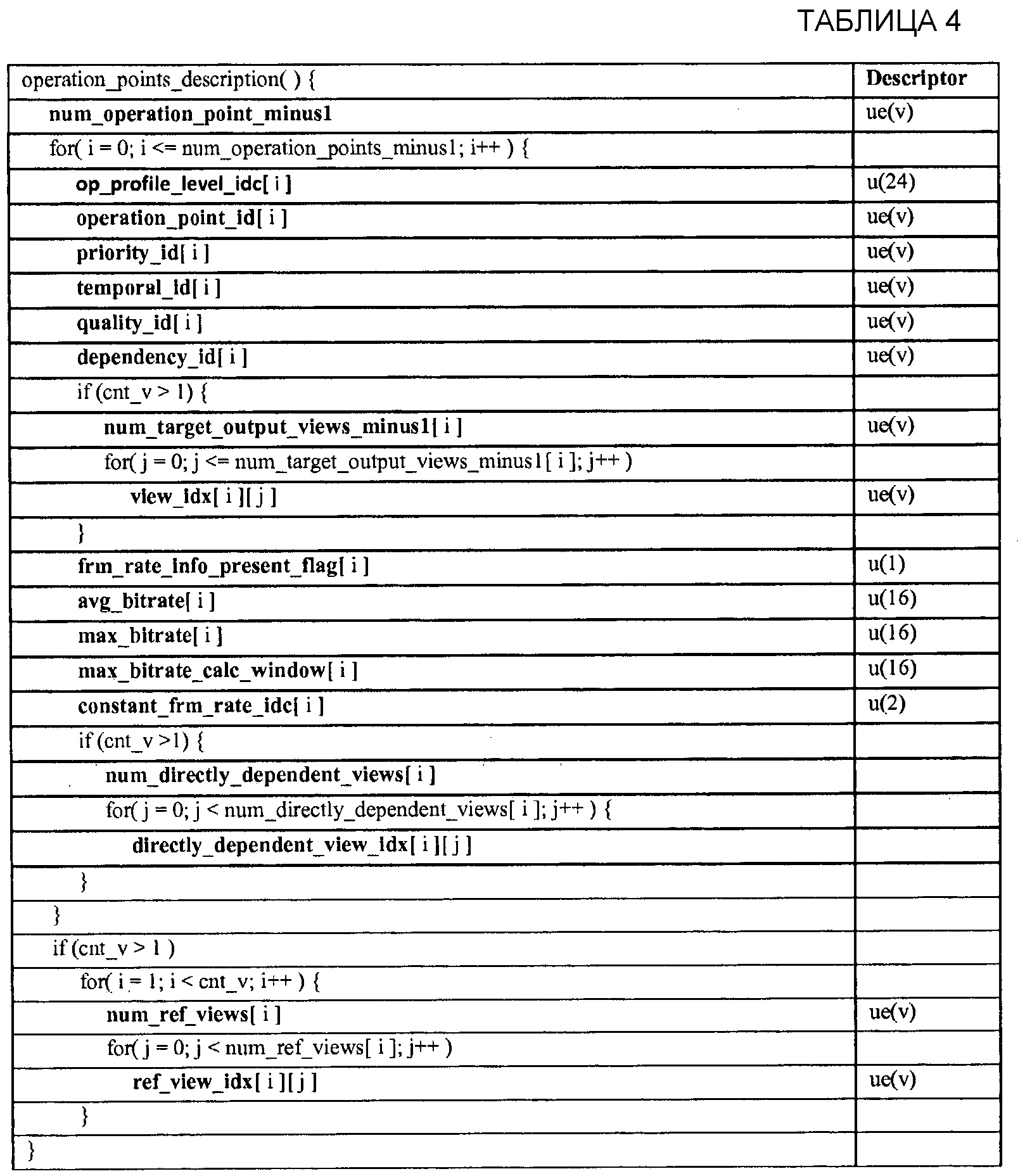
[0165] Примеры семантики для синтаксических элементов из Таблицы 4 обсуждаются ниже:[0165] Examples of semantics for the syntax elements from Table 4 are discussed below:
[0166] В этом примере num_operation_point_minus1 плюс 1 точно определяет максимальное число рабочих точек, которые присутствуют в кодированной видеопоследовательности и для которых информация о рабочих точках сигнализируется следующими синтаксическими элементами.[0166] In this example, num_operation_point_minus1 plus 1 precisely defines the maximum number of operating points that are present in the encoded video sequence and for which operating point information is signaled by the following syntax elements.
[0167] В этом примере op_profile_level_idc[i], operation_point_id[i], priority_id[i], num_target_output_views_minus1[i], frm_rate_info_present_flag[i], avg_bitrate[i], max_bitrate[i], max_bitrate_calc_window[i], constant_frm_rate_idc[i] и num_directly_dependent_views[i] могут иметь такую же семантику, как и синтаксические элементы с такими же названиями в сообщении SEI с информацией о масштабируемости вида из H.264.[0167] In this example, op_profile_level_idc [i], operation_point_id [i], priority_id [i], num_target_output_views_minus1 [i], frm_rate_info_present_flag [i], avg_bitrate [i], max_bitrate [i], max_bitrate_c and num_directly_dependent_views [i] can have the same semantics as the syntax elements with the same names in the SEI message with view scalability information from H.264.
[0168] В этом примере quality_id[i] и dependency_id[i] могут иметь такую же семантику, как и синтаксические элементы с такими же названиями в сообщении SEI с информацией о масштабируемости из H.264.[0168] In this example, quality_id [i] and dependency_id [i] can have the same semantics as the syntax elements with the same names in the SEI message with scalability information from H.264.
[0169] В этом примере directly_dependent_view_idx[i][j] точно определяет индекс вида у j-го вида, от которого непосредственно зависит целевой выходной вид текущей рабочей точки в рамках представления текущей рабочей точки.[0169] In this example, directly_dependent_view_idx [i] [j] precisely defines the index of the view of the j-th view, on which the target output view of the current operating point directly depends on the current operating point.
[0170] В этом примере num_ref_views[i] точно определяет число компонентов вида для межвидового предсказания в начальном списке RefPicList0 и RefPicList1 опорных изображений при декодировании компонентов вида с индексом порядка видов, равным i. В этом примере значение num_ref_views[i] не должно быть больше Min(15, num_views_minus1). В некоторых примерах значение num_ref_views[ 0 ] равно 0.[0170] In this example, num_ref_views [i] accurately determines the number of view components for interspecific prediction in the initial list RefPicList0 and RefPicList1 of reference images when decoding view components with a view order index of i. In this example, the value of num_ref_views [i] should not be greater than Min (15, num_views_minus1). In some examples, the value of num_ref_views [0] is 0.
[0171] В этом примере ref_view_idx[i][j] точно определяет индекс порядка видов у j-го компонента вида для межвидового предсказания в начальном списке RefPicList0 и RefPicList1 опорных изображений при декодировании компонента вида с индексом порядка видов, равным i. В этом примере значение ref_view_idx[i][j] должно быть в диапазоне от 0 до 31 включительно.[0171] In this example, ref_view_idx [i] [j] accurately determines the species order index for the jth component of the species for interspecific prediction in the initial list RefPicList0 and RefPicList1 of reference images when decoding the component of the species with a species order index of i. In this example, the value of ref_view_idx [i] [j] should be in the range of 0 to 31 inclusive.
[0172] В некоторых примерах в качестве альтернативы некоторые из синтаксических элементов в сообщении SEI с информацией о масштабируемости (например, которое описано в H.264), например синтаксические элементы, связанные с информацией о зависимости уровней, могут включаться в структуру синтаксиса operation_points_description() из Таблицы 4.[0172] In some examples, as an alternative, some of the syntax elements in a scalability information SEI message (eg, as described in H.264), eg, syntax elements associated with layer dependency information, may be included in the operation_points_description () syntax structure from Table 4.
[0173] В некоторых примерах видеокодер 20 и/или видеодекодер 30 могут кодировать (то есть сигнализировать) некоторые параметры VUI в структуре синтаксиса operation_points_description() из Таблицы 4.[0173] In some examples,
[0174] Ниже Таблица 5 предоставляет альтернативный синтаксис для набора параметров видео:[0174] The following table 5 provides an alternative syntax for a set of video parameters:


[0175] Примеры семантики для синтаксиса набора параметров видео из Таблицы 5 обсуждаются ниже. Вообще, аналогично названные синтаксические элементы, которые не обсуждаются ниже, могут иметь такую же семантику, как обсуждалась выше по отношению к Таблице 2. Семантика для других синтаксических элементов может быть следующей:[0175] Examples of semantics for the syntax of the video parameter set from Table 5 are discussed below. In general, similarly named syntax elements, which are not discussed below, can have the same semantics as discussed above with respect to Table 2. The semantics for other syntax elements can be as follows:
[0176] В этом примере bit_equal_to_one равен 1 (то есть значению двоичной "1").[0176] In this example, bit_equal_to_one is 1 (that is, the value of the binary "1").
[0177] В этом примере extention_type, равный 0, указывает, что несколько уровней вида может присутствовать в битовом потоке. В этом примере extension_type, равный 1, точно определяет, что несколько уровней зависимости и/или качества может присутствовать в битовом потоке.[0177] In this example, an extention_type of 0 indicates that several view layers may be present in the bitstream. In this example, an extension_type of 1 exactly determines that several levels of dependency and / or quality may be present in the bitstream.
[0178] В этом примере num_rep_formats_minus1 плюс 1 точно определяет максимальное число разных наборов форматов представления, поддерживаемых этим набором параметров видео, причем формат представления включает в себя битовую глубину и формат цветности (то есть наборы из значений bit_depth_luma_minus8, bit_depth_chroma_minus8 и chroma_format_idc), разрешение изображения и информацию об окне обрезки в кодированной видеопоследовательности. Значение num_rep_formats_minus1 может быть в диапазоне от 0 до X включительно. Видеокодер 20 и видеодекодер 30 могут кодировать набор из битовой глубины и формата цветности для основного уровня с помощью bit_depth_luma_minus8, bit_depth_chroma_minus8 и chroma_format_idc, и наборы из битовой глубины и формата цветности сигнализируются для уровней расширения с помощью следующего набора синтаксических элементов: bit_depth_luma_minus8[i], bit_depth_chroma_minus8[i] и chroma_format_idc[i].[0178] In this example, num_rep_formats_minus1 plus 1 accurately determines the maximum number of different sets of presentation formats supported by this set of video parameters, the presentation format including bit depth and color format (that is, sets of bit_depth_luma_minus8, bit_depth_chroma_minus8 and chroma_format_idc), resolution and information about the cropping window in the encoded video sequence. The value of num_rep_formats_minus1 can be in the range from 0 to X inclusive.
[0179] Видеокодер 20 и видеодекодер 30 могут кодировать первый набор формата представления с помощью bit_depth_luma_minus8, bit_depth_chroma_minus8, chroma_format_idc, pic_width_in_luma_samples, pic_height_in_luma_samples, pic_cropping_flag, pic_crop_left_offset, pic_crop_right_offset, pic_crop_top_offset и pic_crop_bottom_offset.[0179]
[0180] В этом примере bit_depth_luma_minus8[i], bit_depth_chroma_minus8[i] и chroma_format_idc[i] точно определяют соответственно i-ый набор значений bit_depth_luma_minus8, bit_depth_chroma_minus8 и chroma_format_idc в кодированной видеопоследовательности.[0180] In this example, bit_depth_luma_minus8 [i], bit_depth_chroma_minus8 [i] and chroma_format_idc [i] exactly determine the ith set of values of bit_depth_luma_minus8, bit_depth_chroma_minus8 and chroma_format_idc respectively in the code.
[0181] В этом примере pic_width_in_luma_samples[i] и pic_height_in_luma_samples[ i ] точно определяют соответственно ширину и высоту каждого декодированного изображения в единицах выборок яркости, используя i-ый формат представления.[0181] In this example, pic_width_in_luma_samples [i] and pic_height_in_luma_samples [i] precisely determine respectively the width and height of each decoded image in units of brightness samples using the i-th presentation format.
[0182] В этом примере pic_cropping_flag[i], pic_crop_left_offset[i], pic_crop_right_offset[i], pic_crop_top_offset[i] и pic_crop_bottom_offset[i] точно определяют для i-го набора формата представления выборки изображений в кодированной видеопоследовательности, которые выводятся из процесса декодирования, в виде прямоугольной области, точно определенной координатами изображения для вывода.[0182] In this example, pic_cropping_flag [i], pic_crop_left_offset [i], pic_crop_right_offset [i], pic_crop_top_offset [i] and pic_crop_bottom_offset [i] are precisely determined for the ith set of the presentation format of the sample images in the encoded video sequence that are derived from the decoding process from the decoding process , in the form of a rectangular region precisely defined by the image coordinates for output.
[0183] В этом примере rep_format_idx[i] точно определяет индекс значений к набору из дополнительной битовой глубины и формата цветности, который применяется к уровню с layer_id, равным i. Значения bit_depth_luma_minus8, bit_depth_chroma_minus8 и chroma_format_idc для уровня с layer_id, равным i, могут быть равны bit_depth_luma_minus8[rep_format_idx[i]],[0183] In this example, rep_format_idx [i] precisely defines the index of values to the set of additional bit depth and color format, which is applied to the layer with layer_id equal to i. The values bit_depth_luma_minus8, bit_depth_chroma_minus8 and chroma_format_idc for a layer with layer_id equal to i can be equal to bit_depth_luma_minus8 [rep_format_idx [i]],
bit_depth_chroma_minus8[ rep_format_idx[i]] и chroma_format_idc[ rep_format_idx[i]] соответственно. Значение rep_format_idx[ i ] должно быть в диапазоне от 0 до X включительно.bit_depth_chroma_minus8 [rep_format_idx [i]] and chroma_format_idc [rep_format_idx [i]] respectively. The value of rep_format_idx [i] must be in the
[0184] В этом примере dependency_id[i] точно определяет идентификатор зависимости для уровня с layer_id, равным i. dependency_id[i] может быть в диапазоне от 0 до X включительно. Когда отсутствует, dependency_id[i] можно предположить равным 0. Когда num_directly_dependent_layers[i] больше 0, dependency_id[i] может быть больше либо равен идентификатору зависимости любого уровня, от которого зависит уровень с layer_id, равным i.[0184] In this example, dependency_id [i] precisely defines the identifier of the dependency for a layer with layer_id equal to i. dependency_id [i] can be in the range from 0 to X inclusive. When absent, dependency_id [i] can be assumed to be 0. When num_directly_dependent_layers [i] is greater than 0, dependency_id [i] can be greater than or equal to the dependency identifier of any level, on which the level with layer_id equal to i depends.
[0185] В этом примере quality_id[i] точно определяет идентификатор качества для уровня с layer_id, равным i. quality_id[ i ] может быть в диапазоне от 0 до X включительно. Когда отсутствует, quality_id[ i ] можно предположить равным 0. Когда num_directly_dependent_layers[ i ] больше 0, quality_id[i] может быть больше либо равен идентификатору качества любого уровня, от которого зависит уровень с layer_id, равным i, и который имеет идентификатор зависимости, равный dependency_id[i].[0185] In this example, quality_id [i] exactly defines the quality identifier for the layer with layer_id equal to i. quality_id [i] can be in the range from 0 to X inclusive. When absent, quality_id [i] can be assumed to be 0. When num_directly_dependent_layers [i] is greater than 0, quality_id [i] can be greater than or equal to the quality identifier of any level, on which the level with layer_id equal to i, and which has a dependency identifier, equal to dependency_id [i].
[0186] В этом примере num_short_term_ref_pic_sets точно определяет число кратковременных наборов опорных изображений, которые точно определяются в наборе параметров видео. Значение num_short_term_ref_pic_sets может быть в диапазоне от 0 до 64 включительно.[0186] In this example, num_short_term_ref_pic_sets accurately determines the number of short-term sets of reference images that are precisely defined in the video parameter set. The value of num_short_term_ref_pic_sets can be in the range from 0 to 64 inclusive.
[0187] В этом примере depth_included_flag, равный 1, указывает, что текущая рабочая точка 3DV содержит глубину. В этом примере depth_included_flag, равный 0, указывает, что текущая рабочая точка 3DV не содержит глубину.[0187] In this example, a depth_included_flag of 1 indicates that the current 3DV operating point contains depth. In this example, a depth_included_flag of 0 indicates that the current 3DV operating point does not contain depth.
[0188] Примерный синтаксис для элемента зависимости видов из Таблицы 5 предоставляется ниже в Таблице 6:[0188] An exemplary syntax for a view dependency element from Table 5 is provided below in Table 6:

[0189] Ниже Таблица 7 задает примерный набор данных, в котором зависимость видов у каждого неосновного вида непосредственно сигнализируется на уровне последовательности.[0189] The following Table 7 defines an exemplary data set in which the species dependence of each non-main species is directly signaled at the sequence level.

[0190] В этом примере num_ref_views[i] точно определяет число компонентов вида для межвидового предсказания в начальном списке RefPicList0 и RefPicList1 опорных изображений при декодировании компонентов вида с индексом порядка видов, равным i. В этом примере значение num_ref_views[i] не больше Min(15, num_views_minus1). В этом примере значение num_ref_views[0] равно 0.[0190] In this example, num_ref_views [i] accurately determines the number of view components for interspecific prediction in the initial list RefPicList0 and RefPicList1 of reference images when decoding view components with a view order index of i. In this example, the value of num_ref_views [i] is not greater than Min (15, num_views_minus1). In this example, the value of num_ref_views [0] is 0.
[0191] В этом примере ref_view_idx[i][j] точно определяет индекс порядка видов у j-го компонента вида для межвидового предсказания в начальном списке RefPicList0 и RefPicList1 опорных изображений при декодировании компонента вида с индексом порядка видов, равным i. В этом примере значение ref_view_idx[i][j] находится в диапазоне от 0 до 31 включительно.[0191] In this example, ref_view_idx [i] [j] accurately determines the species order index for the jth component of the species for interspecific prediction in the initial list RefPicList0 and RefPicList1 of reference images when decoding the component of the species with a species order index of i. In this example, the value of ref_view_idx [i] [j] is in the range of 0 to 31 inclusive.
[0192] Как отмечалось выше, конкретный тип единицы NAL (например, тип 10 единицы NAL) может использоваться для заключения в нее набора параметров видео. Синтаксис единицы NAL можно изменить, как показано ниже в примере из Таблицы 8.[0192] As noted above, a specific type of NAL unit (eg, type 10 of a NAL unit) can be used to enclose a set of video parameters in it. The syntax of the NAL unit can be changed as shown in the example in Table 8 below.

[0193] В этом примере добавляются элементы внутри оператора "if(nal_unit_type != 10)" относительно традиционного синтаксиса единицы NAL. В этом примере число битов, используемое для сигнализации синтаксических элементов priority_id, temporal_id, dependency_id, quality_id и view_idx, равно Ceil(log2(cnt_p)), Ceil(log2(cnt_t)), Ceil(log2(cnt_d)), Ceil(log2(cnt_q)) и Ceil(log2(cnt_v)) соответственно. Также в этом примере, когда отсутствует любой из синтаксических элементов priority_id, temporal_id, dependency_id, quality_id и view_idx, значение того синтаксического элемента предполагается равным 0.[0193] In this example, elements are added inside the if (nal_unit_type! = 10) operator relative to the traditional NAL unit syntax. In this example, the number of bits used to signal the syntax elements priority_id, temporal_id, dependency_id, quality_id and view_idx is Ceil (log2 (cnt_p)), Ceil (log2 (cnt_t)), Ceil (log2 (cnt_d)), Ceil (log2 ( cnt_q)) and Ceil (log2 (cnt_v)) respectively. Also in this example, when any of the syntax elements priority_id, temporal_id, dependency_id, quality_id and view_idx are missing, the value of that syntax element is assumed to be 0.
[0194] За исключением заданного выше относительно числа битов и выводов, которые можно сделать, семантику для синтаксических элементов из Таблицы 8 можно задать следующим образом. Семантика priority_id, dependency_id и quality_id может быть такой, как задана в расширении SVC в H.264/AVC ITU-T. Семантика temporal_id может быть такой, как задана в WD4 в HEVC. В этом примере reserved_one_bit равен 1. Значение 0 для reserved_one_bit может быть точно определено будущими расширениями стандарта HEVC. Декодеры, например видеодекодер 30, могут конфигурироваться для игнорирования значения reserved_one_bit.[0194] With the exception of the above regarding the number of bits and conclusions that can be drawn, the semantics for the syntax elements from Table 8 can be defined as follows. The semantics of priority_id, dependency_id, and quality_id may be the same as specified in the SVC extension in ITU-T H.264 / AVC. The semantics of temporal_id may be as defined in WD4 in HEVC. In this example, reserved_one_bit is 1. The
[0195] В этом примере view_idx точно определяет индекс порядка видов для некоторого вида. Семантика view_idx может быть такой же, как синтаксический элемент "индекс порядка видов", который точно определен в расширении MVC в H.264/AVC ITU-T.[0195] In this example, view_idx precisely defines the index of the order of views for a certain view. The semantics of view_idx can be the same as the syntax element “view order index”, which is precisely defined in the MVC extension in H.264 / AVC ITU-T.
[0196] В этом примере каждый бит у reserved_flags равен 1. Другие значения для reserved_flags могут быть точно определены будущими расширениями предстоящего стандарта HEVC. Декодеры, например видеодекодер 30, могут конфигурироваться для игнорирования значения reserved_flags, пока не сконфигурированы для работы в соответствии с расширением, которое назначает семантику битам у reserved_flags. В этом примере число битов, используемое для представления reserved_flags, равно reserved_flags_len.[0196] In this example, each bit of reserved_flags is equal to 1. Other values for reserved_flags may be precisely defined by future extensions of the upcoming HEVC standard. Decoders, such as
[0197] В этом примере каждый бит у reserved_bits равен 1. Другие значения для reserved_bits могут быть точно определены будущим расширением предстоящего стандарта HEVC. Декодеры, например видеодекодер 30, могут конфигурироваться для игнорирования значения reserved_bits, вновь пока не сконфигурированы в соответствии с таким будущим расширением. Число битов, используемое для представления reserved_bits, в этом примере равно ((m+7>>3)<<3)-m.[0197] In this example, each bit of reserved_bits is 1. Other values for reserved_bits can be precisely determined by a future extension of the upcoming HEVC standard. Decoders, such as
[0198] Ниже Таблица 9 предоставляет примерный синтаксис для набора параметров уровня. В некоторых примерах может использоваться одинаковый синтаксис для каждого из LPS из фиг. 5.[0198] The following table 9 provides an example syntax for a set of level parameters. In some examples, the same syntax for each of the LPSs of FIG. 5.


[0199] Примеры семантики для синтаксиса LPS из Таблицы 9 описываются ниже. Разные уровни (например, разные виды в MVC или разные уровни в SVC) могут ссылаться на разные LPS. Разные уровни качества на одном и том же уровне зависимости могут совместно использовать один и тот же LPS. Разные временные уровни на одном и том же уровне зависимости могут совместно использовать один и тот же LPS. В качестве альтернативы разные виды могут ссылаться на один и тот же LPS, и разные уровни зависимости могут ссылаться на один и тот же LPS.[0199] Examples of semantics for the LPS syntax from Table 9 are described below. Different levels (for example, different types in MVC or different levels in SVC) can refer to different LPS. Different quality levels at the same level of dependency can share the same LPS. Different time levels at the same dependency level can share the same LPS. Alternatively, different views may refer to the same LPS, and different levels of dependency may refer to the same LPS.
[0200] В этом примере depth_flag, равный 1, точно определяет, что LPS применяется к представлениям глубины, идентифицированным значениями temporal_id, dependency_id, quality_id и view_idx в единице NAL LPS. Depth_flag, равный 0, точно определяет, что LPS применяется к представлениям текстуры, идентифицированным значениями temporal_id, dependency_id, quality_id и view_idx в единице NAL LPS.[0200] In this example, a depth_flag of 1 exactly determines that the LPS applies to depth representations identified by the values temporal_id, dependency_id, quality_id, and view_idx in the NAL unit of the LPS. A Depth_flag of 0 precisely determines that LPS applies to texture representations identified by the values temporal_id, dependency_id, quality_id, and view_idx in the NAL unit of LPS.
[0201] В этом примере layer_para_set_id точно определяет id текущего набора параметров уровня (LPS). Разные наборы параметров уровней с одинаковыми значениями dependency_id и view_idx соответственно совместно используют одно пространство значений для layer_para_set_id, следовательно, разные LPS с разным сочетанием depencey_id и view_idx могут иметь одинаковое значение layer_para_set_id.[0201] In this example, layer_para_set_id exactly defines the id of the current layer parameter set (LPS). Different sets of level parameters with the same dependency_id and view_idx values respectively share the same value space for layer_para_set_id, therefore, different LPSs with different combinations of depencey_id and view_idx can have the same layer_para_set_id value.
[0202] В качестве альтернативы все LPS могут совместно использовать одно пространство значений, следовательно, каждый LPS имеет индивидуальное значение layer_para_set_id.[0202] Alternatively, all LPSs can share the same value space, therefore, each LPS has an individual layer_para_set_id value.
[0203] В этом примере vps_id идентифицирует набор параметров видео, на который ссылается этот набор параметров уровня.[0203] In this example, vps_id identifies the video parameter set referenced by this level parameter set.
[0204] В этом примере lps_extension_flag, равный 0, точно определяет, что никакие синтаксические элементы lps_extension_data_flag не присутствуют в структуре синтаксиса RBSP набора параметров уровня. В этом примере lps_extension_flag может быть равен 0 в битовых потоках, соответствующих предстоящему стандарту HEVC. Значение 1 для lps_extension_flag зарезервировано для будущего использования ITU-T|ISO/IEC. Декодеры, например видеодекодер 30, могут игнорировать все данные, которые следуют за значением 1 для lps_extension_flag в единице NAL набора параметров уровня.[0204] In this example, lps_extension_flag equal to 0 precisely determines that no lps_extension_data_flag syntax elements are present in the RBSP syntax structure of the level parameter set. In this example, lps_extension_flag may be 0 in bitstreams conforming to the upcoming HEVC standard. A value of 1 for lps_extension_flag is reserved for future use by ITU-T | ISO / IEC. Decoders, such as
[0205] В этом примере lps_extension_data_flag может иметь любое значение и не влияет на соответствие профилям, точно определенным в предстоящем стандарте HEVC.[0205] In this example, lps_extension_data_flag can be of any value and does not affect compliance with profiles defined exactly in the upcoming HEVC standard.
[0206] Другие синтаксические элементы могут иметь такую же семантику, как и синтаксические элементы с такими же названиями в SPS из WD HEVC, но при применении только к изображениям, ссылающимся на этот LPS.[0206] Other syntax elements may have the same semantics as syntax elements with the same names in SPS from WD HEVC, but when applied only to images that reference this LPS.
[0207] LPS может содержаться в единице NAL, заголовок которой можно задать в соответствии с Таблицей 8 выше. Нижеследующие синтаксические элементы имеют следующую немного измененную семантику, когда они ассоциируются с LPS.[0207] The LPS may be contained in a NAL unit, the header of which can be set in accordance with Table 8 above. The following syntax elements have the following slightly changed semantics when they are associated with LPS.
[0208] В этом примере priority_id равен минимальному значению из значений priority_id всех единиц NAL, ссылающихся на этот LPS.[0208] In this example, priority_id is the minimum value of the priority_id values of all NAL units that reference this LPS.
[0209] В этом примере temporal_id равен минимальному значению из temporal_id всех единиц NAL, ссылающихся на этот LPS.[0209] In this example, the temporal_id is the minimum value of the temporal_id of all NAL units referencing this LPS.
[0210] В этом примере dependency_id равен dependency_id всех единиц NAL, ссылающихся на этот LPS.[0210] In this example, the dependency_id is equal to the dependency_id of all NAL units that reference this LPS.
[0211] В этом примере quality_id равен минимальному значению из quality_id всех единиц NAL, ссылающихся на этот LPS.[0211] In this example, quality_id is the minimum value of quality_id of all NAL units that reference this LPS.
[0212] В этом примере v_idx является индексом вида у текущего LPS. Все изображения, ссылающиеся на этот LPS, могут иметь id вида, равный view_id[v_idx].[0212] In this example, v_idx is the view index of the current LPS. All images that link to this LPS can have a view id equal to view_id [v_idx].
[0213] В качестве альтернативы вышеупомянутые синтаксические элементы могут непосредственно сигнализироваться в таблице синтаксиса набора параметров уровня, как показано в примере из Таблицы 10. Более подробную таблицу синтаксиса можно разработать в соответствии с Таблицей 9 ниже. В этом случае те синтаксические элементы не находятся в заголовке единицы NAL в LPS, и синтаксический анализ LPS может зависеть от VPS с ID, равным vps_id.[0213] Alternatively, the aforementioned syntax elements can be directly signaled in the syntax table of the set of level parameters, as shown in the example from Table 10. A more detailed syntax table can be developed in accordance with Table 9 below. In this case, those syntax elements are not in the header of the NAL unit in the LPS, and the LPS parsing may depend on the VPS with an ID equal to vps_id.

[0214] LPS в этом случае не должен иметь заголовок единицы NAL, дублирующий вышеупомянутые синтаксические элементы. Предполагая, что типом единицы NAL у единицы NAL, заключающей в себе LPS, является, например, 5, синтаксис заголовка единицы NAL можно немного изменить, как показано в Таблице 11, которая добавляет исключение "&& nal_unit_type ! = 5" к оператору "if" из Таблицы 8:[0214] The LPS in this case should not have a NAL unit header duplicating the above syntax elements. Assuming that the type of NAL unit for the NAL unit containing the LPS is, for example, 5, the syntax of the header of the NAL unit can be slightly changed, as shown in Table 11, which adds the exception && nal_unit_type! = 5 to the if statement from Table 8:

[0215] В других примерах видеокодер 20 и видеодекодер 30 могут кодировать связанные с масштабируемыми характеристиками синтаксические элементы, используя кодирование с фиксированной длиной, как показано ниже в примере из Таблицы 12.[0215] In other examples,

[0216] Ниже Таблица 13 предоставляет пример синтаксиса для набора параметров изображения (PPS) в соответствии с методиками из данного раскрытия изобретения. В этом примере набору параметров изображения не нужно сигнализировать "seq_parameter_set_id" в отличие от PPS в традиционном HEVC.[0216] The following table 13 provides an example syntax for a set of image parameters (PPS) in accordance with the techniques of this disclosure. In this example, the image parameter set does not need to signal "seq_parameter_set_id" unlike PPS in traditional HEVC.

[0217] Примеры семантики для PPS из Таблицы 13 описываются ниже.[0217] Examples of semantics for PPS from Table 13 are described below.
[0218] В этом примере pps_extension_flag, равный 0, точно определяет, что никакие синтаксические элементы pps_extension_data_flag не присутствуют в структуре синтаксиса RBSP набора параметров изображения. В этом примере pps_extension_flag равен 0 в битовых потоках, соответствующих предстоящему стандарту HEVC. Значение 1 для pps_extension_flag может быть зарезервировано для будущего использования ITU-T | ISO/IEC. Декодеры, например видеодекодер 30, могут игнорировать все данные, которые следуют за значением 1 для pps_extension_flag в единице NAL набора параметров изображения.[0218] In this example, pps_extension_flag equal to 0 precisely determines that no pps_extension_data_flag syntax elements are present in the RBSP syntax structure of the image parameter set. In this example, pps_extension_flag is 0 in bitstreams conforming to the upcoming HEVC standard. A value of 1 for pps_extension_flag may be reserved for future use by ITU-T | ISO / IEC. Decoders, such as
[0219] В этом примере pps_extension_data_flag может иметь любое значение. Это не обязательно влияет на соответствие профилям, точно определенным в предстоящем стандарте HEVC. Семантика для значений pps_extension_data_flag может назначаться в дальнейших разработках стандарта HEVC или расширениях стандарта, не конфликтуя с методиками из данного раскрытия изобретения.[0219] In this example, pps_extension_data_flag can have any value. This does not necessarily affect compliance with profiles specifically defined in the upcoming HEVC standard. The semantics for pps_extension_data_flag values may be assigned in further developments of the HEVC standard or extensions of the standard without conflict with the techniques of this disclosure.
[0220] В методиках из данного раскрытия изобретения никакой id набора параметров последовательности или id набор параметров уровня не нужно сигнализировать в PPS. Некоторые другие синтаксические элементы в PPS можно переместить в LPS. То есть видеокодер 20 и/или видеодекодер 30 может конфигурироваться для кодирования одного или более LPS, включающих в себя данные, аналогичные синтаксическим элементам, показанным в Таблице 13.[0220] In the techniques of this disclosure, no sequence parameter set id or level parameter set id needs to be signaled in PPS. Some other syntax elements in PPS can be moved to LPS. That is,
[0221] Фиг. 6 - концептуальная схема, иллюстрирующая примерный группирующий набор параметров (GPS) и взаимосвязи GPS с другими наборами параметров и заголовками слайсов. В этом примере другие наборы параметров включают в себя LPS, SPS, PPS, наборы параметров адаптации (APS) типа 0 (например, APS, сигнализирующие параметры адаптивного контурного фильтра (ALF)), APS типа 1 (например, APS, сигнализирующие матрицу квантования) и другие наборы параметров. В этом примере GPS включает в себя множество разных групп, причем каждая имеет уникальный ID GPS (также называемый ID группы), где каждая группа указывает конкретный набор из различных наборов параметров с помощью ID набора параметров. Таким образом, заголовки слайсов должны точно определять только group_id для точного определения каждого из наборов параметров, соответствующих группе, имеющей тот group_id.[0221] FIG. 6 is a conceptual diagram illustrating an example grouping parameter set (GPS) and the relationship of GPS with other parameter sets and slice headers. In this example, other parameter sets include LPS, SPS, PPS, adaptation parameter sets (APS) of type 0 (e.g., APS, signaling parameters of adaptive loop filter (ALF)), APS of type 1 (e.g., APS, signaling quantization matrix) and other parameter sets. In this example, the GPS includes many different groups, each having a unique GPS ID (also called a group ID), where each group indicates a specific set of different parameter sets using the parameter set ID. Thus, the slice headers should precisely define only group_id to accurately determine each of the sets of parameters corresponding to the group having that group_id.
[0222] Ниже Таблицы 14 и 15 предоставляют альтернативные примеры синтаксиса для RBSP группирующего набора параметров.[0222] The following Tables 14 and 15 provide alternative syntax examples for an RBSP grouping parameter set.


[0223] Кодировщики видео, например видеокодер 20 и видеодекодер 30, могут конфигурироваться для кодирования группирующего набора параметров в соответствии, например, с Таблицей 14 или Таблицей 15. Примеры семантики для синтаксиса наборов группирующих параметров предоставляются ниже.[0223] Video encoders, for
[0224] В этом примере number_signalled_para_set_groups_minus1 плюс 1 точно определяет число сигнализированных групп параметров. Это значение может быть в диапазоне от 0 до 30 включительно.[0224] In this example, number_signalled_para_set_groups_minus1 plus 1 accurately determines the number of signalized parameter groups. This value can be between 0 and 30 inclusive.
[0225] В этом примере para_set_group_id[i] точно определяет ID i-ой сигнализированной группы наборов параметров. Значение para_set_group_id[i] должно быть в диапазоне от 0 до 31 включительно.[0225] In this example, para_set_group_id [i] exactly defines the ID of the i-th signalized group of parameter sets. The value of para_set_group_id [i] must be in the range from 0 to 31 inclusive.
[0226] В этом примере para_set_type_id[i][j] точно определяет ID j-го типа набора параметров для i-ой группы наборов параметров.[0226] In this example, para_set_type_id [i] [j] precisely defines the ID of the j-th type of the parameter set for the i-th group of parameter sets.
[0227] В этом примере lps_id[ i ] указывает id набора параметров уровня, на который ссылается группа наборов параметров с id группы, равным para_set_group_id[i]. Значения dependency_id и view_idx у LPS с layer_para_set_id, равным lps_id[i], могут быть идентичны значениям dependency_id и view_idx соответственно у единицы NAL группы наборов параметров.[0227] In this example, lps_id [i] indicates the id of the level parameter set referenced by the parameter set group with the group id equal to para_set_group_id [i]. LPS dependency_id and view_idx values with layer_para_set_id equal to lps_id [i] can be identical to dependency_id and view_idx values, respectively, for the NAL unit of the parameter set group.
[0228] Значения dependency_id и view_idx у RBSP группирования набора параметров присутствуют в заголовке единицы NAL этой RBSP в примерах из Таблиц 14 и 15, и значения dependency_id и view_idx у LPS могут присутствовать либо в заголовке единицы NAL этого LPS, либо в таблице синтаксиса LPS.[0228] The dependency_id and view_idx values of the RBSP grouping of the parameter set are present in the NAL unit header of this RBSP in the examples of Tables 14 and 15, and the dependency_id and view_idx values of the LPS can be either in the NAL unit header of this LPS or in the LPS syntax table.
[0229] В качестве альтернативы значения dependency_id и view_idx у LPS с layer_para_set_id, равным lps_id[i], могут быть не идентичны значениям dependency_id и view_idx соответственно у единицы NAL группы наборов параметров.[0229] As an alternative, the LPS dependency_id and view_idx values with layer_para_set_id equal to lps_id [i] may not be identical to the dependency_id and view_idx values, respectively, for the NAL unit of the parameter set group.
[0230] В этом примере pps_id[i] указывает id набора параметров изображения, на который ссылается группа наборов параметров с id группы, равным para_set_group_id[i].[0230] In this example, pps_id [i] indicates the id of the image parameter set referenced by the parameter set group with the group id equal to para_set_group_id [i].
[0231] В этом примере aps_id[i] указывает id набора параметров адаптации, на который ссылается группа наборов параметров с id группы, равным para_set_group_id[i].[0231] In this example, aps_id [i] indicates the id of the adaptation parameter set referenced by the parameter set group with the group id equal to para_set_group_id [i].
[0232] В этом примере gps_extension_flag, равный 0, задает, что никакие синтаксические элементы gps_extension_data_flag не присутствуют в структуре синтаксиса RBSP группирования набора параметров. Gps_extension_flag может быть равен 0 в битовых потоках, соответствующих предстоящему стандарту HEVC. Значение 1 для gps_extension_flag может быть зарезервировано для будущего использования ITU-T | ISO/IEC. Декодеры, например видеодекодер 30, могут игнорировать все данные, которые следуют за значением 1 для gps_extension_flag в единице NAL группирования набора параметров. Вообще gps_extension_data_flag может иметь любое значение. Это не должно влиять на соответствие профилям, точно определенным в предстоящем стандарте HEVC.[0232] In this example, gps_extension_flag equal to 0 specifies that no syntax elements of gps_extension_data_flag are present in the RBSP syntax structure of the grouping of the parameter set. Gps_extension_flag may be 0 in bitstreams conforming to the upcoming HEVC standard. A value of 1 for gps_extension_flag may be reserved for future use of ITU-T | ISO / IEC. Decoders, such as
[0233] В некоторых примерах вместо para_set_type_id[i][j] может быть aps_id[i][j] с аналогичной семантикой, как aps_id[i], которая описана выше.[0233] In some examples, instead of para_set_type_id [i] [j], there may be aps_id [i] [j] with the same semantics as aps_id [i], which is described above.
[0234] Как показано на фиг. 6, вместо ссылки на ID набора параметров изображения в заголовке слайса, в соответствии с методиками из данного раскрытия изобретения заголовок слайса может ссылаться на ID группы наборов параметров, соответственно косвенно ссылаясь на LPS, PPS и APS каждого типа (например, APS, предоставляющие параметры ALF и матрицы квантования).[0234] As shown in FIG. 6, instead of referring to the image parameter set ID in the slice header, in accordance with the techniques of this disclosure, the slice header may refer to the parameter set group IDs, respectively indirectly referring to each type of LPS, PPS and APS (for example, APS providing ALF parameters and quantization matrices).
[0235] Кодировщик видео может активизировать набор параметров видео или наборы параметров уровней, когда единица NAL VCL (содержащая кодированный слайс) ссылается на набор параметров, косвенно, например, на основе принципа проектирования H.264/AVC.[0235] A video encoder may activate a video parameter set or level parameter sets when the NAL VCL unit (containing the encoded slice) refers to the parameter set, indirectly, for example, based on the design principle of H.264 / AVC.
[0236] В некоторых примерах наборы параметров можно активизировать с помощью специфического типа единицы NAL, а не кодированного слайса. Например, тип единицы NAL этого специфического типа (единица NAL активизации наборов параметров) может активизировать один и ровно один VPS, при наличии в битовом потоке. К тому же в различных альтернативах такой тип единицы NAL может активизировать по меньшей мере один LPS. К тому же такой тип единицы NAL может активизировать по меньшей мере один PPS. К тому же такой тип единицы NAL может активизировать по меньшей мере один APS. Единица NAL активизации наборов параметров может быть RBSP группирующего набора параметров. Единица NAL активизации наборов параметров (PSA) может быть применима к одной кодированной видеопоследовательности. Единица NAL PSA может считаться не являющейся единицей NAL VCL, то есть не имеющей непосредственного отношения к кодировщику видео. Синтаксис заголовка единицы NAL у единицы NAL PSA может быть таким же, как единица NAL VPS.[0236] In some examples, parameter sets can be activated using a specific NAL unit type rather than an encoded slice. For example, the NAL unit type of this specific type (the NAL unit for activating parameter sets) can activate one and exactly one VPS, if there is one in the bitstream. In addition, in various alternatives, this type of NAL unit can activate at least one LPS. In addition, this type of NAL unit can activate at least one PPS. In addition, this type of NAL unit can activate at least one APS. The NAL unit for activating the parameter sets may be an RBSP grouping parameter set. A unit of Parameter Set Activation NAL (PSA) may be applicable to a single coded video sequence. A PSA NAL unit may be considered a non-VCL NAL unit, that is, not directly related to the video encoder. The syntax of the NAL unit header for the PSA NAL unit may be the same as the VPS NAL unit.
[0237] В некоторых примерах единица NAL PSA, при наличии в единице доступа, может предшествовать первой единице NAL VCL в единице доступа. Может присутствовать по меньшей мере одна единица NAL PSA в первой единице доступа кодированной видеопоследовательности, например IDR-изображении. Несколько единиц NAL PSA в одной и той же кодированной видеопоследовательности могут содержать одинаковый id VPS; соответственно, никакие разные наборы параметров видео не нужно активизировать в одной и той же кодированной видеопоследовательности. Единица NAL PSA, при наличии в единице доступа, может предшествовать любой единице NAL LPS, PPS, APS или SEI, при наличии. Единица NAL VPS, при наличии в единице доступа, может предшествовать любой единице NAL LPS, PPS, APS или SEI, при наличии. К тому же в различных альтернативах единица NAL PSA, при наличии в единице доступа, может предшествовать единице NAL VPS, при наличии.[0237] In some examples, a PSA NAL unit, if present in an access unit, may precede the first VCL NAL unit in an access unit. At least one PSA NAL unit may be present in the first access unit of the encoded video sequence, for example, an IDR image. Multiple PSA NAL units in the same encoded video sequence may contain the same VPS id; accordingly, no different sets of video parameters need to be activated in the same encoded video sequence. A NAL PSA unit, if present in an access unit, may precede any NAL unit LPS, PPS, APS, or SEI, if any. A VAL NAL unit, if present in an access unit, may precede any NAL LPS, PPS, APS, or SEI NAL unit, if any. In addition, in various alternatives, a NAL PSA unit, if present in an access unit, may precede a NAL VPS unit, if present.
[0238] В некоторых примерах кодировщики видео, например видеокодер 20 и видеодекодер 30, могут конфигурироваться для использования синтаксиса из Таблицы 16 для набора параметров последовательности (SPS) в отличие от традиционного синтаксиса SPS, например, в HEVC.[0238] In some examples, video encoders, such as


[0239] Примерный SPS из Таблицы 16 исключает из традиционного синтаксиса SPS profile_idc, reserved_zero_8bits, level_idc, chroma_format_idc, separate_colour_plane_flag и соответствующий условный оператор "if", max_temporal_layers_minus1, pic_width_in_luma_samples, pic_height_in_luma_samples, pic_cropping_flag, pic_crop_left_offset, pic_crop_right_offset, pic_crop_top_offset, pic_crop_bottom_offset и соответствующий условный оператор "if", bit_depth_luma_minus8, bit_depth_chroma_minus8, num_short_term_ref_pic_sets, short_term_ref_pic_set(i) и соответствующий условный оператор "if". Кроме того, примерный SPS из Таблицы 16 добавляет video_parameter_set_id и rep_format_idx. Семантика для оставшихся синтаксических элементов может быть такой же, как задана в традиционном HEVC. Семантику для добавленных элементов video_parameter_set_id и rep_format_idx можно задать следующим образом:[0239] An exemplary SPS from Table 16 eliminates the traditional syntax SPS profile_idc, reserved_zero_8bits, level_idc, chroma_format_idc, separate_colour_plane_flag and the corresponding conditional statement "if", max_temporal_layers_minus1, pic_width_in_luma_samples, pic_height_in_luma_samples, pic_cropping_flag, pic_crop_left_offset, pic_crop_right_offset, pic_crop_top_offset, pic_crop_bottom_offset and the corresponding conditional statement " if ", bit_depth_luma_minus8, bit_depth_chroma_minus8, num_short_term_ref_pic_sets, short_term_ref_pic_set (i) and the corresponding conditional operator" if ". In addition, the sample SPS from Table 16 adds video_parameter_set_id and rep_format_idx. The semantics for the remaining syntax elements may be the same as defined in traditional HEVC. The semantics for the added elements video_parameter_set_id and rep_format_idx can be set as follows:
[0240] В этом примере video_parameter_set_id идентифицирует набор параметров видео (VPS), на который ссылается текущий SPS. В качестве альтернативы не нужно сигнализировать video_parameter_set_id, и GPS может использоваться для связи SPS со специфическим VPS.[0240] In this example, video_parameter_set_id identifies a video parameter set (VPS) referenced by the current SPS. Alternatively, you do not need to signal video_parameter_set_id, and GPS can be used to communicate SPS with a specific VPS.
[0241] В этом примере rep_format_idx точно определяет индекс к формату представления, сигнализированному в наборе параметров видео, на который ссылаются.[0241] In this example, rep_format_idx pinpoints the index to the presentation format signaled in the referenced video parameter set.
[0242] В качестве еще одной альтернативы Таблица 17 предоставляет другой пример синтаксиса для группирующего набора параметров. В этом примере предполагается, что синтаксический элемент ID набора параметров видео отсутствует в синтаксисе SPS, как описано выше.[0242] As another alternative, Table 17 provides another example syntax for a grouping set of parameters. This example assumes that the syntax element ID of the video parameter set is not in the SPS syntax, as described above.

[0243] Семантику для синтаксических элементов из Таблицы 17 можно задать следующим образом:[0243] The semantics for the syntax elements from Table 17 can be defined as follows:
[0244] В этом примере gps_id точно определяет идентификатор групповой набор параметров (GPS).[0244] In this example, gps_id accurately identifies the group parameter set identifier (GPS).
[0245] В этом примере vps_id точно определяет идентификатор набора параметров видео, на который ссылается GPS.[0245] In this example, vps_id exactly identifies the identifier of the video parameter set referenced by GPS.
[0246] В этом примере sps_id точно определяет идентификатор набора параметров последовательности, на который ссылается GPS.[0246] In this example, sps_id exactly identifies the identifier of the sequence parameter set referenced by GPS.
[0247] В этом примере pps_id точно определяет идентификатор набора параметров изображения, на который ссылается GPS.[0247] In this example, pps_id pinpoints the identifier of the image parameter set referenced by GPS.
[0248] В этом примере num_ref_aps_ids точно определяет число следующих синтаксических элементов ref_aps_id[i]. Значение num_ref_aps_ids должно быть в диапазоне от 0 до 4 включительно.[0248] In this example, num_ref_aps_ids accurately determines the number of the following syntax elements ref_aps_id [i]. The value of num_ref_aps_ids must be in the
[0249] В этом примере ref_aps_id[i] идентифицирует i-ый набор параметров адаптации, на который ссылается групповой набор параметров.[0249] In this example, ref_aps_id [i] identifies the i-th adaptation parameter set referenced by the group parameter set.
[0250] Одно и то же значение ref_aps_id[i] может присутствовать в цикле больше одного раза, и соответственно с помощью одного и того же GPS можно ссылаться больше чем на один тип параметров APS из одного и того же APS, и он [тип] может применяться к кодированным слайсам, ссылающимся на GPS.[0250] The same value of ref_aps_id [i] may be present in the cycle more than once, and accordingly, using the same GPS, you can refer to more than one type of APS parameters from the same APS, and it [type] can be applied to coded slices that reference GPS.
[0251] В этом примере ref_aps_param_type[i] точно определяет тип параметров APS, включенных в i-ый набор параметров адаптации, на который ссылается групповой набор параметров. Значение ref_aps_parame_type[i] может быть в диапазоне от 0 до 3 включительно. Значения от 0 до 3 включительно для ref_aps_parame_type[i] соответствуют типам параметров APS у списка масштабирования, фильтра уменьшения блочности, адаптивного смещения выборок (SAO) и ALF соответственно. Значения ref_aps_parame_type[i] для любых двух разных значений i в некоторых примерах не должны быть идентичны.[0251] In this example, ref_aps_param_type [i] precisely defines the type of APS parameters included in the ith adaptation parameter set referenced by the group parameter set. The value of ref_aps_parame_type [i] may be in the range from 0 to 3 inclusive. Values from 0 to 3 inclusive for ref_aps_parame_type [i] correspond to the types of APS parameters for the scaling list, deblocking filter, adaptive sample offset (SAO) and ALF, respectively. The ref_aps_parame_type [i] values for any two different i values in some examples need not be identical.
[0252] В этом примере gps_extension_flag, равный 0, точно определяет, что никакие синтаксические элементы gps_extension_data_flag не присутствуют в структуре синтаксиса RBSP группирования набора параметров. gps_extension_flag может быть равен 0 в битовых потоках, соответствующих предстоящему стандарту HEVC. Значение 1 для gps_extension_flag может быть зарезервировано для будущего использования ITU-T|ISO/IEC. Декодеры, например видеодекодер 30, могут игнорировать все данные, которые следуют за значением 1 для gps_extension_flag в единице NAL группирования набора параметров.[0252] In this example, gps_extension_flag equal to 0 precisely determines that no syntax elements of gps_extension_data_flag are present in the RBSP syntax structure of the grouping of the parameter set. gps_extension_flag may be 0 in bitstreams conforming to the upcoming HEVC standard. A value of 1 for gps_extension_flag may be reserved for future use by ITU-T | ISO / IEC. Decoders, such as
[0253] В этом примере gps_extension_data_flag может иметь любое значение. Это не должно влиять на соответствие профилям, точно определенным в предстоящем стандарте HEVC.[0253] In this example, gps_extension_data_flag can have any value. This should not affect compliance with profiles defined exactly in the upcoming HEVC standard.
[0254] Кодировщики видео, например видеокодер 20 и видеодекодер 30, могут применять следующий процесс для активизации наборов параметров для одноуровневых или одновидовых битовых потоков, когда GPS точно определяется в соответствии с Таблицей 17 или практически соответствует примеру из Таблицы 17.[0254] Video encoders, for
[0255] RBSP набора параметров адаптации может включать в себя параметры, на которые единицы NAL кодированного слайса в одном или более кодированных изображениях могут ссылаться косвенно посредством одного или более групповых наборов параметров, на которые ссылаются единицы NAL кодированного слайса. Каждая RBSP набора параметров адаптации сначала может считаться неактивной в начале работы процесса декодирования. Не более одной RBSP набора параметров адаптации может считаться активной для каждого типа параметров APS в любой заданный момент в течение работы процесса декодирования, и активизация любой конкретной RBSP набора параметров адаптации для конкретного типа параметров APS приводит к деактивизации ранее активной RBSP набора параметров адаптации (если есть) для того конкретного типа параметров APS.[0255] The RBSP of the adaptation parameter set may include parameters to which the NAL units of the encoded slice in one or more encoded images can be referenced indirectly by one or more group parameter sets referenced by the NAL units of the encoded slice. Each RBSP of the adaptation parameter set may initially be considered inactive at the start of the decoding process. No more than one RBSP adaptation parameter set can be considered active for each type of APS parameters at any given time during the decoding process, and activation of any specific RBSP adaptation parameter set for a specific type of APS parameters will deactivate the previously active RBSP adaptation parameter set (if any) ) for that particular type of APS parameter.
[0256] Когда RBSP набора параметров адаптации (с конкретным значением aps_id) не активна для конкретного типа параметров APS, и на нее ссылается единица NAL кодированного слайса для того конкретного типа параметров APS (используя то значение aps_id) косвенно посредством группового набора параметров, на который ссылается единица NAL кодированного слайса, ее можно активизировать для того конкретного типа параметров APS. Эта RBSP набора параметров адаптации называется активной RBSP набора параметров адаптации для того конкретного типа параметров APS до тех пор, пока она не деактивируется в результате активизации другой RBSP набора параметров адаптации для того конкретного типа параметров APS. RBSP набора параметров адаптации с тем конкретным значением aps_id может быть доступна процессу декодирования перед ее активизацией.[0256] When the RBSP of the adaptation parameter set (with a specific aps_id value) is not active for a particular type of APS parameter, and it is referenced by the NAL unit of the encoded slice for that particular type of APS parameter (using that aps_id value) indirectly through a group parameter set to which refers to the NAL unit of the encoded slice, it can be activated for that specific type of APS parameter. This adaptation parameter set RBSP is called the active adaptation parameter set RBSP for that particular APS parameter type until it is deactivated as a result of activating another adaptation parameter set RBSP for that particular APS parameter type. The RBSP of the adaptation parameter set with that particular aps_id value may be available to the decoding process before it is activated.
[0257] RBSP набора параметров изображения может включать в себя параметры, на которые единицы NAL кодированного слайса в одном или более кодированных изображениях могут ссылаться косвенно посредством одного или более групповых наборов параметров, на которые ссылаются единицы NAL кодированного слайса. Каждая RBSP набора параметров изображения сначала может считаться неактивной в начале работы процесса декодирования. Не более одной RBSP набора параметров изображения может считаться активной в любой заданный момент в течение работы процесса декодирования, и активизация любой конкретной RBSP набора параметров изображения приводит к деактивизации ранее активной RBSP набора параметров изображения (если есть).[0257] The RBSP of the image parameter set may include parameters to which the NAL units of the encoded slice in one or more encoded images can be referenced indirectly by one or more group parameter sets referenced by the NAL units of the encoded slice. Each RBSP of a set of image parameters may initially be considered inactive at the start of the decoding process. No more than one RBSP of a set of image parameters can be considered active at any given moment during the decoding process, and the activation of any particular RBSP of a set of image parameters leads to deactivation of the previously active RBSP of a set of image parameters (if any).
[0258] Когда RBSP набора параметров изображения (с конкретным значением pic_parameter_set_id) не активна, и на нее ссылается единица NAL кодированного слайса (используя то значение pic_parameter_set_id) косвенно посредством группового набора параметров, на который ссылается единица NAL кодированного слайса, ее можно активизировать. Эта RBSP набора параметров изображения называется активной RBSP набора параметров изображения до тех пор, пока она не деактивируется в результате активизации другой RBSP набора параметров изображения. RBSP набора параметров изображения с тем конкретным значением pic_parameter_set_id может быть доступна процессу декодирования перед ее активизацией.[0258] When the RBSP of the image parameter set (with a specific pic_parameter_set_id value) is not active and it is referenced by the NAL unit of the encoded slice (using that pic_parameter_set_id value) indirectly through the group parameter set referenced by the NAL unit of the encoded slice, it can be activated. This image parameter set RBSP is called the active image parameter set RBSP until it is deactivated by activating another image parameter set RBSP. The RBSP of the image parameter set with that particular pic_parameter_set_id value may be available to the decoding process before it is activated.
[0259] Любая единица NAL набора параметров изображения, содержащая значение pic_parameter_set_id для активной RBSP набора параметров изображения для кодированного изображения, может иметь такое же содержимое, что и у активной RBSP набора параметров изображения для кодированного изображения, если она не идет за крайней единицей NAL VCL в кодированном изображении и не предшествует первой единице NAL VCL в другом кодированном изображении.[0259] Any NAL unit of the image parameter set containing pic_parameter_set_id for the active RBSP image parameter set for the encoded image may have the same contents as the active RBSP image parameter set for the encoded image, if it does not go beyond the last NAL unit VCL in the encoded image and does not precede the first VAL NAL unit in another encoded image.
[0260] RBSP набора параметров последовательности может включать в себя параметры, на которые единицы NAL кодированного слайса в одном или более кодированных изображениях могут ссылаться косвенно посредством одного или более групповых наборов параметров, на которые ссылаются единицы NAL кодированного слайса, или на которые могут ссылаться одна или более единиц NAL SEI, содержащих сообщение SEI о периоде буферизации. Каждая RBSP набора параметров последовательности сначала может считаться неактивной в начале работы процесса декодирования. Не более одной RBSP набора параметров последовательности может считаться активной в любой заданный момент в течение работы процесса декодирования, и активизация любой конкретной RBSP набора параметров последовательности приводит к деактивизации ранее активной RBSP набора параметров последовательности (если есть).[0260] The RBSP of the sequence parameter set may include parameters to which the NAL units of the encoded slice in one or more encoded images may be indirectly referenced by one or more group parameter sets referred to by the NAL units of the encoded slice, or which may be referenced by one or more NAL SEI units containing a SEI message about the buffering period. Each RBSP of the sequence parameter set may initially be considered inactive at the start of the decoding process. No more than one RBSP of a sequence parameter set can be considered active at any given moment during the decoding process, and the activation of any particular RBSP of a sequence parameter set deactivates the previously active RBSP sequence parameter set (if any).
[0261] Когда RBSP набора параметров последовательности (с конкретным значением seq_parameter_set_id) уже не активна, и на нее ссылается единица NAL кодированного слайса косвенно посредством группового набора параметров, на который ссылается единица NAL кодированного слайса (используя то значение seq_parameter_set_id), или на нее ссылается единица NAL SEI, содержащая сообщение SEI о периоде буферизации (используя то значение seq_parameter_set_id), ее можно активизировать. Эта RBSP набора параметров последовательности называется активной RBSP набора параметров последовательности до тех пор, пока она не деактивируется в результате активизации другой RBSP набора параметров последовательности. RBSP набора параметров последовательности с тем конкретным значением seq_parameter_set_id и содержащаяся в единице доступа с temporal_id, равным 0, может быть доступна процессу декодирования перед ее активизацией. Активизированная RBSP набора параметров последовательности должна оставаться активной для всей кодированной видеопоследовательности.[0261] When the RBSP of the sequence parameter set (with the specific value seq_parameter_set_id) is no longer active and it is referenced by the NAL unit of the encoded slice indirectly through the group parameter set referenced by the NAL unit of the encoded slice (using that value of seq_parameter_set_id) or a NAL SEI unit containing an SEI message about the buffering period (using that value of seq_parameter_set_id), it can be activated. This RBSP sequence parameter set is called the active RBSP sequence parameter set until it is deactivated by activating another RBSP sequence parameter set. The RBSP of the sequence parameter set with that particular seq_parameter_set_id value and contained in the access unit with temporal_id equal to 0 may be available to the decoding process before it is activated. The activated RBSP of the sequence parameter set must remain active for the entire encoded video sequence.
[0262] RBSP набора параметров видео может включать в себя параметры, на которые единицы NAL кодированного слайса в одном или более кодированных изображениях могут ссылаться косвенно посредством одного или более групповых наборов параметров, на которые ссылаются единицы NAL кодированного слайса, или на которые могут ссылаться одна или более единиц NAL SEI, содержащих сообщение SEI о периоде буферизации. Каждая RBSP набора параметров видео сначала может считаться неактивной в начале работы процесса декодирования. Не более одной RBSP набора параметров видео может считаться активной в любой заданный момент в течение работы процесса декодирования, и активизация любой конкретной RBSP набора параметров видео приводит к деактивизации ранее активной RBSP набора параметров видео (если есть).[0262] The RBSP of the video parameter set may include parameters to which the NAL units of the encoded slice in one or more encoded images may be referenced indirectly by one or more group parameter sets referred to by the NAL units of the encoded slice, or which may be referenced by one or more NAL SEI units containing a SEI message about the buffering period. Each RBSP of a video parameter set may initially be considered inactive at the start of the decoding process. No more than one RBSP video parameter set can be considered active at any given moment during the decoding process, and the activation of any particular RBSP video parameter set will deactivate the previously active RBSP video parameter set (if any).
[0263] Когда RBSP набора параметров видео (с конкретным значением video_parameter_set_id) уже не активна, и на нее ссылается единица NAL кодированного слайса косвенно посредством группового набора параметров, на который ссылается единица NAL кодированного слайса (используя то значение video_parameter_set_id), или на нее ссылается единица NAL SEI, содержащая сообщение SEI о периоде буферизации (используя то значение video_parameter_set_id), ее можно активизировать. Эта RBSP набора параметров видео называется активной RBSP набора параметров видео до тех пор, пока она не деактивируется в результате активизации другой RBSP набора параметров видео. RBSP набора параметров видео с тем конкретным значением video_parameter_set_id и содержащаяся в единице доступа с temporal_id, равным 0, должна быть доступна процессу декодирования перед ее активизацией. Активизированная RBSP набора параметров видео должна оставаться активной для всей кодированной видеопоследовательности.[0263] When the RBSP of the video parameter set (with the specific video_parameter_set_id value) is no longer active and it is referenced by the NAL unit of the encoded slice indirectly through the group parameter set referenced by the NAL unit of the encoded slice (using that value of video_parameter_set_id), or referred to by it a NAL SEI unit containing an SEI message about the buffering period (using that value video_parameter_set_id), it can be activated. This RBSP video parameter set is called the active RBSP video parameter set until it is deactivated as a result of activating another RBSP video parameter set. The RBSP of the video parameter set with that particular video_parameter_set_id value and contained in the access unit with temporal_id equal to 0 must be available to the decoding process before it is activated. The activated RBSP of the video parameter set must remain active for the entire encoded video sequence.
[0264] Любая единица NAL набора параметров последовательности, содержащая значение seq_parameter_set_id для активной RBSP набора параметров последовательности для кодированной видеопоследовательности, может иметь такое же содержимое, что и у активной RBSP набора параметров последовательности для кодированной видеопоследовательности, если она не идет за крайней единицей доступа в кодированной видеопоследовательности и не предшествует первой единице NAL VCL и первой единице NAL SEI, содержащей сообщение SEI о периоде буферизации (когда присутствует), в другой кодированной видеопоследовательности.[0264] Any sequence parameter set NAL unit containing the value of seq_parameter_set_id for the active RBSP sequence parameter set for the encoded video sequence can have the same contents as the active RBSP sequence parameter set for the encoded video sequence, if it does not go beyond the extreme access unit in encoded video sequence and does not precede the first VAL NAL unit and the first SEI NAL unit containing the SEI message about the buffering period (when present) in another coded video sequences.
[0265] Любая единица NAL набора параметров видео, содержащая значение video_parameter_set_id для активной RBSP набора параметров видео для кодированной видеопоследовательности, может иметь такое же содержимое, что и у активной RBSP набора параметров видео для кодированной видеопоследовательности, если она не идет за крайней единицей доступа в кодированной видеопоследовательности и может предшествовать первой единице NAL VCL и первой единице NAL SEI, содержащей сообщение SEI о периоде буферизации (когда присутствует), в другой кодированной видеопоследовательности.[0265] Any video parameter set NAL unit containing the video_parameter_set_id value for the active RBSP video parameter set for the encoded video sequence can have the same contents as the active RBSP video parameter set for the encoded video sequence, if it does not go beyond the extreme access unit in encoded video sequences and may precede the first VAL NAL unit and the first SEI NAL unit containing the SEI message about the buffering period (when present) in another encoded video sequence ty.
[0266] Все ограничения, которые выражаются во взаимосвязи между значениями синтаксических элементов (и значениями переменных, выведенных из тех синтаксических элементов) в наборах параметров видео, наборах параметров последовательности, наборах параметров изображения и наборах параметров адаптации и другими синтаксическими элементами, являются выражениями ограничений, которые могут применяться только к активным наборам параметров видео, активному набору параметров последовательности, активному набору параметров изображения и активному набору параметров адаптации для каждого конкретного типа параметров APS. Если присутствует какая-нибудь RBSP набора параметров видео, которая не активизирована в битовом потоке, то ее синтаксические элементы могут иметь значения, которые соответствовали бы точно определенным ограничениям, если бы активизировались с помощью ссылки в ином соответствующем битовом потоке. Если присутствует какая-нибудь RBSP набора параметров последовательности, которая не активизирована в битовом потоке, то ее синтаксические элементы могут иметь значения, которые соответствовали бы точно определенным ограничениям, если бы активизировались с помощью ссылки в ином соответствующем битовом потоке. Если присутствует какая-нибудь RBSP набора параметров изображения, которая никогда не активизирована в битовом потоке, то ее синтаксические элементы могут иметь значения, которые соответствовали бы точно определенным ограничениям, если бы активизировались с помощью ссылки в ином соответствующем битовом потоке. Если присутствует какая-нибудь RBSP набора параметров адаптации, которая никогда не активизирована в битовом потоке, то ее синтаксические элементы могут иметь значения, которые соответствовали бы точно определенным ограничениям, если бы активизировались с помощью ссылки в ином соответствующем битовом потоке.[0266] All restrictions that are expressed in the relationship between the values of the syntax elements (and the values of the variables derived from those syntax elements) in the video parameter sets, sequence parameter sets, image parameter sets and adaptation parameter sets and other syntax elements are constraint expressions, which can only be applied to active video parameter sets, an active sequence parameter set, an active image parameter set, and an active a set of adaptation parameters for each particular type of APS parameter. If there is any RBSP of the video parameter set that is not activated in the bitstream, then its syntax elements can have values that would correspond to well-defined restrictions if they were activated by reference in another corresponding bitstream. If there is any RBSP of the sequence parameter set that is not activated in the bitstream, then its syntax elements can have values that would correspond to well-defined restrictions if they were activated by reference in another corresponding bitstream. If there is any RBSP of a set of image parameters that is never activated in a bitstream, then its syntax elements can have values that would correspond to well-defined restrictions if they were activated by reference in another corresponding bitstream. If there is any RBSP of the adaptation parameter set that is never activated in the bitstream, then its syntax elements can have values that would correspond to well-defined restrictions if they were activated by reference in another corresponding bitstream.
[0267] В течение работы процесса декодирования могут считаться действующими значения параметров активного набора параметров видео, активного набора параметров последовательности, активного набора параметров изображения и активного набора параметров адаптации для каждого типа параметров APS. Для интерпретации сообщений SEI значения параметров из набора параметров видео, набора параметров последовательности, набора параметров изображения и набора параметров адаптации, которые активны для работы процесса декодирования для единиц NAL VCL кодированного изображения в одной и той же единице доступа, могут считаться действующими, пока точно не определено иное в семантике сообщения SEI.[0267] During the operation of the decoding process, the values of the parameters of the active video parameter set, the active sequence parameter set, the active image parameter set and the active adaptation parameter set for each type of APS parameters can be considered valid. To interpret SEI messages, parameter values from a set of video parameters, a set of sequence parameters, a set of image parameters and a set of adaptation parameters that are active for the decoding process for NAL units of the VCL encoded image in the same access unit can be considered valid until they are defined differently in the semantics of the SEI message.
[0268] Фиг. 7 - блок-схема последовательности операций, иллюстрирующая примерный способ для кодирования видеоданных в соответствии с методиками из данного раскрытия изобретения. Хотя описано по отношению к видеокодеру 20, следует понимать, что другие устройства кодирования видео могут конфигурироваться для выполнения способа из фиг. 7.[0268] FIG. 7 is a flowchart illustrating an example method for encoding video data in accordance with the techniques of this disclosure. Although described with respect to
[0269] Сначала в этом примере видеокодер 20 принимает битовый поток, включающий в себя один или более уровней необработанных видеоданных (100). Например, источник 18 видео (фиг. 1) может предоставить видеокодеру 20 многовидовые видеоданные. В качестве альтернативы видеокодер 20 или его препроцессор может разделить битовый поток необработанного видео на множество различных уровней, например, уровней пространственного разрешения, уровней качества, временных уровней или т.п. В еще одних примерах битовый поток может разбиваться на сочетание различных уровней, например, любое сочетание видов, уровней пространственного разрешения, уровней качества, временных уровней или т.п.[0269] First, in this example,
[0270] Видеокодер 20 может определить один или более общих параметров для соответствующих последовательностей среди набора уровней (102). Соответствующие последовательности могут быть последовательностями, имеющими соответствующие положения во времени на разных уровнях. То есть про первую последовательность, имеющую время T1 начала (в показателях времени отображения) и время T2 окончания (опять в показателях времени отображения), и вторую последовательность, также имеющую время T1 начала и время T2 окончания, можно сказать, что они соответствуют друг другу. В частности, первая последовательность может образовывать часть первого уровня, а вторая последовательность может образовывать часть второго, другого уровня. "Последовательность" может включать в себя последовательность следующих друг за другом изображений в порядке декодирования, например, начиная с изображения мгновенного обновления декодирования (IDR) и заканчивая непосредственно перед последующим IDR-изображением в порядке декодирования. Вообще, параметры могут соответствовать набору соответствующих последовательностей одного или более уровней, например N уровней, где N - целое число. Видеокодер 20 затем может кодировать VPS, включающий в себя данные для определенных параметров (104). Например, видеокодер 20 может кодировать VPS, соответствующий одному из примеров из Таблицы 2 или Таблицы 5.[0270]
[0271] Видеокодер 20 также может определить общие параметры для последовательности в рамках одного уровня (106). Последовательность может содержать одну из последовательностей, соответствующих другим последовательностям на других уровнях, для которых кодировался VPS. Видеокодер 20 может кодировать набор параметров последовательности (SPS), включающий в себя общие параметры для последовательности (108). Таким образом, следует понимать, что VPS и SPS являются отдельными структурами данных и соответствуют разным типам видеоданных. Тогда как VPS может соответствовать набору соответствующих последовательностей среди множества уровней, SPS соответствует одной последовательности на одном уровне. SPS может большей частью соответствовать SPS из H.264/AVC, SPS из H.264/AVC, которое расширено с помощью MVC (проиллюстрировано в Таблице 1 выше), предстоящему стандарту HEVC или примеру из Таблицы 16, описанной выше. К тому же видеокодер 20 может кодировать набор параметров изображения (PPS) для некоторого изображения в последовательности (110). PPS может большей частью соответствовать SPS из H.264/AVC, предстоящему стандарту HEVC или примеру из Таблицы 13, описанной выше. Хотя способ из фиг. 7 показывает кодирование только одного PPS, следует понимать, могут кодироваться несколько PPS. Одно или более изображений могут ссылаться на один и тот же PPS.[0271]
[0272] Видеокодер 20 затем может определить, является ли последний уровень, для которого кодировались SPS и PPS, крайним уровнем (112). Если к крайнему уровню еще не обращались (переход "НЕТ" этапа 112), то видеокодер 20 может выбрать следующий уровень и кодировать SPS и один или более PPS для следующего уровня, например, в соответствии с этапами 106-110. После того, как обратились к крайнему уровню (переход "ДА" этапа 112), видеокодер 20 может кодировать видеоданные различных уровней на основе данных VPS, SPS и PPS. Различные примеры кодирования видеоданных основываясь по меньшей мере частично на VPS подробнее описываются ниже по отношению к фиг. 9-12.[0272]
[0273] Хотя и не показано в примере из фиг. 7, в некоторых примерах видеокодер 20 дополнительно может кодировать один или более LPS и/или один или более GPS, как описано выше. LPS могут большей частью соответствовать примерам из Таблицы 9, Таблицы 10 или Таблицы 12, тогда как GPS могут большей частью соответствовать примерам из Таблицы 14, Таблицы 15 или Таблицы 17. В таких примерах видеокодер 20 кодирует видеоданные также, по меньшей мере частично, на основе LPS и/или GPS.[0273] Although not shown in the example of FIG. 7, in some examples,
[0274] Таким образом, способ из фиг. 7 представляет пример способа, включающего в себя кодирование набора параметров видео (VPS) для одного или более уровней видеоданных, при этом каждый из одного или более уровней видеоданных ссылается на VPS, и кодирование одного или более уровней видеоданных основываясь по меньшей мере частично на VPS.[0274] Thus, the method of FIG. 7 is an example of a method including encoding a video parameter set (VPS) for one or more layers of video data, wherein each of one or more layers of video data refers to a VPS, and encoding one or more layers of video data based at least in part on the VPS.
[0275] Фиг. 8 - блок-схема последовательности операций, иллюстрирующая примерный способ для декодирования видеоданных в соответствии с методиками из данного раскрытия изобретения. Хотя описано по отношению к видеодекодеру 30, следует понимать, что другие устройства декодирования видео могут конфигурироваться для выполнения способа из фиг. 8.[0275] FIG. 8 is a flowchart illustrating an example method for decoding video data in accordance with the techniques of this disclosure. Although described with respect to
[0276] Сначала видеодекодер 30 принимает битовый поток, включающий VPS, один или более SPS и один или более PPS для уровней кодированных видеоданных (120). Видеодекодер 30 затем может декодировать VPS, который включает в себя общие параметры для соответствующих последовательностей среди одного или более уровней (122). Также видеодекодер 30 может декодировать набор параметров последовательности, включающий в себя общие параметры для некой последовательности одного уровня (124). Кроме того, видеодекодер 30 может декодировать набор параметров изображения, включающий в себя параметры для некоторого изображения в последовательности (126). Как обсуждалось выше, одно или более изображений могут ссылаться на один и тот же PPS, и поэтому параметры в PPS могут считаться общими для одного или более изображений. Также видеодекодер 30 может декодировать множество PPS для последовательности, хотя это не показано на фиг. 8.[0276] First,
[0277] Кроме того, видеодекодер 30 может определить, был ли последний уровень крайним уровнем, к которому обращались (128). Если самый последний уровень не был крайним уровнем (переход "НЕТ" этапа 128), то видеодекодер 30 может перейти к декодированию SPS и одного или более PPS для последующего уровня в соответствии с этапами 124 и 126. С другой стороны, если самый последний уровень был крайним уровнем (переход "ДА" этапа 128), то видеодекодер 30 может перейти к декодированию видеоданных уровней на основе VPS, SPS и PPS (130). Примеры кодирования видеоданных основываясь по меньшей мере частично на VPS обсуждаются подробнее по отношению к фиг. 9-12.[0277] In addition,
[0278] Хотя и не показано в примере из фиг. 8, в некоторых примерах видеодекодер 30 дополнительно может декодировать один или более LPS и/или один или более GPS, как описано выше. LPS могут большей частью соответствовать примерам из Таблицы 9, Таблицы 10 или Таблицы 12, тогда как GPS могут большей частью соответствовать примерам из Таблицы 14, Таблицы 15 или Таблицы 17. В таких примерах видеодекодер 30 декодирует видеоданные также, по меньшей мере частично, на основе LPS и/или GPS.[0278] Although not shown in the example of FIG. 8, in some examples,
[0279] Таким образом, способ из фиг. 8 представляет пример способа, включающего в себя кодирование набора параметров видео (VPS) для одного или более уровней видеоданных, при этом каждый из одного или более уровней видеоданных ссылается на VPS, и кодирование одного или более уровней видеоданных основываясь по меньшей мере частично на VPS.[0279] Thus, the method of FIG. 8 is an example of a method including encoding a set of video parameters (VPS) for one or more layers of video data, wherein each of one or more layers of video data refers to a VPS, and encoding one or more layers of video data based at least in part on the VPS.
[0280] Фиг. 9 - блок-схема последовательности операций, иллюстрирующая примерный способ кодирования видеоданных основываясь по меньшей мере частично на числе временных уровней, которые сигнализированы в VPS. Способ из фиг. 9 может выполняться видеокодером 20 и/или видеодекодером 30. Для примера способ из фиг. 9 описывается по отношению к видеодекодеру 30.[0280] FIG. 9 is a flowchart illustrating an example video encoding method based at least in part on the number of time layers that are signaled in a VPS. The method of FIG. 9 may be performed by
[0281] В этом примере видеодекодер 30 кодирует (то есть декодирует) VPS, указывающий число временных уровней в видеоданных (150), например, один или более уровней, которым соответствует VPS. Например, видеодекодер 30 может декодировать "cnt_t", которое описано выше по отношению к Таблице 2. В качестве другого примера видеодекодер 30 может декодировать num_temporal_layers_minus1, которое описано выше по отношению к Таблице 5.[0281] In this example,
[0282] На основе этого указания в этом примере видеодекодер 30 декодирует временные идентификаторы для каждого из временных уровней (152). Также видеодекодер 30 может определить значения идентификаторов опорных изображений на основе числа временных уровней (154). Например, видеодекодер 30 может конфигурироваться для определения, что для текущего изображения на уровне N текущее изображение не будет использовать для ссылки изображения на уровне N+1 или выше. Поэтому видеодекодер 30 может определить идентификаторы для возможных опорных изображений на уровнях уровня N или ниже. Кроме того, видеодекодер 30 может декодировать данные изображений на временном уровне N, используя опорные данные уровней вплоть до (и включая) уровня N (156). Таким образом, фиг. 9 представляет пример способа, включающего в себя кодирование данных VPS, указывающих максимальное число временных уровней на одном или более уровнях видеоданных, и кодирование одного или более уровней основываясь по меньшей мере частично на VPS.[0282] Based on this indication, in this example,
[0283] Фиг. 10 - блок-схема последовательности операций, иллюстрирующая примерный способ кодирования видеоданных основываясь по меньшей мере частично на числе изображений, которые должны быть переупорядочены на одном или более уровнях, и изображений, которые должны быть сохранены в буфер декодированных изображений. Способ из фиг. 10 может выполняться видеокодером 20 и/или видеодекодером 30. Для примера способ из фиг. 10 описывается по отношению к видеодекодеру 30.[0283] FIG. 10 is a flowchart illustrating an example method of encoding video data based at least in part on the number of images to be reordered at one or more levels and images to be stored in a decoded image buffer. The method of FIG. 10 may be performed by
[0284] В этом примере видеодекодер 30 декодирует VPS, указывающий число изображений, которые должны быть переупорядочены на одном или более уровнях видеоданных, и число изображений, которые должны быть сохранены в буфер декодированных изображений (например, запоминающее устройство 82 опорных изображений) в заданный момент времени (160). Например, видеодекодер 30 может декодировать синтаксический элемент в VPS, практически соответствующий num_reorder_pics, которое описано выше по отношению к Таблице 16, и/или информации об ограничении битового потока, которая точно определяет размер DPB. В других примерах VPS мог бы включать в себя только одно из двух, и не обязательно оба, из числа изображений, которые должны быть переупорядочены, и числа изображений, которые должны быть сохранены в буфер декодированных изображений. Видеодекодер 30 затем может управлять буфером декодированных изображений (например, запоминающим устройством 82 опорных изображений) на основе числа изображений, которые должны быть переупорядочены и/или сохранены (162). Например, видеодекодер 30 может удалять изображения из запоминающего устройства 82 опорных изображений, когда в запоминающем устройстве 82 опорных изображений сохраняется больше числа изображений, которые должны быть сохранены.[0284] In this example,
[0285] Видеодекодер 30 также может определить значения идентификаторов опорных изображений на основе числа изображений в DPB (то есть в запоминающем устройстве 82 опорных изображений) (164). Кроме того, видеодекодер 30 может декодировать данные изображений на основе значений идентификаторов опорных изображений (166). Таким образом, способ из фиг. 10 представляет пример способа, включающего в себя кодирование данных VPS, указывающих число изображений, которые должны быть сохранены в буфер декодированных изображений (DPB) во время декодирования одного или более уровней, и способа, включающего в себя кодирование данных VPS, указывающих число кадров, которые должны быть переупорядочены на по меньшей мере одном из одного или более уровней.[0285]
[0286] Фиг. 11 - блок-схема последовательности операций, иллюстрирующая примерный способ кодирования видеоданных основываясь по меньшей мере частично на параметрах гипотетического эталонного декодера (HRD), сигнализированных в VPS. Способ из фиг. 11 может выполняться видеокодером 20 и/или видеодекодером 30. Для примера способ из фиг. 11 описывается по отношению к видеодекодеру 30.[0286] FIG. 11 is a flowchart illustrating an example method for encoding video data based at least in part on parameters of a hypothetical reference decoder (HRD) signaled in a VPS. The method of FIG. 11 may be performed by
[0287] В этом примере видеодекодер 30 декодирует VPS, указывающий параметры HRD (170). Видеодекодер 30 дополнительно может определить моменты удаления для изображений из буфера кодированных изображений (CPB) на основе параметров HRD (172). Видеодекодер 30 затем может удалить данные из CPB на основе определенных моментов удаления (174) и декодировать данные, удаленные из CPB. Соответственно, способ из фиг. 11 представляет пример способа, включающего в себя кодирование данных VPS, указывающих один или более параметров гипотетического эталонного декодера (HRD), и кодирование данных одного или более уровней на основе параметров HDR.[0287] In this example,
[0288] Фиг. 12 - блок-схема последовательности операций, иллюстрирующая примерный способ кодирования видеоданных основываясь по меньшей мере частично на данных расширения, сигнализированных в VPS. Способ из фиг. 12 может выполняться видеокодером 20 и/или видеодекодером 30. Для примера способ из фиг. 12 описывается по отношению к видеодекодеру 30.[0288] FIG. 12 is a flowchart illustrating an example method for encoding video data based at least in part on extension data signaled in a VPS. The method of FIG. 12 may be performed by
[0289] Видеодекодер 30 в этом примере декодирует данные VPS, указывающие, включает ли VPS данные расширения (180). Например, видеодекодер 30 может декодировать vps_extension_flag в VPS. Видеодекодер 30 затем определяет, указывают ли данные, что VPS включает в себя данные расширения (182). Если данные указывают, что VPS включает в себя данные расширения (переход "ДА" этапа 182), то видеодекодер 30 кодирует данные расширения VPS для одного или более инструментов кодирования расширения (184) и декодирует видеоданные, используя инструменты кодирования расширения и данные расширения (186). С другой стороны, если данные указывают, что VPS не включает в себя данные расширения (переход "НЕТ" этапа 182), то видеодекодер 30 может декодировать видеоданные, используя традиционные инструменты кодирования (188). Таким образом, способ из фиг. 12 представляет пример способа, включающего в себя кодирование данных VPS, указывающих, включает ли VPS расширение сверх соответствующего стандарта, и когда VPS включает в себя это расширение - данных для этого расширения, а также кодирование видеоданных на основе данных расширения VPS.[0289]
[0290] Нужно признать, что в зависимости от примера некоторые действия или события в любой из методик, описанных в этом документе, могут выполняться в иной последовательности, могут добавляться, объединяться или полностью пропускаться (например, не все описанные действия или события необходимы для применения методик на практике). Кроме того, в некоторых примерах действия или события могут выполняться одновременно, например, посредством многопоточной обработки, обработки прерываний или более процессоров, а не последовательно.[0290] It must be recognized that, depending on the example, some actions or events in any of the techniques described in this document may be performed in a different sequence, may be added, combined, or completely skipped (for example, not all described actions or events are necessary for application methods in practice). In addition, in some examples, actions or events can be performed simultaneously, for example, by multi-threaded processing, interrupt processing, or more processors, rather than sequentially.
[0291] В одном или более примерах описываемые функции могут быть реализованы в аппаратных средствах, программном обеспечении, микропрограммном обеспечении или любом их сочетании. Если они реализованы в программном обеспечении, то функции могут храниться или передаваться в виде одной или более инструкций либо кода на считываемом компьютером носителе и исполняться аппаратным модулем обработки. Считываемые компьютером носители могут включать в себя считываемые компьютером носители информации, которые соответствуют материальному носителю, такому как носители информации, или средства связи, включающие в себя любой носитель, который облегчает перенос компьютерной программы из одного места в другое, например, в соответствии с неким протоколом связи. Таким образом, считываемые компьютером носители в целом могут соответствовать (1) материальным считываемым компьютерам носителям информации, которые не изменяются со временем, или (2) средству связи, такому как сигнал или несущая. Носители информации могут быть любыми доступными носителями, к которым можно обращаться с помощью одного или более компьютеров либо одного или более процессоров для извлечения инструкций, кода и/или структур данных для реализации методик, описанных в данном раскрытии изобретения. Компьютерный программный продукт может включать в себя считываемый компьютером носитель.[0291] In one or more examples, the described functions may be implemented in hardware, software, firmware, or any combination thereof. If they are implemented in software, the functions can be stored or transmitted in the form of one or more instructions or code on a computer-readable medium and executed by a hardware processing module. Computer-readable media may include computer-readable media that correspond to a tangible medium, such as storage media, or communication media that includes any medium that facilitates transferring a computer program from one place to another, for example, according to some protocol communication. Thus, computer-readable media in general can correspond to (1) material-readable computer storage media that does not change over time, or (2) a communication medium such as a signal or carrier. Storage media may be any available media that can be accessed using one or more computers or one or more processors to retrieve instructions, code, and / or data structures to implement the techniques described in this disclosure. A computer program product may include computer-readable media.
[0292] В качестве примера, а не ограничения, такие считываемые компьютером носители информации могут быть выполнены в виде RAM, ROM, EEPROM, компакт-диска или другого накопителя на оптических дисках, накопителя на магнитных дисках или других магнитных запоминающих устройств, флэш-память либо любого другого носителя, который может использоваться для хранения нужного программного кода в виде инструкций или структур данных, и к которому [носителю] можно обращаться с помощью компьютера. Также любое соединение корректно называть считываемым компьютером носителем. Например, если инструкции передаются с веб-сайта, сервера или другого удаленного источника с использованием коаксиального кабеля, оптоволоконного кабеля, витой пары, цифровой абонентской линии (DSL) или беспроводных технологий, например ИК-связи, радиочастотной связи и СВЧ-связи, то коаксиальный кабель, оптоволоконный кабель, витая пара, DSL или беспроводные технологии, например ИК-связь, радиочастотная связь и СВЧ-связь, включаются в определение носителя. Однако следует понимать, что считываемые компьютером носители информации и носители информации не включают в себя соединения, несущие, сигналы или другие кратковременные носители, а вместо этого ориентированы на долговременные, материальные носители информации. Диски при использовании в данном документе включают в себя компакт-диск (CD), лазерный диск, оптический диск, цифровой универсальный диск (DVD), гибкий диск и диск Blu-ray, где диски (disks) обычно воспроизводят данные магнитным способом, тогда как диски (discs) воспроизводят данные оптически с помощью лазеров. Сочетания вышеперечисленного также следует включить в область считываемых компьютером носителей.[0292] By way of example, and not limitation, such computer-readable storage media may be in the form of RAM, ROM, EEPROM, a compact disk or other optical disk drive, a magnetic disk drive or other magnetic storage devices, flash memory or any other medium that can be used to store the desired program code in the form of instructions or data structures, and which [medium] can be accessed using a computer. Also, any connection is correctly called a computer-readable medium. For example, if instructions are transmitted from a website, server, or other remote source using a coaxial cable, fiber optic cable, twisted pair cable, digital subscriber line (DSL), or wireless technologies such as infrared, radio frequency, and microwave communications, then coaxial cable, fiber optic cable, twisted pair, DSL, or wireless technologies such as infrared, radio frequency, and microwave communications are included in the media definition. However, it should be understood that computer-readable storage media and storage media do not include connections, carriers, signals, or other short-term storage media, but instead are focused on long-term, tangible storage media. Disks, as used herein, include a compact disc (CD), a laser disc, an optical disc, a digital versatile disc (DVD), a flexible disc, and a Blu-ray disc, where disks typically reproduce data in a magnetic manner, whereas discs reproduce data optically with lasers. Combinations of the above should also be included in the area of computer-readable media.
[0293] Инструкции могут исполняться одним или более процессорами, например одним или более цифровыми процессорами сигналов (DSP), универсальными микропроцессорами, специализированными интегральными схемами (ASIC), программируемыми пользователем логическими матрицами (FPGA) или другими эквивалентными интегральными либо дискретными логическими схемами. Соответственно, термин "процессор" при использовании в данном документе может относиться к любой вышеупомянутой структуре или к любой другой структуре, подходящей для реализации описанных в этом документе методик. К тому же в некоторых особенностях функциональные возможности, описанные в этом документе, могут быть предоставлены в специализированных аппаратных и/или программных модулях, сконфигурированных для кодирования и декодирования, или встроены в объединенный кодек. Также методики можно было бы полностью реализовать в одной или более схемах или логических элементах.[0293] Instructions may be executed by one or more processors, for example, one or more digital signal processors (DSPs), universal microprocessors, specialized integrated circuits (ASICs), user-programmable logic arrays (FPGAs), or other equivalent integrated or discrete logic circuits. Accordingly, the term "processor" as used herein may refer to any of the aforementioned structure or to any other structure suitable for implementing the techniques described herein. In addition, in some features, the functionality described in this document may be provided in specialized hardware and / or software modules configured for encoding and decoding, or embedded in a combined codec. Also, the techniques could be fully implemented in one or more circuits or logic elements.
[0294] В еще одних примерах данное раскрытие изобретения предполагает считываемый компьютером носитель, содержащий сохраненную на нем структуру данных, где структура данных включает в себя кодированный битовый поток в соответствии с данным раскрытием изобретения. В частности, кодированный битовый поток может включать в себя один или более уровней видеоданных и параметр видео (VPS) для одного или более уровней видеоданных, при этом каждый из одного или более уровней видеоданных ссылается на VPS, и один или более уровней видеоданных кодируются основываясь по меньшей мере частично на VPS.[0294] In yet another example, this disclosure of the invention contemplates a computer-readable medium comprising a data structure stored therein, wherein the data structure includes an encoded bitstream in accordance with this disclosure. In particular, the encoded bitstream may include one or more video data layers and a video parameter (VPS) for one or more video data layers, each of one or more video data layers referring to a VPS, and one or more video data layers are encoded based on at least partially on VPS.
[0295] Методики из данного раскрытия изобретения могут быть реализованы в широком спектре устройств, включая беспроводную телефонную трубку, интегральную схему (ИС) или набор ИС (например, набор микросхем). Различные компоненты, модули или блоки описываются в данном раскрытии изобретения для подчеркивания функциональных особенностей устройств, сконфигурированных для выполнения раскрытых методик, но не обязательно требуют реализации с помощью разных аппаратных модулей. Точнее, как описано выше, различные модули могут объединяться в аппаратный модуль кодека или предоставляться совокупностью взаимодействующих аппаратных модулей, включающих в себя один или более процессоров, как описано выше, в сочетании с подходящим программным обеспечением и/или микропрограммным обеспечением.[0295] The techniques of this disclosure may be implemented in a wide variety of devices, including a cordless handset, integrated circuit (IC), or IC set (eg, chipset). Various components, modules or blocks are described in this disclosure to emphasize the functional features of devices configured to perform the disclosed techniques, but do not necessarily require implementation using different hardware modules. More specifically, as described above, the various modules may be combined into a codec hardware module or provided by a combination of interacting hardware modules including one or more processors, as described above, in combination with suitable software and / or firmware.
[0296] Описаны различные примеры. Эти и другие примеры входят в объем нижеследующей формулы изобретения.[0296] Various examples are described. These and other examples are included in the scope of the following claims.
Claims (113)
Applications Claiming Priority (13)
| Application Number | Priority Date | Filing Date | Title |
|---|---|---|---|
| US201261586777P | 2012-01-14 | 2012-01-14 | |
| US61/586,777 | 2012-01-14 | ||
| US201261587070P | 2012-01-16 | 2012-01-16 | |
| US61/587,070 | 2012-01-16 | ||
| US201261588629P | 2012-01-19 | 2012-01-19 | |
| US61/588,629 | 2012-01-19 | ||
| US201261637195P | 2012-04-23 | 2012-04-23 | |
| US61/637,195 | 2012-04-23 | ||
| US201261637774P | 2012-04-24 | 2012-04-24 | |
| US61/637,774 | 2012-04-24 | ||
| US13/738,377 US9451252B2 (en) | 2012-01-14 | 2013-01-10 | Coding parameter sets and NAL unit headers for video coding |
| US13/738,377 | 2013-01-10 | ||
| PCT/US2013/021227 WO2013106705A2 (en) | 2012-01-14 | 2013-01-11 | Coding parameter sets and nal unit headers for video coding |
Publications (2)
| Publication Number | Publication Date |
|---|---|
| RU2014133415A RU2014133415A (en) | 2016-03-10 |
| RU2633117C2 true RU2633117C2 (en) | 2017-10-11 |
Family
ID=48779946
Family Applications (1)
| Application Number | Title | Priority Date | Filing Date |
|---|---|---|---|
| RU2014133415A RU2633117C2 (en) | 2012-01-14 | 2013-01-11 | Encoding of parameter sets and nal unit headers for video encoding |
Country Status (19)
| Country | Link |
|---|---|
| US (1) | US9451252B2 (en) |
| EP (1) | EP2803193B1 (en) |
| JP (1) | JP6117243B2 (en) |
| KR (1) | KR101760165B1 (en) |
| CN (1) | CN104054345B (en) |
| AU (1) | AU2013207799B2 (en) |
| BR (1) | BR112014017159B1 (en) |
| CA (1) | CA2860776C (en) |
| DK (1) | DK2803193T3 (en) |
| ES (1) | ES2633651T3 (en) |
| HU (1) | HUE032097T2 (en) |
| IL (1) | IL233228A (en) |
| MY (1) | MY167149A (en) |
| PH (1) | PH12014501447B1 (en) |
| RU (1) | RU2633117C2 (en) |
| SG (2) | SG11201403325SA (en) |
| SI (1) | SI2803193T1 (en) |
| TW (1) | TWI517692B (en) |
| WO (1) | WO2013106705A2 (en) |
Cited By (5)
| Publication number | Priority date | Publication date | Assignee | Title |
|---|---|---|---|---|
| RU2775390C1 (en) * | 2019-03-11 | 2022-06-30 | Тенсент Америка Ллс | Adaptive image size signaling in video bitstream |
| US11968357B2 (en) | 2019-09-24 | 2024-04-23 | Huawei Technologies Co., Ltd. | Apparatuses and methods for encoding and decoding based on syntax element values |
| US12047568B2 (en) | 2019-08-29 | 2024-07-23 | Lg Electronics Inc. | Cross-component adaptive loop filtering-based image coding apparatus and method |
| US12108044B2 (en) | 2019-08-29 | 2024-10-01 | Lg Electronics Inc. | Apparatus and method for image coding based on filtering |
| US12244868B2 (en) | 2020-06-02 | 2025-03-04 | Bytedance Inc. | Signaling of general constrain information |
Families Citing this family (146)
| Publication number | Priority date | Publication date | Assignee | Title |
|---|---|---|---|---|
| US8761502B1 (en) | 2011-09-30 | 2014-06-24 | Tribune Broadcasting Company, Llc | Systems and methods for identifying a colorbar/non-colorbar frame attribute |
| US20130114710A1 (en) * | 2011-11-08 | 2013-05-09 | Samsung Electronics Co., Ltd. | Method and apparatus for encoding video by prediction using reference picture list, and method and apparatus for decoding video by performing compensation using reference picture list |
| US9451252B2 (en) | 2012-01-14 | 2016-09-20 | Qualcomm Incorporated | Coding parameter sets and NAL unit headers for video coding |
| KR20130116782A (en) * | 2012-04-16 | 2013-10-24 | 한국전자통신연구원 | Scalable layer description for scalable coded video bitstream |
| EP2842322A1 (en) * | 2012-04-24 | 2015-03-04 | Telefonaktiebolaget LM Ericsson (Publ) | Encoding and deriving parameters for coded multi-layer video sequences |
| GB2501535A (en) * | 2012-04-26 | 2013-10-30 | Sony Corp | Chrominance Processing in High Efficiency Video Codecs |
| US9716892B2 (en) | 2012-07-02 | 2017-07-25 | Qualcomm Incorporated | Video parameter set including session negotiation information |
| KR101636269B1 (en) * | 2012-07-04 | 2016-07-05 | 인텔 코포레이션 | Inter-view filter parameters re-use for three dimensional video coding |
| EP2871567A4 (en) * | 2012-07-06 | 2016-01-06 | Samsung Electronics Co Ltd | METHOD AND APPARATUS FOR ENCODING MULTILAYER VIDEO, AND METHOD AND APPARATUS FOR DECODING MULTILAYER VIDEO |
| US9992490B2 (en) * | 2012-09-26 | 2018-06-05 | Sony Corporation | Video parameter set (VPS) syntax re-ordering for easy access of extension parameters |
| MY187250A (en) * | 2012-09-28 | 2021-09-15 | Sony Corp | Image processing device and method |
| WO2014049205A1 (en) * | 2012-09-28 | 2014-04-03 | Nokia Corporation | An apparatus, a method and a computer program for video coding and decoding |
| US20150237372A1 (en) * | 2012-10-08 | 2015-08-20 | Samsung Electronics Co., Ltd. | Method and apparatus for coding multi-layer video and method and apparatus for decoding multi-layer video |
| US9936196B2 (en) * | 2012-10-30 | 2018-04-03 | Qualcomm Incorporated | Target output layers in video coding |
| KR20140087971A (en) * | 2012-12-26 | 2014-07-09 | 한국전자통신연구원 | Method and apparatus for image encoding and decoding using inter-prediction with multiple reference layers |
| US9848202B2 (en) * | 2012-12-28 | 2017-12-19 | Electronics And Telecommunications Research Institute | Method and apparatus for image encoding/decoding |
| US10219006B2 (en) * | 2013-01-04 | 2019-02-26 | Sony Corporation | JCTVC-L0226: VPS and VPS_extension updates |
| US10419778B2 (en) | 2013-01-04 | 2019-09-17 | Sony Corporation | JCTVC-L0227: VPS_extension with updates of profile-tier-level syntax structure |
| EP2966864A4 (en) * | 2013-04-05 | 2016-10-19 | Samsung Electronics Co Ltd | METHOD AND DEVICE FOR MULTI-LAYER VIDEO DECODING AND MULTI-LAYER VIDEO ENCODING METHOD AND DEVICE |
| US9591321B2 (en) | 2013-04-07 | 2017-03-07 | Dolby International Ab | Signaling change in output layer sets |
| SG11201508300TA (en) | 2013-04-07 | 2015-11-27 | Sharp Kk | Signaling change in output layer sets |
| US9467700B2 (en) | 2013-04-08 | 2016-10-11 | Qualcomm Incorporated | Non-entropy encoded representation format |
| WO2015008464A1 (en) * | 2013-07-14 | 2015-01-22 | Sharp Kabushiki Kaisha | Video parameter set signaling |
| US9100631B2 (en) * | 2013-08-05 | 2015-08-04 | Cable Television Laboratories, Inc. | Dynamic picture quality control |
| US9426465B2 (en) * | 2013-08-20 | 2016-08-23 | Qualcomm Incorporated | Sub-PU level advanced residual prediction |
| CN104427323B (en) * | 2013-08-23 | 2016-08-10 | 鸿富锦精密工业(深圳)有限公司 | Depth-Based 3D Image Processing Method |
| US20150078457A1 (en) * | 2013-09-13 | 2015-03-19 | Qualcomm Incorporated | Representation format signaling in multi-layer video coding |
| EP3057325A4 (en) * | 2013-10-08 | 2017-05-10 | Sharp Kabushiki Kaisha | Image decoding device, image coding device, and coded data |
| CN109905703B (en) * | 2013-10-11 | 2023-11-17 | Vid拓展公司 | High level syntax for HEVC extensions |
| EP3056007A4 (en) * | 2013-10-11 | 2017-05-24 | Sharp Kabushiki Kaisha | Color information and chromaticity signaling |
| US20160269740A1 (en) * | 2013-10-12 | 2016-09-15 | Samsung Electronics Co., Ltd. | Method and apparatus for encoding multilayer video, and method and apparatus for decoding multilayer video |
| CN105723712B (en) * | 2013-10-14 | 2019-06-28 | 韩国电子通信研究院 | Multilayer-based image encoding/decoding method and device |
| RU2666635C2 (en) | 2013-10-14 | 2018-09-11 | МАЙКРОСОФТ ТЕКНОЛОДЖИ ЛАЙСЕНСИНГ, ЭлЭлСи | Features of base colour index map mode for video and image coding and decoding |
| US9936207B2 (en) * | 2013-10-14 | 2018-04-03 | Qualcomm Incorporated | Indication of parallel processing in video coding |
| WO2015054813A1 (en) | 2013-10-14 | 2015-04-23 | Microsoft Technology Licensing, Llc | Encoder-side options for intra block copy prediction mode for video and image coding |
| WO2015056158A1 (en) * | 2013-10-14 | 2015-04-23 | Nokia Technologies Oy | Multi-layer hypothetical reference decoder |
| CN105765974B (en) | 2013-10-14 | 2019-07-02 | 微软技术许可有限责任公司 | Features of Intra Block Copy Prediction Modes for Video and Image Encoding and Decoding |
| US10382752B2 (en) * | 2013-10-15 | 2019-08-13 | Sony Corporation | Image processing device and method |
| CN105594211B (en) | 2013-11-27 | 2019-03-15 | 寰发股份有限公司 | Transmitting method for coding mode including intra-block copy mode for pictures |
| US9854270B2 (en) * | 2013-12-19 | 2017-12-26 | Qualcomm Incorporated | Device and method for scalable coding of video information |
| CN104754358B (en) * | 2013-12-27 | 2019-02-19 | 中兴通讯股份有限公司 | Code stream generation and processing method, device and system |
| CN105075251B (en) * | 2014-01-02 | 2016-11-23 | 维迪奥股份有限公司 | Utilize the video encoding/decoding method of covering, device and the system of auxiliary picture |
| AU2014376061B8 (en) | 2014-01-03 | 2019-05-30 | Microsoft Technology Licensing, Llc | Block vector prediction in video and image coding/decoding |
| US10390034B2 (en) | 2014-01-03 | 2019-08-20 | Microsoft Technology Licensing, Llc | Innovations in block vector prediction and estimation of reconstructed sample values within an overlap area |
| US9774881B2 (en) * | 2014-01-08 | 2017-09-26 | Microsoft Technology Licensing, Llc | Representing motion vectors in an encoded bitstream |
| US9794558B2 (en) | 2014-01-08 | 2017-10-17 | Qualcomm Incorporated | Support of non-HEVC base layer in HEVC multi-layer extensions |
| US9749642B2 (en) | 2014-01-08 | 2017-08-29 | Microsoft Technology Licensing, Llc | Selection of motion vector precision |
| US10567804B2 (en) * | 2014-01-08 | 2020-02-18 | Qualcomm Incorporated | Carriage of HEVC extension bitstreams and buffer model with MPEG-2 systems |
| US11284103B2 (en) | 2014-01-17 | 2022-03-22 | Microsoft Technology Licensing, Llc | Intra block copy prediction with asymmetric partitions and encoder-side search patterns, search ranges and approaches to partitioning |
| US10542274B2 (en) | 2014-02-21 | 2020-01-21 | Microsoft Technology Licensing, Llc | Dictionary encoding and decoding of screen content |
| KR20160129075A (en) | 2014-03-04 | 2016-11-08 | 마이크로소프트 테크놀로지 라이센싱, 엘엘씨 | Block flipping and skip mode in intra block copy prediction |
| CN106233726B (en) * | 2014-03-14 | 2019-11-26 | Vid拓展公司 | Systems and methods for RGB video coding enhancement |
| US20150264099A1 (en) * | 2014-03-14 | 2015-09-17 | Sharp Laboratories Of America, Inc. | Systems and methods for constraining a bitstream |
| JP6150134B2 (en) * | 2014-03-24 | 2017-06-21 | ソニー株式会社 | Image encoding apparatus and method, image decoding apparatus and method, program, and recording medium |
| US9402083B2 (en) * | 2014-04-24 | 2016-07-26 | Vidyo, Inc. | Signaling conformance points using profile space |
| CN105409221B (en) | 2014-04-29 | 2020-03-06 | 微软技术许可有限责任公司 | Encoder-side decision for sample adaptive offset filtering |
| US10785486B2 (en) | 2014-06-19 | 2020-09-22 | Microsoft Technology Licensing, Llc | Unified intra block copy and inter prediction modes |
| US9930340B2 (en) | 2014-06-20 | 2018-03-27 | Qualcomm Incorporated | Systems and methods for selectively performing a bitstream conformance check |
| CN105874800B (en) * | 2014-09-17 | 2019-05-10 | 联发科技股份有限公司 | Syntax analysis device and syntax analysis method |
| US10812817B2 (en) | 2014-09-30 | 2020-10-20 | Microsoft Technology Licensing, Llc | Rules for intra-picture prediction modes when wavefront parallel processing is enabled |
| US10306269B2 (en) * | 2014-10-10 | 2019-05-28 | Qualcomm Incorporated | Operation point for carriage of layered HEVC bitstream |
| US20160112724A1 (en) * | 2014-10-15 | 2016-04-21 | Qualcomm Incorporated | Hrd descriptor and buffer model of data streams for carriage of hevc extensions |
| JP6690536B2 (en) * | 2015-01-09 | 2020-04-28 | ソニー株式会社 | Image processing apparatus, image processing method, and program |
| US9591325B2 (en) | 2015-01-27 | 2017-03-07 | Microsoft Technology Licensing, Llc | Special case handling for merged chroma blocks in intra block copy prediction mode |
| US10531109B2 (en) | 2015-01-27 | 2020-01-07 | Dolby Laboratories Licensing Corporation | Predictive image encoding and decoding with pixel group based quantization |
| US11418812B2 (en) * | 2015-02-11 | 2022-08-16 | Qualcomm Incorporated | Placement of parameter sets and sync samples in video coding |
| US10148969B2 (en) * | 2015-02-11 | 2018-12-04 | Qualcomm Incorporated | Of sample entry and operation point signalling in a layered video file format |
| EP3308540B1 (en) | 2015-06-09 | 2020-04-15 | Microsoft Technology Licensing, LLC | Robust encoding/decoding of escape-coded pixels in palette mode |
| US20170006283A1 (en) * | 2015-06-30 | 2017-01-05 | Microsoft Technology Licensing, Llc | Computationally efficient sample adaptive offset filtering during video encoding |
| WO2017008263A1 (en) * | 2015-07-15 | 2017-01-19 | Mediatek Singapore Pte. Ltd. | Conditional binary tree block partitioning structure |
| US10547860B2 (en) * | 2015-09-09 | 2020-01-28 | Avago Technologies International Sales Pte. Limited | Video coding with trade-off between frame rate and chroma fidelity |
| US10003822B2 (en) * | 2016-02-10 | 2018-06-19 | Primacomp, Inc. | Error-resilient coder of image sequences and video |
| US11064195B2 (en) | 2016-02-15 | 2021-07-13 | Qualcomm Incorporated | Merging filters for multiple classes of blocks for video coding |
| JP6969541B2 (en) * | 2016-04-12 | 2021-11-24 | ソニーグループ株式会社 | Transmitter and transmission method |
| US10356800B2 (en) * | 2016-05-09 | 2019-07-16 | Qualcomm Incorporated | Scalable numerology with symbol boundary alignment for uniform and non-uniform symbol duration in wireless communication |
| US10271069B2 (en) | 2016-08-31 | 2019-04-23 | Microsoft Technology Licensing, Llc | Selective use of start code emulation prevention |
| US10506230B2 (en) * | 2017-01-04 | 2019-12-10 | Qualcomm Incorporated | Modified adaptive loop filter temporal prediction for temporal scalability support |
| US10880617B2 (en) * | 2017-04-25 | 2020-12-29 | Sharp Kabushiki Kaisha | Systems and methods for signaling quality information for regions in virtual reality applications |
| KR102435881B1 (en) * | 2017-05-26 | 2022-08-24 | 에스케이텔레콤 주식회사 | Apparatus and Method for Video Encoding or Decoding |
| US11218697B2 (en) * | 2017-05-26 | 2022-01-04 | Sk Telecom Co., Ltd. | Apparatus and method for video encoding or decoding supporting various block sizes |
| US10986349B2 (en) | 2017-12-29 | 2021-04-20 | Microsoft Technology Licensing, Llc | Constraints on locations of reference blocks for intra block copy prediction |
| WO2019172202A1 (en) * | 2018-03-05 | 2019-09-12 | パナソニック インテレクチュアル プロパティ コーポレーション オブ アメリカ | Coding device and coding method |
| EP3788787A1 (en) | 2018-06-05 | 2021-03-10 | Beijing Bytedance Network Technology Co. Ltd. | Interaction between ibc and atmvp |
| CN110636300B (en) | 2018-06-21 | 2022-07-29 | 北京字节跳动网络技术有限公司 | Sub-block motion vector inheritance between color components |
| CN110636298B (en) | 2018-06-21 | 2022-09-13 | 北京字节跳动网络技术有限公司 | Unified constraints for Merge affine mode and non-Merge affine mode |
| US10628276B2 (en) | 2018-06-29 | 2020-04-21 | International Business Machines Corporation | Unit test framework for testing code in a gateway service |
| CN108898321B (en) * | 2018-07-09 | 2021-08-24 | 西北工业大学 | A Method for Obtaining Standard Conflict Parameters of Manufacturing Technology Problems Based on Semantic Templates |
| CN117768651A (en) | 2018-09-24 | 2024-03-26 | 北京字节跳动网络技术有限公司 | Method, device, medium, and bit stream storage method for processing video data |
| JP7324841B2 (en) | 2018-11-10 | 2023-08-10 | 北京字節跳動網絡技術有限公司 | Video data processing method, apparatus, storage medium and storage method |
| EP4325849A3 (en) | 2018-11-22 | 2024-04-17 | Beijing Bytedance Network Technology Co., Ltd. | Coordination method for sub-block based inter prediction |
| US10812818B2 (en) | 2018-12-14 | 2020-10-20 | Tencent America LLC | Network abstraction unit layer type classes in network abstraction layer unit header |
| EP3900346A4 (en) | 2018-12-31 | 2022-05-18 | Huawei Technologies Co., Ltd. | SUPPORT ADAPTIVE RESOLUTION CHANGE IN VIDEO CODING |
| EP3903499B1 (en) | 2018-12-31 | 2024-08-21 | Huawei Technologies Co., Ltd. | Explicit address signaling in video coding |
| KR102617221B1 (en) | 2019-02-01 | 2023-12-27 | 베이징 바이트댄스 네트워크 테크놀로지 컴퍼니, 리미티드 | Signaling of in-loop reshaping information using parameter sets |
| CN113475079A (en) | 2019-02-01 | 2021-10-01 | 北京字节跳动网络技术有限公司 | Interaction between loop shaping and intra block copy |
| CN113508397A (en) * | 2019-02-27 | 2021-10-15 | 华为技术有限公司 | Adaptive parameter set identifier value space in video coding |
| US11395006B2 (en) * | 2019-03-06 | 2022-07-19 | Tencent America LLC | Network abstraction layer unit header |
| CN113574889B (en) | 2019-03-14 | 2024-01-12 | 北京字节跳动网络技术有限公司 | Signaling and syntax of loop shaping information |
| AU2020240943B2 (en) | 2019-03-15 | 2023-07-13 | Lg Electronics Inc. | Method and device for signaling information on chroma format |
| JP7417624B2 (en) * | 2019-03-23 | 2024-01-18 | 北京字節跳動網絡技術有限公司 | Limitations on the adaptive loop filtering parameter set |
| US11582454B2 (en) * | 2019-03-25 | 2023-02-14 | Hfi Innovation Inc. | Method and apparatus of the quantization matrix computation and representation for video coding |
| WO2020204419A1 (en) * | 2019-04-03 | 2020-10-08 | 엘지전자 주식회사 | Adaptive loop filter-based video or image coding |
| US12113960B2 (en) | 2019-04-15 | 2024-10-08 | Lg Electronics Inc. | Scaling list parameter-based video or image coding |
| CN113728627B (en) * | 2019-04-26 | 2023-09-19 | 北京字节跳动网络技术有限公司 | Prediction of parameters for in-loop reconstruction |
| BR112021022051A2 (en) | 2019-05-04 | 2021-12-28 | Huawei Tech Co Ltd | Encoder, decoder and corresponding methods using an adaptive loop filter |
| KR102653570B1 (en) * | 2019-05-12 | 2024-04-02 | 베이징 바이트댄스 네트워크 테크놀로지 컴퍼니, 리미티드 | Signal for reference picture resampling |
| JP7384929B2 (en) | 2019-05-15 | 2023-11-21 | 華為技術有限公司 | Handling Bidirectional Optical Flow (BIO) Coding Tools for Reference Picture Resampling in Video Coding |
| JP7377894B2 (en) | 2019-05-21 | 2023-11-10 | 北京字節跳動網絡技術有限公司 | Syntax signaling in subblock merge mode |
| BR112021023469A2 (en) * | 2019-05-24 | 2022-01-18 | Digital Insights Inc | Video and device encoding method using adaptive parameter set |
| KR102861004B1 (en) * | 2019-06-20 | 2025-09-16 | 엘지전자 주식회사 | Video or image coding based on luma mapping and chroma scaling |
| US11032548B2 (en) * | 2019-06-24 | 2021-06-08 | Tencent America LLC | Signaling for reference picture resampling |
| EP4307665A3 (en) | 2019-08-10 | 2024-07-10 | Beijing Bytedance Network Technology Co., Ltd. | Buffer management in subpicture decoding |
| JP7481430B2 (en) | 2019-08-13 | 2024-05-10 | 北京字節跳動網絡技術有限公司 | Motion Accuracy in Subblock-Based Inter Prediction |
| CN114762330B (en) | 2019-09-22 | 2025-09-23 | 北京字节跳动网络技术有限公司 | Video sub-picture encoding and decoding |
| KR102895409B1 (en) * | 2019-09-24 | 2025-12-04 | 프라운호퍼 게젤샤프트 쭈르 푀르데룽 데어 안겐반텐 포르슝 에. 베. | Encoders, decoders, and data streams for progressive decoder refresh coding and scalable coding |
| AU2020356363A1 (en) * | 2019-09-24 | 2022-04-14 | Huawei Technologies Co., Ltd. | OLS for spatial and SNR scalability |
| WO2021061284A1 (en) | 2019-09-24 | 2021-04-01 | Futurewei Technologies, Inc. | Signaling of picture header in video coding |
| CN117676135A (en) | 2019-10-18 | 2024-03-08 | 北京字节跳动网络技术有限公司 | Interaction between sub-pictures and loop filtering |
| WO2021110017A1 (en) | 2019-12-02 | 2021-06-10 | Beijing Bytedance Network Technology Co., Ltd. | Merge with motion vector differencing in affine mode |
| WO2021117813A1 (en) * | 2019-12-13 | 2021-06-17 | パナソニック インテレクチュアル プロパティ コーポレーション オブ アメリカ | Coding device, decoding device, coding method, and decoding method |
| WO2021123101A1 (en) | 2019-12-20 | 2021-06-24 | Fraunhofer-Gesellschaft zur Förderung der angewandten Forschung e.V. | Video coding in relation to subpictures |
| CN114846786B (en) | 2019-12-26 | 2025-07-08 | 字节跳动有限公司 | Constraint for signaling hypothetical reference decoder parameters in video bitstreams |
| CN114902656B (en) | 2019-12-26 | 2025-03-21 | 字节跳动有限公司 | Constraints on signaling of the video layer in the codec bitstream |
| CN114902672B (en) | 2019-12-26 | 2025-04-29 | 字节跳动有限公司 | Profile-layer-level parameter sets in video codecs |
| US11343524B2 (en) * | 2019-12-27 | 2022-05-24 | Tencent America LLC | Method for adaptation parameter set reference and constraints in coded video stream |
| JP2023508681A (en) | 2019-12-27 | 2023-03-03 | バイトダンス インコーポレイテッド | Syntax for signaling video subpictures |
| US11356698B2 (en) | 2019-12-30 | 2022-06-07 | Tencent America LLC | Method for parameter set reference constraints in coded video stream |
| CN114946174B (en) | 2020-01-09 | 2025-06-13 | 字节跳动有限公司 | Signaling the existence of inter-layer reference pictures |
| RU2730422C1 (en) * | 2020-01-14 | 2020-08-21 | Федеральное государственное бюджетное образовательное учреждение высшего образования "Московский автомобильно-дорожный государственный технический университет (МАДИ) | Method of spatial coding and transmission of digital information |
| KR20220110840A (en) | 2020-01-15 | 2022-08-09 | 엘지전자 주식회사 | Apparatus and method for video coding based on adaptive loop filtering |
| KR20220110299A (en) * | 2020-01-15 | 2022-08-05 | 엘지전자 주식회사 | In-loop filtering-based video coding apparatus and method |
| US12126837B2 (en) | 2020-01-15 | 2024-10-22 | Lg Electronics Inc. | Image coding device and method based on filtering-related information signaling |
| JP2023512694A (en) | 2020-02-04 | 2023-03-28 | ホアウェイ・テクノロジーズ・カンパニー・リミテッド | Encoders, Decoders, and Corresponding Methods for High-Level Syntax Signaling |
| US20230064234A1 (en) * | 2020-02-06 | 2023-03-02 | Interdigital Patent Holdings, Inc. | Systems and methods for encoding a deep neural network |
| WO2021180164A1 (en) * | 2020-03-11 | 2021-09-16 | Beijing Bytedance Network Technology Co., Ltd. | Transform skip based residual coding |
| KR20220157950A (en) | 2020-03-23 | 2022-11-29 | 베이징 바이트댄스 네트워크 테크놀로지 컴퍼니, 리미티드 | Prediction refinement for affine merge and affine motion vector prediction modes |
| US11509920B2 (en) | 2020-03-27 | 2022-11-22 | Tencent America LLC | Indication of max sublayer numbers in multilayered video stream |
| CN120475150A (en) | 2020-04-01 | 2025-08-12 | 寰发股份有限公司 | Method and device for sending slice segmentation information in image and video encoding and decoding |
| JP7789692B2 (en) * | 2020-04-21 | 2025-12-22 | ドルビー ラボラトリーズ ライセンシング コーポレイション | Semantics for Constraint Processing and Conformance Testing in Video Coding |
| CN115699760A (en) | 2020-05-21 | 2023-02-03 | 字节跳动有限公司 | Gradual decoding refresh and signaling of reference picture lists |
| US11431998B2 (en) | 2020-05-22 | 2022-08-30 | Tencent America LLC | Systems and methods for decoding based on inferred video parameter sets |
| WO2021242716A1 (en) * | 2020-05-26 | 2021-12-02 | Bytedance Inc. | Identification of inter-layer reference pictures in coded video |
| CN115699753A (en) | 2020-05-31 | 2023-02-03 | 抖音视界有限公司 | Palette mode with native dual tree mode type definition |
| US11770549B2 (en) * | 2020-06-10 | 2023-09-26 | Sony Group Corporation | Video data encoding and decoding circuity applying constraint data |
| GB2599171B (en) * | 2020-09-29 | 2024-12-11 | Canon Kk | Method and apparatus for encapsulating video data into a file |
| WO2022226523A1 (en) * | 2021-04-23 | 2022-10-27 | Bytedance Inc. | Method, device, and medium for video processing |
Citations (4)
| Publication number | Priority date | Publication date | Assignee | Title |
|---|---|---|---|---|
| US20050254575A1 (en) * | 2004-05-12 | 2005-11-17 | Nokia Corporation | Multiple interoperability points for scalable media coding and transmission |
| US20090187960A1 (en) * | 2008-01-17 | 2009-07-23 | Joon Hui Lee | IPTV receiving system and data processing method |
| US20100208796A1 (en) * | 2007-10-05 | 2010-08-19 | Thomson Licensing Llc | Methods and apparatus for incorporating video usability information (vui) within a multi-view video (mvc) coding system |
| RU2009142429A (en) * | 2007-04-18 | 2011-05-27 | Томсон Лайсенсинг (Fr) | CODING SYSTEMS |
Family Cites Families (44)
| Publication number | Priority date | Publication date | Assignee | Title |
|---|---|---|---|---|
| US7302490B1 (en) | 2000-05-03 | 2007-11-27 | Microsoft Corporation | Media file format to support switching between multiple timeline-altered media streams |
| US20040006575A1 (en) | 2002-04-29 | 2004-01-08 | Visharam Mohammed Zubair | Method and apparatus for supporting advanced coding formats in media files |
| EP1385337A1 (en) | 2002-07-22 | 2004-01-28 | Deutsche Thomson-Brandt Gmbh | Method and apparatus for storing and transmitting audio-visual data |
| US7336720B2 (en) | 2002-09-27 | 2008-02-26 | Vanguard Software Solutions, Inc. | Real-time video coding/decoding |
| US7724818B2 (en) | 2003-04-30 | 2010-05-25 | Nokia Corporation | Method for coding sequences of pictures |
| KR20050113501A (en) | 2004-05-29 | 2005-12-02 | 삼성전자주식회사 | Syntax parser for a h.264 video decoder |
| DE102004042819A1 (en) | 2004-09-03 | 2006-03-23 | Fraunhofer-Gesellschaft zur Förderung der angewandten Forschung e.V. | Apparatus and method for generating a coded multi-channel signal and apparatus and method for decoding a coded multi-channel signal |
| US9560367B2 (en) | 2004-09-03 | 2017-01-31 | Nokia Technologies Oy | Parameter set and picture header in video coding |
| US20060233247A1 (en) | 2005-04-13 | 2006-10-19 | Visharam Mohammed Z | Storing SVC streams in the AVC file format |
| US8208564B2 (en) | 2005-06-24 | 2012-06-26 | Ntt Docomo, Inc. | Method and apparatus for video encoding and decoding using adaptive interpolation |
| EP1949701A1 (en) | 2005-10-11 | 2008-07-30 | Nokia Corporation | Efficient decoded picture buffer management for scalable video coding |
| MX2008012382A (en) | 2006-03-29 | 2008-11-18 | Thomson Licensing | Multi view video coding method and device. |
| US8170108B2 (en) | 2006-03-30 | 2012-05-01 | Lg Electronics Inc. | Method and apparatus for decoding/encoding a video signal |
| KR101349836B1 (en) | 2006-11-17 | 2014-01-10 | 엘지전자 주식회사 | Method and apparatus for decoding/encoding a video signal |
| HUE035135T2 (en) | 2006-12-21 | 2018-05-02 | Thomson Licensing | Methods and apparatus for improved signaling using high level syntax for multi-view video coding and decoding |
| KR101464011B1 (en) * | 2007-01-05 | 2014-12-03 | 톰슨 라이센싱 | Hypothetical reference decoder for scalable video coding |
| EP3041195A1 (en) | 2007-01-12 | 2016-07-06 | University-Industry Cooperation Group Of Kyung Hee University | Packet format of network abstraction layer unit, and algorithm and apparatus for video encoding and decoding using the format |
| CN101669367A (en) | 2007-03-02 | 2010-03-10 | Lg电子株式会社 | Method and device for decoding/encoding video signal |
| US8548261B2 (en) | 2007-04-11 | 2013-10-01 | Samsung Electronics Co., Ltd. | Method and apparatus for encoding and decoding multi-view image |
| US20090003431A1 (en) | 2007-06-28 | 2009-01-01 | Lihua Zhu | Method for encoding video data in a scalable manner |
| WO2010005691A1 (en) | 2008-06-16 | 2010-01-14 | Dolby Laboratories Licensing Corporation | Rate control model adaptation based on slice dependencies for video coding |
| US20100132007A1 (en) | 2008-11-25 | 2010-05-27 | Cisco Technology, Inc. | Accelerating channel change time with external picture property markings |
| US8683515B2 (en) | 2008-11-25 | 2014-03-25 | Cisco Technology, Inc. | Receiver for accelerating channel change time |
| RU2011135321A (en) | 2009-01-28 | 2013-03-10 | Нокиа Корпорейшн | METHOD AND DEVICE FOR CODING AND DECODING VIDEO SIGNALS |
| WO2010102650A1 (en) | 2009-03-13 | 2010-09-16 | Telefonaktiebolaget Lm Ericsson (Publ) | Technique for bringing encoded data items into conformity with a scalable coding protocol |
| CN102484700A (en) | 2009-05-01 | 2012-05-30 | 汤姆森特许公司 | 3d video coding formats |
| US9774882B2 (en) | 2009-07-04 | 2017-09-26 | Dolby Laboratories Licensing Corporation | Encoding and decoding architectures for format compatible 3D video delivery |
| US8462797B2 (en) | 2009-11-30 | 2013-06-11 | Alcatel Lucent | Method of priority based transmission of wireless video |
| US9094658B2 (en) | 2010-05-10 | 2015-07-28 | Mediatek Inc. | Method and apparatus of adaptive loop filtering |
| US9113172B2 (en) | 2011-01-14 | 2015-08-18 | Vidyo, Inc. | Techniques for describing temporal coding structure |
| EP2664151A4 (en) | 2011-01-14 | 2016-01-20 | Vidyo Inc | High layer syntax for temporal scalability |
| CA2829493A1 (en) | 2011-03-10 | 2012-09-13 | Vidyo, Inc. | Dependency parameter set for scalable video coding |
| EP2684367A4 (en) | 2011-03-10 | 2014-09-24 | Vidyo Inc | Parameter set maintenance in video coding |
| JP6026443B2 (en) | 2011-03-10 | 2016-11-16 | ヴィディオ・インコーポレーテッド | Drawing direction information in video bitstream |
| US9635355B2 (en) | 2011-07-28 | 2017-04-25 | Qualcomm Incorporated | Multiview video coding |
| US10237565B2 (en) | 2011-08-01 | 2019-03-19 | Qualcomm Incorporated | Coding parameter sets for various dimensions in video coding |
| US20130094774A1 (en) * | 2011-10-13 | 2013-04-18 | Sharp Laboratories Of America, Inc. | Tracking a reference picture based on a designated picture on an electronic device |
| US20130114694A1 (en) | 2011-11-08 | 2013-05-09 | Qualcomm Incorporated | Parameter set groups for coded video data |
| US20130195201A1 (en) | 2012-01-10 | 2013-08-01 | Vidyo, Inc. | Techniques for layered video encoding and decoding |
| US9451252B2 (en) | 2012-01-14 | 2016-09-20 | Qualcomm Incorporated | Coding parameter sets and NAL unit headers for video coding |
| CN104396251A (en) | 2012-04-23 | 2015-03-04 | 三星电子株式会社 | Method of encoding multi-view video using reference list for multi-view video prediction and device thereof and method of decoding multi-view video using reference list for multi-view video prediction and device thereof |
| US9716892B2 (en) | 2012-07-02 | 2017-07-25 | Qualcomm Incorporated | Video parameter set including session negotiation information |
| US20140218473A1 (en) | 2013-01-07 | 2014-08-07 | Nokia Corporation | Method and apparatus for video coding and decoding |
| US9467700B2 (en) | 2013-04-08 | 2016-10-11 | Qualcomm Incorporated | Non-entropy encoded representation format |
-
2013
- 2013-01-10 US US13/738,377 patent/US9451252B2/en active Active
- 2013-01-11 SG SG11201403325SA patent/SG11201403325SA/en unknown
- 2013-01-11 DK DK13700835.5T patent/DK2803193T3/en active
- 2013-01-11 CA CA2860776A patent/CA2860776C/en active Active
- 2013-01-11 AU AU2013207799A patent/AU2013207799B2/en active Active
- 2013-01-11 EP EP13700835.5A patent/EP2803193B1/en active Active
- 2013-01-11 JP JP2014552328A patent/JP6117243B2/en active Active
- 2013-01-11 BR BR112014017159-9A patent/BR112014017159B1/en active IP Right Grant
- 2013-01-11 SG SG10201605700SA patent/SG10201605700SA/en unknown
- 2013-01-11 MY MYPI2014701914A patent/MY167149A/en unknown
- 2013-01-11 ES ES13700835.5T patent/ES2633651T3/en active Active
- 2013-01-11 HU HUE13700835A patent/HUE032097T2/en unknown
- 2013-01-11 SI SI201330712T patent/SI2803193T1/en unknown
- 2013-01-11 KR KR1020147022571A patent/KR101760165B1/en active Active
- 2013-01-11 CN CN201380005237.2A patent/CN104054345B/en active Active
- 2013-01-11 WO PCT/US2013/021227 patent/WO2013106705A2/en not_active Ceased
- 2013-01-11 TW TW102101271A patent/TWI517692B/en active
- 2013-01-11 RU RU2014133415A patent/RU2633117C2/en active
-
2014
- 2014-06-18 IL IL233228A patent/IL233228A/en active IP Right Grant
- 2014-06-23 PH PH12014501447A patent/PH12014501447B1/en unknown
Patent Citations (4)
| Publication number | Priority date | Publication date | Assignee | Title |
|---|---|---|---|---|
| US20050254575A1 (en) * | 2004-05-12 | 2005-11-17 | Nokia Corporation | Multiple interoperability points for scalable media coding and transmission |
| RU2009142429A (en) * | 2007-04-18 | 2011-05-27 | Томсон Лайсенсинг (Fr) | CODING SYSTEMS |
| US20100208796A1 (en) * | 2007-10-05 | 2010-08-19 | Thomson Licensing Llc | Methods and apparatus for incorporating video usability information (vui) within a multi-view video (mvc) coding system |
| US20090187960A1 (en) * | 2008-01-17 | 2009-07-23 | Joon Hui Lee | IPTV receiving system and data processing method |
Non-Patent Citations (1)
| Title |
|---|
| J. BOYCE et al. "Extensible High Layer Syntax for Scalability", JCTVC-E279 (version 5), опубл. 22.03.2011 на 10 страницах [найдено 07.12.2016], размещено в Интернет по адресу URL:http://phenix.it-sudparis.eu/jct/doc_end_user/current_document.php?id=2209. * |
Cited By (13)
| Publication number | Priority date | Publication date | Assignee | Title |
|---|---|---|---|---|
| RU2775390C1 (en) * | 2019-03-11 | 2022-06-30 | Тенсент Америка Ллс | Adaptive image size signaling in video bitstream |
| RU2822989C1 (en) * | 2019-08-29 | 2024-07-16 | ЭлДжи ЭЛЕКТРОНИКС ИНК. | Equipment and method of encoding images based on cross-component adaptive contour filtering |
| RU2787884C1 (en) * | 2019-08-29 | 2023-01-13 | ЭлДжи ЭЛЕКТРОНИКС ИНК. | Equipment and method for image coding based on filtering |
| RU2806728C2 (en) * | 2019-08-29 | 2023-11-03 | ЭлДжи ЭЛЕКТРОНИКС ИНК. | Equipment and method for image coding based on filtering |
| RU2820296C1 (en) * | 2019-08-29 | 2024-06-03 | ЭлДжи ЭЛЕКТРОНИКС ИНК. | Filtration-based image encoding equipment and method |
| US12047568B2 (en) | 2019-08-29 | 2024-07-23 | Lg Electronics Inc. | Cross-component adaptive loop filtering-based image coding apparatus and method |
| US12108044B2 (en) | 2019-08-29 | 2024-10-01 | Lg Electronics Inc. | Apparatus and method for image coding based on filtering |
| RU2842001C2 (en) * | 2019-08-29 | 2025-06-18 | ЭлДжи ЭЛЕКТРОНИКС ИНК. | Method of decoding and encoding images based on cross-component adaptive loop filtering |
| US11968357B2 (en) | 2019-09-24 | 2024-04-23 | Huawei Technologies Co., Ltd. | Apparatuses and methods for encoding and decoding based on syntax element values |
| RU2823668C1 (en) * | 2019-09-24 | 2024-07-29 | Хуавэй Текнолоджиз Ко., Лтд. | Encoder, decoder and related methods |
| RU2787691C1 (en) * | 2020-03-27 | 2023-01-11 | Тенсент Америка Ллс | Method for the output layer set mode in a multi-level video stream |
| RU2825252C1 (en) * | 2020-06-02 | 2024-08-22 | Байтдэнс Инк. | Signaling general information on restrictions |
| US12244868B2 (en) | 2020-06-02 | 2025-03-04 | Bytedance Inc. | Signaling of general constrain information |
Also Published As
Similar Documents
| Publication | Publication Date | Title |
|---|---|---|
| RU2633117C2 (en) | Encoding of parameter sets and nal unit headers for video encoding | |
| JP6400660B2 (en) | Video parameter set for HEVC and extension | |
| RU2635248C2 (en) | Data signalization for long-term reference images for encoding video | |
| US9451256B2 (en) | Reusing parameter sets for video coding | |
| JP6768526B2 (en) | Representation format for parameter sets Systems and methods for constraining parameters | |
| RU2635892C2 (en) | Signalization of level identifiers for operating points when encoding video | |
| KR102084822B1 (en) | Irap access units and bitstream switching and splicing | |
| JP6158422B2 (en) | Cross-layer POC alignment of multi-layer bitstreams that may include unaligned IRAP pictures | |
| EP2904793A1 (en) | Indication of video properties | |
| HK1198090B (en) | Coding parameter sets and nal unit headers for video coding | |
| HK1198090A (en) | Coding parameter sets and nal unit headers for video coding |