CN110636300B - Sub-block motion vector inheritance between color components - Google Patents
Sub-block motion vector inheritance between color components Download PDFInfo
- Publication number
- CN110636300B CN110636300B CN201910545236.6A CN201910545236A CN110636300B CN 110636300 B CN110636300 B CN 110636300B CN 201910545236 A CN201910545236 A CN 201910545236A CN 110636300 B CN110636300 B CN 110636300B
- Authority
- CN
- China
- Prior art keywords
- sub
- blocks
- block
- motion vector
- component
- Prior art date
- Legal status (The legal status is an assumption and is not a legal conclusion. Google has not performed a legal analysis and makes no representation as to the accuracy of the status listed.)
- Active
Links
Images


Classifications
-
- H—ELECTRICITY
- H04—ELECTRIC COMMUNICATION TECHNIQUE
- H04N—PICTORIAL COMMUNICATION, e.g. TELEVISION
- H04N19/00—Methods or arrangements for coding, decoding, compressing or decompressing digital video signals
- H04N19/10—Methods or arrangements for coding, decoding, compressing or decompressing digital video signals using adaptive coding
- H04N19/102—Methods or arrangements for coding, decoding, compressing or decompressing digital video signals using adaptive coding characterised by the element, parameter or selection affected or controlled by the adaptive coding
- H04N19/103—Selection of coding mode or of prediction mode
- H04N19/105—Selection of the reference unit for prediction within a chosen coding or prediction mode, e.g. adaptive choice of position and number of pixels used for prediction
-
- H—ELECTRICITY
- H04—ELECTRIC COMMUNICATION TECHNIQUE
- H04N—PICTORIAL COMMUNICATION, e.g. TELEVISION
- H04N19/00—Methods or arrangements for coding, decoding, compressing or decompressing digital video signals
- H04N19/10—Methods or arrangements for coding, decoding, compressing or decompressing digital video signals using adaptive coding
- H04N19/102—Methods or arrangements for coding, decoding, compressing or decompressing digital video signals using adaptive coding characterised by the element, parameter or selection affected or controlled by the adaptive coding
- H04N19/103—Selection of coding mode or of prediction mode
- H04N19/109—Selection of coding mode or of prediction mode among a plurality of temporal predictive coding modes
-
- H—ELECTRICITY
- H04—ELECTRIC COMMUNICATION TECHNIQUE
- H04N—PICTORIAL COMMUNICATION, e.g. TELEVISION
- H04N19/00—Methods or arrangements for coding, decoding, compressing or decompressing digital video signals
- H04N19/10—Methods or arrangements for coding, decoding, compressing or decompressing digital video signals using adaptive coding
- H04N19/102—Methods or arrangements for coding, decoding, compressing or decompressing digital video signals using adaptive coding characterised by the element, parameter or selection affected or controlled by the adaptive coding
- H04N19/119—Adaptive subdivision aspects, e.g. subdivision of a picture into rectangular or non-rectangular coding blocks
-
- H—ELECTRICITY
- H04—ELECTRIC COMMUNICATION TECHNIQUE
- H04N—PICTORIAL COMMUNICATION, e.g. TELEVISION
- H04N19/00—Methods or arrangements for coding, decoding, compressing or decompressing digital video signals
- H04N19/10—Methods or arrangements for coding, decoding, compressing or decompressing digital video signals using adaptive coding
- H04N19/134—Methods or arrangements for coding, decoding, compressing or decompressing digital video signals using adaptive coding characterised by the element, parameter or criterion affecting or controlling the adaptive coding
- H04N19/136—Incoming video signal characteristics or properties
-
- H—ELECTRICITY
- H04—ELECTRIC COMMUNICATION TECHNIQUE
- H04N—PICTORIAL COMMUNICATION, e.g. TELEVISION
- H04N19/00—Methods or arrangements for coding, decoding, compressing or decompressing digital video signals
- H04N19/10—Methods or arrangements for coding, decoding, compressing or decompressing digital video signals using adaptive coding
- H04N19/169—Methods or arrangements for coding, decoding, compressing or decompressing digital video signals using adaptive coding characterised by the coding unit, i.e. the structural portion or semantic portion of the video signal being the object or the subject of the adaptive coding
- H04N19/17—Methods or arrangements for coding, decoding, compressing or decompressing digital video signals using adaptive coding characterised by the coding unit, i.e. the structural portion or semantic portion of the video signal being the object or the subject of the adaptive coding the unit being an image region, e.g. an object
- H04N19/176—Methods or arrangements for coding, decoding, compressing or decompressing digital video signals using adaptive coding characterised by the coding unit, i.e. the structural portion or semantic portion of the video signal being the object or the subject of the adaptive coding the unit being an image region, e.g. an object the region being a block, e.g. a macroblock
-
- H—ELECTRICITY
- H04—ELECTRIC COMMUNICATION TECHNIQUE
- H04N—PICTORIAL COMMUNICATION, e.g. TELEVISION
- H04N19/00—Methods or arrangements for coding, decoding, compressing or decompressing digital video signals
- H04N19/10—Methods or arrangements for coding, decoding, compressing or decompressing digital video signals using adaptive coding
- H04N19/169—Methods or arrangements for coding, decoding, compressing or decompressing digital video signals using adaptive coding characterised by the coding unit, i.e. the structural portion or semantic portion of the video signal being the object or the subject of the adaptive coding
- H04N19/186—Methods or arrangements for coding, decoding, compressing or decompressing digital video signals using adaptive coding characterised by the coding unit, i.e. the structural portion or semantic portion of the video signal being the object or the subject of the adaptive coding the unit being a colour or a chrominance component
-
- H—ELECTRICITY
- H04—ELECTRIC COMMUNICATION TECHNIQUE
- H04N—PICTORIAL COMMUNICATION, e.g. TELEVISION
- H04N19/00—Methods or arrangements for coding, decoding, compressing or decompressing digital video signals
- H04N19/42—Methods or arrangements for coding, decoding, compressing or decompressing digital video signals characterised by implementation details or hardware specially adapted for video compression or decompression, e.g. dedicated software implementation
- H04N19/43—Hardware specially adapted for motion estimation or compensation
-
- H—ELECTRICITY
- H04—ELECTRIC COMMUNICATION TECHNIQUE
- H04N—PICTORIAL COMMUNICATION, e.g. TELEVISION
- H04N19/00—Methods or arrangements for coding, decoding, compressing or decompressing digital video signals
- H04N19/44—Decoders specially adapted therefor, e.g. video decoders which are asymmetric with respect to the encoder
-
- H—ELECTRICITY
- H04—ELECTRIC COMMUNICATION TECHNIQUE
- H04N—PICTORIAL COMMUNICATION, e.g. TELEVISION
- H04N19/00—Methods or arrangements for coding, decoding, compressing or decompressing digital video signals
- H04N19/50—Methods or arrangements for coding, decoding, compressing or decompressing digital video signals using predictive coding
- H04N19/503—Methods or arrangements for coding, decoding, compressing or decompressing digital video signals using predictive coding involving temporal prediction
- H04N19/51—Motion estimation or motion compensation
- H04N19/513—Processing of motion vectors
- H04N19/517—Processing of motion vectors by encoding
- H04N19/52—Processing of motion vectors by encoding by predictive encoding
-
- H—ELECTRICITY
- H04—ELECTRIC COMMUNICATION TECHNIQUE
- H04N—PICTORIAL COMMUNICATION, e.g. TELEVISION
- H04N19/00—Methods or arrangements for coding, decoding, compressing or decompressing digital video signals
- H04N19/50—Methods or arrangements for coding, decoding, compressing or decompressing digital video signals using predictive coding
- H04N19/503—Methods or arrangements for coding, decoding, compressing or decompressing digital video signals using predictive coding involving temporal prediction
- H04N19/51—Motion estimation or motion compensation
- H04N19/55—Motion estimation with spatial constraints, e.g. at image or region borders
-
- H—ELECTRICITY
- H04—ELECTRIC COMMUNICATION TECHNIQUE
- H04N—PICTORIAL COMMUNICATION, e.g. TELEVISION
- H04N19/00—Methods or arrangements for coding, decoding, compressing or decompressing digital video signals
- H04N19/70—Methods or arrangements for coding, decoding, compressing or decompressing digital video signals characterised by syntax aspects related to video coding, e.g. related to compression standards
Landscapes
- Engineering & Computer Science (AREA)
- Multimedia (AREA)
- Signal Processing (AREA)
- Compression Or Coding Systems Of Tv Signals (AREA)
Abstract
Devices, systems, and methods for sub-block based prediction are described. In a typical aspect, a method for video processing includes partitioning a first component of a current video block into a first set of sub-blocks and partitioning a second component of the current video block into a second set of sub-blocks. The sub-blocks of the second component correspond to one or more sub-blocks of the first component. The method also includes deriving a motion vector for a sub-block of the second component based on motion vectors of one or more corresponding sub-blocks of the first component based on a color format of the current video block.
Description
Cross Reference to Related Applications
The present application claims in time the priority and benefit of international patent application No. pct/CN2018/092118 filed on 21/6/2018 and international patent application No. pct/CN2018/114931 filed on 10/11/2018, according to the applicable provisions of the patent laws and/or paris convention. The entire disclosures of international patent application No. pct/CN2018/092118 and international patent application No. pct/CN2018/114931 are incorporated by reference as part of the disclosure of the present application.
Technical Field
This patent document relates generally to image and video coding techniques.
Background
Motion compensation is a technique in video processing that predicts frames in a video by considering the motion of a camera and/or objects in the video, given previous and/or future frames. Motion compensation may be used for encoding and decoding of video data to achieve video compression.
Disclosure of Invention
Devices, systems, and methods related to sub-block based prediction for image and video coding are described.
In one exemplary aspect, the disclosed techniques may be used to provide a method for video encoding. The method includes partitioning a first component of a current video block into a first set of sub-blocks and partitioning a second component of the current video block into a second set of sub-blocks. The sub-blocks of the second component correspond to one or more sub-blocks of the first component. The method also includes deriving a motion vector for a sub-block of the second component based on motion vectors of one or more corresponding sub-blocks of the first color component based on a color format of the current video block.
In another exemplary aspect, the disclosed techniques may be used to provide a method for video decoding. The method includes receiving a block of video data including a first component and at least a second component. The first component is partitioned into a first set of sub-blocks and the second component is partitioned into a second set of sub-blocks. The sub-blocks of the second component correspond to one or more sub-blocks of the first component. The method includes deriving a motion vector for a sub-block of the second component based on motion vectors of one or more corresponding sub-blocks of the first color component based on a color format of the block of video data. The method also includes reconstructing the block of video data or decoding other blocks of video data in the same picture based on the derived motion vector.
In yet another exemplary aspect, the above-described method is embodied in the form of processor-executable code and stored in a computer-readable program medium.
In yet another exemplary aspect, an apparatus configured or operable to perform the above method is disclosed. The apparatus may include a processor programmed to implement the method.
In yet another typical aspect, a video encoder or a video decoder device may implement a method as described herein.
The above and other aspects and features of the disclosed technology are described in more detail in the accompanying drawings, the description and the claims.
Drawings
Fig. 1 shows an example of sub-block based prediction.
Fig. 2 shows an example of a simplified affine motion model.
Fig. 3 shows an example of an affine Motion Vector Field (MVF) for each sub-block.
Fig. 4 shows an example of motion prediction using an Alternative Temporal Motion Vector Prediction (ATMVP) algorithm for a Coding Unit (CU).
Fig. 5 shows an example of one CU and neighboring blocks with four sub-blocks.
FIG. 6 shows an example of an optical flow trace used by the bi-directional optical flow (BIO) algorithm.
Fig. 7 shows an example of two-way matching in a Frame Rate Up Conversion (FRUC) algorithm.
Fig. 8 illustrates an example of template matching in the FRUC algorithm.
Fig. 9 shows an example of uni-directional Motion Estimation (ME) in the FRUC method.
FIG. 10 illustrates an example of deriving Motion Vectors (MVs) for components of sub-blocks in a 4:2:0 format in accordance with the present technique.
FIG. 11 illustrates another example of deriving MVs for components of sub-blocks of the 4:2:0 format in accordance with the present technique.
Fig. 12 illustrates yet another example of deriving MVs for components of sub-blocks in accordance with the present techniques.
Fig. 13 is a flow diagram of an exemplary method for video encoding in accordance with one or more embodiments of the present technology.
Fig. 14 is a flow diagram of another exemplary method for video encoding in accordance with one or more embodiments of the present technology.
FIG. 15 is a block diagram illustrating an exemplary encoding apparatus that may be used to implement various portions of the disclosed technology.
FIG. 16 is a block diagram illustrating an exemplary encoding apparatus that may be used to implement various portions of the disclosed technology.
FIG. 17 is a block diagram illustrating an example of an architecture of a computer system or other control device that may be used to implement portions of the disclosed technology.
FIG. 18 illustrates a block diagram of an exemplary embodiment of a mobile device that may be used to implement various portions of the disclosed technology.
Detailed Description
Due to the increasing demand for higher resolution video, video encoding methods and techniques are ubiquitous in modern technology. Video codecs typically include electronic circuits or software that compress or decompress digital video, and are continually being improved to provide higher coding efficiency. Video codecs convert uncompressed video into a compressed format and vice versa. Video quality, the amount of data used to represent the video (determined by the bit rate), the complexity of the encoding and decoding algorithms, the susceptibility to data loss and errors, ease of editing, random access, and end-to-end delay (latency) have a complex relationship. The compression format typically conforms to a standard video compression specification, such as the High Efficiency Video Coding (HEVC) standard (also known as h.265 or MPEG-H part 2), a general video coding standard to be finalized or other current and/or future video coding standards.
Sub-block based prediction is first introduced into the video coding standard by the High Efficiency Video Coding (HEVC) standard. With sub-block based prediction, a block, such as a Coding Unit (CU) or a Prediction Unit (PU), is partitioned into non-overlapping sub-blocks. Different sub-blocks may be allocated different motion information, such as reference indices or Motion Vectors (MVs), and Motion Compensation (MC) is performed separately for each sub-block. Fig. 1 shows an example of sub-block based prediction.
Embodiments of the disclosed technology may be applied to existing video coding standards (e.g., HEVC, h.265) and future standards to improve runtime performance. Section headings are used in this document to enhance readability of the description, and do not limit discussion or embodiments (and/or implementations) in any way to only the corresponding sections.
Future video coding techniques are explored using reference software called Joint Exploration Model (JEM). In JEM, sub-block based prediction is employed in several coding tools, such as affine prediction, optional temporal motion vector prediction (ATMVP), spatial-temporal motion vector prediction (STMVP), bi-directional optical flow (BIO), frame rate up-conversion (FRUC), Locally Adaptive Motion Vector Resolution (LAMVR), Overlapped Block Motion Compensation (OBMC), Local Illumination Compensation (LIC), and decoder-side motion vector refinement (DMVR).
In HEVC, only the translational motion model is applied to Motion Compensated Prediction (MCP). However, the camera and object may have a variety of motions, such as zoom in/out, rotation, perspective motion, and/or other unusual motion. JEM, on the other hand, applies a simplified affine transform motion compensated prediction. FIG. 2 shows a motion vector V from two control points 0 And V 1 An example of an affine motion field of block 200 is described. The Motion Vector Field (MVF) of block 200 may be described by the following equation:

fig. 3 shows an example of affine MVF for each sub-block of block 300. To derive the motion vector for each M × N sub-block, the motion vector for the center sample of each sub-block may be calculated according to equation (1) and rounded to the motion vector fractional precision (e.g., 1/16 in JEM). A motion compensated interpolation filter may then be applied to generate a prediction for each sub-block using the derived motion vectors. After MCP, the high precision motion vector of each sub-block is rounded and saved to the same precision as the normal motion vector.
In JEM, there are two affine motion patterns: AF _ INTER mode and AF _ MERGE mode. For CUs with a width and height larger than 8, the AF _ INTER mode may be applied. An affine flag at the CU level in the bitstream is signaled (signal) to indicate whether AF _ INTER mode is used or not. In AF _ INTER mode, neighboring block construction is used with motion vector pair { (v) 0 ,v 1 )|v 0 ={v A ,v B ,v c },v 1 ={v D ,v E } of the candidate list.
In JEM, a non-Merge affine mode can only be used if the width and height of the current block are both greater than 8; the Merge affine mode can be used only if the area (i.e., width × height) of the current block is not less than 64.
Fig. 4 shows an example of an optional temporal motion vector prediction (ATMVP) motion prediction process for CU 400. The ATMVP method predicts the motion vector of sub-CU 401 within CU 400 in two steps. The first step is to identify the corresponding block 451 in the reference picture 450 with a temporal vector. The reference picture 450 is also referred to as a motion source picture. The second step is to divide the current CU 400 into sub-CUs 401 and obtain motion vectors and reference indices for each sub-CU from the blocks corresponding to each sub-CU.
In the first step, the reference picture 450 and the corresponding block are determined by motion information of spatially neighboring blocks of the current CU 400. In a second step, the corresponding block of sub-CU 451 is identified by the time vector in the motion source image 450 by adding the time vector to the coordinates of the current CU. For each sub-CU, the motion information of its corresponding block (e.g., the smallest motion mesh covering the center sample) is used to derive the motion information of the sub-CU. After identifying the motion information of the corresponding nxn block, it is converted into the motion vector and reference index of the current sub-CU in the same way as the TMVP of HEVC, where motion scaling and other procedures are applied.
In the spatial-temporal motion vector prediction (STMVP) method, the motion vectors of sub-CUs are recursively derived in raster scan order. Fig. 5 shows an example of one CU and neighboring blocks with four sub-blocks. Consider an 8 × 8 CU 500, which includes four 4 × 4 sub-CUs a (501), B (502), C (503), and D (504). The neighboring 4 × 4 blocks in the current frame are labeled a (511), b (512), c (513), and d (514).
The motion derivation of sub-CU a starts by identifying its two spatial neighborhoods. The first neighborhood is the nxn block above the sub-CU a501 (block c 513). If this block c (513) is not available or intra coded, the other nxn blocks above the sub-CU a (501) are checked (from left to right, starting at block c 513). The second neighborhood is a block to the left of sub-CU a501 (block b 512). If block b (512) is not available or intra coded, the other blocks to the left of sub-CU a501 are examined (from top to bottom, starting at block b 512). The motion information obtained by each list from neighboring blocks is scaled to the first reference frame of the given list. Next, the Temporal Motion Vector Prediction (TMVP) of sub-block a501 is derived following the same procedure as the TMVP derivation specified in HEVC. The motion information of the collocated block at block D704 is extracted and scaled accordingly. Finally, after retrieving and scaling the motion information, all available motion vectors are averaged separately for each reference list. The average motion vector is specified as the motion vector of the current sub-CU.
The bi-directional optical flow (BIO) method is a sample-by-sample motion refinement on top of bi-directionally predicted block-by-block motion compensation. In some implementations, the sample-level motion refinement does not use signaling.
Let I (k) Luminance values after motion compensation to reference k (k is 0, 1) for the block, and are respectively I (k) The horizontal and vertical components of the gradient. Assuming that the optical flow is valid, the motion vector field (v) x ,v y ) Given by:

combining the optical flow equation with the Hermite interpolation of each sample motion track to obtain a unique third-order polynomial which simultaneously matches a function value I at the tail end (k) And derivatives thereof The value of this polynomial when t is 0 is the BIO prediction:

FIG. 6 illustrates an exemplary optical flow trace in a bi-directional optical flow (BIO) method. Here, τ 0 And τ 1 Indicating the distance to the reference frame. Based on Ref 0 And Ref 1 POC of (2) calculating the distance τ 0 And τ 1 :τ 0 =POC(current)-POC(Ref 0 ),τ 1 =POC(Ref 1 ) -poc (current). If both predictions are from the same time direction (both from the past or both from the future), then the sign is different (e.g., τ 0 ·τ 1 <0).). In this case, if the predictions are not from the same point in time (e.g., 0 ≠τ 1 ) BIO is applied. Both reference regions have non-zero motion (e.g., MVx) 0 ,MVy 0 ,MVx 1 ,MVy 1 Not equal to 0) and the block motion vector is proportional to the temporal distance (e.g., MVx) 0 /MVx 1 =MVy 0 /MVy 1 =-τ 0 /τ 1 ). In JEM, BIO may be applied to all bi-prediction blocks when the two predictions are from different reference pictures. When Local Illumination Compensation (LIC) is enabled for a CU, BIO may be disabled.
In some cases, the FRUC flag may be signaled when its Merge flag is true for a CU. When the FRUC flag is false, the Merge index may be signaled and the normal Merge mode used. When the FRUC flag is true, another FRUC mode flag may be signaled to indicate which method (e.g., two-way matching or template matching) will be used to derive the motion information for the block.
At the encoder side, a decision is made whether to use FRUC Merge mode for the CU based on the RD cost selection for the normal Merge candidate. For example, a plurality of matching patterns (e.g., bi-directional matching and template matching) of the CU are checked by using RD cost selection. The mode that results in the lowest cost is further compared to other CU modes. If the FRUC matching pattern is the most efficient pattern, then the FRUC flag is set to true for the CU and the associated matching pattern is used.
In general, the motion derivation process in FRUC Merge mode has two steps: CU-level motion search is performed first, followed by sub-CU-level motion refinement. At the CU level, an initial motion vector for the entire CU is derived based on bi-directional matching or template matching. First, a list of MV candidates is generated and the candidate that results in the lowest matching cost is selected as the starting point for further CU-level refinement. A local search based on two-way matching or template matching is then performed near the starting point. And taking the MV result of the minimum matching cost as the MV value of the whole CU. Subsequently, the motion information is further refined at sub-CU level, starting from the derived CU motion vector.
Fig. 7 shows an example of bi-directional matching used in a Frame Rate Up Conversion (FRUC) method. Bi-directional matching is used to obtain motion information of a current CU by finding the closest match between two blocks along the motion trajectory of the current CU (700) in two different reference pictures (710, 711). Under the continuous motion trajectory assumption, the motion vectors MV0(701) and MV1(702) pointing to the two reference blocks are proportional to the temporal distance between the current picture and the two reference pictures (e.g., TD0(703) and TD1 (704)). In some embodiments, when the current picture 700 is temporally located between two reference pictures (710, 711) and the temporal distance of the current picture to the two reference pictures is the same, the bi-directional match becomes a mirror-based bi-directional MV.
Fig. 8 shows an example of template matching used in a Frame Rate Up Conversion (FRUC) method. Template matching may be used to obtain motion information for the current CU 800 by finding the closest match between a template in the current picture (e.g., the top and/or left neighboring blocks of the current CU) and a block in the reference picture 1110 (e.g., the same size as the template). Template matching may also be applied to AMVP mode, in addition to FRUC Merge mode described above. In both JEM and HEVC, AMVP has two candidates. By the template matching method, new candidates can be derived. If the newly derived candidate by template matching is different from the first existing AMVP candidate, it is inserted at the very beginning of the AMVP candidate list and then the list size is set to 2 (e.g., by deleting the second existing AMVP candidate). When applied to AMVP mode, only CU level search is applied.
The MV candidates set at the CU level may include the following: (1) the original AMVP candidate, if the current CU is in AMVP mode, (2) all MERGE candidates, (3) a number of MVs in the interpolated MV field (described later), and top and left neighboring motion vectors.
When using bidirectional matching, each valid MV of the Merge candidate may be used as an input to generate a MV pair that is assumed to be a bidirectional match. For example, one valid MV of the Merge candidate at the reference list a is (MVa, ref) a ). Then find its paired reference picture ref of bi-directional MV in another reference list B b So that ref a And ref b Temporally on different sides of the current picture. If reference ref in reference list B b If not, ref will be referenced b Determined as being equal to the reference ref a Different references and its temporal distance to the current picture is the minimum distance in list B. Determining a reference ref b Then, based on the current picture and the reference ref a Ref, reference b Time distance between MVa and MVb.
In some implementations, four MVs from the interpolated MV field may also be added to the CU level candidate list. More specifically, the interpolated MVs at positions (0, 0), (W/2, 0), (0, H/2) and (W/2, H/2) of the current CU are added. When FRUC is applied in AMVP mode, the original AMVP candidates are also added to the CU-level MV candidate set. In some implementations, at the CU level, 15 MVs of an AMVP CU and 13 MVs of a merging CU may be added to the candidate list.
The MV candidates set at the sub-CU level include MVs determined from the CU level search, (2) top, left side, top left, and top right neighboring MVs, (3) scaled versions of collocated MVs in the reference picture, (4) one or more ATMVP candidates (e.g., up to four), and/or (5) one or more STMVP candidates (e.g., up to four). The scaled MV from the reference picture is derived as follows. The reference pictures in both lists are traversed. The MVs at collocated positions of sub-CUs in the reference picture are scaled as references to starting CU-level MVs. The ATMVP and STMVP candidates may be the first four. At the sub-CU level, one or more MVs (e.g., up to 17) are added to the candidate list.
Before encoding a frame, an interpolated motion field for the entire picture is generated based on a one-way ME. This motion field can then be used subsequently as MV candidates at the CU level or sub-CU level.
In some embodiments, the motion field for each reference picture in the two reference lists is traversed at the 4 x 4 block level. Fig. 9 shows an example of uni-directional Motion Estimation (ME)900 in the FRUC method. For each 4 x 4 block, if the motion associated with the block passes through a 4 x 4 block in the current picture and the block is not assigned any interpolation motion, the motion of the reference block is scaled to the current picture according to temporal distances TD0 and TD1 (in the same way as MV scaling of TMVP in HEVC) and the scaled motion is assigned to the block in the current frame. If no scaled MV is assigned to a 4 x 4 block, the motion of the block is marked as unavailable in the interpolated motion field.
When the motion vector points to a fractional sample position, motion compensated interpolation is required. To reduce complexity, bilinear interpolation is used for both bi-directional matching and template matching instead of the conventional 8-tap HEVC interpolation.
The computation of the matching cost is somewhat different at different steps. When selecting candidates from the CU-level candidate set, the matching cost may be the absolute sum-difference (SAD) of the bi-directional matching or the template matching. After determining the starting MV, the matching cost C of the bi-directional matching search at sub-CU level is calculated as follows:

here, w is a weight coefficient. In some embodiments, w may be empirically set to 4. MV and MV s Indicating the current MV and the starting MV, respectively. SAD can still be used as the matching cost for pattern matching searching at sub-CU level.
In FRUC mode, the MV is derived by using only the luminance (luma) samples. The derived motion will be used for luminance (luma) and chrominance (chroma) for MC inter prediction. After the MV is determined, the final MC is performed using an 8-tap (8-taps) interpolation filter for luminance and a 4-tap (4-taps) interpolation filter for chrominance.
MV refinement is a pattern-based MV search, with a two-way matching cost or template matching cost as a criterion. In JEM, two search modes are supported-the Unrestricted Centric Biased Diamond Search (UCBDS) and the adaptive cross search, with MV refinement at the CU level and sub-CU level, respectively. For MV refinement at both CU level and sub-CU level, MV is searched directly at one-quarter luma sample MV precision, followed by one-eighth luma sample MV refinement. The MV refined search range for the CU and sub-CU step is set to 8 luma samples.
In the bidirectional matching Merge mode, bidirectional prediction is applied, because the motion information of a CU is derived based on the closest match between two blocks along the current CU motion trajectory in two different reference pictures. In template matching MERGE mode, the encoder may select a CU from list 0 uni-directional prediction, list 1 uni-directional prediction, or bi-directional prediction. The selection may be based on the template matching cost as follows:
if costBi & gt factor & ltmin (cost0, cost1)
Then bi-directional prediction is used;
otherwise, if cost0< ═ cost1
Then the one-way prediction in list 0 is used;
if not, then,
using the unidirectional prediction in table 1;
here, cost0 is the SAD for the list 0 template match, cost1 is the SAD for the list 2 template match, and cost bi is the SAD for the bi-directional template match. For example, when the value of the factor is equal to 1.25, it means that the selection process is biased towards bi-prediction. Inter prediction direction selection may be applied to the CU-level template matching process.
The human visual system is less sensitive to the position and motion of colors than to brightness. Thus, the bandwidth can be optimized by storing more luminance detail than color detail. In video systems, this is achieved by using color difference components. The signal is split into a luminance (Y') component and two color difference (chrominance) components. Chroma subsampling is the practice of encoding images by achieving a lower resolution of chroma information than luma information, with the human visual system's acuity to color differences being lower than luma. For example, common types of sub-sampling include 4:2:2 (two chroma components are sampled at half the luma sampling rate), 4:1:1 (horizontal color resolution is one-fourth) and 4:2:0 (vertical resolution is halved compared to 4:1:1, since the Cb and Cr channels are only sampled on each spare line). In an example, the HEVC standard defines how to derive MVs for MC (labeled mvC) in chroma components from MVs for MC in luma components (labeled MV). Generally, mvC is calculated as mv multiplied by a factor that depends on the color format, e.g., 4:2:0 or 4:2: 2.
Intra block copy (IBC or intra picture block compensation), also referred to as Current Picture Reference (CPR), is employed in HEVC screen content coding extension (SCC). This tool is very effective for the coding of screen content video, since repeated patterns in text and graphic rich content often occur in the same picture. Having previously reconstructed blocks with the same or similar patterns as predictors can effectively reduce prediction errors and thus improve coding efficiency.
Similar to the design of CRPs in HEVC SCC, in VVC, the use of IBC mode is signaled at sequence and picture level. When IBC mode is enabled at the Sequence Parameter Set (SPS), it may be enabled at the picture level. When IBC mode is enabled at the image level, the currently reconstructed picture is considered as a reference picture. Thus, no chunk-level syntax changes are required over the existing VVC inter mode to signal the use of IBC mode.
Features of the IBC mode include the following:
consider it as normal inter mode. Therefore, the IBC mode may also use both large and skip modes. The Merge candidate list construction is uniform, containing Merge candidates from neighboring positions, which are coded in IBC mode or HEVC inter mode. Depending on the selected Merge index, the Merge of the Merge or the current block in skip mode may be a neighborhood for IBC mode encoding, or otherwise a neighborhood for normal inter mode encoding with a different picture as a reference picture.
Block vector prediction and coding scheme for IBC mode reuses the schemes used for motion vector prediction and coding in HEVC inter mode (AMVP and MVD coding).
The motion vectors for IBC mode (also called block vectors) are encoded with integer pixel precision, but stored in memory with 1/16 pixel precision after decoding, since quarter-pixel precision is needed in the interpolation and deblocking stages. When used for motion vector prediction in IBC mode, the stored vector predictor will shift right by 4.
Search range: it is confined within the current CTU.
When affine mode/trigonometric mode/GBI/weighted prediction is enabled, CPR is not allowed.
In some cases, pair-wise average candidates are generated by averaging predetermined candidate pairs in the current Merge candidate list, and the predefined pairs are defined as { (0,1), (0,2), (1,2), (0,3), (1,3), (2,3) }, where the number represents the Merge index of the Merge candidate list. The average motion vector is calculated separately for each reference list. If two motion vectors are available in one list, averaging the two motion vectors even if they point to different reference pictures; if only one motion vector is available, then one is used directly; if no motion vectors are available, the list is kept invalid. The pairwise average candidate replaces the combined candidate in the HEVC standard. Suppose the MVs of two Merge candidates are MVs 0 =(MV 0x ,MV 0y ) And MV 1 =(MV 1x ,MV 1y ) Then, it is expressed as MV ═ (MV ═ then x ,MV* y ) Is derived as the MV of the paired Merge candidates
MV* x =(MV 0x +MV 1x ) 2, and
MV*y=(MV 0y +MV 1y )/2。
in addition, when MV is 0 And MV 1 When referring to the current picture (i.e., CPR mode), MV x and MV y are further rounded to remove portions with higher precision than full pixels to ensure that integer MV is obtained:
MV* x =(MV* x /16)<<4, and
[MV* y =(MV* y /16)<<4。
it should be noted that for each pair, if one of the two is coded with CPR and the other is not, such pair is not allowed to generate a pairwise mean candidate.
The concept of Triangulation Prediction Mode (TPM) is to introduce new triangulation for motion compensated prediction. It divides the CU into two triangular prediction units in the diagonal or anti-diagonal direction. Each of the triangular prediction units in the CU is inter-predicted using its own uni-directional prediction motion vector and reference frame index derived from a single uni-directional prediction candidate list. After the prediction of the triangular prediction unit, adaptive weighting processing is performed on diagonal edges. The transform and quantization process is then applied to the entire CU. It should be noted that this mode only applies to the Merge mode (note: skip mode is considered as special Merge mode). Unidirectional prediction candidate list for TPM.
The unidirectional prediction candidate list, referred to as the TPM motion candidate list, consists of five unidirectional prediction motion vector candidates. It is derived from seven neighboring blocks including five spatial neighboring blocks and two temporal co-located blocks. The motion vectors of the seven neighboring blocks are collected and put into the unidirectional prediction candidate list in the order of the unidirectional prediction motion vector, the L0 motion vector of the bidirectional prediction motion vector, the L1 motion vector of the bidirectional prediction motion vector, and the average motion vector of the L0 and L1 motion vectors of the bidirectional prediction motion vector. If the number of candidates is less than five, a zero motion vector is added to the list. The motion candidates added to the TPM in this list are referred to as TPM candidates and the motion information derived from the space/time block is referred to as regular motion candidates.
More specifically, it relates to the following steps:
(1) conventional motion candidates (similar to those in the conventional Merge mode) are obtained from a1, B1, B0, a0, B2, Col, and Col2 without any pruning operation.
(2) Set variable numcurMergeCand 0
(3) For each regular motion candidate derived from a1, B1, B0, a0, B2, Col, and Col2 and numcurrmemrgecand is less than 5, if the regular motion candidate is a unidirectional prediction (from list 0 or list 1), adding it directly to the Merge list as a TPM candidate, numcurrmemrgecand increases by 1. Such TPM candidates are referred to as "original unidirectional prediction candidates".
Applying full pruning
(4) For each motion candidate derived from a1, B1, B0, a0, B2, Col, and Col2 and numcurrmeasurcand is less than 5, if the regular motion candidate is bi-prediction, then the motion information from list 0 is added as a new TPM candidate to the TPM measure list (i.e., modified to uni-prediction from list 0) and numcurrmeasurcand is increased by 1. Such TPM candidates are referred to as "truncated list 0 prediction candidates".
Full pruning is applied.
(5) For each motion candidate derived from a1, B1, B0, a0, B2, Col, and Col2 and numcurrmerrgecand is less than 5, if the regular motion candidate is bi-prediction, then the motion information from list 1 is added to the TPM Merge list (i.e., modified to be uni-directional prediction from list 1) and numcurrmerrgecand is increased by 1. Such TPM candidates are referred to as "truncated list 1 prediction candidates".
Full pruning is applied.
(6) For each motion candidate derived from a1, B1, B0, a0, B2, Col, and Col2 and numcurrmeasurcand is less than 5, if the regular motion candidate is bi-prediction, the motion information of list 1 is first scaled to the list 0 reference picture and the average of two MVs (one from the original list 0 and the other from the scaled MV of list 1) is added to the TPM target list, such a candidate is referred to as average uni-prediction from the list 0 motion candidate and numcurrmeasurcand is increased by 1.
Full pruning is applied.
(7) If numcurrMergeCand is less than 5, a zero motion vector candidate is added.
When a candidate is inserted into the list, such a process is called full pruning if it has to be compared with all previously added candidates to see if it is the same as one of them.
Suppose composed of (MV) 1'x ,MV 1'y ) Represents scaled MVs and is represented by (MV) 0x ,MV 0y ) Representing list 0 MV. From (MV) x ,MV* y ) The average uni-directional prediction of the list 0 motion candidates represented is defined as:
MV* x =(MV 0x +MV 1'x +1)>>1, and
MV* y =(MV 0y +MV 1'y +1)>>1。
in some prior implementations, e.g. affine prediction in JEM, the MV of each sub-block is calculated with an affine model as shown in equation (1) for each component separately, which may lead to misalignment of motion vectors between luminance and chrominance components. Multiple computations of components also result in coding inefficiencies. In some other existing implementations, the motion vector averaging operation used to derive the paired Merge candidate/average uni-prediction from the list 0 motion candidate needs to be aligned with the rounding method used in sub-block prediction. It is therefore desirable to obtain a uniform design.
This patent document discloses techniques that may be implemented in various embodiments to calculate MVs for sub-blocks of one component (e.g., a chroma component) from MVs of one or more sub-blocks of another component (e.g., a luma component). The disclosed techniques eliminate the need to determine MVs for different components multiple times, thereby improving video coding efficiency. The disclosed technology also introduces a unified design with respect to averaging operations and rounding methods.
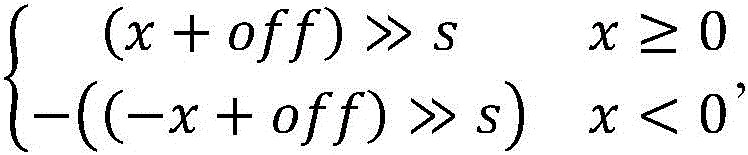
The use of such techniques is set forth in the following embodiments described for various implementations. In the following example, which should not be construed as limiting, Shift (x, s) is defined as Shift (x, s) ═ x + off > > s, and
SignShift (x, s) is defined as:

here, off is an integer, for example, 0 or 1< (s-1).
In some embodiments, the MVs of the sub-blocks of one component may be derived based on the MVs of one or more sub-blocks of another component. Here, the MVs of one or more sub-blocks of another component have been derived using affine models. In this way, motion information does not need to be derived multiple times.
In some embodiments, the HEVC standard defines how to derive MVs (labeled mvC) in chroma components from MVs (labeled MV) for MC in luma components. Generally, mvC is calculated as mv multiplied by a factor that depends on the color format, e.g., 4:2:0 or 4:2: 2. FIG. 10 illustrates an example of deriving MVs for components of sub-blocks of the 4:2:0 format in accordance with the present technique. In this example, the block size is 16 × 16 for Y (luminance component) and 8 × 8 for Cb/Cr (chrominance component). The sub-block size of the luminance component is 4 × 4, and the sub-block size of the chrominance component is 2 × 2. MV is first derived for the 4 × 4 sub-blocks in the Y component. The MVs of the 2 × 2 sub-blocks in the Cb and/or Cr components may be derived based on the MVs. In this particular example, the value of MV is first copied and the MV of the 2 × 2 sub-block in the Cb and/or Cr component is calculated based on MV according to the HEVC standard.
FIG. 11 illustrates another example of deriving MVs for components of sub-blocks of the 4:2:0 format in accordance with the present technique. In this example, the block size of the luminance component is 16 × 16, and the block size of the chrominance component is 8 × 8. The sub-block size for all components is 4 x 4. The 4 × 4 sub-blocks in the Cb or Cr component correspond to four 4 × 4 sub-blocks in the Y component. The MV of the luminance component is first calculated. The MVs for the 4 × 4 sub-blocks in the Cb or Cr component are then derived based on the MVs according to the HEVC standard.
In some embodiments, MV is calculated as the average of all corresponding sub-blocks MV in the Y component: MV ═ (MV) ═ m 0 +MV 1 +MV 2 +MV 3 )/4. Suppose MV ═ (MV ═ is x ,MV* y ),MV 0 =(MV 0x ,MV 0y ),MV 1 =(MV 1x ,MV 1y ),MV 2 =(MV 2x ,MV 2y ) And MV 3 =(MV 3x ,MV 3y )。
In some embodiments, MV x =Shift(MV 0x +MV 1x +MV 2x +MV 3x ,2),MV* y =Shift(MV 0y +MV 1y +MV 2y +MV 3y ,2). In some embodiments, MV x =SignShift(MV 0x +MV 1x +MV 2x +MV 3x ,2),MV* y =SignShift(MV 0y +MV 1y +MV 2y +MV 3y ,2)。
In some embodiments, the calculation of MV may be performed using the following operations:
1.a MV' x =Shift(MV 0x +MV 1x ,1),
1.b MV' y =Shift(MV 0y +MV 1y ,1),
1.c MV” x =Shift(MV 2x +MV 3x ,1),
1.d MV” y =Shift(MV 2y +MV 3y ,1),
1.e MV* x =Shift(MV' x +MV” x 1), and
1.f MV* y =Shift(MV' y +MV” y ,1)。
in some embodiments, the calculation of MV may be performed using the following operations:
2.a MV' x =Shift(MV 0x +MV 2x ,1),
2.b MV' y =Shift(MV 0y +MV 2y ,1),
2.c MV” x =Shift(MV 1x +MV 3x ,1),
2.d MV” y =Shift(MV 1y +MV 3y ,1),
2.e MV* x =Shift(MV' x +MV” x 1), and
2.f MV* y =Shift(MV' y +MV” y ,1)。
in some embodiments, the calculation of MV may be performed using the following operations:
3.a MV' x =SignShift(MV 0x +MV 1x ,1),
3.b MV' y =SignShift(MV 0y +MV 1y ,1),
3.c MV” x =SignShift(MV 2x +MV 3x ,1),
3.d MV” y =SignShift(MV 2y +MV 3y ,1),
3.e MV* x =SignShift(MV' x +MV” x 1), and
3.f MV* y =SignShift(MV' y +MV” y ,1)。
in some embodiments, the calculation of MV may be performed using the following operations:
4.a MV' x =SignShift(MV 0x +MV 2x ,1),
4.b MV' y =SignShift(MV 0y +MV 2y ,1),
4.c MV” x =SignShift(MV 1x +MV 3x ,1),
4.d MV” y =SignShift(MV 1y +MV 3y ,1),
4.e MV* x =SignShift(MV' x +MV” x 1), and
4.f MV* y =SignShift(MV'y+MV” y ,1)。
in some embodiments, the MV based on the upper left sub-block in the Y component (e.g., MV as shown in fig. 11) 0 ) To calculate MV. In some embodiments, MV is calculated based on MVs of the central sub-block in the Y component. In some embodiments, MV is calculated based on the median MV of all corresponding sub-blocks in the Y component. In the specific example shown in fig. 11, MV is the Median Value (MV) 0 ,MV 1 ,MV 2 ,MV 3 )。
In some embodiments, the derivation of the MVs for the sub-blocks of the color component may be determined based on a color format (e.g., 4:2:0, 4:2:2, and/or 4:4: 4). For example, when the color format is 4:4:4, no sub-sampling occurs. The sub-block size and the number of sub-blocks in a block of video data are the same for all components. The MV of a sub-block in one component is the same as the MV of the corresponding sub-block in the other component.
As another example, when the color format is 4:2: 2. The sub-block size may be the same for all components, while the number of blocks may be different for different components. The MV of the luminance component is first calculated based on the MVs of several corresponding sub-blocks. The MV of the corresponding sub-block in the Cb or Cr component is then derived from the MV.
Fig. 12 illustrates yet another example of deriving MVs for components of sub-blocks in accordance with the present techniques. In this example, the block size of the luminance component is 16 × 16, and the block size of the chrominance component is 8 × 16. The sub-block size for all components is 4 x 4. The 4 × 4 sub-blocks in the Cb or Cr component correspond to two 4 × 4 sub-blocks in the Y component. The MV of the luminance component is first calculated. The MVs for the 4 × 4 sub-blocks in the Cb or Cr component are then derived based on the MVs according to the HEVC standard.
In some embodiments, MV is calculated as the average of all corresponding sub-blocks MV in the Y component: MV ═ (MV) ═ m 0 +MV 1 )/2. Suppose MV ═ (MV ═ is x ,MV* y ),MV 0 =(MV 0x ,MV 0y ),MV 1 =(MV 1x ,MV 1y ),
In some embodiments, MV x =Shift(MV 0x +MV 1x ,1),MV* y =Shift(MV 0y +MV 1y ,1). In some embodiments, MV x =SignShift(MV 0x +MV 1x ,1),MV* y =SignShift(MV 0y +MV 1y ,1)。
Fig. 13 is a flow diagram of an exemplary method 1300 for video encoding in accordance with one or more embodiments of the present technology. Method 1300 includes partitioning a first component of a current video block into a first set of sub-blocks at operation 1310. Method 1300 includes partitioning a second component of the current video block into a second set of sub-blocks at operation 1320. The sub-blocks of the second component correspond to one or more sub-blocks of the first component. The method 1300 further includes deriving a motion vector for a sub-block of the second component based on motion vectors of one or more corresponding sub-blocks of the first color component based on a color format of the current video block at operation 1330.
Fig. 14 is a flow diagram of another exemplary method 1400 for video encoding in accordance with one or more embodiments of the present technology. The method 1400 includes receiving a block of video data including a first component and at least a second component at operation 1410. The first component is partitioned into a first set of sub-blocks and the second component is partitioned into a second set of sub-blocks. The sub-blocks of the second component correspond to one or more sub-blocks of the first component. The method 1400 includes deriving a motion vector for a sub-block of the second component based on motion vectors of one or more corresponding sub-blocks of the first color component based on a color format of the block of video data at operation 1420. The method 1400 includes reconstructing a block of video data or decoding other blocks of video data in the same picture based on the derived motion vector at operation 1430.
In some embodiments, the sub-blocks of the second component correspond to the sub-blocks of the first component. For example, the two sub-blocks may be spatially co-located in the picture. The method 1300 or 1400 further comprises calculating a set of intermediate motion vectors by copying motion vectors of sub-blocks of the first component and applying a factor to the set of intermediate motion vectors to obtain a derived motion vector, wherein the factor is associated with the color format.
In some embodiments, the color format is not 4:4:4 (e.g., is 4:2:2, or 4:2:0), and the size of at least one of the first set of sub-blocks is different from the size of at least one of the second set of sub-blocks. In some embodiments, the color format is 4:4:4, and the size of at least one of the first set of sub-blocks is the same as the size of at least one of the second set of sub-blocks.
In some embodiments, the color format is not 4:4:4, and the size of at least one of the first set of sub-blocks is the same as the size of at least one of the second set of sub-blocks. The sub-blocks of the second component correspond to the plurality of sub-blocks of the first component. In some embodiments, at least one of the motion vectors for the sub-blocks of the second component is derived based on an average of the corresponding motion vectors of the plurality of sub-blocks of the first component.
In some implementations, the sub-blocks of the second component correspond to four sub-blocks of the first component. The four sub-blocks have motion vectors MV respectively 0 =(MV 0x ,MV 0y ),MV 1 =(MV 1x ,MV 1y ),MV 2 =(MV 2x ,MV 2y ) And MV 3 =(MV 3x ,MV 3y ). The method 1300 or 1400 includes calculating an intermediate motion vector set MV ═ (MV x, MV ═ y) as MV ═ Shift (MV0x + MV1x + MV2x + MV3x,2) and MV ═ Shift (MVy0+ MVy1+ MVy2+ MVy3,2), where Shift (x, s) > s, where off and s are integers, and where>>Indicating a shift right operation. The method 1300 or 1400 further comprises applying a factor to the set of intermediate motion vectors to obtain a derived motion vector, wherein the factor is associated with a color format.
In some implementations, the sub-blocks of the second component correspond to four sub-blocks of the first component. The four sub-blocks have motion vectors MV respectively 0 =(MV 0x ,MV 0y ),MV 1 =(MV 1x ,MV 1y ),MV 2 =(MV 2x ,MV 2y ) And MV 3 =(MV 3x ,MV 3y ). The method 1300 or 1400 comprises calculating the set of intermediate motion vectors MV x (MV x, MV y) as MV x sigshift (MV0x + MV1x + MV2x + MV3x,2) and MV y sigshift (MV0y + MV1y + MV2y + MV3y,2), wherein Wherein off and s are integers, and wherein>>Indicating a shift operation. The
 method 1300 or 1400 further comprises applying a factor to the set of intermediate motion vectors to obtain a derived motion vector, wherein the factor is associated with a color format.
In some implementations, the sub-blocks of the second component correspond to four sub-blocks of the first component. The four sub-blocks have motion vectors MV respectively 0 =(MV 0x ,MV 0y ),MV 1 =(MV 1x ,MV 1y ),MV 2 =(MV 2x ,MV 2y ) And MV 3 =(MV 3x ,MV 3y ). The method 1300 or 1400 includes calculating an intermediate motion vector set MV ═ Shift (MV ' x + MV "x, MV ═ y) as MV x ═ Shift (MV ' x + MV" x,1) and MV y ═ Shift (MV ' y + MV "y, 1), where MV ' x ═ Shift (MV0x + MV1x,1), MV ' y ═ Shift (MV0y + MV1y,1), MV" x ═ Shift (MV2x + MV3x,1), and MV "y ═ Shift (MV2y + MV3y,1), where Shift (x, s) > (x + off) > s, where off and s are integers, and where Shift (x, s) > (x + off) > s, where off and s are integers, and where>>Indicating a shift right operation. The method 1300 or 1400 further comprises applying a factor to the set of intermediate motion vectors to obtain a derived motion vector, wherein the factor is associated with a color format.
In some implementations, the sub-blocks of the second component correspond to four sub-blocks of the first component. The four sub-blocks have motion vectors MV respectively 0 =(MV 0x ,MV 0y ),MV 1 =(MV 1x ,MV 1y ),MV 2 =(MV 2x ,MV 2y ) And MV 3 =(MV 3x ,MV 3y ). The method 1300 or 1400 includes calculating an intermediate motion vector set MV ═ Shift (MV ' x + MV "x, MV ═ y) as MV x ═ Shift (MV ' x + MV" x,1) and MV y ═ Shift (MV ' y + MV "y, 1), where MV ' x ═ Shift (MV0x + MV2x,1), MV ' y ═ Shift (MV0y + MV2y,1), MV" x ═ Shift (MV1x + MV3x,1), and MV "y ═ Shift (MV1y + MV3y,1), where Shift (x, s) > (x + off) > s, where off and s are integers, and where Shift (x, s) > (x + off) > s, where off and s are integers, and where>>Indicating a shift right operation. The method 1300 or 1400 further comprises applying a factor to the set of intermediate motion vectors to obtain a derived motion vector, wherein the factor is associated with a color format.
In some implementations, the sub-blocks of the second component correspond to four sub-blocks of the first component. The four sub-blocks have motion vectors MV, respectively 0 =(MV 0x ,MV 0y ),MV 1 =(MV 1x ,MV 1y ),MV 2 =(MV 2x ,MV 2y ) And MV 3 =(MV 3x ,MV 3y ). The method 1300 or 1400 includes calculating sets of intermediate motion vectors MV x (MV x, MV y) as MV x sigshift (MV' x + MV "x, 1) and MV y-sigshift (MV ' y + MV "y, 1), where MV ' x-sigshift (MV0x + MV1x,1), MV ' y-signsshift (MV0y + MV1y,1), MV" x-signsshift (MV2x + MV3x,1), and MV "y-signsshift (MV2y + MV3y,1), where Wherein off and s are integers, and wherein>>Indicating a shift operation. The
 method 1300 or 1400 further comprises applying a factor to the set of intermediate motion vectors to obtain a derived motion vector, wherein the factor is associated with a color format.
In some implementations, the sub-blocks of the second component correspond to four sub-blocks of the first component. The four sub-blocks have motion vectors MV respectively 0 =(MV 0x ,MV 0y ),MV 1 =(MV 1x ,MV 1y ),MV 2 =(MV 2x ,MV 2y ) And MV 3 =(MV 3x ,MV 3y ). The method 1300 or 1400 includes calculating the set of intermediate motion vectors MV x (MV x, MV y) as MV x sigshift (MV 'x + MV "x, 1) and MV y sigshift (MV' y + MV" y,1), where MV 'x sigshift (MV0x + MV2x,1), MV' y sigshift (MV0y + MV2y,1), MV "x sigshift (MV 1x + MV3x,1), and MV" y sigshift (MV1y + MV3y,1), where MV x sigshift is a set of intermediate motion vectors MV x (MV x, MV y) and MV y signsshift (MV1 + MV3y,1), where MV x is a set of intermediate motion vectors  Wherein off and s are integers, and wherein>>Indicating a shift operation. The
 method 1300 or 1400 further comprises applying a factor to the set of intermediate motion vectors to obtain a derived motion vector, wherein the factor is associated with a color format.
In some implementations, the sub-blocks of the second component correspond to two sub-blocks of the first component. The two sub-blocks each have a motion vector MV 0 =(MV 0x ,MV 0y ) And MV 1 =(MV 1x ,MV 1y ). The method 1300 or 1400 includes calculating an intermediate motion vector set MV ═ x (MV x, MV y) as MV x ═ Shift (MV0x + MV1x,1) and MV y ═ Shift (MVy0+ MVy1,1), where Shift (x, s) > (x + off) > s, where off and s are integers, and where>>Indicating a shift right operation. Method 1300 or1400 further comprises applying a factor to the set of intermediate motion vectors to obtain a derived motion vector, wherein the factor is associated with the color format.
In some implementations, the sub-blocks of the second component correspond to two sub-blocks of the first component. The two sub-blocks each have a motion vector MV 0 =(MV 0x ,MV 0y ) And MV 1 =(MV 1x ,MV 1y )。
The method 1300 or 1400 includes calculating the set of intermediate motion vectors MV x (MV x, MV y) as MV x sigshift (MV0x + MV1x,1) and MV y sigshift (MVy0+ MVy1,1), where MV x is the set of intermediate motion vectors MV x (MV x, MV y) and MV y is the set of intermediate motion vectors sigshift (MV x ) and MV y is the set of intermediate motion vectors sigshift (MVy0+ MVy1,1), where MV x is the set of intermediate motion vectors

Where off and s are integers, and where > > represents a shift operation. The method 1300 or 1400 further comprises applying a factor to the set of intermediate motion vectors to obtain a derived motion vector, wherein the factor is associated with a color format.
In some embodiments, method 1300 or 1400 further comprises calculating a set of intermediate motion vectors based on the motion vector of the selected sub-block of the plurality of sub-blocks of the first component, and applying the factor to the set of intermediate motion vectors to obtain the derived motion vector. The factor is associated with a color format. In some implementations, the selected sub-block is a top-left sub-block of the plurality of sub-blocks of the first component. In some implementations, the selected sub-block is a center sub-block of the plurality of sub-blocks of the first component.
In some embodiments, method 1300 or 1400 comprises calculating a set of intermediate motion vectors based on a median of the motion vectors of the plurality of sub-blocks of the first component, and applying a factor to the set of intermediate motion vectors to obtain the derived motion vector, wherein the factor is associated with the color format.
In some embodiments, the application of the factor is specified in the High Efficiency Video Coding (HEVC) standard.
The examples described above may be incorporated in the context of methods described below (e.g., methods 1300 and 1400), which may be implemented at a video decoder and/or a video encoder.
Fig. 15 is a block diagram illustrating an example encoding apparatus 1500 that may be used to implement various portions of the disclosed techniques, including but not limited to method 1300 and method 1400. The encoding apparatus 1500 includes a quantizer 1505 for compressing input data bits. The encoding apparatus 1500 also includes a dequantizer 1515 so that data bits may be fed to a memory 1525 and a predictor 1520 to perform motion estimation. The encoding apparatus 1500 further includes a binary encoder 1530 to generate an encoded binary code.
Fig. 16 is a block diagram illustrating an example encoding apparatus 1600 that may be used to implement various portions of the disclosed techniques, including but not limited to method 1300 and method 1400. The decoding apparatus 1600 includes a binary decoder 1605 for decoding a binary code. . The decoding apparatus 1600 further comprises a dequantizer 1615 such that the decoded data bits can be fed to a memory 1625 and a predictor 1620 for performing motion estimation at the decoding end.
Fig. 17 is a schematic diagram illustrating an example of an architecture of a computer system or other control device 1700 that may be used to implement portions of the disclosed technology. In fig. 17, computer system 1700 includes one or more processors 1705 and memory 1710 connected via an interconnect 1725. Interconnect 1725 may represent any one or more separate physical buses, point-to-point connections, or both, connected by appropriate bridges, adapters, or controllers. Thus, the interconnect 1725 may comprise, for example, a system bus, a Peripheral Component Interconnect (PCI) bus, a hyper transport or Industry Standard Architecture (ISA) bus, a Small Computer System Interface (SCSI) bus, a Universal Serial Bus (USB), an IIC (I2C) bus, or an Institute of Electrical and Electronics Engineers (IEEE) standard 674 bus (sometimes referred to as a "firewire").
The processor 1705 may include a Central Processing Unit (CPU) to control overall operation of, for example, a host. In some embodiments, the processor 1705 accomplishes this by executing software or firmware stored in the memory 1710. The processor 1705 may be or include one or more programmable general purpose or special purpose microprocessors, Digital Signal Processors (DSPs), programmable controllers, Application Specific Integrated Circuits (ASICs), Programmable Logic Devices (PLDs), or the like, or a combination of such devices.
The memory 1710 may be or include the main memory of a computer system. Memory 1710 represents any suitable form of Random Access Memory (RAM), Read Only Memory (ROM), flash memory, etc., or combination of these devices. In use, the memory 1710 may include, among other things, a set of machine instructions that, when executed by the processor 1705, cause the processor 1705 to perform operations to implement embodiments of the disclosed technology.
Also connected to the processor 1705 through the interconnect 1725 is an (optional) network adapter 1715. Network adapter 1715 provides computer system 1700 with the ability to communicate with remote devices, such as storage clients and/or other storage servers, and may be, for example, an ethernet adapter or a fibre channel adapter.
FIG. 18 illustrates a block diagram of an exemplary embodiment of a mobile device 1800 that may be used to implement various portions of the disclosed technology, including but not limited to method 1600. The mobile device 1800 may be a laptop, smartphone, tablet, camera, or other device capable of processing video. The mobile device 1800 includes a processor or controller 1801 for processing data and a memory 1802 in communication with the processor 1801 for storing and/or buffering data. For example, the processor 1801 may include a Central Processing Unit (CPU) or a microcontroller unit (MCU). In some implementations, the processor 1801 may include a Field Programmable Gate Array (FPGA). In some implementations, the mobile device 1800 includes or communicates with a Graphics Processing Unit (GPU), a Video Processing Unit (VPU), and/or a wireless communication unit to implement various visual and/or communication data processing functions of the smartphone device. For example, the memory 1802 may include and store processor-executable code that, when executed by the processor 1801, configures the mobile device 1800 to perform various operations, such as receiving information, commands, and/or data, processing information and data, and transmitting or providing processed information/data to another device, such as an actuator or external display.
To support various functions of the mobile device 1800, the memory 1802 can store information and data, such as instructions, software, values, images, and other data processed or referenced by the processor 1801. For example, the storage functions of memory 1802 may be implemented using various types of Random Access Memory (RAM) devices, Read Only Memory (ROM) devices, flash memory devices, and other suitable storage media. In some implementations, the mobile device 1800 includes an input/output (I/O) unit 1803 to interface the processor 1801 and/or memory 1802 with other modules, units, or devices. For example, the I/O unit 1803 may interface with the processor 1801 and memory 1802 to utilize various types of wireless interfaces compatible with typical data communication standards, e.g., between one or more computers and user equipment in the cloud. In some implementations, the mobile device 1800 can interface with other devices via the I/O unit 1803 using a wired connection. The mobile device 1800 may also interface with other external interfaces (e.g., a data store) and/or the visual or audio display device 1804 to retrieve and transmit data and information that may be processed by a processor, stored in a memory, or displayed on the display device 1804 or an output unit of an external device. For example, the display device 1804 may display a video frame that includes blocks (CUs, PUs, or TUs) that apply intra block copying based on whether the blocks are encoded using a motion compensation algorithm and in accordance with the disclosed techniques.
From the foregoing it will be appreciated that specific embodiments of the disclosed technology have been described herein for purposes of illustration, but that various modifications may be made without deviating from the scope of the invention. Accordingly, the techniques of this disclosure are not limited, except as by the appended claims.
Implementations of the subject matter and the functional operations described in this patent document can be implemented in various systems, digital electronic circuitry, or computer software, firmware, or hardware, including the structures disclosed in this specification and their structural equivalents, or in combinations of one or more of them. Implementations of the subject matter described in this specification can be implemented as one or more computer program products, i.e., one or more modules of computer program instructions encoded on a tangible and non-transitory computer readable medium for execution by, or to control the operation of, data processing apparatus. The computer readable medium can be a machine-readable storage device, a machine-readable storage substrate, a memory device, a composition of matter effecting a machine-readable propagated signal, or a combination of one or more of them. The term "data processing apparatus" encompasses all apparatus, devices, and machines for processing data, including by way of example a programmable processor, a computer, or multiple processors or computers. The apparatus can include, in addition to hardware, code that creates an execution environment for the computer program, e.g., code that constitutes processor firmware, a protocol stack, a database management system, an operating system, or a combination of one or more of them.
A computer program (also known as a program, software application, script, or code) can be written in any form of programming language, including compiled or interpreted languages, and it can be deployed in any form, including as a stand-alone program or as a module, component, subroutine, or other unit suitable for use in a computing environment. A computer program does not necessarily correspond to a file in a file system. A program can be stored in a portion of a file that holds other programs or data (e.g., one or more scripts stored in a markup language document), in a single file dedicated to the program in question, or in multiple coordinated files (e.g., files that store one or more modules, sub programs, or portions of code). A computer program can be deployed to be executed on one computer or on multiple computers that are located at one site or distributed across multiple sites and interconnected by a communication network.
The processes and logic flows described in this specification can be performed by one or more programmable processors executing one or more computer programs to perform functions by operating on input data and generating output. The processes and logic flows can also be performed by, and apparatus can also be implemented as, special purpose logic circuitry, e.g., an FPGA (field programmable gate array) or an ASIC (application-specific integrated circuit).
Processors suitable for the execution of a computer program include, by way of example, both general and special purpose microprocessors, and any one or more processors of any kind of digital computer. Generally, a processor will receive instructions and data from a read-only memory or a random access memory or both. The essential elements of a computer are a processor for executing instructions and one or more memory devices for storing instructions and data. Generally, a computer will also include, or be operatively coupled to receive data from or transfer data to, or both, one or more mass storage devices for storing data, e.g., magnetic, magneto-optical disks, or optical disks. However, a computer does not necessarily have such a device. Computer-readable media suitable for storing computer program instructions and data include all forms of non-volatile memory, media and memory devices, including by way of example semiconductor memory devices, e.g., EPROM, EEPROM, and flash memory devices. The processor and the memory can be supplemented by, or incorporated in, special purpose logic circuitry.
The specification and drawings are to be regarded in an illustrative manner, with an exemplary meaning being exemplary. As used herein, the singular forms "a," "an," and "the" are intended to include the plural forms as well, unless the context clearly indicates otherwise. Moreover, use of "or" is intended to include "and/or" unless the context clearly indicates otherwise.
While this patent document contains many specifics, these should not be construed as limitations on the scope of any invention or of what may be claimed, but rather as descriptions of features specific to particular embodiments of particular inventions. Certain features that are described in this patent document in the context of separate embodiments can also be implemented in combination in a single embodiment. Conversely, various features that are described in the context of a single embodiment can also be implemented in multiple embodiments separately or in any suitable subcombination. Furthermore, although features may be described above as acting in certain combinations and even initially claimed as such, one or more features from a claim combination can in some cases be excised from the combination, and the claimed combination may be directed to a subcombination or variation of a subcombination.
Similarly, while operations are depicted in the drawings in a particular order, this should not be understood as requiring that such operations be performed in the particular order shown or in sequential order, or that all illustrated operations be performed, to achieve desirable results. Moreover, the separation of various system components in the embodiments described herein should not be understood as requiring such separation in all embodiments.
Only some implementations and examples are described, and other implementations, enhancements and variations can be made based on what is described and illustrated in this patent document.
Claims (43)









Priority Applications (1)
| Application Number | Priority Date | Filing Date | Title |
|---|---|---|---|
| CN202210864671.7A CN115426497A (en) | 2018-06-21 | 2019-06-21 | Sub-block motion vector inheritance between color components |
Applications Claiming Priority (4)
| Application Number | Priority Date | Filing Date | Title |
|---|---|---|---|
| CNPCT/CN2018/092118 | 2018-06-21 | ||
| CN2018092118 | 2018-06-21 | ||
| CNPCT/CN2018/114931 | 2018-11-10 | ||
| CN2018114931 | 2018-11-10 |
Related Child Applications (1)
| Application Number | Title | Priority Date | Filing Date |
|---|---|---|---|
| CN202210864671.7A Division CN115426497A (en) | 2018-06-21 | 2019-06-21 | Sub-block motion vector inheritance between color components |
Publications (2)
| Publication Number | Publication Date |
|---|---|
| CN110636300A CN110636300A (en) | 2019-12-31 |
| CN110636300B true CN110636300B (en) | 2022-07-29 |
Family
ID=67847764
Family Applications (4)
| Application Number | Title | Priority Date | Filing Date |
|---|---|---|---|
| CN201910545236.6A Active CN110636300B (en) | 2018-06-21 | 2019-06-21 | Sub-block motion vector inheritance between color components |
| CN202110460688.1A Pending CN113115046A (en) | 2018-06-21 | 2019-06-21 | Component dependent sub-block partitioning |
| CN201910544640.1A Active CN110636297B (en) | 2018-06-21 | 2019-06-21 | Component dependent sub-block partitioning |
| CN202210864671.7A Pending CN115426497A (en) | 2018-06-21 | 2019-06-21 | Sub-block motion vector inheritance between color components |
Family Applications After (3)
| Application Number | Title | Priority Date | Filing Date |
|---|---|---|---|
| CN202110460688.1A Pending CN113115046A (en) | 2018-06-21 | 2019-06-21 | Component dependent sub-block partitioning |
| CN201910544640.1A Active CN110636297B (en) | 2018-06-21 | 2019-06-21 | Component dependent sub-block partitioning |
| CN202210864671.7A Pending CN115426497A (en) | 2018-06-21 | 2019-06-21 | Sub-block motion vector inheritance between color components |
Country Status (8)
| Country | Link |
|---|---|
| US (5) | US11477463B2 (en) |
| EP (2) | EP4307671A3 (en) |
| JP (3) | JP7096374B2 (en) |
| KR (1) | KR102701593B1 (en) |
| CN (4) | CN110636300B (en) |
| GB (1) | GB2589223B (en) |
| TW (2) | TWI729422B (en) |
| WO (2) | WO2019244118A1 (en) |
Families Citing this family (30)
| Publication number | Priority date | Publication date | Assignee | Title |
|---|---|---|---|---|
| WO2019229683A1 (en) | 2018-05-31 | 2019-12-05 | Beijing Bytedance Network Technology Co., Ltd. | Concept of interweaved prediction |
| EP3788787A1 (en) | 2018-06-05 | 2021-03-10 | Beijing Bytedance Network Technology Co. Ltd. | Interaction between ibc and atmvp |
| CN110636298B (en) | 2018-06-21 | 2022-09-13 | 北京字节跳动网络技术有限公司 | Unified constraints for Merge affine mode and non-Merge affine mode |
| CN110636300B (en) | 2018-06-21 | 2022-07-29 | 北京字节跳动网络技术有限公司 | Sub-block motion vector inheritance between color components |
| CN117768651A (en) | 2018-09-24 | 2024-03-26 | 北京字节跳动网络技术有限公司 | Method, device, medium, and bit stream storage method for processing video data |
| US11284066B2 (en) | 2018-10-10 | 2022-03-22 | Tencent America LLC | Method and apparatus for intra block copy in intra-inter blending mode and triangle prediction unit mode |
| WO2020084476A1 (en) | 2018-10-22 | 2020-04-30 | Beijing Bytedance Network Technology Co., Ltd. | Sub-block based prediction |
| JP7324841B2 (en) | 2018-11-10 | 2023-08-10 | 北京字節跳動網絡技術有限公司 | Video data processing method, apparatus, storage medium and storage method |
| CN117459722A (en) | 2018-11-12 | 2024-01-26 | 北京字节跳动网络技术有限公司 | Simplification of combined inter-intra prediction |
| JP7241870B2 (en) | 2018-11-20 | 2023-03-17 | 北京字節跳動網絡技術有限公司 | Difference calculation based on partial position |
| CN113170097B (en) | 2018-11-20 | 2024-04-09 | 北京字节跳动网络技术有限公司 | Encoding and decoding of video codec modes |
| EP4325849A3 (en) | 2018-11-22 | 2024-04-17 | Beijing Bytedance Network Technology Co., Ltd. | Coordination method for sub-block based inter prediction |
| EP3888371A2 (en) * | 2018-11-29 | 2021-10-06 | InterDigital VC Holdings, Inc. | Motion vector predictor candidates ordering in merge list |
| WO2020117010A1 (en) * | 2018-12-07 | 2020-06-11 | 삼성전자 주식회사 | Video decoding method and device, and video encoding method and device |
| CN113454999B (en) | 2019-01-02 | 2024-07-02 | 北京字节跳动网络技术有限公司 | Motion vector derivation between partition modes |
| CN113366855B (en) | 2019-02-03 | 2025-06-24 | 北京字节跳动网络技术有限公司 | Asymmetric quadtree partitioning based on conditions |
| KR102635518B1 (en) | 2019-03-06 | 2024-02-07 | 베이징 바이트댄스 네트워크 테크놀로지 컴퍼니, 리미티드 | Use of converted single prediction candidates |
| WO2020182213A1 (en) | 2019-03-13 | 2020-09-17 | Beijing Bytedance Network Technology Co., Ltd. | Sub-block transform in transform skip mode |
| EP3922014A4 (en) | 2019-04-02 | 2022-04-06 | Beijing Bytedance Network Technology Co., Ltd. | DECODER-SIDE MOTION VECTOR DERIVATION |
| BR112022002006A2 (en) | 2019-08-06 | 2022-03-29 | Beijing Bytedance Network Tech Co Ltd | Video processing method, video processing apparatus, and computer readable media |
| JP7481430B2 (en) | 2019-08-13 | 2024-05-10 | 北京字節跳動網絡技術有限公司 | Motion Accuracy in Subblock-Based Inter Prediction |
| CN114342400B (en) | 2019-09-02 | 2024-06-28 | 北京字节跳动网络技术有限公司 | Determine the codec mode based on the color format |
| JP7332795B2 (en) | 2019-09-21 | 2023-08-23 | 北京字節跳動網絡技術有限公司 | Base size constraints for chroma intra mode |
| CN114762330B (en) | 2019-09-22 | 2025-09-23 | 北京字节跳动网络技术有限公司 | Video sub-picture encoding and decoding |
| US11212523B2 (en) * | 2020-01-12 | 2021-12-28 | Mediatek Inc. | Video processing methods and apparatuses of merge number signaling in video coding systems |
| BR112022020449A2 (en) | 2020-04-10 | 2022-11-29 | Beijing Bytedance Network Tech Co Ltd | METHOD AND APPARATUS FOR PROCESSING VIDEO DATA, AND NON-TRANSITORY COMPUTER READABLE STORAGE AND RECORDING MEDIA |
| US12439095B2 (en) * | 2021-04-16 | 2025-10-07 | Tencent America LLC | Entropy coding of sign map for transform coefficients |
| US12166998B2 (en) * | 2022-01-12 | 2024-12-10 | Tencent America LLC | Adjustment based local illumination compensation |
| WO2024149247A1 (en) * | 2023-01-09 | 2024-07-18 | Mediatek Inc. | Methods and apparatus of region-wise cross-component model merge mode for video coding |
| CN121120810A (en) * | 2025-11-14 | 2025-12-12 | 广东匠芯创科技有限公司 | JPEG image coding and decoding method, device and medium |
Citations (3)
| Publication number | Priority date | Publication date | Assignee | Title |
|---|---|---|---|---|
| CN1672174A (en) * | 2002-07-31 | 2005-09-21 | 皇家飞利浦电子股份有限公司 | System and method for segmenting |
| CN106688232A (en) * | 2014-09-11 | 2017-05-17 | 欧几里得发现有限责任公司 | Perceptual Optimization for Model-Based Video Coding |
| CN107979756A (en) * | 2016-09-14 | 2018-05-01 | 联发科技股份有限公司 | Video coding method and device used by video coding system |
Family Cites Families (244)
| Publication number | Priority date | Publication date | Assignee | Title |
|---|---|---|---|---|
| JPH08186825A (en) | 1994-12-28 | 1996-07-16 | Nippon Hoso Kyokai <Nhk> | Motion vector detection method |
| EP1090502B1 (en) | 1999-04-26 | 2005-11-30 | Koninklijke Philips Electronics N.V. | Sub-pixel accurate motion vector estimation and motion-compensated interpolation |
| CN100589576C (en) | 2002-11-25 | 2010-02-10 | 松下电器产业株式会社 | Motion compensation method, image encoding method and image decoding method |
| US8064520B2 (en) | 2003-09-07 | 2011-11-22 | Microsoft Corporation | Advanced bi-directional predictive coding of interlaced video |
| CN100344163C (en) * | 2004-06-16 | 2007-10-17 | 华为技术有限公司 | Video coding-decoding processing method |
| CN1777283A (en) * | 2004-12-31 | 2006-05-24 | 上海广电(集团)有限公司 | Microblock based video signal coding/decoding method |
| US8954943B2 (en) | 2006-01-26 | 2015-02-10 | International Business Machines Corporation | Analyze and reduce number of data reordering operations in SIMD code |
| JP4826315B2 (en) | 2006-03-31 | 2011-11-30 | ソニー株式会社 | Image processing apparatus and method, and program |
| US8184715B1 (en) * | 2007-08-09 | 2012-05-22 | Elemental Technologies, Inc. | Method for efficiently executing video encoding operations on stream processor architectures |
| WO2009080133A1 (en) | 2007-12-21 | 2009-07-02 | Telefonaktiebolaget Lm Ericsson (Publ) | Adaptive intra mode selection |
| CN101605255B (en) | 2008-06-12 | 2011-05-04 | 华为技术有限公司 | Method and device for encoding and decoding video |
| US20110002386A1 (en) | 2009-07-06 | 2011-01-06 | Mediatek Singapore Pte. Ltd. | Video encoder and method for performing intra-prediction and video data compression |
| JP5234368B2 (en) * | 2009-09-30 | 2013-07-10 | ソニー株式会社 | Image processing apparatus and method |
| JP4901950B2 (en) | 2009-12-25 | 2012-03-21 | サントリーホールディングス株式会社 | Acidic food and drink containing 2,5-piperazinedione, 3,6-bis (phenylmethyl)-, (3S, 6S)- |
| JP2011147049A (en) | 2010-01-18 | 2011-07-28 | Sony Corp | Image processing apparatus and method, and program |
| EP2532160A1 (en) | 2010-02-05 | 2012-12-12 | Telefonaktiebolaget L M Ericsson (PUBL) | Managing predicted motion vector candidates |
| KR101630688B1 (en) | 2010-02-17 | 2016-06-16 | 삼성전자주식회사 | Apparatus for motion estimation and method thereof and image processing apparatus |
| CN101895751B (en) | 2010-07-06 | 2012-02-08 | 北京大学 | Method and device for intra-frame prediction, encoding/decoding method and system based on intra-frame prediction |
| KR101393824B1 (en) | 2010-10-06 | 2014-05-13 | 인텔 코오퍼레이션 | System and method for low complexity motion vector derivation |
| CN102685479A (en) | 2011-03-11 | 2012-09-19 | 华为技术有限公司 | Video encoding and decoding processing method and device |
| US9866859B2 (en) | 2011-06-14 | 2018-01-09 | Texas Instruments Incorporated | Inter-prediction candidate index coding independent of inter-prediction candidate list construction in video coding |
| HUE061938T2 (en) | 2011-03-21 | 2023-09-28 | Lg Electronics Inc | Motion vector predictor selection |
| US20120287999A1 (en) | 2011-05-11 | 2012-11-15 | Microsoft Corporation | Syntax element prediction in error correction |
| EP2716046A4 (en) * | 2011-05-27 | 2014-09-03 | Mediatek Inc | METHOD AND APPARATUS FOR REDUCING LINE STAMP MEMORY FOR VIDEO PROCESSING |
| GB201113527D0 (en) | 2011-08-04 | 2011-09-21 | Imagination Tech Ltd | External vectors in a motion estimation system |
| KR101492104B1 (en) | 2011-08-29 | 2015-02-11 | 주식회사 아이벡스피티홀딩스 | Apparatus of decoding moving pictures |
| CN103891291A (en) | 2011-08-30 | 2014-06-25 | 诺基亚公司 | An apparatus, a method and a computer program for video coding and decoding |
| MX353235B (en) | 2011-09-29 | 2018-01-08 | Sharp Kk Star | Image decoding device, image decoding method, and image encoding device. |
| JP5768662B2 (en) | 2011-10-31 | 2015-08-26 | 富士通株式会社 | Moving picture decoding apparatus, moving picture encoding apparatus, moving picture decoding method, moving picture encoding method, moving picture decoding program, and moving picture encoding program |
| JP2013098933A (en) | 2011-11-04 | 2013-05-20 | Sony Corp | Image processing device and method |
| WO2013069932A1 (en) | 2011-11-08 | 2013-05-16 | 주식회사 케이티 | Method and apparatus for encoding image, and method and apparatus for decoding image |
| WO2013070028A1 (en) | 2011-11-11 | 2013-05-16 | 엘지전자 주식회사 | Method and device for transmitting image information, and decoding method and device using same |
| JP5895469B2 (en) | 2011-11-18 | 2016-03-30 | 富士通株式会社 | Video encoding device and video decoding device |
| KR20130058524A (en) * | 2011-11-25 | 2013-06-04 | 오수미 | Method for generating chroma intra prediction block |
| US9451252B2 (en) | 2012-01-14 | 2016-09-20 | Qualcomm Incorporated | Coding parameter sets and NAL unit headers for video coding |
| EP3499895A1 (en) | 2012-01-18 | 2019-06-19 | Electronics and Telecommunications Research Institute | Device for encoding and decoding video |
| US9503720B2 (en) | 2012-03-16 | 2016-11-22 | Qualcomm Incorporated | Motion vector coding and bi-prediction in HEVC and its extensions |
| US9325991B2 (en) | 2012-04-11 | 2016-04-26 | Qualcomm Incorporated | Motion vector rounding |
| KR101749297B1 (en) * | 2012-04-12 | 2017-06-21 | 미디어텍 싱가폴 피티이. 엘티디. | Method and apparatus for block partition of chroma subsampling formats |
| CN104272743B (en) | 2012-05-09 | 2019-01-01 | 太阳专利托管公司 | Execute method, coding and decoding methods and its device of motion-vector prediction |
| US20130329007A1 (en) | 2012-06-06 | 2013-12-12 | Qualcomm Incorporated | Redundancy removal for advanced motion vector prediction (amvp) in three-dimensional (3d) video coding |
| DK3079363T3 (en) | 2012-06-29 | 2017-12-04 | ERICSSON TELEFON AB L M (publ) | ENCODING AND DECODING VIDEO SEQUENCES COMPREHENSIVE REFERENCE IMAGE KITS |
| MX346561B (en) * | 2012-07-02 | 2017-03-24 | Samsung Electronics Co Ltd | Method and apparatus for predicting motion vector for coding video or decoding video. |
| KR101955700B1 (en) | 2012-08-29 | 2019-03-07 | 브이아이디 스케일, 인크. | Method and apparatus of motion vector prediction for scalable video coding |
| US9491461B2 (en) | 2012-09-27 | 2016-11-08 | Qualcomm Incorporated | Scalable extensions to HEVC and temporal motion vector prediction |
| AU2012232992A1 (en) * | 2012-09-28 | 2014-04-17 | Canon Kabushiki Kaisha | Method, apparatus and system for encoding and decoding the transform units of a coding unit |
| CN104541506A (en) | 2012-09-28 | 2015-04-22 | 英特尔公司 | Inter-layer pixel sample prediction |
| KR102657912B1 (en) | 2012-10-01 | 2024-04-15 | 지이 비디오 컴프레션, 엘엘씨 | Scalable video coding using subblock-based coding of transform coefficient blocks in the enhancement layer |
| KR20150056811A (en) * | 2012-11-13 | 2015-05-27 | 인텔 코포레이션 | Content adaptive transform coding for next generation video |
| DE112013005568T5 (en) | 2012-11-21 | 2015-09-17 | Kabushiki Kaisha Toyota Jidoshokki | Nanocrystalline silicon material, negative electrode active material, material production method and electric storage device |
| US9106922B2 (en) | 2012-12-19 | 2015-08-11 | Vanguard Software Solutions, Inc. | Motion estimation engine for video encoding |
| US9615089B2 (en) | 2012-12-26 | 2017-04-04 | Samsung Electronics Co., Ltd. | Method of encoding and decoding multiview video sequence based on adaptive compensation of local illumination mismatch in inter-frame prediction |
| US9294777B2 (en) | 2012-12-30 | 2016-03-22 | Qualcomm Incorporated | Progressive refinement with temporal scalability support in video coding |
| US9674542B2 (en) | 2013-01-02 | 2017-06-06 | Qualcomm Incorporated | Motion vector prediction for video coding |
| US20140254678A1 (en) | 2013-03-11 | 2014-09-11 | Aleksandar Beric | Motion estimation using hierarchical phase plane correlation and block matching |
| US9521425B2 (en) | 2013-03-19 | 2016-12-13 | Qualcomm Incorporated | Disparity vector derivation in 3D video coding for skip and direct modes |
| US9491460B2 (en) | 2013-03-29 | 2016-11-08 | Qualcomm Incorporated | Bandwidth reduction for video coding prediction |
| WO2014166116A1 (en) | 2013-04-12 | 2014-10-16 | Mediatek Inc. | Direct simplified depth coding |
| US10045014B2 (en) | 2013-07-15 | 2018-08-07 | Mediatek Singapore Pte. Ltd. | Method of disparity derived depth coding in 3D video coding |
| US9628795B2 (en) | 2013-07-17 | 2017-04-18 | Qualcomm Incorporated | Block identification using disparity vector in video coding |
| WO2015006967A1 (en) | 2013-07-19 | 2015-01-22 | Mediatek Singapore Pte. Ltd. | Simplified view synthesis prediction for 3d video coding |
| CN104769947B (en) | 2013-07-26 | 2019-02-26 | 北京大学深圳研究生院 | A Multi-hypothesis Motion Compensation Coding Method Based on P Frames |
| CN104488271B (en) | 2013-07-26 | 2019-05-07 | 北京大学深圳研究生院 | A P-frame-based multi-hypothesis motion compensation method |
| AU2013228045A1 (en) | 2013-09-13 | 2015-04-02 | Canon Kabushiki Kaisha | Method, apparatus and system for encoding and decoding video data |
| US9762927B2 (en) | 2013-09-26 | 2017-09-12 | Qualcomm Incorporated | Sub-prediction unit (PU) based temporal motion vector prediction in HEVC and sub-PU design in 3D-HEVC |
| US9667996B2 (en) | 2013-09-26 | 2017-05-30 | Qualcomm Incorporated | Sub-prediction unit (PU) based temporal motion vector prediction in HEVC and sub-PU design in 3D-HEVC |
| CN103561263B (en) | 2013-11-06 | 2016-08-24 | 北京牡丹电子集团有限责任公司数字电视技术中心 | Based on motion vector constraint and the motion prediction compensation method of weighted motion vector |
| WO2015093449A1 (en) | 2013-12-19 | 2015-06-25 | シャープ株式会社 | Merge-candidate derivation device, image decoding device, and image encoding device |
| TWI536811B (en) | 2013-12-27 | 2016-06-01 | 財團法人工業技術研究院 | Method and system for image processing, decoding method, encoder and decoder |
| AU2014376061B8 (en) | 2014-01-03 | 2019-05-30 | Microsoft Technology Licensing, Llc | Block vector prediction in video and image coding/decoding |
| WO2015109598A1 (en) | 2014-01-27 | 2015-07-30 | Mediatek Singapore Pte. Ltd. | Methods for motion parameter hole filling |
| KR20150109282A (en) | 2014-03-19 | 2015-10-01 | 주식회사 케이티 | A method and an apparatus for processing a multi-view video signal |
| JP6345805B2 (en) * | 2014-05-06 | 2018-06-20 | 寰發股▲ふん▼有限公司HFI Innovation Inc. | Method of block vector prediction for INTRA block copy mode coding |
| US10327002B2 (en) | 2014-06-19 | 2019-06-18 | Qualcomm Incorporated | Systems and methods for intra-block copy |
| US10785486B2 (en) | 2014-06-19 | 2020-09-22 | Microsoft Technology Licensing, Llc | Unified intra block copy and inter prediction modes |
| US20150373362A1 (en) | 2014-06-19 | 2015-12-24 | Qualcomm Incorporated | Deblocking filter design for intra block copy |
| US20150373350A1 (en) | 2014-06-20 | 2015-12-24 | Qualcomm Incorporated | Temporal motion vector prediction (tmvp) indication in multi-layer codecs |
| CN105282558B (en) | 2014-07-18 | 2018-06-15 | 清华大学 | Pixel prediction method, coding method, coding/decoding method and its device in frame |
| WO2016008157A1 (en) | 2014-07-18 | 2016-01-21 | Mediatek Singapore Pte. Ltd. | Methods for motion compensation using high order motion model |
| US10863200B2 (en) * | 2014-07-25 | 2020-12-08 | Intel Corporation | Techniques for performing a forward transformation by a video encoder using a forward transform matrix |
| US10412387B2 (en) | 2014-08-22 | 2019-09-10 | Qualcomm Incorporated | Unified intra-block copy and inter-prediction |
| CN107079161B (en) | 2014-09-01 | 2020-11-20 | 寰发股份有限公司 | Method for Intra Picture Block Copying for Screen Content and Video Coding |
| EP3198872A1 (en) | 2014-09-26 | 2017-08-02 | VID SCALE, Inc. | Intra block copy coding with temporal block vector prediction |
| US9918105B2 (en) | 2014-10-07 | 2018-03-13 | Qualcomm Incorporated | Intra BC and inter unification |
| US10212445B2 (en) | 2014-10-09 | 2019-02-19 | Qualcomm Incorporated | Intra block copy prediction restrictions for parallel processing |
| WO2016068674A1 (en) | 2014-10-31 | 2016-05-06 | 삼성전자 주식회사 | Method and device for encoding/decoding motion vector |
| EP3202143B8 (en) | 2014-11-18 | 2019-09-25 | MediaTek Inc. | Method of bi-prediction video coding based on motion vectors from uni-prediction and merge candidate |
| WO2016090568A1 (en) | 2014-12-10 | 2016-06-16 | Mediatek Singapore Pte. Ltd. | Binary tree block partitioning structure |
| US11477477B2 (en) | 2015-01-26 | 2022-10-18 | Qualcomm Incorporated | Sub-prediction unit based advanced temporal motion vector prediction |
| WO2016123388A1 (en) | 2015-01-29 | 2016-08-04 | Vid Scale, Inc. | Palette coding modes and palette flipping |
| JP2018050091A (en) | 2015-02-02 | 2018-03-29 | シャープ株式会社 | Image decoder, image encoder, and prediction vector conducting device |
| CA2977526C (en) | 2015-02-27 | 2020-02-18 | Arris Enterprises Llc | Modification of unification of intra block copy and inter signaling related syntax and semantics |
| US10958927B2 (en) | 2015-03-27 | 2021-03-23 | Qualcomm Incorporated | Motion information derivation mode determination in video coding |
| WO2016165069A1 (en) | 2015-04-14 | 2016-10-20 | Mediatek Singapore Pte. Ltd. | Advanced temporal motion vector prediction in video coding |
| WO2016173519A1 (en) | 2015-04-29 | 2016-11-03 | Hfi Innovation Inc. | Method and apparatus for intra block copy reference list construction |
| US20160337662A1 (en) | 2015-05-11 | 2016-11-17 | Qualcomm Incorporated | Storage and signaling resolutions of motion vectors |
| CN109005407B (en) * | 2015-05-15 | 2023-09-01 | 华为技术有限公司 | Video image encoding and decoding method, encoding device and decoding device |
| CN107615765A (en) | 2015-06-03 | 2018-01-19 | 联发科技股份有限公司 | Method and apparatus for resource sharing between intra block copy mode and inter prediction mode in video coding and decoding system |
| GB2539213A (en) | 2015-06-08 | 2016-12-14 | Canon Kk | Schemes for handling an AMVP flag when implementing intra block copy coding mode |
| KR102390073B1 (en) | 2015-06-08 | 2022-04-25 | 브이아이디 스케일, 인크. | Intra block copy mode for screen content coding |
| US10148977B2 (en) | 2015-06-16 | 2018-12-04 | Futurewei Technologies, Inc. | Advanced coding techniques for high efficiency video coding (HEVC) screen content coding (SCC) extensions |
| CA2993104C (en) | 2015-07-27 | 2021-03-02 | Mediatek, Inc. | Method of system for video coding using intra block copy mode |
| KR20180028513A (en) | 2015-08-04 | 2018-03-16 | 엘지전자 주식회사 | Method and apparatus for inter prediction in a video coding system |
| KR102773508B1 (en) * | 2015-08-07 | 2025-02-27 | 엘지전자 주식회사 | Method and device for inter prediction in video coding system |
| US10467735B2 (en) * | 2015-08-25 | 2019-11-05 | Interdigital Vc Holdings, Inc. | Inverse tone mapping based on luminance zones |
| CN107925775A (en) | 2015-09-02 | 2018-04-17 | 联发科技股份有限公司 | Motion compensation method and device for video coding and decoding based on bidirectional prediction optical flow technology |
| WO2017041271A1 (en) | 2015-09-10 | 2017-03-16 | Mediatek Singapore Pte. Ltd. | Efficient context modeling for coding a block of data |
| US10375413B2 (en) | 2015-09-28 | 2019-08-06 | Qualcomm Incorporated | Bi-directional optical flow for video coding |
| CN108965871B (en) * | 2015-09-29 | 2023-11-10 | 华为技术有限公司 | Image prediction methods and devices |
| EP3357245A4 (en) | 2015-11-05 | 2019-03-13 | MediaTek Inc. | PREDICTION METHOD AND APPARATUS USING MOTION VECTOR FOR VIDEO CODING |
| CN105306944B (en) * | 2015-11-30 | 2018-07-06 | 哈尔滨工业大学 | Chromatic component Forecasting Methodology in hybrid video coding standard |
| CN108432250A (en) | 2016-01-07 | 2018-08-21 | 联发科技股份有限公司 | Affine inter-frame prediction method and device for video coding and decoding |
| CN105678808A (en) | 2016-01-08 | 2016-06-15 | 浙江宇视科技有限公司 | Moving object tracking method and device |
| US9955186B2 (en) | 2016-01-11 | 2018-04-24 | Qualcomm Incorporated | Block size decision for video coding |
| US10798403B2 (en) | 2016-01-29 | 2020-10-06 | Sharp Kabushiki Kaisha | Prediction image generation device, video decoding device, and video coding device |
| EP3398331A4 (en) | 2016-02-05 | 2019-04-10 | Mediatek Inc. | METHOD AND APPARATUS FOR VIDEO CODING WITH MOTION COMPENSATION USING BIDIRECTIONAL OPTICAL FLOW TECHNIQUES |
| US10368083B2 (en) | 2016-02-15 | 2019-07-30 | Qualcomm Incorporated | Picture order count based motion vector pruning |
| EP3417617A4 (en) * | 2016-02-17 | 2019-02-27 | Telefonaktiebolaget LM Ericsson (publ) | Methods and devices for encoding and decoding video pictures |
| WO2017142449A1 (en) | 2016-02-17 | 2017-08-24 | Telefonaktiebolaget Lm Ericsson (Publ) | Methods and devices for encoding and decoding video pictures |
| WO2017143467A1 (en) * | 2016-02-22 | 2017-08-31 | Mediatek Singapore Pte. Ltd. | Localized luma mode prediction inheritance for chroma coding |
| WO2017156669A1 (en) | 2016-03-14 | 2017-09-21 | Mediatek Singapore Pte. Ltd. | Methods for motion vector storage in video coding |
| WO2017157281A1 (en) | 2016-03-16 | 2017-09-21 | Mediatek Inc. | Method and apparatus of pattern-based motion vector derivation for video coding |
| US11223852B2 (en) | 2016-03-21 | 2022-01-11 | Qualcomm Incorporated | Coding video data using a two-level multi-type-tree framework |
| US10567759B2 (en) * | 2016-03-21 | 2020-02-18 | Qualcomm Incorporated | Using luma information for chroma prediction with separate luma-chroma framework in video coding |
| JP6895645B2 (en) | 2016-03-25 | 2021-06-30 | パナソニックIpマネジメント株式会社 | Methods and Devices for Encoding and Decoding Moving Images Using Signal Dependent Adaptive Quantization |
| KR102715635B1 (en) * | 2016-03-28 | 2024-10-11 | 로즈데일 다이나믹스 엘엘씨 | Inter-prediction mode based image processing method, and apparatus therefor |
| CN116546208A (en) | 2016-04-08 | 2023-08-04 | 韩国电子通信研究院 | Method and apparatus for deriving motion prediction information |
| US10462459B2 (en) * | 2016-04-14 | 2019-10-29 | Mediatek Inc. | Non-local adaptive loop filter |
| KR20180132756A (en) | 2016-04-28 | 2018-12-12 | 엘지전자 주식회사 | Image processing method based on inter prediction mode and apparatus therefor |
| KR20190015216A (en) | 2016-05-05 | 2019-02-13 | 브이아이디 스케일, 인크. | Intra-directional representation based on control points for intra coding |
| WO2017194756A1 (en) | 2016-05-12 | 2017-11-16 | Telefonaktiebolaget Lm Ericsson (Publ) | Methods and arrangements for coding and decoding motion vectors |
| FI4060992T3 (en) | 2016-05-13 | 2025-08-14 | Interdigital Vc Holdings Inc | SYSTEMS AND METHODS FOR GENERALIZED MULTI-HYPOTHESIS PREDICTION IN VIDEO CODING |
| US10560718B2 (en) | 2016-05-13 | 2020-02-11 | Qualcomm Incorporated | Merge candidates for motion vector prediction for video coding |
| US20190191171A1 (en) | 2016-05-13 | 2019-06-20 | Sharp Kabushiki Kaisha | Prediction image generation device, video decoding device, and video coding device |
| US10560712B2 (en) | 2016-05-16 | 2020-02-11 | Qualcomm Incorporated | Affine motion prediction for video coding |
| MX385468B (en) | 2016-05-17 | 2025-03-18 | Arris Entpr Llc | CORRELATION OF TEMPLATES FOR INTRA-PREDICTION OF JVET. |
| US20170339405A1 (en) | 2016-05-20 | 2017-11-23 | Arris Enterprises Llc | System and method for intra coding |
| CA3025488A1 (en) | 2016-05-25 | 2017-11-30 | Arris Enterprises Llc | Weighted angular prediction for intra coding |
| CA3025490A1 (en) * | 2016-05-28 | 2017-12-07 | Mediatek Inc. | Method and apparatus of current picture referencing for video coding using affine motion compensation |
| EP3482566B1 (en) | 2016-07-08 | 2024-02-28 | InterDigital Madison Patent Holdings, SAS | Systems and methods for region-of-interest tone remapping |
| WO2018008678A1 (en) * | 2016-07-08 | 2018-01-11 | パナソニック インテレクチュアル プロパティ コーポレーション オブ アメリカ | Decoding device, coding device, decoding method and coding method |
| WO2018018459A1 (en) | 2016-07-27 | 2018-02-01 | 华为技术有限公司 | Policy processing method and device |
| US10326986B2 (en) * | 2016-08-15 | 2019-06-18 | Qualcomm Incorporated | Intra video coding using a decoupled tree structure |
| WO2018033661A1 (en) | 2016-08-15 | 2018-02-22 | Nokia Technologies Oy | Video encoding and decoding |
| US10368107B2 (en) | 2016-08-15 | 2019-07-30 | Qualcomm Incorporated | Intra video coding using a decoupled tree structure |
| WO2018045944A1 (en) * | 2016-09-06 | 2018-03-15 | Mediatek Inc. | Methods and apparatuses of candidate set determination for binary-tree splitting blocks |
| CN109691107A (en) | 2016-09-12 | 2019-04-26 | 索尼公司 | Image processing device and image processing method |
| CN114501006B (en) * | 2016-09-20 | 2025-03-04 | 株式会社Kt | Video decoding method, video encoding method and device for sending compressed video data |
| US10778999B2 (en) * | 2016-09-30 | 2020-09-15 | Qualcomm Incorporated | Frame rate up-conversion coding mode with affine motion model |
| EP3301919A1 (en) | 2016-10-03 | 2018-04-04 | Thomson Licensing | Method and apparatus for encoding and decoding motion information |
| CN109845255A (en) | 2016-10-03 | 2019-06-04 | 夏普株式会社 | System and method for deblocking filter to be applied to reconstructed video data |
| US10448010B2 (en) | 2016-10-05 | 2019-10-15 | Qualcomm Incorporated | Motion vector prediction for affine motion models in video coding |
| KR20190053238A (en) | 2016-10-06 | 2019-05-17 | 엘지전자 주식회사 | Image processing method based on inter prediction mode and apparatus therefor |
| US20190273943A1 (en) * | 2016-10-10 | 2019-09-05 | Sharp Kabushiki Kaisha | Systems and methods for performing motion compensation for coding of video data |
| US10750190B2 (en) | 2016-10-11 | 2020-08-18 | Lg Electronics Inc. | Video decoding method and device in video coding system |
| US10880546B2 (en) * | 2016-10-11 | 2020-12-29 | Lg Electronics Inc. | Method and apparatus for deriving intra prediction mode for chroma component |
| US20180109814A1 (en) * | 2016-10-14 | 2018-04-19 | Mediatek Inc. | Method And Apparatus Of Coding Unit Information Inheritance |
| US20180109810A1 (en) | 2016-10-17 | 2018-04-19 | Mediatek Inc. | Method and Apparatus for Reference Picture Generation and Management in 3D Video Compression |
| CN116320495A (en) * | 2016-11-28 | 2023-06-23 | 韩国电子通信研究院 | Method and device for filtering |
| WO2018097692A2 (en) | 2016-11-28 | 2018-05-31 | 한국전자통신연구원 | Method and apparatus for encoding/decoding image, and recording medium in which bit stream is stored |
| JP7044778B2 (en) | 2016-11-28 | 2022-03-30 | エレクトロニクス アンド テレコミュニケーションズ リサーチ インスチチュート | Image decoding methods, image coding methods, and non-temporary computer-readable recording media |
| US20200021837A1 (en) | 2016-12-16 | 2020-01-16 | Sharp Kabushiki Kaisha | Video decoding apparatus and video coding apparatus |
| US10750203B2 (en) | 2016-12-22 | 2020-08-18 | Mediatek Inc. | Method and apparatus of adaptive bi-prediction for video coding |
| CN110140355B (en) | 2016-12-27 | 2022-03-08 | 联发科技股份有限公司 | Method and device for fine-tuning of bidirectional template motion vector for video coding and decoding |
| US10681370B2 (en) * | 2016-12-29 | 2020-06-09 | Qualcomm Incorporated | Motion vector generation for affine motion model for video coding |
| WO2018128379A1 (en) | 2017-01-03 | 2018-07-12 | 엘지전자(주) | Method and device for processing video signal by means of affine prediction |
| US20190335170A1 (en) * | 2017-01-03 | 2019-10-31 | Lg Electronics Inc. | Method and apparatus for processing video signal by means of affine prediction |
| US10931969B2 (en) | 2017-01-04 | 2021-02-23 | Qualcomm Incorporated | Motion vector reconstructions for bi-directional optical flow (BIO) |
| US20180199057A1 (en) | 2017-01-12 | 2018-07-12 | Mediatek Inc. | Method and Apparatus of Candidate Skipping for Predictor Refinement in Video Coding |
| US10701366B2 (en) | 2017-02-21 | 2020-06-30 | Qualcomm Incorporated | Deriving motion vector information at a video decoder |
| US10523964B2 (en) | 2017-03-13 | 2019-12-31 | Qualcomm Incorporated | Inter prediction refinement based on bi-directional optical flow (BIO) |
| US10701390B2 (en) * | 2017-03-14 | 2020-06-30 | Qualcomm Incorporated | Affine motion information derivation |
| CN117395394A (en) | 2017-03-22 | 2024-01-12 | 韩国电子通信研究院 | Prediction method and device using reference block |
| US10595035B2 (en) * | 2017-03-22 | 2020-03-17 | Qualcomm Incorporated | Constraining motion vector information derived by decoder-side motion vector derivation |
| US10701391B2 (en) | 2017-03-23 | 2020-06-30 | Qualcomm Incorporated | Motion vector difference (MVD) prediction |
| US10440396B2 (en) * | 2017-03-28 | 2019-10-08 | Qualcomm Incorporated | Filter information sharing among color components |
| US10542264B2 (en) | 2017-04-04 | 2020-01-21 | Arris Enterprises Llc | Memory reduction implementation for weighted angular prediction |
| US10873760B2 (en) | 2017-04-07 | 2020-12-22 | Futurewei Technologies, Inc. | Motion vector (MV) constraints and transformation constraints in video coding |
| US20180310017A1 (en) | 2017-04-21 | 2018-10-25 | Mediatek Inc. | Sub-prediction unit temporal motion vector prediction (sub-pu tmvp) for video coding |
| US10805630B2 (en) | 2017-04-28 | 2020-10-13 | Qualcomm Incorporated | Gradient based matching for motion search and derivation |
| US20180332298A1 (en) | 2017-05-10 | 2018-11-15 | Futurewei Technologies, Inc. | Bidirectional Prediction In Video Compression |
| US11206419B2 (en) | 2017-05-17 | 2021-12-21 | Kt Corporation | Method and device for video signal processing |
| EP4351139A3 (en) * | 2017-06-09 | 2024-05-15 | Electronics and Telecommunications Research Institute | Video encoding/decoding method and device, and recording medium storing bit stream |
| US10904565B2 (en) | 2017-06-23 | 2021-01-26 | Qualcomm Incorporated | Memory-bandwidth-efficient design for bi-directional optical flow (BIO) |
| JP7261750B2 (en) | 2017-06-26 | 2023-04-20 | インターデジタル ヴイシー ホールディングス, インコーポレイテッド | Multiple predictor candidates for motion compensation |
| US11184636B2 (en) | 2017-06-28 | 2021-11-23 | Sharp Kabushiki Kaisha | Video encoding device and video decoding device |
| US10477237B2 (en) | 2017-06-28 | 2019-11-12 | Futurewei Technologies, Inc. | Decoder side motion vector refinement in video coding |
| CN107392850B (en) | 2017-06-30 | 2020-08-25 | 联想(北京)有限公司 | Image processing method and system |
| US10567772B2 (en) * | 2017-07-11 | 2020-02-18 | Google Llc | Sub8×8 block processing |
| US11172203B2 (en) | 2017-08-08 | 2021-11-09 | Mediatek Inc. | Intra merge prediction |
| US10880573B2 (en) | 2017-08-15 | 2020-12-29 | Google Llc | Dynamic motion vector referencing for video coding |
| WO2019050115A1 (en) | 2017-09-05 | 2019-03-14 | 엘지전자(주) | Inter prediction mode based image processing method and apparatus therefor |
| JP2021005741A (en) | 2017-09-14 | 2021-01-14 | シャープ株式会社 | Image coding device and image decoding device |
| US10785494B2 (en) | 2017-10-11 | 2020-09-22 | Qualcomm Incorporated | Low-complexity design for FRUC |
| CN109963155B (en) | 2017-12-23 | 2023-06-06 | 华为技术有限公司 | Method, device and codec for predicting motion information of image block |
| JP7125486B2 (en) | 2018-01-16 | 2022-08-24 | ヴィド スケール インコーポレイテッド | Motion-compensated bi-prediction based on local illumination compensation |
| US10757417B2 (en) | 2018-01-20 | 2020-08-25 | Qualcomm Incorporated | Affine motion compensation in video coding |
| US10687071B2 (en) | 2018-02-05 | 2020-06-16 | Tencent America LLC | Method and apparatus for video coding |
| US11012715B2 (en) | 2018-02-08 | 2021-05-18 | Qualcomm Incorporated | Intra block copy for video coding |
| JP7109558B2 (en) | 2018-02-14 | 2022-07-29 | ホアウェイ・テクノロジーズ・カンパニー・リミテッド | adaptive interpolation filter |
| US10708592B2 (en) | 2018-04-02 | 2020-07-07 | Qualcomm Incorporated | Deblocking filter for video coding and processing |
| US20190306502A1 (en) | 2018-04-02 | 2019-10-03 | Qualcomm Incorporated | System and method for improved adaptive loop filtering |
| US10779002B2 (en) | 2018-04-17 | 2020-09-15 | Qualcomm Incorporated | Limitation of the MVP derivation based on decoder-side motion vector derivation |
| US20190320181A1 (en) | 2018-04-17 | 2019-10-17 | Qualcomm Incorporated | Generation of motion vector predictors from multiple neighboring blocks in video coding |
| US20190364295A1 (en) * | 2018-05-25 | 2019-11-28 | Tencent America LLC | Method and apparatus for video coding |
| US10986340B2 (en) | 2018-06-01 | 2021-04-20 | Qualcomm Incorporated | Coding adaptive multiple transform information for video coding |
| US11109025B2 (en) | 2018-06-04 | 2021-08-31 | Tencent America LLC | Method and apparatus for sub-block based temporal motion vector prediction |
| EP3788787A1 (en) | 2018-06-05 | 2021-03-10 | Beijing Bytedance Network Technology Co. Ltd. | Interaction between ibc and atmvp |
| WO2019234674A1 (en) | 2018-06-07 | 2019-12-12 | Beijing Bytedance Network Technology Co., Ltd. | Integer motion compensation |
| US11303923B2 (en) | 2018-06-15 | 2022-04-12 | Intel Corporation | Affine motion compensation for current picture referencing |
| CN110620929B (en) | 2018-06-19 | 2023-04-18 | 北京字节跳动网络技术有限公司 | Selected motion vector difference accuracy without motion vector prediction truncation |
| CN110636300B (en) | 2018-06-21 | 2022-07-29 | 北京字节跳动网络技术有限公司 | Sub-block motion vector inheritance between color components |
| CN110636298B (en) | 2018-06-21 | 2022-09-13 | 北京字节跳动网络技术有限公司 | Unified constraints for Merge affine mode and non-Merge affine mode |
| TWI744660B (en) | 2018-06-29 | 2021-11-01 | 大陸商北京字節跳動網絡技術有限公司 | Mer improvements |
| TWI719519B (en) | 2018-07-02 | 2021-02-21 | 大陸商北京字節跳動網絡技術有限公司 | Block size restrictions for dmvr |
| US11606575B2 (en) | 2018-07-10 | 2023-03-14 | Qualcomm Incorporated | Multiple history based non-adjacent MVPs for wavefront processing of video coding |
| US10491902B1 (en) | 2018-07-16 | 2019-11-26 | Tencent America LLC | Method and apparatus for history-based motion vector prediction |
| US10440378B1 (en) | 2018-07-17 | 2019-10-08 | Tencent America LLC | Method and apparatus for history-based motion vector prediction with parallel processing |
| US10362330B1 (en) | 2018-07-30 | 2019-07-23 | Tencent America LLC | Combining history-based motion vector prediction and non-adjacent merge prediction |
| CN115842912A (en) | 2018-08-04 | 2023-03-24 | 抖音视界有限公司 | Interaction between different decoder-side motion vector derivation modes |
| US11336914B2 (en) | 2018-08-16 | 2022-05-17 | Qualcomm Incorporated | History-based candidate list with classification |
| WO2020055169A1 (en) | 2018-09-11 | 2020-03-19 | 김기백 | Image encoding/decoding method and apparatus using inter prediction |
| WO2020058886A1 (en) | 2018-09-19 | 2020-03-26 | Beijing Bytedance Network Technology Co., Ltd. | Fast algorithms for adaptive motion vector resolution in affine mode |
| US11212550B2 (en) | 2018-09-21 | 2021-12-28 | Qualcomm Incorporated | History-based motion vector prediction for affine mode |
| EP3836545B1 (en) | 2018-09-22 | 2023-11-15 | Lg Electronics Inc. | Method for processing video signals using inter prediction |
| EP3834418A1 (en) | 2018-09-23 | 2021-06-16 | Beijing Bytedance Network Technology Co. Ltd. | Modification of motion vector with adaptive motion vector resolution |
| CN117768651A (en) | 2018-09-24 | 2024-03-26 | 北京字节跳动网络技术有限公司 | Method, device, medium, and bit stream storage method for processing video data |
| US11146800B2 (en) | 2018-09-24 | 2021-10-12 | Tencent America LLC | Low latency local illumination compensation |
| US11051034B2 (en) * | 2018-10-08 | 2021-06-29 | Qualcomm Incorporated | History-based motion vector predictor |
| US11284066B2 (en) | 2018-10-10 | 2022-03-22 | Tencent America LLC | Method and apparatus for intra block copy in intra-inter blending mode and triangle prediction unit mode |
| CN112956197B (en) | 2018-10-22 | 2025-04-25 | 北京字节跳动网络技术有限公司 | Limitations of decoder-side motion vector derivation based on codec information |
| US11032541B2 (en) | 2018-10-22 | 2021-06-08 | Tencent America LLC | Method and apparatus for video coding |
| CN112913249B (en) | 2018-10-22 | 2022-11-08 | 北京字节跳动网络技术有限公司 | Simplified coding and decoding of generalized bi-directional prediction index |
| WO2020084510A1 (en) | 2018-10-23 | 2020-04-30 | Beijing Bytedance Network Technology Co., Ltd. | Adaptive control point selection for affine coding |
| CN115514958B (en) | 2018-11-02 | 2025-08-15 | 抖音视界有限公司 | Method and device for encoding and decoding video data |
| MY207520A (en) | 2018-11-05 | 2025-03-01 | Beijing Bytedance Network Tech Co Ltd | Interpolation for inter prediction with refinement |
| CN116527882A (en) | 2018-11-07 | 2023-08-01 | 寰发股份有限公司 | Video block coding or decoding method and device using current picture reference coding method |
| JP7324841B2 (en) | 2018-11-10 | 2023-08-10 | 北京字節跳動網絡技術有限公司 | Video data processing method, apparatus, storage medium and storage method |
| CN113170184B (en) | 2018-11-22 | 2024-12-06 | 北京字节跳动网络技术有限公司 | How to configure the default motion candidate |
| US11394989B2 (en) | 2018-12-10 | 2022-07-19 | Tencent America LLC | Method and apparatus for video coding |
| US11032574B2 (en) | 2018-12-31 | 2021-06-08 | Tencent America LLC | Method and apparatus for video coding |
| US11122260B2 (en) | 2019-02-22 | 2021-09-14 | Mediatek Inc. | Method and apparatus of Merge list generation for Intra Block Copy mode |
| US11394999B2 (en) | 2019-03-11 | 2022-07-19 | Alibaba Group Holding Limited | Method, device, and system for determining prediction weight for merge mode |
| WO2020185876A1 (en) * | 2019-03-12 | 2020-09-17 | Tencent America LLC | Method and apparatus for video encoding or decoding |
-
2019
- 2019-06-21 CN CN201910545236.6A patent/CN110636300B/en active Active
- 2019-06-21 CN CN202110460688.1A patent/CN113115046A/en active Pending
- 2019-06-21 CN CN201910544640.1A patent/CN110636297B/en active Active
- 2019-06-21 JP JP2020570793A patent/JP7096374B2/en active Active
- 2019-06-21 WO PCT/IB2019/055246 patent/WO2019244118A1/en not_active Ceased
- 2019-06-21 TW TW108121834A patent/TWI729422B/en active
- 2019-06-21 CN CN202210864671.7A patent/CN115426497A/en active Pending
- 2019-06-21 EP EP23213827.1A patent/EP4307671A3/en active Pending
- 2019-06-21 TW TW108121830A patent/TWI750483B/en active
- 2019-06-21 GB GB2018867.8A patent/GB2589223B/en active Active
- 2019-06-21 EP EP19762856.3A patent/EP3788782A1/en active Pending
- 2019-06-21 WO PCT/IB2019/055247 patent/WO2019244119A1/en not_active Ceased
- 2019-06-21 KR KR1020217000058A patent/KR102701593B1/en active Active
-
2020
- 2020-10-15 US US17/071,357 patent/US11477463B2/en active Active
- 2020-10-15 US US17/071,412 patent/US11197007B2/en active Active
-
2021
- 2021-04-02 US US17/221,122 patent/US11659192B2/en active Active
-
2022
- 2022-04-29 US US17/732,849 patent/US11895306B2/en active Active
- 2022-06-23 JP JP2022100745A patent/JP7361842B2/en active Active
-
2023
- 2023-10-03 JP JP2023172306A patent/JP7601523B2/en active Active
- 2023-12-04 US US18/528,017 patent/US12238306B2/en active Active
Patent Citations (3)
| Publication number | Priority date | Publication date | Assignee | Title |
|---|---|---|---|---|
| CN1672174A (en) * | 2002-07-31 | 2005-09-21 | 皇家飞利浦电子股份有限公司 | System and method for segmenting |
| CN106688232A (en) * | 2014-09-11 | 2017-05-17 | 欧几里得发现有限责任公司 | Perceptual Optimization for Model-Based Video Coding |
| CN107979756A (en) * | 2016-09-14 | 2018-05-01 | 联发科技股份有限公司 | Video coding method and device used by video coding system |
Non-Patent Citations (1)
| Title |
|---|
| Description of SDR video coding technology proposal by MediaTek;Chih-Wei Hsu;《Joint Video Experts Team (JVET) of ITU-T SG 16 WP 3 and ISO/IEC JTC 1/SC 29/WG 11 10th Meeting: San Diego, US, 10–20 Apr. 2018》;20180420;第2.4.1.2节 * |
Also Published As
Similar Documents
| Publication | Publication Date | Title |
|---|---|---|
| CN110636300B (en) | Sub-block motion vector inheritance between color components | |
| US20210352302A1 (en) | Unified constrains for the merge affine mode and the non-merge affine mode | |
| CN110944204B (en) | Simplified space-time motion vector prediction | |
| US11805259B2 (en) | Non-affine blocks predicted from affine motion | |
| US11825074B2 (en) | Generation and usage of combined affine merge candidate | |
| CN110662076A (en) | Boundary enhancement of subblocks | |
| CN110662073B (en) | Boundary filtering of sub-blocks | |
| WO2020065570A1 (en) | Motion vector accessing range for affine motion estimation |
Legal Events
| Date | Code | Title | Description |
|---|---|---|---|
| PB01 | Publication | ||
| PB01 | Publication | ||
| SE01 | Entry into force of request for substantive examination | ||
| SE01 | Entry into force of request for substantive examination | ||
| GR01 | Patent grant | ||
| GR01 | Patent grant |