JP7332795B2 - Base size constraints for chroma intra mode - Google Patents
Base size constraints for chroma intra mode Download PDFInfo
- Publication number
- JP7332795B2 JP7332795B2 JP2022517728A JP2022517728A JP7332795B2 JP 7332795 B2 JP7332795 B2 JP 7332795B2 JP 2022517728 A JP2022517728 A JP 2022517728A JP 2022517728 A JP2022517728 A JP 2022517728A JP 7332795 B2 JP7332795 B2 JP 7332795B2
- Authority
- JP
- Japan
- Prior art keywords
- chroma
- block
- video
- mode
- tree
- Prior art date
- Legal status (The legal status is an assumption and is not a legal conclusion. Google has not performed a legal analysis and makes no representation as to the accuracy of the status listed.)
- Active
Links
Images


Classifications
-
- H—ELECTRICITY
- H04—ELECTRIC COMMUNICATION TECHNIQUE
- H04N—PICTORIAL COMMUNICATION, e.g. TELEVISION
- H04N19/00—Methods or arrangements for coding, decoding, compressing or decompressing digital video signals
- H04N19/50—Methods or arrangements for coding, decoding, compressing or decompressing digital video signals using predictive coding
-
- H—ELECTRICITY
- H04—ELECTRIC COMMUNICATION TECHNIQUE
- H04N—PICTORIAL COMMUNICATION, e.g. TELEVISION
- H04N19/00—Methods or arrangements for coding, decoding, compressing or decompressing digital video signals
- H04N19/10—Methods or arrangements for coding, decoding, compressing or decompressing digital video signals using adaptive coding
- H04N19/102—Methods or arrangements for coding, decoding, compressing or decompressing digital video signals using adaptive coding characterised by the element, parameter or selection affected or controlled by the adaptive coding
- H04N19/103—Selection of coding mode or of prediction mode
- H04N19/11—Selection of coding mode or of prediction mode among a plurality of spatial predictive coding modes
-
- H—ELECTRICITY
- H04—ELECTRIC COMMUNICATION TECHNIQUE
- H04N—PICTORIAL COMMUNICATION, e.g. TELEVISION
- H04N19/00—Methods or arrangements for coding, decoding, compressing or decompressing digital video signals
- H04N19/10—Methods or arrangements for coding, decoding, compressing or decompressing digital video signals using adaptive coding
- H04N19/102—Methods or arrangements for coding, decoding, compressing or decompressing digital video signals using adaptive coding characterised by the element, parameter or selection affected or controlled by the adaptive coding
- H04N19/119—Adaptive subdivision aspects, e.g. subdivision of a picture into rectangular or non-rectangular coding blocks
-
- H—ELECTRICITY
- H04—ELECTRIC COMMUNICATION TECHNIQUE
- H04N—PICTORIAL COMMUNICATION, e.g. TELEVISION
- H04N19/00—Methods or arrangements for coding, decoding, compressing or decompressing digital video signals
- H04N19/10—Methods or arrangements for coding, decoding, compressing or decompressing digital video signals using adaptive coding
- H04N19/102—Methods or arrangements for coding, decoding, compressing or decompressing digital video signals using adaptive coding characterised by the element, parameter or selection affected or controlled by the adaptive coding
- H04N19/132—Sampling, masking or truncation of coding units, e.g. adaptive resampling, frame skipping, frame interpolation or high-frequency transform coefficient masking
-
- H—ELECTRICITY
- H04—ELECTRIC COMMUNICATION TECHNIQUE
- H04N—PICTORIAL COMMUNICATION, e.g. TELEVISION
- H04N19/00—Methods or arrangements for coding, decoding, compressing or decompressing digital video signals
- H04N19/10—Methods or arrangements for coding, decoding, compressing or decompressing digital video signals using adaptive coding
- H04N19/134—Methods or arrangements for coding, decoding, compressing or decompressing digital video signals using adaptive coding characterised by the element, parameter or criterion affecting or controlling the adaptive coding
- H04N19/157—Assigned coding mode, i.e. the coding mode being predefined or preselected to be further used for selection of another element or parameter
-
- H—ELECTRICITY
- H04—ELECTRIC COMMUNICATION TECHNIQUE
- H04N—PICTORIAL COMMUNICATION, e.g. TELEVISION
- H04N19/00—Methods or arrangements for coding, decoding, compressing or decompressing digital video signals
- H04N19/10—Methods or arrangements for coding, decoding, compressing or decompressing digital video signals using adaptive coding
- H04N19/134—Methods or arrangements for coding, decoding, compressing or decompressing digital video signals using adaptive coding characterised by the element, parameter or criterion affecting or controlling the adaptive coding
- H04N19/157—Assigned coding mode, i.e. the coding mode being predefined or preselected to be further used for selection of another element or parameter
- H04N19/159—Prediction type, e.g. intra-frame, inter-frame or bidirectional frame prediction
-
- H—ELECTRICITY
- H04—ELECTRIC COMMUNICATION TECHNIQUE
- H04N—PICTORIAL COMMUNICATION, e.g. TELEVISION
- H04N19/00—Methods or arrangements for coding, decoding, compressing or decompressing digital video signals
- H04N19/10—Methods or arrangements for coding, decoding, compressing or decompressing digital video signals using adaptive coding
- H04N19/169—Methods or arrangements for coding, decoding, compressing or decompressing digital video signals using adaptive coding characterised by the coding unit, i.e. the structural portion or semantic portion of the video signal being the object or the subject of the adaptive coding
- H04N19/17—Methods or arrangements for coding, decoding, compressing or decompressing digital video signals using adaptive coding characterised by the coding unit, i.e. the structural portion or semantic portion of the video signal being the object or the subject of the adaptive coding the unit being an image region, e.g. an object
- H04N19/176—Methods or arrangements for coding, decoding, compressing or decompressing digital video signals using adaptive coding characterised by the coding unit, i.e. the structural portion or semantic portion of the video signal being the object or the subject of the adaptive coding the unit being an image region, e.g. an object the region being a block, e.g. a macroblock
-
- H—ELECTRICITY
- H04—ELECTRIC COMMUNICATION TECHNIQUE
- H04N—PICTORIAL COMMUNICATION, e.g. TELEVISION
- H04N19/00—Methods or arrangements for coding, decoding, compressing or decompressing digital video signals
- H04N19/10—Methods or arrangements for coding, decoding, compressing or decompressing digital video signals using adaptive coding
- H04N19/169—Methods or arrangements for coding, decoding, compressing or decompressing digital video signals using adaptive coding characterised by the coding unit, i.e. the structural portion or semantic portion of the video signal being the object or the subject of the adaptive coding
- H04N19/186—Methods or arrangements for coding, decoding, compressing or decompressing digital video signals using adaptive coding characterised by the coding unit, i.e. the structural portion or semantic portion of the video signal being the object or the subject of the adaptive coding the unit being a colour or a chrominance component
-
- H—ELECTRICITY
- H04—ELECTRIC COMMUNICATION TECHNIQUE
- H04N—PICTORIAL COMMUNICATION, e.g. TELEVISION
- H04N19/00—Methods or arrangements for coding, decoding, compressing or decompressing digital video signals
- H04N19/50—Methods or arrangements for coding, decoding, compressing or decompressing digital video signals using predictive coding
- H04N19/593—Methods or arrangements for coding, decoding, compressing or decompressing digital video signals using predictive coding involving spatial prediction techniques
-
- H—ELECTRICITY
- H04—ELECTRIC COMMUNICATION TECHNIQUE
- H04N—PICTORIAL COMMUNICATION, e.g. TELEVISION
- H04N19/00—Methods or arrangements for coding, decoding, compressing or decompressing digital video signals
- H04N19/90—Methods or arrangements for coding, decoding, compressing or decompressing digital video signals using coding techniques not provided for in groups H04N19/10-H04N19/85, e.g. fractals
- H04N19/96—Tree coding, e.g. quad-tree coding
Landscapes
- Engineering & Computer Science (AREA)
- Multimedia (AREA)
- Signal Processing (AREA)
- Compression Or Coding Systems Of Tv Signals (AREA)
Description
関連出願への相互参照
本願は2020年9月21日に出願された国際特許出願第PCT/CN2020/116472号の国内移行であり、同出願は、2019年9月21日に出願された国際特許出願第PCT/CN2019/107139号および2019年9月27日に出願された国際特許出願第PCT/CN2019/108760号の優先権および利益を適時に主張するために行われる。前述の諸出願の開示全体は、本出願の開示の一部として引用により援用される。
Cross-reference to related application This application is the national phase of International Patent Application No. PCT/CN2020/116472 filed on It is made to timely claim priority and benefit of Application No. PCT/CN2019/107139 and International Patent Application No. PCT/CN2019/108760 filed on September 27, 2019. The entire disclosures of the aforementioned applications are incorporated by reference as part of the disclosure of the present application.
技術分野
本文書は、ビデオおよび画像のコーディング・復号化技術に関するものである。
Technical Field This document relates to video and image coding and decoding techniques.
デジタル・ビデオは、インターネットおよびその他のデジタル通信ネットワークにおける最大の帯域幅使用を占める。ビデオを受信および表示できる接続されたユーザー装置の数が増加するにつれて、デジタル・ビデオの利用のための帯域幅需要は増加し続けることが予想される。 Digital video accounts for the largest bandwidth usage on the Internet and other digital communication networks. Bandwidth demands for digital video utilization are expected to continue to increase as the number of connected user devices capable of receiving and displaying video increases.
開示された技法は、ビデオコーディングまたは復号において参照画像が使用されるビデオまたは画像デコーダまたはエンコーダの実施形態によって使用されてもよい。 The disclosed techniques may be used by embodiments of video or image decoders or encoders in which reference images are used in video coding or decoding.
ある例示的側面では、ビデオ処理の方法が開示される。本方法は、ビデオのビデオ・ピクチャーのビデオ領域のクロマ・ブロックと、該ビデオのコーディング表現との間の変換を規則に従って実行することを含む。前記規則は、前記クロマ・ブロックがサイズM×Nを有するため、前記クロマ・ブロックがイントラコーディングモードを用いて前記コーディング表現において表現されることが許されないことを規定し、MおよびNはそれぞれ前記クロマ・ブロックの幅および高さを示す整数であり、前記イントラコーディングモードは、前記ビデオ・ピクチャーの前にコーディングされたビデオ領域に基づいて前記クロマ・ブロックをコーディングすることを含む。 In one example aspect, a method of video processing is disclosed. The method includes performing a rule-based conversion between chroma blocks of a video region of a video picture of a video and a coded representation of the video. The rule specifies that the chroma block is not allowed to be represented in the coded representation using intra- coding mode because the chroma block has size M×N, where M and N are respectively the An integer indicating the width and height of a chroma block, wherein the intra- coding mode comprises coding the chroma block based on a previously coded video region of the video picture.
別の例示的側面では、ビデオ処理の別の方法が開示される。本方法は、ビデオのビデオ・ピクチャーのビデオ領域のクロマ・ブロックと、該ビデオのコーディング表現との間の変換を規則に従って実行することを含む。前記規則は、サイズM×Nを有する前記クロマ・ブロックが、デュアルツリー分割が使用される場合に、イントラコーディングモードを使用して前記コーディング表現において表現されることが許されないことを規定し、MおよびNはそれぞれ前記クロマ・ブロックの幅および高さを示す整数であり、前記イントラコーディングモードは、前記ビデオ・ピクチャーの前にコーディングされたビデオ領域に基づいて前記クロマ・ブロックをコーディングすることを含む。 In another exemplary aspect, another method of video processing is disclosed. The method includes performing a rule-based conversion between chroma blocks of a video region of a video picture of a video and a coded representation of the video. The rule specifies that the chroma block with size M×N is not allowed to be represented in the coded representation using intra- coding mode when dual-tree partitioning is used, and M and N are integers indicating the width and height of the chroma block, respectively, and the intra- coding mode includes coding the chroma block based on a previously coded video region of the video picture. .
さらに別の例示的側面では、ビデオ処理の別の方法が開示される。本方法は、ビデオのビデオ・ピクチャーのビデオ領域のクロマ・ブロックと、該ビデオのコーディング表現との間の変換を規則に従って実行することを含む。前記規則は、サイズM×Nを有する前記クロマ・ブロックが、シングルツリー分割が使用される場合に、イントラコーディングモードを使用して前記コーディング表現において表現されることが許されないことを規定し、MおよびNはそれぞれ前記クロマ・ブロックの幅および高さを示す整数であり、前記イントラコーディングモードは、前記ビデオ・ピクチャーの前にコーディングされたビデオ領域に基づいて前記クロマ・ブロックをコーディングすることを含む。 In yet another exemplary aspect, another method of video processing is disclosed. The method includes performing a rule-based conversion between chroma blocks of a video region of a video picture of a video and a coded representation of the video. The rule specifies that the chroma block with size M×N is not allowed to be represented in the coded representation using intra- coding mode when single-tree partitioning is used, and M and N are integers indicating the width and height of the chroma block, respectively, and the intra- coding mode includes coding the chroma block based on a previously coded video region of the video picture. .
さらに別の例示的側面では、ビデオ処理の別の方法が開示される。本方法は、ビデオのビデオ領域のクロマ・ブロックと、該ビデオのコーディング表現との間の変換を規則に従って実行することを含む。前記規則は、サイズM×Nを有する前記クロマ・ブロックが、インター予測とイントラ予測を組み合わせる複合インターおよびイントラ予測(CIIP)モードを使用して前記コーディング表現において表現されることが許されないことを規定し、MおよびNはそれぞれ前記クロマ・ブロックの幅および高さを示す整数である。 In yet another exemplary aspect, another method of video processing is disclosed. The method includes performing a rule-based conversion between chroma blocks of a video region of a video and a coded representation of the video. The rule stipulates that the chroma block with size M×N is not allowed to be represented in the coded representation using a combined inter and intra prediction (CIIP) mode that combines inter and intra prediction. and M and N are integers indicating the width and height of the chroma block, respectively.
さらに別の例示的側面では、ビデオ処理の別の方法が開示される。本方法は、ビデオのビデオ領域と該ビデオのコーディング表現との間の変換を実行することを含み、前記規則は、前記ビデオ領域に適用可能な最大変換サイズが信号伝達されるかどうか、およびどのように信号伝達されるかが、前記コーディング表現において前記ビデオ領域を表現するために使用されるコーディングモード・タイプに依存することを規定し、前記コーディングモード・タイプは、(i)前記ビデオ領域に適用される量子化パラメータ(QP)が閾値よりも小さいほぼ無損失のコーディングモード、(ii)前記ビデオ領域についての残差データの変換がバイパスされる無損失のコーディングモード、または(iii)前記ビデオ領域についての残差データの変換がスキップされる、損失のあるコーディングモードである。 In yet another exemplary aspect, another method of video processing is disclosed. The method includes performing a transform between a video region of a video and a coded representation of the video, the rule signaling whether a maximum transform size applicable to the video region is signaled and which depends on a coding mode type used to represent said video region in said coding representation, said coding mode type being: (ii) a lossless coding mode in which transformation of residual data for said video domain is bypassed; or (iii) said video A lossy coding mode in which the transformation of the residual data for regions is skipped.
さらに別の例示的側面では、上述の方法は、プロセッサを備えるビデオ・エンコーダ装置によって実装されうる。 In yet another example aspect, the methods described above may be implemented by a video encoder apparatus comprising a processor.
さらに別の例示的側面では、上述の方法は、プロセッサを備えるビデオ・デコーダ装置によって実装されうる。 In yet another example aspect, the methods described above may be implemented by a video decoder apparatus comprising a processor.
さらに別の例示的側面では、これらの方法は、プロセッサ実行可能命令の形で具現され、コンピュータ読み取り可能プログラム媒体に記憶されてもよい。 In yet another exemplary aspect, these methods may be embodied in processor-executable instructions stored on a computer-readable program medium.
これらおよびその他の側面は、本文書でさらに説明される。 These and other aspects are further described in this document.
本稿は、圧縮解除または復号されたデジタル・ビデオまたは画像の品質を改善するために、画像またはビデオ・ビットストリームのデコーダによって使用されうるさまざまな技法を提供する。簡潔のため、本明細書では、用語「ビデオ」は、ピクチャーのシーケンス(伝統的にビデオと呼ばれる)および個々の画像の両方を含むために使用される。さらに、ビデオ・エンコーダも、さらなるエンコードのために使用されるデコードされたフレームを再構成するために、エンコードのプロセス中にこれらの技法を実装しうる。 This article provides various techniques that may be used by image or video bitstream decoders to improve the quality of decompressed or decoded digital video or images. For brevity, the term "video" is used herein to include both sequences of pictures (traditionally called video) and individual images. Moreover, video encoders may also implement these techniques during the encoding process to reconstruct decoded frames used for further encoding.
セクション見出しは、理解の容易のために本稿で使用されており、実施形態および技法を対応するセクションに限定するものではない。よって、あるセクションからの実施形態は、他のセクションからの実施形態と組み合わせることができる。 Section headings are used in this document for ease of understanding and are not intended to limit embodiments and techniques to the corresponding section. Thus, embodiments from one section can be combined with embodiments from other sections.
1. 概要 1. Overview
本稿は、ビデオコーディング技術に関するものである。具体的には、ビデオコーディングにおける基本色ベースの(base colors based)表現を用いたパレットコーディングに関する。これは、HEVCのような既存のビデオコーディング標準、またはこれから最終化される標準(多用途ビデオコーディング)に適用されうる。これは、将来のビデオコーディング規格またはビデオ・コーデックにも適用可能でありうる。 This paper is about video coding technology. Specifically, it relates to palette coding with base colors based representation in video coding . This can be applied to existing video coding standards such as HEVC, or to standards yet to be finalized (Versatile Video Coding ). This may also be applicable to future video coding standards or video codecs.
2. 初期の議論 2. Early discussion
ビデオコーディング規格は、主に、周知のITU-TおよびISO/IEC規格の開発を通じて発展してきた。ITU-TはH.261とH.263を生み出し、ISO/IECはMPEG-1とMPEG-4 Visualを生み出し、両組織は合同して、H.262/MPEG-2 VideoとH.264/MPEG-4 Advanced Video Coding(AVC)とH.265/HEVC規格とを生み出した。H.262以来、ビデオコーディング規格は、時間的予測と変換コーディングが利用されるハイブリッドビデオコーディング構造に基づいている。HEVCを越えた将来のビデオコーディング技術を探求するため、2015年にVCEGとMPEGが合同で合同ビデオ探査チーム(JVET)を設立した。それ以来、JVETによって多くの新しい方法が採用され、合同探査モデル(Joint Exploration Model、JEM)と名付けられた参照ソフトウェアに入れられた。2018年4月には、VCEG(Q6/16)とISO/IEC JTC1 SC29/WG11(MPEG)の間の合同ビデオエキスパートチーム(JVET)が発足し、HEVCに比べ50%のビットレート削減を目指すVVC規格に取り組んでいる。 Video coding standards have evolved primarily through the development of the well-known ITU-T and ISO/IEC standards. ITU-T produced H.261 and H.263, ISO/IEC produced MPEG-1 and MPEG-4 Visual, and the two organizations jointly produced H.262/MPEG-2 Video and H.264/MPEG. -4 Created Advanced Video Coding (AVC) and H.265/HEVC standards. Since H.262, video coding standards have been based on a hybrid video coding structure in which temporal prediction and transform coding are utilized. In 2015, VCEG and MPEG jointly established the Joint Video Exploration Team (JVET) to explore future video coding technologies beyond HEVC. Since then, many new methods have been adopted by JVET and put into the reference software named Joint Exploration Model (JEM). In April 2018, a joint video expert team (JVET) was launched between VCEG (Q6/16) and ISO/IEC JTC1 SC29/WG11 (MPEG), aiming for a 50% bitrate reduction compared to HEVC. Working on standards.
2.1 イントラブロックコピー 2.1 Intra block copy
HEVCスクリーンコンテンツコーディング拡張(HEVC Screen Content Coding extensions、HEVC‐SCC)および現在のVVCテストモデル(VTM-4.0)では、現在ピクチャー参照としても知られるイントラブロックコピー(IBC)が採用されている。IBCは、動き補償の概念をフレーム間コーディングからフレーム内コーディングに拡張した。図1に示されるように、IBCが適用されるとき、現在のブロックは、同じピクチャー内の参照ブロックによって予測される。参照ブロック内のサンプルは、現在のブロックがコーディングまたは復号される前に、すでに再構成されていなければならない。IBCは、ほとんどのカメラ捕捉シーケンスについてそれほど効率的ではないが、スクリーンコンテンツについては顕著なコーディング利得を示す。その理由は、スクリーンコンテンツピクチャーにはアイコンやテキスト文字などの反復パターンが多数存在することである。IBCは、これらの反復パターン間の冗長性を効果的に除去することができる。HEVC-SCCでは、インターコーディングされるコーディング単位(CU)は、現在のピクチャーをその参照ピクチャーとして選択する場合、IBCを適用することができる。この場合、MVはブロックベクトル(BV)に名称変更され、BVは常に整数ピクセル精度をもつ。メインプロファイルHEVCとの互換性を保つために、現在のピクチャーは、デコードピクチャーバッファ(DPB)において「長期」参照ピクチャーとしてマークされる。同様に、マルチビュー/3Dビデオコーディング標準においては、ビュー間参照ピクチャーも「長期」参照ピクチャーとしてマークされることに注意すべきである。 HEVC Screen Content Coding extensions (HEVC-SCC) and the current VVC test model (VTM-4.0) now employ intra-block copy (IBC), also known as picture referencing. IBC extended the concept of motion compensation from interframe coding to intraframe coding . As shown in Figure 1, when IBC is applied, the current block is predicted by the reference block within the same picture. The samples in the reference block must already be reconstructed before the current block is coded or decoded. IBC is not very efficient for most camera capture sequences, but exhibits significant coding gain for screen content. The reason is that there are many repeating patterns such as icons and text characters in screen content pictures. IBC can effectively remove the redundancy between these repeating patterns. In HEVC-SCC, an inter- coded coding unit (CU) can apply IBC if it selects the current picture as its reference picture. In this case, MV is renamed to block vector (BV) and BV always has integer pixel precision. For compatibility with Main Profile HEVC, the current picture is marked as a 'long-term' reference picture in the Decoded Picture Buffer (DPB). Similarly, it should be noted that inter-view reference pictures are also marked as "long-term" reference pictures in the multiview/3D video coding standard.
BVをたどって参照ブロックを見つけた後、参照ブロックをコピーすることにより予測が生成できる。残差は、もとの信号から参照ピクセルを減算することによって得られる。その後、変換および量子化は、他のコーディングモードと同様に適用できる。 After walking the BV to find the reference block, the prediction can be generated by copying the reference block. A residual is obtained by subtracting the reference pixel from the original signal. Transforms and quantization can then be applied similarly to other coding modes.
図1は、イントラブロックコピーの図解である。 FIG. 1 is an illustration of intra-block copying.
しかしながら、参照ブロックがピクチャーの外側にある、または現在のブロックと重複する、または再構成された領域の外側にある、またはいくつかの制約条件によって制約されている有効領域の外側にある場合、一部または全部のピクセル値が定義されない。そのような問題に対処するためには、基本的に2つの解決策がある。1つは、たとえばビットストリーム適合性において、そのような状況を許容しないことである。もう1つは、それら未定義のピクセル値についてパディングを適用することである。以下のサブセッションは、これらの解決策を詳細に説明する。 However, if the reference block is outside the picture, or overlaps the current block, or is outside the reconstructed region, or is outside the valid region constrained by some constraint, then one Some or all pixel values are undefined. There are basically two solutions to deal with such problems. One is not to allow such situations, eg in bitstream conformance. Another is to apply padding for those undefined pixel values. The following subsessions describe these solutions in detail.
2.2 HEVCスクリーンコンテンツコーディング拡張におけるIBC
HEVCのスクリーンコンテンツコーディング拡張において、ブロックが現在のピクチャーを参照として使用する場合、次の仕様テキストに示されるように、参照ブロック全体が利用可能な再構成領域内にあることを保証すべきである。
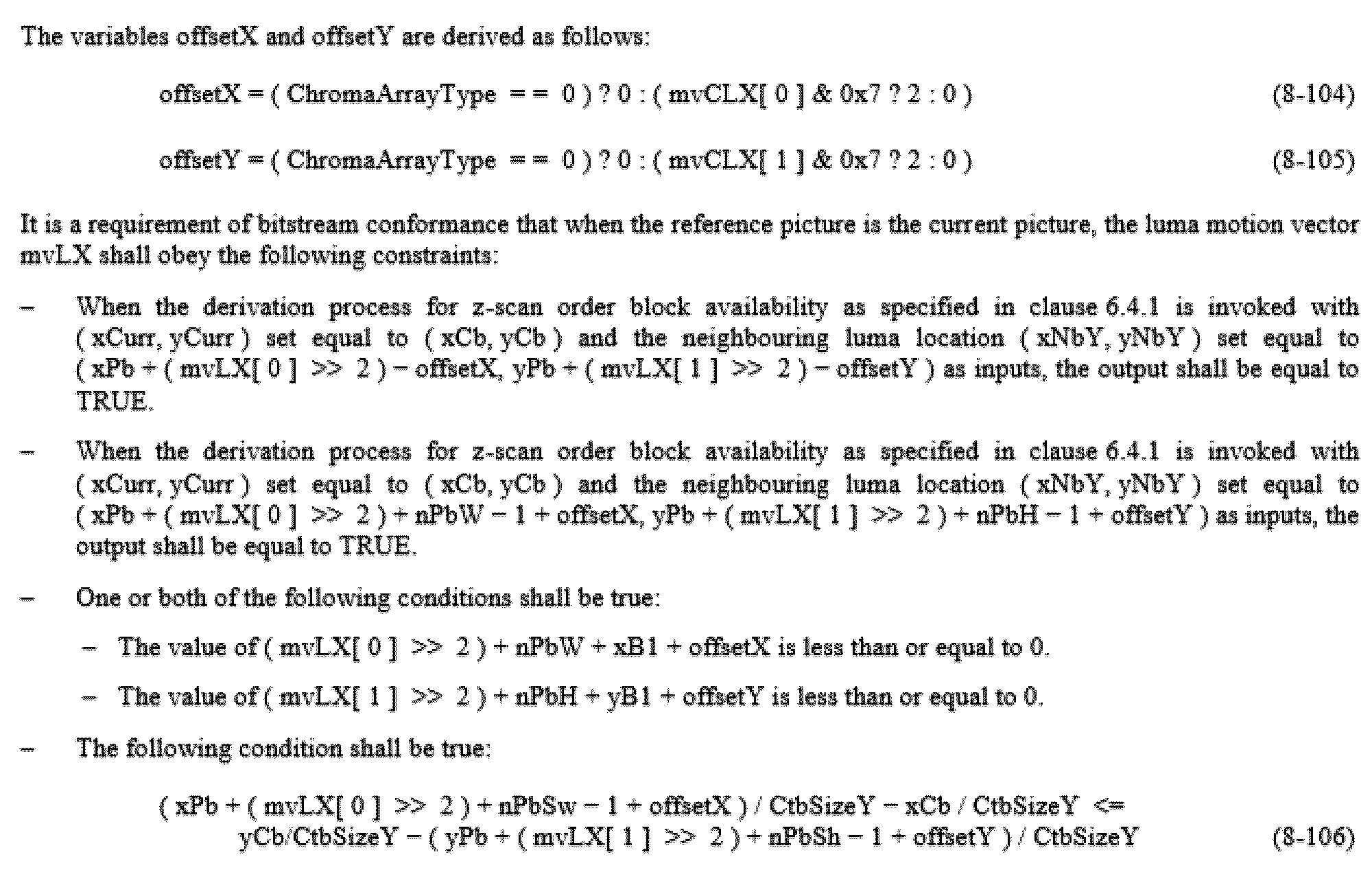
In the Screen Content Coding extension of HEVC, if a block uses the current picture as a reference, it should ensure that the entire reference block is within the available reconstruction area, as shown in the following specification text. .
このように、参照ブロックが現在のブロックと重複する、または参照ブロックがピクチャーの外側にある場合は発生しない。参照ブロックや予測ブロックをパディングする必要はない。 This way, it does not occur if the reference block overlaps the current block or is outside the picture. There is no need to pad the reference block or prediction block.
2.3 VVCテストモデルにおけるIBC
現在のVVCテストモデル、すなわち、VTM-4.0設計では、参照ブロック全体が現在のコーディングツリー単位(CTU)と一緒であるべきであり、現在ブロックと重複しない。よって、参照ブロックまたは予測ブロックをパディングする必要はない。IBCフラグは、現在のCUの予測モードとしてコーディングされる。よって、各CUについて、全部で3つの予測モード、MODE_INTRA、MODE_INTER、MODE_IBCがある。
2.3 IBC in VVC test model
In the current VVC test model, ie VTM-4.0 design, the entire reference block should be with the current Coding Tree Unit (CTU) and not overlap with the current block. Hence, there is no need to pad the reference block or prediction block. The IBC flag is coded as the current CU's prediction mode. So for each CU there are a total of 3 prediction modes: MODE_INTRA, MODE_INTER and MODE_IBC.
2.3.1 IBCマージ・モード
IBCマージ・モードでは、IBCマージ候補リスト内のエントリーを指すインデックスがビットストリームからパースされる。IBCマージ・リストの構築は、以下の一連のステップに従って要約できる:
・ステップ1;空間的候補の導出
・ステップ2:HMVP候補の挿入
・ステップ3:ペアワイズ平均候補の挿入。
2.3.1 IBC Merge Mode
In IBC merge mode, an index pointing to an entry in the IBC merge candidate list is parsed from the bitstream. Building an IBC merge list can be summarized according to the following sequence of steps:
Step 1: Derivation of Spatial Candidates Step 2: Insertion of HMVP Candidates Step 3: Insertion of Pairwise Mean Candidates.
空間的マージ候補の導出では、図19に示される位置に位置する候補の中から最大4つのマージ候補が選択される。導出の順序はA1、B1、B0、A0、B2である。位置B2は、位置A1、B1、B0、A0のいずれかのPUが利用可能でない(たとえば、別のスライスまたはタイルに属するため)、またはIBCモードでコーディングされていない場合にのみ考慮される。位置A1の候補が追加された後、残りの候補の挿入は、同じ動き情報をもつ候補がリストから除外されることを確実にする冗長性チェックにかけられ、コーディング効率が改善される。計算複雑性を低減するために、前述の冗長性チェックでは、可能な候補ペアのすべてが考慮されるわけではない。その代わりに、図20の矢印でリンクされたペアのみが考慮され、冗長性チェックに使用される対応する候補が同じ動き情報をもたない場合にのみ、候補がリストに追加される。 In deriving spatial merge candidates, up to four merge candidates are selected from among the candidates located at the positions shown in FIG. The order of derivation is A1 , B1 , B0 , A0 , B2 . Position B 2 is only used if the PU at any of positions A 1 , B 1 , B 0 , A 0 is not available (e.g. because it belongs to another slice or tile) or is not coded in IBC mode considered. After the candidate at position A1 is added, the insertion of the remaining candidates is subjected to a redundancy check to ensure that candidates with the same motion information are excluded from the list, improving coding efficiency. To reduce computational complexity, the redundancy check described above does not consider all possible candidate pairs. Instead, only pairs linked by arrows in FIG. 20 are considered, and candidates are added to the list only if the corresponding candidates used for redundancy checking do not have the same motion information.
空間的候補の挿入後、IBCマージ・リストのサイズが最大IBCマージ・リスト・サイズよりもまだ小さい場合、HMVPテーブルからのIBC候補が挿入されてもよい。HMVP候補を挿入する際に、冗長性チェックが実行される。 After inserting spatial candidates, IBC candidates from the HMVP table may be inserted if the IBC merge list size is still smaller than the maximum IBC merge list size. Redundancy checks are performed when inserting HMVP candidates.
最後に、ペアワイズ平均候補がIBCマージ・リストに挿入される。 Finally, the pairwise average candidates are inserted into the IBC merge list.
マージ候補によって同定される参照ブロックが、ピクチャーの外側にある、または現在ブロックと重複している、または再構成された領域の外側にある、または何らかの制約条件によって制約されている有効な領域の外側にある場合、マージ候補は、無効なマージ候補と呼ばれる。 The reference block identified by the merge candidate is outside the picture, or overlaps with the current block, or is outside the reconstructed region, or is outside the valid region constrained by some constraint , the merge candidate is called an invalid merge candidate.
無効なマージ候補がIBCマージ・リストに挿入される可能性があることに注意されたい。 Note that invalid merge candidates may be inserted into the IBC merge list.
2.3.2 IBC AMVPモード
IBC AMVPモードでは、IBC AMVPリスト内のエントリーを指すAMVPインデックスがビットストリームからパースされる。IBC AMVPリストの構築は、以下の一連のステップに従って要約できる:
・ステップ1:空間的候補の導出
○利用可能な候補が見つかるまで、A0、A1をチェックする。
○利用可能な候補が見つかるまで、B0、B1、B2をチェックする。
・ステップ2:HMVP候補の挿入
・ステップ3:ゼロ候補の挿入。
2.3.2 IBC AMVP mode
In IBC AMVP mode, an AMVP index pointing to an entry in the IBC AMVP list is parsed from the bitstream. Building an IBC AMVP list can be summarized by following a series of steps:
• Step 1: Derivation of Spatial Candidates o Check A 0 , A 1 until an available candidate is found.
o Check B0 , B1 , B2 until an available candidate is found.
• Step 2: Insert HMVP candidates • Step 3: Insert zero candidates.
空間的候補の挿入後、IBC AMVPリスト・サイズが最大IBC AMVPリスト・サイズよりもまだ小さい場合、HMVPテーブルからのIBC候補が挿入されてもよい。 After inserting spatial candidates, IBC candidates from the HMVP table may be inserted if the IBC AMVP list size is still smaller than the maximum IBC AMVP list size.
最後に、ゼロ候補がIBC AMVPリストに挿入される。 Finally, zero candidates are inserted into the IBC AMVP list.
2.4 パレット・モード
パレット・モードの背後にある基本的な発想は、CU内のピクセルが代表的な色値の小さな集合によって表現されるということである。この集合はパレットと呼ばれる。エスケープ・シンボルおよびそれに続く(可能性としては量子化された)成分値を信号伝達することによって、パレットの外側にあるサンプルを示すことも可能である。この種のサンプルはエスケープ・サンプルと呼ばれる。パレット・モードは図2に示されている。
2.4 Palette Mode The basic idea behind palette mode is that pixels in a CU are represented by a small set of representative color values. This collection is called a palette. It is also possible to indicate samples that are outside the palette by signaling an escape symbol followed by a (possibly quantized) component value. This kind of sample is called an escape sample. Palette mode is shown in FIG.
図2は、パレット・モードでコーディングされたブロックの例を示す。 Figure 2 shows an example of a block coded in palette mode.
2.5 HEVCスクリーンコンテンツコーディング拡張(HEVC-SCC)におけるパレット・モード
HEVC-SCCにおけるパレット・モードでは、パレットとインデックス・マップをコーディングするために予測的な方法が使用される。
2.5 Palette Mode in HEVC Screen Content Coding Extension (HEVC-SCC)
Palette mode in HEVC-SCC uses a predictive method to code the palette and index maps.
2.5.1 パレット項目のコーディング
パレット項目のコーディングのために、パレット予測子が維持される。パレットの最大サイズとパレット予測子は、SPSにおいて信号伝達される。HEVC-SCCでは、palette_predictor_initializer_present_flagがPPSにおいて導入される。このフラグが1である場合、パレット予測子を初期化するための項目が、ビットストリームにおいて信号伝達される。パレット予測子は、各CTU行、各スライスおよび各タイルの先頭において初期化される。palette_predictor_initializer_present_flagの値に依存して、パレット予測子は0にリセットされるか、PPSにおいて信号伝達されたパレット予測子初期化子項目(palette predictor initializer entries)を使用して初期化される。HEVC-SCCでは、サイズ0のパレット予測子初期化子により、PPSレベルでパレット予測子初期化の明示的な無効化を許容することができるようにされた。
2.5.1 Coding Palette Items Palette predictors are maintained for the coding of palette items. The palette maximum size and palette predictor are signaled in the SPS. In HEVC-SCC, palette_predictor_initializer_present_flag is introduced in PPS. If this flag is 1, an item to initialize the palette predictor is signaled in the bitstream. A palette predictor is initialized at the beginning of each CTU row, each slice and each tile. Depending on the value of palette_predictor_initializer_present_flag, the palette predictors are either reset to 0 or initialized using the palette predictor initializer entries signaled in the PPS. HEVC-SCC now allows palette predictor initializers of
パレット予測子における各項目について、再利用フラグは、それが現在のパレットの一部であるかどうかを示すために信号伝達される。これは図3に示される。再利用フラグは、ゼロのランレングスコーディングを使用して送信される。その後、新しいパレット項目の数が、次数0の指数ゴロム(exponential Golomb)符号を使用して信号伝達される。最後に、新しいパレット項目のための成分値が信号伝達される。 For each item in the palette predictor, a reuse flag is signaled to indicate whether it is part of the current palette. This is shown in FIG. The reuse flag is sent using a run length coding of zeros. The number of new palette entries is then signaled using an exponential Golomb code of degree zero. Finally, the component values for the new palette entry are signaled.
図3は、パレット項目を信号伝達するためのパレット予測器の使用の例を示す。 FIG. 3 shows an example of the use of palette predictors to signal palette items.
2.5.2 パレット・インデックスのコーディング
パレット・インデックスは、図4に示されるように水平および垂直横断走査を用いてコーディングされる。走査順序は、palette_transpose_flagを使用してビットストリームにおいて明示的に信号伝達される。サブセクションの残りについては、走査は水平であると想定される。
2.5.2 Coding the Palette Index
The palette index is coded using horizontal and vertical traversal scans as shown in FIG. The scan order is explicitly signaled in the bitstream using palette_transpose_flag. For the remainder of the subsection the scan is assumed to be horizontal.
図4は、水平および垂直横断走査の例を示す。 FIG. 4 shows an example of horizontal and vertical traverse scanning.
パレット・インデックスは、'INDEX'〔インデックス〕と'COPY_ABOVE'〔上をコピー〕という2つの主なパレット・サンプル・モードを使用してコーディングされる。先に説明したように、エスケープ・シンボルも'INDEX'モードとして信号伝達され、最大パレット・サイズに等しいインデックスを割り当てられる。該モードは、一番上の行または前のモードが'COPY_ABOVE'であったときを除いて、フラグを使用して信号伝達される。'COPY_ABOVE'モードでは、上の行のサンプルのパレット・インデックスがコピーされる。'INDEX'モードでは、パレット・インデックスは明示的に信号伝達される。'INDEX'モードと'COPY_ABOVE'モードの両方について、やはり同じモードでコーディングされる後続のサンプルの数を指定するラン値が信号伝達される。エスケープ・シンボルが'INDEX'または'COPY_ABOVE'モードのランの一部である場合、エスケープ成分値は各エスケープ・シンボルについて信号伝達される。パレット・インデックスのコーディングは図5に示される。 Palette indices are coded using two main palette sample modes: 'INDEX' and 'COPY_ABOVE'. As explained earlier, escape symbols are also signaled as 'INDEX' mode and are assigned an index equal to the maximum palette size. The mode is signaled using a flag, except when the top row or previous mode was 'COPY_ABOVE'. In 'COPY_ABOVE' mode, the palette index of the sample in the line above is copied. In 'INDEX' mode, the palette index is signaled explicitly. For both 'INDEX' and 'COPY_ABOVE' modes, a run value is signaled that specifies the number of subsequent samples that are also coded in the same mode. An escape component value is signaled for each escape symbol if the escape symbol is part of a run in 'INDEX' or 'COPY_ABOVE' mode. The coding of the palette index is shown in FIG.
この構文順序(syntax order)は、次のように達成される。まず、CUについてのインデックス値の数が信号伝達される。これに続いて、打ち切りされたバイナリコーディングを使用して、CU全体についての実際のインデックス値が信号伝達される。インデックスの数とインデックス値の両方がバイパス・モードでコーディングされる。これは、インデックスに関連したバイパス・ビンをグループ化する。次いで、パレット・サンプル・モード(必要な場合)およびランが、インターリーブされた仕方で信号伝達される。最後に、CU全体についての諸エスケープ・サンプルに対応する成分エスケープ値が一緒にグループ化され、バイパス・モードでコーディングされる。 This syntax order is achieved as follows. First, the number of index values for the CU is signaled. Following this, truncated binary coding is used to signal the actual index values for the entire CU. Both the number of indices and the index value are coded in bypass mode. This groups the bypass bins associated with the index. Palette sample mode (if needed) and run are then signaled in an interleaved fashion. Finally, the component escape values corresponding to the escape samples for the entire CU are grouped together and coded in bypass mode.
追加的な構文要素last_run_type_flagが、インデックス値を信号伝達した後に信号伝達される。この構文要素は、インデックスの数とともに、ブロックにおける最後のランに対応するラン値を信号伝達する必要をなくす。 An additional syntax element last_run_type_flag is signaled after signaling the index value. This syntax element eliminates the need to signal the run value corresponding to the last run in the block along with the number of indices.
HEVC-SCCでは、パレット・モードは4:2:2、4:2:0、およびモノクロ・クロマ・フォーマットについても有効にされる。パレット項目とパレット・インデックスの信号伝達は、すべてのクロマ・フォーマットについてほぼ同一である。非モノクロ・フォーマットの場合、各パレット項目は3つの成分で構成される。モノクロ・フォーマットの場合、各パレット項目は単一の成分で構成される。サブサンプリングされたクロマ方向については、クロマ・サンプルは2で割れるルーマ・サンプル・インデックスと関連付けられる。CUのためのパレット・インデックスを再構成した後、サンプルが、それに関連する単一の成分をもつだけである場合、パレット項目の最初の成分のみが使用される。信号伝達における唯一の違いは、エスケープ成分値についてである。各エスケープ・サンプルについて、信号伝達されるエスケープ成分値の数は、そのサンプルに関連する成分の数に依存して異なる可能性がある。各エスケープ・サンプルについて、信号伝達されるエスケープ成分値の数は、そのサンプルに関連する成分の数に依存して異なることがある。 In HEVC-SCC, palette mode is also enabled for 4:2:2, 4:2:0, and monochrome-chroma formats. Palette item and palette index signaling is nearly identical for all chroma formats. For non-monochrome formats, each palette item consists of three components. For monochrome format, each palette item consists of a single component. For subsampled chroma directions, the chroma samples are associated with luma sample indices divisible by two. After reconstructing the palette index for the CU, if the sample only has a single component associated with it, only the first component of the palette item is used. The only difference in signaling is in the escape component value. For each escape sample, the number of escape component values signaled may differ depending on the number of components associated with that sample. For each escape sample, the number of escape component values signaled may differ depending on the number of components associated with that sample.
VVCでは、デュアルツリーコーディング構造がイントラスライスのコーディングに使用されるため、ルーマ成分と2つのクロマ成分は、異なるパレットおよびパレット・インデックスをもつことがある。さらに、2つのクロマ成分は、同じパレットおよびパレット・インデックスを共有する。 In VVC, a dual-tree coding structure is used for intra-slice coding , so the luma component and the two chroma components may have different palettes and palette indices. Additionally, the two chroma components share the same palette and palette index.
図5は、パレット・インデックスのコーディングの例を示す。 FIG. 5 shows an example of palette index coding .
2.6 VVCにおけるイントラモードコーディング
自然なビデオで提示された任意のエッジ方向を捕捉するために、VTM5における方向性イントラモードの数は、HEVCで使用される33から65に拡張される。HEVCにない新しい方向性モードは、図6において赤い点線の矢印として示されており、平面モードとDCモードは同じままである。これらのより高密度の方向性イントラ予測モードは、すべてのブロック・サイズならびにルーマおよびクロマ・イントラ予測の両方に適用される。
2.6 Intra-mode coding in VVC
To capture arbitrary edge directions presented in natural video, the number of directional intra modes in VTM5 is extended from 33 used in HEVC to 65. New directional modes absent in HEVC are shown as red dashed arrows in Fig. 6, and planar and DC modes remain the same. These denser directional intra-prediction modes apply to all block sizes and both luma and chroma intra-prediction.
VTM5では、いくつかの従来の角度性イントラ予測モードは、非正方形ブロックについての広角イントラ予測モードで適応的に置き換えられる。 In VTM5, some traditional angular intra-prediction modes are adaptively replaced with wide-angle intra-prediction modes for non-square blocks.
HEVCでは、各イントラコーディングブロックは正方形の形状を有し、その各辺の長さは2の冪乗である。よって、DCモードを使用してイントラ予測子を生成するために除算演算は必要とされない。VTM5では、ブロックは、一般的な場合、ブロックごとの除算演算の使用を必要とする長方形形状を有することができる。DC予測のための除算演算を回避するために、長辺のみが非正方形ブロックについての平均を計算するために使用される。 In HEVC, each intra- coding block has the shape of a square, the length of each side of which is a power of two. Hence, no division operation is required to generate intra predictors using DC mode. In VTM5, blocks can have a rectangular shape which, in the general case, requires the use of block-by-block division operations. To avoid division operations for DC prediction, only the long sides are used to compute the average for non-square blocks.
図6は、67個のイントラ予測モードの例を示す。 FIG. 6 shows an example of 67 intra prediction modes.
最確モード(most probable mode、MPM)リスト生成の複雑さを低く保つために、6つのMPMをもつイントラモードコーディング方法が、2つの利用可能な近傍イントラモードを考慮することによって使用される。MPMリストを構築するには、以下の3つの側面が考えられる:
・デフォルト・イントラモード
・近傍イントラモード
・派生イントラモード。
To keep the complexity of the most probable mode (MPM) list generation low, an intra mode coding method with 6 MPMs is used by considering two available neighboring intra modes. There are three possible aspects to building an MPM list:
・Default intra mode ・Nearby intra mode ・Derived intra mode.
統合された6-MPMリストは、MRLおよびISPコーディングツールが適用されるか否かにかかわらず、イントラブロックについて使用される。MPMリストは、左および上の近傍ブロックのイントラモードに基づいて構築される。左ブロックのモードがLeftと記され、上のブロックのモードがAboveと記されるとすると、統合されたMPMリストは以下のようになる(左および上のブロックは図7に示されている)。 The combined 6-MPM list is used for intra blocks regardless of whether MRL and ISP coding tools are applied. The MPM list is constructed based on the intra modes of the left and top neighboring blocks. Assuming the mode of the left block is noted Left and the mode of the top block is noted Above, the combined MPM list looks like this (the left and top blocks are shown in Figure 7): .
図7は、現在のブロックの左および上の近傍の例である。
・近傍ブロックが利用可能でない場合は、そのイントラモードは、デフォルトで平面に設定される。
・モードLeftとAboveの両方が非角度性モードである場合:
○MPMリスト→{平面,DC,V,H,V-4,V+4}
・モードLeftとAboveの一方が角度性モードで、他方が非角度性である場合:
○モードMaxを、LeftおよびAboveにおける大きなほうのモードに設定
○MPMリスト→{平面,Max,DC,Max-1,Max+1,Max-2}
・LeftとAboveが両方とも角度性であり、異なる場合:
○モードMaxをLeftおよびAboveにおける大きなほうのモードに設定
○モードLeftとAboveの差が2ないし62の範囲内(両端含む)である場合:
・MPMリスト→{平面,Left,Above,DC,Max-1,Max+1}
○それ以外の場合:
・MPMリスト→{平面,Left,Above,DC,Max-2,Max+2}
・LeftとAboveが両方とも角度性であり、同じである場合:
○MPMリスト→{平面,Left,Left-1,Left+1,DC,Left-2}
Figure 7 is an example of the left and top neighborhoods of the current block.
• If no neighbor block is available, its intra mode defaults to planar.
If both modes Left and Above are non-angular modes:
○MPM list → {plane, DC, V, H, V-4, V+4}
・If one of the modes Left and Above is angular and the other is non-angular:
○ Set mode Max to the larger mode in Left and Above ○ MPM List → {Plane, Max, DC, Max-1, Max+1, Max-2}
If both Left and Above are angular and are different:
○ Set mode Max to the larger mode between Left and Above ○ If the difference between modes Left and Above is within the range of 2 to 62 (both ends):
・MPM list → {Plane, Left, Above, DC, Max-1, Max+1}
○ Otherwise:
・MPM list → {Plane, Left, Above, DC, Max-2, Max+2}
If Left and Above are both angular and are the same:
○ MPM list → {Plane, Left, Left-1, Left + 1, DC, Left-2}
さらに、mpmインデックス符号語の最初のビンは、CABACコンテキストコーディングされる。現在のイントラブロックがMRL有効か、ISP有効か、通常のイントラブロックかに対応する、合計3つのコンテキストが使用される。 Additionally, the first bin of the mpm index codeword is CABAC context coded . A total of three contexts are used, corresponding to whether the current intra block is MRL-enabled, ISP-enabled, or normal intra-block.
6MPMリスト生成プロセスの間、重複したモードを除去するために、プルーニング〔剪定〕が使用される。それにより、MPMリストには一意的なモードのみが含まれることができる。61個の非MPMモードのエントロピーコーディングのためには、打ち切りされたバイナリ符号(Truncated Binary Code、TBC)が使用される。 During the 6MPM list generation process, pruning is used to remove duplicate modes. Thereby, the MPM list can contain only unique modes. A Truncated Binary Code (TBC) is used for the entropy coding of the 61 non-MPM modes.
クロマ・イントラモードコーディングについては、クロマ・イントラモードコーディングのために合計8つのイントラモードが許される。それらのモードは、5つの伝統的なイントラモードと、3つの交差成分線形モデル・モード(cross-component linear model modes)(CCLM, LM_A, LM_L)を含む。クロマ・モード信号伝達および導出プロセスがテーブル2-に示される。クロマ・モードコーディングは対応する、ルーマ・ブロックのイントラ予測モードに直接依存する。Iスライスではルーマ成分とクロマ成分についての別個のブロック分割構造が別々に有効にされているため、1つのクロマ・ブロックが複数のルーマ・ブロックに対応することがある。よって、クロマDMモードについては、現在のクロマ・ブロックの中心位置をカバーする対応するルーマ・ブロックのイントラ予測モードが直接継承される。

2.7 量子化残差ブロック差分パルス符号変調(QR-BDPCM)
JVET-N0413では、量子化残差ブロック差分パルス符号変調(quantized residual block differential pulse-code modulation、QR-BDPCM)が、スクリーンコンテンツを効率的にコーディングするために提案されている。
2.7 Quantized Residual Block Differential Pulse Code Modulation (QR-BDPCM)
In JVET-N0413, quantized residual block differential pulse-code modulation (QR-BDPCM) is proposed for efficient coding of screen content.
QR-BDPCMにおいて使用される予測方向は、垂直および水平予測モードでありうる。イントラ予測は、ブロック全体に対して、イントラ予測と同様に予測方向(水平または垂直予測)におけるサンプル・コピーにより行われる。残差は量子化され、量子化された残差とその予測子(水平または垂直)量子化値との間のデルタがコーディングされる。これは、下記によって導出される:サイズM(行)×N(列)のブロックについて、サイズM(行)×N(列)のブロックについて、0≦i≦M-1、0≦j≦N-1としてri,jが、上または左のブロック境界サンプルからのフィルタリングされていないサンプルを用いて、イントラ予測を水平方向(予測されるブロックを通じてラインごとに左近傍ピクセル値をコピー)または垂直方向(予測されるブロックにおいて各ラインに上の近傍ラインをコピー)で実行した後の予測残差であるとする。0≦i≦M-1、0≦j≦N-1としてQ(ri,j)が、残差ri,jの量子化されたバージョンを表すとする。残差は、もとのブロックと予測されたブロックの値の差である。すると、ブロックDPCMは、量子化された残差サンプルに適用され、結果として、要素



水平方向の予測については、同様の規則が適用され、残差量子化サンプルは次式によって得られる。

残差量子化サンプル

デコーダ側では、上記の計算が逆にされて、Q(ri,j)、0≦i≦M-1、0≦j≦N-1を生成する。垂直予測の場合は、


逆量子化された残差Q-1(Q(ri,j))がイントラブロック予測値に加算されて、再構成されたサンプル値を生成する。 The inverse quantized residuals Q −1 (Q(r i,j )) are added to the intra block predictions to produce reconstructed sample values.
この方式の主な利点は、逆DPCMが、単に係数がパースされるにつれて予測子を加えることで係数パースの間にオンザフライで実行でき、またはパース後に実行できるということである。 The main advantage of this scheme is that the inverse DPCM can be performed on-the-fly during coefficient parsing by simply adding predictors as the coefficients are parsed, or it can be performed after parsing.
2.8 適応ループ・フィルタ
VTM5では、ブロックベースのフィルタ適応のある適応ループ・フィルタ(Adaptive Loop Filter、ALF)が適用される。ルーマ成分については、ローカル勾配の方向と活性〔アクティビティ〕に基づいて、4×4ブロックごとに25のフィルタのうちの1つが選択される。
2.8 Adaptive Loop Filter
In VTM5, an Adaptive Loop Filter (ALF) with block-based filter adaptation is applied. For the luma component, one of 25 filters is selected per 4x4 block based on local gradient direction and activity.
2.8.1.1 フィルタ形状
VTM5では、(図8に示されるように)2つのダイヤモンドフィルタ形状が使用される。ルーマ成分について7×7のダイヤモンド形状が適用され、クロマ成分については5×5のダイヤモンド形状が適用される。
2.8.1.1 Filter shape
In VTM5, two diamond filter shapes are used (as shown in Figure 8). A 7x7 diamond shape is applied for the luma component and a 5x5 diamond shape for the chroma component.
図8は、ALFフィルタ形状の例(クロマ:5×5ダイヤモンド、ルーマ7×7ダイヤモンド)を示す。 FIG. 8 shows examples of ALF filter shapes (chroma: 5×5 diamond, luma 7×7 diamond).
2.8.1.2 ブロック分類
ルーマ成分については、各ブロックは25のクラスのうちの1つに分類される。分類インデックスCは、その方向性Dと、活性(activity)の量子化値


Dおよび^Aを計算するために、まず、1-Dラプラシアンを用いて、水平方向、垂直方向、および2つの対角方向の勾配が計算される:

インデックスiおよびjは、4×4ブロック内の左上のサンプルの座標を指し、R(i,j)は座標(i,j)における再構成されたサンプルを示す。 Indices i and j refer to the coordinates of the upper left sample in the 4x4 block, and R(i,j) refers to the reconstructed sample at coordinates (i,j).
ブロック分類の複雑さを低減するために、サブサンプリングされた1-Dラプラシアン計算が適用される。図9に示されるように、全方向の勾配計算のために、同じサブサンプリングされる位置が使用される。 To reduce the complexity of block classification, a subsampled 1-D Laplacian computation is applied. As shown in FIG. 9, the same subsampled positions are used for gradient calculations in all directions.
図9は、サブサンプリングされたラプラシアン計算の例を示す。(a)垂直勾配についてのサブサンプリングされる位置(b)水平勾配についてのサブサンプリングされる位置(c)斜め勾配についてのサブサンプリングされる位置(d)斜め勾配についてのサブサンプリングされる位置。 FIG. 9 shows an example of a subsampled Laplacian calculation. (a) subsampled positions for vertical gradients (b) subsampled positions for horizontal gradients (c) subsampled positions for diagonal gradients (d) subsampled positions for diagonal gradients.
次いで、水平方向と垂直方向の勾配のD最大および最小値が

2つの対角方向の勾配の最大および最小値は

方向性の値Dを導出するために、これらの値は互いと、また2つの閾値t1およびt2と比較される:

活性値Aは次のように計算される:

Aはさらに0から4の範囲(両端含む)に量子化され、量子化された値は

ピクチャー内のクロマ成分については、分類方法は適用されない。すなわち、ALF係数の単一の集合が各クロマ成分に適用される。 For chroma components in pictures, no classification method is applied. That is, a single set of ALF coefficients is applied to each chroma component.
2.8.1.3 フィルタ係数の幾何学的変換およびクリッピング値
それぞれの4×4ブロックをフィルタリングする前に、回転または対角方向および垂直方向の反転のような幾何学的変換が、そのブロックについて計算された勾配値に依存して、フィルタ係数f(k,l)および対応するフィルタクリッピング値c(k,l)に適用される。これは、フィルタ・サポート領域内のサンプルにこれらの変換を適用することと等価である。発想は、ALFが適用される異なるブロックを、それらの方向性を整列させることによって、より類似させることである。
2.8.1.3 Geometric Transformations and Clipping Values for Filter Coefficients Before filtering each 4x4 block, geometric transformations such as rotation or diagonal and vertical flips are computed for that block. Depending on the gradient value it is applied to the filter coefficients f(k,l) and the corresponding filter clipping values c(k,l). This is equivalent to applying these transforms to the samples within the filter support region. The idea is to make the different blocks to which ALF is applied more similar by aligning their orientation.
対角方向、垂直方向反転、回転を含む3つの幾何学的変換が導入される:

ここで、Kはフィルタのサイズであり、0≦k,l≦K-1は、位置(0,0)が左上隅に、位置(K-1,K-1)が右下隅になるような係数座標である。変換は、そのブロックについて計算された勾配値に依存してフィルタ係数f(k,l)およびクリッピング値c(k,l)に適用される。変換と4方向の4つの勾配との関係が次のテーブルにまとめられている。

2.8.1.4 フィルタ・パラメータ信号伝達
VTM5では、ALFフィルタ・パラメータは適応パラメータセット(APS)において信号伝達される。1つのAPSでは、ルーマ・フィルタ係数およびクリッピング値インデックスの25個までの集合と、クロマ・フィルタ係数およびクリッピング値インデックスの1つまでの集合とが信号伝達されることができる。ビット・オーバーヘッドを減らすために、異なる分類のフィルタ係数がマージされることができる。スライスヘッダでは、現在のスライスに使用されているAPSのインデックスが信号伝達される。
2.8.1.4 Filter Parameter Signaling
In VTM5, ALF filter parameters are signaled in adaptive parameter sets (APS). In one APS, up to 25 sets of luma filter coefficients and clipping value indices and up to 1 set of chroma filter coefficients and clipping value indices can be signaled. Different categories of filter coefficients can be merged to reduce bit overhead. The slice header signals the index of the APS used for the current slice.
APSからデコードされるクリッピング値インデックスは、クリッピング値のルーマ・テーブルとクリッピング値のクロマ・テーブルを使用してクリッピング値を決定することを許容する。これらのクリッピング値は、内部ビット深さに依存する。より正確には、クリッピング値のルーマ・テーブルとクリッピング値のクロマ・テーブルは、以下の公式によって得られる:

ここで、Bは、内部ビット深さに等しく、Nは4に等しく、これはVTM5.0における許容されるクリッピング値の数である。 where B equals the internal bit depth and N equals 4, which is the number of clipping values allowed in VTM5.0.
フィルタリング・プロセスはCTBレベルで制御できる。ALFがルーマCTBに適用されるかどうかを示すためにフラグが常に信号伝達される。ルーマCTBは、16の固定したフィルタ集合およびAPSからのフィルタ集合の間でフィルタ集合を選択できる。フィルタ集合インデックスは、どのフィルタ集合が適用されるかを示すために、ルーマCTBについて信号伝達される。16個の固定したフィルタ集合は、あらかじめ定義されており、エンコーダとデコーダの両方でハードコーディングされる。 The filtering process can be controlled at the CTB level. A flag is always signaled to indicate whether ALF is applied to the luma CTB. The luma CTB can select filter sets among 16 fixed filter sets and filter sets from APS. A filter set index is signaled for the luma CTB to indicate which filter set is applied. A set of 16 fixed filters are predefined and hard-coded in both the encoder and decoder.
フィルタ係数は、128に等しいノルムで量子化される。乗算複雑さを制限するために、非中央位置の係数値が-27から27-1の範囲(両端含む)にあるようにビットストリーム適合性が適用される。中央位置係数は、ビットストリームにおいて信号伝達されず、128に等しいとみなされる。 The filter coefficients are quantized with a norm equal to 128. To limit the multiplication complexity, bitstream compatibility is applied so that coefficient values at non-central locations are in the range -2 7 to 2 7 -1, inclusive. The center position coefficient is not signaled in the bitstream and is assumed to be equal to 128.
2.8.1.5 フィルタリング・プロセス
デコーダ側では、CTBについてALFが有効にされているとき、CU内の各サンプルがフィルタリングされ、次のようなサンプル値を与える。

ここで、f(k,l)はデコードされたフィルタ係数を表し、K(x,y)はクリッピング関数であり、c(k,l)はデコードされたクリッピング・パラメータを表す。変数kとlは、-L/2からL/2までの間で変化し、Lはフィルタ長を表す。クリッピング関数K(x,y)=min(y,max(-y,x))であり、これは関数Clip3(-y,y,x)に等しい。 where f(k,l) represents the decoded filter coefficients, K(x,y) is the clipping function, and c(k,l) represents the decoded clipping parameters. The variables k and l vary from -L/2 to L/2, where L represents the filter length. The clipping function K(x,y)=min(y,max(-y,x)), which is equivalent to the function Clip3(-y,y,x).
2.8.1.6 ラインバッファ削減のための仮想境界フィルタリング・プロセス
VTM5では、ALFのラインバッファ要求を低減するために、水平CTU境界付近のサンプルについて、修正されたブロック分類およびフィルタリングが採用される。この目的のために、仮想境界は、図10に示すように、「N」サンプルで水平CTU境界をシフトすることによって線として定義され、Nは、ルーマ成分については4、クロマ成分については2に等しい。
2.8.1.6 Virtual Boundary Filtering Process for Line Buffer Reduction
VTM5 employs modified block classification and filtering for samples near horizontal CTU boundaries to reduce ALF's line buffer requirements. For this purpose, the virtual boundary is defined as a line by shifting the horizontal CTU boundary by 'N' samples, where N is 4 for luma components and 2 for chroma components, as shown in Figure 10. equal.
図10は、仮想境界における修正されたブロック分類の例を示す。 FIG. 10 shows an example of modified block classification at virtual boundaries.
図11に示されるように、修正されたブロック分類がルーマ成分に適用され、よって、活性値Aは、1Dラプラシアン勾配計算で使用されるサンプル数の減少を考慮することによって、スケールされる。 As shown in FIG. 11, a modified block classification is applied to the luma component, so the activation value A is scaled by taking into account the reduction in the number of samples used in the 1D Laplacian gradient computation.
フィルタ処理のために、仮想境界での対称的なパディング操作がルーマとクロマ成分の両方に使用される。図11に示されるように、フィルタリングされるサンプルが仮想境界の下に位置する場合、仮想境界の上方に位置する近傍サンプルは、パディングされる。一方、他の側面における対応するサンプルも、対称的にパディングされる。 For filtering, a symmetric padding operation at the virtual boundary is used for both luma and chroma components. As shown in FIG. 11, if the sample to be filtered lies below the virtual boundary, neighboring samples that lie above the virtual boundary are padded. Meanwhile, the corresponding samples on the other side are also symmetrically padded.
図11は、仮想境界におけるルーマ成分についての修正されたALFフィルタリングの例を示す。 FIG. 11 shows an example of modified ALF filtering for luma components at virtual boundaries.
2.9 サンプル適応オフセット(SAO)
サンプル適応オフセット(SAO)は、エンコーダによって各CTBについて指定されたオフセットを使用することによって、ブロッキング解除フィルタ後に、再構成された信号に適用される。HMエンコーダは、まず、SAOプロセスが現在のスライスに適用されるか否かの判断をする。スライスにSAOが適用される場合、テーブル2-に示されるように、各CTBは5つのSAOタイプの1つに分類される。SAOの概念は、ピクセルをカテゴリーに分類し、各カテゴリーのピクセルにオフセットを加えることによって歪みを低減することである。SAO動作には、SAOタイプ1~4のピクセル分類についてエッジ属性を使用するエッジオフセット(EO)と、SAOタイプ5のピクセル分類についてピクセル強度を使用する帯域オフセット(BO)とを含む。適用可能な各CTBは、SAOパラメータ(sao_merge_left_flag、sao_merge_up_flag、SAOタイプ、および4つのオフセットを含む)を有する。sao_merge_left_flagが1に等しい場合、現在のCTBは、左のCTBのSAOタイプおよびオフセットを再利用する。sao_merge_up_flagが1に等しい場合、現在のCTBは、上のCTBのSAOタイプおよびオフセットを再利用する。
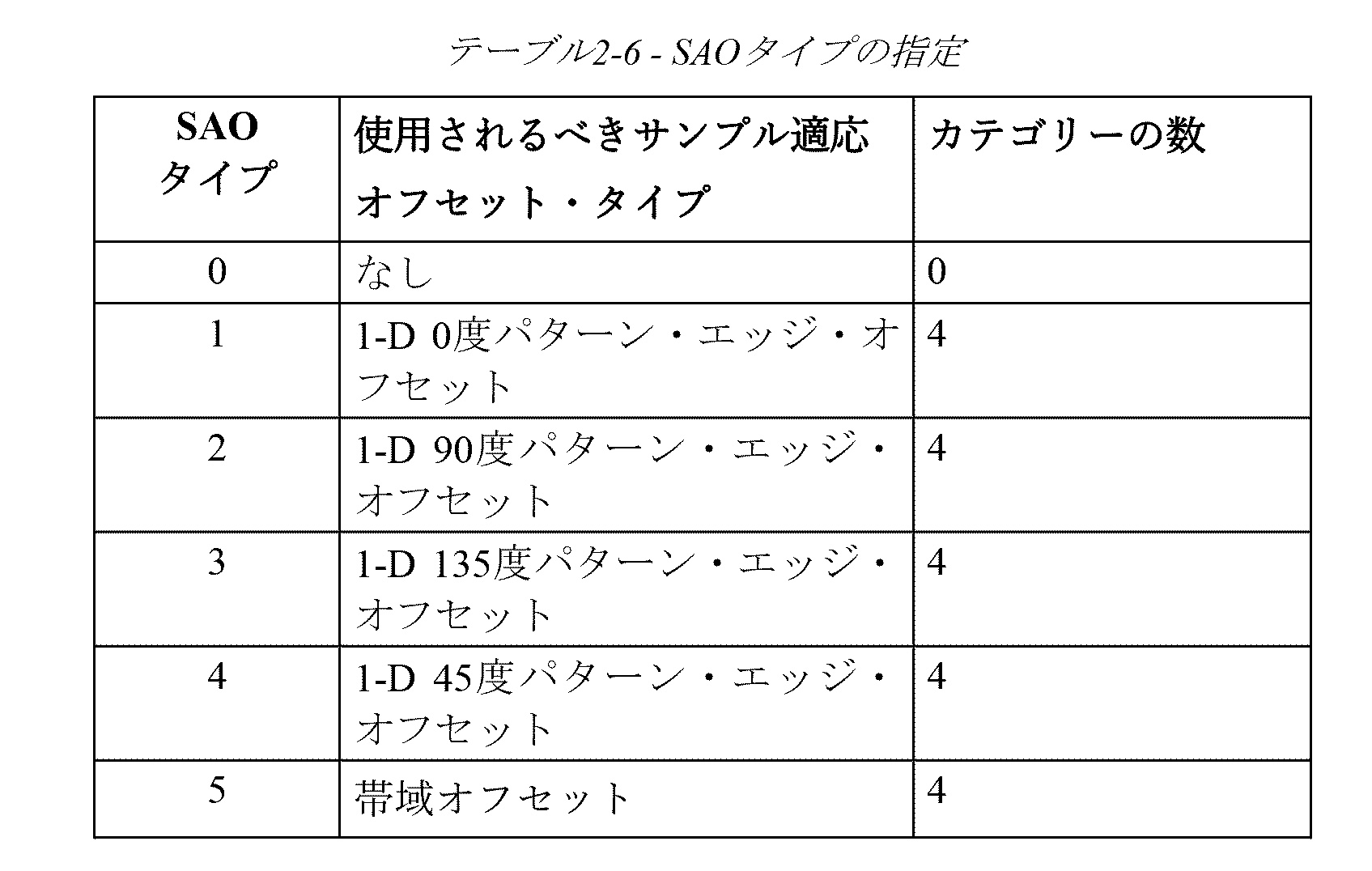
A sample adaptive offset (SAO) is applied to the reconstructed signal after the deblocking filter by using the offset specified for each CTB by the encoder. The HM encoder first determines whether the SAO process is applied to the current slice. When SAO is applied to a slice, each CTB falls into one of five SAO types, as shown in Table 2-. The concept of SAO is to classify pixels into categories and reduce distortion by adding offsets to pixels in each category. SAO operations include edge offset (EO) using edge attributes for SAO types 1-4 pixel classifications and band offset (BO) using pixel intensities for
2.9.1 各SAOタイプの動作
エッジ・オフセットは、図12に示されるように、エッジ方向性情報を考慮することによって現在のピクセルpを分類するために、4つの1-D 3ピクセル・パターンを使用する。左から右に、これらは0度、90度、135度、45度である。
2.9.1 Operation of each SAO type Edge offset divides four 1-D 3-pixel patterns to classify the current pixel p by considering the edge directionality information, as shown in Figure 12. use. From left to right these are 0, 90, 135 and 45 degrees.
図12は、EOにおけるピクセル分類のための4つの1-D 3ピクセル・パターンの例を示す。
FIG. 12 shows examples of four 1-
各CTBは、テーブル2-7に従って5つのカテゴリーの1つに分類される。

帯域オフセット(BO)は、帯域インデックスとしてピクセル値の上位5ビットを使用することにより、1つのCTB領域内のすべてのピクセルを32個の均一帯域に分類する。言い換えると、ピクセル強度範囲は、ゼロから最大強度値(たとえば、8ビット・ピクセルについては255)までの32個の等しいセグメントに分割される。図13に示されるように、4つの隣接する帯域がグループ化され、それぞれのグループはその左端の位置で示される。エンコーダは、各帯域のオフセットを補償することにより、最大歪み低減を有するグループを得るために、すべての位置を探索する。 Band Offset (BO) sorts all pixels within one CTB region into 32 uniform bands by using the upper 5 bits of the pixel value as the band index. In other words, the pixel intensity range is divided into 32 equal segments from zero to the maximum intensity value (eg, 255 for 8-bit pixels). As shown in FIG. 13, four adjacent bands are grouped, each group indicated by its leftmost position. The encoder searches all positions to obtain the group with the maximum distortion reduction by compensating for the offset of each band.
図13は、4つの帯域がグループ化され、その開始帯域位置によって表される例である。 FIG. 13 is an example in which four bands are grouped and represented by their starting band positions.
2.10 複合インターおよびイントラ予測(CIIP)
VTM5では、CUがマージ・モードでコーディングされている場合、CUが少なくとも64個のルーマ・サンプルを含み(すなわち、CU幅×CU高さが64以上)、CU幅とCU高さの両方が128ルーマ・サンプル未満の場合、現在のCUに複合インター/イントラ予測(CIIP)モードが適用されるかどうかを示すために追加フラグが信号伝達される。その名前が示すように、CIIP予測は、インター予測信号をイントラ予測信号と組み合わせる。CIIPモードでのインター予測信号Pinterは、通常のマージ・モードに適用されるのと同じインター予測プロセスを用いて導出され、イントラ予測信号Pintraは、平面モードでの通常のイントラ予測プロセスに従って導出される。次いで、重み付け平均を用いて、イントラおよびインター予測信号が組み合わされ、ここで、重み値は、上および左の近傍ブロック(図14に示される)のコーディングモードに依存して、以下のように計算される:
・上の近傍が利用可能でイントラコーディングされている場合、isIntraTopを1に設定し、そうでない場合、isIntraTopを0に設定する;
・左近傍が利用可能でイントラコーディングされている場合、isIntraLeftを1に設定し、そうでない場合、isIntraLeftを0に設定する;
・(isIntraLeft+isIntraLeft)が2に等しい場合、wtは3に設定される;
・それ以外で、(isIntraLeft+isIntraLeft)が1に等しい場合、wtは2に設定される;
・それ以外の場合は、wtを1に設定する。
2.10 Combined Inter and Intra Prediction (CIIP)
In VTM5, if the CU is coded in merge mode, the CU contains at least 64 luma samples (i.e. CU width x CU height > 64) and both CU width and CU height are 128 If less than luma samples, an additional flag is signaled to indicate whether a combined inter/intra prediction (CIIP) mode is applied to the current CU. As its name suggests, CIIP prediction combines an inter prediction signal with an intra prediction signal. The inter prediction signal P inter in CIIP mode is derived using the same inter prediction process applied in normal merge mode, and the intra prediction signal P intra is derived according to the normal intra prediction process in planar mode. be done. The intra- and inter-prediction signals are then combined using weighted averaging , where the weight values are calculated as will be:
- If the top neighborhood is available and intra- coded , set isIntraTop to 1, else set isIntraTop to 0;
o If the left neighbor is available and intra- coded , set isIntraLeft to 1, else set isIntraLeft to 0;
- If (isIntraLeft + isIntraLeft) equals 2, then wt is set to 3;
o Otherwise, if (isIntraLeft + isIntraLeft) equals 1, then wt is set to 2;
• Otherwise, set wt to 1.
CIIP予測は以下のように形成される:
PCIIP=((4-wt)*Pinter+wt*Pintra+2)>>2 (3-2)
A CIIP forecast is formed as follows:
PCIIP = ((4-wt)* Pinter +wt* Pintra +2)>>2 (3-2)
図14は、CIIP重み導出に用いられる上および左の近傍ブロックの例を示す。 FIG. 14 shows an example of top and left neighborhood blocks used for CIIP weight derivation.
2.11 クロマ・スケーリングのあるルーマ・マッピング(LMCS)
VTM5では、クロマ・スケーリングのあるルーマ・マッピング(luma mapping with chroma scaling、LMCS)と呼ばれるコーディングツールが、ループ・フィルタの前に新しい処理ブロックとして追加される。LMCSは、1)適応区分線形モデルに基づくルーマ成分のループ内マッピング、2)クロマ成分について、ルーマ依存クロマ残差スケーリングが適用される、という2つの主要な構成要素を有する。図15は、デコーダの観点からのLMCSアーキテクチャーを示す。図15の点線のブロックは、マップされたドメインで処理が適用されるところを示しており、これらには、逆量子化、逆変換、ルーマ・イントラ予測およびルーマ残差とルーマ予測の加算を含む。図15のパターニングされていないブロックは、処理がもとの(すなわち、マップされていない)ドメインで適用されるところを示し、これらは、ブロッキング解除、ALF、およびSAOのようなループ・フィルタ、動き補償された予測、クロマ・イントラ予測、クロマ予測とクロマ残差の加算、およびデコードされたピクチャーの参照ピクチャーとしての記憶を含む。図15のチェッカー状のブロックは、ルーマ信号の順方向および逆マッピング、およびルーマ依存クロマ・スケーリング・プロセスを含む、新しいLMCS機能ブロックである。VVCのたいていの他のツールと同様に、LMCSはSPSフラグを使用して、シーケンス・レベルで有効/無効にできる。
2.11 Luma Mapping with Chroma Scaling (LMCS)
In VTM5, a coding tool called luma mapping with chroma scaling (LMCS) is added as a new processing block before the loop filter. LMCS has two main components: 1) in-loop mapping of luma components based on an adaptive piecewise linear model, 2) luma dependent chroma residual scaling is applied for chroma components. Figure 15 shows the LMCS architecture from the decoder's point of view. The dashed blocks in Figure 15 show where processing is applied in the mapped domain, including inverse quantization, inverse transform, luma intra prediction and addition of luma residual and luma prediction. . The unpatterned blocks in Figure 15 show where processing is applied in the original (i.e., unmapped) domain, these include loop filters such as deblocking, ALF, and SAO, motion Including compensated prediction, chroma intra prediction, addition of chroma prediction and chroma residual, and storing the decoded picture as a reference picture. The checkered block in FIG. 15 is a new LMCS functional block that includes forward and inverse mapping of luma signals and luma dependent chroma scaling processes. Like most other tools in VVC, LMCS can be enabled/disabled at the sequence level using the SPS flag.
図15は、クロマ・スケーリング・アーキテクチャーのあるルーマ・マッピングの例を示す。 FIG. 15 shows an example of luma mapping with a chroma scaling architecture.
2.12 デュアルツリー分割
現在のVVC設計では、Iスライスについて、暗黙的な四分木分割を使用して、各CTUは64×64ルーマ・サンプルをもつコーディング単位に分割でき、これらのコーディング単位はルーマとクロマについての2つの別々のコーディングツリー構文構造のルート(root)である。
2.12 Dual-Tree Partitioning In the current VVC design, for I-slices, using implicit quadtree partitioning, each CTU can be partitioned into coding units with 64 × 64 luma samples, and these coding units are divided into luma and It is the root of two separate coding tree syntactic structures for chromas.
イントラ・ピクチャーにおけるデュアルツリーでは、ルーマコーディングツリーと比較してクロマコーディングツリーにおいて異なるパーティション分割を適用することができるため、デュアルツリーは、より長いコーディングパイプラインを導入し、QTBT MinQTSizeC値範囲ならびにクロマツリーにおけるMinBtSizeYおよびMinTTSizeYでは、2×2、4×2、2×4などの小さなクロマ・ブロックが許可される。それは、実際的なデコーダ設計に困難をもたらす。さらに、CCLM、平面および角度性モードのようないくつかの予測モードは乗算を必要とする。上記の問題を緩和するために、小さなクロマ・ブロック・サイズ(2x2/2x4/4x2)は分割制限としてデュアルツリーにおいて制約される。 Dual-tree in intra-picture can apply different partitioning in chroma- coding tree compared to luma- coding tree, so dual-tree introduces a longer coding pipeline, QTBT MinQTSizeC value range as well as chroma-tree MinBtSizeY and MinTTSizeY in allow chroma blocks as small as 2x2, 4x2, 2x4, etc. It poses difficulties for practical decoder design. Additionally, some prediction modes such as CCLM, planar and angular modes require multiplication. To alleviate the above problem, small chroma block sizes (2x2/2x4/4x2) are constrained in dual-tree as a split limit.
2.13 JVET-O0050における最小クロマ・イントラ予測ユニット(SCIPU)
小さなクロマサイズはハードウェア実装には不向きである。デュアルツリーの場合、サイズが小さすぎるクロマ・ブロックは許容されない。しかしながら、シングルツリーの場合、VVCドラフト5は、依然として2×2、2×4、4×2クロマ・ブロックを許容する。クロマ・ブロックのサイズを制限するために、単一コーディングツリーにおいて、SCIPUは、JVET-O0050において、クロマ・ブロック・サイズがTHクロマ・サンプル以上であり、4THルーマ・サンプルより小さい少なくとも1つの子ルーマ・ブロックを有するコーディングツリー・ノードとして定義される。ここで、THは、この寄稿では16に設定される。各SCIPUでは、すべてのCBがインターであるか、またはすべてのCBが非インターである、すなわちイントラまたはIBCのいずれかであることが要求される。非インターSCIPUの場合、さらに、非インターSCIPUのクロマがそれ以上分割されず、SCIPUのルーマがさらに分割されることが許されることが要求される。このようにして、最小のクロマ・イントラCBサイズは16クロマ・サンプルであり、2×2、2×4、および4×2クロマCBが除去される。さらに、クロマ・スケーリングは、非インターSCIPUの場合には適用されない。
2.13 Minimum Chroma Intra Prediction Unit (SCIPU) in JVET-O0050
Small chroma sizes are unsuitable for hardware implementation. Dual-tree does not allow chroma blocks that are too small in size. However, for a single tree,
2つのSCIPUの例が図16に示される。図6の(a)においては、8×4クロマ・サンプルの1つのクロマCBと3つのルーマCB(4×8、8×8、4×8のルーマCB)が1つのSCIPUを形成するが、これは、8×4クロマ・サンプルからの三分木(TT)分割は、16クロマ・サンプルより小さなクロマCBを生じるためである。図16の(b)では、4×4クロマ・サンプルの一方のクロマCB(8×4クロマ・サンプルの左側)と3つのルーマCB(8×4、4×4、4×4のルーマCB)が1つのSCIPUを形成し、4×4サンプルの他方のクロマCB(8×4クロマ・サンプルの右側)と2つのルーマCB(8×4、8×4のルーマCB)が1つのSCIPUを形成する。これは、4×4クロマ・サンプルからの二分木(BT)分割は、16のクロマ・サンプルよりも小さなクロマCBを生じるためである。 An example of two SCIPUs is shown in FIG. In FIG. 6(a), one chroma CB and three luma CBs (4×8, 8×8, 4×8 luma CBs) of 8×4 chroma samples form one SCIPU, This is because a ternary tree (TT) split from 8x4 chroma samples yields a smaller chroma CB than 16 chroma samples. In Figure 16(b), one chroma CB of the 4x4 chroma sample (left side of the 8x4 chroma sample) and three luma CBs (8x4, 4x4, 4x4 luma CBs) form one SCIPU, the other chroma CB of the 4x4 sample (right side of the 8x4 chroma sample) and the two luma CBs (8x4, 8x4 luma CB) form one SCIPU do. This is because a binary tree (BT) split from 4x4 chroma samples yields a smaller chroma CB than 16 chroma samples.
図16は、SCIPUの例を示す。 FIG. 16 shows an example of SCIPU.
現在のスライスがIスライスであるか、または現在のSCIPUがさらに1回分割した後に4×4ルーマ・パーティションをその中に有する場合、SCIPUのタイプは非インターであると推定される(VVCではインター4×4は許可されないため);それ以外の場合、SCIPUのタイプ(インターまたは非インター)は、SCIPUにおいてCUをパースする前に、1つの信号伝達されるフラグによって示される。 If the current slice is an I-slice or if the current SCIPU has a 4×4 luma partition in it after one more division, the SCIPU type is assumed to be non-inter (in VVC it is inter 4x4 is not allowed); otherwise, the type of SCIPU (inter or non-inter) is indicated by one signaled flag before parsing the CU in the SCIPU.
2.14 VVCドラフト6における小クロマ・ブロック制約条件
VVCドラフト6(JVET-O2001-vE.docx)では、小さなクロマ・ブロックに対する制約条件は以下のように実装されている(関連する部分は太字の斜体でマークされている)。

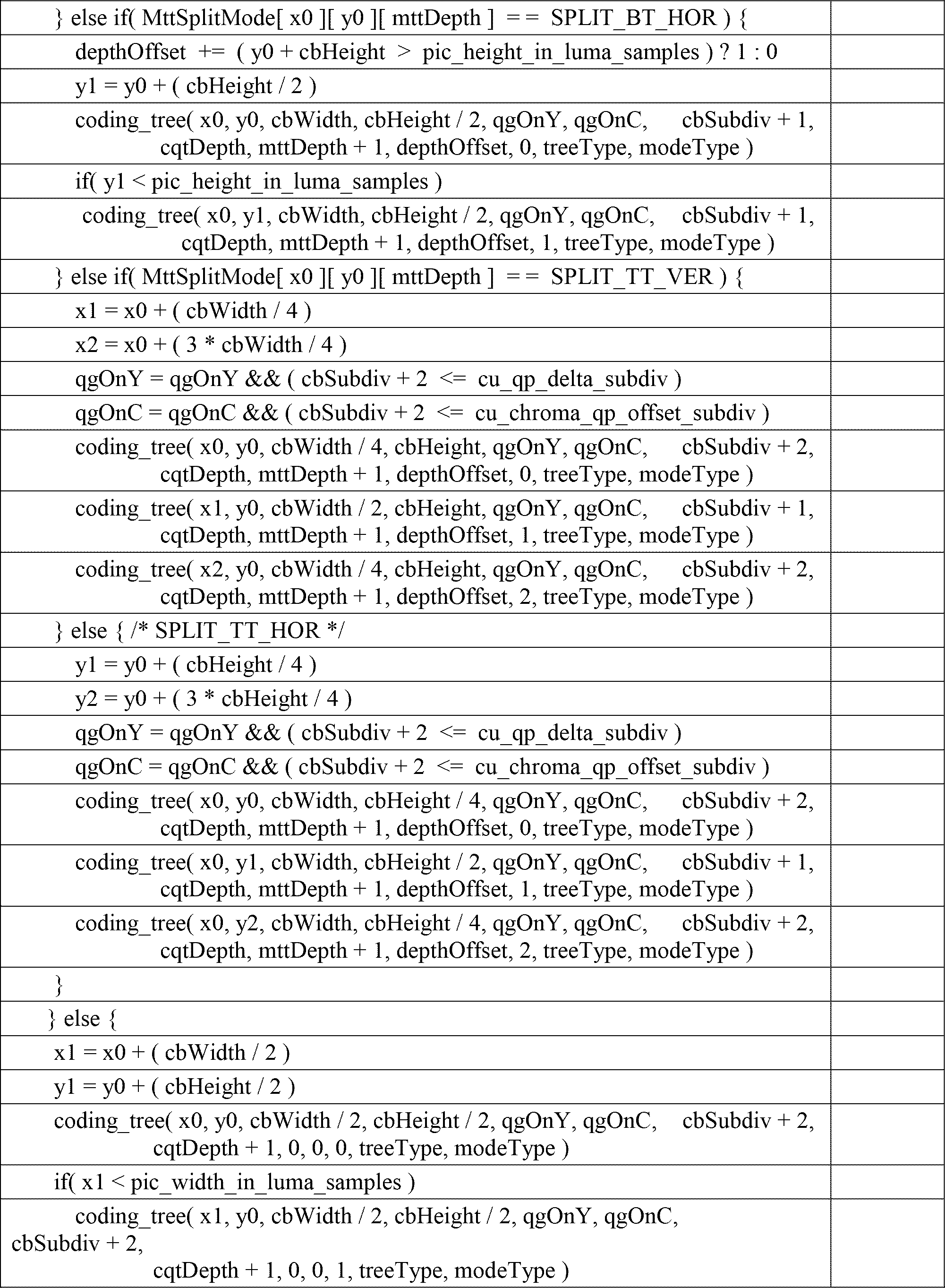
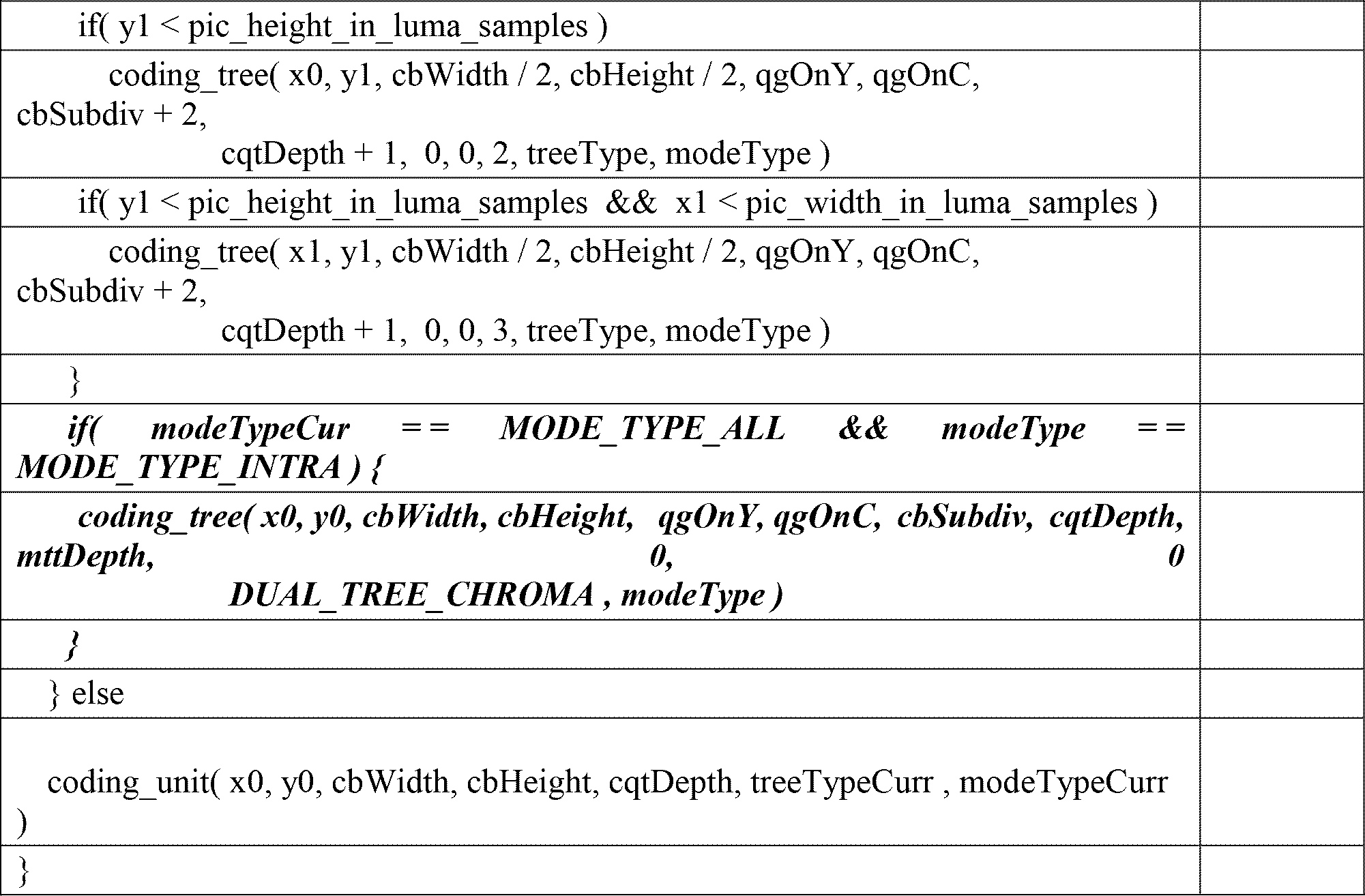
In VVC Draft 6 (JVET-O2001-vE.docx), the constraint on small chroma blocks is implemented as follows (relevant parts are marked in bold italics):
2.14.1.1 コーディング単位構文


許容される四分分割プロセス
このプロセスへの入力は以下の通りである:
・ルーマ・サンプル中のコーディングブロック・サイズcbSize、
・マルチタイプ・ツリー深さmttDepth、
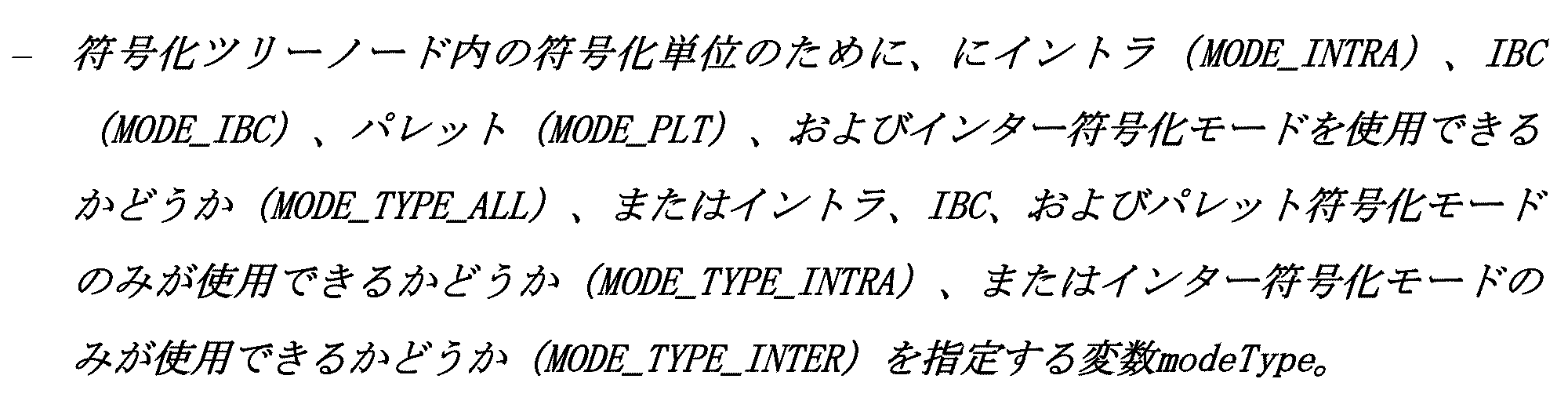
・CTUを分割するためにシングルツリー(SINGLE_TREE)が使われるかまたはデュアルツリーが使われるかと、デュアルツリーが使用される場合は、現在処理されているのがルーマ成分か(DUAL_TREE_LUMA)またはクロマ成分か(DUAL_TREE_CHROMA)とを指定する変数treeType。

the coding block size cbSize in luma samples,
multitype tree depth mttDepth,
o Whether a single tree (SINGLE_TREE) or a dual tree is used to split the CTU, and if dual trees are used, whether the luma component (DUAL_TREE_LUMA) or chroma component is currently being processed A variable treeType that specifies (DUAL_TREE_CHROMA) and.
このプロセスの出力は、変数allowSplitQtである。 The output of this process is the variable allowSplitQt.
変数allowSplitQtは次のように導出される:
・次の条件の一つまたは複数が真である場合、allowSplitQtはFALSEに等しく設定される:
・treeTypeがSINGLE_TREEまたはDUAL_TREE_LUMAに等しく、cbSizeがMinQtSizeY以下
・treeTypeがDUAL_TREE_CHROMAに等しく、cbSize/SubWidthCがMinQtSizeC以下
・mttDepthが0に等しくない
・treeTypeがDUAL_TREE_CHROMAに等しく、(cbSize/SubWidthC)が4以下

o allowSplitQt is set equal to FALSE if one or more of the following conditions are true:
- treeType equals SINGLE_TREE or DUAL_TREE_LUMA and cbSize is less than or equal to MinQtSizeY - treeType equals DUAL_TREE_CHROMA and cbSize/SubWidthC is less than or equal to MinQtSizeC - mttDepth is not equal to 0 - treeType equals DUAL_TREE_CHROMA and (cbSize/SubWidthC) is less than or equal to 4
許容される二分分割プロセス
このプロセスへの入力は以下の通りである:
・二分分割モードbtSplit、
・ルーマ・サンプル単位でのコーディングブロック幅cbWidth、
・ルーマ・サンプル単位でのコーディングブロック高さcbHeight、
・ピクチャーの左上のルーマ・サンプルに対する、考えられているコーディングブロックの左上のルーマ・サンプルの位置(x0,y0)
・マルチタイプ・ツリー深さmttDepth、
・オフセットmaxMttDepthをもつ最大マルチタイプ・ツリー深さ、
・最大二分木サイズmaxBtSize、
・最小四分木サイズminQtSize、
・パーティションインデックスpartIdx、
・CTUを分割するためにシングルツリー(SINGLE_TREE)が使われるかまたはデュアルツリーが使われるかと、デュアルツリーが使用される場合は、現在処理されているのがルーマ成分か(DUAL_TREE_LUMA)またはクロマ成分か(DUAL_TREE_CHROMA)とを指定する変数treeType。
・Bisection mode btSplit,
The coding block width cbWidth in luma sample units,
the coding block height cbHeight in luma samples,
the position (x0,y0) of the top left luma sample of the considered coding block relative to the top left luma sample of the picture
multitype tree depth mttDepth,
o maximum multitype tree depth with offset maxMttDepth,
・Maximum binary tree size maxBtSize,
・Minimum quadtree size minQtSize,
・Partition index partIdx,
o Whether a single tree (SINGLE_TREE) or a dual tree is used to split the CTU, and if dual trees are used, whether the luma component (DUAL_TREE_LUMA) or chroma component is currently being processed A variable treeType that specifies (DUAL_TREE_CHROMA) and.
このプロセスの出力は、変数allowBtSplitである。
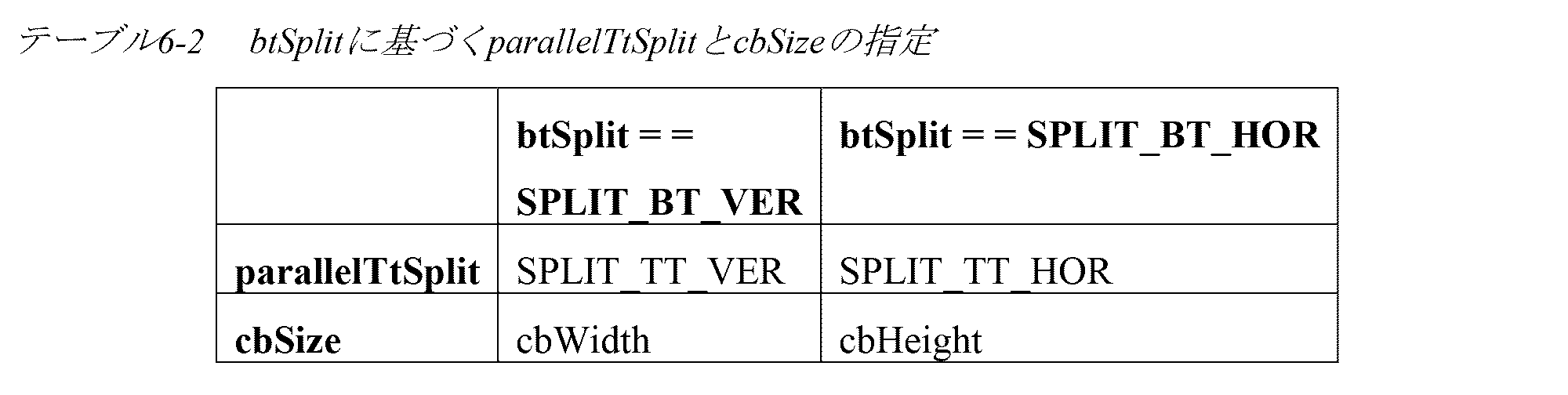
変数allowBtSplitは次のように導出される:
・次の条件の一つまたは複数が真である場合、allowBtSplitはFALSEに等しく設定される:
・cbSizeがMinBtSizeY以下
・cbWidthがmaxBtSizeより大きい
・cbHeightがmaxBtSizeより大きい
・mttDepthがmaxMttDepth以上
・treeTypeがDUAL_TREE_CHROMAと等しく、(cbWidth/SubWidthC)*(cbHeight/SubHeightC)は16以下

・btSplitがSPLIT_BT_VERと等しい
・y0+cbHeightがpic_height_in_luma_samplesより大きい
・それ以外の場合で、次の条件がすべて真であれば、allowBtSplitはFALSEに等しく設定される
・btSplitがSPLIT_BT_VERと等しい
・cbHeightがMaxTbSizeYより大きい
・x0+cbWidthがpic_width_in_luma_samplesより大きい
・それ以外の場合で、次の条件がすべて真である場合、allowBtSplitがFALSEに等しく設定される
・btSplitがSPLIT_BT_HORと等しい
・cbWidthがMaxTbSizeYより大きい
・y0+cbHeightがpic_height_in_luma_samplesより大きい
・それ以外の場合で、次の条件がすべて真である場合、allowBtSplitはFALSEに等しく設定される。
・x0+cbWidthがpic_width_in_luma_samplesより大きい
・y0+cbHeightがpic_height_in_luma_samplesより大きい
・cbWidthがminQtSizeより大きい
・それ以外の場合で、次の条件がすべて真である場合、allowBtSplitはFALSEに等しく設定される。
・btSplitがSPLIT_BT_HORと等しい
・x0+cbWidthがpic_width_in_luma_samplesより大きい
・y0+cbHeightがpic_height_in_luma_samples以下
・それ以外の場合で、次の条件がすべて真である場合、allowBtSplitはFALSEに等しく設定される。
・mttDepthが0より大きい
・partIdxが1に等しい
・MttSplitMode[x0][y0][mttDepth-1]がparallelTtSplitと等しい
・それ以外の場合で、次の条件がすべて真である場合、parallelBtSplitはFALSEに等しく設定される。
・btSplitがSPLIT_BT_VERと等しい
・cbWidthがMaxTbSizeY以下
・cbHeightがMaxTbSizeYより大きい
・それ以外の場合で、次の条件がすべて真である場合、allowBtSplitはFALSEに等しく設定される。
・btSplitがSPLIT_BT_HORと等しい
・cbWidthがMaxTbSizeYより大きい
・cbHeightがMaxTbSizeY以下
・それ以外の場合、allowBtSplitはTRUEに等しく設定される。
The variable allowBtSplit is derived as follows:
o allowBtSplit is set equal to FALSE if one or more of the following conditions are true:
・cbSize is less than or equal to MinBtSizeY ・cbWidth is greater than maxBtSize ・cbHeight is greater than maxBtSize ・mttDepth is greater than or equal to maxMttDepth ・treeType is equal to DUAL_TREE_CHROMA and (cbWidth/SubWidthC) * (cbHeight/SubHeightC) is 16 or less
x0 + cbWidth is greater than pic_width_in_luma_samples y0 + cbHeight is greater than pic_height_in_luma_samples cbWidth is greater than minQtSize Otherwise, if all of the following conditions are true, allowBtSplit is set equal to FALSE.
- btSplit equals SPLIT_BT_HOR - x0 + cbWidth is greater than pic_width_in_luma_samples - y0 + cbHeight is less than or equal to pic_height_in_luma_samples - Otherwise, if all of the following conditions are true, allowBtSplit is set equal to FALSE.
・mttDepth is greater than 0 ・partIdx is equal to 1 ・MttSplitMode[x0][y0][mttDepth−1] is equal to parallelTtSplit ・Otherwise, parallelBtSplit is FALSE if all of the following conditions are true set equal.
- btSplit equals SPLIT_BT_VER - cbWidth is less than or equal to MaxTbSizeY - cbHeight is greater than MaxTbSizeY Otherwise, if all of the following conditions are true, then allowBtSplit is set equal to FALSE.
- btSplit equals SPLIT_BT_HOR - cbWidth is greater than MaxTbSizeY - cbHeight is less than or equal to MaxTbSizeY - Otherwise, allowBtSplit is set equal to TRUE.
許容される三分分割プロセス
このプロセスへの入力は以下の通りである:
・三分分割モードttSplit、
・ルーマ・サンプル単位でのコーディングブロック幅cbWidth、
・ルーマ・サンプル単位でのコーディングブロックの高さcbHeight、
・ピクチャーの左上のルーマ・サンプルに対する、考えられているコーディングブロックの左上のルーマ・サンプルの位置(x0,y0)
・マルチタイプ・ツリー深さmttDepth
・オフセットmaxMttDepthをもつ最大マルチタイプ・ツリー深さ、
・最大三分木サイズmaxTtSize、
・CTUを分割するためにシングルツリー(SINGLE_TREE)が使われるかまたはデュアルツリーが使われるかと、デュアルツリーが使用される場合は、現在処理されているのがルーマ成分か(DUAL_TREE_LUMA)またはクロマ成分か(DUAL_TREE_CHROMA)とを指定する変数treeType。

・Tripartition mode ttSplit,
The coding block width cbWidth in luma sample units,
the height of the coding block in luma samples cbHeight,
the position (x0,y0) of the top left luma sample of the considered coding block relative to the top left luma sample of the picture
・Multi-type tree depth mttDepth
o maximum multitype tree depth with offset maxMttDepth,
・Maximum ternary tree size maxTtSize,
o Whether a single tree (SINGLE_TREE) or a dual tree is used to split the CTU, and if dual trees are used, whether the luma component (DUAL_TREE_LUMA) or chroma component is currently being processed A variable treeType that specifies (DUAL_TREE_CHROMA) and.
このプロセスの出力は、変数allowTtSplitである。
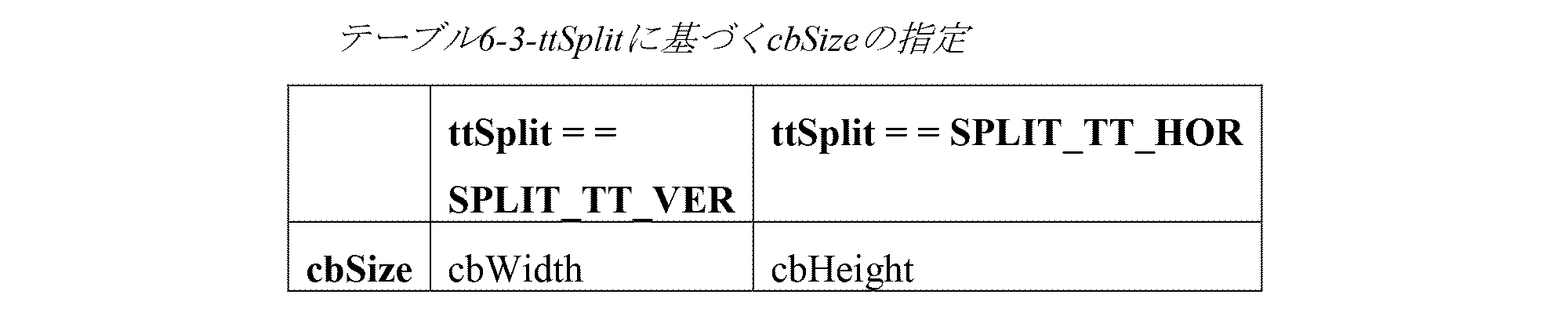
変数allowTtSplitは次のように導出される:
・次の条件の一つまたは複数が真の場合は、allowTtSplitはFALSEに等しく設定される:
・cbSizeが2×MinTtSizeY以下
・cbWidthがMin(MaxTbSizeY,maxTtSize)より大きい
・cbHeightがMin(MaxTbSizeY,maxTtSize)より大きい
・mttDepthがmaxMttDepth以上
・x0+cbWidthがpic_width_in_luma_samplesより大きい
・y0+cbHeightがpic_height_in_luma_samplesより大きい
・treeTypeがDUAL_TREE_CHROMAと等しく、(cbWidth/SubWidthC)*(cbHeight/SubHeightC)は32以下

o allowTtSplit is set equal to FALSE if one or more of the following conditions are true:
・cbSize is less than 2×MinTtSizeY ・cbWidth is greater than Min (MaxTbSizeY, maxTtSize) ・cbHeight is greater than Min (MaxTbSizeY, maxTtSize) ・mttDepth is greater than maxMttDepth ・x0+cbWidth is greater than pic_width_in_luma_samples ・y0+cbHeight is greater than pic_height_in_luma_samples ・treeType is DUAL_TREE_ CHROMA and (cbWidth/SubWidthC) * (cbHeight/SubHeightC) is less than or equal to 32
pred_mode_flagが0に等しいことは、現在のコーディング単位がインター予測モードでコーディングされることを指定する。pred_mode_flagが1に等しいことは、現在のコーディング単位がイントラ予測モードでコーディングされることを指定する。
pred_mode_flagが存在しない場合、次のように推定される:
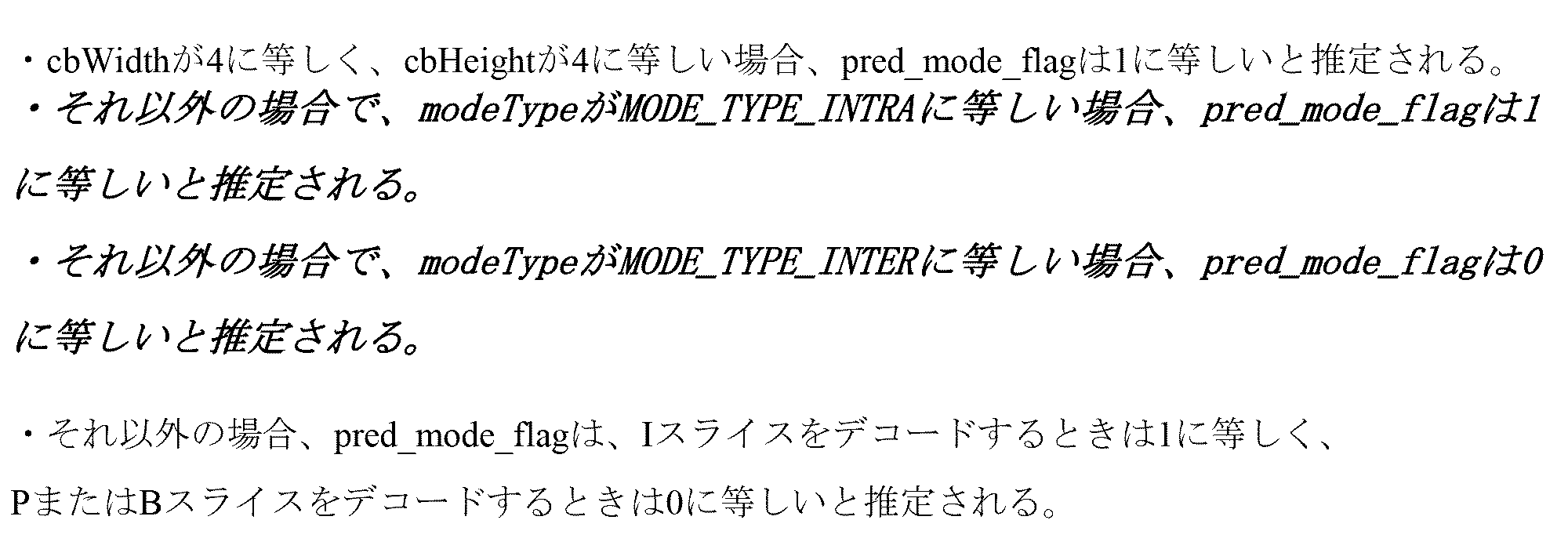
If pred_mode_flag is not present, it is assumed to be:
変数CuPredMode[chType][x][y]は、x=x0..x0+cbWidth-1およびy=y0..y0+cbHeight-1について、次のように導出される:
・pred_mode_flagが0に等しい場合、CuPredMode[chType][x][y]はMODE_INTERに等しく設定される。
・それ以外の場合(pred_mode_flagが1に等しい)、CuPredMode[chType][x][y]はMODE_INTRAに等しく設定される。
The variable CuPredMode[chType][x][y] is derived for x=x0..x0+cbWidth−1 and y=y0..y0+cbHeight−1 as follows:
- If pred_mode_flag is equal to 0, CuPredMode[chType][x][y] is set equal to MODE_INTER.
• Otherwise (pred_mode_flag equals 1), CuPredMode[chType][x][y] is set equal to MODE_INTRA.
pred_mode_ibc_flagが1に等しいことは、現在のコーディング単位がIBC予測モードでコーディングされることを指定する。pred_mode_ibc_flagが0に等しいことは、現在のコーディング単位がIBC予測モードでコーディングされないことを指定する。
pred_mode_ibc_flagが存在しない場合、次のように推定される:

If pred_mode_ibc_flag is not present, it is assumed to be:
3. 課題
1.現在、IBCはMODE_TYPE_INTRAと考えられているため、小さなクロマ・ブロックは許容されず、不必要なコーディング効率の低下につながる。
2.現在、パレットはMODE_TYPE_INTRAと考えられているため、小さなクロマ・ブロックは許容されず、不必要なコーディング効率の低下につながる。
3.現在、小さなクロマ・ブロック制約条件は、色サブサンプリング・フォーマットを考慮していない。
4.現在、小ブロック上の同じパーティションおよび予測モード制約条件がすべてのクロマ・フォーマットに適用される。しかしながら、4:2:0および4:2:2クロマ・フォーマットにおいて、小さなブロックに対する異なる制約条件メカニズムを設計することが望ましい場合がある。
5.現在、パレット・モード・フラグ信号伝達はmodeTypeに依存しており、これはパレットが小ブロック制約条件を適用しない可能性があるため望ましくない。
6.現在、IBCモード・フラグは、cu_skip_flagが1に等しいが、MODE_TYPEがMODE_TYPE_INTRAに等しいP/Bスライスについて0であると推定される。これは構文解析では不正(illegal)である。
7.現在、非4×4ルーマIBCモードはSCIPUルーマ・ブロックについて許容されておらず、これは望ましくないかもしれず、コーディング効率の損失を引き起こしうる。
8.2×Hクロマ・ブロックは相変わらず許容されるが、ハードウェア実装には不向きである。
9.CIIPはMODE_INTERとみなされるが、イントラ予測を使用し、そのことは、場合によっては制約条件を破る。
10.SCIPUが適用される場合、ルーマ分割に依存してクロマについてのデルタQPが信号伝達されることがある。たとえば、現在のブロック寸法がルーマ・サンプル単位で16×8であり、垂直TTで分割される場合、ローカルのデュアルツリーが適用されてもよい。qgOnC=qgOnC && (cbSubdiv+2<=cu_chroma_qp_offset_subdiv)と規定されている。よって、cbSubdiv+2<=cu_chroma_qp_offset_subdivであれば、qgOnCはゼロに設定される。この条件付き設定は、クロマ成分もTTによって分割されると想定している。ローカルデュアルツリーでは、クロマ成分は分割されない可能性があるため、cbSubdivはcu_chroma_qp_offset_subdivよりも大きい可能性がある。クロマについてのデルタQPの信号伝達を許容するためには、IsCuChromaQpOffsetCodedは0に設定されるべきである。ただし、qgOnCが0に設定されているため、IsCuChromaQpOffsetCodedは0に設定されない。
11.可逆コーディングの場合の最大変換サイズが、不可逆コーディングの場合の最大変換サイズとは異なるように設定されることがある。
3.
2. Palettes are now considered MODE_TYPE_INTRA, so small chroma blocks are not allowed, leading to unnecessary coding inefficiencies.
3. Currently, the small chroma block constraint does not take into account color subsampling formats.
4. Currently, the same partition and prediction mode constraints on small blocks apply to all chroma formats. However, it may be desirable to design different constraint mechanisms for small blocks in 4:2:0 and 4:2:2 chroma formats.
5. Palette mode flag signaling currently depends on modeType, which is undesirable because palettes may not enforce small block constraints.
6. Currently, the IBC mode flag is presumed to be 0 for P/B slices with cu_skip_flag equal to 1 but MODE_TYPE equal to MODE_TYPE_INTRA. This is illegal for parsing.
7. Currently, non-4x4 luma IBC modes are not allowed for SCIPU luma blocks, which may be undesirable and may cause loss of coding efficiency.
8. 2xH chroma blocks are still acceptable, but unsuitable for hardware implementation.
9. CIIP is considered MODE_INTER, but uses intra-prediction, which breaks constraints in some cases.
10. When SCIPU is applied, the delta QP for chroma may be signaled depending on luma splitting. For example, if the current block size is 16x8 in luma samples and divided by vertical TT, a local dual tree may be applied. qgOnC=qgOnC &&(cbSubdiv+2<=cu_chroma_qp_offset_subdiv). Thus, qgOnC is set to zero if cbSubdiv+2<=cu_chroma_qp_offset_subdiv. This conditional setting assumes that the chroma components are also split by TT. In a local dual tree, chroma components may not be split, so cbSubdiv may be greater than cu_chroma_qp_offset_subdiv. IsCuChromaQpOffsetCoded should be set to 0 to allow delta QP signaling for chroma. However, IsCuChromaQpOffsetCoded is not set to 0 because qgOnC is set to 0.
11. The maximum transform size for lossless coding may be set differently than the maximum transform size for lossy coding .
4. 技術的解決策および実施形態の例
以下のリストは、例として考慮されるべきである。これらの技法は狭義に解釈されるべきではない。さらに、これらの技法は、任意の仕方で組み合わされることができる。
4. Examples of Technical Solutions and Embodiments The following list should be considered as an example. These techniques should not be interpreted narrowly. Moreover, these techniques can be combined in any manner.
本稿では、「M×Nコーディングツリー・ノード」とは、M×Nブロックを示し、ルーマ・サンプル単位でMがブロック幅、Nがブロック高さであり、これはさらに、QT/BT/TTなどで分割されてもよい。たとえば、ブロックは、QTノード、BTノード、またはTTノードでありうる。コーディングツリー・ノードは、コーディング単位(たとえば、シングルツリーの場合は3つの色成分、デュアルツリー・クロマコーディングの場合は2つのクロマ色成分、デュアルツリー・ルーマコーディングの場合はルーマ色成分のみを含む)、またはルーマコーディングブロック、またはクロマコーディングブロックでありうる。「小コーディングツリー・ノードユニット」は、ルーマ・サンプル単位で32/64/128に等しいブロック・サイズM×Nをもつコーディングツリー・ノードを示しうる。 In this paper, "MxN coding tree node" refers to an MxN block, where M is the block width and N is the block height in luma sample units, which further includes QT/BT/TT, etc. may be divided by For example, blocks can be QT nodes, BT nodes, or TT nodes. A coding tree node is a coding unit (e.g. contains 3 color components for single tree, 2 chroma color components for dual tree chroma coding , only luma color components for dual tree luma coding ) , or a luma coding block, or a chroma coding block. A “small coding tree node unit” may refer to a coding tree node with block size M×N equal to 32/64/128 in luma samples.
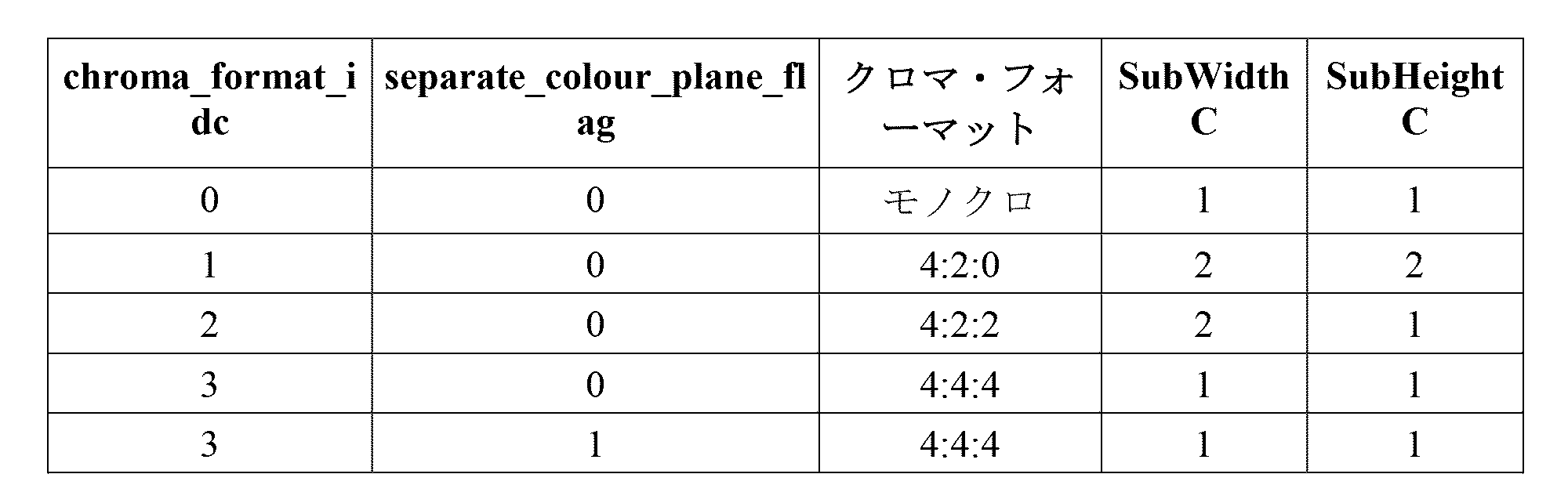
特に記載がなければ、コーディングブロックについての幅Wと高さHはルーマ・サンプル単位で測られる。たとえば、M×Nコーディングブロックとは、M×Nルーマ・ブロックおよび/または2つの(M/SubWidthC)×(N/SubHeightC)クロマ・ブロックを意味し、ここでSubWidthCおよびSubHeightCは、下記のようにクロマ・フォーマットによって導出される。
1.小ブロックに分割するかどうか、および/または、どのように分割するかは、色フォーマットに依存してもよい。
a.一例では、4:4:4色フォーマットについて、クロマ・ブロックのサイズに関する制約条件は、ルーマ・ブロックに関する制約条件に従ってもよい。
b.一例では、4:2:2色フォーマットについて、クロマ・ブロックのサイズに関する制約条件は、4:2:0色フォーマットについての制約条件に従ってもよい。
c.一例では、4:0:0および/または4:4:4クロマ・フォーマットについて、小ブロック・パーティションおよび/または予測モードに関する制約条件が適用されなくてもよい。
d.一例では、小ブロック・パーティションおよび/または予測モードに対する制約条件は、異なるクロマ・フォーマットについて異なるように適用されてもよい。
i.一例では、水平BT分割を伴うM×N(たとえば8×8)コーディングツリー・ノードについて、4:2:2クロマ・フォーマットでは、水平BT分割は、クロマ・ブロックとルーマ・ブロックの両方について許容されてもよいが、4:2:0クロマ・フォーマットでは、水平BT分割は、ルーマ・ブロックについて許可されるが、クロマ・ブロックについては無効にされるのでもよい。
ii.一例では、垂直BT分割を伴うM×N(たとえば16×4)コーディングツリー・ノードについて、4:2:2クロマ・フォーマットでは、垂直BT分割は、クロマ・ブロックとルーマ・ブロックの両方について許容されてもよいが、4:2:0クロマ・フォーマットでは、垂直BT分割は、ルーマ・ブロックについて許容されるが、クロマ・ブロックについては無効にされるのでもよい。
iii.一例では、水平TT分割を伴うM×N(たとえば8×16)コーディングツリー・ノードについて、4:2:2クロマ・フォーマットでは、クロマ・ブロックとルーマ・ブロックの両方について水平TT分割が許容されてもよいが、4:2:0クロマ・フォーマットでは、水平TT分割は、ルーマ・ブロックについて許容されるがクロマ・ブロックについては無効にされるのでもよい。
iv.一例では、垂直TT分割を伴うM×N(32×4など)コーディングツリー・ノードについては、4:2:2クロマ・フォーマットでは、クロマ・ブロックとルーマ・ブロックの両方について垂直TT分割が許容されてもよいが、4:2:0クロマ・フォーマットでは、垂直TT分割は、ルーマ・ブロックについては許容されるがクロマ・ブロックについては無効にされるのでもよい。
v.一例では、4:0:0および/または4:4:4色フォーマットについて、小ブロック制約条件が適用されなくてもよい。
e.一例では、SCIPUを有効にするかどうかは、色フォーマットに依存する。
i.一例では、SCIPUは、4:2:0および4:2:2色フォーマットについて有効にされる。
ii.一例では、SCIPUは、4:0:0および/または4:4:4色フォーマットについては無効にされる。
1.一例では、modeTypeは、4:0:0および/または4:4:4色フォーマットについては、常にMODE_TYPE_ALLに等しくてもよい。
2.一例では、modeTypeConditionは、4:0:0および/または4:4:4の色フォーマットについては、常に0に等しくてもよい。
1. Whether and/or how to divide into small blocks may depend on the color format.
a. In one example, for a 4:4:4 color format, constraints on the size of chroma blocks may follow constraints on luma blocks.
b. In one example, for the 4:2:2 color format, the constraint on the size of the chroma blocks may follow the constraint for the 4:2:0 color format.
c. In one example, for 4:0:0 and/or 4:4:4 chroma formats, constraints on small block partitions and/or prediction modes may not apply.
d. In one example, constraints on small block partitions and/or prediction modes may be applied differently for different chroma formats.
i. In one example, for an M×N (e.g., 8×8) coding tree node with horizontal BT partitioning, in a 4:2:2 chroma format, horizontal BT partitioning is allowed for both chroma and luma blocks. However, in a 4:2:0 chroma format, horizontal BT splitting may be allowed for luma blocks but disabled for chroma blocks.
ii. In one example, for an M×N (e.g., 16×4) coding tree node with vertical BT splitting, in a 4:2:2 chroma format, vertical BT splitting is allowed for both chroma and luma blocks. However, in a 4:2:0 chroma format, vertical BT splitting may be allowed for luma blocks but disabled for chroma blocks.
iii. In one example, for an M×N (e.g., 8×16) coding tree node with horizontal TT partition, the 4:2:2 chroma format allows horizontal TT partitioning for both chroma and luma blocks. Alternatively, in a 4:2:0 chroma format, horizontal TT splitting may be allowed for luma blocks but disabled for chroma blocks.
iv. In one example, for an M×N (e.g., 32×4) coding tree node with a vertical TT split, the 4:2:2 chroma format allows vertical TT splits for both chroma and luma blocks. However, in a 4:2:0 chroma format, vertical TT splitting may be allowed for luma blocks but disabled for chroma blocks.
v. In one example, for 4:0:0 and/or 4:4:4 color formats, the small block constraint may not apply.
e. In one example, whether to enable SCIPU depends on the color format.
i. In one example, SCIPU is enabled for 4:2:0 and 4:2:2 color formats.
ii. In one example, SCIPU is disabled for 4:0:0 and/or 4:4:4 color formats.
1. In one example, modeType may always equal MODE_TYPE_ALL for 4:0:0 and/or 4:4:4 color formats.
2. In one example, modeTypeCondition may always equal 0 for 4:0:0 and/or 4:4:4 color formats.
2.コーディングツリー・ノードの(サブ)ブロックについての予測モード(および/またはmodeType)をどのように決定するかは、クロマ・フォーマットに依存してもよい。
a.一例では、以下の条件の1つが真の場合、このコーディングツリー・ノードによって分割された(サブ)ブロックのmodeTypeは、4:2:2クロマ・フォーマットについてはMODE_TYPE_ALLに等しくてもよく、4:2:0クロマ・フォーマットについては、modeTypeは、MODE_TYPE_INTRAまたはMODE_TYPE_INTERのいずれかに等しくてもよい。
i.水平BT分割を伴うM×N(たとえば8×8)コーディングツリー・ノード
ii.垂直BT分割を伴うM×N(たとえば16×4)コーディングツリー・ノード
iii.水平TT分割を伴うM×N(たとえば8×16)コーディングツリー・ノード
iv.垂直TT分割を伴うM×N(たとえば32×4)コーディングツリー・ノード。
2. How to determine the prediction mode (and/or modeType) for (sub)blocks of a coding tree node may depend on the chroma format.
a. In one example, the modeType of the (sub)blocks split by this coding tree node may be equal to MODE_TYPE_ALL for the 4:2:2 chroma format and 4:2 if one of the following conditions is true: For the :0 chroma format, modeType may be equal to either MODE_TYPE_INTRA or MODE_TYPE_INTER.
i. M×N (eg 8×8) coding tree nodes with horizontal BT partition ii. M×N (eg 16×4) coding tree nodes with vertical BT partition iii. M×N (eg 8×16) coding tree nodes with horizontal TT partitioning iv. M×N (eg 32×4) coding tree nodes with vertical TT partition.
3.MODE_TYPE_INTRAの名前をMODE_TYPE_NO_INTERに変更し、MODE_INTERの使用を制限することが提案される。
a.一例では、コーディング単位のmodeTypeがMODE_TYPE_NO_INTERに等しい場合、MODE_INTERは許容されない。
3. It is proposed to rename MODE_TYPE_INTRA to MODE_TYPE_NO_INTER and restrict the use of MODE_INTER.
a. In one example, if a coding unit's modeType equals MODE_TYPE_NO_INTER, then MODE_INTER is not allowed.
4.MODE_TYPE_INTERの名前をMODE_TYPE_NO_INTRAに変更し、MODE_INTRAの使用を制限することが提案される。
a.一例では、コーディング単位のmodeTypeがMODE_TYPE_NO_INTRAに等しい場合、MODE_INTRAは許容されない。
4. It is proposed to rename MODE_TYPE_INTER to MODE_TYPE_NO_INTRA and restrict the use of MODE_INTRA.
a. In one example, if a coding unit's modeType is equal to MODE_TYPE_NO_INTRA, then MODE_INTRA is not allowed.
5.モード制約条件フラグは、4:2:2および/または4:0:0および/または4:4:4クロマ・フォーマットにおいて信号伝達されることは決してなくてもよい。
a.一例では、モード制約条件フラグが存在しない場合、それは1に等しいと推定されてもよい。
i.あるいはまた、モード制約条件フラグが存在しない場合、それは0に等しいと推定されてもよい。
5. Mode constraint flags may never be signaled in 4:2:2 and/or 4:0:0 and/or 4:4:4 chroma formats.
a. In one example, if the mode constraint flag is not present, it may be assumed to be equal to one.
i. Alternatively, if the mode constraint flag is not present, it may be assumed to be equal to 0.
6.Mをブロック幅、Nをブロック高さとしてM×NコーディングブロックにSCIPUを適用するかどうか、および/またはどのように適用するかは、色フォーマットが4:2:0であるか4:2:2であるかに依存してもよい。
a.一例では、4:2:2の色フォーマットでは、Mをブロック幅、Nをブロック高さとして、M×Nコーディングブロックについて、MかけるN(M×Nで示される)が64または32に等しい場合にのみSCIPUが有効にされてもよい。
b.一例では、M*N=128のコーディングツリー・ノードは、4:2:2色フォーマットでは、決してSCIPUブロックとして扱われなくてもよい。
c.一例では、BT分割およびM*N=64をもつコーディングツリー・ノードは、4:2:2色フォーマットでは、決してSCIPUブロックとして扱われなくてもよい。
d.一例では、split_qt_flagが1に等しく、M*N=64であるコーディングツリー・ノードは、4:2:2色フォーマットでは、SCIPUブロックであってもよい。
e.一例では、TT分割およびM*N=64を有するコーディングツリー・ノードは、4:2:2色フォーマットではSCIPUブロックとして扱われてもよい。
f.一例では、BT分割およびM*N=32を有するコーディングツリー・ノードは、4:2:2色フォーマットでは、SCIPUブロックとして扱われてもよい。
g.上記の記述において、4:2:2色フォーマットのSCIPUブロックについては、modeTypeConditionは常に1に等しくてもよい。
h.上記の説明において、4:2:2色フォーマットのSCIPUブロックについては、親ノードの現在のブロックと子リーフノードの下のすべてのサブブロックの両方について、MODE_TYPE_INTRAのみが許容されてもよい。
6. Whether and/or how to apply SCIPU to M×N coding blocks, where M is the block width and N is the block height, depends on whether the color format is 4:2:0 or 4:2:2:0. 2 may depend on whether
a. In one example, in a 4:2:2 color format, where M is the block width and N is the block height, for an M×N coding block, if M times N (denoted by M×N) equals 64 or 32 SCIPU may be enabled only when
b. In one example, M*N=128 coding tree nodes may never be treated as SCIPU blocks in the 4:2:2 color format.
c. In one example, a coding tree node with BT split and M*N=64 may never be treated as a SCIPU block in 4:2:2 color format.
d. In one example, a coding tree node with split_qt_flag equal to 1 and M*N=64 may be a SCIPU block in a 4:2:2 color format.
e. In one example, a coding tree node with TT partition and M*N=64 may be treated as a SCIPU block in 4:2:2 color format.
f. In one example, a coding tree node with BT split and M*N=32 may be treated as a SCIPU block in 4:2:2 color format.
g. In the above description, modeTypeCondition may always equal 1 for SCIPU blocks in 4:2:2 color format.
h. In the above description, for a 4:2:2 color format SCIPU block, only MODE_TYPE_INTRA may be allowed for both the current block of the parent node and all sub-blocks under child leaf nodes.
7.4:2:2色フォーマットでは、SCIPUブロックのmodeTypeConditionは常に1に等しくてもよい。
a.一例では、modeTypeConditionは、4:2:2色フォーマットにちうて0または1に等しくてもよい。
b.一例では、4:2:2色フォーマットのSCIPUブロックについて、modeTypeConditionは、決して2に等しくなくてもよい。
7. In the 4:2:2 color format, the SCIPU block's modeTypeCondition may always equal 1.
a. In one example, modeTypeCondition may equal 0 or 1 for a 4:2:2 color format.
b. In one example, for a 4:2:2 color format SCIPU block, modeTypeCondition may never be equal to 2.
8.4:2:2色フォーマットでは、SCIPUブロックのmodeTypeは常にMODE_TYPE_INTRAに等しくてもよい。
a.一例では、modeTypeは、4:2:2色フォーマットのMODE_TYPE_ALLまたはMODE_TYPE_INTRAと等しくてもよい。
b.一例では、4:2:2色フォーマットのSCIPUブロックについては、MODE_TYPE_INTERは無効にされてもよい。
8. In a 4:2:2 color format, the SCIPU block's modeType may always equal MODE_TYPE_INTRA.
a. In one example, modeType may equal MODE_TYPE_ALL or MODE_TYPE_INTRA for a 4:2:2 color format.
b. In one example, for 4:2:2 color format SCIPU blocks, MODE_TYPE_INTER may be disabled.
9.ブロック・パーティションが許可されるか否かは、modeTypeおよび/またはブロック・サイズに依存してもよい。
a.一例では、ブロックについてBTおよび/またはTT分割が許容されるかどうかは、modeTypeに依存してもよい。
i.一例では、modeTypeがMODE_TYPE_INTERに等しい場合、現在のコーディングブロックについてBT分割は許容されなくてもよい(たとえば、allowBtSplitがfalseに等しく設定される)。
ii.一例では、modeTypeがMODE_TYPE_INTERに等しい場合、現在のコーディングブロックについてTT分割は許容されなくてもよい(たとえば、allowTtSplitがfalseに等しく設定される)。
b.一例では、ブロックについてBTおよび/またはTT分割が許容されるかどうかは、modeTypeおよびブロック・サイズに依存してもよい。
i.一例では、M×Nコーディングブロックについては、Mをブロック幅、Nをブロック高さとして、M*Nが32以下であり、modeTypeがMODE_TYPE_INTERに等しい場合、BT分割は許容されなくてもよい(たとえば、allowBtSplitがfalseに設定される)。
ii.一例では、M×Nコーディングブロックについては、Mをブロック幅、Nをブロック高さとし、M*Nが64以下であり、modeTypeがMODE_TYPE_INTERに等しい場合、TT分割は許容されなくてもよい(たとえば、allowTtSplitがfalseに設定される)。
9. Whether or not block partitions are allowed may depend on modeType and/or block size.
a. In one example, whether BT and/or TT partitioning is allowed for a block may depend on modeType.
i. In one example, if modeType equals MODE_TYPE_INTER, BT splitting may not be allowed for the current coding block (eg, allowBtSplit is set equal to false).
ii. In one example, if modeType equals MODE_TYPE_INTER, TT splitting may not be allowed for the current coding block (eg, allowTtSplit is set equal to false).
b. In one example, whether BT and/or TT partitioning is allowed for a block may depend on modeType and block size.
i. In one example, for an M×N coding block, where M is the block width and N is the block height, if M*N is less than or equal to 32 and modeType is equal to MODE_TYPE_INTER, BT partitioning may not be allowed (e.g. , allowBtSplit is set to false).
ii. In one example, for an M×N coding block, where M is the block width and N is the block height, if M*N is less than or equal to 64 and modeType is equal to MODE_TYPE_INTER, TT partitioning may not be allowed (e.g., allowTtSplit is set to false).
10.コーディングツリーのmodeTypeCurrがMODE_TYPE_INTERに等しい場合、コーディングツリーの分割は制約されてもよい。
a.一例では、コーディングツリーのmodeTypeCurrがMODE_TYPE_INTERに等しい場合、BT分割は許容されなくてもよい。
b.一例では、コーディングツリーのmodeTypeCurrがMODE_TYPE_INTERに等しい場合、TT分割は許容されなくてもよい。
c.一例では、コーディングツリーのmodeTypeCurrがMODE_TYPE_INTERに等しい場合、QT分割は許容されなくてもよい。
d.一例では、コーディングツリーのmodeTypeCurrがMODE_TYPE_INTERに等しく、ルーマ・ブロック・サイズが32以下の場合、BT分割は許容されなくてもよい。
e.一例では、コーディングツリーのmodeTypeCurrがMODE_TYPE_INTERに等しく、ルーマ・ブロック・サイズが64以下の場合、TT分割は許容されなくてもよい。
10. If the modeTypeCurr of the coding tree is equal to MODE_TYPE_INTER, the coding tree splitting may be constrained.
a. In one example, if the modeTypeCurr of the coding tree is equal to MODE_TYPE_INTER, BT splitting may not be allowed.
b. In one example, if the modeTypeCurr of the coding tree is equal to MODE_TYPE_INTER, TT splitting may not be allowed.
c. In one example, if the coding tree's modeTypeCurr equals MODE_TYPE_INTER, QT splitting may not be allowed.
d. In one example, if the modeTypeCurr of the coding tree is equal to MODE_TYPE_INTER and the luma block size is 32 or less, BT splitting may not be allowed.
e. In one example, if the modeTypeCurr of the coding tree is equal to MODE_TYPE_INTER and the luma block size is 64 or less, TT partitioning may not be allowed.
11.treeTypeがDUAL_TREE_LUMAであるコーディング単位は、インター・モードでコーディングされてもよい。
a.一例では、インターコーディングモード、すなわちMODE_INTERでコーディングされたコーディング単位は、複数の色成分をもつ色フォーマットの場合でも、ルーマ成分のみを含んでいてもよい。
b.一例では、pred_mode_flagはDUAL_TREE_LUMAブロックについてパースされる必要があってもよい。
c.一例では、インター・モードでコーディングされたDUAL_TREE_LUMAブロックについて、SINGLE_TREEについてのインター・モードの同じ制約条件が適用されてもよい。
i.一例では、4×4 DUAL_TREE_LUMAインターブロックは、許容されなくてもよい。
11. A coding unit whose treeType is DUAL_TREE_LUMA may be coded in inter mode.
a. In one example, a coding unit coded in inter- coding mode, MODE_INTER, may contain only luma components, even for color formats with multiple color components.
b. In one example, pred_mode_flag may need to be parsed for DUAL_TREE_LUMA blocks.
c. In one example, for a DUAL_TREE_LUMA block coded in inter mode, the same constraint of inter mode as for SINGLE_TREE may apply.
i. In one example, 4x4 DUAL_TREE_LUMA inter-blocks may not be allowed.
12.ブロック幅がM(M=2など)クロマ・サンプルに等しいクロマ・イントラ・ブロック(および/またはIBCブロック)は許容されなくてもよい。
a.一例では、2×N(N≦64など)クロマ・イントラ・ブロックは、デュアルツリーでは許容されなくてもよい。
i.一例では、treeTypeがDUAL_TREE_CHROMAに等しく、ブロック幅が4クロマ・サンプルに等しい場合、垂直BT分割は無効にされてもよい。
ii.一例では、treeTypeがDUAL_TREE_CHROMAに等しく、ブロック幅が8クロマ・サンプルに等しい場合、垂直TT分割は無効にされてもよい。
b.一例では、2×N(N≦64など)クロマ・イントラ(および/またはIBC)ブロックは、シングルツリーでは許容されなくてもよい。
i.一例では、垂直BT分割を伴うM×N(たとえば、M=8およびN≦64)コーディングツリー・ノードについて、以下のプロセスの1つが適用されてもよい。
1.4×Nまたは4×(N/2)のクロマ・ブロックについては垂直BT分割は許容されないが、8×Nのルーマ・ブロックについては許容されるのでもよい。
2.4×Nまたは4×(N/2)クロマ・ブロックは、垂直BT分割ではなく、MODE_INTRAまたはMODE_IBCによってコーディングされてもよい。
3.垂直BT分割は、8×Nルーマ・ブロックと4×Nまたは4×(N/2)クロマ・ブロックの両方について許容されるが、ルーマ・ブロックとクロマ・ブロックの両方はMODE_INTRAでコーディングされないのでもよい(たとえば、MODE_INTERまたはMODE_IBCでコーディングされてもよい)。
ii.一例では、垂直TT分割を伴うM×N(たとえば、M=16およびN≦64)コーディングツリー・ノードについて、以下のプロセスの1つが適用されてもよい。
1.8×Nまたは8×(N/2)のクロマ・ブロックについては垂直TT分割は許容されないが、16×Nのルーマ・ブロックについては許容されるのでもよい。
2.8×Nまたは8×(N/2)クロマ・ブロックは、垂直TT分割ではなく、MODE_INTRAまたはMODE_IBCによってコーディングされてもよい。
3.垂直TT分割は、16×Nルーマ・ブロックと8×Nまたは8×(N/2)クロマ・ブロックの両方について許容されるが、ルーマ・ブロックとクロマ・ブロックの両方はMODE_INTRAでコーディングされないのでもよい(たとえば、MODE_INTERまたはMODE_IBCでコーディングされてもよい)。
12. Chroma intra blocks (and/or IBC blocks) with a block width equal to M (eg, M=2) chroma samples may not be allowed.
a. In one example, 2×N (eg, N≦64) chroma intra blocks may not be allowed in the dual-tree.
i. In one example, if treeType equals DUAL_TREE_CHROMA and block width equals 4 chroma samples, vertical BT splitting may be disabled.
ii. In one example, if treeType equals DUAL_TREE_CHROMA and blockwidth equals 8 chroma samples, vertical TT splitting may be disabled.
b. In one example, 2×N (eg, N≦64) chroma intra (and/or IBC) blocks may not be allowed in a single tree.
i. In one example, for M×N (eg, M=8 and N≦64) coding tree nodes with vertical BT partitioning, one of the following processes may be applied.
1. Vertical BT splitting is not allowed for 4×N or 4×(N/2) chroma blocks, but may be allowed for 8×N luma blocks.
2. 4xN or 4x(N/2) chroma blocks may be coded by MODE_INTRA or MODE_IBC instead of vertical BT split.
3. Vertical BT splitting is allowed for both 8xN luma blocks and 4xN or 4x(N/2) chroma blocks, even though both luma and chroma blocks are not coded with MODE_INTRA. May be (eg, may be coded in MODE_INTER or MODE_IBC).
ii. In one example, for M×N (eg, M=16 and N≦64) coding tree nodes with vertical TT partitioning, one of the following processes may be applied.
1. Vertical TT splitting is not allowed for 8×N or 8×(N/2) chroma blocks, but may be allowed for 16×N luma blocks.
2. 8xN or 8x(N/2) chroma blocks may be coded by MODE_INTRA or MODE_IBC instead of vertical TT split.
3. Vertical TT splitting is allowed for both 16xN luma blocks and 8xN or 8x(N/2) chroma blocks, even though both luma and chroma blocks are not coded with MODE_INTRA. May be (eg, may be coded in MODE_INTER or MODE_IBC).
13.IBCモードは、小ブロック・サイズであるかどうかにかかわらず、ルーマおよび/またはクロマ・ブロックについて許容されてもよい。
a.一例では、modeTypeがMODE_TYPE_INTRAに等しい場合でも、8x4/8x8/16x4および4xN(N<=64など)のルーマ・ブロックを含むルーマ・ブロックについて、IBCモードが許容されてもよい。
b.一例では、modeTypeがMODE_TYPE_INTRAに等しい場合でも、IBCモードはクロマ・ブロックについて許容されてもよい。
13. IBC mode may be allowed for luma and/or chroma blocks regardless of small block size.
a. In one example, IBC mode may be allowed for luma blocks including 8x4/8x8/16x4 and 4xN (eg, N<=64) luma blocks even if modeType equals MODE_TYPE_INTRA.
b. In one example, IBC mode may be allowed for chroma blocks even if modeType equals MODE_TYPE_INTRA.
14.IBC予測モード・フラグの信号伝達は、予測モード・タイプ(たとえば、MODE_TYPE_INTRA)に依存してもよい。
a.一例では、非SKIPブロック(たとえば、スキップ・モードでコーディングされないコーディングブロック)についてのIBC予測モード・フラグは、treeTypeがDUAL_TREE_CHROMAに等しくなく、かつmodeTypeがMODE_TYPE_INTRAに等しい場合に、明示的にビットストリームにおいて信号伝達されうる。
14. Signaling of the IBC prediction mode flag may depend on the prediction mode type (eg, MODE_TYPE_INTRA).
a. In one example, the IBC prediction mode flag for non-SKIP blocks (e.g., coded blocks not coded in skip mode) is explicitly signaled in the bitstream when treeType is not equal to DUAL_TREE_CHROMA and modeType is equal to MODE_TYPE_INTRA. can be transmitted.
15.IBC予測モード・フラグは、CU SKIPフラグとモード・タイプ(たとえばmodeType)に依存して推定されうる。
a.一例では、現在のブロックがSKIPモードでコーディングされ(たとえば、cu_skip_flagが1に等しい)、modeTypeがMODE_TYPE_INTRAに等しい場合、IBC予測モード・フラグ(たとえば、pred_mode_ibc_flag)が1に等しいと推定されてもよい。
15. The IBC prediction mode flag can be deduced depending on the CU SKIP flag and the mode type (eg, modeType).
a. In one example, if the current block is coded in SKIP mode (eg, cu_skip_flag is equal to 1) and modeType is equal to MODE_TYPE_INTRA, then the IBC prediction mode flag (eg, pred_mode_ibc_flag) may be assumed to be equal to 1.
16.パレット・モード・フラグの明示的な信号伝達はmodeTypeに依存しななくてもよい。
a.一例では、パレット・モード・フラグ(たとえばpred_mode_plt_flag)信号伝達は、スライスタイプ、ブロック・サイズ、予測モードなどに依存しうるが、modeTypeは何であってもよい。
b.一例では、modeTypeがMODE_TYPE_INTERまたはMODE_TYPE_INTRAに等しい場合、パレット・モード・フラグ(pred_mode_plt_flagなど)は0と推定される。
16. Explicit signaling of palette mode flags may be independent of modeType.
a. In one example, palette mode flag (eg, pred_mode_plt_flag) signaling may depend on slice type, block size, prediction mode, etc., but modeType can be anything.
b. In one example, if modeType equals MODE_TYPE_INTER or MODE_TYPE_INTRA, palette mode flags (such as pred_mode_plt_flag) are presumed to be 0.
17.modeTypeがMODE_TYPE_INTERに等しい場合、IBCモードは使用することが許容されてもよい。
a.一例では、modeTypeがMODE_TYPE_INTRAに等しいとき、クロマIBCは許容されなくてもよい。
b.一例では、modeTypeがMODE_TYPE_INTRAまたはMODE_TYPE_INTERに等しいとき、IBCモードは使用することが許容されうる。
c.一例では、IBCモードは、modeTypeが何であるかに関係なく、使用することを許容されうる。
d.一例では、1つのSCIPU内で、IBCおよびインター・モードが両方とも許容されてもよい。
e.一例では、IBCクロマ・ブロックのサイズは、常に、対応するルーマ・ブロックのサイズに対応してもよい。
f.一例では、modeTypeがMODE_TYPE_INTERに等しく、コーディング単位サイズがルーマで4x4の場合、pred_mode_ibc_flagの信号伝達はスキップされ、pred_mode_ibc_flagは1に等しいと推定されうる。
17. If modeType equals MODE_TYPE_INTER, IBC mode may be allowed to use.
a. In one example, chroma IBC may not be allowed when modeType equals MODE_TYPE_INTRA.
b. In one example, IBC mode may be allowed to use when modeType equals MODE_TYPE_INTRA or MODE_TYPE_INTER.
c. In one example, IBC mode may be allowed to use regardless of what the modeType is.
d. In one example, both IBC and Inter modes may be allowed within one SCIPU.
e. In one example, the size of an IBC chroma block may always correspond to the size of the corresponding luma block.
f. In one example, if modeType is equal to MODE_TYPE_INTER and the coding unit size is 4x4 in luma, the signaling of pred_mode_ibc_flag may be skipped and pred_mode_ibc_flag may be assumed to be equal to one.
18.modeTypeがMODE_TYPE_INTERの場合、パレット・モードは使用することを許容されうる。
a.一例では、modeTypeがMODE_TYPE_INTRAの場合、クロマパレットは許容されなくてもよい。
b.一例では、modeTypeがMODE_TYPE_INTRAまたはMODE_TYPE_INTERに等しいとき、IBCモードは使用することを許容されなくてもよい。
c.一例では、IBCモードは、modeTypeが何であるかに関係なく、使用を許容されてもよい。
d.一例では、modeTypeがMODE_TYPE_INTRAまたはMODE_TYPE_INTERに等しいとき、パレット・モードは、使用を許容されてもよい。
e.一例では、パレット・モードは、modeTypeが何であるかに関係なく、使用を許容されてもよい。
f.一例では、1つのSCIPU内で、パレットおよびインター・モードの両方が許容されてもよい。
g.一例では、1つのSCIPU内で、パレット、IBCおよびインター・モードがすべて許容されてもよい。
h.一例では、パレットクロマ・ブロックのサイズは、対応するルーマ・ブロックのサイズに常に対応してもよい。
i.一例では、modeTypeがMODE_TYPE_INTERに等しく、コーディング単位サイズがルーマで4x4の場合、pred_mode_plt_flagの信号伝達はスキップされ、pred_mode_plt_flagは1に等しいと推定される。
j.一例では、modeTypeがMODE_TYPE_INTERに等しく、コーディング単位サイズがルーマで4×4の場合、現在の予測モードがIBCまたはパレットであるかどうかを示すために、1つのメッセージが送られてもよい。
k.一例では、パレット・モードを有効/無効にするかどうかは、スライスタイプとmodeTypeに依存してもよい。
i.一例では、MODE_TYPE_INTRAをもつIスライスについては、パレット・モードが有効にされてもよい。
ii.一例では、MODE_TYPE_INTERをもつP/Bスライスについては、パレット・モードが有効にされてもよい。
18. If modeType is MODE_TYPE_INTER, palette mode may be allowed to use.
a. In one example, if modeType is MODE_TYPE_INTRA, the chroma palette may not be allowed.
b. In one example, IBC mode may not be allowed to use when modeType equals MODE_TYPE_INTRA or MODE_TYPE_INTER.
c. In one example, IBC mode may be allowed to use regardless of what the modeType is.
d. In one example, palette mode may be allowed to use when modeType equals MODE_TYPE_INTRA or MODE_TYPE_INTER.
e. In one example, palette mode may be allowed to use regardless of what the modeType is.
f. In one example, both palette and inter modes may be allowed within one SCIPU.
g. In one example, Palette, IBC and Inter modes may all be allowed within one SCIPU.
h. In one example, the size of a palette chroma block may always correspond to the size of the corresponding luma block.
i. In one example, if modeType is equal to MODE_TYPE_INTER and the coding unit size is 4x4 in luma, the signaling of pred_mode_plt_flag is skipped and pred_mode_plt_flag is presumed to be equal to one.
j. In one example, if modeType equals MODE_TYPE_INTER and the coding unit size is 4×4 in luma, one message may be sent to indicate whether the current prediction mode is IBC or Palette.
k. In one example, enabling/disabling palette mode may depend on the slice type and modeType.
i. In one example, palette mode may be enabled for I slices with MODE_TYPE_INTRA.
ii. In one example, palette mode may be enabled for P/B slices with MODE_TYPE_INTER.
19.パレット・モードを有効にされている場合、ローカルデュアルツリーは許容されなくてもよい。
a.一例では、パレット・モードが有効にされている場合、modeTypeConditionは常に0に設定されてもよい。
19. Local dual trees may not be allowed if palette mode is enabled.
a. In one example, modeTypeCondition may always be set to 0 if palette mode is enabled.
20.幅がMに等しい(たとえば、M=2)または高さがNに等しい(たとえば、N=2)小クロマ・ブロックについて、許容されるイントラ予測モードは、大きなクロマ・ブロックについて許容されるものとは異なるよう、制約されてもよい。
a.一例では、利用可能なクロマ・イントラ予測モードのイントラ予測モードのサブセットのみが使用されてもよい。
b.一例では、INTRA_DCモードのみが使用されてもよい。
c.一例では、INTRA_PLANARモードのみが使用されてもよい。
d.一例では、INTRA_ANGULAR18モードのみが使用されてもよい。
e.一例では、INTRA_ANGULAR50モードのみが使用されてもよい。
f.一例では、CCLMモードが許容されなくてもよい。
20. For small chroma blocks with width equal to M (e.g., M=2) or height equal to N (e.g., N=2), the allowed intra-prediction modes shall be allowed for large chroma blocks. may be constrained to be different.
a. In one example, only a subset of intra-prediction modes of the available chroma intra-prediction modes may be used.
b. In one example, only INTRA_DC mode may be used.
c. In one example, only INTRA_PLANAR mode may be used.
d. In one example, only INTRA_ANGULAR18 mode may be used.
e. In one example, only INTRA_ANGULAR50 mode may be used.
f. In one example, CCLM mode may not be allowed.
21.幅がMに等しい(たとえば、M=2)小さなクロマ・ブロックまたは高さがNに等しい(たとえば、N=2)小さなクロマ・ブロックについては、変換タイプは大きなクロマ・ブロックについて許容されるものとは異なるように、制約されてもよい。
a.一例では、変換スキップのみが使用されてもよい。
b.一例では、一次元変換のみが使用されてもよい。
c.一例では、複数のタイプの変換をサポートするコーディングツールは許容されない。
i.あるいはまた、複数のタイプの変換をサポートするコーディングツールの信号伝達は省略される。
21. For small chroma blocks with width equal to M (e.g., M=2) or height equal to N (e.g., N=2), the transform type shall be allowed for large chroma blocks. may be constrained differently.
a. In one example, only transform skips may be used.
b. In one example, only one-dimensional transforms may be used.
c. In one example, coding tools that support multiple types of transformations are not allowed.
i. Alternatively, the signaling of coding tools that support multiple types of transforms is omitted.
22.CIIPはMODE_TYPE_INTRAとみなされてもよい。
a.一例では、CIIPモードは、デュアルツリー分割が使用される場合に許容されてもよい。
i.一例では、CIIPモードは、CUタイプがDUAL_TREEE_CHROMAの場合、許容されてもよい。
b.あるいはまた、CIIPは、MODE_TYPE_INTERとみなされてもよい。
i.一例では、クロマ・ブロック幅がMに等しい場合(たとえば、M=2)、CIIPモードは許容されなくてもよい。
ii.一例では、クロマ・ブロック幅がMに等しい場合(たとえば、M=2)、CIIPにおけるクロマについてのイントラ予測モードは、単純なイントラ予測モードに制限されてもよい。
1.一例では、クロマ・ブロック幅がMに等しい場合(たとえば、M=2)、INTRA_DCがクロマ・イントラ予測のために使用されてもよい。
2.一例では、クロマ・ブロック幅がMに等しい場合(たとえば、M=2)、INTRA_ANGULAR18がクロマ・イントラ予測のために使用されてもよい。
3.一例では、クロマ・ブロック幅がMに等しい場合(たとえば、M=2)、INTRA_ANGULAR50がクロマ・イントラ予測のために使用されてもよい。
iii.一例では、CIIPにおけるクロマのためのイントラ予測モードは、単純なイントラ予測モードに制限されてもよい。
1.一例では、INTRA_DCは、クロマ・イントラ予測のために使用されてもよい。
2.一例では、INTRA_ANGULAR18モードは、クロマ・イントラ予測のために使用されてもよい。
3.一例では、INTRA_ANGULAR50モードは、クロマ・イントラ予測のために使用されてもよい。
22. CIIP may be considered MODE_TYPE_INTRA.
a. In one example, CIIP mode may be allowed when dual-tree partitioning is used.
i. In one example, CIIP mode may be allowed if the CU type is DUAL_TREEE_CHROMA.
b. Alternatively, CIIP may be considered MODE_TYPE_INTER.
i. In one example, if the chroma block width is equal to M (eg, M=2), CIIP mode may not be allowed.
ii. In one example, if the chroma block width is equal to M (eg, M=2), the intra-prediction mode for chroma in CIIP may be restricted to simple intra-prediction mode.
1. In one example, INTRA_DC may be used for chroma intra prediction if the chroma block width is equal to M (eg, M=2).
2. In one example, INTRA_ANGULAR18 may be used for chroma intra prediction if the chroma block width is equal to M (eg, M=2).
3. In one example, INTRA_ANGULAR50 may be used for chroma intra prediction if the chroma block width is equal to M (eg, M=2).
iii. In one example, intra-prediction modes for chroma in CIIP may be restricted to simple intra-prediction modes.
1. In one example, INTRA_DC may be used for chroma intra prediction.
2. In one example, INTRA_ANGULAR18 mode may be used for chroma intra prediction.
3. In one example, the INTRA_ANGULAR50 mode may be used for chroma intra prediction.
23.上記の諸項目について、変数Mおよび/またはNは事前に定義されてもよいし、信号伝達されてもよい。
a.一例では、Mおよび/またはNは、色フォーマット(たとえば、4:2:0、4:2:2、4:4:4)にさらに依存してもよい。
23. For the items above, variables M and/or N may be predefined or signaled.
a. In one example, M and/or N may further depend on the color format (eg, 4:2:0, 4:2:2, 4:4:4).
24.modeTypeはより多くのタイプをカバーするように拡張されてもよい。
a.一例では、modeTypeはMODE_TYPE_IBCであってもよい。modeTypeがMODE_TYPE_IBCに等しい場合、予測モードはIBCと推定される。
i.一例では、pred_mode_flagは、この場合、信号伝達されない。
ii.一例では、pred_mode_ibc_flagは、この場合、信号伝達されない。
iii.一例では、pred_mode_plt_flagは、この場合、信号伝達されない。
b.一例では、modeTypeはMODE_TYPE_PALETTEであってもよい。modeTypeがMODE_TYPE_PALETTEに等しい場合、予測モードはパレット・モードであると推定される。
i.一例では、pred_mode_flagは、この場合、信号伝達されない。
ii.一例では、pred_mode_ibc_flagは、この場合に、信号伝達されない。
iii.一例では、pred_mode_plt_flagは、この場合、信号伝達されない。
c.一例では、mode_constraint_flagは、許容されるmodeTypeのどれが使われるかを示すために、インデックスで置き換えられてもよい。
24. modeType may be extended to cover more types.
a. In one example, modeType may be MODE_TYPE_IBC. If modeType equals MODE_TYPE_IBC, the prediction mode is assumed to be IBC.
i. In one example, pred_mode_flag is not signaled in this case.
ii. In one example, pred_mode_ibc_flag is not signaled in this case.
iii. In one example, pred_mode_plt_flag is not signaled in this case.
b. In one example, modeType may be MODE_TYPE_PALETTE. If modeType equals MODE_TYPE_PALETTE, the prediction mode is presumed to be palette mode.
i. In one example, pred_mode_flag is not signaled in this case.
ii. In one example, pred_mode_ibc_flag is not signaled in this case.
iii. In one example, the pred_mode_plt_flag is not signaled in this case.
c. In one example, mode_constraint_flag may be replaced with an index to indicate which of the allowed modeTypes is used.
25.一例では、寸法W×HのブロックについてQT分割が許容されるかどうかは、寸法と組み合わされたmodeTypeに依存しうる。
a.たとえば、modeTypeがMODE_TYPE_INTERに等しく、Wが8に等しく、Hが8に等しい場合、QTスピットは許容されない。
25. In one example, whether QT partitioning is allowed for a block of dimension WxH may depend on the modeType combined with the dimension.
a. For example, if modeType equals MODE_TYPE_INTER, W equals 8, and H equals 8, QT spitting is not allowed.
26.一例では、寸法W×Hのブロックについて垂直TT分割が許容されるかどうかは、寸法と組み合わされたmodeTypeに依存しうる。
a.たとえば、modeTypeがMODE_TYPE_INTERに等しく、Wが16に等しく、Hが4に等しい場合、垂直TTスピットは許容されない。
26. In one example, whether a vertical TT split is allowed for a block of size WxH may depend on the modeType combined with the size.
a. For example, if modeType equals MODE_TYPE_INTER, W equals 16, and H equals 4, no vertical TT spit is allowed.
27.一例では、寸法W×Hのブロックについて水平方向のTT分割が許容されるかどうかは、寸法と組み合わされたmodeTypeに依存しうる。
a.たとえば、modeTypeがMODE_TYPE_INTERに等しく、Wが4に等しく、Hが16に等しい場合、水平TT分割は許容されない。
27. In one example, whether horizontal TT splitting is allowed for a block of dimension WxH may depend on the modeType combined with the dimension.
a. For example, if modeType equals MODE_TYPE_INTER, W equals 4, and H equals 16, horizontal TT splitting is not allowed.
28.一例では、寸法W×Hのブロックについて垂直BT分割が許容されるかどうかは、寸法と組み合わされたmodeTypeに依存しうる。
a.たとえば、modeTypeがMODE_TYPE_INTERに等しく、Wが8に等しく、Hが4に等しい場合、垂直BT分割は許容されない。
28. In one example, whether a vertical BT split is allowed for a block of dimension WxH may depend on the modeType combined with the dimension.
a. For example, if modeType equals MODE_TYPE_INTER, W equals 8, and H equals 4, vertical BT splitting is not allowed.
29.一例では、寸法W×Hのブロックについて水平方向のTT分割が許容されるかどうかは、寸法と組み合わされたmodeTypeに依存しうる。
a.たとえば、modeTypeがMODE_TYPE_INTERに等しく、Wが4に等しく、Hが8に等しい場合、水平BT分割は許容されない。
29. In one example, whether horizontal TT splitting is allowed for a block of dimension WxH may depend on the modeType combined with the dimension.
a. For example, if modeType equals MODE_TYPE_INTER, W equals 4, and H equals 8, horizontal BT splitting is not allowed.
30.一例では、CUの予測モードがmodeTypeによって推定されるかどうかは、色成分および/またはブロック寸法W×Hに依存しうる。
a.たとえば、クロマCUの予測モードはmodeTypeによって推定されるが、ルーマCUの予測モードはmodeTypeによって推定されるのではなく、信号伝達される。
i.たとえば、ルーマCUの予測モードは、もしW>4かH>4なら、modeTypeによって推定されるのではなく、信号伝達される。
30. In one example, whether the CU's prediction mode is inferred by modeType may depend on the color component and/or the block dimension W×H.
a. For example, the prediction mode of a chroma CU is estimated by modeType, but the prediction mode of a luma CU is signaled rather than estimated by modeType.
i. For example, the luma CU's prediction mode is signaled if W>4 or H>4, rather than being inferred by modeType.
31.SCIPUが適用される場合、第1の成分のデルタQPに関連する情報を信号伝達するかどうか、および/または、どのように信号伝達するかは、第1の成分の分割の仕方に依存しうる。
a.一例では、SCIPUが適用される場合、第1の成分のデルタQPに関連する情報を信号伝達するかどうか、および/またはどのように信号伝達するかは、第1の成分の分割の仕方に依存してもよいく、第2の成分の分割の仕方からは分離しうる。
b.一例では、第一の成分はルーマであり、第二の成分はクロマである。
c.一例では、第一の成分はクロマであり、第二の成分はルーマである。
31. If SCIPU is applied, whether and/or how to signal information related to the delta QP of the first component may depend on how the first component is partitioned. .
a. In one example, when SCIPU is applied, whether and/or how to signal information related to the delta QP of the first component depends on how the first component is partitioned. may be separated from the manner in which the second component is divided.
b. In one example, the first component is luma and the second component is chroma.
c. In one example, the first component is chroma and the second component is luma.
32.デュアルツリーおよび/またはローカルデュアルツリーコーディング構造が適用されるとき、第1の成分のデルタQPに関連するいかなる変数も、第2の成分のデコードまたはパース・プロセス中に修正されることができない。
a.一例では、ローカルデュアルツリーコーディング構造は、SCIPUに従って使用されうる。
b.一例では、第1の成分はルーマであり、第2の成分はクロマである。
i.前記変数はIsCuQpDeltaCodedであってもよい。
c.一例では、第1の成分はクロマであり、第2の成分はルーマである。
i.前記変数はIsCuChromaQpOffsetCodedであってもよい。
32. Any variable related to the delta QP of the first component cannot be modified during the decoding or parsing process of the second component when dual-tree and/or local dual-tree coding structures are applied.
a. In one example, a local dual-tree coding structure may be used according to SCIPU.
b. In one example, the first component is luma and the second component is chroma.
i. The variable may be IsCuQpDeltaCoded.
c. In one example, the first component is chroma and the second component is luma.
i. The variable may be IsCuChromaQpOffsetCoded.
33.SCIPUが適用される場合、ある成分(ルーマまたはクロマなど)のデルタQPに関連する情報は、
ルーマ成分とクロマ成分が同じモード・タイプ(MODE_TYPE_INTERまたはMODE_TYPE_INTRAなど)を共有することが必要とされる特定の領域において、高々一度、信号伝達されてもよい。
a.一例では、特定の領域は、量子化グループと見なされる。
33. When SCIPU is applied, the information related to the delta QP of some component (such as luma or chroma) is
It may be signaled at most once in a particular region where luma and chroma components are required to share the same mode type (such as MODE_TYPE_INTER or MODE_TYPE_INTRA).
a. In one example, a particular region is considered a quantization group.
34.ブロック幅がM、ブロック高さがNのM×Nクロマ・イントラ・ブロックは許容されなくてもよい。
a.一例では、DC予測は、M×Nクロマ・イントラ予測について使用されうる。たとえば、M=2個のクロマ・サンプル、N=8および/または16および/または32個のクロマ・サンプルである。
i.一例では、再構成された近傍ピクセルは、DC予測のために使用されなくてもよい。
ii.一例では、近傍参照ピクセルは、DC予測のために1<<(bitDepth-1)に等しく設定されてもよい。
iii.一例では、PDPCは、DC予測のために適用されなくてもよい。
iv.一例では、DCモード情報は、M×Nクロマ・イントラ・ブロックについてコーディングされず、導出されてもよい。
b.一例では、CCLM予測は、M×Nクロマ・イントラ予測のために使用されてもよい。たとえば、M=2クロマ・サンプルであり、N=8および/または16および/または32クロマ・サンプルである。
i.一例では、再構成された近傍ピクセルはCCLM予測について使用されなくてもよい。
ii.一例では、CCLM予測predC=a*recL+bであり、クロマ予測値predCがルーマ再構成値recLから導出される場合、パラメータaおよびbは、SPS/VPS/PPS/PPS/ピクチャー/サブピクチャー/スライス/タイル/ブリック/CTU行/CTU/VPDU/CU/PU/TUなどのビデオ単位の先頭のデフォルトの固定値(a=0、b=512など)に初期化されてもよい。
1.一例では、CCLMパラメータaおよびbを更新するために、先入れ先出しテーブルがオンザフライで維持されてもよい。
iii.一例では、PDPCがCCLM予測に適用されなくてもよい。
iv.一例では、CCLMモード情報は、M×Nクロマ・イントラ・ブロックについてコーディングされず、導出されてもよい。
v.あるいはまた、提案される方法は、幅がMに等しくない、または高さがNに等しくない他の種類のCCLMコーディングクロマ・ブロックに適用されてもよい。
1.一例では、前にコーディングされたブロックのCCLMパラメータは、現在のブロックの近傍ブロックの再構成情報に基づいて導出される代わりに、現在のブロックのために利用されてもよい。
2.一例では、CCLMパラメータは、テーブルに格納され、FIFOを使用するなどしてオンザフライで更新されてもよい。
c.一例では、M×Nクロマ・イントラ・ブロックは、デュアルツリーでは許容されなくてもよく、たとえば、M=2クロマ・サンプル、N=8および/または16および/または32クロマ・サンプルである。
i.一例では、treeTypeがDUAL_TREE_CHROMAに等しい場合、X分割は、(M*a)×(N*b)に等しい寸法をもつコーディングツリー・ノードについて無効にされてもよい。ここで、M*aは、クロマ・サンプル単位でのコーディングツリー・ノードの幅であり、N*bは、クロマ・サンプル単位でのコーディングツリー・ノードの高さである。
1.一例では、Xは垂直BT分割であり、a=2、b=1である。
2.一例では、Xは水平BT分割であり、a=1、b=2である。
3.一例では、Xは垂直TT分割であり、a=4、b=1である。
4.一例では、Xは水平方向のTT分割であり、a=1、b=4である。
d.一例では、M×Nクロマ・イントラ・ブロックは、シングルツリーでは許容されなくてもよく、たとえば、M=2クロマ・サンプル、N=8および/または16および/または32クロマ・サンプルである。
i.一例では、シングルツリーにおいて、X分割は、(M*a*subWidthC)×(N*b*subHeightC)に等しい寸法をもつコーディングツリー・ノードのクロマ成分について無効化されてもよい。ここで、M*aは、ルーマ・サンプル単位でのコーディングツリー・ノードの幅であり、N*bは、ルーマ・サンプル単位でのコーディングツリー・ノードの高さであり、subWidthCおよびsubHeightCは、幅および高さの寸法におけるクロマ・サブサンプリング比であり、たとえば、subWidthCおよびsubHeightCは、4:2:0クロマ・フォーマットについては2に等しい。
1.一例では、X=垂直BT分割であり、a=2、b=1
2.一例では、X=垂直TT分割であり、a=4、b=1
3.一例では、X=水平BT分割であり、a=1、b=2
4.一例では、X=水平TT分割であり、a=1、b=2
5.一例では、X=水平TT分割であり、a=1、b=4
6.一例では、非分割クロマ・ブロックは、(M*a)×(N*d)に等しい寸法を有することができる。
7.一例では、非分割クロマ・ブロックは、MODE_TYPE_INTRAとして決定されてもよく、このクロマ・ブロックについては、イントラ予測(および/またはIBCおよび/またはPLTモード)のみが許容されてもよい。
8.一例では、X分割は、このコーディングツリー・ノードのルーマ成分について許容されてもよく、たとえば、ルーマコーディングツリー・ノードは、さらに複数のルーマ子ノードに分割されてもよく、各ルーマ子ノードは、MODE_TYPE_INTERに決定されてもよい。この間、インター予測(および/またはIBCモード)のみが許容されてもよい。
9.あるいはまた、クロマ成分は、共位置のルーマ成分とともにさらに分割されてもよいが、モード・タイプは、MODE_TYPE_INTERと等しくてもよく、インター予測(および/またはIBCモード)のみが許容されてもよい。
ii.一例では、M×Nクロマ・イントラ・ブロックは、CIIPでは許容されない。
1.一例では、ルーマ・サンプル単位での(M*subWidthC)×(N*subHeightC)に等しい寸法をもつコーディングブロックについてCIIPが許容されなくてもよい。
a)CIIPが許容されない場合、CIIPフラグなどの関連する構文要素は、ビットストリームにおいてコーディングされなくてもよい。
2.一例では、CIIPにおけるクロマ混合プロセスは、インター部からの予測で満たされるだけでもよい。
a)一例では、ルーマ・イントラ予測のみがCIIPコーディングブロックに適用されることができ、一方、クロマ・イントラ予測は、ルーマ・サンプル単位での(M*subWidthC)×(N*subHeightC)に等しい寸法をもつCIIPコーディングブロックには適用されなくてもよい。
3.一例では、DC予測は、項目34(a)に記載されているように、CIIPブロックについてのM×Nクロマ・イントラ予測に使用されてもよい。
4.一例では、CCLM予測は、項目34(b)に記載されているように、CIIPブロックについてのM×Nクロマ・イントラ予測に使用されてもよい。
34. M×N chroma intra blocks with block width M and block height N may not be allowed.
a. In one example, DC prediction can be used for M×N chroma intra prediction. For example, M=2 chroma samples, N=8 and/or 16 and/or 32 chroma samples.
i. In one example, the reconstructed neighboring pixels may not be used for DC prediction.
ii. In one example, the neighborhood reference pixel may be set equal to 1<<(bitDepth-1) for DC prediction.
iii. In one example, PDPC may not be applied for DC prediction.
iv. In one example, DC mode information may be derived rather than coded for M×N chroma intra blocks.
b. In one example, CCLM prediction may be used for M×N chroma intra prediction. For example, M=2 chroma samples and N=8 and/or 16 and/or 32 chroma samples.
i. In one example, reconstructed neighboring pixels may not be used for CCLM prediction.
ii. In one example, if CCLM prediction predC =a* recL +b and the chroma prediction value predC is derived from the luma reconstruction value recL , the parameters a and b are SPS/VPS/PPS/PPS/picture/ It may be initialized to a default fixed value (a=0, b=512, etc.) at the beginning of a video unit such as subpicture/slice/tile/brick/CTU row/CTU/VPDU/CU/PU/TU.
1. In one example, a first-in-first-out table may be maintained on-the-fly to update the CCLM parameters a and b.
iii. In one example, PDPC may not be applied to CCLM prediction.
iv. In one example, CCLM mode information may be derived rather than coded for M×N chroma intra blocks.
v. Alternatively, the proposed method may be applied to other kinds of CCLM- coded chroma blocks whose width is not equal to M or whose height is not equal to N.
1. In one example, CCLM parameters of previously coded blocks may be utilized for the current block instead of being derived based on reconstruction information of neighboring blocks of the current block.
2. In one example, the CCLM parameters may be stored in a table and updated on-the-fly, such as using a FIFO.
c. In one example, M×N chroma intra blocks may not be allowed in a dual-tree, eg, M=2 chroma samples, N=8 and/or 16 and/or 32 chroma samples.
i. In one example, if treeType equals DUAL_TREE_CHROMA, X-partitioning may be disabled for coding tree nodes with dimensions equal to (M*a)×(N*b). where M*a is the width of the coding tree node in chroma samples and N*b is the height of the coding tree node in chroma samples.
1. In one example, X is the vertical BT split, a=2, b=1.
2. In one example, X is the horizontal BT split, a=1, b=2.
3. In one example, X is a vertical TT split with a=4 and b=1.
4. In one example, X is the horizontal TT division, a=1, b=4.
d. In one example, M×N chroma intra blocks may not be allowed in a single tree, eg, M=2 chroma samples, N=8 and/or 16 and/or 32 chroma samples.
i. In one example, in a single tree, X-partitioning may be disabled for chroma components of coding tree nodes with dimensions equal to (M*a*subWidthC)*(N*b*subHeightC). where M*a is the width of the coding tree node in luma samples, N*b is the height of the coding tree node in luma samples, subWidthC and subHeightC are the widths and the chroma subsampling ratio in the height dimension, eg, subWidthC and subHeightC are equal to 2 for a 4:2:0 chroma format.
1. In one example, X = vertical BT split, a = 2, b = 1
2. In one example, X = vertical TT split, a = 4, b = 1
3. In one example, X = horizontal BT split, a = 1, b = 2
4. In one example, X = horizontal TT split, a = 1, b = 2
5. In one example, X = horizontal TT split, a = 1, b = 4
6. In one example, an unsplit chroma block can have dimensions equal to (M*a)*(N*d).
7. In one example, an unsplit chroma block may be determined as MODE_TYPE_INTRA, and only intra prediction (and/or IBC and/or PLT modes) may be allowed for this chroma block.
8. In one example, X-partitions may be allowed for the luma components of this coding tree node, e.g., the luma coding tree node may be further split into multiple luma child nodes, each luma child node being: May be determined to MODE_TYPE_INTER. During this time, only inter-prediction (and/or IBC mode) may be allowed.
9. Alternatively, the chroma components may be further split with co-located luma components, but the mode type may be equal to MODE_TYPE_INTER, and only inter prediction (and/or IBC modes) may be allowed.
ii. In one example, M×N chroma intra blocks are not allowed in CIIP.
1. In one example, CIIP may not be allowed for coding blocks with dimensions equal to (M*subWidthC)×(N*subHeightC) in luma samples.
a) If CIIP is not allowed, relevant syntax elements such as CIIP flags may not be coded in the bitstream.
2. In one example, the chroma blending process in CIIP may only be filled with predictions from the inter part.
a) In one example, only luma intra prediction can be applied to CIIP coding blocks, while chroma intra prediction has dimensions equal to (M*subWidthC) x (N*subHeightC) in luma sample units. may not apply to CIIP coding blocks with
3. In one example, DC prediction may be used for M×N chroma intra prediction for CIIP blocks, as described in item 34(a).
4. In one example, CCLM prediction may be used for M×N chroma intra prediction for CIIP blocks, as described in item 34(b).
losslessSizeYとmaxCTB/maxTBsize/maxTSサイズとの間の関係
35.最大変換サイズは、可逆(および/または可逆コーディングに近い)および不可逆コーディングについて、異なる仕方で信号伝達および/または推定されうる。
a.一例では、可逆コーディングおよび/またはほぼ可逆コーディングのための最大変換サイズは、変換には関わらないので、「最大残差サイズ」または「最大表現サイズ」のような他の用語で称されてもよい。本開示においては、それは「maxLosslessTbSizeY」と称されることがある。
b.一例では、ブロックについての可逆コーディングは、そのブロックについてのcu_transquant_bypass_flagが1に等しいということができる。
c.一例では、ブロックについてのほぼ可逆的なコーディングは、所与の閾値よりも小さいQPをもつコーディングということができる。
i.一例では、閾値は、DPS/VPS/SPS/PPS/タイル/スライス/ブリックヘッダにおいて示されてもよい。
d.一例では、ブロックについてのほぼ可逆的なコーディングは、所与の閾値より小さいQPをもつコーディングということができ、transform_skip_flagは、そのブロックについて1に等しい。
i.一例では、閾値は、DPS/VPS/SPS/PPS/タイル/スライス/ブリックヘッダで示されてもよい。
e.可逆コーディングおよび/またはほぼ可逆コーディングのための第1の最大変換サイズ(たとえば、maxLosslessTbSizeY)は、不可逆コーディングのために使用されうる第2の最大変換サイズ、および/または最大コーディングツリー単位サイズ、および/または、最大変換スキップサイズを条件として設定されてもよい。
f.可逆および/またはほぼ可逆コーディングのための最大変換サイズは、SPS/VPS/PPS/サブピクチャー/スライス/タイル/ブリック/CTU/VPDUにおける構文要素(SE)のようなビデオ単位レベルで信号伝達されてもよい。
i.一例では、SEは、最大CTBサイズ(たとえば、log2_ctu_size_minus5、CtbSizeYなど)に依存して信号伝達されうる。
1.たとえば、フラグは、log2_ctu_size_minus5がN(たとえばN=0)より大きい場合に信号伝達されうる。
ii.一例では、SEは、最大変換サイズ(たとえば、sps_max_luma_transform_size_64_flag、MaxTbSizeなど)に依存して信号伝達されてもよい。
1.たとえば、SEは、sps_max_luma_transform_size_64_flagがMに等しい場合(たとえばM=1)に信号伝達されうる。
iii.一例では、SEは、最大変換スキップサイズ(たとえば、log2_transform_skip_max_size_minus2、MaxTsSizeなど)に依存して、信号伝達されうる。
1.たとえば、SEは、log2_transform_skip_max_size_minus2がKより大きい場合(たとえばK=3)、信号伝達されうる。
iv.一例では、log(maxLosslessTbSizeY)とXとの間のデルタ値は、信号伝達されてもよい。
1.たとえば、Xはlog2_ctu_size_minus5に等しくてもよい。
2.たとえば、Xはsps_max_luma_transform_size_64_flagと等しくてもよい。
3.たとえば、Xはlog2_transform_skip_max_size_minus2と等しくてもよい。
4.たとえば、Xは固定した整数に等しくてもよい。
5.一例では、デルタ-Kが信号伝達されてもよい。ここで、Kは、1のような整数である。
v.一例では、maxLosslessTbSizeYとXとの間のデルタ値が信号伝達されてもよい。
1.たとえば、XはCtbSizeYと等しくてもよい
2.たとえば、XはMaxTbSizeと等しくてもよい
3.たとえば、XはMaxTsSizeと等しくてもよい
4.たとえば、Xは固定した整数に等しくてもよい
5.一例では、デルタ-Kが信号伝達されてもよい。ここで、Kは、1のような整数である。
vi.一例では、ビデオ単位のmaxLosslessTbSizeY(シーケンス/ピクチャー/サブピクチャー/スライス/タイル/CTU/VPDU/CU/PU/TUなど)は、SEから導出されてもよい。
vii.SEはフラグであってもよい。
viii.フラグが存在しない場合、それは、正の整数Nに等しいと推定されうる。
g.一例では、可逆および/またはほぼ可逆コーディングがビデオ単位に適用される(たとえばcu_transquant_bypass_flagが1に等しい)場合、ビデオ単位についての最大変換サイズはmaxTbSizeY以外のmaxLosslessTbSizeYに等しく設定されてもよい。
h.あるいはまた、ビデオ単位についての可逆コーディングおよび/またはほぼ可逆コーディングのための最大変換サイズ(たとえば、シーケンス/ピクチャー/サブピクチャー/スライス/タイル/CTU/VPDU/CU/PU/TU)は、信号伝達される代わりに導出されてもよい。
i.たとえば、それは、固定した整数値M(ルーマ・サンプル単位でM=32など)に等しく設定されてもよい。
ii.たとえば、それは、不可逆コーディングのために使用されうる第2の最大変換サイズに等しく設定されてもよい。
iii.たとえば、それは、最大コーディングツリー単位サイズに等しく設定されてもよい。
iv.たとえば、それは、VPDUサイズと等しく設定されてもよい。
v.たとえば、それは、最大変換スキップ・ブロック・サイズに等しく設定されてもよい。
vi.たとえば、それは、最大残差コーディングブロック・サイズに等しく設定されてもよい。
34. Relationship between losslessSizeY and maxCTB/maxTBsize/maxTS size. The maximum transform size may be signaled and/or estimated differently for lossless (and/or near- lossless ) and lossy coding .
a. In one example, the maximum transform size for lossless and/or near-lossless coding may be referred to by other terms such as "maximum residual size" or "maximum representation size" as it does not involve transforms. . In this disclosure it may be referred to as "maxLosslessTbSizeY".
b. In one example, lossless coding for a block can be said to have cu_transquant_bypass_flag equal to 1 for that block.
c. In one example, nearly lossless coding for a block can be referred to as coding with a QP less than a given threshold.
i. In one example, the threshold may be indicated in the DPS/VPS/SPS/PPS/tile/slice/brick header.
d. In one example, nearly lossless coding for a block can be referred to as coding with QP less than a given threshold and transform_skip_flag equals 1 for that block.
i. In one example, the threshold may be indicated in the DPS/VPS/SPS/PPS/tile/slice/brick header.
e. A first maximum transform size (e.g., maxLosslessTbSizeY) for lossless and/or near-lossless coding is a second maximum transform size and/or maximum coding tree unit size that may be used for lossy coding , and/or Alternatively, the maximum conversion skip size may be set as a condition.
f. The maximum transform size for lossless and/or near-lossless coding is signaled at the video unit level, such as syntax elements (SE) in SPS/VPS/PPS/subpicture/slice/tile/brick/CTU/VPDU. good too.
i. In one example, SE can be signaled depending on the maximum CTB size (eg, log2_ctu_size_minus5, CtbSizeY, etc.).
1. For example, the flag can be signaled if log2_ctu_size_minus5 is greater than N (eg, N=0).
ii. In one example, SE may be signaled depending on the maximum transform size (eg, sps_max_luma_transform_size_64_flag, MaxTbSize, etc.).
1. For example, SE may be signaled when sps_max_luma_transform_size_64_flag is equal to M (eg, M=1).
iii. In one example, SE can be signaled depending on the maximum transform skip size (eg, log2_transform_skip_max_size_minus2, MaxTsSize, etc.).
1. For example, SE may be signaled if log2_transform_skip_max_size_minus2 is greater than K (eg, K=3).
iv. In one example, a delta value between log(maxLosslessTbSizeY) and X may be signaled.
1. For example, X may equal log2_ctu_size_minus5.
2. For example, X may equal sps_max_luma_transform_size_64_flag.
3. For example, X may equal log2_transform_skip_max_size_minus2.
4. For example, X may equal a fixed integer.
5. In one example, delta-K may be signaled. where K is an integer, such as 1.
v. In one example, a delta value between maxLosslessTbSizeY and X may be signaled.
1. For example, X may equal CtbSizeY2. For example, X may be equal to MaxTbSize3. For example, X may equal MaxTsSize4. For example, X may be equal to a fixed integer;5. In one example, delta-K may be signaled. where K is an integer, such as 1.
vi. In one example, maxLosslessTbSizeY per video (sequence/picture/subpicture/slice/tile/CTU/VPDU/CU/PU/TU, etc.) may be derived from SE.
vii. SE may be a flag.
viii. If the flag is not present, it can be presumed to be equal to a positive integer N.
g. In one example, if lossless and/or nearly lossless coding is applied to a video unit (eg, cu_transquant_bypass_flag equals 1), the maximum transform size for the video unit may be set equal to maxLosslessTbSizeY other than maxTbSizeY.
h. Alternatively, the maximum transform size (eg, sequence/picture/subpicture/slice/tile/CTU/VPDU/CU/PU/TU) for lossless and/or near-lossless coding for a video unit is signaled. may be derived instead of
i. For example, it may be set equal to a fixed integer value M (such as M=32 in luma samples).
ii. For example, it may be set equal to a second maximum transform size that may be used for lossy coding .
iii. For example, it may be set equal to the maximum coding tree unit size.
iv. For example, it may be set equal to the VPDU size.
v. For example, it may be set equal to the maximum transform skip block size.
vi. For example, it may be set equal to the maximum residual coding block size.
36.可逆コーディング(および/またはほぼ可逆コーディング)によるM×N残差ブロックについては、maxLosslessTbSizeYに依存して複数の、より小さな残差サブブロックに分割されてもよい。
a.分割後、すべてのサブブロックの幅と高さはmaxLosslessTbSizeYより大きくない。
b.一例では、すべてのサブブロックの幅と高さがmaxLosslessTbSizeY以下になるまで、再帰的な方法でサブブロックに分割されてもよい。
5. 実施形態
新たに追加された部分は太字と斜体〔下線で代替することもある〕で強調表示され、VVCの作業原案から削除される部分は二重括弧で囲まれる([[a]]は文字「a]の削除を表す)。修正は最新のVVC作業原案(JVET-O2001-v11)に基づいている。
36. For an M×N residual block with lossless coding (and/or nearly lossless coding ), it may be split into multiple smaller residual sub-blocks depending on maxLosslessTbSizeY.
a. After splitting, the width and height of all sub-blocks are not greater than maxLosslessTbSizeY.
b. In one example, it may be divided into sub-blocks in a recursive manner until the width and height of all sub-blocks are less than or equal to maxLosslessTbSizeY.
5. Embodiment Newly added parts are highlighted in bold and italic [sometimes replaced by underlining], and parts deleted from the VVC working draft are enclosed in double brackets ([[a]] represents the deletion of the letter “a].) The modifications are based on the latest VVC Working Draft (JVET-O2001-v11).
5.1 例示的実施形態#1
以下の実施形態は、小ブロック・パーティションに関する制約条件についてのものであり、予測モードは、4:2:0および4:4:4クロマ・フォーマットのみに適用される(4:0:0および4:4:4クロマ・フォーマットには適用されない)。
5.1
The following embodiments are for constraints on small block partitions, and the prediction mode applies only to 4:2:0 and 4:4:4 chroma formats (4:0:0 and 4:0:0 and 4:4:4 :4:4 chroma format does not apply).
7.4.9.4 コーディングツリーのセマンティクス
変数modeTypeConditionは次のように導出される:
・次の条件のいずれかが真である場合、modeTypeConditionは0に設定される。
・slice_type==Iかつqtbtt_dual_tree_intra_flagが1に等しい
・modeTypeCurrがMODE_TYPE_ALLと等しくない
・chroma_format_idcが0に等しい
・chroma_format_idcが3に等しい
・それ以外の場合で、次の条件のいずれかが真である場合、modeTypeConditionは1に設定される。
・cbWidth*cbHeightが64に等しく、split_qt_flagが1に等しい
・cbWidth*cbHeightが64に等しく、MttSplitMode[x0][y0][mttDepth]がSPLIT_TT_HORまたはSPLIT_TT_VERに等しい
・cbWidth*cbHeightが32に等しく、MttSplitMode[x0][y0][mttDepth]がSPLIT_BT_HORまたはSPLIT_BT_VERに等しい
・それ以外の場合で、次の条件のいずれかが真である場合、modeTypeConditionは1+(slice_type!=I? 1 : 0)に設定される。
・cbWidth*cbHeightが64に等しく、MttSplitMode[x0][y0][mttDepth]がSPLIT_BT_HORまたはSPLIT_BT_VERに等しい
・cbWidth*cbHeightが128に等しく、MttSplitMode[x0][y0][mttDepth]がSPLIT_TT_HORまたはSPLIT_TT_VERに等しい
・それ以外の場合は、modeTypeConditionは0に設定される。
7.4.9.4 Coding Tree Semantics The variable modeTypeCondition is derived as follows:
• modeTypeCondition is set to 0 if any of the following conditions are true:
・slice_type==I and qtbtt_dual_tree_intra_flag is equal to 1 ・modeTypeCurr is not equal to MODE_TYPE_ALL ・chroma_format_idc is equal to 0
- chroma_format_idc is equal to 3
• Otherwise, modeTypeCondition is set to 1 if any of the following conditions are true:
- cbWidth*cbHeight equals 64 and split_qt_flag equals 1 - cbWidth*cbHeight equals 64 and MttSplitMode[x0][y0][mttDepth] equals SPLIT_TT_HOR or SPLIT_TT_VER - cbWidth*cbHeight equals 32 and MttSplitMode[ x0][y0][mttDepth] is equal to SPLIT_BT_HOR or SPLIT_BT_VER Otherwise, modeTypeCondition is set to 1 + (slice_type!=I? 1 : 0) if any of the following conditions are true .
- cbWidth*cbHeight equals 64 and MttSplitMode[x0][y0][mttDepth] equals SPLIT_BT_HOR or SPLIT_BT_VER - cbWidth*cbHeight equals 128 and MttSplitMode[x0][y0][mttDepth] equals SPLIT_TT_HOR or SPLIT_TT_VER • Otherwise, modeTypeCondition is set to 0.
5.2 例示的実施形態#2
以下の実施形態は、modeTypeに依存しないパレット・モード・フラグの信号伝達に関するものである。
7.3.8. コーディング単位構文
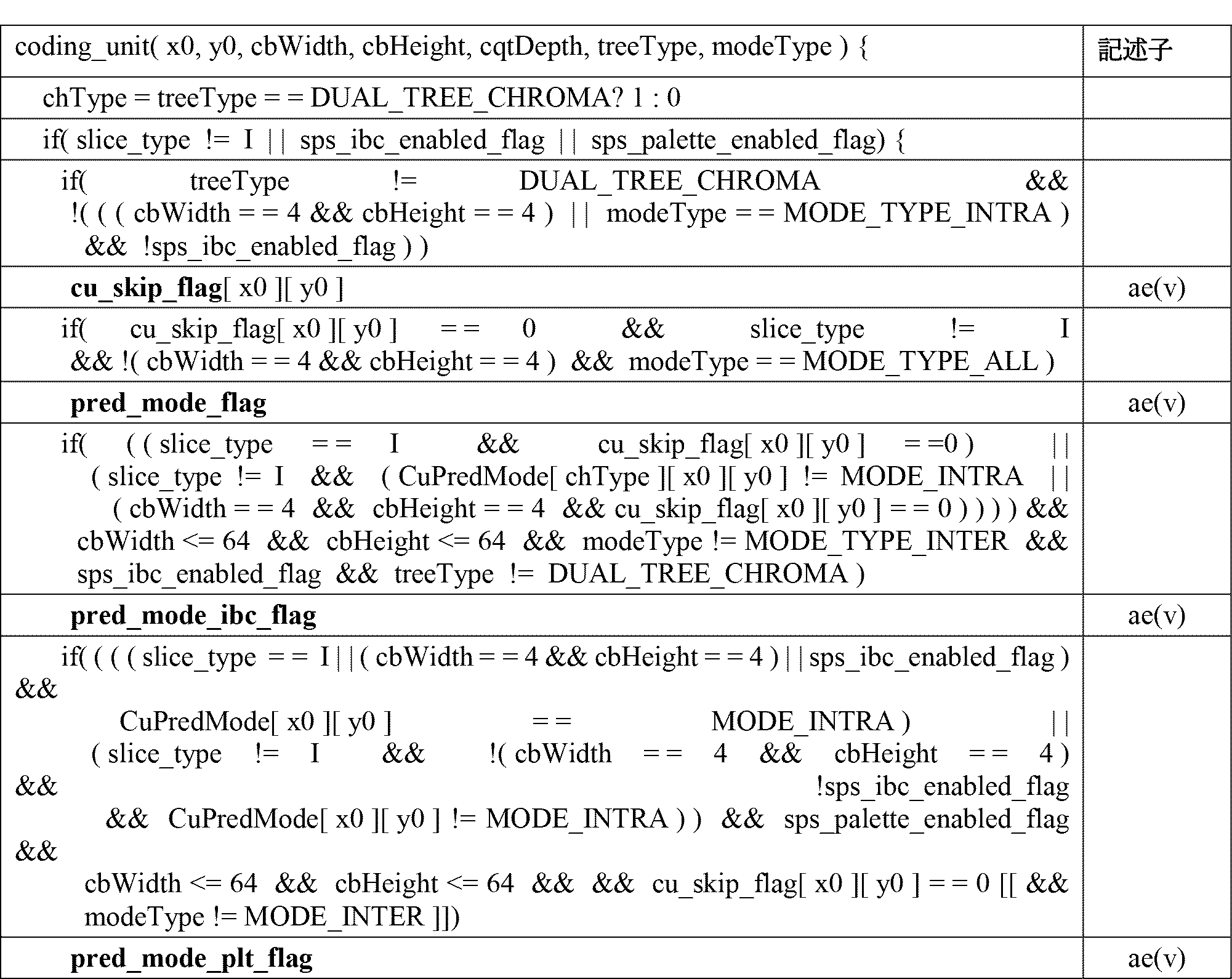
The following embodiments relate to palette mode flag signaling independent of modeType.
7.3.8. Coding unit syntax
5.3 例示的実施形態#3
以下の実施形態は、IBC予測モード・フラグがCU SKIPフラグおよびmodeTypeに依存して推定されることについてのものである。
5.3
The following embodiments are about the IBC prediction mode flag being deduced depending on the CU SKIP flag and modeType.
pred_mode_ibc_flagが1に等しいことは、現在のコーディング単位がIBC予測モードでコーディングされることを指定する。pred_mode_ibc_flagが0に等しいことは、現在のコーディング単位がIBC予測モードでコーディングされないことを指定する。 A pred_mode_ibc_flag equal to 1 specifies that the current coding unit is coded with the IBC prediction mode. Pred_mode_ibc_flag equal to 0 specifies that the current coding unit is not coded in IBC prediction mode.
pred_mode_ibc_flagが存在しない場合、それは次のように推定される:
・cu_skip_flag[x0][y0]が1に等しく、cbWidthが4に等しく、cbHeightが4に等しい場合、pred_mode_ibc_flagは1に等しいと推定される。
・それ以外の場合で、cbWidthとcbHeightの両方が128に等しい場合、pred_mode_ibc_flagは0に等しいと推定される。
・それ以外の場合で、cu_skip_flag[x0][y0]が1に等しく、modeTypeがMODE_TYPE_INTRAに等しい場合、pred_mode_ibc_flagは1に等しいと推定される。
・それ以外の場合で、modeTypeがMODE_TYPE_INTERに等しい場合、pred_mode_ibc_flagは0に等しいと推定される。
・それ以外の場合で、treeTypeがDUAL_TREE_CHROMAに等しい場合、pred_mode_ibc_flagは0に等しいと推定される。
・それ以外の場合で、pred_mode_ibc_flagは、Iスライスをデコードするときはsps_ibc_enabled_flagの値に、PまたはBスライスをデコードするときは0に等しいと推定される。
If pred_mode_ibc_flag is not present, it is assumed as follows:
- If cu_skip_flag[x0][y0] is equal to 1, cbWidth is equal to 4, and cbHeight is equal to 4, then pred_mode_ibc_flag is assumed to be equal to 1.
o Otherwise, if cbWidth and cbHeight are both equal to 128, pred_mode_ibc_flag is presumed to be equal to 0.
o Otherwise, if cu_skip_flag[x0][y0] is equal to 1 and modeType is equal to MODE_TYPE_INTRA, then pred_mode_ibc_flag is presumed to be equal to 1.
o Otherwise, if modeType is equal to MODE_TYPE_INTER, then pred_mode_ibc_flag is presumed to be equal to 0.
o Otherwise, if treeType equals DUAL_TREE_CHROMA, pred_mode_ibc_flag is presumed equal to 0.
o Otherwise, pred_mode_ibc_flag is assumed to be equal to the value of sps_ibc_enabled_flag when decoding I slices and 0 when decoding P or B slices.
pred_mode_ibc_flagが1の場合、変数CuPredMode[chType][x][y]は、x=x0..x0+cbWidth-1およびy=y0..y0+cbHeight-1について、MODE_IBCに等しいと設定される。 If pred_mode_ibc_flag is 1, the variable CuPredMode[chType][x][y] is set equal to MODE_IBC for x=x0..x0+cbWidth−1 and y=y0..y0+cbHeight−1.
5.4 例示的実施形態#4
以下の実施形態は、IBC予測モード・フラグの信号伝達がMODE_TYPE_INTRAに依存する、および/またはIBCモードは、それが小さいブロック・サイズであるかどうかにかかわらず、ルーマ・ブロックについて許容されることに関する。
5.4
The following embodiments relate to signaling of IBC prediction mode flags depending on MODE_TYPE_INTRA and/or IBC mode is allowed for luma blocks regardless of whether it is a small block size .
7.3.8. コーディング単位構文
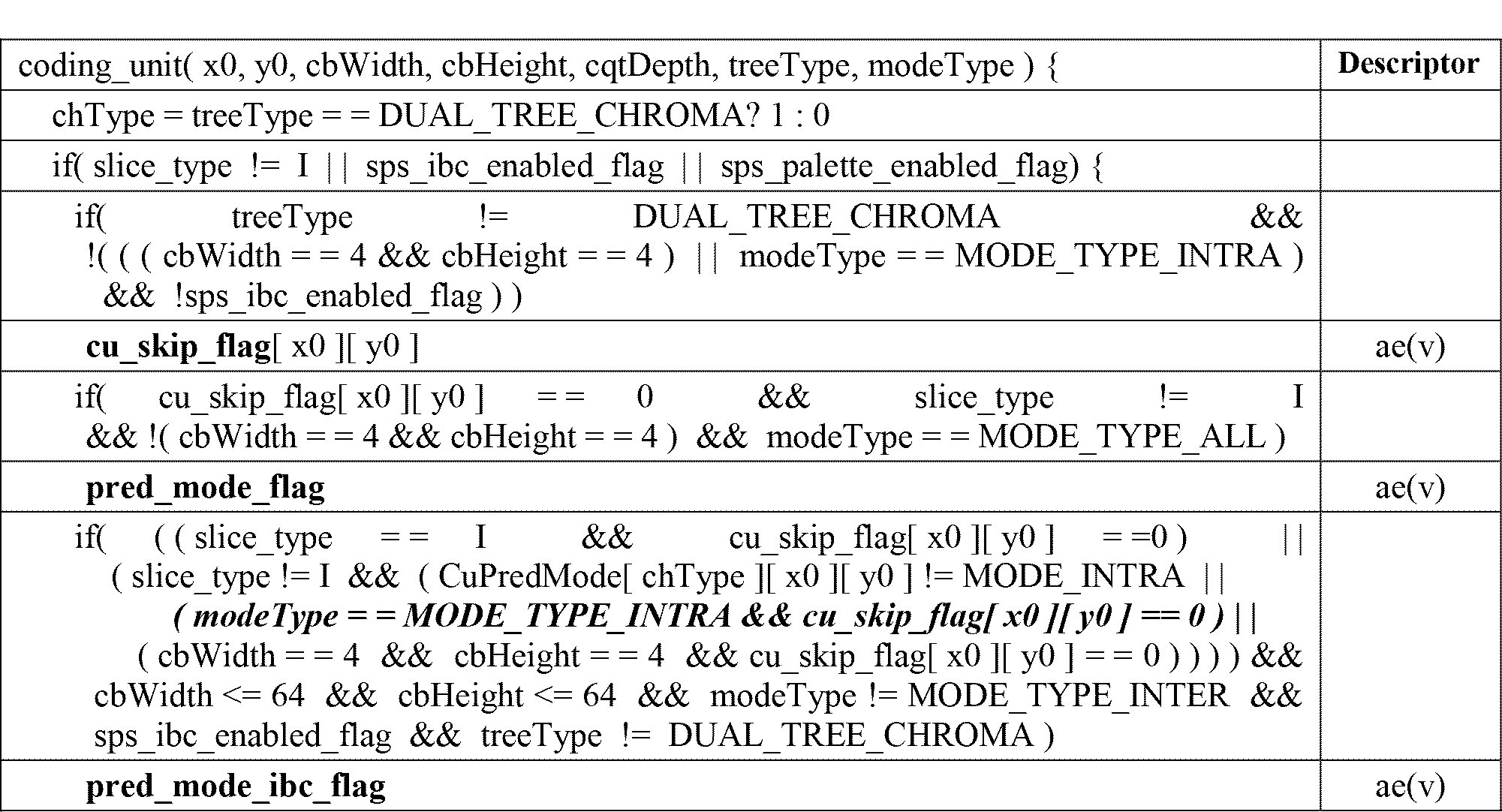
5.5 例示的実施形態#5
以下の実施形態は、4:2:0および4:2:2色フォーマットについて異なるイントラブロック制約条件を適用することに関する。
5.5
The following embodiments relate to applying different intra-block constraints for 4:2:0 and 4:2:2 color formats.
7.4.9.4 コーディングツリーのセマンティクス
変数modeTypeConditionは次のように導出される:
・次の条件のいずれかが真である場合、modeTypeConditionは0に設定される。
・slice_type==Iかつqtbtt_dual_tree_intra_flagが1に等しい
・modeTypeCurrがMODE_TYPE_ALLと等しくない
・それ以外の場合で、次の条件のいずれかが真である場合、modeTypeConditionは1に等しく設定される。
・cbWidth*cbHeightが64に等しく、split_qt_flagが1に等しい
・cbWidth*cbHeightが64に等しく、MttSplitMode[x0][y0][mttDepth]がSPLIT_TT_HORまたはSPLIT_TT_VERに等しい
・cbWidth*cbHeightが32に等しく、MttSplitMode[x0][y0][mttDepth]がSPLIT_BT_HORまたはSPLIT_BT_VERに等しい
・それ以外の場合で、次の条件のいずれかが真である場合、modeTypeConditionは1+(slice_type!=I?1:0)に等しく設定される。
・cbWidth*cbHeightが64に等しく、MttSplitMode[x0][y0][mttDepth]がSPLIT_BT_HORまたはSPLIT_BT_VERに等しく、chroma_format_idcが1に等しい
・cbWidth*cbHeightが128に等しく、MttSplitMode[x0][y0][mttDepth]がSPLIT_TT_HORまたはSPLIT_TT_VERに等しく、chroma_format_idcが1に等しい
・cbWidthが8に等しく、cbHeightが8に等しく、MttSplitMode[x0][y0][mttDepth]がSPLIT_BT_VERに等しく、chroma_format_idcが2に等しい
・cbWidthが4に等しく、cbHeightが16に等しく、MttSplitMode[x0][y0][mttDepth]がSPLIT_BT_HORに等しく、chroma_format_idcが2に等しい
・cbWidthが16に等しく、cbHeightが8に等しく、MttSplitMode[x0][y0][mttDepth]がSPLIT_TT_VERに等しく、chroma_format_idcが2に等しい
・cbWidthが4に等しく、cbHeightが32に等しく、MttSplitMode[x0][y0][mttDepth]がSPLIT_TT_HORに等しく、chroma_format_idcが2に等しい
・それ以外の場合は、modeTypeConditionは0に設定される。
7.4.9.4 Coding Tree Semantics The variable modeTypeCondition is derived as follows:
• modeTypeCondition is set to 0 if any of the following conditions are true:
• slice_type==I and qtbtt_dual_tree_intra_flag is equal to 1 • modeTypeCurr is not equal to MODE_TYPE_ALL Otherwise, modeTypeCondition is set equal to 1 if any of the following conditions are true:
- cbWidth*cbHeight equals 64 and split_qt_flag equals 1 - cbWidth*cbHeight equals 64 and MttSplitMode[x0][y0][mttDepth] equals SPLIT_TT_HOR or SPLIT_TT_VER - cbWidth*cbHeight equals 32 and MttSplitMode[ x0][y0][mttDepth] equals SPLIT_BT_HOR or SPLIT_BT_VER Else if any of the following conditions are true, modeTypeCondition is set equal to 1 + (slice_type!=I?1:0) be.
- cbWidth*cbHeight equals 64, MttSplitMode[x0][y0][mttDepth] equals SPLIT_BT_HOR or SPLIT_BT_VER, and chroma_format_idc equals 1 - cbWidth*cbHeight equals 128, MttSplitMode[x0][y0][mttDepth] is equal to SPLIT_TT_HOR or SPLIT_TT_VER and chroma_format_idc is equal to 1
- cbWidth equals 8, cbHeight equals 8, MttSplitMode[x0][y0][mttDepth] equals SPLIT_BT_VER, chroma_format_idc equals 2
- cbWidth equals 4, cbHeight equals 16, MttSplitMode[x0][y0][mttDepth] equals SPLIT_BT_HOR, chroma_format_idc equals 2
- cbWidth equals 16, cbHeight equals 8, MttSplitMode[x0][y0][mttDepth] equals SPLIT_TT_VER, chroma_format_idc equals 2
- cbWidth equals 4, cbHeight equals 32, MttSplitMode[x0][y0][mttDepth] equals SPLIT_TT_HOR, chroma_format_idc equals 2
• Otherwise, modeTypeCondition is set to 0.
5.6 例示的実施形態#6
以下の実施形態は、シングルツリーにおける2×Nクロマ・イントラ・ブロックを禁止することに関する。
5.6 Illustrative Embodiment #6
The following embodiments relate to prohibiting 2xN chroma intra blocks in a single tree.
7.4.9.4 コーディングツリーの意味
変数modeTypeConditionは次のように導出される:
・次の条件のいずれかが真である場合、modeTypeConditionは0に設定される。
・slice_type==Iかつqtbtt_dual_tree_intra_flagが1に等しい
・modeTypeCurrがMODE_TYPE_ALLと等しくない
・それ以外の場合で、次の条件のいずれかが真である場合、modeTypeConditionは1に設定される。
・cbWidth*cbHeightが64に等しく、split_qt_flagが1に等しい
・cbWidth*cbHeightが64に等しく、MttSplitMode[x0][y0][mttDepth]がSPLIT_TT_HORまたはSPLIT_TT_VERに等しい
・cbWidth*cbHeightが32に等しく、MttSplitMode[x0][y0][mttDepth]がSPLIT_BT_HORまたはSPLIT_BT_VERに等しい
・それ以外の場合で、次の条件のいずれかが真である場合、modeTypeConditionは1+(slice_type!=I?1:0)に設定される。
・cbWidth*cbHeightが64に等しく、MttSplitMode[x0][y0][mttDepth]がSPLIT_BT_HORまたはSPLIT_BT_VERに等しい
・cbWidth*cbHeightが128に等しく、MttSplitMode[x0][y0][mttDepth]がSPLIT_TT_HORまたはSPLIT_TT_VERに等しい
・cbWidthが8に等しく、MttSplitMode[x0][y0][mttDepth]がSPLIT_BT_VERに等しい
・cbWidthが16に等しく、MttSplitMode[x0][y0][mttDepth]がSPLIT_TT_VERに等しい
・それ以外の場合は、modeTypeConditionは0に設定される。
7.4.9.4 Coding Tree Semantics The variable modeTypeCondition is derived as follows:
• modeTypeCondition is set to 0 if any of the following conditions are true:
• slice_type==I and qtbtt_dual_tree_intra_flag is equal to 1 • modeTypeCurr is not equal to MODE_TYPE_ALL Otherwise, modeTypeCondition is set to 1 if any of the following conditions are true:
- cbWidth*cbHeight equals 64 and split_qt_flag equals 1 - cbWidth*cbHeight equals 64 and MttSplitMode[x0][y0][mttDepth] equals SPLIT_TT_HOR or SPLIT_TT_VER - cbWidth*cbHeight equals 32 and MttSplitMode[ x0][y0][mttDepth] is equal to SPLIT_BT_HOR or SPLIT_BT_VER Otherwise, modeTypeCondition is set to 1 + (slice_type!=I?1:0) if any of the following conditions are true .
- cbWidth*cbHeight equals 64 and MttSplitMode[x0][y0][mttDepth] equals SPLIT_BT_HOR or SPLIT_BT_VER - cbWidth*cbHeight equals 128 and MttSplitMode[x0][y0][mttDepth] equals SPLIT_TT_HOR or SPLIT_TT_VER
- cbWidth equals 8 and MttSplitMode[x0][y0][mttDepth] equals SPLIT_BT_VER
- cbWidth equals 16 and MttSplitMode[x0][y0][mttDepth] equals SPLIT_TT_VER
• Otherwise, modeTypeCondition is set to 0.
5.7 例示的実施形態#7
以下の実施形態は、デュアルツリーにおける2×Nクロマ・イントラ・ブロックを禁止することに関する。
5.7
The following embodiments relate to prohibiting 2xN chroma intra blocks in dual trees.
6.4.2 許容される二分分割プロセス
変数allowBtSplitは次のように導出される:
・次の条件の一つまたは複数が真である場合、allowBtSplitがFALSEに等しく設定される:
・cbSizeがMinBtSizeY以下
・cbWidthがmaxBtSizeより大きい
・cbHeightがmaxBtSizeより大きい
・mttDepthがmaxMttDepth以上
・treeTypeがDUAL_TREE_CHROMAと等しく、(cbWidth/SubWidthC)*(cbHeight/SubHeightC)は16以下
・btSplitがSPLIT_BT_VERに等しく、treeTypeがDUAL_TREE_CHROMAに等しく、(cbWidth/SubWidthC)が4以下
・treeTypeがDUAL_TREE_CHROMAに等しく、modeTypeはMODE_TYPE_INTRAに等しい
……
6.4.2 Allowed Bipartition Processes The variable allowBtSplit is derived as follows:
- allowBtSplit is set equal to FALSE if one or more of the following conditions are true:
・cbSize is less than or equal to MinBtSizeY ・cbWidth is greater than maxBtSize ・cbHeight is greater than maxBtSize ・mttDepth is greater than or equal to maxMttDepth ・treeType is equal to DUAL_TREE_CHROMA and (cbWidth/SubWidthC) * (cbHeight/SubHeightC) is 16 or less
- btSplit equals SPLIT_BT_VER, treeType equals DUAL_TREE_CHROMA, and (cbWidth/SubWidthC) is 4 or less
・treeType equals DUAL_TREE_CHROMA and modeType equals MODE_TYPE_INTRA……
6.4.3 許容される三分分割プロセス
変数allowTtSplitは次のように導出される:
・次の条件の一つまたは複数が真の場合は、allowTtSplitがFALSEに等しく設定される:
・cbSizeが2×MinTtSizeY以下
・cbWidthがMin(MaxTbSizeY,maxTtSize)より大きい
・cbHeightがMin(MaxTbSizeY,maxTtSize)より大きい
・mttDepthがmaxMttDepth以上
・x0+cbWidthがpic_width_in_luma_samplesより大きい
・y0+cbHeightがpic_height_in_luma_samplesより大きい
・treeTypeがDUAL_TREE_CHROMAと等しく、(cbWidth/SubWidthC)*(cbHeight/SubHeightC)は32以下
・btSplitがSPLIT_TT_VERに等しく、treeTypeがDUAL_TREE_CHROMAに等しく、(cbWidth/SubWidthC)が8以下
・treeTypeがDUAL_TREE_CHROMAに等しく、modeTypeがMODE_TYPE_INTRAに等しい
・それ以外の場合は、allowTtSplitはTRUEに等しく設定される。
6.4.3 Allowed Tripartitioning Process The variable allowTtSplit is derived as follows:
- allowTtSplit is set equal to FALSE if one or more of the following conditions are true:
・cbSize is less than 2×MinTtSizeY ・cbWidth is greater than Min (MaxTbSizeY, maxTtSize) ・cbHeight is greater than Min (MaxTbSizeY, maxTtSize) ・mttDepth is greater than maxMttDepth ・x0+cbWidth is greater than pic_width_in_luma_samples ・y0+cbHeight is greater than pic_height_in_luma_samples ・treeType is DUAL_TREE_ CHROMA and (cbWidth/SubWidthC) * (cbHeight/SubHeightC) is less than or equal to 32
- btSplit equals SPLIT_TT_VER, treeType equals DUAL_TREE_CHROMA, and (cbWidth/SubWidthC) is 8 or less
- treeType equals DUAL_TREE_CHROMA and modeType equals MODE_TYPE_INTRA - Otherwise, allowTtSplit is set equal to TRUE.
5.8 例示的実施形態#8
以下の実施形態は、SCIPUクロマ・ブロックに対してMODE_IBCを有効にすることに関するものである。
5.8
The following embodiments relate to enabling MODE_IBC for SCIPU chroma blocks.
7.3.8.5 コーディング単位構文
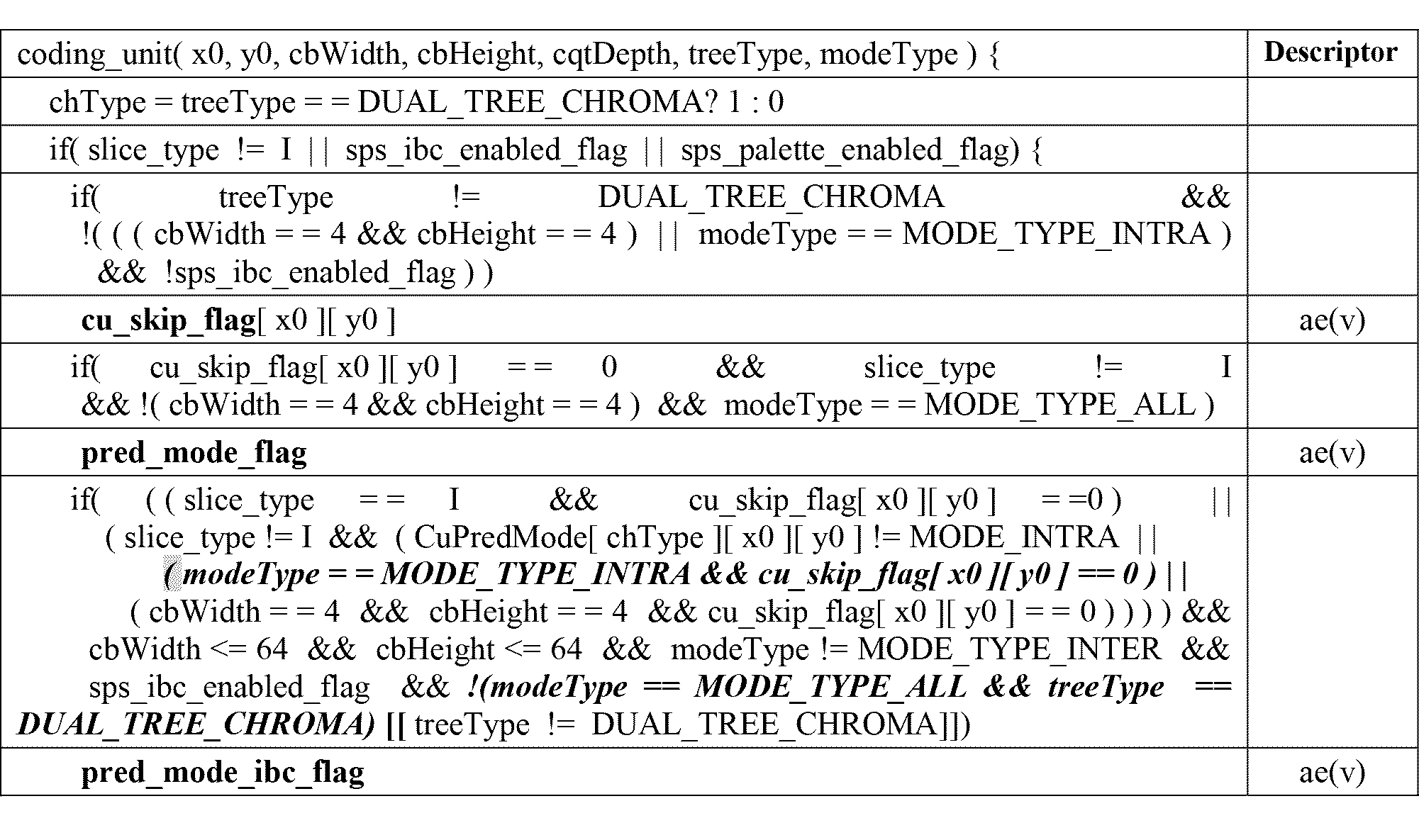
5.9 modeTypeがMODE_TYPE_INTERである場合のブロック分割の禁止に関する例示的実施形態#9(解決策1) 5.9 Exemplary embodiment #9 for prohibiting block splitting when modeType is MODE_TYPE_INTER (solution 1)
6.4.2 許容される二分分割プロセス
変数allowBtSplitは次のように導出される:
次の条件の一つまたは複数が真である場合、allowBtSplitはFALSEに等しく設定される:
・cbSizeがMinBtSizeY以下
・cbWidthがmaxBtSizeより大きい
・cbHeightがmaxBtSizeより大きい
・mttDepthがmaxMttDepth以上
・treeTypeはDUAL_TREE_CHROMAと等しく、(cbWidth/SubWidthC)*(cbHeight/SubHeightC)は16以下
・modeTypeはMODE_TYPE_INTERに等しく、cbWidth*cbHeightは32以下
・treeTypeはDUAL_TREE_CHROMAに等しく、modeTypeはMODE_TYPE_INTRAに等しい
……
6.4.2 Allowed Bipartition Processes The variable allowBtSplit is derived as follows:
allowBtSplit is set equal to FALSE if one or more of the following conditions are true:
・cbSize is less than or equal to MinBtSizeY ・cbWidth is greater than maxBtSize ・cbHeight is greater than maxBtSize ・mttDepth is greater than or equal to maxMttDepth ・treeType is equal to DUAL_TREE_CHROMA and (cbWidth/SubWidthC) * (cbHeight/SubHeightC) is less than or equal to 16 ・modeType is equal to MODE_TYPE_INTER and cbWidth*cbHeight is 32 or less
・treeType equals DUAL_TREE_CHROMA, modeType equals MODE_TYPE_INTRA...
6.4.3 許容される三分分割プロセス
変数allowTtSplitは次のように導出される:
・次の条件の一つまたは複数が真の場合は、allowTtSplitはFALSEに等しく設定される:
・cbSizeが2×MinTtSizeY以下
・cbWidthがMin(MaxTbSizeY,maxTtSize)より大きい
・cbHeightがMin(MaxTbSizeY,maxTtSize)より大きい
・mttDepthがmaxMttDepth以上
・x0+cbWidthがpic_width_in_luma_samplesより大きい
・y0+cbHeightがpic_height_in_luma_samplesより大きい
・treeTypeがDUAL_TREE_CHROMAと等しく、(cbWidth/SubWidthC)*(cbHeight/SubHeightC)は32以下
・modeTypeがMODE_TYPE_INTERに等しく、cbWidth*cbHeightは64以下
・treeTypeがDUAL_TREE_CHROMAに等しく、modeTypeはMODE_TYPE_INTRAに等しい
・それ以外の場合は、allowTtSplitはTRUEに等しく設定される。
6.4.3 Allowed Tripartitioning Process The variable allowTtSplit is derived as follows:
o allowTtSplit is set equal to FALSE if one or more of the following conditions are true:
・cbSize is less than 2×MinTtSizeY ・cbWidth is greater than Min (MaxTbSizeY, maxTtSize) ・cbHeight is greater than Min (MaxTbSizeY, maxTtSize) ・mttDepth is greater than maxMttDepth ・x0+cbWidth is greater than pic_width_in_luma_samples ・y0+cbHeight is greater than pic_height_in_luma_samples ・treeType is DUAL_TREE_ CHROMA and (cbWidth/SubWidthC) * (cbHeight/SubHeightC) is less than or equal to 32
- modeType is equal to MODE_TYPE_INTER and cbWidth*cbHeight is less than or equal to 64
- treeType equals DUAL_TREE_CHROMA and modeType equals MODE_TYPE_INTRA - Otherwise, allowTtSplit is set equal to TRUE.
5.10 modeTypeがMODE_TYPE_INTERである場合のブロック分割の禁止に関する例示的実施形態#10(解決策2)
5.10
6.4.2 許容される二分分割プロセス
変数allowBtSplitは次のように導出される:
・次の条件の一つまたは複数が真である場合、allowBtSplitはFALSEに等しく設定される:
・cbSizeがMinBtSizeY以下
・cbWidthがmaxBtSizeより大きい
・cbHeightがmaxBtSizeより大きい
・mttDepthがmaxMttDepth以上
・treeTypeはDUAL_TREE_CHROMAと等しく、(cbWidth/SubWidthC)*(cbHeight/SubHeightC)は16以下
・modeTypeはMODE_TYPE_INTERと等しい
・treeTypeはDUAL_TREE_CHROMAに等しく、modeTypeはMODE_TYPE_INTRAに等しい
……
6.4.2 Allowed Bipartition Processes The variable allowBtSplit is derived as follows:
o allowBtSplit is set equal to FALSE if one or more of the following conditions are true:
・cbSize is less than or equal to MinBtSizeY ・cbWidth is greater than maxBtSize ・cbHeight is greater than maxBtSize ・mttDepth is greater than or equal to maxMttDepth ・treeType is equal to DUAL_TREE_CHROMA and (cbWidth/SubWidthC) * (cbHeight/SubHeightC) is 16 or less
・modeType is equal to MODE_TYPE_INTER
・treeType equals DUAL_TREE_CHROMA, modeType equals MODE_TYPE_INTRA...
6.4.3 許容される三分分割プロセス
変数allowTtSplitは次のように導出される:
・次の条件の一つまたは複数が真の場合は、allowTtSplitはFALSEに等しく設定される:
・cbSizeが2×MinTtSizeY以下
・cbWidthがMin(MaxTbSizeY,maxTtSize)より大きい
・cbHeightがMin(MaxTbSizeY,maxTtSize)より大きい
・mttDepthがmaxMttDepth以上
・x0+cbWidthがpic_width_in_luma_samplesより大きい
・y0+cbHeightがpic_height_in_luma_samplesより大きい
・treeTypeはDUAL_TREE_CHROMAと等しく、(cbWidth/SubWidthC)*(cbHeight/SubHeightC)は32以下
・modeTypeがMODE_TYPE_INTERと等しい
・treeTypeがDUAL_TREE_CHROMAに等しく、modeTypeはMODE_TYPE_INTRAに等しい
・それ以外の場合は、allowTtSplitがTRUEに等しく設定される。
6.4.3 Allowed Tripartitioning Process The variable allowTtSplit is derived as follows:
o allowTtSplit is set equal to FALSE if one or more of the following conditions are true:
・cbSize is less than 2×MinTtSizeY ・cbWidth is greater than Min (MaxTbSizeY, maxTtSize) ・cbHeight is greater than Min (MaxTbSizeY, maxTtSize) ・mttDepth is greater than maxMttDepth ・x0+cbWidth is greater than pic_width_in_luma_samples ・y0+cbHeight is greater than pic_height_in_luma_samples ・treeType is DUAL_TREE_ CHROMA and (cbWidth/SubWidthC) * (cbHeight/SubHeightC) is less than or equal to 32
・modeType is equal to MODE_TYPE_INTER
- treeType equals DUAL_TREE_CHROMA and modeType equals MODE_TYPE_INTRA - Otherwise, allowTtSplit is set equal to TRUE.
5.11 例示的実施形態#11
以下の実施形態は、MODE_TYPE_INTERが導出される場合のコーディングツリーのさらなる分割に関する制約条件に関する。
5.11
The following embodiments relate to constraints on further partitioning of the coding tree when MODE_TYPE_INTER is derived.
7.3.8.4 コーディングツリー構文7.3.8.4 Coding tree syntax
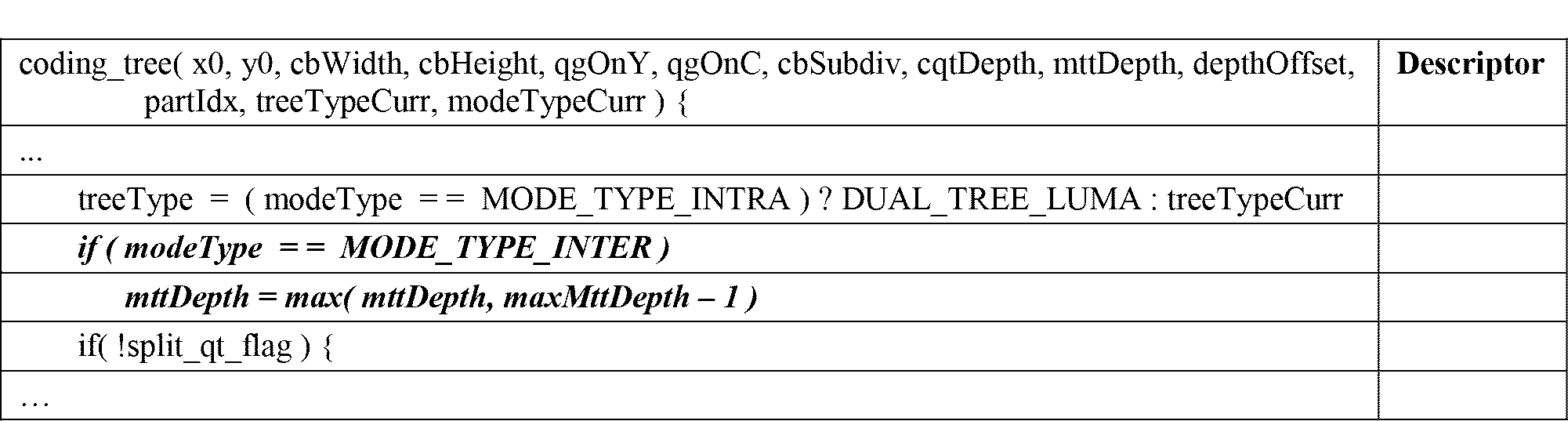
5.12 例示的実施形態#12
以下の実施形態は、小ブロック・パーティションに関する制約条件についてであり、予測モードは、パレット・モードが有効にされているときは適用されない。
5.12
The following embodiments are for constraints on small block partitions, where predictive mode does not apply when palette mode is enabled.
7.4.9.4 コーディングツリーのセマンティクス
変数modeTypeConditionは次のように導出される:
・次の条件のいずれかが真である場合、modeTypeConditionは0に設定される。
・slice_type==Iであり、かつ、qtbtt_dual_tree_intr_flagが1に等しい
・modeTypeCurrがMODE_TYPE_ALLと等しくない
・sps_palette_enabled_flagが1に等しい
・それ以外の場合で、次の条件のいずれかが真である場合、modeTypeConditionは1に設定される。
・cbWidth*cbHeightが64に等しく、split_qt_flagが1に等しい
・cbWidth*cbHeightが64に等しく、MttSplitMode[x0][y0][mttDepth]がSPLIT_TT_HORまたはSPLIT_TT_VERに等しい
・cbWidth*cbHeightが32に等しく、MttSplitMode[x0][y0][mttDepth]がSPLIT_BT_HORまたはSPLIT_BT_VERに等しい
・それ以外の場合で、次の条件のいずれかが真である場合、modeTypeConditionは1+(slice_type!=I?1:0)に設定される。
・cbWidth*cbHeightが64に等しく、MttSplitMode[x0][y0][mttDepth]がSPLIT_BT_HORまたはSPLIT_BT_VERに等しい
・cbWidth*cbHeightが128に等しく、MttSplitMode[x0][y0][mttDepth]はSPLIT_TT_HORまたはSPLIT_TT_VERに等しい
・それ以外の場合は、modeTypeConditionが0に設定される。
7.4.9.4 Coding Tree Semantics The variable modeTypeCondition is derived as follows:
• modeTypeCondition is set to 0 if any of the following conditions are true:
・slice_type==I and qtbtt_dual_tree_intr_flag is equal to 1 ・modeTypeCurr is not equal to MODE_TYPE_ALL
- sps_palette_enabled_flag is equal to 1
• Otherwise, modeTypeCondition is set to 1 if any of the following conditions are true:
- cbWidth*cbHeight equals 64 and split_qt_flag equals 1 - cbWidth*cbHeight equals 64 and MttSplitMode[x0][y0][mttDepth] equals SPLIT_TT_HOR or SPLIT_TT_VER - cbWidth*cbHeight equals 32 and MttSplitMode[ x0][y0][mttDepth] is equal to SPLIT_BT_HOR or SPLIT_BT_VER Otherwise, modeTypeCondition is set to 1 + (slice_type!=I?1:0) if any of the following conditions are true .
- cbWidth*cbHeight equals 64 and MttSplitMode[x0][y0][mttDepth] equals SPLIT_BT_HOR or SPLIT_BT_VER - cbWidth*cbHeight equals 128 and MttSplitMode[x0][y0][mttDepth] equals SPLIT_TT_HOR or SPLIT_TT_VER • Otherwise, modeTypeCondition is set to 0.
5.13 例示的実施形態#13
以下の実施形態は、4:2:2色フォーマットについての小さなクロマ・イントラ・ブロック制約条件についてである。
5.13 Illustrative Embodiment #13
The following embodiments are for small chroma intra block constraints for 4:2:2 color format.
7.4.9.4 コーディングツリーのセマンティクス
変数modeTypeConditionは次のように導出される:
・次の条件のいずれかが真である場合、modeTypeConditionは0に等しく設定される。
・slice_type==Iであり、qtbtt_dual_tree_intr_flagが1に等しい
・modeTypeCurrがMODE_TYPE_ALLと等しくない
・それ以外の場合で、次の条件のいずれかが真である場合、modeTypeConditionは1に設定される。
・cbWidth*cbHeightが64に等しく、split_qt_flagが1に等しい
・cbWidth*cbHeightが64に等しく、MttSplitMode[x0][y0][mttDepth]がSPLIT_TT_HORまたはSPLIT_TT_VERに等しい
・cbWidth*cbHeightが32に等しく、MttSplitMode[x0][y0][mttDepth]がSPLIT_BT_HORまたはSPLIT_BT_VERに等しい
・それ以外の場合で、chroma_format_idcが1に等しく、次の条件のいずれかが真の場合、modeTypeConditionは1+(slice_type!=I?1:0)に設定される。
・cbWidth*cbHeightが64に等しく、MttSplitMode[x0][y0][mttDepth]がSPLIT_BT_HORまたはSPLIT_BT_VERに等しい
・cbWidth*cbHeightが28に等しく、MttSplitMode[x0][y0][mttDepth]はSPLIT_TT_HORまたはSPLIT_TT_VERに等しい
・それ以外の場合は、modeTypeConditionが0に設定される。
7.4.9.4 Coding Tree Semantics The variable modeTypeCondition is derived as follows:
• modeTypeCondition is set equal to 0 if any of the following conditions are true:
• slice_type==I and qtbtt_dual_tree_intr_flag is equal to 1 • modeTypeCurr is not equal to MODE_TYPE_ALL Otherwise, modeTypeCondition is set to 1 if any of the following conditions are true:
- cbWidth*cbHeight equals 64 and split_qt_flag equals 1 - cbWidth*cbHeight equals 64 and MttSplitMode[x0][y0][mttDepth] equals SPLIT_TT_HOR or SPLIT_TT_VER - cbWidth*cbHeight equals 32 and MttSplitMode[ x0][y0][mttDepth] equals SPLIT_BT_HOR or SPLIT_BT_VER Else if chroma_format_idc equals 1 and any of the following conditions are true, then modeTypeCondition is 1 + (slice_type!=I?1:0 ).
- cbWidth*cbHeight equals 64 and MttSplitMode[x0][y0][mttDepth] equals SPLIT_BT_HOR or SPLIT_BT_VER - cbWidth*cbHeight equals 28 and MttSplitMode[x0][y0][mttDepth] equals SPLIT_TT_HOR or SPLIT_TT_VER • Otherwise, modeTypeCondition is set to 0.
5.14 SCIPUにおけるデルタQP信号伝達の例#1
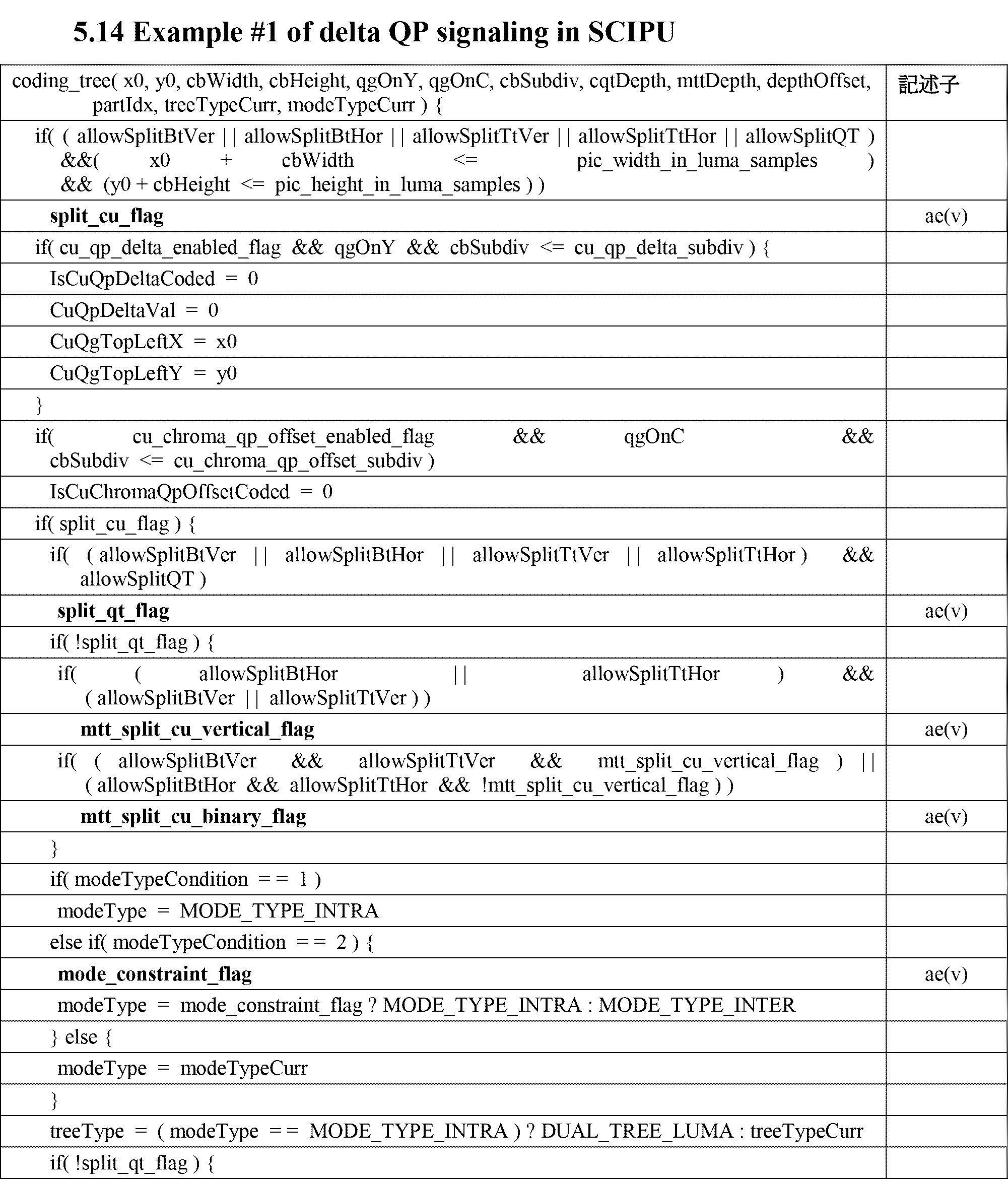

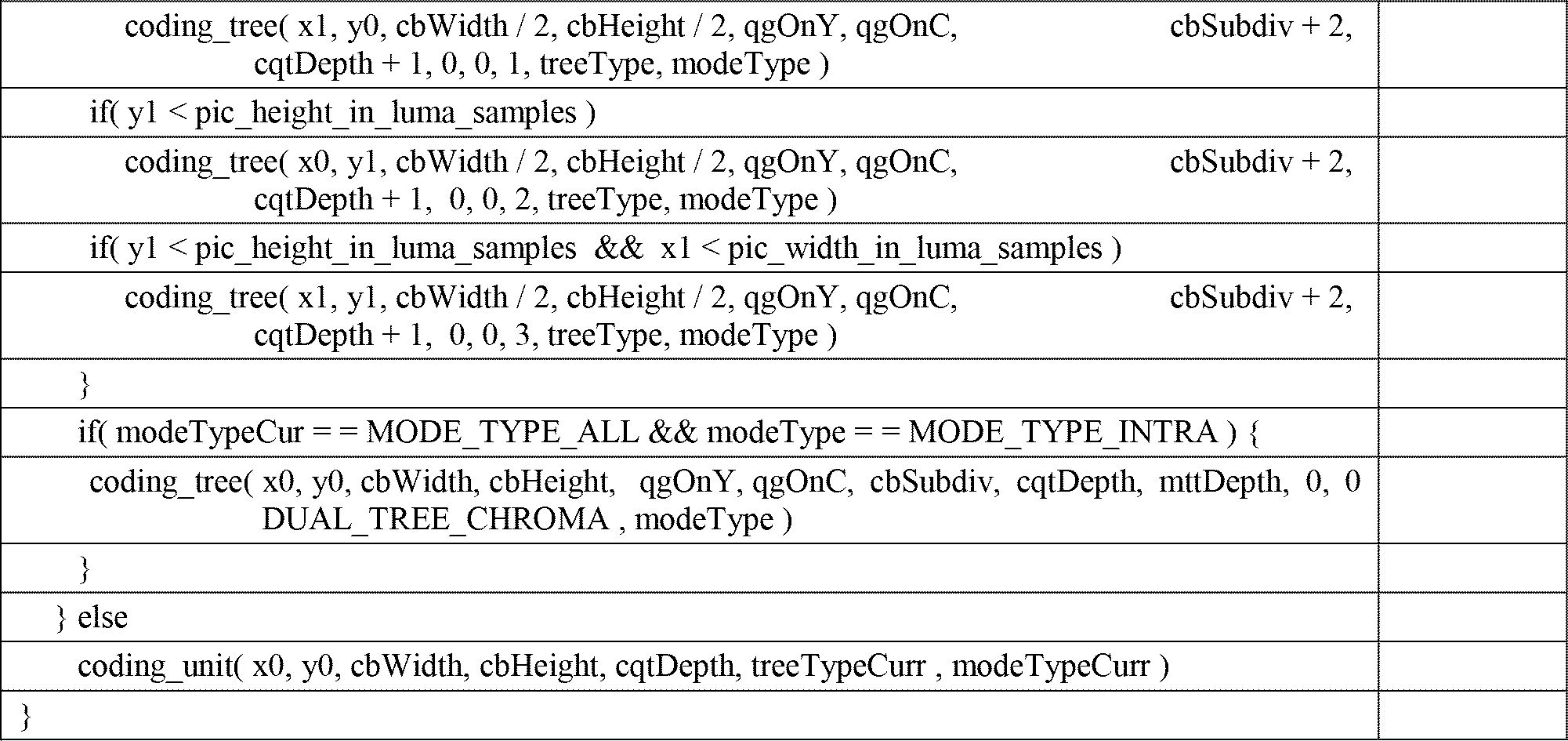
5.15 SCIPUにおけるデルタQP信号伝達の例#2


5.16 SCIPUにおけるデルタQP信号伝達の例#3

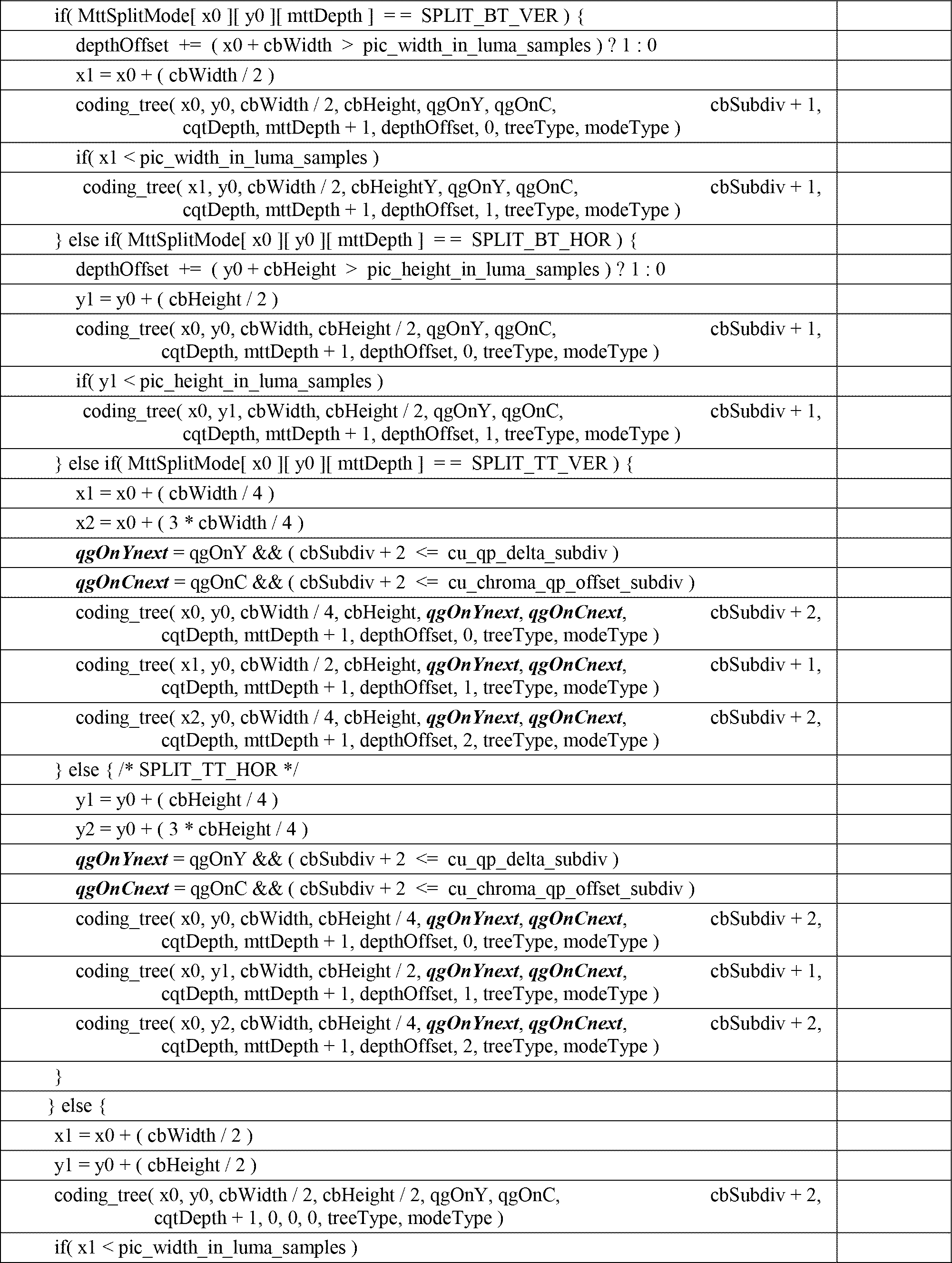

5.17 SCIPUにおけるデルタQP信号伝達の例#4
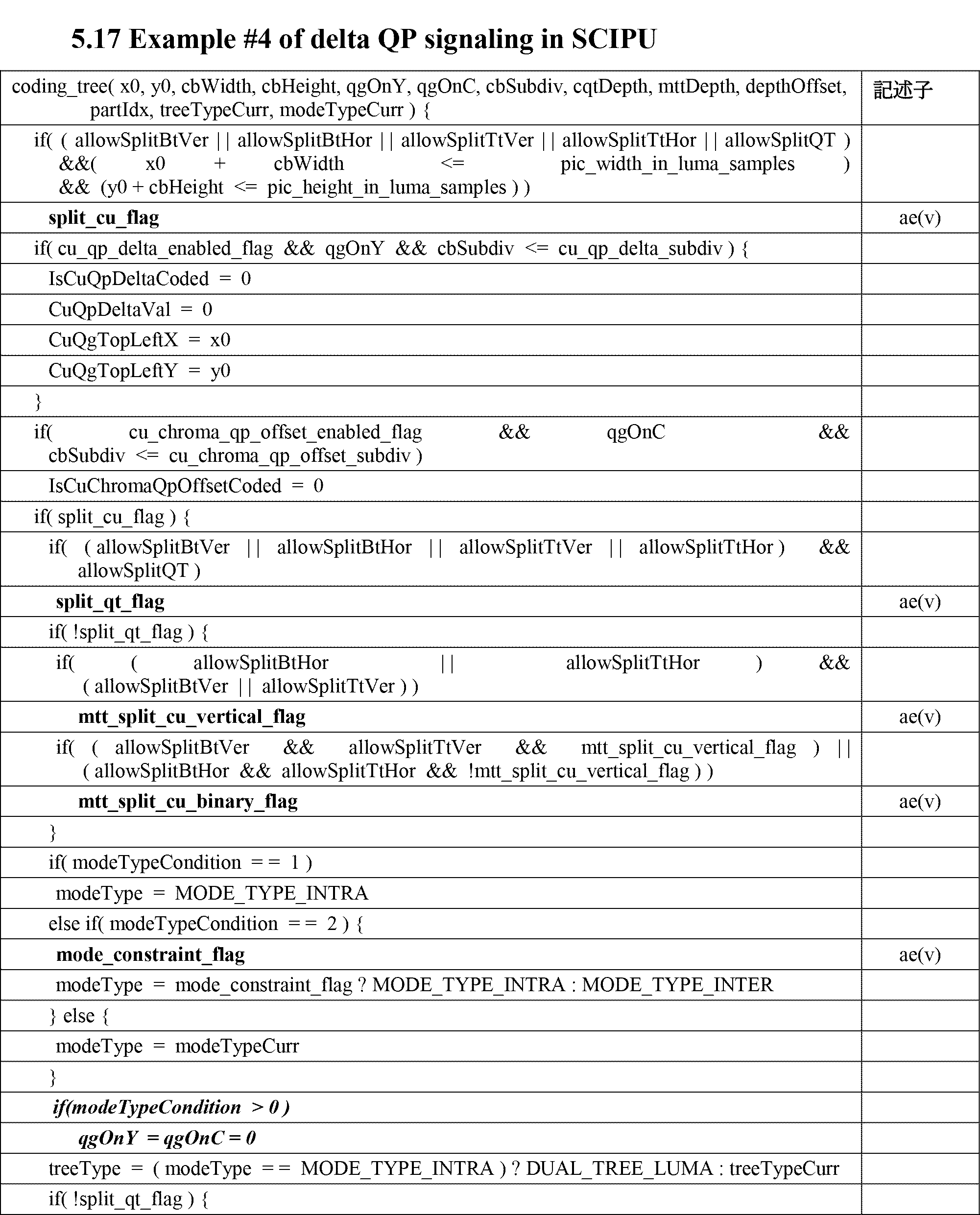


5.18 2×8クロマ・イントラ・ブロックを無効にする例#14
6.4.2. 許容される二分分割プロセス
変数allowBtSplitは次のように導出される:
・次の条件の一つまたは複数が真である場合、allowBtSplitがFALSEに等しく設定される:
・cbSizeがMinBtSizeY以下
・cbWidthがmaxBtSizeより大きい
・cbHeightがmaxBtSizeより大きい
・mttDepthがmaxMttDepth以上
・treeTypeがDUAL_TREE_CHROMAと等しく、(cbWidth/SubWidthC)*(cbHeight/SubHeightC)は16以下
・treeTypeがDUAL_TREE_CHROMAに等しく、btSplitはSPLIT_BT_VERに等しく、(cbWidth/SubWidthC)は4に等しく、(cbHeight/SubHeightC)は8に等しい
・treeTypeがDUAL_TREE_CHROMAに等しく、btSplitはSPLIT_BT_HORに等しく、(cbWidth/SubWidthC)が2に等しく、(cbHeight/SubHeightC)が16に等しい
・treeTypeがDUAL_TREE_CHROMAに等しく、modeTypeはMODE_TYPE_INTRAに等しい
……
5.18
6.4.2. Allowed Bipartition Processes The variable allowBtSplit is derived as follows:
- allowBtSplit is set equal to FALSE if one or more of the following conditions are true:
・cbSize is less than or equal to MinBtSizeY ・cbWidth is greater than maxBtSize ・cbHeight is greater than maxBtSize ・mttDepth is greater than or equal to maxMttDepth ・treeType is equal to DUAL_TREE_CHROMA and (cbWidth/SubWidthC) * (cbHeight/SubHeightC) is 16 or less
> treeType equals DUAL_TREE_CHROMA, btSplit equals SPLIT_BT_VER, (cbWidth/SubWidthC) equals 4, (cbHeight/SubHeightC) equals 8
> treeType equals DUAL_TREE_CHROMA, btSplit equals SPLIT_BT_HOR, (cbWidth/SubWidthC) equals 2, and (cbHeight/SubHeightC) equals 16
・treeType equals DUAL_TREE_CHROMA and modeType equals MODE_TYPE_INTRA……
6.4.3. 許容される三分分割プロセス
変数allowTtSplitは次のように導出される:
・次の条件の一つまたは複数が真の場合は、allowTtSplitがFALSEに等しく設定される;
・cbSizeが2×MinTtSizeY以下
・cbWidthがMin(MaxTbSizeY,maxTtSize)より大きい
・cbHeightがMin(MaxTbSizeY,maxTtSize)より大きい
・mttDepthがmaxMttDepth以上
・x0+cbWidthがpic_width_in_luma_samplesより大きい
・y0+cbHeightがpic_height_in_luma_samplesより大きい
・treeTypeはDUAL_TREE_CHROMAと等しく、(cbWidth/SubWidthC)*(cbHeight/SubHeightC)は32以下
・treeTypeがDUAL_TREE_CHROMAに等しく、btSplitがSPLIT_TT_VERに等しく、(cbWidth/SubWidthC)が8に等しく、(cbHeight/SubHeightC)が8に等しい
・treeTypeがDUAL_TREE_CHROMAに等しく、btSplitがSPLIT_TT_HORに等しく、(cbWidth/SubWidthC)が2に等しく、(cbHeight/SubHeightC)が32に等しい
・treeTypeがDUAL_TREE_CHROMAに等しく、modeTypeはMODE_TYPE_INTRAに等しい
・それ以外の場合は、allowTtSplitがTRUEに等しく設定される。
6.4.3. Allowed Tripartition Processes The variable allowTtSplit is derived as follows:
o allowTtSplit is set equal to FALSE if one or more of the following conditions are true;
・cbSize is less than 2×MinTtSizeY ・cbWidth is greater than Min (MaxTbSizeY, maxTtSize) ・cbHeight is greater than Min (MaxTbSizeY, maxTtSize) ・mttDepth is greater than maxMttDepth ・x0+cbWidth is greater than pic_width_in_luma_samples ・y0+cbHeight is greater than pic_height_in_luma_samples ・treeType is DUAL_TREE_ CHROMA and (cbWidth/SubWidthC) * (cbHeight/SubHeightC) is less than or equal to 32
> treeType equals DUAL_TREE_CHROMA, btSplit equals SPLIT_TT_VER, (cbWidth/SubWidthC) equals 8, and (cbHeight/SubHeightC) equals 8
> treeType equals DUAL_TREE_CHROMA, btSplit equals SPLIT_TT_HOR, (cbWidth/SubWidthC) equals 2, and (cbHeight/SubHeightC) equals 32
- treeType equals DUAL_TREE_CHROMA and modeType equals MODE_TYPE_INTRA - Otherwise, allowTtSplit is set equal to TRUE.
7.4.9.4. コーディングツリーのセマンティクス
変数modeTypeConditionは次のように導出される:
・次の条件のいずれかが真である場合、modeTypeConditionは0に設定される。
・slice_type==Iであり、qtbtt_dual_tree_intr_flagが1に等しい
・modeTypeCurrがMODE_TYPE_ALLと等しくない
・それ以外の場合で、次の条件のいずれかが真である場合、modeTypeConditionは1に設定される。
・cbWidth*cbHeightが64に等しく、split_qt_flagが1に等しい
・cbWidth*cbHeightが64に等しく、MttSplitMode[x0][y0][mttDepth]がSPLIT_TT_HORまたはSPLIT_TT_VERに等しい
・cbWidth*cbHeightが32に等しく、MttSplitMode[x0][y0][mttDepth]がSPLIT_BT_HORまたはSPLIT_BT_VERに等しい
・それ以外の場合で、次の条件のいずれかが真である場合、modeTypeConditionは1+(slice_type!=I?1:0)に設定される。
・cbWidth*cbHeightが64に等しく、MttSplitMode[x0][y0][mttDepth]がSPLIT_BT_HORまたはSPLIT_BT_VERに等しい
・cbWidth*cbHeightが128に等しく、MttSplitMode[x0][y0][mttDepth]がSPLIT_TT_HORまたはSPLIT_TT_VERに等しい
・cbWidthが8に等しく、(cbHeight/SubHeightC)が8に等しく、MttSplitMode[x0][y0][mttDepth]がSPLIT_BT_VERに等しい
・cbWidthが16に等しく、(cbHeight/SubHeightC)が8に等しく、MttSplitMode[x0][y0][mttDepth]がSPLIT_TT_VERに等しい
・cbWidthが4に等しく、(cbHeight/SubHeightC)が16に等しく、MttSplitMode[x0][y0][mttDepth]がSPLIT_BT_HORまたはSPLIT_TT_HORに等しい
・cbWidthが4に等しく、(cbHeight/SubHeightC)が32に等しく、MttSplitMode[x0][y0][mttDepth]がSPLIT_TT_HORに等しい
・それ以外の場合は、modeTypeConditionが0に設定される。
7.4.9.4. Coding Tree Semantics The variable modeTypeCondition is derived as follows:
• modeTypeCondition is set to 0 if any of the following conditions are true:
• slice_type==I and qtbtt_dual_tree_intr_flag is equal to 1 • modeTypeCurr is not equal to MODE_TYPE_ALL Otherwise, modeTypeCondition is set to 1 if any of the following conditions are true:
- cbWidth*cbHeight equals 64 and split_qt_flag equals 1 - cbWidth*cbHeight equals 64 and MttSplitMode[x0][y0][mttDepth] equals SPLIT_TT_HOR or SPLIT_TT_VER - cbWidth*cbHeight equals 32 and MttSplitMode[ x0][y0][mttDepth] is equal to SPLIT_BT_HOR or SPLIT_BT_VER Otherwise, modeTypeCondition is set to 1 + (slice_type!=I?1:0) if any of the following conditions are true .
- cbWidth*cbHeight equals 64 and MttSplitMode[x0][y0][mttDepth] equals SPLIT_BT_HOR or SPLIT_BT_VER - cbWidth*cbHeight equals 128 and MttSplitMode[x0][y0][mttDepth] equals SPLIT_TT_HOR or SPLIT_TT_VER
- cbWidth equals 8, (cbHeight/SubHeightC) equals 8, and MttSplitMode[x0][y0][mttDepth] equals SPLIT_BT_VER
- cbWidth equals 16, (cbHeight/SubHeightC) equals 8, and MttSplitMode[x0][y0][mttDepth] equals SPLIT_TT_VER
- cbWidth equals 4, (cbHeight/SubHeightC) equals 16, and MttSplitMode[x0][y0][mttDepth] equals SPLIT_BT_HOR or SPLIT_TT_HOR
- cbWidth equals 4, (cbHeight/SubHeightC) equals 32, and MttSplitMode[x0][y0][mttDepth] equals SPLIT_TT_HOR
• Otherwise, modeTypeCondition is set to 0.
7.4.9.7. マージ・データのセマンティクス
ciip_flag[x0][y0]は、ピクチャー間マージとピクチャー内予測の組み合わせが現在のコーディング単位に適用されるかどうかを指定する。配列インデックスx0,y0は、ピクチャーの左上のルーマ・サンプルに対する、考慮されるコーディングブロックの左上のルーマ・サンプルの位置(x0,y0)を指定する。
ciip_flag[x0][y0]が存在しない場合、次のように推定される:
・以下の条件がすべて真である場合、ciip_flag[x0][y0]は1に等しいと推定される:
・sps_ciip_enabled_flagが1に等しい
・general_merge_flag[x0][y0]が1に等しい
・merge_subblock_flag[x0][y0]が0に等しい
・regular_merge_flag[x0][y0]が0に等しい
・cbWidthが128未満
・cbHeightが128未満
・cbWidthが4より大きく、cbHeightが16に等しくない
・cbWidth*cbHeightが64以上
・それ以外の場合は、ciip_flag[x0][y0]は0に等しいと推定される。
7.4.9.7. Merge data semantics
ciip_flag[x0][y0] specifies whether a combination of inter-picture merging and intra-picture prediction is applied to the current coding unit. Array index x0,y0 specifies the position (x0,y0) of the top left luma sample of the considered coding block relative to the top left luma sample of the picture.
If ciip_flag[x0][y0] does not exist, it is assumed to be:
o ciip_flag[x0][y0] is assumed to be equal to 1 if all of the following conditions are true:
・sps_ciip_enabled_flag is equal to 1 ・general_merge_flag[x0][y0] is equal to 1 ・merge_subblock_flag[x0][y0] is equal to 0 ・regular_merge_flag[x0][y0] is equal to 0 ・cbWidth is less than 128 ・cbHeight is less than 128
- cbWidth is greater than 4 and cbHeight is not equal to 16
- cbWidth*cbHeight is greater than or equal to 64 - Otherwise, ciip_flag[x0][y0] is assumed to be equal to 0.
7.3.8.7. マージ・データの構文
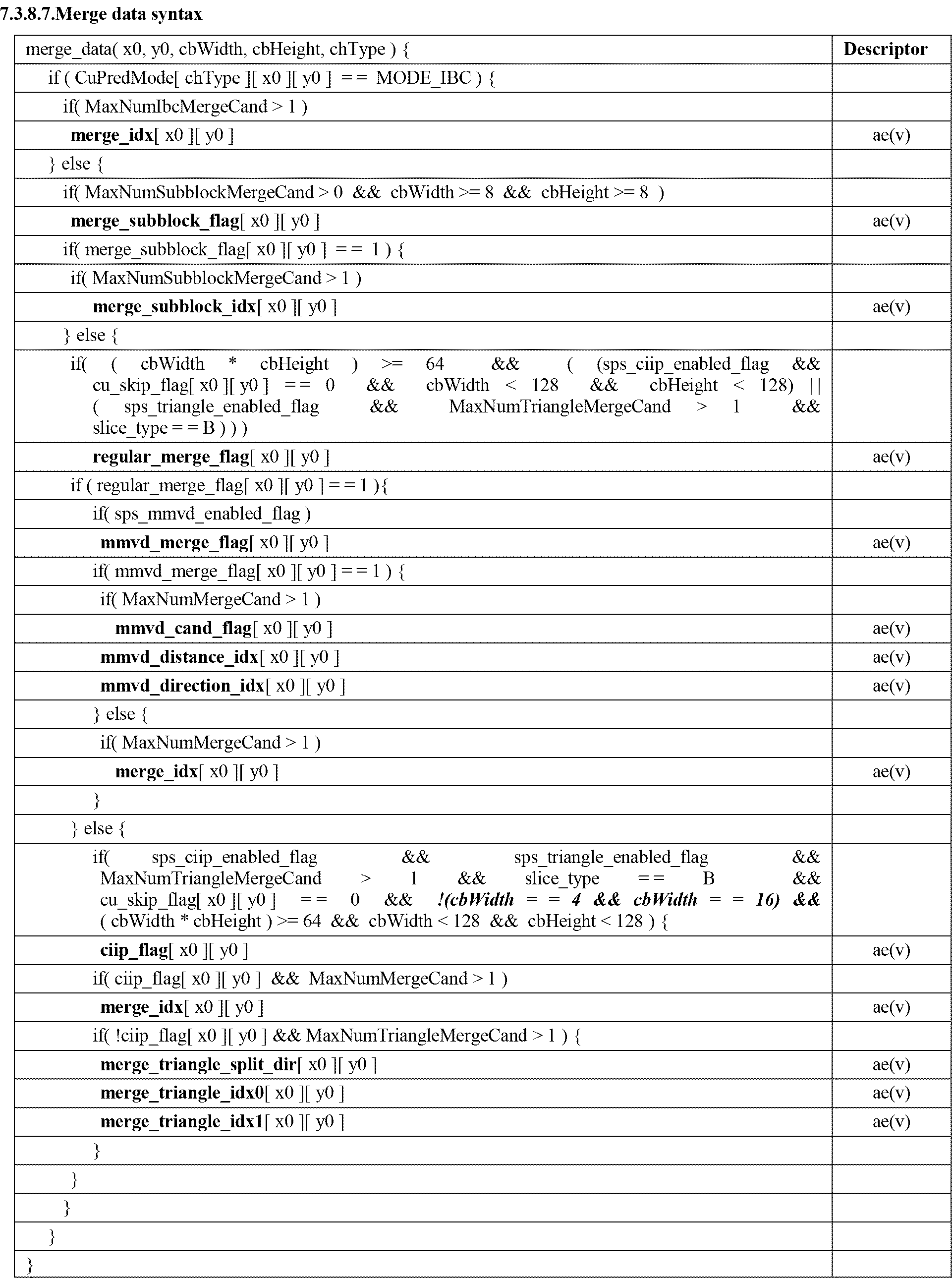
図17Aは、ビデオ処理装置1700のブロック図である。装置1700は、本明細書に記載される方法のうちの一つまたは複数を実装するために使用されてもよい。装置1700は、スマートフォン、タブレット、コンピュータ、モノのインターネット(IoT)受信機などにおいて具現されてもよい。装置1700は、一つまたは複数のプロセッサ1702、一つまたは複数のメモリ1704、およびビデオ処理ハードウェア1706を含んでいてもよい。プロセッサ1702は、本稿に記載される一つまたは複数の方法を実装するように構成されてもよい。メモリ(単数または複数)1704は、本明細書に記載される方法および技法を実装するために使用されるデータおよびコードを記憶するために使用されてもよい。ビデオ処理ハードウェア1706は、ハードウェア回路において、本稿に記載されるいくつかの技法を実装するために使用されてもよい。
FIG. 17A is a block diagram of a
図17Bは、開示された技法が実装されうるビデオ処理システムのブロック図の別の例である。図17Bは、本明細書に開示されるさまざまな技法が実装されうる例示的なビデオ処理システム1710を示すブロック図である。さまざまな実装は、システム1710の構成要素の一部または全部を含んでいてもよい。システム1710は、ビデオ・コンテンツを受信するための入力1712を含んでいてもよい。ビデオ・コンテンツは、生または非圧縮フォーマット、たとえば、8または10ビットの多成分ピクセル値の形で受領されてもよく、または圧縮またはエンコードされたフォーマットで受領されてもよい。入力1712は、ネットワークインターフェース、周辺バスインターフェース、または記憶インターフェースを表すことができる。ネットワークインターフェースの例は、イーサネット、受動光ネットワーク(PON)などの有線インターフェース、およびWi-Fiまたはセルラーインターフェースなどの無線インターフェースを含む。
FIG. 17B is another example block diagram of a video processing system in which the disclosed techniques may be implemented. FIG. 17B is a block diagram illustrating an exemplary
システム1710は、本稿に記載されるさまざまなコーディングまたはエンコード方法を実装しうるコーディングコンポーネント1714を含んでいてもよい。コーディングコンポーネント1714は、入力1712からコーディングコンポーネント1714の出力へ、ビデオの平均ビットレートを低減して、ビデオのコーディング表現を生成してもよい。よって、コーディング技法は、時に、ビデオ圧縮またはビデオトランスコード技法と呼ばれる。コーディングコンポーネント1714の出力は、コンポーネント1716によって表されるように接続された通信を介して、記憶されるか、または送信されてもよい。入力1712で受信されたビデオの記憶されたまたは通信されたビットストリーム(またはコーディングされた)表現は、ディスプレイインターフェース1720に送られるピクセル値または表示可能なビデオを生成するために、コンポーネント1718によって使用されうる。ビットストリーム表現からユーザーが見ることができるビデオを生成するプロセスは、時に、ビデオ圧縮解除と呼ばれる。さらに、ある種のビデオ処理動作は、「コーディング」操作またはツールと称されるが、コーディングツールまたは操作は、エンコーダにおいて使用され、コーディングの結果を反転させる対応する復号ツールまたは操作がデコーダにおいて実行されることが理解されるであろう。
周辺バスインターフェースまたはディスプレイインターフェースの例は、ユニバーサルシリアルバス(USB)または高精細度マルチメディアインターフェース(MDMI)またはディスプレイポートなどを含む。記憶インターフェースの例は、SATA(シリアルアドバンストテクノロジーアタッチメント)、PCI、IDEインターフェースなどを含む。本稿に記載される技法は、携帯電話、ラップトップ、スマートフォン、またはデジタルデータ処理および/またはビデオ表示を実行することができる他の装置のようなさまざまな電子装置において具現されうる。 Examples of peripheral bus interfaces or display interfaces include Universal Serial Bus (USB) or High Definition Multimedia Interface (MDMI) or DisplayPort or the like. Examples of storage interfaces include SATA (Serial Advanced Technology Attachment), PCI, IDE interfaces, and the like. The techniques described herein may be embodied in various electronic devices such as mobile phones, laptops, smart phones, or other devices capable of performing digital data processing and/or video display.
図22は、本開示の技表を利用することができる例示的なビデオコーディングシステム100を示すブロック図である。
FIG. 22 is a block diagram illustrating an example
図22に示されるように、ビデオコーディングシステム100は、源装置110および宛先装置120を含んでいてもよい。源装置110は、ビデオ・エンコード装置と称されてもよく、エンコードされたビデオ・データを生成する。宛先装置120は、ビデオ・デコード装置と称されてもよく、源装置110によって生成されたエンコードされたビデオ・データをデコードしてもよい。
As shown in FIG. 22,
源装置110は、ビデオ源112、ビデオ・エンコーダ114、および入出力(I/O)インターフェース116を含むことができる。
Source device 110 may include video source 112 ,
ビデオ源112は、ビデオ捕捉装置のような源、ビデオ・コンテンツ・プロバイダーからビデオ・データを受信するためのインターフェース、および/またはビデオ・データを生成するためのコンピュータ・グラフィックス・システム、またはそのような源の組み合わせを含んでいてもよい。ビデオ・データは、一つまたは複数のピクチャーを含んでいてもよい。ビデオ・エンコーダ114は、ビデオ源112からのビデオ・データをエンコードしてビットストリームを生成する。ビットストリームは、ビデオ・データのコーディング表現を形成するビットのシーケンスを含んでいてもよい。ビットストリームは、コーディングされたピクチャーおよび関連するデータを含んでいてもよい。コーディングピクチャーは、ピクチャーのコーディング表現である。関連するデータは、シーケンスパラメータセット、ピクチャーパラメータセット、および他の構文構造を含んでいてもよい。I/Oインターフェース116は、変調器/復調器(モデム)および/または送信器を含んでいてもよい。エンコードされたビデオ・データは、ネットワーク130aを通じてI/Oインターフェース116を介して宛先装置120に直接送信されてもよい。エンコードされたビデオ・データはまた、宛先装置120によるアクセスのために記憶媒体/サーバー130b上に記憶されてもよい。
Video source 112 may be a source such as a video capture device, an interface for receiving video data from a video content provider, and/or a computer graphics system for generating video data, or any such source. may include any combination of sources. Video data may include one or more pictures.
宛先装置120は、I/Oインターフェース126、ビデオ・デコーダ124、および表示装置122を含んでいてもよい。
I/Oインターフェース126は、受信機および/またはモデムを含んでいてもよい。I/Oインターフェース126は、源装置110または記憶媒体/サーバー130bから、エンコードされたビデオ・データを取得してもよい。ビデオ・デコーダ124は、エンコードされたビデオ・データをデコードしてもよい。表示装置122は、デコードされたビデオ・データをユーザーに対して表示してもよい。表示装置122は、宛先装置120と一体化されてもよく、または外部表示装置とインターフェースするように構成された宛先装置120の外部にあってもよい。
I/O interface 126 may include a receiver and/or modem. I/O interface 126 may obtain encoded video data from source device 110 or storage media/server 130b. Video decoder 124 may decode the encoded video data.
ビデオ・エンコーダ114およびビデオ・デコーダ124は、高効率ビデオコーディング(HEVC)標準、多用途ビデオコーディング(VVC)標準、およびその他の現行のおよび/またはさらなる標準のようなビデオ圧縮標準に従って動作してもよい。
図23は、図22に示されるシステム100内のビデオ・エンコーダ114であってもよいビデオ・エンコーダ200の一例を示すブロック図である。
FIG. 23 is a block diagram illustrating an example of a
ビデオ・エンコーダ200は、本開示の技法のいずれかまたはすべてを実行するように構成されてもよい。図9の例では、ビデオ・エンコーダ200は、複数の機能コンポーネントを含む。本開示に記載される技法は、ビデオ・エンコーダ200のさまざまなコンポーネント間で共有されてもよい。いくつかの例では、プロセッサが、本開示に記載される技法のいずれかまたはすべてを実行するように構成されてもよい。
ビデオ・エンコーダ200の機能コンポーネントは、分割部201と、モード選択部203、動き推定部204、動き補償部205、およびイントラ予測部206を含みうる予測部202と、残差生成部207と、変換部208と、量子化部209と、逆量子化部210と、逆変換部211と、再構成部212と、バッファ213と、エントロピーエンコーディング部214とを含んでいてもよい。
The functional components of the
他の例では、ビデオ・エンコーダ200は、より多くの、より少ない、または異なる機能コンポーネントを含んでいてもよい。一例では、予測部202は、イントラブロックコピー(IBC)部を含んでいてもよい。IBC部は、少なくとも1つの参照ピクチャーが現在のビデオ・ブロックが位置するピクチャーであるIBCモードで予測を実行することができる。
In other examples,
さらに、動き推定部204や動き補償部205のようないくつかのコンポーネントは、高度に統合されてもよいが、説明のために図11の例では別個に表現されている。
Furthermore, some components such as motion estimator 204 and
分割部201は、ピクチャーを一つまたは複数のビデオ・ブロックにパーティション分割することができる。ビデオ・エンコーダ200およびビデオ・デコーダ300は、さまざまなビデオ・ブロック・サイズをサポートすることができる。
The
モード選択部203は、たとえば誤差結果に基づいて、コーディングモードのうちの1つ、イントラまたはインターを選択し、結果として得られるイントラまたはインターコーディングされたブロックを、残差ブロック・データを生成する残差生成部207に、また、参照ピクチャーとして使用するためにエンコードされたブロックを再構成する再構成部212に提供することができる。いくつかの例では、モード選択部203は、予測がインター予測信号およびイントラ予測信号に基づく、イントラおよびインター予測の組み合わせ(CIIP)モードを選択してもよい。モード選択部203は、また、インター予測の場合、ブロックについての動きベクトルの分解能(たとえば、サブピクセルまたは整数ピクセル精度)を選択してもよい。
A
現在のビデオ・ブロックに対してインター予測を実行するために、動き推定部204は、バッファ213からの一つまたは複数の参照フレームを現在のビデオ・ブロックと比較することによって、現在のビデオ・ブロックについての動き情報を生成してもよい。動き補償部205は、現在のビデオ・ブロックに関連するピクチャー以外のバッファ213からのピクチャーのデコードされたサンプルと前記動き情報とに基づいて、現在のビデオ・ブロックについて予測されるビデオ・ブロックを決定することができる。
To perform inter prediction on the current video block, motion estimator 204 estimates the current video block by comparing one or more reference frames from buffer 213 with the current video block. may generate motion information for
動き推定部204と動き補償部205は、たとえば、現在のビデオ・ブロックがIスライス内にあるか、Pスライス内にあるか、Bスライス内にあるかによって、現在のビデオ・ブロックについて異なる動作を実行してもよい。
Motion estimation unit 204 and
いくつかの例では、動き推定部204は、現在のビデオ・ブロックについて一方向の予測を実行してもよく、動き推定部204は、現在のビデオ・ブロックについての参照ビデオ・ブロックを求めて、リスト0またはリスト1の参照ピクチャーを探索してもよい。次いで、動き推定部204は、参照ビデオ・ブロックを含むリスト0またはリスト1内の参照ピクチャーを示す参照インデックスと、現在のビデオ・ブロックと参照ビデオ・ブロックとの間の空間的変位を示す動きベクトルとを生成することができる。動き推定部204は、参照インデックス、予測方向指示子、および動きベクトルを現在のビデオ・ブロックの動き情報として出力することができる。動き補償部205は、現在のビデオ・ブロックの動き情報によって示される参照ビデオ・ブロックに基づいて、現在のブロックの予測されたビデオ・ブロックを生成することができる。
In some examples, the motion estimator 204 may perform unidirectional prediction for the current video block, the motion estimator 204 determining a reference video block for the current video block, You may search for a reference picture in
他の例では、動き推定部204は、現在のビデオ・ブロックについて双方向予測を実行してもよく、動き推定部204は、現在のビデオ・ブロックについての参照ビデオ・ブロックを求めてリスト0内の参照ピクチャーを探索してもよく、現在のビデオ・ブロックについての別の参照ビデオ・ブロックを求めてリスト1内の参照ピクチャーをも探索してもよい。次いで、動き推定部204は、参照ビデオ・ブロックを含むリスト0およびリスト1における参照ピクチャーを示す参照インデックスと、参照ビデオ・ブロックと現在のビデオ・ブロックとの間の空間的変位を示す動きベクトルとを生成してもよい。動き推定部204は、現在のビデオ・ブロックの参照インデックスおよび動きベクトルを、現在のビデオ・ブロックの動き情報として、出力することができる。動き補償部205は、現在のビデオ・ブロックの動き情報によって示される参照ビデオ・ブロックに基づいて、現在のビデオ・ブロックの予測ビデオ・ブロックを生成することができる。
In another example, the motion estimator 204 may perform bi-prediction for the current video block, and the motion estimator 204 finds a reference video block for the current video block in
いくつかの例では、動き推定部204は、デコーダのデコード処理のための動き情報のフルセットを出力してもよい。 In some examples, the motion estimator 204 may output a full set of motion information for the decoder's decoding process.
いくつかの例では、動き推定部204は、現在のビデオについての動き情報のフルセットは出力しなくてもよい。むしろ、動き推定部204は、別のビデオ・ブロックの動き情報を参照して現在のビデオ・ブロックの動き情報を信号伝達してもよい。たとえば、動き推定部204は、現在のビデオ・ブロックの動き情報が近傍のビデオ・ブロックの動き情報と十分に類似していると判断することができる。 In some examples, motion estimator 204 may not output the full set of motion information for the current video. Rather, motion estimator 204 may reference motion information for another video block to signal motion information for the current video block. For example, motion estimator 204 may determine that the motion information of the current video block is sufficiently similar to the motion information of neighboring video blocks.
一例では、動き推定部204は、現在のビデオ・ブロックに関連する構文構造において、現在のビデオ・ブロックが別のビデオ・ブロックと同じ動き情報を有することをビデオ・デコーダ300に対して示す値を示してもよい。 In one example, motion estimator 204 generates a value that indicates to video decoder 300 that the current video block has the same motion information as another video block in the syntactic structure associated with the current video block. can be shown.
別の例では、動き推定部204は、現在のビデオ・ブロックに関連する構文構造において、別のビデオ・ブロックおよび動きベクトル差(MVD)を同定してもよい。動きベクトル差は、現在のビデオ・ブロックの動きベクトルと示されたビデオ・ブロックの動きベクトルとの間の差を示す。ビデオ・デコーダ300は、示されたビデオ・ブロックの動きベクトルと動きベクトル差とを使用して、現在のビデオ・ブロックの動きベクトルを決定することができる。 In another example, motion estimator 204 may identify another video block and a motion vector difference (MVD) in the syntactic structure associated with the current video block. A motion vector difference indicates the difference between the motion vector of the current video block and the motion vector of the indicated video block. Video decoder 300 may use the motion vector of the indicated video block and the motion vector difference to determine the motion vector of the current video block.
上述のように、ビデオ・エンコーダ200は、動きベクトルを予測的に信号伝達してもよい。ビデオ・エンコーダ200によって実装されうる予測的な信号伝達技法の2つの例は、先進動きベクトル予測(AMVP)およびマージ・モード信号伝達を含む。
As described above,
イントラ予測部206は、現在のビデオ・ブロックに対してイントラ予測を実行することができる。イントラ予測部206が現在のビデオ・ブロックに対してイントラ予測を実行するとき、イントラ予測部206は、同じピクチャー内の他のビデオ・ブロックのデコードされたサンプルに基づいて、現在のビデオ・ブロックのための予測データを生成することができる。現在のビデオ・ブロックのための予測データは、予測されるビデオ・ブロックおよびさまざまな構文要素を含んでいてもよい。
An
残差生成部207は、現在のビデオ・ブロックから現在のビデオ・ブロックの予測ビデオ・ブロックを差し引くことによって(たとえば、マイナス記号によって示される)、現在のビデオ・ブロックのための残差データを生成することができる。現在のビデオ・ブロックの残差データは、現在のビデオ・ブロック内のサンプルの異なるサンプル成分に対応する残差ビデオ・ブロックを含んでいてもよい。
他の例では、たとえばスキップ・モードにおいて、現在のビデオ・ブロックのための現在のビデオ・ブロックのための残差データが存在しないことがあり、残差生成部207は減算演算を実行しないことがある。
In another example, there may be no residual data for the current video block, e.g., in skip mode, and
変換処理部208は、現在のビデオ・ブロックに関連する残差ビデオ・ブロックに一つまたは複数の変換を適用することによって、現在のビデオ・ブロックのための一つまたは複数の変換係数ビデオ・ブロックを生成することができる。 Transform processing unit 208 generates one or more transform coefficient video blocks for the current video block by applying one or more transforms to residual video blocks associated with the current video block. can be generated.
変換処理部208が現在のビデオ・ブロックに関連する変換係数ビデオ・ブロックを生成した後、量子化部209は、現在のビデオ・ブロックに関連する一つまたは複数の量子化パラメータ(QP)値に基づいて、現在のビデオ・ブロックに関連する変換係数ビデオ・ブロックを量子化することができる。 After the transform processing unit 208 has generated the transform coefficient video block associated with the current video block, the quantization unit 209 applies one or more quantization parameter (QP) values associated with the current video block. Based, a transform coefficient video block associated with the current video block can be quantized.
逆量子化部210および逆変換部211は、変換係数ビデオ・ブロックから残差ビデオ・ブロックを再構成するために、変換係数ビデオ・ブロックに対してそれぞれ逆量子化および逆変換を適用することができる。再構成部212は、再構成された残差ビデオ・ブロックを、予測部202によって生成された一つまたは複数の予測ビデオ・ブロックからの対応するサンプルに加算して、バッファ213に記憶するために現在のブロックに関連する再構成されたビデオ・ブロックを生成する。
Inverse quantization unit 210 and inverse transform unit 211 may apply inverse quantization and inverse transform, respectively, to the transform coefficient video block to reconstruct a residual video block from the transform coefficient video block. can.
再構成部212がビデオ・ブロックを再構成した後、ビデオ・ブロック内のビデオ・ブロッキング・アーチファクトを低減するためにループ・フィルタリング動作が実行されてもよい。
After
エントロピーエンコーディング部214は、ビデオ・エンコーダ200の他の機能コンポーネントからデータを受領することができる。エントロピーエンコーディング部214がデータを受領すると、エントロピーエンコーディング部214は、一つまたは複数のエントロピーエンコーディング動作を実行してエントロピーエンコーディングデータを生成し、エントロピーエンコーディングデータを含むビットストリームを出力することができる。
Entropy encoding unit 214 may receive data from other functional components of
図24は、図22に示されるシステム100内のビデオ・デコーダ114であってもよいビデオ・デコーダ300の例を示すブロック図である。
FIG. 24 is a block diagram illustrating an example of video decoder 300, which may be
ビデオ・デコーダ300は、本開示の技法のいずれかまたはすべてを実行するように構成されうる。図24の例では、ビデオ・デコーダ300は、複数の機能的コンポーネントを含む。本開示に記載される技法は、ビデオ・デコーダ300のさまざまなコンポーネント間で共有されてもよい。いくつかの例では、プロセッサが、本開示に記載される技法のいずれかまたはすべてを実行するように構成されてもよい。 Video decoder 300 may be configured to perform any or all of the techniques of this disclosure. In the example of FIG. 24, video decoder 300 includes multiple functional components. The techniques described in this disclosure may be shared between various components of video decoder 300. In some examples, a processor may be configured to perform any or all of the techniques described in this disclosure.
図24の例では、ビデオ・デコーダ300は、エントロピー復号部301、動き補償部302、イントラ予測部303、逆量子化部304、逆変換部305、再構成部306、バッファ307を含む。ビデオ・デコーダ300は、いくつかの例では、ビデオ・エンコーダ200(たとえば図23)に関して説明したエンコード・パス(pass)とおおむね逆のデコード・パスを実行することができる。
In the example of FIG. 24, the video decoder 300 includes an entropy decoding unit 301, a motion compensation unit 302, an intra prediction unit 303, an
エントロピー復号部301は、エンコードされたビットストリームを取り出すことができる。エンコードされたビットストリームはエントロピーコーディングされたビデオ・データ(たとえば、ビデオ・データのエンコードされたブロック)を含むことができる。エントロピー復号部301はエントロピーコーディングされたビデオ・データを復号することができ、エントロピー復号されたビデオ・データから、動き補償部302は、動きベクトル、動きベクトル精度、参照ピクチャー・リスト・インデックス、および他の動き情報を含む動き情報を決定することができる。動き補償部302は、たとえば、AMVPおよびマージ・モードを実行することによって、そのような情報を決定することができる。 The entropy decoding unit 301 can retrieve the encoded bitstream. An encoded bitstream may include entropy- coded video data (eg, encoded blocks of video data). The entropy decoding unit 301 can decode the entropy- coded video data, and from the entropy-decoded video data, the motion compensation unit 302 calculates motion vectors, motion vector accuracy, reference picture list indices, and other motion information may be determined that includes motion information for the Motion compensation unit 302 can determine such information, for example, by performing AMVP and merge modes.
動き補償部302は、可能性としては補間フィルタに基づく補間を実行して、動き補償されたブロックを生成することができる。サブピクセル精度で使用される補間フィルタのための識別子が、構文要素に含まれてもよい。 The motion compensation unit 302 can perform interpolation, possibly based on interpolation filters, to generate motion compensated blocks. An identifier for an interpolation filter to be used with sub-pixel precision may be included in the syntax element.
動き補償部302は、ビデオ・ブロックのエンコード中にビデオ・エンコーダ20によって使用される補間フィルタを使用して、参照ブロックの整数未満ピクセルについての補間された値を計算することができる。動き補償部302は、受領された構文情報に従ってビデオ・エンコーダ200によって使用される補間フィルタを決定し、該補間フィルタを使用して予測ブロックを生成することができる。
Motion compensation unit 302 may use the interpolation filters used by
動き補償部302は、構文情報の一部を使用して、エンコードされたビデオ・シーケンスのフレームおよび/またはスライスをエンコードするために使用されるブロックのサイズ、エンコードされたビデオ・シーケンスのピクチャーの各マクロブロックがどのようにパーティション分割されるかを記述する分割情報、各パーティションがどのようにエンコードされるかを示すモード、各インターコーディングされたブロックについての一つまたは複数の参照フレーム(および参照フレーム・リスト)、およびエンコードされたビデオ・シーケンスをデコードするための他の情報を決定することができる。 Motion compensation unit 302 uses some of the syntactic information to determine the size of blocks used to encode frames and/or slices of the encoded video sequence, the size of each picture of the encoded video sequence, and the partition information that describes how the macroblock is partitioned, a mode that indicates how each partition is encoded, one or more reference frames (and reference frames) for each inter- coded block list) and other information for decoding the encoded video sequence can be determined.
イントラ予測部303は、たとえばビットストリームにおいて受領されたイントラ予測モードを使用して、空間的に隣接するブロックから予測ブロックを形成してもよい。逆量子化部303は、ビットストリーム内で提供され、エントロピー復号部301によって復号された量子化ビデオ・ブロック係数を逆量子化する、すなわち、脱量子化する。逆変換部303は、逆変換を適用する。 Intra prediction unit 303 may form a prediction block from spatially adjacent blocks, eg, using an intra prediction mode received in the bitstream. The inverse quantizer 303 inverse quantizes, ie dequantizes, the quantized video block coefficients provided in the bitstream and decoded by the entropy decoder 301 . The inverse transform unit 303 applies the inverse transform.
再構成部306は、残差ブロックを、動き補償部202またはイントラ予測部303によって生成された対応する予測ブロックと加算して、デコードされたブロックを形成することができる。所望であれば、ブロック性アーチファクトを除去するために、デコードされたブロックをフィルタリングするようブロッキング解除フィルタも適用されてもよい。次いで、デコードされたビデオ・ブロックはバッファ307に格納され、バッファ307は、その後の動き補償/イントラ予測のための参照ブロックを提供する。
The
図18は、ビデオを処理する方法1800のためのフローチャートである。方法1800は、ビデオのビデオ領域と該ビデオ領域のコーディング表現との間の変換のために、クロマ・ブロック・サイズとビデオ領域の色フォーマットとの間の関係を定義する構文規則に従ってコーディング表現をパースし(1802);構文規則に従ってパースを実行することによって変換を実行する(1804)ことを含む。
FIG. 18 is a flow chart for a
開示された技術のいくつかの実施形態は、ビデオ処理ツールまたはモードを可能にする判断または決定を行うことを含む。一例では、ビデオ処理ツールまたはモードが有効にされる場合、エンコーダは、ビデオのブロックの処理において該ツールまたはモードを使用または実装するが、必ずしも該ツールまたはモードの使用に基づいて、結果として生じるビットストリームを修正しないことがある。すなわち、ビデオのブロックからビデオのビットストリーム表現への変換は、前記判断または決定に基づいて有効にされるとき、前記ビデオ処理ツールまたはモードを使用する。別の例では、前記ビデオ処理ツールまたはモードが有効である場合、デコーダは、ビットストリームが前記ビデオ処理ツールまたはモードに基づいて修正されているという知識を用いてビットストリームを処理する。すなわち、ビデオのビットストリーム表現からビデオのブロックへの変換は、前記判断または判定に基づいて有効にされたビデオ処理ツールまたはモードを使用して実行される。 Some embodiments of the disclosed technology involve making judgments or decisions that enable video processing tools or modes. In one example, if a video processing tool or mode is enabled, the encoder uses or implements the tool or mode in processing blocks of video, but not necessarily based on the use of the tool or mode, resulting in a It may not modify the stream. That is, conversion from blocks of video to a bitstream representation of video uses said video processing tool or mode when enabled based on said judgment or determination. In another example, if said video processing tool or mode is enabled, the decoder processes the bitstream with knowledge that the bitstream has been modified based on said video processing tool or mode. That is, conversion from a bitstream representation of video to blocks of video is performed using video processing tools or modes enabled based on said determination or determination.
開示された技術のいくつかの実施形態は、ビデオ処理ツールまたはモードを無効にする判断または決定を行うことを含む。一例では、ビデオ処理ツールまたはモードが無効にされる場合、エンコーダは、ビデオのブロックをビデオのビットストリーム表現に変換する際に、前記ツールまたはモードを使用しない。別の例では、ビデオ処理ツールまたはモードが無効にされる場合、デコーダは、ビットストリームが、前記判断または決定に基づいて無効にされた前記ビデオ処理ツールまたはモードを使用して修正されていないという知識を用いて、ビットストリームを処理する。 Some embodiments of the disclosed technology involve making judgments or decisions to disable video processing tools or modes. In one example, if a video processing tool or mode is disabled, the encoder does not use said tool or mode in converting blocks of video into a bitstream representation of the video. In another example, if a video processing tool or mode is disabled, the decoder determines that the bitstream has not been modified using said video processing tool or mode disabled based on said determination or determination. Use the knowledge to process the bitstream.
本稿において、「ビデオ処理」という用語は、ビデオ・エンコード、ビデオ・デコード、ビデオ圧縮またはビデオ圧縮解除を指すことができる。たとえば、ビデオ圧縮アルゴリズムが、ビデオのピクセル表現から対応するビットストリーム表現へ、またはその逆への変換の間に適用されてもよい。現在のビデオ・ブロックのビットストリーム表現は、たとえば、構文によって定義されるように、ビットストリーム内で共位置の、または異なる場所に拡散された諸ビットに対応しうる。たとえば、マクロブロックは、変換されコーディングされた誤差残差値を用いて、また、ビットストリーム内のヘッダおよび他のフィールド内のビットを使用してエンコードされてもよい。 As used herein, the term "video processing" can refer to video encoding, video decoding, video compression or video decompression. For example, a video compression algorithm may be applied during conversion from a pixel representation of the video to a corresponding bitstream representation, or vice versa. A bitstream representation of a current video block may correspond to bits co-located or spread at different locations within the bitstream, eg, as defined by the syntax. For example, macroblocks may be encoded using transformed and coded error residual values and using bits in headers and other fields in the bitstream.
以下の条項は、開示された技術の例示的実装として実装されうる。 The following clauses may be implemented as exemplary implementations of the disclosed technology.
第1の組の条項は、前のセクションの項目1に記述された技法に関する以下の条項を含むことができる。
1.ビデオのビデオ領域と前記ビデオ領域のコーディング表現との間の変換のために、前記ビデオ領域のクロマ・ブロック・サイズと色フォーマットとの間の関係を定義する構文規則に従って前記コーディング表現をパース〔構文解析〕するステップと;前記構文規則に従って前記パースを実行することによって前記変換を実行するステップとを含む、ビデオ処理方法。
2.条項1に記載の方法であって、前記色フォーマットは4:4:4であり、前記構文規則は、前記クロマ・ブロックがルーマ・ブロックと同じサイズ制約条件に従うことを規定する、方法。
3.前記色フォーマットは4:2:2であり、前記構文規則は、前記クロマ・ブロックが4:2:0色フォーマットの場合と同じサイズ制約条件に従うことを規定する、条項1に記載の方法。
4.前記構文は、予測モードおよび小ブロック・パーティションがクロマ・フォーマット依存の仕方で使用されることを規定する、条項1ないし3のうちいずれか一項に方法。
5.前記構文規則は、前記ビデオ領域の色フォーマットに基づいて、前記ビデオ領域の変換のために、最小の許容されるサイズのフィーチャーが有効にされることを定義する、条項1に記載の方法。
The first set of clauses may include the following clauses relating to the techniques described in
1. for converting between a video region of a video and a coded representation of said video region, parsing said coded representation according to syntactic rules defining a relationship between chroma block sizes and color formats of said video region; parsing]; and performing said transformation by performing said parsing according to said syntax rules.
2. 2. The method of
3. 2. The method of
4. 4. The method of any one of clauses 1-3, wherein the syntax provides that prediction modes and small block partitions are used in a chroma format dependent manner.
5. 2. The method of
以下の条項は、前のセクションの項目2に記載されている追加の技法と一緒に実装されうる。
6.ビデオの属性および前記ビデオのクロマ・フォーマットに基づいて、前記ビデオのコーディングツリー・ノードのコーディングモードを決定するステップと;前記決定されたコーディングモードを使用して、前記ビデオのコーディング表現と前記コーディングツリー・ノードのビデオ・ブロックとの間の変換を実行するステップとを含む、ビデオ処理の方法。
7.前記属性が:
i. コーディングノードが水平二分木分割をもつM×Nコーディングツリー・ノードである;
ii. コーディングノードが垂直二分木分割をもつM×Nコーディングツリー・ノードである;
iii. コーディングノードが水平三分木分割をもつM×Nコーディングツリー・ノードである;または
iv. コーディングノードが垂直三分木分割をもつM×Nコーディングツリー・ノードである場合、
前記コーディングモードが、4:2:2である前記クロマ・フォーマットについてはMODE_TYPE_ALLであり、4:2:0である前記クロマ・フォーマットについてはMODE_TYPE_INTRAまたはMODE_TYPE_INTERであると決定される、条項6に記載の方法。
8.M=8または16または32であり、およびN=4または8または16である、条項7に記載の方法。
The following clauses may be implemented with the additional techniques described in
6. determining a coding mode for a coding tree node of the video based on an attribute of the video and a chroma format of the video; and using the determined coding mode, a coding representation of the video and the coding tree. - A method of video processing, comprising the step of performing transformations to and from video blocks of nodes.
7. Said attributes are:
i. the coding node is an M×N coding tree node with a horizontal binary tree split;
ii. the coding node is an M×N coding tree node with a vertical binary tree split;
iii. the coding node is an M×N coding tree node with a horizontal ternary partition; or
iv. if the coding node is an M×N coding tree node with a vertical ternary partition,
7. The method of clause 6, wherein the coding mode is determined to be MODE_TYPE_ALL for the chroma format that is 4:2:2 and MODE_TYPE_INTRA or MODE_TYPE_INTER for the chroma format that is 4:2:0. Method.
8. 8. The method of
以下の条項は、前のセクションの項目12に記載されている追加の技法と一緒に実装されうる。
9.ビデオ処理方法であって、規則に基づいて、クロマ・ブロックのあるサイズがビデオのビデオ領域において許容されるかどうかを決定するステップと;前記決定に基づいて、前記ビデオ領域と前記ビデオ領域のコーディング表現との間の変換を実行するステップとを含む、ビデオ処理方法。
10.前記規則が、2xNクロマ・ブロックが、前記ビデオ領域がデュアルツリー・パーティションを含むために、禁止されることを規定する、条項9に記載の方法。
11.前記規則は、前記ビデオ領域がシングルツリー・パーティションを含むため2Nクロマ・ブロックが許容されないことを規定する、条項9に記載の方法。
12.N≦64である、条項10または11に記載の方法。
The following clauses may be implemented with the additional techniques described in
9. A video processing method, comprising the steps of determining, based on a rule, whether a certain size of chroma blocks is allowed in a video region of a video; and coding of said video region and said video region based on said determination. and performing conversion to and from representations.
10. 10. The method of clause 9, wherein the rule provides that 2xN chroma blocks are prohibited because the video region contains a dual-tree partition.
11. 10. The method of clause 9, wherein the rules stipulate that 2N chroma blocks are not allowed because the video regions contain single-tree partitions.
12. 12. The method of
以下の条項は、前のセクションの項目13、14、および15に記載されている追加の技法と一緒に実装されうる。
13.あるビデオ条件についてコーディングモードの使用を許容する規則に基づいて、あるコーディングモードがビデオ領域について許可されることを決定するステップと;前記決定に基づいて、前記ビデオ領域内のピクセルのコーディング表現と前記ビデオ領域のピクセルとの間の変換を実行するステップとを含む、ビデオ処理方法。
14.条項13に記載の方法であって、前記ビデオ条件はブロック・サイズであり、前記規則は、ルーマ・ブロックの小さなブロック・サイズについてイントラブロックコピー・モードの使用を許容する、方法。
15.前記小さなブロック・サイズは、8×4、8×8、16×4または4×Nのルーマ・ブロック・サイズを含む、条項14に記載の方法。
16.前記規則は、MODE_TYPE_INTERモードのコーディングを使用して、ビデオ領域の変換のためのイントラブロックコピー・モードの使用を許容する、条項13に記載の方法。
17.前記規則は、MODE_TYPE_INTERモードのコーディングを使用して、ビデオ領域の変換のためのパレットコーディングモードの使用を許容する、条項13に記載の方法。
The following clauses may be implemented with the additional techniques described in
13. determining that a coding mode is allowed for a video region based on rules that permit the use of coding modes for certain video conditions; and performing transformations to and from pixels of the video domain.
14. 14. The method of clause 13, wherein the video condition is block size and the rule allows use of intra-block copy mode for small block sizes of luma blocks.
15. 15. The method of
16. 14. The method of clause 13, wherein the rules use MODE_TYPE_INTER mode coding to allow use of intra-block copy mode for conversion of video regions.
17. 14. The method of clause 13, wherein the rules use MODE_TYPE_INTER mode coding to allow use of palette coding mode for conversion of video regions.
以下の条項は、前のセクションの項目16、17、18に記載されている追加の技法と一緒に実装されうる。
18.ビデオのビデオ・ブロックと前記ビデオ・ブロックのコーディング表現との間の変換を、あるビデオコーディングモードを用いて実行するステップを含み、前記コーディングモードを信号伝達する構文要素は、規則に基づいて前記コーディング表現に選択的に含められる、ビデオ処理方法。
19.前記ビデオコーディングモードは、ブロック内コーディングモード〔イントラブロックコーディングモード〕であり、前記規則は、前記コーディング表現における前記構文要素の包含を制御するために、前記ビデオコーディングモードのタイプを使用することを規定する、条項18に記載の方法。
20.条項19に記載の方法であって、前記規則は、非SKIPブロックを明示的に信号伝達することを規定する、方法。
21.前記規則が、スキップフラグおよび前記ビデオ・ブロックのモード・タイプに基づいて、暗黙的にイントラブロックコピー・フラグを信号伝達することを規定する、条項18に記載の方法。
22.前記コーディングモードはパレットコーディングモードであり、前記規則は、前記ビデオ・ブロックのモード・タイプに基づいてパレットコーディングインジケータを選択的に含めることを規定する、条項18に記載の方法。
The following clauses may be implemented with the additional techniques described in
18. converting between a video block of a video and a coded representation of said video block using a video coding mode, wherein syntax elements signaling said coding mode are used for said coding based on rules; A video processing method that is optionally included in the presentation.
19. The video coding mode is an intra-block coding mode, and the rule specifies using the type of video coding mode to control the inclusion of the syntax element in the coding representation. 19. The method of clause 18.
20. 20. The method of clause 19, wherein the rule provides for explicitly signaling non-SKIP blocks.
21. 19. The method of clause 18, wherein the rule provides for implicitly signaling an intra block copy flag based on a skip flag and a mode type of the video block.
22. 19. The method of clause 18, wherein the coding mode is a palette coding mode and the rule provides for selectively including a palette coding indicator based on a mode type of the video block.
以下の条項は、前のセクションの項目21に記載されている追加の技法と一緒に実装されうる。
23.閾値サイズより小さいサイズを有するクロマ・ブロックのため、前記クロマ・ブロックと前記クロマ・ブロックのコーディング表現との間の変換中に使用される変換タイプが、対応するルーマ・ブロック変換のために使用される変換タイプと異なることを決定するステップと;前記決定に基づいて前記変換を実行するステップとを含む、ビデオ処理の方法。
24.前記閾値サイズがM×Nであり、Mが2である、条項23に記載の方法。
The following clauses may be implemented with the additional techniques described in item 21 of the previous section.
23. For a chroma block having a size less than a threshold size, a transform type used during conversion between said chroma block and a coded representation of said chroma block is used for the corresponding luma block transform. a method of video processing, comprising: determining that a transform type is different; and performing said transform based on said determination.
24. 24. The method of clause 23, wherein the threshold size is MxN, where M is two.
以下の条項は、前のセクションの項目22に記載されている追加の技法と一緒に実装されうる。
25.前記変換が、MODE_TYPE_INTRAモードとして、複合インターおよびイントラ予測モードを使用する、条項1ないし24のうちいずれか一項に記載の方法。
26.前記変換は、MODE_TYPE_INTERモードとして、複合インターおよびイントラ予測モードを使用する、条項18ないし22のうちいずれか一項に記載の方法。たとえば、CIIPをMODE_TYPE_INTERと考える場合、前のセクションの項目14~17に記述された方法が適用されうる。または、条項14~16に記述された方法が適用される場合、CIIPはMODE_TYPE_INTERと考えることができる。
The following clauses may be implemented with the additional techniques described in
25. 25. The method of any one of clauses 1-24, wherein the transform uses a combined inter and intra prediction mode as MODE_TYPE_INTRA mode.
26. 23. The method of any one of clauses 18-22, wherein the transform uses a combined inter and intra prediction mode as MODE_TYPE_INTER mode. For example, if CIIP is considered MODE_TYPE_INTER, the methods described in items 14-17 of the previous section can be applied. Alternatively, CIIP can be considered MODE_TYPE_INTER if the methods described in Clauses 14-16 apply.
以下の条項は、前のセクションの項目3~6に記載されている追加の技法と一緒に実装されうる。
27.ビデオ領域のあるコーディング条件に基づいて、ビデオ領域のコーディング表現と前記ビデオ領域のピクセル値との間の変換中に最小クロマ・ブロック規則が実施されるかどうかを判定するステップと;前記判定に基づいて前記変換を実行するステップとを含む、ビデオ処理の方法。
28.前記コーディング条件は、前記ビデオ領域の色フォーマットを含む、条項17に記載の方法。
29.前記ビデオ領域は、Mピクセルの幅およびNピクセルの高さを有し、前記コーディング条件は、Mおよび/またはNの値にさらに依存する、条項18に記載の方法。
30.4:2:2色フォーマットおよびM*N=32またはM*N=64を有するビデオ領域のため、前記最小クロマ・ブロック規則が有効にされる、条項29に記載の方法。
The following clauses may be implemented with the additional techniques described in items 3-6 of the previous section.
27. determining, based on certain coding conditions of a video region, whether a minimum chroma block rule is implemented during conversion between a coded representation of the video region and pixel values of the video region; and performing said transform on.
28. 18. The method of clause 17, wherein the coding conditions include a color format of the video regions.
29. 19. The method of clause 18, wherein the video region has a width of M pixels and a height of N pixels, and the coding condition further depends on the values of M and/or N.
30. The method of clause 29, wherein the minimum chroma block rule is enabled for 4:2:2 color format and video regions with M*N=32 or M*N=64.
以下の条項は、前のセクションの項目7~11に記載されている追加の技法と一緒に実装されうる。
31.4:2:2フォーマットでのビデオ領域のコーディング表現と前記ビデオ領域のピクセル値との間の変換のために、前記ビデオ領域について最小クロマ・ブロック規則が有効にされるかどうかに基づいて、前記変換に使用されるモード・タイプを決定するステップと;前記決定に基づいて前記変換を実行するステップとを含む、ビデオ処理方法。
32.前記ビデオ領域が4:2:2フォーマットを有し、前記最小クロマ・ブロック規則が有効にされるため、前記ビデオ領域のモード・タイプが1に設定される、条項31に記載の方法。
33.前記モード・タイプを決定することが、前記最小のクロマ・ブロック規則が前記ビデオ領域について有効にされているため、前記モード・タイプをINTRAタイプであるように決定することを含む、条項31に記載の方法。
34.前記モード・タイプを決定することが、前記最小クロマ・ブロック規則が前記ビデオ領域について有効にされているのため、前記モード・タイプINTERが無効にされることを決定することを含む、条項31に記載の方法。
The following clauses may be implemented with the additional techniques described in items 7-11 of the previous section.
31. Based on whether a minimum chroma block rule is enabled for said video region for conversion between a coded representation of the video region in 4:2:2 format and pixel values of said video region; , determining a mode type to be used for said transformation; and performing said transformation based on said determination.
32. 32. The method of clause 31, wherein the mode type of the video region is set to 1 because the video region has a 4:2:2 format and the minimum chroma block rule is enabled.
33. 32. The method of clause 31, wherein determining the mode type comprises determining the mode type to be an INTRA type because the minimum chroma block rule is enabled for the video region. the method of.
34. Clause 31, wherein determining the mode type includes determining that the mode type INTER is disabled because the minimum chroma block rule is enabled for the video region. described method.
以下の条項は、前のセクションの項目7~11に記載されている追加の技法と一緒に実装されうる。
35.ビデオ・ブロックのコーディング表現とビデオのビデオ・ブロックとの間の変換について、前記変換中に使用されるモード・タイプまたは前記ビデオ・ブロックの寸法に基づいて、ブロック分割が前記変換中に許容されるかどうかを決定するステップと;前記決定を使用して前記変換を実行するステップとを含む、ビデオ処理の方法。
36.前記ブロック部分化は、二分木分割または三分木分割を含む、条項35に記載の方法。
37.モード・タイプがINTERモードである場合、ブロック分割は、パーティションタイプを許容または禁止する制約規則に基づく、条項35~36のうちいずれか一項に記載の方法。
The following clauses may be implemented with the additional techniques described in items 7-11 of the previous section.
35. For conversion between a coded representation of a video block and a video block of a video, block splitting is allowed during said conversion based on mode type used during said conversion or dimensions of said video block. and performing said transformation using said determination.
36. 36. The method of clause 35, wherein the block partitioning comprises binary tree partitioning or ternary tree partitioning.
37. 37. The method of any one of clauses 35-36, wherein if the mode type is INTER mode, block partitioning is based on constraint rules allowing or disallowing partition types.
以下の条項は、前のセクションの項目34に記載されている追加の技法と一緒に実装されうる。
38.ビデオのビデオ・セグメントのコーディング表現と前記ビデオ・セグメントとの間の変換のために、サイズM×Nのクロマ・ブロックについて特別な処理モードを適用するように決定するステップであって、M×Nは整数である、ステップと;前記決定に基づいて前記変換を実行するステップとを含む、ビデオ処理方法。
39.前記特別な処理モードは、前記変換中のクロマ・ブロックの使用を無効にする、条項38に記載の方法。
40.前記特別な処理モードは、前記クロマ・ブロックのイントラ予測のためにDC予測を使用する、条項38に記載の方法。
41.前記特別な処理モードは、対応するダウンサンプリングされたルーマ係数からクロマ・ブロックのイントラ係数を予測するために、成分横断線形モデルを使用することを含む、条項38に記載の方法。
42.前記特別な処理モードは、前記ビデオ・セグメントがデュアルツリー分割を使用するため、前記クロマ・ブロックの使用を無効にする、条項38~41のいずれかの方法。
43.前記特別な処理モードは、前記ビデオ・セグメントがシングルツリー分割を使用するため、前記クロマ・ブロックの使用を無効にする、条項38~41のいずれかの方法。
44.前記変換が、前記ビデオを前記コーディング表現にエンコードすることを含む、条項1ないし43のうちいずれかに記載の方法。
45.前記変換が、前記ビデオのピクセル値を生成するために、前記コーディング表現をデコードすることを含む、条項1ないし43のうちいずれかに記載の方法。
46.条項1ないし45のうち一つまたは複数に記載の方法を実装するように構成されたプロセッサを含む、ビデオ・デコード装置。
47.条項1ないし45のうち一つまたは複数に記載の方法を実装するように構成されたプロセッサを含む、ビデオ・エンコード装置。
48.コンピュータ・コードが記憶されているコンピュータ・プログラム・プロダクトであって、前記コードは、プロセッサによって実行されると、プロセッサに、条項1ないし45のうちいずれかに記載の方法を実行させる、コンピュータ・プログラム・プロダクト。
49.本稿に記載された方法、装置またはシステム。
The following clauses may be implemented with the additional techniques described in item 34 of the previous section.
38. determining to apply a special processing mode for chroma blocks of size M×N for conversion between a coded representation of a video segment of a video and said video segment, comprising: is an integer; and performing said transformation based on said determination.
39. 39. The method of clause 38, wherein the special processing mode disables use of chroma blocks during the conversion.
40. 39. The method of clause 38, wherein the special processing mode uses DC prediction for intra prediction of the chroma blocks.
41. 39. The method of clause 38, wherein the special processing mode includes using a cross-component linear model to predict intra coefficients of chroma blocks from corresponding downsampled luma coefficients.
42. 42. The method of any of clauses 38-41, wherein said special processing mode disables the use of said chroma blocks because said video segment uses dual-tree splitting.
43. 42. The method of any of clauses 38-41, wherein said special processing mode disables the use of said chroma blocks because said video segment uses single-tree splitting.
44. 44. The method of any of clauses 1-43, wherein said transforming comprises encoding said video into said coding representation.
45. 44. The method of any of clauses 1-43, wherein said transforming comprises decoding said coded representation to generate pixel values of said video.
46. A video decoding apparatus comprising a processor configured to implement the method according to one or more of clauses 1-45.
47. A video encoding device comprising a processor configured to implement the method according to one or more of clauses 1-45.
48. 46. A computer program product having computer code stored thereon, said code being executed by a processor to cause the processor to perform the method of any of clauses 1-45. ·product.
49. A method, apparatus or system described in this article.
第2の組の条項は、前のセクションの項目34~36に記載されている追加の技法と一緒に実装されうる。
1.ビデオ処理方法(たとえば、図21に示す方法2100)であって、ビデオのビデオ・ピクチャーのビデオ領域のクロマ・ブロックと、前記ビデオのコーディング表現との間の変換を規則に従って実行2102することを含み、前記規則は、前記クロマ・ブロックがサイズM×Nを有するため、前記クロマ・ブロックがイントラコーディングモードを用いて前記コーディング表現において表現されることが禁止されることを規定し、MおよびNは、それぞれ前記クロマ・ブロックの幅および高さを示す整数であり、前記イントラコーディングモードは、前記ビデオ・ピクチャーの前にコーディングされたビデオ領域に基づいて前記クロマ・ブロックをコーディングすることを含む、ビデオ処理方法。
2.前記規則は、DC予測モードが前記クロマ・ブロックに使用されることをさらに規定し、前記DC予測モードは、クロマ成分の予測値を前記クロマ・ブロックの近傍ブロックの平均に基づいて導出する、条項1に記載の方法。
3.前記規則が、前記クロマ・ブロックについて成分横断線形モデル(CCLM)予測モードが使用されることをさらに規定し、前記CCLM予測モードは、クロマ成分の予測値を他の成分から導出するために線形モードを使用する、条項1に記載の方法。
4.M=2クロマ・サンプルであり、N=8、16、または32クロマ・サンプルである、条項2または3に記載の方法。
5.前記規則が、さらに、DC予測モードまたはCCLM予測モードのために、再構成された近傍ピクセルが使用されないことを規定する、条項2または3に記載の方法。
6.前記規則は、近傍参照ピクセルが、DC予測モードについて1<<(bitDepth-1)に設定されることをさらに規定する、条項2に記載の方法。
7.前記規則は、位置依存イントラ予測結合(PDPC)法が前記DC予測モードまたは前記CCLM予測モードについて適用されないことをさらに規定し、前記PDPC法は、近傍サンプルを前記ビデオ領域の予測信号と組み合わせて、前記ビデオ領域の洗練された予測信号を生成する、条項2または3に記載の方法。
8.前記規則が、さらに、前記DC予測モードまたは前記CCLM予測モードに関する情報が、前記クロマ・ブロックについてコーディングされることなく、導出されることを規定する、条項2または3に記載の方法。
9.前記規則は、さらに、predC=a*recL+bを満たすCCLM予測モードについて、クロマ予測値predCがルーマ再構成値recLおよびパラメータaおよびbから導出され、それはビデオ領域の開始時にデフォルトの固定値に初期化されることを規定する、条項8に記載の方法。
10.パラメータaおよびbを更新するために先入れ先出しテーブルが維持される、条項9に記載の方法。
11.条項1ないし10のうちのいずれかに記載の方法であって、前記規則が、前記CCLM予測を用いてコーディングされ、Mに等しくない幅またはNに等しくない高さを有する別のクロマ・ブロックに適用される、方法。
12.前記ビデオ領域の近傍ブロックの再構成情報に基づいて導出される代わりに、前記ビデオ領域のために、前にコーディングされたビデオ領域のCCLMパラメータが利用される、条項11に記載の方法。
13.前記CCLMパラメータがテーブルに記憶され、先入れ先出しテーブルを使用して更新される、条項11に記載の方法。
14.ビデオのビデオ・ピクチャーのビデオ領域のクロマ・ブロックと、前記ビデオのコーディング表現との間の変換を規則に従って実行するステップを含み、前記規則は、サイズM×Nを有する前記クロマ・ブロックが、デュアルツリー分割が使用される場合にイントラコーディングモードを使用して前記コーディング表現において表現されることを禁止されることを規定し、MおよびNは、それぞれ、前記クロマ・ブロックの幅および高さを示す整数であり、前記イントラコーディングモードは、前記ビデオ・ピクチャーの、前にコーディングされたビデオ領域に基づいて前記クロマ・ブロックをコーディングすることを含む、ビデオ処理の方法。
15.M=2クロマ・サンプルであり、N=8、16、または32クロマ・サンプルである、条項14に記載の方法。
16.前記規則は、さらに、デュアルツリー分割のため、(M*a)×(N*b)に等しい寸法を有するコーディングツリー・ノードであるビデオ領域について、ある分割方式が無効にされることを規定する、条項14に記載の方法であって、M*aは、コーディングツリー・ノードの幅におけるクロマ・サンプルの数であり、N*bは、コーディングツリー・ノードの高さにおけるクロマ・サンプルの数である、方法。
17.前記ある分割方式は、ビデオ領域が垂直方向に沿って2つの部分に分割される垂直二分木(BT)分割であり、a=2およびb=1である、条項16に記載の方法。
18.前記ある分割方式は、ビデオ領域が水平方向に沿って2つの部分に分割される水平二分木(BT)分割であり、a=1およびb=2である、条項16に記載の方法。
19.前記ある分割方式は、ビデオ領域が垂直方向に沿って3つの部分に分割される垂直三分木(TT)分割であり、a=4およびb=1である、条項16に記載の方法。
20.前記ある分割方式は、ビデオ領域が水平方向に沿って3つの部分に分割される水平三分木(TT)分割であり、a=1およびb=4である、条項16に記載の方法。
21.ビデオのビデオ・ピクチャーのビデオ領域のクロマ・ブロックと、前記ビデオのコーディング表現との間の変換を規則に従って実行するステップを含み、前記規則は、サイズM×Nを有する前記クロマ・ブロックが、シングルツリー分割が用いられる場合にイントラコーディングモードを用いて、前記コーディング表現において表現されることを禁止されることを規定し、MおよびNは、それぞれ、前記クロマ・ブロックの幅および高さを示す整数であり、前記イントラコーディングモードは、前記ビデオ・ピクチャーの、前にコーディングされたビデオ領域に基づいて前記クロマ・ブロックをコーディングすることを含む、ビデオ処理方法。
22.M=2クロマ・サンプルであり、N=8、16、または32クロマ・サンプルである、条項21に記載の方法。
23.前記規則は、さらに、シングルツリー分割のため、(M*a*subWidthC)x(N*b*subHeightC)に等しい寸法を有するコーディングツリー・ノードである前記ビデオ領域のクロマ成分について、ある分割方式が無効にされることを規定する、条項21または22に記載の方法であって、M*aは、前記コーディングツリー・ノードの幅におけるルーマ・サンプルの数であり、N*bは、前記コーディングツリー・ノードの高さにおけるルーマ・サンプルの数であり、subWidthCおよびsubHeightCは、それぞれ、幅および高さにおけるクロマ・サブサンプリング比を示す、方法。
24.前記ある分割方式は、ビデオ領域が垂直方向に沿って2つの部分に分割される垂直二分木(BT)分割であり、a=2およびb=1である、条項23に記載の方法。
25.前記ある分割方式は、ビデオ領域が垂直方向に沿って3つの部分に分割される垂直三分木(TT)分割であり、a=4およびb=1である、条項23に記載の方法。
26.前記ある分割方式は、ビデオ領域が水平方向に沿って2つの部分に分割される水平二分木(BT)分割であり、a=1およびb=2である、条項23に記載の方法。
27.前記ある分割方式は、ビデオ領域が水平方向に沿って3つの部分に分割される水平三分木(TT)分割であり、a=1およびb=2である、条項23に記載の方法。
28.前記ある分割方式は、ビデオ領域が水平方向に沿って3つの部分に分割される水平三分木(TT)分割であり、a=1およびb=4である、条項23に記載の方法。
29.前記クロマ・ブロックが(M*a)×(N*d)に等しい寸法を有する、条項23に記載の方法。
30.前記クロマ・ブロックのコーディングタイプが、前記変換のためのイントラモード、パレット・モード、およびイントラブロックコピー・モードの使用を許容するMODE_TYPE_INTRAである、条項23に記載の方法。
31.前記規則が、前記ある分割方式が、前記コーディングツリー・ノードのルーマ成分について許容されることをさらに規定する、条項23に記載の方法。
32.前記コーディングツリー・ノードは、子ノードに分割され、子ノードについてインター・モードおよび/またはイントラブロックコピー・モードが許容される、条項31に記載の方法。
33.前記規則は、クロマ成分が共位置のルーマ成分に沿って分割され、前記クロマ成分についてインター・モードおよび/またはイントラブロックコピー・モードが許容されることをさらに規定する、条項22に記載の方法。
34.ビデオのビデオ領域のクロマ・ブロックと、前記ビデオのコーディング表現との間の変換を規則に従って実行するステップを含み、前記規則は、サイズM×Nを有する前記クロマ・ブロックが、インター予測をイントラ予測とを組み合わせる複合インターおよびイントラ予測(CIIP)モードを用いて前記コーディング表現において表現されることを禁止されることを規定し、MおよびNは、それぞれ、前記クロマ・ブロックの幅および高さを示す整数である、ビデオ処理方法。
35.前記規則は、さらに、(M*subWidthC)×(N*subHeightC)に等しい寸法を有するコーディングツリー・ノードである前記ビデオ領域のクロマ成分についてCIIPモードが許容されないことを規定し、それにより、subWidthCおよびsubHeightCは、それぞれ、幅および高さ次元におけるクロマ・サブサンプリング比を示す、条項34に記載の方法。
36.前記変換を実行することが、前記ビデオ領域が前記CIIPモードを使用してコーディングされる場合に、前記インター予測を使用して前記クロマ・ブロックの諸予測を混合することによって、前記クロマ・ブロックのクロマ予測ブロックを決定するクロマ混合プロセスを含む、条項34に記載の方法。
37.前記規則が、さらに、ルーマ・イントラ予測が前記ビデオ領域に適用され、クロマ・イントラ予測が(M*subWidthC)×(N*subHeightC)に等しい寸法を有する前記ビデオ領域に適用されないことを規定し、それにより、subWidthCおよびsubHeightCは、それぞれ、幅および高さの次元におけるクロマ・サブサンプリング比を示す、条項36に記載の方法。
38.前記規則は、前記ビデオ領域が前記CIIPモードを使用してコーディングされる場合に、前記サイズM×Nを有する前記クロマ・ブロックについてDC予測が使用されることをさらに規定する、条項34に記載の方法。
39.前記規則は、さらに、前記ビデオ領域が前記CIIPモードを使用してコーディングされる場合、サイズM×Nを有するクロマ・ブロックについて、クロマ成分の予測値を別の成分から導出するために線形モードを使用するCCLM予測が使用されることを規定する、条項34に記載の方法。
40.ビデオのビデオ領域と前記ビデオのコーディング表現との間の変換を規則に従って実行するステップを含み、前記規則は、前記ビデオ領域に適用可能な最大変換サイズが信号伝達されるかどうか、およびどのようにして信号伝達されるかが、前記コーディング表現において前記ビデオ領域を表現するために使用されるコーディングモード・タイプに依存することを規定し、前記コーディングモード・タイプは、(i)前記ビデオ領域に適用される量子化パラメータ(QP)が閾値よりも小さい、ほぼ無損失〔可逆〕のコーディングモード、(ii)前記ビデオ領域についての残差データの変換がバイパスされる無損失のコーディングモード、または(iii)前記ビデオ領域についての残差データの変換がスキップされる損失のあるコーディングモードである、ビデオ処理方法。
41.前記規則は、さらに、前記無損失のコーディングモードおよび/または前記ほぼ無損失のコーディングモードについての最大変換サイズがmaxLosslessTbSizeYに等しいことを規定する、条項40に記載の方法。
42.前記無損失のコーディングモードは、構文要素cu_transquant_bypass_flagを使用して、コーディング単位レベルで信号伝達される、条項40に記載の方法。
43.前記閾値は、デコーダパラメータセット(DPS)、ビデオパラメータセット(VPS)、シーケンスパラメータセット(SPS)、ピクチャーパラメータセット(PPS)、タイル、スライス、またはブリックヘッダ内で信号伝達される、条項40に記載の方法。
44.前記ビデオ領域のほぼ無損失のコーディングモードについてtransform_skip_flagが1に等しい、条項40に記載の方法。
45.前記規則は、さらに、前記ビデオ領域の前記無損失のコーディングモードおよび/または前記ほぼ無損失のコーディングモードについての第1の最大変換サイズが、i)前記損失のあるコーディングモードに使用される別の最大変換サイズ、ii)最大コーディングツリー単位サイズ、および/または、iii)最大変換スキップサイズに基づいて設定されることを規定する、条項40に記載の方法。
46.前記ビデオ領域の前記無損失のコーディングモードまたは前記ほぼ無損失のコーディングモードについての最大変換サイズは、シーケンスパラメータセット(SPS)、ビデオパラメータセット(VPS)、ピクチャーパラメータセット(PPS)、サブピクチャー、スライス、タイル、ブリック、コーディングツリー単位(CTU)、または仮想パイプラインデータ単位(VPDU)における構文要素(SE)に対応するビデオ単位レベルで信号伝達される、条項40に記載の方法。
47.SEが、最大コーディングツリーブロック・サイズ(CTB)、最大変換サイズ、および/または最大変換スキップサイズに依存して信号伝達される、条項46に記載の方法。
48.log2_ctu_size_minus5がNより大きく、Nが整数である場合に、SEが信号伝達される、条項47に記載の方法。
49.sps_max_luma_transform_size_64_flagがMに等しく、Mが整数である場合に、SEが信号伝達される、条項47に記載の方法。
50.log2_transform_skip_max_size_minus2がKより大きい場合に、SEが信号伝達される、条項47に記載の方法。
51.log(maxLosslessTbSizeY)とXとの間の差分が信号伝達され、maxLosslessTbSizeYは、前記ビデオ領域の、前記ほぼ無損失のコーディングモードまたは前記無損失のコーディングモードについて最大変換サイズを示す、条項47に記載の方法。
52.Xが、log2_ctu_size_minus5、sps_max_luma_transform_size_64_flag、log2_transform_sk_max_size_minus2、または固定した整数に等しい、条項51に記載の方法。
53.maxLosslessTbSizeYとXとの間の差分が信号伝達され、maxLosslessTbSizeYは前記ビデオ領域の前記ほぼ無損失のコーディングモードまたは前記無損失のコーディングモードについての最大変換サイズを示す、条項47に記載の方法。
54.maxLosslessTbSizeYとX-Kとの間の差に対応する値が信号伝達され、maxLosslessTbSizeYは、前記ビデオ領域の前記ほぼ無損失のコーディングモードまたは前記無損失のコーディングモードについての最大変換サイズを示し、Kは整数である、条項47に記載の方法。
55.XがCtbSizeY、MaxTbSize、MaxTsSize、または固定整数に等しい、条項53または54に記載の方法。
56.前記ビデオ領域のmaxLosslessTbSizeYは、前記SEから導出され、maxLosslessTbSizeYは、前記ビデオ領域の前記ほぼ無損失のコーディングモードまたは前記無損失のコーディングモードについての前記最大変換サイズを示す、条項46に記載の方法。
57.前記構文要素はフラグに対応する、条項46に記載の方法。
58.前記フラグが存在しない場合、正の整数値である値が推定される、条項57に記載の方法。
59.前記規則は、前記ビデオ領域の前記無損失のコーディングモードおよび/または前記ほぼ無損失のコーディングモードについて、前記最大変換サイズが導出されることをさらに規定する、条項40に記載の方法。
60.前記最大変換サイズは、i)固定整数値、ii)前記損失のあるコーディングモードに使用される別の最大変換サイズ、iii)最大コーディングツリー単位サイズ、iv)VPDUサイズ、v)最大変換スキップ・ブロック・サイズ、またはvi)最大残差コーディングブロック・サイズに等しいように設定される、条項59に記載の方法。
61.ビデオ処理方法であって、ビデオのビデオ領域と、前記ビデオのコーディング表現との間の変換を規則に従って実行するステップを含み、
前記規則は、ビデオ領域の残差ブロックが、無損失のコーディングおよび/またはほぼ無損失のコーディングが適用される前記ビデオ領域の最大変換サイズに基づいて、無損失のコーディングおよび/またはほぼ無損失のコーディングのための一つまたは複数の残差サブブロックに分割されることを規定し、前記無損失のコーディングは、前記ビデオ領域について残差ブロックの変換をバイパスすることを含み、前記ほぼ無損失のコーディングは、閾値より小さい量子化パラメータ(QP)を使用する、方法。
62.前記規則は、さらに、前記分割後に得られる前記一つまたは複数の残差サブブロックの幅および高さが、前記最大変換サイズより大きくないことを規定する、条項61に記載の方法。
63.前記規則は、前記一つまたは複数の残差サブブロックの幅および高さが前記最大変換サイズ以下になるまで、前記残差ブロックの分割を繰り返すことをさらに規定する、条項62に記載の方法。
64.前記変換は、前記ビデオを前記コーディング表現にエンコードすることを含む、条項1ないし63のうちいずれかに記載の方法。
65.前記変換は、前記コーディング表現をデコードして前記ビデオを生成することを含む、条項1ないし63のうちいずれかに記載の方法。
66.条項1ないし65のうち一つまたは複数に記載の方法を実装するように構成されたプロセッサを備える、ビデオ処理装置。
67.プログラムコードが記憶されているコンピュータ可読媒体であって、前記プログラムコードは、実行されると、プロセッサに、条項1ないし65のうちいずれか一つまたは複数に記載された方法を実装させる、媒体。
68.上述の方法のいずれかに従って生成されたコーディング表現またはビットストリーム表現を格納するコンピュータ可読媒体。
The second set of clauses may be implemented with the additional techniques described in items 34-36 of the previous section.
1. A video processing method (eg,
2. wherein the rule further provides that a DC prediction mode is used for the chroma block, wherein the DC prediction mode derives a predicted value for a chroma component based on an average of neighboring blocks of the chroma block. 1. The method according to 1.
3. The rules further specify that a cross-component linear model (CCLM) prediction mode is used for the chroma blocks, the CCLM prediction mode being a linear mode model for deriving prediction values of chroma components from other components. The method of
4. 4. The method of
5. 4. The method of
6. 3. The method of
7. The rule further provides that a position-dependent intra-prediction combining (PDPC) method is not applied for the DC prediction mode or the CCLM prediction mode, the PDPC method combining neighboring samples with a prediction signal for the video domain, 4. A method according to
8. 4. The method of
9. The rule further provides that for CCLM prediction modes that satisfy predC=a*recL+b, the chroma prediction value predC is derived from the luma reconstruction value recL and the parameters a and b, which are initialized to default fixed values at the beginning of the video region. The method of
10. 10. The method of clause 9, wherein a first-in-first-out table is maintained for updating parameters a and b.
11. 11. The method of any of clauses 1-10, wherein the rules are coded with the CCLM prediction and are encoded in another chroma block having a width not equal to M or a height not equal to N. Applied, method.
12. 12. The method of
13. 12. The method of
14. performing a conversion between a chroma block of a video region of a video picture of a video and a coding representation of said video according to a rule, said rule said chroma block having a size of M×N being a dual specifying that it is prohibited to be represented in the coded representation using intra- coding mode when tree partitioning is used, and M and N denote the width and height of the chroma block, respectively A method of video processing wherein the intra- coding mode is an integer and wherein the intra-coding mode comprises coding the chroma blocks based on previously coded video regions of the video picture.
15. 15. The method of
16. The rules further specify that for video regions that are coding tree nodes with dimensions equal to (M*a)×(N*b), certain partitioning schemes are disabled due to dual-tree partitioning. ,
17. 17. The method of
18. 17. The method of
19. 17. The method of
20. 17. The method of
21. performing a conversion between a chroma block of a video region of a video picture of a video and a coded representation of said video according to a rule, said rule said chroma block having size M×N being a single defined to be prohibited from being represented in the coding representation using intra- coding mode when tree partitioning is used, and M and N are integers indicating the width and height of the chroma block, respectively and wherein said intra- coding mode comprises coding said chroma blocks based on previously coded video regions of said video pictures.
22. 22. The method of clause 21, wherein M=2 chroma samples and N=8, 16, or 32 chroma samples.
23. The rule further provides that for a chroma component of the video region, which is a coding tree node with dimensions equal to (M*a*subWidthC)x(N*b*subHeightC), for single-tree partitioning, a partitioning scheme is 23. The method of
24. 24. The method of clause 23, wherein the one partitioning scheme is vertical binary tree (BT) partitioning in which a video region is partitioned into two parts along the vertical direction, a=2 and b=1.
25. 24. The method of clause 23, wherein the one partitioning scheme is vertical ternary tree (TT) partitioning in which the video region is partitioned into three parts along the vertical direction, a=4 and b=1.
26. 24. The method of clause 23, wherein the certain partitioning scheme is horizontal binary tree (BT) partitioning in which the video region is divided into two parts along the horizontal direction, a=1 and b=2.
27. 24. The method of clause 23, wherein the certain partitioning scheme is horizontal ternary tree (TT) partitioning in which the video region is divided into three parts along the horizontal direction, a=1 and b=2.
28. 24. The method of clause 23, wherein the one partitioning scheme is horizontal ternary tree (TT) partitioning in which the video region is divided into three parts along the horizontal direction, a=1 and b=4.
29. 24. The method of clause 23, wherein the chroma blocks have dimensions equal to (M*a)*(N*d).
30. 24. The method of clause 23, wherein the chroma block coding type is MODE_TYPE_INTRA, which allows the use of intra mode, palette mode, and intra block copy mode for the conversion.
31. 24. The method of clause 23, wherein the rules further define that the certain partitioning scheme is allowed for luma components of the coding tree nodes.
32. 32. The method of clause 31, wherein the coding tree node is split into child nodes, and inter and/or intra block copy modes are allowed for the child nodes.
33. 23. The method of
34. performing a conversion between chroma blocks of a video region of a video and a coded representation of said video according to a rule, said rule said chroma blocks having size M×N to be inter-predicted by intra-predicted and M and N denoting the width and height of the chroma block, respectively Video processing method, which is an integer.
35. The rule further stipulates that CIIP mode is not allowed for chroma components of the video regions that are coding tree nodes with dimensions equal to (M*subWidthC)*(N*subHeightC), whereby subWidthC and 35. The method of clause 34, wherein subHeightC indicates the chroma subsampling ratio in the width and height dimensions respectively.
36. Performing the transform is performed by mixing predictions of the chroma block using the inter prediction when the video region is coded using the CIIP mode. 35. The method of clause 34, comprising a chroma blending process of determining chroma prediction blocks.
37. the rule further provides that luma intra prediction is applied to the video region and chroma intra prediction is not applied to the video region having dimensions equal to (M*subWidthC)*(N*subHeightC); 37. The method of clause 36, wherein subWidthC and subHeightC denote chroma subsampling ratios in the width and height dimensions, respectively.
38. 35. The rule of clause 34, wherein the rule further provides that DC prediction is used for the chroma block having the size M×N when the video region is coded using the CIIP mode. Method.
39. The rule further includes, for a chroma block having size M×N, using linear mode to derive a predicted value of a chroma component from another component when the video region is coded using the CIIP mode. 35. The method of clause 34, wherein the CCLM predictions used are used.
40. performing a transform between a video region of a video and a coded representation of said video according to a rule, said rule signaling whether and how a maximum transform size applicable to said video region is signaled; depending on a coding mode type used to represent said video region in said coding representation, said coding mode type being: (i) applied to said video region; (ii) a lossless coding mode in which transformation of residual data for said video domain is bypassed; or (iii ) A video processing method, which is a lossy coding mode in which transformation of residual data for said video region is skipped.
41. 41. The method of clause 40, wherein the rule further provides that a maximum transform size for the lossless coding mode and/or the nearly lossless coding mode is equal to maxLosslessTbSizeY.
42. 41. The method of clause 40, wherein the lossless coding mode is signaled at coding unit level using syntax element cu_transquant_bypass_flag.
43. 41. The method of clause 40, wherein the threshold is signaled in a decoder parameter set (DPS), video parameter set (VPS), sequence parameter set (SPS), picture parameter set (PPS), tile, slice, or brick header. the method of.
44. 41. The method of clause 40, wherein transform_skip_flag is equal to 1 for a near lossless coding mode of the video domain.
45. The rule further defines that a first maximum transform size for the lossless coding mode and/or the nearly lossless coding mode of the video region is: i) another transform size used for the lossy coding mode; 41. The method of clause 40, wherein the transform size is set based on a maximum transform size, ii) a maximum coding tree unit size, and/or iii) a maximum transform skip size.
46. The maximum transform size for the lossless coding mode or the near-lossless coding mode of the video region is sequence parameter set (SPS), video parameter set (VPS), picture parameter set (PPS), subpicture, slice. , tiles, bricks, coding tree units (CTUs), or syntax elements (SEs) in virtual pipeline data units (VPDUs).
47. 47. The method of clause 46, wherein SE is signaled depending on the maximum coding tree block size (CTB), the maximum transform size and/or the maximum transform skip size.
48. 48. The method of clause 47, wherein SE is signaled when log2_ctu_size_minus5 is greater than N, where N is an integer.
49. 48. The method of clause 47, wherein SE is signaled when sps_max_luma_transform_size_64_flag is equal to M and M is an integer.
50. 48. The method of clause 47, wherein SE is signaled if log2_transform_skip_max_size_minus2 is greater than K.
51. 48. Clause 47, wherein the difference between log(maxLosslessTbSizeY) and X is signaled, maxLosslessTbSizeY indicating the maximum transform size for the near lossless coding mode or the lossless coding mode of the video domain. Method.
52. 52. The method of clause 51, wherein X equals log2_ctu_size_minus5, sps_max_luma_transform_size_64_flag, log2_transform_sk_max_size_minus2, or a fixed integer.
53. 48. The method of clause 47, wherein the difference between maxLosslessTbSizeY and X is signaled, maxLosslessTbSizeY indicating the maximum transform size for the near lossless coding mode or the lossless coding mode of the video domain.
54. A value corresponding to the difference between maxLosslessTbSizeY and X−K is signaled, where maxLosslessTbSizeY indicates the maximum transform size for the near lossless coding mode or the lossless coding mode of the video region, and K is 48. The method of clause 47, which is an integer.
55. 55. The method of clause 53 or 54, wherein X equals CtbSizeY, MaxTbSize, MaxTsSize, or a fixed integer.
56. 47. The method of clause 46, wherein maxLosslessTbSizeY for the video domain is derived from the SE, and maxLosslessTbSizeY indicates the maximum transform size for the near lossless or lossless coding mode for the video domain.
57. 47. The method of clause 46, wherein the syntax elements correspond to flags.
58. 58. The method of clause 57, wherein if the flag is absent, a value is assumed that is a positive integer value.
59. 41. The method of clause 40, wherein the rules further provide that the maximum transform size is derived for the lossless coding mode and/or the nearly lossless coding mode of the video domain.
60. Said maximum transform size is i) a fixed integer value, ii) another maximum transform size used for said lossy coding mode, iii) maximum coding tree unit size, iv) VPDU size, v) maximum transform skip block. • size, or vi) is set equal to the maximum residual coding block size.
61. 1. A video processing method, comprising: performing a rule-based transformation between a video domain of a video and a coding representation of said video;
The rule is that a residual block of a video domain is subjected to lossless coding and/or nearly lossless coding based on a maximum transform size of the video domain to which lossless coding and/or nearly lossless coding is applied. partitioned into one or more residual sub-blocks for coding , wherein said lossless coding comprises bypassing a transform of a residual block for said video domain; A method in which the coding uses a quantization parameter (QP) that is less than a threshold.
62. 62. The method of clause 61, wherein said rule further provides that the width and height of said one or more residual sub-blocks obtained after said division is not larger than said maximum transform size.
63. 63. The method of clause 62, wherein the rules further provide for repeating the division of the residual block until the width and height of the one or more residual sub-blocks is equal to or less than the maximum transform size.
64. 64. The method of any of clauses 1-63, wherein said transforming comprises encoding said video into said coding representation.
65. 64. The method of any of clauses 1-63, wherein said transforming includes decoding said coded representation to generate said video.
66. Video processing apparatus comprising a processor configured to implement the method according to one or more of clauses 1-65.
67. A computer readable medium having program code stored therein which, when executed, causes a processor to implement the method recited in any one or more of clauses 1-65.
68. A computer-readable medium storing a coded or bitstream representation generated according to any of the methods described above.
本明細書に記載された、開示されたおよびその他の解決策、例、実施形態、モジュール、および機能的な動作は、デジタル電子回路において、または本明細書に開示された構造およびそれらの構造的等価物を含むコンピュータ・ソフトウェア、ファームウェア、またはハードウェアにおいて、またはそれらの一つまたは複数の組み合わせにおいて実装されることができる。開示されたおよびその他の実施形態は、一つまたは複数のコンピュータ・プログラム・プロダクト、すなわち、データ処理装置による実行のため、またはデータ処理装置の動作を制御するために、コンピュータ読み取り可能媒体上にエンコードされたコンピュータ・プログラム命令の一つまたは複数のモジュールとして実装されることができる。コンピュータ読み取り可能媒体は、機械読み取り可能な記憶デバイス、機械読み取り可能な記憶基板、メモリ装置、機械読み取り可能な伝搬信号を実現する物質の組成、またはそれらの一つまたは複数の組み合わせでありうる。用語「データ処理装置」は、たとえば、プログラム可能なプロセッサ、コンピュータ、または複数のプロセッサまたはコンピュータを含む、データを処理するためのすべての装置、デバイス、および機械を包含する。装置は、ハードウェアに加えて、問題のコンピュータ・プログラムのための実行環境を生成するコード、たとえば、プロセッサファームウェア、プロトコルスタック、データベース管理システム、オペレーティングシステム、またはそれらの一つまたは複数の組み合わせを構成するコードを含むことができる。伝搬信号は、人工的に生成された信号、たとえば、好適な受信器装置に送信するための情報をエンコードするために生成される機械生成された電気信号、光信号、または電磁信号である。 The disclosed and other solutions, examples, embodiments, modules, and functional operations described herein may be implemented in digital electronic circuits or in the structures disclosed herein and their structural It can be implemented in computer software, firmware, or hardware, including equivalents, or in any one or more combinations thereof. The disclosed and other embodiments may be encoded in one or more computer program products, i.e., computer readable media, for execution by or for controlling operation of a data processing apparatus. can be implemented as one or more modules of programmed computer program instructions. A computer-readable medium can be a machine-readable storage device, a machine-readable storage substrate, a memory device, a composition of matter that provides a machine-readable propagated signal, or a combination of one or more thereof. The term "data processor" encompasses all apparatus, devices and machines for processing data including, for example, a programmable processor, computer, or multiple processors or computers. In addition to hardware, the apparatus comprises code that creates an execution environment for the computer program in question, such as processor firmware, protocol stacks, database management systems, operating systems, or combinations of one or more thereof. It can contain code to A propagated signal is an artificially generated signal, such as a machine-generated electrical, optical, or electromagnetic signal generated to encode information for transmission to a suitable receiver device.
コンピュータ・プログラム(プログラム、ソフトウェア、ソフトウェアアプリケーション、スクリプト、またはコードとしても知られる)は、コンパイルされるまたはインタープリットされる言語を含む、任意の形のプログラミング言語で書くことができ、それは、スタンドアローン・プログラムとして、またはコンピューティング環境での使用に好適なモジュール、コンポーネント、サブルーチン、または他のユニットとして展開することを含め、任意の形で展開できる。コンピュータ・プログラムは、必ずしもファイルシステム内のファイルに対応するものではない。プログラムは、他のプログラムまたはデータを保持するファイルの一部分に(たとえば、マークアップ言語文書に格納される一つまたは複数のスクリプト)、問題のプログラム専用の単一のファイルに、または複数の協調させられるファイル(たとえば、一つまたは複数のモジュール、サブプログラム、またはコード部分を格納するファイル)に格納されることができる。コンピュータ・プログラムは、1つのコンピュータ上で、または1つのサイトに位置するか、または複数のサイトに分散され、通信ネットワークによって相互接続される複数のコンピュータ上で実行されるように展開されることができる。 A computer program (also known as a program, software, software application, script, or code) can be written in any form of programming language, including compiled or interpreted languages, whether it is a stand-alone • be deployed in any form, including as a program or as modules, components, subroutines or other units suitable for use in a computing environment; A computer program does not necessarily correspond to a file in a file system. A program may be part of a file holding other programs or data (e.g., one or more scripts stored in a markup language document), a single file dedicated to the program in question, or multiple (eg, a file that stores one or more modules, subprograms, or portions of code). A computer program may be deployed to be executed on one computer or on multiple computers located at one site or distributed across multiple sites and interconnected by a communications network. can.
本稿に記載されるプロセスおよび論理フローは、一つまたは複数のコンピュータ・プログラムを実行する一つまたは複数のプログラム可能なプロセッサによって実行されて、入力データに対して作用し、出力を生成することによって機能を実行することができる。プロセスおよび論理フローは、特殊目的の論理回路、たとえばFPGA(フィールドプログラマブルゲートアレイ)またはASIC(特定用途向け集積回路)によって実行されることもでき、装置もそのようなものとして実装されることができる。 The processes and logic flows described herein are performed by one or more programmable processors executing one or more computer programs to operate on input data and generate output by function can be performed. The processes and logic flows may also be performed by special purpose logic circuits, such as FPGAs (Field Programmable Gate Arrays) or ASICs (Application Specific Integrated Circuits), and devices may be implemented as such. .
コンピュータ・プログラムの実行に好適なプロセッサは、たとえば、汎用および専用マイクロプロセッサの両方、および任意の種類のデジタル・コンピュータの任意の一つまたは複数のプロセッサを含む。一般に、プロセッサは、読み出し専用メモリまたはランダムアクセスメモリまたはその両方から命令およびデータを受領する。コンピュータの必須の要素は、命令を実行するためのプロセッサと、命令およびデータを記憶するための一つまたは複数のメモリデバイスである。一般に、コンピュータはまた、データを記憶するための一つまたは複数の大容量記憶装置、たとえば、磁気ディスク、磁気光ディスク、または光ディスクをも含む、またはそれらからデータを受領したり、またはそれにデータを転送したり、またはその両方をしたりするよう、動作上結合される。しかしながら、コンピュータは、そのような装置を有する必要はない。コンピュータ・プログラム命令およびデータを記憶するのに好適なコンピュータ読み取り可能媒体は、あらゆる形の不揮発性メモリ、媒体およびメモリデバイスを含み、たとえば、半導体メモリデバイス、たとえばEPROM、EEPROM、およびフラッシュメモリデバイス;磁気ディスク、たとえば、内蔵ハードディスクまたはリムーバブルディスク;光磁気ディスク;ならびにCD-ROMおよびDVD-ROMディスクを含む。プロセッサおよびメモリは、特殊目的論理回路によって補足されるか、またはそれに組み込まれることができる。 Processors suitable for the execution of a computer program include, for example, both general and special purpose microprocessors, and any one or more processors of any kind of digital computer. Generally, a processor receives instructions and data from read-only memory and/or random-access memory. The essential elements of a computer are a processor for executing instructions and one or more memory devices for storing instructions and data. Generally, a computer also includes, receives data from, or transfers data to, one or more mass storage devices, such as magnetic disks, magneto-optical disks, or optical disks, for storing data. operationally coupled to do, or both. However, a computer need not have such devices. Computer readable media suitable for storing computer program instructions and data include all forms of non-volatile memories, media and memory devices such as semiconductor memory devices such as EPROM, EEPROM, and flash memory devices; Includes disks, such as internal or removable disks; magneto-optical disks; and CD-ROM and DVD-ROM disks. The processor and memory may be supplemented by or incorporated in special purpose logic circuitry.
この特許文献は多くの個別的事項を含んでいるが、これらは、いずれかの主題の範囲または特許請求されうるものの範囲に対する限定として解釈されるべきではなく、むしろ特定の技法の特定の実施形態に特有でありうる特徴の記述と解釈されるべきである。この特許文献において別個の実施形態の文脈で記載されているある種の特徴は、単一の実施形態において組み合わせて実施されることもできる。逆に、単一の実施形態の文脈において記載されるさまざまな特徴が、複数の実施形態において別個に、または任意の好適なサブコンビネーションにおいて実施されることもできる。さらに、特徴は、ある種の組み合わせにおいて作用するものとして上述され、さらには当初はそのようなものとして請求項に記載されることがあるが、請求項に記載された組み合わせからの一つまたは複数の特徴が、場合によっては、組み合わせから削除されてもよく、請求項に記載された組み合わせは、サブコンビネーションまたはサブコンビネーションの変形に向けられてもよい。 While this patent document contains many specifics, these should not be construed as limitations on the scope of any subject matter or what may be claimed, but rather specific embodiments of particular techniques. should be construed as a description of features that may be characteristic of Certain features that are described in this patent document in the context of separate embodiments can also be implemented in combination in a single embodiment. Conversely, various features that are described in the context of a single embodiment can also be implemented in multiple embodiments separately or in any suitable subcombination. Moreover, although features have been described above, and may originally be claimed as such, as acting in certain combinations, one or more of the claimed combinations may be features may optionally be omitted from the combination, and the claimed combinations may be directed to subcombinations or variations of subcombinations.
同様に、図面には特定の順序で動作が示されているが、これは、所望の結果を達成するために、そのような動作が示されている特定の順序で、あるいは逐次順に実行されること、あるいはすべての示されている動作が実行されることを要求すると解釈されるべきではない。さらに、この特許文献に記載されている実施形態におけるさまざまなシステムコンポーネントの分離は、すべての実施形態においてそのような分離を必要とするものとして理解されるべきではない。 Similarly, although the figures show acts in a particular order, it is to be performed in the specific order in which such acts are presented, or in a sequential order, to achieve a desired result. should not be construed as requiring that or all indicated actions be performed. Furthermore, the separation of various system components in the embodiments described in this patent document should not be understood as requiring such separation in all embodiments.
少数の実装および例のみが記述されており、この特許文献に記載され、説明されている内容に基づいて、他の実装、向上および変形がなされてもよい。 Only a few implementations and examples are described and other implementations, enhancements and variations may be made based on what is described and explained in this patent document.
Claims (13)
ビデオのクロマ・ブロックと、前記ビデオのビットストリームとの間の変換について、前記クロマ・ブロックのツリー・タイプおよび前記クロマ・ブロックの寸法に関係する規則に従って前記クロマ・ブロックを分割するかどうかを決定する段階と;
前記決定に基づいて前記変換を実行する段階とを含み、
前記規則は、DUAL_TREE_CHROMAのツリー・タイプを有する前記クロマ・ブロックを分割して幅2をもつクロマ・サブブロックを生成することが許容されないことを指定し、
前記規則はさらに、前記クロマ・ブロックに対応するルーマ・ブロックが64個のルーマ・サンプルを有し、前記クロマ・ブロックのスライス・タイプがIスライスであり、前記クロマ・ブロックのクロマ・フォーマットが4:2:0である場合、二分分割を使ってDUAL_TREE_CHROMAのツリー・タイプを有する前記クロマ・ブロックを分割することが許容されず、前記クロマ・ブロックに対応する前記ルーマ・ブロックは前記二分分割を許容されることを指定する、
方法。 A video processing method comprising:
determining, for a conversion between a chroma block of a video and a bitstream of said video, whether to split said chroma block according to a rule relating to a tree type of said chroma block and dimensions of said chroma block; and
performing said transformation based on said determination;
the rule specifies that it is not allowed to split the chroma block with a tree type of DUAL_TREE_CHROMA to generate a chroma sub-block with width 2;
The rule further defines that a luma block corresponding to the chroma block has 64 luma samples, a slice type of the chroma block is I slice, and a chroma format of the chroma block is 4. :2:0, then bisection is not allowed to split the chroma block with a tree type of DUAL_TREE_CHROMA, and the luma block corresponding to the chroma block allows the bisection to be specified,
Method.
請求項1ないし3のうちいずれか一項に記載の方法。 If the mode type of the chroma block is MODE_TYPE_INTRA, the rule further specifies that splitting the chroma block to produce chroma sub-blocks with width 4 and height 2 is also not allowed. ,
4. A method according to any one of claims 1-3.
ビデオのクロマ・ブロックと、前記ビデオのビットストリームとの間の変換について、前記クロマ・ブロックのツリー・タイプおよび前記クロマ・ブロックの寸法に関係する規則に従って前記クロマ・ブロックを分割するかどうかを決定する段階と;
前記決定に基づいて前記変換を実行する段階とを実行させるものであり、
前記規則は、DUAL_TREE_CHROMAのツリー・タイプを有する前記クロマ・ブロックを分割して幅2をもつクロマ・サブブロックを生成することが許容されないことを指定し、
前記規則はさらに、前記クロマ・ブロックに対応するルーマ・ブロックが64個のルーマ・サンプルを有し、前記クロマ・ブロックのスライス・タイプがIスライスであり、前記クロマ・ブロックのクロマ・フォーマットが4:2:0である場合、二分分割を使ってDUAL_TREE_CHROMAのツリー・タイプを有する前記クロマ・ブロックを分割することが許容されず、前記クロマ・ブロックに対応する前記ルーマ・ブロックは前記二分分割を許容されることを指定する、
装置。 A video processing apparatus having a processor and a non-transitory memory with instructions, the instructions being executed by the processor to cause the processor to:
determining, for a conversion between a chroma block of a video and a bitstream of said video, whether to split said chroma block according to a rule relating to a tree type of said chroma block and dimensions of said chroma block; and
performing said transformation based on said determination;
the rule specifies that it is not allowed to split the chroma block with a tree type of DUAL_TREE_CHROMA to generate a chroma sub-block with width 2;
The rule further defines that a luma block corresponding to the chroma block has 64 luma samples, a slice type of the chroma block is I slice, and a chroma format of the chroma block is 4. :2:0, then bisection is not allowed to split the chroma block with a tree type of DUAL_TREE_CHROMA, and the luma block corresponding to the chroma block allows the bisection to be specified,
Device.
ビデオのクロマ・ブロックと、前記ビデオのビットストリームとの間の変換について、前記クロマ・ブロックのツリー・タイプおよび前記クロマ・ブロックの寸法に関係する規則に従って前記クロマ・ブロックを分割するかどうかを決定する段階と;
前記決定に基づいて前記変換を実行する段階とを実行させるものであり、
前記規則は、DUAL_TREE_CHROMAのツリー・タイプを有する前記クロマ・ブロックを分割して幅2をもつクロマ・サブブロックを生成することが許容されないことを指定し、
前記規則はさらに、前記クロマ・ブロックに対応するルーマ・ブロックが64個のルーマ・サンプルを有し、前記クロマ・ブロックのスライス・タイプがIスライスであり、前記クロマ・ブロックのクロマ・フォーマットが4:2:0である場合、二分分割を使ってDUAL_TREE_CHROMAのツリー・タイプを有する前記クロマ・ブロックを分割することが許容されず、前記クロマ・ブロックに対応する前記ルーマ・ブロックは前記二分分割を許容されることを指定する、
記憶媒体。 A non-transitory computer-readable storage medium storing instructions, the instructions for a processor to:
determining, for a conversion between a chroma block of a video and a bitstream of said video, whether to split said chroma block according to a rule relating to a tree type of said chroma block and dimensions of said chroma block; and
performing said transformation based on said determination;
the rule specifies that it is not allowed to split the chroma block with a tree type of DUAL_TREE_CHROMA to generate a chroma sub-block with width 2;
The rule further defines that a luma block corresponding to the chroma block has 64 luma samples, a slice type of the chroma block is I slice, and a chroma format of the chroma block is 4. :2:0, then bisection is not allowed to split the chroma block with a tree type of DUAL_TREE_CHROMA, and the luma block corresponding to the chroma block allows the bisection to be specified,
storage medium.
ビデオのクロマ・ブロックについて、前記クロマ・ブロックのツリー・タイプおよび前記クロマ・ブロックの寸法に関係する規則に従って前記クロマ・ブロックを分割するかどうかを決定する段階と;
前記決定に基づいて前記ビットストリームを生成する段階とを含み、
前記規則は、DUAL_TREE_CHROMAのツリー・タイプを有する前記クロマ・ブロックを分割して幅2をもつクロマ・サブブロックを生成することが許容されないことを指定し、
前記規則はさらに、前記クロマ・ブロックに対応するルーマ・ブロックが64個のルーマ・サンプルを有し、前記クロマ・ブロックのスライス・タイプがIスライスであり、前記クロマ・ブロックのクロマ・フォーマットが4:2:0である場合、二分分割を使ってDUAL_TREE_CHROMAのツリー・タイプを有する前記クロマ・ブロックを分割することが許容されず、前記クロマ・ブロックに対応する前記ルーマ・ブロックは前記二分分割を許容されることを指定する、
方法。 A method of storing a bitstream , the method comprising:
determining, for a chroma block of a video, whether to split the chroma block according to rules relating to a tree type of the chroma block and dimensions of the chroma block;
generating the bitstream based on the determination;
the rule specifies that it is not allowed to split the chroma block with a tree type of DUAL_TREE_CHROMA to generate a chroma sub-block with width 2;
The rule further defines that a luma block corresponding to the chroma block has 64 luma samples, a slice type of the chroma block is I slice, and a chroma format of the chroma block is 4. :2:0, then bisection is not allowed to split the chroma block with a tree type of DUAL_TREE_CHROMA, and the luma block corresponding to the chroma block allows the bisection to be specified,
How .
Priority Applications (1)
| Application Number | Priority Date | Filing Date | Title |
|---|---|---|---|
| JP2023130792A JP7581447B2 (en) | 2019-09-21 | 2023-08-10 | Base size constraint for chroma intra mode |
Applications Claiming Priority (5)
| Application Number | Priority Date | Filing Date | Title |
|---|---|---|---|
| CNPCT/CN2019/107139 | 2019-09-21 | ||
| CN2019107139 | 2019-09-21 | ||
| CN2019108760 | 2019-09-27 | ||
| CNPCT/CN2019/108760 | 2019-09-27 | ||
| PCT/CN2020/116472 WO2021052494A1 (en) | 2019-09-21 | 2020-09-21 | Size restriction based for chroma intra mode |
Related Child Applications (1)
| Application Number | Title | Priority Date | Filing Date |
|---|---|---|---|
| JP2023130792A Division JP7581447B2 (en) | 2019-09-21 | 2023-08-10 | Base size constraint for chroma intra mode |
Publications (2)
| Publication Number | Publication Date |
|---|---|
| JP2022549185A JP2022549185A (en) | 2022-11-24 |
| JP7332795B2 true JP7332795B2 (en) | 2023-08-23 |
Family
ID=74883922
Family Applications (2)
| Application Number | Title | Priority Date | Filing Date |
|---|---|---|---|
| JP2022517728A Active JP7332795B2 (en) | 2019-09-21 | 2020-09-21 | Base size constraints for chroma intra mode |
| JP2023130792A Active JP7581447B2 (en) | 2019-09-21 | 2023-08-10 | Base size constraint for chroma intra mode |
Family Applications After (1)
| Application Number | Title | Priority Date | Filing Date |
|---|---|---|---|
| JP2023130792A Active JP7581447B2 (en) | 2019-09-21 | 2023-08-10 | Base size constraint for chroma intra mode |
Country Status (8)
| Country | Link |
|---|---|
| US (2) | US11575893B2 (en) |
| EP (1) | EP4018662A4 (en) |
| JP (2) | JP7332795B2 (en) |
| KR (1) | KR102649584B1 (en) |
| CN (2) | CN118055248A (en) |
| BR (1) | BR112022005109A2 (en) |
| MX (1) | MX2022003122A (en) |
| WO (1) | WO2021052494A1 (en) |
Cited By (2)
| Publication number | Priority date | Publication date | Assignee | Title |
|---|---|---|---|---|
| JP2023155275A (en) * | 2019-09-21 | 2023-10-20 | 北京字節跳動網絡技術有限公司 | Size constraint that forms basis of chroma/intra mode |
| US12294709B2 (en) | 2020-04-10 | 2025-05-06 | Beijing Bytedance Network Technology Co., Ltd. | Minimum allowed quantization for transform skip blocks in video coding |
Families Citing this family (11)
| Publication number | Priority date | Publication date | Assignee | Title |
|---|---|---|---|---|
| EP4167569A1 (en) * | 2016-10-10 | 2023-04-19 | Samsung Electronics Co., Ltd. | Method and device for encoding or decoding image by means of block map |
| CN112740686B (en) * | 2018-09-19 | 2024-06-11 | 韩国电子通信研究院 | Method and apparatus for intra-frame prediction mode encoding/decoding and recording medium for storing bit stream |
| CN114342400B (en) | 2019-09-02 | 2024-06-28 | 北京字节跳动网络技术有限公司 | Determine the codec mode based on the color format |
| CN119946277A (en) * | 2019-12-31 | 2025-05-06 | Lg电子株式会社 | Image decoding method, image encoding method and bit stream sending method |
| WO2023038315A1 (en) * | 2021-09-08 | 2023-03-16 | 현대자동차주식회사 | Video coding method and apparatus using subblock coding order change and intra prediction according thereto |
| WO2023085962A1 (en) * | 2021-11-11 | 2023-05-19 | Huawei Technologies Co., Ltd. | Conditional image compression |
| US12355982B2 (en) * | 2022-01-04 | 2025-07-08 | Alibaba (China) Co., Ltd | Decoder-side chroma intra prediction mode gradient-based derivation |
| US12470716B2 (en) * | 2022-05-16 | 2025-11-11 | Tencent America LLC | Chroma from luma prediction based on merged chroma blocks |
| WO2023249901A1 (en) * | 2022-06-21 | 2023-12-28 | Beijing Dajia Internet Information Technology Co., Ltd. | Improved cross-component prediction for video coding |
| WO2025007931A1 (en) * | 2023-07-05 | 2025-01-09 | Mediatek Inc. | Methods and apparatus for video coding improvement by multiple models |
| US12445630B2 (en) | 2023-11-29 | 2025-10-14 | Tencent America LLC | Systems and methods for implicit derivation in a recursive intra region |
Family Cites Families (124)
| Publication number | Priority date | Publication date | Assignee | Title |
|---|---|---|---|---|
| JP5026092B2 (en) | 2007-01-12 | 2012-09-12 | 三菱電機株式会社 | Moving picture decoding apparatus and moving picture decoding method |
| US20090003449A1 (en) | 2007-06-28 | 2009-01-01 | Mitsubishi Electric Corporation | Image encoding device, image decoding device, image encoding method and image decoding method |
| CN104661038B (en) | 2009-12-10 | 2018-01-05 | Sk电信有限公司 | Use the decoding apparatus of tree structure |
| SG184528A1 (en) | 2010-04-09 | 2012-11-29 | Mitsubishi Electric Corp | Moving image encoding device and moving image decoding device |
| US8526495B2 (en) | 2010-11-22 | 2013-09-03 | Mediatek Singapore Pte. Ltd. | Apparatus and method of constrained partition size for high efficiency video coding |
| US9049444B2 (en) * | 2010-12-22 | 2015-06-02 | Qualcomm Incorporated | Mode dependent scanning of coefficients of a block of video data |
| US9167269B2 (en) | 2011-10-25 | 2015-10-20 | Qualcomm Incorporated | Determining boundary strength values for deblocking filtering for video coding |
| WO2013109123A1 (en) * | 2012-01-19 | 2013-07-25 | 삼성전자 주식회사 | Method and device for encoding video to improve intra prediction processing speed, and method and device for decoding video |
| US9591331B2 (en) | 2012-03-28 | 2017-03-07 | Qualcomm Incorporated | Merge signaling and loop filter on/off signaling |
| HRP20171212T1 (en) | 2012-04-16 | 2017-11-17 | Hfi Innovation Inc. | PROCEDURE AND APPAREL FOR FILTERING THE LOOK THROUGH BORDER OR TILE BORDERS |
| WO2013158998A1 (en) | 2012-04-20 | 2013-10-24 | Huawei Technologies Co., Ltd. | Improved intra prediction in lossless coding in hevc |
| GB2501535A (en) | 2012-04-26 | 2013-10-30 | Sony Corp | Chrominance Processing in High Efficiency Video Codecs |
| US20130294524A1 (en) * | 2012-05-04 | 2013-11-07 | Qualcomm Incorporated | Transform skipping and lossless coding unification |
| US9549182B2 (en) * | 2012-07-11 | 2017-01-17 | Qualcomm Incorporated | Repositioning of prediction residual blocks in video coding |
| US20140029670A1 (en) * | 2012-07-27 | 2014-01-30 | Motorola Mobility Llc | Devices and methods for processing of partition mode in high efficiency video coding |
| EP4521745B1 (en) | 2012-09-26 | 2025-10-29 | Sun Patent Trust | Image coding method |
| US9667994B2 (en) | 2012-10-01 | 2017-05-30 | Qualcomm Incorporated | Intra-coding for 4:2:2 sample format in video coding |
| KR20150048804A (en) | 2012-11-08 | 2015-05-07 | 캐논 가부시끼가이샤 | Method, apparatus and system for encoding and decoding the transform units of a coding unit |
| US20140192862A1 (en) * | 2013-01-07 | 2014-07-10 | Research In Motion Limited | Methods and systems for prediction filtering in video coding |
| US9491460B2 (en) | 2013-03-29 | 2016-11-08 | Qualcomm Incorporated | Bandwidth reduction for video coding prediction |
| WO2015005132A1 (en) | 2013-07-08 | 2015-01-15 | ソニー株式会社 | Image encoding device and method, and image decoding device and method |
| WO2015008464A1 (en) | 2013-07-14 | 2015-01-22 | Sharp Kabushiki Kaisha | Video parameter set signaling |
| WO2015011752A1 (en) | 2013-07-22 | 2015-01-29 | ルネサスエレクトロニクス株式会社 | Moving image encoding apparatus and operation method thereof |
| GB2516824A (en) | 2013-07-23 | 2015-02-11 | Nokia Corp | An apparatus, a method and a computer program for video coding and decoding |
| EP3056007A4 (en) | 2013-10-11 | 2017-05-24 | Sharp Kabushiki Kaisha | Color information and chromaticity signaling |
| US10397607B2 (en) | 2013-11-01 | 2019-08-27 | Qualcomm Incorporated | Color residual prediction for video coding |
| CN105594211B (en) | 2013-11-27 | 2019-03-15 | 寰发股份有限公司 | Transmitting method for coding mode including intra-block copy mode for pictures |
| CA2935301C (en) | 2014-01-02 | 2019-10-01 | Hfi Innovation Inc. | Method and apparatus for intra prediction coding with boundary filtering control |
| WO2015103496A2 (en) | 2014-01-02 | 2015-07-09 | Vid Scale, Inc. | Two-demensional palette coding for screen content coding |
| US9883197B2 (en) | 2014-01-09 | 2018-01-30 | Qualcomm Incorporated | Intra prediction of chroma blocks using the same vector |
| US20150271515A1 (en) | 2014-01-10 | 2015-09-24 | Qualcomm Incorporated | Block vector coding for intra block copy in video coding |
| WO2015134360A1 (en) | 2014-03-03 | 2015-09-11 | Sony Corporation | Strong intra smoothing for in rext |
| EP4250727A3 (en) * | 2014-03-16 | 2023-12-06 | Vid Scale, Inc. | Method and apparatus for the signaling of lossless video coding |
| JP2017513358A (en) | 2014-03-17 | 2017-05-25 | ノキア テクノロジーズ オサケユイチア | Method and technology equipment for video encoding and decoding |
| US20150264404A1 (en) | 2014-03-17 | 2015-09-17 | Nokia Technologies Oy | Method and apparatus for video coding and decoding |
| US9860559B2 (en) | 2014-03-17 | 2018-01-02 | Mediatek Singapore Pte. Ltd. | Method of video coding using symmetric intra block copy |
| EP3120556B1 (en) | 2014-03-17 | 2021-01-13 | Microsoft Technology Licensing, LLC | Encoder-side decisions for screen content encoding |
| WO2015180014A1 (en) | 2014-05-26 | 2015-12-03 | Mediatek Singapore Pte. Ltd. | An improved merge candidate list construction method for intra block copy |
| AU2014202921B2 (en) | 2014-05-29 | 2017-02-02 | Canon Kabushiki Kaisha | Method, apparatus and system for de-blocking a block of video samples |
| US10327002B2 (en) | 2014-06-19 | 2019-06-18 | Qualcomm Incorporated | Systems and methods for intra-block copy |
| JP6328277B2 (en) | 2014-06-20 | 2018-05-23 | 寰發股▲ふん▼有限公司HFI Innovation Inc. | Pallet predictor signaling method for video coding |
| CN105491379A (en) | 2014-10-01 | 2016-04-13 | 财团法人工业技术研究院 | Decoder, encoder, decoding method, encoding method and encoding/decoding system |
| KR102109154B1 (en) | 2014-10-06 | 2020-05-12 | 브이아이디 스케일, 인크. | Improved palette coding for screen content coding |
| US9918105B2 (en) | 2014-10-07 | 2018-03-13 | Qualcomm Incorporated | Intra BC and inter unification |
| US9883184B2 (en) | 2014-10-07 | 2018-01-30 | Qualcomm Incorporated | QP derivation and offset for adaptive color transform in video coding |
| SG11201703014RA (en) | 2014-10-28 | 2017-05-30 | Mediatek Singapore Pte Ltd | Method of guided cross-component prediction for video coding |
| US10051277B2 (en) | 2014-11-06 | 2018-08-14 | Mediatek Inc. | Method for sub-block based palette coding |
| WO2016074147A1 (en) | 2014-11-11 | 2016-05-19 | Mediatek Singapore Pte. Ltd. | Separated coding tree for luma and chroma |
| US10382795B2 (en) | 2014-12-10 | 2019-08-13 | Mediatek Singapore Pte. Ltd. | Method of video coding using binary tree block partitioning |
| CN110753223B (en) | 2014-12-19 | 2021-08-06 | 寰发股份有限公司 | Video decoding method and device |
| US10321140B2 (en) | 2015-01-22 | 2019-06-11 | Mediatek Singapore Pte. Ltd. | Method of video coding for chroma components |
| US20160234494A1 (en) | 2015-02-10 | 2016-08-11 | Qualcomm Incorporated | Restriction on palette block size in video coding |
| US10057574B2 (en) | 2015-02-11 | 2018-08-21 | Qualcomm Incorporated | Coding tree unit (CTU) level adaptive loop filter (ALF) |
| US20180115787A1 (en) | 2015-04-12 | 2018-04-26 | Lg Electronics Inc. | Method for encoding and decoding video signal, and apparatus therefor |
| KR102390073B1 (en) | 2015-06-08 | 2022-04-25 | 브이아이디 스케일, 인크. | Intra block copy mode for screen content coding |
| US10887597B2 (en) | 2015-06-09 | 2021-01-05 | Qualcomm Incorporated | Systems and methods of determining illumination compensation parameters for video coding |
| US10148977B2 (en) | 2015-06-16 | 2018-12-04 | Futurewei Technologies, Inc. | Advanced coding techniques for high efficiency video coding (HEVC) screen content coding (SCC) extensions |
| CA2993104C (en) | 2015-07-27 | 2021-03-02 | Mediatek, Inc. | Method of system for video coding using intra block copy mode |
| US20170085886A1 (en) | 2015-09-18 | 2017-03-23 | Qualcomm Incorporated | Variable partition size for block prediction mode for display stream compression (dsc) |
| EP3357245A4 (en) | 2015-11-05 | 2019-03-13 | MediaTek Inc. | PREDICTION METHOD AND APPARATUS USING MOTION VECTOR FOR VIDEO CODING |
| KR102143908B1 (en) | 2015-12-23 | 2020-08-28 | 후아웨이 테크놀러지 컴퍼니 리미티드 | Method and apparatus for transform coding using block level transform selection and implicit signaling in hierarchical partitioning |
| US11032550B2 (en) | 2016-02-25 | 2021-06-08 | Mediatek Inc. | Method and apparatus of video coding |
| US11223852B2 (en) | 2016-03-21 | 2022-01-11 | Qualcomm Incorporated | Coding video data using a two-level multi-type-tree framework |
| US10567759B2 (en) | 2016-03-21 | 2020-02-18 | Qualcomm Incorporated | Using luma information for chroma prediction with separate luma-chroma framework in video coding |
| CA3025490A1 (en) * | 2016-05-28 | 2017-12-07 | Mediatek Inc. | Method and apparatus of current picture referencing for video coding using affine motion compensation |
| CN109479137B (en) | 2016-05-28 | 2021-09-21 | 联发科技股份有限公司 | Method and apparatus for palette mode encoding and decoding of color video data |
| CN109196862B (en) | 2016-05-28 | 2021-01-22 | 联发科技股份有限公司 | Video data processing method and device and corresponding readable storage medium |
| US10326986B2 (en) * | 2016-08-15 | 2019-06-18 | Qualcomm Incorporated | Intra video coding using a decoupled tree structure |
| US10609423B2 (en) | 2016-09-07 | 2020-03-31 | Qualcomm Incorporated | Tree-type coding for video coding |
| EP4459994A3 (en) | 2016-09-20 | 2025-01-15 | KT Corporation | Method for decoding and method for encoding a video signal |
| US10382781B2 (en) | 2016-09-28 | 2019-08-13 | Qualcomm Incorporated | Interpolation filters for intra prediction in video coding |
| CN117354516A (en) | 2016-10-04 | 2024-01-05 | 有限公司B1影像技术研究所 | Image encoding/decoding method, recording medium and method of transmitting bit stream |
| EP3516869B1 (en) | 2016-10-04 | 2022-06-08 | HFI Innovation Inc. | Method and apparatus for intra chroma coding in image and video coding |
| EP3306938A1 (en) | 2016-10-05 | 2018-04-11 | Thomson Licensing | Method and apparatus for binary-tree split mode coding |
| KR20190020161A (en) | 2016-10-10 | 2019-02-27 | 삼성전자주식회사 | Method and apparatus for encoding or decoding luma blocks and chroma blocks |
| KR20180039323A (en) | 2016-10-10 | 2018-04-18 | 디지털인사이트 주식회사 | Video coding method and apparatus using combination of various block partitioning structure |
| US20180139444A1 (en) | 2016-11-16 | 2018-05-17 | Mediatek Inc. | Method and Apparatus of Video Coding Using Flexible Quadtree and Binary Tree Block Partitions |
| JP2020031252A (en) | 2016-12-22 | 2020-02-27 | シャープ株式会社 | Image decoding device and image encoding device |
| US10848788B2 (en) | 2017-01-06 | 2020-11-24 | Qualcomm Incorporated | Multi-type-tree framework for video coding |
| US11025903B2 (en) | 2017-01-13 | 2021-06-01 | Qualcomm Incorporated | Coding video data using derived chroma mode |
| EP3383045A1 (en) | 2017-03-27 | 2018-10-03 | Thomson Licensing | Multiple splits prioritizing for fast encoding |
| CN107071494B (en) | 2017-05-09 | 2019-10-11 | 珠海市杰理科技股份有限公司 | Method and system for generating binary syntax elements of video image frames |
| WO2019059676A1 (en) | 2017-09-20 | 2019-03-28 | 한국전자통신연구원 | Method and device for encoding/decoding image, and recording medium having stored bitstream |
| JP2021010046A (en) | 2017-10-06 | 2021-01-28 | シャープ株式会社 | Image encoding device and image decoding device |
| CN120455655A (en) * | 2017-12-07 | 2025-08-08 | 韩国电子通信研究院 | Method and apparatus for encoding and decoding using selective information sharing between channels |
| US20190246122A1 (en) | 2018-02-08 | 2019-08-08 | Qualcomm Incorporated | Palette coding for video coding |
| US11689722B2 (en) | 2018-04-02 | 2023-06-27 | Sharp Kabushiki Kaisha | Systems and methods for deriving quantization parameters for video blocks in video coding |
| US10834396B2 (en) | 2018-04-12 | 2020-11-10 | Qualcomm Incorporated | Bilateral filter for predicted video data |
| EP3738315B1 (en) | 2018-04-19 | 2022-01-26 | Huawei Technologies Co., Ltd. | Luma and chroma block partitioning |
| WO2019216325A1 (en) | 2018-05-09 | 2019-11-14 | Sharp Kabushiki Kaisha | Systems and methods for performing motion vector prediction using a derived set of motion vectors |
| US11477474B2 (en) | 2018-06-08 | 2022-10-18 | Mediatek Inc. | Methods and apparatus for multi-hypothesis mode reference and constraints |
| CN110636300B (en) | 2018-06-21 | 2022-07-29 | 北京字节跳动网络技术有限公司 | Sub-block motion vector inheritance between color components |
| KR20200001554A (en) | 2018-06-27 | 2020-01-06 | 한국전자통신연구원 | Method and apparatus for encoding/decoding image, recording medium for stroing bitstream |
| EP3818701A4 (en) | 2018-07-14 | 2022-07-20 | HFI Innovation Inc. | METHODS AND APPARATUS FOR PROCESSING VIDEO IMAGES WITH PARTITIONAL CONSTRAINTS IN A VIDEO CODING SYSTEM |
| AU2018233042B2 (en) | 2018-09-21 | 2024-06-13 | Canon Kabushiki Kaisha | Method, apparatus and system for encoding and decoding a tree of blocks of video samples |
| US10939118B2 (en) | 2018-10-26 | 2021-03-02 | Mediatek Inc. | Luma-based chroma intra-prediction method that utilizes down-sampled luma samples derived from weighting and associated luma-based chroma intra-prediction apparatus |
| US11029094B2 (en) | 2018-12-19 | 2021-06-08 | Daikin Applied Americas Inc. | Heat exchanger |
| CN109874011B (en) | 2018-12-28 | 2020-06-09 | 杭州海康威视数字技术股份有限公司 | Encoding method, decoding method and device |
| BR122021012456B1 (en) | 2019-01-15 | 2022-03-22 | Lg Electronics Inc | A method of decoding an image performed by a decoding apparatus, a method of encoding an image performed by an encoding apparatus, a decoding apparatus for decoding an image, an encoding apparatus for encoding an image, and non-computer readable digital storage media transient |
| KR102801981B1 (en) | 2019-03-12 | 2025-04-30 | 텐센트 아메리카 엘엘씨 | Method and device for color conversion in VVC |
| CN113728642B (en) | 2019-04-24 | 2024-04-02 | 字节跳动有限公司 | Quantized residual differential pulse codec modulation representation of a codec video |
| WO2020223615A1 (en) | 2019-05-02 | 2020-11-05 | Bytedance Inc. | Coding mode based on a coding tree structure type |
| JP2022120213A (en) | 2019-06-25 | 2022-08-18 | 株式会社Jvcケンウッド | Image decoding device, image decoding method, and image decoding program |
| US11330298B2 (en) | 2019-06-25 | 2022-05-10 | Qualcomm Incorporated | Simplified intra chroma mode coding in video coding |
| CN110381311B (en) | 2019-07-01 | 2023-06-30 | 腾讯科技(深圳)有限公司 | Video frame encoding method, video frame encoding device, computer readable medium and electronic equipment |
| US11432015B2 (en) | 2019-07-11 | 2022-08-30 | Qualcomm Incorporated | Adaptive loop filtering across raster-scan slices |
| CN120956888A (en) | 2019-07-19 | 2025-11-14 | 韦勒斯标准与技术协会公司 | Video signal processing methods and equipment |
| US11399199B2 (en) | 2019-08-05 | 2022-07-26 | Qualcomm Incorporated | Chroma intra prediction units for video coding |
| BR112022002006A2 (en) | 2019-08-06 | 2022-03-29 | Beijing Bytedance Network Tech Co Ltd | Video processing method, video processing apparatus, and computer readable media |
| JP7350988B2 (en) | 2019-08-15 | 2023-09-26 | ベイジン・ダジア・インターネット・インフォメーション・テクノロジー・カンパニー,リミテッド | Small chroma block size limit in video coding |
| BR112022003469A2 (en) | 2019-08-23 | 2022-05-24 | Hfi Innovation Inc | Small size encoding drive partitioning method and apparatus with partition restrictions |
| CN114556931B (en) | 2019-08-26 | 2023-08-08 | Lg电子株式会社 | Palette-based image or video encoding |
| CN114424548B (en) | 2019-08-26 | 2023-08-04 | Lg电子株式会社 | Image or video encoding based on palette encoding |
| CN114556933A (en) | 2019-08-26 | 2022-05-27 | Lg电子株式会社 | Image or video encoding based on palette escape encoding |
| CN114342400B (en) | 2019-09-02 | 2024-06-28 | 北京字节跳动网络技术有限公司 | Determine the codec mode based on the color format |
| US11303890B2 (en) | 2019-09-05 | 2022-04-12 | Qualcomm Incorporated | Reusing adaptive loop filter (ALF) sub-picture boundary processing for raster-scan slice boundaries |
| US11509910B2 (en) * | 2019-09-16 | 2022-11-22 | Tencent America LLC | Video coding method and device for avoiding small chroma block intra prediction |
| JP7332795B2 (en) | 2019-09-21 | 2023-08-23 | 北京字節跳動網絡技術有限公司 | Base size constraints for chroma intra mode |
| KR102776241B1 (en) | 2019-09-25 | 2025-03-04 | 엘지전자 주식회사 | Image encoding/decoding method, device and bitstream transmitting method for determining a segmentation mode based on a color format |
| EP4022910A4 (en) | 2019-09-27 | 2022-11-16 | Beijing Bytedance Network Technology Co., Ltd. | ADAPTIVE LOOP FILTERING BETWEEN DIFFERENT VIDEO UNITS |
| WO2021141227A1 (en) | 2020-01-10 | 2021-07-15 | 엘지전자 주식회사 | Image decoding method and device for same |
| JP7469480B2 (en) | 2020-01-10 | 2024-04-16 | エルジー エレクトロニクス インコーポレイティド | Image decoding method and apparatus based on BDPCM for luma and chroma components |
| US11930208B2 (en) | 2020-01-10 | 2024-03-12 | Tencent America LLC | Method and apparatus for signaling skip mode flag |
| US11184632B2 (en) | 2020-01-20 | 2021-11-23 | Tencent America LLC | Method and apparatus for palette based coding mode under local dual tree structure |
-
2020
- 2020-09-21 JP JP2022517728A patent/JP7332795B2/en active Active
- 2020-09-21 BR BR112022005109A patent/BR112022005109A2/en not_active Application Discontinuation
- 2020-09-21 WO PCT/CN2020/116472 patent/WO2021052494A1/en not_active Ceased
- 2020-09-21 CN CN202311623364.0A patent/CN118055248A/en active Pending
- 2020-09-21 MX MX2022003122A patent/MX2022003122A/en unknown
- 2020-09-21 KR KR1020227008360A patent/KR102649584B1/en active Active
- 2020-09-21 EP EP20865514.2A patent/EP4018662A4/en active Pending
- 2020-09-21 CN CN202080066291.8A patent/CN114424565B/en active Active
-
2022
- 2022-03-21 US US17/700,155 patent/US11575893B2/en active Active
-
2023
- 2023-01-09 US US18/151,842 patent/US12294701B2/en active Active
- 2023-08-10 JP JP2023130792A patent/JP7581447B2/en active Active
Non-Patent Citations (3)
| Title |
|---|
| C. Rosewarne, and J. Gan,CE3-2.3: Chroma block coding and size restriction,Joint Video Experts Team (JVET) of ITU-T SG 16 WP 3 and ISO/IEC JTC 1/SC 29/WG 11,JVET-N0102-v1,14th Meeting: Geneva, CH,2019年03月,pp.1-3 |
| Jangwon Choi, et al.,Chroma block size restriction in dual tree intra coding,Joint Video Experts Team (JVET) of ITU-T SG 16 WP 3 and ISO/IEC JTC 1/SC 29/WG 11,JVET-O0398,15th Meeting: Gothenburg, SE,2019年06月,pp.1-4 |
| Zhi-Yi Lin, et al.,CE3-2.1.1 and CE3-2.1.2: Removing 2x2, 2x4, and 4x2 chroma CBs,Joint Video Experts Team (JVET) of ITU-T SG 16 WP 3 and ISO/IEC JTC 1/SC 29/WG 11,JVET-O0050-v2,15th Meeting: Gothenburg, SE,2019年06月,pp.1-5 |
Cited By (4)
| Publication number | Priority date | Publication date | Assignee | Title |
|---|---|---|---|---|
| JP2023155275A (en) * | 2019-09-21 | 2023-10-20 | 北京字節跳動網絡技術有限公司 | Size constraint that forms basis of chroma/intra mode |
| US12294701B2 (en) | 2019-09-21 | 2025-05-06 | Beijing Bytedance Network Technology Co., Ltd. | Size restriction based for chroma intra mode |
| US12294709B2 (en) | 2020-04-10 | 2025-05-06 | Beijing Bytedance Network Technology Co., Ltd. | Minimum allowed quantization for transform skip blocks in video coding |
| US12363303B2 (en) | 2020-04-10 | 2025-07-15 | Beijing Bytedance Network Technology Co., Ltd. | Minimum allowed quantization for transform skip blocks in video coding |
Also Published As
| Publication number | Publication date |
|---|---|
| EP4018662A1 (en) | 2022-06-29 |
| BR112022005109A2 (en) | 2023-03-14 |
| CN118055248A (en) | 2024-05-17 |
| KR20220064961A (en) | 2022-05-19 |
| KR102649584B1 (en) | 2024-03-21 |
| US11575893B2 (en) | 2023-02-07 |
| JP7581447B2 (en) | 2024-11-12 |
| US20230217024A1 (en) | 2023-07-06 |
| US12294701B2 (en) | 2025-05-06 |
| EP4018662A4 (en) | 2023-05-03 |
| CN114424565B (en) | 2024-09-10 |
| CN114424565A (en) | 2022-04-29 |
| JP2023155275A (en) | 2023-10-20 |
| US20220248009A1 (en) | 2022-08-04 |
| JP2022549185A (en) | 2022-11-24 |
| WO2021052494A1 (en) | 2021-03-25 |
| MX2022003122A (en) | 2022-04-06 |
Similar Documents
| Publication | Publication Date | Title |
|---|---|---|
| JP7332795B2 (en) | Base size constraints for chroma intra mode | |
| JP7779830B2 (en) | Size restrictions based on color format | |
| JP7309046B2 (en) | Partition video area based on color format | |
| JP7442673B2 (en) | Minimum acceptable quantization for skip block transformation in video coding | |
| RU2807441C2 (en) | Size limitation based on intra-frame colour mode | |
| RU2827859C2 (en) | Size limitation based on color format | |
| HK40063728A (en) | Video region partition based on color format | |
| HK40063728B (en) | Video region partition based on color format |
Legal Events
| Date | Code | Title | Description |
|---|---|---|---|
| A521 | Request for written amendment filed |
Free format text: JAPANESE INTERMEDIATE CODE: A523 Effective date: 20220328 Free format text: JAPANESE INTERMEDIATE CODE: A523 Effective date: 20220613 |
|
| A621 | Written request for application examination |
Free format text: JAPANESE INTERMEDIATE CODE: A621 Effective date: 20220328 |
|
| A131 | Notification of reasons for refusal |
Free format text: JAPANESE INTERMEDIATE CODE: A131 Effective date: 20230221 |
|
| A521 | Request for written amendment filed |
Free format text: JAPANESE INTERMEDIATE CODE: A523 Effective date: 20230522 |
|
| TRDD | Decision of grant or rejection written | ||
| A01 | Written decision to grant a patent or to grant a registration (utility model) |
Free format text: JAPANESE INTERMEDIATE CODE: A01 Effective date: 20230711 |
|
| A61 | First payment of annual fees (during grant procedure) |
Free format text: JAPANESE INTERMEDIATE CODE: A61 Effective date: 20230810 |
|
| R150 | Certificate of patent or registration of utility model |
Ref document number: 7332795 Country of ref document: JP Free format text: JAPANESE INTERMEDIATE CODE: R150 |