RU2304433C2 - Compositions inhibiting the development of blood vessels and method for their applications - Google Patents
Compositions inhibiting the development of blood vessels and method for their applications Download PDFInfo
- Publication number
- RU2304433C2 RU2304433C2 RU2001132111/15A RU2001132111A RU2304433C2 RU 2304433 C2 RU2304433 C2 RU 2304433C2 RU 2001132111/15 A RU2001132111/15 A RU 2001132111/15A RU 2001132111 A RU2001132111 A RU 2001132111A RU 2304433 C2 RU2304433 C2 RU 2304433C2
- Authority
- RU
- Russia
- Prior art keywords
- blood vessels
- development
- taxol
- microspheres
- tumor
- Prior art date
Links
- 210000004204 blood vessel Anatomy 0.000 title claims abstract description 283
- 238000011161 development Methods 0.000 title claims abstract description 207
- 239000000203 mixture Substances 0.000 title claims abstract description 200
- 238000000034 method Methods 0.000 title claims abstract description 144
- 230000002401 inhibitory effect Effects 0.000 title claims description 84
- RCINICONZNJXQF-MZXODVADSA-N taxol Chemical compound O([C@@H]1[C@@]2(C[C@@H](C(C)=C(C2(C)C)[C@H](C([C@]2(C)[C@@H](O)C[C@H]3OC[C@]3([C@H]21)OC(C)=O)=O)OC(=O)C)OC(=O)[C@H](O)[C@@H](NC(=O)C=1C=CC=CC=1)C=1C=CC=CC=1)O)C(=O)C1=CC=CC=C1 RCINICONZNJXQF-MZXODVADSA-N 0.000 claims abstract description 232
- 229930012538 Paclitaxel Natural products 0.000 claims abstract description 229
- 229960001592 paclitaxel Drugs 0.000 claims abstract description 229
- 239000003814 drug Substances 0.000 claims abstract description 78
- 230000015572 biosynthetic process Effects 0.000 claims abstract description 47
- 230000010102 embolization Effects 0.000 claims abstract description 25
- 239000004005 microsphere Substances 0.000 claims description 217
- 206010028980 Neoplasm Diseases 0.000 claims description 215
- 229920000642 polymer Polymers 0.000 claims description 127
- 229920001610 polycaprolactone Polymers 0.000 claims description 64
- 239000004632 polycaprolactone Substances 0.000 claims description 59
- 201000011510 cancer Diseases 0.000 claims description 58
- 208000037265 diseases, disorders, signs and symptoms Diseases 0.000 claims description 41
- 229920001577 copolymer Polymers 0.000 claims description 36
- XTXRWKRVRITETP-UHFFFAOYSA-N Vinyl acetate Chemical compound CC(=O)OC=C XTXRWKRVRITETP-UHFFFAOYSA-N 0.000 claims description 35
- 239000004519 grease Substances 0.000 claims description 32
- 238000011282 treatment Methods 0.000 claims description 30
- 229920001200 poly(ethylene-vinyl acetate) Polymers 0.000 claims description 26
- 239000005038 ethylene vinyl acetate Substances 0.000 claims description 24
- 241001465754 Metazoa Species 0.000 claims description 23
- 239000007788 liquid Substances 0.000 claims description 22
- 238000001356 surgical procedure Methods 0.000 claims description 22
- 238000005507 spraying Methods 0.000 claims description 15
- 238000004519 manufacturing process Methods 0.000 claims description 14
- 239000007787 solid Substances 0.000 claims description 12
- AEMRFAOFKBGASW-UHFFFAOYSA-N Glycolic acid Chemical class OCC(O)=O AEMRFAOFKBGASW-UHFFFAOYSA-N 0.000 claims description 8
- 229920000747 poly(lactic acid) Polymers 0.000 claims description 8
- 239000004626 polylactic acid Substances 0.000 claims description 8
- 239000002077 nanosphere Substances 0.000 claims description 5
- 239000008177 pharmaceutical agent Substances 0.000 claims 1
- 239000000243 solution Substances 0.000 abstract description 86
- 230000000694 effects Effects 0.000 abstract description 41
- 238000002347 injection Methods 0.000 abstract description 29
- 239000007924 injection Substances 0.000 abstract description 29
- 239000000126 substance Substances 0.000 abstract description 22
- 239000002245 particle Substances 0.000 abstract description 13
- 230000008859 change Effects 0.000 abstract description 9
- 238000003860 storage Methods 0.000 abstract description 5
- 230000000704 physical effect Effects 0.000 abstract description 4
- 231100000252 nontoxic Toxicity 0.000 abstract description 3
- 230000003000 nontoxic effect Effects 0.000 abstract description 3
- 230000002885 thrombogenetic effect Effects 0.000 abstract description 3
- 206010053567 Coagulopathies Diseases 0.000 abstract 1
- 230000035602 clotting Effects 0.000 abstract 1
- 239000003937 drug carrier Substances 0.000 abstract 1
- 230000018109 developmental process Effects 0.000 description 196
- YMWUJEATGCHHMB-UHFFFAOYSA-N Dichloromethane Chemical compound ClCCl YMWUJEATGCHHMB-UHFFFAOYSA-N 0.000 description 93
- 239000012528 membrane Substances 0.000 description 79
- JVTAAEKCZFNVCJ-UHFFFAOYSA-N Lactic Acid Natural products CC(O)C(O)=O JVTAAEKCZFNVCJ-UHFFFAOYSA-N 0.000 description 78
- 210000004379 membrane Anatomy 0.000 description 78
- XLYOFNOQVPJJNP-UHFFFAOYSA-N water Substances O XLYOFNOQVPJJNP-UHFFFAOYSA-N 0.000 description 72
- 210000001519 tissue Anatomy 0.000 description 66
- 229940079593 drug Drugs 0.000 description 62
- 239000011521 glass Substances 0.000 description 60
- 210000004027 cell Anatomy 0.000 description 56
- 239000010408 film Substances 0.000 description 56
- 239000004372 Polyvinyl alcohol Substances 0.000 description 46
- 229920002451 polyvinyl alcohol Polymers 0.000 description 46
- 238000005755 formation reaction Methods 0.000 description 43
- 210000004185 liver Anatomy 0.000 description 42
- 239000004310 lactic acid Substances 0.000 description 38
- 235000014655 lactic acid Nutrition 0.000 description 38
- 230000002792 vascular Effects 0.000 description 36
- 201000010099 disease Diseases 0.000 description 32
- 210000004087 cornea Anatomy 0.000 description 31
- 210000001367 artery Anatomy 0.000 description 28
- 238000002360 preparation method Methods 0.000 description 28
- 239000005977 Ethylene Substances 0.000 description 26
- VGGSQFUCUMXWEO-UHFFFAOYSA-N Ethene Chemical compound C=C VGGSQFUCUMXWEO-UHFFFAOYSA-N 0.000 description 25
- 239000012071 phase Substances 0.000 description 25
- HEMHJVSKTPXQMS-UHFFFAOYSA-M Sodium hydroxide Chemical compound [OH-].[Na+] HEMHJVSKTPXQMS-UHFFFAOYSA-M 0.000 description 24
- 210000000013 bile duct Anatomy 0.000 description 24
- 241000700159 Rattus Species 0.000 description 22
- 230000012010 growth Effects 0.000 description 22
- WEVYAHXRMPXWCK-UHFFFAOYSA-N Acetonitrile Chemical compound CC#N WEVYAHXRMPXWCK-UHFFFAOYSA-N 0.000 description 21
- 239000012153 distilled water Substances 0.000 description 21
- 230000008569 process Effects 0.000 description 21
- 239000000725 suspension Substances 0.000 description 21
- FIAFUQMPZJWCLV-UHFFFAOYSA-N suramin Chemical compound OS(=O)(=O)C1=CC(S(O)(=O)=O)=C2C(NC(=O)C3=CC=C(C(=C3)NC(=O)C=3C=C(NC(=O)NC=4C=C(C=CC=4)C(=O)NC=4C(=CC=C(C=4)C(=O)NC=4C5=C(C=C(C=C5C(=CC=4)S(O)(=O)=O)S(O)(=O)=O)S(O)(=O)=O)C)C=CC=3)C)=CC=C(S(O)(=O)=O)C2=C1 FIAFUQMPZJWCLV-UHFFFAOYSA-N 0.000 description 20
- FAPWRFPIFSIZLT-UHFFFAOYSA-M Sodium chloride Chemical compound [Na+].[Cl-] FAPWRFPIFSIZLT-UHFFFAOYSA-M 0.000 description 19
- 230000003902 lesion Effects 0.000 description 19
- 230000015624 blood vessel development Effects 0.000 description 18
- 238000002474 experimental method Methods 0.000 description 18
- 210000001503 joint Anatomy 0.000 description 18
- 210000000845 cartilage Anatomy 0.000 description 17
- 210000002889 endothelial cell Anatomy 0.000 description 17
- 206010052428 Wound Diseases 0.000 description 16
- 208000027418 Wounds and injury Diseases 0.000 description 16
- 210000002257 embryonic structure Anatomy 0.000 description 16
- 239000003112 inhibitor Substances 0.000 description 16
- 230000000250 revascularization Effects 0.000 description 16
- 231100000241 scar Toxicity 0.000 description 16
- 206010027476 Metastases Diseases 0.000 description 15
- 238000004458 analytical method Methods 0.000 description 15
- LOKCTEFSRHRXRJ-UHFFFAOYSA-I dipotassium trisodium dihydrogen phosphate hydrogen phosphate dichloride Chemical compound P(=O)(O)(O)[O-].[K+].P(=O)(O)([O-])[O-].[Na+].[Na+].[Cl-].[K+].[Cl-].[Na+] LOKCTEFSRHRXRJ-UHFFFAOYSA-I 0.000 description 15
- 239000002953 phosphate buffered saline Substances 0.000 description 15
- 230000001133 acceleration Effects 0.000 description 14
- 230000007423 decrease Effects 0.000 description 14
- 230000005764 inhibitory process Effects 0.000 description 14
- 239000010410 layer Substances 0.000 description 14
- 239000011159 matrix material Substances 0.000 description 14
- -1 polyethylene Polymers 0.000 description 14
- 239000011780 sodium chloride Substances 0.000 description 13
- 239000004094 surface-active agent Substances 0.000 description 13
- 239000003826 tablet Substances 0.000 description 13
- 238000012360 testing method Methods 0.000 description 13
- 238000002560 therapeutic procedure Methods 0.000 description 13
- IJGRMHOSHXDMSA-UHFFFAOYSA-N Atomic nitrogen Chemical compound N#N IJGRMHOSHXDMSA-UHFFFAOYSA-N 0.000 description 12
- LFQSCWFLJHTTHZ-UHFFFAOYSA-N Ethanol Chemical compound CCO LFQSCWFLJHTTHZ-UHFFFAOYSA-N 0.000 description 12
- 208000032843 Hemorrhage Diseases 0.000 description 12
- 208000034158 bleeding Diseases 0.000 description 12
- 230000000740 bleeding effect Effects 0.000 description 12
- DQXBYHZEEUGOBF-UHFFFAOYSA-N but-3-enoic acid;ethene Chemical compound C=C.OC(=O)CC=C DQXBYHZEEUGOBF-UHFFFAOYSA-N 0.000 description 12
- 229920002959 polymer blend Polymers 0.000 description 12
- 210000001525 retina Anatomy 0.000 description 12
- 230000004614 tumor growth Effects 0.000 description 12
- 239000003795 chemical substances by application Substances 0.000 description 11
- 150000001875 compounds Chemical class 0.000 description 11
- 238000004090 dissolution Methods 0.000 description 11
- 238000005538 encapsulation Methods 0.000 description 11
- 210000003238 esophagus Anatomy 0.000 description 11
- 210000002767 hepatic artery Anatomy 0.000 description 11
- 238000011534 incubation Methods 0.000 description 11
- 239000000523 sample Substances 0.000 description 11
- 238000003756 stirring Methods 0.000 description 11
- 210000003708 urethra Anatomy 0.000 description 11
- 229920003345 Elvax® Polymers 0.000 description 10
- 206010061218 Inflammation Diseases 0.000 description 10
- 241000699670 Mus sp. Species 0.000 description 10
- 206010003246 arthritis Diseases 0.000 description 10
- 210000004369 blood Anatomy 0.000 description 10
- 239000008280 blood Substances 0.000 description 10
- 230000006378 damage Effects 0.000 description 10
- 235000013601 eggs Nutrition 0.000 description 10
- 239000000499 gel Substances 0.000 description 10
- 230000004054 inflammatory process Effects 0.000 description 10
- 208000014018 liver neoplasm Diseases 0.000 description 10
- 210000003437 trachea Anatomy 0.000 description 10
- 208000010412 Glaucoma Diseases 0.000 description 9
- 208000002260 Keloid Diseases 0.000 description 9
- OKKJLVBELUTLKV-UHFFFAOYSA-N Methanol Chemical compound OC OKKJLVBELUTLKV-UHFFFAOYSA-N 0.000 description 9
- 230000009471 action Effects 0.000 description 9
- 239000003153 chemical reaction reagent Substances 0.000 description 9
- 238000000576 coating method Methods 0.000 description 9
- 239000012530 fluid Substances 0.000 description 9
- 238000002594 fluoroscopy Methods 0.000 description 9
- 230000001969 hypertrophic effect Effects 0.000 description 9
- 210000001117 keloid Anatomy 0.000 description 9
- 239000000463 material Substances 0.000 description 9
- 229920003023 plastic Polymers 0.000 description 9
- 239000004033 plastic Substances 0.000 description 9
- 210000003462 vein Anatomy 0.000 description 9
- CURLTUGMZLYLDI-UHFFFAOYSA-N Carbon dioxide Chemical compound O=C=O CURLTUGMZLYLDI-UHFFFAOYSA-N 0.000 description 8
- 241000287828 Gallus gallus Species 0.000 description 8
- 241001111421 Pannus Species 0.000 description 8
- 210000001015 abdomen Anatomy 0.000 description 8
- 210000000941 bile Anatomy 0.000 description 8
- 235000013330 chicken meat Nutrition 0.000 description 8
- 239000011248 coating agent Substances 0.000 description 8
- 238000013270 controlled release Methods 0.000 description 8
- 230000034994 death Effects 0.000 description 8
- 231100000517 death Toxicity 0.000 description 8
- 238000001035 drying Methods 0.000 description 8
- 238000001704 evaporation Methods 0.000 description 8
- 230000008020 evaporation Effects 0.000 description 8
- 230000002757 inflammatory effect Effects 0.000 description 8
- 230000009401 metastasis Effects 0.000 description 8
- 230000000394 mitotic effect Effects 0.000 description 8
- 210000000056 organ Anatomy 0.000 description 8
- 102000004169 proteins and genes Human genes 0.000 description 8
- 108090000623 proteins and genes Proteins 0.000 description 8
- 239000007921 spray Substances 0.000 description 8
- 229960005314 suramin Drugs 0.000 description 8
- 206010012689 Diabetic retinopathy Diseases 0.000 description 7
- 206010019695 Hepatic neoplasm Diseases 0.000 description 7
- 241000283973 Oryctolagus cuniculus Species 0.000 description 7
- 210000001643 allantois Anatomy 0.000 description 7
- 210000000621 bronchi Anatomy 0.000 description 7
- 238000009792 diffusion process Methods 0.000 description 7
- 238000009826 distribution Methods 0.000 description 7
- 238000001727 in vivo Methods 0.000 description 7
- 230000036210 malignancy Effects 0.000 description 7
- 230000003211 malignant effect Effects 0.000 description 7
- 239000002244 precipitate Substances 0.000 description 7
- 239000000047 product Substances 0.000 description 7
- 150000003431 steroids Chemical class 0.000 description 7
- 230000008961 swelling Effects 0.000 description 7
- 210000004881 tumor cell Anatomy 0.000 description 7
- 229930190007 Baccatin Natural products 0.000 description 6
- LYCAIKOWRPUZTN-UHFFFAOYSA-N Ethylene glycol Chemical compound OCCO LYCAIKOWRPUZTN-UHFFFAOYSA-N 0.000 description 6
- 229920002125 Sokalan® Polymers 0.000 description 6
- 229910000831 Steel Inorganic materials 0.000 description 6
- 239000002253 acid Substances 0.000 description 6
- 239000000443 aerosol Substances 0.000 description 6
- 230000002776 aggregation Effects 0.000 description 6
- 238000004220 aggregation Methods 0.000 description 6
- 238000002583 angiography Methods 0.000 description 6
- 230000001740 anti-invasion Effects 0.000 description 6
- 239000003963 antioxidant agent Substances 0.000 description 6
- 230000003078 antioxidant effect Effects 0.000 description 6
- 230000017531 blood circulation Effects 0.000 description 6
- 230000036770 blood supply Effects 0.000 description 6
- 239000000969 carrier Substances 0.000 description 6
- 238000005119 centrifugation Methods 0.000 description 6
- 210000002808 connective tissue Anatomy 0.000 description 6
- 238000000354 decomposition reaction Methods 0.000 description 6
- 230000003628 erosive effect Effects 0.000 description 6
- 210000001105 femoral artery Anatomy 0.000 description 6
- 239000003517 fume Substances 0.000 description 6
- 239000007789 gas Substances 0.000 description 6
- 238000002695 general anesthesia Methods 0.000 description 6
- 238000009434 installation Methods 0.000 description 6
- 238000002844 melting Methods 0.000 description 6
- 230000008018 melting Effects 0.000 description 6
- 229920000609 methyl cellulose Polymers 0.000 description 6
- 239000001923 methylcellulose Substances 0.000 description 6
- 235000010981 methylcellulose Nutrition 0.000 description 6
- 238000001000 micrograph Methods 0.000 description 6
- 238000002156 mixing Methods 0.000 description 6
- 210000000214 mouth Anatomy 0.000 description 6
- 239000002105 nanoparticle Substances 0.000 description 6
- 239000011148 porous material Substances 0.000 description 6
- 210000003491 skin Anatomy 0.000 description 6
- 239000002904 solvent Substances 0.000 description 6
- 239000010959 steel Substances 0.000 description 6
- 229960000621 suramin sodium Drugs 0.000 description 6
- 238000005406 washing Methods 0.000 description 6
- 208000032544 Cicatrix Diseases 0.000 description 5
- 206010025323 Lymphomas Diseases 0.000 description 5
- 241001529936 Murinae Species 0.000 description 5
- 206010061902 Pancreatic neoplasm Diseases 0.000 description 5
- 102000005353 Tissue Inhibitor of Metalloproteinase-1 Human genes 0.000 description 5
- 108010031374 Tissue Inhibitor of Metalloproteinase-1 Proteins 0.000 description 5
- 239000002246 antineoplastic agent Substances 0.000 description 5
- 210000004556 brain Anatomy 0.000 description 5
- 238000002512 chemotherapy Methods 0.000 description 5
- 238000013189 cholangiography Methods 0.000 description 5
- 239000002872 contrast media Substances 0.000 description 5
- 230000003412 degenerative effect Effects 0.000 description 5
- 210000003981 ectoderm Anatomy 0.000 description 5
- 238000001839 endoscopy Methods 0.000 description 5
- 210000003414 extremity Anatomy 0.000 description 5
- 238000004128 high performance liquid chromatography Methods 0.000 description 5
- 210000000265 leukocyte Anatomy 0.000 description 5
- 201000007270 liver cancer Diseases 0.000 description 5
- 210000004072 lung Anatomy 0.000 description 5
- 210000001161 mammalian embryo Anatomy 0.000 description 5
- 239000012452 mother liquor Substances 0.000 description 5
- 229910052757 nitrogen Inorganic materials 0.000 description 5
- 230000003287 optical effect Effects 0.000 description 5
- 201000008482 osteoarthritis Diseases 0.000 description 5
- 239000001301 oxygen Substances 0.000 description 5
- 229910052760 oxygen Inorganic materials 0.000 description 5
- 201000002528 pancreatic cancer Diseases 0.000 description 5
- 239000002504 physiological saline solution Substances 0.000 description 5
- 238000011160 research Methods 0.000 description 5
- 238000002271 resection Methods 0.000 description 5
- 230000037387 scars Effects 0.000 description 5
- 230000001225 therapeutic effect Effects 0.000 description 5
- 210000004127 vitreous body Anatomy 0.000 description 5
- 201000004569 Blindness Diseases 0.000 description 4
- 108091003079 Bovine Serum Albumin Proteins 0.000 description 4
- 206010009944 Colon cancer Diseases 0.000 description 4
- WSFSSNUMVMOOMR-UHFFFAOYSA-N Formaldehyde Chemical compound O=C WSFSSNUMVMOOMR-UHFFFAOYSA-N 0.000 description 4
- WZUVPPKBWHMQCE-UHFFFAOYSA-N Haematoxylin Chemical compound C12=CC(O)=C(O)C=C2CC2(O)C1C1=CC=C(O)C(O)=C1OC2 WZUVPPKBWHMQCE-UHFFFAOYSA-N 0.000 description 4
- 108010063738 Interleukins Proteins 0.000 description 4
- 102000015696 Interleukins Human genes 0.000 description 4
- 206010023330 Keloid scar Diseases 0.000 description 4
- 102100026262 Metalloproteinase inhibitor 2 Human genes 0.000 description 4
- 239000004743 Polypropylene Substances 0.000 description 4
- 206010038933 Retinopathy of prematurity Diseases 0.000 description 4
- NWGKJDSIEKMTRX-AAZCQSIUSA-N Sorbitan monooleate Chemical compound CCCCCCCC\C=C/CCCCCCCC(=O)OC[C@@H](O)[C@H]1OC[C@H](O)[C@H]1O NWGKJDSIEKMTRX-AAZCQSIUSA-N 0.000 description 4
- 108010031372 Tissue Inhibitor of Metalloproteinase-2 Proteins 0.000 description 4
- 210000000683 abdominal cavity Anatomy 0.000 description 4
- 230000002159 abnormal effect Effects 0.000 description 4
- 230000010108 arterial embolization Effects 0.000 description 4
- QVGXLLKOCUKJST-UHFFFAOYSA-N atomic oxygen Chemical compound [O] QVGXLLKOCUKJST-UHFFFAOYSA-N 0.000 description 4
- 238000000889 atomisation Methods 0.000 description 4
- 230000000903 blocking effect Effects 0.000 description 4
- 210000000601 blood cell Anatomy 0.000 description 4
- 230000036760 body temperature Effects 0.000 description 4
- 210000002302 brachial artery Anatomy 0.000 description 4
- 239000001569 carbon dioxide Substances 0.000 description 4
- 229910002092 carbon dioxide Inorganic materials 0.000 description 4
- 230000032823 cell division Effects 0.000 description 4
- 239000002360 explosive Substances 0.000 description 4
- 238000000605 extraction Methods 0.000 description 4
- 239000000706 filtrate Substances 0.000 description 4
- 235000013305 food Nutrition 0.000 description 4
- 238000011141 high resolution liquid chromatography Methods 0.000 description 4
- 238000010562 histological examination Methods 0.000 description 4
- 238000000338 in vitro Methods 0.000 description 4
- 229940047122 interleukins Drugs 0.000 description 4
- 230000009545 invasion Effects 0.000 description 4
- 230000033001 locomotion Effects 0.000 description 4
- 239000000155 melt Substances 0.000 description 4
- 239000006199 nebulizer Substances 0.000 description 4
- 230000035515 penetration Effects 0.000 description 4
- 229920001992 poloxamer 407 Polymers 0.000 description 4
- 229920001155 polypropylene Polymers 0.000 description 4
- 230000000750 progressive effect Effects 0.000 description 4
- 201000007914 proliferative diabetic retinopathy Diseases 0.000 description 4
- 230000004044 response Effects 0.000 description 4
- 206010039073 rheumatoid arthritis Diseases 0.000 description 4
- 210000002784 stomach Anatomy 0.000 description 4
- 230000001629 suppression Effects 0.000 description 4
- 238000011477 surgical intervention Methods 0.000 description 4
- 210000001258 synovial membrane Anatomy 0.000 description 4
- 238000004809 thin layer chromatography Methods 0.000 description 4
- 210000003932 urinary bladder Anatomy 0.000 description 4
- 210000000685 uterine artery Anatomy 0.000 description 4
- 238000005303 weighing Methods 0.000 description 4
- 108010035532 Collagen Proteins 0.000 description 3
- 102000008186 Collagen Human genes 0.000 description 3
- 206010018338 Glioma Diseases 0.000 description 3
- HTTJABKRGRZYRN-UHFFFAOYSA-N Heparin Chemical compound OC1C(NC(=O)C)C(O)OC(COS(O)(=O)=O)C1OC1C(OS(O)(=O)=O)C(O)C(OC2C(C(OS(O)(=O)=O)C(OC3C(C(O)C(O)C(O3)C(O)=O)OS(O)(=O)=O)C(CO)O2)NS(O)(=O)=O)C(C(O)=O)O1 HTTJABKRGRZYRN-UHFFFAOYSA-N 0.000 description 3
- 108010074338 Lymphokines Proteins 0.000 description 3
- 102000008072 Lymphokines Human genes 0.000 description 3
- 206010027457 Metastases to liver Diseases 0.000 description 3
- 102000035195 Peptidases Human genes 0.000 description 3
- 108091005804 Peptidases Proteins 0.000 description 3
- 102000013566 Plasminogen Human genes 0.000 description 3
- 108010051456 Plasminogen Proteins 0.000 description 3
- 102000004179 Plasminogen Activator Inhibitor 2 Human genes 0.000 description 3
- 108090000614 Plasminogen Activator Inhibitor 2 Proteins 0.000 description 3
- 239000004698 Polyethylene Substances 0.000 description 3
- 241000202349 Taxus brevifolia Species 0.000 description 3
- YXFVVABEGXRONW-UHFFFAOYSA-N Toluene Chemical compound CC1=CC=CC=C1 YXFVVABEGXRONW-UHFFFAOYSA-N 0.000 description 3
- 208000009956 adenocarcinoma Diseases 0.000 description 3
- 239000002671 adjuvant Substances 0.000 description 3
- 238000013459 approach Methods 0.000 description 3
- 230000008901 benefit Effects 0.000 description 3
- 229920002988 biodegradable polymer Polymers 0.000 description 3
- 239000004621 biodegradable polymer Substances 0.000 description 3
- 229940098773 bovine serum albumin Drugs 0.000 description 3
- 210000000481 breast Anatomy 0.000 description 3
- 230000008355 cartilage degradation Effects 0.000 description 3
- 238000005266 casting Methods 0.000 description 3
- 230000001413 cellular effect Effects 0.000 description 3
- 210000003837 chick embryo Anatomy 0.000 description 3
- 208000029742 colonic neoplasm Diseases 0.000 description 3
- 238000007906 compression Methods 0.000 description 3
- 230000006835 compression Effects 0.000 description 3
- 231100000433 cytotoxic Toxicity 0.000 description 3
- 229940127089 cytotoxic agent Drugs 0.000 description 3
- 230000001472 cytotoxic effect Effects 0.000 description 3
- 238000010790 dilution Methods 0.000 description 3
- 239000012895 dilution Substances 0.000 description 3
- 238000007598 dipping method Methods 0.000 description 3
- 208000035475 disorder Diseases 0.000 description 3
- 239000006185 dispersion Substances 0.000 description 3
- 238000012377 drug delivery Methods 0.000 description 3
- 210000001198 duodenum Anatomy 0.000 description 3
- 239000003995 emulsifying agent Substances 0.000 description 3
- 210000001900 endoderm Anatomy 0.000 description 3
- 210000003038 endothelium Anatomy 0.000 description 3
- 239000000284 extract Substances 0.000 description 3
- 210000002950 fibroblast Anatomy 0.000 description 3
- 230000001497 fibrovascular Effects 0.000 description 3
- 238000009472 formulation Methods 0.000 description 3
- 230000006870 function Effects 0.000 description 3
- PCHJSUWPFVWCPO-UHFFFAOYSA-N gold Chemical compound [Au] PCHJSUWPFVWCPO-UHFFFAOYSA-N 0.000 description 3
- 229910052737 gold Inorganic materials 0.000 description 3
- 239000010931 gold Substances 0.000 description 3
- 230000005484 gravity Effects 0.000 description 3
- 229960002897 heparin Drugs 0.000 description 3
- 229920000669 heparin Polymers 0.000 description 3
- WGCNASOHLSPBMP-UHFFFAOYSA-N hydroxyacetaldehyde Natural products OCC=O WGCNASOHLSPBMP-UHFFFAOYSA-N 0.000 description 3
- 208000022168 hypermenorrhea Diseases 0.000 description 3
- 206010020718 hyperplasia Diseases 0.000 description 3
- 238000002513 implantation Methods 0.000 description 3
- 230000006872 improvement Effects 0.000 description 3
- 208000015181 infectious disease Diseases 0.000 description 3
- 238000007912 intraperitoneal administration Methods 0.000 description 3
- 208000028867 ischemia Diseases 0.000 description 3
- 238000011068 loading method Methods 0.000 description 3
- 230000007774 longterm Effects 0.000 description 3
- 208000015486 malignant pancreatic neoplasm Diseases 0.000 description 3
- 230000035800 maturation Effects 0.000 description 3
- 230000007246 mechanism Effects 0.000 description 3
- 208000007106 menorrhagia Diseases 0.000 description 3
- 210000003716 mesoderm Anatomy 0.000 description 3
- 238000000465 moulding Methods 0.000 description 3
- 208000008443 pancreatic carcinoma Diseases 0.000 description 3
- 230000001575 pathological effect Effects 0.000 description 3
- 230000007170 pathology Effects 0.000 description 3
- 229920000573 polyethylene Polymers 0.000 description 3
- 229920006254 polymer film Polymers 0.000 description 3
- 238000012545 processing Methods 0.000 description 3
- 230000035755 proliferation Effects 0.000 description 3
- 210000002307 prostate Anatomy 0.000 description 3
- 230000002285 radioactive effect Effects 0.000 description 3
- 238000004626 scanning electron microscopy Methods 0.000 description 3
- 239000013049 sediment Substances 0.000 description 3
- 210000000952 spleen Anatomy 0.000 description 3
- 239000011550 stock solution Substances 0.000 description 3
- 231100000331 toxic Toxicity 0.000 description 3
- 230000002588 toxic effect Effects 0.000 description 3
- 239000003053 toxin Substances 0.000 description 3
- 231100000765 toxin Toxicity 0.000 description 3
- 108700012359 toxins Proteins 0.000 description 3
- 238000012546 transfer Methods 0.000 description 3
- 230000005748 tumor development Effects 0.000 description 3
- 230000006444 vascular growth Effects 0.000 description 3
- 230000000007 visual effect Effects 0.000 description 3
- 230000004580 weight loss Effects 0.000 description 3
- 230000029663 wound healing Effects 0.000 description 3
- IADUEWIQBXOCDZ-VKHMYHEASA-N (S)-azetidine-2-carboxylic acid Chemical compound OC(=O)[C@@H]1CCN1 IADUEWIQBXOCDZ-VKHMYHEASA-N 0.000 description 2
- UEJJHQNACJXSKW-UHFFFAOYSA-N 2-(2,6-dioxopiperidin-3-yl)-1H-isoindole-1,3(2H)-dione Chemical compound O=C1C2=CC=CC=C2C(=O)N1C1CCC(=O)NC1=O UEJJHQNACJXSKW-UHFFFAOYSA-N 0.000 description 2
- BOCATKBAKISRLA-UHFFFAOYSA-N 4-propyl-5-pyridin-4-yl-3h-1,3-oxazol-2-one Chemical compound N1C(=O)OC(C=2C=CN=CC=2)=C1CCC BOCATKBAKISRLA-UHFFFAOYSA-N 0.000 description 2
- RZVAJINKPMORJF-UHFFFAOYSA-N Acetaminophen Chemical compound CC(=O)NC1=CC=C(O)C=C1 RZVAJINKPMORJF-UHFFFAOYSA-N 0.000 description 2
- 206010003571 Astrocytoma Diseases 0.000 description 2
- 208000003609 Bile Duct Adenoma Diseases 0.000 description 2
- 208000003174 Brain Neoplasms Diseases 0.000 description 2
- 206010006187 Breast cancer Diseases 0.000 description 2
- 208000026310 Breast neoplasm Diseases 0.000 description 2
- 101000573945 Coccidioides posadasii (strain C735) Neutral protease 2 homolog MEP2 Proteins 0.000 description 2
- 206010010356 Congenital anomaly Diseases 0.000 description 2
- 241000557626 Corvus corax Species 0.000 description 2
- JVTAAEKCZFNVCJ-UWTATZPHSA-N D-lactic acid Chemical compound C[C@@H](O)C(O)=O JVTAAEKCZFNVCJ-UWTATZPHSA-N 0.000 description 2
- 208000001154 Dermoid Cyst Diseases 0.000 description 2
- QXNVGIXVLWOKEQ-UHFFFAOYSA-N Disodium Chemical class [Na][Na] QXNVGIXVLWOKEQ-UHFFFAOYSA-N 0.000 description 2
- AOJJSUZBOXZQNB-TZSSRYMLSA-N Doxorubicin Chemical compound O([C@H]1C[C@@](O)(CC=2C(O)=C3C(=O)C=4C=CC=C(C=4C(=O)C3=C(O)C=21)OC)C(=O)CO)[C@H]1C[C@H](N)[C@H](O)[C@H](C)O1 AOJJSUZBOXZQNB-TZSSRYMLSA-N 0.000 description 2
- 208000001976 Endocrine Gland Neoplasms Diseases 0.000 description 2
- GHASVSINZRGABV-UHFFFAOYSA-N Fluorouracil Chemical compound FC1=CNC(=O)NC1=O GHASVSINZRGABV-UHFFFAOYSA-N 0.000 description 2
- 108010010803 Gelatin Proteins 0.000 description 2
- 208000032612 Glial tumor Diseases 0.000 description 2
- 241000282412 Homo Species 0.000 description 2
- FBOZXECLQNJBKD-ZDUSSCGKSA-N L-methotrexate Chemical compound C=1N=C2N=C(N)N=C(N)C2=NC=1CN(C)C1=CC=C(C(=O)N[C@@H](CCC(O)=O)C(O)=O)C=C1 FBOZXECLQNJBKD-ZDUSSCGKSA-N 0.000 description 2
- 206010058467 Lung neoplasm malignant Diseases 0.000 description 2
- 239000007987 MES buffer Substances 0.000 description 2
- 229940084845 Metalloproteinase-1 inhibitor Drugs 0.000 description 2
- 229920002274 Nalgene Polymers 0.000 description 2
- 229910019142 PO4 Inorganic materials 0.000 description 2
- KDLHZDBZIXYQEI-UHFFFAOYSA-N Palladium Chemical compound [Pd] KDLHZDBZIXYQEI-UHFFFAOYSA-N 0.000 description 2
- 208000031481 Pathologic Constriction Diseases 0.000 description 2
- 208000007641 Pinealoma Diseases 0.000 description 2
- 102000010752 Plasminogen Inactivators Human genes 0.000 description 2
- 108010077971 Plasminogen Inactivators Proteins 0.000 description 2
- 108010038512 Platelet-Derived Growth Factor Proteins 0.000 description 2
- 102000010780 Platelet-Derived Growth Factor Human genes 0.000 description 2
- RVGRUAULSDPKGF-UHFFFAOYSA-N Poloxamer Chemical compound C1CO1.CC1CO1 RVGRUAULSDPKGF-UHFFFAOYSA-N 0.000 description 2
- RJKFOVLPORLFTN-LEKSSAKUSA-N Progesterone Chemical compound C1CC2=CC(=O)CC[C@]2(C)[C@@H]2[C@@H]1[C@@H]1CC[C@H](C(=O)C)[C@@]1(C)CC2 RJKFOVLPORLFTN-LEKSSAKUSA-N 0.000 description 2
- 102000016611 Proteoglycans Human genes 0.000 description 2
- 108010067787 Proteoglycans Proteins 0.000 description 2
- LOUPRKONTZGTKE-WZBLMQSHSA-N Quinine Chemical compound C([C@H]([C@H](C1)C=C)C2)C[N@@]1[C@@H]2[C@H](O)C1=CC=NC2=CC=C(OC)C=C21 LOUPRKONTZGTKE-WZBLMQSHSA-N 0.000 description 2
- 206010038848 Retinal detachment Diseases 0.000 description 2
- 208000005718 Stomach Neoplasms Diseases 0.000 description 2
- 239000004809 Teflon Substances 0.000 description 2
- 229920006362 Teflon® Polymers 0.000 description 2
- 208000007536 Thrombosis Diseases 0.000 description 2
- 108090000435 Urokinase-type plasminogen activator Proteins 0.000 description 2
- 102000003990 Urokinase-type plasminogen activator Human genes 0.000 description 2
- JXLYSJRDGCGARV-WWYNWVTFSA-N Vinblastine Natural products O=C(O[C@H]1[C@](O)(C(=O)OC)[C@@H]2N(C)c3c(cc(c(OC)c3)[C@]3(C(=O)OC)c4[nH]c5c(c4CCN4C[C@](O)(CC)C[C@H](C3)C4)cccc5)[C@@]32[C@H]2[C@@]1(CC)C=CCN2CC3)C JXLYSJRDGCGARV-WWYNWVTFSA-N 0.000 description 2
- 238000010521 absorption reaction Methods 0.000 description 2
- 150000007513 acids Chemical class 0.000 description 2
- 239000012190 activator Substances 0.000 description 2
- 230000003698 anagen phase Effects 0.000 description 2
- 239000003242 anti bacterial agent Substances 0.000 description 2
- 230000002421 anti-septic effect Effects 0.000 description 2
- 229940088710 antibiotic agent Drugs 0.000 description 2
- 229940121375 antifungal agent Drugs 0.000 description 2
- 239000003429 antifungal agent Substances 0.000 description 2
- 239000003443 antiviral agent Substances 0.000 description 2
- 239000008346 aqueous phase Substances 0.000 description 2
- 239000007864 aqueous solution Substances 0.000 description 2
- 239000011805 ball Substances 0.000 description 2
- 150000001553 barium compounds Chemical class 0.000 description 2
- 230000027455 binding Effects 0.000 description 2
- 238000001815 biotherapy Methods 0.000 description 2
- 229920002678 cellulose Polymers 0.000 description 2
- 239000001913 cellulose Substances 0.000 description 2
- 235000010980 cellulose Nutrition 0.000 description 2
- 210000003169 central nervous system Anatomy 0.000 description 2
- 238000006243 chemical reaction Methods 0.000 description 2
- 230000010109 chemoembolization Effects 0.000 description 2
- 210000001136 chorion Anatomy 0.000 description 2
- 230000004087 circulation Effects 0.000 description 2
- 229920001436 collagen Polymers 0.000 description 2
- 210000001072 colon Anatomy 0.000 description 2
- 230000000295 complement effect Effects 0.000 description 2
- 239000000470 constituent Substances 0.000 description 2
- 239000007799 cork Substances 0.000 description 2
- 230000007797 corrosion Effects 0.000 description 2
- 238000005260 corrosion Methods 0.000 description 2
- 238000002316 cosmetic surgery Methods 0.000 description 2
- 208000002445 cystadenocarcinoma Diseases 0.000 description 2
- 229920006237 degradable polymer Polymers 0.000 description 2
- 238000000151 deposition Methods 0.000 description 2
- 230000008021 deposition Effects 0.000 description 2
- 238000000502 dialysis Methods 0.000 description 2
- 229910001873 dinitrogen Inorganic materials 0.000 description 2
- 230000003073 embolic effect Effects 0.000 description 2
- 201000011523 endocrine gland cancer Diseases 0.000 description 2
- YQGOJNYOYNNSMM-UHFFFAOYSA-N eosin Chemical compound [Na+].OC(=O)C1=CC=CC=C1C1=C2C=C(Br)C(=O)C(Br)=C2OC2=C(Br)C(O)=C(Br)C=C21 YQGOJNYOYNNSMM-UHFFFAOYSA-N 0.000 description 2
- 229940011871 estrogen Drugs 0.000 description 2
- 239000000262 estrogen Substances 0.000 description 2
- 230000005284 excitation Effects 0.000 description 2
- 230000020764 fibrinolysis Effects 0.000 description 2
- 238000011049 filling Methods 0.000 description 2
- 229960002949 fluorouracil Drugs 0.000 description 2
- 206010017758 gastric cancer Diseases 0.000 description 2
- 230000002496 gastric effect Effects 0.000 description 2
- 229920000159 gelatin Polymers 0.000 description 2
- 239000008273 gelatin Substances 0.000 description 2
- 235000019322 gelatine Nutrition 0.000 description 2
- 235000011852 gelatine desserts Nutrition 0.000 description 2
- 230000000762 glandular Effects 0.000 description 2
- 150000004676 glycans Chemical class 0.000 description 2
- 229960000789 guanidine hydrochloride Drugs 0.000 description 2
- PJJJBBJSCAKJQF-UHFFFAOYSA-N guanidinium chloride Chemical compound [Cl-].NC(N)=[NH2+] PJJJBBJSCAKJQF-UHFFFAOYSA-N 0.000 description 2
- 230000035876 healing Effects 0.000 description 2
- 238000010438 heat treatment Methods 0.000 description 2
- 210000005161 hepatic lobe Anatomy 0.000 description 2
- 210000003494 hepatocyte Anatomy 0.000 description 2
- 229940088597 hormone Drugs 0.000 description 2
- 239000005556 hormone Substances 0.000 description 2
- JYGXADMDTFJGBT-VWUMJDOOSA-N hydrocortisone Chemical compound O=C1CC[C@]2(C)[C@H]3[C@@H](O)C[C@](C)([C@@](CC4)(O)C(=O)CO)[C@@H]4[C@@H]3CCC2=C1 JYGXADMDTFJGBT-VWUMJDOOSA-N 0.000 description 2
- 230000007062 hydrolysis Effects 0.000 description 2
- 238000006460 hydrolysis reaction Methods 0.000 description 2
- 230000002209 hydrophobic effect Effects 0.000 description 2
- 230000000642 iatrogenic effect Effects 0.000 description 2
- 238000003384 imaging method Methods 0.000 description 2
- 210000000987 immune system Anatomy 0.000 description 2
- 238000011065 in-situ storage Methods 0.000 description 2
- 201000001371 inclusion conjunctivitis Diseases 0.000 description 2
- CGIGDMFJXJATDK-UHFFFAOYSA-N indomethacin Chemical compound CC1=C(CC(O)=O)C2=CC(OC)=CC=C2N1C(=O)C1=CC=C(Cl)C=C1 CGIGDMFJXJATDK-UHFFFAOYSA-N 0.000 description 2
- 230000006698 induction Effects 0.000 description 2
- 210000004969 inflammatory cell Anatomy 0.000 description 2
- 238000011221 initial treatment Methods 0.000 description 2
- 238000003780 insertion Methods 0.000 description 2
- 230000037431 insertion Effects 0.000 description 2
- 238000007689 inspection Methods 0.000 description 2
- NOESYZHRGYRDHS-UHFFFAOYSA-N insulin Chemical compound N1C(=O)C(NC(=O)C(CCC(N)=O)NC(=O)C(CCC(O)=O)NC(=O)C(C(C)C)NC(=O)C(NC(=O)CN)C(C)CC)CSSCC(C(NC(CO)C(=O)NC(CC(C)C)C(=O)NC(CC=2C=CC(O)=CC=2)C(=O)NC(CCC(N)=O)C(=O)NC(CC(C)C)C(=O)NC(CCC(O)=O)C(=O)NC(CC(N)=O)C(=O)NC(CC=2C=CC(O)=CC=2)C(=O)NC(CSSCC(NC(=O)C(C(C)C)NC(=O)C(CC(C)C)NC(=O)C(CC=2C=CC(O)=CC=2)NC(=O)C(CC(C)C)NC(=O)C(C)NC(=O)C(CCC(O)=O)NC(=O)C(C(C)C)NC(=O)C(CC(C)C)NC(=O)C(CC=2NC=NC=2)NC(=O)C(CO)NC(=O)CNC2=O)C(=O)NCC(=O)NC(CCC(O)=O)C(=O)NC(CCCNC(N)=N)C(=O)NCC(=O)NC(CC=3C=CC=CC=3)C(=O)NC(CC=3C=CC=CC=3)C(=O)NC(CC=3C=CC(O)=CC=3)C(=O)NC(C(C)O)C(=O)N3C(CCC3)C(=O)NC(CCCCN)C(=O)NC(C)C(O)=O)C(=O)NC(CC(N)=O)C(O)=O)=O)NC(=O)C(C(C)CC)NC(=O)C(CO)NC(=O)C(C(C)O)NC(=O)C1CSSCC2NC(=O)C(CC(C)C)NC(=O)C(NC(=O)C(CCC(N)=O)NC(=O)C(CC(N)=O)NC(=O)C(NC(=O)C(N)CC=1C=CC=CC=1)C(C)C)CC1=CN=CN1 NOESYZHRGYRDHS-UHFFFAOYSA-N 0.000 description 2
- 208000018937 joint inflammation Diseases 0.000 description 2
- 239000005367 kimax Substances 0.000 description 2
- 208000018769 loss of vision Diseases 0.000 description 2
- 231100000864 loss of vision Toxicity 0.000 description 2
- 201000005202 lung cancer Diseases 0.000 description 2
- 208000020816 lung neoplasm Diseases 0.000 description 2
- 229920002521 macromolecule Polymers 0.000 description 2
- 238000005259 measurement Methods 0.000 description 2
- 239000002609 medium Substances 0.000 description 2
- 201000001441 melanoma Diseases 0.000 description 2
- 206010027191 meningioma Diseases 0.000 description 2
- 230000004060 metabolic process Effects 0.000 description 2
- 229910052751 metal Inorganic materials 0.000 description 2
- 239000002184 metal Substances 0.000 description 2
- 206010061289 metastatic neoplasm Diseases 0.000 description 2
- 229960000485 methotrexate Drugs 0.000 description 2
- 210000003205 muscle Anatomy 0.000 description 2
- 239000012074 organic phase Substances 0.000 description 2
- 210000000496 pancreas Anatomy 0.000 description 2
- 230000036961 partial effect Effects 0.000 description 2
- 210000003899 penis Anatomy 0.000 description 2
- 238000007458 percutaneous transhepatic cholangiography Methods 0.000 description 2
- 230000002093 peripheral effect Effects 0.000 description 2
- 210000003200 peritoneal cavity Anatomy 0.000 description 2
- NBIIXXVUZAFLBC-UHFFFAOYSA-K phosphate Chemical compound [O-]P([O-])([O-])=O NBIIXXVUZAFLBC-UHFFFAOYSA-K 0.000 description 2
- 239000010452 phosphate Substances 0.000 description 2
- 230000000649 photocoagulation Effects 0.000 description 2
- 229920001282 polysaccharide Polymers 0.000 description 2
- 239000005017 polysaccharide Substances 0.000 description 2
- 230000002980 postoperative effect Effects 0.000 description 2
- 229960004618 prednisone Drugs 0.000 description 2
- XOFYZVNMUHMLCC-ZPOLXVRWSA-N prednisone Chemical compound O=C1C=C[C@]2(C)[C@H]3C(=O)C[C@](C)([C@@](CC4)(O)C(=O)CO)[C@@H]4[C@@H]3CCC2=C1 XOFYZVNMUHMLCC-ZPOLXVRWSA-N 0.000 description 2
- 230000002265 prevention Effects 0.000 description 2
- 108090000765 processed proteins & peptides Proteins 0.000 description 2
- 150000003147 proline derivatives Chemical class 0.000 description 2
- 230000001737 promoting effect Effects 0.000 description 2
- 235000019833 protease Nutrition 0.000 description 2
- 239000005297 pyrex Substances 0.000 description 2
- 230000005855 radiation Effects 0.000 description 2
- 150000003254 radicals Chemical class 0.000 description 2
- 238000001959 radiotherapy Methods 0.000 description 2
- 229920005989 resin Polymers 0.000 description 2
- 239000011347 resin Substances 0.000 description 2
- 230000004264 retinal detachment Effects 0.000 description 2
- 230000002207 retinal effect Effects 0.000 description 2
- 230000002441 reversible effect Effects 0.000 description 2
- 229920006395 saturated elastomer Polymers 0.000 description 2
- 230000037390 scarring Effects 0.000 description 2
- 208000011581 secondary neoplasm Diseases 0.000 description 2
- 210000002966 serum Anatomy 0.000 description 2
- 239000002356 single layer Substances 0.000 description 2
- 210000003625 skull Anatomy 0.000 description 2
- 238000007711 solidification Methods 0.000 description 2
- 230000008023 solidification Effects 0.000 description 2
- 206010041823 squamous cell carcinoma Diseases 0.000 description 2
- 229910001220 stainless steel Inorganic materials 0.000 description 2
- 239000010935 stainless steel Substances 0.000 description 2
- 238000010561 standard procedure Methods 0.000 description 2
- 239000007858 starting material Substances 0.000 description 2
- 230000036262 stenosis Effects 0.000 description 2
- 208000037804 stenosis Diseases 0.000 description 2
- 230000004936 stimulating effect Effects 0.000 description 2
- 230000000638 stimulation Effects 0.000 description 2
- 201000011549 stomach cancer Diseases 0.000 description 2
- 208000024891 symptom Diseases 0.000 description 2
- 229960003433 thalidomide Drugs 0.000 description 2
- 206010044325 trachoma Diseases 0.000 description 2
- 230000007704 transition Effects 0.000 description 2
- 238000000108 ultra-filtration Methods 0.000 description 2
- 229960005356 urokinase Drugs 0.000 description 2
- 210000004291 uterus Anatomy 0.000 description 2
- 210000005166 vasculature Anatomy 0.000 description 2
- 229960003048 vinblastine Drugs 0.000 description 2
- JXLYSJRDGCGARV-XQKSVPLYSA-N vincaleukoblastine Chemical compound C([C@@H](C[C@]1(C(=O)OC)C=2C(=CC3=C([C@]45[C@H]([C@@]([C@H](OC(C)=O)[C@]6(CC)C=CCN([C@H]56)CC4)(O)C(=O)OC)N3C)C=2)OC)C[C@@](C2)(O)CC)N2CCC2=C1NC1=CC=CC=C21 JXLYSJRDGCGARV-XQKSVPLYSA-N 0.000 description 2
- 230000004393 visual impairment Effects 0.000 description 2
- XEEQGYMUWCZPDN-DOMZBBRYSA-N (-)-(11S,2'R)-erythro-mefloquine Chemical compound C([C@@H]1[C@@H](O)C=2C3=CC=CC(=C3N=C(C=2)C(F)(F)F)C(F)(F)F)CCCN1 XEEQGYMUWCZPDN-DOMZBBRYSA-N 0.000 description 1
- NGGMYCMLYOUNGM-UHFFFAOYSA-N (-)-fumagillin Natural products O1C(CC=C(C)C)C1(C)C1C(OC)C(OC(=O)C=CC=CC=CC=CC(O)=O)CCC21CO2 NGGMYCMLYOUNGM-UHFFFAOYSA-N 0.000 description 1
- XMAYWYJOQHXEEK-OZXSUGGESA-N (2R,4S)-ketoconazole Chemical compound C1CN(C(=O)C)CCN1C(C=C1)=CC=C1OC[C@@H]1O[C@@](CN2C=NC=C2)(C=2C(=CC(Cl)=CC=2)Cl)OC1 XMAYWYJOQHXEEK-OZXSUGGESA-N 0.000 description 1
- IADUEWIQBXOCDZ-UHFFFAOYSA-N (2S)-azetidine-2-carboxylic acid Natural products OC(=O)C1CCN1 IADUEWIQBXOCDZ-UHFFFAOYSA-N 0.000 description 1
- OMGHIGVFLOPEHJ-BYPYZUCNSA-N (2s)-2,5-dihydro-1h-pyrrole-2-carboxylic acid Chemical compound OC(=O)[C@H]1NCC=C1 OMGHIGVFLOPEHJ-BYPYZUCNSA-N 0.000 description 1
- MRXDGVXSWIXTQL-HYHFHBMOSA-N (2s)-2-[[(1s)-1-(2-amino-1,4,5,6-tetrahydropyrimidin-6-yl)-2-[[(2s)-4-methyl-1-oxo-1-[[(2s)-1-oxo-3-phenylpropan-2-yl]amino]pentan-2-yl]amino]-2-oxoethyl]carbamoylamino]-3-phenylpropanoic acid Chemical compound C([C@H](NC(=O)N[C@H](C(=O)N[C@@H](CC(C)C)C(=O)N[C@@H](CC=1C=CC=CC=1)C=O)C1NC(N)=NCC1)C(O)=O)C1=CC=CC=C1 MRXDGVXSWIXTQL-HYHFHBMOSA-N 0.000 description 1
- XJRPQJYLNDRHQD-JDIVNGTKSA-N (3s)-4-[(2s)-2-[[2-[[(2s)-1-[[(2s,3s)-1-[[2-[[(2s)-1-[[(2s)-1-amino-5-(diaminomethylideneamino)-1-oxopentan-2-yl]amino]-3-hydroxy-1-oxopropan-2-yl]amino]-2-oxoethyl]amino]-3-methyl-1-oxopentan-2-yl]amino]-3-(4-hydroxyphenyl)-1-oxopropan-2-yl]amino]-2-oxoe Chemical compound C([C@@H](C(=O)N[C@@H]([C@@H](C)CC)C(=O)NCC(=O)N[C@@H](CO)C(=O)N[C@@H](CCCN=C(N)N)C(N)=O)NC(=O)CNC(=O)[C@H]1N(CCC1)C(=O)[C@H](CC(O)=O)NC(=O)[C@@H](N)CS)C1=CC=C(O)C=C1 XJRPQJYLNDRHQD-JDIVNGTKSA-N 0.000 description 1
- RKDVKSZUMVYZHH-UHFFFAOYSA-N 1,4-dioxane-2,5-dione Chemical compound O=C1COC(=O)CO1 RKDVKSZUMVYZHH-UHFFFAOYSA-N 0.000 description 1
- FUFLCEKSBBHCMO-UHFFFAOYSA-N 11-dehydrocorticosterone Natural products O=C1CCC2(C)C3C(=O)CC(C)(C(CC4)C(=O)CO)C4C3CCC2=C1 FUFLCEKSBBHCMO-UHFFFAOYSA-N 0.000 description 1
- NYPGBHKJFKQTIY-TYYBGVCCSA-N 2-cyanoethylazanium;(e)-4-hydroxy-4-oxobut-2-enoate Chemical compound NCCC#N.OC(=O)\C=C\C(O)=O NYPGBHKJFKQTIY-TYYBGVCCSA-N 0.000 description 1
- XBBVURRQGJPTHH-UHFFFAOYSA-N 2-hydroxyacetic acid;2-hydroxypropanoic acid Chemical compound OCC(O)=O.CC(O)C(O)=O XBBVURRQGJPTHH-UHFFFAOYSA-N 0.000 description 1
- 108010066676 Abrin Proteins 0.000 description 1
- 208000003200 Adenoma Diseases 0.000 description 1
- 206010001233 Adenoma benign Diseases 0.000 description 1
- 239000000275 Adrenocorticotropic Hormone Substances 0.000 description 1
- 108010088751 Albumins Proteins 0.000 description 1
- 102000009027 Albumins Human genes 0.000 description 1
- 206010002091 Anaesthesia Diseases 0.000 description 1
- 201000002862 Angle-Closure Glaucoma Diseases 0.000 description 1
- BSYNRYMUTXBXSQ-UHFFFAOYSA-N Aspirin Chemical compound CC(=O)OC1=CC=CC=C1C(O)=O BSYNRYMUTXBXSQ-UHFFFAOYSA-N 0.000 description 1
- 208000037260 Atherosclerotic Plaque Diseases 0.000 description 1
- 239000004342 Benzoyl peroxide Substances 0.000 description 1
- OMPJBNCRMGITSC-UHFFFAOYSA-N Benzoylperoxide Chemical compound C=1C=CC=CC=1C(=O)OOC(=O)C1=CC=CC=C1 OMPJBNCRMGITSC-UHFFFAOYSA-N 0.000 description 1
- 206010056375 Bile duct obstruction Diseases 0.000 description 1
- ROFVEXUMMXZLPA-UHFFFAOYSA-N Bipyridyl Chemical group N1=CC=CC=C1C1=CC=CC=N1 ROFVEXUMMXZLPA-UHFFFAOYSA-N 0.000 description 1
- 206010004966 Bite Diseases 0.000 description 1
- 201000009030 Carcinoma Diseases 0.000 description 1
- 208000002177 Cataract Diseases 0.000 description 1
- 208000009043 Chemical Burns Diseases 0.000 description 1
- 229920002101 Chitin Polymers 0.000 description 1
- 102000009016 Cholera Toxin Human genes 0.000 description 1
- 108010049048 Cholera Toxin Proteins 0.000 description 1
- 206010008635 Cholestasis Diseases 0.000 description 1
- 241000251730 Chondrichthyes Species 0.000 description 1
- OLVPQBGMUGIKIW-UHFFFAOYSA-N Chymostatin Natural products C=1C=CC=CC=1CC(C=O)NC(=O)C(C(C)CC)NC(=O)C(C1NC(N)=NCC1)NC(=O)NC(C(O)=O)CC1=CC=CC=C1 OLVPQBGMUGIKIW-UHFFFAOYSA-N 0.000 description 1
- 235000001258 Cinchona calisaya Nutrition 0.000 description 1
- 208000005812 Colloid Cysts Diseases 0.000 description 1
- 102000007644 Colony-Stimulating Factors Human genes 0.000 description 1
- 108010071942 Colony-Stimulating Factors Proteins 0.000 description 1
- 208000001333 Colorectal Neoplasms Diseases 0.000 description 1
- RYGMFSIKBFXOCR-UHFFFAOYSA-N Copper Chemical compound [Cu] RYGMFSIKBFXOCR-UHFFFAOYSA-N 0.000 description 1
- 208000028006 Corneal injury Diseases 0.000 description 1
- 206010011026 Corneal lesion Diseases 0.000 description 1
- 206010011033 Corneal oedema Diseases 0.000 description 1
- 101800000414 Corticotropin Proteins 0.000 description 1
- MFYSYFVPBJMHGN-ZPOLXVRWSA-N Cortisone Chemical compound O=C1CC[C@]2(C)[C@H]3C(=O)C[C@](C)([C@@](CC4)(O)C(=O)CO)[C@@H]4[C@@H]3CCC2=C1 MFYSYFVPBJMHGN-ZPOLXVRWSA-N 0.000 description 1
- MFYSYFVPBJMHGN-UHFFFAOYSA-N Cortisone Natural products O=C1CCC2(C)C3C(=O)CC(C)(C(CC4)(O)C(=O)CO)C4C3CCC2=C1 MFYSYFVPBJMHGN-UHFFFAOYSA-N 0.000 description 1
- ITRJWOMZKQRYTA-RFZYENFJSA-N Cortisone acetate Chemical compound C1CC2=CC(=O)CC[C@]2(C)[C@@H]2[C@@H]1[C@@H]1CC[C@@](C(=O)COC(=O)C)(O)[C@@]1(C)CC2=O ITRJWOMZKQRYTA-RFZYENFJSA-N 0.000 description 1
- 229920000742 Cotton Polymers 0.000 description 1
- 208000009798 Craniopharyngioma Diseases 0.000 description 1
- 229920000858 Cyclodextrin Polymers 0.000 description 1
- 102000004127 Cytokines Human genes 0.000 description 1
- 108090000695 Cytokines Proteins 0.000 description 1
- VVNCNSJFMMFHPL-VKHMYHEASA-N D-penicillamine Chemical compound CC(C)(S)[C@@H](N)C(O)=O VVNCNSJFMMFHPL-VKHMYHEASA-N 0.000 description 1
- 229920004934 Dacron® Polymers 0.000 description 1
- 229920004937 Dexon® Polymers 0.000 description 1
- 229920002307 Dextran Polymers 0.000 description 1
- IIUZTXTZRGLYTI-UHFFFAOYSA-N Dihydrogriseofulvin Natural products COC1CC(=O)CC(C)C11C(=O)C(C(OC)=CC(OC)=C2Cl)=C2O1 IIUZTXTZRGLYTI-UHFFFAOYSA-N 0.000 description 1
- 102000016607 Diphtheria Toxin Human genes 0.000 description 1
- 108010053187 Diphtheria Toxin Proteins 0.000 description 1
- 206010014714 Endocrine neoplasms Diseases 0.000 description 1
- 201000009273 Endometriosis Diseases 0.000 description 1
- 102000010911 Enzyme Precursors Human genes 0.000 description 1
- 108010062466 Enzyme Precursors Proteins 0.000 description 1
- 206010014967 Ependymoma Diseases 0.000 description 1
- 208000010305 Epidermal Cyst Diseases 0.000 description 1
- ZPLVYYNMRMBNGE-UHFFFAOYSA-N Eponemycin Natural products CC(C)CCCCC(=O)NC(CO)C(=O)NC(CC(C)=C)C(=O)C1(CO)CO1 ZPLVYYNMRMBNGE-UHFFFAOYSA-N 0.000 description 1
- 206010015150 Erythema Diseases 0.000 description 1
- 208000000461 Esophageal Neoplasms Diseases 0.000 description 1
- 208000010201 Exanthema Diseases 0.000 description 1
- 101710082714 Exotoxin A Proteins 0.000 description 1
- 208000005163 Extra-Adrenal Paraganglioma Diseases 0.000 description 1
- 108010037362 Extracellular Matrix Proteins Proteins 0.000 description 1
- 102000010834 Extracellular Matrix Proteins Human genes 0.000 description 1
- 206010015866 Extravasation Diseases 0.000 description 1
- 239000001116 FEMA 4028 Substances 0.000 description 1
- 102000009123 Fibrin Human genes 0.000 description 1
- 108010073385 Fibrin Proteins 0.000 description 1
- BWGVNKXGVNDBDI-UHFFFAOYSA-N Fibrin monomer Chemical compound CNC(=O)CNC(=O)CN BWGVNKXGVNDBDI-UHFFFAOYSA-N 0.000 description 1
- 102000008946 Fibrinogen Human genes 0.000 description 1
- 108010049003 Fibrinogen Proteins 0.000 description 1
- 102000018233 Fibroblast Growth Factor Human genes 0.000 description 1
- 108050007372 Fibroblast Growth Factor Proteins 0.000 description 1
- 241000233866 Fungi Species 0.000 description 1
- 206010017708 Ganglioneuroblastoma Diseases 0.000 description 1
- 108700004714 Gelonium multiflorum GEL Proteins 0.000 description 1
- 229930182566 Gentamicin Natural products 0.000 description 1
- CEAZRRDELHUEMR-URQXQFDESA-N Gentamicin Chemical compound O1[C@H](C(C)NC)CC[C@@H](N)[C@H]1O[C@H]1[C@H](O)[C@@H](O[C@@H]2[C@@H]([C@@H](NC)[C@@](C)(O)CO2)O)[C@H](N)C[C@@H]1N CEAZRRDELHUEMR-URQXQFDESA-N 0.000 description 1
- 201000005618 Glomus Tumor Diseases 0.000 description 1
- 206010018404 Glucagonoma Diseases 0.000 description 1
- SXRSQZLOMIGNAQ-UHFFFAOYSA-N Glutaraldehyde Chemical compound O=CCCCC=O SXRSQZLOMIGNAQ-UHFFFAOYSA-N 0.000 description 1
- 108090000288 Glycoproteins Proteins 0.000 description 1
- 102000003886 Glycoproteins Human genes 0.000 description 1
- 108010017080 Granulocyte Colony-Stimulating Factor Proteins 0.000 description 1
- 102000004269 Granulocyte Colony-Stimulating Factor Human genes 0.000 description 1
- 102000004457 Granulocyte-Macrophage Colony-Stimulating Factor Human genes 0.000 description 1
- 108010017213 Granulocyte-Macrophage Colony-Stimulating Factor Proteins 0.000 description 1
- UXWOXTQWVMFRSE-UHFFFAOYSA-N Griseoviridin Natural products O=C1OC(C)CC=C(C(NCC=CC=CC(O)CC(O)C2)=O)SCC1NC(=O)C1=COC2=N1 UXWOXTQWVMFRSE-UHFFFAOYSA-N 0.000 description 1
- 102000018997 Growth Hormone Human genes 0.000 description 1
- 108010051696 Growth Hormone Proteins 0.000 description 1
- 206010019629 Hepatic adenoma Diseases 0.000 description 1
- 206010073069 Hepatic cancer Diseases 0.000 description 1
- 208000005100 Herpetic Keratitis Diseases 0.000 description 1
- 206010020751 Hypersensitivity Diseases 0.000 description 1
- 206010020880 Hypertrophy Diseases 0.000 description 1
- 206010021143 Hypoxia Diseases 0.000 description 1
- HEFNNWSXXWATRW-UHFFFAOYSA-N Ibuprofen Chemical compound CC(C)CC1=CC=C(C(C)C(O)=O)C=C1 HEFNNWSXXWATRW-UHFFFAOYSA-N 0.000 description 1
- 206010021519 Impaired healing Diseases 0.000 description 1
- 102100023915 Insulin Human genes 0.000 description 1
- 108090001061 Insulin Proteins 0.000 description 1
- 108090000723 Insulin-Like Growth Factor I Proteins 0.000 description 1
- 102000008070 Interferon-gamma Human genes 0.000 description 1
- 108010074328 Interferon-gamma Proteins 0.000 description 1
- 102000014150 Interferons Human genes 0.000 description 1
- 108010050904 Interferons Proteins 0.000 description 1
- 108010002350 Interleukin-2 Proteins 0.000 description 1
- 206010022773 Intracranial pressure increased Diseases 0.000 description 1
- 206010023129 Jaundice cholestatic Diseases 0.000 description 1
- 208000007666 Klatskin Tumor Diseases 0.000 description 1
- 208000004554 Leishmaniasis Diseases 0.000 description 1
- 206010024229 Leprosy Diseases 0.000 description 1
- 208000002404 Liver Cell Adenoma Diseases 0.000 description 1
- 108010026959 Lyodura Proteins 0.000 description 1
- 108010046938 Macrophage Colony-Stimulating Factor Proteins 0.000 description 1
- 102000007651 Macrophage Colony-Stimulating Factor Human genes 0.000 description 1
- 208000002720 Malnutrition Diseases 0.000 description 1
- 208000000172 Medulloblastoma Diseases 0.000 description 1
- 208000015021 Meningeal Neoplasms Diseases 0.000 description 1
- 241000699696 Meriones Species 0.000 description 1
- 206010027406 Mesothelioma Diseases 0.000 description 1
- 102000005741 Metalloproteases Human genes 0.000 description 1
- 108010006035 Metalloproteases Proteins 0.000 description 1
- BYBLEWFAAKGYCD-UHFFFAOYSA-N Miconazole Chemical compound ClC1=CC(Cl)=CC=C1COC(C=1C(=CC(Cl)=CC=1)Cl)CN1C=NC=C1 BYBLEWFAAKGYCD-UHFFFAOYSA-N 0.000 description 1
- MSFSPUZXLOGKHJ-UHFFFAOYSA-N Muraminsaeure Natural products OC(=O)C(C)OC1C(N)C(O)OC(CO)C1O MSFSPUZXLOGKHJ-UHFFFAOYSA-N 0.000 description 1
- 241000699666 Mus <mouse, genus> Species 0.000 description 1
- ZDZOTLJHXYCWBA-VCVYQWHSSA-N N-debenzoyl-N-(tert-butoxycarbonyl)-10-deacetyltaxol Chemical compound O([C@H]1[C@H]2[C@@](C([C@H](O)C3=C(C)[C@@H](OC(=O)[C@H](O)[C@@H](NC(=O)OC(C)(C)C)C=4C=CC=CC=4)C[C@]1(O)C3(C)C)=O)(C)[C@@H](O)C[C@H]1OC[C@]12OC(=O)C)C(=O)C1=CC=CC=C1 ZDZOTLJHXYCWBA-VCVYQWHSSA-N 0.000 description 1
- CMWTZPSULFXXJA-UHFFFAOYSA-N Naproxen Natural products C1=C(C(C)C(O)=O)C=CC2=CC(OC)=CC=C21 CMWTZPSULFXXJA-UHFFFAOYSA-N 0.000 description 1
- 208000001894 Nasopharyngeal Neoplasms Diseases 0.000 description 1
- 206010028851 Necrosis Diseases 0.000 description 1
- DDUHZTYCFQRHIY-UHFFFAOYSA-N Negwer: 6874 Natural products COC1=CC(=O)CC(C)C11C(=O)C(C(OC)=CC(OC)=C2Cl)=C2O1 DDUHZTYCFQRHIY-UHFFFAOYSA-N 0.000 description 1
- 206010029113 Neovascularisation Diseases 0.000 description 1
- 206010029260 Neuroblastoma Diseases 0.000 description 1
- 201000004404 Neurofibroma Diseases 0.000 description 1
- 208000005890 Neuroma Diseases 0.000 description 1
- 206010051081 Nodular regenerative hyperplasia Diseases 0.000 description 1
- 239000004677 Nylon Substances 0.000 description 1
- MSHZHSPISPJWHW-PVDLLORBSA-N O-(chloroacetylcarbamoyl)fumagillol Chemical compound C([C@H]([C@H]([C@@H]1[C@]2(C)[C@H](O2)CC=C(C)C)OC)OC(=O)NC(=O)CCl)C[C@@]21CO2 MSHZHSPISPJWHW-PVDLLORBSA-N 0.000 description 1
- 201000005267 Obstructive Jaundice Diseases 0.000 description 1
- 206010030155 Oesophageal carcinoma Diseases 0.000 description 1
- 201000010133 Oligodendroglioma Diseases 0.000 description 1
- 241000243985 Onchocerca volvulus Species 0.000 description 1
- 206010073938 Ophthalmic herpes simplex Diseases 0.000 description 1
- 206010033128 Ovarian cancer Diseases 0.000 description 1
- 206010061535 Ovarian neoplasm Diseases 0.000 description 1
- 208000012868 Overgrowth Diseases 0.000 description 1
- 229920002201 Oxidized cellulose Polymers 0.000 description 1
- 206010033799 Paralysis Diseases 0.000 description 1
- 208000000821 Parathyroid Neoplasms Diseases 0.000 description 1
- 229930182555 Penicillin Natural products 0.000 description 1
- 108010013639 Peptidoglycan Proteins 0.000 description 1
- 201000007286 Pilocytic astrocytoma Diseases 0.000 description 1
- 206010050487 Pinealoblastoma Diseases 0.000 description 1
- 108010022233 Plasminogen Activator Inhibitor 1 Proteins 0.000 description 1
- 102000001938 Plasminogen Activators Human genes 0.000 description 1
- 108010001014 Plasminogen Activators Proteins 0.000 description 1
- 102100039418 Plasminogen activator inhibitor 1 Human genes 0.000 description 1
- 102000004211 Platelet factor 4 Human genes 0.000 description 1
- 108090000778 Platelet factor 4 Proteins 0.000 description 1
- 229920001244 Poly(D,L-lactide) Polymers 0.000 description 1
- 229920000331 Polyhydroxybutyrate Polymers 0.000 description 1
- 229920001710 Polyorthoester Polymers 0.000 description 1
- 206010036590 Premature baby Diseases 0.000 description 1
- 102100027467 Pro-opiomelanocortin Human genes 0.000 description 1
- GOOHAUXETOMSMM-UHFFFAOYSA-N Propylene oxide Chemical compound CC1CO1 GOOHAUXETOMSMM-UHFFFAOYSA-N 0.000 description 1
- 102000007327 Protamines Human genes 0.000 description 1
- 108010007568 Protamines Proteins 0.000 description 1
- 241000589516 Pseudomonas Species 0.000 description 1
- 201000004681 Psoriasis Diseases 0.000 description 1
- 206010037649 Pyogenic granuloma Diseases 0.000 description 1
- 206010037660 Pyrexia Diseases 0.000 description 1
- 208000006265 Renal cell carcinoma Diseases 0.000 description 1
- 108010039491 Ricin Proteins 0.000 description 1
- 206010039710 Scleroderma Diseases 0.000 description 1
- 108010079723 Shiga Toxin Proteins 0.000 description 1
- XUIMIQQOPSSXEZ-UHFFFAOYSA-N Silicon Chemical compound [Si] XUIMIQQOPSSXEZ-UHFFFAOYSA-N 0.000 description 1
- 102000013275 Somatomedins Human genes 0.000 description 1
- 229920002472 Starch Polymers 0.000 description 1
- 206010042033 Stevens-Johnson syndrome Diseases 0.000 description 1
- 231100000168 Stevens-Johnson syndrome Toxicity 0.000 description 1
- 238000000692 Student's t-test Methods 0.000 description 1
- 229930006000 Sucrose Natural products 0.000 description 1
- CZMRCDWAGMRECN-UGDNZRGBSA-N Sucrose Chemical compound O[C@H]1[C@H](O)[C@@H](CO)O[C@@]1(CO)O[C@@H]1[C@H](O)[C@@H](O)[C@H](O)[C@@H](CO)O1 CZMRCDWAGMRECN-UGDNZRGBSA-N 0.000 description 1
- 206010059059 Suture related complication Diseases 0.000 description 1
- 241001678487 Taxomyces andreanae Species 0.000 description 1
- 240000002871 Tectona grandis Species 0.000 description 1
- 206010043276 Teratoma Diseases 0.000 description 1
- AUYYCJSJGJYCDS-LBPRGKRZSA-N Thyrolar Chemical class IC1=CC(C[C@H](N)C(O)=O)=CC(I)=C1OC1=CC=C(O)C(I)=C1 AUYYCJSJGJYCDS-LBPRGKRZSA-N 0.000 description 1
- 108090000373 Tissue Plasminogen Activator Proteins 0.000 description 1
- 102000003978 Tissue Plasminogen Activator Human genes 0.000 description 1
- 108050006955 Tissue-type plasminogen activator Proteins 0.000 description 1
- 102000004887 Transforming Growth Factor beta Human genes 0.000 description 1
- 108090001012 Transforming Growth Factor beta Proteins 0.000 description 1
- 108010009583 Transforming Growth Factors Proteins 0.000 description 1
- 102000009618 Transforming Growth Factors Human genes 0.000 description 1
- 206010052779 Transplant rejections Diseases 0.000 description 1
- 102000004243 Tubulin Human genes 0.000 description 1
- 108090000704 Tubulin Proteins 0.000 description 1
- 206010052664 Vascular shunt Diseases 0.000 description 1
- 206010057469 Vascular stenosis Diseases 0.000 description 1
- 208000013058 Weber syndrome Diseases 0.000 description 1
- 230000003187 abdominal effect Effects 0.000 description 1
- 210000003815 abdominal wall Anatomy 0.000 description 1
- 239000002251 absorbable suture material Substances 0.000 description 1
- 229960001138 acetylsalicylic acid Drugs 0.000 description 1
- 229960004150 aciclovir Drugs 0.000 description 1
- 230000001154 acute effect Effects 0.000 description 1
- 239000000853 adhesive Substances 0.000 description 1
- 230000001070 adhesive effect Effects 0.000 description 1
- 239000003470 adrenal cortex hormone Substances 0.000 description 1
- 229940009456 adriamycin Drugs 0.000 description 1
- 230000002411 adverse Effects 0.000 description 1
- 229920003232 aliphatic polyester Polymers 0.000 description 1
- 239000003513 alkali Substances 0.000 description 1
- 125000005910 alkyl carbonate group Chemical group 0.000 description 1
- 208000026935 allergic disease Diseases 0.000 description 1
- 102000003801 alpha-2-Antiplasmin Human genes 0.000 description 1
- 108090000183 alpha-2-Antiplasmin Proteins 0.000 description 1
- 229940126575 aminoglycoside Drugs 0.000 description 1
- 230000037005 anaesthesia Effects 0.000 description 1
- 230000003444 anaesthetic effect Effects 0.000 description 1
- 238000000540 analysis of variance Methods 0.000 description 1
- 206010002224 anaplastic astrocytoma Diseases 0.000 description 1
- 210000003484 anatomy Anatomy 0.000 description 1
- 230000033115 angiogenesis Effects 0.000 description 1
- 239000002870 angiogenesis inducing agent Substances 0.000 description 1
- 230000006427 angiogenic response Effects 0.000 description 1
- 238000010171 animal model Methods 0.000 description 1
- 229940124599 anti-inflammatory drug Drugs 0.000 description 1
- 230000000259 anti-tumor effect Effects 0.000 description 1
- 230000000840 anti-viral effect Effects 0.000 description 1
- 238000009175 antibody therapy Methods 0.000 description 1
- 239000000427 antigen Substances 0.000 description 1
- 108091007433 antigens Proteins 0.000 description 1
- 102000036639 antigens Human genes 0.000 description 1
- 239000004599 antimicrobial Substances 0.000 description 1
- 229940041181 antineoplastic drug Drugs 0.000 description 1
- 239000002221 antipyretic Substances 0.000 description 1
- 229940125716 antipyretic agent Drugs 0.000 description 1
- 210000000709 aorta Anatomy 0.000 description 1
- 239000012237 artificial material Substances 0.000 description 1
- 239000012298 atmosphere Substances 0.000 description 1
- 238000013475 authorization Methods 0.000 description 1
- 230000004323 axial length Effects 0.000 description 1
- 201000007917 background diabetic retinopathy Diseases 0.000 description 1
- 230000001580 bacterial effect Effects 0.000 description 1
- 239000002585 base Substances 0.000 description 1
- 239000011324 bead Substances 0.000 description 1
- 235000019400 benzoyl peroxide Nutrition 0.000 description 1
- WHGYBXFWUBPSRW-FOUAGVGXSA-N beta-cyclodextrin Chemical compound OC[C@H]([C@H]([C@@H]([C@H]1O)O)O[C@H]2O[C@@H]([C@@H](O[C@H]3O[C@H](CO)[C@H]([C@@H]([C@H]3O)O)O[C@H]3O[C@H](CO)[C@H]([C@@H]([C@H]3O)O)O[C@H]3O[C@H](CO)[C@H]([C@@H]([C@H]3O)O)O[C@H]3O[C@H](CO)[C@H]([C@@H]([C@H]3O)O)O3)[C@H](O)[C@H]2O)CO)O[C@@H]1O[C@H]1[C@H](O)[C@@H](O)[C@@H]3O[C@@H]1CO WHGYBXFWUBPSRW-FOUAGVGXSA-N 0.000 description 1
- 235000011175 beta-cyclodextrine Nutrition 0.000 description 1
- 229960004853 betadex Drugs 0.000 description 1
- 208000026900 bile duct neoplasm Diseases 0.000 description 1
- 210000003445 biliary tract Anatomy 0.000 description 1
- 239000012620 biological material Substances 0.000 description 1
- 230000002051 biphasic effect Effects 0.000 description 1
- 201000007327 bone benign neoplasm Diseases 0.000 description 1
- 201000007293 brain stem infarction Diseases 0.000 description 1
- 238000013276 bronchoscopy Methods 0.000 description 1
- 239000000872 buffer Substances 0.000 description 1
- 239000007978 cacodylate buffer Substances 0.000 description 1
- 238000007707 calorimetry Methods 0.000 description 1
- 210000001043 capillary endothelial cell Anatomy 0.000 description 1
- 239000002775 capsule Substances 0.000 description 1
- 229910052799 carbon Inorganic materials 0.000 description 1
- 210000001715 carotid artery Anatomy 0.000 description 1
- 208000015100 cartilage disease Diseases 0.000 description 1
- 230000008422 cartilage matrix degradation Effects 0.000 description 1
- 230000015556 catabolic process Effects 0.000 description 1
- 239000003054 catalyst Substances 0.000 description 1
- 229960005361 cefaclor Drugs 0.000 description 1
- QYIYFLOTGYLRGG-GPCCPHFNSA-N cefaclor Chemical compound C1([C@H](C(=O)N[C@@H]2C(N3C(=C(Cl)CS[C@@H]32)C(O)=O)=O)N)=CC=CC=C1 QYIYFLOTGYLRGG-GPCCPHFNSA-N 0.000 description 1
- 229960004841 cefadroxil Drugs 0.000 description 1
- NBFNMSULHIODTC-CYJZLJNKSA-N cefadroxil monohydrate Chemical compound O.C1([C@@H](N)C(=O)N[C@H]2[C@@H]3N(C2=O)C(=C(CS3)C)C(O)=O)=CC=C(O)C=C1 NBFNMSULHIODTC-CYJZLJNKSA-N 0.000 description 1
- 229960001139 cefazolin Drugs 0.000 description 1
- MLYYVTUWGNIJIB-BXKDBHETSA-N cefazolin Chemical compound S1C(C)=NN=C1SCC1=C(C(O)=O)N2C(=O)[C@@H](NC(=O)CN3N=NN=C3)[C@H]2SC1 MLYYVTUWGNIJIB-BXKDBHETSA-N 0.000 description 1
- 238000004113 cell culture Methods 0.000 description 1
- 230000030833 cell death Effects 0.000 description 1
- 210000001175 cerebrospinal fluid Anatomy 0.000 description 1
- NCEXYHBECQHGNR-UHFFFAOYSA-N chembl421 Chemical compound C1=C(O)C(C(=O)O)=CC(N=NC=2C=CC(=CC=2)S(=O)(=O)NC=2N=CC=CC=2)=C1 NCEXYHBECQHGNR-UHFFFAOYSA-N 0.000 description 1
- 230000000973 chemotherapeutic effect Effects 0.000 description 1
- 210000000991 chicken egg Anatomy 0.000 description 1
- 208000006990 cholangiocarcinoma Diseases 0.000 description 1
- 201000005043 chondromalacia Diseases 0.000 description 1
- 230000001684 chronic effect Effects 0.000 description 1
- 208000037976 chronic inflammation Diseases 0.000 description 1
- 230000006020 chronic inflammation Effects 0.000 description 1
- 108010086192 chymostatin Proteins 0.000 description 1
- 210000003287 ciliary artery Anatomy 0.000 description 1
- LOUPRKONTZGTKE-UHFFFAOYSA-N cinchonine Natural products C1C(C(C2)C=C)CCN2C1C(O)C1=CC=NC2=CC=C(OC)C=C21 LOUPRKONTZGTKE-UHFFFAOYSA-N 0.000 description 1
- PMMYEEVYMWASQN-IMJSIDKUSA-N cis-4-Hydroxy-L-proline Chemical compound O[C@@H]1CN[C@H](C(O)=O)C1 PMMYEEVYMWASQN-IMJSIDKUSA-N 0.000 description 1
- DQLATGHUWYMOKM-UHFFFAOYSA-L cisplatin Chemical compound N[Pt](N)(Cl)Cl DQLATGHUWYMOKM-UHFFFAOYSA-L 0.000 description 1
- 229960004316 cisplatin Drugs 0.000 description 1
- 229960004022 clotrimazole Drugs 0.000 description 1
- VNFPBHJOKIVQEB-UHFFFAOYSA-N clotrimazole Chemical compound ClC1=CC=CC=C1C(N1C=NC=C1)(C=1C=CC=CC=1)C1=CC=CC=C1 VNFPBHJOKIVQEB-UHFFFAOYSA-N 0.000 description 1
- 239000000701 coagulant Substances 0.000 description 1
- 238000004581 coalescence Methods 0.000 description 1
- 229940047120 colony stimulating factors Drugs 0.000 description 1
- 238000002648 combination therapy Methods 0.000 description 1
- 210000001953 common bile duct Anatomy 0.000 description 1
- 239000002131 composite material Substances 0.000 description 1
- 238000011109 contamination Methods 0.000 description 1
- 239000013068 control sample Substances 0.000 description 1
- 239000000599 controlled substance Substances 0.000 description 1
- 238000011443 conventional therapy Methods 0.000 description 1
- 238000001816 cooling Methods 0.000 description 1
- 229910052802 copper Inorganic materials 0.000 description 1
- 239000010949 copper Substances 0.000 description 1
- 201000004778 corneal edema Diseases 0.000 description 1
- 210000004351 coronary vessel Anatomy 0.000 description 1
- 229960000258 corticotropin Drugs 0.000 description 1
- IDLFZVILOHSSID-OVLDLUHVSA-N corticotropin Chemical compound C([C@@H](C(=O)N[C@@H](CO)C(=O)N[C@@H](CCSC)C(=O)N[C@@H](CCC(O)=O)C(=O)N[C@@H](CC=1NC=NC=1)C(=O)N[C@@H](CC=1C=CC=CC=1)C(=O)N[C@@H](CCCNC(N)=N)C(=O)N[C@@H](CC=1C2=CC=CC=C2NC=1)C(=O)NCC(=O)N[C@@H](CCCCN)C(=O)N1[C@@H](CCC1)C(=O)N[C@@H](C(C)C)C(=O)NCC(=O)N[C@@H](CCCCN)C(=O)N[C@@H](CCCCN)C(=O)N[C@@H](CCCNC(N)=N)C(=O)N[C@@H](CCCNC(N)=N)C(=O)N1[C@@H](CCC1)C(=O)N[C@@H](C(C)C)C(=O)N[C@@H](CCCCN)C(=O)N[C@@H](C(C)C)C(=O)N[C@@H](CC=1C=CC(O)=CC=1)C(=O)N1[C@@H](CCC1)C(=O)N[C@@H](CC(N)=O)C(=O)NCC(=O)N[C@@H](C)C(=O)N[C@@H](CCC(O)=O)C(=O)N[C@@H](CC(O)=O)C(=O)N[C@@H](CCC(O)=O)C(=O)N[C@@H](CO)C(=O)N[C@@H](C)C(=O)N[C@@H](CCC(O)=O)C(=O)N[C@@H](C)C(=O)N[C@@H](CC=1C=CC=CC=1)C(=O)N1[C@@H](CCC1)C(=O)N[C@@H](CC(C)C)C(=O)N[C@@H](CCC(O)=O)C(=O)N[C@@H](CC=1C=CC=CC=1)C(O)=O)NC(=O)[C@@H](N)CO)C1=CC=C(O)C=C1 IDLFZVILOHSSID-OVLDLUHVSA-N 0.000 description 1
- 229960004544 cortisone Drugs 0.000 description 1
- 229960003290 cortisone acetate Drugs 0.000 description 1
- 238000005336 cracking Methods 0.000 description 1
- 230000003247 decreasing effect Effects 0.000 description 1
- 230000007547 defect Effects 0.000 description 1
- 230000006735 deficit Effects 0.000 description 1
- 238000006731 degradation reaction Methods 0.000 description 1
- 230000006866 deterioration Effects 0.000 description 1
- 230000001627 detrimental effect Effects 0.000 description 1
- 238000003745 diagnosis Methods 0.000 description 1
- 229910003460 diamond Inorganic materials 0.000 description 1
- 239000010432 diamond Substances 0.000 description 1
- 238000000113 differential scanning calorimetry Methods 0.000 description 1
- 238000007865 diluting Methods 0.000 description 1
- 230000008034 disappearance Effects 0.000 description 1
- 239000002270 dispersing agent Substances 0.000 description 1
- 239000002612 dispersion medium Substances 0.000 description 1
- 238000002224 dissection Methods 0.000 description 1
- 210000001951 dura mater Anatomy 0.000 description 1
- 238000000635 electron micrograph Methods 0.000 description 1
- 238000001493 electron microscopy Methods 0.000 description 1
- 210000000750 endocrine system Anatomy 0.000 description 1
- 210000004039 endoderm cell Anatomy 0.000 description 1
- 230000010595 endothelial cell migration Effects 0.000 description 1
- 230000003511 endothelial effect Effects 0.000 description 1
- 238000005516 engineering process Methods 0.000 description 1
- 208000017338 epidermoid cysts Diseases 0.000 description 1
- ZPLVYYNMRMBNGE-TWOQFEAHSA-N eponemycin Chemical compound CC(C)CCCCC(=O)N[C@@H](CO)C(=O)N[C@@H](CC(C)=C)C(=O)[C@@]1(CO)CO1 ZPLVYYNMRMBNGE-TWOQFEAHSA-N 0.000 description 1
- 231100000321 erythema Toxicity 0.000 description 1
- 210000003743 erythrocyte Anatomy 0.000 description 1
- 201000004101 esophageal cancer Diseases 0.000 description 1
- FRPJXPJMRWBBIH-RBRWEJTLSA-N estramustine Chemical compound ClCCN(CCCl)C(=O)OC1=CC=C2[C@H]3CC[C@](C)([C@H](CC4)O)[C@@H]4[C@@H]3CCC2=C1 FRPJXPJMRWBBIH-RBRWEJTLSA-N 0.000 description 1
- 229960001842 estramustine Drugs 0.000 description 1
- 229920001038 ethylene copolymer Polymers 0.000 description 1
- 210000002388 eustachian tube Anatomy 0.000 description 1
- 238000011156 evaluation Methods 0.000 description 1
- 201000005884 exanthem Diseases 0.000 description 1
- 230000029142 excretion Effects 0.000 description 1
- 210000002744 extracellular matrix Anatomy 0.000 description 1
- 238000013213 extrapolation Methods 0.000 description 1
- 230000036251 extravasation Effects 0.000 description 1
- 239000003889 eye drop Substances 0.000 description 1
- 229940012356 eye drops Drugs 0.000 description 1
- 239000004744 fabric Substances 0.000 description 1
- 210000003191 femoral vein Anatomy 0.000 description 1
- 239000012091 fetal bovine serum Substances 0.000 description 1
- 230000001605 fetal effect Effects 0.000 description 1
- 239000000835 fiber Substances 0.000 description 1
- 229950003499 fibrin Drugs 0.000 description 1
- 229940012952 fibrinogen Drugs 0.000 description 1
- 230000003480 fibrinolytic effect Effects 0.000 description 1
- 229940126864 fibroblast growth factor Drugs 0.000 description 1
- 206010016629 fibroma Diseases 0.000 description 1
- 239000010419 fine particle Substances 0.000 description 1
- XRECTZIEBJDKEO-UHFFFAOYSA-N flucytosine Chemical compound NC1=NC(=O)NC=C1F XRECTZIEBJDKEO-UHFFFAOYSA-N 0.000 description 1
- 229960004413 flucytosine Drugs 0.000 description 1
- GNBHRKFJIUUOQI-UHFFFAOYSA-N fluorescein Chemical compound O1C(=O)C2=CC=CC=C2C21C1=CC=C(O)C=C1OC1=CC(O)=CC=C21 GNBHRKFJIUUOQI-UHFFFAOYSA-N 0.000 description 1
- 238000011010 flushing procedure Methods 0.000 description 1
- 239000012634 fragment Substances 0.000 description 1
- NGGMYCMLYOUNGM-CSDLUJIJSA-N fumagillin Chemical compound C([C@H]([C@H]([C@@H]1[C@]2(C)[C@H](O2)CC=C(C)C)OC)OC(=O)\C=C\C=C\C=C\C=C\C(O)=O)C[C@@]21CO2 NGGMYCMLYOUNGM-CSDLUJIJSA-N 0.000 description 1
- 229960000936 fumagillin Drugs 0.000 description 1
- 201000008396 gallbladder adenocarcinoma Diseases 0.000 description 1
- 229940044627 gamma-interferon Drugs 0.000 description 1
- 229960002963 ganciclovir Drugs 0.000 description 1
- 201000008361 ganglioneuroma Diseases 0.000 description 1
- 210000001035 gastrointestinal tract Anatomy 0.000 description 1
- 229960002518 gentamicin Drugs 0.000 description 1
- 208000005017 glioblastoma Diseases 0.000 description 1
- 108091005608 glycosylated proteins Proteins 0.000 description 1
- 102000035122 glycosylated proteins Human genes 0.000 description 1
- 229940015045 gold sodium thiomalate Drugs 0.000 description 1
- DDUHZTYCFQRHIY-RBHXEPJQSA-N griseofulvin Chemical compound COC1=CC(=O)C[C@@H](C)[C@@]11C(=O)C(C(OC)=CC(OC)=C2Cl)=C2O1 DDUHZTYCFQRHIY-RBHXEPJQSA-N 0.000 description 1
- 229960002867 griseofulvin Drugs 0.000 description 1
- 208000035474 group of disease Diseases 0.000 description 1
- 239000003102 growth factor Substances 0.000 description 1
- 239000000122 growth hormone Substances 0.000 description 1
- 239000001963 growth medium Substances 0.000 description 1
- 210000003128 head Anatomy 0.000 description 1
- 201000002222 hemangioblastoma Diseases 0.000 description 1
- 201000011066 hemangioma Diseases 0.000 description 1
- 201000002735 hepatocellular adenoma Diseases 0.000 description 1
- 201000010884 herpes simplex virus keratitis Diseases 0.000 description 1
- 208000018060 hilar cholangiocarcinoma Diseases 0.000 description 1
- 229960000890 hydrocortisone Drugs 0.000 description 1
- 239000000017 hydrogel Substances 0.000 description 1
- 230000009610 hypersensitivity Effects 0.000 description 1
- 229960001680 ibuprofen Drugs 0.000 description 1
- 210000003090 iliac artery Anatomy 0.000 description 1
- 238000010191 image analysis Methods 0.000 description 1
- 230000028993 immune response Effects 0.000 description 1
- 230000037189 immune system physiology Effects 0.000 description 1
- 239000007943 implant Substances 0.000 description 1
- 201000004933 in situ carcinoma Diseases 0.000 description 1
- 238000005462 in vivo assay Methods 0.000 description 1
- 208000019016 inability to swallow Diseases 0.000 description 1
- 238000010348 incorporation Methods 0.000 description 1
- 229960000905 indomethacin Drugs 0.000 description 1
- 230000008595 infiltration Effects 0.000 description 1
- 238000001764 infiltration Methods 0.000 description 1
- 230000028709 inflammatory response Effects 0.000 description 1
- 239000004615 ingredient Substances 0.000 description 1
- 208000014674 injury Diseases 0.000 description 1
- 229940125396 insulin Drugs 0.000 description 1
- 206010022498 insulinoma Diseases 0.000 description 1
- 229940047124 interferons Drugs 0.000 description 1
- 238000001361 intraarterial administration Methods 0.000 description 1
- 238000007917 intracranial administration Methods 0.000 description 1
- 230000004410 intraocular pressure Effects 0.000 description 1
- 230000001788 irregular Effects 0.000 description 1
- 230000002427 irreversible effect Effects 0.000 description 1
- 238000002955 isolation Methods 0.000 description 1
- 229960004125 ketoconazole Drugs 0.000 description 1
- 210000003734 kidney Anatomy 0.000 description 1
- 230000002147 killing effect Effects 0.000 description 1
- 210000003127 knee Anatomy 0.000 description 1
- 210000000629 knee joint Anatomy 0.000 description 1
- 230000002045 lasting effect Effects 0.000 description 1
- 201000010260 leiomyoma Diseases 0.000 description 1
- 210000003041 ligament Anatomy 0.000 description 1
- 210000005229 liver cell Anatomy 0.000 description 1
- 210000005228 liver tissue Anatomy 0.000 description 1
- 238000002690 local anesthesia Methods 0.000 description 1
- 210000001165 lymph node Anatomy 0.000 description 1
- 210000004324 lymphatic system Anatomy 0.000 description 1
- 208000019420 lymphoid neoplasm Diseases 0.000 description 1
- 210000002540 macrophage Anatomy 0.000 description 1
- 238000013507 mapping Methods 0.000 description 1
- 229960001962 mefloquine Drugs 0.000 description 1
- 239000012803 melt mixture Substances 0.000 description 1
- 208000010943 meningeal sarcoma Diseases 0.000 description 1
- 201000007468 meninges hemangiopericytoma Diseases 0.000 description 1
- 201000003776 meninges sarcoma Diseases 0.000 description 1
- 230000005499 meniscus Effects 0.000 description 1
- 230000005906 menstruation Effects 0.000 description 1
- 230000007102 metabolic function Effects 0.000 description 1
- 239000003475 metalloproteinase inhibitor Substances 0.000 description 1
- 230000001394 metastastic effect Effects 0.000 description 1
- 229960000282 metronidazole Drugs 0.000 description 1
- VAOCPAMSLUNLGC-UHFFFAOYSA-N metronidazole Chemical compound CC1=NC=C([N+]([O-])=O)N1CCO VAOCPAMSLUNLGC-UHFFFAOYSA-N 0.000 description 1
- 229960002509 miconazole Drugs 0.000 description 1
- 108700005457 microfibrillar Proteins 0.000 description 1
- 239000011859 microparticle Substances 0.000 description 1
- 210000004088 microvessel Anatomy 0.000 description 1
- 230000011278 mitosis Effects 0.000 description 1
- 229960001156 mitoxantrone Drugs 0.000 description 1
- KKZJGLLVHKMTCM-UHFFFAOYSA-N mitoxantrone Chemical compound O=C1C2=C(O)C=CC(O)=C2C(=O)C2=C1C(NCCNCCO)=CC=C2NCCNCCO KKZJGLLVHKMTCM-UHFFFAOYSA-N 0.000 description 1
- 238000012986 modification Methods 0.000 description 1
- 230000004048 modification Effects 0.000 description 1
- 238000012544 monitoring process Methods 0.000 description 1
- 210000001616 monocyte Anatomy 0.000 description 1
- 230000004660 morphological change Effects 0.000 description 1
- 238000010172 mouse model Methods 0.000 description 1
- 210000004400 mucous membrane Anatomy 0.000 description 1
- 210000000663 muscle cell Anatomy 0.000 description 1
- 208000010125 myocardial infarction Diseases 0.000 description 1
- 208000009091 myxoma Diseases 0.000 description 1
- 201000004057 myxopapillary ependymoma Diseases 0.000 description 1
- FVSUYFWWFUVGRG-UHFFFAOYSA-N naphthalen-1-ylurea Chemical class C1=CC=C2C(NC(=O)N)=CC=CC2=C1 FVSUYFWWFUVGRG-UHFFFAOYSA-N 0.000 description 1
- 229960002009 naproxen Drugs 0.000 description 1
- CMWTZPSULFXXJA-VIFPVBQESA-N naproxen Chemical compound C1=C([C@H](C)C(O)=O)C=CC2=CC(OC)=CC=C21 CMWTZPSULFXXJA-VIFPVBQESA-N 0.000 description 1
- 230000017074 necrotic cell death Effects 0.000 description 1
- 210000005036 nerve Anatomy 0.000 description 1
- 201000011682 nervous system cancer Diseases 0.000 description 1
- 208000007538 neurilemmoma Diseases 0.000 description 1
- 230000000926 neurological effect Effects 0.000 description 1
- HLXZNVUGXRDIFK-UHFFFAOYSA-N nickel titanium Chemical compound [Ti].[Ti].[Ti].[Ti].[Ti].[Ti].[Ti].[Ti].[Ti].[Ti].[Ti].[Ni].[Ni].[Ni].[Ni].[Ni].[Ni].[Ni].[Ni].[Ni].[Ni].[Ni].[Ni].[Ni].[Ni] HLXZNVUGXRDIFK-UHFFFAOYSA-N 0.000 description 1
- 229910001000 nickel titanium Inorganic materials 0.000 description 1
- 229940021182 non-steroidal anti-inflammatory drug Drugs 0.000 description 1
- 238000012148 non-surgical treatment Methods 0.000 description 1
- 231100001223 noncarcinogenic Toxicity 0.000 description 1
- 231100001222 nononcogenic Toxicity 0.000 description 1
- 238000010899 nucleation Methods 0.000 description 1
- 235000018343 nutrient deficiency Nutrition 0.000 description 1
- 235000006286 nutrient intake Nutrition 0.000 description 1
- 235000015097 nutrients Nutrition 0.000 description 1
- 229920001778 nylon Polymers 0.000 description 1
- 229960000988 nystatin Drugs 0.000 description 1
- VQOXZBDYSJBXMA-NQTDYLQESA-N nystatin A1 Chemical compound O[C@H]1[C@@H](N)[C@H](O)[C@@H](C)O[C@H]1O[C@H]1/C=C/C=C/C=C/C=C/CC/C=C/C=C/[C@H](C)[C@@H](O)[C@@H](C)[C@H](C)OC(=O)C[C@H](O)C[C@H](O)C[C@H](O)CC[C@@H](O)[C@H](O)C[C@](O)(C[C@H](O)[C@H]2C(O)=O)O[C@H]2C1 VQOXZBDYSJBXMA-NQTDYLQESA-N 0.000 description 1
- 208000002042 onchocerciasis Diseases 0.000 description 1
- 210000001328 optic nerve Anatomy 0.000 description 1
- 238000000399 optical microscopy Methods 0.000 description 1
- 239000003960 organic solvent Substances 0.000 description 1
- 210000003300 oropharynx Anatomy 0.000 description 1
- 229910000489 osmium tetroxide Inorganic materials 0.000 description 1
- 239000012285 osmium tetroxide Substances 0.000 description 1
- 210000001672 ovary Anatomy 0.000 description 1
- 210000003101 oviduct Anatomy 0.000 description 1
- 229940107304 oxidized cellulose Drugs 0.000 description 1
- 238000002640 oxygen therapy Methods 0.000 description 1
- 229910052763 palladium Inorganic materials 0.000 description 1
- 208000021090 palsy Diseases 0.000 description 1
- 210000000277 pancreatic duct Anatomy 0.000 description 1
- 239000012188 paraffin wax Substances 0.000 description 1
- 230000037361 pathway Effects 0.000 description 1
- 230000000149 penetrating effect Effects 0.000 description 1
- 229960001639 penicillamine Drugs 0.000 description 1
- 150000002960 penicillins Chemical class 0.000 description 1
- 229960001624 pentamidine isethionate Drugs 0.000 description 1
- YBVNFKZSMZGRAD-UHFFFAOYSA-N pentamidine isethionate Chemical compound OCCS(O)(=O)=O.OCCS(O)(=O)=O.C1=CC(C(=N)N)=CC=C1OCCCCCOC1=CC=C(C(N)=N)C=C1 YBVNFKZSMZGRAD-UHFFFAOYSA-N 0.000 description 1
- 210000003668 pericyte Anatomy 0.000 description 1
- 210000005259 peripheral blood Anatomy 0.000 description 1
- 239000011886 peripheral blood Substances 0.000 description 1
- 230000005043 peripheral vision Effects 0.000 description 1
- 229960002895 phenylbutazone Drugs 0.000 description 1
- VYMDGNCVAMGZFE-UHFFFAOYSA-N phenylbutazonum Chemical compound O=C1C(CCCC)C(=O)N(C=2C=CC=CC=2)N1C1=CC=CC=C1 VYMDGNCVAMGZFE-UHFFFAOYSA-N 0.000 description 1
- 230000004962 physiological condition Effects 0.000 description 1
- 210000004560 pineal gland Anatomy 0.000 description 1
- 201000003113 pineoblastoma Diseases 0.000 description 1
- 206010035059 pineocytoma Diseases 0.000 description 1
- 229940127126 plasminogen activator Drugs 0.000 description 1
- 230000010287 polarization Effects 0.000 description 1
- 229920001983 poloxamer Polymers 0.000 description 1
- 239000005015 poly(hydroxybutyrate) Substances 0.000 description 1
- 229920003229 poly(methyl methacrylate) Polymers 0.000 description 1
- 239000005020 polyethylene terephthalate Substances 0.000 description 1
- 238000006116 polymerization reaction Methods 0.000 description 1
- 239000004926 polymethyl methacrylate Substances 0.000 description 1
- 210000003137 popliteal artery Anatomy 0.000 description 1
- 230000035935 pregnancy Effects 0.000 description 1
- 239000003755 preservative agent Substances 0.000 description 1
- 239000000186 progesterone Substances 0.000 description 1
- 229960003387 progesterone Drugs 0.000 description 1
- 238000004393 prognosis Methods 0.000 description 1
- 230000001902 propagating effect Effects 0.000 description 1
- 230000000069 prophylactic effect Effects 0.000 description 1
- 238000011321 prophylaxis Methods 0.000 description 1
- 229950008679 protamine sulfate Drugs 0.000 description 1
- 229940024999 proteolytic enzymes for treatment of wounds and ulcers Drugs 0.000 description 1
- 238000005086 pumping Methods 0.000 description 1
- 210000001747 pupil Anatomy 0.000 description 1
- 238000000746 purification Methods 0.000 description 1
- 229960000948 quinine Drugs 0.000 description 1
- 230000003439 radiotherapeutic effect Effects 0.000 description 1
- 206010037844 rash Diseases 0.000 description 1
- 238000011084 recovery Methods 0.000 description 1
- 230000000306 recurrent effect Effects 0.000 description 1
- 230000002829 reductive effect Effects 0.000 description 1
- 230000008458 response to injury Effects 0.000 description 1
- 230000000717 retained effect Effects 0.000 description 1
- 208000032253 retinal ischemia Diseases 0.000 description 1
- 210000003296 saliva Anatomy 0.000 description 1
- 230000036573 scar formation Effects 0.000 description 1
- 206010039667 schwannoma Diseases 0.000 description 1
- 230000009291 secondary effect Effects 0.000 description 1
- AFJYYKSVHJGXSN-KAJWKRCWSA-N selamectin Chemical compound O1[C@@H](C)[C@H](O)[C@@H](OC)C[C@@H]1O[C@@H]1C(/C)=C/C[C@@H](O[C@]2(O[C@@H]([C@@H](C)CC2)C2CCCCC2)C2)C[C@@H]2OC(=O)[C@@H]([C@]23O)C=C(C)C(=N\O)/[C@H]3OC\C2=C/C=C/[C@@H]1C AFJYYKSVHJGXSN-KAJWKRCWSA-N 0.000 description 1
- 238000007493 shaping process Methods 0.000 description 1
- 208000007056 sickle cell anemia Diseases 0.000 description 1
- 229910052710 silicon Inorganic materials 0.000 description 1
- 239000010703 silicon Substances 0.000 description 1
- 150000003377 silicon compounds Chemical class 0.000 description 1
- 229920002379 silicone rubber Polymers 0.000 description 1
- 201000008261 skin carcinoma Diseases 0.000 description 1
- 210000004927 skin cell Anatomy 0.000 description 1
- 231100000046 skin rash Toxicity 0.000 description 1
- 150000003384 small molecules Chemical class 0.000 description 1
- IHQKEDIOMGYHEB-UHFFFAOYSA-M sodium dimethylarsinate Chemical compound [Na+].C[As](C)([O-])=O IHQKEDIOMGYHEB-UHFFFAOYSA-M 0.000 description 1
- JJICLMJFIKGAAU-UHFFFAOYSA-M sodium;2-amino-9-(1,3-dihydroxypropan-2-yloxymethyl)purin-6-olate Chemical compound [Na+].NC1=NC([O-])=C2N=CN(COC(CO)CO)C2=N1 JJICLMJFIKGAAU-UHFFFAOYSA-M 0.000 description 1
- RMLUKZWYIKEASN-UHFFFAOYSA-M sodium;2-amino-9-(2-hydroxyethoxymethyl)purin-6-olate Chemical compound [Na+].O=C1[N-]C(N)=NC2=C1N=CN2COCCO RMLUKZWYIKEASN-UHFFFAOYSA-M 0.000 description 1
- AGHLUVOCTHWMJV-UHFFFAOYSA-J sodium;gold(3+);2-sulfanylbutanedioate Chemical compound [Na+].[Au+3].[O-]C(=O)CC(S)C([O-])=O.[O-]C(=O)CC(S)C([O-])=O AGHLUVOCTHWMJV-UHFFFAOYSA-J 0.000 description 1
- 239000012265 solid product Substances 0.000 description 1
- 125000006850 spacer group Chemical group 0.000 description 1
- 230000009870 specific binding Effects 0.000 description 1
- 230000003595 spectral effect Effects 0.000 description 1
- 210000005070 sphincter Anatomy 0.000 description 1
- 230000002269 spontaneous effect Effects 0.000 description 1
- 238000004544 sputter deposition Methods 0.000 description 1
- 208000017572 squamous cell neoplasm Diseases 0.000 description 1
- 230000006641 stabilisation Effects 0.000 description 1
- 238000011105 stabilization Methods 0.000 description 1
- 239000008107 starch Substances 0.000 description 1
- 235000019698 starch Nutrition 0.000 description 1
- 230000003637 steroidlike Effects 0.000 description 1
- 239000000021 stimulant Substances 0.000 description 1
- 239000005720 sucrose Substances 0.000 description 1
- 229960005404 sulfamethoxazole Drugs 0.000 description 1
- 229940124530 sulfonamide Drugs 0.000 description 1
- 150000003456 sulfonamides Chemical class 0.000 description 1
- JLKIGFTWXXRPMT-UHFFFAOYSA-N sulphamethoxazole Chemical compound O1C(C)=CC(NS(=O)(=O)C=2C=CC(N)=CC=2)=N1 JLKIGFTWXXRPMT-UHFFFAOYSA-N 0.000 description 1
- 230000004083 survival effect Effects 0.000 description 1
- 230000002459 sustained effect Effects 0.000 description 1
- 238000013268 sustained release Methods 0.000 description 1
- 239000012730 sustained-release form Substances 0.000 description 1
- 239000003356 suture material Substances 0.000 description 1
- 210000004243 sweat Anatomy 0.000 description 1
- 208000011580 syndromic disease Diseases 0.000 description 1
- 230000008409 synovial inflammation Effects 0.000 description 1
- 238000003786 synthesis reaction Methods 0.000 description 1
- 238000007910 systemic administration Methods 0.000 description 1
- 238000011521 systemic chemotherapy Methods 0.000 description 1
- 229960003454 tamoxifen citrate Drugs 0.000 description 1
- FQZYTYWMLGAPFJ-OQKDUQJOSA-N tamoxifen citrate Chemical compound [H+].[H+].[H+].[O-]C(=O)CC(O)(CC([O-])=O)C([O-])=O.C=1C=CC=CC=1C(/CC)=C(C=1C=CC(OCCN(C)C)=CC=1)/C1=CC=CC=C1 FQZYTYWMLGAPFJ-OQKDUQJOSA-N 0.000 description 1
- GUVRBAGPIYLISA-UHFFFAOYSA-N tantalum atom Chemical compound [Ta] GUVRBAGPIYLISA-UHFFFAOYSA-N 0.000 description 1
- 150000004579 taxol derivatives Chemical class 0.000 description 1
- 229940063683 taxotere Drugs 0.000 description 1
- 230000002123 temporal effect Effects 0.000 description 1
- ZRKFYGHZFMAOKI-QMGMOQQFSA-N tgfbeta Chemical compound C([C@H](NC(=O)[C@H](C(C)C)NC(=O)CNC(=O)[C@H](CCC(O)=O)NC(=O)[C@H](CCCNC(N)=N)NC(=O)[C@H](CC(N)=O)NC(=O)[C@H](CC(C)C)NC(=O)[C@H]([C@@H](C)O)NC(=O)[C@H](CCC(O)=O)NC(=O)[C@H]([C@@H](C)O)NC(=O)[C@H](CC(C)C)NC(=O)CNC(=O)[C@H](C)NC(=O)[C@H](CO)NC(=O)[C@H](CCC(N)=O)NC(=O)[C@@H](NC(=O)[C@H](C)NC(=O)[C@H](C)NC(=O)[C@@H](NC(=O)[C@H](CC(C)C)NC(=O)[C@@H](N)CCSC)C(C)C)[C@@H](C)CC)C(=O)N[C@@H]([C@@H](C)O)C(=O)N[C@@H](C(C)C)C(=O)N[C@@H](CC=1C=CC=CC=1)C(=O)N[C@@H](C)C(=O)N1[C@@H](CCC1)C(=O)N[C@@H]([C@@H](C)O)C(=O)N[C@@H](CC(N)=O)C(=O)N[C@@H](CCC(O)=O)C(=O)N[C@@H](C)C(=O)N[C@@H](CC=1C=CC=CC=1)C(=O)N[C@@H](CCCNC(N)=N)C(=O)N[C@@H](C)C(=O)N[C@@H](CC(C)C)C(=O)N1[C@@H](CCC1)C(=O)N1[C@@H](CCC1)C(=O)N[C@@H](CCCNC(N)=N)C(=O)N[C@@H](CCC(O)=O)C(=O)N[C@@H](CCCNC(N)=N)C(=O)N[C@@H](CO)C(=O)N[C@@H](CCCNC(N)=N)C(=O)N[C@@H](CC(C)C)C(=O)N[C@@H](CC(C)C)C(O)=O)C1=CC=C(O)C=C1 ZRKFYGHZFMAOKI-QMGMOQQFSA-N 0.000 description 1
- 238000013162 therapeutic embolization Methods 0.000 description 1
- 238000002076 thermal analysis method Methods 0.000 description 1
- 239000010409 thin film Substances 0.000 description 1
- DZLNHFMRPBPULJ-UHFFFAOYSA-N thioproline Chemical compound OC(=O)C1CSCN1 DZLNHFMRPBPULJ-UHFFFAOYSA-N 0.000 description 1
- 239000005495 thyroid hormone Substances 0.000 description 1
- 229940036555 thyroid hormone Drugs 0.000 description 1
- 229950001139 timonacic Drugs 0.000 description 1
- 229960000187 tissue plasminogen activator Drugs 0.000 description 1
- 229960000707 tobramycin Drugs 0.000 description 1
- NLVFBUXFDBBNBW-PBSUHMDJSA-N tobramycin Chemical compound N[C@@H]1C[C@H](O)[C@@H](CN)O[C@@H]1O[C@H]1[C@H](O)[C@@H](O[C@@H]2[C@@H]([C@@H](N)[C@H](O)[C@@H](CO)O2)O)[C@H](N)C[C@@H]1N NLVFBUXFDBBNBW-PBSUHMDJSA-N 0.000 description 1
- FUSNMLFNXJSCDI-UHFFFAOYSA-N tolnaftate Chemical compound C=1C=C2C=CC=CC2=CC=1OC(=S)N(C)C1=CC=CC(C)=C1 FUSNMLFNXJSCDI-UHFFFAOYSA-N 0.000 description 1
- 230000000699 topical effect Effects 0.000 description 1
- 230000001988 toxicity Effects 0.000 description 1
- 231100000419 toxicity Toxicity 0.000 description 1
- 238000002054 transplantation Methods 0.000 description 1
- 210000000626 ureter Anatomy 0.000 description 1
- VBEQCZHXXJYVRD-GACYYNSASA-N uroanthelone Chemical compound C([C@@H](C(=O)N[C@H](C(=O)N[C@@H](CS)C(=O)N[C@@H](CC(N)=O)C(=O)N[C@@H](CS)C(=O)N[C@H](C(=O)N[C@@H]([C@@H](C)CC)C(=O)NCC(=O)N[C@@H](CC=1C=CC(O)=CC=1)C(=O)N[C@@H](CO)C(=O)NCC(=O)N[C@@H](CC(O)=O)C(=O)N[C@@H](CCCNC(N)=N)C(=O)N[C@@H](CS)C(=O)N[C@@H](CCC(N)=O)C(=O)N[C@@H]([C@@H](C)O)C(=O)N[C@@H](CCCNC(N)=N)C(=O)N[C@@H](CC(O)=O)C(=O)N[C@@H](CC(C)C)C(=O)N[C@@H](CCCNC(N)=N)C(=O)N[C@@H](CC=1C2=CC=CC=C2NC=1)C(=O)N[C@@H](CC=1C2=CC=CC=C2NC=1)C(=O)N[C@@H](CCC(O)=O)C(=O)N[C@@H](CC(C)C)C(=O)N[C@@H](CCCNC(N)=N)C(O)=O)C(C)C)[C@@H](C)O)NC(=O)[C@H](CO)NC(=O)[C@H](CC(O)=O)NC(=O)[C@H](CC(C)C)NC(=O)[C@H](CO)NC(=O)[C@H](CCC(O)=O)NC(=O)[C@@H](NC(=O)[C@H](CC=1NC=NC=1)NC(=O)[C@H](CCSC)NC(=O)[C@H](CS)NC(=O)[C@@H](NC(=O)CNC(=O)CNC(=O)[C@H](CC(N)=O)NC(=O)[C@H](CC(C)C)NC(=O)[C@H](CS)NC(=O)[C@H](CC=1C=CC(O)=CC=1)NC(=O)CNC(=O)[C@H](CC(O)=O)NC(=O)[C@H](CC=1C=CC(O)=CC=1)NC(=O)[C@H](CO)NC(=O)[C@H](CO)NC(=O)[C@H]1N(CCC1)C(=O)[C@H](CS)NC(=O)CNC(=O)[C@H]1N(CCC1)C(=O)[C@H](CC=1C=CC(O)=CC=1)NC(=O)[C@H](CO)NC(=O)[C@@H](N)CC(N)=O)C(C)C)[C@@H](C)CC)C1=CC=C(O)C=C1 VBEQCZHXXJYVRD-GACYYNSASA-N 0.000 description 1
- 230000006496 vascular abnormality Effects 0.000 description 1
- 201000011531 vascular cancer Diseases 0.000 description 1
- 230000006459 vascular development Effects 0.000 description 1
- 206010055031 vascular neoplasm Diseases 0.000 description 1
- 239000003981 vehicle Substances 0.000 description 1
- 210000002620 vena cava superior Anatomy 0.000 description 1
- 210000000264 venule Anatomy 0.000 description 1
- 229960004528 vincristine Drugs 0.000 description 1
- OGWKCGZFUXNPDA-XQKSVPLYSA-N vincristine Chemical compound C([N@]1C[C@@H](C[C@]2(C(=O)OC)C=3C(=CC4=C([C@]56[C@H]([C@@]([C@H](OC(C)=O)[C@]7(CC)C=CCN([C@H]67)CC5)(O)C(=O)OC)N4C=O)C=3)OC)C[C@@](C1)(O)CC)CC1=C2NC2=CC=CC=C12 OGWKCGZFUXNPDA-XQKSVPLYSA-N 0.000 description 1
- OGWKCGZFUXNPDA-UHFFFAOYSA-N vincristine Natural products C1C(CC)(O)CC(CC2(C(=O)OC)C=3C(=CC4=C(C56C(C(C(OC(C)=O)C7(CC)C=CCN(C67)CC5)(O)C(=O)OC)N4C=O)C=3)OC)CN1CCC1=C2NC2=CC=CC=C12 OGWKCGZFUXNPDA-UHFFFAOYSA-N 0.000 description 1
- 229920002554 vinyl polymer Polymers 0.000 description 1
- 210000000605 viral structure Anatomy 0.000 description 1
- 230000004304 visual acuity Effects 0.000 description 1
- 238000011179 visual inspection Methods 0.000 description 1
- 230000003313 weakening effect Effects 0.000 description 1
- 238000009941 weaving Methods 0.000 description 1
- 210000002268 wool Anatomy 0.000 description 1
- 229960002555 zidovudine Drugs 0.000 description 1
- HBOMLICNUCNMMY-XLPZGREQSA-N zidovudine Chemical compound O=C1NC(=O)C(C)=CN1[C@@H]1O[C@H](CO)[C@@H](N=[N+]=[N-])C1 HBOMLICNUCNMMY-XLPZGREQSA-N 0.000 description 1
- PAPBSGBWRJIAAV-UHFFFAOYSA-N ε-Caprolactone Chemical compound O=C1CCCCCO1 PAPBSGBWRJIAAV-UHFFFAOYSA-N 0.000 description 1
Images


Classifications
-
- A—HUMAN NECESSITIES
- A61—MEDICAL OR VETERINARY SCIENCE; HYGIENE
- A61K—PREPARATIONS FOR MEDICAL, DENTAL OR TOILETRY PURPOSES
- A61K9/00—Medicinal preparations characterised by special physical form
- A61K9/14—Particulate form, e.g. powders, Processes for size reducing of pure drugs or the resulting products, Pure drug nanoparticles
-
- A—HUMAN NECESSITIES
- A61—MEDICAL OR VETERINARY SCIENCE; HYGIENE
- A61K—PREPARATIONS FOR MEDICAL, DENTAL OR TOILETRY PURPOSES
- A61K31/00—Medicinal preparations containing organic active ingredients
- A61K31/185—Acids; Anhydrides, halides or salts thereof, e.g. sulfur acids, imidic, hydrazonic or hydroximic acids
- A61K31/19—Carboxylic acids, e.g. valproic acid
- A61K31/20—Carboxylic acids, e.g. valproic acid having a carboxyl group bound to a chain of seven or more carbon atoms, e.g. stearic, palmitic, arachidic acids
-
- A—HUMAN NECESSITIES
- A61—MEDICAL OR VETERINARY SCIENCE; HYGIENE
- A61K—PREPARATIONS FOR MEDICAL, DENTAL OR TOILETRY PURPOSES
- A61K33/00—Medicinal preparations containing inorganic active ingredients
- A61K33/24—Heavy metals; Compounds thereof
-
- A—HUMAN NECESSITIES
- A61—MEDICAL OR VETERINARY SCIENCE; HYGIENE
- A61K—PREPARATIONS FOR MEDICAL, DENTAL OR TOILETRY PURPOSES
- A61K31/00—Medicinal preparations containing organic active ingredients
- A61K31/12—Ketones
- A61K31/122—Ketones having the oxygen directly attached to a ring, e.g. quinones, vitamin K1, anthralin
-
- A—HUMAN NECESSITIES
- A61—MEDICAL OR VETERINARY SCIENCE; HYGIENE
- A61K—PREPARATIONS FOR MEDICAL, DENTAL OR TOILETRY PURPOSES
- A61K31/00—Medicinal preparations containing organic active ingredients
- A61K31/13—Amines
- A61K31/135—Amines having aromatic rings, e.g. ketamine, nortriptyline
- A61K31/136—Amines having aromatic rings, e.g. ketamine, nortriptyline having the amino group directly attached to the aromatic ring, e.g. benzeneamine
-
- A—HUMAN NECESSITIES
- A61—MEDICAL OR VETERINARY SCIENCE; HYGIENE
- A61K—PREPARATIONS FOR MEDICAL, DENTAL OR TOILETRY PURPOSES
- A61K31/00—Medicinal preparations containing organic active ingredients
- A61K31/16—Amides, e.g. hydroxamic acids
- A61K31/165—Amides, e.g. hydroxamic acids having aromatic rings, e.g. colchicine, atenolol, progabide
-
- A—HUMAN NECESSITIES
- A61—MEDICAL OR VETERINARY SCIENCE; HYGIENE
- A61K—PREPARATIONS FOR MEDICAL, DENTAL OR TOILETRY PURPOSES
- A61K31/00—Medicinal preparations containing organic active ingredients
- A61K31/185—Acids; Anhydrides, halides or salts thereof, e.g. sulfur acids, imidic, hydrazonic or hydroximic acids
-
- A—HUMAN NECESSITIES
- A61—MEDICAL OR VETERINARY SCIENCE; HYGIENE
- A61K—PREPARATIONS FOR MEDICAL, DENTAL OR TOILETRY PURPOSES
- A61K31/00—Medicinal preparations containing organic active ingredients
- A61K31/185—Acids; Anhydrides, halides or salts thereof, e.g. sulfur acids, imidic, hydrazonic or hydroximic acids
- A61K31/19—Carboxylic acids, e.g. valproic acid
- A61K31/20—Carboxylic acids, e.g. valproic acid having a carboxyl group bound to a chain of seven or more carbon atoms, e.g. stearic, palmitic, arachidic acids
- A61K31/203—Retinoic acids ; Salts thereof
-
- A—HUMAN NECESSITIES
- A61—MEDICAL OR VETERINARY SCIENCE; HYGIENE
- A61K—PREPARATIONS FOR MEDICAL, DENTAL OR TOILETRY PURPOSES
- A61K31/00—Medicinal preparations containing organic active ingredients
- A61K31/33—Heterocyclic compounds
- A61K31/335—Heterocyclic compounds having oxygen as the only ring hetero atom, e.g. fungichromin
-
- A—HUMAN NECESSITIES
- A61—MEDICAL OR VETERINARY SCIENCE; HYGIENE
- A61K—PREPARATIONS FOR MEDICAL, DENTAL OR TOILETRY PURPOSES
- A61K31/00—Medicinal preparations containing organic active ingredients
- A61K31/33—Heterocyclic compounds
- A61K31/335—Heterocyclic compounds having oxygen as the only ring hetero atom, e.g. fungichromin
- A61K31/337—Heterocyclic compounds having oxygen as the only ring hetero atom, e.g. fungichromin having four-membered rings, e.g. taxol
-
- A—HUMAN NECESSITIES
- A61—MEDICAL OR VETERINARY SCIENCE; HYGIENE
- A61K—PREPARATIONS FOR MEDICAL, DENTAL OR TOILETRY PURPOSES
- A61K31/00—Medicinal preparations containing organic active ingredients
- A61K31/33—Heterocyclic compounds
- A61K31/395—Heterocyclic compounds having nitrogen as a ring hetero atom, e.g. guanethidine or rifamycins
- A61K31/41—Heterocyclic compounds having nitrogen as a ring hetero atom, e.g. guanethidine or rifamycins having five-membered rings with two or more ring hetero atoms, at least one of which being nitrogen, e.g. tetrazole
- A61K31/425—Thiazoles
- A61K31/426—1,3-Thiazoles
-
- A—HUMAN NECESSITIES
- A61—MEDICAL OR VETERINARY SCIENCE; HYGIENE
- A61K—PREPARATIONS FOR MEDICAL, DENTAL OR TOILETRY PURPOSES
- A61K31/00—Medicinal preparations containing organic active ingredients
- A61K31/33—Heterocyclic compounds
- A61K31/395—Heterocyclic compounds having nitrogen as a ring hetero atom, e.g. guanethidine or rifamycins
- A61K31/41—Heterocyclic compounds having nitrogen as a ring hetero atom, e.g. guanethidine or rifamycins having five-membered rings with two or more ring hetero atoms, at least one of which being nitrogen, e.g. tetrazole
- A61K31/425—Thiazoles
- A61K31/427—Thiazoles not condensed and containing further heterocyclic rings
-
- A—HUMAN NECESSITIES
- A61—MEDICAL OR VETERINARY SCIENCE; HYGIENE
- A61K—PREPARATIONS FOR MEDICAL, DENTAL OR TOILETRY PURPOSES
- A61K31/00—Medicinal preparations containing organic active ingredients
- A61K31/33—Heterocyclic compounds
- A61K31/395—Heterocyclic compounds having nitrogen as a ring hetero atom, e.g. guanethidine or rifamycins
- A61K31/435—Heterocyclic compounds having nitrogen as a ring hetero atom, e.g. guanethidine or rifamycins having six-membered rings with one nitrogen as the only ring hetero atom
- A61K31/47—Quinolines; Isoquinolines
- A61K31/4738—Quinolines; Isoquinolines ortho- or peri-condensed with heterocyclic ring systems
- A61K31/4745—Quinolines; Isoquinolines ortho- or peri-condensed with heterocyclic ring systems condensed with ring systems having nitrogen as a ring hetero atom, e.g. phenantrolines
-
- A—HUMAN NECESSITIES
- A61—MEDICAL OR VETERINARY SCIENCE; HYGIENE
- A61K—PREPARATIONS FOR MEDICAL, DENTAL OR TOILETRY PURPOSES
- A61K31/00—Medicinal preparations containing organic active ingredients
- A61K31/33—Heterocyclic compounds
- A61K31/395—Heterocyclic compounds having nitrogen as a ring hetero atom, e.g. guanethidine or rifamycins
- A61K31/495—Heterocyclic compounds having nitrogen as a ring hetero atom, e.g. guanethidine or rifamycins having six-membered rings with two or more nitrogen atoms as the only ring heteroatoms, e.g. piperazine or tetrazines
- A61K31/505—Pyrimidines; Hydrogenated pyrimidines, e.g. trimethoprim
- A61K31/519—Pyrimidines; Hydrogenated pyrimidines, e.g. trimethoprim ortho- or peri-condensed with heterocyclic rings
-
- A—HUMAN NECESSITIES
- A61—MEDICAL OR VETERINARY SCIENCE; HYGIENE
- A61K—PREPARATIONS FOR MEDICAL, DENTAL OR TOILETRY PURPOSES
- A61K31/00—Medicinal preparations containing organic active ingredients
- A61K31/33—Heterocyclic compounds
- A61K31/395—Heterocyclic compounds having nitrogen as a ring hetero atom, e.g. guanethidine or rifamycins
- A61K31/495—Heterocyclic compounds having nitrogen as a ring hetero atom, e.g. guanethidine or rifamycins having six-membered rings with two or more nitrogen atoms as the only ring heteroatoms, e.g. piperazine or tetrazines
- A61K31/505—Pyrimidines; Hydrogenated pyrimidines, e.g. trimethoprim
- A61K31/519—Pyrimidines; Hydrogenated pyrimidines, e.g. trimethoprim ortho- or peri-condensed with heterocyclic rings
- A61K31/525—Isoalloxazines, e.g. riboflavins, vitamin B2
-
- A—HUMAN NECESSITIES
- A61—MEDICAL OR VETERINARY SCIENCE; HYGIENE
- A61K—PREPARATIONS FOR MEDICAL, DENTAL OR TOILETRY PURPOSES
- A61K31/00—Medicinal preparations containing organic active ingredients
- A61K31/33—Heterocyclic compounds
- A61K31/555—Heterocyclic compounds containing heavy metals, e.g. hemin, hematin, melarsoprol
-
- A—HUMAN NECESSITIES
- A61—MEDICAL OR VETERINARY SCIENCE; HYGIENE
- A61K—PREPARATIONS FOR MEDICAL, DENTAL OR TOILETRY PURPOSES
- A61K31/00—Medicinal preparations containing organic active ingredients
- A61K31/56—Compounds containing cyclopenta[a]hydrophenanthrene ring systems; Derivatives thereof, e.g. steroids
- A61K31/565—Compounds containing cyclopenta[a]hydrophenanthrene ring systems; Derivatives thereof, e.g. steroids not substituted in position 17 beta by a carbon atom, e.g. estrane, estradiol
-
- A—HUMAN NECESSITIES
- A61—MEDICAL OR VETERINARY SCIENCE; HYGIENE
- A61K—PREPARATIONS FOR MEDICAL, DENTAL OR TOILETRY PURPOSES
- A61K31/00—Medicinal preparations containing organic active ingredients
- A61K31/56—Compounds containing cyclopenta[a]hydrophenanthrene ring systems; Derivatives thereof, e.g. steroids
- A61K31/57—Compounds containing cyclopenta[a]hydrophenanthrene ring systems; Derivatives thereof, e.g. steroids substituted in position 17 beta by a chain of two carbon atoms, e.g. pregnane or progesterone
-
- A—HUMAN NECESSITIES
- A61—MEDICAL OR VETERINARY SCIENCE; HYGIENE
- A61K—PREPARATIONS FOR MEDICAL, DENTAL OR TOILETRY PURPOSES
- A61K31/00—Medicinal preparations containing organic active ingredients
- A61K31/70—Carbohydrates; Sugars; Derivatives thereof
- A61K31/702—Oligosaccharides, i.e. having three to five saccharide radicals attached to each other by glycosidic linkages
-
- A—HUMAN NECESSITIES
- A61—MEDICAL OR VETERINARY SCIENCE; HYGIENE
- A61K—PREPARATIONS FOR MEDICAL, DENTAL OR TOILETRY PURPOSES
- A61K33/00—Medicinal preparations containing inorganic active ingredients
-
- A—HUMAN NECESSITIES
- A61—MEDICAL OR VETERINARY SCIENCE; HYGIENE
- A61K—PREPARATIONS FOR MEDICAL, DENTAL OR TOILETRY PURPOSES
- A61K33/00—Medicinal preparations containing inorganic active ingredients
- A61K33/06—Aluminium, calcium or magnesium; Compounds thereof, e.g. clay
-
- A—HUMAN NECESSITIES
- A61—MEDICAL OR VETERINARY SCIENCE; HYGIENE
- A61K—PREPARATIONS FOR MEDICAL, DENTAL OR TOILETRY PURPOSES
- A61K33/00—Medicinal preparations containing inorganic active ingredients
- A61K33/24—Heavy metals; Compounds thereof
- A61K33/30—Zinc; Compounds thereof
-
- A—HUMAN NECESSITIES
- A61—MEDICAL OR VETERINARY SCIENCE; HYGIENE
- A61K—PREPARATIONS FOR MEDICAL, DENTAL OR TOILETRY PURPOSES
- A61K38/00—Medicinal preparations containing peptides
- A61K38/16—Peptides having more than 20 amino acids; Gastrins; Somatostatins; Melanotropins; Derivatives thereof
- A61K38/55—Protease inhibitors
- A61K38/57—Protease inhibitors from animals; from humans
-
- A—HUMAN NECESSITIES
- A61—MEDICAL OR VETERINARY SCIENCE; HYGIENE
- A61K—PREPARATIONS FOR MEDICAL, DENTAL OR TOILETRY PURPOSES
- A61K45/00—Medicinal preparations containing active ingredients not provided for in groups A61K31/00 - A61K41/00
- A61K45/06—Mixtures of active ingredients without chemical characterisation, e.g. antiphlogistics and cardiaca
-
- A—HUMAN NECESSITIES
- A61—MEDICAL OR VETERINARY SCIENCE; HYGIENE
- A61K—PREPARATIONS FOR MEDICAL, DENTAL OR TOILETRY PURPOSES
- A61K9/00—Medicinal preparations characterised by special physical form
- A61K9/0012—Galenical forms characterised by the site of application
- A61K9/0019—Injectable compositions; Intramuscular, intravenous, arterial, subcutaneous administration; Compositions to be administered through the skin in an invasive manner
-
- A—HUMAN NECESSITIES
- A61—MEDICAL OR VETERINARY SCIENCE; HYGIENE
- A61K—PREPARATIONS FOR MEDICAL, DENTAL OR TOILETRY PURPOSES
- A61K9/00—Medicinal preparations characterised by special physical form
- A61K9/0012—Galenical forms characterised by the site of application
- A61K9/0048—Eye, e.g. artificial tears
-
- A—HUMAN NECESSITIES
- A61—MEDICAL OR VETERINARY SCIENCE; HYGIENE
- A61K—PREPARATIONS FOR MEDICAL, DENTAL OR TOILETRY PURPOSES
- A61K9/00—Medicinal preparations characterised by special physical form
- A61K9/0012—Galenical forms characterised by the site of application
- A61K9/0048—Eye, e.g. artificial tears
- A61K9/0051—Ocular inserts, ocular implants
-
- A—HUMAN NECESSITIES
- A61—MEDICAL OR VETERINARY SCIENCE; HYGIENE
- A61K—PREPARATIONS FOR MEDICAL, DENTAL OR TOILETRY PURPOSES
- A61K9/00—Medicinal preparations characterised by special physical form
- A61K9/14—Particulate form, e.g. powders, Processes for size reducing of pure drugs or the resulting products, Pure drug nanoparticles
- A61K9/16—Agglomerates; Granulates; Microbeadlets ; Microspheres; Pellets; Solid products obtained by spray drying, spray freeze drying, spray congealing,(multiple) emulsion solvent evaporation or extraction
- A61K9/1605—Excipients; Inactive ingredients
- A61K9/1629—Organic macromolecular compounds
- A61K9/1635—Organic macromolecular compounds obtained by reactions only involving carbon-to-carbon unsaturated bonds, e.g. polyvinyl pyrrolidone, poly(meth)acrylates
-
- A—HUMAN NECESSITIES
- A61—MEDICAL OR VETERINARY SCIENCE; HYGIENE
- A61K—PREPARATIONS FOR MEDICAL, DENTAL OR TOILETRY PURPOSES
- A61K9/00—Medicinal preparations characterised by special physical form
- A61K9/14—Particulate form, e.g. powders, Processes for size reducing of pure drugs or the resulting products, Pure drug nanoparticles
- A61K9/16—Agglomerates; Granulates; Microbeadlets ; Microspheres; Pellets; Solid products obtained by spray drying, spray freeze drying, spray congealing,(multiple) emulsion solvent evaporation or extraction
- A61K9/1605—Excipients; Inactive ingredients
- A61K9/1629—Organic macromolecular compounds
- A61K9/1641—Organic macromolecular compounds obtained otherwise than by reactions only involving carbon-to-carbon unsaturated bonds, e.g. polyethylene glycol, poloxamers
-
- A—HUMAN NECESSITIES
- A61—MEDICAL OR VETERINARY SCIENCE; HYGIENE
- A61K—PREPARATIONS FOR MEDICAL, DENTAL OR TOILETRY PURPOSES
- A61K9/00—Medicinal preparations characterised by special physical form
- A61K9/14—Particulate form, e.g. powders, Processes for size reducing of pure drugs or the resulting products, Pure drug nanoparticles
- A61K9/16—Agglomerates; Granulates; Microbeadlets ; Microspheres; Pellets; Solid products obtained by spray drying, spray freeze drying, spray congealing,(multiple) emulsion solvent evaporation or extraction
- A61K9/1605—Excipients; Inactive ingredients
- A61K9/1629—Organic macromolecular compounds
- A61K9/1641—Organic macromolecular compounds obtained otherwise than by reactions only involving carbon-to-carbon unsaturated bonds, e.g. polyethylene glycol, poloxamers
- A61K9/1647—Polyesters, e.g. poly(lactide-co-glycolide)
-
- A—HUMAN NECESSITIES
- A61—MEDICAL OR VETERINARY SCIENCE; HYGIENE
- A61K—PREPARATIONS FOR MEDICAL, DENTAL OR TOILETRY PURPOSES
- A61K9/00—Medicinal preparations characterised by special physical form
- A61K9/14—Particulate form, e.g. powders, Processes for size reducing of pure drugs or the resulting products, Pure drug nanoparticles
- A61K9/16—Agglomerates; Granulates; Microbeadlets ; Microspheres; Pellets; Solid products obtained by spray drying, spray freeze drying, spray congealing,(multiple) emulsion solvent evaporation or extraction
- A61K9/1605—Excipients; Inactive ingredients
- A61K9/1629—Organic macromolecular compounds
- A61K9/1658—Proteins, e.g. albumin, gelatin
-
- A—HUMAN NECESSITIES
- A61—MEDICAL OR VETERINARY SCIENCE; HYGIENE
- A61K—PREPARATIONS FOR MEDICAL, DENTAL OR TOILETRY PURPOSES
- A61K9/00—Medicinal preparations characterised by special physical form
- A61K9/48—Preparations in capsules, e.g. of gelatin, of chocolate
- A61K9/50—Microcapsules having a gas, liquid or semi-solid filling; Solid microparticles or pellets surrounded by a distinct coating layer, e.g. coated microspheres, coated drug crystals
- A61K9/5005—Wall or coating material
- A61K9/5021—Organic macromolecular compounds
- A61K9/5031—Organic macromolecular compounds obtained otherwise than by reactions only involving carbon-to-carbon unsaturated bonds, e.g. polyethylene glycol, poly(lactide-co-glycolide)
-
- A—HUMAN NECESSITIES
- A61—MEDICAL OR VETERINARY SCIENCE; HYGIENE
- A61K—PREPARATIONS FOR MEDICAL, DENTAL OR TOILETRY PURPOSES
- A61K9/00—Medicinal preparations characterised by special physical form
- A61K9/48—Preparations in capsules, e.g. of gelatin, of chocolate
- A61K9/50—Microcapsules having a gas, liquid or semi-solid filling; Solid microparticles or pellets surrounded by a distinct coating layer, e.g. coated microspheres, coated drug crystals
- A61K9/51—Nanocapsules; Nanoparticles
- A61K9/5107—Excipients; Inactive ingredients
- A61K9/513—Organic macromolecular compounds; Dendrimers
- A61K9/5146—Organic macromolecular compounds; Dendrimers obtained otherwise than by reactions only involving carbon-to-carbon unsaturated bonds, e.g. polyethylene glycol, polyamines, polyanhydrides
-
- A—HUMAN NECESSITIES
- A61—MEDICAL OR VETERINARY SCIENCE; HYGIENE
- A61K—PREPARATIONS FOR MEDICAL, DENTAL OR TOILETRY PURPOSES
- A61K9/00—Medicinal preparations characterised by special physical form
- A61K9/48—Preparations in capsules, e.g. of gelatin, of chocolate
- A61K9/50—Microcapsules having a gas, liquid or semi-solid filling; Solid microparticles or pellets surrounded by a distinct coating layer, e.g. coated microspheres, coated drug crystals
- A61K9/51—Nanocapsules; Nanoparticles
- A61K9/5107—Excipients; Inactive ingredients
- A61K9/513—Organic macromolecular compounds; Dendrimers
- A61K9/5146—Organic macromolecular compounds; Dendrimers obtained otherwise than by reactions only involving carbon-to-carbon unsaturated bonds, e.g. polyethylene glycol, polyamines, polyanhydrides
- A61K9/5153—Polyesters, e.g. poly(lactide-co-glycolide)
-
- A—HUMAN NECESSITIES
- A61—MEDICAL OR VETERINARY SCIENCE; HYGIENE
- A61K—PREPARATIONS FOR MEDICAL, DENTAL OR TOILETRY PURPOSES
- A61K9/00—Medicinal preparations characterised by special physical form
- A61K9/70—Web, sheet or filament bases ; Films; Fibres of the matrix type containing drug
- A61K9/7007—Drug-containing films, membranes or sheets
-
- A—HUMAN NECESSITIES
- A61—MEDICAL OR VETERINARY SCIENCE; HYGIENE
- A61L—METHODS OR APPARATUS FOR STERILISING MATERIALS OR OBJECTS IN GENERAL; DISINFECTION, STERILISATION OR DEODORISATION OF AIR; CHEMICAL ASPECTS OF BANDAGES, DRESSINGS, ABSORBENT PADS OR SURGICAL ARTICLES; MATERIALS FOR BANDAGES, DRESSINGS, ABSORBENT PADS OR SURGICAL ARTICLES
- A61L31/00—Materials for other surgical articles, e.g. stents, stent-grafts, shunts, surgical drapes, guide wires, materials for adhesion prevention, occluding devices, surgical gloves, tissue fixation devices
- A61L31/08—Materials for coatings
- A61L31/10—Macromolecular materials
-
- A—HUMAN NECESSITIES
- A61—MEDICAL OR VETERINARY SCIENCE; HYGIENE
- A61L—METHODS OR APPARATUS FOR STERILISING MATERIALS OR OBJECTS IN GENERAL; DISINFECTION, STERILISATION OR DEODORISATION OF AIR; CHEMICAL ASPECTS OF BANDAGES, DRESSINGS, ABSORBENT PADS OR SURGICAL ARTICLES; MATERIALS FOR BANDAGES, DRESSINGS, ABSORBENT PADS OR SURGICAL ARTICLES
- A61L31/00—Materials for other surgical articles, e.g. stents, stent-grafts, shunts, surgical drapes, guide wires, materials for adhesion prevention, occluding devices, surgical gloves, tissue fixation devices
- A61L31/14—Materials characterised by their function or physical properties, e.g. injectable or lubricating compositions, shape-memory materials, surface modified materials
- A61L31/145—Hydrogels or hydrocolloids
-
- A—HUMAN NECESSITIES
- A61—MEDICAL OR VETERINARY SCIENCE; HYGIENE
- A61L—METHODS OR APPARATUS FOR STERILISING MATERIALS OR OBJECTS IN GENERAL; DISINFECTION, STERILISATION OR DEODORISATION OF AIR; CHEMICAL ASPECTS OF BANDAGES, DRESSINGS, ABSORBENT PADS OR SURGICAL ARTICLES; MATERIALS FOR BANDAGES, DRESSINGS, ABSORBENT PADS OR SURGICAL ARTICLES
- A61L31/00—Materials for other surgical articles, e.g. stents, stent-grafts, shunts, surgical drapes, guide wires, materials for adhesion prevention, occluding devices, surgical gloves, tissue fixation devices
- A61L31/14—Materials characterised by their function or physical properties, e.g. injectable or lubricating compositions, shape-memory materials, surface modified materials
- A61L31/16—Biologically active materials, e.g. therapeutic substances
-
- A—HUMAN NECESSITIES
- A61—MEDICAL OR VETERINARY SCIENCE; HYGIENE
- A61P—SPECIFIC THERAPEUTIC ACTIVITY OF CHEMICAL COMPOUNDS OR MEDICINAL PREPARATIONS
- A61P1/00—Drugs for disorders of the alimentary tract or the digestive system
- A61P1/04—Drugs for disorders of the alimentary tract or the digestive system for ulcers, gastritis or reflux esophagitis, e.g. antacids, inhibitors of acid secretion, mucosal protectants
-
- A—HUMAN NECESSITIES
- A61—MEDICAL OR VETERINARY SCIENCE; HYGIENE
- A61P—SPECIFIC THERAPEUTIC ACTIVITY OF CHEMICAL COMPOUNDS OR MEDICINAL PREPARATIONS
- A61P1/00—Drugs for disorders of the alimentary tract or the digestive system
- A61P1/16—Drugs for disorders of the alimentary tract or the digestive system for liver or gallbladder disorders, e.g. hepatoprotective agents, cholagogues, litholytics
-
- A—HUMAN NECESSITIES
- A61—MEDICAL OR VETERINARY SCIENCE; HYGIENE
- A61P—SPECIFIC THERAPEUTIC ACTIVITY OF CHEMICAL COMPOUNDS OR MEDICINAL PREPARATIONS
- A61P11/00—Drugs for disorders of the respiratory system
-
- A—HUMAN NECESSITIES
- A61—MEDICAL OR VETERINARY SCIENCE; HYGIENE
- A61P—SPECIFIC THERAPEUTIC ACTIVITY OF CHEMICAL COMPOUNDS OR MEDICINAL PREPARATIONS
- A61P13/00—Drugs for disorders of the urinary system
- A61P13/02—Drugs for disorders of the urinary system of urine or of the urinary tract, e.g. urine acidifiers
-
- A—HUMAN NECESSITIES
- A61—MEDICAL OR VETERINARY SCIENCE; HYGIENE
- A61P—SPECIFIC THERAPEUTIC ACTIVITY OF CHEMICAL COMPOUNDS OR MEDICINAL PREPARATIONS
- A61P19/00—Drugs for skeletal disorders
- A61P19/02—Drugs for skeletal disorders for joint disorders, e.g. arthritis, arthrosis
-
- A—HUMAN NECESSITIES
- A61—MEDICAL OR VETERINARY SCIENCE; HYGIENE
- A61P—SPECIFIC THERAPEUTIC ACTIVITY OF CHEMICAL COMPOUNDS OR MEDICINAL PREPARATIONS
- A61P27/00—Drugs for disorders of the senses
- A61P27/02—Ophthalmic agents
-
- A—HUMAN NECESSITIES
- A61—MEDICAL OR VETERINARY SCIENCE; HYGIENE
- A61P—SPECIFIC THERAPEUTIC ACTIVITY OF CHEMICAL COMPOUNDS OR MEDICINAL PREPARATIONS
- A61P35/00—Antineoplastic agents
-
- A—HUMAN NECESSITIES
- A61—MEDICAL OR VETERINARY SCIENCE; HYGIENE
- A61P—SPECIFIC THERAPEUTIC ACTIVITY OF CHEMICAL COMPOUNDS OR MEDICINAL PREPARATIONS
- A61P43/00—Drugs for specific purposes, not provided for in groups A61P1/00-A61P41/00
-
- A—HUMAN NECESSITIES
- A61—MEDICAL OR VETERINARY SCIENCE; HYGIENE
- A61P—SPECIFIC THERAPEUTIC ACTIVITY OF CHEMICAL COMPOUNDS OR MEDICINAL PREPARATIONS
- A61P7/00—Drugs for disorders of the blood or the extracellular fluid
- A61P7/02—Antithrombotic agents; Anticoagulants; Platelet aggregation inhibitors
-
- A—HUMAN NECESSITIES
- A61—MEDICAL OR VETERINARY SCIENCE; HYGIENE
- A61P—SPECIFIC THERAPEUTIC ACTIVITY OF CHEMICAL COMPOUNDS OR MEDICINAL PREPARATIONS
- A61P7/00—Drugs for disorders of the blood or the extracellular fluid
- A61P7/04—Antihaemorrhagics; Procoagulants; Haemostatic agents; Antifibrinolytic agents
-
- A—HUMAN NECESSITIES
- A61—MEDICAL OR VETERINARY SCIENCE; HYGIENE
- A61P—SPECIFIC THERAPEUTIC ACTIVITY OF CHEMICAL COMPOUNDS OR MEDICINAL PREPARATIONS
- A61P9/00—Drugs for disorders of the cardiovascular system
-
- A—HUMAN NECESSITIES
- A61—MEDICAL OR VETERINARY SCIENCE; HYGIENE
- A61P—SPECIFIC THERAPEUTIC ACTIVITY OF CHEMICAL COMPOUNDS OR MEDICINAL PREPARATIONS
- A61P9/00—Drugs for disorders of the cardiovascular system
- A61P9/10—Drugs for disorders of the cardiovascular system for treating ischaemic or atherosclerotic diseases, e.g. antianginal drugs, coronary vasodilators, drugs for myocardial infarction, retinopathy, cerebrovascula insufficiency, renal arteriosclerosis
-
- A—HUMAN NECESSITIES
- A61—MEDICAL OR VETERINARY SCIENCE; HYGIENE
- A61P—SPECIFIC THERAPEUTIC ACTIVITY OF CHEMICAL COMPOUNDS OR MEDICINAL PREPARATIONS
- A61P9/00—Drugs for disorders of the cardiovascular system
- A61P9/14—Vasoprotectives; Antihaemorrhoidals; Drugs for varicose therapy; Capillary stabilisers
-
- C—CHEMISTRY; METALLURGY
- C07—ORGANIC CHEMISTRY
- C07C—ACYCLIC OR CARBOCYCLIC COMPOUNDS
- C07C233/00—Carboxylic acid amides
- C07C233/64—Carboxylic acid amides having carbon atoms of carboxamide groups bound to carbon atoms of six-membered aromatic rings
-
- C—CHEMISTRY; METALLURGY
- C07—ORGANIC CHEMISTRY
- C07K—PEPTIDES
- C07K14/00—Peptides having more than 20 amino acids; Gastrins; Somatostatins; Melanotropins; Derivatives thereof
- C07K14/81—Protease inhibitors
- C07K14/8107—Endopeptidase (E.C. 3.4.21-99) inhibitors
- C07K14/811—Serine protease (E.C. 3.4.21) inhibitors
-
- C—CHEMISTRY; METALLURGY
- C08—ORGANIC MACROMOLECULAR COMPOUNDS; THEIR PREPARATION OR CHEMICAL WORKING-UP; COMPOSITIONS BASED THEREON
- C08L—COMPOSITIONS OF MACROMOLECULAR COMPOUNDS
- C08L23/00—Compositions of homopolymers or copolymers of unsaturated aliphatic hydrocarbons having only one carbon-to-carbon double bond; Compositions of derivatives of such polymers
- C08L23/02—Compositions of homopolymers or copolymers of unsaturated aliphatic hydrocarbons having only one carbon-to-carbon double bond; Compositions of derivatives of such polymers not modified by chemical after-treatment
- C08L23/04—Homopolymers or copolymers of ethene
- C08L23/08—Copolymers of ethene
- C08L23/0846—Copolymers of ethene with unsaturated hydrocarbons containing atoms other than carbon or hydrogen
- C08L23/0853—Ethene vinyl acetate copolymers
-
- C—CHEMISTRY; METALLURGY
- C08—ORGANIC MACROMOLECULAR COMPOUNDS; THEIR PREPARATION OR CHEMICAL WORKING-UP; COMPOSITIONS BASED THEREON
- C08L—COMPOSITIONS OF MACROMOLECULAR COMPOUNDS
- C08L67/00—Compositions of polyesters obtained by reactions forming a carboxylic ester link in the main chain; Compositions of derivatives of such polymers
- C08L67/04—Polyesters derived from hydroxycarboxylic acids, e.g. lactones
-
- A—HUMAN NECESSITIES
- A61—MEDICAL OR VETERINARY SCIENCE; HYGIENE
- A61L—METHODS OR APPARATUS FOR STERILISING MATERIALS OR OBJECTS IN GENERAL; DISINFECTION, STERILISATION OR DEODORISATION OF AIR; CHEMICAL ASPECTS OF BANDAGES, DRESSINGS, ABSORBENT PADS OR SURGICAL ARTICLES; MATERIALS FOR BANDAGES, DRESSINGS, ABSORBENT PADS OR SURGICAL ARTICLES
- A61L2300/00—Biologically active materials used in bandages, wound dressings, absorbent pads or medical devices
- A61L2300/40—Biologically active materials used in bandages, wound dressings, absorbent pads or medical devices characterised by a specific therapeutic activity or mode of action
- A61L2300/416—Anti-neoplastic or anti-proliferative or anti-restenosis or anti-angiogenic agents, e.g. paclitaxel, sirolimus
-
- A—HUMAN NECESSITIES
- A61—MEDICAL OR VETERINARY SCIENCE; HYGIENE
- A61L—METHODS OR APPARATUS FOR STERILISING MATERIALS OR OBJECTS IN GENERAL; DISINFECTION, STERILISATION OR DEODORISATION OF AIR; CHEMICAL ASPECTS OF BANDAGES, DRESSINGS, ABSORBENT PADS OR SURGICAL ARTICLES; MATERIALS FOR BANDAGES, DRESSINGS, ABSORBENT PADS OR SURGICAL ARTICLES
- A61L2300/00—Biologically active materials used in bandages, wound dressings, absorbent pads or medical devices
- A61L2300/60—Biologically active materials used in bandages, wound dressings, absorbent pads or medical devices characterised by a special physical form
- A61L2300/606—Coatings
-
- A—HUMAN NECESSITIES
- A61—MEDICAL OR VETERINARY SCIENCE; HYGIENE
- A61L—METHODS OR APPARATUS FOR STERILISING MATERIALS OR OBJECTS IN GENERAL; DISINFECTION, STERILISATION OR DEODORISATION OF AIR; CHEMICAL ASPECTS OF BANDAGES, DRESSINGS, ABSORBENT PADS OR SURGICAL ARTICLES; MATERIALS FOR BANDAGES, DRESSINGS, ABSORBENT PADS OR SURGICAL ARTICLES
- A61L2300/00—Biologically active materials used in bandages, wound dressings, absorbent pads or medical devices
- A61L2300/60—Biologically active materials used in bandages, wound dressings, absorbent pads or medical devices characterised by a special physical form
- A61L2300/62—Encapsulated active agents, e.g. emulsified droplets
- A61L2300/622—Microcapsules
-
- A—HUMAN NECESSITIES
- A61—MEDICAL OR VETERINARY SCIENCE; HYGIENE
- A61L—METHODS OR APPARATUS FOR STERILISING MATERIALS OR OBJECTS IN GENERAL; DISINFECTION, STERILISATION OR DEODORISATION OF AIR; CHEMICAL ASPECTS OF BANDAGES, DRESSINGS, ABSORBENT PADS OR SURGICAL ARTICLES; MATERIALS FOR BANDAGES, DRESSINGS, ABSORBENT PADS OR SURGICAL ARTICLES
- A61L2430/00—Materials or treatment for tissue regeneration
- A61L2430/36—Materials or treatment for tissue regeneration for embolization or occlusion, e.g. vaso-occlusive compositions or devices
-
- B—PERFORMING OPERATIONS; TRANSPORTING
- B82—NANOTECHNOLOGY
- B82Y—SPECIFIC USES OR APPLICATIONS OF NANOSTRUCTURES; MEASUREMENT OR ANALYSIS OF NANOSTRUCTURES; MANUFACTURE OR TREATMENT OF NANOSTRUCTURES
- B82Y5/00—Nanobiotechnology or nanomedicine, e.g. protein engineering or drug delivery
-
- C—CHEMISTRY; METALLURGY
- C08—ORGANIC MACROMOLECULAR COMPOUNDS; THEIR PREPARATION OR CHEMICAL WORKING-UP; COMPOSITIONS BASED THEREON
- C08L—COMPOSITIONS OF MACROMOLECULAR COMPOUNDS
- C08L2203/00—Applications
- C08L2203/02—Applications for biomedical use
-
- C—CHEMISTRY; METALLURGY
- C08—ORGANIC MACROMOLECULAR COMPOUNDS; THEIR PREPARATION OR CHEMICAL WORKING-UP; COMPOSITIONS BASED THEREON
- C08L—COMPOSITIONS OF MACROMOLECULAR COMPOUNDS
- C08L2312/00—Crosslinking
-
- C—CHEMISTRY; METALLURGY
- C08—ORGANIC MACROMOLECULAR COMPOUNDS; THEIR PREPARATION OR CHEMICAL WORKING-UP; COMPOSITIONS BASED THEREON
- C08L—COMPOSITIONS OF MACROMOLECULAR COMPOUNDS
- C08L29/00—Compositions of homopolymers or copolymers of compounds having one or more unsaturated aliphatic radicals, each having only one carbon-to-carbon double bond, and at least one being terminated by an alcohol, ether, aldehydo, ketonic, acetal or ketal radical; Compositions of hydrolysed polymers of esters of unsaturated alcohols with saturated carboxylic acids; Compositions of derivatives of such polymers
- C08L29/02—Homopolymers or copolymers of unsaturated alcohols
- C08L29/04—Polyvinyl alcohol; Partially hydrolysed homopolymers or copolymers of esters of unsaturated alcohols with saturated carboxylic acids
-
- Y—GENERAL TAGGING OF NEW TECHNOLOGICAL DEVELOPMENTS; GENERAL TAGGING OF CROSS-SECTIONAL TECHNOLOGIES SPANNING OVER SEVERAL SECTIONS OF THE IPC; TECHNICAL SUBJECTS COVERED BY FORMER USPC CROSS-REFERENCE ART COLLECTIONS [XRACs] AND DIGESTS
- Y10—TECHNICAL SUBJECTS COVERED BY FORMER USPC
- Y10S—TECHNICAL SUBJECTS COVERED BY FORMER USPC CROSS-REFERENCE ART COLLECTIONS [XRACs] AND DIGESTS
- Y10S977/00—Nanotechnology
- Y10S977/70—Nanostructure
- Y10S977/773—Nanoparticle, i.e. structure having three dimensions of 100 nm or less
-
- Y—GENERAL TAGGING OF NEW TECHNOLOGICAL DEVELOPMENTS; GENERAL TAGGING OF CROSS-SECTIONAL TECHNOLOGIES SPANNING OVER SEVERAL SECTIONS OF THE IPC; TECHNICAL SUBJECTS COVERED BY FORMER USPC CROSS-REFERENCE ART COLLECTIONS [XRACs] AND DIGESTS
- Y10—TECHNICAL SUBJECTS COVERED BY FORMER USPC
- Y10S—TECHNICAL SUBJECTS COVERED BY FORMER USPC CROSS-REFERENCE ART COLLECTIONS [XRACs] AND DIGESTS
- Y10S977/00—Nanotechnology
- Y10S977/902—Specified use of nanostructure
- Y10S977/904—Specified use of nanostructure for medical, immunological, body treatment, or diagnosis
- Y10S977/915—Therapeutic or pharmaceutical composition
Landscapes
- Health & Medical Sciences (AREA)
- Chemical & Material Sciences (AREA)
- Life Sciences & Earth Sciences (AREA)
- Medicinal Chemistry (AREA)
- General Health & Medical Sciences (AREA)
- Veterinary Medicine (AREA)
- Public Health (AREA)
- Animal Behavior & Ethology (AREA)
- Pharmacology & Pharmacy (AREA)
- Epidemiology (AREA)
- Engineering & Computer Science (AREA)
- Bioinformatics & Cheminformatics (AREA)
- Organic Chemistry (AREA)
- Chemical Kinetics & Catalysis (AREA)
- General Chemical & Material Sciences (AREA)
- Nuclear Medicine, Radiotherapy & Molecular Imaging (AREA)
- Heart & Thoracic Surgery (AREA)
- Inorganic Chemistry (AREA)
- Vascular Medicine (AREA)
- Molecular Biology (AREA)
- Biomedical Technology (AREA)
- Surgery (AREA)
- Ophthalmology & Optometry (AREA)
- Gastroenterology & Hepatology (AREA)
- Polymers & Plastics (AREA)
- Proteomics, Peptides & Aminoacids (AREA)
- Optics & Photonics (AREA)
- Nanotechnology (AREA)
- Physics & Mathematics (AREA)
- Immunology (AREA)
- Cardiology (AREA)
- Dermatology (AREA)
- Diabetes (AREA)
- Hematology (AREA)
- Dispersion Chemistry (AREA)
- Urology & Nephrology (AREA)
- Biochemistry (AREA)
- Biophysics (AREA)
- Genetics & Genomics (AREA)
- Zoology (AREA)
Abstract
Description
Область техникиTechnical field
Настоящее изобретение относится к композициям и методам лечения рака и других заболеваний, определяемых развитием кровеносных сосудов, а именно к композициям, включающим факторы, подавляющие развитие кровеносных сосудов, и полимерные носители, к устройствам для реконструкции просвета сосудов, покрытым указанными композициями, а также к способам использования указанных устройств для реконструкции просвета сосудов и к способам использования указанных композиций.The present invention relates to compositions and methods for treating cancer and other diseases determined by the development of blood vessels, and in particular to compositions comprising factors inhibiting the development of blood vessels and polymer carriers, to devices for reconstructing the lumen of blood vessels coated with said compositions, and also to methods the use of these devices for reconstruction of the lumen of blood vessels and to methods of using these compositions.
Предпосылки изобретенияBACKGROUND OF THE INVENTION
Рак занимает второе место среди причин смертности в США и ответственен более чем за одну пятую часть от общей смертности. Если коротко, то рак характеризуется бесконтрольным делением популяций клеток, которое, как правило, приводит к образованию одной или большего количества опухолей. Хотя в настоящее время рак гораздо легче диагностируют, чем раньше, многие формы, даже при их раннем выявлении, все еще не поддаются лечению.Cancer is the second leading cause of death in the United States and is responsible for more than one fifth of total mortality. In short, cancer is characterized by uncontrolled division of cell populations, which, as a rule, leads to the formation of one or more tumors. Although cancer is now much easier to diagnose than before, many forms, even when detected early, are still not treatable.
В настоящее время при лечении рака используется множество методов, в том числе, например, различные хирургические процедуры. Однако, если проводить лечение лишь хирургическим способом, то у многих пациентов (в частности, у тех, которые страдают от определенных типов рака, таких как рак груди, рак мозга, рак толстой кишки и рак печени) наблюдается рецидив рака. Помимо хирургического вмешательства многие виды рака лечат с применением комбинированной терапии, включающей использование цитотоксических химиотерапевтических средств (в частности, винкристина, винбластина, цисплатина, метотрексата, 5-FU и т.д.) и/или радиационную терапию. Одна из сложностей указанного подхода заключается в том, что радиотерапевтические и химиотерапевтические средства являются токсичными по отношению к нормальным тканям и часто вызывают опасные для жизни побочные эффекты. Далее, при таком подходе весьма часто наблюдаются неблагоприятные исходы или временное исчезновение симптомов заболевания.Currently, many methods are used in the treatment of cancer, including, for example, various surgical procedures. However, if only surgical treatment is performed, then many patients (in particular, those suffering from certain types of cancer, such as breast cancer, brain cancer, colon cancer and liver cancer) have a relapse of cancer. In addition to surgery, many cancers are treated with combination therapy, including the use of cytotoxic chemotherapeutic agents (in particular, vincristine, vinblastine, cisplatin, methotrexate, 5-FU, etc.) and / or radiation therapy. One of the difficulties of this approach is that radiotherapeutic and chemotherapeutic agents are toxic to normal tissues and often cause life-threatening side effects. Further, with this approach, adverse outcomes or a temporary disappearance of the symptoms of the disease are very often observed.
Помимо хирургии, химиотерапии и радиотерапии предпринимались попытки использовать для уничтожения раковых клеток собственную иммунную систему пациента. Например, было предложено применять бактериальные или вирусные компоненты в качестве адъювантов с целью стимулировать иммунную систему для уничтожения опухолевых клеток (см. "Principles of Cancer Biotherapy", Oldham (ed.), Raven Press, New York, 1987). Подобные агенты обычно применяют в качестве адъювантов и неспецифичных стимуляторов в опухолевых моделях животных, однако еще не показано, что они в целом эффективны для лечения людей.In addition to surgery, chemotherapy and radiotherapy, attempts have been made to use the patient’s own immune system to destroy cancer cells. For example, it has been suggested that bacterial or viral components be used as adjuvants to stimulate the immune system to kill tumor cells (see "Principles of Cancer Biotherapy", Oldham (ed.), Raven Press, New York, 1987). Such agents are usually used as adjuvants and nonspecific stimulants in tumor models of animals, but it has not yet been shown that they are generally effective in treating humans.
При лечении рака также использовали лимфокины. Если коротко, то лимфокины секретируются разными клетками и обычно оказывают воздействие на специфические клетки, вызывая ответную иммунную реакцию. Примерами лимфокинов являются интерлейкины (IL)-1, -2, -3 и -4, а также колониестимулирующие факторы, такие как G-CSF, GM-CSF и M-CSF. Недавно одна из групп исследователей применила IL-2 для стимулирования клеток периферической кровяной системы с целью их разрастания и выделения больших количеств клеток, которые являются цитотоксичными для опухолевых клеток (Rosenberg et al., N. Engl. J. Med., 313: 1485-1492,1985).In the treatment of cancer, lymphokines were also used. In short, lymphokines are secreted by different cells and usually have an effect on specific cells, causing an immune response. Examples of lymphokines are interleukins (IL) -1, -2, -3 and -4, as well as colony stimulating factors such as G-CSF, GM-CSF and M-CSF. Recently, one of the research groups used IL-2 to stimulate cells in the peripheral blood system to grow and secrete large numbers of cells that are cytotoxic to tumor cells (Rosenberg et al., N. Engl. J. Med., 313: 1485- 1492.1985).
Другими группами исследователей для лечения рака предложено использовать антитела. Если коротко, то могут быть получены антитела, распознающие определенные антигены на поверхности клеток, которые либо уникальны для раковых клеток, либо превалируют у раковых клеток по сравнению с нормальными клетками. Указанные антитела, или "магические пули", могут использоваться сами по себе или в сочетании с токсином, с тем, чтобы они могли специфично нацелиться и поразить раковые клетки (Dilman, "Antibody Therapy", "Principles of Cancer Biotherapy", Oldham (ed.), Raven Press Ltd, New York, 1987). Трудность, однако, заключается в том, что большинство моноклональных антител имеют муриновое происхождение и, таким образом, гиперчуствительность по отношению к муриновому антителу может ограничивать их эффективность, особенно после повторных лечений. Обычные побочные эффекты включают жар, испарину и озноб, высыпания на коже, артрит и нервный паралич.Other research groups have suggested using antibodies to treat cancer. Briefly, antibodies can be obtained that recognize certain antigens on the surface of cells that are either unique to cancer cells or prevail in cancer cells compared to normal cells. These antibodies, or "magic bullets," can be used alone or in combination with a toxin so that they can specifically target and infect cancer cells (Dilman, "Antibody Therapy", "Principles of Cancer Biotherapy", Oldham (ed .), Raven Press Ltd, New York, 1987). The difficulty, however, is that most monoclonal antibodies are of murine origin and, therefore, hypersensitivity to murine antibody may limit their effectiveness, especially after repeated treatments. Common side effects include fever, sweat and chills, skin rashes, arthritis, and nerve palsy.
Дополнительная сложность существующих методов заключается в том, что локальный рецидив и локальный контроль остается важнейшей задачей при лечении злокачественных образований. В частности, в общей сложности 630000 пациентов (в США) ежегодно страдают от локальных заболеваний (не замечено распространение отдаленных метастазов); это составляет 64% от числа всех пациентов, у которых обнаружены злокачественные образования (в него не входит немеланомный рак кожи или карцинома in situ). Для подавляющего большинства этих пациентов хирургическое лечение болезни предоставляет наибольший шанс для выздоровления, и действительно 428000 из них вылечиваются после первичного лечения. К сожалению, у 202000 (или 32% пациентов с локальными заболеваниями) наблюдается рецидив после первичного лечения. Из пациентов, у которых наблюдается рецидив, число тех, у кого наблюдается рецидив локального заболевания, достигает 133000 ежегодно (или 21% от числа пациентов с локальными заболеваниями). Число тех, у кого рецидив связан с отдаленными метастазами, составляет 68000 пациентов ежегодно (11% из всех пациентов с локальными заболеваниями). Еще 102139 пациентов ежегодно умирают непосредственно в результате невозможности контролировать локальное распространение болезни.An additional complexity of existing methods is that local relapse and local control remains the most important task in the treatment of malignant tumors. In particular, a total of 630,000 patients (in the USA) annually suffer from local diseases (the spread of distant metastases has not been noticed); this is 64% of all patients who have malignant tumors (it does not include non-melanoma skin cancer or in situ carcinoma). For the vast majority of these patients, surgical treatment of the disease offers the greatest chance of recovery, and indeed 428,000 of them are cured after the initial treatment. Unfortunately, 202,000 (or 32% of patients with local diseases) have a relapse after initial treatment. Of the patients who have a relapse, the number of those who have a relapse of a local disease reaches 133,000 annually (or 21% of the number of patients with local diseases). The number of those with relapse associated with distant metastases is 68,000 patients annually (11% of all patients with local diseases). Another 102,139 patients die directly each year as a result of the inability to control the local spread of the disease.
Нигде эта проблема не проявляется так ярко, как при раке груди, который ежегодно поражает 186000 женщин в США, при этом уровень смертности сохраняется без изменения в течение 50 лет. Хирургическое иссечение по методу радикальной мастэктомии, модифицированной радикальной мастэктомии или удаление опухоли остаются главным оплотом при лечении этого состояния. К сожалению, у 39% пациентов, которым проведено одно лишь удаление опухоли, наблюдается локальный рецидив болезни и, что неожиданно, это же наблюдается у 25% пациентов, у которых, как показано, границы иссечения гистологически свободны от опухоли. Вплоть до 90% из этих рецидивов возникает на расстоянии не более 2 см от прежнего места иссечения.Nowhere is this problem more pronounced than with breast cancer, which affects 186,000 women in the United States every year, while the mortality rate remains unchanged for 50 years. Surgical excision by radical mastectomy, modified radical mastectomy, or tumor removal remains the main stronghold in the treatment of this condition. Unfortunately, in 39% of patients who underwent tumor removal alone, a local recurrence of the disease is observed and, unexpectedly, the same is observed in 25% of patients in whom, as shown, the excision boundaries are histologically free from the tumor. Up to 90% of these relapses occur at a distance of no more than 2 cm from the previous excision site.
Аналогично в 1991 только в Северной Америке сообщается о более чем 113000 смертных случаях и 238600 новых случаях метастаза печени. Среднее время жизни пациентов с метастазами в печени составляет всего 6,6 месяцев после развития поражений в печени. Нехирургическое лечение метастаза печени включает общую химиотерапию, облучение, химиоэмболизацию, химиотерапию печеночных артерий и внутриартериальное облучение. Однако, несмотря на то, что подобная обработка может временно привести к уменьшению размера поражений печени (в частности, общая химиотерапия и химиотерапия печеночных артерий первоначально уменьшает поражения на 15-20% и 80% соответственно), поражения неизбежно возобновляются. Хирургическое иссечение метастаза печени является единственным возможным способом лечения, однако, эта процедура возможна лишь для 5% пациентов с метастазами и для 15-20% пациентов с первичным раком печени.Similarly, in 1991, more than 113,000 deaths and 238,600 new cases of liver metastasis were reported in North America alone. The average life time of patients with liver metastases is only 6.6 months after the development of lesions in the liver. Non-surgical treatment of liver metastasis includes general chemotherapy, radiation, chemoembolization, chemotherapy of the hepatic arteries and intra-arterial radiation. However, despite the fact that such treatment can temporarily lead to a decrease in the size of liver lesions (in particular, general chemotherapy and chemotherapy of the hepatic arteries initially reduce lesions by 15-20% and 80%, respectively), the lesions inevitably resume. Surgical excision of liver metastasis is the only possible treatment, however, this procedure is possible only for 5% of patients with metastases and for 15-20% of patients with primary liver cancer.
Одним из методов, который опробован при лечении опухолей и имел ограниченный успех, является терапевтическая эмболизация. Если коротко, то кровеносные сосуды, которые питают опухоль, преднамеренно блокируют путем введения в сосуды эмболических веществ. С этой целью испытано большое количество материалов, в том числе аутогенных веществ, таких как жир, сгустки крови и измельченные фрагменты мышц, а также искусственные материалы, такие как шерсть, хлопок, стальные шарики, пластиковые или стеклянные шарики, порошок тантала, кремниевые соединения, радиоактивные частицы, стерильный поглощаемый губчатый желатин (Sterispon, Gelfoam), окисленная целлюлоза (Oxycel), стальная спираль, спирт, лиофилизованная твердая мозговая оболочка человека (Lyodura), микрофибриллярный коллаген (Avitene), фибриллы коллагена (Tachotop), губчатый поливиниловый спирт (PVA, Ivalon), импрегнированные барием кремниевые сферы (Biss) и съемные надувные шарики. При использовании указанных методов размер метастаза печени может быть временно уменьшен, однако опухоль отвечает тем, что стимулирует прорастание внутрь нее новых кровеносных сосудов.One method that has been tested in the treatment of tumors and has had limited success is therapeutic embolization. In short, the blood vessels that feed the tumor are deliberately blocked by introducing embolic substances into the vessels. To this end, a large number of materials have been tested, including autogenous substances such as fat, blood clots and crushed muscle fragments, as well as artificial materials such as wool, cotton, steel balls, plastic or glass balls, tantalum powder, silicon compounds, radioactive particles, sterile absorbed spongy gelatin (Sterispon, Gelfoam), oxidized cellulose (Oxycel), steel spiral, alcohol, human lyophilized dura mater (Lyodura), microfibrillar collagen (Avitene), collagen fibrils (Tachotop), g bchaty polyvinyl alcohol (PVA, Ivalon), Barium-impregnated silicon spheres (Biss) and detachable balloons. Using these methods, the size of the liver metastasis can be temporarily reduced, however, the tumor responds by stimulating the growth of new blood vessels inside it.
Проблемой, связанной с образованием опухоли, является развитие вызванных раком блокад, которые препятствуют прохождению веществ по находящимся внутри организма каналам, таким как желчные протоки, трахея, пищевод, сосудистая система и мочеиспускательный канал. Чтобы держать открытыми проходы, блокированные опухолями или другими веществами, было разработано устройство для реконструкции органов - стент. Примерами обычных стентов являются стеночный стент, стент Штреккера, стент Жиантурко и стент Пальмаца. Основная проблема при использовании стентов заключается, однако, в том, что они не препятствуют проникновению опухоли или воспалительного вещества через щели стента. Если указанные вещества проникают внутрь стента и возникает опасность закупорки отверстия стента, то это может привести к блокаде расположенного внутри тела прохода, в который стент установлен. Далее, присутствие стента внутри организма может привести к тому, что активные или воспалительные ткани (в частности, кровеносные сосуды, фибробласты, белые кровяные тельца) попадают в проход стента, что приводит к частичной или полной закупорке стента.A problem associated with the formation of a tumor is the development of cancer-induced blockades that prevent the passage of substances through the channels inside the body, such as the bile ducts, trachea, esophagus, vascular system and urethra. To keep open passages blocked by tumors or other substances, a device for the reconstruction of organs - a stent - was developed. Examples of common stents are the wall stent, the Strecker stent, the Gianturco stent, and the Palmaz stent. The main problem with the use of stents, however, is that they do not interfere with the penetration of a tumor or inflammatory substance through the slots of the stent. If these substances penetrate the stent and there is a danger of clogging of the stent opening, this can lead to blockage of the passage located inside the body into which the stent is installed. Further, the presence of a stent inside the body can cause active or inflammatory tissues (in particular, blood vessels, fibroblasts, white blood cells) to enter the stent passage, resulting in a partial or complete blockage of the stent.
В настоящем изобретении заявляются композиции и способы, пригодные для лечения рака и других заболеваний, связанных с развитием кровеносных сосудов, которые позволяют решить проблемы, возникшие при использовании вышеуказанных методов, а также предоставляют дополнительные преимущества.The present invention claims compositions and methods suitable for the treatment of cancer and other diseases associated with the development of blood vessels, which can solve the problems encountered when using the above methods, and also provide additional benefits.
Краткое описание изобретенияSUMMARY OF THE INVENTION
Если коротко, то в настоящем изобретении заявляются композиции, подавляющие развитие кровеносных сосудов, а также методы и устройства, в которых указанные композиции используются, для лечения рака и других заболеваний, связанных с развитием кровеносных сосудов. В соответствии с одним из аспектов настоящего изобретения заявляются композиции (далее называемые "композициями, подавляющими развитие кровеносных сосудов"), включающие (а) фактор, препятствующий развитию кровеносных сосудов и (b) полимерный носитель. В рамках настоящего изобретения в качестве факторов, препятствующих развитию кровеносных сосудов, может использоваться широкий круг молекул, в том числе, например, антиинвазивный фактор, ротеновые кислоты и их производные, таксол, аналоги таксола и производные таксола, и члены группы, включающей сурамин, тканевый ингибитор металлопротеиназы-1, тканевый ингибитор металлопротеиназы-2, ингибитор-1 плазминогенного активатора, ингибитор-2 плазминогенного активатора. Аналогично может использоваться широкий круг полимерных носителей, выборочными примерами которых являются поли(этилен-винилацетат), сшитый 40% винилацетата, сополимер молочной и гликолевой кислот, поликапролактон полимолочной кислоты, сополимеры полиэтилена и винилацетата, сшитые 40% винилацетата и молочной кислоты, сополимеры полимолочной кислоты и поликапролактона. В одном из вариантов осуществления настоящего изобретения средний размер частиц композиции составляет от 15 до 200 микрон.Briefly, the present invention claims compositions that inhibit the development of blood vessels, as well as methods and devices in which these compositions are used to treat cancer and other diseases associated with the development of blood vessels. In accordance with one aspect of the present invention, compositions are claimed (hereinafter referred to as “blood vessel inhibitory compositions”) comprising (a) a factor preventing the development of blood vessels and (b) a polymeric carrier. Within the framework of the present invention, a wide range of molecules can be used as factors preventing the development of blood vessels, including, for example, the anti-invasive factor, rotenic acids and their derivatives, taxol, taxol analogs and taxol derivatives, and members of the group comprising suramin, tissue metalloproteinase-1 inhibitor, tissue metalloproteinase-2 inhibitor, plasminogen activator inhibitor-1, plasminogen activator inhibitor-2. Similarly, a wide range of polymeric carriers can be used, examples of which are poly (ethylene-vinyl acetate), crosslinked 40% vinyl acetate, a copolymer of lactic and glycolic acid, polycaprolactone polylactic acid, copolymers of polyethylene and vinyl acetate, crosslinked 40% vinyl acetate and lactic acid, polylactic acid copolymers and polycaprolactone. In one embodiment, the average particle size of the composition is between 15 and 200 microns.
В соответствии с другим аспектом настоящего изобретения заявляются способы эмболизации (закупорки сосудов с лечебной целью) кровеносных сосудов, включающие стадию доставки в сосуд терапевтически эффективного количества вышеописанной композиции, подавляющей развитие кровеносных сосудов, что приводит к эффективной закупорке кровеносного сосуда. В одном из вариантов осуществления настоящего изобретения композиция, подавляющая развитие кровеносных сосудов, вводится в кровеносный сосуд, который питает опухоль.In accordance with another aspect of the present invention, methods for embolization (blockage of vessels for therapeutic purposes) of blood vessels are provided, comprising the step of delivering into the vessel a therapeutically effective amount of the above composition, inhibiting the development of blood vessels, which leads to effective blockage of the blood vessel. In one of the embodiments of the present invention, a composition that suppresses the development of blood vessels, is introduced into the blood vessel that feeds the tumor.
В соответствии с еще одним аспектом настоящего изобретения, заявляются стенты, имеющие в общем случае трубчатую структуру, а их поверхность покрыта одной или несколькими композициями, подавляющими развитие кровеносных сосудов. В соответствии с другим аспектом настоящего изобретения заявляются способы расширения просветов находящихся внутри организма проходов, которые заключаются в размещении стента внутри прохода, при этом стент имеет в общем случае трубчатую структуру, а его поверхность покрыта вышеуказанной композицией, подавляющей развитие кровеносных сосудов, так что проход расширяется. В рамках различных вариантов осуществления настоящего изобретения заявляются способы устранения закупорки желчных протоков, заключающиеся в размещении желчного стента в желчном протоке; способы устранения закупорки мочеиспускательных каналов, заключающиеся в размещении уретрального стента в мочеиспускательном канале; способы устранения закупорки пищевода, заключающиеся в размещении стента внутри пищевода, и способы устранения закупорки трахеи и бронхов, заключающиеся в размещении трахеально-бронхиального стента внутри трахеи или бронха. В каждом из этих вариантов осуществления настоящего изобретения стент имеет в общем случае трубчатую структуру, а его поверхность покрыта вышеуказанной композицией, подавляющей развитие кровеносных сосудов.In accordance with another aspect of the present invention, stents are claimed having a generally tubular structure, and their surface is coated with one or more compositions that inhibit the development of blood vessels. In accordance with another aspect of the present invention, methods are disclosed for expanding the lumens of the passages within the body, which comprise placing a stent inside the passage, the stent having a generally tubular structure and its surface coated with the above composition, which inhibits the development of blood vessels, so that the passage widens . Within the framework of various embodiments of the present invention, methods for eliminating a blockage of the bile duct are claimed, comprising placing a bile stent in the bile duct; ways to eliminate the blockage of the urethra, which consists in placing the urethral stent in the urethra; methods for eliminating obstruction of the esophagus, consisting in placing a stent inside the esophagus, and methods for eliminating obstruction of the trachea and bronchi, consisting in placing a tracheal-bronchial stent inside the trachea or bronchus. In each of these embodiments of the present invention, the stent has a generally tubular structure, and its surface is coated with the above composition, inhibiting the development of blood vessels.
В соответствии с еще одним аспектом настоящего изобретения заявляются способы обработки мест иссечения опухолей, которые заключаются в нанесении вышеуказанной композиции, подавляющей развитие кровеносных сосудов, на границы иссечения опухоли после проведения хирургической операции, так что подавляется местный рецидив рака и образование новых кровеносных сосудов в этом месте. В соответствии с другим аспектом настоящего изобретения заявляются способы устранения образования новых кровеносных сосудов в роговице, заключающиеся во введении в роговицу терапевтически эффективного количества вышеуказанной композиции», подавляющей развитие кровеносных сосудов, так что образование новых кровеносных сосудов подавляется. В одном из вариантов осуществления настоящего изобретения композиция, подавляющая развитие кровеносных сосудов, дополнительно содержит кортикостероидный гормон местного действия.In accordance with yet another aspect of the present invention, methods are provided for treating tumor excision sites, which comprise applying the aforementioned blood vessel development inhibiting composition to tumor excision boundaries after surgery, such that local cancer recurrence and the formation of new blood vessels at the site are suppressed. . In accordance with another aspect of the present invention, methods are provided for eliminating the formation of new blood vessels in the cornea by administering to the cornea a therapeutically effective amount of the aforementioned composition "inhibiting the development of blood vessels so that the formation of new blood vessels is suppressed. In one of the embodiments of the present invention, the composition that suppresses the development of blood vessels, further comprises a local corticosteroid hormone.
В соответствии со следующим аспектом настоящего изобретения заявляются способы подавления образования новых кровеносных сосудов у пациентов с неонкогенными заболеваниями, определяемыми развитием кровеносных сосудов, которые заключаются в назначении пациенту с неонкогенными заболеваниями, определяемыми развитием кровеносных сосудов, терапевтически эффективного количества композиции, содержащей таксол, так что подавляется образование новых кровеносных сосудов. В соответствии с другими аспектами настоящего изобретения заявляются способы эмболизации кровеносных сосудов при неонкогенных заболеваниях, определяемых развитием кровеносных сосудов, которые заключаются во введении в кровеносный сосуд терапевтически эффективного количества композиции, содержащей таксол, так что кровеносный сосуд эффективно закупоривается.In accordance with a further aspect of the present invention, methods for inhibiting the formation of new blood vessels in patients with non-cancer diseases determined by the development of blood vessels, which are directed to a patient with non-cancer diseases, determined by the development of blood vessels, a therapeutically effective amount of a composition containing taxol are suppressed, so that it is suppressed the formation of new blood vessels. In accordance with other aspects of the present invention, methods for embolization of blood vessels in non-cancer diseases as determined by the development of blood vessels are provided, which comprise administering to the blood vessel a therapeutically effective amount of a composition containing taxol so that the blood vessel is effectively occluded.
В соответствии с еще одним аспектом настоящего изобретения заявляются способы расширения просветов находящихся внутри организма проходов, которые заключаются в размещении стента внутри прохода, при этом стент имеет в общем случае трубчатую структуру, а его поверхность покрыта композицией, содержащей таксол, так что проход расширяется. В рамках различных вариантов осуществления настоящего изобретения заявляются способы устранения закупорки желчных протоков, заключающиеся в размещении желчного стента в желчном протоке; способы устранения закупорки мочеиспускательных каналов, заключающиеся в размещении уретрального стента в мочеиспускательном канале; способы устранения закупорки пищевода, заключающиеся в размещении стента внутри пищевода, и способы устранения закупорки трахеи и бронхов, заключающиеся в размещении трахеально-бронхиального стента внутри трахеи или бронха. В каждом из этих вариантов осуществления настоящего изобретения стент, имеет в общем случае трубчатую структуру, а его поверхность покрыта композицией, содержащей таксол.In accordance with another aspect of the present invention, methods are disclosed for expanding the gaps of internal passages, which comprise stenting inside the passage, the stent having a generally tubular structure and its surface being coated with a composition containing taxol so that the passage expands. Within the framework of various embodiments of the present invention, methods for eliminating a blockage of the bile duct are claimed, comprising placing a bile stent in the bile duct; ways to eliminate the blockage of the urethra, which consists in placing the urethral stent in the urethra; methods for eliminating obstruction of the esophagus, consisting in placing a stent inside the esophagus, and methods for eliminating obstruction of the trachea and bronchi, consisting in placing a tracheal-bronchial stent inside the trachea or bronchus. In each of these embodiments of the present invention, the stent has a generally tubular structure and its surface is coated with a composition containing taxol.
В соответствии с еще одним аспектом настоящего изобретения заявляются способы обработки мест иссечения опухолей, которые заключаются в нанесении содержащей таксол композиции на границы иссечения опухоли после проведения операции, так что подавляется местный рецидив рака и образование новых кровеносных сосудов в этом месте. В соответствии с другим аспектом настоящего изобретения заявляются способы устранения образования новых кровеносных сосудов в роговице, заключающиеся во введении в роговицу терапевтически эффективного количества композиции, содержащей таксол, так что образование новых кровеносных сосудов подавляется.In accordance with yet another aspect of the present invention, methods are provided for treating tumor excision sites, which are applying a taxol-containing composition to the tumor excision border after surgery, such that local cancer recurrence and the formation of new blood vessels at the site are suppressed. In accordance with another aspect of the present invention, methods are provided for eliminating the formation of new blood vessels in the cornea by administering to the cornea a therapeutically effective amount of a composition containing taxol, so that the formation of new blood vessels is suppressed.
В соответствии с еще одним аспектом настоящего изобретения заявляются фармацевтические средства, включающие (а) таксол в контейнере и (b) размещенное на контейнере извещение, форма которого определяется правительственным учреждением, регулирующим производство, использование и продажу фармацевтических препаратов, и в этом извещении должно быть указано, что таксол разрешен к использованию при лечении неонкогенных заболеваний, связанных с развитием кровеносных сосудов у человека и животных. Если коротко, то Федеральное законодательство требует, чтобы использование фармацевтического средства при лечении людей было разрешено учреждением Федерального правительства. Обязанности по соблюдению законодательства возложены (в Соединенных Штатах) на Комитет по пищевым продуктам и лекарствам, который выпускает соответствующие инструкции, что подробно указано в материалах 21 Конгресса США в параграфах 301-392. Инструкции по использованию биологических веществ, включающих продукты, выделенные из тканей животных, содержатся в материалах 42 конгресса США в параграфе 262. Аналогичные разрешения требуются в большинстве стран, хотя инструкции в каждой стране могут отличаться друг от друга.In accordance with another aspect of the present invention, pharmaceuticals are claimed comprising (a) taxol in a container and (b) a notice placed on the container, the form of which is determined by the government agency that regulates the production, use and sale of pharmaceuticals, and this notice should state that taxol is approved for use in the treatment of non-oncogenic diseases associated with the development of blood vessels in humans and animals. In short, federal law requires that the use of pharmaceuticals in the treatment of people be authorized by the Federal Government. Obligations to comply with the law are assigned (in the United States) to the Food and Drug Administration Committee, which issues relevant instructions, which are detailed in the materials of the 21st Congress in paragraphs 301-392. Instructions for the use of biological substances, including products isolated from animal tissue, are found in Congress materials 42 at paragraph 262. Similar authorizations are required in most countries, although the instructions in each country may vary.
Эти и другие аспекты настоящего изобретения более подробно поясняются приведенным далее подробным описанием и прилагаемыми чертежами. Ниже указаны многочисленные ссылки, подробно описывающие некоторые методики и композиции, которые приводятся здесь для справок.These and other aspects of the present invention are explained in more detail by the following detailed description and the accompanying drawings. Below are numerous links detailing some of the techniques and compositions that are provided here for reference.
Краткое описание чертежейBrief Description of the Drawings
На фиг.1А представлена фотография, на которой изображена культура яйца без оболочки на 6-й день. На фиг.1В приведен после цифровой обработки на компьютере образ живых неокрашенных капилляров, полученный с помощью стереомикроскопа (1040х). На фиг.1С показаны микрососуды хорионалантоисной мембраны, которые питаются нижележащими более крупными сосудами (стрелки, 1300х). На фиг.1D показан разрез хорионалантоисной мембраны толщиной 0,5 мм, наблюдаемый в оптический микроскоп. На этой фотографии приведена композиция хорионалантоисной мембраны, включающая внешний двухслойный эктодерм (Ec), мезодерм (М), содержащий капилляры (стрелки) и разбросанные клетки адвентициальной оболочки, и однослойный эндодерм (En) (400х). Фиг.1Е представляет собой полученную с помощью электронного микроскопа (3500х) фотографию, на которой показана типичная капиллярная структура с тонкостеночными эндотелиальными клетками (острие стрелок) и связанным с ними перицитом.On figa presents a photograph showing the culture of an egg without a shell on the 6th day. On figv after digital processing on a computer the image of live unpainted capillaries obtained using a stereo microscope (1040x). On figs shows the microvessels of the chorionic antanthoid membrane, which feed on the underlying larger vessels (arrows, 1300x). Fig. 1D shows a section of a chorionic antanthous membrane with a thickness of 0.5 mm observed under an optical microscope. This photo shows the composition of the chorionalantoic membrane, including an external bilayer ectoderm (Ec), mesoderm (M) containing capillaries (arrows) and scattered adventitial membrane cells, and a single-layer endoderm (En) (400x). Fig. 1E is an electron microscope (3500x) photograph showing a typical capillary structure with thin-walled endothelial cells (arrowhead) and associated pericyte.
Фиг.2А, 2 В, 2С и 2D представляют собой серию цифровых образов четырех различных неокрашенных хорионалантоисных мембран, полученные после 48-часового воздействия таксола.2A, 2B, 2C and 2D are a series of digital images of four different unpainted chorionic antanthome membranes obtained after 48 hours of exposure to taxol.
Фиг.3А, 3 В и 3С представляют собой серию фотографий разрезов толщиной 0,5 мм, полученных от обработанных хорионалантоисных мембран в трех различных местах в пределах содержащей сосуды зоны.3A, 3B and 3C are a series of photographs of 0.5 mm thick sections taken from treated chorionanthanthic membranes at three different locations within the vessel-containing zone.
Фиг.4А, 4 В и 4С представляют собой серию полученных на электронном микроскопе микрофотографий мест, близких к тем, которые показаны выше на фиг.3А, 3В и 3С (соответственно).4A, 4B, and 4C are a series of electron micrographs of micrographs of locations close to those shown above in FIGS. 3A, 3B, and 3C (respectively).
Фиг.5 представляет собой гистограмму, на которой приведено числовое распределение размеров микросфер (5% ELVAX с 10 мг сурамина натрия в 5% поливиниловом спирте).Figure 5 is a histogram showing the numerical distribution of microsphere sizes (5% ELVAX with 10 mg of suramin sodium in 5% polyvinyl alcohol).
Фиг.6 представляет собой гистограмму, на которой приведено весовое распределение размеров микросфер (5% ELVAX с 10 мг сурамина натрия в 5% поливиниловом спирте).6 is a histogram showing the weight distribution of the size of the microspheres (5% ELVAX with 10 mg of suramin sodium in 5% polyvinyl alcohol).
На фиг.7 приведен график, на котором показан вес инкапсулированного сурамина натрия в 1 мл 5%-ного ELVAX.7 is a graph showing the weight of encapsulated suramin sodium in 1 ml of 5% ELVAX.
На фиг.8 приведен график, на котором указан процент инкапсулированного сурамина натрия в ELVAX.On Fig shows a graph showing the percentage of encapsulated suramin sodium in ELVAX.
На фиг.9 приведена гистограмма распределения размеров 5%-ных микросфер ELVAX, содержащих 10 мг сурамина натрия в 5%-ном поливиниловом спирте, включающем 10% NaCl.Figure 9 shows a histogram of the size distribution of 5% ELVAX microspheres containing 10 mg of suramin sodium in 5% polyvinyl alcohol, including 10% NaCl.
На фиг.10 приведена гистограмма весового распределения размеров 5%-ных микросфер PLL, содержащих 10 мг сурамина натрия в 5%-ном поливиниловом спирте, включающем 10% NaCl.Figure 10 shows a histogram of the weight distribution of sizes of 5% PLL microspheres containing 10 mg of sodium suramin in 5% polyvinyl alcohol, including 10% NaCl.
На фиг.11 приведена гистограмма числового распределения размеров 5%-ных микросфер PLL, содержащих 10 мг сурамина натрия в 5%-ном поливиниловом спирте, включающем 10% NaCl.Figure 11 shows a histogram of the numerical size distribution of 5% PLL microspheres containing 10 mg of suramin sodium in 5% polyvinyl alcohol, including 10% NaCl.
Фиг.12 представляет собой график, который показывает количество высвобожденого сурамина натрия в зависимости от времени.12 is a graph that shows the amount of sodium suramin released versus time.
На фиг.13A, B приведен пример эмболизации опухоли печени.On figa, B shows an example of embolization of a tumor of the liver.
Фиг.14A, B показывает выборочный пример размещения стента, покрытого композицией, подавляющей развитие кровеносных сосудов, по настоящему изобретению.Figa, B shows a selective example of the placement of a stent coated with a composition that inhibits the development of blood vessels of the present invention.
На фиг.15А приведен график, показывающий влияние отношения сополимер этилена и винилацетата : поли-1-молочная кислота в смеси полимеров на агрегацию микросфер. На фиг.15 В приведена микрофотография, полученная с помощью сканирующего электронного микроскопа, которая показывает размер "маленьких" микросфер. На фиг.15С приведена микрофотография, полученная с помощью сканирующего электронного микроскопа, которая показывает размер "больших" микросфер. На фиг.15D приведен график, который показывает выделение таксола с течением времени из сфер, изготовленных из полимерной смеси 50:50 сополимер этилена и винилацетата : поли-1-молочная кислота и наполненных 0,6%-ным (вес/об) раствором таксола, в забуференный фосфатом солевой физиологический раствор (рН 7,4) при температуре 37°С. Незакрашенные кружки соответствуют микросферам "маленького" размера, а закрашенные кружки соответствуют микросферам "большого" размера. На фиг.15Е приведена фотография хорионалантоисной мембраны, которая показывает результаты высвобождения таксола микросферами (MS). Фиг.15F соответствует фиг.15Е при большем увеличении.On figa is a graph showing the effect of the ratio of the copolymer of ethylene and vinyl acetate: poly-1-lactic acid in a mixture of polymers on the aggregation of microspheres. On Fig. B shows a micrograph obtained using a scanning electron microscope, which shows the size of the "small" microspheres. On figs shows a micrograph obtained using a scanning electron microscope, which shows the size of the "large" microspheres. Fig. 15D is a graph that shows the evolution of taxol over time from spheres made from a 50:50 polymer mixture of ethylene-vinyl acetate copolymer: poly-1-lactic acid and filled with a 0.6% (w / v) taxol solution in phosphate buffered saline (pH 7.4) at a temperature of 37 ° C. Unfilled circles correspond to microspheres of "small" size, and filled circles correspond to microspheres of "large" size. FIG. 15E is a photograph of a chorionic antanthous membrane that shows the results of Taxol release by microspheres (MS). Fig. 15F corresponds to Fig. 15E at a larger magnification.
На фиг.16А приведен график, показывающий профили высвобождения таксола из поликапролактоновых (PCL) микросфер, содержащих 1%, 2%, 5% или 10% таксола, в забуференный фосфатом солевой физиологический раствор при температуре 37°С. На фиг.16В представлена фотография, на которой показана хорионалантоисная мембрана, обработанная контрольными микросферами. На фиг.16С представлена фотография, на которой показана хорионалантоисная мембрана, обработанная микросферами, наполненными 5%-ным таксолом.On figa is a graph showing the release profiles of taxol from polycaprolactone (PCL) microspheres containing 1%, 2%, 5% or 10% taxol in phosphate buffered saline at a temperature of 37 ° C. On figv presents a photograph showing a chorionic antioxidant membrane treated with control microspheres. On figs presents a photograph showing a chorionic antiseptic membrane treated with microspheres filled with 5% taxol.
На фиг.17А и 17В соответственно представлены два графика, на которых показано высвобождение таксола из пленок сополимера этилена и винилацетата (EVA) и процент таксола, остающегося в тех же пленках с течением времени. На фиг.17С показано набухание пленок EVA/F127, не содержащих таксола, с течением времени, на фиг.17D показано набухание пленок EVA/Span 80, не содержащих таксола, с течением времени. На фиг.17Е приведена зависимость напряжения от деформации в различных смесях EVA/F127.On figa and 17B, respectively, are two graphs that show the release of taxol from films of a copolymer of ethylene and vinyl acetate (EVA) and the percentage of taxol remaining in the same films over time. On figs shows the swelling of EVA / F127 films that do not contain taxol, over time, fig.17D shows the swelling of films of EVA /
На фиг.18А и 18В приведена зависимость точки плавления полимерных смесей PCL/MePEG в зависимости от процентного содержания (18А) и процент увеличения времени, необходимого, чтобы паста PCL начала затвердевать при температуре 60°С в зависимости от количества MePEG (18В). На фиг.18С показана хрупкость различных полимерных смесей PCL/MePEG. На фиг.18D приведен график, показывающий изменение веса, выраженное в процентах, с течением времени для полимерных смесей с различным содержанием MePEG. На фиг.18Е представлен график, показывающий скорость высвобождения таксола с течением времени из различных полимерных смесей, нагруженных 1% таксола. Графики на фиг.18F и 18G показывают влияние различного содержания таксола на общее количество таксола, высвобождаемого из смеси 20% MePEG/PCL. График, приведенный на фиг.18Н, показывает влияние MePEG на прочность полимеров MePEG/PCL при пластической деформации.On figa and 18B shows the dependence of the melting point of the polymer mixtures PCL / MePEG depending on the percentage (18A) and the percentage increase in the time required for the PCL paste to begin to harden at a temperature of 60 ° C depending on the amount of MePEG (18B). On figs shows the fragility of various polymer mixtures of PCL / MePEG. On fig.18D is a graph showing the change in weight, expressed as a percentage, over time for polymer mixtures with different MePEG content. Fig. 18E is a graph showing the rate of release of taxol over time from various polymer blends loaded with 1% taxol. The graphs in FIGS. 18F and 18G show the effect of different taxol contents on the total amount of taxol released from a 20% MePEG / PCL mixture. The graph in FIG. 18H shows the effect of MePEG on the plastic strength of MePEG / PCL polymers.
На фиг.19А приведена фотография контрольной термопасты (ненагруженной) на хорионалантоисной мембране. На фиг.19 В приведена фотография термопасты, содержащей 20% таксола, на хорионалантоисной мембране.On figa shows a photograph of the control thermal paste (unloaded) on the chorionic antioxidant membrane. On Fig. B shows a photograph of thermal paste containing 20% taxol on a chorionic antanthosis membrane.
Фиг.20А и 20В показывают две фотографии хорионалантоисной мембраны, содержащей опухоль, обработанную контрольной (ненагруженной) термопастой. Фиг.20С и 20D показывают две фотографии хорионалантоисной мембраны, содержащей опухоль, обработанную нагруженной таксолом термопастой.FIGS. 20A and 20B show two photographs of a chorionalantoic membrane containing a tumor treated with a control (unloaded) thermal grease. Figs. 20C and 20D show two photographs of a chorionic antanthosis membrane containing a tumor treated with Taxol-loaded thermal grease.
График на фиг.21А показывает влияние таксола на поликапролактоне на рост опухоли. На фиг.21В и 21С приведены две фотографии, показывающие влияние контрольной термопасты и термопасты, содержащей 10% и 20% таксола, на рост опухоли.The graph in FIG. 21A shows the effect of taxol on polycaprolactone on tumor growth. 21B and 21C show two photographs showing the effect of the control thermal paste and thermal paste containing 10% and 20% taxol on tumor growth.
На фиг.22А представлена фотография синовиальной мембраны из сустава после инъекции забуференного фосфатом солевого раствора. На фиг.22В представлена фотография синовиальной мембраны из сустава после инъекции микросфер. На фиг.22С представлена фотография хряща из сустава после инъекции забуференного фосфатом солевого раствора, а на фиг.22D представлена фотография хряща из сустава после инъекции микросфер.On figa presents a photograph of the synovial membrane from the joint after injection of phosphate buffered saline. On figv presents a photograph of the synovial membrane from the joint after injection of microspheres. On figs presents a photograph of the cartilage from the joint after injection of phosphate buffered saline, and on fig.22D presents a photograph of the cartilage from the joint after injection of microspheres.
Подробное описание изобретенияDETAILED DESCRIPTION OF THE INVENTION
Как указано ранее, в настоящем изобретении заявляются способы и композиции, в которых используются факторы, подавляющие развитие кровеносных сосудов. Следует понимать, что в контексте настоящего изобретения под факторами, подавляющими развитие кровеносных сосудов, подразумеваются белковые, пептидные, химические или другие молекулы, действие которых приводит к ингибированию роста сосудов. Существует множество простых способов определения подавляющей развитие кровеносных сосудов активности данного фактора, в том числе, например, анализы с хорионалантоисной мембраной (САМ) цыплят, как показано ниже, в Примерах 2А и 2С, удаляют оболочку у свежеоплодотворенных куриных яиц и на мембрану помещают диск из метилцеллюлозы, содержащий образец фактора, подавляющего развитие кровеносных сосудов. Через несколько дней (в частности, через 48 час) ингибирование роста сосудов под действием испытуемого образца может быть легко замечено путем визуального изучения хорионалантоисной мембраны в области, окружающей диск из метилцеллюлозы. Ингибирование роста сосудов можно также оценить количественно, например, определяя количество и размер кровеносных сосудов, окружающих диск из метилцеллюлозы, по сравнению с контрольным диском из метилцеллюлозы. Наиболее предпочтительные факторы, подавляющие развитие кровеносных сосудов, пригодные для использования по настоящему изобретению, полностью подавляют образование новых кровеносных сосудов в указанном выше анализе.As indicated previously, the present invention claims methods and compositions that use factors that inhibit the development of blood vessels. It should be understood that in the context of the present invention under the factors that suppress the development of blood vessels, refers to protein, peptide, chemical or other molecules, the action of which leads to inhibition of vascular growth. There are many simple methods for determining the inhibitory development of blood vessels of the activity of this factor, including, for example, analyzes with the chorionalantoic membrane (CAM) of chickens, as shown below, in Examples 2A and 2C, the membrane is removed from freshly fertilized chicken eggs and a disk is placed on the membrane cellulose containing a sample of a factor that inhibits the development of blood vessels. After a few days (in particular, after 48 hours), inhibition of vascular growth under the action of the test sample can be easily seen by visual examination of the chorionic antanthosis membrane in the region surrounding the methylcellulose disk. Inhibition of vascular growth can also be quantified, for example, by determining the number and size of blood vessels surrounding a methylcellulose disk compared to a methylcellulose control disk. The most preferred blood vessel inhibitory factors suitable for use in the present invention completely inhibit the formation of new blood vessels in the above analysis.
Кроме того, может быть использовано множество способов определения в условиях in vivo эффективности факторов, подавляющих развитие кровеносных сосудов, в том числе, например, в мышиных моделях, которые были разработаны с этой целью (см. Roberston et al., Cancer. Res. 51:1339-1344, 1991). Кроме того, множество примеров анализов в условиях in vivo, относящихся к описываемым различным аспектам настоящего изобретения, более подробно рассматривается далее в Примерах 5-7 и 17-19.In addition, many methods can be used to determine in vivo efficacy factors that inhibit the development of blood vessels, including, for example, in mouse models that have been developed for this purpose (see Roberston et al., Cancer. Res. 51 : 1339-1344, 1991). In addition, many examples of in vivo assays related to the various aspects of the present invention described are discussed in more detail below in Examples 5-7 and 17-19.
Как указано ранее, в настоящем изобретении заявляются композиции, содержащие фактор, подавляющий развитие кровеносных сосудов, и полимерный носитель. Если коротко, то в соответствии с настоящим изобретением может использоваться множество факторов, подавляющих развитие кровеносных сосудов. Отдельные примеры включают антиинвазивный фактор, ретеновую кислоту и ее производные, таксол и члены группы, включающей сурамин, тканевый ингибитор металлопротеиназы-1, тканевый ингибитор металлопротеиназы-2, ингибитор-1 плазминогенового активатора, ингибитор-2 плазминогенового активатора. Эти и другие факторы, подавляющие развитие кровеносных сосудов, будут подробнее рассмотрены далее.As indicated previously, the present invention claims compositions containing a factor inhibiting the development of blood vessels and a polymeric carrier. Briefly, in accordance with the present invention can be used many factors that inhibit the development of blood vessels. Specific examples include the anti-invasive factor, retenoic acid and its derivatives, taxol and members of the group comprising suramin, a tissue metalloproteinase-1 inhibitor, tissue metalloproteinase-2 inhibitor, plasminogen activator inhibitor-1, plasminogen activator-2 inhibitor. These and other factors that suppress the development of blood vessels will be discussed in more detail below.
Если коротко, то антиинвазивный фактор, или AIF, который получают из экстрактов хрящей, как известно, содержит компоненты, которые отвечают за подавление роста новых кровеносных сосудов. Эти компоненты включают семейство из семи низкомолекулярных белков (<50000 дальтон) (Kuettner and Pauli, "Inhibition of neovascularization by cartilage factor" in: Development of the Vascular System, Pitman Books (Ciba Foundation Symposium 100), pp.163-173, 1983), в том числе различные белки, которые оказывают ингибирующее действие на различные протеиназы (Eisentein et al., Am. J. Pathol. 81: 337-346, 1975; Langer et al., Science 193: 70-72, 1976; Horton et al., Science 199: 1342-1345, 1978). Антиинвазивный фактор, пригодный для использования по настоящему изобретению, может быть легко получен по методам, известным из области техники (в частности, Eisentein et al., см. ранее, Kuettner and Pauli, см. ранее, и Langer et al., см. ранее). Очищенные компоненты антиинвазивного фактора, такие как выделенный из хряща ингибитор (GDI) (см. Moses et al., Science 248: 1408-1410, 1990), также могут быть легко получены и использоваться в соответствии с настоящим изобретением.In short, the anti-invasive factor, or AIF, which is obtained from cartilage extracts, is known to contain components that are responsible for inhibiting the growth of new blood vessels. These components include a family of seven low molecular weight proteins (<50,000 daltons) (Kuettner and Pauli, "Inhibition of neovascularization by cartilage factor" in: Development of the Vascular System, Pitman Books (Ciba Foundation Symposium 100), pp. 163-173, 1983 ), including various proteins that inhibit various proteinases (Eisentein et al., Am. J. Pathol. 81: 337-346, 1975; Langer et al., Science 193: 70-72, 1976; Horton et al., Science 199: 1342-1345, 1978). An anti-invasive factor suitable for use in the present invention can be easily obtained by methods known in the art (in particular, Eisentein et al., See earlier, Kuettner and Pauli, see earlier, and Langer et al., See earlier). Purified anti-invasive factor components, such as cartilage-derived inhibitor (GDI) (see Moses et al., Science 248: 1408-1410, 1990), can also be readily prepared and used in accordance with the present invention.
Ретеновые кислоты изменяют метаболизм внеклеточных компонентов матрицы, что приводит к подавлению развития кровеносных сосудов. Добавка аналогов пролина, подавляющих кровотечение стероидов или гепарина, может использоваться с целью синергического увеличения воздействия трансретеновой кислоты на подавление развития кровеносных сосудов. Ретеновая кислота или ее производные, которые также могут использоваться в соответствии с настоящим изобретением, могут быть легко получены из промышленных источников, в том числе из компании "Sigma Chemical Co." (No. R2625).Retenic acids alter the metabolism of the extracellular components of the matrix, which leads to inhibition of the development of blood vessels. The addition of proline analogues that suppress bleeding of steroids or heparin can be used to synergistically increase the effect of transrethenic acid on suppressing the development of blood vessels. Retenic acid or its derivatives, which can also be used in accordance with the present invention, can be easily obtained from industrial sources, including from the company "Sigma Chemical Co." (No. R2625).
Таксол представляет собой содержащий большое количество заместителей дитерпеноид (Wani et ai., J. Am. Chem. Soc., 93: 2325, 1971), который получают после сбора и высушивания коры Taxus brevifolia (тиса тихоокеанского) и из Taxomyces Andreanae и Endophytic Fungus. (Stierle et al., Science 60: 214-216, 1993). В общем случае действие таксола приводит к стабилизации микротрубчатой структуры сосудов за счет присоединения тубулина с образованием ненормальных митотических веретен. Таксол (в контексте настоящего изобретения следует понимать, что этот термин включает аналоги и производные таксола, такие как, например, баккатин и таксотер) может быть легко получен с использованием методов, известных специалистам в данной области техники (см. также Международные заявки WO 94/07882, WO 94/07881, WO 94/07880, WO 94/07876, WO 93/23555, WO 93/10076, Патенты США с номерами 5294637, 5283253, 5279949, 5274137, 5202448, 5200534 и Европейскую патентную заявку 590267), или от различных промышленных источников, в том числе, например, компании "Sigma Chemical Co." (Сент-Луис, штат Миссури) (Т7402 - из Taxus brevifolia).Taxol is a high-substituent diterpenoid (Wani et ai., J. Am. Chem. Soc., 93: 2325, 1971), which is obtained after collecting and drying the bark of Taxus brevifolia (Pacific yew) and from Taxomyces Andreanae and Endophytic Fungus . (Stierle et al., Science 60: 214-216, 1993). In the general case, the action of taxol leads to stabilization of the microtubular structure of blood vessels due to the addition of tubulin with the formation of abnormal mitotic spindles. Taxol (in the context of the present invention it should be understood that this term includes analogs and derivatives of taxol, such as, for example, baccatin and Taxotere) can be easily obtained using methods known to specialists in this field of technology (see also International applications WO 94 / 07882, WO 94/07881, WO 94/07880, WO 94/07876, WO 93/23555, WO 93/10076, U.S. Patent Nos. 5294637, 5283253, 5279949, 5274137, 5202448, 5200534 and European Patent Application 590267), or from various industrial sources, including, for example, Sigma Chemical Co. (St. Louis, Missouri) (T7402 - from Taxus brevifolia).
Сурамин представляет собой полисульфонированное производное нафтилмочевины, которое обычно применяют в качестве средства, уничтожающего трипаносом. Если коротко, то сурамин блокирует специфическое связывание поверхности клетки различными факторами роста, такими как фактор роста, полученный из тромбоцитов (PDGF), фактор роста эпидермиса (EGF), трансформирующий фактор роста (TGF-β), инсулиноподобный фактор роста (IGF-l) и фактор роста фибробластов (βFGF). Сурамин можно получить в соответствии с известными методиками или легко приобрести из различных промышленных источников, в том числе, например, из компании "Mobay Chemical Со." (Нью-Йорк) (см. Gagliardi et al., Canver Res. 52: 5073-5075, 1992, и Coifey, Jr., et al., J. of Cell. Phys. 132: 143-148, 1987).Suramin is a polysulfonated derivative of naphthylurea, which is usually used as a means of destroying trypanosomes. Briefly, suramin blocks the specific binding of the cell surface to various growth factors, such as platelet derived growth factor (PDGF), epidermal growth factor (EGF), transforming growth factor (TGF-β), insulin-like growth factor (IGF-l) and fibroblast growth factor (βFGF). Suramin can be obtained in accordance with known methods or can be easily obtained from various industrial sources, including, for example, from the company "Mobay Chemical Co." (New York) (see Gagliardi et al., Canver Res. 52: 5073-5075, 1992, and Coifey, Jr., et al., J. of Cell. Phys. 132: 143-148, 1987).
Тканевый ингибитор металлопротеиназы-1 (TIMP) секретируется клетками эндотелия, которые секретируют также МТРазы. TIMP является гликозилированным и имеет молекулярный вес, равный 28,5 кДа. TIMP-1 регулирует развитие кровеносных сосудов путем присоединения к активированной металлопротеиназе, подавляя тем самым инвазию кровеносных сосудов во внеклеточную матрицу, для подавления развития кровеносных сосудов может также использоваться тканевый ингибитор металлопротеиназы-2 (TIMP-2). Если коротко, то TIMP-2 представляет собой негликозилированный белок весом 21 кДа, который присоединяется к протеиназе как в активной, так и латентной, проферментной форме, как TIMP-1, так и TIMP-2 могут быть получены из промышленных источников, таких как компания "Synergen" (Боулдер, штат Колорадо).Tissue inhibitor of metalloproteinase-1 (TIMP) is secreted by endothelial cells, which also secrete MTPases. TIMP is glycosylated and has a molecular weight of 28.5 kDa. TIMP-1 regulates the development of blood vessels by attaching to an activated metalloproteinase, thereby inhibiting the invasion of blood vessels into the extracellular matrix, a tissue inhibitor of metalloproteinase-2 (TIMP-2) can also be used to suppress the development of blood vessels. In short, TIMP-2 is a 21 kDa non-glycosylated protein that binds to the proteinase in both active and latent, proenzyme form, both TIMP-1 and TIMP-2 can be obtained from industrial sources, such as "Synergen" (Boulder, Colorado).
Ингибитор-1 плазминогенового активатора (РА) представляет собой гликопротеин весом 50 кДа, который присутствует в тромбоцитах, а также может синтезироваться клетками эндотелия и клетками мышц. Ингибитор-1 плазминогенового активатора ингибирует t-PA и плазминогеновый активатор урокиназы в базолатеральном месте эндотелия и дополнительно регулирует процесс фибринолиза. Ингибитор-2 плазминогенового активатора обычно обнаруживается в крови лишь при определенных обстоятельствах, таких как беременность, а также в случае опухолей. Если коротко, то ингибитор-2 плазминогенового активатора представляет собой белок с весом 56 кДа, который секретируется моноцитами и макрофагами, полагают, что он регулирует фибринолитическую активность, в частности ингибирует плазминогеновый активатор урокиназы и тканевый плазминогеновый активатор, тем самым препятствуя фибринолизу.The plasminogen activator (RA) inhibitor-1 is a 50 kDa glycoprotein that is present in platelets and can also be synthesized by endothelial cells and muscle cells. The plasminogen activator inhibitor-1 inhibits t-PA and the plasminogen urokinase activator in the basolateral endothelial site and further regulates the fibrinolysis process. The plasminogen activator inhibitor-2 is usually found in the blood only under certain circumstances, such as pregnancy, as well as in the case of tumors. In short, the plasminogen activator inhibitor-2 is a protein with a weight of 56 kDa, which is secreted by monocytes and macrophages, it is believed that it regulates fibrinolytic activity, in particular, inhibits the plasminogen urokinase activator and tissue plasminogen activator, thereby inhibiting fibrinolysis.
В соответствии с настоящим изобретением может использоваться большое разнообразие других факторов, подавляющих развитие кровеносных сосудов. Отдельными примерами являются фактор 4 тромбоцитов ("Sigma Chemical Co.", No. F1385), сульфат протамина (клупеин) ("Sigma Chemical Co.", No. P4505), сульфированные производные хитина (получают из оболочки самки краба) ("Sigma Chemical Co.", No. C3641; Murata et. al., Cancer Res. 51: 22-26, 1991); сульфированный полисахаридный пептидогликановый комплекс (SP-PG) (функции этого соединения могут быть усилены в присутствии стероидов, таких как эстроген и цитрат тамоксифена); ставроспорин ("Sigma Chemical Co.", No. S4400); модуляторы метаболизма матрицы, в том числе, например, аналоги пролина {[(L-азетидин-2-карбоновая кислота (LACA) ("Sigma Chemical Co.", No. AО760)), цисгидроксипролин, d,L-3,4-дегидропролин ("Sigma Chemical Co.", No. D0265); тиапролин ("Sigma Chemical Co.", No. Т0631)], альфа,альфа-дипиридил ("Sigma Chemical Co.", No. D7505), фумарат бета-аминопропионитрила ("Sigma Chemical Co.", No. A3134)]}; MDL 27032 (4-пропил-5-(4-пиридинил)-2(3Н)-оксазолон; "Merion Merrel Dow Research Institute), метотрексат ("Sigma Chemical Co.", No. A6770; Hirata et al., Arthritis arid Rheumatism 32: 1065-1073, 1989); митоксантрон (Polverini and Novak, Biochem. Biophys. Res. Comm. 140: 901-907); гепарин (Folkman, Bio. Phar. 34:905-909, 1985; "Sigma Chemical Co.", No. P8754); интерфероны (в частности, ("Sigma Chemical Co.", No. 13265); 2 макроглобулиновая сыворотка (" Sigma Chemical Co.", No. M7151); ChIMP-3 (Pavloff et al., J. Bio. Chem. 267: 17321-17326, 1992); химостатин ("Sigma Chemical Co.", No. C7268; Tomkinson et ai., Biochem. J. 286: 475-480, 1992); тетрадесульфат бета-циклодекстрина ("Sigma Chemical Co.", No. C4767); эпонемицин; эстрамустин (получают из компании "Sigma", Wang and Stearns, Cancer Res., 48: 6262-6271, 1988); фумагиллин ("Sigma Chemical Co.", No. F6771; Патент Канады 2024306; Ingber et al., Nature 348: 555-557, 1990); тиомалат золота-натрия ("Sigma Chemical Co.", No. G4022; Matsubara and Ziff: J. Ciin. Invest. 79: 1440-1446, 1987); D-пеницилламин ("Sigma Chemical Co.", No.P4875 или P5000(HCl)); бета-1-антиколлагеназовая сыворотка, альфа-2-антиплазмин ("Sigma Chemical Co.", No.AO914; Holmes et al., J. Biol. Chem. 262(4): 1659-1664, 1987); бизантрен (Национальный институт рака); динатриевая соль лобензарита (динатриевая соль N-(2)-карбоксифенил-4-хлорантраниловой кислоты; Takeuchi et al., Agents Actions 36: 312-316, 1992); талидомид, подавляющий развитие кровеносных сосудов стероид, AGM-1470, карбоксиаминолмидазол, ингибиторы металлопротеиназы, такие как ВВ94 и пептид CDPGYIGSR-NH2 (последовательность с номером идентификации 1) ("Iwaki Glass", Токио, Япония).In accordance with the present invention, a wide variety of other factors inhibiting the development of blood vessels can be used. Separate examples are platelet factor 4 (Sigma Chemical Co., No. F1385), protamine sulfate (clupein) (Sigma Chemical Co., No. P4505), sulfonated chitin derivatives (obtained from the shell of a female crab) (Sigma Chemical Co. ", No. C3641; Murata et. Al., Cancer Res. 51: 22-26, 1991); sulfonated polysaccharide peptidoglycan complex (SP-PG) (the functions of this compound can be enhanced in the presence of steroids such as estrogen and tamoxifen citrate); stavrosporin (Sigma Chemical Co., No. S4400); matrix metabolism modulators, including, for example, proline analogs {[(L-azetidine-2-carboxylic acid (LACA) (Sigma Chemical Co., No. AO760)), cishydroxyproline, d, L-3,4- dehydroproline (Sigma Chemical Co., No. D0265); thiaproline (Sigma Chemical Co., No. T0631)], alpha, alpha-dipyridyl (Sigma Chemical Co., No. D7505), beta-aminopropionitrile fumarate (Sigma Chemical Co., No. A3134)] }; MDL 27032 (4-propyl-5- (4-pyridinyl) -2 (3H) -oxazolone; "Merion Merrel Dow Research Institute), methotrexate (" Sigma Chemical Co. ", No. A6770; Hirata et al., Arthritis arid Rheumatism 32: 1065-1073, 1989); mitoxantrone (Polverini and Novak, Biochem. Biophys. Res. Comm. 140: 901-907); heparin (Folkman, Bio. Phar. 34: 905-909, 1985; "Sigma Chemical Co. ", No. P8754); interferons (in particular (" Sigma Chemical Co. ", No. 13265); 2 macroglobulin serum (" Sigma Chemical Co. ", No. M7151); ChIMP-3 (Pavloff et al ., J. Bio. Chem. 267: 17321-17326, 1992); chymostatin (Sigma Chemical Co., No. C7268; Tomkinson et ai., Biochem. J. 286: 475-480, 1992); beta tetradesulfate β-cyclodextrin (Sigma Chemical Co., No. C4767); eponemycin; estramustine (obtained from Sigma, Wang and Stearns, Cancer Res., 48: 6262-627 1, 1988); fumagillin (Sigma Chemical Co., No. F6771; Canadian Patent 2024306; Ingber et al., Nature 348: 555-557, 1990); gold-sodium thiomalate (Sigma Chemical Co., No. G4022; Matsubara and Ziff: J. Ciin. Invest. 79: 1440-1446, 1987); D-penicillamine (Sigma Chemical Co., No.P4875 or P5000 (HCl)); beta-1-anticollagenase serum, alpha-2-antiplasmin (Sigma Chemical Co., No.AO914; Holmes et al., J. Biol. Chem. 262 (4): 1659-1664, 1987); bisanthrene (National Cancer Institute); disodium salt of lobenzarite (disodium salt of N- (2) -carboxyphenyl-4-chlorantranilic acid; Takeuchi et al., Agents Actions 36: 312-316, 1992); thalidomide, blood vessel inhibitory steroid, AGM-1470, carboxyaminolmidazole, metalloproteinase inhibitors such as BB94 and peptide CDPGYIGSR-NH 2 (sequence with identification number 1) ("Iwaki Glass", Tokyo, Japan).
Композиции по настоящему изобретению, подавляющие развитие кровеносных сосудов, помимо фактора, ингибирующего развитие кровеносных сосудов, и полимерного носителя, могут дополнительно включать широкий круг соединений. Например, композиции, подавляющие развитие кровеносных сосудов, по настоящему изобретению в некоторых вариантах его осуществления могут также содержать один или большее количество антибиотиков, антивоспалительных средств, антивирусных средств, антигрибковых средств и/или средств, убивающих простейших. Отдельными примерами антибиотиков, которые включаются в приведенные в настоящем описании композиции, являются пенициллины; цефаллоспорины, такие как цефадроксил, цефазолин, цефаклор; аминогликозиды, такие как гентамицин и тобрамицин; сульфонамиды, такие как сульфаметоксазол, и метронидазол. Отдельными примерами антнвоспалптельных средств являются: стеронды, такие как преднизон, преднизолон, гидрокортизон, адренокортикотропный гормон и сульфазалазин, и нестероидные антивоспалительные средства, такие как аспирин, ибупрофен, напроксен, фенопорфен, индометацин и фенилбутазон. Отдельными примерами антивирусных средств являются ацикловир, ганцикловир, зидовудин. Отдельными примерами антигрибковых средств являются нистатин, кетоконазол, гризеофульвин, флуцитозин, миконазол, клотримазол. Отдельными примерами средств, убивающих простейших, являются изетионат пентамидина, хинин, хлорхинин и мефлохин.Compositions of the present invention that inhibit the development of blood vessels, in addition to the factor inhibiting the development of blood vessels, and a polymeric carrier may further include a wide range of compounds. For example, blood vessel development inhibiting compositions of the present invention, in some embodiments, may also contain one or more antibiotics, anti-inflammatory drugs, antiviral agents, antifungal agents and / or protozoan killers. Specific examples of antibiotics that are included in the compositions described herein are penicillins; cephallosporins such as cefadroxil, cefazolin, cefaclor; aminoglycosides such as gentamicin and tobramycin; sulfonamides such as sulfamethoxazole and metronidazole. Specific examples of antipyretic agents are: steroidal agents such as prednisone, prednisone, hydrocortisone, adrenocorticotropic hormone and sulfazalazine, and non-steroidal anti-inflammatory drugs such as aspirin, ibuprofen, naproxen, phenoporfen, indomethacin and phenylbutazone. Specific examples of antiviral agents are acyclovir, ganciclovir, zidovudine. Separate examples of antifungal agents are nystatin, ketoconazole, griseofulvin, flucytosine, miconazole, clotrimazole. Separate examples of agents that kill protozoa are pentamidine isethionate, quinine, chloroquinine, and mefloquine.
Композиции по настоящему изобретению, подавляющие развитие кровеносных сосудов, могут также содержать один или несколько гормонов, таких как гормон щитовидной железы, эстроген, прогестерон. кортизон и/или ростовой гормон, другие биологически активные молекулы, такие как инсулин, а также такие как цитокины TH1 (в частности, интерлейкины -2, -12 и -15, гамма-интерферон) или ТН2 (в частности, интерлейкины -4 и -10).Compositions of the present invention, inhibiting the development of blood vessels, may also contain one or more hormones, such as thyroid hormone, estrogen, progesterone. cortisone and / or growth hormone, other biologically active molecules, such as insulin, as well as cytokines T H1 (in particular, interleukins -2, -12 and -15, gamma interferon) or T H2 (in particular, interleukins - 4 and -10).
Композиции по настоящему изобретению, подавляющие развитие кровеносных сосудов, могут также включать дополнительные ингредиенты, такие как поверхностно-активные вещества (как гидрофильные, так и гидрофобные; см. Пример 13), антиопухолевые или химиотерапевтические средства (в частности, 5-фторурацил, винбластин, доксирубицин, адриамицин или рамоцифен), радиоактивные средства (в частности, Cu-64, Ga-67, Ga-68, Zr-89, Ru-97, Tc-99m, Rh-105, Pd-109, In-111, I-123, I-125, I-131, Re-186, Re-188, Au-198, Au-199, Pb-203, At-211, Pb-212 и Bi-212) или токсины (в частности, рицин, абрин, токсин дифтерии, холерный токсин, гелонин, антивирусный белок филолакки американской, тритин, токсин Shigella и экзотоксин A. Pseudomonas).Blood vessel development inhibiting compositions of the present invention may also include additional ingredients such as surfactants (both hydrophilic and hydrophobic; see Example 13), antitumor or chemotherapeutic agents (in particular 5-fluorouracil, vinblastine, doxirubicin, adriamycin or ramocifen), radioactive agents (in particular, Cu-64, Ga-67, Ga-68, Zr-89, Ru-97, Tc-99m, Rh-105, Pd-109, In-111, I -123, I-125, I-131, Re-186, Re-188, Au-198, Au-199, Pb-203, At-211, Pb-212 and Bi-212) or toxins (in particular ricin , abrin, diphtheria toxin, cholera toxin n, gelonin, American filolacca antiviral protein, tritin, Shigella toxin and exotoxin A. Pseudomonas).
Как указано ранее, композиции по настоящему изобретению, подавляющие развитие кровеносных сосудов, содержат фактор, подавляющий развитие кровеносных сосудов, и полимерный носитель. Помимо широкого спектра факторов, подавляющих развитие кровеносных сосудов, и других соединений, рассмотренных выше, композиции по настоящему изобретению, подавляющие развитие кровеносных сосудов, могут включать самые разнообразные полимерные носители, в том числе, например, как биоразлагаемые, так и небиоразлагаемые соединения. Отдельными примерами биоразлагаемых композиций являются альбумин, желатин, крахмал, целлюлоза, декстраны, полисахариды, фибриноген. поли(d,l-лактид), поли(d,l-лактид-гликолид), поли(гликолид), поли(гидроксибутират), поли(алкилкарбонат) и поли(ортоэфиры) (см. L. Illum, S.S. Davids (eds.) "Polymers in Controlled Drug Delivery", Wright, Bristol, 1987; J. Arshady, J. Controlled Release 17: 1-22, 1991; Pitt, Int. J. Phar. 59: 173-196, 1990; Holland et al., J. Controlled Release 4: 155-180, 1986). Отдельными примерами небиоразлагаемых полимеров являются сополимеры этилена и винилацетата, кремнийорганические каучуки и поли(метилметакрилат). Наиболее предпочтительными полимерными носителями являются сополимеры этилена и винилацетата (в частности, ELVAX 40, поли(этилен-винилацетат), сшитый 40% винилацетата; "DuPont."), поли(молочная кислота-гликолевая кислота), поликапролактон, полимолочная кислота, сополимеры этилена и винилацетата. сшитые 40% винилацетата и полимолочной кислоты, сополимеры полимолочной кислоты и поликапролактона.As indicated previously, the compositions of the present invention, inhibiting the development of blood vessels, contain a factor that inhibits the development of blood vessels, and a polymeric carrier. In addition to a wide range of factors inhibiting the development of blood vessels, and other compounds discussed above, the compositions of the present invention, inhibiting the development of blood vessels, can include a wide variety of polymer carriers, including, for example, both biodegradable and non-biodegradable compounds. Separate examples of biodegradable compositions are albumin, gelatin, starch, cellulose, dextrans, polysaccharides, fibrinogen. poly (d, l-lactide), poly (d, l-lactide-glycolide), poly (glycolide), poly (hydroxybutyrate), poly (alkyl carbonate) and poly (orthoesters) (see L. Illum, SS Davids (eds .) "Polymers in Controlled Drug Delivery", Wright, Bristol, 1987; J. Arshady, J. Controlled Release 17: 1-22, 1991; Pitt, Int. J. Phar. 59: 173-196, 1990; Holland et al., J. Controlled Release 4: 155-180, 1986). Separate examples of non-biodegradable polymers are ethylene vinyl acetate copolymers, silicone rubbers and poly (methyl methacrylate). The most preferred polymer carriers are ethylene vinyl acetate copolymers (in
Полимерным носителям можно придать разнообразную форму, в том числе, например, форму наносфер или микросфер, форму стержней, таблеток, полосок или капсул (см.. в частности, Goodell et al., Am. J. Hosp.Pharm. 43: 1454-1461, 1986; Langer et al., "Controlled release of macromolecules from polymers", in: "Biomedical polymers, Polymeric materials and pharmaceuticals for biomedical use", E.P. Goldberg, A. Nakagim (eds.), Academic Press, pp.113-137, 1980; Rhine et al., J. Pharm. Sci. 69: 265-270, 1980; Brown et al., J. Pharm. Sci. 72: 1181-1185, 1983, и Bawa et al., J. Controlled Release 1: 259-267, 1985).The polymeric carriers can be given a variety of shapes, including, for example, the shape of nanospheres or microspheres, the shape of rods, tablets, strips or capsules (see, in particular, Goodell et al., Am. J. Hosp.Pharm. 43: 1454- 1461, 1986; Langer et al., "Controlled release of macromolecules from polymers", in: "Biomedical polymers, Polymeric materials and pharmaceuticals for biomedical use", EP Goldberg, A. Nakagim (eds.), Academic Press, pp. 113 -137, 1980; Rhine et al., J. Pharm. Sci. 69: 265-270, 1980; Brown et al., J. Pharm. Sci. 72: 1181-1185, 1983, and Bawa et al., J Controlled Release 1: 259-267, 1985).
Композиции по настоящему изобретению, подавляющие развитие кровеносных сосудов и содержащие один или несколько факторов, подавляющих развитие кровеносных сосудов, и полимерный носитель, преимущественно изготавливают в форме, удобной для конкретного использования. В соответствии с предпочтительными вариантами осуществления настоящего изобретения композиции, подавляющие развитие кровеносных сосудов, должны быть биоразлагаемыми и высвобождать один или несколько факторов, подавляющих развитие кровеносных сосудов, в течением времени от нескольких недель до нескольких месяцев. Далее, композиции по настоящему изобретению, подавляющие развитие кровеносных сосудов, преимущественно должны быть устойчивы в течение нескольких месяцев и их можно было бы получать и хранить в стерильных условиях. В соответствии с некоторыми аспектами настоящего изобретения, композиции, подавляющие развитие кровеносных сосудов, могут быть изготовлены в виде частиц любого размера, начиная от наносфер и кончая микросферами (в частности, от 0,1 до 500 мкм), в зависимости от конкретного использования. Например, при использовании для эмболизации опухоли (как описано далее) в общем случае желательно, чтобы композиции, подавляющие развитие кровеносных сосудов, были изготовлены в виде микросфер с размером от 15 до 500 мкм, преимущественно с размером от 15 до 200 мкм и наиболее предпочтительно с размером от 25 до 150 мкм. Подобные частицы можно также легко использовать в виде "аэрозоля", который затвердевает в виде пленки или покрытия. Наночастицы (которые называют также "наносферами") могут быть получены с широким диапазонам размеров, включая, например, наночастицы с размерами от 0,1 до 3 мкм, от 10 до 30 мкм и от 30 до 100 мкм (см. Пример 8).Compositions of the present invention, inhibiting the development of blood vessels and containing one or more factors inhibiting the development of blood vessels, and a polymer carrier, mainly made in a form convenient for a particular use. In accordance with preferred embodiments of the present invention, blood vessel development inhibiting compositions must be biodegradable and release one or more factors inhibiting the development of blood vessels over a period of several weeks to several months. Further, the compositions of the present invention, inhibiting the development of blood vessels, mainly should be stable for several months and they could be obtained and stored under sterile conditions. In accordance with some aspects of the present invention, compositions that inhibit the development of blood vessels, can be made in the form of particles of any size, ranging from nanospheres and ending with microspheres (in particular, from 0.1 to 500 microns), depending on the specific use. For example, when using a tumor for embolization (as described below), it is generally desirable for compositions that inhibit the development of blood vessels to be made in the form of microspheres with a size of 15 to 500 μm, preferably with a size of 15 to 200 μm and most preferably with size from 25 to 150 microns. Such particles can also be easily used in the form of an “aerosol”, which hardens in the form of a film or coating. Nanoparticles (also called "nanospheres") can be obtained with a wide range of sizes, including, for example, nanoparticles with sizes from 0.1 to 3 μm, from 10 to 30 μm and from 30 to 100 μm (see Example 8).
Композиции, подавляющие развитие кровеносных сосудов, могут быть также приготовлены, в соответствии с настоящим описанием, для различных других применений. Например, для введения в роговицу композиции, подавляющей развитие кровеносных сосудов, она может быть заключена в полимеры в виде наночастиц (см. Kreuter, J. Controlled Release 16: 169-176, 1991; Couvreur and Vauthier, J. Controlled Release 17: 187-198, 1991). Подобные наночастицы можно также легко нанести в виде "аэрозоля", который затвердевает в виде пленки или покрытия. Наночастицы (которые называют также "наносферами") могут быть получены с широким диапазонам размеров, включая, например, наночастицы с размерами от 0,1 до 3 мкм, от 10 до 30 мкм и от 30 до 100 мкм (см. Пример 8).Compositions that inhibit the development of blood vessels, can also be prepared, in accordance with the present description, for various other applications. For example, to inject a composition that inhibits the development of blood vessels into the cornea, it can be enclosed in nanoparticle polymers (see Kreuter, J. Controlled Release 16: 169-176, 1991; Couvreur and Vauthier, J. Controlled Release 17: 187 -198, 1991). Such nanoparticles can also be easily applied in the form of an “aerosol”, which hardens in the form of a film or coating. Nanoparticles (also called "nanospheres") can be obtained with a wide range of sizes, including, for example, nanoparticles with sizes from 0.1 to 3 μm, from 10 to 30 μm and from 30 to 100 μm (see Example 8).
Композиции по настоящему изобретению, подавляющие развитие кровеносных сосудов, могут быть также приготовлены в форме разнообразных "паст" или гелей. Например, в одном из вариантов осуществления настоящего изобретения заявляются композиции, подавляющие развитие кровеносных сосудов, которые представляют собой жидкость при одной температуре (в частности, при температуре выше 37°С, такой как 40°С, 45°С, 50°С, 55°С или 60°С) и является твердыми или полутвердыми при другой температуре (в частности, при обычной температуре тела или при температуре менее 37°С). Подобные "термопасты" могут быть легко получены в соответствии с настоящим описанием (см., в частности, Примеры 10 и 14).Compositions of the present invention, inhibiting the development of blood vessels, can also be prepared in the form of a variety of "pastes" or gels. For example, in one embodiment of the present invention, compositions are described that inhibit the development of blood vessels, which are liquid at the same temperature (in particular, at temperatures above 37 ° C, such as 40 ° C, 45 ° C, 50 ° C, 55 ° C or 60 ° C) and is solid or semi-solid at a different temperature (in particular, at ordinary body temperature or at a temperature of less than 37 ° C). Such "thermal paste" can be easily obtained in accordance with the present description (see, in particular, Examples 10 and 14).
В соответствии с еще одним аспектом настоящего изобретения композиции по настоящему изобретению, подавляющие развитие кровеносных сосудов, могут быть приготовлены в виде пленки, эти пленки обычно имеют толщину преимущественно менее 5, 4, 3, 2 или 1 мм, более предпочтительно толщину от менее 500 мкм до 100 мкм. Указанные пленки являются преимущественно гибкими с хорошей прочностью на разрыв при пластической деформации (в частности, с величиной более 50, преимущественно более 100 и наиболее преимущественно более 150 или 200 Н/кв.см), хорошими адгезионными свойствами (т.е. обладают хорошей адгезией к влажным или сырым поверхностям) и обладают хорошей проникающей способностью, отдельные примеры подобных пленок приведены далее в Примерах (см., в частности, Пример 13).In accordance with another aspect of the present invention, blood vessel inhibitory compositions of the present invention can be prepared in the form of a film, these films typically have a thickness of preferably less than 5, 4, 3, 2 or 1 mm, more preferably a thickness of less than 500 microns up to 100 microns. These films are predominantly flexible with good tensile strength during plastic deformation (in particular, with a value of more than 50, mainly more than 100 and most preferably more than 150 or 200 N / cm2), good adhesion properties (i.e., have good adhesion to wet or moist surfaces) and have good penetration, individual examples of such films are given in the Examples below (see, in particular, Example 13).
Отдельные примеры включения факторов, подавляющих развитие кровеносных сосудов, в полимерные носители более подробно изложены далее в Примерах 3, 4 и 8-15.Some examples of the inclusion of factors that suppress the development of blood vessels in polymer carriers are described in more detail below in Examples 3, 4 and 8-15.
Эмболизация артерийArterial embolization
Помимо вышеуказанных композиций, в настоящем изобретении заявляется также ряд методов, в которых используются вышеописанные композиции, подавляющие развитие кровеносных сосудов. В частности, в соответствии с одним из аспектов настоящего изобретения, заявляются способы эмболизации кровеносных сосудов, которые включают стадии доставки в сосуд терапевтически эффективного количества композиции, подавляющей развитие кровеносных сосудов (как указано ранее), так что кровеносный сосуд надежно закупоривается. Терапевтически эффективные количества, пригодные для закупорки кровеносных сосудов, могут быть легко определены на основании приведенного ниже описания, а также из Примера 6. В одном из наиболее предпочтительных вариантов осуществления изобретения композиция, подавляющая развитие кровеносных сосудов, доставляется в кровеносный сосуд, который питает опухоль (см. фиг.13).In addition to the above compositions, the present invention also claims a number of methods that use the above compositions that inhibit the development of blood vessels. In particular, in accordance with one aspect of the present invention, methods for embolization of blood vessels are claimed, which include the steps of delivering to the vessel a therapeutically effective amount of a composition that inhibits the development of blood vessels (as previously indicated), so that the blood vessel is reliably blocked. Therapeutically effective amounts suitable for blocking blood vessels can be easily determined based on the description below, as well as from Example 6. In one of the most preferred embodiments of the invention, the composition inhibiting the development of blood vessels is delivered to a blood vessel that feeds the tumor ( see Fig.13).
Если коротко, то возможен ряд клинических ситуаций (в частности, кровотечение, развитие опухоли), когда желательно уменьшить или прекратить подачу крови к органу или в какую-либо область. Как более подробно рассматривается далее, это можно осуществить с помощью инъекции композиции по настоящему изобретению, подавляющей развитие кровеносных сосудов, в нужный кровеносный сосуд через селективно размещенный катетер (см. фиг.13). Композиция перемещается с потоком крови до тех пор, пока он не застревает в сосудистой системе, при этом физически (или химически) закупоривая кровеносный сосуд, уменьшение или прекращение тока крови к выбранной области приводит к инфаркту органа (смерти клеток вследствие неадекватного поступления кислорода или питательных веществ) или уменьшению потери крови из поврежденного сосуда.In short, a number of clinical situations are possible (in particular, bleeding, tumor development), when it is desirable to reduce or stop the flow of blood to the organ or to any area. As discussed in more detail below, this can be done by injecting a composition of the present invention that inhibits the development of blood vessels into a desired blood vessel through a selectively placed catheter (see FIG. 13). The composition moves with the blood stream until it gets stuck in the vascular system, while physically (or chemically) clogging the blood vessel, reducing or stopping the flow of blood to the selected area leads to heart attack (cell death due to inadequate oxygen or nutrient intake ) or decrease blood loss from a damaged vessel.
Композиции по настоящему изобретению, подавляющие развитие кровеносных сосудов, используемые при эмболизационной терапии, преимущественно являются нетоксичными, тромбогенными, должны легко вводиться с помощью сосудистого катетера, должны быть непрозрачными для рентгеновских лучей, оказывать быстрое и длительное воздействие, быть стерильными и легко получаться в различной форме или различного размера в процессе использования. Далее, композиции преимущественно должны приводить к медленному (в идеале - в течение от нескольких недель до нескольких месяцев) высвобождению фактора, подавляющего развитие кровеносных сосудов. Наиболее предпочтительные композиции, подавляющие развитие кровеносных сосудов, должны обеспечивать после инъекции в сосудистую систему получение частиц ожидаемого размера, составляющего 15-200 мкм. Они преимущественно не должны комковаться с образованием больших по размеру частиц как в растворе, так и после инъекции, Далее, предпочтительные композиции не должны изменять свою форму или физические свойства во время хранения перед их использованием.Compositions of the present invention that inhibit the development of blood vessels used in embolization therapy are predominantly non-toxic, thrombogenic, should be easily administered using a vascular catheter, should be opaque to x-rays, have a quick and lasting effect, be sterile and easily be obtained in various forms or various sizes during use. Further, the compositions should preferably lead to a slow (ideally within a few weeks to several months) release of a factor inhibiting the development of blood vessels. The most preferred formulations that inhibit the development of blood vessels should provide particles of the expected size of 15-200 microns after injection into the vascular system. They should preferably not clump together to form large particles both in solution and after injection. Further, preferred compositions should not change their shape or physical properties during storage before use.
Можно называть по крайней мере три варианта использования эмболизационной терапии с целью помочь в устранении опухолей: (1) непосредственное лечение опухолей (обычно доброкачественных); (2) предоперационная эмболизация и (3) паллиативная эмболизация. Если коротко, то доброкачественные опухоли можно иногда успешно лечить, применяя лишь эмболизационную терапию. Примерами таких опухолей являются простые опухоли сосудистого происхождения (в частности, гемангиомы), эндокринные опухоли, такие как аденомы паращитовидной железы, и доброкачественные костные опухоли.There are at least three options for using embolization therapy to help eliminate tumors: (1) direct treatment of tumors (usually benign); (2) preoperative embolization; and (3) palliative embolization. In short, benign tumors can sometimes be successfully treated using only embolization therapy. Examples of such tumors are simple vascular tumors (in particular hemangiomas), endocrine tumors such as parathyroid adenomas, and benign bone tumors.
Для других опухолей (в частности, почечной аденокарциномы) предоперационная эмболизация может использоваться за несколько часов или дней до хирургического иссечения, с целью уменьшения потери крови при операции, сокращения длительности операции и уменьшения риска распространения жизнеспособных злокачественных клеток при хирургических манипуляциях с опухолью. Предоперационная эмболизация с успехом проводится для многих опухолей, в том числе, например, для носоглоточных опухолей, опухолей шейного гломуса, менингиом, нехромаффинных параганглиом и невромы блуждающего нерва.For other tumors (in particular, renal adenocarcinoma), preoperative embolization can be used several hours or days before surgical excision, in order to reduce blood loss during surgery, reduce the duration of the operation and reduce the risk of the spread of viable malignant cells during surgical manipulation of the tumor. Preoperative embolization has been successfully performed for many tumors, including, for example, nasopharyngeal tumors, cervical glomus tumors, meningiomas, nonchromaffin paragangliomas, and vagus neuroma.
Эмболизация может быть также использована в качестве главного метода лечения неоперабельных злокачественных опухолей с целью продлить существование пациентов с болезнью в развившейся стадии. Эмболизация может привести к заметному улучшению качества жизни пациентов со злокачественными опухолями, облегчая неприятные симптомы, такие как кровотечение, закупорка вен и сдавливание трахеи. Тем не менее наибольшая польза от паллиативной эмболизации опухоли может наблюдаться у пациентов, страдающих от гуморальных эффектов злокачественных эндокринных опухолей, когда метастазы раковых опухолей и других эндокринных новообразований, таких как инсулиномы и глюкагономы, могут расти медленно, вызывая тем не менее особенно тяжелые расстройства вследствие вызываемых ими болезней эндокринной системы.Embolization can also be used as the main method of treatment of inoperable malignant tumors in order to prolong the existence of patients with the disease in the advanced stage. Embolization can lead to a marked improvement in the quality of life of patients with malignant tumors, alleviating unpleasant symptoms such as bleeding, clogged veins, and compression of the trachea. Nevertheless, the greatest benefit from palliative embolization of the tumor can be observed in patients suffering from the humoral effects of malignant endocrine tumors, when metastases of cancerous tumors and other endocrine neoplasms, such as insulinomas and glucagonomas, can grow slowly, nevertheless causing especially severe disorders caused by them diseases of the endocrine system.
В общем случае эмболизационная терапия с использованием композиции по настоящему изобретению, подавляющей развитие кровеносных сосудов, проводится аналогично независимо от конкретного места. Если коротко, то вначале проводится ангиография (картографирование направления кровеносных сосудов) подвергаемой эмболизации области путем введения непрозрачного в рентгеновских лучах контрастного материала с помощью катетера, размещенного в артерии или вене (в зависимости от подвергаемого эмболизации места) в процессе рентгеноскопии. Катетер может вводиться как чрескожно, так и хирургическим способом. Затем проводят эмболизацию сосуда путем инъекции через катетер композиции по настоящему изобретению, подавляющей развитие кровеносных сосудов, до тех пор пока ток не прекратиться. Закупорку можно подтвердить, повторно сняв ангиограмму.In general, embolization therapy using a composition of the present invention that suppresses the development of blood vessels is carried out similarly regardless of the specific location. In short, first, angiography (mapping the direction of blood vessels) of the embolized area is performed by introducing an opaque contrast material in the x-rays using a catheter placed in an artery or vein (depending on the location being embolized) during fluoroscopy. A catheter can be inserted both percutaneously and surgically. The vessel is then embolized by injection through a catheter of a composition of the present invention that inhibits the development of blood vessels until the flow stops. The blockage can be confirmed by repeatedly removing the angiogram.
Эмболизационная терапия обычно приводит к распределению композиции, содержащей подавляющие развитие кровеносных сосудов факторы, внутри пустот опухоли или сосудистой массы, лечение которых проводится. Физическая масса эмболических частиц, перекрывающая канал артерии, приводит к прекращению поступления крови. Помимо этого присутствие факторов. подавляющих развитие кровеносных сосудов, препятствует образованию новых кровеносных сосудов, которые должны снабжать опухоль или сосудистую массу, усиливая умерщвляющее клетки воздействие, вызванное прекращением подачи крови.Embolization therapy usually leads to the distribution of a composition containing factors inhibiting the development of blood vessels within the voids of the tumor or vascular mass, the treatment of which is carried out. The physical mass of the embolic particles blocking the artery channel leads to the cessation of blood flow. In addition, the presence of factors. inhibiting the development of blood vessels, prevents the formation of new blood vessels, which should supply the tumor or vascular mass, increasing the effect of killing cells caused by the interruption of blood supply.
На основании изложенного следует понимать, что с применением композиций по настоящему изобретению могут быть подвергнуты эмболизации самые разнообразные опухоли. Если коротко, то опухоли обычно делятся на два класса: доброкачественные и злокачественные. В доброкачественной опухоли клетки сохраняют свои дифференцированные свойства и не могут делиться совершенно бесконтрольно. Кроме того, опухоль локализована и не метастазирует. В злокачественной опухоли клетки становятся недиференцированными, не соответствуют росту организма и сигналам гормонов и делятся бесконтрольно; опухоль является инвазивной и способна распространяться в отдаленные места (метастазирует).Based on the foregoing, it should be understood that, using the compositions of the present invention, a wide variety of tumors can be embolized. In short, tumors are usually divided into two classes: benign and malignant. In a benign tumor, the cells retain their differentiated properties and cannot divide completely uncontrollably. In addition, the tumor is localized and does not metastasize. In a malignant tumor, the cells become undifferentiated, do not correspond to the growth of the body and the signals of hormones and divide uncontrollably; the tumor is invasive and can spread to distant places (metastasizes).
В соответствии с одним из аспектов настоящего изобретения метастазы (вторичные опухоли) печени можно лечить с помощью эмболизационной терапии. Если коротко, то катетер вводят в бедренную или плечевую артерию и перемещают в печеночную артерию, направляя его по артериальной системе, осуществляя контроль методом флюороскопии. Катетер настолько далеко продвигают в дерево печеночной артерии, насколько это необходимо, чтобы полностью блокировать кровеносные сосуды, снабжающие опухоль (опухоли), и в то же время щадя как можно больше артериальных ветвей, которые снабжают нормальные структуры. В идеале это может быть сегмент ветви печеночной артерии, однако может оказаться необходимым блокировать, в зависимости от степени распространения опухоли и ее индивидуального кровяного снабжения, всю печеночную артерию в сторону от гастродуоденальной артерии или даже несколько отдельных артерий. Как только катетер занимает необходимое положение, проводят эмболизацию артерии путем инъекции композиции, подавляющей развитие кровеносных сосудов (как указано ранее), через артериальный катетер до тех пор, пока не прекратится течение в блокируемой артерии, предпочтительно даже после наблюдения в течение пяти минут. Закупорку артерии можно подтвердить путем инъекции непрозрачного в рентгеновских лучах контрастного вещества через катетер и наблюдения методом флюороскопни или с помощью рентгеновского снимка, что сосуд, который ранее наполнялся контрастным веществом, больше им не наполняется. Ту же самую процедуру можно повторить с каждой питающей артерией, которую необходимо закупорить.In accordance with one aspect of the present invention, liver metastases (secondary tumors) can be treated with embolization therapy. In short, the catheter is inserted into the femoral or brachial artery and moved to the hepatic artery, directing it through the arterial system, controlling by fluoroscopy. The catheter is moved as far into the hepatic artery tree as necessary to completely block the blood vessels supplying the tumor (s), while at the same time sparing as many arterial branches that supply normal structures. Ideally, this may be a segment of the branch of the hepatic artery, however, it may be necessary to block, depending on the extent of the tumor and its individual blood supply, the entire hepatic artery away from the gastroduodenal artery or even several separate arteries. Once the catheter is in the desired position, the artery is embolized by injecting a composition that suppresses the development of blood vessels (as indicated earlier) through the arterial catheter until the flow in the blocked artery stops, preferably even after observation for five minutes. An artery blockage can be confirmed by injecting an opaque contrast medium through a catheter and observing by fluoroscopy or using an X-ray that the vessel that was previously filled with the contrast medium is no longer filled with it. The same procedure can be repeated with each feeding artery that needs to be blocked.
Как указано ранее с использованием композиций по настоящему изобретению можно проводить эмболизацию как доброкачественных, так и злокачественных опухолей. Отдельными примерами доброкачественных опухолей печени являются печеночно-клеточная аденома, многополостная гемангинома и локализованная узелковая гиперплазия. Можно лечить также и другие доброкачественные опухоли, которые встречаются более редко и часто не имеют клинических проявлений. Они включают аденомы желчных протоков, кистозные аденомы желчных протоков, фибромы, жировики, лейомиомы, мезотелиомы, тератомы, миксомы и узелковую регенеративную гиперплазию.As indicated previously, the compositions of the present invention can embolize both benign and malignant tumors. Specific examples of benign liver tumors are hepatocellular adenoma, multilobular hemanginoma, and localized nodular hyperplasia. Other benign tumors that are more rare and often do not have clinical manifestations can also be treated. These include bile duct adenomas, cystic bile duct adenomas, fibromas, adipose, leiomyomas, mesotheliomas, teratomas, myxomas, and nodular regenerative hyperplasia.
Злокачественные опухоли печени обычно делят на две категории: первичные и вторичные. Первичные опухоли обычно возникают непосредственно из тканей, в которых они обнаруживаются. Так, первичные опухоли печени обычно возникают из клеток, которые образуют ткани печени (таких как гепатоциты и желчные клетки). Отдельные примеры первичных злокачественных образований печени, которые можно лечить методом артериальной эмболизации, включают печеночно-клеточную карциному, холлангиоцеллюлярный рак, ангиобластому, цистаденокарциному, плоскоклеточный рак и злокачественную опухоль из эмбриональных печеночных клеток.Malignant liver tumors are usually divided into two categories: primary and secondary. Primary tumors usually arise directly from the tissues in which they are found. So, primary liver tumors usually arise from cells that form liver tissue (such as hepatocytes and bile cells). Specific examples of primary liver cancers that can be treated by arterial embolization include hepatic cell carcinoma, cholangiocellular cancer, angioblastoma, cystadenocarcinoma, squamous cell carcinoma and cancer from embryonic liver cells.
Вторичная опухоль или метастаз, представляет собой опухоль, которая возникает где-либо в организме, а затем распространяется в отдаленный орган. Обычными путями продвижения метастаза являются непосредственное врастание в соседние структуры, распространение через сосудистую или лимфатическую систему и проникновение по плоскостям тканей и промежуткам внутри тела (внутрибрюшинная жидкость, спинномозговая жидкость и т.п.). Вторичные опухоли печени являются одной из самых распространенных причин смерти у больных раком пациентов и являются в настоящее время самыми распространенными формами рака печени. Хотя фактически любое злокачественное образование может метастазировать в печень, опухолями, которые с большей вероятностью проникают в печень, являются: рак желудка, рак толстой кишки, рак поджелудочной железы; меланома; опухоли легких, ротоглотки и мочевого пузыря; лимфома типа Ходжкина и лимфома не типа Ходжкина; опухоли груди, яичника и предстательной железы, каждая из указанных первичных опухолей имеет множество различных типов опухолей (например, существует более 32 различных типов рака яичника), которые можно лечить методом артериальной эмболизации.A secondary tumor, or metastasis, is a tumor that occurs anywhere in the body and then spreads to a distant organ. The usual ways of promoting metastasis are direct ingrowth into neighboring structures, spread through the vascular or lymphatic system and penetration through the planes of tissues and gaps within the body (intraperitoneal fluid, cerebrospinal fluid, etc.). Secondary liver tumors are one of the most common causes of death in cancer patients and are currently the most common forms of liver cancer. Although virtually any malignancy can metastasize to the liver, the tumors that are more likely to penetrate the liver are: stomach cancer, colon cancer, pancreatic cancer; melanoma; tumors of the lungs, oropharynx and bladder; Hodgkin type lymphoma and non-Hodgkin type lymphoma; tumors of the breast, ovary, and prostate, each of these primary tumors has many different types of tumors (for example, there are more than 32 different types of ovarian cancer) that can be treated by arterial embolization.
Как указано ранее, эмболизационная терапия с использованием композиций по настоящему изобретению, подавляющих развитие кровеносных сосудов, может быть также применена к различным клиническим ситуациям, когда необходимо закупорить кровеносные сосуды. В соответствии с одним из аспектов настоящего изобретения артериовенозные злокачественные образования можно лечить путем назначения одной из вышеуказанных композиций. Если коротко, то термин артериовенозные злокачественные образования (сосудистые злокачественные образования) относится к группе заболеваний, при которых возникает по крайней мере одна, а наиболее типично - множество соединений между артериями и венами, что приводит к возникновению локальной опухолеподобной массы, составленной главным образом из кровеносных сосудов. Подобные соединения могут быть как врожденными, так и приобретенными.As indicated previously, embolization therapy using the compositions of the present invention, inhibiting the development of blood vessels, can also be applied to various clinical situations when it is necessary to clog the blood vessels. In accordance with one aspect of the present invention, arteriovenous malignancies can be treated by prescribing one of the above compositions. Briefly, the term arteriovenous malignancies (vascular malignant formations) refers to a group of diseases in which at least one, and most typically, many connections between arteries and veins occur, which leads to the appearance of a local tumor-like mass, composed mainly of blood vessels. Such compounds can be either congenital or acquired.
В соответствии с одним из аспектов настоящего изобретения артериовенозные злокачественные образования можно лечить, вводя катетер в бедренную или плечевую артерию и направляя его в питающую артерию, при этом контроль осуществляют методом флюороскопии. Катетер продвигают настолько далеко, насколько это необходимо, чтобы полностью блокировать кровеносные сосуды, снабжающие сосудистое злокачественное образование, и в то же время щадя как можно больше артериальных ветвей, которые снабжают нормальные структуры (в идеале это может быть одна артерия, однако наиболее часто может оказаться необходимым закупорить, в зависимости от степени развития сосудистого злокачественного образования и его индивидуального кровяного снабжения, множество отдельных артерий). Как только катетер занимает необходимое положение, можно провести эмболизацию каждой артерии, используя композиции по настоящему изобретению, подавляющие развитие кровеносных сосудов.In accordance with one aspect of the present invention, arteriovenous malignancies can be treated by inserting a catheter into the femoral or brachial artery and directing it into the feeding artery, with fluoroscopy monitoring. The catheter is advanced as far as necessary to completely block the blood vessels supplying the vascular malignancy, while at the same time sparing as many arterial branches as possible that supply the normal structures (ideally this could be a single artery, but most often necessary to clog, depending on the degree of development of vascular malignancy and its individual blood supply, many individual arteries). Once the catheter is in the desired position, each artery can be embolized using the compositions of the present invention that inhibit the development of blood vessels.
В соответствии с другим аспектом настоящего изобретения можно провести эмболизацию с целью лечения состояния избыточного кровотечения. Например, гиперменорея (избыточное кровотечение при менструации) можно легко лечить путем эмболизации маточных артерий. Если коротко, то маточные артерии являются расположенными с двух сторон ответвлениями подвздошной артерии. В соответствии с одним из аспектов настоящего изобретения катетер можно ввести в бедренную или плечевую артерию и направить его в каждую маточную артерию, продвигая катетер по артериальной системе под контролем методом флюороскопии. Катетер продвигают настолько далеко, насколько это необходимо, чтобы полностью блокировать кровеносные сосуды матки, щадя при этом как можно больше артериальных ветвей, которые выходят из маточной артерии и снабжают нормальные структуры. В идеале эмболизации может быть подвергнута одна артерия с каждой стороны, однако иногда может оказаться необходимым блокировать, в зависимости от индивидуального кровоснабжения, множество отдельных артерий. Как только катетер занимает необходимое положение, можно провести эмболизацию каждой артерии путем назначения вышеуказанных композиций, подавляющих развитие кровеносных сосудов.In accordance with another aspect of the present invention, embolization may be performed to treat an excessive bleeding condition. For example, hypermenorrhea (excessive bleeding during menstruation) can be easily treated by embolization of the uterine arteries. In short, the uterine arteries are branches of the iliac artery located on both sides. In accordance with one aspect of the present invention, a catheter can be inserted into the femoral or brachial artery and directed into each uterine artery, moving the catheter through the arterial system under control by fluoroscopy. The catheter is advanced as far as necessary to completely block the blood vessels of the uterus, while sparing as many arterial branches as possible that exit the uterine artery and supply normal structures. Ideally, one artery can be embolized on each side, but sometimes it may be necessary to block, depending on the individual blood supply, many individual arteries. Once the catheter is in the desired position, each artery can be embolized by administering the aforementioned compositions that inhibit the development of blood vessels.
Аналогично можно осуществить артериальную эмболизацию для ряда других состояний, включая, например, острое кровотечение, сосудистые аномалии, расстройства центральной нервной системы и гиперспленичный синдром.Similarly, arterial embolization can be performed for a number of other conditions, including, for example, acute bleeding, vascular abnormalities, disorders of the central nervous system and hypersplenic syndrome.
Использование композиций, подавляющих развитие кровеносных сосудов, в качестве покрытий стентовThe use of compositions that inhibit the development of blood vessels, as coatings for stents
Как указано ранее, в настоящем изобретении заявляются также стенты, имеющие в общем случае трубчатую структуру (которая охватывает, например, спиральную форму), поверхность которых покрыта описанной выше композицией. Если коротко, то стент представляет собой распорку, обычно имеющую трубчатую форму, которую можно поместить в находящийся внутри тела проход (в частности, желчные протоки), суженный вследствие протекания болезненного процесса (в частности, вследствие врастания опухоли), чтобы предотвратить закрытие или повторное закрытие прохода. Стент функционирует, физически удерживая открытыми стенки прохода внутри тела, в который он помещен.As indicated previously, the present invention also claims stents having a generally tubular structure (which encompasses, for example, a spiral shape), the surface of which is coated with the composition described above. In short, the stent is a spacer, usually tubular, which can be placed in the passageway inside the body (in particular, the bile ducts), narrowed due to the onset of the disease process (in particular, due to the growth of the tumor) to prevent closure or re-closure passage The stent functions by physically keeping the walls of the passageway inside the body into which it is placed open.
В соответствии с настоящим изобретением могут использоваться разнообразные стенты, включая, например, стенты пищевода, сосудистые стенты, стенты желчных протоков, стенты поджелудочной железы, стенты мочеточников и уретральные стенты, стенты слезных путей, стенты евстахиевой трубы, стенты фаллопиевой трубы и трахеально-бронхиальные стенты.A variety of stents can be used in accordance with the present invention, including, for example, esophageal stents, vascular stents, bile duct stents, pancreatic stents, ureteral stents and urethral stents, lacrimal duct stents, Eustachian tube stents, fallopian tube stents and tracheal-bronchial stents .
Стенты легко доступны из коммерческих источников или могут быть легко изготовлены по известным методикам. Отдельными примерами стентов являются стенты, описанные в Патенте США 4776337, озаглавленном "Expandable Intraluminal Graft, and Method and Apparatus for Implanting and Expandable Intraluminal Graft", Патенте США 5176626, озаглавленном "Indweling Stent", Патенте США 5147370, озаглавленном "Nitinol Stent for Hollow Body Conduits", Патенте США 5064435, озаглавленном "Self-Expanding Prosthesis Having Stable Axial Length", Патенте США 5052998, озаглавленном "Indwelling Stent and Method of Use", и Патенте США 5041126, озаглавленном "Endovascular Stent and Delivery System", которые все приводятся здесь для справок.Stents are readily available from commercial sources or can be easily made using known techniques. Separate examples of stents are stents described in US Pat. No. 4,776,337, entitled "Expandable Intraluminal Graft, and Method and Apparatus for Implanting and Expandable Intraluminal Graft," US Pat. Body Conduits ", US Patent 5,064,435, entitled" Self-Expanding Prosthesis Having Stable Axial Length ", US Patent 5,052,998, entitled" Indwelling Stent and Method of Use ", and US Patent 5,041,126, entitled" Endovascular Stent and Delivery System ", which are all listed here for reference.
Стенты могут быть покрыты композициями по настоящему изобретению, подавляющими развитие кровеносных сосудов, или факторами, подавляющими развитие кровеносных сосудов, с использованием различных способов, в том числе, например: (а) непосредственного нанесения на стент композиции, подавляющей развитие кровеносных сосудов (в частности, путем разбрызгивания на стент пленки полимер/лекарство или путем окунания стента в раствор полимер/лекарство), (b) покрытия стента веществом, таким как гидрогель, которое, в свою очередь, абсорбирует композицию, подавляющую развитие кровеносных сосудов (или вышеуказанного фактора, подавляющего развитие кровеносных сосудов), (с) вплетения нити (или самого полимера, сформированного в виде нити), покрытой композицией, подавляющей развитие кровеносных сосудов, в структуру стента, (d) размещения стента в муфте или петле, которая изготовлена или покрыта композицией, подавляющей развитие кровеносных сосудов, или (е) изготовления самого стента из композиции, подавляющей развитие кровеносных сосудов. В предпочтительных вариантах осуществления изобретения композиция должна надежно прикрепляться к стенту в процессе хранения и в процессе размещения стента и не должна отделяться от стента, когда диаметр стента изменяется при переходе от свернутого состояния в полностью развернутое состояние. Предпочтительные композиции, подавляющие развитие кровеносных сосудов, не должны деградировать в процессе хранения, перед размещением стента или при нагревании до температуры тела после расширения внутри тела. Далее, она предпочтительно должна покрывать стент ровно и однородно, при этом ингибитор процесса развития кровеносных сосудов должен быть распределен равномерно, а стент не менять своих контуров. В соответствии с предпочтительными вариантами осуществления изобретения композиции, подавляющие развитие кровеносных сосудов, должны обеспечивать равномерное, поддающееся расчету и продолжительное высвобождение факторов, подавляющих развитие кровеносных сосудов, в окружающие стент ткани после его развертывания. Для сосудистых стентов, помимо вышеуказанных свойств, композиция не должна приводить к появлению у стента тромбогенных свойств (вызывать образование сгустков крови) или вызывать значительную турбулентность потока крови (большую, чем можно было бы ожидать при размещении непокрытого стента).Stents can be coated with compositions of the present invention that inhibit the development of blood vessels, or factors that inhibit the development of blood vessels, using various methods, including, for example: (a) directly applying to the stent a composition that inhibits the development of blood vessels (in particular by spraying a polymer / drug film onto the stent, or by dipping the stent into a polymer / drug solution), (b) coating the stent with a substance such as a hydrogel, which in turn absorbs the composite an action inhibiting the development of blood vessels (or the above factor inhibiting the development of blood vessels), (c) weaving the thread (or the polymer itself, formed into a thread) coated with a composition that inhibits the development of blood vessels in the structure of the stent, (d) placement of the stent in a sleeve or loop that is made or coated with a composition that suppresses the development of blood vessels, or (e) the manufacture of the stent itself from a composition that inhibits the development of blood vessels. In preferred embodiments of the invention, the composition should be securely attached to the stent during storage and during stent placement and should not be detached from the stent when the diameter of the stent changes as it transitions from a collapsed state to a fully expanded state. Preferred blood vessel development inhibiting compositions should not be degraded during storage, before stent placement, or when heated to body temperature after expansion within the body. Further, it preferably should cover the stent evenly and uniformly, while the inhibitor of the process of development of blood vessels should be distributed evenly, and the stent should not change its contours. In accordance with preferred embodiments of the invention, blood vessel development inhibiting compositions should provide uniform, measurable and sustained release of blood vessel development inhibiting factors into the tissue surrounding the stent after deployment. For vascular stents, in addition to the above properties, the composition should not lead to the appearance of thrombogenic properties in the stent (cause the formation of blood clots) or cause significant turbulence in the blood flow (greater than would be expected when placing an uncoated stent).
В соответствии с другим аспектом настоящего изобретения заявляются способы, расширения просветов находящихся внутри тела протоков, которые заключаются в размещении стента в канале, при этом стент имеет в общем случае трубчатую структуру, поверхность которой покрыта композицией, подавляющей развитие кровеносных сосудов (или одним лишь фактором, подавляющим развитие кровеносных сосудов), так что канал расширяется. Ниже приводят различные варианты осуществления настоящего изобретения, где просвет находящегося внутри тела канала расширяют, чтобы устранить закупорку желчных протоков, пищевода, трахеально-бронхиальных каналов, мочеточников или сосудов, кроме того, отдельный пример более подробно рассматривается в Примере 7.In accordance with another aspect of the present invention, methods are provided for expanding the lumens of ducts located within the body, which consist of placing a stent in a channel, wherein the stent has a generally tubular structure, the surface of which is coated with a composition that suppresses the development of blood vessels (or only one factor, overwhelming development of blood vessels), so that the channel expands. Various embodiments of the present invention are given below, where the lumen of the canal inside the body is widened to eliminate obstruction of the bile ducts, esophagus, tracheal-bronchial canals, ureters or blood vessels, in addition, a separate example is discussed in more detail in Example 7.
Обычно стенты размещаются аналогичным образом независимо от места и болезни, лечение которой проводится. Если коротко, то с целью определить подходящее место размещения стента, вначале проводят обследование, обычно методами получения диагностического образа, эндоскопии или непосредственным визуальным наблюдением в процессе проведения операции. Направляющий шнур затем вставляют в разрез или в предполагаемое место размещения стента, а по нему перемещают специальный катетер, который позволяет вставлять стент в его сжатом виде. Обычно стенты можно сжать так, что их можно внести через мельчайшие полости с помощью маленьких катетеров, а после того, как они попадают в нужное место, они расширяются до большего диаметра. Расширившись, стент физически препятствует смыканию стенок прохода и заставляет его быть открытым. Таким образом, стенты можно вставлять через маленькие отверстия, но они способны держать открытыми полости или каналы большого диаметра. Стент может быть саморасширяющимся (в частности, стеночный стент или стент Жиантурко), расширяться при надувании (в частности, стент Пальмаца и стент Штреккера) или имплантироваться при изменении температуры (в частности, стент из нитинола).Typically, stents are placed in a similar manner regardless of the location and disease being treated. In short, in order to determine the appropriate location of the stent, first conduct an examination, usually by methods of obtaining a diagnostic image, endoscopy or direct visual observation during the operation. The guide cord is then inserted into the incision or at the intended location of the stent, and a special catheter is moved along it, which allows the stent to be inserted in its compressed form. Typically, stents can be compressed so that they can be inserted through the smallest cavities using small catheters, and after they get to the right place, they expand to a larger diameter. Having expanded, the stent physically interferes with the closure of the walls of the passage and makes it open. Thus, stents can be inserted through small holes, but they are able to keep open cavities or channels of large diameter. The stent can be self-expanding (in particular, a wall stent or Gianturco stent), expand when inflated (in particular, the Palm stent and the Strecker stent) or be implanted when the temperature changes (in particular, a stent made of nitinol).
Маневры по перемещению стента обычно проводят под радиологическим или визуальным контролем, принимая все меры предосторожности к тому, чтобы разместить стент точно поперек сужения в органе, лечение которого проводится. Направляющий катетер затем удаляют, оставляя стент в качестве подпорки. Для подтверждения правильности размещения обычно чаще используют рентгеноскопию.Maneuvers to move the stent are usually carried out under radiological or visual control, taking all precautions to ensure that the stent is placed exactly across the narrowing in the organ being treated. The guide catheter is then removed, leaving the stent as a backup. To confirm the correct placement, fluoroscopy is usually used more often.
В соответствии с предпочтительными вариантами осуществления настоящего изобретения заявляются способы устранения закупорки желчных протоков, которые заключаются в размещении соответствующего стента в желчном протоке, при этом стент имеет в общем случае трубчатую структуру, поверхность которой покрыта вышеуказанной композицией, так что закупорка желчного протока устраняется. Если коротко, то разрастание опухоли обычного желчного протока приводит к прогрессирующей холестатической желтухе, которая несовместима с жизнью. Обычно желчная система, которая перемещает желчь из печени в двенадцатиперстную кишку, наиболее часто закупоривается (1) опухолью, составленной клетками желчного прохода (холангиокарцинома), (2) опухолью, которая вторгается в желчный проток (в частности, при раке поджелудочной железы) или (3) опухолью, которая оказывает внешнее давление и сжимает желчный проток (в частности, увеличенные лимфатические узлы).In accordance with preferred embodiments of the present invention, methods are disclosed for eliminating a bile duct obstruction by placing an appropriate stent in the bile duct, the stent having a generally tubular structure whose surface is coated with the above composition, so that the obstruction of the bile duct is eliminated. In short, the proliferation of a tumor in the common bile duct leads to progressive cholestatic jaundice, which is incompatible with life. Typically, the bile system, which transfers bile from the liver to the duodenum, is most often blocked by (1) a tumor made up of bile duct cells (cholangiocarcinoma), (2) a tumor that invades the bile duct (in particular, with pancreatic cancer) or ( 3) a tumor that exerts external pressure and compresses the bile duct (in particular, enlarged lymph nodes).
Как первичные опухоли печени, так и другие опухоли, вызывающие сжатие дерева желчных протоков, можно лечить с использованием стентов, приведенных в настоящем описании, одним из примеров первичных опухолей являются аденокарциномы (которые также называют опухолями Клатскина, если они обнаруживаются в разветвлении обычного протока печени). Указанные опухоли часто относят к раку печени, холедохолангиокарциномам или железистому раку желчной системы. Доброкачественные опухоли, которые оказывают воздействие на желчные протоки (в частности, аденома желчной системы), и в редких случаях плоскопленочный рак желчных протоков и аденокарциномы желчного пузыря также могут сжимать желчные протоки, а следовательно, привести к непроходимости желчи.Both primary liver tumors and other tumors that cause compression of the bile duct tree can be treated using stents described herein, one example of primary tumors are adenocarcinomas (also called Klatskin tumors if they are found in the branching of the normal duct of the liver) . These tumors are often referred to as liver cancer, choledocholangiocarcinomas or glandular cancer of the biliary system. Benign tumors that affect the bile ducts (in particular, an adenoma of the bile system), and in rare cases, flat-film cancer of the bile ducts and adenocarcinoma of the gallbladder can also compress the bile ducts, and therefore lead to obstruction of the bile.
Сжатие дерева желчных протоков в первую очередь является следствием опухолей печени и поджелудочной железы, которые сжимают, а потому закупоривают протоки. Большинство опухолей поджелудочной железы возникает из клеток протоков поджелудочной железы. Эта форма рака характеризуется очень высокой смертностью (5% от всех смертей, вызванных раком; 26000 новых случаев в США ежегодно), при этом среднее время жизни больных составляет 6 месяцев, а до одного года доживает лишь 10% больных. Когда указанные опухоли располагаются в головке поджелудочной железы, они часто вызывают непроходимость желчи, что значительно ухудшает качество жизни пациентов. Хотя все типы опухолей поджелудочной железы обычно называют "раком поджелудочной железы", существуют ее гистологические подтипы, включающие железистый рак, аденосквамозный рак, цистаденокарциному и рак гроздевидных клеток, опухоли печени, как указано ранее, также могут вызывать сжатие дерева желчных протоков и, следовательно, закупорку желчных протоков.The compression of the bile duct tree is primarily a consequence of tumors of the liver and pancreas, which compress, and therefore clog the ducts. Most pancreatic tumors arise from cells in the pancreatic ducts. This form of cancer is characterized by very high mortality (5% of all deaths caused by cancer; 26,000 new cases in the United States annually), while the average life time of patients is 6 months, and only 10% of patients survive to one year. When these tumors are located in the head of the pancreas, they often cause obstruction of the bile, which significantly affects the quality of life of patients. Although all types of pancreatic tumors are commonly referred to as “pancreatic cancer,” there are histological subtypes including glandular cancer, adenosquamous cancer, cystadenocarcinoma, and cluster cancer, liver tumors, as mentioned earlier, can also compress the bile duct tree and therefore blockage of the bile ducts.
В соответствии с одним из аспектов настоящего изобретения стент желчного протока вначале помещают в желчный канал одним из следующих способов: с верхнего конца, вводя иглу через стенку брюшной полости и через печень (чрескожно чреспеченочная холангиография); с нижнего конца путем каннелирования желчного протока с помощью эндоскопа, который вводят через рот, желудок или двенадцатиперстную кишку (эндоскопическая дегенеративная холангиография), или прямым рассечением при проведении хирургической операции. Обычно перед хирургической операцией проводят чрескожно чреспеченочную холангиографию, эндоскопическую дегенеративную холангиографию или прямую визуализацию, с целью определения соответствующего участка для размещения стента. Затем через разрез вводят направляющий шнур, а через него пропускают катетер для доставки, который позволяет разместить стент в свернутой форме. Если при диагностике используют чрескожно чреспеченочную холангиографию, то направляющий шнур и катетер помещают через стенку брюшной полости, а если первичные исследования проводят методом эндоскопической дегенеративной холангиографии, то стент вводят через рот. Затем стент размещают, проводя радиологический, эндоскопический или прямой визуальный контроль и принимая специальные меры для того, чтобы стент был размещен точно поперек сужения желчного протока. Катетер для доставки удаляют, и он оставляет стент в виде подпорки, которая удерживает проток открытым. С целью определить, что стент установлен правильно, проводят дальнейшую холангиографию.In accordance with one aspect of the present invention, a bile duct stent is first placed in the bile duct in one of the following ways: from the upper end by inserting a needle through the wall of the abdominal cavity and through the liver (transdermally transhepatic cholangiography); from the lower end by cannulation of the bile duct using an endoscope that is inserted through the mouth, stomach or duodenum (endoscopic degenerative cholangiography), or by direct dissection during surgery. Typically, a percutaneous transhepatic cholangiography, endoscopic degenerative cholangiography, or direct imaging is performed prior to surgery to determine the appropriate site for stent placement. Then, a guide cord is inserted through the incision, and a delivery catheter is passed through it, which allows the stent to be rolled up. If percutaneous transhepatic cholangiography is used in the diagnosis, the guide cord and catheter are placed through the wall of the abdominal cavity, and if the initial examinations are performed by the method of endoscopic degenerative cholangiography, the stent is inserted through the mouth. Then the stent is placed by radiological, endoscopic or direct visual inspection and taking special measures so that the stent is placed exactly across the narrowing of the bile duct. The delivery catheter is removed and it leaves the stent in the form of a backup that keeps the duct open. In order to determine that the stent is installed correctly, further cholangiography is performed.
В других вариантах осуществления настоящего изобретения заявляются способы устранения непроходимостей пищевода, которые заключаются в размещении стента в пищеводе, при этом стент в общем случае имеет трубчатую структуру, а его поверхность покрыта вышеуказанной композицией, подавляющей развитие кровеносных сосудов, так что устраняется непроходимость пищевода. Если коротко, то пищевод представляет собой полую трубку, по которой транспортируется пища и жидкости изо рта в желудок. Рак пищевода или инвазия рака из соседних органов (в частности, рака желудка или рака легких) приводит к невозможности проглатывать пищу или слюну. В этом варианте осуществления изобретения перед введением стента необходимо провести предварительное исследование, обычно с помощью назначаемого внутрь соединения бария или методом эндоскопии, с целью определить нужное место размещения стента. Затем через рот вводят катетер или эндоскоп и через блокаду вводят направляющий шнур. Катетер для доставки стента перемещают по направляющему шнуру при радиологическом или эндоскопическом контроле, а стент размещают точно в месте сужения пищевода. Наблюдение после размещения стента, с целью подтверждения правильности установки, можно провести методом флюороскопии с использованием назначаемого внутрь соединения бария.In other embodiments of the present invention, methods for eliminating obstruction of the esophagus are claimed, which consist of placing a stent in the esophagus, the stent generally having a tubular structure and its surface coated with the above composition, inhibiting the development of blood vessels, so that obstruction of the esophagus is eliminated. In short, the esophagus is a hollow tube through which food and fluids are transported from the mouth to the stomach. Esophageal cancer or invasion of cancer from neighboring organs (in particular, stomach cancer or lung cancer) results in the inability to swallow food or saliva. In this embodiment of the invention, prior to the introduction of the stent, it is necessary to conduct a preliminary study, usually using an orally administered barium compound or by endoscopy, in order to determine the desired placement of the stent. A catheter or endoscope is then inserted through the mouth and a guide cord is inserted through the blockade. The stent delivery catheter is moved along the guide cord during radiological or endoscopic inspection, and the stent is placed exactly at the narrowing point of the esophagus. Observation after placement of the stent, in order to confirm the correct installation, can be carried out by fluoroscopy using the barium compound prescribed inside.
В других вариантах осуществления изобретения заявляются способы устранения трахеально-бронхиальных закупорок, которые заключаются в размещении трахеально-бронхиалъного стента в трахее или бронхе, при этом стент в общем случае имеет трубчатую структуру, а его поверхность покрыта вышеуказанной композицией, подавляющей развитие кровеносных сосудов, так что устраняется трахеально-бронхиальная закупорка. Если коротко, то трахея и бронхи представляют собой трубки, по которым воздух изо рта или носа подается в легкие. Блокирование трахеи раком, инвазией рака, возникающего в соседних органах (в частности, рака легких), или схлопывание трахеи или бронхов вследствие хондромаляции (размягчения хрящевой ткани) приводит к невозможности дышать. В этом варианте осуществления настоящего изобретения обычно проводят предварительное исследование методом эндоскопии, с целью определения подходящего места для размещения стента. Затем через рот вводят катетер или эндоскоп и через блокаду вводят направляющий шнур. Катетер для доставки стента перемещают по направляющему шнуру, чтобы ввести стент в сжатом состоянии. Стент размещают при радиологическом или эндоскопическом контроле, чтобы установить его точно поперек сужения, затем катетер для доставки извлекают и стент остается в виде подпорки. Наблюдение после размещения стента, с целью подтверждения правильности установки, можно провести методом бронхоскопии.In other embodiments of the invention, methods are disclosed for eliminating tracheal-bronchial blockages, which include placing a tracheal-bronchial stent in the trachea or bronchus, wherein the stent generally has a tubular structure and its surface is coated with the above composition that inhibits the development of blood vessels, so that tracheal-bronchial blockage is eliminated. In short, the trachea and bronchi are tubes through which air from the mouth or nose is supplied to the lungs. Blocking the trachea with cancer, invasion of cancer that occurs in neighboring organs (in particular, lung cancer), or the collapse of the trachea or bronchi due to chondromalacia (softening of the cartilage tissue) makes it impossible to breathe. In this embodiment of the present invention, a preliminary endoscopic examination is usually performed to determine a suitable location for stent placement. A catheter or endoscope is then inserted through the mouth and a guide cord is inserted through the blockade. The stent delivery catheter is moved along the guide cord to insert the stent in a compressed state. The stent is placed under radiological or endoscopic inspection to establish it exactly across the narrowing, then the delivery catheter is removed and the stent remains in the form of a backup. Observation after stent placement, in order to confirm the correct installation, can be carried out by bronchoscopy.
В другом варианте осуществления изобретения заявляются способы устранения непроходимости мочеиспускательного канала, которые заключаются в размещении уретрального стента в мочеиспускательном канале, при этом стент в общем случае имеет трубчатую структуру, а его поверхность покрыта вышеуказанной композицией, подавляющей развитие кровеносных сосудов, так что устраняется закупорка мочеиспускательного канала. Если коротко, то мочеиспускательный канал представляет собой трубку, соединяющую мочевой пузырь с половым членом. Наружное сужение мочеиспускательного канала по пути его через предстательную железу, вызванное гипертрофией предстательной железы, наблюдается практически у всех мужчин в возрасте старше 60 лет и вызывает прогрессирующие затруднения при мочеиспускании. В этом варианте осуществления настоящего изобретения вначале обычно проводят предварительное исследование методом эндоскопии или уретрографии, с целью определения подходящего места для размещения стента, которое расположено выше внешнего сфинктера мочеиспускательного канала в нижней конце и вблизи шейки мочевого пузыря в верхнем конце. Затем через отверстие полового члена вводят катетер или эндоскоп и продвигают направляющие в мочевой пузырь. Катетер для доставки стента перемещают по направляющим, чтобы установить стент, затем катетер для доставки извлекают и стент расширяется в месте его установки. Наблюдение после размещения стента, с целью подтверждения правильности его установки, можно провести методом эндоскопии или дегенеративной уретрографии.In another embodiment of the invention, methods are described for eliminating an obstruction of the urethra, which consists in placing the urethral stent in the urethra, the stent generally having a tubular structure and its surface covered with the above composition, which inhibits the development of blood vessels, so that blockage of the urethra is eliminated . In short, the urethra is a tube connecting the bladder to the penis. External narrowing of the urethra along its path through the prostate gland caused by hypertrophy of the prostate gland is observed in almost all men over the age of 60 and causes progressive difficulty in urinating. In this embodiment of the present invention, a preliminary examination is usually carried out first by endoscopy or urethrography, in order to determine a suitable location for the stent, which is located above the external sphincter of the urethra at the lower end and near the neck of the bladder at the upper end. Then, a catheter or endoscope is inserted through the opening of the penis and the guides are advanced into the bladder. The stent delivery catheter is moved along the guides to install the stent, then the delivery catheter is removed and the stent expands at its installation site. Observation after stent placement, in order to confirm the correctness of its installation, can be carried out by endoscopy or degenerative urethrography.
В соответствии с другим вариантом осуществления настоящего изобретения заявляются способы устранения закупорки сосудов, которые заключаются в размещении сосудистого стента в кровяном сосуде, при этом стент в общем случае имеет трубчатую структуру, а его поверхность покрыта вышеуказанной композицией, подавляющей развитие кровеносных сосудов, так что устраняется закупорка сосуда. Если коротко, то стенты могут быть размещены в самых разнообразных кровяных сосудах, как артериях, так и венах, с целью предотвращения рецидивирующего стеноза в случае неудачных пластических операций на сосудах, при лечении сужений, которое вероятнее всего будет неудачным, если применить пластическую операцию, и при лечении послеоперационных сужений (в частности, диализного стеноза трансплантанта). Отдельными примерами подходящих стентов являются подвздошный стент, почечный стент и стент коронарных артерий, стент верхней полой вены и диализный трансплантант. В одном из вариантов осуществления настоящего изобретения вначале проводят рентгеноангиографию, с целью локализации места установки стента. Практически это осуществляют путем инъекции непрозрачного для рентгеновских лучей контрастного материала, который вводят в артерию или вену с помощью катетера по мере проведения рентгеноскопии. Катетер можно ввести как чрескожно, так и хирургическим способом в бедренную артерию, плечевую артерию, бедренную вену или плечевую вену и продвинуть в соответствующий кровяной сосуд перемещением по сосудистой системе под контролем методом флюороскопии. Затем поперек сосудистого стеноза может быть размещен стент. Наблюдение после размещения стента, с целью подтверждения правильности его установки, можно провести методом ангиографии.In accordance with another embodiment of the present invention, methods are provided for eliminating vascular obstruction, which involves placing a vascular stent in a blood vessel, the stent generally having a tubular structure and its surface coated with the above composition, inhibiting the development of blood vessels, so that obstruction is avoided vessel. In short, stents can be placed in a wide variety of blood vessels, both arteries and veins, in order to prevent recurrent stenosis in case of unsuccessful plastic surgery on the vessels, in the treatment of narrowing, which is most likely to be unsuccessful if plastic surgery is used, and in the treatment of postoperative narrowing (in particular, dialysis transplant stenosis). Specific examples of suitable stents are the iliac stent, renal stent and stent of the coronary arteries, superior vena cava stent, and dialysis transplant. In one of the embodiments of the present invention, X-ray angiography is first performed in order to localize the location of the stent. In practice, this is accomplished by injection of a contrast material opaque to X-rays, which is introduced into the artery or vein with a catheter as the fluoroscopy is performed. A catheter can be inserted both percutaneously and surgically into the femoral artery, brachial artery, femoral vein or brachial vein and promoted into the corresponding blood vessel by moving through the vascular system under control using fluoroscopy. Then, a stent can be placed across the vascular stenosis. Observation after stent placement, in order to confirm the correctness of its installation, can be carried out by angiography.
Использование композиций, подавляющих развитие кровеносных сосудов, в хирургических операцияхThe use of compositions that suppress the development of blood vessels in surgical operations
Как указано ранее, композиции, подавляющие развитие кровеносных сосудов, могут быть использованы при проведении широкого круга хирургических операций. Например, в одном из вариантов осуществления настоящего изобретения композиции, подавляющие развитие кровеносных сосудов (например, в форме аэрозоля или пленки) могут быть использованы для покрытия или нанесения методом распыления на поверхность перед удалением опухоли, чтобы изолировать нормальные окружающие ткани от злокачественных тканей и/или предотвратить распространение болезни в окружающие ткани. В соответствии с другими аспектами настоящего изобретения композиции, подавляющие развитие кровеносных сосудов (в частности, в виде аэрозоля), могут быть доставлены методом эндоскопии для того, чтобы покрыть опухоль или подавить развитие сосудов в нужном месте. В соответствии с другими аспектами настоящего изобретения хирургические петли, покрытые композицией по настоящему изобретению, подавляющей развитие кровеносных сосудов, могут использоваться при проведении операций, в которых могут применяться хирургические петли. Например, в одном варианте осуществления настоящего изобретения при хирургической резекции брюшного рака (в частности, после резекции толстой кишки) используют хирургическую петлю с композицией, подавляющей развитие кровеносных сосудов, с целью укрепить структуру и сократить количество фактора, подавляющего развитие кровеносных сосудов.As indicated earlier, compositions that inhibit the development of blood vessels can be used in a wide range of surgical operations. For example, in one embodiment of the present invention, blood vessel development inhibiting compositions (e.g., in the form of an aerosol or film) can be used to coat or spray the surface before removing the tumor to isolate normal surrounding tissues from malignant tissues and / or prevent the spread of the disease into the surrounding tissue. In accordance with other aspects of the present invention, blood vessel development inhibiting compositions (in particular in the form of an aerosol) can be delivered by endoscopy in order to cover the tumor or suppress vascular development in the right place. In accordance with other aspects of the present invention, surgical loops coated with a composition of the present invention that inhibits the development of blood vessels can be used in operations in which surgical loops can be used. For example, in one embodiment of the present invention, surgical resection of abdominal cancer (in particular, after resection of the colon) uses a surgical loop with a composition that suppresses the development of blood vessels in order to strengthen the structure and reduce the amount of factor that inhibits the development of blood vessels.
В соответствии с другими аспектами настоящего изобретения заявляются способы лечения мест иссечения опухоли, которые заключаются в нанесении вышеуказанной композиции, подавляющей развитие кровеносных сосудов, на границы опухоли после проведения операции, так что подавляется локальный рецидив рака и образование новых кровеносных сосудов в указанном месте. В одном из вариантов осуществления изобретения композиции, подавляющие развитие кровеносных сосудов (или факторы, подавляющие развитие кровеносных сосудов), наносят непосредственно на место иссечения опухоли (в частности, наносят с помощью тампона, кисти или иным способом, покрывая границы иссечения опухоли композициями или факторами, подавляющими развитие кровеносных сосудов). В качестве альтернативы композиции и факторы, подавляющие развитие кровеносных сосудов, перед нанесением могут включаться в известные хирургические пасты. В соответствии с наиболее предпочтительными вариантами осуществления настоящего изобретения композиции, подавляющие развитие кровеносных сосудов, наносят после резекции злокачественных образований в печени и после нейрохирургических операций.In accordance with other aspects of the present invention, methods for treating tumor excision sites are provided, which comprise applying the aforementioned composition that suppresses the development of blood vessels to the boundaries of the tumor after surgery, such that local cancer recurrence and the formation of new blood vessels in the indicated location are suppressed. In one embodiment of the invention, compositions that inhibit the development of blood vessels (or factors that inhibit the development of blood vessels) are applied directly to the site of excision of the tumor (in particular, applied using a swab, brush or otherwise, covering the borders of the excision of the tumor with compositions or factors, overwhelming the development of blood vessels). Alternatively, compositions and factors inhibiting the development of blood vessels before application can be included in known surgical pastes. In accordance with the most preferred variants of the implementation of the present invention, compositions that inhibit the development of blood vessels are applied after resection of malignant tumors in the liver and after neurosurgical operations.
В соответствии с одним из аспектов настоящего изобретения, вышеуказанные композиции, подавляющие развитие кровеносных сосудов, могут наноситься на границы иссечения различных опухолей, в том числе, например, опухолей груди, толстой кишки, мозга и печени. Например, в одном из вариантов осуществления настоящего изобретения композиции, подавляющие развитие кровеносных сосудов, могут наноситься на неврологической опухоли после иссечения, так что в этом месте подавляется развитие кровеносных сосудов. Если коротко, то мозг является функционально высоко локализованным, т.е. каждая специфическая анатомическая область выполняет специфические функции. Поэтому именно расположение патологии, а не ее тип наиболее часто имеет решающее значение. Относительно небольшое поражение в ключевой области может оказать гораздо более разрушительное воздействие, чем значительно большее поражение в менее важной области. Аналогично поражение на поверхности мозга можно легко удалить хирургически и в то же время может оказаться, что ту же самую опухоль, расположенную глубже в мозге, удалить невозможно (чтобы добраться до нее, пришлось бы прорезаться через многие важные структуры). Кроме того, по ряду причин опасными могут оказаться даже доброкачественные опухоли: они могут вырасти в ключевой области и привести к значительным поражениям; даже если бы их можно было бы вылечить с помощью хирургической резекции, это может оказаться невозможным, и наконец, если их не остановить, то они могут привести к повышенному внутричерепному давлению. Череп представляет собой замкнутое пространство, которое неспособно расширяться. Поэтому если что-либо вырастает в одном месте, то что-либо другое сжимается в другом месте, и это приводит к развитию высокого внутричерепного давления. Если это состояние оставить без лечения, то могут быть сжаты жизненно важные структуры, что приведет к смерти, частота возникновения злокачественных образований центральной нервной системы составляет 8-16 на 100000. Прогнозы первичного злокачественного образования в мозге являются печальными, среднее время жизни больных составляет менее одного года, даже после хирургического удаления. Указанные опухоли, особенно глиомы, являются преимущественно локальными заболеваниями, которые вновь возникают после операции на расстоянии не более двух сантиметров от первоначального очага болезни.In accordance with one aspect of the present invention, the above compositions inhibiting the development of blood vessels, can be applied to the excision boundaries of various tumors, including, for example, tumors of the breast, colon, brain and liver. For example, in one embodiment of the present invention, blood vessel development inhibiting compositions can be applied to a neurological tumor after excision, so that blood vessel development is suppressed at this point. In short, the brain is functionally highly localized, i.e. each specific anatomical region performs specific functions. Therefore, it is the location of the pathology, and not its type, that is most often of decisive importance. A relatively small lesion in a key area can have a much more devastating effect than a significantly larger lesion in a less important area. Similarly, a lesion on the surface of the brain can be easily removed surgically, but at the same time it may turn out that the same tumor, located deeper in the brain, cannot be removed (to get to it, one would have to cut through many important structures). In addition, for a number of reasons, even benign tumors can be dangerous: they can grow in a key area and lead to significant lesions; even if they could be treated with surgical resection, this may not be possible, and finally, if they are not stopped, they can lead to increased intracranial pressure. The skull is an enclosed space that is unable to expand. Therefore, if something grows in one place, then something else shrinks in another place, and this leads to the development of high intracranial pressure. If this condition is left untreated, then vital structures can be compressed, which will lead to death, the frequency of occurrence of malignant tumors of the central nervous system is 8-16 per 100,000. The prognosis of the primary malignant formation in the brain is sad, the average life time of patients is less than one years, even after surgical removal. These tumors, especially gliomas, are mainly local diseases that reappear after surgery at a distance of not more than two centimeters from the original focus of the disease.
Отдельными примерами опухолей мозга, которые можно лечить, используя описываемые здесь композиции и методы, являются глиальные опухоли (такие как анапластическая астроцитома, полиаморфная глиобластома, пилоидная астроцитома, олигодендроглиома, эпидендимома, миксопапиллярная эпендимома, субэпендиальная астроцитома, папиллома сосудистого сплетения); нейронные опухоли (в частности, невробластома, ганглионевробластома, ганглионеврома и медуллобластома); опухоли шишковидной железы (в частности, пинеобластома и пинеоцитома); менингеальные опухоли (в частности, менингиома, менингеальная гемангиоперицитома, менингеальная саркома; опухоли клеток периневрия (в частности, невринома (невролеммома) и неврофиброма); лимфомы (в частности, лимфома типа Ходжкина и лимфома не типа Ходжкина (в том числе различные подтипы, как первичные, так и вторичные); врожденные опухоли (в частности, краниофарингиома, эпидермоидная киста, дермоидная киста и коллоидная киста) и метастазирующие опухоли (которые могут развиться практически из любой опухоли, а наиболее часто из опухолей легких и груди, меланомы, опухолей почки и желудочно-кишечного тракта.Specific examples of brain tumors that can be treated using the compositions and methods described here are glial tumors (such as anaplastic astrocytoma, polyamorphic glioblastoma, piloid astrocytoma, oligodendroglioma, epidendimoma, myxopapillary ependymoma, subependial astrocytoma of the vessel, pap; neural tumors (in particular, neuroblastoma, ganglioneuroblastoma, ganglioneuroma and medulloblastoma); tumors of the pineal gland (in particular, pineoblastoma and pineocytoma); meningeal tumors (in particular, meningioma, meningeal hemangiopericytoma, meningeal sarcoma; perineuric cell tumors (in particular, neurinoma (neurolemma) and neurofibroma); lymphomas (in particular, Hodgkin type lymphoma and non-Hodgkin type lymphoma (including various subtypes, primary and secondary); congenital tumors (in particular, craniopharyngioma, epidermoid cyst, dermoid cyst and colloid cyst) and metastatic tumors (which can develop from almost any tumor, and most often from tumors and their breast, melanoma, tumors of the kidneys and gastrointestinal tract.
Другое терапевтическое использование композиций, подавляющих развитие кровеносных сосудовAnother therapeutic use of compositions that inhibit the development of blood vessels
Помимо опухолей, с помощью композиций по настоящему изобретению, подавляющих развитие кровеносных сосудов, или факторов, ингибирующих развитие кровеносных сосудов, можно лечить многие другие неонкогенные заболевания, которые характеризуются ненормальным ростом кровеносных сосудов. Отдельными примерами подобных неонкогенных болезней, вызванных развитием кровеносных сосудов, являются образование новых сосудов в роговице, гипертрофированные рубцы и келоиды, пролиферативная диабетическая ретинопатия, ревматоидный артрит, артериовенозные злокачественные образования (рассмотрены ранее), атеросклеротические бляшки, запоздалое заживление раны, гемофилическая атропатия, несращение переломов, синдром Ослера-Вебера, псориаз, пиогенная гранулема, склеродерма, трахома, гиперменорея (рассмотрена ранее) и слипание сосудов.In addition to tumors, with the compositions of the present invention that inhibit the development of blood vessels, or factors inhibiting the development of blood vessels, many other non-cancer diseases that are characterized by abnormal growth of blood vessels can be treated. Some examples of such non-carcinogenic diseases caused by the development of blood vessels are the formation of new vessels in the cornea, hypertrophic scars and keloids, proliferative diabetic retinopathy, rheumatoid arthritis, arteriovenous malignancies (discussed earlier), atherosclerotic plaques, delayed healing of wound healing, , Osler-Weber syndrome, psoriasis, pyogenic granuloma, scleroderma, trachoma, hypermenorrhea (discussed earlier) and vascular adhesion .
В частности, в соответствии с одним из аспектов настоящего изобретения заявляются способы устранения образования новых сосудов роговицы (в том числе образование новых сосудов в трансплантантах роговицы), которые включают стадию нанесения на роговицу терапевтически эффективного количества указанной выше композиции, подавляющей развитие кровеносных сосудов, так что подавляется образование кровеносных сосудов. Если коротко, то роговица представляет собой ткань, у которой в обычном состоянии отсутствуют кровеносные сосуды. Однако в некоторых патологических ситуациях капилляры могут проникать в роговицу из расположенного вокруг роговицы сосудистого сплетения лимба. В том случае, если в роговице появляются кровеносные сосуды, она мутнеет, что приводит к уменьшению остроты зрения пациента. Если роговица целиком мутнеет, то потеря зрения может стать полной.In particular, in accordance with one aspect of the present invention, methods are provided for eliminating the formation of new corneal vessels (including the formation of new vessels in corneal transplants), which include the step of applying to the cornea a therapeutically effective amount of the aforementioned composition that inhibits the development of blood vessels, so that the formation of blood vessels is inhibited. In short, the cornea is a tissue in which in the normal state there are no blood vessels. However, in some pathological situations, capillaries can penetrate into the cornea from the limb vascular plexus located around the cornea. In the event that blood vessels appear in the cornea, it becomes cloudy, which leads to a decrease in the patient's visual acuity. If the cornea becomes completely cloudy, then the loss of vision may become complete.
Кровеносные сосуды могут проникать в роговицу разными путями и на разную глубину, в зависимости от процесса, который индуцирует образование новых кровеносных сосудов. Эти пути традиционно делятся офтальмологами на следующие типы: трахематозный паннус, лепрозный паннус, фликтенулезный паннус, дегенеративный паннус и глаукомный паннус. В вещество роговицы могут также проникать ветви передней ресничной артерии (это явление носит название интерстициальной васкуляризации), что приводит к нескольким отчетливым клиническим поражениям: концевым петлям, "щетинистым" структурам, зонтичным формам, решетчатым формам, сериям межтканевых дуг кровеносных сосудов (из сосудов наружного слоя склеры) и отклоняющимся от нормы нерегулярным сосудам.Blood vessels can penetrate the cornea in different ways and at different depths, depending on the process that induces the formation of new blood vessels. These pathways are traditionally divided by ophthalmologists into the following types: tracheomatous pannus, leprosy pannus, conflicted pannus, degenerative pannus and glaucoma pannus. Branches of the anterior ciliary artery can also penetrate into the corneal substance (this phenomenon is called interstitial vascularization), which leads to several distinct clinical lesions: end loops, "bristly" structures, umbrella forms, trellised forms, series of interstitial arcs of blood vessels (from external vessels scleral layer) and abnormal irregular vessels.
К образованию новых сосудов роговицы может привести широкий круг заболеваний, в том числе инфекция роговицы (в частности, трахома, герпетический кератит, лейшманиоз и онхоцеркоз), иммунологические процессы (в частности, отторжение трансплантантов и злокачественная экссудативная эритема (синдром Стивенса-Джонсона)), ожоги щелочью, травмы, воспаление (вызванное любой из причин), действие токсинов и дефицит питательных веществ, а также осложнения при ношении контактных линз.A wide range of diseases can lead to the formation of new vessels of the cornea, including infection of the cornea (in particular trachoma, herpetic keratitis, leishmaniasis and onchocerciasis), immunological processes (in particular, transplant rejection and malignant exudative erythema (Stevens-Johnson syndrome)), alkali burns, injuries, inflammation (caused by any of the causes), the effects of toxins and nutritional deficiencies, as well as complications when wearing contact lenses.
Хотя причины образования новых сосудов роговицы могут различаться, ответная реакция роговицы на поражение и последующее врастание сосудов одинаковы независимо от причины. Если коротко, то положение раны играет важную роль, поскольку лишь поражения, которые расположены в пределах критического расстояния от лимба, индуцируют ответный рост кровеносных сосудов. Это вероятно объясняется тем, что ангиогенные факторы, способствующие проникновению кровеносных сосудов, формируются в месте поражения и, чтобы оказать свое воздействие, должны диффундировать к месту расположения ближайших кровеносных сосудов (лимбу). На некотором расстоянии от лимба это становится уже невозможным и нельзя индуцировать рост эндотелия лимба в роговицу. В этом процессе вероятно участвуют несколько факторов, способствующих развитию кровеносных сосудов, многие из которых являются следствием воспалительного отклика. В самом деле, образование новых сосудов роговицы вероятно возникает в связи с инфильтрацией воспалительных клеток, а степень развития новых кровеносных сосудов пропорциональна степени воспалительной реакции. Врастанию кровеносных сосудов способствует также отек роговицы, за счет ослабления структуры вещества роговицы и формирования путей "наименьшего сопротивления", по которым могут расти капилляры.Although the causes of the formation of new corneal vessels may vary, the response of the cornea to lesion and subsequent growth of the vessels is the same regardless of the cause. In short, the position of the wound plays an important role, since only lesions that are located within a critical distance from the limb induce a response growth of blood vessels. This is probably due to the fact that angiogenic factors that contribute to the penetration of blood vessels form at the site of the lesion and, in order to have an effect, must diffuse to the location of the nearest blood vessels (limbus). At a certain distance from the limb, this becomes impossible and it is impossible to induce the growth of the limb endothelium in the cornea. This process probably involves several factors that contribute to the development of blood vessels, many of which are the result of an inflammatory response. In fact, the formation of new vessels of the cornea probably arises in connection with the infiltration of inflammatory cells, and the degree of development of new blood vessels is proportional to the degree of inflammatory reaction. Corneal edema also contributes to the growth of blood vessels, due to weakening of the structure of the corneal substance and the formation of paths of "least resistance" along which capillaries can grow.
Вслед за первоначальной воспалительной реакцией рост капилляров в роговицу происходит аналогично тому, как это происходит в других тканях. Происходит стимуляция деления и перемещения обычно неактивных эндотелиальных клеток капилляров и венул лимба. Клетки эндотелия распространяются от сосудов, в которых они первоначально возникли, ферментируют окружающую мембрану и ткани, через которые они продвигаются, и мигрируют к источнику, стимулирующему развитие кровеносных сосудов. В слепых отростках появляется просвет, а затем они срастаются с образованием капиллярных петель. Конечным результатом является образованием сплетений сосудов в веществе роговицы.Following the initial inflammatory reaction, capillary growth in the cornea occurs similarly to that in other tissues. There is a stimulation of the division and movement of usually inactive endothelial cells of the capillaries and limb venules. Endothelial cells spread from the vessels in which they originally appeared, ferment the surrounding membrane and the tissues through which they move, and migrate to a source that stimulates the development of blood vessels. In the blind processes, a lumen appears, and then they grow together with the formation of capillary loops. The end result is the formation of plexus vessels in the cornea.
Композиции по настоящему изобретению, подавляющие развитие кровеносных сосудов, полезны для ингибирования стимулирующего воздействия промоторов развития кровеносных сосудов за счет сокращения деления клеток эндотелия, снижения миграции клеток эндотелия и ослабления активности протеолитических ферментов, которые секретируются эндотелием.Blood vessel development inhibiting compositions of the present invention are useful for inhibiting the stimulatory effects of blood vessel development promoters by reducing endothelial cell division, reducing endothelial cell migration, and attenuating the activity of proteolytic enzymes secreted by endothelium.
В соответствии с наиболее предпочтительными вариантами осуществления настоящего изобретения фактор, подавляющий развитие кровеносных сосудов, может быть приготовлен для местного нанесения в солевом физиологическом растворе (вместе с любыми консервантами или антимикробными средствами, которые обычно применяются в глазных препаратах) и назначаться в виде глазных капель. Раствор фактора, подавляющего развитие кровеносных сосудов, может быть получен в чистой форме и назначаться несколько раз в день. Иначе, композиции, подавляющие развитие кровеносных сосудов, полученные как указано ранее, могут также наноситься непосредственно на роговицу. В соответствии с предпочтительными вариантами осуществления настоящего изобретения, композиции, подавляющие развитие кровеносных сосудов, готовят вместе с полимером, обладающим адгезией к слизистой оболочке, который связывается с роговицей. В других вариантах осуществления факторы, подавляющие развитие кровеносных сосудов, могут использоваться в добавление к обычной стероидной терапии.In accordance with the most preferred embodiments of the present invention, a factor inhibiting the development of blood vessels can be prepared for topical application in saline saline solution (together with any preservatives or antimicrobial agents that are commonly used in eye preparations) and administered as eye drops. A solution of a factor that suppresses the development of blood vessels can be obtained in a pure form and administered several times a day. Otherwise, compositions that inhibit the development of blood vessels, obtained as indicated earlier, can also be applied directly to the cornea. In accordance with preferred embodiments of the present invention, blood vessel development inhibiting compositions are prepared together with a polymer having adhesion to the mucous membrane that binds to the cornea. In other embodiments, implementation of factors that suppress the development of blood vessels, can be used in addition to conventional steroid therapy.
Местная терапия полезна также для профилактики при поражениях роговицы (таких как химичиские ожоги), которые, как известно, с большой вероятностью индуцируют ангиогенный отклик. В этих случаях лечение, также в сочетании со стероидами, может назначаться немедленно, чтобы помочь предотвратить последующие осложнения.Local therapy is also useful for the prevention of corneal lesions (such as chemical burns), which are known to induce an angiogenic response with high probability. In these cases, treatment, also in combination with steroids, can be prescribed immediately to help prevent subsequent complications.
В других вариантах осуществления изобретения вышеуказанные композиции, подавляющие развитие кровеносных сосудов, могут вводиться офтальмологом в виде инъекций непосредственно в вещество роговицы при контроле под микроскопом. Предпочтительное место инъекции может меняться в зависимости от морфологии индивидуального поражения, однако цель назначения состоит в том, чтобы нанести композицию на передний фронт сосудистой сети (т.е. сосудов, разбросанных между кровеносными сосудами и нормальной роговицей). В большинстве случаев это осуществляют с помощью инъекции в перилимбную область роговицы с целью "защитить" роговицу от передних кровеносных сосудов. Этот способ может также использоваться через короткое время после повреждения роговицы, с профилактической целью подавить образование новых кровеносных сосудов. В этом случае вещество можно ввести в виде инъекции в перилимбную область роговицы, расположенную между местом поражения роговицы и нежелательным источником крови из лимба. Указанные способы могут быть также использованы аналогичным образом, чтобы предотвратить инвазию капилляров трансплантированной роговицы. Если инъекции проводятся в форме, медленно выделяющей лекарство, то может потребоваться провести лишь 2-3 инъекции в год. В раствор для инъекции может также добавляться стероид с целью уменьшения воспаления, вызываемого самой инъекцией.In other embodiments of the invention, the aforementioned blood vessel development inhibiting compositions may be administered by the ophthalmologist by injection directly into the cornea material under microscopic control. The preferred injection site may vary depending on the morphology of the individual lesion, however, the purpose of the appointment is to apply the composition to the leading front of the vasculature (i.e., vessels scattered between the blood vessels and the normal cornea). In most cases, this is done by injection into the perilimbal region of the cornea in order to “protect” the cornea from the anterior blood vessels. This method can also be used shortly after corneal damage, with the prophylactic purpose of suppressing the formation of new blood vessels. In this case, the substance can be administered by injection into the perilimbal region of the cornea, located between the site of the lesion of the cornea and an undesirable source of blood from the limbus. These methods can also be used in a similar manner to prevent invasion of capillaries of the transplanted cornea. If the injections are given in a form that slowly releases the medicine, then only 2-3 injections per year may be required. A steroid may also be added to the injection solution to reduce the inflammation caused by the injection itself.
В соответствии с другим аспектом настоящего изобретения заявляются методы лечения гипертрофических рубцов и келоидов, которые включают стадию нанесения одной из вышеуказанных композиций, подавляющих развитие кровеносных сосудов, на гипертрофированный рубец или келоид.In accordance with another aspect of the present invention, methods for treating hypertrophic scars and keloids are provided, which include the step of applying one of the above compositions inhibiting the development of blood vessels to a hypertrophic scar or keloid.
Если коротко, то залечивание ран и формирование рубца происходит в три стадии: воспаление, разрастание и созревание. Первая фаза, воспаление, начинается в ответ на повреждение, которое является достаточно серьезным, чтобы повредить кожу. Во время этой фазы, которая продолжается от 3 до 4 дней, кровь и тканевая жидкость образуют адгезионный коагулянт и фибриновую сеть, которая служит для связывания поверхностей раны друг с другом. Затем начинается фаза разрастания, при которой наблюдается врастание капилляров и соединительных тканей из краев раны и закрываются дефекты кожи. Наконец, после того как разрастание капилляров и фибропластов закончится, начинается процесс созревания, в ходе которого рубец сжимается и становится менее ячеистым, менее насыщен сосудами и становится гладким и белым, эта последняя фаза может продолжаться от 6 до 12 месяцев.In short, wound healing and scar formation occurs in three stages: inflammation, proliferation and maturation. The first phase, inflammation, begins in response to damage that is serious enough to damage the skin. During this phase, which lasts from 3 to 4 days, blood and tissue fluid form an adhesive coagulant and fibrin network, which serves to bind the wound surfaces to each other. Then, the growth phase begins, in which the growth of capillaries and connective tissues from the edges of the wound is observed and skin defects are closed. Finally, after the growth of capillaries and fibroplasts is over, the maturation process begins, during which the scar contracts and becomes less cellular, less saturated with vessels and becomes smooth and white, this last phase can last from 6 to 12 months.
Если образуется слишком много соединительной ткани и рана долго остается ячеистой, то рубец может стать красным и рельефным. Если рубец остается в пределах границ первоначальной раны, то его называют гипертрофическим рубцом, а если он простирается за пределы первоначального рубца в окружающие ткани, то поражение называют келоидом. Гипертрофические рубцы и келоиды образуются на второй и третьей стадиях рубцевания. Несколько типов ран обладает особенной предрасположенностью к разрастанию клеток эндотелия и фибробластов, в том числе ожоги, открытые раны и раны, вызванные инфекцией. При гипертрофических рубцах в некоторой степени наблюдается созревание и наступает постепенное улучшение. Однако в случае келоидов фактически образуется опухоль, которая может стать весьма большой, спонтанные улучшения в этом случае наблюдаются крайне редко.If too much connective tissue forms and the wound remains cellular for a long time, then the scar can become red and embossed. If the scar remains within the boundaries of the original wound, then it is called a hypertrophic scar, and if it extends beyond the initial scar into the surrounding tissues, then the lesion is called a keloid. Hypertrophic scars and keloids are formed in the second and third stages of scarring. Several types of wounds have a particular predisposition to proliferation of endothelial cells and fibroblasts, including burns, open wounds and wounds caused by infection. With hypertrophic scars, to some extent, maturation is observed and a gradual improvement occurs. However, in the case of keloids, a tumor actually forms, which can become very large, spontaneous improvements in this case are extremely rare.
Поэтому в одном из вариантов осуществления настоящего изобретения сам по себе фактор, подавляющий развитие кровеносных сосудов, или вышеописанная композиция, подавляющая развитие кровеносных сосудов, непосредственно наносится на гипертрофический рубец или келоид, чтобы предотвратить развитие этих поражений. Частота инъекций зависит от кинетики высвобождения используемого полимера (если он есть) и клинической ответной реакции. Эта терапия имеет особое значение при профилактическом лечении состояний, которые, как известно, приводят к развитию гипертрофических рубцов и келоидов (в частности, ожогов) и предпочтительно инициируются после того, как прошло некоторое время с начала фазы разрастания (приблизительно 14 дней после первоначального поражения), однако до начала развития гипертрофического рубца или келоида.Therefore, in one embodiment of the present invention, a factor inhibiting the development of blood vessels, or the above composition, inhibiting the development of blood vessels, is directly applied to a hypertrophic scar or keloid to prevent the development of these lesions. The frequency of injections depends on the release kinetics of the polymer used (if any) and the clinical response. This therapy is of particular importance in the prophylactic treatment of conditions that are known to lead to the development of hypertrophic scars and keloids (in particular, burns) and are preferably initiated after some time has passed since the onset of the growth phase (approximately 14 days after the initial lesion) however, before the onset of hypertrophic scar or keloid development.
В соответствии с другим аспектом настоящего изобретения заявляются способы лечения реваскуляризационной глаукомы, которые включают стадию введения в глаз терапевтически эффективного количества композиции, подавляющей развитие кровеносных сосудов, так что подавляется развитие кровеносных сосудов.In accordance with another aspect of the present invention, methods of treating revascularization glaucoma are provided, which comprise the step of administering to the eye a therapeutically effective amount of a composition that inhibits the development of blood vessels, so that the development of blood vessels is inhibited.
Если коротко, то реваскуляризационная глаукома представляет собой патологическое состояние, в котором в радужной оболочке глаза возникают новые капилляры. Процесс развития кровеносных сосудов начинается из сосудов, расположенных в области зрачка, и распространяется через корень радужной оболочки в трабекулярную сеть. Фибробласты и другие элементы соединительных тканей связаны с ростом капилляров, и развивается фибрососудистая мембрана, которая распространяется через внутреннюю поверхность радужной оболочки. В конце концов эта ткань достигает угла внутренней полости, где она образует спайки. Указанные спайки в свою очередь слипаются, рубцуются и сжимаются в непосредственной близости от угла внутренней полости. Образование рубца препятствует адекватному удалению тканевой жидкости через угол в трабекулярную сеть, что приводит к возрастанию внутриглазного давления и может привести к слепоте.In short, revascularization glaucoma is a pathological condition in which new capillaries appear in the iris of the eye. The process of development of blood vessels begins from vessels located in the pupil, and spreads through the root of the iris into the trabecular network. Fibroblasts and other elements of connective tissue are associated with capillary growth, and a fibrovascular membrane develops that spreads through the inner surface of the iris. In the end, this tissue reaches the angle of the inner cavity, where it forms adhesions. These adhesions, in turn, stick together, scar and contract in the immediate vicinity of the angle of the internal cavity. The formation of a scar prevents adequate removal of tissue fluid through an angle into the trabecular network, which leads to an increase in intraocular pressure and can lead to blindness.
Реваскуляризационная глаукома обычно возникает как осложнение после болезней, среди которых преобладает ишемия роговицы. В частности, приблизительно одна треть всех пациентов с указанным расстройством страдает от диабетической ретинопатии, а 28% больных страдают от закупорки центральной роговичной вены. Другие причины включают хроническое отслоение сетчатки, конечную стадию глаукомы, болезни, связанные с закупоркой сонной артерии, ретролентальную фиброплазию, серповидно-клеточную анемию, внутриокулярные опухоли и каротидно-кавернозные свиши. На ранних стадиях реваскуляризационную глаукому можно обнаружить при большом увеличении с помощью биомикроскопа с использованием щелевой лампы, при этом она проявляется в виде маленьких расширенных неорганизованных капилляров (которые не содержат флюоресцеина) на поверхности радужной оболочки. Затем метод гониоскопии показывает прогрессирующее зарастание угла внутренней полости фиброклеточными скоплениями, хотя угол внутренней полости все еще открыт, может оказаться полезной традиционная терапия, однако как только угол закрывается, для снижения давления потребуется хирургическое вмешательство.Revascularization glaucoma usually occurs as a complication after diseases, among which corneal ischemia predominates. In particular, approximately one third of all patients with this disorder suffer from diabetic retinopathy, and 28% of patients suffer from blockage of the central corneal vein. Other causes include chronic retinal detachment, end-stage glaucoma, carotid artery blockage diseases, retrolental fibroplasia, sickle cell anemia, intraocular tumors, and carotid-cavernous overhangs. In the early stages, revascularization glaucoma can be detected at high magnification using a biomicroscope using a slit lamp, while it appears as small dilated unorganized capillaries (which do not contain fluorescein) on the surface of the iris. Then, the gonioscopy method shows progressive overgrowth of the angle of the internal cavity by fibrocellular clusters, although the angle of the internal cavity is still open, traditional therapy may be useful, but as soon as the angle closes, surgical intervention will be required to reduce the pressure.
Поэтому в одном из вариантов осуществления изобретения факторы, подавляющие развитие кровеносных сосудов (как в виде индивидуальных соединений, так и в виде вышеуказанных композиций, подавляющих развитие кровеносных сосудов) могут наноситься местно на глаза с целью лечения ранних форм реваскуляризационной глаукомы.Therefore, in one embodiment of the invention, factors inhibiting the development of blood vessels (both in the form of individual compounds and in the form of the above compositions inhibiting the development of blood vessels) can be applied topically to the eyes in order to treat early forms of revascularization glaucoma.
В соответствии с другими вариантами осуществления настоящего изобретения композиции, подавляющие развитие кровеносных сосудов, могут имплантироваться путем инъекции композиции в угол внутренней полости. Это приводит к длительному локальному повышению содержания фактора, ингибирующего развитие кровеносных сосудов, и предотвращает врастание сосуда в эту область. Имплантированные или введенные с помощью инъекции композиции, подавляющие развитие кровеносных сосудов, которые помещают между выдвинутыми капиллярами радужной оболочки и углом внутренней полости, способны "защитить" открытый угол от реваскуляризации. Поскольку капилляры не растут на значительном пространстве, занятом композицией, подавляющей развитие кровеносных сосудов, то угол может поддерживаться в раскрытом состоянии. В других вариантах осуществления настоящего изобретения композиции, подавляющие развитие кровеносных сосудов, могут также размещаться в любом месте, так что фактор, подавляющий развитие кровеносных сосудов, постоянно выделяется в тканевую жидкость. Это приводит к увеличению содержания фактора, подавляющего развитие кровеносных сосудов, в тканевой жидкости, которая, в свою очередь, омывает поверхность радужной оболочки и ее ненормальные капилляры, создавая тем самым другой механизм доставки медицинского средства. Это лечебное воздействие может оказаться полезным также с точки зрения профилактики и как дополнение к существующим методам лечения.In accordance with other variants of implementation of the present invention, compositions that inhibit the development of blood vessels, can be implanted by injection of the composition into the corner of the internal cavity. This leads to a long-term local increase in the content of the factor inhibiting the development of blood vessels, and prevents the growth of the vessel in this area. Implanted or injected compositions that inhibit the development of blood vessels, which are placed between the extended capillaries of the iris and the angle of the internal cavity, are able to "protect" the open angle from revascularization. Since capillaries do not grow in a large area occupied by a composition that suppresses the development of blood vessels, the angle can be maintained in the open state. In other embodiments of the present invention, blood vessel development inhibiting compositions can also be located anywhere, such that a factor inhibiting the development of blood vessels is constantly released into the tissue fluid. This leads to an increase in the content of the factor that suppresses the development of blood vessels in the tissue fluid, which, in turn, washes the surface of the iris and its abnormal capillaries, thereby creating another mechanism for the delivery of the medicine. This therapeutic effect may also be useful from the point of view of prevention and as an addition to existing treatment methods.
В соответствии с другим аспектом настоящего изобретения заявляются способы лечения пролиферативной диабетической ретинопатии, которые включают стадию ведения в глаза терапевтически эффективного количества композиции, подавляющей развитие кровеносных сосудов, так что образование кровеносных сосудов подавляется.In accordance with another aspect of the present invention, methods of treating proliferative diabetic retinopathy are provided, which comprise the step of administering to the eyes a therapeutically effective amount of a composition that inhibits the development of blood vessels, such that the formation of blood vessels is inhibited.
Если коротко, то патология диабетической ретинопатии, как полагают, аналогична описанной для реваскуляризационной глаукомы, В частности, считается, что фоновая диабетическая ретинопатия переходит в пролиферативную диабетическую ретинопатию под действием кислородной недостаточности сетчатки. В общем случае реваскуляризационные ткани отрастают от зрительного нерва (обычно в пределах 10 мм от края) и от поверхности сетчатки в те области, в которых наблюдается недостаток кровоснабжения. Первоначально капилляры растут между внутренней ограничивающей мембраной сетчаткой и задней поверхностью стекловидного тела. В конце концов сосуды врастают в стекловидное тело и прорастают через внутреннюю ограничивающую мембрану. При сокращении стекловидного тела сосуды вытягиваются, что часто приводит к их разрыву и ослеплению стекловидного тела вследствие кровотечения. Вытягивание фибров из рубца в сетчатке может также привести к ее отслоению.In short, the pathology of diabetic retinopathy is believed to be similar to that described for revascularization glaucoma, in particular, it is believed that background diabetic retinopathy passes into proliferative diabetic retinopathy due to retinal oxygen deficiency. In general, revascularization tissues grow from the optic nerve (usually within 10 mm from the edge) and from the surface of the retina to those areas where there is a lack of blood supply. Initially, capillaries grow between the inner bounding membrane of the retina and the posterior surface of the vitreous. In the end, the vessels grow into the vitreous body and grow through the inner bounding membrane. When the vitreous body contracts, the vessels are pulled out, which often leads to their rupture and blinding of the vitreous due to bleeding. Pulling fibers from the scar in the retina can also lead to its detachment.
Обычная терапия включает панретинальную фотокоагуляцию с целью уменьшить количество тканей сетчатки и тем самым уменьшить количество потребляемого сетчаткой кислорода. Хотя эта терапия вначале достаточно эффективна, уровень рецидивов является очень высоким, при этом новые поражения развиваются в других частях сетчатки. Осложнениями при указанной терапии являются ухудшение периферического зрения почти у 50% пациентов, механические царапины на роговице, вызванное действием лазера развитие катаракты, острая глаукома и стимулирование развития кровеносных сосудов под роговицей (что может привести к потере зрения). В итоге эту процедуру используют лишь когда присутствует несколько факторов риска, так что отношение риск/целесообразность складывается явно в пользу хирургического вмешательства.Conventional therapy involves panretinal photocoagulation to reduce the amount of retinal tissue and thereby reduce the amount of oxygen consumed by the retina. Although this therapy is initially quite effective, the rate of relapse is very high, with new lesions developing in other parts of the retina. Complications of this therapy are deterioration of peripheral vision in almost 50% of patients, mechanical scratches on the cornea, laser-induced cataract development, acute glaucoma and stimulation of the development of blood vessels under the cornea (which can lead to loss of vision). As a result, this procedure is used only when several risk factors are present, so the risk / expediency ratio is clearly in favor of surgical intervention.
Таким образом, в соответствии с наиболее предпочтительными вариантами осуществления настоящего изобретения, пролиферативную диабетическую ретинопатию можно лечить путем инъекции факторов, подавляющих развитие кровеносных сосудов (или композиции, подавляющей развитие кровеносных сосудов), в тканевые жидкости стекловидного тела с целью увеличить локальную концентрацию в сетчатке фактора, подавляющего развитие кровеносных сосудов. Это лечение предпочтительно должно быть начато прежде, чем разовьется серьезное заболевание, лечение которого потребует применения фотокоагуляции. В соответствии с другими способами осуществления настоящего изобретения артерии, которые питают реваскуляризационные поражения, могут быть подвергнуты эмболии (с использованием вышеописанных композиций, подавляющих развитие кровеносных сосудов).Thus, in accordance with the most preferred embodiments of the present invention, proliferative diabetic retinopathy can be treated by injecting factors inhibiting the development of blood vessels (or a composition inhibiting the development of blood vessels) into the tissue fluids of the vitreous body in order to increase the local concentration in the retina of the factor, inhibiting the development of blood vessels. This treatment should preferably be started before a serious disease develops, the treatment of which will require the use of photocoagulation. In accordance with other methods of implementing the present invention, arteries that feed revascularization lesions can be embolized (using the above-described compositions that inhibit the development of blood vessels).
В соответствии с другим аспектом настоящего изобретения заявляются способы лечения ретролентальной фиброплазии, включающие стадию введения в глаз терапевтически эффективного количества фактора, подавляющего развитие кровеносных сосудов (или композиции, подавляющей развитие кровеносных сосудов), так что образование кровеносных сосудов ингибируется.In accordance with another aspect of the present invention, methods of treating retrolental fibroplasia are provided, comprising the step of administering to the eye a therapeutically effective amount of a factor inhibiting the development of blood vessels (or a composition inhibiting the development of blood vessels), so that the formation of blood vessels is inhibited.
Если коротко, то ретролентальная фиброплазия является состоянием, которое возникает у недоношенных детей, которые получают кислородную терапию. Периферическая сосудистая сеть сетчатки, в частности, на височной стороне полностью формируется лишь в последние дни жизни плода в утробе. Избыточное количество кислорода (даже то количество, которое было бы физиологически необходимым при родах в срок) и образование свободных радикалов кислорода, как полагают, играет важную роль в повреждении кровеносных сосудов недоразвившейся сетчатки. Указанные сосуды сжимаются, а после воздействия кислорода происходит разрушение их структуры. В итоге в периферической области сетчатки перестает происходить процесс развития новых сосудов и возникает ишемия сетчатки. В ответ на ишемию на границе нормальной сетчатки и области сетчатки, испытывающей ишемию, начинается реваскуляризация.In short, retrolental fibroplasia is a condition that occurs in premature babies who receive oxygen therapy. The peripheral vascular network of the retina, in particular, on the temporal side, is fully formed only in the last days of the fetal life in the womb. An excess amount of oxygen (even the amount that would be physiologically necessary at the time of delivery) and the formation of free oxygen radicals are believed to play an important role in damage to the blood vessels of an underdeveloped retina. These vessels are compressed, and after exposure to oxygen, their structure is destroyed. As a result, the process of development of new blood vessels ceases to occur in the peripheral region of the retina and retinal ischemia occurs. In response to ischemia, at the border of the normal retina and the area of the retina experiencing ischemia, revascularization begins.
В 75% случаев эти сосуды самопроизвольно исчезают, однако в оставшихся 25% случаев продолжается рост капилляров, сжатие фибрососудистого компонента и вытягивание как сосудов, так и сетчатки. Это приводит к кровотечению в стекловидном теле и/или отслоению сетчатки, которое может привести к слепоте. Следствием этого состояния является приводящая к закрытию угла реваскуляризационная глаукома.In 75% of cases, these vessels spontaneously disappear, however, in the remaining 25% of cases, capillaries continue to grow, the fibro-vascular component is compressed, and both the vessels and the retina are extended. This leads to bleeding in the vitreous body and / or retinal detachment, which can lead to blindness. The consequence of this condition is leading to closure of the angle of revascularization glaucoma.
Поскольку часто невозможно определить, какие из случаев разрешатся спонтанно, а какие будут далее усугубляться, то обычное лечение (т.е. хирургическое вмешательство) начинают лишь у пациентов с установленным заболеванием и хорошо развившейся патологией. Этот подход типа "жди и смотри" препятствует раннему хирургическому вмешательству и дает возможность развиться заболеванию у 25% пациентов, проходящих комплексный курс лечения. Таким образом, в одном из вариантов осуществления настоящего изобретения новорожденным с высоким риском развития указанного состояния можно местно назначить факторы, подавляющие развитие кровеносных сосудов (или композиции, подавляющие развитие кровеносных сосудов), с целью сократить сферу распространения ретролентальной фиброплазии. В соответствии с другими способами осуществления настоящего изобретения можно применять инъекции внутрь стекловидного тела и/или внутриглазные импланты композиций, подавляющих развитие кровеносных сосудов. Эти способы особенно предпочтительны в случаях установленных заболеваний с целью снизить необходимость проведения хирургической операции.Since it is often impossible to determine which of the cases will be resolved spontaneously and which will be further exacerbated, the usual treatment (i.e. surgical intervention) is begun only in patients with an established disease and well-developed pathology. This wait-and-see approach prevents early surgical intervention and enables the disease to develop in 25% of patients undergoing a comprehensive course of treatment. Thus, in one embodiment of the present invention, newborns with a high risk of developing this condition can be locally assigned factors that inhibit the development of blood vessels (or compositions that inhibit the development of blood vessels), in order to reduce the incidence of retrolental fibroplasia. In accordance with other methods of implementing the present invention, it is possible to apply injections into the vitreous body and / or intraocular implants of compositions that inhibit the development of blood vessels. These methods are particularly preferred in cases of established diseases in order to reduce the need for surgery.
В соответствии с другим аспектом настоящего изобретения заявляются способы лечения ревматоидного артрита, включающие стадию введения в сустав терапевтически эффективного количества композиции, подавляющей развитие кровеносных сосудов, так что образование кровеносных сосудов подавляется.In accordance with another aspect of the present invention, methods of treating rheumatoid arthritis are provided, comprising the step of administering to the joint a therapeutically effective amount of a composition inhibiting the development of blood vessels, such that the formation of blood vessels is inhibited.
Если коротко, то при ревматоидном артрите поражение сустава вызывается комбинацией развития воспалительных тканей (включающих белые кровяные тельца и продукты белых кровяных телец) и тканей паннуса (тканей, составленных из реваскуляризационных тканей, обычных тканей и воспалительных тканей). В общем случае само по себе хроническое воспаление недостаточно для того, чтобы привести к повреждению поверхности сустава, однако формируется постоянный дефицит, как только фибрососудистая ткань ферментирует хрящевую ткань.Briefly, in rheumatoid arthritis, joint damage is caused by a combination of the development of inflammatory tissues (including white blood cells and white blood cell products) and pannus tissues (tissues composed of revascularization tissues, ordinary tissues and inflammatory tissues). In the general case, chronic inflammation alone is not enough to cause damage to the surface of the joint, however, a permanent deficit forms as soon as the fibrovascular tissue ferments the cartilage.
В соответствии с предпочтительным вариантом осуществления настоящего изобретения факторы, подавляющие развитие кровеносных сосудов (в том числе вышеуказанные композиции, подавляющие развитие кровеносных сосудов), могут вводиться внутрисуставной инъекцией, в виде хирургической пасты или орального средства (в частности, содержащего талидомид в качестве фактора, подавляющего развитие кровеносных сосудов), чтобы ингибировать формирование кровеносных сосудов внутри сустава. Отдельный пример осуществления указанного способа более подробно рассмотрен ниже в Примере 19.In accordance with a preferred embodiment of the present invention, factors inhibiting the development of blood vessels (including the above compositions inhibiting the development of blood vessels) can be administered by intra-articular injection, in the form of a surgical paste or oral agent (in particular containing thalidomide as an inhibiting factor development of blood vessels) to inhibit the formation of blood vessels inside the joint. A separate example of the implementation of this method is discussed in more detail below in Example 19.
Как указано выше, в соответствии с еще одним аспектом настоящего изобретения заявляются трансплантанты сосудов, представляющие собой синтетическую трубку, поверхность которой покрыта вышеуказанной композицией, подавляющей развитие кровеносных сосудов. Если коротко, то сосудистые трансплантанты являются синтетическими трубками, обычно изготовленными из дакрона или гортекса, которые размещают хирургически, чтобы обойти блокаду артерии, чаще всего от аорты до бедренной артерии или от бедренной артерии до подколенной артерии. Основной проблемой, которая особенно осложняет установку бедренно-подколенных шунтирующих трансплантантов, является формирование субэндотелиальной реакции, напоминающей рубцевание, в стенке кровеносного сосуда, называемой гиперплазией неоинтимы, которая сокращает полость внутри трансплантанта и по соседству с одним из концов трансплантанта и может быть прогрессирующей. Трансплантант, покрытый и содержащий факторы, подавляющие развитие кровеносных сосудов (или вышеописанные композиции, подавляющие развитие кровеносных сосудов), можно использовать с целью ограничения формирования гиперплазии неоинтимы на любом из концов трансплантанта. Затем можно установить трансплантант с использованием обычных методов создания шунтов.As indicated above, in accordance with another aspect of the present invention, vascular transplants are provided, which are a synthetic tube, the surface of which is coated with the above composition, inhibiting the development of blood vessels. Briefly, vascular grafts are synthetic tubes, usually made of dacron or gorex, which are placed surgically to bypass an artery block, most often from the aorta to the femoral artery or from the femoral artery to the popliteal artery. The main problem, which especially complicates the installation of femoral-popliteal shunt grafts, is the formation of a subendothelial reaction resembling scarring in the wall of a blood vessel, called neointimal hyperplasia, which contracts the cavity inside the graft and adjacent to one of the ends of the graft and can be progressive. A transplant coated and containing factors inhibiting the development of blood vessels (or the above compositions inhibiting the development of blood vessels) can be used to limit the formation of neointimal hyperplasia at either end of the graft. The transplant can then be installed using conventional shunt techniques.
Композиции по настоящему изобретению, подавляющие развитие кровеносных сосудов, могут также использоваться и в других самых разнообразных способах. Например, они могут включаться в хирургический шовный материал с целью предотвратить шовную гранулему, имплантироваться в матку (также как IUD) для лечения гиперменореи или в качестве женского средства контроля за рождаемостью, назначаемого внутрибрюшинно в виде жидкости для промывки полости или для внутрибрюшинной имплантации при лечении эндометриоза и присоединенного к моноклональному антителу, нацеленному против активированных клеток эндотелия, как формы системной химиотерапии, или используют при диагностической интраскопии, когда они присоединяются к несущему радиоактивную метку моноклональному антителу, которое распознает активированные клетки эндотелия.Compositions of the present invention, inhibiting the development of blood vessels, can also be used in other various methods. For example, they can be included in surgical suture material to prevent suture granuloma, implanted in the uterus (also as IUD) for the treatment of hypermenorrhea, or as a female birth control agent administered intraperitoneally as a cavity flushing fluid or for intraperitoneal implantation in the treatment of endometriosis and attached to a monoclonal antibody directed against activated endothelial cells, as a form of systemic chemotherapy, or used in diagnostic introscopy when and they attach to a radioactive label-bearing monoclonal antibody that recognizes activated endothelial cells.
Следующие примеры приводятся для иллюстрации, а не для ограничения настоящего изобретения.The following examples are provided to illustrate and not to limit the present invention.
ПРИМЕРЫEXAMPLES
Пример 1. Приготовление антиинвазивного фактораExample 1. Preparation of an anti-invasive factor
Отрезают плечевой пояс и череп акулы и соскабливают его скальпелем, отделяя все мышцы и связанные с ними соединительные ткани от хряща. Хрящ затем подвергают гомогенизации с помощью гомогенизатора тканей и экстрагируют при непрерывном перемешивании при комнатной температуре в течение 2-5 дней в раствор, содержащий 2,0 М гидрохлорида гуанидина и 0,02 М буфера MES с рН 6.0.The shoulder girdle and shark skull are cut off and scraped with a scalpel, separating all the muscles and associated connective tissue from the cartilage. The cartilage is then homogenized using a tissue homogenizer and extracted with continuous stirring at room temperature for 2-5 days in a solution containing 2.0 M guanidine hydrochloride and 0.02 M MES buffer with a pH of 6.0.
Через 2-5 дней экстракт хряща пропускают через марлю с целью удаления крупных составных частей. Фильтрат далее пропускают через узел ультрафильтрации фирмы "Amicon" с патронами со спиральной намоткой, величина отсечки молекулярного веса которых составляет 100000. Фильтрат (содержащий белки с молекулярным весом менее 100000 дальтон) подвергают диализу по отношению к 0,02 М буфера MES (рН 6,0) с помощью узла ультрафильтрации фирмы "Amicon", который удерживает белки с молекулярным весом более 3000 дальтон. Используя указанный способ, выделяют низкомолекулярные белки и составные части, а также избыточное количество гидрохлорида гуанидина. Диализат концентрируют до конечной величины 9 мг/мл.After 2-5 days, cartilage extract is passed through cheesecloth to remove large constituents. The filtrate is then passed through an Amicon ultrafiltration unit with spiral-wound cartridges with a molecular weight cut-off of 100,000. The filtrate (containing proteins with a molecular weight of less than 100,000 daltons) is dialyzed with respect to 0.02 M MES buffer (
Пример 2. Анализ различных средств на ингибирующую активность по отношению к развитию кровеносных сосудовExample 2. Analysis of various agents for inhibitory activity in relation to the development of blood vessels
А. Анализ хорионалантоисной мембраны цыплятA. Analysis of the chorionic allantoic membrane of chickens
Оплодотворенные эмбрионы цыплят перед получением безоболочечной культуры выдерживают в инкубаторе в течение 3 дней. В соответствии с этой методикой содержимое яиц высвобождают, удаляя оболочку, расположенную вокруг воздушного пространства. Мембрану внутренней оболочки отделяют и противоположный конец оболочки протыкают, чтобы содержимое яйца могло осторожно вылиться из тупого конца. Содержимое яйца выливают в круглодонную стерильную стеклянную чашку и покрывают крышкой от чашки Петри. Помещают в инкубатор с относительной влажностью 90% и с содержанием диоксида углерода 3% и выдерживают в течение 3 дней.Fertilized chicken embryos are kept in an incubator for 3 days before receiving a non-enveloped culture. In accordance with this technique, the contents of the eggs are released by removing the shell located around the airspace. The membrane of the inner shell is separated and the opposite end of the shell is pierced so that the contents of the egg can carefully pour out from the blunt end. The contents of the egg are poured into a round-bottom sterile glass cup and covered with a lid from the Petri dish. Placed in an incubator with a relative humidity of 90% and a carbon dioxide content of 3% and incubated for 3 days.
Таксол ("Sigma", Сент-Луис, штат Миссури) смешивают с концентрацией 1, 5, 10, 30 мг на 10 мл аликвоты 0,5%-ного водного раствора метилцеллюлозы. Поскольку таксол не растворяется в воде, для получения тонкодисперсных частиц используют стеклянные шарики. Аликвоты по 10 микролитров полученного раствора высушивают на пленке в течение 1 час с образованием дисков размером 2 мм в диаметре. Высушенные диски, содержащие таксол, осторожно помещают на растущий край каждого образца хорионалантоисной мембраны на 6-й день инкубации, контрольные образцы получают, помещая не содержащие таксола диски на хорионалантоисную мембрану на то же самое время. Через 2 дня экспонирования (8 дней инкубации) исследуют сосудистую систему с помощью стереомикроскопа. Липозин II в виде белого непрозрачного раствора вводят с помощью инъекции в хорионалантоисную мембрану, с целью визуализации деталей сосудов, сосудистую систему неокрашенных живых эмбрионов визуализуют с помощью стереомикроскопа фирмы "Zeiss", который сопрягают с видеокамерой ("Dage-MTI Inc.", Мичиган-Сити, штат Иллинойс). Указанные сигналы передают на дисплей при увеличении в 160 раз и захватывают с помощью системы анализа образа ("Vidas, Rontron", Энкинг, Германия). Негативы образа затем получают с помощью графопостроителя (Модель 3000, "Matrix Instruments", Оранжбург, штат Нью-Йорк).Taxol (Sigma, St. Louis, Missouri) is mixed with a concentration of 1, 5, 10, 30 mg per 10 ml aliquots of a 0.5% aqueous solution of methylcellulose. Since Taxol does not dissolve in water, glass beads are used to obtain fine particles. Aliquots of 10 microlitres of the resulting solution are dried on a film for 1 hour to form
Мембраны восьмидневных безоболочечных эмбрионов питают 2%-ным глутаровым альдегидом в 0,1 М буферном растворе какодилата натрия; в хорионалантоисную мембрану вводят дополнительное количество комплементсвязываюшего антитела. Через 10 минут in situ хорионалантоисную мембрану удаляют и на 2 час при комнатной температуре помещают в свежий раствор комплементсвязывающего антитела. Затем оставляют ткани промываться на ночь в какодилатном буфере, содержащем 6% сахарозы. Представляющие интерес области подвергают после фиксационной обработке в 1%-ном растворе тетроксида осмия в течение 1,5 час при температуре 4°С. Затем ткани обезвоживают последовательно этанолом, оксидом пропилена и внедряют в смолу Spurr". Полученные срезы разрезают алмазным лезвием, помещают на медную сетку, окрашивают и изучают с помощью электронного микроскопа 1200ЕХ фирмы "Jeol". Аналогично готовят срезы толщиной 0,5 мм и окрашивают их с помощью толуолового голубого для изучения методом оптической микроскопии.Membranes of eight-day non-enveloped embryos are fed with 2% glutaraldehyde in 0.1 M sodium cacodylate buffer solution; an additional amount of a complement-binding antibody is introduced into the chorionic antanthous membrane. After 10 minutes in situ, the chorionalantoic membrane was removed and placed at room temperature in a fresh solution of a complement binding antibody for 2 hours. The tissue is then left to wash overnight in cacodilate buffer containing 6% sucrose. The regions of interest are subjected after fixation in a 1% solution of osmium tetroxide for 1.5 hours at a temperature of 4 ° C. Then the tissues are dehydrated sequentially with ethanol, propylene oxide and embedded in Spurr resin. ”The resulting sections are cut with a diamond blade, placed on a copper grid, stained and examined using a Jeol 1200EX electron microscope. 0.5 mm thick sections are prepared and stained in the same way. using toluene blue for study by optical microscopy.
На 11 день развития эмбрионы цыплят используют в методе коррозионного формообразования. Смолу Mercox ("Ted Pella, Inc.", Реддинг, штат Калифорния) вводят в сосудистую систему хорионалантоисной мембраны с помощью гиподермической иглы номер 30. Материал для формообразования включает 2,5 г полимера Mercox CL-2B и 0,05 г катализатора (55%-ная перекись бензоила), время полимеризации которого составляет 5 минут. После инъекции пластику дают дать усадку в течение 1 час при комнатной температуре, а затем в течение ночи при температуре 65°С. Хорионалантоисную мембрану помещают в 50%-ный водный раствор гидроксида натрия, чтобы переработать все органические компоненты. Пластиковые формы затем тщательно промывают дистиллированной водой, сушат на воздухе, покрывают золотом/палладием и исследуют с помощью электронного микроскопа 501В фирмы "Philips".On the 11th day of development, chick embryos are used in the method of corrosion shaping. Mercox resin (Ted Pella, Inc., Redding, Calif.) Is introduced into the vascular system of the chorionic antanthome membrane using a
Результаты вышеописанных экспериментов приведены на фиг.1-4. Если коротко, то основные характеристики нормальной культуры безоболочечного куриного яйца представлены на фиг.1А. Через 6 дней выдерживания в инкубаторе эмбрионы располагается в центре по отношению к радиально распространяющейся сети кровеносных сосудов; хорионалантоисная мембрана развивается в непосредственной близости от эмбриона. Эти растущие сосуды находятся вблизи поверхности и легко различимы, что делает эту систему идеальной моделью для изучения процесса развития кровеносных сосудов. Живую неокрашенную сеть капилляров хорионалантоисной мембраны можно неинвазивно визуализовать с помощью стереомикроскопа. На фиг.1В показана эта сосудистая область, в которой кровяные элементы клетки внутри капилляров регистрируют с использование интерфейса монитор/компьютер. Трехмерная структура подобной капиллярной сети хорионалантоисной мембраны получена методом коррозионного формообразования и визуализована с помощью сканирующего электронного микроскопа (фиг.1С). Это формование вскрывает нижележащие сосуды, которые простираются в сторону поверхности хорионалантоисной мембраны, где они образуют один слой анастомозных капилляров.The results of the above experiments are shown in figures 1-4. In short, the main characteristics of the normal culture of a shellless chicken egg are presented in figa. After 6 days of incubation in an incubator, the embryos are located in the center with respect to the radially propagating network of blood vessels; The chorionalantoic membrane develops in the immediate vicinity of the embryo. These growing vessels are close to the surface and easily distinguishable, which makes this system an ideal model for studying the process of development of blood vessels. A live, unpainted network of capillaries of the chorionic antanthosis membrane can be non-invasively visualized using a stereo microscope. On figv shows this vascular region in which the blood elements of the cells inside the capillaries register using the monitor / computer interface. The three-dimensional structure of such a capillary network of the chorionic antanthous membrane was obtained by the method of corrosion formation and visualized using a scanning electron microscope (Fig. 1C). This molding reveals the underlying vessels that extend toward the surface of the chorionic antanthosis membrane, where they form one layer of anastomotic capillaries.
Поперечные сечения хорионалантоисной мембраны показывают внешний эктодерм, составленный двумя слоями клеток, более широкий слой мезодерма, содержащий капилляры, который примыкает к эктодерму, адвентициальную оболочку и внутренний одиночный слой, составленный клетками эндодерма (фиг.1D). Электронная микроскопия позволяет увидеть типичные структурные детали капилляров хорионалантоисной мембраны. Обычно эти сосуды лежат в непосредственной близости от внутреннего слоя эктодерма (фиг.1Е).Cross sections of the chorionic antanthome membrane show an external ectoderm composed of two layers of cells, a wider layer of mesoderm containing capillaries adjacent to the ectoderm, adventitia membrane, and inner single layer composed of endoderm cells (Figure 1D). Electron microscopy allows you to see typical structural details of the capillaries of the chorionic antanthosis membrane. Typically, these vessels lie in close proximity to the inner layer of the ectoderm (Fig. 1E).
Через 48 час воздействия концентрациями таксола, равными 1, 5, 10 или 30 мг, каждую хорионалантоисную мембрану исследуют в живых условиях с помощью стереомикроскопа, снабженного интерфейсом монитор/компьютер, с целью установить воздействие процесса развития кровеносных сосудов. Это приспособление для визуализации используют при увеличении в 160 раз, что позволяет непосредственно наблюдать клетки крови внутри капилляров; при этом можно легко обнаружить и зарегистрировать ток крови в представляющих интерес областях. В этом исследовании подавление развития кровеносных сосудов определяют как область хорионалантоисной мембраны, лишенную сети капилляров и составляющую 2-6 мм в диаметре. В ингибированных областях ток крови в сосудах отсутствует и они наблюдаются лишь в экспериментальных условиях с использованием метилцеллюлозы, содержащей таксола; в контрольных экспериментах с использованием дисков, не содержащих таксола, воздействие на развивающуюся капиллярную систему не наблюдается. Экспериментальные данные в зависимости от дозы таксола при различных концентрациях приведены в таблице I.After 48 hours of exposure with taxol concentrations of 1, 5, 10 or 30 mg, each chorionic antanthome membrane was examined under living conditions with a stereo microscope equipped with a monitor / computer interface in order to determine the effect of the development of blood vessels. This imaging device is used at a magnification of 160 times, which allows you to directly observe blood cells inside the capillaries; however, it is easy to detect and record blood flow in areas of interest. In this study, the suppression of the development of blood vessels is defined as the region of the chorionic antanthoid membrane lacking a network of capillaries and is 2-6 mm in diameter. In the inhibited areas, there is no blood flow in the vessels and they are observed only under experimental conditions using methyl cellulose containing taxol; in control experiments using taxol-free disks, no effect on the developing capillary system is observed. The experimental data depending on the dose of taxol at various concentrations are shown in table I.
Типичные хорионалантоисные мембраны, обработанные таксолом (фиг.2А и 2В), показаны вместе с прозрачным диском из метилцеллюлозы, расположенным в центре лишенной сосудов зоны с диаметром 6 мм. При несколько большем увеличении ясно видна периферия указанной лишенной сосудов области (фиг.2С); окружающие функциональные сосуды часто меняют направление в сторону от источника таксола (фиг.2С и 2D). Подобные углы направленного в новую сторону потока крови никогда не наблюдается в нормальных условиях. Другой особенностью воздействия таксола является образование островков крови в лишенной сосудов зоне, что указывает на агрегацию кровяных клеток.Typical taxion-treated chorionic membranes (FIGS. 2A and 2B) are shown together with a clear methylcellulose disk located in the center of a vascular zone with a diameter of 6 mm. At a slightly higher magnification, the periphery of the indicated vascular region is clearly visible (Fig. 2C); the surrounding functional vessels often change direction away from the taxol source (FIGS. 2C and 2D). Similar angles of blood flow directed in a new direction are never observed under normal conditions. Another feature of the effects of taxol is the formation of blood islands in the vascular-free zone, which indicates the aggregation of blood cells.
Связанные с воздействием таксола морфологические изменения хорионалантоисной мембраны легко различимы как в оптическом, так и в электронном микроскопе. Для удобства рассмотрения приведены три отличительные фазы при общем переходе от нормального состояния до лишенного сосудов состояния. Вблизи периферии лишенной сосудов зоны в хорионалантоисной мембране отмечается избыток митотических клеток внутри всех трех слоев эмбриона (фиг.3А и 4А). Это повышенное деление митотических клеток также устойчиво наблюдается для эндотелиальных клеток капилляров. Однако места соединения клеток эндотелия остаются незатронутыми и транссудация клеток крови не наблюдается. Последующая деградация хорионалантоисной мембраны характеризуется разрушением и растворением капилляров (фиг.3В и 4В). Предположительно эндотелиальные клетки, обычно захваченные при митотическом делении, все еще сохраняют тесные пространственные связи с клетками крови и располагаются непосредственно рядом с эндодермом; однако эти клетки уже не соединяются между собой. Расположенная в самом центре часть лишенной кровеносных сосудов зоны характеризуется увеличенной толщиной эктодермального и эндодермального слоев (фиг.3С и 4С). Хотя эти слои увеличили свою толщину, клеточные связи остались незатронутыми и слои сохраняют свою структурные особенности. Внутри мезодерма наблюдается множество разбросанных клеток, захваченных при митотическом делении; эти клетки не обладают поляризацией клеток эндотелия, которая наблюдалась в предыдущей фазе. По всей этой лишенной сосудов зоне располагаются деградирующие клетки, что отмечается наличием небольших полостей в тканях и клеточных остатках, непрозрачных при исследовании в электронном микроскопе (фиг.4C).The morphological changes of the chorionic antanthoid membrane associated with the action of taxol are easily distinguishable both in optical and electron microscopes. For convenience, three distinctive phases are shown in the general transition from a normal state to a vascular-deprived state. Near the periphery of the vascular-deprived zone, an excess of mitotic cells within all three layers of the embryo is observed in the chorionic antanthoid membrane (Figs. 3A and 4A). This increased division of mitotic cells is also steadily observed for capillary endothelial cells. However, the junction of the endothelial cells remains unaffected, and blood cell extravasation is not observed. Subsequent degradation of the chorionic antanthosis membrane is characterized by the destruction and dissolution of capillaries (FIGS. 3B and 4B). Presumably endothelial cells, usually captured during mitotic division, still retain close spatial connections with blood cells and are located directly next to the endoderm; however, these cells are no longer interconnected. The centrally located part of the zone devoid of blood vessels is characterized by an increased thickness of the ectodermal and endodermal layers (Figs. 3C and 4C). Although these layers increased their thickness, the cellular bonds remained unaffected and the layers retained their structural features. Inside the mesoderm, there are many scattered cells captured during mitotic division; these cells do not have the polarization of endothelial cells, which was observed in the previous phase. Degradable cells are located throughout this vascular-free zone, as noted by the presence of small cavities in tissues and cell debris that are opaque when examined with an electron microscope (Fig. 4C).
Таким образом, это исследование показывает, что через 48 час после нанесения таксола на хорионалантоисную мембрану развитие кровеносных сосудов подавляется. Ингибирование развития кровеносных сосудов приводит к формированию лишенной сосудов зоны, которая в зависимости от воздействия таксола характеризуется наличием трех зон. Центральная зона, где воздействие максимально, содержит разрушенные капилляры с вырожденными красными кровяными тельцами; это указывает на то, что межклеточные связи между клетками эндотелия отсутствуют. Клетки эндодерма и эктодерма сохраняют свои межклеточные связи, а потому эти слои эмбриона остаются незатронутыми; однако они слегка утолщены. При приближении к нормальной содержащей сосуды области кровеносные сосуды сохраняют свои связанные комплексы, а потому также остаются незатронутыми. На периферии обработанной таксолом зоны ингибируется рост новых кровеносных сосудов, что проявляется в изменении направления или эффекте "локтя" кровеносных сосудов (фиг.2D).Thus, this study shows that 48 hours after the application of taxol to the chorionic antanthome membrane, the development of blood vessels is inhibited. Inhibition of the development of blood vessels leads to the formation of a zone devoid of blood vessels, which, depending on the effects of taxol, is characterized by the presence of three zones. The central zone, where the impact is maximum, contains destroyed capillaries with degenerate red blood cells; this indicates that there are no intercellular connections between endothelial cells. The cells of the endoderm and ectoderm retain their intercellular connections, and therefore these layers of the embryo remain unaffected; however, they are slightly thickened. When approaching the normal vascular-containing area, the blood vessels retain their associated complexes, and therefore also remain unaffected. At the periphery of the taxol-treated zone, the growth of new blood vessels is inhibited, which is manifested in a change in direction or the effect of an "elbow" of blood vessels (Fig. 2D).
В областях, обработанных таксолом, наблюдается также обилие клеток, захваченных митотическим делением во всех трех слоях хорионалантоисной мембраны; это явление уникально для таксола, поскольку в предыдущих исследованиях оно не отмечено. Захваченные митозом клетки эндотелия не могут выполнять свои метаболические функции, связанные с развитием новых кровеносных сосудов. Для сравнения лишенная сосудов зона, образующаяся под действием сурамина и ацетата кортизона, не приводит к образованию в хорионалантоисной мембране захваченных при митотическом делении клеток; указанные препараты лишь препятствуют дальнейшему росту кровеносных сосудов в сторону подвергнутой обработке области. Таким образом, хотя указанные средства и являются ингибиторами процесса развития кровеносных сосудов, сохраняется большое количество точек, на которые может нацелиться процесс развития кровеносных сосудов.In the areas treated with taxol, there is also an abundance of cells captured by mitotic division in all three layers of the chorionic allantoic membrane; this phenomenon is unique to taxol, as it has not been noted in previous studies. Endothelial cells captured by mitosis cannot fulfill their metabolic functions associated with the development of new blood vessels. For comparison, the vascularless zone formed under the action of suramin and cortisone acetate does not lead to the formation of cells captured during mitotic division in the chorionic allantoic membrane; these drugs only prevent further growth of blood vessels in the direction of the treated area. Thus, although these agents are inhibitors of the development of blood vessels, a large number of points remain that the process of development of blood vessels can target.
Мы наблюдали также воздействие таксола в течение 48 час и обнаружили, что подавление ангиогенеза начинается уже через 9 час после нанесения. Гистологические срезы показывают одинаковую морфологию, которая наблюдается в первой переходной фазе лишенной сосудов зоны после 48 час, что показано на фиг.3А и 4А. Мы также наблюдали развитие реваскуляризационного процесса в ранее наблюдаемой лишенной сосудов зоне. Было показано, что лишенная сосудов зона, образующаяся под действием гепарина и стероидов, подавляющих развитие кровеносных сосудов, реваскуляризуется через 60 час после применения указанных препаратов. В нашем исследовании лишенная сосудов зона, полученная обработкой таксолом, не реваскуляризуется в течение по крайней мере 7 дней после применения препарата, что свидетельствует о потенциально более длительном воздействии.We also observed the effects of taxol for 48 hours and found that the suppression of angiogenesis begins as early as 9 hours after application. Histological sections show the same morphology that is observed in the first transitional phase of the vascularless zone after 48 hours, as shown in FIGS. 3A and 4A. We also observed the development of a revascularization process in the previously observed vascular-deprived zone. It was shown that the vascular-free zone formed under the action of heparin and steroids that suppress the development of blood vessels is revascularized 60 hours after the use of these drugs. In our study, the vascular-deprived zone obtained by treatment with taxol does not revascularize for at least 7 days after administration of the drug, indicating a potentially longer exposure.
Пример 3. Инкапсулирование сураминаExample 3. Encapsulation of Suramin
1 мл 5%-ного ELVAX (сополимер этилена и винилацетата, сшитый 5% винилацетата) в дихлорметане смешивают с фиксированным количеством натриевой соли сурамина, измельченной до субмикронных размеров. Полученную смесь вносят в 5 мл 5%-ного раствора поливинилового спирта в воде в пробирке с плоским дном. Содержимое пробирок, содержащих различное весовое количество лекарства, затем суспендируют в течение 90 минут при нагревании до 40°С на водяной бане и при автоматическом перемешивании. Смеси извлекают из бани и берут образцы микросфер для определения их размеров. Пробирки центрифугируют с ускорением 1000 g в течение 5 минут. Жидкость над осадком, содержащую поливиниловый спирт, отделяют и сохраняют для анализа (неинкапсулированное лекарство). Затем микросферы промывают (при вихревом перемешивании) в 5 мл воды и вновь подвергают центрифугированию. Эти промывные воды объемом 5 мл сохраняют для проведения анализа (лекарства, связанного на поверхности микросфер). Далее микросферы замачивают в 50 мкл метанола и при перемешивании добавляют в 1 мл дихлорметана, чтобы растворить ELVAX. Затем микросферы нагревают до температуры 40°С и медленно добавляют при перемешивании 5 мл воды, нагретой до температуры 50°С. При этом происходит мгновенное испарение дихлорметана и натриевая соль сурамина переходит в 5 мл воды. Все три образца затем исследуют на содержание лекарства.1 ml of 5% ELVAX (a copolymer of ethylene and vinyl acetate, crosslinked with 5% vinyl acetate) in dichloromethane is mixed with a fixed amount of suramin sodium salt, crushed to submicron sizes. The resulting mixture was added to 5 ml of a 5% solution of polyvinyl alcohol in water in a test tube with a flat bottom. The contents of the tubes containing a different weight amount of the drug are then suspended for 90 minutes by heating to 40 ° C in a water bath and with automatic stirring. The mixture is removed from the bath and samples of microspheres are taken to determine their size. The tubes are centrifuged with an acceleration of 1000 g for 5 minutes. The liquid above the precipitate containing polyvinyl alcohol is separated and stored for analysis (unencapsulated medicine). Then the microspheres are washed (with vortex mixing) in 5 ml of water and again subjected to centrifugation. These 5 ml wash water is stored for analysis (medication bound to the surface of the microspheres). The microspheres are then soaked in 50 μl of methanol and added with stirring in 1 ml of dichloromethane to dissolve ELVAX. Then the microspheres are heated to a temperature of 40 ° C and 5 ml of water heated to a temperature of 50 ° C are slowly added with stirring. In this case, instant dichloromethane evaporation occurs and the suramine sodium salt passes into 5 ml of water. All three samples are then examined for drug content.
Натриевая соль сурамина поглощает в видимой области спектра с λ max 312 нм. Поглощение линейно в интервале от 0 до 100 мкг/мл как в водном растворе, так и в 5%-ном растворе поливинилового спирта. Лекарство обладает сильной флюоресценцией с максимумом возбуждения при 312 нм и максимум испускания при 400 нм. Величину флюоресценции можно количественно оценить в интервале от 0 до 25 мкг/мл.Suramin sodium salt absorbs in the visible spectral region with λ max 312 nm. Absorption is linear in the range from 0 to 100 μg / ml both in an aqueous solution and in a 5% solution of polyvinyl alcohol. The drug has strong fluorescence with a maximum of excitation at 312 nm and a maximum of emission at 400 nm. The fluorescence value can be quantified in the range from 0 to 25 μg / ml.
Полученные результаты приведены на фиг.5-10. Если коротко, то распределение размеров микросфер не зависит от включения лекарства в дихлорметане (см. фиг.5 и 6). С хорошим выходом могут быть получены микросферы с размером в интервале от 20 до 60 мкм.The results are shown in figure 5-10. In short, the size distribution of the microspheres is independent of the inclusion of the drug in dichloromethane (see FIGS. 5 and 6). In good yield, microspheres with a size in the range of 20 to 60 μm can be obtained.
Величина инкапсулирования сурамина является очень низкой (<1%) (см. фиг.8). Однако по мере возрастания содержания в дихлорметане общее количество инкапсулированного лекарства увеличивается, хотя в процентном выражении количество инкапсулированного лекарства уменьшается. Как показано на фиг.7, в 50 мг ELVAX может быть инкапсулировано 50 мкг лекарства. Инкапсулирование натриевой соли сурамина в 5%-ном поливиниловом спирте, содержащем 10% хлорида натрия, показано на фиг.9-10.The amount of encapsulation of suramin is very low (<1%) (see Fig. 8). However, as the dichloromethane content increases, the total amount of the encapsulated drug increases, although in percentage terms the amount of the encapsulated drug decreases. As shown in FIG. 7, 50 μg of the drug can be encapsulated in 50 mg of ELVAX. The encapsulation of the suramin sodium salt in 5% polyvinyl alcohol containing 10% sodium chloride is shown in FIGS. 9-10.
Пример 4. Инкапсулирование таксолаExample 4. Encapsulation of Taxol
500 мкг таксола или баккатина (аналог таксола, получают из компании "Inflazyme Pharmaceuticals Inc.", Ванкувер, Британская Колумбия, Канада) растворяют в 1 мл смеси 50:50 ELVAX:PLL. Затем получают 3 порции микросфер в устройстве для приготовления растворов (шестишпинделевая исследовательская машина, "VanderKanp, Van Kell Industries Inc.", США) при перемешивании в течение 3 час со скоростью 200 об/мин при температуре 42°С. Полученные таким образом микросферы дважды промывают водой и их размер оценивают с помощью микроскопа.500 μg of taxol or baccatin (a taxol analog obtained from Inflazyme Pharmaceuticals Inc., Vancouver, British Columbia, Canada) is dissolved in 1 ml of a 50:50 ELVAX: PLL mixture. Then 3 portions of microspheres are obtained in a solution preparation device (six-spindle research machine, VanderKanp, Van Kell Industries Inc., USA) with stirring for 3 hours at a speed of 200 rpm at a temperature of 42 ° C. The microspheres thus obtained are washed twice with water and their size is estimated using a microscope.
Определение инкапсулирования проводят с помощью УФ-спектрометра (λ max 237 нм, возбуждение флюоресценции при 237 нм, испускание при 325 нм); результаты исследований представлены в квадратных скобках [ ]). При использовании вышеописанной методики из общего количества 500 мкг исходного вещества может быть инкапсулировано 58 мкг (+/-12 мкг) [75 мкг (+/-25 мкг)] таксола. Это соответствует 12% (+/-2,4%) [15% (+/-5%)] от первоначального веса или 1,2% (+/-0,25%) от веса полимера. Через 18 час после выдерживания в сушильном шкафу при температуре 37°С 10,3%(+/-10%)[6%(+/-5,6%)] общего количества таксола было высвобождено из микросфер.Encapsulation is determined using a UV spectrometer (λ max 237 nm, excitation of fluorescence at 237 nm, emission at 325 nm); research results are shown in square brackets []). Using the above procedure, from a total of 500 μg of the starting material, 58 μg (+/- 12 μg) [75 μg (+/- 25 μg)] of taxol can be encapsulated. This corresponds to 12% (+/- 2.4%) [15% (+/- 5%)] of the initial weight or 1.2% (+/- 0.25%) of the polymer weight. 18 hours after being kept in an oven at 37 ° C, 10.3% (+/- 10%) [6% (+/- 5.6%)] of the total amount of taxol was released from the microspheres.
Для баккатина, 100+/-15 мкг [83+/-23 мкг] баккатина может быть инкапсулировано из общего количества 500 мкг исходного вещества. Это соответствует 20% (+/-3%) [17%(+/-5%)] от первоначального веса баккатина и 2%(+/-0,3%) [1,7%(+/-0,5%)] от веса полимера. Через 18 часов после выдерживания в сушильном шкафу при температуре 37°С 55%(+/-13%) [60%(+/-23%)] баккатина высвобождается из микросфер.For baccatin, 100 +/- 15 μg [83 +/- 23 μg] baccatin can be encapsulated from a total of 500 μg of the starting material. This corresponds to 20% (+/- 3%) [17% (+/- 5%)] of the initial weight of baccatin and 2% (+/- 0.3%) [1.7% (+/- 0.5 %)] by weight of the polymer. 18 hours after being kept in an oven at a temperature of 37 ° C, 55% (+/- 13%) [60% (+/- 23%)] baccatin is released from the microspheres.
Пример 5. Исследование хирургической пасты, содержащей композиции, подавляющие развитие кровеносных сосудовExample 5. The study of surgical paste containing compositions that inhibit the development of blood vessels
Крыс Fisher весом приблизительно 300 г анестезируют и делают им поперечный разрез длиной 1 см в верней части брюха. В две из пяти долей печени вводят 0,2 мл физиологического солевого раствора, содержащего один миллион живых клеток гликосаркомы 9L (элюируют непосредственно перед использованием из тканевой культуры), протыкая оболочку печени на глубину 1 см с помощью иглы номер 27. Рану на брюхе зашивают, используя рассасывающийся шовный материал номер 6,0 и кожные скобки, и реакцию антиген-антитело прерывают.Fisher rats weighing approximately 300 g are anesthetized and cross-sectioned 1 cm in the upper abdomen. In two of the five lobes of the liver, 0.2 ml of physiological saline solution containing one million live 9L glycosarcoma cells (eluted immediately before use from tissue culture) is injected, piercing the liver membrane to a depth of 1 cm with a needle No. 27. The wound on the belly is sutured, using absorbable suture number 6.0 and skin braces, and the antigen-antibody reaction is interrupted.
Через две недели метастазы опухоли имеют размер приблизительно 1 см. К этому времени обе печеночные опухоли удаляют и на голые края печени тампоном наносят средство, подавляющее развитие кровеносных сосудов. Крыс делят на две группы: одной половине наносят лишь полимерный носитель, а второй половине наносят композицию, подавляющую развитие кровеносных сосудов.After two weeks, the tumor metastases are approximately 1 cm in size. By this time both liver tumors are removed and an agent suppressing the development of blood vessels is applied with a swab to the bare edges of the liver. Rats are divided into two groups: only a polymeric carrier is applied to one half, and a composition that suppresses the development of blood vessels is applied to the second half.
Крыс умерщвляют на 2, 7, 14, 21 и 84 день после проведения операции на печени. В частности, крыс подвергают легкой смерти, вводя им эутанил в заднюю вену хвоста. Печень, селезенку и оба легких извлекают и для исследования опухолей на предмет наличия ингибирующей активности по отношению к развитию кровеносных сосудов проводят гистологический анализ.Rats were euthanized on
Пример 6. Эмболизация артерий v крысExample 6. Embolization of rat arteries v
Крыс Fisher весом приблизительно 300 г анестезируют. В асептических условиях осуществляют поперечный разрез длиной 1 см в верхней части брюха и находят печень. В две из пяти долей печени вводят 0,2 мл физиологического солевого раствора, содержащего один миллион живых клеток гликосаркомы 9L (элюируют непосредственно перед использованием из тканевой культуры), протыкая оболочку печени на глубину 1 см с помощью иглы номер 27. При вытаскивании иглы в нее вводят 0,1 мл обычного солевого раствора, чтобы предотвратить попадание клеток в брюшинную полость. На место каждого прокола для остановки кровотечения кладут тампон. Рану на брюхе зашивают, используя рассасывающийся шовный материал номер 6,0 и кожные скобки, и добавление анестезирующего средства прекращают. Крыс возвращают в питомник, где они в течение 14 дней получают стандартную пищу, а за это время метастаз опухоли увеличивается до размера 1 см в диаметре. Ту же самую процедуру осуществляют для крыс Westar, используя клеточную линию рака толстой кишки ("Radiologic Oncology Lab, M.D.Anderson", Хьюстон, штат Техас). В этом случае для того, чтобы метастаз опухоли достиг размера 3 см в диаметре, требуется 3 недели.Fisher rats weighing approximately 300 g are anesthetized. Under aseptic conditions, a transverse incision is made 1 cm long in the upper part of the abdomen and the liver is found. 0.2 ml of physiological saline containing one million live 9L glycosarcoma cells (elute immediately before use from tissue culture) is injected into two of the five lobes of the liver, piercing the lining of the liver to a depth of 1 cm using needle number 27. When pulling the needle into it 0.1 ml of normal saline is injected to prevent cells from entering the peritoneal cavity. A swab is placed in place of each puncture to stop bleeding. The wound on the abdomen is sutured using absorbable suture number 6.0 and skin braces, and the addition of anesthetic is stopped. Rats are returned to the nursery, where they receive standard food for 14 days, and during this time the tumor metastasis increases to a size of 1 cm in diameter. The same procedure is performed for Westar rats using a colon cancer cell line (Radiologic Oncology Lab, M.D. Anderson, Houston, TX). In this case, in order for the tumor metastasis to reach a size of 3 cm in diameter, it takes 3 weeks.
Через 2 или 3 недели в зависимости от вида крыс применяют ту же самую общую анестезию и делают разрез по средней линии брюха. Слегка ударяют по двенадцатиперстной кишке и находят и иммобилизуют гастродуоденальную артерию. Выше и ниже места разреза в средней части гастродуоденальной артерии делают узлы и в обратном направлении в артерию под контролем с помощью операционного микроскопа вставляют полиэтиленовую 0,038-дюймовую (0,96 мм) трубку. Узел ниже места вставки пережимает артерию, в то время как узел выше места вставки служит для закрепления катетера. Проводят ангиографию, вводя 0,5 мл 60%-ного непрозрачного в рентгеновских лучах контрастного вещества через катетер и наблюдая флюороскопически. Затем проводят эмболизацию печеночной артерии с помощью частиц с размерами 15-200 мкм, подаваемых в обратном направлении через желудочно-кишечный катетер до тех пор, пока поток, наблюдаемый в операционный микроскоп, не прекратится по крайней мере на 30 секунд. Непроходимость печеночной артерии подтверждают, повторяя ангиографию с использованием желудочно-кишечного катетера. При использовании этой методики одна половина крыс получает лишь полимер с размерами частиц 15-200 мкм, а другая половина получает композицию полимер-фактор, подавляющий развитие кровеносных сосудов, с размерами частиц 15-200 мкм. Верхний узел на гастродуоденальной артерии связывают потуже во время извлечения катетера, чтобы обеспечить остановку кровотечения, а печеночную артерию (хотя она и эмболизована) не трогают. Рану на брюхе зашивают, используя рассасывающийся шовный материал номер 6,0 и кожные скобки.After 2 or 3 weeks, depending on the type of rat, the same general anesthesia is applied and an incision is made along the midline of the abdomen. Gently hit the duodenum and find and immobilize the gastroduodenal artery. Above and below the incision in the middle part of the gastroduodenal artery, nodes are made and, in the opposite direction, a 0.038-inch (0.96 mm) polyethylene tube is inserted into the artery under control using an operating microscope. The node below the insertion site pinches the artery, while the node above the insertion site serves to secure the catheter. An angiography is performed by introducing 0.5 ml of a 60% X-ray opaque contrast agent through a catheter and observing fluoroscopically. Then, hepatic artery is embolized using particles with sizes of 15-200 μm, fed in the opposite direction through the gastrointestinal catheter until the flow observed in the operating microscope stops for at least 30 seconds. Hepatic artery obstruction is confirmed by repeating angiography using a gastrointestinal catheter. Using this technique, one half of the rats receives only a polymer with a particle size of 15-200 microns, and the other half receives a polymer factor composition that inhibits the development of blood vessels, with a particle size of 15-200 microns. The upper node on the gastroduodenal artery is connected more tightly during the extraction of the catheter to ensure that the bleeding stops, and the hepatic artery (although it is embolized) is not touched. The wound on the abdomen is sutured using absorbable suture material number 6.0 and skin braces.
Крыс затем умерщвляют на 2, 7, 14, 21 и 84 день после проведения эмболизации с целью определить эффективность фактора, подавляющего развитие кровеносных сосудов. Если коротко, то проводят местный наркоз и в стерильных условия делают разрез по средней линии. Гастродуоденальную артерию вновь иммобилизуют и после перевязки недалеко от места соединения гастродуоденальной артерии и печеночной артерии (т.е. гораздо выше места первого разреза) через разрез в сосуде вставляют 0,038-дюймовую (0,96 мм) полиэтиленовую трубку, а затем проводят ангиографию. Затем крыс быстро умерщвляют, вводя им эутанил в заднюю вену хвоста. После наступления смерти удаляют печень en bloc вместе с желудком, селезенкой и обоими легкими.Rats are then euthanized on
Гистологический анализ проводят на полученном срезе, который окрашивают гематоксилином и эозином (Н и Е). Если коротко, то делают срезы легких через интервал в 1 см и изучают прохождение эмболитического вещества по печеночной артерии и в правую часть при циркуляции. Аналогично делают срезы желудка и селезенки с целью изучения непреднамеренной иммобилизации за счет потока частиц в брюшную полость при боковой циркуляции.Histological analysis is carried out on the obtained section, which is stained with hematoxylin and eosin (H and E). In short, sections of the lungs are made through an interval of 1 cm and the passage of the embolitic substance through the hepatic artery and to the right side during circulation is studied. Similarly, sections of the stomach and spleen are made in order to study unintentional immobilization due to the flow of particles into the abdominal cavity during lateral circulation.
Пример 7. Трансплантация стентов желчных протоков у крысExample 7. Transplantation of bile duct stents in rats
Крысам Fisher весом 300 г делают общий наркоз, делают поперечный разрез длиной 1 см в верхней части брюха и находят печень. В ближайшую к поверхности долю печени вводят 0,2 мл физиологического солевого раствора, содержащего один миллион живых клеток гликосаркомы 9L (элюируют непосредственно перед использованием из тканевой культуры), протыкая оболочку печени на глубину 1 см с помощью иглы номер 27. Чтобы остановить кровотечение, на место прокола после удаления иглы кладут тампон. По мере вытаскивания иглы в нее вводят солевой раствор, чтобы предотвратить попадание клеток в брюшинную полость или вдоль пути движения иглы. На место каждого прокола для остановки кровотечения помещают тампон. Общую анестезию прерывают и крыс возвращают в питомник, где они получают обычную пищу.300 g Fisher rats are given general anesthesia, a 1 cm long transverse incision is made in the upper abdomen and the liver is found. 0.2 ml of physiological saline solution containing one million live 9L glycosarcoma cells (eluted immediately before use from tissue culture) is injected into the liver lobe closest to the surface, piercing the liver membrane to a depth of 1 cm using a number 27 needle. To stop bleeding, place the puncture after removing the needle put the swab. As the needle is pulled out, saline is injected into it to prevent cells from entering the peritoneal cavity or along the needle’s path of movement. A tampon is placed in place of each puncture to stop bleeding. General anesthesia is interrupted and the rats are returned to the nursery, where they receive regular food.
Через две недели вновь осуществляют общий наркоз и в асептических условиях идентифицируют долю печени, содержащую опухоль, и проводят разрез по средней линии. Затем сквозь оболочку печени в опухоль вводят ангиографическую иглу номер 16, через иглу вводят 0,038-дюймовый (0,96 мм) направляющий шнур и иглу вынимают. Вдоль направляющего шнура в опухоль вводят французский расширитель номер 5, затем вдоль направляющего шнура вводят французский катетер для доставки номер 5 с находящимся в нем в сжатом состоянии стальным стеночным стентом (5 мм в диаметре и 1 см в длину). Стент размещают внутри опухоли и катетер для доставки извлекают. Одной трети крыс внутри опухоли размещают обычные стальные стенты, одной трети крыс внутри опухоли размещают стальные стенты, покрытые полимером, а одной трети крыс внутри опухоли размещают стальные стенты, покрытие композиций полимер-фактор, подавляющей развитие опухоли. Общий наркоз прерывают и крыс возвращают в питомник.After two weeks, general anesthesia is again performed and, under aseptic conditions, the proportion of the liver containing the tumor is identified and the midline incision is performed. Then, an
Через два дня проводят простое флюороскопическое обследование с целью определения степени раскрытия стента, крыс умерщвляют на 2, 7, 14, 28 и 56 день после размещения стента, вводя эутанил, и их печень удаляют en bloc после наступления смерти. После фиксирования в формальдегиде в течение 48 час печень разрезают с интервалом 0,5 мм; одновременно проводят и поперечный разрез стента, используя каждый раз новое лезвие. Гистологические разрезы окрашивают с помощью гематоксилина и эозина и анализируют с целью определить степень врастания опухоли в полость стента.Two days later, a simple fluoroscopic examination is performed to determine the degree of stent opening, the rats are killed on
Пример 8. Изготовление микросферExample 8. The manufacture of microspheres
Оборудование, которое является предпочтительным для изготовления микросфер, которые описываются ниже, включает стакан (из кимакса или пирекса) емкостью 200 мл с водяной рубашкой, водяную баню с циркуляцией фирмы "Haake", размещаемую сверху мешалку и контроллер диаметром 2 дюйма (50,8 мм) (4-лопастная мешалка пропеллерного типа из нержавеющей стали фирмы "Fisher"), стеклянный стакан емкостью 500 мл, магнитную мешалку с подогревом (от фирмы "Corning"), 4×50 мл полипропиленовые трубки для центрифуги (от фирмы "Nalgene"), стеклянные пробирки для сцинтилляции с пластиковыми крышечками, настольную центрифугу (от фирмы "GPR Beckman"), высокоскоростную напольную центрифугу (модель JS 21 фирмы "Beckman"), аналитические весы фирмы "Mettler" (модель AJ 100, 0,1 мг), цифровые аналитические весы с верхней загрузкой фирмы "Mettler" (модель АЕ 163, 0,01 мг), автоматическую пипетку (от фирмы "Gilson"). Используемые реагенты включают поликапролактон (PCL) с молекулярным весом от 10000 до 20000 ("Polysciences", Уоррингтон, штат Пенсильвания, США), "промытый" этиленвинилацетат (EVA, промывают с целью удаления антиоксиданта ВНТ), поли(dl)молочную кислоту (PLA) с молекулярным весом от 15000 до 25000 ("Polysciences"), поливиниловый спирт (PVA) с молекулярным весом от 124000 до 186000; гидролизован на 99% ("Aldrich Chemical Co", Миллуоки, штат Висконсин, США), дихлорметан для жидкостной хроматографии высокого разрешения ("Fisher Scientific Co") и дистиллированную воду.Equipment that is preferred for the manufacture of microspheres, which are described below, includes a 200 ml beaker (Kimax or Pyrex) with a water jacket, a Haake circulating water bath, a stirrer placed on top, and a 2 inch diameter controller (50.8 mm ) (4-blade mixer of propeller type made of stainless steel from Fisher), 500 ml glass beaker, heated magnetic stirrer (from Corning), 4 × 50 ml polypropylene centrifuge tubes (from Nalgene) glass scintillation tubes with plastic lids, benchtop centrifuge (from GPR Beckman), high speed floor centrifuge (Beckman model JS 21), Mettler analytical balance (
А. Приготовление 5%-ных (вес/об) растворов полимеровA. Preparation of 5% (w / v) polymer solutions
В зависимости от приготавливаемого раствора полимера 1,00 г поликапролактона или поли(dl)молочной кислоты или по 0,50 г поли(dl)молочной кислоты и промытого этиленвинилацетата отвешивают непосредственно в стеклянные пробирки для сцинтилляции емкостью 20 мл. Добавляют 20 мл дихлорметана и пробирки плотно закрывают. Пробирки оставляют при комнатной температуре (25°С) на один час (изредка можно встряхивать) или до тех пор, пока полимер не растворится (раствор должен быть прозрачным). Раствор можно хранить при комнатной температуре по крайней мере две недели.Depending on the polymer solution prepared, 1.00 g of polycaprolactone or poly (dl) lactic acid or 0.50 g of poly (dl) lactic acid and washed ethylene vinyl acetate are weighed directly into 20 ml glass scintillation tubes. Add 20 ml of dichloromethane and the tubes are tightly closed. The tubes are left at room temperature (25 ° C) for one hour (occasionally shaken) or until the polymer has dissolved (the solution should be clear). The solution can be stored at room temperature for at least two weeks.
В. Получение 5%-ного (вес/об) маточного раствора поливинилового спиртаB. Obtaining a 5% (w / v) mother liquor of polyvinyl alcohol
Двадцать пять граммов поливинилового спирта непосредственно отвешивают в стеклянный стакан емкостью 600 мл. Добавляют 500 мл дистиллированной воды и покрытый тефлоном якорь мешалки длиной 3 дюйма (76,2 мм). Стакан накрывают стеклом, чтобы уменьшить потери, вызванные испарением, и помещают в стеклянный стакан емкостью 2000 мл, содержащий 300 мл воды (которая играет роль водяной бани). Поливиниловый спирт перемешивают со скоростью 300 об/мин при температуре 85°С (на мешалке с подогревом фирмы "Corning") в течение 2 час или до полного растворения. Растворение поливинилового спирта можно определить визуально; раствор должен быть прозрачным. Раствор переносят в стеклянный контейнер с завинчивающейся крышкой и хранят при температуре 4°С не более двух месяцев, однако перед использованием или разбавлением раствор необходимо нагреть до комнатной температуры.Twenty-five grams of polyvinyl alcohol is directly weighed into a 600 ml glass beaker. Add 500 ml of distilled water and a 3-inch (76.2 mm) teflon-coated stir bar anchor. The glass is covered with glass to reduce losses caused by evaporation, and placed in a glass glass with a capacity of 2000 ml, containing 300 ml of water (which acts as a water bath). Polyvinyl alcohol is stirred at a speed of 300 rpm at a temperature of 85 ° C (on a heated stirrer from Corning) for 2 hours or until completely dissolved. The dissolution of polyvinyl alcohol can be determined visually; the solution should be clear. The solution is transferred to a glass container with a screw cap and stored at 4 ° C for no more than two months, but the solution must be warmed to room temperature before use or dilution.
С. Методика получения микросферC. Method for producing microspheres
В зависимости от размеров изготавливаемых микросфер (см. таблицу II) 100 мл раствора поливинилового спирта (концентрации указаны в таблице II) помещают в стакан с водяной рубашкой емкостью 200 мл. Водяную баню фирмы "Haake" с циркулирующей водой подсоединяют к этому стакану и дают температуре содержимого установиться на уровне 27°С (+/-1°С) в течение 10 минут. В зависимости от размеров изготавливаемых микросфер (см. таблицу II) устанавливают стартовую скорость верхней мешалки, а лопасти мешалки наполовину помещают в раствор поливинилового спирта. Мешалку включают и в перемешиваемый раствор поливинилового спирта добавляют по каплям в течение 2 минут 10 мл раствора полимера (раствор полимера используют в зависимости от типа изготавливаемых микросфер) с помощью автоматической пипетки емкостью 5 мл. Через 3 минуты устанавливают необходимую скорость перемешивания (таблица II) и раствор перемешивают в течение 2,5 час, затем лопасти мешалки вынимают из препарата микросфер и промывают их 10 мл дистиллированной воды так, чтобы промывочный раствор стекал в препарат микросфер. Затем препарат микросфер выливают в стакан емкостью 500 мл и водяную рубашку промывают 70 мл дистиллированной воды, которой также дают стечь в препарат микросфер. 180 мл препарата микросфер затем перемешивают стеклянной палочкой и равными частями выливают в четыре трубки для центрифуги из полипропилена емкостью 50 мл. Затем трубки закрывают крышками и центрифугируют в течение 10 минут (величина ускорения указана в таблице II). Для удаления 45 мл раствора поливинилового спирта от каждой таблетки микросфер применяют автоматическую пипетку емкостью 5 мл или вакуумный отсос.Depending on the size of the manufactured microspheres (see table II), 100 ml of a solution of polyvinyl alcohol (concentrations are shown in table II) are placed in a glass with a water jacket with a capacity of 200 ml. A Haake circulating water bath is connected to this beaker and the contents are allowed to set at 27 ° C (+/- 1 ° C) for 10 minutes. Depending on the size of the manufactured microspheres (see table II), the starting speed of the upper mixer is set, and the mixer blades are half placed in a solution of polyvinyl alcohol. The stirrer is included and 10 ml of the polymer solution is added dropwise to the stirred polyvinyl alcohol solution over 2 minutes (the polymer solution is used depending on the type of microspheres made) using a 5 ml automatic pipette. After 3 minutes, the required stirring speed is set (Table II) and the solution is stirred for 2.5 hours, then the stirrer blades are removed from the microsphere preparation and washed with 10 ml of distilled water so that the washing solution flows into the microsphere preparation. The microsphere preparation is then poured into a 500 ml beaker and the water jacket is washed with 70 ml of distilled water, which is also allowed to drain into the microsphere preparation. 180 ml of the microsphere preparation is then stirred with a glass rod and poured in equal parts into four 50 ml polypropylene centrifuge tubes. Then the tubes are closed with lids and centrifuged for 10 minutes (the magnitude of the acceleration is shown in table II). To remove 45 ml of a solution of polyvinyl alcohol from each tablet of microspheres, an automatic 5 ml pipette or vacuum suction is used.
Таблица IITable II
Требования к концентрации поливинилового спирта, скорости перемешивания и ускорения при центрифугировании для каждого диапазона диаметров микросферThe requirements for the concentration of polyvinyl alcohol, mixing speed and acceleration during centrifugation for each range of diameters of microspheres
В каждую пробирку для центрифугирования затем добавляют по пять миллилитров дистиллированной воды и перемешивают, чтобы ресуспендировать микросферы. Затем четыре суспензии микросфер сливают в одну трубку для центрифугирования вместе с 20 мл дистиллированной воды и центрифугируют еще в течение 10 минут (ускорение указано в таблице II). Эту процедуру повторяют еще дважды, т.е. всего три раза. Микросферы затем центрифугируют в последний раз и вновь подвергают дисперсии в 10 мл дистиллированной воды. После последней промывки препарат микросфер переносят в заранее взвешенную стеклянную пробирку для сцинтилляции. Пробирку закрывают крышкой и оставляют на ночь при комнатной температуре (25°С), давая возможность микросферам осесть под действием силы тяжести. Микросферы, размер которых попадает в диапазон от 0,1 до 3 мкм, не оседают под действием силы тяжести, так что они остаются в 10 мл суспензии.Five milliliters of distilled water are then added to each centrifugation tube and mixed to resuspend the microspheres. Then, four suspensions of microspheres are poured into one centrifugation tube together with 20 ml of distilled water and centrifuged for another 10 minutes (acceleration is indicated in Table II). This procedure is repeated twice more, i.e. just three times. The microspheres are then centrifuged for the last time and again subjected to dispersion in 10 ml of distilled water. After the last wash, the microsphere preparation is transferred to a pre-weighed glass scintillation tube. The tube is closed with a lid and left overnight at room temperature (25 ° C), allowing the microspheres to settle under gravity. Microspheres whose size falls in the range from 0.1 to 3 μm do not settle by gravity, so that they remain in 10 ml of suspension.
D. Сушка микросфер с диаметром 10-30 мкм или 30-100 мкмD. Drying microspheres with a diameter of 10-30 microns or 30-100 microns
После того как микросферы осели при стоянии в течение ночи при комнатной температуре для удаления жидкости над осадком от седиментированных микросфер используют автоматическую пипетку емкостью 5 мл или вакуумный отсос. Дают микросферам высохнуть в незакрытой пробирке в течение одной недели до тех пор, пока они полностью не высохнут (до постоянного веса пробирки). Более быстрое высушивание может быть достигнуто, если оставить незакрытые пробирки под вытяжным шкафом в токе азота (поток газа составляет приблизительно 10 мл/мин). После полного высушивания (до постоянного веса пробирки) пробирку взвешивают и закрывают крышкой. Снабженную меткой закрытую крышкой пробирку хранят в шкафу при комнатной температуре. Микросферы обычно хранят не более 3 месяцев.After the microspheres have settled overnight at room temperature, a 5 ml automatic pipette or vacuum suction is used to remove liquid above the sediment from the sedimented microspheres. Allow the microspheres to dry in an unclosed tube for one week until they are completely dry (to a constant tube weight). Faster drying can be achieved by leaving unclosed tubes under a fume hood in a stream of nitrogen (gas flow is approximately 10 ml / min). After complete drying (to a constant tube weight), the tube is weighed and closed with a lid. A labeled closed cap tube is stored in a cabinet at room temperature. Microspheres usually store no more than 3 months.
Е. Сушка микросфер с диаметром 0,1-3 мкмE. Drying microspheres with a diameter of 0.1-3 microns
Микросферы с размерами в указанном интервале не оседают, так что их оставляют при 4°С не более чем на четыре недели. Чтобы определить концентрацию микросфер в 10 мл суспензии берут образец в 200 мкл с помощью пипетки и помещают в трубку микроцентрифуги емкостью 1,5 мл. Затем трубку центрифугируют с ускорением 10000 g (настольная микроцентрифуга фирмы "Eppendorf"), жидкость над осадком удаляют и трубке дают высохнуть в течение ночи при температуре 50°С. Затем трубку вновь взвешивают, чтобы определить вес высушенных микросфер внутри трубки.Microspheres with sizes in the indicated interval do not settle, so that they are left at 4 ° C for no more than four weeks. To determine the concentration of microspheres in 10 ml of a suspension, a 200 μl sample is taken with a pipette and placed in a 1.5 ml microcentrifuge tube. Then the tube is centrifuged with an acceleration of 10,000 g (Eppendorf benchtop microcentrifuge), the liquid above the precipitate is removed and the tube is allowed to dry overnight at a temperature of 50 ° C. The tube is then weighed again to determine the weight of the dried microspheres inside the tube.
F. Изготовление микросфер, наполненных таксоломF. Fabrication of Taxol-Filled Microspheres
Для приготовления микросфер, наполненных таксолом, соответствующее количество таксола (в зависимости от процентного содержания таксола, которое необходимо инкапсулировать) помещают непосредственно в стеклянную пробирку для сцинтилляции емкостью 20 мл. Десять миллилитров соответствующего раствора полимера затем добавляют в пробирку, содержащую таксол и перемешивают до тех пор, пока таксол не раствориться.To prepare microspheres filled with taxol, the appropriate amount of taxol (depending on the percentage of taxol to be encapsulated) is placed directly into a 20 ml glass scintillation tube. Ten milliliters of the appropriate polymer solution is then added to the taxol-containing tube and mixed until the taxol dissolves.
Аналогично по описанным выше стадиям (С)-(Е) могут быть получены микросферы, содержащие таксол.Similarly, in the above steps (C) to (E), microspheres containing taxol can be obtained.
Пример 9. Изготовление покрытия стентаExample 9. The manufacture of coating stent
Реагенты и оснастка, которую используют в описываемом эксперименте, включают медицинские стенты, приобретаемые у различных изготовителей (в частности, стенты фирмы "Strecker"), и держатель для них, стеклянные пробирки для сцинтилляции с крышками (из пластмассы, которые вставляются внутрь), распылитель для тонкослойной хроматографии, баллон с газообразным азотом, стеклянные пробирки (разного размера, емкость от 1 мл и более), стеклянные стаканы (разного размера), пипетку Пастора, пинцет, поликапролактон с молекулярным весом от 10000 до 20000 ("Polysciences"), таксол ("Sigma Chemical Co", Сент-Луис, штат Миссури, чистота 95%), сополимер этилена и винилацетата (промытый, как указано ранее), поли(d1)молочную кислоту с молекулярным весом от 15000 до 25000 ("Polysciences"), дихлорметан для жидкостной хроматографии высокого разрешения ("Fisher Scientific Co.").The reagents and accessories used in this experiment include medical stents purchased from various manufacturers (in particular, Strecker stents) and a holder for them, scintillation glass tubes with caps (made of plastic that are inserted inside), a nebulizer for thin-layer chromatography, a nitrogen gas cylinder, glass tubes (of different sizes, capacities of 1 ml or more), glass glasses (of different sizes), a Pastor pipette, tweezers, polycaprolactone with a molecular weight of 10,000 to 20,000 ("Polysciences"), taxol (Sigma Chemical Co, St. Louis, Missouri, 95% purity), a copolymer of ethylene and vinyl acetate (washed as previously), poly (d1) lactic acid with a molecular weight of from 15,000 to 25,000 ("Polysciences") , dichloromethane for high performance liquid chromatography ("Fisher Scientific Co.").
А. Нанесение покрытия на стенты распылениемA. Spray Coating of Stents
Следующая методика описывает стандартный метод с использованием гофрированного слоеного стента из металлической проволоки с диаметром 3 мм и длиной приблизительно 3 см. Для стентов большего диаметра используют большие количества растворов полимер/лекарство.The following procedure describes a standard method using a corrugated puff stent of metal wire with a diameter of 3 mm and a length of approximately 3 cm. For stents of larger diameter, large amounts of polymer / drug solutions are used.
Отвешивают необходимое количество полимера непосредственно в стеклянную пробирку для сцинтилляции емкостью 20 мл и добавляют достаточное количество дихлорметана, чтобы получить раствор с концентрацией 2% (вес/об). Пробирки закрывают крышками и перемешивают смесь для растворения полимера (встряхивают вручную). Собирают стент с вертикальной ориентацией. Это можно осуществить, используя кусочек найлона и привязывая стент к штативу. Помещают это устройство для поддержания стента на высоте 6-12 дюймов (15-30 см) от пола вытяжного шкафа на подставку (в частности, перевернутый стакан емкостью 2000 мл), чтобы можно было осуществить горизонтальное нанесение распылением. С помощью автоматической пипетки переносят нужный объем (минимум 5 мл) 2%-ного раствора полимера в отдельную пробирку для сцинтилляции емкостью 20 мл. Добавляют к раствору соответствующее количество таксола и растворяют, встряхивая закрытую колпачком пробирку.The required amount of polymer is weighed directly into a 20 ml glass scintillation tube and a sufficient amount of dichloromethane is added to obtain a solution with a concentration of 2% (w / v). Test tubes are closed with lids and mix the mixture to dissolve the polymer (shake manually). Assemble a stent with a vertical orientation. This can be done using a piece of nylon and tying the stent to a tripod. This device is placed to maintain the stent at a height of 6-12 inches (15-30 cm) from the floor of the fume hood to the stand (in particular, an inverted glass with a capacity of 2000 ml), so that horizontal spray application can be carried out. Using an automatic pipette, transfer the desired volume (minimum 5 ml) of a 2% polymer solution into a separate scintillation tube with a capacity of 20 ml. An appropriate amount of taxol is added to the solution and dissolved by shaking the tube closed with the cap.
Перед подготовкой к распылению колпачок с пробирки снимают и погружают корпус распылителя для тонкослойной хроматографии в раствор полимера. Следует отметить, что резервуар распылителя использовать нельзя: роль резервуара играет стеклянная пробирка емкостью 20 мл. Соединяют баллон с азотом с отверстием для ввода газа распылителя. Постепенно увеличивают давление до тех пор, пока не начнется атомизация и распыление. Замечают это давление и используют его в течение всей процедуры. Для нанесения покрытия на стент распыляют жидкость в течение 5 секунд, совершая круговые движения, а затем сушат в течение 15 секунд между каждой порцией распыления. Проводят 5 циклов распыления, вращая стент на 90 градусов и нанося каждый раз покрытие на часть стента. Операцию повторяют, пока не будут покрыты все стороны стента. Во время сушки газовую линию зажимают пальцем, чтобы предотвратить потерю распыляемого продукта. Распыление продолжают до тех пор, пока на полимер не будет нанесено требуемое количество полимера. Это количество может зависеть от конкретного использования стента in vivo. Для определения нанесенного количества полимера стент взвешивают по окончании распыления и сушки стента. Вычитают исходный вес стента из конечного веса, это и составляет количество полимера (плюс таксол), нанесенного на стент. Стенты с покрытием хранят в закрытом контейнере.Before preparing for spraying, the cap from the test tube is removed and the nebulizer body for thin-layer chromatography is immersed in a polymer solution. It should be noted that the spray tank cannot be used: the role of the tank is played by a 20 ml glass tube. Connect the nitrogen bottle to the atomizer gas inlet. Gradually increase the pressure until atomization and atomization begin. Notice this pressure and use it throughout the procedure. To coat the stent, the liquid is sprayed for 5 seconds in a circular motion and then dried for 15 seconds between each spraying dose. 5 sputtering cycles are carried out, rotating the
В. Нанесение покрытия на стент окунаниемB. Coating the stent by dipping
Следующая методика описывает стандартный метод с использованием гофрированного слоеного стента из металлической проволоки с диаметром 3 мм и длиной приблизительно 3 см. Для стентов большего диаметра используют большие количества растворов полимер/лекарство в больших по размеру пробирках.The following procedure describes a standard method using a corrugated puff stent of metal wire with a diameter of 3 mm and a length of approximately 3 cm. For stents of larger diameter, large amounts of polymer / drug solutions in large test tubes are used.
В стеклянную пробирку для сцинтилляции емкостью 20 мл отвешивают 2 г сополимера этилена и винилацетата и добавляют 20 мл дихлорметана. Накрывают пробирку колпачком и оставляют на 2 час для растворения (часто встряхивая для ускорения процесса растворения). Прямо в пробирку емкостью 1 мл отвешивают известное количество таксола и добавляют 0,5 мл раствора полимера. С помощью стеклянной пипетки Пастера растворяют таксол, осторожно прокачивая раствор полимера. Как только таксол растворится, наклоняют пробирку практически горизонтально (так чтобы вязкий раствор полимера начал растекаться). С помощью пинцета помещают стент в трубку и опускают на дно, дают раствору полимера практически достигнуть горловины пробирки, наклоняя ее ниже горизонтального уровня и возвращая пробирку в исходное состояние с углом чуть больше горизонтального. Медленно вращая стент в пробирке, медленно извлекают стент (приблизительно в течение 30 секунд).In a 20 ml glass scintillation tube, 2 g of ethylene-vinyl acetate copolymer are weighed and 20 ml of dichloromethane are added. Cover the tube with a cap and leave for 2 hours to dissolve (often shaking to speed up the dissolution process). A known amount of taxol is weighed directly into a 1 ml tube and 0.5 ml of polymer solution is added. Using a Pasteur glass pipette, taxol is dissolved by carefully pumping the polymer solution. As soon as the taxol dissolves, tilt the tube almost horizontally (so that the viscous polymer solution begins to spread). Using tweezers, place the stent in the tube and lower it to the bottom, allow the polymer solution to practically reach the neck of the tube, tilting it below the horizontal level and returning the tube to its original state with an angle slightly greater than horizontal. By slowly rotating the stent in a test tube, the stent is slowly removed (for approximately 30 seconds).
Для просушки устанавливают стент в вертикальное положение. Некоторые из закупоренных перфораций могут трескаться, так что в непрерывной пленке полимера могут возникнуть отверстия. Их можно устранить, повторяя ранее описанную процедуру, однако повторение процедуры также может привести к дальнейшему растрескиванию и получению в целом неровно сформированного покрытия полимера. В общем случае лучше окунать стент всего один раз и отрезать часть стента, где нет растрескиваний на перфорации. Стент с нанесенным методом окунания покрытием хранят в закрытом контейнере.To dry, install the stent in an upright position. Some of the clogged perforations may crack, so holes may appear in the continuous polymer film. They can be eliminated by repeating the previously described procedure, however, repeating the procedure can also lead to further cracking and to obtain a generally unevenly formed polymer coating. In the general case, it is better to dip the stent only once and cut off a part of the stent where there are no cracks in the perforations. A stent coated with a dipping method is stored in a closed container.
Пример 10. Изготовление хирургической "пасты"Example 10. The manufacture of surgical "paste"
Как указано ранее, в настоящем изобретении заявляется большое количество полимерсодержащих лекарственных композиций, которые могут быть использованы в различных клинических ситуациях. Например, композиции могут готовиться (1) в виде "термопасты", которая наносится на нужное место в виде жидкости и затвердевает в твердый продукт нужной формы при специфической температуре (в частности, при температуре тела); (2) в виде аэрозоля (в частности, "наноаэрозоля"), который может наносится на нужное место как непосредственно, так и с помощью соответствующего устройства (в частности, эндоскопически) и который затем превращается в твердое вещество, прилипающее к тканям, на которые оно нанесено; (3) в виде плотно прилегающей, гибкой эластичной пленки полимер-ингибитор развития кровеносных сосудов, которую наносят на нужное место как непосредственно, так и с помощью специального устройства и которая преимущественно прилегает к тому месту, на которое она нанесена, и (4) в виде жидкости, содержащей суспензию микросфер в подходящей среде-носителе, которую наносят на нужное место как непосредственно, так и с помощью специального устройства и которая оставляет в месте ее нанесения слой, составленный микросферами. Отдельные примеры каждого из этих вариантов осуществления изобретения более подробно представлены ниже.As indicated previously, the present invention claims a large number of polymer-containing drug compositions that can be used in various clinical situations. For example, compositions can be prepared (1) in the form of "thermal paste", which is applied to the right place in the form of a liquid and solidifies into a solid product of the desired shape at a specific temperature (in particular, at body temperature); (2) in the form of an aerosol (in particular, “nanoaerosol”), which can be applied to the desired place either directly or by means of an appropriate device (in particular, endoscopically) and which then turns into a solid substance adhering to the tissues onto which it is applied; (3) in the form of a tight-fitting, flexible elastic film, a polymer inhibitor of the development of blood vessels, which is applied to the right place either directly or using a special device and which mainly adheres to the place where it is applied, and (4) in the form of a liquid containing a suspension of microspheres in a suitable carrier medium, which is applied to the right place both directly and using a special device and which leaves a layer composed of microspheres at the place of its application. Specific examples of each of these embodiments of the invention are presented in more detail below.
А. Методика получения термопастыA. Method of obtaining thermal paste
Реагенты и оборудование, которое используется для проведения указанных далее экспериментов, включает стерильный стеклянный шприц (емкостью 1 мл), мешалку с обогреваемым столиком фирмы "Corning'"), стеклянную трубку для сцинтилляции емкостью 20 мл, формы для отливки (в частности, кюветы, используемые в методе сканирующей дифференциальной калориметрии, емкостью 50 мкл или внутренняя часть колпачка трубки для центрифуги емкостью 50 мл), скальпель и пинцет, поликапролактон с молекулярным весом от 10000 до 20000 ("Polysciences", Уоррингтон, штат Пеннсильвания, США) и таксол ("Sigma", минимальное содержание 95%).The reagents and equipment used to carry out the following experiments include a sterile glass syringe (1 ml capacity), a stirrer with a heated table from Corning '), a 20 ml glass scintillation tube, molds (in particular, cuvettes, used in the method of scanning differential calorimetry, with a capacity of 50 μl or the inner part of the cap of a centrifuge tube with a capacity of 50 ml), a scalpel and tweezers, polycaprolactone with a molecular weight of 10,000 to 20,000 (Polysciences, Warrington, Penn., USA ) and taxol ("Sigma",
Непосредственно в пробирку для сцинтилляции емкостью 20 мл отвешивают 5,00 г поликапролактона. Помещают пробирку в стакан емкостью 600 мл, содержащий 50 мл воды. Осторожно нагревают стакан до 65°С и поддерживают эту температуру в течение 20 минут, при этом полимер плавится. Тщательно смешивают известное количество таксола или другого ингибитора образования кровеносных сосудов с расплавленным полимером при 65°С. Выливают расплав полимера в предварительно подогретую (60°С) форму. Перемешивают с помощью шпателя, ускоряя процесс растворения. Дают форме остыть, при этом полимер затвердевает. Нарезают или разбивают полимер на мелкие кусочки (приблизительно размером 2×2 мм). Эти кусочки должны входить в стеклянный шприц емкостью 1 мл. Извлекают поршень из шприца емкостью 1 мл (не удаляя колпачок с его конца) и кладут на весы. Показание весов обнуляют.5.00 g of polycaprolactone are weighed directly into a 20 ml scintillation tube. Place the tube in a 600 ml beaker containing 50 ml of water. Gently heat the glass to 65 ° C and maintain this temperature for 20 minutes, while the polymer melts. Thoroughly mix a known amount of taxol or another blood vessel inhibitor with molten polymer at 65 ° C. The polymer melt is poured into a preheated (60 ° C) form. Mix with a spatula, accelerating the dissolution process. Allow the mold to cool, while the polymer solidifies. The polymer is cut or broken into small pieces (approximately 2 × 2 mm in size). These pieces should go into a 1 ml glass syringe. Remove the piston from the 1 ml syringe (without removing the cap from its end) and place it on the scale. The reading of the balance is reset to zero.
Отвешивают 0,5 г кусочков прямо в открытый конец шприца. Устанавливают шприц вертикально (снизу находится колпачок) в стеклянном стакане емкостью 500 мл, содержащем дистиллированную воду с температурой 65°С (мешалка с обогреваемым столиком фирмы "Corning"), так чтобы вода не поступала в баллончик шприца. В этом устройстве полимер полностью расплавляется в течение 10 минут. После того как кусочки полимера расплавились, баллончик извлекают из водяной бани, размещают его горизонтально и удаляют колпачок. Вставляют поршень в баллон шприца и сжимают расплав полимера в вязкую массу в тонком конце баллончика. Закрывают шприц колпачком и дают остыть до комнатной температуры.Weigh 0.5 g of the pieces directly into the open end of the syringe. Install the syringe vertically (cap is below) in a 500 ml glass beaker containing distilled water with a temperature of 65 ° C (a stirrer with a heated table from Corning) so that water does not enter the syringe barrel. In this device, the polymer is completely melted within 10 minutes. After the polymer pieces have melted, the can is removed from the water bath, placed horizontally and the cap removed. Insert the piston into the container of the syringe and compress the polymer melt into a viscous mass at the thin end of the container. Close the syringe with a cap and allow to cool to room temperature.
Перед использованием шприц можно вновь нагреть до температуры 60°С и вводить содержимое в виде жидкости, которая затвердевает при температуре тела.Before use, the syringe can be reheated to a temperature of 60 ° C and injected contents in the form of a liquid that solidifies at body temperature.
В. Методика получения наноаэрозоляB. Method for producing nanoaerosol
Наноаэрозоль представляет собой суспензию маленьких микросфер в солевом физиологическом растворе. Если микросферы являются очень маленькими (т.е. менее 1 мкм в диаметре), они образуют коллоидный раствор, так что суспензия не седиментирует в поле силы тяжести. Как более подробно поясняется ниже, суспензию микрочастиц с размерами от 0,1 до 1 мкм можно подготовить для нанесения на ткани с помощью ручного распылителя. Оборудование и материалы, которые могут быть использованы для получения наноаэрозоля, включают стакан (из кимакса или пирекса) емкостью 200 мл с водяной рубашкой, водяную баню с циркуляцией фирмы "Haake", размещаемую сверху мешалку и контроллер диаметром 2 дюйма (50,8 мм) (4-лопастная мешалка пропеллерного типа из нержавеющей стали фирмы "Fisher"), стеклянный стакан емкостью 500 мл, магнитную мешалку с подогревом (от фирмы "Corning"), 4×50 мл полипропиленовые трубки для центрифуги (от фирмы "Nalgene"), стеклянные пробирки для сцинтилляции с вставляемыми внутрь пластиковыми крышечками, настольную центрифугу (от фирмы "Beckman"), высокоскоростную напольную центрифугу (модель JS 21 фирмы "Beckman"), аналитические весы фирмы "Mettler" (модель AJ 100, 0,1 мг), цифровые аналитические весы с верхней загрузкой фирмы "Mettler" (модель АЕ 163, 0,01 мг), автоматическую пипетку (от фирмы "Gilson"), стерильные наконечники пипеток, приводящийся в действие насосом пульверизатор (от фирмы "Pfeiffer Pharmaceuticals") емкостью 20 мл, вытяжной шкаф с ламинарным потоком, поликапролактон (PCL) с молекулярным весом от 10000 до 20000 ("Polysciences", Уоррингтон, штат Пенсильвания, США), "промытый" (см. ранее) этиленвинилацетат (EVA), поли(dl)молочную кислоту (PLA) с молекулярным весом от 15000 до 25000 ("Polysciences"), поливиниловый спирт (PVA) с молекулярным весом от 124000 до 186000; гидролизован на 99% ("Aldrich Chemical Co", Миллуоки, штат Висконсин, США), дихлорметан для жидкостной хроматографии высокого разрешения ("Fisher Scientific Co."), дистиллированную воду и стерильный солевой физиологический раствор (от компании "Becton and Dickenson" или эквивалентный).Nanoaerosol is a suspension of small microspheres in saline saline. If the microspheres are very small (i.e., less than 1 μm in diameter), they form a colloidal solution, so that the suspension does not sediment in the gravitational field. As explained in more detail below, a suspension of microparticles with sizes from 0.1 to 1 μm can be prepared for application to tissues using a hand spray. Equipment and materials that can be used to produce the nanoaerosol include a 200 ml glass (Kimax or Pyrex) glass with a water jacket, a Haake circulating water bath, a stirrer placed on top, and a 2 inch diameter controller (50.8 mm) (Fisher stainless steel propeller-type 4-blade stirrer), 500 ml glass beaker, heated magnetic stirrer (from Corning), 4 × 50 ml polypropylene centrifuge tubes (from Nalgene), glass tubes for scintillation with insertable plas teak caps, benchtop centrifuge (from Beckman), high-speed floor centrifuge (Beckman model JS 21), Mettler analytical balance (AJ 100 model, 0.1 mg), top-loading digital analytical balance Mettler (model AE 163, 0.01 mg), automatic pipette (from Gilson), sterile pipette tips, pump-driven spray gun (from Pfeiffer Pharmaceuticals) with a capacity of 20 ml, fume hood with laminar flow polycaprolactone (PCL) with a molecular weight of from 10,000 to 20,000 ("Polysciences", Warrington, PA, USA), “washed” (see previously) ethylene vinyl acetate (EVA), poly (dl) lactic acid (PLA) with a molecular weight of 15,000 to 25,000 ("Polysciences"), polyvinyl alcohol (PVA) with a molecular weight of 124,000 to 186,000; 99% hydrolyzed (Aldrich Chemical Co, Millwaukee, Wisconsin, USA), high resolution liquid chromatography dichloromethane (Fisher Scientific Co.), distilled water and sterile saline (from Becton and Dickenson or equivalent).
1. Приготовление 5%-ных (вес/об) растворов полимеров1. Preparation of 5% (w / v) polymer solutions
В зависимости от приготавливаемого раствора полимера 1,00 г поликапролактона или поли(dl)молочной кислоты или по 0,50 поли(dl)молочной кислоты и промытого сополимера этилена и винилацетата отвешивают непосредственно в стеклянные пробирки для сцинтилляции емкостью 20 мл. С помощью мерного цилиндра добавляют 20 мл дихлорметана и пробирки плотно закрывают. Пробирки оставляют при комнатной температуре (25°C) на один час или до тех пор, пока полимер не растворится (изредка можно встряхивать вручную). За процессом растворения полимера можно следить визуально; раствор должен быть прозрачным. Раствор можно хранить при комнатной температуре и использовать в течение двух недель.Depending on the polymer solution being prepared, 1.00 g of polycaprolactone or poly (dl) lactic acid or 0.50 poly (dl) lactic acid and washed ethylene-vinyl acetate copolymer are weighed directly into 20 ml glass scintillation tubes. Using a measuring cylinder, 20 ml of dichloromethane is added and the tubes are tightly closed. The tubes are left at room temperature (25 ° C) for one hour or until the polymer has dissolved (occasionally you can shake manually). The polymer dissolution process can be monitored visually; the solution should be clear. The solution can be stored at room temperature and used for two weeks.
2. Получение 3,5%-ного (вес/об) маточного раствора поливинилового спирта2. Obtaining a 3.5% (w / v) mother liquor of polyvinyl alcohol
Раствор можно получить по приведенной ниже методике или путем разбавления 5%-ного (вес/об) маточного раствора поливинилового спирта, приготовленного для получения микросфер (см. Пример 8). Если коротко, то 17,5 г поливинилового спирта непосредственно отвешивают в стеклянный стакан емкостью 600 мл. Добавляют 500 мл дистиллированной воды. Помещают в стакан покрытый тефлоном якорь мешалки длиной 3 дюйма (76,2 мм). Стакан накрывают покровным стеклом, чтобы уменьшить потери, вызванные испарением. Стакан помещают в стеклянный стакан емкостью 2000 мл, содержащий 300 мл воды. Он играет роль водяной бани. Поливиниловый спирт перемешивают со скоростью 300 об/мин при температуре 85°С (на мешалке с подогревом фирмы "Corning") в течение 2 час или до полного растворения. Растворение поливинилового спирта можно определить визуально; раствор должен быть прозрачным. Раствор переносят в стеклянный контейнер с завинчивающейся крышкой и хранят при температуре 4°С не более двух месяцев. Однако перед использованием или разбавлением раствор необходимо нагреть до комнатной температуры.The solution can be obtained by the following method or by diluting a 5% (w / v) mother liquor of polyvinyl alcohol prepared to obtain microspheres (see Example 8). Briefly, 17.5 g of polyvinyl alcohol is directly weighed into a 600 ml glass beaker. Add 500 ml of distilled water. A teflon-coated stirrer anchor is placed in a 3-inch (76.2 mm) long arm. The beaker is covered with a coverslip to reduce losses caused by evaporation. The beaker is placed in a 2000 ml glass beaker containing 300 ml of water. He plays the role of a water bath. Polyvinyl alcohol is stirred at a speed of 300 rpm at a temperature of 85 ° C (on a heated stirrer from Corning) for 2 hours or until completely dissolved. The dissolution of polyvinyl alcohol can be determined visually; the solution should be clear. The solution is transferred to a glass container with a screw cap and stored at 4 ° C for no more than two months. However, before use or dilution, the solution must be warmed to room temperature.
3. Методика получения наноазрозоля3. The method of obtaining nanoazrozole
Размещают устройство для перемешивания в вытяжном шкафу. Помещают 100 мл 3,5%-ного раствора поливинилового спирта в стакан с водяной рубашкой емкостью 200 мл. Водяную баню фирмы "Haake" с циркулирующей водой подсоединяют к этому стакану и дают температуре содержимого установиться на уровне 27°С (+/-1°С) в течение 10 минут. Устанавливают стартовую скорость верхней мешалки 3000 об/мин (+/-200 об/мин). Лопасти мешалки наполовину помещают в раствор поливинилового спирта и включают мешалку. В перемешиваемый раствор поливинилового спирта добавляют по каплям в течение 2 минут 10 мл раствора полимера (раствор полимера используют в зависимости от типа изготавливаемого наноаэрозоля) с помощью автоматической пипетки емкостью 5 мл. Через 3 минуты устанавливают скорость перемешивания 2500 об/мин (+/-200 об/мин) и перемешивают в течение 2,5 час. Через 2,5 час лопасти мешалки вынимают из препарата микросфер и промывают их 10 мл дистиллированной воды, так чтобы промывочный раствор стекал в препарат микросфер.Place the stirring device in a fume hood. Place 100 ml of a 3.5% solution of polyvinyl alcohol in a glass with a 200 ml water jacket. A Haake circulating water bath is connected to this beaker and the contents are allowed to set at 27 ° C (+/- 1 ° C) for 10 minutes. Set the starting speed of the upper mixer 3000 rpm (+/- 200 rpm). The stirrer blades are half placed in a solution of polyvinyl alcohol and the stirrer is turned on. In a stirred solution of polyvinyl alcohol, 10 ml of a polymer solution is added dropwise over 2 minutes (the polymer solution is used depending on the type of nanoaerosol being manufactured) using a 5 ml automatic pipette. After 3 minutes, set the stirring speed of 2500 rpm (+/- 200 rpm) and mix for 2.5 hours. After 2.5 hours, the stirrer blades are removed from the microsphere preparation and washed with 10 ml of distilled water, so that the wash solution flows into the microsphere preparation.
Затем препарат микросфер выливают в стакан емкостью 500 мл. Водяную рубашку промывают 70 мл дистиллированной воды, которой также дают стечь в препарат микросфер. 180 мл препарата микросфер затем перемешивают стеклянной палочкой и равными частями выливают в четыре трубки для центрифуги из полипропилена емкостью 50 мл. Трубки закрывают крышками. Центрифугируют в течение 10 минут с ускорением 10000 g (+/-1000 g). Для удаления 45 мл раствора поливинилового спирта от каждой таблетки микросфер применяют автоматическую пипетку емкостью 5 мл. В каждую пробирку для центрифугирования затем добавляют по пять миллилитров дистиллированной воды и перемешивают, чтобы ресуспендировать микросферы. Затем четыре суспензии микросфер сливают в одну трубку для центрифугирования вместе с 20 мл дистиллированной воды. Чтобы промыть микросферы, центрифугируют препарат наноаэрозоля в течение 10 минут с ускорением 10000 g (+/-1000 g). Удаляют жидкость над таблеткой из микросфер. Добавляют 40 мл дистиллированной воды и перемешивают для ресуспендирования микросфер. Процедуру повторяют еще дважды, т.е. всего три раза. Проводят четвертую промывку, однако используют для ресуспендирования микросфер лишь 10 мл (не 40 мл) дистиллированной. После четвертой промывки препарат микросфер переносят в заранее взвешенную стеклянную пробирку для сцинтилляции.Then the microsphere preparation is poured into a 500 ml beaker. The water jacket is washed with 70 ml of distilled water, which is also allowed to drain into the microsphere preparation. 180 ml of the microsphere preparation is then stirred with a glass rod and poured in equal parts into four 50 ml polypropylene centrifuge tubes. The tubes are closed with covers. Centrifuged for 10 minutes with an acceleration of 10,000 g (+/- 1000 g). To remove 45 ml of a solution of polyvinyl alcohol from each tablet of microspheres, an automatic 5 ml pipette is used. Five milliliters of distilled water are then added to each centrifugation tube and mixed to resuspend the microspheres. Then four suspensions of microspheres are poured into one centrifugation tube along with 20 ml of distilled water. To rinse the microspheres, the nanoaerosol preparation is centrifuged for 10 minutes with an acceleration of 10,000 g (+/- 1000 g). Remove the liquid over the tablet from the microspheres. Add 40 ml of distilled water and mix to resuspend the microspheres. The procedure is repeated twice more, i.e. just three times. A fourth washing is carried out, however, only 10 ml (not 40 ml) of distilled are used to resuspend the microspheres. After the fourth wash, the microsphere preparation is transferred to a pre-weighed glass scintillation tube.
Пробирку закрывают крышкой и оставляют на 1 час при комнатной температуре (25°С), давая возможность микросферам с диаметром 2 мкм и 3 мкм осесть под действием силы тяжести. Через 1 час верхние 9 мл суспензии удаляют, используя автоматическую пипетку емкостью 5 мл. Помещают эти 9 мл в стерильную трубку для центрифуги емкостью 50 мл, снабженную крышкой. Центрифугируют суспензию с ускорением 10000 g (+/-1000 g) в течение 10 минут. Жидкость над осадком сливают и вновь суспендируют таблетку в 20 мл стерильного солевого физиологического раствора. Центрифугируют суспензию с ускорением 10000 g (+/-1000 g) в течение 10 минут. Жидкость над осадком сливают и вновь суспендируют таблетку в стерильном солевом физиологическом растворе. Количество используемого физиологического раствора зависит от конечной требуемой концентрации (обычно 10% вес/об). Тщательно промывают устройство для получения аэрозоля стерильным солевым физиологическим раствором и добавляют суспензию наноаэрозоля в распылитель.The tube is closed with a lid and left for 1 hour at room temperature (25 ° C), allowing microspheres with a diameter of 2 μm and 3 μm to settle under gravity. After 1 hour, the top 9 ml of the suspension was removed using a 5 ml automatic pipette. Place these 9 ml in a 50 ml sterile centrifuge tube equipped with a lid. Centrifuge the suspension with an acceleration of 10,000 g (+/- 1000 g) for 10 minutes. The liquid over the precipitate is drained and the tablet is resuspended in 20 ml of sterile saline. Centrifuge the suspension with an acceleration of 10,000 g (+/- 1000 g) for 10 minutes. The liquid above the precipitate is drained and the tablet is resuspended in sterile saline. The amount of saline used depends on the final concentration required (usually 10% w / v). Thoroughly rinse the aerosol preparation device with sterile saline and add a suspension of nanoaerosol to the nebulizer.
С. Изготовление наноаэрозоля, содержащего таксолC. Preparation of Taxol-Containing Nanoaerosol
Для приготовления наноаэрозоля, содержащего таксол, используют таксол фирмы "Sigma" (с чистотой 95%). Для получения маточного раствора полимер/лекарство отвешивают соответствующее количество таксола прямо в стеклянную пробирку для сцинтилляции емкостью 20 мл. Это количество определяют в зависимости от процентного содержания таксола в наноаэрозоле. Например, если требуется получить наноаэрозоль, содержащий 5% таксола, то отвешивают 25 мг таксола, поскольку количество добавляемого полимера составляет 10 мл 5%-ного раствора в дихлорметане (см. следующую стадию).For the preparation of a nanoaerosol containing taxol, Sigma taxol (95% pure) is used. To obtain a polymer / drug stock solution, the appropriate amount of taxol is weighed directly into a 20 ml glass scintillation tube. This amount is determined depending on the percentage of taxol in the nanoaerosol. For example, if you want to get a nanoaerosol containing 5% taxol, then 25 mg of taxol is weighed, since the amount of polymer added is 10 ml of a 5% solution in dichloromethane (see the next step).
Добавляют 10 мл 5%-ного раствора подходящего полимера в пробирку, содержащую таксол. Пробирку закрывают и перемешивают механически или вручную, чтобы растворить таксол (проверяют полноту растворения таксола визуально). На пробирку наклеивают этикетку, на которой указывают дату изготовления. Препарат должен быть использован в тот же день.Add 10 ml of a 5% solution of a suitable polymer to a taxol-containing tube. The tube is closed and mixed mechanically or manually to dissolve taxol (check the completeness of dissolution of taxol visually). A label is attached to the tube, which indicates the date of manufacture. The drug should be used on the same day.
Повторяют описанные выше процедуры, взяв вместо раствора полимера маточный раствор полимер/лекарство (в частности, таксол).Repeat the above procedures, taking instead the polymer solution, the mother liquor polymer / drug (in particular taxol).
D. Методика получения пленкиD. The method of obtaining the film
Термин "пленка" относится к полимеру, полученному в одной из множества геометрических форм. Пленка может быть тонким эластичным листом полимера или изготовленным из полимера диском с диаметром 2 мм. Форму пленки подбирают таким образом, чтобы ее можно было поместить на ткань, с тем чтобы инкапсулированное лекарство выделялось из полимера в окружающие ткани в течение длительного периода времени. Пленки могут быть получены разными способами, в том числе, например, отливкой и пульверизацией.The term "film" refers to a polymer obtained in one of many geometric forms. The film may be a thin elastic sheet of polymer or a disk made of polymer with a diameter of 2 mm. The shape of the film is selected so that it can be placed on the fabric so that the encapsulated drug is released from the polymer into the surrounding tissue for a long period of time. Films can be obtained in various ways, including, for example, casting and spraying.
В методе получения пленки отливкой полимер либо расплавляют и выливают в форму, либо растворяют в дихлорметане и выливают в форму. Затем полимер соответственно либо затвердевает по мере охлаждения, либо затвердевает по мере испарения растворителя. В методе получения пленки пульверизацией полимер растворяют в растворителе и разбрызгивают на стекло, и при испарении растворителя полимер затвердевает в виде пленки на стекле. Повторным разбрызгиванием можно получить слой полимера на стекле, который можно снять со стекла.In a film casting method, the polymer is either melted and poured into a mold, or dissolved in dichloromethane and poured into a mold. The polymer then either hardens as it cools or hardens as the solvent evaporates. In the method for producing a film by spraying, the polymer is dissolved in a solvent and sprayed onto glass, and upon evaporation of the solvent, the polymer solidifies in the form of a film on glass. By re-spraying it is possible to obtain a polymer layer on the glass, which can be removed from the glass.
Реагенты и оснастка, которая применяется в указанных экспериментах, включают маленькие стаканчики, мешалку с подогреваемым столиком фирмы "Corning", формы для отливки (в частности, колпачки трубок для центрифуги емкостью 50 мл) и устройство для закрепления форм, пробирку для сцинтилляции емкостью 20 мл с колпачком, который вставляется внутрь, распылитель для тонкослойной хроматографии, баллон с газообразным азотом, поликапролактон с молекулярным весом от 10000 до 20000 ("Polysciences"), таксол ("Sigma", содержание основного вещества 95%), этанол, "промытый" (см. ранее) этиленвинилацетат, поли(dl)молочную кислоту с молекулярным весом от 15000 до 25000 ("Polysciences"), дихлорметан для жидкостной хроматографии высокого разрешения ("Fisher Scientific Co.").The reagents and accessories used in these experiments include small cups, a Corning heated table stirrer, casting molds (in particular, 50 ml centrifuge tube caps) and a form clamp, a 20 ml scintillation tube with a cap that is inserted inside, an atomizer for thin-layer chromatography, a cylinder with nitrogen gas, polycaprolactone with a molecular weight of 10,000 to 20,000 ("Polysciences"), taxol ("Sigma", the content of the
1. Методика получения пленок - формовка из расплава1. The method of obtaining films - molding from the melt
Непосредственно в маленький стеклянный стакан отвешивают известное количество поликапролактона. Помешают стакан в больший стакан, содержащий воду (играет роль водяной бани) и на 15 минут, или пока полимер не расплавится, помещают на горячую плитку с температурой 70°С. В расплавленный полимер добавляют известное количество лекарства и смесь тщательно перемешивают. Чтобы облегчить образование дисперсии лекарства в расплаве поликапролактона, лекарство можно растворить/суспендировать в небольшом объеме (<10% от объема расплава поликапролактона) абсолютного этанола. Полученную суспензию в этаноле затем смешивают с расплавленным полимером. Выливают расплав полимера в форму и дают остыть. После охлаждения пленку хранят в контейнере.A known amount of polycaprolactone is weighed directly into a small glass beaker. The glass is placed in a larger glass containing water (plays the role of a water bath) and for 15 minutes, or until the polymer melts, place on a hot plate with a temperature of 70 ° C. A known amount of drug is added to the molten polymer and the mixture is thoroughly mixed. In order to facilitate the dispersion of the drug in the polycaprolactone melt, the drug can be dissolved / suspended in a small volume (<10% of the polycaprolactone melt volume) of absolute ethanol. The resulting suspension in ethanol is then mixed with the molten polymer. The polymer melt is poured into the mold and allowed to cool. After cooling, the film is stored in a container.
2. Методика получения пленок - формовка из раствора2. The method of obtaining films - molding from a solution
Отвешивают известное количество поликапролактона непосредственно в пробирку для сцинтилляции емкостью 20 мл и добавляют необходимое количество дихлорметана, так чтобы концентрация составила 10% (вес/об). Закрывают пробирку пробочкой и перемешивают. Добавляют достаточное количество таксола, чтобы получить нужную конечную концентрацию таксола. Для растворения таксола пробирку встряхивают вручную или осуществляют перемешивание механически. Дают раствору отстояться в течение одного часа (чтобы уменьшить количество пузырьков газа) и медленно выливают в форму. Используют форму в зависимости от необходимой конфигурации изделия. Форму на ночь помещают в вытяжной шкаф, и дихлорметан испаряется. Пленку либо оставляют в форме, либо отслаивают и хранят в закрытом контейнере.A known amount of polycaprolactone is weighed directly into a 20 ml scintillation tube and the required amount of dichloromethane is added so that the concentration is 10% (w / v). Close the tube with a cork and mix. A sufficient amount of taxol is added to obtain the desired final concentration of taxol. To dissolve taxol, the tube is shaken manually or mixing is performed mechanically. Allow the solution to settle for one hour (to reduce the number of gas bubbles) and slowly pour into the mold. Use the form depending on the desired configuration of the product. The mold is placed in a fume hood overnight and the dichloromethane evaporates. The film is either left in the form or peeled off and stored in a closed container.
3. Методика получения пленок - разбрызгивание3. The method of obtaining films - spraying
Отвешивают достаточное количество полимера непосредственно в пробирку для сцинтилляции емкостью 20 мл и добавляют необходимое количество дихлорметана, так чтобы концентрация составила 2% (вес/об). Закрывают пробирку пробочкой и перемешивают, чтобы растворить полимер (встряхивают вручную). Собирают формы в вертикальном положении в подходящем держателе и помещают под вытяжной шкаф, размещают устройство для закрепления форм на высоте 6-12 дюймов (15-30 см) над поверхностью вытяжного шкафа на подходящей подставке (в частности перевернутом стеклянном стакане емкостью 2000 мл), чтобы облегчить горизонтальное разбрызгивание. С помощью автоматической пипетки переносят подходящий объем (минимум 5 мл) 2%-ного раствора полимера в отдельную пробирку для сцинтилляции емкостью 20 мл. К раствору добавляют достаточное количество таксола и растворяют его, встряхивая закрытую колпачком пробирку вручную. Перед подготовкой к распылению колпачок с пробирки снимают и погружают корпус распылителя для тонкослойной хроматографии в раствор полимера. Следует отметить, что резервуар самого распылителя использовать нельзя; роль резервуара играет стеклянная пробирка емкостью 20 мл.A sufficient amount of polymer is weighed directly into a 20 ml scintillation tube and the required amount of dichloromethane is added so that the concentration is 2% (w / v). Close the tube with a cork and mix to dissolve the polymer (shake manually). They collect the molds in an upright position in a suitable holder and place it under a fume hood, place a device for fixing the molds 6-12 inches (15-30 cm) above the surface of the hood on a suitable stand (in particular an inverted glass cup with a capacity of 2000 ml) so that facilitate horizontal spraying. Using an automatic pipette, transfer a suitable volume (minimum 5 ml) of a 2% polymer solution to a separate scintillation tube with a capacity of 20 ml. A sufficient amount of taxol is added to the solution and dissolved by shaking the tube closed by the cap by hand. Before preparing for spraying, the cap from the test tube is removed and the nebulizer body for thin-layer chromatography is immersed in a polymer solution. It should be noted that the reservoir of the sprayer itself cannot be used; the role of the reservoir is played by a 20 ml glass tube.
Соединяют баллон с азотом с отверстием для ввода газа-распылителя. Постепенно увеличивают давление до тех пор, пока не начнется атомизация и распыление. Замечают это давление и используют его в течение всей процедуры. Для разбрызгивания формы распыляют жидкость в течение 5 секунд, совершая круговые движения, а затем сушат в течение 15 секунд между каждой порцией распыления. Во время сушки газовую линию зажимают пальцем, чтобы предотвратить потерю распыляемого продукта. Распыление продолжают до тех пор, пока на форму не будет нанесено требуемое количество полимера.Connect the nitrogen bottle to the gas inlet for the atomizer. Gradually increase the pressure until atomization and atomization begin. Notice this pressure and use it throughout the procedure. To spray the molds, the liquid is sprayed for 5 seconds in a circular motion and then dried for 15 seconds between each serving of spraying. During drying, the gas line is clamped with a finger to prevent loss of spray product. Spraying is continued until the desired amount of polymer is applied to the mold.
Е. Методика получения нанопастыE. Method of obtaining nanopaste
Нанопаста представляет собой суспензию микросфер в гидрофильном геле. В соответствии с одним из аспектов настоящего изобретения гель или пасту можно намазать на ткани в качестве метода размещения наполненных лекарством микросфер вблизи ткани-мишени. Поскольку она имеет водную основу, паста вскоре разбавляется циркулирующими внутри организма жидкостями, ухудшая прилипаемость пасты и способствуя осаждению микросфер на ближележащих тканях. Поэтому все количество инкапсулированного лекарства стремятся нанести как можно ближе к тканям-мишеням.Nanopaste is a suspension of microspheres in a hydrophilic gel. In accordance with one aspect of the present invention, a gel or paste can be spread onto tissues as a method of placing drug-filled microspheres near the target tissue. Since it has a water base, the paste is soon diluted with circulating fluids inside the body, worsening the stickiness of the paste and promoting the deposition of microspheres on adjacent tissues. Therefore, they strive to apply the entire amount of encapsulated medicine as close as possible to the target tissues.
Реагенты и оснастка, которые используют в указанных экспериментах, включают стеклянные стаканы, карбопол 925 (для использования в фармацевтике, "Goodyear Chemical. Co."), дистиллированную воду, раствор гидроксида натрия (1 М) в воде, раствор гидроксида натрия (5 М) в воде, микросферы размером в интервале от 0,1 до 3 мкм, суспендированные в воде с концентрацией 20% (см. ранее).The reagents and accessories used in these experiments include glass beakers, carbopol 925 (for pharmaceutical use, Goodyear Chemical. Co.), distilled water, a solution of sodium hydroxide (1 M) in water, a solution of sodium hydroxide (5 M ) in water, microspheres ranging in size from 0.1 to 3 microns, suspended in water with a concentration of 20% (see earlier).
1. Приготовление 5%-ного геля карбопола1. Preparation of 5% carbopol gel
Достаточное количество карбопола добавляют в 1 М раствор гидроксида натрия, чтобы получился 5%-ный (вес/об) раствор. Чтобы растворить карбопол в 1 М растворе гидроксида натрия, оставляют смесь приблизительно на 1 час. В течение указанного времени смесь перемешивают стеклянной палочкой. Через час измеряют рН смеси. Низкое значение рН свидетельствует о том, что карбопол растворился не полностью. Необходимо, чтобы величина рН составляла 7,4. Для того чтобы подогнать значение рН, используют 5 М раствор гидроксида натрия. Эту процедуру осуществляют очень медленно, добавляя по каплям 5 М раствор гидроксида натрия в смесь, перемешивают и измеряют величину рН. Чтобы довести рН до величины 7,4, обычно требуется около одного часа. Как только величина рН 7,4 достигнута, закрывают гель и оставляют его на 2-3 час. После этого проверяют, равно ли значение рН 7,4. Если оно изменилось, то вновь доводят его до величины 7,4, добавляя 5 М раствор гидроксида натрия. Оставляют гель еще на несколько часов, чтобы убедиться, что рН стабилизирован на уровне 7,4. Повторяют процедуру до тех пор, пока не будет достигнуто требуемое значение рН и величина его не будет стабильной. После этого гель следует использовать в течение одной следующей недели для приготовления нанопасты.A sufficient amount of carbopol is added to a 1 M sodium hydroxide solution to obtain a 5% (w / v) solution. To dissolve carbopol in a 1 M sodium hydroxide solution, leave the mixture for approximately 1 hour. During this time, the mixture was stirred with a glass rod. After an hour, measure the pH of the mixture. A low pH indicates that carbopol was not completely dissolved. The pH must be 7.4. In order to adjust the pH value, use a 5 M sodium hydroxide solution. This procedure is carried out very slowly, adding dropwise a 5 M sodium hydroxide solution to the mixture, mix and measure the pH. To bring the pH to 7.4, it usually takes about one hour. Once the pH value of 7.4 is reached, close the gel and leave it for 2-3 hours. After that, check whether the pH value is 7.4. If it has changed, then bring it back to a value of 7.4 by adding a 5 M sodium hydroxide solution. Leave the gel for a few more hours to ensure that the pH is stabilized at 7.4. Repeat the procedure until the desired pH value is reached and its value is not stable. After this, the gel should be used for one next week to prepare the nanopaste.
2. Методика получения нанопасты2. The method of obtaining nanopaste
Добавляют достаточное количество микросфер с размерами в интервале 0,1-3 мкм в воду для получения 20%-ной суспензии микросфер. Помещают 8 мл 5%-ного геля карбопола в стеклянный стакан. В стакан добавляют 2 мл 20%-ной суспензии микросфер. Используя стеклянную палочку или шпатель, смесь перемешивают, чтобы тщательно распределить микросферы внутри геля. Обычно это занимает 30 минут. Как только микросферы распределились внутри геля, смесь помещают в сосуд на хранение.A sufficient amount of microspheres with sizes in the range of 0.1-3 microns is added to water to obtain a 20% suspension of microspheres.
Хранят сосуд при температуре 4°С. Нанопасту следует использовать в течение месяца.Store the vessel at a temperature of 4 ° C. Nanopaste should be used within a month.
Пример 11. Контролируемое выделение таксола из микросфер, изготовленных из смеси сополимера этилена и винилацетата и поли(dl)молочной кислоты. Испытания in vivo микросфер в анализе с использованием хорионалантоисной мембраны цыпленкаExample 11. The controlled release of taxol from microspheres made from a mixture of a copolymer of ethylene and vinyl acetate and poly (dl) lactic acid. In vivo testing of microspheres in an analysis using the chorionic antantoic membrane of chicken
В этом примере описывается получение наполненных таксолом микросфер, изготовленных из смеси биоразлагаемого полимера поли(dl)молочной кислоты и небиоразлагаемого сополимера этилена и винилацетата. Кроме того, в условиях in vitro показана скорость выделения и ингибирующая активность таксола. выделившегося из микросфер, нанесенных на хорионалантоисную мембрану, по отношению к развитию кровеносных сосудов.This example describes the preparation of taxol-filled microspheres made from a mixture of a biodegradable polymer of poly (dl) lactic acid and a non-biodegradable copolymer of ethylene and vinyl acetate. In addition, in vitro conditions show the rate of release and the inhibitory activity of taxol. released from microspheres deposited on the chorionic antanthome membrane in relation to the development of blood vessels.
Реагентами, которые используют в этих экспериментах, являются таксол, который покупают у компании "Sigma Chemical Со." (Сент-Луис, штат Миссури), поли(dl)молочная кислота с молекулярным весом от 15000 до 25000 и полиэтиленвинилацетат (60% винилацетата) (которые покупают у компании "Polysciences", Уоррингтон, штат Пенсильвания), поливиниловый спирт с молекулярным весом от 124000 до 186000, гидролизован на 99% (покупают у компании "AIdrich Chemical Co.", Миллуоки, штат Висконсин), и дихлорметан для жидкостной хроматографии высокого разрешения ("Fisher Scientific Co."). Всюду используют дистиллированную воду.The reagents used in these experiments are taxol, which is purchased from Sigma Chemical Co. (St. Louis, Missouri), poly (dl) lactic acid with a molecular weight of from 15,000 to 25,000 and polyethylene vinyl acetate (60% vinyl acetate) (purchased from Polysciences, Warrington, PA), polyvinyl alcohol with a molecular weight of 124,000 to 186,000, 99% hydrolyzed (purchased from AIdrich Chemical Co., Millwaukee, Wisconsin), and high resolution liquid chromatography dichloromethane (Fisher Scientific Co.). Distilled water is used everywhere.
А. Приготовление микросферA. Preparation of microspheres
Микросферы в основном получают по методике, приведенной в Примере 8, используя способ с испарением растворителя. Если коротко, то получают 5%-ные (вес/об) растворы полимера в 20 мл дихлорметана из смесей сополимер этилена и винилацетата : поли(dl)молочная кислота с соотношениями от 35:65 до 90:10. К 5 мл 2,5%-ного (вес/об) раствора поливинилового спирта в воде, помещенного в пробирку емкостью 20 мл, по каплям при перемешивании добавляют 1 мл раствора полимера. Шесть аналогичных пробирок устанавливают в аппарат для растворения фирмы "Vanderkamp" с расположенными вверху мешалками и перемешивают со скоростью 200 об/мин. Температуру в пробирках в течение 15 минут повышают от комнатной до 40°С и выдерживают при указанной температуре в течение 2 час. Пробирки центрифугируют с ускорением 500 g и микросферы трижды промывают водой. Для некоторых смесей сополимер этилена и винилацетата : поли(dl)молочная кислота образцы микросфер агрегируют при проведении стадии промывки вследствие удаления диспергирующего или эмульгирующего агента - поливинилового спирта. Указанное влияние агрегации можно полуколичественно оценить, поскольку агрегированные микросферы слипаются и полученная полимерная масса плавает на поверхности промывных вод. Этот слой полимера на поверхности сливают при проведении промывок, а оставшиеся в виде таблетки микросферы взвешивают. Процент агрегации определяют из соотношения:Microspheres are mainly obtained by the method described in Example 8, using the method with the evaporation of the solvent. In short, 5% (w / v) polymer solutions in 20 ml of dichloromethane are obtained from mixtures of a copolymer of ethylene and vinyl acetate: poly (dl) lactic acid with ratios of 35:65 to 90:10. To 5 ml of a 2.5% (w / v) solution of polyvinyl alcohol in water placed in a 20 ml test tube, 1 ml of a polymer solution is added dropwise with stirring. Six similar tubes are installed in a Vanderkamp dissolution apparatus with stirrers located above and mixed at a speed of 200 rpm. The temperature in the test tubes for 15 minutes is increased from room temperature to 40 ° C and maintained at this temperature for 2 hours. The tubes are centrifuged with an acceleration of 500 g and the microspheres washed three times with water. For some mixtures, a copolymer of ethylene and vinyl acetate: poly (dl) lactic acid, microsphere samples aggregate during the washing stage due to the removal of the dispersing or emulsifying agent - polyvinyl alcohol. The indicated effect of aggregation can be semi-quantified, since the aggregated microspheres stick together and the resulting polymer mass floats on the surface of the wash water. This polymer layer on the surface is drained during washing, and the remaining microspheres in the form of a tablet are weighed. The percentage of aggregation is determined from the ratio:

Наполненные таксолом микросферы (0,6% вес/вес) получают, растворяя таксол в 5%-ном (вес/об) растворе полимера в дихлорметане. Используют полимерную смесь сополимер этилена и винилацетата : поли(dl)молочная кислота с соотношением 50:50. Фракции микросфер с "большим" размером и фракции микросфер с "маленьким" размером готовят, добавляя по каплям раствор таксол/полимер в 2,5%-ный раствор поливинилового спирта и 5%-ный раствор поливинилового спирта соответственно. Дисперсии перемешивают при температуре 40°С со скоростью 200 об/мин в течение 2 час, центрифугируют и промывают 3 раза водой, как указано ранее. Микросферы сушат на воздухе и размер частиц образца оценивают с помощью оптического микроскопа, снабженного предметным столиком. Для каждого образца определяют 300 микросфер. Готовят контрольные микросферы (без таксола) и размер их определяют, как описано ранее.Taxol-filled microspheres (0.6% w / w) are prepared by dissolving taxol in a 5% (w / v) polymer solution in dichloromethane. Use a polymer mixture of a copolymer of ethylene and vinyl acetate: poly (dl) lactic acid with a ratio of 50:50. Fractions of microspheres with a "large" size and fractions of microspheres with a "small" size are prepared by adding dropwise a solution of taxol / polymer in a 2.5% solution of polyvinyl alcohol and a 5% solution of polyvinyl alcohol, respectively. The dispersion is stirred at a temperature of 40 ° C at a speed of 200 rpm for 2 hours, centrifuged and washed 3 times with water, as described previously. The microspheres are dried in air and the particle size of the sample is estimated using an optical microscope equipped with a stage. For each sample, 300 microspheres are determined. Control microspheres are prepared (without taxol) and their size is determined as described previously.
В. Эффективность инкапсулированияB. The effectiveness of encapsulation
Известные количества содержащих таксол микросфер растворяют в 1 мл дихлорметана, добавляют 20 мл 40%-ного раствора ацетонитрила в воде с температурой 50°С и перемешивают до тех пор, пока дихлорметан не испарится. Концентрацию таксола в 40%-ном ацетонитриле определяют методом жидкостной хроматографии высокого разрешения, используя в качестве подвижной фазы смесь вода:метанол:ацетонитрил (37:5:58) со скоростью подачи 1 мл/мин (применяют изократический насос фирмы "Beckman"), колонку С8 с обращенной фазой (фирмы "Beckman") и контролируют с помощью УФ-детектора на длине волны 232 нм. Чтобы определить эффективность высвобождения при использовании указанной методики экстракции, известные количества таксола в интервале 100-1000 мкг растворяют в 1 мл дихлорметана и подвергают по три образца той же процедуре экстракции, как описано ранее. Высвобождение лекарства всегда составляет более 85% и величины эффективности инкапсулирования соответствующим образом корректируются.Known amounts of taxol-containing microspheres are dissolved in 1 ml of dichloromethane, 20 ml of a 40% solution of acetonitrile in water at 50 ° C are added and stirred until the dichloromethane evaporates. The concentration of taxol in 40% acetonitrile is determined by high-performance liquid chromatography using a water: methanol: acetonitrile mixture (37: 5: 58) as a mobile phase with a feed rate of 1 ml / min (use an isocratic pump from Beckman), a reverse phase C8 column (Beckman) and monitored using a UV detector at a wavelength of 232 nm. In order to determine the release efficiency using this extraction procedure, known amounts of taxol in the range of 100-1000 μg are dissolved in 1 ml of dichloromethane and three samples are subjected to the same extraction procedure as previously described. The drug release is always over 85% and the encapsulation efficiency is adjusted accordingly.
С. Изучение выделения лекарстваC. Examination of drug release
В снабженные закручивающейся крышкой стеклянные трубки емкостью 15 мл помещают 10 мл 10 мМ забуференного фосфатом физиологического раствора с рН 7,4 и 35 мг содержащих таксол микросфер. Трубки встряхивают при температуре 37°С, через определенные промежутки времени центрифугируют с ускорением 1500 g в течение 5 минут и жидкость над осадком сохраняют для анализа. Таблетки микросфер вновь суспендируют в свежем забуференном фосфатом физиологическом растворе (10 мл) при температуре 37°С и вновь помещают в инкубатор. Концентрации таксола определяют путем экстракции в 1 мл дихлорметана с последующим упариванием досуха в токе азота, растворением в 1 мл 40%-ного раствора ацетонитрила в воде и анализом с использованием жидкостной хроматографии высокого разрешения, как описано ранее.10 ml of 10 mM phosphate buffered saline with pH 7.4 and 35 mg of taxol-containing microspheres are placed in 15 ml glass tubes equipped with a swirl cap. The tubes are shaken at a temperature of 37 ° C, centrifuged at regular intervals with an acceleration of 1500 g for 5 minutes, and the liquid above the precipitate is stored for analysis. The microsphere tablets are resuspended in fresh phosphate-buffered saline (10 ml) at 37 ° C and again placed in an incubator. Taxol concentrations are determined by extraction in 1 ml of dichloromethane, followed by evaporation to dryness in a stream of nitrogen, dissolving in 1 ml of a 40% solution of acetonitrile in water and analysis using high resolution liquid chromatography, as described previously.
D. Сканирующая электронная микроскопияD. Scanning electron microscopy
Микросферы помещают на держатель образцов, напыляют на них золото и получают микрофотографии с помощью сканирующего электронного микроскопа Philips 501B с рабочим напряжением 15 кВ.Microspheres are placed on the sample holder, gold is sprayed onto them and micrographs are obtained using a Philips 501B scanning electron microscope with an operating voltage of 15 kV.
Е. Изучение хорионалантоисной мембраныE. The study of the chorionic antioxidant membrane
До получения безоболочечной культуры оплодотворенные эмбрионы цыплят выдерживают в инкубаторе 4 дня. Содержимое яиц выдерживают 2 дня в инкубаторе при относительной влажности 90% и концентрации углекислого газа 3%. На шестой день инкубации аликвоты по 1 мг микросфер, содержащих 0,6% таксола, и контрольных микросфер (без таксола) помещают непосредственно на поверхность хорионалантоисной мембраны. По прошествии двух дней исследуют сосудистую систему с использованием стереомикроскола, сопряженного с видеокамерой; сигналы видеокамеры передают на компьютер и делают распечатку.Fertilized chick embryos are kept in an incubator for 4 days until a non-enveloped culture is obtained. The eggs are kept for 2 days in an incubator at a relative humidity of 90% and a carbon dioxide concentration of 3%. On the sixth day of incubation, aliquots of 1 mg of microspheres containing 0.6% taxol and control microspheres (without taxol) are placed directly on the surface of the chorionic antanthosis membrane. After two days, the vascular system is examined using a stereomicroscol coupled with a video camera; camcorder signals are transmitted to a computer and printout.
F. РезультатыF. Results
Микросферы, полученные из 100%-ного сополимера этилена и винилацетата легко суспендируются в растворе поливинилового спирта, однако энергично агрегируют и коалесцируют или слипаются при последующей промывке в воде для удаления поливинилового спирта. Смешивание сополимера этилена и винилацетата с возрастающими пропорциями поли(dl)молочной кислоты приводит к получению микросфер, которые обладают меньшей тенденцией к агрегации и коалесценции при промывке водой, что показано на фиг.15А. Смесь 50:50 сополимера этилена и винилацетата : поли(dl)молочная кислота образует микросферы, обладающие хорошей физической стабильностью, т.е. микросферы остаются дискретными и хорошо суспендируются, при этом агрегация и коалесценция минимальны.The microspheres obtained from a 100% copolymer of ethylene and vinyl acetate are easily suspended in a solution of polyvinyl alcohol, however, they vigorously aggregate and coalesce or stick together during subsequent washing in water to remove polyvinyl alcohol. Mixing a copolymer of ethylene and vinyl acetate with increasing proportions of poly (dl) lactic acid results in microspheres that are less likely to aggregate and coalesce when washed with water, as shown in FIG. 15A. A 50:50 mixture of a copolymer of ethylene and vinyl acetate: poly (dl) lactic acid forms microspheres with good physical stability, i.e. microspheres remain discrete and well suspended, while aggregation and coalescence are minimal.
В образцах микросфер с "маленькими" размерами фракций диапазон размеров >95% микросфер (по весу) составляет от 10 до 30 микрон, а в образцах микросфер с "большими" размерами фракций диапазон размеров >95% микросфер (по весу) составляет от 30 до 100 микрон. Отдельные примеры микрофотографий, полученных с помощью сканирующего электронного микроскопа, для наполненных таксолом микросфер 50:50 сополимера этилена и винилацетата : поли(dl)молочная кислота в "маленьком" и "большом" диапазоне размеров приведены на фиг.15B и 15С соответственно. Микросферы являются сферическими и имеют гладкую поверхность; на поверхности микросфер не видно присутствия лекарства. Эффективность наполнения микросфер 50:50 сополимера этилена и винилацетата : поли(dl)молочная кислота составляет 95-100% при изначальной концентрации таксола в интервале от 100 до 1000 мг таксола на 50 мг полимера. Заметной разницы (t-тест Стьюдента, р<0,05) между эффективностью инкапсулирования "маленьких" и "больших" микросфер не отмечается.In samples of microspheres with "small" fraction sizes, the size range> 95% of the microspheres (by weight) is from 10 to 30 microns, and in samples of microspheres with "large" fraction sizes, the size range> 95% of the microspheres (by weight) is from 30 to 100 microns. Separate examples of microphotographs obtained using a scanning electron microscope for taxol-filled 50:50 microspheres of an ethylene-vinyl acetate copolymer: poly (dl) lactic acid in the "small" and "large" size ranges are shown in Figs. 15B and 15C, respectively. Microspheres are spherical and have a smooth surface; the presence of the drug is not visible on the surface of the microspheres. The filling efficiency of the 50:50 microspheres of a copolymer of ethylene and vinyl acetate: poly (dl) lactic acid is 95-100% with an initial concentration of taxol in the range from 100 to 1000 mg of taxol per 50 mg of polymer. A noticeable difference (Student's t-test, p <0.05) between the encapsulation efficiency of "small" and "large" microspheres is not observed.
Время высвобождения таксола из 0,6%-ных (вес/об) наполненных 50:50 сополимера этилена и винилацетата : поли(dl)молочная кислота приведены на фиг.15D для "маленьких" размеров (незакрашенные кружки) и "больших" размеров (закрашенные кружки) микросфер. Исследования скорости высвобождения проводят, трижды повторяя эксперименты для трех трубок. Профили высвобождения лекарства показывают две фазы: быструю первичную фазу высвобождения таксола или "взрывную" фазу, которая продолжается в течение первых четырех дней для микросфер обоих диапазонов размеров микросфер. За ней следует фаза значительно более медленного высвобождения. Не отмечается значительных различий в скоростях высвобождения между "маленьких" и "больших" микросфер. 10-13% от общего количества содержащегося в микросферах таксола высвобождается в течение 50 дней.Taxol release time from 0.6% (w / v) filled 50:50 ethylene vinyl acetate copolymer: poly (dl) lactic acid is shown in FIG. 15D for “small” sizes (open circles) and “large” sizes ( filled circles) microspheres. Studies of the release rate are carried out by repeating experiments for three tubes three times. The drug release profiles show two phases: the fast primary taxol release phase or the “explosive” phase, which lasts for the first four days for microspheres of both microsphere size ranges. This is followed by a phase of significantly slower release. There are no significant differences in release rates between “small” and “large” microspheres. 10-13% of the total amount of taxol contained in the microspheres is released within 50 days.
Микросферы, наполненные таксолом (0,6% вес/об), исследуют с помощью анализа с использованием хорионалантоисной мембраны, результаты которого представлены на фиг.15Е. Микросферы, полненные таксолом, высвобождают достаточное количество лекарства, чтобы создать лишенную сосудов зону в окружающих тканях (фиг.15F). Следует отметить, что к микросферам (MS на фиг.15Е и 15F) непосредственно примыкает зона, в которой полностью отсутствуют кровеносные сосуды (зона 1); далее от микросфер располагается область с разрушенными не функционирующими капиллярами (зона 2) и лишь на расстоянии приблизительно 6 мм от микросфер капилляры возвращаются к нормальному состоянию. В хорионалантоисных мембранах, обработанных контрольными микросферами (таксол отсутствует), сохраняется нормальная архитектура сети капилляров.Microspheres filled with taxol (0.6% w / v) are examined by analysis using a chorionic antanthosis membrane, the results of which are presented in FIG. Taxol-filled microspheres release a sufficient amount of medication to create a vascular-free zone in the surrounding tissues (Fig. 15F). It should be noted that the microspheres (MS in FIGS. 15E and 15F) are directly adjacent to the zone in which the blood vessels are completely absent (zone 1); further from the microspheres there is an area with destroyed non-functioning capillaries (zone 2) and only at a distance of about 6 mm from the microspheres the capillaries return to their normal state. In the chorionic allantoic membranes treated with control microspheres (there is no taxol), the normal architecture of the capillary network is preserved.
ОбсуждениеDiscussion
Химиоэмболизация артерий является инвазивным хирургическим способом. Таким образом, в идеальном случае, химиоэмболитические составы, содержащие лекарства, подавляющие развитие сосудов, или противораковые лекарства, такие как таксол, высвобождают лекарство рядом с опухолью с концентрациями, достаточными для активного действия в течение длительного периода времени - порядка нескольких месяцев. Сополимер этилена и винилацетата представляет собой совместимый с тканями неразлагаемый полимер, который часто используют для контролируемой доставки макромолекул в течение длительных периодов времени (>100 дней).Arterial chemoembolization is an invasive surgical method. Thus, in the ideal case, chemoembolytic formulations containing vascular inhibitory drugs or anticancer drugs such as taxol release the drug next to the tumor with concentrations sufficient for active action over a long period of time - of the order of several months. A copolymer of ethylene and vinyl acetate is a tissue compatible non-degradable polymer that is often used for the controlled delivery of macromolecules over long periods of time (> 100 days).
Сополимер этилена и винилацетата первоначально выбирают в качестве полимерного биоматериала для приготовления микросфер с растворенным в полимерной матрице таксолом. Однако микросферы, полученные с использованием 100%-ного сополимера этилена и винилацетата, практически полностью агрегируют и коалесцируют при промывке.A copolymer of ethylene and vinyl acetate is initially selected as the polymer biomaterial for the preparation of microspheres with taxol dissolved in the polymer matrix. However, the microspheres obtained using a 100% copolymer of ethylene and vinyl acetate almost completely aggregate and coalesce during washing.
Полимеры и сополимеры на основе молочной кислоты и гликолевой кислоты являются физиологически инертными и биосовместимыми и при гидролизе разлагаются на токсикологически приемлемые продукты. Сополимеры молочной кислоты и гликолевой кислоты разлагаются гораздо быстрее, чем сополимер этилена и винилацетата, и наполненные лекарством микросферы, приготовленные с использованием указанных сополимеров, как правило, непригодны для продолжительного контролируемого высвобождения лекарства в течение нескольких месяцев. Dollinger и Sawan смешали поли(dl)молочную кислоту с сополимером этилена и винилацетата и показали, что время разложения поли(dl)молочной кислоты возрастает по мере возрастания доли сополимера этилена и винилацетата в смеси.Polymers and copolymers based on lactic acid and glycolic acid are physiologically inert and biocompatible and decompose into toxicologically acceptable products upon hydrolysis. The copolymers of lactic acid and glycolic acid decompose much faster than the copolymer of ethylene and vinyl acetate, and drug-filled microspheres prepared using these copolymers are generally unsuitable for sustained controlled release of the drug for several months. Dollinger and Sawan mixed poly (dl) lactic acid with a copolymer of ethylene and vinyl acetate and showed that the decomposition time of poly (dl) lactic acid increases as the proportion of ethylene-vinyl acetate copolymer in the mixture increases.
На фиг.15А показано, что увеличение доли поли(dl)молочной кислоты в смеси сополимер этилена и винилацетата : поли(dl)молочная кислота приводит к уменьшению степени агрегации суспензии микросфер. Смеси с содержанием поли(dl)молочной кислоты в матрице сополимер этилена и винилацетата : поли(dl)молочная кислота дают физически стабильные суспензии микросфер в воде или забуференном фосфатом солевом физиологическом растворе. Смесь 50:50 сополимер этилена и винилацетата : поли(dl)молочная кислота выбирают для проведения дальнейших исследований.On figa shows that an increase in the proportion of poly (dl) lactic acid in a mixture of a copolymer of ethylene and vinyl acetate: poly (dl) lactic acid leads to a decrease in the degree of aggregation of the suspension of microspheres. Mixtures containing poly (dl) lactic acid in a matrix copolymer of ethylene and vinyl acetate: poly (dl) lactic acid give physically stable suspensions of microspheres in water or phosphate buffered saline. A 50:50 mixture of ethylene vinyl acetate: poly (dl) lactic acid copolymer is selected for further studies.
Фракции микросфер с разными диапазонами размеров могут быть получены путем изменения концентрации эмульгатора - поливинилового спирта - в водной фазе. "Маленькие" микросферы получаются при большей концентрации поливинилового спирта, равной 5% (вес/об), в то время как "большие" микросферы получаются при концентрации поливинилового спирта, равной 2,5% (вес/об). Все остальные переменные при синтезе остаются одними и теми же для фракций микросфер обоих размеров. Большие концентрации эмульгатора приводят к более вязкой водной дисперсионной среде и к образованию более мелких капелек полимер/таксол/дихлорметан, эмульгированных в водной фазе и, таким образом, к более мелким микросферам. Наполненные таксолом микросферы содержат от 95 до 100% исходного количества таксола, добавленного в органическую фазу, инкапсулированную в твердых микросферах. Низкая растворимость таксола в воде способствует его перераспределению в органическую фазу, содержащую полимер.Microsphere fractions with different size ranges can be obtained by changing the concentration of emulsifier - polyvinyl alcohol - in the aqueous phase. “Small” microspheres are obtained with a higher concentration of polyvinyl alcohol equal to 5% (w / v), while “large” microspheres are obtained with a higher concentration of polyvinyl alcohol equal to 2.5% (w / v). All other variables during the synthesis remain the same for fractions of microspheres of both sizes. Higher concentrations of emulsifier lead to a more viscous aqueous dispersion medium and to the formation of smaller droplets of polymer / taxol / dichloromethane emulsified in the aqueous phase and, thus, to smaller microspheres. Taxol-filled microspheres contain from 95 to 100% of the initial amount of taxol added to the organic phase encapsulated in solid microspheres. The low solubility of taxol in water contributes to its redistribution into the organic phase containing the polymer.
Скорости высвобождения таксола из микросфер 50:50 сополимера этилена и винилацетата : поли(dl)молочная кислота являются очень низкими, так что в течение 50 дней выделяется менее 15% содержащегося таксола. Первичная фаза взрывного высвобождения лекарства может быть вызвана диффузией лекарства из приповерхностной области микросфер (расположенных недалеко от поверхности микросфер).Taxol release rates from the 50:50 microspheres of a copolymer of ethylene and vinyl acetate: poly (dl) lactic acid are very low, so less than 15% of the contained taxol is released within 50 days. The initial phase of the explosive release of the drug may be caused by diffusion of the drug from the surface region of the microspheres (located close to the surface of the microspheres).
Механизм высвобождения лекарства из неразлагаемых полимерных матриц, таких как сополимер этилена и винилацетата, как полагают, включает диффузию воды сквозь дисперсную фазу лекарства в полимере, растворение лекарства и диффузию растворенного вещества через ряд взаимопроникающих наполненных жидкостью пор. Смеси сополимера этилена и винилацетата и поли(dl)молочной кислоты, как было показано, являются несмешивающимися и образуют две фазы в широком диапазоне от 30 до 70% сополимера этилена и винилацетата в поли(dl)молочной кислоте. При изучении разложения забуференного фосфатом физиологического солевого раствора при 37°С вслед за индукционным или скрытым периодом поли(dl)молочная кислота гидролитически разлагается и подвергается эрозии из полимерной матрицы сополимера этилена и винилацетата : поли(dl)молочная кислота, оставляя неактивный скелет, похожий на губку. Хотя индукционный период и скорость разложения и эрозии поли(dl)молочной кислоты в полимерной матрице зависит от пропорции поли(dl)молочной кислоты в матрице и от процесса получения. Поли(dl)молочная кислота практически не теряется в течение 40-50 дней.The mechanism of drug release from non-degradable polymer matrices, such as a copolymer of ethylene and vinyl acetate, is believed to include the diffusion of water through the dispersed phase of the drug in the polymer, dissolution of the drug, and diffusion of the solute through a series of interpenetrating liquid-filled pores. Mixtures of a copolymer of ethylene and vinyl acetate and poly (dl) lactic acid have been shown to be immiscible and form two phases in a wide range from 30 to 70% of a copolymer of ethylene and vinyl acetate in poly (dl) lactic acid. When studying the decomposition of a phosphate-buffered physiological saline at 37 ° C following an induction or latent period of poly (dl) lactic acid, it is hydrolytically decomposed and eroded from the polymer matrix of a copolymer of ethylene and vinyl acetate: poly (dl) lactic acid, leaving an inactive skeleton similar to a sponge. Although the induction period and the rate of decomposition and erosion of poly (dl) lactic acid in the polymer matrix depends on the proportion of poly (dl) lactic acid in the matrix and on the production process. Poly (dl) lactic acid is practically not lost within 40-50 days.
Хотя некоторая эрозия поли(dl)молочной кислоты из микросфер 50:50 сополимер этилена и винилацетата: поли(dl)молочная кислота могла произойти в течение 50 дней при исследовании скорости высвобождения лекарства в условиях in vitro (фиг.15С), наиболее вероятно, что основным механизмом высвобождения лекарства из смеси полимеров является диффузия растворенного вещества сквозь сеть пор в полимерной матрице.Although some erosion of the poly (dl) lactic acid from the 50:50 microspheres ethylene-vinyl acetate copolymer: poly (dl) lactic acid could occur within 50 days when studying the release rate of the drug in vitro (Fig. 15C), it is most likely that the main mechanism of drug release from a polymer mixture is the diffusion of the solute through the network of pores in the polymer matrix.
По завершении исследования скорости высвобождения лекарства микросферы анализируют на остаточное содержание лекарства. Процентное содержание оставшегося таксола, сохраняющееся в течение 50 дней инкубации образца микросфер, составляет 94% (+/-9%) и 89% (+/-12%) для фракций микросфер с "большими" и "маленькими" размерами.Upon completion of the study, drug release rates, the microspheres are analyzed for residual drug content. The percentage of taxol remaining for 50 days of incubation of the sample of microspheres is 94% (+/- 9%) and 89% (+/- 12%) for fractions of microspheres with "large" and "small" sizes.
Микросферы, наполненные 0,6 мг на 1 г полимера (0,6%), обеспечивают активное подавление процесса развития кровеносных сосудов при размещении на хорионалантоисной мембране цыпленка (фиг.15Е и 15F).Microspheres filled with 0.6 mg per 1 g of polymer (0.6%) provide an active suppression of the development of blood vessels when placed on the chorionic antanthous membrane of a chicken (FIGS. 15E and 15F).
Пример 12. Инкапсулирование таксола в микросферах поли(ε-капролактона). Подавление развития кровеносных сосудов наполненными таксолом микросферами в анализе с использованием хорионалантоисной мембраныExample 12. Encapsulation of taxol in the microspheres of poly (ε-caprolactone). Inhibition of the development of blood vessels with Taxol-filled microspheres in an analysis using a chorionic antanthosis membrane
В этом примере оценивается профиль скорости выделения таксола из биоразлагаемых микросфер поли(ε-капролактона) в условиях in vitro и показана ингибируюшая активность таксола, выделившегося из микросфер, при нанесении на хорионалантоисную мембрану, по отношению к развитию кровеносных сосудов.In this example, the rate profile of taxol release from biodegradable poly (ε-caprolactone) microspheres in vitro is evaluated and the inhibitory activity of taxol released from microspheres when applied to the chorionic antanthome membrane with respect to the development of blood vessels is shown.
Реагентами, которые используют в этих экспериментах, являются поли(ε-капролактон) с молекулярным весом 35000-45000, который покупают у компании "Polysciences" (Уоррингтон, штат Пенсильвания), дихлорметан ("Fisher Scientific Co.", Канада), поливиниловый спирт (PVP) с молекулярным весом 12000-18000, гидролизован на 99% (покупают у компании "Aldrich Chemical Co.", Миллуоки, штат Висконсин), и таксол от компании "Sigma Chemical Co." (Сент-Луис, штат Миссури). Если специально не оговаривается, все реактивы используют без дальнейшей очистки, всюду применяют дистиллированную воду.The reagents used in these experiments are poly (ε-caprolactone) with a molecular weight of 35,000-45,000, purchased from Polysciences (Warrington, PA), dichloromethane (Fisher Scientific Co., Canada), polyvinyl alcohol (PVP) with a molecular weight of 12000-18000, 99% hydrolyzed (purchased from Aldrich Chemical Co., Millwaukee, Wisconsin), and taxol from Sigma Chemical Co. (St. Louis, Missouri). Unless specifically stated, all reagents are used without further purification; distilled water is used everywhere.
А. Приготовление микросферA. Preparation of microspheres
Микросферы в основном получают по методике, приведенной в Примере 8, используя способ с испарением растворителя. Если коротко, то микросферы с 5%-ным (вес/вес) содержанием таксола получают, растворяя 10 мг таксола и 190 мг поликапролактона в 2 мл дихлорметана. добавляя 100 мл 1%-ного раствора поливинилового спирта PVP и перемешивая со скоростью 1000 об/мин при температуре 25°С в течение 2 час. Суспензию микросфер центрифугируют с ускорением 1000 g в течение 10 минут ("Beckman GPR"), жидкость над осадком сливают и микросферы трижды промывают водой, микросферы сушат на воздухе и хранят при комнатной температуре. Контрольные микросферы (без таксола) получают, как указано ранее, получают также микросферы, содержащие 1% и 2% таксола. Размер микросфер определяют с помощью оптического микроскопа, снабженного предметным столиком.Microspheres are mainly obtained by the method described in Example 8, using the method with the evaporation of the solvent. In short, microspheres with a 5% (w / w) taxol content are prepared by dissolving 10 mg of taxol and 190 mg of polycaprolactone in 2 ml of dichloromethane. adding 100 ml of a 1% solution of PVP polyvinyl alcohol and stirring at a speed of 1000 rpm at a temperature of 25 ° C for 2 hours. The suspension of microspheres is centrifuged with an acceleration of 1000 g for 10 minutes ("Beckman GPR"), the liquid above the precipitate is drained and the microspheres washed three times with water, the microspheres are dried in air and stored at room temperature. Control microspheres (without taxol) are prepared as previously indicated; microspheres containing 1% and 2% taxol are also prepared. The size of the microspheres is determined using an optical microscope equipped with a stage.
В. Эффективность инкапсулированияB. The effectiveness of encapsulation
Известные количества содержащих таксол микросфер (приблизительно 5 мг) растворяют в 8 мл ацетонитрила и для осаждения полимера добавляют 2 мл воды. Смесь центрифугируют с ускорением 1000 g в течение 10 минут и количество инкапсулированного таксола определяют по поглощению жидкости над осадком с помощью УФ-спектрометра (спектрофотометр с диодной матрицей Hewlett-Packard 8452А) на длине волны 232 нм.Known amounts of taxol-containing microspheres (approximately 5 mg) are dissolved in 8 ml of acetonitrile and 2 ml of water is added to precipitate the polymer. The mixture is centrifuged with an acceleration of 1000 g for 10 minutes and the amount of encapsulated taxol is determined by the absorption of liquid over the precipitate using a UV spectrometer (Hewlett-Packard 8452A diode array spectrophotometer) at a wavelength of 232 nm.
С. Изучение выделения лекарстваC. Examination of drug release
Приблизительно 10 мг содержащих таксол мембран суспендируют в 20 мл 10 мМ забуференного фосфатом физиологического раствора с рН 7,4 в снабженных закручивающейся крышкой стеклянных пробирках. Пробирки встряхивают, переворачивая вверх-вниз при температуре 37°С и через определенные промежутки времени удаляют 19,5 мл жидкости над осадком (предварительно дав микросферам осесть на дно), отфильтровывают через мембранный фильтр с размерами пор 0,45 мм и сохраняют фильтрат для анализа на таксол. В каждую пробирку доливают равный объем забуференного фосфатом физиологического раствора, чтобы поддерживать одинаковые условия осаждения в течение всего эксперимента. Фильтрат экстрагируют 3×1 мл дихлорметаном, экстракты в дихлорметане упаривают досуха в токе азота, вновь растворяют в 1 мл ацетонитрила и анализируют методом жидкостной хроматографии высокого разрешения, используя в качестве подвижной фазы смесь вода : метанол : ацетонитрил (37:5:58) со скоростью подачи 1 мл/мин (изократический насос фирмы "Beckman"), колонку С8 с обращенной фазой ("Beckman") и УФ-детектор (Shimadzu SPD А) на длине волны 232 нм.Approximately 10 mg of taxol-containing membranes are suspended in 20 ml of 10 mM phosphate buffered saline, pH 7.4, in glass tubes equipped with a screw cap. The tubes are shaken, turning up and down at a temperature of 37 ° C and at certain intervals remove 19.5 ml of liquid above the sediment (after allowing the microspheres to settle to the bottom), they are filtered through a membrane filter with a pore size of 0.45 mm and the filtrate is stored for analysis on taxol. An equal volume of phosphate buffered saline was added to each tube to maintain the same deposition conditions throughout the experiment. The filtrate was extracted with 3 × 1 ml dichloromethane, the extracts in dichloromethane were evaporated to dryness in a stream of nitrogen, redissolved in 1 ml of acetonitrile and analyzed by high performance liquid chromatography using a mixture of water: methanol: acetonitrile (37: 5: 58) with a feed rate of 1 ml / min (Beckman isocratic pump), a reverse phase C8 column (Beckman), and a UV detector (Shimadzu SPD A) at a wavelength of 232 nm.
D. Изучение хорионалантоисной мембраныD. The study of the chorionic antioxidant membrane
До получения безоболочечной культуры оплодотворенные эмбрионы цыплят выдерживают в инкубаторе 4 дня. На шестой день инкубации аликвоты по 1 мг микросфер, содержащих 5% таксола, и контрольных микросфер (без таксола) помещают непосредственно на поверхность хорионалантоисной мембраны. По прошествии двух дней исследуют сосудистую систему с использованием стереомикроскопа, сопряженного с видеокамерой; сигналы видеокамеры передают на компьютер и делают распечатку.Fertilized chick embryos are kept in an incubator for 4 days until a non-enveloped culture is obtained. On the sixth day of incubation, 1 mg aliquots of microspheres containing 5% taxol and control microspheres (without taxol) are placed directly on the surface of the chorionic antanthosis membrane. After two days, the vascular system is examined using a stereo microscope coupled to a video camera; camcorder signals are transmitted to a computer and printout.
Е. Сканирующая электронная микроскопияE. Scanning electron microscopy
Микросферы помешают на держатель образцов, напыляют на них золото и получают микрофотографии с помощью сканирующего электронного микроскопа Philips 501В с рабочим напряжением 15 кВ.Microspheres are placed on the sample holder, gold is sprayed onto them and micrographs are obtained using a Philips 501V scanning electron microscope with an operating voltage of 15 kV.
F. РезультатыF. Results
Диапазон размеров для образцов микросфер лежит в интервале 30-100 мкм, хотя во всех наполненных таксолом и контрольных микросферах некоторые микросферы выпадают из этого диапазона. Эффективность наполнения поликапролактоновых микросфер таксолом всегда составляет более 95% для всех изученных лекарств, сканирующая электронная микроскопия показывает, что все микросферы имеют сферическую форму с шероховатой и покрытой ямками поверхностью. На поверхности микросфер не наблюдается следов твердого лекарства.The size range for samples of microspheres lies in the range of 30-100 μm, although in all taxol-filled and control microspheres some microspheres fall out of this range. The efficiency of filling polycaprolactone microspheres with taxol is always more than 95% for all studied drugs, scanning electron microscopy shows that all microspheres are spherical with a rough and pitted surface. No traces of solid drug are observed on the surface of the microspheres.
Выделение таксола с течением времени из поликапролактоновых микросфер, наполненных 1%, 2% и 5% таксола, показано на фиг.16А. Профили скорости высвобождения показывают две фазы. Для всех нагрузок лекарства существует первоначальная быстрая или "взрывная фаза" выделения таксола. Взрывная фаза продолжается в течение 1-2 дней для концентраций таксола 1% и 2% и 3-4 дня для 5%-ных микросфер. За первой фазой быстрого выделения следует фаза относительно медленного высвобождения лекарства. Для микросфер, содержащих 1% или 2% таксола, выделения таксола через 21 день не наблюдается. При нагрузке таксола, равной 5%, микросферы через 21 день выделяют 20% от общего содержания лекарства.The isolation of taxol over time from polycaprolactone microspheres filled with 1%, 2% and 5% taxol is shown in FIG. 16A. Release rate profiles show two phases. For all drug loads, there is an initial quick or “burst phase” of taxol release. The explosive phase lasts for 1-2 days for concentrations of
На фиг.16В показана хорионалантоисная мембрана, обработанная контрольными поликапролактоновыми микросферами, и на фиг.16С показана обработка 5%-ными микросферами, загруженными таксолом. Хорионалантоисная мембрана с контрольными микросферами показывает обычную архитектуру сети капилляров. Хорионалантоисная мембрана, обработанная поликапролактоновыми микросферами, наполненными таксолом, показывает явно выраженную регрессию сосудов и зоны, в которых сеть капилляров отсутствует.On figv shows the chorionic antiseptic membrane treated with control polycaprolactone microspheres, and on figs shows the processing of 5% microspheres loaded with taxol. The chorionic allantoic membrane with control microspheres shows the conventional capillary network architecture. The chorionic allantoic membrane treated with polycaprolactone microspheres filled with taxol shows a pronounced regression of blood vessels and areas in which there is no capillary network.
G. ОбсуждениеG. Discussion
Метод получения наполненных таксолом микросфер испарением растворителя позволяет добиться очень высокой эффективности инкапсулирования таксола, составляющей 95-100%. Это объясняется плохой растворимостью таксола в воде и его гидрофобностью, которая способствует перераспределению таксола в фазу органического растворителя, содержащего полимер.The method of obtaining taxol-filled microspheres by evaporation of the solvent allows to achieve a very high efficiency of taxol encapsulation, component 95-100%. This is due to the poor solubility of taxol in water and its hydrophobicity, which contributes to the redistribution of taxol in the phase of the organic solvent containing the polymer.
Двухфазный профиль выделения таксола является типичным для высвобождения многих лекарств из биоразлагаемых полимерных матриц. Поли(ε-капролактон) представляет собой алифатический полиэфир, который может разлагаться при гидролизе в физиологических условиях, нетоксичен и совместим с тканями. Разложение поликапролактона протекает заметно медленнее, чем разложение интенсивно изучаемых полимеров и сополимеров молочной и гликолевой кислот, а потому он удобен для разработки систем для продолжительной доставки лекарства. Первоначальная фаза или взрывная фаза высвобождения таксола, как полагают, вызвана диффузией лекарства из приповерхностной области микросфер (расположенных недалеко от поверхности микросфер). Высвобождение таксола во второй (медленной) стадии профиля высвобождения, вероятно, не связано с разложением или эрозией поликапролактона, поскольку исследования показывают, что в условиях in vitro в воде не наблюдается значительной потери веса или эрозии поверхности поликапролактона в течение 7,5 недель. Более медленная фаза выделения таксола, вероятно, связана с растворением лекарства внутри наполненных жидкостью пор в полимерной матрице и диффузией через поры. Большая скорость высвобождения при больших нагрузках таксола, вероятно, является результатом более интенсивной сети пор внутри полимерной матрицы.The biphasic taxol release profile is typical for the release of many drugs from biodegradable polymer matrices. Poly (ε-caprolactone) is an aliphatic polyester that can decompose upon hydrolysis under physiological conditions, is non-toxic and compatible with tissues. The decomposition of polycaprolactone proceeds noticeably slower than the decomposition of the intensively studied polymers and copolymers of lactic and glycolic acids, and therefore it is convenient for developing systems for continuous drug delivery. The initial phase or explosive phase of taxol release is believed to be caused by diffusion of the drug from the surface region of the microspheres (located close to the surface of the microspheres). Taxol release in the second (slow) stage of the release profile is probably not related to the decomposition or erosion of polycaprolactone, since studies show that in vitro in water there is no significant weight loss or surface erosion of polycaprolactone over 7.5 weeks. The slower phase of taxol release is likely to be associated with dissolution of the drug inside the liquid-filled pores in the polymer matrix and diffusion through the pores. The high release rate at high taxol loads is likely the result of a more intense pore network within the polymer matrix.
Было показано, что микросферы, содержащие 5% лекарства, высвобождают достаточное его количество, чтобы вызвать активное подавление процесса развития кровеносных сосудов при размещении на хорионалантоисной мембране. Ингибирование роста кровеносных сосудов приводит к появлению лишенной сосудов зоны, как это показано на фиг.16С).It was shown that microspheres containing 5% of the drug release a sufficient amount to cause an active suppression of the process of development of blood vessels when placed on the chorionic antanthosis membrane. Inhibition of the growth of blood vessels leads to the appearance of a zone devoid of blood vessels, as shown in figs).
Пример 13. Наполненные таксолом полимерные пленки, составленные этиленвинилацетатом и поверхностно-активным соединениемExample 13. Taxol-Filled Polymer Films Composed by Ethylene Vinyl Acetate and Surfactant
В основном получают пленки двух типов, как указано в Примере 10: пленки из этиленвинилацетата, наполненные таксолом, и смешанные пленки этиленвинилацетат/поверхностно-активное вещество (т.е. Pluronic F127, Span 80 и Pluronic L101), наполненные таксолом.Basically, two types of films are obtained, as described in Example 10: ethylene vinyl acetate films filled with taxol and mixed ethylene vinyl acetate / surfactant films (i.e., Pluronic F127,
Исследованные поверхностно-активные вещества представляют собой гидрофобные поверхностно-активные вещества (Span 80 и Pluronic L101) и одно гидрофильное поверхностно-активное вещество (Pluronic F127). Плюроновые поверхностно-активные вещества сами являются полимерами, что является привлекательным, поскольку их можно смешать с этиленвинилацетатом, чтобы оптимизировать различные свойства по доставке лекарств. Span 80 представляет собой маленькую молекулу, которая тем или иным способом диспергируется в полимерной матрице и не образует смеси.The surfactants studied are hydrophobic surfactants (
Поверхностно-активные вещества полезны для модифицирования скорости высвобождения таксола из пленок и оптимизации определенных физических свойств пленок. Одним свойством смешанных пленок, содержащих поверхностно-активное вещество, которое указывает на то, что можно контролировать скорости высвобождения. является их способность изменять скорость и степень набухания соединения в воде. Диффузия воды в матрицу полимер-лекарство критична для высвобождения лекарства из носителя. Фиг.17С и 17D показывают степень набухания пленок и как при этом изменяется содержание поверхностно-активного вещества в смеси. Пленки из чистого этиленвинилацетата не набухают в сколько-нибудь заметной степени в течение двух месяцев. Однако увеличивая содержание добавляемого к этиленвинилацетату поверхностно-активного вещества, можно увеличить степень набухания соединения, кроме того, набухание можно увеличить, повышая гидрофильность.Surfactants are useful for modifying the rate of release of taxol from films and optimizing certain physical properties of the films. One property of mixed films containing a surfactant, which indicates that release rates can be controlled. is their ability to change the speed and degree of swelling of the compound in water. The diffusion of water into the polymer-drug matrix is critical for the release of the drug from the carrier. 17C and 17D show the degree of swelling of the films and how the content of surfactant in the mixture changes. Films of pure ethylene vinyl acetate do not swell to any noticeable extent within two months. However, by increasing the content of the surfactant added to ethylene vinyl acetate, the degree of swelling of the compound can be increased, in addition, the swelling can be increased by increasing hydrophilicity.
Результаты экспериментов с указанными пленками представлены далее на фиг.17А-Е. Если коротко, то фиг.17А показывает высвобождение таксола (в мг) с течением времени из пленок, полученных из чистого этиленвинилацетата. На фиг.17В указано процентное содержание таксола, остающегося в тех же пленках, как видно из этих двух чертежей, при увеличении нагрузки таксола (т.е. по мере увеличения весового процентного содержания таксола) скорость высвобождения лекарства возрастает, показывая ожидаемую концентрационную зависимость. По мере увеличения нагрузки таксола процент таксола, остающегося в пленке, возрастает, что указывает на то, что большая нагрузка является более предпочтительной для составов, предназначенных для длительного действия.The results of experiments with these films are presented further on figa-E. Briefly, FIG. 17A shows the release of taxol (in mg) over time from films prepared from pure ethylene vinyl acetate. On figv indicated the percentage of taxol remaining in the same films, as can be seen from these two drawings, with increasing load of taxol (ie, as the weight percentage of taxol increases), the release rate of the drug increases, showing the expected concentration dependence. As the load of taxol increases, the percentage of taxol remaining in the film increases, which indicates that a large load is more preferable for formulations intended for long-term action.
Физическая прочность и эластичность пленок исследуется на фиг.17Е. Если коротко, то фиг.17Е показывает кривые зависимости напряжения от деформации для пленок из чистого этиленвинилацетата и смесей этиленвинилацетат-поверхностно-активное вещество. Эти приближенные измерения напряжений показывают, что эластичность пленок возрастает по мере добавления Pluronic F127, а прочность на разрыв при пластической деформации увеличивается в зависимости от увеличения концентрации по мере добавления Pluronic F127. Эластичность и прочность являются важными параметрами при приготовлении пленки, которую можно использовать в конкретных медицинских целях, так чтобы не наблюдалась деформация материала.The physical strength and elasticity of the films are examined in FIG. Briefly, FIG. 17E shows strain versus strain curves for films of pure ethylene vinyl acetate and ethylene vinyl acetate-surfactant mixtures. These approximate stress measurements show that the elasticity of the films increases with the addition of Pluronic F127, and the tensile strength during plastic deformation increases with increasing concentration with the addition of Pluronic F127. Elasticity and strength are important parameters in the preparation of a film that can be used for specific medical purposes, so that no deformation of the material is observed.
Приведенные выше данные показывают способность определенных поверхностно-активных веществ контролировать высвобождение скорости высвобождения лекарства и изменять физические свойства носителя.The above data show the ability of certain surfactants to control the release of the release rate of the drug and change the physical properties of the carrier.
Пример 14. Включение метоксиполиэтиленгликоля 350 (MePEG) в поли(ε-капролактон) при получении композиции для контролируемой доставки таксола из пастыExample 14. The inclusion of methoxypolyethylene glycol 350 (MePEG) in poly (ε-caprolactone) upon receipt of the composition for the controlled delivery of taxol from paste
Реагенты и оснастка, которую используют в этих экспериментах, включает метоксиполиэтиленгликоль 350 (MePEG), получаемый из компании "Union Carbide" (Дэнбери, штат Коннектикут). Метоксиполиэтиленгликоль 350 представляет собой жидкость при комнатной температуре и затвердевает при температуре от 10 до минус 5°С.The reagents and equipment used in these experiments include methoxypolyethylene glycol 350 (MePEG) obtained from Union Carbide (Danbury, Connecticut). Methoxypolyethylene glycol 350 is a liquid at room temperature and hardens at a temperature of 10 to minus 5 ° C.
А. Получение таксолсодержащей пасты на основе MePEG/PCLA. Preparation of Taxol-Containing MePEG / PCL-Based Paste
Пасту на основе MePEG/PCL получают, растворяя некоторое количество таксола в MePEG, а затем поликапролактон. Одно из преимуществ этого способа заключается в том, что не требуется применения дихлорметана.MePEG / PCL-based paste is prepared by dissolving a certain amount of taxol in MePEG, and then polycaprolactone. One of the advantages of this method is that it does not require the use of dichloromethane.
В. Изучение температуры плавленияB. Study of melting point
Температура плавления полимерных смесей PCL/MePEG может быть определена методом дифференциальной сканирующей калориметрии в интервале температур от 30 до 70°С со скоростью нагревания 2,5°С в минуту. Результаты этого эксперимента представлены на фиг.18A и 18В. Если коротко, то как показано на фиг.18А, температура плавления полимерной смеси (по данным термического анализа) уменьшается по мере увеличения содержания MePEG. Зависимость температуры плавления полимерных смесей от концентрации MePEG приведена на фиг.18А. Эти низкие величины температуры плавления приводят в итоге к увеличению времени необходимого для затвердевания расплавов полимерных смесей, как это показано на фиг.18В. Для затвердевания расплава смеси 30:70 MePEG/PCL требуется вдвое больше времени, чем для самого поликапролактона.The melting temperature of PCL / MePEG polymer mixtures can be determined by differential scanning calorimetry in the temperature range from 30 to 70 ° C with a heating rate of 2.5 ° C per minute. The results of this experiment are presented in FIGS. 18A and 18B. Briefly, as shown in FIG. 18A, the melting temperature of the polymer mixture (according to thermal analysis) decreases with increasing MePEG content. The dependence of the melting temperature of polymer mixtures on the concentration of MePEG is shown in figa. These low values of the melting temperature ultimately lead to an increase in the time required for the solidification of the melts of the polymer mixtures, as shown in figv. The solidification of the melt mixture 30:70 MePEG / PCL requires twice as much time as the polycaprolactone itself.
С. Измерение хрупкостиC. Measure fragility
Введение MePEG в поликапролактон. видимо, приводит к получению менее хрупкого твердого вещества, по сравнению с самим поликапролактоном. В качестве "грубого" метода оценки взвешенную иглу бросают с равной высоты в смеси полимеров, содержащих от 0 до 30% MePEG в поликапролактоне, и измеряют расстояние, на которое игла проникает в твердое вещество. Полученный график приведен на фиг.18С. Приведенные значения являются средними из четырех измерений с точностью +/-1 S.D.Introduction of MePEG to polycaprolactone. apparently, it results in a less brittle solid, compared with polycaprolactone itself. As a “rough” assessment method, a weighed needle is dropped from an equal height in a mixture of polymers containing from 0 to 30% MePEG in polycaprolactone, and the distance the needle penetrates into the solid is measured. The resulting graph is shown in figs. The values given are the average of four measurements with an accuracy of +/- 1 S.D.
Для сравнения испытывают также образец парафина, в который игла проникает на длину 7,25 мм +/-0,3 мм.For comparison, a paraffin sample is also tested, in which the needle penetrates to a length of 7.25 mm +/- 0.3 mm.
D. Изучение высвобождения таксолаD. Taxol Release Study
Таблетки полимера (поликапролактона, содержащего 0%, 5%, 10% или 20% MePEG) выдерживают в инкубаторе в забуференном фосфатом солевом физиологическом растворе (рН 7,4) при температуре 37°С и с течением времени замеряют процент изменения веса полимера. Как видно из фиг.18D, весовые потери возрастают с увеличением первоначального содержания MePEG в смеси полимеров. Вероятно отмечаемые весовые потери вызваны высвобождением MePEG из полимерной матрицы в жидкость при инкубации. Это означает, что таксол должен легко высвобождаться из смесей MePEG/PCL, так как таксол до включения в поликапролактон вначале растворяют в MePEG.The polymer tablets (polycaprolactone containing 0%, 5%, 10% or 20% MePEG) are kept in an incubator in phosphate buffered saline (pH 7.4) at a temperature of 37 ° C and the percentage of polymer weight change is measured over time. As can be seen from fig.18D, the weight loss increases with increasing initial MePEG content in the polymer mixture. The likely weight loss observed is caused by the release of MePEG from the polymer matrix into the liquid during incubation. This means that taxol should be readily released from MePEG / PCL mixtures, since taxol is first dissolved in MePEG before incorporation into polycaprolactone.
Е. Влияние различных количеств MePEG на высвобождение таксолаE. Effect of Various Amounts of MePEG on Taxol Release
Готовят термопасту, включающую от 0,8 до 20% MePEG в поликапролактоне. Ее наполняют 1% таксола. Высвобождение таксола с течением времени из таблеток весом 10 мг в забуференном фосфатом солевом физиологическом растворе при температуре 37°С изучают методом жидкостной хроматографии высокого разрешения. Как показано на фиг.18Е, количество MePEG в композиции не оказывает влияния на количество высвобождаемого таксола.Thermal grease is prepared comprising 0.8 to 20% MePEG in polycaprolactone. It is filled with 1% taxol. The release of taxol over time from 10 mg tablets in phosphate buffered saline at a temperature of 37 ° C is studied by high performance liquid chromatography. As shown in FIG. 18E, the amount of MePEG in the composition does not affect the amount of taxol released.
F. Влияние различного содержания таксола на общее количество таксола, выделяемого из смеси 20% MePEG/PCLF. Effect of various taxol content on the total amount of taxol released from a 20% MePEG / PCL mixture
Готовят термопасту, содержащую 20% MePEG в поликапролактоне, наполненную от 0,2 до 10% таксола. Высвобождение таксола с течением времени определяют, как указано ранее. Как показано на фиг.18F, количество таксола, высвобождаемого с течением времени, возрастает по мере нагрузки таксола. Если же построить график зависимости в процентах от общего количества высвободившегося таксола, то порядок становится обратным (фиг.18G). Таким образом, можно получить информацию об остаточном таксоле в пасте и, если можно допустить, что полученные результаты позволяют провести экстраполяцию, то можно оценить период времени, за который таксол высвободится из термопасты, содержащей 20% MePEG.Thermal grease is prepared containing 20% MePEG in polycaprolactone, filled with 0.2 to 10% taxol. Taxol release over time is determined as previously indicated. As shown in FIG. 18F, the amount of taxol released over time increases with the loading of taxol. If you build a graph of the dependence as a percentage of the total amount of taxol released, then the order becomes the opposite (Fig.18G). Thus, it is possible to obtain information on the residual taxol in the paste and, if it can be assumed that the results obtained allow extrapolation, then we can estimate the period of time for which the taxol is released from the thermal paste containing 20% MePEG.
G. Анализ различных смесей MePEG/PCL на прочностьG. Strength Analysis of Various MePEG / PCL Blends
Для определения прочности "таблеток" твердого полимера с диаметром 0,88 см и средней толщиной 0,560 см используют машину для проведения нагрузочных испытаний СТ-40. Полимерные таблетки представляют собой смеси MePEG с концентрацией 0%, 5%, 10% или 20% в поликапролактоне.To determine the strength of the "tablets" of a solid polymer with a diameter of 0.88 cm and an average thickness of 0.560 cm, a machine is used to conduct stress tests of the ST-40. Polymer tablets are MePEG mixtures with a concentration of 0%, 5%, 10% or 20% in polycaprolactone.
Результаты этих испытаний приведены на фиг.18Н, где приведена зависимость предела прочности при пластической деформации и время разрушения от процентного содержания MePEG в смеси. Единственная переменная ANOVA показывает, что толщины таблеток в каждой группе одинаковы, как видно из фиг.18Н, добавление MePEG к поликапролактону уменьшает твердость полученного вещества.The results of these tests are shown in Fig.18H, which shows the dependence of the tensile strength during plastic deformation and the fracture time on the percentage of MePEG in the mixture. The only ANOVA variable shows that the thicknesses of the tablets in each group are the same, as can be seen from fig.18H, the addition of MePEG to polycaprolactone reduces the hardness of the obtained substance.
Пример 15. Влияние содержащей таксол термопасты на развитие кровеносных сосудов in vivoExample 15. The effect of taxol-containing thermal paste on the development of blood vessels in vivo
Оплодотворенные эмбрионы цыплят перед получением безоболочечной культуры выдерживают в инкубаторе в течение 4 дней, как описано в Примере 2. Содержимое яиц высвобождают из оболочки, выливают в круглодонную стерильную стеклянную чашку и покрывают крышкой от чашки Петри.Fertilized chicken embryos are kept in an incubator for 4 days before receiving a non-enveloped culture, as described in Example 2. The contents of the eggs are released from the shell, poured into a round-bottom sterile glass dish and covered with a lid from a Petri dish.
Таксол вводят в термопасту в количестве 5%, 10% и 20% (вес/об), как указано ранее (см. Пример 10), и используют в следующих экспериментах. Высушенную нарезанную термопасту затем нагревают до температуры 60°С и сдавливают между двумя листами парапленки, делая ее плоской, и дают остыть. 6 эмбрионов получают термопасту, содержащую 20% таксола, а 6 эмбрионов получают термопасту, полученную аналогично, но не содержащую таксола. По одному эмбриону умирает в каждой группе, т.е. в контрольной и подвергнутой обработке группе остается по пять эмбрионов.Taxol is introduced into thermal grease in an amount of 5%, 10% and 20% (w / v), as indicated previously (see Example 10), and used in the following experiments. The dried chopped thermal grease is then heated to a temperature of 60 ° C and squeezed between two sheets of para-film, making it flat, and allowed to cool. 6 embryos receive thermal paste containing 20% taxol, and 6 embryos receive thermal paste obtained in a similar way, but not containing taxol. One embryo dies in each group, i.e. five embryos remain in the control and treated group.
Кроме того на 6-й день выдерживания в инкубаторе ненагруженную термопасту и термопасту, содержащую 20% таксола, нагревают до 60°С и помешают непосредственно на растущий край хорионалантоисной мембраны; такой обработке подвергают два эмбриона.In addition, on the 6th day of incubation in an incubator, unloaded thermal grease and thermal grease containing 20% taxol are heated to 60 ° C and placed directly on the growing edge of the chorionoanthanthic membrane; Two embryos are subjected to this treatment.
Не наблюдается отличий, полученных в этих двух различных способах нанесения, что указывает на то, что температура пасты в момент ее использования не является определяющим фактором.No differences are observed obtained in these two different application methods, which indicates that the temperature of the paste at the time of its use is not a determining factor.
Термопастой, содержащей 10% таксола, обрабатывают 11 хорионалантоисных мембран, а еще 11 хорионалантоисных мембран обрабатывают ненагруженной термопастой, в то время как термопастой, содержащей 5% таксола, обрабатывают 10 хорионалантоисных мембран, а еще 10 контрольных хорионалантоисных мембран обрабатывают ненагруженной термопастой. Через два дня (на 8 день инкубации) изучают сосудистую систему с помощью стереомикроскопа. Для усиления контраста деталей сосудов водят липозин II в виде непрозрачного белого раствора.Thermal grease containing 10% taxol is treated with 11 chorionic anantoic membranes, and another 11 chorionalantoic membranes are treated with unloaded thermal grease, while thermal grease containing 5% taxol is treated with 10 chorionantoanthic membranes and treated with 10 control chorionic antanthous membranes. Two days later (on the 8th day of incubation), the vascular system is examined using a stereo microscope. To enhance the contrast of the details of the vessels, liposin II is administered in the form of an opaque white solution.
В эмбрионах, обработанных 5%-ной наполненной таксолом пастой, лишь у двух животных наблюдается максимальное ингибирование процесса развития кровеносных сосудов, в то время как у оставшихся восьми животных отмечается лишь пограничное влияние. У животных, обработанных 10%-ной наполненной таксолом термопастой, лишь у двух животных наблюдается максимальное ингибирование процесса развития кровеносных сосудов, в то время как у оставшихся девяти отмечается лишь пограничное влияние.In embryos treated with 5% Taxol-filled paste, only two animals show maximum inhibition of the development of blood vessels, while the remaining eight animals show only borderline effects. In animals treated with 10% taxol-filled thermal grease, only two animals show maximum inhibition of the development of blood vessels, while the remaining nine show only borderline effects.
20%-ная наполненная таксолом термопаста вызывает появление обширных лишенных капилляров областей (см. фиг.19В) у всех пяти хорионалантоисных мембран, которые подвергают указанному воздействию. Наибольшая степень ингибирования определяется как лишенная капилляров область с размерами 6×6 мм. Все хорионалантоисные мембраны, подвергнутые обработке 20%-ной наполненной таксолом термопастой, показывают именно эту степень ингибирования процесса развития кровеносных сосудов. Для сравнения, контрольная (ненагруженная) термопаста не подавляет процесс развития кровеносных сосудов на хорионалантоисной мембране (см. фиг.19А); эта картина при большем увеличении (отметим, что край пасты виден вверху образца) показывает, что сосуды, примыкающие к пасте, не подвергаются воздействию термопасты. Это указывает на то, что наблюдаемый эффект вызван замедленным высвобождением таксола, а не благодаря выделенному количеству и самому полимеру или вторичному воздействию пасты на развивающуюся сосудистую систему.A 20% taxol-filled thermal grease causes the appearance of extensive capillary-free areas (see FIG. 19B) in all five chorionic antanthoid membranes that are exposed to this effect. The highest degree of inhibition is defined as a region deprived of capillaries with dimensions of 6 × 6 mm. All chorionalantoic membranes treated with 20% Taxol-filled thermal grease show exactly this degree of inhibition of the development of blood vessels. For comparison, the control (unloaded) thermal paste does not inhibit the process of development of blood vessels on the chorionic antanthosis membrane (see figa); this picture at a larger magnification (note that the edge of the paste is visible at the top of the sample) shows that the vessels adjacent to the paste are not exposed to thermal paste. This indicates that the observed effect is caused by the slow release of taxol, and not due to the allocated amount and the polymer itself or the secondary effect of the paste on the developing vascular system.
Проведенные исследования показывают, что термопаста высвобождает достаточное количество вещества, подавляющего развитие кровеносных сосудов (в данном случае таксол), для ингибирования нормального развития кровеносной сосудистой системы хорионалантоисной мембраны.Studies have shown that thermal grease releases a sufficient amount of a substance that inhibits the development of blood vessels (in this case, taxol) to inhibit the normal development of the circulatory system of the chorionic membrane.
Пример 16. Воздействие содержащей таксол термопасты на рост опухоли и на развитие опухоли in vivo.Example 16. The effect of taxol-containing thermal paste on tumor growth and on tumor development in vivo.
Оплодотворенные эмбрионы цыплят перед получением безоболочечной культуры выдерживают в инкубаторе в течение 3 дней. Содержимое яиц высвобождают, удаляя оболочку, расположенную вокруг воздушного пространства, отделяя мембрану внутренней оболочки и протыкая противоположный конец оболочки, и позволяют содержимому яйца осторожно вылиться из тупого конца. Содержимое яйца выливают в круглодонную стерильную стеклянную чашку, покрывают крышкой от чашки Петри и помещают в инкубатор с относительной влажностью 90% и с содержанием диоксида углерода 3% (см. Пример 2).Fertilized chicken embryos are kept in an incubator for 3 days before receiving a non-enveloped culture. The contents of the eggs are released by removing the shell located around the airspace, separating the membrane of the inner shell and piercing the opposite end of the shell, and allow the contents of the egg to carefully pour out from the blunt end. The contents of the egg are poured into a round-bottom sterile glass dish, covered with a lid from a Petri dish and placed in an incubator with a relative humidity of 90% and a carbon dioxide content of 3% (see Example 2).
Мышам вводят клетки MDAY-D2 (муриновая лимфоидная опухоль) и дают им вырасти в опухоли весом 0,5-1,0 г. Мышей умерщвляют, место расположения опухоли протирают спиртом, вырезают, помещают в стерильную среду для выращивания культуры и в ламинарном потоке нарезают кубиками размером 1 мм. Перед размещением отсеченных опухолей в девятидневные эмбрионы поверхность хорионалантоисной мембраны осторожно накалывают иглой номер 30 для облегчения имплантации опухоли. Через 8 дней инкубации (4 дня после удаления оболочки) на хорионалантоисные мембраны помещают опухоли и дают им вырасти на хорионалантоисных мембранах в течение четырех дней, чтобы установилось кровоснабжение. Указанным методом получают четыре эмбриона, при этом на каждом эмбрионе размещают 3 опухоли. Из этих эмбрионов одну опухоль обрабатывают термопастой, содержащей 20% таксола, вторую опухоль - ненаполненной термопастой, а третья опухоль не подвергается обработке. Обработку продолжают в течение двух дней и оценивают полученные результаты.The mice are injected with MDAY-D2 cells (murine lymphoid tumor) and allowed to grow into tumors weighing 0.5-1.0 g. Mice are sacrificed, the location of the tumor is wiped with alcohol, excised, placed in a sterile culture medium and cut into a laminar flow cubes of 1 mm. Before placing the cut off tumors in nine-day embryos, the surface of the chorionic antanthous membrane is carefully pricked with a No. 30 needle to facilitate tumor implantation. After 8 days of incubation (4 days after removal of the membrane), tumors were placed on the chorionic antanthoid membranes and allowed to grow on the chorionic antanthome membranes for four days to establish blood circulation. Four embryos are obtained by this method, and 3 tumors are placed on each embryo. Of these embryos, one tumor is treated with thermal paste containing 20% taxol, the second tumor with unfilled thermal paste, and the third tumor is not treated. Processing continues for two days and evaluate the results.
Эксплантанты опухолей MDAY-D2 секретируют факторы, стимулирующие развитие кровеносных сосудов, которые инициируют врастание капилляров (из хорионалантоисной мембраны) в тело опухоли, позволяя ей расти дальше. Поскольку все сосуды опухоли образуются из хорионалантоисной мембраны, а все клетки опухоли образуются из эксплантата, то становится возможным исследовать эффект от терапевтических воздействий на два указанных процесса независимо. Этот анализ используют для определения эффективности наполненной таксолом термопасты на (а) ингибирование развития сосудистой системы опухоли и (b) ингибиробание роста самих клеток опухоли. Прямая стереомикроскопическая оценка in vivo и гистологическое изучение фиксированных тканей в этом исследовании показывают следующее. В опухолях, обработанных термопастой, содержащей 20% таксола, наблюдается уменьшение количества кровеносных сосудов, которые снабжают опухоль (см. фиг.20С и 20D), уменьшение количества кровеносных сосудов внутри опухоли и уменьшение количества кровеносных сосудов по периферии опухоли (области, которая, как правило, наиболее насыщена сосудами в твердых опухолях), по сравнению с контрольными опухолями. Размеры и масса опухолей начинают уменьшаться в течение двух дней проведения исследований. Кроме того видно, что множество клеток эндотелия захватываются при делении клеток, указывая на то, что влияние оказывается и на разрастание клеток эндотелия. Часто отмечается захват клеток при митотическом делении. 4 эмбриона показывают устойчивую картину: термопаста, содержащая 20% таксола, подавляет сосудистую систему опухоли, в то время как термопаста не оказывает никакого эффекта.Tumor explants MDAY-D2 secrete factors that stimulate the development of blood vessels, which initiate the growth of capillaries (from the chorionoid membrane) into the tumor body, allowing it to grow further. Since all the vessels of the tumor are formed from the chorionalantoic membrane, and all the cells of the tumor are formed from the explant, it becomes possible to study the effect of therapeutic effects on these two processes independently. This analysis is used to determine the effectiveness of taxol-filled thermal paste on (a) inhibiting the development of the vascular system of the tumor and (b) inhibiting the growth of the tumor cells themselves. In vivo direct stereomicroscopic evaluation and histological examination of fixed tissues in this study show the following. In tumors treated with thermal grease containing 20% Taxol, there is a decrease in the number of blood vessels that supply the tumor (see FIGS. 20C and 20D), a decrease in the number of blood vessels inside the tumor and a decrease in the number of blood vessels at the periphery of the tumor (an area that, like as a rule, it is most saturated with vessels in solid tumors), compared with control tumors. The size and mass of the tumors begin to decrease within two days of the study. In addition, it is seen that many endothelial cells are captured during cell division, indicating that the influence is also exerted on the growth of endothelial cells. Often there is a capture of cells during mitotic division. 4 embryos show a stable picture: thermal paste containing 20% taxol suppresses the vascular system of the tumor, while thermal paste has no effect.
Для сравнения в хорионалантоисных мембранах, обработанных термопастами, не содержащими таксола, опухоли имеют хорошо развитую сеть сосудов, при этом количество и плотность сосудов возрастает по сравнению с обычными окружающими тканями и наблюдается значительно больше кровеносных сосудов, чем в опухолях, обработанных пастой, наполненной таксолом. Вновь образовавшиеся сосуды проникают в опухоль со всех углов и напоминают спицы, присоединенные к середине колеса (см. фиг.20А и 20В). В процессе исследования размер и масса опухолей продолжали возрастать. При гистологическом изучении по периферии опухоли наблюдается множество расширенных тонкостенных капилляров и при клеточном делении наблюдается немного эндотелия. Ткани опухоли имеют хорошо развитую сосудистую сеть и распространяются повсюду.For comparison, in chorionic allantoic membranes treated with taxol-free thermal greases, tumors have a well-developed network of vessels, while the number and density of vessels increases compared to ordinary surrounding tissues and there are significantly more blood vessels than in tumors treated with paste filled with taxol. The newly formed vessels penetrate the tumor from all angles and resemble spokes attached to the middle of the wheel (see FIGS. 20A and 20B). During the study, the size and mass of the tumors continued to increase. Histological examination along the periphery of the tumor reveals many dilated thin-walled capillaries and a little endothelium is observed in cell division. Tumor tissues have a well-developed vasculature and spread throughout.
В качестве примера в двух опухолях одинакового размера (первоначально на момент эксплантации), размещенных на одной и той же хорионалантоисной мембране, получают следующие результаты. Для опухоли, обработанной термопастой, наполненной 20% таксола, величина опухоли составляет 330 мм×597 мм; непосредственная периферия опухоли имеет 14 кровеносных сосудов, в то время как в теле опухоли имеется лишь 3-4 небольших капилляра. Для опухоли, обработанной ненаполненной термопастой, величина опухоли составляет 623 мм×678 мм; непосредственная периферия опухоли имеет 54 кровеносных сосуда, в то время как в теле опухоли имеется 12-14 небольших капилляров. Кроме того, сама окружающая хорионалантоисная мембрана содержит намного больше кровеносных сосудов по сравнению с областью, окружающей опухоль, обработанную таксолом. Эти исследования показывают, что термопаста высвобождает достаточные количества ингибитора развития кровеносных сосудов (в данном случае таксола), чтобы подавить патологическое развитие кровеносных сосудов, которое сопровождает рост и развитие опухоли. В этих условиях процесс развития кровеносных сосудов максимально стимулируется клетками опухоли, которые продуцируют факторы, способствующие развитию кровеносных сосудов и которые способны индуцировать врастание капилляров из окружающих тканей в тело опухоли. Термопаста, содержащая 20% таксола, способна блокировать этот процесс и ограничить способность тканей опухоли поддерживать адекватное кровоснабжение. Это приводит к уменьшению массы опухоли как за счет цитотоксического воздействия лекарства на сами клетки опухоли, так и за счет уменьшения снабжения ткани питательными веществами, необходимыми для роста и распространения опухоли.As an example, in two tumors of the same size (initially at the time of explantation) located on the same chorionic antanthome membrane, the following results are obtained. For a tumor treated with thermal grease filled with 20% Taxol, the tumor is 330 mm × 597 mm; the immediate periphery of the tumor has 14 blood vessels, while in the tumor body there are only 3-4 small capillaries. For a tumor treated with unfilled thermal grease, the size of the tumor is 623 mm × 678 mm; the immediate periphery of the tumor has 54 blood vessels, while in the tumor body there are 12-14 small capillaries. In addition, the surrounding chorionic antanthoid membrane itself contains much more blood vessels compared to the area surrounding the taxol-treated tumor. These studies show that thermal grease releases sufficient quantities of an inhibitor of blood vessel development (in this case taxol) to suppress the pathological development of blood vessels that accompanies tumor growth and development. Under these conditions, the process of development of blood vessels is maximally stimulated by tumor cells, which produce factors that contribute to the development of blood vessels and which are able to induce the growth of capillaries from surrounding tissues into the tumor body. Thermal grease containing 20% taxol is able to block this process and limit the ability of the tumor tissue to maintain adequate blood supply. This leads to a decrease in the mass of the tumor due to both the cytotoxic effect of the drug on the tumor cells themselves and the decrease in the supply of tissue with the nutrients necessary for the growth and spread of the tumor.
Пример 17. Влияние термопасты, наполненной ингибитором развития кровеносных сосудов, на in vivo рост опухоли в муриновой опухолевой моделиExample 17. The effect of thermal paste filled with an inhibitor of the development of blood vessels on in vivo tumor growth in murine tumor model
Муриновая модель опухоли MDAY-D2 может быть использована для исследования влияния локального медленного высвобождения химиотерапевтических и подавляющих развитие кровеносных сосудов соединений, таких как таксол, на рост опухоли, метастазы опухоли и степень выживания животных. Клеточная линия MDAY-D2 выращивается в суспензии клеток, содержащей 5% сыворотки плода коровы в альфа-среде. Клетки выдерживают в инкубаторе при температуре 37°С во влажной атмосфере, содержащей 5% диоксида углерода, и разбавляют в 15 раз через каждые 3 дня, до тех пор пока не получится достаточное количество клеток. После периода инкубации жизнеспособные клетки изучают с помощью оптического микроскопа, а затем центрифугируют с ускорением 1500 об/мин в течение 5 минут. Добавляют забуференный фосфатом солевой физиологический раствор, чтобы получить разбавление 1000000 клеток на миллилитр.The MDAY-D2 murine tumor model can be used to study the effect of local slow release of chemotherapeutic and blood vessel inhibitory compounds, such as Taxol, on tumor growth, tumor metastases, and animal survival. The MDAY-D2 cell line is grown in a suspension of cells containing 5% of fetal bovine serum in alpha medium. Cells are kept in an incubator at a temperature of 37 ° C in a humid atmosphere containing 5% carbon dioxide, and diluted 15 times every 3 days until a sufficient number of cells are obtained. After an incubation period, viable cells are examined with an optical microscope and then centrifuged at 1,500 rpm for 5 minutes. Phosphate-buffered saline is added to obtain a dilution of 1,000,000 cells per milliliter.
Женские особи мышей DBA/2j акклиматизируются после поступления в течение 3-4 дней. Каждой мыши вводят подкожно в заднебоковую часть в виде инъекции 100000 клеток MDAY-D2 в 100 мл забуференного фосфатом физиологического солевого раствора. Предыдущие исследования показывают, что указанная процедура приводит к развитию через 3-4 дня в месте инъекции наблюдаемой визуально опухоли, достигающей через 14 дней веса 1,0-1,7 г, которая дает наблюдаемые визуально метастазы в печени в течение 19-25 дней после инъекции. В зависимости от цели изучения терапевтическое вмешательство можно осуществить на любой стадии развития болезни.Female mice of DBA / 2j mice acclimatize after admission within 3-4 days. Each mouse was injected subcutaneously into the posterolateral part as an injection of 100,000 MDAY-D2 cells in 100 ml of phosphate buffered physiological saline. Previous studies show that this procedure leads to the development after 3-4 days at the injection site of a visually observed tumor, reaching a weight of 1.0-1.7 g after 14 days, which gives visually observed liver metastases within 19-25 days after injections. Depending on the purpose of the study, therapeutic intervention can be carried out at any stage of the development of the disease.
Используя указанную выше животную модель, 20 мышам подкожно вводят инъекции 140000 клеток MDAY-D2 и дают опухолям вырасти. На 5-й день мышей разделяют группы по пять мышей в каждой. Место опухоли вскрывают хирургически под наркозом и локально обрабатывают термопастой, наполненной лекарством, или контрольной термопастой, не затрагивая окружающие опухоль ткани, и рану закрывают. Группы из пяти мышей либо не подвергают обработке (рану просто закрывают), вводят лишь полимер (поликапролактон), либо термопасту, содержащую 10% таксола, или термопасту, содержащую 20% таксола (инъекции вводят лишь 4 животным), имплантируют рядом с местом, где находится опухоль. На 16-й день мышей умерщвляют, опухоли извлекают и исследуют (поверхностно и гистологически) на предмет роста опухоли, метастазов опухоли, местной и общей токсичности вследствие обработки, воздействия на заживление раны, воздействия на развитие кровеносных сосудов опухоли и состояния пасты, оставшейся в месте иссечения.Using the above animal model, 20 mice were injected subcutaneously with 140,000 MDAY-D2 cells and allowed the tumors to grow. On
Вес опухолей для каждого животного приведен в таблице III.Tumor weights for each animal are shown in Table III.
Таблица IIITable III
Термопаста, наполненная 20% таксола, уменьшает рост опухоли более чем на 85% (средний вес 0,105), по сравнению с контрольными животными (средний вес 0,681). У животных, подвергавшихся обработке только термопастой или термопастой, содержащей 10% таксола, наблюдается лишь умеренное воздействие на рост опухоли; вес опухоли уменьшился лишь на 10% и 35% соответственно (фиг.21А). Таким образом, термопаста, содержащая 20% таксола, оказывается более эффективной для подавления роста опухоли, чем термопаста, содержащая 10% таксола (см. фиг.21С; см. также фиг.21В).Thermal grease filled with 20% Taxol reduces tumor growth by more than 85% (average weight 0.105), compared with control animals (average weight 0.681). In animals treated only with thermal grease or thermal grease containing 10% taxol, only a moderate effect on tumor growth is observed; tumor weight decreased only by 10% and 35%, respectively (figa). Thus, thermal grease containing 20% taxol is more effective in suppressing tumor growth than thermal grease containing 10% taxol (see Fig. 21C; see also Fig. 21B).
Термопасту обнаруживают у некоторых животных в месте ее нанесения. Полимер в количестве от 0,026 до 0,078 г обнаруживают у 8 из 15 мышей. У каждого животного из группы, подвергавшейся обработке термопастой с 20% таксола, остается некоторое количество полимера, свидетельствуя о том, что он менее подвержен растворению. Гистологически у опухолей, обработанных термопастой, содержащей таксол, наблюдается меньший некроз клеток и тканей, чем у контрольных опухолей. Сосудистая система сокращается и часто наблюдаются клетки эндотелия, захваченные при клеточном делении. Наполненная таксолом термопаста не оказывает ощутимого воздействия на целостность или насыщенность клетками кожи или тканей, окружающих опухоль. На первый взгляд процесс заживление ран не нарушен.Thermal grease is found in some animals at the place of application. A polymer in an amount of from 0.026 to 0.078 g was detected in 8 of 15 mice. Each animal from the group subjected to thermal grease treatment with 20% taxol has a certain amount of polymer remaining, indicating that it is less prone to dissolution. Histologically, tumors treated with thermal grease containing taxol show less necrosis of cells and tissues than in control tumors. The vascular system contracts and endothelial cells captured during cell division are often observed. Thermal grease filled with taxol does not have a significant effect on the integrity or saturation of the skin cells or tissues surrounding the tumor. At first glance, the healing process is not broken.
Пример 18. Использование хирургических пленок, наполненных ингибитором развития кровеносных сосудов, для предотвращения ятрогенного метастатического высевания клеток опухоли в процессе операции удаления раковой опухолиExample 18. The use of surgical films filled with an inhibitor of the development of blood vessels to prevent iatrogenic metastatic seeding of tumor cells during the operation of removing the cancerous tumor
Стерильное, гибкое и эластичное полимерное соединение, содержащее лекарство, могло бы оказаться полезным в процессе хирургических операций по удалению раковых опухолей. Часто бывает необходимо изолировать нормальные окружающие ткани от злокачественных опухолей в процессе проведения операции удаления опухоли, чтобы предотвратить ятрогенное распространение заболевания на соседние органы вследствие случайного заражения раковыми клетками. Перед проведением операции с опухолью наполненную лекарством парапленку можно растянуть над нормальными тканями. Этот прием может оказаться наиболее полезным, если пленку разместить вокруг печени и других органов, расположенных в брюшной полости, при проведения хирургического удаления рака прямой кишки с целью предотвратить внутрибрюшинное распространение заболевания на печень. Биоразлагаемую пленку можно оставить in situ с тем, чтобы она обеспечивала продолжительную защиту.A sterile, flexible, and resilient polymer compound containing a drug could be useful in surgical procedures to remove cancerous tumors. It is often necessary to isolate normal surrounding tissues from malignant tumors during the tumor removal operation to prevent iatrogenic spread of the disease to neighboring organs due to accidental infection by cancer cells. Before surgery with a tumor, a parafilm filled with medicine can be stretched over normal tissues. This technique may be most useful if the film is placed around the liver and other organs located in the abdominal cavity during surgical removal of colorectal cancer in order to prevent the intraperitoneal spread of the disease to the liver. The biodegradable film can be left in situ so that it provides long-term protection.
Место иссечения - это именно то место, где возникает рецидив злокачественного образования после операции. Рецидив, как полагают, происходит вследствие загрязнения места раны раковыми клетками при хирургической операции. Чтобы изучить указанные вопросы, проводят эксперименты с целью определить способность пленок, наполненных ингибитором развития кровеносных сосудов, устранять отмеченное явление.The excision site is exactly the place where the relapse of the malignant formation after surgery occurs. Relapse is believed to occur due to contamination of the wound site with cancer cells during surgery. To study these issues, experiments are conducted to determine the ability of films filled with an inhibitor of the development of blood vessels to eliminate the noted phenomenon.
А. Материалы и методыA. Materials and methods
Получение хирургической пленки. Хирургические пленки получают, как описано в Примере 10. Изготавливают тонкие пленки размером приблизительно 1 см×1 см, содержащие либо один полимер (поликапролактон) или капролактон с 5% таксола.Obtaining a surgical film. Surgical films were prepared as described in Example 10. Thin films of approximately 1 cm × 1 cm in size were prepared containing either one polymer (polycaprolactone) or caprolactone with 5% taxol.
Модель печеночной опухоли крысы. В первоначальном исследовании крыс Wister весом приблизительно 300 г анестезируют и в центре брюха делают разрез длиной 3-5 см. В наибольшей печеночной доли в паренхиме печени делают надрез размером 1 см и край печени отсекают. На разрез печени с помощью иглы номер 30 наносят один миллион живых глиомных клеток опухоли 9L (элюированных из клеточной культуры непосредственно перед проведением указанной процедуры), в виде суспензии в 100 мл забуференного фосфатом солевого физиологического раствора. Затем на отрезанный край печени накладывают хирургическую пленку и закрепляют ее по краям с помощью Gelfoam. Двум животным накладывают пленки из поликапролактона, содержащие 5% таксола, а двум животным накладывают лишь пленки из поликапролактона. Стенку брюшной полости закрывают с помощью 3,0 Dexon и кожными скобками. Общую анестезию прекращают и дают животным восстановиться. В последующие дни животных умерщвляют и печень исследуют гистологически.Rat liver tumor model. In an initial study, Wister rats weighing approximately 300 g are anesthetized and a 3-5 cm incision is made in the center of the abdomen. A 1 cm incision is made in the largest hepatic lobe of the liver parenchyma and the edge of the liver is cut off. One million live 9L tumor glioma cells (eluted from the cell culture immediately before the procedure) are applied to a liver incision using a No. 30 needle, in the form of a suspension in 100 ml of phosphate buffered saline. Then, a surgical film is applied to the cut edge of the liver and fixed at the edges with Gelfoam. Two animals were coated with polycaprolactone films containing 5% taxol, and two animals were coated with polycaprolactone films only. The abdominal wall is closed with 3.0 Dexon and skin braces. General anesthesia is stopped and the animals recover. In the following days, the animals were euthanized and the liver examined histologically.
В. РезультатыB. Results
В двух образцах печени, обработанных одним только полимером, наблюдается локальный рост опухоли. Оба образца печени, обработанных полимером плюс таксол, полностью свободны от опухолей, что подтверждается гистологическим исследованием. Важно также то, что оболочка печени восстанавливается и вырастает над полимерной пленкой и над разрезанной поверхностью печени, свидетельствуя о том, что не оказывается существенного влияния на процесс заживления ран. Вокруг ни одной из хирургических пленок (содержащих лекарство и не содержащих лекарства) не наблюдается признаков локального токсического воздействия на печень.In two liver samples treated with polymer alone, local tumor growth is observed. Both liver samples treated with polymer plus taxol are completely free of tumors, as confirmed by histological examination. It is also important that the liver membrane is restored and grows above the polymer film and above the cut surface of the liver, indicating that there is no significant effect on the healing process of wounds. Around none of the surgical films (containing the medicine and not containing the medicine) there are no signs of local toxic effects on the liver.
С. ОбсуждениеC. Discussion
Проведенное исследование показываете, что хирургические пленки, размешенные вокруг нормальных тканей и мест иссечения во время проведения операция, могут снизить вероятность случайной имплантации клеток опухоли в нормальные окружающие ткани при резекции злокачественных опухолей. Это может быть использовано с целью сокращения серьезных проблем, вызванных местным рецидивом болезни в послеоперационный период.The study shows that surgical films placed around normal tissues and excision sites during surgery can reduce the chance of accidental implantation of tumor cells into normal surrounding tissues during resection of malignant tumors. This can be used to reduce the serious problems caused by local relapse in the postoperative period.
Пример 19. Внутрисуставная инъекция биоразлагаемых микросфер, наполненных ингибитором развития кровеносных сосудов, при лечении артритаExample 19. Intra-articular injection of biodegradable microspheres filled with an inhibitor of the development of blood vessels in the treatment of arthritis
Повреждение сустава при артрите является следствием сочетания развития воспалительной ткани (в том числе белых кровяных телец и продуктов белых кровяных телец) и ткани паннуса (ткани, составленной из неоваскулярной ткани, соединительной ткани и воспалительных клеток). Для предварительных исследований выбран таксол, поскольку таксол является потенциальным ингибитором реваскуляризации. Таким образом, таксол при большой местной концентрации может оказаться модифицирующим агентом при артрите.Joint damage in arthritis is the result of a combination of the development of inflammatory tissue (including white blood cells and white blood cell products) and pannus tissue (tissue composed of neovascular tissue, connective tissue and inflammatory cells). Taxol was chosen for preliminary studies because taxol is a potential inhibitor of revascularization. Thus, taxol at a high local concentration can be a modifying agent for arthritis.
Чтобы определить, оказывают ли микросферы пагубное воздействие на суставы, проводят следующие эксперименты. Если коротко, то получают микросферы просто из поликапролактона и микросферы из поликапролактона, наполненного таксолом, как описано в Примере 8.In order to determine whether microspheres have a detrimental effect on joints, the following experiments are performed. In short, microspheres are obtained simply from polycaprolactone and microspheres from polycaprolactone filled with taxol, as described in Example 8.
Трем кроликам внутрисуставно вводят инъекции, содержащие микросферы с размерами 0,5-5,0 мкм, 10-30 мкм или 30-80 мкм, с общим объемом 0,2 мл (содержат 0,5 мг микросфер). Суставы ежедневно исследуют визуально (клинически). Через две недели животных умерщвляют и суставы исследуют гистологически на предмет воспаления и уменьшения количества протеогликанов.Three rabbits are given intra-articular injections containing microspheres with sizes of 0.5-5.0 microns, 10-30 microns or 30-80 microns, with a total volume of 0.2 ml (containing 0.5 mg of microspheres). The joints are examined daily visually (clinically). After two weeks, the animals are sacrificed and the joints are examined histologically for inflammation and a decrease in the number of proteoglycans.
Модели воспалительного артрита и остеоартрита у кролика используют для оценки метода использования микросфер для уменьшения воспаления синовиальной оболочки и деградации хрящевой ткани. Дегенеративный артрит индуцируют путем частичного разрыва крестообразной связки и мениска колена. Через 4-6 недель у кроликов развивается эрозия хряща, аналогичная наблюдаемой при остеоартрите человека. Воспалительный артрит индуцируют, вводя кроликам бычий сывороточный альбумин (БСА) в полном адъюванте Фрейнда. Через три недели кроликам с высоким содержанием антитела анти-БСА внутрисуставно вводят инъекцию бычьего сывороточного альбумина (5 мг). На седьмой день наблюдается опухание и явно выраженное воспаление синовиальной оболочки, уменьшение количества протеогликанов наблюдается через 7-14 дней, а эрозия хряща наблюдается через 4-6 недель.Models of rabbit inflammatory arthritis and osteoarthritis are used to evaluate the use of microspheres to reduce synovial inflammation and cartilage degradation. Degenerative arthritis is induced by partial rupture of the cruciate ligament and meniscus of the knee. After 4-6 weeks, rabbits develop cartilage erosion similar to that observed in human osteoarthritis. Inflammatory arthritis is induced by administering bovine serum albumin (BSA) to rabbits in Freund's complete adjuvant. Three weeks later, rabbits with a high anti-BSA antibody content were injected intra-articularly with bovine serum albumin (5 mg). On the seventh day, there is swelling and pronounced inflammation of the synovial membrane, a decrease in the number of proteoglycans is observed after 7-14 days, and cartilage erosion is observed after 4-6 weeks.
Воспалительный артрит индуцируют, как указано ранее. Через 4 дня в суставы вводят инъекцию микросфер, содержащих 5% таксола, или носителя. Одну группу животных умерщвляют на 14 день, а другую группу - на 28 день. Суставы исследуют гистологически на предмет воспаления и деградации хряща. Цель эксперимента - установить, могут ли микросферы с таксолом оказывать влияние на воспаление сустава и деградацию хрящевой матрицы.Inflammatory arthritis is induced as previously indicated. After 4 days, microspheres containing 5% taxol or vehicle are injected into the joints. One group of animals is euthanized on
Можно также исследовать микросферы с ингибитором развития кровеносных сосудов в модели остеоартрита. Если коротко, то дегенеративный артрит индуцируют у кроликов, как указано выше, и на 4-й день вводят в суставы внутрисуставные инъекции микросфер (5% таксола и только носитель). Животных умерщвляют на 21-й или 42-й день и суставы исследуют гистологически на предмет деградации хряща.You can also explore microspheres with an inhibitor of blood vessel development in a model of osteoarthritis. Briefly, degenerative arthritis is induced in rabbits, as described above, and on the 4th day intraarticular injections of microspheres (5% taxol and only the carrier) are injected into the joints. Animals are killed on the 21st or 42nd day and the joints are examined histologically for cartilage degradation.
Проводят исследования с целью изучить ингибиторы развития кровеносных сосудов, которые вводят внутрисуставно в виде микросфер, в качестве средств защиты хряща.Studies are being conducted to study inhibitors of the development of blood vessels, which are administered intraarticularly in the form of microspheres, as a means of protecting cartilage.
Результатыresults
Не содержащие лекарства микросферы из поликапролактона с различными размерами (0,5-5,0 мкм, 10-30 мкм или 30-60 мкм) вводят внутрисуставно в коленный сустав кролика. Результаты экспериментов представлены на фиг.22A-22D. Если коротко, то на фиг.22А приведена фотография синовиальной оболочки из суставов, в которые вводили забуференный фосфатом солевой физиологический раствор. На фиг.22 В приведена фотография суставов, в которые вводили микросферы. На фиг.22С приведена фотография хряща из суставов, в которые вводили забуференный фосфатом солевой физиологический раствор, а на фиг.22D приведена фотография хрящей из суставов, в которые вводили инъекции микросфер.Polycaprolactone-free microspheres with various sizes (0.5-5.0 microns, 10-30 microns or 30-60 microns) are administered intraarticularly into the rabbit's knee joint. The experimental results are presented in figa-22D. Briefly, FIG. 22A shows a photograph of the synovial membrane from joints into which phosphate buffered saline was injected. On Fig In a photograph of the joints into which the microspheres were introduced. FIG. 22C shows a photograph of cartilage from joints into which phosphate buffered saline was injected, and FIG. 22D shows a photograph of cartilage from joints into which microspheres were injected.
Как видно из приведенных фотографий, при гистологическом изучении не наблюдается различий между суставами, в которые вводили и в которые не вводили инъекции микросфер. Клинически в течение 14 дней, когда проводился эксперимент, воспаления суставов не наблюдается. По первой оценке не наблюдается воспаления суставов или повреждения хрящей в суставах, в которые водили микросферы, по сравнению с не подвергавшимся обработке нормальными суставами.As can be seen from the above photographs, during histological examination there are no differences between the joints into which microspheres were injected and into which they were not injected. Clinically, within 14 days of the experiment, joint inflammation was not observed. According to the first assessment, there is no inflammation of the joints or damage to the cartilage in the joints into which the microspheres were brought, compared to untreated normal joints.
ЗаключенияConclusions
Микросферы можно вводить внутрисуставно и при этом они не оказывают заметных изменений на поверхности сустава. Это свидетельствует о том, что указанный способ может оказаться эффективным средством целенаправленной доставки в течение длительного времени лекарственных средств в больной сустав, при этом сводится до минимума токсическое воздействие, которое может быть связано с системным назначением подобных биологически активных соединений.Microspheres can be administered intraarticularly and at the same time they do not have noticeable changes on the surface of the joint. This suggests that this method may be an effective means of targeted delivery for a long time of drugs to the affected joint, while the toxic effect that can be associated with the systemic administration of such biologically active compounds is minimized.
Как указано ранее, можно изготовить микросферы, имеющие специфические размеры и обладающие определенной кинетикой высвобождения лекарств. Было также показано, что таксол является потенциальным ингибитором развития кровеносных сосудов и что он высвобождается из микросфер в количествах, достаточных для блокирования реваскуляризации при анализе с использованием хорионалантоисной мембраны. Таким образом, внутрисуставное введение микросфер, наполненных ингибитором развития кровеносных сосудов (в частности, наполненных таксолом), должно приводить к блокированию реваскуляризации, которая сопровождает такие заболевания, как ревматоидный артрит, и приводит к разрушению хряща в суставах. Таким образом, микросферы, наполненные лекарством, могут играть роль защищающих сустав средств, которые спасают сустав от необратимой деструкции, вызванной проникающими в него реваскуляризованными тканями паннуса.As indicated previously, it is possible to manufacture microspheres having specific sizes and having certain kinetics of drug release. It has also been shown that taxol is a potential inhibitor of the development of blood vessels and that it is released from the microspheres in quantities sufficient to block revascularization when analyzed using a chorionic antanthosis membrane. Thus, intra-articular administration of microspheres filled with an inhibitor of the development of blood vessels (in particular, filled with taxol) should lead to the blocking of revascularization, which accompanies diseases such as rheumatoid arthritis, and leads to the destruction of cartilage in the joints. Thus, the microspheres filled with the drug can play the role of protecting the joint, which saves the joint from irreversible destruction caused by the penetrating revascularized tissues of the pannus.
Из вышесказанного очевидно, что специфические варианты осуществления настоящего изобретения приведены здесь для иллюстрации и могут быть предложены различные их модификации, не противоречащие сущности настоящего изобретения и не выходящие за границы притязаний по настоящему изобретению. Таким образом, изобретение ограничивается лишь приведенной далее формулой изобретения.From the foregoing, it is obvious that specific embodiments of the present invention are given here to illustrate and various modifications thereof can be proposed that do not contradict the essence of the present invention and do not go beyond the scope of the claims of the present invention. Thus, the invention is limited only by the following claims.

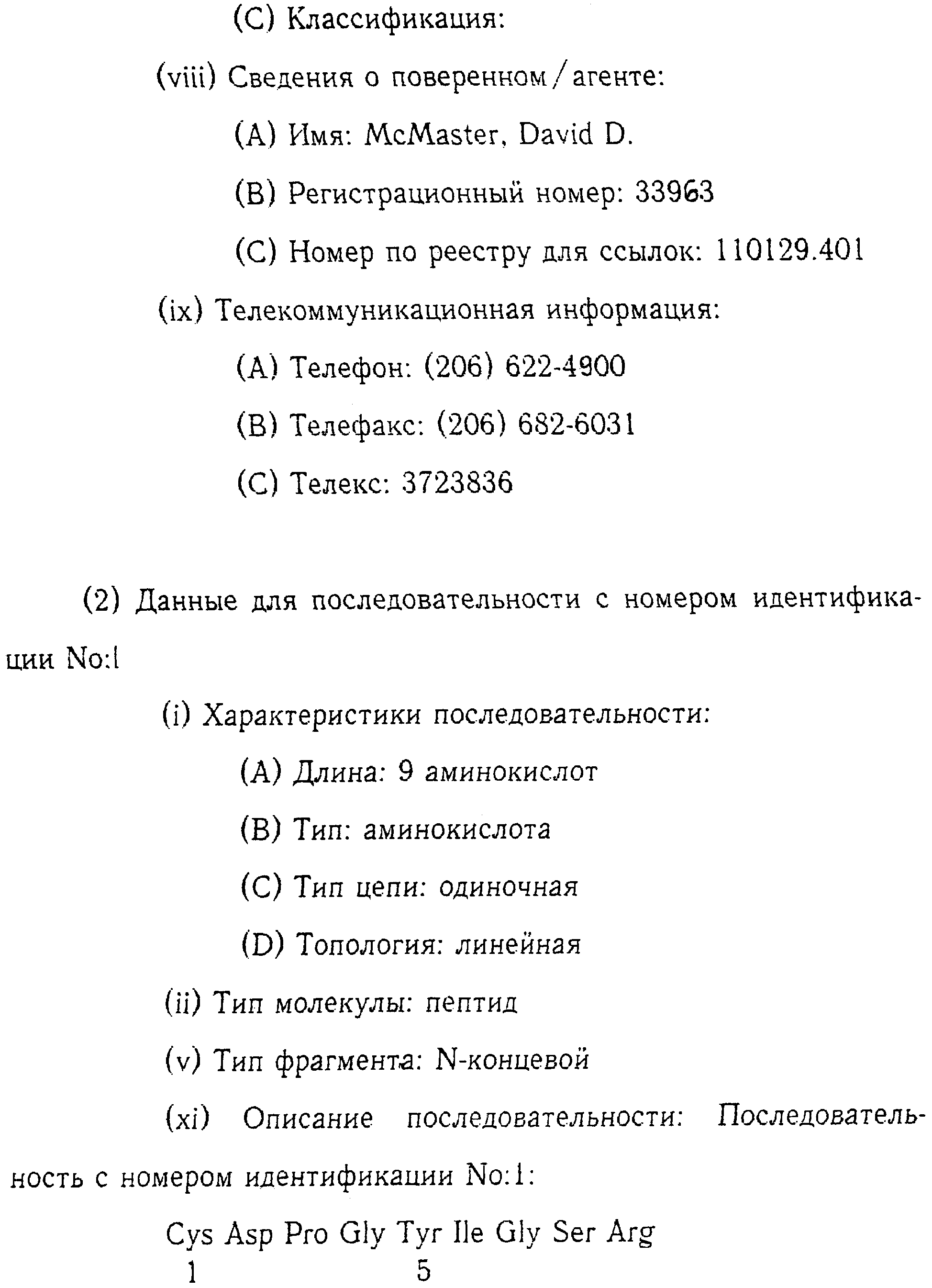
Claims (18)
Applications Claiming Priority (2)
| Application Number | Priority Date | Filing Date | Title |
|---|---|---|---|
| US9453693A | 1993-07-19 | 1993-07-19 | |
| US08/094,536 | 1993-07-19 |
Related Parent Applications (1)
| Application Number | Title | Priority Date | Filing Date |
|---|---|---|---|
| RU96105391/14A Division RU2180844C2 (en) | 1993-07-19 | 1994-07-19 | Stand for expansion of aperture inside the canal body |
Publications (2)
| Publication Number | Publication Date |
|---|---|
| RU2001132111A RU2001132111A (en) | 2003-07-27 |
| RU2304433C2 true RU2304433C2 (en) | 2007-08-20 |
Family
ID=22245764
Family Applications (3)
| Application Number | Title | Priority Date | Filing Date |
|---|---|---|---|
| RU96105391/14A RU2180844C2 (en) | 1993-07-19 | 1994-07-19 | Stand for expansion of aperture inside the canal body |
| RU2001132111/15A RU2304433C2 (en) | 1993-07-19 | 2001-11-28 | Compositions inhibiting the development of blood vessels and method for their applications |
| RU2007111679/15A RU2007111679A (en) | 1993-07-19 | 2007-03-29 | COMPOSITIONS SUPPRESSING THE DEVELOPMENT OF BLOOD VESSELS, AND METHODS OF USING THEM |
Family Applications Before (1)
| Application Number | Title | Priority Date | Filing Date |
|---|---|---|---|
| RU96105391/14A RU2180844C2 (en) | 1993-07-19 | 1994-07-19 | Stand for expansion of aperture inside the canal body |
Family Applications After (1)
| Application Number | Title | Priority Date | Filing Date |
|---|---|---|---|
| RU2007111679/15A RU2007111679A (en) | 1993-07-19 | 2007-03-29 | COMPOSITIONS SUPPRESSING THE DEVELOPMENT OF BLOOD VESSELS, AND METHODS OF USING THEM |
Country Status (19)
| Country | Link |
|---|---|
| US (23) | US6506411B2 (en) |
| EP (13) | EP1695698B1 (en) |
| JP (4) | JP3423317B2 (en) |
| KR (5) | KR100389223B1 (en) |
| CN (7) | CN1138505C (en) |
| AT (10) | ATE502664T1 (en) |
| AU (1) | AU693797B2 (en) |
| CA (4) | CA2472373C (en) |
| DE (10) | DE69435139D1 (en) |
| DK (5) | DK1159974T3 (en) |
| ES (5) | ES2321241T3 (en) |
| GR (1) | GR3024833T3 (en) |
| HK (1) | HK1042054B (en) |
| LU (2) | LU92422I2 (en) |
| NO (2) | NO324275B1 (en) |
| NZ (5) | NZ523799A (en) |
| PT (4) | PT797988E (en) |
| RU (3) | RU2180844C2 (en) |
| WO (1) | WO1995003036A1 (en) |
Cited By (6)
| Publication number | Priority date | Publication date | Assignee | Title |
|---|---|---|---|---|
| RU2404243C1 (en) * | 2009-04-27 | 2010-11-20 | Учреждение Российской академии медицинских наук Российский онкологический научный центр имени Н.Н.Блохина РАМН | APPLICATION OF HUMAN SKIN MELANOMA CELL LINE mel Cher AS POSITIVE MODEL OF VASCULOGENIC MIMICRY |
| RU2431481C1 (en) * | 2010-01-11 | 2011-10-20 | Федеральное Государственное Образовательное Учреждение Высшего Профессионального Образования "Саратовский Государственный Аграрный Университет Имени Н.И. Вавилова" | Drug preparation for wound repair in animals |
| RU2471500C2 (en) * | 2007-10-19 | 2013-01-10 | Юниверсите Виктор Сегален-Бордо 2 | Use of beta blocker for preparing drug for treating hemangiomas |
| RU2528249C2 (en) * | 2012-11-23 | 2014-09-10 | Федеральное государственное бюджетное образовательное учреждение высшего профессионального образования "Московский государственный университет имени М.В. Ломоносова" (МГУ) | Method for angiogenesis inhibition with recombinant forms of urokinase |
| RU2596092C2 (en) * | 2008-03-31 | 2016-08-27 | Кордис Корпорейшн | Device for local and/or regional delivery using liquid formulations of therapeutically active substances |
| RU2632524C2 (en) * | 2013-03-15 | 2017-10-05 | Микротек Медикал Текнолоджис Лтд. | Implantable fastener |
Families Citing this family (449)
| Publication number | Priority date | Publication date | Assignee | Title |
|---|---|---|---|---|
| US5853746A (en) * | 1991-01-31 | 1998-12-29 | Robert Francis Shaw | Methods and compositions for the treatment and repair of defects or lesions in cartilage or bone using functional barrier |
| US6515009B1 (en) | 1991-09-27 | 2003-02-04 | Neorx Corporation | Therapeutic inhibitor of vascular smooth muscle cells |
| US5811447A (en) | 1993-01-28 | 1998-09-22 | Neorx Corporation | Therapeutic inhibitor of vascular smooth muscle cells |
| US5981568A (en) | 1993-01-28 | 1999-11-09 | Neorx Corporation | Therapeutic inhibitor of vascular smooth muscle cells |
| US20030203976A1 (en) * | 1993-07-19 | 2003-10-30 | William L. Hunter | Anti-angiogenic compositions and methods of use |
| ATE502664T1 (en) * | 1993-07-19 | 2011-04-15 | Angiotech Pharm Inc | METHOD OF PRODUCTION OF A STENT WITH ANTI-ANGIOGENIC COMPOSITION |
| US5886026A (en) * | 1993-07-19 | 1999-03-23 | Angiotech Pharmaceuticals Inc. | Anti-angiogenic compositions and methods of use |
| ATE314845T1 (en) † | 1993-07-29 | 2006-02-15 | Us Health | USE OF PACLITAXEL AND ITS DERIVATIVES FOR THE PRODUCTION OF A MEDICATION FOR THE TREATMENT OF RESTENOSES |
| US6025334A (en) * | 1994-04-28 | 2000-02-15 | Les Laboratoires Aeterna Inc. | Extracts of shark cartilage having anti-collagenolytic, anti-inflammatory, anti-angiogenic and anti-tumoral activities; process of making, methods of using and compositions thereof |
| US5618925A (en) * | 1994-04-28 | 1997-04-08 | Les Laboratories Aeterna Inc. | Extracts of shark cartilage having an anti-angiogenic activity and an effect on tumor regression; process of making thereof |
| US6380366B1 (en) | 1994-04-28 | 2002-04-30 | Les Laboratoires Aeterna Inc. | Shark cartilage extract:process of making, methods of using and compositions thereof |
| US6028118A (en) * | 1996-08-08 | 2000-02-22 | Les Laboratoires Aeterna Inc. | Methods of using extracts of shark cartilage |
| US6558798B2 (en) | 1995-02-22 | 2003-05-06 | Scimed Life Systems, Inc. | Hydrophilic coating and substrates coated therewith having enhanced durability and lubricity |
| US5605696A (en) * | 1995-03-30 | 1997-02-25 | Advanced Cardiovascular Systems, Inc. | Drug loaded polymeric material and method of manufacture |
| US7611533B2 (en) | 1995-06-07 | 2009-11-03 | Cook Incorporated | Coated implantable medical device |
| US6774278B1 (en) * | 1995-06-07 | 2004-08-10 | Cook Incorporated | Coated implantable medical device |
| US7896914B2 (en) * | 1995-06-07 | 2011-03-01 | Cook Incorporated | Coated implantable medical device |
| US20070203520A1 (en) * | 1995-06-07 | 2007-08-30 | Dennis Griffin | Endovascular filter |
| US7550005B2 (en) | 1995-06-07 | 2009-06-23 | Cook Incorporated | Coated implantable medical device |
| US7846202B2 (en) * | 1995-06-07 | 2010-12-07 | Cook Incorporated | Coated implantable medical device |
| US7867275B2 (en) * | 1995-06-07 | 2011-01-11 | Cook Incorporated | Coated implantable medical device method |
| ATE267587T1 (en) | 1995-06-09 | 2004-06-15 | Euro Celtique Sa | FORMULATIONS AND METHODS FOR PROLONGED LOCAL ANESTHESIA |
| US6441025B2 (en) | 1996-03-12 | 2002-08-27 | Pg-Txl Company, L.P. | Water soluble paclitaxel derivatives |
| CN1304058C (en) * | 1996-03-12 | 2007-03-14 | Pg-Txl有限公司 | Water Soluble Paclitaxel Products |
| AU775787B2 (en) * | 1996-05-24 | 2004-08-12 | Angiotech Pharmaceuticals, Inc. | Compositions and methods for treating or preventing diseases of body passageways |
| ATE302599T1 (en) * | 1996-05-24 | 2005-09-15 | Angiotech Pharm Inc | PREPARATIONS AND METHODS FOR THE TREATMENT OR PREVENTION OF DISEASES OF THE BODY PASSAGES |
| US6143037A (en) * | 1996-06-12 | 2000-11-07 | The Regents Of The University Of Michigan | Compositions and methods for coating medical devices |
| AU733867B2 (en) | 1996-06-24 | 2001-05-31 | Euro-Celtique S.A. | Methods for providing safe local anesthesia |
| US7351421B2 (en) * | 1996-11-05 | 2008-04-01 | Hsing-Wen Sung | Drug-eluting stent having collagen drug carrier chemically treated with genipin |
| US6495579B1 (en) | 1996-12-02 | 2002-12-17 | Angiotech Pharmaceuticals, Inc. | Method for treating multiple sclerosis |
| US6515016B2 (en) | 1996-12-02 | 2003-02-04 | Angiotech Pharmaceuticals, Inc. | Composition and methods of paclitaxel for treating psoriasis |
| CA2273083C (en) | 1996-12-03 | 2012-09-18 | Sloan-Kettering Institute For Cancer Research | Synthesis of epothilones, intermediates thereto, analogues and uses thereof |
| US6204388B1 (en) * | 1996-12-03 | 2001-03-20 | Sloan-Kettering Institute For Cancer Research | Synthesis of epothilones, intermediates thereto and analogues thereof |
| US20050043376A1 (en) * | 1996-12-03 | 2005-02-24 | Danishefsky Samuel J. | Synthesis of epothilones, intermediates thereto, analogues and uses thereof |
| US6867305B2 (en) * | 1996-12-03 | 2005-03-15 | Sloan-Kettering Institute For Cancer Research | Synthesis of epothilones, intermediates thereto and analogues thereof |
| ES2200316T3 (en) | 1997-03-11 | 2004-03-01 | Les Laboratoires Aeterna Inc. | COMPOSITIONS TO TREAT TUMORS CONTAINING EXTRACTS OF SHARK CARTILAGO AND ANTINEOPLASTIC AGENTS. |
| US6511477B2 (en) | 1997-03-13 | 2003-01-28 | Biocardia, Inc. | Method of drug delivery to interstitial regions of the myocardium |
| US6273913B1 (en) * | 1997-04-18 | 2001-08-14 | Cordis Corporation | Modified stent useful for delivery of drugs along stent strut |
| US8853260B2 (en) | 1997-06-27 | 2014-10-07 | Abraxis Bioscience, Llc | Formulations of pharmacological agents, methods for the preparation thereof and methods for the use thereof |
| US20030199425A1 (en) * | 1997-06-27 | 2003-10-23 | Desai Neil P. | Compositions and methods for treatment of hyperplasia |
| WO1999008729A1 (en) * | 1997-08-13 | 1999-02-25 | Boston Scientific Limited | Loading and release of water-insoluble drugs |
| US6306166B1 (en) | 1997-08-13 | 2001-10-23 | Scimed Life Systems, Inc. | Loading and release of water-insoluble drugs |
| DE69841984D1 (en) * | 1997-09-05 | 2010-12-16 | Maruho K K | COMPOSITION OF NANOCAPSULES FOR THE TREATMENT OF INTRAARTICULAR DISEASES |
| DE19744135C1 (en) * | 1997-09-29 | 1999-03-25 | Schering Ag | Medical implants coated with epothilone |
| US6485514B1 (en) * | 1997-12-12 | 2002-11-26 | Supergen, Inc. | Local delivery of therapeutic agents |
| KR20010086245A (en) * | 1998-03-04 | 2001-09-10 | 다케다 야쿠힌 고교 가부시키가이샤 | Sustained-release preparation for aⅱ antagonist, production and use thereof |
| US6241762B1 (en) * | 1998-03-30 | 2001-06-05 | Conor Medsystems, Inc. | Expandable medical device with ductile hinges |
| US7208010B2 (en) | 2000-10-16 | 2007-04-24 | Conor Medsystems, Inc. | Expandable medical device for delivery of beneficial agent |
| US20040254635A1 (en) | 1998-03-30 | 2004-12-16 | Shanley John F. | Expandable medical device for delivery of beneficial agent |
| US7208011B2 (en) * | 2001-08-20 | 2007-04-24 | Conor Medsystems, Inc. | Implantable medical device with drug filled holes |
| ES2179646T3 (en) | 1998-04-27 | 2003-01-16 | Surmodics Inc | COATING THAT RELEASES A BIOACTIVE AGENT. |
| US6168807B1 (en) | 1998-07-23 | 2001-01-02 | Les Laboratoires Aeterna Inc. | Low molecular weight components of shark cartilage, processes for their preparation and therapeutic uses thereof |
| WO2000010622A1 (en) | 1998-08-20 | 2000-03-02 | Cook Incorporated | Coated implantable medical device |
| WO2000010552A2 (en) * | 1998-08-24 | 2000-03-02 | Global Vascular Concepts, Inc. | Use of anti-angiogenic agents for inhibiting vessel wall injury |
| US6293967B1 (en) | 1998-10-29 | 2001-09-25 | Conor Medsystems, Inc. | Expandable medical device with ductile hinges |
| EP1135165A1 (en) * | 1998-12-03 | 2001-09-26 | Boston Scientific Limited | Stent having drug crystals thereon |
| US6120847A (en) * | 1999-01-08 | 2000-09-19 | Scimed Life Systems, Inc. | Surface treatment method for stent coating |
| US6419692B1 (en) | 1999-02-03 | 2002-07-16 | Scimed Life Systems, Inc. | Surface protection method for stents and balloon catheters for drug delivery |
| JP2002537324A (en) * | 1999-02-23 | 2002-11-05 | アンジオテック ファーマシューティカルズ,インコーポレイテッド | Compositions and methods for improving the integrity of compromised body passages and cavities |
| US20020058286A1 (en) * | 1999-02-24 | 2002-05-16 | Danishefsky Samuel J. | Synthesis of epothilones, intermediates thereto and analogues thereof |
| AU3759100A (en) * | 1999-03-24 | 2000-10-09 | B.F. Goodrich Company, The | Inhibition of matrix metalloproteinases with polymers and pharmaceutical applications thereof |
| US6156373A (en) * | 1999-05-03 | 2000-12-05 | Scimed Life Systems, Inc. | Medical device coating methods and devices |
| US6290673B1 (en) | 1999-05-20 | 2001-09-18 | Conor Medsystems, Inc. | Expandable medical device delivery system and method |
| US20040110722A1 (en) * | 1999-05-27 | 2004-06-10 | Ornberg Richard L. | Modified hyaluronic acid polymers |
| ATE383364T1 (en) * | 1999-05-27 | 2008-01-15 | Monsanto Co | BIOMATERIALS MODIFIED WITH SUPEROXIDE DISMUTASE MIMITATORS |
| US6258121B1 (en) | 1999-07-02 | 2001-07-10 | Scimed Life Systems, Inc. | Stent coating |
| DE29911689U1 (en) * | 1999-07-06 | 2000-04-06 | Sterk, Peter, Dr., 88212 Ravensburg | Agents for occluding organic tissue |
| US7687462B2 (en) | 1999-10-05 | 2010-03-30 | The Regents Of The University Of California | Composition for promoting cartilage formation or repair comprising a nell gene product and method of treating cartilage-related conditions using such composition |
| EP1235598A2 (en) * | 1999-11-12 | 2002-09-04 | Angiotech Pharmaceuticals, Inc. | Compositions of a combination of radioactive therapy and cell-cycle inhibitors |
| WO2001047451A1 (en) * | 1999-12-29 | 2001-07-05 | Gishel New | Apparatus and method for delivering compounds to a living organism |
| ATE407676T1 (en) * | 2000-02-28 | 2008-09-15 | Univ British Columbia | TOPOISOMERASE INHIBITORS FOR THE TREATMENT OF SURGICAL ADHESIONS |
| WO2001066016A1 (en) * | 2000-03-06 | 2001-09-13 | Scimed Life Systems, Inc. | Embolic agents visible under ultrasound |
| US20020077290A1 (en) | 2000-03-17 | 2002-06-20 | Rama Bhatt | Polyglutamic acid-camptothecin conjugates and methods of preparation |
| ES2246431T3 (en) * | 2000-03-18 | 2006-02-16 | Polyzenix Gmbh | DENTAL IMPLANTS THAT HAVE BACTERIAL RESISTANCE. |
| WO2001072280A2 (en) * | 2000-03-24 | 2001-10-04 | Biosphere Medical Inc. | Microspheres for gene therapy |
| US20030212022A1 (en) * | 2001-03-23 | 2003-11-13 | Jean-Marie Vogel | Compositions and methods for gene therapy |
| US8697137B2 (en) * | 2000-03-24 | 2014-04-15 | Biosphere Medical, Inc. | Methods of using microspheres for active embolization |
| AU2001263760A1 (en) | 2000-04-11 | 2001-11-07 | Polyzenix Gmbh | Poly-tri-fluoro-ethoxypolyphosphazene coverings and films |
| US20090004240A1 (en) * | 2000-08-11 | 2009-01-01 | Celonova Biosciences, Inc. | Implants with a phosphazene-containing coating |
| EP1179353A1 (en) * | 2000-08-11 | 2002-02-13 | B. Braun Melsungen Ag | Antithrombogenic implants with coating of polyphosphazenes and a pharmacologically active agent |
| AU2001271417B2 (en) | 2000-08-30 | 2006-10-05 | Johns Hopkins University | Devices for intraocular drug delivery |
| US7402173B2 (en) * | 2000-09-18 | 2008-07-22 | Boston Scientific Scimed, Inc. | Metal stent with surface layer of noble metal oxide and method of fabrication |
| US7101391B2 (en) * | 2000-09-18 | 2006-09-05 | Inflow Dynamics Inc. | Primarily niobium stent |
| WO2002026139A1 (en) † | 2000-09-29 | 2002-04-04 | Cordis Corporation | Coated medical devices |
| US6764507B2 (en) | 2000-10-16 | 2004-07-20 | Conor Medsystems, Inc. | Expandable medical device with improved spatial distribution |
| ATE387169T1 (en) | 2000-10-16 | 2008-03-15 | Conor Medsystems Inc | EXPANDABLE MEDICAL DEVICE FOR DELIVERING A MEDICINE |
| US6746661B2 (en) | 2000-11-16 | 2004-06-08 | Microspherix Llc | Brachytherapy seed |
| AU2001297657A1 (en) * | 2000-11-16 | 2002-09-12 | Microspherix Llc | Polymeric imagable brachytherapy seed |
| US7425217B2 (en) | 2000-11-16 | 2008-09-16 | Maier Nathan C | System and method for inhibiting cellular proliferation with tachykinins |
| JP2006500115A (en) * | 2000-11-16 | 2006-01-05 | マイクロスフエリツクス・エル・エル・シー | Flexible and / or elastic seeds or strands for brachytherapy |
| ATE337804T1 (en) | 2000-11-21 | 2006-09-15 | Schering Ag | TUBULAR VESSEL IMPLANTS (STENTS) AND METHOD FOR THE PRODUCTION THEREOF |
| WO2003015719A1 (en) * | 2001-08-17 | 2003-02-27 | Polyzenix Gmbh | Device based on nitinol with a polyphosphazene coating |
| GB0100761D0 (en) | 2001-01-11 | 2001-02-21 | Biocompatibles Ltd | Drug delivery from stents |
| GB0100760D0 (en) | 2001-01-11 | 2001-02-21 | Biocompatibles Ltd | Drug delivery from stents |
| DE10100961B4 (en) * | 2001-01-11 | 2005-08-04 | Polyzenix Gmbh | Body-compatible material and substrate coated with this material for the cultivation of cells and artificial organic implants constructed or grown from cells |
| US9080146B2 (en) | 2001-01-11 | 2015-07-14 | Celonova Biosciences, Inc. | Substrates containing polyphosphazene as matrices and substrates containing polyphosphazene with a micro-structured surface |
| US6685626B2 (en) | 2001-02-02 | 2004-02-03 | Regeneration Technologies, Inc. | Compositions, devices, methods, and kits for induction of adhesions |
| US20020176893A1 (en) * | 2001-02-02 | 2002-11-28 | Wironen John F. | Compositions, implants, methods, and kits for closure of lumen openings, repair of ruptured tissue, and for bulking of tissue |
| US20040073294A1 (en) * | 2002-09-20 | 2004-04-15 | Conor Medsystems, Inc. | Method and apparatus for loading a beneficial agent into an expandable medical device |
| US20040204756A1 (en) * | 2004-02-11 | 2004-10-14 | Diaz Stephen Hunter | Absorbent article with improved liquid acquisition capacity |
| US6964680B2 (en) | 2001-02-05 | 2005-11-15 | Conor Medsystems, Inc. | Expandable medical device with tapered hinge |
| GB0104383D0 (en) | 2001-02-22 | 2001-04-11 | Psimedica Ltd | Cancer Treatment |
| EP1418945A2 (en) * | 2001-03-13 | 2004-05-19 | Angiotech Pharmaceuticals, Inc. | Micellar drug delivery vehicles and uses thereof |
| US7771468B2 (en) | 2001-03-16 | 2010-08-10 | Angiotech Biocoatings Corp. | Medicated stent having multi-layer polymer coating |
| DE10115740A1 (en) * | 2001-03-26 | 2002-10-02 | Ulrich Speck | Preparation for restenosis prophylaxis |
| US20040185101A1 (en) * | 2001-03-27 | 2004-09-23 | Macromed, Incorporated. | Biodegradable triblock copolymers as solubilizing agents for drugs and method of use thereof |
| DK1392254T3 (en) * | 2001-04-20 | 2007-07-02 | Univ British Columbia | Micelle drug delivery system for hydrophobic drugs |
| US20030157161A1 (en) * | 2001-05-01 | 2003-08-21 | Angiotech Pharmaceuticals, Inc. | Compositions and methods for treating inflammatory conditions utilizing protein or polysaccharide containing anti-microtubule agents |
| US6613083B2 (en) | 2001-05-02 | 2003-09-02 | Eckhard Alt | Stent device and method |
| US7651695B2 (en) * | 2001-05-18 | 2010-01-26 | Advanced Cardiovascular Systems, Inc. | Medicated stents for the treatment of vascular disease |
| US20030032935A1 (en) * | 2001-08-10 | 2003-02-13 | Scimed Life Systems, Inc. | Packages facilitating convenient mixing and delivery of liquids |
| US7842083B2 (en) | 2001-08-20 | 2010-11-30 | Innovational Holdings, Llc. | Expandable medical device with improved spatial distribution |
| US7056338B2 (en) | 2003-03-28 | 2006-06-06 | Conor Medsystems, Inc. | Therapeutic agent delivery device with controlled therapeutic agent release rates |
| US20040249443A1 (en) * | 2001-08-20 | 2004-12-09 | Shanley John F. | Expandable medical device for treating cardiac arrhythmias |
| US20040121981A1 (en) * | 2001-11-21 | 2004-06-24 | Glycogenesys, Inc. | Method for controlling angiogenesis in animals |
| US20030181810A1 (en) | 2002-03-25 | 2003-09-25 | Murphy Kieran P. | Kit for image guided surgical procedures |
| US7927368B2 (en) | 2002-03-25 | 2011-04-19 | Kieran Murphy Llc | Device viewable under an imaging beam |
| US9375203B2 (en) | 2002-03-25 | 2016-06-28 | Kieran Murphy Llc | Biopsy needle |
| US7462366B2 (en) | 2002-03-29 | 2008-12-09 | Boston Scientific Scimed, Inc. | Drug delivery particle |
| US7131997B2 (en) | 2002-03-29 | 2006-11-07 | Scimed Life Systems, Inc. | Tissue treatment |
| US7094369B2 (en) | 2002-03-29 | 2006-08-22 | Scimed Life Systems, Inc. | Processes for manufacturing polymeric microspheres |
| US7053134B2 (en) | 2002-04-04 | 2006-05-30 | Scimed Life Systems, Inc. | Forming a chemically cross-linked particle of a desired shape and diameter |
| US20040038303A1 (en) * | 2002-04-08 | 2004-02-26 | Unger Gretchen M. | Biologic modulations with nanoparticles |
| AU2003227454B2 (en) * | 2002-04-22 | 2009-07-30 | Research Foundation Itsuu Laboratory | Medicament for therapeutic treatment of vascular disease |
| DE60328486D1 (en) * | 2002-05-24 | 2009-09-03 | Angiotech Int Ag | COMPOSITIONS AND METHODS FOR COATING MEDICAL IMPLANTS |
| US8313760B2 (en) | 2002-05-24 | 2012-11-20 | Angiotech International Ag | Compositions and methods for coating medical implants |
| CZ294371B6 (en) * | 2002-06-10 | 2004-12-15 | Pliva - Lachema, A. S. | Stabilized pharmaceutical composition based on polyoxyethylated castor oil and process for preparing thereof |
| US7649023B2 (en) * | 2002-06-11 | 2010-01-19 | Novartis Ag | Biodegradable block copolymeric compositions for drug delivery |
| WO2003105917A2 (en) | 2002-06-12 | 2003-12-24 | Scimed Life Systems, Inc. | Bulking agents |
| US20030232087A1 (en) * | 2002-06-18 | 2003-12-18 | Lawin Laurie R. | Bioactive agent release coating with aromatic poly(meth)acrylates |
| US7097850B2 (en) | 2002-06-18 | 2006-08-29 | Surmodics, Inc. | Bioactive agent release coating and controlled humidity method |
| CN100346850C (en) * | 2003-05-28 | 2007-11-07 | 微创医疗器械(上海)有限公司 | Medicine coating rack |
| US20080138377A1 (en) * | 2002-07-05 | 2008-06-12 | Celonova Biosciences, Inc. | Vasodilator Eluting Luminal Stent Devices With A Specific Polyphosphazene Coating and Methods for Their Manufacture and Use |
| US20080138433A1 (en) * | 2002-07-05 | 2008-06-12 | Celonova Biosciences, Inc. | Vasodilator eluting blood storage and administration devices with a specific polyphosphazene coating and methods for their manufacture and use |
| DK1521603T3 (en) | 2002-07-12 | 2011-04-18 | Cook Inc | Coated medical device |
| US20050163821A1 (en) * | 2002-08-02 | 2005-07-28 | Hsing-Wen Sung | Drug-eluting Biodegradable Stent and Delivery Means |
| US7449236B2 (en) | 2002-08-09 | 2008-11-11 | Boston Scientific Scimed, Inc. | Porous polymeric particle comprising polyvinyl alcohol and having interior to surface porosity-gradient |
| US20040076582A1 (en) * | 2002-08-30 | 2004-04-22 | Dimatteo Kristian | Agent delivery particle |
| US7842377B2 (en) * | 2003-08-08 | 2010-11-30 | Boston Scientific Scimed, Inc. | Porous polymeric particle comprising polyvinyl alcohol and having interior to surface porosity-gradient |
| US7649006B2 (en) | 2002-08-23 | 2010-01-19 | Sloan-Kettering Institute For Cancer Research | Synthesis of epothilones, intermediates thereto and analogues thereof |
| PT1506203E (en) * | 2002-08-23 | 2007-04-30 | Sloan Kettering Inst Cancer | Synthesis of epothilones, intermediates thereto, analogues and uses thereof |
| US6921769B2 (en) | 2002-08-23 | 2005-07-26 | Sloan-Kettering Institute For Cancer Research | Synthesis of epothilones, intermediates thereto and analogues thereof |
| US8012454B2 (en) | 2002-08-30 | 2011-09-06 | Boston Scientific Scimed, Inc. | Embolization |
| JP3887588B2 (en) * | 2002-08-30 | 2007-02-28 | 株式会社リガク | Stress measurement method by X-ray diffraction |
| US8163726B2 (en) | 2002-09-18 | 2012-04-24 | University Of Pennsylvania | Method of inhibiting choroidal neovascularization |
| DE10244847A1 (en) | 2002-09-20 | 2004-04-01 | Ulrich Prof. Dr. Speck | Medical device for drug delivery |
| US20040127976A1 (en) * | 2002-09-20 | 2004-07-01 | Conor Medsystems, Inc. | Method and apparatus for loading a beneficial agent into an expandable medical device |
| AU2003276920A1 (en) * | 2002-09-20 | 2004-04-08 | Innovational Holdings, Llc | Expandable medical device with openings for delivery of multiple beneficial agents |
| AU2003275263A1 (en) * | 2002-09-26 | 2004-04-19 | Angiotech International Ag | Perivascular wraps |
| CA2501717C (en) * | 2002-10-15 | 2012-09-18 | Board Of Supervisors Of Louisiana State University And Agricultural And Mechanical College | Use of epothilone derivatives for the treatment of hyperparathyroidism |
| AU2003286502A1 (en) * | 2002-10-21 | 2004-05-13 | The Government Of The United States Of America, As Represented By The Secretary, Department Of Health And Human Services | Contiguous capillary electrospray sources and analytical device |
| US7588825B2 (en) | 2002-10-23 | 2009-09-15 | Boston Scientific Scimed, Inc. | Embolic compositions |
| US7883490B2 (en) | 2002-10-23 | 2011-02-08 | Boston Scientific Scimed, Inc. | Mixing and delivery of therapeutic compositions |
| WO2004043510A1 (en) * | 2002-11-08 | 2004-05-27 | Conor Medsystems, Inc. | Method and apparatus for reducing tissue damage after ischemic injury |
| CA2505576A1 (en) * | 2002-11-08 | 2004-05-27 | Conor Medsystems, Inc. | Expandable medical device and method for treating chronic total occlusions with local delivery of an angiogenic factor |
| US20040142014A1 (en) * | 2002-11-08 | 2004-07-22 | Conor Medsystems, Inc. | Method and apparatus for reducing tissue damage after ischemic injury |
| US20060121080A1 (en) | 2002-11-13 | 2006-06-08 | Lye Whye K | Medical devices having nanoporous layers and methods for making the same |
| CA2503625A1 (en) | 2002-11-13 | 2004-05-27 | Setagon, Inc. | Medical devices having porous layers and methods for making same |
| US9770349B2 (en) | 2002-11-13 | 2017-09-26 | University Of Virginia Patent Foundation | Nanoporous stents with enhanced cellular adhesion and reduced neointimal formation |
| LT1585548T (en) | 2002-12-09 | 2018-09-25 | Abraxis Bioscience, Llc | Compositions and methods of delivery of pharmacological agents |
| US7338557B1 (en) * | 2002-12-17 | 2008-03-04 | Advanced Cardiovascular Systems, Inc. | Nozzle for use in coating a stent |
| US7842791B2 (en) | 2002-12-19 | 2010-11-30 | Nancy Jean Britten | Dispersible pharmaceutical compositions |
| DE602004030892D1 (en) * | 2003-03-26 | 2011-02-17 | Celonova Biosciences Germany Gmbh | COATED DENTAL IMPLANTS |
| JP5596896B2 (en) | 2003-03-28 | 2014-09-24 | イノヴェイショナル・ホールディングズ・エルエルシー | Method of forming an implantable medical device having a beneficial agent concentration gradient |
| US20050010170A1 (en) * | 2004-02-11 | 2005-01-13 | Shanley John F | Implantable medical device with beneficial agent concentration gradient |
| AU2004226350A1 (en) * | 2003-03-28 | 2004-10-14 | Kosan Biosciences, Inc. | Devices, methods, and compositions to prevent restenosis |
| US20040202692A1 (en) * | 2003-03-28 | 2004-10-14 | Conor Medsystems, Inc. | Implantable medical device and method for in situ selective modulation of agent delivery |
| US7306580B2 (en) | 2003-04-16 | 2007-12-11 | Cook Incorporated | Medical device with therapeutic agents |
| US20040220534A1 (en) * | 2003-04-29 | 2004-11-04 | Martens Paul W. | Medical device with antimicrobial layer |
| US8246974B2 (en) * | 2003-05-02 | 2012-08-21 | Surmodics, Inc. | Medical devices and methods for producing the same |
| EP1633320A2 (en) * | 2003-05-02 | 2006-03-15 | SurModics, Inc. | Implantable controlled release bioactive agent delivery device |
| US7169179B2 (en) | 2003-06-05 | 2007-01-30 | Conor Medsystems, Inc. | Drug delivery device and method for bi-directional drug delivery |
| WO2005018702A2 (en) * | 2003-08-13 | 2005-03-03 | Medtronic, Inc. | Active agent delivery systems including a miscible polymer blend, medical devices, and methods |
| WO2005018600A2 (en) * | 2003-08-22 | 2005-03-03 | Cube Medical A/S | Method of treating a patient suffering from a solid tumour |
| US7976823B2 (en) | 2003-08-29 | 2011-07-12 | Boston Scientific Scimed, Inc. | Ferromagnetic particles and methods |
| CN102144961A (en) * | 2003-09-18 | 2011-08-10 | 参天制药株式会社 | Transscleral delivery |
| US7785653B2 (en) | 2003-09-22 | 2010-08-31 | Innovational Holdings Llc | Method and apparatus for loading a beneficial agent into an expandable medical device |
| US7056337B2 (en) * | 2003-10-21 | 2006-06-06 | Cook Incorporated | Natural tissue stent |
| US7901770B2 (en) | 2003-11-04 | 2011-03-08 | Boston Scientific Scimed, Inc. | Embolic compositions |
| US20050100529A1 (en) * | 2003-11-06 | 2005-05-12 | Zeldis Jerome B. | Methods of using and compositions comprising immunomodulatory compounds for the treatment and management of asbestos-related diseases and disorders |
| FR2861993B1 (en) * | 2003-11-06 | 2006-01-21 | Jean Claude Rigaud | ANTI RESTENOSE MOLECULAR COMPLEX FOR INTRACORONARY ENDOPROTHESIS |
| WO2005049105A2 (en) * | 2003-11-10 | 2005-06-02 | Angiotech International Ag | Medical implants and anti-scarring agents |
| US20050100577A1 (en) * | 2003-11-10 | 2005-05-12 | Parker Theodore L. | Expandable medical device with beneficial agent matrix formed by a multi solvent system |
| US20050209664A1 (en) * | 2003-11-20 | 2005-09-22 | Angiotech International Ag | Electrical devices and anti-scarring agents |
| US20050208095A1 (en) * | 2003-11-20 | 2005-09-22 | Angiotech International Ag | Polymer compositions and methods for their use |
| WO2005051483A2 (en) * | 2003-11-20 | 2005-06-09 | Angiotech International Ag | Electrical devices and anti-scarring agents |
| AU2004308654B2 (en) * | 2003-12-24 | 2008-11-20 | Novartis Ag | Pharmaceutical Compositions |
| WO2005074913A2 (en) * | 2004-01-30 | 2005-08-18 | Angiotech International Ag | Compositions and methods for treating contracture |
| US7349971B2 (en) * | 2004-02-05 | 2008-03-25 | Scenera Technologies, Llc | System for transmitting data utilizing multiple communication applications simultaneously in response to user request without specifying recipient's communication information |
| US7294145B2 (en) * | 2004-02-26 | 2007-11-13 | Boston Scientific Scimed, Inc. | Stent with differently coated inside and outside surfaces |
| US7736671B2 (en) | 2004-03-02 | 2010-06-15 | Boston Scientific Scimed, Inc. | Embolization |
| US8173176B2 (en) | 2004-03-30 | 2012-05-08 | Boston Scientific Scimed, Inc. | Embolization |
| US20060083772A1 (en) * | 2004-04-06 | 2006-04-20 | Dewitt David M | Coating compositions for bioactive agents |
| DE602005015564D1 (en) | 2004-04-06 | 2009-09-03 | Surmodics Inc | COATING COMPOSITIONS FOR BIOACTIVE AGENTS |
| US20050238870A1 (en) * | 2004-04-22 | 2005-10-27 | Marcia Buiser | Embolization |
| DE602004007630T2 (en) * | 2004-05-25 | 2008-06-05 | William Cook Europe Aps | Stent and stent removal device |
| US7311861B2 (en) | 2004-06-01 | 2007-12-25 | Boston Scientific Scimed, Inc. | Embolization |
| US20050287287A1 (en) * | 2004-06-24 | 2005-12-29 | Parker Theodore L | Methods and systems for loading an implantable medical device with beneficial agent |
| US20080280973A1 (en) * | 2004-06-28 | 2008-11-13 | Wender Paul A | Laulimalide Analogues as Therapeutic Agents |
| USD516723S1 (en) | 2004-07-06 | 2006-03-07 | Conor Medsystems, Inc. | Stent wall structure |
| WO2006017275A1 (en) | 2004-07-13 | 2006-02-16 | The University Of Tennessee Research Foundation | Adhesive composition for carrying therapeutic agents as delivery vehicle on coatings applied to vascular grafts |
| US8119153B2 (en) * | 2004-08-26 | 2012-02-21 | Boston Scientific Scimed, Inc. | Stents with drug eluting coatings |
| JP5207737B2 (en) * | 2004-09-15 | 2013-06-12 | イノヴェイショナル・ホールディングズ・エルエルシー | Bifurcated stent with collapsible end |
| WO2006047279A2 (en) * | 2004-10-21 | 2006-05-04 | University Of Iowa Research Foundation | In situ controlled release drug delivery system |
| US20210299056A9 (en) | 2004-10-25 | 2021-09-30 | Varian Medical Systems, Inc. | Color-Coded Polymeric Particles of Predetermined Size for Therapeutic and/or Diagnostic Applications and Related Methods |
| US9114162B2 (en) | 2004-10-25 | 2015-08-25 | Celonova Biosciences, Inc. | Loadable polymeric particles for enhanced imaging in clinical applications and methods of preparing and using the same |
| US9107850B2 (en) | 2004-10-25 | 2015-08-18 | Celonova Biosciences, Inc. | Color-coded and sized loadable polymeric particles for therapeutic and/or diagnostic applications and methods of preparing and using the same |
| US20060093647A1 (en) * | 2004-10-29 | 2006-05-04 | Villafana Manuel A | Multiple layer coating composition |
| ES2424255T3 (en) * | 2004-11-08 | 2013-09-30 | Baxter International Inc. | Particulate compositions of tubulin inhibitors |
| US8425550B2 (en) | 2004-12-01 | 2013-04-23 | Boston Scientific Scimed, Inc. | Embolic coils |
| US20060177513A1 (en) * | 2005-01-28 | 2006-08-10 | Tepha, Inc. | Embolization using poly-4-hydroxybutyrate particles |
| JP2008528660A (en) * | 2005-02-03 | 2008-07-31 | シンベンション アーゲー | Drug delivery material manufactured by sol / gel technology |
| US9050393B2 (en) | 2005-02-08 | 2015-06-09 | Bruce N. Saffran | Medical devices and methods for modulation of physiology using device-based surface chemistry |
| US8663639B2 (en) | 2005-02-09 | 2014-03-04 | Santen Pharmaceutical Co., Ltd. | Formulations for treating ocular diseases and conditions |
| BRPI0607606B1 (en) | 2005-02-09 | 2021-06-22 | Santen Pharmaceutical, Co., Ltd. | LIQUID FORMULATION |
| US8735394B2 (en) | 2005-02-18 | 2014-05-27 | Abraxis Bioscience, Llc | Combinations and modes of administration of therapeutic agents and combination therapy |
| BRPI0607809A2 (en) | 2005-02-18 | 2009-06-13 | Abraxis Bioscience Inc | use of a composition comprising nanoparticles, composition and kit |
| AU2005100176A4 (en) * | 2005-03-01 | 2005-04-07 | Gym Tv Pty Ltd | Garbage bin clip |
| US7858183B2 (en) | 2005-03-02 | 2010-12-28 | Boston Scientific Scimed, Inc. | Particles |
| US7727555B2 (en) | 2005-03-02 | 2010-06-01 | Boston Scientific Scimed, Inc. | Particles |
| US20060224170A1 (en) * | 2005-03-30 | 2006-10-05 | Michael Duff | Surgical marker clip and method for cholangiography |
| US8574604B2 (en) | 2005-04-15 | 2013-11-05 | Interface Biologics, Inc. | Methods and compositions for the delivery of biologically active agents |
| US7963287B2 (en) | 2005-04-28 | 2011-06-21 | Boston Scientific Scimed, Inc. | Tissue-treatment methods |
| PA8672101A1 (en) | 2005-04-29 | 2006-12-07 | Centocor Inc | ANTI-IL-6 ANTIBODIES, COMPOSITIONS, METHODS AND USES |
| KR101429774B1 (en) | 2005-05-09 | 2014-10-02 | 바이오스피어 메디칼 에스.에이. | Compositions and methods employing microspheres and nonionic contrast agents |
| US20060280787A1 (en) * | 2005-06-14 | 2006-12-14 | Baxter International Inc. | Pharmaceutical formulation of the tubulin inhibitor indibulin for oral administration with improved pharmacokinetic properties, and process for the manufacture thereof |
| US20070004973A1 (en) * | 2005-06-15 | 2007-01-04 | Tan Sharon M L | Tissue treatment methods |
| US20060286071A1 (en) * | 2005-06-21 | 2006-12-21 | Epstein Samuel J | Therapeutic pastes for medical device coating |
| US9463426B2 (en) | 2005-06-24 | 2016-10-11 | Boston Scientific Scimed, Inc. | Methods and systems for coating particles |
| US8187159B2 (en) | 2005-07-22 | 2012-05-29 | Biocompatibles, UK | Therapeutic member including a rail used in brachytherapy and other radiation therapy |
| US7736293B2 (en) | 2005-07-22 | 2010-06-15 | Biocompatibles Uk Limited | Implants for use in brachytherapy and other radiation therapy that resist migration and rotation |
| WO2007019439A2 (en) * | 2005-08-04 | 2007-02-15 | Angiotech International Ag | Block copolymer compositions and uses thereof |
| SI3311805T1 (en) * | 2005-08-31 | 2020-07-31 | Abraxis Bioscience, Llc | Compositions comprising poorly water soluble pharmaceutical agents and antimicrobial agents |
| BRPI0615292A8 (en) * | 2005-08-31 | 2018-03-06 | Abraxis Bioscience Llc | compositions and methods for preparing poorly soluble water drugs with increased stability |
| WO2007040249A1 (en) | 2005-10-06 | 2007-04-12 | Kaneka Corporation | Stent to be placed in the living body |
| US8007509B2 (en) | 2005-10-12 | 2011-08-30 | Boston Scientific Scimed, Inc. | Coil assemblies, components and methods |
| RU2316290C2 (en) * | 2005-11-21 | 2008-02-10 | Институт биохимии им. А.Н. Баха РАН | Gauze endoprosthesis usable in plastic surgery |
| US8101197B2 (en) | 2005-12-19 | 2012-01-24 | Stryker Corporation | Forming coils |
| US8152839B2 (en) | 2005-12-19 | 2012-04-10 | Boston Scientific Scimed, Inc. | Embolic coils |
| US7947368B2 (en) | 2005-12-21 | 2011-05-24 | Boston Scientific Scimed, Inc. | Block copolymer particles |
| US7501179B2 (en) | 2005-12-21 | 2009-03-10 | Boston Scientific Scimed, Inc. | Block copolymer particles |
| WO2007092620A2 (en) | 2006-02-09 | 2007-08-16 | Macusight, Inc. | Stable formulations, and methods of their preparation and use |
| CN100486560C (en) * | 2006-03-06 | 2009-05-13 | 济南康泉医药科技有限公司 | Compound anticancer sustained-release injection containing blood vessel inhibitor |
| CN100464736C (en) * | 2006-03-17 | 2009-03-04 | 山东蓝金生物工程有限公司 | Anticancer sustained-release injection loaded with antimetabolite and synergist thereof |
| JP5506378B2 (en) | 2006-03-23 | 2014-05-28 | 参天製薬株式会社 | Formulations and methods for diseases or conditions associated with vascular permeability |
| US7993675B2 (en) | 2006-05-10 | 2011-08-09 | Medtronic Xomed, Inc. | Solvating system and sealant for medical use in the sinuses and nasal passages |
| KR100722607B1 (en) * | 2006-05-11 | 2007-05-28 | 주식회사 펩트론 | Method for producing sustained-release microspheres with improved dispersibility and injection dose |
| JP2009538317A (en) * | 2006-05-26 | 2009-11-05 | バイエル ヘルスケア リミティド ライアビリティ カンパニー | Drug combinations using substituted diarylureas for cancer treatment |
| US20070298069A1 (en) * | 2006-06-26 | 2007-12-27 | Boston Scientific Scimed, Inc. | Medical devices for release of low solubility therapeutic agents |
| EP2035074A4 (en) * | 2006-06-30 | 2012-11-07 | Cvdevices Llc | PERCUTANEOUS INTRAVASCULAR ACCESS TO CARDIAC TISSUE |
| US8328752B2 (en) * | 2006-06-30 | 2012-12-11 | Cvdevices, Llc | Devices, systems, and methods for promotion of infarct healing and reinforcement of border zone |
| US9023075B2 (en) * | 2006-06-30 | 2015-05-05 | Cvdevices, Llc | Devices, systems, and methods for lead delivery |
| US20080051702A1 (en) * | 2006-08-24 | 2008-02-28 | Herrmann Robert A | Therapeutic agent delivery for the treatment of asthma via implantable and insertable medical devices |
| WO2008045953A2 (en) * | 2006-10-10 | 2008-04-17 | Celonova Biosciences, Inc. | Compositions and devices comrising silicone and specific polyphosphazenes |
| KR101083471B1 (en) | 2006-10-10 | 2011-11-16 | 셀로노바 바이오사이언시즈, 인코포레이티드 | Bioartificial Heart Valve with Polyphosphazene |
| US20080167592A1 (en) * | 2006-10-26 | 2008-07-10 | Greer Steven E | Preventing or treating wounds with a collodion barrier incorporating active agents |
| US8414927B2 (en) | 2006-11-03 | 2013-04-09 | Boston Scientific Scimed, Inc. | Cross-linked polymer particles |
| KR101409436B1 (en) * | 2006-11-09 | 2014-06-24 | 알콘 리서치, 리미티드 | Punctal plug comprising a water-insoluble polymeric matrix |
| JP5411703B2 (en) | 2006-11-09 | 2014-02-12 | アルコン リサーチ, リミテッド | Water-insoluble polymer matrix for drug delivery |
| US9737640B2 (en) | 2006-11-20 | 2017-08-22 | Lutonix, Inc. | Drug releasing coatings for medical devices |
| US8414525B2 (en) | 2006-11-20 | 2013-04-09 | Lutonix, Inc. | Drug releasing coatings for medical devices |
| US8998846B2 (en) | 2006-11-20 | 2015-04-07 | Lutonix, Inc. | Drug releasing coatings for balloon catheters |
| US8414910B2 (en) | 2006-11-20 | 2013-04-09 | Lutonix, Inc. | Drug releasing coatings for medical devices |
| US8414909B2 (en) | 2006-11-20 | 2013-04-09 | Lutonix, Inc. | Drug releasing coatings for medical devices |
| US8414526B2 (en) | 2006-11-20 | 2013-04-09 | Lutonix, Inc. | Medical device rapid drug releasing coatings comprising oils, fatty acids, and/or lipids |
| US8425459B2 (en) | 2006-11-20 | 2013-04-23 | Lutonix, Inc. | Medical device rapid drug releasing coatings comprising a therapeutic agent and a contrast agent |
| US9700704B2 (en) | 2006-11-20 | 2017-07-11 | Lutonix, Inc. | Drug releasing coatings for balloon catheters |
| US20080276935A1 (en) | 2006-11-20 | 2008-11-13 | Lixiao Wang | Treatment of asthma and chronic obstructive pulmonary disease with anti-proliferate and anti-inflammatory drugs |
| US20080171068A1 (en) * | 2007-01-17 | 2008-07-17 | Etcetera Llc | Antimicrobial, infection-control and odor-control film and film composite |
| DE102007003184A1 (en) | 2007-01-22 | 2008-07-24 | Orlowski, Michael, Dr. | Method for loading structured surfaces |
| EP2125058B1 (en) * | 2007-02-07 | 2014-12-03 | Cook Medical Technologies LLC | Medical device coatings for releasing a therapeutic agent at multiple rates |
| US8088095B2 (en) | 2007-02-08 | 2012-01-03 | Medtronic Xomed, Inc. | Polymeric sealant for medical use |
| US9888924B2 (en) * | 2007-03-06 | 2018-02-13 | Covidien Lp | Wound closure material |
| CA2678889A1 (en) * | 2007-03-06 | 2008-09-12 | Tyco Healthcare Group Lp | Wound closure material |
| US20100076489A1 (en) * | 2007-03-06 | 2010-03-25 | Joshua Stopek | Wound closure material |
| EP2129284A4 (en) | 2007-03-08 | 2012-11-28 | Sync Rx Ltd | Imaging and tools for use with moving organs |
| US11064964B2 (en) | 2007-03-08 | 2021-07-20 | Sync-Rx, Ltd | Determining a characteristic of a lumen by measuring velocity of a contrast agent |
| EP2358269B1 (en) | 2007-03-08 | 2019-04-10 | Sync-RX, Ltd. | Image processing and tool actuation for medical procedures |
| US9968256B2 (en) | 2007-03-08 | 2018-05-15 | Sync-Rx Ltd. | Automatic identification of a tool |
| US10716528B2 (en) | 2007-03-08 | 2020-07-21 | Sync-Rx, Ltd. | Automatic display of previously-acquired endoluminal images |
| WO2014002095A2 (en) | 2012-06-26 | 2014-01-03 | Sync-Rx, Ltd. | Flow-related image processing in luminal organs |
| US9375164B2 (en) | 2007-03-08 | 2016-06-28 | Sync-Rx, Ltd. | Co-use of endoluminal data and extraluminal imaging |
| US11197651B2 (en) | 2007-03-08 | 2021-12-14 | Sync-Rx, Ltd. | Identification and presentation of device-to-vessel relative motion |
| US9629571B2 (en) | 2007-03-08 | 2017-04-25 | Sync-Rx, Ltd. | Co-use of endoluminal data and extraluminal imaging |
| US20080265343A1 (en) * | 2007-04-26 | 2008-10-30 | International Business Machines Corporation | Field effect transistor with inverted t shaped gate electrode and methods for fabrication thereof |
| JP5174891B2 (en) | 2007-04-27 | 2013-04-03 | シーヴィ デヴァイシズ,エルエルシー | Devices, systems, and methods for accessing the epicardial surface of the heart |
| US9050064B2 (en) * | 2007-04-27 | 2015-06-09 | Cvdevices, Llc | Systems for engaging a bodily tissue and methods of using the same |
| US8540674B2 (en) | 2007-04-27 | 2013-09-24 | Cvdevices, Llc | Devices, systems, and methods for transeptal atrial puncture using an engagement catheter platform |
| CA2684079C (en) * | 2007-04-27 | 2016-08-23 | Cvdevices, Llc | Devices, systems, and methods for accessing the epicardial surface of the heart |
| WO2008143889A1 (en) | 2007-05-14 | 2008-11-27 | Research Foundation Of State University Of New York | Induction of a physiological dispersion response in bacterial cells in a biofilm |
| US8147769B1 (en) | 2007-05-16 | 2012-04-03 | Abbott Cardiovascular Systems Inc. | Stent and delivery system with reduced chemical degradation |
| JP2008305262A (en) * | 2007-06-08 | 2008-12-18 | Konica Minolta Business Technologies Inc | Printer introduction method in server and thin client environment |
| US9192697B2 (en) | 2007-07-03 | 2015-11-24 | Hemoteq Ag | Balloon catheter for treating stenosis of body passages and for preventing threatening restenosis |
| CN101970012A (en) * | 2007-09-14 | 2011-02-09 | 日东电工株式会社 | Drug carrier |
| FR2922452B1 (en) * | 2007-10-19 | 2010-01-22 | Coatex Sas | FORMULATIONS OF ORGANOPLATINIC COMPOUNDS IN THE PRESENCE OF ASSOCIATIVE POLYMERS, PRODUCTS OBTAINED AND USES THEREOF |
| US20090110730A1 (en) * | 2007-10-30 | 2009-04-30 | Celonova Biosciences, Inc. | Loadable Polymeric Particles for Marking or Masking Individuals and Methods of Preparing and Using the Same |
| JP2011510786A (en) * | 2008-02-05 | 2011-04-07 | シーヴィ デヴァイシズ,エルエルシー | Steering engagement catheter apparatus, system and method |
| DE102008008263A1 (en) | 2008-02-08 | 2009-08-13 | Thomas Kuczera | Percutaneous transluminal coronary angioplasty catheter with a coating, useful e.g. to treat restenosis, comprises amino-/carboxyl-functional group, oligonucleotides, microbodies, C-type natriuretic peptide, proteins and/or oligopeptide |
| US8365432B2 (en) * | 2008-03-19 | 2013-02-05 | Morimoto-Pharma Co., Ltd. | Freeze-drying method and freeze-drying apparatus |
| JP5731372B2 (en) * | 2008-04-10 | 2015-06-10 | ヴァージニア コモンウェルス ユニバーシティ | Induction of tumor hypoxia for cancer treatment |
| DE202008006190U1 (en) | 2008-05-06 | 2008-07-17 | Sellin, Lothar | restenosis prophylaxis |
| DE202008007347U1 (en) | 2008-05-31 | 2008-10-16 | Orlowski, Benjamin Daniel | Copper stent |
| JP2011524367A (en) | 2008-06-12 | 2011-09-01 | メドトロニック・ゾーメド・インコーポレーテッド | Methods for treating chronic wounds |
| US8188235B2 (en) | 2008-06-18 | 2012-05-29 | Pfizer Inc. | Antibodies to IL-6 and their uses |
| US20090319031A1 (en) * | 2008-06-19 | 2009-12-24 | Yunbing Wang | Bioabsorbable Polymeric Stent With Improved Structural And Molecular Weight Integrity |
| ES2770273T3 (en) * | 2008-06-27 | 2020-07-01 | Tepha Inc | Injectable administration of microparticles and compositions therefor |
| JP2011526818A (en) | 2008-07-03 | 2011-10-20 | ヴェッセルテック バイオメディカル,エルエルシー | Controlled local release of retinoids to improve neointimal hyperplasia |
| WO2010024898A2 (en) | 2008-08-29 | 2010-03-04 | Lutonix, Inc. | Methods and apparatuses for coating balloon catheters |
| US8128951B2 (en) | 2008-09-15 | 2012-03-06 | Cv Ingenuity Corp. | Local delivery of water-soluble or water-insoluble therapeutic agents to the surface of body lumens |
| US8257722B2 (en) | 2008-09-15 | 2012-09-04 | Cv Ingenuity Corp. | Local delivery of water-soluble or water-insoluble therapeutic agents to the surface of body lumens |
| US8114429B2 (en) | 2008-09-15 | 2012-02-14 | Cv Ingenuity Corp. | Local delivery of water-soluble or water-insoluble therapeutic agents to the surface of body lumens |
| US9198968B2 (en) | 2008-09-15 | 2015-12-01 | The Spectranetics Corporation | Local delivery of water-soluble or water-insoluble therapeutic agents to the surface of body lumens |
| US20100070013A1 (en) * | 2008-09-18 | 2010-03-18 | Medtronic Vascular, Inc. | Medical Device With Microsphere Drug Delivery System |
| US8049061B2 (en) | 2008-09-25 | 2011-11-01 | Abbott Cardiovascular Systems, Inc. | Expandable member formed of a fibrous matrix having hydrogel polymer for intraluminal drug delivery |
| US8076529B2 (en) | 2008-09-26 | 2011-12-13 | Abbott Cardiovascular Systems, Inc. | Expandable member formed of a fibrous matrix for intraluminal drug delivery |
| US8226603B2 (en) | 2008-09-25 | 2012-07-24 | Abbott Cardiovascular Systems Inc. | Expandable member having a covering formed of a fibrous matrix for intraluminal drug delivery |
| US9332973B2 (en) | 2008-10-01 | 2016-05-10 | Covidien Lp | Needle biopsy device with exchangeable needle and integrated needle protection |
| US9782565B2 (en) | 2008-10-01 | 2017-10-10 | Covidien Lp | Endoscopic ultrasound-guided biliary access system |
| US8968210B2 (en) | 2008-10-01 | 2015-03-03 | Covidien LLP | Device for needle biopsy with integrated needle protection |
| US9186128B2 (en) | 2008-10-01 | 2015-11-17 | Covidien Lp | Needle biopsy device |
| US11298113B2 (en) | 2008-10-01 | 2022-04-12 | Covidien Lp | Device for needle biopsy with integrated needle protection |
| US9095313B2 (en) | 2008-11-18 | 2015-08-04 | Sync-Rx, Ltd. | Accounting for non-uniform longitudinal motion during movement of an endoluminal imaging probe |
| US8855744B2 (en) | 2008-11-18 | 2014-10-07 | Sync-Rx, Ltd. | Displaying a device within an endoluminal image stack |
| US11064903B2 (en) | 2008-11-18 | 2021-07-20 | Sync-Rx, Ltd | Apparatus and methods for mapping a sequence of images to a roadmap image |
| US10362962B2 (en) | 2008-11-18 | 2019-07-30 | Synx-Rx, Ltd. | Accounting for skipped imaging locations during movement of an endoluminal imaging probe |
| US9144394B2 (en) | 2008-11-18 | 2015-09-29 | Sync-Rx, Ltd. | Apparatus and methods for determining a plurality of local calibration factors for an image |
| US9974509B2 (en) | 2008-11-18 | 2018-05-22 | Sync-Rx Ltd. | Image super enhancement |
| US9101286B2 (en) | 2008-11-18 | 2015-08-11 | Sync-Rx, Ltd. | Apparatus and methods for determining a dimension of a portion of a stack of endoluminal data points |
| DE102009059070A1 (en) | 2008-12-19 | 2010-07-01 | Lothar Sellin | Medical device e.g. percutaneous transluminal coronary angioplasty catheter, for direct application of C-type natriuretic peptide on blood vessel wall, has base body with coating, where device consists of C-type natriuretic peptide |
| EP2210584A1 (en) * | 2009-01-27 | 2010-07-28 | Bayer Schering Pharma Aktiengesellschaft | Stable polymeric composition comprising an epothilone and an amphiphilic block copolymer |
| US9636255B2 (en) | 2009-02-13 | 2017-05-02 | Dose Medical Corporation | Uveoscleral drug delivery implant and methods for implanting the same |
| JP4782850B2 (en) * | 2009-02-24 | 2011-09-28 | シャープ株式会社 | Image data processing device |
| US7828996B1 (en) | 2009-03-27 | 2010-11-09 | Abbott Cardiovascular Systems Inc. | Method for the manufacture of stable, nano-sized particles |
| WO2010114768A1 (en) * | 2009-03-30 | 2010-10-07 | Cerulean Pharma Inc. | Polymer-epothilone conjugates, particles, compositions, and related methods of use |
| WO2010117668A1 (en) * | 2009-03-30 | 2010-10-14 | Cerulean Pharma Inc. | Polymer-agent conjugates, particles, compositions, and related methods of use |
| WO2010114770A1 (en) * | 2009-03-30 | 2010-10-07 | Cerulean Pharma Inc. | Polymer-agent conjugates, particles, compositions, and related methods of use |
| EP2243501A1 (en) | 2009-04-24 | 2010-10-27 | Eurocor Gmbh | Shellac and paclitaxel coated catheter balloons |
| US10058634B2 (en) | 2009-04-28 | 2018-08-28 | Surmodics, Inc. | Devices and methods for delivery of bioactive agents |
| US20100285085A1 (en) * | 2009-05-07 | 2010-11-11 | Abbott Cardiovascular Systems Inc. | Balloon coating with drug transfer control via coating thickness |
| DE202009006632U1 (en) | 2009-05-07 | 2009-07-16 | Sellin, Lothar | Coating of medical surfaces |
| WO2012071476A2 (en) | 2010-11-24 | 2012-05-31 | David Haffner | Drug eluting ocular implant |
| CN105726201B (en) | 2009-05-18 | 2020-08-25 | 多斯医学公司 | Administering Eye Implants |
| US12478503B2 (en) | 2009-05-18 | 2025-11-25 | Glaukos Corporation | Implants with controlled drug delivery features and methods of using same |
| US10206813B2 (en) | 2009-05-18 | 2019-02-19 | Dose Medical Corporation | Implants with controlled drug delivery features and methods of using same |
| US9265633B2 (en) | 2009-05-20 | 2016-02-23 | 480 Biomedical, Inc. | Drug-eluting medical implants |
| US20110319987A1 (en) | 2009-05-20 | 2011-12-29 | Arsenal Medical | Medical implant |
| US9309347B2 (en) | 2009-05-20 | 2016-04-12 | Biomedical, Inc. | Bioresorbable thermoset polyester/urethane elastomers |
| US8992601B2 (en) | 2009-05-20 | 2015-03-31 | 480 Biomedical, Inc. | Medical implants |
| US8888840B2 (en) * | 2009-05-20 | 2014-11-18 | Boston Scientific Scimed, Inc. | Drug eluting medical implant |
| EP3858299B1 (en) * | 2009-05-20 | 2025-10-08 | Lyra Therapeutics, Inc. | Method of loading a self-expanding implant |
| EP2451496B1 (en) | 2009-07-10 | 2015-07-22 | Boston Scientific Scimed, Inc. | Use of nanocrystals for a drug delivery balloon |
| US10080821B2 (en) | 2009-07-17 | 2018-09-25 | Boston Scientific Scimed, Inc. | Nucleation of drug delivery balloons to provide improved crystal size and density |
| US8372133B2 (en) * | 2009-10-05 | 2013-02-12 | 480 Biomedical, Inc. | Polymeric implant delivery system |
| EP2488172A4 (en) | 2009-10-13 | 2014-08-13 | Univ Michigan | DENDRIMER COMPOSITIONS AND METHODS OF SYNTHESIS |
| DE202009014776U1 (en) | 2009-11-02 | 2010-03-11 | Sellin, Lothar | coating |
| NZ599524A (en) | 2009-11-09 | 2014-04-30 | Spotlight Technology Partners Llc | Polysaccharide based hydrogels |
| EP2498764B1 (en) | 2009-11-09 | 2017-09-06 | Spotlight Technology Partners LLC | Fragmented hydrogels |
| US8900603B2 (en) | 2009-12-18 | 2014-12-02 | Interface Biologics, Inc. | Local delivery of drugs from self assembled coatings |
| DE202009017490U1 (en) | 2009-12-22 | 2010-04-08 | Sellin, Lothar | Frankincense and / or boswellic acid coating |
| US20110218606A1 (en) * | 2010-03-02 | 2011-09-08 | Medtronic Vascular, Inc. | Methods for Stabilizing Femoral Vessels |
| US20110224720A1 (en) * | 2010-03-11 | 2011-09-15 | Cvdevices, Llc | Devices, systems, and methods for closing a hole in cardiac tissue |
| WO2011119536A1 (en) | 2010-03-22 | 2011-09-29 | Abbott Cardiovascular Systems Inc. | Stent delivery system having a fibrous matrix covering with improved stent retention |
| MX364637B (en) | 2010-03-29 | 2019-05-03 | Abraxis Bioscience Llc Star | Methods of treating cancer. |
| MX369728B (en) | 2010-03-29 | 2019-11-20 | Abraxis Bioscience Llc | Methods of enhancing drug delivery and effectiveness of therapeutic agents. |
| US10413506B2 (en) | 2010-04-03 | 2019-09-17 | Praful Doshi | Medical devices including medicaments and methods of making and using same including enhancing comfort, enhancing drug penetration, and treatment of myopia |
| WO2011133183A1 (en) * | 2010-04-20 | 2011-10-27 | University Of Utah Research Foundation | Phase separation sprayed scaffold |
| WO2011146483A1 (en) | 2010-05-17 | 2011-11-24 | Aerie Pharmaceuticals, Inc. | Drug delivery devices for delivery of ocular therapeutic agents |
| US8945156B2 (en) | 2010-05-19 | 2015-02-03 | University Of Utah Research Foundation | Tissue fixation |
| US8858577B2 (en) | 2010-05-19 | 2014-10-14 | University Of Utah Research Foundation | Tissue stabilization system |
| AU2011261684B2 (en) * | 2010-06-02 | 2016-09-15 | Abraxis Bioscience, Llc | Methods of treating bladder cancer |
| CA2801645A1 (en) | 2010-06-04 | 2011-12-08 | Abraxis Bioscience, Llc | Use of nanoparticules comprising a taxane and an albumin in the treatment of pancreatic cancer |
| WO2012031236A1 (en) | 2010-09-02 | 2012-03-08 | Boston Scientific Scimed, Inc. | Coating process for drug delivery balloons using heat-induced rewrap memory |
| US8884027B2 (en) | 2010-10-22 | 2014-11-11 | University Of Rochester | Melampomagnolide B derivatives as antileukemic and cytotoxic agents |
| KR20140009278A (en) | 2010-12-02 | 2014-01-22 | 마루젠세이야쿠 가부시키가이샤 | Tie2 activator, vascular endothelial growth factor (vegf) inhibitor, antiangiogenic agent, agent for maturing blood vessels, agent for normalizing blood vessels, agent for stabilizing blood vessels, and pharmaceutical composition |
| BR112013019218A2 (en) * | 2011-01-28 | 2016-10-11 | Univ Dalhousie | particulate matter |
| US8852214B2 (en) | 2011-02-04 | 2014-10-07 | University Of Utah Research Foundation | System for tissue fixation to bone |
| DE202011002713U1 (en) | 2011-02-14 | 2011-04-14 | Sellin, Lothar | Biodegradable medical coating and its use |
| US9861727B2 (en) | 2011-05-20 | 2018-01-09 | Surmodics, Inc. | Delivery of hydrophobic active agent particles |
| US9757497B2 (en) | 2011-05-20 | 2017-09-12 | Surmodics, Inc. | Delivery of coated hydrophobic active agent particles |
| US10213529B2 (en) | 2011-05-20 | 2019-02-26 | Surmodics, Inc. | Delivery of coated hydrophobic active agent particles |
| US10245178B1 (en) | 2011-06-07 | 2019-04-02 | Glaukos Corporation | Anterior chamber drug-eluting ocular implant |
| EP2723231A4 (en) | 2011-06-23 | 2015-02-25 | Sync Rx Ltd | CLEANING LUMINAL BACKGROUND |
| RU2467705C1 (en) * | 2011-06-30 | 2012-11-27 | ФЕДЕРАЛЬНОЕ ГОСУДАРСТВЕННОЕ УЧРЕЖДЕНИЕ "РОССИЙСКИЙ НАУЧНЫЙ ЦЕНТР РАДИОЛОГИИ И ХИРУРГИЧЕСКИХ ТЕХНОЛОГИЙ" МИНИСТЕРСТВА ЗДРАВООХРАНЕНИЯ И СОЦИАЛЬНОГО РАЗВИТИЯ РОССИЙСКОЙ ФЕДЕРАЦИИ (ФГУ "РНЦРХТ" Минздравсоцразвития России) | Method of treating obliterating arterial sclerosis of lower extremities |
| WO2013028208A1 (en) | 2011-08-25 | 2013-02-28 | Boston Scientific Scimed, Inc. | Medical device with crystalline drug coating |
| EP2574918B1 (en) | 2011-09-28 | 2014-12-10 | Mems Ag | Microthermal method and sensor for determining physical gas properties |
| DE202011106744U1 (en) | 2011-10-15 | 2011-11-11 | Lothar Sellin | Better bioavailability of shellac / paclitaxel coatings |
| US20130197657A1 (en) * | 2011-12-08 | 2013-08-01 | Diana Anca | Central airway stent |
| US20130245759A1 (en) * | 2012-03-09 | 2013-09-19 | The Florida International University Board Of Trustees | Medical devices incorporating silicone nanoparticles, and uses thereof |
| EP2852319B1 (en) * | 2012-05-21 | 2017-05-17 | Sync-RX, Ltd. | Co-use of endoluminal data and extraluminal imaging |
| US20130317622A1 (en) * | 2012-05-25 | 2013-11-28 | Antonio Sambusseti | Surgical method for grafting an artificial implant in a bladder and/or in a urethral or ureteral segment |
| EP2855030B1 (en) | 2012-06-01 | 2019-08-21 | SurModics, Inc. | Apparatus and method for coating balloon catheters |
| US9827401B2 (en) | 2012-06-01 | 2017-11-28 | Surmodics, Inc. | Apparatus and methods for coating medical devices |
| US9956385B2 (en) | 2012-06-28 | 2018-05-01 | The Spectranetics Corporation | Post-processing of a medical device to control morphology and mechanical properties |
| WO2014008875A1 (en) | 2012-07-12 | 2014-01-16 | Cardionovum Gmbh | Catheter balloon, method for producing a coated catheter balloon and use of the pharmacological active ingredient |
| US10835241B2 (en) | 2012-07-30 | 2020-11-17 | Conextions, Inc. | Devices, systems, and methods for repairing soft tissue and attaching soft tissue to bone |
| US10219804B2 (en) | 2012-07-30 | 2019-03-05 | Conextions, Inc. | Devices, systems, and methods for repairing soft tissue and attaching soft tissue to bone |
| US9427309B2 (en) | 2012-07-30 | 2016-08-30 | Conextions, Inc. | Soft tissue repair devices, systems, and methods |
| US11957334B2 (en) | 2012-07-30 | 2024-04-16 | Conextions, Inc. | Devices, systems, and methods for repairing soft tissue and attaching soft tissue to bone |
| US11944531B2 (en) | 2012-07-30 | 2024-04-02 | Conextions, Inc. | Devices, systems, and methods for repairing soft tissue and attaching soft tissue to bone |
| US11253252B2 (en) | 2012-07-30 | 2022-02-22 | Conextions, Inc. | Devices, systems, and methods for repairing soft tissue and attaching soft tissue to bone |
| US10390935B2 (en) | 2012-07-30 | 2019-08-27 | Conextions, Inc. | Soft tissue to bone repair devices, systems, and methods |
| US9605175B2 (en) | 2012-10-29 | 2017-03-28 | Ariste Medical, Llc | Polymer coating compositions and coated products |
| US11246963B2 (en) | 2012-11-05 | 2022-02-15 | Surmodics, Inc. | Compositions and methods for delivery of hydrophobic active agents |
| CA2890205C (en) | 2012-11-05 | 2020-12-22 | Surmodics, Inc. | Composition and method for delivery of hydrophobic active agents |
| US20140212355A1 (en) * | 2013-01-28 | 2014-07-31 | Abbott Cardiovascular Systems Inc. | Trans-arterial drug delivery |
| DE202013002567U1 (en) | 2013-03-18 | 2013-05-07 | Lothar Sellin | NABP coating |
| KR20150139899A (en) | 2013-04-01 | 2015-12-14 | 알러간, 인코포레이티드 | Microsphere drug delivery system for sustained intraocular release |
| CN105873529A (en) * | 2013-10-25 | 2016-08-17 | 墨卡托医疗系统公司 | Maintenance of bronchial patency by local delivery of cytotoxic, cytostatic, or anti-neoplastic agent |
| US10842969B2 (en) | 2013-10-25 | 2020-11-24 | Mercator Medsystems, Inc. | Systems and methods of treating malacia by local delivery of hydrogel to augment tissue |
| US10525171B2 (en) | 2014-01-24 | 2020-01-07 | The Spectranetics Corporation | Coatings for medical devices |
| WO2015138760A1 (en) | 2014-03-12 | 2015-09-17 | Conextions, Inc. | Soft tissue repair devices, systems, and methods |
| US12508019B2 (en) | 2014-03-12 | 2025-12-30 | Conextions, Inc. | Devices, systems, and methods for repairing soft tissue and attaching soft tissue to bone |
| US11583384B2 (en) | 2014-03-12 | 2023-02-21 | Conextions, Inc. | Devices, systems, and methods for repairing soft tissue and attaching soft tissue to bone |
| US10213526B2 (en) | 2014-03-21 | 2019-02-26 | University Of Pittsburgh-Of The Commonwealth System Of Higher Education | Methods for preparation of a terminally sterilized hydrogel derived from extracellular matrix |
| AU2015249769A1 (en) | 2014-04-22 | 2016-11-10 | Ariste Medical, Llc. | Methods and processes for application of drug delivery polymeric coatings |
| WO2015184173A1 (en) | 2014-05-29 | 2015-12-03 | Dose Medical Corporation | Implants with controlled drug delivery features and methods of using same |
| RU2555378C1 (en) * | 2014-07-10 | 2015-07-10 | Вадим Викторович Евдокимов | Method of endoscopic arrest and prevention of ulcerous bleedings from duodenum defects |
| SG10201902499VA (en) | 2014-09-03 | 2019-04-29 | Genesegues Inc | Therapeutic nanoparticles and related compositions, methods and systems |
| JP6826992B2 (en) | 2014-11-26 | 2021-02-10 | エービーケー バイオメディカル インコーポレイテッドAbk Biomedical Inc. | Radiation embolic particles |
| WO2016093412A1 (en) * | 2014-12-10 | 2016-06-16 | 주식회사 에이치제이메디칼 | Gelatin sponge containing phosphate buffer solution (pbs) or phosphate buffer and applied to transcatheter arterial chemoembolization, and method for preparing same |
| DE202015002048U1 (en) | 2015-03-16 | 2015-09-24 | Han Bock-Sun | implant |
| KR101620090B1 (en) * | 2015-04-20 | 2016-05-12 | 주식회사 티젤바이오 | Kit for drug delivery, Apparatus for preparing drug delivery system, and A preparation method of drug delivery system |
| CN107847447A (en) | 2015-06-18 | 2018-03-27 | 灵敏生物公司 | Implantable drug delivery compositions and methods of use thereof |
| KR101748120B1 (en) * | 2015-07-13 | 2017-06-16 | 서울대학교산학협력단 | Compositions comprising nanoparticle-protein complex based on vitreous as an active ingredient for inhibiting angiogenesis, and uses thereof |
| WO2017040853A1 (en) | 2015-09-02 | 2017-03-09 | Glaukos Corporation | Drug delivery implants with bi-directional delivery capacity |
| JP6856631B2 (en) | 2015-09-16 | 2021-04-07 | ディーエフビー ソリア リミテッド ライアビリティ カンパニー | Delivery of drug nanoparticles and their use |
| WO2017053885A1 (en) | 2015-09-25 | 2017-03-30 | Glaukos Corporation | Punctal implants with controlled drug delivery features and methods of using same |
| WO2017066121A1 (en) * | 2015-10-12 | 2017-04-20 | Toth, Landy | Controlled and precise treatment of cardiac tissues |
| WO2017123883A1 (en) | 2016-01-13 | 2017-07-20 | University Of Pittsburgh-Of The Commonwealth System Of Higher Education | Vascular extracellular matrix hydrogel |
| AU2017252294B2 (en) | 2016-04-20 | 2021-12-02 | Glaukos Corporation | Bioresorbable ocular drug delivery device |
| US11696822B2 (en) | 2016-09-28 | 2023-07-11 | Conextions, Inc. | Devices, systems, and methods for repairing soft tissue and attaching soft tissue to bone |
| US10898446B2 (en) | 2016-12-20 | 2021-01-26 | Surmodics, Inc. | Delivery of hydrophobic active agents from hydrophilic polyether block amide copolymer surfaces |
| CA3056395C (en) | 2017-03-15 | 2022-06-28 | Dfb Soria, Llc | Topical therapy for the treatment of skin malignancies using nanoparticles of taxanes |
| US11634400B2 (en) | 2017-08-19 | 2023-04-25 | University Of Rochester | Micheliolide derivatives, methods for their preparation and their use as anticancer and antiinflammatory agents |
| US12102317B2 (en) | 2017-12-20 | 2024-10-01 | Conextions, Inc. | Devices, systems, and methods for repairing soft tissue and attaching soft tissue to bone |
| US11547397B2 (en) | 2017-12-20 | 2023-01-10 | Conextions, Inc. | Devices, systems, and methods for repairing soft tissue and attaching soft tissue to bone |
| EP3752239A4 (en) | 2018-02-13 | 2021-11-03 | Kieran P. Murphy | ADMINISTRATION SYSTEM FOR ADMINISTERING A DELAY FORM AT A TARGET SITE UNDER IMAGE GUIDANCE, AND THE METHODS AND USES OF IT |
| CN111867489B (en) | 2018-02-20 | 2024-04-16 | 科内克思申斯股份有限公司 | Devices, systems and/or methods for repairing and attaching soft tissue to bone |
| US11497726B2 (en) | 2018-03-16 | 2022-11-15 | Dfb Soria, Ll. | Topical therapy for the treatment of cervical intraepithelial neoplasia (CIN) and cervical cancer using nanoparticles of taxanes |
| EP3796948A4 (en) | 2018-05-22 | 2022-03-02 | Interface Biologics Inc. | COMPOSITIONS AND METHODS FOR ADMINISTRATION OF MEDICATIONS TO A VESSEL WALL |
| CN109224119B (en) * | 2018-10-30 | 2021-02-23 | 北京大学深圳医院 | Pi conjugated nano self-assembled particle intratumoral injection embolization tumor blood vessel anticancer agent |
| US11628466B2 (en) | 2018-11-29 | 2023-04-18 | Surmodics, Inc. | Apparatus and methods for coating medical devices |
| US11819590B2 (en) | 2019-05-13 | 2023-11-21 | Surmodics, Inc. | Apparatus and methods for coating medical devices |
| US12226552B2 (en) | 2019-09-30 | 2025-02-18 | Surmodics, Inc. | Active agent depots formed in situ |
| CN111388757B (en) * | 2020-03-21 | 2022-07-15 | 哈尔滨工程大学 | A kind of degradable magnesium matrix composite material prepared by using spiral magnesium wire |
| JP2024500871A (en) | 2020-12-17 | 2024-01-10 | モビアス セラピューティクス, エルエルシー | Injection device and method of use |
| US12496612B2 (en) | 2021-01-08 | 2025-12-16 | Surmodics, Inc. | Coating application system and methods for coating rotatable medical devices |
| WO2025050106A1 (en) * | 2023-08-31 | 2025-03-06 | University Of Tennessee Research Foundation | Sustained release ocular implants |
| WO2025101648A1 (en) * | 2023-11-07 | 2025-05-15 | Khan Sciences, Inc. | Colchicine for treating connective tissue disorders |
Citations (2)
| Publication number | Priority date | Publication date | Assignee | Title |
|---|---|---|---|---|
| WO1991011193A1 (en) * | 1990-01-25 | 1991-08-08 | Children's Hospital | Method and compositions for inhibiting angiogenesis |
| EP0470569A1 (en) * | 1990-08-08 | 1992-02-12 | Takeda Chemical Industries, Ltd. | Intravascular embolizing agent containing angiogenesis inhibiting substance |
Family Cites Families (251)
| Publication number | Priority date | Publication date | Assignee | Title |
|---|---|---|---|---|
| US3016308A (en) * | 1957-08-06 | 1962-01-09 | Moore Business Forms Inc | Recording paper coated with microscopic capsules of coloring material, capsules and method of making |
| US3029188A (en) | 1958-02-20 | 1962-04-10 | Olin Mathieson | Gelatin adhesive pharmaceutical preparations |
| US3991527A (en) | 1975-07-10 | 1976-11-16 | Bates Abrasive Products, Inc. | Coated abrasive disc |
| US4042457A (en) | 1975-11-10 | 1977-08-16 | Rush-Presbyterian-St. Luke's Medical Center | Preparation of tissue invasion inhibitor and method of treatment utilizing the inhibitor |
| USRE30239E (en) | 1975-11-10 | 1980-03-25 | Cell proliferation and tissue invasion inhibitor | |
| US4391797A (en) | 1977-01-05 | 1983-07-05 | The Children's Hospital Medical Center | Systems for the controlled release of macromolecules |
| US4176177A (en) | 1978-11-16 | 1979-11-27 | Rush-Presbyterian-St. Luke's Medical Center | Inhibition of bone resorption |
| US4416877A (en) | 1979-02-13 | 1983-11-22 | Symphar S.A. | Anti-atherosclerotic pharmaceutical compositions containing diphosphonate compounds |
| US4300244A (en) | 1979-09-19 | 1981-11-17 | Carbomedics, Inc. | Cardiovascular grafts |
| US4356261A (en) | 1980-04-22 | 1982-10-26 | Rush-Presbyterian-St. Luke's Medical Center | Anti-invasion factor containing cultures |
| US4531936A (en) * | 1981-01-29 | 1985-07-30 | Gordon Robert T | Device and method for the selective delivery of drugs to the myocardium |
| US4768523A (en) | 1981-04-29 | 1988-09-06 | Lifecore Biomedical, Inc. | Hydrogel adhesive |
| US4357312A (en) | 1981-07-16 | 1982-11-02 | The Children's Hospital Medical Center | Method of making prolonged release body |
| US4534899A (en) * | 1981-07-20 | 1985-08-13 | Lipid Specialties, Inc. | Synthetic phospholipid compounds |
| US5441745A (en) | 1982-03-30 | 1995-08-15 | Vestar, Inc. | Method of delivering micellular particles encapsulating chemotherapeutic agents to tumors in a body |
| US4542025A (en) | 1982-07-29 | 1985-09-17 | The Stolle Research And Development Corporation | Injectable, long-acting microparticle formulation for the delivery of anti-inflammatory agents |
| US5001116A (en) | 1982-12-20 | 1991-03-19 | The Children's Medical Center Corporation | Inhibition of angiogenesis |
| US4994443A (en) | 1982-12-20 | 1991-02-19 | The Children's Medical Center Corporation | Inhibition of angiogenesis |
| US4906474A (en) | 1983-03-22 | 1990-03-06 | Massachusetts Institute Of Technology | Bioerodible polyanhydrides for controlled drug delivery |
| US5286763A (en) | 1983-03-22 | 1994-02-15 | Massachusetts Institute Of Technology | Bioerodible polymers for drug delivery in bone |
| US4834755A (en) * | 1983-04-04 | 1989-05-30 | Pfizer Hospital Products Group, Inc. | Triaxially-braided fabric prosthesis |
| US4959358A (en) | 1983-06-06 | 1990-09-25 | Beth Israel Hospital Assn. | Drug administration |
| US4500676A (en) | 1983-12-15 | 1985-02-19 | Biomatrix, Inc. | Hyaluronate modified polymeric articles |
| GB8334484D0 (en) | 1983-12-24 | 1984-02-01 | Smith & Nephew Ass | Surgical dressing |
| US4591496A (en) | 1984-01-16 | 1986-05-27 | Massachusetts Institute Of Technology | Process for making systems for the controlled release of macromolecules |
| MX163953B (en) | 1984-03-27 | 1992-07-03 | Univ New Jersey Med | PROCEDURE FOR PREPARING A BIODEGRADABLE COLLAGEN MATRIX |
| US4779806A (en) | 1984-07-23 | 1988-10-25 | Massachusetts Institute Of Technology | Ultrasonically modulated polymeric devices for delivering compositions |
| US4580568A (en) * | 1984-10-01 | 1986-04-08 | Cook, Incorporated | Percutaneous endovascular stent and method for insertion thereof |
| US4789501A (en) | 1984-11-19 | 1988-12-06 | The Curators Of The University Of Missouri | Glass microspheres |
| US5128326A (en) | 1984-12-06 | 1992-07-07 | Biomatrix, Inc. | Drug delivery systems based on hyaluronans derivatives thereof and their salts and methods of producing same |
| US4916219A (en) | 1985-03-28 | 1990-04-10 | University Of Iowa Research Foundation | Oligosaccharide heparin fragments as inhibitors of complement cascade |
| US4824436A (en) * | 1985-04-09 | 1989-04-25 | Harvey Wolinsky | Method for the prevention of restenosis |
| US5102417A (en) * | 1985-11-07 | 1992-04-07 | Expandable Grafts Partnership | Expandable intraluminal graft, and method and apparatus for implanting an expandable intraluminal graft |
| US4733665C2 (en) * | 1985-11-07 | 2002-01-29 | Expandable Grafts Partnership | Expandable intraluminal graft and method and apparatus for implanting an expandable intraluminal graft |
| US4771042A (en) | 1985-11-25 | 1988-09-13 | The Upjohn Company | Inhibition of angiogenesis involving the coadministration of steroids with heparin or heparin fragments |
| GB8601100D0 (en) | 1986-01-17 | 1986-02-19 | Cosmas Damian Ltd | Drug delivery system |
| US4806621A (en) | 1986-01-21 | 1989-02-21 | Massachusetts Institute Of Technology | Biocompatible, bioerodible, hydrophobic, implantable polyimino carbonate article |
| WO1987004935A1 (en) * | 1986-02-24 | 1987-08-27 | Fischell Robert | An intravascular stent and percutaneous insertion system |
| US4966890A (en) | 1986-04-04 | 1990-10-30 | Angiogenics, Ltd. | Method and composition for arresting angiogenesis and capillary, cell or membrane leakage |
| US4955878A (en) * | 1986-04-04 | 1990-09-11 | Biotechnology, Inc. | Kit for preventing or treating arterial dysfunction resulting from angioplasty procedures |
| US4746729A (en) | 1986-07-30 | 1988-05-24 | Kuettner Klaus E | Cartilage-derived leukocyte elastase-inhibitor |
| US4882168A (en) | 1986-09-05 | 1989-11-21 | American Cyanamid Company | Polyesters containing alkylene oxide blocks as drug delivery systems |
| GB2194885A (en) | 1986-09-10 | 1988-03-23 | Ephraim Kaplan | Pharmaceutical compositions containing vanadium |
| US4893623A (en) | 1986-12-09 | 1990-01-16 | Advanced Surgical Intervention, Inc. | Method and apparatus for treating hypertrophy of the prostate gland |
| CH673117A5 (en) | 1986-12-10 | 1990-02-15 | Ajinomoto Kk | |
| US5092885A (en) | 1987-02-12 | 1992-03-03 | The Government Of The United States Of America As Represented By The Secretary Of The Department Of Health And Human Services | Peptides with laminin activity |
| US5084441A (en) | 1987-03-04 | 1992-01-28 | Shaw Jack M | Acetylated low density lipoproteins: a delivery system to phagocytic cells for stimulating immunologic response and host resistance |
| US5041126A (en) | 1987-03-13 | 1991-08-20 | Cook Incorporated | Endovascular stent and delivery system |
| US4800882A (en) * | 1987-03-13 | 1989-01-31 | Cook Incorporated | Endovascular stent and delivery system |
| US4861627A (en) | 1987-05-01 | 1989-08-29 | Massachusetts Institute Of Technology | Preparation of multiwall polymeric microcapsules |
| US4808402A (en) | 1987-05-29 | 1989-02-28 | Northwestern University | Method and compositions for modulating neovascularization |
| NL8701337A (en) | 1987-06-09 | 1989-01-02 | Sentron V O F | SUBSTRATE PROVIDED WITH A BLOOD COMPATIBLE SURFACE OBTAINED BY COUPLING WITH THE SURFACE OF A PHYSIOLOGICALLY ACTIVE SUBSTANCE WITH AN INHIBITORY INFLUENCE ON THE FORMATION OF BLOOD CLOTS AND / OR CONTAINED FROM HARMFOLIC CIRCULARS. |
| US5059211A (en) * | 1987-06-25 | 1991-10-22 | Duke University | Absorbable vascular stent |
| US4829099A (en) | 1987-07-17 | 1989-05-09 | Bioresearch, Inc. | Metabolically acceptable polyisocyanate adhesives |
| US5019379A (en) | 1987-07-31 | 1991-05-28 | Massachusetts Institute Of Technology | Unsaturated polyanhydrides |
| GB8720440D0 (en) | 1987-08-28 | 1987-10-07 | Smith & Nephew Ass | Curable compositions |
| US5001009A (en) | 1987-09-02 | 1991-03-19 | Sterilization Technical Services, Inc. | Lubricious hydrophilic composite coated on substrates |
| US5059189A (en) | 1987-09-08 | 1991-10-22 | E. R. Squibb & Sons, Inc. | Method of preparing adhesive dressings containing a pharmaceutically active ingredient |
| US4983395A (en) | 1987-11-12 | 1991-01-08 | Theratech Inc. | Device for administering an active agent to the skin or mucosa |
| EP0398925B1 (en) * | 1988-01-19 | 1993-10-20 | Children's Hospital Corporation | Growth inhibiting agent and the use thereof |
| US5135919A (en) * | 1988-01-19 | 1992-08-04 | Children's Medical Center Corporation | Method and a pharmaceutical composition for the inhibition of angiogenesis |
| US5460817A (en) | 1988-01-19 | 1995-10-24 | Allied Colloids Ltd. | Particulate composition comprising a core of matrix polymer with active ingredient distributed therein |
| US5446070A (en) | 1991-02-27 | 1995-08-29 | Nover Pharmaceuticals, Inc. | Compositions and methods for topical administration of pharmaceutically active agents |
| US4942184A (en) | 1988-03-07 | 1990-07-17 | The United States Of America As Represented By The Department Of Health And Human Services | Water soluble, antineoplastic derivatives of taxol |
| US5157049A (en) * | 1988-03-07 | 1992-10-20 | The United States Of America As Represented By The Department Of Health & Human Services | Method of treating cancers sensitive to treatment with water soluble derivatives of taxol |
| JPH0722576B2 (en) | 1988-04-11 | 1995-03-15 | 三菱電機株式会社 | Magnetic resonance device |
| WO1989010758A1 (en) | 1988-05-02 | 1989-11-16 | Zynaxis Technologies, Inc. | Compounds, compositions and method for binding bio-affecting substances to surface membranes of bio-particles |
| US4989601A (en) * | 1988-05-02 | 1991-02-05 | Medical Engineering & Development Institute, Inc. | Method, apparatus, and substance for treating tissue having neoplastic cells |
| US5096892A (en) | 1988-05-27 | 1992-03-17 | The Children's Medical Center Corporation | Arylsulfatase inhibition and potentiation of angiostatic steroids and heparin |
| US5100668A (en) | 1988-06-14 | 1992-03-31 | Massachusetts Institute Of Technology | Controlled release systems containing heparin and growth factors |
| JPH0643336B2 (en) | 1988-06-30 | 1994-06-08 | 呉羽化学工業株式会社 | Vascular growth inhibitor |
| DE3825374A1 (en) * | 1988-07-26 | 1990-02-01 | Schwendener Reto Dipl Apotheke | Complex of at least one lipophilic acid and mitoxantrone and/or bisantrene |
| US4966605A (en) | 1988-07-28 | 1990-10-30 | Thieler William R | Method for opening and closing surgical wounds |
| JPH0255064A (en) * | 1988-08-03 | 1990-02-23 | Toa O | Skin removal for throm bus in blood vessel using catheter and throm bus removing system in blood vessel using catheter |
| US5213580A (en) * | 1988-08-24 | 1993-05-25 | Endoluminal Therapeutics, Inc. | Biodegradable polymeric endoluminal sealing process |
| US5019090A (en) * | 1988-09-01 | 1991-05-28 | Corvita Corporation | Radially expandable endoprosthesis and the like |
| US5053048A (en) * | 1988-09-22 | 1991-10-01 | Cordis Corporation | Thromboresistant coating |
| US5252713A (en) * | 1988-09-23 | 1993-10-12 | Neorx Corporation | Polymeric carriers for non-covalent drug conjugation |
| US4938763B1 (en) | 1988-10-03 | 1995-07-04 | Atrix Lab Inc | Biodegradable in-situ forming implants and method of producing the same |
| US5091176A (en) | 1988-11-02 | 1992-02-25 | W. R. Grace & Co.-Conn. | Polymer-modified peptide drugs having enhanced biological and pharmacological activities |
| US5211657A (en) * | 1988-11-07 | 1993-05-18 | The United States Government As Represented By The Secretary Of The Department Of Health And Human Services | Laminin a chain deduced amino acid sequence, expression vectors and active synthetic peptides |
| LU87410A1 (en) | 1988-12-20 | 1990-07-10 | Cird | COSMETIC OR PHARMACEUTICAL COMPOSITION CONTAINING POLYMERIC OR FATTY BODY MICROSPHERES CHARGED WITH AT LEAST ONE ACTIVE PRODUCT |
| US5086164A (en) | 1989-01-10 | 1992-02-04 | Repligen Corporation | Novel methods and compositions for treatment of angiogenic diseases |
| US5356630A (en) | 1989-02-22 | 1994-10-18 | Massachusetts Institute Of Technology | Delivery system for controlled release of bioactive factors |
| US4960790A (en) | 1989-03-09 | 1990-10-02 | University Of Kansas | Derivatives of taxol, pharmaceutical compositions thereof and methods for the preparation thereof |
| US4905694A (en) | 1989-04-04 | 1990-03-06 | Ethicon, Inc. | Intracorporeal temporary wound closure |
| WO1990013332A1 (en) * | 1989-05-11 | 1990-11-15 | Cedars-Sinai Medical Center | Stent with sustained drug delivery |
| US5132315A (en) | 1989-05-19 | 1992-07-21 | The United States Of America As Represented By The Department Of Health And Human Services | Therapeutic application of an anti-invasive compound |
| US4990155A (en) * | 1989-05-19 | 1991-02-05 | Wilkoff Howard M | Surgical stent method and apparatus |
| WO1990014363A1 (en) * | 1989-05-19 | 1990-11-29 | Amgen Inc. | Metalloproteinase inhibitor |
| US5171262A (en) | 1989-06-15 | 1992-12-15 | Cordis Corporation | Non-woven endoprosthesis |
| CA2015946A1 (en) * | 1989-06-27 | 1990-12-27 | Lawrence P. Klemann | Diol lipid analogues as edible fat replacements |
| US5290807A (en) | 1989-08-10 | 1994-03-01 | Children's Medical Center Corporation | Method for regressing angiogenesis using o-substituted fumagillol derivatives |
| EP0415294A3 (en) | 1989-08-31 | 1991-06-12 | Takeda Chemical Industries, Ltd. | Cyclohexanol derivatives, production and use thereof |
| CA1340994C (en) * | 1989-09-21 | 2000-05-16 | Rudolf Edgar Dr. Falk | Treatment of conditions and disease |
| JPH03109324A (en) | 1989-09-22 | 1991-05-09 | Microbial Chem Res Found | Vascularization inhibitor |
| US5461081A (en) | 1989-09-28 | 1995-10-24 | Alcon Laboratories, Inc. | Topical ophthalmic pharmaceutical vehicles |
| US5525348A (en) | 1989-11-02 | 1996-06-11 | Sts Biopolymers, Inc. | Coating compositions comprising pharmaceutical agents |
| US5120548A (en) | 1989-11-07 | 1992-06-09 | Merck & Co., Inc. | Swelling modulated polymeric drug delivery device |
| US5527532A (en) | 1989-11-13 | 1996-06-18 | President And Fellows Of Harvard College | Extraluminal regulation of the growth and repair of tubular structures in vivo |
| AU6747790A (en) | 1989-11-13 | 1991-06-13 | President And Fellows Of Harvard College | Extraluminal regulation of the growth and repair of tubular structures in vivo |
| US5176617A (en) * | 1989-12-11 | 1993-01-05 | Medical Innovative Technologies R & D Limited Partnership | Use of a stent with the capability to inhibit malignant growth in a vessel such as a biliary duct |
| US5059166A (en) * | 1989-12-11 | 1991-10-22 | Medical Innovative Technologies R & D Limited Partnership | Intra-arterial stent with the capability to inhibit intimal hyperplasia |
| US5304121A (en) * | 1990-12-28 | 1994-04-19 | Boston Scientific Corporation | Drug delivery system making use of a hydrogel polymer coating |
| US5439446A (en) * | 1994-06-30 | 1995-08-08 | Boston Scientific Corporation | Stent and therapeutic delivery system |
| US5049132A (en) * | 1990-01-08 | 1991-09-17 | Cordis Corporation | Balloon catheter for delivering therapeutic agents |
| US5192744A (en) * | 1990-01-12 | 1993-03-09 | Northwestern University | Method of inhibiting angiogenesis of tumors |
| ES2071207T3 (en) * | 1990-02-08 | 1995-06-16 | Howmedica | INFLATABLE DILATOR. |
| US5075112A (en) | 1990-02-12 | 1991-12-24 | Cartilage Technologies Inc. | Method of and dosage unit for inhibiting angiogenesis or vascularization in an animal using shark cartilage |
| US5200397A (en) | 1990-02-22 | 1993-04-06 | W. R. Grace & Co.-Conn. | Use of peptide analogs of thrombospondin for the inhibition of angiogenic activity |
| JPH05502179A (en) | 1990-02-28 | 1993-04-22 | メドトロニック インコーポレーテッド | Tubular organ drug elution device |
| US5545208A (en) * | 1990-02-28 | 1996-08-13 | Medtronic, Inc. | Intralumenal drug eluting prosthesis |
| DE4006609A1 (en) | 1990-03-02 | 1991-09-26 | Max Planck Gesellschaft | INHIBITOR OF PROLIFERATION OF ENDOTHEL CELLS |
| US5052998A (en) | 1990-04-04 | 1991-10-01 | Zimmon David S | Indwelling stent and method of use |
| US5290271A (en) * | 1990-05-14 | 1994-03-01 | Jernberg Gary R | Surgical implant and method for controlled release of chemotherapeutic agents |
| US5219564A (en) | 1990-07-06 | 1993-06-15 | Enzon, Inc. | Poly(alkylene oxide) amino acid copolymers and drug carriers and charged copolymers based thereon |
| EP0528971B1 (en) | 1990-05-14 | 1999-09-01 | JERNBERG, Gary R. | Surgical implant and method incorporating chemotherapeutic agents |
| US5092841A (en) * | 1990-05-17 | 1992-03-03 | Wayne State University | Method for treating an arterial wall injured during angioplasty |
| AU7998091A (en) * | 1990-05-17 | 1991-12-10 | Harbor Medical Devices, Inc. | Medical device polymer |
| EP0528993A1 (en) | 1990-05-18 | 1993-03-03 | STACK, Richard S. | Intraluminal stent |
| US5407683A (en) | 1990-06-01 | 1995-04-18 | Research Corporation Technologies, Inc. | Pharmaceutical solutions and emulsions containing taxol |
| AU8074591A (en) * | 1990-06-15 | 1992-01-07 | Cortrak Medical, Inc. | Drug delivery apparatus and method |
| US5462751A (en) | 1990-06-22 | 1995-10-31 | The Regeants Of The University Of California | Biological and pharmaceutical agents having a nanomeric biodegradable core |
| US5064435A (en) | 1990-06-28 | 1991-11-12 | Schneider (Usa) Inc. | Self-expanding prosthesis having stable axial length |
| JP3120187B2 (en) * | 1990-08-08 | 2000-12-25 | 武田薬品工業株式会社 | Endovascular embolic agent containing angiogenesis inhibitor |
| US5210155A (en) * | 1990-08-24 | 1993-05-11 | Exxon Chemical Patents Inc. | Phenol terminated diester compositions derived from dicarboxylic acids, polyester polymers or alkyd polymers, and curable compositions containing same |
| US5278324A (en) | 1990-08-28 | 1994-01-11 | Virginia Tech Intellectual Properties, Inc. | Water soluble derivatives of taxol |
| NZ240214A (en) | 1990-10-16 | 1993-02-25 | Takeda Chemical Industries Ltd | Polymer compositions comprising a polylactic acid and a copolymer of glycolic acid and a hydroxycarboxylic acid; use as carrier for prolonged release pharmaceutical compositions of water soluble drugs |
| WO1992006701A1 (en) | 1990-10-18 | 1992-04-30 | Huffstutler, M., Conrad, Jr. | Preparation of concentrated fluid symphytum extracts, therapeutic forms and methods of use |
| US5330500A (en) * | 1990-10-18 | 1994-07-19 | Song Ho Y | Self-expanding endovascular stent with silicone coating |
| CA2096520C (en) | 1990-11-20 | 2000-12-19 | Hiroshi Nakao | Therapeutic agent for skin or corneal disease |
| US5268384A (en) | 1990-11-21 | 1993-12-07 | Galardy Richard E | Inhibition of angiogenesis by synthetic matrix metalloprotease inhibitors |
| US5114953A (en) | 1990-11-21 | 1992-05-19 | University Of Florida | Treatment for tissue ulceration |
| JP2928892B2 (en) | 1990-11-27 | 1999-08-03 | 三洋化成工業株式会社 | Surgical adhesive |
| US5149368A (en) | 1991-01-10 | 1992-09-22 | Liu Sung Tsuen | Resorbable bioactive calcium phosphate cement |
| WO1992012717A2 (en) * | 1991-01-15 | 1992-08-06 | A composition containing a tetracycline and use for inhibiting angiogenesis | |
| US5540928A (en) | 1991-02-27 | 1996-07-30 | President And Fellows Of Harvard College | Extraluminal regulation of the growth and repair of tubular structures in vivo |
| WO1992015286A1 (en) * | 1991-02-27 | 1992-09-17 | Nova Pharmaceutical Corporation | Anti-infective and anti-inflammatory releasing systems for medical devices |
| US5171217A (en) | 1991-02-28 | 1992-12-15 | Indiana University Foundation | Method for delivery of smooth muscle cell inhibitors |
| AU650700B2 (en) | 1991-03-08 | 1994-06-30 | Keiji Igaki | Luminal stent, holding structure therefor and device for attaching luminal stent |
| KR0177492B1 (en) * | 1991-03-08 | 1999-05-01 | 케이지 이가키 | Vascular Stent, Vascular Stent Retention Structure and Vascular Stent Insertion Fixture |
| IT1250421B (en) | 1991-05-30 | 1995-04-07 | Recordati Chem Pharm | CONTROLLED RELEASE PHARMACEUTICAL COMPOSITION WITH BIO-ADHESIVE PROPERTIES. |
| US5147370A (en) | 1991-06-12 | 1992-09-15 | Mcnamara Thomas O | Nitinol stent for hollow body conduits |
| US5330768A (en) | 1991-07-05 | 1994-07-19 | Massachusetts Institute Of Technology | Controlled drug delivery using polymer/pluronic blends |
| FR2678833B1 (en) | 1991-07-08 | 1995-04-07 | Rhone Poulenc Rorer Sa | NEW PHARMACEUTICAL COMPOSITIONS BASED ON DERIVATIVES OF THE TAXANE CLASS. |
| US5344644A (en) | 1991-08-01 | 1994-09-06 | Takeda Chemical Industries, Ltd. | Water-soluble composition for sustained-release |
| JPH0558882A (en) * | 1991-09-04 | 1993-03-09 | Yoshiaki Kawashima | Nanocapsule manufacturing method |
| AU663732B2 (en) | 1991-09-23 | 1995-10-19 | Bristol-Myers Squibb Company | 10-desacetoxytaxol derivatives |
| US5283253A (en) | 1991-09-23 | 1994-02-01 | Florida State University | Furyl or thienyl carbonyl substituted taxanes and pharmaceutical compositions containing them |
| US5229526A (en) | 1991-09-23 | 1993-07-20 | Florida State University | Metal alkoxides |
| US6515009B1 (en) * | 1991-09-27 | 2003-02-04 | Neorx Corporation | Therapeutic inhibitor of vascular smooth muscle cells |
| US5811447A (en) | 1993-01-28 | 1998-09-22 | Neorx Corporation | Therapeutic inhibitor of vascular smooth muscle cells |
| WO1993006792A1 (en) * | 1991-10-04 | 1993-04-15 | Scimed Life Systems, Inc. | Biodegradable drug delivery vascular stent |
| US5464450A (en) | 1991-10-04 | 1995-11-07 | Scimed Lifesystems Inc. | Biodegradable drug delivery vascular stent |
| CA2079417C (en) * | 1991-10-28 | 2003-01-07 | Lilip Lau | Expandable stents and method of making same |
| US5318780A (en) | 1991-10-30 | 1994-06-07 | Mediventures Inc. | Medical uses of in situ formed gels |
| JPH05131753A (en) * | 1991-11-15 | 1993-05-28 | Fujicopian Co Ltd | Thermal transfer ink sheet that can be used many times |
| US5302397A (en) | 1991-11-19 | 1994-04-12 | Amsden Brian G | Polymer-based drug delivery system |
| US5270047A (en) * | 1991-11-21 | 1993-12-14 | Kauffman Raymond F | Local delivery of dipyridamole for the treatment of proliferative diseases |
| WO1993010076A1 (en) | 1991-11-22 | 1993-05-27 | The University Of Mississippi | Synthesis and optical resolution of the taxol side chain and related compounds |
| EP0643706A1 (en) | 1991-11-27 | 1995-03-22 | Zynaxis Inc. | Compounds, compositions and methods for binding bio-affecting substances to surface membranes of bio-particles |
| US5260002A (en) | 1991-12-23 | 1993-11-09 | Vanderbilt University | Method and apparatus for producing uniform polymeric spheres |
| US5516781A (en) | 1992-01-09 | 1996-05-14 | American Home Products Corporation | Method of treating restenosis with rapamycin |
| CA2086642C (en) | 1992-01-09 | 2004-06-15 | Randall E. Morris | Method of treating hyperproliferative vascular disease |
| US5176626A (en) | 1992-01-15 | 1993-01-05 | Wilson-Cook Medical, Inc. | Indwelling stent |
| US5260066A (en) | 1992-01-16 | 1993-11-09 | Srchem Incorporated | Cryogel bandage containing therapeutic agent |
| US6080777A (en) | 1992-01-31 | 2000-06-27 | The Trustees Of Columbia University In The City Of New York | Taxol as a radiation sensitizer |
| US5301664A (en) | 1992-03-06 | 1994-04-12 | Sievers Robert E | Methods and apparatus for drug delivery using supercritical solutions |
| US5200534A (en) | 1992-03-13 | 1993-04-06 | University Of Florida | Process for the preparation of taxol and 10-deacetyltaxol |
| DE69326631T2 (en) | 1992-03-19 | 2000-06-08 | Medtronic, Inc. | Intraluminal expansion device |
| US5474765A (en) * | 1992-03-23 | 1995-12-12 | Ut Sw Medical Ctr At Dallas | Preparation and use of steroid-polyanionic polymer-based conjugates targeted to vascular endothelial cells |
| ATE194767T1 (en) | 1992-03-23 | 2000-08-15 | Univ Georgetown | TAXOL ENCAPSULATED IN LIPOSOMES AND METHOD OF USE |
| AU670937B2 (en) | 1992-04-28 | 1996-08-08 | Wyeth | Method of treating hyperproliferative vascular disease |
| US5461140A (en) | 1992-04-30 | 1995-10-24 | Pharmaceutical Delivery Systems | Bioerodible polymers for solid controlled release pharmaceutical compositions |
| DE4214215A1 (en) * | 1992-04-30 | 1993-11-04 | Behringwerke Ag | USE OF INHIBITORS OF PLASMINOGEN ACTIVATORS FOR TREATING INFLAMMATION |
| EP0642353A1 (en) * | 1992-05-14 | 1995-03-15 | Oncologix, Inc. | Treatment of vascular leakage syndrome and collagenase induced disease by administration of matrix metalloproteinase inhibitors |
| CA2136213A1 (en) | 1992-05-21 | 1993-11-25 | Richard N. Arteca | Cultured taxu tissues as a source of taxol, related taxanes and other novel anti-tumor/anti-viral compounds |
| AU4406793A (en) | 1992-06-04 | 1993-12-30 | Clover Consolidated, Limited | Water-soluble polymeric carriers for drug delivery |
| US5383928A (en) * | 1992-06-10 | 1995-01-24 | Emory University | Stent sheath for local drug delivery |
| GB9213077D0 (en) | 1992-06-19 | 1992-08-05 | Erba Carlo Spa | Polymerbound taxol derivatives |
| US5274137A (en) | 1992-06-23 | 1993-12-28 | Nicolaou K C | Intermediates for preparation of taxols |
| US5294637A (en) | 1992-07-01 | 1994-03-15 | Bristol-Myers Squibb Company | Fluoro taxols |
| US5273965A (en) | 1992-07-02 | 1993-12-28 | Cambridge Biotech Corporation | Methods for enhancing drug delivery with modified saponins |
| FR2693193B1 (en) * | 1992-07-03 | 1994-09-02 | Rhone Poulenc Rorer Sa | New derivatives of 10-deacetyl baccatin III, their preparation and the pharmaceutical compositions containing them. |
| US5472954A (en) | 1992-07-14 | 1995-12-05 | Cyclops H.F. | Cyclodextrin complexation |
| US5202448A (en) | 1992-08-14 | 1993-04-13 | Napro Biotherapeutics, Inc. | Processes of converting taxanes into baccatin III |
| KR940003548U (en) | 1992-08-14 | 1994-02-21 | 김형술 | Laundry dryer |
| WO1994005282A1 (en) | 1992-09-04 | 1994-03-17 | The Scripps Research Institute | Water soluble taxol derivatives |
| US5342621A (en) * | 1992-09-15 | 1994-08-30 | Advanced Cardiovascular Systems, Inc. | Antithrombogenic surface |
| US6306421B1 (en) * | 1992-09-25 | 2001-10-23 | Neorx Corporation | Therapeutic inhibitor of vascular smooth muscle cells |
| US5770609A (en) | 1993-01-28 | 1998-06-23 | Neorx Corporation | Prevention and treatment of cardiovascular pathologies |
| EP0752885B1 (en) | 1992-09-25 | 2003-07-09 | Neorx Corporation | Therapeutic inhibitor of vascular smooth muscle cells |
| CA2100808A1 (en) | 1992-10-01 | 1994-04-02 | Vittorio Farina | Deoxy paclitaxels |
| FR2696463B1 (en) | 1992-10-05 | 1994-11-25 | Rhone Poulenc Rorer Sa | Process for obtaining 10-deacetyl baccatin III. |
| FR2696462B1 (en) | 1992-10-05 | 1994-11-25 | Rhone Poulenc Rorer Sa | Process for obtaining 10-deacetyl baccatin III. |
| FR2696461B1 (en) | 1992-10-05 | 1994-11-10 | Rhone Poulenc Rorer Sa | New derivatives of taxol analogs, their preparation and compositions containing them. |
| FR2696464B1 (en) | 1992-10-05 | 1994-11-10 | Rhone Poulenc Rorer Sa | New esterification process for baccatin III and 10-deacetyl baccatin III. |
| FR2698543B1 (en) | 1992-12-02 | 1994-12-30 | Rhone Poulenc Rorer Sa | New taxoid-based compositions. |
| US5380751A (en) | 1992-12-04 | 1995-01-10 | Bristol-Myers Squibb Company | 6,7-modified paclitaxels |
| US5342348A (en) * | 1992-12-04 | 1994-08-30 | Kaplan Aaron V | Method and device for treating and enlarging body lumens |
| US5279949A (en) | 1992-12-07 | 1994-01-18 | Board Of Trustees Operating Michigan State University | Process for the isolation and purification of taxol and taxanes from Taxus spp |
| EP0604022A1 (en) | 1992-12-22 | 1994-06-29 | Advanced Cardiovascular Systems, Inc. | Multilayered biodegradable stent and method for its manufacture |
| US5419760A (en) * | 1993-01-08 | 1995-05-30 | Pdt Systems, Inc. | Medicament dispensing stent for prevention of restenosis of a blood vessel |
| US5981568A (en) * | 1993-01-28 | 1999-11-09 | Neorx Corporation | Therapeutic inhibitor of vascular smooth muscle cells |
| US6491938B2 (en) * | 1993-05-13 | 2002-12-10 | Neorx Corporation | Therapeutic inhibitor of vascular smooth muscle cells |
| US6663881B2 (en) | 1993-01-28 | 2003-12-16 | Neorx Corporation | Therapeutic inhibitor of vascular smooth muscle cells |
| US5439686A (en) | 1993-02-22 | 1995-08-08 | Vivorx Pharmaceuticals, Inc. | Methods for in vivo delivery of substantially water insoluble pharmacologically active agents and compositions useful therefor |
| US5378456A (en) * | 1993-03-25 | 1995-01-03 | American Cyanamid Company | Antitumor mitoxantrone polymeric compositions |
| CA2158757C (en) | 1993-04-23 | 2000-01-04 | Joseph E. Laptewicz Jr. | Covered stent and stent delivery device |
| US5464650A (en) | 1993-04-26 | 1995-11-07 | Medtronic, Inc. | Intravascular stent and method |
| DE69435120D1 (en) * | 1993-05-13 | 2008-09-04 | Poniard Pharmaceuticals Inc | A vascular smooth muscle cell inhibitor for therapeutic use |
| IT1276342B1 (en) | 1993-06-04 | 1997-10-30 | Ist Naz Stud Cura Dei Tumori | METAL STENT COVERED WITH BIOCOMPATIBLE POLYMERIC MATERIAL |
| US5468769A (en) | 1993-07-15 | 1995-11-21 | Abbott Laboratories | Paclitaxel derivatives |
| AU728873B2 (en) | 1993-07-19 | 2001-01-18 | Angiotech Pharmaceuticals, Inc. | Anti-angiogenic compositions and methods of use |
| AU771815B2 (en) | 1993-07-19 | 2004-04-01 | Angiotech Pharmaceuticals, Inc. | Anti-angiogenic compositions and methods of use |
| US5886026A (en) * | 1993-07-19 | 1999-03-23 | Angiotech Pharmaceuticals Inc. | Anti-angiogenic compositions and methods of use |
| US20030203976A1 (en) * | 1993-07-19 | 2003-10-30 | William L. Hunter | Anti-angiogenic compositions and methods of use |
| ATE502664T1 (en) * | 1993-07-19 | 2011-04-15 | Angiotech Pharm Inc | METHOD OF PRODUCTION OF A STENT WITH ANTI-ANGIOGENIC COMPOSITION |
| ATE314845T1 (en) | 1993-07-29 | 2006-02-15 | Us Health | USE OF PACLITAXEL AND ITS DERIVATIVES FOR THE PRODUCTION OF A MEDICATION FOR THE TREATMENT OF RESTENOSES |
| US5380299A (en) * | 1993-08-30 | 1995-01-10 | Med Institute, Inc. | Thrombolytic treated intravascular medical device |
| US5455046A (en) | 1993-09-09 | 1995-10-03 | Edward Mendell Co., Inc. | Sustained release heterodisperse hydrogel systems for insoluble drugs |
| US5457113A (en) * | 1993-10-15 | 1995-10-10 | Eli Lilly And Company | Methods for inhibiting vascular smooth muscle cell proliferation and restinosis |
| US5643575A (en) | 1993-10-27 | 1997-07-01 | Enzon, Inc. | Non-antigenic branched polymer conjugates |
| US5415869A (en) | 1993-11-12 | 1995-05-16 | The Research Foundation Of State University Of New York | Taxol formulation |
| US5443505A (en) | 1993-11-15 | 1995-08-22 | Oculex Pharmaceuticals, Inc. | Biocompatible ocular implants |
| CA2176934A1 (en) * | 1993-11-17 | 1995-05-26 | Ramnath Sasisekharan | Method for inhibiting angiogenesis using heparinase |
| US5462726A (en) | 1993-12-17 | 1995-10-31 | Bristol-Myers Squibb Company | Method of inhibiting side effects of solvents containing ricinoleic acid or castor oil or derivatives thereof employing a thromboxane A2 receptor antagonist and pharmaceutical compositions containing such solvents |
| CA2147813A1 (en) | 1994-04-28 | 1995-10-29 | Richard Dixon | Intravascular prosthesis with anti-thrombogenic coating |
| US5626862A (en) | 1994-08-02 | 1997-05-06 | Massachusetts Institute Of Technology | Controlled local delivery of chemotherapeutic agents for treating solid tumors |
| US5489589A (en) | 1994-12-07 | 1996-02-06 | Bristol-Myers Squibb Company | Amino acid derivatives of paclitaxel |
| US6231600B1 (en) | 1995-02-22 | 2001-05-15 | Scimed Life Systems, Inc. | Stents with hybrid coating for medical devices |
| JP3224121B2 (en) | 1995-04-24 | 2001-10-29 | ヤマハ発動機株式会社 | Steering head members for motorcycles |
| US5801191A (en) | 1995-06-01 | 1998-09-01 | Biophysica Foundation | Taxoids |
| US5766584A (en) | 1995-06-02 | 1998-06-16 | Massachusetts Institute Of Technology | Inhibition of vascular smooth muscle cell proliferation with implanted matrix containing vascular endothelial cells |
| US6783543B2 (en) * | 2000-06-05 | 2004-08-31 | Scimed Life Systems, Inc. | Intravascular stent with increasing coating retaining capacity |
| ATE302599T1 (en) * | 1996-05-24 | 2005-09-15 | Angiotech Pharm Inc | PREPARATIONS AND METHODS FOR THE TREATMENT OR PREVENTION OF DISEASES OF THE BODY PASSAGES |
| EP0969853A4 (en) | 1997-03-25 | 2004-07-14 | Massachusetts Inst Technology | MODULATION OF VASCULAR RE-ESTABLISHMENT BY INHIBITION OF LEUCOCYTE ADHESION AND LEUCOCYTARY FUNCTION |
| CA2285389C (en) | 1997-03-31 | 2008-12-30 | Neorx Corporation | Use of cytoskeletal inhibitors for the prevention of restenosis |
| US6273908B1 (en) * | 1997-10-24 | 2001-08-14 | Robert Ndondo-Lay | Stents |
| JP2002512640A (en) | 1998-03-23 | 2002-04-23 | コンジュケム,インコーポレーテッド | Local delivery of sustained therapeutics |
| US7208010B2 (en) | 2000-10-16 | 2007-04-24 | Conor Medsystems, Inc. | Expandable medical device for delivery of beneficial agent |
| US6241762B1 (en) * | 1998-03-30 | 2001-06-05 | Conor Medsystems, Inc. | Expandable medical device with ductile hinges |
| EP1132058A1 (en) | 2000-03-06 | 2001-09-12 | Advanced Laser Applications Holding S.A. | Intravascular prothesis |
| US6395326B1 (en) * | 2000-05-31 | 2002-05-28 | Advanced Cardiovascular Systems, Inc. | Apparatus and method for depositing a coating onto a surface of a prosthesis |
| US20020156023A1 (en) | 2000-12-06 | 2002-10-24 | Tularik Inc. | Lometrexol combination therapy |
| JP3502053B2 (en) | 2001-03-15 | 2004-03-02 | パナソニック コミュニケーションズ株式会社 | MFP |
| BR0311999A (en) * | 2002-06-20 | 2007-11-06 | Fed Mogul Powertrain Inc | glove to receive elongated items and method of forming such a glove |
| JP3990961B2 (en) * | 2002-09-09 | 2007-10-17 | 株式会社コナミデジタルエンタテインメント | Game machines and bingo game machines |
| US20040127976A1 (en) * | 2002-09-20 | 2004-07-01 | Conor Medsystems, Inc. | Method and apparatus for loading a beneficial agent into an expandable medical device |
| US20070003636A1 (en) * | 2003-01-22 | 2007-01-04 | Francois Mach | Statins (HMG-COA reductase inhibitors) as a novel type of immunomodulator, immunosuppressor and anti-inflammatory agent |
| US20050100577A1 (en) | 2003-11-10 | 2005-05-12 | Parker Theodore L. | Expandable medical device with beneficial agent matrix formed by a multi solvent system |
-
1994
- 1994-07-19 AT AT05020782T patent/ATE502664T1/en not_active IP Right Cessation
- 1994-07-19 PT PT96119361T patent/PT797988E/en unknown
- 1994-07-19 EP EP05020792A patent/EP1695698B1/en not_active Expired - Lifetime
- 1994-07-19 AT AT01117876T patent/ATE408429T1/en not_active IP Right Cessation
- 1994-07-19 EP EP01117882A patent/EP1159975B1/en not_active Revoked
- 1994-07-19 AT AT05020792T patent/ATE502625T1/en not_active IP Right Cessation
- 1994-07-19 DK DK01117873T patent/DK1159974T3/en active
- 1994-07-19 AT AT01117882T patent/ATE407712T1/en not_active IP Right Cessation
- 1994-07-19 KR KR1019960700266A patent/KR100389223B1/en not_active Expired - Lifetime
- 1994-07-19 DK DK96119361T patent/DK0797988T3/en active
- 1994-07-19 KR KR1020087007363A patent/KR20080043375A/en not_active Ceased
- 1994-07-19 EP EP01117876A patent/EP1155691B1/en not_active Expired - Lifetime
- 1994-07-19 DE DE69435139T patent/DE69435139D1/en not_active Expired - Lifetime
- 1994-07-19 AT AT94920360T patent/ATE154757T1/en active
- 1994-07-19 DK DK10153077.2T patent/DK2226085T3/en active
- 1994-07-19 NZ NZ523799A patent/NZ523799A/en not_active IP Right Cessation
- 1994-07-19 PT PT101530772T patent/PT2226085E/en unknown
- 1994-07-19 DE DE69403966T patent/DE69403966T3/en not_active Expired - Lifetime
- 1994-07-19 AU AU71192/94A patent/AU693797B2/en not_active Expired
- 1994-07-19 DE DE69435141T patent/DE69435141D1/en not_active Expired - Lifetime
- 1994-07-19 ES ES96119361T patent/ES2321241T3/en not_active Expired - Lifetime
- 1994-07-19 CA CA002472373A patent/CA2472373C/en not_active Expired - Lifetime
- 1994-07-19 EP EP05020783A patent/EP1695697A3/en not_active Withdrawn
- 1994-07-19 AT AT01117863T patent/ATE339975T1/en active
- 1994-07-19 EP EP96119361A patent/EP0797988B1/en not_active Expired - Lifetime
- 1994-07-19 JP JP50482395A patent/JP3423317B2/en not_active Expired - Fee Related
- 1994-07-19 CN CNB941933792A patent/CN1138505C/en not_active Expired - Lifetime
- 1994-07-19 CN CNA2006100998899A patent/CN100998869A/en active Pending
- 1994-07-19 CA CA002472404A patent/CA2472404A1/en not_active Abandoned
- 1994-07-19 DK DK94920360T patent/DK0706376T4/en active
- 1994-07-19 DE DE69434048T patent/DE69434048T2/en not_active Expired - Lifetime
- 1994-07-19 KR KR1020117007294A patent/KR101222904B1/en not_active Expired - Lifetime
- 1994-07-19 ES ES94920360T patent/ES2106553T5/en not_active Expired - Lifetime
- 1994-07-19 EP EP94920360A patent/EP0706376B2/en not_active Expired - Lifetime
- 1994-07-19 NZ NZ511762A patent/NZ511762A/en not_active IP Right Cessation
- 1994-07-19 CA CA002167268A patent/CA2167268C/en not_active Expired - Lifetime
- 1994-07-19 PT PT01117873T patent/PT1159974E/en unknown
- 1994-07-19 AT AT96119361T patent/ATE420628T1/en active
- 1994-07-19 DE DE69435002T patent/DE69435002T2/en not_active Expired - Lifetime
- 1994-07-19 NZ NZ533467A patent/NZ533467A/en not_active IP Right Cessation
- 1994-07-19 KR KR1020097015869A patent/KR20090090403A/en not_active Ceased
- 1994-07-19 DE DE69434856T patent/DE69434856T4/en not_active Expired - Lifetime
- 1994-07-19 ES ES01117873T patent/ES2290074T3/en not_active Expired - Lifetime
- 1994-07-19 ES ES01117863T patent/ES2267638T3/en not_active Expired - Lifetime
- 1994-07-19 CN CN2006100998884A patent/CN101185759B/en not_active Expired - Lifetime
- 1994-07-19 CN CNA200610099887XA patent/CN100998565A/en active Pending
- 1994-07-19 CN CNA2006100998901A patent/CN101007173A/en active Pending
- 1994-07-19 ES ES10153077.2T patent/ES2449311T3/en not_active Expired - Lifetime
- 1994-07-19 CN CNA2003101198825A patent/CN1502331A/en active Pending
- 1994-07-19 EP EP01117873A patent/EP1159974B1/en not_active Revoked
- 1994-07-19 EP EP01117863A patent/EP1155689B1/en not_active Revoked
- 1994-07-19 DE DE69435185T patent/DE69435185D1/en not_active Expired - Lifetime
- 1994-07-19 EP EP05020791A patent/EP1632259B1/en not_active Expired - Lifetime
- 1994-07-19 AT AT01117872T patent/ATE277649T1/en not_active IP Right Cessation
- 1994-07-19 CN CN2005100822079A patent/CN1704121B/en not_active Expired - Lifetime
- 1994-07-19 CA CA002468375A patent/CA2468375A1/en not_active Abandoned
- 1994-07-19 WO PCT/CA1994/000373 patent/WO1995003036A1/en not_active Ceased
- 1994-07-19 AT AT05020791T patent/ATE537858T1/en active
- 1994-07-19 EP EP10153077.2A patent/EP2226085B1/en not_active Expired - Lifetime
- 1994-07-19 RU RU96105391/14A patent/RU2180844C2/en active
- 1994-07-19 DE DE69435341T patent/DE69435341D1/en not_active Expired - Lifetime
- 1994-07-19 PT PT01117863T patent/PT1155689E/en unknown
- 1994-07-19 DE DE69434856A patent/DE69434856D1/en not_active Expired - Lifetime
- 1994-07-19 DE DE69435342T patent/DE69435342D1/en not_active Expired - Lifetime
- 1994-07-19 DK DK01117863T patent/DK1155689T3/en active
- 1994-07-19 EP EP01117872A patent/EP1155690B1/en not_active Expired - Lifetime
- 1994-07-19 NZ NZ268326A patent/NZ268326A/en not_active IP Right Cessation
- 1994-07-19 EP EP05020782A patent/EP1652539B8/en not_active Expired - Lifetime
- 1994-07-19 EP EP08006468A patent/EP1946749A1/en not_active Withdrawn
- 1994-07-19 AT AT01117873T patent/ATE367173T1/en not_active IP Right Cessation
-
1996
- 1996-01-18 NO NO19960226A patent/NO324275B1/en not_active IP Right Cessation
-
1997
- 1997-09-24 GR GR970402471T patent/GR3024833T3/en unknown
- 1997-11-17 NZ NZ329193A patent/NZ329193A/en not_active IP Right Cessation
-
1999
- 1999-04-19 US US09/294,458 patent/US6506411B2/en not_active Expired - Fee Related
-
2001
- 2001-08-08 US US09/925,220 patent/US6544544B2/en not_active Expired - Fee Related
- 2001-08-09 US US09/927,882 patent/US20020119202A1/en not_active Abandoned
- 2001-11-28 RU RU2001132111/15A patent/RU2304433C2/en not_active Application Discontinuation
-
2002
- 2002-03-11 JP JP2002066179A patent/JP4476536B2/en not_active Expired - Lifetime
- 2002-05-29 HK HK02103990.2A patent/HK1042054B/en not_active IP Right Cessation
- 2002-11-29 KR KR1020027016338A patent/KR100934111B1/en not_active Expired - Lifetime
-
2003
- 2003-03-13 US US10/389,262 patent/US20040076672A1/en not_active Abandoned
- 2003-03-14 US US10/390,534 patent/US20040062810A1/en not_active Abandoned
-
2004
- 2004-10-07 US US10/959,398 patent/US20050208137A1/en not_active Abandoned
- 2004-10-07 US US10/959,349 patent/US7820193B2/en not_active Expired - Fee Related
-
2005
- 2005-06-14 US US11/151,399 patent/US20060127445A1/en not_active Abandoned
-
2006
- 2006-01-17 US US11/332,170 patent/US20060121117A1/en not_active Abandoned
- 2006-05-18 US US11/435,854 patent/US20070003630A1/en not_active Abandoned
- 2006-05-18 US US11/435,780 patent/US20070003629A1/en not_active Abandoned
- 2006-05-18 US US11/435,742 patent/US20060240113A1/en not_active Abandoned
- 2006-09-04 JP JP2006239650A patent/JP4920353B2/en not_active Expired - Lifetime
- 2006-12-07 JP JP2006331088A patent/JP4597115B2/en not_active Expired - Lifetime
-
2007
- 2007-03-29 RU RU2007111679/15A patent/RU2007111679A/en unknown
- 2007-06-15 NO NO20073066A patent/NO20073066L/en not_active Application Discontinuation
- 2007-07-30 US US11/830,240 patent/US20080166387A1/en not_active Abandoned
- 2007-07-30 US US11/830,080 patent/US20070298123A1/en not_active Abandoned
- 2007-07-30 US US11/830,208 patent/US20090074830A1/en not_active Abandoned
- 2007-07-30 US US11/830,186 patent/US20080020063A1/en not_active Abandoned
-
2008
- 2008-04-04 US US12/098,173 patent/US20090036517A1/en not_active Abandoned
-
2010
- 2010-03-03 US US12/716,854 patent/US8221794B2/en not_active Expired - Fee Related
- 2010-06-17 US US12/817,682 patent/US20110071612A1/en not_active Abandoned
- 2010-06-22 US US12/820,572 patent/US20100292314A1/en not_active Abandoned
- 2010-06-22 US US12/820,523 patent/US20110066251A1/en not_active Abandoned
- 2010-06-22 US US12/820,614 patent/US20110118825A1/en not_active Abandoned
-
2012
- 2012-07-13 US US13/549,282 patent/US20130102657A1/en not_active Abandoned
-
2014
- 2014-04-03 LU LU92422C patent/LU92422I2/en unknown
- 2014-04-03 LU LU92423C patent/LU92423I2/en unknown
Patent Citations (2)
| Publication number | Priority date | Publication date | Assignee | Title |
|---|---|---|---|---|
| WO1991011193A1 (en) * | 1990-01-25 | 1991-08-08 | Children's Hospital | Method and compositions for inhibiting angiogenesis |
| EP0470569A1 (en) * | 1990-08-08 | 1992-02-12 | Takeda Chemical Industries, Ltd. | Intravascular embolizing agent containing angiogenesis inhibiting substance |
Cited By (6)
| Publication number | Priority date | Publication date | Assignee | Title |
|---|---|---|---|---|
| RU2471500C2 (en) * | 2007-10-19 | 2013-01-10 | Юниверсите Виктор Сегален-Бордо 2 | Use of beta blocker for preparing drug for treating hemangiomas |
| RU2596092C2 (en) * | 2008-03-31 | 2016-08-27 | Кордис Корпорейшн | Device for local and/or regional delivery using liquid formulations of therapeutically active substances |
| RU2404243C1 (en) * | 2009-04-27 | 2010-11-20 | Учреждение Российской академии медицинских наук Российский онкологический научный центр имени Н.Н.Блохина РАМН | APPLICATION OF HUMAN SKIN MELANOMA CELL LINE mel Cher AS POSITIVE MODEL OF VASCULOGENIC MIMICRY |
| RU2431481C1 (en) * | 2010-01-11 | 2011-10-20 | Федеральное Государственное Образовательное Учреждение Высшего Профессионального Образования "Саратовский Государственный Аграрный Университет Имени Н.И. Вавилова" | Drug preparation for wound repair in animals |
| RU2528249C2 (en) * | 2012-11-23 | 2014-09-10 | Федеральное государственное бюджетное образовательное учреждение высшего профессионального образования "Московский государственный университет имени М.В. Ломоносова" (МГУ) | Method for angiogenesis inhibition with recombinant forms of urokinase |
| RU2632524C2 (en) * | 2013-03-15 | 2017-10-05 | Микротек Медикал Текнолоджис Лтд. | Implantable fastener |
Also Published As
Similar Documents
| Publication | Publication Date | Title |
|---|---|---|
| RU2304433C2 (en) | Compositions inhibiting the development of blood vessels and method for their applications | |
| HK1079715B (en) | Anti-angiogenic compositions and methods of use | |
| HK1105883A (en) | Anti-angiogenic compositions and methods of use | |
| HK1105884A (en) | Anti-angiogenic compositions and methods of use | |
| HK1105885A (en) | Anti-angiogenic compositions and methods of use | |
| HK1088565A (en) | Anti-angiogene compositions and methods of use | |
| HK1122737A (en) | Anti-angionene compositions and methods of use | |
| HK1088566A (en) | Method of manufacturing a stent comprising an anti-angiogenic composition | |
| HK1088557A (en) | Anti-angiogenic compositions and methods of use | |
| HK1088556A (en) | Anti-angiogene compositions and methods of use |
Legal Events
| Date | Code | Title | Description |
|---|---|---|---|
| FA92 | Acknowledgement of application withdrawn (lack of supplementary materials submitted) |
Effective date: 20060712 |
|
| FZ9A | Application not withdrawn (correction of the notice of withdrawal) |
Effective date: 20061201 |