EP2210584A1 - Stable polymeric composition comprising an epothilone and an amphiphilic block copolymer - Google Patents
Stable polymeric composition comprising an epothilone and an amphiphilic block copolymer Download PDFInfo
- Publication number
- EP2210584A1 EP2210584A1 EP09151405A EP09151405A EP2210584A1 EP 2210584 A1 EP2210584 A1 EP 2210584A1 EP 09151405 A EP09151405 A EP 09151405A EP 09151405 A EP09151405 A EP 09151405A EP 2210584 A1 EP2210584 A1 EP 2210584A1
- Authority
- EP
- European Patent Office
- Prior art keywords
- dione
- prop
- dihydroxy
- tetramethyl
- heptadecane
- Prior art date
- Legal status (The legal status is an assumption and is not a legal conclusion. Google has not performed a legal analysis and makes no representation as to the accuracy of the status listed.)
- Withdrawn
Links
- 239000000203 mixture Substances 0.000 title claims abstract description 99
- 229930013356 epothilone Natural products 0.000 title claims abstract description 38
- 150000003883 epothilone derivatives Chemical class 0.000 title claims abstract description 24
- 229920000469 amphiphilic block copolymer Polymers 0.000 title claims abstract description 16
- -1 poly(alkylene glycol Chemical compound 0.000 claims abstract description 75
- LYCAIKOWRPUZTN-UHFFFAOYSA-N ethylene glycol Natural products OCCO LYCAIKOWRPUZTN-UHFFFAOYSA-N 0.000 claims abstract description 46
- 230000002209 hydrophobic effect Effects 0.000 claims abstract description 14
- WGCNASOHLSPBMP-UHFFFAOYSA-N hydroxyacetaldehyde Natural products OCC=O WGCNASOHLSPBMP-UHFFFAOYSA-N 0.000 claims abstract description 10
- 239000001257 hydrogen Substances 0.000 claims description 42
- 229910052739 hydrogen Inorganic materials 0.000 claims description 42
- 238000000034 method Methods 0.000 claims description 41
- BFZKMNSQCNVFGM-UCEYFQQTSA-N Sagopilone Chemical compound O1C(=O)C[C@H](O)C(C)(C)C(=O)[C@H](CC=C)[C@@H](O)[C@@H](C)CCC[C@@]2(C)O[C@H]2C[C@H]1C1=CC=C(SC(C)=N2)C2=C1 BFZKMNSQCNVFGM-UCEYFQQTSA-N 0.000 claims description 36
- 150000002431 hydrogen Chemical class 0.000 claims description 29
- 239000003814 drug Substances 0.000 claims description 27
- 229920001244 Poly(D,L-lactide) Polymers 0.000 claims description 26
- 150000003839 salts Chemical class 0.000 claims description 21
- 125000003118 aryl group Chemical group 0.000 claims description 20
- 238000002360 preparation method Methods 0.000 claims description 20
- 239000003960 organic solvent Substances 0.000 claims description 19
- 229920001223 polyethylene glycol Polymers 0.000 claims description 16
- 125000004178 (C1-C4) alkyl group Chemical group 0.000 claims description 14
- 125000003710 aryl alkyl group Chemical group 0.000 claims description 14
- 208000037265 diseases, disorders, signs and symptoms Diseases 0.000 claims description 13
- 208000035475 disorder Diseases 0.000 claims description 11
- 229910052736 halogen Inorganic materials 0.000 claims description 9
- 150000002367 halogens Chemical group 0.000 claims description 9
- 206010028980 Neoplasm Diseases 0.000 claims description 8
- LZWPOLSJFGLQCE-UHFFFAOYSA-N heptadecane-5,9-dione Chemical compound CCCCCCCCC(=O)CCCC(=O)CCCC LZWPOLSJFGLQCE-UHFFFAOYSA-N 0.000 claims description 6
- 229920001600 hydrophobic polymer Polymers 0.000 claims description 6
- 125000000555 isopropenyl group Chemical group [H]\C([H])=C(\*)C([H])([H])[H] 0.000 claims description 6
- 229920001606 poly(lactic acid-co-glycolic acid) Polymers 0.000 claims description 6
- 125000006527 (C1-C5) alkyl group Chemical group 0.000 claims description 5
- 229920000359 diblock copolymer Polymers 0.000 claims description 5
- 238000001035 drying Methods 0.000 claims description 5
- 125000003700 epoxy group Chemical group 0.000 claims description 5
- DVRNJASPDKTZJE-UHFFFAOYSA-N 2,2,10,14-tetramethyl-16-prop-2-enylcyclohexadec-9-ene-1,5-dione Chemical compound CC1CCCC(C)=CCCCC(=O)CCC(C)(C)C(=O)C(CC=C)C1 DVRNJASPDKTZJE-UHFFFAOYSA-N 0.000 claims description 4
- 206010061218 Inflammation Diseases 0.000 claims description 4
- QVGXLLKOCUKJST-UHFFFAOYSA-N atomic oxygen Chemical compound [O] QVGXLLKOCUKJST-UHFFFAOYSA-N 0.000 claims description 4
- 125000004435 hydrogen atom Chemical group [H]* 0.000 claims description 4
- 230000004054 inflammatory process Effects 0.000 claims description 4
- 239000001301 oxygen Substances 0.000 claims description 4
- 229910052760 oxygen Inorganic materials 0.000 claims description 4
- 125000000882 C2-C6 alkenyl group Chemical group 0.000 claims description 3
- 125000003601 C2-C6 alkynyl group Chemical group 0.000 claims description 3
- 239000011261 inert gas Substances 0.000 claims description 3
- IODDHVUVTKARBK-UHFFFAOYSA-N 2,2,10,14-tetramethyl-16-prop-2-ynylcyclohexadec-9-ene-1,5-dione Chemical compound CC1CCCC(C)=CCCCC(=O)CCC(C)(C)C(=O)C(CC#C)C1 IODDHVUVTKARBK-UHFFFAOYSA-N 0.000 claims description 2
- 238000006116 polymerization reaction Methods 0.000 claims 2
- 229920002988 biodegradable polymer Polymers 0.000 abstract description 9
- 239000004621 biodegradable polymer Substances 0.000 abstract description 9
- 239000006185 dispersion Substances 0.000 description 40
- 229950008445 sagopilone Drugs 0.000 description 34
- WEVYAHXRMPXWCK-UHFFFAOYSA-N Acetonitrile Chemical compound CC#N WEVYAHXRMPXWCK-UHFFFAOYSA-N 0.000 description 26
- 229940079593 drug Drugs 0.000 description 25
- HESCAJZNRMSMJG-KKQRBIROSA-N epothilone A Chemical class C/C([C@@H]1C[C@@H]2O[C@@H]2CCC[C@@H]([C@@H]([C@@H](C)C(=O)C(C)(C)[C@@H](O)CC(=O)O1)O)C)=C\C1=CSC(C)=N1 HESCAJZNRMSMJG-KKQRBIROSA-N 0.000 description 16
- 238000003860 storage Methods 0.000 description 16
- 125000000008 (C1-C10) alkyl group Chemical group 0.000 description 13
- 239000002245 particle Substances 0.000 description 13
- XLYOFNOQVPJJNP-UHFFFAOYSA-N water Substances O XLYOFNOQVPJJNP-UHFFFAOYSA-N 0.000 description 13
- 239000000243 solution Substances 0.000 description 12
- 125000000217 alkyl group Chemical group 0.000 description 11
- 238000004128 high performance liquid chromatography Methods 0.000 description 11
- IJGRMHOSHXDMSA-UHFFFAOYSA-N Atomic nitrogen Chemical compound N#N IJGRMHOSHXDMSA-UHFFFAOYSA-N 0.000 description 10
- 238000009472 formulation Methods 0.000 description 10
- 239000000693 micelle Substances 0.000 description 10
- 125000003837 (C1-C20) alkyl group Chemical group 0.000 description 9
- UFHFLCQGNIYNRP-UHFFFAOYSA-N Hydrogen Chemical compound [H][H] UFHFLCQGNIYNRP-UHFFFAOYSA-N 0.000 description 9
- 230000015556 catabolic process Effects 0.000 description 9
- 238000006731 degradation reaction Methods 0.000 description 9
- 125000002496 methyl group Chemical group [H]C([H])([H])* 0.000 description 9
- 125000002252 acyl group Chemical group 0.000 description 8
- 239000012736 aqueous medium Substances 0.000 description 8
- 238000004108 freeze drying Methods 0.000 description 7
- 125000002887 hydroxy group Chemical group [H]O* 0.000 description 7
- CSCPPACGZOOCGX-UHFFFAOYSA-N Acetone Chemical compound CC(C)=O CSCPPACGZOOCGX-UHFFFAOYSA-N 0.000 description 6
- 208000003174 Brain Neoplasms Diseases 0.000 description 6
- 150000001875 compounds Chemical class 0.000 description 6
- 239000000546 pharmaceutical excipient Substances 0.000 description 6
- 239000008055 phosphate buffer solution Substances 0.000 description 6
- 239000012453 solvate Substances 0.000 description 6
- 125000001797 benzyl group Chemical group [H]C1=C([H])C([H])=C(C([H])=C1[H])C([H])([H])* 0.000 description 5
- 230000015572 biosynthetic process Effects 0.000 description 5
- 229920001400 block copolymer Polymers 0.000 description 5
- 125000004432 carbon atom Chemical group C* 0.000 description 5
- 229910052757 nitrogen Inorganic materials 0.000 description 5
- 229920000642 polymer Polymers 0.000 description 5
- QTBSBXVTEAMEQO-UHFFFAOYSA-N Acetic acid Chemical compound CC(O)=O QTBSBXVTEAMEQO-UHFFFAOYSA-N 0.000 description 4
- XKRFYHLGVUSROY-UHFFFAOYSA-N Argon Chemical compound [Ar] XKRFYHLGVUSROY-UHFFFAOYSA-N 0.000 description 4
- 239000002033 PVDF binder Substances 0.000 description 4
- 239000002253 acid Substances 0.000 description 4
- 125000003178 carboxy group Chemical group [H]OC(*)=O 0.000 description 4
- 238000004519 manufacturing process Methods 0.000 description 4
- 125000001181 organosilyl group Chemical group [SiH3]* 0.000 description 4
- 125000001997 phenyl group Chemical group [H]C1=C([H])C([H])=C(*)C([H])=C1[H] 0.000 description 4
- 229920002981 polyvinylidene fluoride Polymers 0.000 description 4
- 125000006239 protecting group Chemical group 0.000 description 4
- 230000003381 solubilizing effect Effects 0.000 description 4
- 125000006374 C2-C10 alkenyl group Chemical group 0.000 description 3
- ZAMOUSCENKQFHK-UHFFFAOYSA-N Chlorine atom Chemical compound [Cl] ZAMOUSCENKQFHK-UHFFFAOYSA-N 0.000 description 3
- PXGOKWXKJXAPGV-UHFFFAOYSA-N Fluorine Chemical compound FF PXGOKWXKJXAPGV-UHFFFAOYSA-N 0.000 description 3
- 206010027452 Metastases to bone Diseases 0.000 description 3
- 206010059282 Metastases to central nervous system Diseases 0.000 description 3
- 229930012538 Paclitaxel Natural products 0.000 description 3
- 206010060862 Prostate cancer Diseases 0.000 description 3
- FAPWRFPIFSIZLT-UHFFFAOYSA-M Sodium chloride Chemical compound [Na+].[Cl-] FAPWRFPIFSIZLT-UHFFFAOYSA-M 0.000 description 3
- HEMHJVSKTPXQMS-UHFFFAOYSA-M Sodium hydroxide Chemical compound [OH-].[Na+] HEMHJVSKTPXQMS-UHFFFAOYSA-M 0.000 description 3
- ZMANZCXQSJIPKH-UHFFFAOYSA-N Triethylamine Chemical compound CCN(CC)CC ZMANZCXQSJIPKH-UHFFFAOYSA-N 0.000 description 3
- 208000019065 cervical carcinoma Diseases 0.000 description 3
- 239000000460 chlorine Substances 0.000 description 3
- 229910052801 chlorine Inorganic materials 0.000 description 3
- KRKNYBCHXYNGOX-UHFFFAOYSA-N citric acid Chemical compound OC(=O)CC(O)(C(O)=O)CC(O)=O KRKNYBCHXYNGOX-UHFFFAOYSA-N 0.000 description 3
- 208000035250 cutaneous malignant susceptibility to 1 melanoma Diseases 0.000 description 3
- 238000010790 dilution Methods 0.000 description 3
- 239000012895 dilution Substances 0.000 description 3
- XBDQKXXYIPTUBI-UHFFFAOYSA-N dimethylselenoniopropionate Natural products CCC(O)=O XBDQKXXYIPTUBI-UHFFFAOYSA-N 0.000 description 3
- 238000001704 evaporation Methods 0.000 description 3
- 229910052731 fluorine Inorganic materials 0.000 description 3
- 239000011737 fluorine Substances 0.000 description 3
- 125000005842 heteroatom Chemical group 0.000 description 3
- 239000011159 matrix material Substances 0.000 description 3
- 239000002609 medium Substances 0.000 description 3
- 201000001441 melanoma Diseases 0.000 description 3
- 125000002971 oxazolyl group Chemical group 0.000 description 3
- 229960001592 paclitaxel Drugs 0.000 description 3
- 201000001514 prostate carcinoma Diseases 0.000 description 3
- 125000004076 pyridyl group Chemical group 0.000 description 3
- 238000003756 stirring Methods 0.000 description 3
- 125000001424 substituent group Chemical group 0.000 description 3
- RCINICONZNJXQF-MZXODVADSA-N taxol Chemical compound O([C@@H]1[C@@]2(C[C@@H](C(C)=C(C2(C)C)[C@H](C([C@]2(C)[C@@H](O)C[C@H]3OC[C@]3([C@H]21)OC(C)=O)=O)OC(=O)C)OC(=O)[C@H](O)[C@@H](NC(=O)C=1C=CC=CC=1)C=1C=CC=CC=1)O)C(=O)C1=CC=CC=C1 RCINICONZNJXQF-MZXODVADSA-N 0.000 description 3
- 125000000335 thiazolyl group Chemical group 0.000 description 3
- 206010046766 uterine cancer Diseases 0.000 description 3
- 208000012991 uterine carcinoma Diseases 0.000 description 3
- 125000000027 (C1-C10) alkoxy group Chemical group 0.000 description 2
- 125000006273 (C1-C3) alkyl group Chemical group 0.000 description 2
- 125000006697 (C1-C3) aminoalkyl group Chemical group 0.000 description 2
- 125000006699 (C1-C3) hydroxyalkyl group Chemical group 0.000 description 2
- LJCZNYWLQZZIOS-UHFFFAOYSA-N 2,2,2-trichlorethoxycarbonyl chloride Chemical compound ClC(=O)OCC(Cl)(Cl)Cl LJCZNYWLQZZIOS-UHFFFAOYSA-N 0.000 description 2
- HUHXLHLWASNVDB-UHFFFAOYSA-N 2-(oxan-2-yloxy)oxane Chemical compound O1CCCCC1OC1OCCCC1 HUHXLHLWASNVDB-UHFFFAOYSA-N 0.000 description 2
- 208000026310 Breast neoplasm Diseases 0.000 description 2
- WKBOTKDWSSQWDR-UHFFFAOYSA-N Bromine atom Chemical compound [Br] WKBOTKDWSSQWDR-UHFFFAOYSA-N 0.000 description 2
- 125000005865 C2-C10alkynyl group Chemical group 0.000 description 2
- 125000006519 CCH3 Chemical group 0.000 description 2
- 201000009030 Carcinoma Diseases 0.000 description 2
- QUSNBJAOOMFDIB-UHFFFAOYSA-N Ethylamine Chemical compound CCN QUSNBJAOOMFDIB-UHFFFAOYSA-N 0.000 description 2
- VZCYOOQTPOCHFL-OWOJBTEDSA-N Fumaric acid Chemical compound OC(=O)\C=C\C(O)=O VZCYOOQTPOCHFL-OWOJBTEDSA-N 0.000 description 2
- VEXZGXHMUGYJMC-UHFFFAOYSA-N Hydrochloric acid Chemical class Cl VEXZGXHMUGYJMC-UHFFFAOYSA-N 0.000 description 2
- 206010058467 Lung neoplasm malignant Diseases 0.000 description 2
- AFVFQIVMOAPDHO-UHFFFAOYSA-N Methanesulfonic acid Chemical class CS(O)(=O)=O AFVFQIVMOAPDHO-UHFFFAOYSA-N 0.000 description 2
- 125000004633 N-oxo-pyridyl group Chemical group 0.000 description 2
- NBIIXXVUZAFLBC-UHFFFAOYSA-N Phosphoric acid Chemical class OP(O)(O)=O NBIIXXVUZAFLBC-UHFFFAOYSA-N 0.000 description 2
- QAOWNCQODCNURD-UHFFFAOYSA-N Sulfuric acid Chemical class OS(O)(=O)=O QAOWNCQODCNURD-UHFFFAOYSA-N 0.000 description 2
- DTQVDTLACAAQTR-UHFFFAOYSA-N Trifluoroacetic acid Chemical compound OC(=O)C(F)(F)F DTQVDTLACAAQTR-UHFFFAOYSA-N 0.000 description 2
- 239000007983 Tris buffer Substances 0.000 description 2
- 239000008186 active pharmaceutical agent Substances 0.000 description 2
- 125000003342 alkenyl group Chemical group 0.000 description 2
- 125000003545 alkoxy group Chemical group 0.000 description 2
- 125000000304 alkynyl group Chemical group 0.000 description 2
- 238000004458 analytical method Methods 0.000 description 2
- 229910052786 argon Inorganic materials 0.000 description 2
- 125000003435 aroyl group Chemical group 0.000 description 2
- 125000004391 aryl sulfonyl group Chemical group 0.000 description 2
- 238000005311 autocorrelation function Methods 0.000 description 2
- 125000003785 benzimidazolyl group Chemical group N1=C(NC2=C1C=CC=C2)* 0.000 description 2
- WPYMKLBDIGXBTP-UHFFFAOYSA-N benzoic acid Chemical compound OC(=O)C1=CC=CC=C1 WPYMKLBDIGXBTP-UHFFFAOYSA-N 0.000 description 2
- 125000001164 benzothiazolyl group Chemical group S1C(=NC2=C1C=CC=C2)* 0.000 description 2
- 125000004541 benzoxazolyl group Chemical group O1C(=NC2=C1C=CC=C2)* 0.000 description 2
- 210000000481 breast Anatomy 0.000 description 2
- GDTBXPJZTBHREO-UHFFFAOYSA-N bromine Substances BrBr GDTBXPJZTBHREO-UHFFFAOYSA-N 0.000 description 2
- 229910052794 bromium Inorganic materials 0.000 description 2
- 201000011510 cancer Diseases 0.000 description 2
- 150000004653 carbonic acids Chemical class 0.000 description 2
- 238000012512 characterization method Methods 0.000 description 2
- 230000000052 comparative effect Effects 0.000 description 2
- 229920001577 copolymer Polymers 0.000 description 2
- 238000000354 decomposition reaction Methods 0.000 description 2
- 239000007857 degradation product Substances 0.000 description 2
- 238000001514 detection method Methods 0.000 description 2
- LOKCTEFSRHRXRJ-UHFFFAOYSA-I dipotassium trisodium dihydrogen phosphate hydrogen phosphate dichloride Chemical compound P(=O)(O)(O)[O-].[K+].P(=O)(O)([O-])[O-].[Na+].[Na+].[Cl-].[K+].[Cl-].[Na+] LOKCTEFSRHRXRJ-UHFFFAOYSA-I 0.000 description 2
- 201000010099 disease Diseases 0.000 description 2
- 229940088679 drug related substance Drugs 0.000 description 2
- 238000002296 dynamic light scattering Methods 0.000 description 2
- 230000000694 effects Effects 0.000 description 2
- 230000008020 evaporation Effects 0.000 description 2
- 239000000706 filtrate Substances 0.000 description 2
- 125000004005 formimidoyl group Chemical group [H]\N=C(/[H])* 0.000 description 2
- 125000002485 formyl group Chemical group [H]C(*)=O 0.000 description 2
- 125000005843 halogen group Chemical group 0.000 description 2
- 125000003453 indazolyl group Chemical group N1N=C(C2=C1C=CC=C2)* 0.000 description 2
- 238000002347 injection Methods 0.000 description 2
- 239000007924 injection Substances 0.000 description 2
- 238000001990 intravenous administration Methods 0.000 description 2
- 125000001449 isopropyl group Chemical group [H]C([H])([H])C([H])(*)C([H])([H])[H] 0.000 description 2
- JVTAAEKCZFNVCJ-UHFFFAOYSA-N lactic acid Chemical compound CC(O)C(O)=O JVTAAEKCZFNVCJ-UHFFFAOYSA-N 0.000 description 2
- 210000004072 lung Anatomy 0.000 description 2
- 201000005296 lung carcinoma Diseases 0.000 description 2
- 239000003120 macrolide antibiotic agent Substances 0.000 description 2
- 238000005259 measurement Methods 0.000 description 2
- 125000000956 methoxy group Chemical group [H]C([H])([H])O* 0.000 description 2
- 125000004430 oxygen atom Chemical group O* 0.000 description 2
- 239000002953 phosphate buffered saline Substances 0.000 description 2
- 239000008389 polyethoxylated castor oil Substances 0.000 description 2
- 125000002924 primary amino group Chemical group [H]N([H])* 0.000 description 2
- 239000000047 product Substances 0.000 description 2
- 125000005493 quinolyl group Chemical group 0.000 description 2
- 230000007928 solubilization Effects 0.000 description 2
- 238000005063 solubilization Methods 0.000 description 2
- 239000002904 solvent Substances 0.000 description 2
- KDYFGRWQOYBRFD-UHFFFAOYSA-N succinic acid Chemical compound OC(=O)CCC(O)=O KDYFGRWQOYBRFD-UHFFFAOYSA-N 0.000 description 2
- VZCYOOQTPOCHFL-UHFFFAOYSA-N trans-butenedioic acid Natural products OC(=O)C=CC(O)=O VZCYOOQTPOCHFL-UHFFFAOYSA-N 0.000 description 2
- 125000000229 (C1-C4)alkoxy group Chemical group 0.000 description 1
- BJEPYKJPYRNKOW-REOHCLBHSA-N (S)-malic acid Chemical compound OC(=O)[C@@H](O)CC(O)=O BJEPYKJPYRNKOW-REOHCLBHSA-N 0.000 description 1
- 0 *C(CC(**CC(C(*)(*)C(C1(*)*=*)=*)O)N)C(*)(*)***C(*)(*)C1(*)O Chemical compound *C(CC(**CC(C(*)(*)C(C1(*)*=*)=*)O)N)C(*)(*)***C(*)(*)C1(*)O 0.000 description 1
- XXJGBENTLXFVFI-UHFFFAOYSA-N 1-amino-methylene Chemical compound N[CH2] XXJGBENTLXFVFI-UHFFFAOYSA-N 0.000 description 1
- PAMIQIKDUOTOBW-UHFFFAOYSA-N 1-methylpiperidine Chemical compound CN1CCCCC1 PAMIQIKDUOTOBW-UHFFFAOYSA-N 0.000 description 1
- HZAXFHJVJLSVMW-UHFFFAOYSA-N 2-Aminoethan-1-ol Chemical compound NCCO HZAXFHJVJLSVMW-UHFFFAOYSA-N 0.000 description 1
- 125000003903 2-propenyl group Chemical group [H]C([*])([H])C([H])=C([H])[H] 0.000 description 1
- BMYNFMYTOJXKLE-UHFFFAOYSA-N 3-azaniumyl-2-hydroxypropanoate Chemical class NCC(O)C(O)=O BMYNFMYTOJXKLE-UHFFFAOYSA-N 0.000 description 1
- 125000001331 3-methylbutoxy group Chemical group [H]C([H])([H])C([H])(C([H])([H])[H])C([H])([H])C([H])([H])O* 0.000 description 1
- 125000001960 7 membered carbocyclic group Chemical group 0.000 description 1
- ZCYVEMRRCGMTRW-UHFFFAOYSA-N 7553-56-2 Chemical compound [I] ZCYVEMRRCGMTRW-UHFFFAOYSA-N 0.000 description 1
- 208000024893 Acute lymphoblastic leukemia Diseases 0.000 description 1
- 208000014697 Acute lymphocytic leukaemia Diseases 0.000 description 1
- ODKSFYDXXFIFQN-UHFFFAOYSA-N Arginine Chemical compound OC(=O)C(N)CCCNC(N)=N ODKSFYDXXFIFQN-UHFFFAOYSA-N 0.000 description 1
- 239000005711 Benzoic acid Substances 0.000 description 1
- 125000003358 C2-C20 alkenyl group Chemical group 0.000 description 1
- FEWJPZIEWOKRBE-JCYAYHJZSA-N Dextrotartaric acid Chemical compound OC(=O)[C@H](O)[C@@H](O)C(O)=O FEWJPZIEWOKRBE-JCYAYHJZSA-N 0.000 description 1
- BWLUMTFWVZZZND-UHFFFAOYSA-N Dibenzylamine Chemical compound C=1C=CC=CC=1CNCC1=CC=CC=C1 BWLUMTFWVZZZND-UHFFFAOYSA-N 0.000 description 1
- XBPCUCUWBYBCDP-UHFFFAOYSA-N Dicyclohexylamine Chemical compound C1CCCCC1NC1CCCCC1 XBPCUCUWBYBCDP-UHFFFAOYSA-N 0.000 description 1
- PIICEJLVQHRZGT-UHFFFAOYSA-N Ethylenediamine Chemical compound NCCN PIICEJLVQHRZGT-UHFFFAOYSA-N 0.000 description 1
- 206010020751 Hypersensitivity Diseases 0.000 description 1
- 208000005016 Intestinal Neoplasms Diseases 0.000 description 1
- 208000008839 Kidney Neoplasms Diseases 0.000 description 1
- KDXKERNSBIXSRK-YFKPBYRVSA-N L-lysine Chemical compound NCCCC[C@H](N)C(O)=O KDXKERNSBIXSRK-YFKPBYRVSA-N 0.000 description 1
- KDXKERNSBIXSRK-UHFFFAOYSA-N Lysine Natural products NCCCCC(N)C(O)=O KDXKERNSBIXSRK-UHFFFAOYSA-N 0.000 description 1
- 241001082241 Lythrum hyssopifolia Species 0.000 description 1
- 241001465754 Metazoa Species 0.000 description 1
- JGFZNNIVVJXRND-UHFFFAOYSA-N N,N-Diisopropylethylamine (DIPEA) Chemical compound CCN(C(C)C)C(C)C JGFZNNIVVJXRND-UHFFFAOYSA-N 0.000 description 1
- SJRJJKPEHAURKC-UHFFFAOYSA-N N-Methylmorpholine Chemical compound CN1CCOCC1 SJRJJKPEHAURKC-UHFFFAOYSA-N 0.000 description 1
- UEEJHVSXFDXPFK-UHFFFAOYSA-N N-dimethylaminoethanol Chemical compound CN(C)CCO UEEJHVSXFDXPFK-UHFFFAOYSA-N 0.000 description 1
- GRYLNZFGIOXLOG-UHFFFAOYSA-N Nitric acid Chemical class O[N+]([O-])=O GRYLNZFGIOXLOG-UHFFFAOYSA-N 0.000 description 1
- 208000001132 Osteoporosis Diseases 0.000 description 1
- 208000006664 Precursor Cell Lymphoblastic Leukemia-Lymphoma Diseases 0.000 description 1
- OFOBLEOULBTSOW-UHFFFAOYSA-N Propanedioic acid Natural products OC(=O)CC(O)=O OFOBLEOULBTSOW-UHFFFAOYSA-N 0.000 description 1
- JUJWROOIHBZHMG-UHFFFAOYSA-N Pyridine Chemical group C1=CC=NC=C1 JUJWROOIHBZHMG-UHFFFAOYSA-N 0.000 description 1
- 206010038389 Renal cancer Diseases 0.000 description 1
- 206010041067 Small cell lung cancer Diseases 0.000 description 1
- 208000005718 Stomach Neoplasms Diseases 0.000 description 1
- FEWJPZIEWOKRBE-UHFFFAOYSA-N Tartaric acid Natural products [H+].[H+].[O-]C(=O)C(O)C(O)C([O-])=O FEWJPZIEWOKRBE-UHFFFAOYSA-N 0.000 description 1
- GSEJCLTVZPLZKY-UHFFFAOYSA-N Triethanolamine Chemical compound OCCN(CCO)CCO GSEJCLTVZPLZKY-UHFFFAOYSA-N 0.000 description 1
- 230000003187 abdominal effect Effects 0.000 description 1
- 125000002777 acetyl group Chemical group [H]C([H])([H])C(*)=O 0.000 description 1
- 150000007513 acids Chemical class 0.000 description 1
- 125000004423 acyloxy group Chemical group 0.000 description 1
- 208000009956 adenocarcinoma Diseases 0.000 description 1
- 201000001256 adenosarcoma Diseases 0.000 description 1
- 125000004390 alkyl sulfonyl group Chemical group 0.000 description 1
- 208000026935 allergic disease Diseases 0.000 description 1
- BJEPYKJPYRNKOW-UHFFFAOYSA-N alpha-hydroxysuccinic acid Natural products OC(=O)C(O)CC(O)=O BJEPYKJPYRNKOW-UHFFFAOYSA-N 0.000 description 1
- 229910000147 aluminium phosphate Inorganic materials 0.000 description 1
- 150000001412 amines Chemical class 0.000 description 1
- 150000003863 ammonium salts Chemical class 0.000 description 1
- 125000005428 anthryl group Chemical group [H]C1=C([H])C([H])=C2C([H])=C3C(*)=C([H])C([H])=C([H])C3=C([H])C2=C1[H] 0.000 description 1
- 239000002246 antineoplastic agent Substances 0.000 description 1
- 229940041181 antineoplastic drug Drugs 0.000 description 1
- 239000007864 aqueous solution Substances 0.000 description 1
- 150000005840 aryl radicals Chemical class 0.000 description 1
- 125000005104 aryl silyl group Chemical group 0.000 description 1
- 125000004429 atom Chemical group 0.000 description 1
- 229940090047 auto-injector Drugs 0.000 description 1
- SRSXLGNVWSONIS-UHFFFAOYSA-N benzenesulfonic acid Chemical compound OS(=O)(=O)C1=CC=CC=C1 SRSXLGNVWSONIS-UHFFFAOYSA-N 0.000 description 1
- 229940092714 benzenesulfonic acid Drugs 0.000 description 1
- 125000000499 benzofuranyl group Chemical group O1C(=CC2=C1C=CC=C2)* 0.000 description 1
- 235000010233 benzoic acid Nutrition 0.000 description 1
- 125000003354 benzotriazolyl group Chemical group N1N=NC2=C1C=CC=C2* 0.000 description 1
- 125000004622 benzoxazinyl group Chemical group O1NC(=CC2=C1C=CC=C2)* 0.000 description 1
- 125000003236 benzoyl group Chemical group [H]C1=C([H])C([H])=C(C([H])=C1[H])C(*)=O 0.000 description 1
- 125000004063 butyryl group Chemical group O=C([*])C([H])([H])C([H])([H])C([H])([H])[H] 0.000 description 1
- ZFXVRMSLJDYJCH-UHFFFAOYSA-N calcium magnesium Chemical class [Mg].[Ca] ZFXVRMSLJDYJCH-UHFFFAOYSA-N 0.000 description 1
- 238000004364 calculation method Methods 0.000 description 1
- 125000002837 carbocyclic group Chemical group 0.000 description 1
- 230000032823 cell division Effects 0.000 description 1
- 230000010261 cell growth Effects 0.000 description 1
- 230000004663 cell proliferation Effects 0.000 description 1
- 239000007795 chemical reaction product Substances 0.000 description 1
- 239000003795 chemical substances by application Substances 0.000 description 1
- 238000004587 chromatography analysis Methods 0.000 description 1
- 235000015165 citric acid Nutrition 0.000 description 1
- 238000012733 comparative method Methods 0.000 description 1
- 239000012141 concentrate Substances 0.000 description 1
- 150000004292 cyclic ethers Chemical class 0.000 description 1
- 125000000753 cycloalkyl group Chemical group 0.000 description 1
- 229960002887 deanol Drugs 0.000 description 1
- 230000003247 decreasing effect Effects 0.000 description 1
- 125000002704 decyl group Chemical group [H]C([H])([H])C([H])([H])C([H])([H])C([H])([H])C([H])([H])C([H])([H])C([H])([H])C([H])([H])C([H])([H])C([H])([H])* 0.000 description 1
- ZBCBWPMODOFKDW-UHFFFAOYSA-N diethanolamine Chemical compound OCCNCCO ZBCBWPMODOFKDW-UHFFFAOYSA-N 0.000 description 1
- HPNMFZURTQLUMO-UHFFFAOYSA-N diethylamine Chemical compound CCNCC HPNMFZURTQLUMO-UHFFFAOYSA-N 0.000 description 1
- 125000001070 dihydroindolyl group Chemical group N1(CCC2=CC=CC=C12)* 0.000 description 1
- 230000003467 diminishing effect Effects 0.000 description 1
- 239000002270 dispersing agent Substances 0.000 description 1
- 238000004090 dissolution Methods 0.000 description 1
- 238000009826 distribution Methods 0.000 description 1
- 238000005516 engineering process Methods 0.000 description 1
- CCIVGXIOQKPBKL-UHFFFAOYSA-M ethanesulfonate Chemical class CCS([O-])(=O)=O CCIVGXIOQKPBKL-UHFFFAOYSA-M 0.000 description 1
- 125000001301 ethoxy group Chemical group [H]C([H])([H])C([H])([H])O* 0.000 description 1
- 125000005448 ethoxyethyl group Chemical group [H]C([H])([H])C([H])([H])OC([H])([H])C([H])([H])* 0.000 description 1
- 125000001495 ethyl group Chemical group [H]C([H])([H])C([H])([H])* 0.000 description 1
- 230000029142 excretion Effects 0.000 description 1
- 239000001530 fumaric acid Substances 0.000 description 1
- 235000011087 fumaric acid Nutrition 0.000 description 1
- 125000002541 furyl group Chemical group 0.000 description 1
- 206010017758 gastric cancer Diseases 0.000 description 1
- 201000003911 head and neck carcinoma Diseases 0.000 description 1
- 239000001307 helium Substances 0.000 description 1
- 229910052734 helium Inorganic materials 0.000 description 1
- SWQJXJOGLNCZEY-UHFFFAOYSA-N helium atom Chemical compound [He] SWQJXJOGLNCZEY-UHFFFAOYSA-N 0.000 description 1
- 125000003187 heptyl group Chemical group [H]C([*])([H])C([H])([H])C([H])([H])C([H])([H])C([H])([H])C([H])([H])C([H])([H])[H] 0.000 description 1
- 125000000623 heterocyclic group Chemical group 0.000 description 1
- 125000004051 hexyl group Chemical group [H]C([H])([H])C([H])([H])C([H])([H])C([H])([H])C([H])([H])C([H])([H])* 0.000 description 1
- 229920001519 homopolymer Polymers 0.000 description 1
- CBOIHMRHGLHBPB-UHFFFAOYSA-N hydroxymethyl Chemical compound O[CH2] CBOIHMRHGLHBPB-UHFFFAOYSA-N 0.000 description 1
- 230000009610 hypersensitivity Effects 0.000 description 1
- 125000001041 indolyl group Chemical group 0.000 description 1
- 238000001802 infusion Methods 0.000 description 1
- 229910052500 inorganic mineral Inorganic materials 0.000 description 1
- 201000002313 intestinal cancer Diseases 0.000 description 1
- PNDPGZBMCMUPRI-UHFFFAOYSA-N iodine Chemical compound II PNDPGZBMCMUPRI-UHFFFAOYSA-N 0.000 description 1
- 229910052740 iodine Inorganic materials 0.000 description 1
- 239000011630 iodine Substances 0.000 description 1
- 125000001972 isopentyl group Chemical group [H]C([H])([H])C([H])(C([H])([H])[H])C([H])([H])C([H])([H])* 0.000 description 1
- 125000005956 isoquinolyl group Chemical group 0.000 description 1
- 201000010982 kidney cancer Diseases 0.000 description 1
- 239000004310 lactic acid Substances 0.000 description 1
- 235000014655 lactic acid Nutrition 0.000 description 1
- 150000002596 lactones Chemical group 0.000 description 1
- 239000007788 liquid Substances 0.000 description 1
- 239000012669 liquid formulation Substances 0.000 description 1
- 239000007791 liquid phase Substances 0.000 description 1
- 230000014759 maintenance of location Effects 0.000 description 1
- VZCYOOQTPOCHFL-UPHRSURJSA-N maleic acid Chemical compound OC(=O)\C=C/C(O)=O VZCYOOQTPOCHFL-UPHRSURJSA-N 0.000 description 1
- 239000011976 maleic acid Substances 0.000 description 1
- 239000001630 malic acid Substances 0.000 description 1
- 235000011090 malic acid Nutrition 0.000 description 1
- 239000000463 material Substances 0.000 description 1
- 230000004060 metabolic process Effects 0.000 description 1
- 229940098779 methanesulfonic acid Drugs 0.000 description 1
- 125000004184 methoxymethyl group Chemical group [H]C([H])([H])OC([H])([H])* 0.000 description 1
- SNVLJLYUUXKWOJ-UHFFFAOYSA-N methylidenecarbene Chemical group C=[C] SNVLJLYUUXKWOJ-UHFFFAOYSA-N 0.000 description 1
- 125000004170 methylsulfonyl group Chemical group [H]C([H])([H])S(*)(=O)=O 0.000 description 1
- 239000011707 mineral Substances 0.000 description 1
- 238000012986 modification Methods 0.000 description 1
- 230000004048 modification Effects 0.000 description 1
- 229910000402 monopotassium phosphate Inorganic materials 0.000 description 1
- 235000019796 monopotassium phosphate Nutrition 0.000 description 1
- 208000025113 myeloid leukemia Diseases 0.000 description 1
- 125000004108 n-butyl group Chemical group [H]C([H])([H])C([H])([H])C([H])([H])C([H])([H])* 0.000 description 1
- 125000000740 n-pentyl group Chemical group [H]C([H])([H])C([H])([H])C([H])([H])C([H])([H])C([H])([H])* 0.000 description 1
- 125000001624 naphthyl group Chemical group 0.000 description 1
- 125000004998 naphthylethyl group Chemical group C1(=CC=CC2=CC=CC=C12)CC* 0.000 description 1
- 125000004923 naphthylmethyl group Chemical group C1(=CC=CC2=CC=CC=C12)C* 0.000 description 1
- 125000001971 neopentyl group Chemical group [H]C([*])([H])C(C([H])([H])[H])(C([H])([H])[H])C([H])([H])[H] 0.000 description 1
- 229910017604 nitric acid Inorganic materials 0.000 description 1
- 208000002154 non-small cell lung carcinoma Diseases 0.000 description 1
- 231100000252 nontoxic Toxicity 0.000 description 1
- 230000003000 nontoxic effect Effects 0.000 description 1
- 201000008482 osteoarthritis Diseases 0.000 description 1
- 230000003647 oxidation Effects 0.000 description 1
- 238000007254 oxidation reaction Methods 0.000 description 1
- 125000006503 p-nitrobenzyl group Chemical group [H]C1=C([H])C(=C([H])C([H])=C1[N+]([O-])=O)C([H])([H])* 0.000 description 1
- 238000010979 pH adjustment Methods 0.000 description 1
- 238000007911 parenteral administration Methods 0.000 description 1
- 239000008194 pharmaceutical composition Substances 0.000 description 1
- 239000012071 phase Substances 0.000 description 1
- 125000000286 phenylethyl group Chemical group [H]C1=C([H])C([H])=C(C([H])=C1[H])C([H])([H])C([H])([H])* 0.000 description 1
- PJNZPQUBCPKICU-UHFFFAOYSA-N phosphoric acid;potassium Chemical compound [K].OP(O)(O)=O PJNZPQUBCPKICU-UHFFFAOYSA-N 0.000 description 1
- IUGYQRQAERSCNH-UHFFFAOYSA-N pivalic acid Chemical compound CC(C)(C)C(O)=O IUGYQRQAERSCNH-UHFFFAOYSA-N 0.000 description 1
- 229920003023 plastic Polymers 0.000 description 1
- 239000004033 plastic Substances 0.000 description 1
- 229920001434 poly(D-lactide) Polymers 0.000 description 1
- 229920001432 poly(L-lactide) Polymers 0.000 description 1
- 229920000747 poly(lactic acid) Polymers 0.000 description 1
- 229940065514 poly(lactide) Drugs 0.000 description 1
- BITYAPCSNKJESK-UHFFFAOYSA-N potassiosodium Chemical class [Na].[K] BITYAPCSNKJESK-UHFFFAOYSA-N 0.000 description 1
- 239000002244 precipitate Substances 0.000 description 1
- 238000001556 precipitation Methods 0.000 description 1
- 230000002265 prevention Effects 0.000 description 1
- 235000019260 propionic acid Nutrition 0.000 description 1
- 125000001501 propionyl group Chemical group O=C([*])C([H])([H])C([H])([H])[H] 0.000 description 1
- 125000001436 propyl group Chemical group [H]C([*])([H])C([H])([H])C([H])([H])[H] 0.000 description 1
- 125000003373 pyrazinyl group Chemical group 0.000 description 1
- 125000003226 pyrazolyl group Chemical group 0.000 description 1
- 125000002098 pyridazinyl group Chemical group 0.000 description 1
- ILVXOBCQQYKLDS-UHFFFAOYSA-N pyridine N-oxide Chemical compound [O-][N+]1=CC=CC=C1 ILVXOBCQQYKLDS-UHFFFAOYSA-N 0.000 description 1
- 125000000714 pyrimidinyl group Chemical group 0.000 description 1
- IUVKMZGDUIUOCP-BTNSXGMBSA-N quinbolone Chemical compound O([C@H]1CC[C@H]2[C@H]3[C@@H]([C@]4(C=CC(=O)C=C4CC3)C)CC[C@@]21C)C1=CCCC1 IUVKMZGDUIUOCP-BTNSXGMBSA-N 0.000 description 1
- 125000001567 quinoxalinyl group Chemical group N1=C(C=NC2=CC=CC=C12)* 0.000 description 1
- 150000003254 radicals Chemical class 0.000 description 1
- 125000006413 ring segment Chemical group 0.000 description 1
- 239000000523 sample Substances 0.000 description 1
- 239000011780 sodium chloride Substances 0.000 description 1
- 201000011549 stomach cancer Diseases 0.000 description 1
- 239000001384 succinic acid Substances 0.000 description 1
- 150000003460 sulfonic acids Chemical class 0.000 description 1
- 239000011975 tartaric acid Substances 0.000 description 1
- 235000002906 tartaric acid Nutrition 0.000 description 1
- 125000000999 tert-butyl group Chemical group [H]C([H])([H])C(*)(C([H])([H])[H])C([H])([H])[H] 0.000 description 1
- ILMRJRBKQSSXGY-UHFFFAOYSA-N tert-butyl(dimethyl)silicon Chemical group C[Si](C)C(C)(C)C ILMRJRBKQSSXGY-UHFFFAOYSA-N 0.000 description 1
- 125000003718 tetrahydrofuranyl group Chemical group 0.000 description 1
- 125000003039 tetrahydroisoquinolinyl group Chemical group C1(NCCC2=CC=CC=C12)* 0.000 description 1
- 125000001412 tetrahydropyranyl group Chemical group 0.000 description 1
- 125000000147 tetrahydroquinolinyl group Chemical group N1(CCCC2=CC=CC=C12)* 0.000 description 1
- 238000002560 therapeutic procedure Methods 0.000 description 1
- 125000001544 thienyl group Chemical group 0.000 description 1
- 125000002088 tosyl group Chemical group [H]C1=C([H])C(=C([H])C([H])=C1C([H])([H])[H])S(*)(=O)=O 0.000 description 1
- 231100000331 toxic Toxicity 0.000 description 1
- 230000002588 toxic effect Effects 0.000 description 1
- 125000002023 trifluoromethyl group Chemical group FC(F)(F)* 0.000 description 1
- 125000000025 triisopropylsilyl group Chemical group C(C)(C)[Si](C(C)C)(C(C)C)* 0.000 description 1
- 125000000026 trimethylsilyl group Chemical group [H]C([H])([H])[Si]([*])(C([H])([H])[H])C([H])([H])[H] 0.000 description 1
Images


Classifications
-
- A—HUMAN NECESSITIES
- A61—MEDICAL OR VETERINARY SCIENCE; HYGIENE
- A61K—PREPARATIONS FOR MEDICAL, DENTAL OR TOILETRY PURPOSES
- A61K9/00—Medicinal preparations characterised by special physical form
- A61K9/0012—Galenical forms characterised by the site of application
- A61K9/0019—Injectable compositions; Intramuscular, intravenous, arterial, subcutaneous administration; Compositions to be administered through the skin in an invasive manner
-
- A—HUMAN NECESSITIES
- A61—MEDICAL OR VETERINARY SCIENCE; HYGIENE
- A61K—PREPARATIONS FOR MEDICAL, DENTAL OR TOILETRY PURPOSES
- A61K47/00—Medicinal preparations characterised by the non-active ingredients used, e.g. carriers or inert additives; Targeting or modifying agents chemically bound to the active ingredient
- A61K47/30—Macromolecular organic or inorganic compounds, e.g. inorganic polyphosphates
- A61K47/34—Macromolecular compounds obtained otherwise than by reactions only involving carbon-to-carbon unsaturated bonds, e.g. polyesters, polyamino acids, polysiloxanes, polyphosphazines, copolymers of polyalkylene glycol or poloxamers
-
- A—HUMAN NECESSITIES
- A61—MEDICAL OR VETERINARY SCIENCE; HYGIENE
- A61K—PREPARATIONS FOR MEDICAL, DENTAL OR TOILETRY PURPOSES
- A61K9/00—Medicinal preparations characterised by special physical form
- A61K9/10—Dispersions; Emulsions
- A61K9/107—Emulsions ; Emulsion preconcentrates; Micelles
- A61K9/1075—Microemulsions or submicron emulsions; Preconcentrates or solids thereof; Micelles, e.g. made of phospholipids or block copolymers
Definitions
- the present invention describes a stable polymeric composition
- a stable polymeric composition comprising an epothilone and an amphiphilic block copolymer having a hydrophilic poly(alkylene glycol) component and a hydrophobic biodegradable polymer component.
- the composition is capable to form a micellar dispersion, solubilizing the epothilone, in an aqueous medium, which can be injected into the body undiluted or after further dilution with aqueous media.
- Epothilones consisting of a 16-membered lactone ring which is also called a "macrolide” ring, are known to be a class of poorly water soluble anti-cancer drugs e.g. see page 2 of WO 99/39694 , wherein it is reported that the macrolide ring is particular labile to degradation and also to decomposition in water and their poor solubility makes it difficult to form pharmaceutical formulations for parenteral administration.
- compositions known comprising epothilones e.g. WO 2006/066949 , WO 99/39694 containing Cremophor to facilitate solubility, WO 2005/044198 WO 2005/034264 .
- epothilones e.g. WO 2006/066949
- WO 99/39694 containing Cremophor to facilitate solubility WO 2005/044198
- WO 2005/034264 WO 2005/044198 WO 2005/034264 .
- One disadvantage of almost all of these formulations is a direct contact of the drug with water during the process of formulation preparation. Since the drug itself is prone to degradation over prolonged periods of storage in aqueous solutions, a second step, mostly freeze drying, is necessary to obtain a stable composition for sale, which is reconstituted in the laboratories of the clinics prior to administration. The freeze drying step per se is stressing the labile drugs and is time consuming and expensive. Thus a process preventing this step would be advantageous in view of industrial applicability
- compositions discussed above contain further excipients which in some events can cause unwanted side effects and can thus be disadvantageous for the patient receiving the formulation for a therapy e.g. the formulation disclosed in WO 99/39694 is containing Cremophor to facilitate solubility, which can only be used in low concentrations due to its toxic side effects such as hypersensitivity.
- Amphiphilic block copolymers are known to form polymeric micelles capable to solubilize hydrophobic drugs e.g. Paclitaxel ( X. Zhang et al., Int. J. Pharm. 132(1996) 195-206 ).
- the preparation process of this polymeric micelles consists of the formation of a matrix consisting of the amphiphilic polymer and Paclitaxel by evaporation of an organic solvent under a stream of nitrogen at 60°C. Afterwards redispersion of the matrix is carried out by preheating this matrix to 60°C and addition of water at 60°C resulting in the micellar dispersion. Since epothilones are prone to degradation at elevated temperatures this preparation method is unsuitable for this class of compounds.
- a drug composition containing Paclitaxel is known from WO 01/87345 comprising in addition a block copolymer whereby the hydrophobic block of the copolymer has been modified to contain an end group, which improves the affinity to the poorly water soluble drug.
- the modification is reported to directly improve the stability of the micelles and the drug entrapped therein.
- the process for the production of this composition also includes a freeze drying step as well as direct contact of the drug with water.
- WO 01/12718 discloses polymeric compositions comprising an amphiphilic block copolymer having a hydrophilic poly(alkylene glycol) component and a hydrophobic biodegradable polymer component, contained in a poly(ethylene glycol) (PEG) medium.
- the composition can be stored as a stable liquid formulation and is capable to form polymeric micellar dispersions in an aqueous medium solubilizing hydrophobic drugs. It is shown that comparative compositions containing the above mentioned block copolymers and a hydrophobic drug but no poly(ethylene glycol) failed to form micellar dispersions in an aqueous medium. Therefore the addition of poly(ethylene glycol) is necessary to obtain a stable composition for sale, increasing the amount of excipients used in the formulation again.
- the task of the invention was to overcome the problem of degradation of the drug during the preparation steps of the composition resulting in a stable formulation.
- the problem has been solved by providing a composition according to the invention which can be prepared without water contact, prevention of lyophilization and no need of the addition of further excipients like PEG.
- the invention relates to a stable polymeric composition
- a stable polymeric composition comprising an amphiphilic AB type diblock copolymer having
- composition of the present invention is capable to form micellar dispersions solubilizing the epothilone after redispersion with an aqueous medium.
- composition mentioned above needs not only no poly(ethylene glycol) as a solvent or dispersant as predicted by prior art but also no further excipients for the preparation for maintaining the good redispersion behaviour over storage time.
- the lyophilisation step to obtain a formulation for sale can be prevented.
- the composition is nevertheless stable and well reconstitutionable for use.
- amphiphilic block copolymer is a AB type diblock copolymer comprising
- hydrophilic component (A) the following polymers are suitable: poly(ethylene glycol) (PEG), monomethoxypoly(ethylene glycol) (mPEG), monoethoxypoly(ethylene glycol), monopropoxypoly(ethylene glycol), monobutoxypoly(ethylene glycol), monoformylpoly(ethylene glycol), monoacetylpoly(ethylene glycol), monopropionylpoly(ethylene glycol) und monobutyrypoly(ethylene glycol).
- the molecular weight of the hydrophilic component is in the range of 1000 to 5000 Daltons, and more preferably within the range of 2000 to 5000.
- amorphous hydrophobic biodegradable polymer component (B) the following polymers are suitable: poly(D,L-lactide) (PDLLA) and poly(lactide-co-glycolide) (PLGA).
- PDLLA poly(D,L-lactide)
- PLGA poly(lactide-co-glycolide)
- amphiphilic block copolymer is a AB type diblock copolymer comprising
- the hydrophilic component (A) is PEG or mPEG with a molecular weight of 1000 - 10000 Daltons and the hydrophobic polymer component (B) is PDLLA.
- the molecular weight of PDLLA can be calculated by the ratio of component B to component A which is in the range between 0.5 and 1.5
- the block copolymer is represented by formula (I) PEG- b -PDLLA or mPEG-b-PDLLA, wherein R is hydrogen or methyl; n is 22-114 and m is 7-104
- amphiphilic block copolymer is a AB type diblock copolymer comprising
- the ratio of the molecular weight of component B to component A is between 0.5 and 1.5, more preferably 1 and 1.2.
- the hydrophilic component (A) is mPEG with a molecular weight of 2000 Daltons and the hydrophobic polymer component (B) is PDLLA with a molecular weight of 2200 Daltons which is represented by formula (I) mPEG-b-PDLLA (2000-b-2200), wherein R is methyl; n is 45 and m is 30
- the ratio of the Molecular Weight of component B to component A is between 0.5 and 1.5, more preferably 1 and 1.2.
- the epothilone is defined by the general formula (I) in which
- the epothilone is defined by the formula (I) in which
- epothilones of the general formula (I) in which A-Y: O-C( O); D-E: H 2 C-CH 2 ; G: CH 2 ; Z: O; R 1a , R 1b : C 1 -C 10 -alkyl or together are a -(CH 2 ) p - group, where p is from 2 to 3; R 2a , R 2b independently of one another are hydrogen, C 1 -C 10 -alkyl, C 2 -C 10 -alkenyl or C 2 -C 10 -alkynyl; R 3 is hydrogen; R 4a , R 4b independently of one another are hydrogen or C 1 -C 10 -alkyl and R 5 is C 1 -C 10 -alkyl.
- polymeric composition comprising
- Amphiphilic block copolymers can be prepared according to the process as disclosed in US 5,702,717 or described in Reed, A.M. and Gilding, D.K. Polymer, 22 (1981), 494-498 ; Zhu et al., J. Appl. Polym.Sci. 39, (1990), 1-9 ; some are commercially available..
- the polymeric composition of the present invention can be produced by the method consisting of the following steps:
- composition obtained should be stored at temperatures ranging from 2° to 8°C.
- the amount of epothilone within the composition and consequently used for process step (b) is an amount of less than 10% relating to the amount of the amphiphilic block copolymer, more preferable less than 8% and most preferred 5% and less.
- Another aspect of the invention is the process for the preparation of the polymeric composition
- a further aspect of the invention is the process for the preparation of the polymeric composition comprising an epothilone and an amphiphilic block copolymer having a hydrophilic poly(alkylene glycol) component (A) and an amorphous biodegradable hydrophobic polymer component (B) comprising the steps (a) - (d) as disclosed above.
- a preferred aspect of the invention is the process for the preparation of the polymeric composition comprising an epothilone and an amphiphilic block copolymer as decribed in any of the embodiments above, especially the composition as disclosed in the examples.
- the polymeric composition can be easily redispersed in an aqueous medium like water or pH adjusted solutions at physiological pH values for intravenous application resulting in a micellar dispersion.
- pH adjusted solutions can be e.g. a phosphate buffer solution, a phosphate buffered saline solution or saline solution.
- the pH can be adjusted to a range of 7 to 7.5.
- the micellar dispersion obtained by dispersion of the product of the process described above effectively solubilizes the epothilone and can be injected into the body without further dilution or after further dilution with aqueous media. The latter is preferred.
- Another aspect of the invention is a process for the production of the composition having the steps (a) - (d) mentioned above and additionally the step of redispersion.
- the redispersion is done in the clinic laboratory after sale of the product obtained by conducting the process steps (a) to (d).
- kit comprising the composition according to the invention together with means for redispersion.
- kits comprising the composition according to the invention together with means for redispersion.
- the polymeric micelles according to the invention comprising an epothilone can be used for the treatment of tumor disorders or disorders associated with inflammatory reactions forms one aspect of the invention.
- a further aspect of the invention is a method for treating tumor disorders or disorders associated with inflammatory reactions where an effective amount of the active compound, comprised in a micellar system according to the invention, is administered to a human or an animal.
- micellar dispersion of the present invention can be used for the treatment of uterine carcinoma and cervical carcinoma, breast-, lung- and prostate carcinomas, renal cancer, malignant melanoma, bone metastases, brain tumors and brain metastases.
- aquous medium includes water, saline, and pH adjusted solutions at physiological pH values for intravenous application resulting in a micellar dispersion.
- pH adjusted solutions include e.g. a phosphate buffer solution, a phosphate buffered saline solution or saline solution.
- the pH adjustment includes a range of 7 to 7,5.
- Epothilone or epothilones includes all natural epothilones and their derivatives. Epothilone derivatives are known, for example from WO 93/10102 , WO 93/10121 and DE 41 38 042 A2 , WO 97/19086 and WO 98/25929 , WO 99/43320 , WO 2000/066589 , WO 00/49021 , WO 00/71521 , WO 2001027308 , WO 99/02514 , WO 2002080846 .
- epothilones suitable for use in the present invention and their preparation are disclosed in DE 19907588 , WO 98/25929 , WO 99/58534 , WO 99/2514 , WO 99/67252 , WO 99/67253 , WO 99/7692 , EP 99/4915 , WO 00/1333 , WO 00/66589 , WO 00/49019 , WO 00/49020 , WO 00/49021 , WO 00/71521 , WO 00/37473 , WO 00/57874 , WO 01/92255 , WO 01/81342 , WO 01/73103 , WO 01/64650 , WO 01/70716 , US 6204388 , US 6387927 , US 6380394 , US 02/52028 , US 02/58286 , US 02/62030 , WO 02/32844 , WO 02/30356 , WO 02
- epothilones are the compounds disclosed in WO 00/66589 .
- the term “epothilone” also includes the possibility that one or more epothilone derivatives selected from the disclosed list in one of the embodiments below are solubilized in a composition.
- poly(lactide) includes poly(D- and poly(L-lactide) and mixtures such as e.g. poly(D,L-lactide) thereof.
- tumor disorders encompasses the diseases or disease conditions associated with cellular growth, cell division and/or proliferation, such as, for example, malignant tumors. More specific disorders included in this term are, for example, osteoporosis, osteoarthritis, uterine carcinoma and cervical carcinoma, stomach cancer including all carcinomas of the upper abdominal region, intestinal cancer, adenocarcinomas, for example adenosarcoma, breast, lung (for example SCLC and NSCLC), head and neck carcinomas, malignant melanoma, acute lymphocytic or myelocytic leukemia, prostate carcinoma, bone metastases, brain tumors and brain metastases, where in this enumeration the terms "cancer” and "carcinoma” are used synonymously.
- Solid tumors form a subaspect.
- tumor disorders are to be understood as meaning uterine carcinoma and cervical carcinoma, breast, lung and prostate carcinomas, malignant melanoma, bone metastases, brain tumors and brain metastases.
- pharmaceutical acceptable salts includes addition salts of mineral acids, carbonic acids, sulfonic acids, e.g. salts of hydrochloric acid, hydrobromic acid, sulfuric acid, nitric acid, phosphoric acid, methanesulfonic acid, ethanesulfonic acid, toluolsulfonic acid, benzenesulfonic acid, naphthalinesulfonic acid, acetic acid, trifluoroacetic acid, propionic acid, lactic acid, tartaric acid, malic acid, citric acid, fumaric acid, pivalinic acid, maleic acid, succinic acid and benzoic acid.
- physiologically unobjectable salts includes salts of commonly suitable bases, e.g. salts of alkalimetall (e.g.. sodium- and potassium salts), alkaline earth salts (e.g. calcium- and magnesium salts) and ammonium salts, derivatized from NH 3 or organic amines with 1 to 16 carbon atoms, e.g.
- alkalimetall e.g. sodium- and potassium salts
- alkaline earth salts e.g. calcium- and magnesium salts
- ammonium salts derivatized from NH 3 or organic amines with 1 to 16 carbon atoms, e.g.
- ethylamine diethylamine, triethylamine, ethyldiisopropylamine, monoethanolamine, diethanolamine, triethanolamine, dicyclohexylamine, dimethylaminoethanol, prokaine, dibenzylamine, N-methylmorpholin, arginin, lysin, ethylendiamine and N-methylpiperidin.
- biodegradable polymer component include homopolymers and copolymers. They are degraded enzymatically or non-enzymatically after injection into the human body and their non-toxic degradation products can be eliminated by metabolism or excretion.
- the inert gas in the sense of the present invention can be e.g. argon, helium, nitrogen.
- the "organic solvent” for use in process step (a) can be any solvent suitable to solve epothilones, e.g. acetone, acetonitrile.
- room temperature includes temperatures in a range of 18° to 28°C.
- redispersion means the addition of an aqueous medium to the composition to facilitate the formation of a micellar dispersion by dissolution of the polymeric composition into the liquid phase.
- micellar dispersion describes micelles composed of the amphiphilic block copolymers with the hydrophobic component B forming the inner core and the hydrophilic component A forming the outer shell dispersed in an aquous medium.
- the micelle size is within a range of 1 to 100 nm, determined by Dynamic Light Scattering.
- alkyl refers to straight-chain or branched-chain alkyl groups with 1-20 carbon atoms, e. g., methyl, ethyl, propyl, isopropyl, n-butyl, t -butyl, n -pentyl, isopentyl, neopentyl, heptyl, hexyl and decyl.
- Alkyl groups can be perfluorated or substituted by one to five substituents selected from the group consisting of halogen atoms, hydroxyl groups, C 1 -C 4 alkoxy groups, or C 6 -C 12 aryl groups (which can be substituted by one to three halogen atoms). If the term alkyl alone or in combination with other terms is used without giving any hint to the length of the chain the chain is meant to have at least one to five carbon atoms and the chain may be straight or branched and can optionally be substituted by hydroxy, halogen, methoxy.
- aryl refers to a monocyclic aromatic carbocyclic e.g., phenyl, or heterocyclic ring moiety e.g. furyl, thienyl, pyridyl, pyrazolyl, pyrimidinyl, oxazolyl, pyridazinyl, pyrazinyl, thiazolyl, containing five to 14 ring atoms.
- Aryl groups can be substituted by one or more substituents selected from the group consisting of halogen, hydroxy, (C 1 -C 10 )alkoxy, -CO 2 H -CO 2 (C 1 -C 10 )alkyl, -NH 2 , -NO 2 , -N 3 , -CN, (C 1 -C 20 )alkyl, (C 1 -C 20 )acyl, or (C 1 -C 20 )acyloxy.
- the heteroatoms can be oxidized, if as a result the aromatic character is not lost, e.
- a pyridine moiety can be oxidized to a pyridine N-oxide.
- aryl refers to a bi- and tricyclic aryl radical, which can be a substituted or unsubstituted carbocyclic or heterocyclic radical with one or more heteroatoms, such as naphthyl, anthryl, benzoxazolyl, benzothiazolyl, benzimidazolyl, quinolyl, isoquinolyl, benzoxazinyl, benzofuranyl, indolyl, indazolyl, quinoxalinyl, tetrahydroisoquinolinyl, tetrahydroquinolinyl, thienopyridinyl, pyridopyridinyl, benzopyrazolyl, benzotriazolyl, or dihydroindolyl, which can be substituted in one or more places by halogen, OH, O-alkyl, CO
- aralkyl refers to a group which can contain up to 14 atoms in the aryl ring (preferred five to ten) and one to eight carbon atoms in the alkyl chain (preferred one to four), e.g., benzyl, phenylethyl, naphthylmethyl, naphthylethyl, furylmethyl, thienylethyl, or pyridylpropyl.
- the rings can be substituted by one or more substituents selected from the group consisting of halogen, hydroxy, alkoxy, -CO 2 H, -CO 2 Alkyl, -NH 2 , -NO 2 , -N 3 , -CN, C 1 -C 20 alkyl, C 1 -C 20 acyl, or C 1 -C 20 acyloxy.
- alkenyl refers to straight or branched alkenyl groups, e.g. Vinyl-, Allyl-, Homoallyl-, ( E )-But-2-enyl-, ( Z )-But-2-enyl-, ( E )-But-1-enyl-, ( Z )-But-1-enyl-, Pent-4-enyl-, ( E )-Pent-3-enyl-, ( Z )-Pent-3-enyl-, ( E )-Pent-2-enyl-, ( Z )-Pent-2-enyl-, ( E )-Pent-1-enyl-, ( Z )-Pent-1-enyl-, 2-Methylvinyl-, 3-Methylbut-3-enyl-, 2-Methylbut-3-enyl-, ( E )-2-Methylbut-2-enyl-, ( Z )-2-Methyl
- alkynyl refers to straight or branched alkynyl groups, e.g. C ⁇ C, -CH 2 -C ⁇ CH, -C ⁇ C-CH 3 , -CH(CH 3 )-C ⁇ CH, -C ⁇ C-CH 2 (CH 3 ), -C(CH 3 ) 2 -C ⁇ CH, -C ⁇ C-CH(CH 3 ) 2 -, -CH(CH 3 )-C ⁇ C-CH 3 , -CH 2 -C ⁇ C-CH 2 (CH 3 ).
- alkoxy refers to C 1 -C 10 -alkoxy groups, preferably C 1 -C 5 -alkoxy groups, that can be straight-chain or branched e.g. methoxy, ethoxy, n-propoxy, iso-propoxy, n-butoxy, iso-butoxy, tert-butoxy or n-pentoxy, 2,2-dimethylpropoxy, 2-methylbutoxy or 3-methylbutoxy group.
- a methoxy or ethoxy group is preferred.
- acyl means -C(O)alkyl or -C(O)phenyl or -C(O)benzyl, the alkyl chain may be straight or branched and has up to 12 carbon atoms and the phenyl ring may optionally be substituted by halogen, hydroxyl, C 1 -C 5 -alkoxy, and the acyl residue is derived from the known carbonic acids such as, e.g. CH(O)OH, CH 3 -COOH, CH 3 -CH 2 -COOH, CH 3 -CH 2 -CH 2 -COOH, CH 3 -CH 2 -CH 2 -COOH, CH 3 -CH 2 -CH 2 -COOH, pivalic acid.
- hal or halogen means fluorine, chlorine, bromine or iodine, preferably in end products fluorine or chlorine, as a leaving group preferably iodine or bromine.
- the residue CH 2 N(alkyl, acyl) 1,2 means that the nitrogen can bear one or two same or different residues selected from alkyl or acyl and both terms, alkyl and acyl have the meaning as defined above.
- the protecting groups PG z can be alkyl- and/or aryl-substituted silyl moieties, such as tris(C 1 -C 20 alkyl)silyl, bis(C 1 -C 20 alkyl)-arylsilyl, (C 1 -C 20 alkyl)-diarylsilyl, tris(aralkyl)-silyl, C 1 -C 20 alkyl, C 2 -C 20 -alkenyl, C 4 -C 7 cycloalkyl, which may contain an oxygen atom in the ring, aryl, aralkyl, C 1 -C 20 acyl, aroyl, C 1 -C 20 alkoxycarbonyl C 1 -C 20 alkylsulfonyl or C 1 -C 20 arylsulfonyl.
- Protecting groups which can be easily be removed from the molecule are preferred, e.g., methoxymethyl, methoxyethyl, ethoxyethyl, tetrahydropyranyl, tetrahydrofuranyl, trimethylsilyl, triethylsilyl, triisopropylsilyl, t -butyldimethylsilyl, t-butyldiphenylsilyl, triphenylsilyl, tribenzylsilyl, benzyl, p -nitrobenzyl, p- methoxybenzyl, as well as alkylsulfonyl e.g.
- acyl groups are formyl, acetyl, propionyl, isopropionyl, trichloromethylcarbonyl pivaloyl, butyryl, or benzoyl, which all can be substituted by one or more amino and/or hydroxy moieties.
- the etherified or esterified hydroxyl groups result e.g. in (C 1 -C 5 )-alkoxy or (C 1 -C 5 )-alkoxy(C 1 -C 5 )alkyl groups e.g. MEM (Methylethoxymethyl), MOM (Methyloxymethyl), or cyclic ethers as e.g.THP (Tetrahydropyranylether), O(CO)(C 1 -C 10 )alkyl groups, O(CO)benzyl, O(CO)phenyl, with the used term alkyl as defined above.
- amino protective groups PG the radicals that are known to one skilled in the art are considered.
- Alloc, Boc, Z, benzyl, f-Moc, Troc, Stabase or benzostabase group can be mentioned.
- mPEG-b-PDLLA 2000-b-2200 was purchased from Polymer Source Inc., Montreal, Canada. Sagopilone was obtained from Bayer Schering Pharma AG, Germany. A method for its preparation is described in WO 00/66589 .
- Acetonitrile Sigma Aldrich
- Phosphate Buffer Solution pH7,4 was prepared according to USP. Potassium dihydrogenphosphate and sodium hydroxide were obtained from Merck, Germany.
- the method for measuring the micelle particle size as well as the polydispersity index is done by Dynamic Light Scattering using a Zetasizer Nano from Malvern Instrument Ltd. (Worcestershire, UK) according to the following procedure: 1 to 2 ml of the micellar dispersion in a dust-free plastic cuvette is placed in the machine. The temperature is adjusted to 25°C for 1 minute. Briefly the principle is based on the measurement of the backscattered light fluctuations measured at an angle of 173° and the calculation of an autocorrelation function.
- the autocorrelation function is analysed using the DTS v5.1 software provided by Malvern to obtain the hydrodynamic diameter of the micelles (Z ave ) stated as particle size herein and the particle size distribution (PDI) stated as polydispersity index herein. Measurements were done in triplicate for each probe and the mean values are calculated and used herein.
- the method for measuring the sagopilone content of the micellar dispersions as well as the detection of degradation products is determined by High Performance Liquid Chromatography.
- the analysis was done on a Agilent 1100 Series chromatography system consisting of a quaternary pump, an autoinjector, a column heater and a UV-detector from Agilent Technologies, Santa Clara, USA .
- Example 1 Preparation of polymeric compositions and solubilisation of sagopilone within micellar dispersions
- mPEG-b-PDLLA 2000-b-2200
- acetonitrile 5 mg
- Sagopilone is dissolved in the same organic solvent.
- the 2 solutions are mixed and the organic solvent is evaporated under reduced pressure at room temperature with subsequent drying at 0.1 mbar.
- mPEG-b-PDLLA 2000-b-2200
- acetonitrile 5 mg
- Sagopilone is dissolved in the same organic solvent.
- the 2 solutions are mixed and the organic solvent is evaporated under a stream of nitrogen at room temperature.
- micellar dispersions were filtered using a 0.22 ⁇ m PVDF syringe filter. The filtrate was diluted immediately with an acetonitrile-water-mixture (1:1 v/v) and assayed by HPLC to determine the Sagopilone content.
- micellar dispersion Polymeric compositions of mPEG-b-PDLLA (2000-b-2200) and Sagopilone were prepared according to method A of Example 1. Subsequently 5 ml of phosphate buffer solution pH7.4 is added to each of the compositions. The resulting mixtures were shaken by hand to facilitate the formation of the micellar dispersion. The micellar dispersions were filtered using a 0.22 ⁇ m PVDF syringe filter. The obtained micellar dispersion was stored at 2 to 8 °C and aliquots were taken at certain time points. The Particle Size as well as the Polydispersity Index was determined.
- the polymeric compositions were easy and complete redispersable with 100 % solubilisation efficiency of Sagopilone.
- the resulting dispersions were clear. Precipitation of Sagopilone was not observed visually over 24 hours of storage. The remained drug analysed by HPLC did not change significantly.
- the micelles were stable in size and polydispersity index indicating that no bigger aggregates were present over this period of time.
- the Sagopilone itself was stable too, see figure 3 . This is a very good premise for clinical application since the time interval between redispersion of the polymeric composition and its use should preferably be at least 12 hours.
- Example 3 Stability and redispersion behaviour of polymeric compositions over storage time and stability of the resulting micellar dispersions
- Polymeric compositions were prepared by the method consisting of the following steps:
- the sagopilone content is the content of sagopilone within the dispersion in mg multiplied with 100 divided by the amount of sagopilone added during preparation in mg.
- the values present mean values and their standard deviation of 6 individual polymeric compositions of the respective parameters.
- compositions stored at 6 °C did not change over 3 months compared to those freshly prepared. All compositions were easily and complete redispersable.
- the resulting polymeric dispersions exhibit sufficient solubilization within a range of 100 ⁇ 5 % and they are stable in drug concentration as well as particle size and polydispersity over 12 hours storage.
- the stability of the polymeric compositions as well as their excellent redispersion behaviour over the storage time of 3 months at 6°C indicates the feasibility of the use of the polymeric compositions according to this invention as stable formulations for sagopilone. Thus an important condition for their industrial applicability is met.
Landscapes
- Health & Medical Sciences (AREA)
- Chemical & Material Sciences (AREA)
- Life Sciences & Earth Sciences (AREA)
- Epidemiology (AREA)
- General Health & Medical Sciences (AREA)
- Veterinary Medicine (AREA)
- Medicinal Chemistry (AREA)
- Pharmacology & Pharmacy (AREA)
- Public Health (AREA)
- Animal Behavior & Ethology (AREA)
- Molecular Biology (AREA)
- Biophysics (AREA)
- Dispersion Chemistry (AREA)
- Dermatology (AREA)
- Proteomics, Peptides & Aminoacids (AREA)
- Inorganic Chemistry (AREA)
- Pharmaceuticals Containing Other Organic And Inorganic Compounds (AREA)
Abstract
The present invention describes a stable polymeric composition comprising an epothilone and an amphiphilic block copolymer having a hydrophilic poly(alkylene glycol) component and a hydrophobic biodegradable polymer component.
Description
- The present invention describes a stable polymeric composition comprising an epothilone and an amphiphilic block copolymer having a hydrophilic poly(alkylene glycol) component and a hydrophobic biodegradable polymer component. The composition is capable to form a micellar dispersion, solubilizing the epothilone, in an aqueous medium, which can be injected into the body undiluted or after further dilution with aqueous media.
- It is still a challenge to develop a suitable, biocompatible formulation for poorly water soluble drugs.
- Epothilones, consisting of a 16-membered lactone ring which is also called a "macrolide" ring, are known to be a class of poorly water soluble anti-cancer drugs e.g. see
page 2 ofWO 99/39694 - There are several compositions known comprising epothilones e.g.
WO 2006/066949 ,WO 99/39694 WO 2005/044198 WO 2005/034264 . One disadvantage of almost all of these formulations is a direct contact of the drug with water during the process of formulation preparation. Since the drug itself is prone to degradation over prolonged periods of storage in aqueous solutions, a second step, mostly freeze drying, is necessary to obtain a stable composition for sale, which is reconstituted in the laboratories of the clinics prior to administration. The freeze drying step per se is stressing the labile drugs and is time consuming and expensive. Thus a process preventing this step would be advantageous in view of industrial applicability as well as in view of preserving the drug. - An alternative to freeze-drying is the production of infusion concentrates wherein the drug is dissolved in organic solvents and/ or solubilizing excipients. All of the compositions discussed above contain further excipients which in some events can cause unwanted side effects and can thus be disadvantageous for the patient receiving the formulation for a therapy e.g. the formulation disclosed in
WO 99/39694 - Amphiphilic block copolymers are known to form polymeric micelles capable to solubilize hydrophobic drugs e.g. Paclitaxel (X. Zhang et al., Int. J. Pharm. 132(1996) 195-206). The preparation process of this polymeric micelles consists of the formation of a matrix consisting of the amphiphilic polymer and Paclitaxel by evaporation of an organic solvent under a stream of nitrogen at 60°C. Afterwards redispersion of the matrix is carried out by preheating this matrix to 60°C and addition of water at 60°C resulting in the micellar dispersion. Since epothilones are prone to degradation at elevated temperatures this preparation method is unsuitable for this class of compounds.
- A drug composition containing Paclitaxel is known from
WO 01/87345 -
WO 01/12718 - Thus there is still the need to provide a suitable formulation for epothilones and especially providing a process for its production diminishing decomposition of the drug. Additionally it would be advantageous, if direct contact of the drug with water as well as the lyophilisation step could be prevented and less excipients were included.
- Therefore the task of the invention was to overcome the problem of degradation of the drug during the preparation steps of the composition resulting in a stable formulation. The problem has been solved by providing a composition according to the invention which can be prepared without water contact, prevention of lyophilization and no need of the addition of further excipients like PEG.
- The invention relates to a stable polymeric composition comprising an amphiphilic AB type diblock copolymer having
- a hydrophilic poly(alkylene glycol) component (A) and
- an amorphous hydrophobic biodegradable polymer component (B), and an epothilone.
- The composition of the present invention is capable to form micellar dispersions solubilizing the epothilone after redispersion with an aqueous medium.
- It has been surprisingly found that the composition mentioned above needs not only no poly(ethylene glycol) as a solvent or dispersant as predicted by prior art but also no further excipients for the preparation for maintaining the good redispersion behaviour over storage time.
Thus the lyophilisation step to obtain a formulation for sale can be prevented. The composition is nevertheless stable and well reconstitutionable for use. - In one aspect of the invention the amphiphilic block copolymer is a AB type diblock copolymer comprising
- a poly(alkylene glycol) component (A) and
- an amorphous hydrophobic biodegradable polymer component (B)
- As hydrophilic component (A) the following polymers are suitable: poly(ethylene glycol) (PEG), monomethoxypoly(ethylene glycol) (mPEG), monoethoxypoly(ethylene glycol), monopropoxypoly(ethylene glycol), monobutoxypoly(ethylene glycol), monoformylpoly(ethylene glycol), monoacetylpoly(ethylene glycol), monopropionylpoly(ethylene glycol) und monobutyrypoly(ethylene glycol).
The molecular weight of the hydrophilic component is in the range of 1000 to 5000 Daltons, and more preferably within the range of 2000 to 5000. - As amorphous hydrophobic biodegradable polymer component (B) the following polymers are suitable: poly(D,L-lactide) (PDLLA) and poly(lactide-co-glycolide) (PLGA).
- In one aspect of the invention the amphiphilic block copolymer is a AB type diblock copolymer comprising
- a poly(ethylene glycol) (PEG) or a monomethoxypoly(ethylene glycol) (mPEG) component (A) and
- an amorphous hydrophobic biodegradable polymer component (B), which is poly(D,L-lactide) (PDLLA) or poly(lactide-co-glycolide) (PLGA).
- In one preferred embodiment the hydrophilic component (A) is PEG or mPEG with a molecular weight of 1000 - 10000 Daltons and the hydrophobic polymer component (B) is PDLLA. The molecular weight of PDLLA can be calculated by the ratio of component B to component A which is in the range between 0.5 and 1.5
- The block copolymer is represented by formula (I)

- In another aspect of the invention the amphiphilic block copolymer is a AB type diblock copolymer comprising
- a monomethoxypoly(ethylene glycol) (mPEG) component (A) and
- an amorphous hydrophobic biodegradable polymer component (B), which is poly(D,L-lactide) (PDLLA) n is 22-114 and m is 7-104
- The ratio of the molecular weight of component B to component A is between 0.5 and 1.5, more preferably 1 and 1.2.
- In one preferred embodiment the hydrophilic component (A) is mPEG with a molecular weight of 2000 Daltons and the hydrophobic polymer component (B) is PDLLA with a molecular weight of 2200 Daltons which is represented by formula (I)

- In one embodiment of the present invention the ratio of the Molecular Weight of component B to component A is between 0.5 and 1.5, more preferably 1 and 1.2.
- In further embodiments of the present invention, the epothilone is defined by the general formula (I)
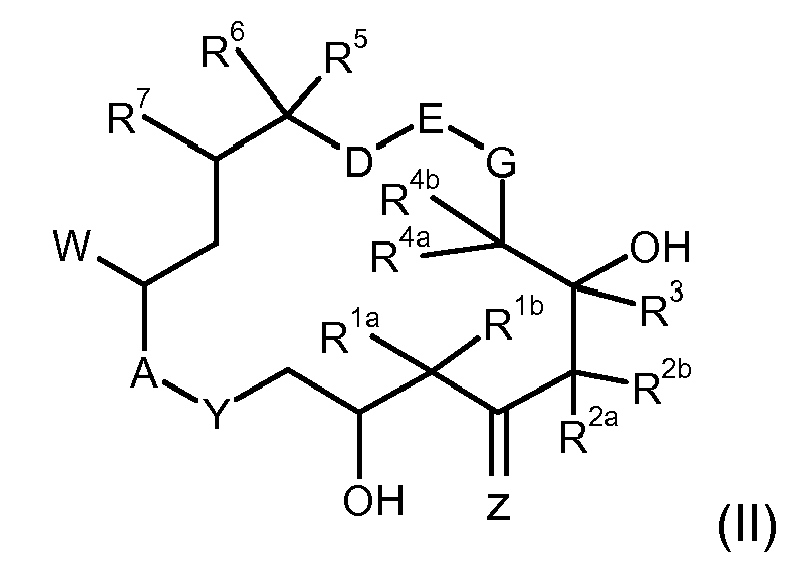
- R1a, R1b
- independently of one another are hydrogen, C1-C10-alkyl, aryl, aralkyl, or together are a group -(CH2)m-, where m is from 2 to 5;
- R2a, R2b
- independently of one another are hydrogen, C1-C10-alkyl, C2-C10-alkenyl, C2-C10-alkynyl, aryl, aralkyl, or together are a group -(CH2)n-, where n is from 2 to 5,
- R3
- is hydrogen, C1-C10-alkyl, aryl, aralkyl;
- R4a, R4b
- independently of one another are hydrogen, C1-C10-alkyl, aryl, aralkyl, or together are a group -(CH2)p-, where p is from 2 to 5;
- R5
- is hydrogen, C1-C10-alkyl, aryl, aralkyl, CO2H, CO2-al CH2OH, CH2O-C1-C5-alkyl, CH2O-acyl, CN, CH2NH2, CH2N((C1-C5-alkyl),acyl)1,2, or CH2Hal, CHal3;
- R6, R7
- independently of one another are hydrogen, or together are a further bond or an epoxide function;
- G
- is O or CH2;
- D-E
- together are the group -H2C-CH2-, -HC=CH-, -C≡C-, -CH(OH)-CH(OH)-, -CH(OH)-CH2-, -CH2-CH(OH)-, -CH2-O-, -O-CH2-, or , where, if G is oxygen, D-E may not be CH2-O; or
- D-E-G
- together are the group H2C-CH=CH;
- W
- is the group C(=X)R8, or a bi- or tricyclic aromatic or heteroaromatic radical;
- X
- is O or the group CR9R10;
- R8
- is hydrogen, C1-C10-alkyl, aryl, aralkyl, halogen, CN;
- R9, R10
- independently of one another are hydrogen, C1-C20-alkyl, aryl, aralkyl, or together with the methylene carbon atom are a 5- to 7-membered carbocyclic ring;
- Z
- is O or hydrogen and the group OR11;
- R11
- is hydrogen or a protective group PGz;
- A-Y
- is a group O-C(=O), O-CH2, CH2-C(=O), NR12-C(=O), NR12-SO2;
- R12
- is hydrogen or C1-C10-alkyl;
- PGz
- is C1-C20-alkyl, a C4-C7-cycloa!ky! group which may contain one or more oxygen atoms in the ring, aryl, aralkyl, C1-C20-acyl, aroyl, C1-C20-alkylsulfonyl, arylsulfonyl, tri(C1-C20-alkyl)silyl, di(C1-C20-alkyl)arylsilyl, (C1-C20-alkyl)diarylsilyl or tri(aralkyl)silyl;
- solubilized as individual stereoisomer or as a mixture of different stereoisomers and/or as a pharmaceutically acceptable salt.
- For another embodiment of the present invention, the epothilone is defined by the formula (I)
in which - R1a, R1b
- independently of one another are hydrogen, C1-C4-alkyl, or together are the group -(CH2)m- where m is from 2 to 5;
- R2a, R2b
- independently of one another are hydrogen, C1-C5-alkyl, or together are the group -(CH2)m-, where m is from 2 to 5, or C2-C6-alkenyl, or C2-C6-alkynyl;
- R3
- is hydrogen;
- R4a, R4b
- independently of one another are hydrogen, C1-C4-alkyl;
- R5
- is hydrogen, C1-C4-alkyl, C(Hal)3
- R6, R7
- are both hydrogen, or together are a further bond, or together are an epoxide function;
- G
- is CH2;
- D-E
- is the group H2C-CH2, or
- D-E-G
- together are the group H2C-CH=CH;
- W
- is the group C(=X)R8, or a bi- or tricyclic aromatic or heteroaromatic radical;
- X
- is the group CR9R10 ;
- R8
- is hydrogen, C1-C4-alkyl, halogen;
- R9, R10
- are both independently of one another hydrogen, C1-C4-alkyl, aryl, aralkyl;
- Z
- is oxygen;
- A-Y
- is the group O-C(=O) or the group NR12-C(=O);
- R12
- is hydrogen or C1-C4-alkyl ;
- In a further embodiment, what is solubilized are epothilones of the general formula (I) in which
- R1a, R1b
- are both independently of one another hydrogen, C1-C2-alkyl, or together are a group -(CH2)m-, where m is from 2 to 5;
- R2a, R2b
- are both independently of one another hydrogen, C1-C5-alkyl, or together are the group -(CH2)n-, where n is from 2 to 5, or C2-C6-alkenyl, or C2-C6-alkynyl;
- R3
- is hydrogen;
- R4a, R4b
- are both independently of one another hydrogen, C1-C2-alkyl;
- R5
- is hydrogen or methyl or trifluoromethyl;
- R6, R7
- together are a further bond, or together are an epoxide function;
- G
- is CH2;
- D-E
- is the group H2C-CH2,
- D-E-G
- together are the group H2C-CH=CH;
- W
- is the group C(=X)R8, or thiazolyl, oxazolyl, pyridyl, N-oxopyridyl, benzothiazolyl, benzoxazolyl, benzimidazolyl, which may optionally be substituted by C1-C3-alkyl, C1-C3-hydroxyalkyl, C1-C3-aminoalkyl, C1-C3-alkylsulfonyl;
- X
- is the group CR9R10;
- R8
- is hydrogen, methyl, chlorine, fluorine;
- R9, R10
- are both independently of one another hydrogen, C1-C4-alkyl, thiazolyl, oxazolyl, pyridyl, N-oxopyridyl, which may optionally be substituted by C1-C3-alkyl, C1-C3-hydroxyalkyl, C1-C3-aminoalkyl, aralkyl;
- Z
- is oxygen;
- A-Y
- is the group O-C(=O) or the group NR12-C(=O);
- R12
- is hydrogen or C1-C4-alkyl ;
- In a further embodiment, what is solubilized are epothilones of the general formula (I) in which A-Y: O-C(=O); D-E: H2C-CH2; G: CH2; Z: O; R1a, R1b: C1-C10-alkyl or together are a -(CH2)p- group, where p is from 2 to 3; R2a, R2b independently of one another are hydrogen, C1-C10-alkyl, C2-C10-alkenyl or C2-C10-alkynyl; R3 is hydrogen; R4a, R4b independently of one another are hydrogen or C1-C10-alkyl and R5 is C1-C10-alkyl.
- In a further embodiment, what is solubilzed are epothilones of the general formula (I) in which R2a, R2b independently of one another are hydrogen, C2-C10-alkenyl orC2-C10-alkynyl; R6, R7 together are an epoxide function and W is a 2-methylbenzothiazol-5-yl group or a 2-methylbenzoxazol-5-yl group or a quinolin-7-yl group.
- In a preferred embodiment, what is used in the polymeric composition are epothilones of the general formula (I) listed in the list below:
- (4S,7R,8S,9S,13E/Z,16S)-4,8-dihyd roxy-16-(2-methylbenzoxazol-5-yl)-1-oxa-5,5,9,13-tetramethyl-7-(prop-2-en-1-yl)cyclohexadec-13-ene-2,6-dione;
- (1S/R,3S,7S,10R,1R,12S,16R/S)-7,11-dihydroxy-10-(prop-2-en-1-yl)-3-(2-methylbenzoxazol-5-yl)-8,8,12,16-tetramethyl-4,17-dioxabicyclo-[14.1.0]heptadecane-5,9-dione;
- (4S,7R,8S,9S,13E/Z,-16S)-4,8-dihydroxy-16-(2-methylbenzothiazol-5-yl)-1-oxa 5,5,9,13-tetramethyl-7-(prop-2-en-1-yl)cyclohexadec-13-ene-2,6-dione;
- (1S/R,3S,7S,10R,1S,12S,16R/S)-7,11-dihydroxy-10-(prop-2-en-1-yl)-3-(2-methylbenzothiazol-5-yl)-8,8,12,16-tetramethyl-4,17-dioxabicyclo-[14.1.0]heptadecane-5,9-dione;
- (1 S,3S,7S,10R,1S,12S,16R)-7,11-dihydroxy-10-(prop-2-en-1-yl)-3-(2-methylbenzothiazol-5-yl)-8,8,12,16-tetramethyl-4,17-dioxabicyclo[14.1.0]heptadecane-5,9-dione;
- (1S/R,3S,7S,10R,11R,12S,16R/S)-7,11-dihydroxy-10-(prop-2-en-1-yl)-3-(2-methylbenzothiazol-5-yl)-8,8,12,16-tetramethyl-4,17-dioxabicyclo[14.1.0]-heptadecane-5,9-dione;
- (4S,7R,8S,9S,13E/Z,-16S)-4,8-dihydroxy-16-(2-methylbenzothiazol-5-yl)-1-oxa 9,13-dimethyl-5,5-(1,3-thmethylene)-7-(prop-2-en-1-yl)cyclohexadec-13-ene-2,6-dione;
- (1S/R,3S,7S,10R,11R,12S,16R/S)-7,11-dihydroxy-10-(prop-2-en-1-yl)-3-(2-methylbenzothiazol-5-yl)-12,16-dimethyl-8,8-(1,3-trimethylene)-4,17-dioxabicyclo[14.1.0]heptadecane-5,9-dione;
- (4S,7R,8S,9S,13E/Z,-16S)-4,8-dihydroxy-16-(2-methylbenzothiazol-5-yl)-1-oxa 5,5,9,13-tetramethyl-7-(prop-2-yn-1-yl)cyclohexadec-13-ene-2,6-dione;
- (1S/R,3S,7S,10R,11R,12S,16R/S)-7,11-dihydroxy-10-(prop-2-yn-1-yl)-3-(2-methylbenzothiazol-5-yl)-8,8,12,16-tetramethyl-4,17-dioxabicyclo-[14.1.0]heptadecane-5,9-dione;
- (4S,7R,8S,9S,13E/Z,16S)-4,8-dihydroxy-16-(quinolin-7-yl)-1-oxa-5,5,9,13-tetramethyl-7-(prop-2-en-1-yl)cyclohexadec-13-ene-2,6-dione;
- (1S/R,3S,7S,10R,11R,12S,16R/S)-7,11-dihydroxy-10-(prop-2-en-1-yl)-3-(quinolin-7-yl)-8,8,12,16-tetramethyl-4,17-dioxabicyclo[14.1.0]heptadecane-5,9-dione;
- (4S,7R,8S,9S,13E/Z,16S)-4,8-dihydroxy-16-(1,2-dimethyl-1H-benzimidazol-5-yl)-1-oxa-5,5,9,13-tetramethyl-7-(prop-2-en-1-yl)cyclohexadec-13-ene-2,6-dione;
- (11S/R,3S,7S,10R,11R,12S,16R/S)-7,11-dihydroxy-10-(prop-2-en-1-yl)-3-(1,2-dimethyl-1H-benzimidazol-5-yl)-8,8,12,16-tetramethyl-4,17-dioxabicyclo[14.1.0]heptadecane-5,9-dione;
- (4S,7R,8S,9S,13E/Z,-16S)-4,8-dihydroxy-16-(2-methylbenzothiazol-5-yl)-1-aza 5,5,9,13-tetramethyl-7-(prop-2-en-1-yl)cyclohexadec-13-ene-2,6-dione;
- (1S/R,3S,7S,10R,11S,12S,16R/S)-7,11-dihydroxy-10-(prop-2-en-1-yl)-3-(2-methylbenzothiazol-5-yl)-8,8,12,16-tetramethyl-4-aza-17-oxabicyclo [14.1.0]heptadecane-5,9-dione,
- (1S/R,3S,7S,10R,11R,12S,16R/S)-7,11-dihydroxy-10-(prop-2-en-1-yl)-3-(2-methylbenzothiazol-5-yl)-8,8,12,16-tetramethyl-4-aza-17-oxabicyclo-[14.1.0]heptadecane-5,9-dione,
- (1S,3S(E),7S,10R,11S,12S,16R)-7,11-dihydroxy-8,8,10,12,16-pentamethyl-3-[1-(2-methyl-1,3-thiazol-4-yl)prop-1-en-2-yl]-4,17-dioxabicyclo[14.1.0]-heptadecane-5,9-dione,
- (1S,3S(E),7S,10R,11S,12S,16R)-7,11-dihydroxy-8,8,10,12,16-pentamethyl-3-[1-(2-methyl-1,3-thiazol-4-yl)prop-1-en-2-yl]-17-oxa-4-azabicyclo[14.1.0]-heptadecane-5,9-dione,
- (4S,7R,8S,9S,13Z,16S(E))-4,8-dihydroxy-5,5,7,9,13-pentamethyl-16-[1-(2-methyl-1,3-thiazol-4-yl)prop-1-en-2-yl]oxacyclohexadec-13-ene-2,6-dione,
- (4S,7R,8S,9S,10E,13Z,16S(E))-4,8-dihydroxy-5,5,7,9,13-pentamethyl-16-[1-(2-methyl-1,3-thiazol-4-yl)prop-1-en-2-yl]oxacyclohexadec-10,13-diene-2,6-dione,
- (4S,7R,8S,9S,10E,13Z,16S(E))-4,8-dihydroxy-5,5,7,9-tetramethyl-13-trifluoromethyl-16-[1-(2-methyl-1,3-thiazol-4-yl)prop-1-en-2-yl]oxacyclohexadec-10,13-diene-2,6-dione,
- (1S,3S(E),7S,10R,11S,12S,16R)-7,11-dihydroxy-8,8,10,12,16-pentamethyl-3-[1-(2-methylsulfanyl-1,3-thiazol-4-yl)prop-1-en-2-yl]-4,17-dioxabicyclo[14.1.0]heptadecane-5,9-dione
- as any individual stereoisomer or as a mixture of different stereoisomers and/or as a pharmaceutically acceptable salt.
- Particular preference for the present composition is given to the epothilones (4S,7R,8S,9S,13E/Z,16S)-4,8-dihydroxy-16-(2-methylbenzothiazol-5-yl)-1-oxa-5,5,9,13-tetramethyl-7-(prop-2-en-1-yl)cyclohexadec-13-ene-2,6-dione;and (1S/R,3S,7S,10R,11S,16R/S)-7,11-dihydroxy-10-(prop-2-en-1-yl)-3-(2-methylbenzothiazol-5-yl)-8,8,12,16-tetramethyl-4,17-dioxabicyclo[14.1.0]-heptadecane-5,9-dione as any individual stereoisomer or as a mixture of different stereoisomers and/or as a pharmaceutically acceptable salt.
- Most preferred is the polymeric composition comprising
- (1S,3S,7S,10R,11S,12S,16R)-7,11-dihydroxy-10-(prop-2-en-1-yl)-3-(2-methylbenzothiazol-5-yl)-8,8,12,16-tetramethyl-4,17-dioxabicyclo[14.1.0]heptadecane-5,9-dione, as an individual stereoisomer or as a mixture of different stereoisomers and/or as a pharmaceutically acceptable salt.
- Amphiphilic block copolymers can be prepared according to the process as disclosed in
US 5,702,717 or described in Reed, A.M. and Gilding, D.K. Polymer, 22 (1981), 494-498; Zhu et al., J. Appl. Polym.Sci. 39, (1990), 1-9; some are commercially available.. - The polymeric composition of the present invention can be produced by the method consisting of the following steps:
- (a) The amphiphilic block copolymer is weighed and dissolved in an organic solvent such as acetonitrile or acetone.
- (b) Epothilone is dissolved in the same organic solvent
- (c) The solutions according to a and b are mixed and the organic solvent is evaporated under reduced pressure at room temperature with subsequent drying at 0.1 mbar for 1 hour.
- (d) Afterwards an inert gas is introduced allowing expulsion of the air and the containers are hermetically sealed immediately.
- The composition obtained should be stored at temperatures ranging from 2° to 8°C.
- The amount of epothilone within the composition and consequently used for process step (b) is an amount of less than 10% relating to the amount of the amphiphilic block copolymer, more preferable less than 8% and most preferred 5% and less.
- Thus another aspect of the invention is the process for the preparation of the polymeric composition comprising an epothilone and an amphiphilic block copolymer having a hydrophilic poly(alkylene glycol) component (A) and an amorphous biodegradable hydrophobic polymer component (B).
- More specifically a further aspect of the invention is the process for the preparation of the polymeric composition comprising an epothilone and an amphiphilic block copolymer having a hydrophilic poly(alkylene glycol) component (A) and an amorphous biodegradable hydrophobic polymer component (B) comprising the steps (a) - (d) as disclosed above.
- A preferred aspect of the invention is the process for the preparation of the polymeric composition comprising an epothilone and an amphiphilic block copolymer as decribed in any of the embodiments above, especially the composition as disclosed in the examples.
- In a subsequent step the the polymeric composition can be easily redispersed in an aqueous medium like water or pH adjusted solutions at physiological pH values for intravenous application resulting in a micellar dispersion. pH adjusted solutions can be e.g. a phosphate buffer solution, a phosphate buffered saline solution or saline solution. The pH can be adjusted to a range of 7 to 7.5.
The micellar dispersion obtained by dispersion of the product of the process described above effectively solubilizes the epothilone and can be injected into the body without further dilution or after further dilution with aqueous media. The latter is preferred. - Thus another aspect of the invention is a process for the production of the composition having the steps (a) - (d) mentioned above and additionally the step of redispersion. In a preferred aspect of the invention the redispersion is done in the clinic laboratory after sale of the product obtained by conducting the process steps (a) to (d).
- For clinical purposes it is often convenient to serve a kit comprising the composition according to the invention together with means for redispersion.
- Thus another aspect of the invention is a kit comprising the composition according to the invention together with means for redispersion.
- Owing to the properties of the epothilones, which are suitable as therapeutics for tumor disorders or disorders associated with inflammatory reactions, the polymeric micelles according to the invention comprising an epothilone can be used for the treatment of tumor disorders or disorders associated with inflammatory reactions forms one aspect of the invention. A further aspect of the invention is a method for treating tumor disorders or disorders associated with inflammatory reactions where an effective amount of the active compound, comprised in a micellar system according to the invention, is administered to a human or an animal.
- More specifically the micellar dispersion of the present invention can be used for the treatment of uterine carcinoma and cervical carcinoma, breast-, lung- and prostate carcinomas, renal cancer, malignant melanoma, bone metastases, brain tumors and brain metastases.
- The term "aquous medium" includes water, saline, and pH adjusted solutions at physiological pH values for intravenous application resulting in a micellar dispersion.
- "pH adjusted solutions" include e.g. a phosphate buffer solution, a phosphate buffered saline solution or saline solution.
- The pH adjustment includes a range of 7 to 7,5.
- The term "epothilone or epothilones" includes all natural epothilones and their derivatives. Epothilone derivatives are known, for example from
WO 93/10102 WO 93/10121 DE 41 38 042 A2 ,WO 97/19086 WO 98/25929 WO 99/43320 WO 2000/066589 ,WO 00/49021 WO 00/71521 WO 2001027308 ,WO 99/02514 WO 2002080846 .
The epothilones suitable for use in the present invention and their preparation are disclosed inDE 19907588 ,WO 98/25929 WO 99/58534 WO 99/2514 WO 99/67252 WO 99/67253 WO 99/7692 EP 99/4915 WO 00/1333 WO 00/66589 WO 00/49019 WO 00/49020 WO 00/49021 WO 00/71521 WO 00/37473 WO 00/57874 WO 01/92255 WO 01/81342 WO 01/73103 WO 01/64650 WO 01/70716 US 6204388 ,US 6387927 ,US 6380394 ,US 02/52028 ,US 02/58286 ,US 02/62030 ,WO 02/32844 WO 02/30356 WO 02/32844 WO 02/14323 WO 02/8440 WO 00/66589
In the context of the present invention, preference is given to epothilones included in Formula I.
The term "epothilone" also includes the possibility that one or more epothilone derivatives selected from the disclosed list in one of the embodiments below are solubilized in a composition. - The term poly(lactide) includes poly(D- and poly(L-lactide) and mixtures such as e.g. poly(D,L-lactide) thereof.
- The term "tumor disorders" encompasses the diseases or disease conditions associated with cellular growth, cell division and/or proliferation, such as, for example, malignant tumors. More specific disorders included in this term are, for example, osteoporosis, osteoarthritis, uterine carcinoma and cervical carcinoma, stomach cancer including all carcinomas of the upper abdominal region, intestinal cancer, adenocarcinomas, for example adenosarcoma, breast, lung (for example SCLC and NSCLC), head and neck carcinomas, malignant melanoma, acute lymphocytic or myelocytic leukemia, prostate carcinoma, bone metastases, brain tumors and brain metastases, where in this enumeration the terms "cancer" and "carcinoma" are used synonymously.
Solid tumors form a subaspect.
Preferably, "tumor disorders" are to be understood as meaning uterine carcinoma and cervical carcinoma, breast, lung and prostate carcinomas, malignant melanoma, bone metastases, brain tumors and brain metastases. - The term "pharmaceutical acceptable salts" includes addition salts of mineral acids, carbonic acids, sulfonic acids, e.g. salts of hydrochloric acid, hydrobromic acid, sulfuric acid, nitric acid, phosphoric acid, methanesulfonic acid, ethanesulfonic acid, toluolsulfonic acid, benzenesulfonic acid, naphthalinesulfonic acid, acetic acid, trifluoroacetic acid, propionic acid, lactic acid, tartaric acid, malic acid, citric acid, fumaric acid, pivalinic acid, maleic acid, succinic acid and benzoic acid.
In addition the term physiologically unobjectable salts includes salts of commonly suitable bases, e.g. salts of alkalimetall (e.g.. sodium- and potassium salts), alkaline earth salts (e.g. calcium- and magnesium salts) and ammonium salts, derivatized from NH3 or organic amines with 1 to 16 carbon atoms, e.g. ethylamine, diethylamine, triethylamine, ethyldiisopropylamine, monoethanolamine, diethanolamine, triethanolamine, dicyclohexylamine, dimethylaminoethanol, prokaine, dibenzylamine, N-methylmorpholin, arginin, lysin, ethylendiamine and N-methylpiperidin. - The term "biodegradable polymer component" include homopolymers and copolymers. They are degraded enzymatically or non-enzymatically after injection into the human body and their non-toxic degradation products can be eliminated by metabolism or excretion.
- The inert gas in the sense of the present invention can be e.g. argon, helium, nitrogen.
- The "organic solvent" for use in process step (a) can be any solvent suitable to solve epothilones, e.g. acetone, acetonitrile.
- In the sense of the invention the term "room temperature" includes temperatures in a range of 18° to 28°C.
- The term "redispersion" means the addition of an aqueous medium to the composition to facilitate the formation of a micellar dispersion by dissolution of the polymeric composition into the liquid phase.
- The term "micellar dispersion" describes micelles composed of the amphiphilic block copolymers with the hydrophobic component B forming the inner core and the hydrophilic component A forming the outer shell dispersed in an aquous medium. The micelle size is within a range of 1 to 100 nm, determined by Dynamic Light Scattering.
- The term "alkyl" as used herein refers to straight-chain or branched-chain alkyl groups with 1-20 carbon atoms, e. g., methyl, ethyl, propyl, isopropyl, n-butyl, t-butyl, n-pentyl, isopentyl, neopentyl, heptyl, hexyl and decyl. Alkyl groups can be perfluorated or substituted by one to five substituents selected from the group consisting of halogen atoms, hydroxyl groups, C1-C4 alkoxy groups, or C6-C12 aryl groups (which can be substituted by one to three halogen atoms). If the term alkyl alone or in combination with other terms is used without giving any hint to the length of the chain the chain is meant to have at least one to five carbon atoms and the chain may be straight or branched and can optionally be substituted by hydroxy, halogen, methoxy.
- The term "aryl" as used herein refer to a monocyclic aromatic carbocyclic e.g., phenyl, or heterocyclic ring moiety e.g. furyl, thienyl, pyridyl, pyrazolyl, pyrimidinyl, oxazolyl, pyridazinyl, pyrazinyl, thiazolyl, containing five to 14 ring atoms. Aryl groups can be substituted by one or more substituents selected from the group consisting of halogen, hydroxy, (C1-C10)alkoxy, -CO2H -CO2(C1-C10)alkyl, -NH2, -NO2, -N3, -CN, (C1-C20)alkyl, (C1-C20)acyl, or (C1-C20)acyloxy. The heteroatoms can be oxidized, if as a result the aromatic character is not lost, e. g., a pyridine moiety can be oxidized to a pyridine N-oxide.or the term "aryl" refers to a bi- and tricyclic aryl radical, which can be a substituted or unsubstituted carbocyclic or heterocyclic radical with one or more heteroatoms, such as naphthyl, anthryl, benzoxazolyl, benzothiazolyl, benzimidazolyl, quinolyl, isoquinolyl, benzoxazinyl, benzofuranyl, indolyl, indazolyl, quinoxalinyl, tetrahydroisoquinolinyl, tetrahydroquinolinyl, thienopyridinyl, pyridopyridinyl, benzopyrazolyl, benzotriazolyl, or dihydroindolyl, which can be substituted in one or more places by halogen, OH, O-alkyl, CO2H, CO2-alkyl, -NH2, -NO2, -N3, -CN, C1-C20-alkyl, C1-C20-acyl, or C1-C20-acyloxy groups, are suitable. The heteroatoms can be oxidized if as a result the aromatic character is not lost, such as, for example, the oxidation of a quinolyl to a quinolyl-N-oxide.
- The term "aralkyl" as used herein refers to a group which can contain up to 14 atoms in the aryl ring (preferred five to ten) and one to eight carbon atoms in the alkyl chain (preferred one to four), e.g., benzyl, phenylethyl, naphthylmethyl, naphthylethyl, furylmethyl, thienylethyl, or pyridylpropyl. The rings can be substituted by one or more substituents selected from the group consisting of halogen, hydroxy, alkoxy, -CO2H, -CO2Alkyl, -NH2, -NO2, -N3, -CN, C1-C20 alkyl, C1-C20 acyl, or C1-C20 acyloxy.
- The term "alkenyl" as used herein refers to straight or branched alkenyl groups, e.g. Vinyl-, Allyl-, Homoallyl-, (E)-But-2-enyl-, (Z)-But-2-enyl-, (E)-But-1-enyl-, (Z)-But-1-enyl-, Pent-4-enyl-, (E)-Pent-3-enyl-, (Z)-Pent-3-enyl-, (E)-Pent-2-enyl-, (Z)-Pent-2-enyl-, (E)-Pent-1-enyl-, (Z)-Pent-1-enyl-, 2-Methylvinyl-, 3-Methylbut-3-enyl-, 2-Methylbut-3-enyl-, (E)-2-Methylbut-2-enyl-, (Z)-2-Methylbut-2-enyl-, 3-Methylbut-2-enyl-Gruppe.
- The term "alkynyl" as used herein refers to straight or branched alkynyl groups, e.g. C≡C, -CH2-C≡CH, -C≡C-CH3, -CH(CH3)-C≡CH, -C≡C-CH2(CH3), -C(CH3)2-C≡CH, -C≡C-CH(CH3)2-, -CH(CH3)-C≡C-CH3, -CH2-C≡C-CH2(CH3).
- The term "alkoxy" as used herein refers to C1-C10-alkoxy groups, preferably C1-C5-alkoxy groups, that can be straight-chain or branched e.g. methoxy, ethoxy, n-propoxy, iso-propoxy, n-butoxy, iso-butoxy, tert-butoxy or n-pentoxy, 2,2-dimethylpropoxy, 2-methylbutoxy or 3-methylbutoxy group. A methoxy or ethoxy group is preferred.
- The term "acyl" means -C(O)alkyl or -C(O)phenyl or -C(O)benzyl, the alkyl chain may be straight or branched and has up to 12 carbon atoms and the phenyl ring may optionally be substituted by halogen, hydroxyl, C1-C5-alkoxy, and the acyl residue is derived from the known carbonic acids such as, e.g. CH(O)OH, CH3-COOH, CH3-CH2-COOH, CH3-CH2-CH2-COOH, CH3-CH2-CH2-CH2-COOH, pivalic acid.
- The term "hal" or "halogen" means fluorine, chlorine, bromine or iodine, preferably in end products fluorine or chlorine, as a leaving group preferably iodine or bromine.
- The residue CH2N(alkyl, acyl)1,2 means that the nitrogen can bear one or two same or different residues selected from alkyl or acyl and both terms, alkyl and acyl have the meaning as defined above.
- The protecting groups PGz can be alkyl- and/or aryl-substituted silyl moieties, such as tris(C1-C20 alkyl)silyl, bis(C1-C20 alkyl)-arylsilyl, (C1-C20 alkyl)-diarylsilyl, tris(aralkyl)-silyl, C1-C20 alkyl, C2-C20-alkenyl, C4-C7 cycloalkyl, which may contain an oxygen atom in the ring, aryl, aralkyl, C1-C20 acyl, aroyl, C1-C20 alkoxycarbonyl C1-C20 alkylsulfonyl or C1-C20 arylsulfonyl. Protecting groups which can be easily be removed from the molecule are preferred, e.g., methoxymethyl, methoxyethyl, ethoxyethyl, tetrahydropyranyl, tetrahydrofuranyl, trimethylsilyl, triethylsilyl, triisopropylsilyl, t-butyldimethylsilyl, t-butyldiphenylsilyl, triphenylsilyl, tribenzylsilyl, benzyl, p-nitrobenzyl, p-methoxybenzyl, as well as alkylsulfonyl e.g. methylsulfonyl or arylsulfonyl e.g. p-tolylsulfonyl. As an alkoxycarbonyl radical, e.g., trichloroethyloxycarbonyl (Troc) is suitable. Preferred acyl groups are formyl, acetyl, propionyl, isopropionyl, trichloromethylcarbonyl pivaloyl, butyryl, or benzoyl, which all can be substituted by one or more amino and/or hydroxy moieties.
- The etherified or esterified hydroxyl groups result e.g. in (C1-C5)-alkoxy or
(C1-C5)-alkoxy(C1-C5)alkyl groups e.g. MEM (Methylethoxymethyl), MOM (Methyloxymethyl), or cyclic ethers as e.g.THP (Tetrahydropyranylether), O(CO)(C1-C10)alkyl groups, O(CO)benzyl, O(CO)phenyl, with the used term alkyl as defined above. - As amino protective groups PG, the radicals that are known to one skilled in the art are considered. For example, the Alloc, Boc, Z, benzyl, f-Moc, Troc, Stabase or benzostabase group can be mentioned.
- In one aspect of the invention all compounds defined in formula I as well as their salts, solvates and solvates of salts are encompassed,. especially the salts, solvates and salts of solvates of the compounds disclosed in the examples are one aspect of the invention as long as the disclosed compounds themselves are not already salts, solvates or solvates of the salts.
- The invention will now be described further in the examples given hereunder, without being limited to them.
-
- PEG
- Poly(ethylene glycol)
- mPEG
- Monomethoxypoly(ethylene glycol)
- PDLLA
- Poly(D,L-lactide)
- USP
- United States Pharmacopoea
- mPEG-b-PDLLA (2000-b-2200) was purchased from Polymer Source Inc., Montreal, Canada.
Sagopilone was obtained from Bayer Schering Pharma AG, Germany. A method for its preparation is described inWO 00/66589
Acetonitrile (Sigma Aldrich) was gradient grade
Phosphate Buffer Solution pH7,4 was prepared according to USP. Potassium dihydrogenphosphate and sodium hydroxide were obtained from Merck, Germany. - The method for measuring the micelle particle size as well as the polydispersity index is done by Dynamic Light Scattering using a Zetasizer Nano from Malvern Instrument Ltd. (Worcestershire, UK) according to the following procedure: 1 to 2 ml of the micellar dispersion in a dust-free plastic cuvette is placed in the machine. The temperature is adjusted to 25°C for 1 minute. Briefly the principle is based on the measurement of the backscattered light fluctuations measured at an angle of 173° and the calculation of an autocorrelation function. The autocorrelation function is analysed using the DTS v5.1 software provided by Malvern to obtain the hydrodynamic diameter of the micelles (Zave) stated as particle size herein and the particle size distribution (PDI) stated as polydispersity index herein. Measurements were done in triplicate for each probe and the mean values are calculated and used herein.
- The method for measuring the sagopilone content of the micellar dispersions as well as the detection of degradation products is determined by High Performance Liquid Chromatography. The analysis was done on a Agilent 1100 Series chromatography system consisting of a quaternary pump, an autoinjector, a column heater and a UV-detector from Agilent Technologies, Santa Clara, USA .
-
Column 2 x Chromolith® Performance RP-18e 100x4,6 mm Merck, Germany Mobile Phase A - Acetonitrile B - Water Pump Mode Gradient Temperature 25°C Injection Volume 5 µl Detection wavelength 220 nm - 4 Polymeric compositions of mPEG-b-PDLLA (2000-b-2200) and Sagopilone were prepared by four different methods. 1 Comparative composition was prepared without the block copolymer.
- 100 mg of mPEG-b-PDLLA (2000-b-2200) is weighed and dissolved in acetonitrile. 5 mg of Sagopilone is dissolved in the same organic solvent. The 2 solutions are mixed and the organic solvent is evaporated under reduced pressure at room temperature with subsequent drying at 0.1 mbar.
- 100 mg of mPEG-b-PDLLA (2000-b-2200) is weighed and dissolved in acetonitrile. 5 mg of Sagopilone is dissolved in the same organic solvent. The 2 solutions are mixed and the organic solvent is evaporated under stirring at room temperature.
- 100 mg of mPEG-b-PDLLA (2000-b-2200) is weighed and dissolved in acetonitrile. 5 mg of Sagopilone is dissolved in the same organic solvent. The 2 solutions are mixed and the organic solvent is evaporated under a stream of nitrogen at room temperature.
- 100 mg of mPEG-b-PDLLA (2000-b2200) and 5 mg of Sagopilone are weighed and mixed. The mixture is heated to 60°C in a water bath and stirred for 30 min. at this temperature. Afterwards the liquid composition is cooled to room temperature under stirring.
- 5 mg of Sagopilone is weighed and dissolved acetonitrile. The organic solvent is evaporated under reduced pressure at room temperature with subsequent drying at 0.1 mbar.
- Subsequently 5 ml of phosphate buffer solution pH7.4 is added to each of the compositions. The resulting mixtures were shaken by hand to facilitate the formation of the micellar dispersion. The micellar dispersions were filtered using a 0.22 µm PVDF syringe filter. The filtrate was diluted immediately with an acetonitrile-water-mixture (1:1 v/v) and assayed by HPLC to determine the Sagopilone content.
Table 1 Solubilisation efficiency and solubility of sagopilone within micellar dispersions after redispersion of the polymeric compositions Method Solubilisation Efficiency [%] Solubility of Sagopilone [mg/ml] A 100 1,00 B 82 0,82 C 25 0,25 D 24 0,24 E 10 0,01 *Solubilisation Efficiency [%] = Solubilized drug [mg]/ added drug [mg]x100 - The results shown in Table 1 indicate that the polymeric micellar dispersions increase the solubility of Sagopilone compared to the composition containing no block copolymer.
Regarding the industrial applicability of the polymeric composition a solubilisation efficiency of 100% is essential to ensure complete redispersion of the drug. Compositions prepared by Method C and D do not solubilize the drug sufficiently. Method B results in a significantly higher solubilization but still not enough. Only with the composition prepared by Method A the required concentration as well as 100% solubilisation efficiency within the micellar dispersion was achieved without loss of drug substance or degradation due to the process. Hence this clearly shows the superiority of this Method. - It can be derived from the chromatograms that degradation of the drug occurs during the preparation process of Method B indicated by degradation peaks within the retention time range of 11 to 17 minutes. In contrast no degradation is seen with Method A. This underlines the predominance of Method A, where the polymeric compositions are formed by evaporating the organic solvent under reduced pressure. Evaporation by stirring without reduced pressure as well as under the nitrogen stream already leads to degradation of the drug.
- 3 Polymeric compositions of mPEG-b-PDLLA (2000-b-2200) and Sagopilone were prepared according to method A of Example 1.
Subsequently 5 ml of phosphate buffer solution pH7.4 is added to each of the compositions. The resulting mixtures were shaken by hand to facilitate the formation of the micellar dispersion. The micellar dispersions were filtered using a 0.22 µm PVDF syringe filter.
The obtained micellar dispersion was stored at 2 to 8 °C and aliquots were taken at certain time points. The Particle Size as well as the Polydispersity Index was determined. Afterwards the samples except for the one taken after preparation were filtered again through a 0.22 µm PVDF syringe filter to ensure the removal of precipitated drug substance. The filtrates were diluted immediately with an acetonitrile-water-mixture (1:1 v/v) and assayed by HPLC to determine the Sagopilone content.Table 2 Sagopilone content and particle size characterization of the micellar dispersions over 24 hours Time point of analysis after preparation after 6 hours after 24 hours Remained Sagopilone [%] 100 96 97 Particle Size [nm] 20 20 20 Polydispersity Index 0,01 0,01 0,01 - The polymeric compositions were easy and complete redispersable with 100 % solubilisation efficiency of Sagopilone. The resulting dispersions were clear. Precipitation of Sagopilone was not observed visually over 24 hours of storage. The remained drug analysed by HPLC did not change significantly. The micelles were stable in size and polydispersity index indicating that no bigger aggregates were present over this period of time. The Sagopilone itself was stable too, see
figure 3 . This is a very good premise for clinical application since the time interval between redispersion of the polymeric composition and its use should preferably be at least 12 hours. - It can be derived from the chromatogram that Sagopilone solubilized within the polymeric micelles did not degrade over storage of 24 hours at 4°C.
- Polymeric compositions were prepared by the method consisting of the following steps:
- (a) 40 mg of mPEG-b-PDLLA (2000-b-2200) is weighed and dissolved in acetonitrile
- (b) 2 mg of Sagopilone is dissolved in the same organic solvent
- (c) The solutions according to a and b are mixed and the organic solvent is evaporated under reduced pressure at room temperature with subsequent drying at 0.1 mbar for 1 hour.
- (d) Afterwards dry argon was introduced allowing expulsion of the air and the containers were hermetically sealed immediately.
The solutions were stored at 2 to 8°C and 25 °C.
After preparation, 1 and 3 months of storage the polymeric compositions were redispersed by the addition of 2 ml phosphate buffer solution pH7.4 and shaken by hand. Subsequently the dispersions were filtered through a 0.22 µm PVDF syringe filter. The redispersion behaviour, the Sagopilone content of the micellar dispersion and the stability of the dispersion regarding the Sagopilone content, particle size and polydispersity index (PDI) over 12 hours was analysed. For every storage condition and time point 6 individual polymeric compositions were analysed. - In Table 3 the sagopilone content is the content of sagopilone within the dispersion in mg multiplied with 100 divided by the amount of sagopilone added during preparation in mg. The values present mean values and their standard deviation of 6 individual polymeric compositions of the respective parameters.
- The redispersion behaviour of the compositions stored at 6 °C did not change over 3 months compared to those freshly prepared. All compositions were easily and complete redispersable. The resulting polymeric dispersions exhibit sufficient solubilization within a range of 100 ± 5 % and they are stable in drug concentration as well as particle size and polydispersity over 12 hours storage.
- Polymeric compositions stored at 25°C were completey redispersable after 1 month whereas complete redispersion failed after 3 months of storage. Furthermore the dispersions formed after 1 month of storage were not stable indicated by the formation of a visible precipitate, particle sizes in a range of 1 to 3 micrometer with a very high polydispersity and a dramatically decreased sagopilone content.
- The stability of the polymeric compositions as well as their excellent redispersion behaviour over the storage time of 3 months at 6°C indicates the feasibility of the use of the polymeric compositions according to this invention as stable formulations for sagopilone.
Thus an important condition for their industrial applicability is met. -
-
Figure 1
Chromatogram of micellar dispersion formed of polymeric composition prepared by Method A, assayed by HPLC -
Figure 2
Chromatogram of micellar dispersion formed of polymeric composition prepared by Method B, assayed by HPLC -
Figure 3
Chromatogram of micellar dispersion after 24 hours storage, assayed by HPLC
| Characterization of the micellar dispersions formed of polymeric compositions stored over 3 months at 6 and 25°C after preparation and 12 hours storage | |||||
| storage [months] | Time [h] after Redispersion of Polymeric Composition | ||||
| 0 | 12 | 0 | 12 | ||
| Sagopilone Content [%] | 0 | 100 ± 1 | 98 ± 2 | ||
| | 20 ± 0,1 | 20 ± 0,1 | |||
| PDI | 0,01 | 0,01 | |||
| Storage Temperature | 6° | 25°C | |||
| Sagopilone Content [%] | 1 | 98 ± 3 | 95 ± 1 | 92 ± 5 | 30 ± 7 |
| | 20 ± 0,1 | 20 ± 0,1 | 21 ± 0,4 | 1656 ± 652 | |
| PDI | 0,01 | 0,01 | 0,05 | 0,91 | |
| Sagopilone Content [%] | 3 | 96 ± 1 | 97 ± 2 | 57 ± 9 | 19 ± 3 |
| | 20 ± 0,1 | 20 ± 0,1 | 2056 ± 552 | n.d. | |
| PDI | 0,01 | 0,01 | 0,8 | n.d. | |
Claims (8)
- ) A stable polymeric composition comprising an amphiphilic AB type diblock copolymer having
a hydrophilic poly(alkylene glycol) component (A) and an amorphous biodegradable hydrophobic polymer component (B)
and
an epothilone. - ) A composition according to claim 1 in which the hydrophilic poly(alkylene glycol) component (A) is poly(ethylene glycol) (PEG) or monomethoxypoly(ethylene glycol) (mPEG) and the biodegradable hydrophobic polymer component (B) is poly(D,L-lactide) (PDLLA) or poly(lactide-co-glycol ide)(PLGA).
- ) A composition according to claim 1 in which the hydrophilic poly(alkylene glycol) is poly(ethylene glycol) (PEG) component (A) has a polymerization degree of n=22-114 and the biodegradable hydrophobic poly(D,L-lactide) component (B) has a polymerization degree of m=7-104.
- ) A composition according to claim 1 wherein the epothilone is an epothilone of formula (I)
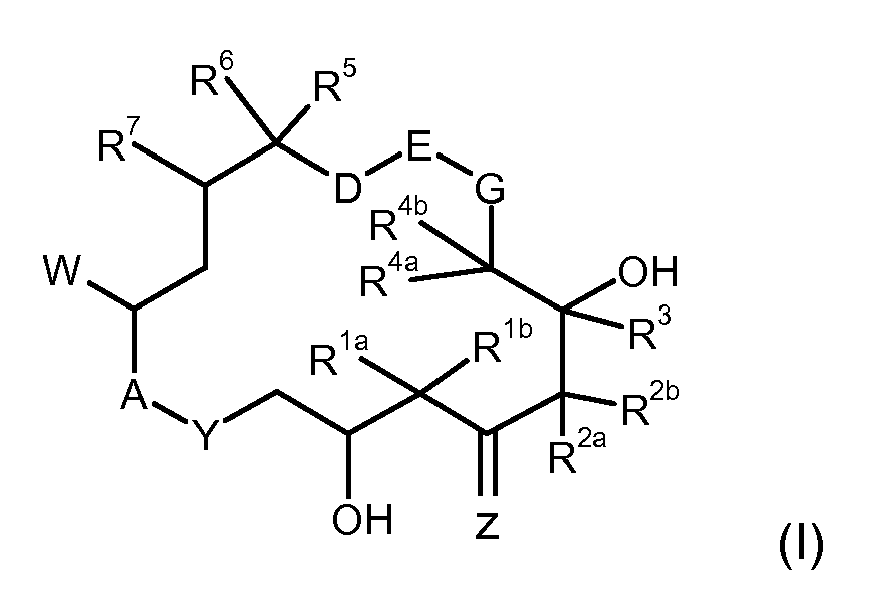 R1a, R1b independently of one another are hydrogen, C1-C4-alkyl, or together are the group -(CH2)m- where m is from 2 to 5;R2a, R2b independently of one another are hydrogen, C1-C5-alkyl, or together are the group -(CH2)m-, where m is from 2 to 5, or C2-C6-alkenyl, or C2-C6-alkynyl;R3 is hydrogen;R4a, R4b independently of one another are hydrogen, C1-C4-alkyl;R5 is hydrogen, C1-C4-alkyl, C(Hal)3R6, R7 are both hydrogen, or together are a further bond, or together are an epoxide function;G is CH2;D-E is the group H2C-CH2, orD-E-G together are the group H2C-CH=CH;W is the group C(=X)R8, or a bi- or tricyclic aromatic or heteroaromatic radical;X is the group CR9R10;R8 is hydrogen, C1-C4-alkyl, halogen;R9, R10 are both independently of one another hydrogen, C1-C4-alkyl, aryl, aralkyl;Z is oxygen;A-Y is the group O-C(=O) or the group NR12-C(=O);R12 is hydrogen or C1-C4-alkyl;encapsulated as an individual stereoisomer or as a mixture of different stereoisomers and/or as pharmaceutically acceptable salts.
 - . A composition according to claim 1, in which the epothilone is selected from the group consisting of(4S,7R,8S,9S,13E/Z,16S)-4,8-dihydroxy-16-(2-methylbenzoxazol-5-yl)-1-oxa-5,5,9,13-tetramethyl-7-(prop-2-en-1-yl)cyclohexadec-13-ene-2,6-dione;(1S/R,3S,7S,10R,11R,12S,16R/S)-7,11-dihydroxy-10-(prop-2-en-1-yl)-3-(2-methylbenzoxazol-5-yl)-8,8,12,16-tetramethyl-4,17-dioxabicyclo-[14.1.0]heptadecane-5,9-dione;(4S,7R,8S,9S,13E/Z,-16S)-4,8-dihydroxy-16-(2-methylbenzothiazol-5-yl)-1-oxa 5,5,9,13-tetramethyl-7-(prop-2-en-1-yl)cyclohexadec-13-ene-2,6-dione;(1S/R,3S,7S,10R,11S,12S,16R/S)-7,11-dihydroxy-10-(prop-2-en-1-yl)-3-(2-methylbenzothiazol-5-yl)-8,8,12,16-tetramethyl-4,17-dioxabicyclo-[14.1.0]heptadecane-5,9-dione;(1S,3S,7S,10R,11S,12S,16R)-7,11-dihydroxy-10-(prop-2-en-1-yl)-3-(2-methylbenzothiazol-5-yl)-8,8,12,16-tetramethyl-4,17-dioxabicyclo[14.1.0]heptadecane-5,9-dione;(1S/R,3S,7S,110R,11R,12S,16R/S)-7,11-dihydroxy-10-(prop-2-en-1-yl)-3-(2-methylbenzothiazol-5-yl)-8,8,12,16-tetramethyl-4,17-dioxabicyclo[14.1.0]-heptadecane-5,9-dione;(4S,7R,8S,9S,13E/Z,-16S)-4,8-dihydroxy-16-(2-methylbenzothiazol-5-yl)-1-oxa 9,13-dimethyl-5,5-(1,3-trimethylene)-7-(prop-2-en-1-yl)cyclohexadec-13-ene-2,6-dione;(1S/R,3S,7S,110R,11R,12S,16R/S)-7,11-dihydroxy-10-(prop-2-en-1-yl)-3-(2-methylbenzothiazol-5-yl)-12,16-dimethyl-8,8-(1,3-trimethylene)-4,17-dioxabicyclo[14.1.0]heptadecane-5,9-dione;(4S,7R,8S,9S,13E/Z,-16S)-4,8-dihydroxy-16-(2-methylbenzothiazol-5-yl)-1-oxa 5,5,9,13-tetramethyl-7-(prop-2-yn-1-yl)cyclohexadec-13-ene-2,6-dione;(1S/R,3S,7S,10R,11R,12S,16R/S)-7,11-dihydroxy-10-(prop-2-yn-1-yl)-3-(2-methylbenzothiazol-5-yl)-8,8,12,16-tetramethyl-4,17-dioxabicyclo-[14.1.0]heptadecane-5,9-dione;(4S,7R,8S,9S,13E/Z,16S)-4,8-dihydroxy-16-(quinolin-7-yl)-1-oxa-5,5,9,13-tetramethyl-7-(prop-2-en-1-yl)cyclohexadec-13-ene-2,6-dione;(1S/R,3S,7S,10R,11R,12S,16R/S)-7,11-dihydroxy-10-(prop-2-en-1-yl)-3-(quinolin-7-yl)-8,8,12,16-tetramethyl-4,17-dioxabicyclo[14.1.0]heptadecane-5,9-dione;(4S,7R,8S,9S,13E/Z,16S)-4,8-dihydroxy-16-(1,2-dimethyl-1H-benzimidazol-5-yl)-1-oxa-5,5,9,13-tetramethyl-7-(prop-2-en-1-yl)cyclohexadec-13-ene-2,6-dione;(1S/R,3S,7S,10R,11R,12S,16R/S)-7,11-dihydroxy-10-(prop-2-en-1-yl)-3-(1,2-dimethyl-1H-benzimidazol-5-yl)-8,8,12,16-tetramethyl-4,17-dioxabicyclo[14.1.0]heptadecane-5,9-dione;(4S,7R,8S,9S,13E/Z,-16S)-4,8-dihydroxy-16-(2-methylbenzothiazol-5-yl)-1-aza 5,5,9,13-tetramethyl-7-(prop-2-en-1-yl)cyclohexadec-13-ene-2,6-dione;(1S/R,3S,7S,10R,11S,12S,16R/S)-7,11-dihydroxy-10-(prop-2-en-1-yl)-3-(2-methylbenzothiazol-5-yl)-8,8,12,16-tetramethyl-4-aza-17-oxabicyclo [14.1.0]heptadecane-5,9-dione,(1S/R,3S,7S,10R,11R,12S,16R/S)-7,11-dihydroxy-10-(prop-2-en-1-yl)-3-(2-methylbenzothiazol-5-yl)-8,8,12,16-tetramethyl-4-aza-17-oxabicyclo-[14.1.0]heptadecane-5,9-dione,(1S,3S(E),7S,10R,11S,12S,16R)-7,11-dihydroxy-8,8,10,12,16-pentamethyl-3-[1-(2-methyl-1,3-thiazol-4-yl)prop-1-en-2-yl]-4,17-dioxabicyclo[14.1.0]-heptadecane-5,9-dione,(1S,3S(E),7S,10R,11S,12S,16R)-7,11-dihydroxy-8,8,10,12,16-pentamethyl-3-[1-(2-methyl-1,3-thiazol-4-yl)prop-1-en-2-yl]-17-oxa-4-azabicyclo[14.1.0]-heptadecane-5,9-dione,(4S,7R,8S,9S,13Z,16S(E))-4,8-dihydroxy-5,5,7,9,13-pentamethyl-16-[1-(2-methyl-1,3-thiazol-4-yl)prop-1-en-2-yl]oxacyclohexadec-13-ene-2,6-dione,(4S,7R,8S,9S,10E,13Z,16S(E))-4,8-dihydroxy-5,5,7,9,13-pentamethyl-16-[1-(2-methyl-1,3-thiazol-4-yl)prop-1-en-2-yl]oxacyclohexadec-10,13-diene-2,6-dione,(4S,7R,8S,9S,10E,13Z,16S(E))-4,8-dihydroxy-5,5,7,9-tetramethyl-13-trifluoromethyl-16-[1-(2-methyl-1,3-thiazol-4-yl)prop-1-en-2-yl]oxacyclohexadec-10,13-diene-2,6-dione,(1S,3S(E),7S,10R,11S,12S,16R)-7,11-dihydroxy-8,8,10,12,16-pentamethyl-3-[1-(2-methylsulfanyl-1,3-thiazol-4-yl)prop-1-en-2-yl]-4,17-dioxabicyclo[14.1.0]heptadecane-5,9-dioneas an individual stereoisomer or as a mixture of different stereoisomers and/or as a pharmaceutically acceptable salt.
- . A process for the preparation of the composition according to claim 1 comprising the following steps:(a) The amphiphilic block copolymer is weighed and dissolved in an organic solvent.(b) Epothilone, is dissolved in the same organic solvent(c) The solutions according to (a) and (b) are mixed and the organic solvent is evaporated under reduced pressure at room temperature with subsequent drying at 0.1 mbar for 1 hour.(d) Afterwards an inert gas is was introduced allowing expulsion of the air and the containers are hermetically sealed immediately.
- . Use of the composition according to claim 1 for the preparation of a medicament for the treatment of tumor disorders or disorders associated with inflammatory reactions.
- . A kit comprising the composition according to claim 1 together with means for redispersion.
Priority Applications (1)
| Application Number | Priority Date | Filing Date | Title |
|---|---|---|---|
| EP09151405A EP2210584A1 (en) | 2009-01-27 | 2009-01-27 | Stable polymeric composition comprising an epothilone and an amphiphilic block copolymer |
Applications Claiming Priority (1)
| Application Number | Priority Date | Filing Date | Title |
|---|---|---|---|
| EP09151405A EP2210584A1 (en) | 2009-01-27 | 2009-01-27 | Stable polymeric composition comprising an epothilone and an amphiphilic block copolymer |
Publications (1)
| Publication Number | Publication Date |
|---|---|
| EP2210584A1 true EP2210584A1 (en) | 2010-07-28 |
Family
ID=40668140
Family Applications (1)
| Application Number | Title | Priority Date | Filing Date |
|---|---|---|---|
| EP09151405A Withdrawn EP2210584A1 (en) | 2009-01-27 | 2009-01-27 | Stable polymeric composition comprising an epothilone and an amphiphilic block copolymer |
Country Status (1)
| Country | Link |
|---|---|
| EP (1) | EP2210584A1 (en) |
Cited By (1)
| Publication number | Priority date | Publication date | Assignee | Title |
|---|---|---|---|---|
| CN102935062A (en) * | 2011-08-16 | 2013-02-20 | 王成 | Polymeric micelle composition loaded with epothilone compound or derivatives thereof, freezed-drying preparation, and preparation and application thereof |
Citations (45)
| Publication number | Priority date | Publication date | Assignee | Title |
|---|---|---|---|---|
| DE4138042A1 (en) | 1991-11-19 | 1993-05-27 | Biotechnolog Forschung Gmbh | EPOTHILONES, THEIR PRODUCTION PROCESS AND MEANS CONTAINING THEM |
| WO1993010102A1 (en) | 1991-11-22 | 1993-05-27 | Centre National De La Recherche Scientifique (C.N.R.S) | Novel compounds having a guanidine structure and pharmaceutical composition containing same |
| WO1997019086A1 (en) | 1995-11-17 | 1997-05-29 | GESELLSCHAFT FüR BIOTECHNOLOGISCHE FORSCHUNG MBH (GBF) | Epothilone derivatives, preparation and use |
| US5702717A (en) | 1995-10-25 | 1997-12-30 | Macromed, Inc. | Thermosensitive biodegradable polymers based on poly(ether-ester)block copolymers |
| WO1998025929A1 (en) | 1996-12-13 | 1998-06-18 | Novartis Ag | Epothilone analogs |
| WO1999002514A2 (en) | 1997-07-08 | 1999-01-21 | Bristol-Myers Squibb Company | Epothilone derivatives |
| WO1999007692A2 (en) | 1997-08-09 | 1999-02-18 | Schering Aktiengesellschaft | New epothilone derivatives, method for producing same and their pharmaceutical use |
| WO1999039694A2 (en) | 1998-02-05 | 1999-08-12 | Novartis Ag | Compositions containing organic compounds |
| WO1999043320A1 (en) | 1998-02-25 | 1999-09-02 | Novartis Ag | Use of epothilones for the treatment of cancer |
| WO1999058534A2 (en) | 1998-05-08 | 1999-11-18 | GESELLSCHAFT FüR BIOTECHNOLOGISCHE FORSCHUNG MBH (GBF) | Epothilone derivatives, a method for the production thereof, and their use |
| WO1999067253A2 (en) | 1998-06-22 | 1999-12-29 | Novartis Ag | Desmethyl epothilones |
| WO1999067252A2 (en) | 1998-06-22 | 1999-12-29 | Novartis Ag | Epothilone derivatives and their synthesis and use |
| WO2000001333A2 (en) | 1998-07-02 | 2000-01-13 | Sca Hygiene Products Ab | A method of producing an outer sheet that includes barrier flaps, and an outer sheet produced in accordance therewith |
| WO2000037473A1 (en) | 1998-12-22 | 2000-06-29 | Novartis Ag | Epothilone derivatives and their use as antitumor agents |
| WO2000049019A2 (en) | 1999-02-18 | 2000-08-24 | Schering Aktiengesellschaft | Novel epothilone derivatives, method for producing them and their pharmaceutical use |
| WO2000049020A2 (en) | 1999-02-18 | 2000-08-24 | Schering Aktiengesellschaft | Novel epothilon derivatives, method for the production thereof and their pharmaceutical application |
| WO2000049021A2 (en) | 1999-02-18 | 2000-08-24 | Schering Aktiengesellschaft | 16-halogen-epothilone derivatives, method for producing them and their pharmaceutical use |
| DE19907588A1 (en) | 1999-02-22 | 2000-08-24 | Biotechnolog Forschung Gmbh | New C-21 modified epothilone derivatives useful for treating e.g. cancer and other proliferative diseases and inhibiting angiogenesis and inducing apoptosis |
| WO2000057874A1 (en) | 1999-03-29 | 2000-10-05 | Bristol-Myers Squibb Co. | A process for the preparation of aziridinyl epothilones from oxiranyl epothilones |
| WO2000066589A1 (en) | 1999-04-30 | 2000-11-09 | Schering Aktiengesellschaft | 6-alkenyl-, 6-alkinyl- and 6-epoxy-epothilone derivatives, process for their production, and their use in pharmaceutical preparations |
| WO2000071521A1 (en) | 1999-05-21 | 2000-11-30 | Bristol-Myers Squibb Co. | A process for the reduction of oxiranyl epothilones to olefinic epothilones |
| WO2001012718A1 (en) | 1999-08-14 | 2001-02-22 | Samyang Corporation | Polymeric composition for solubilizing poorly water soluble drugs and process for the preparation thereof |
| US6204388B1 (en) | 1996-12-03 | 2001-03-20 | Sloan-Kettering Institute For Cancer Research | Synthesis of epothilones, intermediates thereto and analogues thereof |
| WO2001027308A2 (en) | 1999-10-08 | 2001-04-19 | Novartis Ag | 13-alkyl epothilone derivatives |
| WO2001064650A2 (en) | 2000-03-01 | 2001-09-07 | Sloan-Kettering Institute For Cancer Research Center | Synthesis of epothilones, intermediates thereto and analogues thereof |
| WO2001070716A1 (en) | 2000-03-20 | 2001-09-27 | Bristol-Myers Squibb Company | A process for the preparation of epothilone analogs and intermediates |
| WO2001073103A2 (en) | 2000-03-24 | 2001-10-04 | Bristol-Myers Squibb Company | Preparation of epothilone intermediates |
| WO2001081342A2 (en) | 2000-04-19 | 2001-11-01 | Schering Aktiengesellschaft | Novel epothilone derivatives, method for the preparation thereof and their pharmaceutical use |
| WO2001087345A1 (en) | 2000-05-17 | 2001-11-22 | Samyang Corporation | Stable polymeric micelle-type drug composition and method for the preparation thereof |
| WO2001092255A2 (en) | 2000-05-26 | 2001-12-06 | Kosan Biosciences, Inc. | Epothilone derivatives and methods for making and using the same |
| WO2002008440A2 (en) | 2000-07-25 | 2002-01-31 | Kosan Biosciences, Inc. | Fermentation process for epothilones |
| WO2002014323A2 (en) | 2000-08-16 | 2002-02-21 | Bristol-Myers Squibb Company | Polymorphs of an epothilone analog |
| WO2002030356A2 (en) | 2000-10-13 | 2002-04-18 | The University Of Mississipi | Synthesis of epothilones and relates analogs |
| WO2002032844A2 (en) | 2000-10-16 | 2002-04-25 | Morphochem Ag | Epothilone synthesis components iii and iv: asymmetrically substituted acyloins and acyloin derivatives, method for the production thereof and method for the production of epithilone b, d and epothilone derivatives |
| US20020052028A1 (en) | 2000-08-09 | 2002-05-02 | Daniel Santi | Bio-intermediates for use in the chemical synthesis of polyketides |
| US20020058286A1 (en) | 1999-02-24 | 2002-05-16 | Danishefsky Samuel J. | Synthesis of epothilones, intermediates thereto and analogues thereof |
| US20020062030A1 (en) | 2000-02-07 | 2002-05-23 | White James David | Method for synthesizing epothilones and epothilone analogs |
| WO2002080846A2 (en) | 2001-04-03 | 2002-10-17 | Kosan Biosciences, Inc. | Epothilone derivatives and methods for making and using the same |
| WO2003059332A2 (en) * | 2001-12-28 | 2003-07-24 | Angiotech International Ag | Use of an anti-microtubule agent for the treatment of uveitis |
| WO2005034264A1 (en) | 2003-09-17 | 2005-04-14 | Daramic, Inc. | The use of grass lignins in thermoplastics |
| WO2005044198A2 (en) | 2003-11-04 | 2005-05-19 | Bristol-Myers Squibb Company | Process and formulation containing epothilones and analogs thereof |
| WO2006066949A1 (en) | 2004-12-23 | 2006-06-29 | Bayer Schering Pharma Aktiengesellschaft | Compositions comprising an epothilone and production methods |
| US20060240113A1 (en) * | 1993-07-19 | 2006-10-26 | Angiotech Pharmaceuticals, Inc. | Anti-angiogenic compositions and methods of use |
| CN1969818A (en) * | 2006-12-12 | 2007-05-30 | 济南帅华医药科技有限公司 | A kind of anticancer sustained-release injection containing epothilone derivative |
| WO2008121949A1 (en) * | 2007-03-30 | 2008-10-09 | Bind Biosciences, Inc. | Cancer cell targeting using nanoparticles |
-
2009
- 2009-01-27 EP EP09151405A patent/EP2210584A1/en not_active Withdrawn
Patent Citations (48)
| Publication number | Priority date | Publication date | Assignee | Title |
|---|---|---|---|---|
| WO1993010121A1 (en) | 1991-11-19 | 1993-05-27 | GESELLSCHAFT FüR BIOTECHNOLOGISCHE FORSCHUNG MBH (GBF) | Epothilones, process for preparing the same and their use as medicaments and as plant protecting agents |
| DE4138042A1 (en) | 1991-11-19 | 1993-05-27 | Biotechnolog Forschung Gmbh | EPOTHILONES, THEIR PRODUCTION PROCESS AND MEANS CONTAINING THEM |
| WO1993010102A1 (en) | 1991-11-22 | 1993-05-27 | Centre National De La Recherche Scientifique (C.N.R.S) | Novel compounds having a guanidine structure and pharmaceutical composition containing same |
| US20060240113A1 (en) * | 1993-07-19 | 2006-10-26 | Angiotech Pharmaceuticals, Inc. | Anti-angiogenic compositions and methods of use |
| US5702717A (en) | 1995-10-25 | 1997-12-30 | Macromed, Inc. | Thermosensitive biodegradable polymers based on poly(ether-ester)block copolymers |
| WO1997019086A1 (en) | 1995-11-17 | 1997-05-29 | GESELLSCHAFT FüR BIOTECHNOLOGISCHE FORSCHUNG MBH (GBF) | Epothilone derivatives, preparation and use |
| US6204388B1 (en) | 1996-12-03 | 2001-03-20 | Sloan-Kettering Institute For Cancer Research | Synthesis of epothilones, intermediates thereto and analogues thereof |
| US6380394B1 (en) | 1996-12-13 | 2002-04-30 | The Scripps Research Institute | Epothilone analogs |
| WO1998025929A1 (en) | 1996-12-13 | 1998-06-18 | Novartis Ag | Epothilone analogs |
| WO1999002514A2 (en) | 1997-07-08 | 1999-01-21 | Bristol-Myers Squibb Company | Epothilone derivatives |
| WO1999007692A2 (en) | 1997-08-09 | 1999-02-18 | Schering Aktiengesellschaft | New epothilone derivatives, method for producing same and their pharmaceutical use |
| WO1999039694A2 (en) | 1998-02-05 | 1999-08-12 | Novartis Ag | Compositions containing organic compounds |
| WO1999043320A1 (en) | 1998-02-25 | 1999-09-02 | Novartis Ag | Use of epothilones for the treatment of cancer |
| WO1999058534A2 (en) | 1998-05-08 | 1999-11-18 | GESELLSCHAFT FüR BIOTECHNOLOGISCHE FORSCHUNG MBH (GBF) | Epothilone derivatives, a method for the production thereof, and their use |
| WO1999067252A2 (en) | 1998-06-22 | 1999-12-29 | Novartis Ag | Epothilone derivatives and their synthesis and use |
| WO1999067253A2 (en) | 1998-06-22 | 1999-12-29 | Novartis Ag | Desmethyl epothilones |
| WO2000001333A2 (en) | 1998-07-02 | 2000-01-13 | Sca Hygiene Products Ab | A method of producing an outer sheet that includes barrier flaps, and an outer sheet produced in accordance therewith |
| WO2000037473A1 (en) | 1998-12-22 | 2000-06-29 | Novartis Ag | Epothilone derivatives and their use as antitumor agents |
| US6387927B1 (en) | 1998-12-22 | 2002-05-14 | Novatis Ag | Epothilone derivatives and their use as antitumor agents |
| WO2000049021A2 (en) | 1999-02-18 | 2000-08-24 | Schering Aktiengesellschaft | 16-halogen-epothilone derivatives, method for producing them and their pharmaceutical use |
| WO2000049020A2 (en) | 1999-02-18 | 2000-08-24 | Schering Aktiengesellschaft | Novel epothilon derivatives, method for the production thereof and their pharmaceutical application |
| WO2000049019A2 (en) | 1999-02-18 | 2000-08-24 | Schering Aktiengesellschaft | Novel epothilone derivatives, method for producing them and their pharmaceutical use |
| DE19907588A1 (en) | 1999-02-22 | 2000-08-24 | Biotechnolog Forschung Gmbh | New C-21 modified epothilone derivatives useful for treating e.g. cancer and other proliferative diseases and inhibiting angiogenesis and inducing apoptosis |
| US20020058286A1 (en) | 1999-02-24 | 2002-05-16 | Danishefsky Samuel J. | Synthesis of epothilones, intermediates thereto and analogues thereof |
| WO2000057874A1 (en) | 1999-03-29 | 2000-10-05 | Bristol-Myers Squibb Co. | A process for the preparation of aziridinyl epothilones from oxiranyl epothilones |
| WO2000066589A1 (en) | 1999-04-30 | 2000-11-09 | Schering Aktiengesellschaft | 6-alkenyl-, 6-alkinyl- and 6-epoxy-epothilone derivatives, process for their production, and their use in pharmaceutical preparations |
| WO2000071521A1 (en) | 1999-05-21 | 2000-11-30 | Bristol-Myers Squibb Co. | A process for the reduction of oxiranyl epothilones to olefinic epothilones |
| WO2001012718A1 (en) | 1999-08-14 | 2001-02-22 | Samyang Corporation | Polymeric composition for solubilizing poorly water soluble drugs and process for the preparation thereof |
| WO2001027308A2 (en) | 1999-10-08 | 2001-04-19 | Novartis Ag | 13-alkyl epothilone derivatives |
| US20020062030A1 (en) | 2000-02-07 | 2002-05-23 | White James David | Method for synthesizing epothilones and epothilone analogs |
| WO2001064650A2 (en) | 2000-03-01 | 2001-09-07 | Sloan-Kettering Institute For Cancer Research Center | Synthesis of epothilones, intermediates thereto and analogues thereof |
| WO2001070716A1 (en) | 2000-03-20 | 2001-09-27 | Bristol-Myers Squibb Company | A process for the preparation of epothilone analogs and intermediates |
| WO2001073103A2 (en) | 2000-03-24 | 2001-10-04 | Bristol-Myers Squibb Company | Preparation of epothilone intermediates |
| WO2001081342A2 (en) | 2000-04-19 | 2001-11-01 | Schering Aktiengesellschaft | Novel epothilone derivatives, method for the preparation thereof and their pharmaceutical use |
| WO2001087345A1 (en) | 2000-05-17 | 2001-11-22 | Samyang Corporation | Stable polymeric micelle-type drug composition and method for the preparation thereof |
| WO2001092255A2 (en) | 2000-05-26 | 2001-12-06 | Kosan Biosciences, Inc. | Epothilone derivatives and methods for making and using the same |
| WO2002008440A2 (en) | 2000-07-25 | 2002-01-31 | Kosan Biosciences, Inc. | Fermentation process for epothilones |
| US20020052028A1 (en) | 2000-08-09 | 2002-05-02 | Daniel Santi | Bio-intermediates for use in the chemical synthesis of polyketides |
| WO2002014323A2 (en) | 2000-08-16 | 2002-02-21 | Bristol-Myers Squibb Company | Polymorphs of an epothilone analog |
| WO2002030356A2 (en) | 2000-10-13 | 2002-04-18 | The University Of Mississipi | Synthesis of epothilones and relates analogs |
| WO2002032844A2 (en) | 2000-10-16 | 2002-04-25 | Morphochem Ag | Epothilone synthesis components iii and iv: asymmetrically substituted acyloins and acyloin derivatives, method for the production thereof and method for the production of epithilone b, d and epothilone derivatives |
| WO2002080846A2 (en) | 2001-04-03 | 2002-10-17 | Kosan Biosciences, Inc. | Epothilone derivatives and methods for making and using the same |
| WO2003059332A2 (en) * | 2001-12-28 | 2003-07-24 | Angiotech International Ag | Use of an anti-microtubule agent for the treatment of uveitis |
| WO2005034264A1 (en) | 2003-09-17 | 2005-04-14 | Daramic, Inc. | The use of grass lignins in thermoplastics |
| WO2005044198A2 (en) | 2003-11-04 | 2005-05-19 | Bristol-Myers Squibb Company | Process and formulation containing epothilones and analogs thereof |
| WO2006066949A1 (en) | 2004-12-23 | 2006-06-29 | Bayer Schering Pharma Aktiengesellschaft | Compositions comprising an epothilone and production methods |
| CN1969818A (en) * | 2006-12-12 | 2007-05-30 | 济南帅华医药科技有限公司 | A kind of anticancer sustained-release injection containing epothilone derivative |
| WO2008121949A1 (en) * | 2007-03-30 | 2008-10-09 | Bind Biosciences, Inc. | Cancer cell targeting using nanoparticles |
Non-Patent Citations (4)
| Title |
|---|
| DATABASE WPI Week 2008, Derwent World Patents Index; AN 2008-A35428, XP002530035, "Anticancer sustained release injection containing epothilone derivatives." * |
| REED, A.M.; GILDING, D.K., POLYMER, vol. 22, 1981, pages 494 - 498 |
| X. ZHANG ET AL., INT. J. PHARM., vol. 132, 1996, pages 195 - 206 |
| ZHU ET AL., J. APPL. POLYM.SCI., vol. 39, 1990, pages 1 - 9 |
Cited By (2)
| Publication number | Priority date | Publication date | Assignee | Title |
|---|---|---|---|---|
| CN102935062A (en) * | 2011-08-16 | 2013-02-20 | 王成 | Polymeric micelle composition loaded with epothilone compound or derivatives thereof, freezed-drying preparation, and preparation and application thereof |
| CN102935062B (en) * | 2011-08-16 | 2014-10-15 | 王成 | Polymeric micelle composition loaded with epothilone compound or derivatives thereof, freezed-drying preparation, and preparation and application thereof |
Similar Documents
| Publication | Publication Date | Title |
|---|---|---|
| Yang et al. | A novel mixed micelle gel with thermo-sensitive property for the local delivery of docetaxel | |
| CN102056596B (en) | Nanoparticle formulations and uses thereof | |
| KR101502533B1 (en) | Stable pharmaceutical composition containing Taxane derivatives, and method of manufacturing the same | |
| KR100421451B1 (en) | Stable polymeric micelle-type composition and method for the preparation thereof | |
| JP5027885B2 (en) | Submicron nanoparticles of poorly water-soluble camptothecin derivatives and method for producing the same | |
| CN101707888B (en) | Treatment of non-hodgkin's lymphomas with multi-arm polymeric conjugates of 7-ethyl-10-hydroxycamptothecin | |
| CN104363924B (en) | Control for delivering 1 inhibitor of HIF discharges composite | |
| JP6134788B2 (en) | Biodegradable drug delivery for hydrophobic compositions | |
| US9999596B2 (en) | Controlled release hydrogels | |
| JP2012523433A (en) | Nanoparticle formulations and uses thereof | |
| CN111107840A (en) | Pharmaceutical composition | |
| JP2019094260A (en) | Nanoparticulate formulations for cancer disease treatment | |
| EP3695851A1 (en) | Oligolactic acid conjugates and micelles with enhanced anticancer efficacy | |
| TWI880897B (en) | Intratumor injection formulation | |
| WO2009074233A1 (en) | Surface-modified nanoparticles | |
| CN105012234B (en) | A kind of 1,7-bis(3,4-dimethoxyphenyl)-1,6-heptadiene-3,5-dione polymer micelle and preparation method thereof and medical usage | |
| ES2358493A1 (en) | Pegylated nanoparticles containing a biologically active molecule and use thereof | |
| CN1961864A (en) | Anticancer composition | |
| CN101433520A (en) | Anticancer sustained-release agent containing epothilone | |
| EP2210584A1 (en) | Stable polymeric composition comprising an epothilone and an amphiphilic block copolymer | |
| JP5721806B2 (en) | Anticancer drugs without side effects | |
| KR102849835B1 (en) | Ultra-small anticancer agent-loaded Nano-drug delivery platform with multiple mechanisms of action, a pharmaceutical composition including the same, and method for manufacturing the same | |
| CN105833293B (en) | A Novel Nano-Diagnostic Therapeutic Micelles and Its Application | |
| ES2391775T3 (en) | Pharmaceutical formulation to increase the solubility of 10-hydroxycamptothecin compounds in non-aqueous polar solvents | |
| WO2012029076A2 (en) | Stable pharmaceutical composition |
Legal Events
| Date | Code | Title | Description |
|---|---|---|---|
| PUAI | Public reference made under article 153(3) epc to a published international application that has entered the european phase |
Free format text: ORIGINAL CODE: 0009012 |
|
| AK | Designated contracting states |
Kind code of ref document: A1 Designated state(s): AT BE BG CH CY CZ DE DK EE ES FI FR GB GR HR HU IE IS IT LI LT LU LV MC MK MT NL NO PL PT RO SE SI SK TR |
|
| AX | Request for extension of the european patent |
Extension state: AL BA RS |
|
| STAA | Information on the status of an ep patent application or granted ep patent |
Free format text: STATUS: THE APPLICATION HAS BEEN WITHDRAWN |
|
| 18W | Application withdrawn |
Effective date: 20100730 |