KR20150065941A - Boron-containing small molecules as anti-inflammatory agents - Google Patents
Boron-containing small molecules as anti-inflammatory agents Download PDFInfo
- Publication number
- KR20150065941A KR20150065941A KR1020157014083A KR20157014083A KR20150065941A KR 20150065941 A KR20150065941 A KR 20150065941A KR 1020157014083 A KR1020157014083 A KR 1020157014083A KR 20157014083 A KR20157014083 A KR 20157014083A KR 20150065941 A KR20150065941 A KR 20150065941A
- Authority
- KR
- South Korea
- Prior art keywords
- substituted
- exemplary embodiment
- unsubstituted
- compound
- alkyl
- Prior art date
- Legal status (The legal status is an assumption and is not a legal conclusion. Google has not performed a legal analysis and makes no representation as to the accuracy of the status listed.)
- Ceased
Links
- 229910052796 boron Inorganic materials 0.000 title description 19
- ZOXJGFHDIHLPTG-UHFFFAOYSA-N Boron Chemical compound [B] ZOXJGFHDIHLPTG-UHFFFAOYSA-N 0.000 title description 14
- 239000002260 anti-inflammatory agent Substances 0.000 title description 2
- 229940121363 anti-inflammatory agent Drugs 0.000 title description 2
- 150000003384 small molecules Chemical class 0.000 title 1
- 150000001875 compounds Chemical class 0.000 claims abstract description 502
- 238000000034 method Methods 0.000 claims abstract description 123
- 125000000217 alkyl group Chemical group 0.000 claims description 196
- 102000004127 Cytokines Human genes 0.000 claims description 124
- 108090000695 Cytokines Proteins 0.000 claims description 124
- 150000003839 salts Chemical class 0.000 claims description 110
- 208000037265 diseases, disorders, signs and symptoms Diseases 0.000 claims description 102
- 125000003118 aryl group Chemical group 0.000 claims description 72
- 125000001072 heteroaryl group Chemical group 0.000 claims description 68
- 201000004681 Psoriasis Diseases 0.000 claims description 64
- 239000000203 mixture Substances 0.000 claims description 56
- 208000035475 disorder Diseases 0.000 claims description 54
- IJGRMHOSHXDMSA-UHFFFAOYSA-N nitrogen Substances N#N IJGRMHOSHXDMSA-UHFFFAOYSA-N 0.000 claims description 52
- 125000000592 heterocycloalkyl group Chemical group 0.000 claims description 51
- 125000000753 cycloalkyl group Chemical group 0.000 claims description 49
- 201000010099 disease Diseases 0.000 claims description 48
- 229910052757 nitrogen Inorganic materials 0.000 claims description 48
- 125000001997 phenyl group Chemical group [H]C1=C([H])C([H])=C(*)C([H])=C1[H] 0.000 claims description 46
- 229910052736 halogen Inorganic materials 0.000 claims description 45
- 150000002367 halogens Chemical class 0.000 claims description 42
- 125000002496 methyl group Chemical group [H]C([H])([H])* 0.000 claims description 40
- 102000019034 Chemokines Human genes 0.000 claims description 39
- 108010012236 Chemokines Proteins 0.000 claims description 39
- 125000004404 heteroalkyl group Chemical group 0.000 claims description 38
- 102000004861 Phosphoric Diester Hydrolases Human genes 0.000 claims description 35
- 108090001050 Phosphoric Diester Hydrolases Proteins 0.000 claims description 35
- 241001465754 Metazoa Species 0.000 claims description 33
- QJGQUHMNIGDVPM-UHFFFAOYSA-N nitrogen group Chemical group [N] QJGQUHMNIGDVPM-UHFFFAOYSA-N 0.000 claims description 29
- 206010039073 rheumatoid arthritis Diseases 0.000 claims description 26
- 239000002552 dosage form Substances 0.000 claims description 25
- 238000009472 formulation Methods 0.000 claims description 24
- 125000001495 ethyl group Chemical group [H]C([H])([H])C([H])([H])* 0.000 claims description 23
- 239000004480 active ingredient Substances 0.000 claims description 21
- 230000002401 inhibitory effect Effects 0.000 claims description 21
- 201000006417 multiple sclerosis Diseases 0.000 claims description 19
- 230000000699 topical effect Effects 0.000 claims description 19
- 208000022559 Inflammatory bowel disease Diseases 0.000 claims description 18
- 239000000460 chlorine Substances 0.000 claims description 17
- 229910052801 chlorine Inorganic materials 0.000 claims description 17
- 229910052731 fluorine Inorganic materials 0.000 claims description 17
- 239000000546 pharmaceutical excipient Substances 0.000 claims description 17
- 125000000449 nitro group Chemical group [O-][N+](*)=O 0.000 claims description 16
- 125000003545 alkoxy group Chemical group 0.000 claims description 15
- 206010003246 arthritis Diseases 0.000 claims description 15
- 125000000547 substituted alkyl group Chemical group 0.000 claims description 15
- 125000004093 cyano group Chemical group *C#N 0.000 claims description 14
- 239000000825 pharmaceutical preparation Substances 0.000 claims description 14
- 239000008194 pharmaceutical composition Substances 0.000 claims description 12
- 125000001449 isopropyl group Chemical group [H]C([H])([H])C([H])(*)C([H])([H])[H] 0.000 claims description 11
- 125000000999 tert-butyl group Chemical group [H]C([H])([H])C(*)(C([H])([H])[H])C([H])([H])[H] 0.000 claims description 11
- 125000000113 cyclohexyl group Chemical group [H]C1([H])C([H])([H])C([H])([H])C([H])(*)C([H])([H])C1([H])[H] 0.000 claims description 10
- 239000011737 fluorine Substances 0.000 claims description 10
- 208000002874 Acne Vulgaris Diseases 0.000 claims description 9
- 206010010904 Convulsion Diseases 0.000 claims description 9
- 206010000496 acne Diseases 0.000 claims description 9
- 208000007502 anemia Diseases 0.000 claims description 9
- 229910052739 hydrogen Inorganic materials 0.000 claims description 9
- ZAMOUSCENKQFHK-UHFFFAOYSA-N Chlorine atom Chemical compound [Cl] ZAMOUSCENKQFHK-UHFFFAOYSA-N 0.000 claims description 8
- 208000001640 Fibromyalgia Diseases 0.000 claims description 8
- 206010020751 Hypersensitivity Diseases 0.000 claims description 8
- 230000007815 allergy Effects 0.000 claims description 8
- 125000002887 hydroxy group Chemical group [H]O* 0.000 claims description 8
- 206010025135 lupus erythematosus Diseases 0.000 claims description 8
- 201000001320 Atherosclerosis Diseases 0.000 claims description 7
- 206010006895 Cachexia Diseases 0.000 claims description 7
- 206010012438 Dermatitis atopic Diseases 0.000 claims description 7
- 206010028703 Nail psoriasis Diseases 0.000 claims description 7
- 208000026935 allergic disease Diseases 0.000 claims description 7
- 208000006673 asthma Diseases 0.000 claims description 7
- 201000008937 atopic dermatitis Diseases 0.000 claims description 7
- 238000000338 in vitro Methods 0.000 claims description 7
- 208000001072 type 2 diabetes mellitus Diseases 0.000 claims description 7
- 201000004624 Dermatitis Diseases 0.000 claims description 6
- 206010016654 Fibrosis Diseases 0.000 claims description 6
- 125000001511 cyclopentyl group Chemical group [H]C1([H])C([H])([H])C([H])([H])C([H])(*)C1([H])[H] 0.000 claims description 6
- 239000003085 diluting agent Substances 0.000 claims description 6
- 125000004123 n-propyl group Chemical group [H]C([H])([H])C([H])([H])C([H])([H])* 0.000 claims description 6
- 125000005346 substituted cycloalkyl group Chemical group 0.000 claims description 6
- 208000006545 Chronic Obstructive Pulmonary Disease Diseases 0.000 claims description 5
- 206010010744 Conjunctivitis allergic Diseases 0.000 claims description 5
- 206010012689 Diabetic retinopathy Diseases 0.000 claims description 5
- 208000018522 Gastrointestinal disease Diseases 0.000 claims description 5
- 206010024229 Leprosy Diseases 0.000 claims description 5
- 208000019693 Lung disease Diseases 0.000 claims description 5
- 206010037575 Pustular psoriasis Diseases 0.000 claims description 5
- 208000001647 Renal Insufficiency Diseases 0.000 claims description 5
- 206010046851 Uveitis Diseases 0.000 claims description 5
- 208000002205 allergic conjunctivitis Diseases 0.000 claims description 5
- 208000024998 atopic conjunctivitis Diseases 0.000 claims description 5
- 230000004761 fibrosis Effects 0.000 claims description 5
- 125000000959 isobutyl group Chemical group [H]C([H])([H])C([H])(C([H])([H])[H])C([H])([H])* 0.000 claims description 5
- 208000017169 kidney disease Diseases 0.000 claims description 5
- 201000006370 kidney failure Diseases 0.000 claims description 5
- 208000019423 liver disease Diseases 0.000 claims description 5
- 206010002556 Ankylosing Spondylitis Diseases 0.000 claims description 4
- 208000003017 Aortic Valve Stenosis Diseases 0.000 claims description 4
- 206010063094 Cerebral malaria Diseases 0.000 claims description 4
- 206010033645 Pancreatitis Diseases 0.000 claims description 4
- 208000021386 Sjogren Syndrome Diseases 0.000 claims description 4
- 206010002906 aortic stenosis Diseases 0.000 claims description 4
- 230000003143 atherosclerotic effect Effects 0.000 claims description 4
- 229910052799 carbon Inorganic materials 0.000 claims description 4
- 208000010643 digestive system disease Diseases 0.000 claims description 4
- 208000018685 gastrointestinal system disease Diseases 0.000 claims description 4
- 208000019622 heart disease Diseases 0.000 claims description 4
- 125000004108 n-butyl group Chemical group [H]C([H])([H])C([H])([H])C([H])([H])C([H])([H])* 0.000 claims description 4
- 230000002611 ovarian Effects 0.000 claims description 4
- 230000002829 reductive effect Effects 0.000 claims description 4
- 125000002914 sec-butyl group Chemical group [H]C([H])([H])C([H])([H])C([H])(*)C([H])([H])[H] 0.000 claims description 4
- 206010015278 Erythrodermic psoriasis Diseases 0.000 claims description 2
- PXGOKWXKJXAPGV-UHFFFAOYSA-N Fluorine Chemical compound FF PXGOKWXKJXAPGV-UHFFFAOYSA-N 0.000 claims description 2
- 206010018797 guttate psoriasis Diseases 0.000 claims description 2
- 201000004700 rosacea Diseases 0.000 claims 4
- 125000004185 ester group Chemical group 0.000 claims 1
- 230000003110 anti-inflammatory effect Effects 0.000 abstract description 8
- 208000027866 inflammatory disease Diseases 0.000 abstract description 6
- -1 IL-l .beta. Proteins 0.000 description 272
- 235000002639 sodium chloride Nutrition 0.000 description 84
- 239000003814 drug Substances 0.000 description 64
- 108010037584 Type 4 Cyclic Nucleotide Phosphodiesterases Proteins 0.000 description 48
- 102000011017 Type 4 Cyclic Nucleotide Phosphodiesterases Human genes 0.000 description 48
- MSYGAHOHLUJIKV-UHFFFAOYSA-N 3,5-dimethyl-1-(3-nitrophenyl)-1h-pyrazole-4-carboxylic acid ethyl ester Chemical compound CC1=C(C(=O)OCC)C(C)=NN1C1=CC=CC([N+]([O-])=O)=C1 MSYGAHOHLUJIKV-UHFFFAOYSA-N 0.000 description 47
- HEDRZPFGACZZDS-UHFFFAOYSA-N Chloroform Chemical compound ClC(Cl)Cl HEDRZPFGACZZDS-UHFFFAOYSA-N 0.000 description 46
- 229940079593 drug Drugs 0.000 description 41
- 230000002757 inflammatory effect Effects 0.000 description 39
- 239000000126 substance Substances 0.000 description 37
- 238000004519 manufacturing process Methods 0.000 description 36
- 210000000282 nail Anatomy 0.000 description 34
- 210000003491 skin Anatomy 0.000 description 33
- 125000004429 atom Chemical group 0.000 description 32
- 206010057190 Respiratory tract infections Diseases 0.000 description 31
- 230000000694 effects Effects 0.000 description 29
- 239000002585 base Substances 0.000 description 28
- 125000001424 substituent group Chemical group 0.000 description 28
- 238000011282 treatment Methods 0.000 description 27
- YMWUJEATGCHHMB-UHFFFAOYSA-N Dichloromethane Chemical compound ClCCl YMWUJEATGCHHMB-UHFFFAOYSA-N 0.000 description 24
- ZMXDDKWLCZADIW-UHFFFAOYSA-N N,N-Dimethylformamide Chemical compound CN(C)C=O ZMXDDKWLCZADIW-UHFFFAOYSA-N 0.000 description 24
- WYURNTSHIVDZCO-UHFFFAOYSA-N Tetrahydrofuran Chemical compound C1CCOC1 WYURNTSHIVDZCO-UHFFFAOYSA-N 0.000 description 24
- 239000002904 solvent Substances 0.000 description 24
- 239000013543 active substance Substances 0.000 description 22
- XQIMLPCOVYNASM-UHFFFAOYSA-N borole Chemical compound B1C=CC=C1 XQIMLPCOVYNASM-UHFFFAOYSA-N 0.000 description 22
- 210000004209 hair Anatomy 0.000 description 21
- 210000000003 hoof Anatomy 0.000 description 21
- 238000006243 chemical reaction Methods 0.000 description 20
- 150000003254 radicals Chemical class 0.000 description 20
- 210000000078 claw Anatomy 0.000 description 19
- SNRUBQQJIBEYMU-UHFFFAOYSA-N dodecane Chemical compound CCCCCCCCCCCC SNRUBQQJIBEYMU-UHFFFAOYSA-N 0.000 description 19
- 239000000651 prodrug Substances 0.000 description 19
- 229940002612 prodrug Drugs 0.000 description 19
- LFQSCWFLJHTTHZ-UHFFFAOYSA-N Ethanol Chemical compound CCO LFQSCWFLJHTTHZ-UHFFFAOYSA-N 0.000 description 18
- 210000004027 cell Anatomy 0.000 description 18
- 229940124597 therapeutic agent Drugs 0.000 description 18
- 102000000589 Interleukin-1 Human genes 0.000 description 17
- 108010002352 Interleukin-1 Proteins 0.000 description 17
- 108060008682 Tumor Necrosis Factor Proteins 0.000 description 17
- 230000001965 increasing effect Effects 0.000 description 17
- 230000004054 inflammatory process Effects 0.000 description 17
- XLYOFNOQVPJJNP-UHFFFAOYSA-N water Substances O XLYOFNOQVPJJNP-UHFFFAOYSA-N 0.000 description 17
- 229910001868 water Inorganic materials 0.000 description 17
- TZCPCKNHXULUIY-RGULYWFUSA-N 1,2-distearoyl-sn-glycero-3-phosphoserine Chemical compound CCCCCCCCCCCCCCCCCC(=O)OC[C@H](COP(O)(=O)OC[C@H](N)C(O)=O)OC(=O)CCCCCCCCCCCCCCCCC TZCPCKNHXULUIY-RGULYWFUSA-N 0.000 description 16
- ZWZWYGMENQVNFU-UHFFFAOYSA-N Glycerophosphorylserin Natural products OC(=O)C(N)COP(O)(=O)OCC(O)CO ZWZWYGMENQVNFU-UHFFFAOYSA-N 0.000 description 16
- 206010061218 Inflammation Diseases 0.000 description 16
- 108010002350 Interleukin-2 Proteins 0.000 description 16
- 102000000588 Interleukin-2 Human genes 0.000 description 16
- 239000002775 capsule Substances 0.000 description 16
- WEVYAHXRMPXWCK-UHFFFAOYSA-N Acetonitrile Chemical compound CC#N WEVYAHXRMPXWCK-UHFFFAOYSA-N 0.000 description 15
- 102000004889 Interleukin-6 Human genes 0.000 description 15
- 108090001005 Interleukin-6 Proteins 0.000 description 15
- YXFVVABEGXRONW-UHFFFAOYSA-N Toluene Chemical compound CC1=CC=CC=C1 YXFVVABEGXRONW-UHFFFAOYSA-N 0.000 description 15
- 102100040247 Tumor necrosis factor Human genes 0.000 description 15
- 239000002253 acid Substances 0.000 description 15
- 239000000499 gel Substances 0.000 description 15
- 239000003981 vehicle Substances 0.000 description 15
- 102000003814 Interleukin-10 Human genes 0.000 description 14
- 108090000174 Interleukin-10 Proteins 0.000 description 14
- 230000006378 damage Effects 0.000 description 14
- 125000005842 heteroatom Chemical group 0.000 description 14
- YLQBMQCUIZJEEH-UHFFFAOYSA-N tetrahydrofuran Natural products C=1C=COC=1 YLQBMQCUIZJEEH-UHFFFAOYSA-N 0.000 description 14
- 108090000978 Interleukin-4 Proteins 0.000 description 13
- 102000004388 Interleukin-4 Human genes 0.000 description 13
- 125000005605 benzo group Chemical group 0.000 description 13
- 239000006071 cream Substances 0.000 description 13
- 238000002360 preparation method Methods 0.000 description 13
- OKKJLVBELUTLKV-UHFFFAOYSA-N Methanol Chemical compound OC OKKJLVBELUTLKV-UHFFFAOYSA-N 0.000 description 12
- 125000004432 carbon atom Chemical group C* 0.000 description 12
- 239000003995 emulsifying agent Substances 0.000 description 12
- 231100000252 nontoxic Toxicity 0.000 description 12
- 230000003000 nontoxic effect Effects 0.000 description 12
- 239000003921 oil Substances 0.000 description 12
- 235000019198 oils Nutrition 0.000 description 12
- RTZKZFJDLAIYFH-UHFFFAOYSA-N Diethyl ether Chemical compound CCOCC RTZKZFJDLAIYFH-UHFFFAOYSA-N 0.000 description 11
- 108010065637 Interleukin-23 Proteins 0.000 description 11
- DBMJMQXJHONAFJ-UHFFFAOYSA-M Sodium laurylsulphate Chemical compound [Na+].CCCCCCCCCCCCOS([O-])(=O)=O DBMJMQXJHONAFJ-UHFFFAOYSA-M 0.000 description 11
- 239000003795 chemical substances by application Substances 0.000 description 11
- 150000002148 esters Chemical class 0.000 description 11
- 235000010979 hydroxypropyl methyl cellulose Nutrition 0.000 description 11
- 229920003088 hydroxypropyl methyl cellulose Polymers 0.000 description 11
- 239000003883 ointment base Substances 0.000 description 11
- 230000035515 penetration Effects 0.000 description 11
- 239000003755 preservative agent Substances 0.000 description 11
- 235000019333 sodium laurylsulphate Nutrition 0.000 description 11
- 229910052717 sulfur Inorganic materials 0.000 description 11
- 230000001225 therapeutic effect Effects 0.000 description 11
- 125000002023 trifluoromethyl group Chemical group FC(F)(F)* 0.000 description 11
- 101001039702 Escherichia coli (strain K12) Methyl-accepting chemotaxis protein I Proteins 0.000 description 10
- 208000002193 Pain Diseases 0.000 description 10
- 239000000969 carrier Substances 0.000 description 10
- 235000019441 ethanol Nutrition 0.000 description 10
- 229910052760 oxygen Inorganic materials 0.000 description 10
- 239000007787 solid Substances 0.000 description 10
- 239000000243 solution Substances 0.000 description 10
- QTBSBXVTEAMEQO-UHFFFAOYSA-N Acetic acid Chemical compound CC(O)=O QTBSBXVTEAMEQO-UHFFFAOYSA-N 0.000 description 9
- KXDAEFPNCMNJSK-UHFFFAOYSA-N Benzamide Chemical compound NC(=O)C1=CC=CC=C1 KXDAEFPNCMNJSK-UHFFFAOYSA-N 0.000 description 9
- 206010009900 Colitis ulcerative Diseases 0.000 description 9
- 108010037622 Type 7 Cyclic Nucleotide Phosphodiesterases Proteins 0.000 description 9
- 102000010984 Type 7 Cyclic Nucleotide Phosphodiesterases Human genes 0.000 description 9
- 201000006704 Ulcerative Colitis Diseases 0.000 description 9
- 150000001412 amines Chemical class 0.000 description 9
- 206010009887 colitis Diseases 0.000 description 9
- XEYBRNLFEZDVAW-ARSRFYASSA-N dinoprostone Chemical compound CCCCC[C@H](O)\C=C\[C@H]1[C@H](O)CC(=O)[C@@H]1C\C=C/CCCC(O)=O XEYBRNLFEZDVAW-ARSRFYASSA-N 0.000 description 9
- 229960002986 dinoprostone Drugs 0.000 description 9
- 230000005764 inhibitory process Effects 0.000 description 9
- 239000007788 liquid Substances 0.000 description 9
- 239000006210 lotion Substances 0.000 description 9
- 239000002674 ointment Substances 0.000 description 9
- 239000006186 oral dosage form Substances 0.000 description 9
- XEYBRNLFEZDVAW-UHFFFAOYSA-N prostaglandin E2 Natural products CCCCCC(O)C=CC1C(O)CC(=O)C1CC=CCCCC(O)=O XEYBRNLFEZDVAW-UHFFFAOYSA-N 0.000 description 9
- 239000000725 suspension Substances 0.000 description 9
- XOQABDOICLHPIS-UHFFFAOYSA-N 1-hydroxy-2,1-benzoxaborole Chemical compound C1=CC=C2B(O)OCC2=C1 XOQABDOICLHPIS-UHFFFAOYSA-N 0.000 description 8
- PIGFYZPCRLYGLF-UHFFFAOYSA-N Aluminum nitride Chemical compound [Al]#N PIGFYZPCRLYGLF-UHFFFAOYSA-N 0.000 description 8
- 208000024827 Alzheimer disease Diseases 0.000 description 8
- QGZKDVFQNNGYKY-UHFFFAOYSA-N Ammonia Chemical compound N QGZKDVFQNNGYKY-UHFFFAOYSA-N 0.000 description 8
- KHBQMWCZKVMBLN-UHFFFAOYSA-N Benzenesulfonamide Chemical compound NS(=O)(=O)C1=CC=CC=C1 KHBQMWCZKVMBLN-UHFFFAOYSA-N 0.000 description 8
- 208000011231 Crohn disease Diseases 0.000 description 8
- XTHFKEDIFFGKHM-UHFFFAOYSA-N Dimethoxyethane Chemical compound COCCOC XTHFKEDIFFGKHM-UHFFFAOYSA-N 0.000 description 8
- IAZDPXIOMUYVGZ-UHFFFAOYSA-N Dimethylsulphoxide Chemical compound CS(C)=O IAZDPXIOMUYVGZ-UHFFFAOYSA-N 0.000 description 8
- 108010002616 Interleukin-5 Proteins 0.000 description 8
- 102000000743 Interleukin-5 Human genes 0.000 description 8
- JUJWROOIHBZHMG-UHFFFAOYSA-N Pyridine Chemical compound C1=CC=NC=C1 JUJWROOIHBZHMG-UHFFFAOYSA-N 0.000 description 8
- CDBYLPFSWZWCQE-UHFFFAOYSA-L Sodium Carbonate Chemical compound [Na+].[Na+].[O-]C([O-])=O CDBYLPFSWZWCQE-UHFFFAOYSA-L 0.000 description 8
- 239000011149 active material Substances 0.000 description 8
- 125000004122 cyclic group Chemical group 0.000 description 8
- 239000000796 flavoring agent Substances 0.000 description 8
- BXWNKGSJHAJOGX-UHFFFAOYSA-N hexadecan-1-ol Chemical compound CCCCCCCCCCCCCCCCO BXWNKGSJHAJOGX-UHFFFAOYSA-N 0.000 description 8
- 208000015181 infectious disease Diseases 0.000 description 8
- 239000000463 material Substances 0.000 description 8
- 230000001404 mediated effect Effects 0.000 description 8
- 125000004430 oxygen atom Chemical group O* 0.000 description 8
- 230000036407 pain Effects 0.000 description 8
- 239000012071 phase Substances 0.000 description 8
- BWHMMNNQKKPAPP-UHFFFAOYSA-L potassium carbonate Chemical compound [K+].[K+].[O-]C([O-])=O BWHMMNNQKKPAPP-UHFFFAOYSA-L 0.000 description 8
- 238000010992 reflux Methods 0.000 description 8
- 235000015424 sodium Nutrition 0.000 description 8
- 229940083542 sodium Drugs 0.000 description 8
- 229910052708 sodium Inorganic materials 0.000 description 8
- 239000011734 sodium Substances 0.000 description 8
- 208000024891 symptom Diseases 0.000 description 8
- 239000013638 trimer Substances 0.000 description 8
- YCKRFDGAMUMZLT-UHFFFAOYSA-N Fluorine atom Chemical compound [F] YCKRFDGAMUMZLT-UHFFFAOYSA-N 0.000 description 7
- DGAQECJNVWCQMB-PUAWFVPOSA-M Ilexoside XXIX Chemical compound C[C@@H]1CC[C@@]2(CC[C@@]3(C(=CC[C@H]4[C@]3(CC[C@@H]5[C@@]4(CC[C@@H](C5(C)C)OS(=O)(=O)[O-])C)C)[C@@H]2[C@]1(C)O)C)C(=O)O[C@H]6[C@@H]([C@H]([C@@H]([C@H](O6)CO)O)O)O.[Na+] DGAQECJNVWCQMB-PUAWFVPOSA-M 0.000 description 7
- 108090001007 Interleukin-8 Proteins 0.000 description 7
- 208000018737 Parkinson disease Diseases 0.000 description 7
- NBIIXXVUZAFLBC-UHFFFAOYSA-N Phosphoric acid Chemical compound OP(O)(O)=O NBIIXXVUZAFLBC-UHFFFAOYSA-N 0.000 description 7
- 125000002947 alkylene group Chemical group 0.000 description 7
- 210000004556 brain Anatomy 0.000 description 7
- 208000037976 chronic inflammation Diseases 0.000 description 7
- 230000006020 chronic inflammation Effects 0.000 description 7
- 239000003086 colorant Substances 0.000 description 7
- 235000014113 dietary fatty acids Nutrition 0.000 description 7
- 239000000539 dimer Substances 0.000 description 7
- 239000002270 dispersing agent Substances 0.000 description 7
- 239000000194 fatty acid Substances 0.000 description 7
- 229930195729 fatty acid Natural products 0.000 description 7
- 150000004665 fatty acids Chemical class 0.000 description 7
- 235000013355 food flavoring agent Nutrition 0.000 description 7
- 125000000524 functional group Chemical group 0.000 description 7
- 239000008187 granular material Substances 0.000 description 7
- 125000001188 haloalkyl group Chemical group 0.000 description 7
- 239000001866 hydroxypropyl methyl cellulose Substances 0.000 description 7
- UFVKGYZPFZQRLF-UHFFFAOYSA-N hydroxypropyl methyl cellulose Chemical compound OC1C(O)C(OC)OC(CO)C1OC1C(O)C(O)C(OC2C(C(O)C(OC3C(C(O)C(O)C(CO)O3)O)C(CO)O2)O)C(CO)O1 UFVKGYZPFZQRLF-UHFFFAOYSA-N 0.000 description 7
- 125000003386 piperidinyl group Chemical group 0.000 description 7
- 239000003381 stabilizer Substances 0.000 description 7
- 239000000375 suspending agent Substances 0.000 description 7
- 239000003826 tablet Substances 0.000 description 7
- 238000011200 topical administration Methods 0.000 description 7
- VBICKXHEKHSIBG-UHFFFAOYSA-N 1-monostearoylglycerol Chemical compound CCCCCCCCCCCCCCCCCC(=O)OCC(O)CO VBICKXHEKHSIBG-UHFFFAOYSA-N 0.000 description 6
- ZOOGRGPOEVQQDX-UUOKFMHZSA-N 3',5'-cyclic GMP Chemical compound C([C@H]1O2)OP(O)(=O)O[C@H]1[C@@H](O)[C@@H]2N1C(N=C(NC2=O)N)=C2N=C1 ZOOGRGPOEVQQDX-UUOKFMHZSA-N 0.000 description 6
- KMLFYWIFNIBNBI-UHFFFAOYSA-N B.C(#N)C1=C(OC2=CC=CC3=C2CCON3O)C=CC=C1 Chemical compound B.C(#N)C1=C(OC2=CC=CC3=C2CCON3O)C=CC=C1 KMLFYWIFNIBNBI-UHFFFAOYSA-N 0.000 description 6
- VTYYLEPIZMXCLO-UHFFFAOYSA-L Calcium carbonate Chemical compound [Ca+2].[O-]C([O-])=O VTYYLEPIZMXCLO-UHFFFAOYSA-L 0.000 description 6
- 206010007559 Cardiac failure congestive Diseases 0.000 description 6
- IAYPIBMASNFSPL-UHFFFAOYSA-N Ethylene oxide Chemical compound C1CO1 IAYPIBMASNFSPL-UHFFFAOYSA-N 0.000 description 6
- 108010002386 Interleukin-3 Proteins 0.000 description 6
- 102000000646 Interleukin-3 Human genes 0.000 description 6
- MZRVEZGGRBJDDB-UHFFFAOYSA-N N-Butyllithium Chemical compound [Li]CCCC MZRVEZGGRBJDDB-UHFFFAOYSA-N 0.000 description 6
- DNIAPMSPPWPWGF-UHFFFAOYSA-N Propylene glycol Chemical compound CC(O)CO DNIAPMSPPWPWGF-UHFFFAOYSA-N 0.000 description 6
- 239000002537 cosmetic Substances 0.000 description 6
- 230000003247 decreasing effect Effects 0.000 description 6
- 235000003599 food sweetener Nutrition 0.000 description 6
- 239000001257 hydrogen Substances 0.000 description 6
- 125000002768 hydroxyalkyl group Chemical group 0.000 description 6
- 208000014674 injury Diseases 0.000 description 6
- 239000002609 medium Substances 0.000 description 6
- 208000015122 neurodegenerative disease Diseases 0.000 description 6
- OHENQANLQNOMAO-UHFFFAOYSA-N oxaborole Chemical compound O1B=CC=C1 OHENQANLQNOMAO-UHFFFAOYSA-N 0.000 description 6
- 230000000144 pharmacologic effect Effects 0.000 description 6
- 239000000047 product Substances 0.000 description 6
- 210000000664 rectum Anatomy 0.000 description 6
- 239000012453 solvate Substances 0.000 description 6
- 239000007921 spray Substances 0.000 description 6
- 239000003765 sweetening agent Substances 0.000 description 6
- 210000001519 tissue Anatomy 0.000 description 6
- RYHBNJHYFVUHQT-UHFFFAOYSA-N 1,4-Dioxane Chemical compound C1COCCO1 RYHBNJHYFVUHQT-UHFFFAOYSA-N 0.000 description 5
- 102100036150 C-X-C motif chemokine 5 Human genes 0.000 description 5
- 206010019280 Heart failures Diseases 0.000 description 5
- 101000947186 Homo sapiens C-X-C motif chemokine 5 Proteins 0.000 description 5
- 102100026018 Interleukin-1 receptor antagonist protein Human genes 0.000 description 5
- 101710144554 Interleukin-1 receptor antagonist protein Proteins 0.000 description 5
- 108090000177 Interleukin-11 Proteins 0.000 description 5
- 102000003815 Interleukin-11 Human genes 0.000 description 5
- FBOZXECLQNJBKD-ZDUSSCGKSA-N L-methotrexate Chemical compound C=1N=C2N=C(N)N=C(N)C2=NC=1CN(C)C1=CC=C(C(=O)N[C@@H](CCC(O)=O)C(O)=O)C=C1 FBOZXECLQNJBKD-ZDUSSCGKSA-N 0.000 description 5
- 101000577064 Lymnaea stagnalis Molluscan insulin-related peptide 1 Proteins 0.000 description 5
- AFVFQIVMOAPDHO-UHFFFAOYSA-N Methanesulfonic acid Chemical compound CS(O)(=O)=O AFVFQIVMOAPDHO-UHFFFAOYSA-N 0.000 description 5
- 101000737895 Mytilus edulis Contraction-inhibiting peptide 1 Proteins 0.000 description 5
- 206010028980 Neoplasm Diseases 0.000 description 5
- KEAYESYHFKHZAL-UHFFFAOYSA-N Sodium Chemical compound [Na] KEAYESYHFKHZAL-UHFFFAOYSA-N 0.000 description 5
- NINIDFKCEFEMDL-UHFFFAOYSA-N Sulfur Chemical compound [S] NINIDFKCEFEMDL-UHFFFAOYSA-N 0.000 description 5
- XHARAAWDCLGBTC-UHFFFAOYSA-N [B].ON1OCCC2=C1C=CC=C2OC2=CC=C(C=C2)C(=O)N2CCOCC2 Chemical compound [B].ON1OCCC2=C1C=CC=C2OC2=CC=C(C=C2)C(=O)N2CCOCC2 XHARAAWDCLGBTC-UHFFFAOYSA-N 0.000 description 5
- 230000001154 acute effect Effects 0.000 description 5
- 125000002252 acyl group Chemical group 0.000 description 5
- 125000003277 amino group Chemical group 0.000 description 5
- 150000008064 anhydrides Chemical class 0.000 description 5
- 238000010171 animal model Methods 0.000 description 5
- 239000003963 antioxidant agent Substances 0.000 description 5
- 235000006708 antioxidants Nutrition 0.000 description 5
- QVGXLLKOCUKJST-UHFFFAOYSA-N atomic oxygen Chemical compound [O] QVGXLLKOCUKJST-UHFFFAOYSA-N 0.000 description 5
- 125000001797 benzyl group Chemical group [H]C1=C([H])C([H])=C(C([H])=C1[H])C([H])([H])* 0.000 description 5
- 239000011575 calcium Substances 0.000 description 5
- 210000003169 central nervous system Anatomy 0.000 description 5
- 230000001684 chronic effect Effects 0.000 description 5
- 239000007859 condensation product Substances 0.000 description 5
- 239000000839 emulsion Substances 0.000 description 5
- 230000002708 enhancing effect Effects 0.000 description 5
- 125000004474 heteroalkylene group Chemical group 0.000 description 5
- 239000012442 inert solvent Substances 0.000 description 5
- 210000001503 joint Anatomy 0.000 description 5
- 229960000485 methotrexate Drugs 0.000 description 5
- 230000004770 neurodegeneration Effects 0.000 description 5
- 125000004433 nitrogen atom Chemical group N* 0.000 description 5
- GLDOVTGHNKAZLK-UHFFFAOYSA-N octadecan-1-ol Chemical compound CCCCCCCCCCCCCCCCCCO GLDOVTGHNKAZLK-UHFFFAOYSA-N 0.000 description 5
- 239000001301 oxygen Substances 0.000 description 5
- 239000008177 pharmaceutical agent Substances 0.000 description 5
- 229920001223 polyethylene glycol Polymers 0.000 description 5
- 229920000036 polyvinylpyrrolidone Polymers 0.000 description 5
- 235000013855 polyvinylpyrrolidone Nutrition 0.000 description 5
- 230000000770 proinflammatory effect Effects 0.000 description 5
- 239000012312 sodium hydride Substances 0.000 description 5
- 229910000104 sodium hydride Inorganic materials 0.000 description 5
- 150000003431 steroids Chemical group 0.000 description 5
- 239000011593 sulfur Substances 0.000 description 5
- 230000009885 systemic effect Effects 0.000 description 5
- 239000002562 thickening agent Substances 0.000 description 5
- 239000000080 wetting agent Substances 0.000 description 5
- LNAZSHAWQACDHT-XIYTZBAFSA-N (2r,3r,4s,5r,6s)-4,5-dimethoxy-2-(methoxymethyl)-3-[(2s,3r,4s,5r,6r)-3,4,5-trimethoxy-6-(methoxymethyl)oxan-2-yl]oxy-6-[(2r,3r,4s,5r,6r)-4,5,6-trimethoxy-2-(methoxymethyl)oxan-3-yl]oxyoxane Chemical compound CO[C@@H]1[C@@H](OC)[C@H](OC)[C@@H](COC)O[C@H]1O[C@H]1[C@H](OC)[C@@H](OC)[C@H](O[C@H]2[C@@H]([C@@H](OC)[C@H](OC)O[C@@H]2COC)OC)O[C@@H]1COC LNAZSHAWQACDHT-XIYTZBAFSA-N 0.000 description 4
- IIZPXYDJLKNOIY-JXPKJXOSSA-N 1-palmitoyl-2-arachidonoyl-sn-glycero-3-phosphocholine Chemical compound CCCCCCCCCCCCCCCC(=O)OC[C@H](COP([O-])(=O)OCC[N+](C)(C)C)OC(=O)CCC\C=C/C\C=C/C\C=C/C\C=C/CCCCC IIZPXYDJLKNOIY-JXPKJXOSSA-N 0.000 description 4
- 125000004172 4-methoxyphenyl group Chemical group [H]C1=C([H])C(OC([H])([H])[H])=C([H])C([H])=C1* 0.000 description 4
- 206010001052 Acute respiratory distress syndrome Diseases 0.000 description 4
- OYPRJOBELJOOCE-UHFFFAOYSA-N Calcium Chemical compound [Ca] OYPRJOBELJOOCE-UHFFFAOYSA-N 0.000 description 4
- 208000024172 Cardiovascular disease Diseases 0.000 description 4
- 102000016950 Chemokine CXCL1 Human genes 0.000 description 4
- 108010014419 Chemokine CXCL1 Proteins 0.000 description 4
- 102000004190 Enzymes Human genes 0.000 description 4
- 108090000790 Enzymes Proteins 0.000 description 4
- 102000012673 Follicle Stimulating Hormone Human genes 0.000 description 4
- 108010079345 Follicle Stimulating Hormone Proteins 0.000 description 4
- VEXZGXHMUGYJMC-UHFFFAOYSA-N Hydrochloric acid Chemical compound Cl VEXZGXHMUGYJMC-UHFFFAOYSA-N 0.000 description 4
- 229920002153 Hydroxypropyl cellulose Polymers 0.000 description 4
- 102100020881 Interleukin-1 alpha Human genes 0.000 description 4
- 102000051628 Interleukin-1 receptor antagonist Human genes 0.000 description 4
- 108700021006 Interleukin-1 receptor antagonist Proteins 0.000 description 4
- 108010065805 Interleukin-12 Proteins 0.000 description 4
- 108010082786 Interleukin-1alpha Proteins 0.000 description 4
- 108010002586 Interleukin-7 Proteins 0.000 description 4
- 108010002335 Interleukin-9 Proteins 0.000 description 4
- 208000001132 Osteoporosis Diseases 0.000 description 4
- KDLHZDBZIXYQEI-UHFFFAOYSA-N Palladium Chemical compound [Pd] KDLHZDBZIXYQEI-UHFFFAOYSA-N 0.000 description 4
- 201000001263 Psoriatic Arthritis Diseases 0.000 description 4
- 208000036824 Psoriatic arthropathy Diseases 0.000 description 4
- 208000013616 Respiratory Distress Syndrome Diseases 0.000 description 4
- 102000000852 Tumor Necrosis Factor-alpha Human genes 0.000 description 4
- 206010047249 Venous thrombosis Diseases 0.000 description 4
- 230000005856 abnormality Effects 0.000 description 4
- 208000011341 adult acute respiratory distress syndrome Diseases 0.000 description 4
- 201000000028 adult respiratory distress syndrome Diseases 0.000 description 4
- 125000004103 aminoalkyl group Chemical group 0.000 description 4
- 229910021529 ammonia Inorganic materials 0.000 description 4
- 238000004458 analytical method Methods 0.000 description 4
- 239000008346 aqueous phase Substances 0.000 description 4
- 239000007900 aqueous suspension Substances 0.000 description 4
- 125000003710 aryl alkyl group Chemical group 0.000 description 4
- 229910052789 astatine Inorganic materials 0.000 description 4
- 230000004071 biological effect Effects 0.000 description 4
- 230000015572 biosynthetic process Effects 0.000 description 4
- 230000000903 blocking effect Effects 0.000 description 4
- 210000004369 blood Anatomy 0.000 description 4
- 239000008280 blood Substances 0.000 description 4
- 210000000988 bone and bone Anatomy 0.000 description 4
- ILAHWRKJUDSMFH-UHFFFAOYSA-N boron tribromide Chemical compound BrB(Br)Br ILAHWRKJUDSMFH-UHFFFAOYSA-N 0.000 description 4
- 229910052791 calcium Inorganic materials 0.000 description 4
- 201000011510 cancer Diseases 0.000 description 4
- 125000003178 carboxy group Chemical group [H]OC(*)=O 0.000 description 4
- 235000010980 cellulose Nutrition 0.000 description 4
- 229920002678 cellulose Polymers 0.000 description 4
- 239000001913 cellulose Substances 0.000 description 4
- 206010008118 cerebral infarction Diseases 0.000 description 4
- 208000026106 cerebrovascular disease Diseases 0.000 description 4
- 229960000541 cetyl alcohol Drugs 0.000 description 4
- KRKNYBCHXYNGOX-UHFFFAOYSA-N citric acid Chemical compound OC(=O)CC(O)(C(O)=O)CC(O)=O KRKNYBCHXYNGOX-UHFFFAOYSA-N 0.000 description 4
- 239000003246 corticosteroid Substances 0.000 description 4
- 206010012601 diabetes mellitus Diseases 0.000 description 4
- 238000009792 diffusion process Methods 0.000 description 4
- 239000003623 enhancer Substances 0.000 description 4
- 229940088598 enzyme Drugs 0.000 description 4
- 150000002191 fatty alcohols Chemical class 0.000 description 4
- 229940028334 follicle stimulating hormone Drugs 0.000 description 4
- 229920000159 gelatin Polymers 0.000 description 4
- 235000019322 gelatine Nutrition 0.000 description 4
- 230000007062 hydrolysis Effects 0.000 description 4
- 238000006460 hydrolysis reaction Methods 0.000 description 4
- 235000010977 hydroxypropyl cellulose Nutrition 0.000 description 4
- 239000003018 immunosuppressive agent Substances 0.000 description 4
- 238000001727 in vivo Methods 0.000 description 4
- 239000003112 inhibitor Substances 0.000 description 4
- 235000010445 lecithin Nutrition 0.000 description 4
- 239000000787 lecithin Substances 0.000 description 4
- 229940067606 lecithin Drugs 0.000 description 4
- GLVAUDGFNGKCSF-UHFFFAOYSA-N mercaptopurine Chemical compound S=C1NC=NC2=C1NC=N2 GLVAUDGFNGKCSF-UHFFFAOYSA-N 0.000 description 4
- 229920000609 methyl cellulose Polymers 0.000 description 4
- 235000010981 methylcellulose Nutrition 0.000 description 4
- 239000001923 methylcellulose Substances 0.000 description 4
- 229960002900 methylcellulose Drugs 0.000 description 4
- 239000001788 mono and diglycerides of fatty acids Substances 0.000 description 4
- 125000002757 morpholinyl group Chemical group 0.000 description 4
- ZHCAAFJSYLFLPX-UHFFFAOYSA-N nitrocyclohexatriene Chemical group [O-][N+](=O)C1=CC=C=C[CH]1 ZHCAAFJSYLFLPX-UHFFFAOYSA-N 0.000 description 4
- 239000004006 olive oil Substances 0.000 description 4
- 235000008390 olive oil Nutrition 0.000 description 4
- RUVINXPYWBROJD-UHFFFAOYSA-N para-methoxyphenyl Natural products COC1=CC=C(C=CC)C=C1 RUVINXPYWBROJD-UHFFFAOYSA-N 0.000 description 4
- 230000036961 partial effect Effects 0.000 description 4
- 239000002831 pharmacologic agent Substances 0.000 description 4
- 125000004193 piperazinyl group Chemical group 0.000 description 4
- 229920000642 polymer Polymers 0.000 description 4
- 239000001267 polyvinylpyrrolidone Substances 0.000 description 4
- 229910000027 potassium carbonate Inorganic materials 0.000 description 4
- 239000000843 powder Substances 0.000 description 4
- 125000002924 primary amino group Chemical group [H]N([H])* 0.000 description 4
- UMJSCPRVCHMLSP-UHFFFAOYSA-N pyridine Natural products COC1=CC=CN=C1 UMJSCPRVCHMLSP-UHFFFAOYSA-N 0.000 description 4
- 230000002285 radioactive effect Effects 0.000 description 4
- 229910000029 sodium carbonate Inorganic materials 0.000 description 4
- 241000894007 species Species 0.000 description 4
- 125000003107 substituted aryl group Chemical group 0.000 description 4
- 208000011580 syndromic disease Diseases 0.000 description 4
- JOXIMZWYDAKGHI-UHFFFAOYSA-N toluene-4-sulfonic acid Chemical compound CC1=CC=C(S(O)(=O)=O)C=C1 JOXIMZWYDAKGHI-UHFFFAOYSA-N 0.000 description 4
- 239000012049 topical pharmaceutical composition Substances 0.000 description 4
- 230000001988 toxicity Effects 0.000 description 4
- 231100000419 toxicity Toxicity 0.000 description 4
- 230000008733 trauma Effects 0.000 description 4
- 229940099259 vaseline Drugs 0.000 description 4
- 235000015112 vegetable and seed oil Nutrition 0.000 description 4
- 239000008158 vegetable oil Substances 0.000 description 4
- 239000001993 wax Substances 0.000 description 4
- MZOFCQQQCNRIBI-VMXHOPILSA-N (3s)-4-[[(2s)-1-[[(2s)-1-[[(1s)-1-carboxy-2-hydroxyethyl]amino]-4-methyl-1-oxopentan-2-yl]amino]-5-(diaminomethylideneamino)-1-oxopentan-2-yl]amino]-3-[[2-[[(2s)-2,6-diaminohexanoyl]amino]acetyl]amino]-4-oxobutanoic acid Chemical compound OC[C@@H](C(O)=O)NC(=O)[C@H](CC(C)C)NC(=O)[C@H](CCCN=C(N)N)NC(=O)[C@H](CC(O)=O)NC(=O)CNC(=O)[C@@H](N)CCCCN MZOFCQQQCNRIBI-VMXHOPILSA-N 0.000 description 3
- ZORQXIQZAOLNGE-UHFFFAOYSA-N 1,1-difluorocyclohexane Chemical compound FC1(F)CCCCC1 ZORQXIQZAOLNGE-UHFFFAOYSA-N 0.000 description 3
- WSLDOOZREJYCGB-UHFFFAOYSA-N 1,2-Dichloroethane Chemical compound ClCCCl WSLDOOZREJYCGB-UHFFFAOYSA-N 0.000 description 3
- SCRQAWQJSSKCFN-UHFFFAOYSA-N 2-bromo-5-hydroxybenzaldehyde Chemical compound OC1=CC=C(Br)C(C=O)=C1 SCRQAWQJSSKCFN-UHFFFAOYSA-N 0.000 description 3
- YIGFAXAWUVBGGI-UHFFFAOYSA-N 2-chloro-4-methoxypyrimidine-5-carbonitrile Chemical compound COC1=NC(Cl)=NC=C1C#N YIGFAXAWUVBGGI-UHFFFAOYSA-N 0.000 description 3
- BMYNFMYTOJXKLE-UHFFFAOYSA-N 3-azaniumyl-2-hydroxypropanoate Chemical compound NCC(O)C(O)=O BMYNFMYTOJXKLE-UHFFFAOYSA-N 0.000 description 3
- HBAQYPYDRFILMT-UHFFFAOYSA-N 8-[3-(1-cyclopropylpyrazol-4-yl)-1H-pyrazolo[4,3-d]pyrimidin-5-yl]-3-methyl-3,8-diazabicyclo[3.2.1]octan-2-one Chemical class C1(CC1)N1N=CC(=C1)C1=NNC2=C1N=C(N=C2)N1C2C(N(CC1CC2)C)=O HBAQYPYDRFILMT-UHFFFAOYSA-N 0.000 description 3
- CSCPPACGZOOCGX-UHFFFAOYSA-N Acetone Chemical compound CC(C)=O CSCPPACGZOOCGX-UHFFFAOYSA-N 0.000 description 3
- UHOVQNZJYSORNB-UHFFFAOYSA-N Benzene Chemical compound C1=CC=CC=C1 UHOVQNZJYSORNB-UHFFFAOYSA-N 0.000 description 3
- 241000283690 Bos taurus Species 0.000 description 3
- 102100032367 C-C motif chemokine 5 Human genes 0.000 description 3
- 241000282472 Canis lupus familiaris Species 0.000 description 3
- 108010055166 Chemokine CCL5 Proteins 0.000 description 3
- PMATZTZNYRCHOR-CGLBZJNRSA-N Cyclosporin A Chemical compound CC[C@@H]1NC(=O)[C@H]([C@H](O)[C@H](C)C\C=C\C)N(C)C(=O)[C@H](C(C)C)N(C)C(=O)[C@H](CC(C)C)N(C)C(=O)[C@H](CC(C)C)N(C)C(=O)[C@@H](C)NC(=O)[C@H](C)NC(=O)[C@H](CC(C)C)N(C)C(=O)[C@H](C(C)C)NC(=O)[C@H](CC(C)C)N(C)C(=O)CN(C)C1=O PMATZTZNYRCHOR-CGLBZJNRSA-N 0.000 description 3
- 229930105110 Cyclosporin A Natural products 0.000 description 3
- 108010036949 Cyclosporine Proteins 0.000 description 3
- 206010012442 Dermatitis contact Diseases 0.000 description 3
- 206010012735 Diarrhoea Diseases 0.000 description 3
- 108010008165 Etanercept Proteins 0.000 description 3
- XEKOWRVHYACXOJ-UHFFFAOYSA-N Ethyl acetate Chemical compound CCOC(C)=O XEKOWRVHYACXOJ-UHFFFAOYSA-N 0.000 description 3
- WSFSSNUMVMOOMR-UHFFFAOYSA-N Formaldehyde Chemical compound O=C WSFSSNUMVMOOMR-UHFFFAOYSA-N 0.000 description 3
- PEDCQBHIVMGVHV-UHFFFAOYSA-N Glycerine Chemical compound OCC(O)CO PEDCQBHIVMGVHV-UHFFFAOYSA-N 0.000 description 3
- 241000282412 Homo Species 0.000 description 3
- 101000988424 Homo sapiens cAMP-specific 3',5'-cyclic phosphodiesterase 4B Proteins 0.000 description 3
- 108010044467 Isoenzymes Proteins 0.000 description 3
- 108010064548 Lymphocyte Function-Associated Antigen-1 Proteins 0.000 description 3
- WHNWPMSKXPGLAX-UHFFFAOYSA-N N-Vinyl-2-pyrrolidone Chemical compound C=CN1CCCC1=O WHNWPMSKXPGLAX-UHFFFAOYSA-N 0.000 description 3
- 229920003171 Poly (ethylene oxide) Polymers 0.000 description 3
- 229920001213 Polysorbate 20 Polymers 0.000 description 3
- ZLMJMSJWJFRBEC-UHFFFAOYSA-N Potassium Chemical compound [K] ZLMJMSJWJFRBEC-UHFFFAOYSA-N 0.000 description 3
- OFOBLEOULBTSOW-UHFFFAOYSA-N Propanedioic acid Natural products OC(=O)CC(O)=O OFOBLEOULBTSOW-UHFFFAOYSA-N 0.000 description 3
- 206010037660 Pyrexia Diseases 0.000 description 3
- 206010039085 Rhinitis allergic Diseases 0.000 description 3
- 229920002472 Starch Polymers 0.000 description 3
- 210000001744 T-lymphocyte Anatomy 0.000 description 3
- ZMANZCXQSJIPKH-UHFFFAOYSA-N Triethylamine Chemical compound CCN(CC)CC ZMANZCXQSJIPKH-UHFFFAOYSA-N 0.000 description 3
- 238000010521 absorption reaction Methods 0.000 description 3
- 229960000583 acetic acid Drugs 0.000 description 3
- DPXJVFZANSGRMM-UHFFFAOYSA-N acetic acid;2,3,4,5,6-pentahydroxyhexanal;sodium Chemical compound [Na].CC(O)=O.OCC(O)C(O)C(O)C(O)C=O DPXJVFZANSGRMM-UHFFFAOYSA-N 0.000 description 3
- 239000000654 additive Substances 0.000 description 3
- 235000010443 alginic acid Nutrition 0.000 description 3
- 229920000615 alginic acid Polymers 0.000 description 3
- 125000006177 alkyl benzyl group Chemical class 0.000 description 3
- 201000010105 allergic rhinitis Diseases 0.000 description 3
- 125000000129 anionic group Chemical group 0.000 description 3
- 208000010668 atopic eczema Diseases 0.000 description 3
- 229960002170 azathioprine Drugs 0.000 description 3
- LMEKQMALGUDUQG-UHFFFAOYSA-N azathioprine Chemical compound CN1C=NC([N+]([O-])=O)=C1SC1=NC=NC2=C1NC=N2 LMEKQMALGUDUQG-UHFFFAOYSA-N 0.000 description 3
- 230000004888 barrier function Effects 0.000 description 3
- 230000008499 blood brain barrier function Effects 0.000 description 3
- 210000001218 blood-brain barrier Anatomy 0.000 description 3
- 102100029168 cAMP-specific 3',5'-cyclic phosphodiesterase 4B Human genes 0.000 description 3
- FJDQFPXHSGXQBY-UHFFFAOYSA-L caesium carbonate Chemical compound [Cs+].[Cs+].[O-]C([O-])=O FJDQFPXHSGXQBY-UHFFFAOYSA-L 0.000 description 3
- 229910000024 caesium carbonate Inorganic materials 0.000 description 3
- 229910000019 calcium carbonate Inorganic materials 0.000 description 3
- 235000010216 calcium carbonate Nutrition 0.000 description 3
- 239000001506 calcium phosphate Substances 0.000 description 3
- 229910000389 calcium phosphate Inorganic materials 0.000 description 3
- 235000011010 calcium phosphates Nutrition 0.000 description 3
- 239000001768 carboxy methyl cellulose Substances 0.000 description 3
- 125000002091 cationic group Chemical group 0.000 description 3
- 239000003638 chemical reducing agent Substances 0.000 description 3
- 125000001309 chloro group Chemical group Cl* 0.000 description 3
- 229960001265 ciclosporin Drugs 0.000 description 3
- 229940125773 compound 10 Drugs 0.000 description 3
- 208000010247 contact dermatitis Diseases 0.000 description 3
- 208000029078 coronary artery disease Diseases 0.000 description 3
- 229960001334 corticosteroids Drugs 0.000 description 3
- 125000001559 cyclopropyl group Chemical group [H]C1([H])C([H])([H])C1([H])* 0.000 description 3
- 229930182912 cyclosporin Natural products 0.000 description 3
- 230000007423 decrease Effects 0.000 description 3
- 235000019329 dioctyl sodium sulphosuccinate Nutrition 0.000 description 3
- 239000003651 drinking water Substances 0.000 description 3
- 235000020188 drinking water Nutrition 0.000 description 3
- 239000003596 drug target Substances 0.000 description 3
- 229940073621 enbrel Drugs 0.000 description 3
- 201000002491 encephalomyelitis Diseases 0.000 description 3
- 125000001153 fluoro group Chemical group F* 0.000 description 3
- 230000006870 function Effects 0.000 description 3
- 210000001035 gastrointestinal tract Anatomy 0.000 description 3
- 229940075507 glyceryl monostearate Drugs 0.000 description 3
- 125000005843 halogen group Chemical group 0.000 description 3
- 125000004446 heteroarylalkyl group Chemical group 0.000 description 3
- 229940048921 humira Drugs 0.000 description 3
- 150000004677 hydrates Chemical class 0.000 description 3
- 150000002431 hydrogen Chemical class 0.000 description 3
- 239000001863 hydroxypropyl cellulose Substances 0.000 description 3
- 239000004615 ingredient Substances 0.000 description 3
- 238000002347 injection Methods 0.000 description 3
- 239000007924 injection Substances 0.000 description 3
- 229910052500 inorganic mineral Inorganic materials 0.000 description 3
- 150000002500 ions Chemical class 0.000 description 3
- ZLVXBBHTMQJRSX-VMGNSXQWSA-N jdtic Chemical compound C1([C@]2(C)CCN(C[C@@H]2C)C[C@H](C(C)C)NC(=O)[C@@H]2NCC3=CC(O)=CC=C3C2)=CC=CC(O)=C1 ZLVXBBHTMQJRSX-VMGNSXQWSA-N 0.000 description 3
- 229940054136 kineret Drugs 0.000 description 3
- 125000005647 linker group Chemical group 0.000 description 3
- 229940057995 liquid paraffin Drugs 0.000 description 3
- 230000007246 mechanism Effects 0.000 description 3
- 210000004379 membrane Anatomy 0.000 description 3
- 239000012528 membrane Substances 0.000 description 3
- 235000010755 mineral Nutrition 0.000 description 3
- 239000011707 mineral Substances 0.000 description 3
- 239000002480 mineral oil Substances 0.000 description 3
- 235000010446 mineral oil Nutrition 0.000 description 3
- 239000012046 mixed solvent Substances 0.000 description 3
- 125000004573 morpholin-4-yl group Chemical group N1(CCOCC1)* 0.000 description 3
- 230000007935 neutral effect Effects 0.000 description 3
- 150000002825 nitriles Chemical class 0.000 description 3
- 229940021182 non-steroidal anti-inflammatory drug Drugs 0.000 description 3
- 201000008482 osteoarthritis Diseases 0.000 description 3
- 239000003961 penetration enhancing agent Substances 0.000 description 3
- 125000000951 phenoxy group Chemical group [H]C1=C([H])C([H])=C(O*)C([H])=C1[H] 0.000 description 3
- 235000010486 polyoxyethylene sorbitan monolaurate Nutrition 0.000 description 3
- 229910052700 potassium Inorganic materials 0.000 description 3
- 239000011591 potassium Substances 0.000 description 3
- 230000002335 preservative effect Effects 0.000 description 3
- 230000008569 process Effects 0.000 description 3
- 125000001436 propyl group Chemical group [H]C([*])([H])C([H])([H])C([H])([H])[H] 0.000 description 3
- 125000006239 protecting group Chemical group 0.000 description 3
- 125000004076 pyridyl group Chemical group 0.000 description 3
- 125000000719 pyrrolidinyl group Chemical group 0.000 description 3
- 238000001959 radiotherapy Methods 0.000 description 3
- 230000009467 reduction Effects 0.000 description 3
- 238000006722 reduction reaction Methods 0.000 description 3
- 229940116176 remicade Drugs 0.000 description 3
- 208000037803 restenosis Diseases 0.000 description 3
- 229920006395 saturated elastomer Polymers 0.000 description 3
- 235000011069 sorbitan monooleate Nutrition 0.000 description 3
- 239000001593 sorbitan monooleate Substances 0.000 description 3
- 229940035049 sorbitan monooleate Drugs 0.000 description 3
- 235000019698 starch Nutrition 0.000 description 3
- 125000004434 sulfur atom Chemical group 0.000 description 3
- YBBRCQOCSYXUOC-UHFFFAOYSA-N sulfuryl dichloride Chemical compound ClS(Cl)(=O)=O YBBRCQOCSYXUOC-UHFFFAOYSA-N 0.000 description 3
- 239000004094 surface-active agent Substances 0.000 description 3
- 239000006188 syrup Substances 0.000 description 3
- 235000020357 syrup Nutrition 0.000 description 3
- 238000002560 therapeutic procedure Methods 0.000 description 3
- QORWJWZARLRLPR-UHFFFAOYSA-H tricalcium bis(phosphate) Chemical compound [Ca+2].[Ca+2].[Ca+2].[O-]P([O-])([O-])=O.[O-]P([O-])([O-])=O QORWJWZARLRLPR-UHFFFAOYSA-H 0.000 description 3
- PUPZLCDOIYMWBV-UHFFFAOYSA-N (+/-)-1,3-Butanediol Chemical compound CC(O)CCO PUPZLCDOIYMWBV-UHFFFAOYSA-N 0.000 description 2
- GHYOCDFICYLMRF-UTIIJYGPSA-N (2S,3R)-N-[(2S)-3-(cyclopenten-1-yl)-1-[(2R)-2-methyloxiran-2-yl]-1-oxopropan-2-yl]-3-hydroxy-3-(4-methoxyphenyl)-2-[[(2S)-2-[(2-morpholin-4-ylacetyl)amino]propanoyl]amino]propanamide Chemical compound C1(=CCCC1)C[C@@H](C(=O)[C@@]1(OC1)C)NC([C@H]([C@@H](C1=CC=C(C=C1)OC)O)NC([C@H](C)NC(CN1CCOCC1)=O)=O)=O GHYOCDFICYLMRF-UTIIJYGPSA-N 0.000 description 2
- WRIDQFICGBMAFQ-UHFFFAOYSA-N (E)-8-Octadecenoic acid Natural products CCCCCCCCCC=CCCCCCCC(O)=O WRIDQFICGBMAFQ-UHFFFAOYSA-N 0.000 description 2
- UNILWMWFPHPYOR-KXEYIPSPSA-M 1-[6-[2-[3-[3-[3-[2-[2-[3-[[2-[2-[[(2r)-1-[[2-[[(2r)-1-[3-[2-[2-[3-[[2-(2-amino-2-oxoethoxy)acetyl]amino]propoxy]ethoxy]ethoxy]propylamino]-3-hydroxy-1-oxopropan-2-yl]amino]-2-oxoethyl]amino]-3-[(2r)-2,3-di(hexadecanoyloxy)propyl]sulfanyl-1-oxopropan-2-yl Chemical compound O=C1C(SCCC(=O)NCCCOCCOCCOCCCNC(=O)COCC(=O)N[C@@H](CSC[C@@H](COC(=O)CCCCCCCCCCCCCCC)OC(=O)CCCCCCCCCCCCCCC)C(=O)NCC(=O)N[C@H](CO)C(=O)NCCCOCCOCCOCCCNC(=O)COCC(N)=O)CC(=O)N1CCNC(=O)CCCCCN\1C2=CC=C(S([O-])(=O)=O)C=C2CC/1=C/C=C/C=C/C1=[N+](CC)C2=CC=C(S([O-])(=O)=O)C=C2C1 UNILWMWFPHPYOR-KXEYIPSPSA-M 0.000 description 2
- IXPNQXFRVYWDDI-UHFFFAOYSA-N 1-methyl-2,4-dioxo-1,3-diazinane-5-carboximidamide Chemical compound CN1CC(C(N)=N)C(=O)NC1=O IXPNQXFRVYWDDI-UHFFFAOYSA-N 0.000 description 2
- HBXWUCXDUUJDRB-UHFFFAOYSA-N 1-octadecoxyoctadecane Chemical compound CCCCCCCCCCCCCCCCCCOCCCCCCCCCCCCCCCCCC HBXWUCXDUUJDRB-UHFFFAOYSA-N 0.000 description 2
- GQHTUMJGOHRCHB-UHFFFAOYSA-N 2,3,4,6,7,8,9,10-octahydropyrimido[1,2-a]azepine Chemical compound C1CCCCN2CCCN=C21 GQHTUMJGOHRCHB-UHFFFAOYSA-N 0.000 description 2
- NGNBDVOYPDDBFK-UHFFFAOYSA-N 2-[2,4-di(pentan-2-yl)phenoxy]acetyl chloride Chemical compound CCCC(C)C1=CC=C(OCC(Cl)=O)C(C(C)CCC)=C1 NGNBDVOYPDDBFK-UHFFFAOYSA-N 0.000 description 2
- NBGAYCYFNGPNPV-UHFFFAOYSA-N 2-aminooxybenzoic acid Chemical class NOC1=CC=CC=C1C(O)=O NBGAYCYFNGPNPV-UHFFFAOYSA-N 0.000 description 2
- 125000006276 2-bromophenyl group Chemical group [H]C1=C([H])C(Br)=C(*)C([H])=C1[H] 0.000 description 2
- IZHVBANLECCAGF-UHFFFAOYSA-N 2-hydroxy-3-(octadecanoyloxy)propyl octadecanoate Chemical compound CCCCCCCCCCCCCCCCCC(=O)OCC(O)COC(=O)CCCCCCCCCCCCCCCCC IZHVBANLECCAGF-UHFFFAOYSA-N 0.000 description 2
- LQJBNNIYVWPHFW-UHFFFAOYSA-N 20:1omega9c fatty acid Natural products CCCCCCCCCCC=CCCCCCCCC(O)=O LQJBNNIYVWPHFW-UHFFFAOYSA-N 0.000 description 2
- 125000006275 3-bromophenyl group Chemical group [H]C1=C([H])C(Br)=C([H])C(*)=C1[H] 0.000 description 2
- UTUUPXBCDMQYRR-HSZRJFAPSA-N 4-[(2r)-2-(3-cyclopentyloxy-4-methoxyphenyl)-2-phenylethyl]pyridine Chemical compound COC1=CC=C([C@H](CC=2C=CN=CC=2)C=2C=CC=CC=2)C=C1OC1CCCC1 UTUUPXBCDMQYRR-HSZRJFAPSA-N 0.000 description 2
- QSBYPNXLFMSGKH-UHFFFAOYSA-N 9-Heptadecensaeure Natural products CCCCCCCC=CCCCCCCCC(O)=O QSBYPNXLFMSGKH-UHFFFAOYSA-N 0.000 description 2
- 208000030507 AIDS Diseases 0.000 description 2
- 235000006491 Acacia senegal Nutrition 0.000 description 2
- 244000215068 Acacia senegal Species 0.000 description 2
- 208000004476 Acute Coronary Syndrome Diseases 0.000 description 2
- 208000000103 Anorexia Nervosa Diseases 0.000 description 2
- 235000003911 Arachis Nutrition 0.000 description 2
- 244000105624 Arachis hypogaea Species 0.000 description 2
- CIWBSHSKHKDKBQ-JLAZNSOCSA-N Ascorbic acid Chemical compound OC[C@H](O)[C@H]1OC(=O)C(O)=C1O CIWBSHSKHKDKBQ-JLAZNSOCSA-N 0.000 description 2
- 241000416162 Astragalus gummifer Species 0.000 description 2
- 208000006096 Attention Deficit Disorder with Hyperactivity Diseases 0.000 description 2
- 208000036864 Attention deficit/hyperactivity disease Diseases 0.000 description 2
- 208000032116 Autoimmune Experimental Encephalomyelitis Diseases 0.000 description 2
- 208000023275 Autoimmune disease Diseases 0.000 description 2
- 208000009137 Behcet syndrome Diseases 0.000 description 2
- 102000004506 Blood Proteins Human genes 0.000 description 2
- 108010017384 Blood Proteins Proteins 0.000 description 2
- 208000014644 Brain disease Diseases 0.000 description 2
- 102000000584 Calmodulin Human genes 0.000 description 2
- 108010041952 Calmodulin Proteins 0.000 description 2
- 241000283707 Capra Species 0.000 description 2
- OKTJSMMVPCPJKN-UHFFFAOYSA-N Carbon Chemical compound [C] OKTJSMMVPCPJKN-UHFFFAOYSA-N 0.000 description 2
- 208000031229 Cardiomyopathies Diseases 0.000 description 2
- 241000700199 Cavia porcellus Species 0.000 description 2
- UDMBCSSLTHHNCD-UHFFFAOYSA-N Coenzym Q(11) Natural products C1=NC=2C(N)=NC=NC=2N1C1OC(COP(O)(O)=O)C(O)C1O UDMBCSSLTHHNCD-UHFFFAOYSA-N 0.000 description 2
- 206010009944 Colon cancer Diseases 0.000 description 2
- 102000003903 Cyclin-dependent kinases Human genes 0.000 description 2
- 108090000266 Cyclin-dependent kinases Proteins 0.000 description 2
- MTCFGRXMJLQNBG-UWTATZPHSA-N D-Serine Chemical compound OC[C@@H](N)C(O)=O MTCFGRXMJLQNBG-UWTATZPHSA-N 0.000 description 2
- 229930195711 D-Serine Natural products 0.000 description 2
- 101100135868 Dictyostelium discoideum pde3 gene Proteins 0.000 description 2
- 101100189582 Dictyostelium discoideum pdeD gene Proteins 0.000 description 2
- 101100351286 Dictyostelium discoideum pdeE gene Proteins 0.000 description 2
- 101100135859 Dictyostelium discoideum regA gene Proteins 0.000 description 2
- 206010059866 Drug resistance Diseases 0.000 description 2
- 208000032274 Encephalopathy Diseases 0.000 description 2
- 241000283073 Equus caballus Species 0.000 description 2
- 206010015150 Erythema Diseases 0.000 description 2
- 108090000371 Esterases Proteins 0.000 description 2
- VZCYOOQTPOCHFL-OWOJBTEDSA-N Fumaric acid Chemical compound OC(=O)\C=C\C(O)=O VZCYOOQTPOCHFL-OWOJBTEDSA-N 0.000 description 2
- 241000287828 Gallus gallus Species 0.000 description 2
- 108010010803 Gelatin Proteins 0.000 description 2
- 239000001828 Gelatine Substances 0.000 description 2
- 206010018364 Glomerulonephritis Diseases 0.000 description 2
- 201000005569 Gout Diseases 0.000 description 2
- 229920000084 Gum arabic Polymers 0.000 description 2
- 229940121710 HMGCoA reductase inhibitor Drugs 0.000 description 2
- 101001098805 Homo sapiens cAMP-specific 3',5'-cyclic phosphodiesterase 4A Proteins 0.000 description 2
- 101000988423 Homo sapiens cAMP-specific 3',5'-cyclic phosphodiesterase 4C Proteins 0.000 description 2
- 101000988419 Homo sapiens cAMP-specific 3',5'-cyclic phosphodiesterase 4D Proteins 0.000 description 2
- 208000023105 Huntington disease Diseases 0.000 description 2
- UFHFLCQGNIYNRP-UHFFFAOYSA-N Hydrogen Chemical compound [H][H] UFHFLCQGNIYNRP-UHFFFAOYSA-N 0.000 description 2
- 239000004354 Hydroxyethyl cellulose Substances 0.000 description 2
- 229920000663 Hydroxyethyl cellulose Polymers 0.000 description 2
- 206010061216 Infarction Diseases 0.000 description 2
- 108010064593 Intercellular Adhesion Molecule-1 Proteins 0.000 description 2
- 102100037877 Intercellular adhesion molecule 1 Human genes 0.000 description 2
- 102000003777 Interleukin-1 beta Human genes 0.000 description 2
- 108090000193 Interleukin-1 beta Proteins 0.000 description 2
- 102000013691 Interleukin-17 Human genes 0.000 description 2
- 108050003558 Interleukin-17 Proteins 0.000 description 2
- 208000026139 Memory disease Diseases 0.000 description 2
- 241000699670 Mus sp. Species 0.000 description 2
- 102000006386 Myelin Proteins Human genes 0.000 description 2
- 108010083674 Myelin Proteins Proteins 0.000 description 2
- JGFZNNIVVJXRND-UHFFFAOYSA-N N,N-Diisopropylethylamine (DIPEA) Chemical compound CCN(C(C)C)C(C)C JGFZNNIVVJXRND-UHFFFAOYSA-N 0.000 description 2
- FFDGPVCHZBVARC-UHFFFAOYSA-N N,N-dimethylglycine Chemical compound CN(C)CC(O)=O FFDGPVCHZBVARC-UHFFFAOYSA-N 0.000 description 2
- 239000005642 Oleic acid Substances 0.000 description 2
- ZQPPMHVWECSIRJ-UHFFFAOYSA-N Oleic acid Natural products CCCCCCCCC=CCCCCCCCC(O)=O ZQPPMHVWECSIRJ-UHFFFAOYSA-N 0.000 description 2
- 101150098694 PDE5A gene Proteins 0.000 description 2
- 241001494479 Pecora Species 0.000 description 2
- 229920003072 Plasdone™ povidone Polymers 0.000 description 2
- 101100082606 Plasmodium falciparum (isolate 3D7) PDEbeta gene Proteins 0.000 description 2
- 239000002202 Polyethylene glycol Substances 0.000 description 2
- 108010039918 Polylysine Proteins 0.000 description 2
- 229920001219 Polysorbate 40 Polymers 0.000 description 2
- 239000004372 Polyvinyl alcohol Substances 0.000 description 2
- 206010060862 Prostate cancer Diseases 0.000 description 2
- 208000000236 Prostatic Neoplasms Diseases 0.000 description 2
- 208000003251 Pruritus Diseases 0.000 description 2
- 208000010378 Pulmonary Embolism Diseases 0.000 description 2
- 206010037888 Rash pustular Diseases 0.000 description 2
- 241000219061 Rheum Species 0.000 description 2
- 101100135860 Saccharomyces cerevisiae (strain ATCC 204508 / S288c) PDE2 gene Proteins 0.000 description 2
- 108010077895 Sarcosine Proteins 0.000 description 2
- WQDUMFSSJAZKTM-UHFFFAOYSA-N Sodium methoxide Chemical compound [Na+].[O-]C WQDUMFSSJAZKTM-UHFFFAOYSA-N 0.000 description 2
- 201000002661 Spondylitis Diseases 0.000 description 2
- 235000021355 Stearic acid Nutrition 0.000 description 2
- CZMRCDWAGMRECN-UGDNZRGBSA-N Sucrose Chemical compound O[C@H]1[C@H](O)[C@@H](CO)O[C@@]1(CO)O[C@@H]1[C@H](O)[C@@H](O)[C@H](O)[C@@H](CO)O1 CZMRCDWAGMRECN-UGDNZRGBSA-N 0.000 description 2
- 229930006000 Sucrose Natural products 0.000 description 2
- QAOWNCQODCNURD-UHFFFAOYSA-N Sulfuric acid Chemical compound OS(O)(=O)=O QAOWNCQODCNURD-UHFFFAOYSA-N 0.000 description 2
- 206010042674 Swelling Diseases 0.000 description 2
- 208000007536 Thrombosis Diseases 0.000 description 2
- 229920001615 Tragacanth Polymers 0.000 description 2
- 206010044565 Tremor Diseases 0.000 description 2
- 108060008683 Tumor Necrosis Factor Receptor Proteins 0.000 description 2
- 206010067584 Type 1 diabetes mellitus Diseases 0.000 description 2
- XSQUKJJJFZCRTK-UHFFFAOYSA-N Urea Chemical compound NC(N)=O XSQUKJJJFZCRTK-UHFFFAOYSA-N 0.000 description 2
- 206010047115 Vasculitis Diseases 0.000 description 2
- 208000027418 Wounds and injury Diseases 0.000 description 2
- OGQICQVSFDPSEI-UHFFFAOYSA-N Zorac Chemical compound N1=CC(C(=O)OCC)=CC=C1C#CC1=CC=C(SCCC2(C)C)C2=C1 OGQICQVSFDPSEI-UHFFFAOYSA-N 0.000 description 2
- 235000010489 acacia gum Nutrition 0.000 description 2
- 125000002777 acetyl group Chemical group [H]C([H])([H])C(*)=O 0.000 description 2
- 230000002378 acidificating effect Effects 0.000 description 2
- 150000007513 acids Chemical class 0.000 description 2
- 229960002964 adalimumab Drugs 0.000 description 2
- UDMBCSSLTHHNCD-KQYNXXCUSA-N adenosine 5'-monophosphate Chemical compound C1=NC=2C(N)=NC=NC=2N1[C@@H]1O[C@H](COP(O)(O)=O)[C@@H](O)[C@H]1O UDMBCSSLTHHNCD-KQYNXXCUSA-N 0.000 description 2
- 229950006790 adenosine phosphate Drugs 0.000 description 2
- 239000002671 adjuvant Substances 0.000 description 2
- 239000000443 aerosol Substances 0.000 description 2
- 230000032683 aging Effects 0.000 description 2
- 239000000783 alginic acid Substances 0.000 description 2
- 229960001126 alginic acid Drugs 0.000 description 2
- 150000004781 alginic acids Chemical class 0.000 description 2
- 150000004703 alkoxides Chemical class 0.000 description 2
- 125000003282 alkyl amino group Chemical group 0.000 description 2
- 150000001350 alkyl halides Chemical class 0.000 description 2
- VREFGVBLTWBCJP-UHFFFAOYSA-N alprazolam Chemical compound C12=CC(Cl)=CC=C2N2C(C)=NN=C2CN=C1C1=CC=CC=C1 VREFGVBLTWBCJP-UHFFFAOYSA-N 0.000 description 2
- 229910000147 aluminium phosphate Inorganic materials 0.000 description 2
- 239000002280 amphoteric surfactant Substances 0.000 description 2
- 239000003945 anionic surfactant Substances 0.000 description 2
- 230000003078 antioxidant effect Effects 0.000 description 2
- 238000013459 approach Methods 0.000 description 2
- 125000005002 aryl methyl group Chemical group 0.000 description 2
- 125000004104 aryloxy group Chemical group 0.000 description 2
- 208000015802 attention deficit-hyperactivity disease Diseases 0.000 description 2
- 230000001363 autoimmune Effects 0.000 description 2
- 230000001580 bacterial effect Effects 0.000 description 2
- 239000011324 bead Substances 0.000 description 2
- 230000008901 benefit Effects 0.000 description 2
- WPYMKLBDIGXBTP-UHFFFAOYSA-N benzoic acid Chemical compound OC(=O)C1=CC=CC=C1 WPYMKLBDIGXBTP-UHFFFAOYSA-N 0.000 description 2
- 238000002306 biochemical method Methods 0.000 description 2
- 230000037396 body weight Effects 0.000 description 2
- 210000000481 breast Anatomy 0.000 description 2
- GDTBXPJZTBHREO-UHFFFAOYSA-N bromine Chemical compound BrBr GDTBXPJZTBHREO-UHFFFAOYSA-N 0.000 description 2
- 125000001246 bromo group Chemical group Br* 0.000 description 2
- 206010006451 bronchitis Diseases 0.000 description 2
- 239000000872 buffer Substances 0.000 description 2
- 244000309464 bull Species 0.000 description 2
- 125000000484 butyl group Chemical group [H]C([*])([H])C([H])([H])C([H])([H])C([H])([H])[H] 0.000 description 2
- 102100037092 cAMP-specific 3',5'-cyclic phosphodiesterase 4A Human genes 0.000 description 2
- 102100029169 cAMP-specific 3',5'-cyclic phosphodiesterase 4C Human genes 0.000 description 2
- 102100029170 cAMP-specific 3',5'-cyclic phosphodiesterase 4D Human genes 0.000 description 2
- 102100029175 cGMP-specific 3',5'-cyclic phosphodiesterase Human genes 0.000 description 2
- 150000001732 carboxylic acid derivatives Chemical class 0.000 description 2
- 239000012876 carrier material Substances 0.000 description 2
- 239000003093 cationic surfactant Substances 0.000 description 2
- HVYWMOMLDIMFJA-DPAQBDIFSA-N cholesterol Chemical compound C1C=C2C[C@@H](O)CC[C@]2(C)[C@@H]2[C@@H]1[C@@H]1CC[C@H]([C@H](C)CCCC(C)C)[C@@]1(C)CC2 HVYWMOMLDIMFJA-DPAQBDIFSA-N 0.000 description 2
- 238000004587 chromatography analysis Methods 0.000 description 2
- 208000029742 colonic neoplasm Diseases 0.000 description 2
- 229940125797 compound 12 Drugs 0.000 description 2
- 229940125898 compound 5 Drugs 0.000 description 2
- 230000008878 coupling Effects 0.000 description 2
- 238000010168 coupling process Methods 0.000 description 2
- 238000005859 coupling reaction Methods 0.000 description 2
- 125000000582 cycloheptyl group Chemical group [H]C1([H])C([H])([H])C([H])([H])C([H])([H])C([H])(*)C([H])([H])C1([H])[H] 0.000 description 2
- NXQGGXCHGDYOHB-UHFFFAOYSA-L cyclopenta-1,4-dien-1-yl(diphenyl)phosphane;dichloropalladium;iron(2+) Chemical compound [Fe+2].Cl[Pd]Cl.[CH-]1C=CC(P(C=2C=CC=CC=2)C=2C=CC=CC=2)=C1.[CH-]1C=CC(P(C=2C=CC=CC=2)C=2C=CC=CC=2)=C1 NXQGGXCHGDYOHB-UHFFFAOYSA-L 0.000 description 2
- 230000001419 dependent effect Effects 0.000 description 2
- 238000001212 derivatisation Methods 0.000 description 2
- 239000007933 dermal patch Substances 0.000 description 2
- 230000001627 detrimental effect Effects 0.000 description 2
- XBDQKXXYIPTUBI-UHFFFAOYSA-N dimethylselenoniopropionate Natural products CCC(O)=O XBDQKXXYIPTUBI-UHFFFAOYSA-N 0.000 description 2
- 238000009826 distribution Methods 0.000 description 2
- 229960000878 docusate sodium Drugs 0.000 description 2
- 125000003438 dodecyl group Chemical group [H]C([H])([H])C([H])([H])C([H])([H])C([H])([H])C([H])([H])C([H])([H])C([H])([H])C([H])([H])C([H])([H])C([H])([H])C([H])([H])C([H])([H])* 0.000 description 2
- 239000006196 drop Substances 0.000 description 2
- 206010013663 drug dependence Diseases 0.000 description 2
- 239000000975 dye Substances 0.000 description 2
- 208000012997 experimental autoimmune encephalomyelitis Diseases 0.000 description 2
- 206010016256 fatigue Diseases 0.000 description 2
- 239000000945 filler Substances 0.000 description 2
- 230000003325 follicular Effects 0.000 description 2
- 125000002485 formyl group Chemical group [H]C(*)=O 0.000 description 2
- 239000008273 gelatin Substances 0.000 description 2
- 235000011852 gelatine desserts Nutrition 0.000 description 2
- KWIUHFFTVRNATP-UHFFFAOYSA-N glycine betaine Chemical compound C[N+](C)(C)CC([O-])=O KWIUHFFTVRNATP-UHFFFAOYSA-N 0.000 description 2
- 230000012010 growth Effects 0.000 description 2
- 239000003102 growth factor Substances 0.000 description 2
- 125000005553 heteroaryloxy group Chemical group 0.000 description 2
- FBPFZTCFMRRESA-UHFFFAOYSA-N hexane-1,2,3,4,5,6-hexol Chemical compound OCC(O)C(O)C(O)C(O)CO FBPFZTCFMRRESA-UHFFFAOYSA-N 0.000 description 2
- 235000019447 hydroxyethyl cellulose Nutrition 0.000 description 2
- 229940071826 hydroxyethyl cellulose Drugs 0.000 description 2
- 239000002471 hydroxymethylglutaryl coenzyme A reductase inhibitor Substances 0.000 description 2
- 230000028993 immune response Effects 0.000 description 2
- 210000000987 immune system Anatomy 0.000 description 2
- 229960003444 immunosuppressant agent Drugs 0.000 description 2
- 229940125721 immunosuppressive agent Drugs 0.000 description 2
- 230000001976 improved effect Effects 0.000 description 2
- 208000035231 inattentive type attention deficit hyperactivity disease Diseases 0.000 description 2
- 230000006698 induction Effects 0.000 description 2
- 230000007574 infarction Effects 0.000 description 2
- 239000012678 infectious agent Substances 0.000 description 2
- 230000028709 inflammatory response Effects 0.000 description 2
- 229960000598 infliximab Drugs 0.000 description 2
- 230000031261 interleukin-10 production Effects 0.000 description 2
- 230000000968 intestinal effect Effects 0.000 description 2
- 239000002563 ionic surfactant Substances 0.000 description 2
- 208000002551 irritable bowel syndrome Diseases 0.000 description 2
- KQNPFQTWMSNSAP-UHFFFAOYSA-N isobutyric acid Chemical compound CC(C)C(O)=O KQNPFQTWMSNSAP-UHFFFAOYSA-N 0.000 description 2
- QXJSBBXBKPUZAA-UHFFFAOYSA-N isooleic acid Natural products CCCCCCCC=CCCCCCCCCC(O)=O QXJSBBXBKPUZAA-UHFFFAOYSA-N 0.000 description 2
- 230000007803 itching Effects 0.000 description 2
- JVTAAEKCZFNVCJ-UHFFFAOYSA-N lactic acid Chemical compound CC(O)C(O)=O JVTAAEKCZFNVCJ-UHFFFAOYSA-N 0.000 description 2
- 210000002429 large intestine Anatomy 0.000 description 2
- 230000003902 lesion Effects 0.000 description 2
- 239000012280 lithium aluminium hydride Substances 0.000 description 2
- 230000007774 longterm Effects 0.000 description 2
- 239000007937 lozenge Substances 0.000 description 2
- 210000004698 lymphocyte Anatomy 0.000 description 2
- HQKMJHAJHXVSDF-UHFFFAOYSA-L magnesium stearate Chemical compound [Mg+2].CCCCCCCCCCCCCCCCCC([O-])=O.CCCCCCCCCCCCCCCCCC([O-])=O HQKMJHAJHXVSDF-UHFFFAOYSA-L 0.000 description 2
- 235000012054 meals Nutrition 0.000 description 2
- 229960001428 mercaptopurine Drugs 0.000 description 2
- 229910021645 metal ion Inorganic materials 0.000 description 2
- 229940098779 methanesulfonic acid Drugs 0.000 description 2
- 238000002156 mixing Methods 0.000 description 2
- 210000005012 myelin Anatomy 0.000 description 2
- 208000010125 myocardial infarction Diseases 0.000 description 2
- GOQYKNQRPGWPLP-UHFFFAOYSA-N n-heptadecyl alcohol Natural products CCCCCCCCCCCCCCCCCO GOQYKNQRPGWPLP-UHFFFAOYSA-N 0.000 description 2
- 125000000740 n-pentyl group Chemical group [H]C([H])([H])C([H])([H])C([H])([H])C([H])([H])C([H])([H])* 0.000 description 2
- 208000004296 neuralgia Diseases 0.000 description 2
- 201000001119 neuropathy Diseases 0.000 description 2
- 230000007823 neuropathy Effects 0.000 description 2
- 210000000440 neutrophil Anatomy 0.000 description 2
- 231100000344 non-irritating Toxicity 0.000 description 2
- 239000002736 nonionic surfactant Substances 0.000 description 2
- 239000000346 nonvolatile oil Substances 0.000 description 2
- 239000007764 o/w emulsion Substances 0.000 description 2
- QIQXTHQIDYTFRH-UHFFFAOYSA-N octadecanoic acid Chemical compound CCCCCCCCCCCCCCCCCC(O)=O QIQXTHQIDYTFRH-UHFFFAOYSA-N 0.000 description 2
- OQCDKBAXFALNLD-UHFFFAOYSA-N octadecanoic acid Natural products CCCCCCCC(C)CCCCCCCCC(O)=O OQCDKBAXFALNLD-UHFFFAOYSA-N 0.000 description 2
- ZQPPMHVWECSIRJ-KTKRTIGZSA-N oleic acid Chemical compound CCCCCCCC\C=C/CCCCCCCC(O)=O ZQPPMHVWECSIRJ-KTKRTIGZSA-N 0.000 description 2
- 210000000056 organ Anatomy 0.000 description 2
- CTSLXHKWHWQRSH-UHFFFAOYSA-N oxalyl chloride Chemical compound ClC(=O)C(Cl)=O CTSLXHKWHWQRSH-UHFFFAOYSA-N 0.000 description 2
- 229910052763 palladium Inorganic materials 0.000 description 2
- 239000012188 paraffin wax Substances 0.000 description 2
- 239000002245 particle Substances 0.000 description 2
- 239000011236 particulate material Substances 0.000 description 2
- 230000008506 pathogenesis Effects 0.000 description 2
- 101150037969 pde-6 gene Proteins 0.000 description 2
- 239000008188 pellet Substances 0.000 description 2
- 208000033808 peripheral neuropathy Diseases 0.000 description 2
- XHXFXVLFKHQFAL-UHFFFAOYSA-N phosphoryl trichloride Chemical compound ClP(Cl)(Cl)=O XHXFXVLFKHQFAL-UHFFFAOYSA-N 0.000 description 2
- XNGIFLGASWRNHJ-UHFFFAOYSA-N phthalic acid Chemical compound OC(=O)C1=CC=CC=C1C(O)=O XNGIFLGASWRNHJ-UHFFFAOYSA-N 0.000 description 2
- IVDFJHOHABJVEH-UHFFFAOYSA-N pinacol Chemical compound CC(C)(O)C(C)(C)O IVDFJHOHABJVEH-UHFFFAOYSA-N 0.000 description 2
- 229920001983 poloxamer Polymers 0.000 description 2
- 229920001987 poloxamine Polymers 0.000 description 2
- 229920000656 polylysine Polymers 0.000 description 2
- 239000000256 polyoxyethylene sorbitan monolaurate Substances 0.000 description 2
- 229920000136 polysorbate Polymers 0.000 description 2
- 229920002451 polyvinyl alcohol Polymers 0.000 description 2
- NTTOTNSKUYCDAV-UHFFFAOYSA-N potassium hydride Chemical compound [KH] NTTOTNSKUYCDAV-UHFFFAOYSA-N 0.000 description 2
- 229910000105 potassium hydride Inorganic materials 0.000 description 2
- LPNYRYFBWFDTMA-UHFFFAOYSA-N potassium tert-butoxide Chemical compound [K+].CC(C)(C)[O-] LPNYRYFBWFDTMA-UHFFFAOYSA-N 0.000 description 2
- 238000002953 preparative HPLC Methods 0.000 description 2
- 238000012746 preparative thin layer chromatography Methods 0.000 description 2
- 229960004063 propylene glycol Drugs 0.000 description 2
- QELSKZZBTMNZEB-UHFFFAOYSA-N propylparaben Chemical compound CCCOC(=O)C1=CC=C(O)C=C1 QELSKZZBTMNZEB-UHFFFAOYSA-N 0.000 description 2
- 108090000623 proteins and genes Proteins 0.000 description 2
- ZCCUUQDIBDJBTK-UHFFFAOYSA-N psoralen Chemical compound C1=C2OC(=O)C=CC2=CC2=C1OC=C2 ZCCUUQDIBDJBTK-UHFFFAOYSA-N 0.000 description 2
- 238000000746 purification Methods 0.000 description 2
- 208000029561 pustule Diseases 0.000 description 2
- 230000005855 radiation Effects 0.000 description 2
- 230000001105 regulatory effect Effects 0.000 description 2
- MNDBXUUTURYVHR-UHFFFAOYSA-N roflumilast Chemical compound FC(F)OC1=CC=C(C(=O)NC=2C(=CN=CC=2Cl)Cl)C=C1OCC1CC1 MNDBXUUTURYVHR-UHFFFAOYSA-N 0.000 description 2
- 229960002586 roflumilast Drugs 0.000 description 2
- HJORMJIFDVBMOB-UHFFFAOYSA-N rolipram Chemical compound COC1=CC=C(C2CC(=O)NC2)C=C1OC1CCCC1 HJORMJIFDVBMOB-UHFFFAOYSA-N 0.000 description 2
- 229950005741 rolipram Drugs 0.000 description 2
- 229930195734 saturated hydrocarbon Natural products 0.000 description 2
- 201000000980 schizophrenia Diseases 0.000 description 2
- 238000010898 silica gel chromatography Methods 0.000 description 2
- 208000017520 skin disease Diseases 0.000 description 2
- 235000010413 sodium alginate Nutrition 0.000 description 2
- 239000000661 sodium alginate Substances 0.000 description 2
- 229940005550 sodium alginate Drugs 0.000 description 2
- 235000019812 sodium carboxymethyl cellulose Nutrition 0.000 description 2
- APSBXTVYXVQYAB-UHFFFAOYSA-M sodium docusate Chemical compound [Na+].CCCCC(CC)COC(=O)CC(S([O-])(=O)=O)C(=O)OCC(CC)CCCC APSBXTVYXVQYAB-UHFFFAOYSA-M 0.000 description 2
- FIWQZURFGYXCEO-UHFFFAOYSA-M sodium;decanoate Chemical compound [Na+].CCCCCCCCCC([O-])=O FIWQZURFGYXCEO-UHFFFAOYSA-M 0.000 description 2
- 229940032147 starch Drugs 0.000 description 2
- 239000008107 starch Substances 0.000 description 2
- 239000008117 stearic acid Substances 0.000 description 2
- 229960004274 stearic acid Drugs 0.000 description 2
- 229940012831 stearyl alcohol Drugs 0.000 description 2
- 210000000434 stratum corneum Anatomy 0.000 description 2
- TYFQFVWCELRYAO-UHFFFAOYSA-N suberic acid Chemical compound OC(=O)CCCCCCC(O)=O TYFQFVWCELRYAO-UHFFFAOYSA-N 0.000 description 2
- 208000011117 substance-related disease Diseases 0.000 description 2
- 239000000758 substrate Substances 0.000 description 2
- 239000005720 sucrose Substances 0.000 description 2
- 230000000475 sunscreen effect Effects 0.000 description 2
- 239000000516 sunscreening agent Substances 0.000 description 2
- 230000002459 sustained effect Effects 0.000 description 2
- 230000008961 swelling Effects 0.000 description 2
- 201000004595 synovitis Diseases 0.000 description 2
- 238000003786 synthesis reaction Methods 0.000 description 2
- ILMRJRBKQSSXGY-UHFFFAOYSA-N tert-butyl(dimethyl)silicon Chemical compound C[Si](C)C(C)(C)C ILMRJRBKQSSXGY-UHFFFAOYSA-N 0.000 description 2
- 125000001981 tert-butyldimethylsilyl group Chemical group [H]C([H])([H])[Si]([H])(C([H])([H])[H])[*]C(C([H])([H])[H])(C([H])([H])[H])C([H])([H])[H] 0.000 description 2
- 125000005309 thioalkoxy group Chemical group 0.000 description 2
- FYSNRJHAOHDILO-UHFFFAOYSA-N thionyl chloride Chemical compound ClS(Cl)=O FYSNRJHAOHDILO-UHFFFAOYSA-N 0.000 description 2
- 210000003371 toe Anatomy 0.000 description 2
- VZCYOOQTPOCHFL-UHFFFAOYSA-N trans-butenedioic acid Natural products OC(=O)C=CC(O)=O VZCYOOQTPOCHFL-UHFFFAOYSA-N 0.000 description 2
- 230000037317 transdermal delivery Effects 0.000 description 2
- 230000032258 transport Effects 0.000 description 2
- 102000003298 tumor necrosis factor receptor Human genes 0.000 description 2
- 125000004417 unsaturated alkyl group Chemical group 0.000 description 2
- 150000003672 ureas Chemical class 0.000 description 2
- 230000002792 vascular Effects 0.000 description 2
- 239000007762 w/o emulsion Substances 0.000 description 2
- JLNROMXHWGJKNH-UHFFFAOYSA-N (2,6-dimethyl-4-phenylheptan-4-yl)-dimethyl-(2-phenoxyethoxy)azanium Chemical class C=1C=CC=CC=1OCCO[N+](C)(C)C(CC(C)C)(CC(C)C)C1=CC=CC=C1 JLNROMXHWGJKNH-UHFFFAOYSA-N 0.000 description 1
- QBYIENPQHBMVBV-HFEGYEGKSA-N (2R)-2-hydroxy-2-phenylacetic acid Chemical compound O[C@@H](C(O)=O)c1ccccc1.O[C@@H](C(O)=O)c1ccccc1 QBYIENPQHBMVBV-HFEGYEGKSA-N 0.000 description 1
- HMLGSIZOMSVISS-ONJSNURVSA-N (7r)-7-[[(2z)-2-(2-amino-1,3-thiazol-4-yl)-2-(2,2-dimethylpropanoyloxymethoxyimino)acetyl]amino]-3-ethenyl-8-oxo-5-thia-1-azabicyclo[4.2.0]oct-2-ene-2-carboxylic acid Chemical compound N([C@@H]1C(N2C(=C(C=C)CSC21)C(O)=O)=O)C(=O)\C(=N/OCOC(=O)C(C)(C)C)C1=CSC(N)=N1 HMLGSIZOMSVISS-ONJSNURVSA-N 0.000 description 1
- ALSTYHKOOCGGFT-KTKRTIGZSA-N (9Z)-octadecen-1-ol Chemical compound CCCCCCCC\C=C/CCCCCCCCO ALSTYHKOOCGGFT-KTKRTIGZSA-N 0.000 description 1
- 125000004178 (C1-C4) alkyl group Chemical group 0.000 description 1
- 125000004169 (C1-C6) alkyl group Chemical group 0.000 description 1
- 125000004916 (C1-C6) alkylcarbonyl group Chemical group 0.000 description 1
- 125000006552 (C3-C8) cycloalkyl group Chemical group 0.000 description 1
- 125000003088 (fluoren-9-ylmethoxy)carbonyl group Chemical group 0.000 description 1
- 125000000196 1,4-pentadienyl group Chemical group [H]C([*])=C([H])C([H])([H])C([H])=C([H])[H] 0.000 description 1
- FQDFSPUTOJOLJG-UHFFFAOYSA-N 1-hydroxy-5-phenoxy-3h-2,1-benzoxaborole Chemical compound C=1C=C2B(O)OCC2=CC=1OC1=CC=CC=C1 FQDFSPUTOJOLJG-UHFFFAOYSA-N 0.000 description 1
- 125000001637 1-naphthyl group Chemical group [H]C1=C([H])C([H])=C2C(*)=C([H])C([H])=C([H])C2=C1[H] 0.000 description 1
- BDERNNFJNOPAEC-UHFFFAOYSA-N 1-propanol Substances CCCO BDERNNFJNOPAEC-UHFFFAOYSA-N 0.000 description 1
- KAESVJOAVNADME-UHFFFAOYSA-N 1H-pyrrole Natural products C=1C=CNC=1 KAESVJOAVNADME-UHFFFAOYSA-N 0.000 description 1
- UTQNKKSJPHTPBS-UHFFFAOYSA-N 2,2,2-trichloroethanone Chemical group ClC(Cl)(Cl)[C]=O UTQNKKSJPHTPBS-UHFFFAOYSA-N 0.000 description 1
- 125000004206 2,2,2-trifluoroethyl group Chemical group [H]C([H])(*)C(F)(F)F 0.000 description 1
- LFCADBSUDWERJT-UHFFFAOYSA-N 2,6-dichloropyridine-3-carbonitrile Chemical compound ClC1=CC=C(C#N)C(Cl)=N1 LFCADBSUDWERJT-UHFFFAOYSA-N 0.000 description 1
- AJPKQSSFYHPYMH-UHFFFAOYSA-N 2,6-dichloropyridine-3-carboxylic acid Chemical compound OC(=O)C1=CC=C(Cl)N=C1Cl AJPKQSSFYHPYMH-UHFFFAOYSA-N 0.000 description 1
- WGIMXKDCVCTHGW-UHFFFAOYSA-N 2-(2-hydroxyethoxy)ethyl dodecanoate Chemical compound CCCCCCCCCCCC(=O)OCCOCCO WGIMXKDCVCTHGW-UHFFFAOYSA-N 0.000 description 1
- FKOKUHFZNIUSLW-UHFFFAOYSA-N 2-Hydroxypropyl stearate Chemical compound CCCCCCCCCCCCCCCCCC(=O)OCC(C)O FKOKUHFZNIUSLW-UHFFFAOYSA-N 0.000 description 1
- MOKBFXZQXUZAMV-UHFFFAOYSA-N 2-[2-[2-[2-[2-[2-[2-(2-hydroxyethoxy)ethoxy]ethoxy]ethoxy]ethoxy]ethoxy]ethoxy]ethyl octadecanoate Chemical compound CCCCCCCCCCCCCCCCCC(=O)OCCOCCOCCOCCOCCOCCOCCOCCO MOKBFXZQXUZAMV-UHFFFAOYSA-N 0.000 description 1
- JKXYOQDLERSFPT-UHFFFAOYSA-N 2-[2-[2-[2-[2-[2-[2-[2-[2-[2-[2-[2-[2-[2-[2-[2-[2-[2-[2-(2-octadecoxyethoxy)ethoxy]ethoxy]ethoxy]ethoxy]ethoxy]ethoxy]ethoxy]ethoxy]ethoxy]ethoxy]ethoxy]ethoxy]ethoxy]ethoxy]ethoxy]ethoxy]ethoxy]ethoxy]ethanol Chemical compound CCCCCCCCCCCCCCCCCCOCCOCCOCCOCCOCCOCCOCCOCCOCCOCCOCCOCCOCCOCCOCCOCCOCCOCCOCCOCCO JKXYOQDLERSFPT-UHFFFAOYSA-N 0.000 description 1
- DRPHIMYWMOWYFI-UHFFFAOYSA-N 2-amino-6-chloropyridine-3-carbonitrile Chemical class NC1=NC(Cl)=CC=C1C#N DRPHIMYWMOWYFI-UHFFFAOYSA-N 0.000 description 1
- 125000004174 2-benzimidazolyl group Chemical group [H]N1C(*)=NC2=C([H])C([H])=C([H])C([H])=C12 0.000 description 1
- 125000003006 2-dimethylaminoethyl group Chemical group [H]C([H])([H])N(C([H])([H])[H])C([H])([H])C([H])([H])* 0.000 description 1
- 125000004198 2-fluorophenyl group Chemical group [H]C1=C([H])C(F)=C(*)C([H])=C1[H] 0.000 description 1
- 125000002941 2-furyl group Chemical group O1C([*])=C([H])C([H])=C1[H] 0.000 description 1
- HZLCGUXUOFWCCN-UHFFFAOYSA-N 2-hydroxynonadecane-1,2,3-tricarboxylic acid Chemical compound CCCCCCCCCCCCCCCCC(C(O)=O)C(O)(C(O)=O)CC(O)=O HZLCGUXUOFWCCN-UHFFFAOYSA-N 0.000 description 1
- 125000001622 2-naphthyl group Chemical group [H]C1=C([H])C([H])=C2C([H])=C(*)C([H])=C([H])C2=C1[H] 0.000 description 1
- 125000003903 2-propenyl group Chemical group [H]C([*])([H])C([H])=C([H])[H] 0.000 description 1
- 125000004105 2-pyridyl group Chemical group N1=C([*])C([H])=C([H])C([H])=C1[H] 0.000 description 1
- 125000000175 2-thienyl group Chemical group S1C([*])=C([H])C([H])=C1[H] 0.000 description 1
- 125000000474 3-butynyl group Chemical group [H]C#CC([H])([H])C([H])([H])* 0.000 description 1
- 125000004180 3-fluorophenyl group Chemical group [H]C1=C([H])C(*)=C([H])C(F)=C1[H] 0.000 description 1
- 125000003682 3-furyl group Chemical group O1C([H])=C([*])C([H])=C1[H] 0.000 description 1
- 125000003349 3-pyridyl group Chemical group N1=C([H])C([*])=C([H])C([H])=C1[H] 0.000 description 1
- 125000001541 3-thienyl group Chemical group S1C([H])=C([*])C([H])=C1[H] 0.000 description 1
- VXGRJERITKFWPL-UHFFFAOYSA-N 4',5'-Dihydropsoralen Natural products C1=C2OC(=O)C=CC2=CC2=C1OCC2 VXGRJERITKFWPL-UHFFFAOYSA-N 0.000 description 1
- HMBNNGONNFTMDW-UHFFFAOYSA-N 4-[(1-hydroxy-3h-2,1-benzoxaborol-5-yl)oxymethyl]benzonitrile Chemical compound C=1C=C2B(O)OCC2=CC=1OCC1=CC=C(C#N)C=C1 HMBNNGONNFTMDW-UHFFFAOYSA-N 0.000 description 1
- PXACTUVBBMDKRW-UHFFFAOYSA-M 4-bromobenzenesulfonate Chemical group [O-]S(=O)(=O)C1=CC=C(Br)C=C1 PXACTUVBBMDKRW-UHFFFAOYSA-M 0.000 description 1
- 125000004800 4-bromophenyl group Chemical group [H]C1=C([H])C(*)=C([H])C([H])=C1Br 0.000 description 1
- 125000001255 4-fluorophenyl group Chemical group [H]C1=C([H])C(*)=C([H])C([H])=C1F 0.000 description 1
- HIQIXEFWDLTDED-UHFFFAOYSA-N 4-hydroxy-1-piperidin-4-ylpyrrolidin-2-one Chemical compound O=C1CC(O)CN1C1CCNCC1 HIQIXEFWDLTDED-UHFFFAOYSA-N 0.000 description 1
- SJZRECIVHVDYJC-UHFFFAOYSA-M 4-hydroxybutyrate Chemical compound OCCCC([O-])=O SJZRECIVHVDYJC-UHFFFAOYSA-M 0.000 description 1
- BNNMDMGPZUOOOE-UHFFFAOYSA-N 4-methylbenzenesulfonic acid Chemical compound CC1=CC=C(S(O)(=O)=O)C=C1.CC1=CC=C(S(O)(=O)=O)C=C1 BNNMDMGPZUOOOE-UHFFFAOYSA-N 0.000 description 1
- 125000004195 4-methylpiperazin-1-yl group Chemical group [H]C([H])([H])N1C([H])([H])C([H])([H])N(*)C([H])([H])C1([H])[H] 0.000 description 1
- JQTMGOLZSBTZMS-UHFFFAOYSA-N 4-methylpiperazine-1-carbaldehyde Chemical compound CN1CCN(C=O)CC1 JQTMGOLZSBTZMS-UHFFFAOYSA-N 0.000 description 1
- SPXOTSHWBDUUMT-UHFFFAOYSA-M 4-nitrobenzenesulfonate Chemical group [O-][N+](=O)C1=CC=C(S([O-])(=O)=O)C=C1 SPXOTSHWBDUUMT-UHFFFAOYSA-M 0.000 description 1
- KDDQRKBRJSGMQE-UHFFFAOYSA-N 4-thiazolyl Chemical group [C]1=CSC=N1 KDDQRKBRJSGMQE-UHFFFAOYSA-N 0.000 description 1
- CWDWFSXUQODZGW-UHFFFAOYSA-N 5-thiazolyl Chemical group [C]1=CN=CS1 CWDWFSXUQODZGW-UHFFFAOYSA-N 0.000 description 1
- DQTBPANHSUIJIF-UHFFFAOYSA-N 6-amino-2-chloropyridine-3-carbonitrile Chemical class NC1=CC=C(C#N)C(Cl)=N1 DQTBPANHSUIJIF-UHFFFAOYSA-N 0.000 description 1
- FHVDTGUDJYJELY-UHFFFAOYSA-N 6-{[2-carboxy-4,5-dihydroxy-6-(phosphanyloxy)oxan-3-yl]oxy}-4,5-dihydroxy-3-phosphanyloxane-2-carboxylic acid Chemical compound O1C(C(O)=O)C(P)C(O)C(O)C1OC1C(C(O)=O)OC(OP)C(O)C1O FHVDTGUDJYJELY-UHFFFAOYSA-N 0.000 description 1
- ZCYVEMRRCGMTRW-UHFFFAOYSA-N 7553-56-2 Chemical group [I] ZCYVEMRRCGMTRW-UHFFFAOYSA-N 0.000 description 1
- 206010065040 AIDS dementia complex Diseases 0.000 description 1
- DLFVBJFMPXGRIB-UHFFFAOYSA-N Acetamide Chemical compound CC(N)=O DLFVBJFMPXGRIB-UHFFFAOYSA-N 0.000 description 1
- 102100033639 Acetylcholinesterase Human genes 0.000 description 1
- 108010022752 Acetylcholinesterase Proteins 0.000 description 1
- 102220487426 Actin-related protein 2/3 complex subunit 3_K15M_mutation Human genes 0.000 description 1
- 208000007788 Acute Liver Failure Diseases 0.000 description 1
- 206010000804 Acute hepatic failure Diseases 0.000 description 1
- 208000031261 Acute myeloid leukaemia Diseases 0.000 description 1
- 208000037539 Acute peripheral arterial occlusion Diseases 0.000 description 1
- 206010048998 Acute phase reaction Diseases 0.000 description 1
- 229920001817 Agar Polymers 0.000 description 1
- 102000009027 Albumins Human genes 0.000 description 1
- 108010088751 Albumins Proteins 0.000 description 1
- 201000004384 Alopecia Diseases 0.000 description 1
- GUBGYTABKSRVRQ-XLOQQCSPSA-N Alpha-Lactose Chemical compound O[C@@H]1[C@@H](O)[C@@H](O)[C@@H](CO)O[C@H]1O[C@@H]1[C@@H](CO)O[C@H](O)[C@H](O)[C@H]1O GUBGYTABKSRVRQ-XLOQQCSPSA-N 0.000 description 1
- 239000005995 Aluminium silicate Substances 0.000 description 1
- QGZKDVFQNNGYKY-UHFFFAOYSA-O Ammonium Chemical compound [NH4+] QGZKDVFQNNGYKY-UHFFFAOYSA-O 0.000 description 1
- 241000272525 Anas platyrhynchos Species 0.000 description 1
- 241000272814 Anser sp. Species 0.000 description 1
- 208000019901 Anxiety disease Diseases 0.000 description 1
- 206010051113 Arterial restenosis Diseases 0.000 description 1
- 206010003211 Arteriosclerosis coronary artery Diseases 0.000 description 1
- 206010003827 Autoimmune hepatitis Diseases 0.000 description 1
- BZANOUOCTTYMON-UHFFFAOYSA-N B.C(#N)C1=CC(=C(OC2=CC=CC3=C2CCON3O)C=C1)O Chemical compound B.C(#N)C1=CC(=C(OC2=CC=CC3=C2CCON3O)C=C1)O BZANOUOCTTYMON-UHFFFAOYSA-N 0.000 description 1
- RYZAIPZTKZZXMC-UHFFFAOYSA-N B.C(#N)C1=CC=C(OC2=CC=CC3=C2C=CON3O)C=C1 Chemical compound B.C(#N)C1=CC=C(OC2=CC=CC3=C2C=CON3O)C=C1 RYZAIPZTKZZXMC-UHFFFAOYSA-N 0.000 description 1
- AJNHJLBDKYVIES-UHFFFAOYSA-N B.C(=O)(O)COC1=C(OC2=CC=CC3=C2CCON3O)C=CC(=C1)C#N Chemical compound B.C(=O)(O)COC1=C(OC2=CC=CC3=C2CCON3O)C=CC(=C1)C#N AJNHJLBDKYVIES-UHFFFAOYSA-N 0.000 description 1
- 208000008035 Back Pain Diseases 0.000 description 1
- 241000894006 Bacteria Species 0.000 description 1
- 208000034309 Bacterial disease carrier Diseases 0.000 description 1
- 239000005711 Benzoic acid Substances 0.000 description 1
- 239000004342 Benzoyl peroxide Substances 0.000 description 1
- BVKZGUZCCUSVTD-UHFFFAOYSA-M Bicarbonate Chemical compound OC([O-])=O BVKZGUZCCUSVTD-UHFFFAOYSA-M 0.000 description 1
- 208000008439 Biliary Liver Cirrhosis Diseases 0.000 description 1
- 208000033222 Biliary cirrhosis primary Diseases 0.000 description 1
- 206010005003 Bladder cancer Diseases 0.000 description 1
- 201000004569 Blindness Diseases 0.000 description 1
- 208000020084 Bone disease Diseases 0.000 description 1
- 206010006002 Bone pain Diseases 0.000 description 1
- 241001416153 Bos grunniens Species 0.000 description 1
- 206010006187 Breast cancer Diseases 0.000 description 1
- 208000026310 Breast neoplasm Diseases 0.000 description 1
- CPELXLSAUQHCOX-UHFFFAOYSA-M Bromide Chemical compound [Br-] CPELXLSAUQHCOX-UHFFFAOYSA-M 0.000 description 1
- 206010006458 Bronchitis chronic Diseases 0.000 description 1
- 241000195940 Bryophyta Species 0.000 description 1
- 206010006550 Bulimia nervosa Diseases 0.000 description 1
- XWWLRYYLVAFMRT-UHFFFAOYSA-N C(#N)C=1C=CC(=NC1)OC1=CC=CC2=C1CCON2O Chemical compound C(#N)C=1C=CC(=NC1)OC1=CC=CC2=C1CCON2O XWWLRYYLVAFMRT-UHFFFAOYSA-N 0.000 description 1
- 125000006577 C1-C6 hydroxyalkyl group Chemical group 0.000 description 1
- 108010084313 CD58 Antigens Proteins 0.000 description 1
- 101100243082 Caenorhabditis elegans pde-1 gene Proteins 0.000 description 1
- 101100135858 Caenorhabditis elegans pde-2 gene Proteins 0.000 description 1
- 101100135867 Caenorhabditis elegans pde-3 gene Proteins 0.000 description 1
- 101100296719 Caenorhabditis elegans pde-4 gene Proteins 0.000 description 1
- 101100296726 Caenorhabditis elegans pde-5 gene Proteins 0.000 description 1
- 229940122739 Calcineurin inhibitor Drugs 0.000 description 1
- 101710192106 Calcineurin-binding protein cabin-1 Proteins 0.000 description 1
- 102100024123 Calcineurin-binding protein cabin-1 Human genes 0.000 description 1
- 241000282836 Camelus dromedarius Species 0.000 description 1
- 206010058019 Cancer Pain Diseases 0.000 description 1
- CKDWPUIZGOQOOM-UHFFFAOYSA-N Carbamyl chloride Chemical compound NC(Cl)=O CKDWPUIZGOQOOM-UHFFFAOYSA-N 0.000 description 1
- OKTJSMMVPCPJKN-NJFSPNSNSA-N Carbon-14 Chemical compound [14C] OKTJSMMVPCPJKN-NJFSPNSNSA-N 0.000 description 1
- BVKZGUZCCUSVTD-UHFFFAOYSA-L Carbonate Chemical compound [O-]C([O-])=O BVKZGUZCCUSVTD-UHFFFAOYSA-L 0.000 description 1
- 108010051152 Carboxylesterase Proteins 0.000 description 1
- 102000013392 Carboxylesterase Human genes 0.000 description 1
- 229920002134 Carboxymethyl cellulose Polymers 0.000 description 1
- 206010007558 Cardiac failure chronic Diseases 0.000 description 1
- 208000005024 Castleman disease Diseases 0.000 description 1
- 108010001857 Cell Surface Receptors Proteins 0.000 description 1
- 102000000844 Cell Surface Receptors Human genes 0.000 description 1
- 241000282994 Cervidae Species 0.000 description 1
- RZXLPPRPEOUENN-UHFFFAOYSA-N Chlorfenson Chemical compound C1=CC(Cl)=CC=C1OS(=O)(=O)C1=CC=C(Cl)C=C1 RZXLPPRPEOUENN-UHFFFAOYSA-N 0.000 description 1
- KZBUYRJDOAKODT-UHFFFAOYSA-N Chlorine Chemical compound ClCl KZBUYRJDOAKODT-UHFFFAOYSA-N 0.000 description 1
- 206010008609 Cholangitis sclerosing Diseases 0.000 description 1
- 102000003914 Cholinesterases Human genes 0.000 description 1
- 108090000322 Cholinesterases Proteins 0.000 description 1
- 208000017667 Chronic Disease Diseases 0.000 description 1
- 208000000094 Chronic Pain Diseases 0.000 description 1
- 235000013162 Cocos nucifera Nutrition 0.000 description 1
- 244000060011 Cocos nucifera Species 0.000 description 1
- 208000015943 Coeliac disease Diseases 0.000 description 1
- 206010009895 Colitis ischaemic Diseases 0.000 description 1
- 241000272201 Columbiformes Species 0.000 description 1
- 206010057254 Connective tissue inflammation Diseases 0.000 description 1
- 229920002261 Corn starch Polymers 0.000 description 1
- 201000000057 Coronary Stenosis Diseases 0.000 description 1
- 208000010859 Creutzfeldt-Jakob disease Diseases 0.000 description 1
- 208000014997 Crohn colitis Diseases 0.000 description 1
- GVOUFPWUYJWQSK-UHFFFAOYSA-N Cyclofenil Chemical group C1=CC(OC(=O)C)=CC=C1C(C=1C=CC(OC(C)=O)=CC=1)=C1CCCCC1 GVOUFPWUYJWQSK-UHFFFAOYSA-N 0.000 description 1
- 201000003883 Cystic fibrosis Diseases 0.000 description 1
- FBPFZTCFMRRESA-FSIIMWSLSA-N D-Glucitol Natural products OC[C@H](O)[C@H](O)[C@@H](O)[C@H](O)CO FBPFZTCFMRRESA-FSIIMWSLSA-N 0.000 description 1
- FBPFZTCFMRRESA-JGWLITMVSA-N D-glucitol Chemical compound OC[C@H](O)[C@@H](O)[C@H](O)[C@H](O)CO FBPFZTCFMRRESA-JGWLITMVSA-N 0.000 description 1
- AEMOLEFTQBMNLQ-AQKNRBDQSA-N D-glucopyranuronic acid Chemical compound OC1O[C@H](C(O)=O)[C@@H](O)[C@H](O)[C@H]1O AEMOLEFTQBMNLQ-AQKNRBDQSA-N 0.000 description 1
- 206010012289 Dementia Diseases 0.000 description 1
- 229920002307 Dextran Polymers 0.000 description 1
- FEWJPZIEWOKRBE-JCYAYHJZSA-N Dextrotartaric acid Chemical compound OC(=O)[C@H](O)[C@@H](O)C(O)=O FEWJPZIEWOKRBE-JCYAYHJZSA-N 0.000 description 1
- 208000007342 Diabetic Nephropathies Diseases 0.000 description 1
- 208000032131 Diabetic Neuropathies Diseases 0.000 description 1
- 101001072031 Drosophila melanogaster Dual 3',5'-cyclic-AMP and -GMP phosphodiesterase 11 Proteins 0.000 description 1
- 101100407340 Drosophila melanogaster Pde8 gene Proteins 0.000 description 1
- 101100407341 Drosophila melanogaster Pde9 gene Proteins 0.000 description 1
- 208000005171 Dysmenorrhea Diseases 0.000 description 1
- 206010013935 Dysmenorrhoea Diseases 0.000 description 1
- 229920005682 EO-PO block copolymer Polymers 0.000 description 1
- 208000005189 Embolism Diseases 0.000 description 1
- 206010014561 Emphysema Diseases 0.000 description 1
- 201000009273 Endometriosis Diseases 0.000 description 1
- 208000037487 Endotoxemia Diseases 0.000 description 1
- 206010058838 Enterocolitis infectious Diseases 0.000 description 1
- 102000003951 Erythropoietin Human genes 0.000 description 1
- 108090000394 Erythropoietin Proteins 0.000 description 1
- ZZSNKZQZMQGXPY-UHFFFAOYSA-N Ethyl cellulose Chemical compound CCOCC1OC(OC)C(OCC)C(OCC)C1OC1C(O)C(O)C(OC)C(CO)O1 ZZSNKZQZMQGXPY-UHFFFAOYSA-N 0.000 description 1
- 239000001856 Ethyl cellulose Substances 0.000 description 1
- FPVVYTCTZKCSOJ-UHFFFAOYSA-N Ethylene glycol distearate Chemical compound CCCCCCCCCCCCCCCCCC(=O)OCCOC(=O)CCCCCCCCCCCCCCCCC FPVVYTCTZKCSOJ-UHFFFAOYSA-N 0.000 description 1
- PIICEJLVQHRZGT-UHFFFAOYSA-N Ethylenediamine Chemical compound NCCN PIICEJLVQHRZGT-UHFFFAOYSA-N 0.000 description 1
- 241000282326 Felis catus Species 0.000 description 1
- 239000004606 Fillers/Extenders Substances 0.000 description 1
- 201000011240 Frontotemporal dementia Diseases 0.000 description 1
- 206010017533 Fungal infection Diseases 0.000 description 1
- 241000233866 Fungi Species 0.000 description 1
- 230000005526 G1 to G0 transition Effects 0.000 description 1
- 206010017577 Gait disturbance Diseases 0.000 description 1
- IAJILQKETJEXLJ-UHFFFAOYSA-N Galacturonsaeure Natural products O=CC(O)C(O)C(O)C(O)C(O)=O IAJILQKETJEXLJ-UHFFFAOYSA-N 0.000 description 1
- 208000007465 Giant cell arteritis Diseases 0.000 description 1
- 208000010412 Glaucoma Diseases 0.000 description 1
- 206010018366 Glomerulonephritis acute Diseases 0.000 description 1
- 235000010469 Glycine max Nutrition 0.000 description 1
- 244000068988 Glycine max Species 0.000 description 1
- 206010018634 Gouty Arthritis Diseases 0.000 description 1
- 208000035895 Guillain-Barré syndrome Diseases 0.000 description 1
- 208000031886 HIV Infections Diseases 0.000 description 1
- 229920003114 HPC-L Polymers 0.000 description 1
- 229920003115 HPC-SL Polymers 0.000 description 1
- 206010019196 Head injury Diseases 0.000 description 1
- 206010019233 Headaches Diseases 0.000 description 1
- 208000032843 Hemorrhage Diseases 0.000 description 1
- 208000005176 Hepatitis C Diseases 0.000 description 1
- 208000032087 Hereditary Leber Optic Atrophy Diseases 0.000 description 1
- 101000959820 Homo sapiens Interferon alpha-1/13 Proteins 0.000 description 1
- OAKJQQAXSVQMHS-UHFFFAOYSA-N Hydrazine Chemical compound NN OAKJQQAXSVQMHS-UHFFFAOYSA-N 0.000 description 1
- 229920001479 Hydroxyethyl methyl cellulose Polymers 0.000 description 1
- 229920001612 Hydroxyethyl starch Polymers 0.000 description 1
- AVXURJPOCDRRFD-UHFFFAOYSA-N Hydroxylamine Chemical group ON AVXURJPOCDRRFD-UHFFFAOYSA-N 0.000 description 1
- 208000033892 Hyperhomocysteinemia Diseases 0.000 description 1
- 206010020649 Hyperkeratosis Diseases 0.000 description 1
- 208000004044 Hypesthesia Diseases 0.000 description 1
- 208000001953 Hypotension Diseases 0.000 description 1
- 206010021143 Hypoxia Diseases 0.000 description 1
- 108060003951 Immunoglobulin Proteins 0.000 description 1
- 208000004575 Infectious Arthritis Diseases 0.000 description 1
- NHTMVDHEPJAVLT-UHFFFAOYSA-N Isooctane Chemical compound CC(C)CC(C)(C)C NHTMVDHEPJAVLT-UHFFFAOYSA-N 0.000 description 1
- 101150008942 J gene Proteins 0.000 description 1
- 206010023203 Joint destruction Diseases 0.000 description 1
- 208000001126 Keratosis Diseases 0.000 description 1
- GUBGYTABKSRVRQ-QKKXKWKRSA-N Lactose Natural products OC[C@H]1O[C@@H](O[C@H]2[C@H](O)[C@@H](O)C(O)O[C@@H]2CO)[C@H](O)[C@@H](O)[C@H]1O GUBGYTABKSRVRQ-QKKXKWKRSA-N 0.000 description 1
- 239000004166 Lanolin Substances 0.000 description 1
- 201000003533 Leber congenital amaurosis Diseases 0.000 description 1
- 208000004554 Leishmaniasis Diseases 0.000 description 1
- 240000007472 Leucaena leucocephala Species 0.000 description 1
- 235000010643 Leucaena leucocephala Nutrition 0.000 description 1
- 206010067125 Liver injury Diseases 0.000 description 1
- 241001233242 Lontra Species 0.000 description 1
- 241000406668 Loxodonta cyclotis Species 0.000 description 1
- 206010058467 Lung neoplasm malignant Diseases 0.000 description 1
- 208000016604 Lyme disease Diseases 0.000 description 1
- 206010025323 Lymphomas Diseases 0.000 description 1
- 208000009564 MELAS Syndrome Diseases 0.000 description 1
- 201000009035 MERRF syndrome Diseases 0.000 description 1
- FYYHWMGAXLPEAU-UHFFFAOYSA-N Magnesium Chemical compound [Mg] FYYHWMGAXLPEAU-UHFFFAOYSA-N 0.000 description 1
- 241000124008 Mammalia Species 0.000 description 1
- 201000009906 Meningitis Diseases 0.000 description 1
- 206010027202 Meningitis bacterial Diseases 0.000 description 1
- 206010027260 Meningitis viral Diseases 0.000 description 1
- 206010027439 Metal poisoning Diseases 0.000 description 1
- 229920003102 Methocel™ E4M Polymers 0.000 description 1
- 229920000168 Microcrystalline cellulose Polymers 0.000 description 1
- 208000019695 Migraine disease Diseases 0.000 description 1
- 206010049567 Miller Fisher syndrome Diseases 0.000 description 1
- 239000004909 Moisturizer Substances 0.000 description 1
- 208000034578 Multiple myelomas Diseases 0.000 description 1
- 241000699666 Mus <mouse, genus> Species 0.000 description 1
- 101100407337 Mus musculus Pde8a gene Proteins 0.000 description 1
- 208000031888 Mycoses Diseases 0.000 description 1
- 201000003793 Myelodysplastic syndrome Diseases 0.000 description 1
- 208000033776 Myeloid Acute Leukemia Diseases 0.000 description 1
- 208000009525 Myocarditis Diseases 0.000 description 1
- 206010069825 Myoclonic epilepsy and ragged-red fibres Diseases 0.000 description 1
- FXHOOIRPVKKKFG-UHFFFAOYSA-N N,N-Dimethylacetamide Chemical compound CN(C)C(C)=O FXHOOIRPVKKKFG-UHFFFAOYSA-N 0.000 description 1
- 206010029164 Nephrotic syndrome Diseases 0.000 description 1
- GRYLNZFGIOXLOG-UHFFFAOYSA-N Nitric acid Chemical compound O[N+]([O-])=O GRYLNZFGIOXLOG-UHFFFAOYSA-N 0.000 description 1
- 208000015914 Non-Hodgkin lymphomas Diseases 0.000 description 1
- 241000272458 Numididae Species 0.000 description 1
- CTQNGGLPUBDAKN-UHFFFAOYSA-N O-Xylene Chemical compound CC1=CC=CC=C1C CTQNGGLPUBDAKN-UHFFFAOYSA-N 0.000 description 1
- FWWVLURYTBHHFV-UHFFFAOYSA-N O1B=C(C=C1)C=O Chemical compound O1B=C(C=C1)C=O FWWVLURYTBHHFV-UHFFFAOYSA-N 0.000 description 1
- 208000008589 Obesity Diseases 0.000 description 1
- 208000003435 Optic Neuritis Diseases 0.000 description 1
- 241000283973 Oryctolagus cuniculus Species 0.000 description 1
- 206010033307 Overweight Diseases 0.000 description 1
- 229910019142 PO4 Inorganic materials 0.000 description 1
- 241001536563 Panus Species 0.000 description 1
- 235000019483 Peanut oil Nutrition 0.000 description 1
- 208000037581 Persistent Infection Diseases 0.000 description 1
- 206010057249 Phagocytosis Diseases 0.000 description 1
- 208000004983 Phantom Limb Diseases 0.000 description 1
- 206010056238 Phantom pain Diseases 0.000 description 1
- 201000007100 Pharyngitis Diseases 0.000 description 1
- 229940123932 Phosphodiesterase 4 inhibitor Drugs 0.000 description 1
- 229940123333 Phosphodiesterase 5 inhibitor Drugs 0.000 description 1
- 208000000609 Pick Disease of the Brain Diseases 0.000 description 1
- 206010035148 Plague Diseases 0.000 description 1
- 206010035226 Plasma cell myeloma Diseases 0.000 description 1
- 206010035664 Pneumonia Diseases 0.000 description 1
- 239000004698 Polyethylene Substances 0.000 description 1
- 229920002873 Polyethylenimine Polymers 0.000 description 1
- 206010036105 Polyneuropathy Diseases 0.000 description 1
- 239000004721 Polyphenylene oxide Substances 0.000 description 1
- 229920001214 Polysorbate 60 Polymers 0.000 description 1
- 208000012654 Primary biliary cholangitis Diseases 0.000 description 1
- 206010036772 Proctalgia Diseases 0.000 description 1
- 208000002158 Proliferative Vitreoretinopathy Diseases 0.000 description 1
- HDSBZMRLPLPFLQ-UHFFFAOYSA-N Propylene glycol alginate Chemical compound OC1C(O)C(OC)OC(C(O)=O)C1OC1C(O)C(O)C(C)C(C(=O)OCC(C)O)O1 HDSBZMRLPLPFLQ-UHFFFAOYSA-N 0.000 description 1
- GOOHAUXETOMSMM-UHFFFAOYSA-N Propylene oxide Chemical compound CC1CO1 GOOHAUXETOMSMM-UHFFFAOYSA-N 0.000 description 1
- 206010037549 Purpura Diseases 0.000 description 1
- 241001672981 Purpura Species 0.000 description 1
- IWYDHOAUDWTVEP-UHFFFAOYSA-N R-2-phenyl-2-hydroxyacetic acid Natural products OC(=O)C(O)C1=CC=CC=C1 IWYDHOAUDWTVEP-UHFFFAOYSA-N 0.000 description 1
- 241000283011 Rangifer Species 0.000 description 1
- 102000007056 Recombinant Fusion Proteins Human genes 0.000 description 1
- 108010008281 Recombinant Fusion Proteins Proteins 0.000 description 1
- 208000033464 Reiter syndrome Diseases 0.000 description 1
- 206010063837 Reperfusion injury Diseases 0.000 description 1
- 206010038934 Retinopathy proliferative Diseases 0.000 description 1
- 208000006289 Rett Syndrome Diseases 0.000 description 1
- 230000018199 S phase Effects 0.000 description 1
- 101000935814 Salmonella typhimurium (strain LT2 / SGSC1412 / ATCC 700720) Periplasmic beta-glucosidase Proteins 0.000 description 1
- 208000008765 Sciatica Diseases 0.000 description 1
- 206010039793 Seborrhoeic dermatitis Diseases 0.000 description 1
- 206010040047 Sepsis Diseases 0.000 description 1
- 206010040070 Septic Shock Diseases 0.000 description 1
- 201000003176 Severe Acute Respiratory Syndrome Diseases 0.000 description 1
- XUIMIQQOPSSXEZ-UHFFFAOYSA-N Silicon Chemical compound [Si] XUIMIQQOPSSXEZ-UHFFFAOYSA-N 0.000 description 1
- 201000010001 Silicosis Diseases 0.000 description 1
- 206010040893 Skin necrosis Diseases 0.000 description 1
- FAPWRFPIFSIZLT-UHFFFAOYSA-M Sodium chloride Chemical compound [Na+].[Cl-] FAPWRFPIFSIZLT-UHFFFAOYSA-M 0.000 description 1
- 239000004141 Sodium laurylsulphate Substances 0.000 description 1
- BCKXLBQYZLBQEK-KVVVOXFISA-M Sodium oleate Chemical compound [Na+].CCCCCCCC\C=C/CCCCCCCC([O-])=O BCKXLBQYZLBQEK-KVVVOXFISA-M 0.000 description 1
- 229920002125 Sokalan® Polymers 0.000 description 1
- IYFATESGLOUGBX-YVNJGZBMSA-N Sorbitan monopalmitate Chemical compound CCCCCCCCCCCCCCCC(=O)OC[C@@H](O)[C@H]1OC[C@H](O)[C@H]1O IYFATESGLOUGBX-YVNJGZBMSA-N 0.000 description 1
- 206010072005 Spinal pain Diseases 0.000 description 1
- 208000007156 Spondylarthritis Diseases 0.000 description 1
- 208000006011 Stroke Diseases 0.000 description 1
- 241000272534 Struthio camelus Species 0.000 description 1
- KDYFGRWQOYBRFD-UHFFFAOYSA-N Succinic acid Natural products OC(=O)CCC(O)=O KDYFGRWQOYBRFD-UHFFFAOYSA-N 0.000 description 1
- QAOWNCQODCNURD-UHFFFAOYSA-L Sulfate Chemical compound [O-]S([O-])(=O)=O QAOWNCQODCNURD-UHFFFAOYSA-L 0.000 description 1
- 206010042496 Sunburn Diseases 0.000 description 1
- 241000282898 Sus scrofa Species 0.000 description 1
- 229940123155 T cell inhibitor Drugs 0.000 description 1
- 230000006052 T cell proliferation Effects 0.000 description 1
- 108700012920 TNF Proteins 0.000 description 1
- QJJXYPPXXYFBGM-LFZNUXCKSA-N Tacrolimus Chemical compound C1C[C@@H](O)[C@H](OC)C[C@@H]1\C=C(/C)[C@@H]1[C@H](C)[C@@H](O)CC(=O)[C@H](CC=C)/C=C(C)/C[C@H](C)C[C@H](OC)[C@H]([C@H](C[C@H]2C)OC)O[C@@]2(O)C(=O)C(=O)N2CCCC[C@H]2C(=O)O1 QJJXYPPXXYFBGM-LFZNUXCKSA-N 0.000 description 1
- 208000001106 Takayasu Arteritis Diseases 0.000 description 1
- FEWJPZIEWOKRBE-UHFFFAOYSA-N Tartaric acid Natural products [H+].[H+].[O-]C(=O)C(O)C(O)C([O-])=O FEWJPZIEWOKRBE-UHFFFAOYSA-N 0.000 description 1
- 208000000491 Tendinopathy Diseases 0.000 description 1
- 206010043255 Tendonitis Diseases 0.000 description 1
- GUGOEEXESWIERI-UHFFFAOYSA-N Terfenadine Chemical compound C1=CC(C(C)(C)C)=CC=C1C(O)CCCN1CCC(C(O)(C=2C=CC=CC=2)C=2C=CC=CC=2)CC1 GUGOEEXESWIERI-UHFFFAOYSA-N 0.000 description 1
- 208000024313 Testicular Neoplasms Diseases 0.000 description 1
- 206010057644 Testis cancer Diseases 0.000 description 1
- WPMWEFXCIYCJSA-UHFFFAOYSA-N Tetraethylene glycol monododecyl ether Chemical compound CCCCCCCCCCCCOCCOCCOCCOCCO WPMWEFXCIYCJSA-UHFFFAOYSA-N 0.000 description 1
- DHXVGJBLRPWPCS-UHFFFAOYSA-N Tetrahydropyran Chemical compound C1CCOCC1 DHXVGJBLRPWPCS-UHFFFAOYSA-N 0.000 description 1
- 229920002359 Tetronic® Polymers 0.000 description 1
- 208000001435 Thromboembolism Diseases 0.000 description 1
- 206010043647 Thrombotic Stroke Diseases 0.000 description 1
- 206010048873 Traumatic arthritis Diseases 0.000 description 1
- SHGAZHPCJJPHSC-NWVFGJFESA-N Tretinoin Chemical class OC(=O)/C=C(\C)/C=C/C=C(C)C=CC1=C(C)CCCC1(C)C SHGAZHPCJJPHSC-NWVFGJFESA-N 0.000 description 1
- GSEJCLTVZPLZKY-UHFFFAOYSA-N Triethanolamine Chemical compound OCCN(CCO)CCO GSEJCLTVZPLZKY-UHFFFAOYSA-N 0.000 description 1
- YZCKVEUIGOORGS-NJFSPNSNSA-N Tritium Chemical compound [3H] YZCKVEUIGOORGS-NJFSPNSNSA-N 0.000 description 1
- 208000025865 Ulcer Diseases 0.000 description 1
- 208000007097 Urinary Bladder Neoplasms Diseases 0.000 description 1
- 206010046543 Urinary incontinence Diseases 0.000 description 1
- 208000024780 Urticaria Diseases 0.000 description 1
- 208000006105 Uterine Cervical Neoplasms Diseases 0.000 description 1
- 208000002495 Uterine Neoplasms Diseases 0.000 description 1
- 206010046995 Varicose ulceration Diseases 0.000 description 1
- 206010047095 Vascular pain Diseases 0.000 description 1
- 241000700605 Viruses Species 0.000 description 1
- 229930003316 Vitamin D Natural products 0.000 description 1
- QYSXJUFSXHHAJI-XFEUOLMDSA-N Vitamin D3 Natural products C1(/[C@@H]2CC[C@@H]([C@]2(CCC1)C)[C@H](C)CCCC(C)C)=C/C=C1\C[C@@H](O)CCC1=C QYSXJUFSXHHAJI-XFEUOLMDSA-N 0.000 description 1
- 241000607479 Yersinia pestis Species 0.000 description 1
- IJCWFDPJFXGQBN-RYNSOKOISA-N [(2R)-2-[(2R,3R,4S)-4-hydroxy-3-octadecanoyloxyoxolan-2-yl]-2-octadecanoyloxyethyl] octadecanoate Chemical compound CCCCCCCCCCCCCCCCCC(=O)OC[C@@H](OC(=O)CCCCCCCCCCCCCCCCC)[C@H]1OC[C@H](O)[C@H]1OC(=O)CCCCCCCCCCCCCCCCC IJCWFDPJFXGQBN-RYNSOKOISA-N 0.000 description 1
- WERKSKAQRVDLDW-ANOHMWSOSA-N [(2s,3r,4r,5r)-2,3,4,5,6-pentahydroxyhexyl] (z)-octadec-9-enoate Chemical compound CCCCCCCC\C=C/CCCCCCCC(=O)OC[C@H](O)[C@@H](O)[C@H](O)[C@H](O)CO WERKSKAQRVDLDW-ANOHMWSOSA-N 0.000 description 1
- PNDPGZBMCMUPRI-XXSWNUTMSA-N [125I][125I] Chemical compound [125I][125I] PNDPGZBMCMUPRI-XXSWNUTMSA-N 0.000 description 1
- DFPAKSUCGFBDDF-ZQBYOMGUSA-N [14c]-nicotinamide Chemical compound N[14C](=O)C1=CC=CN=C1 DFPAKSUCGFBDDF-ZQBYOMGUSA-N 0.000 description 1
- HVUMOYIDDBPOLL-XGKPLOKHSA-N [2-[(2r,3r,4s)-3,4-dihydroxyoxolan-2-yl]-2-hydroxyethyl] octadecanoate Chemical compound CCCCCCCCCCCCCCCCCC(=O)OCC(O)[C@H]1OC[C@H](O)[C@H]1O HVUMOYIDDBPOLL-XGKPLOKHSA-N 0.000 description 1
- JYPLRCLLNWPTLM-UHFFFAOYSA-N [B].O1NC=CC2=C1C=CC=C2 Chemical class [B].O1NC=CC2=C1C=CC=C2 JYPLRCLLNWPTLM-UHFFFAOYSA-N 0.000 description 1
- LBZRRXXISSKCHV-UHFFFAOYSA-N [B].[O] Chemical compound [B].[O] LBZRRXXISSKCHV-UHFFFAOYSA-N 0.000 description 1
- 230000002159 abnormal effect Effects 0.000 description 1
- 239000002250 absorbent Substances 0.000 description 1
- 230000002745 absorbent Effects 0.000 description 1
- DHKHKXVYLBGOIT-UHFFFAOYSA-N acetaldehyde Diethyl Acetal Natural products CCOC(C)OCC DHKHKXVYLBGOIT-UHFFFAOYSA-N 0.000 description 1
- 150000001241 acetals Chemical class 0.000 description 1
- SPTSIOTYTJZTOG-UHFFFAOYSA-N acetic acid;octadecanoic acid Chemical compound CC(O)=O.CCCCCCCCCCCCCCCCCC(O)=O SPTSIOTYTJZTOG-UHFFFAOYSA-N 0.000 description 1
- 229940022698 acetylcholinesterase Drugs 0.000 description 1
- 125000003668 acetyloxy group Chemical group [H]C([H])([H])C(=O)O[*] 0.000 description 1
- YBCVMFKXIKNREZ-UHFFFAOYSA-N acoh acetic acid Chemical compound CC(O)=O.CC(O)=O YBCVMFKXIKNREZ-UHFFFAOYSA-N 0.000 description 1
- 208000009621 actinic keratosis Diseases 0.000 description 1
- 230000009471 action Effects 0.000 description 1
- 230000004913 activation Effects 0.000 description 1
- 231100000851 acute glomerulonephritis Toxicity 0.000 description 1
- 208000038016 acute inflammation Diseases 0.000 description 1
- 230000006022 acute inflammation Effects 0.000 description 1
- 206010000891 acute myocardial infarction Diseases 0.000 description 1
- 208000005298 acute pain Diseases 0.000 description 1
- 230000004658 acute-phase response Effects 0.000 description 1
- 125000004423 acyloxy group Chemical group 0.000 description 1
- 210000004100 adrenal gland Anatomy 0.000 description 1
- 230000000274 adsorptive effect Effects 0.000 description 1
- 239000008272 agar Substances 0.000 description 1
- 235000010419 agar Nutrition 0.000 description 1
- 229940040563 agaric acid Drugs 0.000 description 1
- 230000007000 age related cognitive decline Effects 0.000 description 1
- 208000037883 airway inflammation Diseases 0.000 description 1
- 125000003158 alcohol group Chemical group 0.000 description 1
- 230000001476 alcoholic effect Effects 0.000 description 1
- 150000001298 alcohols Chemical class 0.000 description 1
- 229940072056 alginate Drugs 0.000 description 1
- 150000001335 aliphatic alkanes Chemical class 0.000 description 1
- 229910052783 alkali metal Inorganic materials 0.000 description 1
- 125000003342 alkenyl group Chemical group 0.000 description 1
- 125000004453 alkoxycarbonyl group Chemical group 0.000 description 1
- 125000005213 alkyl heteroaryl group Chemical group 0.000 description 1
- 125000004414 alkyl thio group Chemical group 0.000 description 1
- 230000029936 alkylation Effects 0.000 description 1
- 238000005804 alkylation reaction Methods 0.000 description 1
- 125000005238 alkylenediamino group Chemical group 0.000 description 1
- 125000005530 alkylenedioxy group Chemical group 0.000 description 1
- 125000005529 alkyleneoxy group Chemical group 0.000 description 1
- 125000000304 alkynyl group Chemical group 0.000 description 1
- 230000000172 allergic effect Effects 0.000 description 1
- 229910052782 aluminium Inorganic materials 0.000 description 1
- XAGFODPZIPBFFR-UHFFFAOYSA-N aluminium Chemical compound [Al] XAGFODPZIPBFFR-UHFFFAOYSA-N 0.000 description 1
- 235000012211 aluminium silicate Nutrition 0.000 description 1
- SNAAJJQQZSMGQD-UHFFFAOYSA-N aluminum magnesium Chemical compound [Mg].[Al] SNAAJJQQZSMGQD-UHFFFAOYSA-N 0.000 description 1
- 206010002026 amyotrophic lateral sclerosis Diseases 0.000 description 1
- 229960004238 anakinra Drugs 0.000 description 1
- 230000033115 angiogenesis Effects 0.000 description 1
- 229940031955 anhydrous lanolin Drugs 0.000 description 1
- 230000001430 anti-depressive effect Effects 0.000 description 1
- 230000001387 anti-histamine Effects 0.000 description 1
- 239000000935 antidepressant agent Substances 0.000 description 1
- 229940005513 antidepressants Drugs 0.000 description 1
- 239000000427 antigen Substances 0.000 description 1
- 108091007433 antigens Proteins 0.000 description 1
- 102000036639 antigens Human genes 0.000 description 1
- 239000000739 antihistaminic agent Substances 0.000 description 1
- 229940127218 antiplatelet drug Drugs 0.000 description 1
- 239000003435 antirheumatic agent Substances 0.000 description 1
- 210000000436 anus Anatomy 0.000 description 1
- 230000036506 anxiety Effects 0.000 description 1
- 210000001765 aortic valve Anatomy 0.000 description 1
- IMOZEMNVLZVGJZ-QGZVFWFLSA-N apremilast Chemical group C1=C(OC)C(OCC)=CC([C@@H](CS(C)(=O)=O)N2C(C3=C(NC(C)=O)C=CC=C3C2=O)=O)=C1 IMOZEMNVLZVGJZ-QGZVFWFLSA-N 0.000 description 1
- 239000007864 aqueous solution Substances 0.000 description 1
- 230000002917 arthritic effect Effects 0.000 description 1
- 210000001188 articular cartilage Anatomy 0.000 description 1
- 125000002102 aryl alkyloxo group Chemical group 0.000 description 1
- 125000005101 aryl methoxy carbonyl group Chemical group 0.000 description 1
- 125000005160 aryl oxy alkyl group Chemical group 0.000 description 1
- 125000005165 aryl thioxy group Chemical group 0.000 description 1
- 108010009043 arylesterase Proteins 0.000 description 1
- 102000028848 arylesterase Human genes 0.000 description 1
- 235000010323 ascorbic acid Nutrition 0.000 description 1
- 239000011668 ascorbic acid Substances 0.000 description 1
- 229960005070 ascorbic acid Drugs 0.000 description 1
- 238000003556 assay Methods 0.000 description 1
- 239000003212 astringent agent Substances 0.000 description 1
- 238000011914 asymmetric synthesis Methods 0.000 description 1
- JXLHNMVSKXFWAO-UHFFFAOYSA-N azane;7-fluoro-2,1,3-benzoxadiazole-4-sulfonic acid Chemical compound N.OS(=O)(=O)C1=CC=C(F)C2=NON=C12 JXLHNMVSKXFWAO-UHFFFAOYSA-N 0.000 description 1
- 201000009904 bacterial meningitis Diseases 0.000 description 1
- 235000013871 bee wax Nutrition 0.000 description 1
- 239000012166 beeswax Substances 0.000 description 1
- SRSXLGNVWSONIS-UHFFFAOYSA-N benzenesulfonic acid Chemical compound OS(=O)(=O)C1=CC=CC=C1 SRSXLGNVWSONIS-UHFFFAOYSA-N 0.000 description 1
- 229940092714 benzenesulfonic acid Drugs 0.000 description 1
- 235000010233 benzoic acid Nutrition 0.000 description 1
- 229960003237 betaine Drugs 0.000 description 1
- UREBDLICKHMUKA-DVTGEIKXSA-N betamethasone Chemical compound C1CC2=CC(=O)C=C[C@]2(C)[C@]2(F)[C@@H]1[C@@H]1C[C@H](C)[C@@](C(=O)CO)(O)[C@@]1(C)C[C@@H]2O UREBDLICKHMUKA-DVTGEIKXSA-N 0.000 description 1
- 229960002537 betamethasone Drugs 0.000 description 1
- 235000013361 beverage Nutrition 0.000 description 1
- 239000011230 binding agent Substances 0.000 description 1
- 230000000975 bioactive effect Effects 0.000 description 1
- 230000031018 biological processes and functions Effects 0.000 description 1
- 230000033228 biological regulation Effects 0.000 description 1
- 238000001815 biotherapy Methods 0.000 description 1
- 230000002051 biphasic effect Effects 0.000 description 1
- 125000000319 biphenyl-4-yl group Chemical group [H]C1=C([H])C([H])=C([H])C([H])=C1C1=C([H])C([H])=C([*])C([H])=C1[H] 0.000 description 1
- 230000000740 bleeding effect Effects 0.000 description 1
- 229920001400 block copolymer Polymers 0.000 description 1
- 230000023555 blood coagulation Effects 0.000 description 1
- 210000001124 body fluid Anatomy 0.000 description 1
- 239000010839 body fluid Substances 0.000 description 1
- 230000036760 body temperature Effects 0.000 description 1
- 210000001185 bone marrow Anatomy 0.000 description 1
- 208000019664 bone resorption disease Diseases 0.000 description 1
- KGBXLFKZBHKPEV-UHFFFAOYSA-N boric acid Chemical compound OB(O)O KGBXLFKZBHKPEV-UHFFFAOYSA-N 0.000 description 1
- 239000004327 boric acid Substances 0.000 description 1
- 210000004958 brain cell Anatomy 0.000 description 1
- 210000000133 brain stem Anatomy 0.000 description 1
- 229910052794 bromium Inorganic materials 0.000 description 1
- KDYFGRWQOYBRFD-NUQCWPJISA-N butanedioic acid Chemical compound O[14C](=O)CC[14C](O)=O KDYFGRWQOYBRFD-NUQCWPJISA-N 0.000 description 1
- SECPBURWFOCMIZ-UHFFFAOYSA-N butanedioic acid;2,3-dihydroxyhenicosan-4-one Chemical compound OC(=O)CCC(O)=O.CCCCCCCCCCCCCCCCCC(=O)C(O)C(C)O SECPBURWFOCMIZ-UHFFFAOYSA-N 0.000 description 1
- LWQQLNNNIPYSNX-UROSTWAQSA-N calcipotriol Chemical compound C1([C@H](O)/C=C/[C@@H](C)[C@@H]2[C@]3(CCCC(/[C@@H]3CC2)=C\C=C\2C([C@@H](O)C[C@H](O)C/2)=C)C)CC1 LWQQLNNNIPYSNX-UROSTWAQSA-N 0.000 description 1
- 229960002882 calcipotriol Drugs 0.000 description 1
- 150000004657 carbamic acid derivatives Chemical class 0.000 description 1
- 239000004202 carbamide Substances 0.000 description 1
- 150000001720 carbohydrates Chemical class 0.000 description 1
- 235000014633 carbohydrates Nutrition 0.000 description 1
- 150000001721 carbon Chemical group 0.000 description 1
- BVKZGUZCCUSVTD-UHFFFAOYSA-N carbonic acid Chemical compound OC(O)=O BVKZGUZCCUSVTD-UHFFFAOYSA-N 0.000 description 1
- 125000002915 carbonyl group Chemical group [*:2]C([*:1])=O 0.000 description 1
- 235000010948 carboxy methyl cellulose Nutrition 0.000 description 1
- 150000001733 carboxylic acid esters Chemical class 0.000 description 1
- 229920003123 carboxymethyl cellulose sodium Polymers 0.000 description 1
- 229940063834 carboxymethylcellulose sodium Drugs 0.000 description 1
- 230000000747 cardiac effect Effects 0.000 description 1
- 230000005792 cardiovascular activity Effects 0.000 description 1
- 210000000845 cartilage Anatomy 0.000 description 1
- 239000003054 catalyst Substances 0.000 description 1
- 238000004113 cell culture Methods 0.000 description 1
- 230000005779 cell damage Effects 0.000 description 1
- 208000037887 cell injury Diseases 0.000 description 1
- 239000013553 cell monolayer Substances 0.000 description 1
- 230000004637 cellular stress Effects 0.000 description 1
- 229920002301 cellulose acetate Polymers 0.000 description 1
- 208000015114 central nervous system disease Diseases 0.000 description 1
- 230000002490 cerebral effect Effects 0.000 description 1
- 201000010881 cervical cancer Diseases 0.000 description 1
- 210000003679 cervix uteri Anatomy 0.000 description 1
- 229940081733 cetearyl alcohol Drugs 0.000 description 1
- RLGQACBPNDBWTB-UHFFFAOYSA-N cetyltrimethylammonium ion Chemical compound CCCCCCCCCCCCCCCC[N+](C)(C)C RLGQACBPNDBWTB-UHFFFAOYSA-N 0.000 description 1
- 238000012512 characterization method Methods 0.000 description 1
- 239000003610 charcoal Substances 0.000 description 1
- 239000002738 chelating agent Substances 0.000 description 1
- CFBUZOUXXHZCFB-OYOVHJISSA-N chembl511115 Chemical compound COC1=CC=C([C@@]2(CC[C@H](CC2)C(O)=O)C#N)C=C1OC1CCCC1 CFBUZOUXXHZCFB-OYOVHJISSA-N 0.000 description 1
- 201000008240 chemical colitis Diseases 0.000 description 1
- 150000005829 chemical entities Chemical class 0.000 description 1
- 239000003153 chemical reaction reagent Substances 0.000 description 1
- 238000002512 chemotherapy Methods 0.000 description 1
- 230000035606 childbirth Effects 0.000 description 1
- 239000012069 chiral reagent Substances 0.000 description 1
- 150000001805 chlorine compounds Chemical class 0.000 description 1
- 235000012000 cholesterol Nutrition 0.000 description 1
- 229940048961 cholinesterase Drugs 0.000 description 1
- 208000007451 chronic bronchitis Diseases 0.000 description 1
- 208000020832 chronic kidney disease Diseases 0.000 description 1
- 208000022831 chronic renal failure syndrome Diseases 0.000 description 1
- 230000004087 circulation Effects 0.000 description 1
- 230000007882 cirrhosis Effects 0.000 description 1
- 208000019425 cirrhosis of liver Diseases 0.000 description 1
- 229940110456 cocoa butter Drugs 0.000 description 1
- 235000019868 cocoa butter Nutrition 0.000 description 1
- 239000003240 coconut oil Substances 0.000 description 1
- 235000019864 coconut oil Nutrition 0.000 description 1
- 230000019771 cognition Effects 0.000 description 1
- 208000010877 cognitive disease Diseases 0.000 description 1
- 230000003931 cognitive performance Effects 0.000 description 1
- 210000001072 colon Anatomy 0.000 description 1
- 230000000112 colonic effect Effects 0.000 description 1
- 229940125782 compound 2 Drugs 0.000 description 1
- 230000003750 conditioning effect Effects 0.000 description 1
- 210000002808 connective tissue Anatomy 0.000 description 1
- 238000013270 controlled release Methods 0.000 description 1
- 230000001276 controlling effect Effects 0.000 description 1
- 238000007796 conventional method Methods 0.000 description 1
- 238000011443 conventional therapy Methods 0.000 description 1
- 230000036461 convulsion Effects 0.000 description 1
- 229920001577 copolymer Polymers 0.000 description 1
- 239000008120 corn starch Substances 0.000 description 1
- 208000026758 coronary atherosclerosis Diseases 0.000 description 1
- 210000004351 coronary vessel Anatomy 0.000 description 1
- 239000012043 crude product Substances 0.000 description 1
- 125000000392 cycloalkenyl group Chemical group 0.000 description 1
- 125000001995 cyclobutyl group Chemical group [H]C1([H])C([H])([H])C([H])(*)C1([H])[H] 0.000 description 1
- 229960002944 cyclofenil Drugs 0.000 description 1
- 125000000131 cyclopropyloxy group Chemical group C1(CC1)O* 0.000 description 1
- 210000000172 cytosol Anatomy 0.000 description 1
- PLMFYJJFUUUCRZ-UHFFFAOYSA-M decyltrimethylammonium bromide Chemical compound [Br-].CCCCCCCCCC[N+](C)(C)C PLMFYJJFUUUCRZ-UHFFFAOYSA-M 0.000 description 1
- 230000007812 deficiency Effects 0.000 description 1
- 230000002950 deficient Effects 0.000 description 1
- 230000007850 degeneration Effects 0.000 description 1
- 210000004443 dendritic cell Anatomy 0.000 description 1
- 239000002781 deodorant agent Substances 0.000 description 1
- 230000008021 deposition Effects 0.000 description 1
- 238000000151 deposition Methods 0.000 description 1
- 230000003831 deregulation Effects 0.000 description 1
- 210000004207 dermis Anatomy 0.000 description 1
- 239000003599 detergent Substances 0.000 description 1
- 208000033679 diabetic kidney disease Diseases 0.000 description 1
- 125000004985 dialkyl amino alkyl group Chemical group 0.000 description 1
- 125000004663 dialkyl amino group Chemical group 0.000 description 1
- 235000005911 diet Nutrition 0.000 description 1
- 230000037213 diet Effects 0.000 description 1
- UXGNZZKBCMGWAZ-UHFFFAOYSA-N dimethylformamide dmf Chemical compound CN(C)C=O.CN(C)C=O UXGNZZKBCMGWAZ-UHFFFAOYSA-N 0.000 description 1
- 108700003601 dimethylglycine Proteins 0.000 description 1
- 150000002009 diols Chemical class 0.000 description 1
- ZZVUWRFHKOJYTH-UHFFFAOYSA-N diphenhydramine Chemical group C=1C=CC=CC=1C(OCCN(C)C)C1=CC=CC=C1 ZZVUWRFHKOJYTH-UHFFFAOYSA-N 0.000 description 1
- 125000005982 diphenylmethyl group Chemical group [H]C1=C([H])C([H])=C(C([H])=C1[H])C([H])(*)C1=C([H])C([H])=C([H])C([H])=C1[H] 0.000 description 1
- 238000002845 discoloration Methods 0.000 description 1
- 230000006806 disease prevention Effects 0.000 description 1
- YHAIUSTWZPMYGG-UHFFFAOYSA-L disodium;2,2-dioctyl-3-sulfobutanedioate Chemical compound [Na+].[Na+].CCCCCCCCC(C([O-])=O)(C(C([O-])=O)S(O)(=O)=O)CCCCCCCC YHAIUSTWZPMYGG-UHFFFAOYSA-L 0.000 description 1
- 239000006185 dispersion Substances 0.000 description 1
- 208000009190 disseminated intravascular coagulation Diseases 0.000 description 1
- 238000010494 dissociation reaction Methods 0.000 description 1
- 230000005593 dissociations Effects 0.000 description 1
- 238000004090 dissolution Methods 0.000 description 1
- CETRZFQIITUQQL-UHFFFAOYSA-N dmso dimethylsulfoxide Chemical compound CS(C)=O.CS(C)=O CETRZFQIITUQQL-UHFFFAOYSA-N 0.000 description 1
- 238000012377 drug delivery Methods 0.000 description 1
- 239000013583 drug formulation Substances 0.000 description 1
- 230000036267 drug metabolism Effects 0.000 description 1
- 230000002183 duodenal effect Effects 0.000 description 1
- 230000004064 dysfunction Effects 0.000 description 1
- 239000003792 electrolyte Substances 0.000 description 1
- 239000003974 emollient agent Substances 0.000 description 1
- 239000008387 emulsifying waxe Substances 0.000 description 1
- 238000005516 engineering process Methods 0.000 description 1
- 230000002255 enzymatic effect Effects 0.000 description 1
- 210000002615 epidermis Anatomy 0.000 description 1
- 230000004890 epithelial barrier function Effects 0.000 description 1
- 210000002919 epithelial cell Anatomy 0.000 description 1
- 210000000981 epithelium Anatomy 0.000 description 1
- 230000003628 erosive effect Effects 0.000 description 1
- 229940105423 erythropoietin Drugs 0.000 description 1
- OCLXJTCGWSSVOE-UHFFFAOYSA-N ethanol etoh Chemical compound CCO.CCO OCLXJTCGWSSVOE-UHFFFAOYSA-N 0.000 description 1
- QUPDWYMUPZLYJZ-UHFFFAOYSA-N ethyl Chemical group C[CH2] QUPDWYMUPZLYJZ-UHFFFAOYSA-N 0.000 description 1
- MVPICKVDHDWCJQ-UHFFFAOYSA-N ethyl 3-pyrrolidin-1-ylpropanoate Chemical compound CCOC(=O)CCN1CCCC1 MVPICKVDHDWCJQ-UHFFFAOYSA-N 0.000 description 1
- 235000019439 ethyl acetate Nutrition 0.000 description 1
- 235000019325 ethyl cellulose Nutrition 0.000 description 1
- 229920001249 ethyl cellulose Polymers 0.000 description 1
- 230000005713 exacerbation Effects 0.000 description 1
- 230000029142 excretion Effects 0.000 description 1
- 238000004299 exfoliation Methods 0.000 description 1
- 230000001747 exhibiting effect Effects 0.000 description 1
- 238000000605 extraction Methods 0.000 description 1
- 210000003414 extremity Anatomy 0.000 description 1
- 231100000040 eye damage Toxicity 0.000 description 1
- 208000030533 eye disease Diseases 0.000 description 1
- 239000003889 eye drop Substances 0.000 description 1
- 229940012356 eye drops Drugs 0.000 description 1
- 239000003925 fat Substances 0.000 description 1
- 235000019197 fats Nutrition 0.000 description 1
- 230000020764 fibrinolysis Effects 0.000 description 1
- 239000010408 film Substances 0.000 description 1
- 210000004904 fingernail bed Anatomy 0.000 description 1
- 239000012530 fluid Substances 0.000 description 1
- 239000006260 foam Substances 0.000 description 1
- 201000003444 follicular lymphoma Diseases 0.000 description 1
- 210000002683 foot Anatomy 0.000 description 1
- 238000001640 fractional crystallisation Methods 0.000 description 1
- 239000003205 fragrance Substances 0.000 description 1
- 238000004108 freeze drying Methods 0.000 description 1
- 239000001530 fumaric acid Substances 0.000 description 1
- 150000002240 furans Chemical class 0.000 description 1
- 102000037865 fusion proteins Human genes 0.000 description 1
- 108020001507 fusion proteins Proteins 0.000 description 1
- 230000002496 gastric effect Effects 0.000 description 1
- 238000001415 gene therapy Methods 0.000 description 1
- 210000004392 genitalia Anatomy 0.000 description 1
- 229910052732 germanium Inorganic materials 0.000 description 1
- GNPVGFCGXDBREM-UHFFFAOYSA-N germanium atom Chemical compound [Ge] GNPVGFCGXDBREM-UHFFFAOYSA-N 0.000 description 1
- 229940097043 glucuronic acid Drugs 0.000 description 1
- 235000011187 glycerol Nutrition 0.000 description 1
- 229940074045 glyceryl distearate Drugs 0.000 description 1
- 125000003976 glyceryl group Chemical group [H]C([*])([H])C(O[H])([H])C(O[H])([H])[H] 0.000 description 1
- 210000003714 granulocyte Anatomy 0.000 description 1
- 208000010758 granulomatous inflammation Diseases 0.000 description 1
- 210000004013 groin Anatomy 0.000 description 1
- 229940093915 gynecological organic acid Drugs 0.000 description 1
- 238000001631 haemodialysis Methods 0.000 description 1
- 208000024963 hair loss Diseases 0.000 description 1
- 230000003676 hair loss Effects 0.000 description 1
- 231100000869 headache Toxicity 0.000 description 1
- 230000035876 healing Effects 0.000 description 1
- 230000036541 health Effects 0.000 description 1
- 210000002216 heart Anatomy 0.000 description 1
- 210000003709 heart valve Anatomy 0.000 description 1
- 230000000322 hemodialysis Effects 0.000 description 1
- 230000011132 hemopoiesis Effects 0.000 description 1
- 230000002008 hemorrhagic effect Effects 0.000 description 1
- 231100000234 hepatic damage Toxicity 0.000 description 1
- 208000007386 hepatic encephalopathy Diseases 0.000 description 1
- 210000002989 hepatic vein Anatomy 0.000 description 1
- 210000003494 hepatocyte Anatomy 0.000 description 1
- 125000005326 heteroaryloxy alkyl group Chemical group 0.000 description 1
- 125000005378 heteroarylthioxy group Chemical group 0.000 description 1
- 125000000623 heterocyclic group Chemical group 0.000 description 1
- 125000004366 heterocycloalkenyl group Chemical group 0.000 description 1
- 239000000833 heterodimer Substances 0.000 description 1
- 210000001624 hip Anatomy 0.000 description 1
- 230000003284 homeostatic effect Effects 0.000 description 1
- 230000013632 homeostatic process Effects 0.000 description 1
- 239000000710 homodimer Substances 0.000 description 1
- 229940088597 hormone Drugs 0.000 description 1
- 239000005556 hormone Substances 0.000 description 1
- 239000003906 humectant Substances 0.000 description 1
- 150000004678 hydrides Chemical class 0.000 description 1
- 229930195733 hydrocarbon Natural products 0.000 description 1
- 150000002430 hydrocarbons Chemical class 0.000 description 1
- XMBWDFGMSWQBCA-UHFFFAOYSA-N hydrogen iodide Chemical compound I XMBWDFGMSWQBCA-UHFFFAOYSA-N 0.000 description 1
- 238000005984 hydrogenation reaction Methods 0.000 description 1
- 229940071870 hydroiodic acid Drugs 0.000 description 1
- 229920001477 hydrophilic polymer Polymers 0.000 description 1
- 229940050526 hydroxyethylstarch Drugs 0.000 description 1
- 229920003063 hydroxymethyl cellulose Polymers 0.000 description 1
- 229940031574 hydroxymethyl cellulose Drugs 0.000 description 1
- 229920003132 hydroxypropyl methylcellulose phthalate Polymers 0.000 description 1
- 229940031704 hydroxypropyl methylcellulose phthalate Drugs 0.000 description 1
- 230000003225 hyperhomocysteinemia Effects 0.000 description 1
- 208000000069 hyperpigmentation Diseases 0.000 description 1
- 230000003810 hyperpigmentation Effects 0.000 description 1
- 206010020718 hyperplasia Diseases 0.000 description 1
- 208000031424 hyperprolactinemia Diseases 0.000 description 1
- 208000034783 hypoesthesia Diseases 0.000 description 1
- 230000036543 hypotension Effects 0.000 description 1
- 230000007954 hypoxia Effects 0.000 description 1
- 238000009802 hysterectomy Methods 0.000 description 1
- 102000018358 immunoglobulin Human genes 0.000 description 1
- 230000007233 immunological mechanism Effects 0.000 description 1
- 230000001861 immunosuppressant effect Effects 0.000 description 1
- 230000006872 improvement Effects 0.000 description 1
- 238000011065 in-situ storage Methods 0.000 description 1
- 239000003701 inert diluent Substances 0.000 description 1
- 208000027139 infectious colitis Diseases 0.000 description 1
- 230000002458 infectious effect Effects 0.000 description 1
- 230000001524 infective effect Effects 0.000 description 1
- 230000008595 infiltration Effects 0.000 description 1
- 238000001764 infiltration Methods 0.000 description 1
- 210000004969 inflammatory cell Anatomy 0.000 description 1
- 206010022000 influenza Diseases 0.000 description 1
- 238000001802 infusion Methods 0.000 description 1
- 208000030603 inherited susceptibility to asthma Diseases 0.000 description 1
- 230000000977 initiatory effect Effects 0.000 description 1
- 230000017306 interleukin-6 production Effects 0.000 description 1
- 239000000543 intermediate Substances 0.000 description 1
- 210000005026 intestinal epithelial barrier Anatomy 0.000 description 1
- 238000007918 intramuscular administration Methods 0.000 description 1
- 238000007913 intrathecal administration Methods 0.000 description 1
- 238000001990 intravenous administration Methods 0.000 description 1
- 229910052740 iodine Inorganic materials 0.000 description 1
- 229940044173 iodine-125 Drugs 0.000 description 1
- 125000002346 iodo group Chemical group I* 0.000 description 1
- SYJRVVFAAIUVDH-UHFFFAOYSA-N ipa isopropanol Chemical compound CC(C)O.CC(C)O SYJRVVFAAIUVDH-UHFFFAOYSA-N 0.000 description 1
- 230000001788 irregular Effects 0.000 description 1
- 239000002085 irritant Substances 0.000 description 1
- 230000007794 irritation Effects 0.000 description 1
- 201000008222 ischemic colitis Diseases 0.000 description 1
- 239000012948 isocyanate Substances 0.000 description 1
- 150000002513 isocyanates Chemical class 0.000 description 1
- 208000018937 joint inflammation Diseases 0.000 description 1
- NLYAJNPCOHFWQQ-UHFFFAOYSA-N kaolin Chemical compound O.O.O=[Al]O[Si](=O)O[Si](=O)O[Al]=O NLYAJNPCOHFWQQ-UHFFFAOYSA-N 0.000 description 1
- 206010023332 keratitis Diseases 0.000 description 1
- 201000010666 keratoconjunctivitis Diseases 0.000 description 1
- 210000003734 kidney Anatomy 0.000 description 1
- 210000003127 knee Anatomy 0.000 description 1
- 235000014655 lactic acid Nutrition 0.000 description 1
- 239000004310 lactic acid Substances 0.000 description 1
- 239000008101 lactose Substances 0.000 description 1
- 229940039717 lanolin Drugs 0.000 description 1
- 235000019388 lanolin Nutrition 0.000 description 1
- 229940094506 lauryl betaine Drugs 0.000 description 1
- 208000008127 lead poisoning Diseases 0.000 description 1
- 230000013016 learning Effects 0.000 description 1
- 208000032839 leukemia Diseases 0.000 description 1
- 210000000265 leukocyte Anatomy 0.000 description 1
- 201000002364 leukopenia Diseases 0.000 description 1
- 231100001022 leukopenia Toxicity 0.000 description 1
- 239000003446 ligand Substances 0.000 description 1
- 239000002502 liposome Substances 0.000 description 1
- 230000008818 liver damage Effects 0.000 description 1
- 239000003589 local anesthetic agent Substances 0.000 description 1
- 230000033001 locomotion Effects 0.000 description 1
- 238000012153 long-term therapy Methods 0.000 description 1
- 231100000864 loss of vision Toxicity 0.000 description 1
- 208000018769 loss of vision Diseases 0.000 description 1
- 231100000053 low toxicity Toxicity 0.000 description 1
- 239000000314 lubricant Substances 0.000 description 1
- 201000005202 lung cancer Diseases 0.000 description 1
- 208000020816 lung neoplasm Diseases 0.000 description 1
- 229920002521 macromolecule Polymers 0.000 description 1
- 210000002540 macrophage Anatomy 0.000 description 1
- 229910052749 magnesium Inorganic materials 0.000 description 1
- 239000011777 magnesium Substances 0.000 description 1
- 159000000003 magnesium salts Chemical class 0.000 description 1
- 235000019359 magnesium stearate Nutrition 0.000 description 1
- 230000014759 maintenance of location Effects 0.000 description 1
- 201000004792 malaria Diseases 0.000 description 1
- VZCYOOQTPOCHFL-UPHRSURJSA-N maleic acid Chemical compound OC(=O)\C=C/C(O)=O VZCYOOQTPOCHFL-UPHRSURJSA-N 0.000 description 1
- 239000011976 maleic acid Substances 0.000 description 1
- 229960002510 mandelic acid Drugs 0.000 description 1
- 238000002844 melting Methods 0.000 description 1
- COTNUBDHGSIOTA-UHFFFAOYSA-N meoh methanol Chemical compound OC.OC COTNUBDHGSIOTA-UHFFFAOYSA-N 0.000 description 1
- 208000030159 metabolic disease Diseases 0.000 description 1
- 230000004060 metabolic process Effects 0.000 description 1
- 239000002207 metabolite Substances 0.000 description 1
- 125000001360 methionine group Chemical group N[C@@H](CCSC)C(=O)* 0.000 description 1
- HRDXJKGNWSUIBT-UHFFFAOYSA-N methoxybenzene Chemical group [CH2]OC1=CC=CC=C1 HRDXJKGNWSUIBT-UHFFFAOYSA-N 0.000 description 1
- PQIOSYKVBBWRRI-UHFFFAOYSA-N methylphosphonyl difluoride Chemical group CP(F)(F)=O PQIOSYKVBBWRRI-UHFFFAOYSA-N 0.000 description 1
- 230000000813 microbial effect Effects 0.000 description 1
- 229940016286 microcrystalline cellulose Drugs 0.000 description 1
- 235000019813 microcrystalline cellulose Nutrition 0.000 description 1
- 239000008108 microcrystalline cellulose Substances 0.000 description 1
- 208000008275 microscopic colitis Diseases 0.000 description 1
- 230000003228 microsomal effect Effects 0.000 description 1
- 206010027599 migraine Diseases 0.000 description 1
- 230000005012 migration Effects 0.000 description 1
- 238000013508 migration Methods 0.000 description 1
- 150000007522 mineralic acids Chemical class 0.000 description 1
- ZAHQPTJLOCWVPG-UHFFFAOYSA-N mitoxantrone dihydrochloride Chemical compound Cl.Cl.O=C1C2=C(O)C=CC(O)=C2C(=O)C2=C1C(NCCNCCO)=CC=C2NCCNCCO ZAHQPTJLOCWVPG-UHFFFAOYSA-N 0.000 description 1
- 230000001333 moisturizer Effects 0.000 description 1
- 125000006682 monohaloalkyl group Chemical group 0.000 description 1
- 125000006518 morpholino carbonyl group Chemical group [H]C1([H])OC([H])([H])C([H])([H])N(C(*)=O)C1([H])[H] 0.000 description 1
- 235000011929 mousse Nutrition 0.000 description 1
- 210000000214 mouth Anatomy 0.000 description 1
- 210000004877 mucosa Anatomy 0.000 description 1
- 210000003097 mucus Anatomy 0.000 description 1
- 208000037890 multiple organ injury Diseases 0.000 description 1
- 230000004118 muscle contraction Effects 0.000 description 1
- 210000002464 muscle smooth vascular Anatomy 0.000 description 1
- 230000003387 muscular Effects 0.000 description 1
- 208000031225 myocardial ischemia Diseases 0.000 description 1
- 210000004165 myocardium Anatomy 0.000 description 1
- XSSBNBSCVYKSBZ-UHFFFAOYSA-N n,n-diethyl-6-[(1-hydroxy-3h-2,1-benzoxaborol-5-yl)oxy]pyridine-3-carboxamide Chemical compound N1=CC(C(=O)N(CC)CC)=CC=C1OC1=CC=C(B(O)OC2)C2=C1 XSSBNBSCVYKSBZ-UHFFFAOYSA-N 0.000 description 1
- 229940078490 n,n-dimethylglycine Drugs 0.000 description 1
- DPHDSIQHVGSITN-UHFFFAOYSA-N n-(3,5-dichloropyridin-4-yl)-2-[1-[(4-fluorophenyl)methyl]-5-hydroxyindol-3-yl]-2-oxoacetamide Chemical compound C1=C(C(=O)C(=O)NC=2C(=CN=CC=2Cl)Cl)C2=CC(O)=CC=C2N1CC1=CC=C(F)C=C1 DPHDSIQHVGSITN-UHFFFAOYSA-N 0.000 description 1
- DVEKCXOJTLDBFE-UHFFFAOYSA-N n-dodecyl-n,n-dimethylglycinate Chemical compound CCCCCCCCCCCC[N+](C)(C)CC([O-])=O DVEKCXOJTLDBFE-UHFFFAOYSA-N 0.000 description 1
- WOOWBQQQJXZGIE-UHFFFAOYSA-N n-ethyl-n-propan-2-ylpropan-2-amine Chemical compound CCN(C(C)C)C(C)C.CCN(C(C)C)C(C)C WOOWBQQQJXZGIE-UHFFFAOYSA-N 0.000 description 1
- 125000003136 n-heptyl group Chemical group [H]C([H])([H])C([H])([H])C([H])([H])C([H])([H])C([H])([H])C([H])([H])C([H])([H])* 0.000 description 1
- 125000001280 n-hexyl group Chemical group C(CCCCC)* 0.000 description 1
- 239000002105 nanoparticle Substances 0.000 description 1
- 210000000822 natural killer cell Anatomy 0.000 description 1
- 208000037931 necrotizing enteritis Diseases 0.000 description 1
- 208000021971 neovascular inflammatory vitreoretinopathy Diseases 0.000 description 1
- 210000000885 nephron Anatomy 0.000 description 1
- 230000000926 neurological effect Effects 0.000 description 1
- 210000002569 neuron Anatomy 0.000 description 1
- 239000002858 neurotransmitter agent Substances 0.000 description 1
- 230000003472 neutralizing effect Effects 0.000 description 1
- 229910017604 nitric acid Inorganic materials 0.000 description 1
- PSACHCMMPFMFAJ-UHFFFAOYSA-N nmm n-methylmorpholine Chemical compound CN1CCOCC1.CN1CCOCC1 PSACHCMMPFMFAJ-UHFFFAOYSA-N 0.000 description 1
- 238000010534 nucleophilic substitution reaction Methods 0.000 description 1
- 239000002777 nucleoside Substances 0.000 description 1
- 231100000862 numbness Toxicity 0.000 description 1
- GYCKQBWUSACYIF-UHFFFAOYSA-N o-hydroxybenzoic acid ethyl ester Natural products CCOC(=O)C1=CC=CC=C1O GYCKQBWUSACYIF-UHFFFAOYSA-N 0.000 description 1
- 235000020824 obesity Nutrition 0.000 description 1
- 230000000414 obstructive effect Effects 0.000 description 1
- 229940055577 oleyl alcohol Drugs 0.000 description 1
- XMLQWXUVTXCDDL-UHFFFAOYSA-N oleyl alcohol Natural products CCCCCCC=CCCCCCCCCCCO XMLQWXUVTXCDDL-UHFFFAOYSA-N 0.000 description 1
- 230000003287 optical effect Effects 0.000 description 1
- 150000007524 organic acids Chemical class 0.000 description 1
- 235000005985 organic acids Nutrition 0.000 description 1
- 150000002894 organic compounds Chemical class 0.000 description 1
- 238000012261 overproduction Methods 0.000 description 1
- 230000016087 ovulation Effects 0.000 description 1
- 230000003647 oxidation Effects 0.000 description 1
- 238000007254 oxidation reaction Methods 0.000 description 1
- 230000001590 oxidative effect Effects 0.000 description 1
- 238000004806 packaging method and process Methods 0.000 description 1
- 244000045947 parasite Species 0.000 description 1
- 239000006072 paste Substances 0.000 description 1
- 230000035778 pathophysiological process Effects 0.000 description 1
- 239000000312 peanut oil Substances 0.000 description 1
- 210000004197 pelvis Anatomy 0.000 description 1
- 230000008447 perception Effects 0.000 description 1
- 201000001245 periodontitis Diseases 0.000 description 1
- 230000002093 peripheral effect Effects 0.000 description 1
- 230000035699 permeability Effects 0.000 description 1
- 239000003208 petroleum Substances 0.000 description 1
- 239000003209 petroleum derivative Substances 0.000 description 1
- 238000002823 phage display Methods 0.000 description 1
- 230000008782 phagocytosis Effects 0.000 description 1
- 239000008196 pharmacological composition Substances 0.000 description 1
- 125000003884 phenylalkyl group Chemical group 0.000 description 1
- 235000021317 phosphate Nutrition 0.000 description 1
- 239000002587 phosphodiesterase IV inhibitor Substances 0.000 description 1
- 239000002590 phosphodiesterase V inhibitor Substances 0.000 description 1
- 150000003904 phospholipids Chemical class 0.000 description 1
- 238000001126 phototherapy Methods 0.000 description 1
- 230000000704 physical effect Effects 0.000 description 1
- 230000004962 physiological condition Effects 0.000 description 1
- RRRUXBQSQLKHEL-UHFFFAOYSA-N piclamilast Chemical compound COC1=CC=C(C(=O)NC=2C(=CN=CC=2Cl)Cl)C=C1OC1CCCC1 RRRUXBQSQLKHEL-UHFFFAOYSA-N 0.000 description 1
- 229950005184 piclamilast Drugs 0.000 description 1
- 239000006187 pill Substances 0.000 description 1
- KASDHRXLYQOAKZ-ZPSXYTITSA-N pimecrolimus Chemical compound C/C([C@H]1OC(=O)[C@@H]2CCCCN2C(=O)C(=O)[C@]2(O)O[C@@H]([C@H](C[C@H]2C)OC)[C@@H](OC)C[C@@H](C)C/C(C)=C/[C@H](C(C[C@H](O)[C@H]1C)=O)CC)=C\[C@@H]1CC[C@@H](Cl)[C@H](OC)C1 KASDHRXLYQOAKZ-ZPSXYTITSA-N 0.000 description 1
- 229960005330 pimecrolimus Drugs 0.000 description 1
- 125000000587 piperidin-1-yl group Chemical group [H]C1([H])N(*)C([H])([H])C([H])([H])C([H])([H])C1([H])[H] 0.000 description 1
- 125000004483 piperidin-3-yl group Chemical group N1CC(CCC1)* 0.000 description 1
- 239000004014 plasticizer Substances 0.000 description 1
- 239000000106 platelet aggregation inhibitor Substances 0.000 description 1
- 206010035653 pneumoconiosis Diseases 0.000 description 1
- 239000002798 polar solvent Substances 0.000 description 1
- 229920000058 polyacrylate Polymers 0.000 description 1
- 229920000570 polyether Polymers 0.000 description 1
- 229920000573 polyethylene Polymers 0.000 description 1
- 125000006684 polyhaloalkyl group Polymers 0.000 description 1
- 230000007824 polyneuropathy Effects 0.000 description 1
- 229920005862 polyol Polymers 0.000 description 1
- 150000003077 polyols Chemical class 0.000 description 1
- 229920000259 polyoxyethylene lauryl ether Polymers 0.000 description 1
- 235000010482 polyoxyethylene sorbitan monooleate Nutrition 0.000 description 1
- 239000000244 polyoxyethylene sorbitan monooleate Substances 0.000 description 1
- 235000010483 polyoxyethylene sorbitan monopalmitate Nutrition 0.000 description 1
- 239000000249 polyoxyethylene sorbitan monopalmitate Substances 0.000 description 1
- 229920001451 polypropylene glycol Polymers 0.000 description 1
- 229940068977 polysorbate 20 Drugs 0.000 description 1
- 229940101027 polysorbate 40 Drugs 0.000 description 1
- 229920000053 polysorbate 80 Polymers 0.000 description 1
- 230000001144 postural effect Effects 0.000 description 1
- OXCMYAYHXIHQOA-UHFFFAOYSA-N potassium;[2-butyl-5-chloro-3-[[4-[2-(1,2,4-triaza-3-azanidacyclopenta-1,4-dien-5-yl)phenyl]phenyl]methyl]imidazol-4-yl]methanol Chemical compound [K+].CCCCC1=NC(Cl)=C(CO)N1CC1=CC=C(C=2C(=CC=CC=2)C2=N[N-]N=N2)C=C1 OXCMYAYHXIHQOA-UHFFFAOYSA-N 0.000 description 1
- 230000003389 potentiating effect Effects 0.000 description 1
- 239000002243 precursor Substances 0.000 description 1
- 230000035935 pregnancy Effects 0.000 description 1
- 201000000742 primary sclerosing cholangitis Diseases 0.000 description 1
- 208000037821 progressive disease Diseases 0.000 description 1
- 230000006785 proliferative vitreoretinopathy Effects 0.000 description 1
- VVWRJUBEIPHGQF-MDZDMXLPSA-N propan-2-yl (ne)-n-propan-2-yloxycarbonyliminocarbamate Chemical compound CC(C)OC(=O)\N=N\C(=O)OC(C)C VVWRJUBEIPHGQF-MDZDMXLPSA-N 0.000 description 1
- 235000010409 propane-1,2-diol alginate Nutrition 0.000 description 1
- 239000000770 propane-1,2-diol alginate Substances 0.000 description 1
- 235000019260 propionic acid Nutrition 0.000 description 1
- 235000013772 propylene glycol Nutrition 0.000 description 1
- 229940093625 propylene glycol monostearate Drugs 0.000 description 1
- 210000002307 prostate Anatomy 0.000 description 1
- 230000001681 protective effect Effects 0.000 description 1
- 238000000159 protein binding assay Methods 0.000 description 1
- 102000004169 proteins and genes Human genes 0.000 description 1
- 230000001823 pruritic effect Effects 0.000 description 1
- 230000001185 psoriatic effect Effects 0.000 description 1
- 230000002685 pulmonary effect Effects 0.000 description 1
- 208000002815 pulmonary hypertension Diseases 0.000 description 1
- 125000000561 purinyl group Chemical group N1=C(N=C2N=CNC2=C1)* 0.000 description 1
- QJZUKDFHGGYHMC-UHFFFAOYSA-N pyridine-3-carbaldehyde Chemical compound O=CC1=CC=CN=C1 QJZUKDFHGGYHMC-UHFFFAOYSA-N 0.000 description 1
- 125000005344 pyridylmethyl group Chemical group [H]C1=C([H])C([H])=C([H])C(=N1)C([H])([H])* 0.000 description 1
- 125000000714 pyrimidinyl group Chemical group 0.000 description 1
- 150000003233 pyrroles Chemical class 0.000 description 1
- 125000001453 quaternary ammonium group Chemical group 0.000 description 1
- IUVKMZGDUIUOCP-BTNSXGMBSA-N quinbolone Chemical compound O([C@H]1CC[C@H]2[C@H]3[C@@H]([C@]4(C=CC(=O)C=C4CC3)C)CC[C@@]21C)C1=CCCC1 IUVKMZGDUIUOCP-BTNSXGMBSA-N 0.000 description 1
- 208000002574 reactive arthritis Diseases 0.000 description 1
- 230000009257 reactivity Effects 0.000 description 1
- 108020003175 receptors Proteins 0.000 description 1
- 102000005962 receptors Human genes 0.000 description 1
- 238000005932 reductive alkylation reaction Methods 0.000 description 1
- 201000002793 renal fibrosis Diseases 0.000 description 1
- 230000004044 response Effects 0.000 description 1
- 208000032253 retinal ischemia Diseases 0.000 description 1
- 229930002330 retinoic acid Natural products 0.000 description 1
- 150000004492 retinoid derivatives Chemical class 0.000 description 1
- 238000012552 review Methods 0.000 description 1
- 206010039083 rhinitis Diseases 0.000 description 1
- 239000011435 rock Substances 0.000 description 1
- CVHZOJJKTDOEJC-UHFFFAOYSA-N saccharin Chemical compound C1=CC=C2C(=O)NS(=O)(=O)C2=C1 CVHZOJJKTDOEJC-UHFFFAOYSA-N 0.000 description 1
- 229940081974 saccharin Drugs 0.000 description 1
- 235000019204 saccharin Nutrition 0.000 description 1
- 239000000901 saccharin and its Na,K and Ca salt Substances 0.000 description 1
- 201000000306 sarcoidosis Diseases 0.000 description 1
- 235000013580 sausages Nutrition 0.000 description 1
- 210000004761 scalp Anatomy 0.000 description 1
- 208000010157 sclerosing cholangitis Diseases 0.000 description 1
- 208000008742 seborrheic dermatitis Diseases 0.000 description 1
- 230000028327 secretion Effects 0.000 description 1
- 238000000926 separation method Methods 0.000 description 1
- 201000001223 septic arthritis Diseases 0.000 description 1
- 239000008159 sesame oil Substances 0.000 description 1
- 235000011803 sesame oil Nutrition 0.000 description 1
- 239000002453 shampoo Substances 0.000 description 1
- 210000001599 sigmoid colon Anatomy 0.000 description 1
- 230000011664 signaling Effects 0.000 description 1
- 229910052710 silicon Inorganic materials 0.000 description 1
- 239000010703 silicon Substances 0.000 description 1
- 125000003808 silyl group Chemical group [H][Si]([H])([H])[*] 0.000 description 1
- 239000002356 single layer Substances 0.000 description 1
- 210000000813 small intestine Anatomy 0.000 description 1
- 239000000344 soap Substances 0.000 description 1
- 229910000033 sodium borohydride Inorganic materials 0.000 description 1
- 239000012279 sodium borohydride Substances 0.000 description 1
- 229910001467 sodium calcium phosphate Inorganic materials 0.000 description 1
- 229960005480 sodium caprylate Drugs 0.000 description 1
- 229920001027 sodium carboxymethylcellulose Polymers 0.000 description 1
- NRHMKIHPTBHXPF-TUJRSCDTSA-M sodium cholate Chemical compound [Na+].C([C@H]1C[C@H]2O)[C@H](O)CC[C@]1(C)[C@@H]1[C@@H]2[C@@H]2CC[C@H]([C@@H](CCC([O-])=O)C)[C@@]2(C)[C@@H](O)C1 NRHMKIHPTBHXPF-TUJRSCDTSA-M 0.000 description 1
- BEOOHQFXGBMRKU-UHFFFAOYSA-N sodium cyanoborohydride Chemical compound [Na+].[B-]C#N BEOOHQFXGBMRKU-UHFFFAOYSA-N 0.000 description 1
- BTURAGWYSMTVOW-UHFFFAOYSA-M sodium dodecanoate Chemical compound [Na+].CCCCCCCCCCCC([O-])=O BTURAGWYSMTVOW-UHFFFAOYSA-M 0.000 description 1
- QDRKDTQENPPHOJ-UHFFFAOYSA-N sodium ethoxide Chemical compound [Na+].CC[O-] QDRKDTQENPPHOJ-UHFFFAOYSA-N 0.000 description 1
- 229940082004 sodium laurate Drugs 0.000 description 1
- 229940079862 sodium lauryl sarcosinate Drugs 0.000 description 1
- 229940045845 sodium myristate Drugs 0.000 description 1
- BYKRNSHANADUFY-UHFFFAOYSA-M sodium octanoate Chemical compound [Na+].CCCCCCCC([O-])=O BYKRNSHANADUFY-UHFFFAOYSA-M 0.000 description 1
- 229940045870 sodium palmitate Drugs 0.000 description 1
- 239000001488 sodium phosphate Substances 0.000 description 1
- IJRHDFLHUATAOS-DPMBMXLASA-M sodium ricinoleate Chemical compound [Na+].CCCCCC[C@@H](O)C\C=C/CCCCCCCC([O-])=O IJRHDFLHUATAOS-DPMBMXLASA-M 0.000 description 1
- 159000000000 sodium salts Chemical class 0.000 description 1
- 229940080352 sodium stearoyl lactylate Drugs 0.000 description 1
- ODFAPIRLUPAQCQ-UHFFFAOYSA-M sodium stearoyl lactylate Chemical compound [Na+].CCCCCCCCCCCCCCCCCC(=O)OC(C)C(=O)OC(C)C([O-])=O ODFAPIRLUPAQCQ-UHFFFAOYSA-M 0.000 description 1
- 229940045902 sodium stearyl fumarate Drugs 0.000 description 1
- 229960000776 sodium tetradecyl sulfate Drugs 0.000 description 1
- AQADNICIQOBXGR-CFYXSCKTSA-M sodium;(z)-hexadec-9-enoate Chemical compound [Na+].CCCCCC\C=C/CCCCCCCC([O-])=O AQADNICIQOBXGR-CFYXSCKTSA-M 0.000 description 1
- MULNDDKISACMFY-YSMBQZINSA-M sodium;(z)-tetradec-9-enoate Chemical compound [Na+].CCCC\C=C/CCCCCCCC([O-])=O MULNDDKISACMFY-YSMBQZINSA-M 0.000 description 1
- ADWNFGORSPBALY-UHFFFAOYSA-M sodium;2-[dodecyl(methyl)amino]acetate Chemical compound [Na+].CCCCCCCCCCCCN(C)CC([O-])=O ADWNFGORSPBALY-UHFFFAOYSA-M 0.000 description 1
- OGRPJZFGZFQRHZ-UHFFFAOYSA-M sodium;4-octoxy-4-oxo-3-sulfobutanoate Chemical compound [Na+].CCCCCCCCOC(=O)C(S(O)(=O)=O)CC([O-])=O OGRPJZFGZFQRHZ-UHFFFAOYSA-M 0.000 description 1
- GGXKEBACDBNFAF-UHFFFAOYSA-M sodium;hexadecanoate Chemical compound [Na+].CCCCCCCCCCCCCCCC([O-])=O GGXKEBACDBNFAF-UHFFFAOYSA-M 0.000 description 1
- JUQGWKYSEXPRGL-UHFFFAOYSA-M sodium;tetradecanoate Chemical compound [Na+].CCCCCCCCCCCCCC([O-])=O JUQGWKYSEXPRGL-UHFFFAOYSA-M 0.000 description 1
- UPUIQOIQVMNQAP-UHFFFAOYSA-M sodium;tetradecyl sulfate Chemical compound [Na+].CCCCCCCCCCCCCCOS([O-])(=O)=O UPUIQOIQVMNQAP-UHFFFAOYSA-M 0.000 description 1
- 230000003381 solubilizing effect Effects 0.000 description 1
- 235000011071 sorbitan monopalmitate Nutrition 0.000 description 1
- 239000001570 sorbitan monopalmitate Substances 0.000 description 1
- 229940031953 sorbitan monopalmitate Drugs 0.000 description 1
- 235000011078 sorbitan tristearate Nutrition 0.000 description 1
- 239000001589 sorbitan tristearate Substances 0.000 description 1
- 229960004129 sorbitan tristearate Drugs 0.000 description 1
- 239000000600 sorbitol Substances 0.000 description 1
- 210000000278 spinal cord Anatomy 0.000 description 1
- 230000002269 spontaneous effect Effects 0.000 description 1
- 238000011476 stem cell transplantation Methods 0.000 description 1
- 230000004936 stimulating effect Effects 0.000 description 1
- 238000007920 subcutaneous administration Methods 0.000 description 1
- 210000003523 substantia nigra Anatomy 0.000 description 1
- 238000006467 substitution reaction Methods 0.000 description 1
- 235000000346 sugar Nutrition 0.000 description 1
- 150000008163 sugars Chemical class 0.000 description 1
- 230000006103 sulfonylation Effects 0.000 description 1
- 238000005694 sulfonylation reaction Methods 0.000 description 1
- 229910021653 sulphate ion Inorganic materials 0.000 description 1
- 239000013589 supplement Substances 0.000 description 1
- 239000000829 suppository Substances 0.000 description 1
- 230000001629 suppression Effects 0.000 description 1
- 238000001356 surgical procedure Methods 0.000 description 1
- 210000004243 sweat Anatomy 0.000 description 1
- 210000001258 synovial membrane Anatomy 0.000 description 1
- 238000010189 synthetic method Methods 0.000 description 1
- 230000001839 systemic circulation Effects 0.000 description 1
- 229960001967 tacrolimus Drugs 0.000 description 1
- QJJXYPPXXYFBGM-SHYZHZOCSA-N tacrolimus Natural products CO[C@H]1C[C@H](CC[C@@H]1O)C=C(C)[C@H]2OC(=O)[C@H]3CCCCN3C(=O)C(=O)[C@@]4(O)O[C@@H]([C@H](C[C@H]4C)OC)[C@@H](C[C@H](C)CC(=C[C@@H](CC=C)C(=O)C[C@H](O)[C@H]2C)C)OC QJJXYPPXXYFBGM-SHYZHZOCSA-N 0.000 description 1
- 239000000454 talc Substances 0.000 description 1
- 235000012222 talc Nutrition 0.000 description 1
- 229910052623 talc Inorganic materials 0.000 description 1
- 230000008685 targeting Effects 0.000 description 1
- 239000011975 tartaric acid Substances 0.000 description 1
- 235000002906 tartaric acid Nutrition 0.000 description 1
- 150000003899 tartaric acid esters Chemical class 0.000 description 1
- 229960000565 tazarotene Drugs 0.000 description 1
- 229940036234 tazorac Drugs 0.000 description 1
- 206010043207 temporal arteritis Diseases 0.000 description 1
- 201000004415 tendinitis Diseases 0.000 description 1
- JJXOIFHXNBFRNV-UHFFFAOYSA-N tert-butyl (2-methylpropan-2-yl)oxycarbonyl carbonate Chemical compound CC(C)(C)OC(=O)OC(=O)OC(C)(C)C.CC(C)(C)OC(=O)OC(=O)OC(C)(C)C JJXOIFHXNBFRNV-UHFFFAOYSA-N 0.000 description 1
- 125000005931 tert-butyloxycarbonyl group Chemical group [H]C([H])([H])C(OC(*)=O)(C([H])([H])[H])C([H])([H])[H] 0.000 description 1
- 201000003120 testicular cancer Diseases 0.000 description 1
- WHRNULOCNSKMGB-UHFFFAOYSA-N tetrahydrofuran thf Chemical compound C1CCOC1.C1CCOC1 WHRNULOCNSKMGB-UHFFFAOYSA-N 0.000 description 1
- 150000003527 tetrahydropyrans Chemical class 0.000 description 1
- WROMPOXWARCANT-UHFFFAOYSA-N tfa trifluoroacetic acid Chemical compound OC(=O)C(F)(F)F.OC(=O)C(F)(F)F WROMPOXWARCANT-UHFFFAOYSA-N 0.000 description 1
- 231100001274 therapeutic index Toxicity 0.000 description 1
- 238000011285 therapeutic regimen Methods 0.000 description 1
- 125000000335 thiazolyl group Chemical group 0.000 description 1
- 230000008719 thickening Effects 0.000 description 1
- 125000001544 thienyl group Chemical group 0.000 description 1
- 230000000451 tissue damage Effects 0.000 description 1
- 231100000827 tissue damage Toxicity 0.000 description 1
- 210000001226 toe joint Anatomy 0.000 description 1
- 210000004906 toe nail Anatomy 0.000 description 1
- 239000006208 topical dosage form Substances 0.000 description 1
- 210000005010 torso Anatomy 0.000 description 1
- 231100000331 toxic Toxicity 0.000 description 1
- 230000002588 toxic effect Effects 0.000 description 1
- 238000002627 tracheal intubation Methods 0.000 description 1
- 230000000472 traumatic effect Effects 0.000 description 1
- 229960001727 tretinoin Drugs 0.000 description 1
- ITMCEJHCFYSIIV-UHFFFAOYSA-M triflate Chemical compound [O-]S(=O)(=O)C(F)(F)F ITMCEJHCFYSIIV-UHFFFAOYSA-M 0.000 description 1
- 125000004044 trifluoroacetyl group Chemical group FC(C(=O)*)(F)F 0.000 description 1
- 125000004385 trihaloalkyl group Chemical group 0.000 description 1
- RYFMWSXOAZQYPI-UHFFFAOYSA-K trisodium phosphate Chemical compound [Na+].[Na+].[Na+].[O-]P([O-])([O-])=O RYFMWSXOAZQYPI-UHFFFAOYSA-K 0.000 description 1
- 229910052722 tritium Inorganic materials 0.000 description 1
- 125000002221 trityl group Chemical group [H]C1=C([H])C([H])=C([H])C([H])=C1C([*])(C1=C(C(=C(C(=C1[H])[H])[H])[H])[H])C1=C([H])C([H])=C([H])C([H])=C1[H] 0.000 description 1
- 229960004418 trolamine Drugs 0.000 description 1
- 229940046728 tumor necrosis factor alpha inhibitor Drugs 0.000 description 1
- 239000002452 tumor necrosis factor alpha inhibitor Substances 0.000 description 1
- 231100000397 ulcer Toxicity 0.000 description 1
- 210000000689 upper leg Anatomy 0.000 description 1
- 210000003932 urinary bladder Anatomy 0.000 description 1
- 201000005112 urinary bladder cancer Diseases 0.000 description 1
- 206010046766 uterine cancer Diseases 0.000 description 1
- 210000004291 uterus Anatomy 0.000 description 1
- 230000009723 vascular congestion Effects 0.000 description 1
- 230000008728 vascular permeability Effects 0.000 description 1
- 125000000391 vinyl group Chemical group [H]C([*])=C([H])[H] 0.000 description 1
- 229920002554 vinyl polymer Polymers 0.000 description 1
- 201000010044 viral meningitis Diseases 0.000 description 1
- 230000003612 virological effect Effects 0.000 description 1
- 210000001835 viscera Anatomy 0.000 description 1
- 208000009935 visceral pain Diseases 0.000 description 1
- 230000004393 visual impairment Effects 0.000 description 1
- 235000019166 vitamin D Nutrition 0.000 description 1
- 239000011710 vitamin D Substances 0.000 description 1
- 150000003710 vitamin D derivatives Chemical class 0.000 description 1
- QYSXJUFSXHHAJI-YRZJJWOYSA-N vitamin D3 Chemical class C1(/[C@@H]2CC[C@@H]([C@]2(CCC1)C)[C@H](C)CCCC(C)C)=C\C=C1\C[C@@H](O)CCC1=C QYSXJUFSXHHAJI-YRZJJWOYSA-N 0.000 description 1
- 229940046008 vitamin d Drugs 0.000 description 1
- 238000005406 washing Methods 0.000 description 1
- 239000003871 white petrolatum Substances 0.000 description 1
- 229940045860 white wax Drugs 0.000 description 1
- 239000008096 xylene Substances 0.000 description 1
- 210000001325 yolk sac Anatomy 0.000 description 1
- 239000004711 α-olefin Substances 0.000 description 1
Images




Classifications
-
- C—CHEMISTRY; METALLURGY
- C07—ORGANIC CHEMISTRY
- C07F—ACYCLIC, CARBOCYCLIC OR HETEROCYCLIC COMPOUNDS CONTAINING ELEMENTS OTHER THAN CARBON, HYDROGEN, HALOGEN, OXYGEN, NITROGEN, SULFUR, SELENIUM OR TELLURIUM
- C07F5/00—Compounds containing elements of Groups 3 or 13 of the Periodic Table
- C07F5/02—Boron compounds
- C07F5/025—Boronic and borinic acid compounds
-
- A—HUMAN NECESSITIES
- A61—MEDICAL OR VETERINARY SCIENCE; HYGIENE
- A61K—PREPARATIONS FOR MEDICAL, DENTAL OR TOILETRY PURPOSES
- A61K31/00—Medicinal preparations containing organic active ingredients
- A61K31/69—Boron compounds
-
- A—HUMAN NECESSITIES
- A61—MEDICAL OR VETERINARY SCIENCE; HYGIENE
- A61K—PREPARATIONS FOR MEDICAL, DENTAL OR TOILETRY PURPOSES
- A61K9/00—Medicinal preparations characterised by special physical form
- A61K9/0012—Galenical forms characterised by the site of application
- A61K9/0014—Skin, i.e. galenical aspects of topical compositions
-
- A—HUMAN NECESSITIES
- A61—MEDICAL OR VETERINARY SCIENCE; HYGIENE
- A61K—PREPARATIONS FOR MEDICAL, DENTAL OR TOILETRY PURPOSES
- A61K9/00—Medicinal preparations characterised by special physical form
- A61K9/0012—Galenical forms characterised by the site of application
- A61K9/0053—Mouth and digestive tract, i.e. intraoral and peroral administration
-
- A—HUMAN NECESSITIES
- A61—MEDICAL OR VETERINARY SCIENCE; HYGIENE
- A61P—SPECIFIC THERAPEUTIC ACTIVITY OF CHEMICAL COMPOUNDS OR MEDICINAL PREPARATIONS
- A61P1/00—Drugs for disorders of the alimentary tract or the digestive system
-
- A—HUMAN NECESSITIES
- A61—MEDICAL OR VETERINARY SCIENCE; HYGIENE
- A61P—SPECIFIC THERAPEUTIC ACTIVITY OF CHEMICAL COMPOUNDS OR MEDICINAL PREPARATIONS
- A61P19/00—Drugs for skeletal disorders
-
- A—HUMAN NECESSITIES
- A61—MEDICAL OR VETERINARY SCIENCE; HYGIENE
- A61P—SPECIFIC THERAPEUTIC ACTIVITY OF CHEMICAL COMPOUNDS OR MEDICINAL PREPARATIONS
- A61P19/00—Drugs for skeletal disorders
- A61P19/02—Drugs for skeletal disorders for joint disorders, e.g. arthritis, arthrosis
-
- A—HUMAN NECESSITIES
- A61—MEDICAL OR VETERINARY SCIENCE; HYGIENE
- A61P—SPECIFIC THERAPEUTIC ACTIVITY OF CHEMICAL COMPOUNDS OR MEDICINAL PREPARATIONS
- A61P25/00—Drugs for disorders of the nervous system
-
- A—HUMAN NECESSITIES
- A61—MEDICAL OR VETERINARY SCIENCE; HYGIENE
- A61P—SPECIFIC THERAPEUTIC ACTIVITY OF CHEMICAL COMPOUNDS OR MEDICINAL PREPARATIONS
- A61P27/00—Drugs for disorders of the senses
- A61P27/02—Ophthalmic agents
-
- A—HUMAN NECESSITIES
- A61—MEDICAL OR VETERINARY SCIENCE; HYGIENE
- A61P—SPECIFIC THERAPEUTIC ACTIVITY OF CHEMICAL COMPOUNDS OR MEDICINAL PREPARATIONS
- A61P29/00—Non-central analgesic, antipyretic or antiinflammatory agents, e.g. antirheumatic agents; Non-steroidal antiinflammatory drugs [NSAID]
-
- A—HUMAN NECESSITIES
- A61—MEDICAL OR VETERINARY SCIENCE; HYGIENE
- A61P—SPECIFIC THERAPEUTIC ACTIVITY OF CHEMICAL COMPOUNDS OR MEDICINAL PREPARATIONS
- A61P3/00—Drugs for disorders of the metabolism
-
- A—HUMAN NECESSITIES
- A61—MEDICAL OR VETERINARY SCIENCE; HYGIENE
- A61P—SPECIFIC THERAPEUTIC ACTIVITY OF CHEMICAL COMPOUNDS OR MEDICINAL PREPARATIONS
- A61P37/00—Drugs for immunological or allergic disorders
-
- A—HUMAN NECESSITIES
- A61—MEDICAL OR VETERINARY SCIENCE; HYGIENE
- A61P—SPECIFIC THERAPEUTIC ACTIVITY OF CHEMICAL COMPOUNDS OR MEDICINAL PREPARATIONS
- A61P9/00—Drugs for disorders of the cardiovascular system
-
- C—CHEMISTRY; METALLURGY
- C07—ORGANIC CHEMISTRY
- C07F—ACYCLIC, CARBOCYCLIC OR HETEROCYCLIC COMPOUNDS CONTAINING ELEMENTS OTHER THAN CARBON, HYDROGEN, HALOGEN, OXYGEN, NITROGEN, SULFUR, SELENIUM OR TELLURIUM
- C07F5/00—Compounds containing elements of Groups 3 or 13 of the Periodic Table
- C07F5/02—Boron compounds
- C07F5/04—Esters of boric acids
-
- Y—GENERAL TAGGING OF NEW TECHNOLOGICAL DEVELOPMENTS; GENERAL TAGGING OF CROSS-SECTIONAL TECHNOLOGIES SPANNING OVER SEVERAL SECTIONS OF THE IPC; TECHNICAL SUBJECTS COVERED BY FORMER USPC CROSS-REFERENCE ART COLLECTIONS [XRACs] AND DIGESTS
- Y02—TECHNOLOGIES OR APPLICATIONS FOR MITIGATION OR ADAPTATION AGAINST CLIMATE CHANGE
- Y02A—TECHNOLOGIES FOR ADAPTATION TO CLIMATE CHANGE
- Y02A50/00—TECHNOLOGIES FOR ADAPTATION TO CLIMATE CHANGE in human health protection, e.g. against extreme weather
- Y02A50/30—Against vector-borne diseases, e.g. mosquito-borne, fly-borne, tick-borne or waterborne diseases whose impact is exacerbated by climate change
Landscapes
- Health & Medical Sciences (AREA)
- Chemical & Material Sciences (AREA)
- Organic Chemistry (AREA)
- Animal Behavior & Ethology (AREA)
- Pharmacology & Pharmacy (AREA)
- Veterinary Medicine (AREA)
- Public Health (AREA)
- Medicinal Chemistry (AREA)
- General Health & Medical Sciences (AREA)
- Life Sciences & Earth Sciences (AREA)
- Nuclear Medicine, Radiotherapy & Molecular Imaging (AREA)
- General Chemical & Material Sciences (AREA)
- Chemical Kinetics & Catalysis (AREA)
- Bioinformatics & Cheminformatics (AREA)
- Engineering & Computer Science (AREA)
- Epidemiology (AREA)
- Immunology (AREA)
- Rheumatology (AREA)
- Physical Education & Sports Medicine (AREA)
- Cardiology (AREA)
- Obesity (AREA)
- Ophthalmology & Optometry (AREA)
- Pain & Pain Management (AREA)
- Hematology (AREA)
- Biomedical Technology (AREA)
- Neurology (AREA)
- Neurosurgery (AREA)
- Orthopedic Medicine & Surgery (AREA)
- Diabetes (AREA)
- Heart & Thoracic Surgery (AREA)
- Pharmaceuticals Containing Other Organic And Inorganic Compounds (AREA)
- Dermatology (AREA)
- Nutrition Science (AREA)
- Physiology (AREA)
Abstract
화합물 및 항-염증성 질환의 치료 방법을 설명한다Compounds and methods of treating anti-inflammatory diseases are described

Description
관련 출원의 교차 참고Cross reference of related application
본 출원은 2008년 3월 6일자로 제출된 미국 가특허 출원 No. 61/034,371, 2008년 5월 12일자로 제출된 U.S. 가특허출원 No. 61/052,637, 2008년 9월 4일자로 제출된 U.S. 가특허출원 No. 61/094,406, 2008년 10월 16일자로 제출된 U.S. 가특허출원 No. 61/105,990, 2008년 11월 3일자로 제출된 U.S. 가특허출원 No. 61/110,903, 2009년 1월 9일자로 제출된 U.S. 가특허출원 No. 61/143,700, 그리고 2009년 1월 30일자로 제출된 U.S. 가특허출원 No. 61/148,731의 잇점을 청구하며, 이들 각각은 다양한 목적을 위하여 전문이 참고문헌으로 첨부된다. This application is a continuation-in-part of U.S. patent application no. 61 / 034,371, filed May 12, 2008; Patent application no. 61 / 052,637, filed September 4, 2008; Patent application no. 61 / 094,406, filed October 16, 2008; Patent application no. 61 / 105,990, filed November 3, 2008; Patent application no. 61 / 110,903, filed January 9, 2009; Patent application no. 61 / 143,700, filed January 30, 2009, Patent application no. 61 / 148,731, each of which is incorporated by reference in its entirety for various purposes.
[발명의 배경]BACKGROUND OF THE INVENTION [
불규칙적인 염증은 광범위한 인간 질환의 주요 성분이다. 퇴행성 질환을 앓고 있는 환자에서 종종 이들 혈액에서 과도한 수준은 전-염증성 조절물질이 나타난다. 이와 같은 전-염증성 조절물질들중 한 가지 타입은 IL-1α, β, IL-2, IL-3, IL-6, IL-7, IL-9, IL-12, IL-17, IL-18, IL-23, TNF-α, LT, LIF, 온코스타틴 및 IFNc1α, β, γ가 포함된 사이토킨이다.Irregular inflammation is a major component of a wide range of human diseases. In patients with degenerative diseases, excessive levels of these blood often manifest as pre-inflammatory modulators. One such type of pro-inflammatory modulators is IL-1 alpha, IL-2, IL-3, IL-6, IL-7, IL-9, IL-12, , IL-23, TNF-alpha, LT, LIF, oncostatin and IFNc1a, beta, and gamma.
염증성 사이토킨이 직접적으로 원인이 되는 흔한 의학적 문제들중 비제한적인 예에는 다음이 포함된다: 염증성 사이토킨이 활액막에서 병소를 유도하고 및 관절 연골 및 뼈의 파괴를 유도할 수 있는 관절염; 염증성 사이토킨이 순환을 제한하고, 네프론을 손상시키는 신부전; 염증성 사이토킨이 면역 복합체 침착 및 손상을 악화시키는 낭창; 염증성 사이토킨이 기도를 폐쇄시키는 천식; 염증성 사이토킨이 피부염을 유도하는 건선; 염증성 사이토킨이 췌장 세포 손상을 유도하는 췌장염; 염증성 사이토킨 이 혈관침투성 및 울혈을 유도하는 알레르기; 염증성 사이토킨이 외상을 입은 조직을 공격하는 섬유증; 염증성 사이토킨이 치료를 방해하는 외과적 합병증; 염증성 사이토킨이 에리트로포에틴 생산을 공격하는 빈혈증; 그리고 섬유근통 환자에서 염증성 사이토킨이 상승되는 섬유근통.Non-limiting examples of common medical problems directly attributable to inflammatory cytokines include: arthritis, which inflammatory cytokines can induce lesions in the synovial membrane and lead to the destruction of articular cartilage and bone; Renal failure in which inflammatory cytokines restrict circulation and damage nephrons; Lupus in which inflammatory cytokines exacerbate immune complex deposition and damage; Asthma that inflammatory cytokines block airways; Psoriasis where inflammatory cytokines induce dermatitis; Pancreatitis in which inflammatory cytokines induce pancreatic cell damage; Allergies where inflammatory cytokines induce vascular permeability and congestion; Fibrosing inflammatory cytokines attack tissue injured in trauma; Surgical complications that interfere with the treatment of inflammatory cytokines; Inflammatory cytokines attack an erythropoietin production anemia; And fibromyalgia with elevated inflammatory cytokines in patients with fibromyalgia.
만성 염증과 연관된 기타 질환에는 암; 만성 염증이 관상 아테롬성동맥경화증의 원인이 되는 심장발작; 만성 염증이 뇌 세포를 손상시키는 알츠하이머 질환; 만성 염증이 심장 근육 파괴의 원인이 되는 울혈성 심부전; 만성 염증이 혈전-색전증을 촉진시키는 발작; 그리고 만성 염증이 심장 판막을 손상시키는 대동맥 판막 협장이 포함된다. 동맥경화증, 골다공증, 파킨슨 질환, 감염, 염증성 장 질환 예를 들면, Crohn's 질환 및 궤양성 대장염 뿐만 아니라 다발성 경색 (전형적인 자가면역 염증성-관련 질환) 또한 염증과 연관된다 (Bebo, B. F., Jr., J Neurosci Res, 45: 340-348, (1996); Mennicken, F., Trends Pharmacol Sci, 20: 73-78, (1999); Watanabe, T, Int J Cardiol, 66 Suppl 1: S45-53; discussion S55, (1998); Sullivan, G. W., J Leukoc Biol, 67: 591-602, (2000); Franceschi, C., Ann N Y Acad Sci, 908: 244-254, (2000); Rogers, J, Ann N Y Acad Sci, 924: 132-135, (2000); Li, Y. J., Hum Mol Genet, 12: 3259-3267, (2003); Maccarrone, M., Curr Drug targets Inflamm Allergy, 1: 53-63, (2002); Lindsberg, P. J., Stroke, 34: 2518-2532, (2003); DeGraba, T. J., Adv Neurol, 92: 29-42,(2003); . Ito, H., Curr Drug targets Inflamm Allergy, 2: 125-130, (2003); von der Thusen, J. H., Pharmacol Rev, 55: 133-166, (2003); Schmidt, M. I.,. Clin Chem Lab Med, 41: 1120-1130, (2003); Virdis, A., Curr Opin Nephrol Hypertens, 12: 181-187, (2003); Tracy, R. P., Int J Clin Pract, Suppl 10-17, (2003); Haugeberg, G., Curr Opin Rheumatol, 15: 469-475, (2003); Tanaka, Y., J Bone miner metab, 21: 61-66, (2003); Williams, J. D., Clin Exp Dermatol, 27: 585-590, (2002)). 진행 단계에 있는 일부 질환들은 생명을 위협할 수 있다. 이와 같은 염증성 질환의 치료에 몇 가지 방법이 이용되지만, 그러나 그 결과는 효과의 부족 및 이와 연관된 약물 관련 부작용으로 증명되는 것과 같이 일반적으로 만족스럽지 못하다.Other diseases associated with chronic inflammation include cancer; Heart attacks in which chronic inflammation is responsible for coronary atherosclerosis; Alzheimer's disease in which chronic inflammation damages brain cells; Congestive heart failure in which chronic inflammation is the cause of cardiac muscle destruction; Chronic inflammation is a seizure that promotes thromboembolism; And aortic valve stones that cause chronic inflammation to damage the heart valves. Multiple infarctions (typical autoimmune inflammatory-related diseases) as well as Crohn's disease and ulcerative colitis are also associated with inflammation (Bebo, BF, Jr., J Neurosci Res, 45: 340-348, (1996); Mennicken, F., Trends Pharmacol Sci. , 20: 73-78, (1999); Watanabe, T, Int J Cardiol , 66 Suppl 1: S45-53; discussion S55, (1998); Sullivan, GW, J Leukoc Biol. , 67: 591-602, (2000); Franceschi, C., Ann NY Acad Sci, 908: 244-254, (2000); Rogers, J, Ann NY Acad Sci, 924: 132-135, (2000); Li, YJ, Hum MoI Genet, 12: 3259-3267, (2003); Maccarrone, M., Curr Drug targets Inflamm Allergy , 1: 53-63, (2002); Lindsberg, PJ, Stroke , 34: 2518-2532, (2003); DeGraba, TJ, Adv Neurol , 92: 29-42, (2003); . Ito, H., Curr Drug targets Inflamm Allergy , 2: 125-130, (2003); von der Thusen, JH, Pharmacol Rev , 55: 133-166, (2003); Schmidt, MI,. Clin Chem Lab Med , 41: 1120-1130, (2003); Virdis, A., Curr Opin Nephrol Hypertens , 12: 181-187, (2003); Tracy, RP, Int J Clin Pract , Suppl 10-17, (2003); Haugeberg, G., Curr Opin Rheumatol , 15: 469-475, (2003); Tanaka, Y., J Bone mineral metab , 21: 61-66, (2003); Williams, JD, Clin Exp Dermatol , 27: 585-590 (2002)). Some diseases at the stage of progress can be life-threatening. Several methods have been used for the treatment of such inflammatory diseases, but the results are generally unsatisfactory, as evidenced by a lack of efficacy and associated drug-related side effects.
염증성 장 질환Inflammatory bowel disease
염증성 장 질환 (IBD)은 Crohn 질환 (CD) 및 궤양성 대장염(UC)이 포함되는데, 이둘다 세계 많은 지역에서 빈도가 증가되어 발생되는 특발성 만성 질환이며, 매년 600,000이상이 걸린다. IBD는 소장, 대장 또는 이둘다 관련될 수 있다. CD는 위장관의 임의 부분에 관련될 수 있지만, 가장 빈번하게는 말단 소장 및 결장이 관련된다. 직장을 사용하지 않거나 직장 주변 배수에 염증 또는 감염의 원인이 된다. UC 는 통상 대장의 하부, 흔히 직장에서 시작되는 부위에서 궤양의 원인이 된다. IBD 환자는 결손된 내장 상피 장벽 기능을 가지며, 이로 인하여 상피에 세균의 콜로니화가 허용된다. 그 결과, 세균 산물 및 전(pro)-염증성 사이토킨 (TNF-α, IL-1 and IL-6)은 지속적인 염증성 자극의 원인이 된다. 세균성 항원들은 점막 수지상 세포 및 마크로파아지에 의해 면역계로 도입된다. 반응으로, 내장 식작용 (주로 단세포 및 호중구)는 전-염증성 사이토킨의 발현 및 분비를 증식 및 증가시킨다. 증상은 다양하나, 설사, 발열 및 통증이 포함될 수 있다. 장기적 UC가 있는 환자는 결장 암 발병 위험이 높다. 현재, 감염성 그리고 면역학적 기전이 제안되기는 하였지만, IBD의 원인이 분명하지 않기 때문에 만족할만한 치료는 없다. IBD 치료는 코르티코스테로이드, 아미노살리실레이트 및 아자티오프린(6-멀캅토퓨린), 메토트렉세이트 및 시클로스포린을 통상적으로 이용하여 염증성 증후를 조절하는 것을 목적으로 한다. 이중, 유일한 질환-변형 요법은 면역억제제 아자티오프린 및 메토트렉세이트인데 이둘다 작용의 느린 개시 및 중간정도의 효과를 가진다. 장기 요법은 간손상(섬유증 또는 간경변) 및 골수 억제의 원인이 된다. 또한 환자들은 이와 같은 치료에 난치성이 되기도 한다. 다른 치료 섭생은 증후만을 다룬다(Rutgeerts, P. A, J Gastroenterol Hepatol, 17 Suppl: S176-185 (2002); Rutgeerts, P., Aliment Pharmacol Ther, 17: 185-192 (2003)). Inflammatory Bowel Disease (IBD) includes Crohn's disease (CD) and ulcerative colitis (UC), an idiopathic chronic disease that occurs in many parts of the world, with an incidence of over 600,000 per year. IBD can be associated with a small intestine, a large intestine, or both. The CD may be associated with any part of the gastrointestinal tract, but most frequently the endoleum and colon are involved. Not using the rectum or causing drainage around the rectum may cause inflammation or infection. UC usually causes ulcers at the lower part of the large intestine, often starting from the rectum. Patients with IBD have a defective intestinal epithelial barrier function, which allows bacterial colonization of the epithelium. As a result, bacterial products and pro-inflammatory cytokines (TNF-a, IL-1 and IL-6) are responsible for sustained inflammatory stimuli. Bacterial antigens are introduced into the immune system by mucosal dendritic cells and macrophages. In response, the intestinal (mainly monocytic and neutrophil) phagocytosis proliferate and increase the expression and secretion of pro-inflammatory cytokines. Symptoms vary but may include diarrhea, fever and pain. Patients with long-term UC are at high risk for developing colon cancer. Currently, although infectious and immunological mechanisms have been proposed, there is no satisfactory treatment because the cause of IBD is not clear. IBD therapy is aimed at controlling the inflammatory symptoms with the usual use of corticosteroids, aminosalicylates and azathioprine (6-mercaptopurine), methotrexate and cyclosporin. Of these, the only disease-transforming regimens are the immunosuppressants azathioprine and methotrexate, which have slow onset and moderate effects of duodenal action. Long-term therapy causes liver damage (fibrosis or cirrhosis) and bone marrow suppression. Patients may also be refractory to these treatments. Other therapeutic regimens deal only with symptoms (Rutgeerts, P. A, J Gastroenterol Hepatol , 17 Suppl: S176-185 (2002); Rutgeerts, P., Aliment Pharmacol Ther. , 17: 185-192 (2003)).
건선psoriasis
건선은 가장 흔한 면역-매개된 만성 피부 질환중에 하나로, 상이한 형태 및 다양한 정도의 중증도를 나타내고, 미국내 인구의 약 2% 또는 450만이 걸렸으며, 150만명은 중간 내지 심각한 형태의 이 질환을 가지고 있다. 건선이 있는 환자의 10 내지 30%는 관절염형태로 발달되는데-건선형 관절염, 이것은 뼈와 관절 주변의 결합 조직을 손상시킨다. 건선은 벗겨지는 백색 빌드업에 의해 덮혀있는 부풀어오른 붉은 피부 패치로 나타난다. 건선은 또한 여드름과같은 (농포성 건선) 또는 화상 (홍피성) 외양을 가질 수 있다. 건선은 또한 강력한 가려움 및 화끈거림의 원인이 될 수 있다. 환자는 심리적 그리고 신체적으로 고통을 겪는다. 건선 치료를 위해 몇 가지 양식이 이용되는데, 국소 치료, 광선요법 및 전신 적용이 포함된다. 그러나, 이러한 것들은 일반적으로 질환 억제성 및 질환 변형으로 간주되며, 어느 것도 치유력은 없다. 더욱이, 많은 치료가 미용상 바람직하지 않으며, 장기간 사용에 불편하거나 또는 심각한 독성과 연관된다. Psoriasis is one of the most common immune-mediated chronic skin diseases, exhibiting different forms and varying degrees of severity, about 2% or 4.5% of the population in the United States, and 1.5 million people with moderate to severe forms of this disease . 10 to 30% of patients with psoriasis develop in the form of arthritis - psoriasis arthritis, which damages the connective tissue around the bones and joints. Psoriasis appears as a swollen red skin patch covered by a peeling white buildup. Psoriasis can also have an acne-like (pustular psoriasis) or burn (redness) appearance. Psoriasis can also cause strong itching and burning. The patient experiences psychological and physical pain. Several forms are used to treat psoriasis, including topical, phototherapy, and systemic application. However, these are generally regarded as disease-inhibiting and disease-modifying, and none have healing power. Moreover, many treatments are undesirable for cosmetics, inconvenient for long term use, or associated with serious toxicity.
몇 가지 타입의 건선이 있다. 플락 건선 (심상성 건선) 은 가장 흔한 형태의 건선이다. 건선 환자의 80 내지 90%가 이 건선을 앓고 있다. 플락 건선은 일반적으로 은백색 비늘모양 피부로 덮힌 염증성 피부로 부풀어 오른 부위로 나타난다. 이들 부위를 플락이라 부른다. 굴측성 건선 (역 건선) 은 매끄러운 염증이 있는 피부 패취로 나타난다. 이 건선은 피부가 접히는 부분, 특히 생식기(넓적다리와 사타구니 사이) 주변, 겨드랑이, 과중량 위장(판누스) 아래 그리고 유방(유방하단)아래에 발생된다. 마찰 및 땀에 의해 악화되고, 곰팡이 감염에 취약하다. 적상 건선은 다수의 타원형 점(눈물 방울 모양)이 특징이다. 이와 같은 많은 건선 점은 신체의 넓은 부위, 몸통, 사지, 두피에 걸쳐 나타난다. 적상 건선은 연쇄상구균(streptococcal) 목구멍 감염과 연관된다. 농포성 건선은 비-감염성 농포로 채워진 부풀어오른 혹으로 나타난다. 농포 아래 및 주변 피부는 붉고 부드럽다. 농포성 건선은 흔히 손과 발(수장족저 건선)에 주로 국소화될 수 있거나 또는 신체의 임의 부분에서 발생하는 광범위한 패취로 퍼질수도 있다. 네일 건선은 손발톱에 다양한 변화를 만든다. 이와 같은 변화에는 네일 플레이트아래 변색, 페닐의 피팅, 네일을 가로지러는 라인, 네일 하단 피부의 두꺼워짐 및 네일의 느슨해짐(조갑박리증) 및 네일의 부서짐이 포함된다. 건선성 관절염은 관절 및 결합 조직 염증과 연관된다. 건선성 관절염은 임의 관절에 영향을 주지만, 가장 흔하게는 손가락과 발가락 관절에 영향을 준다. 이로 인하여 손발가락염으로 알려진 손가락 및 발가락이 소시지 모양으로 부풀게 된다. 건선성 관절염은 또한 엉덩이, 무릎 및 등뼈 (척추염)에 영향을 줄 수 있다. 건선을 가진 사람의 약 10-15%는 건선성 관절염을 가지고 있다. 홍피성 건선은 광범위한 염증 및 신체 표면의 대부분에 걸쳐 피부가 떨어져 나가는 것과 관련된다. 홍피성 건선은 심각한 가려움, 부풀어오름 및 통증이 수반될 수도 있다. 갑작스런 전신 치료의 철회에 따른 불안정한 플락 건선이 악화된다. 이와 같은 형태의 건선은 치명적일 수 있는데, 그 이유는 과도한 염증 및 벗겨짐은 신체가 체온을 조절하는 능력을 파괴시키고, 피부의 장벽 기능을 파괴시키기 때문이다. There are several types of psoriasis. Pat's psoriasis (psoriatic psoriasis) is the most common form of psoriasis. Eighty to ninety percent of psoriasis patients have this psoriasis. Plague psoriasis usually appears as inflamed skin-covered areas covered with silvery white scaly skin. These parts are called flaks. Ovarian psoriasis (inverted psoriasis) appears as a smooth, inflamed skin patch. This psoriasis occurs at the folds of the skin, especially around the genitals (between the thighs and the groin), underarms, overweight camouflage (panus) and under the breast (lower breast). It is aggravated by friction and sweat, and is susceptible to fungal infections. Adult psoriasis is characterized by multiple elliptical points (tear drop shape). Many of these psoriasis points occur across the broad body, torso, limbs, and scalp. Affiliated psoriasis is associated with streptococcal throat infections. Pustular psoriasis appears as swollen lumps filled with non-infective pustules. Under and around the pustules are red and soft. Pustular psoriasis can often be localized mainly in the hands and feet (psoriasis psoriasis) or may spread to a wide range of patches occurring in any part of the body. Nail psoriasis makes a variety of changes in the nail. Such changes include discoloration underneath the nail plate, fitting of the phenyl, line across the nail, thickening of the nail lower skin, loosening of the nail (nail dropout), and breakage of the nail. Psoriatic arthritis is associated with joint and connective tissue inflammation. Psoriatic arthritis affects arbitrary joints, but most commonly affects the fingers and toe joints. This causes the fingers and toes, known as hand toe flaps, to swell in the form of sausages. Psoriatic arthritis can also affect the hips, knees and backbone (spondylitis). About 10-15% of people with psoriasis have psoriatic arthritis. Hyperpigmentation Psoriasis is associated with a wide range of inflammation and skin breakdown over most of the body surface. Hyperpyritis Psoriasis can be accompanied by severe itching, swelling and pain. Unstable flak due to withdrawal of sudden systemic treatment is exacerbated. This type of psoriasis can be fatal because excessive inflammation and exfoliation destroy the ability of the body to regulate body temperature and destroy the barrier function of the skin.
과거 지난 20년간 건선의 생물학적 성질의 이해도가 증가되면서, 이 질환의 염증성 성질에 원인이 되는 T 임파세포 및 사이토킨의 활성을 표적으로 하는 생물학적 치료법이 이용가능하게 되었다. 현재, 건선에 대해 처방되는 약물에는 류마티스 관절염(RA) 치료에 초기 이용된 TNF-α 저해물질, ENBREL® (에탄에르셉트), REMICADE® (인플리시마브) 및 HUMIRA® (아달리무마브) 그리고 T-세포 저해제 AMEVIVE® (아레파셉트) (Biogen, 2002년 승인됨) 그리고 RAPTIVA® (에팔리주마브)(Genentech/Xoma, 2003년 승인됨) (Weinberg, J. M., J Drugs Dermatol, 1: 303-310, (2002))이 포함된다. AMEVIVE® (아레파셉트)는 인간 IgG(1)의 힌지 C(H)2 및 C(H)3 도메인에 융합된 인간LFA-3의 제 1 세포외 도메인으로 구성된 면역글루블린 융합 단백질이다. 이것은 NK 세포를 통하여 T세포 증식을 저해한다 (Cooper, J. C., Eur J Immunol, 33: 666-675, (2003)). RAPTIVA® 는 T세포 흡착 분자, 백혈구 기능-연합된 항원-1(LFA-1) 을 표적으로 하는 인화 단클론 항체인 항-CD11a으로 공지되어 있다. LFA-1가 이의 리간드(ICAM-1, 세포간 흡착 분자-1)에 결합되는 것을 방지되면 림프구 활성화 및 이동이 저해되어, 림프구 침윤이 감소되고, 따라서, 카스케이드 작용이 제한되어, 결국 건선의 징후 및 징조가 유도된다 (Cather, J. C., Expert Opin Biol Ther, 3: 361-370, (2003)). 선행 기술에서 현행 TNF-α 저해물질의 잠재적 부작용은 심각한데, 림프종 발생(갈색, S. L., Arthritis Rheum, 46: 3151-3158, (2002)), 울혈성 심부전 악화 등이 포함되어, 심각한 감염 및 폐혈증이 결과되고, 다발성 경색의 악화 및 중추신경계 문제가 나타난다 (Weisman, M. H., J Rheumatol Suppl, 65: 33-38, (2002); Antoni, C., Clin Exp Rheumatol, 20: S152-157, (2002)). AMEVIVE®/RAPTIVA® 의 T-세포 저해물질의 부작용은 건선 치료에 내성이 있을 수 있지만, RAPTIVA® 는 면역억제성 물질이다. 면역억제성 물질은 감염 위험의 증가, 재발 가능성, 만성 감염 또는 암 발병의 위험 증가되는 가능성을 가진다. Over the past two decades, understanding of the biological nature of psoriasis has increased, and biologic therapies targeting the activity of T lymphocytes and cytokines responsible for the inflammatory nature of the disease have become available. Currently, the drugs prescribed for psoriasis include TNF-α inhibitors, ENBREL® (ethanequese), REMICADE® (infliximab) and HUMIRA® (adalimumab), which were initially used for the treatment of rheumatoid arthritis (Weinberg, JM, J Drugs Dermatol , 1: 303), the T-cell inhibitor AMEVIVE® (approved by Biogen, 2002) and RAPTIVA® (approved by Genentech / Xoma, 2003) -310, (2002)). AMEVIVE (R) is an immunoglobulin fusion protein consisting of the first extracellular domain of human LFA-3 fused to the hinge C (H) 2 and C (H) 3 domains of human IgG (1). This inhibits T cell proliferation through NK cells (Cooper, JC, Eur J Immunol , 33: 666-675, (2003)). RAPTIVA is known as anti-CD11a, a T-cell adsorptive molecule, a monoclonal antibody that targets leukocyte function-associated antigen-1 (LFA-1). Preventing LFA-1 from binding to its ligand (ICAM-1, intercellular adhesion molecule-1) inhibits lymphocyte activation and migration, resulting in decreased lymphocyte infiltration and thus limited cascade action, Signs and signs are induced (Cather, JC, Expert Opin Biol Ther , 3: 361-370, (2003)). In the prior art, the potential side effects of the current TNF-a inhibitor are significant, including lymphoma (brown, SL, Arthritis Rheum , 46: 3151-3158, (2002)), congestive heart failure, Resulting in exacerbation of multiple infarctions and central nervous system problems (Weisman, MH, J Rheumatol Suppl , 65: 33-38, (2002); Antoni, C., Clin Exp Rheumatol , 20: S152-157, (2002)). Side effects of AMEVIVE® / RAPTIVA® T-cell inhibitors may be resistant to psoriasis, but RAPTIVA® is an immunosuppressant. Immunosuppressive agents have the potential to increase the risk of infection, the likelihood of recurrence, the risk of chronic infection or the risk of developing cancer.
지난 20년간 건선의 생물학적 성질을 이해함에 있어서 많은 발전이 있었고, 상기에서 설명된 것과 같이 건선을 위한 독특한 치료가 이용가능해졌지만, 건선으로 인한 고통의 대부분이 현재 적절하게 치료되지 않고 있다. 1988년 National Psoriasis Foundation 이 실시한 건선이 있는 약 4만 미국 환자에 대해 조사한 바에 따르면 어린 환자의 79%가 치료의 비-효과로 인하여 좌절을 느꼈다고 나타났다. 심각한 질환을 가진 환자들은 32%가 치료가 전혀 적극적이지 않았다고 느꼈다 (Mendonca, C. O., Pharmacol Ther, 99: 133-147, (2003); Schon, M. P., J Invest Dermatol, 112: 405-410, (1999)). While there have been many advances in understanding the biological properties of psoriasis over the past two decades and the unique treatment for psoriasis has become available as described above, most of the pain caused by psoriasis is currently not properly treated. A survey of about 40,000 US patients with psoriasis by the National Psoriasis Foundation in 1988 found that 79% of younger patients felt frustrated by the non-effectiveness of treatment. 32% of patients with severe illness felt that the treatment was not at all active (Mendonca, CO, Pharmacol Ther. , 99: 133-147, (2003); Schon, MP, J Invest Dermatol , 112: 405-410, (1999)).
류마티스성Rheumatism 관절염 arthritis
류마티스성 관절염 (RA) 은 꽤 성가신 염증성 질환의 또 다른 실예가 된다. 관절 및/또는 내부 기관의 막 라이닝(윤활막)에 만성 염증을 특징으로 하는 흔한 만성 염증성 관련 질환이다. 염증성 세포들은 뼈와 연골도 침범하여 손상시킬 수 있다. 관련된 관절은 관절의 모양 및 배열을 상실하게 되어, 움직일 수 없게 된다. RA환자는 관절에 통증, 뻣뻣함, 열심, 붉어짐 및 부풀어오름을 경험하고, 열, 피로, 빈혈과 같은 다른 전신적 증후도 가진다. 미국에서 인구의 약 1% 또는 이백십만이 현재 이를 앓고 있으며, 이들중 남성(60만)보다는 여성(150만)이 더 많다. RA의 병인학은 완전히 이해되지 않지만, 부적절한 면역학적 반응의 캐스캐이드 작용이 그 기전으로 간주된다. 통상적인 치료는 RA에서 효과가 없다 (Bessis, N., J Gene Med, 4: 581-591, (2002)) (29). 이 질환은 1950년 이래 이용된 코르티코스테로이드 및 비-스테로이드성 항-염증성 약물(NSAIDs) 이 포함된 징후적 약물에 완전하게 반응하지 않는다. 또한, 이들 약물은 심각한 부작용의 위험을 수반한다. 메토트렉세이트 (MTX) 와 같은 질환-변형 항-류마타스 약물(DMARDs)의 치료효과는 일관되지 않고 수명이 짧다.Rheumatoid arthritis (RA) is another example of a rather pesky inflammatory disease. It is a common chronic inflammatory related disorder characterized by chronic inflammation in the membrane lining of the joints and / or internal organs (lining membranes). Inflammatory cells can also damage bone and cartilage and damage it. Associated joints lose their shape and arrangement and become unable to move. RA patients experience pain, stiffness, enthusiasm, redness and swelling in the joints and have other systemic symptoms such as fever, fatigue, and anemia. About 1% or 2 million people in the United States currently suffer from this, with more women (1.5 million) than men (60,000). The etiology of RA is not fully understood, but the cascade of inappropriate immune responses is considered to be the mechanism. Conventional therapy is ineffective in RA (Bessis, N., J Gene Med , 4: 581-591, (2002)). The disease does not fully respond to symptomatic drugs including corticosteroids and nonsteroidal anti-inflammatory drugs (NSAIDs) used since 1950. In addition, these drugs carry the risk of serious side effects. The therapeutic effect of disease-modified anti-rumatase drugs (DMARDs) such as methotrexate (MTX) is inconsistent and short-lived.
RA에서 염증 매개 및 관절 파괴에서 사이토킨 네트워크의 역할은 최근 수년간 활발하게 조사되었다. TNF-α에 추가하여, IL-1는 RA의 병인 및 임상적 발현에 중추적인 역할을 한다(54). 염증을 유도하고, 관절 부식을 유도하고, 조직 손상 과정을 저해시키는 IL-1의 능력은 in vitro 시스템 및 동물 모델에서 분명하게 확립되었고, RA 환자에서 IL-1의 차단에 의해 염증성 증후 경감이 있었다 (Bresnihan, B., Arthritis Rheum, 41: 2196-2204, (1998)). IL-6는 다기능성 사이토킨으로 면역 반응, 조혈 및 급성 상 반응 및 염증을 조절한다. RA를 포함하는 몇몇 질환의 병인에 IL-6 생산 조절 철폐가 연루되어 있다. 다른 질환 가운데 RA를 위하여 인화 항-IL-6R 항체를 이용한 IL-6 시그날을 차단하기 위한 치료요법적 방법이 실행되었다 (Ito, H., Curr Drug targets Inflamm Allergy, 2: 125-130, (2003); Ishihara, K cytokine Growth Factor Rev, 13: 357-368, (2002)). IL-10은 항-염증성 사이토킨이다. IL-10의 발현으로 동물 모델에서 관절염이 예방되거나 또는 이 질환이 개선되는 것으로 나타났다 (57, 58). 사이토킨 가령, TNF-α, IL-1, IL-6 및 IL-10은 독립적인 역할을 가지는 것이 분명하지만, 이들은 RA에서 특정 병리생리학적 과정을 중개함에 있어 협력작용한다. 이와 같은 상이한 사이토킨을 조절할 수 있는, 본 발명에서 설명된 분자들의 발견으로 RA 치료에 급격한 치료요법적 진전이 있을 것이다. The role of cytokine networks in inflammatory mediators and joint destruction in RA has been actively investigated in recent years. In addition to TNF-a, IL-1 plays a pivotal role in the pathogenesis and clinical manifestation of RA (54). The ability of IL-1 to induce inflammation, induce joint erosion, and inhibit the tissue damage process was clearly established in in vitro systems and animal models and relieved inflammatory symptoms by blocking IL-1 in RA patients (Bresnihan, B., Arthritis Rheum , 41: 2196-2204, (1998)). IL-6 is a multifunctional cytokine that regulates the immune response, hematopoiesis and acute phase response and inflammation. The etiology of IL-6 production is implicated in the pathogenesis of several diseases, including RA. Among other diseases, a therapeutic approach to block IL-6 signaling using anti-IL-6R antibodies has been carried out for RA (Ito, H., Curr Drug targets Inflamm Allergy , 2: 125-130, ); Ishihara, K cytokine Growth Factor Rev , 13: 357-368, (2002)). IL-10 is an anti-inflammatory cytokine. Expression of IL-10 has been shown to prevent or ameliorate arthritis in animal models (57, 58). It is clear that cytokines, TNF-a, IL-1, IL-6 and IL-10, play an independent role, but they cooperate in mediating certain pathophysiological processes in RA. The discovery of the molecules described in this invention, which can regulate these different cytokines, will lead to drastic therapeutic advances in the treatment of RA.
RA 치료를 위한 새로운 종류의 생물학적 DMARDs (질환-변형 항-류마티스 약물) 이 염증성 과정에서 사이토킨, TNF-α 및 IL-1의 역할 이해에 기초하여 최근에 개발되었다. FDA는 몇가지 DMARDs 를 승인하였는데, ENBREL® (에타네르셉트) (Immunex/Amgen Inc. 1998년), REMICADE® (인플리시마브) (Centocor/Johnson & Johnson), HUMIRA® (아달리무마브) (Abbott Laboratories Inc. 2002년), 그리고 KINERET® (아나킨라) (Amgen 2001년)이 포함된다. ENBREL® 는 가용성 TNF 수용체 (TNFR) 재조합단백질이다. REMICADE® 는 인화 생쥐 (키메라) 항-TNF-α 단클론항체다. HUMIRA® 는 파아지 디스플레이 기술을 이용하여 만들어진 온전한 인간항-TNF 단클론항체로써, 인간에서 유도된 중쇄 및 경쇄 가변 부위와 인간의 IgG1:k 항상성 부분을 가진 항체가 된다. 이들 3가지 단백질-기초된 약물 모두 TNF-α를 표적으로 하여 이에 결합하여 TNF-α의 효과를 차단한다. KINERET® 는 재조합IL-1 수용체 길항물질로써, 아미노 단부에서 단일 메티오닌 잔기가 추가된 것을 제외하면 고유 사람 IL-1Ra와 유사하다. KINERET®는 IL-1 type I 수용체 (IL-1RI)에 IL-1의 결합을 경쟁적으로 저해하여 결국 IL-1의 사전-염증성 효과를 감소시킴으로써 IL-1의 생물학적 활성을 차단한다.A new class of biological DMARDs (disease-modified anti-rheumatic drugs) for the treatment of RA has recently been developed based on the understanding of the role of cytokines, TNF-a and IL-1 in inflammatory processes. The FDA has approved several DMARDs, including ENBREL® (Immunex / Amgen Inc. 1998), REMICADE® (Centocor / Johnson & Johnson), HUMIRA® (Abbott Laboratories Inc. 2002), and KINERET® (Amanka) (Amgen 2001). ENBREL® is a soluble TNF receptor (TNFR) recombinant protein. REMICADE® is a human mouse (chimeric) anti-TNF-α monoclonal antibody. HUMIRA® is an intact human anti-TNF monoclonal antibody made using phage display technology, which is an antibody with human-derived heavy and light chain variable regions and a human IgG1: k homeostatic portion. All three of these protein-based drugs target and bind TNF-a to block the effects of TNF-a. KINERET® is a recombinant IL-1 receptor antagonist, similar to the native human IL-1Ra except that a single methionine residue is added at the amino terminus. KINERET® competitively inhibits the binding of IL-1 to the IL-1 type I receptor (IL-1RI), thereby blocking the biological activity of IL-1 by reducing the pre-inflammatory effect of IL-1.
다발성 경화증Multiple sclerosis
다발성 경화증 (MS)은 미국에서 35만 내지 50만의 인구가 진단을 받는 자가면역질환이다. 다양한 부위의 염증 및 뇌 및 척수에서 미엘린의 상실은 이 질환의 전조가 된다. MS 환자는 미엘린 손상 부위 및 그 정도에 따라 다양한 정도의 신경계 손상을 나타낸다. CNS 자가면역 염증 동안 케모킨(IL-8 패밀리 구성부)의 발현은 TNF와 같은 일부 사전-염증성 사이토킨에 의해 조절된다는 증거가 있다(Glabinski, A. R., Scand J Immunol, 58: 81-88, (2003)). 다른 사전-/항-염증성 사이토킨 가령, IL-1.beta., IL-6 및 IL-10의 역할 또한 EAE 동물 모델 (Diab, A., J Neuropathol Exp Neurol, 56: 641-650, (1997); Sam오일ova, E. B., J Immunol, 161: 6480-6486, (1998); Robertson, J., J Cell Biol, 155: 217-226, (2001)) 및 사람(de Jong, B. A., J Neuroimmunol, 126: 172-179, (2002)) 모델에서 확인되었다. IL-1β는 MS 병소에 존재한다. IL-1 수용체 길항제 (IL-1Ra) 는 실험적 자가면역 뇌척수염 (EAE)유도를 완화시킨다. IL-10 생산 비율에 대해 IL-1의 생산 비율이 높은 개체(IL-10 생산 비율에 대해 IL-1Ra 생산 비율이 3이상 그리고 높은 TNF)에서 MS 위험이 증가된 것을 볼 수 있었다 (de Jong, B. A., J Neuroimmunol, 126: 172-179, (2002)). MS의 통상적인 증후에는 피로, 쇠약, 경련, 균형 문제, 방광 및 장 문제, 무감각, 시력 상실 및 떨림 및 의기소침 등이 포함된다. MS의 현재 치료는 증후를 단지 완화시키거나 불능의 진행을 지연시키는 것이 전부이며, 줄기세포 이식 및 유전자 요법을 포함하는 MS의 몇 가지 새로운 치료법도 보존적이다 (Fassas, A., Blood Rev, 17: 233-240, (2003); Furlan, R., Curr Pharm Des, 9: 2002-2008, (2003)). 항-TNF 항체들은 실험적 자가면역 뇌척수염 (EAE)에서 보호성 효과가 나타났지만, 이들은 MS 환자에서 이 질환을 악화시키고, 이는 TNF-α 단독 저해는 불충분하다는 것을 말한다 (Ghezzi, P., Neuroimmunomodulation, 9: 178-182, (2001)).Multiple sclerosis (MS) is an autoimmune disease diagnosed in the US with a population of 350,000 to 500,000. Inflammation at various sites and loss of myelin in the brain and spinal cord are the precursors to this disease. MS patients exhibit varying degrees of neurological damage depending on the site and extent of myelin damage. There is evidence that the expression of chemokines (IL-8 family members) during CNS autoimmune inflammation is modulated by some pre-inflammatory cytokines such as TNF (Glabinski, AR, Scand J Immunol , 58: 81-88, )). The role of other pre- / anti-inflammatory cytokines such as IL-l .beta., IL-6 and IL-10 has also been demonstrated in EAE animal models (Diab, A., J Neuropathol Exp Neurol , 56: 641-650, (1997); Sam Oil Ova, EB, J Immunol , 161: 6480-6486, (1998); Robertson, J., J Cell Biol, 155: 217-226, (2001) and de Jong, BA, J Neuroimmunol , 126: 172-179, (2002). IL-1 [beta] is present in the MS lesion. IL-1 receptor antagonist (IL-1Ra) relaxes experimental autoimmune encephalomyelitis (EAE) induction. The risk of MS was increased in individuals with a higher production rate of IL-1 relative to IL-10 production (TNF with IL-1Ra production ratio> 3 relative to IL-10 production rate) (de Jong, BA, J Neuroimmunol , 126: 172-179, (2002)). Common symptoms of MS include fatigue, weakness, convulsions, balance problems, bladder and bowel problems, numbness, loss of vision and trembling and depression. Current treatments for MS are all just to alleviate symptoms or delay the progression of disability, and several new treatments for MS, including stem cell transplantation and gene therapy, are conservative (Fassas, A., Blood Rev , 17 : 233-240, (2003); Furlan, R., Curr Pharm Des , 9: 2002-2008, (2003)). Although anti-TNF antibodies have protective effects in experimental autoimmune encephalomyelitis (EAE), they exacerbate the disease in MS patients, which suggests that TNF-α-only inhibition is insufficient (Ghezzi, P., Neuroimmunomodulation , 9 : 178-182, (2001)).
신경퇴행성 질환Neurodegenerative disease
알츠하이머 질환 (AD) 및 파킨슨 질환 (PK) 은 신경퇴행성 질환중 가장 흔한 두 가지 질환이다. AD 는 사람의 일상 생활을 수행하는 능력에 심각하게 영향을 준다. 이 질환은 사고, 기억 및 언어를 조절하는 뇌 부분과 관련된다. 약 4백만 미국인- 통상 60세이상-이 AD를 앓고 있는 것으로 추정한다. Alzheimer's disease (AD) and Parkinson's disease (PK) are two of the most common neurodegenerative diseases. AD severely affects people's ability to perform their daily lives. The disease is associated with brain regions that regulate accident, memory, and language. Approximately 4 million Americans - usually over 60 - are estimated to have AD.
PK는 미국에서 150만 인구이상이 앓고 있는 중추 신경계의 진행성 질환이다. 임상적으로, 이 질환은 자발적 움직임의 감소, 보행 곤란, 자세 불안정 및 뻣뻣한 그리고 떨림 등을 특징으로 한다. PK는 뇌의 흑색질에 착색된 뉴우런의 퇴행이 원인이다. 이와 같은 신경퇴행성 질환의 원인은 불명이며, 현재 이들 질환의 치료법은 없다. PK is a progressive disease of the central nervous system that affects more than 1.5 million people in the United States. Clinically, the disease is characterized by decreased spontaneous movement, difficulty in walking, postural instability, and stiff and tremor. PK is caused by regression of neurons pigmented in the substantia nigra of the brain. The cause of such neurodegenerative diseases is unknown, and currently there is no cure for these diseases.
따라서, 상기 질환 및 기타 염증 관련 질환의 치료에 대한 새로운 접근 방법이 필요하다. 비록 염증성-관련 질환 기전이 아직 밝혀지지 않았고, 서로 매우 가변적이지만, 사이토킨의 조절 철폐에 의한 면역계의 기능이상이 염증 개시 및 진행에 중요한 역할을 하는 것으로 설명되고 있다. (Schon, M. P., J Invest Dermatol, 112: 405-410, (1999); Andreakos, E. T., cytokine Growth Factor Rev, 13: 299-313, (2002); Najarian, D. J., J Am Acad Dermatol, 48: 805-821, (2003)). Accordingly, there is a need for a new approach to the treatment of these and other inflammation related diseases. Although inflammatory-related disease mechanisms have not yet been elucidated and are highly variable with each other, it has been described that dysfunction of the immune system due to the deregulation of cytokines plays an important role in initiation and progression of inflammation. (Schon, MP, J Invest Dermatol , 112: 405-410, (1999); Andreakos, ET, cytokine Growth Factor Rev , 13: 299-313 (2002); Najarian, DJ, J Am Acad Dermatol , 48: 805-821, (2003)).
방사능요법후After radiation therapy 관련염증Related inflammation ::
직장과 S자 결장에 방사능 손상 관련된 염증성 질환은 골반 부분에 경부, 자궁, 전립선, 방광 및 고환 암을 포함한 암에 대한 방사능요법과 연관된 가장 흔한 합병증이다. 방사능 직장항문S상결장염은 골반 방사후에 임상적으로 가장 흔한 결장 손상형태로 5% 내지 20% 발병률을 가진다. 환자들은 전형적으로 이급후증, 출혈, 소량의 설사 및 직장 통증 증후를 나타낸다. 드물게, 인접 기관으로 낮은 수준의 폐쇄 또는 누관이 발생될 수도 있다. Inflammatory diseases associated with radioactivity damage to the rectum and sigmoid colon are the most common complications associated with radiation therapy for cancers including the cervix, uterus, prostate, bladder, and testicular cancer in the pelvis. Radioactive rectal anus S-phase colitis is the most common form of colonic injury clinically after pelvic radiation, with an incidence of 5% to 20%. Patients typically exhibit post-hysterectomy, bleeding, small amounts of diarrhea and rectal pain symptoms. Rarely, a low level of occlusion or fistulae may occur in the adjacent organs.
사이토킨은 일반적으로 3가지 타입으로 분류될 수 있다: 사전-염증성 (IL-1α, β, IL-2, IL-3, IL-6, IL-7, IL-9, IL-12, IL-17, IL-18, IL-23, TNF-α, LT, LIF, 온코스타틴, 및 IFNc1α, β, γ); 항-염증성 (IL-4, IL-10, IL-11, W-13 및 TGF-β); 그리고 케모킨 (IL-8, Gro-α, MIP-1, MCP-1, ENA-78, 및 RANTES).Cytokines can generally be classified into three types: pre-inflammatory (IL-1 alpha, beta, IL-2, IL-3, IL-6, IL-7, IL-9, IL- , IL-18, IL-23, TNF-a, LT, LIF, oncostatin, and IFNc1?,?,?); Anti-inflammatory (IL-4, IL-10, IL-11, W-13 and TGF-?); And chemokines (IL-8, Gro-alpha, MIP-I, MCP-I, ENA-78, and RANTES).
종양 괴사 인자-α (TNF-α) 및 인터루킨-1 (IL-1)은 사전-염증성 사이토킨으로 감염성 물질 및 기타 세포 스트레스와 연관된 염증성 반응을 매개한다. 사이토킨, 가령 IL-1 및 TNF-α의 과다 생산은 류마타스 관절염(RA), Crohn 질환, 염증성 장 질환, 다발성 경화증, 엔도톡신 쇼크, 골다공증, 알츠하이머 질환, 울혈성 심부전 및 건선을 포함하는 많은 염증성 질환의 진행에 기초가 되는 것으로 본다 (Dinarello, C. A. et al., Rev. Infect. diseases 1984, 6:51; Salituro et al., Curr. Med . Chem. 1999, 6:807-823; Henry et al., Drugs Fut. 1999, 24:1345-1354). 이와 같은 상태에서 잠재적 약물 중개를 위한 수용된 치료요법적 방법은 사전-염증성 사이토킨, 가령, TNF-α (also TNFa라고 하기도 함) 및 인터루킨-1β (IL-1b)의 감소다.Tumor necrosis factor-α (TNF-α) and interleukin-1 (IL-1) are pre-inflammatory cytokines that mediate inflammatory reactions associated with infectious agents and other cellular stresses. The overproduction of cytokines, such as IL-1 and TNF-a, is associated with many inflammatory diseases including Rheumatoid arthritis (RA), Crohn's disease, inflammatory bowel disease, multiple sclerosis, endotoxin shock, osteoporosis, Alzheimer's disease, congestive heart failure, considered to be the basis of the progression of (Dinarello, CA et al, Rev. Infect diseases 1984, 6:51; Salituro et al, Curr Med Chem 1999, 6:...... 807-823; Henry et al. , Drugs Fut . 1999, 24: 1345-1354). In this situation, the accepted therapeutic modality for potential drug intervention is the reduction of pre-inflammatory cytokines, such as TNF-a (also referred to as also TNFa) and interleukin-lb (IL-1b).
포스포디에스테라제4
환식 뉴클레오티드특이적 포스포디에스테라제 (PDEs)는 다양한 환식 뉴클레오시드 모노포스페이트 (cAMP 및 cGMP 포함)의 가수분해를 촉매하는 효소 패밀리를 나타낸다. 이와 같은 환식 뉴클레오티드는 세포내에서 제 2 메신져로 작용하며, 메신져로써, 결합된 다양한 호르몬 및 신경전달물질을 가지는 세포표면 수용체로부터 자극을 운반한다. PDEs는 세포내에 환식 뉴클레오티드의 수준을 조절하고, 이와 같은 환식 모노뉴클레오티드를 분해하여, 이들의 메신져 역할을 끝내게 함으로써 환식 뉴클레오티드 항상성을 유지시킨다. Cyclic nucleotide specific phosphodiesterases (PDEs) represent an enzyme family that catalyzes the hydrolysis of various cyclic nucleoside monophosphates (including cAMP and cGMP). Such cyclic nucleotides act as a second messenger in the cell and, as a messenger, carry stimuli from cell surface receptors with a variety of hormones and neurotransmitters bound. PDEs regulate the level of cyclic nucleotides within the cell, digest such cyclic mononucleotides, and terminate their messenger role, thereby maintaining cyclic nucleotide homeostasis.
PDE 효소는 cAMP 또는 cGMP의 가수분해에 대한 이들의 특이성, 칼슘, 칼모둘린 또는 cGMP에 의한 조절에 이들의 감응성 그리고 다양한 화합물에 의한 이들의 선택 저해성에 따라 11개 패밀리로 구분될 수 있다. 예를 들면, PDE 1은 Ca2 +/칼모둘린에 의해 자극된다. PDE 2는 cGMP-의존성이며, 심장과 부신에서 발견된다. PDE 3은 cGMP-의존성이며, 그리고 이효소의 저해로 양성 근육수축 활성이 생성된다. PDE 4는 cAMP 특이성이며, 그리고 이의 저해로 인하여 기도 풀림, 항염증성 및 항우울 활성의 원인이 된다. PDE 5는 맥관 평활근에서cGMP 함량을 조절하는데 중요한 것으로 보이며, 따라서, PDE 5 저해제는 심혈관 활성을 가질 것이다. PDEs는 분명한 생화학적 성질을 보유하고, 이들은 상이한 다양한 형태의 조절을 받는 것으로 보인다. PDE enzymes can be divided into eleven families depending on their specificity for the hydrolysis of cAMP or cGMP, their susceptibility to modulation by calcium, calmodulin, or cGMP, and their selective inhibition by various compounds. For example,
PDE4는 cAMP에 대한 낮은 Michaelis 함량 및 특정 약물에 대한 감응성을 포함하는 다양한 역학 성질에 의해 구별된다. PDE4 효소 패밀리는 4개 유전자로 구성되는데, 이들은 PDE4 효소의 4개 동소체, 즉, PDE4A, PDE4B, PDE4C, 및 PDE4D 로 지정된 동소체를 생산한다[See: Wang et al., Expression, Purification, and Characterization of Human cAMP-Specicific Phosphodi Esterase (DE4) Subtypes A, B, C, and D, Biochem. Biophys. Res. Comm., 234, 320 324 (1997)] 또한, 각 PDE4 동소체의 다양한 스플라이스 변이체가 확인되었다. PDE4 is distinguished by a variety of epidemiological properties including low Michaelis content for cAMP and susceptibility to certain drugs. The PDE4 enzyme family consists of four genes that produce the four isomers of the PDE4 enzyme, namely PDE4A, PDE4B, PDE4C, and PDE4D (See: Wang et al., Expression, Purification, and Characterization of Human cAMP-Specific Phosphodiesterase (DE4) Subtypes A, B, C, and D, Biochem. Biophys. Res. Comm., 234, 320 324 (1997)] Also, various splice variants of each PDE4 isomer were identified.
PDE4 이소엔자임은 세포의 시토졸에 국소화되어 있고, 임의의 공지된 막 구조와 연합되어 있지 않다. PDE4 이소엔자임은 아데노신 5'-모노포스페이트(AMP)로의 가수분해를 촉매하여 cAMP 를 특이적으로 비활성화시킨다. cAMP 활성의 조절은 염증 및 기억을 포함하는 많은 생물학적 공정에서 중요하다. PDE4 이소엔자임의 저해제, 가령, 롤리프람(rolipram), 피클라미라스트(piclamilast), CDP-840 및 아라플로(ariflo)는 강력한 항-염증성 물질이며, 따라서, 천식 또는 관절염과 같은 염증이 문제가 되는 질환 치료에 유용할 수 있다. 더욱이, 롤리프람은 학습 패러다임에서 쥐와 생쥐의 인지 실행을 개선시킨다. PDE4 isoenzyme is localized to the cytosol of the cell and is not associated with any known membrane structure. PDE4 isoenzymes catalyze the hydrolysis to adenosine 5'-monophosphate (AMP) to specifically deactivate cAMP. Control of cAMP activity is important in many biological processes, including inflammation and memory. The inhibitors of PDE4 isoenzyme, such as rolipram, piclamilast, CDP-840 and ariflo are potent anti-inflammatory agents and thus are not susceptible to inflammation such as asthma or arthritis Lt; / RTI > disease. Moreover, Lollipram improves cognitive performance in mice and mice in a learning paradigm.
상기에서 설명하는 생물학적 모이어티를 저해할 수 있는 화합물 또는 이들 생물학적 모이어티가 연관된 질환을 치료하는 화합물이 이 분야에서 상당한 진전이 될 수 있을 것이다. Compounds capable of inhibiting the biological motifs described above or those treating diseases in which these biological motifs are implicated may be a significant advance in the art.
발명의 요약SUMMARY OF THE INVENTION
제 1 측면에서, 본 발명은 본 발명의 화합물을 제공한다. 예시적인 구체예에서, 화합물은 여기에서 설명되며 또는 이의 약리학적으로 수용가능한 염이다. 예시적인 구체예에서, 화합물은 여기에서 설명된 화학식이다. 예시적인 구체예에서, 화합물은 D1, D2, D3, D4, D5, D6, D7, D8, D9, D10, D11, D12, D13, D14, D15, D16, D17, D18, D19, D20, D21, D22, D23, D24, D25, D26, D27, D28, D29, D30, D31, D32, D33, D34, D35, D36, D37, D38, D39, D40, D41, D42, D43, D44, D45, D46, D47, D48, D49, D50, D51, D52, D53, D54, D55, D56, D57, D58, D59, D60, D61, D62, D63, D64, D65, D66, D67, D68, D69, D70, D71, D72, D73, D74, D75, D76, D77, D78, D79, D80, D81, D82, D83, D84, D85, D86, D87, D88, D89, D90, D91, D92, D93, D94, D95, D96, D97, D98, D99, D100, D101, D102, D103, D104, D105, D106, D107, D108, D109, D110, D111, D112, D113, D114, D115, D116, D117, D118, D119, D120, D121, D122, D123, D124, D125, D126, D127, D128, D129, D130, D131, D132, D133, D134, D135, D136, D137, D138, D139, D140, D141, D142, D143, D144, D145, D146, D147, D148, D149, D150, D151, D152, D153, D154, D155, D156, D157, D158, D159, D160, D161, D162, D163, D164, D165, D166, D167, D168, D169, D170, D171, D172, D173, D174, D175, D176, D177, D178, D179, D180, D181, D182, D183, D184, D185, D186, D187, D188, D189, D190, D191, D192, D193, D194, D195, D196, D197, D198, D199, D200, D201, D202, D203, D204, D205, D206, D207, D208, D209, D210, D211, D212, D213, D214, D215, D216, D217, D218, D219, D220, D221, D222, D223, D224, D225, D226, D227, D228 및 D229에서 선택된 것이다.In a first aspect, the invention provides a compound of the invention. In an exemplary embodiment, the compound is described herein or is a pharmacologically acceptable salt thereof. In an exemplary embodiment, the compound is of the formula described herein. In an exemplary embodiment, the compound is selected from the group consisting of D1, D2, D3, D4, D5, D6, D7, D8, D9, D10, D11, D12, D13, D14, D15, D16, D17, D18, D19, D22, D23, D24, D25, D26, D27, D28, D29, D30, D31, D32, D33, D34, D35, D36, D37, D38, D39, D40, D41, D42, D43, D47, D48, D49, D50, D51, D52, D53, D54, D55, D56, D57, D58, D59, D60, D61, D62, D63, D64, D65, D66, D67, D68, D72 D73 D74 D75 D76 D77 D78 D79 D80 D81 D82 D83 D84 D85 D86 D87 D88 D89 D90 D91 D92 D93 D94 D95 D96, D117, D108, D109, D110, D111, D112, D113, D114, D115, D116, D117, D118, D119, D120, D121, D102, D103, D104, D122, D123, D124, D125, D126, D127, D128, D129, D130, D131, D132, D133, D134, D135, D136, D137, D138, D139, D140, D141, D142, D143, D144, D145, D146, D147, D148, D149, D150, D151, D152, D153, D154, D155, D156, D157, D158, D159, D160, D161, D162, D163, D164, D165, D166, D167, D168, D169, D172, D173, D174, D175, D176, D177, D17 D189, D192, D193, D194, D195, D196, D197, D198, D199, D200, D201, D202, D183, D187, D188, D186, D187, D203, D205, D206, D207, D208, D209, D210, D211, D212, D213, D214, D215, D216, D217, D218, D219, D220, D221, D222, D223, D224, D225, D226, D228 and D229 .
제 2 측면에서, 본 발명은 다음의 화학식에 따른 구조를 가지는 화합물, 그리고 이의 염을 제공한다:In a second aspect, the present invention provides compounds having the structure according to the following formula, and salts thereof:

이때, R*는 H, 음전하 및 양전하 반대이온에서 선택된 멤버이다. X는 CRa, CRb 및 N에서 선택된 멤버다. Ra는 CN, -C(O)NR1R2,및 -C(O)OR3에서 선택된 멤버이다. Rb및 Rc는 H, OR4, NR4R5, SR4, -S(O)R4, -S(O)2R4, -S(O)2NR4R5, -C(O)R4, C(O)OR4, -C(O)NR4R5, 니트로, 할로겐, 치환된 또는 치환안된 알킬, 치환된 또는 치환안된 헤테로알킬, 치환된 또는 치환안된 시클로알킬, 치환된 또는 치환안된 헤테로시클로알킬, 치환된 또는 치환안된 아릴, 및 치환된 또는 치환안된 헤테로아릴에서 독립적으로 선택된 멤버이며, 이때, 각 R1, R2, R4 및 R5 는 H, 니트로, 할로겐, 시아노, 치환된 또는 치환안된 알킬, 치환된 또는 치환안된 헤테로알킬, 치환된 또는 치환안된 시클로알킬, 치환된 또는 치환안된 헤테로시클로알킬, 치환된 또는 치환안된 아릴, 그리고 치환된 또는 치환안된 헤테로아릴에서 독립적으로 선택된 멤버다. R3 는 H 그리고 치환된 또는 치환안된 알킬에서 선택된 멤버이다. R1 및 R2는 여기에 부착된 원자들과 함께 선택적으로 복합되어, 5- 내지 7-멤버로된 치환된 또는 치환안된 헤테로시클로알킬 링을 형성하는 조건이 있다. R4 및 R5는 여기에 부착된 원자들과 함께 선택적으로 복합되어, 5- 내지 7-멤버로된 치환된 또는 치환안된 헤테로시클로알킬 링을 형성하는 조건이 있다. Rb 및 Rc 는 모두 H가 되어서는 안되는 조건이 있다. Ra 및 Rb 는 선택적으로 결합되어, 두개 옥소 모이어티를 포함하는 5- 내지 8-멤버로 된 링을 형성하는 조건이 있다.Wherein R * is a member selected from H, negative charge and positive charge counterion. X is a member selected from CR a , CR b, and N. R a is a member selected from CN, -C (O) NR 1 R 2 , and -C (O) OR 3 . R b and R c is H, OR 4, NR 4 R 5,
본 발명은 또한 약리학적 제제를 제공하며, 여기에서 설명된 화합물을 제조하고 이용하는 방법도 제공한다.The present invention also provides pharmacological agents and methods of making and using the compounds described herein.
도 1 은 대표적인 본 발명의 화합물을 나타낸다.
도 2 은 대표적인 본 발명의 화합물을 나타낸다.
도 3 은 대표적인 본 발명의 화합물을 나타낸다.
도 5 는 대표적인 본 발명의 화합물을 나타낸다.
도 6 은 대표적인 본 발명의 화합물을 나타낸다.
도 7 은 대표적인 본 발명의 화합물을 나타낸다.Figure 1 shows representative compounds of the invention.
Figure 2 represents representative compounds of the invention.
Figure 3 shows representative compounds of the invention.
Figure 5 depicts representative compounds of the invention.
Figure 6 depicts representative compounds of the invention.
Figure 7 depicts representative compounds of the invention.
I. I. 정의Justice 및 약어 And Acronyms
여기에서 사용된 바와 같이, 단수형 및 관사는 다른 언급이 없는 한 복수개념도 포함한다. 예를 들면, "활성 물질"에는 단일 활성물질 뿐만 아니라 두개 또는 그 이상의 상이한 활성물질이 조합된 것도 포함된다. 본 지침은 여기에서 설명된 특정 약형, 캐리어 또는 이에 유사한 것에 제한하지 않으며, 다양할 수 있다는 것을 이해해야 한다.As used herein, the singular form " article " includes plural concepts unless otherwise stated. For example, "active substance" includes not only a single active substance but also a combination of two or more different active substances. It is to be understood that the present disclosure is not limited to the particular embodiments, carriers, or the like described herein, but may vary.
여기에서 사용된 약어는 일반적으로 화학 및 생물 분야에 통상의 의미를 가진다. The abbreviations used here have a general meaning in chemical and biological fields in general.
다음의 약어들이 이용된다: aq.-수용성; HATU-O-(7-아자벤조트리아졸-1-yl)-N,N,N',N'-테트라메틸우로니움 헥사플로오로포스페이트; EDCI-N-(3-디메틸아미노프로필)-N′-에틸카르보디이미드 하이드로클로라이드; m-CPBA-3-클로로퍼옥시벤조산; equiv-당량; DIAD-디이소프로필 아조디카르복실레이트; DMF-N,N-디메틸포름아미드; DMSO-디메틸술폭시드; AcOH-아세트산; NaCNBH3-소듐 시아노보로하이드리드; Rt-실온; THF-테트라하이드로퓨란; Boc2O-디-tert-부틸 디카르보네이트; MeOH-메탄올; EtOH-에탄올; TFA-트리플루오로아세트산; DIPEA-N,N-디이소프로필에틸아민; PrOH-1-프로판올; i-PrOH-2-프로판올; mp-융점; NMM-N-메틸몰포린; B2pin2-비스(피나콜라토)디보론; O/N-하룻밤; BzOOH-벤조일 퍼옥시드; THP-테트라하이도피라닐; Ac-아세틸; PTSA-파라-톨루엔 술폰산; Pyr.-피리딘; Cbz-벤질옥시카르보닐; MPM-p-메톡시벤질; DHP-디하이드로피란; CSA-캄포르술폰산; CTAB-세틸프리메틸암모니움 브로마이드; sat.-포화된; Cy-시클로헥실; Ph-페닐; Ar-아릴.The following abbreviations are used: aq.- aqueous; HATU-O- (7-azabenzotriazol-1-yl) -N, N, N ', N'-tetramethyluronium hexafluorophosphate; EDCI- N - (3- dimethylaminopropyl) - N '- ethylcarbodiimide hydrochloride; m-CPBA-3-chloroperoxybenzoic acid; equiv-equivalent; DIAD-diisopropyl azodicarboxylate; DMF- N, N -dimethylformamide; DMSO-dimethylsulfoxide; AcOH-acetic acid; NaCNBH3-sodium cyanoborohydride; Rt-room temperature; THF-tetrahydrofuran; Boc 2 O-di- tert -butyl dicarbonate; MeOH-methanol; EtOH-ethanol; TFA-trifluoroacetic acid; DIPEA- N, N -diisopropylethylamine; PrOH-1-propanol; i-PrOH-2-propanol; mp-melting point; NMM-N-methylmorpholine; B 2 pin 2 - bis (pinacolato) diboron; O / N- overnight; BzOOH-benzoyl peroxide; THP-tetrahydropyranyl; Ac-acetyl; PTSA- para -toluenesulfonic acid; Pyridine; Cbz-benzyloxycarbonyl; MPM- p -methoxybenzyl; DHP-dihydropyran; CSA-camphorsulfonic acid; CTAB-cetylpentylammonium bromide; sat.-saturated; Cy-cyclohexyl; Ph-phenyl; Ar-aryl.
여기에서 사용된 것과 같이, "본 발명의 화합물" 은 여기에서 설명된 화합물, 이들 화합물의 염(약리학적으로 수용가능한 염), 프로드럭, 용매화합물 및 이들 화합물의 수화물을 지칭한다. As used herein, "compounds of the present invention" refers to the compounds described herein, salts of these compounds (pharmacologically acceptable salts), prodrugs, solvates and hydrates of these compounds.
"저해" 및 "차단"은 본 발명의 방법에 의해 사전-염증성 사이토킨의 발현을 부분적으로 또는 완전하게 차단하여, 동물에서 사이토킨의 양을 감소시키는 것을 말한다. "Inhibition" and "blocking" refer to partially or completely blocking the expression of pre-inflammatory cytokines by the methods of the invention, thereby reducing the amount of cytokines in the animal.
치환기는 좌에서 우측으로 쓰여진 통상의 화학식으로 명시되는데, 여기에는 화학적으로 동등한 치환체도 균등하게 포함되며, 이때는 우측에서 좌측으로 구조를 기록하는데, 예를 들면, CH2O 는 -OCH2으로 인용되기도 한다.Substituents are specified in the usual formula, written from left to right, which equally encompasses chemically equivalent substituents, in which the structure is written from right to left, for example, CH 2 O is cited as -OCH 2 do.
여기에서 사용된 것과 같이, "폴리"는 최소한 2를 의미한다. 예를 들면, 다가 금속이온은 최소 2의 원자가를 가진 금속이온이다. As used herein, "poly" means at least two. For example, a polyvalent metal ion is a metal ion having a valence of at least 2.
"모이어티"는 다른 모이어티에 부착되는 분자의 라디칼을 지칭한다. "Moiety" refers to the radical of a molecule attached to another moiety.
기호 
용어 "알킬"은 자체로 또는 또 다른 치환체의 일부로, 다른 언급이 없는 한, 직쇄 또는 분지쇄 또는 환식 탄화수소 라디칼 또는 이의 조합을 의미하는데, 이는 완전하게 포화된, 모노 또는 다중불포화된 것일 수도 있으며, 여기에는 이가 및 표시된 탄소원자수를 가지는 다가 라디칼이 포함된다 (가령, C1-C10 는 1개 내지 10개 탄소를 의미한다). 일부 구체예에서, "알킬"은 직쇄 또는 분지쇄 또는 이의 조합을 의미하며, 이는 온전하게 포화된, 단일 또는 다중불포화된 것일 수도 있으며, 이가 및 다가 라디칼이 포함될 수 있다. 포화된 탄솨수소 라디칼의 예로는 메틸, 에틸, n-프로필, 이소프로필, n-부틸, t-부틸, 이소부틸, sec-부틸, 시클로헥실, (시클로헥실)메틸, 시클로프로필메틸, 및 상동체 그리고 이성체 예를 들면, n-펜틸, n-헥실, n-헵틸, n-옥틸, 및 기타 같은 종류의 것들이 포함되나 이에 국한되지는 않는다. 불포화된 알킬 기는 하나 또는 그 이상의 이중 결합 또는 삼중 결합을 가지는 것들이다. 불포화된 알킬 기로는 비닐, 2-프로페닐, 크로틸, 2-이소펜테닐, 2-(부타디에닐), 2,4-펜타디에닐, 3-(1,4-펜타디에닐), 에티닐, 1- 및 3-프로피닐, 3-부티닐, 및 고차원 상동체 및 이성체를 포함하나 이에 국한되지는 않는다.The term "alkyl" by itself or as part of another substituent means, unless otherwise stated, a straight or branched chain or cyclic hydrocarbon radical or combination thereof, which may be fully saturated, mono or polyunsaturated, This includes multivalent radicals having bivalent and indicated carbon atoms (e.g., C 1 -C 10 means one to ten carbons). In some embodiments, "alkyl" means a straight or branched chain or combination thereof, which may be fully saturated, singly or multiply unsaturated, and may include bivalent and multivalent radicals. Examples of saturated hydrocarbyl radicals include methyl, ethyl, n-propyl, isopropyl, n-butyl, t-butyl, isobutyl, sec-butyl, cyclohexyl, But are not limited to, isomers such as n-pentyl, n-hexyl, n-heptyl, n-octyl, and the like. Unsaturated alkyl groups are those having one or more double bonds or triple bonds. Unsaturated alkyl groups include, but are not limited to, vinyl, 2-propenyl, crotyl, 2-isopentenyl, 2- (butadienyl), 2,4-pentadienyl, 3- (1,4-pentadienyl) Thienyl, 1- and 3-propynyl, 3-butynyl, and higher dimensional homologues and isomers.
용어 "치환안된 알킬"에는 직쇄 또는 분지쇄 포화 탄화수소 라디탈이 포함된다. 포화된 탄화수소 라디칼의 예로는 메틸, 에틸, n-프로필, 이소프로필, n-부틸, t-부틸, 이소부틸, sec-부틸, n-펜틸을 포함한다.The term "unsubstituted alkyl" includes straight chain or branched chain saturated hydrocarbon radicals. Examples of saturated hydrocarbon radicals include methyl, ethyl, n-propyl, isopropyl, n-butyl, t-butyl, isobutyl, sec-butyl and n-pentyl.
"알킬렌" 자체 또는 또 다른 치환체의 일부분으로써, CH2CH2CH2CH2-으로 예시화될 수 있는 것과 같이, 알칸으로부터 유도된 이가 라디칼을 의미하게, 하기에서 설명된 "헤테로알킬렌"으로 기들이 더 포함된다. 전형적으로, 알킬 (또는 알킬렌) 기는 1개 내지 24 개 탄소원자를 가지고, 본 발명에서 적절한 것은 10개 또는 이보더 작은 수의 탄소원자를 가지는 것들이다. "저급 알킬" 또는 "저급 알킬렌"은 더 짧은 쇄 알킬 또는 알킬렌 기로, 일반적으로는 8개 또는 이보다 작은 수의 탄소원자를 가진다. "Heteroalkylene" as described below, to mean a bivalent radical derived from an alkane, as may be exemplified by "alkylene" itself or as part of another substituent, as CH 2 CH 2 CH 2 CH 2 - . Typically, alkyl (or alkylene) groups have from 1 to 24 carbon atoms, and those suitable in the present invention are those having 10 or fewer carbon atoms. "Lower alkyl" or "lower alkylene" is a shorter chain alkyl or alkylene group, generally having 8 or fewer carbon atoms.
"알콕시", "알킬아미노" 및 "알킬티오" (또는 티오알콕시)는 통상적인 의미로 이용되었으며, 차례로 산소원자, 아미노기 또는 황원자를 통하여 분자의 나머지에 부착된 알킬기를 말한다. "Alkoxy "," alkylamino ", and "alkylthio" (or thioalkoxy) are used in their conventional sense and refer to an alkyl group attached to the remainder of the molecule through an oxygen atom, an amino group or a sulfur atom.
"헤테로알킬" 자체 또는 다른 용어들과 조합하였을 때, 다른 명시가 없는 한, 안정적인 직쇄 또는 분지쇄 또는 환식 탄화수소 라디칼 또는 이의 조합을 의미하는데, 명시된 개수의 탄소원자 및 최소 한 가지 헤테로 원자로 구성된다. 일부 구체예에서, "헤테로알킬" 자체 또는 다른 용어와 조합하여, 안정적인 직쇄 또는 분지쇄 또는 이의 조합으로 된, 명시된 개수의 탄소원자 및 최소 한 가지 헤테로 원자로 구성된 것을 말한다. 예시적인 구체예에서, 헤테로원자들은 B, O, N 및 S로 구성된 군에서 선택될 수 있으며, 그리고 이때, 질소 및 황 원자는 선택적으로 산화될 수 있고, 그리고 질소 헤테로원자는 사원화(quaternized)될 수 있다. 헤테로원자 B, O, N 및 S는 헤테로알킬기의 내부 위치에 배치되거나 또는 분자의 나머지에 알킬기가 부착된 위치에 배치될 수 있다. 예로는 -CH2-CH2-O-CH3, -CH2-CH2-NH-CH3, -CH2-CH2-N(CH3)-CH3, -CH2-S-CH2-CH3, -CH2-CH2, -S(O)-CH3, -CH2-CH2-S(O)2-CH3, -CH=CH-O-CH3, -CH2-CH=N-OCH3, 그리고 CH=CH-N(CH3)-CH3이 포함되나 이에 국한되지 않는다. 최대 두개 헤테로원자가 연속될 수 있는데, 예를 들면, -CH2-NH-OCH3이다. 유사하게, "헤테로알킬렌"은 자체로 또는 다른 치환체의 일부분으로, 헤테로알킬로부터 유도된 이가라디칼을 의미하는데, 예를 들면, 다음과 같으나 -CH2-CH2-S-CH2-CH2- 및 -CH2-S-CH2-CH2-NH-CH2-, 이에 국한되지는 않는다. 헤테로알킬렌 기의 경우, 헤테로원자는 쇄의 단부 또는 양단을 차지할 수 있다(가령, 알킬렌옥시, 알킬렌디옥시, 알킬렌아미노, 알킬렌디아미노, 및 기타 유사한 것). 추가로, 알킬렌 및 헤테로알킬렌 연결기(linking groups)의 경우, 연결기의 화학식이 기재된 방향에 의해 연결기의 방향이 암시되지는 않는다. 예를 들면, 화학식 -C(O)2R' 은-C(O)2R' 및 -R'C(O)2 를 모두 나타낸다."Heteroalkyl" when it is combined with itself or other terms, unless otherwise specified, refers to a stable straight or branched or cyclic hydrocarbon radical or combination thereof consisting of the specified number of carbon atoms and at least one heteroatom. In some embodiments, "heteroalkyl" refers to itself consisting of a specified number of carbon atoms and at least one heteroatom, in combination with a straight chain or branched chain, or combinations thereof, in combination with another term. In an exemplary embodiment, the heteroatoms may be selected from the group consisting of B, O, N and S, and wherein the nitrogen and sulfur atoms may optionally be oxidized and the nitrogen heteroatoms may be quaternized, . The heteroatoms B, O, N and S may be placed at internal positions of the heteroalkyl groups or at positions where alkyl groups are attached to the remainder of the molecule. Examples include -CH 2 -CH 2 -O-CH 3 , -CH 2 -CH 2 -NH-CH 3 , -CH 2 -CH 2 -N (CH 3 ) -CH 3 , -CH 2 -S-CH 2 -CH 3, -CH 2 -CH 2, -S (O) -
용어"시클로알킬" 및 "헤테로시클로알킬", 자체로 또는 다른 용어들과 조합되어 사용되었을 때, 다른 명시가 없는 한, 차례로 "알킬" 및 "헤테로알킬"의 환식 상태를 나타내는 것이다. 추가로, 헤테로시클로알킬의 경우, 헤테로원자는 헤테로사이클이 분자의 나머지에 부착된 위치를 차지한다. 시클로알킬의 예로는 시클로펜틸, 시클로헥실, 1-시클로헥세닐, 3-시클로헥세닐, 시클로헵틸, 및 기타유사한 것들이 포함되나 이에 국한되지 않는다. 헤테로시클로알킬의 예로는 1-(1,2,5,6-테트라하이드로피리딜), 1-피페리디닐, 2-피페리디닐, 3-피페리디닐, 4-몰포리닐, 3-몰포리닐, 테트라하이드로퓨란-2-yl, 테트라하이드로퓨란-3-yl, 테트라하이드로티엔-2-yl, 테트라하이드로티엔-3-yl, 1-피페라지닐, 2-피페라지닐, 및 이와 유사한 것들이 포함되나 이에 국한되지는 않는다. The terms "cycloalkyl" and "heterocycloalkyl ", when used in themselves or in combination with other terms, indicate the cyclic state of" alkyl "and " heteroalkyl" In addition, in the case of heterocycloalkyl, the heteroatoms occupy positions where the heterocycle is attached to the remainder of the molecule. Examples of cycloalkyl include, but are not limited to, cyclopentyl, cyclohexyl, 1-cyclohexenyl, 3-cyclohexenyl, cycloheptyl, and the like. Examples of heterocycloalkyl include 1- (1,2,5,6-tetrahydropyridyl), 1-piperidinyl, 2-piperidinyl, 3-piperidinyl, 4-morpholinyl, 3- 2-yl, tetrahydrofuran-3-yl, tetrahydrothien-2-yl, tetrahydrothien-3-yl, 1-piperazinyl, 2-piperazinyl, and the like But are not limited to,
"할로" 또는 "할로겐" 자체 또는 다른 치환체의 일부로써, 다른 언급이 없는 한, 플로오르, 염소, 브롬, 또는 요오드 원자를 의미한다. 추가적으로, "할로알킬"은 모노할로알킬 및 폴리할로알킬이 포함됨을 의미한다. 예를 들면, "할로(C1-C4)알킬"은 트리플루오로메틸, 2,2,2-트리플루오로에틸, 4-클로로부틸, 3-브로모프로필, 및 이와 유사한 것을 포함하나 이에 국한되지 않는다. &Quot; halo "or" halogen "itself or as part of another substituent means, unless otherwise stated, a fluorine, chlorine, bromine, or iodine atom. In addition, "haloalkyl" means monohaloalkyl and polyhaloalkyl. For example, "halo (C 1 -C 4) alkyl" includes a trifluoromethyl, 2,2,2-trifluoroethyl, 4-chlorobutyl, 3-bromopropyl, and the like, this It is not limited.
"아릴"은 다른 언급이 없는 한, 단일 링 또는 다중 링(적절하게는 1개 내지 3개 링)이 되는 다가불포화된, 방향족, 치환체를 의미하는데, 이때 링들은 함께 융합되거나 공유적으로 연결된다. "헤테로아릴"은 1개 내지 4개 헤테로원자를 포함하는 아릴 기(또는 링)을 말한다. 예시적인 구체예에서, 헤테로원자는 B, N, O, 및 S에서 선택되며, 이때, 질소 및 황 원자는 선택적으로 산화되고, 질소 원자들은 선택적으로 사원화된다. 헤테로아릴 기는 헤테로원자를 통하여 분자의 나머지에 부착될 수 있다. 아릴 및 헤테로아릴 기의 비-제한적인 예로는 페닐, 1-나프틸, 2-나프틸, 4-바이페닐, 1-피롤일, 2-피롤일, 3-피롤일, 3-피라졸일, 2-이미다졸일, 4-이미다졸일, 피라지닐, 2-옥사졸일, 4-옥사졸일, 2-페닐-4-옥사졸일, 5-옥사졸일, 3-이소옥사졸일, 4-이소옥사졸일, 5-이소옥사졸일, 2-티아졸일, 4-티아졸일, 5-티아졸일, 2-퓨릴, 3-퓨릴, 2-티에닐, 3-티에닐, 2-피리딜, 3-피리딜, 4-피리딜, 2-피리미딜, 4-피리미딜, 5-벤조티아졸일, 퓨리닐, 2-벤즈이미다졸일, 5-인돌일, 1-이소퀴놀일, 5-이소퀴놀일, 2-퀴노옥사리닐, 5-퀴노옥사리닐, 3-퀴놀일, 6-퀴놀일, 디옥사보노란, 디옥사보리난 그리고 디옥사보레판이 포함한다. 상기 명시된 아릴 및 헤테로아릴 링 시스템의 각 치환체는 하기 설명된 수용가능한 치환체로 구성된 기에서 선택된다. "Aryl" means a polyunsaturated, aromatic, substituent which, unless otherwise stated, is a single ring or multiple rings (suitably 1 to 3 rings) wherein the rings are fused together or covalently linked . "Heteroaryl" refers to an aryl group (or ring) comprising one to four heteroatoms. In an exemplary embodiment, the heteroatoms are selected from B, N, O, and S, wherein the nitrogen and sulfur atoms are optionally oxidized and the nitrogen atoms are selectively hydrophilic. The heteroaryl group can be attached to the remainder of the molecule through a heteroatom. Non-limiting examples of aryl and heteroaryl groups include, but are not limited to, phenyl, 1-naphthyl, 2-naphthyl, 4-biphenyl, 1-pyrroyl, 2-pyrroyl, 3-pyrroyl, 4-oxazolyl, 2-phenyl-4-oxazolyl, 5-oxazolyl, 3-isoxazolyl, 4-isoxazolyl, Thiazolyl, 5-thiazolyl, 2-furyl, 3-furyl, 2-thienyl, 3-thienyl, 2-pyridyl, 3-pyridyl, 4-thiazolyl, Pyrimidyl, 4-pyrimidyl, 5-benzothiazolyl, purinyl, 2-benzimidazolyl, 5-indolyl, 1-isoquinolyl, 5-isoquinolyl, 2- Quinoxalinyl, 3-quinolyl, 6-quinolyl, dioxaboronane, dioxaborinane, and dioxaborene. Each substituent of the stated aryl and heteroaryl ring system is selected from the group consisting of the acceptable substituents described below.
간단히 설명하면, 다른 용어들와 조합되어 사용된 "아릴"(가령, 아릴옥시, 아릴티옥시, 아릴알킬)에는 아릴기가 분자의 나머지에 다음 모이어티를 통하여 부착된 라디칼들이 포함된다. 따라서, "아릴알킬"는 아릴기가 알킬기에 부착된 라디칼 (예를 들면, 벤질, 1-(3-니트로페닐)에틸 및 기타유사한 것)을 포함한다. 벤질 또는 1-(3-니트로페닐)에틸과 같은 치환체는 '치환된 알킬'로 나타내며 이때, 에틸 라디칼은 3-니트로페닐 모이어티로 치환된다. "아릴옥시"는 아릴기가 산소원자에 부착된 라디칼이 포함된다는 것을 말한다. "아릴옥시알킬"는 아릴 기가 산소원자에 부착되고, 그 다음 알킬기에 부착된 이와 같은 라디칼을 포함한다는 것을 의미한다(가령, 페녹시메틸, 3-(1-나프틸옥시)프로필, 및 기타 유사한 것).Briefly, "aryl" (e.g., aryloxy, arylthioxy, arylalkyl) used in combination with other terms includes radicals in which an aryl group is attached through the moiety to the remainder of the molecule. Thus, "arylalkyl" includes radicals in which the aryl group is attached to an alkyl group (e.g., benzyl, 1- (3-nitrophenyl) ethyl and the like). Substituents such as benzyl or 1- (3-nitrophenyl) ethyl are referred to as 'substituted alkyl' wherein the ethyl radical is substituted with a 3-nitrophenyl moiety. "Aryloxy" means that an aryl group includes a radical attached to an oxygen atom. "Aryloxyalkyl" means that the aryl group is attached to an oxygen atom and then includes such a radical attached to an alkyl group (e.g., phenoxymethyl, 3- (1-naphthyloxy) propyl, that).
간략하게 설명하면, 다른 용어들과 조합하여 사용될 때"헤테로아릴"(가령, 헤테로아릴옥시, 헤테로아릴티옥시, 헤테로아릴알킬)는 헤테로아릴기가 그 다음 모이어티를 통하여 분자의 나머지 부분에 부착된 라디칼이 포함한다는 것을 의미한다. 따라서, "헤테로아릴알킬"는 헤테로아릴기가 알킬 기에 부착된 라디칼(가령, 피리딜메틸 및 기타유사한 것)을 포함한다는 것을 의미한다. "헤테로아릴옥시"는 헤테로아릴 기가 산소원자에 부착된 라디칼을 포함한다는 것을 의미한다. "헤테로아릴옥시알킬"는 아릴기가 산소원자에 부착되고, 다시 알킬기에 부착된 라디칼(가령, 2-피리딜옥시메틸 및 기타유사한 것)을 포함한다는 것을 의미한다.Briefly, "heteroaryl" (e.g., heteroaryloxy, heteroarylthioxy, heteroarylalkyl) when used in combination with other terms means that the heteroaryl group is attached to the remainder of the molecule through the next moiety Radicals. ≪ / RTI > Thus, "heteroarylalkyl" means that the heteroaryl group comprises a radical attached to an alkyl group (e.g., pyridylmethyl and the like). "Heteroaryloxy" means that the heteroaryl group comprises a radical attached to an oxygen atom. "Heteroaryloxyalkyl" means that an aryl group is attached to an oxygen atom and again includes a radical attached to the alkyl group (e.g., 2-pyridyloxymethyl and the like).
상기 각 용어(가령, "알킬", "헤테로알킬", "아릴" 그리고 "헤테로아릴")은 명시된 라디칼의 치환된 그리고 치환안된 형태를 모두 포함한다는 의미이다. 각 라디칼 타입에서 바람직한 치환체는 하기에서 제시된다. Each of the above terms (e.g., "alkyl", "heteroalkyl", "aryl" and "heteroaryl") is intended to include both substituted and unsubstituted forms of the indicated radical. Preferred substituents for each radical type are given below.
알킬 및 헤테로알킬 라디칼용 치환체(알킬렌, 알케닐, 헤테로알킬렌, 헤테로알케닐, 알키닐, 시클로알킬, 헤테로시클로알킬, 시클로알케닐, 그리고 헤테로시클로알케닐로도 지칭되는 기들 포함)는 일반적으로 "알킬 기 치환체"로도 지칭되는데, 이들은 다음에서 선택된 하나 또는 그 이상의 다양한 기들이 될 수 있지만, 이에 국한되지는 않는다: -R’, -OR’, =O, =NR’, =N-OR’, -NR’R”, -SR’, -할로겐, -SiR’R”R”’, OC(O)R’, -C(O)R’, -CO2R’,-CONR’R”,-OC(O)NR’R”,-NR”C(O)R’,NR’C(O)NR”R”’,-NR”C(O)2R’,-NR””’-C(NR’R”R’”)=NR””,NR””C(NR’R”)=NR’”,-S(O)R’,-S(O)2R’,-S(O)2NR’R”,NR”SO2R’,-CN,NO2,-N3,-CH(Ph)2,플루오르(C1-C4)알콕시, 및 플루오르(C1-C4)알킬, 0 내지 (2m'+1)의 숫자로, 이때 m'은 이와 같은 라디칼내 탄소원자의 전체 수를 말한다. R', R", R"', R"" 그리고 R""'는 바람직하게는 독립적으로 수소, 치환된 또는 치환안된 헤테로알킬, 치환된 또는 치환안된 아릴, 가령, 1-3개 할로겐으로 치환된 아릴, 치환된 또는 치환안된 알킬, 알콕시 또는 티오알콕시 기 또는 아릴알킬 기를 지칭한다. 본 발명의 화합물에는 한 개이상의 R 기가 포함되는데, 예를 들면, R기 각각은 독립적으로 선택되는데, 이들 기가 하나 이상 존재할 때 각 R', R", R"', R"" 및 R""'기들이 된다. R'및 R"는 동일한 질소 원자에 부착되어, 질소 원자와 복합되어, 5-, 6-, 또는 7-구성부 링을 형성한다. 예를 들면, -NR'R"는 1-피롤리디닐 및 4-몰포리닐을 포함하나 이에 국한되지 않는다. 상기 논의된 치환체로부터, 당업자는 "알킬"은 수소 이외의 기에 결합된 탄소원자를 포함하는 기들을 포함한다는 것을 말하는데, 예를 들면, 할로알킬 (가령, -CF3 및 -CH2CF3) 그리고 아실(가령, -C(O)CH3, -C(O)CF3, -C(O)CH2OCH3, 및 기타 유사한 것)이다. Substituents for alkyl and heteroalkyl radicals, including those groups also referred to as alkylene, alkenyl, heteroalkylene, heteroalkenyl, alkynyl, cycloalkyl, heterocycloalkyl, cycloalkenyl, and heterocycloalkenyl, -OR ', ═O, ═NR', ═N-OR ', which may be, but not limited to, one or more of the following groups: ', -NR'R ", -SR', - halogen, -SiR'R" R "', OC (O) R', -C (O) R ', -CO 2 R', - CONR'R" , -OC (O) NR'R ", - NR" C (O) R ', NR'C (O) NR "R"', - NR "C (O) 2 R ', - NR""' - C (NR'R "R '") = NR "", NR "" C (NR'R ") = NR'", - S (O) R ', - S (O) 2 R', - S ( O) 2 NR'R ", NR" SO 2 R ', - CN, NO 2, -N 3, -CH (Ph) 2, fluoro (C 1 -C 4) alkoxy, and fluoro (C 1 -C 4 ) Alkyl, 0 to (2m '+ 1), where m' is the total number of carbon atoms in the radical. R ", R ", R "', R''' and R '''' are preferably independently selected from hydrogen, substituted or unsubstituted heteroalkyl, substituted or unsubstituted aryl, Substituted aryl, substituted or unsubstituted alkyl, alkoxy or thioalkoxy group or arylalkyl group. Each of R ', R ", R"', R "" and R "" and R "" when there is more than one of these groups is independently selected, for example, '. R 'and R "are attached to the same nitrogen atom and are combined with the nitrogen atom to form a 5-, 6-, or 7-membered ring. For example, -NR'R" And 4-morpholinyl. From the substituents discussed above, one of ordinary skill in the art will recognize that "alkyl" includes groups containing carbon atoms attached to groups other than hydrogen, such as haloalkyl (e.g., -CF 3 and -CH 2 CF 3 ) a (e.g., -C (O) CH 3, -C (O)
알킬 라디칼에서 설명된 치환체와 유사하게, 아릴 및 헤테로아릴 기의 치환체들은 일반적으로 "아릴 기 치환체"로 지칭된다. 치환체는 예를 들면 다음에서 선택된다: -R’, -OR’, =O, =NR’, =N-OR’, -NR’R”, -SR’, -할로겐, -SiR’R”R”’, OC(O)R’, -C(O)R’, -CO2R’,-CONR’R”,-OC(O)NR’R”,-NR”C(O)R’,NR’C(O)NR”R”’,-NR”C(O)2R’,-NR””’-C(NR’R”R’”)=NR””,NR””C(NR’R”)=NR’”,-S(O)R’,-S(O)2R’,-S(O)2NR’R”,NR”SO2R’,-CN,NO2,-N3,-CH(Ph)2, 플루오르(C1-C4)알콕시, 그리고 플루오르(C1-C4)알킬, 0 내지 (2m'+1)의 숫자로, 이때 m'은 이와 같은 라디칼내 탄소원자의 전체 수를 말한다. R', R", R"', R"" 그리고 R""'는 바람직하게는 독립적으로 수소, 치환된 또는 치환안된 알킬, 치환된 또는 치환안된 헤테로알킬, 치환된 또는 치환안된 아릴, 그리고 치환된 또는 치환안된 헤테로아릴에서 선택된다. 본 발명의 화합물에는 한 개이상의 R 기가 포함되는데, 예를 들면, R기 각각은 이들 기가 하나 이상 존재할 때 각 R', R", R"', R"" 및 R""'기들과 같이 독립적으로 선택된다.Similar to the substituents described in the alkyl radicals, substituents of the aryl and heteroaryl groups are generally referred to as "aryl group substituents. &Quot; The substituents are, for example, selected from: -R ', -OR', = O, = NR ', = N-OR', -NR'R ", -SR ', -halogen, -SiR'R" R "', OC (O) R ', -C (O) R ', -CO 2 R', - CONR'R", - OC (O) NR'R ", - NR" C (O) R ', NR "C (O) NR" R ", -NR" C (O) 2 R ', -NR "'R") = NR'" , - S (O) R ', - S (O) 2 R', - S (O) 2 NR'R ", NR" SO 2 R ', - CN, NO 2, -N 3, -CH (Ph) 2 , fluoro (C 1 -C 4) alkoxy, and "the number of (+ 1, wherein m fluorinated (C 1 -C 4) alkyl, 0 to 2m), is such Refers to the total number of carbon atoms in the radical. R ", R ", R "', R"" and R "" are preferably independently selected from hydrogen, substituted or unsubstituted alkyl, substituted or unsubstituted heteroalkyl, substituted or unsubstituted aryl, Substituted or unsubstituted heteroaryl. The compounds of the present invention include one or more R groups, for example, each R group is independently selected from the group consisting of R ', R ", R"', R "'and R" .
아릴 또는 헤테로아릴 링의 인접 원자상에 치환체중 두개는 선택적으로 화학식 -T-C(O)-(CRR')q-U-의 치환체로 대체되는데, 이때, T 및 U는 독립적으로-NR-, -O-, -CRR'- 또는 단일 결합이며, q는 0 내지 3의 정수이다. 대안으로, 아릴 또는 헤테로아릴 링의 인접 원자상에 치환체중 두개는 선택적으로 화학식 -A (CH2)r B-의 치환체로 대체되는데, 이때, A 및 B 는 독립적으로-CRR'-, -O-, -NR-, -S-, -S(O)-, S(O)2-, -S(O)2NR'- 또는 단일 결합이며, 그리고 r은 1 내지 4의 정수다. 이렇게 형성된 새로운 링의 단일 결합중 하나는 이중 결합으로 선택적으로 치환될 수 있다. 대안으로, 아릴 또는 헤테로아릴 링의 인접 원자상에 치환체중 두개는 화학식 -(CRR')s-X-(CR"R'")d-의 치환체로 대체될 수 있는데, 이때 s와 d 는 독립적으로 0 내지 3의 정수이며, 그리고 X는 -O-, -NR'-, -S-, -S(O)-, -S(O)2-, 또는 -S(O)2NR'-이다. 치환체 R, R', R" 및 R'"는 바람직하게는 수소 또는 치환된 또는 치환안된 (C1-C6)알킬로부터 독립적으로 선택된다.Two of the substituents on the adjacent atoms of the aryl or heteroaryl ring are optionally replaced by a substituent of the formula -TC (O) - (CRR ') q -U-, wherein T and U are independently -NR-, O-, -CRR'- or a single bond, and q is an integer of 0 to 3. Alternatively, two of the substituents on the adjacent atoms of the aryl or heteroaryl ring are optionally replaced by a substituent of the formula -A (CH 2 ) r B-, wherein A and B are independently -CRR'-, -O -, - S (O) 2 -, - S (O) 2 NR'- or a single bond, and r is an integer from 1 to 4. One of the single bonds of the new ring thus formed may be optionally substituted with a double bond. Alternatively, two of the substituents on adjacent atoms of the aryl or heteroaryl ring may be replaced by a substituent of the formula - (CRR ') s -X- (CR "R'") d -, where s and d are independent a is an integer from 0 to 3, and X is -O-, -NR'-, -S-, -S (O) -, -S (O) 2 -, or -S (O) 2 NR'- is . The substituents R, R ', R "and R'" are preferably independently selected from hydrogen or substituted or unsubstituted (C 1 -C 6 ) alkyl.
여기에서 사용된 것과 같이, "링"은 치환된 또는 치환안된 시클로알킬, 치환된 또는 치환안된 헤테로시클로알킬, 치환된 또는 치환안된 아릴, 또는 치환된 또는 치환안된 헤테로아릴을 말한다. 링에는 융합된 링 모이어티를 포함된다. 링에서 원자의 수는 일반적으로 링내에 멤버의 수로 정의된다. 예를 들면, "5- 내지 7-구성부로 된 링"은 에워싸는 배열에 5 내지 7 원자가 있다는 것을 말한다. 다른 언급이 없는 한, 링은 선택적으로 헤테로원자를 포함한다. 따라서, "5- 내지 7-구성부 링"에는 예를 들면, 페닐, 피리디닐 및 피페리디닐이 포함된다. 다른 한편,"5- 내지 7-구성부 헤테로시클로알킬 링"에는 피리디닐 그리고 피페리디닐이 포함되나, 페닐은 포함되지 않을 것이다. "링" 에는 하나이상의 "링"을 포함하는 링 시스템이 더 포함되는데, 이때 각 "링"은 상기에서 정의된 바와 같이 독립적으로 정의된다. As used herein, "ring" refers to substituted or unsubstituted cycloalkyl, substituted or unsubstituted heterocycloalkyl, substituted or unsubstituted aryl, or substituted or unsubstituted heteroaryl. The ring includes a fused ring moiety. The number of atoms in a ring is generally defined as the number of members in the ring. For example, a "5- to 7- membered ring" means that there are 5 to 7 atoms in the surrounding arrangement. Unless otherwise indicated, the ring optionally includes a heteroatom. Thus, the "5- to 7-membered ring" includes, for example, phenyl, pyridinyl and piperidinyl. On the other hand, the "5- to 7-membered heterocycloalkyl ring" includes pyridinyl and piperidinyl, but not phenyl. A "ring" further includes a ring system comprising one or more "rings " wherein each" ring "is defined independently as defined above.
여기에서 사용된 바와 같이, "헤테로원자" 는 탄소(C)와 수소(H)이외의 원자를 포함한다. 예로는 산소(O), 질소 (N) 황 (S), 실리콘 (Si), 게르마니움 (Ge), 알루미늄 (Al) 그리고 붕소 (B)를 포함한다. As used herein, "heteroatom" includes atoms other than carbon (C) and hydrogen (H). Examples include oxygen (O), nitrogen (N), sulfur (S), silicon (Si), germanium (Ge), aluminum (Al) and boron (B).
"R" 은 일반적으로 치환체기를 나타내는 약어로, 치환된 또는 치환안된 알킬, 치환된 또는 치환안된 헤테로알킬, 치환된 또는 치환안된 아릴, 치환된 또는 치환안된 헤테로아릴, 치환된 또는 치환안된 시클로알킬 그리고 치환된 또는 치환안된 헤테로시클로알킬 기를 나타낸다. "R" generally refers to a substituent group and refers to a substituted or unsubstituted alkyl, a substituted or unsubstituted heteroalkyl, a substituted or unsubstituted aryl, a substituted or unsubstituted heteroaryl, a substituted or unsubstituted cycloalkyl, Substituted or unsubstituted heterocycloalkyl group.
약물의 "효과"량은 제제 또는 침투물이 원하는 국소 또는 전신 효과를 제공하기 위한 활성 물질의 충분한 양을 의미한다. "국소 효과", "미용적 효과", "약리학적 효과" 또는 "치료요법적 효과"량은 원하는 치료요법적 결과를 얻는데 필요한 양을 지칭한다.The "effect" amount of drug means a sufficient amount of active agent to provide the desired topical or systemic effect of the agent or infiltrant. The terms "topical "," cosmetic ", "pharmacological" or "therapeutic effect" refer to the amount necessary to achieve the desired therapeutic result.
"국소 효과"는 물질이 피부, 네일, 털, 발톱 또는 발굽에 제공되었을 때, 물질내에 있는 활성물질의 경피 통과의 결과로써, 적용 부위 또는 전신에 원하는 약리학적 결과가 나타나는 것을 말한다."Topical effect" refers to the appearance of the desired pharmacological result at the site or whole body as a result of transdermal passage of the active substance in the material when the material is presented to the skin, nails, hair, claws or hooves.
"미용학적 효과"는 물질이 피부, 네일, 털, 발톱 또는 발굽에 제공되었을 때, 물질내에 있는 활성물질의 적용 부위에 원하는 미용학적 결과가 나타나는 것을 말한다. "Aesthetic effect" refers to the appearance of the desired cosmetic result at the application site of the active material in the material when the material is provided to the skin, nails, hair, claws or hooves.
"약리학적으로 수용가능한 염" 또는 "이의 염"은 여기에서 설명된 화합물에서 발견되는 특정 치환체에 따라 상대적으로 비독성 산 또는 염기와 함께 준비된 본 발명의 화합물의 염이 포함된다는 의미다. 본발명의 화합물에는 상대적으로 산성 기능가 포함되는 경우, 염기 첨가 염은 이와 같은 화합물의 중성형을 충분한 양의 원하는 염기, 순수형태이건 적절한 비활성 용매내에 염기와 접촉시켜 수득될 수 있다. 약리학적으로 수용가능한 염기 첨가염의 예로는 나트륨, 칼륨, 칼슘, 암모니움, 유기 아미노, 또는 마그네슘 염 또는 유사 염을 포함된다. 본 발명의 화합물에 상대적으로 염기성 기능기가 포함된 경우, 산 첨가 염은 이 화합물의 중성형에 원하는 산(순수형태이건 적절한 비활성 용매내에 있는 형태이건)의 충분량과 접촉시켜 수득될 수 있다. 약리학적으로 수용가능한 산 첨가 염에는 염화수소산, 브롬화수소산, 질산, 탄산, 모노수소탄산, 인산, 모노수소인산, 이수소인산, 황산, 모노수소황산, 요오드화수소산 또는 인산과 같은 무기산 및 기타유사한 것, 뿐만 아니라 상대적으로 비독성 유기 산으로부터 유도된 염, 가령, 아세트산, 프로피온산, 이소부틸산, 멜레산, 말론산, 벤조산, 숙신산, 수베린산, 푸마르산, 락트산, 만델산, 프탈산, 벤젠술폰산, p-톨일술폰산, 시트르산, 타르타르산, 메탄술폰산, 및 기타유사한 것이 포함된다. 또한, 아르기네이트 및 기타유사한 것과 같은 아미노산 염, 그리고 글루쿠론산 또는 갈락투노른산과 같은 유기산 염도 포함된다(Berge et al., "pharmaceutical salts", Journal of pharmaceuticals Science 66: 1-19 (1977)). 본 발명의 특정 특이적 화합물은 산과 염기성 기능기를 모두 포함하여, 화합물이 염기 또는 산 첨가염으로 전환될 수 있도록 한다. "Pharmacologically acceptable salt" or "salt thereof" means that the salt of the compound of the present invention is prepared with a relatively non-toxic acid or base, depending on the particular substituents found in the compounds described herein. When the compound of the present invention contains a relatively acidic function, the base addition salt may be obtained by contacting the neutral form of such compound with a base in a suitable inert solvent, whether in a sufficient amount of the desired base, pure form. Examples of pharmacologically acceptable base addition salts include sodium, potassium, calcium, ammonium, organic amino, or magnesium salts or similar salts. When the compound of the invention contains a relatively basic functional group, the acid addition salt can be obtained by contacting the neutral form of the compound with a sufficient amount of the desired acid (whether in pure form or in a suitable inert solvent). Pharmacologically acceptable acid addition salts include inorganic acids such as hydrochloric acid, hydrobromic acid, nitric acid, carbonic acid, monohydrogen carbonate, phosphoric acid, monohydrogenphosphoric acid, dihydrogenphosphoric acid, sulfuric acid, monohydrogenphosphoric acid, hydroiodic acid or phosphoric acid, As well as salts derived from relatively nontoxic organic acids such as acetic acid, propionic acid, isobutyric acid, maleic acid, malonic acid, benzoic acid, succinic acid, suberic acid, fumaric acid, lactic acid, mandelic acid, phthalic acid, benzenesulfonic acid, p-toluenesulfonic acid, citric acid, tartaric acid, methanesulfonic acid, and the like. Also included are amino acid salts such as arginate and the like, and organic acid salts such as glucuronic acid or galactosulfonic acid (Berge et al., "Pharmaceutical salts ", Journal of pharmaceuticals Science 66: 1-19 (1977) ). Certain specific compounds of the present invention include both an acid and a basic functional group such that the compound can be converted to a base or an acid addition salt.
화합물의 중성형은 바람직하게는 염을 산 또는 염기에 접촉시키고, 통상의 방식으로 모 화합물을 분리시켜 만든다. 화합물의 모(parent) 형은 특정 물리적 성질, 가령, 극성 용매내에서 용해도에서 다양한 염 형태와는 상이하다. The neutral form of the compound is preferably made by contacting the salt with an acid or base and separating the parent compound in the usual manner. The parent form of the compound differs from the various salt forms in solubility in certain physical properties, such as polar solvents.
염 형태에 추가하여, 본 발명은 프로드럭 형태의 화합물도 제공한다. 화합물 또는 여기에서 설명된 복합체의 프로드럭은 생리학적 조건하에서 화학적 변화를 겪어 본 발명의 화합물을 제공한다. 추가적으로, 프로드럭은 ex vivo 환경에서 화학적 또는 생화학적 방법에 의해 본 발명의 화합물로 전환될 수 있다.In addition to salt forms, the present invention also provides compounds in the form of prodrugs. The compounds or prodrugs of the complexes described herein undergo chemical changes under physiological conditions to provide compounds of the present invention. In addition, prodrugs can be converted to the compounds of the invention by chemical or biochemical methods in an ex vivo environment.
본 발명의 특정 화합물은 비용매화 형태뿐만 아니라 수화된 형태를 포함하는 용매화 형태로 존재할 수 있다. 일반적으로, 용매화된 형태는 비용매화된 형태와 균등하고, 이는 본 발명의 범위내에 속한다. 본 발명의 특정 화합물은 다중 결정 또는 무정질형으로 존재할 수 있다. 일반적으로 모든 물리적 형태는 본 발명에 의해 고려되는 용도에 대해 동등하며, 본 발명의 범위내에 속한다. Certain compounds of the present invention may exist in solvated form, including hydrated forms as well as unsolvated forms. Generally, the solvated form is equivalent to the unsolvated form and is within the scope of the present invention. Certain compounds of the present invention may exist in multiple crystalline or amorphous forms. In general, all physical forms are equivalent for use contemplated by the present invention and are within the scope of the present invention.
본 발명의 특정 화합물은 비대칭 탄소 원자(광학 중심) 또는 이중 결합을 보유한다; 라셈체, 거울상체, 기하학적 이성체 및 개별이성체는 본 발명의 범위내에 포함된다. 여기에서 이용된 라셈체, 앰비스캐레믹(ambiscalemic) 및 스캐레믹(scalemic) 또는 거울상 순수 화합물의 도면은 Maehr, J. Chem . Ed. 1985, 62: 114-120에서 취한다. 직선(고체) 및 점선 쇄기는 다른 명시가 없는 한, 입체 중심의 절대 배위를 표시하는데 이용된다. 여기에서 설명된 화합물에 올레핀 이중결합 또는 다른 기하학적 비대칭 중심이 포함되는 경우, 다른 언급이 없는 한, 이는 화합물이 E와 Z 기하학적 이성체를 모두 포함한다는 의미다. 유사하게 모든 호변체 형태도 포함된다. Certain compounds of the present invention possess asymmetric carbon atoms (optical centers) or double bonds; Racemates, enantiomers, geometric isomers and individual isomers are included within the scope of the present invention. Plots of Rachem, ambiscalemic, and scalemic or enantiomeric pure compounds used herein are described in Maehr, J. Chem . Ed. 1985, 62: 114-120. The straight (solid) and dotted chain are used to denote the absolute coordinates of the stereocenter, unless otherwise specified. When the compounds described herein include an olefinic double bond or other geometric asymmetric center, this means that the compound includes both E and Z geometric isomers, unless otherwise stated. Similarly, all tautomeric forms are included.
본 발명의 화합물은 특정 기하학 또는 입체이성질체로 존재할 수 있다. 본 발명은 cis- 및 trans-이성체, (-)- 그리고 (+)-거울상체, (R)- 및 (S)-거울상체, 부분입체이성질체, (D)-이성체, (L)-이성체, 이의 라셈체 혼합물 및 이의 기타 혼합물 가령, 거울상으로 또는 부분입체이성질체 풍부한 혼합물을 포함하는 모든 화합물은 본 발명의 범위에 속하므로 이 모든 화합물을 고려한다. 추가적인 비대칭 탄소 원자는 알킬기와 같은 치환체에 존재할 수 있다. 이와 같은 모든 이성체 뿐만 아니라 이의 혼합물도 본 발명에 포함된다. The compounds of the present invention may exist in a particular geometric or stereoisomeric form. The present invention relates to a process for the preparation of cis- and trans -isomers, (-) - and (+) -anisomers, (R) - and (S) -anisomers, diastereoisomers, (D) Racemic mixtures thereof and other mixtures thereof All compounds, including enantiomerically or enriched enantiomerically enriched mixtures, are within the scope of the present invention and thus all such compounds are contemplated. Additional asymmetric carbon atoms may be present in substituents such as alkyl groups. All such isomers as well as mixtures thereof are included in the present invention.
광학적으로 활성인 (R)- 및 (S)-이성체 그리고 d 및 l 이성체는 키랄 합성단위체(synthon) 또는 키랄 시약을 이용하여 준비되어, 통상적인 기술에 의해 해리될 수 있다. 만약, 본원 발명의 화합물의 특정 거울상체를 원하는 경우, 이는 비대칭 합성에 의해 또는 키랄 보조제로 유도화에 의해, 이때 생성된 부분입체이성질체 혼합물이 분리되고, 보조기가 절단되어 원하는 순수한 거울상체가 제공되어, 준비될 수 있다. 대안으로, 분자에 아미노기와 같은 염기성 기능기 또는 카르복실기와 같은 산성 기능기가 포함되는 경우, 부분입체 염은 적절한 광학적 활성 산 또는 염기로 형성될 수 있고, 이어서 형성된 부분입체이성질체의 해리는 당분야에 공지된 분절 결정화 또는 크로마토그래피에 의해 이루어지고, 연속하여 순수 거울상체가 회수된다. 또한, 거울상체와 부분입체이성질체의 분리는 흔히 키랄, 정지상(stationary phases)과 화학적 유도체화(가령, 아민으로부터 카르바메이트의 형성)를 선택적으로 복합하여 이루어진다. The optically active (R) - and (S) -isomers and the d and l isomers can be prepared using chiral synthesis synthons or chiral reagents and dissociated by conventional techniques. If a particular enantiomer of a compound of the present invention is desired, it can be obtained by asymmetric synthesis or by derivatization with a chiral auxiliary, wherein the resulting diastereomeric mixture is separated and the auxiliary is cleaved to provide the desired pure enantiomer, Can be prepared. Alternatively, when the molecule comprises an acidic functional group such as a basic functional group or a carboxyl group such as an amino group, the diastereomeric salt may be formed with a suitable optically active acid or base, and then the dissociation of the formed diastereomer is known in the art Followed by fractional crystallization or chromatography, and successive pure enantiomers are recovered. In addition, the separation of enantiomers and diastereomers is often accomplished by the selective combination of chiral, stationary phases and chemical derivatization (e.g., formation of carbamates from amines).
본 발명의 화합물에는 이와 같은 화합물을 구성하는 하나 또는 그 이상의 원자에서 비자연적 비율의 원자 동위원소를 포함할 수 있다. 예를 들면, 화합물은 트리티움 (3H), 요오드-125 (125I) 또는 탄소-14 (14C)와 같은 방사능활성 동위원소로 방사능라벨될 수 있다. 본 발명의 화합물의 모든 방사능변이는 방사능활성이건 아니건 본 발명의 범위내에 속한다. Compounds of the present invention may include non-natural proportions of atomic isotopes at one or more of the atoms making up such compounds. For example, the compound may be radioactively labeled with radioactive isotopes such as tritium ( 3 H), iodine-125 ( 125 I) or carbon-14 ( 14 C). All radioactive variations of the compounds of the present invention are within the scope of the present invention, whether radioactive or not.
"약리학적으로 수용가능한 캐리어" 또는 "약리학적으로 수용가능한 비이클"은 여기에서 설명된 활성물질 효과량을 적절하게 운반하는 임의 제제 또는 캐리어 매질을 말하는 것으로, 활성 물질의 생물학적 활성 효과를 간섭하지 않으며, 숙주 또는 환자에 충분히 비-독성인 활성이다. 대표적인 캐리어에는 물, 오일-식물성 및 미네랄 모두-, 크림 베이스, 로션 베이스, 연고 베이스 및 기타 유사한 것이 포함된다. 이들 베이스에는 현탁제, 농후제, 침투 증강제, 및 기타 유사한 것이 포함된다. 이의 제제는 화장 및 국소 약물 분야의 당업자에 잘 공지되어 있다. 캐리어에 관련된 추가 정보는 Remington: The Science and Practice of Pharmacy, 21st Ed., Lippincott, Williams & Wilkins (2005)에서 볼 수 있으며, 참고문헌으로 첨부된다.A "pharmacologically acceptable carrier" or "pharmacologically acceptable vehicle" refers to any formulation or carrier medium that suitably carries an effective amount of the active substance described herein. It does not interfere with the biologically active effect of the active substance , Is sufficiently non-toxic to the host or patient. Representative carriers include water, oil-vegetable and minerals, cream bases, lotion bases, ointment bases, and the like. These bases include suspending agents, thickeners, penetration enhancers, and the like. Their formulations are well known to those skilled in the art of cosmetic and topical medicaments. Further information relating to carriers can be found in Remington: The Science and Practice of Pharmacy , 21st Ed., Lippincott, Williams & Wilkins (2005) and is incorporated by reference.
"약리학적으로 수용가능한 캐리어" 또는 "약리학적으로 수용가능한 비이클"은 여기에서 설명된 활성물질 효과량을 적절하게 운반하는 임의 제제 또는 캐리어 매질을 말하는 것으로, 활성 물질의 생물학적 활성 효과를 간섭하지 않으며, 숙주 또는 환자에 충분히 비-독성인 활성이다. 대표적인 캐리어에는 물, 오일-식물성 및 미네랄 모두-, 크림 베이스, 로션 베이스, 연고 베이스 및 기타 유사한 것이 포함된다. 이들 베이스에는 현탁제, 농후제, 침투 증강제, 및 기타 유사한 것이 포함된다. 이의 제제는 화장 및 국소 약물 분야의 당업자에 잘 공지되어 있다. 캐리어에 관련된 추가 정보는 Remington: The Science and Practice of Pharmacy, 21st Ed., Lippincott, Williams & Wilkins (2005)에서 볼 수 있으며, 참고문헌으로 첨부된다. A "pharmacologically acceptable carrier" or "pharmacologically acceptable vehicle" refers to any formulation or carrier medium that suitably carries an effective amount of the active substance described herein. It does not interfere with the biologically active effect of the active substance , Is sufficiently non-toxic to the host or patient. Representative carriers include water, oil-vegetable and minerals, cream bases, lotion bases, ointment bases, and the like. These bases include suspending agents, thickeners, penetration enhancers, and the like. Their formulations are well known to those skilled in the art of cosmetic and topical medicaments. Further information relating to carriers can be found in Remington: The Science and Practice of Pharmacy , 21st Ed., Lippincott, Williams & Wilkins (2005) and is incorporated by reference.
"약리학적으로 수용가능한 국소 캐리어" 및 등가 용어는 여기에서 사용된 바와 같이 국소 이용에 적절한 약리학적으로 수용가능한 캐리어를 지칭한다. 피부, 네일, 털, 발톱 또는 발굽에 사용하였을 때 비독성 및 비-염증성 성질을 가지며, 활성 물질을 현탁 또는 용해시킬 수 있는 비활성 액체 또는 크림이 약리학적으로-수용가능한 국소 캐리어의 예가 된다. 이와 같은 용어는 국소 미용제에 사용이 승인된 캐리어 물질도 또한 포함된다는 의미이다. The term "pharmacologically acceptable local carrier" and equivalent terms refers to a pharmacologically acceptable carrier suitable for topical use as used herein. Examples of pharmacologically-acceptable topical carriers are inert liquids or creams which have non-toxic and non-inflammatory properties when used in the skin, nails, hair, claw or hoof, and which are capable of suspending or dissolving the active substance. This term also means that carrier materials approved for use in topical cosmetics are also included.
"약리학적으로 수용가능한 첨가물"은 공지의 또는 약물 제제에 이용되는 그리고, 활성 물질의 생물학적 활성 효과를 과도하게 간섭하지 않는, 그리고 숙주 또는 환자에 충분히 비-독성인 보존제, 항산화제, 향료, 유화제, 염료 및 부형제를 지칭한다. 국소 제형에 대한 첨가제는 당분야에 잘 공지되어 있고, 약리학적으로 수용가능하고, 상피세포 또는 이의 기능에 유해하지 않는 한, 국소 조성물에 첨가될 수 있다. 더욱이, 조성물의 안정성에 유해하지 않아야 한다. 예를 들면, 비활성 충진제, 항-자극제, 점착제, 부형제, 향료, 유탁제, 항산화제, 겔형성제, 안정화제, 계면활성제, 연화제, 발색제, 보존제, 완충제, 기타 침투 증강제, 그리고 국소 또는 경피 운반 제제의 기타 통상적인 성분등은 당분야에 공지되어 있다. "Pharmacologically acceptable additives" are intended to include preservatives, antioxidants, fragrances, emulsifiers, preservatives, stabilizers, stabilizers, stabilizers, stabilizers, stabilizers and the like, which are used in known or pharmaceutical formulations and which do not unduly interfere with the biological activity of the active substances, , Dyes and excipients. Additives for topical formulations are well known in the art, are pharmacologically acceptable, and may be added to topical compositions, unless they are detrimental to epithelial cells or their function. Furthermore, it should not be detrimental to the stability of the composition. For example, the active ingredient may be in the form of an inert filler, an anti-irritant, a sticking agent, an excipient, a flavoring agent, an emulsifying agent, an antioxidant, a gel forming agent, a stabilizer, a surfactant, a softener, a colorant, a preservative, And the like are known in the art.
"증강", "관통 증강" 또는 "침투 증강"은 약물이 피부, 네일, 털, 발톱 또는 발굽을 통하여 침투하는 속도를 증가시키기 위하여 약물이 피부, 네일, 털, 발톱 또는 발굽의 침투성을 증가시키는 것을 말한다. 이와 같은 증강제의 사용을 통하여 얻어진 강화된 침투는 확산 침투 장비를 이용하여 동물 피부, 네일, 털, 발톱 또는 발굽을 통한 약물의 확산 속도를 측정함으로써 관찰될 수 있다. 확산 세포는 Merritt et al. Diffusion Apparatus for Skin Penetration, J of Controlled Release, 1 (1984) pp. 161-162에서 설명된다. "침투 증강제" 또는 "관통 증강제"는 단독으로 또는 조합으로 사용되었을 때, 약물이 피부, 네일, 털, 발굽의 침투성을 증가시키도록 작용하는 물질 또는 물질의 혼합물을 의미한다. &Quot; Enhancement ","penetrationenhancement" or "penetration enhancement" means that the drug increases penetration of the skin, nail, hair, claw or hoof to increase the rate at which the drug penetrates through the skin, nail, hair, claw or hoof. It says. Enhanced penetration obtained through the use of such enhancers can be observed by measuring the diffusion rate of the drug through animal skin, nails, hair, claws or hooves using diffusion penetration equipment. Diffusing cells are described by Merritt et al. Diffusion Apparatus for Skin Penetration, J of Controlled Release , 1 (1984) pp. 161-162. "Penetration enhancer" or "penetration enhancer ", when used alone or in combination, refers to a substance or mixture of substances that act to increase the permeability of the skin, nails, hair and hooves of the drug.
"부형제"는 원하는 용도에 효과적인 약물 조성물을 조제함에 있어서 사용되는 캐리어, 희석제 및/또는 비이클을 의미하는 것으로 통상적으로 알려져 있다."Excipient" is commonly known to mean a carrier, diluent and / or vehicle used in preparing a pharmaceutical composition effective for the desired application.
약물 또는 약리학적으로 활성 물질의 "효과량" 또는 "치료요법적으로 효과량"은 원하는 효과를 제공하기 위하여 약물의 비독성이지만 충분한 양을 의미한다. 본 내용에서 경구 투약형에서, 조합의 한 가지 활성 물질의 "효과량"은 조합의 다른 활성 물질과 복합하여 사용되었을 때 원하는 효과를 제공하는데 충분한 활성 물질의 양을 말한다. "효과"량은 개체의 나이 및 전반적인 상태, 특정 활성 물질등에 따라 개체마다 다양할 것이며, 임의 개체에서 "효과량"은 통상의 실험을 이용하여 당업자가 결정할 수 있다. "Effective amount" or "therapeutically effective amount" of a drug or pharmacologically active substance means a non-toxic but sufficient amount of the drug to provide the desired effect. In the context of the present disclosure, the "effective amount" of one active substance in a combination refers to that amount of active substance sufficient to provide the desired effect when used in combination with other active substances in the combination. The "effect" amount will vary from subject to subject depending on the age and general condition of the subject, the particular active substance, etc., and the "effect amount" in any subject may be determined by one of ordinary skill in the art using routine experimentation.
"활성 성분", "치료요법적 물질", "활성" 또는 "활성 물질"은 표적 질환, 장애 또는 이상을 치료함에 있어서 효과가 있는 화학적 실재물을 의미한다.&Quot; Active ingredient ", "therapeutically effective substance "," active "or" active substance "means a chemical entity that is effective in treating a target disease, disorder or disorder.
"약리학적으로 수용가능한"은 의학적 판단 범위내에서, 예를 들면, 과도한 독성, 자극, 알레르기 반응 및 기타유사한 것과 같은 바람직하지 못한 생물학적 효과를 일으키지 않으면서 사람에 사용하기에 적합한 모이어티 또는 화합물을 의미한다. "Pharmacologically acceptable" means any moiety or compound suitable for use in humans without undue undue biological effects, such as, for example, excessive toxicity, irritation, allergic response, it means.
"경구 투약형"은 구강을 통하여 개체로 투여되는 임의 약리학적 조성물을 의미하는데, 이때 하나 또는 그 이상의 항혈소판 물질 및 하나 또는 그이상의 산 저해제가 복합되어 동시에 투여되는데, 선택적으로 하나 또는 그이상의 추가 약물과 함께 투여될 수 있다. 대표적인 경구 투약형에는 정제, 캡슐, 필름, 분말, 사세, 과립, 용액, 고체, 현탁액 또는 공동 투여를 위하여 함께 포장된 하나이상의 별개 단위(가령, 상이한 활성물을 가진 과립, 정제 및/또는 캡슐) 그리고 당분야에 공지된 기타 제제가 포함된다. 경구 투약형은 한 개, 두개, 세개, 네개, 다섯개 또는 여섯개 단위가 될 수 있다. 경구 투약형이 다중 단위를 가질 경우, 모든 단위는 단일 포장내에 포함된다(가령, 병 또는 블리스터 팩과 같은 다른 형태의 포장). 경구 투약형이 단일 단위인 경우, 단일 포장내에 있거나 아닐 수도 있다. 바람직한 구체예에서, 경구 투약형은 하나 또는 두개 또는 세개 단위이다. 특히 적절한 구체예에서, 경구 투약형은 한 개 단위이다. "Oral dosage form" refers to any pharmacological composition that is administered to a subject via the oral cavity, wherein one or more anti-platelet agents and one or more acid inhibitors are combined and administered simultaneously, Can be administered together with the drug. Representative oral dosage forms include tablets, capsules, films, powders, sachets, granules, solutions, solids, suspensions, or granules, tablets and / or capsules with one or more separate units packaged together for coadministration And other agents known in the art. Oral dosage forms may be one, two, three, four, five or six units. When the oral dosage form has multiple units, all units are contained within a single package (e.g., a bottle or other form of packaging such as a blister pack). If the oral dosage form is a single unit, it may or may not be in a single package. In a preferred embodiment, the oral dosage form is one, two or three units. In particularly suitable embodiments, the oral dosage form is one unit.
여기에서 사용된 것과 같이,"단위(unit)"는 약형을 포함하여 투여되는 별개의 개체 수를 말한다. 일부 구체예에서, 약형에는 한 개 캡슐내 본 발명의 화합물을 포함한다. 이는 한 개 단위다. 일부 구체예에서, 약형에는 크림 또는 연고의 치료요법적으로 효과적인 약량의 일부로 본 발명의 화합물이 포함된다. 이 또한 단일 단위다. 일부 구체예에서, 약형은 한 개 캡슐내에 크림 또는 연고의 치료요법적으로 효과적인 약량의 일부로써 본 발명의 화합물 및 또 다른 활성 성분이 포함된다. 캡슐내부에 활성 성분의 다중 별개 과립이 포함되건 아니건 이것은 단일 단위이다. 일부 구체예에서, 약형에는 한 개 캡슐내에 본 발명의 화합물이 포함되고, 제 2 캡슐에 활성 성분이 포함된다. 이는 두개 캡슐 또는 정제의 두개 단위 약형이며, 이와 같은 단위들은 단일 포장내에 포함된다. 따라서, "단위"는 대상물의 내부 성분을 말하는 것이 아니라, 동물로 투여되는 물질을 지칭한다.As used herein, "unit" refers to the number of separate individuals administered, including the medicament. In some embodiments, the dosage forms comprise a compound of the invention in a single capsule. This is one unit. In some embodiments, the dosage forms comprise a compound of the present invention as part of a therapeutically effective dosage of the cream or ointment. This is also a single unit. In some embodiments, the dosage form comprises a compound of the invention and another active ingredient as part of a therapeutically effective dosage of the cream or ointment in a single capsule. This is a single unit, with or without multiple distinct granules of active ingredient inside the capsule. In some embodiments, the dosage form contains the compound of the present invention in one capsule, and the second capsule contains the active ingredient. It is a two unit dosage form of two capsules or tablets, and such units are contained within a single package. Thus, "unit" refers to a substance administered to an animal, not to an internal component of an object.
여기에서 정의된 바와 같이, "프로드럭"은 생체내에서 활성 형태로 화학적 및/또는 효소적 전환후에만 이의 약리학적 효과를 발휘하는 부모 약물 분자의 생물학적으로 비활성 유도체다. 프로드럭에는 부모 약물의 운반과 연관된 문제를 회피하기 위하여 고안된 것들이 포함된다. 이는 낮은 화학적 안정성 또는 낮은 수용성 용해도와 같은 열악한 생리화학적 성질 때문이거나 그리고 낮은 생체이용성 또는 낮은 반감기와 같은 열악한 약리역학적 성질 때문일 수도 있다. 따라서, 프로드럭의 특정 장점에는 개선된 화학적 안정성, 흡수성 및/또는 부모 카르복실산의 PK 성질이 포함된다. 프로드럭은 투약빈도(예를 들면 하루 1회)를 최소화시키거나 또는 투약 경로(가령, 경구)에 의해 좀더 "환자 친화적"인 약물을 만들거나 또는 경구로 제공되는 경우 맛이나 냄새를 개선시키기 위해 또는 장관외로 투여되는 경우, 통증을 최소화시키기 위해 이용될 수도 있다. As defined herein, a " prodrug "is a biologically inactive derivative of a parent drug molecule exerting its pharmacological effect only after chemical and / or enzymatic conversion into its active form in vivo. Prodrugs include those designed to avoid problems associated with delivery of the parent drug. This may be due to poor physiochemical properties such as low chemical stability or low water solubility, or due to poor pharmacokinetic properties such as low bioavailability or low half-life. Thus, certain advantages of prodrugs include improved chemical stability, absorbency and / or PK properties of the parent carboxylic acid. Prodrugs may be formulated to minimize the frequency of dosing (e. G., Once a day) or to make the drug more patient-friendly by the route of administration (e. G., Oral) or to improve the taste or odor Or when administered outside the intestinal tract, may be used to minimize pain.
일부 구체예에서, 프로드럭은 활성 약물의 "느린-방출"을 야기시켜, 모 화합물의 효과를 개선시키는 방식으로 D-세린 증가의 시간-과정을 변화시킨다. 예를 들면, D-세린 수준 증가를 연장시키는 본 발명의 화합물들은 동물 모델의 인지에 개선된 효과를 설명한다 (e.g., Contextual Fear Conditioning or Novel Object Recognition).In some embodiments, prodrugs cause "slow-release" of the active drug, thereby altering the time-course of D-serine increase in a manner that improves the effectiveness of the parent compound. For example, compounds of the present invention that prolong the D-serine level increase demonstrate an improved effect on the perception of animal models (e.g., Contextual Fear Conditioning or Novel Object Recognition).
일부 구체예에서, 프로드럭은 활성 약물보다 화학적으로 더 안정적이어서, 약물 단독과 비교하였을 때, 모 약물의 운반 및 제제를 개선시킨다. In some embodiments, the prodrug is chemically more stable than the active drug, thus improving the delivery and formulation of the parent drug when compared to the drug alone.
본 발명의 카르복실산 유사체의 프로드럭는 다양한 에스테르를 포함할 수 있다. 예시적인 구체예에서, 본 발명의 약학 조성물에는 카르복실산 에스테르를 포함한다. 예시적인 구체예에서, 프로드럭은 약물 분자가 혈액 뇌 장벽을 통과해야하는 질환 및 상태의 치료/예방에 적절하다. 예시적인 구체예에서, 프로드럭은 뇌로 들어가서 약물 분자의 활성형으로 전환된다. 한 구체예에서, 프로드럭은 프로드럭을 눈에 국소 투여한 후 눈의 내부에 활성 약물 분자가 도달되도록 하는데 이용된다. 추가적으로, 프로드럭은 ex vivo 환경에서 화학적 또는 생화학적 방법에 의해 이의 모 화합물로 전환될 수 있다. 예를 들면, 프로드럭은 적절한 효소 또는 화학적 시약과 함께 경피 패치 저장기내에 우치할 때 서서히 이의 모 화합물로 전환될 수 있다. The prodrugs of the carboxylic acid analogs of the present invention may include various esters. In an exemplary embodiment, the pharmaceutical compositions of the present invention include carboxylic acid esters. In an exemplary embodiment, the prodrug is suitable for the treatment / prevention of diseases and conditions in which the drug molecule must cross the blood brain barrier. In an exemplary embodiment, the prodrug enters the brain and is converted to the active form of the drug molecule. In one embodiment, the prodrug is used to cause the active drug molecule to reach the interior of the eye after topical administration of the prodrug to the eye. In addition, prodrugs can be converted into their parent compounds by chemical or biochemical methods in an ex vivo environment. For example, a prodrug may be slowly converted to its parent compound when introduced into a transdermal patch reservoir with appropriate enzymes or chemical reagents.
"기질"이란 경구 투약형내에 비드, 입자, 과립, 펠렛 및 기타 유사한 것과 같은 약리학적으로 수용가능한 미립자 물질을 의미한다. "Substrate" means a pharmacologically acceptable particulate material such as beads, particles, granules, pellets, and the like within an oral dosage form.
여기에서 사용된 것과 같이, "실질적으로 없는"이란 조성물이 의도하는 임의 공지의 목적을 위하여 물질의 치료요법적 효과량보다 적은 물질 또는 물질이 없는 것을 말한다. As used herein, "substantially free" refers to the absence of a substance or substance less than the therapeutically effective amount of a substance for any known purpose intended by the composition.
"국소 투여"는 피부, 네일, 털, 발톱 또는 발굽의 외면에 약리학적 물질을 제공하여 이 물질이 피부, 네일, 털, 발톱 또는 발굽의 외면을 가로질러 아래 조직으로 들어간다. 국소 투여에는 피부, 네일, 털, 발톱 또는 발굽으로 조성물을 제공하거나 또는 피부, 네일, 털, 발톱 또는 발굽의 부러진 또는 개방된 피부에 제공되는 것이 포함된다. 약리학적 물질의 국소 투여로 피부 및 주변 조직으로 물질이 제한적으로 분포하게 되거나 또는 물질이 혈류에 의해 치료부위로부터 제거되어 물질의 전신 분포가 이루어진다. "Topical administration" provides a pharmacological agent on the skin, nail, hair, claws, or hooves, and the agent enters the underlying tissue across the outer surface of the skin, nail, hair, claw or hoof. Topical administration may include providing the composition with a skin, nail, hair, claw or hoof, or provided on a broken or open skin of skin, nail, hair, claw or hoof. Local administration of pharmacological agents results in a limited distribution of the substance to the skin and surrounding tissues, or the substance is removed from the treatment site by the blood stream, resulting in the distribution of the substance.
"경피 운반"은 국소 투여 또는 조성물의 다른 방식으로의 제공으로 인하여 피부, 네일, 털, 발톱 또는 발굽의의 장벽을 가로질러 물질이 확산되는 것을 지칭한다. 각질층(stratum corneum)은 장벽으로 작용하여, 고유 피부를 침투할 수 있는 약리학적 물질은 소수이다. 대조적으로, 표피와 진피는 많은 용질에 침투성이 있고, 따라서, 피부, 네일, 털, 발톱 또는 벗겨진 발굽을 통하여 또는 각질층이 벗겨져 표피가 노출되어, 약물의 흡수가 좀더 용이하게 일어난다. 경피 운반에는 주사 또는 피부, 네일, 털, 발톱 또는 발굽 또는 점막의 임의 부분을 통한 기타 운반 또는 나머지 부분을 통한 흡수 또는 침투가 포함된다. 고유 피부, 네일, 털, 발톱 또는 발굽을 통한 흡수는 피부, 네일, 털, 발톱 또는 발굽으로 제공되기 전에 적절한 약리학적으로 수용가능한 비이클내에 활성 물질을 배치시킴으로써 강화될 수 있다. 수동적인 국소 투여는 연화제 또는 침투 증강제와 복합하여 처리 부위에 직접적으로 활성 물질을 제공하는 것으로 구성될 수도 있다. 여기에서 사용된 것과 같이, 경피 운반은 피부, 네일, 털, 발톱 또는 발굽와 같은 외피를 통하여 또는 이를 지남으로써 운반되는 것을 포함한다. "Percutaneous delivery" refers to the diffusion of a substance across the barriers of skin, nails, hair, claws or hooves due to topical administration or the provision of the composition in other ways. The stratum corneum acts as a barrier, and there are only a few pharmacological agents that can penetrate the intrinsic skin. In contrast, the epidermis and dermis are permeable to many solutes, and thus the skin is exposed through skin, nail, hair, claws or peeled hooves, or the stratum corneum is peeled off, resulting in easier absorption of the drug. Transdermal delivery includes injection or penetration through other parts of the skin, nail, hair, claw or hoof, or any other part of the mucosa, or through the remainder. Absorption through intact skin, nails, hair, claws or hooves can be enhanced by placing the active material in a suitable pharmacologically acceptable vehicle before it is presented as a skin, nail, hair, claw or hoof. Manual topical administration may consist of providing the active substance directly to the treatment site in combination with a softening or penetration enhancer. As used herein, transdermal delivery includes delivery through or through the skin, such as skin, nails, hair, claws or hooves.
"기질"은 경구 투약형내에 비드, 미립자, 과립, 펠렛과 같은 약리학적으로 수용가능한 미립자 물질을 의미한다. "Substrate" means a pharmacologically acceptable particulate material, such as beads, particulates, granules, pellets, in an oral dosage form.
여기에서 사용된 것과 같이, "실질적으로 없는"이란 조성물이 의도하는 임의 공지의 목적을 위한 물질이 치료요법적 효과량보다 적거나 또는 물질이 없는 것을 말한다. As used herein, "substantially free" means that the material for any known purpose intended by the composition is less than or has no therapeutically effective amount.
"미생물 감염"은 감염성 물질에 의해 숙주 조직의 임의 감염을 지칭하는데, 바이러스, 박테리아, 미코박테리아, 곰팡이 및 기생충을 포함하나 이에 국한되지 않는다 (e.g., Harrison's Principles of Internal Medicine, pp. 93-98 (Wilson et al., eds., 12th ed. 1991); Williams et al., J. of Medicinal Chem. 42:1481-1485 (1999), 여기에 각각은 전문이 참고문헌으로 첨부됨). "Microbial infection" refers to any infection of the host tissue by an infectious agent including but not limited to viruses, bacteria, mycobacteria, fungi, and parasites (eg, Harrison's Principles of Internal Medicine, pp. 93-98 Williams et al., J. of Medicinal Chem . 42 : 1481-1485 (1999), each of which is herein incorporated by reference in its entirety).
여기에서 사용된 것과 같이, "생물학적 매질"은 in vitro 및 in vivo 생물학적 환경을 모두 말한다. 대표적인 in vitro "생물학적 매질"에는 세포 배양물, 조직배양물, 균질화물, 혈장 및 혈액이 포함되나 이에 국한되지 않는다. In vivo 적용은 포유류, 바람직하게는 인간에서 일반적으로 실시된다. As used herein, "biological medium" refers to both in vitro and in vivo biological environments. Representative in vitro "biological media" include, but are not limited to, cell cultures, tissue cultures, homogenates, plasma and blood. In vivo applications are generally carried out in mammals, preferably humans.
여기에서 정의된 바와 같이, "인간 네일 단위"는 네일 플레이트, 네일 베드, 전단 네일 폴드, 측면 내일 폴드 및 이의 조합이 될 수 있다. As defined herein, "human nail unit" can be a nail plate, a nail bed, a shear nail fold, a lateral tomoil fold, and combinations thereof.
"이탈기"는 친핵성 치환 반응과 같은 치환 반응에서 또 다른 기능기 또는 원자에 의해 대체될 수 있는 기능기 또는 원자를 의미한다. 예를 들면, 대표적인 이탈기는 트리플레이트, 클로로, 브로모 그리고 요오드기; 술폰 에스테르기, 예를 들면, 메실레이트, 토실레이트, 브로실레이트, 노실레이트 및 기타유사한 것; 그리고 아실 옥시 기 예를 들면, 아세톡시, 트리플루오로아세톡시 및 기타유사한 것을 포함한다. "Leaving group" means a functional group or atom that can be replaced by another functional group or atom in a substitution reaction such as a nucleophilic substitution reaction. For example, representative leaving groups include triflate, chloro, bromo and iodo groups; Sulfone ester groups such as mesylate, tosylate, brosylate, nosylate and the like; And includes acyloxy groups such as acetoxy, trifluoroacetoxy and the like.
"아미노-보호기"는 아미노 질소에서 원하지 않는 반응을 에방하는데 적합한 보호기를 의미한다. 대표적인 아미노-보호기에는 포밀; 아실기 예를 들면 알카노일기, 가령, 아세틸, 트리클로로아세틸 또는 트리플루오로아세틸; 알콕시카르보닐기 가령, tert-부톡시카르보닐 (Boc); 아릴메톡시카르보닐 기 가령, 벤질옥시카르보닐 (Cbz) 및 9-플루오레닐메톡시카르보닐 (Fmoc); 아릴메틸 기 가령, 벤질 (Bn), 트리틸 (Tr), 그리고 1,1-디-(4'-메톡시페닐)메틸; 실일 기, 가령 트리메틸실일 (TMS) 및 tert-부틸디메틸실일 (TBS); 및 기타유사한 것이 포함된다. "Amino-protecting group" means a protecting group suitable for effecting an unwanted reaction at the amino nitrogen. Representative amino-protecting groups include formyl; Acyl groups such as alkanoyl groups, such as acetyl, trichloroacetyl or trifluoroacetyl; An alkoxycarbonyl group, for example, tert-butoxycarbonyl (Boc); Arylmethoxycarbonyl groups such as benzyloxycarbonyl (Cbz) and 9-fluorenylmethoxycarbonyl (Fmoc); Arylmethyl groups such as benzyl (Bn), trityl (Tr), and 1,1-di- (4'-methoxyphenyl) methyl; Silyl groups, such as trimethylsilyl (TMS) and tert-butyldimethylsilyl (TBS); And the like.
"하이드록시-보호기"는 하이드록시 기에서 원하지 않는 반응을 방지하는데 적절한 보호기를 의미한다. 대표적인 하이드록시-보호기는 알킬 기, 예를 들면 메틸, 에틸, 그리고 tert-부틸; 아실기 예를 들면, 알카노일기 예를 들면, 아세틸; 아릴메틸 기, 예를 들면, 벤질 (Bn), p-메톡시벤질 (PMB), 9-플루오레닐 메틸 (Fm), 그리고 디페닐메틸 (벤즈하이드릴, DPM); 실일 기 가령, 트리메틸실일 (TMS) 및 tert-부틸디메틸실일 (TBS); 및 기타유사한 것을 포함한다."Hydroxy-protecting group" means a protecting group suitable for preventing undesired reactions in the hydroxy group. Representative hydroxy-protecting groups include alkyl groups such as methyl, ethyl, and tert-butyl; Acyl groups include, for example, alkanoyl groups such as acetyl; Arylmethyl groups such as benzyl (Bn), p-methoxybenzyl (PMB), 9-fluorenylmethyl (Fm) and diphenylmethyl (benzhydryl, DPM); Examples of the starting group include trimethylsilyl (TMS) and tert-butyldimethylsilyl (TBS); And the like.
붕소는 본 발명의 일부 환경하에 산소, 황 또는 질소와 부여(또는 배위결합)을 형성할 수 있다. 부여결합(Dative bonds)은 공유 결합보다 통상적으로 더 약하다. 붕소 원자가 최소 하나의 산소, 황 또는 질소와 공유적으로 결합되고, 그리고 동시에 차례로 산소, 황 또는 질소와 부여결합되는 상태에서, 붕소와 두개 동일한 헤테로 원자 사이에 부여결합 및 공유결합은 호환될 수 있거나 또는 공명 하이브리드 형태가 될 수 있다. 이와 같은 상황에서 전자 공유의 정확한 성질 및 범위정도에 잠재적인 불확실성이 있다. 제공된 구조는 결합된 붕소와 원자간에 임의의 그리고 모든 가능한 결합 시나리오가 포함된다는 것은 아니다. 이와 같은 결합의 비-제한적인 실시예는 다음과 같다:Boron may form (or coordinate bond) with oxygen, sulfur or nitrogen under some circumstances of the present invention. Dative bonds are usually weaker than covalent bonds. In the state where the boron atom is covalently bonded with at least one oxygen, sulfur or nitrogen and simultaneously simultaneously bonded with oxygen, sulfur or nitrogen, the bond and the covalent bond between boron and two identical heteroatoms may be compatible Or resonant hybrid form. There are potential uncertainties in the exact nature and extent of electronic sharing in such situations. The provided structure does not imply any and all possible coupling scenarios between bonded boron and atoms. Non-limiting examples of such combinations include the following:


구조에서 "counterion" = "반대이온"임 In the structure "counterion" = "counter ion"
여기에서 사용된 것과 같이," 반대이온 염"은 붕소가 완전히 음전하를 띄거나 부분적으로 음전하를 띄는 경우, 본 발명의 화합물과 연합된 양전하를 띈 이온을 지칭한다. 반대이온 염의 예로는 H+, H3O+, 암모니움, 칼륨, 칼슘, 마그네슘 그리고 나트륨이 포함된다. As used herein, "counter ion salt" refers to a positively charged ion associated with a compound of the present invention when the boron is fully negatively charged or partially negatively charged. Examples of counter ion salts include H + , H 3 O + , ammonia, potassium, calcium, magnesium and sodium.
탄소와 세개의 헤테로원자(이 단락에서 설명된 세개 산소)에 결합된 붕소를 포함하는 화합물들은 붕소와 산소중 하나 사이에 부여겹합의 특징으로 인하여 선택적으로 완전하게 음전하를 띈 또는 부분적으로 음전하를 띈 붕소를 포함할 수 있다. 음전하로 인하여, 양전하 반대이온은 이 화합물과 연합하여 염을 형성할 수도 있다. 양전하를 띈 반대이온의 예로는 H+, H3O+, 칼슘, 나트륨, 암모니움, 칼륨이 포함된다. 화합물의 설명에는 이들 화합물들의 염이 함축적으로 포함된다. Compounds containing boron bonded to carbon and three heteroatoms (the three oxygen atoms described in this paragraph) are characterized by the fact that they are selectively fully or partially negatively charged due to the feature of the double bond between boron and oxygen Boron. ≪ / RTI > Due to the negative charge, the positive charge counterion may associate with this compound to form a salt. Examples of positively charged counterions include H + , H 3 O + , calcium, sodium, ammonia, and potassium. The description of the compound implicitly includes salts of these compounds.
본 발명은 다중 또는 다가-종 예를 들면, 이량체, 삼량체, 사량체 및 본 발명에서 화합물의 고가 상동체 또는 이의 반응성 유사체를 포함하는 다양한 화합물을 포함한다. 예를 들면, 옥사보롤의 이량체가 다음의 조건에서 형성될 수 있다:The present invention encompasses a variety of compounds, including multimers or poly-species such as dimers, trimers, tetramers, and the hypervalent framework of the compounds or their reactive analogs in the present invention. For example, a dimer of oxaborol can be formed under the following conditions:

본 발명은 이들 화합물을 탈수 조건에 노출시킴으로써 환식 붕소 에스테르 무수물인 화합물도 포함된다. 이와 같은 무수물의 예는 하기에서 제공된다:The present invention also includes compounds which are cyclic boronic ester anhydrides by exposing these compounds to dehydrating conditions. Examples of such anhydrides are provided below:
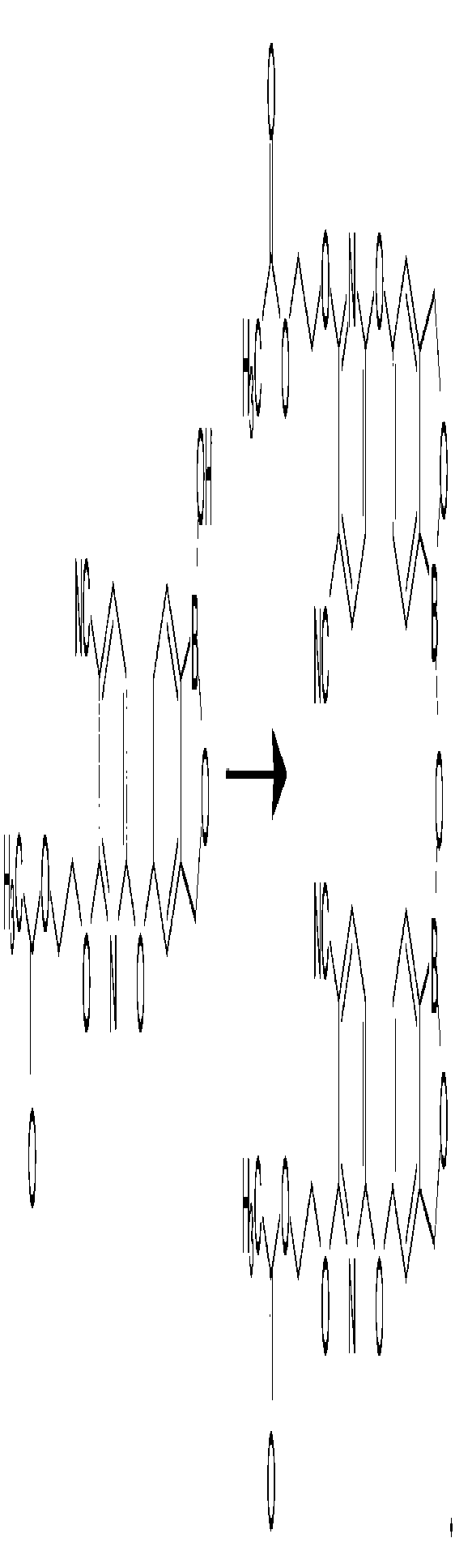
본 발명의 화합물의 삼량체도 만들어진다. 예를 들면, 환식 붕소 에스테르의 삼량체는 다음과 같이 형성될 수 있다:Trimers of the compounds of the invention are also made. For example, a trimer of a cyclic boron ester can be formed as follows:

본 발명의 화합물의 폴리머는 강산에서 특정 보호기 제거를 통하여 만들어진다. 예를 들면, 환식 붕소 에스테르의 삼량체는 다음과 같이 형성된다:Polymers of the compounds of the invention are made through the removal of certain protecting groups in strong acids. For example, a trimer of a cyclic boron ester is formed as follows:

본 발명에서 다중 또는 다가-종 예를 들면, 이량체, 삼량체, 사량체 및 본 발명에서 화합물의 고가 상동체 또는 이의 반응성 유사체를 포함하는 다양한 화합물을 이용한다. 본 발명의 단일 종 또는 하나 이상의 종으로부터 다중 및 다가 종이 어셈블리될 수 있다. 예를 들면, 이량체 구조는 "동종-이량체" 또는 "헤테로이량체"가 될 수 있다. 더욱이, 본 발명의 화합물 또는 이의 활성 유사체가 올리고머 또는 폴리머 구조(가령, 폴리리신, 덱스트란, 하이드록시에틸 전분 및 기타유사한 것)에 부착된 다중 및 다가-구조도 본 발명의 범위내에 있다. 구조는 바람직하게는 다가기능기(가령, 본 발명에서 이용되는 화합물에 부착시키기 위한 활성 부위 배열을 가지는)이다. 더욱이, 구조는 본 발명의 단일 종 또는 하나이상의 종으로 유도될 수 있다. In the present invention, various compounds including multiple or polyvalent species such as dimer, trimer, tetramer, and the hypervariable homologues of the compounds or reactive analogues thereof in the present invention are used. Multiple and multi-species papers can be assembled from a single species or from more than one species of the present invention. For example, the dimer structure can be "homo-dimer" or "heterodimer ". Moreover, multiple and multivalent structures in which the compounds of the invention or active analogues thereof are attached to oligomeric or polymeric structures (e.g., polylysine, dextran, hydroxyethyl starch, and the like) are within the scope of the invention. The structure is preferably a multivalent functional group (e.g., having an active site arrangement for attachment to a compound used in the present invention). Moreover, the structure may be derived into a single species or more than one species of the present invention.
더욱이, 본 발명은 여기에서 포함된 식에 제시된 모티프내에 본 발명의 화합물들의 용도도 포함되는데, 화합물들은 유사하게 기능화되지 않은 유사 화합물에 비교하여 강화된 물-수용성을 가지는 화합물을 제공하도록 기능화된다. 따라서, 여기에서 제시된 치환체들중 임의의 것은 강화된 물 수용성을 가지는 유사 라디칼로 대체될 수 있다. 예를 들면, 하이드록시기를 디올로 대체하거나 또는 아민을 4가 아민 또는 하이드록시 아민 또는 유사한 좀더 물에 가용성인 모이어티로의 대체하는 것도 본 발명의 범위내에 있다. 바람직한 구체예에서, 추가적인 물 용해성은 모 화합물의 물 용해성을 증강시키는 모이어티로 여기에서 제시되는 화합물의 편집 도메인에 대한 활성에 필수적이지 않은 부위에서 치환체 의해 부여된다. 유기 화합물의 물 용해도를 강화시키는 방법은 당분야에 공지되어 있다. 이와 같은 방법에는 유기 핵을 영구적으로 전하를 띈 모이어티, 예를 들면, 4가 암모니움 또는 생리학적 관련 pH 에서 하전을 띈 기 가령, 카르복실기, 아민으로 기능화시키는 것이 포함되나 이에 국한되지 않는다. 다른 방법에는 유기 핵에 하이드록시 또는 아민 보유 기, 가령, 알코올, 폴리올, 폴리에테르, 및 기타유사한 것을 첨부하는 것이 포함된다. 대표적인 예로는 폴리리신, 폴리에틸렌이민, 폴리(에틸렌글리콜) 그리고 폴리(프로필렌글리콜이 포함되나 이에 국한되지는 않는다. 적절한 기능화 화학물 및 이들 화합물의 전략은 당분야에 공지되어 있다. 예를 들면, Dunn, R. L., et al., Eds. POLYMERIC DRUGS AND DRUG DELIVERY SYSTEMS, ACS Symposium Series Vol. 469, American Chemical Society, Washington, D.C. 1991을 참고한다. Moreover, the present invention also encompasses the use of the compounds of the present invention in motifs set forth in the formulas contained herein, wherein the compounds are functionalized to provide compounds having enhanced water-solubility as compared to similar compounds that have not been similarly functioned. Thus, any of the substituents presented herein may be replaced by like radicals having enhanced water solubility. For example, it is within the scope of the invention to replace the hydroxy group with a diol or to replace the amine with a quaternary amine or hydroxyamine or a more water soluble moiety. In a preferred embodiment, the additional water solubility is imparted by the substituent at a moiety that is not essential for the activity towards the editing domain of the compound presented herein as a moiety that enhances the water solubility of the parent compound. Methods for enhancing the water solubility of organic compounds are known in the art. Such methods include, but are not limited to, functionalizing the organic nucleus with a permanently charged moiety, for example, a quaternary ammonium or a charge group at physiologically relevant pH, such as a carboxyl group, an amine. Other methods include attaching a hydroxy or amine retention group, such as an alcohol, a polyol, a polyether, and the like, to the organic nucleus. Representative examples include, but are not limited to, polylysine, polyethyleneimine, poly (ethylene glycol), and poly (propylene glycol). Suitable functionalized chemicals and strategies for these compounds are well known in the art. , RL, et al., Eds. POLYMERIC DRUGS AND DRUG DELIVERY SYSTEMS, ACS Symposium Series Vol. 469, American Chemical Society, Washington, DC 1991.
II. 개요II. summary
본 발명은 다중 측면을 가진다. 이들 측면에는 화합물, 제약학적 제제, 이상을 치료하는 방법, 효과를 강화시키는 방법, 사이토킨 및/또는 케모킨의 생산을 증가시키는 방법, 사이토킨 및/또는 케모킨의 생산을 감소시키는 방법, 사이토킨 및/또는 케모킨의 방출을 증가시키는 방법, 사이토킨 및/또는케모킨의 방출을 감소시키는 방법, 또는 포스포디에스테라제를 저해시키는 방법에 관한 발명이 포함된다.The present invention has multiple aspects. These aspects include compounds, pharmaceutical formulations, methods of treating disorders, methods of enhancing efficacy, methods of increasing the production of cytokines and / or chemokines, methods of reducing the production of cytokines and / or chemokines, Or methods of increasing the release of chemokines, decreasing the release of cytokines and / or chemokines, or inhibiting phosphodiesterase.
III. III. 화합물compound
IIIaIIIa ..
제 1 측면에서, 본 발명은 본 발명의 화합물이다. 예시적인 구체예에서, 본 발명은 여기에서 설명된 화합물이다. 예시적인 구체예에서, 화합물은 여기에서 설명된 화학식에 따른다. 예시적인 구체예에서, 화합물은 D2, D3, D4, D5, D6, D7, D8, D9, D10, D11, D12, D13, D14, D15, D16, D17, D18, D19, D20, D21, D22, D23, D24, D25, D26, D27, D28, D29, D30, D31, D32, D33, D34, D35, D36, D37, D38, D39, D40, D41, D42, D43, D44, D45, D46, D47, D48, D49, D50, D51, D52, D53, D54, D55, D56, D57, D58, D59, D60, D61, D62, D63, D64, D65, D66, D67, D68, D69, D70, D71, D72, D73, D74, D75, D76, D77, D78, D79, D80, D81, D83, D84, D85, D86, D87, D88, D89, D90, D91, D92, D93, D94, D95, D96, D97, D98, D99, D100, D101, D102, D103, D104, D105, D106, D107, D108, D109, D110, D111, D112, D113, D114, D115, D116, D117, D118, D119, D120, D121, D122, D123, D124, D125, D126, D127, D128, D129, D130, D131, D132, D133, D134, D135, D136, D137, D138, D139, D140, D141, D142, D143, D144, D145, D146, D147, D148, D149, D150, D151, D152, D153, D154, D155, D156, D157, D158, D159, D160, D161, D162, D163, D164, D165, D166, D167, D168, D169, D170, D171, D172, D173, D174, D175, D176, D177, D178, D179, D180, D181, D182, D183, D184, D185, D186, D187, D188, D189, D190, D191, D192, D193, D194, D195, D196, D197, D198, D199, D200, D201, D202, D203, D204, D205, D206, D207, D208, D209, D210, D211, D212, D213, D214, D215, D216, D217, D218, D219, D220, D221, D222, D223, D224, D225, D228 및 D229에서 선택된 멤버이다. 예시적인 구체예에서, 화합물은 에서 선택된 멤버다. In a first aspect, the invention is a compound of the invention. In an exemplary embodiment, the invention is a compound described herein. In an exemplary embodiment, the compound is according to the formula described herein. In an exemplary embodiment, the compound is selected from the group consisting of D2, D3, D4, D5, D6, D7, D8, D9, D10, D11, D12, D13, D14, D15, D16, D17, D18, D19, D20, D23, D24, D25, D26, D27, D28, D29, D30, D31, D32, D33, D34, D35, D36, D37, D38, D39, D40, D41, D42, D43, D44, D45, D64, D61, D62, D63, D64, D65, D66, D67, D68, D69, D70, D71, D72, D56, D57, D58, D59, D73, D74, D75, D76, D77, D78, D79, D80, D81, D83, D84, D85, D86, D87, D88, D89, D90, D91, D92, D93, D94, D95, D96, D113, D114, D115, D116, D117, D118, D119, D120, D121, D122, D123, D103, D104, D105, D106, D107, D108, D109, D110, D111, D112, D113, D124, D126, D127, D128, D129, D130, D131, D132, D133, D134, D135, D136, D137, D138, D139, D140, D141, D142, D143, D144, D145, D146, D147, D148, D179, D160, D161, D162, D163, D164, D165, D166, D167, D168, D169, D170, D171, D172, D173, D174, D155, D156, D174, D175, D176, D177, D178, D179, D180, D181, D182, D183, D184, D185, D186, D187, D188, D189, D190, D191, D192, D193, D194, D195, D196, D197, D198, D199, D200, D201, D202, D203, D204, D205, D207, D208, D209, D210, D211, D212, D213, D214, D215, D216, D217, D218, D219, D220, D221, D222, D223, D224, D225, D228 and D229 . In an exemplary embodiment, the compound is a member selected from.
제 2 측면에서, 본 발명은 다음 화학식에 따른 구조를 가지는 화합물을 제공한다:In a second aspect, the invention provides compounds having a structure according to the formula:

이때, R*은 H, 음전하 및 양전하 반대이온에서 선택된 멤버다. X는 CRa, CRb 및 N에서 선택된 멤버다. Ra 는 CN, -C(O)NR1R2, 및 -C(O)OR3에서 선택된 멤버다. Rb 및 Rc 는 H, OR4, NR4R5, SR4, -S(O)R4, -S(O)2R4, -S(O)2NR4R5, -C(O)R4, -C(O)OR4, -C(O)NR4R5, 니트로, 할로겐, 치환된 또는 치환안된 알킬, 치환된 또는 치환안된 헤테로알킬, 치환된 또는 치환안된 시클로알킬, 치환된 또는 치환안된 헤테로시클로알킬, 치환된 또는 치환안된 아릴, 그리고 치환된 또는 치환안된 헤테로아릴로부터 독립적으로 선택된 멤버이며, 이때, 각 R1, R2, R4 및 R5 는 H, 니트로, 할로겐, 시아노, 치환된 또는 치환안된 알킬, 치환된 또는 치환안된 헤테로알킬, 치환된 또는 치환안된 시클로알킬, 치환된 또는 치환안된 헤테로시클로알킬, 치환된 또는 치환안된 아릴, 그리고 치환된 또는 치환안된 헤테로아릴로부터 독립적으로 선택된 멤버들이다. R3 는 H 그리고 치환된 또는 치환안된 알킬에서 선택된 멤버다. R1 및 R2는 여기에 부착된 원자와 함께 선택적으로 조합되어, 5- 내지 7-멤버로 된 치환된 또는 치환안된 헤테로시클로알킬 링을 형성하는 조건이 있다. R4 및 R5는 여기에 부착된 원자와 함께 선택적으로 조합되어 5- 내지 7-멤버로된 치환된 또는 치환안된 헤테로시클로알킬 링을 형성하는 조건이 있다. Rb 및 Rc 는 모두 H가 되지 않는 조건이 있다. Ra 및 Rb 는 선택적으로 결합되어 두개 옥소 모이어티를 포함하는 5- 내지 8-멤버로 된 링을 형성하는 조건이 있다. Wherein R * is a member selected from H, negative charge and positive charge counterion. X is a member selected from CRa, CRb and N. R a is a member selected from CN, -C (O) NR 1 R 2 , and -C (O) OR 3 . R b and R c is H, OR 4, NR 4 R 5,
예시적인 구체예에서, X는 N이다. 예시적인 구체예에서, X는 CH이다. 예시적인 구체예에서, X는 CRb이다.In an exemplary embodiment, X is N. In an exemplary embodiment, X is CH. In an exemplary embodiment, X is CR < b & gt ;.
예시적인 구체예에서, R*는 H이다.In an exemplary embodiment, R * is H.
예시적인 구체예에서, Rb 및 Rc 중 최소 하나는 F와 Cl에서 선택된다. 예시적인 구체예에서, Rb 및 Rc 중 최소 하나는 치환된 또는 치환안된 알킬로써 이는 치환안된 알킬, 하이드록시알킬, 할로알킬, 트리할로알킬, 치환된 또는 치환안된 아미노알킬, -CH2C(O)OR6, -CH2NHC(O)R6, -CH2NR6R7 에서 선택되며 이때, 각 R6 및 R7 는 H, 치환된 또는 치환안된 알킬, 치환된 또는 치환안된 시클로알킬 그리고 치환된 또는 치환안된 헤테로아릴에서 독립적으로 선택되며, 조건으로 R6 및 R7는 여기에 부착된 원자와 함께 선택적으로 조합되어, 5- 내지 7-멤버로된 치환된 또는 치환안된 헤테로시클로알킬 링을 형성한다.In an exemplary embodiment, at least one of R b and R c is selected from F and Cl. In an exemplary embodiment, at least one of R b and R c is substituted or unsubstituted alkyl which is unsubstituted alkyl, hydroxyalkyl, haloalkyl, trihaloalkyl, substituted or unsubstituted aminoalkyl, -
예시적인 구체예에서, Rb 는 H이다. 예시적인 구체예에서, Rc 는 H이다. 예시적인 구체예에서, Rc 는 H이며, 그리고 Rb 는 할로겐, 치환안된 알킬, 할로겐 치환된 알킬, 치환안된 알콕시로부터 선택된다. 예시적인 구체예에서, Rc 는 H이며, 그리고 Rb 는 메틸 및 에틸에서 선택된다. 예시적인 구체예에서, Rc 는 H이며, 그리고 Rb 는 치환안된 C3 알킬, 치환안된 C4 알킬, 치환안된 C5 알킬 그리고 치환안된 C6 알킬로부터 선택된다. 예시적인 구체예에서, Rb 는 H이며, 그리고 Rc 는 트리플루오로메틸이다. 예시적인 구체예에서, Rc 는 H이며, 그리고 Rb 는 메톡시, 에톡시, 치환안된 C3 알콕시, 치환안된 C4 알콕시, 치환안된 C5 알콕시 그리고 치환안된 C6 알콕시로부터 선택된다.In an exemplary embodiment, R b Lt; / RTI > In an exemplary embodiment, R < c > In an exemplary embodiment, R c is H and R b Is selected from halogen, unsubstituted alkyl, halogen substituted alkyl, unsubstituted alkoxy. In an exemplary embodiment, R c is H, and R b is selected from methyl and ethyl. In an exemplary embodiment, R c is H and R b is selected from unsubstituted C 3 alkyl, unsubstituted C 4 alkyl, unsubstituted C 5 alkyl, and unsubstituted C 6 alkyl. In an exemplary embodiment, R b is H and R c is trifluoromethyl. In an exemplary embodiment, R c Is H, and R < b & gt ; Is selected from methoxy, ethoxy, unsubstituted C 3 alkoxy, unsubstituted C 4 alkoxy, unsubstituted C 5 alkoxy and unsubstituted C 6 alkoxy.
예시적인 구체예에서, Rb 및 Rc 중 최소 하나는 -CH2C(O)OR6, -CH2NHC(O)R6, -CH2NR6R7에서 선택되며 이때, 각 R6 및 R7 는 H, 메틸, 트리플루오로메틸, 에틸, 프로필, 부틸, t-부틸, -C(O)H로부터 독립적으로 선택되며 이때, R6 및 R7는 여기에 부착된 질소와 함께 선택적으로 조합되어, 4-메틸피페라지닐, 피페리디닐, 몰포리노 그리고 피롤리디닐로부터 선택된 멤버를 형성한다.In an exemplary embodiment, at least one of R b and R c is selected from -CH 2 C (O) OR 6 , -CH 2 NHC (O) R 6 , -CH 2 NR 6 R 7 wherein each R 6 And R 7 are independently selected from H, methyl, trifluoromethyl, ethyl, propyl, butyl, t-butyl, -C (O) H, wherein R 6 and R 7 , together with the nitrogen attached thereto, To form a member selected from 4-methylpiperazinyl, piperidinyl, morpholino and pyrrolidinyl.
예시적인 구체예에서, Rb 및 Rc 중 최소 하나는 메틸, 트리플루오로메틸, -CH2OH, -CH2N(CH3)2, 

예시적인 구체예에서, Rb 및 Rc 중 최소 하나는 -OR4, -C(O)R4, -C(O)OR4 및 -C(O)NR4R5에서 선택되며 이때, 각 R4 및 R5 는 H, 메틸, 에틸, 메톡시에틸, 시클로프로필, -CH2C(O)OR8, -CH2C(O)NR8R9, 2-(디메틸아미노)에틸, 2-피리디닐메틸, 2-(4-시아노)피리디닐로부터 독립적으로 선택되며, 조건은 R8 및 R9는 여기에 부착된 원자와 함께, 선택적으로 조합되어, 5- 내지 7-멤버로된 치환된 또는 치환안된 헤테로시클로알킬 링을 형성한다.In an exemplary embodiment, at least one of R b and R c is selected from -OR 4 , -C (O) R 4 , -C (O) OR 4, and -C (O) NR 4 R 5 , R4 and R5 are H, methyl, ethyl, methoxyethyl, cyclopropyl, -CH 2 C (O) OR 8, -CH 2 C (O) NR 8
예시적인 구체예에서, Rb 및 Rc 중 최소 하나는 -OH, -CH3, -CH2CH3, -CH2CH2CH3, -CH2C(O)OH, In an exemplary embodiment, at least one of R b and R c is -OH, -CH 3 , -CH 2 CH 3 , -CH 2 CH 2 CH 3 , -CH 2 C (O) OH,
-CH2C(O)CH2CH3, -CH2C(O)C(CH3)3, -C(O)CH3, -C(O)OH, -C(O)H, -CH2C(O)N(CH2CH3)2, 


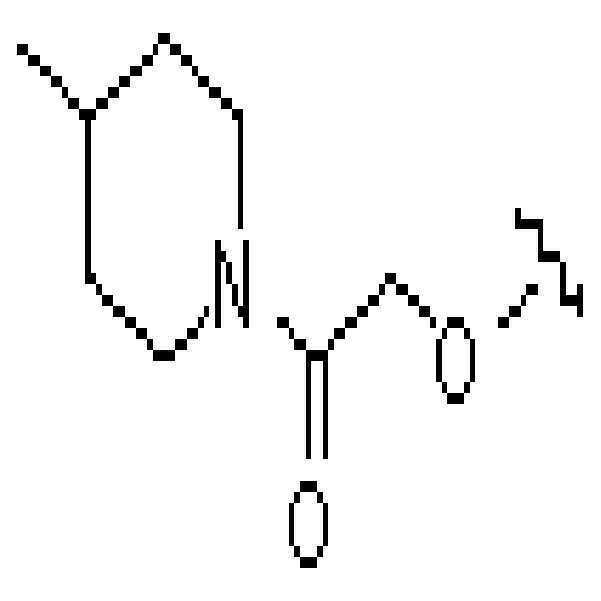


예시적인 구체예에서, Rb및 Rc중 최소 하나는 F, Cl, 메틸, 트리플루오로메틸, -CH2OH,-CH2N(CH3)2,-OH,-CH3,-CH2CH3, -CH2CH2OCH3, -CH2C(O)OH,-CH2C(O)CH2CH3,-CH2C(O)C(CH3)3,-C(O)CH3,-C(O)OH,-C(O)H,-CH2C(O)N(CH2CH3)2,In an exemplary embodiment, at least one of R b and R c is F, Cl, methyl, trifluoromethyl, -CH 2 OH, -CH 2 N (CH 3 ) 2 , -OH, -CH 3 , -CH 2 CH 3, -CH 2 CH 2 OCH 3, -CH 2 C (O) OH, -CH 2 C (O)


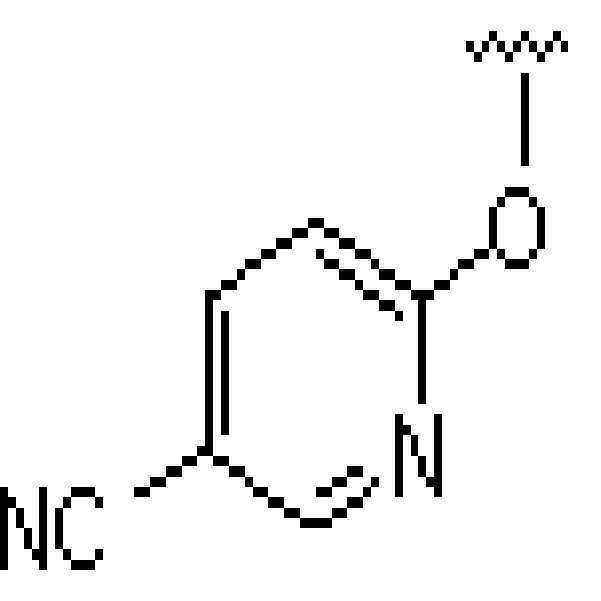

예시적인 구체예에서, 화합물은 다음의 화학식에 따른 구조를 가진다: In an exemplary embodiment, the compound has a structure according to the following formula:

이때, X, R*, Rb및 Rc는 여기에서 설명된 것과 같다.Wherein, X, R *, R b and R c are as described herein.
예시적인 구체예에서, Rb및 Rc중 최소 하나는 할로겐, 할로알킬, -C(O)R4,-C(O)OR4,-C(O)NR4R5, -CH2C(O)OR4,-CH2NHC(O)R4 그리고 OR4로부터 선택된 멤버이며 이때, R4및 R5는 H 및 치환된 또는 치환안된 알킬로부터 독립적으로 선택된다.In an exemplary embodiment, R b and R c is at least one halogen, haloalkyl, -C (O) R 4, -C (O) OR 4, -C (O) NR 4
예시적인 구체예에서, Rb및 Rc중 최소 하나는 F, Cl, 메틸, 트리플루오로메틸, -CH2OH,-CH2N(CH3)2,-OH,-CH3,-CH2CH3, -CH2CH2CH3, -CH2C(O)OH,-CH2C(O)CH2CH3,-CH2C(O)C(CH3)3,-C(O)CH3,-C(O)OH,-C(O)H,-CH2C(O)N(CH2CH3)2,In an exemplary embodiment, at least one of R b and R c is F, Cl, methyl, trifluoromethyl, -CH 2 OH, -CH 2 N (CH 3 ) 2 , -OH, -CH 3 , -CH 2 CH 3, -CH 2 CH 2 CH 3, -CH 2 C (O) OH, -CH 2 C (O)


예시적인 구체예에서, 화합물은 다음의 화학식에 따른 구조를 가진다:In an exemplary embodiment, the compound has a structure according to the following formula:

이때, X, R*, Rb 및 Rc 는 여기에서 설명된 것과 같다.Wherein, X, R *, R b and R c are as described herein.
예시적인 구체예에서, Rb및 Rc중 최소 하나는 F, Cl, 메틸, 트리플루오로메틸, -CH2OH,-CH2N(CH3)2,-OH,-CH3,-CH2CH3, -CH2C(O)OH,-CH2CH2CH3, -CH2C(O)CH2CH3,-CH2C(O)C(CH3)3,-C(O)CH3,-C(O)OH,-C(O)H,-CH2C(O)N(CH2CH3)2,In an exemplary embodiment, at least one of R b and R c is F, Cl, methyl, trifluoromethyl, -CH 2 OH, -CH 2 N (CH 3 ) 2 , -OH, -CH 3 , -CH 2 CH 3, -CH 2 C ( O) OH, -


예시적인 구체예에서, Rc는 H이며, 그리고 Rb는 F, Cl, 메틸, 트리플루오로메틸, -CH2OH,-CH2N(CH3)2,-OH,-CH3,-CH2CH3, -CH2C(O)OH,-CH2CH2OCH3, -CH2C(O)CH2CH3,-CH2C(O)C(CH3)3,-C(O)CH3,-C(O)OH,-C(O)H,-CH2C(O)N(CH2CH3)2,In an exemplary embodiment, R c is H and R b is F, Cl, methyl, trifluoromethyl, -CH 2 OH, -CH 2 N (CH 3 ) 2 , -OH, -CH 3 , CH 2 CH 3, -CH 2 C (O) OH, -




예시적인 구체예에서, 다음의 화학식에 따른 구조를 가지는 화합물과, 이의 염이다:In an exemplary embodiment, the compound has a structure according to the following formula:

이때, X는 N 또는 CH 또는 CRb이며, Rb 는 할로겐 그리고 치환된 또는 치환안된 알킬, C(O)R4, C(O)OR4, OR4, NR4R5에서 선택되며 이때, R4 및 R5 는 H, 치환된 또는 치환안된 알킬, 치환된 또는 치환안된 헤테로알킬, 치환된 또는 치환안된 시클로알킬, 치환된 또는 치환안된 헤테로시클로알킬, 치환된 또는 치환안된 아릴, 그리고 치환된 또는 치환안된 헤테로아릴에서 선택된 멤버이며, 조건은 R4 및 R5는 여기에 부착된 원자들과 함께 선택적으로 조합되어, 5- 내지 7-멤버로된 치환된 또는 치환안된 헤테로시클로알킬 링을 형성하는 것이다. 예시적인 구체예에서, Rb 는 OR4 및 NR4R5에서 선택된 멤버이며 이때, R4 및 R5 는 H, 치환된 또는 치환안된 알킬, 치환된 또는 치환안된 헤테로알킬, 치환된 또는 치환안된 시클로알킬, 치환된 또는 치환안된 헤테로시클로알킬, 치환된 또는 치환안된 아릴, 그리고 치환된 또는 치환안된 헤테로아릴에서 선택된 멤버이며, 조건은 R4 및 R5는 여기에 부착된 원자들과 함께 선택적으로 조합되어, 5- 내지 7-멤버로된 치환된 또는 치환안된 헤테로시클로알킬 링을 형성하는 것이다.Wherein X is N or CH or CR b and R b is selected from halogen and substituted or unsubstituted alkyl, C (O) R 4 , C (O) OR 4 , OR 4 , NR 4 R 5 , R 4 and R 5 are selected from H, substituted or unsubstituted alkyl, substituted or unsubstituted heteroalkyl, substituted or unsubstituted cycloalkyl, substituted or unsubstituted heterocycloalkyl, substituted or unsubstituted aryl, and substituted Or substituted unsubstituted heteroaryl, with the proviso that R 4 and R 5 are optionally combined with the atoms attached thereto to form a substituted or unsubstituted heterocycloalkyl ring of 5- to 7-membered . In an exemplary embodiment, R b is a member selected from OR 4 and NR 4 R 5 wherein R 4 and R 5 are selected from H, substituted or unsubstituted alkyl, substituted or unsubstituted heteroalkyl, substituted or unsubstituted Cycloalkyl, substituted or unsubstituted heterocycloalkyl, substituted or unsubstituted aryl, and substituted or unsubstituted heteroaryl, with the proviso that R 4 and R 5 , together with the atoms attached thereto, To form a 5- or 7-membered substituted or unsubstituted heterocycloalkyl ring.
예시적인 구체예에서, Rb 는 알킬, 선택적으로 할로겐, OR4a, C(O)OR4a, NR4aR4b, 치환된 또는 치환안된 헤테로시클로알킬 또는 치환안된 헤테로아릴에서 선택된 멤버로 치환된 알킬이며, 이때, R4a 및 R4b 는 H, 치환된 또는 치환안된 알킬, 치환된 또는 치환안된 헤테로알킬, 치환된 또는 치환안된 시클로알킬, 치환된 또는 치환안된 헤테로시클로알킬, 치환된 또는 치환안된 아릴, 그리고 치환된 또는 치환안된 헤테로아릴로부터 독립적으로 선택된다. 예시적인 구체예에서, R4a 는 H 또는 치환안된 알킬이다. 예시적인 구체예에서, R4b 는 H 또는 치환안된 알킬 또는 C(O)H이다. 예시적인 구체예에서, Rb 는 플루오르이다. 예시적인 구체예에서, Rb 는 염소다.In an exemplary embodiment, R b is alkyl, optionally halogen, OR 4a, C (O) OR 4a, NR 4a R 4b, substituted or substituted untested heterocycloalkyl, or alkyl substituted with a member selected from substituted untested heteroaryl Wherein R 4a and R 4b are selected from the group consisting of H, substituted or unsubstituted alkyl, substituted or unsubstituted heteroalkyl, substituted or unsubstituted cycloalkyl, substituted or unsubstituted heterocycloalkyl, substituted or unsubstituted aryl , And substituted or unsubstituted heteroaryl. In an exemplary embodiment, R < 4a > is H or unsubstituted alkyl. In an exemplary embodiment, R < 4b > Is H or unsubstituted alkyl or C (O) H. In an exemplary embodiment, R < b & gt ; is fluorine. In an exemplary embodiment, R b is chlorine.
예시적인 구체예에서, Rb 는 OH다. 예시적인 구체예에서, Rb 는 OR4이며, 이때, R4 는 최소 하나의 할로겐, 하이드록실, 에테르, 카르복시 또는 에스테르 모이어티로 선택적으로 치환된 알킬이다.In an exemplary embodiment, R < b & gt ; is OH. In an exemplary embodiment, R b is OR 4 , wherein R 4 is alkyl optionally substituted with at least one halogen, hydroxyl, ether, carboxy or ester moiety.
예시적인 구체예에서, Rb 는 OR4이며 이때, R4 는 치환안된 알킬이다. 예시적인 구체예에서, Rb 는 OR4이며 이때, R4 는 치환안된 C1 또는 C2 또는 C3 알킬이다. 예시적인 구체예에서, Rb 는 OR4이며 이때, R4 는 치환안된 C4 또는 C5 또는 C6 알킬이다. 예시적인 구체예에서, Rb 는 OR4이며 이때, R4 는 메틸 또는 에틸 또는 프로필 또는 이소프로필 또는 이소부틸이다. In an exemplary embodiment, R b is OR 4 , wherein R 4 is unsubstituted alkyl. In an exemplary embodiment, R b is OR 4 , wherein R 4 is unsubstituted C 1 or C 2 or C 3 alkyl. In an exemplary embodiment, R b is OR 4 , wherein R 4 is unsubstituted C 4 or C 5 or C 6 alkyl. In an exemplary embodiment, R b is OR 4 , wherein R 4 is methyl or ethyl or propyl or isopropyl or isobutyl.
예시적인 구체예에서, Rb 는 OR4이며 이때, R4 는 최소 하나의 할로겐으로 치환된 알킬이다. 예시적인 구체예에서, Rb 는 OR4이며 이때, R4 는 하나 또는 두개 또는 세개 할로겐으로 치환된 알킬이다. 예시적인 구체예에서, Rb 는 O(CH2)m1R31이며 이때, m1은 1 또는 2 또는 3 또는 4 또는 5 또는 6이며, 그리고 R31 은 메틸 모이어티이고 이때, 최소 하나의 메틸 수소는 할로겐으로 치환된다. 예시적인 구체예에서, 할로겐은 염소다. 예시적인 구체예에서, 할로겐은 플루오르이다. 예시적인 구체예에서, R31 는 -CF3이다. 예시적인 구체예에서, R31 는 -CHF2이다. 예시적인 구체예에서, m1은 1 또는 2 또는 3이다. 예시적인 구체예에서, Rb 는 -OCH2CF3이다. 예시적인 구체예에서, Rb 는 -OCH2CHF2이다.In an exemplary embodiment, R b is OR 4 , wherein R 4 is alkyl substituted with at least one halogen. In an exemplary embodiment, R < b & gt ; is OR < 4 >, wherein R < 4 > is alkyl substituted by one or two or three halogens. In an exemplary embodiment, R b is O (CH 2) m1 R 31 and at this time, m1 is 1 or 2 or 3 or a 4 or 5 or 6, and R 31 is a methyl moiety, and wherein, at least one methyl hydrogen Is substituted with halogen. In an exemplary embodiment, the halogen is chlorine. In an exemplary embodiment, the halogen is fluorine. In an exemplary embodiment, R 31 is -CF 3 . In an exemplary embodiment, R 31 is -CHF 2 . In an exemplary embodiment, m1 is 1 or 2 or 3. In an exemplary embodiment, R b is -OCH 2 CF 3. In an exemplary embodiment, R b is -OCH 2 CHF 2.
예시적인 구체예에서, Rb 는 -O(CH2)m1OC(O)R4d이며 이때, m1는 1 또는 2 또는 3 또는 4 또는 5 또는 6 에서 선택된 숫자가 되며, R4d 는 치환안된 알킬이다. 예시적인 구체예에서, m1는 1 또는 2 또는 3이다. 예시적인 구체예에서, m1는 2가 된다. 예시적인 구체예에서, R4d 는 치환안된 C1 또는 C2 또는 C3 알킬이다. 예시적인 구체예에서, R4d 는 치환안된 C4 또는 C5 또는 C6 알킬이다. 예시적인 구체예에서, R4d 는 메틸이다. 예시적인 구체예에서, Rb 는 -O(CH2)2C(O)CH3이다.In an exemplary embodiment, R b is -O (CH 2) m1 OC ( O) R 4d is the case, m1 is 1 or 2 or 3 or 4 or 5 or 6, and the selected number, R 4d is a substituted alkyl untested to be. In an exemplary embodiment, m1 is 1 or 2 or 3. In an exemplary embodiment, m1 is two. In an exemplary embodiment, R 4d is unsubstituted C 1 or C 2 or C 3 alkyl. In an exemplary embodiment, R 4d is unsubstituted C 4 or C 5 or C 6 alkyl. In an exemplary embodiment, R 4d is methyl. In an exemplary embodiment, R b is -O (CH 2 ) 2 C (O) CH 3 .
예시적인 구체예에서, Rb 는 -O(CH2)m1C(O)R4d이며 이때, m1는 1 또는 2 또는 3 또는 4 또는 5 또는 6에서 선택된 숫자이며, 그리고 R4d 는 치환안된 알킬이다. 예시적인 구체예에서, m1는 2 또는 3 또는 4이다. 예시적인 구체예에서, m1는 3이다. 예시적인 구체예에서, R4d 는 치환안된 C1 또는 C2 또는 C3 알킬이다. 예시적인 구체예에서, R4d 는 치환안된 C4 또는 C5 또는 C6 알킬이다. 예시적인 구체예에서, R4d 는 메틸이다. 예시적인 구체예에서, Rb 는 -O(CH2)3C(O)CH3이다.In an exemplary embodiment, R b is -O (CH 2) m1 C ( O) R 4d is the case, m1 is a number selected from 1 or 2 or 3 or 4 or 5 or 6, and R 4d Is unsubstituted alkyl. In an exemplary embodiment, m1 is 2 or 3 or 4. In an exemplary embodiment, m1 is 3. In an exemplary embodiment, R 4d is unsubstituted C 1 or C 2 or C 3 alkyl. In the exemplary embodiment, R4d is a C 4 or C 5 or C 6 substituted alkyl untested. In an exemplary embodiment, R 4d is methyl. In an exemplary embodiment, R b is -O (CH 2 ) 3 C (O) CH 3 .
예시적인 구체예에서, Rb 는 -O(CH2)m1C(O)OR4d이며 이때, m1 는 1 또는 2 또는 3 또는 4 또는 5 또는 6에서 선택된 숫자이며, R4d 는 H 또는 치환안된 알킬이다. 예시적인 구체예에서, Rb 는 -CH2C(O)OR4d이며 이때, R4d 는 여기에서 설명된 것과 같다. 예시적인 구체예에서, R4d 는 H 또는 메틸 또는 에틸 또는 t-부틸이다. 예시적인 구체예에서, Rb 는 -O(CH2)C(O)CH2CH3 또는 -O(CH2)C(O)OH 또는 -O(CH2)C(O)C(CH3)3이다.In an exemplary embodiment, R b is -O (CH 2) m1 C ( O) OR 4d , and wherein, m1 is 1 or 2 or 3 or 4 or 5 or a number selected from 6, R 4d is H or substituted untested Alkyl. In an exemplary embodiment, R b is -CH 2 C (O) OR 4d , wherein R 4d is as described herein. In an exemplary embodiment, R 4d is H or methyl or ethyl or t-butyl. In an exemplary embodiment, R b is -O (CH 2) C (O )
예시적인 구체예에서, Rb 는 OR4이며 이때, R4 는 치환된 또는 치환안된 아미노로 치환된 알킬이다. 예시적인 구체예에서, Rb 는 -O(CH2)m2C(O)NR4eR4f이며 이때, m2 은 1 또는 2 또는 3 또는 4 또는 5 또는 6에서 선택된 숫자이며, 그리고 R4e 및 R4f 는 H 또는 치환안된 알킬에서 독립적으로 선택되며, 또는 R4e 및 R4f는 여기에 부착된 질소와 함께 선택적으로 결합되어, 치환된 또는 치환안된 4 내지 8개 멤버로된 링을 형성한다. In an exemplary embodiment, R b is OR 4 , wherein R 4 is alkyl substituted with substituted or unsubstituted amino. In an exemplary embodiment, R b is -O (CH 2 ) m C (O) NR 4e R 4f wherein m2 is a number selected from 1 or 2 or 3 or 4 or 5 or 6, and R 4e and R 4f is independently selected from H or unsubstituted alkyl, or R < 4e > and R < 4f > are optionally joined together with the nitrogen to which they are attached to form a ring of 4 to 8 members, substituted or unsubstituted.
예시적인 구체예에서, Rb 는 -CH2C(O)NR4eR4f이며 이때, R4e 및 R4f 는 여기에서 설명된 것과 같다. 예시적인 구체예에서, R4e 및 R4f 는 동일하며, 치환안된 알킬에서 독립적으로 선택된다. 예시적인 구체예에서, R4e 및 R4f 는 상이하며, 치환안된 알킬로부터 독립적으로 선택된다. 예시적인 구체예에서, R4e 는 H이다. 예시적인 구체예에서, R4f 는 H이다. 예시적인 구체예에서, R4e 및 R4f 는 에틸이다. 예시적인 구체예에서, R4e 및 R4f는 여기에 부착된 질소와 함께 결합되어 위치 4의 질소상에서 치환안된 알킬로 치환되거나 치환되지 않은 피페라지닐을 형성한다. 예시적인 구체예에서, R4e 및 R4f는 여기에 부착된 질소와 함께 결합되어, N-메틸 피페라지닐을 형성한다. 예시적인 구체예에서, R4e 및 R4f는 여기에 부착된 질소와 함께 치환안된 알키로 치환된 또는 치환안된 피페리디닐을 형성한다. 예시적인 구체예에서, R4e 및 R4f는 여기에 부착된 질소와 함께 결합되어 4-메틸 피페리디닐을 형성한다. 예시적인 구체예에서, R4e 및 R4f는 여기에 부착된 질소와 함께 결합되어 치환안된 몰포리닐을 형성한다. In an exemplary embodiment, R b is -CH 2 C (O) NR 4e R 4f , wherein R 4e and R 4f are as described herein. In an exemplary embodiment, R 4e and R 4f are the same and are independently selected from unsubstituted alkyl. In an exemplary embodiment, R 4e and R 4f are different and are independently selected from unsubstituted alkyl. In an exemplary embodiment, R 4e is H. In an exemplary embodiment, R 4f is H. In an exemplary embodiment, R 4e and R 4f are ethyl. In an exemplary embodiment, R < 4e > and R < 4f > are joined together with the nitrogen attached thereto to form a piperazinyl optionally substituted on the nitrogen at
예시적인 구체예에서, Rb 는 OR4이며 이때, R4 는 치환안된 알킬이다. 예시적인 구체예에서, R4 는 C1 또는 C2 또는 C3 또는 C4 또는 C5 또는 C6 알킬이다. 예시적인 구체예에서, R4 는 C1 알킬이다. 예시적인 구체예에서, Rb 는 OR4이며 이때, R4 는 치환안된 피리디닐로 치환된 알킬이다. 예시적인 구체예에서, Rb 는 In an exemplary embodiment, R b is OR 4 , wherein R 4 is unsubstituted alkyl. In an exemplary embodiment, R 4 is C 1 or C 2 or C 3 or C 4 or C 5 or C 6 alkyl. In an exemplary embodiment, R 4 is C 1 alkyl. In an exemplary embodiment, R b is OR 4 , wherein R 4 is alkyl substituted with unsubstituted pyridinyl. In an exemplary embodiment, R < b & gt ;

예시적인 구체예에서, Rb 는 OR4이며 이때, R4 는 치환된 또는 치환안된 시클로알킬이다. 예시적인 구체예에서, Rb 는 OR4이며 이때, R4 는 치환안된 시클로알킬이다. 예시적인 구체예에서, Rb 는 OR4이며 이때, R4 는 시클로페닐이다. 예시적인 구체예에서, R4 는 치환안된 시클로헥실이다. In an exemplary embodiment, R b is OR 4 , wherein R 4 is substituted or unsubstituted cycloalkyl. In an exemplary embodiment, R b is OR 4 , wherein R 4 is unsubstituted cycloalkyl. In an exemplary embodiment, R b is OR 4 , wherein R 4 is cyclophenyl. In an exemplary embodiment, R < 4 > is unsubstituted cyclohexyl.
예시적인 구체예에서, Rb는 OR4이며 이때, R4는 치환안된 알콕시로 치환된 알킬이다. 예시적인 구체예에서, Rb는 O(CH2)m5OR30이며 이때, m5는 1 또는 2 또는 3 또는 4 또는 5 또는 6 이며, 그리고 R30는 H 또는 치환안된 알킬 또는 치환안된 테트라하이드로피란이라. 예시적인 구체예에서, R30는 C1또는 C2또는 C3또는 C4또는 C5또는 C6알킬이다. 예시적인 구체예에서, m5는 1 또는 2 또는 3이다. 예시적인 구체예에서, m5 는 2이다. 예시적인 구체예에서, R30는 C1또는 C2또는 C3알킬이다. 예시적인 구체예에서, R30는 C4또는 C5또는 C6알킬이다. 예시적인 구체예에서, R30는 H이다. 예시적인 구체예에서, R30는 메틸 또는 이소프로필이다. 예시적인 구체예에서, R30는 2-테트라하이드로피란이다. 예시적인 구체예에서, Rb는 O(CH2)2C(CH3)2또는 O(CH2)2OH또는 O(CH2)2O-THP(테트라하이드로피란)이다.In an exemplary embodiment, R b is OR 4 , wherein R 4 is alkyl substituted with unsubstituted alkoxy. In an exemplary embodiment, R b is O (CH 2 ) m 5 OR 30 wherein m5 is 1 or 2 or 3 or 4 or 5 or 6, and R 30 is H or unsubstituted alkyl or unsubstituted tetrahydropyran It is. In an exemplary embodiment, R 30 is C 1 or C 2 or C 3 or C 4 or C 5 or C 6 alkyl. In an exemplary embodiment, m5 is 1 or 2 or 3. In an exemplary embodiment, m5 is 2. In an exemplary embodiment, R 30 is C 1 or C 2 or C 3 alkyl. In an exemplary embodiment, R 30 is C 4 or C 5 or C 6 alkyl. In an exemplary embodiment, R < 30 > In an exemplary embodiment, R 30 is methyl or isopropyl. In an exemplary embodiment, R < 30 > is 2-tetrahydropyran. In an exemplary embodiment, R b is O (CH 2 ) 2 C (CH 3 ) 2 or O (CH 2 ) 2 OH or O (CH 2 ) 2 O-THP (tetrahydropyran).
예시적인 구체예에서, Rb 는 OR4이며 이때, R4 는 치환안된 시클로알킬로 치환된 알킬이다. 예시적인 구체예에서, Rb 는 -O(CH2)m5OR30이며 이때, m5는 1 또는 2 또는 3 또는 4 또는 5 또는 6이며 그리고 R30 는 3-8개 멤버로된 시클로알킬이다. 예시적인 구체예에서, R30 는 3-6개 멤버로된 시클로알킬이다. 예시적인 구체예에서, R30 는 시클로프로필 및 시클로펜틸에서 선택된 멤버다. 예시적인 구체예에서, m5는 1 또는 2 또는 3이다. 예시적인 구체예에서, m5는 1이다. In an exemplary embodiment, R b is OR 4 , wherein R 4 is alkyl substituted with unsubstituted cycloalkyl. In an exemplary embodiment, R b is -O (CH 2) m5 OR 30 and at this time, m5 is 1 or 2 or 3 or 4 or 5 or 6, and R 30 is a cycloalkyl with 3 to 8 members. In an exemplary embodiment, R < 30 > is a cycloalkyl of 3-6 members. In an exemplary embodiment, R < 30 > is a member selected from cyclopropyl and cyclopentyl. In an exemplary embodiment, m5 is 1 or 2 or 3. In an exemplary embodiment, m5 is one.
예시적인 구체예에서, Rb는 C(O)R4이며 이때, R4는 치환안된 알킬이다. 예시적인 구체예에서, R4는 C1또는 C2또는 C3또는 C4또는 C5또는 C6알킬이다. 예시적인 구체예에서, R4는 C1알킬이다. 예시적인 구체예에서, Rb는 C(O)H이다. 예시적인 구체예에서, Rb는 C1또는 C2또는 C3또는 C4또는 C5또는 C6알킬이다. 예시적인 구체예에서, RbisC1알킬. 예시적인 구체예에서, Rb는 할로겐으로 치환된 알킬이다. 예시적인 구체예에서, Rb는 최소 하나의할로겐으로 치환된 알킬이다. 예시적인 구체예에서, Rb는 최소 하나의 플루오르으로 치환된 알킬이다. 예시적인 구체예에서, Rb는 CF3이다. In an exemplary embodiment, R b is C (O) R 4 , wherein R 4 is unsubstituted alkyl. In an exemplary embodiment, R 4 is C 1 or C 2 or C 3 or C 4 or C 5 or C 6 alkyl. In an exemplary embodiment, R 4 is C 1 alkyl. In an exemplary embodiment, R < b & gt ; is C (O) H. In an exemplary embodiment, R b is C 1 or C 2 or C 3 or C 4 or C 5 or C 6 alkyl. In an exemplary embodiment, R b isC 1 alkyl. In an exemplary embodiment, R < b & gt ; is alkyl substituted with halogen. In an exemplary embodiment, R < b & gt ; is alkyl substituted with at least one halogen. In an exemplary embodiment, R < b & gt ; is alkyl substituted with at least one fluorine. In an exemplary embodiment, R b is CF 3 .
예시적인 구체예에서, Rb는 하이드록시로 치환된 알킬이다. 예시적인 구체예에서, Rb는 (CH2)m4OH이며 이때, m4 는 1 또는 2 또는 3 또는 4 또는 5 또는 6에서 선택된다. 예시적인 구체예에서, m4는 1이다. In an exemplary embodiment, R < b & gt ; is alkyl substituted with hydroxy. In an exemplary embodiment, R b is (CH 2) OH, and wherein m4, m4 is selected from 1 or 2 or 3 or 4 or 5 or 6. In an exemplary embodiment, m < 4 >
예시적인 구체예에서, Rb는 카르복시 또는 에스테르로 치환된 알킬이다. 예시적인 구체예에서, Rb는 (CH2)m1C(O)OR4a이며 이때, m1는 1 또는 2 또는 3 또는 4 또는 5 또는 6에서 선택된 숫자이며, 그리고 R4a는 H 또는 치환안된 알킬이다.In an exemplary embodiment, R < b > is alkyl substituted with carboxy or ester. In an exemplary embodiment, R b is (CH 2) m1 C (O ) OR 4a , and wherein, m1 is 1 or 2 or 3 or 4 or 5 or a selected number in six, and R 4a is H or a substituted untested alkyl to be.
예시적인 구체예에서, Rb는 -CH2C(O)OR4a이며 이때, R4a는 여기에서 설명된 것과 같다. 예시적인 구체예에서, R4a는 H 또는 메틸 또는 에틸 또는 t-부틸이다.In an exemplary embodiment, R b is -CH 2 C (O) OR 4a , wherein R 4a is as described herein. In an exemplary embodiment, R < 4a > is H or methyl or ethyl or t-butyl.
예시적인 구체예에서, Rb 는 아미노로 치환된 알킬이다. 예시적인 구체예에서, Rb 는 -(CH2)m7NR4aR4b이며 이때, m7 는 1 또는 2 또는 3 또는 4 또는 5 또는 6에서 선택된 숫자이며, 그리고 R4a 및 R4b 는 H 및 치환안된 알킬 및 포밀에서 독립적으로 선택된 멤버이며, 또는 R4a 및 R4b는 여기에 부착된 질소와 함께 선택적으로 결합되어 치환된 또는 치환안된 4 내지 8 개 멤버로된 링을 형성한다. 예시적인 구체예에서, R4b 는 여기에서 설명된 것과 같고, R4a 는 H이다. 예시적인 구체예에서, R4a 는 여기에서 설명된 것과 같고, R4b 는 H이다. 예시적인 구체예에서, R4b 는 여기에서 설명된 것과 같고, R4a 는 메틸이다. 예시적인 구체예에서, R4a 는 여기에서 설명된 것과 같고, R4b 는 메틸이다. 예시적인 구체예에서, m7는 1이다. 예시적인 구체예에서, R4a 및 R4b는 여기에 부착된 질소와 함께 결합되어, 위치 4의 질소에서 치환안된 알킬로 치환된 또는 치환안된 피페라지닐을 형성한다. 예시적인 구체예에서, R4a 및 R4b는 여기에 부착된 질소와 함께 결합되어 N-메틸 피페라지닐을 형성한다. 예시적인 구체예에서, R4a 및 R4b는 여기에 부착된 질소와 함께 결합되어, 치환안된 알킬로 치환된 또는 치환안된 피페리디닐을 형성한다. 예시적인 구체예에서, R4a 및 R4b는 여기에 부착된 질소와 함께 결합되어 4-메틸 피페리디닐을 형성한다. 예시적인 구체예에서, R4a 및 R4b는 여기에 부착된 질소와 함께 결합되어 치환안된 몰포리닐을 형성한다. In an exemplary embodiment, R < b & gt ; is alkyl substituted with amino. In an exemplary embodiment, R b is - (CH 2) m7 NR 4a R 4b , and this time, m7 is the selected number from 1 or 2 or 3 or 4 or 5 or 6, and R 4a and R 4b is selected from H and a substituted Membered alkyl and formyl, or R < 4a > and R < 4b > are optionally joined together with the nitrogen to which they are attached to form a ring of 4-8 members, either substituted or unsubstituted. In an exemplary embodiment, R 4b is as described herein, and R 4a is H. In an exemplary embodiment, R < 4a > is as described herein and R < 4b > In an exemplary embodiment, R 4b is as described herein and R 4a is methyl. In an exemplary embodiment, R 4a is as described herein and R 4b is methyl. In an exemplary embodiment, m7 is one. In an exemplary embodiment, R < 4a > and R < 4b > are joined together with the nitrogen attached thereto to form piperazinyl substituted or unsubstituted at the nitrogen of
예시적인 구체예에서, Rb 는 NH2이다. 예시적인 구체예에서, Rb 는 NR4R5 이며 이때, R4 는 H 및 치환안된 알킬에서 선택되며, 그리고 R5 는 치환된 또는 치환안된 알킬, 치환된 또는 치환안된 헤테로알킬, 치환된 또는 치환안된 시클로알킬, 치환된 또는 치환안된 헤테로시클로알킬, 치환된 또는 치환안된 아릴, 그리고 치환된 또는 치환안된 헤테로아릴에서 선택된 멤버다. 예시적인 구체예에서, Rb 는 NR4R5이며 R4 는 여기에서 설명된 것과 같고, R5 는 치환안된 알킬이다. 예시적인 구체예에서, Rb 는 NR4R5이며 이때, R4 는 H이고, R5 는 여기에서 설명된 것과 같다. 예시적인 구체예에서, Rb 는 NR4R5이며 이때, R4 는 치환안된 알킬이며 R5 는 여기에서 설명된 것과 같다. 예시적인 구체예에서, Rb 는 NR4R5이며 이때, R5 는 여기에서 설명된 것과 같고, R4 는 치환안된 C1 또는 C2 또는 C3 또는 C4 또는 C5 또는 C6 알킬이다. 예시적인 구체예에서, Rb 는 NR4R5이며 이때, R4 는 치환안된 C1 또는 C2 또는 C3 알킬이며, 그리고 R5 는 여기에서 설명된 것과 같다. 예시적인 구체예에서, Rb 는 NR4R5이며 이때, R4 는 메틸이며 그리고 R5 는 여기에서 설명된 것과 같다. 예시적인 구체예에서, Rb 는 NR4R5이며 이때, R4 는 여기에서 설명된 것과 같고 그리고 R5 는 치환안된 C1 또는 C2 또는 C3 또는 C4 또는 C5 또는 C6 알킬이다. 예시적인 구체예에서, Rb 는 NR4R5이며 이때, R5 는 메틸 및 tert-부틸로부터 선택되며, 그리고 R4 는 여기에서 설명된 것과 같다. In an exemplary embodiment, R b is NH 2. In an exemplary embodiment, R b is NR 4 R 5 wherein R 4 is selected from H and unsubstituted alkyl, and R 5 is selected from substituted or unsubstituted alkyl, substituted or unsubstituted heteroalkyl, substituted or unsubstituted Substituted or unsubstituted cycloalkyl, substituted or unsubstituted heterocycloalkyl, substituted or unsubstituted aryl, and substituted or unsubstituted heteroaryl. In an exemplary embodiment, R b is NR 4 R 5 , R 4 is as described herein, and R 5 is unsubstituted alkyl. In an exemplary embodiment, R b is NR 4 R 5 wherein R 4 is H and R 5 is as described herein. In an exemplary embodiment, R b is NR 4 R 5 wherein R 4 is unsubstituted alkyl and R 5 is as described herein. In an exemplary embodiment R b is NR 4 R 5 wherein R 5 is as described herein and R 4 is unsubstituted C 1 or C 2 or C 3 or C 4 or C 5 or C 6 alkyl . In an exemplary embodiment, R b is NR 4 R 5 , wherein R 4 is unsubstituted C 1 or C 2 or C 3 alkyl, and R 5 is as described herein. In an exemplary embodiment, R b is NR 4 R 5 wherein R 4 is methyl and R 5 is as described herein. In an exemplary embodiment, R b is NR 4 R 5 wherein R 4 is as described herein and R 5 is unsubstituted C 1 or C 2 or C 3 or C 4 or C 5 or C 6 alkyl . In an exemplary embodiment, R b is NR 4 R 5 wherein R 5 is selected from methyl and tert-butyl, and R 4 is as described herein.
예시적인 구체예에서, Rb는 NR4R5이며 이때, R4는 여기에서 설명된 것과 같고, 그리고 R5는 OH, 치환안된 아릴알콕시, 치환안된 알콕시, 그리고 치환안된 아릴에서 선택된 멤버로 치환된 알킬이다. 예시적인 구체예에서, Rb는 NR4R5이며 이때, R5는 (CH2)m8Ph이다.In an exemplary embodiment, R b is NR 4 R 5 wherein R 4 is as described herein and R 5 is substituted with a member selected from OH, unsubstituted arylalkoxy, unsubstituted alkoxy, and unsubstituted aryl. Lt; / RTI > In an exemplary embodiment, R b is NR 4 R 5 and wherein, R 5 is (CH 2) m8 Ph.
예시적인 구체예에서, Rb는 NR4R5이며 이때, R5는 (CH2)m8OR26이고 이때, m8는 1 또는 2 또는 3 또는 4 또는 5 또는 6에서 선택되며, 그리고 R26는 H, 치환안된 또는 아릴치환된 C1또는 C2또는 C3또는 C4또는 C5또는 C6알킬에서 선택된다. 예시적인 구체예에서, m8는 1 또는 2 또는 3에서 선택된 숫자이다. 예시적인 구체예에서, m8는 2이다. 예시적인 구체예에서, R26는 치환안된 C1또는 C2또는 C3또는 C4또는 C5또는 C6알킬이다. 예시적인 구체예에서, R26는 메틸이다. 예시적인 구체예에서, R26는 벤질이다. 예시적인 구체예에서, Rb는 NR4R5이며 이때, R4는 여기에서 설명된 것과 같고, R5는 (CH2)m8O(CH2)m9Ph이며 이때, m8 및 m9는 1 또는 2 또는 3 또는 4 또는 5 또는 6으로부터 각각 독립적으로 선택된다. 예시적인 구체예에서, Rb는 NR4R5이며 이때, R4는 여기에서 설명된 것과 같고, R5는 (CH2)m8O(CH2)m9Ph이며, 이때, m8 및 m9는 1 또는 2 또는 3에서 각각 독립적으로 선택된다. 예시적인 구체예에서, Rb는 NR4R5이며 이때, R4는 여기에서 설명된 것과 같고, R5는 (CH2)m8O(CH2)Ph이다. 예시적인 구체예에서, Rb는 NR4R5이며 이때, R4는 여기에서 설명된 것과 같고, 그리고 R5는 (CH2)2O(CH2)m9Ph이다. 예시적인 구체예에서, Rb는 NR4R5이며 이때, R4는 여기에서 설명된 것과 같고, R5는 (CH2)2O(CH2)Ph이다. In an exemplary embodiment, R b is NR 4 R 5 and wherein, R 5 is (CH 2) m8 OR 26, and wherein, m8 is selected from 1 or 2 or 3 or 4 or 5 or 6, and R 26 is H, unsubstituted or aryl substituted C 1 or C 2 or C 3 or C 4 or C 5 or C 6 alkyl. In an exemplary embodiment, m8 is a number selected from 1, 2, or 3. In an exemplary embodiment, m8 is 2. In an exemplary embodiment, R 26 is unsubstituted C 1 or C 2 or C 3 or C 4 or C 5 or C 6 alkyl. In an exemplary embodiment, R 26 is methyl. In an exemplary embodiment, R < 26 > is benzyl. In an exemplary embodiment, R b is NR 4 R 5 and wherein, R 4 is the same as the one described herein, R 5 is (CH 2) m8 O (CH 2) m9 Ph and at this time, m8 and m9 is 1 or 2 or 3 or 4 or 5 or 6, respectively. In an exemplary embodiment, R b is NR 4 R 5 and wherein, R 4 is the same as the one described herein, R 5 is (CH 2) m8 O (CH 2) a m9 Ph, wherein, m8 and
예시적인 구체예에서, Rb 는 -NH(CH2)2OH, -NH(CH2)2OCH3, -NHCH3, -NHC(CH3)3, -NH(CH2)Ph, -NH(CH2)2O(CH2)Ph에서 선택된다. In an exemplary embodiment, R b is -NH (CH 2) 2 OH, -NH (CH 2) 2
예시적인 구체예에서, Rb 는-N(CH3)2, -N(CH3)(CH2)2OH, -N(CH3)(CH2)2CH3, -NHCH3, -NHC(CH3)3, -NH(CH2)Ph, -NH(CH2)2O(CH2)Ph로부터 선택된다.In an exemplary embodiment, R b is -N (CH 3 ) 2 , -N (CH 3 ) (CH 2 ) 2 OH, -N (CH 3 ) (CH 2 ) 2 CH 3 , -NHCH 3 , -NHC (CH 3) 3, -NH ( CH 2) is selected from Ph, -NH (CH 2) 2 O (CH 2) Ph.
예시적인 구체예에서, Rb 는 -NR4R5이며 이때, R4 및 R5는 여기에 부착된 질소와 함께 결합되어, 치환된 또는 치환안된 4 내지 8개 멤버로된 링을 형성한다. 예시적인 구체예에서, 링을 형성하는 유일한 비-탄소원자는 R4 및 R5 에 부착된 질소다. 예시적인 구체예에서, Rb 는 -NR4R5이며 이때, R4 및 R5은 여기에 부착된 질소와 함께 결합되어 치환된 또는 치환안된 피롤리디닐 그리고 치환된 또는 치환안된 피페리디닐에서 선택된 멤버를 형성한다. 예시적인 구체예에서, Rb 는 -NR4R5이며 이때, R4 및 R5는 여기에 부착된 질소와 함께 결합되어 치환안된 피롤리디닐 그리고 치환안된 피페리디닐에서 선택된 멤버를 형성한다. 예시적인 구체예에서, 링을 형성하는 유일한 비-탄소원자는 질소이다. 예시적인 구체예에서, 링은 한 개 질소 원자와 한개 산소원자를 포함한다. 예시적인 구체예에서, 링은 한개 질소 원자와 한개 산소원자를 포함한다. 예시적인 구체예에서, Rb 는 -NR4R5이며 이때, R4 및 R5는 여기에 부착된 질소와 함께 결합되어 치환된 또는 치환안된 몰포리닐을 형성한다. 예시적인 구체예에서, Rb 는 -NR4R5이며 이때, R4 및 R5는 여기에 부착된 질소와 함께 결합되어 치환안된 몰포리닐을 형성한다.In an exemplary embodiment, R b is -NR 4 R 5 and wherein, R 4 and R 5 are combined together with the nitrogen attached herein, or form a 4 to 8 member substituted untested substituted ring. In an exemplary embodiment, the only non-carbon atoms forming the ring are nitrogen attached to R < 4 > and R < 5 >. In an exemplary embodiment, R b is -NR 4 R 5 wherein R 4 and R 5 are taken together with the nitrogen to which they are attached to form a substituted or unsubstituted pyrrolidinyl and substituted or unsubstituted piperidinyl Form the selected members. In an exemplary embodiment, R b is -NR 4 R 5 wherein R 4 and R 5 are joined together with the nitrogen attached thereto to form a member selected from unsubstituted pyrrolidinyl and unsubstituted piperidinyl. In an exemplary embodiment, the only non-carbon atom forming the ring is nitrogen. In an exemplary embodiment, the ring comprises one nitrogen atom and one oxygen atom. In an exemplary embodiment, the ring comprises one nitrogen atom and one oxygen atom. In an exemplary embodiment, R b Is -NR 4 R 5 wherein R 4 and R 5 are joined together with the nitrogen to which they are attached to form a substituted or unsubstituted morpholinyl. In an exemplary embodiment, R b is -NR 4 R 5 and wherein, R 4 and R 5 are combined together with the nitrogen attached here to form a morpholinyl substituted untested.
예시적인 구체예에서, 화합물은 하기에 따른 구조 및 이의 염을 보유한다:In an exemplary embodiment, the compound has the structure according to < RTI ID = 0.0 >

이때, Rb 은 여기에서 설명된 것과 같다.Here, R b is as described herein.
예시적인 구체예에서, 화합물은 하기에 따른 구조 및 이의 염을 보유한다: In an exemplary embodiment, the compound has the structure according to < RTI ID = 0.0 >

이때, Rb 는 여기에서 설명된 것과 같다.Here, R b is as described herein.
예시적인 구체예에서, 화합물은 하기에 따른 구조 및 이의 염을 보유한다:In an exemplary embodiment, the compound has the structure according to < RTI ID = 0.0 >

이때, Rb 는 여기에서 설명된 것과 같다.Here, R b is as described herein.
예시적인 구체예에서, 화합물은 하기에 따른 구조 및 이의 염을 보유한다:In an exemplary embodiment, the compound has the structure according to < RTI ID = 0.0 >

이때, Rb 는 여기에서 설명된 것과 같다.Here, R b is as described herein.
예시적인 구체예에서, 화합물은 하기에 따른 구조 및 이의 염을 보유한다:In an exemplary embodiment, the compound has the structure according to < RTI ID = 0.0 >

이때, Rb 은 여기에서 설명된 것과 같다.Here, R b is as described herein.
예시적인 구체예에서, 화합물은 하기에 따른 구조 및 이의 염을 보유한다:In an exemplary embodiment, the compound has the structure according to < RTI ID = 0.0 >

이때, Rb 는 여기에서 설명된 것과 같다.Here, Rb is as described herein.
예시적인 구체예에서, 화합물은 하기에 따른 구조 및 이의 염을 보유한다:In an exemplary embodiment, the compound has the structure according to < RTI ID = 0.0 >

이때, Rb 는 여기에서 설명된 것과 같다.Here, R b is as described herein.
예시적인 구체예에서, 화합물은 하기에 따른 구조 및 이의 염을 보유한다:In an exemplary embodiment, the compound has the structure according to < RTI ID = 0.0 >

이때, Rb 는 여기에서 설명된 것과 같다.Here, R b is as described herein.
예시적인 구체예에서, 화합물은 D46, D86, D99, D100, D107, D108, D114, D122, D125, D126, D127, D128, D131, D140 그리고 D141그리고 이의 염에서 선택된 멤버이다. 예시적인 구체예에서, 화합물은 D95, D96, D97, D102, D110, D111, D113, D115, D121, D129, D130, D132, 및 이의 염에서 선택된 멤버이다. 예시적인 구체예에서, 화합물은 D47, D109, D116, D118, D119, D120, D123, 그리고 이의 염에서 선택된 멤버이다. 예시적인 구체예에서, 화합물은 D98, D101, D106, 그리고 이의 염에서 선택된 멤버이다. 예시적인 구체예에서, 화합물은 D11, D12, D37, D38, D39, D40, D41, D42, D43, D124, D142, D143, D146, 그리고 이의 염에서 선택된 멤버이다. 예시적인 구체예에서, 화합물은 D14, D15, D16, D17, D28, D29, D30, D31, D133, D134, D135, D144, D145, D147, 그리고 이의 염에서 선택된 멤버이다.In an exemplary embodiment, the compound is a member selected from D46, D86, D99, D100, D107, D108, D114, D122, D125, D126, D127, D128, D131, D140 and D141 and salts thereof. In an exemplary embodiment, the compound is a member selected from D95, D96, D97, D102, D110, D111, D113, D115, D121, D129, D130, D132 , and salts thereof. In an exemplary embodiment, the compound is a member selected from D47, D109, D116, D118, D119, D120, D123, and salts thereof. In an exemplary embodiment, the compound is a member selected from D98, D101, D106 , and salts thereof. In an exemplary embodiment, the compound is a member selected from D11, D12, D37, D38, D39, D40, D41, D42, D43, D124, D142, D143, D146 , and salts thereof. In an exemplary embodiment, the compound is a member selected from D14, D15, D16, D17, D28, D29, D30, D31, D133, D134, D135, D144, D145 , D147 and salts thereof.
예시적인 구체예에서, 화합물은 다음에서 선택된 멤버의 구조를 가진다 In an exemplary embodiment, the compound has the structure of a member selected from


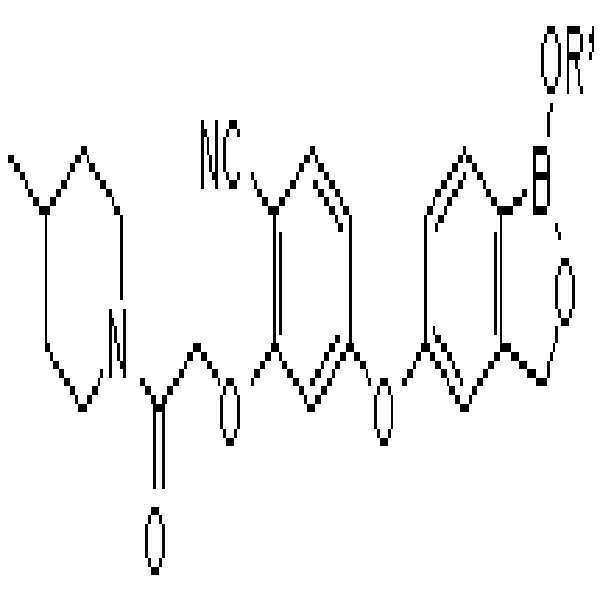

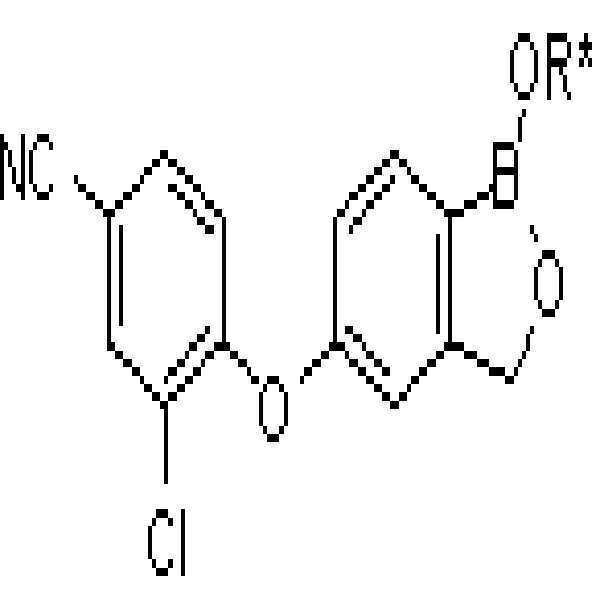

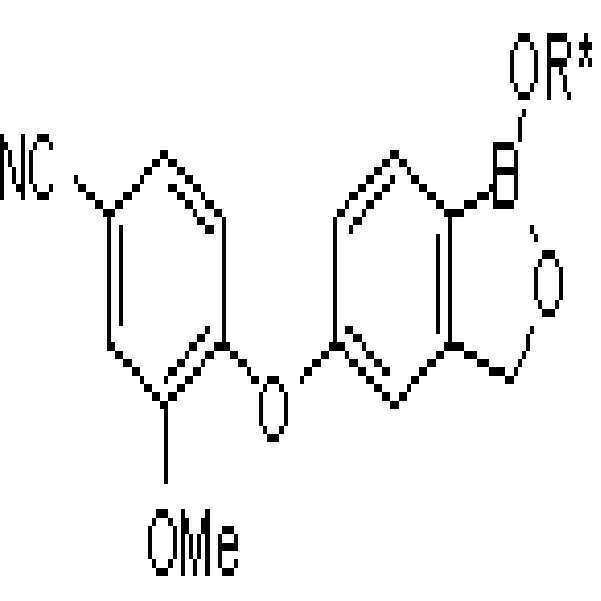


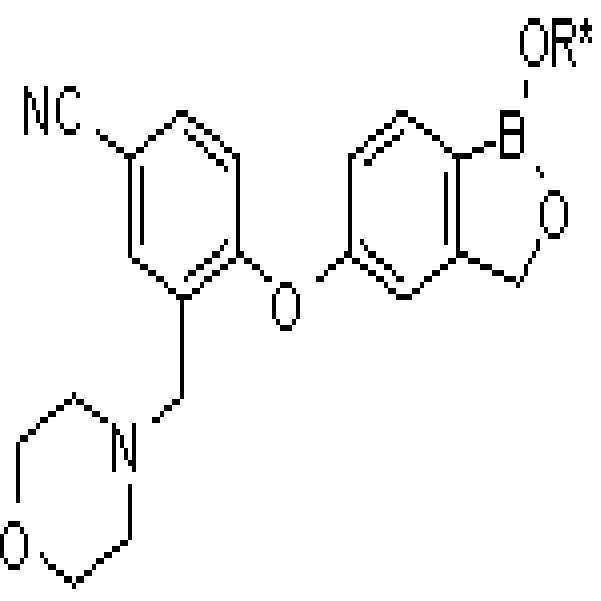


이때, R*는 여기에서 정의된 바와 같다.Wherein R * is as defined herein.
예시적인 구체예에서, 화합물은 아래 화학식에 따른 구조를 가진다:In an exemplary embodiment, the compound has a structure according to the formula:

이때, R3, X, R*, Rb 및 Rc 는 여기에서 설명된 것과 같다.Here, R 3 , X, R *, R b, and R c are as described herein.
예시적인 구체예에서, R3는 H이다. 예시적인 구체예에서, R3는 치환안된 알킬이다. 예시적인 구체예에서, R3는 메틸이다. 예시적인 구체예에서, R3는 C2알킬이다. 예시적인 구체예에서, R3는 C3알킬이다. 예시적인 구체예에서, R3는 C4알킬이다. 예시적인 구체예에서, R3는 C5알킬이다. 예시적인 구체예에서, R3는 C6알킬이다In an exemplary embodiment, R < 3 > In an exemplary embodiment, R < 3 > is unsubstituted alkyl. In an exemplary embodiment, R < 3 > is methyl. In an exemplary embodiment, R 3 is C 2 alkyl. In an exemplary embodiment, R 3 is a C 3 alkyl. In an exemplary embodiment, R 3 is C 4 alkyl. In an exemplary embodiment, R 3 is C 5 alkyl. In an exemplary embodiment, R 3 is C 6 alkyl
예시적인 구체예에서, Rb및 Rc의 최소 하나는 -C(O)NR4R5,-C(O)OR4,-CH2C(O)OR4,-CH2NHC(O)R4및 OR4에서 선택되며 이때, 각 R4및 R5는 H, 치환된 또는 치환안된 알킬, 치환된 또는 치환안된 시클로알킬 그리고 치환된 또는 치환안된 헤테로아릴에서 독립적으로 선택된다.In an exemplary embodiment, at least one of R b and R c is -C (O) NR 4 R 5 , -C (O) OR 4, -CH 2 C (O) OR 4, -
예시적인 구체예에서, Rb및 Rc의 최소 하나는 F, Cl, 메틸, 트리플루오로메틸, -CH2OH,-CH2N(CH3)2,-OH,-CH3,-CH2CH3, -CH2C(O)OH,-CH2C(O)CH2CH3,-CH2C(O)C(CH3)3, -C(O)CH3,-C(O)OH,-C(O)H,-CH2C(O)N(CH2CH3)2,In an exemplary embodiment, at least one of R b and R c is F, Cl, methyl, trifluoromethyl, -CH 2 OH, -CH 2 N (CH 3 ) 2 , -OH, -CH 3 , -CH 2 CH 3, -CH 2 C ( O) OH, -CH 2 C (O)


예시적인 구체예에서, 화합물은 아래 화학식에 따른 구조를 가진다:In an exemplary embodiment, the compound has a structure according to the formula:

이때, R3, X, R*, Rb 및 Rc 는 여기에서 설명된 것과 같다.Here, R 3 , X, R *, R b, and R c are as described herein.
예시적인 구체예에서, Rb 및 Rc 의 최소 하나는 -C(O)NH2, -OH, -CH3, 시클로프로필옥시 그리고 4-시아노피리딘-2-일옥시에서 선택된 멤버다.In an exemplary embodiment, at least one of R b and R c is a member selected from -C (O) NH 2 , -OH, -CH 3 , cyclopropyloxy and 4-cyanopyridin-2-yloxy.
예시적인 구체예에서, 화합물은 아래 화학식에 따른 구조를 가진다:In an exemplary embodiment, the compound has a structure according to the formula:

이때, R3,X,R*는 여기에서 설명된 것과 같고, Rb및 Rc중 최소 하나는 F, Cl, 메틸, 트리플루오로메틸, -CH2OH,-CH2N(CH3)2,-OH,-CH3,-CH2CH3, -CH2C(O)OH,-CH2C(O)CH2CH3,-CH2C(O)C(CH3)3,-C(O)CH3,-C(O)OH,-C(O)H,-CH2C(O)N(CH2CH3)2,In this case, R 3, X, R * is the same as the one described herein, R b and R c is at least one of F, Cl, methyl, methyl, trifluoromethyl -CH 2 OH, -CH 2 N ( CH 3) 2, -OH, -CH 3, -CH 2


예시적인 구체예에서, 화합물은 아래 화학식에 따른 구조를 가진다:In an exemplary embodiment, the compound has a structure according to the formula:

이때, R3,X및 R*는 여기에서 설명된 것과 같고, Rb및 Rc중 and 최소 하나는 -C(O)NR4R5,-C(O)OR4,-CH2C(O)OR4,-CH2NHC(O)R4및 OR4에서 선택된 멤버이며 이때, 각 R4및 R5는 H, 치환된 또는 치환안된 알킬, 치환된 또는 치환안된 시클로알킬 그리고 치환된 또는 치환안된 헤테로아릴로부터 독립적으로 선택된다.In this case, R 3, X and R * is the same as the one described herein, R b and R c and of at least one -C (O) NR 4 R 5 , -C (O) OR 4, -CH 2 C ( O) OR 4 , -CH 2 NHC (O) R 4 and OR 4 wherein each R 4 and R 5 is H, substituted or unsubstituted alkyl, substituted or unsubstituted cycloalkyl and substituted or unsubstituted ≪ / RTI > unsubstituted heteroaryl.
예시적인 구체예에서, 화합물은 다음에서 선택된 멤버의 화학식을 가진다 In an exemplary embodiment, the compound has the formula of the member selected from


이때, R* 는 여기에서 정의된 바와 같다.Wherein R * is as defined herein.
예시적인 구체예에서, 화합물은 In an exemplary embodiment, the compound is


에서 선택된 멤버의 화학식을 가진다. Has the chemical formula of the selected member.
이때, R*는 여기에서 설명된 것과 같다.Here, R * is as described herein.
IIIb. 소프트IIIb. soft 드럭Drug
소프트 드럭(Soft drugs) (또는 ante-drugs)은 이들의 치료요법적 효과를 발휘한 후에 예측가능한 대사를 통하여 비활성 대사물질로 되는 치료요법적 물질이다. 따라서, 활성에 추가하여, 분자가 비활성화되고 해독되는 가장 바람직한 방법으로 분자를 만들면 소프트 드럭이 수득된다. Soft drugs (or ante-drugs) are therapeutic substances that become inactive metabolites through predictable metabolism after exerting their therapeutic effects. Thus, in addition to activity, soft molecules are obtained by making molecules in the most preferred way in which the molecules are deactivated and decrypted.
제 3 측면에서, 본 발명은 옥사보롤을 제공하는데, 이는 5-위치 모이어티에 부착된 에스테르를 포함한다. 이와 같은 5-위치 옥사보롤 에스테르는 국소 적용(피부 또는 네일과 같은)에서 대사적으로 안정하며, 치료요법적 작용을 발휘한다. 5-위치 옥사보롤 에스테르는 그 다음 에스테라제에 의해 가수분해된다. 에스테라제는 콜린에스테라제(아세틸콜린에스테라제포함), 카르복실에스테라제 및 아릴에스테라제로 넓게 분류된다. 관련 기전은 다음의 식과 같다:In a third aspect, the present invention provides oxaborol, which comprises an ester attached to a 5-position moiety. Such 5-position oxabolol esters are metabolically stable in topical applications (such as skin or nails) and exert therapeutic and regulatory action. The 5-position oxaborol ester is then hydrolyzed by an esterase. Escherases are broadly classified as cholinesterase (including acetylcholinesterase), carboxylesterase, and arylesterase. The relevant mechanism is as follows:

에스테라제 Esterase
광범위한 기관, 조직, 체액에는 매우 가변적인 에스테라제 활성이 존재한다. 가수분해후, 5-위치 옥사보롤 에스테르는 5-위치 옥사보롤 산으로 전환되는데, 이는 임의 약물이 피부를 침투하여 전신 순환계에 도달한다면 대부분 비활성이며 비독성이다. 이와 같은 소위 소프트 드럭 방법은 5-위치 옥사보롤 생체활성화합물의 치료요법적 지수를 개선시킨다.There is a highly variable esthetic activity in a wide range of organs, tissues, and body fluids. After hydrolysis, the 5-position oxaborol ester is converted to 5-position oxaboric acid, which is mostly inert and non-toxic if any drug penetrates the skin and reaches the systemic circulation. This so-called soft-drag method improves the therapeutic index of 5-position oxaborol bioactive compounds.
제 3 측면에서, 본 발명은 아래 화학식에 따른 구조를 가지는 화합물을 제공한다:In a third aspect, the present invention provides a compound having a structure according to the formula:

이때, R*는 H, 음전하 및 양전하 반대이온에서 선택된 멤버다. R3 및 R4 는 H, 시아노, 치환된 또는 치환안된 알킬, 치환된 또는 치환안된 헤테로알킬, 치환된 또는 치환안된 시클로알킬, 치환된 또는 치환안된 헤테로시클로알킬, 치환된 또는 치환안된 아릴, 그리고 치환된 또는 치환안된 헤테로아릴로부터 독립적으로 선택된 멤버다. R9,R10,R11및 R12는 H, OR20,NR20R21,SR20,-S(O)R20, -S(O)2R20, -S(O)2NR20R21, 니트로, 할로겐, 시아노, 치환된 또는 치환안된 알킬, 치환된 또는 치환안된 헤테로알킬, 치환된 또는 치환안된 시클로알킬, 치환된 또는 치환안된 헤테로시클로알킬, 치환된 또는 치환안된 아릴, 그리고 치환된 또는 치환안된 헤테로아릴로부터 독립적으로 선택된 멤버다. 각 R20 및 R21 는 H, 치환된 또는 치환안된 알킬, 치환된 또는 치환안된 헤테로알킬, 치환된 또는 치환안된 시클로알킬, 치환된 또는 치환안된 헤테로시클로알킬, 치환된 또는 치환안된 아릴, 그리고 치환된 또는 치환안된 헤테로아릴로부터 독립적으로 선택된 멤버다. R3 및 R4는 여기에 부착된 원자와 함께 선택적으로 결합되어, 4 내지 7개 멤버로된 링을 형성한다. R9 및 R10는 여기에 부착된 원자들과 함께 선택적으로 결합되어 4 내지 7개 멤버로된 링을 형성한다. R10 및 R11는 여기에 부착된 원자와 함께 선택적으로 결합되어, 4 내지 7개 멤버로된 링을 형성한다. R11 및 R12는 여기에 부착된 원자와 함께 선택적으로 결합되어, 4 내지 7개 멤버로된 링을 형성한다. R20 및 R21는 여기에 부착된 원자와 함께 선택적으로 결합되어, 4 내지 7개 멤버로된 링을 형성한다. R10 은 아래 화학식에 따른 구조를 가지는 모이어티를 포함한다는 조건이 있다:Wherein R * is a member selected from H, negative charge and positive charge counterion. R 3 and R 4 are independently selected from H, cyano, substituted or unsubstituted alkyl, substituted or unsubstituted heteroalkyl, substituted or unsubstituted cycloalkyl, substituted or unsubstituted heterocycloalkyl, substituted or unsubstituted aryl, And is a member independently selected from substituted or unsubstituted heteroaryl. R 9, R 10, R 11 and R 12 is H, OR 20, NR 20 R 21,

이때, R22는 H, 치환된 또는 치환안된 알킬, 치환된 또는 치환안된 헤테로알킬, 치환된 또는 치환안된 시클로알킬, 치환된 또는 치환안된 헤테로시클로알킬, 치환된 또는 치환안된 아릴, 그리고 치환된 또는 치환안된 헤테로아릴에서 선택된 멤버다.Wherein R 22 is selected from the group consisting of H, substituted or unsubstituted alkyl, substituted or unsubstituted heteroalkyl, substituted or unsubstituted cycloalkyl, substituted or unsubstituted heterocycloalkyl, substituted or unsubstituted aryl, Membered heteroaryl. ≪ / RTI >
예시적인 구체예에서, 화합물은 

예시적인 구체예에서, R22 는 H이다. 예시적인 구체예에서, R22는 치환된 또는 치환안된 알킬, 치환된 또는 치환안된 헤테로알킬, 치환된 또는 치환안된 시클로알킬, 치환된 또는 치환안된 헤테로시클로알킬, 치환된 또는 치환안된 아릴, 그리고 치환된 또는 치환안된 헤테로아릴에서 선택된 멤버다. 예시적인 구체예에서, R22는 치환된 또는 치환안된 알킬, 치환된 또는 치환안된 시클로알킬, 치환된 또는 치환안된 아릴, 그리고In an exemplary embodiment, R < 22 > In an exemplary embodiment, R 22 is selected from the group consisting of substituted or unsubstituted alkyl, substituted or unsubstituted heteroalkyl, substituted or unsubstituted cycloalkyl, substituted or unsubstituted heterocycloalkyl, substituted or unsubstituted aryl, and substituted Substituted or unsubstituted heteroaryl. In an exemplary embodiment, R < 22 > is substituted or unsubstituted alkyl, substituted or unsubstituted cycloalkyl, substituted or unsubstituted aryl, and
치환된 또는 치환안된 헤테로아릴에서 선택된 멤버다.≪ / RTI > substituted or unsubstituted heteroaryl.
예시적인 구체예에서, R10 및 R11에서 선택된 최소 하나는 아래 화학식에 따른 구조를 가지는 모이어티를 포함해야 하는 조건이 있다:In an exemplary embodiment, there is a condition that at least one selected from R < 10 > and R < 11 > must include a moiety having a structure according to the formula:

예시적인 구체예에서, R22 는 치환된 또는 치환안된 메틸, 치환된 또는 치환안된 에틸, 치환된 또는 치환안된 프로필, 치환된 또는 치환안된 이소프로필, 치환된 또는 치환안된 부틸에서 선택된 멤버다.In an exemplary embodiment, R 22 is a member selected from substituted or unsubstituted methyl, substituted or unsubstituted ethyl, substituted or unsubstituted propyl, substituted or unsubstituted isopropyl, substituted or unsubstituted butyl, and the like.
예시적인 구체예에서, 화합물은 다음에서 선택된 멤버의 구조를 가진다:In an exemplary embodiment, the compound has the structure of a member selected from:
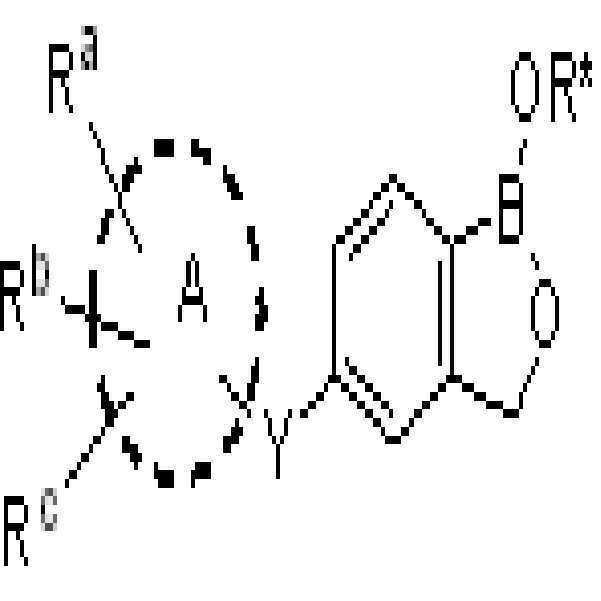
이때, Y 는 S 및 O에서 선택된 멤버다; A는 치환된 또는 치환안된 아릴 그리고 치환된 또는 치환안된 헤테로아릴에서 선택된 멤버다; Ra,Rb및Rc는 H, OR20,NR20R21,SR20,-S(O)R20,-S(O)2R20,-S(O)2NR20R21,-C(O)R20,-C(O)NR20R21,-C(O)OR22, 니트로, 할로겐, 치환된 또는 치환안된 알킬, 치환된 또는 치환안된 헤테로알킬, 치환된 또는 치환안된 시클로알킬, 치환된 또는 치환안된 헤테로시클로알킬, 치환된 또는 치환안된 아릴, 그리고 치환된 또는 치환안된 헤테로아릴에서 독립적으로 선택된 멤버이며, 이때, 각 R20 및 R21 는 H, 니트로, 할로겐, 시아노, 치환된 또는 치환안된 알킬, 치환된 또는 치환안된 헤테로알킬, 치환된 또는 치환안된 시클로알킬, 치환된 또는 치환안된 헤테로시클로알킬, 치환된 또는 치환안된 아릴, 그리고 치환된 또는 치환안된 헤테로아릴에서 독립적으로 선택되며, 이때 조건은 R20 및 R21는 여기에 부착된 원자와 함께 선택적으로 조합되어 5- 내지 7-개 멤버로된 치환된 또는 치환안된 헤테로시클로알킬 링을 형성하며, Ra, Rb, Rc 에서 선택된 최소 하나의 멤버는 -C(O)OR22을 포함하는 조건이 있다.Wherein Y is a member selected from S and O; A is a member selected from substituted or unsubstituted aryl and substituted or unsubstituted heteroaryl; R a, R b and R c is H, OR 20, NR 20 R 21,
예시적인 구체예에서, 화합물은 다음에서 선택된 멤버의 구조를 가진다:In an exemplary embodiment, the compound has the structure of a member selected from:


이때, R*, Ra, Rb 및 Rc 는 여기에서 설명된 것과 같다.Wherein R *, R a , R b and R c are as described herein.
예시적인 구체예에서, 화합물은 다음에서 선택된 구조를 가진다:In an exemplary embodiment, the compound has a structure selected from:


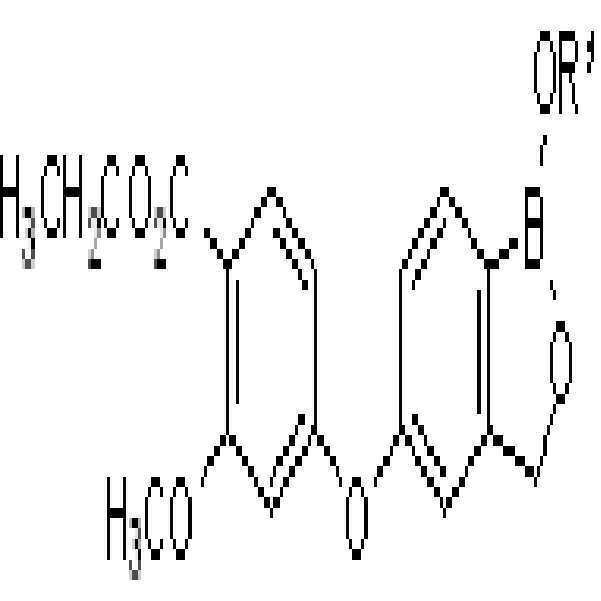


이때, R* 는 여기에서 정의된 바와 같다.Wherein R * is as defined herein.
예시적인 구체예에서, 화합물는 아래 화학식에 따른 구조를 가진다 In an exemplary embodiment, the compound has a structure according to the following formula

이때, X, R*, Rb 및 Rc 는 여기에서 설명된 것과 같고, 이때, Rh 는 할로겐이다. 또 다른 대표적인 구체예에서, Rh 는 플루오르이다. 또 다른 대표적인 구체예에서, Rh 는 염소이다. 또 다른 대표적인 구체예에서, 화합물은 다음에서 선택된 멤버의 구조를 가진다:Wherein X, R *, R b and R c are as described herein, wherein R h is halogen. In another exemplary embodiment, R h is fluoro. In another exemplary embodiment, R h is chlorine. In another exemplary embodiment, the compound has the structure of a member selected from:
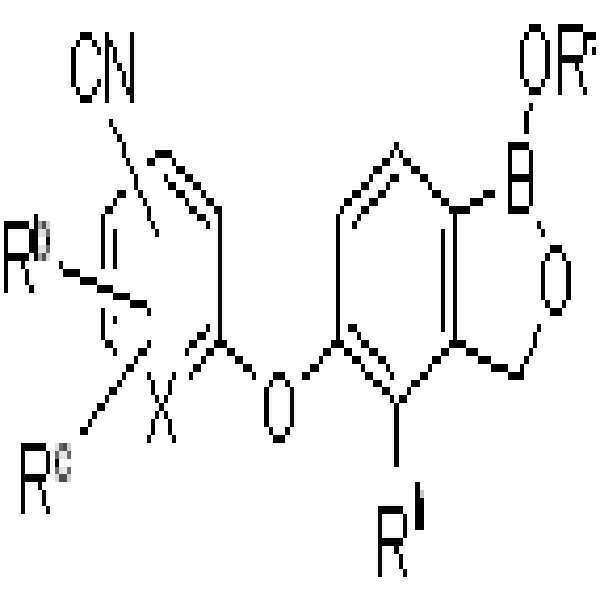

이때, X, R*, Rb, Rc 및 Rh 는 여기에서 설명된 것과 같다. 또 다른 대표적인 구체예에서, 화합물은 다음에서 선택된 멤버의 구조를 가진다: Wherein, X, R *, R b , R c and R h is as described herein. In another exemplary embodiment, the compound has the structure of a member selected from:


이때, X, R*, Rb, Rc 및 Rh 는 여기에서 설명된 것과 같다. In this case, X, R *, Rb, Rc And Rh Are the same as those described herein.
예시적인 구체예에서, 화합물은 다음에서 선택된 멤버의 구조를 가진다:In an exemplary embodiment, the compound has the structure of a member selected from:


이때, R* 는 여기에서 정의된 바와 같다.Wherein R * is as defined herein.
IIIcIIIc ..
제 4 측면에서, 본 발명은 아래 화학식에 따른 구조를 가지는 화합물을 제공한다:In a fourth aspect, the present invention provides a compound having a structure according to the formula:

이때, R* 는 H, 음전하 및 양전하 반대이온에서 선택된 멤버이며, X 는 CH 또는 N이며, 그리고 Rd 은 아미노치환된 알킬이다.Wherein R * is a member selected from H, a negative charge and a positive charge counterion, X is CH or N, and R d is amino substituted alkyl.
예시적인 구체예에서, Rd는 (CR10R11)nNR12R13이며, 이때 n은 1-10에서 선택된 멤버이며, 그리고 R10,R11,R12및 R13은 H, OR14,NR14R15,SR14,-S(O)R14,-S(O)2R14,-S(O)2NR14R15,-C(O)R14,-C(O)OR14,-C(O)NR14R15, 니트로, 할로겐, 치환된 또는 치환안된 알킬, 치환된 또는 치환안된 헤테로알킬, 치환된 또는 치환안된 시클로알킬, 치환된 또는 치환안된 헤테로시클로알킬, 치환된 또는 치환안된 아릴, 그리고 치환된 또는 치환안된 헤테로아릴로부터 독립적으로 선택된 멤버이며 이때, 각 R14 및 R15 는 H, 니트로, 할로겐, 시아노, 치환된 또는 치환안된 알킬, 치환된 또는 치환안된 헤테로알킬, 치환된 또는 치환안된 시클로알킬, 치환된 또는 치환안된 헤테로시클로알킬, 치환된 또는 치환안된 아릴, 그리고 치환된 또는 치환안된 헤테로아릴에서 독립적으로 선택된 멤버다. In an exemplary embodiment, R d is (CR 10 R 11 ) n NR 12 R 13 , wherein n is a member selected from 1-10, and R 10 , R 11 , R 12 and R 13 are H, OR 14 , NR 14 R 15, SR 14 , -S (O)
예시적인 구체예에서, R10 및 R11 는 H이다. 예시적인 구체예에서, R12 및 R13 는 H이다. 예시적인 구체예에서, n은 1 내지 5에서 선택된 멤버이다. 또 다른 대표적인 구체예에서, n은 1 내지 3에서 선택된 멤버다. 예시적인 구체예에서, n은 1이다.In an exemplary embodiment, R < 10 > and R < 11 > In an exemplary embodiment, R < 12 > and R < 13 > In an exemplary embodiment, n is a member selected from 1 to 5. In another exemplary embodiment, n is a member selected from 1-3. In an exemplary embodiment, n is 1.
예시적인 구체예에서, Rd는 (CH2)nNHR13이며, 이때 n은 1-10에서 선택된 멤버이며, 그리고 R13는 H, OR14,NR14R15,SR14,-S(O)R14,-S(O)2R14,-S(O)2NR14R15,-C(O)R14,-C(O)OR14,-C(O)NR14R15에서 선택된 멤버이며 이때, 각 R14및 R15는 H, 니트로, 할로겐, 시아노, 치환된 또는 치환안된 알킬, 치환된 또는 치환안된 헤테로알킬, 치환된 또는 치환안된 시클로알킬, 치환된 또는 치환안된 헤테로시클로알킬, 치환된 또는 치환안된 아릴, 그리고 치환된 또는 치환안된 헤테로아릴에서 독립적으로 선택된 멤버이다.In an exemplary embodiment, R d is (CH 2 ) n NHR 13 wherein n is a member selected from 1-10 and R 13 is H, OR 14 , NR 14 R 15 , SR 14 , -S (O ) R 14, -S (O) 2
예시적인 구체예에서, Rd 은 -(CH2)nNHR13 이며, 이때 n은 1-10에서 선택된 멤버이며, 그리고 R13 는 -S(O)2R14이며 이때, R14 는 H, 치환안된 알킬 그리고 치환된 또는 치환안된 아릴에서 선택된 멤버이다.In an exemplary embodiment, R d is - (CH 2 ) n NHR 13 , wherein n is a member selected from 1-10, and R 13 is -S (O) 2 R 14 wherein R 14 is H, Substituted alkyl, and substituted or unsubstituted aryl.
예시적인 구체예에서, Rd는 (CH2)nNHR13이며, 이때 n은 1-10에서 선택된 멤버이며, 그리고 R13는 -S(O)2R14이며 이때, R14는 치환안된 알킬 또는 치환된 또는 치환안된 아릴이다. 예시적인 구체예에서, R14은 치환안된 C1또는 C2또는 C3알킬이다. 예시적인 구체예에서, R14은 치환안된 C4또는 C5또는 C6알킬이다. 예시적인 구체예에서, R14은 C1알킬이다.In an exemplary embodiment, R d is (CH 2 ) n NHR 13 , where n is a member selected from 1-10 and R 13 is -S (O) 2 R 14 wherein R 14 is an unsubstituted alkyl Or substituted or unsubstituted aryl. In an exemplary embodiment, R 14 is unsubstituted C 1 or C 2 or C 3 alkyl. In an exemplary embodiment, R 14 is unsubstituted C 4 or C 5 or C 6 alkyl. In an exemplary embodiment, R 14 is C 1 alkyl.
예시적인 구체예에서, Rd는 (CH2)nNHR13이며 이때 n은 1-10에서 선택된 멤버이며, 그리고 R13은 -S(O)2R14이며 이때, R14는 치환된 또는 치환안된 아릴이다. 예시적인 구체예에서, R14는 치환된 또는 치환안된 페닐이다. 예시적인 구체예에서, R14는 치환안된 페닐이다. 예시적인 구체예에서, R14는 최소 하나의 할로겐 및/또는 최소 하나의 치환안된 알킬로 치환된 알킬이다. 예시적인 구체예에서, Rd는 다음에서 선택된 멤버의 구조를 가진다 In an exemplary embodiment, R d is (CH 2 ) n NHR 13 wherein n is a member selected from 1-10, and R 13 is -S (O) 2 R 14 wherein R 14 is a substituted or substituted It is an unhealthy ary. In an exemplary embodiment, R 14 is substituted or unsubstituted phenyl. In an exemplary embodiment, R 14 is unsubstituted phenyl. In an exemplary embodiment, R 14 is alkyl substituted with at least one halogen and / or at least one unsubstituted alkyl. In an exemplary embodiment, R d has the structure of a member selected from

이때, R14 은 염소 또는 플루오르 또는 치환안된 C1 또는 C2 또는 C3 또는 C4 알킬이다. 예시적인 구체예에서, R14 는 염소 또는 메틸이다. 예시적인 구체예에서, n는 1 또는 2 또는 3이다. 예시적인 구체예에서, n는 1이다. Wherein R 14 is chlorine or fluorine or unsubstituted C 1 or C 2 or C 3 or C 4 alkyl. In an exemplary embodiment, R 14 is chlorine or methyl. In an exemplary embodiment, n is 1 or 2 or 3. In an exemplary embodiment, n is 1.
예시적인 구체예에서, Rd 는 다음에서 선택된 멤버의 구조를 가진다 In an exemplary embodiment, Rd has the structure of a member selected from
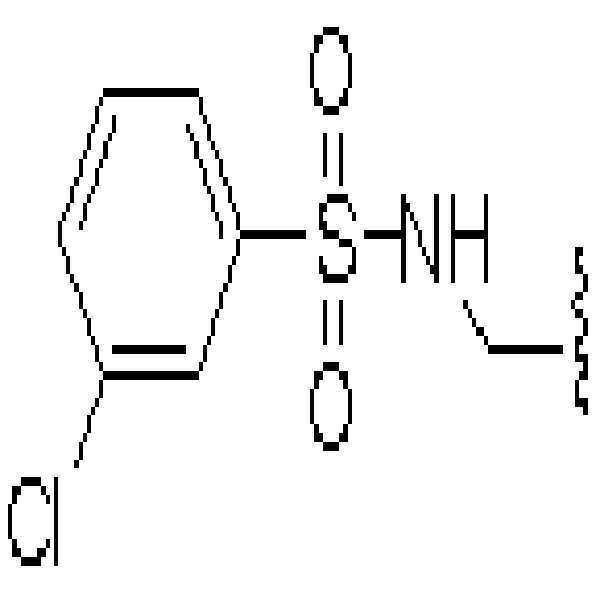


예시적인 구체예에서, Rd 는 -(CH2)nNH2 이며, 이때 n은 1-10에서 선택된 멤버다. 예시적인 구체예에서, n은 1 또는 2 또는 3 또는 4 또는 5이다. 예시적인 구체예에서, n는 1 또는 2 또는 3이다. 예시적인 구체예에서, Rd 는 -CH2NH2이다.In an exemplary embodiment, R d is - (CH 2 ) n NH 2 , where n is a member selected from 1-10. In an exemplary embodiment, n is 1 or 2 or 3 or 4 or 5. In an exemplary embodiment, n is 1 or 2 or 3. In an exemplary embodiment, R d is -CH 2 NH 2 .
예시적인 구체예에서, Rd 는 -(CH2)nNHR13 이며, 이때 n 은 1-10에서 선택된 멤버이며, 그리고 R13 은 치환안된 시클로알킬이다. 예시적인 구체예에서, R13 는 치환안된 C3-C8 시클로알킬이다. 예시적인 구체예에서, R13 는 시클로펜틸 또는 시클로헥실 또는 시클로헵틸이다. 예시적인 구체예에서, n는 1 또는 2 또는 3이다. 예시적인 구체예에서, n 는 1이다. 예시적인 구체예에서, n은 1 이며 R13 은 시클로헥실이다.In an exemplary embodiment, R d is - (CH 2 ) n NHR 13 , wherein n is a member selected from 1-10, and R 13 is unsubstituted cycloalkyl. In an exemplary embodiment, R13 is a substituted C 3 -C 8 cycloalkyl untested. In an exemplary embodiment, R 13 is cyclopentyl or cyclohexyl or cycloheptyl. In an exemplary embodiment, n is 1 or 2 or 3. In an exemplary embodiment, n is 1. In an exemplary embodiment, n is 1 and R 13 is cyclohexyl.
예시적인 구체예에서, Rd는 (CH2)nNHR13이며, 이때 n은 1-10에서 선택된 멤버이며, 그리고 R13은 치환안된 알킬이다. 예시적인 구체예에서, R13은 C1또는 C2또는 C3알킬이다. 예시적인 구체예에서, R13는 C4또는 C5또는 C6알킬이다. 예시적인 구체예에서, n은 1 또는 2 또는 3이다. 예시적인 구체예에서, n 은 1이다. 예시적인 구체예에서, Rd는 (CH2)nNHCH3이다. 예시적인 구체예에서, Rd은 (CH2)NHCH3이다. In an exemplary embodiment, R d is (CH 2 ) n NHR 13 , wherein n is a member selected from 1-10, and R 13 is unsubstituted alkyl. In an exemplary embodiment, R 13 is C 1 or C 2 or C 3 alkyl. In an exemplary embodiment, R 13 is C 4 or C 5 or C 6 alkyl. In an exemplary embodiment, n is 1 or 2 or 3. In an exemplary embodiment, n is 1. In an exemplary embodiment, R d is (CH 2 ) n NHCH 3 . In an exemplary embodiment, R d is (CH 2 ) NHCH 3 .
예시적인 구체예에서, Rd는 (CH2)nNR13aR13이며, 이때 n 은 1-10에서 선택된 멤버이며, 그리고 R13및 R13a은 각각 치환안된 알킬에서 독립적으로 선택된 멤버다. 예시적인 구체예에서, R13및 R13a는 각각 치환안된 알킬에서 독립적으로 선택된 멤버다. 예시적인 구체예에서, R13및 R13a는 C1또는 C2또는 C3또는 C4또는 C5또는 C6알킬에서 독립적으로 선택된 멤버다. 예시적인 구체예에서, R13및 R13a는 C1또는 C2또는 C3알킬에서 독립적으로 선택된 멤버다. 예시적인 구체예에서, Rd는 (CH2)NR13aR13이며 이때, R13및 R13a는 C1또는 C2또는 C3알킬에서 독립적으로 선택된 멤버다. 예시적인 구체예에서, Rd는 (CH2)N(CH3)2이다. In an exemplary embodiment, R d is (CH 2 ) n NR 13a R 13 , wherein n is a member selected from 1-10, and R 13 and R 13a are members independently selected from unsubstituted alkyl. In an exemplary embodiment, R 13 and R 13a are members independently selected from unsubstituted alkyl. In an exemplary embodiment, R 13 and R 13a are members independently selected from C 1 or C 2 or C 3 or C 4 or C 5 or C 6 alkyl. In an exemplary embodiment, R 13 and R 13a are members independently selected from C 1 or C 2 or C 3 alkyl. In an exemplary embodiment, R d is (CH 2 ) NR 13a R 13 wherein R 13 and R 13a are members independently selected from C 1 or C 2 or C 3 alkyl. In an exemplary embodiment, R d is (CH 2 ) N (CH 3 ) 2 .
예시적인 구체예에서, Rd는 (CH2)nNH(CH2)n1R16이며 이때 n 은 1-10에서 선택된 멤버이며, n1 은 1-10에서 선택된 멤버이며, 그리고 R16은 치환된 또는 치환안된 아릴이다. 예시적인 구체예에서, n1은 1 또는 2 또는 3 또는 4 또는 5이다. 예시적인 구체예에서, n1은 1이다. 예시적인 구체예에서, R16는 치환안된 페닐이다. 예시적인 구체예에서, R16는 최소 하나의 할로겐으로 선택적으로 치환된 페닐이다. 예시적인 구체예에서, R16는 최소 하나의 할로겐으로 선택적으로 치환된 페닐이다. 예시적인 구체예에서, R16는 최소 하나의 클로로 또는 플루오르 또는 브로모에서 선택적으로 치환된 페닐이다. 예시적인 구체예에서, R16는 또는 오르소-브로모페닐 또는 메타-브로모페닐 또는 파라-브로모페닐이다. 예시적인 구체예에서, Rd는 CH2NHCH2R16이며 이때, R16는 페닐 또는 오르소-브로모페닐 또는 메타-브로모페닐이다. In an exemplary embodiment, R d is (CH 2 ) n NH (CH 2 ) n 1 R 16 wherein n is a member selected from 1-10,
예시적인 구체예에서, R16는 니트로 또는 시아노 또는 치환안된 알콕시 또는 치환안된 알킬로 치환된 페닐이다. 예시적인 구체예에서, R16는 오르소-시아노페닐 또는 메타-시아노페닐 또는 파라-시아노페닐이다. 예시적인 구체예에서, R16는 오르소-니트로페닐 또는 메타-니트로페닐 또는 파라-니트로페닐이다. 예시적인 구체예에서, Rd는 CH2NHCH2R16이며 이때, R16는 오르소-시아노페닐 또는 메타-시아노페닐 또는 파라-시아노페닐 또는 오르소-니트로페닐 또는 메타-니트로페닐 또는 파라-니트로페닐이다. In an exemplary embodiment, R 16 is phenyl substituted by nitro or cyano or unsubstituted alkoxy or unsubstituted alkyl. In an exemplary embodiment, R 16 is ortho-cyanophenyl or meta-cyanophenyl or para-cyanophenyl. In an exemplary embodiment, R 16 is ortho-nitrophenyl or meta-nitrophenyl or para-nitrophenyl. In an exemplary embodiment, R d is CH 2 NHCH 2 R 16 where R 16 is an ortho-cyanophenyl or meta-cyanophenyl or para-cyanophenyl or ortho-nitrophenyl or meta-nitrophenyl Or para-nitrophenyl.
예시적인 구체예에서, R16는 치환안된 C1또는 C2또는 C3또는 C4또는 C5또는 C6알킬로 치환된 페닐이다. 예시적인 구체예에서, R16는 오르소-메틸페닐 또는 메타-메틸페닐 또는 파라-메틸페닐이다. 예시적인 구체예에서, Rd는 CH2NHCH2R16이며 이때, R16는 오르소-메틸페닐 또는 메타-메틸페닐 또는 파라-메틸페닐이다.In an exemplary embodiment, R 16 is phenyl substituted by unsubstituted C 1 or C 2 or C 3 or C 4 or C 5 or C 6 alkyl. In an exemplary embodiment, R < 16 > is ortho-methylphenyl or meta-methylphenyl or para-methylphenyl. In an exemplary embodiment, R d is CH 2 NHCH 2 R 16 wherein R 16 is ortho-methylphenyl or meta-methylphenyl or para-methylphenyl.
예시적인 구체예에서, R16는 치환안된 C1또는 C2또는 C3또는 C4또는 C5또는 C6알킬옥시으로 치환된 페닐이다. 예시적인 구체예에서, R16는 오르소-메톡시페닐 또는 메타-메틸옥시페닐 또는 파라-메톡시페닐이다. 예시적인 구체예에서, Rd는 CH2NHCH2R16이며 이때, R16는 오르소-메톡시페닐 또는 메타-메톡시페닐 또는 파라-메톡시페닐이다.In an exemplary embodiment, R 16 is phenyl substituted by unsubstituted C 1 or C 2 or C 3 or C 4 or C 5 or C 6 alkyloxy. In an exemplary embodiment, R 16 is ortho-methoxyphenyl or meta-methyloxyphenyl or para-methoxyphenyl. In an exemplary embodiment, R d is CH 2 NHCH 2 R 16 wherein R 16 is ortho-methoxyphenyl or meta-methoxyphenyl or para-methoxyphenyl.
예시적인 구체예에서, R16는 치환안된 C3또는 C4또는 C5또는 C6또는 C7또는 C8시클로알킬이다. 예시적인 구체예에서, R16는 치환안된 시클로헥실이다. 예시적인 구체예에서, Rd는 CH2NHCH2R16이며 이때, R16는 시클로헥실이다.In an exemplary embodiment, R 16 is unsubstituted C 3 or C 4 or C 5 or C 6 or C 7 or C 8 cycloalkyl. In an exemplary embodiment, R < 16 > is unsubstituted cyclohexyl. In an exemplary embodiment, R d is CH 2 NHCH 2 R 16 wherein R 16 is cyclohexyl.
예시적인 구체예에서, R16는 치환안된 헤테로아릴이다. 예시적인 구체예에서, R16는 치환안된 피롤이다. 예시적인 구체예에서, R16는 치환안된 2-피롤이다. 예시적인 구체예에서, Rd는 CH2NHCH2R16이며 이때, R16는 2-피롤이다.In an exemplary embodiment, R 16 is unsubstituted heteroaryl. In an exemplary embodiment, R 16 is an unsubstituted pyrrole. In an exemplary embodiment, R 16 is unsubstituted 2-pyrrole. In an exemplary embodiment, R d is CH 2 NHCH 2 R 16 wherein R 16 is 2-pyrrole.
예시적인 구체예에서, R16는 치환안된 C1또는 C2또는 C3알킬이다. 예시적인 구체예에서, R16는 치환안된 C4또는 C5또는 C6알킬이다. 예시적인 구체예에서, Rd는 CH2NHC(CH3)2이다.In an exemplary embodiment, R 16 is unsubstituted C 1 or C 2 or C 3 alkyl. In an exemplary embodiment, R 16 is unsubstituted C 4 or C 5 or C 6 alkyl. In an exemplary embodiment, R d is CH 2 NHC (CH 3 ) 2 .
예시적인 구체예에서, R16는 NHC(O)-R34으로 치환된 페닐이며 이때, R34는 치환안된 C1또는 C2또는 C3또는 C4또는 C5또는 C6알킬이다. 예시적인 구체예에서, R16는 NHC(O)CH3으로 치환된 페닐이다. 예시적인 구체예에서, Rd는 CH2NHCH2R16이며 이때, R16는 오르소-(CH3C(O)NH-)페닐 또는 메타--(CH3C(O)NH-)페닐 또는 파라--(CH3C(O)NH-)페닐이다.In an exemplary embodiment, R 16 is phenyl substituted with NHC (O) -R 34 where R 34 is unsubstituted C 1 or C 2 or C 3 or C 4 or C 5 or C 6 alkyl. In an exemplary embodiment, R 16 is phenyl substituted with NHC (O) CH 3 . In an exemplary embodiment, R d is CH 2 NHCH 2 R 16 wherein R 16 is an ortho- (CH 3 C (O) NH-) phenyl or meta- (CH 3 C (O) NH-) phenyl or para-(CH 3 C (O) NH- ) phenyl.
예시적인 구체예에서, Rd는 (CH2)nNHC(O)R14이며 이때 n 은 1-10에서 선택된 멤버이며, 이때, R14는 치환안된 알킬이다. 예시적인 구체예에서, R14는 치환안된 C1또는 C2또는 C3알킬이다. 예시적인 구체예에서, R14는 치환안된 C4또는 C5또는 C6알킬이다. 예시적인 구체예에서, R14는 메틸 또는 에틸 또는 이소프로필 또는 t-부틸 또는 이다. 예시적인 구체예에서, R14는 C1알킬이다. 예시적인 구체예에서, Rd는 (CH2)NHC(O)CH3또는 (CH2)NHC(O)CH2CH3또는 (CH2)NHC(O)CH(CH3)2또는 (CH2)NHC(O)C(CH3)3이다. In an exemplary embodiment, R d is (CH 2 ) n NHC (O) R 14 wherein n is a member selected from 1-10, wherein R 14 is unsubstituted alkyl. In an exemplary embodiment, R 14 is unsubstituted C 1 or C 2 or C 3 alkyl. In an exemplary embodiment, R 14 is unsubstituted C 4 or C 5 or C 6 alkyl. In an exemplary embodiment, R 14 is methyl or ethyl or isopropyl or t-butyl or. In an exemplary embodiment, R 14 is C 1 alkyl. In an exemplary embodiment, R d is (CH 2) NHC (O)
예시적인 구체예에서, Rd는 (CH2)nNHC(O)R14이며 이때 n 은 1-10에서 선택된 멤버이며, 이때, R14은 치환된 또는 치환안된 아릴이다. 예시적인 구체예에서, R14은 치환안된 페닐이다. 예시적인 구체예에서, R14은 니트로 또는 시아노 또는 치환안된 알콕시 또는 치환안된 알킬으로 치환된 페닐이다. 예시적인 구체예에서, R14는 오르소-시아노페닐 또는 메타-시아노페닐 또는 파라-시아노페닐이다. 예시적인 구체예에서, R14는 오르소-니트로페닐 또는 메타-니트로페닐 또는 파라-니트로페닐이다. 예시적인 구체예에서, Rd는 CH2NHC(O)R14이며 이때, R14는 오르소-시아노페닐 또는 메타-시아노페닐 또는 파라-시아노페닐 또는 오르소-니트로페닐 또는 메타-니트로페닐 또는 파라-니트로페닐이다. In an exemplary embodiment, R d is (CH 2 ) n NHC (O) R 14 wherein n is a member selected from 1-10, wherein R 14 is substituted or unsubstituted aryl. In an exemplary embodiment, R 14 is unsubstituted phenyl. In an exemplary embodiment, R 14 is phenyl substituted by nitro or cyano or unsubstituted alkoxy or unsubstituted alkyl. In an exemplary embodiment, R 14 is ortho-cyanophenyl or meta-cyanophenyl or para-cyanophenyl. In an exemplary embodiment, R 14 is ortho-nitrophenyl or meta-nitrophenyl or para-nitrophenyl. In an exemplary embodiment, R d is CH 2 NHC (O) R 14 wherein R 14 is an ortho-cyanophenyl or meta-cyanophenyl or para-cyanophenyl or ortho- Nitrophenyl or para-nitrophenyl.
예시적인 구체예에서, R14는 치환안된 C1또는 C2또는 C3또는 C4또는 C5또는 C6알킬로 치환된 페닐이다. 예시적인 구체예에서, R14는 오르소-메틸페닐 또는 메타-메틸페닐 또는 파라-메틸페닐이다. 예시적인 구체예에서, Rd는 CH2NHC(O)R14이며 이때, R14는 오르소-메틸페닐 또는 메타-메틸페닐 또는 파라-메틸페닐이다.In an exemplary embodiment, R 14 is phenyl substituted by unsubstituted C 1 or C 2 or C 3 or C 4 or C 5 or C 6 alkyl. In an exemplary embodiment, R 14 is ortho-methylphenyl or meta-methylphenyl or para-methylphenyl. In an exemplary embodiment, R d is CH 2 NHC (O) R 14 wherein R 14 is ortho-methylphenyl or meta-methylphenyl or para-methylphenyl.
예시적인 구체예에서, R14는 치환안된 C1또는 C2또는 C3또는 C4또는 C5또는 C6알킬옥시로 치환된 페닐이다. 예시적인 구체예에서, R14는 오르소-메톡시페닐 또는 메타-메틸옥시페닐 또는 파라-메톡시페닐이다. 예시적인 구체예에서, Rd는 CH2NHC(O)R14이며 이때, R14는 오르소-메톡시페닐 또는 메타-메톡시페닐 또는 파라-메톡시페닐이다.In an exemplary embodiment, R 14 is phenyl substituted with unsubstituted C 1 or C 2 or C 3 or C 4 or C 5 or C 6 alkyloxy. In an exemplary embodiment, R 14 is ortho-methoxyphenyl or meta-methyloxyphenyl or para-methoxyphenyl. In an exemplary embodiment, R d is CH 2 NHC (O) R 14 wherein R 14 is ortho-methoxyphenyl or meta-methoxyphenyl or para-methoxyphenyl.
예시적인 구체예에서, R14는 할로겐으로 치환된 페닐이다. 예시적인 구체예에서, R14는 염소 또는 플루오르이다. 예시적인 구체예에서, Rd는 CH2NHC(O)R14이며 이때, R14는 오르소-플루오르페닐 또는 메타-플루오르페닐 또는 파라-플루오르페닐이다.In an exemplary embodiment, R 14 is phenyl substituted with halogen. In an exemplary embodiment, R 14 is chlorine or fluorine. In an exemplary embodiment, R d is CH 2 NHC (O) R 14 wherein R 14 is ortho-fluorophenyl or meta-fluorophenyl or para-fluorophenyl.
예시적인 구체예에서, R14는 할로알킬로 치환된 페닐이다. 예시적인 구체예에서, 할로겐은 염소 또는 플루오르다. 예시적인 구체예에서, R14는 알킬로 치환된 페닐이다. 예시적인 구체예에서, R14은 두개 플로오르로 치환된 알킬로 치환된 페닐이다. 예시적인 구체예에서, R14는 오르소(트리플루오로메틸)페닐 또는 메타(트리플루오로메틸)페닐 또는 파라(트리플루오로메틸)페닐이다. 예시적인 구체예에서, Rd는 CH2NHC(O)R14이며 이때, R14는 오르소(트리플루오로메틸)페닐 또는 메타(트리플루오로메틸)페닐 또는 파라(트리플루오로메틸)페닐이다.In an exemplary embodiment, R < 14 > is phenyl substituted by haloalkyl. In an exemplary embodiment, the halogen is chlorine or fluorine. In an exemplary embodiment, R < 14 > is phenyl substituted with alkyl. In an exemplary embodiment, R < 14 > is phenyl substituted by an alkyl substituted with a difluoro. In an exemplary embodiment, R 14 is ortho (trifluoromethyl) phenyl or meta (trifluoromethyl) phenyl or para (trifluoromethyl) phenyl. In an exemplary embodiment, R d is CH 2 NHC (O) R 14 wherein R 14 is ortho (trifluoromethyl) phenyl or meta (trifluoromethyl) phenyl or para (trifluoromethyl) phenyl to be.
예시적인 구체예에서, Rd는 (CH2)nNHC(O)(CR40R41)n9OC(O)R42이며 이때 n 은 1-10에서 선택된 멤버이며, 이때, R40는 치환안된 알킬이며, R41는 치환안된 알킬이며, R42는 치환안된 알킬이다. 예시적인 구체예에서, R40또는 R41또는 R42는 C1또는 C2또는 C3또는 C4또는 C5또는 C6알킬에서 각각 독립적으로 선택된다. 예시적인 구체예에서, R40또는 R41또는 R42는 각각 메틸이다. 예시적인 구체예에서, n9 은 1이다. 예시적인 구체예에서, Rd는 (CH2)nNHC(O)(C(CH3)(CH3))OC(O)R42이며 이때, R42는 C1또는 C2또는 C3또는 C4또는 C5또는 C6알킬이다. 예시적인 구체예에서, Rd는 (CH2)nNHC(O)(C(CH3)(CH3))OC(O)CH3이다.In an exemplary embodiment, R d is (CH 2) n NHC (O ) (CR 40 R 41) n9 OC (O)
예시적인 구체예에서, Rd는 (CH2)nNHC(O)R14이며 이때 n 은 1-10에서 선택된 멤버이며, 이때, R14는 치환안된 시클로알킬이다. 예시적인 구체예에서, R14는 치환안된 C3 또는 C4 또는 C5 또는 C6 또는 C7 또는 C8 시클로알킬이다. 예시적인 구체예에서, R14는 치환안된 시클로펜틸 또는 시클로헥실이다. In an exemplary embodiment, R d is (CH 2 ) n NHC (O) R 14 wherein n is a member selected from 1-10, wherein R 14 is unsubstituted cycloalkyl. In an exemplary embodiment, R 14 is unsubstituted C3 or C4 or C5 or C6 or C7 or C8 cycloalkyl. In an exemplary embodiment, R < 14 > is unsubstituted cyclopentyl or cyclohexyl.
예시적인 구체예에서, Rd는 (CH2)nNHC(O)R14이며 이때 n 은 1-10에서 선택된 멤버이며, 이때, R14는 치환안된 헤테로아릴이다. 예시적인 구체예에서, R14는 치환안된 퓨란이다. 예시적인 구체예에서, R14는 치환안된 2-퓨란이다.In an exemplary embodiment, R d is (CH 2 ) n NHC (O) R 14 wherein n is a member selected from 1-10, wherein R 14 is unsubstituted heteroaryl. In an exemplary embodiment, R 14 is unsubstituted furan. In an exemplary embodiment, R 14 is unsubstituted 2-furan.
예시적인 구체예에서, Rd는 (CH2)nNHC(O)OR14이며 이때 n 은 1-10에서 선택된 멤버이며, 이때, R14는 치환안된 알킬이다. 예시적인 구체예에서, R14는 C1또는 C2또는 C3또는 C4또는 C5또는 C6알킬이다. 예시적인 구체예에서, R14는 C4알킬이다. 예시적인 구체예에서, R14는 n-부틸, 이소부틸, sec-부틸 그리고 tert-부틸에서 선택된 멤버다. 예시적인 구체예에서, Rd는 (CH2)NHC(O)OR14이며 이때, R14는 C1또는 C2또는 C3또는 C4또는 C5또는 C6알킬이다. 예시적인 구체예에서, Rd는 (CH2)NHC(O)OC(CH3)3이다.In an exemplary embodiment, R d is (CH 2 ) n NHC (O) OR 14 wherein n is a member selected from 1-10, wherein R 14 is unsubstituted alkyl. In an exemplary embodiment, R 14 is C 1 or C 2 or C 3 or C 4 or C 5 or C 6 alkyl. In an exemplary embodiment, R 14 is C 4 alkyl. In an exemplary embodiment, R 14 is a member selected from n-butyl, isobutyl, sec-butyl and tert-butyl. In an exemplary embodiment, R d is (CH 2 ) NHC (O) OR 14 wherein R 14 is C 1 or C 2 or C 3 or C 4 or C 5 or C 6 alkyl. In an exemplary embodiment, R d is (CH 2 ) NHC (O) OC (CH 3 ) 3 .
예시적인 구체예에서, Rd는 (CH2)nNHC(O)NR43R44이며 이때 n은 1-10에서 선택된 정수이며, 이때, R43및 R44는 H, 치환된 또는 치환안된 알킬, 치환된 또는 치환안된 시클로알킬 그리고 치환된 또는 치환안된 아릴로부터 독립적으로 선택된다. 예시적인 구체예에서, R43및 R44는 여기에 부착된 질소와 함께 결합되어 3 내지 8개 멤버로된 링을 형성한다. 예시적인 구체예에서, R43및 R44는 여기에 부착된 질소와 함께 결합되어 4 내지 7 멤버로된 링을 형성한다. 예시적인 구체예에서, R43내지 R44는 여기에 부착된 질소와 함께 결합되어 5 내지 6개 멤버로된 링을 형성한다. 예시적인 구체예에서, n는 1 또는 2 또는 3이다. 예시적인 구체예에서, Rd는In an exemplary embodiment, R d is (CH 2 ) n NHC (O) NR 43 R 44 wherein n is an integer selected from 1-10, wherein R 43 and R 44 are independently selected from H, substituted or unsubstituted alkyl , Substituted or unsubstituted cycloalkyl, and substituted or unsubstituted aryl. In an exemplary embodiment, R 43 and R 44 are joined together with the nitrogen attached thereto to form a ring of 3 to 8 members. In an exemplary embodiment, R 43 and R 44 are joined together with the nitrogen attached thereto to form a ring of 4-7 members. In an exemplary embodiment, R 43 to R 44 are joined together with the nitrogen attached thereto to form a ring of 5 to 6 members. In an exemplary embodiment, n is 1 or 2 or 3. In an exemplary embodiment, R d is


예시적인 구체예에서, Rd는 (CH2)nNHC(O)NHR44이며 이때 은 1-10에서 선택된 정수이며, 이때, R44는 치환된 또는 치환안된 알킬, 치환된 또는 치환안된 시클로알킬 그리고 치환된 또는 치환안된 아릴이다. 예시적인 구체예에서, R44는 치환안된 아릴이다. 예시적인 구체예에서, R44는 치환안된 페닐이다. 예시적인 구체예에서, R44는 치환안된 알킬로 치환된 아릴이다. 예시적인 구체예에서, R44는 치환안된 C1또는 C2또는 C3알킬로 치환된 아릴이다. 예시적인 구체예에서, R44치환안된 C4또는 C5또는 C6알킬로 치환된 아릴이다. 예시적인 구체예에서, R44는 치환안된 C1또는 C2또는 C3알킬로 치환된 페닐이다. 예시적인 구체예에서, R44는 오르소 메틸페닐 또는 메타 메틸페닐 또는 파라 메틸페닐이다. 예시적인 구체예에서, Rd는 (CH2)NHC(O)NHR44이며 이때, R44는 파라 메틸페닐이다.In an exemplary embodiment, R d is (CH 2 ) n NHC (O) NHR 44 wherein R 9 is an integer selected from 1-10, wherein R 44 is substituted or unsubstituted alkyl, substituted or unsubstituted cycloalkyl And substituted or unsubstituted aryl. In an exemplary embodiment, R < 44 > is unsubstituted aryl. In an exemplary embodiment, R 44 is unsubstituted phenyl. In an exemplary embodiment, R < 44 > is aryl substituted with unsubstituted alkyl. In an exemplary embodiment, R 44 is aryl substituted with unsubstituted C 1 or C 2 or C 3 alkyl. In an exemplary embodiment, R 44 is an aryl substituted with substituted C 4 or C 5 or C 6 alkyl no. In an exemplary embodiment, R 44 is phenyl substituted by unsubstituted C 1 or C 2 or C 3 alkyl. In an exemplary embodiment, R 44 is orthomethylphenyl or metamethylphenyl or paramethylphenyl. In an exemplary embodiment, R d is (CH 2 ) NHC (O) NHR 44 wherein R 44 is paramethylphenyl.
예시적인 구체예에서, Rd는 (CH2)nNHC(O)NHR44이며 이때 n은 1-10에서 선택된 정수이며, 이때, R44는 치환안된 알킬아미노로 치환된 아릴이다. 예시적인 구체예에서, R44는 NR50R51로 치환된 아릴이며 이때, R50및 R51는 H 및 치환안된 알킬로부터 독립적으로 선택된다. 예시적인 구체예에서, R44는 NR50R51로 치환된 페닐이며 이때, R50및 R51는 각각 독립적으로 C1또는 C2또는 C3또는 C4또는 C5또는 C6알킬로부터 선택된다. 예시적인 구체예에서, R44는 NR50R51로 치환된 페닐이며 이때, R50및 R51는 각각 독립적으로 C1또는 C2또는 C3알킬로부터 치환된다. 예시적인 구체예에서, R44는 오르소 (NR50R51)페닐 또는 메타 (NR50R51)페닐 또는 파라 (NR50R51)페닐이다. 예시적인 구체예에서, R50는 C1또는 C2또는 C3알킬이다. 예시적인 구체예에서, R51는 C1또는 C2또는 C3알킬이다. 예시적인 구체예에서, R50는 C1또는 C2또는 C3알킬이다. 예시적인 구체예에서, R44는 N(CH3)2로 치환된 페닐이다. 예시적인 구체예에서, Rd는 (CH2)NHC(O)NHR44이며 이때, R44는 파라 (N(CH3)2)페닐이다.In an exemplary embodiment, R d is (CH 2 ) n NHC (O) NHR 44 wherein n is an integer selected from 1-10, wherein R 44 is aryl substituted with unsubstituted alkylamino. In an exemplary embodiment, R 44 is aryl substituted with NR 50 R 51 wherein R 50 and R 51 are independently selected from H and unsubstituted alkyl. In an exemplary embodiment, R 44 is phenyl substituted with NR 50 R 51 wherein R 50 and R 51 are each independently selected from C 1 or C 2 or C 3 or C 4 or C 5 or C 6 alkyl . In an exemplary embodiment, R 44 is phenyl substituted with NR 50 R 51 , wherein R 50 and R 51 are each independently substituted from C 1 or C 2 or C 3 alkyl. In an exemplary embodiment, R 44 is ortho (NR 50 R 51 ) phenyl or meta (NR 50 R 51 ) phenyl or para (NR 50 R 51 ) phenyl. In an exemplary embodiment, R 50 is C 1 or C 2 or C 3 alkyl. In an exemplary embodiment, R 51 is C 1 or C 2 or C 3 alkyl. In an exemplary embodiment, R 50 is C 1 or C 2 or C 3 alkyl. In an exemplary embodiment, R 44 is phenyl substituted with N (CH 3 ) 2 . In an exemplary embodiment, R d is (CH 2 ) NHC (O) NHR 44 wherein R 44 is para (N (CH 3 ) 2 ) phenyl.
예시적인 구체예에서, Rd는 (CH2)nNHC(O)(CH2)n10NR43R44이며 이때 n은 1-10에서 선택된 정수이며, n10 은 1-10에서 선택된 정수이며, 이때, R43및 R44는 각각 독립적으로 H, 치환된 또는 치환안된 알킬, 치환된 또는 치환안된 시클로알킬 그리고 치환된 또는 치환안된 아릴로부터 선택된다. 예시적인 구체예에서, R43및 R44는 여기에 부착된 질소와 함께 결합되어 3 내지 8개 멤버로된 링을 형성한다. 예시적인 구체예에서, R43및 R44는 여기에 부착된 질소와 함께 결합되어 4 내지 7개 멤버로된 링을 형성한다. 예시적인 구체예에서, R43및 R44는 여기에 부착된 질소와 함께 결합되어 5 내지 6개 멤버로된 링을 형성한다. 예시적인 구체예에서, n은 1 또는 2 또는 3이다. 예시적인 구체예에서, n10는 1 또는 2 또는 3이다. 예시적인 구체예에서, Rd는 (CH2NHC(O)(CH2)n10NR43R44이다.In an exemplary embodiment, R d is (CH 2) n NHC (O ) (CH 2) n10 NR 43
예시적인 구체예에서, Rd는 (CH2)nNHC(O)NHR44이며, 이때 n은 1-10에서 선택된 정수이며, 이때, R44는 할로겐로 치환된 아릴이다. 예시적인 구체예에서, R44는 할로겐으로 치환된 페닐이다. 예시적인 구체예에서, R44는 오르소 (할로겐)페닐 또는 메타 (할로겐)페닐 또는 파라 (할로겐)페닐이다. 예시적인 구체예에서, R44는 오르소 (클로로)페닐 또는 메타 (클로로)페닐 또는 파라 (클로로)페닐이다. 예시적인 구체예에서, R44는 오르소 (플루오르)페닐 또는 메타 (플루오르)페닐 또는 파라 (플루오르)페닐이다. 예시적인 구체예에서, Rd는 (CH2)NHC(O)NHR44이며 이때, R44는 파라 (클로로)페닐이다.In an exemplary embodiment, R d is (CH 2 ) n NHC (O) NHR 44 , wherein n is an integer selected from 1-10, wherein R 44 is aryl substituted with halogen. In an exemplary embodiment, R < 44 > is phenyl substituted with halogen. In an exemplary embodiment, R 44 is ortho (halogen) phenyl or meta (halogen) phenyl or para (halogen) phenyl. In an exemplary embodiment, R 44 is ortho (chloro) phenyl or meta (chloro) phenyl or para (chloro) phenyl. In an exemplary embodiment, R 44 is ortho (fluoro) phenyl or meta (fluoro) phenyl or para (fluoro) phenyl. In an exemplary embodiment, R d is (CH 2 ) NHC (O) NHR 44 wherein R 44 is para (chloro) phenyl.
예시적인 구체예에서, Rd는 (CH2)nNHC(O)NHR44이며 이때 n은 1-10에서 선택된 정수이며, 이때, R44는 치환안된 아릴이다. 예시적인 구체예에서, R44는 치환안된 페닐이다. 예시적인 구체예에서, Rd는 (CH2)NHC(O)NHR44이며 이때, R44는 치환안된 페닐이다.In an exemplary embodiment, R d is (CH 2 ) n NHC (O) NHR 44 wherein n is an integer selected from 1-10, wherein R 44 is unsubstituted aryl. In an exemplary embodiment, R 44 is unsubstituted phenyl. In an exemplary embodiment, R d is (CH 2 ) NHC (O) NHR 44 wherein R 44 is unsubstituted phenyl.
예시적인 구체예에서, Rd는 (CH2)nNHC(O)NHR44이때 n은 1-10에서 선택된 정수이며, 이때, R44는 치환안된 알킬이다. 예시적인 구체예에서, R44는 C1또는 C2또는 C3알킬이다. 예시적인 구체예에서, Rd는 (CH2)NHC(O)NHR44이며 이때, R44는 C4또는 C5또는 C6알킬이다. 예시적인 구체예에서, Rd는 (CH2)NHC(O)NHR44이며 이때, R44는 에틸이다.In an exemplary embodiment, R d is (CH 2 ) n NHC (O) NHR 44 wherein n is an integer selected from 1-10, wherein R 44 is unsubstituted alkyl. In an exemplary embodiment, R 44 is C 1 or C 2 or C 3 alkyl. In an exemplary embodiment, R d is (CH 2 ) NHC (O) NHR 44 wherein R 44 is C 4 or C 5 or C 6 alkyl. In an exemplary embodiment, R d is (CH 2 ) NHC (O) NHR 44 wherein R 44 is ethyl.
예시적인 구체예에서, Rd는 (CH2)nNHC(O)(CR52R53)n11NR54R55이며 이때 n은 1-10에서 선택된 정수이며, n11는 1-10에서 선택된 정수이며, 이때, R52및 R53는 각각 독립적으로 H 및 아릴로 선택적으로 치환된, 알킬에서 선택되며, 그리고 이때, R54및 R55는 독립적으로 H, 치환안된 알킬, 그리고 C(O)OR56에서 선택되며 이때, R56는 치환안된 알킬이다. In an exemplary embodiment, R d is (CH 2 ) n NHC (O) (CR 52 R 53 ) n 11 NR 54 R 55 wherein n is an integer selected from 1-10,
예시적인 구체예에서, Rd는 (CH2)NHC(O)(CH2)n11NR54R55이며 이때 n11는 1-10에서 선택된 정수이며, 그리고 이때, R54및 R55는 독립적으로 H, 치환안된 알킬, 및 C(O)OR56로부터 선택되며 이때, R56는 치환안된 알킬이다. 예시적인 구체예에서, Rd는 (CH2)NHC(O)(CH2)NHR55이며 그리고 이때, R55는 C(O)OR56이며 이때, R56는 치환안된 알킬이다. 예시적인 구체예에서, Rd는 (CH2)NHC(O)(CH2)NHR55이며 그리고 이때, R55는 C(O)OR56이며 이때, R56는 C1또는 C2또는 C3알킬이다. 예시적인 구체예에서, Rd는 (CH2)NHC(O)(CH2)NHR55이며 그리고 이때, R55는 C(O)OR56이며 이때, R56는 C4또는 C5또는 C6알킬이다.In an exemplary embodiment, R d is (CH 2 ) NHC (O) (CH 2 ) n 11 NR 54 R 55 wherein
예시적인 구체예에서, Rd는 (CH2)NHC(O)(CH2)NR54R55이며 그리고 이때, R54는 치환안된 알킬이며, 그리고 R55는 C(O)OR56이며 이때, R56는 치환안된 알킬이다. 예시적인 구체예에서, Rd는 (CH2)NHC(O)(CH2)NR54R55이며 이때, R54는 C1또는 C2또는 C3또는 C4또는 C5또는 C6알킬이며, R55는 C(O)OR56이며 이때, R56는 C1또는 C2또는 C3또는 C4또는 C5또는 C6알킬이다. 예시적인 구체예에서, Rd는 (CH2)NHC(O)(CH2)NR54R55이며 그리고 이때, R54는 C1알킬이며, R55는 C(O)OR56이며 이때, R56는 C1또는 C2또는 C3또는 C4또는 C5또는 C6알킬이다. 예시적인 구체예에서, Rd는 (CH2)NHC(O)(CH2)NR54R55이며 그리고 이때, R54는 C1또는 C2또는 C3알킬이며, R55는 C(O)OR56이며 이때, R56는 C3또는 C4또는 C5알킬이다. 예시적인 구체예에서, Rd는 (CH2)NHC(O)(CH2)NR54R55이며 그리고 이때, R54는 C1알킬이며, R55는 C(O)OR56이며 이때, R56는 C4알킬이다. In an exemplary embodiment, R d is (CH 2 ) NHC (O) (CH 2 ) NR 54 R 55 wherein R 54 is unsubstituted alkyl and R 55 is C (O) OR 56 , R 56 is unsubstituted alkyl. In an exemplary embodiment, R d is (CH 2 ) NHC (O) (CH 2 ) NR 54 R 55 wherein R 54 is C 1 or C 2 or C 3 or C 4 or C 5 or C 6 alkyl , R 55 is C (O) OR 56 , wherein R 56 is C 1 or C 2 or C 3 or C 4 or C 5 or C 6 alkyl. In an exemplary embodiment, R d is (CH 2 ) NHC (O) (CH 2 ) NR 54 R 55 wherein R 54 is C 1 alkyl and R 55 is C (O) OR 56 wherein R 56 is C 1 or C 2 or C 3 or C 4 or C 5 or C 6 alkyl. In an exemplary embodiment, R d is (CH 2 ) NHC (O) (CH 2 ) NR 54 R 55 wherein R 54 is C 1 or C 2 or C 3 alkyl and R 55 is C (O) OR 56 , wherein R 56 is C 3 or C 4 or C 5 alkyl. In an exemplary embodiment, R d is (CH 2 ) NHC (O) (CH 2 ) NR 54 R 55 wherein R 54 is C 1 alkyl and R 55 is C (O) OR 56 wherein R 56 is C 4 alkyl.
예시적인 구체예에서, Rd는 (CH2)nNHC(O)(CH2)n11NR54R55이며 이때 n은 1-10에서 선택된 정수이며, n11는 1-10에서 선택된 정수이며, 그리고 이때, R54및 R55는 독립적으로 H 및 치환안된 알킬로부터 선택된다. 예시적인 구체예에서, Rd는 (CH2)nNHC(O)(CH2)n11NH2이다. 예시적인 구체예에서, n는 1 또는 2 또는 3이다. 예시적인 구체예에서, n11는 1 또는 2 또는 3이다. 예시적인 구체예에서, Rd는 (CH2)NHC(O)(CH2)NH2이다. 예시적인 구체예에서, Rd는 (CH2)nNHC(O)(CH2)n11NHR55이며 이때 n은 1-10에서 선택된 정수이며, n11는 1-10에서 선택된 정수이며, 그리고 이때, R55는 치환안된 알킬이다. 예시적인 구체예에서, Rd는 (CH2)NHC(O)(CH2)NHR55이며 이때 R55는 치환안된 알킬이다. 예시적인 구체예에서, Rd는 (CH2)NHC(O)(CH2)NHR55이며 이때 R55는 C1또는 C2또는 C3알킬이다. 예시적인 구체예에서, Rd는 (CH2)NHC(O)(CH2)NHR55이며 이때 R55는 C4또는 C5또는 C6알킬이다. 예시적인 구체예에서, Rd는 (CH2)NHC(O)(CH2)NHCH3이다.In an exemplary embodiment, R d is (CH 2 ) n NHC (O) (CH 2 ) n 11 NR 54 R 55 wherein n is an integer selected from 1-10,
예시적인 구체예에서, Rd는 (CH2)nNHC(O)(CH2)n11NR54R55이며 이때 n은 1-10에서 선택된 정수이며, n11는 1-10에서 선택된 정수이며, 그리고 이때, R54및 R55는 독립적으로 치환안된 알킬로 선택된다. 예시적인 구체예에서, R54및 R55는 각각 C1또는 C2또는 C3또는 C4또는 C5또는 C6알킬로부터 독립적으로 선택된 멤버다. 예시적인 구체예에서, R54및 R55는 각각 독립적으로 C1또는 C2또는 C3알킬로부터 선택된 멤버다. 예시적인 구체예에서, Rd는 (CH2)NHC(O)(CH2)NR54R55이며 이때, R54및 R55는 각각 독립적으로 C1또는 C2또는 C3알킬으로부터 선택된 멤버다. 예시적인 구체예에서, Rd는 (CH2)NHC(O)(CH2)N(CH3)2이다.In an exemplary embodiment, R d is (CH 2 ) n NHC (O) (CH 2 ) n 11 NR 54 R 55 wherein n is an integer selected from 1-10,
예시적인 구체예에서, Rd는 (CH2)nNHC(O)(CHR53)n11NR54R55이며 이때 n은 1-10에서 선택된 정수이며, n11는 1-10에서 선택된 정수이며, 이때, R53는 알킬이고, 그리고 이때, R54및 R55는 독립적으로 H, 치환안된 알킬, 그리고 C(O)OR56에서 선택되며 이때, R56는 치환안된 알킬이다. 예시적인 구체예에서, n는 1 또는 2 또는 3이며, n11는 1 또는 2 또는 3이다. 예시적인 구체예에서, n는 1 이며, n11는 1이다. 예시적인 구체예에서, Rd는 (CH2)nNHC(O)(CHR53)n11NH2이며 이때 n은 1-10에서 선택된 정수이며, n11는 1-10에서 선택된 정수이며, 이때, R53는 알킬이다. 예시적인 구체예에서, Rd는 (CH2)NHC(O)CH(R53)(NH2)이며 이때 R53는 알킬이다. 예시적인 구체예에서, R53는 C1또는 C2또는 C3또는 C4또는 C5또는 C6알킬이다. 예시적인 구체예에서, R53는 C1또는 C2또는 C3알킬이다. 예시적인 구체예에서, Rd는 (CH2)NHC(O)CH(R53)(NH2)이며 이때 R53는 C1또는 C2또는 C3또는 C4알킬이다. 예시적인 구체예에서, Rd는 (CH2)NHC(O)CH(R53)(NH2)이며 이때 R53는 C4알킬이다. 예시적인 구체예에서, Rd는 (CH2)NHC(O)CH(CH3)(NH2)이다. 예시적인 구체예에서, Rd는 (CH2)NHC(O)CH(NH2)(CH2CH(CH3)2)이다. In an exemplary embodiment, R d is (CH 2 ) n NHC (O) (CHR 53 ) n 11 NR 54 R 55 wherein n is an integer selected from 1-10 and
예시적인 구체예에서, Rd는 (CH2)nNHC(O)(CHR53)n11NR54R55이며 이때 n은 1-10에서 선택된 정수이며, n11는 1-10에서 선택된 정수이며, 이때, R53는 아릴로 치환된 알킬이며, 이때, R54및 R55는 독립적으로 치환안된 알킬에서 선택된다. 예시적인 구체예에서, n는 1 또는 2 또는 3 이며 n11는 1 또는 2 또는 3이다. 예시적인 구체예에서, n는 1이며 그리고 n11은 1이다. 예시적인 구체예에서, Rd는 (CH2)nNHC(O)(CHR53)n11NR54R55이며 이때 n은 1-10에서 선택된 정수이며, n11는 1-10에서 선택된 정수이며, 이때, R53는 아릴 치환된 알킬이다. 예시적인 구체예에서, Rd는 (CH2)NHC(O)CH(R53)(NR54R55)이며 이때 R53는 아릴로 치환된 알킬이다. 예시적인 구체예에서, R53는 (CH2)n12-Ph이며 이때, n12는 1-10에서 선택된 정수이다. 예시적인 구체예에서, n는 1 또는 2 또는 3이며, n11 는 1 또는 2 또는 3이고, 그리고 n12는 1 또는 2 또는 3이다. 예시적인 구체예에서, n은 1이고, n11는 1이고 n12는 1이다. 예시적인 구체예에서, Rd는 (CH2)NHC(O)CH(CH2-Ph)(NR54R55)이며 이때 R54또는 R55는 C1또는 C2또는 C3또는 C4알킬이다. 예시적인 구체예에서, Rd는 (CH2)NHC(O)CH((CH2)n12-Ph)(N(CH3)2)이다. 예시적인 구체예에서, Rd는 (CH2)NHC(O)CH(CH2-Ph)(N(CH3)2)이다.In an exemplary embodiment, R d is (CH 2 ) n NHC (O) (CHR 53 ) n 11 NR 54 R 55 wherein n is an integer selected from 1-10 and
예시적인 구체예에서, Rd는 (CH2)nNHC(O)R58이며 이때 n은 1-10에서 선택된 정수이며, 그리고 R58는 In an exemplary embodiment, R d is (CH 2 ) n NHC (O) R 58 wherein n is an integer selected from 1-10, and R 58 is


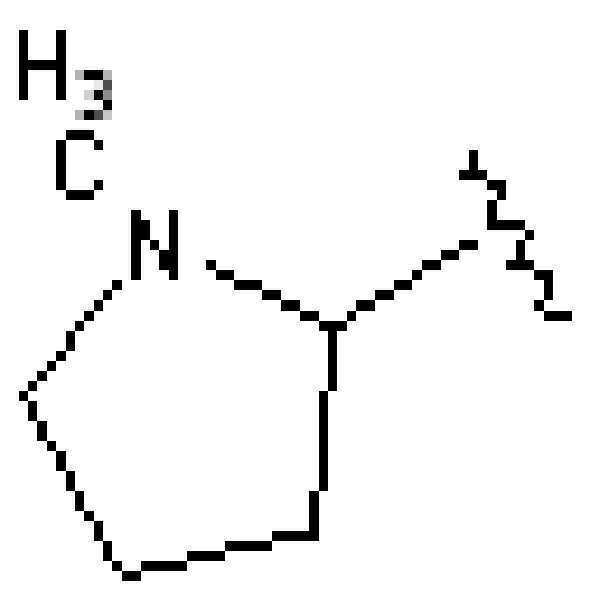


예시적인 구체예에서, Rd는 (CH2)nNHC(O)(CHR53)n11NHR55이며 이때 n은 1-10에서 선택된 정수이며, n11는 1-10에서 선택된 정수이며, 이때, R53는 알킬이며, 그리고 이때, R55는 C(O)OR56이며 이때, R56는 치환안된 알킬이다. 예시적인 구체예에서, n는 1 또는 2 또는 3이며 그리고 n11은 1 또는 2 또는 3이다. 예시적인 구체예에서, n은 1이며 그리고 n11은 1이다. 예시적인 구체예에서, Rd은 (CH2)NHC(O)CH(R53)(NHC(O)OR56)이며 이때 R53는 C1또는 C2또는 C3또는 C4또는 C5또는 C6알킬이며 그리고 R56은 C1또는 C2또는 C3또는 C4또는 C5또는 C6알킬이다. 예시적인 구체예에서, R53는 C1또는 C2또는 C3알킬이다. 예시적인 구체예에서, R56는 C4또는 C5또는 C6알킬이다. 예시적인 구체예에서, Rd는 (CH2)NHC(O)CH(CH2CH(CH3)2)(NHC(O)OR56)이다. 예시적인 구체예에서, Rd는 (CH2)NHC(O)CH(R53)(NHC(O)OC(CH3)3)이다. 예시적인 구체예에서, Rd는 (CH2)NHC(O)CH(CH2CH(CH3)2)(NHC(O)OC(CH3)3)이다.In an exemplary embodiment, R d is (CH 2 ) n NHC (O) (CHR 53 ) n 11 NHR 55 wherein n is an integer selected from 1-10 and
예시적인 구체예에서, Rd는 (CH2)nNHC(O)(CHR53)n11NH2이며 이때 n은 1-10에서 선택된 정수이며, n11는 1-10에서 선택된 정수이며, 이때, R53는 치환안된 알킬로, 선택적으로 아릴로 치환된다. 예시적인 구체예에서, n는 1 또는 2 또는 3이며 그리고 n11은 1 또는 2 또는 3이다. 예시적인 구체예에서, n는 1이며 그리고 n11은 1이다. 예시적인 구체예에서, Rd는 (CH2)nNHC(O)(CHR53)n11NH2이며 이때 n은 1-10에서 선택된 정수이며, n11는 1-10에서 선택된 정수이며, 이때, R53는 (CH2)n12-Ph이며 이때, n12는 1-10에서 선택된 정수이다. 예시적인 구체예에서, n은 1 또는 2 또는 3이며, n11는 1 또는 2 또는 3이며 그리고 n12은 1 또는 2 또는 3이다. 예시적인 구체예에서, n은 1이며 n11은 1이며 그리고 n12은 1이다. 예시적인 구체예에서, Rd은 (CH2)NHC(O)CH[(CH2)-Ph])(NH2)이다.In an exemplary embodiment, R d is (CH 2 ) n NHC (O) (CHR 53 ) n 11 NH 2 wherein n is an integer selected from 1-10 and
예시적인 구체예에서, Rd은 (CH2)nNHC(O)(CHR53)n11NH(C(O)OR56)이며 이때 n은 1-10에서 선택된 정수이며, n11는 1-10에서 선택된 정수이며, 이때, R56는 C1또는 C2또는 C3또는 C4또는 C5또는 C6알킬이며, 그리고 R53는 치환안된 알킬이다. 예시적인 구체예에서, n는 1 또는 2 또는 3이며 그리고 n11는 1 또는 2 또는 3이다. 예시적인 구체예에서, n은 1이며 그리고 n11은 1이다. 예시적인 구체예에서, Rd은 (CH2)NHC(O)(CHR53)NH(C(O)OR56)이며, 이때, R56은 C4알킬이며, R53은 C1또는 C2또는 C3또는 C4알킬이다. 예시적인 구체예에서, Rd은 (CH2)NHC(O)CH(CH3)(NH(C(O)OR56))이다. 예시적인 구체예에서, Rd은 (CH2)NHC(O)CH(R53)(NH(C(O)OC(CH3)3))이다. 예시적인 구체예에서, Rd은 (CH2)NHC(O)CH(CH3))NH(C(O)OC(CH3)3)이다.In an exemplary embodiment, R d is (CH 2 ) n NHC (O) (CHR 53 ) n 11 NH (C (O) OR 56 ) where n is an integer selected from 1-10, Wherein R 56 is C 1 or C 2 or C 3 or C 4 or C 5 or C 6 alkyl, and R 53 is unsubstituted alkyl. In an exemplary embodiment, n is 1 or 2 or 3 and n11 is 1 or 2 or 3. In an exemplary embodiment, n is 1 and n11 is 1. In an exemplary embodiment, R d is (C 2 ) NHC (O) (CHR 53 ) NH (C (O) OR 56 ) wherein R 56 is C 4 alkyl and R 53 is C 1 or C 2 Or C 3 or C 4 alkyl. In an exemplary embodiment, R d is (CH 2 ) NHC (O) CH (CH 3 ) (NH (C (O) OR 56 )). In an exemplary embodiment, R d is (CH 2 ) NHC (O) CH (R 53 ) (NH (C (O) OC (CH 3 ) 3 )). In an exemplary embodiment, R d is (CH 2 ) NHC (O) CH (CH 3 )) NH 2 (C (O) OC (CH 3 ) 3 ).
예시적인 구체예에서, Rd은 (CH2)nNHC(O)(CHR53)n11NH(C(O)OR56)이며 이때 n은 1-10에서 선택된 정수이며, n11은 1-10에서 선택된 정수이며, 이때, R56은 C1또는 C2또는 C3또는 C4또는 C5또는 C6알킬이며, 그리고 R53은 아릴로 치환된 알킬이다. 예시적인 구체예에서, n는 1 또는 2 또는 3이며 그리고 n11은 1 또는 2 또는 3이다. 예시적인 구체예에서, n 는 1이며 그리고 n11은 1이다. 예시적인 구체예에서, Rd은 (CH2)NHC(O)(CHR53)NH(C(O)OR56)이며 이때, R56는 C4알킬이며, 그리고 R53는 (CH2)n12-Ph이며 이때, n12는 1-10에서 선택된 정수이다. 예시적인 구체예에서, Rd는 (CH2)NHC(O)CH((CH2)-Ph)(NH(C(O)OR56))이다. 예시적인 구체예에서, Rd는 (CH2)NHC(O)CH(R53)(NH(C(O)OC(CH3)3))이다. 예시적인 구체예에서, Rd는 (CH2)NHC(O)CH((CH2)-Ph))(NH(C(O)OC(CH3)3))이다.In an exemplary embodiment, R d is (CH 2 ) n NHC (O) (CHR 53 ) n 11 NH (C (O) OR 56 ) where n is an integer selected from 1-10, Wherein R 56 is C 1 or C 2 or C 3 or C 4 or C 5 or C 6 alkyl, and R 53 is alkyl substituted with aryl. In an exemplary embodiment, n is 1 or 2 or 3 and n11 is 1 or 2 or 3. In an exemplary embodiment, n is 1 and n11 is 1. In an exemplary embodiment, R d is (CH 2) NHC (O) (CHR 53) NH (C (O) OR 56) , and wherein, R 56 is C 4 alkyl, and R 53 is (CH 2) n12 -Ph, wherein n 12 is an integer selected from 1-10. In an exemplary embodiment, R d is (CH 2 ) NHC (O) CH ((CH 2 ) -Ph) (NH (C (O) OR 56 )). In an exemplary embodiment, R d is (CH 2 ) NHC (O) CH (R 53 ) (NH (C (O) OC (CH 3 ) 3 ). In an exemplary embodiment, R d is (CH 2 ) NHC (O) CH ((CH 2 ) -Ph)) (NH (C (O) OC (CH 3 ) 3 ).
예시적인 구체예에서, 화합물은 아래 화학식에 따른 구조를 가진다:In an exemplary embodiment, the compound has a structure according to the formula:


또는 


이때, Rd 는 여기에서 정의된 바와 같다.Wherein R < d > is as defined herein.
예시적인 구체예에서, 화합물는 아래 화학식에 따른 구조를 가진다:In an exemplary embodiment, the compound has the structure according to the formula:


또는 
예시적인 구체예에서, 화합물은 아래 화학식에 따른 구조를 가진다:In an exemplary embodiment, the compound has a structure according to the formula:

이때, R*는 여기에서 정의된 바와 같다.Wherein R * is as defined herein.
예시적인 구체예에서, 화합물다음에서 선택된 멤버의 구조를 가진다:In an exemplary embodiment, the compound has the structure of a member selected from:


이때, R*는 여기에서 정의된 바와 같다.Wherein R * is as defined herein.
예시적인 구체예에서, 화합물은 아래 화학식에 따른 구조를 가진다:In an exemplary embodiment, the compound has a structure according to the formula:

이때, R*는 여기에서 정의된 바와 같다.Wherein R * is as defined herein.
IIIdIIId . .
제 5의 측면에서, 본 발명은 아래 화학식에 따른 구조를 가지는 화합물을 제공한다:In a fifth aspect, the invention provides compounds having a structure according to the formula:
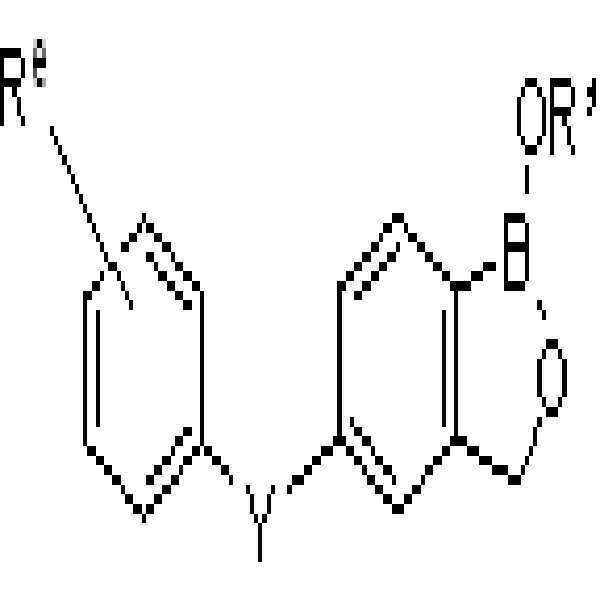

이때, Y는 S 및 O에서 선택된 멤버다; R* 는H, 음전하 및 양전하 반대이온에서 선택된 멤버다; Re 는 치환된 또는 치환안된 하이드록시알킬, -C(O)H 그리고 -C(O)NR20R21에서 선택된 멤버다. 각 R20 및 R21 는 독립적으로 H, 니트로, 할로겐, 시아노, 치환된 또는 치환안된 알킬, 치환된 또는 치환안된 헤테로알킬, 치환된 또는 치환안된 시클로알킬, 치환된 또는 치환안된 헤테로시클로알킬, 치환된 또는 치환안된 아릴, 그리고 치환된 또는 치환안된 헤테로아릴에서 선택된 멤버다. R20 및 R21는 여기에 부착된 원자와 함께 선택적으로 조합되어 5- 내지 7-멤버로된 치환된 또는 치환안된 헤테로시클로알킬 링을 형성하는 조건이 있다.Wherein Y is a member selected from S and O; R * is a member selected from H, negative charge and positive charge counterion; R e is a member selected from substituted or unsubstituted hydroxyalkyl, -C (O) H and -C (O) NR 20 R 21 . Each R 20 and R 21 is independently H, nitro, halogen, cyano, substituted or unsubstituted alkyl, substituted or unsubstituted heteroalkyl, substituted or unsubstituted cycloalkyl, substituted or unsubstituted heterocycloalkyl, Substituted or unsubstituted aryl, and substituted or unsubstituted heteroaryl. R 20 and R 21 are optionally combined with the atoms attached thereto to form a 5- or 7-membered substituted or unsubstituted heterocycloalkyl ring.
예시적인 구체예에서, 화합물은 아래 화학식에 따른 구조를 가진다:In an exemplary embodiment, the compound has a structure according to the formula:
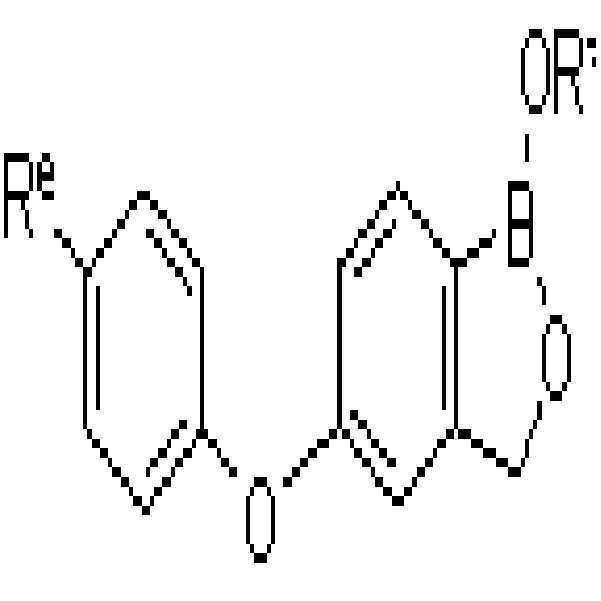


또는 
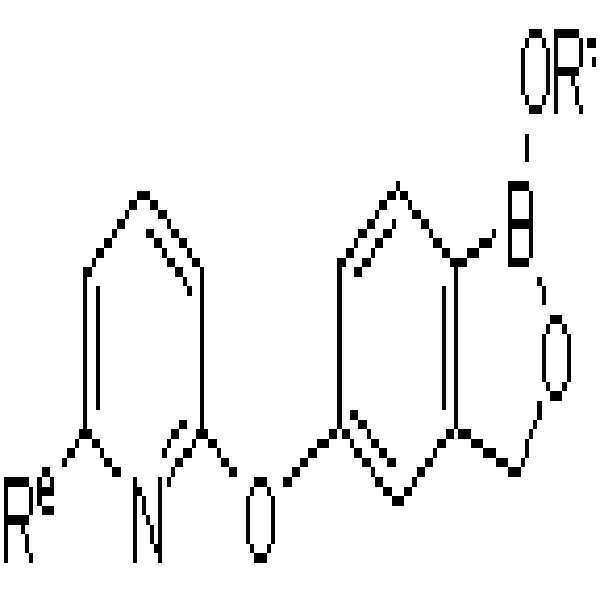

이때, Re는 여기에서 정의된 바와 같다.Wherein R e is as defined herein.
예시적인 구체예에서, 화합물은 아래 화학식에 따른 구조를 가진다:In an exemplary embodiment, the compound has a structure according to the formula:

이때, R*는 여기에서 정의된 바와 같고, Re는 치환된 또는 치환안된 하이드록시알킬이다. 예시적인 구체예에서, Re는 치환안된 하이드록시알킬이다. 예시적인 구체예에서, Re는 치환안된 C1-C6하이드록시알킬이다. 예시적인 구체예에서, Re는 치환안된 C1또는 C2또는 C3또는 C4또는 C5또는 C6하이드록시알킬이다. 예시적인 구체예에서, 화합물은 다음의 구조를 가진다:Wherein R * is as defined herein and R e is substituted or unsubstituted hydroxyalkyl. In an exemplary embodiment, R e is unsubstituted hydroxyalkyl. In an exemplary embodiment, R e is unsubstituted C 1 -C 6 hydroxyalkyl. In an exemplary embodiment, R e is unsubstituted C 1 or C 2 or C 3 or C 4 or C 5 or C 6 hydroxyalkyl. In an exemplary embodiment, the compound has the structure:


이때, R*는 여기에서 정의된 바와 같다.Wherein R * is as defined herein.
예시적인 구체예에서, 화합물은 아래 화학식에 따른 구조를 가진다:In an exemplary embodiment, the compound has a structure according to the formula:

이때, R*는 여기에서 정의된 바와 같고, Re 는 C(O)H이다. 예시적인 구체예에서, 화합물은 다음의 구조를 가진다:Wherein R * is as defined herein and R e is C (O) H. In an exemplary embodiment, the compound has the structure:
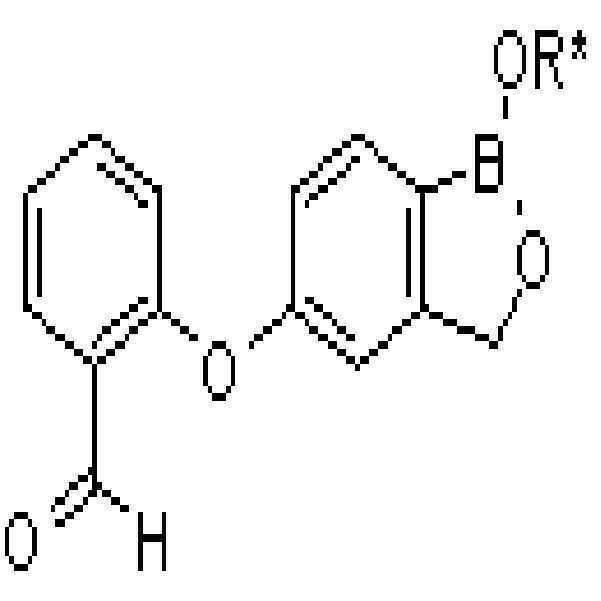


이때, R*는 여기에서 설명된 것과 같다.Here, R * is as described herein.
예시적인 구체예에서, 화합물은 다음 화학식의 구조를 가진다:In an exemplary embodiment, the compound has the structure of the formula:

이때, R*는 여기에서 정의된 바와 같고, R20및 R21모두 치환된 또는 치환안된 알킬에서 선택되지 않는 조건과, R20및 R21는 치환된 또는 치환안된 몰포리노 링을 형성하기 위하여 여기에 부착된 원자와 함께 선택적으로 복합되지 않는다는 조건이다. 예시적인 구체예에서, R20및 R21는 모두 치환안된 알킬로부터 선택된 멤버가 아니라는 조건이 있다. 예시적인 구체예에서, R20및 R21는 모두 에틸이 아니라는 조건이 있다.In this case, R * are as defined herein, R 20 and R 21 all are not selected from substituted or substituted untested alkyl conditions and, R 20 and R 21 are here to form the untested substituted or substituted Dimorpholino Reno ring Lt; RTI ID = 0.0 > atoms < / RTI > In an exemplary embodiment, R < 20 > and R < 21 > are not all members selected from unsubstituted alkyl. In an exemplary embodiment, R < 20 > and R < 21 > are not all ethyl.
예시적인 구체예에서, 화합물은 하기에 다른 화학식 구조를 가진다:In an exemplary embodiment, the compound has a different chemical structure:

이때, R*는 여기에서 정의된 바와 같고, R20및 R21는 독립적으로 치환안된 알킬에서 선택된다. 예시적인 구체예에서, 각 R20및 R21는 치환안된 C4-C6알킬이 아니라는 조건이 있다. 예시적인 구체예에서, 각 R20및 R21는 치환안된 C1-C3알킬이 아니라는 조건이 있다. 예시적인 구체예에서, R20및 R21는 모두 메틸이 아니라는 조건이 있다. 예시적인 구체예에서, R20및 R21모두 에틸이 아니라는 조건이 있다. 예시적인 구체예에서, R20및 R21모두 n-프로필이 아니라는 조건이 있다. 예시적인 구체예에서, 화합물은 Wherein R * is as defined herein, and R 20 and R 21 are independently selected from unsubstituted alkyl. In the exemplary embodiment, each of R 20 and R 21 have the condition is not a C 4 -C 6 alkyl substituted untested. In the exemplary embodiment, each of R 20 and R 21 have the condition is not a C 1 -C 3 alkyl substituted untested. In an exemplary embodiment, R < 20 > and R < 21 > are not both methyl. In an exemplary embodiment, there is a condition that both R 20 and R 21 are not ethyl. In an exemplary embodiment, there is a condition that both R 20 and R 21 are not n-propyl. In an exemplary embodiment, the compound is


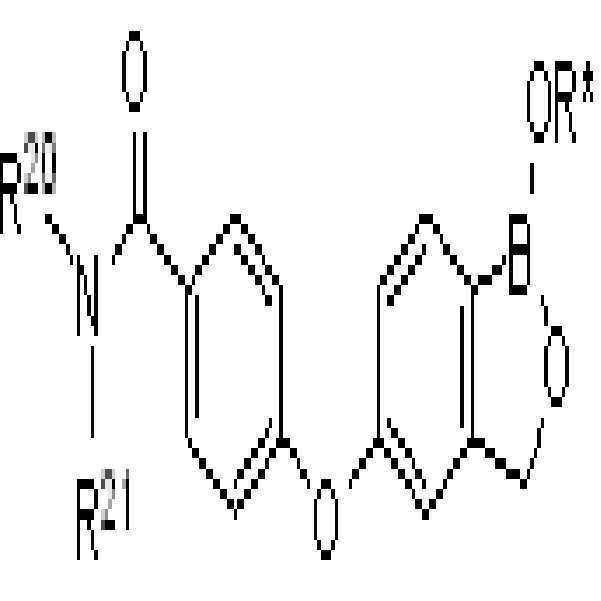
예시적인 구체예에서, 화합물은 하기에 따른 구조를 가진다:In an exemplary embodiment, the compound has the structure according to the following:


이때, R*, R20및 R21는 여기에서 설명된 것과 같다.Wherein R *, R 20 and R 21 are as described herein.
예시적인 구체예에서, 화합물은 In an exemplary embodiment, the compound is


예시적인 구체예에서, 화합물은 다음의 화학식에 따른 구조를 가지지 않는다:In an exemplary embodiment, the compound has no structure according to the following formula:

이때, R*는 여기에서 설명된 것과 같다.Here, R * is as described herein.
예시적인 구체예에서, 화합물은 하기에 다른 화학식 구조를 가진다:In an exemplary embodiment, the compound has a different chemical structure:

이때, R*는 여기에서 정의된 바와 같고, R20는 NH2이다. 예시적인 구체예에서, 화합물은 하기에 다른 화학식 구조를 가진다:In this case, R * is as defined herein, R 20 is NH 2. In an exemplary embodiment, the compound has a different chemical structure:

이때, R*는 여기에서 정의된 바와 같다.Wherein R * is as defined herein.
예시적인 구체예에서, 화합물은 하기에 다른 화학식 구조를 가진다:In an exemplary embodiment, the compound has a different chemical structure:

이때, R*는 여기에서 정의된 바와 같고, R20는 테트라하이드로-퓨란-2-일 메틸이다. 예시적인 구체예에서, 화합물은 하기에 따른 구조를 가진다:Wherein R * is as defined herein and R 20 is tetrahydro-furan-2-ylmethyl. In an exemplary embodiment, the compound has the structure according to the following:


이때, R20은 테트라하이드로-퓨란-2-일 메틸이다.Wherein R < 20 > is tetrahydro-furan-2-ylmethyl.
예시적인 구체예에서, 하기에 다른 화학식 구조를 가지는 화합물:In an exemplary embodiment, a compound having another structural formula:

이때, R*는 여기에서 정의된 바와 같고, R20는 -NC(O)OR56이며 이때, R56는 치환안된 알킬이다. 예시적인 구체예에서, R56는 C1또는 C2또는 C3또는 C4또는 C5또는 C6알킬에서 선택된 멤버다. 예시적인 구체예에서, 화합물은 하기에 따른 구조를 가진다:Wherein R * is as defined herein and R 20 is -NC (O) OR 56 , wherein R 56 is unsubstituted alkyl. In an exemplary embodiment, R 56 is a member selected from C 1 or C 2 or C 3 or C 4 or C 5 or C 6 alkyl. In an exemplary embodiment, the compound has the structure according to the following:


이때, R20는 NC(O)OR56이다. 예시적인 구체예에서, R56는 tert-부틸이다. Wherein R 20 is NC (O) OR 56 . In an exemplary embodiment, R < 56 > is tert-butyl.
예시적인 구체예에서, 화학물은 하기에 다른 화학식 구조를 가진다:In an exemplary embodiment, the chemical has the following chemical structure:

이때, R*는 여기에서 정의된 바와 같고, R61는 치환안된 알킬이다. 예시적인 구체예에서, R61는 C1또는 C2또는 C3알킬이다. 예시적인 구체예에서, 화합물은 하기에 따른 구조를 가진다:Wherein R * is as defined herein and R < 61 > is unsubstituted alkyl. In an exemplary embodiment, R 61 is C 1 or C 2 or C 3 alkyl. In an exemplary embodiment, the compound has the structure according to the following:
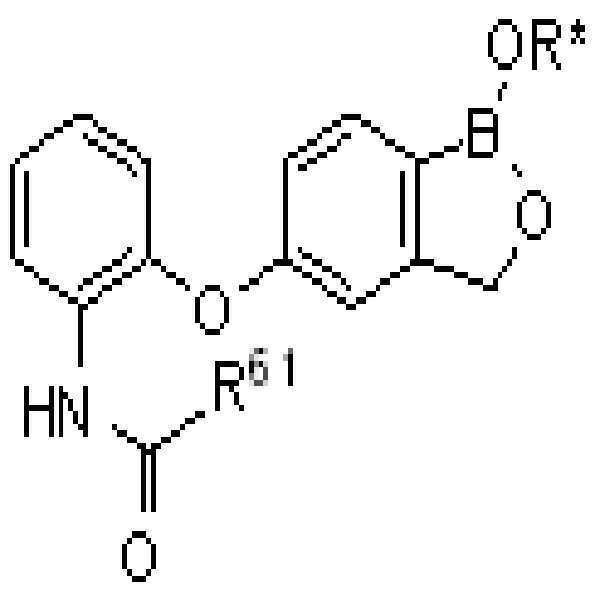


이때, R61는 여기에서 설명된 것과 같다. 예시적인 구체예에서, R61는 메틸이다.Here, R 61 is as described herein. In an exemplary embodiment, R 61 is methyl.
예시적인 구체예에서, 화합물은 아래 화학식에 따른 구조를 가진다:In an exemplary embodiment, the compound has a structure according to the formula:

이때, R*는 여기에서 정의된 바와 같고, Re은 치환된 또는 치환안된 알킬옥시이다. 예시적인 구체예에서, Re은 치환안된 알킬옥시이다. 예시적인 구체예에서, Re은 치환안된 C1-C6알킬옥시이다. 예시적인 구체예에서, Re은 치환안된 C1또는 C2또는 C3또는 C4또는 C5또는 C6알킬옥시이다. 예시적인 구체예에서, 화합물은 다음의 구조를 가진다: Wherein R * is as defined herein and R e is substituted or unsubstituted alkyloxy. In an exemplary embodiment, R e is an unsubstituted alkyloxy. In an exemplary embodiment, R e is unsubstituted C 1 -C 6 alkyloxy. In an exemplary embodiment, R e is unsubstituted C 1 or C 2 or C 3 or C 4 or C 5 or C 6 alkyloxy. In an exemplary embodiment, the compound has the structure:


이때, R*는 여기에서 정의된 바와 같다. Wherein R * is as defined herein .
예시적인 구체예에서, 화합물은 아래 화학식에 따른 구조를 가진다:In an exemplary embodiment, the compound has a structure according to the formula:

이때, R*는 여기에서 정의된 바와 같고, Re은 NO2이다. 예시적인 구체예에서, 화합물은 다음의 구조를 가진다: Wherein R * is as defined herein and R e is NO 2 . In an exemplary embodiment, the compound has the structure:


이때, R*는 여기에서 정의된 바와 같다. Wherein R * is as defined herein .
예시적인 구체예에서, 화합물은 아래 화학식에 따른 구조를 가진다:In an exemplary embodiment, the compound has a structure according to the formula:

이때, R*는 여기에서 정의된 바와 같고, 그리고 Re은 NH2이다. 예시적인 구체예에서, 화합물은 다음의 구조를 가진다: Wherein R * is as defined herein and R e is NH 2 . In an exemplary embodiment, the compound has the structure:


이때, R*는 여기에서 정의된 바와 같다. Wherein R * is as defined herein .
예시적인 구체예에서, 화합물은 아래 화학식에 따른 구조를 가진다:In an exemplary embodiment, the compound has a structure according to the formula:

이때, R*는 여기에서 정의된 바와 같고, Re은 R60S(O)2NH-이며 이때, R60는 치환안된 알킬이다. 예시적인 구체예에서, R60는 메틸이다. 예시적인 구체예에서, 화합물은 다음의 구조를 가진다; Wherein R * is as defined herein and R e is R 60 S (O) 2 NH-, wherein R 60 is unsubstituted alkyl. In an exemplary embodiment, R < 60 > is methyl. In an exemplary embodiment, the compound has the structure:


이때, R*는 여기에서 정의된 바와 같다. Wherein R * is as defined herein .
예시적인 구체예에서, 화합물은 아래 화학식에 따른 구조를 가진다:In an exemplary embodiment, the compound has a structure according to the formula:

이때, R*는 여기에서 정의된 바와 같고, 그리고 Rf은 치환된 또는 치환안된 알킬이다. 예시적인 구체예에서, Rf는 치환안된 알킬이다. 예시적인 구체예에서, Rf는 치환안된 C1-C6알킬이다. 예시적인 구체예에서, Rf는 치환안된 C1또는 C2또는 C3또는 C4또는 C5또는 C6알킬이다. 예시적인 구체예에서, Rf는 치환안된 C1또는 C2또는 C3알킬이다. 예시적인 구체예에서, Rf는 메틸 또는 에틸 또는 이소프로필이다. 예시적인 구체예에서, 화합물은 다음의 구조를 가진다 Wherein R * is as defined herein and R f is substituted or unsubstituted alkyl. In an exemplary embodiment, R < f > is unsubstituted alkyl. In an exemplary embodiment, R f is unsubstituted C 1 -C 6 alkyl. In an exemplary embodiment, R f is unsubstituted C 1 or C 2 or C 3 or C 4 or C 5 or C 6 alkyl. In an exemplary embodiment, R f is unsubstituted C 1 or C 2 or C 3 alkyl. In an exemplary embodiment, R < f > is methyl or ethyl or isopropyl. In an exemplary embodiment, the compound has the structure < RTI ID = 0.0 >


이때, R*는 여기에서 정의된 바와 같다.Wherein R * is as defined herein.
예시적인 구체예에서, 화합물은 다음에서 선택된 멤버의 구조를 가진다:In an exemplary embodiment, the compound has the structure of a member selected from:


이때, R* 및 Re는 여기에서 설명된 것과 같다.Where R * and R e are as described herein.
예시적인 구체예에서, 화합물은 다음에서 선택된 멤버의 구조를 가진다:In an exemplary embodiment, the compound has the structure of a member selected from:


이때, R* 및 Re 는 여기에서 설명된 것과 같다.Here, R * and Re are the same as those described herein.
예시적인 구체예에서, Re는 -C(O)NR20R21이며 이때, 각 R20및 R21는 H, 하이드록시알킬, 치환된 또는 치환안된 아미노알킬, 치환된 또는 치환안된 아릴알킬, 치환된 또는 치환안된 헤테로아릴알킬에서 선택된 멤버이거나, 또는 R20및 R21는 여기에 부착된 질소와 함께 선택적으로 결합되어 치환된 또는 치환안된 피페라지닐 링을 형성한다. 예시적인 구체예에서, R20는 H이다. 예시적인 구체예에서, R21는 치환안된 하이드록시알킬, 치환된 또는 치환안된 아미노알킬, 치환안된 페닐알킬, N-치환된 아미노알킬에서 선택된 멤버다. 예시적인 구체예에서, R20는 H이고 그리고 R21는 치환안된 알킬이다. 예시적인 구체예에서, R20는 H이고, R21는 치환안된 C1-C6알킬이다. 예시적인 구체예에서, R20는 H이고, 그리고 R21는 C1또는 C2또는 C3또는 C4또는 C5또는 C6알킬이다. 예시적인 구체예에서, R20및 R21는 여기에 부착된 질소와 함께 선택적으로 결합되어 치환안된 피페라지닐 링을 형성한다. 예시적인 구체예에서, R20및 R21는 여기에 부착된 질소와 함께 선택적으로 결합되어 N-치환된 피페라지닐 링을 형성한다. 예시적인 구체예에서, N-치환된 피페라지닐 링은 치환안된 C1-C6알킬 그리고 치환안된 C1-C6알킬카르보닐로 치환된다. 예시적인 구체예에서, R20는 H이며 그리고 R21는 오르소-치환안된 알킬벤질 또는 메타-치환안된알킬벤질 또는 파라-치환안된 알킬벤질에서 선택된 멤버다. 예시적인 구체예에서, R20는 H이고, R21은 파라메틸벤질이다. 예시적인 구체예에서, R20는 H이며 그리고 R21는 오르소-알콕시벤질 또는 메타-알콕시벤질 또는 파라-알콕시벤질에서 선택된 멤버다. 예시적인 구체예에서, R20는 H이며, 그리고 R21는 오르소-메톡시벤질 또는 메타-메톡시벤질 또는 파라-메톡시벤질에서 선택된 멤버다. 예시적인 구체예에서, R20는 H이며, R21는 파라-메톡시벤질이다. 예시적인 구체예에서, R20는 H이며 그리고 R21는 페닐이다. 예시적인 구체예에서, R20는 H이며, 그리고 R21는 시클로알킬이다. 예시적인 구체예에서, R20는 H이며, R21는 시클로프로필이다. 예시적인 구체예에서, R20는 H이며, R21는 시클로부틸이다. 예시적인 구체예에서, R20는 H이며, R2는 시클로펜틸이다. 예시적인 구체예에서, R20는 H이며, R21는 시클로헥실이다. 예시적인 구체예에서, R20는 H이며, R21는 CH3이다. 예시적인 구체예에서, R20는 CH3이며 R21는 CH3이다. In an exemplary embodiment, R e is -C (O) NR 20 R 21 wherein each R 20 and R 21 is H, hydroxyalkyl, substituted or unsubstituted aminoalkyl, substituted or unsubstituted arylalkyl, Substituted or unsubstituted heteroarylalkyl, or R 20 and R 21 are optionally joined together with the nitrogen to which they are attached to form a substituted or unsubstituted piperazinyl ring. In an exemplary embodiment, R < 20 > In an exemplary embodiment, R 21 is a member selected from unsubstituted hydroxyalkyl, substituted or unsubstituted aminoalkyl, unsubstituted phenylalkyl, N-substituted aminoalkyl. In an exemplary embodiment, R 20 is H and R 21 is unsubstituted alkyl. In an exemplary embodiment, R 20 is H and R 21 is unsubstituted C 1 -C 6 alkyl. In an exemplary embodiment, R 20 is H and R 21 is C 1 or C 2 or C 3 or C 4 or C 5 or C 6 alkyl. In an exemplary embodiment, R < 20 > and R < 21 > are optionally combined with the nitrogen to which they are attached to form an unsubstituted piperazinyl ring. In an exemplary embodiment, R 20 and R 21 are optionally combined with the nitrogen attached thereto to form a N-substituted piperazinyl ring. In an exemplary embodiment, the N-substituted piperazinyl ring is substituted with unsubstituted C 1 -C 6 alkyl and unsubstituted C 1 -C 6 alkylcarbonyl. In an exemplary embodiment, R 20 is H and R 21 is a member selected from ortho-substituted alkylbenzyl or meta-substituted or unsubstituted alkylbenzyl or para-substituted unsubstituted alkylbenzyl. In an exemplary embodiment, R 20 is H and R 21 is para-methylbenzyl. In an exemplary embodiment, R 20 is H and R 21 is a member selected from ortho-alkoxybenzyl or meta-alkoxybenzyl or para-alkoxybenzyl. In an exemplary embodiment, R 20 is H and R 21 is a member selected from ortho-methoxybenzyl or meta-methoxybenzyl or para-methoxybenzyl. In an exemplary embodiment, R 20 is H and R 21 is para-methoxybenzyl. In an exemplary embodiment, R 20 is H and R 21 is phenyl. In an exemplary embodiment, R 20 is H and R 21 is cycloalkyl. In an exemplary embodiment, R 20 is H and R 21 is cyclopropyl. In an exemplary embodiment, R 20 is H and R 21 is cyclobutyl. In an exemplary embodiment, R 20 is H and R 2 is cyclopentyl. In an exemplary embodiment, R 20 is H and R 21 is cyclohexyl. In an exemplary embodiment, R 20 is H and R 21 is CH 3 . In an exemplary embodiment, R 20 is CH 3 and R 21 is CH 3 .
예시적인 구체예에서, Re는 In an exemplary embodiment, R e is




예시적인 구체예에서, 화합물은 N-벤질-4-(1-하이드록시-1,3-디하이드로-벤조[c][1,2]옥사보롤-5-일옥시)-벤자미드, 


1-{4-[4-(1-하이드록시-1,3-디하이드로-벤조[c][1,2]옥사보롤-5-일옥시)-벤조일]-피페라진-1-일}-에타논 




예시적인 구체예에서, 화합물은 하기에 다른 화학식 구조를 가진다:In an exemplary embodiment, the compound has a different chemical structure:

이때, X는 N, CH 또는 C(O)R22에서 선택된 멤버이며, R22는 디알킬암미노로 선택적으로 치환된 알킬 에서 선택된 멤버이며, R* 는 여기에서 설명된 것과 같다. 예시적인 구체예에서, 화합물은 하기에 따른 구조를 가진다:Wherein X is a member selected from N, CH or C (O) R 22 , R 22 is a member selected from alkyl optionally substituted with a dialkylamino, and R * is as described herein. In an exemplary embodiment, the compound has the structure according to the following:


이때, R22는 치환안된 알킬이며, 그리고 R*는 여기에서 설명된 것과 같다. 예시적인 구체예에서, R22는 치환안된 C1-C6알킬이다. 예시적인 구체예에서, R22는 치환안된 C1또는 C2또는 C3또는 C4또는 C5또는 C6알킬이다. 예시적인 구체예에서, R22는 치환안된 C1알킬이다. 예시적인 구체예에서, R22는 치환안된 C2알킬이다. 예시적인 구체예에서, R22는 치환안된 C3알킬이다. 예시적인 구체예에서, R22는 이소프로필이다. 예시적인 구체예에서, R22는 디알킬아미노알킬이다. 예시적인 구체예에서, R22는 디알킬아미노에틸이다. 예시적인 구체예에서, R22는 디메틸아미노알킬이다. 예시적인 구체예에서, R22는 디메틸아미노에틸이다. Wherein R < 22 > is unsubstituted alkyl and R * is as described herein. In an exemplary embodiment, R 22 is unsubstituted C 1 -C 6 alkyl. In an exemplary embodiment, R 22 is unsubstituted C 1 or C 2 or C 3 or C 4 or C 5 or C 6 alkyl. In an exemplary embodiment, R 22 is unsubstituted C 1 alkyl. In an exemplary embodiment, R 22 is unsubstituted C 2 alkyl. In an exemplary embodiment, R 22 is a C 3 alkyl substituted untested. In an exemplary embodiment, R 22 is isopropyl. In an exemplary embodiment, R < 22 > is a dialkylaminoalkyl. In an exemplary embodiment, R 22 is dialkylaminoethyl. In an exemplary embodiment, R < 22 > is dimethylaminoalkyl. In an exemplary embodiment, R < 22 > is dimethylaminoethyl.
예시적인 구체예에서, 화합물은 하기에 다른 화학식 구조를 가진다:In an exemplary embodiment, the compound has a different chemical structure:

이때, R23 는 할로겐이며, 그리고 R*는 여기에서 설명된 것과 같다. 예시적인 구체예에서, 화합물은 하기에 따른 구조를 가진다:Wherein R < 23 > is halogen and R * is as described herein. In an exemplary embodiment, the compound has the structure according to the following:


이때, R23는 할로겐이며, 그리고 R*는 여기에서 설명된 것과 같다. 예시적인 구체예에서, R23는 플루오르 또는 염소이다.Wherein R < 23 > is halogen and R * is as described herein. In an exemplary embodiment, R < 23 > is fluorine or chlorine.
예시적인 구체예에서, 화합물은 하기에 다른 화학식 구조를 가진다:In an exemplary embodiment, the compound has a different chemical structure:

이때, R24는 치환안된 알킬 또는 할로치환된 알킬이며, 그리고 R*는 여기에서 설명된 것과 같다. 예시적인 구체예에서, 화합물은 하기에 따른 구조를 가진다:Wherein R < 24 > is unsubstituted alkyl or halo substituted alkyl, and R * is as described herein. In an exemplary embodiment, the compound has the structure according to the following:


이때, R24는 치환안된 알킬 또는 할로치환된 알킬이며, 그리고 R*는 여기에서 설명된 것과 같다. 예시적인 구체예에서, R24는 치환안된 C1-C6알킬 또는 할로치환된 C1-C6알킬이다. 예시적인 구체예에서, R24는 치환안된 C1또는 C2또는 C3또는 C4또는 C5또는 C6알킬이다. 예시적인 구체예에서, R24는 할로치환된 C1또는 C2또는 C3또는 C4또는 C5또는 C6알킬이다. 예시적인 구체예에서, R24는 플루오르치환된 C1또는 C2또는 C3또는 C4또는 C5또는 C6알킬이다. 예시적인 구체예에서, R24는 트리플루오로메틸이다. 예시적인 구체예에서, R24는 메틸이다. Wherein R < 24 > is unsubstituted alkyl or halo substituted alkyl, and R * is as described herein. In an exemplary embodiment, R 24 is unsubstituted C 1 -C 6 alkyl or halo substituted C 1 -C 6 alkyl. In an exemplary embodiment, R 24 is unsubstituted C 1 or C 2 or C 3 or C 4 or C 5 or C 6 alkyl. In an exemplary embodiment, R 24 is halo-substituted C 1 or C 2 or C 3 or C 4 or C 5 or C 6 alkyl. In an exemplary embodiment, R 24 is fluorine substituted C 1 or C 2 or C 3 or C 4 or C 5 or C 6 alkyl. In an exemplary embodiment, R 24 is trifluoromethyl. In an exemplary embodiment, R < 24 > is methyl .
예시적인 구체예에서, 화합물은 
예시적인 구체예에서, 화합물은 
예시적인 구체예에서, 화합물은 하기에 다른 화학식 구조를 가진다:In an exemplary embodiment, the compound has a different chemical structure:

이때, R28또는 R29는 독립적으로 치환안된 알킬 에서 선택되며, 그리고 R*는 여기에서 설명된 것과 같다. 예시적인 구체예에서, 화합물은 다음에서 선택된 멤버의 구조를 가진다: Wherein R 28 or R 29 is independently selected from unsubstituted alkyl, and R * is as described herein. In an exemplary embodiment, the compound has the structure of a member selected from:


예시적인 구체예에서, R28는 에틸이다. 예시적인 구체예에서, R29는 에틸이다. In an exemplary embodiment, R < 28 > is ethyl . In an exemplary embodiment, R 29 is ethyl .
예시적인 구체예에서, 화합물은 하기에 다른 화학식 구조를 가진다:In an exemplary embodiment, the compound has a different chemical structure:

이때, R30는 H 그리고 치환안된 알킬이며, 그리고 R*는 여기에서 설명된 것과 같다. 예시적인 구체예에서, 화합물은 하기에 따른 구조를 가진다:Wherein R < 30 > is H and unsubstituted alkyl, and R * is as described herein. In an exemplary embodiment, the compound has the structure according to the following:

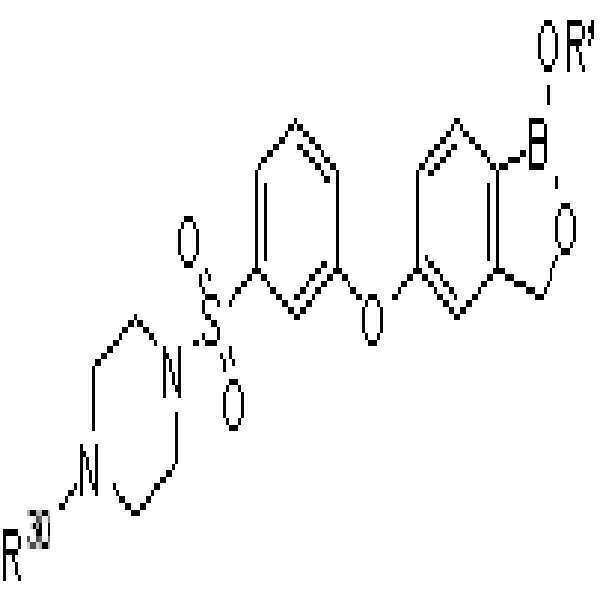
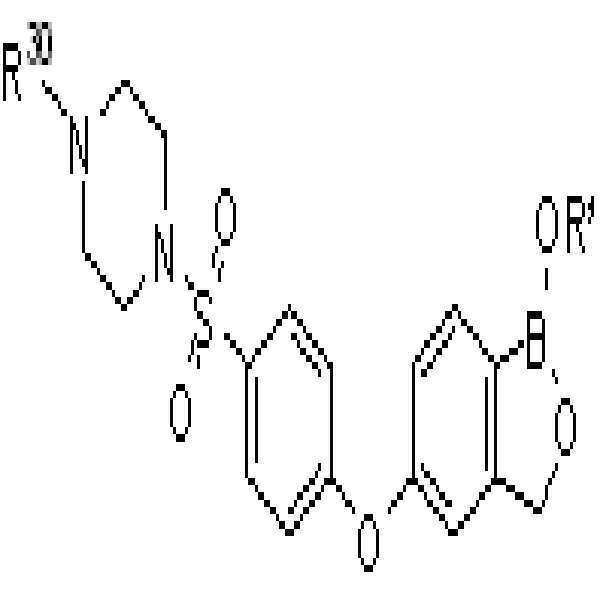
이때, R30는 치환안된 알킬이며, 그리고 R*는 여기에서 설명된 것과 같다. 예시적인 구체예에서, R30는 메틸이다.Wherein R < 30 > is unsubstituted alkyl and R * is as described herein. In an exemplary embodiment, R < 30 > is methyl.
예시적인 구체예에서, 화합물은 하기에 다른 화학식 구조를 가진다:In an exemplary embodiment, the compound has a different chemical structure:

예시적인 구체예에서, 화합물은 도 1에 나열된 구조 또는 이의 염의 구조를 가진다. 예시적인 구체예에서, 화합물은 도 2 에 나열된 구조 또는 이의 염의 구조를 가진다. 예시적인 구체예에서, 화합물은 도 3 에 나열된 구조 또는 이의 염의 구조를 가진다. 예시적인 구체예에서, 화합물은 도 4 에 나열된 구조 또는 이의 염의 구조를 가진다. 예시적인 구체예에서, 화합물은 도 5 에 나열된 구조 또는 이의 염의 구조를 가진다. 예시적인 구체예에서, 화합물은 도 6 에 나열된 구조 또는 이의 염의 구조를 가진다. 예시적인 구체예에서, 화합물은 도 7 에 나열된 구조 또는 이의 염의 구조를 가진다.In an exemplary embodiment, the compound has the structure as shown in Fig. 1 or a salt thereof. In an exemplary embodiment, the compound has the structure shown in Figure 2 or a salt thereof. In an exemplary embodiment, the compound has the structure as shown in Figure 3 or a salt thereof. In an exemplary embodiment, the compound has the structure listed in Figure 4 or a salt thereof. In an exemplary embodiment, the compound has the structure listed in Figure 5 or a salt thereof. In an exemplary embodiment, the compound has the structure as shown in Figure 6 or a salt thereof. In an exemplary embodiment, the compound has the structure shown in Figure 7 or a salt thereof.
예시적인 구체예에서, 여기에서 설명된 것과 같은 임의 화학식의 화합물에서, R* 는 H이다.In an exemplary embodiment, in the compounds of any of the formulas as described herein, R * is H.
또 다른 대표적인 구체예에서, 본 발명은 본 발명의 화합물의 다가 또는 다중 원자가 종을 제공한다. 예시적인 구체예에서, 본 발명은 여기에서 설명된 화합물의 이량체를 제공한다. 예시적인 구체예에서, 본 발명은 여기에서 설명된 화합물의 이량체를 제공한다. 예시적인 구체예에서, 본 발명은 다음에서 선택된 멤버의 화합물의 이량체를 제공한다: D1, D2, D3, D4, D5, D6, D7, D8, D9, D10, D11, D12, D13, D14, D15, D16, D17, D18, D19, D20, D21, D22, D23, D24, D25, D26, D27, D28, D29, D30, D31, D32, D33, D34, D35, D36, D37, D38, D39, D40, D41, D42, D43, D44, D45, D46, D47, D48, D49, D50, D51, D52, D53, D54, D55, D56, D57, D58, D59, D60, D61, D62, D63, D64, D65, D66, D67, D68, D69, D70, D71, D72, D73, D74, D75, D76, D77, D78, D79, D80, D81, D82, D83, D84, D85, D86, D87, D88, D89, D90, D91, D92, D93, D94, D95, D96, D97, D98, D99, D100, D101, D102, D103, D104, D105, D106, D107, D108, D109, D110, D111, D112, D113, D114, D115, D116, D117, D118, D119, D120, D121, D122, D123, D124, D125, D126, D127, D128, D129, D130, D131, D132, D133, D134, D135, D136, D137, D138, D139, D140, D141, D142, D143, D144, D145, D146, D147, D148, D149, D150, D151, D152, D153, D154, D155, D156, D157, D158, D159, D160, D161, D162, D163, D164, D165, D166, D167, D168, D169, D170, D171, D172, D173, D174, D175, D176, D177, D178, D179, D180, D181, D182, D183, D184, D185, D186, D187, D188, D189, D190, D191, D192, D193, D194, D195, D196, D197, D198, D199, D200, D201, D202, D203, D204, D205, D206, D207, D208, D209, D210, D211, D212, D213, D214, D215, D216, D217, D218, D219, D220, D221, D222, D223, D224, D225, D226, D227, D228 그리고 D229. In yet another exemplary embodiment, the invention provides multivalent or multivalent species of compounds of the invention. In an exemplary embodiment, the invention provides dimers of the compounds described herein. In an exemplary embodiment, the invention provides dimers of the compounds described herein. In an exemplary embodiment, the invention provides a dimer of a compound of a member selected from: D1, D2, D3, D4, D5, D6, D7, D8, D9, D10, D11, D12, D13, D14, D23, D23, D24, D25, D26, D27, D28, D29, D30, D31, D32, D33, D34, D35, D36, D37, D38, D39, D40, D41, D42, D43, D44, D45, D46, D47, D48, D49, D50, D51, D52, D53, D54, D55, D56, D57, D58, D59, D60, D61, D62, D78, D66, D67, D68, D69, D70, D71, D72, D73, D74, D75, D76, D77, D78, D79, D80, D81, D82, D83, D84, D85, D86, D87, D90, D91, D92, D93, D94, D95, D96, D97, D98, D99, D100, D101, D102, D103, D104, D105, D106, D107, D108, D109, D110, D111, D112, D113, D114, D115, D126, D127, D128, D129, D130, D131, D132, D133, D134, D135, D136, D137, D138, D139, D139, D120, D121, D140, D141, D142, D143, D144, D145, D146, D147, D148, D149, D150, D151, D152, D153, D154, D155, D156, D157, D158, D159, D160, D161, D162, D163, D164, D165, D D188, D187, D188, D188, D187, D188, D188, D187, D187, D188, D184, D187, D188, D187, D187, D187, D178, D178, D191, D192, D193, D194, D195, D196, D197, D198, D199, D200, D201, D202, D203, D204, D205, D206, D207, D208, D209, D210, D211, D212, D213, D216, D217, D218, D219, D220, D221, D222, D223, D224, D225, D226, D227, D228 and D229.
예시적인 구체예에서, 본 발명은 여기에서 설명된 화합물의 무수물을 제공한다. 예시적인 구체예에서, 본 발명은 여기에서 설명된 화합물의 무수물을 제공한다. 예시적인 구체예에서, 본 발명은 다음에서 선택된 화합물의 무수물을 제공한다: D1, D2, D3, D4, D5, D6, D7, D8, D9, D10, D11, D12, D13, D14, D15, D16, D17, D18, D19, D20, D21, D22, D23, D24, D25, D26, D27, D28, D29, D30, D31, D32, D33, D34, D35, D36, D37, D38, D39, D40, D41, D42, D43, D44, D45, D46, D47, D48, D49, D50, D51, D52, D53, D54, D55, D56, D57, D58, D59, D60, D61, D62, D63, D64, D65, D66, D67, D68, D69, D70, D71, D72, D73, D74, D75, D76, D77, D78, D79, D80, D81, D82, D83, D84, D85, D86, D87, D88, D89, D90, D91, D92, D93, D94, D95, D96, D97, D98, D99, D100, D101, D102, D103, D104, D105, D106, D107, D108, D109, D110, D111, D112, D113, D114, D115, D116, D117, D118, D119, D120, D121, D122, D123, D124, D125, D126, D127, D128, D129, D130, D131, D132, D133, D134, D135, D136, D137, D138, D139, D140, D141, D142, D143, D144, D145, D146, D147, D148, D149, D150, D151, D152, D153, D154, D155, D156, D157, D158, D159, D160, D161, D162, D163, D164, D165, D166, D167, D168, D169, D170, D171, D172, D173, D174, D175, D176, D177, D178, D179, D180, D181, D182, D183, D184, D185, D186, D187, D188, D189, D190, D191, D192, D193, D194, D195, D196, D197, D198, D199, D200, D201, D202, D203, D204, D205, D206, D207, D208, D209, D210, D211, D212, D213, D214, D215, D216, D217, D218, D219, D220, D221, D222, D223, D224, D225, D226, D227, D228 그리고 D229. In an exemplary embodiment, the invention provides an anhydride of the compounds described herein. In an exemplary embodiment, the invention provides an anhydride of the compounds described herein. In an exemplary embodiment, the invention provides an anhydride of a compound selected from: D1, D2, D3, D4, D5, D6, D7, D8, D9, D10, D11, D12, D13, D14, D15, D16 , D17, D18, D19, D20, D21, D22, D23, D24, D25, D26, D27, D28, D29, D30, D31, D32, D33, D34, D35, D36, D37, D38, D42, D43, D44, D45, D46, D47, D48, D49, D50, D51, D52, D53, D54, D55, D56, D57, D58, D59, D60, D61, D62, D63, D64, D65, D66 D67, D68, D69, D70, D71, D72, D73, D74, D75, D76, D77, D78, D79, D80, D81, D82, D83, D84, D85, D86, D87, D92, D93, D94, D95, D96, D97, D98, D99, D100, D101, D102, D103, D104, D105, D106, D107, D108, D109, D110, D111, D112, D113, D114, D115, D116 , D117, D118, D119, D120, D121, D122, D123, D124, D125, D126, D127, D128, D129, D130, D131, D132, D133, D134, D135, D136, D137, D138, D139, D140, D141 , D142, D143, D144, D145, D146, D147, D148, D149, D150, D151, D152, D153, D154, D155, D156, D157, D158, D159, D160, D161, D162, D163, D164, D165, D166 , D167, D188, D189, D188, D189, D190, D191, D192, D192, D193, D193, D198, D188, D188, D183, D188, D193, D194, D195, D196, D197, D198, D199, D200, D201, D202, D203, D204, D205, D206, D207, D208, D209, D210, D211, D212, D213, D214, D215, D218, D219, D220, D221, D222, D223, D224, D225, D226, D227, D228 and D229.
예시적인 구체예에서, 본 발명은 여기에서 설명된 화합물의 삼량체를 제공한다. 예시적인 구체예에서, 본 발명은 여기에서 설명된 화합물의 삼량체를 제공한다. 예시적인 구체예에서, 본 발명은 다음에서 선택된 멤버인 화합물의 삼량체를 제공한다: D1, D2, D3, D4, D5, D6, D7, D8, D9, D10, D11, D12, D13, D14, D15, D16, D17, D18, D19, D20, D21, D22, D23, D24, D25, D26, D27, D28, D29, D30, D31, D32, D33, D34, D35, D36, D37, D38, D39, D40, D41, D42, D43, D44, D45, D46, D47, D48, D49, D50, D51, D52, D53, D54, D55, D56, D57, D58, D59, D60, D61, D62, D63, D64, D65, D66, D67, D68, D69, D70, D71, D72, D73, D74, D75, D76, D77, D78, D79, D80, D81, D82, D83, D84, D85, D86, D87, D88, D89, D90, D91, D92, D93, D94, D95, D96, D97, D98, D99, D100, D101, D102, D103, D104, D105, D106, D107, D108, D109, D110, D111, D112, D113, D114, D115, D116, D117, D118, D119, D120, D121, D122, D123, D124, D125, D126, D127, D128, D129, D130, D131, D132, D133, D134, D135, D136, D137, D138, D139, D140, D141, D142, D143, D144, D145, D146, D147, D148, D149, D150, D151, D152, D153, D154, D155, D156, D157, D158, D159, D160, D161, D162, D163, D164, D165, D166, D167, D168, D169, D170, D171, D172, D173, D174, D175, D176, D177, D178, D179, D180, D181, D182, D183, D184, D185, D186, D187, D188, D189, D190, D191, D192, D193, D194, D195, D196, D197, D198, D199, D200, D201, D202, D203, D204, D205, D206, D207, D208, D209, D210, D211, D212, D213, D214, D215, D216, D217, D218, D219, D220, D221, D222, D223, D224, D225, D226, D227, D228 그리고 D229. In an exemplary embodiment, the present invention provides trimers of the compounds described herein. In an exemplary embodiment, the present invention provides trimers of the compounds described herein. In an exemplary embodiment, the invention provides a trimer of a compound that is a member selected from: D1, D2, D3, D4, D5, D6, D7, D8, D9, D10, D11, D12, D13, D14, D23, D23, D24, D25, D26, D27, D28, D29, D30, D31, D32, D33, D34, D35, D36, D37, D38, D39, D40, D41, D42, D43, D44, D45, D46, D47, D48, D49, D50, D51, D52, D53, D54, D55, D56, D57, D58, D59, D60, D61, D62, D78, D66, D67, D68, D69, D70, D71, D72, D73, D74, D75, D76, D77, D78, D79, D80, D81, D82, D83, D84, D85, D86, D87, D90, D91, D92, D93, D94, D95, D96, D97, D98, D99, D100, D101, D102, D103, D104, D105, D106, D107, D108, D109, D110, D111, D112, D113, D114, D115, D126, D127, D128, D129, D130, D131, D132, D133, D134, D135, D136, D137, D138, D139, D139, D120, D121, D140, D141, D142, D143, D144, D145, D146, D147, D148, D149, D150, D151, D152, D153, D154, D155, D156, D157, D158, D159, D160, D161, D162, D163, D164, D165, D D188, D187, D188, D188, D187, D188, D188, D187, D187, D188, D184, D187, D188, D187, D187, D187, D178, D178, D191, D192, D193, D194, D195, D196, D197, D198, D199, D200, D201, D202, D203, D204, D205, D206, D207, D208, D209, D210, D211, D212, D213, D216, D217, D218, D219, D220, D221, D222, D223, D224, D225, D226, D227, D228 and D229.
예시적인 구체예에서, 본 발명은 여기에서 설명된 화합물, 또는 염, 수화물 또는 이의 용매화합물, 또는 이의 복합물을 제공한다. 예시적인 구체예에서, 본 발명은 여기에서 설명된 화합물, 또는 염, 수화물 또는 이의 용매화합물을 제공한다. 예시적인 구체예에서, 본 발명은 여기에서 설명된 화합물, 또는 이의 염을 제공한다. 예시적인 구체예에서, 염은 약리학적으로 수용가능한 염이다. 예시적인 구체예에서, 본 발명은 여기에서 설명된 화합물, 또는 이의 수화물을 제공한다. 예시적인 구체예에서, 본 발명은 여기에서 설명된 화합물, 또는 이의 용매화합물을 제공한다. 예시적인 구체예에서, 본 발명은 여기에서 설명된 화합물, 또는 이의 프로드럭을 제공한다. 예시적인 구체예에서, 본 발명은 여기에서 설명된 화합물의 염을 제공한다. 예시적인 구체예에서, 본 발명은 여기에서 설명된 화합물의 약리학적으로 수용가능한 염을 제공한다. 예시적인 구체예에서, 본 발명은 여기에서 설명된 화합물의 수화물을 제공한다. 예시적인 구체예에서, 본 발명은 여기에서 설명된 화합물의 용매화합물을 제공한다. 예시적인 구체예에서, 본 발명은 여기에서 설명된 화합물의 프로드럭을 제공한다.In an exemplary embodiment, the present invention provides a compound, or salt, hydrate or solvate thereof, or a complex thereof, as described herein. In an exemplary embodiment, the invention provides a compound, or salt, hydrate or solvate thereof, as described herein. In an exemplary embodiment, the invention provides a compound described herein, or a salt thereof. In an exemplary embodiment, the salt is a pharmacologically acceptable salt. In an exemplary embodiment, the invention provides a compound described herein, or a hydrate thereof. In an exemplary embodiment, the present invention provides a compound described herein, or a solvate thereof. In an exemplary embodiment, the invention provides a compound described herein, or a prodrug thereof. In an exemplary embodiment, the invention provides salts of the compounds described herein. In an exemplary embodiment, the invention provides a pharmacologically acceptable salt of a compound described herein. In an exemplary embodiment, the present invention provides hydrates of the compounds described herein. In an exemplary embodiment, the present invention provides a solvate of the compounds described herein. In an exemplary embodiment, the invention provides a prodrug of a compound described herein.
예시적인 구체예에서, 알킬은 선형 알킬 및 가지형 알킬에서 선택된 멤버다. 또 다른 대표적인 구체예에서, 헤테로알킬은 선형 헤테로알킬 및 가지형 헤테로알킬에서 선택된 멤버다.In an exemplary embodiment, alkyl is a member selected from linear alkyl and branched alkyl. In another exemplary embodiment, heteroalkyl is a member selected from linear heteroalkyl and branched heteroalkyl.
본 발명의 방법에 유용한 추가 화합물들은 2005년 2월 16일자 제출된 U.S. Prov. Pat. App. 60/654,060; (Attorney Docket No. 064507-5014PR); 2006년 2월 16일자 제출된 U.S. Pat. App. No. 11/357,687, (Attorney Docket No. 064507-5014US); 2006년 8월 16일자 제출된 U.S. Pat. App. No. 11/505,591 (Attorney Docket No. 064507-5014US01), 2006년 8월 29일자 제출된 U.S. Prov. Pat. App. 60/823,888 및 2006년 2월 16일자 제출된 60/774,532 (Attorney Docket No. 064507-5016PR 및 064507-5016PR01); 2007년 2월 16일자 제출된 U.S. Pat. App. No. 11/676,120 (Attorney Docket No. 064507-5016US), 이들 모두 전문을 모든 목적을 위하여 참고문헌으로 첨부한다. 본 발명의 화합물을 만드는 방법은 이들 모 출원에도 설명되어 있다.Additional compounds useful in the methods of the present invention are described in U.S. Pat. Prov. Pat. App. 60 / 654,060; (Attorney Docket No. 064507-5014PR); U.S.C. submitted on February 16, 2006. Pat. App. No. 11 / 357,687, (Attorney Docket No. 064507-5014US); U.S.A. submitted on August 16, 2006. Pat. App. No. 11 / 505,591 (Attorney Docket No. 064507-5014US01), filed on August 29, 2006, U.S. Pat. Prov. Pat. App. 60 / 823,888 and 60 / 774,532, filed February 16, 2006 (Attorney Docket No. 064507-5016PR and 064507-5016PR01); U.S.A. submitted on February 16, 2007. Pat. App. No. 11 / 676,120 (Attorney Docket No. 064507-5016US), all of which are incorporated by reference for all purposes. Methods for making the compounds of the present invention are also described in these applications.
IIIeIIIe .. 화합물을 제조하는 방법METHOD FOR PRODUCING COMPOUND
다음의 대표적인 과정은 본 발명의 붕소-함유 분자를 준비하는 방법을 설명한다. 이들 방법은 나타낸 화합물을 생산하는 것에 국한되는 것이 아니라 여기에서 설명된 화합물 및 복합물과 같은 다양한 분자를 준비하는데 이용될 수 있다. 본 발명의 화합물은 이 과정에서 명시적으로 설명되지는 않았지만, 당업자에 잘 알려진 방법에 의해 준비될 수도 있다. 화합물은 공지의 이용가능한 중간생성물을 이용하여 준비될 수도 있다. The following exemplary procedure describes a method for preparing the boron-containing molecules of the present invention. These methods are not limited to producing the compounds shown, but may be used to prepare various molecules such as the compounds and complexes described herein. The compounds of the present invention, although not explicitly described in this process, may also be prepared by methods well known to those skilled in the art. Compounds may also be prepared using known, available intermediates.
본 발명의 화합물은 여기에서 설명된 계획에 따라 만들어질 수 있다. 하기 계획 A은 5-이치환된 페녹시 (할로치환된)벤조옥사보롤유도체의 생산을 설명한다:The compounds of the present invention can be made according to the schemes described herein. Scheme A below illustrates the production of 5-disubstituted phenoxy (halo substituted) benzoxazine boron derivatives:
계획 A:Plan A:

단계 1: 화합물 1의 포밀기가 산 촉매의 존재에서 에틸렌글리콜을 사용하여 에틸렌아세탈로서 보호되었다. 에틸렌글리콜은 전형적으로 화합물 1에 대하여 약 2 내지 약 10 당량의 과량으로 사용되었다. 산 촉매로서는, 파라-톨루엔 술폰산 또는 메탄술폰산과 같은 술폰산, 염화수소, 브롬화수소, 및 기타 유사한 것이 약 1 내지 약 10 몰%로 사용된다. 용매로서는, 톨루엔, 벤젠, 크실렌이 사용된다. 반응은 환류에서 딘-스타크 헤드를 사용하여 공비 조건하에서 수행된다. 반응은 전형적으로 약 1 내지 약 24 시간 후 완료된다. 이 단계는 화합물 2의 반응성에 따라 필요하지 않을 수 있다.Step 1:
단계 2: 화합물 2 및 3이 염기의 존재에서 결합되어 4를 제공한다. 염기로서는, 칼륨 카보네이트, 세슘 카보네이트와 같은 카보네이트, 및 소듐 카보네이트, 소듐 하이드리드, 칼륨 tert-부톡시드, 및 기타 유사한 것이 사용된다. 양은 약 1 내지 약 5 당량이다. 유용한 용매에는 N,N-디메틸포름아미드, N,N-디메틸아세트아미드, 디메틸술폭시드, 아세토니트릴, 및 기타 유사한 것이 포함된다. 반응은 약 70 내지 약 150 ℃에서 수행되고 약 1 내지 약 24 시간 후 완료된다.Step 2:
단계 3: 화합물 4가 산으로 처리되어 아세탈을 가수분해한다. 유용한 산에는 약 1 내지 약 50 당량의 양인, 염산, 하이드로브롬산, 파라-톨루엔술폰산, 메탄술폰산, 아세트산, 및 기타 유사한 것이 포함된다. 유용한 용매에는 메탄올, 에탄올, 테트라하이드로퓨란, 1,4-디옥산, 1,2-디메톡시에탄, 및 기타 유사한 것이 포함된다. 반응은 환류를 위하여 실온에서 수행된다. 반응은 약 1 내지 약 24 시간 후 완료된다.Step 3:
단계 4: 화합물 5가 붕소 원자 도입을 위하여 미야우라 결합(Miyaura coupling)을 거쳤다. 화합물 5, 화합물 6, 디클로로메탄과의 [1,1'-비스(디페닐포스피노)페로센]디클로로팔라디움(II) 착물, 및 칼륨 카보네이트의 혼합물이 용매에서 환류를 위하여 약 50 ℃에서 교반된다. 용매는 1,4-디옥산, 1,2-디메톡시에탄, 테트라하이드로퓨란, 디메틸술폭시드, 디메틸포름아미드, 톨루엔, 및 기타 유사한 것에서 선택된다. 팔라디움 촉매는 약 1 내지 약 5 몰%로 사용되고, 염기는 약 2 내지 약 5 당량으로 사용된다. 반응이 약 1 내지 약 24 시간 후에 완료된다.Step 4:
단계 5: 화합물 7이 불활성 용매에서 보로하이드리드 나트륨 및 리튬 알루미늄 하이드리드와 같은 환원제로 처리된다. 환원제는 약 0.5 내지 약 2 당량으로 사용된다. 불활성 용매는 메탄올, 에탄올, 테트라하이드로퓨란, 에테르, 및 기타 유사한 것이다. 반응은 약 0 ℃ 내지 실온에서 수행되고, 약 1 내지 약 12 시간 후에 완료된다. 피나콜이 추출 동안 붕산 수용액으로 세척하고 조생산물(crude product)을 물로 처리하여 제거되거나, 또는 정제 후 냉동건조하여 제거된다.Step 5:
일부의 2-알콕시-6-클로로니코틴니트릴 (2a)이 다음과 같이 준비된다:Some of the 2-alkoxy-6-chloronicotinonitrile ( 2a ) is prepared as follows:

단계 6: 2,6-디클로로니코틴산(8)이 불활성 용매에서 옥살일 클로라이드 또는 티오닐 클로라이드를 사용하여 대응하는 산 염화물로 전환된다. 용매로서는, 디클로로메탄, 1,2-디클로로에탄, 테트라하이드로퓨란이 사용된다. 반응은 환류를 위하여 약 0℃에서 수행되고, 약 1 내지 약 24 시간 후에 완료된다. 소량의 N,N-디메틸포름아미드가 반응을 가속하기 위하여 첨가될 수 있다. 형성된 산 염화물은 암모니아로 처리되어 화합물 8을 제공한다.Step 6: 2,6-Dichloronicotinic acid ( 8 ) is converted to the corresponding acid chloride using oxalyl chloride or thionyl chloride in an inert solvent. As the solvent, dichloromethane, 1,2-dichloroethane and tetrahydrofuran are used. The reaction is carried out at about 0 < 0 > C for reflux and is completed after about 1 to about 24 hours. A small amount of N, N -dimethylformamide may be added to accelerate the reaction. The acid chloride formed is treated with ammonia to provide
단계 7: 화합물 10이 8을 대응하는 알콕시드로 처리하여 수득된다. 알콕시드로서는, 상용화되어 구입 가능한 소듐 메톡시드 또는 소듐 에톡시드가 사용될 수 있다. 그렇지 않으면, 화합물 10이 알코올 (ROH) 및 염기, 예컨대 소듐, 소듐 하이드리드, 칼륨 하이드리드, 부틸리튬, 및 기타 유사한 것으로부터 인 시튜(in situ) 제조된다. 용매로서는, 테트라하이드로퓨란, 1,4-디옥산, N,N-디메틸포름아미드, 1,2-디메톡시에탄, 톨루엔, 및 기타 유사한 것이 사용된다. 반응은 약 0℃ 내지 실온에서 약 1 내지 약 24 시간 동안 수행된다.Step 7:
단계 8: 화합물 10이 포스포러스 옥시클로라이드 및 피리딘으로 처리되어 2a를 제공한다. 포스포러스 옥시클로라이드 및 피리딘은 약 3 내지 약 6 당량으로 사용된다. 용매는 아세토니트릴, 테트라하이드로퓨란, 톨루엔, 및 기타 유사한 것에서 선택된다. 반응은 환류를 위하여 실온에서 수행되고 약 1 내지 약 24 시간 후에 완료된다.Step 8:
일부 2-알콕시-6-클로로니코틴니트릴 (2a) 및 6-알콕시-2-클로로니코틴니트릴 (2b)이 대안으로 다음과 같이 준비된다:Some 2-alkoxy-6-chloronicotinonitrile ( 2a ) and 6-alkoxy-2-chloronicotinonitrile ( 2b ) are alternatively prepared as follows:

화합물 2a 및 2b가 단계 7에 대하여 상기한 것과 동일한 조건에서 2,6-디클로로니코틴니트릴 (11)로부터 수득된다. 혼합물은 실리카 겔 컬럼 크로마토그래피, 예비박층 크로마토그래피 또는 고성능 액체 크로마토그래피에 의하여 분리될 수 있다.Compounds 2a and 2b are obtained from 2,6-dichloronicotinonitrile ( 11 ) under the same conditions as described above for
일부 2-아미노-6-클로로니코틴니트릴 유도체 (2c) 및 6-아미노-2-클로로니코틴니트릴 유도체 (2d)는 대안으로 다음과 같이 준비된다:Some 2-amino-6-chloronicotinonitrile derivatives ( 2c ) and 6-amino-2-chloronicotinonitrile derivatives ( 2d ) are alternatively prepared as follows:

단계 9: 화합물 2c 및 2d는 염기를 사용하거나 사용하지 않고 11을 대응하는 아민으로 처리하여 수득된다. 아민은 약 1 내지 약 10 당량으로 사용된다. 염기에는 칼륨 카보네이트, 소듐 카보네이트, 세슘 카보네이트, 소듐 하이드리드, 칼륨 하이드리드, 부틸리튬, 및 기타 유사한 것이 포함된다. 용매로서는, 테트라하이드로퓨란, 1,4-디옥산, N,N-디메틸포름아미드, 1,2-디메톡시에탄, 톨루엔, 및 기타 유사한 것이 사용된다. 반응은 환류를 위하여 약 0℃에서 약 1 내지 약 24 시간 동안 수행된다. 혼합물은 실리카 겔 컬럼 크로마토그래피, 예비박층 크로마토그래피 또는 고성능 액체 크로마토그래피에 의하여 분리될 수 있다.Step 9: Compounds 2c and 2d are obtained by treating 11 with the corresponding amine with or without a base. Amines are used in about 1 to about 10 equivalents. The base includes potassium carbonate, sodium carbonate, cesium carbonate, sodium hydride, potassium hydride, butyllithium, and the like. As the solvent, tetrahydrofuran, 1,4-dioxane, N, N -dimethylformamide, 1,2-dimethoxyethane, toluene, and the like are used. The reaction is carried out at about 0 < 0 > C for about 1 to about 24 hours for reflux. The mixture can be separated by silica gel column chromatography, preparative thin layer chromatography or high performance liquid chromatography.
화합물 1a 및 1b는 다음과 같이 준비된다.Compounds 1a and 1b are prepared as follows.

단계 10: (a) 화합물 12 또는 13이 디클로로메탄에서 붕소 트리브롬화물로 처리된다. 붕소 트리브롬화물은 약 1 내지 약 3 당량으로 사용된다. 반응이 약 -78℃ 내지 실온에서 수행되고 약 1 내지 약 24 시간 후에 완료된다. (b) 대안으로, 화합물 12 또는 13이 아세트산에서 48% 하이드로브롬산으로 약 30 내지 약 100℃에서 약 6 내지 약 72 시간 동안 처리된다.Step 10: (a)
계획 B가 일- 또는 이치환된 5-페녹시 유도체의 생산에 대하여 아래에 설명된다:Scheme B is described below for the production of mono- or disubstituted 5-phenoxy derivatives:
계획 B:Plan B:

계획 C가 5-페녹시 유도체의 생산에 대하여 아래에 설명된다:Scheme C is described below for the production of 5-phenoxy derivatives:
계획 C:Plan C:

시약 및 조건: (a) 에틸렌글리콜, p-TsOH, 톨루엔, 환류, 6 h; (b) K2CO3, DMF, 100 ℃, 하룻밤; (c) 3 M HCl, THF, 환류, 2 h; (d) NaBH4, MeOH, rt, 1 h; (e) 3,4-디하이드로-2H-피란, 캠퍼술폰산, CH2Cl2, rt, 2h; (f) (i-PrO)3B, n-BuLi, THF, -78 ℃ 내지 rt, 3h; (g) 6 M HCl, THF, rt, 3 h; (h) 6 M NaOH, MeOH, 1,4-디옥산, 환류, 6 일; (i) EDCI, HOBt, DMAP, DMF, rt, 하룻밤.Reagents and conditions: (a) ethylene glycol, p-TsOH, toluene, reflux, 6 h; (b) K 2 CO 3 , DMF, 100 ° C, overnight; (c) 3 M HCl, THF, reflux, 2 h; (d) NaBH 4 , MeOH, rt, 1 h; (e) 3,4-Dihydro- 2H -pyran, camphorsulfonic acid, CH 2 Cl 2 , rt, 2h; (f) ( i- PrO) 3 B, n- BuLi, THF, -78 ° C to rt, 3h; (g) 6 M HCl, THF, rt, 3 h; (h) 6 M NaOH, MeOH, 1,4-dioxane, reflux, 6 days; (i) EDCI, HOBt, DMAP, DMF, rt, overnight.
5-페녹시벤조옥사보롤 유도체가 앞에 나타난 것과 같이 합성되었다. 디아릴 에테르 골격(scaffold)이 친핵성 방향족 치환 반응에 의하여 제조되었다. 화합물 2의 포밀기가 2의 자체 축합을 피하기 위하여 아세탈로서 보호되었다. 4의 포밀기가 알코올로 환원되었고 THP 에테르로서 보호되었다. 이후 붕소 원자가 트리이소프로필 보레이트의 존재에서 n-BuLi와의 할로겐-금속 교환에 의하여 도입되었는데, 이는 인-시튜 퀀치 프로토콜(in-situ quench protocol)로 알려져 있다 (Li, W., et al. J. Org . Chem . 2002, 67, 5394-5397. HCl에 의한 THP 기 탈보호시, 생산된 하이드록시메틸기가 자발적으로 고리화되어 원하는 옥사보롤을 제공했다.The 5-phenoxybenzoxazole derivatives were synthesized as shown above. Diaryl ether scaffolds were prepared by nucleophilic aromatic substitution reactions. The formyl group of
계획 D가 카르복시 일치환된 5-페녹시 유도체의 생산에 대하여 아래에 설명된다:Scheme D is described below for the production of carboxy-substituted 5-phenoxy derivatives:
계획 D:Plan D:

시약 및 조건: 6 M NaOH, MeOH, 1,4-디옥산, 환류, 6 일. 카르복시유도체가 대응하는 시아노 화합물의 염기 가수분해에 의하여 수득되었다.Reagents and conditions: 6 M NaOH, MeOH, 1,4-dioxane, reflux, 6 days. Carboxy derivatives were obtained by base hydrolysis of the corresponding cyano compounds.
계획 E가 아미드 일치환된 5-페녹시 유도체의 생산에 대하여 아래에 설명된다:Scheme E is illustrated below for the production of amide mono-substituted 5-phenoxy derivatives:
계획 E:Plan E:

시약 및 조건: EDCI, HOBt, DMAP, DMF, rt, 하룻밤. 아미드 유도체는 표준 EDC/HOBt 조건을 사용하여 카르복시 유도체로부터 합성되었다.Reagents and conditions: EDCI, HOBt, DMAP, DMF, rt, overnight. Amide derivatives were synthesized from carboxy derivatives using standard EDC / HOBt conditions.
계획 F가 에스테르 일치환된 5-페녹시 유도체의 생산에 대하여 아래에 설명된다:Scheme F is described below for the production of ester mono-substituted 5-phenoxy derivatives:
계획 F:Plan F:

단계 11: 시약 및 조건: (a) ROH, 황산 (1 내지 10 몰%), 1 내지 24 시간 동안 환류 또는 (b) RX (X = Cl, Br, I), 염기 (칼륨 카보네이트, 소듐 카보네이트, 소듐 하이드리드, 및 기타 유사한 것), 용매 (아세톤, 테트라하이드로퓨란, N,N-디메틸포름아미드, 및 기타 유사한 것), 환류를 위하여 0℃, 1 내지 24 시간.Step 11: Reagents and conditions: (a) ROH, sulfuric acid (1 to 10 mol%), refluxing for 1 to 24 hours or (b) RX (X = Cl, Br, I), base (potassium carbonate, sodium carbonate, Sodium hydride and the like), solvents (acetone, tetrahydrofuran, N, N -dimethylformamide, and the like) at 0 ° C for 1 to 24 hours for reflux.
다양한 4-시아노페녹시 유도체가 화합물 [I]을 만드는 것과 유사한 방식으로 계획 G에 나타나는 것과 같이 합성된다.A variety of 4-cyanophenoxy derivatives are synthesized as shown in Scheme G in a manner analogous to making compound [I].
계획 G:Plan G:

시약 및 조건: : (a) 에틸렌글리콜, p-TsOH, 톨루엔, 환류, 6 h; (b) K2CO3, DMF, 100 ℃, 하룻밤; (c) 3 M HCl, THF, 환류, 2 h; (d) NaBH4, MeOH, rt, 1 h; (e) 3,4-디하이드로-2H-피란, 캠퍼술폰산, CH2Cl2, rt, 2h; (f) (i-PrO)3B, n-BuLi, THF, -78 ℃ 내지 rt, 3h.Reagents and conditions: (a) ethylene glycol, p-TsOH, toluene, reflux, 6 h; (b) K 2 CO 3 , DMF, 100 ° C, overnight; (c) 3 M HCl, THF, reflux, 2 h; (d) NaBH 4 , MeOH, rt, 1 h; (e) 3,4-Dihydro- 2H -pyran, camphorsulfonic acid, CH 2 Cl 2 , rt, 2h; (f) ( i- PrO) 3 B, n- BuLi, THF, -78 ° C to rt, 3h.
카르바모일 치환된 유도체가 다음과 같이 준비된다:The carbamoyl substituted derivatives are prepared as follows:
계획 H:Plan H:
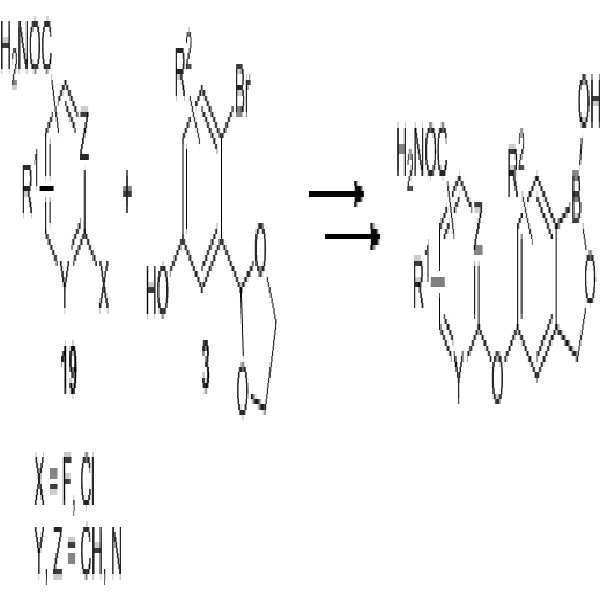
이들 화합물은 계획 A와 유사한 방법으로 화합물 19 및 3으로부터 준비된다.These compounds are prepared from
아미노메틸 치환된 유도체가 다음과 같이 준비된다:Aminomethyl substituted derivatives are prepared as follows:
계획 IPlan I

이들 화합물은 대응하는 시아노 유도체의 수소화에 의하여 준비된다. 전형적인 조건은 환류를 위하여 실온에서 대기압 내지 약 50 psi에서 약 1 내지 약 72 시간 동안, 에탄올, 메탄올, 에틸 아세테이트, 및 기타 유사한 것 중에서 차콜상의 팔라디움(5 내지 10%)을 사용하는 것이다. 대안으로, 이들 화합물은 환류를 위하여 약 0℃에서 약 1 내지 약 24 시간 동안, 에테르 또는 테트라하이드로퓨란에서 리튬 알루미늄 하이드리드 환원에 의하여 준비된다.These compounds are prepared by hydrogenation of the corresponding cyano derivatives. Typical conditions are the use of the charcoal palladium (5-10%) in ethanol, methanol, ethyl acetate, and the like, at room temperature to about 50 psi for about 1 to about 72 hours at room temperature for reflux. Alternatively, these compounds are prepared by reduction of lithium aluminum hydride in ether or tetrahydrofuran at about 0 < 0 > C for about 1 to about 24 hours for reflux.
알킬아미노메틸Alkylaminomethyl 유도체가 다음과 같이 준비된다: The derivative is prepared as follows:
계획 JPlan J

이들 화합물은 표준 환원성 알킬화에 의하여 제조된다. 환원제로서는, 보로하이드리드 나트륨 또는 소듐 시아노보로하이드리드가 전형적으로 사용된다. 용매로서는, 메탄올, 에탄올, 테트라하이드로퓨란, 1,4-디옥산, 및 기타 유사한 것이 사용된다. 반응은 약 0 내지 약 50℃에서 수행되고 약 1 내지 약 24 시간 후에 완료된다.These compounds are prepared by standard reductive alkylation. As the reducing agent, borohydride sodium or sodium cyanoborohydride is typically used. As the solvent, methanol, ethanol, tetrahydrofuran, 1,4-dioxane, and the like are used. The reaction is carried out at about 0 to about 50 < 0 > C and is completed after about 1 to about 24 hours.
술포닐아미노메틸 유도체가 다음과 같이 준비된다:A sulfonylaminomethyl derivative is prepared as follows:
계획 KPlan K

이들 화합물은 표준 술포닐화에 의하여 제조된다. 아민은 1 내지 10 당량의 술포닐 클로라이드로 처리된다. 염기로서는, 트리에틸아민, 디이소프로필에틸아민, DBU, 피리딘, 4-N,N-디메틸아미노피리딘, 소듐 하이드리드, 부틸리튬, 및 기타 유사한 것이 사용된다. 용매로서는, 디클로로메탄, 1,2-디클로로에탄, 테트라하이드로퓨란, 아세토니트릴, N,N-디메틸포름아미드, 및 기타 유사한 것이 사용된다. 반응은 약 0 내지 약 50℃에서 수행되고 약 1 내지 약 24 시간 후에 완료된다.These compounds are prepared by standard sulfonylation. Amines are treated with 1 to 10 equivalents of sulfonyl chloride. As the base, triethylamine, diisopropylethylamine, DBU, pyridine, 4- N, N -dimethylaminopyridine, sodium hydride, butyllithium, and the like are used. As the solvent, dichloromethane, 1,2-dichloroethane, tetrahydrofuran, acetonitrile, N, N -dimethylformamide, and the like are used. The reaction is carried out at about 0 to about 50 < 0 > C and is completed after about 1 to about 24 hours.
알카노일아미노메틸 유도체가 다음과 같이 준비된다:The alkanoyl aminomethyl derivative is prepared as follows:
계획 LPlan L

이들 화합물은 술포닐 클로라이드 대신 산 염화물을 사용하여 계획 K와 유사한 방법으로 준비된다.These compounds are prepared in a manner similar to Scheme K using acid chlorides instead of sulfonyl chlorides.
우레아 유도체가 다음과 같이 준비된다:The urea derivative is prepared as follows:
계획 MPlan M

이들 화합물은 아민을 1 내지 10 당량의 대응하는 이소시아네이트로 처리하여 준비된다. 용매로서는, 디클로로메탄, 1,2-디클로로에탄, 테트라하이드로퓨란, 아세토니트릴, N,N-디메틸포름아미드, 및 기타 유사한 것이 사용된다. 반응은 약 0 내지 약 80℃에서 수행되고 약 1 내지 약 24 시간 후에 완료된다.These compounds are prepared by treating the amine with 1 to 10 equivalents of the corresponding isocyanate. As the solvent, dichloromethane, 1,2-dichloroethane, tetrahydrofuran, acetonitrile, N, N -dimethylformamide, and the like are used. The reaction is carried out at about 0 to about 80 < 0 > C and is completed after about 1 to about 24 hours.
대안으로, 우레아 유도체가 다음과 같이 준비된다:Alternatively, the urea derivative is prepared as follows:
계획 NPlan N

이들 화합물은 술포닐 클로라이드 대신 카르바모일 클로라이드를 사용하여 계획 K와 유사한 방법으로 준비된다.These compounds are prepared in a manner similar to Scheme K using carbamoyl chloride instead of sulfonyl chloride.
5-알콕시 유도체가 다음과 같이 준비된다:A 5-alkoxy derivative is prepared as follows:
계획 P Plan P

이들 화합물은 약 1 내지 약 10 당량의 알킬 할라이드 (RX) 및 염기를 사용하는 일반적인 알킬화에 의하여 5-하이드록시 유도체로부터 준비된다. 염기로서는, 칼륨 카보네이트, 소듐 카보네이트, 세슘 카보네이트, 소듐 하이드리드, 칼륨 tert-부톡시드, 및 기타 유사한 것이 사용된다. 용매로서는, 아세톤, 아세토니트릴, 테트라하이드로퓨란, 디클로로메탄, N,N-디메틸포름아미드, 및 기타 유사한 것이 사용된다. 반응은 약 0 내지 약 100℃에서 수행되고 약 1 내지 약 24 시간 후에 완료된다.These compounds are prepared from 5-hydroxy derivatives by general alkylation using from about 1 to about 10 equivalents of an alkyl halide (RX) and a base. As the base, potassium carbonate, sodium carbonate, cesium carbonate, sodium hydride, potassium tert -butoxide, and the like are used. As the solvent, acetone, acetonitrile, tetrahydrofuran, dichloromethane, N, N -dimethylformamide, and the like are used. The reaction is carried out at about 0 to about 100 < 0 > C and is completed after about 1 to about 24 hours.
5-알카노일옥시 및 5-아릴오일옥시 유도체가 다음과 같이 준비된다:5-alkanoyloxy and 5-aryloxyoxy derivatives are prepared as follows:
계획 QPlan Q
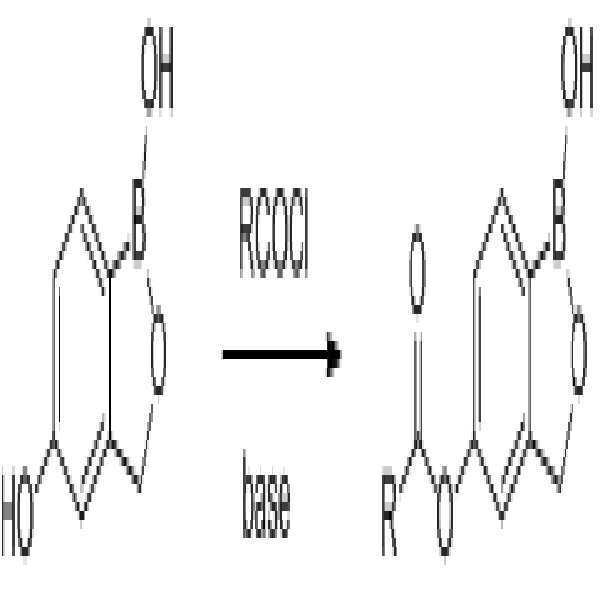
이들 화합물은 계획 L과 유사한 방법으로 준비된다.These compounds are prepared in a manner similar to Scheme L.
본 발명의 화합물은 여기에서 설명된 것과 유사한 방법에 의하여 수화물 및 용매화합물로 전환될 수 있다.The compounds of the present invention can be converted into hydrates and solvates by methods analogous to those described herein.
III.f) III.f) 추가적인 치료요법적 물질을 포함하는 Including additional therapeutic substances 조합물Combination
본 발명의 화합물은 또한 추가적인 치료요법적 물질과 조합하여 사용될 수 있다. 따라서 본 발명은, 또 다른 측면에서, 최소 하나의 추가적인 치료요법적 물질과 함께 여기에서 설명된 화합물 또는 이의 약리학적으로 수용가능한 염을 포함하는 조합물을 제공한다. 예시적인 구체예에서, 추가적인 치료요법적 물질은 본 발명의 화합물이다. 예시적인 구체예에서, 추가적인 치료요법적 물질은 붕소 원자를 포함한다. 예시적인 구체예에서, 추가적인 치료요법적 물질은 붕소 원자를 포함하지 않는다. 예시적인 구체예에서, 추가적인 치료요법적 물질은 단락 III a)-e)에 설명된 화합물이다. The compounds of the present invention may also be used in combination with additional therapeutic agents. The invention thus provides, in yet another aspect, a combination comprising a compound described herein or a pharmacologically acceptable salt thereof together with at least one additional therapeutic agent. In an exemplary embodiment, the additional therapeutic agent is a compound of the present invention. In an exemplary embodiment, the additional therapeutic agent comprises a boron atom. In an exemplary embodiment, the additional therapeutic agent does not comprise a boron atom. In an exemplary embodiment, the additional therapeutic agent is a compound described in paragraphs III a) -e).
본 발명의 화합물이 동일한 질환 상태에 대하여 제2의 치료요법적 활성 물질과 조합으로 사용될 경우, 각 화합물의 약량이 상기 화합물이 단독으로 사용될 경우와 상이할 수 있다. 적절한 약량이 당업자에게 쉽게 이해될 것이다. 치료에서 사용하기 위하여 필요한 본 발명의 화합물의 양이 치료될 질환의 특성 및 환자의 연령과 질환에 따라 변할 것이고, 궁극적으로 담당 의사 또는 수의사의 재량일 것임이 이해될 것이다. 예시적인 구체예에서, 추가적인 치료요법적 물질은 항염증성이다. 예시적인 구체예에서, 추가적인 치료요법적 물질은 스테로이드 또는 시클로스포린 또는 소랄렌(psoralen) 또는 UVA 또는 레티노이드 또는 메토트락세이트 또는 비타민 D3 유사체이다. 예시적인 구체예에서, 스테로이드는 전신 스테로이드 또는 국소 스테로이드이다. 예시적인 구체예에서, 추가적인 치료요법적 물질은 국소 스테로이드 또는 항히스타민 또는 칼시뉴린 저해제이다. 예시적인 구체예에서, 추가적인 치료요법적 물질은 CC-10004 또는 AWD-12-281이다. 예시적인 구체예에서, 추가적인 치료요법적 물질은 코르티코스테로이드 또는 NSAIDs이다. 예시적인 구체예에서, 추가적인 치료요법적 물질은 PDE4 저해제이다. 예시적인 구체예에서, 추가적인 치료요법적 물질은 롤리프람 또는 로플루미라스트(roflumilast)이다.When the compound of the present invention is used in combination with a second therapeutically active substance for the same disease state, the dosage of each compound may be different from when the compound is used alone. Appropriate dosages will be readily apparent to those skilled in the art. It will be appreciated that the amount of the compound of the present invention required for use in therapy will vary with the nature of the disease to be treated and the age and disorder of the patient and ultimately at the discretion of the attending physician or veterinarian. In an exemplary embodiment, the additional therapeutic agent is anti-inflammatory. In an exemplary embodiment, the additional therapeutic agent is a steroid or cyclosporin or psoralen or UVA or retinoid or a methotroxate or vitamin D 3 analog. In an exemplary embodiment, the steroid is a systemic steroid or a topical steroid. In an exemplary embodiment, the additional therapeutic agent is a topical steroid or an antihistamine or calcineurin inhibitor. In an exemplary embodiment, the additional therapeutic agent is CC-10004 or AWD-12-281. In an exemplary embodiment, the additional therapeutic agent is a corticosteroid or NSAIDs. In an exemplary embodiment, the additional therapeutic agent is a PDE4 inhibitor. In an exemplary embodiment, the additional therapeutic agent is roflurlam or roflumilast.
이러한 조합물의 개별적인 성분들은 단위 투약형으로, 동시에 또는 연속으로 투여될 수 있다. 단위 투약형은 단일 또는 다중 단위 투약형일 수 있다. 예시적인 구체예에서, 본 발명은 단일 단위 투약형의 조합을 제공한다. 단일 단위 투약형의 예는 캡슐이며, 이때, 본 발명의 화합물 및 추가적인 치료요법적 물질 모두 동일한 캡슐에 수용된다. 예시적인 구체예에서, 본 발명은 두 단위 투약형의 조합을 제공한다. 두 단위 투약형의 예는 본 발명의 화합물을 포함하는 제1 캡슐 및 추가적인 치료요법적 물질을 포함하는 제2 캡슐이다. 따라서 용어 '단일 단위' 또는 '두 단위' 또는 '다중 단위'는 환자가 섭취하는 개체를 지칭하며, 개체의 내부 성분을 지칭하지 않는다. 공지 치료요법적 물질의 적절한 약량이 당업자에게 쉽게 이해될 것이다.The individual components of such a combination may be administered in unit dosage form, either simultaneously or sequentially. Unit dosage forms may be single or multiple unit dosage forms. In an exemplary embodiment, the present invention provides a combination of single unit dosage forms. An example of a single unit dosage form is a capsule, wherein both the compound of the present invention and the additional therapeutic agent are contained in the same capsule. In an exemplary embodiment, the invention provides a combination of two unit dosage forms. An example of two unit dosage forms is a first capsule comprising a compound of the invention and a second capsule comprising an additional therapeutic agent. Thus, the term "single unit" or "two units" or "multiple units" refers to the individual ingested by the patient and does not refer to the internal components of the individual. Appropriate doses of known therapeutic agents will be readily apparent to those skilled in the art.
여기에서 언급한 조합물은 제약학적 제제의 형태에서 사용하기에 편리하게 제시될 수 있다. 따라서, 본 발명의 대표적인 구체예는 a) 본 발명의 화합물; b) 추가적인 치료요법적 물질 및 c) 약리학적으로 수용가능한 부형제를 포함하는 제약학적 제제이다. 예시적인 구체예에서, 제약학적 제제는 단위 투약형이다. 예시적인 구체예에서, 제약학적 제제는 단일 단위 투약형이다. 예시적인 구체예에서, 제약학적 제제는 두 단위 투약형이다. 예시적인 구체예에서, 제약학적 제제는 제1 단위 투약형 및 제2 단위 투약형을 포함하는 두 단위 투약형이고, 이때, 제1 단위 투약형이 a) 본 발명의 화합물 및 b) 제1 약리학적으로 수용가능한 부형제를 포함하며; 제2 단위 투약형이 c) 추가적인 치료요법적 물질 및 d) 제2 약리학적으로 수용가능한 부형제를 포함한다.The combinations referred to herein may conveniently be presented for use in the form of pharmaceutical preparations. Representative embodiments of the invention thus include a) a compound of the invention; b) an additional therapeutic agent and c) a pharmacologically acceptable excipient. In an exemplary embodiment, the pharmaceutical agent is a unit dosage form. In an exemplary embodiment, the pharmaceutical agent is a single unit dosage form. In an exemplary embodiment, the pharmaceutical formulation is in two unit dosage forms. In an exemplary embodiment, the pharmaceutical agent is of two unit dosage forms comprising a first unit dosage form and a second unit dosage form, wherein the first unit dosage form comprises a) a compound of the invention and b) An < / RTI > acceptable excipient; A second unit dosage form, c) an additional therapeutic agent, and d) a second pharmacologically acceptable excipient.
IV. IV. 방법Way
a) a) 사이토킨Cytokine 및/또는 And / or 케모킨의Kemokin's 생산 감소 Production decline
또 다른 측면에서, 본 발명은 사이토킨 및/또는 케모킨의 생산을 감소시키는 방법을 제공하며, 상기 방법은 다음을 포함한다: 세포를 본 발명의 화합물과 접촉시킴, 이때, 세포에 의한 사이토킨 및/또는 케모킨의 생산이 감소된다. 또 다른 측면에서, 본 발명은 사이토킨 및/또는 케모킨의 생산을 감소시키는 방법을 제공하며, 상기 방법은 다음을 포함한다: 세포를 여기에서 설명된 화합물 또는 이의 약리학적으로 수용가능한 염과 접촉시킴, 이때, 세포에 의한 사이토킨 및/또는 케모킨의 생산이 감소된다. 예시적인 구체예에서, 본 발명의 화합물은 여기에서 설명된 화합물, 또는 이의 약리학적으로 수용가능한 염이다. 예시적인 구체예에서, 본 발명의 화합물은 여기에서 설명된 화합물이다. 예시적인 구체예에서, 세포가 치료요법적으로 효과적인 양의 화합물과 접촉된다. 예시적인 구체예에서, 화합물은 여기에서 설명된 화학식에 따른다. 예시적인 구체예에서, 화합물은 C1, C2, C3, C4, C5, C6, C7, C8, C9, C10, C11, C12, C13, C14, C15, C16, C17, C18, C19, C20, C21, C22, C23, C24, C25, C26, C27, C28, C29, C30, C31, C32, C33, C34, C35, C36, C37, C38, C39, C40, C41, C42, C43, C44, C45, C46, C47, C48, C49, C50, C51, C52, C53, C54, C55, C56, C57, C58, C59, C60, C61, C62, C63, C64, C65, C66, C67, C68, C69, C70, C71, C72, C73, C74, C75, C76, C77, C78, C79, C80, C81, C82, C83, C84, C85, C86, C87, C88, C89, C90, C91, C92, C93, C94, C95, C96, C97, C98, C99 및 C100에서 선택된 멤버이다. 예시적인 구체예에서, 화합물은 D1, D2, D3, D4, D5, D6, D7, D8, D9, D10, D11, D12, D13, D14, D15, D16, D17, D18, D19, D20, D21, D22, D23, D24, D25, D26, D27, D28, D29, D30, D31, D32, D33, D34, D35, D36, D37, D38, D39, D40, D41, D42, D43, D44, D45, D46, D47, D48, D49, D50, D51, D52, D53, D54, D55, D56, D57, D58, D59, D60, D61, D62, D63, D64, D65, D66, D67, D68, D69, D70, D71, D72, D73, D74, D75, D76, D77, D78, D79, D80, D81, D82, D83, D84, D85, D86, D87, D88, D89, D90, D91, D92, D93, D94, D95, D96, D97, D98, D99, D100, D101, D102, D103, D104, D105, D106, D107, D108, D109, D110, D111, D112, D113, D114, D115, D116, D117, D118, D119, D120, D121, D122, D123, D124, D125, D126, D127, D128, D129, D130, D131, D132, D133, D134, D135, D136, D137, D138, D139, D140, D141, D142, D143, D144, D145, D146, D147, D148, D149, D150, D151, D152, D153, D154, D155, D156, D157, D158, D159, D160, D161, D162, D163, D164, D165, D166, D167, D168, D169, D170, D171, D172, D173, D174, D175, D176, D177, D178, D179, D180, D181, D182, D183, D184, D185, D186, D187, D188, D189, D190, D191, D192, D193, D194, D195, D196, D197, D198, D199, D200, D201, D202, D203, D204, D205, D206, D207, D208, D209, D210, D211, D212, D213, D214, D215, D216, D217, D218, D219, D220, D221, D222, D223, D224, D225, D226, D227, D228 및 D229에서 선택된 멤버이다. 예시적인 구체예에서, 화합물은 C17이다. 또 다른 대표적인 구체예에서, 화합물은 C27이다. 또 다른 대표적인 구체예에서, 화합물은 C23 또는 C24이다. 또 다른 대표적인 구체예에서, 화합물은 C25이다. 또 다른 대표적인 구체예에서, 화합물은 C26이다. 또 다른 대표적인 구체예에서, 화합물은 C37이다. 예시적인 구체예에서, 화합물은 D46, D86, D99, D100, D107, D108, D114, D122, D125, D126, D127, D128, D131, D140 및 D141, 및 이의 염에서 선택된 멤버이다. 예시적인 구체예에서, 화합물은 D95, D96, D97, D102, D110, D111, D113, D115, D121, D129, D130, D132, 및 이의 염에서 선택된 멤버이다. 예시적인 구체예에서, 화합물은 D47, D109, D116, D118, D119, D120, D123, 및 이의 염에서 선택된 멤버이다. 예시적인 구체예에서, 화합물은 D98, D101, D106, 및 이의 염에서 선택된 멤버이다. 예시적인 구체예에서, 화합물은 D11, D12, D37, D38, D39, D40, D41, D42, D43, D124, D142, D143, D146, 및 이의 염에서 선택된 멤버이다. 예시적인 구체예에서, 화합물은 D14, D15, D16, D17, D28, D29, D30, D31, D133, D134, D135, D144, D145, D147, 및 이의 염에서 선택된 멤버이다.In another aspect, the invention provides a method of reducing the production of cytokines and / or chemokines, comprising: contacting a cell with a compound of the invention, wherein the cytokine and / Or the production of chemokines is reduced. In another aspect, the invention provides a method of reducing the production of cytokines and / or chemokines, the method comprising: contacting the cell with a compound as described herein or a pharmacologically acceptable salt thereof , Wherein the production of cytokines and / or chemokines by the cells is reduced. In an exemplary embodiment, the compound of the present invention is a compound described herein, or a pharmacologically acceptable salt thereof. In an exemplary embodiment, the compounds of the present invention are the compounds described herein. In an exemplary embodiment, the cell is contacted with a therapeutically effective amount of a compound. In an exemplary embodiment, the compound is according to the formula described herein. In an exemplary embodiment, the compound is selected from the group consisting of C1, C2, C3, C4, C5, C6, C7, C8, C9, C10, C11, C12, C13, C14, C15, C16, C17, C18, C19, C22, C23, C24, C25, C26, C27, C28, C29, C30, C31, C32, C33, C34, C35, C36, C37, C38, C39, C40, C41, C42, C43, C44, C47, C48, C49, C50, C51, C52, C53, C54, C55, C56, C57, C58, C59, C60, C61, C62, C63, C64, C65, C66, C67, C68, C69, C72, C73, C74, C75, C76, C77, C78, C79, C80, C81, C82, C83, C84, C85, C86, C87, C88, C89, C90, C91, C92, C93, C97, C98, C99, and C100 . In an exemplary embodiment, the compound is selected from the group consisting of D1, D2, D3, D4, D5, D6, D7, D8, D9, D10, D11, D12, D13, D14, D15, D16, D17, D18, D19, D22, D23, D24, D25, D26, D27, D28, D29, D30, D31, D32, D33, D34, D35, D36, D37, D38, D39, D40, D41, D42, D43, D47, D48, D49, D50, D51, D52, D53, D54, D55, D56, D57, D58, D59, D60, D61, D62, D63, D64, D65, D66, D67, D68, D72 D73 D74 D75 D76 D77 D78 D79 D80 D81 D82 D83 D84 D85 D86 D87 D88 D89 D90 D91 D92 D93 D94 D95 D96 , D97, D98, D99, D100, D101, D102, D103, D104, D105, D106, D107, D108, D109, D110, D111, D112, D113, D114, D115, D116, D117, D118, D119, D120, D121, D122, D123, D124, D125, D126, D127, D128, D129, D130, D131, D132, D133, D134, D135, D136, D137, D138, D139, D140, D141, D142, D143, D144, D145, D146, D147, D148, D149, D150, D151, D152, D153, D154, D155, D156, D157, D158, D159, D160, D161, D162, D163, D164, D165, D166, D167, D168, D171, D172, D173, D174, D175, D176, D177, D178, D179, D180, D181, D182, D183, D184, D185, D186, D187, D188, D189, D190, D191, D192, D193, D194, D195 , D196, D197, D198, D199, D200, D201, D202, D203, D204, D205, D206, D207, D208, D209, D210, D211, D212, D213, D214, D215, D216, D217, D218, D219, D220 , D221, D222, D223, D224, D225, D226, D227, D228 and D229 . In an exemplary embodiment, the compound is C17 . In another exemplary embodiment, the compound is C27 . In another exemplary embodiment, the compound is C23 or C24 . In another exemplary embodiment, the compound is C25 . In another exemplary embodiment, the compound is C26 . In another exemplary embodiment, the compound is C37 . In an exemplary embodiment, the compound is a member selected from D46, D86, D99, D100, D107, D108, D114, D122, D125, D126, D127, D128, D131, D140 and D141 , In an exemplary embodiment, the compound is a member selected from D95, D96, D97, D102, D110, D111, D113, D115, D121, D129, D130, D132 , and salts thereof. In an exemplary embodiment, the compound is a member selected from D47, D109, D116, D118, D119, D120, D123, and salts thereof. In an exemplary embodiment, the compound is a member selected from D98, D101, D106, and salts thereof. In an exemplary embodiment, the compound is a member selected from D11, D12, D37, D38, D39, D40, D41, D42, D43, D124, D142, D143, D146, In an exemplary embodiment, the compound is a member selected from D14, D15, D16, D17, D28, D29, D30, D31, D133, D134, D135, D144, D145, D147,
예시적인 구체예에서, 상기 방법은 사이토킨의 생산을 감소시키기 위한 것인데, 상기 사이토킨은 TH1 사이토킨이다. 예시적인 구체예에서, TH1 사이토킨은 IFN-γ 및 IL-2에서 선택된 멤버이다.In an exemplary embodiment, the method is for reducing the production of cytokines, wherein the cytokines are TH1 cytokines. In an exemplary embodiment, TH1 cytokines are members selected from IFN-y and IL-2.
예시적인 구체예에서, 상기 방법은 사이토킨의 생산을 감소시키기 위한 것인데, 상기 사이토킨은 TH2 사이토킨이다. 예시적인 구체예에서, TH2 사이토킨은 IL-4, IL-5 및 IL-10에서 선택된 멤버이다.In an exemplary embodiment, the method is for reducing the production of cytokines, wherein the cytokines are TH2 cytokines. In an exemplary embodiment, the TH2 cytokine is a member selected from IL-4, IL-5 and IL-10.
예시적인 구체예에서, 상기 방법은 사이토킨의 생산을 감소시키기 위한 것인데, 상기 사이토킨은 IL-1α, IL-1β, IL-2, IL-3, IL-6, IL-7, IL-9, IL-12, IL-17, IL-18, IL-23, TNF-α, LT, LIF, 온코스타틴, IFNα, IFNβ 및 IFN-γ에서 선택된 멤버이다. 또 다른 대표적인 구체예에서, 사이토킨은 IL-1β, IL-2, IL-3, IL-6, IL-7, IL-9, IL-12, IL-23, TNF-α, LT, LIF, 온코스타틴, 및 IFN-γ에서 선택된 멤버이다. 또 다른 대표적인 구체예에서, 사이토킨은 IL-1β, IL-2, IL-23, TNF-α 및 IFN-γ에서 선택된 멤버이다. 또 다른 대표적인 구체예에서, 사이토킨은 TNF-α이다.In an exemplary embodiment, the method is for reducing the production of cytokines, wherein the cytokines are selected from the group consisting of IL-1 alpha, IL-1 beta, IL-2, IL-3, IL-6, IL- -12, IL-17, IL-18, IL-23, TNF- ?, LT, LIF, oncostatin, IFN ?, IFN ?, and IFN- ?. In another exemplary embodiment, the cytokine is selected from the group consisting of IL-1β, IL-2, IL-3, IL-6, IL-7, IL-9, IL-12, IL-23, TNF- Statins, and IFN-y. In another exemplary embodiment, the cytokine is a member selected from IL-l [beta], IL-2, IL-23, TNF- [alpha] and IFN- [gamma]. In another exemplary embodiment, the cytokine is TNF-a.
예시적인 구체예에서, 상기 방법은 사이토킨의 방출을 감소시키기 위한 것인데, 상기 사이토킨은 IL-1β, IL-2, IL-4, IL-5, IL-6, IL-8, IL-10, IL-12, IL-23, TNF-α 및 IFN-γ에서 선택된 멤버이다. In an exemplary embodiment, the method is for reducing the release of cytokines, wherein the cytokines are selected from the group consisting of IL-1β, IL-2, IL-4, IL-5, IL-6, IL- -12, IL-23, TNF- [alpha] and IFN- [gamma].
예시적인 구체예에서, 상기 방법은 사이토킨의 생산을 감소시키기 위한 것인데, 상기 사이토킨은 IL-4, IL-10, IL-11, W-13 및 IFN-γ에서 선택된 멤버이다. In an exemplary embodiment, the method is for reducing the production of cytokines, wherein the cytokines are members selected from IL-4, IL-10, IL-11, W-13 and IFN-y.
예시적인 구체예에서, 상기 방법은 케모킨의 생산을 감소시키기 위한 것인다, 상기 케모킨은 IL-8, Gro-α, MIP-1, MCP-1, PGE2, ENA-78, 및 RANTES에서 선택된 멤버이다. 예시적인 구체예에서, 케모킨은 MCP-1 및 PGE2에서 선택된 멤버이다.In an exemplary embodiment, the method is for reducing production of chemokines, wherein the chemokine is selected from IL-8, Gro-alpha, MIP-I, MCP-I, PGE2, ENA-78, and RANTES Member. In an exemplary embodiment, the chemokine is a member selected from MCP-I and PGE2.
예시적인 구체예에서, 여기에서 설명된 임의의 방법에 있어서, 본 발명의 화합물은 사이토킨 및/또는 케모킨의 생산을 최소 약 5 내지 약 100%, 또는 최소 약 30 내지 약 100%, 40 내지 약 100%, 또는 최소 약 50 내지 약 100%, 또는 최소 약 60 내지 약 100%, 또는 최소 약 70 내지 약 100%, 또는 최소 약 80 내지 약 100%, 또는 최소 약 90 내지 약 100%, 또는 최소 약 30 내지 약 70%, 또는 최소 약 40 내지 약 90%, 또는 최소 약 45 내지 약 80%, 또는 최소 약 55 내지 약 75%, 또는 최소 약 75 내지 약 98%, 또는 최소 약 55 내지 약 99%, 또는 최소 약 5% 내지 약 20% 또는 최소 약 10% 내지 약 25% 저해할 양으로 존재한다. 예시적인 구체예에서, 본 발명의 화합물은 여기에서 설명된 화합물이다.In an exemplary embodiment, in any of the methods described herein, the compounds of the invention inhibit the production of cytokines and / or chemokines by at least about 5 to about 100%, or at least about 30 to about 100% , Or at least about 50 to about 100%, or at least about 60 to about 100%, or at least about 70 to about 100%, or at least about 80 to about 100%, or at least about 90 to about 100% At least about 40 to about 90%, or at least about 45 to about 80%, or at least about 55 to about 75%, or at least about 75 to about 98%, or at least about 55 to about 99% , Or at least about 5% to about 20%, or at least about 10% to about 25%. In an exemplary embodiment, the compounds of the present invention are the compounds described herein.
b) b) 사이토킨Cytokine 및/또는 And / or 케모킨의Kemokin's 생산 증가 Increased production
또 다른 측면에서, 본 발명은 사이토킨 및/또는 케모킨의 생산을 증가시키는 방법을 제공하는데, 상기 방법은 다음을 포함한다: 세포를 본 발명의 화합물과 접촉시킴, 이때, 세포에 의한 사이토킨 및/또는 케모킨의 생산이 증가된다. 예시적인 구체예에서, 화합물은 여기에서 설명된 것 또는 이의 약리학적으로 수용가능한 염이다. 예시적인 구체예에서, 본 발명의 화합물은 여기에서 설명된 화합물이다. 예시적인 구체예에서, 세포가 치료요법적으로 효과적인 양의 화합물과 접촉된다. 예시적인 구체예에서, 화합물은 여기에서 설명된 화학식에 따른다. 예시적인 구체예에서, 화합물은 C1, C2, C3, C4, C5, C6, C7, C8, C9, C10, C11, C12, C13, C14, C15, C16, C17, C18, C19, C20, C21, C22, C23, C24, C25, C26, C27, C28, C29, C30, C31, C32, C33, C34, C35, C36, C37, C38, C39, C40, C41, C42, C43, C44, C45, C46, C47, C48, C49, C50, C51, C52, C53, C54, C55, C56, C57, C58, C59, C60, C61, C62, C63, C64, C65, C66, C67, C68, C69, C70, C71, C72, C73, C74, C75, C76, C77, C78, C79, C80, C81, C82, C83, C84, C85, C86, C87, C88, C89, C90, C91, C92, C93, C94, C95, C96, C97, C98, C99 및 C100에서 선택된 멤버이다. 예시적인 구체예에서, 화합물은 D1, D2, D3, D4, D5, D6, D7, D8, D9, D10, D11, D12, D13, D14, D15, D16, D17, D18, D19, D20, D21, D22, D23, D24, D25, D26, D27, D28, D29, D30, D31, D32, D33, D34, D35, D36, D37, D38, D39, D40, D41, D42, D43, D44, D45, D46, D47, D48, D49, D50, D51, D52, D53, D54, D55, D56, D57, D58, D59, D60, D61, D62, D63, D64, D65, D66, D67, D68, D69, D70, D71, D72, D73, D74, D75, D76, D77, D78, D79, D80, D81, D82, D83, D84, D85, D86, D87, D88, D89, D90, D91, D92, D93, D94, D95, D96, D97, D98, D99, D100, D101, D102, D103, D104, D105, D106, D107, D108, D109, D110, D111, D112, D113, D114, D115, D116, D117, D118, D119, D120, D121, D122, D123, D124, D125, D126, D127, D128, D129, D130, D131, D132, D133, D134, D135, D136, D137, D138, D139, D140, D141, D142, D143, D144, D145, D146, D147, D148, D149, D150, D151, D152, D153, D154, D155, D156, D157, D158, D159, D160, D161, D162, D163, D164, D165, D166, D167, D168, D169, D170, D171, D172, D173, D174, D175, D176, D177, D178, D179, D180, D181, D182, D183, D184, D185, D186, D187, D188, D189, D190, D191, D192, D193, D194, D195, D196, D197, D198, D199, D200, D201, D202, D203, D204, D205, D206, D207, D208, D209, D210, D211, D212, D213, D214, D215, D216, D217, D218, D219, D220, D221, D222, D223, D224, D225, D226, D227, D228 및 D229 에서 선택된 멤버이다. 예시적인 구체예에서, 화합물은 C17이다. 또 다른 대표적인 구체예에서, 화합물은 C27이다. 또 다른 대표적인 구체예에서, 화합물은 C23 또는 C24이다. 또 다른 대표적인 구체예에서, 화합물은 C26이다.In another aspect, the present invention provides a method of increasing the production of cytokines and / or chemokines, comprising: contacting a cell with a compound of the invention, wherein the cytokine and / Or the production of chemokines is increased. In an exemplary embodiment, the compound is as described herein or a pharmacologically acceptable salt thereof. In an exemplary embodiment, the compounds of the present invention are the compounds described herein. In an exemplary embodiment, the cell is contacted with a therapeutically effective amount of a compound. In an exemplary embodiment, the compound is according to the formula described herein. In an exemplary embodiment, the compound is selected from the group consisting of C1, C2, C3, C4, C5, C6, C7, C8, C9, C10, C11, C12, C13, C14, C15, C16, C17, C18, C19, C22, C23, C24, C25, C26, C27, C28, C29, C30, C31, C32, C33, C34, C35, C36, C37, C38, C39, C40, C41, C42, C43, C44, C47, C48, C49, C50, C51, C52, C53, C54, C55, C56, C57, C58, C59, C60, C61, C62, C63, C64, C65, C66, C67, C68, C69, C72, C73, C74, C75, C76, C77, C78, C79, C80, C81, C82, C83, C84, C85, C86, C87, C88, C89, C90, C91, C92, C93, C97, C98, C99, and C100 . In an exemplary embodiment, the compound is selected from the group consisting of D1, D2, D3, D4, D5, D6, D7, D8, D9, D10, D11, D12, D13, D14, D15, D16, D17, D18, D19, D22, D23, D24, D25, D26, D27, D28, D29, D30, D31, D32, D33, D34, D35, D36, D37, D38, D39, D40, D41, D42, D43, D47, D48, D49, D50, D51, D52, D53, D54, D55, D56, D57, D58, D59, D60, D61, D62, D63, D64, D65, D66, D67, D68, D72 D73 D74 D75 D76 D77 D78 D79 D80 D81 D82 D83 D84 D85 D86 D87 D88 D89 D90 D91 D92 D93 D94 D95 D96 , D97, D98, D99, D100, D101, D102, D103, D104, D105, D106, D107, D108, D109, D110, D111, D112, D113, D114, D115, D116, D117, D118, D119, D120, D121, D122, D123, D124, D125, D126, D127, D128, D129, D130, D131, D132, D133, D134, D135, D136, D137, D138, D139, D140, D141, D142, D143, D144, D145, D146, D147, D148, D149, D150, D151, D152, D153, D154, D155, D156, D157, D158, D159, D160, D161, D162, D163, D164, D165, D166, D167, D168, D171, D172, D173, D174, D175, D176, D177, D178, D179, D180, D181, D182, D183, D184, D185, D186, D187, D188, D189, D190, D191, D192, D193, D194, D195 , D196, D197, D198, D199, D200, D201, D202, D203, D204, D205, D206, D207, D208, D209, D210, D211, D212, D213, D214, D215, D216, D217, D218, D219, D220 , D221, D222, D223, D224, D225, D226, D227, D228 and D229 . In an exemplary embodiment, the compound is C17 . In another exemplary embodiment, the compound is C27 . In another exemplary embodiment, the compound is C23 or C24 . In another exemplary embodiment, the compound is C26 .
예시적인 구체예에서, 상기 방법은 사이토킨의 생산을 증가시키기 위한 것인데, 상기 사이토킨은 TH1 사이토킨이다. 예시적인 구체예에서, TH1 사이토킨은 IFN-γ 및 IL-2에서 선택된 멤버이다.In an exemplary embodiment, the method is for increasing the production of cytokines, wherein the cytokines are TH1 cytokines. In an exemplary embodiment, TH1 cytokines are members selected from IFN-y and IL-2.
예시적인 구체예에서, 상기 방법은 사이토킨의 생산을 증가시키기 위한 것인데, 상기 사이토킨은 TH2 사이토킨이다. 예시적인 구체예에서, TH2 사이토킨은 IL-4, IL-5 및 IL-10에서 선택된 멤버이다.In an exemplary embodiment, the method is for increasing the production of cytokines, wherein the cytokines are TH2 cytokines. In an exemplary embodiment, the TH2 cytokine is a member selected from IL-4, IL-5 and IL-10.
예시적인 구체예에서, 상기 방법은 사이토킨의 생산을 증가시키기 위한 위한 것인데, 상기 사이토킨은 IL-4, IL-10, IL-11, W-13 및 TGF-β에서 선택된 멤버이다. In an exemplary embodiment, the method is for increasing the production of cytokines, wherein said cytokines are members selected from IL-4, IL-10, IL-11, W-13 and TGF- ?.
예시적인 구체예에서, 상기 방법은 케모킨의 생산을 증가시키기 위한 위한 것인데, 상기 케모킨은 IL-8, Gro-α, MIP-1, MCP-1, PGE2, ENA-78, 및 RANTES에서 선택된 멤버이다. 예시적인 구체예에서, 케모킨은 MCP-1 및 PGE2에서 선택된 멤버이다.In an exemplary embodiment, the method is for increasing the production of a chemokine, wherein the chemokine is selected from IL-8, Gro-a, MIP-I, MCP-I, PGE2, ENA-78, and RANTES Member. In an exemplary embodiment, the chemokine is a member selected from MCP-I and PGE2.
예시적인 구체예에서, 여기에서 설명된 임의의 방법에 있어서, 본 발명의 화합물은 사이토킨 및/또는 케모킨의 생산을 최소 약 5 내지 약 100%, 또는 최소 약 30 내지 약 100%, 40 내지 약 100%, 또는 최소 약 50 내지 약 100%, 또는 최소 약 60 내지 약 100%, 또는 최소 약 70 내지 약 100%, 또는 최소 약 80 내지 약 100%, 또는 최소 약 90 내지 약 100%, 또는 최소 약 30 내지 약 70%, 또는 최소 약 40 내지 약 90%, 또는 최소 약 45 내지 약 80%, 또는 최소 약 55 내지 약 75%, 또는 최소 약 75 내지 약 98%, 또는 최소 약 55 내지 약 99%, 또는 최소 약 5% 내지 약 20% 또는 최소 약 10% 내지 약 25% 증가시킬 양으로 존재한다. 예시적인 구체예에서, 본 발명의 화합물은 여기에서 설명된 화합물이다.In an exemplary embodiment, in any of the methods described herein, the compounds of the invention inhibit the production of cytokines and / or chemokines by at least about 5 to about 100%, or at least about 30 to about 100% , Or at least about 50 to about 100%, or at least about 60 to about 100%, or at least about 70 to about 100%, or at least about 80 to about 100%, or at least about 90 to about 100% At least about 40 to about 90%, or at least about 45 to about 80%, or at least about 55 to about 75%, or at least about 75 to about 98%, or at least about 55 to about 99% %, Or at least about 5% to about 20%, or at least about 10% to about 25%. In an exemplary embodiment, the compounds of the present invention are the compounds described herein.
c) c) 사이토킨Cytokine 및/또는 And / or 케모킨의Kemokin's 방출 감소 Emission reduction
또 다른 측면에서, 본 발명은 사이토킨 및/또는 케모킨의 방출을 감소시키는 방법을 제공하고, 상기 방법은 다음을 포함한다: 세포를 본 발명의 화합물과 접촉시킴, 이때, 세포에 의한 사이토킨 및/또는 케모킨의 방출이 감소된다. 예시적인 구체예에서, 본 발명의 화합물은 여기에서 설명된 화합물 또는 이의 약리학적으로 수용가능한 염이다. 본 발명의 화합물은 여기에서 설명된 화합물이다. 예시적인 구체예에서, 세포가 치료요법적으로 효과적인 양의 화합물과 접촉된다. 예시적인 구체예에서, 화합물은 여기에서 설명된 화학식에 따른다. 예시적인 구체예에서, 화합물은 C1, C2, C3, C4, C5, C6, C7, C8, C9, C10, C11, C12, C13, C14, C15, C16, C17, C18, C19, C20, C21, C22, C23, C24, C25, C26, C27, C28, C29, C30, C31, C32, C33, C34, C35, C36, C37, C38, C39, C40, C41, C42, C43, C44, C45, C46, C47, C48, C49, C50, C51, C52, C53, C54, C55, C56, C57, C58, C59, C60, C61, C62, C63, C64, C65, C66, C67, C68, C69, C70, C71, C72, C73, C74, C75, C76, C77, C78, C79, C80, C81, C82, C83, C84, C85, C86, C87, C88, C89, C90, C91, C92, C93, C94, C95, C96, C97, C98, C99 및 C100에서 선택된 멤버이다. 예시적인 구체예에서, 화합물은 D1, D2, D3, D4, D5, D6, D7, D8, D9, D10, D11, D12, D13, D14, D15, D16, D17, D18, D19, D20, D21, D22, D23, D24, D25, D26, D27, D28, D29, D30, D31, D32, D33, D34, D35, D36, D37, D38, D39, D40, D41, D42, D43, D44, D45, D46, D47, D48, D49, D50, D51, D52, D53, D54, D55, D56, D57, D58, D59, D60, D61, D62, D63, D64, D65, D66, D67, D68, D69, D70, D71, D72, D73, D74, D75, D76, D77, D78, D79, D80, D81, D82, D83, D84, D85, D86, D87, D88, D89, D90, D91, D92, D93, D94, D95, D96, D97, D98, D99, D100, D101, D102, D103, D104, D105, D106, D107, D108, D109, D110, D111, D112, D113, D114, D115, D116, D117, D118, D119, D120, D121, D122, D123, D124, D125, D126, D127, D128, D129, D130, D131, D132, D133, D134, D135, D136, D137, D138, D139, D140, D141, D142, D143, D144, D145, D146, D147, D148, D149, D150, D151, D152, D153, D154, D155, D156, D157, D158, D159, D160, D161, D162, D163, D164, D165, D166, D167, D168, D169, D170, D171, D172, D173, D174, D175, D176, D177, D178, D179, D180, D181, D182, D183, D184, D185, D186, D187, D188, D189, D190, D191, D192, D193, D194, D195, D196, D197, D198, D199, D200, D201, D202, D203, D204, D205, D206, D207, D208, D209, D210, D211, D212, D213, D214, D215, D216, D217, D218, D219, D220, D221, D222, D223, D224, D225, D226, D227, D228 및 D229에서 선택된 멤버이다. 예시적인 구체예에서, 화합물은 C17이다. 또 다른 대표적인 구체예에서, 화합물은 C27이다. 또 다른 대표적인 구체예에서, 화합물은 C23 또는 C24이다. 또 다른 대표적인 구체예에서, 화합물은 C25이다. 또 다른 대표적인 구체예에서, 화합물은 C26이다. 또 다른 대표적인 구체예에서, 화합물은 C37이다. 예시적인 구체예에서, 화합물은 D46, D86, D99, D100, D107, D108, D114, D122, D125, D126, D127, D128, D131, D140 및 D141, 및 이의 염에서 선택된 멤버이다. 예시적인 구체예에서, 화합물은 D95, D96, D97, D102, D110, D111, D113, D115, D121, D129, D130, D132, 및 이의 염에서 선택된 멤버이다. 예시적인 구체예에서, 화합물은 D47, D109, D116, D118, D119, D120, D123, 및 이의 염에서 선택된 멤버이다. 예시적인 구체예에서, 화합물은 D98, D101, D106, 및 이의 염에서 선택된 멤버이다. 예시적인 구체예에서, 화합물은 D11, D12, D37, D38, D39, D40, D41, D42, D43, D124, D142, D143, D146, 및 이의 염에서 선택된 멤버이다. 예시적인 구체예에서, 화합물은 D14, D15, D16, D17, D28, D29, D30, D31, D133, D134, D135, D144, D145, D147, 및 이의 염에서 선택된 멤버이다.In another aspect, the invention provides a method of reducing the release of cytokines and / or chemokines, the method comprising: contacting cells with a compound of the invention, wherein the cytokines and / Or the release of chemokines is reduced. In an exemplary embodiment, the compounds of the present invention are the compounds described herein or their pharmacologically acceptable salts. The compounds of the present invention are the compounds described herein. In an exemplary embodiment, the cell is contacted with a therapeutically effective amount of a compound. In an exemplary embodiment, the compound is according to the formula described herein. In an exemplary embodiment, the compound is selected from the group consisting of C1, C2, C3, C4, C5, C6, C7, C8, C9, C10, C11, C12, C13, C14, C15, C16, C17, C18, C19, C22, C23, C24, C25, C26, C27, C28, C29, C30, C31, C32, C33, C34, C35, C36, C37, C38, C39, C40, C41, C42, C43, C44, C47, C48, C49, C50, C51, C52, C53, C54, C55, C56, C57, C58, C59, C60, C61, C62, C63, C64, C65, C66, C67, C68, C69, C72, C73, C74, C75, C76, C77, C78, C79, C80, C81, C82, C83, C84, C85, C86, C87, C88, C89, C90, C91, C92, C93, C97, C98, C99, and C100 . In an exemplary embodiment, the compound is selected from the group consisting of D1, D2, D3, D4, D5, D6, D7, D8, D9, D10, D11, D12, D13, D14, D15, D16, D17, D18, D19, D22, D23, D24, D25, D26, D27, D28, D29, D30, D31, D32, D33, D34, D35, D36, D37, D38, D39, D40, D41, D42, D43, D47, D48, D49, D50, D51, D52, D53, D54, D55, D56, D57, D58, D59, D60, D61, D62, D63, D64, D65, D66, D67, D68, D72 D73 D74 D75 D76 D77 D78 D79 D80 D81 D82 D83 D84 D85 D86 D87 D88 D89 D90 D91 D92 D93 D94 D95 D96 , D97, D98, D99, D100, D101, D102, D103, D104, D105, D106, D107, D108, D109, D110, D111, D112, D113, D114, D115, D116, D117, D118, D119, D120, D121, D122, D123, D124, D125, D126, D127, D128, D129, D130, D131, D132, D133, D134, D135, D136, D137, D138, D139, D140, D141, D142, D143, D144, D145, D146, D147, D148, D149, D150, D151, D152, D153, D154, D155, D156, D157, D158, D159, D160, D161, D162, D163, D164, D165, D166, D167, D168, D171, D172, D173, D174, D175, D176, D177, D178, D179, D180, D181, D182, D183, D184, D185, D186, D187, D188, D189, D190, D191, D192, D193, D194, D195 , D196, D197, D198, D199, D200, D201, D202, D203, D204, D205, D206, D207, D208, D209, D210, D211, D212, D213, D214, D215, D216, D217, D218, D219, D220 , D221, D222, D223, D224, D225, D226, D227, D228 and D229 . In an exemplary embodiment, the compound is C17 . In another exemplary embodiment, the compound is C27 . In another exemplary embodiment, the compound is C23 or C24 . In another exemplary embodiment, the compound is C25 . In another exemplary embodiment, the compound is C26 . In another exemplary embodiment, the compound is C37 . In an exemplary embodiment, the compound is a member selected from D46, D86, D99, D100, D107, D108, D114, D122, D125, D126, D127, D128, D131, D140 and D141 , In an exemplary embodiment, the compound is a member selected from D95, D96, D97, D102, D110, D111, D113, D115, D121, D129, D130, D132 , and salts thereof. In an exemplary embodiment, the compound is a member selected from D47, D109, D116, D118, D119, D120, D123, and salts thereof. In an exemplary embodiment, the compound is a member selected from D98, D101, D106, and salts thereof. In an exemplary embodiment, the compound is a member selected from D11, D12, D37, D38, D39, D40, D41, D42, D43, D124, D142, D143, D146, In an exemplary embodiment, the compound is a member selected from D14, D15, D16, D17, D28, D29, D30, D31, D133, D134, D135, D144, D145, D147,
예시적인 구체예에서, 상기 방법은 사이토킨의 방출을 감소시키기 위한 것인데, 상기 사이토킨은 TH1 사이토킨이다. 예시적인 구체예에서, TH1 사이토킨은 IFN-γ 및 IL-2에서 선택된 멤버이다.In an exemplary embodiment, the method is for reducing the release of cytokines, wherein the cytokines are TH1 cytokines. In an exemplary embodiment, TH1 cytokines are members selected from IFN-y and IL-2.
예시적인 구체예에서, 상기 방법은 사이토킨의 방출을 감소시키기 위한 것인데, 상기 사이토킨은 TH2 사이토킨이다. 예시적인 구체예에서, TH2 사이토킨은 IL-4, IL-5 및 IL-10에서 선택된 멤버이다.In an exemplary embodiment, the method is for reducing the release of cytokines, wherein the cytokines are TH2 cytokines. In an exemplary embodiment, the TH2 cytokine is a member selected from IL-4, IL-5 and IL-10.
예시적인 구체예에서, 상기 방법은 사이토킨의 방출을 감소시키기 위한 것인데, 상기 사이토킨은 IL-1α, IL-1β, IL-2, IL-3, IL-6, IL-7, IL-9, IL-12, IL-17, IL-18, IL-23, TNF-α, LT, LIF, 온코스타틴, IFNα, IFNβ 및 IFN-γ에서 선택된 멤버이다. 또 다른 대표적인 구체예에서, 사이토킨은 IL-1β, IL-2, IL-3, IL-6, IL-7, IL-9, IL-12, IL-23, TNF-α, LT, LIF, 온코스타틴, 및 IFN-γ에서 선택된 멤버이다. 또 다른 대표적인 구체예에서, 사이토킨은 IL-1β, IL-2, IL-23, TNF-α, 및 IFN-γ에서 선택된 멤버이다. 또 다른 대표적인 구체예에서, 사이토킨은 TNF-α이다. 또 다른 대표적인 구체예에서, 사이토킨은 IFN-γ이다.In an exemplary embodiment, the method is for reducing the release of cytokines, wherein the cytokines are selected from the group consisting of IL-1 alpha, IL-1 beta, IL-2, IL-3, IL-6, IL- -12, IL-17, IL-18, IL-23, TNF- ?, LT, LIF, oncostatin, IFN ?, IFN ?, and IFN- ?. In another exemplary embodiment, the cytokine is selected from the group consisting of IL-1β, IL-2, IL-3, IL-6, IL-7, IL-9, IL-12, IL-23, TNF- Statins, and IFN-y. In another exemplary embodiment, the cytokine is a member selected from IL-l [beta], IL-2, IL-23, TNF- [alpha], and IFN- [gamma]. In another exemplary embodiment, the cytokine is TNF-a. In another exemplary embodiment, the cytokine is IFN-y.
예시적인 구체예에서, 상기 방법은 사이토킨의 방출을 감소시키기 위한 것인데, 상기 사이토킨은 IL-1β, IL-2, IL-4, IL-5, IL-6, IL-8, IL-10, IL-12, IL-23, TNF-α 및 IFN-γ에서 선택된 멤버이다. In an exemplary embodiment, the method is for reducing the release of cytokines, wherein the cytokines are selected from the group consisting of IL-1β, IL-2, IL-4, IL-5, IL-6, IL- -12, IL-23, TNF- [alpha] and IFN- [gamma].
예시적인 구체예에서, 본 발명의 화합물은 IL-1β, IL-2, IL-4, IL-5, IL-6, IL-8, IL-10, IL-12, IL-23, TNF-α 및 IFN-γ의 방출을 감소시킨다. 예시적인 구체예에서, 화합물은 C17이다.In an exemplary embodiment, the compounds of the present invention are administered in combination with one or more of IL-1, IL-2, IL-4, IL-5, IL-6, IL- And IFN- [gamma]. In an exemplary embodiment, the compound is C17 .
예시적인 구체예에서, 상기 방법은 사이토킨의 방출을 감소시키기 위한 것인데, 상기 사이토킨은 IL-4, IL-10, IL-11, W-13 및 TGF-β에서 선택된 멤버이다. In an exemplary embodiment, the method is for reducing the release of cytokines, wherein said cytokines are members selected from IL-4, IL-10, IL-11, W-13 and TGF- ?.
예시적인 구체예에서, 상기 방법은 케모킨의 방출을 감소시키기 위한 것인데, 상기 케모킨은 IL-8, Gro-α, MIP-1, MCP-1, PGE2, ENA-78, 및 RANTES에서 선택된 멤버이다. 예시적인 구체예에서, 케모킨은 MCP-1 및 PGE2에서 선택된 멤버이다. 예시적인 구체예에서, 화합물은 C17이고 케모킨은 MCP-1 및 PGE2에서 선택된 멤버이다.In an exemplary embodiment, the method is for reducing the release of chemokine, wherein said chemokine is selected from the group consisting of IL-8, GRO- alpha, MIP-I, MCP-I, PGE2, ENA-78, to be. In an exemplary embodiment, the chemokine is a member selected from MCP-I and PGE2. In an exemplary embodiment, the compound is C17 and the chemokine is a member selected from MCP-I and PGE2.
예시적인 구체예에서, 본 발명의 화합물은 TNF-α, IL-2, IFNγ, IL-5, 및 IL-10의 방출을 감소시킨다. 예시적인 구체예에서, 본 발명의 화합물은 IL-1β, IL-6 및 IL-8의 방출을 실질적으로 감소시키지 않는다. 예시적인 구체예에서, 본 발명의 화합물은 IL-1β의 방출을 실질적으로 감소시키지 않는다. 예시적인 구체예에서, 본 발명의 화합물은 IL-4의 방출을 실질적으로 감소시키지 않는다. 예시적인 구체예에서, 화합물은 IL-12 및 IL-23의 방출을 감소시킨다. 예시적인 구체예에서, 화합물은 C27이다.In an exemplary embodiment, the compounds of the present invention reduce the release of TNF-a, IL-2, IFN gamma, IL-5, and IL-10. In an exemplary embodiment, the compounds of the present invention do not substantially reduce the release of IL-l [beta], IL-6 and IL-8. In an exemplary embodiment, the compounds of the present invention do not substantially reduce the release of IL-1 [beta]. In an exemplary embodiment, the compounds of the present invention do not substantially reduce the release of IL-4. In an exemplary embodiment, the compound reduces the release of IL-12 and IL-23. In an exemplary embodiment, the compound is C27 .
예시적인 구체예에서, 여기에서 설명된 임의의 방법에 있어서, 본 발명의 화합물은 사이토킨 및/또는 케모킨의 방출을 최소 약 5 내지 약 100%, 또는 최소 약 30 내지 약 100%, 40 내지 약 100%, 또는 최소 약 50 내지 약 100%, 또는 최소 약 60 내지 약 100%, 또는 최소 약 70 내지 약 100%, 또는 최소 약 80 내지 약 100%, 또는 최소 약 90 내지 약 100%, 또는 최소 약 30 내지 약 70%, 또는 최소 약 40 내지 약 90%, 또는 최소 약 45 내지 약 80%, 또는 최소 약 55 내지 약 75%, 또는 최소 약 75 내지 약 98%, 또는 최소 약 55 내지 약 99%, 또는 최소 약 5% 내지 약 20% 또는 최소 약 10% 내지 약 25% 감소시킬 양으로 존재한다. 또 다른 대표적인 구체예에서, 본 발명의 화합물은 여기에서 설명된 화합물 또는 이의 약리학적으로 수용가능한 염이다.In an exemplary embodiment, in any of the methods described herein, the compounds of the present invention inhibit the release of cytokines and / or chemokines by at least about 5 to about 100%, or at least about 30 to about 100% , Or at least about 50 to about 100%, or at least about 60 to about 100%, or at least about 70 to about 100%, or at least about 80 to about 100%, or at least about 90 to about 100% At least about 40 to about 90%, or at least about 45 to about 80%, or at least about 55 to about 75%, or at least about 75 to about 98%, or at least about 55 to about 99% %, Or at least about 5% to about 20%, or at least about 10% to about 25%. In another exemplary embodiment, the compounds of the present invention are the compounds described herein or their pharmacologically acceptable salts.
d) d) 사이토킨Cytokine 및/또는 And / or 케모킨의Kemokin's 방출 증가 Emission increase
또 다른 측면에서, 본 발명은 사이토킨 및/또는 케모킨의 생산을 증가시키는 방법을 제공하는데, 상기 방법은 다음을 포함한다: 세포를 본 발명의 화합물과 접촉시킴, 이때, 세포에 의한 사이토킨 및/또는 케모킨의 방출이 증가된다. 예시적인 구체예에서, 본 발명의 화합물은 여기에서 설명된 화합물 또는 이의 약리학적으로 수용가능한 염이다. 예시적인 구체예에서, 화합물은 여기에서 설명된다. 예시적인 구체예에서, 세포가 치료요법적으로 효과적인 양의 화합물과 접촉된다. 예시적인 구체예에서, 화합물은 여기에서 설명된 화학식에 따른다. 예시적인 구체예에서, 화합물은 C1, C2, C3, C4, C5, C6, C7, C8, C9, C10, C11, C12, C13, C14, C15, C16, C17, C18, C19, C20, C21, C22, C23, C24, C25, C26, C27, C28, C29, C30, C31, C32, C33, C34, C35, C36, C37, C38, C39, C40, C41, C42, C43, C44, C45, C46, C47, C48, C49, C50, C51, C52, C53, C54, C55, C56, C57, C58, C59, C60, C61, C62, C63, C64, C65, C66, C67, C68, C69, C70, C71, C72, C73, C74, C75, C76, C77, C78, C79, C80, C81, C82, C83, C84, C85, C86, C87, C88, C89, C90, C91, C92, C93, C94, C95 및 C96에서 선택된 멤버이다. 예시적인 구체예에서, 화합물은 D1, D2, D3, D4, D5, D6, D7, D8, D9, D10, D11, D12, D13, D14, D15, D16, D17, D18, D19, D20, D21, D22, D23, D24, D25, D26, D27, D28, D29, D30, D31, D32, D33, D34, D35, D36, D37, D38, D39, D40, D41, D42, D43, D44, D45, D46, D47, D48, D49, D50, D51, D52, D53, D54, D55, D56, D57, D58, D59, D60, D61, D62, D63, D64, D65, D66, D67, D68, D69, D70, D71, D72, D73, D74, D75, D76, D77, D78, D79, D80, D81, D82, D83, D84, D85, D86, D87, D88, D89, D90, D91, D92, D93, D94, D95, D96, D97, D98, D99, D100, D101, D102, D103, D104, D105, D106, D107, D108, D109, D110, D111, D112, D113, D114, D115, D116, D117, D118, D119, D120, D121, D122, D123, D124, D125, D126, D127, D128, D129, D130, D131, D132, D133, D134, D135, D136, D137, D138, D139, D140, D141, D142, D143, D144, D145, D146, D147, D148, D149, D150, D151, D152, D153, D154, D155, D156, D157, D158, D159, D160, D161, D162, D163, D164, D165, D166, D167, D168, D169, D170, D171, D172, D173, D174, D175, D176, D177, D178, D179, D180, D181, D182, D183, D184, D185, D186, D187, D188, D189, D190, D191, D192, D193, D194, D195, D196, D197, D198, D199, D200, D201, D202, D203, D204, D205, D206, D207, D208, D209, D210, D211, D212, D213, D214, D215, D216, D217, D218, D219, D220, D221, D222, D223, D224, D225, D226, D227, D228 및 D229에서 선택된 멤버이다. 예시적인 구체예에서, 화합물은 C17이다. 또 다른 대표적인 구체예에서, 화합물은 C27이다. 또 다른 대표적인 구체예에서, 화합물은 C23 또는 C24이다. 또 다른 대표적인 구체예에서, 화합물은 C26이다.In another aspect, the present invention provides a method of increasing the production of cytokines and / or chemokines, comprising: contacting a cell with a compound of the invention, wherein the cytokine and / Or the release of chemokine is increased. In an exemplary embodiment, the compounds of the present invention are the compounds described herein or their pharmacologically acceptable salts. In an exemplary embodiment, the compounds are described herein. In an exemplary embodiment, the cell is contacted with a therapeutically effective amount of a compound. In an exemplary embodiment, the compound is according to the formula described herein. In an exemplary embodiment, the compound is selected from the group consisting of C1, C2, C3, C4, C5, C6, C7, C8, C9, C10, C11, C12, C13, C14, C15, C16, C17, C18, C19, C22, C23, C24, C25, C26, C27, C28, C29, C30, C31, C32, C33, C34, C35, C36, C37, C38, C39, C40, C41, C42, C43, C44, C47, C48, C49, C50, C51, C52, C53, C54, C55, C56, C57, C58, C59, C60, C61, C62, C63, C64, C65, C66, C67, C68, C69, C72, C73, C74, C75, C76, C77, C78, C79, C80, C81, C82, C83, C84, C85, C86, C87, C88, C89, C90, C91, C92, C93, C94, C95 and C96 Selected members. In an exemplary embodiment, the compound is selected from the group consisting of D1, D2, D3, D4, D5, D6, D7, D8, D9, D10, D11, D12, D13, D14, D15, D16, D17, D18, D19, D22, D23, D24, D25, D26, D27, D28, D29, D30, D31, D32, D33, D34, D35, D36, D37, D38, D39, D40, D41, D42, D43, D47, D48, D49, D50, D51, D52, D53, D54, D55, D56, D57, D58, D59, D60, D61, D62, D63, D64, D65, D66, D67, D68, D72 D73 D74 D75 D76 D77 D78 D79 D80 D81 D82 D83 D84 D85 D86 D87 D88 D89 D90 D91 D92 D93 D94 D95 D96 , D97, D98, D99, D100, D101, D102, D103, D104, D105, D106, D107, D108, D109, D110, D111, D112, D113, D114, D115, D116, D117, D118, D119, D120, D121, D122, D123, D124, D125, D126, D127, D128, D129, D130, D131, D132, D133, D134, D135, D136, D137, D138, D139, D140, D141, D142, D143, D144, D145, D146, D147, D148, D149, D150, D151, D152, D153, D154, D155, D156, D157, D158, D159, D160, D161, D162, D163, D164, D165, D166, D167, D168, D171, D172, D173, D174, D175, D176, D177, D178, D179, D180, D181, D182, D183, D184, D185, D186, D187, D188, D189, D190, D191, D192, D193, D194, D195 , D196, D197, D198, D199, D200, D201, D202, D203, D204, D205, D206, D207, D208, D209, D210, D211, D212, D213, D214, D215, D216, D217, D218, D219, D220 , D221, D222, D223, D224, D225, D226, D227, D228 and D229 . In an exemplary embodiment, the compound is C17 . In another exemplary embodiment, the compound is C27 . In another exemplary embodiment, the compound is C23 or C24 . In another exemplary embodiment, the compound is C26 .
예시적인 구체예에서, 상기 방법은 사이토킨의 방출을 증가시키기 위한 것인데, 상기 사이토킨은 TH1 사이토킨이다. 예시적인 구체예에서, TH1 사이토킨은 IFN-γ 및 IL-2에서 선택된 멤버이다.In an exemplary embodiment, the method is for increasing the release of cytokines, wherein the cytokines are TH1 cytokines. In an exemplary embodiment, TH1 cytokines are members selected from IFN-y and IL-2.
예시적인 구체예에서, 상기 방법은 사이토킨의 방출을 증가시키기 위한 것인데, 상기 사이토킨은 TH2 사이토킨이다. 예시적인 구체예에서, TH2 사이토킨은 IL-4, IL-5 및 IL-10에서 선택된 멤버이다.In an exemplary embodiment, the method is for increasing the release of cytokines, wherein the cytokines are TH2 cytokines. In an exemplary embodiment, the TH2 cytokine is a member selected from IL-4, IL-5 and IL-10.
예시적인 구체예에서, 상기 방법은 사이토킨의 방출을 증가시키기 위한 것인데, 상기 사이토킨은 IL-4, IL-10, IL-11, W-13 및 TGF-β에서 선택된 멤버이다. In an exemplary embodiment, the method is for increasing the release of a cytokine, wherein the cytokine is a member selected from IL-4, IL-10, IL-11, W-13 and TGF- ?.
예시적인 구체예에서, 상기 방법은 케모킨의 방출을 증가시키기 위한 것인데, 상기 케모킨은 IL-8, Gro-α, MIP-1, MCP-1, PGE2, ENA-78, 및 RANTES에서 선택된 멤버이다. 예시적인 구체예에서, 케모킨은 MCP-1 및 PGE2에서 선택된 멤버이다.In an exemplary embodiment, the method is for increasing the release of chemokine, wherein the chemokine is selected from the group consisting of IL-8, Gro- alpha, MIP-I, MCP-I, PGE2, ENA-78, to be. In an exemplary embodiment, the chemokine is a member selected from MCP-I and PGE2.
예시적인 구체예에서, 여기에서 설명된 임의의 방법에 있어서, 본 발명의 화합물은 사이토킨 및/또는 케모킨의 방출을 최소 약 5 내지 약 100%, 또는 최소 약 30 내지 약 100%, 40 내지 약 100%, 또는 최소 약 50 내지 약 100%, 또는 최소 약 60 내지 약 100%, 또는 최소 약 70 내지 약 100%, 또는 최소 약 80 내지 약 100%, 또는 최소 약 90 내지 약 100%, 또는 최소 약 30 내지 약 70%, 또는 최소 약 40 내지 약 90%, 또는 최소 약 45 내지 약 80%, 또는 최소 약 55 내지 약 75%, 또는 최소 약 75 내지 약 98%, 또는 최소 약 55 내지 약 99%, 또는 최소 약 5% 내지 약 20% 또는 최소 약 10% 내지 약 25% 증가시킬 양으로 존재한다. 예시적인 구체예에서, 본 발명의 화합물은 여기에서 설명된 화합물 또는 이의 약리학적으로 수용가능한 염이다.In an exemplary embodiment, in any of the methods described herein, the compounds of the present invention inhibit the release of cytokines and / or chemokines by at least about 5 to about 100%, or at least about 30 to about 100% , Or at least about 50 to about 100%, or at least about 60 to about 100%, or at least about 70 to about 100%, or at least about 80 to about 100%, or at least about 90 to about 100% At least about 40 to about 90%, or at least about 45 to about 80%, or at least about 55 to about 75%, or at least about 75 to about 98%, or at least about 55 to about 99% %, Or at least about 5% to about 20%, or at least about 10% to about 25%. In an exemplary embodiment, the compounds of the present invention are the compounds described herein or their pharmacologically acceptable salts.
e) e) 포스포디에스테라제Phosphodiesterase 저해 Inhibition
또 다른 측면에서, 본 발명은 포스포디에스테라제 (PDE)를 저해하는 방법을 제공하고, 상기 방법은 다음을 포함한다: 포스포디에스테라제를 본 발명의 화합물과 접촉시킴, 이때, 포스포디에스테라제가 저해된다. 예시적인 구체예에서, 본 발명의 화합물은 여기에서 설명된 화합물 또는 이의 약리학적으로 수용가능한 염이다. 예시적인 구체예에서, 본 발명의 화합물은 여기에서 설명된 화합물이다. 예시적인 구체예에서, 화합물의 양은 치료요법적으로 효과적인 양이다. 예시적인 구체예에서, 화합물은 여기에서 설명된 화학식에 따른다. 예시적인 구체예에서, 화합물은 다음의 화학식을 따른다:In another aspect, the invention provides a method of inhibiting phosphodiesterase (PDE) comprising: contacting a phosphodiesterase with a compound of the invention, wherein the phosphodiesterase Disesterase is inhibited. In an exemplary embodiment, the compounds of the present invention are the compounds described herein or their pharmacologically acceptable salts. In an exemplary embodiment, the compounds of the present invention are the compounds described herein. In an exemplary embodiment, the amount of compound is therapeutically effective in an amount. In an exemplary embodiment, the compound is according to the formula described herein. In an exemplary embodiment, the compound has the following formula:

이때, B는 붕소이다. R1은 음전하, 염 반대이온, H, 시아노, 치환된 또는 치환안된 알킬, 치환된 또는 치환안된 헤테로알킬, 치환된 또는 치환안된 시클로알킬, 치환된 또는 치환안된 헤테로시클로알킬, 치환된 또는 치환안된 아릴, 및 치환된 또는 치환안된 헤테로아릴에서 선택된 멤버이다. M은 산소, 황 및 NR2에서 선택된 멤버이다. R2는 H, 치환된 또는 치환안된 알킬, 치환된 또는 치환안된 헤테로알킬, 치환된 또는 치환안된 시클로알킬, 치환된 또는 치환안된 헤테로시클로알킬, 치환된 또는 치환안된 아릴, 및 치환된 또는 치환안된 헤테로아릴에서 선택된 멤버이다. J는 (CR3R4)n1 및 CR5에서 선택된 멤버이다. R3, R4, 및 R5는 H, 시아노, 치환된 또는 치환안된 알킬, 치환된 또는 치환안된 헤테로알킬, 치환된 또는 치환안된 시클로알킬, 치환된 또는 치환안된 헤테로시클로알킬, 치환된 또는 치환안된 아릴, 및 치환된 또는 치환안된 헤테로아릴에서 독립적으로 선택된 멤버이다. n1은 0 내지 2에서 선택된 정수이다. W는 C=O (카르보닐), (CR6R7)m1 및 CR8에서 선택된 멤버이다. R6, R7, 및 R8는 H, 시아노, 치환된 또는 치환안된 알킬, 치환된 또는 치환안된 헤테로알킬, 치환된 또는 치환안된 시클로알킬, 치환된 또는 치환안된 헤테로시클로알킬, 치환된 또는 치환안된 아릴, 및 치환된 또는 치환안된 헤테로아릴에서 독립적으로 선택된 멤버이다. m1은 0 및 1에서 선택된 정수이다. A는 CR9 및 N에서 선택된 멤버이다. D는 CR10 및 N에서 선택된 멤버이다. E는 CR11 및 N에서 선택된 멤버이다. G는 CR12 및 N에서 선택된 멤버이다. R9, R10, R11 및 R12는 H, OR*, NR*R**, SR*, -S(O)R*, -S(O)2R*, -S(O)2NR*R**, -C(O)R*, -C(O)OR*, -C(O)NR*R**, 니트로, 할로겐, 시아노, 치환된 또는 치환안된 알킬, 치환된 또는 치환안된 헤테로알킬, 치환된 또는 치환안된 시클로알킬, 치환된 또는 치환안된 헤테로시클로알킬, 치환된 또는 치환안된 아릴, 및 치환된 또는 치환안된 헤테로아릴에서 독립적으로 선택된 멤버이며, 이때, 각 R* 및 R**은 H, 니트로, 할로겐, 시아노, 치환된 또는 치환안된 알킬, 치환된 또는 치환안된 헤테로알킬, 치환된 또는 치환안된 시클로알킬, 치환된 또는 치환안된 헤테로시클로알킬, 치환된 또는 치환안된 아릴, 및 치환된 또는 치환안된 헤테로아릴에서 독립적으로 선택된 멤버이다. 질소의 조합 (A + D + E + G)는 0 내지 3에서 선택된 정수이다. R3, R4 및 R5에서 선택된 멤버 및 R6, R7 및 R8에서 선택된 멤버는 여기에 부착된 원자와 함께 선택적으로 결합되어, 4 내지 7개 멤버로된 링을 형성한다. R3 및 R4는 여기에 부착된 원자와 함께 선택적으로 결합되어, 4 내지 7개 멤버로된 링을 형성한다. R6 및 R7는 여기에 부착된 원자와 함께 선택적으로 결합되어, 4 내지 7개 멤버로된 링을 형성한다. R9 및 R10는 여기에 부착된 원자와 함께 선택적으로 결합되어, 4 내지 7개 멤버로된 링을 형성한다. R10 및 R11는 여기에 부착된 원자와 함께 선택적으로 결합되어, 4 내지 7개 멤버로된 링을 형성한다. R11 및 R12는 여기에 부착된 원자와 함께 선택적으로 결합되어, 4 내지 7개 멤버로된 링을 형성한다.At this time, B is boron. R 1 is selected from the group consisting of a negative charge, a salt counterion, H, cyano, substituted or unsubstituted alkyl, substituted or unsubstituted heteroalkyl, substituted or unsubstituted cycloalkyl, substituted or unsubstituted heterocycloalkyl, Substituted aryl, unsubstituted aryl, and substituted or unsubstituted heteroaryl. M is a member selected from oxygen, sulfur and NR < 2 >. R 2 is H, substituted or unsubstituted alkyl, substituted or unsubstituted heteroalkyl, substituted or unsubstituted cycloalkyl, substituted or unsubstituted heterocycloalkyl, substituted or unsubstituted aryl, and substituted or unsubstituted lower alkyl Heteroaryl. ≪ / RTI > J is a member selected from (CR 3 R 4 ) n1 and CR 5 . R 3 , R 4 and R 5 are independently selected from H, cyano, substituted or unsubstituted alkyl, substituted or unsubstituted heteroalkyl, substituted or unsubstituted cycloalkyl, substituted or unsubstituted heterocycloalkyl, Substituted aryl, unsubstituted aryl, and substituted or unsubstituted heteroaryl. n1 is an integer selected from 0 to 2; W is C = O (carbonyl), (CR 6 R 7) is a member selected from CR 8 and m1. R 6 , R 7 and R 8 are independently selected from H, cyano, substituted or unsubstituted alkyl, substituted or unsubstituted heteroalkyl, substituted or unsubstituted cycloalkyl, substituted or unsubstituted heterocycloalkyl, Substituted aryl, unsubstituted aryl, and substituted or unsubstituted heteroaryl. m1 is an integer selected from 0 and 1; A is a member selected from CR 9 and N. D is a member selected from CR 10 and N. E is a member selected from CR 11 and N; G is a member selected from CR 12 and N. R 9, R 10, R 11 and R 12 is H, OR *, NR * R **, SR *, -S (O) R *, -S (O) 2 R *, -S (O) 2 NR A substituted or unsubstituted alkyl, a substituted or unsubstituted alkyl, a substituted or unsubstituted alkyl, a substituted or unsubstituted alkyl, Substituted or unsubstituted heteroaryl, unsubstituted heteroalkyl, substituted or unsubstituted cycloalkyl, substituted or unsubstituted heterocycloalkyl, substituted or unsubstituted aryl, and substituted or unsubstituted heteroaryl, wherein each R * and R ** is H, nitro, halogen, cyano, substituted or unsubstituted alkyl, substituted or unsubstituted heteroalkyl, substituted or unsubstituted cycloalkyl, substituted or unsubstituted heterocycloalkyl, substituted or unsubstituted aryl , And substituted or unsubstituted heteroaryl. The combination of nitrogen (A + D + E + G) is an integer selected from 0 to 3. The members selected from R 3 , R 4 and R 5 and the members selected from R 6 , R 7 and R 8 are optionally bonded together with the atoms attached thereto to form a ring of 4 to 7 members. R 3 and R 4 are optionally bonded together with the atoms attached thereto to form a ring of 4-7 members. R < 6 > and R < 7 > are optionally combined with the atoms attached thereto to form a ring of 4-7 members. R 9 and R 10 are optionally combined with the atoms attached thereto to form a ring of 4-7 members. And R < 10 > and R < 11 > are optionally bonded together with the atoms attached thereto to form a ring of 4 to 7 members. R < 11 > and R < 12 > are optionally bonded together with the atoms attached thereto to form a ring of 4 to 7 members.
예시적인 구체예에서, 화합물은 C1, C2, C3, C4, C5, C6, C7, C8, C9, C10, C11, C12, C13, C14, C15, C16, C17, C18, C19, C20, C21, C22, C23, C24, C25, C26, C27, C28, C29, C30, C31, C32, C33, C34, C35, C36, C37, C38, C39, C40, C41, C42, C43, C44, C45, C46, C47, C48, C49, C50, C51, C52, C53, C54, C55, C56, C57, C58, C59, C60, C61, C62, C63, C64, C65, C66, C67, C68, C69, C70, C71, C72, C73, C74, C75, C76, C77, C78, C79, C80, C81, C82, C83, C84, C85, C86, C87, C88, C89, C90, C91, C92, C93, C94, C95 및 C96, 또는 이의 약리학적으로 수용가능한 염에서 에서 선택된 멤버이다. 예시적인 구체예에서, 화합물은 D1, D2, D3, D4, D5, D6, D7, D8, D9, D10, D11, D12, D13, D14, D15, D16, D17, D18, D19, D20, D21, D22, D23, D24, D25, D26, D27, D28, D29, D30, D31, D32, D33, D34, D35, D36, D37, D38, D39, D40, D41, D42, D43, D44, D45, D46, D47, D48, D49, D50, D51, D52, D53, D54, D55, D56, D57, D58, D59, D60, D61, D62, D63, D64, D65, D66, D67, D68, D69, D70, D71, D72, D73, D74, D75, D76, D77, D78, D79, D80, D81, D82, D83, D84, D85, D86, D87, D88, D89, D90, D91, D92, D93, D94, D95, D96, D97, D98, D99, D100, D101, D102, D103, D104, D105, D106, D107, D108, D109, D110, D111, D112, D113, D114, D115, D116, D117, D118, D119, D120, D121, D122, D123, D124, D125, D126, D127, D128, D129, D130, D131, D132, D133, D134, D135, D136, D137, D138, D139, D140, D141, D142, D143, D144, D145, D146, D147, D148, D149, D150, D151, D152, D153, D154, D155, D156, D157, D158, D159, D160, D161, D162, D163, D164, D165, D166, D167, D168, D169, D170, D171, D172, D173, D174, D175, D176, D177, D178, D179, D180, D181, D182, D183, D184, D185, D186, D187, D188, D189, D190, D191, D192, D193, D194, D195, D196, D197, D198, D199, D200, D201, D202, D203, D204, D205, D206, D207, D208, D209, D210, D211, D212, D213, D214, D215, D216, D217, D218, D219, D220, D221, D222, D223, D224, D225, D226, D227, D228 및 D229에서 선택된 멤버이다. 예시적인 구체예에서, 화합물은 C17이다. 또 다른 대표적인 구체예에서, 화합물은 C27이다. 또 다른 대표적인 구체예에서, 화합물은 C23이다. 또 다른 대표적인 구체예에서, 화합물은 C24이다. 또 다른 대표적인 구체예에서, 화합물은 C25이다. 또 다른 대표적인 구체예에서, 화합물은 C26이다. 예시적인 구체예에서, 화합물은 D46, D86, D99, D100, D107, D108, D114, D122, D125, D126, D127, D128, D131, D140 및 D141, 및 이의 염에서 선택된 멤버이다. 예시적인 구체예에서, 화합물은 D95, D96, D97, D102, D110, D111, D113, D115, D121, D129, D130, D132, 및 이의 염에서 선택된 멤버이다. 예시적인 구체예에서, 화합물은 D47, D109, D116, D118, D119, D120, D123, 및 이의 염에서 선택된 멤버이다. 예시적인 구체예에서, 화합물은 D98, D101, D106, 및 이의 염에서 선택된 멤버이다. 예시적인 구체예에서, 화합물은 D11, D12, D37, D38, D39, D40, D41, D42, D43, D124, D142, D143, D146, 및 이의 염에서 선택된 멤버이다. 예시적인 구체예에서, 화합물은 D14, D15, D16, D17, D28, D29, D30, D31, D133, D134, D135, D144, D145, D147, 및 이의 염에서 선택된 멤버이다.In an exemplary embodiment, the compound is selected from the group consisting of C1, C2, C3, C4, C5, C6, C7, C8, C9, C10, C11, C12, C13, C14, C15, C16, C17, C18, C19, C22, C23, C24, C25, C26, C27, C28, C29, C30, C31, C32, C33, C34, C35, C36, C37, C38, C39, C40, C41, C42, C43, C44, C47, C48, C49, C50, C51, C52, C53, C54, C55, C56, C57, C58, C59, C60, C61, C62, C63, C64, C65, C66, C67, C68, C69, C72, C73, C74, C75, C76, C77, C78, C79, C80, C81, C82, C83, C84, C85, C86, C87, C88, C89, C90, C91, C92, C93, C94, C95 and C96, Or a pharmacologically acceptable salt thereof. In an exemplary embodiment, the compound is selected from the group consisting of D1, D2, D3, D4, D5, D6, D7, D8, D9, D10, D11, D12, D13, D14, D15, D16, D17, D18, D19, D22, D23, D24, D25, D26, D27, D28, D29, D30, D31, D32, D33, D34, D35, D36, D37, D38, D39, D40, D41, D42, D43, D47, D48, D49, D50, D51, D52, D53, D54, D55, D56, D57, D58, D59, D60, D61, D62, D63, D64, D65, D66, D67, D68, D72 D73 D74 D75 D76 D77 D78 D79 D80 D81 D82 D83 D84 D85 D86 D87 D88 D89 D90 D91 D92 D93 D94 D95 D96 , D97, D98, D99, D100, D101, D102, D103, D104, D105, D106, D107, D108, D109, D110, D111, D112, D113, D114, D115, D116, D117, D118, D119, D120, D121, D122, D123, D124, D125, D126, D127, D128, D129, D130, D131, D132, D133, D134, D135, D136, D137, D138, D139, D140, D141, D142, D143, D144, D145, D146, D147, D148, D149, D150, D151, D152, D153, D154, D155, D156, D157, D158, D159, D160, D161, D162, D163, D164, D165, D166, D167, D168, D171, D172, D173, D174, D175, D176, D177, D178, D179, D180, D181, D182, D183, D184, D185, D186, D187, D188, D189, D190, D191, D192, D193, D194, D195 , D196, D197, D198, D199, D200, D201, D202, D203, D204, D205, D206, D207, D208, D209, D210, D211, D212, D213, D214, D215, D216, D217, D218, D219, D220 , D221, D222, D223, D224, D225, D226, D227, D228 and D229 . In an exemplary embodiment, the compound is C17 . In another exemplary embodiment, the compound is C27 . In another exemplary embodiment, the compound is C23 . In another exemplary embodiment, the compound is C24 . In another exemplary embodiment, the compound is C25 . In another exemplary embodiment, the compound is C26 . In an exemplary embodiment, the compound is a member selected from D46, D86, D99, D100, D107, D108, D114, D122, D125, D126, D127, D128, D131, D140 and D141 , In an exemplary embodiment, the compound is a member selected from D95, D96, D97, D102, D110, D111, D113, D115, D121, D129, D130, D132 , and salts thereof. In an exemplary embodiment, the compound is a member selected from D47, D109, D116, D118, D119, D120, D123, and salts thereof. In an exemplary embodiment, the compound is a member selected from D98, D101, D106, and salts thereof. In an exemplary embodiment, the compound is a member selected from D11, D12, D37, D38, D39, D40, D41, D42, D43, D124, D142, D143, D146, In an exemplary embodiment, the compound is a member selected from D14, D15, D16, D17, D28, D29, D30, D31, D133, D134, D135, D144, D145, D147,
예시적인 구체예에서, 화합물은 5-(4-시아노페녹시)-1-하이드록시-2,1-벤조옥사보롤; 1,3-디하이드로-1-하이드록시-5-페녹시-2,1-벤조옥사보롤 


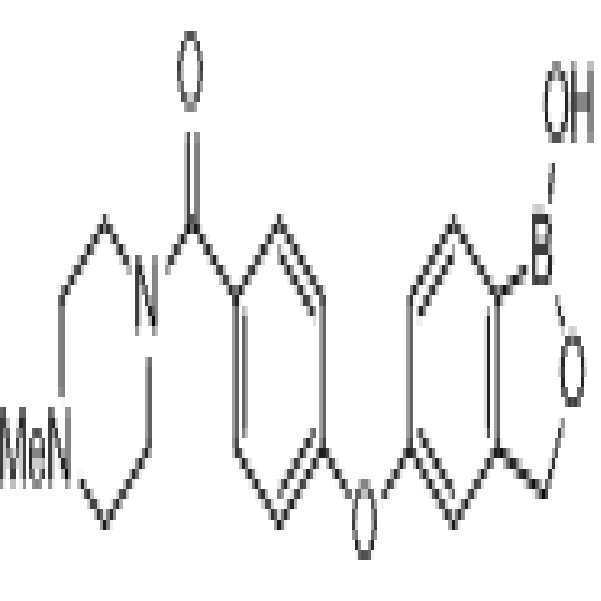


예시적인 구체예에서, 포스포디에스테라제는 PDE1, PDE2, PDE3, PDE4, PDE5, PDE6, PDE7, PDE8, PDE9, PDE10 및 PDE11에서 선택된 멤버이다. 예시적인 구체예에서, 포스포디에스테라제는 PDE4이다. 예시적인 구체예에서, PDE4는 PDE4A, PDE4B, PDE4C 및 PDE4D에서 선택된 멤버이다. 예시적인 구체예에서, PDE4는 PDE4B이다. 예시적인 구체예에서, 포스포디에스테라제는 PDE7이다.In an exemplary embodiment, the phosphodiesterase is a member selected from PDEl, PDE2, PDE3, PDE4, PDE5, PDE6, PDE7, PDE8, PDE9, PDE10 and PDE11. In an exemplary embodiment, the phosphodiesterase is PDE4. In an exemplary embodiment, PDE4 is a member selected from PDE4A, PDE4B, PDE4C and PDE4D. In an exemplary embodiment, PDE4 is PDE4B. In an exemplary embodiment, the phosphodiesterase is PDE7.
예시적인 구체예에서, 본 발명은, 포스포디에스테라제4 (PDE4)를 저해하지만 PDE1, PDE2, PDE3, PDE5 및 PDE6에서 선택된 멤버인 PDE중 최소 하나를 상당히 저해하지 않고, 세포를 본 발명의 화합물과 접촉시켜 상기 저해를 제공하는 것을 포함한다. 대표적인 화합물은 C27이다. In an exemplary embodiment, the invention provides a method of inhibiting phosphodiesterase 4 (PDE4) but not significantly inhibiting at least one of the PDEs selected from PDEl, PDE2, PDE3, PDE5 and PDE6, Lt; RTI ID = 0.0 > inhibiting < / RTI > A representative compound is C27 .
또 다른 대표적인 구체예에서, 본 발명은 포스포디에스테라제4 (PDE4)를 저해하는 방법을 제공하는데, 상기 방법은 다음을 포함한다: 포스포디에스테라제를 C17, 또는 이의 약리학적으로 수용가능한 염과 접촉시킴, 이때, 포스포디에스테라제4 (PDE4)가 저해된다. 또 다른 대표적인 구체예에서, 본 발명은 포스포디에스테라제7 (PDE7)을 저해하는 방법을 제공하는데, 상기 방법은 다음을 포함한다: 포스포디에스테라제를 C17, 또는 이의 약리학적으로 수용가능한 염과 접촉시킴, 이때, 포스포디에스테라제7 (PDE7)이 저해된다. 또 다른 대표적인 구체예에서, 본 발명은 포스포디에스테라제4 (PDE4)를 저해하는 방법을 제공하는데, 상기 방법은 다음을 포함한다: 포스포디에스테라제를 C27, 또는 이의 약리학적으로 수용가능한 염과 접촉시킴, 이때, 포스포디에스테라제4 (PDE4)가 저해된다. 또 다른 대표적인 구체예에서, 본 발명은 포스포디에스테라제7 (PDE7)을 저해하는 방법을 제공하는데, 상기 방법은 다음을 포함한다: 포스포디에스테라제를 C27, 또는 이의 약리학적으로 수용가능한 염과 접촉시킴, 이때, 포스포디에스테라제7 (PDE7)이 저해된다. 예시적인 구체예에서, 화합물의 양은 치료요법적으로 효과적인 양이다.In another exemplary embodiment, the present invention provides a method of inhibiting phosphodiesterase 4 (PDE4), comprising: contacting phosphodiesterase with C17 , or a pharmacologically acceptable (PDE4) is inhibited at this time. In another exemplary embodiment, the present invention provides a method of inhibiting phosphodiesterase 7 (PDE7) comprising: contacting a phosphodiesterase with C17 , or a pharmacologically acceptable (PDE7) is inhibited at this time. In another exemplary embodiment, the present invention provides a method of inhibiting phosphodiesterase 4 (PDE4) comprising: administering phosphodiesterase to C27 , or a pharmacologically acceptable (PDE4) is inhibited at this time. In another exemplary embodiment, the present invention provides a method of inhibiting phosphodiesterase 7 (PDE7) comprising: contacting phosphodiesterase with C27 , or a pharmacologically acceptable (PDE7) is inhibited at this time. In an exemplary embodiment, the amount of compound is therapeutically effective in an amount.
또 다른 대표적인 구체예에서, 본 발명은 포스포디에스테라제4 (PDE4)를 저해하는 방법을 제공하는데, 상기 방법은 다음을 포함한다: 포스포디에스테라제를 C23 또는 C24 또는 C25, 또는 이의 약리학적으로 수용가능한 염과 접촉시킴, 이때, 포스포디에스테라제4 (PDE4)가 저해된다.In another exemplary embodiment, the present invention provides a method of inhibiting phosphodiesterase 4 (PDE4) comprising: administering phosphodiesterase to C23 or C24 or C25 , or a pharmacological < RTI ID = 0.0 & (PDE4) is inhibited when the compound is contacted with an < RTI ID = 0.0 > pharmaceutically < / RTI >
또 다른 대표적인 구체예에서, 본 발명은 포스포디에스테라제4 (PDE4)를 저해하는 방법을 제공하는데, 상기 방법은 다음을 포함한다: 포스포디에스테라제를 D46 또는 D86 또는 D99 또는 D100 또는 D107 또는 D108 또는 D114 또는 D122 또는 D125 또는 D126 또는 D127 또는 D128 또는 D131 또는 D140 및 D141, 또는 이의 약리학적으로 수용가능한 염과 접촉시킴, 이때, 포스포디에스테라제4 (PDE4)가 저해된다.In another exemplary embodiment, the present invention provides a method of inhibiting phosphodiesterase 4 (PDE4) comprising: contacting phosphodiesterase with D46 or D86 or D99 or D100 or D107 or D108 or D114 or D122 or D125 or D126 or D127 or D128 or D131 or D140, and D141, or pharmacologically acceptable Sikkim ever contact with the salts thereof, at this time, the phosphodiesterase 4 (PDE4) is inhibited.
또 다른 대표적인 구체예에서, 본 발명은 포스포디에스테라제4 (PDE4)를 저해하는 방법을 제공하는데, 상기 방법은 다음을 포함한다: 포스포디에스테라제를 D95 또는 D96 또는 D97 또는 D102 또는 D110 또는 D111 또는 D113 또는 D115 또는 D121 또는 D129 또는 D130 또는 D132, 및, 또는 이의 약리학적으로 수용가능한 염과 접촉시킴, 이때, 포스포디에스테라제4 (PDE4)가 저해된다.In another exemplary embodiment, the present invention provides a method of inhibiting phosphodiesterase 4 (PDE4) comprising: contacting phosphodiesterase with D95 or D96 or D97 or D102 or D110 Or D111 or D113 or D115 or D121 or D129 or D130 or D132 and / or a pharmacologically acceptable salt thereof, wherein phosphodiesterase 4 (PDE4) is inhibited.
또 다른 대표적인 구체예에서, 본 발명은 포스포디에스테라제4 (PDE4)를 저해하는 방법을 제공하는데, 상기 방법은 다음을 포함한다: 포스포디에스테라제를 D47 또는 D109 또는 D116 또는 D118 또는 D119 또는 D120 또는 D123, 및, 또는 이의 약리학적으로 수용가능한 염과 접촉시킴, 이때, 포스포디에스테라제4 (PDE4)가 저해된다.In another exemplary embodiment, the present invention provides a method of inhibiting phosphodiesterase 4 (PDE4) comprising: administering phosphodiesterase to D47 or D109 or D116 or D118 or D119 Or D120 or D123, and / or a pharmacologically acceptable salt thereof, wherein phosphodiesterase 4 (PDE4) is inhibited.
또 다른 대표적인 구체예에서, 본 발명은 포스포디에스테라제4 (PDE4)를 저해하는 방법을 제공하는데, 상기 방법은 다음을 포함한다: 포스포디에스테라제를 D98 또는 D101 또는 D106, 및, 또는 이의 약리학적으로 수용가능한 염과 접촉시킴, 이때, 포스포디에스테라제4 (PDE4)가 저해된다.In another exemplary embodiment, the invention provides a method of inhibiting phosphodiesterase 4 (PDE4) comprising: contacting phosphodiesterase with D98 or D101 or D106 , and, or With a pharmacologically acceptable salt thereof, wherein phosphodiesterase 4 (PDE4) is inhibited.
또 다른 대표적인 구체예에서, 본 발명은 포스포디에스테라제4 (PDE4)를 저해하는 방법을 제공하는데, 상기 방법은 다음을 포함한다: 포스포디에스테라제를 D11 또는 D12 또는 D37 또는 D38 또는 D39 또는 D40 또는 D41 또는 D42 또는 D43 또는 D124 또는 D142 또는 D143 또는 D146, 및, 또는 이의 약리학적으로 수용가능한 염과 접촉시킴, 이때, 포스포디에스테라제4 (PDE4)가 저해된다.In another exemplary embodiment, the present invention provides a method of inhibiting phosphodiesterase 4 (PDE4), comprising: contacting a phosphodiesterase with D11 or D12 or D37 or D38 or D39 Or D40 or D41 or D42 or D43 or D124 or D142 or D143 or D146 and / or a pharmacologically acceptable salt thereof, wherein the phosphodiesterase 4 (PDE4) is inhibited.
또 다른 대표적인 구체예에서, 본 발명은 포스포디에스테라제4 (PDE4)를 저해하는 방법을 제공하는데, 상기 방법은 다음을 포함한다: 포스포디에스테라제를 D14 또는 D15 또는 D16 또는 D17 또는 D28 또는 D29 또는 D30 또는 D31 또는 D133 또는 D134 또는 D135 또는 D144 또는 D145 또는 D147, 및, 또는 이의 약리학적으로 수용가능한 염과 접촉시킴, 이때, 포스포디에스테라제4 (PDE4)가 저해된다.In another exemplary embodiment, the present invention provides a method of inhibiting phosphodiesterase 4 (PDE4) comprising: contacting phosphodiesterase with D14 or D15 or D16 or D17 or D28 or D29 or D30 or D31 or D133 or D134 or D135 or D144 or D145 or D147, and, or contacting and its pharmacologically acceptable salts, wherein, phosphodiesterase 4 (PDE4) is inhibited.
예시적인 구체예에서, 여기에서 설명된 임의의 방법에 있어서, 본 발명의 화합물 또는 여기에서 나타난 화학식에 의하여 기재되는 화합물이 여기에서 설명된 포스포디에스테라제를 최소 약 5 내지 약 100%, 또는 최소 약 30 내지 약 100%, 40 내지 약 100%, 또는 최소 약 50 내지 약 100%, 또는 최소 약 60 내지 약 100%, 또는 최소 약 70 내지 약 100%, 또는 최소 약 80 내지 약 100%, 또는 최소 약 90 내지 약 100%, 또는 최소 약 30 내지 약 70%, 또는 최소 약 40 내지 약 90%, 또는 최소 약 45 내지 약 80%, 또는 최소 약 55 내지 약 75%, 또는 최소 약 75 내지 약 98%, 또는 최소 약 55 내지 약 99%, 또는 최소 약 5% 내지 약 20% 또는 최소 약 10% 내지 약 25% 저해할 양으로 존재한다. 예시적인 구체예에서, 본 발명의 화합물은 여기에서 설명된 화합물 또는 이의 약리학적으로 수용가능한 염이다.In an exemplary embodiment, in any of the methods described herein, a compound of the invention, or a compound represented by the formula presented herein, comprises at least about 5 to about 100% of the phosphodiesterase described herein, or At least about 30 to about 100%, 40 to about 100%, or at least about 50 to about 100%, or at least about 60 to about 100%, or at least about 70 to about 100%, or at least about 80 to about 100% Or at least about 90 to about 100%, or at least about 30 to about 70%, or at least about 40 to about 90%, or at least about 45 to about 80%, or at least about 55 to about 75% , At least about 98%, or at least about 55% to about 99%, or at least about 5% to about 20%, or at least about 10% to about 25%. In an exemplary embodiment, the compounds of the present invention are the compounds described herein or their pharmacologically acceptable salts.
f) 이상 및 효과f) Idealities and effects
또 다른 측면에서, 본 발명은 동물에서 이상을 치료 및/또는 예방하는 방법, 및/또는 효과를 강화시키는 방법을 제공하는데, 상기 방법은 동물에게 효과량의 본 발명의 화합물을 투여하여 이상을 치료 및/또는 예방하는 것을 포함한다. 예시적인 구체예에서, 본 발명의 화합물은 여기에서 설명된 화합물이다. 예시적인 구체예에서, 본 발명의 화합물은 여기에서 설명된 화합물의 약리학적으로 수용가능한 염이다. 예시적인 구체예에서, 효과량은 이상을 치료하기에 효과적인 양이다. 예시적인 구체예에서, 효과량은 이상을 예방하기에 효과적인 양이다. 예시적인 구체예에서, 동물은 별도로 명시하지 않으면 본 발명의 화합물을 사용하는 치료가 필요하다. 예시적인 구체예에서, 화합물은 여기에서 설명된 화학식에 따른다. 또 다른 측면에서, 본 발명은 치료가 필요한 동물에서 이상을 치료하는 방법을 제공하는데, 상기 방법은 동물에게 상당한 양의 본 발명의 화합물을 투여하여 이상을 치료하는 것을 포함한다. 또 다른 측면에서, 본 발명은 치료가 필요한 동물에서 이상을 치료하는 방법을 제공하는데, 상기 방법은 동물에게 치료요법적으로 효과량의 본 발명의 화합물을 투여하여 이상을 치료하는 것을 포함한다. 또 다른 측면에서, 본 발명은 동물에서 이상을 예방하는 방법을 제공하는데, 상기 방법은 동물에게 상당한 양의 본 발명의 화합물을 투여하여 이상을 예방하는 것을 포함한다. 또 다른 측면에서, 본 발명은 동물에서 효과를 강화시키는 방법을 제공하는데, 상기 방법은 동물에게 효과량의 본 발명의 화합물을 투여하여 효과를 강화시키는 것을 포함한다. 예시적인 구체예에서, 화합물은 제목이 "포스포디에스테라제 저해"인 단락에 설명된 화학식에 따른다. 예시적인 구체예에서, 화합물은 C1, C2, C3, C4, C5, C6, C7, C8, C9, C10, C11, C12, C13, C14, C15, C16, C17, C18, C19, C20, C21, C22, C23, C24, C25, C26, C27, C28, C29, C30, C31, C32, C33, C34, C35, C36, C37, C38, C39, C40, C41, C42, C43, C44, C45, C46, C47, C48, C49, C50, C51, C52, C53, C54, C55, C56, C57, C58, C59, C60, C61, C62, C63, C64, C65, C66, C67, C68, C69, C70, C71, C72, C73, C74, C75, C76, C77, C78, C79, C80, C81, C82, C83, C84, C85, C86, C87, C88, C89, C90, C91, C92, C93, C94, C95, C96, C97, C98, C99 및 C100에서 선택된 멤버이다. 예시적인 구체예에서, 화합물은 D1, D2, D3, D4, D5, D6, D7, D8, D9, D10, D11, D12, D13, D14, D15, D16, D17, D18, D19, D20, D21, D22, D23, D24, D25, D26, D27, D28, D29, D30, D31, D32, D33, D34, D35, D36, D37, D38, D39, D40, D41, D42, D43, D44, D45, D46, D47, D48, D49, D50, D51, D52, D53, D54, D55, D56, D57, D58, D59, D60, D61, D62, D63, D64, D65, D66, D67, D68, D69, D70, D71, D72, D73, D74, D75, D76, D77, D78, D79, D80, D81, D82, D83, D84, D85, D86, D87, D88, D89, D90, D91, D92, D93, D94, D95, D96, D97, D98, D99, D100, D101, D102, D103, D104, D105, D106, D107, D108, D109, D110, D111, D112, D113, D114, D115, D116, D117, D118, D119, D120, D121, D122, D123, D124, D125, D126, D127, D128, D129, D130, D131, D132, D133, D134, D135, D136, D137, D138, D139, D140, D141, D142, D143, D144, D145, D146, D147, D148, D149, D150, D151, D152, D153, D154, D155, D156, D157, D158, D159, D160, D161, D162, D163, D164, D165, D166, D167, D168, D169, D170, D171, D172, D173, D174, D175, D176, D177, D178, D179, D180, D181, D182, D183, D184, D185, D186, D187, D188, D189, D190, D191, D192, D193, D194, D195, D196, D197, D198, D199, D200, D201, D202, D203, D204, D205, D206, D207, D208, D209, D210, D211, D212, D213, D214, D215, D216, D217, D218, D219, D220, D221, D222, D223, D224, D225, D226, D227, D228 및 D229에서 선택된 멤버이다. 예시적인 구체예에서, 화합물은 C17 또는 이의 약리학적으로 수용가능한 염이다. 예시적인 구체예에서, 화합물은 C27 또는 이의 약리학적으로 수용가능한 염이다. 예시적인 구체예에서, 화합물은 D46, D86, D99, D100, D107, D108, D114, D122, D125, D126, D127, D128, D131, D140 및 D141, 및 이의 염에서 선택된 멤버이다. 예시적인 구체예에서, 화합물은 D95, D96, D97, D102, D110, D111, D113, D115, D121, D129, D130, D132, 및 이의 염에서 선택된 멤버이다. 예시적인 구체예에서, 화합물은 D47, D109, D116, D118, D119, D120, D123, 및 이의 염에서 선택된 멤버이다. 예시적인 구체예에서, 화합물은 D98, D101, D106, 및 이의 염에서 선택된 멤버이다. 예시적인 구체예에서, 화합물은 D11, D12, D37, D38, D39, D40, D41, D42, D43, D124, D142, D143, D146, 및 이의 염에서 선택된 멤버이다. 예시적인 구체예에서, 화합물은 D14, D15, D16, D17, D28, D29, D30, D31, D133, D134, D135, D144, D145, D147, 및 이의 염에서 선택된 멤버이다In another aspect, the invention provides a method of treating and / or preventing an anomaly in an animal, and / or a method of enhancing effect, comprising administering an effective amount of a compound of the invention to an animal, And / or preventing. In an exemplary embodiment, the compounds of the present invention are the compounds described herein. In an exemplary embodiment, the compounds of the present invention are pharmacologically acceptable salts of the compounds described herein. In an exemplary embodiment, the effective amount is an amount effective to treat the disorder. In an exemplary embodiment, the effective amount is an amount effective to prevent the disorder. In an exemplary embodiment, the animals need treatment using the compounds of the present invention unless otherwise specified. In an exemplary embodiment, the compound is according to the formula described herein. In another aspect, the invention provides a method of treating an abnormality in an animal in need of such treatment, said method comprising administering to said animal a significant amount of a compound of the invention to treat the disorder. In another aspect, the invention provides a method of treating an abnormality in an animal in need of such treatment, said method comprising administering to said animal a therapeutically effective amount of a compound of the invention. In another aspect, the invention provides a method of preventing an abnormality in an animal, comprising administering to the animal a significant amount of a compound of the invention to prevent the disorder. In another aspect, the invention provides a method of enhancing an effect in an animal comprising administering to the animal an effective amount of a compound of the invention to enhance the effect. In an exemplary embodiment, the compound is according to the formula described in the paragraph titled "phosphodiesterase inhibition ". In an exemplary embodiment, the compound is selected from the group consisting of C1, C2, C3, C4, C5, C6, C7, C8, C9, C10, C11, C12, C13, C14, C15, C16, C17, C18, C19, C22, C23, C24, C25, C26, C27, C28, C29, C30, C31, C32, C33, C34, C35, C36, C37, C38, C39, C40, C41, C42, C43, C44, C47, C48, C49, C50, C51, C52, C53, C54, C55, C56, C57, C58, C59, C60, C61, C62, C63, C64, C65, C66, C67, C68, C69, C72, C73, C74, C75, C76, C77, C78, C79, C80, C81, C82, C83, C84, C85, C86, C87, C88, C89, C90, C91, C92, C93, C97, C98, C99, and C100 . In an exemplary embodiment, the compound is selected from the group consisting of D1, D2, D3, D4, D5, D6, D7, D8, D9, D10, D11, D12, D13, D14, D15, D16, D17, D18, D19, D22, D23, D24, D25, D26, D27, D28, D29, D30, D31, D32, D33, D34, D35, D36, D37, D38, D39, D40, D41, D42, D43, D47, D48, D49, D50, D51, D52, D53, D54, D55, D56, D57, D58, D59, D60, D61, D62, D63, D64, D65, D66, D67, D68, D72 D73 D74 D75 D76 D77 D78 D79 D80 D81 D82 D83 D84 D85 D86 D87 D88 D89 D90 D91 D92 D93 D94 D95 D96 , D97, D98, D99, D100, D101, D102, D103, D104, D105, D106, D107, D108, D109, D110, D111, D112, D113, D114, D115, D116, D117, D118, D119, D120, D121, D122, D123, D124, D125, D126, D127, D128, D129, D130, D131, D132, D133, D134, D135, D136, D137, D138, D139, D140, D141, D142, D143, D144, D145, D146, D147, D148, D149, D150, D151, D152, D153, D154, D155, D156, D157, D158, D159, D160, D161, D162, D163, D164, D165, D166, D167, D168, D171, D172, D173, D174, D175, D176, D177, D178, D179, D180, D181, D182, D183, D184, D185, D186, D187, D188, D189, D190, D191, D192, D193, D194, D195 , D196, D197, D198, D199, D200, D201, D202, D203, D204, D205, D206, D207, D208, D209, D210, D211, D212, D213, D214, D215, D216, D217, D218, D219, D220 , D221, D222, D223, D224, D225, D226, D227, D228 and D229 . In an exemplary embodiment, the compound is C17 or a pharmacologically acceptable salt thereof. In an exemplary embodiment, the compound is C27 or a pharmacologically acceptable salt thereof. In an exemplary embodiment, the compound is a member selected from D46, D86, D99, D100, D107, D108, D114, D122, D125, D126, D127, D128, D131, D140 and D141 , In an exemplary embodiment, the compound is a member selected from D95, D96, D97, D102, D110, D111, D113, D115, D121, D129, D130, D132 , and salts thereof. In an exemplary embodiment, the compound is a member selected from D47, D109, D116, D118, D119, D120, D123, and salts thereof. In an exemplary embodiment, the compound is a member selected from D98, D101, D106, and salts thereof. In an exemplary embodiment, the compound is a member selected from D11, D12, D37, D38, D39, D40, D41, D42, D43, D124, D142, D143, D146, In an exemplary embodiment, the compound is a member selected from D14, D15, D16, D17, D28, D29, D30, D31, D133, D134, D135, D144, D145, D147,
예시적인 구체예에서, 이상은 질환이다. 예시적인 구체예에서, 이상은 염증성-관련 이상이다. 예시적인 구체예에서, 이상은 사이토킨 및/또는 케모킨의 생산의 증가를 포함한다. 예시적인 구체예에서, 이상은 사이토킨 및/또는 케모킨의 생산의 감소를 포함한다. 예시적인 구체예에서, 이상은 사이토킨 및/또는 케모킨 방출의 증가를 포함한다. 예시적인 구체예에서, 이상은 사이토킨 및/또는 케모킨 방출의 감소를 포함한다. 예시적인 구체예에서, 이상은 포스포디에스테라제의 저해를 포함한다. 예시적인 구체예에서, 화합물은 전-염증성 사이토킨 발현을 저해하거나 항-염증성 사이토킨 발현을 촉진하여 염증성-관련 질환을 치료하기에 충분한 양이지만, 상기 양은 실질적으로 사이클린 의존성 키나아제를 저해하기에 충분한 것보다 적다. 예시적인 구체예에서, 이상은 사이토킨에 의하여 매개된다. 예시적인 구체예에서, 이상은 케모킨에 의하여 매개된다. 예시적인 구체예에서, 이상은 호중구에 의하여 매개된다. 예시적인 구체예에서, 이상은 포스포디에스테라제에 의하여 매개된다. 예시적인 구체예에서, 이상은 포스포디에스테라제-4에 의하여 매개된다. 예시적인 구체예에서, 이상은 포스포디에스테라제-7에 의하여 매개된다. In an exemplary embodiment, the disorder is a disease. In an exemplary embodiment, the disorder is inflammatory-related abnormal. In an exemplary embodiment, the above includes an increase in the production of cytokines and / or chemokines. In an exemplary embodiment, the above includes a decrease in the production of cytokines and / or chemokines. In an exemplary embodiment, the above includes an increase in cytokine and / or chemokine release. In an exemplary embodiment, the above includes a decrease in cytokine and / or chemokine release. In an exemplary embodiment, the foregoing includes the inhibition of phosphodiesterase. In an exemplary embodiment, the compound is in an amount sufficient to inhibit pro-inflammatory cytokine expression or to promote anti-inflammatory cytokine expression to treat an inflammatory-related disorder, but the amount is substantially less than sufficient to inhibit the cyclin dependent kinase little. In an exemplary embodiment, the disorder is mediated by cytokines. In an exemplary embodiment, the disorder is mediated by chemokines. In an exemplary embodiment, the disorder is mediated by neutrophils. In an exemplary embodiment, the above is mediated by phosphodiesterase. In an exemplary embodiment, the above is mediated by phosphodiesterase-4. In an exemplary embodiment, the disorder is mediated by phosphodiesterase-7.
예시적인 구체예에서, 이상은 치주염, 건성 각결막염, 류마티스 관절염, 골관절염, Crohn 질환, 궤양성 대장염, 건선형 관절염, 외상성 관절염, 풍진성 관절염, 염증성 장 질환, 다발성 경화증, 건선, 이식 편대 숙주 질환, 전신 홍반성 낭창, 피부 홍반성 낭창, 독성 쇼크 증후군, 과민성 장 증후군, 근육 변성, 동종이식 거부, 췌장염, 타입 I 당뇨(insulinitis), 사구체신염, 당뇨병성 신장병증, 신장 섬유증, 만성 신부전, 통풍, 나병, 급성 윤활막염, Reiter 증후군, 통풍성 관절염, Behcet 질환, 척추염, 자궁내막증, 비관절성 염증성 이상, 예컨대 추간판 증후군 이상, 윤활낭염, 건염, 건활막염 또는 섬유근육통 증후군; 및 신경 통증, 신경병증, 다발성신경병증, 당뇨-관련 다발성신경병증, 외상, 편두통, 긴장형 및 군발 두통, Horton 질환, 정맥류 궤양, 신경통, 근-골격 통증, 골-외상성 통증, 골절, 동통성 발육 이상, 척추관절염, 섬유근육통, 환상 사지 통증, 등 통증, 척추 통증, 수술 후 통증, 탈출된 추간판-유발된 좌골신경통, 암-관련 통증, 혈관 통증, 내장 통증, 분만, 또는 HIV-관련 통증을 포함하지만 이에 국한되지는 않는 급성 또는 만성 통증에서 선택된 멤버이다. 다른 사이토킨 매개된 질환은 알레르기, 대사 질환, 화학요법/방사능 관련 합병증; 타입 I 당뇨; 타입 II 당뇨; 간 질환; 위장 질환; 안과 질환; 알레르기성 결막염; 당뇨성 망막증; Sjogren 증후군; 포도막염; 폐 질환, 신장 질환; 피부염; HIV-관련 악액질; 대뇌 말라리아; 강직성 척수염; 나병; 빈혈증; 섬유근육통, 신부전, 발작, 만성 심부전, 내독소혈증, 재관류 손상, 허혈 재관류, 심근 허혈, 재협착, 혈전증, 혈관신생, 관상 심장 질환, 관상 동맥 질환, 급성 관상 증후군, Takayasu 동맥염, 심부전과 같은 심장 기능상실, 대동맥 판막 협착증, 심근병증, 심근염, 혈관염, 혈관 재협착, 판막 질환 또는 관상 동맥 우회; 과콜레스테롤혈증, 혈액 응고 또는 섬유소 용해와 관련된 질환 또는 이상, 예컨대, 급성 정맥 혈전증, 폐색전증, 임신 동안의 혈전증, 출혈성 피부 괴사, 급성 또는 만성 파종성 혈관내 응고 (DIC), 수술로 인한 응괴 형성, 장기 침상 안정 또는 장기간의 거동제한, 정맥 혈전증, 전격 수막구균균혈증, 급성 혈전성 뇌졸중, 급성 관상 폐색, 급성 말초 동맥 폐색, 대량 폐색전증, 액와 정맥 혈전증, 대량 장대퇴 정맥 혈전증, 폐색 동맥 또는 정맥 삽관, 심근병증, 간의 정맥폐색성 질환, 저혈압, 감소된 심장 박출량, 감소된 혈관 저항, 폐 고혈압, 감소된 폐 탄성, 백혈구감소증 또는 저혈소판증; 또는 아테롬성동맥경화증이다. In an exemplary embodiment, the disorder is selected from the group consisting of periodontitis, dry keratoconjunctivitis, rheumatoid arthritis, osteoarthritis, Crohn's disease, ulcerative colitis, pruritic arthritis, traumatic arthritis, rheumatoid arthritis, inflammatory bowel disease, multiple sclerosis, psoriasis, , Type I diabetes, insulinitis, glomerulonephritis, diabetic nephropathy, renal fibrosis, chronic renal failure, gout, urinary incontinence, irritable bowel syndrome, irritable bowel syndrome, muscular degeneration, allograft lupus, , Leprosy, acute synovitis, Reiter's syndrome, gouty arthritis, Behcet's disease, spondylitis, endometriosis, non-arthritic inflammatory disorders such as intervertebral disc syndrome, lubublocia, tendinitis, synovitis or fibromyalgia syndrome; And neuralgia, neuropathy, multiple neuropathy, diabetic-related polyneuropathy, trauma, migraine, tension and arm headache, Horton's disease, varicose ulceration, neuralgia, muscle-skeletal pain, bone-traumatic pain, fracture, Induced sciatica, cancer-related pain, vascular pain, visceral pain, childbirth, or HIV-related pain, including, but not limited to, diabetic neuropathy, dysmenorrhea, spinal arthritis, fibromyalgia, phantom limb pain, back pain, spinal pain, Including, but not limited to, acute or chronic pain. Other cytokine mediated diseases include allergies, metabolic diseases, chemotherapy / radiation-related complications; Type I diabetes; Type II diabetes; Liver disease; Gastrointestinal disease; Eye disease; Allergic conjunctivitis; Diabetic retinopathy; Sjogren's syndrome; Uveitis; Lung disease, kidney disease; dermatitis; HIV-associated cachexia; Cerebral malaria; Ankylosing spondylitis; leprosy; anemia; Myocardial ischemia, restenosis, thrombosis, angiogenesis, coronary heart disease, coronary artery disease, acute coronary syndrome, Takayasu arteritis, heart failure, etc., such as fibromyalgia, renal failure, seizure, chronic heart failure, endotoxemia, reperfusion injury, Loss of function, aortic valve stenosis, cardiomyopathy, myocarditis, vasculitis, vascular restenosis, valve disease or coronary artery bypass; And diseases or disorders associated with cholesterol, blood clotting or fibrinolysis, such as acute venous thrombosis, pulmonary embolism, thrombosis during pregnancy, hemorrhagic skin necrosis, acute or chronic disseminated intravascular coagulation (DIC) Acute myocardial infarction, acute coronary stenosis, acute peripheral arterial occlusion, massive pulmonary embolism, acute venous thrombosis, massive femoral venous thrombosis, obstructive arterial or venous intubation, venous thrombosis, acute thrombotic stroke, Cardiomyopathy, hepatic vein occlusive disease, hypotension, decreased cardiac output, decreased vascular resistance, pulmonary hypertension, decreased pulmonary elasticity, leukopenia or hypoplasia; Or atherosclerosis.
예시적인 구체예에서, 이상은 알레르기성 결막염, 포도막염, 녹내장, 시각 신경염, 망막 허혈, 당뇨성 망막증, 레이저 유발된 눈 손상, 또는 수술 또는 외상-유도된 증식성 유리체망막병증에서 선택된 멤버이다. In an exemplary embodiment, the disorder is a member selected from allergic conjunctivitis, uveitis, glaucoma, optic neuritis, retinal ischemia, diabetic retinopathy, laser induced eye damage, or surgery or trauma-induced proliferative vitreoretinopathy.
예시적인 구체예에서, 이상은 알레르기성 비염, 천식, 성인 호흡곤란 증후군, 만성 폐 염증, 만성 폐색성 폐 질환, 폐기종, 기관지염, 점액 과다분비, 규폐증, SARS 감염 및 기도 염증에서 선택된 멤버이다. In an exemplary embodiment, the disorder is a member selected from allergic rhinitis, asthma, adult respiratory distress syndrome, chronic lung inflammation, chronic obstructive pulmonary disease, emphysema, bronchitis, mucus hypersecretion, silicosis, SARS infection and airway inflammation.
예시적인 구체예에서, 이상은 건선, 습진, 아토피성 피부염, 접촉 피부염, 염증성 탈모 또는 여드름에서 선택된 멤버이다. In an exemplary embodiment, the disorder is a member selected from psoriasis, eczema, atopic dermatitis, contact dermatitis, inflammatory hair loss or acne.
예시적인 구체예에서, 이상은 Guillain-Barre 증후군, 파킨슨 질환, 헌팅톤 질환, 알츠하이머 질환, 근위축성 측삭 경화증, 다발성 경화증 및 다른 탈수초성 질환, 바이러스성 및 박테리아성 수막염, CNS 외상, 척수손상, 발작, 경련, 올리브교소뇌위축, AIDS 치매 복합, MERRF 및 MELAS 증후군, Leber 질환, Wemicke 뇌병증, Rett 증후군, 호모시스테인뇨증, 과프롤린혈증, 과호모시스테인혈증, 비케톤 과글라이신혈증, 하이드록시부티르 아미노산뇨증, 아황산염 산화효소 결핍증, 복합 계통 질환, 납중독 뇌병증, Tourett 증후군, 간성 뇌병증, 약물 중독, 약물 내성, 약물 의존, 우울증, 주의력 결핍 장애 (ADD), 불안 및 정신분열, 동맥류, 또는 간질에서 선택된 멤버이다. In an exemplary embodiment, the disorder is selected from the group consisting of Guillain-Barre syndrome, Parkinson's disease, Huntington's disease, Alzheimer's disease, amyotrophic lateral sclerosis, multiple sclerosis and other dehydrating diseases, viral and bacterial meningitis, CNS trauma, , Seizures, olivocele brainstem, AIDS dementia complex, MERRF and MELAS syndrome, Leber disease, Wemicke encephalopathy, Rett syndrome, homocysteinuria, hyperprolactinemia, hyperhomocysteinemia, biketon and glycineemia, hydroxybutyrate, A member selected from the group consisting of anorexia nervosa, oxidative enzyme deficiency syndrome, multiple system disease, lead poisoning encephalopathy, Tourett's syndrome, hepatic encephalopathy, drug addiction, drug resistance, drug dependence, depression, attention deficit disorder (ADD), anxiety and schizophrenia,
예시적인 구체예에서, 이상은 골흡수 질환, 골화석증, 골다공증, 또는 골관절염에서 선택된 멤버이다. In an exemplary embodiment, the disorder is a member selected from a bone resorption disease, osteoporosis, osteoporosis, or osteoarthritis.
예시적인 구체예에서, 이상은 당뇨, 전신 악액질, 감염 또는 악성종양 속발 악액질, 후천성 면역 결핍 증후군 (AIDS) 속발 악액질, 비만, 식욕부진 또는 신경성 폭식증에서 선택된 멤버이다. 예시적인 구체예에서, 이상은 패혈증, HIV, HCV, 말라리아, 감염성 관절염, 리슈만편모충증, Lyme 질환; 유방암, 결장암, 폐암, 전립선암을 포함하나 이에 국한되지 않는 암, 다발 골수종, 급성 골수성 백혈병, 골수이형성 증후군, 비-호지킨 림프종, 또는 여포성 림프종, Castleman 질환, 또는 약물 저항에서 선택된 멤버이다. In an exemplary embodiment, the disorder is a member selected from diabetes, general cachexia, infection or malignant neoplasm cachexia, acquired immunodeficiency syndrome (AIDS) cachexia, obesity, anorexia or bulimia nervosa. In an exemplary embodiment, the disorder is selected from the group consisting of sepsis, HIV, HCV, malaria, infectious arthritis, Leishmaniasis, Lyme disease; Is a member selected from cancer, multiple myeloma, acute myelogenous leukemia, myelodysplastic syndrome, non-Hodgkin's lymphoma, or follicular lymphoma, Castleman's disease, or drug resistance, including but not limited to breast cancer, colon cancer, lung cancer, prostate cancer.
예시적인 구체예에서, 이상은 기관지 천식, 비염, 인플루엔자, 발작, 심근 경색, 열손상, 성인 호흡곤란 증후군 (ARDS), 외상 속발 다발성 장기 손상, 급성 사구체신염, 급성 염증 요인을 가지는 피부증, 급성 화농성 수막염, 혈액투석, 백혈구성분채집, 과립구 수혈 관련 증후군, 또는 괴사성 전장염에서 선택된 멤버이다.In an exemplary embodiment, the disorder is selected from the group consisting of bronchial asthma, rhinitis, influenza, seizures, myocardial infarction, thermal injury, adult respiratory distress syndrome (ARDS), traumatic multiple organ injury, acute glomerulonephritis, Purulent meningitis, hemodialysis, leukocyte collection, granulocyte transfusion-related syndrome, or necrotizing enteritis.
예시적인 구체예에서, 이상은 염증성 장 질환 (IBD), 건선, 류마티스 관절염 (RA), 다발성 경화증 (MS), 신경퇴행성 질환, 심혈관 질환 (CVD) 및 아테롬성동맥경화증, 및 대사 질환 (대사 증후군 및 당뇨) 뿐만 아니라 감염-관련 염증에서 선택된 멤버이다. 예시적인 구체예에서, 이상은 알츠하이머 질환 및 파킨슨 질환에서 선택된 멤버인 신경퇴행성 질환이다. 예시적인 구체예에서, 이상은 다음으로 구성된 군에서 선택된 염증성 장 질환이다: Crohn 질환 또는 궤양성 대장염. 예시적인 구체예에서, 이상은 위장관 합병증이다. 예시적인 구체예에서, 이상은 설사이다. 예시적인 구체예에서, 이상은 셀리악 질환 및 비-특이성 대장염에서 선택된 멤버이다. 예시적인 구체예에서, 이상은 간 질환이다. 예시적인 구체예에서, 이상은 자가면역 간염, 간염 C, 원발성 담관성 간경화, 원발성 경화 담관염, 또는 전격 간부전에서 선택된 멤버이다. 예시적인 구체예에서, 이상은 골 질환이다. 예시적인 구체예에서, 이상은 골다공증이다. 예시적인 구체예에서, 이상은 폐 질환이다. 예시적인 구체예에서, 이상은 알레르기성 비염, 천식, 만성 폐색성 폐 질환, 만성 육아종 염증, 낭성 섬유증, 및 사르코이드증에서 선택된 멤버이다. 예시적인 구체예에서, 이상은 심혈관 질환이다. 예시적인 구체예에서, 심혈관 질환은 죽상경화성 심장 질환, 울혈성 심부전 및 재협착에서 선택된 멤버이다. 예시적인 구체예에서, 이상은 신장 질환이다. 예시적인 구체예에서, 이상은 사구체신염 및 혈관염에서 선택된 멤버이다. 예시적인 구체예에서, 이상은 방사선요법후 관련 질환 또는 아테롬성동맥경화증에서 선택된 멤버이다. 또 다른 구체예에서 이상은 아토피성 피부염이다. 또 다른 구체예에서 이상은 광선각화증이다.In an exemplary embodiment, the disorder is selected from the group consisting of inflammatory bowel disease (IBD), psoriasis, rheumatoid arthritis (RA), multiple sclerosis (MS), neurodegenerative diseases, cardiovascular disease (CVD) and atherosclerosis, Diabetes) as well as infection-associated inflammation. In an exemplary embodiment, the disorder is a neurodegenerative disease that is a member selected from Alzheimer ' s disease and Parkinson ' s disease. In an exemplary embodiment, the disorder is an inflammatory bowel disease selected from the group consisting of Crohn's disease or ulcerative colitis. In an exemplary embodiment, the disorder is gastrointestinal complications. In an exemplary embodiment, the disorder is diarrhea. In an exemplary embodiment, the above is a member selected from Celiac disease and non-specific colitis. In an exemplary embodiment, the disorder is liver disease. In an exemplary embodiment, the disorder is a member selected from autoimmune hepatitis, hepatitis C, primary biliary cirrhosis, primary sclerosing cholangitis, or fulminant hepatic failure. In an exemplary embodiment, the disorder is bone disease. In an exemplary embodiment, the disorder is osteoporosis. In an exemplary embodiment, the disorder is lung disease. In an exemplary embodiment, the disorder is a member selected from allergic rhinitis, asthma, chronic obstructive pulmonary disease, chronic granulomatous inflammation, cystic fibrosis, and sarcoidosis. In an exemplary embodiment, the disorder is cardiovascular disease. In an exemplary embodiment, the cardiovascular disease is a member selected from atherosclerotic heart disease, congestive heart failure, and restenosis. In an exemplary embodiment, the disorder is a kidney disease. In an exemplary embodiment, the above is a member selected from glomerulonephritis and vasculitis. In an exemplary embodiment, the above is a member selected from a radiotherapy related disorder or atherosclerosis. In another embodiment, the disorder is atopic dermatitis. In yet another embodiment, the disorder is actinic keratosis.
예시적인 구체예에서, 이상은 건선, 염증성 관절염, 류마티스 관절염, 천식, 만성 기관지염, 염증성 장 질환 (IBD), 만성 폐색성 폐 질환 (COPD), 아토피성 피부염, 두드러기, 알레르기성 비염, 알레르기성 결막염, 춘계 결막염, 대장염, 호산구 육아종, 패혈성 쇼크, 심근의 재관류 손상, 뇌의 재관류 손상, 만성 사구체신염, 내독소성 쇼크, 성인 호흡곤란 증후군, 낭성 섬유증, 동맥 재협착, 죽상동맥경화증, 각화증, 류마티스성 척추염, 골관절염, 발열, 당뇨병, 진폐증, 만성 폐색성 기도 질환, 독성 접촉 습진, 알레르기성 접촉 습진, 아토피성 습진, 지루성 습진, 단순 태선, 일광화상, 회음부 가려움증, 원형탈모증, 비후성 반흔, 원반상 홍반성 낭창, 전신 홍반성 낭창, 모낭성 농피증, 광범위 농피증, 내인성 여드름, 외인성 여드름, 여드름 장미증, Behcet 질환, 아나필락시양 자반 신장염, 백혈병, 다발성 경화증, 위장관 질환 및 자가면역 질환에서 선택된 멤버이다. 예시적인 구체예에서, 대장염은 궤양성 대장염, Crohn 대장염, 전환 대장염, 허혈성 대장염, 감염성 대장염, 전격 대장염, 화학성 대장염, 현미경적 대장염, 림프구성 대장염, 및 비정형 대장염에서 선택된 멤버이다. 예시적인 구체예에서, 대장염은 궤양성 대장염 및 Crohn 대장염에서 선택된 멤버이다. 예시적인 구체예에서, 이상은 일광화상이다. 예시적인 구체예에서, 이상은 일광화상에 의하여 야기된 염증이다. In an exemplary embodiment, the disorder is selected from psoriasis, inflammatory arthritis, rheumatoid arthritis, asthma, chronic bronchitis, inflammatory bowel disease (IBD), chronic obstructive pulmonary disease (COPD), atopic dermatitis, urticaria, allergic rhinitis, Nephrotic syndrome, adult respiratory distress syndrome, cerebral fibrosis, arterial restenosis, atherosclerosis, keratosis, cerebral infarction, cerebral infarction, cerebral infarction, cerebral infarction, Rheumatoid arthritis, osteoarthritis, fever, diabetes, pneumoconiosis, chronic obstructive airways disease, toxic contact eczema, allergic contact eczema, atopic eczema, seborrheic eczema, Behcet's disease, Acne vulgaris, Acne vulgaris, Lupus erythematosus, Acne vulgaris, Lupus erythematosus, Napil raksi amount purpura is a member selected from kidney, leukemia, multiple sclerosis, gastrointestinal diseases, and autoimmune diseases. In an exemplary embodiment, the colitis is a member selected from ulcerative colitis, Crohn's colitis, converted colitis, ischemic colitis, infectious colitis, fulminant colitis, chemical colitis, microscopic colitis, lymphoid colitis, and atypical colitis. In an exemplary embodiment, the colitis is a member selected from ulcerative colitis and Crohn ' s colitis. In an exemplary embodiment, the ideal is a daylight image. In an exemplary embodiment, the disorder is inflammation caused by sunburn.
예시적인 구체예에서, 이상은 건선이다. 예시적인 구체예에서, 건선은 플라크 건선, 굴측성 건선 (역위 건선), 적상(guttate) 건선, 농포성 건선, 손발톱 건선, 건선형 관절염 및 박탈성(erythrodermic) 건선에서 선택된 멤버이다. 예시적인 구체예에서, 건선은 플라크 건선 및 손발톱 건선에서 선택된 멤버이다. 예시적인 구체예에서, 이상은 건선이며 화합물은 C17이다. 예시적인 구체예에서, 이상은 건선이며 화합물은 C27이다. 예시적인 구체예에서, 이상은 플라크 건선 또는 손발톱 건선이며 화합물은 C17이다. 예시적인 구체예에서, 이상은 플라크 건선 또는 손발톱 건선이며 화합물은 C27이다.In an exemplary embodiment, the disorder is psoriasis. In an exemplary embodiment, the psoriasis is a member selected from plaque psoriasis, ovarian psoriasis (inverted psoriasis), guttate psoriasis, pustular psoriasis, nail psoriasis, psoriasis arthritis and erythrodermic psoriasis. In an exemplary embodiment, the psoriasis is a member selected from plaque psoriasis and nail psoriasis. In an exemplary embodiment, the disorder is psoriasis and the compound is C17 . In an exemplary embodiment, the disorder is psoriasis and the compound is C27 . In an exemplary embodiment, the above is plaque psoriasis or nail psoriasis and the compound is C17 . In an exemplary embodiment, the above is plaque psoriasis or nail psoriasis and the compound is C27 .
예시적인 구체예에서, 질환은 인지 장애 또는 저하 및 기억 장애에서 선택된 멤버이다. 예시적인 구체예에서, 기억 장애는 치매로 인한 것이다. 예시적인 구체예에서, 환자는 알츠하이머 질환, 정신분열, 파킨슨 질환, 헌팅톤 질환, Pick 질환, Creutzfeld-Jakob 질환, 우울증, 노화, 두부 외상, 발작, CNS 저산소증, 뇌 노쇠, 다발경색 치매, 급성 신경 질환, 연령-관련 인지 저하, HIV 또는 심혈관 질환으로 인한 기억 장애를 겪는다.In an exemplary embodiment, the disease is a member selected from cognitive disorders or depression and memory disorders. In an exemplary embodiment, the memory disorder is due to dementia. In an exemplary embodiment, the patient is suffering from Alzheimer's disease, schizophrenia, Parkinson's disease, Huntington's disease, Pick's disease, Creutzfeld-Jakob disease, depression, aging, head trauma, seizures, CNS hypoxia, brain aging, Disease, age-related cognitive decline, HIV or cardiovascular disease.
예시적인 구체예에서, PDE4 저해는 효과를 강화하는데, 이때, 강화된 효과는 인지 또는 기억이다.In an exemplary embodiment, PDE4 inhibition enhances the effect, wherein the enhanced effect is cognition or memory.
예시적인 구체예에서, 본 발명은 여성의 난포 성장을 자극하는 방법을 제공하는데, 상기 방법은 본 발명의 화합물을 포함하는 약제를 여성에게 투여하여는 것을 포함하며, 이로써 여성에서의 난포 성장이 자극된다. 예시적인 구체예에서, 본 발명의 화합물은 여기에서 설명된 화합물 또는 이의 약리학적으로 수용가능한 염이다. 예시적인 구체예에서, 여성은 배란 유도를 겪는다. 예시적인 구체예에서, 여성은 제어된 난소 과자극을 겪는다. 예시적인 구체예에서, 약제는 난포 자극 호르몬 (FSH), 또는 FSH 활성을 가지는 물질, 또는 내인성 FSH 방출을 자극하는 물질과 동시에, 별도로 또는 연속으로 투여된다.In an exemplary embodiment, the present invention provides a method of stimulating follicular growth in a female, comprising administering to a female an agent comprising a compound of the invention, whereby follicular growth in the female is stimulated do. In an exemplary embodiment, the compounds of the present invention are the compounds described herein or their pharmacologically acceptable salts. In an exemplary embodiment, the female suffers from ovulation induction. In an exemplary embodiment, the female undergoes a controlled ovarian hyperplasia. In an exemplary embodiment, the medicament is administered simultaneously, separately, or sequentially with a follicle stimulating hormone (FSH), or a substance that has FSH activity, or a substance that stimulates endogenous FSH release.
본 발명은 또한 사이토킨 발현 수준과 관련되는 염증성-관련 질환을 치료하는 방법을 제공하는데, 이는 이러한 치료가 필요한 동물에게 본 발명의 화합물을 투여하는 것을 포함한다. 예시적인 구체예에서, 화합물은 여기에서 설명된 화학식에 따른다. 예시적인 구체예에서, 본 발명의 화합물은 여기에서 설명된 화합물 또는 이의 약리학적으로 수용가능한 염이다.The present invention also provides a method of treating an inflammatory-related disorder associated with a level of cytokine expression comprising administering a compound of the invention to an animal in need of such treatment. In an exemplary embodiment, the compound is according to the formula described herein. In an exemplary embodiment, the compounds of the present invention are the compounds described herein or their pharmacologically acceptable salts.
예시적인 구체예에서, 본 발명은 동물에서 염증성-관련 질환을 치료 또는 예방하는 방법을 제공하는데, 상기 방법은 동물에게 치료요법적으로 효과량의 본 발명의 화합물을 투여하는 것을 포함하며, 이때, 화합물은 전-염증성 사이토킨 발현을 억제하거나 항-염증성 사이토킨 발현을 자극하여 염증성-관련 질환을 치료하기에는 충분한 양이지만, 상기 양은 사이클린 의존성 키나아제를 실질적으로 저해하기에 충분한 양보다 적다. 예시적인 구체예에서, 본 발명의 화합물은 여기에서 설명된 화합물 또는 이의 약리학적으로 수용가능한 염이다.In an exemplary embodiment, the invention provides a method of treating or preventing an inflammatory-related disorder in an animal comprising administering to the animal a therapeutically effective amount of a compound of the invention, The amount is less than an amount sufficient to substantially inhibit the cyclin dependent kinase, although the compound is an amount sufficient to inhibit pro-inflammatory cytokine expression or to stimulate anti-inflammatory cytokine expression to treat inflammatory-related disorders. In an exemplary embodiment, the compounds of the present invention are the compounds described herein or their pharmacologically acceptable salts.
예시적인 구체예에서, 본 발명은 염증성 사이토킨을 생산할 수 있는 세포에 의한 염증성 사이토킨의 생산을 저해하는 방법을 제공하는데, 상기 방법은 세포를 치료요법적 양의 본 발명의 화합물과 접촉시키는 것을 포함하며, 이때, 세포에 의한 염증성 사이토킨의 생산이 저해된다. 예시적인 구체예에서, 치료요법적 양은 염증성 사이토킨 단백질의 생산을 약 50% 내지 약 99% 저해하기에 충분하다. In an exemplary embodiment, the invention provides a method of inhibiting the production of inflammatory cytokines by a cell capable of producing an inflammatory cytokine, said method comprising contacting the cell with a therapeutically effective amount of a compound of the invention , Where the production of inflammatory cytokines by the cells is inhibited. In an exemplary embodiment, the therapeutically effective amount is sufficient to inhibit the production of inflammatory cytokine protein from about 50% to about 99%.
예시적인 구체예에서, 본 발명은 동물에서 염증성 반응을 저해하는 방법을 제공하는데, 상기 방법은 다음을 포함한다: 동물을 치료요법적 양의 본 발명의 화합물과 접촉시킴, 이때, 염증성 반응이 저해된다.In an exemplary embodiment, the invention provides a method of inhibiting an inflammatory response in an animal, comprising: contacting the animal with a therapeutically effective amount of a compound of the invention, wherein the inflammatory response is inhibited do.
예시적인 구체예에서, 여기에서 설명된 임의의 방법에 있어서, 동물은 인간, 축우, 사슴, 순록, 염소, 꿀벌, 돼지, 양, 말, 젖소, 황소, 개, 기니피그, 저빌, 토끼, 고양이, 낙타, 야크, 코끼리, 타조, 수달, 닭, 오리, 거위, 기니파울, 비둘기, 백조, 및 칠면조에서 선택된 멤버이다. 또 다른 대표적인 구체예에서, 여기에서 설명된 임의의 방법에 있어서, 동물은 인간, 축우, 염소, 돼지, 양, 말, 젖소, 황소, 개, 기니피그, 저빌, 토끼, 고양이, 닭 및 칠면조에서 선택된 멤버이다. 또 다른 대표적인 구체예에서, 여기에서 설명된 임의의 방법에 있어서, 동물은 인간이다.In an exemplary embodiment, in any of the methods described herein, the animal is an animal, such as a human, a cow, a deer, a reindeer, a goat, a bee, a pig, a sheep, a horse, a cow, a bull, a dog, a guinea pig, Camel, yak, elephant, ostrich, otter, chicken, duck, goose, guinea fowl, pigeon, swan, and turkey. In another exemplary embodiment, in any of the methods described herein the animal is selected from human, fowl, goat, pig, sheep, horse, cow, bull, dog, guinea pig, zebilee, rabbit, cat, chicken and turkey Member. In another exemplary embodiment, in any of the methods described herein, the animal is a human.
예시적인 구체예에서, 여기에서 설명된 임의의 방법에 있어서, 여기에서 설명된 본 발명의 화합물 및/또는 제약학적 제제가 사용될 수 있다.In an exemplary embodiment, in any of the methods described herein, the compounds and / or pharmaceutical agents of the invention described herein may be used.
또 다른 대표적인 구체예에서, 여기에서 설명된 임의의 이상을 치료/예방 하는 방법 또는 효과를 강화하는 방법에서, 본 발명의 화합물이 투여되는 동물은 별도로 명시하지 않으면 본 발명의 화합물을 사용한 치료가 필요하다. 예시적인 구체예에서, 화합물은 C1, C2, C3, C4, C5, C6, C7, C8, C9, C10, C11, C12, C13, C14, C15, C16, C17, C18, C19, C20, C21, C22, C23, C24, C25, C26, C27, C28, C29, C30, C31, C32, C33, C34, C35, C36, C37, C38, C39, C40, C41, C42, C43, C44, C45, C46, C47, C48, C49, C50, C51, C52, C53, C54, C55, C56, C57, C58, C59, C60, C61, C62, C63, C64, C65, C66, C67, C68, C69, C70, C71, C72, C73, C74, C75, C76, C77, C78, C79, C80, C81, C82, C83, C84, C85, C86, C87, C88, C89, C90, C91, C92, C93, C94, C95, C96, C97, C98, C99 및 C100에서 선택된 멤버이다. 예시적인 구체예에서, 화합물은 C17이다. 예시적인 구체예에서, 화합물은 C27이다. 예시적인 구체예에서, 화합물은 D1이다. 예시적인 구체예에서, 화합물은 D82이다. 예시적인 구체예에서, 화합물은 D226이다. 예시적인 구체예에서, 화합물은 D227이다. In another exemplary embodiment, in the method of treating / preventing any abnormality described herein or enhancing the effect, the animal to which the compound of the present invention is administered is required to be treated with the compound of the present invention unless otherwise specified Do. In an exemplary embodiment, the compound is selected from the group consisting of C1, C2, C3, C4, C5, C6, C7, C8, C9, C10, C11, C12, C13, C14, C15, C16, C17, C18, C19, C22, C23, C24, C25, C26, C27, C28, C29, C30, C31, C32, C33, C34, C35, C36, C37, C38, C39, C40, C41, C42, C43, C44, C47, C48, C49, C50, C51, C52, C53, C54, C55, C56, C57, C58, C59, C60, C61, C62, C63, C64, C65, C66, C67, C68, C69, C72, C73, C74, C75, C76, C77, C78, C79, C80, C81, C82, C83, C84, C85, C86, C87, C88, C89, C90, C91, C92, C93, C97, C98, C99, and C100 . In an exemplary embodiment, the compound is C17 . In an exemplary embodiment, the compound is C27 . In an exemplary embodiment, the compound is D1 . In an exemplary embodiment, the compound is D82 . In an exemplary embodiment, the compound is D226 . In an exemplary embodiment, the compound is D227 .
또 다른 대표적인 구체예에서, 방법은 본 발명의 화합물을, 별도로 명시하지 않으면 본 발명의 화합물을 사용하여 치료가 필요한 동물에게 투여하여, 건선을 치료하는 것을 포함한다.In another exemplary embodiment, the method comprises administering a compound of the invention, unless otherwise specified, to an animal in need of treatment using a compound of the invention to treat psoriasis.
또 다른 대표적인 구체예에서, 방법은 본 발명의 화합물을, 별도로 명시하지 않으면 본 발명의 화합물을 사용하여 치료가 필요한 동물에게 투여하여, 아토피성 피부염을 치료하는 것을 포함한다.In another exemplary embodiment, the method comprises administering a compound of the present invention to an animal in need of treatment using a compound of the invention, unless otherwise indicated, to treat atopic dermatitis.
V. V. 제약학적 제제Pharmaceutical formulation
또 다른 측면에서, 본 발명은 다음을 포함하는 제약학적 제제를 제공한다: (a) 본 발명의 화합물 및 (b) 약리학적으로 수용가능한 부형제. 예시적인 구체예에서, 본 발명의 화합물은 여기에서 설명된 화합물 또는 이의 약리학적으로 수용가능한 염이다. 대표적인 구체예에서, 본 발명의 화합물은 여기에서 설명된 화합물 또는 이의 약리학적으로 수용가능한 염이다. 예시적인 구체예에서, 화합물은 여기에서 설명된 화학식에 따른다. 예시적인 구체예에서, 화합물은 C1, C2, C3, C4, C5, C6, C7, C8, C9, C10, C11, C12, C13, C14, C15, C16, C17, C18, C19, C20, C21, C22, C23, C24, C25, C26, C27, C28, C29, C30, C31, C32, C33, C34, C35, C36, C37, C38, C39, C40, C41, C42, C43, C44, C45, C46, C47, C48, C49, C50, C51, C52, C53, C54, C55, C56, C57, C58, C59, C60, C61, C62, C63, C64, C65, C66, C67, C68, C69, C70, C71, C72, C73, C74, C75, C76, C77, C78, C79, C80, C81, C82, C83, C84, C85, C86, C87, C88, C89, C90, C91, C92, C93, C94, C95, C96, C97, C98, C99 및 C100에서 선택된 멤버이다. 예시적인 구체예에서, 화합물은 D1, D2, D3, D4, D5, D6, D7, D8, D9, D10, D11, D12, D13, D14, D15, D16, D17, D18, D19, D20, D21, D22, D23, D24, D25, D26, D27, D28, D29, D30, D31, D32, D33, D34, D35, D36, D37, D38, D39, D40, D41, D42, D43, D44, D45, D46, D47, D48, D49, D50, D51, D52, D53, D54, D55, D56, D57, D58, D59, D60, D61, D62, D63, D64, D65, D66, D67, D68, D69, D70, D71, D72, D73, D74, D75, D76, D77, D78, D79, D80, D81, D82, D83, D84, D85, D86, D87, D88, D89, D90, D91, D92, D93, D94, D95, D96, D97, D98, D99, D100, D101, D102, D103, D104, D105, D106, D107, D108, D109, D110, D111, D112, D113, D114, D115, D116, D117, D118, D119, D120, D121, D122, D123, D124, D125, D126, D127, D128, D129, D130, D131, D132, D133, D134, D135, D136, D137, D138, D139, D140, D141, D142, D143, D144, D145, D146, D147, D148, D149, D150, D151, D152, D153, D154, D155, D156, D157, D158, D159, D160, D161, D162, D163, D164, D165, D166, D167, D168, D169, D170, D171, D172, D173, D174, D175, D176, D177, D178, D179, D180, D181, D182, D183, D184, D185, D186, D187, D188, D189, D190, D191, D192, D193, D194, D195, D196, D197, D198, D199, D200, D201, D202, D203, D204, D205, D206, D207, D208, D209, D210, D211, D212, D213, D214, D215, D216, D217, D218, D219, D220, D221, D222, D223, D224, D225, D226, D227, D228 및 D229에서 선택된 멤버이다. 예시적인 구체예에서, 화합물은 C17이다. 예시적인 구체예에서, 화합물은 C27이다. 예시적인 구체예에서, 제제는 단위 투약형이다. 예시적인 구체예에서, 제제는 경구 단위 투약형 및 국소 단위 투약형에서 선택된 멤버이다. 예시적인 구체예에서, 국소 단위 투약형은 로션, 연고 및 크림에서 선택된 멤버이다. 예시적인 구체예에서, 제제는 국소 이용을 위한 것이다.In another aspect, the invention provides a pharmaceutical formulation comprising: (a) a compound of the invention and (b) a pharmacologically acceptable excipient. In an exemplary embodiment, the compounds of the present invention are the compounds described herein or their pharmacologically acceptable salts. In representative embodiments, the compounds of the present invention are the compounds described herein or their pharmacologically acceptable salts. In an exemplary embodiment, the compound is according to the formula described herein. In an exemplary embodiment, the compound is selected from the group consisting of C1, C2, C3, C4, C5, C6, C7, C8, C9, C10, C11, C12, C13, C14, C15, C16, C17, C18, C19, C22, C23, C24, C25, C26, C27, C28, C29, C30, C31, C32, C33, C34, C35, C36, C37, C38, C39, C40, C41, C42, C43, C44, C47, C48, C49, C50, C51, C52, C53, C54, C55, C56, C57, C58, C59, C60, C61, C62, C63, C64, C65, C66, C67, C68, C69, C72, C73, C74, C75, C76, C77, C78, C79, C80, C81, C82, C83, C84, C85, C86, C87, C88, C89, C90, C91, C92, C93, C97, C98, C99, and C100 . In an exemplary embodiment, the compound is selected from the group consisting of D1, D2, D3, D4, D5, D6, D7, D8, D9, D10, D11, D12, D13, D14, D15, D16, D17, D18, D19, D22, D23, D24, D25, D26, D27, D28, D29, D30, D31, D32, D33, D34, D35, D36, D37, D38, D39, D40, D41, D42, D43, D47, D48, D49, D50, D51, D52, D53, D54, D55, D56, D57, D58, D59, D60, D61, D62, D63, D64, D65, D66, D67, D68, D72 D73 D74 D75 D76 D77 D78 D79 D80 D81 D82 D83 D84 D85 D86 D87 D88 D89 D90 D91 D92 D93 D94 D95 D96 , D97, D98, D99, D100, D101, D102, D103, D104, D105, D106, D107, D108, D109, D110, D111, D112, D113, D114, D115, D116, D117, D118, D119, D120, D121, D122, D123, D124, D125, D126, D127, D128, D129, D130, D131, D132, D133, D134, D135, D136, D137, D138, D139, D140, D141, D142, D143, D144, D145, D146, D147, D148, D149, D150, D151, D152, D153, D154, D155, D156, D157, D158, D159, D160, D161, D162, D163, D164, D165, D166, D167, D168, D171, D172, D173, D174, D175, D176, D177, D178, D179, D180, D181, D182, D183, D184, D185, D186, D187, D188, D189, D190, D191, D192, D193, D194, D195 , D196, D197, D198, D199, D200, D201, D202, D203, D204, D205, D206, D207, D208, D209, D210, D211, D212, D213, D214, D215, D216, D217, D218, D219, D220 , D221, D222, D223, D224, D225, D226, D227, D228 and D229 . In an exemplary embodiment, the compound is C17 . In an exemplary embodiment, the compound is C27 . In an exemplary embodiment, the formulation is unit dosage. In an exemplary embodiment, the agent is a member selected from an oral unit dosage form and a topical unit dosage form. In an exemplary embodiment, the topical dosage form is a member selected from lotions, ointments and creams. In an exemplary embodiment, the formulation is for topical use.
예시적인 구체예에서, 본 발명의 화합물은 제약학적 제제에 약 0.0001% 내지 약 60% (w/w)의 양으로 존재한다. 예시적인 구체예에서, 양은 약 0.05% 내지 약 0.2% (w/w)이다. 예시적인 구체예에서, 양은 약 0.075% 내지 약 0.15% (w/w)이다. 예시적인 구체예에서, 양은 약 0.01% 내지 약 10% (w/w)이다. 예시적인 구체예에서, 양은 약 0.1% 내지 약 10% (w/w)이다. 예시적인 구체예에서, 양은 약 0.25% 내지 약 6% (w/w)이다. 예시적인 구체예에서, 양은 약 0.5% 내지 약 5% (w/w)이다. 예시적인 구체예에서, 양은 약 0.1% 내지 약 1.0% (w/w)이다. 예시적인 구체예에서, 양은 약 0.25% 내지 약 0.75% (w/w)이다. 예시적인 구체예에서, 양은 약 0.4% 내지 약 0.6% (w/w)이다. 예시적인 구체예에서, 양은 약 1.0% 내지 약 2.0% (w/w)이다. 예시적인 구체예에서, 양은 약 1.3% 내지 약 1.7% (w/w)이다. 예시적인 구체예에서, 양은 약 2.0% 내지 약 3.0% (w/w)이다. 예시적인 구체예에서, 양은 약 3.0% 내지 약 4.0% (w/w)이다. 예시적인 구체예에서, 양은 약 4.0% 내지 약 5.0% (w/w)이다. 예시적인 구체예에서, 양은 약 4.5% 내지 약 5.5% (w/w)이다. 예시적인 구체예에서, 양은 약 10% 내지 약 20% (w/w)이다. 예시적인 구체예에서, 양은 약 13% 내지 약 17% (w/w)이다. 예시적인 구체예에서, 양은 약 14% 내지 약 16% (w/w)이다. 예시적인 구체예에서, 양은 약 0.1%, 0.3, 0.5%, 1.0%, 1.5%, 2.0%, 5.0%, 10% 및 15% (w/w)에서 선택된 멤버이다. In an exemplary embodiment, the compounds of the present invention are present in the pharmaceutical formulation in an amount from about 0.0001% to about 60% (w / w). In an exemplary embodiment, the amount is from about 0.05% to about 0.2% (w / w). In an exemplary embodiment, the amount is from about 0.075% to about 0.15% (w / w). In an exemplary embodiment, the amount is from about 0.01% to about 10% (w / w). In an exemplary embodiment, the amount is from about 0.1% to about 10% (w / w). In an exemplary embodiment, the amount is from about 0.25% to about 6% (w / w). In an exemplary embodiment, the amount is from about 0.5% to about 5% (w / w). In an exemplary embodiment, the amount is from about 0.1% to about 1.0% (w / w). In an exemplary embodiment, the amount is from about 0.25% to about 0.75% (w / w). In an exemplary embodiment, the amount is from about 0.4% to about 0.6% (w / w). In an exemplary embodiment, the amount is from about 1.0% to about 2.0% (w / w). In an exemplary embodiment, the amount is from about 1.3% to about 1.7% (w / w). In an exemplary embodiment, the amount is from about 2.0% to about 3.0% (w / w). In an exemplary embodiment, the amount is from about 3.0% to about 4.0% (w / w). In an exemplary embodiment, the amount is from about 4.0% to about 5.0% (w / w). In an exemplary embodiment, the amount is from about 4.5% to about 5.5% (w / w). In an exemplary embodiment, the amount is from about 10% to about 20% (w / w). In an exemplary embodiment, the amount is from about 13% to about 17% (w / w). In an exemplary embodiment, the amount is from about 14% to about 16% (w / w). In an exemplary embodiment, the amount is a member selected from about 0.1%, 0.3%, 0.5%, 1.0%, 1.5%, 2.0%, 5.0%, 10% and 15% (w / w).
본 발명의 제약학적 제제는 선택된 투여 경로에 맞춰진 다양한 형태를 취할 수 있다. 당업자는 여기에서 설명된 화합물을 포함하는 비독성 제약학적 제제 준비에 이용될 수 있는 다양한 합성법을 인지할 것이다. 당업자는 물, 에탄올, 프로필렌 글리콜, 미네랄 오일, 식물성 오일 및 디메틸술폭시드 (DMSO)와 같은, 본 발명의 화합물의 용매화합물 준비에 사용될 수 있는 광범위한 비독성의 약리학적으로 수용가능한 용매를 인지할 것이다. The pharmaceutical preparations of the present invention may take various forms adapted to the chosen route of administration. Those skilled in the art will recognize a variety of synthetic methods that can be used in the preparation of nontoxic pharmaceutical preparations including the compounds described herein. Those skilled in the art will recognize a wide variety of non-toxic, pharmacologically acceptable solvents that can be used in the preparation of solvent compounds of the invention, such as water, ethanol, propylene glycol, mineral oil, vegetable oils and dimethylsulfoxide (DMSO) .
본 발명의 제약학적 제제는 통상적인 비독성의 약리학적으로 수용가능한 캐리어, 어쥬번트 및 비이클을 포함하는 투약 단위 제제로서, 경구로, 국소적으로, 안구로, 장관외로, 흡입 또는 분사에 의하여 또는 직장으로 투여될 수 있다. 최적의 투여 방법이 상기 방법의 조합일 수 있다는 것이 더욱 이해된다. 환약, 캡슐, 엘릭시르, 시럽, 로렌지, 구내정, 또는 기타 유사한 형태인 경구 투여가 특히 바람직하다. 여기에서 사용된 것과 같이 용어 장관외는 피하 주사, 진피내, 혈관내 (예를 들어, 정맥내), 근육내, 척수, 수막강내 주사 또는 유사한 주사 또는 주입 기술을 포함한다. The pharmaceutical preparations of the present invention may be administered orally, topically, ocularly, intestinally, by inhalation or spray, or as a unit dosage form containing conventional non-toxic pharmacologically acceptable carriers, adjuvants and vehicles, Can be administered to the rectum. It is further understood that the optimal method of administration may be a combination of the above methods. Oral administration is particularly preferred, such as pills, capsules, elixirs, syrups, lozenges, intranasal or other similar forms. As used herein, the term encompasses subcutaneous, intradermal, intravascular (e.g. intravenous), intramuscular, spinal, intrathecal injection or similar injection or infusion techniques.
본 발명의 화합물을 포함하는 제약학적 제제는 바람직하게는 경구용에 적합한 형태인데, 예를 들면, 정제, 구내정, 로렌지, 수성 또는 오일성 현탁액, 분산성 분말 또는 과립, 유탁액, 경질 또는 연질 캡슐, 또는 시럽 또는 엘릭시르이다. The pharmaceutical preparations comprising the compounds of the present invention are preferably in a form suitable for oral use, for example, as tablets, ointments, lozenges, aqueous or oily suspensions, dispersible powders or granules, emulsions, Capsules, or syrups or elixirs.
경구용으로 의도된 제약학적 제제는 제약학적 제제의 제조를 위한 당분야에 공지된 임의의 방법에 따라 준비될 수 있고, 이러한 조성물은 약리학적으로 훌륭하고 맛좋은 제제를 제공하기 위하여 감미료, 착향료, 발색제 및 보존제로 구성된 군에서 선택된 하나 또는 그 이상의 물질을 포함할 수 있다. 정제는, 정제의 제조에 적합한 비독성의 약리학적으로 수용가능한 부형제와 혼합된 활성 성분을 포함할 수 있다. 이들 부형제는 예를 들면, 칼슘 카보네이트, 소듐 카보네이트, 락토오스, 칼슘 포스페이트 또는 소듐 포스페이트와 같은 비활성 희석제; 과립화제 및 붕해제, 예를 들면, 옥수수 녹말, 또는 알긴산; 결합제, 예를 들면 녹말, 젤라틴 또는 아카시아; 활택제, 예를 들면 마그네슘 스테아레이트, 스테아르산 또는 탈크; 및 증량제 및 충전제, 예컨대 미세결정 셀룰로오스일 수 있다. 정제는 코팅되지 않을 수 있거나, 위장관에서 붕해 및 흡수를 지연시켜 장기간에 걸친 지속적인 작용을 제공하기 위하여 공지 기술에 의하여 코팅될 수 있다. 예를 들면, 글리세릴 모노스테아레이트 또는 글리세릴 디스테아레이트와 같은 시간 지연 물질이 사용될 수 있다. Pharmaceutical preparations intended for oral use may be prepared according to any method known in the art for the manufacture of pharmaceutical preparations, and these compositions may be formulated to contain pharmaceutically acceptable additives such as sweeteners, flavoring agents, coloring agents and coloring agents to provide a pharmacologically acceptable and tasty preparation. Preservatives, < RTI ID = 0.0 > and / or < / RTI > Tablets may contain the active ingredient in admixture with non-toxic, pharmaceutically acceptable excipients which are suitable for the manufacture of tablets. These excipients include, for example, inert diluents such as calcium carbonate, sodium carbonate, lactose, calcium phosphate or sodium phosphate; Granulating and disintegrating agents, for example, corn starch, or alginic acid; Binders such as starch, gelatin or acacia; Lubricants such as magnesium stearate, stearic acid or talc; And extenders and fillers, such as microcrystalline cellulose. The tablets may not be coated or may be coated by known techniques to delay disintegration and absorption in the gastrointestinal tract and provide a sustained action over an extended period of time. For example, time delay materials such as glyceryl monostearate or glyceryl distearate may be used.
경구용의 제제는 또한 경질 젤라틴 캡슐로서 존재할 수 있으며, 이때, 활성 성분이 비활성 고체 희석제, 예를 들면, 칼슘 카보네이트, 칼슘 포스페이트 또는 카올린과 혼합되고, 또는 연질 젤라틴 캡슐로서 존재할 수 있으며, 이때, 활성 성분이 물 또는 오일 매질, 예를 들면 땅콩 오일, 액체 파라핀 또는 올리브 오일과 혼합된다. Oral formulations may also be present as hard gelatine capsules wherein the active ingredient may be mixed with an inert solid diluent, for example, calcium carbonate, calcium phosphate or kaolin, or as a soft gelatine capsule, wherein the active The ingredients are mixed with water or an oil medium, for example peanut oil, liquid paraffin or olive oil.
수성 현탁액은, 수성 현탁액의 제조에 적절한 부형제와 혼합된 활성 물질을 포함한다. 이러한 부형제는 현탁제, 예를 들면 소듐 카르복시메틸셀룰로오스, 메틸셀룰로오스, 하이드록시프로필메틸셀룰로오스, 소듐 알기네이트, 폴리비닐피롤리돈, 검 트래거캔스 및 검 아카시아; 및 분산제 또는 습윤제이며, 이는 천연 발생 포스파티드, 예를 들면, 레시틴, 또는 알킬렌 옥시드와 지방산의 축합 산물, 예를 들면 폴리옥시에틸렌스테아레이트, 또는 에틸렌옥시드와 장쇄 지방족 알코올의 축합 산물, 예를 들면 헵타데카에틸렌옥시세탄올, 또는 에틸렌옥시드와 지방산 및 헥시톨에서 유도된 부분 에스테르의 축합 산물 예컨대 폴리옥시에틸렌 소르비톨 모노올리에이트, 또는 에틸렌옥시드와 지방산 및 헥시톨 무수물에서 유도된 부분 에스테르의 축합 산물, 예를 들면 폴리에틸렌소르비탄 모노올리에이트일 수 있다. 수성 현탁액은 또한 하나 또는 그 이상의 보존제, 예를 들면 에틸, 또는 n-프로필 p-하이드록시벤조에이트, 하나 또는 그 이상의 발색제, 하나 또는 그 이상의 착향료, 및 하나 또는 그 이상의 감미료, 예컨대 수크로오스 또는 사카린을 포함할 수 있다. Aqueous suspensions contain the active materials mixed with excipients suitable for the manufacture of aqueous suspensions. Such excipients include suspending agents, for example, sodium carboxymethylcellulose, methylcellulose, hydroxypropylmethylcellulose, sodium alginate, polyvinylpyrrolidone, gum tragacanth and gum acacia; And dispersants or wetting agents, which are naturally occurring phosphatides, for example, lecithin, or condensation products of alkylene oxides with fatty acids, such as polyoxyethylene stearate, or condensation products of ethylene oxide with long chain aliphatic alcohols Such as heptadecaethyleneoxycetanol, or condensation products of ethylene oxide with partial esters derived from fatty acids and hexitol, such as polyoxyethylene sorbitol monooleate, or with ethylene oxide and fatty acid and hexitol anhydride A condensation product of a partial ester, for example, polyethylene sorbitan monooleate. The aqueous suspensions may also contain one or more preservatives such as ethyl or n-propyl p-hydroxybenzoate, one or more coloring agents, one or more flavoring agents, and one or more sweetening agents such as sucrose or saccharin .
오일성 현탁액은 활성 성분을 식물성 오일, 예를 들면 아라키스 오일, 올리브 오일, 참깨 오일 또는 코코넛 오일, 또는 액체 파라핀과 같은 미네랄 오일에 현탁시켜 제제화될 수 있다. 오일성 현탁액은 농후제, 예를 들면 밀랍, 경질(hard) 파라핀 또는 세틸 알코올을 포함할 수 있다. 앞에서 제시한 것과 같은 감미료, 그리고 착향료가 맛좋은 구강 제제를 제공하기 위하여 첨가될 수 있다. 이들 조성물은 아스코르브산과 같은 항산화제의 첨가제 의하여 보존될 수 있다. Oily suspensions may be formulated by suspending the active ingredient in a mineral oil such as vegetable oil, for example arachis oil, olive oil, sesame oil or coconut oil, or liquid paraffin. The oily suspensions may contain thickeners, for example beeswax, hard paraffin or cetyl alcohol. Sweeteners such as those set forth above, and flavoring agents may be added to provide tasty oral preparations. These compositions may be preserved by the addition of antioxidants such as ascorbic acid.
물의 첨가에 의한 수성 현탁액의 준비에 적절한 분산성 분말 및 과립은 분산제 또는 습윤제, 현탁제 및 하나 또는 그 이상의 보존제와 혼합된 활성 성분을 제공한다. 적절한 분산제 또는 습윤제 및 현탁제는 이미 앞에서 언급한 것들에 의하여 예시된다. 다른 분산제에는 친수성 폴리머, 전해질, Tween.RTM. 60 또는 80, PEG, 폴리비닐피롤리돈 (PVP; 상용으로 Plasdone.RTM.로 공지임), 및 탄수화물-기초의 분산제, 예를 들면, 하이드록시프로필셀룰로오스 및 하이드록시프로필셀룰로오스 에테르 (예를 들어, HPC, HPC-SL, 및 HPC-L), 하이드록시프로필메틸셀룰로오스 및 하이드록시프로필메틸셀룰로오스 에테르 (예를 들어 HPMC K100, HPMC K4M, HPMC K15M, 및 HPMC K100M), 카르복시메틸셀룰로오스 소듐, 메틸셀룰로오스, 하이드록시에틸셀룰로오스, 하이드록시프로필메틸셀룰로오스 프탈레이트, 하이드록시프로필메틸셀룰로오스 아세테이트 스테아레이트, 비결정 셀룰로오스, 마그네슘 알루미늄 실리케이트, 트리에탄올아민, 폴리비닐 알코올 (PVA), 폴리비닐피롤리돈/비닐 아세테이트 공중합체 (Plasdone.RTM., 예를 들어, S-630), 에틸렌옥시드 및 포름알데히드와의 4-(1,1,3,3-테트라메틸부틸)-페놀 폴리머 (티록사폴이라고도 알려짐), 폴록사머 (예를 들어, Pluronics F68.RTM., F88.RTM., 및 F108.RTM., 이들은 에틸렌옥시드와 프로필렌 옥시드의 블록 공중합체); 및 폴록사민 (예를 들어, Tetronic 9080, Poloxamine 9080로도 알려짐, 이는 에틸렌디아민에 프로필렌 옥시드 및 에틸렌 옥시드를 연속으로 첨가하여 유도된 사작용성 블록 공중합체임 (BASF Corporation, Parsippany, N.J.))이 포함된다. 추가적인 부형제, 예를 들면 감미료, 착향료 및 발색제 또한 존재할 수 있다. Dispersible powders and granules suitable for the preparation of an aqueous suspension by the addition of water provide the active ingredient in admixture with a dispersing or wetting agent, a suspending agent and one or more preservatives. Suitable dispersing or wetting agents and suspending agents are exemplified by those already mentioned above. Other dispersants include hydrophilic polymers, electrolytes, Tween.RTM. 60 or 80, PEG, polyvinylpyrrolidone (PVP; commercially known as Plasdone.RTM.), And carbohydrate-based dispersants such as hydroxypropylcellulose and hydroxypropylcellulose ether , HPC, HPC-SL and HPC-L), hydroxypropylmethylcellulose and hydroxypropylmethylcellulose ether (e.g. HPMC K100, HPMC K4M, HPMC K15M and HPMC K100M), carboxymethylcellulose sodium, methylcellulose , Hydroxyethylcellulose, hydroxypropylmethylcellulose phthalate, hydroxypropylmethylcellulose acetate stearate, amorphous cellulose, magnesium aluminum silicate, triethanolamine, polyvinyl alcohol (PVA), polyvinylpyrrolidone / vinyl acetate copolymer Plasdone.RTM., E.g., S-630), 4- (1,1,3,3-tetramethylbutane with ethylene oxide and formaldehyde ...) -Phenol polymer (also known as tirok sapol), poloxamers (e.g., Pluronics F68.RTM, F88.RTM, and F108.RTM, these are block copolymers of ethylene oxide and propylene oxide); And poloxamine (also known as Tetronic 9080, Poloxamine 9080, which is a proprietary block copolymer (BASF Corporation, Parsippany, NJ) derived from the addition of ethylene diamine to propylene oxide and ethylene oxide in succession do. Additional excipients, such as sweeteners, flavoring agents and coloring agents, may also be present.
본 발명의 제약학적 제제는 또한 수중유적 유탁액 및 유중수적 유탁액의 형태로 존재할 수 있다. 오일성 상은 식물성 오일, 예를 들면 올리브 오일 또는 아라키스 오일, 또는 미네랄 오일, 예를 들어 액체 파라핀, 또는 이들의 혼합물일 수 있다. 적절한 유화제는 천연 발생 검, 예를 들면 검 아카시아 또는 검 트래거캔스; 천연 발생 포스파티드, 예를 들면 대두, 레시틴, 및 에스테르 또는 지방산 및 헥시톨에서 유도된 부분 에스테르; 하이드리드, 예를 들면 소르비탄 모노올리에이트; 및 상기 부분 에스테르와 에틸렌옥시드의 축합 산물, 예를 들면 폴리옥시에틸렌소르비탄 모노올리에이트일 수 있다. 유탁액은 또한 감미료 및 착향료를 포함할 수 있다. The pharmaceutical preparations of the present invention may also be present in the form of an oil-in-water emulsion and a water-in-oil emulsion. The oily phase may be a vegetable oil, for example olive oil or arachis oil, or a mineral oil, for example liquid paraffin, or a mixture thereof. Suitable emulsifying agents include naturally occurring gums such as gum acacia or gum tragacanth; Naturally occurring phosphatides, such as soybean, lecithin, and esters or partial esters derived from fatty acids and hexitol; Hydrides such as sorbitan monooleate; And a condensation product of the partial ester and ethylene oxide, for example, polyoxyethylene sorbitan monooleate. Emulsions may also contain sweetening and flavoring agents.
시럽 및 엘릭시르는 감미료, 예를 들면 글리세롤, 프로필렌 글리콜, 소르비톨 또는 수크로오스로를 사용하여 제제화될 수 있다. 이러한 제제는 또한 점활제(demulcent), 보존제, 및 착향료와 발색제를 포함할 수 있다. 제약학적 제제는 무균의 주사 가능한 수성 또는 유성 현탁액의 형태일 수 있다. 이 현탁액은 앞에서 언급된 적절한 분산제 또는 습윤제 및 현탁제를 사용하여 주지기술에 따라 제제화될 수 있다. 무균의 주사 가능 제제는 또한 비독성의 장관외로 수용가능한 희석제 또는 용매의, 무균의 주사 가능 용액 또는 현탁액일 수 있는데, 예를 들면 1,3-부탄디올 용액이다. 수용가능한 비이클 및 용매 중 사용될 수 있는 것은 물, 링거액 및 이소토닉 소듐 클로라이드 용액이다. 게다가, 무균의 고정 오일(fixed oil)이 용매 또는 현탁 매질로서 통상적으로 사용된다. 이 목적을 위하여 합성 모노- 또는 디글리세라이드를 포함하는 임의의 무자극(bland) 고정 오일이 사용될 수 있다. 게다가, 올레산과 같은 지방산이 주입물의 준비에서 용도를 발견한다. Syrups and elixirs may be formulated with sweeteners, for example, glycerol, propylene glycol, sorbitol or sucrose. Such formulations may also include demulcent, preservative, and flavoring and coloring agents. The pharmaceutical preparation may be in the form of a sterile injectable aqueous or oleaginous suspension. This suspension may be formulated according to the known art using the above-mentioned suitable dispersing or wetting agents and suspending agents. Aseptic injectable preparations may also be sterile injectable solutions or suspensions of non-toxic intestinally acceptable diluents or solvents, for example, 1,3-butanediol solutions. Among the acceptable vehicles and solvents that may be used are water, Ringer's solution and isotonic sodium chloride solution. In addition, sterile, fixed oils are conventionally employed as a solvent or suspending medium. Any bland fixed oil may be used for this purpose, including synthetic mono- or diglycerides. In addition, fatty acids such as oleic acid find use in the preparation of injectables.
제약학적 제제는 예를 들면 약물의 직장 투여를 위하여 또한 좌약의 형태로 투여될 수 있다. 이들 조성물은 보통의 온도에서는 고체이지만 직장 온도에서는 액체여서 직장에서 용해되어 약물을 방출할 적절한 비자극성(non-irritating) 부형제와 약물을 혼합하여 준비될 수 있다. 이러한 물질은 코코아 버터 및 폴리에틸렌글리콜이다. The pharmaceutical preparations can be administered, for example, in the form of suppositories for rectal administration of the drug. These compositions may be prepared by mixing the drug with a suitable non-irritating excipient that is solid at ordinary temperature but liquid at rectal temperature and dissolved in the rectum to release the drug. These materials are cocoa butter and polyethylene glycol.
대안으로, 제약학적 제제가 무균 매질에서 장관외로 투여될 수 있다. 사용된 비이클 및 농도에 따라 약물이 비이클에 현탁되거나 용해될 수 있다. 유리하게도, 국소 마취제, 보존제 및 완충제와 같은 어쥬번트가 비이클에 용해될 수 있다. Alternatively, the pharmaceutical preparation may be administered intranasally in a sterile medium. Depending on the vehicle and concentration used, the drug may be suspended or dissolved in the vehicle. Advantageously, adjuvants such as topical anesthetics, preservatives and buffers can be dissolved in the vehicle.
일부 구체예에서, 제약학적 제제가 안구로 투여될 수 있다. 일부 구체예에서, 안과 제제가 액체 비이클을 포함한다. 사용된 비이클 및 농도에 따라 화합물이 비이클에 현탁되거나 용해될 수 있다. 이후 이러한 안과 제제가 방울(droplet) 형태로 눈에 투여될 수 있다. 적절한 비이클 및 선택적인 눈물 대체 성분들이 당분야에 공지이다.In some embodiments, the pharmaceutical agent may be administered orally. In some embodiments, the ophthalmic formulation comprises a liquid vehicle. Depending on the vehicle and concentration used, the compound may be suspended or dissolved in the vehicle. These ophthalmic preparations can then be administered to the eye in droplet form. Suitable vehicles and optional tear substitute ingredients are known in the art.
비-인간 동물에 대한 투여를 위하여, 치료요법적 화합물을 포함하는 조성물이 동물의 사료 또는 음용수에 첨가될 수 있다. 또한, 동물 사료 및 음용수 제품으로 제제화하여 동물이 적절한 양의 화합물을 식사에서 섭취하도록 하는 것이 편리할 것이다. 화합물이 조성물에서 사료 또는 음용수에 첨가하기 위한 프리믹스(premix)로서 존재하는 것이 더욱 편리할 것이다. 조성물이 또한 인간용 식사 또는 음료 보충물로서 첨가될 수 있다. For administration to a non-human animal, a composition comprising a therapeutic compound may be added to animal feed or drinking water. It would also be convenient to formulate into animal feed and drinking water products so that the animal can ingest an appropriate amount of the compound from the meal. It would be more convenient for the compound to be present in the composition as a premix for addition to feed or drinking water. The composition may also be added as a human meal or beverage supplement.
대략 1일당 체중 1킬로그램당 약 5 mg 내지 약 250 mg, 더욱 바람직하게는 1일당 체중 1킬로그램당 약 25 mg 내지 약 150 mg의 투약 수준이, 앞에서 명시한 이상의 치료에 유용하다. 캐리어 물질과 복합되어 단일 투약형을 생산할 수 있는 활성 성분의 양은 치료되는 이상 및 특정 투여 양식에 따라 변할 것이다. 투약 단위 형태는 일반적으로 약 1 mg 내지 약 500 mg의 활성 성분을 포함할 것이다. about Dosage levels from about 5 mg to about 250 mg per kilogram of body weight per day, more preferably from about 25 mg to about 150 mg per kilogram of body weight per day, are useful in the above treatment. The amount of active ingredient that can be combined with the carrier material to produce a single dosage form will vary depending upon the condition being treated and the particular mode of administration. Dosage unit forms will generally contain from about 1 mg to about 500 mg of the active ingredient.
투약의 빈도가 또한 사용되는 화합물 및 치료되는 특정 질환에 따라 변할 수 있다. 그러나, 대부분 질환의 치료에 있어서, 하루에 4 회 이하의 투약 계획이 바람직하다. 그러나 임의의 특정 환자에 대한 특이적 약량 수준이, 사용되는 특정 화합물의 활성, 연령, 체중, 일반 건강, 성별, 식사, 투여 시간, 투여 경로 및 배설 속도, 약물 조합 및 요법을 거치는 특정 질환의 중증도를 포함하는 다양한 요인에 따라 변할 것임이 이해될 것이다. The frequency of dosage may also vary depending on the compound used and the particular disease being treated. However, for the treatment of most diseases, dosing regimens of less than 4 times a day are preferred. It will be understood, however, that the specific dose level for any particular patient will depend upon a variety of factors including the activity of the particular compound employed, age, weight, general health, sex, diet, time of administration, route of administration and rate of excretion, Will vary depending upon a variety of factors including, but not limited to,
바람직한 본 발명의 화합물은, 경구 생체이용률(bioavailability), 낮은 독성, 낮은 혈청 단백질 결합 및 바람직한 시험관 내(in vitro) 및 생체 내(in vivo) 반감기를 포함하지만 이에 국한되지 않는 원하는 약리학적 특성을 가질 것이다. CNS 질환을 치료하기 위하여 사용되는 화합물에 대하여 혈액뇌장벽의 침투가 필요하며, 한편 말초 질환을 치료하기 위하여 사용되는 화합물의 낮은 뇌 수준이 흔히 바람직하다. The preferred compounds of the present invention have the desired pharmacological properties including, but not limited to, oral bioavailability, low toxicity, low serum protein binding and a desirable in vitro and in vivo half life will be. Penetration of the blood brain barrier is required for compounds used to treat CNS disorders, while low brain levels of the compounds used to treat peripheral disorders are often desirable.
분석이 이들 바람직한 약리학적 특성을 예측하기 위하여 이용될 수 있다. 생체이용률 예측에 이용되는 분석은 Caco-2 세포 단층막을 포함하는 인간 장 세포 단층막을 가로지르는 수송을 포함한다. 배양 간세포에 대한 독성이 화합물 독성 예측에 이용될 수 있다. 인간에서 화합물의 혈액뇌장벽 침투는 화합물을 정맥내로 받아들인 실험실 동물의 뇌 수준으로부터 예측될 수 있다.Analysis can be used to predict these desirable pharmacological properties. The assays used for bioavailability prediction include transport across a human intestinal monolayer containing a Caco-2 cell monolayer. Toxicity to cultured hepatocytes can be used to predict compound toxicity. Penetration of the blood brain barrier of compounds in humans can be predicted from the brain levels of laboratory animals that have received the compound intravenously.
혈청 단백질 결합은 알부민 결합 분석으로부터 예측될 수 있다. 이러한 분석은 Oravcova 등의 리뷰 (Journal of Chromatography B (1996) volume 677, pages 1-27)에서 설명된다.Serum protein binding can be predicted from albumin binding assays. This analysis is described in a review of Oravcova et al. (Journal of Chromatography B (1996) volume 677, pages 1-27).
화합물 반감기는 화합물 투약 빈도에 반비례한다. 화합물의 시험관 내 반감기는 Kuhnz 및 Gieschen (Drug Metabolism and Disposition, (1998) volume 26, pages 1120-1127)에 의하여 설명된 것과 같은 마이크로솜 반감기의 분석으로부터 예측될 수 있다.Compound half-life is inversely proportional to compound dosing frequency. The in vitro half-life of a compound can be predicted from the analysis of microsomal half-life as described by Kuhnz and Gieschen (Drug Metabolism and Disposition, (1998)
치료에 사용하기에 필요한 조성물의 양은 선택된 특정 화합물 뿐만 아니라 투여 경로, 치료되는 이상의 특징 및 환자의 연령과 이상에 따라 변할 것이며, 궁극적으로 담당 의사 또는 임상의사의 재량일 것이다. The amount of the composition required for use in therapy will vary depending on the route of administration, the characteristics to be treated, and the age and condition of the patient as well as the particular compound selected, and will ultimately be at the discretion of the physician or clinician in charge.
예시적인 구체예에서, 여기에서 설명된 약학 조성물은 추가적인 활성 성분을 포함한다. 또 다른 대표적인 구체예에서, 추가적인 활성 성분은 면역억제제이다. 또 다른 대표적인 구체예에서, 추가적인 활성 성분은 코르티코스테로이드, 아미노살리실레이트, 아자티오프린 (6-멀캅토퓨린), 메토트렉세이트 및 시클로스포린, 에탄에르셉트, 인플리시마브, 아달리무마브, 아레파셉트, 에팔리주마브 및 아나킨라에서 선택된 멤버이다.In an exemplary embodiment, the pharmaceutical compositions described herein comprise additional active ingredients. In another exemplary embodiment, the additional active ingredient is an immunosuppressive agent. In another exemplary embodiment, the additional active ingredient is selected from the group consisting of corticosteroids, aminosalicylates, azathioprine (6-mercaptopurine), methotrexate and cyclosporin, ethanestercept, infliximab, adalimumab, It is a member selected from Accept, Cepriemove, and Anakinra.
예시적인 구체예에서, 추가적인 활성 성분은 클리오스타졸, 롤리프람, 로플루미라스트, 피클라미라스트, CDP-840 및 아리플로에서 선택된 멤버이다. In an exemplary embodiment, the additional active ingredients are members selected from clizostazol, rolipram, roflumilast, piclamast, CDP-840, and Aripur.
또 다른 대표적인 구체예에서, 추가적인 활성 성분은 베타메타손, 타크로리무스 및 피메크로리무스에서 선택된 멤버이다. 또 다른 대표적인 구체예에서, 추가적인 활성 성분은 활성화 비타민 D 유사체 및 아로티노이드 (방향족 레티노산 유사체)에서 선택된 멤버이다. 또 다른 대표적인 구체예에서, 추가적인 활성 성분은 Tazorac (타자로텐)과 같은 칼시포트리올에서 선택된 멤버이다.In another exemplary embodiment, the additional active ingredient is a member selected from betamethasone, tacrolimus, and pimecrolimus. In another exemplary embodiment, the additional active ingredient is a member selected from an activated vitamin D analog and an arothinoid (an aromatic retinoic acid analog). In another exemplary embodiment, the additional active ingredient is a member selected from calcipotriol such as Tazorac (tazarotene).
V. V. a) a) 국소Locality 제제 Formulation
바람직한 구체예에서, 본 발명의 방법은 여기에서 설명된 화합물의 국소 적용을 통하여 사용될 수 있다. 국소 투여에는 예를 들면, 점막통과, 경피, 손발톱 및 손발톱통과 투여 경로가 포함된다.In a preferred embodiment, the methods of the invention can be used through topical application of the compounds described herein. Topical administration includes, for example, mucosal transit, transdermal, nail and nail passages.
본 발명의 조성물은 폴리머, 농후제, 완충액, 중화제, 킬레이트화제, 보존제, 계면활성제 또는 유화제, 항산화제, 왁스 또는 오일, 연화제, 일광차단제, 및 용매 또는 혼합된 용매 시스템을 포함할 수 있지만 이들로 국한되지 않는 유체 또는 반-고체 비이클을 포함한다. 용매 또는 혼합된 용매 시스템이 형성에 중요한데, 왜냐 하면 이것이 약물 용해에 주로 책임이 있기 때문이다. 최적의 용매 또는 혼합된 용매 시스템이 또한, 제제로 불량한 용매를 첨가하는 것에도 불구하고 임상적으로 적절한 수준의 약물을 용액에 유지시킬 수 있다. 본 발명에서 유용한 국소 조성물은 광범위한 제품 유형으로 제조될 수 있다. 이들은 로션, 크림, 겔, 스틱, 스프레이, 연고, 페이스트, 폼, 무스, 마스크, 안연고, 점안액 또는 점이액, 포화 드레싱(impregnated dressing), 와이프, 비누, 바디 워시 및 샴푸를 포함하는 세정제, 그리고 베이스, 블러쉬, 립스틱, 및 아이 섀도우와 같은 메이크-업 제품을 포함하지만 여기에 국한되지는 않는다. 이들 제품 유형은 입자, 나노입자, 및 리포솜을 포함하지만 이들로 국한되지 않는 여러 유형의 캐리어 시스템을 포함할 수 있다. 원하는 경우에, 가교된 폴리비닐 피롤리돈, 한천 또는 알긴산 또는 이의 염, 예컨대 소듐 알기네이트와 같은 같은 붕해제가 첨가될 수 있다. 제제화 및 투여를 위한 기술이 앞의 Remington : The Science and Practice of Pharmacy에서 발견될 수 있다. 제제는 신체에서 원하는 표적 부위로의 운반을 최대화하도록 선택될 수 있다. 제제는 또한 다양한 통상의 발색제, 향료, 농후제, 보존제, 보습제, 연화제, 점활제, 가용화 부형제, 분산제, 관통 증강제, 가소제, 보존제, 안정화제, 탈유화제, 습윤제, 일광차단제, 유화제, 가습제, 수렴제, 탈취제, 및 기타 유사한 것을 포함할 수 있는데, 이들은 예를 들면 국소 제제의 촉감 및/또는 외관 개선과 같은 추가적인 이점을 제공하기 위하여 첨가될 수 있다.The composition of the present invention may comprise a polymer, a thickener, a buffer, a neutralizing agent, a chelating agent, a preservative, a surfactant or emulsifier, an antioxidant, a wax or oil, a softener, a sunscreen, and a solvent or mixed solvent system, But are not limited to, fluids or semi-solid vehicles. Solvent or mixed solvent systems are important for formation because they are primarily responsible for drug dissolution. An optimal solvent or mixed solvent system may also maintain a clinically relevant level of drug in the solution despite the addition of a poor solvent to the formulation. Topical compositions useful in the present invention can be prepared in a wide variety of product types. These may include cleansers including lotions, creams, gels, sticks, sprays, ointments, pastes, foams, mousses, masks, ointments, eye drops or drops, impregnated dressings, wipes, soaps, bodywashes and shampoos, , Make-up products such as blushes, lipsticks, and eye shadows. These product types may include various types of carrier systems, including, but not limited to, particles, nanoparticles, and liposomes. If desired, disintegrating agents such as crosslinked polyvinylpyrrolidone, agar or alginic acid or salts thereof, such as sodium alginate, may be added. Techniques for formulation and administration can be found in previous Remington : The Science and Practice of Pharmacy . The agent may be selected to maximize delivery from the body to the desired target site. The formulations may also contain various conventional coloring agents, flavoring agents, thickeners, preservatives, humectants, softeners, dyes, solubilizing excipients, dispersants, penetration enhancers, plasticizers, preservatives, stabilizers, demulsifiers, wetting agents, sunscreens, emulsifiers, Antioxidants, astringents, deodorants, and the like, which may be added to provide additional benefits, such as, for example, tactility and / or appearance improvement of topical formulations.
피부, 네일, 털, 발톱 또는 발굽 표면에 마찰없이 도포될 제제인 로션은 전형적으로 액체 또는 반-액체 제제이며, 이때 미세하게 분할된 고체, 왁스, 또는 액체가 분산된다. 로션은 더 우수한 피부, 네일, 털, 발톱 또는 발굽과 접촉한 활성 물질을 국소화하고 보유하기에 유용한 화합물 뿐만 아니라 분산물을 생산하기 위하여, 전형적으로 현탁제를 포함할 것인데, 예를 들면, 메틸셀룰로오스, 소듐 카르복시메틸-셀룰로오스, 또는 기타 유사한 것이다.Lotions, which are preparations to be applied without rubbing to the skin, nails, hair, claws or hoof surfaces, are typically liquid or semi-liquid preparations in which finely divided solids, waxes or liquids are dispersed. Lotions will typically comprise suspending agents to produce dispersions as well as compounds useful for localizing and retaining the active material in contact with the better skin, nails, hair, claws or hooves, for example, methylcellulose , Sodium carboxymethyl-cellulose, or the like.
본 발명에 따라 운반을 위한 활성 물질을 포함하는 크림은 점성 액체 또는 수중유적이거나 유중수적의 반고체 유탁액이다. 크림 베이스는 물-세척 가능하며, 오일 상, 유화제 및 수성 상을 포함한다. 오일 상은 일반적으로 바세린 또는 세틸- 또는 스테아릴 알코올과 같은 지방성 알코올로 이루어지며; 수성 상은 비록 필수적이지는 않지만 보통 부피에서 오일 상을 초과하고, 일반적으로 보습제를 포함한다. 앞의 Remington : The Science and Practice of Pharmacy에서 설명된 것과 같은 크림 제제의 유화제는 일반적으로 비이온성, 음이온성, 양이온성 또는 양쪽성 계면활성제이다.In the present invention Creams containing the active material for conveying are viscous liquids or semi-solid emulsions of water-in-water or water-in-water. Cream bases are water-washable and include oil phase, emulsifier and aqueous phase. The oil phase is generally composed of a fatty alcohol such as vaseline or cetyl- or stearyl alcohol; The aqueous phase, although not essential, usually exceeds the oil phase in volume and generally contains a moisturizer. Emulsifiers in cream formulations such as those described in Remington : The Science and Practice of Pharmacy above are generally nonionic, anionic, cationic or amphoteric surfactants.
로션 또는 크림은 비교적 많은 수성 상 및 비교적 적은 오일 상을 포함할 수 있다. 더욱이, 본 발명의 로션 및 크림은 오일 상에서 "모두 용액 중에 있는(all-in-solution)" 활성 화합물을 포함하여 실질적으로 어떠한 활성 화합물도 실온에서 결정화되어 나오지 않을 수 있다. 한 구체예에서, 로션 또는 크림은 이상(biphasic) 시스템, 즉 활성 화합물의 일부가 (약 30 내지 약 75중량%) 오일 상에서 용액 중에 있고, 나머지가 수성 상에서 현탁액 중에 있는 시스템을 포함할 수 있다.The lotion or cream may comprise a relatively large aqueous phase and a relatively small oil phase. Moreover, the lotions and creams of the present invention may be substantially free of any active compounds crystallized at room temperature, including "all-in-solution" active compounds in the oil phase. In one embodiment, the lotion or cream may comprise a biphasic system, i.e. a system in which a portion of the active compound (about 30 to about 75 wt%) is in solution in oil and the remainder in suspension in an aqueous phase.
겔 제제가 또한 본 발명과 관련하여 사용될 수 있다. 국소 약물 제제화 분야의 업자에게 이해될 것과 같이, 겔은 반고체이다. 단일-상 겔은 캐리어 액체 전체에 걸쳐 실질적으로 균일하게 분포된 유기 거대분자를 포함하며, 상기 캐리어 액체는 전형적으로 수성이지만, 용매 또는 용매 블렌드일 수도 있다. 다양한 구체예에서, 통상적인 겔형성제가 사용될 수 있다. 예시적인 구체예에서, 셀룰로오스 또는 이의 유도체가 사용된다. 예시적인 구체예에서, Methocel E4M과 같은 하이드록시프로필 메틸 셀룰로오스가 사용된다. 다른 겔형성제에는 메틸 셀룰로오스, 하이드록시프로필 셀룰로오스, 하이드록시프로필 메틸 셀룰로오스, 셀룰로오스 아세테이트, 에틸 셀룰로오스, 메틸 하이드록시 에틸 셀룰로오스, 하이드록시 에틸 셀룰로오스, 및 셀룰로오스 검이 포함된다. 셀룰로오스 기초의 겔형성제, 특히 하이드록시메틸셀룰로오스 및 하이드록시프로필 메틸 셀룰로오스가 또한 일부 구체예에서 유용하다. 일부 구체예에서, Carbopol을 포함하는 가교된 아크릴 폴리머가 사용될 수 있다.Gel formulations may also be used in connection with the present invention. As will be understood by those skilled in the field of topical drug formulation, the gel is semi-solid. The single-phase gel includes substantially uniformly distributed organic macromolecules throughout the carrier liquid, which carrier is typically aqueous, but may also be a solvent or solvent blend. In various embodiments, conventional gel formers may be used. In an exemplary embodiment, cellulose or a derivative thereof is used. In an exemplary embodiment, hydroxypropylmethylcellulose, such as Methocel E4M, is used. Other gel formers include methylcellulose, hydroxypropylcellulose, hydroxypropylmethylcellulose, cellulose acetate, ethylcellulose, methylhydroxyethylcellulose, hydroxyethylcellulose, and cellulose gum. Cellulose-based gel formers, particularly hydroxymethylcellulose and hydroxypropylmethylcellulose, are also useful in some embodiments. In some embodiments, a crosslinked acrylic polymer comprising Carbopol can be used.
한 구체예에서, 본 발명의 제제는 견고한 겔을 형성하기에 충분히 점성이다. 한 구체예에서, 점도는 Brookfield (LV) 분석에 기초하여, 25,000-300,000 cps (센티푸아즈) 또는 75,000-200,000 cps 범위이다.In one embodiment, the formulation of the present invention is sufficiently viscous to form a rigid gel. In one embodiment, the viscosity is in the range of 25,000-300,000 cps (centipoise) or 75,000-200,000 cps, based on Brookfield (LV) analysis.
준비의 용이함을 위하여, 여기에서 스피드-겔이라고 지칭하는 제1 겔 조성물을 준비하는 것이 편리할 수 있는데, 이는 국소 투여를 위한 최종 조성물의 제제에서 다른 성분들에 첨가하기 위하여 사용될 수 있다. 스피드-겔의 몇 가지 가능한 제제화가 존재한다. 예를 들면, 레시틴과 이소프로필 미리스테이트의 1:1 (m/m) 혼합물로서의 레시틴 유기겔 (L.O.)을 LID 오일(L.O.와 도큐세이트 소듐의1:1 [m/m] 혼합물)과 혼합하고, 추가적인 도큐세이트 소듐 분말을 이 혼합물에 용해시킨 다음, 수성 우레아를 첨가하여 스피드-겔이 제조될 수 있다.For ease of preparation, it may be convenient to prepare a first gel composition, referred to herein as a speed-gel, which may be used to add to other ingredients in the formulation of the final composition for topical administration. There are several possible formulations of the speed-gel. For example, a lecithin organic gel (LO) as a 1: 1 (m / m) mixture of lecithin and isopropyl myristate is mixed with LID oil (LO: a 1: 1 [m / m] mixture of docusate sodium and LO) , A speed-gel may be prepared by dissolving additional docusate sodium powder in the mixture and then adding aqueous urea.
반고체 제제인 연고는 전형적으로 바세린 또는 다른 석유 유도체에 기초한다. 당업자에게 이해될 것과 같이, 사용될 특정 연고 베이스는 주어진 제제를 위하여 선택된 활성 물질에 대하여 최적의 운반을 제공하는 것이며, 바람직하게는, 다른 원하는 특징, 예를 들어, 연화성(emolliency) 또는 기타 유사한 것을 또한 제공한다. 다른 캐리어 또는 비이클과 마찬가지로, 연고 베이스는 비활성, 안정성, 비자극성 및 비-민감성이어야 한다. Remington: The Science and Practice of Pharmacy, 19th Ed. (Easton, Pa.: Mack Publishing Co., 1995), 페이지 1399-1404에서 설명된 것과 같이, 연고 베이스는 네 종류로 분류될 수 있다: 유성 베이스; 유화 가능 베이스; 유탁액 베이스; 및 수용성 베이스. 유성 연고 베이스에는 예를 들면, 식물성 오일, 동물로부터 수득한 지방, 및 석유로부터 수득한 반고체 탄화수소가 포함된다. 유성 연고 베이스의 예에는 백색 연고 USP, 황색 연고 NF, 올레산 USP, 올리브 오일 USP, 파라핀 USP, 바세린 NF, 백색 바세린 USP, 스퍼마세티 왁스 USP, 합성 스퍼마세티 NF, 스타치 글리세라이트 NF, 백색 왁스 USP, 및 황색 왁스 USP가 포함된다. 흡수성 연고 베이스로도 알려진 유화 가능 연고 베이스는 물을 거의 함유하지 않거나 전혀 함유하지 않으며, 예를 들면, 하이드록시스테아린 술페이트, 무수 라놀린 및 친수성 바세린이 포함된다. 유탁액 연고 베이스는 유중수적 (W/O) 유탁액 또는 수중유적 (O/W) 유탁액이며, 예를 들면, 세틸 알코올, 글리세릴 모노스테아레이트, 라놀린 및 스테아르산이 포함된다. 바람직한 수용성 연고 베이스는 변화하는 분자량의 폴리에틸렌글리콜로부터 준비되며; 또한 더 많은 정보를 위하여 앞의 Remington: The Science and Practice of Pharmacy를 참조할 수 있다.Ointments, which are semi-solid preparations, are typically based on vaseline or other petroleum derivatives. As will be appreciated by those of skill in the art, the particular ointment base to be used is one that provides optimal delivery for the active agent selected for a given formulation, and preferably includes other desired characteristics, such as emolliency or other similar properties It also provides. Like other carriers or vehicles, the ointment base should be inert, stable, non-irritating and non-sensitive. Remington: The Science and Practice of Pharmacy, 19th Ed. (Easton, Pa .: Mack Publishing Co., 1995), pages 1399-1404, ointment bases can be classified into four types: oily bases; Emulsifiable base; Emulsion base; And a water-soluble base. The oily ointment bases include, for example, vegetable oils, fats obtained from animals, and semisolid hydrocarbons obtained from petroleum. Examples of oily ointment bases include white ointment USP, yellow ointment NF, oleic acid USP, olive oil USP, paraffin USP, vaseline NF, white vaseline USP, spamacetate wax USP, synthetic spasmatite NF, starch glyceryl NF, white Wax USP, and yellow wax USP. The emulsifiable ointment bases, also known as absorbent ointment bases, contain little or no water, including, for example, hydroxystearin sulfate, anhydrous lanolin and hydrophilic vaseline. The emulsion ointment base is a water-in-oil (W / O) emulsion or an oil-in-water (O / W) emulsion and includes, for example, cetyl alcohol, glyceryl monostearate, lanolin and stearic acid. A preferred water-soluble ointment base is prepared from polyethylene glycols of varying molecular weight; See also Remington: The Science and Practice of Pharmacy for more information.
본 발명의 유용한 제제는 또한 스프레이 및 에어로졸을 포함한다. 스프레이는 일반적으로 운반을 위하여 피부, 네일, 털, 발톱 또는 발굽에 분무될 수 있는 수성 및/또는 알코올 용액 중의 활성 물질을 제공한다. 이러한 스프레이는 운반 다음에 투여 부위에 활성 물질 용액의 농축을 제공하도록 제제화될 수 있는 것을 포함하는데, 예를 들면, 스프레이 용액이 알코올 또는 약물 또는 활성 물질이 용해될 수 있는 다른 유사한 휘발성 액체로 이루어질 수 있다. 피부, 네일, 털, 발톱 또는 발굽으로의 운반시, 캐리어가 증발하고, 농축된 활성 물질이 투여 부위에 남는다. 에어로졸 기술의 예가 미국특허 제6,682,716호; 제6,716,415호; 제6,716,417호; 제6,783,753호; 제7,029,658호; 및 제7,033,575호에 개시된다.Useful formulations of the present invention also include sprays and aerosols. Sprays generally provide the active material in an aqueous and / or alcoholic solution that can be sprayed onto the skin, nails, hair, claws or hooves for transport. Such a spray may include those that can be formulated to provide concentration of the active substance solution at the site of administration after delivery, for example, the spray solution may consist of alcohol or other similar volatile liquids in which the active substance may dissolve have. Upon delivery to the skin, nail, hair, toenails or hooves, the carrier evaporates and the concentrated active material remains at the site of administration. Examples of aerosol techniques are described in U.S. Patent Nos. 6,682,716; 6,716,415; 6,716,417; 6,783,753; 7,029,658; And 7,033,575.
국소 약학 조성물은 또한 적절한 고체 또는 겔 상 캐리어를 포함할 수 있다. 이러한 캐리어의 예에는 칼슘 카보네이트, 칼슘 포스페이트, 다양한 당, 녹말, 셀룰로오스 유도체, 젤라틴, 및 폴리에틸렌글리콜과 같은 폴리머가 포함되지만 이들로 국한되지는 않는다.The topical pharmaceutical compositions may also comprise suitable solid or gel phase carriers. Examples of such carriers include, but are not limited to, calcium carbonate, calcium phosphate, various sugars, starches, cellulose derivatives, gelatin, and polymers such as polyethylene glycol.
국소 약학 조성물은 또한 적절한 유화제를 포함할 수 있으며, 이는 혼합 및 수중유적 또는 유중수적 현탁을 증강시키거나 촉진하는 물질을 지칭한다. 여기에서 사용된 유화제는 단일 유화제로 구성될 수 있거나, 비이온성, 음이온성, 양이온성 또는 양쪽성 계면활성제 또는 둘 또는 그 이상의 이러한 계면활성제의 블렌드일 수 있으며; 비이온성 또는 음이온성 유화제가 여기에서 사용하기에 바람직하다. 이러한 표면-활성 물질은 175 Rock Road, Glen Rock, N.J. 07452, USA 소재의 McCutcheon Division, MC Publishing Company에 의하여 출판된 "McCutcheon's Detergent and Emulsifiers," North American Edition, 1980 Annual에 설명된다.Topical pharmaceutical compositions may also contain suitable emulsifying agents, which refer to materials that enhance or promote mixing and submergence or suspension in water. The emulsifier used herein may consist of a single emulsifier or may be a nonionic, anionic, cationic or amphoteric surfactant or a blend of two or more such surfactants; Nonionic or anionic emulsifiers are preferred for use herein. These surface-active materials are available from 175 Rock Road, Glen Rock, N.J. McCutcheon's Detergent and Emulsifiers, "North American Edition, 1980 Annual, published by McCutcheon Division, MC Publishing Company, 07452, USA.
유용한 이온성 계면활성제의 예에는 소듐 카프로에이트, 소듐 카프릴레이트, 소듐 카프레이트, 소듐 라우레이트, 소듐 미리스테이트, 소듐 미리스톨레이트, 소듐 팔미테이트, 소듐 팔미톨리에이트, 소듐 올리에이트, 소듐 리시놀리에이트, 소듐 리놀리에이트, 소듐 리놀레네이트, 소듐 스테아레이트, 소듐 라우릴 설페이트 (도데실), 소듐 테트라데실 설페이트, 소듐 라우릴 사르코시네이트, 소듐 디옥틸 술포숙시네이트, 소듐 콜레이트, 소듐 타우로콜레이트, 소듐 글리코콜레이트, 소듐 데옥시콜레이트, 소듐 타우로데옥시콜레이트, 소듐 글리코데옥시콜레이트, 소듐 우르소데옥시콜레이트, 소듐 케노데옥시콜레이트, 소듐 타우로케노데옥시콜레이트, 소듐 글리코 케노 데옥시콜레이트, 소듐 콜릴사르코시네이트, 소듐 N-메틸 타우로콜레이트, 난황 포스파티드, 수소화 대두 레시틴, 디미리스토일 레시틴, 레시틴, 하이드록실화 레시틴, 리소포스파티딜콜린, 카르디오리핀, 스핑고미엘린, 포스파티딜콜린, 포스파티딜 에탄올아민, 포스파티드산, 포스파티딜 글리세롤, 포스파티딜 세린, 디에탄올아민, 인지질, 폴리옥시에틸렌-10 올레일 에테르 포스페이트, 지방성 알코올 또는 지방성 알코올 에톡실레이트와 인산 또는 무수물의 에스테르화 산물, 에테르 카르복실레이트 (지방성 알코올 에톡실레이트의 말단 OH 기의 산화에 의함), 숙시닐화 모노글리세라이드, 소듐 스테아릴 퓨마레이트, 스테아로일 프로필렌 글리콜 수소숙시네이트, 모노/디아세틸화된 모노- 및 디글리세라이드의 타르타르산 에스테르, 모노-, 디글리세라이드의 시트르산 에스테르, 지방산의 글리세릴-락토 에스테르, 아실 락틸레이트, 지방산의 락틸릭 에스테르, 소듐 스테아로일-2-락틸레이트, 소듐 스테아로일 락틸레이트, 알긴산 염, 프로필렌 글리콜 알기네이트, 에톡실화 알킬 설페이트, 알킬 벤젠 술폰, 알파-올레핀 술포네이트, 아실 이세티오네이트, 아실 타우레이트, 알킬 글리세릴 에테르 술포네이트, 소듐 옥틸 술포숙시네이트, 소듐 운데실렌아미도-MEA-술포숙시네이트, 헥사데실 트리암모니움 브롬화물, 데실 트리메틸 암모니움 브롬화물, 세틸 트리메틸 암모니움 브롬화물, 도데실 암모니움 클로라이드, 알킬 벤질디메틸암모니움 염, 디이소부틸 페녹시에톡시디메틸 벤질암모니움 염, 알킬피리디니움 염, 베타인 (트리알킬글리신), 라우릴 베타인 (N-라우릴,N,N-디메틸글리신), 및 에톡실화 아민 (폴리옥시에틸렌-15 코코넛 아민)이 포함된다. 단순함을 위하여, 전형적인 반대이온이 위에 제공된다. 그러나 임의의 생체수용가능한 반대이온이 사용될 수 있음이 당업자에게 이해될 것이다. 예를 들어, 비록 지방산이 소듐 염으로서 나타나기는 하지만, 예를 들어 알칼리 금속 양이온 또는 암모니움과 같은 다른 양이온 반대이온 또한 사용될 수 있다. 본 발명의 제제는 하나 또는 그 이상의 상기 이온성 계면활성제를 포함할 수 있다.Examples of useful ionic surfactants include sodium caprate, sodium caprylate, sodium caprate, sodium laurate, sodium myristate, sodium myristoleate, sodium palmitate, sodium palmitoleate, sodium oleate, sodium ricinoleate, Sodium lauryl sulphate (dodecyl), sodium tetradecyl sulfate, sodium lauryl sarcosinate, sodium dioctyl sulfosuccinate, sodium cholate, sodium tauate, sodium lauryl sulfate, Sodium lauryl sulfate, sodium lauryl sulfate, sodium lauryl sulfate, sodium lauryl sulfate, sodium lauryl sulfate, sodium lauryl sulfate, sodium lauryl sulfate, sodium lauryl sulfate, sodium lauryl sulfate, , Sodium cholyl sarcosinate, sodium N-methyl taurocholate, yolk sac Phosphatidylserine, phosphatidylserine, phosphatidylserine, phosphatidylserine, phosphatidylserine, phosphatidylserine, phosphatidylserine, phosphatidylserine, phosphatidylserine, phosphatidylserine, phosphatidylserine, phosphatidylserine, phosphatidylserine, phosphatidylserine, phosphatidylserine, phosphatidylserine, , Phospholipids, polyoxyethylene-10 oleyl ether phosphates, fatty alcohols or fatty alcohols ethoxylates and esterified products of phosphoric or anhydrides, ether carboxylates (by oxidation of the terminal OH groups of the fatty alcohol ethoxylates) Sodium stearyl fumarate, stearoyl propylene glycol hydrogen succinate, mono / diacetylated mono- and diglycerides of tartaric acid esters, mono-, diglyceride citric acid esters, fatty acid glycides Acyl lactylate, < RTI ID = 0.0 > Sodium stearoyl lactylate, alginate, propylene glycol alginate, ethoxylated alkyl sulphate, alkyl benzene sulphone, alpha-olefin sulphonate, acyl isethionate , Acyltaurate, alkylglyceryl ether sulfonate, sodium octylsulfosuccinate, sodium undecylenamido-MEA-sulfosuccinate, hexadecyl triammonium bromide, decyltrimethylammonium bromide, cetyltrimethylammonium (Alkylbenzyldimethylammonium salts, diisobutylphenoxyethoxydimethylbenzylammonium salts, alkylpyridinium salts, betaine (trialkylglycine), laurylbetaine (N Lauryl, N, N-dimethylglycine), and ethoxylated amines (polyoxyethylene-15 coconut amines). For simplicity, typical counter ions are provided above. However, it will be understood by those skilled in the art that any biocompatible counterion may be used. For example, although fatty acids may appear as sodium salts, other cationic counterions such as, for example, alkali metal cations or ammonia may also be used. The formulations of the present invention may comprise one or more of said ionic surfactants.
고분자량 알코올, 예컨대 세테아릴 알코올, 세틸 알코올, 스테아릴 알코올, 유화 왁스, 글리세릴 모노스테아레이트, 및 올레일 알코올이 여기에서 사용하기에 바람직하다. 다른 예는 에틸렌글리콜 디스테아레이트, 소르비탄 트리스테아레이트, 프로필렌 글리콜 모노스테아레이트, 소르비탄 모노올리에이트, 소르비탄 모노스테아레이트 (SPAN 60), 디에틸렌글리콜 모노라우레이트, 소르비탄 모노팔미테이트, 수크로오스 디올리에이트, 수크로오스 스테아레이트 (CRODESTA F-160), 폴리옥시에틸렌라우릴 에테르 (BRIJ 30), 폴리옥시에틸렌(2) 스테아릴 에테르 (BRIJ 72), 폴리옥시에틸렌(21) 스테아릴 에테르 (BRIJ 721), 폴리옥시에틸렌모노스테아레이트 (Myrj 45), 폴리옥시에틸렌(20) 소르비탄 모노라우레이트 (TWEEN 20, 폴리소르베이트 20), 폴리옥시에틸렌(20) 소르비탄 모노팔미테이트 (TWEEN 40, 폴리소르베이트 40), 폴리옥시에틸렌(20) 소르비탄 모노스테아레이트 (TWEEN 60, 폴리소르베이트 60), 폴리옥시에틸렌(20) 소르비탄 모노올리에이트 (TWEEN 80, 폴리소르베이트 80), 헥시톨 무수물 부분 장쇄 지방산 에스테르의 다른 비-이온성 폴리옥시알킬렌 유도체, 및 소듐 올리에이트이다. 예시적인 구체예에서, 유화제는 옥틸도데카놀이다. 예시적인 구체예에서, 잔탄 검 또는 잔탄 검 블렌가 사용된다. 콜레스테롤 및 콜레스테롤 유도체가 또한 외부에서 이용되는 유탁액에서 사용될 수 있고, w/o 유탁액을 촉진한다.High molecular weight alcohols such as cetearyl alcohol, cetyl alcohol, stearyl alcohol, emulsifying wax, glyceryl monostearate, and oleyl alcohol are preferred for use herein. Other examples are ethylene glycol distearate, sorbitan tristearate, propylene glycol monostearate, sorbitan monooleate, sorbitan monostearate (SPAN 60), diethylene glycol monolaurate, sorbitan monopalmitate, (CRODESTA F-160), polyoxyethylene lauryl ether (BRIJ 30), polyoxyethylene (2) stearyl ether (BRIJ 72), polyoxyethylene (21) stearyl ether BRIJ 721), polyoxyethylene monostearate (Myrj 45), polyoxyethylene (20) sorbitan monolaurate (
특히 적절한 비이온성 유화제는 Paul L. Lindner in "Emulsions and Emulsion", edited by Kenneth Lissant, published by Dekker, New York, N.Y., 1974, pages 188-190에 설명된 방법에 의하여 결정된 바와 같이 w/o 시스템에 대하여 약 3 내지 6 및 o/w 시스템에 대하여 8 내지 18의 친수-친유 밸런스 (HLB)를 가지는 것이다. 약 8 내지 약 18의 HLB를 가지는 시스템을 산출하는 하나 또는 그 이상의 비이온성 계면활성제가 여기에서 사용하기에 더욱 바람직하다.Particularly suitable nonionic emulsifiers are the w / o system as determined by the method described in Paul L. Lindner in "Emulsions and Emulsion ", edited by Kenneth Lissant, published by Dekker, New York, NY, 1974, pages 188-190 And a hydrophilic-lipophilic balance (HLB) of about 8 to 18 for the o / w system. One or more nonionic surfactants that yield a system having an HLB of from about 8 to about 18 are more preferred for use herein.
이러한 비이온성 유화제의 예에는 상품명 "BRIJ 72"의 4.9의 HLB를 가지는 폴리옥시에틸렌(2) 스테아릴 에테르; 상품명 "BRIJ 721"의 15.5의 HLB를 가지는 폴리옥시에틸렌(21) 스테아릴 에테르, 상품명 "Brij 30"의 9.7의 HLB를 가지는 폴리옥시에틸렌라우릴 에테르; 상품명 "Polawax"의 8.0의 HLB를 가지는 유화 왁스; 상품명 "Span 60"의 4.7의 HLB를 가지는 소르비탄 모노스테아레이트; 상품명 "Crodesta F-160"의 14.5의 HLB를 가지는 수크로오스 스테아레이트가 포함되지만 이들에 국한되지는 않는다. 이들 물질 모두는 Ruger Chemicals Inc.; Croda; ICI Americas, Inc.; Spectrum Chemicals; 및 BASF로부터 구입 가능하다. 본 발명의 국소 제제가 최소 하나의 유화제를 포함할 경우, 각 유화제는 약 0.5 내지 약 2.5 wt%, 바람직하게는 0.5 내지 2.0%, 더욱 바람직하게는 1.0% 또는 1.8%의 양으로 존재한다. 바람직하게는 유화제가 스테아레스 21 (약 1.8 %) 및 스테아레스 2 (약 1.0%)의 혼합물을 포함한다.Examples of such nonionic emulsifiers include polyoxyethylene (2) stearyl ethers having an HLB of 4.9 under the trade designation "
국소 약학 조성물은 또한 적절한 연화제를 포함할 수 있다. 연화제는 건조의 예방 또는 경감 뿐만 아니라 피부, 네일, 털, 발톱 또는 발굽의 보호를 위하여 사용되는 물질이다. 유용한 연화제에는 탄화수소 오일, 왁스, 실리콘, 세틸 알코올, 이소프로필 미리스테이트, 스테아릴 알코올, 올레일 알코올, 옥틸 하이드록시스테아레이트, 글리세린, 최대 18의 탄소 길이를 가지는 단쇄 또는 중쇄 지방성 알코올을 포함하는 다른 지방성 알코올, 중쇄 또는 단쇄 지방산 트리글리세라이드, 지방산 에스테르와 같은 에스테르, 레시틴 및 포스파티딜콜린, 포스파티딜에탄올아민, 포스파티딜세린, 포스파티딜이노시톨, 포스파티드산, 리소-포스파티딜콜린, 리소-포스파티딜에탄올아민, 및 스핑고미엘린과 같은 관련 극성 화합물 및 기타 유사한 것이 포함되지만 이들에 국한되지는 않는다. 다른 적절한 연화제에는 식물성 오일과 같은 트리글리세라이드 오일, 예컨대 맥아, 옥수수, 해바라기, 카라이트, 피마자, 스위트 아몬드, 마카다미아, 살구, 대두, 목화씨, 알팔파, 양귀비, 호박씨, 참깨, 오이, 유채씨, 아보카도, 헤이즐넛, 포도씨, 블랙커런트씨, 달맞이꽃, 기장, 보리, 퀴노아, 올리브, 호밀, 홍화, 캔들넛, 콩, 야자, 시계꽃, 또는 사향장미 오일; 카프릴산/카프르산의 트리글리세라이드, 예컨대 상품명 MIGLYOL.RTM. (Condea Chemie, Germany) 및 CRODAMOL (Croda, Inc., Edison, N.J.)로 판매되는 것; 지방성 알코올, 예컨대 카프릴릭 알코올, 라우릴 알코올, 미리스틸 알코올, 세틸 알코올, 및 스테아릴 알코올; 및 지방 에스테르, 예컨대 올레일 아세테이트, 이소트리데실 벤조에이트, 디이소옥틸 세바케이트, 이소프로필 미리스테이트, 세틸 옥타노에이트, 이소프로필 팔미테이트, 부틸 스테아레이트, 헥실 라우레이트, 미리스틸 미리스테이트, 데실 올리에이트, 헥실데실 디메틸옥타노에이트, 세틸 락테이트, 미리스틸 락테이트, 라놀린 아세테이트, 이소세틸 스테아레이트, 이소세틸 이소스테아레이트, 콜레스테릴 12-하이드록시스테아레이트, 디펜타에리스리톨 지방산 에스테르, 및 이소스테아릴 말레이트가 포함된다. 광범위한 적절한 연화제가 공지이며 여기에서 사용될 수 있다. 예를 들어 Sagarin, Cosmetics, Science and Technology, 2nd Edition, Vol. 1, pp. 32-43 (1972), 및 1990년 4월 24일에 등록된 Deckner 등의 미국특허 제4,919,934호를 참조하라. 이들 모두는 본 명세서에 전체가 참고문헌으로 첨부된다. 이들 물질은 Ruger Chemical Co, (Irvington, NJ)로부터 구입 가능하다.The topical pharmaceutical composition may also comprise suitable softening agents. Softeners are substances used for the protection of skin, nails, hair, claws or hooves as well as prevention or relief of drying. Useful softening agents include hydrocarbon oils, waxes, silicones, cetyl alcohols, isopropyl myristate, stearyl alcohol, oleyl alcohol, octylhydroxystearate, Glycerin, other fatty alcohols including short chain or medium chain fatty alcohols having a maximum carbon length of 18, short chain or short chain fatty acid triglycerides, esters such as fatty acid esters, lecithin and phosphatidylcholine, phosphatidylethanolamine, phosphatidylinositol, phosphatidylinositol, But are not limited to, related polar compounds such as dodecanoic acid, lysophosphatidylcholine, lysophosphatidylethanolamine, and sphingomyelin, and the like. Other suitable emollients include triglyceride oils such as vegetable oils such as malt, corn, sunflower, carlite, castor, sweet almond, macadamia, apricot, soybean, cottonseed, alfalfa, poppy, pumpkin seed, sesame, cucumber, rapeseed, avocado, Hazelnut, grape seed, black currant seed, evening primrose, millet, barley, quinoa, olive, rye, safflower, candle nut, bean, palm, clock flower, or musk rose oil; Triglycerides of caprylic / capric acid, such as the trade name MIGLYOL.RTM. (Condea Chemie, Germany) and CRODAMOL (Croda, Inc., Edison, NJ); Fatty alcohols such as caprylic alcohol, lauryl alcohol, myristyl alcohol, cetyl alcohol, and stearyl alcohol; And fatty esters such as oleyl acetate, isotridecyl benzoate, diisooctyl sebacate, isopropyl myristate, cetyl octanoate, isopropyl palmitate, butyl stearate, hexyl laurate, myristyl myristate, decyl Isocetyl isostearate, cholesteryl 12-hydroxystearate, dipentaerythritol fatty acid ester, and the like, and a mixture of at least one selected from the group consisting of propylene glycol monobutyl ether, propylene glycol monobutyl ether, And isostearyl malate. A wide variety of suitable softeners are known and may be used herein. For example, Sagarin, Cosmetics, Science and Technology, 2nd Edition, Vol. 1, pp. 32-43 (1972), and U.S. Patent No. 4,919,934 to Deckner et al., Filed April 24, 1990. All of which are incorporated herein by reference in their entirety. These materials are available from Ruger Chemical Co, (Irvington, NJ).
본 발명의 국소 제제가 최소 하나의 연화제를 포함할 경우, 각 연화제는 약 0.1 내지 15%, 바람직하게는 0.1 내지 약 3.0, 더욱 바람직하게는 0.5, 1.0, 또는 2.5 wt%의 양으로 존재한다. 바람직하게는 연화제는 1/5/2 비율의 세틸 알코올, 이소프로필 미리스테이트 및 스테아릴 알코올의 혼합물이다. 연화제는 또한 1/2 비율의 세틸 알코올 및 스테아릴 알코올의 혼합물일 수 있다.When the topical formulation of the present invention comprises at least one softening agent, each softening agent is present in an amount of about 0.1 to 15%, preferably 0.1 to about 3.0, more preferably 0.5, 1.0, or 2.5 wt%. Preferably the softening agent is a mixture of cetyl alcohol, isopropyl myristate and stearyl alcohol in a ratio of 1/5/2. The softening agent may also be a mixture of cetyl alcohol and stearyl alcohol in a 1/2 proportion.
국소 약학 조성물은 또한 산화를 저해하는 것으로 공지인 물질인 적절한 항산화제를 포함할 수 있다. 본 발명에 따라 사용하기에 적절한 항산화제에는 부틸화 하이드록시톨루엔, 아스코르브산, 소듐 아스코르베이트, 칼슘 아스코르베이트, 아스코르빅 팔미테이트, 부틸화된하이드록시아니솔, 2,4,5-트리하이드록시부티로페논, 4-하이드록시메틸-2,6-디-tert-부틸페놀, 에리소르브산, 검 구아이악, 프로필 갈레이트, 티오디프로피온산, 디라우릴 티오디프로피오네이트, tert-부틸하이드로퀴논 및 비타민 E와 같은 토코페롤, 및 기타 유사한 것을 포함지만 이들에 국한되지는 않고, 이들 화합물의 약리학적으로 수용가능한 염 및 에스테르가 포함된다. 바람직하게는, 항산화제는 부틸화 하이드록시톨루엔, 부틸화 하이드록시아니솔, 프로필 갈레이트, 아스코르브산, 이들의 약리학적으로 수용가능한 염 또는 에스테르, 또는 이들의 혼합물이다. 가장 바람직하게는, 항산화제는 부틸화된 하이드록시톨루엔이다. 이들 물질은 Ruger Chemical Co, (Irvington, NJ)로부터 구입 가능하다. 본 발명의 제제에 혼입될 수 있는 항산화제에는 식물 추출물, 예컨대 알로에 베라; 아보카도; 캐모마일; 에치나세아; 은행나무; 인삼; 녹차; 헤더; 호호바; 라벤더; 레몬그래스; 감초; 아욱; 귀리; 페퍼민트; 세인트 존스 워트; 버드나무; 윈터그린; 밀로부터의 추출물, 야생 얌 추출물; 해양 추출물; 및 이들의 혼합물로부터 준비되는 천연 항산화제가 포함된다.The topical pharmaceutical compositions may also comprise suitable antioxidants which are substances known to inhibit oxidation. Suitable antioxidants for use in accordance with the present invention include butylated hydroxytoluene, ascorbic acid, sodium ascorbate, calcium ascorbate, ascorbic palmitate, butylated hydroxyanisole, 2,4,5- Trihydroxybutyrophenone, 4-hydroxymethyl-2,6-di- tert -butylphenol, erisorbic acid, gum guaiaz, propyl gallate, thiodipropionic acid, dilauryl thiodipropionate, tert- Tocopherol, such as butylhydroquinone and vitamin E, and the like, including, but not limited to, pharmacologically acceptable salts and esters of these compounds. Preferably, the antioxidant is butylated hydroxytoluene, butylated hydroxyanisole, propyl gallate, ascorbic acid, a pharmacologically acceptable salt or ester thereof, or a mixture thereof. Most preferably, the antioxidant is butylated hydroxytoluene. These materials are available from Ruger Chemical Co, (Irvington, NJ). Antioxidants that may be incorporated into the formulations of the present invention include plant extracts such as aloe vera; avocado; Chamomile; Echinasea; Ginkgo; Ginseng; green tea; Header; Jojoba; lavender; Lemongrass; licorice; Ahook; oat; Peppermint; St. John's Wort; Bud tree; Wintergreen; Extracts from wheat, wild yam extract; Marine extract; And natural antioxidants prepared from mixtures thereof.
본 발명의 국소 제제가 최소 하나의 항산화제를 포함할 경우, 존재하는 항산화제의 총량은 약 0.001 내지 0.5 wt%, 바람직하게는 0.05 내지 약 0.5 wt%, 더욱 바람직하게는 0.1%이다.When the topical formulations of the present invention comprise at least one antioxidant, the total amount of antioxidant present is from about 0.001 to 0.5 wt%, preferably from 0.05 to about 0.5 wt%, more preferably 0.1%.
국소 약학 조성물은 또한 적절한 보존제를 포함할 수 있다. 보존제는 제약학적 제제에 첨가되어 항균제로서 작용하는 화합물이다. 당분야에 공지인 보존제 중 장관외 제제에서 효과적이고 수용가능한 것은 벤잘코니움 클로라이드, 벤제소니움, 클로로헥시딘, 페놀, m-크레졸, 벤질 알코올, 메틸파라벤, 프로필파라벤 및 다른 파라벤, 클로로부탄올, o-크레졸, p-크레졸, 클로로크레졸, 페닐머큐릭 니트레이트, 티메로살, 벤조산, 및 이들의 다양한 혼합물이다. 예를 들어, Wallhausser, K.-H., Develop. Biol. Standard, 24:9-28 (1974) (S. Krager, Basel)를 참조하라. 바람직하게는, 보존제는 메틸파라벤, 프로필파라벤 및 이들의 혼합물에서 선택된다. 이들 물질은 Inolex Chemical Co (Philadelphia, PA) 또는 Spectrum Chemicals로부터 구입 가능하다.Topical pharmaceutical compositions may also contain suitable preservatives. Preservatives are compounds that act as antimicrobial agents in addition to pharmaceutical preparations. Effective and acceptable in the extra-oral preparations of the art as known preservatives are benzalkonium chloride, benzethonium, chlorohexidine, phenol, m-cresol, benzyl alcohol, methyl paraben, propyl paraben and other parabens, , o-cresol, p-cresol, chlorocresol, phenylmercuric nitrate, thimerosal, benzoic acid, and various mixtures thereof. For example, Wallhausser, K.-H., Develop. Biol. Standard, 24: 9-28 (1974) (S. Krager, Basel). Preferably, the preservative is selected from methyl paraben, propyl paraben, and mixtures thereof. These materials are available from Inolex Chemical Co (Philadelphia, PA) or Spectrum Chemicals.
본 발명의 국소 제제가 최소 하나의 보존제를 포함할 경우, 존재하는 보존제의 총량은 약 0.01 내지 약 0.5 wt%, 바람직하게는 약 0.1 내지 0.5%, 더욱 바람직하게는 약 0.03 내지 약 0.15이다. 바람직하게는 보존제는 5/1 비율의 메틸파라벤 및 프로필파라벤의 혼합물이다. 알코올이 보존제로서 사용될 경우, 양이 보통 15 내지 20%이다.When the topical formulations of the present invention comprise at least one preservative, the total amount of preservative present is from about 0.01 to about 0.5 wt%, preferably from about 0.1 to 0.5%, more preferably from about 0.03 to about 0.15. Preferably the preservative is a mixture of methylparaben and propylparaben in a 5/1 ratio. When alcohol is used as a preservative, the amount is usually 15 to 20%.
국소 약학 조성물은 또한 지질 이중막을 가로지르지 못하는 금속 양이온과의 착물을 형성하도록 적절한 킬레이트화제를 포함할 수 있다. 적절한 킬레이트화제의 예에는 에틸렌디아민 테트라아세트산 (EDTA), 에틸렌글리콜-비스(베타-아미노에틸 에테르)-N,N,N',N'-테트라아세트산 (EGTA) 및 8-아미노-2-[(2-아미노-5-메틸페녹시)메틸]-6-메톡시퀴놀린-N,N,N',N'-테트라아세트산, 테트라칼륨 염 (QUIN-2)이 포함된다. 바람직하게는 킬레이트화제는 EDTA 및 시트르산이다. 킬레이트화제는 예를 들어 에데테이트 디소듐과 같은 상기 화합물의 염을 포함할 수 있다. 이들 물질은 Spectrum Chemicals로부터 구입 가능하다.The topical pharmaceutical compositions may also contain suitable chelating agents to form complexes with metal cations that do not cross the lipid bilayer. Examples of suitable chelating agents include ethylenediaminetetraacetic acid (EDTA), ethylene glycol-bis (beta-aminoethylether) -N, N, N ', N'-tetraacetic acid (EGTA) Methylphenoxy) methyl] -6-methoxyquinoline-N, N, N ', N'-tetraacetic acid, tetrapotassium salt (QUIN-2). Preferably the chelating agents are EDTA and citric acid. Chelating agents may include, for example, salts of such compounds such as edetate disodium. These materials are available from Spectrum Chemicals.
본 발명의 국소 제제가 최소 하나의 킬레이트화제를 포함할 경우, 존재하는 킬레이트화제의 총량은 약 0.005중량% 내지 2.0중량%, 바람직하게는 약 0.05% 내지 약 0.5 wt%, 더욱 바람직하게는 약 0.1중량%이다.When the topical formulations of the present invention comprise at least one chelating agent, the total amount of chelating agent present is from about 0.005 wt% to 2.0 wt%, preferably from about 0.05% to about 0.5 wt%, more preferably from about 0.1 Weight%.
국소 약학 조성물은 제제의 pH를 약리학적으로 수용가능한 범위 내로 조정하기 위하여 사용되는 적절한 중화제를 또한 포함할 수 있다. 중화제의 예에는 트롤아민, 트로메타민, 소듐 하이드록시드, 염산, 소듐 카보네이트, 시트르산, 아세트산 및 이들의 대응하는 산 또는 염기가 포함되지만 이들로 국한되지는 않는다. 이러한 물질은 Spectrum Chemicals (Gardena, CA)에서 구입 가능하다.The topical pharmaceutical composition may also comprise suitable neutralizing agents used to adjust the pH of the formulation to within a pharmacologically acceptable range. Examples of neutralizing agents include, but are not limited to, trolamine, tromethamine, sodium hydroxide, hydrochloric acid, sodium carbonate, citric acid, acetic acid and the corresponding acids or bases thereof. These materials are available from Spectrum Chemicals (Gardena, CA).
본 발명의 국소 제제가 최소 하나의 중화제를 포함할 경우, 존재하는 중화제의 총량은 약 0.1 wt 내지 약 10 wt %, 바람직하게는 0.1 wt % 내지 약 5.0 wt%, 더욱 바람직하게는 약 1.0 wt %이다. 중화제는 일반적으로 제제를 원하는 pH에 맞추기 위하여 필요한 양으로 첨가된다. 한 구체예에서, pH는 약 6.0 내지 약 8.0이다. 한 구체예에서, pH는 약 3.0 내지 약 4.0이다.When the topical formulations of the present invention comprise at least one neutralizing agent, the total amount of neutralizing agent present is from about 0.1 wt% to about 10 wt%, preferably from 0.1 wt% to about 5.0 wt%, more preferably from about 1.0 wt% to be. The neutralizing agent is generally added in an amount required to adjust the formulation to the desired pH. In one embodiment, the pH is from about 6.0 to about 8.0. In one embodiment, the pH is from about 3.0 to about 4.0.
국소 약학 조성물은 또한 적절한 농후제 또는 증점제를 포함할 수 있다. 이들 성분들은 물질과 폴리머의 상호작용을 통하여 폴리머-함유 용액의 점도를 증가시킬 수 있는 확산성 화합물이다. 예를 들면, CARBOPOL ULTREZ 10, 폴리메틸 메타크릴레이트 (PMMA), 및 흄드(fumed) 실리카가 증점제로서 사용될 수 있다. 이들 물질은 Cleveland, OH 소재의 Noveon Chemicals에서 구입 가능하다. 농후제의 다른 예에는 약 3 내지 약 16개 탄소 원자를 가지는 모노글리세라이드 및 지방성 알코올, 알코올의 지방산 에스테르가 포함된다. 적절한 모노글리세라이드의 예는 글리세릴 모노스테아레이트 및 글리세릴 모노팔미테이트이다. 지방성 알코올의 예는 세틸 알코올 및 스테아릴 알코올이다. 적절한 에스테르의 예는 미리스틸 스테아레이트 및 세틸 스테아레이트이다. 모노글리세라이드는 또한 보조 유화제로서 기능을 한다. 사용될 수 있는 다른 연화제 또는 유성 물질에는 바세린, 글리세릴 모노올리에이트, 미리스틸 알코올, 및 이소프로필 팔미테이트가 포함된다. 한 구체예에서, 농후제가 유화제와 조합으로 사용된다. The topical pharmaceutical compositions may also contain suitable thickeners or thickeners. These components are diffusible compounds that can increase the viscosity of the polymer-containing solution through interaction of the polymer with the substance. For example,
본 발명의 국소 제제가 최소 하나의 증점제를 포함할 경우, 존재하는 증점제의 총량은 약 0.25중량% 내지 약 5.0중량%, 바람직하게는 약 0.25% 내지 약 1.0 wt%, 더욱 바람직하게는 약 0.4중량% 내지 약 0.6중량%이다.When the topical formulations of the present invention comprise at least one thickener, the total amount of thickener present is from about 0.25 wt.% To about 5.0 wt.%, Preferably from about 0.25 wt.% To about 1.0 wt.%, More preferably from about 0.4 wt. % To about 0.6% by weight.
국소 약학 조성물은 또한 녹말, 예를 들어, 옥수수 녹말 또는 감자 녹말과 같은 천연 녹말, National 1551 또는 Amijele.RTM.와 같은 호화 녹말, 또는 Promogel.RTM. 또는 Explotab.RTM.과 같은 소듐 스타치 글리콜레이트; 목재 제품과 같은 셀룰로오스, 미세결정 셀룰로오스, 예를 들어, Avicel.RTM., Avicel.RTM. PH101, Avicel.RTM. PH102, Avicel.RTM. PH105, Elcema.RTM. P100, Emcocel.RTM., Vivacel.RTM., Ming Tia.RTM., 및 Solka-Floc.RTM., 메틸셀룰로오스, 크로스카르멜로오스, 또는 가교된 소듐 카르복시메틸셀룰로오스 (Ac-Di-Sol.RTM.)와 같은 가교된 셀룰로오스, 가교된 카르복시메틸셀룰로오스, 또는 가교된 크로스카르멜로오스; 소듐 스타치 글리콜레이트와 같은 가교된 녹말; 크로스포비돈과 같은 가교된 폴리머; 가교된 폴리비닐피롤리돈; 알기네이트, 예컨대 알긴산 또는 소듐 알기네이트와 같은 알긴산의 염; Veegum.RTM. HV (마그네슘 알루미늄 실리케이트)와 같은 점토; 한천, 구아, 로커스트콩, 카라야, 펙틴, 또는 트래거캔스와 같은 검; 소듐 스타치 글리콜레이트; 벤토나이트; 천연 스펀지; 계면활성제; 양이온-교환 수지와 같은 수지; 시트러스 펄프; 소듐 라우릴 설페이트; 녹말과 조합된 소듐 라우릴 설페이트; 및 기타 유사한 것을 포함하는 붕해제를 포함할 수 있다.Topical pharmaceutical compositions may also contain starches, such as natural starches such as corn starch or potato starch, luxury starches such as National 1551 or Amijele.RTM .; or starches such as Promegel.RTM. Or sodium starch glycolate such as Explotab.RTM .; Cellulose such as wood products, microcrystalline cellulose, for example Avicel.RTM., Avicel.RTM. PH101, Avicel.RTM. PH102, Avicel.RTM. PH105, Elcema.RTM. P100, Emcocel.RTM., Vivacel.RTM., Ming Tia.RTM., And Solka-Floc.RTM., Methylcellulose, croscarmellose, or crosslinked sodium carboxymethylcellulose (Ac-Di-Sol.RTM. ), Cross-linked carboxymethylcellulose, or cross-linked croscarmellose; Cross-linked starches such as sodium starch glycolate; Cross-linked polymers such as crospovidone; Crosslinked polyvinylpyrrolidone; Salts of alginic acid such as alginate, such as alginic acid or sodium alginate; Veegum.RTM. Clays such as HV (magnesium aluminum silicate); Gums such as agar, guar, locust bean, karaya, pectin, or tragacanth; Sodium starch glycolate; Bentonite; Natural sponge; Surfactants; Resins such as cation-exchange resins; Citrus pulp; Sodium lauryl sulfate; Sodium lauryl sulfate in combination with starch; ≪ / RTI > and the like.
국소 약학 조성물은 또한 적절한 네일 관통 증강제를 포함할 수 있다. 네일 관통 증강제의 예에는 멀캅탄 화합물, 술파이트 및 바이술파이트, 각질용해제 및 계면활성제가 포함된다. 본 발명에서 사용하기에 적절한 네일 관통 증강제는 Malhotra et al., J. Pharm . Sci., 91:2, 312-323 (2002)에 더욱 자세히 설명되며, 이는 본 명세서에 전체가 참고문헌으로 첨부된다.Topical pharmaceutical compositions may also comprise suitable nail penetration enhancers. Examples of nail penetration enhancers include mercaptan compounds, sulfites and bisulfites, keratolytics and surfactants. Suitable nail penetration enhancers for use in the present invention are described in Malhotra et al ., J. Pharm . Sci ., 91 : 2, 312-323 (2002), which is hereby incorporated by reference in its entirety.
국소 약학 조성물은 또한 크림 또는 로션의 우미를 증가시키고, 피부에서 크림 또는 로션을 문지를 경우 백색의 비누와 같은 외관의 형성을 저해하는 소포 백화방지제를 포함할 수 있다. 이러한 물질의 예에는 실리콘 유체가 포함된다. 다른 소포제에는 시메티콘, 폴리글리콜, 및 소르비탄 세스퀴올리에이트가 포함된다.Topical pharmaceutical compositions may also include antifoaming agents that increase the creaminess of the cream or lotion and inhibit the formation of white soap-like appearances when rubbing creams or lotions on the skin. Examples of such materials include silicone fluids. Other defoamers include simethicone, polyglycol, and sorbitan sesquioleate.
국소 약학 조성물은 또한 후-거품형성제(post-foaming agent)를 포함할 수 있다. "후-거품형성"은 용기로부터 방출된 후에는 겔로 유지되지만 피부에 펴 바른 후에 거품이 일어나는 겔을 지칭한다. 후-거품형성제에는 4-6 개 탄소 원자를 가지는 포화된 지방족 탄화수소, 예컨대 부탄, 펜탄 및 헥산 (특히 이소펜탄 및 이소부텐)이 포함된다. 다른 적절한 후-거품형성제에는 부분적으로 또는 완전히 할로겐화된 탄화수소, 예컨대 트리클로로플루오로에탄이 포함된다. 또한, 지방족 및 할로겐화 탄화수소의 혼합물 분사제, 또는 후-거품형성제가 사용될 수 있다. 일반적으로 적절한 후-거품형성제는 물에서 낮은 용해도를 가지는 물질인데, 예를 들면 1기압 및 20℃에서 100 그램의 물에 약 20 cc 미만의 가스가 용해된다.The topical pharmaceutical composition may also include a post-foaming agent. "Post-foam formation" refers to a gel that remains as a gel after being released from the container, but foams after spreading to the skin. Post-foam formers include saturated aliphatic hydrocarbons having 4-6 carbon atoms such as butane, pentane and hexane (especially isopentane and isobutene). Other suitable post-foaming agents include partially or fully halogenated hydrocarbons such as trichlorofluoroethane. Mixtures of aliphatic and halogenated hydrocarbons, or post-foam formers may also be used. In general, suitable post-foam formers are materials with low solubility in water, for example less than about 20 cc of gas dissolved in 100 grams of water at 1 atmosphere and 20 ° C.
국소 약학 조성물은 또한 하나 또는 그 이상의 적절한 용매를 포함할 수 있다. 임의의 액체 물질 (용질)에 용해되는 임의의 고체 물질 (용매)의 능력은 용질과 용매의 물리적 특성에 의존한다. 용질과 용매가 유사한 물리적 특성을 가질 경우 용매에서 용질의 용해도가 최대일 것이다. 이는 "서로 비슷한 것끼리 녹인다"는 전통적인 이해의 근원이다. 용매는 한 극단에서는 비-극성 친유성 오일로서, 다른 극단에서는 극성 친수성 용매로서 특징지어질 수 있다. 오일성 용매가 반 데르 발스 상호작용에 의하여 다른 비-극성 물질을 용해시키는 반면, 물 및 다른 친수성 용매는 이온성, 쌍극자, 또는 수소결합 상호작용에 의하여 극성 물질을 용해시킨다. 모든 용매는 가장 극성이 아닌 것, 즉 데칸과 같은 탄화수소로부터, 가장 극성인 용매인 물까지 연속적으로 나열될 수 있다. 용질은 동등한 극성을 가지는 용매에서 가장 큰 용해도를 가질 것이다. 따라서, 물에서 최소의 용해도를 가지는 약물에 있어서, 최대의 용해도를 제공하는 용질과 거의 동등한 극성을 가지는 용매로써, 덜 극성인 용매들이 개선된 용해도를 제공할 것이다. 대부분의 약물은 중간의 극성을 가지므로, 물보다 훨씬 덜 극성인 프로필렌 글리콜 또는 에탄올과 같은 용매에서 최대 용해도를 경험한다. 약물이 물 (예를 들면 0.1 % (w/w))보다 프로필렌 글리콜 (예를 들면 8% (w/w))에서 더 큰 용해도를 가질 경우, 프로필렌 글리콜에 물을 첨가하는 것이 순수한 프로필렌 글리콜과 비교하여 용매 혼합물에 대한 최대량의 약물 용해도를 감소시킬 것이다. 불량한 용매를 우수한 용매에 첨가하는 것은 우수한 용매에서의 최대 용해도와 비교하여 블렌드에 대한 최대 용해도를 감소시킬 것이다.The topical pharmaceutical compositions may also comprise one or more suitable solvents. The ability of any solid material (solvent) to dissolve in any liquid material (solute) depends on the solute and the physical properties of the solvent. If the solute and the solvent have similar physical properties, the solubility of the solute in the solvent will be maximum. It is the source of the traditional understanding that "dissolving each other alike". The solvent may be characterized as a non-polar lipophilic oil at one extreme and as a polar hydrophilic solvent at the other extreme. While oily solvents dissolve other non-polar substances by van der Waals interactions, water and other hydrophilic solvents dissolve the polar substances by ionic, dipole, or hydrogen bonding interactions. All solvents can be sequenced from non-polar, i.e., hydrocarbons such as decane, to water, the most polar solvent. The solute will have the greatest solubility in solvents of equivalent polarity. Thus, for drugs with minimal solubility in water, less polar solvents will provide improved solubility, with solvents having polarity approximately equivalent to that of the solutes providing the greatest solubility. Most drugs have moderate polarity and thus experience maximum solubility in solvents such as propylene glycol or ethanol which are much less polar than water. If the drug has a higher solubility in propylene glycol (e.g., 8% (w / w)) than water (e.g., 0.1% (w / w)), adding water to propylene glycol will result in a mixture of pure propylene glycol Will reduce the maximum amount of drug solubility for the solvent mixture by comparison. Adding poor solvent to a good solvent will reduce the maximum solubility to the blend compared to the maximum solubility in a good solvent.
화합물이 국소 제제에 혼입될 경우, 제제에서 활성 성분의 농도가 선택된 용매 및/또는 캐리어에서의 활성 성분의 용해도에 의하여 한정될 수 있다. 비-친유성 약물은 전형적으로 약리학적으로 수용가능한 용매 및/또는 캐리어에서 매우 낮은 용해도를 나타낸다. 예를 들면, 물에서의 본 발명의 일부 화합물의 용해도는 0.00025% wt/wt 미만이다. 동일한 본 발명의 화합물의 용해도는 프로필렌 글리콜 또는 이소프로필 미리스테이트에서 약 2% wt/wt 미만일 수 있다. When a compound is incorporated into a topical formulation, the concentration of the active ingredient in the formulation may be limited by the solubility of the active ingredient in the selected solvent and / or carrier. Non-lipophilic drugs typically exhibit very low solubility in pharmacologically acceptable solvents and / or carriers. For example, the solubility of some compounds of the invention in water is less than 0.00025% wt / wt. The solubility of the same inventive compounds may be less than about 2% wt / wt in propylene glycol or isopropyl myristate.
가용화 부형제의 예에는 폴리에톡실화 지방산, PEG-지방산 디에스테르, PEG-지방산 모노-에스테르 및 디-에스테르 혼합물, 폴리에틸렌글리콜 글리세롤 지방산 에스테르, 알코올-오일 트랜스에스테르화 산물, 폴리글리세라이드화 지방산, 프로필렌 글리콜 지방산 에스테르, 프로필렌 글리콜 에스테르-글리세롤 에스테르의 혼합물, 모노- 및 디글리세라이드, 스테롤 및 스테롤 유도체, 폴리에틸렌글리콜 소르비탄 지방산 에스테르, 폴리에틸렌글리콜 알킬 에테르, 당 에스테르, 폴리에틸렌글리콜 알킬 페놀, 폴리옥시에틸렌-폴리옥시프로필렌 블록 공중합체, 소르비탄 지방산 에스테르, 저급 알코올 지방산 에스테르, 이온성 계면활성제, 토코페롤 에스테르, 및 스테롤 에스테르가 포함된다. 본 발명의 한 구체예에서, 에틸헥실 하이드록시스테아레이트가 여기에서 설명된 화합물을 용해시키기 위하여 사용된 용매이다. 본 발명의 한 구체예에서, 디에틸렌글리콜 모노에틸 에테르 (DGME)가 여기에서 설명된 화합물을 용해시키기 위하여 사용된 용매이다. 본 발명의 한 구체예에서, 디에틸렌글리콜 모노에틸 에테르 (DGME)가 본 발명의 화합물을 용해시키기 위하여 사용된 용매이다. 본 제제에서 유용한 본 발명의 화합물은 DGME에서 약 10% wt/wt 내지 약 25% wt/wt의 용해도를 가지는 것으로 생각된다. 또 다른 구체예에서, DGME 물 공용매 시스템이 여기에서 설명된 화합물을 용해시키기 위하여 사용된다. 또 다른 구체예에서, DGME 물 공용매 시스템이 본 발명의 화합물을 용해시키기 위하여 사용된다. 물이 첨가될 경우 DGME의 용매 용량이 강하한다; 그러나, DGME/물 공용매 시스템이 약 0.1 % 내지 약 5% wt/wt 활성 성분의 원하는 농도를 유지하도록 설계될 수 있다. 바람직하게는 활성 성분이 도포된 국소 제제에 약 0.5 % 내지 약 3% wt/wt, 더욱 바람직하게는 약 1% wt/wt로 존재한다. DGME가 물보다 덜 휘발성이므로, 적용시 국소 제제가 증발함에 따라, 활성 물질이 크림 제제에 더욱 용해성으로 된다. 이 증가된 용해도는 피부, 네일, 털, 발톱 또는 발굽의 표면에서 약물 침전으로 인하여 야기되는 생체이용률 감소 가능성을 줄인다.Examples of solubilizing excipients include polyethoxylated fatty acids, PEG-fatty acid diesters, PEG-fatty acid mono-esters and di-ester mixtures, polyethylene glycol glycerol fatty acid esters, alcohol-oil transesterified products, polyglycerated fatty acids, Glycerol esters, mixtures of propylene glycol esters and glycerol esters, mono- and diglycerides, sterol and sterol derivatives, polyethylene glycol sorbitan fatty acid esters, polyethylene glycol alkyl ethers, sugar esters, polyethylene glycol alkyl phenols, polyoxyethylene-poly Oxypropylene block copolymers, sorbitan fatty acid esters, lower alcohol fatty acid esters, ionic surfactants, tocopherol esters, and sterol esters. In one embodiment of the invention, ethylhexyl hydroxystearate is the solvent used to dissolve the compounds described herein. In one embodiment of the invention, diethylene glycol monoethyl ether (DGME) is the solvent used to dissolve the compounds described herein. In one embodiment of the invention, diethylene glycol monoethyl ether (DGME) is the solvent used to dissolve the compounds of the present invention. Compounds of the present invention useful in this formulation are believed to have a solubility in DGME of about 10% wt / wt to about 25% wt / wt. In another embodiment, the DGME water co-solvent system is used to dissolve the compounds described herein. In another embodiment, the DGME water co-solvent system is used to dissolve the compounds of the present invention. When water is added, the solvent capacity of DGME drops; However, the DGME / water co-solvent system can be designed to maintain a desired concentration of about 0.1% to about 5% wt / wt active ingredient. Preferably, the active ingredient is present in the applied topical formulation at from about 0.5% to about 3% wt / wt, more preferably at about 1% wt / wt. Because DGME is less volatile than water, the active ingredient becomes more soluble in the cream formulation as the topical formulation evaporates upon application. This increased solubility reduces the potential bioavailability reduction caused by drug precipitation on the skin, nail, hair, claw or hoof surface.
한 구체예에서, 비이클은 친유성이다. 친유성 물질에는 유성 물질, 예컨대 바세린, 폴리에틸렌으로 농후화 또는 겔화된 미네랄 오일, 고분자량 파라핀 왁스, 고분자량 지방산 또는 하이드록시스테아레이트의 폴리아미드 복합물로 겔화된 지방산의 모노 및 디글리세라이드, 고분자량 지방산으로 겔화된 프로필렌 글리콜 이소스테아레이트 또는 이소스테아릴 알코올, 및 이들의 혼합물이 포함된다.In one embodiment, the vehicle is lipophilic. The lipophilic substances include oily substances such as vaseline, mineral oils enriched or gelled with polyethylene, mono and diglycerides of fatty acids gelled with polyamide complexes of high molecular weight paraffin wax, high molecular weight fatty acids or hydroxystearates, high molecular weight Propylene glycol isostearate or isostearyl alcohol gelled with fatty acids, and mixtures thereof.
국소 투여 또는 미용학적 적용에 적절한 로션과 같은 액체 형태는 완충액, 현탁제 및 분산제, 농후제, 관통 증강제, 및 기타 유사한 것과 함께 적절한 수성 또는 비수성 비이클을 포함할 수 있다. 고체 크림 또는 페이스트 또는 기타 유사한 것과 같은 고체 형태는 예를 들어 다음의 성분들 중 임의의 것을 포함할 수 있다: 계면활성제와 함께 기질로서 물, 오일, 알코올 또는 그리스, 폴리에틸렌글리콜과 같은 폴리머, 농후제, 고체 및 기타 유사한 것. 액체 또는 고체 제제는 리포솜, 마이크로솜, 마이크로스펀지 및 기타 유사한 것과 같은 향상된 운반 기술을 포함할 수 있다. 화합물이 피부에 들어가도록 돕는 리포솜 제제는 미국특허 제5,169,637호; 제5,000,958호; 제5,049,388호; 제4,975,282호; 제5,194,266호; 제5,023,087호; 제5,688,525호; 제5,874,104호; 제5,409,704호; 제5,552,155호; 제5,356,633호; 제5,032,582호; 제4,994,213호; 및 PCT 공개번호 제WO 96/40061호에 설명되어 있다.Liquid forms, such as lotions, suitable for topical or cosmetic use may include suitable aqueous or non-aqueous vehicles, such as buffers, suspensions and dispersions, thickeners, penetration enhancers, and the like. A solid form such as a solid cream or paste or the like may contain any of the following ingredients, for example: water, oil, alcohol or grease, polymers such as polyethylene glycol, thickeners , Solid and other similar. Liquid or solid formulations may include advanced delivery techniques such as liposomes, microsomes, microsponges, and the like. Liposomal formulations that help the compound enter the skin are described in U.S. Patent Nos. 5,169,637; 5,000,958; 5,049,388; 4,975, 282; 5,194, 266; 5,023,087; 5,688,525; 5,874,104; 5,409,704; 5,552,155; 5,356,633; 5,032,582; 4,994,213; And PCT Publication No. WO 96/40061.
뿐만 아니라, 화합물이 치료요법적 물질을 포함하는 고체 소수성 폴리머의 반침투성 매트릭스와 같은 지속-방출 시스템을 사용하여 전달될 수 있다. 다양한 지속-방출 물질이 확립되었고 당업자에게 공지이다. 따라서, 각각 본 발명의 화합물을 포함하는 최소 두 가지의 상이한 투약형은, 이러한 투약형을 수중유적 유탁액, 또는 유중수적 유탁액에 포함하여, 국소 투여를 위하여 제제화될 수 있다. 이러한 제제에서, 지연 방출 투약형은 연속 상에 있고, 지연된 지속 방출 투약형은 불연속 상에 있다. 제제는 또한 앞에서 설명한 것과 같이 세 가지 투약형의 운반을 위한 방법으로 생산될 수 있다. 예를 들면, 유중수중유적(oil-in-water-in-oil) 유탁액이 제공될 수 있는데, 오일이 제3 지연된 지속 방출 성분을 포함하는 연속 상이며, 오일에 분산된 물이 제1 지연 방출 투약형을 포함하고, 물에 분산된 오일이 제2 지연 방출 투약형을 포함한다.In addition, the compound may be delivered using a sustained-release system, such as a semipermeable matrix of solid hydrophobic polymer comprising a therapeutic agent. A variety of sustained-release materials have been established and are known to those skilled in the art. Thus, at least two different dosage forms, each containing a compound of the present invention, may be formulated for topical administration, including such dosage forms in an aqueous emulsion emulsion or in a water-in-water emulsion. In such formulations, the delayed release dosage form is in the continuous phase and the delayed sustained release dosage form is in the discontinuous phase. Formulations may also be produced as a method for delivery of the three dosage forms as previously described. For example, an oil-in-water-in-oil emulsion may be provided wherein the oil is a continuous phase comprising a third delayed sustained release component, And the oil dispersed in water comprises a second delayed-release dosage form.
이 발명의 실시에 따른 국소 치료 계획은 하루에 1회 내지 수 회, 적용 부위에서 조성물을 직접 피부, 네일, 털, 발톱 또는 발굽에 도포하는 것을 포함한다.The topical treatment regimen according to the practice of the present invention comprises applying the composition directly to the skin, nail, hair, claw or hoof at the application site once or several times per day.
본 발명의 제제는 박테리아 감염, 여드름, 염증 및 기타 유사한 것과 관련된 이상 또는 증후를 치료, 개선 또는 예방하기 위하여 사용될 수 있다.The formulations of the present invention may be used to treat, ameliorate or prevent bacterial infections, acne, inflammation and other similar or related anomalies or symptoms.
예시적인 구체예에서, 제약학적 제제는 단순 용액을 포함한다. 예시적인 구체예에서, 단순 용액은 폴리에테르를 포함한다. 예시적인 구체예에서, 폴리에테르는 폴리에틸렌글리콜 또는 폴리프로필렌 글리콜이다. 예시적인 구체예에서, 단순 용액은 알코올을 포함한다. 예시적인 구체예에서, 알코올은 메탄올, 에탄올, 프로판올, 이소프로판올 또는 부탄올이다. 예시적인 구체예에서, 단순 용액은 폴리에테르 및 알코올을 포함한다. 또 다른 대표적인 구체예에서, 단순 용액은 폴리프로필렌 글리콜 및 에탄올을 포함한다. 또 다른 대표적인 구체예에서, 단순 용액은 약 10% 폴리프로필렌 글리콜 및 약 90% 에탄올; 약 20% 폴리프로필렌 글리콜 및 약 80% 에탄올; 약 30% 폴리프로필렌 글리콜 및 약 70% 에탄올; 약 40% 폴리프로필렌 글리콜 및 약 60% 에탄올; 약 50% 폴리프로필렌 글리콜 및 약 50% 에탄올; 약 60% 폴리프로필렌 글리콜 및 약 40% 에탄올; 약 70% 폴리프로필렌 글리콜 및 약 30% 에탄올; 약 80% 폴리프로필렌 글리콜 및 약 20% 에탄올; 약 90% 폴리프로필렌 글리콜 및 약 10% 에탄올에서 선택된 멤버이다.In an exemplary embodiment, the pharmaceutical formulation comprises a simple solution. In an exemplary embodiment, the simple solution comprises a polyether. In an exemplary embodiment, the polyether is polyethylene glycol or polypropylene glycol. In an exemplary embodiment, the simple solution comprises an alcohol. In an exemplary embodiment, the alcohol is methanol, ethanol, propanol, isopropanol or butanol. In an exemplary embodiment, the simple solution comprises a polyether and an alcohol. In another exemplary embodiment, the simple solution comprises polypropylene glycol and ethanol. In another exemplary embodiment, the simple solution comprises about 10% polypropylene glycol and about 90% ethanol; About 20% polypropylene glycol and about 80% ethanol; About 30% polypropylene glycol and about 70% ethanol; About 40% polypropylene glycol and about 60% ethanol; About 50% polypropylene glycol and about 50% ethanol; About 60% polypropylene glycol and about 40% ethanol; About 70% polypropylene glycol and about 30% ethanol; About 80% polypropylene glycol and about 20% ethanol; About 90% polypropylene glycol, and about 10% ethanol.
예시적인 구체예에서, 단순 용액은 아세톤을 포함한다. 예시적인 구체예에서, 단순 용액은 아세톤 및 알코올을 포함한다. 예시적인 구체예에서, 단순 용액은 아세톤 및 메탄올, 에탄올, 프로판올, 이소프로판올 또는 부탄올에서 선택된 멤버를 포함한다. 예시적인 구체예에서, 단순 용액은 아세톤, 알코올 및 폴리에테르를 포함한다. 또 다른 대표적인 구체예에서, 단순 용액은 아세톤, 알코올 및 폴리에틸렌글리콜 및 폴리프로필렌 글리콜에서 선택된 멤버를 포함한다. 예시적인 구체예에서, 단순 용액은 아세톤 및 에탄올을 포함한다. 또 다른 대표적인 구체예에서, 단순 용액은 약 10% 아세톤 및 약 90% 에탄올; 약 20% 아세톤 및 약 80% 에탄올; 약 30% 아세톤 및 약 70% 에탄올; 약 40% 아세톤 및 약 60% 에탄올; 약 50% 아세톤 및 약 50% 에탄올; 약 60% 아세톤 및 약 40% 에탄올; 약 70% 아세톤 및 약 30% 에탄올; 약 80% 아세톤 및 약 20% 에탄올; 약 90% 아세톤 및 약 10% 에탄올에서 선택된 멤버이다.In an exemplary embodiment, the simple solution comprises acetone. In an exemplary embodiment, the simple solution comprises acetone and an alcohol. In an exemplary embodiment, the simple solution comprises a member selected from acetone and methanol, ethanol, propanol, isopropanol or butanol. In an exemplary embodiment, the simple solution comprises acetone, an alcohol, and a polyether. In another exemplary embodiment, the simple solution comprises members selected from acetone, alcohols and polyethylene glycols and polypropylene glycols. In an exemplary embodiment, the simple solution comprises acetone and ethanol. In another exemplary embodiment, the simple solution comprises about 10% acetone and about 90% ethanol; About 20% acetone and about 80% ethanol; About 30% acetone and about 70% ethanol; About 40% acetone and about 60% ethanol; About 50% acetone and about 50% ethanol; About 60% acetone and about 40% ethanol; About 70% acetone and about 30% ethanol; About 80% acetone and about 20% ethanol; About 90% acetone, and about 10% ethanol.
예시적인 구체예에서, 제약학적 제제는 래커(lacquer)이다.In an exemplary embodiment, the pharmaceutical formulation is a lacquer.
V. V. b) b) 추가적인additional 활성 물질 Active substance
다음은 본 발명의 국소 제약학적 제제에 첨가될 수 있는 미용학 물질 및 약학 물질의 예이다. 다음의 물질은 공지 화합물이며 상용화되어 쉽게 구입 가능하다.The following are examples of cosmetic and pharmaceutical materials that may be added to the topical pharmaceutical preparations of the present invention. The following substances are known compounds and are commercially available and readily available.
항-염증성 물질에는 비사볼올, 멘소래담, 다프손, 알로에, 하이드로코르티손, 및 기타 유사한 것이 포함되지만 이들에 국한되지 않는다.Anti-inflammatory agents include, but are not limited to, bisabolol, menorhadam, Dafson, aloe, hydrocortisone, and the like.
비타민에는 비타민 B, 비타민 E, 비타민 A, 비타민 D, 및 기타 유사한 것 및 타자로텐, 칼시포트리엔, 트레티노인, 아다팔렌 및 기타 유사한 것과 같은 비타민 유도체가 포함되지만 이들에 국한되지 않는다.Vitamins include, but are not limited to, vitamin B, vitamin E, vitamin A, vitamin D, and the like and vitamin derivatives such as tyrosine, calcipotriene, tretinoin, adapalene, and the like.
항-노화제에는 니아신아미드, 레티놀 및 레티노이드 유도체, AHA, 아스코르브산, 리포산, 조효소 Q 10, 베타 하이드록시 산, 살리실산, 구리 결합 펩티드, 디메틸아미노에틸 (DAEA), 및 기타 유사한 것이 포함되지만 이들에 국한되지 않는다.Anti-aging agents include but are not limited to niacinamide, retinol and retinoid derivatives, AHA, ascorbic acid, lipoic acid,
일광차단제 및 또는 일광화상 경감 물질에는 PABA, 호호바, 알로에, 파디메이트-O, 메톡시신나메이트, 프록사민 HCl, 리도카인 및 기타 유사한 것이 포함되지만 이들에 국한되지 않는다. 선리스 태닝제(sunless tanning agent)에는 디하이드록시아세톤 (DHA)이 포함되지만 이에 국한되지 않는다. 자외선 (UV) 광 차단물질에는 예를 들면, 아미노 벤조산, 벤조페논, 캠퍼, 신나메이트, 디벤조일 메탄, 살리실레이트, 금속 산화물, 및 이들의 혼합물이 포함된다.Sunscreens and / or sunscreens include, but are not limited to, PABA, jojoba, aloe, padimate-O, methoxycinnamate, procyanamine HCl, lidocaine and the like. Sunless tanning agents include, but are not limited to, dihydroxyacetone (DHA). Ultraviolet (UV) light blocking materials include, for example, aminobenzoic acid, benzophenone, camphor, cinnamate, dibenzoylmethane, salicylate, metal oxides, and mixtures thereof.
건선-치료 물질 및/또는 여드름-치료 물질에는 살리실산, 벤조일 퍼옥시드, 콜 타르, 셀레늄 술파이드, 징크 옥시드, 피리티온 (징크 및/또는 소듐), 타자로텐, 칼시포트리엔, 트레티노인, 아다팔렌 및 기타 유사한 것이 포함되지만 이들에 국한되지 않는다.The psoriasis-healing material and / or acne-healing material may include salicylic acid, benzoyl peroxide, cortar, selenium sulphide, zinc oxide, pyrithione (zinc and / or sodium), tazarotene, calcipotriene, tretinoin, But are not limited to, naphthalene, naphthalene, and the like.
각질화를 조절하거나 완화하기에 효과적인 물질은 제한 없이, 트레티노인, 타자로텐, 및 아다팔렌을 포함한다.Materials effective to control or alleviate keratinization include, without limitation, tretinoin, tazarotene, and adalparen.
여기에서 설명된 화합물/활성 물질, 및 선택적으로 이들 추가적인 물질 중 최소 하나를 포함하는 조성물은 국소적으로 투여될 것이다. 주요 적용에서, 이는 본 발명의 화합물 및 임의의 다른 활성 물질이 피부, 네일, 털, 발톱 또는 발굽에 작용하고 치료하도록 한다. 대안으로, 임의의 한 국소적으로 도포된 활성 물질이 또한 경피 경로에 의하여 전신에 전달될 수 있다.Compositions comprising at least one of the compounds / active agents described herein, and optionally those additional agents, will be administered topically. In key applications, this allows the compounds of the present invention and any other active substances to act on and treat skin, nails, hair, claws or hooves. Alternatively, any topically applied active substance may also be delivered to the whole body by the percutaneous route.
이러한 조성물에서, 항-염증성 물질, 비타민, 항-노화제, 일광차단제, 및/또는 여드름-치료제와 같이 미용학적으로 또는 약리학적으로 효과적인 추가적인 물질이, 예를 들면, 보통 부성분이며 (약 0.001 % 내지 약 20중량% 또는 바람직하게는 약 0.01 % 내지 약 10중량%) 나머지는 다양한 비이클 또는 캐리어 및 원하는 투약형 형성에 도움이 되는 가공조제이다.In such compositions, additional cosmetically or pharmacologically effective substances such as anti-inflammatory substances, vitamins, anti-aging agents, sunscreens and / or acne-treating agents are, for example, usually subcomponents (about 0.001% To about 20% by weight or preferably from about 0.01% to about 10% by weight). The remainder is a variety of vehicles or carriers and processing aids that aid in forming the desired dosage form.
V. V. c) 테스트c) Test
본 발명의 국소 제제에 사용하기에 바람직한 화합물은 특정한 약리학적 특성을 가질 것이다. 이러한 특성에는 낮은 독성, 낮은 혈청 단백질 결합 및 바람직한 시험관 내 및 생체 내 반감기가 포함되지만 이들로 국한되지는 않는다. 분석이 이들 바람직한 약리학적 특성 예측에 사용될 수 있다. 생체이용률 예측에 사용되는 분석은 Caco-2 세포 단층막을 포함하는 인간 장 세포 단층막을 가로지르는 수송을 포함한다. 혈청 단백질 결합이 알부민 결합 분석으로부터 예측될 수 있다. 이러한 분석은 Oravcova 등의 리뷰 (1996, J. Chromat. B677: 1-27)에 설명된다. 화합물 반감기는 화합물의 투약 빈도에 반비례한다. 화합물의 시험관 내 반감기는 Kuhnz 및 Gleschen (Drug Metabolism and Disposition, (1998) volume 26, pages 1120-1127)에 의하여 설명된 것과 같은 마이크로솜 반감기의 분석으로부터 예측될 수 있다.Preferred compounds for use in the topical formulations of the invention will have particular pharmacological properties. These characteristics include, but are not limited to, low toxicity, low serum protein binding, and desirable in vitro and in vivo half-lives. Analysis can be used to predict these desirable pharmacological properties. The assay used for bioavailability prediction involves transport across human enterocyte monolayers containing Caco-2 monolayer. Serum protein binding can be predicted from albumin binding assays. This analysis is described in Oravcova et al . (1996, J. Chromat . B 677 : 1-27). The compound half-life is inversely proportional to the dosing frequency of the compound. The in vitro half-life of a compound can be predicted from the analysis of microsomal half-life as described by Kuhnz and Gleschen (Drug Metabolism and Disposition, (1998)
이러한 화합물의 독성 및 치료요법적 효능이 세포 배앙 또는 실험 동물에서 표준 약학 절차에 의하여 결정될 수 있는데, 예를 들어 LD50 (50%의 개체에 대한 치사량) 및 ED50 (50%의 개체에서 치료요법적 유효량)을 결정하기 위한 것이다. 독성 효과와 치료요법적 효과 사이의 약량 비율은 치료요법적 지수이며, LD50과 ED50 사이의 비율로서 표현될 수 있다. 높은 치료요법적 지수를 나타내는 화합물이 바람직하다. 이들 세포 배양 분석 및 동물 연구로부터 얻은 데이터가 인간에게 사용하기 위한 광범한 투약을 정식화하기에 사용될 수 있다. 이러한 화합물의 투약은 바람직하게는, 독성이 거의 없거나 완전히 없이 ED50을 포함하는 순환 농도의 범위 내에 있다. 투약은 사용된 투약형 및 이용된 투여 경로에 따라 이 범위 내에서 변할 수 있다. 정확한 제제, 투여 경로 및 투약이 환자의 상태를 고려하여 각 의사에 의하여 선택될 수 있다. (예를 들어 Fingl et al., 1975, in "The Pharmacological Basis of Therapeutics", Ch. 1, p. 1 참조).The toxicity and therapeutic efficacy of these compounds can be determined by standard pharmaceutical procedures in cell cultures or experimental animals, for example LD 50 (lethal dose to 50% of individuals) and ED 50 (50% Effective amount). The ratio of dose between toxic and therapeutic effects is the therapeutic index and can be expressed as a ratio between LD 50 and ED 50 . Compounds that exhibit a high therapeutic index are preferred. Data from these cell culture assays and animal studies can be used to formulate a wide range of dosage for use in humans. The dosing of such compounds are preferably, substantially nontoxic, or in the range of circulating concentrations that include the ED 50 without completely. Dosage may vary within this range depending upon the dosage form employed and the route of administration utilized. The exact formulation, route of administration, and dosage may be selected by each physician in view of the patient's condition. (See, for example, Fingl et al ., 1975, in "The Pharmacological Basis of Therapeutics ", Ch. 1, p.
V. V. d) d) 투여administration
본 발명의 방법에서 사용된 임의의 화합물에 대하여, 여기에서 개시된 바와 같이, 치료요법적으로 효과적인 약량이 세포 배양 분석으로부터 초기에 평가될 수 있다. 예를 들면, 약량이 세포 배양에서 결정된 EC50 (50% 증가를 위한 유효량), 즉, 박테리아 세포 성장의 최대의 절반(half-maximal) 억제를 달성하는 테스트 화합물의 농도를 포함하는 순환 농도 범위를 달성하도록 동물 모델에서 정식화될 수 있다. 이러한 정보는 인간에게 유용한 약량을 더욱 정확하게 결정하기 위하여 사용될 수 있다.For any compound used in the methods of the present invention, therapeutically effective dosage amounts, as disclosed herein, can be initially assessed from cell culture assays. For example, a cyclic concentration range comprising a concentration of a test compound that achieves a half-maximal inhibition of bacterial cell growth, i.e., an EC 50 (effective amount for 50% increase) determined in a cell culture Can be formulated in animal models to achieve. This information can be used to more accurately determine the dosage that is useful to humans.
일반적으로, 여기에서 설명된 방법에 의하여 중간생산물로부터 제조된 화합물이, 유사한 효용을 제공하는 물질에 대하여 수용된 임의의 투약 방법에 의하여 치료요법적 또는 미용학적 효과량으로 투여될 것이다. 그러나 임의의 특정 환자에 대한 구체적 약량 수준이 사용된 특정 화합물의 활성, 연령, 체중, 일반 건강, 성별, 식사, 투여 시간, 투여 경로, 및 배설 속도, 약물 조합, 요법을 거치는 특정 질환의 중증도를 포함하는 다양한 요인 및 처방하는 의사의 판단에 의존할 것임이 이해될 것이다. 약물은 하루에 1회 또는 2회, 또는 최대 하루에 3회 또는 4회 투여될 수 있다.Generally, a compound prepared from an intermediate product by the methods described herein will be administered in a therapeutically or cosmetically effective amount by any of the methods of administration accepted for a substance that provides a similar utility. It will be understood, however, that the specific dosage level for any particular patient will depend upon a variety of factors including the activity of the particular compound employed, age, weight, general health, sex, diet, time of administration, route of administration, and rate of excretion, Will be dependent upon the various factors involved and the judgment of the prescribing physician. The drug may be administered once or twice a day, or three times or four times a day at most.
투약량 및 투약 간격이, 박테리아 세포 성장 저해 효과 유지에 충분한 활성 모이어티의 혈장 수준을 제공하도록 개별적으로 조정될 수 있다. 전신 투여를 위한 보통의 환자 투약량은 0.1 내지 1000 mg/day, 바람직하게는, 1-500 mg/day, 더욱 바람직하게는 10 - 200 mg/day, 더욱더 바람직하게는 100 - 200 mg/day 범위이다. 환자 신체 표면적에 대하여 표현하면, 보통의 투약량은 50-91 mg/㎡/day 범위이다.Dosage amounts and dosing intervals can be adjusted individually to provide plasma levels of the active moiety sufficient to maintain bacterial cell growth inhibitory effects. The usual patient dosage for systemic administration ranges from 0.1 to 1000 mg / day, preferably from 1 to 500 mg / day, more preferably from 10 to 200 mg / day, even more preferably from 100 to 200 mg / day . Expressed relative to the patient's body surface area, the usual dosage is in the range of 50-91 mg / m2 / day.
제제에서 화합물의 양은 당업자에 의하여 사용되는 전체 범위 내에서 변할 수 있다. 전형적으로, 제제는 중량 퍼센트 (wt%)에 기초하여, 총 제제를 기준으로 약 0.01-10 wt%의 약물을 포함하며, 나머지는 하나 또는 그 이상의 적절한 약학 부형제일 것이다. 바람직하게는, 화합물은 약 0.1-3.0 wt%, 더욱 바람직하게는, 약 1.0 wt%의 수준으로 존재한다.The amount of the compound in the formulation may vary within the entire range used by those skilled in the art. Typically, the formulation will comprise about 0.01-10 wt% drug based on the total formulation, based on weight percent (wt%), and the remainder will be one or more appropriate pharmaceutical excipients. Preferably, the compound is present at a level of from about 0.1-3.0 wt%, more preferably at a level of about 1.0 wt%.
예시적인 구체예에서, 제약학적 제제는 연고이며, 본 발명의 화합물을 포함한다. 예시적인 구체예에서, 제약학적 제제는 C17을 포함하는 연고이다. 예시적인 구체예에서, 제약학적 제제는 C27을 포함하는 연고이다.In an exemplary embodiment, the pharmaceutical formulation is ointment and comprises a compound of the present invention. In an exemplary embodiment, the pharmaceutical formulation is an ointment containing C17 . In an exemplary embodiment, the pharmaceutical formulation is an ointment containing C27 .
또 다른 대표적인 구체예에서, 제약학적 제제는 C17 및 여기에서 설명된 최소 하나의 계면활성제를 포함한다. 또 다른 대표적인 구체예에서, 제약학적 제제는 C27 및 여기에서 설명된 최소 하나의 계면활성제를 포함한다. 또 다른 대표적인 구체예에서, 제제는 하이드록시스테아레이트를 포함한다. 또 다른 대표적인 구체예에서, 하이드록시스테아레이트는 글리세릴 모노스테아레이트, 에틸헥실 하이드록시스테아레이트 및 옥틸 하이드록시스테아레이트에서 선택된 멤버이다. In another exemplary embodiment, the pharmaceutical formulation comprises C17 and at least one of the surfactants described herein. In another exemplary embodiment, the pharmaceutical formulation comprises C27 and at least one of the surfactants described herein. In another exemplary embodiment, the formulation comprises hydroxystearate. In another exemplary embodiment, the hydroxystearate is a member selected from glyceryl monostearate, ethylhexylhydroxystearate and octylhydroxystearate.
또 다른 대표적인 구체예에서, 제약학적 제제는 C17 및 알코올을 포함한다. 또 다른 대표적인 구체예에서, 제약학적 제제는 C27 및 알코올을 포함한다. 또 다른 대표적인 구체예에서, 알코올은 장쇄 알코올 또는 지방성 알코올이다. 또 다른 대표적인 구체예에서, 알코올은 벤질 알코올, 옥틸도데카놀, 스테아릴 알코올, 세틸 알코올, 올레일 알코올에서 선택된 멤버이다. 예시적인 구체예에서, 제제는 벤질 알코올에서 선택된 한 멤버를 포함하며, 옥틸은 탄화수소 오일, 왁스, 실리콘, 세틸 알코올, 이소프로필 미리스테이트, 스테아릴 알코올, 올레일 알코올, 에틸헥실 하이드록시스테아레이트, 옥틸 하이드록시스테아레이트, 글리세린, 다른 지방성 알코올 하이드록시스테아레이트에서 선택된 멤버인 최소 하나의 화합물을 포함한다. In another exemplary embodiment, the pharmaceutical formulation comprises C17 and an alcohol. In another exemplary embodiment, the pharmaceutical formulation comprises C27 and an alcohol. In another exemplary embodiment, the alcohol is a long chain alcohol or a fatty alcohol. In another exemplary embodiment, the alcohol is a member selected from benzyl alcohol, octyldodecanol, stearyl alcohol, cetyl alcohol, oleyl alcohol. In an exemplary embodiment, the formulation comprises a member selected from benzyl alcohols, wherein the octyl is selected from the group consisting of hydrocarbon oils, waxes, silicones, cetyl alcohols, isopropyl myristates, stearyl alcohols, oleyl alcohols, ethylhexylhydroxystearate, Octyl hydroxy stearate, Glycerin, and other fatty alcohol hydroxystearates.
또 다른 대표적인 구체예에서, 제약학적 제제는 본 발명의 화합물 및 여기에서 설명된 최소 하나의 연화제를 포함한다. In another exemplary embodiment, the pharmaceutical formulation comprises a compound of the present invention and at least one softening agent described herein.
또 다른 대표적인 구체예에서, 제약학적 제제는 본 발명의 화합물, 및 바세린을 포함한다. In another exemplary embodiment, the pharmaceutical formulation comprises a compound of the present invention, and vaseline.
예시적인 구체예에서, 제약학적 제제는 C17 및 바세린을 포함한다. 예시적인 구체예에서, 제약학적 제제는 C27 및 바세린을 포함한다. 예시적인 구체예에서, 제약학적 제제는 C17 및 탄화수소 오일, 왁스, 실리콘, 세틸 알코올, 이소프로필 미리스테이트, 스테아릴 알코올, 올레일 알코올, 에틸헥실 하이드록시스테아레이트, 옥틸 하이드록시스테아레이트, 글리세린, 다른 지방성 알코올 하이드록시스테아레이트에서 선택된 멤버를 포함한다. 예시적인 구체예에서, 제약학적 제제는 C27 및 탄화수소 오일, 왁스, 실리콘, 세틸 알코올, 이소프로필 미리스테이트, 스테아릴 알코올, 올레일 알코올, 에틸헥실 하이드록시스테아레이트, 옥틸 하이드록시스테아레이트, 글리세린, 다른 지방성 알코올 하이드록시스테아레이트에서 선택된 멤버를 포함한다. 예시적인 구체예에서, 제약학적 제제는 C17 및 에틸헥실 하이드록시스테아레이트 및/또는 옥틸 하이드록시스테아레이트를 포함한다. 예시적인 구체예에서, 제약학적 제제는 C27 및 에틸헥실 하이드록시스테아레이트 및/또는 옥틸 하이드록시스테아레이트를 포함한다. 예시적인 구체예에서, 제약학적 제제는 C17, 바세린 및 탄화수소 오일, 왁스, 실리콘, 세틸 알코올, 이소프로필 미리스테이트, 스테아릴 알코올, 올레일 알코올, 에틸헥실 하이드록시스테아레이트, 옥틸 하이드록시스테아레이트, 글리세린, 다른 지방성 알코올 하이드록시스테아레이트에서 선택된 멤버를 포함한다. 예시적인 구체예에서, 제약학적 제제는 C27, 바세린 및 탄화수소 오일, 왁스, 실리콘, 세틸 알코올, 이소프로필 미리스테이트, 스테아릴 알코올, 올레일 알코올, 에틸헥실 하이드록시스테아레이트, 옥틸 하이드록시스테아레이트, 글리세린, 다른 지방성 알코올 하이드록시스테아레이트에서 선택된 멤버를 포함한다. 예시적인 구체예에서, 제약학적 제제는 C17, 바세린, 올레일 알코올 및 에틸헥실 하이드록시스테아레이트를 포함한다. 예시적인 구체예에서, 제약학적 제제는 C27, 바세린, 올레일 알코올 및 에틸헥실 하이드록시스테아레이트를 포함한다. In an exemplary embodiment, the pharmaceutical formulation comprises C17 and vaseline. In an exemplary embodiment, the pharmaceutical formulation comprises C27 and vaseline. In an exemplary embodiment, the pharmaceutical agent is selected from the group consisting of C17 and hydrocarbon oils, waxes, silicones, cetyl alcohols, isopropyl myristates, stearyl alcohols, oleyl alcohols, ethylhexylhydroxystearate, Octyl hydroxy stearate, Glycerin, and other fatty alcohol hydroxystearates. In an exemplary embodiment, the pharmaceutical agent is selected from the group consisting of C27 and hydrocarbon oils, waxes, silicones, cetyl alcohols, isopropyl myristates, stearyl alcohols, oleyl alcohols, ethylhexylhydroxystearate, Octyl hydroxy stearate, Glycerin, and other fatty alcohol hydroxystearates. In an exemplary embodiment, the pharmaceutical formulation comprises C17 and ethylhexylhydroxystearate and / or octylhydroxystearate. In an exemplary embodiment, the pharmaceutical formulation comprises C27 and ethylhexylhydroxystearate and / or octylhydroxystearate. In an exemplary embodiment, the pharmaceutical agent is selected from the group consisting of C17, vaseline and hydrocarbon oils, waxes, silicones, cetyl alcohols, isopropyl myristates, stearyl alcohols, oleyl alcohols, ethylhexylhydroxystearate, Octyl hydroxy stearate, Glycerin, and other fatty alcohol hydroxystearates. In an exemplary embodiment, the pharmaceutical agent is C27 , Waxes, silicones, cetyl alcohols, isopropyl myristates, stearyl alcohols, oleyl alcohols, ethylhexyl hydroxystearate, Octyl hydroxy stearate, Glycerin, and other fatty alcohol hydroxystearates. In an exemplary embodiment, the pharmaceutical agent is selected from the group consisting of C17 , Vaseline, oleyl alcohol and ethylhexylhydroxystearate. In an exemplary embodiment, the pharmaceutical agent is C27 , Vaseline, oleyl alcohol and ethylhexylhydroxystearate.
예시적인 구체예에서, 제약학적 제제는 크림이며, 본 발명의 화합물을 포함한다. 예시적인 구체예에서, 화합물은 C17이다. 예시적인 구체예에서, 화합물은 C27이다. In an exemplary embodiment, the pharmaceutical formulation is a cream and comprises a compound of the present invention. In an exemplary embodiment, the compound is C17 . In an exemplary embodiment, the compound is C27 .
또 다른 대표적인 구체예에서, 제약학적 제제는 본 발명의 화합물 및 보존제를 포함한다. 예시적인 구체예에서, 보존제는 벤잘코니움 클로라이드, 벤제소니움, 클로로헥시딘, 페놀, m-크레졸, 벤질 알코올, 메틸파라벤, 프로필파라벤 및 다른 파라벤, 클로로부탄올, o-크레졸, p-크레졸, 클로로크레졸, 페닐머큐릭 니트레이트, 티메로살, 벤조산, 및 이들의 다양한 혼합물에서 선택된 멤버이다. 예시적인 구체예에서, 화합물은 C17이다. 예시적인 구체예에서, 화합물은 C27이다. 예시적인 구체예에서, 보존제는 파라벤이다. 예시적인 구체예에서, 보존제는 메틸 파라벤 및 프로필 파라벤에서 선택된 멤버이다. In another exemplary embodiment, the pharmaceutical agent comprises a compound of the present invention and a preservative. In an exemplary embodiment, the preservative is selected from the group consisting of benzalkonium chloride, benzethonium, chlorohexidine, phenol, m-cresol, benzyl alcohol, methyl paraben, propyl paraben and other parabens, chlorobutanol, , Chlorocresol, phenylmercuric nitrate, thimerosal, benzoic acid, and various mixtures thereof. In an exemplary embodiment, the compound is C17 . In an exemplary embodiment, the compound is C27 . In an exemplary embodiment, the preservative is paraben. In an exemplary embodiment, the preservative is a member selected from methyl paraben and propyl paraben.
또 다른 대표적인 구체예에서, 제약학적 제제는 본 발명의 화합물 및 킬레이트화제를 포함한다. 또 다른 대표적인 구체예에서, 제약학적 제제는 C17 및 킬레이트화제를 포함한다. 또 다른 대표적인 구체예에서, 제약학적 제제는 C27 및 킬레이트화제를 포함한다. 예시적인 구체예에서, 킬레이트화제는 에데테이트 소듐이다.In another exemplary embodiment, the pharmaceutical agent comprises a compound of the present invention and a chelating agent. In another exemplary embodiment, the pharmaceutical agent comprises C17 and a chelating agent. In another exemplary embodiment, the pharmaceutical formulation comprises C27 and a chelating agent. In an exemplary embodiment, the cheating agent is edetate sodium.
대표적인 구체예가 아래에 요약된다.Representative embodiments are summarized below.
예시적인 구체예에서, 본 발명은 아래 화학식에 따른 구조를 가지는 화합물 및 이의 염을 제공하며:In an exemplary embodiment, the present invention provides a compound having a structure according to the formula: < EMI ID =

이때, Ra는 CN, C(O)NR1R2, C(O)OR3에서 선택된 멤버이며; 이때, R3는 H 및 치환된 또는 치환안된 알킬에서 선택된 멤버이며, X는 N, CH 및 CRb에서 선택된 멤버이며, Rb는 할로겐 및 치환된 또는 치환안된 알킬, C(O)R4, C(O)OR4, OR4, NR4R5에서 선택된 멤버이며, 이때, R1, R2, R4 및 R5는 H, 치환된 또는 치환안된 알킬, 치환된 또는 치환안된 헤테로알킬, 치환된 또는 치환안된 시클로알킬, 치환된 또는 치환안된 헤테로시클로알킬, 치환된 또는 치환안된 아릴, 및 치환된 또는 치환안된 헤테로아릴에서 독립적으로 선택된 멤버이며, 단서조건으로 R1 및 R2는 여기에 부착된 원자들과 함께 선택적으로 복합되어, 4- 내지 8-멤버로된 치환된 또는 치환안된 헤테로시클로알킬 링을 형성하며; 단서조건으로 R4 및 R5는 여기에 부착된 원자들과 함께 선택적으로 복합되어, 4- 내지 8-멤버로된 치환된 또는 치환안된 헤테로시클로알킬 링을 형성한다.Wherein R a is a member selected from CN, C (O) NR 1 R 2 , C (O) OR 3 ; Wherein R 3 is a member selected from H and substituted or unsubstituted alkyl, X is a member selected from N, CH and CR b , R b is halogen and substituted or unsubstituted alkyl, C (O) R 4 , C (O) oR 4, oR 4, a member selected from NR 4 R 5, wherein, R 1, R 2, R 4 and R 5 is H, substituted or substituted untested alkyl, substituted or substituted untested heteroalkyl, Substituted or unsubstituted heteroaryl, substituted or unsubstituted cycloalkyl, substituted or unsubstituted heterocycloalkyl, substituted or unsubstituted aryl, and substituted or unsubstituted heteroaryl, provided that R 1 and R 2 are independently selected from Together with the atoms to which they are attached form a substituted or unsubstituted heterocycloalkyl ring of 4- to 8-membered; As a consequence, R 4 and R 5 are optionally combined with the atoms attached thereto to form a substituted or unsubstituted heterocycloalkyl ring of 4- to 8-membered.
예시적인 구체예에서, 상기 단락에 따라, R3는 H 및 치환안된 알킬에서 선택된 멤버이다.In an exemplary embodiment, according to this paragraph, R 3 is a member selected from H and unsubstituted alkyl.
예시적인 구체예에서, 상기 임의의 단락에 따라, 화합물은 아래 화학식에 따른 구조를 가진다:In an exemplary embodiment, according to any of the paragraphs above, the compound has a structure according to the formula:

예시적인 구체예에서, 상기 임의의 단락에 따라, 화합물은 다음에서 선택된 멤버인 화학식을 가진다:In an exemplary embodiment, according to any of the paragraphs above, the compound has the formula < RTI ID = 0.0 >


예시적인 구체예에서, 상기 임의의 단락에 따라, 화합물은 다음에서 선택된 멤버인 화학식을 가진다:In an exemplary embodiment, according to any of the paragraphs above, the compound has the formula < RTI ID = 0.0 >


예시적인 구체예에서, 상기 임의의 단락에 따라, 화합물은 다음에서 선택된 멤버인 화학식을 가진다:In an exemplary embodiment, according to any of the paragraphs above, the compound has the formula < RTI ID = 0.0 >

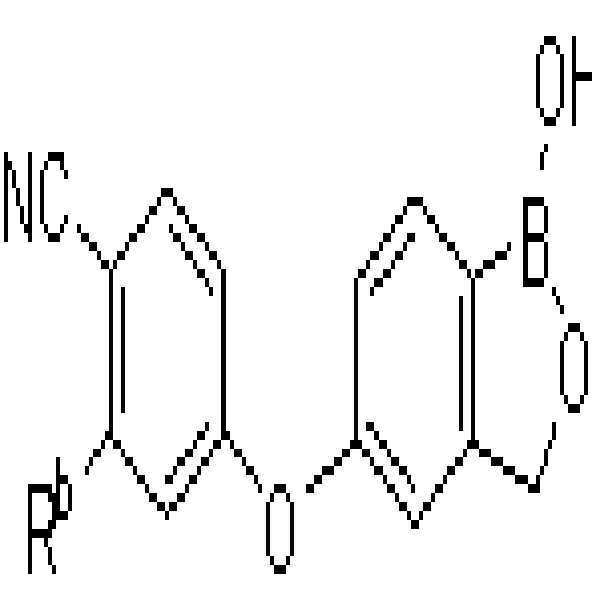
예시적인 구체예에서, 상기 임의의 단락에 따라, 화합물은 다음에서 선택된 멤버인 화학식을 가진다:In an exemplary embodiment, according to any of the paragraphs above, the compound has the formula < RTI ID = 0.0 >


예시적인 구체예에서, 상기 임의의 단락에 따라, 화합물은 아래 화학식에 따른 구조를 가진다:In an exemplary embodiment, according to any of the paragraphs above, the compound has a structure according to the formula:

예시적인 구체예에서, 상기 임의의 단락에 따라, 화합물은 다음에서 선택된 멤버인 화학식을 가진다:In an exemplary embodiment, according to any of the paragraphs above, the compound has the formula < RTI ID = 0.0 >


예시적인 구체예에서, 상기 임의의 단락에 따라, 화합물은 다음에서 선택된 멤버인 화학식을 가진다:In an exemplary embodiment, according to any of the paragraphs above, the compound has the formula < RTI ID = 0.0 >

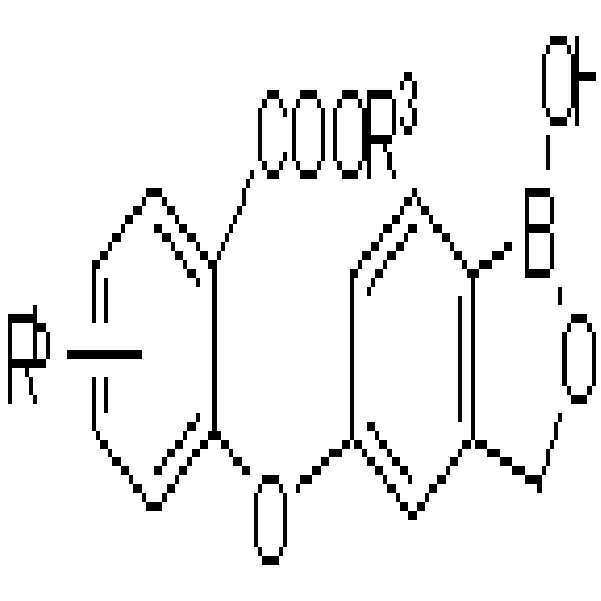
예시적인 구체예에서, 상기 임의의 단락에 따라, 화합물은 다음에서 선택된 멤버인 화학식을 가진다:In an exemplary embodiment, according to any of the paragraphs above, the compound has the formula < RTI ID = 0.0 >

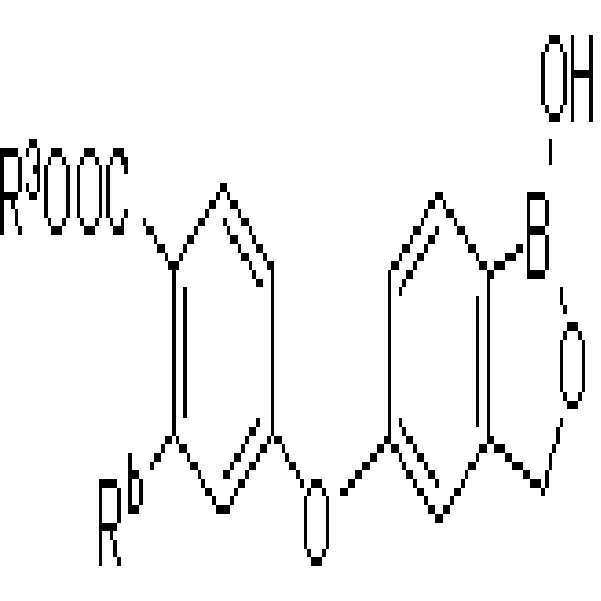
예시적인 구체예에서, 상기 임의의 단락에 따라, 화합물은 다음에서 선택된 멤버인 화학식을 가진다:In an exemplary embodiment, according to any of the paragraphs above, the compound has the formula < RTI ID = 0.0 >


예시적인 구체예에서, 상기 임의의 단락에 따라, 화합물은 아래 화학식에 따른 구조를 가진다:In an exemplary embodiment, according to any of the paragraphs above, the compound has a structure according to the formula:

화합물은 다음에서 선택된 멤버인 화학식을 가진다:The compound has the formula: < RTI ID = 0.0 >


예시적인 구체예에서, 상기 임의의 단락에 따라, 화합물은 다음에서 선택된 멤버인 화학식을 가진다:In an exemplary embodiment, according to any of the paragraphs above, the compound has the formula < RTI ID = 0.0 >


예시적인 구체예에서, 상기 임의의 단락에 따라, 화합물은 다음에서 선택된 멤버인 화학식을 가진다:In an exemplary embodiment, according to any of the paragraphs above, the compound has the formula < RTI ID = 0.0 >

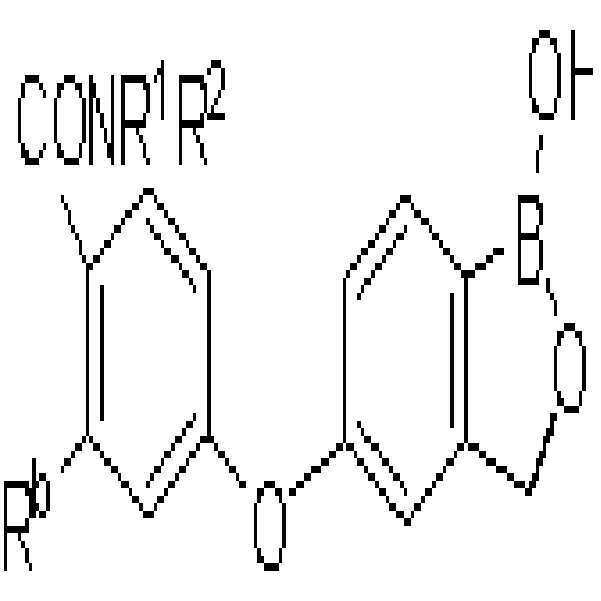
예시적인 구체예에서, 상기 임의의 단락에 따라, 화합물은 다음에서 선택된 멤버인 화학식을 가진다:In an exemplary embodiment, according to any of the paragraphs above, the compound has the formula < RTI ID = 0.0 >


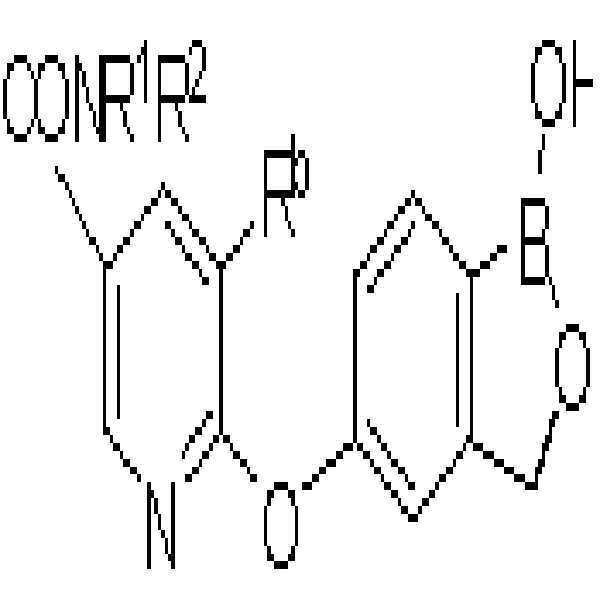

예시적인 구체예에서, 상기 임의의 단락에 따라, Rb는 플로오르 및 염소에서 선택된 멤버이다.In an exemplary embodiment, according to any of the paragraphs above, R < b & gt ; is a member selected from fluorine and chlorine.
예시적인 구체예에서, 상기 임의의 단락에 따라, Rb는 OR4 및 NR4R5에서 선택된 멤버이다.In an exemplary embodiment, according to any of the paragraphs above, R b is a member selected from OR 4 and NR 4 R 5 .
예시적인 구체예에서, 상기 임의의 단락에 따라, Rb는 OR4이며, 그리고 R4는 H, 치환된 또는 치환안된 알킬, 치환된 또는 치환안된 헤테로알킬, 치환된 또는 치환안된 시클로알킬, 치환된 또는 치환안된 헤테로시클로알킬, 치환된 또는 치환안된 아릴, 및 치환된 또는 치환안된 헤테로아릴에서 선택된 멤버이다.In an exemplary embodiment, according to any of the paragraphs above, R b is OR 4 and R 4 is H, substituted or unsubstituted alkyl, substituted or unsubstituted heteroalkyl, substituted or unsubstituted cycloalkyl, substituted Substituted or unsubstituted heteroaryl, substituted or unsubstituted heterocycloalkyl, substituted or unsubstituted aryl, and substituted or unsubstituted heteroaryl.
예시적인 구체예에서, 상기 임의의 단락에 따라, Rb는 OR4이며, 그리고 R4는 H, 치환된 또는 치환안된 알킬, 치환된 또는 치환안된 헤테로알킬 및 치환된 또는 치환안된 시클로알킬에서 선택된 멤버이다.In an exemplary embodiment, according to any of the paragraphs above, R b is OR 4 and R 4 is selected from H, substituted or unsubstituted alkyl, substituted or unsubstituted heteroalkyl and substituted or unsubstituted cycloalkyl Member.
예시적인 구체예에서, 상기 임의의 단락에 따라, Rb는 OR4이며, 그리고 R4는 치환안된 C1-C6 알킬이다.In an exemplary embodiment, according to any of the paragraphs above, R b is OR 4 and R 4 is unsubstituted C 1 -C 6 alkyl.
예시적인 구체예에서, 상기 임의의 단락에 따라, Rb는 OR4이며, 그리고 R4는 치환안된 시클로알킬이다.In an exemplary embodiment, according to any of the paragraphs above, R b is OR 4 and R 4 is unsubstituted cycloalkyl.
예시적인 구체예에서, 상기 임의의 단락에 따라, Rb는 OR4이며, 그리고 R4는 치환된 또는 치환안된 C1-C6 알콕시에서 선택된 멤버로 치환된 알킬이다.In an exemplary embodiment, according to any of the paragraphs above, R b is OR 4 and R 4 is alkyl substituted with a member selected from substituted or unsubstituted C 1 -C 6 alkoxy.
예시적인 구체예에서, 상기 임의의 단락에 따라, Rb는 OR4이며, 그리고 R4는 최소 하나의 할로겐으로 치환된 알킬이다.In an exemplary embodiment, according to any of the paragraphs above, R b is OR 4 and R 4 is alkyl substituted with at least one halogen.
예시적인 구체예에서, 상기 임의의 단락에 따라, Rb는 OR4이며, 그리고 R4는 최소 하나의 옥소 모이어티로 치환된 알킬이다.In an exemplary embodiment, according to any of the paragraphs above, R b is OR 4 and R 4 is alkyl substituted with at least one oxomoiety.
예시적인 구체예에서, 상기 임의의 단락에 따라, Rb는 OR4이며, 그리고 R4는 -CH3, -CH2CH3, -(CH2)2CH3, -CH(CH3)2, -CH2CF3, -CH2CHF2, -CH2CH2(OH), -CH2CH2(OCH3), -CH2CH2(OC(CH3)2), -C(O)CH3, -CH2CH2OC(O)CH3, -CH2C(O)OCH2CH3, -CH2C(O)OC(CH3)3, -(CH2)3C(O)CH3, -CH2C(O)OC(CH3)3, 시클로펜틸, 시클로헥실 


예시적인 구체예에서, 상기 임의의 단락에 따라, Rb는 OR4이며, 이때, R4는 최소 하나의 할로겐, 하이드록실, 에테르, 카르복시 또는 에스테르 모이어티로 선택적으로 치환된 알킬이다. In an exemplary embodiment, according to any of the paragraphs above, R b is OR 4 , wherein R 4 is alkyl optionally substituted with at least one halogen, hydroxyl, ether, carboxy or ester moiety.
예시적인 구체예에서, 상기 임의의 단락에 따라, Rb는 OR4이며, 이때, R4는 치환안된 알킬이다. In an exemplary embodiment, according to any of the paragraphs above, R b is OR 4 , wherein R 4 is unsubstituted alkyl.
예시적인 구체예에서, 상기 임의의 단락에 따라, Rb는 OR4이며, 이때, R4는 치환안된 C1 또는 C2 또는 C3 알킬이다. In an exemplary embodiment, according to any of the paragraphs above, R b is OR 4 , wherein R 4 is unsubstituted C 1 or C 2 or C 3 alkyl.
예시적인 구체예에서, 상기 임의의 단락에 따라, Rb는 OR4이며, 이때, R4는 치환안된 C4 또는 C5 또는 C6 알킬이다. In an exemplary embodiment, according to any of the paragraphs above, R b is OR 4 , wherein R 4 is unsubstituted C 4 or C 5 or C 6 alkyl.
예시적인 구체예에서, 상기 임의의 단락에 따라, Rb는 OR4이며, 이때, R4는 메틸 또는 에틸 또는 프로필 또는 이소프로필 또는 이소부틸이다. In an exemplary embodiment, according to any of the paragraphs above, R b is OR 4 , wherein R 4 is methyl or ethyl or propyl or isopropyl or isobutyl.
예시적인 구체예에서, 상기 임의의 단락에 따라, Rb는 -O(CH2)m1OC(O)R4d이며, 이때, m1은 1 또는 2 또는 3 또는 4 또는 5 또는 6에서 선택된 숫자이고, R4d는 치환안된 알킬이다. 예시적인 구체예에서, m1은 1 또는 2 또는 3이다. 예시적인 구체예에서, m1은 2이다. 예시적인 구체예에서, R4d는 치환안된 C1 또는 C2 또는 C3 알킬이다. 예시적인 구체예에서, R4d는 치환안된 C4 또는 C5 또는 C6 알킬이다. 예시적인 구체예에서, R4d는 메틸이다. 예시적인 구체예에서, Rb는 -O(CH2)2OC(O)CH3이다.In an exemplary embodiment, according to any of the paragraphs above, R b is -O (CH 2 ) m1 OC (O) R 4d , wherein m1 is a number selected from 1 or 2 or 3 or 4 or 5 or 6 , And R 4d is unsubstituted alkyl. In an exemplary embodiment, m1 is 1 or 2 or 3. In an exemplary embodiment, m1 is 2. In an exemplary embodiment, R 4d is unsubstituted C 1 or C 2 or C 3 alkyl. In an exemplary embodiment, R 4d is unsubstituted C 4 or C 5 or C 6 alkyl. In an exemplary embodiment, R 4d is methyl. In an exemplary embodiment, R b is -O (CH 2 ) 2 OC (O) CH 3 .
예시적인 구체예에서, 상기 임의의 단락에 따라, Rb는 -O(CH2)m1C(O)R4d이며, 이때, m1은 1 또는 2 또는 3 또는 4 또는 5 또는 6에서 선택된 숫자이며, 그리고 R4d는 치환안된 알킬이다. 예시적인 구체예에서, m1은 2 또는 3 또는 4이다. 예시적인 구체예에서, m1은 3이다. 예시적인 구체예에서, R4d는 치환안된 C1 또는 C2 또는 C3 알킬이다. 예시적인 구체예에서, R4d는 치환안된 C4 또는 C5 또는 C6 알킬이다. 예시적인 구체예에서, R4d는 메틸이다. 예시적인 구체예에서, Rb는 -O(CH2)3C(O)CH3이다.According to an exemplary embodiment from the arbitrary paragraph, R b is -O (CH 2) m1 C ( O) R 4d, In this case, m1 is a number selected from 1 or 2 or 3 or 4 or 5 or 6 , And R 4d is unsubstituted alkyl. In an exemplary embodiment, m1 is 2 or 3 or 4. In an exemplary embodiment, m1 is 3. In an exemplary embodiment, R 4d is unsubstituted C 1 or C 2 or C 3 alkyl. In an exemplary embodiment, R 4d is unsubstituted C 4 or C 5 or C 6 alkyl. In an exemplary embodiment, R 4d is methyl. In an exemplary embodiment, R b is -O (CH 2 ) 3 C (O) CH 3 .
예시적인 구체예에서, 상기 임의의 단락에 따라, Rb는 -O(CH2)m1C(O)OR4d이며, 이때, m1은 1 또는 2 또는 3 또는 4 또는 5 또는 6에서 선택된 숫자이며, 그리고 R4d 는 H 또는 치환안된 알킬이다. In an exemplary embodiment, according to the arbitrary paragraph, R b is -O (CH 2) m1 C ( O) OR 4d, and, wherein, m1 is a number selected from 1 or 2 or 3 or 4 or 5 or 6 , And R < 4d > is H or unsubstituted alkyl.
예시적인 구체예에서, 상기 임의의 단락에 따라, Rb는 -OCH2C(O)OR4d이며, 이때, R4d는 여기에서 설명된 것과 같다.In an exemplary embodiment, according to any of the paragraphs above, R b is -OCH 2 C (O) OR 4d , wherein R 4d is as described herein.
예시적인 구체예에서, 상기 임의의 단락에 따라, R4d 는 H 또는 메틸 또는 에틸 또는 t-부틸이다. In an exemplary embodiment, according to any of the paragraphs above, R 4d is H or methyl or ethyl or t-butyl.
예시적인 구체예에서, 상기 임의의 단락에 따라, Rb는 -O(CH2)C(O)OCH2CH3 또는 -O(CH2)C(O)OH 또는 -O(CH2)C(O)OC(CH3)3이다.In an exemplary embodiment, according to the arbitrary paragraph, R b is -O (CH 2) C (O )
예시적인 구체예에서, 상기 임의의 단락에 따라, Rb는 OR4이며, 이때, R4는 치환된 또는 치환안된 아미노로 치환된 알킬이다.In an exemplary embodiment, according to any of the paragraphs above, R b is OR 4 , wherein R 4 is alkyl substituted with substituted or unsubstituted amino.
예시적인 구체예에서, 상기 임의의 단락에 따라, Rb는 -O(CH2)m2C(O)NR4eR4f이며, 이때, m2는 1 또는 2 또는 3 또는 4 또는 5 또는 6에서 선택된 숫자이며, 그리고 R4e 및 R4f는 H 또는 치환안된 알킬에서 독립적으로 선택되며, 또는 R4e 및 R4f는 여기에 부착된 질소와 함께 선택적으로 결합되어, 치환된 또는 치환안된 4 내지 8개 멤버로된 링을 형성한다.In an exemplary embodiment, according to any of the paragraphs above, R b is -O (CH 2 ) m C (O) NR 4e R 4f , wherein m2 is 1 or 2 or 3 or 4 or 5 or 6 And R 4e and R 4f are independently selected from H or unsubstituted alkyl or R 4e and R 4f are optionally joined together with the nitrogen to which they are attached to form a substituted or unsubstituted 4-8 member To form a ring.
예시적인 구체예에서, 상기 임의의 단락에 따라, Rb는 OR4이며, 이때, R4는 치환된 또는 치환안된 시클로알킬이다. In an exemplary embodiment, according to any of the paragraphs above, R b is OR 4 , wherein R 4 is substituted or unsubstituted cycloalkyl.
예시적인 구체예에서, 상기 임의의 단락에 따라, Rb는 OR4이며, 이때, R4는 치환안된 시클로알킬이다.In an exemplary embodiment, according to any of the paragraphs above, R b is OR 4 , wherein R 4 is unsubstituted cycloalkyl.
예시적인 구체예에서, 상기 임의의 단락에 따라, Rb는 -O(CH2)m5OR30이며, 이때, m5는 1 또는 2 또는 3 또는 4 또는 5 또는 6이며, 그리고 R30 는 H이며 또는 치환안된 알킬 또는 치환안된 테트라하이드로피란이다. In an exemplary embodiment, according to any of the paragraphs above, R b is -O (CH 2 ) m 5 OR 30 , wherein m5 is 1 or 2 or 3 or 4 or 5 or 6, and R 30 is H Or unsubstituted alkyl or unsubstituted tetrahydropyran.
예시적인 구체예에서, 상기 임의의 단락에 따라, X는 N이다.In an exemplary embodiment, according to any of the paragraphs above, X is N.
예시적인 구체예에서, 상기 임의의 단락에 따라, X는 CH이다.In an exemplary embodiment, according to any of the paragraphs above, X is CH.
예시적인 구체예에서, 상기 임의의 단락에 따라, X는 CRb이다.In an exemplary embodiment, according to any of the paragraphs above, X is CR b .
예시적인 구체예에서, 상기 임의의 단락에 따라, Rb는 NR4R5이며, 이때, R4 및 R5는 H, 치환된 또는 치환안된 알킬, 치환된 또는 치환안된 헤테로알킬, 치환된 또는 치환안된 시클로알킬, 치환된 또는 치환안된 헤테로시클로알킬, 치환된 또는 치환안된 아릴, 및 치환된 또는 치환안된 헤테로아릴에서 독립적으로 선택된 멤버이다.In an exemplary embodiment, according to any of the paragraphs above, R b is NR 4 R 5 wherein R 4 and R 5 are selected from H, substituted or unsubstituted alkyl, substituted or unsubstituted heteroalkyl, Substituted or unsubstituted cycloalkyl, substituted or unsubstituted heterocycloalkyl, substituted or unsubstituted aryl, and substituted or unsubstituted heteroaryl.
예시적인 구체예에서, 상기 임의의 단락에 따라, Rb는 NR4R5이며, 이때, R4 는 H 또는 치환안된 알킬이며; 그리고 R5는 치환안된 알킬 또는 하이드록실, 페닐, 치환안된 알콕시 및 페닐로 치환된 알콕시에서 선택된 멤버로 치환된 알킬이다.In an exemplary embodiment, according to any of the paragraphs above, R b is NR 4 R 5 , wherein R 4 is H or unsubstituted alkyl; And R < 5 > is alkyl unsubstituted or substituted with a member selected from hydroxyl, phenyl, unsubstituted alkoxy and alkoxy substituted with phenyl.
예시적인 구체예에서, 상기 임의의 단락에 따라, Rb는 NR4R5이다.In an exemplary embodiment, according to any of the paragraphs above, R b is NR 4 R 5 .
예시적인 구체예에서, 상기 임의의 단락에 따라, R4는 H 또는 CH3에서 선택된 멤버이다.In an exemplary embodiment, according to any of the paragraphs above, R 4 is a member selected from H or CH 3 .
예시적인 구체예에서, 상기 임의의 단락에 따라, Rb는 NR4R5이며, 이때, R4 및 R5는 각각 치환된 또는 치환안된 알킬에서 독립적으로 선택된 멤버이다.In an exemplary embodiment, according to any of the paragraphs above, R b is NR 4 R 5 , wherein R 4 and R 5 are each independently selected from substituted or unsubstituted alkyl.
예시적인 구체예에서, 상기 임의의 단락에 따라, Rb는 NR4R5이며, 이때, R5는 OH, 치환안된 아릴알콕시, 치환안된 알콕시, 및 치환안된 아릴에서 선택된 멤버로 치환된 알킬이다. 예시적인 구체예에서, Rb는 NR4R5이며, 이때, R5는 -(CH2)m8Ph이다.In an exemplary embodiment, according to any of the paragraphs above, R b is NR 4 R 5 wherein R 5 is alkyl substituted with a member selected from OH, unsubstituted arylalkoxy, unsubstituted alkoxy, and unsubstituted aryl . In an exemplary embodiment, R b is NR 4 R 5, wherein, R 5 is - (CH 2) m8 is Ph.
예시적인 구체예에서, 상기 임의의 단락에 따라, Rb는NR4R5이며, 이때, R5는 -(CH2)m8OR26이며, 이때, m8은 1 또는 2 또는 3 또는 4 또는 5 또는 6에서 선택된 숫자이며, 그리고 R26는 H, 치환안된 또는 아릴치환된 C1 또는 C2 또는 C3 또는 C4 또는 C5 또는 C6 알킬에서 선택된 멤버이다. In an exemplary embodiment, according to the arbitrary paragraph, R b is NR 4 R 5, wherein, R 5 is - (CH 2), and m8 OR 26, wherein, m8 is 1 or 2 or 3 or 4 or 5, Or 6 and R 26 is a member selected from H, unsubstituted or aryl substituted C 1 or C 2 or C 3 or C 4 or C 5 or C 6 alkyl.
예시적인 구체예에서, 상기 임의의 단락에 따라, Rb는 NR4R5이며, 이때, R5는 -(CH2)m8O(CH2)m9Ph이며, 이때, m8 및 m9는 1 또는 2 또는 3으로부터 각각 독립적으로 선택된다. In an exemplary embodiment, according to the arbitrary paragraph, R b is NR 4 R 5, wherein, R 5 is - (CH 2), and m8 O (CH 2) m9 Ph, wherein, m8 and m9 is 1 or 2 or 3, respectively.
예시적인 구체예에서, 상기 임의의 단락에 따라, Rb는 NR4R5이며, 이때, R4는 치환안된 알킬이며; 그리고 R5는 치환된 또는 치환안된 알킬이다.In an exemplary embodiment, according to any of the paragraphs above, R b is NR 4 R 5 , wherein R 4 is unsubstituted alkyl; And R < 5 > is substituted or unsubstituted alkyl.
예시적인 구체예에서, 상기 임의의 단락에 따라, Rb는 NR4R5이며, 이때, R4는 치환안된 알킬이며; 그리고 R5는 치환된 또는 치환안된 알콕시 및 하이드록실에서 선택된 멤버로 치환된 알킬이다.In an exemplary embodiment, according to any of the paragraphs above, R b is NR 4 R 5 , wherein R 4 is unsubstituted alkyl; And R < 5 > is alkyl substituted with a member selected from substituted or unsubstituted alkoxy and hydroxyl.
예시적인 구체예에서, 상기 임의의 단락에 따라, Rb는 NR4R5이며, 이때, R4는 치환안된 알킬이며; 그리고 R5는 치환안된 알콕시로 치환된 알킬이다.In an exemplary embodiment, according to any of the paragraphs above, R b is NR 4 R 5 , wherein R 4 is unsubstituted alkyl; And R < 5 > is alkyl substituted with unsubstituted alkoxy.
예시적인 구체예에서, 상기 임의의 단락에 따라, Rb는 N(CH3)2, N(CH3)(CH2CH2(OCH3)), N(CH3)(CH2CH2OH), NH2, NHCH3, NH(CH2CH2(OCH3)), NH(CH2CH2(OCH2Ph), NH(CH2Ph), NH(C(CH3)3) 및 NH(CH2CH2OH)에서 선택된 멤버이다.In an exemplary embodiment, according to the arbitrary paragraph, R b is N (CH 3) 2, N (CH 3) (
예시적인 구체예에서, 상기 임의의 단락에 따라, Rb는 NR4R5이며, 이때, R4 및 R5는 여기에 부착된 질소와 함께 복합되어 4- 내지 8-멤버로된 치환된 또는 치환안된 헤테로시클로알킬 링을 형성한다.In an exemplary embodiment, according to any of the paragraphs above, R b is NR 4 R 5 wherein R 4 and R 5 are taken together with the nitrogen to which they are attached to form a 4- or 8- Form an unsubstituted heterocycloalkyl ring.
예시적인 구체예에서, 상기 임의의 단락에 따라, Rb는NR4R5이며, 이때, R4 및 R5는 여기에 부착된 질소와 함께 복합되어 5- 또는 6-멤버로된 치환된 또는 치환안된 헤테로시클로알킬 링을 형성한다.In an exemplary embodiment, according to any of the paragraphs above, R b is NR 4 R 5 wherein R 4 and R 5 are taken together with the nitrogen to which they are attached to form a 5- or 6- Form an unsubstituted heterocycloalkyl ring.
예시적인 구체예에서, 상기 임의의 단락에 따라, Rb는 다음에서 선택된 멤버이다:In an exemplary embodiment, according to any of the paragraphs above, R b is a member selected from:


예시적인 구체예에서, 본 발명은 다음을 포함하는 제약학적 제제를 제공한다: (a) 상기 임의의 단락에 따른 화합물; 및 (b) 약리학적으로 수용가능한 부형제.In an exemplary embodiment, the present invention provides a pharmaceutical formulation comprising: (a) a compound according to any of the preceding paragraphs; And (b) a pharmacologically acceptable excipient.
예시적인 구체예에서, 상기 임의의 단락에 따라, 제제는 단위 투약형 내에 있다.In an exemplary embodiment, according to any of the paragraphs above, the agent is in unit dosage form.
예시적인 구체예에서, 상기 임의의 단락에 따라, 제제는 경구용 또는 국소용이다.In an exemplary embodiment, according to any of the paragraphs above, the agent is oral or topical.
예시적인 구체예에서, 본 발명은 사이토킨 또는 케모킨의 방출을 감소시키는 방법을 제공하는데, 상기 방법은 다음을 포함한다: 세포를 상기 임의의 단락에 다른 화합물 또는 이의 약리학적으로 수용가능한 염과 접촉시킴, 이때, 세포에 의한 사이토킨 또는 케모킨의 방출이 감소된다.In an exemplary embodiment, the present invention provides a method of reducing the release of cytokines or chemokines, comprising: contacting the cell with the compound or a pharmacologically acceptable salt thereof in any of the above paragraphs At this time, the release of cytokines or chemokines by the cells is reduced.
예시적인 구체예에서, 상기 임의의 단락에 따라, 사이토킨은 IL-1α, IL-1β, IL-2, IL-3, IL-6, IL-7, IL-9, IL-12, IL-17, IL-18, IL-23, TNF-α, LT, LIF, 온코스타틴, IFNα, IFNβ 및 IFN-γ에서 선택된 멤버이다. In an exemplary embodiment, according to any of the paragraphs above, the cytokine is selected from the group consisting of IL-1 alpha, IL-1 beta, IL-2, IL-3, IL-6, IL-7, IL- , IL-18, IL-23, TNF- ?, LT, LIF, oncostatin, IFN ?, IFN ?, and IFN- ?.
예시적인 구체예에서, 상기 임의의 단락에 따라, 사이토킨은 IL-1β, IL-2, IL-4, IL-5, IL-6, IL-8, IL-10, IL-12, IL-23, TNF-α, 및 IFN-γ에서 선택된 멤버이다.In an exemplary embodiment, the cytokine is selected from the group consisting of IL-1, IL-2, IL-4, IL-5, IL-6, IL-8, IL-10, , TNF- [alpha], and IFN- [gamma].
예시적인 구체예에서, 상기 임의의 단락에 따라, 사이토킨은 IL-2, IL-5, IL-10, IL-12, IL-23, TNF-α, 및 IFN-γ에서 선택된 멤버이다.In an exemplary embodiment, according to any of the paragraphs above, the cytokine is a member selected from IL-2, IL-5, IL-10, IL-12, IL-23, TNF-a and IFN-y.
예시적인 구체예에서, 상기 임의의 단락에 따라, 케모킨은 IL-8, Gro-α, MIP-1, MCP-1, PGE2, ENA-78, 및 RANTES에서 선택된 멤버이다.In an exemplary embodiment, according to any of the paragraphs above, the chemokine is a member selected from IL-8, Gro- alpha, MIP-I, MCP-I, PGE2, ENA-78, and RANTES.
예시적인 구체예에서, 본 발명은 동물에서 이상을 치료하는 방법을 제공하며, 상기 방법은 동물에게 치료요법적으로 효과량의 상기 임의의 단락에 따른 화합물, 또는 이의 약리학적으로 수용가능한 염을 투여하여 이상을 치료하는 것을 포함한다.In an exemplary embodiment, the invention provides a method of treating an abnormality in an animal comprising administering to the animal a therapeutically effective amount of a compound according to any of the preceding paragraphs, or a pharmacologically acceptable salt thereof, Thereby treating the disorder.
예시적인 구체예에서, 상기 임의의 단락에 따라, 이상은 관절염, 류마티스 관절염, 염증성 장 질환, 건선, 폐 질환, 다발성 경화증, 신경퇴행성 질환, 울혈성 심부전, 발작, 대동맥 판막 협착증, 신부전, 홍반, 췌장염, 알레르기, 섬유증, 빈혈증, 아테롬성동맥경화증, 대사 질환, 골 질환, 심혈관 질환, 화학요법/방사능 관련 합병증, 타입 I 당뇨, 타입 II 당뇨, 간 질환, 위장관 질환, 안과 질환, 알레르기성 결막염, 당뇨성 망막증, Sjogren 증후군, 포도막염, 폐 질환, 신장 질환, 피부염, HIV-관련 악액질, 대뇌 말라리아, 강직성 척수염, 나병, 빈혈증 및 섬유근육통에서 선택된 멤버이다.In an exemplary embodiment, according to any of the paragraphs above, the disorder is selected from the group consisting of arthritis, rheumatoid arthritis, inflammatory bowel disease, psoriasis, pulmonary disease, multiple sclerosis, neurodegenerative disease, congestive heart failure, seizures, aortic valve stenosis, Type I diabetes, Type II diabetes, Liver disease, Gastrointestinal disease, Ophthalmic disease, Allergic conjunctivitis, Diabetes mellitus, Pancreatitis, Allergy, Fibrosis, Anemia, Atherosclerosis, Metabolic disease, Bone disease, Cardiovascular disease, Chemotherapy / Radioactivity complication Is a member selected from retinopathy of prematurity, Sjogren's syndrome, uveitis, lung disease, kidney disease, dermatitis, HIV-related cachexia, cerebral malaria, ankylosing spondylitis, leprosy, anemia and fibromyalgia.
예시적인 구체예에서, 상기 임의의 단락에 따라, 이상은 건선, 아토피성 피부염, 류마티스 관절염, 염증성 장 질환, 천식 및 만성 폐색성 폐 질환에서 선택된 멤버이다.In an exemplary embodiment, according to any of the paragraphs above, the disorder is a member selected from psoriasis, atopic dermatitis, rheumatoid arthritis, inflammatory bowel disease, asthma and chronic obstructive pulmonary disease.
예시적인 구체예에서, 상기 임의의 단락에 따라, 이상은 건선이며, 상기 건선은 플라크 건선, 굴측성 건선, 적상 건선, 농포성 건선, 손발톱 건선 및 박탈성 건선에서 선택된 멤버이다.In an exemplary embodiment, according to any of the paragraphs above, the disorder is psoriasis and the psoriasis is a member selected from plaque psoriasis, ovarian psoriasis, malignant psoriasis, pustular psoriasis, nail psoriasis and scarring psoriasis.
예시적인 구체예에서, 상기 임의의 단락에 따라, 건선은 플라크 건선 및 손발톱 건선에서 선택된 멤버이다.In an exemplary embodiment, according to any of the paragraphs above, psoriasis is a member selected from plaque psoriasis and nail psoriasis.
예시적인 구체예에서, 상기 임의의 단락에 따라, 동물은 인간이다.In an exemplary embodiment, according to any of the paragraphs above, the animal is a human.
예시적인 구체예에서, 상기 임의의 단락에 따라, 동물은 치료가 필요하다.In an exemplary embodiment, according to any of the paragraphs above, the animal is in need of treatment.
예시적인 구체예에서, 상기 임의의 단락에 따라, 동물은 인간이다.In an exemplary embodiment, according to any of the paragraphs above, the animal is a human.
예시적인 구체예에서, 상기 임의의 단락에 따라, 동물은 이미 화합물에 의한 치료가 필요하지 않다.In an exemplary embodiment, according to any of the paragraphs above, the animal does not already require treatment with the compound.
예시적인 구체예에서, 본 발명은 포스포디에스테라제 (PDE)를 저해하는 방법을 제공하는데, 상기 방법은 다음을 포함한다: 포스포디에스테라제를 상기 단락 중 임의의 것에 따른 화합물 또는 이의 약리학적으로 수용가능한 염과 접촉시켜 포스포디에스테라제를 저해시킴.In an exemplary embodiment, the present invention provides a method of inhibiting phosphodiesterase (PDE), comprising: contacting a phosphodiesterase with a compound according to any of the preceding paragraphs, or a pharmacological < RTI ID = In contact with an < RTI ID = 0.0 > pharmaceutically < / RTI > acceptable salt to inhibit phosphodiesterase.
예시적인 구체예에서, 상기 임의의 단락에 따라, 포스포디에스테라제는 포스포디에스테라제4 (PDE4) 및 포스포디에스테라제7 (PDE7)에서 선택된 멤버이다.In an exemplary embodiment, according to any of the paragraphs above, phosphodiesterase is a member selected from phosphodiesterase 4 (PDE4) and phosphodiesterase 7 (PDE7).
본 발명은 다음의 실시예에 의하여 더욱 설명된다. 실시예는 본 발명의 범위를 한정하거나 제한하도록 의도되지 않는다.The present invention is further illustrated by the following examples. The examples are not intended to limit or limit the scope of the invention.
실시예Example
양성자 NMR이 Varian AS 300 (300 MHz) 또는 AS400 (400 MHz) 분광계에서 기록되고, 화학 변위가 테트라메틸실란으로부터의 δ (ppm) 낮은 장(down field)으로 기록된다. 질량 스펙트럼이 Agilent 1200 series plus 6120 Quadrupole LC/MS, Micromass Quattro II 또는 Alliance 2795 (LC) 및 Waters Micromass ZQ 검출기로 구성된 Waters MS에서 결정된다. 질량 분석기는 양성 또는 음성 모드에서 작동되는 전자분무 이온 공급원 (ES)이 구비되었다.The proton NMR is recorded on a Varian AS 300 (300 MHz) or AS 400 (400 MHz) spectrometer and the chemical shift is recorded in a delta (ppm) down field from tetramethylsilane. Mass spectra are determined on a Waters MS consisting of an Agilent 1200 series plus 6120 Quadrupole LC / MS, Micromass Quattro II or Alliance 2795 (LC) and a Waters Micromass ZQ detector. The mass spectrometer was equipped with an electron spray ion source (ES) operating in a positive or negative mode.
다음 약어들이 이용된다: 수성은 aq.이며; O-(7-아자벤조트리아졸-1-일)-N,N,N',N'-테트라메틸우로니움 헥사플로오로포스페이트는 HATU이며; N-(3-디메틸아미노프로필)-N'-에틸카르보디이미드 하이드로클로라이드 m-CPBA 3-클로로퍼옥시벤조산은 EDCI이며; 당량은 eq.이며; 디이소프로필 아조디카르복실레이트는 DIAD이며; N,N-디메틸포름아미드는 DMF이며; 디메틸술폭시드는 DMSO이며; 아세트산은 HOAc이며; 소듐 시아노보로하이드리드는 NaCNBH3이며; 실온은 r.t.이며; 하룻밤은 O/N이며; 테트라하이드로퓨란은 THF이며; Di-tert-부틸 디카르보네이트는 Boc2O이며; 메탄올은 MeOH이며; 에탄올은 EtOH이며; 트리플루오로아세트산은 TFA이며; 디이소프로필에틸아민은 DIPEA이며; 1-프로판올은 PrOH이며; 2-프로판올은 iPrOH이며; 녹는점은 mp이다.next Abbreviations are used: Aqueous is aq .; O- (7-azabenzotriazol-1-yl) -N, N, N ', N' -tetramethyluronium hexafluorophosphate is HATU; N - (3- dimethylaminopropyl) - N '- ethylcarbodiimide hydrochloride m-CPBA 3- chloroperoxybenzoic acid are EDCI and; Equivalent is eq .; Diisopropyl azodicarboxylate is DIAD; N, N -dimethylformamide is DMF; Dimethyl sulfoxide is DMSO; Acetic acid is HOAc; Sodium cyanoborohydride is NaCNBH 3 ; Room temperature is rt; Overnight is O / N; Tetrahydrofuran is THF; Di- tert -butyl dicarbonate is Boc 2 O; Methanol is MeOH; Ethanol is EtOH; Trifluoroacetic acid is TFA; Diisopropylethylamine is DIPEA; 1-propanol is PrOH; 2-propanol is iPrOH; The melting point is mp.
모든 용매가 상용화되어 구입 가능했고, 추가의 정제 없이 사용되었다. 반응은 전형적으로 불활성 질소 대기하에 무수 용매를 사용하여 진행되었다.All solvents were commercially available and were used without further purification. The reaction was typically carried out using an anhydrous solvent under an inert nitrogen atmosphere.
화합물은 수동으로 또는 ChemDraw를 이용하여, 또는 상용화되어 구입 가능할 경우 카타로그명을 이용하여 명명된다.Compounds are named either manually or using ChemDraw, or using the catalog name if commercially available and available.
HPLC 분석은 Waters 717 Plus Autosampler 및 Waters 2996 Photodiode Array Detector를 포함하는 Water 600 Controller system에서 수행되었다. 사용된 컬럼은 ACE C18, 5 ㎛, 4.6X150 mm이었다. 선형 그라디언트가 6분에 걸쳐 95 % A (A: 물에서 0.1% H3PO4)에서 시작하고 90% B (B: MeCN)에서 종결되도록 가해진 다음, 10분 표지까지 90% B에서 유지되었다. 이후 컬럼이 3분에 걸쳐 95:5로 재평형되며 총 진행 시간이 20분이다. 컬럼 온도는 주위 온도였으며 유속이 1.0 mL/min였다. Diode Array Detector가 200-400 nm에서 스캔되었다.HPLC analysis was performed on a Water 600 Controller system including a Waters 717 Plus Autosampler and a Waters 2996 Photodiode Array Detector. The column used was ACE C 18 , 5 탆, 4.6 X 150 mm. The linear gradient was applied over a period of 6 minutes starting at 95% A (0.1% H 3 PO 4 in A: water) and ending at 90% B (B: MeCN) and then maintained at 90% B until 10 min mark. The column is then re-equilibrated to 95: 5 over 3 minutes and the total run time is 20 minutes. The column temperature was ambient and the flow rate was 1.0 mL / min. Diode Array Detector was scanned at 200-400 nm.
박층 크로마토그래피 (TLC)가 Mancherey-Nagel의 Alugram®(실리카 겔60 F254)상에서 수행되었고, 반점을 시각화하기 위하여 UV가 전형적으로 사용되었다. 또한 추가적인 시각화 방법이 일부 경우에 이용되었다. 이들 경우에서, 화합물을 시각화하기 위하여 TLC 플레이트가 요오드 (약 1 g의 I2를 10 g 실리카 겔에 첨가하고 완전히 혼합하여 생성됨), 바닐린 (100 mL 10% H2SO4에 약 1 g 바닐린을 용해시켜 생성됨), 닌히드린 (Aldrich로부터 상용화되어 구입 가능), 또는 Magic Stain (450 mL 물 및 50 mL 진한H2SO4에 25 g (NH4)6Mo7O24·4H2O, 5 g (NH4)2Ce(IV)(NO3)6을 완전히 혼합하여 생성됨)으로 현상되었다. 플래쉬 크로마토그래피는 Still, W.C.; Kahn, M.; and Mitra, M. Journal of Organic Chemistry, 1978, 43, 2923 - 2925에 개시된 것과 유사한 기술에 따라 전형적으로 Silicycle의 40 - 63 ㎛ (230 - 400 mesh) 실리카 겔을 사용하여 수행되었다. 플래쉬 크로마토그래피 또는 박층 크로마토그래피에 사용되는 전형적인 용매는 클로로포름/메탄올, 디클로로메탄/메탄올, 에틸 아세테이트/메탄올 및 헥산/에틸 아세테이트 혼합물이었다. 역상컬럼 크로마토그래피가 Biotage®상에서 Biotage C18 카트리지 및 물/메탄올 그라디언트 (전형적으로 5% MeOH/H2O로부터 90% MeOH/H2O로 용리)를 이용하여 수행되었다.Thin layer chromatography (TLC) has been carried out on Alugram ® (silica gel 60 F 254) of Mancherey-Nagel, UV was typically used to visualize the spots. Additional visualization methods have also been used in some cases. In these cases, TLC plates were coated with iodine (approximately 1 g of I 2 was added to 10 g silica gel and mixed thoroughly) to visualize the compound, vanillin (approximately 1 g vanillin in 100
예비크로마토그래피가 Waters 2487 Diode Array를 사용하는 Waters Prep LC 4000 System 또는 Waters LC Module 1 plus에서 수행되었다. 사용된 컬럼은 Waters XTerra Prep C18, 5 ㎛, 30 X 100 mm 또는 Phenomenex Luna C18, 5 ㎛, 21.6 X 250 mm 또는 Phenomenex Gemini C18, 5 ㎛, 100 X 30 mm이었다. 아세토니트릴/물의 좁은 그라디언트가 약 20 mL/min의 유속 및 20 - 30 분의 총 진행 시간에서 화합물을 용리하기 위하여 사용되었고, 상기 물은 0.1% 트리플루오로아세트산 또는 0.1% 아세트산을 포함한다.Preliminary chromatography was performed on a Waters Prep LC 4000 System or a
실시예Example 1 One
1로부터 3 준비Prepare from 1 to 3
1.11.1 카르복실산의Carboxylic acid 환원 restoration
1 (23.3 mmol)의 무수 THF (70 mL)에 용액에 질소하에 0 ℃에서 BH3 THF 용액 (1.0 M, 55 mL, 55 mmol)이 점적되었고, 반응 혼합물이 실온에서 하룻밤 동안 교반되었다. 이후 혼합물이 얼음 바스를 사용하여 다시 냉각되었고, MeOH (20 mL)가 점적되어 과잉 BH3를 분해했다. 거품이 생기지 않을 때까지 생산된 혼합물이 교반된 다음 10% NaOH (10 mL)가 첨가되었다. 혼합물이 농축되었고, 잔유물이 물 (200 mL)과 혼합되었고, EtOAc로 추출되었다. 회전 증발의 잔유물이 실리카 겔에서 플래쉬 컬럼 크로마토그래피로 정제되어 20.7 mmol의 3이 제공되었다. To a solution of 1 (23.3 mmol) in anhydrous THF (70 mL) was added a solution of BH 3 THF (1.0 M, 55 mL, 55 mmol) at 0 ° C under nitrogen and the reaction mixture was stirred at room temperature overnight. The mixture was then cooled again using an ice bath, and MeOH (20 mL) was added dropwise to decompose excess BH 3 . The resulting mixture was stirred until no bubbles were formed and then 10% NaOH (10 mL) was added. The mixture was concentrated and the residue was mixed with water (200 mL) and extracted with EtOAc. The residue from rotary evaporation was purified by flash column chromatography on silica gel to give 20.7 mmol of 3 .
1.21.2 결과result
상기 방법에 의하여 준비된 대표적인 구조 3의 화합물은: 1.2.a 2 - 브로모 - 5-클로로벤질 알코올; 1.2.b 2 - 브로모 -5-메톡시벤질 알코올 을 포함한다.Representative compounds of
실시예Example 2 2
2로부터 3 준비Prepare from 2 to 3
2.1.2.1. 알데히드의 환원Reduction of aldehydes
2 (Z = H, 10.7 mmol)의 메탄올 (30 mL) 용액에 보로하이드리드 나트륨(5.40 mol)이 첨가되었고, 혼합물이 실온에서 1 h 동안 교반되었다. 물이 첨가되었고, 혼합물이 에틸 아세테이트로 추출되었다. 유기 층이 소금물로 세척되었고 무수 황산나트륨상에서 건조되었다. 용매가 감압하에 제거되어 9.9 mmol의 3이 제공되었다. 2 (Z = H, 10.7 mmol) in methanol (30 mL) Sodium borohydride (5.40 mol) was added to the solution, and the mixture was stirred at room temperature for 1 h. Water was added and the mixture was extracted with ethyl acetate. The organic layer was washed with brine and dried over anhydrous sodium sulfate. The solvent was removed under reduced pressure to provide 9.9 mmol of 3 .
상기 방법에 의하여 준비된 대표적인 구조 3의 화합물은: 2.2.a 2 - 브로모 - 5-(4-시아노페녹시)벤질 알코올; 2.2.b 2- 브로모 -4-(4- 시아노페녹시 ) 벤질 알코올 ; 2.2.c 5-(4- 시아노페녹시 )-1- 인다놀 ; 2.2.d 2- 브로모 -5-( tert - 부틸디메틸실옥시 ) 벤질 알코올 을 포함한다.Representative compounds of
이 방법에 의하여 제조될 수 있는 화합물의 추가적인 예는 2-브로모-4-(3-시아노페녹시)벤질 알코올; 2-브로모-4-(4-클로로페녹시)벤질 알코올; 2-브로모-4-페녹시벤질 알코올; 2-브로모-5-(3,4-디시아노페녹시)벤질 알코올; 2-(2-브로모-5-플루오르페닐)에틸 알코올; 2-브로모-5-플루오르벤질 알코올; 및 1-브로모-2-나프탈렌메탄올을 포함한다.Further examples of compounds which may be prepared by this method include 2-bromo-4- (3-cyanophenoxy) benzyl alcohol; 2-bromo-4- (4-chlorophenoxy) benzyl alcohol; 2-bromo-4-phenoxybenzyl alcohol; 2-bromo-5- (3,4-dicyanophenoxy) benzyl alcohol; 2- (2-bromo-5-fluorophenyl) ethyl alcohol; 2-bromo-5-fluorobenzyl alcohol; And 1-bromo-2-naphthalene methanol.
실시예Example 3 3
3으로부터 4 준비3 to 4 preparation
3.13.1 보호성 알킬화Protective alkylation
화합물 3 (20.7 mmol)이 CH2Cl2 (150 mL)에 용해되었고, 얼음 바스를 사용하여 0℃로 냉각되었다. 이 용액에 질소하에 N,N-디-이소프로필 에틸 아민 (5.4 mL, 31.02 mmol, 1.5 eq) 및 클로로메틸 메틸 에테르 (2 mL, 25.85 mmol, 1.25 eq)가 차례로 첨가되었다. 반응 혼합물이 실온에서 하룻밤 동안 교반되었고, NaHCO3-포화된 물로 세척된 다음 NaCl-포화된 물로 세척되었다. 회전 증발 후의 잔유물이 실리카 겔에서 플래쉬 컬럼 크로마토그래피에 의하여 정제되어 17.6 mmol의 4가 제공되었다.Compound 3 (20.7 mmol) was dissolved in CH 2 Cl 2 (150 mL) and cooled to 0 ° C. using an ice bath. To this solution was added N, N-di-isopropylethylamine (5.4 mL, 31.02 mmol, 1.5 eq) and chloromethyl methyl ether (2 mL, 25.85 mmol, 1.25 eq) in turn under nitrogen. The reaction mixture was stirred overnight at room temperature, NaHCO 3 - and washed with washed with water, saturated NaCl- then saturated with water. The residue after rotary evaporation was purified by flash column chromatography on silica gel to give 17.6 mmol of 4.
3.23.2 결과result
상기 방법에 의하여 준비된 대표적인 구조 4의 화합물은: 3.2.a 2- 브로모 - 5-클로로-l-(메톡시메톡시메틸)벤젠; 3.2.b 2- 브로모 -5-플루오르-1-[1-( 메톡시메톡시 )에틸]벤젠 ; 3.2.c 2- 브로모 -5-플루오르-1-[2-( 메톡시메톡시 )에틸]벤젠 ; 3.2.d 2-브로모-4,5-디플루오르-1-(메톡시메톡시메틸)벤젠 ; 3.2.e 2- 브로모 -5- 시아노 -1-(메톡시메톡시메틸)벤젠 ; 3.2.f 2- 브로모 -5- 메톡시 -1-( 메톡시메톡시메틸 )벤젠 ; 3.2.g 1- 벤질 -1-(2- 브로모페닐 )-1-( 메톡시메톡시 )에탄 ; 3.2.h 2- 브로모 -6-플루오르-1-(메톡시메톡시메틸)벤젠 ; 3.2.i 2- 브로모 -4-(4- 시아노페녹시 )-1-( 메톡시메톡시메틸 )벤젠 ; 3.2.j 2- 브로모 -5-( tert - 부틸디메틸실옥시 )-1-( 메톡시메톡시메틸 )벤젠 ; 3.2.k 2- 브로모 -5-(2- 시아노페녹시 )-1-( 메톡시메톡시메틸 )벤젠 ; 3.2.l 2 - 브로모 -5-페녹시-1-(메톡시메톡시메틸)벤젠 을 포함한다.Representative compounds of
이 방법에 의하여 생산될 수 있는 화합물의 추가적인 예는 2-브로모-l-(메톡시메톡시메틸)벤젠; 2-브로모-5-메틸-1-(메톡시메톡시메틸)벤젠; 2-브로모-5-(메톡시메톡시메틸)-1-(메톡시메톡시메틸)벤젠; 2-브로모-5-플루오르-1-(메톡시메톡시메틸)벤젠; 1-브로모-2-(메톡시메톡시메틸)나프탈렌; 2-브로모-4-플루오르-1-(메톡시메톡시메틸)벤젠; 2-페닐-1-(2-브로모페닐)-1-(메톡시메톡시)에탄; 2-브로모-5-(4-시아노페녹시)-1-(메톡시메톡시 메틸)벤젠; 2-브로모-4-(3-시아노페녹시)-1-(메톡시메톡시메틸)벤젠; 2-브로모-4-(4-클로로페녹시)-1-(메톡시메톡시메틸)벤젠; 2-브로모-4-페녹시-1-(메톡시메톡시메틸)벤젠; 2-브로모-5-(3,4-디시아노페녹시)-1-(메톡시메톡시메틸)벤젠을 포함한다.A further example of a compound which can be produced by this process is 2-bromo-1- (methoxymethoxymethyl) benzene; 2-Bromo-5-methyl-1- (methoxymethoxymethyl) benzene; 2-Bromo-5- (methoxymethoxymethyl) -1- (methoxymethoxymethyl) benzene; 2-bromo-5-fluoro-1- (methoxymethoxymethyl) benzene; 1-bromo-2- (methoxymethoxymethyl) naphthalene; 2-bromo-4-fluoro-1- (methoxymethoxymethyl) benzene; 2-phenyl-1- (2-bromophenyl) -1- (methoxymethoxy) ethane; 2-Bromo-5- (4-cyanophenoxy) -1- (methoxymethoxymethyl) benzene; 2-Bromo-4- (3-cyanophenoxy) -1- (methoxymethoxymethyl) benzene; 2-Bromo-4- (4-chlorophenoxy) -1- (methoxymethoxymethyl) benzene; 2-bromo-4-phenoxy-l- (methoxymethoxymethyl) benzene; 2-bromo-5- (3,4-dicyanophenoxy) -1- (methoxymethoxymethyl) benzene.
실시예Example 4 4
4로부터 5를 통하여 I 준비Prepare I through 4 through 5
4.14.1 금속화Metallization 및 And 붕소화Boronation
4 (17.3 mmol)의 무수 THF (80 mL) 용액에 -78℃에서 질소하에 tert-BuLi 또는 n-BuLi (11.7 mL)이 점적되었고, 용액이 갈색으로 되었다. 이후, B(OMe)3 (1.93 mL, 17.3 mmol)가 일부분 주입되었고, 냉각 바스가 제거되었다. 혼합물이 30분 동안 교반되며 점차 데워진 다음, 물 바스를 사용하여 2 h 동안 교반되었다. 6N HCl (6 mL)의 첨가 후, 혼합물이 실온에서 하룻밤 동안 교반되었고, TLC 분석으로 나타나는 바와 같이 약 50% 가수분해가 일어났다. 용액이 회전 증발되었고, 잔유물이 MeOH (50 mL) 및 6N HCl (4 mL)에 용해되었다. 용액이 1 h 동안 환류되었고, TLC 분석으로 명시되는 바와 같이 가수분해가 완료되었다. 회전 증발이 잔유물을 제공했고, 이는 EtOAc에 용해되었고, 물로 세척되었고, 건조된 다음 기화되었다. 조생산물이 실리카 겔에서 플래쉬 컬럼 크로마토그래피에 의하여 정제되어 80% 순도를 가지는 고체가 제공되었다. 고체가 헥산을 사용한 세척으로 더욱 정제되어 7.2 mmol의 I이 제공되었다. 4 (17.3 mmol) in anhydrous THF (80 mL) To the solution was added tert -BuLi or n-BuLi (11.7 mL) under nitrogen at -78 ° C and the solution turned brown. Thereafter, a portion of B (OMe) 3 (1.93 mL, 17.3 mmol) was injected and the cooling bath was removed. The mixture was stirred for 30 minutes, gradually warmed and then stirred for 2 h using a water bath. After the addition of 6N HCl (6 mL), the mixture was stirred at room temperature overnight and about 50% hydrolysis occurred as shown by TLC analysis. The solution was rotary evaporated and the residue dissolved in MeOH (50 mL) and 6N HCl (4 mL). The solution was refluxed for 1 h and the hydrolysis was complete as indicated by TLC analysis. Rotary evaporation provided the residue, which was dissolved in EtOAc, washed with water, dried and then evaporated. The crude product was purified by flash column chromatography on silica gel to give a solid with 80% purity. The solid was further purified by washing with hexanes to provide 7.2 mmol of I.
4.24.2 결과result
상기 방법에 의하여 준비된 대표적인 구조 I의 화합물에 대한 분석 데이터는: 4.2.a 5- 클로로 -1,3- 디하이드로 -l - 하이드록시 -2,1- 벤조옥사보롤 (C1); 4.2.b 1,3-디하이드로-1-하이드록시-2,1-벤조옥사보롤 (C2); 4.2.c 5-플루오르-1,3- 디하이드로 -1-하이드록시-3-메틸-2,1-벤조옥사보롤 (C3); 4.2.d 6-플루오르-1- 하이드록시 -1,2,3,4-테트라하이드로-2,1-벤조옥사보린 (C4); 4.2.e 5,6- 디플루오르 -1,3- 디하이드로 -1-하이드록시-2,1-벤조옥사보롤 (C5); 4.2.f 5- 시아노 -1,3- 디하이드로 -1-하이드록시-2,1-벤조옥사보롤 (C6); 4.2.g 1,3- 디하이드로 -1- 하이드록시 -5- 메톡시 -2,1-벤조옥사보롤 (C7); 4.2.h 1,3- 디하이드로 -1- 하이드록시 -5- 메틸 -2,1- 벤조옥사보롤 (C8); 4.2.i 1,3- 디하이드로 -1- 하이드록시 -5- 하이드록시메틸 -2,1- 벤조옥사보롤 (C9); 4.2.k 1,3- 디하이드로 -2-옥사-1- 시클로펜타[α]나프탈렌 (C11); 4.2.l 7-하이드록시-2,1-옥사보롤라노[5,4-c]피리딘 (C12); 4.2.m 1,3- 디하이드로 -6-플루오르-1-하이드록시-2,1-벤조옥사보롤 (C13); 4.2.n 3 - 벤질 -1,3- 디하이드로 -1- 하이드록시 -3-메틸-2,1-벤조옥사보롤 (C14); 4.2.o 3- 벤질 -1,3- 디하이드로 -1- 하이드록시 -2,1-벤조옥사보롤 (C15); 4.2.p 1,3- 디하이드로 -4-플루오르-1- 하이드록시 -2,1- 벤조옥사보롤 (C16); 4.2.q 5-(4- 시아노페녹시 )-1,3- 디하이드로 -1- 하이드록시 -2,1- 벤조옥사보롤 (C17); 4.2.r 6-(4- 시아노페녹시 )-1,3- 디하이드로 -1- 하이드록시 -2,1- 벤조옥사보롤 (C18); 4.2.s 6-(3- 시아노페녹시 )-1,3- 디하이드로 -1- 하이드록시 -2,1- 벤조옥사보롤 (C19); 4.2.t 6-(4- 클로로페녹시 )-1,3- 디하이드로 -1- 하이드록시 -2,1- 벤조옥사보롤 (C20); 4.2.u 6- 페녹시 -1,3- 디하이드로 -1- 하이드록시 -2,1- 벤조옥사보롤 (C21); 4.2.v 5-(4- 시아노벤질옥시 )-1,3- 디하이드로 -1- 하이드록시 -2,1- 벤조옥사보롤 (C22); 4.2.w 5-(2- 시아노페녹시 )-1,3- 디하이드로 -1- 하이드록시 -2,1- 벤조옥사보롤 (C23); 4.2.x 5- 페녹시 -1,3- 디하이드로 -1- 하이드록시 -2,1- 벤조옥사보롤 (C24); 4.2.y 5-[4-( N,N - 디에틸카르바모일 ) 페녹시 ]-1,3- 디하이드로 -1- 하이드록시 -2,1- 벤조옥사보롤 (C25); 4.2.z 1,3- 디하이드로 -1- 하이드록시 -5-[4-( 몰포리노카르보닐 ) 페녹시 ]-2,1-벤조옥사보롤 (C26); 4.2.aa 5-(3,4- 디시아노페녹시 )-1,3- 디하이드로 -1- 하이드록시 -2,1-벤조옥사보롤 (C27); 4.2.ab 6- 페닐티오 -1,3- 디하이드로 -1- 하이드록시 -2,1-벤조옥사보롤 (C28); 4.2.ac 6-(4- 트리플루오로메톡시페녹시 )-1,3- 디하이드로 -1-하이드록시-2,1-벤조옥사보롤 (C29); 4.2.ad 5-(N- 메틸 -N- 페닐술포닐아미노 )-1,3-디하이드로-1-하이드록시-2,1-벤조옥사보롤 (C30); 4.2.ae 6-(4- 메톡시페녹시 )-1,3-디하이드로-1-하이드록시-2,1-벤조옥사보롤 (C31); 4.2.af 6-(4- 메톡시페닐티오 )-1,3-디하이드로-1-하이드록시-2,1-벤조옥사보롤 (C32); 4.2.ag 6-(4- 메톡시페닐술포닐 )-1,3-디하이드로-1-하이드록시-2,1-벤조옥사보롤 (C33); 4.2.ah 6-(4-메톡시페닐술피닐)-1,3-디하이드로-1-하이드록시-2,1-벤조옥사보롤 (C34); 4.2.ai 5- 트리플루오로메틸 -1,3- 디하이드로 -1- 하이드록시 -2,1- 벤조옥사보롤 (C35) 및 4.2.aj 4-(4- 시아노페녹시 )-1,3- 디하이드로 -1- 하이드록시 -2,1- 벤조옥사보롤 (C36)을 포함한다. Analytical data for representative compounds of structure I prepared by the above method are: 4.2.a 5-chloro-1,3-dihydro -l - hydroxy -2,1- benzoxazol borol (C1); 4.2.b 1,3-dihydro-1-hydroxy-2,1-benzoxazine boron (C2) ; 4.2.c 5-fluoro- 1, 3 -dihydro -1-hydroxy-3-methyl-2,1-benzooxaborol (C3) ; 4.2.d 6-fluoro-1 -hydroxy- 1,2,3,4-tetrahydro-2,1-benzooxaborine (C4); 4.2.e 5,6-difluoro-1,3-dihydro-1-hydroxy -2,1- benzoxazol borol (C5); 4.2.f 5- cyano- 1,3 -dihydro -1-hydroxy-2,1-benzoxazine borane (C6); 4.2 g 1,3 -dihydro -1 -hydroxy -5 -methoxy- 2,1-benzoxazine borane (C7); 4.2.h 1,3 -dihydro -1 -hydroxy -5- methyl- 2,1 -benzoxazine boron (C8); 4.2.i 1,3 -dihydro -1 -hydroxy -5 -hydroxymethyl- 2,1 -benzoxazine borane (C9); 4.2.k 1,3 -dihydro -2-oxa-1 -cyclopenta [a] naphthalene (C11); 4.2.l 7-hydroxy-2,1-oxaborolano [5,4-c] pyridine (C12); 4.2m 1,3 -dihydro -6-fluoro-1-hydroxy-2,1-benzoxazine boron (C13); 4.2.n 3 - Benzyl -1,3 -dihydro -1 -hydroxy- 3-methyl-2,1-benzoxazine boron (C14); 4.2.o 3- benzyl -1,3 -dihydro -1 -hydroxy- 2,1-benzoxazine boron (C15); 4.2.p 1,3 -dihydro -4-fluoro-1 -hydroxy- 2,1 -benzoxazine boron (C16); 4.2.q 5- (4- cyanophenoxy ) -1,3 -dihydro -1 -hydroxy- 2,1 -benzoxazine borane (C17); 4.2.r 6- (4- cyanophenoxy ) -1,3 -dihydro -1 -hydroxy- 2,1 -benzoxazine boron (C18); 4.2.s 6- (3- cyanophenoxy ) -1,3 -dihydro -1 -hydroxy- 2,1 -benzoxazine borane (C19); 4.2.t 6- (4 -chlorophenoxy ) -1,3 -dihydro -1 -hydroxy- 2,1 -benzoxazine borane (C20); 4.2.u 6- phenoxy- 1,3 -dihydro -1 -hydroxy- 2,1 -benzoxazine borane (C21); 4.2.v 5- (4- cyanobenzyloxy ) -1,3 -dihydro -1 -hydroxy- 2,1 -benzoxazine borane (C22); 4.2.w 5- (2- cyanophenoxy ) -1,3 -dihydro -1 -hydroxy- 2,1 -benzoxazine borane (C23); 4.2.x 5- phenoxy- 1,3 -dihydro -1 -hydroxy- 2,1 -benzoxazine borane (C24); 4.2.y 5- [4- (N, N - diethyl carbamoyl) phenoxy] -1,3-dihydro-1-hydroxy -2,1- benzoxazol borol (C25); 4.2.z 1,3 -dihydro -1 -hydroxy -5- [4- ( morpholinocarbonyl ) phenoxy ] -2,1-benzoxazine boron (C26); 4.2.aa 5- (3,4-dicyano-phenoxy) -1,3-dihydro-1-hydroxy -2,1- benzoxazol borol (C27); 4.2.ab 6 -phenylthio -1,3 -dihydro -1 -hydroxy- 2,1-benzoxazine boron (C28); 4.2.ac 6- (4 -Trifluoromethoxyphenoxy ) -1,3 -dihydro -1-hydroxy-2,1-benzoxazine boron (C29); 4.2.ad 5- (N- methyl - N - phenylsulfonylamino ) -1,3-dihydro-1-hydroxy-2,1-benzooxaborol (C30); 4.2.ae 6- (4 -methoxyphenoxy ) -1,3-dihydro-1-hydroxy-2,1-benzoxazine borane (C31); 4.2.af 6- (4 -methoxyphenylthio ) -1,3-dihydro-1-hydroxy-2,1-benzoxazine boron (C32); 4.2.ag 6- (4 -methoxyphenylsulfonyl ) -1,3-dihydro-1-hydroxy-2,1-benzoxazine borane (C33); 4.2.ah 6- (4-methoxyphenylsulfinyl) -1,3-dihydro-1-hydroxy-2,1-benzoxazine borane (C34); 4.2.ai 5 -Trifluoromethyl- 1,3 -dihydro -1 -hydroxy- 2,1- benzooxaborol (C35) and 4.2.aj (4- cyanophenoxy ) -1,3 -dihydro -1 -hydroxy- 2,1 -benzoxazine borane (C36) .
출발 물질 2를 제공하기 위한 4-플루오르벤조니트릴과 치환된 페놀 간의 결합 반응에 대해서는, Igarashi, S.; et al. Chemical & Pharmaceutical Bulletin (2000), 48(11), 1689-1697을 참조하라. To provide starting
7-(4- 시아노페녹시 )-1,3- 디하이드로 -1- 하이드록시 -2,1- 벤조옥사보롤 (C100) 7- (4- cyanophenoxy ) -1,3 -dihydro -1 -hydroxy- 2,1- benzoxazolebor (C100)
출발 물질 2를 제공하기 위한 4-플루오르벤조니트릴과 치환된 페놀 간의 결합 반응에 대해서는, Igarashi, S.; et al. Chemical & Pharmaceutical Bulletin (2000), 48(11), 1689-1697을 참조하라. For the coupling reaction between 4-fluorobenzonitrile and a substituted phenol to provide starting
4.2.ak 5-(3- 시아노페녹시 )-1,3- 디하이드로 -1- 하이드록시 -2,1- 벤조옥사 보롤 (C37) 4.2.ak 5- (3- Cyanophenoxy ) -1,3 -dihydro -1 -hydroxy- 2,1 -benzoxazine borane (C37)
출발 물질 2를 제공하기 위한 3-플루오르벤조니트릴과 치환된 페놀 간의 결합에 대해서는: Li, F. et al., Organic Letters (2003), 5(12), 2169-2171을 참조하라.For the linkage between 3-fluorobenzonitrile and a substituted phenol to provide starting material 2: Li, F. et al. , Organic Letters (2003), 5 (12), 2169-2171.
4.2.al4.2.al 5-(4-5- (4- 카르복시페녹시Carboxyphenoxy )-1-)-One- 하이드록시Hydroxy -2,1--2,1- 벤조옥사보롤Benzooxaborole (C38) (C38)
C17에서 수득된 5-(4-시아노페녹시)-1-하이드록시-2,1-벤조옥사보롤(430 mg, 1.71 mmol)의 에탄올 (10 mL) 용액에 6 mol/L 소듐 하이드록시드 (2 mL)가 첨가되었고, 혼합물이 3 시간 동안 환류되었다. 염산 (6 mol/L, 3 mL)이 첨가되었고, 혼합물이 에틸 아세테이트로 추출되었다. 유기 층이 소금물로 세척되었고, 무수 황산나트륨상에서 건조되었다. 용매가 감압하에 제거되었고, 잔유물이 실리카 겔 컬럼 크로마토그래피 (에틸 아세테이트)에 이어서 디이소프로필 에테르를 사용한 트리터레이션(trituration)에 의하여 정제되어 표적 화합물 (37 mg, 8%)이 제공되었다.To a solution of 5- (4-cyanophenoxy) -1-hydroxy-2,1-benzoxazine borane (430 mg, 1.71 mmol) obtained in C17 in ethanol (10 mL) was added 6 mol / L sodium hydroxide (2 mL) was added, and the mixture was refluxed for 3 hours. Hydrochloric acid (6 mol / L, 3 mL) was added and the mixture was extracted with ethyl acetate. The organic layer was washed with brine and dried over anhydrous sodium sulfate. The solvent was removed under reduced pressure and the residue was purified by silica gel column chromatography (ethyl acetate) followed by trituration with diisopropyl ether to give the target compound (37 mg, 8%).
4.2.am 1- 하이드록시 -5-[4-( 테트라졸 -1-일) 페녹시 ]-2,1- 벤조옥사보롤 (C39) 4.2.am 1 -Hydroxy -5- [4- ( tetrazol -1-yl) phenoxy ] -2,1- benzoxazolebor (C39)
N,N-디메틸포름아미드 (5 mL)에 용해된 5-(4-시아노페녹시)-1-하이드록시-2,1-벤조옥사보롤(200 mg, 0.797 mmol), 소듐 아지드 (103 mg, 1.59 mmol), 및 암모니움 클로라이드 (85 mg, 1.6 mmol)의 혼합물이 80℃에서 이틀 동안 교반되었다. 물이 첨가되었고, 혼합물이 에틸 아세테이트로 추출되었다. 유기 층이 물 및 소금물로 세척되었고, 무수 황산나트륨상에서 건조되었다. 용매가 감압하에 제거되었고, 잔유물이 실리카 겔 컬럼 크로마토그래피 (에틸 아세테이트)에 이어서 에틸 아세테이트를 사용한 트리터레이션에 의하여 정제되어 표적 화합물 (55 mg, 23%)이 제공되었다.Benzooxaborol (200 mg, 0.797 mmol), sodium azide (103 mg, 0.25 mmol) dissolved in N, N -dimethylformamide mg, 1.59 mmol) and ammonium chloride (85 mg, 1.6 mmol) was stirred at 80 < 0 > C for two days. Water was added and the mixture was extracted with ethyl acetate. The organic layer was washed with water and brine, and dried over anhydrous sodium sulfate. The solvent was removed under reduced pressure and the residue was purified by silica gel column chromatography (ethyl acetate) followed by trituration with ethyl acetate to give the target compound (55 mg, 23%).
실시예Example 5 5
2로부터 6을 통하여 I 준비Preparing I through 2 through 6
5.15.1 촉매적Catalytic 붕소화Boronation , 환원 및 고리화, Reduction and cyclization
1,4-디옥산 (40 mL)에 용해된 2 (10.0 mmol), 비스(피나콜라토 )다이보론 (2.79 g, 11.0 mmol), PdCl2(dppf) (250 mg, 3 몰%), 및 칼륨 아세테이트 (2.94 g, 30.0 mmol)의 혼합물이 80℃에서 하룻밤 동안 교반되었다. 물이 첨가되었고, 혼합물이 에틸 아세테이트로 추출되었다. 유기 층이 소금물로 세척되었고 무수 황산나트륨상에서 건조되었다. 용매가 감압하에 제거되었다. 조생산물이 테트라하이드로퓨란 (80 mL)에 용해된 다음, 소듐 퍼아이오데이트 (5.56 g, 26.0 mmol)가 첨가되었다. 실온에서 30분 동안 교반된 후, 2N HCl (10 mL)이 첨가되었고, 혼합물이 실온에서 하룻밤 동안 교반되었다. 물이 첨가되었고, 혼합물이 에틸 아세테이트로 추출되었다. 유기 층이 소금물로 세척되었고, 무수 황산나트륨상에서 건조되었다. 용매가 감압하에 제거되었고, 잔유물이 에테르로 처리하여 6.3 mmol의 대응하는 붕산이 제공되었다. 수득된 붕산(0.595 mmol)의 메탄올 (5 mL) 용액에 보로하이드리드 나트륨(11 mg, 0.30 mmol)이 첨가되었고, 혼합물이 실온에서 1 h 동안 교반되었다. 물이 첨가되었고, 혼합물이 에틸 아세테이트로 추출되었다. 유기 층이 소금물로 세척되고, 무수 황산나트륨상에서 건조되었다. 용매가 감압하에 제거되었고, 잔유물이 실리카 겔 컬럼 크로마토그래피로 정제되어 0.217 mmol의 I이 제공되었다. 2 (10.0 mmol), bis (pinacolato) diboron (2.79 g, 11.0 mmol), PdCl 2 (dppf) (250 mg, 3 mol%) dissolved in 1,4-dioxane (40 mL) A mixture of potassium acetate (2.94 g, 30.0 mmol) was stirred at 80 < 0 > C overnight. Water was added and the mixture was extracted with ethyl acetate. The organic layer was washed with brine and dried over anhydrous sodium sulfate. The solvent was removed under reduced pressure. The crude product was dissolved in tetrahydrofuran (80 mL) and then sodium periodate (5.56 g, 26.0 mmol) was added. After stirring at room temperature for 30 minutes, 2N HCl (10 mL) was added and the mixture was stirred at room temperature overnight. Water was added and the mixture was extracted with ethyl acetate. The organic layer was washed with brine and dried over anhydrous sodium sulfate. The solvent was removed under reduced pressure and the residue was treated with ether to provide 6.3 mmol of the corresponding boric acid. Sodium borohydride (11 mg, 0.30 mmol) was added to a solution of the obtained boric acid (0.595 mmol) in methanol (5 mL), and the mixture was stirred at room temperature for 1 h. Water was added and the mixture was extracted with ethyl acetate. The organic layer was washed with brine and dried over anhydrous sodium sulfate. The solvent was removed under reduced pressure and the residue was purified by silica gel column chromatography to give 0.217 mmol of I.
실시예Example 6 6
3으로부터 I 준비Preparing from 3
6.16.1 원-팟(One-pot) 붕소화 및 고리화One-pot boronation and cyclization
3 (4.88 mmol) 및 트리이소프로필 보레이트 (1.35 mL, 5.86 mmol)의 테트라하이드로퓨란 (10 mL) 용액에 n-부틸리튬 (헥산에서 1.6 mol/L; 6.7 mL, 10.7 mmol)이 15 분에 걸쳐 -78℃에서 질소 대기하에 점적되었고, 혼합물이 실온으로 데워지며 2 h 동안 교반되었다. 반응이 2N HCl로 진정되었고(quenched), 에틸 아세테이트로 추출되었다. 유기 층이 소금물로 세척되었고, 무수 황산나트륨상에서 건조되었다. 용매가 감압하에 제거되었고, 잔유물이 실리카 겔 컬럼 크로마토그래피로 정제되고 펜탄으로 처리되어 0.41 mmol의 I이 제공되었다. N -butyllithium (1.6 mol / L in hexane; 6.7 mL, 10.7 mmol) was added over 15 min to a tetrahydrofuran (10 mL) solution of 3 (4.88 mmol) and triisopropylborate At -78 [deg.] C under a nitrogen atmosphere, and the mixture was warmed to room temperature and stirred for 2 h. The reaction was quenched with 2N HCl and extracted with ethyl acetate. The organic layer was washed with brine and dried over anhydrous sodium sulfate. The solvent was removed under reduced pressure and the residue was purified by silica gel column chromatography and treated with pentane to give 0.41 mmol of I.
실시예Example 7 7
3으로부터 I 준비Preparing from 3
7.17.1 증류로써 원-팟 One-pot with distillation 붕소화Boronation 및 고리화 And cyclization
3 (4.88 mmol)의 톨루엔 (20 mL) 용액에 트리이소프로필 보레이트 (2.2 mL, 9.8 mmol)가 첨가되었고, 혼합물이 1 h 동안 환류되며 가열되었다. 용매, 생산된 이소프로필 알코올 및 과잉 트리이소프로필 보레이트가 감압하에 제거되었다. 잔유물이 테트라하이드로퓨란 (10 mL)에 용해되고 -78 ℃로 냉각되었다. n-부틸리튬 (3.2 mL, 5.1 mmol)이 10분에 걸쳐 점적되었고, 혼합물이 실온으로 데워지며 1 h 동안 교반되었다. 반응이 2N HCl로 진정되었고, 에틸 아세테이트로 추출되었다. 유기 층이 소금물로 세척되었고, 무수 황산나트륨상에서 건조되었다. 용매가 감압하에 제거되었고, 잔유물이 실리카 겔 컬럼 크로마토그래피로 정제되어 1.54 mmol의 I이 제공되었다. To a solution of 3 (4.88 mmol) in toluene (20 mL) was added triisopropylborate (2.2 mL, 9.8 mmol) and the mixture was refluxed for 1 h and heated. The solvent, the produced isopropyl alcohol and the excess triisopropyl borate were removed under reduced pressure. The residue was dissolved in tetrahydrofuran (10 mL) and cooled to -78 < 0 > C. n -Butyl lithium (3.2 mL, 5.1 mmol) was added over 10 minutes and the mixture was warmed to room temperature and stirred for 1 h. The reaction was quenched with 2N HCl and extracted with ethyl acetate. The organic layer was washed with brine and dried over anhydrous sodium sulfate. The solvent was removed under reduced pressure and the residue was purified by silica gel column chromatography to give 1.54 mmol of I.
실시예Example 8 8
7로부터 8 준비Prepare from 7 to 8
8.18.1 브롬화Bromination
7 (49.5 mmol)의 사염화탄소 (200 mL) 용액에 N-브로모숙시니미드 (8.81 g, 49.5 mmol) 및 N,N-아조이소부틸로니트릴 (414 mg, 5 몰%)이 첨가되었고, 혼합물이 환류되며 3 h 동안 가열되었다. 물이 첨가되었고, 혼합물이 클로로포름으로 추출되었다. 유기 층이 소금물로 세척되었고, 무수 황산나트륨상에서 건조되었다. 용매가 감압하에 제거되어 미정제(crude) 메틸-브롬화 중간생산물 8이 제공되었다. 7 (49.5 mmol) of carbon tetrachloride (200 mL) N-bromosuccinimide (8.81 g, 49.5 mmol) and N, N -azoisobutyronitrile (414 mg, 5 mol%) were added to the solution and the mixture was refluxed and heated for 3 h. Water was added and the mixture was extracted with chloroform. The organic layer was washed with brine and dried over anhydrous sodium sulfate. The solvent was removed under reduced pressure to provide the crude methyl-bromide
실시예Example 9 9
8로부터 3 준비Prepare from 8 to 3
9.19.1 하이드록실화Hydroxylation
미정제 8 (49.5 mmol)에 디메틸포름아미드 (150 mL) 및 소듐 아세테이트 (20.5 g, 250 mmol)가 첨가되었고, 혼합물이 80℃에서 하룻밤 동안 교반되었다. 물이 첨가되었고, 혼합물이 에테르로 추출되었다. 유기 층이 물 및 소금물로 세척되었고, 무수 황산나트륨상에서 건조되었다. 용매가 감압하에 제거되었다. 잔유물에 메탄올 (150 mL) 및 1N 소듐 하이드록시드 (50 mL)가 첨가되었고, 혼합물이 실온에서 1 h 동안 교반되었다. 반응 혼합물이 감압하에 약 3분의 1 부피로 농축되었다. 물 및 염산이 첨가되었고, 혼합물이 에틸 아세테이트로 추출되었다. 유기 층이 물 및 소금물로 세척되었고, 무수 황산나트륨상에서 건조되었다. 용매가 감압하에 제거되었고, 잔유물이 실리카 겔 컬럼 크로마토그래피에 이어 디클로로메탄을 사용한 트리터레이션으로 정제되어 21.8 mmol의 3이 제공되었다.To the crude 8 (49.5 mmol) was added dimethylformamide (150 mL) and sodium acetate (20.5 g, 250 mmol) and the mixture was stirred at 80 < 0 > C overnight. Water was added and the mixture was extracted with ether. The organic layer was washed with water and brine, and dried over anhydrous sodium sulfate. The solvent was removed under reduced pressure. Methanol (150 mL) and 1N sodium hydroxide (50 mL) were added to the residue, and the mixture was stirred at room temperature for 1 h. The reaction mixture was concentrated to about one-third volume under reduced pressure. Water and hydrochloric acid were added, and the mixture was extracted with ethyl acetate. The organic layer was washed with water and brine, and dried over anhydrous sodium sulfate. The solvent was removed under reduced pressure and the residue was purified by silica gel column chromatography followed by trituration with dichloromethane to give 21.8 mmol of 3 .
9.29.2 결과result
상기 방법에 의하여 준비된 대표적인 구조 3의 화합물은: 9.2.a
2- 브 로모-5-시아노벤질 알코올을 포함한다.Representative compounds of
이 방법에 의하여 생산될 수 있는 화합물의 추가적인 예는 2-브로모-5-(4-시아노페녹시)벤질 알코올을 포함한다.By this method A further example of a compound that can be produced includes 2-bromo-5- (4-cyanophenoxy) benzyl alcohol.
실시예Example 10 10
2로부터 9 준비2 to 9 preparations
10.110.1 반응reaction
N,N-디메틸포름아미드 (50 mL)에 용해된 2 (20.0 mmol), (메톡시메틸)트리페닐포스포니움 클로라이드 (8.49 g, 24.0 mmol), 및 칼륨 tert-부톡시드 (2.83 g, 24.0 mol)의 혼합물이 실온에서 하룻밤 동안 교반되었다. 반응이 6 N HCl로 진정되었고, 혼합물이 에틸 아세테이트로 추출되었다. 유기 층이 물 (x 2) 및 소금물로 세척되었고, 무수 황산나트륨상에서 건조되었다. 용매가 감압하에 제거되었다. 잔유물에 테트라하이드로퓨란 (60 mL) 및 6 N HCl이 첨가되었고, 혼합물이 환류되며 8 h 동안 가열되었다. 물이 첨가되었고, 혼합물이 에테르로 추출되었다. 유기 층이 소금물로 세척되었고, 무수 황산나트륨상에서 건조되었다. 용매가 감압하에 제거되어 16.6 mmol의 9가 제공되었다. N, N - a 2 (20.0 mmol) dissolved in dimethylformamide (50 mL), (methoxymethyl) triphenyl phosphonium chloride (8.49 g, 24.0 mmol), and potassium tert - butoxide (2.83 g, 24.0 mol) was stirred at room temperature overnight. The reaction was quenched with 6 N HCl and the mixture was extracted with ethyl acetate. The organic layer was washed with water (x 2) and brine, and dried over anhydrous sodium sulfate. The solvent was removed under reduced pressure. Tetrahydrofuran (60 mL) and 6 N HCl were added to the residue, and the mixture was refluxed and heated for 8 h. Water was added and the mixture was extracted with ether. The organic layer was washed with brine and dried over anhydrous sodium sulfate. The solvent was removed under reduced pressure to give 16.6 mmol of 9 .
실시예Example 11 11
단계 13의 준비 방법Preparation method of
11.111.1 반응reaction
적절한 알코올 용매 (R1-OH)에 용해된 I의 용액이 질소 대기하에 환류된 다음, 알코올을 제거하기 위하여 증류되어 대응하는 에스테르가 제공되었다.A solution of I dissolved in a suitable alcohol solvent (R 1 -OH) was refluxed under a nitrogen atmosphere and then distilled to remove the alcohol to provide the corresponding ester.
실시예Example 12 12
Ia로부터From Ia IbIb 준비 Ready
12.112.1 반응reaction
Ia의 톨루엔 용액에 아미노 알코올이 첨가되었고, 관여된 고체가 수집되어 Ib가 제공되었다. Aminoalcohol was added to the toluene solution of Ia and the solids involved were collected to provide Ib .
12.212.2 결과result
(500 mg, 3.3 mmol)이 80℃에서 톨루엔 (37 mL)에 용해되었고, 에탄올아민 (0.20 mL, 3.3 mmol)이 첨가되었다. 혼합물이 실온, 이후 얼음 바스로 냉각되었고, 여과되어 C38이 백색 분말 (600.5 mg, 94%)로 제공되었다. (500 mg, 3.3 mmol) was dissolved in toluene (37 mL) at 80 < 0 > C and ethanolamine (0.20 mL, 3.3 mmol) was added. The mixture was cooled to room temperature, then with an ice bath and filtered to give C38 as a white powder (600.5 mg, 94%).
실시예Example 13 13
5-(4-5- (4- 카르복시페녹시Carboxyphenoxy )-1-)-One- 하이드록시Hydroxy -2,1--2,1- 벤조옥사보롤Benzooxaborole (C38)(C38)
C17에서 수득된 5-(4-시아노페녹시)-1-하이드록시-2,1-벤조옥사보롤 (430 mg, 1.71 mmol)의 에탄올 (10 mL) 용액에 6 mol/L 소듐 하이드록시드 (2 mL)가 첨가되었고, 혼합물이 3 시간 동안 환류되었다. 염산 (6 mol/L, 3 mL)이 첨가되었고, 혼합물이 에틸 아세테이트로 추출되었다. 유기 층이 소금물로 세척되었고, 무수 황산나트륨상에서 건조되었다. 용매가 감압하에 제거되었고, 잔유물이 실리카 겔 컬럼 크로마토그래피 (에틸 아세테이트)에 이어 디이소프로필 에테르를 사용한 트리터레이션에 의하여 정제되어 표적 화합물 (37 mg, 8%)이 제공되었다.To a solution of 5- (4-cyanophenoxy) -1-hydroxy-2,1-benzoxazine borane (430 mg, 1.71 mmol) obtained in C17 in ethanol (10 mL) was added 6 mol / L sodium hydroxide (2 mL) was added, and the mixture was refluxed for 3 hours. Hydrochloric acid (6 mol / L, 3 mL) was added and the mixture was extracted with ethyl acetate. The organic layer was washed with brine and dried over anhydrous sodium sulfate. The solvent was removed under reduced pressure and the residue was purified by silica gel column chromatography (ethyl acetate) followed by diisopropyl ether to give the target compound (37 mg, 8%).
실시예Example 14 14
1-One- 하이드록시Hydroxy -5-[4-(-5- [4- ( 테트라졸Tetrazole -1-일)-1 day) 페녹시Phenoxy ]-2,1-] -2,1- 벤조옥사보롤Benzooxaborole (C39) (C39)
N,N-디메틸포름아미드 (5 mL)에 용해된 5-(4-시아노페녹시)-1-하이드록시-2,1-벤조옥사보롤(200 mg, 0.797 mmol), 소듐 아지드 (103 mg, 1.59 mmol), 및 암모니움 클로라이드 (85 mg, 1.6 mmol)의 혼합물이 80℃에서 이틀 동안 교반되었다. 물이 첨가되었고, 혼합물이 에틸 아세테이트로 추출되었다. 유기 층이 물 및 소금물로 세척되었고, 무수 황산나트륨상에서 건조되었다. 용매가 감압하에 제거되었고, 잔유물이 실리카 겔 컬럼 크로마토그래피 (에틸 아세테이트)에 이어 에틸 아세테이트를 사용한 트리터레이션에 의하여 정제되어 표적 화합물 (55 mg, 23%)이 제공되었다.Benzooxaborol (200 mg, 0.797 mmol), sodium azide (103 mg, 0.25 mmol) dissolved in N, N -dimethylformamide mg, 1.59 mmol) and ammonium chloride (85 mg, 1.6 mmol) was stirred at 80 < 0 > C for two days. Water was added and the mixture was extracted with ethyl acetate. The organic layer was washed with water and brine, and dried over anhydrous sodium sulfate. The solvent was removed under reduced pressure and the residue was purified by silica gel column chromatography (ethyl acetate) followed by trituration with ethyl acetate to give the target compound (55 mg, 23%).
실시예Example 15 15
4-(4-4- (4- 시아노페녹시Cyanophenoxy )) 페닐붕산Phenylboric acid (C97) (C97)

(a) (4- 시아노페닐 )(4- 브로모페닐 )에테르. 질소하에, DMF (100 mL)에 용해된 4-플루오르벤조니트릴 (7.35 g, 60.68 mmol), 4-브로모페놀 (10 g, 57.8 mmol) 및 칼륨 카보네이트(12 g, 1.5 eq)의 혼합물이 100℃에서 16 h 동안 교반된 다음 여과되었다. 회전 증발 후, 잔유물이 에틸 아세테이트에 용해되었고, 미반응 페놀을 제거하기 위하여 1N NaOH 용액으로 세척되었다. 유기 용액이 건조되었고, 색상 및 소량의 페놀 불순물을 제거하기 위하여 짧은 실리카 겔 컬럼에 통과되었다. 용액의 증발은 (4-시아노페닐)(4-브로모페닐)에테르 (13.82 g, 산출량 87.2%)를 백색 고체로 제공했다. 1H NMR (300 MHz, DMSO-d6): δ 7.83 (d, 2H), 7.63 (d, 2H), 7.13 (d, 2H) 및 7.10 (d, 2H) ppm.(a) (4- Cyanophenyl ) (4- bromophenyl ) ether . A mixture of 4-fluorobenzonitrile (7.35 g, 60.68 mmol), 4-bromophenol (10 g, 57.8 mmol) and potassium carbonate (12 g, 1.5 eq) dissolved in DMF (100 mL) Lt; 0 > C for 16 h and then filtered. After rotary evaporation, the residue was dissolved in ethyl acetate and washed with 1N NaOH solution to remove unreacted phenol. The organic solution was dried and passed through a short silica gel column to remove color and a small amount of phenolic impurities. Evaporation of the solution gave (4-cyanophenyl) (4-bromophenyl) ether (13.82 g, 87.2% yield) as a white solid. 1 H NMR (300 MHz, DMSO -d 6): δ 7.83 (d, 2H), 7.63 (d, 2H), 7.13 (d, 2H) and 7.10 (d, 2H) ppm.
(b) 4 -(4- 시아노페녹시 ) 페닐붕산 . 실시예 2d에 설명된 절차가 (4-시아노페닐)(4-브로모페닐)에테르를 출발 물질로서 사용하는 4-(4-시아노페녹시)페닐붕산의 합성을 위하여 이용되었다. 표제 화합물이 백색 고체로 수득되었다. M.p.194-198℃. MS: m/z = 239 (M+), 240 (M+1) (ESI+) 및 m/z = 238 (M-1) (ESI-). HPLC: 254 nm에서 95.3% 순도 및 220 nm에서 92.1%. 1H NMR (300 MHz, DMSO-d6 + D2O): δ 7.83-7.76 (m, 4H), 7.07 (d, 2H) 및 7.04 (d, 2H) ppm. (b) 4 - (4- cyanophenoxy) phenyl borate. The procedure described in example 2d was used for the synthesis of 4- (4-cyanophenoxy) phenylboric acid using (4-cyanophenyl) (4-bromophenyl) ether as starting material. The title compound was obtained as a white solid. Mp 194-198 ° C. MS: m / z = 239 (M +), 240 (M + 1) (ESI +) and m / z = 238 (M-1) (ESI-). HPLC: 95.3% purity at 254 nm and 92.1% at 220 nm. 1 H NMR (300 MHz, DMSO-d 6 + D 2 O):? 7.83-7.76 (m, 4H), 7.07 (d, 2H) and 7.04 (d, 2H) ppm.
실시예Example 16 16
3-(4-3- (4- 시아노페녹시Cyanophenoxy )) 페닐붕산Phenylboric acid (C98)(C98)
C21의 합성에 대하여 설명된 절차에 따라, 3-브로모페놀 및 4-플루오르벤조니트릴을 출발 물질로서 사용하여 제조된 (4-시아노페닐)(3-브로모페닐)에테르로부터 표제 화합물이 획득되었다. 산물이 백색 고체로 수득되었다. The title compound was obtained from (4-cyanophenyl) (3-bromophenyl) ether, prepared using 3-bromophenol and 4-fluorobenzonitrile as starting materials according to the procedure described for the synthesis of C21 . The product was obtained as a white solid.
실시예Example 17 17
4-(4-4- (4- 시아노페녹시Cyanophenoxy )-2-)-2- 메틸페닐붕산Methylphenylboric acid (C99)(C99)
C21의 합성에 대하여 설명된 절차에 따라, 4-브로모-3-메틸페놀 및 4-플루오르벤조니트릴을 출발 물질로서 사용하여 제조된 (4-시아노페닐)(4-브로모-3-메틸페닐)에테르로부터 표제 화합물이 획득되었다. 산물이 크림색 고체로 수득되었다.Following the procedure described for the synthesis of C21 , (4-cyanophenyl) (4-bromo-3-methylphenyl) -4-methylphenol prepared using 4- bromo-3-methylphenol and 4-fluorobenzonitrile as starting materials ) ≪ / RTI > ether. The product was obtained as a cream colored solid.
실시예Example 18 18
환형 Annular 붕소산Boric acid 에스테르 ester
추가적인 화합물이 여기에서 설명된 방법에 의하여 생산될 수 있다. 1 또는 3과 같은 적절한 출발 물질을 선택하여, 여기에서 설명된 방법이 다음의 화합물을 제조하기 위하여 사용될 수 있다. Additional compounds may be produced by the methods described herein. 1 or 3 , the methods described herein can be used to prepare the following compounds.
대표적인 구조 I의 화합물이 제공된다: 18a
에틸 2-(1- 하이드록시 -1,3- 디하 이드로벤조[c][1,2]옥사보롤-5-일옥시)아세테이트 (C41); 18b 2-(1- 하이드록시 -1,3-디하이드로벤조[c][1,2]옥사보롤-5-일옥시)아세트산 (C42); 18c 6- (티오펜-2-일티오)벤조[c][1,2]옥사보롤 -1(3H)-올 (C43); 18d 6-(4- 플루오르페닐티오 ) 벤조[c][1,2]옥사보롤-1(3H)-올 (C44); 18e 1-(3-((1- 하이드록시 -1,3- 디하이드로벤조 [c][1,2] 옥사보롤 -5- 일옥시 ) 메틸 )페닐)펜탄-1-온 (C45); 18f 2-(1- 하이드록시 -1,3-디하이드로벤조[c][1,2]옥사보롤-5-일옥시)-1-(피페리딘-1-일)에타논 (C46); 18g 2-(1- 하이드록시 -1,3- 디하이드로벤조[c][1,2]옥사보롤 -5- 일옥시 )-1-(4-(피리미딘-2-일)피페라진-1-일)에타논 (C47); 18h 6- (4-(피리딘-2-일)피페라진-1-일)벤조 [c][1,2]옥사보롤-1(3H)-올 (C48); 18i 6- 니트로벤조[c][1,2]옥사보롤 -1(3H)-올 (C49); 18j 6- 아미노벤조[c][1,2]옥사보롤 -1(3H)-올 (C50); 18k 6- (디메틸아미노)벤조[c][1,2] 옥사보롤 -1(3H)-올 (C51); 18l N-(1- 하이드록시 -1,3- 디하이드로벤조[c][1,2]옥사보롤 -6-일)벤자미드 (C52); 18m 6- (4-페닐피페라진-1-일)벤조[c][1,2] 옥사보롤-1(3H)-올 (C53); 18n 6- (1H-인돌-1-일)벤조[c][1,2]옥사보롤 -1(3H)-올 (C55); 18o 6- 몰포리노벤조[c][1,2]옥사보롤 -1(3H)-올 (C56); 18p 6-(1-하이드록시-1,3-디하이드로벤조[c][1,2]옥사보롤-5-일옥시)니코틴니트릴 (C57); 18q 5-플루오르-6- 니트로벤조[c][1,2]옥사보롤 -1(3H)-올 (C58); 18r 5- 브로모 -6-(하이드록시메틸)벤조 [c][1,2] 옥사보롤 -1(3H)-올 (C59); 18s 3,7- 디하이드로 -1,5-디하이드록시-1H,3H-벤조[1,2-c:4,5-c']bis[1,2]옥사보롤 (C60); 18t 1-(1- 하이드록시 -1,3-디하이드로벤조[c][1,2] 옥사보롤 -6-일)-3- 페닐우레아 (C61); 18u N-(1-하이드록시-1,3-디하이드로벤조[c][1,2] 옥사보롤 -6-일) 벤젠술폰아미드 (C62); 18v N-(1-하이드록시-1,3-디하이드로벤조[c][1,2]옥사보롤-6-일)아세타아미드 (C63); 18w 7- (하이드록시메틸)벤조[c][1,2]옥사보롤 -1(3H)-올 (C64); 18x 7- 메틸벤조[c][1,2]옥사보롤 -1(3H)-올 (C65); 18y 6- (3-(페닐티오)-1H-인돌-1-일)벤조 [c][1,2]옥사보롤-1(3H)-올 (C66); 18z 3-(1-(1- 하이드록시 -1,3- 디하이드로벤조[c][1,2]옥사보롤 -6-일)-1H-인돌-3-일티오)프로판니트릴 (C67); 18aa 6- (5-메톡시-1H-인돌-1-일)벤조[c] [1,2]옥사보롤-1(3H)-올 (C68); 18ab 5,6- 메틸렌디옥시벤조[c][1,2]옥사보롤 -1(3H)-올. (C69); 18ac 6-아미노-5- 플루오르벤조[c][1,2]옥사보롤 -1(3H)-올 (C70); 18ad 6-( 벤질아미노 )-5- 플루오르벤조[c][1,2]옥사보롤 -1(3H)-올 (C71); 18ae 6- (5-메톡시-3-(페닐티오) -1H-인돌-1-일) 벤조[c][1,2]옥사보롤 -1(3H)-올 (C72); 18af 3-(1-(1- 하이드록시 -1,3- 디하이드로벤조[c][1,2]옥사보롤 -6-일)-5-메톡시-1H-인돌-3-일티오)프로판니트릴 (C73); 18ag 4-(1- 하이드록시 -1,3-디하이드로벤조[c][1,2]옥사보롤-7-일옥시)벤조니트릴 (C74); 18ah 6- (5-클로로-1H-인돌-1-일)벤조[c] [1,2]옥사보롤-1(3H)-올 (C75); 18ai 3-(5-클로로-1-(1-하이드록시-1,3-디하이드로벤조[c][1,2]옥사보롤-6-일)-1H-인돌-3-일티오)프로판니트릴 (C76); 18aj 6- (벤질아미노)벤조[c][1,2]옥사보롤 -1(3H)-올 (C77); 18ak 6- (디벤질아미노)벤조[c][1,2]옥사보롤 -1(3H)-올 (C78); 18al 7- (4-(1H-테트라졸-5-일)페녹시)벤조 [c][1,2]옥사보롤-1(3H)-올 (C79); 18am 6- (5-클로로-3-(페닐티오) -1H-인돌-1-일)벤조[c][1,2]옥사보롤-1(3H)-올 (C80); 18an 6- (4-(피리미딘-2-일)피페라진-1-일)벤조 [c][1,2]옥사보롤-1(3H)-올 (C82); 18ao 7- (벤질옥시)벤조[c][1,2]옥사보롤 -1(3H)-올 (C83); 18ap 4-(1- 하이드록시 -1,3- 디하이드로벤조[c][1,2]옥사보롤 -6-일티오)피리디니움 클로라이드 (C84); 18aq 6- (피리딘-2-일티오)벤조[c][1,2]옥사보롤 -1(3H)-올 (C85); 18ar 7- 플루오르벤조[c][1,2]옥사보롤 -1(3H)-올 (C86); 18as 6- (4-(트리플루오로메틸)페녹시)벤조[c] [1, 2]옥사보롤 -1(3H)-올 (C87); 18at 6- (4-클로로페닐티오)벤조[c][1,2]옥사보롤 -1(3H)-올 (C88); 18au 6-(4-클로로페닐술피닐)벤조[c][1,2]옥사보롤-1(3H)-올 (C89); 18av 6- (4-클로로페닐술포닐)벤조[c][1,2]옥사보롤 -1(3H)-올 (C90); 18aw N-(1- 하이드록시 -1,3- 디하이드로벤조[c][1,2]옥사보롤 -5-일)-N-(페닐술포닐)벤젠술폰아미드 (C91); 18ax 6- (4-(트리플루오로메틸)페닐티오)벤조[c] [1,2]옥사보롤-1(3H)-올 (C92); 18ay 6- (4-(트리플루오로메틸)페닐술피닐)벤조 [c][1,2]옥사보롤-1(3H)-올 (C93); 18az 6- (4-(메틸티오)페닐티오)벤조[c] [1,2]옥사보롤-1(3H)-올 (C94); 18ba 6- (p-톨일티오)벤조[c][1,2]옥사보롤 -1(3H)-올 (C95); 18bb 3-((1- 하이드록시 -1,3- 디하이드로벤조[c][1,2]옥사보롤 -5-일옥시)메틸)벤조니트릴 (C96).Representative compounds of structure I are provided: 18a ethyl 2- (1 -hydroxy -1,3 - dihydrobenzo [c] [1,2] oxaborol -5-yloxy) acetate (C41) ; 18b 2- (1 -Hydroxy -1,3-dihydrobenzo [c] [1,2] oxaborol-5-yloxy) acetic acid (C42); 18c 6- (Thiophen-2-ylthio) benzo [c] [1,2] oxaborol- 1 (3H) (C43) ; 18d 6- (4- fluoro phenylthio) benzo [c] [1,2] oxazole borol -1 (3H) - ol (C44); 18e 1- (3 - ((1 -hydroxy -1,3 -dihydrobenzo [c] [1,2] oxaborol -5- yloxy ) methyl ) phenyl) pentan-1-one (C45) ; 18f 2- (1 -Hydroxy -1,3-dihydrobenzo [c] [1,2] oxaborol-5-yloxy) -1- (piperidin- (C46) ; 18 g 2- (1 -Hydroxy -1,3 -dihydrobenzo [c] [1,2] oxaborol -5- yloxy ) -1- (4- (pyrimidin- - yl) ethanone (C47); 18h 6- (4- (pyridin-2-yl) piperazin-1-yl) benzo [c] [1,2] oxazole borol -1 (3H) - ol (C48); 18i 6- Nitrobenzo [c] [1,2] oxaborol- 1 (3H) -ol (C49); 18j 6- Aminobenzo [c] [1,2] oxaborol- 1 (3H) -ol (C50); 18k 6- (Dimethylamino) benzo [c] [1, 2] Oxaborol- 1 (3H) -ol < / RTI > (C51); 18 l N- (1 -Hydroxy - 1, 3 -dihydrobenzo [c] [1,2] oxaborol - 6-yl) benzamide (C52); 18 m 6- (4-phenylpiperazin-1-yl) benzo [c] [1,2] oxaborol-1 (3H) (C53); 18n 6- (lH-indol-1-yl) benzo [c] [1,2] oxaborol- 1 (3H) (C55); 18o 6- morpholinobenzo [c] [1,2] oxaborol - 1 (3H) -ol (C56); 18p 6- (1-Hydroxy-1, 3-dihydrobenzo [c] [1,2] oxaborol-5-yloxy) nicotinonitrile (C57); 18q 5- Fluoro -6 -nitrobenzo [c] [1,2] oxaborol - 1 (3H) (C58); 18r 5- Bromo- 6- (hydroxymethyl) benzo [c] [1,2] oxaborol- 1 (3H) (C59);
실시예Example 19 19
19a 5 -(4- 시아노벤질옥시 )-1,3- 디하이드로 -1- 하이드록시 -2,1- 벤조옥사보 롤 (D1) 19a 5- (4- cyanobenzyloxy ) -1,3 -dihydro -1 -hydroxy- 2,1 - benzoxaborol (D1)

디클로로메탄(300 mL)에 용해된 4-브로모-3-포밀페놀 (25.2 g, 125 mmol), tert-부틸디메틸클로로실란 (21.4 g, 138 mmol), 및 이미다졸 (9.63 g, 140 mmol)의 혼합물이 실온에서 3 시간 동안 교반되었다. 물이 첨가되었고, 혼합물이 클로로포름으로 추출되었다. 유기 층이 소금물로 세척되었고, 무수 황산나트륨상에서 건조되었다. 용매이 감압하에 제거되어 미정제 실일 에테르 (40.9 g, quant)가 제공되었다. 미정제 실일 에테르 (36.8 g, 117 mmol)의 메탄올 (300 mL) 용액에 보로하이드리드 나트륨(2.22 g, 58.4 mmol)이 0℃에서 부분적으로 첨가되었고, 혼합물이 실온에서 1 시간 동안 교반되었다. 물이 천천히 첨가되었고, 용매가 감압하에 약 3분의 1 부피까지 제거되었다. 혼합물이 에틸 아세테이트로 추출되었다. 유기 층이 소금물로 세척되었고, 무수 황산나트륨상에서 건조되었다. 용매 감압하에 제거되어 2-브로모-5-tert-부틸디메틸실옥시벤질알코올 (36.9 g, quant)이 제공되었다.(25.2 g, 125 mmol), tert -butyldimethylchlorosilane (21.4 g, 138 mmol) and imidazole (9.63 g, 140 mmol) dissolved in dichloromethane (300 mL) Was stirred at room temperature for 3 hours. Water was added and the mixture was extracted with chloroform. The organic layer was washed with brine and dried over anhydrous sodium sulfate. The solvent was removed under reduced pressure to give the crude final ether (40.9 g, quant). Sodium borohydride (2.22 g, 58.4 mmol) was partially added to a solution of the crude precursor ether (36.8 g, 117 mmol) in methanol (300 mL) and the mixture was stirred at room temperature for 1 hour. Water was slowly added and the solvent was removed to about one-third volume under reduced pressure. The mixture was extracted with ethyl acetate. The organic layer was washed with brine and dried over anhydrous sodium sulfate. The solvent was removed under reduced pressure to give 2-bromo-5- tert -butyldimethylsiloxybenzyl alcohol (36.9 g, quant).
1H-NMR (300 MHz, CDCl3) δ (ppm) 0.20 (s, 6H), 0.98 (s, 9H), 4.67 (br s,1H), 6.65 (dd, J = 8.2, 2.6 Hz, 1H), 6.98 (d, J = 2.9 Hz, 1H), 7.36 (d, J = 8.8 Hz, 1H). 1 H-NMR (300 MHz, CDCl 3) δ (ppm) 0.20 (s, 6H), 0.98 (s, 9H), 4.67 (br s, 1H), 6.65 (dd, J = 8.2, 2.6 Hz, 1H) , 6.98 (d, J = 2.9 Hz, 1H), 7.36 (d, J = 8.8 Hz, 1H).
2-브로모-5-tert-부틸디메틸실옥시벤질알코올 (36.9 g, 116 mmol) 및 디이소프로필에틸아민 (26.0 mL, 150 mmol)의 디클로로메탄(300 mL) 용액에 클로로메틸 메틸 에테르 (11.0 mL, 145 mmol)가 첨가되었고, 혼합물이 실온에서 하룻밤 동안 교반되었다. 물이 첨가되었고, 혼합물이 클로로포름으로 추출되었다. 유기 층이 소금물로 세척되었고, 무수 황산나트륨상에서 건조되었다. 용매가 감압하에 제거되었고, 잔유물이 실리카 겔 컬럼 크로마토그래피 (96:4 헥산/에틸 아세테이트)에 의하여 정제되어 1-브로모-4-tert-부틸디메틸실옥시-2-메톡시메톡시메틸벤젠 (39.3 g, 94%)이 제공되었다.To a dichloromethane (300 mL) solution of 2-bromo-5- tert -butyldimethylsiloxybenzyl alcohol (36.9 g, 116 mmol) and diisopropylethylamine (26.0 mL, 150 mmol) was added chloromethyl methyl ether mL, 145 mmol) was added and the mixture was stirred at room temperature overnight. Water was added and the mixture was extracted with chloroform. The organic layer was washed with brine and dried over anhydrous sodium sulfate. The solvent was removed under reduced pressure, the residue was purified by silica gel column chromatography (96: 4 hexane / ethyl acetate) is purified by 1-bromo -4- tert - butyl-dimethyl-hexyloxy-2-methoxy-methoxymethyl-benzene ( 39.3 g, 94%).
1H-NMR (300 MHz, CDCl3) δ (ppm) 0.19 (s, 6H), 0.98 (s, 9H), 3.43 (s, 3H), 4.59 (s, 2H), 4.75 (s, 2H), 6.64 (dd, J = 8.5, 2.9 Hz, 1H), 6.98 (d, J = 2.9 Hz, 1H), 7.36 (d, J = 8.5 Hz, 1H). 1 H-NMR (300 MHz, CDCl 3) δ (ppm) 0.19 (s, 6H), 0.98 (s, 9H), 3.43 (s, 3H), 4.59 (s, 2H), 4.75 (s, 2H), 6.64 (dd, J = 8.5, 2.9 Hz, 1H), 6.98 (d, J = 2.9 Hz, 1H), 7.36 (d, J = 8.5 Hz, 1H).
1-브로모-4-tert-부틸디메틸실옥시-2-메톡시메톡시메틸벤젠 (34.2 g, 94.8 mmol)의 테트라하이드로퓨란 (100 mL) 용액에 테트라부틸암모니움 플루오라이드 (테트라하이드로퓨란에서 1 mol/L, 50 mL)가 첨가되었고, 혼합물이 실온에서 1 시간 동안 교반되었다. 물이 첨가되었고, 혼합물이 에틸 아세테이트로 추출되었다. 유기 층이 소금물로 세척되었고, 무수 황산나트륨상에서 건조되었다. 용매가 감압하에 제거되었고, 잔유물이 실리카 겔 컬럼 크로마토그래피 (2:1 헥산/에틸 아세테이트)에 의하여 정제되어 4-브로모-3-(메톡시메톡시메틸)페놀 (25.9 g, quant)이 제공되었다.To a solution of 1-bromo-4- tert -butyldimethylsiloxy-2-methoxymethoxymethylbenzene (34.2 g, 94.8 mmol) in tetrahydrofuran (100 mL) was added
1H-NMR (300 MHz, CDCl3) δ (ppm) 3.44 (s, 3H), 4.61 (s, 2H), 4.77 (s, 2H), 6.66 (dd, J = 8.5, 2.9 Hz, 1H), 7.00 (d, J = 2.9 Hz, 1H), 7.37 (d, J = 8.5 Hz, 1H). 1 H-NMR (300 MHz, CDCl 3) δ (ppm) 3.44 (s, 3H), 4.61 (s, 2H), 4.77 (s, 2H), 6.66 (dd, J = 8.5, 2.9 Hz, 1H), 7.00 (d, J = 2.9 Hz, 1H), 7.37 (d, J = 8.5 Hz, 1H).
N,N-디메틸포름아미드 (20 mL)에 용해된 4-브로모-3-(메톡시메톡시메틸)페놀 (2.47 g, 10.0 mmol), 4-시아노벤질 브롬화물 (1.88 g, 9.50 mmol), 및 칼륨 카보네이트(1.66 g, 12.0 mmol)의 혼합물이 70℃에서 하룻밤 동안 교반되었다. 물이 첨가되었고, 혼합물이 에틸 아세테이트로 추출되었다. 유기 층이 소금물로 세척되었고, 무수 황산나트륨상에서 건조되었다. 용매가 감압하에 제거되어 4-[4-브로모-3-(메톡시메톡시메틸)페녹시메틸] 벤조니트릴 (1.88 g, 95%)이 제공되었다. To a solution of 4-bromo-3- (methoxymethoxymethyl) phenol (2.47 g, 10.0 mmol) and 4-cyanobenzyl bromide (1.88 g, 9.50 mmol) dissolved in N, N -dimethylformamide ), And potassium carbonate (1.66 g, 12.0 mmol) was stirred at 70 < 0 > C overnight. Water was added and the mixture was extracted with ethyl acetate. The organic layer was washed with brine and dried over anhydrous sodium sulfate. The solvent was removed under reduced pressure to give 4- [4-bromo-3- (methoxymethoxymethyl) phenoxymethyl] benzonitrile (1.88 g, 95%).
상기 화합물이 실시예 4.2.q (C17)와 유사한 방법으로 표적 화합물로 전환되었다.This compound was converted to the target compound in a manner analogous to Example 4.2.q (C17).
1H-NMR (300 MHz, DMSO-d 6 ) δ (ppm) 4.90 (s, 2H), 5.25 (s, 2H), 6.98 (dd, J = 7.9, 2.1 Hz, 1H), 7.03 (d, J = 1.8 Hz, 1H), 7.62 (d, J = 7.9 Hz, 1H), 7.64 (d, J = 8.5 Hz, 2H), 7.86 (d, J = 8.5 Hz, 1H), 9.01 (s, 1H). 1 H-NMR (300 MHz, DMSO- d 6) δ (ppm) 4.90 (s, 2H), 5.25 (s, 2H), 6.98 (dd, J = 7.9, 2.1 Hz, 1H), 7.03 (d, J = 1.8 Hz, 1H), 7.62 (d, J = 7.9 Hz, 1H), 7.64 (d, J = 8.5 Hz, 2H), 7.86 (d, J = 8.5 Hz, 1H), 9.01
19b 5-(3- 클로로 -4- 시아노페녹시 )-1,3- 디하이드로 -1- 하이드록시 -2,1- 벤조 옥사보롤 (D2) 19b 5- (3 -Chloro- 4- cyanophenoxy ) -1,3 -dihydro -1 -hydroxy- 2,1- benzoxazine borane (D2)

톨루엔 (450 mL)에 용해된 2-브로모-5-하이드록시벤즈알데히드 (60.0 g, 299 mmol), 에틸렌글리콜 (56 mL, 1.00 mol), 및 p-톨루엔술폰산 (1.14 g, 5.98 mmol)의 혼합물이 딘-스타크 헤드를 사용하여 하룻밤 동안 환류되었다. 칼륨 카보네이트(3 g)가 첨가되었고, 혼합물이 에틸 아세테이트로 추출되었다. 유기 층이 소금물로 세척되었고, 무수 황산나트륨상에서 건조되었다. 용매가 감압하에 제거되어 4-브로모-3-(1,3-디옥소란-2-일)페놀 (66.1 g, 90%)이 제공되었다.A mixture of 2-bromo-5-hydroxybenzaldehyde (60.0 g, 299 mmol), ethylene glycol (56 mL, 1.00 mol), and p-toluenesulfonic acid (1.14 g, 5.98 mmol) dissolved in toluene Was refluxed overnight using Dean-Starkhead. Potassium carbonate (3 g) was added and the mixture was extracted with ethyl acetate. The organic layer was washed with brine and dried over anhydrous sodium sulfate. The solvent was removed under reduced pressure to give 4-bromo-3- (1,3-dioxolane-2-yl) phenol (66.1 g, 90%).
1H-NMR (300 MHz, DMSO-d 6 ) δ (ppm) 3.9-4.1 (m, 4H), 5.81 (s, 1H), 6.71 (dd, J = 8.5, 2.9 Hz, 1H), 6.96 (d, J = 2.9 Hz, 1H), 7.36 (d, J = 7.9 Hz, 1H), 9.81 (br s, 1H). 1 H-NMR (300 MHz, DMSO- d 6) δ (ppm) 3.9-4.1 (m, 4H), 5.81 (s, 1H), 6.71 (dd, J = 8.5, 2.9 Hz, 1H), 6.96 (d J = 2.9 Hz, 1 H), 7.36 (d, J = 7.9 Hz, 1 H), 9.81 (br s, 1 H).
N,N-디메틸포름아미드 (60 mL)에 용해된 2-클로로-4-플루오르벤조니트릴 (4.43 g, 28.4 mmol), 4-브로모-3-(1,3-디옥소란-2-일)페놀 (6.96 g, 28.4 mmol), 및 칼륨 카보네이트(4.70 g, 34.1 mmol)의 혼합물이 100℃에서 질소 대기하에 하룻밤 동안 교반되었다. 혼합물을 에틸 아세테이트/물에 부었다. 유기 층이 소금물로 세척되었고, 무수 황산나트륨상에서 건조되었다. 용매가 감압하에 제거되어 미정제 4-(4-브로모-3-(1,3-디옥소란-2-일)페녹시)-3-클로로벤조니트릴 (10.8 g)이 제공되었는데, 이는 정제하지 않고 다음 단계에서 사용되었다. To a solution of 2-chloro-4-fluorobenzonitrile (4.43 g, 28.4 mmol), 4-bromo-3- (1,3-dioxolan- ) Phenol (6.96 g, 28.4 mmol), and potassium carbonate (4.70 g, 34.1 mmol) was stirred at 100 < 0 > C under nitrogen atmosphere overnight. The mixture was poured into ethyl acetate / water. The organic layer was washed with brine and dried over anhydrous sodium sulfate. The solvent was removed under reduced pressure to give crude 4- (4-bromo-3- (1,3-dioxolan-2-yl) phenoxy) -3-chlorobenzonitrile (10.8 g) And was used in the next step.
앞에서 수득한 화합물 (10.8 g)이 테트라하이드로퓨란 (40 mL)에 용해되었고 3 M HCl (20 mL)이 첨가되었으며, 혼합물이 2 h 동안 환류되었다. 물이 첨가되었고, 혼합물이 에틸 아세테이트로 추출되었다. 유기 층이 소금물로 세척되었고, 무수 황산나트륨상에서 건조되었다. 용매가 감압하에 제거되어 4-(4-브로모-3-포밀페녹시)-3-클로로벤조니트릴 (9.76 g, quant.)이 제공되었다.The compound obtained previously (10.8 g) was dissolved in tetrahydrofuran (40 mL), 3 M HCl (20 mL) was added, and the mixture was refluxed for 2 h. Water was added and the mixture was extracted with ethyl acetate. The organic layer was washed with brine and dried over anhydrous sodium sulfate. The solvent was removed under reduced pressure to give 4- (4-bromo-3-formylphenoxy) -3-chlorobenzonitrile (9.76 g, quant.).
1H-NMR (300 MHz, CDCl3) δ (ppm) 6.94 (dd, J = 8.5, 2.3 Hz, 1H), 7.06 (d, J = 2.3 Hz, 1H), 7.21 (dd, J = 8.5, 2.9 Hz, 1H), 7.59 (d, J = 2.9 Hz, 1H), 7.64 (d, J = 8.5 Hz, 1H), 7.73 (d, J = 8.5 Hz, 1H), 10.2 (s, 1H). 1 H-NMR (300 MHz, CDCl 3) δ (ppm) 6.94 (dd, J = 8.5, 2.3 Hz, 1H), 7.06 (d, J = 2.3 Hz, 1H), 7.21 (dd, J = 8.5, 2.9 1H), 7.59 (d, J = 2.9 Hz, 1H), 7.64 (d, J = 8.5 Hz, 1H), 7.73 (d, J = 8.5 Hz, 1H), 10.2 (s, 1H).
4-(4-브로모-3-포밀페녹시)-3-클로로벤조니트릴 (9.25 g, 27.4 mmol)의 메탄올 (80 mL) 용액에 보로하이드리드 나트륨(522 mg, 13.7 mmol)이 0℃에서 부분적으로 첨가되었고, 혼합물이 실온에서 1 h 동안 교반되었다. 용매가 약 절반 부피까지 제거되었고, 1 M HCl이 첨가되었으며, 혼합물을 에틸 아세테이트/물에 부었다. 유기 층이 소금물로 세척되었고, 무수 황산나트륨상에서 건조되었다. 용매가 감압하에 제거되었고, 잔유물이 실리카 겔크로마토그래피 (8:2 내지 7:3 헥산/에틸 아세테이트)에 의하여 정제되어 4-(4-브로모-3-(하이드록시메틸)페녹시)-3-클로로벤조니트릴 (8.19 g, 3 단계, 85%)가 제공되었다.Sodium borohydride (522 mg, 13.7 mmol) was added to a methanol (80 mL) solution of 4- (4-bromo-3-formylphenoxy) Partially added, and the mixture was stirred at room temperature for 1 h. The solvent was removed to about half volume, 1 M HCl was added, and the mixture was poured into ethyl acetate / water. The organic layer was washed with brine and dried over anhydrous sodium sulfate. The solvent was removed under reduced pressure and the residue was purified by silica gel chromatography (8: 2-7: 3 hexanes / ethyl acetate) to give 4- (4-bromo-3- (hydroxymethyl) phenoxy) - chlorobenzonitrile (8.19 g, 3 steps, 85%) was provided.
1H-NMR (300 MHz, CDCl3) δ (ppm) 1.87 (br s, 1H), 4.75 (s, 2H), 6.89 (dd, J = 8.5, 2.9 Hz, 1H), 6.92 (dd, J = 8.8, 2.6 Hz, 1H), 7.03 (d, J = 2.6 Hz, 1H), 7.27 (d, J = 2.9 Hz, 1H), 7.58 (d, J = 8.8 Hz, 1H), 7.61 (d, J = 8.8 Hz, 1H). 1 H-NMR (300 MHz, CDCl 3) δ (ppm) 1.87 (br s, 1H), 4.75 (s, 2H), 6.89 (dd, J = 8.5, 2.9 Hz, 1H), 6.92 (dd, J = 8.8, 2.6 Hz, 1H), 7.03 (d, J = 2.6 Hz, 1H), 7.27 (d, J = 2.9 Hz, 1H), 7.58 (d, J = 8.8 Hz, 1H), 7.61 (d, J = 8.8 Hz, 1H).
4-(4-브로모-3-(하이드록시메틸)페녹시)-3-클로로벤조니트릴 (4.08 g, 12 mmol)의 톨루엔 (160 mL) 용액에 트리이소프로필 보레이트 (4.15 mL, 18.0 mmol)가 첨가되었고, 용매가 딘-스타크 헤드를 통하여 약 3 mL의 부피까지 증류되어 나왔다. 테트라하이드로퓨란 (3 mL)이 첨가되었고, 혼합물이 -78℃로 냉각되었다. 이후 n-부틸리튬 (헥산에서 1.6 M, 7.5 mL, 12 mmol)이 점적되었고, 혼합물이 실온으로 데워졌다. 반응이 1 M HCl로 진정되었고, 혼합물이 에틸 아세테이트로 추출되었다. 유기 층이 소금물로 세척되었고, 무수 황산나트륨상에서 건조되었다. 용매 감압하에 제거되었고, 잔유물이 실리카 겔크로마토그래피 (70:30 내지 55:45 헥산/에틸 아세테이트)에 이어 이소프로필 에테르를 사용한 트리터레이션에 의하여 정제되어 5-(3-클로로-4-시아노페녹시)-1-하이드록시-2,1-벤조옥사보롤(1.64 g, 39%)이 제공되었다.Triisopropylborate (4.15 mL, 18.0 mmol) was added to a toluene (160 mL) solution of 4- (4-bromo-3- (hydroxymethyl) phenoxy) -3-chlorobenzonitrile (4.08 g, Was added and the solvent was distilled through a Dean-Starkhead to a volume of about 3 mL. Tetrahydrofuran (3 mL) was added and the mixture was cooled to -78 < 0 > C. Then n -butyllithium (1.6 M in hexane, 7.5 mL, 12 mmol) was added dropwise and the mixture was warmed to room temperature. The reaction was quenched with 1 M HCl and the mixture was extracted with ethyl acetate. The organic layer was washed with brine and dried over anhydrous sodium sulfate. The solvent was removed under reduced pressure and the residue was purified by silica gel chromatography (70:30 to 55:45 hexanes / ethyl acetate) followed by trituration with isopropyl ether to give 5- (3-chloro-4-cyano Phenoxy) -1-hydroxy-2,1-benzoxazine borane (1.64 g, 39%).
1H-NMR (300 MHz, DMSO-d 6 ) δ (ppm) 4.97 (s, 2H), 7.08 (dd, J = 8.9, 2.3 Hz, 1H), 7.13 (dd, J = 7.9, 2.1 Hz, 1H), 7.20 (d, J = 2.1 Hz, 1H), 7.36 (d, J = 2.3 Hz, 1H), 7.80 (d, J = 7.9 Hz, 1H), 7.96 (d, J = 8.8 Hz, 1H), 9.25 (s, 1H). 1 H-NMR (300 MHz, DMSO- d 6) δ (ppm) 4.97 (s, 2H), 7.08 (dd, J = 8.9, 2.3 Hz, 1H), 7.13 (dd, J = 7.9, 2.1 Hz, 1H ), 7.20 (d, J = 2.1 Hz, 1H), 7.36 (d, J = 2.3 Hz, 1H), 7.80 (d, J = 7.9 Hz, 1H), 7.96 (d, J = 8.8 Hz, 1H), 9.25 (s, 1 H).
19c 5-(4- 시아노 -3- 메틸페녹시 )-1,3- 디하이드로 -1- 하이드록시 -2,1- 벤조옥 사보롤 (D3) 19c 5- (4- Cyano- 3 -methylphenoxy ) -1,3 -dihydro -1 -hydroxy- 2,1- benzooxaborol (D3)
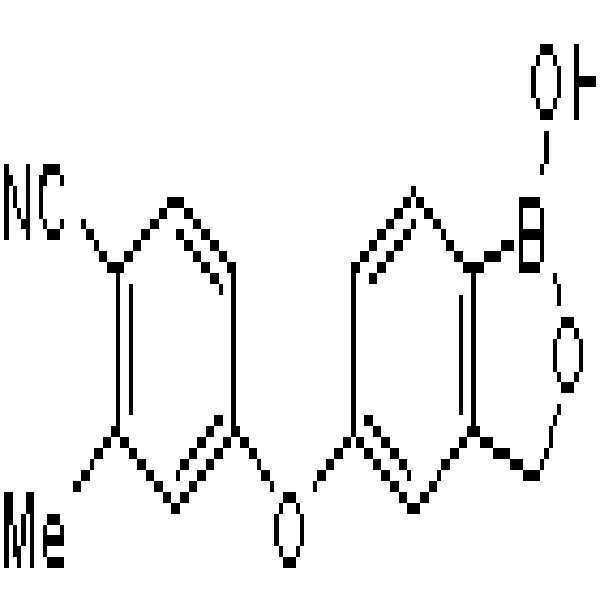
이 화합물은 실시예 19b (D2)와 유사한 방법으로 4-플루오르-2-메틸벤조니트릴 및 4-브로모-3-(1,3-디옥소란-2-일)페놀로부터 수득되었다.This compound was obtained from 4-fluoro-2-methylbenzonitrile and 4-bromo-3- (1,3-dioxolan-2-yl) phenol in a similar manner to Example 19b (D2) .
1H-NMR (300 MHz, DMSO-d 6 ) δ (ppm) 2.43 (s, 3H), 4.95 (s, 2H), 6.94 (dd, J = 8.5, 2.6 Hz, 1H), 7.06 (dd, J = 7.9, 2.3 Hz, 1H), 7.08 (d, J = 2.3 Hz, 1H), 7.12 (d, J = 2.1 Hz, 1H), 7.77 (d, J = 8.5 Hz, 2H), 9.21 (s, 1H). 1 H-NMR (300 MHz, DMSO- d 6) δ (ppm) 2.43 (s, 3H), 4.95 (s, 2H), 6.94 (dd, J = 8.5, 2.6 Hz, 1H), 7.06 (dd, J = 7.9, 2.3 Hz, 1H) , 7.08 (d, J = 2.3 Hz, 1H), 7.12 (d, J = 2.1 Hz, 1H), 7.77 (d, J = 8.5 Hz, 2H), 9.21 (s, 1H ).
19d 5-(2- 클로로 -4- 시아노페녹시 )-1,3- 디하이드로 -1- 하이드록시 -2,1- 벤조 옥사보롤 (D4) 19d 5- (2 -Chloro- 4- cyanophenoxy ) -1,3 -dihydro -1 -hydroxy- 2,1- benzoxazine borane (D4)

이 화합물은 실시예 19b (D2)와 유사한 방법으로 3-클로로-4-플루오르벤조니트릴 및 4-브로모-3-(1,3-디옥소란-2-일)페놀로부터 수득되었다.This compound was obtained from 3-chloro-4-fluorobenzonitrile and 4-bromo-3- (1,3-dioxolan-2-yl) phenol in a similar manner to Example 19b (D2) .
1H-NMR (300 MHz, DMSO-d 6 ) δ (ppm) 4.94 (s, 2H), 7.07 (d, J = 8.2 Hz, 1H), 7.11 (d, J = 0.9 Hz, 1H), 7.12 (dd, J = 8.8, 1.2 Hz, 1 H), 7.7-7.9 (m, 2H), 8.24 (d, J = 2.1 Hz, 1H), 9.23 (s, 1H). 1 H-NMR (300 MHz, DMSO- d 6) δ (ppm) 4.94 (s, 2H), 7.07 (d, J = 8.2 Hz, 1H), 7.11 (d, J = 0.9 Hz, 1H), 7.12 ( dd, J = 8.8,1.2 Hz, 1H), 7.7-7.9 (m, 2H), 8.24 (d, J = 2.1 Hz, 1H), 9.23 (s, 1H).
19e 5-(4- 시아노 -3- 트리플루오로메틸페녹시 )-1,3- 디하이드로 -1- 하이드록시 -2,1-벤조옥사보롤 (D5) 19e 5- (4- Cyano- 3 -trifluoromethylphenoxy ) -1,3 -dihydro -1 -hydroxy- 2,1- benzoxazine borane (D5)

이 화합물은 실시예 19b (D2)와 유사한 방법으로 4-플루오르-2-트리플루오로메틸벤조니트릴 및 4-브로모-3-(1,3-디옥소란-2-일)페놀로부터 수득되었다.This compound was obtained from 4-fluoro-2-trifluoromethylbenzonitrile and 4-bromo-3- (1,3-dioxolan-2-yl) phenol in a manner similar to Example 19b (D2) .
1H-NMR (300 MHz, DMSO-d 6 ) δ (ppm) 4.97 (s, 2H), 7.16 (dd, J = 7.0, 2.1 Hz, 1H), 7.24 (d, J = 2.1 Hz, 1H), 7.35 (dd, J = 8.5, 2.3 Hz, 1H), 7.60 (d, J = 2.6 Hz, 1H), 7.81 (d, J = 8.2 Hz, 1H), 8.14 (d, J = 8.5 Hz, 1H), 9.27 (s, 1H). 1 H-NMR (300 MHz, DMSO- d 6) δ (ppm) 4.97 (s, 2H), 7.16 (dd, J = 7.0, 2.1 Hz, 1H), 7.24 (d, J = 2.1 Hz, 1H), 7.35 (dd, J = 8.5, 2.3 Hz, 1H), 7.60 (d, J = 2.6 Hz, 1H), 7.81 (d, J = 8.2 Hz, 1H), 8.14 (d, J = 8.5 Hz, 1H), 9.27 (s, 1 H).
19f 5-(4- 시아노 -3- 메톡시카르보닐페녹시 )-1,3- 디하이드로 -1- 하이드록시 - 2,1-벤조옥사보롤 (D6) 19f 5- (4- Cyano- 3 -methoxycarbonylphenoxy ) -1,3 -dihydro -1 -hydroxy - 2,1- benzoxazine borane (D6)

N,N-디메틸포름아미드 (50 mL)에 용해된 메틸 2-시아노-5-플루오르벤조산염(4.48 g, 25.0 mmol), 2-브로모-5-하이드록시벤즈알데히드 (5.03 g, 25.0 mmol), 및 칼륨 카보네이트(4.14 g, 30 .0 mmol)의 혼합물이 80℃에서 하룻밤 동안 교반되었다. 물이 첨가되었고, 혼합물이 에틸 아세테이트로 추출되었다. 유기 층이 소금물로 세척되었고, 무수 황산나트륨상에서 건조되었다. 용매가 감압하에 제거되었고, 잔유물이 실리카 겔크로마토그래피 (클로로포름)에 의하여 정제되어 메틸 5-(4-브로모-3-포밀페녹시)-2-시아노벤조산염(5.35 g, 71%)이 제공되었다.Bromo-5-hydroxybenzaldehyde (5.03 g, 25.0 mmol) dissolved in N, N -dimethylformamide (50 mL) , And potassium carbonate (4.14 g, 30.0 mmol) was stirred at 80 < 0 > C overnight. Water was added and the mixture was extracted with ethyl acetate. The organic layer was washed with brine and dried over anhydrous sodium sulfate. The solvent was removed under reduced pressure and the residue was purified by silica gel chromatography (chloroform) to give methyl 5- (4-bromo-3-formylphenoxy) -2-cyanobenzoate (5.35 g, 71% .
1H-NMR (300 MHz, CDCl3) δ (ppm) 3.98 (s, 3H), 7.18-7.24 (m, 2H), 7.58 (d, J = 2.9 Hz, 1H), 7.66 (d, J = 2.6 Hz, 1H), 7.72 (d, J = 8.8 Hz, 1H), 7.78 (d, J = 8.5 Hz, 1H), 10.3 (s, 1H). 1 H-NMR (300 MHz, CDCl 3) δ (ppm) 3.98 (s, 3H), 7.18-7.24 (m, 2H), 7.58 (d, J = 2.9 Hz, 1H), 7.66 (d, J = 2.6 1H), 7.72 (d, J = 8.8 Hz, 1H), 7.78 (d, J = 8.5 Hz, 1H), 10.3 (s, 1H).
1,4-디옥산 (160 mL)에 용해된 메틸 5-(4-브로모-3-포밀페녹시)-2-시아노벤조산염(11.9 g, 33.1 mmol), 비스(피나콜라토 )다이보론 (8.89 g, 35.0 mmol), [1,1'-비스(디페닐포스피노 )페로센]디클로로팔라디움(II) (678 mg, 0.828 mmol), 및 칼륨 아세테이트 (9.75 g, 99.0 mmol)의 혼합물이 질소 대기하에 80℃에서 하룻밤 동안 교반되었다. 혼합물이 Celite 패드를 통하여 여과되었고, 용매가 감압하에 제거되었다. 실리카 겔 컬럼 (65:35 헥산/에틸 아세테이트)이 메틸 2-시아노-5-(3-포밀-4-(4,4,5,5-테트라메틸-1,3,2-디옥사보란-2-일)페녹시)벤조산염(15.7 g)을 제공했다.2-cyanobenzoic acid salt (11.9 g, 33.1 mmol) dissolved in 1,4-dioxane (160 mL), bis (pinacolato) di A mixture of boron (8.89 g, 35.0 mmol), [1,1'-bis (diphenylphosphino) ferrocene] dichloropalladium (II) (678 mg, 0.828 mmol), and potassium acetate (9.75 g, 99.0 mmol) Lt; RTI ID = 0.0 > 80 C < / RTI > overnight under a nitrogen atmosphere. The mixture was filtered through a pad of Celite and the solvent was removed under reduced pressure. The silica gel column (65:35 hexane / ethyl acetate) gave methyl 2-cyano-5- (3-formyl-4- (4,4,5,5-tetramethyl-1,3,2-dioxaborane- 2-yl) phenoxy) benzoic acid salt (15.7 g).
메틸 2-시아노-5-(3-포밀-4-(4,4,5,5-테트라메틸-1,3,2-디옥사보란-2-일)페녹시)벤조산염(15.7 g)의 메탄올 (150 mL) 용액에 보로하이드리드 나트륨(646 mg, 17.0 mmol)이 0℃에서 부분적으로 첨가되었다. 혼합물이 실온에서 1 h 동안 교반되었다. 혼합물이 6 M HCl로 산성화되었고, 에틸 아세테이트로 추출되었다. 유기 층이 소금물로 세척되었고, 무수 황산나트륨상에서 건조되었다. 용매가 감압하에 제거되었고, 잔유물이 실리카 겔크로마토그래피 (6:4 내지 4:6 헥산/에틸 아세테이트)에 이어 메탄올/물로부터의 재결정에 의하여 정제되어 5-(4-시아노-3-메톡시카르보닐페녹시)-1-하이드록시-2,1-벤조옥사보롤(6.34 g, 62%)이 제공되었다.(3-formyl-4- (4,4,5,5-tetramethyl-1,3,2-dioxaboran-2-yl) phenoxy) benzoic acid salt (15.7 g) In methanol (150 mL) was added sodium borohydride (646 mg, 17.0 mmol) partially at 0 < 0 > C. The mixture was stirred at room temperature for 1 h. The mixture was acidified with 6 M HCl and extracted with ethyl acetate. The organic layer was washed with brine and dried over anhydrous sodium sulfate. The solvent was removed under reduced pressure and the residue was purified by silica gel chromatography (6: 4 to 4: 6 hexanes / ethyl acetate) followed by recrystallization from methanol / water to give 5- (4-cyano- Carbonylphenoxy) -1-hydroxy-2,1-benzoxazine borane (6.34 g, 62%) was provided.
1H-NMR (300 MHz, DMSO-d 6 ) δ (ppm) 3.86 (s, 3H), 7.13 (dd, J = 7.9, 2.1 Hz, 1H), 7.20 (d, J = 2.1 Hz, 1H), 7.39 (dd, J = 8.6, 2.6 Hz, 1H), 7.55 (d, J = 2.6 Hz, 1H), 7.80 (d, J = 7.9 Hz, 1H), 8.01 (d, J = 8.8 Hz, 1H), 9.25 (s, 1H). 1 H-NMR (300 MHz, DMSO- d 6) δ (ppm) 3.86 (s, 3H), 7.13 (dd, J = 7.9, 2.1 Hz, 1H), 7.20 (d, J = 2.1 Hz, 1H), 7.39 (dd, J = 8.6, 2.6 Hz, 1H), 7.55 (d, J = 2.6 Hz, 1H), 7.80 (d, J = 7.9 Hz, 1H), 8.01 (d, J = 8.8 Hz, 1H), 9.25 (s, 1 H).
19g 5-(4- 카르바모일 -3- 메톡시카르보닐페녹시 )-1,3- 디하이드로 -1- 하이드록 시-2,1-벤조옥사보롤 (D7) 19 g of 5- (4 -carbamoyl- 3 -methoxycarbonylphenoxy ) -1,3 -dihydro -1 -hydroxy -2,1- benzoxazine borane (D7)
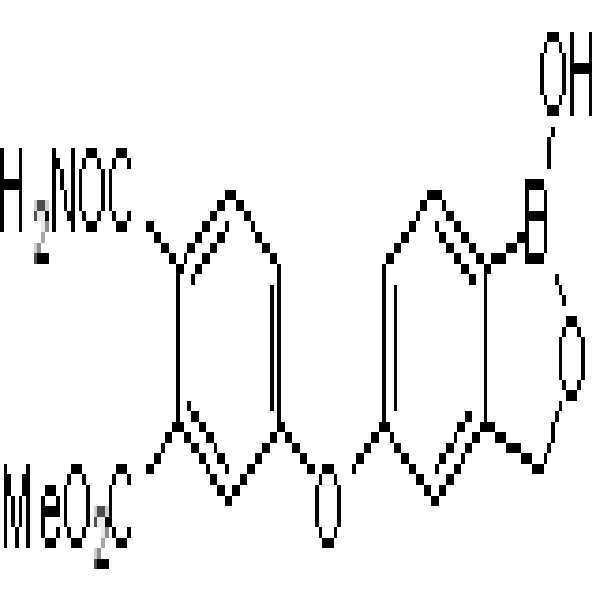
메탄올 (150 mL)에 용해된 5-(4-시아노-3-메톡시카르보닐페녹시)-1-하이드록시-2,1-벤조옥사보롤(5.25 g, 17.0 mmol) 및 1 M NaOH (50 mL)의 혼합물이 실온에서 1 h 동안 교반되었다. 혼합물이 6 M HCl로 산성화되었고, 에틸 아세테이트로 추출되었다. 유기 층이 소금물로 세척되었고, 무수 황산나트륨상에서 건조되었다. 용매가 감압하에 제거되었고, 잔유물이 실리카 겔크로마토그래피 (에틸 아세테이트)에 이어 디이소프로필 에테르를 사용한 트리터레이션에 의하여 정제되어 5-(4-카르바모일-3-메톡시카르보닐페녹시)-1-하이드록시-2,1-벤조옥사보롤(1.09 g, 19%)이 제공되었다.To a solution of 5- (4-cyano-3-methoxycarbonylphenoxy) -1-hydroxy-2,1-benzoxazine borane (5.25 g, 17.0 mmol) and 1
1H-NMR (300 MHz, DMSO-d 6 ) δ (ppm) 3.70 (s, 3H), 4.94 (s, 2H), 7.0-7.1 (m, 2H), 7.15-7.25 (m, 2H), 7.40 (br s, 1H), 7.61 (d, J = 8.8 Hz, 1H), 7.75 (d, J = 7.9 Hz, 1H), 7.90 (br s, 1H), 9.19 (s, 1H). 1 H-NMR (300 MHz, DMSO- d 6) δ (ppm) 3.70 (s, 3H), 4.94 (s, 2H), 7.0-7.1 (m, 2H), 7.15-7.25 (m, 2H), 7.40 (br s, 1H), 7.61 (d, J = 8.8 Hz, 1H), 7.75 (d, J = 7.9 Hz, 1H), 7.90 (brs, 1H), 9.19
19h 5-(3- 카르복시 -4- 시아노페녹시 )-1,3- 디하이드로 -1- 하이드록시 -2,1- 벤 조옥사보롤 (D8) 19h 5- (3- carboxy-4-cyanophenoxy) -1,3-dihydro-1-hydroxy-ben -2,1- oxazol crude borol (D8)

메탄올 (150 mL)에 용해된 5-(4-시아노-3-메톡시카르보닐페녹시)-1-하이드록시-2,1-벤조옥사보롤(5.25 g, 17.0 mmol) 및 1 M NaOH (50 mL)의 혼합물이 실온에서 1 h 동안 교반되었다. 혼합물이 6 M HCl로 산성화되었고, 에틸 아세테이트로 추출되었다. 유기 층이 소금물로 세척되었고, 무수 황산나트륨상에서 건조되었다. 용매가 감압하에 제거되었고, 잔유물이 실리카 겔크로마토그래피 (에틸 아세테이트 내지 3:1 클로로포름/메탄올)에 이어 에틸 아세테이트를 사용한 트리터레이션에 의하여 정제되어 5-(3-카르복시-4-시아노페녹시)-1-하이드록시-2,1-벤조옥사보롤(810 mg, 16%)이 제공되었다.To a solution of 5- (4-cyano-3-methoxycarbonylphenoxy) -1-hydroxy-2,1-benzoxazine borane (5.25 g, 17.0 mmol) and 1
1H-NMR (300 MHz, DMSO-d 6 ) δ (ppm) 4.95 (s, 2H), 7.04-7.16 (m, 3H), 7.43 (d, J = 2.3 Hz, 1H), 7.71 (d, J = 8.5 Hz, 1H), 7.78 (d, J = 8.0 Hz, 1H), 9.27 (br s, 1H). 1 H-NMR (300 MHz, DMSO- d 6) δ (ppm) 4.95 (s, 2H), 7.04-7.16 (m, 3H), 7.43 (d, J = 2.3 Hz, 1H), 7.71 (d, J = 8.5 Hz, 1 H), 7.78 (d, J = 8.0 Hz, 1 H), 9.27 (br s, 1 H).
19i 5-(1,3- 디하이드로 -1- 하이드록시 -2,1- 벤조옥사보롤 -5- 일옥시 ) 이소인돌 린-1,3-디온 (D9) 19i 5- (1,3- dihydro-1-hydroxy -2,1- benzoxazol-5-yloxy borol) iso-indoline-1,3-dione (D9)

메탄올 (15 mL)에 용해된 5-(4-카르바모일-3-메톡시카르보닐페녹시)-1-하이드록시-2,1-벤조옥사보롤(560 mg, 1.71 mmol) 및 1 M NaOH (5 mL)의 혼합물이 실온에서 10분 동안 교반되었다. 혼합물이 6 M HCl로 산성화되었고, 에틸 아세테이트로 추출되었다. 유기 층이 소금물로 세척되었고, 무수 황산나트륨상에서 건조되었다. 용매가 감압하에 제거되었고, 잔유물이 에틸 아세테이트로써 트리터레이션되어 5-(1,3-디하이드로-1-하이드록시-2,1-벤조옥사보롤-5-일옥시)이소인돌린-1,3-디온 (380 mg, 75%)이 제공되었다. 5- (4-Carbamoyl-3-methoxycarbonylphenoxy) -1-hydroxy-2,1-benzoxazine borane (560 mg, 1.71 mmol) dissolved in methanol (15 mL) and 1 M NaOH (5 mL) was stirred at room temperature for 10 minutes. The mixture was acidified with 6 M HCl and extracted with ethyl acetate. The organic layer was washed with brine and dried over anhydrous sodium sulfate. The solvent was removed under reduced pressure and the residue was triturated with ethyl acetate to give 5- (1,3-dihydro-1-hydroxy-2,1-benzoxaborol-5-yloxy) isoindoline- 3-dione (380 mg, 75%) was provided.
1H-NMR (300 MHz, DMSO-d 6 ) δ (ppm) 4.96 (s, 2H), 7.11 (dd, J = 7.9, 1.5 Hz, 1H), 7.17 (s, 1H), 7.25 (d, J = 2.3 Hz, 1H), 7.38 (dd, J = 8.2, 2.3 Hz, 1H), 7.82 (d, J = 8.2 Hz, 1H), 7.83 (d, J = 8.2 Hz, 1H), 9.23 (s, 1H), 11.3 (br s, 1H). 1 H-NMR (300 MHz, DMSO- d 6) δ (ppm) 4.96 (s, 2H), 7.11 (dd, J = 7.9, 1.5 Hz, 1H), 7.17 (s, 1H), 7.25 (d, J J = 8.2 Hz, 1H), 7.83 (d, J = 8.2 Hz, 1H), 7.32 (dd, J = 8.2, 2.3 Hz, 1H) ), 11.3 (br s, 1 H).
19j 5-(4- 시아노 -3- 하이드록시페녹시 )-1,3- 디하이드로 -1- 하이드록시 -2,1- 벤조옥사보롤 (D10) 19j 5- (4- Cyano- 3 -hydroxyphenoxy ) -1,3 -dihydro -1 -hydroxy- 2,1- benzoxazine borane (D10)

이 화합물은 실시예 19n (D14)와 유사한 방법으로 4-플루오르-3-하이드록시벤조니트릴 및 4-브로모-3-(1,3-디옥소란-2-일)페놀로부터 수득되었다.This compound was obtained from 4-fluoro-3-hydroxybenzonitrile and 4-bromo-3- (1,3-dioxolan-2-yl) phenol in a similar manner to Example 19n (D14) .
1H-NMR (300 MHz, DMSO-d 6 ) δ (ppm) 4.96 (s, 2H), 6.49 (d, J = 2.3 Hz, 1H), 6.55 (dd, J = 8.8, 2.3 Hz, 1H), 7.08 (dd, J = 7.9, 2.1 Hz, 1H), 7.15 (d, J = 1.8 Hz, 1H), 7.60 (d, J = 8.5 Hz, 1H), 7.78 (d, J = 8.2 Hz, 1H), 9.23 (s, 1H), 11.2 (s, 1H). 1 H-NMR (300 MHz, DMSO- d 6) δ (ppm) 4.96 (s, 2H), 6.49 (d, J = 2.3 Hz, 1H), 6.55 (dd, J = 8.8, 2.3 Hz, 1H), 7.08 (dd, J = 7.9, 2.1 Hz, 1H), 7.15 (d, J = 1.8 Hz, 1H), 7.60 (d, J = 8.5 Hz, 1H), 7.78 (d, J = 8.2 Hz, 1H), 9.23 (s, 1 H), 11.2 (s, 1 H).
19k 5-(4- 시아노 -3- 아세톡시페녹시 )-1,3- 디하이드로 -1- 하이드록시 -2,1- 벤 조옥사보롤 (D11) 19k 5- (4- cyano-3-acetoxy-phenoxy) -1,3-dihydro-1-hydroxy-ben -2,1- oxazol borol crude (D11)

N,N-디메틸포름아미드 (10 mL)에 용해된 5-(4-시아노-3-하이드록시페녹시)-1,3-디하이드로-1-하이드록시-2,1-벤조옥사보롤(900 mg, 3.37 mmol), 아세트산 무수물 (1.7 mL, 18 mmol), 트리에틸아민(1.4 mL, 10 mL)의 혼합물이 실온에서 하룻밤 동안 교반되었다. 혼합물이 1 M HCl로 산성화되었고, 에틸 아세테이트로 추출되었다. 유기 층이 소금물로 세척되었고, 무수 황산나트륨상에서 건조되었다. 용매가 감압하에 제거되었고, 잔유물이 실리카 겔크로마토그래피 (1:1 헥산/에틸 아세테이트)에 의하여 정제되어 5-(4-시아노-3-아세톡시페녹시)-1,3-디하이드로-1-하이드록시-2,1-벤조옥사보롤(818 mg, 79%)이 제공되었다. To a solution of 5- (4-cyano-3-hydroxyphenoxy) -1,3-dihydro-1-hydroxy-2,1-benzooxaborol ( 900 mg, 3.37 mmol), acetic anhydride (1.7 mL, 18 mmol) and triethylamine (1.4 mL, 10 mL) was stirred at room temperature overnight. The mixture was acidified with 1 M HCl and extracted with ethyl acetate. The organic layer was washed with brine and dried over anhydrous sodium sulfate. The solvent was removed under reduced pressure and the residue was purified by silica gel chromatography (1: 1 hexane / ethyl acetate) to give 5- (4-cyano-3-acetoxyphenoxy) -Hydroxy-2,1-benzooxaborol (818 mg, 79%) was provided.
1H-NMR (300 MHz, DMSO-d 6 ) δ (ppm) 2.31 (s, 3H), 4.96 (s, 2H), 7.04 (dd, J = 8.5, 2.6 Hz, 1H), 7.07 (d, J = 2.3 Hz, 1H), 7.12 (dd, J = 7.9, 2.1 Hz, 1H), 7.20 (d, J = 2.0 Hz, 1H), 7.80 (d, J = 7.9 Hz, 1H), 7.91 (d, J = 8.6 Hz, 1H), 9.25 (s, 1H). 1 H-NMR (300 MHz, DMSO- d 6) δ (ppm) 2.31 (s, 3H), 4.96 (s, 2H), 7.04 (dd, J = 8.5, 2.6 Hz, 1H), 7.07 (d, J = 2.3 Hz, 1H), 7.12 (dd, J = 7.9, 2.1 Hz, 1H), 7.20 (d, J = 2.0 Hz, 1H), 7.80 (d, J = 7.9 Hz, 1H), 7.91 (d, J = 8.6 Hz, 1 H), 9.25 (s, 1 H).
19l 5-(4- 시아노 -3- 메톡시페녹시 )-1,3- 디하이드로 -1- 하이드록시 -2,1- 벤조 옥사보롤 (D12) 19l 5- (4- Cyano- 3 -methoxyphenoxy ) -1,3 -dihydro -1 -hydroxy- 2,1- benzoxazine boride (D12)

5-(4-시아노-3-하이드록시페녹시)-1,3-디하이드로-1-하이드록시-2,1-벤조옥사보롤(100 mg, 0.375 mmol) 및 아이오도메탄 (0.070 mL. 1.1 mmol)의 N,N-디메틸포름아미드 (10 mL) 용액에 수소화 나트륨(60% 오일 분산물, 45 mg, 1.1 mmol)이 0℃에서 질소 대기하에 첨가되었고, 혼합물이 실온에서 2 h 동안 교반되었다. 물 및 1 M HCl이 첨가되었고, 혼합물이 에틸 아세테이트로 추출되었다. 유기 층이 소금물로 세척되었고, 무수 황산나트륨상에서 건조되었다. 용매가 감압하에 제거되었고, 잔유물이 헥산/디이소프로필 에테르로 처리되어 5-(4-시아노-3-메톡시페녹시)-1,3-디하이드로-1-하이드록시-2,1-벤조옥사보롤(92 mg, 87%)이 제공되었다.1,3-dihydro-1-hydroxy-2,1-benzoxazine borane (100 mg, 0.375 mmol) and iodomethane (0.070 mL, 0.375 mmol) were added to a solution of 5- (4-cyano-3-hydroxyphenoxy) Sodium hydride (60% oil dispersion, 45 mg, 1.1 mmol) was added to a solution of N, N -dimethylformamide (10 mL) . Water and 1 M HCl were added and the mixture was extracted with ethyl acetate. The organic layer was washed with brine and dried over anhydrous sodium sulfate. The solvent was removed under reduced pressure and the residue was treated with hexane / diisopropyl ether to give 5- (4-cyano-3-methoxyphenoxy) -1,3-dihydro- Benzooxaborol (92 mg, 87%) was provided.
1H-NMR (300 MHz, DMSO-d 6 ) δ (ppm) 3.86 (s, 3H), 4.96 (s, 2H), 6.56 (dd, J = 8.5, 2.1 Hz, 1H), 6.93 (d, J = 2.3 Hz, 1H), 7.09 (dd, J = 8.2, 2.1 Hz, 1H), 7.14 (s, 1H), 7.70 (d, J = 8.5 Hz, 1H), 7.77 (d, J = 7.9 Hz, 1H), 9.22 (s, 1H). 1 H-NMR (300 MHz, DMSO- d 6) δ (ppm) 3.86 (s, 3H), 4.96 (s, 2H), 6.56 (dd, J = 8.5, 2.1 Hz, 1H), 6.93 (d, J = 2.3 Hz, 1H), 7.09 (dd, J = 8.2, 2.1 Hz, 1H), 7.14 (s, 1H), 7.70 (d, J = 8.5 Hz, 1H), 7.77 (d, J = 7.9 Hz, 1H ), 9.22 (s, 1 H).
19m 5-(3- 클로로 -2- 시아노페녹시 )-1,3- 디하이드로 -1- 하이드록시 -2,1- 벤조 옥사보롤 (D13) 19m 5- (3- chloro-2-cyanophenoxy) -1,3-dihydro-1-hydroxy -2,1- benzoxazol borol (D13)

이 화합물은 실시예 19b (D2)와 유사한 방법으로 2-클로로-6-플루오르벤조니트릴 및 4-브로모-3-(1,3-디옥소란-2-일)페놀로부터 수득되었다.This compound was obtained from 2-chloro-6-fluorobenzonitrile and 4-bromo-3- (1,3-dioxolan-2-yl) phenol in a manner similar to Example 19b (D2) .
1H-NMR (300 MHz, DMSO-d 6 ) δ (ppm) 4.96 (s, 2H), 6.97 (d, J = 8.5 Hz, 1H), 7.16 (dd, J = 7.9, 2.1 Hz, 1H), 7.21 (d, J = 2.1 Hz, 1H), 7.49 (d, J = 8.2 Hz, 1H), 7.66 (t, J = 8.2 Hz, 1H), 7.79 (d, J = 8.2 Hz, 1H), 9.25 (s, 1H). 1 H-NMR (300 MHz, DMSO- d 6) δ (ppm) 4.96 (s, 2H), 6.97 (d, J = 8.5 Hz, 1H), 7.16 (dd, J = 7.9, 2.1 Hz, 1H), 7.21 (d, J = 2.1 Hz , 1H), 7.49 (d, J = 8.2 Hz, 1H), 7.66 (t, J = 8.2 Hz, 1H), 7.79 (d, J = 8.2 Hz, 1H), 9.25 ( s, 1H).
19n 5-(4- 시아노 -2- 하이드록시페녹시 )-1,3- 디하이드로 -1- 하이드록시 -2,1- 벤조옥사보롤 (D14) 19n 5- (4- cyano- 2 -hydroxyphenoxy ) -1,3 -dihydro -1 -hydroxy- 2,1- benzoxazine borane (D14)

4-플루오르-3-하이드록시벤조니트릴 (25.0 g, 182 mmol), 디이소프로필에틸아민 (47.7 mL, 273 mmol)의 디클로로메탄(530 mL) 용액에 클로로메틸 메틸 에테르 (16.6 mL, 219 mmol)가 0℃에서 점적되었고, 혼합물은 실온에서 하룻밤 동안 교반되었다 물이 첨가되었고, 혼합물이 디클로로메탄으로 추출되었다. 유기 층이 소금물로 세척되었고, 무수 황산나트륨상에서 건조되었다. 용매가 감압하에 제거되어 4-플루오르-3-메톡시메톡시벤조니트릴 (33.0 g, quant.)이 제공되었고, 이는 다음 단계에서 정제하지 않고 사용되었다.To a solution of 4-fluoro-3-hydroxybenzonitrile (25.0 g, 182 mmol) and diisopropylethylamine (47.7 mL, 273 mmol) in dichloromethane (530 mL) was added chloromethyl methyl ether (16.6 mL, 219 mmol) Was added dropwise at 0 < 0 > C and the mixture was stirred at room temperature overnight. Water was added and the mixture was extracted with dichloromethane. The organic layer was washed with brine and dried over anhydrous sodium sulfate. The solvent was removed under reduced pressure to give 4-fluoro-3-methoxymethoxybenzonitrile (33.0 g, quant.) Which was used in the next step without purification.
N,N-디메틸포름아미드 (370 mL)에 용해된 4-플루오르-3-메톡시메톡시벤조니트릴 (33.0 g, 182 mmol), 4-브로모-3-(1,3-디옥소란-2-일)페놀 (44.6 g, 182 mmol), 및 칼륨 카보네이트(30.1 g, 218 mmol)의 혼합물이 100℃에서 질소 대기하에 하룻밤 동안 교반되었다. 혼합물을 에틸 아세테이트/물에 부었다. 유기 층이 소금물로 세척되었고, 무수 황산나트륨상에서 건조되었다. 용매가 감압하에 제거되었고, 잔유물이 실리카 겔 짧은컬럼 (3:1 헥산/에틸 아세테이트)에 통과되고 헥산/에틸 아세테이트를 사용한 트리터레이션이 이어져 4-(4-브로모-3-(1,3-디옥소란-2-일)페녹시)-3-메톡시메톡시벤조니트릴 (32.6 g, 44%)이 제공되었다.Fluoro-3-methoxymethoxybenzonitrile (33.0 g, 182 mmol) dissolved in N, N -dimethylformamide (370 mL) 2-yl) phenol (44.6 g, 182 mmol), and potassium carbonate (30.1 g, 218 mmol) was stirred overnight at 100 ° C under a nitrogen atmosphere. The mixture was poured into ethyl acetate / water. The organic layer was washed with brine and dried over anhydrous sodium sulfate. The solvent was removed under reduced pressure and the residue was passed through a short column of silica gel (3: 1 hexane / ethyl acetate) and subsequent trituration with hexane / ethyl acetate to give 4- (4-bromo-3- -Dioxolan-2-yl) phenoxy) -3-methoxymethoxybenzonitrile (32.6 g, 44%).
1H-NMR (300 MHz, CDCl3) δ (ppm) 3.46 (s, 3H), 4.0-4.2 (m, 4H), 5.20 (s, 2H), 6.03 (s, 1H), 6.86 (dd, J = 8.5, 2.9 Hz, 1H), 6.93 (d, J = 8.5 Hz, 1H), 7.24-7.30 (m, 2H), 7.54 (d, J = 8.8 Hz, 1H), 7.54 (d, J = 2.1 Hz, 1H). 1 H-NMR (300 MHz, CDCl 3) δ (ppm) 3.46 (s, 3H), 4.0-4.2 (m, 4H), 5.20 (s, 2H), 6.03 (s, 1H), 6.86 (dd, J = 8.5, 2.9 Hz, 1H) , 6.93 (d, J = 8.5 Hz, 1H), 7.24-7.30 (m, 2H), 7.54 (d, J = 8.8 Hz, 1H), 7.54 (d, J = 2.1 Hz , 1H).
4-(4-브로모-3-(1,3-디옥소란-2-일)페녹시)-3-메톡시메톡시벤조니트릴 (32.2 g, 79.3 mmol)의 테트라하이드로퓨란 (300 mL) 용액에 3 M HCl (100 mL)이 첨가되었고, 혼합물이 2 h 동안 환류되었다. 물이 첨가되었고, 혼합물이 에틸 아세테이트로 추출되었다. 유기 층이 소금물로 세척되었고, 무수 황산나트륨상에서 건조되었다. 용매가 감압하에 제거되어 4-(4-브로모-3-포밀페녹시)-3-하이드록시벤조니트릴 (25.8 g, quant.)이 제공되었다.(300 mL) of 4- (4-bromo-3- (1,3-dioxolan-2-yl) phenoxy) -3- methoxymethoxybenzonitrile (32.2 g, 79.3 mmol) To the solution was added 3 M HCl (100 mL) and the mixture was refluxed for 2 h. Water was added and the mixture was extracted with ethyl acetate. The organic layer was washed with brine and dried over anhydrous sodium sulfate. The solvent was removed under reduced pressure to give 4- (4-bromo-3-formylphenoxy) -3-hydroxybenzonitrile (25.8 g, quant.).
1,4-디옥산 (260 mL)에 용해된 4-(4-브로모-3-포밀페녹시)-3-하이드록시벤조니트릴 (20.5 g, 64.5 mmol), 비스(피나콜라토 )다이보론 (17.2 g, 67.7 mmol), [1,1'-비스(디페닐포스피노 )페로센]디클로로팔라디움(II) (1.32 g, 1.61 mmol), 및 칼륨 아세테이트 (19.1 g, 194 mmol)의 혼합물이 질소 대기하에 80℃에서 하룻밤 동안 교반되었다. 혼합물이 Celite 패드를 통하여 여과되었고, 용매가 감압하에 제거되었다. 실리카 겔 컬럼 (에틸 아세테이트)이 메틸 4-(3-포밀-4-(4,4,5,5-테트라메틸-1,3,2-디옥사보란-2-일)페녹시)-3-하이드록시벤조니트릴 (25.1 g)을 제공했다.4- (4-bromo-3-formylphenoxy) -3-hydroxybenzonitrile (20.5 g, 64.5 mmol) dissolved in 1,4-dioxane (260 mL), bis (pinacolato) (17.2 g, 67.7 mmol), [1,1'-bis (diphenylphosphino) ferrocene] dichloropalladium (II) (1.32 g, 1.61 mmol) and potassium acetate (19.1 g, 194 mmol) Lt; RTI ID = 0.0 > 80 C < / RTI > overnight. The mixture was filtered through a pad of Celite and the solvent was removed under reduced pressure. The silica gel column (ethyl acetate) gave methyl 4- (3-formyl-4- (4,4,5,5-tetramethyl-1,3,2-dioxaboran-2- yl) phenoxy) -3- Hydroxybenzonitrile (25.1 g) was provided.
메틸 4-(3-포밀-4-(4,4,5,5-테트라메틸-1,3,2-디옥사보란-2-일)페녹시)-3-하이드록시벤조니트릴 (25.1 g)의 메탄올 (300 mL) 용액에 보로하이드리드 나트륨(2.45 g, 64.5 mmol)이 0℃에서 부분적으로 첨가되었다. 혼합물이 실온에서 1 h 동안 교반되었다. 용매가 감압하에 약 3분의 1 부피까지 제거되었다. 혼합물이 6 M HCl로 산성화되었고, 에틸 아세테이트로 추출되었다. 유기 층이 소금물로 세척되었고, 무수 황산나트륨상에서 건조되었다. 용매가 감압하에 제거되었고, 잔유물이 실리카 겔크로마토그래피 (7:3 내지 6:4 헥산/아세톤)에 이어 아세톤/물로부터의 재결정화 및 에틸 아세테이트를 사용한 트리터레이션에 의하여 정제되어 5-(4-시아노-2-하이드록시페녹시)-1,3-디하이드로-1-하이드록시-2,1-벤조옥사보롤(10.9 g, 63%)이 제공되었다.(25.1 g) was added to a solution of methyl 4- (3-formyl-4- (4,4,5,5-tetramethyl-1,3,2-dioxaborane-2-yl) phenoxy) In methanol (300 mL) was added sodium borohydride (2.45 g, 64.5 mmol) partially at 0 < 0 > C. The mixture was stirred at room temperature for 1 h. The solvent was removed to about one-third volume under reduced pressure. The mixture was acidified with 6 M HCl and extracted with ethyl acetate. The organic layer was washed with brine and dried over anhydrous sodium sulfate. The solvent was removed under reduced pressure and the residue was purified by silica gel chromatography (7: 3 to 6: 4 hexanes / acetone) followed by recrystallization from acetone / water and trituration with ethyl acetate to give 5- (4 -Cyano-2-hydroxyphenoxy) -1,3-dihydro-1-hydroxy-2,1-benzoxazine borane (10.9 g, 63%).
1H-NMR (300 MHz, DMSO-d 6 ) δ (ppm) 4.90 (s, 2H), 6.90-6.95 (m, 2H), 7.09 (d, J = 7.9 Hz, 1H), 7.26-7.33 (m, 2H), 7.69 (d, J = 7.9 Hz, 1H), 9.12 (s, 1H), 10.4 (br s, 1H). 1 H-NMR (300 MHz, DMSO- d 6) δ (ppm) 4.90 (s, 2H), 6.90-6.95 (m, 2H), 7.09 (d, J = 7.9 Hz, 1H), 7.26-7.33 (m , 2H), 7.69 (d, J = 7.9 Hz, 1H), 9.12 (s, 1H), 10.4 (br s, 1H).
19o 5-(4- 시아노 -2- 메톡시페녹시 )-1,3- 디하이드로 -1- 하이드록시 -2,1- 벤조 옥사보롤 (D15) 19o 5- (4- cyano- 2 -methoxyphenoxy ) -1,3 -dihydro -1 -hydroxy- 2,1- benzoxazine borol (D15)

이 화합물은 실시예 271 (D12)와 유사한 방법으로 5-(4-시아노-2-하이드록시페녹시)-1,3-디하이드로-1-하이드록시-2,1-벤조옥사보롤 (D14) 및 아이오도메탄으로부터 수득되었다.The compounds in Example 271 in a similar manner to (D12) 5- (4- cyano-2-hydroxyphenoxy) -1, 3-dihydro-1-hydroxy -2,1- benzoxazol borol (D14 ) And iodomethane.
1H-NMR (300 MHz, DMSO-d 6 ) δ (ppm) 3.80 (s, 3H), 4.90 (s, 2H), 6.90-6.96 (m, 2H), 7.12 (d, J = 8.2 Hz, 1H), 7.44 (dd, J = 8.2, 2.1 Hz, 1H), 7.67 (d, J = 1.8 Hz, 1H), 7.69 (d, J = 8.8 Hz, 1H), 9.13 (s, 1H). 1 H-NMR (300 MHz, DMSO- d 6) δ (ppm) 3.80 (s, 3H), 4.90 (s, 2H), 6.90-6.96 (m, 2H), 7.12 (d, J = 8.2 Hz, 1H ), 7.44 (dd, J = 8.2,2.1 Hz, 1H), 7.67 (d, J = 1.8 Hz, 1H), 7.69 (d, J = 8.8 Hz, 1H), 9.13 (s, 1H).
19p 5-[4- 시아노 -2-( 에톡시카르보닐메톡시 ) 페녹시 ]-1,3- 디하이드로 -1- 하이 드록시-2,1-벤조옥사보롤 (D16) 19p 5- [4- cyano-2- (ethoxy-carbonyloxy -dihydroxy-20 in) phenoxy] -1,3-dihydro-1-hydroxy-high DE -2,1- benzoxazol borol (D16)

이 화합물은 실시예 191 (D12)와 유사한 방법으로 5-(4-시아노-2-하이드록시페녹시)-1,3-디하이드로-1-하이드록시-2,1-벤조옥사보롤(D14) 및 에틸 브로모아세테이트로부터 수득되었다.The compounds in Example 191 in a similar manner to (D12) 5- (4- cyano-2-hydroxyphenoxy) -1, 3-dihydro-1-hydroxy -2,1- benzoxazol borol (D14 ) And ethyl bromoacetate.
1H-NMR (300 MHz, DMSO-d 6 ) δ (ppm) 1.17 (t, J = 7.0 Hz, 3H), 4.12 (q, J = 7.0 Hz, 2H), 4.91 (s, 4H), 6.94-6.99 (m, 2H), 7.13 (d, J = 8.5 Hz, 1H), 7.47 (dd, J = 8.5, 1.8 Hz, 1H), 7.66 (d, J = 1.8 Hz, 1H), 7.70 (d, J = 8.5 Hz, 1H), 9.14 (s, 1H). 1 H-NMR (300 MHz, DMSO- d 6) δ (ppm) 1.17 (t, J = 7.0 Hz, 3H), 4.12 (q, J = 7.0 Hz, 2H), 4.91 (s, 4H), 6.94- 6.99 (m, 2H), 7.13 (d, J = 8.5 Hz, 1H), 7.47 (dd, J = 8.5, 1.8 Hz, 1H), 7.66 (d, J = 1.8 Hz, 1H), 7.70 (d, J = 8.5 Hz, 1 H), 9.14 (s, 1 H).
19q 5-[2-( 카르복시메톡시 )-4- 시아노페녹시 ]-1,3- 디하이드로 -1- 하이드록시 -2,1-벤조옥사보롤 (D17) 19q 5- [2- ( Carboxymethoxy ) -4- cyanophenoxy ] -1,3 -dihydro -1 -hydroxy- 2,1- benzoxazine borane (D17)

메탄올 (8 mL)에 용해된 5-[4-시아노-2-(에톡시카르보닐메톡시)페녹시]-1,3-디하이드로-1-하이드록시-2,1-벤조옥사보롤 (D16) (216 mg, 0.612 mmol) 및 1 M NaOH (2 mL)의 혼합물이 실온에서 1 h 동안 교반되었다. 혼합물이 1 M HCl로 산성화되었고, 에틸 아세테이트로 추출되었다. 유기 층이 소금물로 세척되었고, 무수 황산나트륨상에서 건조되었다. 용매가 감압하에 제거되었고, 잔유물이 헥산으로 처리되어 5-[2-(카르복시메톡시)-4-시아노페녹시]-1,3-디하이드로-1-하이드록시-2,1-벤조옥사보롤(82 mg, 41%)이 제공되었다.To a solution of 5- [4-cyano-2- (ethoxycarbonylmethoxy) phenoxy] -1,3-dihydro-1-hydroxy-2,1-benzooxaborol ( D16) (216 mg, 0.612 mmol) and 1 M NaOH (2 mL) was stirred at room temperature for 1 h. The mixture was acidified with 1 M HCl and extracted with ethyl acetate. The organic layer was washed with brine and dried over anhydrous sodium sulfate. The solvent was removed under reduced pressure and the residue was treated with hexane to give 5- [2- (carboxymethoxy) -4-cyanophenoxy] -1,3-dihydro-1-hydroxy- Borol (82 mg, 41%) was provided.
1H-NMR (300 MHz, DMSO-d 6 ) δ (ppm) 4.82 (s, 2H), 4.90 (s, 2H), 6.94-7.00 (m, 2H), 7.11 (d, J = 8.2 Hz, 1H), 7.45 (dd, J = 8.5, 1.8 Hz, 1H), 7.62 (s, 1H), 7.70 (d, J = 8.5 Hz, 1H), 9.14 (s, 1H), 13.1 (br s, 1H). 1 H-NMR (300 MHz, DMSO- d 6) δ (ppm) 4.82 (s, 2H), 4.90 (s, 2H), 6.94-7.00 (m, 2H), 7.11 (d, J = 8.2 Hz, 1H ), 7.45 (dd, J = 8.5, 1.8 Hz, 1H), 7.62 (s, 1H), 7.70 (d, J = 8.5 Hz, 1H), 9.14 (s, 1H), 13.1 (br s, 1H).
19r 5-(4- 카르복시 -2- 하이드록시페녹시 )-1,3- 디하이드로 -1- 하이드록시 - 2,1-벤조옥사보롤 (D18) 19r 5- (4- carboxy-2-hydroxy-phenoxy) -1,3-dihydro-1-hydroxy-2,1-benzoxazol borol (D18)

메탄올 (60 mL) 및 1,4-디옥산 (60 mL)에 용해된 5-(4-시아노-2-하이드록시페녹시)-1,3-디하이드로-1-하이드록시-2,1-벤조옥사보롤 (D14) (4.00 g, 15.0 mmol) 및 6 M NaOH (30 mL)의 혼합물이 5 일 동안 환류되었다. 혼합물이 얼음 바스에서 냉각되었고, 6 M HCl로 산성화되었으며, 이후 에틸 아세테이트로 추출되었다. 유기 층이 소금물로 세척되었고, 무수 황산나트륨상에서 건조되었다. 용매가 감압하에 제거되었고, 잔유물이 에틸 아세테이트로부터 재결정화되어 5-(4-카르복시-2-하이드록시페녹시)-1,3-디하이드로-1-하이드록시-2,1-벤조옥사보롤(1.29 g, 30%)이 제공되었다. 여과액의 실리카 겔 컬럼 (3:7 내지 2:8 헥산/에틸 아세테이트)에 이어 에틸 아세테이트를 사용하는 트리터레이션이 또 다른 1.00 g (23%)을 제공했다.To a solution of 5- (4-cyano-2-hydroxyphenoxy) -1,3-dihydro-1-hydroxy-2,1 -Benzooxaborol (D14) (4.00 g, 15.0 mmol) and 6 M NaOH (30 mL) was refluxed for 5 days. The mixture was cooled in an ice bath, acidified with 6 M HCl and then extracted with ethyl acetate. The organic layer was washed with brine and dried over anhydrous sodium sulfate. The solvent was removed under reduced pressure and the residue was recrystallized from ethyl acetate to give 5- (4-carboxy-2-hydroxyphenoxy) -1,3-dihydro-1-hydroxy-2,1- benzoxazine 1.29 g, 30%). Filtration of the silica gel column (3: 7 to 2: 8 hexane / ethyl acetate) followed by trituration with ethyl acetate gave another 1.00 g (23%).
1H-NMR (300 MHz, DMSO-d 6 ) δ (ppm) 4.89 (s, 2H), 6.85 (d, J = 1.5 Hz, 1H), 6.90 (dd, J = 7.9, 2.1 Hz, 1H), 7.03 (d, J = 8.5 Hz, 1H), 7.41 (dd, J = 8.2, 2.1 Hz, 1H), 7.54 (d, J = 2.1 Hz, 1H), 7.66 (d, J= 7.9 Hz, 1H), 9.08 (s, 1H), 9.98 (s, 1H), 12.8 (br s, 1H). 1 H-NMR (300 MHz, DMSO- d 6) δ (ppm) 4.89 (s, 2H), 6.85 (d, J = 1.5 Hz, 1H), 6.90 (dd, J = 7.9, 2.1 Hz, 1H), 7.03 (d, J = 8.5 Hz , 1H), 7.41 (dd, J = 8.2, 2.1 Hz, 1H), 7.54 (d, J = 2.1 Hz, 1H), 7.66 (d, J = 7.9 Hz, 1H), 9.08 (s, 1 H), 9.98 (s, 1 H), 12.8 (br s, 1 H).
19s 5-(4- 에톡시카르보닐 -2- 하이드록시페녹시 )-1,3- 디하이드로 -1- 하이드록 시-2,1-벤조옥사보롤 (D19) 19s 5- (4 -ethoxycarbonyl- 2 -hydroxyphenoxy ) -1,3 -dihydro -1 -hydroxy -2,1- benzoxazine borane (D19)

에탄올 (75 mL)에 용해된 5-(4-카르복시-2-하이드록시페녹시)-1,3-디하이드로-1-하이드록시-2,1-벤조옥사보롤(1.95 g, 6.82 mmol) 및 황산 (1.5 mL)의 혼합물이 6 h 동안 환류되었다. 물이 첨가되었고, 혼합물이 에틸 아세테이트로 추출되었다. 유기 층이 소금물로 세척되었고, 무수 황산나트륨상에서 건조되었다. 용매가 감압하에 제거되었다. 실리카 겔 컬럼 (6:4 내지 5:5 헥산/아세톤)에 이어 디이소프로필 에테르로부터의 재결정화가 5-(4-에톡시카르보닐-2-하이드록시페녹시)-1,3-디하이드로-1-하이드록시-2,1-벤조옥사보롤(1.65 g, 77%)을 제공했다.Hydroxy-2,1-benzoxazine borane (1.95 g, 6.82 mmol) dissolved in ethanol (75 mL) and a solution of 5- (4-carboxy-2-hydroxyphenoxy) Sulfuric acid (1.5 mL) was refluxed for 6 h. Water was added and the mixture was extracted with ethyl acetate. The organic layer was washed with brine and dried over anhydrous sodium sulfate. The solvent was removed under reduced pressure. Recrystallization from diisopropyl ether followed by silica gel column (6: 4 to 5: 5 hexanes / acetone) afforded 5- (4-ethoxycarbonyl-2-hydroxyphenoxy) 1-hydroxy-2,1-benzooxaborol (1.65 g, 77%).
1H-NMR (300 MHz, DMSO-d 6 ) δ (ppm) 1.29 (t, J = 7.0 Hz, 3H), 4.27 (q, J = 7.0 Hz, 1H), 4.89 (s, 2H), 6.86 (s, 1H), 6.91 (d, J = 8.2 Hz, 1H), 7.05 (d, J = 8.2 Hz, 1H), 7.43 (dd, J = 8.5, 2.1 Hz, 1H), 7.56 (s, 1H), 7.67 (d, J = 8.2 Hz, 1H), 9.09 (s, 1H), 10.1 (s, 1H). 1 H-NMR (300 MHz, DMSO- d 6) δ (ppm) 1.29 (t, J = 7.0 Hz, 3H), 4.27 (q, J = 7.0 Hz, 1H), 4.89 (s, 2H), 6.86 ( s, 1H), 6.91 (d , J = 8.2 Hz, 1H), 7.05 (d, J = 8.2 Hz, 1H), 7.43 (dd, J = 8.5, 2.1 Hz, 1H), 7.56 (s, 1H), 7.67 (d, J = 8.2 Hz, 1H), 9.09 (s, 1H), 10.1 (s, 1H).
19t 5-(4- 에톡시카르보닐 -2- 메톡시페녹시 )-1,3- 디하이드로 -1- 하이드록시 - 2,1-벤조옥사보롤 (D20) 19t 5- (4 -ethoxycarbonyl- 2 -methoxyphenoxy ) -1,3 -dihydro -1 -hydroxy - 2,1- benzoxazine borane (D20)

이 화합물은 실시예 191 (D12)와 유사한 방법으로 5-(4-에톡시카르보닐-2-하이드록시페녹시)-1,3-디하이드로-1-하이드록시-2,1-벤조옥사보롤 (D19) 및 아이오도메탄으로부터 수득되었다.This compound was prepared in a similar manner to Example 191 (D12) from 5- (4-ethoxycarbonyl-2-hydroxyphenoxy) -1,3-dihydro-1-hydroxy- (D19) and iodomethane.
1H-NMR (300 MHz, DMSO-d 6 ) δ (ppm) 1.31 (t, J = 7.0 Hz, 3H), 3.80 (s, 3H), 4.31 (q, J = 7.0 Hz, 2H), 4.89 (s, 3H), 6.86-6.94 (m, 2H), 7.11 (d, J = 8.5 Hz, 1H), 7.59 (dd, J = 8.2, 1.8 Hz, 1H), 7.63 (d, J = 2.1 Hz, 1H), 7.68 (d, J = 7.9 Hz, 1H), 9.11 (s, 1H). 1 H-NMR (300 MHz, DMSO- d 6) δ (ppm) 1.31 (t, J = 7.0 Hz, 3H), 3.80 (s, 3H), 4.31 (q, J = 7.0 Hz, 2H), 4.89 ( s, 3H), 6.86-6.94 (m , 2H), 7.11 (d, J = 8.5 Hz, 1H), 7.59 (dd, J = 8.2, 1.8 Hz, 1H), 7.63 (d, J = 2.1 Hz, 1H ), 7.68 (d, J = 7.9 Hz, 1 H), 9.11 (s, 1 H).
19u 5-[4- 에톡시카르보닐 -2-( 시클로펜틸옥시 ) 페녹시 ]-1,3- 디하이드로 -1- 하 이드록시-2,1-벤조옥사보롤 (D21) 19u 5- [ethoxycarbonyl-2- (cyclopentyloxy) 4-phenoxy] -1,3-dihydro-1-hydroxy-Id to -2,1- benzoxazol borol (D21)

이 화합물은 실시예 191 (D12)와 유사한 방법으로 5-(4-에톡시카르보닐-2-하이드록시페녹시)-1,3-디하이드로-1-하이드록시-2,1-벤조옥사보롤 (D19) 및 시클로펜틸 요오드화물로부터 수득되었다.This compound was prepared in a similar manner to Example 191 (D12) from 5- (4-ethoxycarbonyl-2-hydroxyphenoxy) -1,3-dihydro-1-hydroxy- (D19) and cyclopentyl iodide.
1H-NMR (300 MHz, DMSO-d 6 ) δ (ppm): 1.2 -1.6 (m, 6H), 1.30 (t, J = 7.0 Hz, 3H), 1.7-1.9 (m, 2H), 4.30 (q, J = 7.0 Hz, 2H), 4.87 (s, 2H), 4.87 (m, 1H), 6.84 (s, 1H), 6.88 (d, J = 7.9 Hz, 1H), 7.17 (d, J = 7.9 Hz, 1H), 7.55-7.61 (m, 2H), 7.65 (d, J = 7.9 Hz, 1H), 9.09 (s, 1H). 1 H-NMR (300 MHz, DMSO- d 6) δ (ppm): 1.2 -1.6 (m, 6H), 1.30 (t, J = 7.0 Hz, 3H), 1.7-1.9 (m, 2H), 4.30 ( q, J = 7.0 Hz, 2H ), 4.87 (s, 2H), 4.87 (m, 1H), 6.84 (s, 1H), 6.88 (d, J = 7.9 Hz, 1H), 7.17 (d, J = 7.9 Hz, 1H), 7.55-7.61 (m, 2H), 7.65 (d, J = 7.9 Hz, 1H), 9.09 (s, 1H).
19v 5-[4- 에톡시카르보닐 -2-(4- 시아노피리딘 -2- 일옥시 ) 페녹시 ]-1,3- 디하이 드로-1-하이드록시-2,1-벤조옥사보롤 (D22) 19v 5- [4-ethoxycarbonyl-2- (4-cyano-pyridin-2-yloxy) phenoxy] -1,3-high draw-1-hydroxy -2,1- benzoxazol borol ( D22)

N,N-디메틸포름아미드 (4 mL)에 용해된 5-(4-에톡시카르보닐-2-하이드록시페녹시)-1,3-디하이드로-1-하이드록시-2,1-벤조옥사보롤(D19) (200 mg, 0.637 mmol), 2-클로로-5-피리딘-5-카르보니트릴 (106 mg, 0.764 mmol), 및 칼륨 카보네이트(264 mg, 1.90 mmol)의 혼합물이 70℃에서 질소 대기하에 2 h 동안 교반되었다. 혼합물을 에틸 아세테이트/희석된 HCl에 부었다. 유기 층이 소금물로 세척되었고, 무수 황산나트륨상에서 건조되었다. 용매가 감압하에 제거되었고, 잔유물이 실리카 겔 컬럼 (6:4 헥산/아세톤) 및 예비 TLC (5:5 헥산/아세톤)에 의하여 정제되어 5-[4-에톡시카르보닐-2-(4-시아노피리딘-2-일옥시)페녹시]-1,3-디하이드로-1-하이드록시-2,1-벤조옥사보롤(133 mg, 50%)이 제공되었다. To a solution of 5- (4-ethoxycarbonyl-2-hydroxyphenoxy) -1,3-dihydro-1-hydroxy-2,1-benzoxazole borol (D19) (200 mg, 0.637 mmol), 2- chloro-5-pyridin-5-carbonitrile a mixture of (106 mg, 0.764 mmol), and potassium carbonate (264 mg, 1.90 mmol) in a nitrogen atmosphere for 70 ℃ Lt; / RTI > for 2 h. The mixture was poured into ethyl acetate / diluted HCl. The organic layer was washed with brine and dried over anhydrous sodium sulfate. The solvent was removed under reduced pressure and the residue was purified by silica gel column (6: 4 hexanes / acetone) and preparative TLC (5: 5 hexanes / acetone) to give 5- [4- ethoxycarbonyl- 2-yloxy) phenoxy] -1,3-dihydro-1-hydroxy-2,1-benzoxazine borane (133 mg, 50%) was provided.
1H-NMR (300 MHz, DMSO-d 6 ) δ (ppm) 1.29 (t, J = 7.0 Hz, 1H), 4.29 (q, J = 7.0 Hz, 2H), 4.88 (s, 2H), 6.91 (dd, J = 8.2, 2.3 Hz, 1H), 6.95 (d, J= 2.1 Hz, 1H), 7.13 (d, J = 8.8 Hz, 1H), 7.24 (d, J = 8.8 Hz, 1H), 7.67 (d, J = 7.9 Hz, 1H), 7.84-7.90 (m, 2H), 8.28 (dd, J = 8.8, 2.3 Hz, 1H), 8.62 (d, J = 2.3 Hz, 1H), 9.16 (s, 1H). 1 H-NMR (300 MHz, DMSO- d 6) δ (ppm) 1.29 (t, J = 7.0 Hz, 1H), 4.29 (q, J = 7.0 Hz, 2H), 4.88 (s, 2H), 6.91 ( dd, J = 8.2, 2.3 Hz , 1H), 6.95 (d, J = 2.1 Hz, 1H), 7.13 (d, J = 8.8 Hz, 1H), 7.24 (d, J = 8.8 Hz, 1H), 7.67 ( d, J = 7.9 Hz, 1H ), 7.84-7.90 (m, 2H), 8.28 (dd, J = 8.8, 2.3 Hz, 1H), 8.62 (d, J = 2.3 Hz, 1H), 9.16 (s, 1H ).
19w 5-(4- 시아노 -2- 포밀페녹시 )-1,3- 디하이드로 -1- 하이드록시 -2,1- 벤조옥 사보롤 (D23) 19w 5- (4- Cyano- 2- formylphenoxy ) -1,3 -dihydro -1 -hydroxy- 2,1- benzooxaborol (D23)

4-브로모-3-포밀페놀 (20.1 g, 100 mmol)의 메탄올 (200 mL) 용액에 보로하이드리드 나트륨(1.90 g, 50.0 mmol)이 0℃에서 부분적으로 첨가되었고, 혼합물이 실온에서 1 h 동안 교반되었다. 용매가 감압하에 절반 부피까지 제거되었고, 6 M HCl (50 mL)이 첨가되었으며, 혼합물이 에틸 아세테이트로 추출되었다. 유기 층이 소금물로 세척되었고, 무수 황산나트륨상에서 건조되었다. 용매가 감압하에 제거되어 4-브로모-3-하이드록시메틸페놀 (19.4 g, 96%)이 제공되었다.Sodium borohydride (1.90 g, 50.0 mmol) was partially added to a solution of 4-bromo-3-formylphenol (20.1 g, 100 mmol) in methanol (200 mL) and the mixture was stirred at room temperature for 1 h Lt; / RTI > The solvent was removed under reduced pressure to half volume, 6 M HCl (50 mL) was added, and the mixture was extracted with ethyl acetate. The organic layer was washed with brine and dried over anhydrous sodium sulfate. The solvent was removed under reduced pressure to give 4-bromo-3-hydroxymethylphenol (19.4 g, 96%).
1H-NMR (300 MHz, DMSO-d 6 ) δ (ppm) 4.39 (d, J = 5.9 Hz, 2H), 5.35 (t, J = 5.9 Hz, 1H), 6.56 (dd, J = 8.5, 2.9 Hz, 1H), 6.97 (d, J = 2.9 Hz, 1H), 7.28 (d, J = 8.5 Hz, 1H), 9.61 (s, 1H). 1 H-NMR (300 MHz, DMSO- d 6) δ (ppm) 4.39 (d, J = 5.9 Hz, 2H), 5.35 (t, J = 5.9 Hz, 1H), 6.56 (dd, J = 8.5, 2.9 1H), 6.97 (d, J = 2.9 Hz, 1H), 7.28 (d, J = 8.5 Hz, 1H), 9.61 (s, 1H).
N,N-디메틸포름아미드 (200 mL)에 용해된 4-플루오르-3-포밀벤조니트릴 (14.2 g, 96.0 mmol), 4-브로모-3-하이드록시메틸페놀 (19.4 g, 96 mmol), 및 칼륨 카보네이트(15.2 g, 110 mmol)의 혼합물이 70℃에서 질소 대기하에 2 h 동안 교반되었다. 혼합물을 에틸 아세테이트/물에 부었다. 유기 층이 물로 두 번, 그리고 소금물로 세척된 다음, 무수 황산나트륨상에서 건조되었다. 용매가 감압하에 제거되었고, 잔유물이 실리카 겔 컬럼 (3:1 내지 7:3 헥산/에틸 아세테이트)에 의하여 정제되어 4-[4-브로모-3-(하이드록시메틸)페녹시]-3-포밀벤조니트릴 (26.0 g, 82%)이 제공되었다.4-bromo-3-hydroxymethylphenol (19.4 g, 96 mmol) dissolved in N, N -dimethylformamide (200 mL) And potassium carbonate (15.2 g, 110 mmol) was stirred at 70 < 0 > C under a nitrogen atmosphere for 2 h. The mixture was poured into ethyl acetate / water. The organic layer was washed twice with water, brine, and then dried over anhydrous sodium sulfate. The solvent was removed under reduced pressure and the residue was purified by silica gel column (3: 1 to 7: 3 hexane / ethyl acetate) to give 4- [4-bromo-3- (hydroxymethyl) phenoxy] -3- Formyl benzonitrile (26.0 g, 82%) was provided.
디클로로메탄(300 mL)에 용해된 4-[4-브로모-3-(하이드록시메틸)페녹시]-3-포밀벤조니트릴 (25.5 g, 76.8 mmol), 3,4-디하이드로-2H-피란 (10.4 mL, 115 mmol), 및 dl-10-캠퍼술폰산 (356 mg, 2 몰%)의 혼합물이 실온에서 2 h 동안 교반되었다. 소듐 카보네이트 (3 g)가 첨가되었고, 혼합물을 물/클로로포름에 부었다. 유기 층이 소금물로 세척되었고, 무수 황산나트륨상에서 건조되었다. 용매가 감압하에 제거되었고, 잔유물이 실리카 겔 컬럼 (85:15 헥산/에틸 아세테이트)에 의하여 정제되어 4-[4-브로모-3-(2-테트라하이드로피란일옥시메틸)페녹시]-3-포밀벤조니트릴 (28.0 g, 88%)이 제공되었다.Dissolved in dichloromethane (300 mL), 4- [4- bromo-3- (hydroxymethyl) phenoxy] -3-formyl-benzonitrile (25.5 g, 76.8 mmol), 3,4- dihydro -2 H -Pyran (10.4 mL, 115 mmol), and dl- 10-camphorsulfonic acid (356 mg, 2 mol%) was stirred at room temperature for 2 h. Sodium carbonate (3 g) was added and the mixture was poured into water / chloroform. The organic layer was washed with brine and dried over anhydrous sodium sulfate. The solvent was removed under reduced pressure and the residue was purified by silica gel column (85:15 hexanes / ethyl acetate) to give 4- [4-bromo-3- (2- tetrahydropyranyloxymethyl) phenoxy] -Formyl benzonitrile (28.0 g, 88%) was provided.
1,4-디옥산 (270 mL)에 용해된 4-[4-브로모-3-(2-테트라하이드로피란일옥시메틸)페녹시]-3-포밀벤조니트릴 (28.0 g, 67.3 mmol), 비스(피나콜라토)다이보론 (18.8 g, 74.0 mmol), [1,1'-비스(디페닐포스피노)페로센]디클로로팔라디움(II) (1.37 g, 2.5 몰%), 및 칼륨 아세테이트 (19.8 g, 202 mmol)의 혼합물이 질소 대기하에 80℃에서 하룻밤 동안 교반되었다. 혼합물이 Celite 패드를 통하여 여과되었고, 용매가 감압하에 제거되었다. 잔유물이 테트라하이드로퓨란 (250 mL)에 용해되었고, 6 M HCl (30 mL)이 첨가되었으며, 혼합물이 실온에서 2h 동안 교반되었다. 혼합물을 에틸 아세테이트/물에 부었다. 유기 층이 소금물로 세척되었고, 무수 황산나트륨상에서 건조되었다. 용매가 감압하에 제거되었고, 잔유물이 실리카 겔 컬럼 (5:5 내지 3:7 헥산/에틸 아세테이트)에 이어 에틸 아세테이트/헥산으로부터의 재결정화에 의하여 정제되어 5-(4-시아노-2-포밀페녹시)-1,3-디하이드로-1-하이드록시-2,1-벤조옥사보롤(6.61 g, 35%)이 제공되었다.3- (2-tetrahydropyranyloxymethyl) phenoxy] -3-formylbenzonitrile (28.0 g, 67.3 mmol) dissolved in 1,4-dioxane (270 mL) Bis (diphenylphosphino) ferrocene] dichloropalladium (II) (1.37 g, 2.5 mol%) and potassium acetate (19.8 g, 74.0 mmol) g, 202 mmol) was stirred under nitrogen atmosphere at 80 < 0 > C overnight. The mixture was filtered through a pad of Celite and the solvent was removed under reduced pressure. The residue was dissolved in tetrahydrofuran (250 mL), 6 M HCl (30 mL) was added, and the mixture was stirred at room temperature for 2 h. The mixture was poured into ethyl acetate / water. The organic layer was washed with brine and dried over anhydrous sodium sulfate. The solvent was removed under reduced pressure and the residue was purified by recrystallization from ethyl acetate / hexane followed by silica gel column (5: 5 to 3: 7 hexane / ethyl acetate) to give 5- (4-cyano- Phenoxy) -1,3-dihydro-1-hydroxy-2,1-benzoxazine borane (6.61 g, 35%).
1H-NMR (300 MHz, DMSO-d 6 ) δ (ppm) 4.98 (s, 2H), 7.03 (d, J = 8.5 Hz, 1H), 7.21 (d, J = 8.2 Hz, 1H), 7.27 (s, 1H), 7.82 (d, J = 7.9 Hz, 1H), 8.04 (dd, J = 8.8, 2.3 Hz, 1H), 8.24 (d, J = 2.3 Hz, 1H), 9.27 (s, 1H), 10.4 (s, 1H). 1 H-NMR (300 MHz, DMSO- d 6) δ (ppm) 4.98 (s, 2H), 7.03 (d, J = 8.5 Hz, 1H), 7.21 (d, J = 8.2 Hz, 1H), 7.27 ( s, 1H), 7.82 (d , J = 7.9 Hz, 1H), 8.04 (dd, J = 8.8, 2.3 Hz, 1H), 8.24 (d, J = 2.3 Hz, 1H), 9.27 (s, 1H), 10.4 (s, 1 H).
19x 5-[4- 시아노 -2-( 하이드록시메틸 ) 페녹시 ]-1,3- 디하이드로 -1- 하이드록시 -2,1-벤조옥사보롤 (D24) 19x 5- [4- cyano- 2- ( hydroxymethyl ) phenoxy ] -1,3 -dihydro -1 -hydroxy- 2,1- benzoxazine borane (D24)

5-(4-시아노-2-포밀페녹시)-1,3-디하이드로-1-하이드록시-2,1-벤조옥사보롤(3.00 g, 10.8 mmol)의 메탄올 (100 mL) 용액에 보로하이드리드 나트륨(400 mg, 10.8 mmol)이 0℃에서 부분적으로 첨가되었고, 혼합물이 실온에서 1 h 동안 교반되었다. 용매가 감압하에 절반 부피로 제거되었고, 1 M HCl (50 mL)이 첨가되었으며, 혼합물이 에틸 아세테이트로 추출되었다. 유기 층이 소금물로 세척되었고, 무수 황산나트륨상에서 건조되었다. 용매가 감압하에 제거되었고, 잔유물이 에틸 아세테이트/헥산으로 처리되어 5-[4-시아노-2-(하이드록시메틸)페녹시]-1,3-디하이드로-1-하이드록시-2,1-벤조옥사보롤(1.83 g, 60%)가 제공되었다.To a solution of 5- (4-cyano-2-formylphenoxy) -1,3-dihydro-1-hydroxy-2,1- benzoxazine borane (3.00 g, 10.8 mmol) in methanol (100 mL) Sodium hydride (400 mg, 10.8 mmol) was partially added at 0 < 0 > C and the mixture was stirred at room temperature for 1 h. The solvent was removed in half volume under reduced pressure, 1 M HCl (50 mL) was added, and the mixture was extracted with ethyl acetate. The organic layer was washed with brine and dried over anhydrous sodium sulfate. The solvent was removed under reduced pressure and the residue was treated with ethyl acetate / hexane to give 5- [4-cyano-2- (hydroxymethyl) phenoxy] -1, 3- dihydro- -Benzooxaborol (1.83 g, 60%) was provided.
1H-NMR (300 MHz, DMSO-d 6 ) δ (ppm) 4.58 (d, J = 5.6 Hz, 2H), 4.93 (s, 2H), 5.44 (t, J = 5.6 Hz, 1H), 6.91 (d, J = 8.5 Hz, 1H), 7.03 (dd, J = 8.2, 1.2 Hz, 1H), 7.05 (s, 1H), 7.71 (dd, J = 8.5, 2.3 Hz, 1H), 7.75 (d, J = 7.9 Hz, 1H), 7.88 (d, J = 1.2 Hz, 1H), 9.20 (s, 1H). 1 H-NMR (300 MHz, DMSO- d 6) δ (ppm) 4.58 (d, J = 5.6 Hz, 2H), 4.93 (s, 2H), 5.44 (t, J = 5.6 Hz, 1H), 6.91 ( d, J = 8.5 Hz, 1H ), 7.03 (dd, J = 8.2, 1.2 Hz, 1H), 7.05 (s, 1H), 7.71 (dd, J = 8.5, 2.3 Hz, 1H), 7.75 (d, J = 7.9 Hz, 1 H), 7.88 (d, J = 1.2 Hz, 1 H), 9.20 (s, 1 H).
19y 5-[4- 시아노 -2-( 포밀아미노메틸 ) 페녹시 ]-1,3- 디하이드로 -1- 하이드록시 -2,1-벤조옥사보롤 (D25) 19y 5- [4- cyano-2- (formyl-amino) phenoxy] -1,3-dihydro-1-hydroxy -2,1- benzoxazol borol (D25)

실시예 19w (D23)에서 수득된 4-[4-브로모-3-(2-테트라하이드로피란일옥시메틸)페녹시]-3-포밀벤조니트릴 (14.6 g, 34.9 mmol)의 메탄올 (100 mL) 용액에 보로하이드리드 나트륨(664 mg g, 17.5 mmol)이 0℃에서 부분적으로 첨가되었고, 혼합물이 실온에서 1 h 동안 교반되었다. 용매가 감압하에 절반 부피로 제거되었고, 혼합물을 에틸 아세테이트/물에 부었다. 유기 층이 소금물로 세척되었고, 무수 황산나트륨상에서 건조되었다. 용매가 감압하에 제거되어 4-[4-브로모-3-(2-테트라하이드로피란일옥시메틸)페녹시]-3-(하이드록시메틸)벤조니트릴 (14.6 g, 100%)이 제공되었다.Example 19w To a solution of 4- [4-bromo-3- (2-tetrahydropyranyloxymethyl) phenoxy] -3-formylbenzonitrile (14.6 g, 34.9 mmol) obtained in (D23) ) Was added sodium borohydride (664 mg, 17.5 mmol) partially at 0 < 0 > C and the mixture was stirred at room temperature for 1 h. The solvent was removed in half volume under reduced pressure and the mixture was poured into ethyl acetate / water. The organic layer was washed with brine and dried over anhydrous sodium sulfate. The solvent was removed under reduced pressure to give 4- [4-bromo-3- (2-tetrahydropyranyloxymethyl) phenoxy] -3- (hydroxymethyl) benzonitrile (14.6 g, 100%).
1H-NMR (300 MHz, DMSO-d 6 ) δ (ppm) 1.3-1.8 (m, 6H), 3.47 (m, 1H), 3.72 (m, 1H), 4.4-4.8 (m, 4H), 5.44 (t, J = 5.9 Hz, 1H), 6.92 (d, J = 8.5 Hz, 1H), 6.96 (dd, J = 8.5, 2.9 Hz, 1H), 7.17 (d, J = 2.9 Hz, 1H), 7.65 (d, J = 8.5 Hz, 1H), 7.71 (dd, J = 8.5, 1.8 Hz, 1H), 7.87 (d, J = 1.2 Hz, 1H). 1 H-NMR (300 MHz, DMSO- d 6) δ (ppm) 1.3-1.8 (m, 6H), 3.47 (m, 1H), 3.72 (m, 1H), 4.4-4.8 (m, 4H), 5.44 (t, J = 5.9 Hz, 1H), 6.92 (d, J = 8.5 Hz, 1H), 6.96 (dd, J = 8.5, 2.9 Hz, 1H), 7.17 (d, J = 2.9 Hz, 1H), 7.65 (d, J = 8.5 Hz, 1H), 7.71 (dd, J = 8.5, 1.8 Hz, 1H), 7.87 (d, J = 1.2 Hz, 1H).
4-[4-브로모-3-(2-테트라하이드로피란일옥시메틸)페녹시]-3-(하이드록시메틸)벤조니트릴 (12.1 g, 28.9 mmol)의 디클로로메탄(100 mL) 용액에 트리에틸아민(8.0 mL, 58 mmol) 및 메탄술포닐 클로라이드 (2.5 mL, 32 mmol)가 0℃에서 첨가되었고, 혼합물이 실온에서 1 h 동안 교반되었다. 혼합물이 물 및 소금물로 세척되었고, 무수 황산나트륨상에서 건조되었다. 용매가 감압하에 제거되었다. 잔유물의 N,N-디메틸포름아미드 (100 mL) 용액에 소듐 디포밀이미드 (3.29 g, 34.7 mmol)가 첨가되었고, 혼합물이 50℃에서 2 h 동안 교반되었다. 혼합물을 에틸 아세테이트/물에 부었다. 유기 층이 소금물로 세척되었고, 무수 황산나트륨상에서 건조되었다. 용매가 감압하에 제거되었다. 잔유물의 1,4-디옥산 (80 mL) 용액에 3 M NaOH (10 mL)가 첨가되었고, 혼합물이 실온에서 1 h 동안 교반되었다. 혼합물을 에틸 아세테이트/물에 부었다. 유기 층이 소금물로 세척되었고, 무수 황산나트륨상에서 건조되었다. 용매가 감압하에 제거되었다. 잔유물이 실리카 겔 컬럼 (5:5 내지 4:6 헥산/에틸 아세테이트)에 의하여 정제되어 4-[4-브로모-3-(2-테트라하이드로피란일옥시메틸)페녹시]-3-(포밀아미노메틸)벤조니트릴 (8.77 g, 68%)이 제공되었다.To a solution of 4- [4-bromo-3- (2-tetrahydropyranyloxymethyl) phenoxy] -3- (hydroxymethyl) benzonitrile (12.1 g, 28.9 mmol) in dichloromethane Ethylamine (8.0 mL, 58 mmol) and methanesulfonyl chloride (2.5 mL, 32 mmol) were added at 0 < 0 > C and the mixture was stirred at room temperature for 1 h. The mixture was washed with water and brine, and dried over anhydrous sodium sulfate. The solvent was removed under reduced pressure. To a solution of the residue in N, N -dimethylformamide (100 mL) was added sodium dipalmimide (3.29 g, 34.7 mmol) and the mixture was stirred at 50 ° C for 2 h. The mixture was poured into ethyl acetate / water. The organic layer was washed with brine and dried over anhydrous sodium sulfate. The solvent was removed under reduced pressure. To the 1,4-dioxane (80 mL) solution of the residue was added 3 M NaOH (10 mL), and the mixture was stirred at room temperature for 1 h. The mixture was poured into ethyl acetate / water. The organic layer was washed with brine and dried over anhydrous sodium sulfate. The solvent was removed under reduced pressure. The residue was purified by silica gel column (5: 5 to 4: 6 hexane / ethyl acetate) to give 4- [4-bromo-3- (2- tetrahydropyranyloxymethyl) phenoxy] -3- Aminomethyl) benzonitrile (8.77 g, 68%) was provided.
1H-NMR (300 MHz, DMSO-d 6 ) δ (ppm) 1.4-1.8 (m, 6H), 3.46 (m, 1H), 3.73 (m, 1H), 4.37 (d, J = 5.9 Hz, 2H), 4.47 (d, J = 13.8 Hz, 1H), 4.67 (d, J = 13.8 Hz, 1H), 4.72 (br s, 1H), 6.92 (d, J = 8.5 Hz, 1H), 7.00 (d, J = 8.5 Hz, 1H), 7.21 (s, 1H), 7.67 (dd, J = 8.8, 1.8 Hz, 1H), 7.72 (d, J = 8.5 Hz, 1H), 7.76 (s, 1H), 8.14 (s, 1H), 8.53 (br t, 1H). 1 H-NMR (300 MHz, DMSO- d 6) δ (ppm) 1.4-1.8 (m, 6H), 3.46 (m, 1H), 3.73 (m, 1H), 4.37 (d, J = 5.9 Hz, 2H ), 4.47 (d, J = 13.8 Hz, 1H), 4.67 (d, J = 13.8 Hz, 1H), 4.72 (br s, 1H), 6.92 (d, J = 8.5 Hz, 1H), 7.00 (d, J = 8.5 Hz, 1H), 7.21 (s, 1H), 7.67 (dd, J = 8.8, 1.8 Hz, 1H), 7.72 (d, J = 8.5 Hz, 1H), 7.76 (s, 1H), 8.14 ( s, 1 H), 8.53 (br t, 1 H).
1,4-디옥산 (25 mL)에 용해된 4-[4-브로모-3-(2-테트라하이드로피란일옥시메틸)페녹시]-3-(포밀아미노메틸)벤조니트릴 (1.44 g, 3.24 mmol), 비스(피나콜라토 )다이보론 (905 mg, 3.56 mmol), [1,1'-비스(디페닐포스피노 )페로센]디클로로팔라디움(II) (87 mg, 3 몰%), 및 칼륨 아세테이트 (1.01 g, 10.3 mmol)의 혼합물이 질소 대기하에 80℃에서 하룻밤 동안 교반되었다. 혼합물이 Celite 패드를 통하여 여과되었고, 용매가 감압하에 제거되었다. 잔유물이 짧은 실리카 겔 컬럼 (4:6 헥산/에틸 아세테이트)에 통과되었다. 조생산물이 테트라하이드로퓨란 (20 mL)에 용해되었고, 6 M HCl (2 mL)이 첨가되었으며, 혼합물은 실온에서 하룻밤 동안 교반되었다. 혼합물을 에틸 아세테이트/물에 부었다. 유기 층이 소금물로 세척되었고, 무수 황산나트륨상에서 건조되었다. 용매가 감압하에 제거되었고, 잔유물이 실리카 겔 컬럼 (4:6 헥산/에틸 아세테이트 내지 2:1 에틸 아세테이트/메탄올)에 이어 물을 사용한 트리터레이션에 의하여 정제되어 5-[4-시아노-2-(포밀아미노메틸)페녹시]-1,3-디하이드로-1-하이드록시-2,1-벤조옥사보롤(685 mg, 68%)이 제공되었다.To a solution of 4- [4-bromo-3- (2-tetrahydropyranyloxymethyl) phenoxy] -3- (formylaminomethyl) benzonitrile (1.44 g, (87 mg, 3 mol%), and (3-methylpiperazin-1-yl) benzophenone A mixture of potassium acetate (1.01 g, 10.3 mmol) was stirred under nitrogen atmosphere at 80 < 0 > C overnight. The mixture was filtered through a pad of Celite and the solvent was removed under reduced pressure. The residue was passed through a short silica gel column (4: 6 hexane / ethyl acetate). The crude product was dissolved in tetrahydrofuran (20 mL), 6 M HCl (2 mL) was added, and the mixture was stirred at room temperature overnight. The mixture was poured into ethyl acetate / water. The organic layer was washed with brine and dried over anhydrous sodium sulfate. The solvent was removed under reduced pressure and the residue was purified by trituration with water on a silica gel column (4: 6 hexanes / ethyl acetate to 2: 1 ethyl acetate / methanol) followed by 5- [4-cyano- - (formylaminomethyl) phenoxy] -1,3-dihydro-1-hydroxy-2,1-benzoxazine borane (685 mg, 68%).
1H-NMR (300 MHz, DMSO-d 6 ) δ (ppm) 4.40 (d, J = 5.9 Hz, 1H), 4.95 (s, 1H), 6.92 (d, J = 8.5 Hz, 1H), 7.07 (dd, J = 7.9, 1.8 Hz, 1H), 7.11 (s, 1H), 7.72 (dd, J = 8.5, 2.1 Hz, 1H), 7.77 (d, J = 8.2 Hz, 1H), 8.15 (s, 1H), 8.53 (br t, 1H), 9.21 (s, 1H). 1 H-NMR (300 MHz, DMSO- d 6) δ (ppm) 4.40 (d, J = 5.9 Hz, 1H), 4.95 (s, 1H), 6.92 (d, J = 8.5 Hz, 1H), 7.07 ( dd, J = 7.9, 1.8 Hz , 1H), 7.11 (s, 1H), 7.72 (dd, J = 8.5, 2.1 Hz, 1H), 7.77 (d, J = 8.2 Hz, 1H), 8.15 (s, 1H ), 8.53 (br t, 1 H), 9.21 (s, 1 H).
19z 5-(2- 아미노메틸 -4- 시아노페녹시 )-1,3- 디하이드로 -1- 하이드록시 -2,1- 벤조옥사보롤하이드로클로라이드 (D26) 19z 5- (2- Aminomethyl- 4- cyanophenoxy ) -1,3 -dihydro -l -hydroxy- 2,1- benzoxazine borohydrochloride (D26)

5-[4-시아노-2-(포밀아미노메틸)페녹시]-1,3-디하이드로-1-하이드록시-2,1-벤조옥사보롤(250 mg, 0.812 mmol)의 에탄올 (16 mL) 용액에 6 M HCl (4 mL)이 첨가되었고, 혼합물이 2 h 동안 환류되었다. 용매가 감압하에 제거되었고, 잔유물이 에테르로 처리되어 5-(2-아미노메틸-4-시아노페녹시)-1,3-디하이드로-1-하이드록시-2,1-벤조옥사보롤하이드로클로라이드 (247 mg, 98%)가 제공되었다.To a solution of 5- [4-cyano-2- (formylaminomethyl) phenoxy] -1,3-dihydro-1-hydroxy-2,1- benzoxazine borane (250 mg, 0.812 mmol) ) Was added 6 M HCl (4 mL) and the mixture was refluxed for 2 h. The solvent was removed under reduced pressure and the residue was treated with ether to give 5- (2-aminomethyl-4-cyanophenoxy) -l, 3-dihydro- l-hydroxy-2,1- benzooxaborol hydrochloride (247 mg, 98%).
1H-NMR (300 MHz, DMSO-d 6 ) δ (ppm) 4.14 (br s, 2H), 4.97 (s, 2H), 6.88 (d, J = 8.8 Hz, 1H), 7.16 (dd, J = 7.9, 2.1 Hz, 1H), 7.21 (s, 1H), 7.78-7.86 (m, 2H), 8.08 (d, J = 1.8 Hz, 1H), 8.54 (br s, 3H), 9.29 (s, 1H). 1 H-NMR (300 MHz, DMSO- d 6) δ (ppm) 4.14 (br s, 2H), 4.97 (s, 2H), 6.88 (d, J = 8.8 Hz, 1H), 7.16 (dd, J = 1H), 7.21 (s, 1H), 7.78-7.86 (m, 2H), 8.08 (d, J = 1.8 Hz, .
19aa 에틸 2- 에톡시 -6-(1- 하이드록시 -1,3- 디하이드로벤조[c][1,2]옥사보롤 - 5-일옥시)니코틴산염 (D27) 19aa to ethyl 2-ethoxy-6- (1-hydroxy-1,3-dihydro-benzo [c] [1,2] oxazole borol - when 5-yloxy) nicotinic acid (D27)


EtOH (200 proof, 200 mL)에서 환류 온도에서 40 h 동안 N2하에 96% H2SO4 (1.7 g)로 촉매화된 2,6-디클로로니코틴산(25.5 g, 0.1328 mmol)의 에스테르화는, 일반적인 워크-업(work-up) 후 원하는 에틸 2,6-디클로로니코틴산염을 회색 고체 (24.89 g, 0.1131 mmol, 산출량 85.2%)로서 제공했다.Esterification of 2,6-dichloronicotinic acid (25.5 g, 0.1328 mmol) catalyzed with 96% H 2 SO 4 (1.7 g) in EtOH (200 proof, 200 mL) under N 2 for 40 h at reflux temperature, After the usual work-up, the desired
1H NMR (300 MHz, DMSO-d 6 ): δ 8.30 (d, J=8.1 Hz, 1H), 7.71 (d, J=8.1 Hz, 1H), 4.33 (q, J=7.2 Hz, 2H) 및 1.30 (t, J=7.2 Hz, 3H) ppm. 1 H NMR (300 MHz, DMSO- d 6): δ 8.30 (d, J = 8.1 Hz, 1H), 7.71 (d, J = 8.1 Hz, 1H), 4.33 (q, J = 7.2 Hz, 2H) , and 1.30 (t, J = 7.2 Hz, 3 H) ppm.
CH2Cl2에서 에틸 2,6-디클로로니코틴산염 (12.5 g, 56.8 mmol)의 NaOEt (5.8 g, 1.5 eq) 치환이, 염기 고체를 비스-클로로 에스테르 용액에 0℃에서 천천히 첨가하고 냉각하며 3 h 동안 이후 0℃로부터 r.t로 하룻밤 동안 교반하여 수행되었다 (참고문헌: US2005/0288299A1). 추가의 CH2Cl2 및 물이 첨가되었고, 분리되었고, 건조되었고, 기화되어 액체 (11.62 g)를 제공했으며, 이는 하룻밤 동안 천천히 결정화되었다. 고체가 드라이-아이스-냉각 펜탄으로부터 재결정화되어, 원하는 에틸 6-클로로-2-에톡시니코틴산염이 백색 결정 (9.45 g, 41.15 mmol, 산출량 72.4%)으로 제공되었다.Substitution of NaOEt (5.8 g, 1.5 eq) of
M.p. 33-35℃. 1H NMR (300 MHz, DMSO-d 6 ): δ 8.13 (d, J=8.1 Hz, 1H), 8.16 (d, J=8.1 Hz, 1H), 4.34 (q, J=7.2 Hz, 2H), 4.24 (q, J=7.2 Hz, 2H), 1.31 (t, J=7.2 Hz, 3H) 및 1.27 (t, J=7.2 Hz, 3H) ppm.Mp 33-35 [deg.] C. 1 H NMR (300 MHz, DMSO- d 6): δ 8.13 (d, J = 8.1 Hz, 1H), 8.16 (d, J = 8.1 Hz, 1H), 4.34 (q, J = 7.2 Hz, 2H), 4.24 (q, J = 7.2 Hz, 2H), 1.31 (t, J = 7.2 Hz, 3H) and 1.27 (t, J = 7.2 Hz, 3H) ppm.
DMF (100 mL)에서 2 h 동안 100℃에서 그리고 하룻밤 동안 80℃에서 N2하에 K2CO3 (8.53 g, 1.5 eq)의 존재에서, 에틸 6-클로로-2-에톡시니코틴산염 (9.45 g, 41.15 mmol)과 2-브로모-5-하이드록시벤즈알데히드 (8.27 g, 41.15 mmol)의 결합 반응이 여과 및 증말 후 미정제 잔유물을 제공했다. 잔유물이 실리카 겔 컬럼 크로마토그래피 (헥산:EtOAc=7:1, v/v) 및 헥산 및 펜탄으로부터의 재결정화에 의하여 정제되어 원하는 에틸 6-(4-브로모-3-포밀페녹시)-2-에톡시니코틴산염이 백색 고체 (8.35 g, 21.15 mmol, 산출량 51.4%)로 제공되었다. DMF at 100 ℃ for 2 h at (100 mL) and under N 2 at 80 ℃ overnight in the presence of K 2 CO 3 (8.53 g, 1.5 eq), ethyl 6-chloro-2-ethoxy-nicotinic acid (9.45 g in , 41.15 mmol) and 2-bromo-5-hydroxybenzaldehyde (8.27 g, 41.15 mmol) gave the crude residue after filtration and evaporation. The residue was purified by silica gel column chromatography (hexane: EtOAc = 7: 1, v / v) and recrystallization from hexane and pentane to give the desired ethyl 6- (4-bromo-3-formylphenoxy) -Ethoxy nicotinate as a white solid (8.35 g, 21.15 mmol, yield 51.4%).
1H NMR (300 MHz, DMSO-d 6 ): δ 10.17 (s, 1H), 8.21 (d, J=8.4 Hz, 1H), 7.85 (d, J=8.4 Hz, 1H), 7.67 (d, J=3.3 Hz, 1H), 7.54 (dd, J=8.4 & 2.8 Hz, 1H), 6.68 (d, J=8.4 Hz, 1H), 4.21 (q, J=7.5 Hz, 2H), 4.05 (q, J=7.2 Hz, 2H), 1.26 (t, J=7.2 Hz, 3H) 및 1.14 (t, J=7.1 Hz, 3H) ppm. 1 H NMR (300 MHz, DMSO- d 6): δ 10.17 (s, 1H), 8.21 (d, J = 8.4 Hz, 1H), 7.85 (d, J = 8.4 Hz, 1H), 7.67 (d, J = 3.3 Hz, 1H), 7.54 (dd, J = 8.4 and 2.8 Hz, 1H), 6.68 (d, J = 8.4 Hz, 1H), 4.21 = 7.2 Hz, 2H), 1.26 (t, J = 7.2 Hz, 3H) and 1.14 (t, J = 7.1 Hz, 3H) ppm.
DMF (100mL)에서 80℃에서 30분 동안 N2하에 비스-피나콜-다이보론 (6.5 g, 25.38 mmol), KOAc (6.2 g, 63.45 mmol) 및 Pd(OAc)2 (0.25 g)를 사용한 에틸 6-(4-브로모-3-포밀페녹시)-2-에톡시니코틴산염 (8.35 g, 21.15 mmol)의 촉매적 붕소화는 TLC에 의하여 모니터되는 단일 성분을 생성했지만, r.t에서 하룻밤 동안 반응 혼합물의 방치 후 또 다른 화합물이 나타났다. 일반적인 워크-업이 원하는 에틸 2-에톡시-6-(3-포밀-4-(4,4,5,5-테트라메틸-1,3,2-디옥사보란-2-일)페녹시)니코틴산염을 포함하는 미정제 오일 (13.5 g)을 제공했는데, 이는 다음 반응에서 사용되었다.In DMF (100mL) at 80 ℃ for 30 min bis under N 2-pinacol-di boron (6.5 g, 25.38 mmol), KOAc (6.2 g, 63.45 mmol) and Pd (OAc) 2 acetate with (0.25 g) Catalytic boronization of 6- (4-bromo-3-formylphenoxy) -2-ethoxynicotinate (8.35 g, 21.15 mmol) produced a single component monitored by TLC, but reaction at rt overnight After leaving the mixture another compound appeared. Ethyl 2-ethoxy-6- (3-formyl-4- (4,4,5,5-tetramethyl-1,3,2-dioxaboran-2- yl) phenoxy) A crude oil (13.5 g) containing the nicotinate salt was used, which was used in the next reaction.
EtOH (200 proof, 250 mL)에서 0℃에서 30분 동안 NaBH4 (2.3 g)를 사용한, 에틸 2-에톡시-6-(3-포밀-4-(4,4,5,5-테트라메틸-1,3,2-디옥사보란-2-일)페녹시)니코틴산염을 포함하는 미정제 오일 (13.5 g)의 환원이 TLC에 의하여 모니터되며 완료되었다. HCl (6N)이 첨가된 다음 기화되었고, EtOAc에 용해되었고, 물로 세척되었고, 실리카 겔 컬럼 크로마토그래피 (헥산:EtOAc=2:1)에 의하여 정제되었다. 1H NMR은 수득된 오일이 실제로는 고리화되지 않은 에틸 2-에톡시-6-(3-(하이드록시메틸)-4-(4,4,5,5-테트라메틸-1,3,2-디옥사보란-2-일)페녹시)니코틴산염임을 나타냈다.EtOH (200 proof, 250 mL), the
앞에서 수득된 에틸 2-에톡시-6-(3-(하이드록시메틸)-4-(4,4,5,5-테트라메틸-1,3,2-디옥사-보로란-2-일)페녹시)니코틴산염의 고리화가 EtOH 및 6N HCl에서 빠르게 수행되었고, 이후 증발되었다. 물이 잔유물에 첨가된 다음 아세톤이 초음파 처리(sonication)와 함께 천천이 첨가되어 결정을 얻었고, 이는 여과되었고 물과 헥산으로 세척되었다. 고체가 고진공하에 하룻밤 동안 건조되어 원하는 표제 화합물 에틸 2-에톡시-6-(1-하이드록시-1,3-디하이드로벤조[c][1,2] 옥사보롤-5-일옥시) 니코틴산염 (2.287 g, 6.66 mmol)이 제공되었다.The ethyl 2-ethoxy-6- (3- (hydroxymethyl) -4- (4,4,5,5-tetramethyl-1,3,2-dioxa-bororan- Phenoxy) nicotinic acid salt was performed rapidly in EtOH and 6N HCl, then evaporated. After water was added to the residue, acetone was added with sonication to give crystals, which were filtered and washed with water and hexane. The solid was dried under high vacuum overnight to give the desired title compound ethyl 2-ethoxy-6- (1 -hydroxy-1,3-dihydrobenzo [c] [1,2] oxaborol-5-yloxy) nicotinate (2.287 g, 6.66 mmol).
1H NMR (300 MHz, DMSO-d 6 ): δ 9.22 (s, 1H), 8.18 (d, J=8.1 Hz, 1H), 7.76 (d, J=7.8 Hz, 1H), 7.24 (s, 1H), 7.16 (dd, J=7.8 & 1.8 Hz, 1H), 6.57 (d, J=8.1 Hz, 1H), 4.97 (s, 2H), 4.21 (q, J=7.5 Hz, 2H), 4.09 (q, J=7.2 Hz, 2H), 1.25 (t, J=7.2 Hz, 3H) 및 1.16 (t, J=7.2 Hz, 3H) ppm. 순도 (HPLC): 220 nm 및 254 nm 모두에서 100%. MS: m/z = 342 (M-1, ESI-). 1 H NMR (300 MHz, DMSO- d 6): δ 9.22 (s, 1H), 8.18 (d, J = 8.1 Hz, 1H), 7.76 (d, J = 7.8 Hz, 1H), 7.24 (s, 1H (D, J = 7.8 & 1.8 Hz, 1H), 6.57 (d, J = 8.1 Hz, 1H), 4.97 (s, 2H), 4.21 (q, J = 7.5 Hz, 2H), 4.09 J = 7.2 Hz, 2H), 1.25 (t, J = 7.2 Hz, 3H) and 1.16 (t, J = 7.2 Hz, 3H) ppm. Purity (HPLC): 100% at both 220 nm and 254 nm. MS: m / z = 342 (M-1, ESI-).
19ab 2-(5- 시아노 -2-(1- 하이드록시 -1,3- 디하이드로벤조[c][1,2]옥사보롤 -5- 일옥시)페녹시)-N,N-디에틸아세타아미드 (D28) 19ab 2- (5- cyano- 2- (1 -hydroxy -1,3 -dihydrobenzo [c] [1,2] oxaborol -5- yloxy) phenoxy) -N, Acetamide (D28)

DMF (20 mL)에 용해된 5-[2-(카르복시메톡시)-4-시아노페녹시]-1,3-디하이드로-1-하이드록시-2,1-벤조옥사보롤 (D17) (1.00 g, 3.08 mmol), EDCI (1.77 g, 9.24 mmol), HOBT (1.25 g, 9.24 mmol), 디에틸아민 (0.96 mL, 9.24 mmol), 및 4-디메틸아미노피리딘 (75 mg, 0.62 mmol)의 혼합물이 실온에서 하룻밤 동안 교반되었다. 물이 첨가되었고, 혼합물이 에틸 아세테이트로 추출되었다. 유기 층이 소금물로 세척되었고, 무수 황산나트륨상에서 건조되었다. 용매가 감압하에 제거되었고, 잔유물이 실리카 겔크로마토그래피 (9:1 클로로포름/메탄올)로 정제되었다. 복합된 분취물이 용매를 제거하기 위하여 감압하에 두어진 다음 물과 톨루엔으로 세척되었다. 용매가 다시 감압하에 제거되었다. 또 다른 실리카 겔크로마토그래피 컬럼이 사용되었다 (5:5 아세톤:헥산). 원하는 분취물이 복합되었고, 용매가 감압하에 제거되었다. 잔유물이 헥산과 디이소프로필에테르를 사용하여 재결정화되었다. 순수한 2-(5-시아노-2-(1-하이드록시-1,3-디하이드로벤조[c][1,2]옥사보롤-5-일옥시)페녹시)-N,N-디에틸아세타아미드(0.662 g, 57%)가 수득되었다.To a solution of 5- [2- (carboxymethoxy) -4-cyanophenoxy] -1,3-dihydro-1-hydroxy-2,1-benzoxazine borane (D17) ( (1.00 g, 3.08 mmol), EDCI (1.77 g, 9.24 mmol), HOBT (1.25 g, 9.24 mmol), diethylamine (0.96 mL, 9.24 mmol) and 4- dimethylaminopyridine The mixture was stirred at room temperature overnight. Water was added and the mixture was extracted with ethyl acetate. The organic layer was washed with brine and dried over anhydrous sodium sulfate. The solvent was removed under reduced pressure and the residue was purified by silica gel chromatography (9: 1 chloroform / methanol). The combined aliquots were placed under reduced pressure to remove the solvent and then washed with water and toluene. The solvent was again removed under reduced pressure. Another silica gel chromatography column was used (5: 5 acetone: hexane). The desired aliquots were combined and the solvent was removed under reduced pressure. The residue was recrystallized using hexane and diisopropyl ether. Synthesis of pure 2- (5-cyano-2- (1 -hydroxy-1,3-dihydrobenzo [c] [1,2] oxaborol-5-yloxy) phenoxy) -N, Acetamide (0.662 g, 57%) was obtained.
1H-NMR (300 MHz, DMSO-d 6 ) δ (ppm) 1.00 (t, J = 6.75 Hz, 3H), 1.09 (t, J = 7.03, 3H), 3.2-3.3 (m, 4H), 4.9 (d, J = 9.01 Hz, 1H), 6.9-7.0 (m, 2H), 71.-7.2 (dd, J = 8.36, 1.03 Hz, 1H), 7.42 (m, 1H), 7.54 (s, 1H), 7.69 (m, 1H), 9.12 (d, J = 1.17 Hz, 1H). 1 H-NMR (300 MHz, DMSO- d 6) δ (ppm) 1.00 (t, J = 6.75 Hz, 3H), 1.09 (t, J = 7.03, 3H), 3.2-3.3 (m, 4H), 4.9 (d, J = 9.01 Hz, 1H), 6.9-7.0 (m, 2H), 71.-7.2 (dd, J = 8.36,0.03 Hz, , 7.69 (m, 1 H), 9.12 (d, J = 1.17 Hz, 1 H).
19ac 4-(2-(5- 시아노 -2-(1- 하이드록시 -1,3- 디하이드로벤조[c][1,2]옥사보롤 -5-일옥시)페녹시)아세틸)-1-메틸피페라진 하이드로클로라이드 (D29) 19ac 4- (2- (5- cyano-2- (1-hydroxy-1,3-dihydro-benzo [c] [1,2] oxazole borol 5-yloxy) phenoxy) acetyl) -1 Methylpiperazine hydrochloride (D29) < RTI ID = 0.0 & gt ;

이 화합물은 (D28)와 유사한 방법으로 준비되었다.This compound was prepared in a similar manner to (D28) .
1H-NMR (300 MHz, DMSO-d 6 ) δ (ppm) 2.73 (s, 3 H), 2.9-3.1 (m, 4 H), 3.3-3.5 (m, 2 H), 3.8-3.9 (m, 1 H), 4.3-4.4 (m, 1H), 4.90 (s, 2 H), 5.02 (d, J = 8.2 Hz, 2 H), 6.96 (m, 2 H), 7.14 (d, J = 8.2 Hz, 1 H), 7.45 (d, J = 8.2 Hz, 1 H), 7.62 (s, 1 H), 7.71 (d, J = 8.8 Hz, 1 H), 9.15 (s, 1 H), 10.91 (s, 1 H). 1 H-NMR (300 MHz, DMSO- d 6) δ (ppm) 2.73 (s, 3 H), 2.9-3.1 (m, 4 H), 3.3-3.5 (m, 2 H), 3.8-3.9 (m (D, J = 8.2 Hz, 2H), 6.96 (m, 2H), 7.14 (d, J = 8.2 1 H), 7.45 (d, J = 8.2 Hz, 1H), 7.62 (s, 1H), 7.71 (d, J = 8.8 Hz, 1H) s, 1H).
19ad 5-[4- 시아노 -2-( tert - 부톡시카르보닐메톡시 ) 페녹시 ]-1,3- 디하이드로 - 1-하이드록시-2,1-벤조옥사보롤 (D30) 19ad 5- [4- cyano -2- (tert-butoxy carbonyl -dihydroxy-20) phenoxy] -1,3-dihydro-1-hydroxy -2,1- benzoxazol borol (D30)

이 화합물은 실시예 191 (D12)와 유사한 방법으로 5-(4-시아노-2-하이드록시페녹시)-1,3-디하이드로-1-하이드록시-2,1-벤조옥사보롤 (D14) 및 삼차 부틸 브로모아세테이트로부터 수득되었다.This compound was prepared by a method similar to Example 191 (D12) Dihydro-1-hydroxy-2,1-benzoxazine borane (D14) and tert-butylbromoacetate.
1H-NMR (300 MHz, DMSO-d 6 ) δ (ppm) 1.38 (s, 9 H), 4.79 (s, 2 H), 4.90 (s, 2 H), 6.96 (m, 2 H), 7.14 (d, J= 8.5 Hz, 1 H), 7.46 (dd, J = 1.8, 8.5 Hz, 1 H), 7.59 (d, J = 1.0 Hz, 1H), 7.65 (m, 1 H), 9.13 (s, 1 H). 1 H-NMR (300 MHz, DMSO- d 6 )? (Ppm) 1.38 (s, 9 H), 4.79 (s, 2 H), 4.90 (d, J = 8.5 Hz, 1H), 7.46 (dd, J = 1.8,8.5 Hz, 1H), 7.59 , 1 H).
19ae 2-((5- 시아노 -2-(1- 하이드록시 -1,3- 디하이드로벤조[c][1,2]옥사보롤 - 5-일옥시)페녹시)메틸)피리딘 하이드로클로라이드 (D31) 19ae 2 - ((5- cyano-2- (1-hydroxy-1,3-dihydro-benzo [c] [1,2] oxazole borol-shi 5-yloxy) phenoxy) methyl) pyridine hydrochloride ( D31)

이 화합물은 실시예 191 (D12)와 유사한 방법으로 5-(4-시아노-2-하이드록시페녹시)-1,3-디하이드로-1-하이드록시-2,1-벤조옥사보롤 (D14) 및 2-클로로메틸피리딘 하이드로클로라이드로부터 수득되었다.The compounds in Example 191 in a similar manner to (D12) 5- (4- cyano-2-hydroxyphenoxy) -1, 3-dihydro-1-hydroxy -2,1- benzoxazol borol (D14 ) And 2-chloromethylpyridine hydrochloride.
1H-NMR (300 MHz, DMSO-d 6 ) δ (ppm) 4.89 (s, 2 H), 5.32 (s, 2 H), 6.70 (m, 2 H), 7.20 (d, J = 8.2 Hz, 1 H), 7.26 (d, J = 7.9 Hz, 1H), 7.4-7.6 (m, 2 H), 7.70 (d, J = 8.8 Hz, 1 H), 7.81 (s, 1 H), 7.88 (t, J = 7.9 Hz, 1 H), 8.60 (d, J= 5.0, 1 H). 1 H-NMR (300 MHz, DMSO- d 6) δ (ppm) 4.89 (s, 2 H), 5.32 (s, 2 H), 6.70 (m, 2 H), 7.20 (d, J = 8.2 Hz, 1 H), 7.81 (s, 1H), 7.88 (d, J = 7.9 Hz, 1H) , J = 7.9 Hz, 1H), 8.60 (d, J = 5.0, 1H).
19af 4-(5- 시아노 -2-(1- 하이드록시 -1,3- 디하이드로벤조[c][1,2]옥사보롤 -5- 일옥시)벤질)모르폴린 하이드로클로라이드 (D32) 19af 4- (5- cyano-2- (1-hydroxy-1,3-dihydro-benzo [c] [1,2] oxazole borol 5-yloxy) benzyl) morpholine hydrochloride (D32)

메탄올 (10 mL)에 용해된 5-(4-시아노-2-포밀페녹시)-1,3-디하이드로-1-하이드록시-2,1-벤조옥사보롤 (D23) (0.400 g, 1.43 mmol), 모르폴린 (0.375 mL, 4.29 mmol), 및 아세트산 (0.246 mL, 4.29 mmol)의 혼합물이 질소하에 실온에서 5분 동안 교반되었다. 시아노보로하이드리드 (0.270 g, 4.29 mmol)가 첨가되었고, 혼합물이 실온에서 질소하에 두 시간 동안 교반되었다. 물이 첨가되었고, 혼합물이 에틸 아세테이트로 추출되었다. 유기 층이 소금물로 세척되었고, 무수 황산나트륨상에서 건조되었다. 용매가 감압하에 제거되었고, 잔유물이 실리카 겔크로마토그래피 (5:5 에틸 아세테이트: 헥산 내지 4:1 디클로로메탄/메탄올)에 의하여 정제되었다. 원하는 분취물이 복합되었고, 용매가 감압하에 제거되었다. 물 및 톨루엔이 첨가되었고, 감압하에 제거되어 순수한 4-(1-하이드록시-1,3-디하이드로벤조[c][1,2]옥사보롤-5-일옥시)-3-(몰포리노메틸)벤조니트릴 (0.399 g, 80%)이 제공되었다.To a solution of 5- (4-cyano-2-formylphenoxy) -1,3-dihydro-l-hydroxy-2,1-benzoxazine borane (D23) (0.400 g, 1.43 mmol), morpholine (0.375 mL, 4.29 mmol), and acetic acid (0.246 mL, 4.29 mmol) was stirred at room temperature for 5 minutes under nitrogen. Cyanoborohydride (0.270 g, 4.29 mmol) was added and the mixture was stirred at room temperature under nitrogen for two hours. Water was added and the mixture was extracted with ethyl acetate. The organic layer was washed with brine and dried over anhydrous sodium sulfate. The solvent was removed under reduced pressure and the residue was purified by silica gel chromatography (5: 5 ethyl acetate: hexanes to 4: 1 dichloromethane / methanol). The desired aliquots were combined and the solvent was removed under reduced pressure. Water and toluene were added and the residue was removed under reduced pressure to give pure 4- (1-hydroxy-1,3-dihydrobenzo [c] [1,2] oxaborol-5-yloxy) -3- (morpholinomethyl ) Benzonitrile (0.399 g, 80%) was provided.
1H-NMR (300 MHz, DMSO-d 6 ) δ (ppm) 2.35 (m, 4 H), 3.53 (m, 6 H), 4.93 (s, 2 H), 7.00 (m, 3 H), 7.73 (dd, J = 8.07, 2.50 Hz, 2 H), 7.90 (d, 2.35 Hz, 1 H), 9.18 (s, 1H). 1 H-NMR (300 MHz, DMSO- d 6) δ (ppm) 2.35 (m, 4 H), 3.53 (m, 6 H), 4.93 (s, 2 H), 7.00 (m, 3 H), 7.73 (dd, J = 8.07, 2.50 Hz, 2H), 7.90 (d, 2.35 Hz, 1H), 9.18 (s, 1H).
디옥산 (0.335 mL, 1.34 mmol), 에테르 (10 mL), 및 THF (3 mL)에 용해된 4-(1-하이드록시-1,3-디하이드로벤조[c][1,2]옥사보롤-5-일옥시)-3-(몰포리노메틸) 벤조니트릴 (0.391 g, 1.12 mmol), 4 M HCl의 혼합물이 실온에서 5분 동안 교반되었다. 침전물이 여과되었고 감압하에서 건조되었다. 고체가 THF에서 세척되었고, 고체가 다시 여과되었고 감압하에서 건조되어 표적 화합물 (0.258 g, 60%)이 제공되었다.Hydroxy-1, 3-dihydrobenzo [c] [1,2] oxaborol dissolved in dioxane (0.335 mL, 1.34 mmol), ether (10 mL), and THF (3 mL) -5-yloxy) -3- (morpholinomethyl) benzonitrile (0.391 g, 1.12 mmol) and 4 M HCl was stirred at room temperature for 5 minutes. The precipitate was filtered and dried under reduced pressure. The solid was washed with THF and the solid filtered again and dried under reduced pressure to give the target compound (0.258 g, 60%).
1H-NMR (300 MHz, DMSO-d 6 ) δ (ppm) 3.2-3.3 (m, 3 H), 3.7-4.0 (m, 5 H), 4.47 (s, 2 H), 4.98 (s, 2 H), 6.90 (d, J = 8.8 Hz, 1 H), 7.20 (d, J = 7.9 Hz, 1 H), 7.27 (s, 1 H), 7.8-7.9 (m, 2 H), 8.28 (s, 1 H), 9.29 (br s, 1 H), 11.09 (br s, 1H). 1 H-NMR (300 MHz, DMSO- d 6) δ (ppm) 3.2-3.3 (m, 3 H), 3.7-4.0 (m, 5 H), 4.47 (s, 2 H), 4.98 (s, 2 H), 6.90 (d, J = 8.8 Hz, 1H), 7.20 (d, J = 7.9 Hz, 1H) , 1H), 9.29 (br s, 1H), 11.09 (br s, 1H).
19ag 1-(5- 시아노 -2-(1- 하이드록시 -1,3- 디하이드로벤조[c][1,2]옥사보롤 -5- 일옥시)벤질)-4-메틸피페라진-1,4-디이움 (D33) 19ag 1- (5- cyano-2- (1-hydroxy-1,3-dihydro-benzo [c] [1,2] oxazole borol 5-yloxy) benzyl) -4-methyl-piperazin -1 , 4-di (D33)

이 화합물은 실시예 19af (D32)와 유사한 방법으로, 5-(4-시아노-2-포밀페녹시)-1,3-디하이드로-1-하이드록시-2,1-벤조옥사보롤(D23) 및 1-메틸피페라진으로부터 수득되었다.This compound was prepared in a manner similar to Example 19aF (D32) Dihydro-1-hydroxy-2,1-benzoxazine borane (D23) and 1-methylpiperazine.
1H-NMR (300 MHz, DMSO-d 6 ) δ (ppm) 2.77 (s, 3 H), 3.0-4.2 (m, 10 H), 4.96 (s, 2 H), 6.92 (d, J = 8.8 Hz, 1 H), 7.15 (d, J = 7.6 Hz, 1 H), 7.20 (s, 1 H), 7.83 (m, 2 H), 8.15 (s, 1H), 9.2 (br s, 1 H), 11.1 (br s, 1H), 1 H-NMR (300 MHz, DMSO- d 6 )? (Ppm) 2.77 (s, 3 H), 3.0-4.2 (m, 10 H), 4.96 1H), 8.15 (s, 1H), 9.2 (br s, 1H), 7.20 (s, 1H) , 11.1 (br s, 1 H),
19ah 1-(5- 시아노 -2-(1- 하이드록시 -1,3- 디하이드로벤조[c][1,2]옥사보롤 -5- 일옥시)페닐)-N,N-디메틸메탄아미니움 (D34) 19ah 1- (5- cyano-2- (1-hydroxy-1,3-dihydro-benzo [c] [1,2] oxazole borol 5-yloxy) phenyl) -N, N- dimethyl methane O Minium (D34)
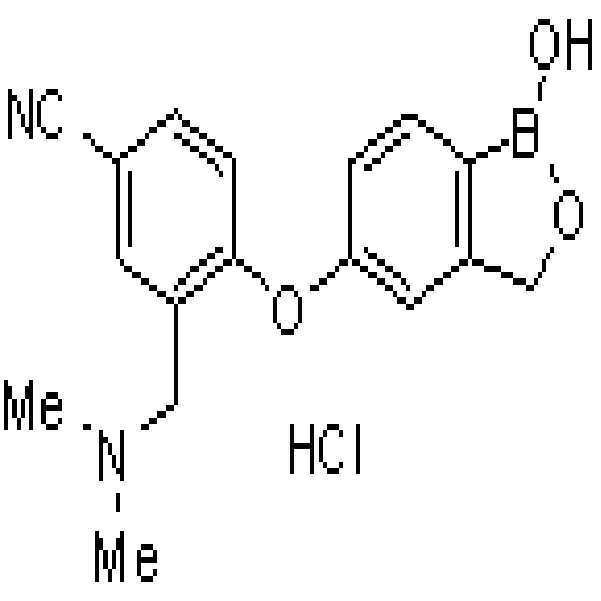
이 화합물은 실시예 19af (D32)와 유사한 방법으로, 5-(4-시아노-2-포밀페녹시)-1,3-디하이드로-1-하이드록시-2,1-벤조옥사보롤 (D23) 및 디메틸아민으로부터 수득되었다.This compound was prepared in a manner similar to Example 19aF (D32) Dihydro-l-hydroxy-2,1-benzooxaborol (D23) and dimethylamine. ≪ / RTI >
1H-NMR (300 MHz, DMSO-d 6 ) δ (ppm) 2.77 (s, 6 H), 4.41 (s, 2 H), 4.97 (s, 2 H), 6.90 (d, J = 8.5 Hz, 1 H), 7.19 (dd, J = 8.05, 1.86 Hz, 1 H), 7.26 (s, 1 H), 7.84 (d, J = 8.2, 1 H), 7.88 (d, J = 2.4, 1 H), 8.25 (d, J = 2.1, 1 H), 9.32 (br s, 1 H).2 H), 4.97 (s, 2 H), 6.90 (d, J = 8.5 Hz, 1 H-NMR (300 MHz, DMSO d 6 ) 1 H), 7.84 (d, J = 8.2,1H), 7.88 (d, J = 2.4,1H), 7.18 (dd, J = 8.05, 1.86 Hz, , 8.25 (d, J = 2.1, 1 H), 9.32 (br s, 1H).
19ai 4-(1- 하이드록시 -1,3- 디하이드로 - 벤조[c][1,2]옥사보롤 -5-일 옥시 )-2- 메톡시-벤조산 에틸 에스테르 (D35)의 합성:Synthesis of 4- (1 -hydroxy -1,3 -dihydro - benzo [c] [1,2] oxaborol -5- yloxy ) -2 -methoxy-benzoic acid ethyl ester (D35)

4-4- 브로모Bromo -3-[1,-3- [1, 3]디옥소란3] dioxolane -2--2- ylyl -페놀 (2)- phenol (2)
2-브로모-5-하이드록시-벤즈알데히드 화합물 1 (15.0 g, 74.62 mmol) 의 톨루엔 (100 mL) 용액에 에틸렌글리콜 (12.5 mL, 223.86 mmol) 및 p-TSA(1.42g,7.46mmol)이 첨가되었다. 용매는 감압하에 제거되어, 미정제(crude) 산물 2 (20.0 g 미정제)이 수득되며, 추가 정제없이 다음 단계에 이용되었다. 1H NMR 400MHz(CDCl3) δ: 7.38(d,J=8.6Hz,1H), 7.01(d,J=2.7Hz,1H), 6.62(d,J=8.2,2.3Hz,1H), 6.01(s,1H), 4.20-4.01(m,4H).Ethylene glycol (12.5 mL, 223.86 mmol) and p- TSA (1.42 g, 7.46 mmol) were added to a toluene (100 mL) solution of 2-bromo-5-hydroxy-benzaldehyde compound 1 (15.0 g, 74.62 mmol) . The solvent was removed under reduced pressure to give the crude product 2 (20.0 g crude), which was used in the next step without further purification. 1 H NMR 400MHz (CDCl 3) δ: 7.38 (d, J = 8.6Hz, 1H), 7.01 (d, J = 2.7Hz, 1H), 6.62 (d, J = 8.2,2.3Hz, 1H), 6.01 ( s, 1 H), 4.20-4.01 (m, 4H).
4-플루오르-2-4-fluoro-2- 하이드록시Hydroxy -- 벤조산에틸Ethyl benzoate 에스테르 (4) Esters (4)
4-플루오르-2-하이드록시벤조산화합물 3 (20.0 g, 128.11 mmol) 의 에탄올 (100 mL) 용액에 conc. 황산(10 mL)이 첨가되었다. 생성된 혼합물은 120℃오일 바스 O/N에서 사열되었다. 용매는 감압하에 제거되어, 미정제 산물이 수득되었고, 컬럼 크로마토그래피 (실리카 겔, 10% EtOAc /헥산)으로 정제되면, 표제 화합물 4 (19.9 g, 85%)은 무색 고체로 수득되었다. 1H NMR400MHz(CDCl3)δ:11.15(s,1H),7.83(d,J=6.6Hz,1H),7.81(d,J=6.6Hz,1H),6.62(dd,J=10.1,2.3Hz,1H),6.61(dd,J=7.0,2.0Hz,1H),4.41(q,J=7.0Hz,2H),1.42(t,J=7.0Hz,3H);MS(ES)m/z:185(M+1)+.To a solution of 4-fluoro-2-hydroxybenzoic acid compound 3 (20.0 g, 128.11 mmol) in ethanol (100 mL) was added conc. Sulfuric acid (10 mL) was added. The resulting mixture was quenched at 120 < 0 > C oil bath O / N. The solvent was removed under reduced pressure to give the crude product which was purified by column chromatography (silica gel, 10% EtOAc / hexane) to give the title compound 4 (19.9 g, 85%) as a colorless solid. 1 H NMR400MHz (CDCl 3) δ : 11.15 (s, 1H), 7.83 (d, J = 6.6Hz, 1H), 7.81 (d, J = 6.6Hz, 1H), 6.62 (dd, J = 10.1,2.3Hz , 1H), 6.61 (dd, J = 7.0,2.0Hz, 1H), 4.41 (q, J = 7.0Hz, 2H), 1.42 (t, J = 7.0Hz, 3H); MS (ES) m / z: 185 (M + 1) < + & gt ; .
4-플루오르-2-4-fluoro-2- 메톡시Methoxy -- 벤조산에틸Ethyl benzoate 에스테르 (5) Esters (5)
화합물 4 (19.9 g, 0.109 mol)의 아세토니트릴 (200 mL) 용액에 탄산세슘염(42.0 g, 0.129 mol)이 첨가되었다. 생성된 혼합물은 실온에서 30분간 교반되고, 이어서 메틸 요오드화물 (13.5 mL, 0.218 mol)이 첨가되었다. 생성된 혼합물은 실온 O/N에서 교반되었고, Celite®를 통하여 여과되었다. 용매는 감압하에 제거되어, 미정제산물 5 (20.0 g, 93%)이 수득되었고, 추가 정제없이 다음 단계에 이용되었다. 1H NMR 400 MHz (CDCl3) δ: 7.81-7.78 (m, 1H), 6.60-6.58 (m, 2H), 4.38 (q, J = 7.0 Hz, 2H), 3.82 (s, 3H), 1.39 (t, J = 7.0 Hz, 3H); MS (ES) m/z: 199 (M + 1)+.To a solution of compound 4 (19.9 g, 0.109 mol) in acetonitrile (200 mL) was added cesium carbonate salt (42.0 g, 0.129 mol). The resulting mixture was stirred at room temperature for 30 minutes, then methyl iodide (13.5 mL, 0.218 mol) was added. The resulting mixture was stirred at room temperature O / N and filtered through Celite ® . The solvent was removed under reduced pressure to give crude product 5 (20.0 g, 93%) which was used in the next step without further purification. 1 H NMR 400 MHz (CDCl 3 ) δ: 7.81-7.78 (m, 1H), 6.60-6.58 (m, 2H), 4.38 (q, J = 7.0 Hz, 2H), 3.82 (s, 3H), 1.39 ( t, J = 7.0 Hz, 3H); MS (ES) m / z : 199 (M + 1) < + & gt ; .
4-(4- 브로모 -3-[1, 3]디옥소란 -2- yl - 페녹시 )-2- 메톡시 - 벤조산에틸 에스테르 (6) 4- (4-bromo-3- [1, 3] dioxolane-2-yl-phenoxy) -2-methoxy-benzoic acid ethyl ester (6)
화합물 2 (9.27 g, 37.83 mmol)의 DMSO (50 mL) 용액에 탄산칼륨염(15.68 g, 113.48 mmol)이 첨가되었다. 생성된 혼합물은 실온에서 30분간 교반된 후, 화합물 5 (8.99 g, 45.39 mmol)가 첨가되었다. 생성된 혼합물은 120 ℃ O/N에서 가열되었다. 반응 혼합물은 EtOAc (100 mL)으로 희석시키고, 물 (50 mL)로 세척되었다. 유기 층은 Na2SO4상에서 건조되고, 감압하에서 농축되어, 미정제 산물이 수득되며, 컬럼 크로마토그래피 (실리카 겔, 10% EtOAc/헥산)에 의해 정제되면, 표제 화합물 6 (5.6 g, 35%)은 옅은 황색 고체로 수득되었다. 1H NMR400MHz(CDCl3)δ:7.81(d,J=9.0Hz,1H),7.59(d,J=8.6Hz,1H),7.35(s,1H),6.97(dd,J=8.6,2.7Hz,1H),6.60(d,J=2.3Hz,1H),6.49(dd,J=8.6,2.4Hz,1H),6.01(s,1H),4.39(q,J=7.4Hz,2H),4.20-4.01(m,4H),3.81(s,3H),1.40(t,J=7.4Hz,3H); MS (ES) m/ z:423(M+1)+,425(M+3)+.Potassium carbonate salt (15.68 g, 113.48 mmol) was added to a solution of compound 2 (9.27 g, 37.83 mmol) in DMSO (50 mL). The resulting mixture was stirred at room temperature for 30 minutes and then Compound 5 (8.99 g, 45.39 mmol) was added. The resulting mixture was heated at 120 ° C O / N. The reaction mixture was diluted with EtOAc (100 mL) and washed with water (50 mL). The organic layer is dried over Na 2 SO 4, concentrated under reduced pressure to yield the crude and the product is obtained, when purified by column chromatography and purified by (silica gel, 10% EtOAc / hexane) to give the title compound 6 (5.6 g, 35% ) ≪ / RTI > was obtained as a pale yellow solid. 1 H NMR400MHz (CDCl 3) δ : 7.81 (d, J = 9.0Hz, 1H), 7.59 (d, J = 8.6Hz, 1H), 7.35 (s, 1H), 6.97 (dd, J = 8.6,2.7Hz , 1H), 6.60 (d, J = 2.3Hz, 1H), 6.49 (dd, J = 8.6,2.4Hz, 1H), 6.01 (s, 1H), 4.39 (q, J = 7.4Hz, 2H), 4.20 -4.01 (m, 4H), 3.81 (s, 3H), 1.40 (t, J = 7.4 Hz, 3H); MS (ES) m / z : 423 (M + 1) < + & gt ; , 425 (M + 3) < + & gt ; .
4-(4-4- (4- 브로모Bromo -3--3- 포밀Formyl -- 페녹시Phenoxy )-2-)-2- 메톡시Methoxy -- 벤조산에틸Ethyl benzoate 에스테르 (7) Esters (7)
화합물 6 (5.6 g, 13.23 mmol)의 THF (50 mL) 용액에 0℃에서 2N HCl (50 mL)이 첨가되었다. 생성된 혼합물은 rt O/N에서 교반되었다. 반응 혼합물은 EtOAc (100 mL)로 희석되고, 물 (50 mL)로 세척되었다. 유기 층은 Na2SO4상에서 건조되고, 감압하에서 농축되면, 미정제 산물이 수득되는, 컬럼 크로마토그래피 (실리카 겔, 10% EtOAc/헥산)에 의해 정제되면, 표제 화합물 7 (3.0 g, 60%)은 옅은 황색 고체로 수득되었다. 1H NMR 400 MHz (CDCl3) δ: 10.35 (s, 1H), 7.82 (d, J = 8.6 Hz, 1H), 7.60 (d, J = 8.6 Hz, 1H), 7.58 (d, J = 2.7 Hz, 1H), 7.19 (dd, J = 8.6, 3.1 Hz, 1H), 6.60 (d, J = 2.0 Hz, 1H), 6.51 (dd, J = 8.6, 2.3 Hz, 1H), 4.39 (q, J = 7.0 Hz, 2H), 3.81 (s, 3H), 1.40 (t, J = 7.0 Hz, 3H); MS (ES) m/z: 379 (M + 1)+, 381 (M + 3)+.To a solution of compound 6 (5.6 g, 13.23 mmol) in THF (50 mL) at 0 C was added 2N HCl (50 mL). The resulting mixture was stirred at rt O / N. The reaction mixture was diluted with EtOAc (100 mL) and washed with water (50 mL). The organic layer was dried over Na 2 SO 4 and concentrated under reduced pressure to give the title compound 7 (3.0 g, 60%), after purification by column chromatography (silica gel, 10% EtOAc / hexanes) ) ≪ / RTI > was obtained as a pale yellow solid. 1 H NMR 400 MHz (CDCl 3 ) δ: 10.35 (s, 1H), 7.82 (d, J = 8.6 Hz, 1H), 7.60 (d, J = 8.6 Hz, 1H), 7.58 (d, J = 2.7 Hz , 1H), 7.19 (dd, J = 8.6, 3.1 Hz, 1H), 6.60 (d, J = 2.0 Hz, 1H), 6.51 (dd, J = 8.6, 2.3 Hz, 1H), 4.39 (q, J = 7.0 Hz, 2H), 3.81 (s, 3H), 1.40 (t, J = 7.0 Hz, 3H); MS (ES) m / z : 379 (M + 1) < + & gt ; , 381 (M + 3) < + & gt ; .
4-[3- 포밀 -4-(4,4,5,5- 테트라메틸 -[1,3, 2]디옥사보란 -2- yl )- 페녹시 ]-2- 메톡시-벤조산에틸 에스테르 (8) 4- [3-formyl-4- (4,4,5,5-tetramethyl- [1, 3, 2] dioxa-boran-2-yl) - phenoxy] -2-methoxy-benzoic acid ethyl ester ( 8)
화합물 7 (3.0 g, 7.91 mmol)의 1,4-디옥산 (20 mL)의 용액에 비스(피나콜라토 )다이보론 (2.41 g, 9.49 mmol), 칼륨 아세테이트 (2.33 g, 23.73 mmol), 그리고 [1,1'-비스(디페닐포스피노)페로센]팔라디움(II)클로라이드 (0.3 g, 0.40 mmol)가 첨가되었다. 질소 가스를 혼합물을 통하여 10분간 제공하였고, 현탁액은 80 ℃에서 1시간 동안 가열되었다. 혼합물은 Celite® 를 통과되었고, 감압하에서 농축되어, 미정제 산물이 제공되는데, 이는 컬럼 크로마토그래피 (실리카 겔, 10% EtOAc/헥산)를 통하여 정제되어, 표제 화합물 8 (3.22 g, 96%)은 무색 오일로 수득되었다. 1H NMR 400 MHz (CDCl3) δ: 10.61 (s, 1H), 7.98 (d, J = 8.2 Hz, 1H), 7.81 (d, J = 8.6 Hz, 1H), 7.60 (d, J = 2.3 Hz, 1H), 7.35 (d, J = 5.5 Hz, 2H), 6.62 (d, J = 2.0 Hz, 1H), 6.58 (d, J = 8.6 Hz, 1H), 4.39 (q, J = 7.0 Hz, 2H), 3.81 (s, 3H), 1.42 (s, 12H), 1.20 (t, J = 7.0 Hz, 3H).Bis (pinacolato) diboron (2.41 g, 9.49 mmol), potassium acetate (2.33 g, 23.73 mmol) and a solution of compound 7 (3.0 g, 7.91 mmol) in 1,4-dioxane [1,1'-bis (diphenylphosphino) ferrocene] palladium (II) chloride (0.3 g, 0.40 mmol) was added. Nitrogen gas was provided through the mixture for 10 minutes and the suspension was heated at 80 DEG C for 1 hour. The mixture was passed through Celite ® and concentrated under reduced pressure to provide the crude product which was purified via column chromatography (silica gel, 10% EtOAc / hexanes) to afford the title compound 8 (3.22 g, 96% Obtained as a colorless oil. 1 H NMR 400 MHz (CDCl3) δ: 10.61 (s, 1H), 7.98 (d, J = 8.2 Hz, 1H), 7.81 (d, J = 8.6 Hz, 1H), 7.60 (d, J = 2.3 Hz, 1H), 7.35 (d, J = 5.5 Hz, 2H), 6.62 (d, J = 2.0 Hz, 1H), 6.58 (d, J = 8.6 Hz, 1H), 4.39 (q, J = 7.0 Hz, 2H) , 3.81 (s, 3H), 1.42 (s, 12H), 1.20 (t, J = 7.0 Hz, 3H).
4-[3- 하이드록시메틸 -4-(4,4,5,5- 테트라메틸 -[1,3, 2]디옥사보란 -2- yl )- 페녹시]-2-메톡시-벤조산에틸 에스테르 (9) 2 - yl ) -phenoxy ] -2-methoxy-benzoate To a solution of 4- [3 -hydroxymethyl- 4- (4,4,5,5- tetramethyl- [ Esters (9)
화합물 8 (3.22 g, 7.55 mmol)의 메탄올 (40 mL) 용액에 보로하이드리드 나트륨(0.373 g, 9.82 mmol)이 0 ℃에서 첨가되었다. 생성된 혼합물은 rt에서, 30 분간 교반되었다. 용매는 감압하에 제거되었고, 물 (50 mL)로 희석되었고, EtOAc (2 x 50 mL)로 추출되었다. 복합된 유기 층은 Na2SO4상에서 건조되었고, 감압하에서 농축되어 미정제 산물이 제공되었으며, 추가 정제없이 다음 단계에 이용되었다. 1H NMR 400MHz (CDCl3) δ: 7.91(d,J=8.2Hz,1H), 7.82(d,J=8.6Hz,1H), 7.01(s,1H), 6.98(d,J=8.2Hz,1H), 6.60(s,1H), 6.67(d,J=8.6Hz,1H), 4.65(s,2H), 4.39(q,J=7.0Hz,2H), 3.81(s,3H), 1.42(s,12H), 1.20(t,J=7.0Hz,3H).Sodium borohydride (0.373 g, 9.82 mmol) was added to a solution of compound 8 (3.22 g, 7.55 mmol) in methanol (40 mL) at 0 占 폚. The resulting mixture was stirred at rt for 30 minutes. The solvent was removed under reduced pressure, diluted with water (50 mL) and extracted with EtOAc (2 x 50 mL). The combined organic layers were dried over Na 2 SO 4 and concentrated under reduced pressure to provide the crude product which was used in the next step without further purification. 1 H NMR 400MHz (CDCl 3) δ: 7.91 (d, J = 8.2Hz, 1H), 7.82 (d, J = 8.6Hz, 1H), 7.01 (s, 1H), 6.98 (d, J = 8.2Hz, 1H), 6.60 (s, 1H ), 6.67 (d, J = 8.6Hz, 1H), 4.65 (s, 2H), 4.39 (q, J = 7.0Hz, 2H), 3.81 (s, 3H), 1.42 ( s, 12H), 1.20 (t, J = 7.0 Hz, 3H).
19ai 4-(1- 하이드록시 -1,3- 디하이드로 - 벤조[c][1,2]옥사보롤 -5-일 옥시 )-2- 메톡시-벤조산에틸 에스테르 (D35) 19ai 4- (1- hydroxy-1,3-dihydro-benzo [c] [1,2] oxazole borol 5-yl) -2-methoxy-benzoic acid ethyl ester (D35)
화합물 9 (2.0 g, 4.67 mmol)의 메탄올 (50 mL) 용액에 6N HCl (10 mL) 및 페닐붕산(2.85 g, 23.36 mmol)이 첨가되었다. 생성된 혼합물은 rt O/N에서 교반되었다. 용매는 감압하에 제거되어 미정제 산물이 제공되었고, 역상prep HPLC에서 용리액으로 CH3CN/H2O(0.1%아세트산과 함께)을 이용하여 정제시키면, 동결건조후 표제 화합물 (D35) (0.66 g, 39%)이 백색 고체로 수득되었다. Mp 64.9-65.2 oC. 1H NMR 400MHz (DMSO-d 6 ) δ: 9.20(s,1H), 7.80(d,J=8.2Hz,1H), 7.72(d,J=8.6Hz,1H), 7.18(s,1H), 7.16(dd,J=8.2,2.0Hz,1H), 6.80(s,1H), 6.60(dd,J=8.6,2.3Hz,1H), 4.98(s,2H), 4.21(q,J=7.0Hz,2H), 3.81(s,3H), 1.20(t,J=7.0Hz,3H); MS(ES)m/z:329(M+1)+; HPLC순도: 99.46 % (220 nm), 100 % (254 nm).To a solution of compound 9 (2.0 g, 4.67 mmol) in methanol (50 mL) was added 6N HCl (10 mL) and phenylboric acid (2.85 g, 23.36 mmol). The resulting mixture was stirred at rt O / N. The solvent was removed under reduced pressure to provide the crude product which was purified by reverse phase prep HPLC using CH 3 CN / H 2 O (with 0.1% acetic acid) as eluent to give after freeze-drying the title compound (D35) (0.66 g , 39%) as a white solid. Mp 64.9-65.2 o C. 1 H NMR 400MHz (DMSO- d 6) δ: 9.20 (s, 1H), 7.80 (d, J = 8.2Hz, 1H), 7.72 (d, J = 8.6Hz, 1H), 7.18 (s, 1H), 7.16 (dd, J = 8.2,2.0Hz, 1H), 6.80 (s, 1H), 6.60 (dd, J = 8.6,2.3Hz, 1H), 4.98 (s, 2H), 4.21 (q, J = 7.0 Hz, 2H), 3.81 (s, 3H), 1.20 (t, J = 7.0 Hz, 3H); MS (ES) m / z : 329 (M + 1) < + >; HPLC purity: 99.46% (220 nm), 100% (254 nm).
19aj 4-(1- 하이드록시 -1,3- 디하이드로 - 벤조[c][1,2]옥사보롤 -5-일 옥시 )-2- 메톡시-벤조산(D36) 19aj 4- (1- hydroxy-1,3-dihydro-benzo [c] [1,2] oxazole borol 5-yl) -2-methoxy-benzoic acid (D36)

화합물 (D35) (0.1 g, 0.31 mmol)의 메탄올 (2 mL) 용액에 2N NaOH (1 mL)이 첨가되었다. 생성된 혼합물은 rt O/N에서 교반되었다. 용매는 감압하에 제거되고, 미정제 산물이 제공되었고, H2O(1mL)에 용해시키고, 1N HCl을 이용하여 산성화시켰다. 수득된 고체는 여과되었고, 에테르 (10 mL)로 세척되면, 표제 화합물 (D36) (78 mg, 86%)이 백색 고체로 수득되었다. Mp 109.6-110.1oC. 1HNMR400MHz(DMSO-d 6 )δ:9.20(s,1H),7.80(d,J=8.2Hz,1H),7.75(d,J=8.6Hz,1H),7.18(s,1H),7.15(d,J=9.4Hz,1H),6.80(s,1H),6.60(d,J=8.6Hz,1H),4.98(s,2H),3.81(s,3H);MS(ES)m/z:301(M+1)+;HPLC순도:100%(220nm),99.79%(254nm).To a methanol (2 mL) solution of compound (D35) (0.1 g, 0.31 mmol) was added 2N NaOH (1 mL). The resulting mixture was stirred at rt O / N. The solvent was removed under reduced pressure, the crude product was provided, dissolved in H 2 O (1 mL) and acidified with 1N HCl. The resulting solid was filtered and washed with ether (10 mL) to give the title compound (D36) (78 mg, 86%) as a white solid. Mp 109.6-110.1 o C. 1 HNMR400MHz (DMSO- d 6) δ: 9.20 (s, 1H), 7.80 (d, J = 8.2Hz, 1H), 7.75 (d, J = 8.6Hz, 1H), 7.18 ( (s, 1H), 7.15 (d, J = 9.4 Hz, 1H), 6.80 (s, 1H), 6.60 (d, J = 8.6 Hz, 1H), 4.98 MS (ES) m / z: 301 (M + 1) +; HPLC purity: 100% (220nm), 99.79 % (254nm).
19ak 2- 시클로펜틸옥시 -4-(1- 하이드록시 -1,3- 디하이드로 - 벤조[c][1,2]옥사 보롤-5-일 옥시)-벤조니트릴 (D37) 19ak 2- cyclopentyl-4- (1-hydroxy-1,3-dihydro-benzo [c] [1,2] oxazol-5-yl borol oxy) benzonitrile (D37)

2-하이드록시-4-(1-하이드록시-1,3-디하이드로-벤조[c][1,2]옥사보롤-5-일 옥시)-벤조니트릴 (D10) (200 mg, 0.75 mmol) 의 THF (50 mL) 및 DMF (20 mL) 용액에 NaH (47 mg, 95%, 1.87 mmol)가 부분적으로 첨가되었다. 혼합물은 실온에서 5분간 교반되었고, 시클로펜틸 요오드화물 (0.26 mL, 2.25 mmol)을 천천히 첨가시켰다. 반응물은 실온에서 24시간 동안 교반되었다. 반응 후, 모든 휘발성 성분들은 진공하에서 기화되었다. 잔유물은 실리카 겔 컬럼 크로마토그래피에서 25% EtOAc/헥산으로 용리시키면, 36 mg의 표제 화합물이 수득되었다. 12.6% 산출량. 1H NMR 400 MHz (DMSO-d 6 ) δ: 9.23 (s, 1H), 7.78 (d, J = 7.8 Hz, 1H) 7.69 (d, J = 8.6 Hz, 1H), 7.17 (s, 1H), 7.10 (dd, J = 2.0, 8.2 Hz, 1H), 6.90 (d, J = 2.3 Hz, 1H), 6.56 (dd, J = 1.9, 8.6 Hz, 1H), 4.96 (s, 2H), 4.95 (t, J = 5.8 Hz, 1H), 1.95-1.55 (m, 8H); MS (ES) m/z: 336 (M + H)+; HPLC 순도: 99.15 % (220 nm), 99.62 % (MaxPlot).2-hydroxy-4- (1-hydroxy-1,3-dihydro-benzo [c] [1,2] oxazol-5-yl borol oxy) benzonitrile (D10) (200 mg, 0.75 mmol) NaH (47 mg, 95%, 1.87 mmol) was partially added to a THF (50 mL) and DMF (20 mL) solution. The mixture was stirred at room temperature for 5 minutes and cyclopentyl iodide (0.26 mL, 2.25 mmol) was slowly added. The reaction was stirred at room temperature for 24 hours. After the reaction, all volatile components were vaporized under vacuum. The residue was purified by silica gel column chromatography eluting with 25% EtOAc / hexane to give 36 mg of the title compound. 12.6% Output. 1 H NMR 400 MHz (DMSO- d 6) δ: 9.23 (s, 1H), 7.78 (d, J = 7.8 Hz, 1H) 7.69 (d, J = 8.6 Hz, 1H), 7.17 (s, 1H), 7.10 (dd, J = 2.0, 8.2 Hz, 1H), 6.90 (d, J = 2.3 Hz, 1H), 6.56 (dd, J = 1.9, 8.6 Hz, 1H), 4.96 (s, 2H), 4.95 (t , ≪ / RTI > J = 5.8 Hz, 1H), 1.95-1.55 (m, 8H); MS (ES) m / z : 336 (M + H) < + >; HPLC purity: 99.15% (220 nm), 99.62% (MaxPlot).
19al [2- 시아노 -5-(1- 하이드록시 -1,3- 디하이드로 - 벤조[c][1,2]옥사보롤 -5- 일 옥시)-페녹시]-아세트산 에틸 에스테르 (D38) 19al [2- cyano-5- (1-hydroxy-1,3-dihydro-benzo [c] [1,2] oxazol-5-yl borol oxy) -phenoxy] -acetic acid ethyl ester (D38)

2-하이드록시-4-(1-하이드록시-1,3-디하이드로-벤조[c][1,2]옥사보롤-5-일 옥시)-벤조니트릴 (D10) (300 mg, 1.12 mmol) 의 THF (50 mL) 용액에 NaH (95 mg, 60%, 2.36 mmol)가 일부분씩 첨가되었다. 혼합물은 실온에서5분간 교반된 후, 에틸 브로모아세테이트 (0.262 mL, 2.36 mmol)가 서서히 첨가되었다. 반응물은 70 ℃에서 하룻밤 동안 가열되었다. 반응 용액을 실온으로 냉각시킨 후, 혼합물은 여과되었다. 여과액은 진공하에서 기화되었다. 잔유물은 역상 크로마토그래피에서 5% MeOH/H2O 내지 90% MeOH/H2O로 용리되어, 320 mg 의 표제 화합물이 수득되었다, 81% 산출량. 1H NMR 400 MHz (DMSO-d 6 ) δ: 9.25 (s 1H), 7.78 (d, J = 8.0 Hz, 1H), 7.75 (d, J = 8.4 Hz, 1H), 7.14 (d, J = 1.6 Hz, 1H), 7.08 (dd, J = 1.6, 7.6 Hz, 1H), 6.86 (d, J = 2.0 Hz, 1H), 6.64 (dd, J = 2.4, 8.8 Hz, 1H), 5.00 (s, 2H), 4.97 (s, 2H), 4.13 (q, J = 6.8 Hz, 2H), 1.16 (t, 6.8 Hz, 3H); MS (ES) m/z: 354 (M + H)+; HPLC 순도: 99.11 % (220 nm), 99.14 % (254 nm). (D10) (300 mg, 1.12 mmol) was added to a solution of 2-hydroxy-4- (1 -hydroxy-1,3- dihydro- benzo [c] [1,2] oxaborol- In THF (50 mL) was added portionwise NaH (95 mg, 60%, 2.36 mmol). The mixture was stirred at room temperature for 5 minutes, then ethyl bromoacetate (0.262 mL, 2.36 mmol) was slowly added. The reaction was heated at 70 < 0 > C overnight. After cooling the reaction solution to room temperature, the mixture was filtered. The filtrate was evaporated under vacuum. The residue was purified by reverse phase chromatography eluting with 5% MeOH / H 2 O to 90% MeOH / H 2 O to give 320 mg of the title compound, 81% yield. 1 H NMR 400 MHz (DMSO- d 6) δ: 9.25 (s 1H), 7.78 (d, J = 8.0 Hz, 1H), 7.75 (d, J = 8.4 Hz, 1H), 7.14 (d, J = 1.6 Hz, 1H), 7.08 (dd , J = 1.6, 7.6 Hz, 1H), 6.86 (d, J = 2.0 Hz, 1H), 6.64 (dd, J = 2.4, 8.8 Hz, 1H), 5.00 (s, 2H ), 4.97 (s, 2H), 4.13 (q, J = 6.8 Hz, 2H), 1.16 (t, 6.8 Hz, 3H); MS (ES) m / z : 354 (M + H) < + >; HPLC purity: 99.11% (220 nm), 99.14% (254 nm).
19am [2- 시아노 -5-(1- 하이드록시 -1,3- 디하이드로 - 벤조[c][1,2]옥사보롤 -5- 일 옥시)-페녹시]-아세트산 (D39) 19am [2- cyano-5- (1-hydroxy-1,3-dihydro-benzo [c] [1,2] oxazol-5-yl borol oxy) -phenoxy] acetic acid (D39)

[2-시아노-5-(1-하이드록시-1,3-디하이드로-벤조[c][1,2]옥사보롤-5-일 옥시)-페녹시]-아세트산 에틸 에스테르 ((D38), 90 mg, 0.25 mmol)의 THF (20 mL) 맑은 용액에 LiOH (15.3 mg, 0.76 mmol) 및 물 (5 mL)이 첨가되었다. 생성된 혼합물은 실온에서 2시간 동안 교반되었다. 그 다음, 1 N HCl가 서서히 첨가되어, pH 2가 되도록 하였다. 혼합물은 진공하에서 기화되었다. 잔유물은 역상 크로마토그래피에서 5% MeOH/H2O 내지 90% MeOH/H2O로 용리되어, 48 mg의 표제 화합물이 수득되었다, 58% 산출량. 1H NMR 400 MHz (CD3OD) δ: 7.70 (d, J = 7.8 Hz, 1H), 7.59 (d, J = 8.6 Hz, 1H), 7.09 (s, 1H), 7.05 (dd, J = 1.9, 8.21 Hz, 1H), 6.66 (d, J = 1.9 Hz, 1H), 6.63 (dd, J = 1.9, 8.6 Hz, 1H), 5.06 (s, 2H), 4.78 (s, 2H); MS (ES) m/z: 326 (M + H)+; HPLC 순도: 96.33 % (220 nm), 96.44 % (254 nm).Phenoxy] -acetic acid ethyl ester ( (D38)) was prepared in analogy to the procedure described for the synthesis of 2-cyano-5- (l-hydroxy- l, 3- dihydro-benzo [c] [1,2] oxaborol- , 90 mg, 0.25 mmol) in THF (20 mL) was added LiOH (15.3 mg, 0.76 mmol) and water (5 mL). The resulting mixture was stirred at room temperature for 2 hours. Then, 1 N HCl was slowly added to bring the pH to 2. The mixture was vaporized under vacuum. The residue was purified by reverse phase chromatography eluting with 5% MeOH / H 2 O to 90% MeOH / H 2 O to give 48 mg of the title compound, 58% yield. 1H NMR 400 MHz (CD 3 OD ) δ: 7.70 (d, J = 7.8 Hz, 1H), 7.59 (d, J = 8.6 Hz, 1H), 7.09 (s, 1H), 7.05 (dd, J = 1.9, 1H), 6.66 (d, J = 1.9 Hz, 1H), 6.63 (dd, J = 1.9, 8.6 Hz, 1H), 5.06 (s, 2H), 4.78 MS (ES) m / z : 326 (M + H) < + >; HPLC purity: 96.33% (220 nm), 96.44% (254 nm).
19an [2- 시아노 -5-(1- 하이드록시 -1,3- 디하이드로 - 벤조[c][1,2]옥사보롤 -5- 일 옥시)-페녹시]-아세트산 tert-부틸 에스테르 (D40) 19an [2- cyano-5- (1-hydroxy-1,3-dihydro-benzo [c] [1,2] oxazol-5-yl borol oxy) -phenoxy] -acetic acid tert- butyl ester ( D40)

2-하이드록시-4-(1-하이드록시-1,3-디하이드로-벤조[c][1,2]옥사보롤-5-일 옥시)-벤조니트릴 (D10) (200 mg, 0.75 mmol) 의 THF (50 mL) 용액에 NaH (43 mg, 95%, 1.81 mmol)가 일부분씩 첨가되었다. 혼합물은 실온에서 5분간 교반된 후, t-부틸 브로모아세테이트 (0.25 mL, 1.65 mmol)를 서서히 첨가시켰다. 반응물은 70 ℃ 에서 24시간 가열되었다. 반응 용액을 실온으로 냉각시킨 후, 혼합물은 여과되었다. 여과액은 진공에서 기화되었다. 잔유물은 역상 크로마토그래피에서 5% MeOH/H2O 내지 90% MeOH/H2O으로 용리되어, 36 mg 의 표제 화합물, 12.6% 산출량이 수득되었다. 1H NMR 400 MHz (DMSO-d 6 ) δ: 9.26 (s, 1H), 7.78 (d, J = 8.2 Hz, 1H), 7.75 (d, J = 8.6 Hz, 1H), 7.14 (s, 1H), 7.09 (dd, J = 2.3, 8.2 Hz, 1H), 6.74 (d, J = 2.3 Hz, 1H), 6.68 (dd, J = 2.0, 8.6 Hz, 1H), 4.96 (s, 2H), 4.86 (s, 2H), 1.37 (s, 9H); MS (ES) m/z: 380 (M - H)-; HPLC 순도: 99.11 % (220 nm), 98.48 % (254 nm).(200 mg, 0.75 mmol) was added to a solution of 2-hydroxy-4- (1 -hydroxy-1,3- dihydro- benzo [c] [1,2] oxaborol- In THF (50 mL) was added NaH (43 mg, 95%, 1.81 mmol) portionwise. The mixture was stirred at room temperature for 5 minutes, then t -butyl bromoacetate (0.25 mL, 1.65 mmol) was slowly added. The reaction was heated at 70 占 폚 for 24 hours. After cooling the reaction solution to room temperature, the mixture was filtered. The filtrate was evaporated in vacuo. The residue was eluted with 5% MeOH / H 2 O to 90% MeOH / H 2 O in reverse phase chromatography to yield 36 mg of the title compound, 12.6% yield. 1 H NMR 400 MHz (DMSO- d 6) δ: 9.26 (s, 1H), 7.78 (d, J = 8.2 Hz, 1H), 7.75 (d, J = 8.6 Hz, 1H), 7.14 (s, 1H) , 7.09 (dd, J = 2.3,8.2 Hz, 1H), 6.74 (d, J = 2.3 Hz, 1H), 6.68 (dd, J = 2.0,8.6 Hz, 1H) s, 2 H), 1.37 (s, 9 H); MS (ES) m / z : 380 (M-H) <">; HPLC purity: 99.11% (220 nm), 98.48% (254 nm).
아미드 커플링을 위한 일반적인 과정:General procedure for amide coupling:
실온에서 HATU (353 mg, 0.93 mmol) 및 디이소프로필에틸아민 (0.32 mL, 1.86 mmol)은 [2-시아노-5-(1-하이드록시-1,3-디하이드로-벤조[c][1,2]옥사보롤-5-일 옥시)-페녹시]-아세트산 ((D39), 150 mg, 0.46 mmol)의 DMF (4 mL) 용액에 첨가되었고, 1분간 교반되었다. 상응하는 아민 (0.93 mmol)이 첨가되었고, 그리고 반응 혼합물은 하룻밤동안 실온에서 교반되었다. 반응 혼합물은 증류수(300 mL)로 희석되었고, 그리고 에틸 아세테이트 (4 × 400 mL)로 추출되었다. 유기 추출물은 복합되어, Na2SO4 상에서 건조되었고, 농축되어 미정제 오일이 제공되었다. 모든 미정제물질은 역상 HPLC에서 0.1% AcOH (수성) 및 아세토니트릴의 이중상 용매 시스템을 이용하여 그라디언트로 용리되어 정제되었다. 컬럼으로부터 수득된 순수 분취물들은 복합되어, 동결건조되어, 양호한 순도의 최종 산물이 제공되었다. HATU (353 mg, 0.93 mmol) and diisopropylethylamine (0.32 mL, 1.86 mmol) were added at room temperature to a solution of [2-cyano-5- (1 -hydroxy- 1, 3-dihydro- benzo [c] (D39) (150 mg, 0.46 mmol) in DMF (4 mL) and stirred for 1 minute. The corresponding amine (0.93 mmol) was added and the reaction mixture was stirred at room temperature overnight. The reaction mixture was diluted with distilled water (300 mL) and extracted with ethyl acetate (4 x 400 mL). The organic extracts are combined, dried over Na 2 SO 4, concentrated to provided the crude oil. All crude material was purified by reverse phase HPLC eluting with gradient using a dual phase solvent system of 0.1% AcOH (aq) and acetonitrile. The pure aliquots obtained from the column were combined and lyophilized to give a final product of good purity.
19ao 4-(1- 하이드록시 -1,3- 디하이드로 - 벤조[c][1,2]옥사보롤 -5-일 옥시 )-2- (2-몰포린-4-yl-2-옥소-에톡시)-벤조니트릴 (D41) 19ao 4- (1- hydroxy-1,3-dihydro-benzo [c] [1,2] oxazole borol 5-yl) -2 (2-morpholine -4-yl-2- oxo- Ethoxy) -benzonitrile < / RTI > (D41)

전반적인 과정에 따라, 몰포린(80 μL, 0.93 mmol)은 [2-시아노-5-(1-하이드록시-1,3-디하이드로-벤조[c][1,2]옥사보롤-5-일 옥시)-페녹시]-아세트산 ((D39), 150 mg, 0.46 mmol)에 결합되어, (D41)을 포함하는 미정제 오일이 제공되었다. 역상HPLC 에 의한 정제에 이어 동결건조시키면, 백색 고체로 된 (D41) (38 mg, 21 %)이 제공되었다. 1H NMR 400 MHz (d6-DMSO) δ: 9.32 (br s, 1H), 7.86 (d, J = 8.5 Hz, 1H), 7.78 (d, J = 8.5 Hz, 1H), 7.21 (br s, 1H), 7.15 (dd, J = 9.0, 1.5 Hz, 1H), 6.90 (d, J = 1.5 Hz, 1H), 6.65 (dd, J = 8.5, 1.5 Hz, 1H), 5.17 (s, 2H), 5.03 (s, 2H), 3.65-3.55 (m, 4H), 3.49-3.40 (m, 4H); MS (ES) m/z: 395 (M + H)+; HPLC 순도 96.02 % (Maxplot), 97.64 % (220 nm) 그리고 97.18 % (254 nm).Following the general procedure, morpholine (80 [mu] L, 0.93 mmol) was added to a solution of [2-cyano-5- (1 -hydroxy-1,3- dihydro- benzo [c] [1,2] oxaborol- Phenoxy] -acetic acid ( (D39) , 150 mg, 0.46 mmol) to provide the crude oil containing (D41) . Purification by reverse phase HPLC followed by lyophilization provided (D41) (38 mg, 21%) as a white solid. 1 H NMR 400 MHz (d 6 -DMSO) δ: 9.32 (br s, 1H), 7.86 (d, J = 8.5 Hz, 1H), 7.78 (d, J = 8.5 Hz, 1H), 7.21 (br s, 1H), 7.15 (dd, J = 9.0, 1.5 Hz, 1H), 6.90 (d, J = 1.5 Hz, 1H), 6.65 (dd, J = 8.5, 1.5 Hz, 1H), 5.17 (s, 2H), 5.03 (s, 2H), 3.65 - 3.55 (m, 4H), 3.49 - 3.40 (m, 4H); MS (ES) m / z : 395 (M + H) < + >; HPLC purity 96.02% (Maxplot), 97.64% (220 nm) and 97.18% (254 nm).
19ap 4-(1- 하이드록시 -1,3- 디하이드로 - 벤조[c][1,2]옥사보롤 -5-일 옥시 )-2- [2-(4-메틸-피페리딘-1-일)-2-옥소-에톡시]-벤조니트릴 (D42) 19ap 4- (1- hydroxy-1,3-dihydro-benzo [c] [1,2] oxazole borol 5-yl) -2 [2- (4-methyl-piperidin-1 Yl) -2-oxo-ethoxy] -benzonitrile (D42)

전반적인 과정에 따라, 4-메틸 피페리딘 (110 μL, 0.90 mmol)은 시아노-5-(1-하이드록시-1,3-디하이드로-벤조[c][1,2]옥사보롤-5-일 옥시)-페녹시]-아세트산 ((D39), 97 mg, 0.30 mmol)에 결합되어, ( 42)가 포함된 미정제오일이 제공되었다. 역상HPLC에 의한 정제에 이어 동결건조시키면 백색 고체의 (D42) (42 mg, 35 %)이 제공되었다. 1H NMR 400 MHz (d6-DMSO) δ: 9.25 (br s, 1H), 7.78 (d, J = 7.0 Hz, 1H), 7.73 (d, J = 7.0 Hz, 1H), 7.13 (br s, 1H), 7.08 (dd, J = 7.5, 2.0 Hz, 1H), 6.74 (d, J = 2.0 Hz, 1H), 6.62 (dd, J = 7.5. 2.0 Hz, 1H), 5.08 (d, J = 10.0 Hz, 1H), 5.02 (d, J = 10.0 Hz, 1H), 4.95 (s, 2H), 4.22 (br d, J = 10.5 Hz, 1H), 3.65 (br d, J = 10.5 Hz), 2.93 (br t, J = 10.5 Hz, 1H), 2.52 (br t, J = 10.5 Hz, 1H), 1.63-1.50 (m, 3H), 1.08-0.96 (m, 1H), 0.88 (d, J = 7.0 Hz, 3H), 0.90-0.80 (m, 1H); MS (ES) m/z: 407 (M + H)+; HPLC 순도 99.51 % (Maxplot), 99.12 % (220 nm) 및 98.77 % (254 nm).According to the general procedure, 4-methylpiperidine (110 μL, 0.90 mmol) was added to a solution of cyano-5- (1-hydroxy-1,3-dihydro-benzo [c] [1,2] oxaborol- -Phenoxy ] -acetic acid ( (D39) , 97 mg, 0.30 mmol) provided the crude oil containing ( 42) . Purification by reverse phase HPLC followed by lyophilization provided (D42) (42 mg, 35%) as a white solid. 1 H NMR 400 MHz (d 6 -DMSO) δ: 9.25 (br s, 1H), 7.78 (d, J = 7.0 Hz, 1H), 7.73 (d, J = 7.0 Hz, 1H), 7.13 (br s, 1H), 7.08 (dd, J = 7.5, 2.0 Hz, 1H), 6.74 (d, J = 2.0 Hz, 1H), 6.62 (dd, J = 7.5. 2.0 Hz, 1H), 5.08 (d, J = 10.0 Hz, 1H), 5.02 (d , J = 10.0 Hz, 1H), 4.95 (s, 2H), 4.22 (br d, J = 10.5 Hz, 1H), 3.65 (br d, J = 10.5 Hz), 2.93 ( br t, J = 10.5 Hz, 1H), 2.52 (br t, J = 10.5 Hz, 1H), 1.63-1.50 (m, 3H), 1.08-0.96 (m, 1H), 0.88 (d, J = 7.0 Hz , 3H), 0.90-0.80 (m, 1 H); MS (ES) m / z : 407 (M + H) < + >; HPLC purity 99.51% (Maxplot), 99.12% (220 nm) and 98.77% (254 nm).
19aq 4-(1- 하이드록시 -1,3- 디하이드로 - 벤조[c][1,2]옥사보롤 -5-일 옥시 )-2- [2-(4-메틸-피페라진-1-일)-2-옥소-에톡시]-벤조니트릴 헥사플로오로포스페이트 (D43) 19aq 4- (1- hydroxy-1,3-dihydro-benzo [c] [1,2] oxazole borol 5-yl) -2 [2- (4-methyl-piperazin-1-yl ) -2-oxo-ethoxy] -benzonitrile hexafluorophosphate (D43)

전반적인 과정에 따라, 4-메틸 피페라진(150μL, 0.90 mmol)은 시아노-5-(1-하이드록시-1,3-디하이드로-벤조[c][1,2]옥사보롤-5-일 옥시)-페녹시]-아세트산 ((D39), 150 mg, 0.46 mmol)에 결합되어, (D43)를 포함하는 미정제오일이 제공되었다. 역상HPLC 에 의한 정제에 이어 동결건조시키면 백색의 헥사플로오르포스페이트염 (D43) (40 mg, 16 % 순도)이 제공되었다. 1H NMR 400 MHz (d6-DMSO) δ: 9.65 (br s, 1H), 9.23 (s, 1H), 7.80 (d, J = 8.0 Hz, 1H), 7.73 (d, J = 8.0 Hz, 1H), 7.13 (s, 1H), 7.08 (d, J = 8.0 Hz, 1H), 6.97 (s, 1H), 6.55 (d, J = 8.0 Hz, 1H), 5.17 (s, 2H), 4.97 (s, 2H), 3.50-2.76 (br m, 5H), 3.35 (br s, 3H), 2.70 (br s, 3H); 19F NMR 376 MHz (d6-DMSO) -70.6 (d, J = 714 Hz, 6F) ppm; MS (ES) m/z: 408 (M + H)+; HPLC 순도 94.56 % (Maxplot), 95.06 % (220 nm) 및 95.77 % (254 nm).According to the general procedure, 4-methylpiperazine (150 μL, 0.90 mmol) was added to a solution of cyano-5- (1-hydroxy-1,3-dihydro-benzo [c] [1,2] oxaborol- Oxy) -phenoxy] -acetic acid ( (D39) , 150 mg, 0.46 mmol) to give crude oil containing (D43) . Purification by reverse phase HPLC followed by lyophilization provided a white hexafluorophosphate salt (D43) (40 mg, 16% purity). 1 H NMR 400 MHz (d 6 -DMSO) δ: 9.65 (br s, 1H), 9.23 (s, 1H), 7.80 (d, J = 8.0 Hz, 1H), 7.73 (d, J = 8.0 Hz, 1H ), 7.13 (s, 1H) , 7.08 (d, J = 8.0 Hz, 1H), 6.97 (s, 1H), 6.55 (d, J = 8.0 Hz, 1H), 5.17 (s, 2H), 4.97 (s , 2H), 3.50-2.76 (br m, 5H), 3.35 (br s, 3H), 2.70 (br s, 3H); 19 F NMR 376 MHz (d 6 -DMSO) -70.6 (d, J = 714 Hz, 6F) ppm; MS (ES) m / z : 408 (M + H) < + >; HPLC purity 94.56% (Maxplot), 95.06% (220 nm) and 95.77% (254 nm).
19ar 6-(1- 하이드록시 -1,3- 디하이드로 - 벤조[c][1,2]옥사보롤 -5-일 옥시 )-피 리딘-2,3-디카르복실산디메틸 에스테르 (D44): 19ar 6- (1- hydroxy-1,3-dihydro-benzo [c] [1,2] oxazol-5-yl borol oxy) - P-naphthyridine-2,3-dicarboxylic acid dimethyl ester (D44) :

1-One- 옥시Oxy -피리딘-2,3-- pyridine-2,3- 디카르복실산디메틸Dimethyl dicarboxylate 에스테르 (17) The ester (17)
피리딘-2,3-디카르복실산디메틸 에스테르 (16, 2.0 g, 10.24 mmol) 및 m-클로로퍼벤조산(75% 순도, 2.12 g, 12.28 mmol) 혼합물의 클로로포름 (50 mL) 용액은 실온에서 16 h 동안 교반되었다. 고체는 분리되고 여과되었고, 여과액은 포화된 aq. NaHCO3 (2 x 50 mL)으로 세척되었고, Na2SO4상에서 건조되고, 여과되고, 그리고 농축되어 미정제 산물이 황색 고체로 제공되었고(2.3 g, 정량적), 정제하지 않고 다음 단계에 이용되었다. 1H NMR 400 MHz (DMSO-d 6 ) δ: 8.65 (d, J = 6.6 Hz, 1H), 7.90 (d, J = 7.8 Hz, 1H), 7.66 (dd, J = 7.8, 6.6 Hz, 1H), 3.91 (s, 6H); MS (ES) m/z: 212 (M + 1)+.Pyridine-2,3-dicarboxylic acid dimethyl ester (16, 2.0 g, 10.24 mmol ) and m- chloroperbenzoic acid (75% purity, 2.12 g, 12.28 mmol) in chloroform (50 mL) solution of the mixture at room temperature for 16 h < / RTI > The solids were separated and filtered, and the filtrate was washed with saturated aq. Washed with NaHCO 3 (2 x 50 mL), dried over Na 2 SO 4 , filtered and concentrated to give the crude product as a yellow solid (2.3 g, quant.) And used in the next step without purification . 1 H NMR 400 MHz (DMSO- d 6) δ: 8.65 (d, J = 6.6 Hz, 1H), 7.90 (d, J = 7.8 Hz, 1H), 7.66 (dd, J = 7.8, 6.6 Hz, 1H) , ≪ / RTI > 3.91 (s, 6H); MS (ES) m / z : 212 (M + 1) < + & gt ; .
6-6- 클로로Chloro -피리딘-2,3-- pyridine-2,3- 디카르복실산디메틸Dimethyl dicarboxylate 에스테르 (18) The ester (18)
1-옥시-피리딘-2,3-디카르복실산디메틸 에스테르 (17, 4.0 g, 18.94 mmol)의 포스포러스 옥시클로라이드 (30 mL) 용액은 115 ℃에서 3시간 동안 가열되었다. 냉각된 후, 혼합물은 얼음-물 (50 mL)과 클로로포름 (3 x 50 mL)으로 처리된 후, 포화된 aq. NaHCO3 (3 x 50 mL)으로 염기화되고, 층들은 분리되었다. 클로로포름 층은 Na2SO4상에서 건조되고, 여과되고, 그리고 농축되어, 갈색오일로 된 미정제 산물이 제공되었고 (4.0 g), 정제하지 않고 다음 단계에 이용되었다. 1H NMR 400 MHz (DMSO-d 6 ) δ: 8.32 (d, J = 8.2 Hz, 1H), 7.83 (d, J = 8.2 Hz, 1H), 3.85 (s, 6H); MS (ES) m/z: 230 (M + 1)+, 232 (M + 3)+.A solution of 1-oxy-pyridine-2,3-dicarboxylic acid dimethyl ester ( 17 , 4.0 g, 18.94 mmol) in phosphorus oxychloride (30 mL) was heated at 115 ° C for 3 hours. After cooling, the mixture was treated with ice-water (50 mL) and chloroform (3 x 50 mL), then saturated aq. NaHCO 3 (3 x 50 mL), and the layers were separated. The chloroform layer was dried over Na 2 SO 4 , filtered and concentrated to give the crude product as a brown oil (4.0 g) which was used in the next step without purification. 1
6-(4-6- (4- 브로모Bromo -3--3- 포밀Formyl -- 페녹시Phenoxy )-피리딘-2,3-) -Pyridin-2,3- 디카르복실산디메틸Dimethyl dicarboxylate 에스테르 (19) Ester (19)
6-클로로-피리딘-2,3-디카르복실산디메틸 에스테르 (18, 4.0 g, 17.42 mmols) 및 2-브로모-5-하이드록시-벤즈알데히드 (3.5 g, 17.42 mmol) 의 DMF (30 mL) 용액에 탄산세슘염(11.35 g, 34.84 mmols)이 첨가되었다. 생성된 혼합물은 80℃에서 하룻밤 동안 가열되었다. DMF는 감압하에 제거되었고, EtOAc (100 mL)으로 희석되었고, 물 (2 x 25 mL) 및 소금물 (50 mL) 용액으로 세척되었다. 복합된 유기 층들은 Na2SO4상에서 건조되고, 여과되고, 그리고 농축되어, 미정제 산물이 제공되었고, 컬럼 크로마토그래피 (실리카 겔20% EtOAc/헥산)에 의해 정제되어, 표제 화합물 19 (1.14 g, 15%)이 밝은 황색 오일로 수득되었다. 1H NMR 400 MHz (DMSO-d 6 ) δ: 10.18 (s, 1H), 8.38 (d, J = 8.6 Hz, 1H), 7.90 (d, J = 8.5 Hz, 1H), 7.66 (s, 1H), 7.55-7.52 (m, 1H), 7.36 (d, J = 8.6 Hz, 1H), 3.86 (s, 3H), 3.84 (s, 3H); MS (ES) m/z: 394 (M + 1)+, 396 (M + 3)+.(30 mL) solution of 6-chloro-pyridine-2,3-dicarboxylic acid dimethyl ester ( 18 , 4.0 g, 17.42 mmols) and 2-bromo-5-hydroxy- benzaldehyde (3.5 g, 17.42 mmol) To the solution was added cesium carbonate (11.35 g, 34.84 mmols). The resulting mixture was heated at 80 < 0 > C overnight. The DMF was removed under reduced pressure, diluted with EtOAc (100 mL), and washed with a solution of water (2 x 25 mL) and brine (50 mL). The combined organic layers were dried over Na 2 SO 4 , filtered and concentrated to provide the crude product which was purified by column chromatography (
6-[3- 포밀 -4-(4,4,5,5- 테트라메틸 -[1,3, 2]디옥사보란 -2-일)- 페녹시 ]-피리딘-2,3-디카르복실산디메틸 에스테르 (20) 6- [3-formyl-4- (4,4,5,5-tetramethyl- [1, 3, 2] dioxa-boran-2-yl) -phenoxy] -pyridine-2,3-dicarboxylate The acid dimethyl ester (20)
6-(4-브로모-3-포밀-페녹시)-피리딘-2,3-디카르복실산디메틸 에스테르 (19, 1.14 g, 2.89 mmol)의 1,4-디옥산 (10 mL)으로 된 탈기된 용액(질소로 30분간)에 비스(피나콜라토)다이보론 (1.10 g, 4.33 mmol), 칼륨 아세테이트 (0.85 g, 8.67 mmol), 그리고 [1,1'-비스(디페닐포스피노)페로센]팔라디움(II)클로라이드 (0.16 g, 0.23 mmol)가 첨가되었다. 다시 탈기하고(10 분간 질소로), 그리고 현탁액은 90 ℃에서 하룻밤 동안 가열되었다. 혼합물을 Celite® 를 통과시키고, 그리고 감압하에서 농축되어, 미정제 산물이 제공되었고, 컬럼 크로마토그래피 (실리카 겔, 20% EtOAc/ 헥산)에 의해 정제되면, 표제 화합물 20 (0.85 g, 70%)이 무색 오일로 수득되었다. 1H NMR 400 MHz (DMSO-d 6 ) δ: 10.39 (s, 1H), 8.39 (d, J = 8.6 Hz, 1H), 7.85 (d, J = 7.8 Hz, 1H), 7.69 (s, 1H), 7.56-7.53 (m, 1H), 7.36 (d, J = 8.6 Hz, 1H), 3.84 (s, 3H), 3.79 (s, 3H), 1.35 (s, 12H).6- (4-bromo-3-formyl-phenoxy) -pyridine-2,3-dicarboxylic
19ar 6-(1- 하이드록시 -1,3- 디하이드로 - 벤조[c][1,2]옥사보롤 -5-일 옥시 )-피 리딘-2,3-디카르복실산디메틸 에스테르 (D44) 19ar 6- (1- hydroxy-1,3-dihydro-benzo [c] [1,2] oxazol-5-yl borol oxy) - P-naphthyridine-2,3-dicarboxylic acid dimethyl ester (D44)
6-[3-포밀-4-(4,4,5,5-테트라메틸-[1,3,2]디옥사보란-2-일)-페녹시]-피리딘-2,3-디카르복실산디메틸 에스테르 (20, 0.77 g, 1.74 mmol)의 순수 에탄올 (10 mL)에 보로하이드리드 나트륨(0.08 g, 2.09 mmol)을 0 ℃에서 첨가하였다. 0 ℃에서 1시간 후에, pH 가 2 ~ 3가 될 때까지 2 M HCl가 첨가되었다. 용매는 감압하에 제거되어, 미정제 산물이 제공되었고, 역상 prep HPLC에서 용리액으로 CH3CN/H2O (중성 조건 이용) 용리시켜 정제되면, 동결건조후 표제 화합물 (D44) (0.18 g, 30%)이 백색 고체가 제공되었다. Mp 67.5-69.2 ℃. 1H NMR 400 MHz (DMSO-d 6 ) δ: 9.24 (s, 1H), 8.33 (d, J = 8.6 Hz, 1H), 7.77 (d, J = 7.8 Hz, 1H), 7.25 - 7.22 (m, 2H), 7.15 (d, J = 7.8 Hz, 1H), 4.98 (s, 2H), 3.81 (s, 3H), 3.77 (s, 3H); MS (ES) m/z: 344 (M + 1)+; HPLC 순도: 99.42 % (Maxplot), 99.03 % (220 nm), 99.95 % (254 nm).4- [4,4,5,5-tetramethyl- [1,3,2] dioxaborane-2-yl) -phenoxy] -pyridine-2,3-dicarboxylate To the pure ethanol (10 mL) of the acid dimethyl ester ( 20 , 0.77 g, 1.74 mmol) was added sodium borohydride (0.08 g, 2.09 mmol) at 0 占 폚. After 1 hour at 0 ° C, 2 M HCl was added until the pH was 2-3. The solvent was removed under reduced pressure to give the crude product which was purified by reverse phase prep HPLC eluting with CH 3 CN / H 2 O (eluting with neutral conditions) to give the title compound (D44) (0.18 g, 30 %). This white solid was provided. Mp 67.5-69.2 [deg.] C. 1 H NMR 400 MHz (DMSO- d 6 ) ? : 9.24 (s, 1H), 8.33 (d, J = 8.6 Hz, 1H), 7.77 (d, J = 7.8 Hz, 1H) 2H), 7.15 (d, J = 7.8 Hz, 1H), 4.98 (s, 2H), 3.81 (s, 3H), 3.77 (s, 3H); MS (ES) m / z : 344 (M + 1) < + >; HPLC Purity: 99.42% (Maxplot), 99.03% (220 nm), 99.95% (254 nm).
19as 3- 시아노 -6-(1- 하이드록시 -1,3- 디하이드로 - 벤조[c][1,2]옥사보롤 -5-일 옥시)-피리딘-2-카르복실산에틸 에스테르 (D45): 19as 3- cyano-6- (1-hydroxy-1,3-dihydro-benzo [c] [1,2] oxazole borol 5-yl oxy) - pyridine-2-carboxylic acid ethyl ester (D45 ):

3-브로모-6-클로로-피리딘-2-카르복실산에틸 에스테르 (22)3-Bromo-6-chloro-pyridine-2-carboxylic acid ethyl ester (22)
3-브로모-6-클로로피콜리닌산(21,8.0g,33.83mmols)의 톨루엔 (80 mL) 및 에탄올 (40 mL) 혼합 용액에 황산(0.66 mL, 6.76 mmols)이 첨가되었다. 반응 혼합물은 16시간 동안 환류되었고, 그 다음 냉각되었고, CHCl3(200mL)및 포화된 aq. NaHCO3(250mL)사이에 분할되었다. 수성 층은 CHCl3(2x100mL)으로 추출되었고, 복합된 유기 층들은 Na2SO4상에서 건조되고, 여과되고, 그리고 농축되어, 미정제 산물이 제공되었고, 이는 컬럼 크로마토그래피 (실리카 겔10% EtOAc / 헥산)으로 정제되면, 표제 화합물 22 (9.0 g, 정량적)이 투명 오일로 수득되었다. 1H NMR 400MHz (DMSO-d 6 ) δ: 8.31(d,J=8.6Hz,1H), 7.68(d,1H,J=8.2Hz), 4.39(q,J=7.0Hz,2H), 1.33(t,J=7.2Hz,3H).Sulfuric acid (0.66 mL, 6.76 mmols) was added to a mixed solution of 3-bromo-6-chloropicolinic acid ( 21 , 8.0 g, 33.83 mmol) in toluene (80 mL) and ethanol (40 mL). The reaction mixture was refluxed for 16 h, then cooled and washed with CHCl 3 (200 mL) and saturated aq. It was partitioned between NaHCO 3 (250mL). The aqueous layer was extracted with CHCl 3 (2x100mL), the combined organic layers are dried over Na 2 SO 4, filtered and and concentrated, it was provided a crude product, which was purified by column chromatography (silica gel, 10% EtOAc / Hexane), the title compound 22 (9.0 g, quant.) Was obtained as a clear oil. 1 H NMR 400MHz (DMSO- d 6 ) δ: 8.31 (d, J = 8.6Hz, 1H), 7.68 (d, 1H, J = 8.2Hz), 4.39 (q, J = 7.0Hz, 2H), 1.33 ( t, J = 7.2 Hz, 3H).
3- 브로모 -6-(4- 브로모 -3- 포밀 - 페녹시 )-피리딘-2- 카르복실산에틸 에스테르 (23) 3-Bromo-6- (4-bromo-3-formyl-phenoxy) -pyridine-2-carboxylic acid ethyl ester (23)
3-브로모-6-클로로-피리딘-2-카르복실산에틸 에스테르 (22,8.0g,30.24mmol) 및 2-브로모-5-하이드록시-벤즈알데히드 (7.29 g, 36.29 mmol)의 DMF (100 mL) 용액에 탄산세슘염(22.6 g, 69.55 mmol)이 첨가되었다. 생성된 혼합물은 80℃에서 하룻밤 동안 가열되었다. DMF는 감압하에 제거되었고, 잔유물은 EtOAc (200 mL)으로 희석되었고, 물 (2 x 50 mL) 및 소금물 (50 mL) 용액으로 세척되었다. 복합된 유기 층들은 Na2SO4상에서 건조되고, 여과되고, 그리고 농축되어, 미정제 산물이 제공되었고, 컬럼 크로마토그래피 (실리카 겔20% EtOAc/ 헥산)에 의해 정제되면, 표제 화합물 23 (4.0 g, 31%)이 투명 오일로 수득되었다. 1H NMR 400 MHz(DMSO-d 6 ) δ: 10.18(s,1H), 8.27(d,J=8.6Hz,1H), 7.87(d,J=7.6Hz,1H), 7.65(s,1H), 7.51(dd,J=8.7,2.9Hz,1H), 7.26(d,J=8.9 Hz, 1H), 4.29(q,J=7.1Hz, 2H), 1.25(t,J=7.0 Hz, 3H); MS(ES) m/z: 430(M+1)+.A solution of 3-bromo-6-chloro-pyridine-2-carboxylic acid ethyl ester ( 22 , 8.0 g, 30.24 mmol) and 2-bromo-5- hydroxy- benzaldehyde (7.29 g, 36.29 mmol) mL) was added cesium carbonate (22.6 g, 69.55 mmol). The resulting mixture was heated at 80 < 0 > C overnight. The DMF was removed under reduced pressure and the residue was diluted with EtOAc (200 mL) and washed with water (2 x 50 mL) and brine (50 mL). The combined organic layers were dried over Na 2 SO 4 , filtered and concentrated to give the crude product which was purified by column chromatography (
6-(4- 브로모 -3- 포밀 - 페녹시 )-3- 시아노 -피리딘-2- 카르복실산에틸 에스테르 (24) 6- (4-bromo-3-formyl-phenoxy) -3-cyano-2-carboxylic acid ethyl ester (24)
3-브로모-6-(4-브로모-3-포밀-페녹시)-피리딘-2-카르복실산에틸 에스테르 (23, 1.8 g, 4.19 mmol)의 DMF (6 mL) 용액에 CuCN (0.75 g, 8.38 mmol)이 130 ℃에서 첨가되었고, 4시간 동안 가열되었다. 혼합물은 실온으로 냉각되었고, 에틸 아세테이트 (100 mL)가 첨가되었다. 혼합물은 10분간 교반되었고, 여과되었고, 에틸 아세테이트 (2 x 50 mL)로 세척되었다. 여과액은 물 (2 x 50 mL)과 소금물 (50 mL)로 세척되었고, 무수 황산나트륨상에서 건조되고, 여과되었고, 그리고 진공에서 기화되었다. 잔유물은 컬럼 크로마토그래피 (25% 에틸 아세테이트/ 헥산)에 의해 정제되어, 화합물 24 (0.3 g, 19%)이 백색 고체로 수득되었다. 1H NMR 400 MHz (DMSO-d 6 ) δ: 10.20 (s, 1H), 8.51 (d, J = 8.6 Hz, 1H), 7.91(d, J = 8.9 Hz, 1H), 7.76 (s, 1H), 7.59 (d, J = 2.7 Hz, 1H), 7.55 (dd, J = 8.5, 2.7 Hz, 1H), 4.32 (q, J = 7.1 Hz, 2H), 1.26 (t, J = 7.0 Hz, 3H); MS (ES) m/z: 377 (M + 1)+.To a solution of 3-bromo-6- (4-bromo-3-formyl-phenoxy) -pyridine-2-carboxylic acid ethyl ester ( 23 , 1.8 g, 4.19 mmol) in DMF (6 mL) g, 8.38 mmol) was added at 130 < 0 > C and heated for 4 hours. The mixture was cooled to room temperature and ethyl acetate (100 mL) was added. The mixture was stirred for 10 minutes, filtered and washed with ethyl acetate (2 x 50 mL). The filtrate was washed with water (2 x 50 mL) and brine (50 mL), dried over anhydrous sodium sulfate, filtered and evaporated in vacuo. The residue was purified by column chromatography (25% ethyl acetate / hexanes) to give compound 24 (0.3 g, 19%) as a white solid. 1 H NMR 400 MHz (DMSO- d 6) δ: 10.20 (s, 1H), 8.51 (d, J = 8.6 Hz, 1H), 7.91 (d, J = 8.9 Hz, 1H), 7.76 (s, 1H) , 7.59 (d, J = 2.7 Hz, 1H), 7.55 (dd, J = 8.5, 2.7 Hz, 1H), 4.32 (q, J = 7.1 Hz, 2H), 1.26 (t, J = 7.0 Hz, 3H) ; MS (ES) m / z : 377 (M + 1) < + & gt ; .
3- 시아노 -6-[3- 포밀 -4-(4,4,5,5- 테트라메틸 -[1,3, 2]디옥사보란 -2-일)- 페녹시]-피리딘-2-카르복실산에틸 에스테르 (25) 3-cyano-6- [3-formyl-4- (4,4,5,5-tetramethyl- [1, 3, 2] dioxa-boran-2-yl) -phenoxy] -pyridin-2 Carboxylic < / RTI > acid ethyl ester (25)
6-(4-브로모-3-포밀-페녹시)-3-시아노-피리딘-2-카르복실산에틸 에스테르 (24, 0.30 g, 0.79 mmol)의 1,4-디옥산 (6 mL)의 탈기된 용액(30분간 질소로)에 비스(피나콜라토)다이보론 (0.30 g, 1.19 mmol), 칼륨 아세테이트 (0.23 g, 2.39 mmol), 그리고 [1,1'-비스(디페닐포스피노)페로센]팔라디움(II) 클로라이드 (0.03 g, 0.03 mmol)가 첨가되었다. 다시 탈기되었고(10 분 질소), 그리고 현탁액은 80 ℃ 에서 하룻밤 동안 교반되었다. 혼합물은 Celite® 을 통과되었고, 감압하에서 농축되어, 미정제 산물이 제공되었고, 컬럼 크로마토그래피 (실리카 겔, 25% EtOAc/헥산)에 의해 정제되어, 표제 화합물 25 (0.11 g, 29%)이 무색 오일로 수득되었다. 1H NMR 400 MHz (DMSO-d 6 ) δ: 10.38 (s, 1H), 8.51 (d, J = 8.9 Hz, 1H), 7.83 (d, J = 8.2 Hz, 1H), 7.76 (s, 1H), 7.51 (d, J = 2.7 Hz, 1H), 7.49 (d, J = 8.5 Hz, 1H), 4.32 (q, J = 7.1 Hz, 2H), 1.39 (s, 12H), 1.21 (t, J = 7.0 Hz, 3H).(6 mL) solution of 6- (4-bromo-3-formyl-phenoxy) -3- cyano-pyridine-2- carboxylic acid ethyl ester ( 24 , 0.30 g, 0.79 mmol) Bis (pinacolato) diboron (0.30 g, 1.19 mmol), potassium acetate (0.23 g, 2.39 mmol) and [1,1'-bis (diphenylphosphino ) Ferrocene] palladium (II) chloride (0.03 g, 0.03 mmol) was added. Degassed again (10 min nitrogen), and the suspension was stirred at 80 < 0 > C overnight. The mixture was passed through Celite ® and concentrated under reduced pressure to provide the crude product which was purified by column chromatography (silica gel, 25% EtOAc / hexane) to afford the title compound 25 (0.11 g, 29% Oil. ≪ / RTI > 1 H NMR 400 MHz (DMSO- d 6) δ: 10.38 (s, 1H), 8.51 (d, J = 8.9 Hz, 1H), 7.83 (d, J = 8.2 Hz, 1H), 7.76 (s, 1H) , 7.51 (d, J = 2.7 Hz, 1H), 7.49 (d, J = 8.5 Hz, 1H), 4.32 (q, J = 7.1 Hz, 2H), 1.39 (s, 12H), 1.21 (t, J = 7.0 Hz, 3H).
19as 3- 시아노 -6-(1- 하이드록시 -1,3- 디하이드로 - 벤조[c][1,2]옥사보롤 -5-일 옥시)-피리딘-2-카르복실산에틸 에스테르 (D45) 19as 3- cyano-6- (1-hydroxy-1,3-dihydro-benzo [c] [1,2] oxazole borol 5-yl oxy) - pyridine-2-carboxylic acid ethyl ester (D45 )
3-시아노-6-[3-포밀-4-(4,4,5,5-테트라메틸-[1,3,2]디옥사보란-2-일)-페녹시]-피리딘-2-카르복실산에틸 에스테르 (25, 0.11 g, 0.23 mmol) 의 메탄올 (5 mL) 용액에 보로하이드리드 나트륨(0.01 g, 0.27 mmol)가 0 ℃에서 첨가되었다. 0 ℃에서 1시간 후, 2 M HCl는 pH가 2-3이 될 때까지 첨가되었다. 용매는 감압하에 제거되어, 미정제 산물이 제공되었고, 역상prep HPLC에서 용리액으로 CH3CN/H2O (0.1% AcOH)을 이용하여 정제시키면, 동결건조후 표제 화합물 (D45) (0.08 g, 20%)이 백색 고체로 수득되었다. Mp 204-206 ℃. 1H NMR 400 MHz (DMSO-d 6 ) δ: 9.26 (s, 1H), 8.47 (d, J = 9.0 Hz, 1H), 7.80 (d, J = 9.4 Hz, 1H), 7.39 (d, J = 8.6 Hz, 1H), 7.32 (s, 1H), 7.24-7.19 (m, 1H), 4.99 (s, 2H), 4.32-4.23 (m, 2H), 1.39-1.20 (m, 3H); MS (ES) m/z: 325 (M + 1)+; HPLC 순도: 96.01 % (Maxplot), 98.13 % (220 nm), 97.47 % (254 nm).(4,4,5,5-tetramethyl- [1,3,2] dioxaborane-2-yl) -phenoxy] -pyridin-2- To a solution of the carboxylic acid ethyl ester ( 25 , 0.11 g, 0.23 mmol) in methanol (5 mL) was added sodium borohydride (0.01 g, 0.27 mmol) at 0 ° C. After 1 hour at 0 ° C, 2 M HCl was added until the pH was 2-3. The solvent was removed under reduced pressure to provide the crude product which was purified by reverse phase prep HPLC using CH 3 CN / H 2 O (0.1% AcOH) as eluent to give the title compound (D45) (0.08 g, 20%) as a white solid. Mp 204-206 ° C. 1 H NMR 400 MHz (DMSO- d 6) δ: 9.26 (s, 1H), 8.47 (d, J = 9.0 Hz, 1H), 7.80 (d, J = 9.4 Hz, 1H), 7.39 (d, J = 8.6 Hz, 1H), 7.32 (s, 1H), 7.24-7.19 (m, 1H), 4.99 (s, 2H), 4.32-4.23 (m, 2H), 1.39-1.20 (m, 3H); MS (ES) m / z : 325 (M + 1) < + >; HPLC purity: 96.01% (Maxplot), 98.13% (220 nm), 97.47% (254 nm).
19at 6-(1- 하이드록시 -1,3- 디하이드로 - 벤조[c][1,2]옥사보롤 -5-일 옥시 )-2- 메톡시-니코틴니트릴 (D46) 그리고 19at 6- (1- hydroxy-1,3-dihydro-benzo [c] [1,2] oxazole borol 5-yl) -2-methoxy-nicotinic nitrile (D46), and
19au 2-(1- 하이드록시 -1,3- 디하이드로 - 벤조[c][1,2]옥사보롤 -5-일 옥시 )-6- 메톡시-니코틴니트릴 (D47) 19au 2- (1- hydroxy-1,3-dihydro-benzo [c] [1,2] oxazole borol 5-yl) -6- methoxy-nicotinamide nitrile (D47)

6- 클로로 -2- 메톡시 - 니코틴니트릴 그리고 2- 클로로 -6- 메톡시 - 니코틴니트릴 (27 그리고 28) 6-Chloro-2-methoxy-nicotinic nitrile and 2-chloro-6-methoxy-nicotinic nitrile (27 and 28)
2,6-디클로로-니코틴니트릴 (26, 5.0 g, 28.90 mmol)의 메탄올 (25 mL) 용액에 메톡시드 나트륨 (메탄올내 25% 용액, 6.24 mL, 28.90 mmol)이 0 ℃에서 천천히 첨가되었고, 16 h 동안 실온에서 교반되었다. 메탄올은 증류로 날려보내고, 잔유물은 EtOAc (150 mL)으로 희석되며, 물 (2 x 50 mL) 및 소금물 (50 mL)로 세척된 후, Na2SO4상에서 건조되고, 여과되고, 그리고 농축되어, 미정제혼합물이 제공되며, 에테르로부터 재결정화되면, 1:2의 비율의 화합물 27 및 28 의 분리불가능한 백색 고체 혼합물이 수득된다(4.8 g, 정량적). 1H NMR 400 MHz (DMSO-d 6 ) δ: 8.30 (d, J = 8.2 Hz, 1H), 8.27 (d, J = 8.6 Hz, 1H), 7.31 (d, J = 7.7 Hz, 1H), 7.00 (d, J = 8.6 Hz, 1H), 3.98 (s, 3H), 3.92 (s, 3H).Sodium methoxide (25% solution in methanol, 6.24 mL, 28.90 mmol) was slowly added to a solution of 2,6-dichloro-nicotinonitrile ( 26 , 5.0 g, 28.90 mmol) in methanol (25 mL) h < / RTI > at room temperature. The methanol was blown off with distillation and the residue was diluted with EtOAc (150 mL), washed with water (2 x 50 mL) and brine (50 mL), then dried over Na 2 SO 4 , filtered, , A crude mixture is provided and, when recrystallized from ether, an inseparable white solid mixture of
6-(4- 브로모 -3- 포밀 - 페녹시 )-2- 메톡시 - 니코틴니트릴 그리고 2-(4- 브로모 -3-포밀-페녹시)-6-메톡시-니코틴니트릴 (29 및 30) 6- (4-bromo-3-formyl-phenoxy) -2-methoxy-nicotine nitrile and 2- (4-bromo-3-formyl-phenoxy) -6-methoxy-nicotinamide nitrile (29 and 30)
6-클로로-2-메톡시-니코틴니트릴 및 2-클로로-6-메톡시-니코틴니트릴 (27 및 28, 5.0 g, 29.65 mmol) 그리고 2-브로모-5-하이드록시-벤즈알데히드 (5.96 g, 29.65 mmol)의 혼합물의 DMF (100 mL) 용액에 탄산칼륨염(6.14 g, 44.47 mmol)이 첨가되었다. 생성된 혼합물은 80℃에서 하룻밤 동안 가열되었다. DMF는 감압하에 제거되었고, 잔유물은 EtOAc (150 mL)에 용해되었고, 물 (2 x 50 mL) 및 소금물 (50 mL) 용액으로 세척되었고, Na2SO4상에서 건조되고, 여과되고, 그리고 농축되어, 갈색 오일이 수득되었는데, 디에틸 에테르 (50 mL)로부터 재결정화되어, 1:2의 비율로 된 화합물 29 및 30 의 분리불가능한 백색 고체 혼합물(5.8 g, 60%) 가 수득되었다. 1H NMR 400 MHz (DMSO-d 6 ) δ: 10.17 (s, 2H), 8.28- 8.23 (m, 2H), 7.87 (dd, J = 8.5, 2.7 Hz, 2H), 7.75 (d, J = 2.7 Hz, 1H), 7.71 (d, J = 3.1 Hz, 1H), 7.62- 7.55 (m, 2H), 6.79 (d, J = 8.2 Hz, 1H), 6.73 (d, J = 8.6 Hz, 1H,), 3.71(s, 3H), 3.61 (s, 3H); MS (ES) m/z: 335 (M + 1)+.( 27 and 28 , 5.0 g, 29.65 mmol) and 2-bromo-5-hydroxy-benzaldehyde (5.96 g, 29.65 mmol) in DMF (100 mL) was added potassium carbonate salt (6.14 g, 44.47 mmol). The resulting mixture was heated at 80 < 0 > C overnight. The DMF was removed under reduced pressure and the residue dissolved in EtOAc (150 mL), washed with water (2 x 50 mL) and brine (50 mL), dried over Na 2 SO 4 , filtered, , A brown oil was obtained which was recrystallized from diethyl ether (50 mL) to yield an inseparable white solid mixture (5.8 g, 60%) of
6-[3- 포밀 -4-(4,4,5,5- 테트라메틸 -[1,3, 2]디옥사보란 -2-일)- 페녹시 ]-2- 메톡시-니코틴니트릴 그리고 2-[3-포밀-4-(4,4,5,5-테트라메틸-[1,3,2]디옥사보란-2-일)-페녹시]-6-메톡시-니코틴니트릴 (31 및 32) 6- [3-formyl-4- (4,4,5,5-tetramethyl- [1, 3, 2] dioxa-boran-2-yl) -phenoxy] -2-methoxy upon-nicotine nitrile and 2 - [3-formyl-4- (4,4,5,5-tetramethyl- [1,3,2] dioxaborane-2-yl) -phenoxy] -6-methoxy-nicotinonitrile 32)
6-(4-브로모-3-포밀-페녹시)-2-메톡시-니코틴니트릴 및 2-(4-브로모-3-포밀-페녹시)-6-메톡시-니코틴니트릴 (29 및 30, 4.80 g, 14.40 mmol)의 1,4-디옥산 (70 mL)의 탈기된 용액(30분간, 질소로)에 비스(피나콜라토)다이보론 (5.48 g, 21.61 mmol), 칼륨 아세테이트 (4.24 g, 43.20 mmol), 그리고 [1,1'-비스(디페닐포스피노)페로센]팔라디움(II)클로라이드 (0.54 g, 0.72 mmol)가 첨가되었다. 다시 탈기되었고(10 분, 질소), 현탁액은 90 ℃ 에서 하룻밤 동안 가열되었다. 혼합물은 Celite를 통과되어 감압하에서 농축되어, 미정제 산물이 제공되었고, 컬럼 크로마토그래피 (실리카 겔, 25% EtOAc/헥산)에 의해 정제되어, 1:2의 비율로 된 표제 화합물 31 및 32 (4.60 g, 85%)이 무색 오일로 수득되었다. 1H NMR 400 MHz (DMSO-d 6 ) δ: 10.37 (s, 2H), 8.28 - 8.24 (m, 2H), 7.83 - 7.57 (m, 4H), 7.64 - 7.57 (m, 2H), 6.80 - 6.73 (m, 2H), 3.71 (s, 3H), 3.61 (s, 3H), 1.39 (s, 24H).(4-bromo-3-formyl-phenoxy) -6-methoxy-nicotinonitrile ( 29 and 30, 4.80 g, the bis solution (for 30 minutes with nitrogen) stripping of 1,4-dioxane (70 mL) of 14.40 mmol) (pinacolato) di boron (5.48 g, 21.61 mmol), potassium acetate ( 4.24 g, 43.20 mmol) and [1,1'-bis (diphenylphosphino) ferrocene] palladium (II) chloride (0.54 g, 0.72 mmol). Degassed again (10 min, nitrogen) and the suspension was heated at 90 < 0 > C overnight. Mixture is passed through the Celite is concentrated under reduced pressure, and was provided with a crude product, purified by column chromatography (silica gel, 25% EtOAc / hexanes) to be purified by, 1: The title compound was prepared in a ratio of 23 1 and 32 ( 4.60 g, 85%) was obtained as a colorless oil. 1 H NMR 400 MHz (DMSO- d 6) δ: 10.37 (s, 2H), 8.28 - 8.24 (m, 2H), 7.83 - 7.57 (m, 4H), 7.64 - 7.57 (m, 2H), 6.80 - 6.73 (m, 2H), 3.71 (s, 3H), 3.61 (s, 3H), 1.39 (s, 24H).
19at 6-(1- 하이드록시 -1,3- 디하이드로 - 벤조[c][1,2]옥사보롤 -5-일 옥시 )-2- 메톡시-니코틴니트릴 (D46) 그리고 19at 6- (1- hydroxy-1,3-dihydro-benzo [c] [1,2] oxazole borol 5-yl) -2-methoxy-nicotinic nitrile (D46), and
19au 2-(1- 하이드록시 -1,3- 디하이드로 - 벤조[c][1,2]옥사보롤 -5-일 옥시 )-6- 메톡시-니코틴니트릴 (D47) 19au 2- (1- hydroxy-1,3-dihydro-benzo [c] [1,2] oxazole borol 5-yl) -6- methoxy-nicotinamide nitrile (D47)
6-[3-포밀-4-(4,4,5,5-테트라메틸-[1,3,2]디옥사보란-2-일)-페녹시]-2-메톡시-니코틴니트릴 및 2-[3-포밀-4-(4,4,5,5-테트라메틸-[1,3,2]디옥사보란-2-일)-페녹시]-6-메톡시-니코틴니트릴 (31 및 32, 2.6 g, 6.83 mmol)의 메탄올 (15 mL) 용액에 보로하이드리드 나트륨(0.31 g, 8.19 mmol)이 0 ℃에 첨가되었고, 동일 온도에서 2시간 동안 방치해 두었다. 2 M HCl이 pH가 2-3이 될 때까지 첨가되었다. 용매는 감압하에 제거되어, 위치이성질체 혼합물이 제공되었고, 키랄 컬럼 (Chiralcel_OJ_10um_4-6X250mm에서 90 헥산/5iPrOH/5EtOH)으로 용리시켜 표제 화합물 (D46) (1.70 g, 58%) 및 (D47) (0.40 g, 23%)이 동결건조후 백색 고체로 수득되었다. 2-yl) -phenoxy] -2-methoxy-nicotinonitrile and 2 (3-formyl- - [3-formyl-4- (4,4,5,5-tetramethyl- [1,3,2] dioxa-boran-2-yl) -phenoxy] -6-methoxy-nicotinic nitrile (31 and 32 , 2.6 g, 6.83 mmol) in methanol (15 mL) was added sodium borohydride (0.31 g, 8.19 mmol) at 0 占 폚 and left at the same temperature for 2 hours. 2 M HCl was added until the pH was 2-3. The solvent was removed under reduced pressure to give the positional isomer mixture and eluted with a chiral column (90 hexanes / 5iPrOH / 5EtOH at Chiralcel_OJ_10um_4-6X250mm) to give the title compound (D46) (1.70 g, 58%) and (D47) , 23%) was obtained as a white solid after lyophilization.
19at 6-(1- 하이드록시 -1,3- 디하이드로 - 벤조[c][1,2]옥사보롤 -5-일 옥시 )-2- 메톡시-니코틴니트릴 (D46): 19at 6- (1- hydroxy-1,3-dihydro-benzo [c] [1,2] oxazole borol 5-yl) -2-methoxy-nicotinic nitrile (D46):
1H NMR 400 MHz (DMSO-d 6 ) δ: 9.24 (s, 1H), 8.21 (d, J = 8.2 Hz, 1H), 7.77 (d, J = 7.8 Hz, 1H), 7.29 (s, 1H), 7.19 (d, J = 8.6 Hz, 1H), 6.64 (d, J = 8.2 Hz, 1H), 4.97 (s, 2H), 3.74 (s, 3H); MS (ES) m/z: 283 (M + 1)+; HPLC 순도: 99.77 % (Maxplot), 99.27 % (220 nm), 99.77 % (254 nm). 1 H NMR 400 MHz (DMSO- d 6) δ: 9.24 (s, 1H), 8.21 (d, J = 8.2 Hz, 1H), 7.77 (d, J = 7.8 Hz, 1H), 7.29 (s, 1H) , 7.19 (d, J = 8.6 Hz, 1H), 6.64 (d, J = 8.2 Hz, 1H), 4.97 (s, 2H), 3.74 (s, 3H); MS (ES) m / z : 283 (M + 1) < + >; HPLC purity: 99.77% (Maxplot), 99.27% (220 nm), 99.77% (254 nm).
19au 2-(1- 하이드록시 -1,3- 디하이드로 - 벤조[c][1,2]옥사보롤 -5-일 옥시 )-6- 메톡시-니코틴니트릴 (D47): 19au 2- (1- hydroxy-1,3-dihydro-benzo [c] [1,2] oxazole borol 5-yl) -6- methoxy-nicotinamide nitrile (D47):
1H NMR 400 MHz (DMSO-d 6 ) δ: 9.24 (s, 1H), 8.25 (d, J = 7.2 Hz, 1H), 7.78 (d, J = 7.8 Hz, 1H), 7.32 (s, 1H), 7.25-7.23 (m, 1H), 6.73 (d, J = 8.6 Hz, 1H), 5.00 (s, 2H), 3.63 (s, 3H); MS (ES) m/z: 283 (M + 1)+; HPLC 순도: 100 % (Maxplot), 98.76 % (200 nm), 99.59 % (254 nm). 1 H NMR 400 MHz (DMSO- d 6) δ: 9.24 (s, 1H), 8.25 (d, J = 7.2 Hz, 1H), 7.78 (d, J = 7.8 Hz, 1H), 7.32 (s, 1H) , 7.25-7.23 (m, 1H), 6.73 (d, J = 8.6 Hz, 1H), 5.00 (s, 2H), 3.63 (s, 3H); MS (ES) m / z : 283 (M + 1) < + >; HPLC purity: 100% (Maxplot), 98.76% (200 nm), 99.59% (254 nm).
19av 에틸 5- 클로로 -6- (1-하이드록시-1,3-디하이드로벤조 [c][1,2] 옥사보롤 - 5-일 옥시)니코틴산염 ( D48) 19av ethyl 5-chloro-6- (1-hydroxy-1,3-dihydro-benzo [c] [1,2] oxazole borol - 5-1 oxy) nicotinic acid (D48)

이 표제 화합물은 하기 D60에서 설명된 것과 유사한 과정에 의해 준비되었다.This title compound was prepared by a procedure similar to that described under D60 below.
Mp 149-153℃. 1H NMR (300 MHz, DMSO-d6): δ 9.24 (s, 1H), 8.57 (d, J=1.8 Hz, 1H), 8.42 (dd, J=2.1 & 0.6 Hz, 1H), 7.77 (d, J=8.1 Hz, 1H), 7.25 (d, 1H), 7.17 (dd, J=7.8 & 2.1 Hz, 1H), 4.97 (s, 2H), 4.31 (q, J=7.2 Hz, 2H) and 1.30 (t, J=7.2 Hz, 3H) ppm. 순도 (HPLC): 95% at 220 nm and 95% at 254 nm. MS: m/z = 334 (M+1, ESI+) and m/z = 332 (M-1, ESI-).Mp 149-153 [deg.] C. 1 H NMR (300 MHz, DMSO- d6): δ 9.24 (s, 1H), 8.57 (d, J = 1.8 Hz, 1H), 8.42 (dd, J = 2.1 & 0.6 Hz, 1H), 7.77 (d, J = 8.1 Hz, 1H), 7.25 (d, 1H), 7.17 (dd, J = 7.8 and 2.1 Hz, 1H), 4.97 t, J = 7.2 Hz, 3 H) ppm. Purity (HPLC): 95% at 220 nm and 95% at 254 nm. MS: m / z = 334 (M + 1, ESI +) and m / z = 332 (M-1, ESI-).
19aw 5- 클로로 -6-(1- 하이드록시 -1,3- 디하이드로벤조[c][1,2]옥사보롤 -5-일 옥시)니코틴산(D49) 19aw 5- chloro-6- (1-hydroxy-1,3-dihydro-benzo [c] [1,2] oxazol-5-yl borol oxy) nicotinic acid (D49)

에틸 5-클로로-6-(1-하이드록시-1,3-디하이드로벤조[c][1,2]옥사보롤-5-일 옥시) 니코틴산염 (0.9 g, 2.7 mmol)를 1N NaOH (11 mL)/MeOH (50 mL)로 하룻밤 동안 실온에서 가수분해시킨 후, 6N HCl으로 산성화시키고, EtOAc 및 헥산으로부터 재결정화되면, 회백색 고체로 된 표제 카르복실산화합물 (0.76 g, 2.49 mmol, 산출량 92%)이 수득되었다.(0.9 g, 2.7 mmol) was dissolved in 1N NaOH (11 < RTI ID = 0.0 > (0.76 g, 2.49 mmol, yield 92%) as an off-white solid after recrystallization from EtOAc and hexane. ) Was obtained.
Mp 185-190℃ (dec.). 1H NMR (300 MHz, DMSO-d 6 ): δ 13.50 (s, 1H), 9.23 (s, 1H), 8.54 (d, J=2.1 Hz, 1H), 8.37 (d, J=2.1 Hz, 1H), 7.77 (d, J=7.8 Hz, 1H), 7.25 (d, J=1.5 Hz, 1H), 7.16 (dd, J=7.8 & 1.5 Hz, 1H) and 4.97 (s, 2H) ppm. 순도 (HPLC): >95% at 254 nm. MS: m/z = 306 (M+1, ESI+) and m/z = 260 (M-45, ESI-).Mp 185-190 [deg.] C (dec.). 1 H NMR (300 MHz, DMSO- d 6): δ 13.50 (s, 1H), 9.23 (s, 1H), 8.54 (d, J = 2.1 Hz, 1H), 8.37 (d, J = 2.1 Hz, 1H ), 7.77 (d, J = 7.8 Hz, 1H), 7.25 (d, J = 1.5 Hz, 1H), 7.16 (dd, J = 7.8 & Purity (HPLC): > 95% at 254 nm. MS: m / z = 306 (M + 1, ESI +) and m / z = 260 (M-45, ESI-).
19ax 5-(2-플루오르-4- 메톡시카르보닐페녹시 )-1- 하이드록시 -2,1- 벤조옥사보 롤(D50) 19ax 5- (2- fluoro-4-methoxycarbonyl-phenoxy) -1-hydroxy -2,1- benzoxazol-roll beam (D50)

4-브로모-3-(1,3-디옥소란-2-일)페놀 (7.1 g, 29 mmol, 1 eq), 메틸 3,4-디플루오르벤조산염 (5 g, 29 mmol, 1 eq), 탄산칼륨염(6 g, 43.5 mmol, 1.5 eq)의 DMF (29mL) 혼합물. 반응물은 100℃에서 하룻밤동안 교반되었다. TLC 에서, 반응이 완료됨을 볼 수 있었다. 실온으로 냉각된 후, 잔유물은 여과에 의해 제거되었다. 잔유물은 EtOAc으로 세척되었다. 유기상들이 복합되어, 회전 증발로 농축되었다. 잔유물은 EtOAc 및 물에 부었다. 유기 층들이 분리되고, 소금물로 세척되고, 황산나트륨 무수물상에서 건조되었다. 여과 및 농축되어 미정제물의 메틸 4-(4-브로모-3-(1,3-디옥소란-2-일)페녹시)-3-플루오르벤조산염이 밝은 갈색 오일로 수득되었고, 정제하지 않고 다음 단계에 이용되었다.(7.1 g, 29 mmol, 1 eq) and
메틸 4-(4-브로모-3-(1,3-디옥소란-2-일)페녹시)-3-플루오르벤조산염의 30 mL THF 용액에 20 ml의 3M HCl (6M HCl 및 물 1:1로 만듬)이 첨가되고, 2시간 동안 재환류되었다. TLC에서 SM (헥산: EtOAc 7:3)은 없었다. 반응물은 실온으로 냉각되었다. 1N NaOH (60ml)이 첨가되었고, 용매의 절반을 제거하기 위해 회전 증발시켰고, EtOAc으로 추출되었다. 유기물은 물, 소금물로 세척되었고, Na2SO4상에서 건조되고, 여과되고, 그리고 농축되어, 밝은 갈색 오일이 수득되었다. 주말간 세워두면, 고형화된 고체가 수득되었다. 여과되고, 헥산/EtOAc로 세척되면, 회백색 분말로 된 메틸 4-(4-브로모-3-포밀페녹시)-3-플루오르벤조산염 (10.2g, 100%)이 수득되었다.To a solution of methyl 4- (4-bromo-3- (1,3-dioxolan-2-yl) phenoxy) -3-fluorobenzoate in 30 mL of THF was added 20 mL of 3M HCl 1) was added and re-circulated for 2 hours. There was no SM (hexane: EtOAc 7: 3) on TLC. The reaction was cooled to room temperature. 1N NaOH (60 ml) was added, and the mixture was rotary evaporated to remove half of the solvent and extracted with EtOAc. Organics were washed with water, brine, and dried over Na 2 SO 4, filtered, and concentrated, The light brown oil was obtained. Standing over the weekend, a solid solid was obtained. Filtration and washing with hexane / EtOAc afforded methyl 4- (4-bromo-3-formylphenoxy) -3-fluorobenzoic acid salt (10.2 g, 100%) as an off-white powder.
메틸 4-(4-브로모-3-포밀페녹시)-3-플루오르벤조에이트; (10 g, 28.3 mmol), KOAc (8.33 g, 84.9mmol), 비스(피나콜라토 )다이보론 (8.63g, 34 mmol,)의 무수 1,4-디옥산 (120mL) 용액에 PdCl2(dppf)2 (578 mg; 2.5mol% CAS#72287-26-4, Aldrich catalog#379670)가 첨가되었다. 반응 혼합물은 N2로 탈기되고, 자석 교반과 함께 80℃에서 가열되었다. 반응은 TLC로 모니터되고, 하룻밤동안 완성되었다. 혼합물은 실온으로 냉각된후, Celite을 통하여 여과되었고, 에틸 아세테이트로 세척되고, 그 다음 기화되었다. 잔유물은 최소 EtOAc에 용해되었고, 매우 짧은 그러나 큰 실리카 겔 컬럼에서 헥산: EtOAc (3:1, v/v)의 혼합된 용매로 용리되어 짙은 색깔은 제거되고, 밝은 황색 오일이 수득되었다. 크로마토그래피를 다시하였다(실리카 겔 (헥산/EtOAc 7:3)). 제 1 부분은 백색 고체로, NMR에서 비스(피나콜라토 )다이보론 (방향족 시그날 없음)로 나타났다. 산물은 수거되고, 농축되어 무색 오일로 된 메틸 3-플루오르-4-(3-포밀-4-(4,4,5,5-테트라메틸-1,3,2-디옥사보란-2-일)페녹시)벤조산염이 수득되었다(9.5g, 84%).Methyl 4- (4-bromo-3-formylphenoxy) -3-fluorobenzoate; (10 g, 28.3 mmol), KOAc (8.33 g, 84.9mmol), bis (pinacolato) di boron (8.63g, 34 mmol,) PdCl 2 (dppf in
1H NMR (DMSO-d6, 300MHz): δ = 10.38 (s, 1H), 7.91 (dd, J = 2.1, 13.2 Hz, 1H), 7.82 (d, J = 7.8Hz, 2H), 7.42 (d, J = 2.7 Hz, 2H), 7.32 (d, J = 8.4 Hz, 1H), 3.85 (s, 3H), 및 1.32 (s, 12H) ppm. 1 H NMR (DMSO-d6, 300MHz): δ = 10.38 (s, 1H), 7.91 (dd, J = 2.1, 13.2 Hz, 1H), 7.82 (d, J = 7.8Hz, 2H), 7.42 (d, J = 2.7 Hz, 2H), 7.32 (d, J = 8.4 Hz, 1H), 3.85 (s, 3H), and 1.32 (s, 12H) ppm.
메틸 3-플루오르-4-(3-포밀-4-(4,4,5,5-테트라메틸-1,3,2-디옥사보란-2-일)페녹시)벤조산염(5 g, 12.5 mmol)의 MeOH (125 mL) 용액에 NaBH4 (709 mg; 18.75 mmol)가 얼음 바스내에서 N2 하에, 0℃에서 첨가되었다. 반응물은 0℃ 에서 실온으로 교반되었다. 반응은 TLC로 모니터되고, 하룻밤 동안 완료되었다. 혼합물은 rt로 냉각되었다. 용매는 회전 증발을 통하여 절반 용적으로 기화되었다. 그 다음 혼합물은 0℃로 냉각되었고, 물 (12 mL)이 첨가되고, 이어서 6 N HCl (12mL)이 첨가되어 반응이 진정되었다. rt에서, 30 분 교반되었고, 백색 고체가 침전되었고, 여과되었다. 고체는 고무같다(gummy). 고체는 물에 현탁되어, 1시간 동안 초음파분해되었다. 여과되었고, 더 많은 물로 세척되었다. 여과되어, 백색 고체로 된 표적 화합물이 수득되었다 (2.1g, 56%).(3-formyl-4- (4,4,5,5-tetramethyl-1,3,2-dioxaboran-2-yl) phenoxy) benzoic acid salt (5 g, 12.5 in MeOH (125 mL) solution of mmol) NaBH 4 (709 mg; the 18.75 mmol) was added in an ice bath under N 2 in a, 0 ℃. The reaction was stirred at 0 < 0 > C to room temperature. The reaction was monitored by TLC and was completed overnight. The mixture was cooled to rt. The solvent was evaporated to half volume through rotary evaporation. The mixture was then cooled to 0 C, water (12 mL) was added, and then 6 N HCl (12 mL) was added to quench the reaction. At rt, it was stirred for 30 minutes, a white solid precipitated and was filtered. The solid is gummy. The solids were suspended in water and sonicated for 1 hour. Filtered and washed with more water. Filtration afforded the target compound as a white solid (2.1 g, 56%).
1H NMR (DMSO-d6, 300MHz): δ = 9.19 (s, 1H), 7.88 (dd, J = 1.8, 11.1 Hz, 1H), 7.80 (d, J = 8.4 Hz, 1H), 7.75 (d, J = 8.1 Hz, 1H), 7.21 (d, J = 8.4 Hz, 1H), 7.07 (d, J = 8.4 Hz, 2H), 4.93 (s, 2H), and 3.84 (s, 3 H) 1 H NMR (DMSO-d6, 300MHz): δ = 9.19 (s, 1H), 7.88 (dd, J = 1.8, 11.1 Hz, 1H), 7.80 (d, J = 8.4 Hz, 1H), 7.75 (d, J = 8.1 Hz, 1H), 7.21 (d, J = 8.4 Hz, 1H), 7.07 (d, J = 8.4 Hz, 2H), 4.93
19ay 5-(2-플루오르-4- 에톡시카르보닐페녹시 )-1- 하이드록시 -2,1- 벤조옥사보 롤(D51) 19ay 5- (2- fluoro-4-ethoxycarbonyl-phenoxy) -1-hydroxy -2,1- benzoxazol-roll beam (D51)

이 화합물은 실시예 19ax (D50)와 유사한 방법으로, 에틸 3,4-디플루오르벤조에이트와 4-브로모-3-포밀페놀로부터 수득되었다.This compound was obtained from
ESI-MS (m/z) 315 (M-H)ESI-MS ( m / z ) 315 (MH)
19az 5-(2,6- 디플루오르 -4- 메톡시카르보닐페녹시 )-1- 하이드록시 -2,1- 벤조옥 사보롤(D52) 19az 5- (2,6- difluoro- 4 -methoxycarbonylphenoxy ) -1 -hydroxy- 2,1- benzooxaborol (D52)

이 화합물은 실시예 19ax (D50) 와 유사한 방법으로, 메틸 3,4,5-트리플루오로벤조레이트 및 4-브로모-3-포밀페놀으로부터 수득되었다.This compound was obtained in analogy to example 19ax (D50) from
ESI-MS (m/z) 319 (M-H)- ESI-MS ( m / z ) 319 (MH) -
19ba 5-(5- 클로로 -2-플루오르-4- 에톡시카르보닐페녹시 )-1- 하이드록시 -2,1- 벤조옥사보롤(D53) 19ba 5- (5 -Chloro- 2-fluoro-4- ethoxycarbonylphenoxy ) -1 -hydroxy- 2,1- benzoxazine borane (D53)

이 화합물은 실시예 19ax (D50) 와 유사한 방법으로, 에틸 2-클로로-4,5-디플루오르벤조레이트와 4-브로모-3-포밀페놀로부터 수득되었다.This compound was obtained from ethyl 2-chloro-4,5-difluorobenzoate and 4-bromo-3-formylphenol in a similar manner to Example 19ax (D50) .
ESI-MS (m/z) 349 (M-H)- ESI-MS ( m / z ) 349 (MH) -
19bb 5-(4- E에톡시카르보닐 -2- 트리플루오로메틸페녹시 )-1- 하이드록시 -2,1- 벤조옥사보롤(D54) 19bb 5- (4- Eetoxycarbonyl - 2 -trifluoromethylphenoxy ) -1 -hydroxy- 2,1- benzoxazine borane (D54)

이 화합물은 실시예 19ax (D50) 와 유사한 방법으로, 에틸 4-플루오르-3-트리플로로메틸벤조산염and 4-브로모-3-포밀페놀.This compound was prepared in a similar manner to Example 19ax (D50) from ethyl 4-fluoro-3-trifluoromethylbenzoate and 4-bromo-3-formylphenol.
ESI-MS (m/z) 365 (M-H)- ESI-MS ( m / z ) 365 (MH) -
19bc 5-(2-플루오르-4- 이소프로필옥시카르보닐페녹시 )-1- 하이드록시 -2,1- 벤 조옥사보롤(D55) 19bc 5- (2- fluoro-4-isopropyl-oxy-carbonyl-phenoxy) -1-hydroxy-ben -2,1- oxazol borol crude (D55)
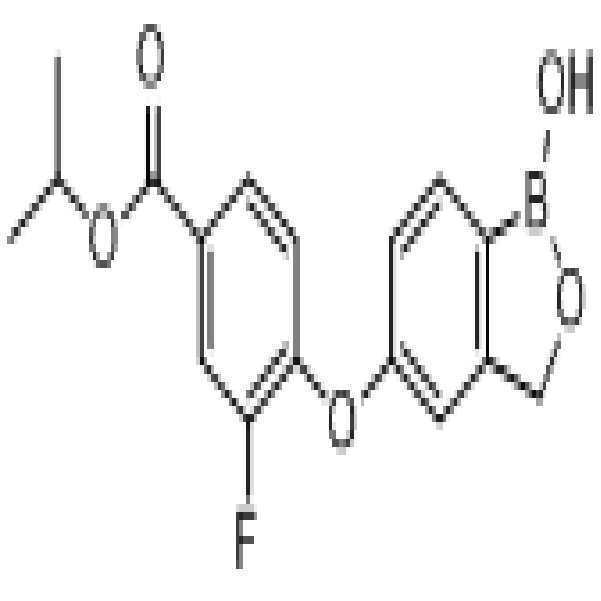
이 화합물은 실시예 19ax (D50) 와 유사한 방법으로, 이소프로필 3,4-디플루오르벤조레이트 및 4-브로모-3-포밀페놀으로부터 수득되었다.This compound was obtained from
ESI-MS (m/z) 329 (M-H)- ESI-MS ( m / z ) 329 (MH) -
19bd 5-(2,6- 디플루오르 -4- 에톡시카르보닐페녹시 )-1- 하이드록시 -2,1- 벤조옥 사보롤(D56) 19bd 5- (2,6 - Difluoro - 4- ethoxycarbonylphenoxy ) -1 -hydroxy- 2,1- benzooxaborol (D56)

이 화합물은 실시예 19ax (D50) 와 유사한 방법으로, 에틸 3,4,5-트리플루오로벤조레이트 및 4-브로모-3-포밀페놀로부터 수득되었다.This compound was obtained in analogy to example 19ax (D50) from
ESI-MS (m/z) 333 (M-H)- ESI-MS ( m / z ) 333 (MH) -
19be 5-(3- 클로로 -4- 에톡시카르보닐페녹시 )-1- 하이드록시 -2,1- 벤조옥사보 롤(D57) 19be 5- (3- chloro-4-ethoxycarbonyl-phenoxy) -1-hydroxy -2,1- benzoxazol-roll beam (D57)

화합물은 실시예 19ax (D50) 와 유사한 방법으로, 에틸 2-클로로-4-플루오르벤조레이트 및 4-브로모-3-포밀페놀로부터 수득되었다.The compound was obtained from ethyl 2-chloro-4-fluorobenzoate and 4-bromo-3-formylphenol in a similar manner to Example 19ax (D50) .
ESI-MS (m/z) 331 (M-H)- ESI-MS ( m / z ) 331 (MH) -
19bf 5-(2- 클로로 -5-플루오르-4- 에톡시카르보닐페녹시 )-1- 하이드록시 -2,1- 벤조옥사보롤(D58) 19bf 5- (2 -Chloro - 5 -fluoro-4- ethoxycarbonylphenoxy ) -1 -hydroxy- 2,1- benzoxazine borane (D58)

이 화합물은 실시예 19ax (D50) 와 유사한 방법으로, 에틸 5-클로로-2,4-디플루오르벤조레이트 및 4-브로모-3-포밀페놀로부터 수득되었다.This compound was obtained in analogy to example 19ax (D50) from ethyl 5-chloro-2,4-difluorobenzoate and 4-bromo-3-formylphenol.
ESI-MS (m/z)349(M-H)- ESI-MS ( m / z ) 349 (MH) -
19bi ( 4-(1- 하이드록시 -1,3- 디하이드로벤조[c][1,2]옥사보롤 -5-일 옥시 )페 닐) 메탄암모늄클로라이드 (D59) 19bi (4- (1- hydroxy-1,3-dihydro-benzo [c] [1,2] oxazol-5-yl borol oxy) Fe carbonyl) methane chloride (D59)
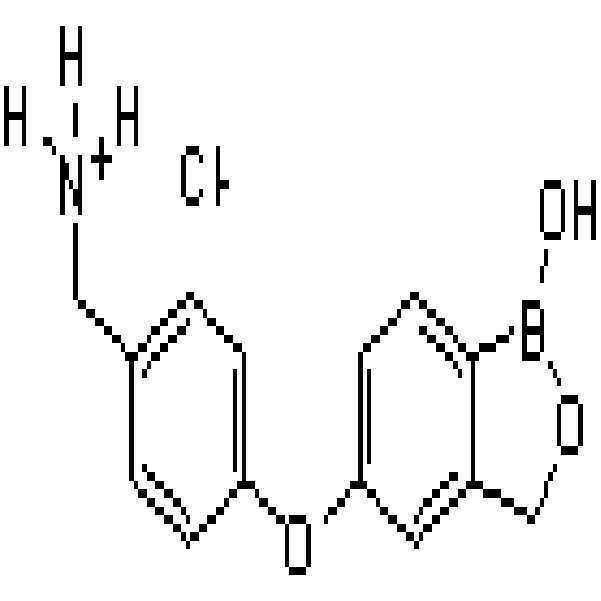

표제 화합물은 이의 위치 이성질체 준비에 대해 상기에서 설명된 것과 동일한 과정에 의해 합성되었다. 산출량 66.7%. The title compound was synthesized by the same procedure as described above for its positional isomer preparation. The output is 66.7%.
Mp .>250℃. 1HNMR(DMSO-d 6 , 300 MHz): δ 9.18 (s, 1H), 8.43 (br. s, 3H), 7.74 (d, J=8.1 Hz, 2H), 7.52 (d, J=8.7 Hz, 2H), 7.08 (d, J=8.7 Hz, 1H), 6.98-6.94 (m, 2H), 4.91 (s, 2H) and 3.99 (br. q, J=4.8 Hz, 2H) ppm. 순도 (HPLC): 92.2% at 220 nm and 94.9% at 254 nm. MS: m/z=256 (M+1, ESI+)andm/z=255(M-,ESI-).Mp. ≫ 250 ° C. 1 HNMR (DMSO- d 6, 300 MHz): δ 9.18 (s, 1H), 8.43 (. Br s, 3H), 7.74 (d, J = 8.1 Hz, 2H), 7.52 (d, J = 8.7 Hz, 2H), 7.08 (d, J = 8.7 Hz, 1H), 6.98-6.94 (m, 2H), 4.91 (s, 2H) and 3.99 (br. Purity (HPLC): 92.2% at 220 nm and 94.9% at 254 nm. MS: m / z = 256 (M + 1, ESI +) and m / z = 255 (M-, ESI-).
19bj 에틸 6-(1- 하이드록시 -1,3- 디하이드로벤조[c][1,2]옥사보롤 -5-일 옥 시)니코틴산염 (D60) 19bj ethyl 6- (1-hydroxy-1,3-dihydro-benzo [c] [1,2] oxazol-5-yl octanoic borol City) nicotinic acid (D60)


에틸 6-클로로니코틴산염 (18.6 g, 0.1 mol) 및 2-브로모-5-하이드록시 벤즈알데히드 (20.1 g, 0.1 mol)의 혼합물의 건 DMF (200mL)에 질소 대기하에, K2CO3 (20.8 g, 1.5 eq)가 첨가되었고, 혼합물은 65-80℃에서 30.5 h 동안 교반되었다. 실온으로 냉각된 후, 혼합물은 여과되었고, 기화되고 그리고 하룻밤 동안 펌프되어, 갈색 오일 (38.26 g)이 제공되었는데, NMR에 의하면, 에틸 6-(4-브로모-3-포밀페녹시)니코틴산염으로의 결합 전환률이 81.5%였다. To a dry DMF (200 mL) of a mixture of ethyl 6-chloronicotinate (18.6 g, 0.1 mol) and 2-bromo-5-hydroxybenzaldehyde (20.1 g, 0.1 mol) was added K 2 CO 3 g, 1.5 eq) was added and the mixture was stirred at 65-80 < 0 > C for 30.5 h. After cooling to room temperature, the mixture was filtered, evaporated and poured overnight to give a brown oil (38.26 g) which was characterized by NMR as ethyl 6- (4-bromo-3-formylphenoxy) nicotinate Was found to be 81.5%.
1H NMR(300MHz,DMSO-d 6 ): δ 10.17 (s, 1H), 8.66-8.65 (m, 1H), 8.33 (dd, J=8.7&2.4 Hz, 1H), 7.86 (d, J=8.7 Hz, 1H), 7.60 (d, J=2.7 Hz, 1H), 7.50 (dd, J=8.4&2.7 Hz, 1H), 7.23 (dd, J=8.7& 0.6 Hz, 1H), 4.30 (q, J=7.2 Hz, 2H) and 1.29 (t, J=7.2 Hz, 3H) ppm. 1 H NMR (300MHz, DMSO- d 6): δ 10.17 (s, 1H), 8.66-8.65 (m, 1H), 8.33 (dd, J = 8.7 & 2.4 Hz, 1H), 7.86 (d, J = (Dd, J = 8.7 Hz, 1H), 7.60 (d, J = 2.7 Hz, 1H), 7.50 , J = 7.2 Hz, 2H) and 1.29 (t, J = 7.2 Hz, 3H) ppm.
생성된 오일 중간생성물의 1,4-디옥산 (450 mL) 용액에 비스-파나콜-다이보론 (30.5 g, 0.12 mol), KOAc (29.5 g, 0.3 mol) 그리고 PdCl2(dppf)2(1.95g,2.5%mol)이 첨가되었고, 혼합물은 N2로 탈기되었고, 14시간 동안 교반되면서 80℃에서 가열되었다. 생성된 진한 혼합물은 여과되었고, 기화되었다. 잔유물은 최소 EtOAc에 용해되었고, 짧은 실리카 겔 컬럼을 통하여 헥산:EtOAc (2:1)으로 용리되어, 진한 색이 제거되고, 주로 에틸 6-(3-포밀-4-(4,4,5,5-테트라메틸-1,3,2-디옥사보란-2-일)페녹시)니코틴산염이 포함된 갈색 오일(46.4g)이 제공되었다. In 1,4-dioxane (450 mL) solution of the resulting oil intermediate bis-wave or call-di boron (30.5 g, 0.12 mol), KOAc (29.5 g, 0.3 mol) and PdCl 2 (dppf) 2 (1.95 g, 2.5% mol) was added and the mixture was degassed with N 2 and heated at 80 ° C with stirring for 14 hours. The resulting thick mixture was filtered and evaporated. The residue was dissolved in a minimum of EtOAc and eluted through a short silica gel column with hexane: EtOAc (2: 1) to remove the dark color and mainly ethyl 6- (3-formyl- 5-tetramethyl-1,3,2-dioxaboran-2-yl) phenoxy) nicotinate was provided.
1H NMR (300 MHz, DMSO-d6): δ 10.39 (s, 1H), 8.67-8.65 (m, 1H), 8.35-8.31 (m, 1H), 7.83 (d, J=8.1 Hz, 1H), 7.64 (d, J=2.7 Hz, 1H), 7.50 (dd, J=7.8 & 2.7 Hz, 1H), 7.24 (d, J=8.1 Hz, 1H), 4.30 (q, J=7.2 Hz, 2H), 1.34 (s, 12H) 그리고 1.29 (t, J=7.2 Hz, 3H) ppm. 1 H NMR (300 MHz, DMSO -d6): δ 10.39 (s, 1H), 8.67-8.65 (m, 1H), 8.35-8.31 (m, 1H), 7.83 (d, J = 8.1 Hz, 1H), (D, J = 7.8 Hz, 2H), 7.64 (d, J = 2.7 Hz, 1H), 7.50 1.34 (s, 12H) and 1.29 (t, J = 7.2 Hz, 3H) ppm.
피나콜붕소 알데히드 (46.4 g)의 EtOH (450mL, 200 proof) 용액에 0℃에서 NaBH4 (5 g)가 일부분씩 첨가되었고, 혼합물은 실온으로 온도를 서서히 상승시키면서 하룻밤 동안 교반되었다. 혼합물은 얼음 바스에서 다시 냉각되고, 물 (50 mL)이 첨가되었고, 천천히 6N HCl (50 mL)이 첨가되었다. 30 분 동안 교반된 후, 혼합물은 기화되어 EtOH가 제거되었고, 물 (200 mL)이 첨가되었고, NaHCO3-포화된 물로 중화되었다. 혼합물은 EtOAc으로 추출되었고, 농축되었고, 짧고 큰 실리카 겔 컬럼에서 헥산:EtOAc (2:1, v/v)으로 용리되어, 진한 불순물이 제거되었다. 수득된 오일에는 프로톤 NMR 스펙트럼을 어렵게하는 피나콜 불순물이 포함되어 있다. 오일은 최소 아세톤에 용해되었고, 동시에 초음파시키면서 물이 서서히 첨가되어, 고체 산물이 참여한다. 고체는 여과에 의해 수거되었고, 펜탄 및 헥산으로 세척되었고, 고진공에서 하룻밤 건조되어 크림색 고체로 된 에틸 6-(1-하이드록시-1,3-디하이드로벤조[c][1,2]옥사보롤-5-일 옥시)니코틴산염(17.84 g), 59.6% 전체 산출량 (3 단계)이 수득되었다. Pina EtOH (450mL, 200 proof) NaBH 4 (5 g) at 0 ℃ to a solution of boron call aldehyde (46.4 g) that was added in portions, the mixture was slowly raising the temperature to room temperature and stirred overnight. The mixture was again cooled in an ice bath, water (50 mL) was added, and slowly 6N HCl (50 mL) was added. After stirring for 30 minutes the mixture is evaporated to remove the EtOH was, water was (200 mL) was added, NaHCO 3 - was neutralized with water, saturated. The mixture was extracted with EtOAc, concentrated and eluted with a short and large silica gel column with hexane: EtOAc (2: 1, v / v) to remove the thick impurities. The resulting oil contains pinacol impurities that make the proton NMR spectrum difficult. The oil is dissolved in a minimum amount of acetone and at the same time water is slowly added with ultrasonic waves, and solid products are involved. The solids were collected by filtration, washed with pentane and hexane and dried in a high vacuum overnight to give ethyl 6- (1-hydroxy-1,3-dihydrobenzo [c] [1,2] oxaborol 5-yloxy) nicotinate (17.84 g), 59.6% overall yield (3 steps) was obtained.
M.p.110-113℃. 1H NMR (300 MHz, DMSO-d6): δ 9.21 (s, 1H), 8.68 (d, J=2.4 Hz, 1H), 8.30 (dd, J=8.4 & 2.1 Hz, 1H), 7.76 (d, J=8.1 Hz, 1H), 7.21 (d, J=1.5 Hz, 1H), 7.15 (d, J=8.7 Hz, 1H), 7.12 (dd, J=7.8 & 2.1 Hz, 1H), 4.97 (s, 2H), 4.30 (q, J=7.5 Hz, 2H) and 1.29 (t, J=7.5 Hz, 3H) ppm. 순도 (HPLC): 95.3% at 220 nm and 95.4% at 254 nm. MS: m/z = 300 (M+1, ESI+) and m/z = 298 (M-1, ESI-).M. p. 110-113 ° C. (D, J = 8.4 & 2.1 Hz, 1H), 7.76 (d, J = = 8.1 Hz, 1H), 7.21 (d, J = 1.5 Hz, 1H), 7.15 (d, J = 8.7 Hz, 1H), 7.12 ), 4.30 (q, J = 7.5 Hz, 2H) and 1.29 (t, J = 7.5 Hz, 3H) ppm. Purity (HPLC): 95.3% at 220 nm and 95.4% at 254 nm. MS: m / z = 300 (M + 1, ESI +) and m / z = 298 (M-1, ESI-).
19bk 6-(1- 하이드록시 -1,3- 디하이드로벤조[c][1,2]옥사보롤 -5-일 옥시 )니코 틴산(D61) 19bk 6- (1- hydroxy-1,3-dihydro-benzo [c] [1,2] oxazol-5-yl borol oxy) Nikko tinsan (D61)

표제 비스-산 화합물은 대응 카르복실산에틸 에스테르의 가수분해에 의해 준비되었다. 에틸 6-(1-하이드록시-1,3-디하이드로벤조[c][1,2]옥사보롤-5-일 옥시)니코틴산염 (2.99 g, 10 mmol)은 새로 개방된 THF (100 mL)에 용해되었고, 1N NaOH (38 mL)가 첨가되었다. 혼합물은 실온에서 N2 하에 하룻밤 동안 교반되었다. 그 다음 6N HCl (6.5 mL)가 첨가되었고, 회전 기화되어 THF가 제거되었고, 여과되었고, 그리고 물로 세척된 후, 헥산으로 세척되었다. 고체는 고진공하에 하룻밤 건조되어, 밝은 갈색 고체로 된 표제 비스-산 화합물 (2.57 g, 9.48 mmol, 산출량 94.8%)이 수득되었다. The title bis-acid compound was prepared by hydrolysis of the corresponding carboxylic acid ethyl ester. Ethyl 6- (1 -hydroxy-1,3-dihydrobenzo [c] [1,2] oxaborol-5-yloxy) nicotinate (2.99 g, 10 mmol) was dissolved in freshly opened THF ≪ / RTI > and 1N NaOH (38 mL) was added. The mixture was stirred at room temperature under N 2 overnight. 6N HCl (6.5 mL) was then added, rotary evaporated to remove THF, filtered, and washed with water, then washed with hexane. The solid was dried under high vacuum overnight to afford the title bis-acid compound (2.57 g, 9.48 mmol, yield 94.8%) as a light brown solid.
M.p.>200℃. 1H NMR (300 MHz, DMSO-d 6 ): δ 13.21 (s, 1H), 9.21 (s, 1H), 8.65 (d, J=2.1 Hz, 1H), 8.28 (dd, J=8.4 & 2.4 Hz, 1H), 7.76 (d, J=7.8 Hz, 1H), 7.21 (d, J=1.5 Hz, 1H), 7.14-7.11 (m, 2H) 그리고 4.97 (s, 2H) ppm. 순도 (HPLC): 97.2% , 220 nm 및 97.8% , 254 nm. MS: m/z = 272 (M+1, ESI+) 그리고 m/z = 270 (M-1, ESI-).Mp > 1 H NMR (300 MHz, DMSO- d 6): δ 13.21 (s, 1H), 9.21 (s, 1H), 8.65 (d, J = 2.1 Hz, 1H), 8.28 (dd, J = 8.4 & 2.4 Hz , 7.76 (d, J = 7.8 Hz, 1H), 7.21 (d, J = 1.5 Hz, 1H), 7.14-7.11 (m, 2H) and 4.97 (s, 2H) ppm. Purity (HPLC): 97.2%, 220 nm and 97.8%, 254 nm. MS: m / z = 272 (M + 1, ESI +) and m / z = 270 (M-1, ESI-).
19b1 N,N - 디에틸 -6-(1- 하이드록시 -1,3- 디하이드로벤조[c][1,2]옥사보롤 -5- 일 옥시) 니코틴아미드 (D62) 19b1 N, N - diethyl-6- (1-hydroxy-1,3-dihydro-benzo [c] [1,2] oxazole borol 5-yl-phenoxy) nicotinamide (D62)

6-(1-하이드록시-1,3-디하이드로벤조[c][1,2]옥사보롤-5-일 옥시)니코틴산(0.813 g, 3 mmol)의 무수 DMF (70mL) 용액에 디에틸아민 (3.2 mL, 30 mmol) 및 DIPEA (1.6 mL, 9 mmol)이 N2하에 첨가되었다. 혼합물은 얼음 바스에서 냉각되었고, 결합 물질 PyCloP (Aldrich#26564, 1.4 g, 3.3 mmol)이 첨가되었다. 반응 혼합물은 0℃에서 10 분간 교반되었고, 실온에서 하룻밤 교반되었고, 그 다음 회전 기화되었다. 잔유물은 EtOAc에 용해되었고, 물로 세척되었고, 기화되고 그리고 플래쉬 컬럼 크로마토그래피에 의해 실리카 겔상에서 EtOAc으로 용리시켜 정제되면, 백색 고체로 된 표제 아미드 화합물(0.92 g, 2.82 mmol, 산출량 94%)이 수득되었다. To a solution of 6- (1 -hydroxy-1,3-dihydrobenzo [c] [1,2] oxaborol-5-yloxy) nicotinic acid (0.813 g, 3 mmol) in anhydrous DMF (70 mL) (3.2 mL, 30 mmol) and DIPEA (1.6 mL, 9 mmol) was added under a N 2. The mixture was cooled in an ice bath and the coupling material PyCloP (Aldrich # 26564, 1.4 g, 3.3 mmol) was added. The reaction mixture was stirred at 0 < 0 > C for 10 min, stirred at room temperature overnight, and then rotary evaporated. The residue was dissolved in EtOAc, washed with water, evaporated and purified by flash column chromatography eluting with EtOAc on silica gel to give the title amide compound (0.92 g, 2.82 mmol, yield 94%) as a white solid .
Mp 85-95℃. 1H NMR (300 MHz, DMSO-d 6 ): δ 9.18 (s, 1H), 8.15 (dd, J=2.4 & 0.6 Hz, 1H), 7.86 (dd, J=8.7 & 2.4 Hz, 1H), 7.75 (d, J=8.1 Hz, 1H), 7.19 (dd, J=2.1 & 0.6 Hz, 1H), 7.13-7.07 (m, 2H) and 4.96 (s, 2H), 3.48-3.12 (broad m, 4H) 그리고 1.16-1.02 (broad s, 6H) ppm. 순도 (HPLC): 97.0% at 220 nm and 96.9% at 254nm. MS: m/z = 327 (M+1, ESI+) 그리고 m/z = 325 (M-1, ESI-).Mp 85-95 [deg.] C. 1 H NMR (300 MHz, DMSO- d 6): δ 9.18 (s, 1H), 8.15 (dd, J = 2.4 & 0.6 Hz, 1H), 7.86 (dd, J = 8.7 & 2.4 Hz, 1H), 7.75 (m, 2H) and 4.96 (s, 2H), 3.48-3.12 (broad m, 4H), 7.19 (dd, J = And 1.16-1.02 (broad s, 6H) ppm. Purity (HPLC): 97.0% at 220 nm and 96.9% at 254 nm. MS: m / z = 327 (M + 1, ESI +) and m / z = 325 (M-1, ESI-).
19bm N-에틸-6-(1- 하이드록시 -1,3- 디하이드로벤조[c][1,2]옥사보롤 -5-일 옥 시) 니코틴아미드 (D63) 9bm 1-ethyl-6-N- (1-hydroxy-1,3-dihydro-benzo [c] [1,2] oxazol-5-yl octanoic borol City) nicotinamide (D63)

표제 화합물은 대응 카르복실산으로부터 디에틸 아미드 유사체에서 설명된 동일한 방법에 의해 준비되었다. 산출량 78.3%.The title compound was prepared from the corresponding carboxylic acid by the same method as described for the diethyl amide analog. Output 78.3%.
Mp 100-120℃ (하이드로scopic). 1H NMR (300 MHz, DMSO-d 6 ): δ 9.20 (s, 1H), 8.57 (d, J=2.1 Hz, 1H), 8.54 (broad t, J=5.4 Hz, 1H), 8.23 (dd, J=8.4 & 2.4 Hz, 1H), 7.75 (d, J=7.8 Hz, 1H), 7.17 (d, J=1.8 Hz, 1H), 7.12-7.08 (m, 2H), 4.96 (s, 2H), 3.32-3.22 (m, 2H) and 1.10 (t, J=7.2 Hz, 3H) ppm. 순도 (HPLC): 97.2% at 220 nm and 98.1% at 254nm. MS: m/z = 299 (M+1, ESI+) and m/z = 297 (M-1, ESI-).Mp 100-120 ° C (hydro scopic). 1 H NMR (300 MHz, DMSO- d 6): δ 9.20 (s, 1H), 8.57 (d, J = 2.1 Hz, 1H), 8.54 (broad t, J = 5.4 Hz, 1H), 8.23 (dd, J = 8.4 & 2.4 Hz, 1H), 7.75 (d, J = 7.8 Hz, 1H), 7.17 (d, J = 1.8 Hz, 1H), 7.12-7.08 3.32-3.22 (m, 2H) and 1.10 (t, J = 7.2 Hz, 3H) ppm. Purity (HPLC): 97.2% at 220 nm and 98.1% at 254 nm. MS: m / z = 299 (M + 1, ESI +) and m / z = 297 (M-1, ESI-).
19bn 5- (5-(하이드록시메틸)피리딘-2-일 옥시)벤조[c][1,2]옥사보롤 -1(3H)- 올 (D64) 19bn 5- (5- (hydroxymethyl) pyridin-2-yl-phenoxy) benzo [c] [1,2] oxazole borol -1 (3H) - ol (D64)

에틸 6-(1-하이드록시-1,3-디하이드로벤조[c][1,2]옥사보롤-5-일 옥시)니코틴산염 (2 g, 6.68 mmol) 의 THF (130 mL)를 슈퍼 하이드라이드 (LiEt3BH, 1M in THF, 26.7 mL)로 0℃에서 실온으로 환원시켰다. 하룻밤 동안 정상 작업에 의해 백색 고체로 된 표제 알코올(1.03 g, 산출량 60%)이 제공되었다. THF (130 mL) of ethyl 6- (1-hydroxy-1,3-dihydrobenzo [c] [1,2] oxaborol-5-yloxy) nicotinate (2 g, 6.68 mmol) fluoride was reduced to room temperature at 0 ℃ to (LiEt 3 BH, 1M in THF , 26.7 mL). The title alcohol (1.03 g, yield 60%) as a white solid was provided by normal work-up overnight.
Mp 210-212℃. 1H NMR (300 MHz, DMSO-d 6 ): δ 9.18 (s, 1H), 8..08-8.07 (m, 1H), 7.81-7.78 (m, 1H), 7.72 (d, J=7.8 Hz, 1H), 7.09 (s, 1H), 7.05-7.01 (m, 2H), 5.28 (broad s, 1H), 4.94 (s, 2H) and 4.46 (s, 2H) ppm. 순도 (HPLC): 96.5% at 220 nm and 98.3% at 254 nm. MS: m/z = 258 (M+1, ESI+) and m/z = 256 (M-1, ESI-).Mp 210-212 [deg.] C. 1 H NMR (300 MHz, DMSO- d 6): δ 9.18 (s, 1H), 8..08-8.07 (m, 1H), 7.81-7.78 (m, 1H), 7.72 (d, J = 7.8 Hz , 7.09 (s, 1H), 7.05-7.01 (m, 2H), 5.28 (broad s, 1H), 4.94 (s, 2H) and 4.46 (s, 2H) ppm. Purity (HPLC): 96.5% at 220 nm and 98.3% at 254 nm. MS: m / z = 258 (M + 1, ESI +) and m / z = 256 (M-1, ESI-).
19bo 메틸 6-(1- 하이드록시 -1,3- 디하이드로벤조[c][1,2]옥사보롤 -5-일 옥 시)니코틴산염 (D65) 19bo-methyl-6- (1-hydroxy-1,3-dihydro-benzo [c] [1,2] oxazol-5-yl octanoic borol City) nicotinic acid (D65)

대응 카르복실산(0.8 g, 2.95 mmol) 및 96% H2SO4 (1 g) 혼합물의 MeOH (130 mL) 는 하룻밤 동안 N2.하에서 재환류되었다. 정상 작업(work-up) 및 플래쉬 컬럼 크로마토그래피를 실리카 겔 상에서 헥산:EtOAc (1:1, v/v)으로 용리시키면, 표제 메틸 에스테르 화합물이 백색 고체 (0.127 g, 산출량 15.1%)로 제공되었다.A solution of the corresponding carboxylic acid (0.8 g, 2.95 mmol) and 96% H 2 SO 4 (1 g) in MeOH (130 mL) was recirculated under N 2 overnight. Work-up and flash column chromatography were eluted on silica gel with hexane: EtOAc (1: 1, v / v) to give the title methyl ester compound as a white solid (0.127 g, 15.1% yield) .
Mp 156-158℃. 1H NMR (300 MHz, DMSO-d 6 ): δ 9.22 (s, 1H), 8.68 (dd, J=2.4 & 0.6 Hz, 1H), 8.31 (dd, J=8.7 & 2.4 Hz, 1H), 7.76 (d, J=7.8 Hz, 1H), 7.22 (d, J=1.2 Hz, 1H), 7.17-7.11 (m, 2H), 4.97 (s, 2H) and 3.84 (s, 3H) ppm. 순도 (HPLC): 98.0% at 220 nm and 100% at 254 nm. MS: m/z = 286 (M+1, ESI+) and m/z = 284 (M-1, ESI-).Mp 156-158 [deg.] C. 1 H NMR (300 MHz, DMSO- d 6): δ 9.22 (s, 1H), 8.68 (dd, J = 2.4 & 0.6 Hz, 1H), 8.31 (dd, J = 8.7 & 2.4 Hz, 1H), 7.76 (m, 2H), 4.97 (s, 2H) and 3.84 (s, 3H) ppm. Purity (HPLC): 98.0% at 220 nm and 100% at 254 nm. MS: m / z = 286 (M + 1, ESI +) and m / z = 284 (M-1, ESI-).
19bp n-프로필 6-(1- 하이드록시 -1,3- 디하이드로벤조[c][1,2]옥사보롤 -5-일 옥시)니코틴산염 (D66) 19bp n-propyl 6- (1 -hydroxy -1,3 -dihydrobenzo [c] [1,2] oxaborol -5- yloxy) nicotinate salt (D66)

상응하는 카르복실산(0.5 g, 1.84 mmol) 및 결합 물질 CDI (0.66 g, 4.06 mmol, 2.2 eq) 혼합물의 CH2Cl2 (50 mL), THF (30 mL) 및 DMF (40 mL) 용해 혼합물은 r.t.에서 하룻밤 동안 N2하에서 교반되었다. 그 다음 무수 n-PrOH (30mL)가 혼합물에 주입되었고, 촉매량의 NaH (60%, 10 mg)가 첨가되었다. 혼합물은 2시간 동안 N2 하에서 재환류되었고, 그 다음 기화되었다. 잔유물은 EtOAc에 용해되었고, 0.5N HCl로 세척되었고, 그 다음 NaHCO3 용액 (pH=8)로 세척되었고, 건조되고, 그리고 기화되었다. 끈적거리는 고체는 최소량의 아세톤에 용해되었고, 초음파 및 냉각과 함께 헥산이 첨가되어, 표제 n-프로필 에스테르 산물이 회백색 고체 (0.354 g, 1.13 mmol, 산출량 61.3%)로 수득되었다.A solution mixture of the mixture of the corresponding carboxylic acid (0.5 g, 1.84 mmol) and the coupling agent CDI (0.66 g, 4.06 mmol, 2.2 eq) in CH 2 Cl 2 (50 mL), THF (30 mL) Was stirred under N 2 overnight at rt. Anhydrous n-PrOH (30 mL) was then injected into the mixture and a catalytic amount of NaH (60%, 10 mg) was added. Mixture was reperfusion under N 2 for 2 hours, then it was evaporated. The residue was dissolved in EtOAc, washed with 0.5N HCl, then washed with NaHCO 3 solution (pH = 8), dried and evaporated. The sticky solid was dissolved in the minimum amount of acetone and hexane was added with ultrasonic and cooling to give the title n-propyl ester product as an off-white solid (0.354 g, 1.13 mmol, yield 61.3%).
Mp 89-94℃. 1H NMR (300 MHz, DMSO-d 6 ): δ 9.22 (s, 1H), 8.69 (d, J=2.4 Hz, 1H), 8.31 (dd, J=8.7 & 2.7 Hz, 1H), 7.76 (d, J=7.8 Hz, 1H), 7.22 (s, 1H), 7.17-7.12 (m, 2H), 4.97 (s, 2H), 4.22 (t, J=6.3 Hz, 2H), 1.70 (sextet, J=6.9 Hz, 2H) 그리고 0.94 (t, J=7.2 Hz, 3H) ppm. 순도 (HPLC): 98.3% , 220 nm 및 98.3%, 254 nm. MS: m/z = 314 (M+1, ESI+) 그리고 m/z = 312 (M-1, ESI-).Mp 89-94 [deg.] C. 1 H NMR (300 MHz, DMSO- d 6): δ 9.22 (s, 1H), 8.69 (d, J = 2.4 Hz, 1H), 8.31 (dd, J = 8.7 & 2.7 Hz, 1H), 7.76 (d J = 7.8 Hz, 1H), 7.22 (s, 1H), 7.17-7.12 (m, 2H), 4.97 6.9 Hz, 2H) and 0.94 (t, J = 7.2 Hz, 3H) ppm. Purity (HPLC): 98.3%, 220 nm and 98.3%, 254 nm. MS: m / z = 314 (M + 1, ESI +) and m / z = 312 (M-1, ESI-).
19bq 이소프로필 6-(1- 하이드록시 -1,3- 디하이드로벤조[c][1,2]옥사보롤 -5- 일 옥시)니코틴산염 (D67) 19bq isopropyl 6- (1 -hydroxy -1,3 -dihydrobenzo [c] [1,2] oxaborol - 5- yloxy) nicotinate salt (D67)

표제 이소프로필 에스테르 화합물은 재환류 시간을 4시간으로 증가시키면서 n-프로필 에스테르를 위해 설명된 과정을 변형시켜 준비되었다. 산출량 71.8%.The title isopropyl ester compound was prepared by modifying the procedure described for the n-propyl ester with increasing recycle time to 4 hours. Output is 71.8%.
Mp 95-101℃. 1H NMR (300 MHz, DMSO-d 6 ): δ 9.21 (s, 1H), 8.66 (d, J=2.4 Hz, 1H), 8.29 (dd, J=8.7 & 2.1 Hz, 1H), 7.76 (d, J=7.8 Hz, 1H), 7.21 (d, J=1.8 Hz, 1H), 7.16-7.11 (m, 2H), 5.12 (septet, J=6.0 Hz, 1H), 4.97 (s, 2H) and 1.30 (d, J=6.3 Hz, 6H) ppm. 순도 (HPLC): 98.2% at 220 nm and 96.6% at 254 nm. MS: m/z = 314 (M+1, ESI+) and m/z = 312 (M-1, ESI-).Mp 95-101 [deg.] C. 1 H NMR (300 MHz, DMSO- d 6): δ 9.21 (s, 1H), 8.66 (d, J = 2.4 Hz, 1H), 8.29 (dd, J = 8.7 & 2.1 Hz, 1H), 7.76 (d J = 7.8 Hz, 1H), 7.21 (d, J = 1.8 Hz, 1H), 7.16-7.11 (m, 2H), 5.12 (septet, (d, J = 6.3 Hz, 6H) ppm. Purity (HPLC): 98.2% at 220 nm and 96.6% at 254 nm. MS: m / z = 314 (M + 1, ESI +) and m / z = 312 (M-1, ESI-).
19br n-부틸 6-(1- 하이드록시 -1,3- 디하이드로벤조[c][1,2]옥사보롤 -5-일 옥 시)니코틴산염 (D68) 19br n- butyl-6- (1-hydroxy-1,3-dihydro-benzo [c] [1,2] oxazol-5-yl octanoic borol City) nicotinic acid (D68)

표제 n-부틸 에스테르 화합물은 재환류 시간을 4시간으로 증가시키면서 n-프로필 에스테르를 위해 설명된 과정을 변형시켜 준비되었다. 산출량 68.5%. The title n-butyl ester compound was prepared by modifying the procedure described for n-propyl ester with increasing recycle time to 4 hours. Output is 68.5%.
Mp 75-80℃. 1H NMR (300 MHz, DMSO-d 6 ): δ 9.22 (s, 1H), 8.68-8.67 (m, 1H), 8.32-8.29 (dm, Jd=8.7 Hz, 1H), 7.76 (d, J=7.5 Hz, 1H), 7.22 (s, 1H), 7.17-7.12 (m, 2H), 4.97 (s, 2H), 4.26 (t, J=6.3 Hz, 2H), 1.66 (pentatet, J=7.5 Hz, 2H), 1.39 (sextet, J=7.5 Hz, 2H) and 0.90 (t, J=7.5 Hz, 3H) ppm. 순도 (HPLC): 100% at 220 nm and 100% at 254 nm. MS: m/z = 328 (M+1, ESI+).Mp 75-80 < 0 > C. 1 H NMR (300 MHz, DMSO- d 6): δ 9.22 (s, 1H), 8.68-8.67 (m, 1H), 8.32-8.29 (dm, Jd = 8.7 Hz, 1H), 7.76 (d, J = J = 7.5 Hz, 1H), 7.22 (s, 1H), 7.17-7.12 (m, 2H), 4.97 (s, 2H), 4.26 2H), 1.39 (sextet, J = 7.5 Hz, 2H) and 0.90 (t, J = 7.5 Hz, 3H) ppm. Purity (HPLC): 100% at 220 nm and 100% at 254 nm. MS: m / z = 328 (M + 1, ESI < + >).
19bs 6-(1- 하이드록시 -1,3- 디하이드로벤조[c][1,2]옥사보롤 -5-일 옥시 ) 니코 틴알데히드 (D69) 19bs 6- (1- hydroxy-1,3-dihydro-benzo [c] [1,2] oxazol-5-yl borol oxy) Nikko tin aldehyde (D69)

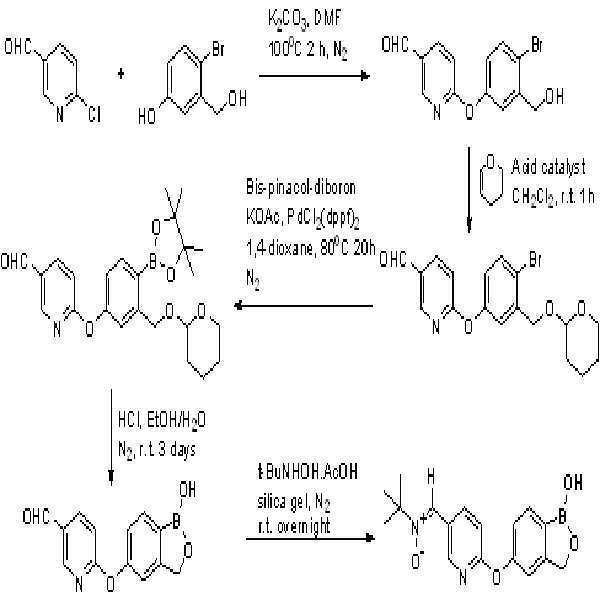
2 h 동안 100℃에서 N2 하에, K2CO3 (8.5 g, 1.5 eq)/DMF (100 mL) 존재하에 6-클로로니코틴알데히드 (5.4 g, 38.15 mmol) 및 4-브로모-3-(하이드록시메틸)페놀 (8.15 g, 38.15 mmol)의 결합 반응으로 원하는 6-(4-브로모-3-(하이드록시메틸)페녹시)니코틴알데히드 (8.03 g, 26.1 mmol, 산출량 68.3%)가 실리카 겔컬럼 정제 (헥산:EtOAc=3:1, v/v)후 백색 고체로 제공되었다. 2 under N 2 at 100 ℃ for h, K 2 CO 3 (8.5 g, 1.5 eq) / DMF (100 mL) in the presence of 6-chloro nicotinic aldehyde (5.4 g, 38.15 mmol) and 4-bromo-3- ( (Hydroxymethyl) phenoxy) nicotinaldehyde (8.03 g, 26.1 mmol, yield 68.3%) was obtained as a white solid by the coupling reaction of 4- (hydroxymethyl) phenol (8.15 g, 38.15 mmol) Gel column purification (hexane: EtOAc = 3: 1, v / v) as a white solid.
1H NMR (300 MHz, DMSO-d 6 ): δ 9.98 (s, 1H), 8.68 (d, J=2.4 Hz, 1H), 8.27 (ddd, J=8.7 & 2.4 & 0.6 Hz, 1H), 7.63 (d, J=7.8 Hz, 1H), 7.29 (d, J=2.4 Hz, 1H), 7.24 (d, J=8.7 Hz, 1H), 7.07 (dd, J=8.1 & 2.4 Hz, 1H), 5.54 (t, J=5.4 Hz, 1H) 및 4.50 (d, J=5.4 Hz, 2H) ppm. 1 H NMR (300 MHz, DMSO- d 6): δ 9.98 (s, 1H), 8.68 (d, J = 2.4 Hz, 1H), 8.27 (ddd, J = 8.7 & 2.4 & 0.6 Hz, 1H), 7.63 (d, J = 7.8 Hz, 1H), 7.29 (d, J = 2.4 Hz, 1H), 7.24 (t, J = 5.4 Hz, 1H) and 4.50 (d, J = 5.4 Hz, 2H) ppm.
1시간 동안 실온에서, 6-(4-브로모-3-(하이드록시메틸)페녹시)니코틴알데히드 (2.4 g, 7.78 mmol)의 3,4-디하이드로-2H-피란 (2.2 mL)을 (1S)-(+)-10-캄포르술폰산의CH2Cl2 (80 mL) 촉매화된 THP 보호로 원하는 6-(4-브로모-3-((테트라하이드로-2H-피란-2-일 옥시)메틸)페녹시)니코틴알데히드이 실리카 겔컬럼 정제 (헥산:EtOAc=3:1, v/v)후, 무색 오일 (3.07 g, 7.8 mmol, 산출량 100%)로 수득되었다. 3,4-Dihydro-2H-pyran (2.2 mL) of 6- (4-bromo-3- (hydroxymethyl) phenoxy) nicotinaldehyde (2.4 g, 7.78 mmol) - ((tetrahydro-2H-pyran-2-yloxy) methyl) - (+) - 10-camphorsulfonic acid with CH2Cl2 (80 mL) ) Phenoxy) nicotinic aldehyde was obtained as a colorless oil (3.07 g, 7.8 mmol, 100% yield) after silica gel column purification (hexane: EtOAc = 3: 1, v / v).
1H NMR (300 MHz, DMSO-d 6 ): δ 9.98 (s, 1H), 8.68 (d, J=2.4 Hz, 1H), 8.27 (ddd, J=8.4 & 2.4 & 0.6 Hz, 1H), 7.68 (dd, J=8.4 & 0.6 Hz, 1H), 7.31 (d, J=2.4 Hz, 1H), 7.25 (d, J=8.1 Hz, 1H), 7.12 (dd, J=8.4 & 3.0 Hz, 1H), 4.75-4.74 (m, 1H), 4.70 (d, J=13.5 Hz, 1H), 4.48 (d, J=13.5 Hz, 1H), 3.80-3.72 (m, 1H), 3.50-3.44 (m, 1H) 및 1.80-1.40 (m, 6H) ppm. 1 H NMR (300 MHz, DMSO- d 6): δ 9.98 (s, 1H), 8.68 (d, J = 2.4 Hz, 1H), 8.27 (ddd, J = 8.4 & 2.4 & 0.6 Hz, 1H), 7.68 (dd, J = 8.4 & 0.6 Hz, 1H), 7.31 (d, J = 2.4 Hz, 1H), 7.25 , 4.75-4.74 (m, 1H), 4.70 (d, J = 13.5Hz, 1H), 4.48 ) And 1.80-1.40 (m, 6H) ppm.
80℃, 하룻밤 동안 N2 하에서 6-(4-브로모-3-((테트라하이드로-2H-피란-2-일 옥시)메틸)페녹시) 니코틴알데히드 (3.07 g, 7.83 mmol)를 비스-피나콜-다이보론 (3.05 g, 12 mmol), KOAc (2.3 g, 23.5 mmol) 및 PdCl2(dppf)2 (0.163 g, 2.5%mmol)의 1,4-디옥산 (100mL)으로 촉매적 붕소화시키면, 원하는 6-(3-((테트라하이드로-2H-피란-2-일 옥시)메틸)-4-(4,4,5,5-테트라메틸-1,3,2-디옥사보란-2-일)페녹시)니코틴알데히드는 실리카 겔컬럼 정제 (헥산:EtOAc=3:1, v/v)후, 오일 (3 g, 6.83 mmol, 산출량 87.2%)로 수득되었다. 80 ℃, under N 2 overnight, 6- (4-bromo-3 - ((tetrahydro -2H- pyran-2-yl) methyl) phenoxy) nicotinic aldehyde (3.07 g, 7.83 mmol) of bis-Pina Catalytic boronation (100 mL) was performed with a solution of Cole-diboron (3.05 g, 12 mmol), KOAc (2.3 g, 23.5 mmol) and PdCl 2 (dppf) 2 (0.163 g, 2.5% To give the desired 6- (3 - ((tetrahydro-2H-pyran-2-yloxy) methyl) -4- (4,4,5,5-tetramethyl-1,3,2-dioxaborane- -Yl) phenoxy) nicotinic aldehyde was obtained as an oil (3 g, 6.83 mmol, 87.2% yield) after silica gel column purification (hexane: EtOAc = 3: 1, v / v).
1H NMR (300 MHz, DMSO-d 6 ): δ 9.98 (s, 1H), 8.68 (d, J=2.4 Hz, 1H), 8.27 (dd, J=8.7 & 2.4 Hz, 1H), 7.73 (d, J=8.4 Hz, 1H), 7.24-7.21 (m, 2H), 7.10 (dd, J=8.4 & 2.4 Hz, 1H), 4.82 (d, J=12.9 Hz, 1H), 4.70-4.66 (m, 2H), 3.79-3.72 (m, 1H), 3.47-3.40 (m, 1H), 1.75-1.43 (m, 6H) and 1.29 (s, 12H) ppm. 1 H NMR (300 MHz, DMSO- d 6): δ 9.98 (s, 1H), 8.68 (d, J = 2.4 Hz, 1H), 8.27 (dd, J = 8.7 & 2.4 Hz, 1H), 7.73 (d J = 8.4 Hz, 1H), 7.24-7.21 (m, 2H), 7.10 (dd, 2H), 3.79-3.72 (m, 1H), 3.47-3.40 (m, 1H), 1.75-1.43 (m, 6H) and 1.29 (s, 12H) ppm.
N2 하에, 긴 주말동안, 6-(3-((테트라하이드로-2H-피란-2-일 옥시)메틸)-4-(4,4,5,5-테트라메틸-1,3,2-디옥사보란-2-일)페녹시)니코틴알데히드 (3 g, 6.83 mmol)의 산성 수성 EtOH의 가수분해 및 동시에 고리화반응에 의해, 원하는 환식 붕산6-(1-하이드록시-1,3-디하이드로벤조[c][1,2]옥사보롤-5-일 옥시)니코틴알데히드는 컬럼 크로마토그래피없이 정상 작업후에 백색 고체 (1.12 g, 4.39 mmol, 산출량 64.3%)로 생산되었다. Under N 2, for a long weekend, 6- (3 - ((tetrahydro -2H- pyran-2-yl) methyl) -4- (4,4,5,5-tetramethyl-1,3,2 (1-hydroxy-1, 3-dioxolan-2-yl) phenoxy) nicotinaldehyde (3 g, 6.83 mmol) by hydrolysis and simultaneous cyclization of acidic aqueous EtOH. Dihydrobenzo [c] [1,2] oxaborol-5-yloxy) nicotinic aldehyde was produced as a white solid (1.12 g, 4.39 mmol, 64.3% yield) after normal working without column chromatography.
Mp 179-182℃. 1H NMR (300 MHz, DMSO-d 6 ): δ 9.98 (s, 1H), 9.23 (s, 1H), 8.69 (d, J=2.4 Hz, 1H), 8.26 (ddd, J=8.4 & 2.4 & 0.9 Hz, 1H), 7.77 (d, J=8.1 Hz, 1H), 7.24-7.21 (m, 2H), 7.15 (dd, J=8.1 & 1.2 Hz, 1H) 및 4.98 (s, 2H) ppm. 순도 (HPLC): 95% at 220 nm and 95% at 254 nm. MS: m/z = 256 (M+1, ESI+) and m/z = 254 (M-1, ESI-).Mp 179-182 [deg.] C. 1 H NMR (300 MHz, DMSO- d 6): δ 9.98 (s, 1H), 9.23 (s, 1H), 8.69 (d, J = 2.4 Hz, 1H), 8.26 (ddd, J = 8.4 & 2.4 & (D, J = 8.1 Hz, 1H), 4.77 (d, J = 8.1 Hz, 1H), 7.24-7.21 (m, 2H), 7.15 Purity (HPLC): 95% at 220 nm and 95% at 254 nm. MS: m / z = 256 (M + 1, ESI +) and m / z = 254 (M-1, ESI-).
19bt (Z)-N-((6-(1- 하이드록시 -1,3- 디하이드로벤조[c][1,2]옥사보롤 -5-일 옥시)피리딘-3-일) 메틸렌)-2-메틸프로판-2-아민 옥시드 (D70) 19bt (Z) -N - (( 6- (1- hydroxy-1,3-dihydro-benzo [c] [1,2] oxazol-5-yl borol oxy) pyridin-3-yl) methylene) -2 -Methylpropane -2-amine oxide (D70)

알데히드 환식 붕산6-(1-하이드록시-1,3-디하이드로벤조[c][1,2] 옥사보롤-5-일 옥시)니코틴알데히드 (0.18 g, 0.7 mmol)와 t-BuNHOH AcOH 염 (0.25 g, 2 eq) 및 실리카 겔(0.5 g)의 EtOH (30 mL)를 실온에서 하룻밤 동안 N2 하에 반응시키면, 여과, 기화 및 초음파와 함께 EtOAc 및 헥산으로부터 재결정된 후에, 원하는 표제 니트로닐 환식 붕산화합물이 백색 고체 (0.1985 g, 0.6085 mmol, 산출량 86.9%)으로 제공되었다.(0.18 g, 0.7 mmol) and t-BuNHOH AcOH salt (0.18 g, 0.7 mmol) were added to a solution of the aldehyde cyclic boric acid 6- (1 -hydroxy- 1, 3-dihydrobenzo [c] [1,2] oxaborol-5-yloxy) nicotinic aldehyde 0.25 g, 2 eq) and silica gel (0.5 g) in EtOH (30 mL) was reacted under N 2 overnight at room temperature and after recrystallization from EtOAc and hexane with filtration, evaporation and sonication, the desired titanyl nitrile cyclic The boric acid compound was provided as a white solid (0.1985 g, 0.6085 mmol, 86.9% yield).
Mp 156-164℃. 1H NMR (300 MHz, DMSO-d 6 ) δ: δ9.18 (s, 1H), 9.02 (d, J=2.1 Hz, 1H), 8.90 (dd, J=8.7 & 2.1 Hz, 1H), 7.92 (s, 1H), 7.75 (d, J=8.1 Hz, 1H), 7.15 (d, J=2.1 Hz, 1H), 7.11-7.06 (m, 2H), 4.96 (s, 2H), 1.48 (s, 12H) ppm. 순도 (HPLC): >95%, 220 nm 및 >95% , 254 nm. MS: m/z = 327 (M+1, ESI+).Mp 156-164 ° C. 1 H NMR (300 MHz, DMSO- d 6) δ: δ9.18 (s, 1H), 9.02 (d, J = 2.1 Hz, 1H), 8.90 (dd, J = 8.7 & 2.1 Hz, 1H), 7.92 (m, 2H), 4.96 (s, 2H), 1.48 (s, 1H), 7.75 (d, J = 8.1 Hz, 12H) ppm. Purity (HPLC):> 95%, 220 nm and> 95%, 254 nm. MS: m / z = 327 (M + 1, ESI < + >).
카르복실산으로부터From the carboxylic acid 아세테르를Aceter 형성시키기 위한 전반적 과정: Overall process to form:
4-(1-하이드록시-1,3-디하이드로-벤조[c][1,2]옥사보롤-5-일 옥시)-벤조산((C38), 800 mg, 2.96 mmol)의 적정 알코올 (50 mL) 용액에 conc. H2SO4 4방울이 첨가되었다. 생성된 용액은 완전히 재환류될 때까지 가열되었다. 모든 유기 용매는 진공하에서 기화되었다. 잔유물은 EtOAc (30 mL)에 용해되었고, sat. NaHCO3 (30 mL)으로 세척되었다. 그 다음 혼합물은 1M HCl를 첨가시켜 pH 3으로 산성화되었다. 유기 층은 MgSO4상에서 건조되었고 여과되었고, 진공하에서 기화되었다. 산물은 실리카 겔 컬럼 크로마토그래피에 의해 정제되었다.( C38) (800 mg, 2.96 mmol) in the presence of a suitable alcohol (50 mg ) in the presence of 4- (1-hydroxy-1,3-dihydro-benzo [c] [1,2] oxaborol- mL) was added conc. 4 drops of H2SO4 were added. The resulting solution was heated until completely recirculated. All organic solvents were vaporized under vacuum. The residue was dissolved in EtOAc (30 mL) and sat. NaHCO 3 (30 mL). The mixture was then acidified to
19bu 4-(1- 하이드록시 -1,3- 디하이드로 - 벤조[c][1,2]옥사보롤 -5-일 옥시 )- 벤 조산메틸 에스테르(D71) 19bu 4- (1- hydroxy-1,3-dihydro-benzo [c] [1,2] oxazol-5-yl borol oxy) Ben prematurity methyl ester (D71)

MeOH로 에스테르 형성을 위한 일반적인 과정을 이용하고, 실리카 겔(10% EtOAc/헥산으로 용리)에 의해 정제되면 630 mg의 표제 화합물, 75% 산출량이 제공되었다. 1H NMR 400 MHz (DMSO-d 6 ) δ: 9.22 (s, 1H), 7.98 (d, J = 9.0 Hz, 2H), 7.78 (d, J = 7.8 Hz, 1H), 7.30-7.10 (m, 4H), 4.97 (s, 2H), 3.83 (s, 3H); MS (ES) m/z: 285 (M + H)+; HPLC 순도: 96.21 % (220 nm), 96.22 % (254 nm).Using the general procedure for ester formation with MeOH and purification by silica gel (eluting with 10% EtOAc / hexane), 630 mg of the title compound, 75% yield, was provided. 1 H NMR 400 MHz (DMSO- d 6) δ: 9.22 (s, 1H), 7.98 (d, J = 9.0 Hz, 2H), 7.78 (d, J = 7.8 Hz, 1H), 7.30-7.10 (m, 4H), 4.97 (s, 2H), 3.83 (s, 3H); MS (ES) m / z : 285 (M + H) < + >; HPLC purity: 96.21% (220 nm), 96.22% (254 nm).
19bv 4-(1- 하이드록시 -1,3- 디하이드로 - 벤조[c][1,2]옥사보롤 -5-일 옥시 )- 벤 조산에틸 에스테르 (D72) 19bv 4- (1- hydroxy-1,3-dihydro-benzo [c] [1,2] oxazol-5-yl borol oxy) Ben prematurity ethyl ester (D72)

MeOH로 에스테르 형성을 위한 일반적인 과정을 이용하고, 실리카 겔(10% EtOAc/헥산으로 용리)에 의해 정제되면 350 mg의 표제 화합물, 39% 산출량이 제공되었다. 1H NMR 400 MHz (DMSO-d 6 ) δ: 9.21 (s 1H), 7.98 (d, J = 9.0 Hz, 2H), 7.78 (d, J = 8.2 Hz, 1H), 7.107-7.03 (m, 4H), 4.96 (s, 2H), 4.30 (q, J = 7.4 Hz, 2H), 1.31 (t, J = 7.0 Hz, 3H); MS (ES) m/z: 299 (M + H)+; HPLC 순도: 97.7 % (220 nm), 99.5 % (254 nm).Using the general procedure for ester formation with MeOH and purification by silica gel (eluting with 10% EtOAc / hexane), 350 mg of the title compound, 39% yield, was provided. 1 H NMR 400 MHz (DMSO- d 6) δ: 9.21 (s 1H), 7.98 (d, J = 9.0 Hz, 2H), 7.78 (d, J = 8.2 Hz, 1H), 7.107-7.03 (m, 4H ), 4.96 (s, 2H), 4.30 (q, J = 7.4 Hz, 2H), 1.31 (t, J = 7.0 Hz, 3H); MS (ES) m / z : 299 (M + H) < + >; HPLC purity: 97.7% (220 nm), 99.5% (254 nm).
19bw 4-(1- 하이드록시 -1,3- 디하이드로 - 벤조[c][1,2]옥사보롤 -5-일 옥시 )-벤 조산프로필 에스테르 (D73) 19bw 4- (1- hydroxy-1,3-dihydro-benzo [c] [1,2] oxazol-5-yl borol oxy) Ben prematurity propyl ester (D73)

PrOH로 에스테르 형성을 위한 일반적인 과정을 이용하고, 실리카 겔(10% EtOAc/헥산으로 용리)에 의해 정제되면, 360 mg의 표제 화합물, 39% 산출량이 제공되었다. 1H NMR 400 MHz (DMSO-d 6 ) δ: 9.21 (s, 1H), 7.99 (d, J = 9.0 Hz, 2H), 7.78 (d, J = 7.8 Hz, 1H), 7.16-7.05 (m, 4H), 4.96 (s, 2H), 4.22 (t, J = 6.7 Hz, 2H), 1.76-1.65 (m, 2H), 0.96 (t, 7.41 Hz, 3H); MS (ES) m/z: 313 (M + H)+; HPLC 순도: 96.5 % (220 nm), 97.6 % (254 nm).Using the general procedure for ester formation with PrOH and purification by silica gel (elution with 10% EtOAc / hexanes), 360 mg of the title compound, 39% yield, was provided. 1 H NMR 400 MHz (DMSO- d 6) δ: 9.21 (s, 1H), 7.99 (d, J = 9.0 Hz, 2H), 7.78 (d, J = 7.8 Hz, 1H), 7.16-7.05 (m, 4H), 4.96 (s, 2H), 4.22 (t, J = 6.7 Hz, 2H), 1.76-1.65 (m, 2H), 0.96 (t, 7.41 Hz, 3H); MS (ES) m / z : 313 (M + H) < + >; HPLC purity: 96.5% (220 nm), 97.6% (254 nm).
19bx 4-(1- 하이드록시 -1,3- 디하이드로 - 벤조[c][1,2]옥사보롤 -5-일 옥시 )- 벤 조산이소프로필 에스테르 (D74) 19bx 4- (1- hydroxy-1,3-dihydro-benzo [c] [1,2] oxazol-5-yl borol oxy) Ben prematurity isopropyl ester (D74)

iPrOH로 에스테르 형성을 위한 일반적인 과정을 이용하고, 실리카 겔(10% EtOAc/헥산으로 용리)에 의해 정제되면, 550 mg의 표제 화합물, 60% 산출량이 제공되었다. 1H NMR400MHz(DMSO-d 6 )δ: 9.22 (s, 1H), 7.98 (d, 2H), 7.78 (d, 1H), 7.13-7.05 (m, 4H), 5.16-5.08 (m, 1H), 4.96 (s, 2H), 1.33 (d, 6H); MS (ES) m/z:313(M+H)+;HPLC순도: 97.39 % (220 nm), 98.23 % (254 nm).Using the general procedure for ester formation with iPrOH and purification by silica gel (eluting with 10% EtOAc / hexanes), 550 mg of the title compound, 60% yield, was provided. 1 H NMR400MHz (DMSO- d 6) δ: 9.22 (s, 1H), 7.98 (d, 2H), 7.78 (d, 1H), 7.13-7.05 (m, 4H), 5.16-5.08 (m, 1H), 4.96 (s, 2 H), 1.33 (d, 6 H); MS (ES) m / z : 313 (M + H) + ; HPLC purity: 97.39% (220 nm), 98.23% (254 nm).
19by 4-(1- 하이드록시 -1,3- 디하이드로 - 벤조[c][1,2]옥사보롤 -5-일 옥시 )- 벤 조산2-디메틸아미노-에틸 에스테르 (D75) 19by 4- (1- hydroxy-1,3-dihydro-benzo [c] [1,2] oxazol-5-yl borol oxy) Ben prematurity 2-dimethylamino-ethyl ester (D75)

4-(1-하이드록시-1,3-디하이드로-벤조[c][1,2]옥사보롤-5-일 옥시)-벤조산((C38), 0.5 g, 1.75 mmol)의 DMF (20 mL) 맑은 용액에 N,N-디메틸아미노 에탄올 (0.37 mL, 3.7 mmol) 및 EDCI (0.71 g, 3.7 mmol)이 첨가되었다. 반응은 실온에서 하룻밤 동안 교반되었다. 그 다음 DMF는 진공하에서 기화되었다. 잔유물은 실리카 겔상에서, 5% MeOH/DCM으로 용리시켜 정제되면, 0.35 g의 표제 화합물, 56% 산출량이 제공되었다. 1H NMR 400 MHz (DMSO-d 6 ) δ: 7.97 (d, J = 8.9 Hz, 2H), 7.76 (d, J = 7.8 Hz, 1H), 7.15-7.07 (m, 4H), 4.95 (s, 2H), 4.33 (t, J = 5.5 Hz, 2H), 2.58 (t, J = 5.9 Hz, 2H), 2.20 (s, 6H); MS (ES) m/z: 342 (M + H)+; HPLC 순도: 91.90 % (220 nm), 94.99 % (254 nm).To a solution of 4- (1 -hydroxy-1,3-dihydro-benzo [c] [1,2] oxaborol-5-yloxy) -benzoic acid ( (C38), 0.5 g, 1.75 mmol) in DMF ) N, N-dimethylaminoethanol (0.37 mL, 3.7 mmol) and EDCI (0.71 g, 3.7 mmol) were added to the clear solution. The reaction was stirred at room temperature overnight. The DMF was then vaporized under vacuum. The residue was purified on silica gel eluting with 5% MeOH / DCM to give 0.35 g of the title compound, 56% yield. 1 H NMR 400 MHz (DMSO- d 6) δ: 7.97 (d, J = 8.9 Hz, 2H), 7.76 (d, J = 7.8 Hz, 1H), 7.15-7.07 (m, 4H), 4.95 (s, 2H), 4.33 (t, J = 5.5 Hz, 2H), 2.58 (t, J = 5.9 Hz, 2H), 2.20 (s, 6H); MS (ES) m / z : 342 (M + H) < + >; HPLC purity: 91.90% (220 nm), 94.99% (254 nm).
아미드 유사체:Amide Analog:
카르복실산으로부터From the carboxylic acid 아미드를 형성시키기 위한 전반적 과정: Overall process for forming amide:
4-(1-하이드록시-1,3-디하이드로-벤조[c][1,2]옥사보롤-5-일 옥시)-벤조산(C38, 1 g, 3.70 mmol) 및 아민 (3.70 mmol)의 용액에 HATU (1.67 g, 4.44 mmol) 및 DIPEA (1.55 mL, 8.88 mmol)의 DMF (20 mL) 용액이 첨가되었다. 반응물은 실온에서 하룻밤 동안 교반되었다. 모든 유기 용매는 기화되었다. 잔유물은 EtOAc (50 mL)에 용해되었고, 물 (3 x 30 mL)로 세척되었다. 유기 층은 진공하에서 기화되었다. ( C38 , 1 g, 3.70 mmol) and amine (3.70 mmol) were added to a solution of 4- (1-hydroxy-l, 3- dihydro-benzo [c] [1,2] oxaborol- Was added HATU (1.67 g, 4.44 mmol) and DIPEA (1.55 mL, 8.88 mmol) in DMF (20 mL). The reaction was stirred at room temperature overnight. All organic solvents were vaporized. The residue was dissolved in EtOAc (50 mL) and washed with water (3 x 30 mL). The organic layer was evaporated under vacuum.
19bz N- 벤질 -4-(1- 하이드록시 -1,3- 디하이드로 - 벤조[c][1,2]옥사보롤 -5-일 옥시)-벤자미드 (D76) 19bz N- benzyl-4- (1-hydroxy-1,3-dihydro-benzo [c] [1,2] oxazol-5-yl borol oxy) benzamide (D76)

벤질 아민 (0.396 g, 3.70 mmol)으로 아미드 형성을 위한 일반 과정을 이용하고, 실리카 겔컬럼 크로마토그래피 (25% EtOAc/헥산)으로 정제시키면, 0.8 g의 표제 화합물(60% 산출량)이 생산되었다. 1H NMR 400 MHz (DMSO-d 6 ) δ: 9.08 (s, 1H), 9.00 (t, 1H), 7.97 (d, 2H), 7.78 (d, 1H), 7.40-7.23 (m, 4H), 7.12-7.02 (m, 4H), 4.97 (s, 2H), 4.48 (d, 2H); MS (ES) m/z: 360 (M + H)+; HPLC 순도: 96.5 % (220 nm), 99.4 % (254 nm).Purification by silica gel column chromatography (25% EtOAc / hexanes) using the general procedure for amide formation with benzylamine (0.396 g, 3.70 mmol) yielded 0.8 g of the title compound (60% yield). 1 H NMR 400 MHz (DMSO- d 6) δ: 9.08 (s, 1H), 9.00 (t, 1H), 7.97 (d, 2H), 7.78 (d, 1H), 7.40-7.23 (m, 4H), 7.12-7.02 (m, 4H), 4.97 (s, 2H), 4.48 (d, 2H); MS (ES) m / z : 360 (M + H) < + >; HPLC purity: 96.5% (220 nm), 99.4% (254 nm).
19ca 4-(1- 하이드록시 -1,3- 디하이드로 - 벤조[c][1,2]옥사보롤 -5-일 옥시 )-N- (2-하이드록시-에틸)-벤자미드 (D77) 19ca 4- (1- hydroxy-1,3-dihydro-benzo [c] [1,2] oxazol-5-yl borol oxy) -N- (2- hydroxy-ethyl) benzamide (D77)

2-아미노에탄올 (0.23 g, 3.70 mmol)로 아미드 형성을 위한 일반 과정과 역상 크로마토그래피에서 5% MeOH/H2O 내지 90% MeOH/H2O로 용리시켜 정제시키면, 0.57 g의 표제 화합물(49% 산출량)이 생산되었다. 1H NMR 400 MHz (DMSO-d 6 ) δ: 9.16 (s, 1H), 8.38 (t, J = 5.5 Hz, 1H), 7.90 (d, J = 7.0 Hz, 2H), 7.75 (d, J = 8.2 Hz, 1H), 7.08 (m, 4H), 4.95 (s, 2H), 4.72 (t, J = 5.5 Hz, 1H), 3.49 (q, J = 6.2 Hz, 2H); MS (ES) m/z: 314 (M + H)+; HPLC 순도: 94.6 % (220 nm), 95.4 % (254 nm).The general procedure for amide formation with 2-aminoethanol (0.23 g, 3.70 mmol) and purification by reverse phase chromatography eluting with 5% MeOH / H 2 O to 90% MeOH / H 2 O gave 0.57 g of the title compound ( 49% yield) was produced. 1 H NMR 400 MHz (DMSO- d 6) δ: 9.16 (s, 1H), 8.38 (t, J = 5.5 Hz, 1H), 7.90 (d, J = 7.0 Hz, 2H), 7.75 (d, J = 8.2 Hz, 1H), 7.08 (m, 4H), 4.95 (s, 2H), 4.72 (t, J = 5.5 Hz, 1H), 3.49 (q, J = 6.2 Hz, 2H); MS (ES) m / z : 314 (M + H) < + >; HPLC purity: 94.6% (220 nm), 95.4% (254 nm).
19cb 4-(1- 하이드록시 -1,3- 디하이드로 - 벤조[c][1,2]옥사보롤 -5-일 옥시 )-N- 피리딘-2-일메틸-벤자미드 (D78) 19cb 4- (1- hydroxy-1,3-dihydro-benzo [c] [1,2] oxazol-5-yl borol oxy) -N- pyridin-2-ylmethyl-benzamide (D78)

2-아미노메틸 피리딘 (0.4 g, 3.70 mmol)으로 아미드형성을 위한 일반 공정과 역상 크로마토그래피에서 5% MeOH/H2O 내지 90% MeOH/H2O로 용리시켜 정제되면, 0.55 g의 표제 화합물(41% 산출량)이 제공되었다. 1H NMR 400 MHz (DMSO-d 6 ) δ: 9.20 (s, 1H), 9.10 (t, J = 5.8 Hz, 1H), 8.51 (d, J = 4.7 Hz, 1H), 7.97 (d, J = 8.6 Hz, 2H), 7.79-7.73 (m, 2H), 7.31 (d, J = 7.8 Hz, 1H), 7.29-7.25 (m, 1H), 7.12 (d, J = 8.6 Hz, 1H), 7.09-7.03 (m, 1H), 4.95 (s, 2H), 4.56 (d, 6.24 Hz, 2H); MS (ES) m/z: 361 (M + H)+; HPLC 순도: 98.4 % (220 nm), 99.5 % (254 nm).After purification by reverse phase chromatography with the usual procedure for amide formation with 2-aminomethylpyridine (0.4 g, 3.70 mmol) eluting with 5% MeOH / H 2 O to 90% MeOH / H 2 O, 0.55 g of the title compound (41% yield). 1 H NMR 400 MHz (DMSO- d 6) δ: 9.20 (s, 1H), 9.10 (t, J = 5.8 Hz, 1H), 8.51 (d, J = 4.7 Hz, 1H), 7.97 (d, J = J = 8.6 Hz, 1H), 7.09 (d, J = 7.8 Hz, 2H), 7.79-7.73 7.03 (m, 1 H), 4.95 (s, 2 H), 4.56 (d, 6.24 Hz, 2 H); MS (ES) m / z : 361 (M + H) < + >; HPLC purity: 98.4% (220 nm), 99.5% (254 nm).
19cc [4-(1- 하이드록시 -1,3- 디하이드로 - 벤조[c][1,2]옥사보롤 -5-일 옥시 )- 페닐]-(4-메틸-피페라진-1-일)-메타논 (D79) 19cc [4- (1- hydroxy-1,3-dihydro-benzo [c] [1,2] oxazole borol 5-yl) -phenyl] - (4-methyl-piperazin-1-yl) - methanone (D79)

1-메틸피페라진(0.41 g, 3.70 mmol)으로 아미드 형성을 위한 일반 공정을 이용하고, 역상 크로마토그래피에서 5% MeOH/H2O 내지 90% MeOH/H2O로 용리시켜 정제되면, 0.23 g의 표제 화합물(18% 산출량)이 생성되었다. 1H NMR 400 MHz (DMSO-d 6 ) δ: 9.20 (s, 1H), 7.78 (d, 1H), 7.42 (d, 2H), 7.14-7.06 (m, 4H), 4.96 (s, 2H), 3.58 (br, 4H), 2.32 (br, 4H), 2.20 (s, 3H); MS (ES) m/z: 353 (M + H)+; HPLC 순도: 96.24 % (220 nm), 97.00 % (254 nm).Using a conventional procedure for amide formation with 1-methylpiperazine (0.41 g, 3.70 mmol) and purification by reverse phase chromatography eluting with 5% MeOH / H 2 O to 90% MeOH / H 2 O, 0.23 g Of the title compound (18% yield). 1 H NMR 400 MHz (DMSO- d 6) δ: 9.20 (s, 1H), 7.78 (d, 1H), 7.42 (d, 2H), 7.14-7.06 (m, 4H), 4.96 (s, 2H), 3.58 (br, 4H), 2.32 (br, 4H), 2.20 (s, 3H); MS (ES) m / z : 353 (M + H) < + >; HPLC purity: 96.24% (220 nm), 97.00% (254 nm).
19cd 1-{4-[4-(1- 하이드록시 -1,3- 디하이드로 - 벤조[c][1,2]옥사보롤 -5-일 옥 시)-벤조일]-피페라진-1-일}-에타논 (D80) 19cd 1- {4- [4- (1- hydroxy-1,3-dihydro-benzo [c] [1,2] oxazol-5-yl octanoic borol City) -benzoyl] -piperazin-1-yl } -Ethanone (D80)

1-아세틸피페라진(0.474 g, 3.70 mmol) 으로 아미드 형성을 위한 일반 공정을 이용하고, 역상 크로마토그래피에서 5% MeOH/H2O 내지 90% MeOH/H2O로 용리시켜 정제되면, 0.98 g의 표제 화합물(70% 산출량)이 생성되었다. 1H NMR 400 MHz (DMSO-d 6 ) δ: 9.19 (s, 1H), 7.75 (d, J = 7.8 Hz, 1H), 7.47 (d, J = 7.3 Hz, 2H), 7.12-7.02 (m, 4H), 4.96 (s, 2H), 2.02 (s, 3H), 3.46 (br, 8H); MS (ES) m/z: 381 (M + H)+; HPLC 순도: 97.17 % (220 nm), 99.67 % (254 nm).Purification by reverse phase chromatography eluting with 5% MeOH / H 2 O to 90% MeOH / H 2 O using a conventional procedure for amide formation with 1-acetylpiperazine (0.474 g, 3.70 mmol) yielded 0.98 g Of the title compound (70% yield). 1 H NMR 400 MHz (DMSO- d 6) δ: 9.19 (s, 1H), 7.75 (d, J = 7.8 Hz, 1H), 7.47 (d, J = 7.3 Hz, 2H), 7.12-7.02 (m, 4H), 4.96 (s, 2H), 2.02 (s, 3H), 3.46 (br, 8H); MS (ES) m / z : 381 (M + H) < + >; HPLC purity: 97.17% (220 nm), 99.67% (254 nm).
19ce N-(2-디메틸아미노-에틸)-4-(1- 하이드록시 -1,3- 디하이드로 - 벤 조[c][1,2]옥사보롤-5-일 옥시)-벤자미드 (D81) 19ce N- (2- dimethylamino-ethyl) -4- (1-hydroxy-1,3-dihydro-ben crude [c] [1,2] oxazol-5-yl borol oxy) benzamide (D81 )

2-아미노-1-디메틸아미노에탄 (0.4 g, 3.70 mmol)으로 아미드 형성을 위한 일반 공정을 이용하고, 역상 크로마토그래피에서 5% MeOH/H2O 내지 90% MeOH/H2O로 용리시켜 정제되면, 0.55 g의 표제 화합물(41% 산출량)이 생산되었다. 1H NMR 400 MHz (DMSO-d 6 ) δ: 9.21 (s, 1H), 8.65 (t, 1H), 7.92 (d, 2H), 7.78 (d, 1H), 7.16 (d, 2H), 7.06-7.01 (m, 2H), 4.98 (s, 2H), 3.59 (q, 2H), 3.26-3.20 (m, 2H), 2.82 (s, 6H); MS (ES) m/z: 341 (M + H)+; HPLC 순도: 96.13 % (220 nm), 98.38 % (254 nm).The crude product was purified by reverse phase chromatography eluting with 5% MeOH / H 2 O to 90% MeOH / H 2 O using the general procedure for amide formation with 2-amino-1-dimethylaminoethane (0.4 g, 3.70 mmol) 0.55 g of the title compound (41% yield) was produced. 1 H NMR 400 MHz (DMSO- d 6) δ: 9.21 (s, 1H), 8.65 (t, 1H), 7.92 (d, 2H), 7.78 (d, 1H), 7.16 (d, 2H), 7.06- 7.01 (m, 2H), 4.98 (s, 2H), 3.59 (q, 2H), 3.26-3.20 (m, 2H), 2.82 (s, 6H); MS (ES) m / z : 341 (M + H) < + >; HPLC purity: 96.13% (220 nm), 98.38% (254 nm).
19cj 6-(1- 하이드록시 -1,3- 디하이드로벤조[c][1,2]옥사보롤 -5-일 옥시 ) 니코 틴니트릴 (D82) 19cj 6- (1- hydroxy-1,3-dihydro-benzo [c] [1,2] oxazol-5-yl borol oxy) tin Nikko nitrile (D82)

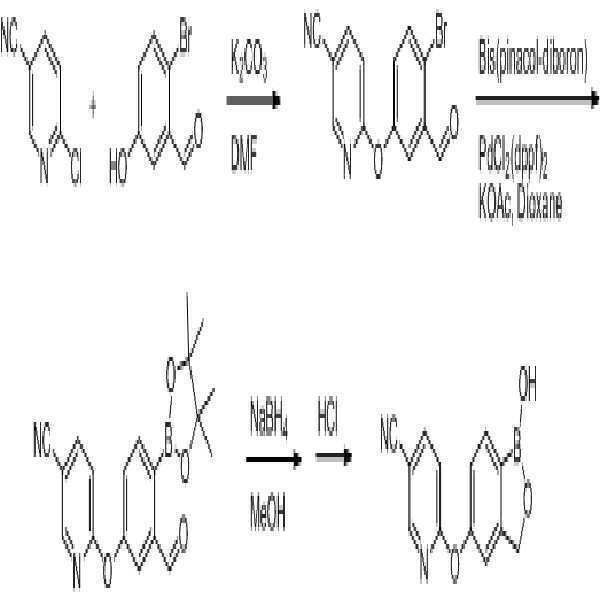
6-클로로-니코틴니트릴 (3.5 g, 25.0 mmol, 1.0 eq.), 2-브로모-5-하이드록시-벤즈알데히드 (5.0 g, 25.0 mmol, 1.0 eq.)의 DMF (40.0 mL) 용액에 K2CO3 (4.1 g, 30.0 mmol, 1.2 eq.)가 질소 대기하에 첨가되었다. 혼합물은 80 ℃ 에서 하룻밤 동안 교반되었다. 실온으로 냉각된 후, 혼합물은 EtOAc (30 mL) 및 H2O (30 mL)에 부었다. 층들은 분리되고, 수성 상은 EtOAc (3 x 20 mL)로 추출되었다. 복합된 유기 추출물은 소금물로 세척되고 (30 mL), MgSO4상에서 건조되고, 여과되었고, 여과액은 감압하에서 농축되었다. 잔유물은 실리카 크로마토그래피에 제공되어 MeOH/DCM (0:100 내지 10: 90)로 용리시키면, 6-(4-브로모-3-포밀-페녹시)-니코틴니트릴이 백색 고체로 제공되었다. 1H NMR (클로로포름-d) δ : 10.35 (s, 1H), 8.43 (dd, J = 2.3, 0.6 Hz, 1H), 7.98 (dd, J = 8.6, 2.3 Hz, 1H), 7.69 - 7.77 (m, 2H), 7.30 (dd, J = 8.6, 3.0 Hz, 1H), 7.12 (dd, J = 8.6, 0.8 Hz, 1H). 수득된 양, 5.92g, 78% 산출량. 6-chloro-nicotinic nitrile (. 3.5 g, 25.0 mmol, 1.0 eq), 2- bromo-5-hydroxy-benzaldehyde (. 5.0 g, 25.0 mmol, 1.0 eq) in DMF (40.0 mL) to the solution K 2 CO 3 (4.1 g, 30.0 mmol, 1.2 eq.) Was added under a nitrogen atmosphere. The mixture was stirred at 80 < 0 > C overnight. After cooling to room temperature, the mixture was poured into EtOAc (30 mL) and H 2 O (30 mL). The layers were separated and the aqueous phase was extracted with EtOAc (3 x 20 mL). The combined organic extracts are washed with brine and dried over (30 mL), MgSO 4, was filtered off, the filtrate was concentrated under reduced pressure. The residue was submitted to silica chromatography and eluted with MeOH / DCM (0: 100 to 10:90) to give 6- (4-bromo-3-formyl-phenoxy) -nicotinonitrile as a white solid. 1 H NMR (chloroform -d) δ: 10.35 (s, 1H), 8.43 (dd, J = 2.3, 0.6 Hz, 1H), 7.98 (dd, J = 8.6, 2.3 Hz, 1H), 7.69 - 7.77 (m , 2H), 7.30 (dd, J = 8.6, 3.0 Hz, 1H), 7.12 (dd, J = 8.6, 0.8 Hz, 1H). The amount obtained, 5.92 g, 78% yield.
6-(4-브로모-3-포밀-페녹시)-니코틴니트릴 (4.16 g, 13.7 mmol, 1.0 eq.)의 1,4-디옥산(120 mL) 용액에 비스-피나콜-다이보론 (3.83 g, 15.1 mmol, 1.1 eq.), KOAc (4.03 g, 41.1 mmol, 3.0 eq.) 및 PdCl2(dppf)2 (300 mg, 0.4 mmol, 0.03 eq.)이 첨가되었다. 혼합물은 N2 으로 탈기되며, 80 ℃ 에서 하룻밤 동안 가열되었다. 실온으로 냉각된 후, 혼합물은 짧은 셀라이트 팩을 통하여 여과되었고, 여과액은 감압하에서 농축되었다. 잔유물은 실리카 크로마토그래피에서 EtOAc/헵탄 (0:100 내지 70: 30)로 용리시키면, 6-[3-포밀-4-(4,4,5,5-테트라메틸-[1,3,2]디옥사보란-2-일)-페녹시]-니코틴니트릴이 황색 고체로 수득되었다. 1H NMR (클로로포름-d) δ: 10.67 - 10.69 (m, 1H), 8.42 - 8.45 (m, 1H), 8.01 - 8.05 (m, 1H), 7.94 - 7.98 (m, 1H), 7.74 - 7.77 (m, 1H), 7.36 - 7.41 (m, 1H), 7.07 - 7.11 (m, 1H), 1.38 - 1.40 (m, 12H). 수득된 양, 4.1 g, 85.4% 산출량.To a solution of 4- (4-bromo-3-formyl-phenoxy) -nicotinonitrile (4.16 g, 13.7 mmol, 1.0 eq.) In 1,4- dioxane (120 mL) 3.83 g, 15.1 mmol, 1.1 eq.), KOAc (4.03 g, 41.1 mmol, 3.0 eq.) And PdCl 2 (dppf) 2 (300 mg, 0.4 mmol, 0.03 eq.) Was added. The mixture was degassed with N 2 and heated at 80 < 0 > C overnight. After cooling to room temperature, the mixture was filtered through a short celite pack and the filtrate was concentrated under reduced pressure. The residue was purified by silica chromatography eluting with EtOAc / heptane (0: 100 to 70:30) to give 6- [3-formyl-4- (4,4,5,5-tetramethyl- [ Dioxaboran-2-yl) -phenoxy] -nicotinonitrile was obtained as a yellow solid. 1 H NMR (chloroform-d)?: 10.67-10.69 (m, 1H), 8.42-8.45 (m, 1H), 8.01-8.05 (m, 1H), 7.36-7.41 (m, 1H), 7.07-7.11 (m, 1H), 1.38-1.40 (m, 12H). The amount obtained, 4.1 g, 85.4% yield.
6-[3-포밀-4-(4,4,5,5-테트라메틸-[1,3,2]디옥사보란-2-일)-페녹시]-니코틴니트릴 (1.67 g, 4.8 mmol, 1.0 eq.)의 EtOH (30 mL) 현탁액에 0 ℃에서 NaBH4 (180.4 mg, 4.76 mmol, 1.0 eq.)가 소분량씩 첨가되었다. 혼합물은 0 ℃에서 20 분간 교반되었고, 추가 1시간 동안 실온으로 데워지도록 한다. 0 ℃로 냉각된 후, 맑은 용액을 H2O (1 mL)으로 조심스레 처리하고, HCl (10 mL, 3N)을 천천히 첨가시켰다. 생성된 황색 현탁액은 점진적으로 실온이 되도록 하고, 2 h 동안 교반시켰다. 그 다음 혼합물을 sat. NaHCO3 로 방울씩 처리하여 PH가 7이 되도록 하였다. 침전물은 여과에 의해 수거되고, H2O으로 세척되어 6-(1-하이드록시-1,3-디하이드로-벤조[c][1,2]옥사보롤-5-일 옥시)-니코틴니트릴은 백색 고체로 수득되었다. LCMS (m/z) 253 (M+H); 1H NMR (DMSO-d6) δ : 9.19 (s, 1H), 8.60 - 8.66 (m, 1H), 8.31 (dd, J = 8.7, 2.4 Hz, 1H), 7.76 (d, J = 8.0 Hz, 1H), 7.20 - 7.28 (m, 2H), 7.13 (dd, J = 8.0, 2.0 Hz, 1H), 4.96 (s, 2H). 수득된 양, 1.1 g, 92.4% 산출량.(4,4,5,5-tetramethyl- [1,3,2] dioxaborane-2-yl) -phenoxy] -nicotinonitrile (1.67 g, 4.8 mmol, 1.0 eq.) In EtOH (30 mL) was added a small portion of NaBH 4 (180.4 mg, 4.76 mmol, 1.0 eq.) At 0 ° C. The mixture was stirred at 0 < 0 > C for 20 minutes and allowed to warm to room temperature for an additional 1 hour. After cooling to 0 ° C, the clear solution was carefully treated with H 2 O (1 mL) and HCl (10 mL, 3N) was slowly added. The resulting yellow suspension was allowed to gradually warm to room temperature and stirred for 2 h. Then, the mixture is added to sat. Treated by drop with NaHCO 3 was adjusted to
19ck 4-(1- 하이드록시 -1,3- 디하이드로 - 벤조[c][1,2]옥사보롤 -5-일 옥시 )- 벤 조산부틸 에스테르 (D83) 19ck 4- (1- hydroxy-1,3-dihydro-benzo [c] [1,2] oxazol-5-yl borol oxy) Ben prematurity-butyl ester (D83)

BuOH로 에스테르를 형성시키는 일반 공정을 이용하고, 정제는 실리카 겔을 통하여 실시하였다.The general procedure to form the ester with BuOH was used and the purification was carried out on silica gel.
19cl 3-플루오르-4-(1- 하이드록시 -1,3- 디하이드로벤조[c][1,2]옥사보롤 -5- 일 옥시)벤조니트릴 (D84) 19cl 3- fluoro-4- (1-hydroxy-1,3-dihydro-benzo [c] [1,2] oxazol-5-yl borol oxy) benzonitrile (D84)

이 화합물은 실시예 19b (D2) 와 유사한 방법으로, 3,4-디플루오르벤조니트릴 및 4-브로모-3-(1,3-디옥소란-2-일)페놀로부터 준비되었다.This compound was prepared from 3,4-difluorobenzonitrile and 4-bromo-3- (1,3-dioxolan-2-yl) phenol in a similar manner to Example 19b (D2) .
19cm 3- 메틸 -4-(1- 하이드록시 -1,3- 디하이드로벤조[c][1,2]옥사보롤 -5-일 옥 시)벤조니트릴 (D85) 19cm 3- methyl-4- (1-hydroxy-1,3-dihydro-benzo [c] [1,2] oxazol-5-yl octanoic borol City) benzonitrile (D85)

이 화합물은 실시예 19b (D2) 와 유사한 방법으로, 4-플루오르-3-메틸벤조니트릴 및 4-브로모-3-(1,3-디옥소란-2-일)페놀로부터 준비되었다.This compound was prepared from 4-fluoro-3-methylbenzonitrile and 4-bromo-3- (1,3-dioxolan-2-yl) phenol in a similar manner to Example 19b (D2) .
19cn 4-(1- 하이드록시 -1,3- 디하이드로 - 벤조[c][1,2]옥사보롤 -5-일 옥시 )-2- (2-메톡시에톡시)-벤조니트릴 (D86) 19cn 4- (1- hydroxy-1,3-dihydro-benzo [c] [1,2] oxazole borol 5-yl) -2 (2-methoxyethoxy) benzonitrile (D86)

이 화합물은 실시예 19at (D46) 와 유사한 방법으로 2-메톡시에탄올 및 수소화 나트륨(메톡시드 나트륨 대신)을 이용하여 준비되었다.This compound was prepared in a similar manner to Example 19at (D46) using 2-methoxyethanol and sodium hydride (instead of sodium methoxide).
1H NMR 400 MHz (d6-DMSO) δ 3.22 (s, 3H), 3.53 (t, J = 4.7 Hz, 2H), 4.24 (t, J = 4.7 Hz, 2H), 4.99 (s, 2H), 6.71 (d, J = 8.2 Hz, 1H), 7.21 (d, J = 7.8 Hz, 1H), 7.30 (s, 1H), 7.79 (d, J = 8.2 Hz, 1H), 8.25 (d, J = 8.6 Hz, 1H), 9.26 (s, 1H). 질량 스펙트럼[M+H+] = 327. 1 H NMR 400 MHz (d 6 -DMSO) δ 3.22 (s, 3H), 3.53 (t, J = 4.7 Hz, 2H), 4.24 (t, J = 4.7 Hz, 2H), 4.99 (s, 2H), 6.71 (d, J = 8.2 Hz , 1H), 7.21 (d, J = 7.8 Hz, 1H), 7.30 (s, 1H), 7.79 (d, J = 8.2 Hz, 1H), 8.25 (d, J = 8.6 Hz, 1 H), 9.26 (s, 1 H). Mass spectrum [M + H & lt ; + & gt ; ] = 327.
19co 5-(4- 플루오르페녹시 )-1,3- 디하이드로 -1- 하이드록시 -2,1- 벤조옥사보 롤(D87) 19co 5- (4- fluorophenoxy) -1, 3-dihydro-1-hydroxy -2,1- benzoxazol-roll beam (D87)


A (7.22 g) 와 K2CO3(17.8 g)의 DMF(200 ml) 용액에 Ar하에서 5-플루오르-2-니트로톨루엔(10g)가 첨가되었다. 반응 혼합물은 80 ℃에서 하룻밤 동안 교반되고, 여과되었고, 에테르로 추출되었다. 유기 층은 분리되고, 건조되었고(Na2SO4), 여과되었고, 용매는 기화되어 화합물 B (16g; 99%)가 제공되었다. LC-MS: 248 (M+H)+.The A (7.22 g) and K 2 CO 3 (17.8 g) in DMF 5- fluoro-2-nitrotoluene (10g) under Ar in (200 ml) solution was added. The reaction mixture was stirred at 80 < 0 > C overnight, filtered and extracted with ether. The organic layer was separated, dried (Na 2 SO 4 ), filtered and the solvent was evaporated to give compound B (16 g; 99%). LC-MS: 248 (M + H) < + & gt ; .

B (16 g)의 EtOAc (200 ml) 용액에 Pd/C (2 g)가 첨가되었다. 반응 혼합물은 실온에서, H2 하에 하룻밤 동안 교반되었고, 여과되었고, 용매는 기화되어 화합물 C (13g ; 99%)가 수득되었다. LC-MS: 218 (M+H)+.Pd / C (2 g) was added to a solution of B (16 g) in EtOAc (200 ml). The reaction mixture was stirred at room temperature under H 2 overnight, filtered and the solvent was evaporated to give compound C (13 g; 99%). LC-MS: 218 (M + H) < + & gt ; .

CuBr2(16g)의 MeCN (140 ml) 용액에 t-BuONO (10 ml)가 -10 ℃에서 첨가되었다. 0.5 시간후, 반응 혼합물에 C (16g)의 MeCN (10 ml)가 첨가되었다. 반응 혼합물은 -10 ℃에서 하룻밤 동안 교반되었고, 여과되었고, 용매는 기화되었고 그리고 잔유물은 크로마토그래피에 의해 정제되어 D (2.4g;15%)가 제공되었다. GC-MS: 281.To a solution of CuBr 2 (16 g) in MeCN (140 ml) was added t-BuONO (10 ml) at -10 ° C. After 0.5 h, C (16 g) MeCN (10 ml) was added to the reaction mixture. The reaction mixture was stirred at -10 <0> C overnight, filtered and the solvent was evaporated and the residue was purified by chromatography to give D (2.4 g; 15%). GC-MS: 281.

D (2.4 g) 및 NBS (1.6 g)의 CCl4 (25 ml) 용액에 벤조일 퍼옥시드 (200 mg)가 첨가되었다. 반응 혼합물은 70 ℃에서 하룻밤 동안 교반되었고, 여과되었고, 물로 세척되었다. 유기 층은 건조되었고(Na2SO4), 여과되었고, 용매는 기화되어, 화합물 E (2.7 g; 99%)가 제공되었다.Benzoyl peroxide (200 mg) was added to a solution of D (2.4 g) and NBS (1.6 g) in CCl 4 (25 ml). The reaction mixture was stirred at 70 < 0 > C overnight, filtered and washed with water. The organic layer was dried (Na 2 SO 4 ), filtered and the solvent was evaporated to give Compound E (2.7 g; 99%).

E (2.7 g)의 DMF (50 ml) 용액에 NaOAc (4 g)가 첨가되었다. 반응 혼합물은 70 ℃에서 5시간 동안 교반되었고, 여과되었고, 에테르로 추출되었다. 유기 층은 분리되고, 건조되고 (Na2SO4), 여과되었고, 그리고 용매는 기화되어, 화합물 F (2 g ; 99%)이 제공되었다. E (2.7 g) in DMF (50 ml) was added NaOAc (4 g). The reaction mixture was stirred at 70 < 0 > C for 5 hours, filtered and extracted with ether. The organic layer was separated, dried (Na 2 SO 4 ), filtered and the solvent was evaporated to give compound F (2 g; 99%).

F (2 g)의 THF (20 ml) 용액에 NaOH/H2O (10%; 20 ml)가 첨가되었다. 반응 혼합물은 실온에서 하룻밤 동안 교반되었고, 계산 pH가 7이 되도록 HCl/H2O(4 M)가 첨가되었고, 혼합물은 EtOAc으로 추출되었다. 유기 층은 건조되었고(Na2SO4), 여과되었고, 용매는 기화되어 G (1.5 g; 88%)가 제공되었다. LC-MS: 297 (M+H)+. F (2 g) NaOH in THF / H 2 O in (20 ml) solution; was added (10% 20 ml). The reaction mixture was stirred at room temperature overnight, HCl / H 2 O (4 M) was added so that the calculated pH was 7, and the mixture was extracted with EtOAc. The organic layer was dried (Na 2 SO 4 ), filtered and the solvent was evaporated to give G (1.5 g; 88%). LC-MS: 297 (M + H) < + & gt ; .

G (1.5 g) 및 DIPEA (0.97 g)의 DCM (20 ml) 용액에 (클로로메톡시)에탄 (0.7 g)이 첨가되었다. 반응 혼합물은 실온에서 하룻밤 동안 교반되었고 기화되었다. 잔유물은 크로마토그래피에 의해 정제되어 화합물 H (1g ; 58%)가 제공되었다. LC-MS: 356(M+H)+. To a solution of D (1.5 g) and DIPEA (0.97 g) in DCM (20 ml) was added (chloromethoxy) ethane (0.7 g). The reaction mixture was stirred at room temperature overnight and evaporated. The residue was purified by chromatography to give compound H (1 g; 58%). LC-MS: 356 (M + H) < + & gt ; .

H (1g), KOAc (0.8 g) 및 PdCl2 (dppf) (0.12 g)의 디옥산 (5 ml) 용액에 비스(피나콜라토)다이보론 (1 g)이 아르곤하에서 첨가되었다. 반응 혼합물은 70 ℃에서 하룻밤 동안 교반되었고, 물로 세척되었고, DCM으로 추출되었고, 그리고 유기 층은 기화되었다. 잔유물은 HPLC에 의해 정제되어, 화합물 I (800 mg ; 70%)이 제공되었다. H (1 g), KOAc (0.8 g) and PdCl 2 bis (pinacolato) diboron (1 g) was added under argon to a solution of dppf (0.12 g) in dioxane (5 ml). The reaction mixture was stirred at 70 < 0 > C overnight, washed with water, extracted with DCM, and the organic layer evaporated. The residue was purified by HPLC to give compound I (800 mg; 70%).

I (800 mg)의 THF (20 ml) 용액에 HCl/H2O(6M;20ml)가 첨가되었다. 반응 혼합물은 실온에서 하룻밤 동안 교반되었고 DCM으로 추출되었다. 유기 층은 건조되었고 기화되었다. 잔유물은 HPLC에 의해 정제되어, 원하는 화합물 (300 mg;60%)이 제공되었다. LC-MS: 245(M+H)+.HCl / H 2 O (6M; 20 ml) was added to a solution of I (800 mg) in THF (20 ml). The reaction mixture was stirred at room temperature overnight and extracted with DCM. The organic layer was dried and evaporated. The residue was purified by HPLC to give the desired compound (300 mg; 60%). LC-MS: 245 (M + H) < + & gt ; .
19cp 5 -(4- 클로로페녹시 )-1,3- 디하이드로 -1- 하이드록시 -2,1- 벤조옥사보 롤(D88) 19cp 5 - (4- chlorophenoxy) -1, 3-dihydro-1-hydroxy -2,1- benzoxazol-roll beam (D88)


A (18 g) 및 K2CO3 (36 g)의 DMF (200 ml) 용액에 5-플루오르-2-니트로톨루엔 (20 g)이 Ar하에서 첨가되었다. 반응 혼합물은 70 ℃에서 하룻밤 동안 교반되었고, 여과되었고, 물로 희석되고, 에테르로 추출되었다. 유기 층은 분리되고, 건조되었고 (Na2SO4),여과되었고, 그리고 용매는 기화되어 화합물 B (36 g ; 99%)가 수득되었다. LC-MS: 264 (M+H) A (18 g) and K 2 CO 3 (36 g) in DMF (200 ml) was added 5-fluoro-2-nitrotoluene (20 g) under Ar. The reaction mixture was stirred at 70 < 0 > C overnight, filtered, diluted with water and extracted with ether. The organic layer was separated, dried (Na 2 SO 4 ), filtered and the solvent was evaporated to give compound B (36 g; 99%). LC-MS: 264 (M + H) <

B (36 g)의 HCl(150ml) 용액에 SnCl2 (116 g)이 첨가되었다. 반응 혼합물은 실온에서 1h 동안 교반되었다. 여과되었고, EtOAc로 추출되었고, 용매는 기화되어, 화합물 C (30 g ; 97%)가 수득되었다. LC-MS: 234 (M+H)+. B (36 g) in HCl (150 ml) was added SnCl 2 (116 g) was added. The reaction mixture was stirred at room temperature for 1 h. Filtered, extracted with EtOAc and the solvent was evaporated to give compound C (30 g; 97%). LC-MS: 234 (M + H) < + & gt ; .
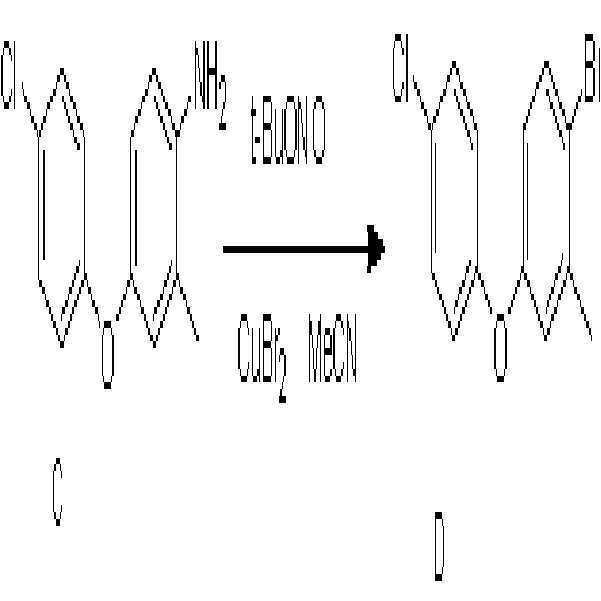
CuBr2 (42 g)의 MeCN (500 ml) 용액에 t-BuONO (22 ml)가 -10℃에서 첨가되었다. 0.5 h 후에, 반응 혼합물에 ANA-PO4209-3A-3 (30 g)의 MeCN(10ml)가 첨가되었다. 반응 혼합물은 -10℃에서 하룻밤 동안 교반되었고, 여과되었고, 그리고 용매는 기화되었다. 잔유물은 크로마토그래피에 의해 정제되어, 화합물 ANA-PO4209-3A-4 (8.4g;22%)가 제공되었다. GC-MS: 297.CuBr 2 (42 g) in MeCN (500 ml) was added t-BuONO (22 ml) at -10 < 0 > C. After 0.5 h, MeCN (10 ml) of ANA-PO4209-3A-3 (30 g) was added to the reaction mixture. The reaction mixture was stirred at -10 < 0 > C overnight, filtered and the solvent evaporated. The residue was purified by chromatography to give compound ANA-PO4209-3A-4 (8.4 g; 22%). GC-MS: 297.

D (8.4 g) 및 NBS (5.5 g)의 CCl4 (200 ml) 용액에 벤조일 퍼옥시드 (800 mg)가 첨가되었다. 반응 혼합물은 70 ℃에서 하룻밤 동안 교반되었고, 여과되었고, 그리고 물로 세척되었다. 유기 층은 건조되었고(Na2SO4),여과되었고, 그리고 용매는 기화되어 화합물 E (10 g; 99%)가 제공되었다.CCl 4 of D (8.4 g) and NBS (5.5 g) (200 ml) was added benzoyl peroxide (800 mg). The reaction mixture was stirred at 70 < 0 > C overnight, filtered and washed with water. The organic layer was dried (Na 2 SO 4 ), filtered and the solvent was evaporated to give compound E (10 g; 99%).
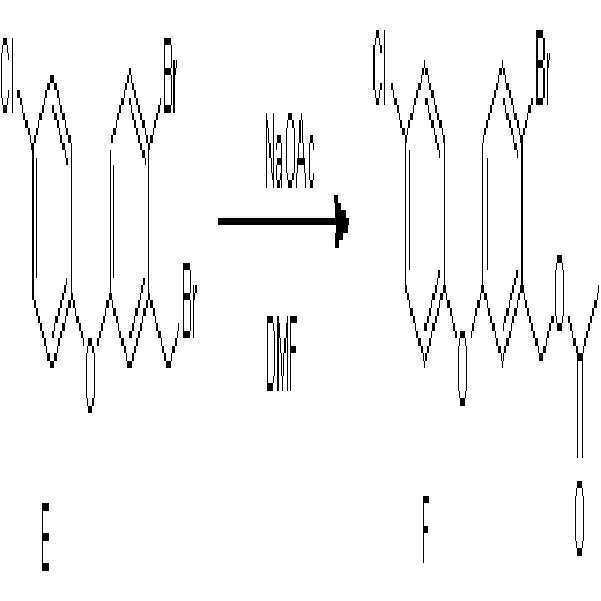
E (10 g)의 DMF (250 ml) 용액에 NaOAc (15 g)가 첨가되었다. 반응 혼합물은 70 ℃에서 5 h 동안 교반되었고, 여과되었고, 물로 희석되고, 에테르로 추출되었다. 유기 층은 분리되고, 건조되었고 (Na2SO4),여과되었고, 용매는 기화되어, 화합물 F (9.6 g; 99%)가 제공되었다. E (10 g) in DMF (250 ml) was added NaOAc (15 g). The reaction mixture was stirred at 70 < 0 > C for 5 h, filtered, diluted with water and extracted with ether. The organic layer was separated, dried (Na 2 SO 4 ), filtered and the solvent was evaporated to give compound F (9.6 g; 99%).

F (9.6 g)의 THF (50 ml) 용액에 NaOH/H2O(10%;50ml)가 첨가되었다. 반응 혼합물은 실온에서 하룻밤 동안 교반되었고, HCl/H2O(4M)가 pH7이 되도록 첨가되었고, 전체는 EtOAc로 추출되었다. 유기 층은 건조되었고(Na2SO4), 여과되었고, 용매는 기화되어 화합물 G (7.5 g; 89%)가 제공되었다. LC-MS: 313 (M+H)+. To a solution of F (9.6 g) in THF (50 ml) was added NaOH / H 2 O (10%; 50 ml). The reaction mixture was stirred at room temperature overnight, added HCl / H 2 O (4M) to

G (7.5 g) 및 DIPEA (3.87 g)의 DCM (200 ml) 용액에 (클로로메톡시)에탄 (2.9 g)이 첨가되었다. 반응 혼합물은 실온에서 하룻밤 동안 교반되었고, 기화되고, 크로마토그래피에 의해 정제되어, 화합물 H (9 g ; 99%)가 제공되었다. LC-MS: 372(M+H)+.(Chloromethoxy) ethane (2.9 g) was added to a solution of G (7.5 g) and DIPEA (3.87 g) in DCM (200 ml). The reaction mixture was stirred at room temperature overnight, evaporated and purified by chromatography to give compound H (9 g; 99%). LC-MS: 372 (M + H) < + & gt ; .

H (9 g), KOAc (7 g) 및 PdCl2(dppf)(0.98g)의 디옥산 (100 ml) 용액에 비스(피나콜라토 )다이보론 (9.1 g)가 Ar하에서 첨가되었다. 반응 혼합물은 70 ℃에서 하룻밤 동안 교반되었고, 물로 희석되었고, DCM으로 추출되었고, 유기 층은 기화되고, HPLC에 의해 정제되어, 화합물 I (8 g ; 80%)가 제공되었다.Bis (pinacolato) diboron (9.1 g) was added under Ar to a solution of H (9 g), KOAc (7 g) and PdCl 2 (dppf) (0.98 g) in dioxane (100 ml). The reaction mixture was stirred at 70 < 0 > C overnight, diluted with water and extracted with DCM, and the organic layer was evaporated and purified by HPLC to give compound I (8 g; 80%).
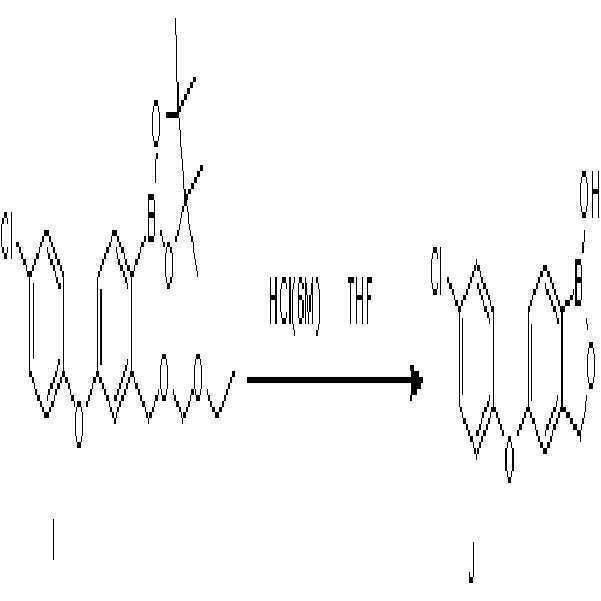
I (8 g)의 THF (80 ml) 용액에 HCl/H2O(6M;80ml)가 첨가되었다. 반응 혼합물은 실온에서 하룻밤 동안 교반되었고, DCM으로 추출되었고, 기화되었다. 잔유물은 HPLC에 의해 정제되어, 원하는 화합물 (2 g; 40%)이 제공되었다. LC-MS: 261(M+H)+.HCl / H 2 O (6M; 80 ml) was added to a solution of I (8 g) in THF (80 ml). The reaction mixture was stirred at room temperature overnight, extracted with DCM and evaporated. The residue was purified by HPLC to give the desired compound (2 g; 40%). LC-MS: 261 (M + H) < + & gt ; .
19cq 5-(4- 메틸페녹시 )-1,3- 디하이드로 -1- 하이드록시 -2,1- 벤조옥사보 롤(D89) (4-methylphenoxy) 19cq 5- -1,3- dihydro-1-hydroxy -2,1- benzoxazol-roll beam (D89)


화합물 A (8g,58.8mmol), 화합물 B (8g,39.8mmol), Cu(OAc)2 (8.4g,47.8mmol) 및 4AMS(11g)가 건-DCM (100 mL)에 현탁되었고, Et3N(11.2mL)및 피리딘 (33.6 mL)이 첨가되었고, 그리고 반응물은 48시간 동안 Ar하에서 실온에서 교반되었고, 여과되었고, 1 M HCl으로 세척되었고, 유기 층은 복합되고, MgSO4상에서 건조되었다. 미정제물은 크로마토그래피에서, 20:1 PE/EA를 이용하여 정제되면 화합물C (4.2g,30%)이 제공되었다. GC-MS 290 (M+H)+;1H NMR (400MHz, CDCl3)δ 10.299 (s, 1H), 7.589 (d, J=8.8 Hz, 1H), 7.458 (d, J=2.8 Hz, 1H),7.195 (d, J=8.0 Hz, 2H), 7.107 (dd, J=2.8 Hz, J=8.4 Hz, 1H), 6.936 (d, J=8.4 Hz, 2H),2.366 (s, 1H).Compound A (8 g, 58.8 mmol), compound B (8 g, 39.8 mmol), Cu (OAc) 2 (8.4 g, 47.8 mmol) and 4AMS (11 g) were suspended in dry-DCM (100 mL) and Et 3 N (11.2 mL) and pyridine (33.6 mL) were added and the reaction was stirred at room temperature was stirred in, was filtered, was washed with 1 M HCl, the organic layer was combined and was dried over MgSO 4. The crude product was chromatographed, provided that compound C (4.2 g, 30%) was purified using 20: 1 PE / EA. GC-MS 290 (M + H) < + >; 1 H NMR (400MHz, CDCl 3 ) δ 10.299 (s, 1H), 7.589 (d, J = 8.8 Hz, 1H), 7.458 (d, J = 2.8 Hz, 1H), 7.195 (d, J = 8.0 Hz, 2H), 7.107 (dd, J = 2.8 Hz, J = 8.4 Hz, 1H), 6.936 (d, J = 8.4 Hz, 2H), 2.366 (s, 1H).

화합물 C (5 g, 17.2 mmol) 및 NaBH4(320mg,8.6mmol)의 혼합물의 MeOH (50 mL)는 실온에서 1시간 동안 교반되고, 기화되었다. 잔유물은 크로마토그래피에서 6:1 PE/EA를 이용하여 정제되면 화합물 D (5 g, 100%)이 제공되었다. GC-MS 292 (M+H)+;1H NMR(400MHz,CDCl3) δ 7.465 (d, J=8.0 Hz, 1H), 7.272 (d, J=8.0 Hz, 2H),7.171-7.133 (m, 1H), 6.931 (d, J=8.4 Hz, 2H), 6.811 (d, J=8.0 Hz, 1H),4.701 (s, 2H), 2.351 (s, 3H).MeOH (50 mL) of a mixture of compound C (5 g, 17.2 mmol) and NaBH 4 (320 mg, 8.6 mmol) was stirred at room temperature for 1 hour and evaporated. The residue was purified using chromatography 6: 1 PE / EA to give compound D (5 g, 100%). GC-MS 292 (M + H) < + >; 1 H NMR (400MHz, CDCl 3 ) δ 7.465 (d, J = 8.0 Hz, 1H), 7.272 (d, J = 8.0 Hz, 2H), 7.171-7.133 (m, 1H), 6.931 (d, J = 8.4 Hz, 2H), 6.811 (d, J = 8.0 Hz, 1H), 4.701 (s, 2H), 2.351 (s, 3H).

화합물 D (1.6 g, 5.5 mmol) 및 NaH(217mg,9.0mmol)의 혼합물 DMF(20 mL) 용액은 30 분간 0 ℃에서 교반되었다. EOM-Cl (800 mg, 8.5 mmol)가 첨가되었고, 혼합물은 대기 온도에서 1시간 동안 교반되었고, 기화되었다. 잔유물은 크로마토그래피에서 10:1 PE/EA을 이용하여 정제되면, 화합물E (1.6 g, 84%)가 제공되었다. 1HNMR (400 MHz, CDCl3)δ 7.470 (d, J=9.2 Hz, 1H), 7.168-7.146(m, 3H), 6.929(d, J=8.4 Hz, 2H), 6.811 (d, J=9.2 Hz, 1H),4.803 (s, 2H), 4.636 (s, 2H), 3.661-3.645 (m, 2H), 2.352 (s, 3H), 1.255-1.220 (m, 3H).A mixture of compound D (1.6 g, 5.5 mmol) and NaH (217 mg, 9.0 mmol) in DMF (20 mL) was stirred at 0 ° C for 30 min. EOM-Cl (800 mg, 8.5 mmol) was added and the mixture was stirred at ambient temperature for 1 hour and evaporated. When the residue was purified by chromatography using 10: 1 PE / EA, Compound E (1.6 g, 84%) was provided. 1 HNMR (400 MHz, CDCl 3 ) δ 7.470 (d, J = 9.2 Hz, 1H), 7.168-7.146 (m, 3H), 6.929 (d, J = 8.4 Hz, 2H), 6.811 (d, J = 9.2 (M, 3H), 2.352 (s, 3H), 1.255-1.220 (m, 3H), 4.653 (s, 2H), 3.661-3.645 (m, 2H).

화합물 E (1.6 g, 4.6 mmol), 비스(피나콜라토 )다이보론(1.7 g, 7.1 mmol), PdCl2(dppf)(98mg)및 KOAc (1.3 g, 13.2 mmol)의 혼합물 1,4-디옥산 (20 mL) 용액은 하룻밤 동안 80 ℃, Ar하에서 교반되었다. 용매는 기화되었다. 잔유물은 크로마토그래피에서 10:1 PE/EA을 이용하여 정제되어, 화합물F (1.6 g, 89%)가 제공되었다. 1H NMR(400 MHz, CDCl3)δ 7.778 (d, J=8.0 Hz, 1H), 7.159 (d, J=8.8 Hz ,2H), 6.942 (d, J=8.0 Hz, 2H), 6.856 (m, 1H), 4.854 (s, 2H), 4.797 (s, 2H), 3.659-3.606 (m, 2H), 2.349 (s, 3H), 1.333 (s, 12H),1.240-1.206 (m, 3H).A mixture of compound E (1.6 g, 4.6 mmol), bis (pinacolato) diboron (1.7 g, 7.1 mmol), PdCl 2 (dppf) (98 mg) and KOAc (1.3 g, 13.2 mmol) (20 mL) was stirred overnight at 80 < 0 > C under Ar. The solvent was evaporated. The residue was purified by chromatography using 10: 1 PE / EA to give compound F (1.6 g, 89%). 1 H NMR (400 MHz, CDCl 3) δ 7.778 (d, J = 8.0 Hz, 1H), 7.159 (d, J = 8.8 Hz, 2H), 6.942 (d, J = 8.0 Hz, 2H), 6.856 (m 3H), 1.333 (s, 12H), 1.240-1.206 (m, 3H), 4.854 (s, 2H), 4.797 (s, 2H), 3.659-3.606 (m, 2H).

화합물 F (1.6 g, 4.0 mmol)의 6 M HCl (8 mL) 및 THF (8 mL) 혼합물은 대기온도에서 하룻밤 동안 교반되었고, 기화되었다. 잔유물은 예비-HPLC에 의해 정제되어, 원하는 화합물 (600 mg, 63%)이 제공되었다. LC-MS 241 (M+H)+;1H NMR(400MHz, CDCl3) δ 7.684 (d, J=8.4 Hz, 1H), 7.197(d, J=7.6 Hz ,2H), 7.007-6.956(m, 3H), 6.875 (s, 1H), 5.026 (s, 2H), 2.368(s, 3H).A mixture of 6 M HCl (8 mL) and THF (8 mL) of compound F (1.6 g, 4.0 mmol) was stirred overnight at ambient temperature and evaporated. The residue was purified by preparative-HPLC to give the desired compound (600 mg, 63%). LC-MS 241 (M + H) < + >; 1 H NMR (400MHz, CDCl 3 ) δ 7.684 (d, J = 8.4 Hz, 1H), 7.197 (d, J = 7.6 Hz, 2H), 7.007-6.956 (m, 3H), 6.875 (s, 1H), 5.026 (s, 2 H), 2.368 (s, 3 H).
19cr 5-(4- 트리플루오로메틸 )-1,3- 디하이드로 -1- 하이드록시 -2,1- 벤조옥사보 롤(D90) 19cr 5- (4-trifluoromethyl) -1,3-dihydro-1-hydroxy -2,1- benzoxazol-roll beam (D90)


A (10.1 g, 53.3 mmol), 2-브로모-5-하이드록시벤즈알데히드 (6.7 g, 33.3 mmol), 4A MS (25 g) 및 Cu(OAc)2(7.84g,43.3mmol)의 건(dry)-CH2Cl2(150ml)용액에 피리딘 (4.74 g, 59.9 mmol) 및 Et3N(8.4ml,59.9mmol)이 Ar하에서 첨가되었다. 반응 혼합물은 대기온도에서 하룻밤 동안 교반되었고, 여과되었고, 2N HCl으로 세척되었고, CH2Cl2으로 추출되었다. 유기 층은 분리되고, 건조되었고 (Na2SO4), 여과되었고, 그리고 용매는 기화되었다. 잔유물은 컬럼 크로마토그래피에서 실리카 겔(용리액: 페트롤리움 에테르/EtOAc 25/1)상에서 정제되었다. 순수 분취물이 수거되었고, 용매는 기화되어, B (3.49 g, 30%)가 제공되었다: 1H NMR (CDCl3) δ 7.07 (2H, d, J=8.8Hz), 7.18(1H,dd,J=2.8,8.4Hz), 7.55(1H,d,J=2.8Hz), 7.61-7.67(3H,m), 10.32(1H,s). A (10.1 g, 53.3 mmol) s (dry, the 2-bromo-5-hydroxybenzaldehyde (6.7 g, 33.3 mmol), 4A MS (25 g) and Cu (OAc) 2 (7.84g, 43.3mmol) ) -CH 2 Cl 2 (150 ml) was added pyridine (4.74 g, 59.9 mmol) and Et 3 N (8.4 ml, 59.9 mmol) under Ar. The reaction mixture was stirred overnight at ambient temperature, filtered, washed with 2N HCl and extracted with CH 2 Cl 2 . The organic layer was separated, dried (Na 2 SO 4 ), filtered and the solvent evaporated. The residue was purified by column chromatography on silica gel (eluent: petroleum ether /

B (3.49 g, 10.1 mmol)의 MeOH (40 ml) 용액에 NaBH4(192mg,5.06mmol)가 첨가되었다. 반응 혼합물은 대기 온도에서 0.5 h 동안 교반되었다. 용매는 기화되었다. 잔유물은 컬럼 크로마토그래피에서 실리카 겔(용리액: 페트롤리움 에테르/EtOAc 15/1)상에서 정제되었다. 순수 분취물이 수거되었고, 용매는 기화되어, C (3.25g, 93%)가 제공되었다: 1H NMR(CDCl3) d 1.79 (1H, s), 4.73 (2H, s), 6.87 (1H, dd, J=2.4,8.8Hz), 7.05(2H,d,J=8.4Hz), 7.23(1H,d,J=2Hz), 7.53(1H,d,J=9.2Hz), 7.59(2H,d,J=8.8Hz). B NaBH 4 (192mg, 5.06mmol) in MeOH (40 ml) solution of (3.49 g, 10.1 mmol) was added. The reaction mixture was stirred at ambient temperature for 0.5 h. The solvent was evaporated. The residue was purified by column chromatography on silica gel (eluent: petroleum ether /

C (3.7 g, 10.6 mmol)의 건 DMF (20 ml) 용액에 NaH (462 mg, 10.6 mmol, 55%)가 Ar하에서 첨가되었다. 반응 혼합물은 0 oC 에서 0.5 h 동안 교반되었고, 그 다음 (클로로메톡시)에탄 (1.3 g, 13.8 mmol)이 첨가되었다. 반응 혼합물은 대기 온도에서 1시간 동안 교반되었고, i-PrOH으로 진정되었다. 용매는 고진공하에서 기화되었다. 잔유물은 EtOAc에 용해되었고, 물로 세척되었다. 유기 층은 분리되고, 건조되었고 (Na2SO4),여과되었고, 용매는 기화되었다. 잔유물은 컬럼 크로마토그래피에서 실리카 겔(용리액: 페트롤리움 에테르/EtOAc 100/1)상에서 정제되었다. 순수 분취물이 수거되었고, 용매는 기화되어, D (3.1g, 76%)가 제공되었다: 1HNMR(CDCl3) d 1.22 (3H, t, J=6.8Hz), 3.61-3.66(2H,m), 4.64(2H,s), 4.80(2H,s), 6.85(1H,dd,J=2.8,8.8Hz), 7.04(2H,d,J=8.8Hz), 7.23(1H,d,J=2.8Hz), 7.53(1H,d,J=8.8Hz), 7.58(2H,d,J=9.2Hz). C (3.7 g, 10.6 mmol) in dry DMF (20 ml) was added NaH (462 mg, 10.6 mmol, 55%) under Ar. The reaction mixture was stirred at 0 ° C for 0.5 h, then (chloromethoxy) ethane (1.3 g, 13.8 mmol) was added. The reaction mixture was stirred at ambient temperature for 1 hour and settled with i-PrOH. The solvent was vaporized under high vacuum. The residue was dissolved in EtOAc and washed with water. The organic layer was separated, dried (Na 2 SO 4 ), filtered and the solvent was evaporated. The residue was purified by column chromatography on silica gel (eluent: petroleum ether /

D (3.1 g, 7.7 mmol), 비스(피나콜라토 )다이보론(5.87 g, 23.1 mmol), PdCl2(dppf)2(186mg,0.23mmol)및 KOAc (2.26 g, 23.1 mmol)의 혼합물의 1,4-디옥산 (40 mL)은 Ar하에서 80 ℃, 하룻밤 동안 교반되었다. 유기층은 제거되었다. 잔유물은 컬럼 크로마토그래피에서 실리카 겔상에서 정제되고(용리액: 페트롤리움 에테르), 순수 분취물이 수거되었고, 용매는 기화되어, E (2.6g, 75%)가 제공되었다: 1HNMR(CDCl3) d 1.21 (3H, t, J=6.8Hz), 1.33(12H,s), 3.59-3.64(2H,m), 4.79(2H,s), 4.86(2H,s), 6.92(1H,dd,J=2.8,7.6Hz), 7.05(2H,d,J=8.4Hz), 7.19(1H,d,J=1.6Hz), 7.56(2H,d,J=8.0Hz), 7.83(1H,d,J=7.6Hz).A mixture of the mixture of D (3.1 g, 7.7 mmol), bis (pinacolato) diboron (5.87 g, 23.1 mmol), PdCl 2 (dppf) 2 (186 mg, 0.23 mmol) and KOAc (2.26 g, 23.1 mmol) , And 4-dioxane (40 mL) were stirred under Ar at 80 占 폚 overnight. The organic layer was removed. The residue was purified by column chromatography on silica gel (eluent: petroleum ether), pure fractions were collected and the solvent was evaporated to give E (2.6 g, 75%): 1 H NMR (CDCl 3 ) d 1.21 (3H, t, J = 6.8Hz), 1.33 (12H, s), 3.59-3.64 (2H, m), 4.79 (2H, s), 4.86 (2H, s), 6.92 (1H, dd, J = 2.8,7.6Hz), 7.05 (2H, d, = J 8.4Hz), 7.19 (1H, d, = J 1.6Hz), 7.56 (2H, d, = J 8.0Hz), 7.83 (1H, d, = J 7.6 Hz).

E (2.6 g, 5.75 mmol)의 6 M HCl (26 mL) 및 THF (26 mL) 혼합물은 대기 온도에서 하룻밤동안 교반되었다. 용매는 제거되었다. 잔유물은 예비HPLC 에 의해 정제되어, 원하는 화합물 (370 mg, 22%)이 수득되었다: 1HNMR(DMSO-d6) d 4.96 (2H, s), 7.08 (1H, m), 7.13 (1H, s), 7.20 (2H, d, J=8.5Hz),7.77(3H,m),9.21(1H,s). E (2.6 g, 5.75 mmol) in 6 M HCl (26 mL) and THF (26 mL) was stirred overnight at ambient temperature. The solvent was removed. The residue was purified by preparative HPLC to give the desired compound (370 mg, 22%): 1 HNMR (DMSO-d 6 ) d 4.96 (2H, s), 7.08 (1H, ), 7.20 (2H, d, J = 8.5 Hz), 7.77 (3H, m), 9.21 (1H, s).
19cs 5- (4-(4-메틸피페라진-1-일술폰일)페녹시)벤조[c][1,2]옥사보롤 - 1(3H)-ol (D91) 19cs 5- (4- (4- methylpiperazine-1-sulfonyl ilsul) phenoxy) benzo [c] [1,2] oxazole borol - 1 (3H) -ol (D91 )

2-브로모-5-하이드록시벤즈알데히드 (14 g) 및 p-톨루엔술폰산 (1.4 g)의 톨루엔 (400 ml) 용액에 에탄-1,2-디올 (6.5 g)이 첨가되었다. 반응 혼합물은 딘-스타크 조건하에서 하룻밤 동안 가열되었고, 실온으로 냉각되었다. 반응 혼합물은 감압하에서 기화되고, DCM에 용해되었고, 여과되었으며, 용매는 기화되어, 화합물 A (15 g ; 88%)가 제공되었다. LC-MS: 246(M+H)+.Ethanol-1,2-diol (6.5 g) was added to a toluene (400 ml) solution of 2-bromo-5-hydroxybenzaldehyde (14 g) and p-toluenesulfonic acid (1.4 g). The reaction mixture was heated under Dean-Stark conditions overnight and cooled to room temperature. The reaction mixture was evaporated under reduced pressure, dissolved in DCM, filtered and the solvent was evaporated to give Compound A (15 g; 88%). LC-MS: 246 (M + H) < + & gt ; .

1-메틸피페라진(5.5 g)의 DCM (200 ml) 용액에 Et3N (10.5 g)가 0 ℃에서 첨가되었다. 0.5 h 동안 교반된 후, 반응 혼합물에 4-플루오르벤젠-1-술폰일 (10 g) 가 방울씩 첨가되었다. 반응 혼합물은 0 ℃에서 2h 동안 교반되었고, 그 다음 실온에서 하룻밤 동안 교반되었고 물로 세척되었다. 유기 층은 건조되었고(Na2SO4),여과되었고, 그리고 용매는 기화되어, 화합물 B (13 g; 97%)이 제공되었다. LC-MS: 259(M+H)+.To a solution of 1-methylpiperazine (5.5 g) in DCM (200 ml) was added Et 3 N (10.5 g) at 0 ° C. After stirring for 0.5 h, 4-fluorobenzene-1-sulfonyl (10 g) was added dropwise to the reaction mixture. The reaction mixture was stirred at 0 < 0 > C for 2 h, then at room temperature overnight and washed with water. The organic layer was dried (Na 2 SO 4), was filtered, and the solvent is, compound B vaporized; was provided (13

B (8 g) 및 K2CO3 (8.3 g)의 DMF (250 ml) 용액에 A (8.3 g)가 Ar하에서 첨가되었다. 반응 혼합물은 150 ℃에서 3시간 동안 교반되었고, 여과되었고, 에테르로 희석되었고, 물로 세척되었다. 유기 층은 분리되고, 건조되었고 (Na2SO4),여과되었으며, 그리고 용매는 기화되어 화합물 C (14 g ; 96%)가 수득되었다. LC-MS: 484(M+H)+. B (8 g) and K 2 CO 3 (8.3 g) in DMF (250 ml) was added under Ar. The reaction mixture was stirred at 150 < 0 > C for 3 hours, filtered, diluted with ether and washed with water. The organic layer was separated, dried (Na 2 SO 4 ), filtered and the solvent was evaporated to give compound C (14 g; 96%). LC-MS: 484 (M + H) < + & gt ; .

C (14g)의 THF (100 ml) 용액에 HCl (12 M; 100ml)이 첨가되었다. 반응 혼합물은 실온에서 하룻밤 동안 교반되었고, DCM으로 추출되었다. 유기 층은 분리되고, 건조되었고 (Na2SO4),여과되었으며, 그리고 용매는 기화되어, 화합물 D (12 g; 94%)가 제공되었다. LC-MS: 440(M+H)+.HCl (12 M; 100 ml) was added to a solution of C (14 g) in THF (100 ml). The reaction mixture was stirred at room temperature overnight and extracted with DCM. The organic layer was separated, dried (Na 2 SO 4 ), filtered and the solvent was evaporated to give compound D (12 g; 94%). LC-MS: 440 (M + H) < + & gt ; .

D (12 g) ,KOAc (7.9 g) 및 PdCl2(dppf) (1.1 g)의 디옥산 (80 ml) 용액에 비스(피나콜라토 )다이보론 (10.4 g)가 Ar하에서 첨가되었다. 반응 혼합물은 70 ℃에서 하룻밤 동안 교반되었고, 물로 희석되었고, DCM으로 추출되었다. 유기 층은 분리되고, 건조되었고 (Na2SO4),여과되었으며, 용매는 기화되어 화합물 E (5 g; 37%)가 제공되었다.Bis (pinacolato) diboron (10.4 g) was added under Ar to a solution of D (12 g), KOAc (7.9 g) and PdCl 2 (dppf) (1.1 g) in dioxane (80 ml). The reaction mixture was stirred at 70 < 0 > C overnight, diluted with water and extracted with DCM. The organic layer was separated, dried (Na 2 SO 4 ), filtered and the solvent was evaporated to give compound E (5 g; 37%).
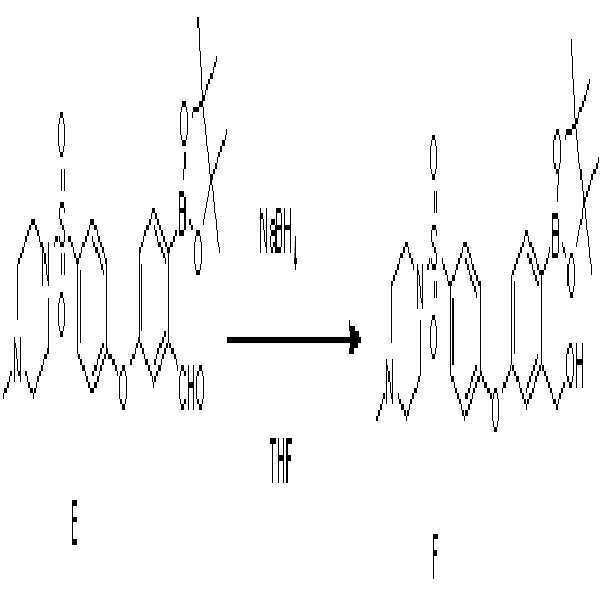
E (5g)의 THF (40 ml) 용액에 NaBH4(1 g)가 첨가되었다. 반응 혼합물은 실온에서 하룻밤 동안 교반되었고, HCl/H2O (4 M)가 첨가되었고, 전체는 EtOAc로 추출되었다. 유기 층이 분리되었고, 건조되었고 (Na2SO4),여과되었으며, 용매는 기화되어, 화합물 F (800 mg; 16%)가 제공되었다. LC-MS: 489(M+H)+.The NaBH 4 (1 g) was added to THF (40 ml) solution of E (5g). The reaction mixture was stirred at room temperature overnight, HCl / H 2 O (4 M) was added and the whole was extracted with EtOAc. The organic layer was separated, dried (Na 2 SO 4 ), filtered and the solvent was evaporated to give compound F (800 mg; 16%). LC-MS: 489 (M + H) < + & gt ; .

F (800 mg)의 THF (20 ml) 용액에 HCl/H2O(6 M; 20 ml)가 첨가되었다. 반응 혼합물은 실온에서 하룻밤 동안 교반되었고 그리고 DCM으로 추출되었다. 유기 층은 기화되고, 잔유물은 HPLC에 의해 정제되어, 원하는 화합물 (100 mg; 16%)이 제공되었다. LC-MS: 389 (M+H)+. To a solution of F (800 mg) in THF (20 ml) was added HCl / H 2 O (6 M; 20 ml). The reaction mixture was stirred at room temperature overnight and extracted with DCM. The organic layer was evaporated and the residue was purified by HPLC to give the desired compound (100 mg; 16%). LC-MS: 389 (M + H) < + & gt ; .
19ct N,N - 디에틸 -4-(1- 하이드록시 -1,3- 디하이드로벤조[c][1,2]옥사보롤 -5- 일 옥시)벤젠술폰아미드 (D92) 19ct N, N - diethyl-4- (1-hydroxy-1,3-dihydro-benzo [c] [1,2] oxazol-5-yl borol oxy) benzenesulfonamide (D92)

2-브로모-5-하이드록시벤즈알데히드 (5 g) 및 톨루엔술폰산 (0.13 g)의 톨루엔 (200 ml) 용액에 에탄-1,2-디올 (3.8 g)이 첨가되었다. 반응 혼합물은 딘-스타크 조건하에서, 하룻밤 동안 가열되었고, 실온으로 냉각되었다. 반응 혼합물은 감압하에서 기화되었고, DCM가 첨가되었고, 혼합물은 여과되었고, 용매는 기화되어, 화합물 A (5 g ; 83%)가 제공되었다. LC-MS: 246 (M+H)+.Ethanol-1,2-diol (3.8 g) was added to a toluene (200 ml) solution of 2-bromo-5-hydroxybenzaldehyde (5 g) and toluenesulfonic acid (0.13 g). The reaction mixture was heated under Dean-Stark conditions overnight and cooled to room temperature. The reaction mixture was evaporated under reduced pressure, DCM was added, the mixture was filtered and the solvent was evaporated to give Compound A (5 g; 83%). LC-MS: 246 (M + H) < + & gt ; .
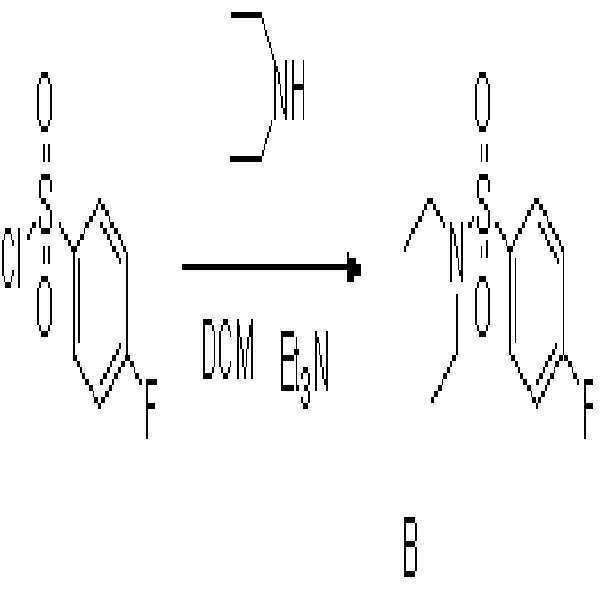
디에틸아민 (1 g)의 DCM (50 ml) 용액에 Et3N(2.8g)가 0 ℃에서 첨가되었다. 0.5시간 동안 교반된 후, 반응 혼합물에 4-플루오르벤젠-1-술폰일 (2.9 g)가 방울씩 첨가되었다. 반응 혼합물은 0 ℃에서 2시간 동안 교반되었고, 그 다음 실온에서 하룻밤 동안 교반되었고, 물로 세척되었다. 유기 층은 건조되었고(Na2SO4),여과되었고, 용매는 기화되어, 화합물 B (2.5 g; 78%)가 제공되었다. LC-MS: 232(M+H)+.To a solution of diethylamine (1 g) in DCM (50 ml) was added Et 3 N (2.8 g) at 0 ° C. After stirring for 0.5 h, 4-fluorobenzene-1-sulfonyl (2.9 g) was added dropwise to the reaction mixture. The reaction mixture was stirred at 0 < 0 > C for 2 hours, then at room temperature overnight and washed with water. The organic layer was dried (Na 2 SO 4), was filtered, and the solvent is vaporized, the compound B; provided that (2.5

B (2.5 g) 및 K2CO3(2.7g)의 DMF (100 ml) 용액에 A (2.5 g)가 Ar2하에서 첨가되었다. 반응 혼합물은 150 ℃에서 3 h 동안 교반되었고, 여과되었고, 에테르로 추출되었다. 유기 층은 분리되고, 건조되었고 (Na2SO4),여과되었으며, 용매는 기화되어 화합물 C (5 g; 100%)가 제공되었다. LC-MS: 458(M+H)+. B (2.5 g) and K 2 CO 3 (2.7 g) in DMF (100 ml) was added A (2.5 g) under Ar 2 . The reaction mixture was stirred at 150 < 0 > C for 3 h, filtered and extracted with ether. The organic layer was separated, dried (Na 2 SO 4 ), filtered and the solvent was evaporated to give compound C (5 g; 100%). LC-MS: 458 (M + H) < + & gt ; .
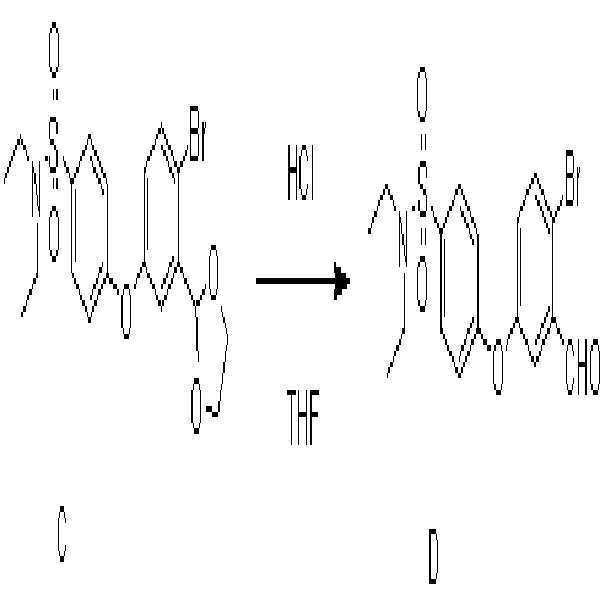
C (5 g)의 THF (40 ml) 용액에 HCl (12 M; 40 ml)가 첨가되었다. 반응 혼합물은 실온에서 하룻밤 동안 교반되었고, DCM으로 추출되었다. 유기 층은 분리되고, 건조되었고 (Na2SO4), 여과되었으며, 용매는 기화되어, 화합물 D (4.1 g; 100%)가 제공되었다. LC-MS: 414(M+H)+.HCl (12 M; 40 ml) was added to a solution of C (5 g) in THF (40 ml). The reaction mixture was stirred at room temperature overnight and extracted with DCM. The organic layer was separated, dried (Na 2 SO 4 ), filtered and the solvent was evaporated to give compound D (4.1 g; 100%). LC-MS: 414 (M + H) < + & gt ; .

D (4.1 g), KOAc (2.9 g) 및 PdCl2(dppf)(0.4g)의 디옥산 (80 ml) 용액에 비스(피나콜라토)다이보론 (3.8 g)이 Ar하에서 첨가되었다. 반응 혼합물은 70 ℃에서 하룻밤 동안 교반되었고, 물로 희석되었고, DCM으로 추출되었다. 유기 층은 분리되고, 건조되었고 (Na2SO4),여과되었으며, 용매는 기화되어, 화합물 E (3 g; 66%)이 제공되었다.Bis (pinacolato) diboron (3.8 g) was added under Ar to a solution of D (4.1 g), KOAc (2.9 g) and PdCl 2 (dppf) (0.4 g) in dioxane (80 ml). The reaction mixture was stirred at 70 < 0 > C overnight, diluted with water and extracted with DCM. The organic layer was separated, dried (Na 2 SO 4 ), filtered and the solvent was evaporated to give compound E (3 g; 66%).

E (3 g)의 THF (40 ml) 용액에 NaBH4(1g)가 첨가되었다. 반응 혼합물은 실온에서 하룻밤 동안 교반되었고, HCl/H2O(4M)가 첨가되었고, EtOAc로 추출되었다. 유기 층은 분리되고, 건조되었고 (Na2SO4),여과되었으며, 용매는 기화되어, 화합물 F (1.3 g; 43%)가 수득되었다. LC-MS: 462(M+H)+.The NaBH 4 (1g) was added to THF (40 ml) solution of E (3 g). The reaction mixture was stirred at room temperature overnight, HCl / H 2 O (4M) was added and extracted with EtOAc. The organic layer is separated, dried (Na 2 SO 4), was filtered, and the solvent is vaporized, the compound F (1.3 g; 43%) yielded. LC-MS: 462 (M + H) < + & gt ; .

F (1.3 g)의 THF (30 ml) 용액에 HCl/H2O(6M;30ml)가 첨가되었다. 반응 혼합물은 실온에서 하룻밤 동안 교반되었고, DCM으로 추출되었고, 기화되고, HPLC에 의해 정제되어, 원하는 화합물 (300 mg; 30%)이 수득되었다. LC-MS: 362 (M+H)+. To a solution of F (1.3 g) in THF (30 ml) was added HCl / H 2 O (6M; 30 ml). The reaction mixture was stirred at room temperature overnight, extracted with DCM, evaporated and purified by HPLC to give the desired compound (300 mg; 30%). LC-MS: 362 (M + H) < + & gt ; .
19cu 5- (4-메톡시페녹시)벤조[c][1,2]옥사보롤 -1(3H)-올 (D93) 1 9cu 5- (4-methoxyphenoxy) benzo [c] [1,2] oxaborol- 1 (3H )

B의 준비Preparation of B

A (11 g, 5.97 mol), 2-브로모-5-하이드록시벤즈알데히드 (9 g, 45 mmol), Cu(OAc)2 (9.8 g, 54 mmol) 및 4A MS (20 g)는 건-DCM (100 mL)에 현탁되었고, Et3N (12.6 mL) 및 피리딘 (37.8 mL)이 첨가되었고, 반응물은 실온에서, Ar하에서, 48시간 동안 교반되었다. 혼합물은 여과되었고, 1 M HCl으로 추출되었다. 유기 층은 복합되고, MgSO4상에서 건조되었다. 미정제물은 크로마토그래피에서 20:1 PE/EA을 이용하여 정제되어, 화합물 B (2.2 g, 15%)이 제공되었다. GC-MS 308 (M+H)+. A (11 g, 5.97 mol) , 2- bromo-5-hydroxybenzaldehyde (9 g, 45 mmol), Cu (OAc) 2 (9.8 g, 54 mmol) and 4A MS (20 g) is gun -DCM (100 mL), Et 3 N (12.6 mL) and pyridine (37.8 mL) were added, and the reaction was stirred at room temperature under Ar for 48 hours. The mixture was filtered and extracted with 1 M HCl. The organic layer was combined and was dried over MgSO 4. The crude product was purified by chromatography using 20: 1 PE / EA to give compound B (2.2 g, 15%). GC-MS 308 (M + H) < + & gt ; .
C의 준비Preparation of C

B (80 mg, 0.26 mmol) 및 NaBH4 (5 mg, 0.13 mmol)의 혼합물 MeOH (3 mL)는 1시간 동안 대기 온도에서 교반되었다. 용매는 제거되었다. 잔유물은 크로마토그래피에 의해 정제되어(6:1 PE/EA 를 이용) C (70 mg, 88%)가 제공되었다. 1HNMR(400 MHz, CDCl3) δ 7.447 (d, J=8.4 Hz, 1H), 7.100 (d, J=2.1 Hz, 1H), 6.993 (d, J=9.2 Hz, 2H), 6.909 (d, J=9.2 Hz, 2H), 6.768 (dd, J=2.4 Hz, J=8.0 Hz, 1H), 4.688 (s, 2H), 3.820 (s, 3H). B mixture of MeOH (3 mL) of (80 mg, 0.26 mmol) and NaBH 4 (5 mg, 0.13 mmol ) was stirred at ambient temperature for 1 hour. The solvent was removed. The residue was purified by chromatography (using 6: 1 PE / EA) to give C (70 mg, 88%). 1 H NMR (400 MHz, CDCl 3 )? 7.447 (d, J = 8.4 Hz, 1H), 7.100 (d, J = 2.1 Hz, 1H), 6.993 J = 9.2 Hz, 2H), 6.768 (dd, J = 2.4 Hz, J = 8.0 Hz, 1H), 4.688 (s, 2H), 3.820 (s, 3H).
D의 준비Preparation of D
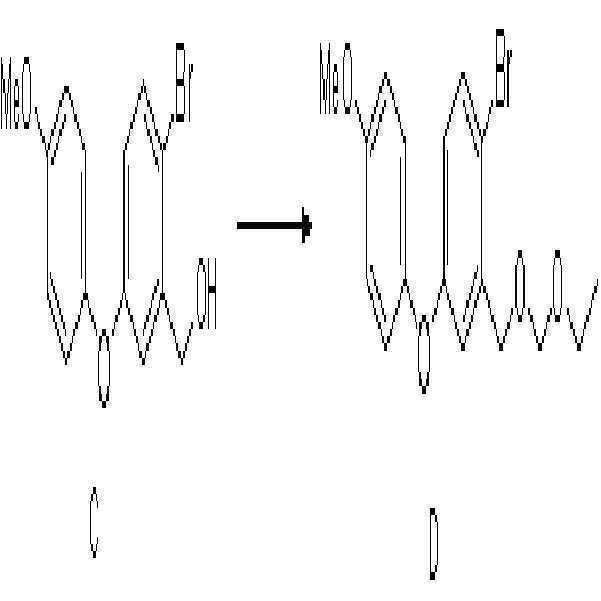
C (1.45 g, 4.7 mmol) 및 NaH (187 mg, 7.8 mmol)의 혼합물의 DMF(20 mL) 용액은 30 분간 0 ℃에서 교반되었다. EOM-Cl (689 mg, 7.3 mmol)가 첨가되었고, 혼합물은 1시간 동안 대기 온도에서 교반되었다. 용매는 제거되었다. 잔유물은 크로마토그래피에 의해 정제(10:1 PE/EA 이용)되어, D (1.4 g, 82%)가 제공되었다. 1H NMR(400 MHz, CDCl3) δ 7.449 (d, J=9.2 Hz, 1H), 7.128 (d, J=3.6 Hz, 1H), 6.987 (d, J=8.4 Hz, 2H), 6.904 (d, J=9.6 Hz, 1H), 6.747 (dd, J=3.2 Hz, J=8.4 Hz, 1H), 4.797 (s, 2H), 4.622 (s, 2H),3.819 (s, 3H), 3.674-3.622 (m, 2H),1.251-1.215 (m, 3H).A solution of the mixture of C (1.45 g, 4.7 mmol) and NaH (187 mg, 7.8 mmol) in DMF (20 mL) was stirred at 0 ° C for 30 min. EOM-Cl (689 mg, 7.3 mmol) was added and the mixture was stirred at ambient temperature for 1 hour. The solvent was removed. The residue was purified by chromatography (using 10: 1 PE / EA) to give D (1.4 g, 82%). 1 H NMR (400 MHz, CDCl 3) δ 7.449 (d, J = 9.2 Hz, 1H), 7.128 (d, J = 3.6 Hz, 1H), 6.987 (d, J = 8.4 Hz, 2H), 6.904 (d 2H, J = 9.6 Hz, 1H), 6.747 (dd, J = 3.2 Hz, J = 8.4 Hz, 1H), 4.797 (m, 2H), 1.251-1.215 (m, 3H).
E의 준비Preparation of E

D (700 mg, 1.9 mmol), 비스(피나콜라토)다이보론 (741 mg, 3.0 mmol), PdCl2(dppf) (42 mg) 및 KOAc (570 mg, 5.5 mmol)의 혼합물의 1,4-디옥산 (10 mL) 용액은 하룻밤 동안 80 ℃, Ar하에서 교반되었다. 용매는 제거되었다. 잔유물은 크로마토그래피(10:1 PE/EA 이용)에 의해 정제되어, E (700 mg, 89%)가 제공되었다. 1HNMR (400 MHz, CDCl3) δ 7.767 (d, J=8.4 Hz, 1H), 7.092 (s, 1H), 7.001 (d, J=8.8 Hz, 2H), 6.903 (d, J=9.2 Hz, 2H), 6.814 (dd, J=1.6 Hz, J=8.0 Hz, 1H), 4.840 (s, 2H), 4.795 (s, 2H), 3.659-3.606 (m, 2H), 3.819 (s, 3H), 3.659-3.607 (m, 2H), 1.330 (s, 12H), 1.242-1.207 (m, 3H).A mixture of 1,4-dioxane in a mixture of D (700 mg, 1.9 mmol), bis (pinacolato) diboron (741 mg, 3.0 mmol), PdCl 2 (dppf) (42 mg) and KOAc (570 mg, 5.5 mmol) The dioxane (10 mL) solution was stirred overnight at 80 < 0 > C under Ar. The solvent was removed. The residue was purified by chromatography (using 10: 1 PE / EA) to give E (700 mg, 89%). 1 HNMR (400 MHz, CDCl 3 ) δ 7.767 (d, J = 8.4 Hz, 1H), 7.092 (s, 1H), 7.001 (d, J = 8.8 Hz, 2H), 6.903 (d, J = 9.2 Hz, 2H), 6.814 (dd, J = 1.6 Hz, J = 8.0 Hz, 1H), 4.840 (s, 2H), 4.795 (s, 2H), 3.659-3.606 3.659-3.607 (m, 2H), 1.330 (s, 12H), 1.242-1.207 (m, 3H).
(D93)의 준비 (D93)

E (700 mg, 1.7 mmol)의 6 M HCl (4 mL) 및 THF (4 mL) 혼합물은 하룻밤 동안 대기 온도에서 교반되었다. 용매는 제거되었다. 잔유물은 예비-HPLC 에 의해 정제되어, 원하는 화합물 (300 mg, 69%)이 제공되었다. LC-MS 257 (M+H)+; 1HNMR (400 MHz, CDCl3) δ 7.665 (d, J=8.0 Hz, 1H), 7.026 (d, J=9.2 Hz ,2H), 6.976 (dd, J=2.0 Hz, J=8.0 Hz, 1H), 6.926 (d, J=9.2 Hz ,2H), 6.826 (d, J=1.6 Hz,1H), 5.014 (s, 2H), 3.823 (s, 3H). E (700 mg, 1.7 mmol) in 6 M HCl (4 mL) and THF (4 mL) was stirred overnight at ambient temperature. The solvent was removed. The residue was purified by preparative-HPLC to give the desired compound (300 mg, 69%). LC-MS 257 (M + H) < + >; 1 HNMR (400 MHz, CDCl 3 ) δ 7.665 (d, J = 8.0 Hz, 1H), 7.026 (d, J = 9.2 Hz, 2H), 6.976 (dd, J = 2.0 Hz, J = 8.0 Hz, 1H) , 6.926 (d, J = 9.2 Hz, 2H), 6.826 (d, J = 1.6 Hz, 1H), 5.014 (s, 2H), 3.823 (s, 3H).
19cv19cv 5-5- (3,4-디메톡시페녹시)벤조[c][1,2]옥사보롤(3,4-dimethoxyphenoxy) benzo [c] [1,2] oxaborol -1(3H)-올-1 (3H) -ol (D94)(D94)

B의 준비Preparation of B

A (14.6 g, 80.2 mmol), 2-브로모-5-하이드록시벤즈알데히드 (10.08 g, 50.2 mmol), 4A MS (30 g) 및 Cu(OAc)2(10.88g,60.2mmol)의 건 CH2Cl2(200ml)용액에 피리딘 (7.12 g, 90.2 mmol) 및 Et3N(12.7ml,90.2mmol)가 Ar하에서 첨가되었다. 반응 혼합물은 대기 온도에서 하룻밤 동안 교반되었고, 그리고 여과되었고, 2N HCl로 세척되었고, 그리고 CH2Cl2로 추출되었다. 유기 층은 복합되어, 건조되었고(Na2SO4), 여과되었고, 그리고 용매는 기화되었다. 잔유물은 컬럼 크로마토그래피에서 실리카 겔상에서 정제되었다(용리액: 페트롤리움 에테르/EtOAc 15/1). 순수 분취물이 수거되었고, 용매는 기화되어, B (1.84g, 11%)가 수득되었다: 1HNMR(CDCl3) d 3.84 (3H, s), 3.89 (3H, s), 6.56-6.62 (2H, m), 6.84 (1H, d, J=8.8Hz), 7.10(1H,dd,J=2.8,8.4Hz), 7.43(1H,d,J=2.8Hz), 7.56(1H,d,J=9.2Hz), 10.29(1H,s). A (14.6 g, 80.2 mmol) of 2-bromo-5-hydroxybenzaldehyde (10.08 g, 50.2 mmol), 4A MS (30 g) and Cu (OAc) 2 (10.88g, 60.2mmol) s CH 2 the Cl 2 (200ml) solution of pyridine (7.12 g, 90.2 mmol) and Et 3 N (12.7ml, 90.2mmol) was added under Ar. The reaction mixture was stirred overnight at ambient temperature, filtered, washed with 2N HCl, and extracted with CH 2 Cl 2 . The organic layer was combined, dried (Na 2 SO 4 ), filtered and the solvent was evaporated. The residue was purified on silica gel in column chromatography (eluent: petroleum ether /
화합물 C의 준비Preparation of Compound C

B (2.16 g, 6.42 mmol)의 MeOH (150 ml) 용액에 NaBH4 (120 mg, 3.15 mmol)가 첨가되었다. 반응 혼합물은 대기 온도에서 0.5시간 동안 교반되었다. 용매는 기화되었다. 잔유물은 컬럼 크로마토그래피에서 실리카 겔상에서 정제되었다(용리액: 페트롤리움 에테르/EtOAc 3/1). 순수 분취물이 수거되었고, 용매는 기화되어, C (2.2g, 99%)가 제공되었다: 1H NMR (CDCl3) δ 1.57 (1H, s), 3.83 (3H, s), 3.87 (3H, s), 4.69 (2H, d, J=6.0 Hz), 6.56 (1H, dd, J=2.4, 8.8 Hz), 6.62 (1H, d, J=2.4 Hz), 6.76 (1H, dd, J=2.4, 8.8 Hz), 6.82 (1H, d, J=9.2 Hz), 7.11 (1H, d, J=2.4 Hz), 7.43 (1H, d, J=8.4 Hz). B (2.16 g, 6.42 mmol) NaBH 4 (120 mg, 3.15 mmol) in MeOH (150 ml) solution was added. The reaction mixture was stirred at ambient temperature for 0.5 hour. The solvent was evaporated. The residue was purified on silica gel in column chromatography (eluent: petroleum ether /
D의 준비Preparation of D

C (2.2 g, 6.4 mmol)의 건 DMF (25 ml) 용액에 NaH (279 mg, 6.4 mmol, 55%)가 Ar하에서 첨가되었다. 반응 혼합물은 0 ℃에서 0.5 h 동안 교반되었고, 그 다음 (클로로메톡시)에탄 (782 mg, 8.32 mmol)이 첨가되었다. 반응 혼합물은 대기 온도에서 1시간 동안 교반되었고, i-PrOH으로 진정되었다. 용매는 고진공하에 기화되었다. 잔유물은 EtOAc에 용해되었고, 물로 세척되었다. 유기 층은 분리되고, 건조되었고 (Na2SO4), 여과되었고, 그리고 용매는 기화되었다. 잔유물은 컬럼 크로마토그래피에서 실리카 겔상에서 정제되었다(용리액: 페트롤리움 에테르/EtOAc 10/1). 순수 분취물이 수거되었고, 용매는 기화되어, D (1.8g, 71%)가 제공되었다: 1H NMR (CDCl3) δ 1.22 (3H, t, J=8.0 Hz), 3.61-3.66 (2H, m), 3.83 (3H, s), 3.88 (3H, s), 4.61 (2H, s), 4.79 (2H, s), 6.55 (1H, dd, J=2.8, 8.4 Hz), 6.62 (1H, d, J=2.0 Hz), 6.74 (1H, dd, J=2.4, 9.2 Hz), 6.82 (1H, d, J=8.4 Hz), 7.12 (1H, d, J=2.4 Hz), 7.44 (1H, d, J=8.4 Hz). C (2.2 g, 6.4 mmol) in dry DMF (25 ml) was added NaH (279 mg, 6.4 mmol, 55%) under Ar. The reaction mixture was stirred at 0 C for 0.5 h, then (chloromethoxy) ethane (782 mg, 8.32 mmol) was added. The reaction mixture was stirred at ambient temperature for 1 hour and settled with i-PrOH. The solvent was vaporized under high vacuum. The residue was dissolved in EtOAc and washed with water. The organic layer was separated, dried (Na 2 SO 4 ), filtered and the solvent evaporated. The residue was purified on silica gel in column chromatography (eluent: petroleum ether /
E의 준비Preparation of E

D (1.8 g, 4.53 mmol), 비스(피나콜라토)다이보론 (3.45 g, 13.6 mmol), PdCl2(dppf)2 (109 mg, 0.13 mmol) 및 KOAc (1.33 g, 13.6 mmol)의 1,4-디옥산 (20 mL) 혼합물은 80 ℃에서 하룻밤 동안, Ar하에서 교반되었다. 유기층은 제거되었다. 잔유물은 컬럼 크로마토그래피에서 실리카 겔상에서 정제되었다(용리액: 페트롤리움 에테르/EtOAc 15/1). 순수 분취물이 수거되었고, 용매는 기화되어, E (1.84g, 82%)가 제공되었다: 1H NMR (CDCl3) δ 1.21 (3H, t, J=6.8 Hz), 1.32 (12H, s), 3.60-3.65 (2H, m), 3.81 (3H, s), 3.88 (3H, s), 4.79 (2H, s), 4.83 (2H, s), 6.59 (1H, dd, J=2.4, 8.4 Hz), 6.64 (1H, d, J=2.8 Hz), 6.80-6.83 (2H, m), 7.10 (1H, d, J=2.0 Hz), 7.75 (1H, d, J=8.4 Hz). D (1.8 g, 4.53 mmol), bis (pinacolato) diboron (3.45 g, 13.6 mmol), PdCl 2 (dppf) 2 (109 mg, 0.13 mmol) and KOAc (1.33 g, 13.6 mmol) A mixture of 4-dioxane (20 mL) was stirred at 80 < 0 > C overnight under Ar. The organic layer was removed. The residue was purified on silica gel in column chromatography (eluent: petroleum ether /
(D94)의 준비 (D94)

E (1.84 g, 4.14 mmol)의 6 M HCl (40 mL) 및 THF (60 mL) 혼합물은 대기 온도에서 하룻밤동안 교반되었다. 용매는 제거되었다. 잔유물은 예비HPLC 에 의해 정제되어, 원하는 화합물 (615 mg, 52%)이 제공되었다: 1H NMR (DMSO-d6) 3.73 (3H, s), 3.76 (3H, s), 4.91 (2H, s), 6.59 (1H, dd, J=2.5, 9.0 Hz), 6.77 (1H, d, J=2.5 Hz), 6.89 (1H, s), 6.94 (1H, dd, J=1.5, 8.0 Hz), 6.97 (1H, d, J=8.5 Hz), 7.69 (1H, d, J=8.0 Hz), 9.11 (1H, s). E (1.84 g, 4.14 mmol) in 6 M HCl (40 mL) and THF (60 mL) was stirred overnight at ambient temperature. The solvent was removed. The residue is purified by preparative HPLC, the desired compound (615 mg, 52%) were provided: 1 H NMR (DMSO-d 6) 3.73 (3H, s), 3.76 (3H, s), 4.91 (2H, s ), 6.59 (1H, dd, J = 2.5, 9.0 Hz), 6.77 (1H, d, J = 2.5 Hz), 6.89 (1H, s), 6.94 (1H, dd, J = 1.5, 8.0 Hz), 6.97 (1H, d, J = 8.5Hz), 7.69 (1H, d, J = 8.0Hz), 9.11 (1H, s).
19cw 2-디메틸아미노-6-(1- 하이드록시 -1,3- 디하이드로 - 벤조[c][1,2]옥사보 롤-5-일 옥시)-니코틴니트릴 (D95) 19cw 2- dimethylamino-6- (1-hydroxy-1,3-dihydro-benzo [c] [1,2] oxazol-5-yl-oxy-roll beam) - nicotine nitrile (D95)

6-(4-6- (4- 브로모Bromo -3--3- 포밀Formyl -- 페녹시Phenoxy )-2-)-2- 클로로Chloro -- 니코틴니트릴Nicotine nitrile (3) (3)
트리에틸아민(11.0 mL, 78.0 mmol)이 밀봉가능한 반응 용기내에 2-브로모-5-하이드록시-벤즈알데히드 (1) (7.84 g, 39.0 mmol) 및 2,6-디클로로-니코틴니트릴 (2) (7.42 g, 42.9 mmol)의 용액에 첨가되었다. 반응 용기는 테플론 뚜껑으로 봉하고, 70℃에서 18 hr동안 가열되었다. 반응물이 실온으로 냉각되도록 두고, 농축되면 오렌지색 오일 (18.0 g)이 제공된다. 오일은 CH2Cl2 (200 mL)으로 희석시키고, 이어서, 실리카 겔(70 g, 230-400 mesh)을 첨가한 후, 농축되어 건조되었다. 이를 실리카 겔 컬럼 (70 g, 230-400 mesh)에 얹고, 그라디언트 5-40 % EtOAc/헥산으로 용리시켰다. 맑은 오일로 된 2:1 비율의 6-(4-브로모-3-포밀-페녹시)-2-클로로-니코틴니트릴 (3) 및 2-(4-브로모-3-포밀-페녹시)-6-클로로-니코틴니트릴 (4) 혼합물이 분리되었고, 나중에 백색 고체로 된다. 이 혼합물은 추가 정제된다. (7.84 g, 39.0 mmol) and 2,6-dichloro-nicotinic nitrile (2) (7.8 g, 39.0 mmol) were added to a sealed reaction vessel with triethylamine (11.0 mL, 78.0 mmol) 7.42 g, 42.9 mmol). The reaction vessel was sealed with a Teflon lid and heated at 70 DEG C for 18 hours. The reaction is allowed to cool to room temperature and upon concentration an orange oil (18.0 g) is provided. The oil was diluted with CH 2 Cl 2 (200 mL), followed by silica gel (70 g, 230-400 mesh) and then concentrated to dryness. This was placed on a silica gel column (70 g, 230-400 mesh) and eluted with gradient 5-40% EtOAc / hexanes. (4-bromo-3-formyl-phenoxy) -2-chloro-nicotinonitrile (3) and 2- -6-chloro-nicotinonitrile (4) mixture was isolated and later turned into a white solid. This mixture is further purified.
6-(4-브로모-3-포밀-페녹시)-2-클로로-니코틴니트릴 (3) 1H NMR 400 MHz (CDCl3) δ 10.35 (s, 1H), 7.99 (d, J = 8.6 Hz, 1H), 7.73 (d, J = 8.6 Hz, 1H), 7.69 (d, J = 2.7 Hz, 1H), 7.30 ppm (dd, J = 8.6, 2.7 Hz, 1H), 7.02 (d, J = 8.6 Hz, 1H). 6- (4-bromo-3-formyl-phenoxy) -2-chloro-nicotinamide nitrile (3) 1 H NMR 400 MHz (CDCl 3) δ 10.35 (s, 1H), 7.99 (d, J = 8.6 Hz , 1H), 7.73 (d, J = 8.6 Hz, 1H), 7.69 (d, J = 2.7 Hz, 1H), 7.30 ppm (dd, J = 8.6, 2.7 Hz, 1H), 7.02 (d, J = 8.6 Hz, 1H).
2-(4-브로모-3-포밀-페녹시)-6-클로로-니코틴니트릴 ( 4) 1H NMR 400 MHz (CDCl3) δ10.35 (s, 1H), 7.97 (d, J = 7.8 Hz, 1H), 7.75 (d, J = 7.8 Hz, 1H), 7.73 (d, J = 2.3 Hz, 1H), 7.34 (dd, J = 7.8, 2.3 Hz, 1H), 7.17 (d, J = 7.8 Hz, 1H).2- (4-bromo-3-formyl-phenoxy) -6-chloro-nicotinamide nitrile (4) 1 H NMR 400 MHz (CDCl 3) δ10.35 (s, 1H), 7.97 (d, J = 7.8 Hz, 1H), 7.75 (d , J = 7.8 Hz, 1H), 7.73 (d, J = 2.3 Hz, 1H), 7.34 (dd, J = 7.8, 2.3 Hz, 1H), 7.17 (d, J = 7.8 Hz, 1H).
6-(4-6- (4- 브로모Bromo -3--3- 포밀Formyl -- 페녹시Phenoxy )-2-디메틸아미노-) -2-dimethylamino- 니코틴니트릴Nicotine nitrile (5) (5)
6-(4-브로모-3-포밀-페녹시)-2-클로로-니코틴니트릴 (3) 및 2-(4-브로모-3-포밀-페녹시)-6-클로로-니코틴니트릴 (4) 의 2:1 혼합물(2.47 g, 7.34 mmol)은 밀봉가능한 용기내에 1,2-디클로로에탄 (40 mL)에 용해되었다. 그 다음 디메틸아민 (18.3 mL, 36.7 mmol)이 첨가되었고, 반응 용기를 테플론 뚜껑으로 닫았다. 반응물은 70 ℃에서 4 hr동안 가열되었다 [주의: 규정시간을 지나면 백색 침전물이 형성된다]. 반응 혼합물은 실온으로 냉각되었고, 그 다음 농축되어 오렌지색 고체가 수득되는데, 6-(4-브로모-3-포밀-페녹시)-2-디메틸아미노-니코틴니트릴 (5) 및 2-(4-브로모-3-포밀-페녹시)-6-디메틸아미노-니코틴니트릴 ( 6)이 2:1 비율로 포함된다(2.80 g). 고체는 CH2Cl2 (200 mL)에 용해된 후, 실리카 겔(50 g, 230-400 mesh)이 첨가되고, 농축되어 건조된다. 이를 실리카 겔 컬럼 (100 g, 230-400 mesh)에 얹고, 그라디언트 5-10 % EtOAc/헥산로 용리시켰다. 순수 분취물들이 복합되고, 농축되어 표제 화합물 (5) 은 백색 고체로 수득되었다. (1.10 g, 43 % 분리된 산출량). 6- (4-bromo-3-formyl-phenoxy) -2-chloro-nicotinamide nitrile (3) and 2- (4-bromo-3-formyl-phenoxy) -6-chloro-nicotinamide nitrile (4 ) (2.47 g, 7.34 mmol) was dissolved in 1,2-dichloroethane (40 mL) in a sealable vessel. Dimethylamine (18.3 mL, 36.7 mmol) was then added and the reaction vessel was closed with a Teflon lid. The reaction was heated at 70 ° C for 4 hours. [Note: White sediments are formed after the specified time period. The reaction mixture was cooled to room temperature and then concentrated to an orange solid which was crystallized from 6- (4-bromo-3-formyl-phenoxy) -2-dimethylamino-nicotinonitrile (5) Bromo-3-formyl-phenoxy) -6-dimethylamino-nicotinonitrile ( 6) in a 2: 1 ratio (2.80 g). The solid is dissolved in CH 2 Cl 2 (200 mL), then silica gel (50 g, 230-400 mesh) is added and concentrated to dryness. This was placed on a silica gel column (100 g, 230-400 mesh) and eluted with gradient 5-10% EtOAc / hexanes. The pure aliquots were combined and concentrated to give the title compound (5) as a white solid. (1.10 g, 43% isolated yield).
6-(4-브로모-3-포밀-페녹시)-2-디메틸아미노-니코틴니트릴 (5) 1H NMR 400 MHz (CDCl3) δ 10.34 (s, 1H), 7.78 (d, J = 2.7 Hz, 1H), 7.72 (d, J = 8.2 Hz, 1H), 7.66 (d, J = 8.6 Hz, 1H), 7.27 (dd, J = 8.6, 2.7 Hz, 1H), 6.24 (d, J = 8.2 Hz, 1H), 3.11 (s, 6H). 6- (4-bromo-3-formyl-phenoxy) -2-Dimethylamino-nicotine nitrile (5) 1 H NMR 400 MHz (CDCl 3) δ 10.34 (s, 1H), 7.78 (d, J = 2.7 Hz, 1H), 7.72 (d , J = 8.2 Hz, 1H), 7.66 (d, J = 8.6 Hz, 1H), 7.27 (dd, J = 8.6, 2.7 Hz, 1H), 6.24 (d, J = 8.2 Hz, < / RTI > 1H), 3.11 (s, 6H).
2-(4-브로모-3-포밀-페녹시)-6-디메틸아미노-니코틴니트릴 (6) 1H NMR 400 MHz (CDCl3) δ10.35 (s, 1H), 7.85 (d, J = 2.7 Hz, 1H), 7.66 (d, J = 8.6 Hz, 1H), 7.64 (d, J = 8.6 Hz, 1H), 7.32 (dd, J = 8.6, 2.7 Hz, 1H), 6.19 (d, J = 8.6 Hz, 1H), 2.95 (s, 6H).2- (4-bromo-3-formyl-phenoxy) -6-dimethylamino-nicotinamide nitrile (6) 1 H NMR 400 MHz (CDCl 3) δ10.35 (s, 1H), 7.85 (d, J = 2.7 Hz, 1H), 7.66 ( d, J = 8.6 Hz, 1H), 7.64 (d, J = 8.6 Hz, 1H), 7.32 (dd, J = 8.6, 2.7 Hz, 1H), 6.19 (d, J = 8.6 Hz, 1 H), 2.95 (s, 6H).
2-디메틸아미노-6-[3- 포밀 -4-(4,4,5,5- 테트라메틸 -[1,3, 2]디옥사보란 -2-일)-페녹시]-니코틴니트릴 (7) 2-Dimethylamino-6- [3-formyl-4- (4,4,5,5-tetramethyl- [1, 3, 2] dioxa-boran-2-yl) -phenoxy] nicotinamide nitrile (7 )
밀봉가능한 용기내 6-(4-브로모-3-포밀-페녹시)-2-디메틸아미노-니코틴니트릴 (5) (1.10 g, 3.18 mmol), 비스(피나콜라토 )다이보론 (1.21 g, 4.77 mmol) 및 칼륨 아세테이트 (624 mg, 6.36 mmol)의 디메틸포름아미드:1,2-디메톡시에탄(20 mL : 20 mL) 혼합물은 90℃에서 5 분간 가열되었다. 그 다음 PdCl2(dppf) (233 mg, 0.32 mmol)이 첨가되었고, 테플론 뚜껑을 다시 덮고, 반응물은 90℃에서 3시간 동안 가열되었다. 반응물은 실온으로 냉각되도록 두고, 벤젠 (600 mL)으로 희석되고, 농축되어, 검정색 오일 (3.0 g)이 수득되었다. 오일은 CH2Cl2 (300 mL)으로 희석되고, 실리카 겔(30 g, 230-400 mesh)을 첨가한 후, 농축되어 건조되었다. 이를 실리카 겔 컬럼 (60 g, 230-400 mesh)상에 얹고, 그라디언트 10-40 % EtOAc/헥산으로 용리시켰다. 순수 분취물은 복합되고, 농축되어 표제 화합물 (7) 이 오일로 수득되고, 나중에 고형화되어, 백색 고체 (530 mg, 42 % 분리된 산출량)가 제공되었다. 1H NMR 400 MHz (CDCl3) δ 10.61 (s, 1H), 7.92 (d, J = 8.2 Hz, 1H), 7.78 (d, J = 2.3 Hz, 1H), 7.68 (d, J = 8.2 Hz, 1H), 7.35 (dd, J = 8.2, 2.3 Hz, 1H), 6.20 (d, J = 8.2 Hz, 1H), 3.08 (s, 6H), 1.28 (s, 12H).(1.10 g, 3.18 mmol), bis (pinacolato) diboron (1.21 g, 3.18 mmol) in a sealable vessel and a solution of 6- (4-bromo- 4.77 mmol) and potassium acetate (624 mg, 6.36 mmol) in dimethylformamide: 1,2-dimethoxyethane (20 mL: 20 mL) was heated at 90 ° C for 5 minutes. PdCl2 (dppf) (233 mg, 0.32 mmol) was then added, the Teflon lid was again covered and the reaction heated at 90 [deg.] C for 3 hours. The reaction was allowed to cool to room temperature, diluted with benzene (600 mL) and concentrated to give a black oil (3.0 g). The oil was diluted with CH2CI2 (300 mL) and silica gel (30 g, 230-400 mesh) was added and concentrated to dryness. This was placed on a silica gel column (60 g, 230-400 mesh) and eluted with gradient 10-40% EtOAc / hexanes. The pure aliquots were combined and concentrated to give the title compound (7) as an oil, which solidified later to give a white solid (530 mg, 42% isolated yield). 1 H NMR 400 MHz (CDCl 3 ) δ 10.61 (s, 1H), 7.92 (d, J = 8.2 Hz, 1H), 7.78 (d, J = 2.3 Hz, 1H), 7.68 (d, J = 8.2 Hz, (D, J = 8.2, 2.3 Hz, 1H), 6.20 (d, J = 8.2 Hz, 1H), 3.08 (s, 6H), 1.28 (s, 12H).
19cx 2-디메틸아미노-6-(1- 하이드록시 -1,3- 디하이드로 - 벤조[c][1,2]옥사보 롤-5-일 옥시)-니코틴니트릴 (D95) 19cx 2- dimethylamino-6- (1-hydroxy-1,3-dihydro-benzo [c] [1,2] oxazol-5-yl-oxy-roll beam) - nicotine nitrile (D95)
2-디메틸아미노-6-[3-포밀-4-(4,4,5,5-테트라메틸-[1,3,2]디옥사보란-2-일)-페녹시]-니코틴니트릴 (7) (370 mg, 0.94 mmol) 의 CH2Cl2 (5 mL) 용액에 NaBH4 (26 mg, 0.66 mmol)의 무수 메탄올 (10 mL) 혼합물이 실온에서 첨가되었다. 추가로 고체 NaBH4 (82 mg, 2.2 mmol)가 10분에 걸쳐 점적되었다. 반응 혼합물은 실온에서 추가 1시간 동안 교반되었다. 빙 아세트산 (0.2 mL) 및 증류수(0.2 mL)가 첨가되고, 10분간 교반되어, 반응이 진정되었다. 반응물이 농축되어 오일(~550 mg)이 제공되었다. 오일은 아세트산/메탄올/CH2Cl2 (1/2/100 v/v/v, 100 mL) 혼합물에 용해시키고, 실리카 겔(5 g, 230-400 mesh)이 첨가되고, 그리고 농축되어 건조되어, 자유 유동성 충만된 실리카가 제공되었다. 이를 실리카 컬럼 (10 g, 230-400 mesh)에 얹고, 아세트산/메탄올/CH2Cl2 (1/2/100 v/v/v)으로 용리시켰다. D95 을 포함하는 분취물들이 수거되어, 농축되어 밝은 황색을 띈 오일이 제공되었다. 오일은 냉동되고, 건조되었고, MeOH/CH2Cl2 (1/1 v/v, 15 mL)으로 희석시키고, 탈이온된 물 (200 mL)이 첨가되었고, 생성된 백색 현탁액은 건조-얼음 아세톤 바스에서 냉동되고, 프리즈-드라이어상에 하룻밤을 두었다. 백색 고체의 D95 가 수득되었다(70 mg, 25 % 분리된 산출량). 1H NMR 400 MHz (d6-DMSO) δ 9.23 (s, 1H), 7.95 (d, J = 8.6 Hz, 1H), 7.77 (d, J = 7.8 Hz, 1H), 7.23 (d, J = 0.5 Hz, 1H), 7.16 (dd, J = 7.8, 0.5 Hz, 1H), 6.31 (d, J = 8.6 Hz, 1H), 4.98 (s, 2H), 3.14 (s, 6H). 질량 스펙트럼[M+H+] = 296. HPLC 순도 95.04 % (Maxplot), 94.63 % (220 nm), 92.41 % (254 nm).(4,4,5,5-tetramethyl- [1,3,2] dioxaborane-2-yl) -phenoxy] -nicotinonitrile (7 ) (370 mg, 0.94 mmol) in CH 2 Cl 2 (5 mL) was added a mixture of NaBH 4 (26 mg, 0.66 mmol) in anhydrous methanol (10 mL) at room temperature. Additional solid NaBH 4 (82 mg, 2.2 mmol ) was added dropwise to over 10 minutes. The reaction mixture was stirred at room temperature for an additional hour. Ice acetic acid (0.2 mL) and distilled water (0.2 mL) were added and stirred for 10 minutes to quench the reaction. The reaction was concentrated to give an oil (~ 550 mg). The oil was dissolved in a mixture of acetic acid / methanol / CH 2 Cl 2 (1/2/100 v / v / v, 100 mL) and silica gel (5 g, 230-400 mesh) was added and concentrated to dryness , Free flowing filled silica was provided. This was placed on a silica column (10 g, 230-400 mesh) and eluted with acetic acid / methanol / CH 2 Cl 2 (1/2/100 v / v / v). Aliquots containing D95 were collected and concentrated to give a light yellowish oil. The oil was frozen, dried and diluted with MeOH / CH 2 Cl 2 (1/1 v / v, 15 mL), deionized water (200 mL) was added and the resulting white suspension was washed with dry- Frozen in a bath, and placed on a freeze-dryer for one night. White solid D95 was obtained (70 mg, 25% isolated yield). 1 H NMR 400 MHz (d 6 -DMSO) δ 9.23 (s, 1H), 7.95 (d, J = 8.6 Hz, 1H), 7.77 (d, J = 7.8 Hz, 1H), 7.23 (d, J = 0.5 1H), 7.16 (dd, J = 7.8, 0.5 Hz, 1H), 6.31 (d, J = 8.6 Hz, 1H), 4.98 (s, 2H), 3.14 (s, 6H). Mass spectrum [M + H + ] = 296. HPLC purity 95.04% (Maxplot), 94.63% (220 nm), 92.41% (254 nm).
19cy 6-(1- 하이드록시 -1,3- 디하이드로 - 벤조[c][1,2]옥사보롤 -5-일 옥시 )-2- [(2-메톡시-에틸)-메틸-아미노]-니코틴니트릴 (D96) 19cy 6- (1- hydroxy-1,3-dihydro-benzo [c] [1,2] oxazole borol 5-yl) -2 [(2-methoxy-ethyl) -methyl-amino] - nicotine nitrile (D96)

6-6- 클로로Chloro -2-[(2--2 - [(2- 메톡시Methoxy -에틸)--ethyl)- 메틸methyl -아미노]-니코틴아미드 (3)-Amino] -nicotinamide < / RTI > (3)
2,6-디클로로-니코틴아미드 (1) (10 g, 52.9 mmol) in 아세토니트릴 (무수, 200 mL) 용액에 (2-메톡시-에틸)-메틸-아민 (2) (18.8 g, 212 mmol)이 첨가되었다. 반응물은 60 ℃에서 1.5시간동안 가열되었다. 5% NaOH 용액 (1000 mL)이 서서히 첨가되었다. 용액은 그 다음 EtOAc로 추출되었다 (3 x 250 mL). 복합된 유기 층은 MgSO4에서 건조되었고, 여과되었고 그리고 진공에서 기화시되었다. 실리카 겔 크로마토그래피에서 5%-30% EtOAc/헥산 그라디언트로 용리시켜 정제되면, 11.66 g (91% 산출량)의 표제 화합물이 제공되었다. 1H NMR (400 MHz, 클로로포름-d) δ ppm 8.07 (d, J=8.6 Hz, 1 H), 7.76 (br. s., 1 H), 6.93 (d, J=8.2 Hz, 1 H), 5.66 (br. s., 1 H), 3.66 - 3.51 (m, 4 H), 3.32 (s, 3 H), 2.93 (s, 3 H).(2-methoxy-ethyl) -methyl-amine (2) (18.8 g, 212 mmol) was added to a solution of 2,6-dichloro-nicotinamide (1) (10 g, 52.9 mmol) in acetonitrile ) Was added. The reaction was heated at 60 < 0 > C for 1.5 hours. 5% NaOH solution (1000 mL) was slowly added. The solution was then extracted with EtOAc (3 x 250 mL). The combined organic layers were dried over MgSO 4 , filtered and evaporated in vacuo. Purification by silica gel chromatography eluting with 5% -30% EtOAc / hexane gradient provided 11.66 g (91% yield) of the title compound. 1 H NMR (400 MHz, chloroform -d) δ ppm 8.07 (d, J = 8.6 Hz, 1 H), 7.76 (br. S., 1 H), 6.93 (d, J = 8.2 Hz, 1 H), 5.66 (br s, 1H), 3.66-3.51 (m, 4H), 3.32 (s, 3H), 2.93 (s, 3H).
6-6- 클로로Chloro -2-[(2--2 - [(2- 메톡시Methoxy -에틸)--ethyl)- 메틸methyl -아미노]--Amino] - 니코틴니트릴Nicotine nitrile (4) (4)
6-클로로-2-[(2-메톡시-에틸)-메틸-아미노]-니코틴아미드 (3)(14g,58mmol)의 아세토니트릴 (무수, 360 mL) 용액에 피리딘 (37.5 mL, 463.8 mmol) 및 POCl3(21.2mL,232mmol)이 첨가되었다. 반응물은 55℃에서 3시간 동안 가열되었다. 실온으로 냉각된 후, NaOH 용액 (10% aq.)이 PH가 9가 될때까지 서서히 첨가되었다. 용액은 EtOAc로 추출되었다 (3 x 200 mL). 복합된 유기 층은 MgSO4상에서 건조되고, 여과되었고, 진공에서 기화되었다. 실리카 겔 크로마토그래피에서 5%-30% EtOAc/헥산 그라디언트으로 용리시켜 정제되면, 11.6 g (90% 산출량)의 원하는 산물이 수득되었다. 1H NMR (400 MHz, 클로로포름-d)δ ppm 7.61 (d, J=7.4Hz,1H), 6.58(d,J=7.8Hz,1H), 3.87(t,J=5.3Hz,2H), 3.64(t,J=5.3Hz,2H), 3.38(s,3H), 3.36(s,3H).(37.5 mL, 463.8 mmol) was added to an acetonitrile (anhydrous, 360 mL) solution of 6-chloro-2 - [(2- methoxy- ethyl) -methyl- amino] -nicotinamide ( 3 ) this and POCl 3 (21.2mL, 232mmol) was added. The reaction was heated at 55 < 0 > C for 3 hours. After cooling to room temperature, NaOH solution (10% aq.) Was slowly added until PH was 9. The solution was extracted with EtOAc (3 x 200 mL). The combined organic layer is dried over MgSO 4, was filtered and was evaporated in vacuo. When purified by silica gel chromatography eluting with 5% -30% EtOAc / hexane gradient, 11.6 g (90% yield) of the desired product was obtained. 1 H NMR (400 MHz, chloroform - d) δ ppm 7.61 (d , J = 7.4Hz, 1H), 6.58 (d, J = 7.8Hz, 1H), 3.87 (t, J = 5.3Hz, 2H), 3.64 (t, J = 5.3 Hz, 2H), 3.38 (s, 3H), 3.36 (s, 3H).
6-(4- 브로모 -3- 포밀 - 페녹시 )-2-[(2- 메톡시 -에틸)- 메틸 -아미노]- 니코틴니트릴 (6) 6- (4-bromo-3-formyl-phenoxy) -2 - [(2-methoxy-ethyl) -methyl-amino] - nicotinic nitrile (6)
6-클로로-2-[(2-메톡시-에틸)-메틸-아미노]-니코틴니트릴 (4) (11.6 g, 51.9 mmol)의 DMF (무수, 300 mL) 용액에 2-브로모-5-하이드록시-벤즈알데히드 (10.4 g, 51.9 mmol) 및 K2CO3 (14.3 g, 103.8 mmol)이 첨가되었다. 반응물은 80℃에서 16시간 가열되었다. DMF는 진공에서 기화되었다. 실리카 겔 크로마토그래피에서 5%-30% EtOAc 그라디언트으로 용리시켜 정제되면, 15 g (75% 산출량)의 표제 화합물이 수득되었다. 1H NMR (400 MHz, 클로로포름-d) δ ppm 10.34 (s, 1 H), 7.75 - 7.69 (m, 2 H), 7.67 (d, J=8.6 Hz, 1 H), 7.28 - 7.23 (m, 1 H), 6.26 (d, J=8.6 Hz, 1 H), 3.56 (t, J=5.5 Hz, 2 H), 3.36 (t, J=5.5 Hz, 2 H), 3.25 (s, 3 H), 3.24 (s, 3 H).To a DMF (anhydrous, 300 mL) solution of 6-chloro-2 - [(2- methoxy- ethyl) -methyl- amino] -nicotinonitrile 4 (11.6 g, 51.9 mmol) Hydroxy-benzaldehyde (10.4 g, 51.9 mmol) and K 2 CO 3 (14.3 g, 103.8 mmol) were added. The reaction was heated at 80 占 폚 for 16 hours. DMF was vaporized in vacuo. After purification by silica gel chromatography eluting with a 5% -30% EtOAc gradient, 15 g (75% yield) of the title compound were obtained. 1 H NMR (400 MHz, chloroform -d) δ ppm 10.34 (s, 1 H), 7.75 - 7.69 (m, 2 H), 7.67 (d, J = 8.6 Hz, 1 H), 7.28 - 7.23 (m, 1 H), 6.26 (d, J = 8.6 Hz, 1 H), 3.56 (t, J = 5.5 Hz, 2 H), 3.36 (t, J = 5.5 Hz, 2 H), 3.25 (s, 3 H) , 3.24 (s, 3 H).
6-[3- 포밀 -4-(4,4,5,5- 테트라메틸 -[1,3, 2]디옥사보란 -2-일)- 페녹시 ]-2-[(2-메톡시-에틸)-메틸-아미노]-니코틴니트릴 (7) 6- [3-formyl-4- (4,4,5,5-tetramethyl- [1, 3, 2] dioxa-boran-2-yl) phenoxy] -2 - [(2-methoxy- Ethyl) -methyl-amino] -nicotinonitrile (7)
6-(4-브로모-3-포밀-페녹시)-2-[(2-메톡시-에틸)-메틸-아미노]-니코틴니트릴 (6) (15 g, 38.5 mmol)의 1,4-디옥산 (무수, 360 mL) 용액에 비스피나콜라토 다이보론 (11.7 g, 46.2 mmol), PdCl2(dppf) (2.8 g, 3.85 mmol) 및 KOAc (11.3 g, 115.3 mmol)이 첨가되었다. 용액은 30분간 N2 버블링과 함께 실온에서 교반되었다. 그 다음 반응물은 100℃ 에서 3시간 동안 가열되었다. 반응 후, 용액은 여과되었고, 진공에서 농축되었다. 실리카 겔 크로마토그래피에서 2.5%-20% EtOAc/헥산 그라디언트로 용리시켜 정제시키면, 15 g (89% 산출량)의 표제 화합물이 수득되었다. 1H NMR (400 MHz, 클로로포름-d) δ ppm 10.64 (s, 1 H), 7.94 (d, J=7.8 Hz, 1 H), 7.76 (d, J=2.3 Hz, 1 H), 7.72 - 7.69 (m, 1 H), 7.35 (dd, J=8.0, 2.5 Hz, 1 H), 6.25 (d, J=8.6 Hz, 1 H), 3.56 (t, J=5.5 Hz, 2 H), 3.36 (t, J=5.5 Hz, 2 H), 3.25 (s, 3 H), 3.22 (s, 3 H), 1.40 (s, 12 H)Preparation of 1,4- (2-methoxy-ethyl) -methyl-amino] -nicotinonitrile 6 (15 g, 38.5 mmol) Bispinacolatodiboron (11.7 g, 46.2 mmol), PdCl 2 (dppf) (2.8 g, 3.85 mmol) and KOAc (11.3 g, 115.3 mmol) were added to a dioxane (anhydrous, 360 mL) solution. The solution was stirred at room temperature with N 2 bubbling for 30 min. The reaction was then heated at 100 < 0 > C for 3 hours. After the reaction, the solution was filtered and concentrated in vacuo. Purification by silica gel chromatography eluting with a 2.5% -20% EtOAc / Hexane gradient gave 15 g (89% yield) of the title compound. 1 H NMR (400 MHz, chloroform -d) δ ppm 10.64 (s, 1 H), 7.94 (d, J = 7.8 Hz, 1 H), 7.76 (d, J = 2.3 Hz, 1 H), 7.72 - 7.69 (m, 1 H), 7.35 (dd, J = 8.0, 2.5 Hz, 1 H), 6.25 (d, J = 8.6 Hz, 1 H), 3.56 (t, J = 5.5 Hz, 2 H), 3.36 ( t, J = 5.5 Hz, 2H), 3.25 (s, 3H), 3.22
6-(1- 하이드록시 -1,3- 디하이드로 - 벤조[c][1,2]옥사보롤 -5-일 옥시 )-2-[(2- 메톡시-에틸)-메틸-아미노]-니코틴니트릴 (D96) 6- (1-hydroxy-1,3-dihydro-benzo [c] [1,2] oxazol-5-yl borol oxy) -2 - [(2-methoxy-ethyl) -methyl-amino] - Nicotine nitrile (D96)
6-[3-포밀-4-(4,4,5,5-테트라메틸-[1,3,2]디옥사보란-2-일)-페녹시]-2-[(2-메톡시-에틸)-메틸-아미노]-니코틴니트릴 (7) (15 g, 343 mmol)의 MeOH (무수, 300 mL) 맑은 용액에 NaBH4 (7.83 g, 206 mmol)를 서서히 첨가시켰다. 반응물은 실온에서 4 시간 교반된 후 HCl 용액 (1 M, 200 mL)이 첨가되었다. 교반은 실온에서 하룻밤 동안 유지되었다. 그 다음 용액은 진공에서 기화되었다. 역상Biotage 에서 10%-100% MeOH/H2O 그라디언트로 용리시켜 정제되면, 3 g (26% 산출량)의 표제 화합물이 수득되었다. 1H NMR (400 MHz, 클로로포름-d) δ ppm 7.74 (d, J=8.6 Hz, 1 H), 7.70 (d, J=8.2 Hz, 1 H), 7.13 - 7.09 (m, 2 H), 6.23 (d, J=8.2 Hz, 1 H), 5.08 (s, 2 H), 4.78 (s, 1 H), 3.56 (t, J=5.7 Hz, 2 H), 3.36 (t, J=5.7 Hz, 2 H), 3.27 (s, 3 H), 3.23 (s, 3 H); ES-MS: m/z 340 (M + H)+; HPLC: 99.38% (220 nm), 98.71% (MaxPlot).2 - [(2-methoxy-phenyl) -pyridin-2-yl] ethyl) -methyl-amino] - nicotinamide nitrile (7) (15 g, 343 mmol MeOH ( anhydrous, 300 mL) of a) NaBH 4 (7.83 g, 206 mmol) a clear solution was slowly added. The reaction was stirred at room temperature for 4 hours and then HCl solution (1 M, 200 mL) was added. Stirring was maintained at room temperature overnight. The solution was then evaporated in vacuo. When purified by reverse phase elution with 10% -100% MeOH / H 2 O gradient in reversed phase Biotage, 3 g (26% yield) of the title compound were obtained. 1 H NMR (400 MHz, chloroform-d) ppm 7.74 (d, J = 8.6 Hz, 1H), 7.70 (d, J = 8.2 Hz, 1H) (d, J = 8.2 Hz, 1 H), 5.08 (s, 2 H), 4.78 (s, 1 H), 3.56 (t, J = 5.7 Hz, 2 H), 3.36 (t, J = 5.7 Hz, 2 H), 3.27 (s, 3 H), 3.23 (s, 3 H); ES-MS: m / z 340 (M + H) < + >; HPLC: 99.38% (220 nm), 98.71% (MaxPlot).
19cz 6-(1- 하이드록시 -1,3- 디하이드로 - 벤조[c][1,2]옥사보롤 -5-일 옥시 )-2- 피롤리딘-1-일-니코틴니트릴 (D97) 19cz 6- (1- hydroxy-1,3-dihydro-benzo [c] [1,2] oxazole borol 5-yl) -2-pyrrolidin-1-nicotine nitrile (D97)

6-(4-6- (4- 브로모Bromo -3--3- 포밀Formyl -- 페녹시Phenoxy )-2-)-2- 클로로Chloro -- 니코틴니트릴Nicotine nitrile (3) (3)
밀봉 반응 용기내에 2,6-디클로로니코틴니트릴 (7.42 g, 42.9 mmol), 2-브로모-5-하이드록시벤즈알데히드 (7.84 g, 39.0 mmol) 및 트리에틸아민(7.89 g, 11.0 mL, 78.0 mmol)의 1,2-디클로로에탄 (50 mL)를 18시간 동안 70℃으로 가열시켰다. 반응물을 실온으로 냉각시키고, 농축되어 6-(4-브로모-3-포밀-페녹시)-2-클로로-니코틴니트릴 (3) 및 2-(4-브로모-3-포밀-페녹시)-6-클로로-니코틴니트릴 (4)의 혼합물(1.8:1의 비율)(18 g)이 수득되었다. 25 % EtOAc/헥산으로 용리시키고, UV 램프에 제거되면, 3 의 TLC는 Rf = 0.4 그리고 4 는 Rf = 0.35. 혼합물은 다음과 같이 드라이-팩 컬럼 크로마토그래피에 분취되었다: 오일은 CH2Cl2 (200 mL)으로 희석된 후 실리카 겔(70 g, 230-400 mesh)이 첨가되고, 농축되어 건조되었다. 이를 실리카 컬럼 (70 g, 230-400 mesh)에 얹고, 그라디언트 5 - 40 % EtOAc/헥산으로 용리시켰다. 세가지 분취물이 수득되었다: 분취물 1= 3:4 (1:1.5) (3.40 g), 분취물 2 = 3:4 (1.8:1)(3.70 g) 그리고 분취물 3 = 3:4 (2.0:1 )(2.10 g). 원하는 화합물 3이 가장 많은 분취물인 분취물 3을 추가 정제없이 가져왔다. , (7.89 g, 42.0 mmol), 2-bromo-5-hydroxybenzaldehyde (7.84 g, 39.0 mmol) and triethylamine (7.89 g, 11.0 mL, 78.0 mmol) Of 1,2-dichloroethane (50 mL) was heated to 70 < 0 > C for 18 hours. The reaction was cooled to room temperature and concentrated to give 2- (4-bromo-3-formyl-phenoxy) -2-chloro-nicotinonitrile (3 ) -6-chloro-nicotinonitrile ( 4 ) (1.8: 1 ratio) (18 g) was obtained. Elution with 25% EtOAc / hexanes and removal of the UV lamps gave a TLC of 3 with Rf = 0.4 and 4 with Rf = 0.35. The mixture was collected on dry-packed column chromatography as follows: The oil was diluted with CH2Cl2 (200 mL), then silica gel (70 g, 230-400 mesh) was added and concentrated to dryness. This was placed on a silica column (70 g, 230-400 mesh) and eluted with gradient 5 - 40% EtOAc / hexanes. The three aliquot was obtained:
화합물 3 :1H NMR 400 MHz (CDCl3) δ 10.34 (s, 1H), 7.99 (d, J = 8.6 Hz, 1H), 7.73 (d, J = 8.6 Hz, 1H), 7.69 (d, J = 2.7 Hz, 1H), 7.30 (dd, J = 8.9, 2.3 Hz, 1H), 7.02 (d, J = 8.6 Hz, 1H).Compound 3: 1 H NMR 400 MHz ( CDCl 3) δ 10.34 (s, 1H), 7.99 (d, J = 8.6 Hz, 1H), 7.73 (d, J = 8.6 Hz, 1H), 7.69 (d, J = 2.7 Hz, 1H), 7.30 (dd, J = 8.9,2.3 Hz, 1H), 7.02 (d, J = 8.6 Hz, 1H).
화합물 4 : 1H NMR 400 MHz (CDCl3) δ 10.34 (s, 1H), 7.97 (d, J = 7.8 Hz, 1H), 7.75 (d, J = 10.5 Hz, 1H), 7.73 (d, J = 2.3 Hz, 1H), 7.34 (dd, J = 9.0 , 3.1 Hz, 1H), 7.17 (d, J = 7.8 Hz, 1H).Compound 4: 1 H NMR 400 MHz ( CDCl 3) δ 10.34 (s, 1H), 7.97 (d, J = 7.8 Hz, 1H), 7.75 (d, J = 10.5 Hz, 1H), 7.73 (d, J = 2.3 Hz, 1H), 7.34 (dd, J = 9.0, 3.1 Hz, 1H), 7.17 (d, J = 7.8 Hz, 1H).
6-(4-6- (4- 브로모Bromo -3--3- 포밀Formyl -- 페녹시Phenoxy )-2-)-2- 피롤리딘Pyrrolidine -1-일--1 day- 니코틴니트릴Nicotine nitrile (5) (5)
밀봉된 반응 용기내 6-(4-브로모-3-포밀-페녹시)-2-클로로-니코틴니트릴 (3) : 2-(4-브로모-3-포밀-페녹시)-6-클로로-니코틴니트릴 (4)의 혼합물(2.0:1) (1.14 g, 3.39 mmol) 과 피롤리딘 (723 mg, 0.85 mL, 10.2 mmol)의 1,2-디클로로에탄 (30 mL)를 90분간 80℃로 가열시켰다. 반응물은 실온으로 냉각되고, 농축되어 6-(4-브로모-3-포밀-페녹시)-2-피롤리딘-1-일-니코틴니트릴 (5) 및 2-(4-브로모-3-포밀-페녹시)-6-피롤리딘-1-일-니코틴니트릴 ( 6)의 혼합물(2:1) (2.10 g)이 제공되었다. 25 % EtOAc/헥산으로 용리시키고, UV 램프로 가져왔을 때 또는 포스포몰리브딘산 에탄올 용액으로 용리되었을 때, 6-(4-브로모-3-포밀-페녹시)-2-피롤리딘-1-일-니코틴니트릴 (5)의TLC는 Rf = 0.6 이고, 2-(4-브로모-3-포밀-페녹시)-6-피롤리딘-1-일-니코틴니트릴 (6)는 Rf = 0.4이다. 혼합물은 드라이-팩 컬럼 크로마토그래피에 의해 다음과 같이 분취되었다: 오일은 10 % MeOH/CH2Cl2 (100 mL)으로 희석되고, 실리카 겔(10 g, 230-400 mesh) 첨가후, 농축되어 건조되었다. 이를 실리카 컬럼 (30 g, 230-400 mesh)에 얹고, 10 % EtOAc/헥산으로 용리시켰다. 혼합물은 분리가능하며, 5 (550 mg, 백색 고체, 43 % 산출량) 와 6 (120 mg, 백색 고체, 10 % 산출량)이 제공되었다.( 3 ): 2- (4-Bromo-3-formyl-phenoxy) -6-chloro-
화합물 5 : 1H NMR 400 MHz (CDCl3) δ 10.34 (s, 1H), 7.79 (d, J = 3.1 Hz, 1H), 7.69 (d, J = 8.2 Hz, 1H), 7.65 (d, J = 8.6 Hz. 1H), 7.28 (dd, J = 9.0, 3.1 Hz, 1H), 6.18 (d, J = 8.2 Hz, 1H), 3.60 - 3.52 (4H), 1.93 - 1.87 (4H).Compound 5: 1 H NMR 400 MHz ( CDCl 3) δ 10.34 (s, 1H), 7.79 (d, J = 3.1 Hz, 1H), 7.69 (d, J = 8.2 Hz, 1H), 7.65 (d, J = 8.6 Hz, 1H), 7.28 (dd, J = 9.0, 3.1 Hz, 1H), 6.18 (d, J = 8.2 Hz, 1H), 3.60-3.52 (4H), 1.93-1.87 (4H).
화합물 6 : 1H NMR 400 MHz (CDCl3) δ 10.35 (s, 1H), 7.88 (d, J = 2.7 Hz, 1H), 7.66 (d, J = 8.6 Hz, 1H), 7.60 (d, J = 8.6 Hz, 1H), 7.33 (dd, J = 8.2, 2.7 Hz, 1H), 6.05 (d, J = 8.6 Hz, 1H), 3.40 - 3.20 (4H), 2.13 - 1.81 (4H).Compound 6: 1 H NMR 400 MHz ( CDCl 3) δ 10.35 (s, 1H), 7.88 (d, J = 2.7 Hz, 1H), 7.66 (d, J = 8.6 Hz, 1H), 7.60 (d, J = 8.6 Hz, 1H), 7.33 (dd, J = 8.2, 2.7 Hz, 1H), 6.05 (d, J = 8.6 Hz, 1H), 3.40-3.20 (4H), 2.13-1.81 (4H).
6-[3- 포밀 -4-(4,4,5,5- 테트라메틸 -[1,3, 2]디옥사보란 -2-일)- 페녹시 ]-2- 피롤리딘-1-일-니코틴니트릴 (7) 6- [3-formyl-4- (4,4,5,5-tetramethyl- [1, 3, 2] dioxa-boran-2-yl) -phenoxy] -2-pyrrol-naphthyridin-1-yl- Nicotine nitrile (7)
밀봉된 반응 용기내에 6-(4-브로모-3-포밀-페녹시)-2-피롤리딘-1-일-니코틴니트릴 (5) (505 mg, 1.36 mmol), 비스피나콜라토 다이보론 (689 mg, 2.71 mmol) 및 KOAc (333 mg, 3.39 mmol)의 DMF (5 mL) 및 1,2-디메톡시에탄(15 mL) 혼합물은 5분간 90℃로 가열되었다. PdCl2(dppf) (99 mg, 0.13 mmol)가 첨가되었고, 반응 혼합물은 90℃에서 3시간 동안 왕성하게 교반되었다. 반응물은 실온으로 냉각되고, 벤젠 (300 mL)으로 희석되고, 농축되어 산물 7 (1.70 g) 이 포함된 검정 고체가 제공되었다[주석: 벤젠 첨가후 DMF의 아제오트로픽(azeotropic) 제거를 위해 기화를 시킴]. 25 % EtOAc/헥산으로 용리시키고, UV 램프로 가져왔을 때 또는 포스포몰리브딘산 에탄올 용액으로 용리되었을 때, TLC of 7 의 TLC는 Rf = 0.4 이었다. 미정제 검정 고체는 드라이-팩 컬럼 크로마토그래피에 의해 다음과 같이 분취되었다: 고체는 10 % MeOH/CH2Cl2 (200 mL)에 용해되고, 실리카 겔(10 g, 230-400 mesh)이 첨가되고, 농축되어 건조되었다. 이를 실리카 컬럼 (30 g, 230-400 mesh)에 얹고, 10 % EtOAc/헥산으로 용리시켰다. 백색 고체로 된 7 이 분리되었다(308 mg, 54 %). 1H NMR 400 MHz (CDCl3) δ 10.62 (s, 1H), 7.93 (d, J = 8.2 Hz, 1H), 7.82 (d, J = 2.3 Hz, 1H), 7.68 (d, J = 8.6 Hz, 1H), 7.38 (dd, J = 8.2, 2.3 Hz, 1H), 6.17 (d, J = 8.2 Hz, 1H), 3.60 - 3.51 (4H), 1.93 - 1.83 (4H), 1.41 (s, 12 H).A solution of 6- (4-bromo-3-formyl-phenoxy) -2-pyrrolidin-1-yl-nicotinonitrile 5 (505 mg, 1.36 mmol), bispinacolato diboron (689 mg, 2.71 mmol) and KOAc (333 mg, 3.39 mmol) in DMF (5 mL) and 1,2-dimethoxyethane (15 mL) was heated to 90 < 0 > C for 5 min. PdCl 2 (dppf) (99 mg, 0.13 mmol) was added and the reaction mixture stirred vigorously at 90 ° C for 3 hours. The reaction was cooled to room temperature, diluted with benzene (300 mL), and concentrated to give a black solid containing product 7 (1.70 g). Tin: After benzene addition, . TLC of TLC of 7 was Rf = 0.4 when eluted with 25% EtOAc / hexanes and eluted with a UV lamp or with a solution of phosphomolybdic acid in ethanol. The crude solid was isolated by dry-pack column chromatography as follows: The solid was dissolved in 10% MeOH / CH 2 Cl 2 (200 mL) and silica gel (10 g, 230-400 mesh) , Concentrated, and dried. It was placed on a silica column (30 g, 230-400 mesh) and eluted with 10% EtOAc / hexane. A white solid 7 was isolated (308 mg, 54%). 1 H NMR 400 MHz (CDCl 3 ) δ 10.62 (s, 1H), 7.93 (d, J = 8.2 Hz, 1H), 7.82 (d, J = 2.3 Hz, 1H), 7.68 (d, J = 8.6 Hz, 1H), 7.38 (dd, J = 8.2,2.3 Hz, 1H), 6.17 (d, J = 8.2 Hz, 1H), 3.60-3.51 (4H), 1.93-1.83 .
6-(1- 하이드록시 -1,3- 디하이드로 - 벤조[c][1,2]옥사보롤 -5-일 옥시 )-2- 피롤리딘-1-일-니코틴니트릴 (D97) 6- (1-hydroxy-1,3-dihydro-benzo [c] [1,2] oxazole borol 5-yl) -2-pyrrolidin-1-nicotine nitrile (D97)
NaBH4 (35 mg, 0.93 mmol)의 MeOH (5 mL) 용액에 6-[3-포밀-4-(4,4,5,5-테트라메틸-[1,3,2]디옥사보란-2-일)-페녹시]-2-피롤리딘-1-일-니코틴니트릴 (7) (250 mg, 0.60 mmol)의 CH2Cl2 (2.5 mL) 용액이 실온에서 첨가되었고, 반응물은 5분간 교반되었다. 추가적으로 NaBH4 고체 (100 mg, 2.64 mmol)가 25분에 걸쳐 일부분씩 첨가되었고, 반응물은 실온에서 추가 60분간 교반되었다. 빙 아세트산 (0.2 mL)/증류수(0.2 mL) 용액이 첨가되었고, 반응물은 실온에서 15분간 교반되었다. 반응 혼합물은 농축되어 건조되었고, 고진공에서 건조되었고 450 mg의 백색 고체가 제공되었다. 백색 고체는 드라이-팩컬럼 크로마토그래피에 의해 다음과 같이 분취되었다: 고체는 AcOH/MeOH/CH2Cl2 (1:1:100, 200 mL)에 용해되었고, 실리카 겔(10 g, 230-400 mesh)을 추가한 후, 농축되어 건조되었다. 이를 실리카 컬럼 (20 g, 230-400 mesh)에 얹고, AcOH/MeOH/CH2Cl2 (1:1:100)으로 용리시켰다. D97 이 백색 끈적한 고체 (110 mg)로 분리되었다. 이와 같은 끈적한 고체는 30 % MeOH/CH2Cl2 (30 mL)에 용해되고, 증류수 (300 mL)가 첨가되고, 동결되고, 건조되어, 자유-유동(free-flowing) 백색 고체 D97 (90 mg, 47 % 산출량)가 제공되었다. 1H NMR 400 MHz (CDCl3) δ 9.19 (s, 1H), 7.89 (d, J = 8.6 Hz, 1H), 7.73 (d, J = 8.2 Hz, 1H), 7.20 (br s, 1H), 7.13 (br d, J = 7.8 Hz, 1H), 6.22 (d, J = 8.6 Hz, 1H), 4.96 (s, 2H), 3.48 - 3.40 (4H), 1.86 - 1.77 (4H); 질량 스펙트럼(M+H) + = 322; HPLC 순도 96.73 % (Maxplot), 97.50 % (220 nm), 97.63 % (254 nm). NaBH 4 (35 mg, 0.93 mmol ) in MeOH (5 mL) to the 6- [3-formyl-4- (4,4,5,5 solution [l, 3,2] dioxa borane -2 2-pyrrolidin-1-yl-nicotinonitrile 7 (250 mg, 0.60 mmol) in CH 2 Cl 2 (2.5 mL) was added at room temperature, Lt; / RTI > Additionally, solid NaBH 4 (100 mg, 2.64 mmol) added over 25 minutes was added in portions, and the reaction was stirred for 60 minutes more at room temperature. A solution of glacial acetic acid (0.2 mL) / distilled water (0.2 mL) was added and the reaction was stirred at room temperature for 15 minutes. The reaction mixture was concentrated to dryness, dried under high vacuum and afforded 450 mg of a white solid. The white solid was collected by dry-pack column chromatography as follows: The solid was dissolved in AcOH / MeOH / CH 2 Cl 2 (1: 1: 100, 200 mL) and silica gel (10 g, 230-400 mesh) was added, followed by concentration and drying. It was placed on a silica column (20 g, 230-400 mesh) and eluted with AcOH / MeOH / CH 2 Cl 2 (1: 1: 100). D97 was isolated as a white sticky solid (110 mg). This viscous solid is dissolved in 30% MeOH / CH 2 Cl 2 (30 mL), distilled water (300 mL) is added, frozen and dried to give a free-flowing white solid D97 (90 mg , 47% yield). 1 H NMR 400 MHz (CDCl 3 ) δ 9.19 (s, 1H), 7.89 (d, J = 8.6 Hz, 1H), 7.73 (d, J = 8.2 Hz, 1H), 7.20 (br s, 1H), 7.13 (br d, J = 7.8 Hz, 1H), 6.22 (d, J = 8.6 Hz, 1H), 4.96 (s, 2H), 3.48-3.40 (4H), 1.86-1.77 (4H); Mass spectrum (M + H) < + & gt ; = 322; HPLC purity 96.73% (Maxplot), 97.50% (220 nm), 97.63% (254 nm).
19da 2-(1- 하이드록시 -1,3- 디하이드로 - 벤조[c][1,2]옥사보롤 -5-일 옥시 )-6-[(2-하이드록시-에틸)-메틸-아미노]-니코틴니트릴 (D98) 19da 2- (1 -Hydroxy -1,3 -dihydro - benzo [c] [1,2] oxaborol -5- yloxy ) -6- [ - nicotine nitrile (D98)

4-4- 브로모Bromo -3-[1,-3- [1, 3]디옥소란3] dioxolane -2-일-페놀 (2)2-yl-phenol (2)
2-브로모-5-하이드록시-벤즈알데히드 (1) (10 g, 49.8 mmol)의 톨루엔 (200 mL) 용액에 에틸렌글리콜 (9.25 g, 149.3 mmol) 및 촉매량의 p-TsOH (200 mg)이 첨가되었다. 딘-스타크 트랩에 부착시킨 후, 반응물은 3시간 동안 136 ℃에서 가열되었다. 용액은 실온으로 냉각된후, 포화된 NaHCO3 (200 mL)으로 세척되었다. 유기 층은 Na2SO4상에서 건조되었고, 여과되었고, 진공에서 기화되어 11.6 g (95% 산출량)의 표제 화합물이 제공되었다. 1H NMR (400 MHz, 클로로포름-d) δ ppm 7.40 (d, J=8.6 Hz, 1 H), 7.09 (d, J=3.1 Hz, 1 H), 6.72 (dd, J=8.6, 3.1 Hz, 1 H), 6.04 (s, 1 H), 4.18 - 4.04 (m, 4 H)Ethylene glycol (9.25 g, 149.3 mmol) and a catalytic amount of p-TsOH (200 mg) were added to a toluene (200 mL) solution of 2-bromo-5-hydroxy-benzaldehyde (1) . After attaching to the Dean-Stark trap, the reaction was heated at 136 [deg.] C for 3 hours. The solution was cooled to room temperature and then washed with saturated NaHCO 3 (200 mL). The organic layer was dried over Na 2 SO 4 , filtered and evaporated in vacuo to give 11.6 g (95% yield) of the title compound. 1 H NMR (400 MHz, chloroform -d) δ ppm 7.40 (d, J = 8.6 Hz, 1 H), 7.09 (d, J = 3.1 Hz, 1 H), 6.72 (dd, J = 8.6, 3.1 Hz, 1 H), 6.04 (s, 1H), 4.18-4.04 (m, 4 H)
6-(4- 브로모 -3-[1, 3]디옥소란 -2-일- 페녹시 )-2- 클로로 - 니코틴니트릴 + 2-(4-브로모-3-[1,3]디옥소란-2-일-페녹시)-6-클로로-니코틴니트릴 (4+5) 6- (4-bromo-3- [1, 3] dioxolane-2-yl-phenoxy) -2-chloro-nicotinamide nitrile + 2- (4-bromo-3- [1,3] 2-yl-phenoxy) -6-chloro-nicotinonitrile (4 + 5)
2,6-디클로로-니코틴니트릴 (3) (7.06 g, 40.8 mmol)의 아세토니트릴 (무수, 300 mL) 용액에 4-브로모-3-[1,3]디옥소란-2-일-페놀 (2) (10 g, 40.8 mmol) 및 K2CO3 (5.63 g, 40.8 mmol)이 첨가되었다. 반응물은 65 ℃에서 3시간동안 가열되었다. 용액은 여과되었고, 진공에서 기화되어 15.6 g 의 산물 혼합물이 제공되었다. 1H NMR (400 MHz, 클로로포름-d) δ ppm 7.94 (d, J=9.0 Hz, 2 H), 7.62 (d, J=8.6 Hz, 2 H), 7.46 (d, J=3.1 Hz, 1 H), 7.41 (d, J=3.1 Hz, 1 H), 7.18 - 7.08 (m, 2 H), 7.05 (dd, J=8.8, 2.93 Hz, 1 H), 6.93 (d, J=8.2 Hz, 1 H), 6.11 (s, 1 H), 6.09 (s, 1H), 4.19 - 3.99 (m, 8 H).To a solution of 2,6-dichloro-nicotinonitrile (3) (7.06 g, 40.8 mmol) in acetonitrile (anhydrous, 300 mL) was added 4-bromo-3- [1,3] dioxolan- (2) (10 g, 40.8 mmol) and K 2 CO 3 (5.63 g, 40.8 mmol) were added. The reaction was heated at 65 < 0 > C for 3 hours. The solution was filtered and evaporated in vacuo to give 15.6 g of the product mixture. 1 H NMR (400 MHz, chloroform -d) δ ppm 7.94 (d, J = 9.0 Hz, 2 H), 7.62 (d, J = 8.6 Hz, 2 H), 7.46 (d, J = 3.1 Hz, 1 H ), 7.41 (d, J = 3.1 Hz, 1 H), 7.18 - 7.08 (m, 2 H), 7.05 (dd, J = 8.8, 2.93 Hz, 1 H), 6.93 (d, J = 8.2 Hz, 1 H), 6.11 (s, 1H), 6.09 (s, 1H), 4.19-3.99 (m, 8H).
2-(4- 브로모 -3-[1, 3]디옥소란 -2-일- 페녹시 )-6-[(2- 하이드록시 -에틸)- 메틸 -아미노]-니코틴니트릴 (8) 2- (4-bromo-3- [1, 3] dioxolane-2-yl-phenoxy) -6- [(2-hydroxy-ethyl) -methyl-o Mino; -
화합물 혼합물, 6-(4-브로모-3-[1,3]디옥소란-2-일-페녹시)-2-클로로-니코틴니트릴 및 2-(4-브로모-3-[1,3]디옥소란-2-일-페녹시)-6-클로로-니코틴니트릴, (4+5, 1 g, 2.6 mmol) 의 아세토니트릴 (무수, 30 mL)용액에 2-메틸아미노-에탄올 (6, 2.1 mL, 26 mmol)이 첨가되었다. 반응물은 80 ℃ 에서 2시간 동안 가열되었다. 반응 후, 모든 휘발성 성분들은 진공하에서 기화되었다. 실리카 겔 크로마토그래피에서, 10%-80% EtOAc/헥산 그라디언트로 용리시켜 정제시키면, 표제 화합물 400 mg, 36% 산출량이 제공되었다. 1H NMR 400 MHz (CDCl3) δ 7.62 (d, J=8.6 Hz, 1H), 7.59 (d, J=8.6 Hz, 1H), 7.47 (d, J=3.1 Hz, 1H), 7.06 (dd, J=8.6 Hz, 3.1 Hz, 1H), 6.18 (d, J=8.6 Hz, 1H), 6.08 (s, 1H), 4.20-4.02 (m, 4H), 3.55 (t, J=3.2 Hz, 2H), 3.42 (t, J=3.2 Hz, 2H), 3.02 (s, 3H). 2-chloro-nicotinonitrile and 2- (4-bromo-3- [l, 3] dioxolan- 2-yl) -phenoxy) -6-chloro-nicotinonitrile, ( 4 + 5 , 1 g, 2.6 mmol) in acetonitrile (anhydrous, 6, 2.1 mL, 26 mmol). The reaction was heated at 80 < 0 > C for 2 hours. After the reaction, all volatile components were vaporized under vacuum. Purification by silica gel chromatography eluting with 10% -80% EtOAc / hexane gradient provided 400 mg of the title compound, 36% yield. 1 H NMR 400 MHz (CDCl 3 ) δ 7.62 (d, J = 8.6 Hz, 1H), 7.59 (d, J = 8.6 Hz, 1H), 7.47 (d, J = 3.1 Hz, 1H), 7.06 (dd, J = 8.6 Hz, 3.1 Hz, 1H), 6.18 (d, J = 8.6 Hz, 1H), 6.08 (s, 1H), 4.20-4.02 , 3.42 (t, J = 3.2 Hz, 2H), 3.02 (s, 3H).
2-(4- 브로모 -3- 포밀 - 페녹시 )-6-[(2- 하이드록시 -에틸)- 메틸 -아미노]- 니코틴니트릴 (9) 2- (4-bromo-3-formyl-phenoxy) -6- [(2-hydroxy-ethyl) -methyl-amino] - nicotinic you casting
2-(4-브로모-3-[1,3]디옥소란-2-일-페녹시)-6-[(2-하이드록시-에틸)-메틸-아미노]-니코틴니트릴 (8) (400 mg, 0.95 mmol)의 THF (30 mL) 용액에 HCl 용액 (1 M, 10 mL)이 첨가되었다. 반응물은 실온에서 하룻밤 동안 교반되었다. 반응 후, 모든 THF가 진공하에서 기화되었다. 수성 용액은 EtOAc로 추출되었다 (2 x 50 mL). 유기 층은 물로 세척되었다(3 x 50 mL). 유기 층은 MgSO4상에서 건조되었고, 여과되었고, 진공하에서 기화되어, 원하는 산물 320 mg (89% 산출량)이 제공되었으며, 추가 정제없이 사용되었다. 1H NMR (400 MHz, 클로로포름-d) δ ppm 10.35 (s, 1 H), 7.91 (d, J=2.7 Hz, 1 H), 7.67 (t, J=9.2 Hz, 2 H), 7.32 (dd, J=8.6, 2.7 Hz, 1 H), 6.24 (d, J=8.6 Hz, 1 H), 3.70 - 3.62 (m, 2 H), 3.56 - 3.49 (m, 2 H), 3.04 (s, 3 H).Amino] -nicotinonitrile (8) ((2-Chloro-pyridin-2-ylmethyl) 400 mg, 0.95 mmol) in THF (30 mL) was added HCl solution (1 M, 10 mL). The reaction was stirred at room temperature overnight. After the reaction, all of the THF was vaporized under vacuum. The aqueous solution was extracted with EtOAc (2 x 50 mL). The organic layer was washed with water (3 x 50 mL). The organic layer was dried over MgSO 4, was filtered off, is evaporated under a vacuum, it has been provided with a desired
2-(4- 브로모 -3- 포밀 - 페녹시 )-6-{[2-( tert -부틸-디메틸- 시래닐옥시 )-에틸]- 메틸-아미노}-니코틴니트릴: (10) 2- (4-bromo-3-formyl-phenoxy) -6 - {[2- (tert-Butyl-dimethyl-sirae carbonyl-oxy) -ethyl] - methyl-amino} - nicotinic nitrile: 10
2-(4-브로모-3-포밀-페녹시)-6-[(2-하이드록시-에틸)-메틸-아미노]-니코틴니트릴 (9) (400 mg, 1.06 mmol)의 THF (무수, 30 mL) 용액에 TBDMS-Cl (193 mg, 1.28 mmol) 및 Et3N (0.178 mL, 1.28 mmol)이 첨가되었다. 용액은 실온에서 2일간 교반되었다. 용액은 여과되었고, 진공에서 농축되었다. 실리카 겔 크로마토그래피에서 2.5%-20% EtOAc/헥산 그라디언트로 용리시켜 정제시키면, 420 mg (81% 산출량)의 표제 화합물이 수득되었다. 1H NMR 400 MHz (CDCl3) δ 10.4 (s, 1H), 7.83 (s, 1H), 7.76-7.68 (m, 2H), 7.40-7.33 (m, 1H), 6.30 (br s, 1H), 3.62 (br s, 2H), 3.48 (s, 2H), 3.02 (s, 3H), 0.89 (s, 9H), 0.02 (s, 6H).2- (4-bromo-3-formyl-phenoxy) -6- [(2-hydroxy-ethyl) -methyl-amino] - nicotinic nitrile (9) (in THF (400 mg, 1.06 mmol) in anhydrous, 30 mL) the TBDMS-Cl (193 mg, 1.28 mmol) and Et 3 N (0.178 mL, 1.28 mmol) in solution was added. The solution was stirred at room temperature for 2 days. The solution was filtered and concentrated in vacuo. Purification by silica gel chromatography eluting with a 2.5% -20% EtOAc / Hexane gradient gave 420 mg (81% yield) of the title compound. 1
6-{[2-( tert -부틸-디메틸- 시래닐옥시 )-에틸]- 메틸 -아미노}-2-[3- 포밀 -4-(4,4,5,5-테트라메틸-[1,3,2]디옥사보란-2-일)-페녹시]-니코틴니트릴: (11) 6 - {[2- (tert-Butyl-dimethyl-sirae carbonyl oxy) -ethyl] -methyl-amino} -2- [3-formyl-4- (4,4,5,5-tetramethyl- [1, 3,2] dioxaboran-2-yl) -phenoxy] -nicotinonitrile: (11)
2-(4-브로모-3-포밀-페녹시)-6-{[2-(tert-부틸-디메틸-시래닐옥시)-에틸]-메틸-아미노}-니코틴니트릴 (10) (520 mg, 1.06 mmol) 의 1,4-디옥산 (무수, 60 mL) 용액에 비스피나콜라토 다이보론 (323 mg, 1.27 mmol), PdCl2(dppf) (78 mg, 0.106 mmol) 및 KOAc (312 mg, 3.18 mmol)이 첨가되었다. 용액은 실온에서 N2 버블링과 함께 30 분간 교반되었다. 그 다음 반응물은 100 ℃에서 3시간 동안 가열되었다. 용액은 여과되었고, 진공에서 농축되었다. 실리카 겔 크로마토그래피에서, 2.5%-20% EtOAc/헥산 그라디언트로 용리시켜 정제시키면 485 mg (85% 산출량)의 표제 화합물이 제공되었다. 1H NMR 400 MHz (CDCl3) δ 10.6 (s, 1H), 7.93 (d, J=8.6 Hz, 1H), 7.82 (s, 1H), 7.60 (d, J=8.6 Hz, 1H), 7.39 (d, J=8.6 Hz, 1H), 6.20 (br s, 1H), 3.52 (br s, 2H), 3.39 (s, 2H), 2.98 (s, 3H), 1.37 (s, 12H), 0.79 (s, 9H), -0.09 (s, 6H).Methyl-amino} -nicotinonitrile ( 10 ) (520 mg, 0.25 mmol) was added to a solution of 2- (4-bromo-3-formyl- phenoxy) -6- { ( 32 mg, 1.27 mmol), PdCl 2 (dppf) (78 mg, 0.106 mmol), and KOAc (312 mg, 1.06 mmol) in 1,4- dioxane (anhydrous, 60 mL) , 3.18 mmol). The solution was stirred at room temperature with N 2 bubbling for 30 minutes. The reaction was then heated at 100 < 0 > C for 3 hours. The solution was filtered and concentrated in vacuo. Purification by silica gel chromatography eluting with a 2.5% -20% EtOAc / hexane gradient provided 485 mg (85% yield) of the title compound. 1 H NMR 400 MHz (CDCl 3 ) δ 10.6 (s, 1H), 7.93 (d, J = 8.6 Hz, 1H), 7.82 (s, 1H), 7.60 (d, J = 8.6 Hz, 1H), 7.39 ( d, J = 8.6 Hz, 1H ), 6.20 (br s, 1H), 3.52 (br s, 2H), 3.39 (s, 2H), 2.98 (s, 3H), 1.37 (s, 12H), 0.79 (s , 9H), -0.09 (s, 6H).
2-(1- 하이드록시 -1,3- 디하이드로 - 벤조[c][1,2]옥사보롤 -5-일 옥시 )-6-[(2- 하이드록시-에틸)-메틸-아미노]-니코틴니트릴: (D98) 2- (1-hydroxy-1,3-dihydro-benzo [c] [1,2] oxazol-5-yl borol oxy) -6 - [(2-Id and hydroxy-ethyl) -methyl-amino] - nicotine nitrile: (D98)
6-{[2-(tert-부틸-디메틸-시래닐옥시)-에틸]-메틸-아미노}-2-[3-포밀-4-(4,4,5,5-테트라메틸-[1,3,2]디옥사보란-2-일)-페녹시]-니코틴니트릴 (11) (485 mg, 0.903 mmol)의 MeOH (무수, 100 mL) 맑은 용액에 NaBH4 (101 mg, 2.65 mmol)가 서서히 첨가되었다. 반응물은 실온에서 4시간 동안 교반된 후, HCl 용액 (1 M, 60 mL)이 첨가되었다. 교반은 실온에서 하룻밤 동안 유지되었다. 그 다음 용액은 진공에서 기화되었다. 역상 Biotage 에서 10%-100% MeOH/H2O 그라디언트로 용리되어 정제되면, 51 mg (13.8% 산출량)의 원하는 산물이 제공되었다. 1H NMR (400 MHz, DMSO-d 6 ) δ ppm 9.22 (s, 1 H), 7.92 (d, J=8.6 Hz, 1 H), 7.75 (d, J=8.2 Hz, 1 H), 7.24 (s, 1 H), 7.16 (dd, J=7.8, 2.0 Hz, 1 H), 6.43 (br. s., 1 H), 4.98 (s, 2 H), 3.90 (br. s., 1 H), 3.47 (br. s., 2 H), 3.39 (s, 2H, masked), 2.95 (br. s., 3 H); HPLC: 98.18% (220 nm), 99.15% (254 nm), 99.16 (MaxPlot).Amino] -2- [3-formyl-4- (4,4,5,5-tetramethyl- [1, 3-yl] -phenoxy] -nicotinonitrile 11 (485 mg, 0.903 mmol) in MeOH (anhydrous, 100 mL) was added NaBH 4 (101 mg, 2.65 mmol) was slowly added. The reaction was stirred at room temperature for 4 hours and then HCl solution (1 M, 60 mL) was added. Stirring was maintained at room temperature overnight. The solution was then evaporated in vacuo. When purified by reverse phase Biotage eluting with a 10% -100% MeOH / H 2 O gradient, 51 mg (13.8% yield) of the desired product was provided. 1 H NMR (400 MHz, DMSO- d 6) δ ppm 9.22 (s, 1 H), 7.92 (d, J = 8.6 Hz, 1 H), 7.75 (d, J = 8.2 Hz, 1 H), 7.24 ( 1H), 4.98 (s, 2H), 3.90 (br s, 1H), 7.16 (dd, J = 7.8, 2.0 Hz, 1H) , 3.47 (br s, 2 H), 3.39 (s, 2H, masked), 2.95 (br s, 3 H); HPLC: 98.18% (220 nm), 99.15% (254 nm), 99.16 (MaxPlot).
19db 6-(1- 하이드록시 -1,3- 디하이드로 - 벤조[c][1,2]옥사보롤 -5-일 옥시 )-2- (2-하이드록시-에톡시)-니코틴니트릴 (D99) 19db 6- (1- hydroxy-1,3-dihydro-benzo [c] [1,2] oxazole borol 5-yl) -2 (2-hydroxy-ethoxy) - nicotinamide nitrile (D99 )

6-6- 클로로Chloro -2-[2-(-2- [2- ( 테트라하이드로Tetrahydro -피란-2-일 -Pyran-2-yl 옥시Oxy )-) - 에톡시Ethoxy ]-] - 니코틴니트릴Nicotine nitrile (2a) (2a)
2-(테트라하이드로-피란-2-일 옥시)-에탄올 (12.65 mL, 86.70 mmol)의 DMF (50 mL) 용액에 0 ℃에서 수소화 나트륨(미네랄 오일내 95%, 2.19 g, 86.70 mmol)이 일부분씩 첨가되었다. 실온에서 1시간 후, 이 혼합물은 2,6-디클로로-니코틴니트릴 (10.0 g, 57.80 mmol)의 DMF (30 mL) 용액에 0 ℃에서 첨가되었다. 하룻밤 후에, DMF은 감압하에 제거되었고, 생성된 혼합물은 EtOAc (200 mL)으로 희석되었고, 물로 세척되었고 (2 x 25 mL) 그리고 소금물 (2 x 25 mL) 용액으로 세척되었고, 무수 Na2SO4상에서 건조되었고, 여과되고, 그리고 농축되어 위치이성체 2a 및 2b 의 혼합물이 오일로 제공되었고, 플래쉬 크로마토그래피에 의해 실리카 겔에서 2 - 25 % EtOAc/헥산 그라디언트 용리액으로 용리시켜 정제되면 표제 화합물 (4.0 g, 26%)이 투명 오일로 생성되었다. 1H NMR (400 MHz, CDCl3) δ ppm 7.89 - 7.75 (m, 1 H), 7.08 - 6.96 (m, 1 H), 4.74 (br. s., 1 H), 4.63 (t, J=4.9 Hz, 2 H), 4.19 - 4.00 (m, 1 H), 3.98 - 3.74 (m, 2 H), 3.62 - 3.43 (m, 1 H), 1.63 - 1.91 (m, 2 H), 1.68 - 1.47 (m, 4 H).To a DMF (50 mL) solution of 2- (tetrahydro-pyran-2-yloxy) -ethanol (12.65 mL, 86.70 mmol) was added sodium hydride (95% in mineral oil, 2.19 g, 86.70 mmol) Min. After 1 hour at room temperature, the mixture was added to a DMF (30 mL) solution of 2,6-dichloro-nicotinonitrile (10.0 g, 57.80 mmol) at 0 ° C. After overnight, DMF was removed under reduced pressure, and the resulting mixture was diluted with EtOAc (200 mL), was washed with water, it was washed with (2 x 25 mL) and brine (2 x 25 mL) solution of anhydrous Na 2 SO 4 Filtered and concentrated to give a mixture of positional isomers 2a and 2b as an oil which was purified by flash chromatography eluting with 2-25% EtOAc / hexane gradient eluant in silica gel to give the title compound (4.0 g, , 26%) was produced as a clear oil. 1 H NMR (400 MHz, CDCl 3) δ ppm 7.89 - 7.75 (m, 1 H), 7.08 - 6.96 (m, 1 H), 4.74 (.. Br s, 1 H), 4.63 (t, J = 4.9 Hz, 2 H), 4.19-4.00 (m, 1H), 3.98-3.74 (m, 2H), 3.62-3.43 (m, 1H), 1.63-1.91 m, 4 H).
6-(4- 브로모 -3- 포밀 - 페녹시 )-2-[2-( 테트라하이드로 -피란-2-일 옥시 )- 에톡시]-니코틴니트릴 (3) 6- (4-bromo-3-formyl-phenoxy) -2- [2- (tetrahydro-pyran-2-yl oxy) ethoxy hour; -
6-클로로-2-[2-(테트라하이드로-피란-2-일 옥시)-에톡시]-니코틴니트릴 (2.4 g, 8.48 mmol) 및 2-브로모-5-하이드록시-벤즈알데히드 (1.87 g, 9.33 mmol) 혼합물의 DMF (25 mL)에 탄산칼륨염(1.75 g, 12.69 mmol)이 첨가되었다. 생성된 혼합물은 80 ℃에서 하룻밤 동안 가열되었다. DMF는 감압하에 제거되었고, 잔유물은 EtOAc (200 mL)으로 희석되었고, 물로 세척되었고 (20 mL) 그리고 소금물 (3 x 20 mL)로 세척되었고, Na2SO4상에서 건조되고, 여과되고, 그리고 농축되어 백색 고체가 제공되었다. 플래쉬 크로마토그래피에 의해 실리카 겔상에서 5-25 % EtOAc/헥산를 그라디언트 용리액으로 이용하여 정제되면, 표제 화합물 (2.7 g, 71%)이 백색 고체로 산출되었다. 1H NMR (400 MHz, CDCl3) δ ppm 10.35 (s, 1 H), 7.88 (d, J=8.2 Hz, 1 H), 7.75 (d, J=2.7 Hz, 1 H), 7.70 (d, J=8.2 Hz, 1 H), 7.28 (dd, J=8.6, 3.5 Hz, 1 H), 6.60 (d, J=8.2 Hz, 1 H), 4.64 (s, 1 H), 4.28 (t, J=4.9 Hz, 2 H), 3.97 - 3.80 (m, 2 H), 3.72 - 3.60 (m, 1 H), 3.55 - 3.42 (m, 1 H), 1.84 - 1.64 (m, 2 H), 1.61 - 1.49 (m, 4 H).Nicotinonitrile (2.4 g, 8.48 mmol) and 2-bromo-5-hydroxy-benzaldehyde (1.87 g, 9.33 mmol) in DMF (25 mL) was added potassium carbonate salt (1.75 g, 12.69 mmol). The resulting mixture was heated at 80 < 0 > C overnight. The DMF was removed under reduced pressure and the residue was diluted with EtOAc (200 mL), washed with water (20 mL) and washed with brine (3 x 20 mL), dried over Na 2 SO 4 , filtered, A white solid was provided. Purification by flash chromatography using 5-25% EtOAc / hexanes as gradient eluant on silica gel gave the title compound (2.7 g, 71%) as a white solid. 1 H NMR (400 MHz, CDCl 3) δ ppm 10.35 (s, 1 H), 7.88 (d, J = 8.2 Hz, 1 H), 7.75 (d, J = 2.7 Hz, 1 H), 7.70 (d, J = 8.2 Hz, 1 H) , 7.28 (dd, J = 8.6, 3.5 Hz, 1 H), 6.60 (d, J = 8.2 Hz, 1 H), 4.64 (s, 1 H), 4.28 (t, J = 4.9 Hz, 2H), 3.97-3.80 (m, 2H), 3.72-3.60 (m, 1H), 3.55-3.42 1.49 (m, 4 H).
6-[3- 포밀 -4-(4,4,5,5- 테트라메틸 -[1,3, 2]디옥사보란 -2-일)- 페녹시 ]-2-[2-(테트라하이드로-피란-2-일 옥시)-에톡시]-니코틴니트릴 (4) 6- [3-formyl-4- (4,4,5,5-tetramethyl- [1, 3, 2] dioxa-boran-2-yl) phenoxy] -2- [2- (tetrahydro- Pyran-2-yloxy) -ethoxy] -nicotinonitrile (4)
6-(4-브로모-3-포밀-페녹시)-2-[2-(테트라하이드로-피란-2-일 옥시)-에톡시]-니코틴니트릴 (2.7 g, 6.03 mmol)의 1,4-디옥산 (25 mL) 탈기용액에 비스(피나콜라토 )다이보론 (1.76 g, 6.94 mmol), 칼륨 아세테이트 (1.77 g, 18.0 mmol), 및 [1,1'-비스(디페닐포스피노 )페로센]팔라디움(II)클로라이드 (0.22 g, 0.30 mmol)이 첨가되었다. N2 로 다시 일소시킨 후에, 현탁액은 80 ℃에서 3 h동안 가열되었다. 혼합물은 실온으로 냉각되었고, Celite® 를 통화한 후, EtOAc (150 mL)으로 희석되었고, 유기 층은 물로 세척되었고 (20 mL) 그리고 소금물 (20 mL) 용액으로 세척되었고, Na2SO4상에서 건조되었고, 여과되었고, 농축되었다. 플래쉬 크로마토그래피에 의해 실리카 겔 상에서 5-25 % EtOAc/헥산 그라디언트 용리액를 이용하여 정제되면, 표제 화합물 (2.10 g, 72%)이 백색 고체로 수득되었다. 1H NMR (400 MHz, DMSO-d6) δ ppm 10.37 (s, 1 H), 8.28 (d, J=8.6 Hz, 1 H), 7.82 (d, J=8.2 Hz, 1 H), 7.71 (s, 1 H), 7.57 (d, J=8.2 Hz, 1 H), 6.81 (d, J=8.2 Hz, 1 H), 4.51 (s, 1 H), 4.29 - 4.10 (m, 2 H), 3.85 - 3.60 (m, 2 H), 3.60 - 3.50 (m, 1 H), 3.46 - 3.36 (m, 1 H), 1.75 - 1.48 (m, 2 H), 1.50 - 1.33 (m, 4 H), 1.33 (s, 12 H).(2.7 g, 6.03 mmol) was added to a solution of 1,4- (4-bromo-3-formyl-phenoxy) -2- [2- (1.76 g, 6.94 mmol), potassium acetate (1.77 g, 18.0 mmol), and [1,1'-bis (diphenylphosphino) Ferrocene] palladium (II) chloride (0.22 g, 0.30 mmol) was added. After resuspension with N 2 , the suspension was heated at 80 ° C for 3 h. The mixture was cooled to room temperature and dialyzed with Celite ® then diluted with EtOAc (150 mL) and the organic layer was washed with water (20 mL) and brine (20 mL) solution, dried over Na 2 SO 4 Filtered, and concentrated. Purification by flash chromatography using 5-25% EtOAc / hexane gradient eluant on silica gel gave the title compound (2.10 g, 72%) as a white solid. 1 H NMR (400 MHz, DMSO -d 6) δ ppm 10.37 (s, 1 H), 8.28 (d, J = 8.6 Hz, 1 H), 7.82 (d, J = 8.2 Hz, 1 H), 7.71 ( (s, 1 H), 7.57 (d, J = 8.2 Hz, 1H), 6.81 (d, J = 8.2 Hz, 1H) (M, 2H), 3.60-3.00 (m, 2H), 3.60-3.50 (m, 1H) 1.33 (s, 12 H).
6-(1- 하이드록시 -1,3- 디하이드로 - 벤조[c][1,2]옥사보롤 -5-일 옥시 )-2-(2- 하이드록시-에톡시)-니코틴니트릴 (D99) 6- (1-hydroxy-1,3-dihydro-benzo [c] [1,2] oxazole borol 5-yl) -2 (2-Id and hydroxy-ethoxy) - nicotinamide nitrile (D99 )
6-[3-포밀-4-(4,4,5,5-테트라메틸-[1,3,2]디옥사보란-2-일)-페녹시]-2-[2-(테트라하이드로-피란-2-일 옥시)-에톡시]-니코틴니트릴 (2.5 g, 5.15 mmol)의 메탄올 (15 mL) 용액에 0℃에서 보로하이드리드 나트륨(0.38 g, 10.32 mmol)가 첨가되었다. 실온에서 1시간 후에, 용액은 얼음 바스내에서 냉각되었고, pH가 3-4가 될 때까지 2M HCl 첨가되었다. 생성된 혼합물은 0℃에서 2시간 동안 교반되었고, 그 다음 실온에서30 분간 교반되었다. 용매는 감압하에 제거되었고, 역상 prep HPLC에서 CH3CN/H2O (0.1% AcOH)를 용리액으로 이용하여 정제시키면, 표제 화합물 D99 (1.0 g, 40%)이 백색 고체로 산출되었다. 1H NMR (400 MHz, DMSO-d6) δ ppm 9.23 (s, 1 H), 8.22 (d, J=8.2 Hz, 1 H), 7.77 (d, J=8.2 Hz, 1 H), 7.27 (s, 1 H), 7.18 (d, J=8.2 Hz, 1 H), 6.66 (d, J=8.6 Hz, 1 H), 4.97 (s, 2 H), 4.82 (t, 1 H), 4.12 (t, J=4.9 Hz, 2 H), 3.73 - 3.50 (m, 2 H); MS (ES) m/z: 313 (M + 1)+; HPLC 순도 98.78 % (Maxplot), 98.58 % (220 nm). (4,4,5,5-tetramethyl- [1,3,2] dioxaborane-2-yl) -phenoxy] -2- [2- (tetrahydro- Was added sodium borohydride (0.38 g, 10.32 mmol) at 0 C in a methanol (15 mL) solution of pyran-2-yloxy) -ethoxy] -nicotinonitrile (2.5 g, 5.15 mmol). After 1 hour at room temperature, the solution was cooled in an ice bath and 2M HCl was added until the pH was 3-4. The resulting mixture was stirred at 0 ° C for 2 hours and then at room temperature for 30 minutes. The solvent was removed under reduced pressure and the residue was purified by reverse phase prep HPLC using CH 3 CN / H 2 O (0.1% AcOH) as eluent to give the title compound D99 (1.0 g, 40%) as a white solid. 1 H NMR (400 MHz, DMSO -d 6) δ ppm 9.23 (s, 1 H), 8.22 (d, J = 8.2 Hz, 1 H), 7.77 (d, J = 8.2 Hz, 1 H), 7.27 ( (s, 1H), 7.18 (d, J = 8.2 Hz, 1H), 6.66 (d, J = 8.6 Hz, 1H) t, J = 4.9 Hz, 2H), 3.73-3.50 (m, 2H); MS (ES) m / z : 313 (M + 1) < + >; HPLC purity 98.78% (Maxplot), 98.58% (220 nm).
19dc 2- 시클로펜틸옥시 -6-(1- 하이드록시 -1,3- 디하이드로 - 벤조[c][1,2]옥사보롤-5-일 옥시)-니코틴니트릴 (D100):1 9dc 2 -Cyclopentyloxy- 6- (1 -hydroxy -1,3 -dihydro - benzo [c] [1,2] oxaborol-5-yloxy) -nicotinonitrile (D100)

6-6- 클로로Chloro -2--2- 시클로펜틸옥시Cyclopentyloxy -니코틴아미드 ( 2 ) - Nicotinamide (2)
시클로펜타놀 (1.42 mL, 15.70 mmol)의 DMF (5 mL) 용액에 0 ℃에서 수소화 나트륨(미네랄 오일내 95%, 0.39 g, 15.70 mmol)이 일부분씩 첨가되었고, 1시간 동안 실온에서 교반되었다. 0℃에서 2,6-디클로로-니코틴아미드 (2.0 g, 10.47 mmol)의 DMF (10 mL) 용액에 이 혼합물은 서서히 첨가되었다. 반응 혼합물은 실온에서 하룻밤 동안 교반되었다. DMF는 감압하에 제거되었고, 생성된 혼합물은 EtOAc (100 mL)으로 희석되었고, 물로 세척되었고 (2 x 25 mL) 소금물 (2 x 25 mL) 용액으로 세척되었고, anhyd. Na2SO4상에서 건조되고, 여과되고, 그리고 농축되어 황색 오일이 제공되었고, 플래쉬 크로마토그래피에 의해 실리카 겔상에서 10-25 % EtOAc/헥산을 용리액으로 이용하여 정제시키면 표제 화합물 (1.94 g, 51%)이 투명 오일로 수득되었다. 1H NMR (400 MHz, CDCl3) δ 8.44 (d, J = 7.8 Hz, 1 H), 7.65 (br. s., 1 H), 7.03 (d, J = 8.2 Hz, 1 H), 5.74 (br. s., 1 H), 5.70 - 5.57 (m, 1 H), 2.25 - 1.95 (m, 2 H), 1.90 - 1.66 (m, 6 H).Sodium hydride (95% in mineral oil, 0.39 g, 15.70 mmol) was added portionwise to a solution of cyclopentanol (1.42 mL, 15.70 mmol) in DMF (5 mL) at 0 C and stirred at room temperature for 1 hour. The mixture was slowly added to a DMF (10 mL) solution of 2,6-dichloro-nicotinamide (2.0 g, 10.47 mmol) at 0 ° C. The reaction mixture was stirred at room temperature overnight. The DMF was removed under reduced pressure and the resulting mixture was diluted with EtOAc (100 mL), washed with water (2 x 25 mL), washed with brine (2 x 25 mL) solution, and anhyd. Dried over Na 2 SO 4 , filtered and concentrated to give a yellow oil which was purified by flash chromatography on silica gel using 10-25% EtOAc / hexanes as eluent to give the title compound (1.94 g, 51% ) As a clear oil. 1 H NMR (400 MHz, CDCl 3) δ 8.44 (d, J = 7.8 Hz, 1 H), 7.65 (br. S., 1 H), 7.03 (d, J = 8.2 Hz, 1 H), 5.74 ( 1 H), 5.70-5.57 (m, 1H), 2.25-1.95 (m, 2H), 1.90-1.66 (m, 6H).
6-6- 클로로Chloro -2--2- 시클로펜틸옥시Cyclopentyloxy -- 니코틴니트릴Nicotine nitrile (3) (3)
6-클로로-2-시클로펜틸옥시-니코틴아미드 (1.56 g, 6.48 mmol) 및 피리딘 (3.14 mL, 38.88 mmol)의 아세토니트릴 (30 mL) 용액에, 포스포러스 옥시클로라이드 (1.77 mL, 19.44 mmol)가 5분간에 걸쳐 첨가되었다. 반응물은 55℃에서 1시간 동안 교반되었다. 아세토니트릴은 진공에서 기화되고, 생성된 잔유물은 1N NaOH 으로 0℃에서 중화되었다(pH ~ 7). 반응 혼합물은 EtOAc로 추출되었다 (100 mL). 유기 층은 수거되었고, 수성은 EtOAc로 추가 추출되었다 (3 x 50 mL). 모든 유기물이 복합되어 소금물로 세척하고 (2 x 25 mL), anhyd. Na2SO4 상에서 건조되고, 여과되고, 그리고 농축되어 표제 화합물 (1.63 g, 94%)이 황색 오일로 제공되었으며, 추가 정제없이 사용되었다. 1H NMR (400 MHz, DMSO-d6) δ 8.26 (d, J = 7.8 Hz, 1 H), 7.26 (d, J = 7.8 Hz, 1 H), 5.49 - 5.42 (m, 1 H), 2.25 - 1.78 (m, 2 H), 1.80 - 1.64 (m, 4 H), 1.60 (t, J = 6.8 Hz, 2 H). To a solution of 6-chloro-2-cyclopentyloxy-nicotinamide (1.56 g, 6.48 mmol) and pyridine (3.14 mL, 38.88 mmol) in acetonitrile (30 mL) was added phosphorus oxychloride (1.77 mL, 19.44 mmol) Was added over 5 minutes. The reaction was stirred at 55 < 0 > C for 1 hour. The acetonitrile was evaporated in vacuo and the resulting residue was neutralized (pH ~ 7) with 1 N NaOH at 0 < 0 > C. The reaction mixture was extracted with EtOAc (100 mL). The organic layer was collected and aqueous was further extracted with EtOAc (3 x 50 mL). All organics were combined, washed with brine (2 x 25 mL), anhyd. Dried over Na 2 SO 4 , filtered and concentrated to give the title compound (1.63 g, 94%) as a yellow oil, which was used without further purification. 1 H NMR (400 MHz, DMSO -d 6) δ 8.26 (d, J = 7.8 Hz, 1 H), 7.26 (d, J = 7.8 Hz, 1 H), 5.49 - 5.42 (m, 1 H), 2.25 - 1.78 (m, 2H), 1.80-1.64 (m, 4H), 1.60 (t, J = 6.8 Hz, 2H).
6-(4-6- (4- 브로모Bromo -3--3- 포밀Formyl -- 페녹시Phenoxy )-2-)-2- 시클로펜틸옥시Cyclopentyloxy -- 니코틴니트릴Nicotine nitrile ( 4 ) ( 4 )
6-클로로-2-시클로펜틸옥시-니코틴니트릴 (1.32 g, 5.92 mmol) 및 2-브로모-5-하이드록시-벤즈알데히드 (1.43 g, 7.10 mmol)의 혼합물 DMF (10 mL)에 탄산칼륨염(1.22 g, 8.88 mmol)이 첨가되었다. 생성된 혼합물은 69 ℃에서 하룻밤 동안 가열되었다. DMF는 감압하에 제거되었고, 잔유물은 EtOAc (100 mL)으로 희석되었고, 물로 세척되었고 (30 mL) 그리고 소금물 (30 mL)로 세척되었고, Na2SO4상에서 건조되고, 여과되고, 그리고 농축되어, 백색 고체가 제공되었고, 플래쉬 크로마토그래피에 의해 실리카 겔상에서 10-25 % EtOAc/헥산을 용리액으로 이용하여 정제시키면 표제 화합물 (2.30 g, 정량적)이 백색 고체로 제공되었다. 1H NMR (400 MHz, DMSO-d6) δ 10.19 (s, 1 H), 8.24 (d, J = 8.2 Hz, 1 H), 7.88 (d, J = 8.6 Hz, 1 H), 7.70 (s, 1 H), 7.60 - 7.46 (m, 1 H), 6.79 (d, J = 8.2 Hz, 1 H), 4.95 (br. s., 1 H), 1.87 - 1.50 (m, 6 H), 1.52 - 1.30 (m, 2 H).A mixture of 6-chloro-2-cyclopentyloxy-nicotinonitrile (1.32 g, 5.92 mmol) and 2-bromo-5-hydroxy-benzaldehyde (1.43 g, 7.10 mmol) 1.22 g, 8.88 mmol). The resulting mixture was heated at < RTI ID = 0.0 > 69 C < / RTI > The DMF was removed under reduced pressure and the residue was diluted with EtOAc (100 mL), washed with water (30 mL) and brine (30 mL), dried over Na 2 SO 4 , filtered, A white solid was provided and purified by flash chromatography using 10-25% EtOAc / hexanes over silica gel as eluent to give the title compound (2.30 g, quant.) As a white solid. 1 H NMR (400 MHz, DMSO -d 6) δ 10.19 (s, 1 H), 8.24 (d, J = 8.2 Hz, 1 H), 7.88 (d, J = 8.6 Hz, 1 H), 7.70 (s , 1H), 7.60-7.46 (m, 1H), 6.79 (d, J = 8.2 Hz, 1H), 4.95 - 1.30 (m, 2H).
2- 시클로펜틸옥시 -6-[3- 포밀 -4-(4,4,5,5- 테트라메틸 -[1,3, 2]디옥사보란 -2-일)-페녹시]-니코틴니트릴 ( 5 ) 2 -cyclopentyloxy- 6- [3- formyl -4- (4,4,5,5- tetramethyl- [1,3,2 ] dioxaboran- 2- yl) -phenoxy] -nicotinonitrile 5)
6-(4-브로모-3-포밀-페녹시)-2-시클로펜틸옥시-니코틴니트릴 (2.20 g, 5.68 mmol)의 1,4-디옥산 (25 mL) 탈기된 용액에 비스(피나콜라토 )다이보론 (1.73 g, 6.81 mmol), 칼륨 아세테이트 (1.67 g, 17.04 mmol), 및 [1,1'-비스(디페닐포스피노 )페로센]팔라디움(II)클로라이드 (0.20 g, 0.28 mmol)가 첨가되었다. 다시 탈기되었고, 현탁액은 80 ℃에서 하룻밤 동안 가열되었다. 혼합물은 EtOAc (100 mL)으로 세척된 Celite® 를 통과하고, 유기 층은 물로 세척되었고 (30 mL) 그리고 소금물 (30 mL) 용액으로 세척되고, Na2SO4상에서 건조되고, 여과되고, 그리고 농축되어, 미정제 산물이 제공되었고, 플래쉬 크로마토그래피에 의해 실리카 겔상에서 10-25 % EtOAc/헥산을 용리액으로 이용하여 표제 화합물 (2.0 g, 83%)이 백색 고체로 수득되었다. 1H NMR (400 MHz, DMSO-d6) δ 10.38 (s, 1 H), 8.24 (d, J = 8.2 Hz, 1 H), 7.82 (d, J = 8.2 Hz, 1 H), 7.74 (s, 1 H), 7.56 (d, J = 8.2 Hz, 1 H), 6.78 (d, J = 8.2 Hz, 1 H), 4.96 (br. s., 1 H), 1.80 - 1.54 (m, 6 H), 1.50 - 1.40 (m, 2 H), 1.34 (s, 12 H).To a degassed solution of 6- (4-bromo-3-formyl-phenoxy) -2-cyclopentyloxy-nicotinonitrile (2.20 g, 5.68 mmol) in 1,4- dioxane (25 mL) Palladium (II) chloride (0.20 g, 0.28 mmol) was added dropwise to a stirred solution of potassium carbonate (1.73 g, 6.81 mmol), potassium acetate (1.67 g, 17.04 mmol) and [1,1'- bis (diphenylphosphino) Was added. Degassed again and the suspension was heated at < RTI ID = 0.0 > 80 C < / RTI > overnight. Mixture is an organic layer through the Celite ® washed with EtOAc (100 mL), and was washed with was washed with water (30 mL) and brine (30 mL) solution, and dried over Na 2 SO 4, filtered, and concentrated To give the crude product and the title compound (2.0 g, 83%) was obtained as a white solid using 10-25% EtOAc / hexanes as the eluant on silica gel by flash chromatography. 1 H NMR (400 MHz, DMSO -d 6) δ 10.38 (s, 1 H), 8.24 (d, J = 8.2 Hz, 1 H), 7.82 (d, J = 8.2 Hz, 1 H), 7.74 (
2- 시클로펜틸옥시 -6-(1- 하이드록시 -1,3- 디하이드로 - 벤조[c][1,2]옥사보롤 -5-일 옥시)-니코틴니트릴 (D100) 2-cyclopentyloxy-6- (1-hydroxy-1,3-dihydro-benzo [c] [1,2] oxazol-5-yl borol oxy) - nicotine nitrile (D100)
2-시클로펜틸옥시-6-[3-포밀-4-(4,4,5,5-테트라메틸-[1,3,2]디옥사보란-2-일)-페녹시]-니코틴니트릴 (2.0 g, 4.60 mmol)의 메탄올 (15 mL) 용액에 0 ℃에서 보로하이드리드 나트륨(0.26 g, 6.90 mmol)이 첨가되었다. 실온에서 1시간 후, 0 ℃ 에서 pH가 3-4가 될 때까지 2 M HCl 첨가되었다. 생성된 혼합물은 0 ℃ 에서 30 분간 교반되었고, 그리고 소니케이트되어, 백색 고체가 제공되었으며, 이를 여과시키고, 동결건조시키면 D100 (0.85 g, 56%)가 백색 고체로 생성되었다. 1H NMR (400 MHz, DMSO-d6) δ 9.24 (s, 1 H), 8.20 (d, J = 8.2 Hz, 1 H), 7.77 (d, J = 7.8 Hz, 1 H), 7.27 (d, J = 1.2 Hz, 1 H), 7.18 (dd, J = 8.2, 1.9 Hz, 1 H), 6.69 (d, J = 8.2 Hz, 1 H), 4.97 (br. s., 3 H), 1.75 - 1.54 (m, 6 H), 1.52 - 1.33 (m, 2 H); MS (ES) m/z: 337 (M + 1)+; HPLC 순도 99.36 % (Maxplot), 99.35 % (220 nm); 원소 분석C18H17BN2O4·0.25 H2O: 계산치 C = 63.46 %, H = 5.18 %, N = 8.22 %; 발견치 C = 63.34 %, H = 5.17 %, N = 8.34 %.2-cyclopentyloxy-6- [3-formyl-4- (4,4,5,5-tetramethyl- [1,3,2] dioxaboran-2- yl) -phenoxy] -nicotinonitrile 2.0 g, 4.60 mmol) in methanol (15 mL) at 0 C was added sodium borohydride (0.26 g, 6.90 mmol). After 1 hour at room temperature, 2 M HCl was added at 0 C until the pH was 3-4. The resulting mixture was stirred at 0 ° C for 30 minutes and sonicated to provide a white solid which was filtered and lyophilized to yield D100 (0.85 g, 56%) as a white solid. 1 H NMR (400 MHz, DMSO -d 6) δ 9.24 (s, 1 H), 8.20 (d, J = 8.2 Hz, 1 H), 7.77 (d, J = 7.8 Hz, 1 H), 7.27 (d , J = 1.2 Hz, 1 H ), 7.18 (dd, J = 8.2, 1.9 Hz, 1 H), 6.69 (. d, J = 8.2 Hz, 1 H), 4.97 (br. s, 3 H), 1.75 - 1.54 (m, 6 H), 1.52 - 1.33 (m, 2 H); MS (ES) m / z: 337 (M + 1) < + >; HPLC purity 99.36% (Maxplot), 99.35% (220 nm); Elemental analysis C 18 H 17 BN 2 O 4 .0.25 H 2 O: Calculated C = 63.46%, H = 5.18%, N = 8.22%; Findings C = 63.34%, H = 5.17%, N = 8.34%.
19dd 2-(1- 하이드록시 -1,3- 디하이드로 - 벤조[c][1,2]옥사보롤 -5-일 옥시 )-6- (2-메톡시-에틸아미노)-니코틴니트릴 (D101) 19dd 2- (1- hydroxy-1,3-dihydro-benzo [c] [1,2] oxazole borol 5-yl) -6- (2-methoxy-ethylamino) nicotinic nitrile (D101 )

4-4- 브로모Bromo -3-[1,-3- [1, 3]디옥소란3] dioxolane -2-일-페놀 (2)2-yl-phenol (2)
2-브로모-5-하이드록시-벤즈알데히드 (1) (10 g, 49.8 mmol)의 톨루엔 (200 mL) 용액에 에틸렌글리콜 (9.25 g, 149.3 mmol) 및 촉매량 의 p-TsOH (200 mg)가 첨가되었다. 딘-스타크 트랩에 부착시킨 후, 반응물은 136 ℃에서 3시간 동안 가열되었다. 용액은 실온으로 냉각된 후, 포화된 NaHCO3 (200 mL)으로 세척되었다. 유기 층은 Na2SO4상에서 건조되었고, 여과되었고, 진공에서 기화되어 11.6 g (95% 산출량)의 표제 화합물이 제공되었다. 1H NMR (400 MHz, 클로로포름-d) δ ppm 7.40 (d, J=8.6 Hz, 1 H), 7.09 (d, J=3.1 Hz, 1 H), 6.72 (dd, J=8.6, 3.1 Hz, 1 H), 6.04 (s, 1 H), 4.18 - 4.04 (m, 4 H)Ethylene glycol (9.25 g, 149.3 mmol) and a catalytic amount of p-TsOH (200 mg) were added to a toluene (200 mL) solution of 2-bromo-5-hydroxy-benzaldehyde (1) . After attaching to the Dean-Stark trap, the reaction was heated at 136 占 폚 for 3 hours. The solution was cooled to room temperature and then washed with saturated NaHCO 3 (200 mL). The organic layer was dried over Na 2 SO 4 , filtered and evaporated in vacuo to give 11.6 g (95% yield) of the title compound. 1 H NMR (400 MHz, chloroform - d) δ ppm 7.40 (d , J = 8.6 Hz, 1 H), 7.09 (d, J = 3.1 Hz, 1 H), 6.72 (dd, J = 8.6, 3.1 Hz, 1 H), 6.04 (s, 1H), 4.18-4.04 (m, 4 H)
6-(4- 브로모 -3-[1, 3]디옥소란 -2-일- 페녹시 )-2- 클로로 - 니코틴니트릴 + 2-(4-브로모-3-[1,3]디옥소란-2-일-페녹시)-6-클로로-니코틴니트릴 (4+5) 6- (4-bromo-3- [1, 3] dioxolane-2-yl-phenoxy) -2-chloro-nicotinamide nitrile + 2- (4-bromo-3- [1,3] 2-yl-phenoxy) -6-chloro-nicotinonitrile (4 + 5)
2,6-디클로로-니코틴니트릴 (3) (7.06 g, 40.8 mmol)의 아세토니트릴 (무수, 300 mL) 용액에 4-브로모-3-[1,3]디옥소란-2-일-페놀 (2) (10 g, 40.8 mmol) 및 K2CO3 (5.63 g, 40.8 mmol)가 첨가되었다. 반응물은 65 ℃에서 3시간 동안 가열되었다. 용액은 여과되었고, 진공에서 기화되어, 15.6 g의 혼합물이 제공되었다. 1H NMR (400 MHz, 클로로포름-d) δ ppm 7.94 (d, J=9.0 Hz, 2 H), 7.62 (d, J=8.6 Hz, 2 H), 7.46 (d, J=3.1 Hz, 1 H), 7.41 (d, J=3.1 Hz, 1 H), 7.18 - 7.08 (m, 2 H), 7.05 (dd, J=8.8, 2.93 Hz, 1 H), 6.93 (d, J=8.2 Hz, 1 H), 6.11 (s, 1 H), 6.09 (s, 1H), 4.19 - 3.99 (m, 8 H).To a solution of 2,6-dichloro-nicotinonitrile (3) (7.06 g, 40.8 mmol) in acetonitrile (anhydrous, 300 mL) was added 4-bromo-3- [1,3] dioxolan- (2) (10 g, 40.8 mmol) and K 2 CO 3 (5.63 g, 40.8 mmol) was added. The reaction was heated at 65 < 0 > C for 3 hours. The solution was filtered and evaporated in vacuo to give 15.6 g of a mixture. 1 H NMR (400 MHz, chloroform - d) δ ppm 7.94 (d , J = 9.0 Hz, 2 H), 7.62 (d, J = 8.6 Hz, 2 H), 7.46 (d, J = 3.1 Hz, 1 H ), 7.41 (d, J = 3.1 Hz, 1 H), 7.18 - 7.08 (m, 2 H), 7.05 (dd, J = 8.8, 2.93 Hz, 1 H), 6.93 (d, J = 8.2 Hz, 1 H), 6.11 (s, 1H), 6.09 (s, 1H), 4.19-3.99 (m, 8H).
2-(4- 브로모 -3-[1, 3]디옥소란 -2-일- 페녹시 )-6-(2- 메톡시 - 에틸아미노 )- 니코틴니트릴 (8) 2- (4-bromo-3- [1, 3] dioxolane-2-yl-phenoxy) -6- (2-methoxy-ethylamino)
화합물 혼합물, 6-(4-브로모-3-[1,3]디옥소란-2-일-페녹시)-2-클로로-니코틴니트릴 및 2-(4-브로모-3-[1,3]디옥소란-2-일-페녹시)-6-클로로-니코틴니트릴 (4+5, 2.5 g, 6.6 mmol)의 아세토니트릴 (무수, 50 mL) 용액에 2-메톡시-에틸아민 (5.7 mL, 66 mmol)가 첨가되었다. 반응물은 80℃ 에서 2시간 동안 가열되었다. 반응 후, 모든 휘발성 성분들이 진공하에서 기화되었다. 실리카 겔 크로마토그래피에서 10%-80% EtOAc/헥산 그라디언트으로 용리시켜 정제되면, 1.0 g (36% 산출량)의 표제 화합물이 제공되었다. 1H NMR (400 MHz, 클로로포름 -d) δ ppm 7.58 - 7.47 (m, 2 H), 7.41 (d, J=3.1 Hz, 1 H), 7.04 (dd, J=8.6, 2.7 Hz, 1 H), 6.09 - 6.03 (m, 2 H), 5.37 (t, J=5.1 Hz, 1 H), 4.14 - 3.99 (m, 4 H), 3.37 (t, J=5.1 Hz, 2 H), 3.31 - 3.23 (m, 5 H).2-chloro-nicotinonitrile and 2- (4-bromo-3- [l, 3] dioxolan- 2-yl) -phenoxy) -6-chloro-nicotinonitrile ( 4 + 5 , 2.5 g, 6.6 mmol) in acetonitrile (anhydrous, 50 mL) was added 2-methoxyethylamine 5.7 mL, 66 mmol). The reaction was heated at 80 < 0 > C for 2 hours. After the reaction, all volatile components were vaporized under vacuum. After purification by silica gel chromatography eluting with 10% -80% EtOAc / hexane gradient, 1.0 g (36% yield) of the title compound was provided. 1 H NMR (400 MHz, chloroform - d) δ ppm 7.58 - 7.47 (m, 2 H), 7.41 (d, J = 3.1 Hz, 1 H), 7.04 (dd, J = 8.6, 2.7 Hz, 1 H) , 6.09-6.03 (m, 2H), 5.37 (t, J = 5.1 Hz, 1H), 4.14-3.99 (m, 4H), 3.37 (m, 5 H).
2-(4-2- (4- 브로모Bromo -3--3- 포밀Formyl -- 페녹시Phenoxy )-6-(2-) -6- (2- 메톡시Methoxy -- 에틸아미노Ethylamino )-) - 니코틴니트릴Nicotine nitrile (9) (9)
2-(4-브로모-3-[1,3]디옥소란-2-일-페녹시)-6-(2-메톡시-에틸아미노)-니코틴니트릴 (8) (1.0 g, 2.38 mmol)의 THF (50 mL) 용액에 HCl 용액 (1M / H2O, 20 mL)이 첨가되었다. 하룻밤 후에 THF가 진공하에서 기화되었다. 수성 용액은 EtOAc로 추출되었다 (2 x 50 mL). 유기 층은 물로 세척되었고 (3 x 50 mL), MgSO4 상에서 건조되었고, 여과되었고, 그리고 진공에서 기화되었다. 실리카 겔 크로마토그래피에서 25%-100% EtOAc/헥산 그라디언트로 용리시켜 정제되면 원하는 산물 780 mg (87% 산출량)이 백색 고체로 제공되었다. 1H NMR (400 MHz, 클로로포름-d) δ ppm 10.34 (s, 1 H), 7.80 (d, J=2.7 Hz, 1 H), 7.67 (d, J=8.6 Hz, 1 H), 7.60 (d, J=8.2 Hz, 1 H), 7.30 (dd, J=8.8, 2.9 Hz, 1 H), 6.13 (d, J=8.2 Hz, 1 H), 5.24 (br. s., 1 H), 3.42 (t, J=4.9 Hz, 2 H), 3.35 - 3.27 (m, 5 H).2- (4-Bromo-3- [1,3] dioxolan-2-yl-phenoxy) -6- (2- methoxy- ethylamino) -nicotinonitrile 8 (1.0 g, 2.38 mmol ) In THF (50 mL) was added HCl solution (1 M / H 2 O, 20 mL). After overnight, THF was vaporized under vacuum. The aqueous solution was extracted with EtOAc (2 x 50 mL). The organic layer was washed with water (3 x 50 mL), dried over MgSO 4 , filtered and evaporated in vacuo. Purification by silica gel chromatography eluting with 25% -100% EtOAc / hexane gradient provided 780 mg (87% yield) of the desired product as a white solid. 1 H NMR (400 MHz, chloroform- d ) ppm 10.34 (s, 1H), 7.80 (d, J = 2.7 Hz, 1H), 7.67 (d, J = 8.6 Hz, 1H) , J = 8.2 Hz, 1 H ), 7.30 (dd, J = 8.8, 2.9 Hz, 1 H), 6.13 (d, J = 8.2 Hz, 1 H), 5.24 (br. s., 1 H), 3.42 (t, J = 4.9 Hz, 2H), 3.35-3.27 (m, 5H).
2-[3- 포밀 -4-(4,4,5,5- 테트라메틸 -[1,3, 2]디옥사보란 -2-일)- 페녹시 ]-6-(2- 메톡시-에틸아미노)-니코틴니트릴 (10) 2- [3-formyl-4- (4,4,5,5-tetramethyl- [1, 3, 2] dioxa-boran-2-yl) -phenoxy] -6- (2-methoxy-ethyl Amino) -nicotinonitrile (10)
2-(4-브로모-3-포밀-페녹시)-6-(2-메톡시-에틸아미노)-니코틴니트릴 (9) (780 mg, 2.0 mmol)의 1,4-디옥산 (무수, 100 mL) 용액에 비스피나콜라토 다이보론 (630 mg, 2.5 mmol), PdCl2(dppf) (150 mg, 0.2 mmol) 및 KOAc (610 mg, 6.2 mmol)이 첨가되었다. 용액은 실온에서, 30분간 N2 버블링과 함께 교반되었다. 그 다음 반응물은 100 ℃ 에서 3시간 동안 가열되었다. 실온으로 냉각된 후, 용액은 여과되었고, 진공하에서 농축되었다. 실리카 겔 크로마토그래피에서 25%-100% EtOAc/헥산 그라디언트로 용리시켜 정제되면, 440 mg (50% 산출량)의 표제 화합물 산물이 제공되었다. 1H NMR (400 MHz, 클로로포름-d) δ ppm 10.62 (s, 1 H), 7.94 (d, J=7.8 Hz, 1 H), 7.82 (d, J=2.0 Hz, 1 H), 7.59 (d, J=8.6 Hz, 1 H), 7.40 (dd, J=8.2, 2.3 Hz, 1 H), 6.12 (d, J=8.6 Hz, 1 H), 5.37 (t, J=4.9 Hz, 1 H), 3.40 (t, J=4.9 Hz, 2 H), 3.33 - 3.25 (m, 5 H), 1.40 (s, 12 H).A mixture of 1,4-dioxane (anhydrous, tetrahydrofuran) and 2- (4-bromo-3-formyl-phenoxy) -6- Bispinacolatodiboron (630 mg, 2.5 mmol), PdCl 2 (dppf) (150 mg, 0.2 mmol) and KOAc (610 mg, 6.2 mmol) The solution was stirred at room temperature with N 2 bubbling for 30 min. The reaction was then heated at 100 < 0 > C for 3 hours. After cooling to room temperature, the solution was filtered and concentrated under vacuum. After purification by silica gel chromatography eluting with 25% -100% EtOAc / hexane gradient, 440 mg (50% yield) of the title compound product was provided. 1 H NMR (400 MHz, chloroform - d) δ ppm 10.62 (s , 1 H), 7.94 (d, J = 7.8 Hz, 1 H), 7.82 (d, J = 2.0 Hz, 1 H), 7.59 (d , J = 8.6 Hz, 1 H ), 7.40 (dd, J = 8.2, 2.3 Hz, 1 H), 6.12 (d, J = 8.6 Hz, 1 H), 5.37 (t, J = 4.9 Hz, 1 H) , 3.40 (t, J = 4.9 Hz, 2H), 3.33-3.25 (m, 5H), 1.40 (s, 12H).
2-(1- 하이드록시 -1,3- 디하이드로 - 벤조[c][1,2]옥사보롤 -5-일 옥시 )-6-(2- 메톡시-에틸아미노)-니코틴니트릴 (D101) 2- (1 -hydroxy -1,3 -dihydro - benzo [c] [1,2] oxaborol -5- yloxy ) -6- (2 - methoxy- ethylamino) -nicotinonitrile (D101)
2-[3-포밀-4-(4,4,5,5-테트라메틸-[1,3,2]디옥사보란-2-일)-페녹시]-6-(2-메톡시-에틸아미노)-니코틴니트릴 (10) (440 mg, 1.04 mmol) 의 MeOH (무수, 100 mL) 맑은 용액에 NaBH4 (120 mg, 3.12 mmol)가 서서히 첨가되었다. 반응물은 실온에서 4시간 동안 교반되고, HCl 용액 (1 M, 50 mL)이 첨가되었다. 교반은 실온에서 하룻밤 동안 유지되었다. 그 다음 용액은 진공에서 서서히 농축되었다. 예비HPLC에 의해 정제되면, 백색 동결건조물로 표제 화합물 (108 mg, 32% 산출량)이 수득되었다. 1H NMR (400 MHz, DMSO-d 6 ) δ ppm 9.23 (br. s., 1 H), 7.86 (br. s., 1 H), 7.79 - 7.68 (m, 2 H), 7.24 (s, 1 H), 7.18 - 7.13 (m, 1 H), 6.30 (d, J=8.6 Hz, 1 H), 4.98 (s, 2 H), 3.20 (d, J=1.6 Hz, 2 H), 3.17 - 3.06 (m, 5 H); ES-MS m/z = 326 (M + H)+; HPLC: 99.39% (220 nm), 99.24% (MaxPlot).2- [3-formyl-4- (4,4,5,5-tetramethyl- [1,3,2] dioxaboran-2- yl) -phenoxy] -6- NaBH 4 (120 mg, 3.12 mmol) was slowly added to a clear solution of MeOH (anhydrous, 100 mL) in methanol (10 mL) The reaction was stirred at room temperature for 4 hours, and HCl solution (1 M, 50 mL) was added. Stirring was maintained at room temperature overnight. The solution was then slowly concentrated in vacuo. When purified by preparative HPLC, the title compound (108 mg, 32% yield) was obtained as a white lyophilizate. 1 H NMR (400 MHz, DMSO- d 6 )? Ppm 9.23 (br s, 1H), 7.86 (br s, 1H), 7.79-7.68 (m, 2H) 1 H), 7.18 - 7.13 ( m, 1 H), 6.30 (d, J = 8.6 Hz, 1 H), 4.98 (s, 2 H), 3.20 (d, J = 1.6 Hz, 2 H), 3.17 - 3.06 (m, 5 H); ES-MS m / z = 326 (M + H) < + >; HPLC: 99.39% (220 nm), 99.24% (MaxPlot).
19de 6-(1- 하이드록시 -1,3- 디하이드로 - 벤조[c][1,2]옥사보롤 -5-일 옥시 )-2-몰포린-4-일-니코틴니트릴 (D102) 19de 6- (1 -Hydroxy -1,3 -dihydro - benzo [c] [1,2] oxaborol -5- yloxy ) -2- morpholin-

6-6- 클로로Chloro -2--2- 몰포린Morpholine -4-일-니코틴아미드 (2)-4-yl-nicotinamide (2)
2,6-디클로로-니코틴아미드 ( 1)의 준비를 위하여 (D46)의 합성을 참고한다. 2,6-디클로로-니코틴아미드 (1) (1.85 g, 9.70 mmol) 및 몰포린(1.69 mL, 19.4 mmol)의 무수 디메틸포름아미드 (20 mL)을 포함하는 밀봉된 반응 용기는 2.5시간 동안 50℃로 가열되었다. 그 다음 반응물은 실온으로 냉각되고, 0.1 M NaOH (600 mL)으로 희석되고, 에틸 아세테이트 (3×500 mL)로 추출되었다. 모든 유기물이 복합되어, Na2SO4 상에서 건조되었고, 여과되었고, 농축되어 표제 화합물 (2.49 g)이 오렌지색 오일로 제공되는데, 세워두면 나중에 고형화되었다. 화합물 6-클로로-2-몰포린-4-일-니코틴아미드 (2)은 추가 정제없이 가져왔다. 1H NMR 400 MHz (d6-DMSO) δ 7.89 (br s, 1H), 7.67 (d, J = 7.8 Hz, 1H), 7.56 (br s, 1H), 6.88 (d, J = 7.8 Hz, 1H), 3.67 (br t, J = 4.7 Hz, 4H), 3.31 (br t, J = 4.7 Hz, 4H).Refer to the synthesis of (D46) for the preparation of 2,6-dichloro-nicotinamide ( 1) . A sealed reaction vessel containing 2,6-dichloro-nicotinamide (1.) (1.85 g, 9.70 mmol) and morpholine (1.69 mL, 19.4 mmol) in anhydrous dimethylformamide (20 mL) Lt; / RTI > The reaction was then cooled to room temperature, diluted with 0.1 M NaOH (600 mL) and extracted with ethyl acetate (3 x 500 mL). All organics were combined, dried over Na 2 SO 4 , filtered and concentrated to give the title compound (2.49 g) as an orange oil which solidified later on standing. The compound 6-chloro-2-morpholin-4-yl-nicotinamide (2) was obtained without further purification. 1 H NMR 400 MHz (d 6 -DMSO) δ 7.89 (br s, 1H), 7.67 (d, J = 7.8 Hz, 1H), 7.56 (br s, 1H), 6.88 (d, J = 7.8 Hz, 1H ), 3.67 (br t, J = 4.7 Hz, 4H), 3.31 (br t, J = 4.7 Hz, 4H).
6-6- 클로로Chloro -2--2- 몰포린Morpholine -4-일-Yl- 니코틴니트릴Nicotine nitrile (3) (3)
6-클로로-2-몰포린-4-일-니코틴니트릴 ( 3)의 합성을 위한 실험 과정은 (D46)의 합성에서 설명된 것과 동일하다. 6-클로로-2-몰포린-4-일-니코틴아미드 (2) (2.49 g)과 포스포러스 옥시클로라이드 (2.7 mL, 29 mmol) 및 피리딘 (4.7 mL, 58 mmol)의 아세토니트릴 (60 mL)과의 반응으로 작업시 미정제 검정 오일이 생성된다. 검정 오일은 드라이-팩컬럼 크로마토그래피에 다음과 같이 분취되었다: 오일은 CH2Cl2 (300 mL)으로 희석되고, 실리카 겔(20 g, 230-400 mesh)이 첨가된 후, 농축되어 건조되었다. 이를 실리카 컬럼 (60 g, 230-400 mesh)에 얹고, 10 % EtOAc/헥산으로 용리시켰다. 순수 분취물은 복합되어, 농축되면, 표제 화합물이 백색 고체로 제공되었다(화합물 1의 1.85g에 대하여 2단계에 걸쳐 1.97 g, 91 % 분리된 산출량). 50 % EtOAc/헥산로 용리되고, UV 램프로 제공되 TLC에서 Rf = 0.8이었다; 1H NMR 400 MHz (CDCl3) δ 7.69 (d, J = 8.2 Hz, 1H), 6.75 (d, J = 7.8 Hz, 1H), 3.85-3.77 (8H).The experimental procedure for the synthesis of 6-chloro-2-morpholin-4-yl-nicotinonitrile ( 3) is the same as described in the synthesis of (D46) . (60 mL) solution of 6-chloro-2-morpholin-4-yl-nicotinamide (2.49 g), phosphorus oxychloride (2.7 mL, 29 mmol) and pyridine (4.7 mL, The reaction with < / RTI > The black oil was collected by dry-pack column chromatography as follows: The oil was diluted with CH2Cl2 (300 mL) and silica gel (20 g, 230-400 mesh) was added and then concentrated to dryness. It was placed on a silica column (60 g, 230-400 mesh) and eluted with 10% EtOAc / hexane. The pure aliquots were combined and concentrated to give the title compound as a white solid (1.97 g, 91% isolated yield over 2 steps over 1.85 g of compound 1). Eluted with 50% EtOAc / hexanes, provided as a UV lamp and R f = 0.8 on TLC; 1 H NMR 400 MHz (CDCl 3 ) δ 7.69 (d, J = 8.2 Hz, 1H), 6.75 (d, J = 7.8 Hz, 1H), 3.85-3.77 (8H).
6-(4'-6- (4'- 브로모Bromo -3'--3'- 포밀Formyl -- 페녹시Phenoxy )-2-)-2- 몰포린Morpholine -4-일-Yl- 니코틴니트릴Nicotine nitrile (5) (5)
6-(4'-브로모-3'-포밀-페녹시)-2-몰포린-4-일-니코틴니트릴 (5)의 합성을 위한 실험 과정은 D46 의 합성에서 설명된 것과 동일하나, 단, 반응물은 50 C에서 18시간 동안 가열되었다. 6-클로로-2-몰포린-4-일-니코틴니트릴 (3) (1.58 g, 7.06 mmol), 2-브로모-5-하이드록시-벤즈알데히드 (4) (2.13 g, 10.6 mmol) 및 K2CO3 (1.95 g, 14.1 mmol)의 DMF (30 mL) 반응으로 작업시 미정제 오일이 제공되었다. 오일은 드라이-팩컬럼 크로마토그래피에 의해 다음과 같이 분취되었다: 오일은 CH2Cl2 (300 mL)으로 희석되고, 실리카 겔(40 g, 230-400 mesh)이 첨가되고, 그리고 농축되어 건조되었다. 이를 실리카 컬럼 (80 g, 230-400 mesh)에 얹고, 그라디언트 10-20 % EtOAc/헥산으로 용리시켰다. 순수 분취물은 복합되고, 그리고 농축되어 표제 화합물이 백색 고체 (1.69 g, 61 % 분리된 산출량)로 제공되었다.6- (4'-bromo-3'-formyl-phenoxy) -2-morpholine-4-yl-Experimental procedure for the synthesis of
25 % EtOAc/헥산으로 용리시키고, UV 램프 및 포스포몰리브딘산 용액이 제공된 TLC는 Rf = 0.4이었다; 1H NMR 400 MHz (CDCl3) δ 10.34 (s, 1H), 7.77 (d, J = 8.6 Hz, 1H), 7.76 (d, J = 3.1, 1H), 7.68 (d, J = 9.0 Hz, 1H), 7.25 (dd, J = 8.6, 3.1 Hz, 1H), 6.38 (d, J = 8.2 Hz, 1H), 3.71 (br t, J = 4.3 Hz, 4H), 3.59 (br t, J = 4.3 Hz, 4H).TLC eluted with 25% EtOAc / hexanes and provided with a UV lamp and phosphomolybdic acid solution was R f = 0.4; 1 H NMR 400 MHz (CDCl 3 ) δ 10.34 (s, 1H), 7.77 (d, J = 8.6 Hz, 1H), 7.76 (d, J = 3.1, 1H), 7.68 (d, J = 9.0 Hz, 1H ), 7.25 (dd, J = 8.6, 3.1 Hz, 1H), 6.38 (d, J = 8.2 Hz, 1H), 3.71 (br t, J = 4.3 Hz, 4H), 3.59 (br t, J = 4.3 Hz , 4H).
6-[3- 포밀 -4-(4,4,5,5- 테트라메틸 -[1,3, 2]디옥사보란 -2-일)- 페녹시 ]-2- 몰포린-4-일-니코틴니트릴 (6) 6- [3-formyl-4- (4,4,5,5-tetramethyl- [1, 3, 2] dioxa-boran-2-yl) -phenoxy] -2-Dimorpholino lin-4-yl- Nicotine nitrile (6)
6-[3-포밀-4-(4,4,5,5-테트라메틸-[1,3,2]디옥사보란-2-일)-페녹시]-2-몰포린-4-일-니코틴니트릴 (6)의 합성을 위한 실험과정은 (D46)에서 설명된 것과 동일하다. 5 (1.69 g, 4.37 mmol), 비스(피나콜라토 )다이보론 (3.32 g, 13.1 mmol)및 칼륨 아세테이트 (1.28 g, 13.1 mmol)의 디메틸포름아미드 (10 mL) 및 1,2-디메톡시에탄(40 mL)의 혼합 혼합물의 반응으로 갈색 오일이 제공되었다. 갈색 오일은 다음과 같이 드라이-팩컬럼 크로마토그래피에 의해 분취되었다: 오일은 CH2Cl2 (400 mL)으로 희석되고, 실리카 겔(40 g, 230-400 mesh)이 첨가되고, 농축되어 건조되었다. 이를 실리카 컬럼 (80 g, 230-400 mesh)에 얹고, 그라디언트 10-20 % EtOAc/헥산으로 용리시켰다. 순수 분취물들이 복합되고, 농축되어 백색 고체로 된 표제 화합물(1.24 g, 65 % 분리된 산출량)이 제공되었다. 25 % EtOAc/헥산의 두 개 용리액 및 UV 램프가 제공된 TLC로 Rf = 0.3가 제공되었다; 1H NMR 400 MHz (CDCl3) δ 10.64 (s, 1H), 7.95 (d, J = 8.2 Hz, 1H), 7.79 (d, J = 2.3 Hz, 1H), 7.76 (d, J = 8.6 Hz, 1H), 7.36 (dd, J = 8.2, 2.3 Hz, 1H), 6.39 (d, J = 8.2 Hz, 1H), 3.71 (br t, J = 5.1 Hz, 4H), 3.59 (br t, J = 5.1 Hz, 4H), 1.40 (s, 12H).(4,4,5,5-tetramethyl- [1,3,2] dioxaborane-2-yl) -phenoxy] -2-morpholin- The experimental procedure for the synthesis of nicotinic nitrile (6) is the same as described in (D46) . A mixture of dimethylformamide (10 mL) and 1, 2-dimethoxyethane (1 mL) in DMF (1.69 g, 4.37 mmol), bis (pinacolato) diboron (3.32 g, 13.1 mmol) and potassium acetate (40 mL) provided a brown oil. The brown oil was collected by dry-pack column chromatography as follows: The oil was diluted with CH 2 Cl 2 (400 mL), silica gel (40 g, 230-400 mesh) was added, concentrated to dryness . This was placed on a silica column (80 g, 230-400 mesh) and eluted with gradient 10-20% EtOAc / hexanes. The pure aliquots were combined and concentrated to give the title compound as a white solid (1.24 g, 65% isolated yield). Rf = 0.3 was provided with TLC provided with two eluents of 25% EtOAc / hexane and UV lamp; 1 H NMR 400 MHz (CDCl 3 ) δ 10.64 (s, 1H), 7.95 (d, J = 8.2 Hz, 1H), 7.79 (d, J = 2.3 Hz, 1H), 7.76 (d, J = 8.6 Hz, 1H), 7.36 (dd, J = 8.2, 2.3 Hz, 1H), 6.39 (d, J = 8.2 Hz, 1H), 3.71 (br t, J = 5.1 Hz, 4H), 3.59 (br t, J = 5.1 Hz, 4H), 1.40 (s, 12H).
6-(1- 하이드록시 -1,3- 디하이드로 - 벤조[c][1,2]옥사보롤 -5-일 옥시 )-2- 몰포린-4-일-니코틴니트릴 (D102) 6- (1-hydroxy-1,3-dihydro-benzo [c] [1,2] oxazole borol 5-yl) -2-morpholine-4-yl-nicotinic nitrile (D102)
6-(1-하이드록시-1,3-디하이드로-벤조[c][1,2]옥사보롤-5-일 옥시)-2-몰포린-4-일-니코틴니트릴 (D102) 의 합성을 위한 실험 과정은 (D46)에서 설명된 것과 동일하다. 6-[3-포밀-4-(4,4,5,5-테트라메틸-[1,3,2]디옥사보란-2-일)-페녹시]-2-몰포린-4-일-니코틴니트릴 (6) (1.20 g, 2.76 mmol) 과 NaBH4 (417 mg, 11.0 mmol) 의 반응으로 작업시 D102 가 포함된 오렌지 색 오일이 제공되었다. 오일은 다음과 같이, 드라이-팩컬럼 크로마토그래피에 의해 분취되었다. 오일은 30 % MeOH/CH2Cl2 (400 mL)으로 희석된 후, 실리카 겔(40 g, 230-400 mesh)이 첨가되었고, 농축되어 건조되었다. 이를 실리카 컬럼 (120 g, 230-400 mesh)에 얹고, 1:1:100 아세트산:MeOH:CH2Cl2으로 용리시켰다. D102 이 포함된 분취물이 수거되었고, 농축되어 밝은 황색을 띈 오일이 제공되었다. 오일은 아세토니트릴 (40 mL)으로 먼저 희석되고, 탈이온수(400 mL)을 첨가하여 냉동 건조되었고, 생성된 백색 현탁액은 드라이 아이스 아세톤 바스에서 냉동되고, 냉동-건조기에 하룻밤 두었다. 백색 고체의 D102 가 수득되었다(740 mg, 94 % 순도 by HPLC). D102의 순도를 증가시키기 위하여, 컬럼 크로마토그래피을 다시 하고, 이전 조건과 동일하게 냉동-건조되어, D102 가 백색 고체 (405 mg, 98 % 순도, HPLC, 44 % 분리된 산출량)로 수득되었다. 1:2:100 아세트산:MeOH:CH2Cl2 으로 용리되고, UV 램프로 제공되어, TLC는 Rf = 0.5이었다; 1H NMR 400 MHz (d6-DMSO) δ 9.23 (s, 1H), 8.06 (d, J = 8.6 Hz, 1H), 7.77 (d, J = 8.2 Hz, 1H), 7.25 (d, J = 1.9 Hz, 1H), 7.16 (dd, J = 8.2, 1.9 Hz, 1H), 6.46 (d, J = 8.6 Hz, 1H), 4.98 (s, 2H), 3.61 (br t, J = 4.5 Hz, 4H), 3.49 (br t, J = 4.5 Hz, 4H); 질량 스펙트럼[M+H]+ = 338; HPLC 순도 96.50 % (Maxplot), 98.28 % (220 nm), 97.23 (254 nm). The synthesis of nicotine nitrile (D102) - 6- (1- hydroxy-1,3-dihydro-benzo [c] [1,2] oxazole borol 5-yl) -2-morpholine-4-yl The procedure for the experiment is the same as described in (D46) . (4,4,5,5-tetramethyl- [1,3,2] dioxaborane-2-yl) -phenoxy] -2-morpholin- The reaction of nicotine nitrile 6 (1.20 g, 2.76 mmol) with NaBH 4 (417 mg, 11.0 mmol) provided an orange oil containing D102 in operation. The oil was aliquoted by dry-pack column chromatography as follows. The oil was diluted with 30% MeOH / CH 2 Cl 2 (400 mL), then silica gel (40 g, 230-400 mesh) was added and concentrated to dryness. This was placed on a silica column (120 g, 230-400 mesh) and eluted with 1: 1: 100 acetic acid: MeOH: CH 2 Cl 2 . An aliquot containing D102 was collected and concentrated to give a light yellowish oil. The oil was first diluted with acetonitrile (40 mL), freeze-dried by adding deionized water (400 mL), and the resulting white suspension was frozen in a dry ice acetone bath and placed in a freeze-dryer overnight. White solid D102 was obtained (740 mg, 94% purity by HPLC). To increase the purity of D102, column chromatography was repeated and freeze-dried as before to give D102 as a white solid (405 mg, 98% purity, HPLC, 44% isolated yield). 1: 2: 100 acetic acid: MeOH: CH 2 Cl 2 And is provided as a UV lamp, TLC is calculated as R f = 0.5; 1 H NMR 400 MHz (d 6 -DMSO) δ 9.23 (s, 1H), 8.06 (d, J = 8.6 Hz, 1H), 7.77 (d, J = 8.2 Hz, 1H), 7.25 (d, J = 1.9 Hz, 1H), 7.16 (dd , J = 8.2, 1.9 Hz, 1H), 6.46 (d, J = 8.6 Hz, 1H), 4.98 (s, 2H), 3.61 (br t, J = 4.5 Hz, 4H) , 3.49 (br t, J = 4.5 Hz, 4H); Mass spectrum [M + H] < + > = 338; HPLC purity 96.50% (Maxplot), 98.28% (220 nm), 97.23 (254 nm).
19df19df 5-5- (4-(메틸술폰일)페녹시)벤조[c](4- (methylsulfonyl) phenoxy) benzo [c] [1,[One, 2]옥사보롤2] oxaborol -1(3H)-올 -1 (3H) -ol (D103)(D103)
B의 준비Preparation of B

A (15.4 g, 77 mmol), 2-브로모-5-하이드록시벤즈알데히드 (9.67 g, 48 mmol), 4A MS (35 g) 및 Cu(OAc)2 (11.32 g, 62.6 mmol)의 드라이 CH2Cl2 (250 ml) 용액에 Ar하에서 피리딘 (6.84 g, 86.6 mmol) 및 Et3N (12.2 ml, 86.6 mmol)이 첨가되었다. 반응 혼합물은 대기 온도에서 하룻밤동안 교반되었고, 여과되었고, 2N HCl으로 세척되었고, CH2Cl2으로 추출되었다. 유기 층은 분리되고, 건조되었고 (Na2SO4), 여과되었고, 용매는 기화되었다. 잔유물은 컬럼 크로마토그래피에서 실리카 겔상에서 정제되었다(용리액: 페트롤리움 에테르/EtOAc 10/1 내지 4/1). 순수 분취물이 수거되었고, 용매는 기화되어 B (2.9g, 7.8%)가 제공되었다: 1H NMR (DMSO, 500MHz): δ 10.17 (1H, S), 7.95 (2H, d, J=8.5 Hz), 7.89 (1H, d, J=8.5 Hz), 7.49 (1H, d, J=2 Hz), 7.45 (1H, dd, J=2.0, 8.5 Hz), 7.27 (2H, d, J=8.5 Hz), 3.22 (3H, s). A driver of a (15.4 g, 77 mmol), 2- bromo-5-hydroxybenzaldehyde (9.67 g, 48 mmol), 4A MS (35 g) and Cu (OAc) 2 (11.32 g , 62.6 mmol)
C의 준비Preparation of C

B (4.0 g, 11.3 mmol)의 MeOH (250 ml) 용액에 NaBH4 (214 mg, 5.65 mmol)가 첨가되었다. 반응 혼합물은 대기 온도에서 0.5시간 동안 교반되었다. 용매는 기화되었다. 잔유물은 컬럼 크로마토그래피에서 실리카 겔상에서 정제되었다(용리액: 페트롤리움 에테르/EtOAc 2/1). 순수 분취물이 수거되었고, 용매는 기화되어 C (3.25g, 93%)가 제공되었다: 1H NMR (DMSO, 500MHz):δ 3.20 (3H, s), 4.50 (2H, d, J=5.5 Hz), 5.55 (1H, t, J=5.5 Hz), 7.02 (1H, dd, J=3.0, 8.5 Hz), 7.20 (2H, m), 7.24 (1H, d, J=2.5 Hz) , 7.65 (1H, d, J=8.5 Hz), 7.93 (2H, m). B was added NaBH 4 (214 mg, 5.65 mmol ) in MeOH (250 ml) of (4.0 g, 11.3 mmol) solution. The reaction mixture was stirred at ambient temperature for 0.5 hour. The solvent was evaporated. The residue was purified on silica gel in column chromatography (eluent: petroleum ether /
D의 준비Preparation of D

C (400 mg, 1.12 mmol)의 드라이 DMF (6 ml) 용액에 NaH (49 mg, 1.12 mmol, 55%)가 Ar하에서 첨가되었다. 반응 혼합물은 0℃에서 0.5시간 동안 교반되었고, (클로로메톡시)에탄 (137 mg, 1.46 mmol) 이 첨가되었다. 반응 혼합물은 대기 온도에서 1시간 동안 교반되었고, i-PrOH으로 진정되었다. 용매는 진공하에서 기화되었다. 잔유물은 EtOAc에 용해되었고, 물로 세척되었다. 유기 층은 분리되고, 건조되었고(Na2SO4), 여과되었고, 그리고 용매는 기화되었다. 잔유물은 컬럼 크로마토그래피에서 실리카 겔상에서 정제되었다(용리액: 페트롤리움 에테르/EtOAc 5/1). 순수 분취물이 수거되었고, 그리고 용매는 기화되어, D (350 mg, 75%)가 제공되었다: 1H NMR (CDCl3, 400 MHz): δ 1.22 (3H, m), 3.05 (3H, s), 3.64 (2H, m), 4.65 (2H, s), 4.80 (2H, s), 6.88 (1H, dd, J=3.2, 8.8 Hz), 7.08 (2H, m), 7.25 (1H, d, J=3.2 Hz), 7.57 (1H, d, J=8.8 Hz) , 7.89 (2H, m). C (400 mg, 1.12 mmol) in dry DMF (6 ml) was added NaH (49 mg, 1.12 mmol, 55%) under Ar. The reaction mixture was stirred at 0 < 0 > C for 0.5 h and (chloromethoxy) ethane (137 mg, 1.46 mmol) was added. The reaction mixture was stirred at ambient temperature for 1 hour and settled with i-PrOH. The solvent was evaporated under vacuum. The residue was dissolved in EtOAc and washed with water. The organic layer was separated, dried (Na 2 SO 4 ), filtered and the solvent evaporated. The residue was purified on silica gel on column chromatography (eluent: petroleum ether /
E의 준비Preparation of E

D(340 mg, 0.82 mmol), 비스(피나콜라토 )다이보론 (625 mg, 2.46 mmol), PdCl2(dppf)2 (19.8 mg, 0.0246 mmol) 및 KOAc (241 mg, 2.46 mmol)의 혼합물의 1,4-디옥산 (5 mL)은 80 ℃에서 하룻밤 동안 Ar하에서 교반되었다. 유기층은 제거되었다. 잔유물은 컬럼 크로마토그래피에서 실리카 겔상에서 정제되었다(용리액: 페트롤리움 에테르/EtOAc 5/1). 순수 분취물이 수거되었고, 용매는 기화되어 E (360 mg, 95%)가 제공되었다: 1H NMR (CDCl3, 500 MHz): δ 1.20 (3H, t, J=4.5 Hz), 1.32 (12H, s), 3.05 (3H, s), 3.63 (2H, m), 4.80 (2H, s), 4.87 (2H, s), 6.96 (1H, dd, J=2.5, 10 Hz), 7.09 (2H, dd, J=2.5, 9.0 Hz), 7.20 (1H, d, J=3.0 Hz) , 7.86 (3H, m).A mixture of D (340 mg, 0.82 mmol), bis (pinacolato) diboron (625 mg, 2.46 mmol), PdCl 2 (dppf) 2 (19.8 mg, 0.0246 mmol) and KOAc (241 mg, 2.46 mmol) 1,4-Dioxane (5 mL) was stirred at 80 < 0 > C overnight under Ar. The organic layer was removed. The residue was purified on silica gel on column chromatography (eluent: petroleum ether /
(D103)의 준비 (D103)

E (300 mg, 0.66 mmol)의 6 N HCl (6 mL) 및 THF (9 mL) 혼합물은 대기 온도에서 하룻밤 동안 교반되었다. 용매는 제거되었다. 잔유물은 예비HPLC에 의해 정제되어, 원하는 화합물 (100 mg, 50%)이 수득되었다: 1H NMR (DMSO-d6, 500 MHz): δ 3.20 (3H, s), 4.97 (2H, s), 7.11 (1H, dd, J=2.0, 8.0 Hz), 7.16 (1H, d, J=1.5 Hz), 7.21 (2H, m), 7.80 (1H, d, J=8.0 Hz), 7.93 (2H, m), 9.23 (1H, s). A mixture of 6 N HCl (6 mL) and THF (9 mL) of E (300 mg, 0.66 mmol) was stirred overnight at ambient temperature. The solvent was removed. The residue is purified by preparative HPLC, the desired compound (100 mg, 50%) was obtained: 1 H NMR (DMSO-d 6, 500 MHz): δ 3.20 (3H, s), 4.97 (2H, s), 7.11 (1H, dd, J = 2.0, 8.0 Hz), 7.16 (1H, d, J = 1.5 Hz), 7.21 (2H, m), 7.80 (1H, d, J = 8.0 Hz), 7.93 (2H, m ), 9.23 (1 H, s).
19dg19dg 5-5- (4-(이소프로필술폰일)페녹시)벤조[c](4- (isopropylsulfonyl) phenoxy) benzo [c] [1,[One, 2]옥사보롤2] oxaborol -1(3H)-올 -1 (3H) -ol (D104)(D104)
B의 준비Preparation of B

A (15.0 g, 65.8 mmol), 2-브로모-5-하이드록시벤즈알데히드 (8.26 g, 41.1 mmol), 4A MS (35 g) 및 Cu(OAc)2 (9.68 g, 53.4 mmol)의 건조 CH2Cl2 (250 ml) 용액에 Ar하에서 피리딘 (5.85 g, 74 mmol) 및 Et3N (10.4 ml, 74 mmol)이 첨가되었다. 반응 혼합물은 대기 온도에서 하룻밤 동안 교반되었고, 여과되었고, 2N HCl으로 세척되고, CH2Cl2으로 추출되었다. 유기 층은 분리되고, 건조되었고 (Na2SO4), 여과되었고, 그리고 용매는 기화되었다. 잔유물은 컬럼 크로마토그래피에서 실리카 겔상에서 정제되었다(용리액: 페트롤리움 에테르/EtOAc 10/1 to 5/1). 순수 분취물이 수거되었고, 용매는 기화되어 B (2.2g, 14%)가 제공되었다: 1H NMR (DMSO, 500MHz): δ 10.33 (1H, S), 7.86 (1H, m), 7.85 (1H, m), 7.70 (1H, d, J=8.5 Hz), 7.61 (1H, d, J=3.0 Hz), 7.21 (1H, dd, J=3.0,8.5 Hz), 7.11 (1H, m), 7.09 (1H, m), 3.19 (1H, m), 1.32 (3H, s), 1.31 (3H, s). A drying (15.0 g, 65.8 mmol), 2- bromo-5-hydroxybenzaldehyde (8.26 g, 41.1 mmol), 4A MS (35 g) and Cu (OAc) 2 (9.68 g , 53.4 mmol)
C의 준비Preparation of C

B (2.9 g, 7.6 mmol)의 MeOH (150 ml) 용액에 NaBH4 (144 mg, 3.8 mmol)가 첨가되었다. 반응 혼합물은 대기 온도에서 0.5시간 교반되었다. 용매는 기화되었다. 잔유물은 컬럼 크로마토그래피에서 실리카 겔상에서 정제되었다(용리액: 페트롤리움 에테르/EtOAc 3/1). 순수 분취물이 수거되었고, 용매는 기화되어 C (2.6 g, 89%)가 제공되었다: 1H NMR (DMSO, 500MHz): δ 1.14 (3H, s), 1.15 (3H, s), 3.36 (1H, m), 4.50 (2H, d, J=5.0 Hz), 5.57 (1H, t, J=6.0 Hz), 7.03 (1H, dd, J=3.5, 8.5 Hz), 7.20 (2H, d, J=9.0 Hz), 7.26 (1H, d, J=3.0 Hz) , 7.64 (1H, d, J=8.5 Hz), 7.84 (2H, d, J=8.5 Hz). B NaBH 4 (144 mg, 3.8 mmol) in MeOH (150 ml) solution of (2.9 g, 7.6 mmol) was added. The reaction mixture was stirred at ambient temperature for 0.5 h. The solvent was evaporated. The residue was purified on silica gel in column chromatography (eluent: petroleum ether /
D의 준비Preparation of D

C (2.7 g, 7.0 mmol)의 드라이 DMF (50 ml) 용액에 NaH (305 mg, 7.0 mmol, 55%)가 Ar하에서 첨가되었다. 반응 혼합물은 0℃에서 0.5 h 동안 교반되었고, 그 다음 (클로로메톡시)에탄 (861 mg, 9.1 mmol)이 첨가되었다. 반응 혼합물은 대기 온도에서 1시간 교반되었고, 그리고 i-PrOH으로 진정되었다. 용매는 진공하에서 기화되었다. 잔유물은 EtOAc에서 용해되었고, 물로 세척되었다. 유기 층은 분리되고, 건조되었고 (Na2SO4), 여과되었고, 용매는 기화되었다. 잔유물은 컬럼 크로마토그래피에서 실리카 겔상에서 정제되었다(용리액: 페트롤리움 에테르/EtOAc 5/1). 순수 분취물이 수거되었고, 용매는 기화되어 D (2.5 g, 81%)가 제공되었다. To a solution of C (2.7 g, 7.0 mmol) in dry DMF (50 ml) was added NaH (305 mg, 7.0 mmol, 55%) under Ar. The reaction mixture was stirred at 0 C for 0.5 h, then (chloromethoxy) ethane (861 mg, 9.1 mmol) was added. The reaction mixture was stirred at ambient temperature for 1 hour and then quenched with i-PrOH. The solvent was evaporated under vacuum. The residue was dissolved in EtOAc and washed with water. The organic layer was separated, dried (Na 2 SO 4 ), filtered and the solvent was evaporated. The residue was purified on silica gel on column chromatography (eluent: petroleum ether /
E의 준비Preparation of E

D (2.5 g, 5.64 mmol), 비스(피나콜라토)다이보론 (4.3 g, 16.9 mmol), PdCl2(dppf)2 (184 mg, 0.226 mmol) 및 KOAc (1.65 g, 16.9 mmol)의 1,4-디옥산 (50 mL) 혼합물은 Ar하에서 80 ℃에서 하룻밤 동안 교반되었다. 유기층은 제거되었다. 잔유물은 컬럼 크로마토그래피에서 실리카 겔상에서 정제되었다(용리액: 페트롤리움 에테르/EtOAc 5/1). 순수 분취물이 수거되었고, 용매는 기화되어 E (2.7 g, 99%)가 제공되었다. 1) of D (2.5 g, 5.64 mmol), bis (pinacolato) diboron (4.3 g, 16.9 mmol), PdCl 2 (dppf) 2 (184 mg, 0.226 mmol) and KOAc (1.65 g, 16.9 mmol) The mixture of 4-dioxane (50 mL) was stirred under Ar at 80 < 0 > C overnight. The organic layer was removed. The residue was purified on silica gel on column chromatography (eluent: petroleum ether /
화합물 D104의 준비Preparation of compound D104

E (2.7 g, 5.6 mmol)의 6 N HCl (20 mL) 및 THF (30 mL) 혼합물은 대기 온도에서 하룻밤 동안 교반되었다. 용매는 제거되었다. 잔유물은 예비HPLC에 의해 정제되어, 원하는 화합물 (1.3 g, 70%)이 수득되었다: 1HNMR(DMSO-d6,500MHz): δ 1.15 (3H, s), 1.16 (3H, s), 3.38 (1H, m), 4.97 (2H, s), 7.13 (1H, dd, J=2.0,8.0Hz), 7.20(1H,d,J=5Hz), 7.22(2H,m), 7.80(1H,d,J=8.0Hz), 7.85(2H,m), 9.23(1H,s). E (2.7 g, 5.6 mmol) in 6 N HCl (20 mL) and THF (30 mL) was stirred overnight at ambient temperature. The solvent was removed. The residue was purified by preparative HPLC to give the desired compound (1.3 g, 70%): 1 HNMR (DMSO-d 6 , 500 MHz):? 1.15 (3H, s), 1.16 1H, m), 4.97 (2H , s), 7.13 (1H, dd, J = 2.0,8.0Hz), 7.20 (1H, d, J = 5Hz), 7.22 (2H, m), 7.80 (1H, d, J = 8.0 Hz), 7.85 (2H, m), 9.23 (1H, s).
19dh19dh 5-5- (4-(에틸술폰일)페녹시)벤조[c](4- (ethylsulfonyl) phenoxy) benzo [c] [1,[One, 2]옥사보롤2] oxaborol -1(3H)-올 -1 (3H) -ol (D105)(D105)
B의 준비Preparation of B

A (10.3 g, 48.1 mmol), 2-브로모-5-하이드록시벤즈알데히드 (6.0 g, 30 mmol), 4A MS (25 g) 및 Cu(OAc)2 (7.0 g, 39 mmol)의 드라이 CH2Cl2 (200 ml)에 Ar하에서 피리딘 (4.22 g, 54 mmol) 및 Et3N (7.5 ml, 54 mmol)이 첨가되었다. 반응 혼합물은 대기 온도에서 하룻밤동안 교반되었다. 여과되었고, 2N HCl으로 세척되었고, CH2Cl2으로 추출되었다. 유기 층은 분리되고, 건조되었고 (Na2SO4), 여과되었고, 용매는 기화되었다. 잔유물은 컬럼 크로마토그래피에서 실리카 겔상에서 정제되었다(용리액: 페트롤리움 에테르/EtOAc 10/1 to 4/1). 순수 분취물이 수거되었고, 용매는 기화되어 B (3.9g, 35%)가 제공되었다: 1H NMR (DMSO, 500MHz): δ 10.18 (1H, S), 7.90 (3H, m), 7.51 (1H, d, J=3.5 Hz), 7.46 (1H, dd, J=3.0,9.0 Hz), 7.27 (2H, d, J=8.5 Hz), 3.28 (2H, m), 1.11 (3H, t, J=7.5 Hz). A driver of a (10.3 g, 48.1 mmol), 2- bromo-5-hydroxybenzaldehyde (6.0 g, 30 mmol), 4A MS (25 g) and Cu (OAc) 2 (7.0 g , 39 mmol)
C의 준비 Preparation of C

B (3.9 g, 10.6 mmol)의 MeOH (250 ml) 용액에 NaBH4 (200 mg, 5.3 mmol)가 첨가되었다. 반응 혼합물은 대기 온도에서 0.5시간 동안 교반되었다. 용매는 기화되었다. 잔유물은 컬럼 크로마토그래피에서 실리카 겔상에서 정제되었다(용리액: 페트롤리움 에테르/EtOAc 3/1). 순수 분취물이 수거되었고, 용매는 기화되어 C (3.66 g, 93.4%)가 제공되었다: 1H NMR (DMSO, 500MHz): δ 1.10 (3H, t, J=8.0 Hz), 3.26 (2H, m), 4.50 (2H, d, J=5.5 Hz), 5.54 (1H, t, J=6.0 Hz), 7.03 (1H, dd, J=3.0, 9.0 Hz), 7.20 (2H, m), 7.26 (1H, d, J=3.0 Hz) , 7.65 (1H, d, J=8.5 Hz), 7.88 (2H, m).NaBH B in MeOH (250 ml) solution of (3.9 g, 10.6 mmol) 4 (200 mg, 5.3 mmol) was added. The reaction mixture was stirred at ambient temperature for 0.5 hour. The solvent was evaporated. The residue was purified on silica gel in column chromatography (eluent: petroleum ether /
D의 준비Preparation of D

C (3.66 g, 9.9 mmol)의 드라이DMF (50 ml) 용액에 NaH (432 mg, 9.9 mmol, 55%)가 Ar하에서 첨가되었다. 반응 혼합물은0℃ 에서 0.5시간 동안 교반되었고, 그 다음 (클로로메톡시)에탄 (1.22 g, 13 mmol)이 첨가되었다. 반응 혼합물은 대기 온도에서 1시간 동안 교반되었고, i-PrOH으로 진정되었다. 용매는 고진공하에서 기화되었다. 잔유물은 EtOAc에 용해되고, 물로 세척되었다. 유기 층은 분리되고, 건조되었고 (Na2SO4), 여과되었고, 용매는 기화되었다. 잔유물은 컬럼 크로마토그래피에서 실리카 겔상에서 정제되었다(용리액: 페트롤리움 에테르/EtOAc 5/1). 순수 분취물이 수거되었고, 용매는 기화되어 D (2.84 g, 67%)가 제공되었다: 1H NMR (CDCl3, 500 MHz): δ 1.22 (3H, t, J=7.0 Hz), 1.29 (3H, t, J=7.0 Hz), 3.11 (2H, m), 3.64 (2H, m), 4.65 (2H, s), 4.81 (2H, s), 6.89 (1H, d, J=8.5 Hz), 7.08 (2H, d, J=8.0 Hz), 7.25 (1H, s), 7.57 (1H, d, J=8.5 Hz) , 7.85 (2H, d, J=8.0 Hz). C (3.66 g, 9.9 mmol) in dry DMF (50 ml) was added NaH (432 mg, 9.9 mmol, 55%) under Ar. The reaction mixture was stirred at 0 < 0 > C for 0.5 h, then (chloromethoxy) ethane (1.22 g, 13 mmol) was added. The reaction mixture was stirred at ambient temperature for 1 hour and settled with i-PrOH. The solvent was vaporized under high vacuum. The residue was dissolved in EtOAc and washed with water. The organic layer was separated, dried (Na 2 SO 4 ), filtered and the solvent was evaporated. The residue was purified on silica gel on column chromatography (eluent: petroleum ether /
E의 준비Preparation of E

D (2.84 g, 6.64 mmol), 비스(피나콜라토 )다이보론 (5.08 g, 20 mmol), PdCl2(dppf)2 (161 mg, 0.2 mmol) 및 KOAc (1.96 g, 20 mmol)의 1,4-디옥산 (50 mL) 혼합물은 80 ℃에서 하룻밤 동안 Ar하에서 교반되었다. 유기층은 제거되었다. 잔유물은 컬럼 크로마토그래피에서 실리카 겔상에서 정제되었다(용리액: 페트롤리움 에테르/EtOAc 5/1). 순수 분취물이 수거되었고, 용매는 기화되어 E (2.83 g, 90%)가 제공되었다. 1) of D (2.84 g, 6.64 mmol), bis (pinacolato) diboron (5.08 g, 20 mmol), PdCl 2 (dppf) 2 (161 mg, 0.2 mmol) A mixture of 4-dioxane (50 mL) was stirred at 80 < 0 > C overnight under Ar. The organic layer was removed. The residue was purified on silica gel on column chromatography (eluent: petroleum ether /
D105의 제조Preparation of D105

E (2.83 g, 5.94 mmol)의 6 N HCl (40 mL) 및 THF (60 mL) 혼합물은 대기 온도에서 하룻밤 동안 교반되었다. 용매는 제거되었다. 잔유물은 예비 HPLC에 의해 정제되어, 원하는 화합물 (1.0 g, 53%)이 수득되었다: 1H NMR (CDCl3, 500 MHz): δ 1.30 (3H, m), 3.12 (2H, m), 5.08 (2H, s), 7.02 (1H, d, J=1.5 Hz), 7.07 (1H, dd, J=2.0, 7.5 Hz), 7.12 (2H, m), 7.78 (1H, d, J=7.5 Hz), 7.87 (2H, m). E (2.83 g, 5.94 mmol) in 6 N HCl (40 mL) and THF (60 mL) was stirred overnight at ambient temperature. The solvent was removed. The residue was purified by preparative HPLC to give the desired compound (1.0 g, 53%): 1 H NMR (CDCl 3 , 500 MHz):? 1.30 (3H, m), 3.12 2H, s), 7.02 (1H , d, J = 1.5 Hz), 7.07 (1H, dd, J = 2.0, 7.5 Hz), 7.12 (2H, m), 7.78 (1H, d, J = 7.5 Hz), 7.87 (2 H, m).
19di 2-(1- 하이드록시 -1,3- 디하이드로 - 벤조[c][1,2]옥사보롤 -5-일 옥시 )-6- (2-하이드록시-에틸아미노)-니코틴니트릴 (D106) 19di 2- (1- hydroxy-1,3-dihydro-benzo [c] [1,2] oxazole borol 5-yl) -6- (2-hydroxy-ethylamino) nicotinic nitrile (D106 )

4-4- 브로모Bromo -3-[1,-3- [1, 3]디옥소란3] dioxolane -2-일-페놀 (2)2-yl-phenol (2)
2-브로모-5-하이드록시-벤즈알데히드 (1) (10 g, 49.8 mmol)의 톨루엔 (200 mL) 용액에 에틸렌글리콜 (9.25 g, 149.3 mmol) 및 촉매량의 p-TsOH (200 mg)이 첨가되었다. 딘-스타크 트랩에 부착시킨 후, 반응물은 136 ℃ 오일 배취에서 3시간 동안 가열되었다. 용액이 실온으로 냉각된 후, 포화된 NaHCO3 (200 mL)으로 세척되었다. 유기 층은 Na2SO4상에서 건조되었고, 여과되었고, 진공에서 농축되어, 11.6 g (95% 산출량)의 표제 화합물이 수득되었다. 1H NMR (400 MHz, 클로로포름-d) δ ppm 7.40 (d, J=8.6 Hz, 1 H), 7.09 (d, J=3.1 Hz, 1 H), 6.72 (dd, J=8.6, 3.1 Hz, 1 H), 6.04 (s, 1 H), 4.18 - 4.04 (m, 4 H).Ethylene glycol (9.25 g, 149.3 mmol) and a catalytic amount of p-TsOH (200 mg) were added to a toluene (200 mL) solution of 2-bromo-5-hydroxy-benzaldehyde (1) . After attaching to the Dean-Stark trap, the reaction was heated in a 136 ° C oil bath for 3 hours. The solution was cooled to room temperature and then washed with saturated NaHCO 3 (200 mL). The organic layer was dried over Na 2 SO 4 , filtered and concentrated in vacuo to give 11.6 g (95% yield) of the title compound. 1 H NMR (400 MHz, chloroform -d) δ ppm 7.40 (d, J = 8.6 Hz, 1 H), 7.09 (d, J = 3.1 Hz, 1 H), 6.72 (dd, J = 8.6, 3.1 Hz, 1 H), 6.04 (s, 1H), 4.18-4.04 (m, 4H).
6-(4- 브로모 -3-[1, 3]디옥소란 -2-일- 페녹시 )-2- 클로로 - 니코틴니트릴 + 2-(4-브로모-3-[1,3]디옥소란-2-일-페녹시)-6-클로로-니코틴니트릴 (4+5) 6- (4-bromo-3- [1, 3] dioxolane-2-yl-phenoxy) -2-chloro-nicotinamide nitrile + 2- (4-bromo-3- [1,3] 2-yl-phenoxy) -6-chloro-nicotinonitrile (4 + 5)
2,6-디클로로-니코틴니트릴 (3) (7.06 g, 40.8 mmol)의 아세토니트릴 (무수, 300 mL) 용액에 4-브로모-3-[1,3]디옥소란-2-일-페놀 (2) (10 g, 40.8 mmol) 및 K2CO3 (5.63 g, 40.8 mmol)이 첨가되었다. 반응물은 65 ℃에서 3시간 동안 가열되었다. 용액은 여과되었고, 진공에서 농축되어, 15.6 g의 산물 혼합물이 제공되었다. 1H NMR (400 MHz, 클로로포름-d) δ ppm 7.94 (d, J=9.0 Hz, 2 H), 7.62 (d, J=8.6 Hz, 2 H), 7.46 (d, J=3.1 Hz, 1 H), 7.41 (d, J=3.1 Hz, 1 H), 7.18 - 7.08 (m, 2 H), 7.05 (dd, J=8.8, 2.9 Hz, 1 H), 6.93 (d, J=8.2 Hz, 1 H), 6.11 (s, 1 H), 6.09 (s, 1H), 4.19 - 3.99 (m, 8 H).To a solution of 2,6-dichloro-nicotinonitrile (3) (7.06 g, 40.8 mmol) in acetonitrile (anhydrous, 300 mL) was added 4-bromo-3- [1,3] dioxolan- (2) (10 g, 40.8 mmol) and K 2 CO 3 (5.63 g, 40.8 mmol) were added. The reaction was heated at 65 < 0 > C for 3 hours. The solution was filtered and concentrated in vacuo to give 15.6 g of the product mixture. 1 H NMR (400 MHz, chloroform -d) δ ppm 7.94 (d, J = 9.0 Hz, 2 H), 7.62 (d, J = 8.6 Hz, 2 H), 7.46 (d, J = 3.1 Hz, 1 H ), 7.41 (d, J = 3.1 Hz, 1 H), 7.18 - 7.08 (m, 2 H), 7.05 (dd, J = 8.8, 2.9 Hz, 1 H), 6.93 (d, J = 8.2 Hz, 1 H), 6.11 (s, 1H), 6.09 (s, 1H), 4.19-3.99 (m, 8H).
2-(4- 브로모 -3-[1, 3]디옥소란 -2-일- 페녹시 )-6-(2- 하이드록시 - 에틸아미노 )- 니코틴니트릴 (6) 2- (4-bromo-3- [1, 3] dioxolane-2-yl-phenoxy) -6- (2-hydroxy-ethylamino) - You kotin
6-(4-브로모-3-[1,3]디옥소란-2-일-페녹시)-2-클로로-니코틴니트릴 및 2-(4-브로모-3-[1,3]디옥소란-2-일-페녹시)-6-클로로-니코틴니트릴, (4+5, 2.5 g, 6.6 mmol)의 아세토니트릴 (무수, 50 mL) 용액에 2-아미노-에탄올 (2) (3.96 g, 66 mmol)이 첨가되었다. 반응물은 80 ℃ 에서 2시간 동안 가열되었다. 반응물은 실온으로 냉각된 후, 모든 휘발성 성분들 진공에서 제거되었다. 실리카 겔크로마토그래피에서, 25% - 100% EtOAc/헥산 그라디언트으로 용리시켜 정제되면, 1.1 g의 표제 화합물, 41% 산출량이 제공되었다. 2-chloro-nicotinonitrile and 2- (4-bromo-3- [1,3] dioxolan-2- Amino-ethanol (2) (3.96 g, 6.6 mmol) in acetonitrile (anhydrous, 50 mL) was added to a solution of ( 4 +5 ) g, 66 mmol). The reaction was heated at 80 < 0 > C for 2 hours. After the reaction was cooled to room temperature, all volatile components were removed in vacuo. After purification by silica gel chromatography eluting with 25% - 100% EtOAc / hexane gradient, 1.1 g of the title compound, 41% yield, was provided.
1H NMR (400 MHz, 클로로포름-d) δ ppm 7.57 (d, J=8.6 Hz, 2 H), 7.45 (d, J=2.7 Hz, 1 H), 7.06 (dd, J=8.8, 2.9 Hz, 1 H), 6.09 (d, J=8.6 Hz, 1 H), 6.08 (s, 1 H), 5.34 (br. s., 1 H), 4.04 - 4.18 (m, 4 H), 3.60 (t, J=5.3 Hz, 2 H), 3.28 (q, J=5.4 Hz, 2 H). 1 H NMR (400 MHz, chloroform -d) δ ppm 7.57 (d, J = 8.6 Hz, 2 H), 7.45 (d, J = 2.7 Hz, 1 H), 7.06 (dd, J = 8.8, 2.9 Hz, 1 H), 6.09 (d, J = 8.6 Hz, 1H), 6.08 (s, 1H), 5.34 (br s, 1H), 4.04-4.18 J = 5.3 Hz, 2 H), 3.28 (q, J = 5.4 Hz, 2 H).
2-(4- 브로모 -3- 포밀 - 페녹시 )-6-[(2- 하이드록시 -에틸)- 메틸 -아미노]- 니코틴니트릴 (7) 2- (4-bromo-3-formyl-phenoxy) -6- [(2-hydroxy-ethyl) -methyl-amino] - nicotinic you casting
6 (2-(4-브로모-3-[1,3]디옥소란-2-일-페녹시)-6-(2-하이드록시-에틸아미노)-니코틴니트릴, 1.1 g, 2.7 mmol)의 THF (200 mL) 용액에 HCl 용액 (1 M, 100 mL)이 첨가되었다. 반응물은 실온에서 하룻밤 동안 교반되었다. THF는 진공에서 기화되었다. 형성된 백색 고체는 여과되었고, 대기-건조되어, 0.94 g (두 단계 동안 55% 산출량)의 표제 화합물이 제공되었다.2- (4-bromo-3- [1,3] dioxolan-2-yl-phenoxy) In THF (200 mL) was added HCl solution (1 M, 100 mL). The reaction was stirred at room temperature overnight. THF was vaporized in vacuo. The white solid formed was filtered off and air-dried to give 0.94 g (55% yield over two steps) of the title compound.
1H NMR (400 MHz, DMSO-d 6 ) δ ppm 10.19 (s, 1 H), 7.88 (br. s, 1H), 7.85 (d, J=8.6 Hz, 1 H), 7.72 (br. s., 1 H), 7.65 (d, J=2.3 Hz, 1 H), 7.52 (dd, J=8.8, 2.3 Hz, 1 H), 6.34 (d, J=8.6 Hz, 1 H), 4.61 (br. s., 1 H), 3.40 (br. s, 2 H), 3.05 (br. s, 2 H) 1 H NMR (400 MHz, DMSO- d 6 ) ? Ppm 10.19 (s, 1H), 7.88 (brs, 1H), 7.85 (d, J = 8.6 Hz, 1H), 7.72 (br s. , 1 H), 7.65 (d , J = 2.3 Hz, 1 H), 7.52 (dd, J = 8.8, 2.3 Hz, 1 H), 6.34 (d, J = 8.6 Hz, 1 H), 4.61 (br. s., 1 H), 3.40 (br s, 2 H), 3.05 (br s, 2 H)
2-(4- 브로모 -3- 포밀 - 페녹시 )-6-[2-( tert -부틸-디메틸- 시래닐옥시 )- 에틸아미노]-니코틴니트릴: (8) 2- (4-bromo-3-formyl-phenoxy) -6- [2- (tert-Butyl-dimethyl-sirae carbonyl oxy) -ethyl amino furnace; - nicotine nitrile: 8
2-(4-브로모-3-포밀-페녹시)-6-[(2-하이드록시-에틸)-메틸-아미노]-니코틴니트릴 (7, 0.94 g, 2.59 mmol)의 THF (무수, 100 mL) 용액에 tert-부틸 클로로-디메틸 시레인(0.86 g, 5.7 mmol), Et3N (0.8 mL, 5.7 mmol) 및 촉매량의 DMAP이 첨가되었다. 용액은 실온에서 하룻밤 동안 교반되었다. 용액은 여과되었고, 진공에서 농축되었다. 실리카 겔 크로마토그래피에서 5%-50% EtOAc/헥산 그라디언트로 용리시켜 정제되면, 1.1 g (89% 산출량)의 표제 화합물이 제공되었다. 2- (4-bromo-3-formyl-phenoxy) -6- [(2-hydroxy-ethyl) -methyl-amino] - nicotinic nitrile (7, 0.94 g, 2.59 mmol), THF (anhydrous, 100 mL) was added to tert- butyl-chloro-dimethyl when the lane of DMAP (0.86 g, 5.7 mmol), Et 3 N (0.8 mL, 5.7 mmol) and a catalytic amount was added. The solution was stirred at room temperature overnight. The solution was filtered and concentrated in vacuo. After purification by silica gel chromatography eluting with 5% -50% EtOAc / hexane gradient, 1.1 g (89% yield) of the title compound were provided.
1H NMR (400 MHz, 클로로포름-d) δ ppm 10.34 (s, 1 H), 7.79 (d, J=2.7 Hz, 1 H), 7.66 (d, J=8.6 Hz, 1 H), 7.60 (d, J=8.6 Hz, 1 H), 7.30 (dd, J=8.6, 2.7 Hz, 1 H), 6.14 (d, J=8.6 Hz, 1 H), 5.23 (br. s., 1 H), 3.64 (t, J=4.9 Hz, 2 H), 3.25 (q, J=5.4 Hz, 2 H), 0.86 (s, 9 H), 0.02 (s, 6 H). 1 H NMR (400 MHz, chloroform -d) δ ppm 10.34 (s, 1 H), 7.79 (d, J = 2.7 Hz, 1 H), 7.66 (d, J = 8.6 Hz, 1 H), 7.60 (d J = 8.6 Hz, 1H), 7.30 (dd, J = 8.6, 2.7 Hz, 1H), 6.14 (t, J = 4.9 Hz, 2H), 3.25 (q, J = 5.4 Hz, 2H), 0.86 (s, 9H), 0.02 (s, 6H).
6-[2-( tert -부틸-디메틸- 시래닐옥시 )- 에틸아미노 ]-2-[3- 포밀 -4-(4,4,5,5- 테트라메틸-[1,3,2]디옥사보란-2-일)-페녹시]-니코틴니트릴: (9) 6- [2- (tert-Butyl-dimethyl-sirae carbonyl-oxy) -ethyl-amino] -2- [3-formyl-4- (4,4,5,5-te Tra-methyl- [1,3,2] Dioxaborol-2-yl) -phenoxy] -nicotinonitrile: (9)
2-(4-브로모-3-포밀-페녹시)-6-[2-(tert-부틸-디메틸-시래닐옥시)-에틸아미노]-니코틴니트릴 (8, 1.1 g, 2.3 mmol)의 1,4-디옥산 (무수, 150 mL) 용액에 비스피나콜라토 다이보론 (0.71 g, 2.77 mmol), PdCl2(dppf) (0.17 g, 0.23 mmol) 및 KOAc (0.68 g, 6.9 mmol)이 첨가되었다. 용액은 실온에서, 30분간 N2 버블링과 함께 교반되었다. 그 다음 반응물은 100 ℃에서 3시간 동안 가열되었다. 용액은 여과되었고, 진공에서 농축되었다. 실리카 겔 크로마토그래피에서 5%-25% EtOAc/헥산 그라디언트로 용리시켜, 표제 화합물 (9) 및 탈-브로민화된 화합물, 6-[2-(tert-부틸-디메틸-시래닐옥시)-에틸아미노]-2-(3-포밀-페녹시)-니코틴니트릴 (10)의 혼합물이 수득되었다. 이 물질은 추가 정제없이 다음 단계에 바로 이용되었다. ( 8 , 1.1 g, 2.3 mmol) was added to a solution of 1 - (4-bromo-3-formyl-phenoxy) -6- [2- (tert- butyl- dimethyl- cyanyloxy) (0.71 g, 2.77 mmol), PdCl 2 (dppf) (0.17 g, 0.23 mmol) and KOAc (0.68 g, 6.9 mmol) were added to a solution of 4-amino- . The solution was stirred at room temperature with N 2 bubbling for 30 min. The reaction was then heated at 100 < 0 > C for 3 hours. The solution was filtered and concentrated in vacuo. Eluting with a 5% -25% EtOAc / Hexane gradient in silica gel chromatography to give the title compound (9) and the de-brominated compound, 6- [2- (tert- butyl- dimethyl-cyanyloxy) ] -2- (3-formyl-phenoxy) -nicotinonitrile (10). This material was used directly in the next step without further purification.
1H NMR (400 MHz, 클로로포름-d) δ ppm 10.62 (s, 1 H), 10.02 (s, 1 H), 7.94 (d, J=8.20 Hz, 1 H), 7.82 (d, J=1.95 Hz, 1 H), 7.70 - 7.77 (m, 2 H), 7.53 - 7.64 (m, 4 H), 7.37 - 7.50 (m, 3 H), 6.12 - 6.19 (m, 2 H), 5.27 - 5.37 (m, 2 H), 3.55 - 3.69 (m, 4 H), 3.23 (m, 4 H), 0.82 - 0.88 (m, 18 H), 0.00 (d, 12 H). 1 H NMR (400 MHz, chloroform -d) δ ppm 10.62 (s, 1 H), 10.02 (s, 1 H), 7.94 (d, J = 8.20 Hz, 1 H), 7.82 (d, J = 1.95 Hz , 1H), 7.70-7.77 (m, 2H), 7.53-7.64 (m, 4H), 7.37-7.50 , 2H), 3.55-3.69 (m, 4H), 3.23 (m, 4H), 0.82-0.88 (m, 18H), 0.00 (d, 12H).
2-(1- 하이드록시 -1,3- 디하이드로 - 벤조[c][1,2]옥사보롤 -5-일 옥시 )-6-(2- 하이드록시-에틸아미노)-니코틴니트릴: (D106) 2- (1-hydroxy-1,3-dihydro-benzo [c] [1,2] oxazole borol 5-yl) -6- (2-hydroxy to Id-ethylamino) nicotinic nitrile ( D106)
9 및 10 (6-[2-(tert-부틸-디메틸-시래닐옥시)-에틸아미노]-2-[3-포밀-4-(4,4,5,5-테트라메틸-[1,3,2]디옥사보란-2-일)-페녹시]-니코틴니트릴 그리고 6-[2-(tert-부틸-디메틸-시래닐옥시)-에틸아미노]-2-(3-포밀-페녹시)-니코틴니트릴)의 MeOH (무수, 200 mL) 혼합물의 맑은 용액에 NaBH4 (0.26 g, 6.9 mmol)가 서서히 첨가되었다. 반응물은 실온에서4시간 동안 교반되었고, HCl 용액 (1 M, 30 mL)이 첨가되었다. 하룻밤 동안 실온에 둔 후, 용액을 진공에서 서서히 기화시켰다. 역상 Biotage에서 5%-100% MeOH/H2O 그라디언트로 용리시켜 정제시키면, 120 mg (29% 산출량)의 표제 화합물이 백색 고체로 수득되었다. 9 and 10 (6- [2- (tert-Butyl-dimethyl-cyanyloxy) -ethylamino] -2- [3-formyl- 4- (4,4,5,5- tetramethyl- [ -Nicotinonitrile and 6- [2- (tert-butyl-dimethyl-cyanyloxy) -ethylamino] -2- (3-formyl-phenoxy) - a clear solution of MeOH (anhydrous, 200 mL) mixture of nicotinic nitrile) is NaBH 4 (0.26 g, 6.9 mmol ) was added slowly. The reaction was stirred at room temperature for 4 hours and HCl solution (1 M, 30 mL) was added. After standing overnight at room temperature, the solution was slowly evaporated in vacuo. When purified by eluting with 5% -100% MeOH / H 2 O gradient in reverse phase Biotage, the title compound was obtained 120 mg (29% yield) was obtained as a white solid.
1H NMR (400 MHz, DMSO-d 6 ) δ ppm 9.23 (s, 1 H), 7.86-7.80 (m, 1 H), 7.75 (d, J=8.2 Hz, 1 H), 7.70 (br. s., 1 H), 7.22 (s, 1 H), 7.14 (dd, J=8.0, 2.1 Hz, 1 H), 6.31 (d, J=8.6 Hz, 1 H), 4.98 (s, 2 H), 4.64 (br. s, 1 H), 3.43 (br. s, 2 H), 3.07 (br. s, 2 H); ES MS: m/z 312 (M+H)+; HPLC: 97.41% (220 nm), 97.24 (MaxPlot). 1 H NMR (400 MHz, DMSO- d 6 )? Ppm 9.23 (s, 1H), 7.86-7.80 (m, 1H), 7.75 (d, J = 8.2 Hz, 1H) ., 1 H), 7.22 ( s, 1 H), 7.14 (dd, J = 8.0, 2.1 Hz, 1 H), 6.31 (d, J = 8.6 Hz, 1 H), 4.98 (s, 2 H), 4.64 (br s, 1H), 3.43 (br s, 2H), 3.07 (br s, 2H); ES MS: m / z 312 (M + H) < + >; HPLC: 97.41% (220 nm), 97.24 (MaxPlot).
19dj 2- 에톡시 -6-(1- 하이드록시 -1,3- 디하이드로 - 벤조[c][1,2]옥사보롤 -5-일 옥시)-니코틴니트릴 (D107) In 19dj-6-2- (1-hydroxy-1,3-dihydro-benzo [c] [1,2] oxazol-5-yl borol oxy) - nicotine nitrile (D107)

6-6- 클로로Chloro -2--2- 에톡시Ethoxy -니코틴아미드 (2)- Nicotinamide (2)
2,6-디클로로-니코틴아미드 ( 1)의 준비를 위해 D46 합성을 참고한다. 새로 준비된 에톡시드 나트륨 에탄올 (12.1 mL of 2.17 M, 26.2 mmol) 용액이 15 C 에서 10분간에 걸쳐 서서히 1 (5.01 g, 26.2 mmol)의 디메틸포름아미드 (30 mL) 용액에 첨가되었다. [주석: 수조를 이용하여 반응 온도를 대략 14-16 ℃으로 유지시켰다; 에톡시드 나트륨은 Na 고체 (1.50 g, 65.2 mmol)와 무수 EtOH (30.0 mL)의 반응에 의해 준비되었다]. 소듐 에톡시드 나트륨 첨가가 완료될 때, 반응물은 40 분간 14-16 ℃에서 교반되었다. [주석: 반응물 한 방울(0.3 mL)을 농축시켰다. 이 방울의 d6-DMSO에서 기록된 1H NMR에서 원하는 2 화합물로 ~98% 전환된 것으로 나타났다]. 반응물을 물 (500 mL)에 넣고, EtOAc로 추출시켰다 (3×400 mL). 모든 유기물이 복합되어, Na2SO4 건조되었고, 여과되었고 농축되어 표제 화합물이 밝은 회색 고체 (5.20 g, 95 % 순도, 1H NMR)로 수득되었다. 표제 화합물은 추가 정제없이 다음단계로 넘겨졌다. 1H NMR 400 MHz (d6-DMSO) δ 8.16 (d, J = 8.2 Hz, 1H), 7.76 (br s, 1H), 7.57 (br s, 1H), 7.17 (d, J = 7.8 Hz, 1H), 4.41 (q, J = 7.0 Hz, 2H), 1.35 (t, J = 7.0 Hz, 3H).See D46 synthesis for the preparation of 2,6-dichloro-nicotinamide ( 1) . A freshly prepared solution of ethoxydisodium ethanol (12.1 mL of 2.17 M, 26.2 mmol) was added slowly to a solution of 1 (5.01 g, 26.2 mmol) in dimethylformamide (30 mL) at 15 C over 10 min. [NOTE: The reaction temperature was maintained at approximately 14-16 ° C using a water bath; Sodium ethoxide was prepared by reaction of Na solid (1.50 g, 65.2 mmol) with dry EtOH (30.0 mL). When sodium ethoxide sodium addition was complete, the reaction was stirred at 14-16 [deg.] C for 40 minutes. [NOTE: One drop of the reaction (0.3 mL) was concentrated. This droplet of 1 H NMR recorded in d6-DMSO showed ~ 98% conversion to the desired 2 compounds. The reaction was poured into water (500 mL) and extracted with EtOAc (3 x 400 mL). All organic matter is complexed and Na 2 SO 4 Dried, filtered and concentrated to give the title compound as a light gray solid (5.20 g, 95% purity, 1H NMR). The title compound was passed to the next step without further purification. 1 H NMR 400 MHz (d 6 -DMSO) δ 8.16 (d, J = 8.2 Hz, 1H), 7.76 (br s, 1H), 7.57 (br s, 1H), 7.17 (d, J = 7.8 Hz, 1H ), 4.41 (q, J = 7.0 Hz, 2H), 1.35 (t, J = 7.0 Hz, 3H).
6-6- 클로로Chloro -2--2- 에톡시Ethoxy -- 니코틴니트릴Nicotine nitrile (3) (3)
6-클로로-2-에톡시-니코틴니트릴 ( 3)의 합성을 위한 실험 과정은 D46의 합성에서 설명된 것과 동일하다. 6-클로로-2-몰포린-4-일-니코틴아미드 (2) (5.20 g, 25.9 mmol)와 포스포러스 옥시클로라이드 (7.2 mL, 78 mmol) 및 피리딘 (12.6 mL, 156 mmol)의 아세토니트릴 (120 mL)과의 반응으로 작업시 미정제검정 오일이 생성되었다. 검정 오일은 드라이-팩컬럼 크로마토그래피에 의해 다음과 같이 분취되었다: 오일은 CH2Cl2 (300 mL)으로 희석되고, 실리카 겔(40 g, 230-400 mesh)이 첨가된 후, 건조되도록 농축되었다. 이를 실리카 컬럼 (120 g, 230-400 mesh)에 얹고, 5 % EtOAc/헥산으로 용리시켰다. 순수 분취물들은 복합되고, 농축되어, 백색 고체로 된 표제 화합물 (4.20 g, 87 % 분리된)이 제공되었다. 25 % EtOAc/헥산으로 용리되고, UV 램프로 제공된 TLC에서 Rf = 0.8이었다; 1H NMR 400 MHz (CDCl3) δ 7.80 (d, J = 7.8 Hz, 1H), 6.99 (d, J = 8.2 Hz, 1H), 4.51 (q, J = 7.0 Hz, 2H), 1.45 (t, J = 7.0 Hz, 3H).The experimental procedure for the synthesis of 6-chloro-2-ethoxy-nicotinonitrile ( 3) is the same as that described for the synthesis of D46 . To a solution of acetonitrile ( 5.20 g, 25.9 mmol), 6-chloro-2-morpholin-4-yl-nicotinamide (2.20 g, 25.9 mmol), phosphorus oxychloride (7.2 mL, 78 mmol) and
6-(4'-6- (4'- 브로모Bromo -3'--3'- 포밀Formyl -- 페녹시Phenoxy )-2-)-2- 에톡시Ethoxy -- 니코틴니트릴Nicotine nitrile (5) (5)
6-(4'-브로모-3'-포밀-페녹시)-2-에톡시-니코틴니트릴 (5) 합성을 위한 실험 과정은 D46 의 것과 동일하나, 단 반응물은 80℃에서 3.5 h 동안 가열되었다. 6-클로로-2-에톡시-니코틴니트릴 (3) (3.52 g, 19.3 mmol), 2-브로모-5-하이드록시-벤즈알데히드 (4) (2.58 g, 12.9 mmol) 및 K2CO3 (3.55 g, 25.7 mmol)의 DMF (40 mL) 반응으로 작업시 미정제 오일이 제공되었다. 오일은 드라이-팩컬럼 크로마토그래피에 의해 다음과 같이 분취되었다: 오일은 CH2Cl2 (500 mL)으로 희석되고, 실리카 겔(80 g, 230-400 mesh)이 첨가되었고, 건조되도록 농축되었다. 이를 실리카 컬럼 (120 g, 230-400 mesh)에 얹고, 그라디언트 10-30 % EtOAc/헥산으로 용리시켰다. 순수 분취물들이 복합되어, 농축되고 백색 고체로된 표제 화합물(3.71 g, 61 % 분리된 산출량)이 수득되었다. 25 % EtOAc/헥산으로 2회 용리시키고, UV 램프를 제공하면 TLC에서 Rf = 0.5이었다; 1H NMR 400 MHz (CDCl3) δ 10.35 (s, 1H), 7.87 (d, J = 8.6 Hz, 1H), 7.76 (d, J = 3.1 Hz, 1H), 7.70 (d, J = 8.6 Hz, 1H), 7.29 (dd, J = 8.6, 3.1 Hz), 6.57 (d, J = 8.2 Hz, 1H), 4.17 (q, J = 7.0 Hz, 2H), 1.29 (t, J = 7.0 Hz, 3H).The experimental procedure for the synthesis of 6- (4'-bromo-3'-formyl-phenoxy) -2-ethoxy-nicotinonitrile (5) is identical to that of D46 except that the reaction is heated . A 6-Chloro-2-ethoxy-nicotine nitrile (3) (3.52 g, 19.3 mmol), 2- bromo-5-hydroxy-benzaldehyde (4) (2.58 g, 12.9 mmol) and K 2 CO 3 (3.55 g, 25.7 mmol) in DMF (40 mL) gave the crude oil in operation. The oil was collected by dry-pack column chromatography as follows: The oil was diluted with CH 2 Cl 2 (500 mL) and silica gel (80 g, 230-400 mesh) was added and concentrated to dryness. It was placed on a silica column (120 g, 230-400 mesh) and eluted with gradient 10-30% EtOAc / hexanes. The pure fractions were combined to give the title compound (3.71 g, 61% isolated yield) which was concentrated to a white solid. It was eluted twice with 25% EtOAc / hexanes and provided an UV lamp and R f = 0.5 on TLC; 1 H NMR 400 MHz (CDCl 3 ) δ 10.35 (s, 1H), 7.87 (d, J = 8.6 Hz, 1H), 7.76 (d, J = 3.1 Hz, 1H), 7.70 (d, J = 8.6 Hz, 1H), 7.29 (dd, J = 8.6, 3.1 Hz), 6.57 (d, J = 8.2 Hz, 1H), 4.17 (q, J = 7.0 Hz, 2H), 1.29 (t, J = 7.0 Hz, 3H) .
2- 에톡시 -6-[3- 포밀 -4-(4,4,5,5- 테트라메틸 -[1,3, 2]디옥사보란 -2-일)- 페녹시]-니코틴니트릴 (6) 2-ethoxy-6- [3-formyl-4- (4,4,5,5-tetramethyl- [1, 3, 2] dioxa-boran-2-yl) -phenoxy] nicotinamide nitrile (6 )
2-에톡시-6-[3-포밀-4-(4,4,5,5-테트라메틸-[1,3,2]디옥사보란-2-일)-페녹시]-니코틴니트릴 ( 6)의 합성을 위한 실험 과정은 D46의 합성에서 설명된 것과 동일하다. 6 (3.62 g, 10.5 mmol), 비스(피나콜라토 )다이보론 (7.97 g, 31.4 mmol) 및 칼륨 아세테이트 (3.08 g, 31.4 mmol)의 디메틸포름아미드(20 mL) 및 1,2-디메톡시에탄(80 mL)의 용매혼합물의 반응으로 작업시 갈색 오일이 제공되었다. 오일은 드라이-팩컬럼 크로마토그래피에 의해 다음과 같이 분취되었다: 오일은 CH2Cl2 (400 mL)으로 희석되고, 실리카 겔(80 g, 230-400 mesh)이 첨가된 후, 건조되도록 농축되었다. 이를 실리카 컬럼 (80 g, 230-400 mesh)에 얹고, 그라디언트 10-20 % EtOAc/헥산으로 용리시켰다. 순수 분취물은 복합되고, 농축되어 표제 화합물이 백색 고체 (2.71 g, 74 % 분리된 산출량)로 제공되었다. 25 % EtOAc/헥산으로 용리시키고, UV 램프를 제공한 TLC에서 Rf = 0.4이었다; 1H NMR 400 MHz (CDCl3) δ 10.64 (s, 1H), 7.97 (d, J = 8.2 Hz, 1H), 7.86 (d, J = 8.6 Hz, 1H), 7.79 (d, J = 2.0 Hz, 1H), 7.38 (dd, J = 8.2, 2.3 Hz, 1H), 6.54 (d, J = 8.2 Hz, 1H), 4.17 (q, J = 7.0 Hz, 2H), 1.41 (s, 12H), 1.28 (t, J = 7.0 Hz, 3H). (4,4,5,5-tetramethyl- [1,3,2] dioxaborane-2-yl) -phenoxy] -nicotinonitrile ( 6 ) Was identical to that described for the synthesis of D46 . (20 mL) and 1,2-dimethoxyethane (10 mL) were added to a solution of the compound of Example 1 (3.62 g, 10.5 mmol), bis (pinacolato) diboron (7.97 g, 31.4 mmol) and potassium acetate (80 mL) provided a brown oil upon working. The oil was collected by dry-pack column chromatography as follows: The oil was diluted with CH2Cl2 (400 mL), and silica gel (80 g, 230-400 mesh) was added and then concentrated to dryness. This was placed on a silica column (80 g, 230-400 mesh) and eluted with gradient 10-20% EtOAc / hexanes. The pure aliquots were combined and concentrated to give the title compound as a white solid (2.71 g, 74% isolated yield). Eluted with 25% EtOAc / hexanes and Rf = 0.4 on TLC provided UV lamp; 1 H NMR 400 MHz (CDCl 3 ) δ 10.64 (s, 1H), 7.97 (d, J = 8.2 Hz, 1H), 7.86 (d, J = 8.6 Hz, 1H), 7.79 (d, J = 2.0 Hz, 1H), 7.38 (dd, J = 8.2,2.3 Hz, 1H), 6.54 (d, J = 8.2 Hz, 1H), 4.17 (q, J = 7.0 Hz, 2H) t, J = 7.0 Hz, 3H).
2- 에톡시 -6-(1- 하이드록시 -1,3- 디하이드로 - 벤조[c][1,2]옥사보롤 -5-일 옥시)-니코틴니트릴 (D107) 2-ethoxy-6- (1-hydroxy-1,3-dihydro-benzo [c] [1,2] oxazol-5-yl octanoic borol City) - nicotine nitrile (D107)
6-(1-하이드록시-1,3-디하이드로-벤조[c][1,2]옥사보롤-5-일 옥시)-2-몰포린-4-일-니코틴니트릴(D107)의 합성을 위한 실험과정은 (D46)의 합성에서 설명된 것과 동일하다. 2-에톡시-6-[3-포밀-4-(4,4,5,5-테트라메틸-[1,3,2]디옥사보란-2-일)-페녹시]-니코틴니트릴 (6)(2.71g,7.81mmol)과 NaBH4(886mg,23.4mmol)의 반응으로 작업시에 D107 이 포함된 오렌지 색 오일이 제공되었다. 오일은 드라이-팩컬럼 크로마토그래피에 의해 다음과 같이 분취되었다: 오일은 30% MeOH/CH2Cl2(400mL)으로 희석되고, 실리카 겔(80 g, 230-400 mesh)이 첨가되고, 건조되도록 농축되었다. 이를 실리카 컬럼 (160 g, 230-400 mesh) 상에 얹고, 1:1:100 아세트산:MeOH:CH2Cl2으로 용리시켰다. D107이 포함된 분취물들이 수거되었고, 농축되어, 밝은 황색을 띈 오일이 제공되었다. 오일은 우선 메탄올 (30 mL)으로 희석시키고, 탈이온수(400 mL)가 첨가되어 동결건조되었고, 생성된 백색 현탁액은 드라이-아세톤 바스에서 동결되고, 냉동-건조기상에 하룻밤 두었다. 백색 고체인 D107 이수득되었다(1.82 g, 1H NMR에 의해 확인된 것으로 30 mol % 피나콜디올이 존재). D107의 순도를 증가시키기 위하여, 이전의 조건에서 컬럼 크로마토그래피를 다시 하였고, 동결-건조되어, 백색 고체로 된 D107 (402 mg, 17 % 분리된 산출량)가 제공되었다. 1H NMR 400 MHz (d6-DMSO) 6-(1-하이드록시-1,3-디하이드로-벤조[c][1,2]옥사보롤-5-일 옥시)-2-몰포린-4-일-니코틴니트릴(D107)의 합성을 위한 실험과정은 (D46)의 합성에서 설명된 것과 동일하다. 2-에톡시-6-[3-포밀-4-(4,4,5,5-테트라메틸-[1,3,2]디옥사보란-2-일)-페녹시]-니코틴니트릴 (6)(2.71g,7.81mmol)과 NaBH4(886mg,23.4mmol)의 반응으로 작업시에 D107 이 포함된 오렌지색 오일이 제공되었다. 오일은 드라이-팩컬럼 크로마토그래피에 의해 다음과 같이 분취되었다: 오일은 30% MeOH/CH2Cl2(400mL)으로 희석되고, 실리카 겔(80 g, 230-400 mesh)이 첨가되고, 건조되도록 농축되었다. 이를 실리카 컬럼 (160 g, 230-400 mesh) 상에 얹고, 1:1:100 아세트산:MeOH:CH2Cl2으로 용리시켰다. D107이 포함된 분취물들이 수거되었고, 농축되어, 밝은 황색을 띈 오일이 제공되었다. 오일은 우선 메탄올 (30 mL)으로 희석시키고, 탈이온수(400 mL)가 첨가되어 동결건조되었고, 생성된 백색 현탁액은 드라이-아세톤 바스에서 동결되고, 냉동-건조기상에 하룻밤 두었다. 백색 고체인 D107 이수득되었다(1.82 g, 1H NMR에 의해 확인된 것으로 30 mol % 피나콜디올이 존재). D107의 순도를 증가시키기 위하여, 이전의 조건에서 컬럼 크로마토그래피를 다시 하였고, 동결-건조되어, 백색 고체로 된 D107 (402 mg, 17 % 분리된 산출량)가 제공되었다.9.25 (s, 1H), 8.24 (d, J = 8.2 Hz, 1H), 7.79 (d, J = 7.8 Hz, 1H), 7.29 (d, J = 2.0 Hz, 1H), 7.20 (dd, J = 7.8, 2.0 Hz, 1H), 6.69 (d, J = 8.2 Hz, 1H), 4.99 (s, 2H), 4.17 (q, J = 7.0 Hz, 2H), 1.21 (t, J = 7.0 Hz, 3H); 질량 스펙트럼[M+H+] = 297; HPLC 순도 97.18 % (Maxplot), 97.65 % (220 nm). The synthesis of nicotine nitrile (D107) - 6- (1- hydroxy-1,3-dihydro-benzo [c] [1,2] oxazole borol 5-yl) -2-morpholine-4-yl The procedure for the experiment is the same as that described in the synthesis of (D46) . (4,4,5,5-tetramethyl- [1,3,2] dioxaborane-2-yl) -phenoxy] -nicotinonitrile ( 6 ) (2.71 g, 7.81 mmol) and NaBH 4 (886 mg, 23.4 mmol) provided an orange oil containing D107 in operation. The oil was collected by dry-pack column chromatography as follows: The oil was diluted with 30% MeOH / CH 2 Cl 2 (400 mL) and silica gel (80 g, 230-400 mesh) Lt; / RTI > This was placed on a silica column (160 g, 230-400 mesh) and eluted with 1: 1: 100 acetic acid: MeOH: CH 2 Cl 2 . Aliquots containing D107 were collected and concentrated to give a light yellowish oil. The oil was first diluted with methanol (30 mL), lyophilized with the addition of deionized water (400 mL), and the resulting white suspension was frozen in a dry-acetone bath and placed on a freeze-drier overnight. A white solid, D107, was obtained (1.82 g, identified by 1 H NMR, with 30 mol% of pinacol diol present). To increase the purity of D107 , column chromatography was again performed under the previous conditions and freeze-dried to give D107 (402 mg, 17% isolated yield) as a white solid. 1
19dk 2- 하이드록시 -6-(1- 하이드록시 -1,3- 디하이드로벤조[c][1,2]옥사보롤 - 5-일 옥시)니코틴니트릴 (D108) 19dk 2 -hydroxy -6- (1 -hydroxy -1,3 -dihydrobenzo [c] [1,2] oxaborol - 5-yloxy) nicotinonitrile (D108)

48% HBr (2 mL) 및 아세트산 (4 mL) 용액에 6-(1-하이드록시-1,3-디하이드로벤조[c][1,2]옥사보롤-5-일 옥시)-2-메톡시니코틴니트릴 (D46) (0.300 mg, 1.06 mmol)이 첨가되었다. 반응물은 24시간동안 50 ℃에서 교반되었다. 물이 첨가되었고, 혼합물은 에틸 아세테이트로 추출되었다. 유기 층은 물 및 소금물로 세척되었고, 무수 황산나트륨상에서 건조되고, 여과되었다. 용매는 감압하에 제거되었다. 잔유물은 실리카 겔 컬럼 (7:3 내지 9:1 에틸 아세테이트/헥산)에 의해 정제되었다. 이 물질은 역상HPLC 에 의해 정제되어 2-하이드록시-6-(1-하이드록시-1,3-디하이드로벤조[c][1,2]옥사보롤-5-일 옥시)니코틴니트릴 (0.027 g, 10% 산출량)이 제공되었다. ES(-)MS m/z = 267 (M-H)-; 1H NMR (300 MHz, DMSO-d 6 ) δ ppm 4.97 (s, 2 H), 6.4 (br s, 1 H), 7.15 (d, J = 7.9 Hz, 1 H), 7.25 (s, 1 H), 7.77 (d, J = 7.9 Hz, 1 H), 8.09 (d, J = 7.9 Hz, 1 H), 9.24 (s, 1 H), 12.7 (br s, 1 H).To a solution of 6- (1-hydroxy-1, 3-dihydrobenzo [c] [1,2] oxaborol-5-yloxy) -2-methoxybenzoic acid in 48% HBr (2 mL) and acetic acid (D46) (0.300 mg, 1.06 mmol) was added. The reaction was stirred at 50 < 0 > C for 24 hours. Water was added, and the mixture was extracted with ethyl acetate. The organic layer was washed with water and brine, dried over anhydrous sodium sulfate and filtered. The solvent was removed under reduced pressure. The residue was purified by silica gel column (7: 3 to 9: 1 ethyl acetate / hexanes). This material was purified by reverse phase HPLC to give 0.027 g (0.14 mmol) of 2-hydroxy-6- (1-hydroxy-1, 3-dihydrobenzo [c] [1,2] oxaborol-5-yloxy) nicotinonitrile , 10% yield). ES (-) MS m / z = 267 (MH) - ; 1 H NMR (300 MHz, DMSO- d 6 )? Ppm 4.97 (s, 2H), 6.4 (br s, 1H), 7.15 (d, J = 7.9 Hz, 1H) ), 7.77 (d, J = 7.9 Hz, 1H), 8.09 (d, J = 7.9 Hz, 1H), 9.24 (s, 1H), 12.7 (br s, 1H).
19dl 6-(1- 하이드록시 -1,3- 디하이드로 - 벤조[c][1,2]옥사보롤 -5-일 옥시 )-4- 메톡시-니코틴니트릴 (D109) 19dl 6- (1- hydroxy-1,3-dihydro-benzo [c] [1,2] oxazol-5-yl borol oxy) -4-methoxy-nicotinic nitrile (D109)

6-6- 클로로Chloro -4--4- 메톡시Methoxy -- 니코틴니트릴Nicotine nitrile (2) (2)
4,6-디클로로-니코틴니트릴 (1) (200 mg, 1.06 mmol)의 메탄올 (무수, 10 mL) 용액에 메톡시드 용액 (0.5 M / MeOH, 2.12 mL, 1.06 mmol)이 첨가되었다. 반응물은 60 ℃에서 하룻밤 동안 가열되었다. 반응용액이 실온으로 냉각된 후, HCl (1M, 8 mL) 첨가되었다. 휘발성 성분들은 진공에서 기화되었다. Biotage (10%-50% EtOAc/헥산 그라디언트 이동 상)에 의해 정제되면, 150 mg (77% 산출량)의 표제 화합물이 제공되었다. 1H NMR (400 MHz, 클로로포름-d) δ ppm 8.48 (s, 1 H), 6.98 (s, 1 H), 4.03 (s, 3 H)A methoxide solution (0.5 M / MeOH, 2.12 mL, 1.06 mmol) was added to a methanol (anhydrous, 10 mL) solution of 4,6-dichloro-nicotinonitrile (1) (200 mg, 1.06 mmol). The reaction was heated at 60 < 0 > C overnight. After the reaction solution was cooled to room temperature, HCl (1 M, 8 mL) was added. Volatile components were vaporized in vacuum. When purified by Biotage (10% -50% EtOAc / hexane gradient mobile phase), 150 mg (77% yield) of the title compound was provided. 1 H NMR (400 MHz, chloroform-d)? Ppm 8.48 (s, 1H), 6.98 (s, 1H), 4.03
6-(1- 하이드록시 -1,3- 디하이드로 - 벤조[c][1,2]옥사보롤 -5-일 옥시 )-4- 메톡시 -니코틴니트릴 (D109) 6- (1-hydroxy-1,3-dihydro-benzo [c] [1,2] oxazol-5-yl borol oxy) -4-methoxy-nicotinic nitrile (D109)
6-클로로-4-메톡시-니코틴니트릴 (2) (200 mg, 1.2 mmol)의 DMF (무수, 15 mL) 맑은 용액에 3H-벤조[c][1,2]옥사보롤-1,5-디올 (3) (90 mg, 0.6 mmol) 및 Cs2CO3 (390 mg, 1.2 mmol)이 첨가되었다. 반응물은 80 ℃ 에서 1.5시간 동안 마이크로웨이브로 가열되었다. pH2가 될 때까지 HCl (1 M)이 첨가되었다. 모든 휘발성 성분들은 진공에서 제거되었다. 역상 Biotage에서 5%-100% MeOH/H2O 그라디언트로 용리되어 정제되면, 100 mg (30% 산출량)의 표제 화합물이 제공되었다. 1H NMR (400 MHz, DMSO-d 6 ) δ ppm 9.32 (s, 1 H), 8.40 (s, 1 H), 7.75 (d, J=7.8 Hz, 1 H), 7.19 (s, 1 H), 7.12 - 7.08 (m, 1 H), 6.93 (s, 1 H), 4.96 (s, 2 H), 3.99 (s, 3 H); ES-MS m/z = 283 (M + H)+; HPLC: 95.75% (220 nm), 95.81% (MaxPlot).Benzo [c] [1,2] oxaborol-1,5-dione was added to a clear solution of 6-chloro-4-methoxy-nicotinonitrile (200 mg, 1.2 mmol) the diol (3) (90 mg, 0.6 mmol) and Cs 2 CO 3 (390 mg, 1.2 mmol) was added. The reaction was heated in microwave for 1.5 hours at 80 < 0 > C. HCl (1 M) was added until
19dm 6-(1- 하이드록시 -1,3- 디하이드로 - 벤조[c][1,2]옥사보롤 -5-일 옥시 )-2- 메틸아미노-니코틴니트릴 (D110) 19dm 6- (1- hydroxy-1,3-dihydro-benzo [c] [1,2] oxazole borol 5-yl) -2-methylamino-nicotinic nitrile (D110)
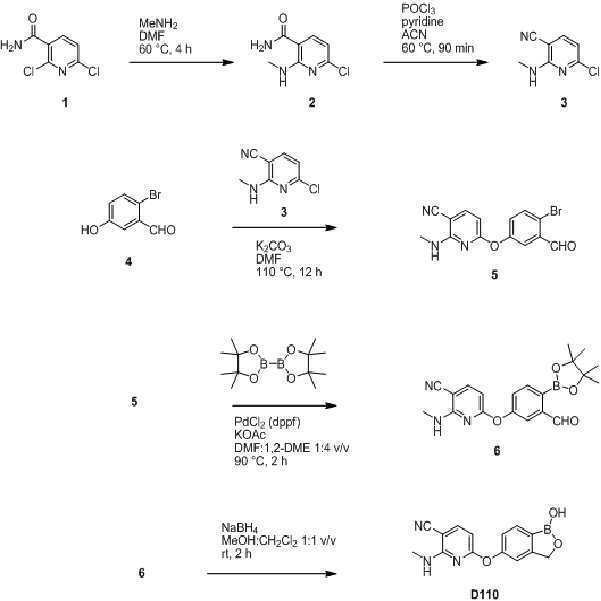
6-6- 클로로Chloro -2--2- 메틸아미노Methyl amino -니코틴아미드 (2)- Nicotinamide (2)
2,6-디클로로-니코틴아미드 (1)의 준비를 위해 D46의 합성을 참고한다. 2,6-디클로로-니코틴아미드 (1) (6.23 g, 32.6 mmol) 및 메틸아민 (98 mL of 2M in THF, 196 mmol)의 무수 디메틸포름아미드 (60 mL)이 포함된 밀봉된 반응 용기는 4시간 동안 60℃로 가열되었다. 반응물은 실온으로 냉각되고, 물로 희석되고(800 mL), 에틸 아세테이트 (4×600 mL)로 추출되었다. 모든 유기물이 복합되어, Na2SO4상에서 건조되었고, 여과되었고, 농축되어 밝은 오렌지색 오일 (7.10 g)이 제공되었다. 오일은 CH2Cl2 (300 mL)으로 희석되고, 실리카 겔(50 g, 230-400 mesh)가 첨가되고, 건조되도록 농축되었다. 이를 실리카 컬럼 (200 g, 230-400 mesh)에 얹고, 그라디언트 30-50 % EtOAc/헥산으로 용리시켰다. 순수 분취물들은 복합되고, 농축되어 표제 화합물이 백색 고체 (4.73 g, 78 % 분리된 산출량)로 제공되었다. 50 % EtOAc/헥산으로 용리시키고, UV 램프 제공되면, TLC는 Rf = 0.5이었다; 1H NMR 400 MHz (CDCl3) δ 7.47 (d, J = 8.5 Hz, 1H), 7.90 (d, J = 7.9 Hz, 1H), 1.48 (s, 3H).Refer to the synthesis of D46 for the preparation of 2,6-dichloro-nicotinamide (1). A sealed reaction vessel containing anhydrous dimethylformamide (60 mL) of 2,6-dichloro-nicotinamide (1) (6.23 g, 32.6 mmol) and methylamine (98 mL of 2M in THF, 196 mmol) Gt; 60 C < / RTI > The reaction was cooled to room temperature, diluted with water (800 mL) and extracted with ethyl acetate (4 x 600 mL). All organics were combined, dried over Na 2 SO 4 , filtered and concentrated to give a light orange oil (7.10 g). The oil was diluted with CH 2 Cl 2 (300 mL) and silica gel (50 g, 230-400 mesh) was added and concentrated to dryness. It was placed on a silica column (200 g, 230-400 mesh) and eluted with gradient 30-50% EtOAc / hexanes. The pure aliquots were combined and concentrated to give the title compound as a white solid (4.73 g, 78% isolated yield). Elution with 50% EtOAc / hexanes and, provided a UV lamp, TLC was R f = 0.5; 1
6-6- 클로로Chloro -2--2- 메틸아미노Methyl amino -- 니코틴니트릴Nicotine nitrile (3) (3)
6-클로로-2-메틸아미노-니코틴니트릴 ( 3)의 합성을 위한 실험 과정은 D46의 합성에서 설명된 것과 동일하다. 60 ℃에서 90분간 6-클로로-2-메틸아미노-니코틴아미드 (2) (4.70 g, 25.54 mmol)와 포스포러스 옥시클로라이드 (7.0 mL, 76.6 mmol) 및 피리딘 (12.3 mL, 152 mmol)의 아세토니트릴 (60 mL) 반응으로 미정제 검정 오일이 제공되었다. 검정 오일은 드라이-팩 컬럼 크로마토그래피에 의해 다음과 같이 분취되었다: 오일은 CH2Cl2 (300 mL)으로 희석되고, 실리카 겔(50 g, 230-400 mesh)이 첨가되었고, 건조되도록 농축되었다. 이를 실리카 컬럼 (100 g, 230-400 mesh)에 얹고, 20 % EtOAc/헥산으로 용리시켰다. 순수 분취물은 복합되고, 농축되어 표제 화합물이 백색 고체 (2.91 g, 69 % 분리된 산출량)로 제공되었다. 10 % EtOAc/헥산으로 용리되고, UV 램프로 제공되면, TLC는 Rf = 0.4이었다; 1H NMR 400 MHz (d 6 -DMSO) δ 7.91 (d, J = 7.8 Hz, 1H), 7.52 (br q, J = 4.7 Hz, 1H), 6.67 (d, J = 7.8 Hz, 1H), 2.80 (d, J = 4.7 Hz, 3H).The experimental procedure for the synthesis of 6-chloro-2-methylamino-nicotinonitrile ( 3) is the same as that described for the synthesis of D46 . A solution of 6-chloro-2-methylamino-nicotinamide (2) (4.70 g, 25.54 mmol), phosphorus oxychloride (7.0 mL, 76.6 mmol) and pyridine (12.3 mL, 152 mmol) in acetonitrile (60 mL) gave the crude black oil. The black oil was collected by dry-pack column chromatography as follows: The oil was diluted with CH 2 Cl 2 (300 mL), silica gel (50 g, 230-400 mesh) was added and concentrated to dryness . It was placed on a silica column (100 g, 230-400 mesh) and eluted with 20% EtOAc / hexane. The pure aliquots were combined and concentrated to give the title compound as a white solid (2.91 g, 69% isolated yield). Elution with 10% EtOAc / hexanes and, provided as a UV lamp, TLC was R f = 0.4; 1 H NMR 400 MHz (d 6 -DMSO) δ 7.91 (d, J = 7.8 Hz, 1H), 7.52 (br q, J = 4.7 Hz, 1H), 6.67 (d, J = 7.8 Hz, 1H), 2.80 (d, J = 4.7 Hz, 3 H).
6-(4'-6- (4'- 브로모Bromo -3'--3'- 포밀Formyl -- 페녹시Phenoxy )-2-)-2- 메틸아미노Methyl amino -- 니코틴니트릴Nicotine nitrile (5) (5)
6-(4'-브로모-3'-포밀-페녹시)-2-메틸아미노-니코틴니트릴 ( 5)의 합성을 위한 실험 과정은 (D46) 의 합성에서 설명된 것과 동일하나, 단 반응물은 110℃에서 12 h 동안 가열되었다. 6-클로로-2-메틸아미노-니코틴니트릴 (3) (1.90 g, 11.3 mmol), 2-브로모-5-하이드록시-벤즈알데히드 (4) (1.52 g, 7.56 mmol) 및 K2CO3 (2.09 g, 15.1 mmol)의 DMF (45 mL)의 반응으로 작업시 미정제 오일이 제공되었다. 오일은 다음과 같이, 드라이-팩 컬럼 크로마토그래피에 의해 분취되었다: 오일은 CH2Cl2 (400 mL)으로 희석되고, 실리카 겔(50 g, 230-400 mesh)이 첨가되었고, 건조되도록 농축되었다. 이를 실리카 컬럼 (200 g, 230-400 mesh)에 얹고, 그라디언트 10-30 % EtOAc/헥산으로 용리시켰다. 순수 분취물들은 복합되고, 농축되어 표제 화합물이 백색 고체 (1.42 g, 57 % 분리된 산출량)로 제공되었다. 10 % EtOAc/헥산으로 용리되고, UV 램프로 제공된 TLC는 Rf = 0.2이었다; 1H NMR 400 MHz (CDCl3) δ 10.35 (s, 1H), 7.80 (d, J = 2.7 Hz, 1H), 7.67 (d, J = 8.6 Hz, 1H), 7.64 (d, J = 8.2 Hz, 1H), 7.30 (dd, J = 8.6, 3.1 Hz, 1H), 6.20 (d, J = 8.2 Hz, 1H), 5.20 (br s, 1H), 2.80 (d, J = 4.7 Hz, 1H).The experimental procedure for the synthesis of 6- (4'-bromo-3'-formyl-phenoxy) -2-methylamino-nicotinonitrile ( 5) is identical to that described for the synthesis of (D46) Gt; 110 C < / RTI > for 12 h. 6-chloro-2-methylamino-nicotinic nitrile (3) (1.90 g, 11.3 mmol), 2- bromo-5-hydroxy-benzaldehyde (4) (1.52 g, 7.56 mmol) and K 2 CO 3 (2.09 g, 15.1 mmol) in DMF (45 mL) provided the crude oil during operation. The oil was collected by dry-pack column chromatography as follows: The oil was diluted with CH 2 Cl 2 (400 mL), silica gel (50 g, 230-400 mesh) was added and concentrated to dryness . This was placed on a silica column (200 g, 230-400 mesh) and eluted with gradient 10-30% EtOAc / hexanes. The pure aliquots were combined and concentrated to give the title compound as a white solid (1.42 g, 57% isolated yield). TLC eluted with 10% EtOAc / hexanes and furnished with UV lamp was R f = 0.2; 1 H NMR 400 MHz (CDCl 3 ) δ 10.35 (s, 1H), 7.80 (d, J = 2.7 Hz, 1H), 7.67 (d, J = 8.6 Hz, 1H), 7.64 (d, J = 8.2 Hz, 1H), 7.30 (dd, J = 8.6,3.1 Hz, 1H), 6.20 (d, J = 8.2 Hz, 1H), 5.20 (br s, 1H), 2.80 (d, J = 4.7 Hz, 1H).
6-[3- 포밀 -4-(4,4,5,5- 테트라메틸 -[1,3, 2]디옥사보란 -2-일)- 페녹시 ]-2- 메틸아미노-니코틴니트릴 (6) 6- [3-formyl-4- (4,4,5,5-tetramethyl- [1, 3, 2] dioxa-boran-2-yl) -phenoxy] -2-methylamino-nicotinic nitrile (6 )
6-[3-포밀-4-(4,4,5,5-테트라메틸-[1,3,2]디옥사보란-2-일)-페녹시]-2-메틸아미노-니코틴니트릴 ( 6)의 합성을 위한 실험 과정은 D46의 합성에 설명된 것과 동일하다. 6 (1.40 g, 4.21 mmol), 비스(피나콜라토)다이보론 (3.21 g, 12.6 mmol) 및 칼륨 아세테이트 (1.24 g, 12.6 mmol) 의 디메틸포름아미드 (15 mL) 및 1,2-디메톡시에탄(45 mL) 의 용매 혼합물의 반응으로 작업시 검정 오일이 제공되었다. 검정 오일은 다음과 같이 드라이-팩 컬럼 크로마토그래피에 의해 분취되었다: 오일은 CH2Cl2 (400 mL)으로 희석되고, 실리카 겔(50 g, 230-400 mesh)이 첨가되고, 건조되도록 농축되었다. 이를 실리카 컬럼 (100 g, 230-400 mesh)에 얹고, 그라디언트 10-40 % EtOAc/헥산으로 용리시켰다. 순수 분취물들이 복합되고, 농축되어 밝은 회색을 띈 고체로 된 표제 화합물(510 mg, 33 % 분리된 산출량)에 제공되었다. 25 % EtOAc/헥산의 두가지 용리액 및 UV 램프로 제공된 TLC는 Rf = 0.3가 되었다; 1H NMR 400 MHz (d 6 -DMSO) δ 10.40 (s, 1H), 7.94 (d, J = 8.2 Hz, 1H), 7.82 (d, J = 8.2 Hz, 1H), 7.71 (d, J = 2.3 Hz, 1H), 7.54 (dd, J = 8.2, 2.3 Hz, 1H), 7.32 (br q, J = 4.3 Hz, 1H), 6.26 (d, J = 8.6 Hz, 1H), 2.58 (d, J = 4.3 Hz, 3H), 1.35 (s, 12H).6- [3-formyl-4- (4,4,5,5-tetramethyl- [1,3,2] dioxa-boran-2-yl) -phenoxy] -2-methylamino-nicotinic nitrile (6 ) Was identical to that described for the synthesis of D46 . A mixture of dimethylformamide (15 mL) and 1,2-dimethoxyethane (1.40 g, 4.21 mmol), bis (pinacolato) diboron (3.21 g, 12.6 mmol) and potassium acetate (45 mL), a black oil was provided upon work. The black oil was collected by dry-pack column chromatography as follows: The oil was diluted with CH 2 Cl 2 (400 mL), silica gel (50 g, 230-400 mesh) was added and concentrated to dryness . This was placed on a silica column (100 g, 230-400 mesh) and eluted with gradient 10-40% EtOAc / hexanes. The pure fractions were combined and concentrated to give the title compound as a light gray solid (510 mg, 33% isolated yield). The two eluents of 25% EtOAc / hexane and the TLC provided with UV lamp gave Rf = 0.3; 1 H NMR 400 MHz (d 6 -DMSO) δ 10.40 (s, 1H), 7.94 (d, J = 8.2 Hz, 1H), 7.82 (d, J = 8.2 Hz, 1H), 7.71 (d, J = 2.3 Hz, 1H), 7.54 (dd , J = 8.2, 2.3 Hz, 1H), 7.32 (br q, J = 4.3 Hz, 1H), 6.26 (d, J = 8.6 Hz, 1H), 2.58 (d, J = 4.3 Hz, 3H), 1.35 (s, 12H).
6-(1- 하이드록시 -1,3- 디하이드로 - 벤조[c][1,2]옥사보롤 -5-일 옥시 )-2- 메틸아미노-니코틴니트릴 (D110) 6- (1-hydroxy-1,3-dihydro-benzo [c] [1,2] oxazole borol 5-yl) -2-methyl-O diamino-nicotinamide nitrile (D110)
6-(1-하이드록시-1,3-디하이드로-벤조[c][1,2]옥사보롤-5-일 옥시)-2-메틸아미노-니코틴니트릴 (D110) 의 합성을 위한 실험 과정은 (D46)의 합성에서 설명된 것과 동일하다. 6-[3-포밀-4-(4,4,5,5-테트라메틸-[1,3,2]디옥사보란-2-일)-페녹시]-2-메틸아미노-니코틴니트릴 (6) (490 mg, 1.35 mmol) 과 NaBH4 (102 mg, 2.69 mmol)의 반응으로 작업시 D110 가 포함된 오렌지색 오일이 제공되었다. 오일은 드라이-팩 컬럼 크로마토그래피에 의해 다음과 같이 분취되었다: 오일은 CH2Cl2 (300 mL)으로 희석되고, 실리카 겔(30 g, 230-400 mesh)이 첨가되었고, 건조되도록 농축되었다. 이를 실리카 컬럼 (150 g, 230-400 mesh)에 얹고, 0.5:0.5:100 아세트산:MeOH:CH2Cl2으로 용리시켰다. D110 이 포함된 분취물들이 수거되었고, 그리고 농축되어, 밝은 황색을 띈 오일이 제공되었다. 오일은 메탄올 (50 mL)으로 우선 희석하고, 탈이온수(300 mL)가 첨가되어 동결-건조되었고, 생성된 백색 현탁액은 드라이아이스 아세톤 바스에서 냉동되었고, 냉동-건조기상에 하룻밤 두었다. 백색 고체 의 D110 이 수득되었다(243 mg, 64 % 분리된 산출량). 1H NMR 400 MHz (d 6 -DMSO) δ 9.20 (s, 1H), 7.88 (d, J = 8.2 Hz, 1H), 7.76 (d, J = 8.2 Hz, 1H), 7.25 (br s, 1H), 7.24 (s, 1H), 7.15 (d, J = 8.2 Hz, 1H), 6.13 (d, J = 8.2 Hz, 1H), 4.98 (s, 2H), 2.61 (d, J = 4.3 Hz, 3H); 질량 스펙트럼[M+H] + = 282; HPLC 순도 94.93 % (Maxplot), 93.43 % (220 nm).The experimental procedure for the synthesis of 6- (1-hydroxy-1,3-dihydro-benzo [c] [1,2] oxaborol-5-yloxy) -2-methylamino- nicotinonitrile (D46) . ≪ / RTI > (4,4,5,5-tetramethyl- [1,3,2] dioxaborane-2-yl) -phenoxy] -2-methylamino-nicotinonitrile ) (490 mg, 1.35 mmol) and NaBH 4 (102 mg, 2.69 mmol) provided an orange oil containing D110 in operation. The oil was collected by dry-pack column chromatography as follows: The oil was diluted with CH 2 Cl 2 (300 mL) and silica gel (30 g, 230-400 mesh) was added and concentrated to dryness. This was placed on a silica column (150 g, 230-400 mesh) and eluted with 0.5: 0.5: 100 acetic acid: MeOH: CH 2 Cl 2 . Aliquots containing D110 were collected and concentrated to provide a light yellowish oil. The oil was first diluted with methanol (50 mL), deionized water (300 mL) was added and freeze-dried, and the resulting white suspension was frozen in a dry ice acetone bath and placed on a freeze-drying oven overnight. A white solid of D110 was obtained (243 mg, 64% isolated yield). 1 H NMR 400 MHz (d 6 -DMSO) δ 9.20 (s, 1H), 7.88 (d, J = 8.2 Hz, 1H), 7.76 (d, J = 8.2 Hz, 1H), 7.25 (br s, 1H) , 7.24 (s, 1H), 7.15 (d, J = 8.2 Hz, 1H), 6.13 (d, J = 8.2 Hz, 1H), 4.98 (s, 2H), 2.61 (d, J = 4.3 Hz, 3H) ; Mass spectrum [M + H] < + > = 282; HPLC purity 94.93% (Maxplot), 93.43% (220 nm).
19dn 6-(1- 하이드록시 -1,3- 디하이드로 - 벤조[c][1,2]옥사보롤 -5-일 옥시 )-2- (2-메톡시-에틸아미노)-니코틴니트릴 (D111) 19dn 6- (1- hydroxy-1,3-dihydro-benzo [c] [1,2] oxazole borol 5-yl) -2 (2-methoxy-ethylamino) nicotinic nitrile (D111 )

6-6- 클로로Chloro -2-(2--2- (2- 메톡시Methoxy -- 에틸아미노Ethylamino )-니코틴아미드 (2)) -Nicotinamide < / RTI > (2)
2,6-디클로로-니코틴아미드 (1)의 합성을 위하여 D46의 합성을 참고한다. 2,6-디클로로-니코틴아미드 (1) (8.66 g, 45.3 mmol) and 2-메톡시-에틸아민 (15.6 mL, 181 mmol)의 무수 디메틸포름아미드 (40 mL) 이 포함된 밀봉된 반응 용기는 7시간 동안 60℃ 로 가열되었다. 반응물은 실온으로 냉각되었다. 디메틸포름아미드는 70℃에서 수조가 있는 회전 농축기에 의해 톨루엔 (6×700 mL)의 첨가 및 기화에 의해 공비증류적(azeotropically)으로 제거되었다. 오렌지색 오일이 수득되었다 (12.2 g). 오일은 드라이-팩 컬럼 크로마토그래피에 의해 다음과 같이 분취되었다: 오일은 CH2Cl2 (400 mL)으로 희석되고, 실리카 겔(100 g, 230-400 mesh) 첨가후, 건조되도록 농축되었다. 이를 실리카 컬럼 (200 g, 230-400 mesh)에 얹고, 50 % EtOAc/헥산으로 용리시켰다. 순수 분취물은 복합되었고, 농축되어 표제 화합물은 백색 고체 (5.37 g, 64 % 분리된 산출량)로 제공되었다. 1H NMR 400 MHz (d 6 -DMSO) δ 7.79 (d, J = 7.8 Hz, 1H), 7.30 (s, 1H), 6.76 (d, J = 7.8 Hz, 1H), 6.52 (s, 1H), 4.04 (br t, J = 4.7 Hz, 1H), 3.80 (td, J = 5.5, 4.7 Hz, 2H), 3.63 (t, J = 5.5 Hz, 2H), 2.94 (s, 3H).For the synthesis of 2,6-dichloro-nicotinamide (1), reference is made to the synthesis of D46 . A sealed reaction vessel containing anhydrous dimethylformamide (40 mL) of 2,6-dichloro-nicotinamide (1) (8.66 g, 45.3 mmol) and 2-methoxy-ethylamine (15.6 mL, 181 mmol) Gt; 60 C < / RTI > for 7 hours. The reaction was cooled to room temperature. Dimethylformamide was removed azeotropically by addition of toluene (6 x 700 mL) and evaporation by means of a rotary evaporator with a bath at 70 < 0 > C. An orange oil was obtained (12.2 g). The oil was collected by dry-pack column chromatography as follows: The oil was diluted with CH 2 Cl 2 (400 mL) and concentrated to dryness after addition of silica gel (100 g, 230-400 mesh). It was placed on a silica column (200 g, 230-400 mesh) and eluted with 50% EtOAc / hexane. The pure aliquots were combined and concentrated to give the title compound as a white solid (5.37 g, 64% isolated yield). 1 H NMR 400 MHz (d 6 -DMSO) δ 7.79 (d, J = 7.8 Hz, 1H), 7.30 (s, 1H), 6.76 (d, J = 7.8 Hz, 1H), 6.52 (s, 1H), 4.04 (br t, J = 4.7 Hz, 1H), 3.80 (td, J = 5.5, 4.7 Hz, 2H), 3.63 (t, J = 5.5 Hz, 2H), 2.94 (s, 3H).
6-6- 클로로Chloro -2-(2--2- (2- 메톡시Methoxy -- 에틸아미노Ethylamino )-) - 니코틴니트릴Nicotine nitrile (3) (3)
6-클로로-2-(2-메톡시-에틸아미노)-니코틴니트릴 (3) 의 합성을 위한 실험 과정은 (D46)의 합성에서 설명된 것과 동일하다. 6-클로로-2-(2-메톡시-에틸아미노)-니코틴아미드 (2) (6.85 g, 36.9 mmol)과 포스포러스 옥시클로라이드 (10.1 mL, 111 mmol) 및 피리딘 (17.9 mL, 221 mmol)의 아세토니트릴 (90 mL) 반응으로 작업시 표제 화합물 (6.97 g. 전환율 98 %)이 포함된 검정 오일이 제공되었다. 표제 화합물은 추가 정제 없이 이월되었다. 1H NMR 400 MHz (d 6 -DMSO) δ 7.94 (d, J = 7.8 Hz, 1H), 7.50 (br s, 1H), 6.71 (d, J = 8.2 Hz, 1H), 3.54-3.43 (m, 4H), 3.26 (s, 3H).The experimental procedure for the synthesis of 6-chloro-2- (2-methoxy-ethylamino) -nicotinonitrile (3) is the same as described in the synthesis of (D46) . A mixture of 6-chloro-2- (2-methoxy-ethylamino) -nicotinamide (2) (6.85 g, 36.9 mmol), phosphorus oxychloride (10.1 mL, 111 mmol) and pyridine (17.9 mL, 221 mmol) Acetonitrile (90 mL) provided a black oil containing the title compound (6.97 g, 98% conversion) during work-up. The title compound was carried forward without further purification. 1 H NMR 400 MHz (d 6 -DMSO) δ 7.94 (d, J = 7.8 Hz, 1H), 7.50 (br s, 1H), 6.71 (d, J = 8.2 Hz, 1H), 3.54-3.43 (m, 4H), 3.26 (s, 3H).
6-(4'-6- (4'- 브로모Bromo -3'--3'- 포밀Formyl -- 페녹시Phenoxy )-2-(2-) -2- (2- 메톡시Methoxy -- 에틸아미노Ethylamino )-) - 니코틴니트릴Nicotine nitrile (5) (5)
6-(4'-브로모-3'-포밀-페녹시)-2-(2-메톡시-에틸아미노)-니코틴니트릴 (5) 의 합성을 위한 실험적 과정은 D46 의 합성에서 설명된 것과 동일하나, 단, 반응물은 12시간 동안 110℃에서 가열되었다. 6-클로로-2-(2-메톡시-에틸아미노)-니코틴니트릴 (3) (5.13 g, 24.2 mmol), 2-브로모-5-하이드록시-벤즈알데히드 (4) (3.25 g, 16.2 mmol) 및 K2CO3 (4.47 g, 32.3 mmol)의 DMF (45 mL) 반응으로 작업시 미정제오일로 된 5 가 제공되었다. 오일은 드라이-팩 컬럼 크로마토그래피에 의해 다음과 같이 분취되었다: 오일은 10 % MeOH/CH2Cl2 (300 mL)으로 희석되고, 실리카 겔(70 g, 230-400 mesh)이 첨가되었고, 건조되도록 농축되었다. 이를 실리카 컬럼 (140 g, 230-400 mesh)에 얹고, 그라디언트 10-40 % EtOAc/헥산으로 용리시켰다. 순수 분취물들은 복합되고 농축되어 표제 화합물이 백색 고체 (4.71 g, 52 % 분리된 산출량)로 제공되었다. 25 % EtOAc/헥산으로 용리되고, UV 램프가 제공된 TLC는 Rf = 0.3이었다;1H NMR 400 MHz (CDCl3) δ 10.29 (s, 1H), 7.70 (d, J = 3.0 Hz, 1H), 7.63 (d, J = 8.6 Hz, 1H), 7.61 (d, J = 8.2 Hz, 1H), 7.23 (dd, J = 8.6, 3.0 Hz, 1H), 6.17 (d, J = 8.2 Hz, 1H), 5.57 (br s, 1H), 3.37-3.27 (4H), 3.26 (s, 3H).The experimental procedure for the synthesis of 6- (4'-bromo-3'-formyl-phenoxy) -2- (2-methoxy- ethylamino) -nicotinonitrile (5) D46 , except that the reaction was heated at < RTI ID = 0.0 > 110 C < / RTI > for 12 hours. 6-chloro-2- (2-methoxy-ethylamino) nicotinic nitrile (3) (5.13 g, 24.2 mmol), 2-bromo-5-hydroxy-benzaldehyde (4) (3.25 g, 16.2 mmol) And K 2 CO 3 (4.47 g, 32.3 mmol) in DMF (45 mL) gave the
6-[3- 포밀 -4-(4,4,5,5- 테트라메틸 -[1,3, 2]디옥사보란 -2-일)- 페녹시 ]-2-(2- 메톡시-에틸아미노)-니코틴니트릴 (6) 6- [3-formyl-4- (4,4,5,5-tetramethyl- [1, 3, 2] dioxa-boran-2-yl) phenoxy] -2- (2-methoxy-ethyl Amino) -nicotinonitrile (6)
6-[3-포밀-4-(4,4,5,5-테트라메틸-[1,3,2]디옥사보란-2-일)-페녹시]-2-(2-메톡시-에틸아미노)-니코틴니트릴 (6)의 합성을 위한 실험 과정은 (D46)의 합성에서 설명된 것과 동일하다. 5 (4.70 g, 12.5 mmol), 비스(피나콜라토 )다이보론 (6.35 g, 25.0 mmol) 및 칼륨 아세테이트 (2.45 g, 25.0 mmol)의 1,2-디메톡시에탄(120 mL) 반응으로 갈색 오일이 제공되었다. 갈색 오일은 드라이-팩 컬럼 크로마토그래피에 의해 다음과 같이 분취되었다: 오일은 CH2Cl2 (400 mL)으로 희석되고, 실리카 겔(70 g, 230-400 mesh)이 첨가되었고, 건조되도록 농축되었다. 이를 실리카 컬럼 (140 g, 230-400 mesh)에 얹고, 그라디언트 10-20 % EtOAc/헥산으로 용리시켰다. 순수 분취물들은 복합되고, 농축되어 표제 화합물은 밝은 황색 고체 (4.24 g, 80 % 분리된 산출량)가 제공되었다. 1H NMR 400 MHz (d 6 -DMSO) δ 10.38 (s, 1H), 7.93 (d, J = 8.2 Hz, 1H), 7.80 (d, J = 8.2 Hz, 1H), 7.66 (d, J = 2.3 Hz, 1H), 7.50 (dd, J = 8.2, 2.3 Hz, 1H), 7.29 (br s, 1H), 6.29 (d, J = 8.2 Hz, 1H), 3.32 (s, 3H), 3.17-3.13 (4H), 1.33 (s, 12H).(4,4,5,5-tetramethyl- [1,3,2] dioxaborane-2-yl) -phenoxy] -2- Amino) -nicotinonitrile (6) is identical to that described in the synthesis of (D46) . 1,2-dimethoxyethane (120 mL) reaction of 5 (4.70 g, 12.5 mmol), bis (pinacolato) diboron (6.35 g, 25.0 mmol) and potassium acetate (2.45 g, 25.0 mmol) Lt; / RTI > The brown oil was collected by dry-pack column chromatography as follows: The oil was diluted with CH 2 Cl 2 (400 mL), silica gel (70 g, 230-400 mesh) was added and concentrated to dryness . This was placed on a silica column (140 g, 230-400 mesh) and eluted with gradient 10-20% EtOAc / hexanes. The pure aliquots were combined and concentrated to give the title compound as a light yellow solid (4.24 g, 80% isolated yield). 1 H NMR 400 MHz (d 6 -DMSO) δ 10.38 (s, 1H), 7.93 (d, J = 8.2 Hz, 1H), 7.80 (d, J = 8.2 Hz, 1H), 7.66 (d, J = 2.3 Hz, 1H), 7.50 (dd , J = 8.2, 2.3 Hz, 1H), 7.29 (br s, 1H), 6.29 (d, J = 8.2 Hz, 1H), 3.32 (s, 3H), 3.17-3.13 ( 4H), 1.33 (s, 12H).
6-(1- 하이드록시 -1,3- 디하이드로 - 벤조[c][1,2]옥사보롤 -5-일 옥시 )-2-(2- 메톡시-에틸아미노)-니코틴니트릴 (D111) 6- (1-hydroxy-1,3-dihydro-benzo [c] [1,2] oxazole borol 5-yl) -2 (2-methoxy-ethylamino) nicotinic nitrile (D111)
6-(1-하이드록시-1,3-디하이드로-벤조[c][1,2]옥사보롤-5-일 옥시)-2-(2-메톡시-에틸아미노)-니코틴니트릴 (D111)의 합성을 위한 실험 과정은 (D46)에서 설명된 것과 동일하다. 6-[3-포밀-4-(4,4,5,5-테트라메틸-[1,3,2]디옥사보란-2-일)-페녹시]-2-(2-메톡시-에틸아미노)-니코틴니트릴 (6) (4.20 g, 9.92 mmol)과 NaBH4 (750 mg, 19.8 mmol)의 반응으로 작업시 D111 이 포함된 오렌지색 오일이 제공되었다. 오일은 드라이-팩 컬럼 크로마토그래피에 의해 다음과 같이 분취되었다: 오일은 10 % MeOH/CH2Cl2 (400 mL)으로 희석되고, 실리카 겔(70 g, 230-400 mesh)이 첨가되고, 건조되도록 농축되었다. 이를 실리카 컬럼 (210 g, 230-400 mesh) 에 얹고, 1:1:100 아세트산:MeOH:CH2Cl2으로 용리시켰다. D111 이 포함된 분취물들이 수거되었고, 농축되어, 밝은 황색을 띈 오일이 제공되었다. 오일은 우선 아세토니트릴 (40 mL)로 희석시키고, 탈이온수 (400 mL)를 첨가하여 동결-건조되었고, 생성된 백색 현탁액은 드라이아이스 아세톤 바스에서 동결되고, 냉동-건조기상에 하룻밤 두었다. 백색 고체의 D111가 수득되었다(1H NMR 에 의해 측정된 결과 1.70 g+ 30 mol % 피나콜디올). D111의 순도를 증가시키기 위하여, 상기와 동일한 조건하에 다시 컬럼 크로마토그래피하고, 동결-건조되어, D111 가 백색 고체 (972 mg, 30 % 분리된 산출량)로 제공되었다. 1H NMR 400 MHz (d 6 -DMSO) δ 9.21 (s, 1H), 7.90 (d, J = 8.2 Hz, 1H), 7.76 (d, J = 7.8 Hz, 1H), 7.25 (br t, J = 4.7 Hz, 1H), 7.24 (d, J = 1.5 Hz, 1H), 7.14 (dd, J = 7.8, 1.5 Hz, 1H), 6.22 (d, J = 8.6 Hz, 1H), 4.97 (s, 2H), 3.33 (s, 3H), 3.25-3.15 (m, 4H); 질량 스펙트럼[M+H]+ = 324; HPLC 순도 97.36 % (Maxplot), 97.21 % (220 nm), 96.44 % (254 nm).2- (2-methoxy-ethylamino) -nicotinonitrile (D111 ) was prepared in a manner similar to that described in Example < RTI ID = (D46) . ≪ / RTI > (4,4,5,5-tetramethyl- [1,3,2] dioxaborane-2-yl) -phenoxy] -2- Amino) -nicotinonitrile (6) (4.20 g, 9.92 mmol) and NaBH 4 (750 mg, 19.8 mmol) provided an orange oil containing D111 in operation. The oil was collected by dry-pack column chromatography as follows: The oil was diluted with 10% MeOH / CH 2 Cl 2 (400 mL), silica gel (70 g, 230-400 mesh) Lt; / RTI > This was placed on a silica column (210 g, 230-400 mesh) and eluted with 1: 1: 100 acetic acid: MeOH: CH 2 Cl 2 . Aliquots containing D111 were collected and concentrated to give a light yellowish oil. The oil was first diluted with acetonitrile (40 mL), freeze-dried by adding deionized water (400 mL), and the resulting white suspension was frozen in a dry ice acetone bath and placed on a freeze-drying oven overnight. D111 was obtained as a white solid (1.70 g + 30 mol% pinacol diol as determined by 1 H NMR). To increase the purity of D111 , column chromatography again under the same conditions as above, freeze-dried, D111 was provided as a white solid (972 mg, 30% isolated yield). 1 H NMR 400 MHz (d 6 -DMSO) δ 9.21 (s, 1H), 7.90 (d, J = 8.2 Hz, 1H), 7.76 (d, J = 7.8 Hz, 1H), 7.25 (br t, J = 4.7 Hz, 1H), 7.24 ( d, J = 1.5 Hz, 1H), 7.14 (dd, J = 7.8, 1.5 Hz, 1H), 6.22 (d, J = 8.6 Hz, 1H), 4.97 (s, 2H) , 3.33 (s, 3H), 3.25 - 3.15 (m, 4H); Mass spectrum [M + H] < + > = 324; HPLC purity 97.36% (Maxplot), 97.21% (220 nm), 96.44% (254 nm).
19do 6-(1- 하이드록시 -1,3- 디하이드로 - 벤조[c][1,2]옥사보롤 -5-일 옥시 )-2- 메톡시-니코틴아미드 (D112) 19do 6- (1- hydroxy-1,3-dihydro-benzo [c] [1,2] oxazole borol 5-yl) -2-methoxy-nicotinamide (D112)

6-(4-6- (4- 브로모Bromo -3--3- 포밀Formyl -- 페녹시Phenoxy )-2-)-2- 메톡시Methoxy -니코틴아미드 (3) - nicotinamide (3)
6-클로로-2-메톡시-니코틴아미드 (7.15 g, 38.3 mmol), 2-브로모-5-하이드록시-벤즈알데히드 (11.5 g, 57.5 mmol) 및 K2CO3 (15.9 g, 115 mmol)의 디메틸포름아미드 (60 mL) 혼합물은 18시간 동안 110℃로 가열되었다. 반응 혼합물은 실온으로 냉각되었고, H2O (800 mL)으로 희석되었고, 에틸 아세테이트 (6 × 400 mL)로 추출되었다. 유기 추출물들이 복합되어, Na2SO4상에서 건조되었고, 여과되었고, 농축되었다. 잔유물은 실리카 겔 플래쉬 컬럼 크로마토그래피 (50-80 % 에틸 아세테이트/헥산)에 의해 정제되어, 표제 화합물이 밝은 갈색 고체 (5.19 g, 39 % 산출량)로 제공되었다.(7.15 g, 38.3 mmol), 2-bromo-5-hydroxy-benzaldehyde (11.5 g, 57.5 mmol) and K 2 CO 3 (15.9 g, 115 mmol) The dimethylformamide (60 mL) mixture was heated to 110 < 0 > C for 18 h. The reaction mixture was cooled to room temperature, diluted with H 2 O (800 mL) and extracted with ethyl acetate (6 × 400 mL). The organic extracts were combined, dried over Na 2 SO 4 , filtered and concentrated. The residue was purified by silica gel flash column chromatography (50-80% ethyl acetate / hexanes) to afford the title compound as a light brown solid (5.19 g, 39% yield).
1H NMR 400 MHz (d 6 - DMSO) δ 10.18 (s, 1H), 8.28 (d, J = 8.2 Hz, 1H), 7.85 (d, J = 8.6 Hz, 1H), 7.68 (d, J = 2.7 Hz, 1H), 7.59 (br s, 1H), 7.53 (dd, J = 8.6, 2.7 Hz, 1H), 7.53 (br s, 1H), 6.72 (d, J = 8.2 Hz, 1H), 3.71 (s, 3H). 1 H NMR 400 MHz (d 6 - DMSO) δ 10.18 (s, 1H), 8.28 (d, J = 8.2 Hz, 1H), 7.85 (d, J = 8.6 Hz, 1H), 7.68 (d, J = 2.7 Hz, 1H), 7.59 (br s, 1H), 7.53 (dd, J = 8.6, 2.7 Hz, 1H), 7.53 (br s, 1H), 6.72 (d, J = 8.2 Hz, 1H), 3.71 (s , 3H).
6-[3- 포밀 -4-(4,4,5,5- 테트라메틸 -[1,3, 2]디옥사보란 -2-일)- 페녹시 ]-2- 메톡시-니코틴아미드 (4) 6- [3-formyl-4- (4,4,5,5-tetramethyl- [1, 3, 2] dioxa-boran-2-yl) -phenoxy] -2-methoxy when -nicotinamide (4 )
6-(4-브로모-3-포밀-페녹시)-2-메톡시-니코틴아미드 (4.05 g, 11.5 mmol)의 1,2-디메톡시에탄(240 mL) 현탁액은 20분간 모든 고체가 용해될 때까지 100 ℃로 가열되었다. 비스피나콜라토 다이보론 (5.86 g, 23.1 mmol) 및 KOAc (2.26 g, 23.1 mmol)이 첨가되었고, 반응물은 추가 10분간 100℃에서 교반되었다. PdCl2(dppf) (0.84 g, 1.2 mmol)가 첨가되었고, 반응 혼합물은 100℃에서 70분간 교반되었다. 실리카 겔 플래쉬 컬럼 크로마토그래피 (50-80 % 에틸 아세테이트/헥산)에서 정제되어, 표제 화합물이 백색 고체 (3.21 g, 69 % 산출량)로 제공되었다.A suspension of 1,2-dimethoxyethane (240 mL) of 6- (4-bromo-3-formyl-phenoxy) -2-methoxy-nicotinamide (4.05 g, 11.5 mmol) RTI ID = 0.0 > 100 C. < / RTI > Bispinacolato diboron (5.86 g, 23.1 mmol) and KOAc (2.26 g, 23.1 mmol) were added and the reaction was stirred at 100 < 0 > C for an additional 10 min. PdCl 2 (dppf) (0.84 g, 1.2 mmol) was added and the reaction mixture was stirred at 100 ° C for 70 minutes. Purification in silica gel flash column chromatography (50-80% ethyl acetate / hexanes) provided the title compound as a white solid (3.21 g, 69% yield).
1H NMR 400 MHz (d 6-DMSO) δ 10.39 (s, 1H), 8.28 (d, J = 8.2 Hz, 1H), 7.82 (d, J = 8.2 Hz, 1H), 7.71 (d, J 2.3 Hz, 1H), 7.60 (br s, 1H), 7.53 (dd, J = 8.2, 2.3 Hz, 1H), 7.53 (br s, 1H), 6.71 (d, J = 8.2 Hz, 1H), 3.72 (s, 3H), 1.33 (s, 12H). 1 H NMR 400 MHz (d 6 -DMSO) δ 10.39 (s, 1H), 8.28 (d, J = 8.2 Hz, 1H), 7.82 (d, J = 8.2 Hz, 1H), 7.71 (d, J 2.3 Hz , 1H), 7.60 (br s , 1H), 7.53 (dd, J = 8.2, 2.3 Hz, 1H), 7.53 (br s, 1H), 6.71 (d, J = 8.2 Hz, 1H), 3.72 (s, 3H), 1.33 (s, 12H).
6-(1- 하이드록시 -1,3- 디하이드로 - 벤조[c][1,2]옥사보롤 -5-일 옥시 )-2- 메톡시-니코틴아미드 (D112) 6- (1-hydroxy-1,3-dihydro-benzo [c] [1,2] oxazole borol 5-yl) -2-methoxy-nicotinamide (D112)
NaBH4 (0.077 g, 2.0 mmol)의 무수 메탄올 (10 mL) 용액이 6-[3-포밀-4-(4,4,5,5-테트라메틸-[1,3,2]디옥사보란-2-일)-페녹시]-2-메톡시-니코틴아미드 (2.51 g, 6.30 mmol)의 CH2Cl2 (40 mL) 용액에 첨가되었고, 실온에서 5분간 교반되었다. 고체 NaBH4 (0.400 g, 10.6 mmol)가 실온에서 45분간에 걸쳐 부분적으로 첨가되었다. 반응물은 추가 30분간 교반되었고, 50% 수성 아세트산 (1 mL)이 첨가되어 진정되었다. 실온에서 추가 30분간 교반된 후에 용액은 진공에서 농축되었다. 잔유물은 실리카 겔 플래쉬 컬럼 크로마토그래피 (AcOH/MeOH/CH2Cl2 1:3:100 v/v/v )에 의해 정제되어, 표제 화합물은 백색의 보풀형(fluffy) 고체 (0.220 g, 12 % 산출량)로 제공되었다.A solution of NaBH 4 (0.077 g, 2.0 mmol) in anhydrous methanol (10 mL) was added to a solution of 6- [3-formyl-4- (4,4,5,5-tetramethyl- [1,3,2] dioxaborane- 2-yl) -phenoxy] -2-methoxy-nicotinamide (2.51 g, 6.30 mmol) in CH 2 Cl 2 (40 mL) and stirred at room temperature for 5 minutes. Solid NaBH 4 (0.400 g, 10.6 mmol) was added in portions over 45 minutes at room temperature. The reaction was stirred for an additional 30 min and was quenched by addition of 50% aqueous acetic acid (1 mL). After stirring for an additional 30 minutes at room temperature, the solution was concentrated in vacuo. The residue was purified by silica gel flash column chromatography (AcOH / MeOH / CH 2 Cl 2 1: 3: 100 v / v / v) to afford the title compound as a white fluffy solid (0.220 g, 12% Output).
1H NMR 400 MHz (d 6 -DMSO) δ 9.20 (s, 1H), 8.25 (d, J = 8.2 Hz, 1H), 7.76 (d, J = 7.8 Hz, 1H), 7.58 (br s, 1H), 7.53 (br s, 1H), 7.25 (br s, 1H), 7.16 (br d, J = 7.8 Hz, 1H), 6.58 (d, J = 8.2 Hz, 1H), 4.97 (s, 2H), 3.75 (s, 3H). 1 H NMR 400 MHz (d 6 -DMSO) δ 9.20 (s, 1H), 8.25 (d, J = 8.2 Hz, 1H), 7.76 (d, J = 7.8 Hz, 1H), 7.58 (br s, 1H) , 7.53 (br s, 1H) , 7.25 (br s, 1H), 7.16 (br d, J = 7.8 Hz, 1H), 6.58 (d, J = 8.2 Hz, 1H), 4.97 (s, 2H), 3.75 (s, 3 H).
질량 스펙트럼[M+H+] = 301. Mass spectrum [M + H < + >] = 301.
HPLC 순도 94.05 % (Maxplot), 94.02 % (220 nm), 92.23 % (254 nm).HPLC purity 94.02% (Maxplot), 94.02% (220 nm), 92.23% (254 nm).
19dp 2-(2- 벤질옥시 - 에틸아미노 )-6-(1- 하이드록시 -1,3- 디하이드로 - 벤 조[c][1,2]옥사보롤-5-일 옥시)-니코틴니트릴 (D113) 19dp 2- (2- benzyloxy-ethylamino) -6- (1-hydroxy-1,3-dihydro-ben crude [c] [1,2] oxazol-5-yl borol oxy) - nicotine nitrile ( D113)

2-(2-2- (2- 벤질옥시Benzyloxy -- 에틸아미노Ethylamino )-6-) -6- 클로로Chloro -니코틴아미드 (3)- nicotinamide (3)
2,6-디클로로-니코틴아미드 (1) (12.6 g, 66.1 mmol)의 아세토니트릴 (무수, 200 mL) 용액에 2-벤질옥시-에틸아민 (2) (10 g, 66.1 mmol) 및 트리에틸아민(11 mL, 79.3 mmol)이 첨가되었다. 반응물은 60 ℃에서 2일간 가열되었다. 용액은 실온으로 냉각되었고, 현탁액은 여과되었다. 여과액은 진공에서 기화되었다. 잔유물은 Biotage에서 25% - 100% EtOAc/헥산으로 정제되어, 15.8 g (78.3% 산출량)의 표제 화합물이 제공되었다.Benzyloxy-ethylamine (2) (10 g, 66.1 mmol) and triethylamine (2 mL) were added to a solution of 2,6-dichloro-nicotinamide (1) (12.6 g, 66.1 mmol) in acetonitrile (11 mL, 79.3 mmol) was added. The reaction was heated at 60 < 0 > C for 2 days. The solution was cooled to room temperature and the suspension was filtered. The filtrate was evaporated in vacuo. The residue was purified on Biotage with 25% - 100% EtOAc / hexanes to give 15.8 g (78.3% yield) of the title compound.
1H NMR (400 MHz, 클로로포름-d) δ ppm 8.70 (br. s., 1 H), 7.46 (d, J=8.2 Hz, 1 H), 7.40 - 7.23 (m, 5 H), 6.44 (d, J=8.2 Hz, 1 H), 5.97 (br. s., 2 H), 4.58 (s, 2 H), 3.75 - 3.66 (m, 4 H). 1 H NMR (400 MHz, chloroform -d) δ ppm 8.70 (br s , 1 H..), 7.46 (d, J = 8.2 Hz, 1 H), 7.40 - 7.23 (m, 5 H), 6.44 (d , J = 8.2 Hz, 1H), 5.97 (br s, 2H), 4.58 (s, 2H), 3.75-3.66 (m, 4H).
2-(2-2- (2- 벤질옥시Benzyloxy -- 에틸아미노Ethylamino )-6-) -6- 클로로Chloro -- 니코틴니트릴Nicotine nitrile (4) (4)
2-(2-벤질옥시-에틸아미노)-6-클로로-니코틴아미드 (3, 15.8 g, 51.7 mmol)의 아세토니트릴 (무수, 200 mL) 용액에 피리딘 (33.4 mL, 413 mmol) 및 POCl3 (18.9 mL, 207 mmol)이 첨가되었다. 반응물은 55 ℃에서 3시간 동안 가열되었다. 실온으로 냉각된 후, NaOH 용액 (10% aq.)은 pH가 9가 될 때까지 서서히 첨가되었다. EtOAc (200 mL)가 첨가되었고, 층들은 분리되었다. 수성 층은 EtOAc로 추출되었다 (2 x 200 mL). 복합된 유기 층은 MgSO4상에서 건조되었고, 여과되었고, 진공에서 기화되었다. 실리카 겔 크로마토그래피에서 2%-20% EtOAc/헥산 그라디언트로 용리시켜 정제되면, 10 g (67% 산출량)의 표제 산물이 제공되었다. 2- (2-benzyloxy-ethylamino) -6-chloro-nicotinamide (3, 15.8 g, 51.7 mmol ) in acetonitrile and pyridine (anhydrous, 200 mL) solution (33.4 mL, 413 mmol) and POCl 3 in ( 18.9 mL, 207 mmol). The reaction was heated at 55 < 0 > C for 3 hours. After cooling to room temperature, the NaOH solution (10% aq.) Was slowly added until the pH was 9. EtOAc (200 mL) was added, and the layers were separated. The aqueous layer was extracted with EtOAc (2 x 200 mL). The combined organic layer was dried over MgSO 4, was filtered and was evaporated in vacuo. After purification by silica gel chromatography eluting with 2% -20% EtOAc / hexane gradient, 10 g (67% yield) of the title product was provided.
1H NMR (400 MHz, 클로로포름-d) δ ppm 7.56 (d, J=7.8 Hz, 1 H), 7.41 - 7.27 (m, 5 H), 6.60 (d, J=7.8 Hz, 1 H), 5.68 (br. s., 1 H), 4.57 (s, 2 H), 3.76 - 3.63 (m, 4 H). 1 H NMR (400 MHz, chloroform -d) δ ppm 7.56 (d, J = 7.8 Hz, 1 H), 7.41 - 7.27 (m, 5 H), 6.60 (d, J = 7.8 Hz, 1 H), 5.68 (br s, 1H), 4.57 (s, 2H), 3.76-3.63 (m, 4H).
2-(2-2- (2- 벤질옥시Benzyloxy -- 에틸아미노Ethylamino )-6-(4-) -6- (4- 브로모Bromo -3--3- 포밀Formyl -- 페녹시Phenoxy )-) - 니코틴니트릴Nicotine nitrile (6) (6)
2-(2-벤질옥시-에틸아미노)-6-(4-브로모-3-포밀-페녹시)-니코틴니트릴 (4, 10 g, 34.7 mmol)의 DMF (무수, 300 mL) 용액에 2-브로모-5-하이드록시-벤즈알데히드 (7 g, 34.7 mmol) 및 K2CO3 (9.6 g, 69.4 mmol)이 첨가되었다. 반응물은 16시간 동안 80 ℃에서 가열되었다. DMF는 진공에서 기화되었다. 실리카 겔 크로마토그래피에서 2.5%-20% EtOAc/헥산 그라디언트로 용리시키 정제되면, 10 g (64% 산출량)의 표제 화합물이 공급되었다. 2- (2-benzyloxy-ethyl) -6- (4-bromo-3-formyl-phenoxy) - nicotine nitrile (4, 10 g, 34.7 mmol ) in DMF (anhydrous, 300 mL) Solution 2 -bromo-5-hydroxy-benzaldehyde is (7 g, 34.7 mmol) and K 2 CO 3 (9.6 g, 69.4 mmol) was added. The reaction was heated at 80 < 0 > C for 16 hours. DMF was vaporized in vacuo. When purified by silica gel chromatography eluting with a 2.5% -20% EtOAc / hexane gradient, 10 g (64% yield) of the title compound were fed.
1H NMR (400 MHz, 클로로포름-d) δ ppm 10.34 (s, 1 H), 7.75 - 7.60 (m, 3 H), 7.39 - 7.20 (m, 6 H), 6.20 (d, J=6.6 Hz, 1 H), 5.59 (br s, 1 H), 4.43 (s, 2 H), 3.50 - 3.36 (m, 4 H). 1 H NMR (400 MHz, chloroform -d) δ ppm 10.34 (s, 1 H), 7.75 - 7.60 (m, 3 H), 7.39 - 7.20 (m, 6 H), 6.20 (d, J = 6.6 Hz, 1 H), 5.59 (br s, 1H), 4.43 (s, 2H), 3.50-3.36 (m, 4H).
2-(2- 벤질옥시 - 에틸아미노 )-6-[3- 포밀 -4-(4,4,5,5- 테트라메틸 -[1,3, 2]디옥사보란-2-일)-페녹시]-니코틴니트릴 (7) 2- (2-benzyloxy-ethyl) -6- [3-formyl-4- (4,4,5,5-tetramethyl- [1, 3, 2] dioxa-boran-2-yl) -phenoxy City] - Nicotine Nitrile (7)
2-(2-벤질옥시-에틸아미노)-6-(4-브로모-3-포밀-페녹시)-니코틴니트릴 (6, 10 g, 22.1 mmol)의 1,4-디옥산 (무수, 360 mL) 용액에 비스피나콜라토 다이보론 (6.74 g, 26.5 mmol), PdCl2(dppf) (1.62 g, 2.21 mmol) 및 KOAc (6.5 g, 66.3 mmol)이 첨가되었다. 용액은 실온에서, 30분간 N2 버블링과 함께 교반되었다. 그 다음 반응물은 3시간 동안 100 ℃에서 가열되었다. 반응 후, 용액은 여과되었고, 진공에서 농축되었다. 실리카 겔 크로마토그래피에서 2.5%-20% EtOAc/헥산 그라디언트으로 용리되어 정제되면, 9 g (82% 산출량)의 표제 화합물이 제공되었다.2- (2-benzyloxy-ethyl) -6- (4-bromo-3-formyl-phenoxy) - 1, 4-dioxane (anhydrous, 360 of nicotine nitrile (6, 10 g, 22.1 mmol) (6.74 g, 26.5 mmol), PdCl 2 (dppf) (1.62 g, 2.21 mmol) and KOAc (6.5 g, 66.3 mmol) were added to a solution of potassium carbonate Lt; RTI ID = 0.0 > N2 < / RTI > And stirred with bubbling. The reaction was then heated at 100 < 0 > C for 3 hours. After the reaction, the solution was filtered and concentrated in vacuo. After purification by silica gel chromatography eluting with a 2.5% -20% EtOAc / Hexane gradient, 9 g (82% yield) of the title compound were provided.
1H NMR (400 MHz, 클로로포름-d) δ ppm 10.63 (s, 1 H), 7.93 (d, J=8.2 Hz, 1 H), 7.77 (s, 1 H), 7.66 - 7.62 (m, 1 H), 7.38 - 7.25 (m, 6 H), 6.18 (d, J=8.2 Hz, 1 H), 5.56 (br s, 1 H), 4.48 (s, 2 H), 3.47 (t, J=5.3 Hz, 2 H), 3.39 (q, J=5.4 Hz, 2 H), 1.39 (s, 12 H). 1 H NMR (400 MHz, chloroform -d) δ ppm 10.63 (s, 1 H), 7.93 (d, J = 8.2 Hz, 1 H), 7.77 (s, 1 H), 7.66 - 7.62 (m, 1 H ), 7.38 - 7.25 (m, 6 H), 6.18 (d, J = 8.2 Hz, 1 H), 5.56 (br s, 1 H), 4.48 (s, 2 H), 3.47 (t, J = 5.3 Hz , 2 H), 3.39 (q, J = 5.4 Hz, 2 H), 1.39 (s, 12 H).
2-(2- 벤질옥시 - 에틸아미노 )-6-(1- 하이드록시 -1,3- 디하이드로 - 벤조[c][1,2]옥사보롤-5-일 옥시)-니코틴니트릴 (D113) 2- (2-benzyloxy-ethyl) -6- (1-hydroxy-1,3-dihydro-benzo [c] [1,2] octanoic Sabo roll-5-yl oxy) - nicotine nitrile (D113 )
2-(2-벤질옥시-에틸아미노)-6-[3-포밀-4-(4,4,5,5-테트라메틸-[1,3,2]디옥사보란-2-일)-페녹시]-니코틴니트릴 (7, 9 g, 18 mmol)의 MeOH (무수, 200 mL) 맑은 용액에 NaBH4 (4.11 g, 108 mmol)가 서서히 첨가되었다. 반응물은 실온에서4 시간 교반되었고, HCl 용액 (1 M, 200 mL)가 첨가되었다. 교반은 실온에서 하룻밤 유지되었다. 그 다음 용액을 진공에서 서서히 기화시켰다. 형성된 고체는 여과되었고, 물로 세척되었고 공기-건조되어 3.3 g (45.6% 산출량)의 표제 화합물이 백색 고체로 제공되었다. 4- (4,4,5,5-tetramethyl- [l, 3,2] dioxaboran-2-yl) -phenox- during; - nicotine nitrile (7, 9 g, 18 mmol ) NaBH 4 (4.11 g, 108 mmol) a clear solution MeOH (anhydrous, 200 mL) of was added slowly. The reaction was stirred at room temperature for 4 hours and an HCl solution (1 M, 200 mL) was added. Stirring was maintained at room temperature overnight. The solution was then slowly evaporated in vacuo. The solid formed was filtered, washed with water and air-dried to give 3.3 g (45.6% yield) of the title compound as a white solid.
1H NMR (400 MHz, DMSO-d 6 ) δ ppm 7.91 (d, J=8.6 Hz, 2 H), 7.76 (d, J=8.2 Hz, 2 H), 7.35 - 7.18 (m, 5 H), 7.15 (s, 1 H), 7.08 (dd, J=8.2, 2.0 Hz, 1 H), 6.23 (d, J=8.6 Hz, 1 H), 4.94 (s, 2 H), 4.29 (s, 2 H), 3.34 - 3.21 (m, 4 H); ES-MS: m/z 402 (M + H)+; HPLC: 92.59% (220 nm), 93.22% (MaxPlot). 1 H NMR (400 MHz, DMSO- d 6 ) ? Ppm 7.91 (d, J = 8.6 Hz, 2 H), 7.76 (d, J = 8.2 Hz, 2 H), 7.35-7.18 (D, J = 8.2, 2.0 Hz, 1H), 6.23 (d, J = 8.6 Hz, 1H), 4.94 (s, 2H), 4.29 ), 3.34-3.21 (m, 4 H); ES-MS: m / z 402 (M + H) < + >; HPLC: 92.59% (220 nm), 93.22% (MaxPlot).
19dq 6-(4-플루오르-1- 하이드록시 -1,3- 디하이드로벤조[c][1,2]옥사보롤 -5- 일 옥시)-2-메톡시니코틴니트릴 (D114) 19dq 6- (4- fluoro-1-hydroxy-1,3-dihydro-benzo [c] [1,2] oxazole borol 5-yl) -2-methoxy-nicotinic nitrile (D114)

무수 테트라하이드로퓨란 (50 mL) 및 디이소프로필아민 (11 mL)의 용액은 0 ℃ 로 냉각되고, 질소기구아래에서 점적된 1.6 M n-부틸 리튬/헥산 (47 mL)를 가진다. 혼합물은 10 분간 0℃에서 교반되며, 그 다음 아세톤 드라이 아이스 바스로 -78 ℃로 냉각되었다. 4-브로모-2-플루오르-1-메톡시벤젠 (7.9 mL, 61 mmol)의 무수 테트라하이드로퓨란 (50 mL) 혼합물은 질소 기구 아래에서 반응물에 점적되었다. 그 다음 혼합물은 -78℃에서 30분간 교반되도록 두었다. N,N-디메틸포름아미드 (7.5 mL)은 질소기구하에 -78 ℃에서 점적되었다. 반응물은 질소기구하에 실온에서 1시간 동안 교반되었다. 용액으로부터 용매의 절반이 감압하에 제거되었고, 그리고 용액은 에틸 아세테이트, 물 (300 mL), 그리고 1 M HCl (65 mL)을 이용하여 추출되었다. 유기 층은 소금물로 세척되고, 무수 황산나트륨상에서 건조되고, 여과되었다. 용매는 감압하에 제거되었다. 잔유물은 헥산으로 세척되어 결정화되었다. 고체는 여과를 통하여 수거되었고, 감압하에서 건조되어 6-브로모-2-플루오르-3-메톡시벤즈알데히드 (8.21 g, 58% 산출량)가 제공되었다.A solution of anhydrous tetrahydrofuran (50 mL) and diisopropylamine (11 mL) was cooled to 0 C and had 1.6 M n-butyllithium / hexane (47 mL), which was dropped under nitrogen. The mixture was stirred for 10 minutes at 0 < 0 > C and then cooled to -78 [deg.] C with acetone dry ice bath. A mixture of 4-bromo-2-fluoro-1-methoxybenzene (7.9 mL, 61 mmol) in anhydrous tetrahydrofuran (50 mL) was added to the reactants under a nitrogen bomb. The mixture was then allowed to stir at -78 < 0 > C for 30 minutes. N, N -Dimethylformamide (7.5 mL) was sparged at -78 [deg.] C under nitrogen. The reaction was stirred under nitrogen at room temperature for 1 hour. Half of the solvent was removed from the solution under reduced pressure, and the solution was extracted with ethyl acetate, water (300 mL), and 1 M HCl (65 mL). The organic layer was washed with brine, dried over anhydrous sodium sulfate and filtered. The solvent was removed under reduced pressure. The residue was washed with hexane and crystallized. The solid was collected via filtration and dried under reduced pressure to give 6-bromo-2-fluoro-3-methoxybenzaldehyde (8.21 g, 58% yield).
질소 기구하에 6-브로모-2-플루오르-3-메톡시벤즈알데히드 (2 g, 8.58 mmol)의 디클로로메탄(43 mL) 용액은 아세톤 드라이 아이스 바스내에서 -78℃로 냉각되었다. 1 M 붕소 트리브롬화물의 디클로로메탄 디클로로메탄(9.5 mL) 용액이 질소 기구 하에서 점적되었다. 반응물은 실온에서 하룻밤 동안 교반되었다. 반응물을 그 다음 얼음 물 바스에 넣고, 과량의 붕소 트리브롬화물은 얼음 조각으로 진정되었다(quenched). 물이 첨가되었고, 용액은 디클로로메탄으로 추출되었다. 수성 층은 디클로로메탄으로 2회 추출되었다. 유기 층들은 복합되었고, 소금물로 세척되고, 무수 황산나트륨상에서 건조되고, 그리고 여과되었다. 용매는 감압하에 제거되어, 6-브로모-2-플루오르-3-하이드록시벤즈알데히드 (1.61 g, 86% 산출량)가 제공되었다.A solution of 6-bromo-2-fluoro-3-methoxybenzaldehyde (2 g, 8.58 mmol) in dichloromethane (43 mL) under nitrogen was cooled to -78 ° C in an acetone dry ice bath. A solution of 1 M boron tribromide in dichloromethane dichloromethane (9.5 mL) was sparged under nitrogen. The reaction was stirred at room temperature overnight. The reaction was then placed in an ice water bath and the excess boron tribromide was quenched with ice cubes. Water was added and the solution was extracted with dichloromethane. The aqueous layer was extracted twice with dichloromethane. The organic layers were combined, washed with brine, dried over anhydrous sodium sulfate, and filtered. The solvent was removed under reduced pressure to give 6-bromo-2-fluoro-3-hydroxybenzaldehyde (1.61 g, 86% yield).
6-브로모-2-플루오르-3-하이드록시벤즈알데히드 (1.61 g, 7.35 mmol), 에틸렌글리콜 (2 mL, 36.8 mmol), 파라-톨루엔술폰산 (0.27 g, 0.147 mmol), 그리고 톨루엔 (150 mL)의 용액은 16시간 동안 딘-스타크 헤드(dean-stark head)로 재환류되었다. 중탄산나트륨염 수성 용액이 첨가되었고, 용액은 에틸 아세테이트로 추출되었다. 수성 층은 에틸 아세테이트로 5회 이상 추출되었다. 유기 층들은 복합되었고, 소금물로 세척되고, 무수 황산나트륨상에서 건조되고, 여과되었다. 용매는 감압하에 제거되어 4-브로모-3-(1,3-디옥소란-2-일)-2-플루오르페놀 (1.81 g, 94% 산출량)이 제공되었다.(1.61 g, 7.35 mmol), ethylene glycol (2 mL, 36.8 mmol), para-toluenesulfonic acid (0.27 g, 0.147 mmol) and toluene (150 mL) were added to a solution of 6- Was recycled to the dean-stark head for 16 hours. Aqueous sodium bicarbonate solution was added and the solution was extracted with ethyl acetate. The aqueous layer was extracted with ethyl acetate more than 5 times. The organic layers were combined, washed with brine, dried over anhydrous sodium sulfate, and filtered. The solvent was removed under reduced pressure to give 4-bromo-3- (1,3-dioxolan-2-yl) -2-fluorophenol (1.81 g, 94% yield).
6-클로로-2-메톡시니코틴니트릴 (1.16 g, 6.88 mmol), 4-브로모-3-(1,3-디옥소란-2-일)-2-플루오르페놀 (1.81 g, 6.88 mmol), 탄산칼륨염(1.14 g, 8.26 mmol), 및 N,N-디메틸포름아미드 (35 mL)의 용액은 80 ℃에서 하룻밤 동안 교반되었다. 물이 첨가되었고, 용액은 에틸 아세테이트로 추출되었다. 유기 층은 소금물로 세척되고, 무수 황산나트륨상에서 건조되었고, 여과되었다. 용매는 감압하에 제거되었고 잔유물은 실리카 겔 컬럼에서 콤비플래쉬(Combiflash)를 이용하여 정제되어 6-(4-브로모-3-(1,3-디옥소란-2-일)-2-플루오르페녹시)-2-메톡시니코틴니트릴 (2.31 g, 85% 산출량)이 제공되었다.(1.16 g, 6.88 mmol), 4-bromo-3- (1,3-dioxolan-2-yl) -2-fluorophenol (1.81 g, 6.88 mmol) , Potassium carbonate salt (1.14 g, 8.26 mmol) and N, N -dimethylformamide (35 mL) was stirred overnight at 80 ° C. Water was added and the solution was extracted with ethyl acetate. The organic layer was washed with brine, dried over anhydrous sodium sulfate and filtered. The solvent was removed under reduced pressure and the residue was purified on a silica gel column using Combiflash to give 6- (4-bromo-3- (1,3-dioxolan-2-yl) -2-fluorophenoxy Yl) -2-methoxynicotinonitrile (2.31 g, 85% yield) was provided.
6-(4-브로모-3-(1,3-디옥소란-2-일)-2-플루오르페녹시)-2-메톡시니코틴니트릴 (2.31 g, 5.85 mmol)의 1,4-디옥산 (30 mL) 용액에 아세테이트 칼륨, 비스(피나콜라토 )이붕소 (1.64 g, 6.44 mmol), 그리고 1,1'-비스(디페닐포스피노 )페로센]디클로로팔라디움(II) (0.119 g, 0.146 mmol)이 첨가되었다. 반응물은 질소 기구하에 80℃에서 하룻밤 동안 교반되었다. 반응물은 실온으로 냉각되었고, 에틸 아세테이트를 이용하여 셀라이트(Celite)를 통하여 여과되었다. 용매는 감압하에 제거되었다. 잔유물은 실리카 겔 컬럼에서 콤비플래쉬를 이용하여 정제되어 6-(3-(1,3-디옥소란-2-일)-2-플루오르-4-(4,4,5,5-테트라메틸-1,3,2-디옥사보란-2-일)페녹시)-2-메톡시니코틴니트릴 (2.18 g, 85% 산출량)이 제공되었다. A solution of 1,4-di (tert-butoxycarbonylamino) -6- (4-bromo-3- (Diphenylphosphino) ferrocene] dichloropalladium (II) (0.119 g, 6.44 mmol) and potassium bis (pinacolato) diboronoxide (1.64 g, 6.44 mmol) 0.146 mmol) was added. The reaction was stirred overnight at < RTI ID = 0.0 > 80 C < / RTI > The reaction was cooled to room temperature and filtered through Celite using ethyl acetate. The solvent was removed under reduced pressure. The residue was purified on a silica gel column using combiflash to give 6- (3- (1,3-dioxolan-2-yl) -2-fluoro-4- (4,4,5,5- Dioxaboran-2-yl) phenoxy) -2-methoxy nicotinonitrile (2.18 g, 85% yield).
6-(3-(1,3-디옥소란-2-일)-2-플루오르-4-(4,4,5,5-테트라메틸-1,3,2-디옥사보란-2-일)페녹시)-2-메톡시니코틴니트릴 (2.18 g, 4.93 mmol)의 테트라하이드로퓨란 (6 mL) 용액에 3 M HCl (3 mL)이 첨가되었다. 용액은 4시간 동안 환류되었다. 용액은 실온으로 냉각되고, 물이 첨가되었다. 용액은 에틸 아세테이트로 추출되었다. 유기 층은 물로 세척되고, 그 다음 소금물로 세척되고, 무수 황산나트륨상에서 건조되고, 그리고 여과되었다. 용매는 감압하에 제거되어 6-(2-플루오르-3-포밀-4-(4,4,5,5-테트라메틸-1,3,2-디옥사보란-2-일)페녹시)-2-메톡시니코틴니트릴 (1.45 g, 74% 산출량)이 제공되었다.6- (3- (1,3-dioxolan-2-yl) -2-fluoro-4- (4,4,5,5-tetramethyl-1,3,2-dioxaborane- ) Phenoxy) -2-methoxynicotinonitrile (2.18 g, 4.93 mmol) in tetrahydrofuran (6 mL) was added 3 M HCl (3 mL). The solution was refluxed for 4 hours. The solution was cooled to room temperature and water was added. The solution was extracted with ethyl acetate. The organic layer was washed with water, then with brine, dried over anhydrous sodium sulfate, and filtered. The solvent was removed under reduced pressure to give 6- (2-fluoro-3-formyl-4- (4,4,5,5-tetramethyl-1,3,2-dioxaboran- -Methoxynicotinonitrile (1.45 g, 74% yield) was provided.
6-(2-플루오르-3-포밀-4-(4,4,5,5-테트라메틸-1,3,2-디옥사보란-2-일)페녹시)-2-메톡시니코틴니트릴 (1.45 g, 3.64 mmol)의 메탄올 (15 mL) 용액을 얼음 물 바스상에 두었다. 보로하이드리드 나트륨이 부분씩(in portions) 첨가되었다. 반응물은 5분간 0 ℃에서 교반되었고, 실온에서 2시간 동안 교반되었다. 반응물은 얼음 물 바스상에서 다시 0 ℃로 냉각되고, 보로하이드리드 나트륨(0.034 g, 0.91 mmol)이 첨가되었다. 반응물은 실온에서 1시간 동안 교반되었다. 반응물은 다시 0℃ 로 냉각되었고, 보로하이드리드 나트륨(0.034 g, 0.91 mmol)이 다시 첨가되었다. 반응물은 실온에서 1시간 동안 교반되었다. 반응물은 1M HCl를 이용하여 pH 6 내지 7로 중화되었다. 그 다음 용액은 물에서 에틸 아세테이트 및 0.5 M 붕산 용액을 이용하여 추출되었다. 유기 층은 0.5 M 붕산용액으로 2회 이상 세척되었고, 그 다음 소금물로 세척되고, 무수 황산나트륨상에서 건조되고, 그리고 여과되었다. 용매는 감압하에 제거되었다. 잔유물은 실리카 겔 컬럼에서 콤비플레쉬를 이용하여 정제되어 6-(4-플루오르-1-하이드록시-1,3-디하이드로벤조[c][1,2]옥사보롤-5-일 옥시)-2-메톡시니코틴니트릴 (0.220 g, 20% 산출량)가 제공되었다. ES(-)MS m/z = 300 (M-H)-; 1H NMR (400 MHz, DMSO-d 6 ) δ ppm 3.67 (s, 3 H), 5.11 (s, 2 H), 6.82 (d, J = 8.2 Hz, 1 H), 7.39 (t, J = 6.8, J = 7.5 Hz, 1 H), 7.60 (d, J = 7.8 Hz, 1 H), 8.28 (d, J = 8.2 Hz, 1 H), 9.47 (s, 1 H).4- (4,4,5,5-tetramethyl-1,3,2-dioxaboran-2-yl) phenoxy) -2-methoxynicotinonitrile 1.45 g, 3.64 mmol) in methanol (15 mL) was placed on an ice water bath. Sodium borohydride was added in portions. The reaction was stirred for 5 minutes at 0 < 0 > C and at room temperature for 2 hours. The reaction was cooled again to 0 C on an ice water bath and sodium borohydride (0.034 g, 0.91 mmol) was added. The reaction was stirred at room temperature for 1 hour. The reaction was cooled again to 0 < 0 > C and sodium borohydride (0.034 g, 0.91 mmol) was added again. The reaction was stirred at room temperature for 1 hour. The reaction was neutralized to pH 6-7 using 1M HCl. The solution was then extracted with water in ethyl acetate and 0.5 M boric acid solution. The organic layer was washed with 0.5 M boric acid solution more than 2 times, then with brine, dried over anhydrous sodium sulfate, and filtered. The solvent was removed under reduced pressure. The residue was purified on a silica gel column using a combiflash to give 6- (4-fluoro-1-hydroxy-1,3-dihydrobenzo [c] [1,2] oxaborol- -Methoxynicotinonitrile (0.220 g, 20% yield) was provided. ES (-) MS m / z = 300 (MH) - ; 1 H NMR (400 MHz, DMSO- d 6) δ ppm 3.67 (s, 3 H), 5.11 (s, 2 H), 6.82 (d, J = 8.2 Hz, 1 H), 7.39 (t, J = 6.8 1H, J = 7.5 Hz, 1H), 7.60 (d, J = 7.8 Hz, 1H), 8.28 (d, J = 8.2 Hz, 1H), 9.47 (s, 1H).
19dr 6-(1- 하이드록시 -1,3- 디하이드로 - 벤조[c][1,2]옥사보롤 -5- 일옥시 )-2- [(2-하이드록시-에틸)-메틸-아미노]-니코틴니트릴 (D115) 19dr 6- (1- hydroxy-1,3-dihydro-benzo [c] [1,2] oxazole borol 5-yloxy) -2- [(2-hydroxy-ethyl) -methyl-amino] - nicotine nitrile (D115)

4-4- 브로모Bromo -3-[1,-3- [1, 3]디옥소란3] dioxolane -2-일-페놀 (2)2-yl-phenol (2)
2-브로모-5-하이드록시-벤즈알데히드 (1) (10 g, 49.8 mmol)의 톨루엔 (200 mL) 용액에 에틸렌글리콜 (9.25 g, 149.3 mmol) 및 촉매량의 p-TsOH (200 mg)가 첨가되었다. 딘-스타크 트랩을 첨가한 후, 반응물은 3시간 동안 136 ℃에서 가열되었다. 용액은 실온으로 냉각되고, 포화된 NaHCO3 (200 mL)으로 세척되었다. 유기 층은 Na2SO4상에서 건조되고 여과되고, 진공에서 기화되어, 11.6 g (95% 산출량)의 표제 화합물이 제공되었다. 1H NMR (400 MHz, 클로로포름-d) δ ppm 7.40 (d, J=8.6 Hz, 1 H), 7.09 (d, J=3.1 Hz, 1 H), 6.72 (dd, J=8.6, 3.1 Hz, 1 H), 6.04 (s, 1 H), 4.18 - 4.04 (m, 4 H).Ethylene glycol (9.25 g, 149.3 mmol) and a catalytic amount of p-TsOH (200 mg) were added to a toluene (200 mL) solution of 2-bromo-5-hydroxy-benzaldehyde ( 1 ) . After addition of the Dean-Stark trap, the reaction was heated at 136 [deg.] C for 3 hours. The solution was cooled to room temperature and washed with saturated NaHCO 3 (200 mL). The organic layer is dried, filtered over Na 2 SO 4, it is evaporated in vacuo provided the title compound of 11.6 g (95% yield). 1 H NMR (400 MHz, chloroform -d) δ ppm 7.40 (d, J = 8.6 Hz, 1 H), 7.09 (d, J = 3.1 Hz, 1 H), 6.72 (dd, J = 8.6, 3.1 Hz, 1 H), 6.04 (s, 1H), 4.18-4.04 (m, 4H).
6-(4- 브로모 -3-[1, 3]디옥소란 -2-일- 페녹시 )-2- 클로로 - 니코틴니트릴 + 2-(4-브로모-3-[1,3]디옥소란-2-일-페녹시)-6-클로로-니코틴니트릴 (4+5) 6- (4-bromo-3- [1, 3] dioxolane-2-yl-phenoxy) -2-chloro-nicotinamide nitrile + 2- (4-bromo-3- [1,3] 2-yl-phenoxy) -6-chloro-nicotinonitrile (4 + 5)
2,6-디클로로-니코틴니트릴 (3) (7.06 g, 40.8 mmol)의 아세토니트릴 (무수, 300 mL) 용액에 4-브로모-3-[1,3]디옥소란-2-일-페놀 (2) (10 g, 40.8 mmol) 및 K2CO3 (5.63 g, 40.8 mmol)이 첨가되었다. 반응물은 65 ℃에서 3시간 동안 가열되었다. 용액은 여과되었고 진공에서 기화되어, 15.6 g의 생산물 혼합물이 제공되었다. 1H NMR (400 MHz, 클로로포름-d) δ ppm 7.94 (d, J=9.0 Hz, 2 H), 7.62 (d, J=8.6 Hz, 2 H), 7.46 (d, J=3.1 Hz, 1 H), 7.41 (d, J=3.1 Hz, 1 H), 7.18 - 7.08 (m, 2 H), 7.05 (dd, J=8.8, 2.93 Hz, 1 H), 6.93 (d, J=8.2 Hz, 1 H), 6.11 (s, 1 H), 6.09 (s, 1H), 4.19 - 3.99 (m, 8 H).To a solution of 2,6-dichloro-nicotinonitrile (3) (7.06 g, 40.8 mmol) in acetonitrile (anhydrous, 300 mL) was added 4-bromo-3- [1,3] dioxolan- (2) (10 g, 40.8 mmol) and K 2 CO 3 (5.63 g, 40.8 mmol) were added. The reaction was heated at 65 < 0 > C for 3 hours. The solution was filtered and evaporated in vacuo to give 15.6 g of product mixture. 1 H NMR (400 MHz, chloroform -d) δ ppm 7.94 (d, J = 9.0 Hz, 2 H), 7.62 (d, J = 8.6 Hz, 2 H), 7.46 (d, J = 3.1 Hz, 1 H ), 7.41 (d, J = 3.1 Hz, 1 H), 7.18 - 7.08 (m, 2 H), 7.05 (dd, J = 8.8, 2.93 Hz, 1 H), 6.93 (d, J = 8.2 Hz, 1 H), 6.11 (s, 1H), 6.09 (s, 1H), 4.19-3.99 (m, 8H).
6-(4- 브로모 -3-[1, 3]디옥소란 -2-일- 페녹시 )-2-[(2- 하이드록시 -에틸)- 메틸 -아미노]-니코틴니트릴 (8) 6- (4-bromo-3- [1, 3] dioxolane-2-yl-phenoxy) -2 - [(2-hydroxy-ethyl) -methyl-o Mino; -
화합물 혼합물, 6-(4-브로모-3-[1,3]디옥소란-2-일-페녹시)-2-클로로-니코틴니트릴 및 2-(4-브로모-3-[1,3]디옥소란-2-일-페녹시)-6-클로로-니코틴니트릴, (4+5, 1 g, 2.6 mmol)의 아세토니트릴 (무수, 30 mL) 용액에 2-메틸아미노-에탄올 (6, 2.1 mL, 26 mmol)이 첨가되었다. 반응물은 80 ℃에서 2시간 동안 가열되었다. 반응 후, 모든 휘발성 성분들은 진공에서 기화되었다. 정제는 실리카 겔 크로마토그래피를 이용하여, 10%-80% EtOAc/헥산 그라디언트로 용리시켜 실행되고, 400 mg (36% 산출량)의 표제 화합물이 제공되었다. 2-chloro-nicotinonitrile and 2- (4-bromo-3- [l, 3] dioxolan- 2-yl) -phenoxy) -6-chloro-nicotinonitrile, ( 4 + 5 , 1 g, 2.6 mmol) in acetonitrile (anhydrous, 6, 2.1 mL, 26 mmol). The reaction was heated at 80 < 0 > C for 2 hours. After the reaction, all volatile components were vaporized in vacuo. The purification was carried out using silica gel chromatography eluting with 10% -80% EtOAc / hexane gradient to give 400 mg (36% yield) of the title compound.
1H NMR (400 MHz, 클로로포름-d) δ ppm 7.71 - 7.68 (m, 1 H), 7.59 (d, J=8.6 Hz, 1 H), 7.42 (d, J=2.7 Hz, 1 H), 7.00 (dd, J=8.6, 3.0 Hz, 1 H), 6.25 (d, J=8.6 Hz, 1 H), 6.06 (s, 1 H), 4.19 - 4.04 (m, 4 H), 3.60 - 3.43 (m, 4 H), 3.35 - 3.30 (m, 3 H). 1 H NMR (400 MHz, chloroform -d) δ ppm 7.71 - 7.68 ( m, 1 H), 7.59 (d, J = 8.6 Hz, 1 H), 7.42 (d, J = 2.7 Hz, 1 H), 7.00 (d, J = 8.6, 3.0 Hz, 1H), 6.25 (d, J = 8.6 Hz, 1H), 6.06 (s, 1H), 4.19-4.44 (m, 4H), 3.60-3.43 , 4 H), 3.35-3.30 (m, 3 H).
2-(4- 브로모 -3- 포밀 - 페녹시 )-6-[(2- 하이드록시 -에틸)- 메틸 -아미노]- 니코틴니트릴 (9) 2- (4-bromo-3-formyl-phenoxy) -6- [(2-hydroxy-ethyl) -methyl-amino] - nicotinic you casting
6-(4-브로모-3-[1,3]디옥소란-2-일-페녹시)-2-[(2-하이드록시-에틸)-메틸-아미노]-니코틴니트릴 (8, 7.6 g, 18.1 mmol)의 THF (100 mL) 용액에 HCl 용액 (1 M, 100 mL)이 첨가되었다. 반응물은 50 ℃에서 하룻밤 동안 교반되었다. 반응 후, 모든 THF는 진공에서 기화되었다. 수성 용액은 EtOAc (2 x 50 mL)으로 추출되었다. 유기 층은 물 (3 x 50 mL)로 세척되었고, MgSO4상에서 건조되고, 여과되고, 그리고 진공에서 기화되어, 6.8 g (100% 산출량)의 원하는 생산물이 제공되었다. (2-hydroxy-ethyl) -methyl-amino] -nicotinonitrile ( 8 , 7.6 < RTI ID = 0.0 & g, 18.1 mmol) in THF (100 mL) was added HCl solution (1 M, 100 mL). The reaction was stirred overnight at 50 < 0 > C. After the reaction, all THF was vaporized in vacuo. The aqueous solution was extracted with EtOAc (2 x 50 mL). The organic layer was washed with water (3 x 50 mL), dried over MgSO 4 , filtered and evaporated in vacuo to give 6.8 g (100% yield) of the desired product.
1H NMR (400 MHz, 클로로포름-d) δ ppm 10.34 (s, 1 H), 7.80 - 7.65 (m, 3 H), 7.26 - 7.22 (m, 1 H), 6.28 (d, J=8.6 Hz, 1 H), 3.71 - 3.64 (m, 2 H), 3.58 (t, J=5.7 Hz, 2 H), 3.29 (s, 3 H), 2.03 (s, 1 H). 1 H NMR (400 MHz, chloroform -d) δ ppm 10.34 (s, 1 H), 7.80 - 7.65 (m, 3 H), 7.26 - 7.22 (m, 1 H), 6.28 (d, J = 8.6 Hz, 1H), 3.71-3.64 (m, 2H), 3.58 (t, J = 5.7 Hz, 2H), 3.29 (s, 3H), 2.03 (s, 1H).
6-(4- 브로모 -3- 포밀 - 페녹시 )-2-{[2-( tert -부틸-디메틸- 시래닐옥시 )-에틸]- 메틸-아미노}-니코틴니트릴 (10) 6- (4-bromo-3-formyl-phenoxy) -2 - {[2- (tert-Butyl-dimethyl-sirae carbonyl-oxy) -ethyl] - methyl-amino} -
2-(4-브로모-3-포밀-페녹시)-6-[(2-하이드록시-에틸)-메틸-아미노]-니코틴니트릴 (9, 8 g, 21.3 mmol)의 THF (무수, 100 mL) 용액에 TBDMS-Cl (3.21 g, 21.3 mmol) 및 Et3N (3 mL, 21.3 mmol)이 첨가되었다. 용액은 실온에서 2일간 교반되었다. 용액은 여과되었고, 진공에서 농축되었다. 실리카 겔크로마토그래피에서 5%-50% EtOAc/헥산 그라디언트로 용리시켜 정제가 실행되면, 10 g (85% 산출량)의 표제 화합물이 제공되었다. 2- (4-bromo-3-formyl-phenoxy) -6- [(2-hydroxy-ethyl) -methyl-amino] - nicotinic nitrile THF (anhydrous, 100 (9, 8 g, 21.3 mmol) the TBDMS-Cl (3.21 g, 21.3 mmol) and Et 3 N (3 mL, 21.3 mmol) in mL) solution was added. The solution was stirred at room temperature for 2 days. The solution was filtered and concentrated in vacuo. When purification was carried out by silica gel chromatography eluting with 5% -50% EtOAc / hexane gradient, 10 g (85% yield) of the title compound were provided.
1H NMR (400 MHz, 클로로포름-d) δ ppm 10.37 (s, 1 H), 7.78 - 7.73 (m, 2 H), 7.69 (d, J=8.6 Hz, 1 H), 7.30 - 7.26 (m, 1 H), 6.28 (d, J=8.6 Hz, 1 H), 3.66 - 3.57 (m, 4 H), 3.28 (s, 3 H), 0.87 (s, 9 H), 0.00 (s, 6 H). 1 H NMR (400 MHz, chloroform -d) δ ppm 10.37 (s, 1 H), 7.78 - 7.73 (m, 2 H), 7.69 (d, J = 8.6 Hz, 1 H), 7.30 - 7.26 (m, 3H), 0.87 (s, 9H), 0.00 (s, 6H), 6.28 (d, J = 8.6 Hz, 1H), 3.66-3.57 .
2-{[2-( tert -부틸-디메틸- 시래닐옥시 )-에틸]- 메틸 -아미노}-6-[3- 포밀 -4-(4,4,5,5-테트라메틸-[1,3,2]디옥사보란-2-일)-페녹시]-니코틴니트릴: (11) 2 - {[2- (tert-Butyl-dimethyl-sirae carbonyl oxy) -ethyl] -methyl-amino} -6- [3-formyl-4- (4,4,5,5-tetramethyl- [1, 3,2] dioxaboran-2-yl) -phenoxy] -nicotinonitrile: (11)
6-(4-브로모-3-포밀-페녹시)-2-{[2-(tert-부틸-디메틸-시래닐옥시)-에틸]-메틸-아미노}-니코틴니트릴 (10, 5 g, 10.2 mmol)의 1,4-디옥산 (무수, 150 mL) 용액에 비스피나콜라토 이붕소 (3.11 g, 12.2 mmol), PdCl2(dppf) (0.75 g, 1.02 mmol) 및 KOAc (3 g, 30.6 mmol)이 첨가되었다. 용액은 r.t.에서 30분간 N2 버블링으로 교반되었다. 그 다음 반응물은 100 ℃에서 3시간 동안 가열되었다. 용액은 여과되었고, 진공에서 농축되었다. 실리카 겔 크로마토그래피를 이용하여 5%-10% EtOAc/헥산 그라디언트로 용리시켜 정제가 실행되었고, 5.2 g (95% 산출량)의 표제 화합물이 제공되었다. Ethyl] -methyl-amino} -nicotinonitrile ( 10 , 5 g, 10 mmol) was added to a solution of 6- (4-bromo-3-formyl- (3.1 g, 12.2 mmol), PdCl 2 (dppf) (0.75 g, 1.02 mmol) and KOAc (3 g, 10.2 mmol) in 1,4-dioxane (anhydrous, 30.6 mmol) was added. The solution was stirred at rt for 30 min with N 2 bubbling. The reaction was then heated at 100 < 0 > C for 3 hours. The solution was filtered and concentrated in vacuo. Purification was carried out by silica gel chromatography eluting with 5% -10% EtOAc / hexane gradient to give 5.2 g (95% yield) of the title compound.
1H NMR (400 MHz, 클로로포름-d) δ ppm 10.70 (s, 1 H), 7.98 (d, J=8.2 Hz, 1 H), 7.81 (d, J=2.3 Hz, 1 H), 7.77 - 7.73 (m, 1 H), 7.39 (dd, J=8.2, 2.3 Hz, 1 H), 6.28 (d, J=8.2 Hz, 1 H), 3.71 - 3.51 (m, 4 H), 3.29 (s, 3 H), 1.44 (s, 12 H), 0.87 (s, 9 H), 0.00 (s, 6 H). 1 H NMR (400 MHz, chloroform -d) δ ppm 10.70 (s, 1 H), 7.98 (d, J = 8.2 Hz, 1 H), 7.81 (d, J = 2.3 Hz, 1 H), 7.77 - 7.73 (m, 1H), 7.39 (dd, J = 8.2, 2.3 Hz, 1H), 6.28 (d, J = 8.2 Hz, 1H), 3.71-3.51 H), 1.44 (s, 12H), 0.87 (s, 9H), 0.00 (s, 6H).
6-(1- 하이드록시 -1,3- 디하이드로 - 벤조[c][1,2]옥사보롤 -5-일 옥시 )-2-[(2- 하이드록시-에틸)-메틸-아미노]-니코틴니트릴: (D115) 6- (1-hydroxy-1,3-dihydro-benzo [c] [1,2] oxazol-5-yl borol oxy) -2 - [(2-Id and hydroxy-ethyl) -methyl-amino] - nicotine nitrile: (D115)
11 (5.2 g, 9.7 mmol)의 MeOH (무수, 150 mL) 맑은 용액에 NaBH4 (2.2 g, 58 mmol)를 서서히 첨가시켰다. 반응물은 실온에서 4시간 동안 교반되었고, HCl 용액 (1 M, 150 mL)이 첨가되었다. 교반은 실온에서 하룻밤 지속되었다. 그 다음 용액은 진공에서 서서히 기화되었다. 역상 Biotage에서 5%-100% MeOH/H2O 그라디언트를 이용하여 정제를 실행하였고, 786 mg (25% 산출량)의 원하는 산물은 백색 고체로 제공되었다. A 11 NaBH 4 (2.2 g, 58 mmol) to a clear solution MeOH (anhydrous, 150 mL) of (5.2 g, 9.7 mmol) was added slowly. The reaction was stirred at room temperature for 4 hours and an HCl solution (1 M, 150 mL) was added. Stirring was continued at room temperature overnight. The solution was then slowly evaporated in vacuo. Purification was carried out using a 5% -100% MeOH / H 2 O gradient in reversed phase Biotage and 786 mg (25% yield) of the desired product was provided as a white solid.
1H NMR (400 MHz, DMSO-d 6 ) δ ppm 9.22 (s, 1 H), 7.93 (d, J=8.6 Hz, 1 H), 7.75 (d, J=8.2 Hz, 1 H), 7.22 (s, 1 H), 7.13 (dd, J=7.8, 2.0 Hz, 1 H), 6.31 (d, J=8.6 Hz, 1 H), 4.98 (s, 2 H), 4.66 (t, J=5.1 Hz, 1 H), 3.48 - 3.44 (m, 2 H), 3.41 (t, J=5.1 Hz, 2 H), 3.16 (s, 3 H); ES MS: m/z 326 (M + H)+; HPLC: 99.0% (220 nm), 98.21% (MaxPlot). 1 H NMR (400 MHz, DMSO- d 6) δ ppm 9.22 (s, 1 H), 7.93 (d, J = 8.6 Hz, 1 H), 7.75 (d, J = 8.2 Hz, 1 H), 7.22 ( s, 1 H), 7.13 ( dd, J = 7.8, 2.0 Hz, 1 H), 6.31 (d, J = 8.6 Hz, 1 H), 4.98 (s, 2 H), 4.66 (t, J = 5.1 Hz , 1H), 3.48-3.44 (m, 2H), 3.41 (t, J = 5.1 Hz, 2H), 3.16 (s, 3H); ES MS: m / z 326 (M + H) < + >; HPLC: 99.0% (220 nm), 98.21% (MaxPlot).
19ds 2-(1- 하이드록시 -1,3- 디하이드로 - 벤조[c][1,2]옥사보롤 -5- 일옥시 )-4- 메톡시-피리미딘-5-카르보니트릴 (D116) 19ds 2- (1- hydroxy-1,3-dihydro-benzo [c] [1,2] oxazole borol 5-yloxy) -4-methoxy-pyrimidine-5-carbonitrile (D116)

2-2- 클로로Chloro -4--4- 메톡시Methoxy -피리미딘-5--Pyrimidin-5- 카르보니트릴Carbonitrile (2) (2)
2,4-디클로로-피리미딘-5-카르보니트릴 (1) (300 mg, 1.72 mmol) 의 THF (무수, 20 mL) 용액에 메톡시드 나트륨 용액 (0.5 M / MeOH, 3.45 mL, 1.72 mmol)이 첨가되었다. 반응물은 실온에서 30분간 교반되었다. 휘발성 성분들은 진공에서 제거되었다. Biotage 실리카 겔 크로마토그래피 (2%-30% EtOAc/헥산 그라디언트)를 이용하여 정제를 실행하였고 130 mg (45% 산출량)의 표제 화합물이 제공되었다. 1H NMR (400 MHz, CLOROFORM-d) δ ppm 8.62 (s, 1 H), 4.18 (s, 3 H)4-dichloro-pyrimidin-5-carbonitrile (1) (300 mg, 1.72 mmol) THF solution of sodium methoxide in (anhydrous, 20 mL) solution (0.5 M / MeOH, 3.45 mL , 1.72 mmol) of . The reaction was stirred at room temperature for 30 minutes. Volatile components were removed from the vacuum. Purification was performed using Biotage silica gel chromatography (2% -30% EtOAc / Hexane gradient) to give 130 mg (45% yield) of the title compound. 1 H NMR (400 MHz, CLOROFORM -d) δ ppm 8.62 (s, 1 H), 4.18 (s, 3 H)
2-(1- 하이드록시 -1,3- 디하이드로 - 벤조[c][1,2]옥사보롤 -5-일 옥시 )-4- 메톡시-피리미딘-5-카르보니트릴 2- (1-hydroxy-1,3-dihydro-benzo [c] [1,2] oxazol-5-yl borol oxy) -4-methoxy-pyrimidine-5-carbonitrile
2-클로로-4-메톡시-피리미딘-5-카르보니트릴 (2) (500 mg, 2.95 mmol)의 DMF (무수, 30 mL)의 맑은 용액에 3H-벤조[c][1,2]옥사보롤-1,5-디올 (3) (221 mg, 1.47 mmol) 및 Cs2CO3 (1054 mg, 3.24 mmol)이 첨가되었다. 반응물은 마이크로웨이브에 의해 80 ℃에서 2시간 동안 가열되었다. HCl (1 M)은 pH 가 2가 될 때까지 첨가되었다. 모든 휘발성 성분들은 진공에서 제거되었다. 역상 Biotage에서 5%-100% MeOH/H2O 그라디언트를 이용하여 정제가 실행되었고, 125 mg (30% 산출량)의 표제 화합물이 백색 고체로 제공되었다. To a clear solution of 2-chloro-4-methoxy-pyrimidine-5-carbonitrile (500 mg, 2.95 mmol) in DMF (anhydrous, 30 mL) was added 3H-benzo [ borol-1,5-diol (3) (221 mg, 1.47 mmol) and Cs 2 CO 3 (1054 mg, 3.24 mmol). The reaction was heated by microwave at 80 < 0 > C for 2 hours. HCl (1 M) was added until the pH was 2. All volatile components were removed from the vacuum. Purification was run using a 5% -100% MeOH / H 2 O gradient in reverse phase Biotage, the title compound was obtained 125 mg (30% yield) was provided as a white solid.
1H NMR (400 MHz, DMSO-d 6 ) δ ppm 9.26 (s, 1 H), 8.88 (s, 1 H), 7.80 (d, J=8.0 Hz, 1 H), 7.31 (s, 1 H), 7.23 (dd, J=8.0, 1.8 Hz, 1 H), 5.01 (s, 2 H), 4.00 (s, 3 H); ES-MS m/z = 284 (M + H)+; HPLC: 92.78% (220 nm), 94.74% (MaxPlot). 1 H NMR (400 MHz, DMSO- d 6 ) ? Ppm 9.26 (s, 1H), 8.88 (s, 1H), 7.80 (d, J = 8.0 Hz, 1H) , 7.23 (dd, J = 8.0, 1.8 Hz, 1H), 5.01 (s, 2H), 4.00 (s, 3H); ES-MS m / z = 284 (M + H) < + >; HPLC: 92.78% (220 nm), 94.74% (MaxPlot).
19dt 5-[5- 아미노메틸 -6-(2- 벤질옥시 - 에틸아미노 )-피리딘-2-일 옥시 ]-3H- 벤 조[c][1,2]옥사보롤-1-올 (D117) 19dt 5- [5- amino-6- (2-benzyloxy-ethylamino) -pyridin-2-yl oxy] -3H- Ben crude [c] [1,2] oxazole borol-1-ol (D117)

(D113) (2.5 g, 6.23 mmol)의 MeOH (무수, 500 mL) 용액에 Pd/C (100 mg)가 첨가되었다. 수소첨가반응은 실온에서 H2 (50 Psi)하에 30분간 실행되었다. 그 다음 현탁액은 여과되었다. 여과액(filtrate)은 진공에서 농축되었다. 실리카 겔 크로마토그래피에서 5%-20% MeOH/DCM 그라디언트를 용리시켜 정제가 실행되었고, 1.95 g (99% 산출량)의 표제 화합물이 백색 고체로 수득되었다.Pd / C (100 mg) was added to a solution of (D113) (2.5 g, 6.23 mmol) in MeOH (anhydrous, 500 mL). The hydrogenation reaction was carried out at room temperature under H 2 (50 Psi) for 30 minutes. The suspension was then filtered. The filtrate was concentrated in vacuo. Purification was carried out by eluting a 5% -20% MeOH / DCM gradient on silica gel chromatography to give 1.95 g (99% yield) of the title compound as a white solid.
1H NMR (400 MHz, DMSO-d 6 ) δ ppm 8.18 (br. s., 3 H), 7.74 (d, J=8.2 Hz, 1 H), 7.54 (d, J=7.8 Hz, 1 H), 7.10 (s, 1 H), 7.06 - 7.01 (m, 1 H), 6.09 (d, J=7.8 Hz, 1 H), 4.96 (s, 2 H), 3.94 - 3.88 (m, 3 H), 3.41 (t, J=6.1 Hz, 2 H), 3.17 (t, J=6.1 Hz, 2 H); ES-MS: m/z 316 (M + H)+; HPLC: 96.08% (220 nm), 95.90% (MaxPlot). 1 H NMR (400 MHz, DMSO- d 6) δ ppm 8.18 (br. S., 3 H), 7.74 (d, J = 8.2 Hz, 1 H), 7.54 (d, J = 7.8 Hz, 1 H) , 7.10 (s, 1H), 7.06-7.01 (m, 1H), 6.09 (d, J = 7.8 Hz, 1H) 3.41 (t, J = 6.1 Hz, 2H), 3.17 (t, J = 6.1 Hz, 2H); ES-MS: m / z 316 (M + H) < + >; HPLC: 96.08% (220 nm), 95.90% (MaxPlot).
19du 6-(1- 하이드록시 -1,3- 디하이드로 - 벤조[c][1,2]옥사보롤 -5- 일옥시 )-4- [2-(테트라하이드로-피란-2-일옥시)-에톡시]-니코틴니트릴 (D118) 그리고 19du 6- (1- hydroxy-1,3-dihydro-benzo [c] [1,2] oxazole borol 5-yloxy) -4- [2- (tetrahydro-pyran-2-yloxy) -Ethoxy] -nicotinonitrile < / RTI > (D118) and
19dv 6-(1- 하이드록시 -1,3- 디하이드로 - 벤조[c][1,2]옥사보롤 -5- 일옥시 )-4- (2-하이드록시-에톡시)-니코틴니트릴 (D119) 6- 19dv (1- hydroxy-1,3-dihydro-benzo [c] [1,2] oxazole borol 5-yloxy) -4- (2-hydroxy-ethoxy) - nicotinamide nitrile (D119 )

6-6- 클로로Chloro -4-[2-(-4- [2- ( 테트라하이드로Tetrahydro -피란-2--Pyran-2- 일옥시Sake )-) - 에톡시Ethoxy ]-] - 니코틴니트릴Nicotine nitrile (2) (2)
2-(테트라하이드로-피란-2-일 옥시)-에탄올 (6.32 g, 43.30 mmol) 의 DMF (15 mL) 용액에 0 ℃ 에서 수소화 나트륨(미네랄 오일내에 95%, 1.09 g, 43.30 mmol)을 일부분씩(portion-wise) 첨가시켰다. 실온에서 1시간 후, 0 ℃에서 4,6-디클로로-니코틴니트릴 (5.0 g, 28.90 mmol) 의 DMF (25 mL)용액에 이 혼합물이 첨가되었다. 하룻밤 후에, DMF는 감압하에 제거되었고, 생성된 혼합물은 EtOAc (50 mL)으로 희석되었다. 유기 층은 물 (20 mL) 과 소금물 (3 x 20 mL) 용액으로 세척되었고, 무수 Na2SO4상에서 건조되었고, 여과되었고, 그리고 농축되었다. 실리카 겔 상에서 플래쉬 크로마토그래피에 의해 5 - 25 % EtOAc/헥산 그라디언트로 용리시키면, 표제 화합물 (4.9 g, 60%)은 투명 오일로 산출되었다. 1H NMR (400 MHz, CDCl3) δ ppm 8.47 (s, 1 H), 7.10 (s, 1 H), 4.70 (t, J=3.3 Hz, 1 H), 4.32 - 4.45 (m, 2 H), 4.19 - 4.08 (m, 1 H), 3.91 - 3.80 (m, 2 H), 3.59 - 3.50 (m, 1 H), 1.83 - 1.68 (m, 2 H), 1.65 - 1.50 (m, 4 H).To a DMF (15 mL) solution of 2- (tetrahydro-pyran-2-yloxy) -ethanol (6.32 g, 43.30 mmol) was added sodium hydride (95% in mineral oil, 1.09 g, 43.30 mmol) Wise. ≪ / RTI > After 1 hour at room temperature, the mixture was added to a DMF (25 mL) solution of 4,6-dichloro-nicotinonitrile (5.0 g, 28.90 mmol) at 0 ° C. After overnight, the DMF was removed under reduced pressure and the resulting mixture was diluted with EtOAc (50 mL). The organic layer was washed with water (20 mL) and brine (3 x 20 mL), dried over anhydrous Na 2 SO 4 , filtered and concentrated. Elution with 5 - 25% EtOAc / Hexane gradient by flash chromatography on silica gel gave the title compound (4.9 g, 60%) as a clear oil. 1 H NMR (400 MHz, CDCl 3 ) ? Ppm 8.47 (s, 1H), 7.10 (s, 1H), 4.70 (t, J = 3.3 Hz, 1H) , 4.19-4.08 (m, 1H), 3.91-3.80 (m, 2H), 3.59-3.50 (m, 1H), 1.83-1.68 (m, 2H), 1.65-1.50 .
6-(4- 브로모 -3- 포밀 - 페녹시 )-4-[2-( 테트라하이드로 -피란-2- 일옥시 )- 에톡시 ]-니코틴니트릴 (3) 6- (4-bromo-3-formyl-phenoxy) -4- [2- (tetrahydro-pyran-2-yloxy) -ethoxy]
6-클로로-4-[2-(테트라하이드로-피란-2-일 옥시)-에톡시]-니코틴니트릴 (4.8 g, 16.62 mmol) 및 2-브로모-5-하이드록시-벤즈알데히드 (4.01 g, 19.94 mmol)의 DMF (30 mL) 혼합물에 탄산칼륨염(3.44 g, 24.93 mmol)이 첨가되었다. 생성된 혼합물은 80 ℃에서 하룻밤 동안 가열되었다. DMF는 감압하에 제거되었고 잔유물은 EtOAc (200 mL)로 희석되었다. 유기 층은 물 (20 mL)과 소금물 (3 x 20 mL)로 세척되었고, Na2SO4상에서 건조되었고, 여과되었고 그리고 농축되어 백색 고체가 제공되었다. 실시카 겔상에서 플래쉬 크로마토그래피에 의해 5-25 % EtOAc/헥산 그라디언트로 용리시켜, 백색 고체로 된 표제 화합물 (4.8 g, 64%)이 생성되었다. 1H NMR (400 MHz, DMSO-d 6 ) δ ppm 10.19 (s, 1 H), 8.46 (s, 1 H), 7.88 (d, J=8.6 Hz, 1 H), 7.60 (d, J=2.7 Hz, 1 H), 7.49 (dd, J=8.6, 2.7 Hz, 1 H), 7.09 (s, 1 H), 4.75 - 4.67 (m, 1 H), 4.49 - 4.45 (m, 2 H), 4.00 - 3.89 (m, 1 H), 3.85 - 3.74 (m, 2 H), 3.49 - 3.41 (m, 1 H), 1.78 - 1.53 (m, 2 H), 1.39 - 1.53 (m, 4 H).Nicotinonitrile (4.8 g, 16.62 mmol) and 2-bromo-5-hydroxy-benzaldehyde (4.01 g, 19.94 mmol) in DMF (30 mL) was added potassium carbonate salt (3.44 g, 24.93 mmol). The resulting mixture was heated at 80 < 0 > C overnight. The DMF was removed under reduced pressure and the residue was diluted with EtOAc (200 mL). The organic layer was washed with water (20 mL) and brine (3 x 20 mL), dried over Na 2 SO 4 , filtered and concentrated to give a white solid. Eluting with a 5-25% EtOAc / Hexane gradient by flash chromatography on a running cargel gave the title compound (4.8 g, 64%) as a white solid. 1 H NMR (400 MHz, DMSO- d 6) δ ppm 10.19 (s, 1 H), 8.46 (s, 1 H), 7.88 (d, J = 8.6 Hz, 1 H), 7.60 (d, J = 2.7 Hz, 1 H), 7.49 ( dd, J = 8.6, 2.7 Hz, 1 H), 7.09 (s, 1 H), 4.75 - 4.67 (m, 1 H), 4.49 - 4.45 (m, 2 H), 4.00 - 3.89 (m, 1H), 3.85-3.74 (m, 2H), 3.49-3.41 (m, 1H), 1.78-1.53 (m, 2H), 1.39-1.53 (m, 4H).
6-[3- 포밀 -4-(4,4,5,5- 테트라메틸 -[1,3, 2]디옥사보란 -2-일)- 페녹시 ]-4-[2-(테트라하이드로-피란-2-일 옥시)-에톡시]-니코틴니트릴 (4) 6- [3-formyl-4- (4,4,5,5-tetramethyl- [1, 3, 2] dioxa-boran-2-yl) phenoxy] -4- [2- (tetrahydro- Pyran-2-yloxy) -ethoxy] -nicotinonitrile (4)
6-(4-브로모-3-포밀-페녹시)-4-[2-(테트라하이드로-피란-2-일 옥시)-에톡시]-니코틴니트릴 (4.9 g, 10.09 mmol)의 1,4-디옥산 (35 mL)의 탈기된 용액에 비스(피나콜라토 )다이보론(3.18 g, 12.54 mmol), 칼륨 아세테이트 (3.21 g, 37.7 mmol), 그리고 [1,1'-비스(디페닐포스피노 )페로센]팔라디움(II)클로라이드 (0.38 g, 0.52 mmol)가 첨가되었다. 다시 N2 로 정화시킨 후, 현탁액은 80 ℃에서 3시간 동안 가열되었다. 혼합물은 실온으로 냉각되고, Celite® 를 통화하고, EtOAc (150 mL)로 희석되었다. 유기 층은 물 (20 mL)과 소금물 (20 mL)로 세척되고, Na2SO4상에서 건조되고, 여과되고, 그리고 농축되었다. 실리카 겔 상에서 플래쉬 크로마토그래피에 의해 5-25 % EtOAc/헥산 그라디언트로 용리시켜 정제되었고, 백색 고체로 된 표제 화합물 (3.8 g, 64%)이 생성되었다. 1H NMR (400 MHz, DMSO-d 6 ) δ ppm 10.39 (s, 1 H), 8.44 (s, 1 H), 7.83 (d, J=7.8 Hz, 1 H), 7.62 (d, J=2.3 Hz, 1 H), 7.49 (dd, J=8.2, 2.3 Hz, 1 H), 7.06 (s, 1 H), 4.69 (s, 1 H), 4.47 - 4.39 (m, 2 H), 4.02 - 3.92 (m, 1 H), 3.80 - 3.70 (m, 2 H), 3.49 - 3.38 (m, 1 H), 1.72 - 1.58 (m, 2 H), 1.50 - 1.42 (m, 4 H), 1.33 (s, 12 H).(4.9 g, 10.09 mmol) was added to a solution of 1,4- (3-formyl-phenoxy) -4- [2- (tetrahydro- (3.18 g, 12.54 mmol), potassium acetate (3.21 g, 37.7 mmol), and [1,1'-bis (diphenylphosphoryl) Pyrrolo [2,3-c] pyridine (II) chloride (0.38 g, 0.52 mmol) was added. After again being purged with N 2 , the suspension was heated at 80 ° C for 3 hours. The mixture was cooled to room temperature, Celite ® was added, and diluted with EtOAc (150 mL). The organic layer was washed with water (20 mL) and brine (20 mL), dried over Na 2 SO 4 , filtered, and concentrated. Purification by flash chromatography on silica gel eluting with 5-25% EtOAc / hexane gradient gave the title compound (3.8 g, 64%) as a white solid. 1 H NMR (400 MHz, DMSO- d 6) δ ppm 10.39 (s, 1 H), 8.44 (s, 1 H), 7.83 (d, J = 7.8 Hz, 1 H), 7.62 (d, J = 2.3 Hz, 1 H), 7.49 ( dd, J = 8.2, 2.3 Hz, 1 H), 7.06 (s, 1 H), 4.69 (s, 1 H), 4.47 - 4.39 (m, 2 H), 4.02 - 3.92 (m, 1H), 3.80-3.70 (m, 2H), 3.49-3.38 (m, 1H), 1.72-1.58 , 12 H).
6-(1- 하이드록시 -1,3- 디하이드로 - 벤조[c][1,2]옥사보롤 -5-일 옥시 )-4-[2-( 테트라하이드로-피란-2-일 옥시)-에톡시]-니코틴니트릴 (D118) 6- (1-hydroxy-1,3-dihydro-benzo [c] [1,2] oxazole borol 5-yl) -4- [2- (te Tra-pyran-2-yl oxy) -Ethoxy] -nicotinonitrile < / RTI > (D118)
6-[3-포밀-4-(4,4,5,5-테트라메틸-[1,3,2]디옥사보란-2-일)-페녹시]-4-[2-(테트라하이드로-피란-2-일옥시)-에톡시]-니코틴니트릴 (0.5 g, 1.02 mmol)의 메탄올 (3 mL) 용액에 0 ℃에서 보로하이드리드 나트륨(0.07 g, 2.04 mmol)이 첨가되었다. 실온에서 1시간 후, 용액은 얼음 바스내에서 냉각되었고, pH가 4-5가 될 때까지 1M NaHSO4 (2.6 mL, 2.6 mmol)가 첨가되었다. 생성된 혼합물은 소니케이트되었고, 0 ℃에서 1시간 동안 교반되었다. 백색 고체가 분리되었고, 여과되었고, MeOH로 세척되고, 동결건조되면, 백색 고체로 된 표제 화합물 D118 (0.1 g, 25%)이 생성되었다. 1H NMR (400 MHz, DMSO-d 6 ) δ ppm 9.22 (s, 1 H), 8.46 (s, 1 H), 7.77 (d, J=7.8 Hz, 1 H), 7.21 (d, J=1.6 Hz, 1 H), 7.15 - 7.09 (m, 1 H), 7.02 (s, 1 H), 4.99 (s, 2 H), 4.71 (s, 1 H), 4.49 - 4.40 (m, 2 H), 4.02 - 3.91 (m, 1 H), 3.84 - 3.73 (m, 2 H), 3.49 - 3.41 (m, 1 H), 1.72 - 1.58 (m, 2 H), 1.55 - 1.41 (m, 4 H); MS (ES) m/z: 397 (M + 1)+; HPLC 순도 97.55 % (Maxplot), 97.65 % (220 nm). (4,4,5,5-tetramethyl- [1,3,2] dioxaborane-2-yl) -phenoxy] -4- [2- (tetrahydro- 2-yloxy) -ethoxy] -nicotinonitrile (0.5 g, 1.02 mmol) in methanol (3 mL) was added sodium borohydride (0.07 g, 2.04 mmol) at 0 ° C. After one hour at room temperature, the solution was cooled in an ice bath, a 1M NaHSO 4 (2.6 mL, 2.6 mmol) was added until the pH is 4-5. The resulting mixture was sonicated and stirred at 0 < 0 > C for 1 hour. The white solid was isolated, filtered, washed with MeOH and lyophilized to give the title compound D118 (0.1 g, 25%) as a white solid. 1 H NMR (400 MHz, DMSO- d 6) δ ppm 9.22 (s, 1 H), 8.46 (s, 1 H), 7.77 (d, J = 7.8 Hz, 1 H), 7.21 (d, J = 1.6 2H), 4.71 (s, 1H), 4.49-4.40 (m, 2H), 7.02 (s, 1H) 4.02-3.91 (m, 1H), 3.84-3.73 (m, 2H), 3.49-3.41 (m, 1H), 1.72-1.58 (m, 2H), 1.55-1.41 (m, 4H); MS (ES) m / z : 397 (M + 1) < + >; HPLC purity 97.55% (Maxplot), 97.65% (220 nm).
6-(1- 하이드록시 -1,3- 디하이드로 - 벤조[c][1,2]옥사보롤 -5-일 옥시 )-4-(2- 하이드록시-에톡시)-니코틴니트릴 (D119) 6- (1-hydroxy-1,3-dihydro-benzo [c] [1,2] oxazole borol 5-yl) -4- (2-Id and hydroxy-ethoxy) - nicotinamide nitrile (D119 )
6-(1-하이드록시-1,3-디하이드로-벤조[c][1,2]옥사보롤-5-일 옥시)-4-[2-(테트라하이드로-피란-2-일 옥시)-에톡시]-니코틴니트릴 (1.8 g, 4.54 mmol) 의 메탄올 (15 mL) 현탁액에 0 ℃ 에서 1M HCl 에테르 (5.45 ml, 5.45 mmol)가 첨가되었고, 동일한 온도에서 2시간 동안 두었다. 형성된 고체는 여과를 통하여 수거되었고, 최소 용적의 10% MeOH/ CHCl3 에 용해되었고, 짧은 컬럼을 통과하였다. 용매는 기화되었고 백색 고체로 된 표제 화합물 (D119) (0.28 g, 20%)이 생성되었다. 1H NMR (400 MHz, DMSO-d 6 ) δ ppm 9.23 (s, 1 H), 8.45 (s, 1 H), 7.77 (d, J=7.8 Hz, 1 H), 7.22 (s, 1 H), 7.15 - 7.09 (m, 1 H), 7.01 (s, 1 H), 5.04 (t, J=5.3 Hz, 1 H), 4.99 (s, 2 H), 4.30 (t, J=4.5 Hz, 2 H), 3.79-3.76 (m, 2 H); MS (ES) m/z: 313 (M + 1)+; HPLC 순도 99.27 % (Maxplot), 99.66 % (220 nm). 원소 분석C15H13BN2O5: 계산치 C : 57.73; H : 4.20; N : 8.98, 발견치 C : 57.53; H : 4.31; N : 8.95.4- [2- (Tetrahydro-pyran-2-yloxy) - < / RTI > (5.45 ml, 5.45 mmol) at 0 ° C was added to a suspension of 2-ethoxy-ethoxy] -nicotinonitrile (1.8 g, 4.54 mmol) in methanol (15 mL) at 0 ° C and kept at the same temperature for 2 hours. The solid formed was collected through filtration and was dissolved in 10% MeOH / CHCl 3 a minimum volume, and passed through a short column. The solvent was evaporated to give the title compound (D119) (0.28 g, 20%) as a white solid. 1 H NMR (400 MHz, DMSO- d 6 )? Ppm 9.23 (s, 1H), 8.45 (s, 1H), 7.77 (d, J = 7.8 Hz, 1H) , 7.15 - 7.09 (m, 1 H), 7.01 (s, 1 H), 5.04 (t, J = 5.3 Hz, 1 H), 4.99 (s, 2 H), 4.30 (t, J = 4.5 Hz, 2 H), 3.79-3.76 (m, 2H); MS (ES) m / z : 313 (M + 1) < + >; HPLC purity 99.27% (Maxplot), 99.66% (220 nm). Elemental analysis C1 5 H 13 BN 2 O 5 : Calculated C: 57.73; H: 4.20; N: 8.98, found value C: 57.53; H: 4.31; N: 8.95.
19dw 4- 에톡시 -6-(1- 하이드록시 -1,3- 디하이드로 - 벤조[c][1,2]옥사보롤 -5-일 옥시)-니코틴니트릴 (D120) In 19dw-6-4- (1-hydroxy-1,3-dihydro-benzo [c] [1,2] oxazol-5-yl borol oxy) - nicotine nitrile (D120)

4,6-4,6- 디클로로Dichloro -니코틴아미드 (2) - Nicotinamide (2)
옥살일 클로라이드 (7.70 mL, 88.3 mmol)는 실온에서 1시간에 걸쳐 4,6-디클로로니코틴산(8.47 g, 44.1 mmol)의 디메틸포름아미드 (200 mL) 현탁액에 첨가되었다. 반응 혼합물은 추가 3시간 동안 실온에서 교반되고, 진공에서 농축되었다. 잔유물은 CH2Cl2 (200 mL)에 용해되고, 그 다음 30분간에 걸쳐 NH4OH (8.3 mL, 130 mmol)이 점적되었다[주의: NH4OH 첨가시에 반응은 발열반응이 되어, 반응 온도가 25℃를 넘지 않도록 첨가 속도를 조절해야 함]. 반응 혼합물은 실온에서 추가 1시간 동안 교반되었고, 물 (600 mL)로 희석되었고, EtOAc (4 × 600 mL)로 추출되었다. 유기 추출물은 복합되었고, Na2SO4상에서 건조되었고, 여과되었고, 농축되어 표제 화합물은 밝은 갈색 고체 (8.05 g, 95 % 산출량)로 제공되었다. 이 물질은 추가 정제없이 전달되었다. Oxalyl chloride (7.70 mL, 88.3 mmol) was added to a suspension of 4,6-dichloronicotinic acid (8.47 g, 44.1 mmol) in dimethylformamide (200 mL) over 1 hour at room temperature. The reaction mixture was stirred at room temperature for an additional 3 hours and concentrated in vacuo. The residue was dissolved in CH 2 Cl 2 (200 mL) and then NH 4 OH (8.3 mL, 130 mmol) was added over 30 min. [Note: Upon addition of NH 4 OH the reaction was exothermic, The rate of addition should be adjusted so that the temperature does not exceed 25 ° C]. The reaction mixture was stirred at room temperature for an additional hour, diluted with water (600 mL) and extracted with EtOAc (4 x 600 mL). The organic extracts were combined, dried over Na 2 SO 4 , filtered and concentrated to give the title compound as a light brown solid (8.05 g, 95% yield). This material was delivered without further purification.
1H NMR 400 MHz (d 6 -DMSO) δ 8.48 (s, 1H), 8.10 (br s, 1H), 7.87 (br s, 2H). 1
4,6-4,6- 디클로로Dichloro -- 니코틴니트릴Nicotine nitrile (3) (3)
피리딘 (20.3 mL, 250 mmol)은 실온에서 4,6-디클로로-니코틴아미드 (8.00 g, 41.9 mmol)의 아세토니트릴 (180 mL)의 현탁액에 첨가되었다. POCl3 (11.7 mL, 126 mmol)는 실온에서 3분간에 걸쳐 첨가되었다. 반응 혼합물은 1.5시간 동안 60℃에서 가열되었다. 반응 용액은 실온으로 냉각되고, 수성 NaOH (0.8M, 600 mL)에 넣고, EtOAc (6 × 400 mL)으로 추출되었다. 유기 추출물은 복합되었고, Na2SO4에서 건조되고, 여과되고, 그리고 농축되었다. 잔유물은 실리카 겔 플래쉬 컬럼 크로마토그래피 (30% 에틸 아세테이트/헥산)에 의해 정제되어 표제 화합물 은 밝은 오렌지색 고체 (6.41 g, 88 %)로 제공되었다.Pyridine (20.3 mL, 250 mmol) was added to a suspension of 4,6-dichloro-nicotinamide (8.00 g, 41.9 mmol) in acetonitrile (180 mL) at room temperature. POCl 3 (11.7 mL, 126 mmol ) was added over a period of 3 minutes at room temperature. The reaction mixture was heated at 60 < 0 > C for 1.5 hours. The reaction solution was cooled to room temperature, poured into aqueous NaOH (0.8 M, 600 mL) and extracted with EtOAc (6 x 400 mL). The organic extracts were combined, dried over Na 2 SO 4 , filtered, and concentrated. The residue was purified by silica gel flash column chromatography (30% ethyl acetate / hexanes) to give the title compound as a light orange solid (6.41 g, 88%).
1H NMR 400 MHz (CDCl3) δ 8.67 (s, 1H), 7.58 (s, 1H). 1
6-6- 클로로Chloro -4--4- 에톡시Ethoxy -- 니코틴니트릴Nicotine nitrile (4) (4)
NaOEt의 에탄올 (1.93M, 18.8 mL, 36.3 mmol) 용액은 실온에서 10분간에 걸쳐 4,6-디클로로-니코틴니트릴 (6.29 g, 36.3 mmol)의 디메틸포름아미드 (60 mL)에 첨가되었다. 반응물은 3시간 동안 교반되었고, 물 (600 mL)로 희석되었고, EtOAc (4 × 400 mL)로 추출되었다. 유기 추출물은 복합되고, Na2SO4에서 건조되었고, 여과되었고, 그리고 농축되었다. 잔유물은 실리카 겔 플래쉬 컬럼 크로마토그래피 (20% 에틸 아세테이트/헥산)에 의해 정제되어 백색 고체로 된 표제 화합물 (3.82 g, 58 %)과 백색 고체로 된 4-클로로-6-에톡시-니코틴니트릴 (0.41 g, 6.0 %)이 제공되었다. A solution of NaOEt in ethanol (1.93 M, 18.8 mL, 36.3 mmol) was added to dimethylformamide (60 mL) of 4,6-dichloro-nicotinonitrile (6.29 g, 36.3 mmol) at room temperature over 10 min. The reaction was stirred for 3 h, diluted with water (600 mL) and extracted with EtOAc (4 x 400 mL). The organic extracts were combined, dried over Na 2 SO 4 , filtered, and concentrated. The residue was purified by silica gel flash column chromatography (20% ethyl acetate / hexanes) to give the title compound (3.82 g, 58%) as a white solid and 4-chloro-6-ethoxy-nicotinonitrile 0.41 g, 6.0%).
6-클로로-4-에톡시-니코틴니트릴 (4): 1H NMR 400 MHz (CDCl3) δ 8.47 (s, 1H), 6.93 (s, 1H), 4.24 (q, J = 7.0 Hz, 2H), 1.54 (t, J = 7.0 Hz, 3H).6-chloro-4-ethoxy-nicotinic nitrile (4): 1 H NMR 400 MHz (CDCl 3) δ 8.47 (s, 1H), 6.93 (s, 1H), 4.24 (q, J = 7.0 Hz, 2H) , 1.54 (t, J = 7.0 Hz, 3 H).
4-클로로-6-에톡시-니코틴니트릴 (5): 1H NMR 400 MHz (CDCl3) δ 8.43 (s, 1H), 6.87 (s, 1H), 4.44 (q, J = 7.0 Hz, 2H), 1.40 (t, J = 7.0 Hz, 3H).4-Chloro-6-ethoxy-nicotinic nitrile (5): 1 H NMR 400 MHz (CDCl 3) δ 8.43 (s, 1H), 6.87 (s, 1H), 4.44 (q, J = 7.0 Hz, 2H) , 1.40 (t, J = 7.0 Hz, 3 H).
6-(4-6- (4- 브로모Bromo -3--3- 포밀Formyl -- 페녹시Phenoxy )-4-)-4- 에톡시Ethoxy -- 니코틴니트릴Nicotine nitrile (7) (7)
6-클로로-4-에톡시-니코틴니트릴 (3.80 g, 20.8 mmol), 2-브로모-5-하이드록시-벤즈알데히드 (4.60 g, 22.9 mmol) 그리고 K2CO3 (4.31 g, 31.2 mmol) 혼합물의 디메틸포름아미드(30 mL)는 5시간 동안 110℃로 가열되었다. 반응 혼합물은 H2O (400 mL)로 희석되었고, 에틸 아세테이트 (8 × 400 mL)로 추출되었다. 유기 추출물은 복합되고, Na2SO4에서 건조되고, 여과되고, 농축되었다. 잔유물은 실리카 겔 플래쉬 컬럼 크로마토그래피 (15-50 % 에틸 아세테이트/헥산)에 의해 정제되어 백색 고체로 된 표제 화합물 (5.31 g, 73 %)이 제공되었다.A 6-Chloro-4-ethoxy-nicotinic nitrile (3.80 g, 20.8 mmol), 2- bromo-5-hydroxy-benzaldehyde (4.60 g, 22.9 mmol) and K 2 CO 3 (4.31 g, 31.2 mmol) the mixture Of dimethylformamide (30 mL) was heated to 110 < 0 > C for 5 hours. The reaction mixture was diluted with H 2 O (400 mL) and extracted with ethyl acetate (8 × 400 mL). The organic extracts were combined, dried over Na 2 SO 4 , filtered, and concentrated. The residue was purified by silica gel flash column chromatography (15-50% ethyl acetate / hexanes) to give the title compound (5.31 g, 73%) as a white solid.
1H NMR 400 MHz (CDCl3) δ 10.34 (s, 1H), 8.22 (s, 1H), 7.71 (d, J = 8.6 Hz, 1H), 7.68 (d, J = 3.1 Hz, 1H), 7.27 (dd, J = 8.6, 3.1 Hz, 1H), 6.50 (s, 1H), 4.24 (q, J = 7.0 Hz, 2H), 1.55 (t, J = 7.0 Hz, 3H). 1 H NMR 400 MHz (CDCl 3 ) δ 10.34 (s, 1H), 8.22 (s, 1H), 7.71 (d, J = 8.6 Hz, 1H), 7.68 (d, J = 3.1 Hz, 1H), 7.27 ( J = 8.6, 3.1 Hz, 1H), 6.50 (s, 1H), 4.24 (q, J = 7.0 Hz, 2H), 1.55 (t, J = 7.0 Hz, 3H).
4- 에톡시 -6-[3- 포밀 -4-(4,4,5,5- 테트라메틸 -[1,3, 2]디옥사보란 -2-일)- 페녹시]-니코틴니트릴 (8) 4-ethoxy-6- [3-formyl-4- (4,4,5,5-tetramethyl- [1, 3, 2] dioxa-boran-2-yl) -phenoxy] nicotinamide nitrile (8 )
6-(4-브로모-3-포밀-페녹시)-4-에톡시-니코틴니트릴 (5.30 g, 15.3 mmol), 비스피나콜라토다이보론 (7.75 g, 30.5 mmol) 및 KOAc (3.00 g, 30.5 mmol)의 혼합물 1,2-디메톡시에탄(180 mL)은 10분간 110℃로 가열되었다. PdCl2(dppf) (0.56 g, 0.76 mmol)이 첨가되었고, 반응 혼합물은 110℃ 에서 1.5시간 동안 활발하게 교반되었다. 실리카 겔 플래쉬 컬럼 크로마토그래피 (20-40 % 에틸 아세테이트/헥산)에 의해 정제되면 백색 고체로 된 표제 화합물 (3.53 g, 59 % 산출량)이 제공되었다. Nicotinonitrile (5.30 g, 15.3 mmol), bispinacolatodiborone (7.75 g, 30.5 mmol) and KOAc (3.00 g, 30.5 mmol) were added to a solution of 6- (4-bromo- mmol) 1,2-dimethoxyethane (180 mL) was heated to 110 < 0 > C for 10 min. PdCl2 (dppf) (0.56 g, 0.76 mmol) was added and the reaction mixture was vigorously stirred at 110 < 0 > C for 1.5 h. Purification by silica gel flash column chromatography (20-40% ethyl acetate / hexanes) provided the title compound (3.53 g, 59% yield) as a white solid.
1H NMR 400 MHz (CDCl3) δ 10.68 (s, 1H), 8.23 (s, 1H), 8.01 (d, J = 8.2 Hz, 1H), 7.73 (d, J = 2.3 Hz, 1H), 7.36 (dd, J = 8.2, 2.3 Hz, 1H), 6.49 (s, 1H), 4.23 (q, J = 7.0 Hz, 2H), 1.54 (t, J = 7.0 Hz, 3H), 1.39 (s, 12H). 1 H NMR 400 MHz (CDCl 3 ) δ 10.68 (s, 1H), 8.23 (s, 1H), 8.01 (d, J = 8.2 Hz, 1H), 7.73 (d, J = 2.3 Hz, 1H), 7.36 ( (d, J = 8.2, 2.3 Hz, 1H), 6.49 (s, 1H), 4.23 (q, J = 7.0 Hz, 2H), 1.54 (t, J = 7.0 Hz, 3H), 1.39 (s, 12H).
4- 에톡시 -6-(1- 하이드록시 -1,3- 디하이드로 - 벤조[c][1,2]옥사보롤 -5-일 옥시)-니코틴니트릴 (D120) 4-ethoxy-6- (1-hydroxy-1,3-dihydro-benzo [c] [1,2] oxazol-5-yl octanoic borol City) - nicotine nitrile (D120)
NaBH4 (0.10 g, 2.6 mmol)의 무수 메탄올 (20 mL) 용액은 4-에톡시-6-[3-포밀-4-(4,4,5,5-테트라메틸-[1,3,2]디옥사보란-2-일)-페녹시]-니코틴니트릴 (3.53 g, 8.95 mmol)의 CH2Cl2 (80 mL) 용액에 첨가되고, 실온에서 5분간 교반되었다. 그 다음 고체 NaBH4 (0.58 g, 15.3 mmol)는 실온에서 30분간에 걸쳐 부분씩 첨가되었다. 반응 혼합물은 추가 30분간 교반되었고, 70% 수성 아세트산 (3 mL)이 첨가되어 반응을 진정시켰고, 실온에서 추가 1시간 동안 교반되었다. 반응물은 농축되었고, 잔유물은 실리카 겔 플래쉬 컬럼 크로마토그래피 (AcOH/MeOH/CH2Cl2 1:1:100 v/v/v)에 의해 정제되어 점성 오일로 된 표제 화합물이 제공되었다. 오일은 동결건조되어 백색 고체 (0.781 g, 29 % 산출량)로 제공된다.NaBH 4 in anhydrous methanol (20 mL) solution of 4-ethoxy-6- [3-formyl-a (0.10 g, 2.6 mmol) -4- (4,4,5,5- tetramethyl- [l, 3,2 ]-dioxa-boran-2-yl) - CH 2 Cl 2 of nicotine nitrile (3.53 g, 8.95 mmol) - phenoxy] (80 mL), and the mixture was stirred at room temperature for 5 minutes. Then solid NaBH 4 (0.58 g, 15.3 mmol) was added in portions over 30 minutes at room temperature. The reaction mixture was stirred for an additional 30 minutes and 70% aqueous acetic acid (3 mL) was added to quench the reaction and stir at room temperature for an additional hour. The reaction was concentrated and the residue was purified by silica gel flash column chromatography (AcOH / MeOH / CH 2 Cl 2 1: 1: 100 v / v / v) to afford the title compound as a viscous oil. The oil was lyophilized to give a white solid (0.781 g, 29% yield).
1H NMR 400 MHz (d 6 -DMSO) δ 9.24 (s, 1H), 8.45 (s, 1H), 7.77 (d, J = 8.2 Hz, 1H), 7.22 (s, 1H), 7.13 (dd, J = 7.8, 1.6 Hz, 1H), 6.97 (s, 1H), 4.99 (s, 2H), 4.32 (q, J = 7.0 Hz, 2H), 1.40 (t, J = 7.0 Hz, 3H). 1 H NMR 400 MHz (d 6 -DMSO) δ 9.24 (s, 1H), 8.45 (s, 1H), 7.77 (d, J = 8.2 Hz, 1H), 7.22 (s, 1H), 7.13 (dd, J = 7.8, 1.6 Hz, 1H), 6.97 (s, 1H), 4.99 (s, 2H), 4.32 (q, J = 7.0 Hz, 2H), 1.40 (t, J = 7.0 Hz, 3H).
질량 스펙트럼[M+H+] = 297. Mass spectrum [M + H & lt ; + & gt ; ] = 297.
HPLC 순도 96.58 % (Maxplot), 98.13 % (220 nm), 97.49 % (254 nm).HPLC purity 96.58% (Maxplot), 98.13% (220 nm), 97.49% (254 nm).
19dx 2- 벤질아미노 -6-(1- 하이드록시 -1,3- 디하이드로 - 벤조[c][1,2]옥사보롤 - 5-일 옥시)-니코틴니트릴 (D121) 19dx 2- benzylamino-6- (1-hydroxy-1,3-dihydro-benzo [c] [1,2] oxazole borol - 5-1 oxy) - nicotine nitrile (D121)

2-2- 벤질아미노Benzylamino -6--6- 클로로Chloro -니코틴아미드 (3)- nicotinamide (3)
2,6-디클로로-니코틴아미드 (1) (2.3 g, 12.2 mmol)의 아세토니트릴 (무수, 100 mL) 용액에 2-벤질아민 (2) (1.3 g, 12.2 mmol) 및 트리에틸아민 (1.7 mL, 12.2 mmol)이 첨가되었다. 반응물은 60 ℃에서 4시간 동안 가열되었다. 용액은 실온으로 냉각되었고, 여과되었다. 여과액은 진공에서 기화되었다. Biotage 실리카 겔 크로마토그래피에서 5% - 50% EtOAc/헥산 그라디언트로 용리시켜 정제되면, 1.71 g (54% 산출량) 의 표제 화합물이 제공되었다.Benzylamine ( 2 ) (1.3 g, 12.2 mmol) and triethylamine (1.7 mL) were added to a solution of 2,6-dichloro-nicotinamide ( 1 ) (2.3 g, 12.2 mmol) in acetonitrile , 12.2 mmol). The reaction was heated at 60 < 0 > C for 4 hours. The solution was cooled to room temperature and filtered. The filtrate was evaporated in vacuo. When purified by Biotage silica gel chromatography eluting with a 5% - 50% EtOAc / hexane gradient, 1.71 g (54% yield) of the title compound was provided.
1H NMR (400 MHz, 클로로포름-d) δ ppm 8.82 (br. s., 1 H), 7.52 (d, J=8.2 Hz, 1 H), 7.40 - 7.23 (m, 6 H), 6.50 (d, J=8.2 Hz, 1 H), 5.66 (br. s., 2 H), 4.70 (d, J=5.5 Hz, 2 H). 1 H NMR (400 MHz, chloroform -d) δ ppm 8.82 (br s , 1 H..), 7.52 (d, J = 8.2 Hz, 1 H), 7.40 - 7.23 (m, 6 H), 6.50 (d , J = 8.2 Hz, 1H), 5.66 (br s, 2H), 4.70 (d, J = 5.5 Hz, 2H).
2-2- 벤질아미노Benzylamino -6--6- 클로로Chloro -- 니코틴니트릴Nicotine nitrile (4) (4)
2-벤질아미노-6-클로로-니코틴아미드 (3, 1.71 g, 6.6 mmol)의 아세토니트릴 (무수, 80 mL) 용액에 피리딘 (4.26 mL, 52.7 mmol) 및 POCl3 (2.41 mL, 264 mmol)이 첨가되었다. 반응물은 55 ℃ 에서 3 시간 동안 가열되었다. 실온으로 냉각된 후, NaOH 용액 (10% aq., 30 mL)는 pH가 9가 될 때 까지 서서히 첨가되었다. EtOAc (200 mL)가 첨가되었고, 층들은 분리되었다. 수성 층은 EtOAc (2 x 200 mL)으로 추출되었다. 복합된 유기 층은 MgSO4상에서 건조되었고 여과되었고, 그리고 진공에서 기화되었다. 실리카 겔 크로마토그래피에서 2%-20% EtOAc/헥산 그라디언트로 용리시켜 정제되어, 0.66 g (42% 산출량)의 표제 화합물이 제공되었다. Pyridine (4.26 mL, 52.7 mmol) and POCl 3 (2.41 mL, 264 mmol) were added to a solution of 2-benzylamino-6-chloro-nicotinamide ( 3 , 1.71 g, 6.6 mmol) in acetonitrile . The reaction was heated at 55 < 0 > C for 3 hours. After cooling to room temperature, NaOH solution (10% aq., 30 mL) was slowly added until pH = 9. EtOAc (200 mL) was added, and the layers were separated. The aqueous layer was extracted with EtOAc (2 x 200 mL). The combined organic layer was dried over MgSO 4 was filtered, and was evaporated in vacuo. Purification by silica gel chromatography eluting with 2% -20% EtOAc / hexane gradient provided 0.66 g (42% yield) of the title compound.
1H NMR (400 MHz, 클로로포름-d) δ ppm 7.58 (d, J=8.2 Hz, 1 H), 7.39 - 7.29 (m, 5 H), 6.65 (d, J=7.8 Hz, 1 H), 5.55 (br. s., 1 H), 4.69 (d, J=5.5 Hz, 2 H) 1 H NMR (400 MHz, chloroform -d) δ ppm 7.58 (d, J = 8.2 Hz, 1 H), 7.39 - 7.29 (m, 5 H), 6.65 (d, J = 7.8 Hz, 1 H), 5.55 (br s, 1H), 4.69 (d, J = 5.5 Hz, 2H)
2- 벤질아미노 -6-(1- 하이드록시 -1,3- 디하이드로 - 벤조[c][1,2]옥사보롤 -5-일 옥시)-니코틴니트릴 (D121) 2-benzylamino-6- (1-hydroxy-1,3-dihydro-benzo [c] [1,2] oxazol-5-yl borol oxy) - nicotine nitrile (D121)
2-벤질아미노-6-클로로-니코틴니트릴 (4, 660 mg, 2.73 mmol)의 DMF (무수, 30 mL) 맑은 용액에 3H-벤조[c][1,2]옥사보롤-1,5-디올 (3) (205 mg, 1.37 mmol) 및 Cs2CO3 (880 mg, 2.73 mmol)이 첨가되었다. 반응물은 초음파로 80 ℃에서 1.5 시간 동안 가열되었다. pH가 2가 될 때까지 HCl (1 M)가 첨가되었다. 모든 휘발성 성분들은 진공에서 제거되었다. 역상 Biotage에서 10%-90% MeOH/H2O 그라디언트로 용리시켜 정제되면, 백색 고체로 된 480 mg (49.5% 산출량)의 표제 화합물이 제공되었다. 2-benzyl-6-chloro-nicotinic nitrile DMF (anhydrous, 30 mL) of (4, 660 mg, 2.73 mmol ) 3H- benzo the clear solution [c] [1,2] oxazole-1,5-diol borol (3) (205 mg, 1.37 mmol) and Cs 2 CO 3 (880 mg, 2.73 mmol) was added. The reaction was heated with ultrasound at < RTI ID = 0.0 > 80 C < / RTI > HCl (1 M) was added until the pH was 2. All volatile components were removed from the vacuum. When eluted with 10% -90% MeOH / H 2 O gradient purified on Biotage reverse phase, provided the title compound of 480 mg (49.5% yield) as a white solid.
1H NMR (400 MHz, DMSO-d 6 ) δ ppm 9.25 (s, 1 H), 8.00 - 7.95 (m, 1 H), 7.91 (d, J=8.2 Hz, 1 H), 7.76 (d, J=7.8 Hz, 1 H), 7.20 - 7.05 (m, 5 H), 6.87 (dd, J=7.4, 1.9 Hz, 1 H), 6.25 (d, J=8.6 Hz, 1 H), 4.93 (s, 2 H), 4.17 (d, J=5.8 Hz, 2 H), 3.32 (s, 1 H); ES-MS: m/z 358 (M + H)+; HPLC: 97.8% (220 nm), 97.61% (MaxPlot). 1 H NMR (400 MHz, DMSO- d 6) δ ppm 9.25 (s, 1 H), 8.00 - 7.95 (m, 1 H), 7.91 (d, J = 8.2 Hz, 1 H), 7.76 (d, J = 7.8 Hz, 1H), 7.20-7.05 (m, 5H), 6.87 (dd, J = 7.4, 1.9 Hz, 1H), 6.25 (d, J = 8.6 Hz, 1H) 2 H), 4.17 (d, J = 5.8 Hz, 2 H), 3.32 (s, 1 H); ES-MS: m / z 358 (M + H) < + >; HPLC: 97.8% (220 nm), 97.61% (MaxPlot).
19dy 6-(6-플루오르-1- 하이드록시 -1,3- 디하이드로벤조[c][1,2]옥사보롤 -5- 일 옥시)-2-메톡시니코틴니트릴 (D122) 19dy 6- (6- fluoro-1-hydroxy-1,3-dihydro-benzo [c] [1,2] oxazole borol 5-yl) -2-methoxy-nicotinic nitrile (D122)

4-플루오르-3-메톡시벤즈알데히드 (4.3 g, 27.9 mmol), 칼륨 브롬화물 (16.6 g, 139.5 mmol), 브롬 (3.6 mL, 69.8 mmol), 그리고 물 (45 mL) 용액은 실온에서 24시간 동안 교반되었다. 브롬 (1.43 mL, 27.9 mmol)이 더 첨가되었고, 반응물은 실온에서 하룻밤 동안 교반되었다. 생산물은 용액밖으로 침전되었고, 여과를 통하여 수거되었고, 그리고 감압하에서 건조되어, 2-브로모-4-플루오르-5-메톡시벤즈알데히드 (6.01 g, 92 % 산출량)가 제공되었다.A solution of 4-fluoro-3-methoxybenzaldehyde (4.3 g, 27.9 mmol), potassium bromide (16.6 g, 139.5 mmol), bromine (3.6 mL, 69.8 mmol) and water (45 mL) Lt; / RTI > More bromine (1.43 mL, 27.9 mmol) was added and the reaction was stirred at room temperature overnight. The product precipitated out of solution, was collected via filtration and dried under reduced pressure to give 2-bromo-4-fluoro-5-methoxybenzaldehyde (6.01 g, 92% yield).
2-브로모-4-플루오르-5-메톡시벤즈알데히드 (1.19 g, 8.20 mmol), 48% HBr (57 mL) 및 빙 아세트산 (57 mL) 용액은 130℃에서 5시간 동안 환류되었다. 빙하 아세트산은 감압하에 제거되었다. 용액은 탄산나트륨염을 이용하여 중화되었다. 물이 첨가되었고, 에틸 아세테이트를 이용하여 혼합물은 추출되었다. 유기 층은 소금물로 세척되었고, 무수 황산나트륨상에서 건조되고, 그리고 여과되었다. 용매는 감압하에 제거되었다. 잔유물은 실리카 겔 컬럼 콤비플레쉬를 이용하여 정제되어, 2-브로모-4-플루오르-5-하이드록시벤즈알데히드 (1.15 g, 64% 산출량)이 제공되었다.A solution of 2-bromo-4-fluoro-5-methoxybenzaldehyde (1.19 g, 8.20 mmol), 48% HBr (57 mL) and glacial acetic acid (57 mL) was refluxed at 130 ° C for 5 hours. Glacial acetic acid was removed under reduced pressure. The solution was neutralized using sodium carbonate salt. Water was added and the mixture was extracted with ethyl acetate. The organic layer was washed with brine, dried over anhydrous sodium sulfate, and filtered. The solvent was removed under reduced pressure. The residue was purified using a silica gel column combiflash to give 2-bromo-4-fluoro-5-hydroxybenzaldehyde (1.15 g, 64% yield).
나머지 단계들은 6-(4-플루오르-1-하이드록시-1,3-디하이드로벤조[c][1,2]옥사보롤-5-일 옥시)-2-메톡시니코틴니트릴의 경우와 동일하다. 1H NMR (400 MHz, DMSO-d 6 ) δ ppm 3.67 (s, 3 H), 4.98 (s, 2 H), 6.82 (d, J = 8.4 Hz, 1 H), 7.48 (d, J = 6.6 Hz, 1 H), 7.62 (d, J = 9.8 Hz, 1 H), 8.27 (d, J = 8.4 Hz, 1 H), 9.35 (s, 1 H). The remaining steps are the same as in the case of 6- (4-fluoro-1-hydroxy-1,3-dihydrobenzo [c] [1,2] oxaborol-5-yloxy) -2- methoxynicotinonitrile . 1 H NMR (400 MHz, DMSO- d 6) δ ppm 3.67 (s, 3 H), 4.98 (s, 2 H), 6.82 (d, J = 8.4 Hz, 1 H), 7.48 (d, J = 6.6 Hz, 1H), 7.62 (d, J = 9.8 Hz, 1H), 8.27 (d, J = 8.4 Hz, 1H), 9.35 (s, 1H).
19dz 5- 하이드록시 -6-(1- 하이드록시 -1,3- 디하이드로 - 벤조[c][1,2]옥사보롤 - 5-일 옥시)-니코틴니트릴 (D123): 19dz 5- hydroxy-6- (1-hydroxy-1,3-dihydro-benzo [c] [1,2] oxazole borol - 5-1 oxy) - nicotine nitrile (D123):

5-5- 하이드록시Hydroxy -- 니코틴니트릴Nicotine nitrile (2) (2)
5-브로모-피리딘-3-올 (9.94 mL, 54.0 mmol) 및 CuCN (7.4 g, 82.62 mmol) 혼합물의 DMF (20 mL)은 135 ℃에서 5시간 동안 가열되었다. DMF은 감압하에 제거되었고, 잔유물은 NH4OH (10 mL)으로 0 ℃에서 희석되었다. 혼합물에 암모니아 가스 버블을 1시간 동안 제공하였고, 0 ℃로 냉각되고, pH 가 ~ 4가 될 때까지 conc. HCl (35 mL)으로 산성화시켰다. 생성된 혼합물은 EtOAc (5x100 mL)으로 추출되었다. 유기 층은 물 (2 x 100 mL) 및 소금물 (2 x 100 mL) 용액으로 세척되고, 무수 Na2SO4상에서 건조되고, 여과되었고, 그리고 농축되어 황색 고체가 제공되었다. 플래쉬 크로마토그래피에 의해 실리카 겔 상에서 5-25% EtOAc/헥산 그라디언트 용리액을 이용하여 정제시키면, 황색 고체로 된 표제 화합물 (2.5 g, 39%) 이 제공되었다. 1H NMR (400 MHz, DMSO-d 6 ) δ ppm 10.78 (s, 1 H), 8.46 (d, J=2.0 Hz, 1 H), 8.41 (d, J=2.7 Hz, 1 H), 7.61 - 7.57 (m, 1 H).DMF (20 mL) of a mixture of 5-bromo-pyridin-3-ol (9.94 mL, 54.0 mmol) and CuCN (7.4 g, 82.62 mmol) was heated at 135 占 폚 for 5 hours. The DMF was removed under reduced pressure and the residue was diluted with NH 4 OH (10 mL) at 0 ° C. The mixture was added with ammonia gas bubbles for 1 hour, cooled to 0 < 0 > C, conc. Acidified with HCl (35 mL). The resulting mixture was extracted with EtOAc (5 x 100 mL). The organic layer was washed with a solution of water (2 x 100 mL) and brine (2 x 100 mL), dried over anhydrous Na 2 SO 4 , filtered and concentrated to give a yellow solid. Purification by flash chromatography using 5-25% EtOAc / hexane gradient eluant on silica gel gave the title compound (2.5 g, 39%) as a yellow solid. 1 H NMR (400 MHz, DMSO- d 6) δ ppm 10.78 (s, 1 H), 8.46 (d, J = 2.0 Hz, 1 H), 8.41 (d, J = 2.7 Hz, 1 H), 7.61 - 7.57 (m, 1H).
6-6- 클로로Chloro -5--5- 하이드록시Hydroxy -- 니코틴니트릴Nicotine nitrile (3) (3)
5-하이드록시-니코틴니트릴 (2.0 g, 16.66 mmol), 그리고 N-클로로숙시니미드 (3.3 g, 25.0 mmol) 혼합물의 아세토니트릴 (33 mL)은 107 ℃에서 하룻밤 동안 밀봉된 튜브내에서 가열되었다. 아세토니트릴은 감압하에 제거되었고, 잔유물은 EtOAc (100 mL)으로 희석되었다. 유기 층은 물 (10 mL)과 소금물 (2 x 10 mL)로 세척되었고, Na2SO4상에서 건조되었고, 여과되었고, 그리고 농축되어 갈색 오일이 제공되었다. 정제 플래쉬 크로마토그래피에 의해 실리카 겔 상에서 20-80% EtOAc/헥산 그라디언트 용리액을 이용하여 정제되어, 황색 고체로 된 표제 화합물 (0.55 g, 36%)이 제공되었다. 1H NMR (400 MHz, DMSO-d 6 ) δ ppm 11.70 (s, 1 H), 8.35 (d, J=2.0 Hz, 1 H), 7.67 (d, J=2.0 Hz, 1 H); MS (ES) m/z: 153 (M - 1)-.Acetonitrile (33 mL) of the mixture of 5-hydroxy-nicotinonitrile (2.0 g, 16.66 mmol) and N-chlorosuccinimide (3.3 g, 25.0 mmol) was heated in sealed tube overnight at 107 ° C . The acetonitrile was removed under reduced pressure and the residue was diluted with EtOAc (100 mL). The organic layer was washed with water (10 mL) and brine (2 x 10 mL), dried over Na 2 SO 4 , filtered and concentrated to give a brown oil. Purification by flash chromatography on silica gel using 20-80% EtOAc / hexane gradient eluant afforded the title compound (0.55 g, 36%) as a yellow solid. 1 H NMR (400 MHz, DMSO- d 6 )? Ppm 11.70 (s, 1H), 8.35 (d, J = 2.0 Hz, 1H), 7.67 (d, J = 2.0 Hz, 1H); MS (ES) m / z : 153 (M-1) - .
6-6- 클로로Chloro -5--5- 메톡시메톡시Methoxymethoxy -- 니코틴니트릴 (Nicotine nitrile ( 4) 4)
6-클로로-5-하이드록시-니코틴니트릴 (1.12 g, 7.24 mmol)의 DCM (15 mL) 용액에 0℃에서 N,N-디이소프로필 에틸아민 (1.57 mL, 9.05 mmol)이 첨가되고 이어서 클로로-메틸 메틸에테르 (0.66 mL, 8.69 mmol)이 서서히 첨가되었다. 실온에서 하룻밤 후에, 반응 혼합물은 포화된 NaHCO3 (10 mL) 및 소금물 (10 mL)로 세척되고, Na2SO4상에서 건조되고, 여과되고, 농축되어 황색 오일이 제공되었다. 플래쉬 크로마토그래피에 의해 실리카 겔상에서, 5-25% EtOAc/헥산 그라디언트 용리액을 이용하여 정제하여, 투명 오일로 된 표제 화합물 (0.68 g, 50%)이 생성되었다. 1H NMR (400 MHz, DMSO-d6) δ ppm 8.53 (d, J=2.0 Hz, 1 H), 8.14 (d, J=2.0 Hz, 1 H), 5.42 (s, 2 H), 3.40 (s, 3 H); MS (ES) m/z: 199 (M + 1)+.N, N-Diisopropylethylamine (1.57 mL, 9.05 mmol) was added to a DCM (15 mL) solution of 6-chloro-5-hydroxy-nicotinonitrile (1.12 g, 7.24 mmol) -Methyl methyl ether (0.66 mL, 8.69 mmol) was slowly added. After overnight at room temperature, the reaction mixture was washed with saturated NaHCO 3 (10 mL) and brine (10 mL), dried over Na 2 SO 4 , filtered and concentrated to give a yellow oil. Purification by flash chromatography on silica gel using 5-25% EtOAc / hexane gradient eluant gave the title compound (0.68 g, 50%) as a clear oil. 1 H NMR (400 MHz, DMSO -d6) δ ppm 8.53 (d, J = 2.0 Hz, 1 H), 8.14 (d, J = 2.0 Hz, 1 H), 5.42 (s, 2 H), 3.40 (s , 3 H); MS (ES) m / z : 199 (M + 1) < + & gt ; .
6-(1- 하이드록시 -1,3- 디하이드로 - 벤조[c][1,2]옥사보롤 -5-일 옥시 )-5- 메톡시메톡시-니코틴니트릴 (6) 6- (1-hydroxy-1,3-dihydro-benzo [c] [1,2] oxazole borol 5-yl) -5-methoxymethoxy-
6-클로로-5-메톡시메톡시-니코틴니트릴 (0.68 g, 3.42 mmol) 및 3H-벤조[c][1,2]옥사보롤-1,5-디올 (0.56 g, 3.76 mmol)의 혼합물 DMF (10 mL)에 탄산세슘염(2.45 g, 7.52 mmol)이 첨가되었다. 생성된 현탁액은 80 ℃에서 하룻밤 동안 가열되었다. DMF는 감압하에 제거되었고, 잔유물은 EtOAc (50 mL)으로 희석되었고, 물 (10 mL) 과 소금물 (10 mL)로 세척되었고, Na2SO4상에서 건조되었고, 여과되었고, 그리고 농축되어 갈색 오일이 제공되었다. 플래쉬 크로마토그래피에 의해 실리카 겔 상에서 1-100% MeOH/EtOAc 그라디언트 용리액을 이용하여 정제되면, 투명오일로 된 표제 화합물 (0.40 g, 40%)이 산출되었다. 1H NMR (400 MHz, DMSO-d 6 ) δ ppm 9.23 (s, 1 H), 8.24 (s, 1 H), 8.03 (s, 1 H), 7.77 (d, J=8.6 Hz, 1 H), 7.23 (s, 1 H), 7.14 (d, J=7.4 Hz, 1 H), 5.40 (s, 2 H), 4.98 (s, 2 H), 3.45 (s, 3 H); MS (ES) m/z: 313 (M + 1)+.A mixture of 6-chloro-5-methoxymethoxy-nicotinonitrile (0.68 g, 3.42 mmol) and 3H-benzo [c] [1,2] oxaborol-1,5-diol (0.56 g, 3.76 mmol) (2.45 g, 7.52 mmol) was added to a solution of sodium cyanoborohydride (10 mL). The resulting suspension was heated at < RTI ID = 0.0 > 80 C < / RTI > The DMF was removed under reduced pressure and the residue was diluted with EtOAc (50 mL), washed with water (10 mL) and brine (10 mL), dried over Na 2 SO 4 , filtered and concentrated to give a brown oil . Purification by flash chromatography on silica gel using a 1-100% MeOH / EtOAc gradient eluant yielded the title compound as a clear oil (0.40 g, 40%). 1 H NMR (400 MHz, DMSO- d 6) δ ppm 9.23 (s, 1 H), 8.24 (s, 1 H), 8.03 (s, 1 H), 7.77 (d, J = 8.6 Hz, 1 H) , 7.23 (s, 1H), 7.14 (d, J = 7.4 Hz, 1H), 5.40 (s, 2H), 4.98 (s, 2H), 3.45 (s, 3H); MS (ES) m / z : 313 (M + 1) < + & gt ; .
5- 하이드록시 -6-(1- 하이드록시 -1,3- 디하이드로 - 벤조[c][1,2]옥사보롤 -5-일 옥시)-니코틴니트릴 (D123) 5-hydroxy-6- (l-hydroxy-l, 3-dihydro-benzo [c] [1,2] oxazol-5-yl borol oxy) - nicotine nitrile (D123)
6-(1-하이드록시-1,3-디하이드로-벤조[c][1,2]옥사보롤-5-일 옥시)-5-메톡시메톡시-니코틴니트릴 (0.28 g, 0.89 mmol)의 메탄올 (4 mL) 현탁액에 1 M HCl 에테르 (1.79 mL, 1.79 mmol)가 0 ℃에서 첨가되었다. 반응물은 65 ℃에서 2시간 동안 가열되었다. 메탄올은 감압하에 제거되었고, 역상 prep HPLC에서 용리액으로 CH3CN/H2O (0.1% AcOH)을 이용하여 산물을 정제시키면 백색 고체로 된 표제 화합물 (0.10 g, 41%)이 산출되었다. 1H NMR (400 MHz, DMSO-d 6 ) δ ppm 9.22 (s, 1 H), 8.02 (s, 1 H), 7.76 (d, J=7.8 Hz, 1 H), 7.57 (s, 1 H), 7.19 (s, 1 H), 7.15 - 7.09 (m, 1 H), 4.98 (s, 2 H); MS (ES) m/z: 267 (M - 1)-; HPLC 순도 92.91 % (Maxplot), 92.41 % (220 nm).To a solution of 6- (1 -hydroxy-1,3-dihydro-benzo [c] [1,2] oxaborol-5-yloxy) -5- methoxymethoxy-nicotinonitrile (0.28 g, 0.89 mmol) To the methanol (4 mL) suspension was added 1 M HCl ether (1.79 mL, 1.79 mmol) at 0 < 0 > C. The reaction was heated at 65 < 0 > C for 2 hours. Methanol was removed under reduced pressure and purification of the product using CH 3 CN / H 2 O (0.1% AcOH) as the eluent in reversed phase prep HPLC gave the title compound (0.10 g, 41%) as a white solid. 1 H NMR (400 MHz, DMSO- d 6 ) ? Ppm 9.22 (s, 1H), 8.02 (s, 1H), 7.76 (d, J = 7.8 Hz, 1H) , 7.19 (s, 1H), 7.15-7.09 (m, 1H), 4.98 (s, 2H); MS (ES) m / z : 267 (M-1) - ; HPLC purity 92.91% (Maxplot), 92.41% (220 nm).
19ea 2- 에톡시 -4-(1- 하이드록시 -1,3- 디하이드로벤조[c][1,2]옥사보롤 -5-일 옥시)벤조니트릴 (D124) 19ea in 2- methoxy-4- (1-hydroxy-1,3-dihydro-benzo [c] [1,2] oxazol-5-yl borol oxy) benzonitrile (D124)

2-하이드록시-4-(1-하이드록시-1,3-디하이드로벤조[c][1,2]옥사보롤-5-일 옥시)벤조니트릴 (0.200 g, 0.749 mmol), 요오드에탄 (0.182 mL, 2.25 mmol) 및 N,N-디메틸포름아미드 (10 mL) 용액은 질소 기구하에 얼음 물 바스에 두었다. 수소화 나트륨(0.090 g, 2.25 mmol)이 첨가되었고, 혼합물은 질소 기구하에 0 ℃에서 15분간 교반되었다. 반응물은 그 다음 실온에서 2시간 동안 교반되었다. 물이 첨가되어 과량의 수소화 나트륨을 진정시켰고, 그 다음 혼합물은 1 M HCl을 이용하여 중화되었다. 물이 첨가되었고, 용액은 에틸 아세테이트를 이용하여 추출되었다. 유기 층은 물, 소금물로 세척되었고, 무수 황산나트륨상에서 건조되고, 여과되었다. 용매는 감압하에 제거되었다. 잔유물은 이소프로필에테르를 첨가함으로써 고형화되었다. 침전물은 여과되었고, 감압하에서 건조되어 2-에톡시-4-(1-하이드록시-1,3-디하이드로벤조[c][1,2]옥사보롤-5-일 옥시)벤조니트릴 (0.131 g, 59% 산출량)가 제공되었다. ES(-)MS m/z = 294 (M-H)-; 1H NMR (400 MHz, DMSO-d 6 ) δ ppm 1.33 (t, J = 6.9 Hz, 3 H), 4.13 (q, J = 7.0 Hz, 2 H), 4.95 (s, 2 H), 6.56 (dd, J = 8.6, 1.9 Hz, 1 H), 6.89 (d, J = 1.9 Hz, 1 H), 7.08 (dd, J = 8.1, 1.6 Hz, 1 H), 7.14 (s, 1 H), 7.69 (d, J = 8.6 Hz, 1 H), 7.77 (d, J = 7.8 Hz, 1 H), 9.19 (s, 1 H).(0.200 g, 0.749 mmol), iodine ethane (0.182 g, 0.749 mmol), and the like were added to a solution of 2-hydroxy-4- mL, 2.25 mmol) and A solution of N, N -dimethylformamide (10 mL) was placed in an ice water bath under nitrogen. Sodium hydride (0.090 g, 2.25 mmol) was added and the mixture was stirred for 15 minutes at 0 <0> C under nitrogen. The reaction was then stirred at room temperature for 2 hours. Water was added to soot up excess sodium hydride, and then the mixture was neutralized using 1 M HCl. Water was added and the solution was extracted with ethyl acetate. The organic layer was washed with water, brine, dried over anhydrous sodium sulfate and filtered. The solvent was removed under reduced pressure. The residue was solidified by the addition of isopropyl ether. The precipitate was filtered off and dried under reduced pressure to give 0.131 g of 2-ethoxy-4- (1 -hydroxy-1,3-dihydrobenzo [c] [1,2] oxaborol-5-yloxy) benzonitrile , 59% yield) was provided. ES (-) MS m / z = 294 (MH) - ; 1 H NMR (400 MHz, DMSO- d 6) δ ppm 1.33 (t, J = 6.9 Hz, 3 H), 4.13 (q, J = 7.0 Hz, 2 H), 4.95 (s, 2 H), 6.56 ( (d, J = 8.6, 1.9 Hz, 1H), 6.89 (d, J = 1.9 Hz, 1H), 7.08 (dd, J = 8.1, 1.6 Hz, 1H) (d, J = 8.6 Hz, 1H), 7.77 (d, J = 7.8 Hz, 1H), 9.19 (s, 1H).
19eb 6-(1- 하이드록시 -1,3- 디하이드로 - 벤조[c][1,2]옥사보롤 -5-일 옥시 )-2- (2,2,2-트리플루오로-에톡시)-니코틴니트릴 (D125) 19eb 6- (1- hydroxy-1,3-dihydro-benzo [c] [1,2] oxazole borol 5-yl) -2 (2,2,2-trifluoro-ethoxy) - nicotine nitrile (D125)

6-6- 클로로Chloro -2-(2,2,2--2- (2,2,2- 트리플루오로Trifluoro -- 에톡시Ethoxy )-니코틴아미드 (3)) -Nicotinamide < / RTI > (3)
2,2,2-트리플루오로-에탄올 (2) (4.8 mL, 67.8 mmol) 용액에 나트륨(0.52 g, 22.6 mmol)이 첨가되었다. 반응은 O/N 유지되었다. 그 다음 용액에 2,6-디클로로-니코틴아미드 (1, 4.32 g, 22.6 mmol)의 DMF (30 mL)가 첨가되었다. 반응물은 실온에서 3 h 동안 유지되었다. 현탁액은 여과되었다. 여과액은 진공에서 농축되었다. Biotage 실리카 겔 크로마토그래피에서 10% - 60% EtOAc/헥산 그라디언트에 의해 정제가 이루어져 4.68 g (81% 산출량)의 표제 화합물이 생성되었다.Sodium (0.52 g, 22.6 mmol) was added to a solution of 2,2,2-trifluoro-ethanol (2) (4.8 mL, 67.8 mmol). The reaction was maintained at O / N. To the solution was then added DMF (30 mL) of 2,6-dichloro-nicotinamide (1, 4.32 g, 22.6 mmol). The reaction was maintained at room temperature for 3 h. The suspension was filtered. The filtrate was concentrated in vacuo. Purification by Biotage silica gel chromatography with 10% - 60% EtOAc / Hexane gradient gave 4.68 g (81% yield) of the title compound.
1H NMR (400 MHz, 클로로포름-d) δ ppm 8.54 (d, J=7.8 Hz, 1 H), 7.29 (br. s., 1 H), 7.21 (d, J=7.8 Hz, 1 H), 5.91 (br. s., 1 H), 4.93 - 4.89 (m, 2 H). 1 H NMR (400 MHz, chloroform -d) δ ppm 8.54 (d, J = 7.8 Hz, 1 H), 7.29 (br. S., 1 H), 7.21 (d, J = 7.8 Hz, 1 H), 5.91 (br s, 1H), 4.93-4.89 (m, 2H).
6-6- 클로로Chloro -2-(2,2,2--2- (2,2,2- 트리플루오로Trifluoro -- 에톡시Ethoxy )-) - 니코틴니트릴Nicotine nitrile (4) (4)
6-클로로-2-(2,2,2-트리플루오로-에톡시)-니코틴아미드 (3, 4.68 g, 18.3 mmol) 의 아세토니트릴 (무수, 100 mL) 용액에 피리딘 (11.86 mL, 146.8 mmol) 및 POCl3 (6.72 mL, 73.4 mmol)이 첨가되었다. 반응물은 55 ℃에서 3시간 동안 가열되었다. 실온으로 냉각된 후, pH가 9가 될 때 까지 NaOH 용액 (10% aq.)이 서서히 첨가되었다. EtOAc (200 mL)가 첨가되었고, 층들이 분리되었다. 수성 층은 EtOAc (2 x 200 mL)으로 추출되었다. 복합된 유기 층은 MgSO4상에서 건조되고, 여과되고, 그리고 진공에서 농축되었다. 실리카 겔크로마토그래피에 의해 2%-20% EtOAc/헥산 그라디언트로 용리시켜 정제되면, 4 g (92% 산출량)의 표제d 산물가 생성되었다. To a solution of 6-chloro-2- (2,2,2-trifluoro-ethoxy) -nicotinamide (3, 4.68 g, 18.3 mmol) in acetonitrile (anhydrous, 100 mL) was added pyridine (11.86 mL, 146.8 mmol ) and POCl 3 (6.72 mL, 73.4 mmol ) was added. The reaction was heated at 55 < 0 > C for 3 hours. After cooling to room temperature, NaOH solution (10% aq.) Was slowly added until the pH was 9. EtOAc (200 mL) was added and the layers were separated. The aqueous layer was extracted with EtOAc (2 x 200 mL). The combined organic layer is dried over MgSO 4, filtered, and was concentrated in vacuo. After purification by silica gel chromatography eluting with a 2% -20% EtOAc / hexane gradient, 4 g (92% yield) of the title product was produced.
1H NMR (400 MHz, 클로로포름-d) δ ppm 7.92 (d, J=7.9 Hz, 1 H), 7.17 (d, J=7.9 Hz, 1 H), 4.92 - 4.84 (m, 2 H). 1 H NMR (400 MHz, chloroform -d) δ ppm 7.92 (d, J = 7.9 Hz, 1 H), 7.17 (d, J = 7.9 Hz, 1 H), 4.92 - 4.84 (m, 2 H).
6-(1- 하이드록시 -1,3- 디하이드로 - 벤조[c][1,2]옥사보롤 -5-일 옥시 )-2-(2,2,2-트리플루오로-에톡시)-니코틴니트릴 (D125) 6- (1-hydroxy-1,3-dihydro-benzo [c] [1,2] oxazole borol 5-yl) -2 (2,2,2-trifluoro-ethoxy) Nicotine nitrile (D125)
6-클로로-2-(2,2,2-트리플루오로-에톡시)-니코틴니트릴 (4, 1.26 g, 5.33 mmol)의 DMF (무수, 30 mL) 용액에 3H-벤조[c][1,2]옥사보롤-1,5-디올 (400 mg, 2.67 mmol) 및 Cs2CO3 (1.91 g, 5.87 mmol)이 첨가되었다. 반응물은 80 ℃ 에서 2시간동안 마이크로웨이브로 가열되었다. 실온으로 냉각된 후, HCl (1 M, 20 mL)가 첨가되었다. 휘발성분은 진공에서 제거되었다. 예비 HPLC에서, 5%-90% ACN/물 그라디언트로 용리시켜 정제하여 380 mg (41% 산출량)의 표제 화합물이 백색 고체로 수득되었다. To a solution of 6-chloro-2- (2,2,2-trifluoro-ethoxy) -nicotinonitrile (4, 1.26 g, 5.33 mmol) in DMF (anhydrous, , 2] oxaborol-1,5-diol (400 mg, 2.67 mmol) and Cs 2 CO 3 (1.91 g, 5.87 mmol). The reaction was heated in a microwave at 80 < 0 > C for 2 hours. After cooling to room temperature, HCl (1 M, 20 mL) was added. The volatile components were removed from the vacuum. Purification by preparative HPLC eluting with 5% -90% ACN / water gradient gave 380 mg (41% yield) of the title compound as a white solid.
1H NMR (400 MHz, DMSO-d 6 ) δ ppm 9.28 (s, 1 H), 8.36 (d, J=8.2 Hz, 1 H), 7.81 (d, J=7.8 Hz, 1 H), 7.31 (s, 1 H), 7.23 (dd, J=8.2, 2.0 Hz, 1 H), 6.83 (d, J=8.2 Hz, 1 H), 5.00 (s, 2 H), 4.90 - 4.83 (m, 2 H); 1F NMR (376 MHz, DMSO-d6) ppm -72.84; ES MS: m/z 351 (M + H)+; HPLC: 96.35% (220 nm), 97.02% (MaxPlot). 원소 분석C15H10BF3N2O4, 계산치: C, 51.47%; H, 2.88%; N, 8.00%. 발견치: C, 51.44%; H, 2.86%; N, 8.30%. 1 H NMR (400 MHz, DMSO- d 6 )? Ppm 9.28 (s, 1H), 8.36 (d, J = 8.2 Hz, 1H), 7.81 (d, J = 7.8 Hz, 1H) (s, 1H), 7.23 (dd, J = 8.2, 2.0 Hz, 1H), 6.83 (d, J = 8.2 Hz, 1H) ); ≪ 1 > F NMR (376 MHz, DMSO-d6) ppm -72.84; ES MS: m / z 351 (M + H) < + >; HPLC: 96.35% (220 nm), 97.02% (MaxPlot). Elemental analysis C 15 H 10 BF 3 N 2 O 4, Calcd: C, 51.47%; H, 2.88%; N, 8.00%. Found: C, 51.44%; H, 2.86%; N, 8.30%.
19ec 2-[3- 시아노 -6-(1- 하이드록시 -1,3- 디하이드로 - 벤조[c][1,2]옥사보롤 - 5-일 옥시)-피리딘-2-일 옥시]-에틸 아세테이트 (D126) 19ec 2- [3- cyano-6- (1-hydroxy-1,3-dihydro-benzo [c] [1,2] oxazole borol - 5-1 oxy) pyridin-2-yl oxy] - Ethyl acetate (D126)

아세트산 2-[3- 시아노 -6-(1- 하이드록시 -1,3- 디하이드로 - 벤조[c][1,2]옥사보롤-5-일 옥시)-피리딘-2-일 옥시]-에틸 에스테르 (D126) Acetic acid 2- [3-cyano-6- (1-hydroxy-1,3-dihydro-benzo [c] [1,2] oxazol-5-yl beam roll-phenoxy) -pyridin-2-yl-oxy; - ethyl ester (D126)
D99의 역상 예비 HPLC 정제 동안에 부산물로 분리되는 D126의 합성을 위해 (D99)를 참고한다. 그라디언트 혼합물 CH3CN/H2O (0.1% AcOH)을 용리액으로 이용하면, 무색 고체로 된 D126 (0.25 g, 20%)가 산출되었다. 1H NMR (400 MHz, DMSO-d 6 ) δ ppm 9.24 (s, 1 H), 8.24 (d, J=8.2 Hz, 1 H), 7.77 (d, J=8.2 Hz, 1 H), 7.26 (s, 1 H), 7.18 (d, J=7.8 Hz, 1 H), 6.71 (d, J=8.2 Hz, 1 H), 4.98 (s, 2 H), 4.35-4.26 (m, 2 H), 4.22-4.13 (m, 2 H), 1.98 (s, 3 H); 13C NMR (400 MHz, DMSO-d6) δ ppm 170.86, 164.58, 163.75, 156.71, 155.37, 147.67, 132.62, 120.87, 115.95, 114.86, 104.43, 89.54, 70.34, 65.92, 62.27, 21.22 (붕소 치환된 C는 관찰되지 않음); MS (ES) m/z: 355 (M + 1)+; HPLC 순도 96.66 % (Maxplot), 97.43 % (220 nm). 원소 분석C17H15BN2O6: 계산치 C = 57.66 %, H = 4.27 %, N = 7.91 %; 발견치 C = 57.58 %, H = 4.41 %, N = 7.71 %.For the synthesis of D126 is separated as a by-product during the preparative HPLC purification on reversed phase of D99 refer to (D99). Gradient mixture CH 3 CN / H 2 O (0.1% AcOH) as eluent yielded D126 (0.25 g, 20%) as a colorless solid. 1 H NMR (400 MHz, DMSO- d 6 )? Ppm 9.24 (s, 1H), 8.24 (d, J = 8.2 Hz, 1H), 7.77 (s, 1H), 7.18 (d, J = 7.8 Hz, 1H), 6.71 (d, J = 8.2 Hz, 1H) 4.22-4.13 (m, 2H), 1.98 (s, 3H); The boron-substituted C was observed at a temperature of < RTI ID = 0.0 > 20 C < / RTI >Not); MS (ES) m / z : 355 (M + 1) < + >; HPLC purity 96.66% (Maxplot), 97.43% (220 nm). Elemental analysis C 17 H 15 BN 2 O 6 : Calculated C = 57.66%, H = 4.27 %, N = 7.91%; Found C = 57.58%, H = 4.41%, N = 7.71%.
19ed 2-(2,2- 디플루오르 - 에톡시 )-6-(1- 하이드록시 -1,3- 디하이드로 - 벤 조[c][1,2]옥사보롤-5-일 옥시)-니코틴니트릴 (D127) 19ed 2- (2,2- difluoro-ethoxy) -6- (1-hydroxy-1,3-dihydro-ben crude [c] [1,2] oxazol-5-yl borol oxy) - nicotine Nitrile (D127)

6-6- 클로로Chloro -2-(2,2--2- (2,2- 디플루오르Difluoride -- 에톡시Ethoxy )-니코틴아미드 (2) ) -Nicotinamide < / RTI > (2)
2,2-디플루오르에탄올 (3.51 mL, 55.5 mmol) 은 14℃에서 30분간에 걸쳐 NaH (2.22 g, 오일내 60 % w/w 분산액)의 1,2-디메톡시에탄(40.0 mL) 현탁액에 점적되었다. 이 용액의 일부(25 mL, 35 mmol)는 14℃에서 2,6-디클로로-니코틴아미드 (5.30 g, 27.7 mmol)의 디메틸포름아미드 (40 mL) 용액에 10분간에 걸쳐 점적되었다. 생성된 현탁액은 14℃에서 추가 1시간 동안 교반되었고, 물 (600 mL)로 희석되었고, EtOAc (3 × 400 mL)으로 추출되었다. 유기 추출물은 복합되었고, Na2SO4상에서 건조되었고, 여과되었고, 농축되어 표제 화합물은 밝은 오렌지색고체 (6.39 g, 97 %)로 제공되었다. 이는 추가 정제없이 이용되었다. 2,2-difluoroethanol (3.51 mL, 55.5 mmol) was added to a 1,2-dimethoxyethane (40.0 mL) suspension of NaH (2.22 g, 60% w / w dispersion in oil) It was dropped. A portion of this solution (25 mL, 35 mmol) was added dropwise over 10 min to a solution of 2,6-dichloro-nicotinamide (5.30 g, 27.7 mmol) in dimethylformamide (40 mL) at 14 ° C. The resulting suspension was stirred at 14 < 0 > C for an additional hour, diluted with water (600 mL) and extracted with EtOAc (3 x 400 mL). The organic extracts were combined, dried over Na 2 SO 4 , filtered and concentrated to give the title compound as a light orange solid (6.39 g, 97%). It was used without further purification.
1H NMR 400 MHz (d 6 -DMSO) δ 8.19 (d, J = 7.8 Hz, 1H), 7.87 (br s, 1H), 7.53 (br s, 1H), 7.28 (d, J = 7.8 Hz, 1H), 6.47 (tt, J = 54.7, 3.5 Hz, 1H), 4.66 (td, J = 11.3, 3.5 Hz, 2H). 1 H NMR 400 MHz (d 6 -DMSO) δ 8.19 (d, J = 7.8 Hz, 1H), 7.87 (br s, 1H), 7.53 (br s, 1H), 7.28 (d, J = 7.8 Hz, 1H ), 6.47 (tt, J = 54.7, 3.5 Hz, 1H), 4.66 (td, J = 11.3, 3.5 Hz, 2H).
6-6- 클로로Chloro -2-(2,2--2- (2,2- 디플루오르Difluoride -- 에톡시Ethoxy )-) - 니코틴니트릴Nicotine nitrile (3) (3)
POCl3 (7.5 mL, 81 mmol) 는 14℃에서 6-클로로-2-(2,2-디플루오르-에톡시)-니코틴아미드 (6.39 g, 27.0 mmol)의 아세토니트릴 (100 mL) 용액에 15분간에 걸쳐 첨가되었다. 반응 혼합물은 1.5시간 동안 60℃로 가열되었고, 그 다음 실온으로 냉각되었다. 혼합물은 얼음 냉각된 수성 NaOH (0.6M, 800 mL) 용액에 붇고, EtOAc (4 × 800 mL)로 추출되었다. 유기 추출물은 복합되었고, Na2SO4상에서 건조되었고, 여과되었고, 그리고 농축되었다. 잔유물은 실리카 겔 플래쉬 컬럼 크로마토그래피 (20% 에틸 아세테이트/헥산)에 의해 정제되어, 표제 화합물은 밝은 황색 오일로 수득되는데, 세워두면 고형화된다(5.10 g, 86 %). POCl 3 (7.5 mL, 81 mmol ) is 6-chloro-2 at 14 ℃ (2,2- difluoro-ethoxy) - nicotinamide acetonitrile (100 mL) to a solution of 15 (6.39 g, 27.0 mmol) Min. ≪ / RTI > The reaction mixture was heated to 60 < 0 > C for 1.5 hours and then cooled to room temperature. The mixture was poured into a solution of ice-cold aqueous NaOH (0.6M, 800 mL) and extracted with EtOAc (4 x 800 mL). The organic extracts were combined, dried over Na 2 SO 4 , filtered, and concentrated. The residue was purified by silica gel flash column chromatography (20% ethyl acetate / hexanes) to afford the title compound as a light yellow oil which solidified on standing (5.10 g, 86%).
1H NMR 400 MHz (CDCl3) δ 7.89 (d, J = 8.2 Hz, 1H), 7.12 (d, J = 8.2 Hz, 1H), 6.17 (tt, J = 55.1, 3.5 Hz, 1H), 4.66 (td, J = 13.3, 3.5 Hz, 2H). 1 H NMR 400 MHz (CDCl 3 ) δ 7.89 (d, J = 8.2 Hz, 1H), 7.12 (d, J = 8.2 Hz, 1H), 6.17 (tt, J = 55.1, 3.5 Hz, 1H), 4.66 ( td, J = 13.3, 3.5 Hz, 2H).
6-(4-6- (4- 브로모Bromo -3--3- 포밀Formyl -- 페녹시Phenoxy )-2-(2,2-) -2- (2,2- 디플루오르Difluoride -- 에톡시Ethoxy )-) - 니코틴니트릴Nicotine nitrile (5) (5)
6-클로로-2-(2,2-디플루오르-에톡시)-니코틴니트릴 (5.01 g, 22.9 mmol), 2-브로모-5-하이드록시-벤즈알데히드 (3.84 g, 19.1 mmol) 그리고 K2CO3 (5.3 g, 38 mmol) 의 혼합물 디메틸포름아미드 (30 mL)은 3시간 동안 110℃로 가열되었다. 반응 혼합물은 실온으로 냉각되었고, H2O (800 mL)로 희석되었고, 에틸 아세테이트 (4 × 800 mL)로 추출되었다. 유기 추출물은 복합되었고, Na2SO4상에서 건조되었고, 여과되었고 그리고 농축되었다. 잔유물은 실리카 겔 플래쉬 컬럼 크로마토그래피 (20% 에틸 아세테이트/헥산)에 의해 정제되어, 백색 고체로 된 표제 화합물이 제공되었다(6.62 g, 90 %)5-hydroxy-benzaldehyde (3.84 g, 19.1 mmol), and K 2 CO (3 mL) were added to a solution of 6-chloro-2- (2,2- difluoro-ethoxy) 3 (5.3 g, 38 mmol). Dimethylformamide (30 mL) was heated to 110 < 0 > C for 3 h. The reaction mixture was cooled to room temperature, diluted with H 2 O (800 mL) and extracted with ethyl acetate (4 × 800 mL). The organic extracts were combined, dried over Na 2 SO 4 , filtered and concentrated. The residue was purified by silica gel flash column chromatography (20% ethyl acetate / hexane) to give the title compound as a white solid (6.62 g, 90%).
1H NMR 400 MHz (CDCl3) δ 10.36 (s, 1H), 7.94 (d, J = 8.2 Hz, 1H), 7.74 (d, J = 3.1 Hz, 1H), 7.73 (d, J = 8.6 Hz, 1H), 7.28 (dd, J = 8.6, 3.1 Hz, 1H), 6.70 (d, J = 8.2 Hz, 1H), 5.97 (tt, J = 54.7, 4.3 Hz, 1H), 4.31 (td, J = 13.3, 4.3 Hz, 2H). 1 H NMR 400 MHz (CDCl 3 ) δ 10.36 (s, 1H), 7.94 (d, J = 8.2 Hz, 1H), 7.74 (d, J = 3.1 Hz, 1H), 7.73 (d, J = 8.6 Hz, J = 8.6, 3.1 Hz, 1H), 6.70 (d, J = 8.2 Hz, 1H), 5.97 (tt, J = 54.7, 4.3 Hz, 1H), 4.31 , 4.3 Hz, 2H).
2-(2,2- 디플루오르 - 에톡시 )-6-[3- 포밀 -4-(4,4,5,5- 테트라메틸 -[1,3, 2]디옥사보란-2-일)-페녹시]-니코틴니트릴 (6) 2- (2,2- difluoro - ethoxy ) -6- [3- formyl -4- (4,4,5,5- tetramethyl- [1,3,2 ] dioxaboran- - phenoxy] -nicotinonitrile (6)
6-(4-브로모-3-포밀-페녹시)-2-(2,2-디플루오르-에톡시)-니코틴니트릴 (6.60 g, 17.2 mmol), 비피나콜라토 다이보론(8.75 g, 34.5 mmol) and KOAc (3.38 g, 34.5 mmol) 혼합물의 1,2-디메톡시에탄(180 mL)은 10분간 110℃로 가열되었다. PdCl2(dppf) (0.630 g, 0.86 mmol)가 첨가되었고, 반응 혼합물은 110℃에서 2시간 동안 교반되었다. 실리카 겔 플래쉬 컬럼 크로마토그래피 (10-40 % 에틸 아세테이트/헥산)에 의해 정제되어, 표제 화합물은 밝은 회색 고체 (5.22 g, 70 % 산출량)로 제공되었다. Nicotinonitrile (6.60 g, 17.2 mmol), bipinacolato diboron (8.75 g, < RTI ID = 0.0 > 34.5 mmol) and KOAc (3.38 g, 34.5 mmol) in 1,2-dimethoxyethane (180 mL) was heated to 110 < 0 > C for 10 min. PdCl 2 (dppf) (0.630 g, 0.86 mmol) was added and the reaction mixture was stirred at 110 ° C for 2 hours. Silica gel Purification by flash column chromatography (10-40% ethyl acetate / hexanes) afforded the title compound as a light gray solid (5.22 g, 70% yield).
1H NMR 400 MHz (d 6 -DMSO) δ 10.39 (s, 1H), 8.37 (d, J = 8.6 Hz, 1H), 7.84 (d, J = 8.2 Hz, 1H), 7.77 (d, J = 2.7 Hz, 1H), 7.61 (dd, J = 8.2, 2.3 Hz, 1H), 6.93 (d, J = 8.2 Hz, 1H), 6.27 (tt, 54.3, 3.5 Hz, 1H), 4.39 (td, J = 14.9, 3.5 Hz, 2H), 1.36 (s, 12H). 1 H NMR 400 MHz (d 6 -DMSO) δ 10.39 (s, 1H), 8.37 (d, J = 8.6 Hz, 1H), 7.84 (d, J = 8.2 Hz, 1H), 7.77 (d, J = 2.7 (Dd, J = 8.2, 2.3 Hz, 1H), 6.93 (d, J = 8.2 Hz, 1H), 6.27 , 3.5 Hz, 2H), 1.36 (s, 12H).
2-(2,2- 디플루오르 - 에톡시 )-6-(1- 하이드록시 -1,3- 디하이드로 - 벤조[c][1,2]옥사보롤-5-일 옥시)-니코틴니트릴 (D127) 2- (2,2-difluoro-ethoxy) -6- (1-hydroxy-1,3-dihydro-benzo [c] [1,2] octanoic Sabo roll-5-yl oxy) - nicotine nitrile (D127)
NaBH4 (0.100 g, 2.6 mmol)의 무수 메탄올 (20 mL) 용액은 2-(2,2-디플루오르-에톡시)-6-[3-포밀-4-(4,4,5,5-테트라메틸-[1,3,2]디옥사보란-2-일)-페녹시]-니코틴니트릴 (5.20 g, 12.1 mmol)의 CH2Cl2 (80 mL) 용액에 첨가되었고, 실온에서 5분간 교반되었다. 그 다음 고체 NaBH4 (0.815 g, 21.5 mmol)가 30분간에 걸쳐 실온에서 반응물에 부분적으로 첨가되었고, 반응물은 추가 30분간 교반되었다. 반응물에 60% 수성 아세트산 (5 mL)를 첨가하여 진정시키고, 실온에서 30분간 교반시키고, 그 다음 진공에서 농축되었다. 잔유물은 실리카 겔 플래쉬 컬럼 크로마토그래피 (AcOH/MeOH/CH2Cl2 1:1:100 v/v/v)에 의해 정제되어, 점성 오일로 된 표제 화합물이 제공되고, 이는 동결건조되면 백색 고체가 제공되었다(1.92 g, 48 % 산출량).A solution of NaBH 4 (0.100 g, 2.6 mmol) in anhydrous methanol (20 mL) was added to a solution of 2- (2,2-difluoro-ethoxy) -6- [ Was added to a CH 2 Cl 2 (80 mL) solution of 5.20 g (12.1 mmol) of tetramethyl- [1,3,2] dioxaborane-2-yl) -phenoxy] Lt; / RTI > Solid NaBH 4 (0.815 g, 21.5 mmol) was then partially added to the reaction at room temperature over 30 minutes and the reaction stirred for an additional 30 minutes. The reaction was quenched by the addition of 60% aqueous acetic acid (5 mL), stirred at room temperature for 30 min, and then concentrated in vacuo. The residue was purified by silica gel flash column chromatography (AcOH / MeOH / CH 2 Cl 2 1: 1: 100 v / v / v) to give the title compound as a viscous oil which upon lyophilization yielded a white solid (1.92 g, 48% yield).
1H NMR 400 MHz (d 6 -DMSO) δ 9.27 (s, 1H), 8.31 (d, J = 8.2 Hz, 1H), 7.78 (d, J = 7.9 Hz, 1H), 7.29 (d, J = 1.5 Hz, 1H), 7.20 (dd, J = 7.9, 1.5 Hz, 1H), 6.79 (d, J = 8.2 Hz, 1H), 6.25 (tt, J = 54.5, 3.5 Hz, 1H), 4.97 (s, 2H), 4.40 (td, J = 11.4, 3.5 Hz, 2H). 1 H NMR 400 MHz (d 6 -DMSO) δ 9.27 (s, 1H), 8.31 (d, J = 8.2 Hz, 1H), 7.78 (d, J = 7.9 Hz, 1H), 7.29 (d, J = 1.5 Hz, 1H), 7.20 (dd , J = 7.9, 1.5 Hz, 1H), 6.79 (d, J = 8.2 Hz, 1H), 6.25 (tt, J = 54.5, 3.5 Hz, 1H), 4.97 (s, 2H ), 4.40 (td, J = 11.4, 3.5 Hz, 2H).
질량 스펙트럼[M+H+] = 333. Mass spectrum [M + H & lt ; + & gt ; ] = 333.
HPLC 순도 98.15 % (Maxplot), 97.48 % (220 nm), 97.44 % (254 nm).HPLC purity 98.15% (Maxplot), 97.48% (220 nm), 97.44% (254 nm).
19ee 6-(1- 하이드록시 -1,3- 디하이드로 - 벤조[c][1,2]옥사보롤 -5-일 옥시 )-2- 이소프로폭시-니코틴니트릴 (D128): 19ee 6- (1- hydroxy-1,3-dihydro-benzo [c] [1,2] oxazole borol 5-yl) -2-isopropoxy-nicotinic nitrile (D128):

6-6- 클로로Chloro -2--2- 이소프로폭시Isopropoxy -니코틴아미드 (2) - Nicotinamide (2)
프로판-2-올(2.94 mL, 39.26 mmol)의 DMF (15 mL) 용액에 0 ℃에서 수소화 나트륨(95% in 미네랄 오일, 0.94 g, 39.26 mmol)을 부분적으로 첨가시키고, 1 h 동안 실온에서 교반시켰다. 이 혼합물은 0 ℃에서 2,6-디클로로-니코틴아미드 (5.0 g, 26.17 mmol)의 DMF (25 mL)용액에 서서히 첨가되었다. 반응 혼합물은 실온에서 하룻밤 동안 교반되었다. DMF는 감압하에 제거되었고, 생성된 혼합물은 EtOAc (50 mL)으로 희석되었고, 물 (2 x 20 mL) 및 소금물 (2 x 10 mL) 용액로 세척되었고, 무수 Na2SO4상에서 건조되었고, 여과되었고, 그리고 농축되어 황색 오일이 제공되었다. 플래쉬 크로마토그래피에 의해 실리카 겔상에서 5-50% EtOAc/헥산 그라디언트 용리액을 이용하여 정제되어 백색 고체로 된 표제 화합물 (2.94 g, 64%)이 산출되었다. 1H NMR (400 MHz, CDCl3) δ ppm 8.45 (d, J=8.2 Hz, 1 H), 7.73 (br. s., 1 H), 7.03 (d, J=7.8 Hz, 1 H), 5.84 (br. s., 1 H), 5.64 - 5.47 (m, 1 H), 1.45 (d, J=6.3 Hz, 6 H).Sodium hydride (95% in mineral oil, 0.94 g, 39.26 mmol) was partially added to a DMF (15 mL) solution of propan-2-ol (2.94 mL, 39.26 mmol) at 0 C and stirred for 1 h at room temperature . This mixture was slowly added to a DMF (25 mL) solution of 2,6-dichloro-nicotinamide (5.0 g, 26.17 mmol) at 0 ° C. The reaction mixture was stirred at room temperature overnight. The DMF was removed under reduced pressure and the resulting mixture was diluted with EtOAc (50 mL), washed with water (2 x 20 mL) and brine (2 x 10 mL), dried over anhydrous Na 2 SO 4 , And concentrated to provide a yellow oil. Purification by flash chromatography on silica gel using a 5-50% EtOAc / hexane gradient eluant gave the title compound (2.94 g, 64%) as a white solid. 1 H NMR (400 MHz, CDCl 3) δ ppm 8.45 (d, J = 8.2 Hz, 1 H), 7.73 (br. S., 1 H), 7.03 (d, J = 7.8 Hz, 1 H), 5.84 (br s, 1H), 5.64-5.47 (m, 1H), 1.45 (d, J = 6.3 Hz, 6 H).
6-6- 클로로Chloro -2--2- 이소프로폭시Isopropoxy -- 니코틴니트릴 (Nicotine nitrile ( 3) 3)
6-클로로-2-이소프로폭시-니코틴아미드 (2.87 g, 13.37 mmol) 및 피리딘 (6.48 mL, 80.22 mmol)의 아세토니트릴 (25 mL) 용액에 5분간에 걸쳐 포스포러스 옥시클로라이드 (3.68 mL, 40.13 mmol)가 첨가되었다. 반응물은 55℃에서 1시간 동안 교반되었다. 아세토니트릴은 진공에서 기화되고, 그리고 생성된 잔유물은 pH가 ~7이 될 때까지 0 ℃에서 1N NaOH 로 중화되었다. 반응 혼합물은 EtOAc (100 mL)으로 추출되었다. 유기 층은 수거되었고, 수성 층은 EtOAc (3 x 50 mL)으로 추가 추출되었다. 모든 유기물이 복합되었고, 소금물로 세척되었고(2 x 25 mL), 무수 Na2SO4상에서 건조되었고, 여과되었고, 그리고 농축되어 황색 오일이 제공되었다. 플래쉬 크로마토그래피에 의해 실리카 겔상에서 5-25% EtOAc/헥산 그라디언트 용리액를 이용하여 정제되면 백색 고체로 된 표제 화합물 (2.1 g, 81%)이 수득되었다. 1H NMR (400 MHz, DMSO-d 6 ) δ ppm 8.28 (d, J=8.2 Hz, 1 H), 7.27 (d, J=8.2 Hz, 1 H), 5.34 - 5.20 (m, 1 H), 1.33 (d, J=6.2 Hz, 6 H).To a solution of 6-chloro-2-isopropoxy-nicotinamide (2.87 g, 13.37 mmol) and pyridine (6.48 mL, 80.22 mmol) in acetonitrile (25 mL) was added phosphorus oxychloride (3.68 mL, mmol) was added. The reaction was stirred at 55 < 0 > C for 1 hour. The acetonitrile was evaporated in vacuo and the resulting residue was neutralized with 1 N NaOH at 0 C until the pH was ~ 7. The reaction mixture was extracted with EtOAc (100 mL). The organic layer was collected and the aqueous layer was further extracted with EtOAc (3 x 50 mL). All organics were combined, washed with brine (2 x 25 mL), dried over anhydrous Na 2 SO 4 , filtered, and concentrated to give a yellow oil. Purification by flash chromatography using 5-25% EtOAc / hexane gradient eluant on silica gel gave the title compound (2.1 g, 81%) as a white solid. 1 H NMR (400 MHz, DMSO- d 6) δ ppm 8.28 (d, J = 8.2 Hz, 1 H), 7.27 (d, J = 8.2 Hz, 1 H), 5.34 - 5.20 (m, 1 H), 1.33 (d, J = 6.2 Hz, 6 H).
6-(1- 하이드록시 -1,3- 디하이드로 - 벤조[c][1,2]옥사보롤 -5-일 옥시 )-2- 이소프로폭시-니코틴니트릴 (D128) 6- (1-hydroxy-1,3-dihydro-benzo [c] [1,2] oxazol-5-yl borol oxy) -2-isophthaloyl isoquinoline-nicotine nitrile (D128)
6-클로로-2-이소프로폭시-니코틴니트릴 (0.73 g, 4.0 mmol) 및 3H-벤조[c][1,2]옥사보롤-1,5-디올 (0.40 g, 2.66 mmol)의 DMF (10 mL) 혼합물에 탄산칼륨염(1.10 g, 7.98 mmol)이 첨가되었다. 생성된 현탁액은 80 ℃에서 하룻밤 동안 가열되었다. DMF는 감압하에 제거되었고, 잔유물은 EtOAc (50 mL)으로 희석되었고, 물 (10 mL)과 소금물 (2 x 10 mL)로 세척되었고, Na2SO4상에서 건조되었고, 여과되었고, 그리고 농축되어 갈색 오일이 제공되었다. 역상 예비 HPLC에서 용리액으로 MeOH/H2O (0.1% AcOH)을 이용하여 정제되면, 백색 고체로된 표제 화합물 (0.21 g, 21%)이 산출되었다. 1H NMR (400 MHz, DMSO-d 6 ) δ ppm 9.27 (s, 1 H), 8.23 (d, J=8.6 Hz, 1 H), 7.79 (d, J=7.8 Hz, 1 H), 7.29 (s, 1 H), 7.22 - 7.14 (m, 1 H), 6.70 (d, J=8.2 Hz, 1 H), 4.99 (s, 2 H), 4.85 (sept., J=6.3 Hz, 1 H), 1.19 (d, J=6.3 Hz, 6 H); MS (ES) m/z: 311 (M + 1)+; HPLC 순도 98.44 % (Maxplot), 97.99 % (220 nm). To a solution of 6-chloro-2-isopropoxy-nicotinonitrile (0.73 g, 4.0 mmol) and 3H-benzo [c] [1,2] oxabolo 1,5-diol (0.40 g, 2.66 mmol) in DMF mL) was added potassium carbonate salt (1.10 g, 7.98 mmol). The resulting suspension was heated at < RTI ID = 0.0 > 80 C < / RTI > The DMF was removed under reduced pressure and the residue was diluted with EtOAc (50 mL), washed with water (10 mL) and brine (2 x 10 mL), dried over Na 2 SO 4 , filtered, Oil was provided. Purification by reverse phase preparative HPLC using MeOH / H 2 O (0.1% AcOH) as eluent yielded the title compound (0.21 g, 21%) as a white solid. 1 H NMR (400 MHz, DMSO- d 6) δ ppm 9.27 (s, 1 H), 8.23 (d, J = 8.6 Hz, 1 H), 7.79 (d, J = 7.8 Hz, 1 H), 7.29 ( s, 1 H), 7.22 - 7.14 (m, 1 H), 6.70 (d, J = 8.2 Hz, 1 H), 4.99 (s, 2 H), 4.85 (sept, J = 6.3 Hz, 1 H). , 1.19 (d, J = 6.3 Hz, 6 H); MS (ES) m / z : 311 (M + 1) < + >; HPLC purity 98.44% (Maxplot), 97.99% (220 nm).
19ef 2- tert - 부틸아미노 -6-(1- 하이드록시 -1,3- 디하이드로 - 벤조[c][1,2]옥사 보롤-5-일 옥시)-니코틴니트릴 (D129) 그리고 19ef 2- tert-butylamino-6- (1-hydroxy-1,3-dihydro-benzo [c] [1,2] oxazol-5-yl borol oxy) - nicotine nitrile (D129) and
19eg 2-아미노-6-(1- 하이드록시 -1,3- 디하이드로 - 벤조[c][1,2]옥사보롤 -5-일 옥시)-니코틴니트릴 (D130) 19eg 2- amino-6- (1-hydroxy-1,3-dihydro-benzo [c] [1,2] oxazol-5-yl borol oxy) - nicotine nitrile (D130)

2-2- terttert -- 부틸아미노Butylamino -6--6- 클로로Chloro -니코틴아미드 (3)- nicotinamide (3)
2,6-디클로로-니코틴아미드 (1) (4 g, 20.9 mmol)의 아세토니트릴 (무수, 60 mL) 용액에 tert-부틸아민 (2) (13.28 mL, 12.6 mmol) 및 트리에틸아민 (15.7 mL, 12.6 mmol)이 첨가되었다. 반응물은 80 ℃에서 2일간 가열되었다. 용액은 실온으로 냉각되었고, 생성된 현탁액은 여과되었다. 여과액은 진공에서 농축되었다. 잔유물은 Biotage 실리카 겔 크로마토그래피에서 20% - 100% EtOAc/헥산 그라디언트 용리액으로 정제되어, 850 mg (18% 산출량)의 표제 화합물이 제공되었다.Butylamine (2) (13.28 mL, 12.6 mmol) and triethylamine (15.7 mL, 20 mmol) were added to a solution of 2,6-dichloro-nicotinamide (1) (4 g, 20.9 mmol) in acetonitrile , 12.6 mmol). The reaction was heated at 80 < 0 > C for 2 days. The solution was cooled to room temperature and the resulting suspension was filtered. The filtrate was concentrated in vacuo. The residue was purified by Biotage silica gel chromatography with 20% - 100% EtOAc / hexane gradient eluant to give 850 mg (18% yield) of the title compound.
1H NMR (400 MHz, 클로로포름-d) δ ppm 8.51 (br. s., 1 H), 7.47 (d, J=7.8 Hz, 1 H), 6.42 (d, J=7.8 Hz, 1 H), 5.65 (br. s., 2 H), 1.48 (s, 9 H). 1 H NMR (400 MHz, chloroform -d) δ ppm 8.51 (br. S., 1 H), 7.47 (d, J = 7.8 Hz, 1 H), 6.42 (d, J = 7.8 Hz, 1 H), 5.65 (br s, 2 H), 1.48 (s, 9 H).
2-2- terttert -- 부틸아미노Butylamino -6--6- 클로로Chloro -- 니코틴니트릴Nicotine nitrile (4) (4)
2-tert-부틸아미노-6-클로로-니코틴아미드 (3, 850 mg, 3.73 mmol)의 아세토니트릴 (무수, 40 mL) 용액에 피리딘 (2.42 mL, 29.9 mmol) 및 POCl3 (1.37 mL, 14.9 mmol)이 첨가되었다. 반응물은 55 ℃에서 3시간 동안 가열되었다. 실온으로 냉각된 후, NaOH 용액 (10% aq.)이 pH가 9가 될 때까지 서서히 첨가되었다. 용액은 EtOAc (3 x 50 mL)으로 추출되었다. 복합된 유기 층은 MgSO4에서 건조되었고, 여과되었고 그리고 진공에서 농축되었다. Biotage 실리카 겔 크로마토그래피에서, 2%-30% EtOAc/헥산 그라디언트로 용리되어 정제되어, 630 mg (80% 산출량)의 표제 산물이 제공되었다. Pyridine (2.42 mL, 29.9 mmol) and POCl 3 (1.37 mL, 14.9 mmol) were added to a solution of 2-tert-butylamino-6-chloro-nicotinamide (3, 850 mg, 3.73 mmol) in acetonitrile ) Was added. The reaction was heated at 55 < 0 > C for 3 hours. After cooling to room temperature, NaOH solution (10% aq.) Was slowly added until the pH was 9. The solution was extracted with EtOAc (3 x 50 mL). The combined organic layers were dried over MgSO 4 , filtered and concentrated in vacuo. Biotage silica gel chromatography eluting with 2% -30% EtOAc / hexane gradient provided 630 mg (80% yield) of the title product.
1H NMR (400 MHz, 클로로포름-d) δ ppm 7.52 (d, J=7.9 Hz, 1 H), 6.56 (d, J=7.9 Hz, 1 H), 5.15 (br. s., 1 H), 1.49 (s, 9 H). 1 H NMR (400 MHz, chloroform -d) δ ppm 7.52 (d, J = 7.9 Hz, 1 H), 6.56 (d, J = 7.9 Hz, 1 H), 5.15 (br. S., 1 H), 1.49 (s, 9 H).
6-(4-6- (4- 브로모Bromo -3--3- 포밀Formyl -- 페녹시Phenoxy )-2-)-2- terttert -- 부틸아미노Butylamino -- 니코틴니트릴Nicotine nitrile (6) (6)
2-tert-부틸아미노-6-클로로-니코틴니트릴 (4, 630 mg, 3 mmol) 의DMF (100 mL) 용액에 2-브로모-5-하이드록시-벤즈알데히드 (603 mg, 3 mmol) 및 K2CO3 (828 mg, 6 mmol)이 첨가되었다. 반응물은 80 ℃에서 24 h 가열되었다. 실온으로 냉각된 후 DMF는 진공에서 제거되었다. Biotage 실리카 겔 크로마토그래피에서 2.5% - 10% EtOAc/헥산 그라디언트으로 용리되어 950 mg (85% 산출량)의 표제 화합물이 제공되었다. To a DMF (100 mL) solution of 2-tert-butylamino-6-chloro-nicotinonitrile (4,630 mg, 3 mmol) was added 2- bromo-5-hydroxy-benzaldehyde (603 mg, 2 CO 3 (828 mg, 6 mmol) was added. The reaction was heated at 80 ° C for 24 h. After cooling to room temperature, the DMF was removed in vacuo. Biotage Silica gel chromatography eluted with 2.5- 10% EtOAc / hexane gradient to give 950 mg (85% yield) of the title compound.
1H NMR (400 MHz, 클로로포름-d) δ ppm 10.34 (s, 1 H), 7.71 - 7.67 (m, 2 H), 7.62 (d, J=8.2 Hz, 1 H), 7.24 (dd, J=8.6, 2.8 Hz, 1 H), 6.24 (d, J=8.2 Hz, 1 H), 5.04 (s, 1 H), 1.12 (s, 9 H) 1 H NMR (400 MHz, chloroform -d) δ ppm 10.34 (s, 1 H), 7.71 - 7.67 (m, 2 H), 7.62 (d, J = 8.2 Hz, 1 H), 7.24 (dd, J = 1H, J = 8.2 Hz, 1H), 6.24 (d, J = 8.2 Hz, 1H)
2- tert - 부틸아미노 -6-[3- 포밀 -4-(4,4,5,5- 테트라메틸 -[1,3, 2]디옥사보란 -2-일)-페녹시]-니코틴니트릴 (7) 2- tert-butyl-amino-6- [3-formyl-4- (4,4,5,5-tetramethyl- [1, 3, 2] dioxa-boran-2-yl) -phenoxy] nicotinamide nitrile (7)
6-(4-브로모-3-포밀-페녹시)-2-tert-부틸아미노-니코틴니트릴 (6, 950 mg, 2.54 mmol)의 1,4-디옥산 (무수, 100 mL) 용액에 비스피나콜라토 다이보론 (0.775 g, 3.05 mmol), PdCl2(dppf) (0.19 g, 0.25 mmol) 및 KOAc (0.75 g, 7.62 mmol)이 첨가되었다. 용액은 30분간 실온에서 N2 버블링으로 교반되었고, 그 다음 100 ℃에서 3시간 동안 가열되었다. 용액은 여과되었고, 진공에서 농축되었다. 실리카 겔 크로마토그래피에서, 5%-30% EtOAc/헥산 그라디언트으로 용리되어 정제되어, 1 g (93.5%)의 표제 화합물 (7)이 생성되었다. To a 1,4-dioxane (anhydrous, 100 mL) solution of 6- (4-bromo-3-formyl-phenoxy) -2-tert- butylamino-nicotinonitrile (6,950 mg, Pinacolatodiboron (0.775 g, 3.05 mmol), PdCl 2 (dppf) (0.19 g, 0.25 mmol) and KOAc (0.75 g, 7.62 mmol) were added. The solution was stirred with N 2 bubbling at room temperature for 30 minutes, then it was heated at 100 ℃ for 3 hours. The solution was filtered and concentrated in vacuo. Purification by silica gel chromatography eluting with 5% -30% EtOAc / hexane gradient gave 1 g (93.5%) of the title compound (7).
1H NMR (400 MHz, 클로로포름-d) δ ppm 10.63 (s, 1 H), 7.96 (d, J=8.2 Hz, 1 H), 7.74 (d, J=2.2 Hz, 1 H), 7.63 - 7.60 (m, 1 H), 7.34 (dd, J=8.1, 2.1 Hz, 1 H), 6.22 (d, J=8.2 Hz, 1 H), 5.03 (br. s., 1 H), 1.40 (s, 12 H), 1.17 (s, 9H). 1 H NMR (400 MHz, chloroform -d) δ ppm 10.63 (s, 1 H), 7.96 (d, J = 8.2 Hz, 1 H), 7.74 (d, J = 2.2 Hz, 1 H), 7.63 - 7.60 (m, 1 H), 7.34 (dd, J = 8.1, 2.1 Hz, 1 H), 6.22 (d, J = 8.2 Hz, 1 H), 5.03 (br. s., 1 H), 1.40 (s, 12 H), 1.17 (s, 9 H).
2- tert - 부틸아미노 -6-(1- 하이드록시 -1,3- 디하이드로 - 벤조[c][1,2]옥사보롤 -5-일 옥시)-니코틴니트릴 (D129) 2- tert-butylamino-6- (1-hydroxy-1,3-dihydro-benzo [c] [1,2] oxazole borol - 5-1 oxy) - nicotine nitrile (D129)
2-tert-부틸아미노-6-[3-포밀-4-(4,4,5,5-테트라메틸-[1,3,2]디옥사보란-2-일)-페녹시]-니코틴니트릴 (7, 1 g, 2.38 mmol)의 DMF (무수, 100 mL) 용액에 NaBH4 (0.55 g, 14.25 mmol)이 첨가되었다. 반응물은 실온에서 4시간 유지된 후, HCl (1 M, 30 mL)가 첨가되었다. 반응물은 O/N가 유지되었다. 모든 휘발성 성분들은 진공에서 제거되었다. 예비 HPLC에서 5%-80% ACN/물 그라디언트로 용리되어 정제되었고, 430 mg (56% 산출량)의 표제 화합물이 백색 고체로 제공되었다. 2-tert-butylamino-6- [3-formyl-4- (4,4,5,5-tetramethyl- [1,3,2] dioxaboran-2- yl) -phenoxy] (7, 1 g, 2.38 mmol) in DMF (anhydrous, 100 mL) was added NaBH 4 (0.55 g, 14.25 mmol). The reaction was maintained at room temperature for 4 hours and then HCl (1 M, 30 mL) was added. The reactants were maintained at O / N. All volatile components were removed from the vacuum. Purified eluting with a 5% -80% ACN / water gradient on preparative HPLC, yielding 430 mg (56% yield) of the title compound as a white solid.
1H NMR (400 MHz, DMSO-d 6 ) δ ppm 9.21 (s, 1 H), 7.88 (d, J=8.2 Hz, 1 H), 7.74 (d, J=8.2 Hz, 1 H), 7.19 (s, 1 H), 7.09 (dd, J=7.8, 1.9 Hz, 1 H), 6.31 (d, J=8.2 Hz, 1 H), 5.94 (s, 1 H), 4.93 (s, 2 H), 1.03 (s, 9 H); ES MS: m/z 324 (M + H)+; HPLC: 96.97% (220 nm), 96.71% (MaxPlot). 1 H NMR (400 MHz, DMSO- d 6) δ ppm 9.21 (s, 1 H), 7.88 (d, J = 8.2 Hz, 1 H), 7.74 (d, J = 8.2 Hz, 1 H), 7.19 ( (s, 1 H), 7.09 (dd, J = 7.8, 1.9 Hz, 1H), 6.31 (d, J = 8.2 Hz, 1H) 1.03 (s, 9 H); ES MS: m / z 324 (M + H) < + >; HPLC: 96.97% (220 nm), 96.71% (MaxPlot).
2-아미노-6-(1- 하이드록시 -1,3- 디하이드로 - 벤조[c][1,2]옥사보롤 -5-일 옥시)-니코틴니트릴 (D130) 2-amino-6- (1-hydroxy-1,3-dihydro-benzo [c] [1,2] oxazol-5-yl octanoic borol City) - nicotine nitrile (D130)
(D129) (400 mg, 1.23 mmol)의 TFA (25 mL) 용액은 70 ℃에서 3시간 동안 가열되었다. 모든 휘발성 성분들은 진공에서 제거되었다. 예비 HPLC에서 5% - 90% ACN/물 그라디언트으로 용리되어 정제되어, 78 mg (24% 산출량)의 표제 화합물이 제공되었다.(D129) (400 mg, 1.23 mmol) in TFA (25 mL) was heated at 70 < 0 > C for 3 hours. All volatile components were removed from the vacuum. Purification by preparative HPLC eluting with 5% to 90% ACN / water gradient provided 78 mg (24% yield) of the title compound.
1H NMR (400 MHz, DMSO-d 6 ) δ ppm 9.23 (s, 1 H), 7.88 (d, J=8.6 Hz, 1 H), 7.76 (d, J=8.2 Hz, 1 H), 7.21 (d, J=1.6 Hz, 1 H), 7.12 - 7.09 (m, 1 H), 6.98 (s, 2 H), 6.19 (d, J=8.2 Hz, 1 H), 4.98 (s, 2 H); ES MS: m/z 268 (M + H)+; HPLC: 96.36% (220 nm), 97.08% (MaxPlot). 1 H NMR (400 MHz, DMSO- d 6) δ ppm 9.23 (s, 1 H), 7.88 (d, J = 8.6 Hz, 1 H), 7.76 (d, J = 8.2 Hz, 1 H), 7.21 ( d, J = 1.6 Hz, 1H), 7.12-7.09 (m, 1H), 6.98 (s, 2H), 6.19 (d, J = 8.2 Hz, 1H), 4.98 (s, 2H); ES MS: m / z 268 (M + H) < + >; HPLC: 96.36% (220 nm), 97.08% (MaxPlot).
19eh 6-(1- 하이드록시 -1,3- 디하이드로 - 벤조[c][1,2]옥사보롤 -5-일 옥시 )-2- 프로폭시-니코틴니트릴 (D131) 19eh 6- (1- hydroxy-1,3-dihydro-benzo [c] [1,2] oxazole borol 5-yl) -2-propoxy-nicotinamide nitrile (D131)
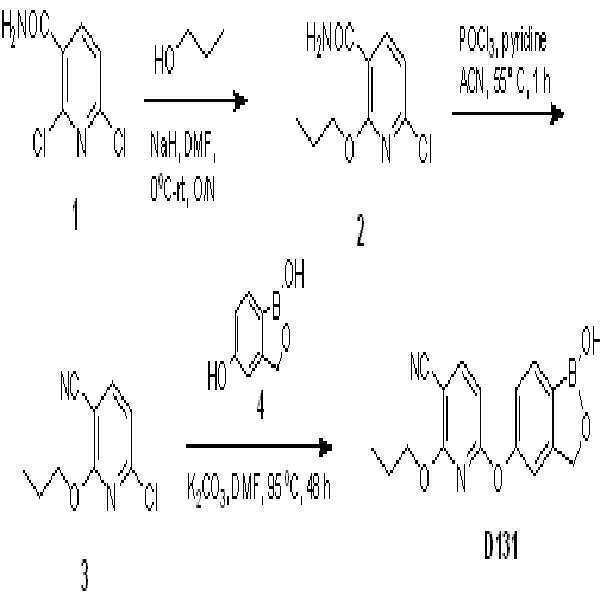
6-6- 클로로Chloro -2--2- 프로폭시Propoxy -니코틴아미드 ( 2): - nicotinamide (2):
프로판-1-올(2.94 mL, 39.26 mmol)의 DMF (15 mL) 용액에 0 ℃ 에서 수소화 나트륨(미네랄 오일내 95%, 0.94 g, 39.26 mmol)이 부분적으로 첨가되고, 1시간 동안 실온에서 교반되었다. 이 혼합물은 0℃에서 2,6-디클로로-니코틴아미드 (5.0 g, 26.17 mmol)의 DMF (25 mL) 용액에 서서히 첨가되었다. 반응 혼합물은 실온에서 하룻밤 동안 교반되었다. DMF는 감압하에 제거되었고, 생성된 혼합물은 EtOAc (60 mL)으로 희석되었고, 물 (2 x 20 mL) 과 소금물 (2 x 10 mL) 용액으로 세척되었고, 무수 Na2SO4상에서 건조되었고 여과되었고, 그리고 농축되어 황색 오일이 제공되었다. 플래쉬 크로마토그래피에 의해 실리카 겔상에서 5-60% EtOAc/헥산 그라디언트 용리액을 이용하여 정제되어 표제 화합물은 (3.8 g, 68%) 투명 오일로 산출되었다. 1H NMR (400 MHz, CDCl3) δ ppm 8.46 (d, J=8.2 Hz, 1 H), 7.69 (br. s., 1 H), 7.06 (d, J=8.2 Hz, 1 H), 5.86 (br. s., 1 H), 4.48 (t, J=6.6 Hz, 2 H), 1.99 - 1.79 (m, 2 H), 1.07 (t, J=7.4 Hz, 3 H).Sodium hydride (95% in mineral oil, 0.94 g, 39.26 mmol) was partially added to a DMF (15 mL) solution of propan-1-ol (2.94 mL, 39.26 mmol) at 0 C and stirred at room temperature for 1 hour . This mixture was slowly added to a DMF (25 mL) solution of 2,6-dichloro-nicotinamide (5.0 g, 26.17 mmol) at 0 ° C. The reaction mixture was stirred at room temperature overnight. DMF was removed under reduced pressure, and the resulting mixture was diluted with EtOAc (60 mL), was washed with water (2 x 20 mL) and brine (2 x 10 mL) solution, was filtered, it was dried over anhydrous Na 2 SO 4 , And concentrated to provide a yellow oil. Purification by flash chromatography on silica gel using a 5-60% EtOAc / hexane gradient eluant gave the title compound (3.8 g, 68%) as a clear oil. 1 H NMR (400 MHz, CDCl 3) δ ppm 8.46 (d, J = 8.2 Hz, 1 H), 7.69 (br. S., 1 H), 7.06 (d, J = 8.2 Hz, 1 H), 5.86 (m, 2H), 1.07 (t, J = 7.4 Hz, 3H), 4.48 (t, J = 6.6 Hz, 2H), 1.99-1.79 (m, 2H).
6-6- 클로로Chloro -2--2- 프로폭시Propoxy -- 니코틴니트릴Nicotine nitrile (3) (3)
6-클로로-2-프로폭시-니코틴아미드 (3.80 g, 17.71 mmol) 및 피리딘 (8.50 mL, 106.21 mmol)의 아세토니트릴 (25 mL) 용액에 포스포러스 옥시클로라이드 (4.81 mL, 53.13 mmol)가 5분간에 걸쳐 첨가되었다. 반응물은 55℃에서 1시간 동안 교반되었다. 아세토니트릴은 진공에서 기화되었고, 생성된 잔유물은 0 ℃ 에서 pH가 ~7에 이를 때까지 1N NaOH로 중화되었다. 반응 혼합물은 EtOAc (100 mL)으로 추출되었다. 유기 층은 수거되었고, 수성 층은 EtOAc (3 x 50 mL)으로 추가 추출되었다. 모든 유기물이 복합되었고, 소금물로 세척하고 (2 x 25 mL), 무수 Na2SO4상에서 건조되고, 여과되고, 그리고 농축되어 황색 오일이 제공되었다. 플래쉬 크로마토그래피에 의해 실리카 겔 상에서 5-25% EtOAc/헥산 그라디언트 용리액을 이용하여 정제되어 백색고체로 된 표제 화합물 (3.4 g, 98%)이 산출되었다. 1H NMR (400 MHz, DMSO-d 6 ) δ ppm 8.29 (d, J=7.9 Hz, 1 H), 7.29 (d, J=7.9 Hz, 1 H), 4.31 (t, J=6.5 Hz, 2 H), 1.79 - 1.66 (m, 2 H), 0.96 (t, J=7.5 Hz, 3 H).Phosphorus oxychloride (4.81 mL, 53.13 mmol) was added to a solution of 6-chloro-2-propoxy-nicotinamide (3.80 g, 17.71 mmol) and pyridine (8.50 mL, 106.21 mmol) in acetonitrile Lt; / RTI > The reaction was stirred at 55 < 0 > C for 1 hour. The acetonitrile was evaporated in vacuo and the resulting residue was neutralized with 1N NaOH until the pH reached ~ 7 at 0 ° C. The reaction mixture was extracted with EtOAc (100 mL). The organic layer was collected and the aqueous layer was further extracted with EtOAc (3 x 50 mL). All organics were combined, washed with brine (2 x 25 mL), dried over anhydrous Na 2 SO 4 , filtered, and concentrated to give a yellow oil. Purification by flash chromatography on silica gel using 5-25% EtOAc / hexane gradient eluant gave the title compound (3.4 g, 98%) as a white solid. 1 H NMR (400 MHz, DMSO- d 6) δ ppm 8.29 (d, J = 7.9 Hz, 1 H), 7.29 (d, J = 7.9 Hz, 1 H), 4.31 (t, J = 6.5 Hz, 2 H), 1.79-1.66 (m, 2 H), 0.96 (t, J = 7.5 Hz, 3 H).
6-(1- 하이드록시 -1,3- 디하이드로 - 벤조[c][1,2]옥사보롤 -5-일 옥시 )-2- 이소프로폭시-니코틴니트릴 (D131) 6- (1-hydroxy-1,3-dihydro-benzo [c] [1,2] oxazol-5-yl borol oxy) -2-isophthaloyl isoquinoline-nicotine nitrile (D131)
6-클로로-2-프로폭시-니코틴니트릴 (0.54 g, 3.0 mmol) 및 3H-벤조[c][1,2]옥사보롤-1,5-디올 (0.40 g, 2.0 mmol)의 DMF (10 mL) 혼합물에 탄산칼륨염(0.83 g, 6.0 mmol)이 첨가되었다. 생성된 현탁액은 95 ℃에서 48 h 동안 가열되었다. DMF는 감압하에 제거되었고, 잔유물은 EtOAc (50 mL)으로 희석되었고, 물 (10 mL) 과 소금물 (2 x 10 mL)로 세척되었고, Na2SO4상에서 건조되고, 여과되고, 그리고 농축되어 갈색 오일이 제공되었다. 역상 예비HPLC에서 용리액으로 MeOH/H2O (0.1% AcOH) 을 이용하여 정제되면, 표제 화합물 (0.25 g, 26%)이 백색 고체로 산출되었다. 1H NMR (400 MHz, DMSO-d 6 ) δ ppm 9.25 (s, 1 H), 8.24 (d, J=8.2 Hz, 1 H), 7.79 (d, J=7.8 Hz, 1 H), 7.29 (s, 1 H), 7.17 - 7.22 (m, 1 H), 6.69 (d, J=8.6 Hz, 1 H), 4.99 (s, 2 H), 4.07 (t, J=6.8 Hz, 2 H), 1.65 - 1.55 (m, 2 H), 0.81 (t, J=7.4 Hz, 3 H); MS (ES) m/z: 311 (M + 1)+; HPLC 순도 98.36 % (Maxplot), 97.66 % (220 nm). To a solution of 6-chloro-2-propoxy-nicotinonitrile (0.54 g, 3.0 mmol) and 3H-benzo [c] [1,2] oxaborol-1,5-diol (0.40 g, 2.0 mmol) in DMF ) Potassium carbonate salt (0.83 g, 6.0 mmol) was added to the mixture. The resulting suspension was heated at < RTI ID = 0.0 > 95 C < / RTI > The DMF was removed under reduced pressure and the residue was diluted with EtOAc (50 mL), washed with water (10 mL) and brine (2 x 10 mL), dried over Na 2 SO 4 , filtered, Oil was provided. Purification by reverse phase preparative HPLC using MeOH / H 2 O (0.1% AcOH) as eluent gave the title compound (0.25 g, 26%) as a white solid. 1 H NMR (400 MHz, DMSO- d 6) δ ppm 9.25 (s, 1 H), 8.24 (d, J = 8.2 Hz, 1 H), 7.79 (d, J = 7.8 Hz, 1 H), 7.29 ( s, 1 H), 7.17 - 7.22 (m, 1 H), 6.69 (d, J = 8.6 Hz, 1 H), 4.99 (s, 2 H), 4.07 (t, J = 6.8 Hz, 2 H), 1.65 - 1.55 (m, 2 H), 0.81 (t, J = 7.4 Hz, 3 H); MS (ES) m / z : 311 (M + 1) < + >; HPLC purity 98.36% (Maxplot), 97.66% (220 nm).
19ei 6-(1- 하이드록시 -1,3- 디하이드로 - 벤조[c][1,2]옥사보롤 -5-일 옥시 )-2- (2-하이드록시-에틸아미노)-니코틴니트릴 (D132) 19ei 6- (1- hydroxy-1,3-dihydro-benzo [c] [1,2] oxazole borol 5-yl) -2 (2-hydroxy-ethylamino) nicotinic nitrile (D132 )

2-[2-( tert -부틸-디메틸- 시래닐옥시 )- 에틸아미노 ]-6- 클로로 -니코틴아미드 (3) 2- [2- (tert-Butyl-dimethyl-sirae carbonyl-oxy) -ethyl-amino] -6-chloro-nicotinamide (3)
2,6-디클로로-니코틴아미드 (1) (3 g, 15.7 mmol)의 아세토니트릴 (무수, 50 mL) 용액에 22-(tert-부틸-디메틸-시래닐옥시)-에틸아민 (2) (2.75 g, 15.7 mmol) 및 트리에틸아민(2.2 mL, 15.7 mmol)이 첨가되었다. 반응물은 60 ℃에서 2일간 가열되었다. 용액은 실온으로 냉각되었고, 그리고 여과되었다. 여과액은 진공에서 농축되었다. Biotage 실리카 겔 크로마토그래피에서 10% - 100% EtOAc/헥산으로 용리되어 정제되면 2 g (40.6%)의 표제 화합물이 제공되었다.(Tert-butyl-dimethyl-cyanyloxy) -ethylamine ( 2 ) (2.75 mmol) was added to a solution of 2,6-dichloro-nicotinamide ( 1 ) (3 g, 15.7 mmol) in acetonitrile g, 15.7 mmol) and triethylamine (2.2 mL, 15.7 mmol) were added. The reaction was heated at 60 < 0 > C for 2 days. The solution was cooled to room temperature and filtered. The filtrate was concentrated in vacuo. Purification by Biotage silica gel chromatography eluting with 10% - 100% EtOAc / hexanes provided 2 g (40.6%) of the title compound.
1H NMR (400 MHz, 클로로포름-d) δ ppm 8.64 (br. s., 1 H), 7.51 (d, J=8.2 Hz, 1 H), 6.47 (d, J=7.8 Hz, 1 H), 5.66 (br. s., 2 H), 3.79 (t, J=5.5 Hz, 2 H), 3.62 (q, J=5.5 Hz, 2 H), 0.91 (s, 9 H), 0.07 (s, 6 H). 1 H NMR (400 MHz, chloroform -d) δ ppm 8.64 (br. S., 1 H), 7.51 (d, J = 8.2 Hz, 1 H), 6.47 (d, J = 7.8 Hz, 1 H), (T, J = 5.5 Hz, 2H), 3.62 (q, J = 5.5 Hz, 2H), 0.91 H).
2-[2-( tert -부틸-디메틸- 시래닐옥시 )- 에틸아미노 ]-6- 클로로 - 니코틴니트릴 (4) 2- [2- ( tert -Butyl-dimethyl- cyanyloxy ) -ethylamino ] -6- chloro - nicotinonitrile (4)
2-[2-(tert-부틸-디메틸-시래닐옥시)-에틸아미노]-6-클로로-니코틴아미드 (3, 300 mg, 0.96 mmol)의 아세토니트릴 (무수, 50 mL) 용액에 피리딘 (0.62 mL, 7.65 mmol) 및 POCl3 (0.35 mL, 382 mmol)이 첨가되었다. 반응물은 60 ℃ 에서 1시간 동안 가열되었다. 실온으로 냉각된 후, NaOH 용액 (10% aq.)는 pH가 9가 될 때까지 서서히 첨가되었다. EtOAc (200 mL)가 첨가되었고, 층들은 분리되었다. 수성 층은 EtOAc (2 x 200 mL)으로 추출되었다. 복합된 유기 층은 MgSO4 상에서 건조되고, 여과되고, 그리고 진공에서 농축되었다. 실리카 겔 크로마토그래피에서, 1%-20% EtOAc/헥산 그라디언트로 용리시켜 정제되어, 220 mg (78% 산출량)의 표제d 산물이 수득되었다. 2- [2- (tert- butyl-dimethyl-sirae carbonyl-oxy) -ethyl-amino] -6-chloro-acetonitrile of nicotinamide (3, 300 mg, 0.96 mmol ) ( anhydrous, 50 mL) pyridine (0.62 To a solution mL, 7.65 mmol) and POCl 3 (0.35 mL, 382 mmol). The reaction was heated at 60 < 0 > C for 1 hour. After cooling to room temperature, the NaOH solution (10% aq.) Was slowly added until the pH was 9. EtOAc (200 mL) was added, and the layers were separated. The aqueous layer was extracted with EtOAc (2 x 200 mL). The combined organic layer is dried over MgSO 4, filtered, and was concentrated in vacuo. Purification by silica gel chromatography eluting with 1% -20% EtOAc / hexane gradient afforded 220 mg (78% yield) of the title product.
1H NMR (400 MHz, 클로로포름-d) δ ppm 7.48 (d, J=7.9 Hz, 1 H), 6.51 (d, J=7.9 Hz, 1 H), 5.62 (br. s., 1 H), 3.71 (t, J=5.2 Hz, 2 H), 3.54 (q, J=5.3 Hz, 2 H), 0.83 (s, 9 H), 0.00 (s, 6 H). 1 H NMR (400 MHz, chloroform -d) δ ppm 7.48 (d, J = 7.9 Hz, 1 H), 6.51 (d, J = 7.9 Hz, 1 H), 5.62 (br. S., 1 H), 3.71 (t, J = 5.2 Hz, 2H), 3.54 (q, J = 5.3 Hz, 2H), 0.83 (s, 9H), 0.00 (s, 6H).
6-(4- 브로모 -3- 포밀 - 페녹시 )-2-[2-( tert -부틸-디메틸- 시래닐옥시 )- 에틸아미노]-니코틴니트릴 (6) 6- (4-bromo-3-formyl-phenoxy) -2- [2- (tert-Butyl-dimethyl-sirae carbonyl oxy) -ethyl amino furnace; -
2-[2-(tert-부틸-디메틸-시래닐옥시)-에틸아미노]-6-클로로-니코틴니트릴 (4, 1.1 g, 3.5 mmol)의 DMF (80 mL) 용액에 2-브로모-5-하이드록시-벤즈알데히드 (5, 0.75 g, 3.7 mmol) 및 K2CO3 (0.97 g, 7.05 mmol)가 첨가되었다. 반응물은 80 ℃에서 24 h 동안 가열되었다. DMF 는 진공에서 제거되었다. Biotage 실리카 겔 크로마토그래피에서 1% - 3% EtOAc/헥산 그라디언트로 용리되어 정제되어, 1.26 g (75% 산출량)의 표제 화합물이 제공되었다. To a DMF (80 mL) solution of 2- [2- (tert-butyl-dimethyl-cyanyloxy) -ethylamino] -6-chloro-nicotinonitrile ( 4 , 1.1 g, 3.5 mmol) -hydroxy-was added benzaldehyde (5, 0.75 g, 3.7 mmol ) and K 2 CO 3 (0.97 g, 7.05 mmol). The reaction was heated at 80 ° C for 24 h. The DMF was removed in vacuo. Purification by Biotage silica gel chromatography eluting with 1% - 3% EtOAc / hexanes gradient provided 1.26 g (75% yield) of the title compound.
1H NMR (400 MHz, 클로로포름-d) δ ppm 10.31 (s, 1 H), 7.72 (d, J=2.8 Hz, 1 H), 7.62 (dd, J=8.6, 3.8 Hz, 2 H), 7.21 - 7.26 (m, 1 H), 6.17 (d, J=8.3 Hz, 1 H), 5.55 (t, J=4.9 Hz, 1 H), 3.59 (t, J=5.3 Hz, 2 H), 3.27 (q, J=5.2 Hz, 2 H), 0.85 (s, 9 H), 0.00 (s, 6 H) 1 H NMR (400 MHz, chloroform -d) δ ppm 10.31 (s, 1 H), 7.72 (d, J = 2.8 Hz, 1 H), 7.62 (dd, J = 8.6, 3.8 Hz, 2 H), 7.21 - 7.26 (m, 1 H) , 6.17 (d, J = 8.3 Hz, 1 H), 5.55 (t, J = 4.9 Hz, 1 H), 3.59 (t, J = 5.3 Hz, 2 H), 3.27 ( q, J = 5.2 Hz, 2 H), 0.85 (s, 9 H), 0.00 (s, 6 H)
2-[2-( tert -부틸-디메틸- 시래닐옥시 )- 에틸아미노 ]-6-[3- 포밀 -4-(4,4,5,5- 테트라메틸-[1,3,2]디옥사보란-2-일)-페녹시]-니코틴니트릴 (7) 2- [2- (tert-Butyl-dimethyl-sirae carbonyl-oxy) -ethyl-amino] -6- [3-formyl-4- (4,4,5,5-te Tra-methyl- [1,3,2] Dioxaboran-2-yl) -phenoxy] -nicotinonitrile (7)
6-(4-브로모-3-포밀-페녹시)-2-[2-(tert-부틸-디메틸-시래닐옥시)-에틸아미노]-니코틴니트릴 (6, 1.26 g, 2.65 mmol)의 1,4-디옥산 (무수, 150 mL) 용액에 비스피나콜라토 다이보론 (0.807 g, 3.18 mmol), PdCl2(dppf) (0.19 g, 0.26 mmol) 및 KOAc (0.78 g, 7.95 mmol)이 첨가되었다. 용액은 실온에서 30분간 N2 버블링과 함께 교반되었고, 3시간 동안 100 ℃에서 가열되었다. 용액은 여과되었고, 진공에서 농축되었다. 실리카 겔 크로마토그래피에서 5%-25% EtOAc/헥산 그라디언트로 용리되어 정제가 실행되어 1.11 g (80% 산출량)의 표제 화합물이 제공되었다.(6, 1.26 g, 2.65 mmol) was added to a solution of 1 - (4-bromo-3-formyl-phenoxy) -2- [2- (tert- butyl- dimethyl- cyanyloxy) (0.807 g, 3.18 mmol), PdCl 2 (dppf) (0.19 g, 0.26 mmol) and KOAc (0.78 g, 7.95 mmol) were added to a solution of 4-hydroxybenzotriazole . The solution was stirred at room temperature for 30 minutes with N 2 bubbling and heated at 100 < 0 > C for 3 hours. The solution was filtered and concentrated in vacuo. Purification was carried out on silica gel chromatography eluting with 5% -25% EtOAc / hexane gradient to give 1.11 g (80% yield) of the title compound.
1H NMR (400 MHz, 클로로포름-d) δ ppm 10.63 (s, 1 H), 7.94 (d, J=8.2 Hz, 1 H), 7.78 (d, J=1.9 Hz, 1 H), 7.64 (d, J=8.2 Hz, 1 H), 7.37 (dd, J=8.1, 2.1 Hz, 1 H), 6.17 (d, J=8.2 Hz, 1 H), 5.57 (br. s., 1 H), 3.62 (t, J=5.1 Hz, 2 H), 3.32 (q, J=5.1 Hz, 2 H), 1.40 (s, 12 H), 0.88 (s, 9 H), 0.03 (s, 6 H) 1 H NMR (400 MHz, chloroform-d) ? Ppm 10.63 (s, 1H), 7.94 (d, J = 8.2 Hz, 1H), 7.78 (d, J = 1.9 Hz, 1H) , J = 8.2 Hz, 1 H ), 7.37 (dd, J = 8.1, 2.1 Hz, 1 H), 6.17 (d, J = 8.2 Hz, 1 H), 5.57 (br. s., 1 H), 3.62 (t, J = 5.1 Hz, 2H), 3.32 (q, J = 5.1 Hz, 2H), 1.40 (s, 12H), 0.88
6-(1- 하이드록시 -1,3- 디하이드로 - 벤조[c][1,2]옥사보롤 -5-일 옥시 )-2-(2- 하이드록시-에틸아미노)-니코틴니트릴 (D132) 6- (1-hydroxy-1,3-dihydro-benzo [c] [1,2] oxazole borol 5-yl) -2 (2-hydroxy to Id-ethylamino) nicotinic nitrile (D132 )
2-[2-(tert-부틸-디메틸-시래닐옥시)-에틸아미노]-6-[3-포밀-4-(4,4,5,5-테트라메틸-[1,3,2]디옥사보란-2-일)-페녹시]-니코틴니트릴 (7, 1.11 g, 2.12 mmol)의 MeOH (무수, 60 mL) 용액에 NaBH4 (0.48 g, 12.7 mmol)가 첨가되었다. 반응물은 실온에서 4시간 동안 교반된 후 HCl (1 M, 20 mL)가 첨가되었다. 하룻밤 교반 후, 모든 휘발성 성분들이 제거되었다. 예비HPLC에서 5%-90% ACN/물 그라디언트로 용리시켜 정제가 실행되어 86.3 mg (13% 산출량)의 표제 화합물이 백색 고체로 제공되었다. 4- [4- (4,4,5,5-tetramethyl- [1,3,2] di < RTI ID = 0.0 > NaBH4 (0.48 g, 12.7 mmol) was added to a MeOH (anhydrous, 60 mL) solution of 4- fluorophenoxy) -oxaboron-2-yl) -phenoxy] -nicotinonitrile (7, 1.11 g, 2.12 mmol). The reaction was stirred at room temperature for 4 h before HCl (1 M, 20 mL) was added. After overnight stirring, all volatile components were removed. Purification was carried out by preparative HPLC eluting with a 5% -90% ACN / water gradient to give 86.3 mg (13% yield) of the title compound as a white solid.
1H NMR (400 MHz, DMSO-d 6 ) δ ppm 9.20 (s, 1 H), 7.87 (d, J=8.6 Hz, 1 H), 7.73 (d, J=8.2 Hz, 1 H), 7.21 (s, 1 H), 7.13 - 7.08 (m, 2 H), 6.14 (d, J=8.2 Hz, 1 H), 4.96 (s, 2 H), 4.59 - 4.55 (m, 1 H), 3.32 - 3.29 (m, 2 H), 3.16 - 3.10 (m, 2 H); ES MS: m/z 268 (M + H)+; HPLC: 98.95% (220 nm), 98.66% (MaxPlot). 1 H NMR (400 MHz, DMSO- d 6) δ ppm 9.20 (s, 1 H), 7.87 (d, J = 8.6 Hz, 1 H), 7.73 (d, J = 8.2 Hz, 1 H), 7.21 ( s, 1H), 7.13-7.08 (m, 2H), 6.14 (d, J = 8.2 Hz, 1H), 4.96 (m, 2H), 3.16-3.10 (m, 2H); ES MS: m / z 268 (M + H) < + >; HPLC: 98.95% (220 nm), 98.66% (MaxPlot).
19ej 3-( 시클로펜틸옥시 )-4-(1- 하이드록시 -1,3- 디하이드로벤조[c][1,2]옥사 보롤-5-일 옥시)벤조니트릴 (D133) 19ej 3- (cyclopentyloxy) -4- (1-hydroxy-1,3-dihydro-benzo [c] [1,2] oxazol-5-yl borol oxy) benzonitrile (D133)

3-하이드록시-4-(1-하이드록시-1,3-디하이드로벤조[c][1,2]옥사보롤-5-일 옥시)벤조니트릴 (0.500 g, 1.87 mmol), 시클로펜틸 요오드화물 (0.65 mL, 5.61 mmol), 및 N,N-디메틸포름아미드 (30 mL) 용액은 질소 기구하에서 얼음 물바스상에서 0 ℃로 냉각되었다. 수소화 나트륨(0.224 g, 5.61 mmol)이 첨가되었고, 그 다음 반응물은 얼음 물 바스 상에서 5분간 교반되었다. 반응물은 그 다음 실온에서 2시간동안 교반되었다. 시클로펜틸 요오드화물 (0.22 mL, 1.87 mmol)이 더 첨가되었고, 반응물은 얼음 물 바스 상에서 0 ℃로 냉각되었다. 수소화 나트륨(0.075 g, 1.87 mmol)이 첨가되었고, 반응물은 0 ℃에서 5분간 교반되었다. 그 다음 반응물은 실온에서 추가 2시간 동안 교반되었다. 물이 첨가되어 과량의 수소화 나트륨을 진정시키고, 그 다음 반응물은 1 M HCl으로 중화되었다. 물이 첨가되었고, 용액은 에틸 아세테이트로 추출되었다. 유기 층은 물, 소금물로 세척되었고, 무수 황산나트륨상에서 건조되고, 여과되었다. 용매는 감압하에 제거되었다. 잔유물은 실리카 겔 컬럼에서 콤비플레쉬를 이용하여 정제되어 3-(시클로펜틸옥시)-4-(1-하이드록시-1,3-디하이드로벤조[c][1,2]옥사보롤-5-일 옥시)벤조니트릴 (0.396 g, 63% 산출량)이 제공되었다. 1H NMR (400 MHz, DMSO-d 6 ) δ ppm 1.25 (m, 2 H), 1.38 (m, 2 H), 1.50 (m, 2 H), 1.73 (m, 2 H), 4.86 (m, 2 H), 6.84 (s, 1 H), 6.87 (d, J = 8.2 Hz, 1 H), 7.18 (d, J = 8.2 Hz, 1 H), 7.40 (d, J = 8.4 Hz, 1 H), 7.58 (s, 1 H), 7.64 (d, J = 8.0 Hz, 1 H), 9.06 (s, 1 H).(0.500 g, 1.87 mmol), cyclopentyl iodide (0.500 g, 1.87 mmol), and diisopropylethylamine were added to a solution of 3-hydroxy-4- (0.65 mL, 5.61 mmol) and N, N -dimethylformamide (30 mL) was cooled to 0 < 0 > C on an ice water bath under nitrogen. Sodium hydride (0.224 g, 5.61 mmol) was added, and then the reaction was stirred on ice water bath for 5 minutes. The reaction was then stirred at room temperature for 2 hours. Cyclopentyl iodide (0.22 mL, 1.87 mmol) was further added and the reaction was cooled to 0 < 0 > C on ice water bath. Sodium hydride (0.075 g, 1.87 mmol) was added and the reaction was stirred at 0 < 0 > C for 5 min. The reaction was then stirred at room temperature for an additional 2 hours. Water was added to quench excess sodium hydride, and the reaction was then neutralized with 1 M HCl. Water was added and the solution was extracted with ethyl acetate. The organic layer was washed with water, brine, dried over anhydrous sodium sulfate and filtered. The solvent was removed under reduced pressure. The residue was purified using a combiflash on a silica gel column to give 3- (cyclopentyloxy) -4- (1-hydroxy-1,3-dihydrobenzo [c] [1,2] oxaborol- Oxy) benzonitrile (0.396 g, 63% yield) was provided. 1 H NMR (400 MHz, DMSO- d 6 ) ? Ppm 1.25 (m, 2H), 1.38 (m, 2H), 1.50 2 H), 6.84 (s, 1 H), 6.87 (d, J = 8.2 Hz, 1 H), 7.18 (d, J = 8.2 Hz, 1 H), 7.40 (d, J = 8.4 Hz, 1 H) , 7.58 (s, 1H), 7.64 (d, J = 8.0 Hz, 1H), 9.06 (s, 1H).
19ek 3-( 시클로프로필메톡시 )-4-(1- 하이드록시 -1,3- 디하이드로벤조[c][1,2] 옥사보롤-5-일 옥시)벤조니트릴 (D134) ( D134 ) & lt ; RTI ID = 0.0 & gt ; 3- ( cyclopropylmethoxy ) -4- (1 -hydroxy- 1, 3 -dihydrobenzo [c] [1,2] oxaborol -5-yloxy) benzonitrile

질소기구하에 브로모메틸 시클로프로판 (0.544 mL, 5.61 mmol), 요오드화 나트륨물(4.20 g, 28.05 mmol), 그리고 N,N-디메틸포름아미드 (30 mL) 용액은 70 ℃에서 3시간 동안 교반되었다. 반응물은 실온으로 냉각되었고, 3-하이드록시-4-(1-하이드록시-1,3-디하이드로벤조[c][1,2]옥사보롤-5-일 옥시)벤조니트릴 (0.500 g, 1.87 mmol) 및 N,N-디메틸포름아미드 (30 mL)이 첨가되었다. 반응물은 얼음 물 바스내에서 0 ℃로 냉각되었고, 수소화 나트륨(0.224 g, 5.61 mmol)이 첨가되었다. 반응물은 질소 기구하에서 0℃에서 5분간 교반되었고, 그 다음 실온에서 하룻밤 동안 교반되었다. 물이 첨가되어 과량의 수소화 나트륨을 진정시켰고 용액은 1 M HCl으로 중화되었다. 물이 첨가되었고, 용액은 에틸 아세테이트를 이용하여 추출되었다. 유기 층은 물, 소금물로 세척되었고, 무수 황산나트륨상에서 건조되고, 여과되었다. 용매는 감압하에 제거되었다. 잔유물은 실리카 겔 컬럼에서 콤비플레쉬를 이용하여 정제되어, 3-(시클로프로필메톡시)-4-(1-하이드록시-1,3-디하이드로벤조[c][1,2]옥사보롤-5-일 옥시)벤조니트릴 (0.225 g, 37% 산출량)이 제공되었다. 1H NMR (400 MHz, DMSO-d 6 ) δ ppm 0.15 (d, J = 4.5 Hz, 2 H), 0.43 (d, J = 7.6 Hz, 2 H), 1.06 (septet, J = 6.7 Hz, 1 H), 3.90, (d, J = 6.9 Hz, 1 H), 4.91 (s, 2 H), 6.95 (m, 2 H), 7.13 (d, J = 8.2 Hz, 1 H), 7.42 (d, J = 8.4 Hz, 1 H), 7.62 (s, 1 H), 7.70 (d, J = 8.6 Hz, 1 H), 9.12 (s, 1 H).A solution of bromomethylcyclopropane (0.544 mL, 5.61 mmol), sodium iodide (4.20 g, 28.05 mmol) and N, N -dimethylformamide (30 mL) was stirred at 70 ° C for 3 hours under nitrogen. The reaction was cooled to room temperature and a solution of 3-hydroxy-4- (1 -hydroxy-1,3-dihydrobenzo [c] [1,2] oxaborol-5-yloxy) benzonitrile mmol) and N, N-dimethylformamide (30 mL) were added. The reaction was cooled to 0 C in an ice water bath and sodium hydride (0.224 g, 5.61 mmol) was added. The reaction was stirred at 0 < 0 > C for 5 minutes under nitrogen and then at room temperature overnight. Water was added to soot excess sodium hydride and the solution was neutralized with 1 M HCl. Water was added and the solution was extracted with ethyl acetate. The organic layer was washed with water, brine, dried over anhydrous sodium sulfate and filtered. The solvent was removed under reduced pressure. The residue was purified using a combiflash in a silica gel column to give 3- (cyclopropylmethoxy) -4- (1-hydroxy-1,3-dihydrobenzo [c] [1,2] oxaborol- -Yloxy) benzonitrile (0.225 g, 37% yield) was provided. 1 H NMR (400 MHz, DMSO- d 6) δ ppm 0.15 (d, J = 4.5 Hz, 2 H), 0.43 (d, J = 7.6 Hz, 2 H), 1.06 (septet, J = 6.7 Hz, 1 H), 3.90, (d, J = 6.9 Hz, 1 H), 4.91 (s, 2 H), 6.95 (m, 2 H), 7.13 (d, J = 8.2 Hz, 1 H), 7.42 (d, J = 8.4 Hz, 1H), 7.62 (s, 1H), 7.70 (d, J = 8.6 Hz, 1H), 9.12 (s, 1H).
19el 3-( 시클로펜틸메톡시 )-4-(1- 하이드록시 -1,3- 디하이드로벤조[c][1,2]옥 사보롤-5-일 옥시)벤조니트릴 (D135) 19el 3- (cyclopentylmethoxy) -4- (1-hydroxy-1,3-dihydro-benzo [c] [1,2] octanoic Sabo roll-5-yl oxy) benzonitrile (D135)

이 화합물은 D133의 것과 유사한 방법으로 준비되었다. This compound was prepared in a similar manner to that of D133 .
ES(-)MS m/z = 348 (M-H)-; 1H NMR (400 MHz, DMSO-d 6 ) δ ppm 1.05 (m, 2 H), 1.37 (m, 4 H), 1.47 (m, 2 H), 2.07 (septet, J = 7.2 Hz, 1 H), 3.88 (d, J = 6.4 Hz, 2 H), 4.88 (s, 2 H), 6.88 (s, 1 H), 6.90 (dd, J = 8.1, 2.2 Hz, 1 H), 7.21 (d, J = 8.4 Hz, 1 H), 7.45 (dd, J = 8.2, 2.0 Hz, 1 H), 7.66 (m, 2 H), 9.08 (s, 1 H).ES (-) MS m / z = 348 (MH) - ; 1 H NMR (400 MHz, DMSO- d 6) δ ppm 1.05 (m, 2 H), 1.37 (m, 4 H), 1.47 (m, 2 H), 2.07 (septet, J = 7.2 Hz, 1 H) , 3.88 (d, J = 6.4 Hz, 2 H), 4.88 (s, 2 H), 6.88 (s, 1 H), 6.90 (dd, J = 8.1, 2.2 Hz, 1 H), 7.21 (d, J = 8.4 Hz, 1H), 7.45 (dd, J = 8.2, 2.0 Hz, 1H), 7.66 (m, 2H), 9.08 (s, 1H).
19em 6-(1- 하이드록시 -1,3- 디하이드로 - 벤조[c][1,2]옥사보롤 -5-일 옥시 )-2- 이소부톡시-니코틴니트릴 (D136) 19em 6- (1- hydroxy-1,3-dihydro-benzo [c] [1,2] oxazole borol 5-yl) -2-isobutoxy-nicotinamide nitrile (D136)

6-6- 클로로Chloro -2--2- 이소부톡시Isobutoxy -니코틴아미드 (3)- nicotinamide (3)
2,6-디클로로-니코틴아미드 (1) (3 g, 15.7 mmol)의 아세토니트릴 (무수, 30 mL) 용액에 2-메틸-프로판-1-올 (2) (1.22 g, 16.5 mmol) 및 NaH (0.42 g, 16.5 mmol)이 첨가되었다. 반응물은 r.t. O/N에서 유지되었다. 현탁액은 여과되었고 여과액 진공에서 농축되었다. 잔유물은 Biotage 실리카 겔 크로마토그래피에 의해 10% - 80% EtOAc/헥산 그라디언트 용리액을 이용하여 정제되어 2.39 g (66% 산출량) 의 표제 화합물이 제공되었다.Methyl-propan-1-ol (2) (1.22 g, 16.5 mmol) and NaH (2 mL) were added to a solution of 2,6-dichloro-nicotinamide (1) (3 g, 15.7 mmol) in acetonitrile (0.42 g, 16.5 mmol) was added. The reactants were r.t. O / N. The suspension was filtered and the filtrate was concentrated in vacuo. The residue was purified by Biotage silica gel chromatography using 10% - 80% EtOAc / hexane gradient eluant to give 2.39 g (66% yield) of the title compound.
1H NMR (400 MHz, 클로로포름-d) δ ppm 8.46 (d, J=7.8 Hz, 1 H), 7.70 (br. s., 1 H), 7.06 (d, J=7.8 Hz, 1 H), 6.09 (br. s., 1 H), 4.30 (d, J=6.6 Hz, 2 H), 2.25 - 2.11 (m, 1 H), 1.07 (d, J=6.6 Hz, 6 H). 1 H NMR (400 MHz, chloroform -d) δ ppm 8.46 (d, J = 7.8 Hz, 1 H), 7.70 (br. S., 1 H), 7.06 (d, J = 7.8 Hz, 1 H), 6.09 (br s, 1H), 4.30 (d, J = 6.6 Hz, 2H), 2.25-2.11 (m, 1H), 1.07 (d, J = 6.6 Hz, 6H).
6-6- 클로로Chloro -2--2- 이소부틸아미노Isobutylamino -- 니코틴니트릴Nicotine nitrile (4) (4)
6-클로로-2-이소부톡시-니코틴아미드 (3, 2.39 g, 10.4 mmol)의 아세토니트릴 (무수, 150 mL) 용액에 피리딘 (6.75 mL, 83.5 mmol) 및 POCl3 (3.82 mL, 41.7 mmol)이 첨가되었다. 반응물은 55 ℃에서 3시간 동안 가열되었다. 실온으로 냉각된 후, pH가 9가 될 때까지 NaOH 용액 (10% aq.)가 서서히 첨가되었다. EtOAc (60 mL)가 첨가되었고 층들은 분리되었다. 수성 층은 EtOAc (2 x 60 mL)으로 추출되었다. 복합된 유기 층은 MgSO4 상에서 건조되고, 여과되고, 그리고 진공에서 농축되었다. 실리카 겔 크로마토그래피에서 2%-30% EtOAc/헥산 그라디언트로 용리되어 정제되어 2 g (91% 산출량)의 표제 산물이 제공되었다. Pyridine (6.75 mL, 83.5 mmol) and POCl 3 (3.82 mL, 41.7 mmol) were added to a solution of 6-chloro-2-isobutoxy-nicotinamide ( 3 , 2.39 g, 10.4 mmol) in acetonitrile . The reaction was heated at 55 < 0 > C for 3 hours. After cooling to room temperature, NaOH solution (10% aq.) Was slowly added until the pH was 9. EtOAc (60 mL) was added and the layers were separated. The aqueous layer was extracted with EtOAc (2 x 60 mL). The combined organic layer is dried over MgSO 4, filtered, and was concentrated in vacuo. Purified by silica gel chromatography eluting with 2% -30% EtOAc / hexane gradient to give 2 g (91% yield) of the title product.
1H NMR (400 MHz, 클로로포름-d) δ ppm 7.80 (d, J=8.0 Hz, 1 H), 6.99 (d, J=8.0 Hz, 1 H), 4.20 (d, J=6.6 Hz, 2 H), 2.21 - 2.09 (m, 1 H), 1.05 (d, J=6.6 Hz, 6 H). 1 H NMR (400 MHz, chloroform -d) δ ppm 7.80 (d, J = 8.0 Hz, 1 H), 6.99 (d, J = 8.0 Hz, 1 H), 4.20 (d, J = 6.6 Hz, 2 H ), 2.21-2.09 (m, 1H), 1.05 (d, J = 6.6 Hz, 6 H).
6-(1- 하이드록시 -1,3- 디하이드로 - 벤조[c][1,2]옥사보롤 -5-일 옥시 )-2- 이소부 톡시-니코틴니트릴 (D136) 6- (1-hydroxy-1,3-dihydro-benzo [c] [1,2] oxazole borol 5-yl) -2-isobutoxy-nicotinamide nitrile (D136)
6-클로로-2-이소부틸아미노-니코틴니트릴 (4, 1.12 g, 5.33 mmol) 의 DMF (무수, 30 mL) 용액에 3H-벤조[c][1,2]옥사보롤-1,5-디올 (400 mg, 2.67 mmol) 및 Cs2CO3 (1.91 g, 5.87 mmol)이 첨가되었다. 반응물은 80 ℃ 에서 2 h 동안 마이크로웨이브로 가열되었다. 그 다음 DMF는 진공에서 기화되었다. 예비 HPLC에서, 5%-90% ACN/물 그라디언트으로 용리시켜 정제되어 250 mg (29% 산출량)의 표제 화합물이 백색 고체로 제공되었다. To a solution of 6-chloro-2-isobutylamino-nicotinonitrile ( 4 , 1.12 g, 5.33 mmol) in DMF (anhydrous, 30 mL) was added 3H-benzo [c] [1,2] oxaborol- It was added (400 mg, 2.67 mmol) and Cs 2 CO 3 (1.91 g, 5.87 mmol). The reaction was heated to microwave at 80 ° C for 2 h. The DMF was then vaporized in vacuo. Purification by preparative HPLC eluting with 5% -90% ACN / water gradient gave 250 mg (29% yield) of the title compound as a white solid.
1H NMR (400 MHz, DMSO-d6) δ ppm 9.23 (br s, 1 H), 8.20 (d, J=8.2 Hz, 1 H), 7.77 (d, J=7.9 Hz, 1 H), 7.17 (d, J=8.0 Hz, 1 H), 6.66 (d, J=8.6 Hz, 1 H), 4.97 (s, 2 H), 3.89 (d, J=6.6 Hz, 2 H), 1.95-1.80 (m, 1 H), 0.80 (d, J=6.6 Hz, 6 H); ES MS: m/z 323 (M - H)-; HPLC: 99.25% (220 nm), 99.43% (MaxPlot). 1 H NMR (400 MHz, DMSO-d 6 )? Ppm 9.23 (br s, 1H), 8.20 (d, J = 8.2 Hz, 1H), 7.77 (d, J = 7.9 Hz, 1H) (d, J = 8.0 Hz, 1 H), 6.66 (d, J = 8.6 Hz, 1 H), 4.97 (s, 2 H), 3.89 (d, J = 6.6 Hz, 2 H), 1.95-1.80 ( m, 1H), 0.80 (d, J = 6.6 Hz, 6 H); ES MS: m / z 323 (M-H) < - >; HPLC: 99.25% (220 nm), 99.43% (MaxPlot).
19en 5-[2- 시아노 -4-( 포밀아미노메틸 ) 페녹시 ]-1,3- 디하이드로 -1- 하이드록시 -2,1-벤조옥사보롤(D137) 19en 5- [2- cyano-4- (formyl-methyl-amino) phenoxy] -1,3-dihydro-1-hydroxy -2,1- benzoxazol borol (D137)
이 화합물은 D25의 것과 유사한 방법으로 2-플루오르-5-포밀벤조니트릴 및 4-브로모-3-하이드록시메틸페놀로부터 준비되었다. This compound was prepared from 2-fluoro-5-formylbenzonitrile and 4-bromo-3-hydroxymethylphenol in a similar manner to that of D25 .
1H NMR (300 MHz, DMSO-d6) ppm 4.30 (d, J = 6.2 Hz, 2H), 4.94 (s, 2H), 7.0-7.1 (m, 3H), 7.56 (dd, J = 8.8, 1.2 Hz, 1H), 7.7-7.8 (m, 2H), 8.13 (s, 1H), 8.56 (br s, 1H), 9.21 (s, 1H). 1 H NMR (300 MHz, DMSO -d 6) ppm 4.30 (d, J = 6.2 Hz, 2H), 4.94 (s, 2H), 7.0-7.1 (m, 3H), 7.56 (dd, J = 8.8, 1.2 2H), 8.13 (s, 1H), 8.56 (br s, 1H), 9.21 (s, 1H).
19eo 5-(2- 아미노메틸 -4- 시아노페녹시 )-1,3- 디하이드로 -1- 하이드록시 -2,1- 벤조옥사보롤하이드로클로라이드 (D138) 19eo 5- (2- Aminomethyl- 4- cyanophenoxy ) -1,3 -dihydro -1 -hydroxy- 2,1 -benzoxaborol hydrochloride (D138)
이 화합물은 D137 로부터 D26와 유사한 방법으로 준비되었다.This compound Prepared in a similar manner as D26 from D137 .
1H NMR (300 MHz, DMSO-d6) δ ppm 4.04 (br s, 2H), 4.96 (s, 2H), 7.06-7.16 (m, 3H), 8.05 (d, J = 2.3 Hz, 1H), 8.45 (br s, 3H), 9.27 (s, 1H). 1 H NMR (300 MHz, DMSO -d 6) δ ppm 4.04 (br s, 2H), 4.96 (s, 2H), 7.06-7.16 (m, 3H), 8.05 (d, J = 2.3 Hz, 1H), 8.45 (br s, 3H), 9.27 (s, 1 H).
19ep 메틸 4-(1,3- 디하이드로 -1- 하이드록시 - 2,1- 벤조옥사보롤 -5-일 옥시 )- 3-플루오르벤조산염(D139) 19ep Methyl 4- (1,3 -dihydro -1 -hydroxy -2,1- benzooxaborol- 5- yloxy ) -3-fluorobenzoic acid salt (D139)

Step 1

4-브로모-3-(1,3-디옥소란-2-일)페놀 (7.1 g, 29 mmol, 1 eq), 3,4-디플루오르-메틸벤조산염(5 g, 29 mmol, 1 eq), 탄산칼륨염(6 g, 43.5 mmol, 1.5 eq)의 DMF (29mL) 혼합물. 반응물은 100℃에서 하룻밤동안 교반시켰다. TLC 에서 반응이 완료되었음이 나타났다. 실온으로 냉각된 후 잔유물은 여과에 의해 제거되었다. 잔유물은 EtOAc으로 세척되었다. 유기물은 복합되었고, Rota 증기를 통하여 농축되었다. 잔유물을 ETOAC 및 물에 부었다. 유기 층들이 분리되었고 소금물로 세척되었고 무수 황산나트륨상에서 건조되었다. 여과 및 농축되어, 표제 화합물은 미정제된, 밝은 갈색 오일로 수득되었고, 정제하지 않고 다음 단계에 이용되었다. (7.1 g, 29 mmol, 1 eq), 3,4-difluoro-methylbenzoic acid salt (5 g, 29 mmol, 1 eq), potassium carbonate salt (6 g, 43.5 mmol, 1.5 eq) in DMF (29 mL). The reaction was stirred overnight at 100 < 0 > C. The reaction was complete on TLC. After cooling to room temperature, the residue was removed by filtration. The residue was washed with EtOAc. Organics were complexed and concentrated through Rota vapor. The residue was poured into ETOAC and water. The organic layers were separated, washed with brine and dried over anhydrous sodium sulfate. Filtered and concentrated to give the title compound as a crude, light brown oil which was used in the next step without purification.
Step 2

메틸 4-(4-브로모-3-(1,3-디옥소란-2-일)페녹시)-3-플루오르벤조산염의 30 mL THF 용액에 20ml의 3M HCl (6M HCl 및 물 1:1로 만듬)이 첨가되었고, 2시간 동안 환류되었다. TLC에서 SM (헥산: EtOAc 7:3)이 나타나지 않았다. 반응물은 RT으로 냉각되었다. 1N NaOH (60ml)이 첨가되었고, 용매의 절반을 제거하기 위해 회전(Rota) 증발시키고, EtOAc로 추출되었다. 유기물은 물, 소금물로 세척되고, Na2SO4상에서 건조되고, 여과되고, 그리고 농축되어 밝은 갈색 오일이 수득되었다. 2일간 세워도면 고형화된 고체를 얻었다. 여과되었고, 헥산/EtOAc으로 세척되어, 회백색 분말 10.2g이 수득되었다. 99.6산출량 % (두 단계) To a 30 mL THF solution of methyl 4- (4-bromo-3- (1,3-dioxolan-2-yl) phenoxy) -3-fluorobenzoate in 20 mL of 3M HCl (6M HCl and water 1: Was added and refluxed for 2 hours. SM (hexane: EtOAc 7: 3) did not appear on TLC. The reaction was cooled to RT. 1N NaOH (60 ml) was added, and the mixture was rotary evaporated to remove half of the solvent and extracted with EtOAc. Organics are washed with water, brine, Na 2 SO 4 and dried over, filtered, and is concentrated to a light brown oil was obtained. The solid was obtained by standing for 2 days. Filtered and washed with hexane / EtOAc to give 10.2 g of off-white powder. 99.6% Output (two steps)
단계 3

메틸 4-(4-브로모-3-포밀페녹시)-3-플루오르벤조산염; (10 g, 28.3 mmol), KOAc (8.33 g, 84.9mmol), 비스(피나콜라토 )다이보론 (8.63g, 34 mmol,)의 무수 1,4-디옥산 (120mL) 용액에 PdCl2(dppf)2 (578 mg; 2.5mol% CAS#72287-26-4, Aldrich catalog#379670)가 첨가되었다. 반응 혼합물은 N2로 탈기되었고, 그 다음 자석 교반과 함께 80℃에서 가열되었다. 반응은 TLC 로 모니터되었고, 하룻밤 동안 완성되었다. 혼합물은 실온으로 냉각되었고, Celite를 통하여 여과되었고, 에틸 아세테이트로 세척되고, 그리고 기화되었다. 잔유물은 최소 EtOAc에 용해되고, 매우 짧은그러나 큰 실리카 겔 컬럼을 통하여 헥산: EtOAc (3:1, v/v)의 혼합 용매로 용리시켜 짙은 색이 제거되고, 밝은 황색 오일이 수득되었다. 다시 실리카 겔 상에서 크로마토그래피(헥산/EtOAc 7:3). 제 1 부분은 백색 고체이며, NMR에서 비스(피나콜라토)다이보론 (방향족 시그날은 없음)을 나타내었다. 산물이 수거되었고, 농축되어 메틸 3-플루오르-4-(3-포밀-4-(4,4,5,5-테트라메틸-1,3,2-디옥사보란-2-일)페녹시)벤조산염이 무색 오일로 수득되었다. 9.5g. 산출량 84% 1H NMR (DMSO-d6, 300MHz): δ = 10.38 (s, 1H), 7.91 (dd, J = 2.1, 13.2 Hz, 1H), 7.82 (d, J = 7.8Hz, 2H), 7.42 (d, J = 2.7 Hz, 2H), 7.32 (d, J = 8.4 Hz, 1H), 3.85 (s, 3H), and 1.32 (s, 12H) ppm.Methyl 4- (4-bromo-3-formylphenoxy) -3-fluorobenzoic acid salt; (10 g, 28.3 mmol), KOAc (8.33 g, 84.9mmol), bis (pinacolato) di boron (8.63g, 34 mmol,) PdCl 2 (dppf in
단계 4

메틸 3-플루오르-4-(3-포밀-4-(4,4,5,5-테트라메틸-1,3,2-디옥사보란-2-일)페녹시)벤조산염(5 g, 12.5 mmol)의 MeOH (125 mL) 용액에 0℃, 얼음-바스 내에서 N2하에 NaBH4 (709 mg; 18.75 mmol)가 첨가되었다. 반응물은 0℃에서 실온으로 교반되었다. 반응은 TLC로 모니터되었고, 하룻밤 동안 완성되었다. 혼합물은 rt로 냉각되었다. 용매는 회전 기화를 통하여 절반 용적으로 기화되었다. 혼합물은 그 다음 0℃로 냉각되었고, 물(12 mL)이 첨가되고, 이어서 6 N HCl (12mL)이 첨가되어 진정되었다. 실온에서 30분간 교반되었고, 백색 고체 침전되었다. 여과되었다. 고체는 고무같다. 고체는 물에 현탁되어, 1시간 동안 소니케이트되었다. 여과되었고, 더 많은 물로 세척되었다. 여과되었고, 건조되어 백색 고체가 수득되었다. D139 (2.1g). 산출량 55. 7%. M.p. 149-152℃. MS (ESI): m/z = 303 (M+1, positive) and 301 (M-1, negative). HPLC (220 nm): 97.27% 순도. (254 nM): 97.29% 순도 1H NMR (DMSO-d6, 300MHz): δ = 9.19 (s, 1H), 7.88 (dd, J = 1.8, 11.1 Hz, 1H), 7.80 (d, J = 8.4 Hz, 1H), 7.75 (d, J = 8.1 Hz, 1H), 7.21 (d, J = 8.4 Hz, 1H), 7.07 (d, J = 8.4 Hz, 2H), 4.93 (s, 2H), and 3.84 (s, 3 H).(3-formyl-4- (4,4,5,5-tetramethyl-1,3,2-dioxaboran-2-yl) phenoxy) benzoic acid salt (5 g, 12.5 mmol) MeOH (125 mL) to 0 ℃, solution of ice - NaBH 4 (709 mg in the bath under N 2; 18.75 mmol) was added. The reaction was stirred at 0 < 0 > C to room temperature. The reaction was monitored by TLC and was completed overnight. The mixture was cooled to rt. The solvent was vaporized to half volume through rotary evaporation. The mixture was then cooled to 0 [deg.] C, water (12 mL) was added, and then 6 N HCl (12 mL) was added and settled. The mixture was stirred at room temperature for 30 minutes and a white solid precipitated. Filtered. The solid is rubbery. The solid was suspended in water and sonicated for 1 hour. Filtered and washed with more water. Filtered and dried to give a white solid. D139 (2.1 g).
19eq D140 19eq D140
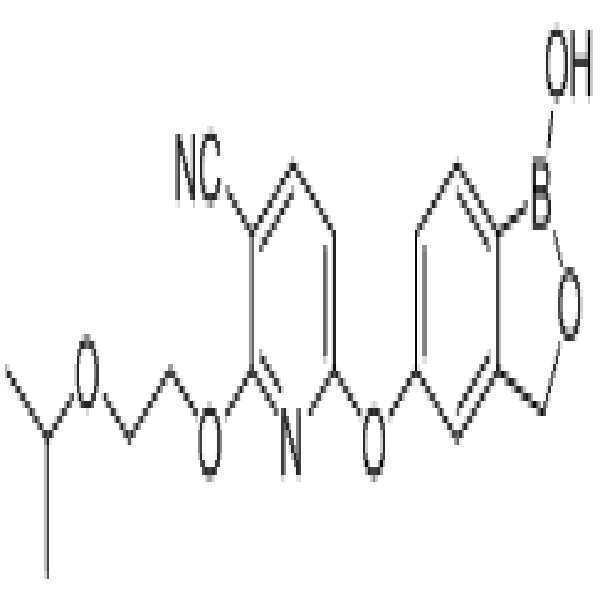
이 화합물은 D130 와 유사한 방법으로 프로판올 대신에 2-이소프로폭시에탄을 이용하여 만들어졌다.This compound was prepared in a similar manner as D130 using 2-isopropoxyethane instead of propanol.
19er D141 19er D141

이 화합물은 D130 와 유사한 방법으로, 프로판올 대신에 2-아세틸프로판올을 이용하여 만들어졌다.This compound was prepared in a similar manner as D130 , but using 2-acetylpropanol instead of propanol.
19es D142 19es D142

이 화합물은 Mitsunobu 반응에 의해 D10과 2-이소프로폴시에탄올로부터 만들어졌다. This compound was made from D10 and 2-isopropoxyethanol by the Mitsunobu reaction.
19et D143 19et D143

이 화합물은 D10 및 3-아세틸프로판올으로부터 Mitsunobu 반응에 의해 만들어졌다.This compound was made by the Mitsunobu reaction from D10 and 3-acetylpropanol.
19eu D144 19eu D144

이 화합물은 D14 및 2-이소프로폭시에탄올으로부터Mitsunobu 반응에 의해 만들어졌다.This compound was made by the Mitsunobu reaction from D14 and 2-isopropoxyethanol.
19ev D145 19ev D145
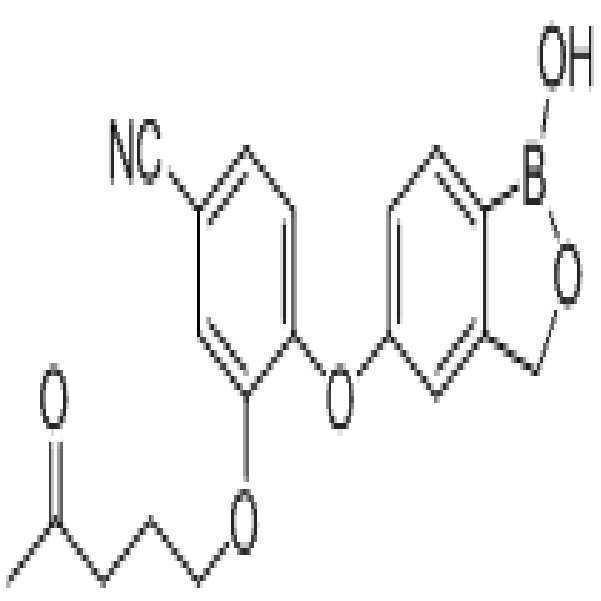
이 화합물은 D14 및 3-아세틸프로판올으로부터 Mitsunobu 반응에 의해 만들어졌다.This compound was made by the Mitsunobu reaction from D14 and 3-acetylpropanol.
19ew D146 19ew D146

이 화합물은 D10 및 2-하이드록시에틸 아세테이트으로부터 Mitsunobu 반응에 의해 만들어졌다.This compound was made by the Mitsunobu reaction from D10 and 2-hydroxyethyl acetate.
19ex D147 19ex D147

이 화합물은 D14 및 2-하이드록시에틸 아세테이트으로부터 Mitsunobu 반응에 의해 만들어졌다.This compound was made by the Mitsunobu reaction from D14 and 2-hydroxyethyl acetate.
N-[4-(1- 하이드록시 -1,3- 디하이드로 - 벤조[c][1,2]옥사보롤 -5-일 옥시 )- 벤 질]-4-메틸-벤젠술폰아미드 (D148) N- [4- (1- hydroxy-1,3-dihydro-benzo [c] [1,2] oxazol-5-yl borol oxy) ben quality] -4-methyl-benzenesulfonamide (D148)

5-(4-아미노메틸-페녹시)-3H-벤조[c][1,2]옥사보롤-1-올 (144 mg, 0.56 mmol, 1.1 eq.), 4-메틸-벤젠술포닐 클로라이드 (118.4 mg, 0.62 mmol, 1.1 eq.)의 DCM (10.0 mL)을 포함하는 20ml 신틸레이션 바이알에 Et3N (160 μL, 1.12 mmol, 2.0 eq.)가 점적되었다. 혼합물은 실온에서 하룻밤 동안 교반되었다. 혼합물은 aqu. NH4Cl (10 mL)으로 조심스럽게 다루어졌고, 층들은 분리되었다. 수성은 DCM (2 x 5 mL)으로 추출되었고, 복합되었고, 유기 상은 H2O (10 mL), 소금물 (10 mL)으로 세척되고, MgSO4상에서 건조되고 여과되었고, 여과액은 감압하에서 농축되었다. 잔유물은 실리카 크로마토그래피에 제공되어, EtOAc/헵탄 (0:100 내지 80:20)으로 용리되어 N-[4-(1-하이드록시-1,3-디하이드로-벤조[c][1,2]옥사보롤-5-일 옥시)-벤질]-4-메틸-벤젠술폰아미드이 백색 고체로 수득되었다. LCMS (m/z) 432 (M+23); 1H NMR( 400MHz, DMSO-d6) δ ppm 1H NMR (DMSO-d6) δ: 9.11 (s, 1H), 8.08 (t, J = 6.3 Hz, 1H), 7.65 - 7.74 (m, 3H), 7.38 (d, J = 8.0 Hz, 2H), 7.23 - 7.31 (m, J = 8.6 Hz, 2H), 6.95 - 7.00 (m, 2H), 6.89 - 6.95 (m, 2H), 4.92 (s, 2H), 3.95 (d, J = 6.3 Hz, 2H), 2.38 (s, 3H).Benzo [c] [1,2] oxaborol-1-ol (144 mg, 0.56 mmol, 1.1 eq.) And 4-methyl-benzenesulfonyl chloride Et 3 N (160 μL, 1.12 mmol, 2.0 eq.) Was added to a 20 ml scintillation vial containing 118.4 mg, 0.62 mmol, 1.1 eq.) Of DCM (10.0 mL). The mixture was stirred at room temperature overnight. The mixture aqu. Treated with NH 4 Cl (10 mL), and the layers were separated. The aqueous was extracted with DCM (2 x 5 mL) and combined, and the organic phase was washed with H 2 O (10 mL), brine (10 mL), dried over MgSO 4 and filtered and the filtrate was concentrated under reduced pressure . The residue was subjected to silica chromatography and eluted with EtOAc / heptane (0: 100 to 80:20) to give N- [4- (1-hydroxy-1,3-dihydro- benzo [ ] Oxaborol-5-yloxy) -benzyl] -4-methyl-benzenesulfonamide as a white solid. LCMS (m / z) 432 (M + 23); 1 H NMR (400MHz, DMSO- d 6)
3- 클로로 -N-[4-(1- 하이드록시 -1,3- 디하이드로 - 벤조[c][1,2]옥사보롤 -5-일 옥 시)-벤질]-벤젠술폰아미드 (D149) 3-Chloro -N- [4- (1- hydroxy-1,3-dihydro-benzo [c] [1,2] oxazol-5-yl octanoic borol City) - benzyl] -benzenesulfonamide (D149)
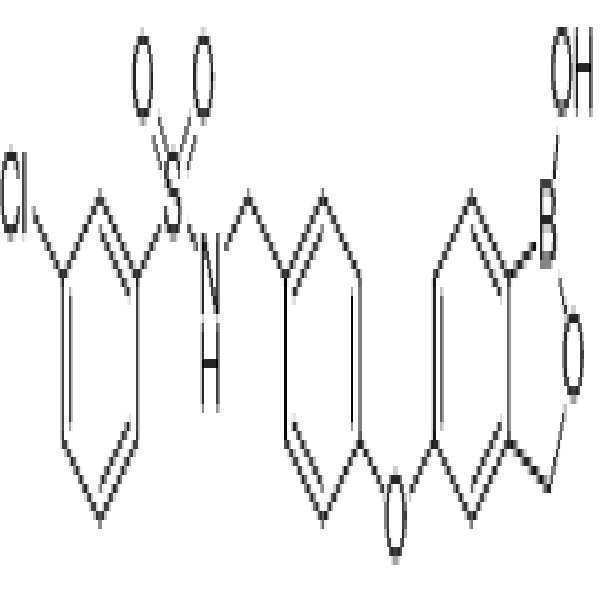
D149 은 D148과 유사한 과정을 이용하여 준비되었다. LCMS (m/z) 452 (M+23); 1H NMR (DMSO-d6) δ: 9.11 (s, 1H), 8.36 (t, J = 6.3 Hz, 1H), 7.66 - 7.77 (m, 4H), 7.59 (t, J = 8.1 Hz, 1H), 7.25 (d, J = 8.6 Hz, 2H), 6.87 - 6.98 (m, 4H), 4.93 (s, 2H), 4.05 (d, J = 6.3 Hz, 2H). D149 was prepared using a procedure similar to D148 . LCMS (m / z) 452 (M + 23); 1 H NMR (DMSO-d 6 ) δ: 9.11 (s, 1H), 8.36 (t, J = 6.3 Hz, 1H), 7.66 - 7.77 (m, 4H), 7.59 (t, J = 8.1 Hz, 1H) , 7.25 (d, J = 8.6 Hz, 2H), 6.87-6.98 (m, 4H), 4.93 (s, 2H), 4.05 (d, J = 6.3 Hz, 2H).
2- 클로로 -N-[4-(1- 하이드록시 -1,3- 디하이드로 - 벤조[c][1,2]옥사보롤 -5-일 옥 시)-벤질]-벤젠술폰아미드 (D150) 2-Chloro -N- [4- (1- hydroxy-1,3-dihydro-benzo [c] [1,2] oxazol-5-yl octanoic borol City) - benzyl] -benzenesulfonamide (D150)

D150 는 D148 과 유사한 과정을 이용하여 준비되었다. LCMS (m/z) 452 (M+23); 1H NMR (DMSO-d6) δ: 9.11 (s, 1H), 8.45 (t, J = 6.2 Hz, 1H), 7.88 - 7.93 (m, 1H), 7.71 (d, J = 8.0 Hz, 1H), 7.57 - 7.61 (m, 2H), 7.44 - 7.51 (m, 1H), 7.23 (d, J = 8.6 Hz, 2H), 6.84 - 6.92 (m, 4H), 4.94 (s, 2H), 4.11 (d, J = 6.2 Hz, 2H). D150 was prepared using a procedure similar to D148 . LCMS (m / z) 452 (M + 23); 1 H NMR (DMSO-d 6 ) δ: 9.11 (s, 1H), 8.45 (t, J = 6.2 Hz, 1H), 7.88 - 7.93 (m, 1H), 7.71 (d, J = 8.0 Hz, 1H) , 7.57-7.61 (m, 2H), 7.44-7.51 (m, 1H), 7.23 (d, J = 8.6 Hz, 2H), 6.84-6.92 , ≪ / RTI > J = 6.2 Hz, 2H).
N-[4-(1- 하이드록시 -1,3- 디하이드로 - 벤조[c][1,2]옥사보롤 -5-일 옥시 )- 벤 질]-메탄술폰아미드 (D151) N- [4- (1- hydroxy-1,3-dihydro-benzo [c] [1,2] oxazol-5-yl borol oxy) ben quality; - methanesulfonamide (D151)

D151 는 D148 과 유사한 과정을 이용하여 준비되었다. LCMS (m/z) 356 (M+23); 1H NMR (DMSO-d6) δ: 9.08 (s, 1H), 7.69 (d, J = 7.9 Hz, 1H), 7.52 (t, J = 6.3 Hz, 1H), 7.33 - 7.39 (m, J = 8.6 Hz, 2H), 7.00 - 7.07 (m, 2H), 6.90 - 6.97 (m, 2H), 4.90 (s, 2H), 4.13 (d, J = 6.3 Hz, 2H), 2.85 (s, 3H). D151 was prepared using a procedure similar to D148 . LCMS (m / z) 356 (M + 23); 1 H NMR (DMSO-d 6 ) δ: 9.08 (s, 1H), 7.69 (d, J = 7.9 Hz, 1H), 7.52 (t, J = 6.3 Hz, 1H), 7.33 - 7.39 (m, J = 8.6 Hz, 2H), 7.00-7.07 (m, 2H), 6.90-6.97 (m, 2H), 4.90 (s, 2H), 4.13 (d, J = 6.3 Hz,
5-(5-5- (5- 아미노메틸Aminomethyl -피리딘-2-일 -Pyridin-2-yl 옥시Oxy )-3H-) -3H- 벤조[c][1,2]옥사보롤Benzo [c] [1,2] oxaborol -1--One- olbe (D152)(D152)

자석 교반 막대가 고정된 50 mL 밑둥근 플라스크에 6-(1-하이드록시-1,3-디하이드로-벤조[c][1,2]옥사보롤-5-일 옥시)-니코틴니트릴 (1.0g, 4.0 mmol, 1.0eq.)가 첨가되고, 이어서 EtOH (40 mL) 및 THF (15 mL)가 첨가되었다. 플라스크에서 공기를 빼내고 N2 로 두차례 재충전되었다. 교반된 용액에 5% Pd/C (300 mg)가 첨가되었고, 플라스크에서 공기를 빼내고, 세차례 H2 로 재충전되었다. 생성된 현탁액은 실온에서 3일에 걸쳐 H2 기구하에 교반되었다. 혼합물은 짧은 셀라이트 팩을 통하여 여과되고, EtOH (3 x 25 mL)으로 세척되었다. 복합된 여과액은 감암하에서 농축되었고, 잔유물은 실리카 크로마토그래피에 넣어, MeOH/DCM (0:100 to 10: 90)로 용리시켜 백색 고체가 제공되었다. 고체는 최소량의 MeOH에 용해되었고, HCl/Et2O으로 신중하게 처리되었다. 침전물은 여과에 의해 수거되었고, Et2O로 세척되어, 5-(5-아미노메틸-피리딘-2-일 옥시)-3H-벤조[c][1,2]옥사보롤-1-올 하이드로클로라이드가 백색 고체로 제공되었다. 1H NMR (DMSO-d6) δ: 9.95 (br. s., 1H), 8.28 (d, J = 2.2 Hz, 1H), 8.11 (dd, J = 8.5, 2.4 Hz, 1H), 7.75 (d, J = 8.0 Hz, 1H), 7.07 - 7.14 (m, 2H), 7.05 (dd, J = 7.9, 2.0 Hz, 1H), 4.94 (s, 2H), 4.14 (t, J = 5.6 Hz, 2H). Benzo [c] [1,2] oxaborol-5-yloxy) -nicotinonitrile (1.0 g, 0.10 mmol) was added to a 50 mL round bottomed flask to which a magnetic stir bar was fixed. , 4.0 mmol, 1.0 eq.) Was added followed by EtOH (40 mL) and THF (15 mL). The flask was evacuated and recharged twice with N 2 . To the stirred solution was added 5% Pd / C (300 mg) and the flask was evacuated and refilled with H 2 three times. The resulting suspension was stirred under H 2 apparatus over 3 days at room temperature. The mixture was filtered through a short celite pack and washed with EtOH (3 x 25 mL). The combined filtrates were concentrated under reduced pressure and the residue was subjected to silica chromatography and eluted with MeOH / DCM (0: 100 to 10: 90) to give a white solid. Solid was dissolved in a minimal amount of MeOH, it was treated carefully with HCl / Et 2 O. The precipitate was collected by filtration and washed with Et 2 O to give 5- (5-aminomethyl-pyridin-2-yloxy) -3H-benzo [c] [1,2] oxaborol-1-ol hydrochloride Was provided as a white solid. 1 H NMR (DMSO-d 6 ) δ: 9.95 (.. Br s, 1H), 8.28 (d, J = 2.2 Hz, 1H), 8.11 (dd, J = 8.5, 2.4 Hz, 1H), 7.75 (d J = 8.0 Hz, 1H), 7.07-7.14 (m, 2H), 7.05 (dd, J = 7.9, 2.0 Hz, .
5-{4-[( 시클로헥실메틸 -아미노)- 메틸 ]- 페녹시 }-3H- 벤조[c][1,2]옥사보롤 -1- 올 (D153) 5- {4 - [(cyclohexylmethyl-amino) -methyl] -phenoxy} -3H- benzo [c] [1,2] oxazole borol-1-ol (D153)

5-(4-아미노메틸-페녹시)-3H-벤조[c][1,2]옥사보롤-1-올 (150mg, 0.59 mmol, 1.0 eq.)의 EtOH (5.0 mL) 용액에 시클로헥산카르보알데히드 (280 μL, 2.36 mmol, 4.0 eq.)가 첨가되었다. 혼합물은 실온에서 30분간 교반되었다. 0 ℃로 냉각된 후, NaBH4 (89 mg, 0.36 mmol, 4.0 eq.)가 부분적으로 첨가되었고, 혼합물은 실온으로 데워지고 2시간 동안 교반되었다. 혼합물은 희석 HCl (5 mL)으로 신중하게 처리되고, 그리고 수성 상은 EtOAc (3 x 10 mL)으로 추출되었다. 복합된 유기 추출물은 소금물로 세척하고 (10 mL), MgSO4상에서 건조되고 여과되었고, 그리고 여과액은 감압하에서 농축되었다. 잔유물은 실리카 크로마토그래피에 제공되어, MeOH/DCM (0:100 내지 10: 90)으로 용리되어 5-{4-[(시클로헥실메틸-아미노)-메틸]-페녹시}-3H-벤조[c][1,2]옥사보롤-1-올이 백색고체로 제공되었다. LCMS (m/z) 352 (M+H); 1H NMR (DMSO-d6) δ: 9.08 (s, 1H), 7.68 (d, J = 8.0 Hz, 1H), 7.30 - 7.37 (m, J = 8.5 Hz, 2H), 6.95 - 7.02 (m, 2H), 6.88 - 6.95 (m, 2H), 4.89 (s, 2H), 3.64 (s, 2H), 2.31 (d, J = 6.6 Hz, 2H), 1.67 - 1.77 (m, 2H), 1.56 - 1.66 (m, 3H), 1.30 - 1.44 (m, 1H), 1.02 - 1.23 (m, 3H), 0.77 - 0.91 (m, 2H).To a solution of 5- (4-aminomethyl-phenoxy) -3H-benzo [c] [1,2] oxaborol-1-ol (150 mg, 0.59 mmol, 1.0 equiv) in EtOH (5.0 mL) was added cyclohexanecarboxyl Bocaldehyde (280 [mu] L, 2.36 mmol, 4.0 eq.) Was added. The mixture was stirred at room temperature for 30 minutes. After cooling to 0 ℃, NaBH 4 (89 mg , 0.36 mmol, 4.0 eq.) That was partially added, the mixture warmed to room temperature and stirred for 2 hours. The mixture was carefully treated with dilute HCl (5 mL), and the aqueous phase was extracted with EtOAc (3 x 10 mL). The combined organic extracts were washed with brine (10 mL), dried over MgSO 4 and filtered, and the filtrate was concentrated under reduced pressure. The residue was subjected to silica chromatography and eluted with MeOH / DCM (0: 100 to 10:90) to give 5- {4 - [(cyclohexylmethyl- amino) -methyl] -phenoxy} -3H-benzo [c ] [1,2] oxaborol-1-ol was provided as a white solid. LCMS (m / z) 352 (M + H); 1 H NMR (DMSO-d 6 ) δ: 9.08 (s, 1H), 7.68 (d, J = 8.0 Hz, 1H), 7.30 - 7.37 (m, J = 8.5 Hz, 2H), 6.95 - 7.02 (m, (M, 2H), 1.56-1.66 (m, 2H), 6.88-6.95 (m, 2H) (m, 3H), 1.30 - 1.44 (m, 1H), 1.02 - 1.23 (m, 3H), 0.77 - 0.91 (m, 2H).
5-(4-5- (4- 시클로헥실아미노메틸Cyclohexylaminomethyl -- 페녹시Phenoxy )-3H-) -3H- 벤조[c][1,2]옥사보롤Benzo [c] [1,2] oxaborol -1-올 -1-ol (D154)(D154)
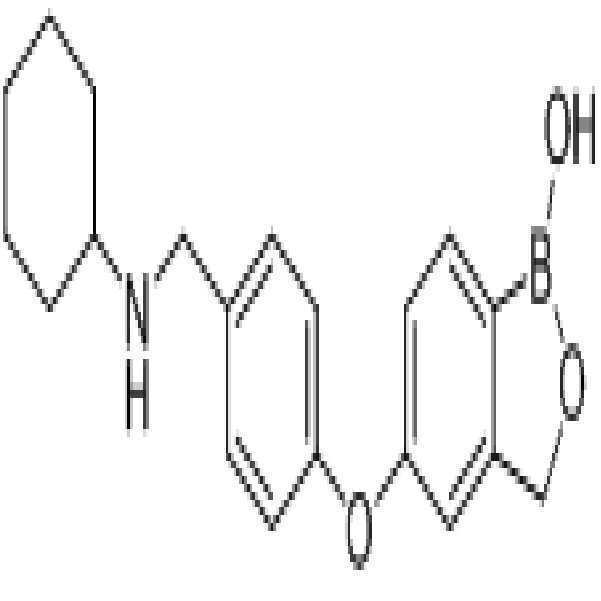
D154 는 D153 과 유사한 과정을 이용하여 준비되었다. LCMS (m/z) 338 (M+H); 1H NMR (DMSO-d6) δ: 9.08 (br. s., 1H), 7.68 (d, J = 8.0 Hz, 1H), 7.31 - 7.38 (m, J = 8.5 Hz, 2H), 6.95 - 7.00 (m, 2H), 6.89 - 6.95 (m, 2H), 4.89 (s, 2H), 3.68 (s, 2H), 2.35 (tt, J = 9.9, 3.7 Hz, 1H), 1.78 - 1.88 (m, 2H), 1.59 - 1.70 (m, 2H), 1.47 - 1.56 (m, 1H), 0.97 - 1.22 (m, 5H). D154 was prepared using a procedure similar to D153 . LCMS (m / z) 338 (M + H); 1 H NMR (DMSO-d 6 ) δ: 9.08 (.. Br s, 1H), 7.68 (d, J = 8.0 Hz, 1H), 7.31 - 7.38 (m, J = 8.5 Hz, 2H), 6.95 - 7.00 (m, 2H), 6.89-6.95 (m, 2H), 4.89 (s, 2H), 3.68 (s, 2H), 2.35 (tt, J = 9.9, 3.7 Hz, ), 1.59-1.70 (m, 2H), 1.47-1.56 (m, 1H), 0.97-1.22 (m, 5H).
5-(4-{[(1H-피롤-2-일 메틸 )-아미노]- 메틸 }- 페녹시 )-3H- 벤조[c][1,2]옥사보 롤-1-올 (D155) 5- (4 - {[(1H- pyrrol-2-ylmethyl) -amino] -methyl} -phenoxy) -3H- benzo [c] [1,2] oxazole beam roll-1-ol (D155)

D155 는 D153 과 유사한 과정을 이용하여 준비되었다. LCMS (m/z) 335 (M+H); 1H NMR (DMSO-d6) δ: 9.08 (br. s., 1H), 7.68 (d, J = 7.9 Hz, 1H), 7.32 - 7.38 (m, J = 8.5 Hz, 2H), 6.96 - 7.02 (m, 2H), 6.89 - 6.96 (m, 2H), 6.61 (td, J = 2.6, 1.6 Hz, 1H), 5.89 (q, J = 2.6 Hz, 1H), 5.83 - 5.87 (m, 1H), 4.90 (s, 2H), 4.07 (br. s., 1H), 3.63 (s, 2H), 3.60 (s, 2H), 3.31 (br. s., 1H). D155 was prepared using a procedure similar to D153 . LCMS (m / z) 335 (M + H); 1 H NMR (DMSO-d 6 ) δ: 9.08 (.. Br s, 1H), 7.68 (d, J = 7.9 Hz, 1H), 7.32 - 7.38 (m, J = 8.5 Hz, 2H), 6.96 - 7.02 (m, 2H), 6.89-6.96 (m, 2H), 6.61 (td, J = 2.6, 1.6 Hz, 1H), 5.89 (q, J = 2.6 Hz, 1H), 5.83-5.87 2H), 3.60 (s, 2H), 3.90 (s, 2H), 4.07 (br.
5-{4-[(2-5- {4 - [(2- 브로모Bromo -- 벤질아미노Benzylamino )-) - 메틸methyl ]-] - 페녹시Phenoxy }-3H-} -3H- 벤조[c][1,2]옥사보롤Benzo [c] [1,2] oxaborol -1-올 -1-ol (D156)(D156)

D156 는 D153 과 유사한 과정을 이용하여 준비되었다. LCMS (m/z) 424 (M+); 1H NMR (클로로포름-d) δ: 7.71 (br. s., 1H), 7.55 (d, J = 7.9 Hz, 1H), 7.41 (dd, J = 7.6, 1.5 Hz, 1H), 7.36 (d, J = 8.4 Hz, 2H), 7.26 - 7.32 (m, 1H), 7.10 - 7.19 (m, 2H), 7.01 (d, J = 8.5 Hz, 3H), 6.96 (br. s., 1H), 6.89 (s, 1H), 5.29 (br. s., 1H), 5.04 (br. s., 2H), 3.92 (s, 2H), 3.81 (s, 2H). D156 was prepared using a procedure similar to D153 . LCMS (m / z) 424 (M < + >); 1 H NMR (chloroform -d) δ: 7.71 (.. Br s, 1H), 7.55 (d, J = 7.9 Hz, 1H), 7.41 (dd, J = 7.6, 1.5 Hz, 1H), 7.36 (d, J = 8.4 Hz, 2H), 7.26-7.22 (m, 1H), 7.10-7.19 (m, 2H), 7.01 (s, 1H), 5.29 (br s, 1H), 5.04 (br s, 2H), 3.92 (s, 2H), 3.81 (s, 2H).
5-{4-[(3-5- {4 - [(3- 브로모Bromo -- 벤질아미노Benzylamino )-) - 메틸methyl ]-] - 페녹시Phenoxy }-3H-} -3H- 벤조[c][1,2]옥사보롤Benzo [c] [1,2] oxaborol -1-올 -1-ol (D157)(D157)

D157는 D153 과 유사한 과정을 이용하여 준비되었다. LCMS (m/z) 424 (M+); 1H NMR (클로로포름-d) δ: 7.68 (br. s., 1H), 7.52 (s, 1H), 7.38 (dt, J = 7.9, 1.4 Hz, 1H), 7.33 (d, J = 8.5 Hz, 2H), 7.26 - 7.29 (m, 1H), 7.19 (t, J = 7.7 Hz, 1H), 6.96 - 7.03 (m, 1H), 7.01 (d, J = 8.5 Hz, 2H), 6.89 (s, 1H), 5.02 (br. s., 2H), 3.80 (d, J = 5.5 Hz, 4H), 2.17 (s, 1H). D157 was prepared using a procedure similar to D153 . LCMS (m / z) 424 (M < + >); 1 H NMR (chloroform -d) δ: 7.68 (.. Br s, 1H), 7.52 (s, 1H), 7.38 (dt, J = 7.9, 1.4 Hz, 1H), 7.33 (d, J = 8.5 Hz, (M, 1H), 7.09 (d, J = 8.5 Hz, 2H), 6.89 (s, 1H) ), 5.02 (br s, 2H), 3.80 (d, J = 5.5 Hz, 4H), 2.17 (s, 1H).
5-{4-[(2-5- {4 - [(2- 메톡시Methoxy -- 벤질아미노Benzylamino )-) - 메틸methyl ]-] - 페녹시Phenoxy }-3H-} -3H- 벤조[c][1,2]옥사보롤Benzo [c] [1,2] oxaborol -1-올 -1-ol (D158)(D158)

D158 는 D153 과 유사한 과정을 이용하여 준비되었다. LCMS (m/z) 376 (M+H); 1H NMR (클로로포름-d) δ: 7.64 (s, 1H), 7.34 (d, J = 8.4 Hz, 2H), 7.27 (s, 1H), 7.24 (br. s., 1H), 6.85 - 7.02 (m, 6H), 5.00 (s, 2H), 3.85 (s, 2H), 3.83 (s, 3H), 3.78 (s, 2H), 2.16 (s, 1H). D158 was prepared using a procedure similar to D153 . LCMS (m / z) 376 (M + H) +; 1 H NMR (chloroform-d)?: 7.64 (s, 1H), 7.34 (d, J = 8.4 Hz, 2H), 7.27 (s, 2H), 3.85 (s, 2H), 3.83 (s, 3H), 3.78 (s, 2H).
5-[4-(5- [4- ( 벤질아미노Benzylamino -- 메틸methyl )-) - 페녹시Phenoxy ]-3H-] -3H- 벤조[c][1,2]옥사보롤Benzo [c] [1,2] oxaborol -1-올-1-ol (D159) (D159)

D159 는 D153 과 유사한 과정을 이용하여 준비되었다. LCMS (m/z) 346 (M+H); 1H NMR (클로로포름-d) δ: 7.66 (br. s., 1H), 7.31 - 7.38 (m, 6H), 7.28 (d, J = 2.5 Hz, 0H), 6.99 (s, 3H), 6.88 (br. s., 1H), 5.01 (s, 2H), 3.88 (s, 1H), 3.84 (s, 2H), 3.81 (s, 2H). D159 was prepared using a procedure similar to D153 . LCMS (m / z) 346 (M + H); 1 H NMR (chloroform -d) δ: 7.66 (.. Br s, 1H), 7.31 - 7.38 (m, 6H), 7.28 (d, J = 2.5 Hz, 0H), 6.99 (s, 3H), 6.88 ( (s, 2H), 3.81 (s, 2H), 3.81 (s, 2H).
5-{4-[(2-5- {4 - [(2- 메틸methyl -- 벤질아미노Benzylamino )-) - 메틸methyl ]-] - 페녹시Phenoxy }-3H-} -3H- 벤조[c][1,2]옥사보롤Benzo [c] [1,2] oxaborol -1-올 -1-ol (D160)(D160)

D160 는 D153 과 유사한 과정을 이용하여 준비되었다. LCMS (m/z) 360 (M+H); 1H NMR (클로로포름-d) δ: 7.64 - 7.72 (m, 1H), 7.32 - 7.39 (m, 3H), 7.18 (dd, J = 5.3, 3.4 Hz, 2H), 7.14 - 7.21 (m, 1H), 6.98 (d, J = 8.5 Hz, 3H), 6.87 (s, 1H), 4.99 (s, 2H), 3.94 (d, J = 1.4 Hz, 4H), 2.30 (s, 3H). D160 was prepared using a procedure similar to D153 . LCMS (m / z) 360 (M + H) < + >; 1 H NMR (chloroform -d) δ: 7.64 - 7.72 ( m, 1H), 7.32 - 7.39 (m, 3H), 7.18 (dd, J = 5.3, 3.4 Hz, 2H), 7.14 - 7.21 (m, 1H) , 6.98 (d, J = 8.5 Hz, 3H), 6.87 (s, 1H), 4.99 (s, 2H), 3.94 (d, J = 1.4 Hz, 4H), 2.30
5-[4-(5- [4- ( 이소프로필아미노Isopropylamino -- 메틸methyl )-) - 페녹시Phenoxy ]-3H-] -3H- 벤조[c][1,2]옥사보롤Benzo [c] [1,2] oxaborol -1-올 -1-ol (D161)(D161)

D161는 D153 과 유사한 과정을 이용하여 준비되었다. LCMS (m/z) 298 (M+H); 1H NMR (클로로포름-d) δ: 7.61 (d, J = 8.4 Hz, 3H), 6.99 (d, J = 8.1 Hz, 2H), 6.85 (br. s., 2H), 5.00 (s, 2H), 3.98 (s, 2H), 2.15 (s, 1H), 1.42 (d, J = 6.5 Hz, 6H). D161 was prepared using a procedure similar to D153 . LCMS (m / z) 298 (M + H); 1 H NMR (chloroform -d) δ: 7.61 (d, J = 8.4 Hz, 3H), 6.99 (d, J = 8.1 Hz, 2H), 6.85 (.. Br s, 2H), 5.00 (s, 2H) , 3.98 (s, 2H), 2.15 (s, IH), 1.42 (d, J = 6.5 Hz, 6H).
3-{[4-(1- 하이드록시 -1,3- 디하이드로 - 벤조[c][1,2]옥사보롤 -5-일 옥시 )- 벤질 아미노]-메틸}-벤조니트릴 (D162) 3 - {[4- (1-hydroxy-1,3-dihydro-benzo [c] [1,2] oxazol-5-yl borol oxy) -benzyl-amino] -methyl} -benzonitrile (D162)

D162 는 D153 과 유사한 과정을 이용하여 준비되었다. LCMS (m/z) 239 (M-131); 1H NMR (DMSO-d6) δ: 9.86 (br. s., 1H), 9.15 (br. s., 1H), 8.06 (s, 1H), 7.83 - 7.93 (m, 2H), 7.65 - 7.75 (m, 1H), 7.58 - 7.65 (m, 3H), 7.07 (d, J = 8.6 Hz, 1H), 7.04 - 7.10 (m, 1H), 6.93 - 6.99 (m, 2H), 4.91 (s, 2H), 4.14 (br. s., 4H). D162 was prepared using a procedure similar to D153 . LCMS (m / z) 239 (M-131); 1 H NMR (DMSO-d 6 ) ?: 9.86 (br s, 1H), 9.15 (br s, 1H), 8.06 (s, 1H), 7.83-7.93 (m, 2H), 4.91 (s, 2H), 7.09 (d, J = ), 4.14 (br s, 4H).
4-{[4-(1- 하이드록시 -1,3- 디하이드로 - 벤조[c][1,2]옥사보롤 -5-일 옥시 )- 벤질 아미노]-메틸}-벤조니트릴 (D163) 4 - {[4- (1-hydroxy-1,3-dihydro-benzo [c] [1,2] oxazol-5-yl borol oxy) -benzyl-amino] -methyl} -benzonitrile (D163)

D163 는 D153 과 유사한 과정을 이용하여 준비되었다. LCMS (m/z) 239 (M-131); 1H NMR (DMSO-d6) δ: 9.46 - 9.73 (m, 1H), 9.13 (s, 1H), 7.90 (d, J = 8.3 Hz, 2H), 7.72 (d, J = 8.6 Hz, 3H), 7.52 - 7.56 (m, J = 8.6 Hz, 2H), 7.06 - 7.10 (m, J = 8.6 Hz, 2H), 6.96 (s, 1H), 6.95 (d, J = 0.5 Hz, 1H), 4.91 (s, 2H), 4.22 (s, 2H), 4.09 - 4.17 (m, 2H). D163 was prepared using a procedure similar to D153 . LCMS (m / z) 239 (M-131); 1 H NMR (DMSO-d 6 ) δ: 9.46 - 9.73 (m, 1H), 9.13 (s, 1H), 7.90 (d, J = 8.3 Hz, 2H), 7.72 (d, J = 8.6 Hz, 3H) , 7.52-7.56 (m, J = 8.6 Hz, 2H), 7.06-7.10 (m, J = 8.6 Hz, 2H), 6.96 s, 2H), 4.22 (s, 2H), 4.09-4.17 (m, 2H).
5-{4-[(4-니트로-5- {4 - [(4-Nitro- 벤질아미노Benzylamino )-) - 메틸methyl ]-] - 페녹시Phenoxy }-3H-} -3H- 벤조[c][1,2]옥사보롤Benzo [c] [1,2] oxaborol -1-올 -1-ol (D164)(D164)

D164는 D153 과 유사한 과정을 이용하여 준비되었다. LCMS (m/z) 239 (M-151); 1H NMR (DMSO-d6) δ: 9.11 (s, 1H), 8.22 - 8.27 (m, J = 8.7 Hz, 2H), 7.70 (d, J = 8.9 Hz, 3H), 7.47 (s, 2H), 7.04 - 7.08 (m, J = 8.5 Hz, 2H), 6.93 - 6.97 (m, 2H), 4.90 (s, 2H), 4.09 - 4.23 (m, 2H), 3.94 - 4.05 (m, 2H). D164 was prepared using a procedure similar to D153 . LCMS (m / z) 239 (M-151); 1 H NMR (DMSO-d 6 ) δ: 9.11 (s, 1H), 8.22 - 8.27 (m, J = 8.7 Hz, 2H), 7.70 (d, J = 8.9 Hz, 3H), 7.47 (s, 2H) , 7.04-7.08 (m, J = 8.5 Hz, 2H), 6.93-6.97 (m, 2H), 4.90 (s, 2H), 4.09-4.23 (m, 2H), 3.94-4.05 (m, 2H).
N-(4-{[4-(1- 하이드록시 -1,3- 디하이드로 - 벤조[c][1,2]옥사보롤 -5-일 옥시 )- 벤질아미노]-메틸}-페닐)-아세타아미드(D165) N- (4 - {[4- ( 1- hydroxy-1,3-dihydro-benzo [c] [1,2] oxazol-5-yl borol oxy) -benzyl-amino] -methyl} -phenyl) Acetamide (D165)

D165 는 D153 과 유사한 과정을 이용하여 준비되었다. LCMS (m/z) 403 (M+H); 1H NMR (DMSO-d6) δ: 10.18 (s, 1H), 9.66 (br. s., 1H), 9.16 (br. s., 1H), 7.74 (d, J = 8.7 Hz, 1H), 7.59 (dd, J = 16.0, 8.6 Hz, 4H), 7.45 (d, J = 8.6 Hz, 2H), 7.06 (d, J = 8.6 Hz, 2H), 6.95 (s, 1H), 6.96 (d, J = 3.8 Hz, 1H), 4.91 (s, 2H), 4.04 (br. s., 4H), 2.03 (s, 3H). D165 was prepared using a procedure similar to D153 . LCMS (m / z) 403 (M + H); 1 H NMR (DMSO-d 6 ) ?: 10.18 (s, 1H), 9.66 (br. S., 1 H), 9.16 J = 8.6 Hz, 2H), 6.95 (s, 1H), 6.96 (d, J = 8.6 Hz, 2H), 7.59 (dd, J = = 3.8 Hz, 1H), 4.91 (s, 2H), 4.04 (br s, 4H), 2.03 (s, 3H).
N-[4-(1- 하이드록시 -1,3- 디하이드로 - 벤조[c][1,2]옥사보롤 -5-일 옥시 )- 벤 질]-아세타아미드(D166) N- [4- (1- hydroxy-1,3-dihydro-benzo [c] [1,2] oxazol-5-yl borol oxy) ben quality; - Oh theta amide (D166)

5-(4-아미노메틸-페녹시)-3H-벤조[c][1,2]옥사보롤-1-올 (150 mg, 0.59 mmol, 1.0 eq.)의 DCM (5.0 mL)이 포함된 20mL 실틸레이션 바이알에 Et3N (180 μL, 1.3 mmol, 2.2 eq.)이 첨가되고, 이어서 아세틸 클로라이드 (84 μL, 1.2 mmol, 2.0 eq.)가 첨가되었다. 혼합물은 실온에서 하룻밤 동안 교반되었다. 혼합물은 감압하에서 농축되었다. 잔유물은 실리카 크로마토그래피에 제공되어 MeOH/DCM (0:100 내지 10:90)로 용리되면, N-[4-(1-하이드록시-1,3-디하이드로-벤조[c][1,2]옥사보롤-5-일 옥시)-페닐]-아세타아미드가 백색 고체로 제공되었다. LCMS (m/z) 298 (M+H); 1H NMR (클로로포름-d) δ: 7.55 (d, J = 8.0 Hz, 1H), 7.11 (d, J = 8.6 Hz, 2H), 6.74 - 6.83 (m, 3H), 6.68 (d, J = 1.4 Hz, 1H), 4.79 (s, 2H), 4.21 (d, J = 5.8 Hz, 2H), 1.84 (s, 3H). 수득된 양, 165 mg, 94.3% 산출량.A solution of 20 mL (5.0 mL) in DCM (5.0 mL) of 5- (4-aminomethyl-phenoxy) -3H-benzo [c] [1,2] oxaborol- Et 3 N (180 μL, 1.3 mmol, 2.2 eq.) Was added to the silylation vial followed by addition of acetyl chloride (84 μL, 1.2 mmol, 2.0 eq.). The mixture was stirred at room temperature overnight. The mixture was concentrated under reduced pressure. The residue was subjected to silica chromatography and eluted with MeOH / DCM (0: 100 to 10:90) to give N- [4- (1-hydroxy-1,3-dihydro- benzo [ ] Oxaborol-5-yloxy) -phenyl] -acetamide was provided as a white solid. LCMS (m / z) 298 (M + H); 1 H NMR (chloroform -d) δ: 7.55 (d, J = 8.0 Hz, 1H), 7.11 (d, J = 8.6 Hz, 2H), 6.74 - 6.83 (m, 3H), 6.68 (d, J = 1.4 Hz, 1 H), 4.79 (s, 2H), 4.21 (d, J = 5.8 Hz, 2H), 1.84 (s, 3H). The amount obtained, 165 mg, 94.3% yield.
N-[4-(1- 하이드록시 -1,3- 디하이드로 - 벤조[c][1,2]옥사보롤 -5-일 옥시 )- 벤 질]-4-메틸-벤자미드 (D167) N- [4- (1- hydroxy-1,3-dihydro-benzo [c] [1,2] oxazol-5-yl borol oxy) ben quality] -4-methyl-benzamide (D167)

D167 는 D166 과 유사한 과정을 이용하여 준비되었다. LCMS (m/z) 396 (M+23); 1H NMR (클로로포름-d) δ: 7.69 (d, J = 8.2 Hz, 2H), 7.35 (d, J = 6.8 Hz, 2H), 7.23 (d, J = 7.9 Hz, 2H), 6.95 - 7.04 (m, 3H), 6.88 (br. s., 1H), 6.83 - 6.93 (m, 1H), 6.38 (br. s., 1H), 5.02 (s, 2H), 4.63 (d, J = 5.7 Hz, 2H), 2.39 (s, 3H). D167 was prepared using a procedure similar to D166 . LCMS (m / z) 396 (M + 23); 1 H NMR (chloroform -d) δ: 7.69 (d, J = 8.2 Hz, 2H), 7.35 (d, J = 6.8 Hz, 2H), 7.23 (d, J = 7.9 Hz, 2H), 6.95 - 7.04 ( 2H), 4.63 (d, J = 5.7 Hz, 1H), 6.83 (s, 2H), 2.39 (s, 3H).
N-[4-(1- 하이드록시 -1,3- 디하이드로 - 벤조[c][1,2]옥사보롤 -5-일 옥시 )- 벤 질]-3-메틸-벤자미드 (D168) N- [4- (1- hydroxy-1,3-dihydro-benzo [c] [1,2] oxazol-5-yl borol oxy) ben quality] -3-methyl-benzamide (D168)

D168 는 D166 과 유사한 과정을 이용하여 준비되었다. LCMS (m/z) 374 (M+H); 1H NMR (클로로포름-d) δ: 7.68 (d, J = 8.2 Hz, 1H), 7.63 (s, 1H), 7.52 - 7.60 (m, 1H), 7.30 - 7.38 (m, 4H), 7.02 (dd, J = 8.6, 2.7 Hz, 3H), 6.89 (br. s., 1H), 6.39 (br. s., 1H), 5.02 (s, 2H), 4.64 (d, J = 5.7 Hz, 2H), 3.88 (s, 1H), 2.39 (s, 3H). D168 was prepared using a procedure similar to D166 . LCMS (m / z) 374 (M + H); 1 H NMR (chloroform -d) δ: 7.68 (d, J = 8.2 Hz, 1H), 7.63 (s, 1H), 7.52 - 7.60 (m, 1H), 7.30 - 7.38 (m, 4H), 7.02 (dd J = 8.6, 2.7 Hz, 3H), 6.89 (br s, 1H), 6.39 (br s, 3.88 (s, 1 H), 2.39 (s, 3 H).
N-[4-(1- 하이드록시 -1,3- 디하이드로 - 벤조[c][1,2]옥사보롤 -5-일 옥시 )- 벤 질]-2-메틸-벤자미드 (D169) N- [4- (1- hydroxy-1,3-dihydro-benzo [c] [1,2] oxazol-5-yl borol oxy) ben quality] -2-methyl-benzamide (D169)

D169는 D166 과 유사한 과정을 이용하여 준비되었다. LCMS (m/z) 374 (M+H); 1H NMR (DMSO-d6) δ: 9.08 (s, 1H), 8.76 (s, 1H), 7.68 (d, J = 8.0 Hz, 1H), 7.28 - 7.38 (m, 4H), 7.22 (d, J = 7.4 Hz, 2H), 7.00 - 7.05 (m, 2H), 6.91 - 6.96 (m, 2H), 4.89 (s, 2H), 4.41 (d, J = 6.1 Hz, 2H), 2.31 (s, 3H). D169 was prepared using a procedure similar to D166 . LCMS (m / z) 374 (M + H); 1 H NMR (DMSO-d 6 ) δ: 9.08 (s, 1H), 8.76 (s, 1H), 7.68 (d, J = 8.0 Hz, 1H), 7.28 - 7.38 (m, 4H), 7.22 (d, J = 7.4 Hz, 2H), 7.00-7.55 (m, 2H), 6.91-6.96 (m, 2H), 4.89 (s, 2H), 4.41 ).
N-[4-(1- 하이드록시 -1,3- 디하이드로 - 벤조[c][1,2]옥사보롤 -5-일 옥시 )- 벤 질]-4-니트로-벤자미드 (D170) N- [4- (1- hydroxy-1,3-dihydro-benzo [c] [1,2] oxazol-5-yl borol oxy) ben quality] -4-nitro-benzamide (D170)

D170 는 D166 과 유사한 과정을 이용하여 준비되었다. LCMS (m/z) 374 (M-30); 1H NMR (DMSO-d6) δ: 9.36 (s, 1H), 9.08 (s, 1H), 8.28 - 8.32 (m, 2H), 8.08 - 8.12 (m, 2H), 7.68 (d, J = 8.0 Hz, 1H), 7.34 - 7.38 (m, J = 8.6 Hz, 2H), 6.99 - 7.04 (m, 2H), 6.89 - 6.95 (m, 2H), 4.89 (s, 2H), 4.48 (d, J = 5.9 Hz, 2H). D170 was prepared using a procedure similar to D166 . LCMS (m / z) 374 (M-30); 1 H NMR (DMSO-d 6 ) δ: 9.36 (s, 1H), 9.08 (s, 1H), 8.28 - 8.32 (m, 2H), 8.08 - 8.12 (m, 2H), 7.68 (d, J = 8.0 J = 8.6 Hz, 2H), 6.99 - 7.04 (m, 2H), 6.89 - 6.95 (m, 2H), 4.89 5.9 Hz, 2H).
4- 시아노 -N-[4-(1- 하이드록시 -1,3- 디하이드로 - 벤조[c][1,2]옥사보롤 -5-일 옥 시)-벤질]-벤자미드 (D171) 4-Cyano -N- [4- (1- hydroxy-1,3-dihydro-benzo [c] [1,2] oxazol-5-yl octanoic borol City) -benzyl] - benzamide (D171)
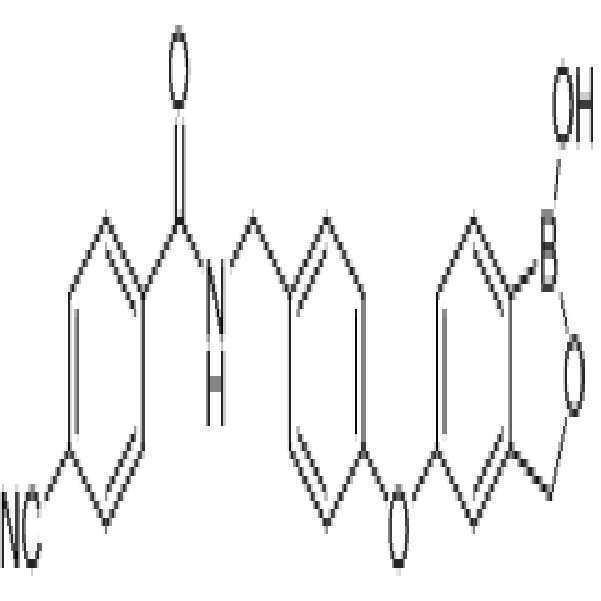
D171는 D166 과 유사한 과정을 이용하여 준비되었다. LCMS (m/z) 407 (M+23); 1H NMR (DMSO-d6) δ: 9.28 (s, 1H), 9.08 (s, 1H), 8.00 - 8.05 (m, 2H), 7.93 - 7.97 (m, 2H), 7.68 (d, J = 8.0 Hz, 1H), 7.32 - 7.37 (m, J = 8.6 Hz, 2H), 6.99 - 7.04 (m, 2H), 6.89 - 6.95 (m, 2H), 4.88 (s, 2H), 4.47 (d, J = 5.9 Hz, 2H). D171 was prepared using a procedure similar to D166 . LCMS (m / z) 407 (M + 23); 1 H NMR (DMSO-d6) δ: 9.28 (s, 1H), 9.08 (s, 1H), 8.00 - 8.05 (m, 2H), 7.93 - 7.97 (m, 2H), 7.68 (d, J = 8.0 Hz 2H), 4.88 (s, 2H), 4.47 (d, J = 5.9Hz, 1H), 7.32-7.37 (m, J = 8.6Hz, 2H), 6.99-7.04 Hz, 2H).
N-[4-(1- 하이드록시 -1,3- 디하이드로 - 벤조[c][1,2]옥사보롤 -5-일 옥시 )- 벤 질]-4-메톡시-벤자미드 (D172) N- [4- (1- hydroxy-1,3-dihydro-benzo [c] [1,2] oxazol-5-yl borol oxy) ben quality] -4-methoxy-benzamide (D172)

D172 는 D166 과 유사한 과정을 이용하여 준비되었다. LCMS (m/z) 390 (M+H); 1H NMR (클로로포름-d) δ: 7.74 - 7.78 (m, 1H), 7.76 (d, J = 8.8 Hz, 2H), 7.31 (dd, J = 8.4, 1.9 Hz, 2H), 6.97 (s, 1H), 6.95 (d, J = 0.7 Hz, 1H), 6.92 (dd, J = 8.1, 0.6 Hz, 1H), 6.85 - 6.89 (m, 2H), 6.81 - 6.84 (m, 1H), 4.97 (s, 1H), 4.94 (s, 1H), 4.57 (d, J = 5.2 Hz, 2H), 3.80 (d, J = 1.0 Hz, 3H). D172 was prepared using a procedure similar to D166 . LCMS (m / z) 390 (M + H) +; 1 H NMR (chloroform -d) δ: 7.74 - 7.78 ( m, 1H), 7.76 (d, J = 8.8 Hz, 2H), 7.31 (dd, J = 8.4, 1.9 Hz, 2H), 6.97 (s, 1H ), 6.95 (d, J = 0.7 Hz, 1H), 6.92 (dd, J = 8.1, 0.6 Hz, 1H), 6.85-6.89 1H), 4.94 (s, 1H), 4.57 (d, J = 5.2 Hz, 2H), 3.80 (d, J = 1.0 Hz, 3H).
4-플루오르-N-[4-(1- 하이드록시 -1,3- 디하이드로 - 벤조[c][1,2]옥사보롤 -5-일 옥시)-벤질]-벤자미드 (D173) 4-fluoro -N- [4- (1- hydroxy-1,3-dihydro-benzo [c] [1,2] oxazol-5-yl borol oxy) -benzyl] - benzamide (D173)

D173 는 D166 과 유사한 과정을 이용하여 준비되었다. LCMS (m/z) 400 (M+23); 1H NMR (클로로포름-d) δ: 7.82 (dd, J = 8.8, 5.3 Hz, 2H), 7.55 - 7.72 (m, 1H), 7.30 (dd, J = 8.7, 2.3 Hz, 2H), 7.01 - 7.09 (m, 3H), 6.96 (d, J = 8.5 Hz, 2H), 6.91 (dt, J = 8.1, 2.3 Hz, 1H), 6.83 (d, J = 2.0 Hz, 1H), 4.95 (d, J = 12.8 Hz, 2H), 4.56 (d, J = 5.7 Hz, 2H). D173 was prepared using a procedure similar to D166 . LCMS (m / z) 400 (M + 23); 1 H NMR (chloroform -d) δ: 7.82 (dd, J = 8.8, 5.3 Hz, 2H), 7.55 - 7.72 (m, 1H), 7.30 (dd, J = 8.7, 2.3 Hz, 2H), 7.01 - 7.09 (m, 3H), 6.96 (d, J = 8.5 Hz, 2H), 6.91 (dt, J = 8.1, 2.3 Hz, 12.8 Hz, 2H), 4.56 (d, J = 5.7 Hz, 2H).
N-[4-(1- 하이드록시 -1,3- 디하이드로 - 벤조[c][1,2]옥사보롤 -5-일 옥시 )- 벤 질]-4-트리플루오로메틸-벤자미드 (D174) N- [4- (1- hydroxy-1,3-dihydro-benzo [c] [1,2] oxazol-5-yl borol oxy) ben quality; - benzamide (methyl-4-trifluoromethyl D174)

D174는 D166 과 유사한 과정을 이용하여 준비되었다. LCMS (m/z) 450 (M+23); 1H NMR (클로로포름-d) δ: 8.20 (s, 1H), 7.89 - 7.94 (m, J = 8.2 Hz, 2H), 7.79 (br. s., 1H), 7.64 (d, J = 8.1 Hz, 1H), 7.56 - 7.62 (m, J = 8.2 Hz, 2H), 7.27 (d, J = 8.6 Hz, 2H), 6.88 - 6.93 (m, 2H), 6.85 (dd, J = 8.1, 2.0 Hz, 1H), 6.78 (s, 1H), 4.88 (s, 2H), 4.52 (d, J = 5.8 Hz, 2H). D174 was prepared using a procedure similar to D166 . LCMS (m / z) 450 (M + 23); 1 H NMR (chloroform -d) δ: 8.20 (s, 1H), 7.89 - 7.94 (m, J = 8.2 Hz, 2H), 7.79 (.. Br s, 1H), 7.64 (d, J = 8.1 Hz, 1H), 7.56-7.62 (m, J = 8.2 Hz, 2H), 7.27 (d, J = 8.6 Hz, 2H), 6.88-6.93 ), 6.78 (s, 1H), 4.88 (s, 2H), 4.52 (d, J = 5.8 Hz, 2H).
아세트산 1-[4-(1- 하이드록시 -1,3- 디하이드로 - 벤조[c][1,2]옥사보롤 -5-일 옥 시)-벤질카르바모일]-1-메틸-에틸 에스테르 (D175) Ethyl 1- [4- (1-hydroxy-1,3-dihydro-benzo [c] [1,2] oxazol-5-yl octanoic borol upon) -benzyl-carbamoyl] -1-methyl-ethyl ester (D175)

D175는 D166 과 유사한 과정을 이용하여 준비되었다. LCMS (m/z) 406 (M+23); 1H NMR (클로로포름-d) δ: 7.68 (br. s., 1H), 7.23 - 7.28 (m, 2H), 6.95 - 7.02 (m, 3H), 6.88 (s, 1H), 6.40 (br. s., 1H), 5.01 (s, 2H), 4.46 (d, J = 5.9 Hz, 2H), 2.06 (s, 3H), 2.03 (s, 1H), 1.66 (s, 6H). D175 was prepared using a procedure similar to D166 . LCMS (m / z) 406 (M + 23); 1 H NMR (chloroform -d) δ:. 7.68 (. . Br s, 1H), 7.23 - 7.28 (m, 2H), 6.95 - 7.02 (m, 3H), 6.88 (s, 1H), 6.40 (br s (S, 3H), 2.03 (s, 1H), 1.66 (s, 6H).
N-[4-(1- 하이드록시 -1,3- 디하이드로 - 벤조[c][1,2]옥사보롤 -5-일 옥시 )- 벤 질]-이소부틸아미드 (D176) N- [4- (1- hydroxy-1,3-dihydro-benzo [c] [1,2] oxazol-5-yl borol oxy) ben quality; - isobutyl-amide (D176)

D176는 D166 과 유사한 과정을 이용하여 준비되었다. LCMS (m/z) 326 (M+H); 1H NMR (클로로포름-d) δ: 7.68 (br. s., 1H), 7.24 - 7.28 (m, 2H), 6.96 - 7.02 (m, 3H), 6.84 - 6.92 (m, 1H), 5.77 (br. s., 1H), 5.02 (s, 2H), 4.43 (d, J = 5.8 Hz, 2H), 1.19 (d, J = 6.9 Hz, 6H). D176 was prepared using a procedure similar to D166 . LCMS (m / z) 326 (M + H); 1 H NMR (chloroform -d) δ: 7.68 (.. Br s, 1H), 7.24 - 7.28 (m, 2H), 6.96 - 7.02 (m, 3H), 6.84 - 6.92 (m, 1H), 5.77 (br (s, 1H), 5.02 (s, 2H), 4.43 (d, J = 5.8 Hz, 2H), 1.19 (d, J = 6.9 Hz, 6H).
N-[4-(1- 하이드록시 -1,3- 디하이드로 - 벤조[c][1,2]옥사보롤 -5-일 옥시 )- 벤 질]-2,2-디메틸-프로피온아미드 (D177) N- [4- (1- hydroxy-1,3-dihydro-benzo [c] [1,2] oxazol-5-yl borol oxy) ben quality] -2,2-dimethyl-propionamide (D177 )

D177는 D166 과 유사한 과정을 이용하여 준비되었다. LCMS (m/z) 340 (M+H); 1H NMR (클로로포름-d) δ: 7.66 (br. s., 1H), 7.21 - 7.26 (m, 2H), 6.99 (d, J = 8.5 Hz, 2H), 6.94 - 7.00 (m, 1H), 6.88 (s, 1H), 6.02 (br. s., 1H), 5.01 (s, 2H), 4.42 (d, J = 5.7 Hz, 2H), 3.82 (br. s., 1H), 1.23 (s, 9H). D177 D166. ≪ / RTI > LCMS (m / z) 340 (M + H); 1 H NMR (chloroform -d) δ: 7.66 (.. Br s, 1H), 7.21 - 7.26 (m, 2H), 6.99 (d, J = 8.5 Hz, 2H), 6.94 - 7.00 (m, 1H), (D, J = 5.7 Hz, 2H), 3.82 (br s, 1H), 1.23 (s, 9H).
N-[4-(1- 하이드록시 -1,3- 디하이드로 - 벤조[c][1,2]옥사보롤 -5-일 옥시 )- 벤 질]-프로피온아미드 (D178) N- [4- (1- hydroxy-1,3-dihydro-benzo [c] [1,2] oxazol-5-yl borol oxy) ben quality] -propionamide (D178)

D178는 D166 과 유사한 과정을 이용하여 준비되었다. LCMS (m/z) 312 (M+H); 1H NMR (DMSO-d6) δ: 9.08 (br. s., 1H), 8.24 (br. s., 1H), 7.68 (d, J = 8.0 Hz, 1H), 7.23 - 7.29 (m, J = 8.5 Hz, 2H), 6.97 - 7.03 (m, 2H), 6.93 (dd, J = 8.0, 2.1 Hz, 1H), 6.90 (s, 1H), 4.89 (s, 2H), 4.23 (d, J = 6.0 Hz, 2H), 2.12 (q, J = 7.6 Hz, 2H), 1.00 (t, J = 7.6 Hz, 3H). D178 was prepared using a procedure similar to D166 . LCMS (m / z) 312 (M + H) < + >; 1 H NMR (DMSO-d 6 ) δ: 9.08 (.. Br s, 1H), 8.24 (.. Br s, 1H), 7.68 (d, J = 8.0 Hz, 1H), 7.23 - 7.29 (m, J 2H), 6.93 (d, J = 8.0 Hz, 2H), 6.97 (s, 6.0 Hz, 2H), 2.12 (q, J = 7.6 Hz, 2H), 1.00 (t, J = 7.6 Hz, 3H).
시클로펜탄카르복실산4 -(1- 하이드록시 -1,3- 디하이드로 - 벤조[c][1,2]옥사보롤 -5-일 옥시)-벤질아미드 (D179) Cyclopentane-carboxylic acid 4- (1-hydroxy-1,3-dihydro-benzo [c] [1,2] oxazol-5-yl borol oxy) -benzyl amide (D179)

D179는 D166 과 유사한 과정을 이용하여 준비되었다. LCMS (m/z) 352 (M+H); 1H NMR (클로로포름-d) δ: 7.66 (d, J = 8.1 Hz, 1H), 7.19 (d, J = 8.5 Hz, 2H), 6.85 - 6.93 (m, 3H), 6.79 (s, 1H), 6.31 (br. s., 1H), 4.91 (s, 2H), 4.34 (d, J = 5.8 Hz, 2H), 1.64 - 1.83 (m, 6H), 1.45 - 1.54 (m, 2H). D179 was prepared using a procedure similar to D166 . LCMS (m / z) 352 (M + H); 1 H NMR (chloroform -d) δ: 7.66 (d, J = 8.1 Hz, 1H), 7.19 (d, J = 8.5 Hz, 2H), 6.85 - 6.93 (m, 3H), 6.79 (s, 1H), 2H), 6.31 (br s, 1H), 4.91 (s, 2H), 4.34 (d, J = 5.8 Hz, 2H), 1.64-1.83 (m, 6H), 1.45-1.54 (m, 2H).
시클로헥산카르복실산4 -(1- 하이드록시 -1,3- 디하이드로 - 벤조[c][1,2]옥사보롤 -5-일 옥시)-벤질아미드 (D180) Cyclohexanecarboxylic acid 4- (1-hydroxy-1,3-dihydro-benzo [c] [1,2] oxazol-5-yl borol oxy) -benzyl amide (D180)

D180 는 D166 과 유사한 과정을 이용하여 준비되었다. LCMS (m/z) 366 (M+H); 1H NMR (클로로포름-d) δ: 7.71 (br. s., 1H), 7.24 (d, J = 8.5 Hz, 2H), 6.97 (d, J = 8.4 Hz, 3H), 6.87 (s, 1H), 5.96 (br. s., 1H), 5.01 (br. s., 2H), 4.42 (d, J = 5.7 Hz, 2H), 1.88 (d, J = 13.2 Hz, 2H), 1.77 (d, J = 9.8 Hz, 2H), 1.66 (d, J = 5.7 Hz, 1H), 1.46 (d, J = 12.3 Hz, 2H), 1.16 - 1.31 (m, 3H). D180 was prepared using a procedure similar to D166 . LCMS (m / z) 366 (M + H); 1 H NMR (chloroform -d) δ: 7.71 (.. Br s, 1H), 7.24 (d, J = 8.5 Hz, 2H), 6.97 (d, J = 8.4 Hz, 3H), 6.87 (s, 1H) , 5.96 (br s, 1H), 5.01 (br s, 2H), 4.42 (d, J = 5.7 Hz, 2H), 1.88 = 9.8 Hz, 2H), 1.66 (d, J = 5.7 Hz, 1H), 1.46 (d, J = 12.3 Hz, 2H), 1.16-1.31 (m, 3H).
퓨란 -2- 카르복실산4 -(1- 하이드록시 -1,3- 디하이드로 - 벤조[c][1,2]옥사보롤 -5- 일 옥시)-벤질아미드 (D181) Furan-2-carboxylic acid 4- (1-hydroxy-1,3-dihydro-benzo [c] [1,2] oxazol-5-yl borol oxy) -benzyl amide (D181)

D181는 D166 과 유사한 과정을 이용하여 준비되었다. LCMS (m/z) 350 (M+H); 1H NMR (클로로포름-d) δ: 8.01 (s, 1H), 7.67 (d, J = 8.0 Hz, 1H), 7.38 (d, J = 0.9 Hz, 1H), 7.24 - 7.31 (m, 2H), 7.08 (d, J = 3.5 Hz, 1H), 6.87 - 6.96 (m, 4H), 6.81 (s, 1H), 6.44 (dd, J = 3.4, 1.7 Hz, 1H), 4.92 (s, 2H), 4.53 (d, J = 6.0 Hz, 2H). D181 was prepared using a procedure similar to D166 . LCMS (m / z) 350 (M + H) +; 1 H NMR (chloroform -d) δ: 8.01 (s, 1H), 7.67 (d, J = 8.0 Hz, 1H), 7.38 (d, J = 0.9 Hz, 1H), 7.24 - 7.31 (m, 2H), (D, J = 3.4 Hz, 1H), 4.92 (s, 2H), 4.53 (d, J = (d, J = 6.0 Hz, 2H).
피롤리딘 -1- 카르복실산4 -(1- 하이드록시 -1,3- 디하이드로 - 벤조[c][1,2]옥사보 롤-5-일 옥시)-벤질아미드 (D182) Pyrrolidine-1-carboxylic acid 4- (1-hydroxy-1,3-dihydro-benzo [c] [1,2] oxazol-5-yl-oxy-roll beam) -benzyl amide (D182)

D182 는 D166 과 유사한 과정을 이용하여 준비되었다. LCMS (m/z) 353 (M+H); 1H NMR (클로로포름-d) δ: 7.71 (d, J = 8.1 Hz, 1H), 7.30 (d, J = 8.4 Hz, 2H), 6.90 - 7.02 (m, 3H), 6.86 (d, J = 1.1 Hz, 1H), 6.61 (br. s., 1H), 4.96 - 5.02 (m, 2H), 4.57 (br. s., 1H), 4.43 (d, J = 5.7 Hz, 2H), 3.36 (t, J = 6.5 Hz, 4H), 1.90 (t, J = 3.0 Hz, 3H), 1.90 (d, J = 13.4 Hz, 1H). D182 was prepared using a procedure similar to D166 . LCMS (m / z) 353 (M + H) +; 1 H NMR (chloroform -d) δ: 7.71 (d, J = 8.1 Hz, 1H), 7.30 (d, J = 8.4 Hz, 2H), 6.90 - 7.02 (m, 3H), 6.86 (d, J = 1.1 (D, J = 5.7 Hz, 2H), 3.36 (t, 2H), 4.69 J = 6.5 Hz, 4H), 1.90 (t, J = 3.0 Hz, 3H), 1.90 (d, J = 13.4 Hz, 1H).
[4-(1- 하이드록시 -1,3- 디하이드로 - 벤조[c][1,2]옥사보롤 -5-일 옥시 )- 벤질 ]- 카르바민산tert-부틸 에스테르 (D183) [4- (1-hydroxy-1,3-dihydro-benzo [c] [1,2] oxazol-5-yl borol oxy) -benzyl] - carbamic acid tert- butyl ester (D183)

D183는 D166 과 유사한 과정을 이용하여 준비되었다. LCMS (m/z) 353 (M+H); 1H NMR (클로로포름-d) δ: 7.68 (d, J = 8.1 Hz, 1H), 7.27 (d, J = 8.5 Hz, 2H), 6.96 - 7.03 (m, 1H), 7.00 (d, J = 8.5 Hz, 2H), 6.87 (s, 1H), 5.00 (s, 2H), 4.30 (br. s., 2H), 1.46 (s, 9H). D183 was prepared using a procedure similar to D166 . LCMS (m / z) 353 (M + H) +; 1 H NMR (chloroform -d) δ: 7.68 (d, J = 8.1 Hz, 1H), 7.27 (d, J = 8.5 Hz, 2H), 6.96 - 7.03 (m, 1H), 7.00 (d, J = 8.5 2H), 6.87 (s, 1H), 5.00 (s, 2H), 4.30 (br s, 2H), 1.46 (s, 9H).
1-[4-(1- 하이드록시 -1,3- 디하이드로 - 벤조[c][1,2]옥사보롤 -5-일 옥시 )- 벤 질]-3-페닐-우레아 (D184) 1- [4- (1-hydroxy-1,3-dihydro-benzo [c] [1,2] oxazol-5-yl borol oxy) ben quality] -3-phenyl-urea (D184)

5-(4-아미노메틸-페녹시)-3H-벤조[c][1,2]옥사보롤-1-올 (150 mg, 0.59 mmol, 1.0 eq.)의 DCM (5.0 mL)이 포함된 20mL 신틸레이션 바이알에 페닐이소시아네이트(71 μL, 0.65 mmol, 1.1 eq.)가 첨가되었다. 혼합물은 실온에서 하룻밤동안 교반되었다. 혼합물은 H2O (5 mL)으로 처리되었다. 침전물은 여과를 통하여 수거되었고, H2O으로 세척되어, 1-[4-(1-하이드록시-1,3-디하이드로-벤조[c][1,2]옥사보롤-5-일 옥시)-벤질]-3-페닐-우레아가 백색 고체로 제공되었다. LCMS (m/z) 375 (M+H); 1H NMR (DMSO-d6) δ: 9.07 (s, 1H), 8.51 (s, 1H), 7.67 (d, J = 8.0 Hz, 1H), 7.37 (dd, J = 8.6, 1.0 Hz, 2H), 7.30 - 7.35 (m, J = 8.6 Hz, 2H), 7.19 (t, J = 8.0 Hz, 2H), 6.99 - 7.04 (m, 2H), 6.88 - 6.95 (m, 3H), 6.58 (s, 1H), 4.89 (s, 2H), 4.27 (d, J = 5.9 Hz, 2H).A solution of 20 mL (5.0 mL) in DCM (5.0 mL) of 5- (4-aminomethyl-phenoxy) -3H-benzo [c] [1,2] oxaborol- To the scintillation vial was added phenyl isocyanate (71 [mu] L, 0.65 mmol, 1.1 eq.). The mixture was stirred at room temperature overnight. The mixture was treated with H 2 O (5 mL). The precipitate was collected via filtration and washed with H 2 O to give 1- [4- (1 -hydroxy-1,3-dihydro-benzo [c] [1,2] oxaborol- -Benzyl] -3-phenyl-urea was provided as a white solid. LCMS (m / z) 375 (M + H); 1 H NMR (DMSO-d 6 ) δ: 9.07 (s, 1H), 8.51 (s, 1H), 7.67 (d, J = 8.0 Hz, 1H), 7.37 (dd, J = 8.6, 1.0 Hz, 2H) , 7.30-7.35 (m, J = 8.6 Hz, 2H), 7.19 (t, J = 8.0 Hz, 2H), 6.99-7.04 ), 4.89 (s, 2H), 4.27 (d, J = 5.9 Hz, 2H).
1-에틸-3-[4-(1- 하이드록시 -1,3- 디하이드로 - 벤조[c][1,2]옥사보롤 -5-일 옥 시)-벤질]-우레아 (D185) 1-ethyl-3- [4- (1-hydroxy-1,3-dihydro-benzo [c] [1,2] oxazol-5-yl octanoic borol upon) -benzyl] -urea (D185)

D185는 D184 과 유사한 과정을 이용하여 준비되었다. LCMS (m/z) 327 (M+H); 1H NMR (DMSO-d6) δ: 9.07 (s, 1H), 7.67 (d, J = 8.0 Hz, 1H), 7.23 - 7.28 (m, J = 8.6 Hz, 2H), 6.97 - 7.02 (m, 2H), 6.87 - 6.94 (m, 2H), 6.27 (s, 1H), 5.85 (s, 1H), 4.88 (s, 2H), 4.16 (d, J = 6.0 Hz, 2H), 3.00 (dd, J = 7.1, 5.7 Hz, 2H), 0.97 (t, J = 7.2 Hz, 3H).D185 was prepared using a procedure similar to D184. LCMS (m / z) 327 (M + H); 1 H NMR (DMSO-d 6 ) δ: 9.07 (s, 1H), 7.67 (d, J = 8.0 Hz, 1H), 7.23 - 7.28 (m, J = 8.6 Hz, 2H), 6.97 - 7.02 (m, 2H), 3.87 (s, 3H), 4.65 (s, 2H), 4.87 = 7.1, 5.7 Hz, 2H), 0.97 (t, J = 7.2 Hz, 3H).
1-[4-(1- 하이드록시 -1,3- 디하이드로 - 벤조[c][1,2]옥사보롤 -5-일 옥시 )- 벤 질]-3-p-톨일-우레아 (D186) 1- [4- (1-hydroxy-1,3-dihydro-benzo [c] [1,2] oxazol-5-yl borol oxy) ben quality] -3-p- tolyl-urea (D186)
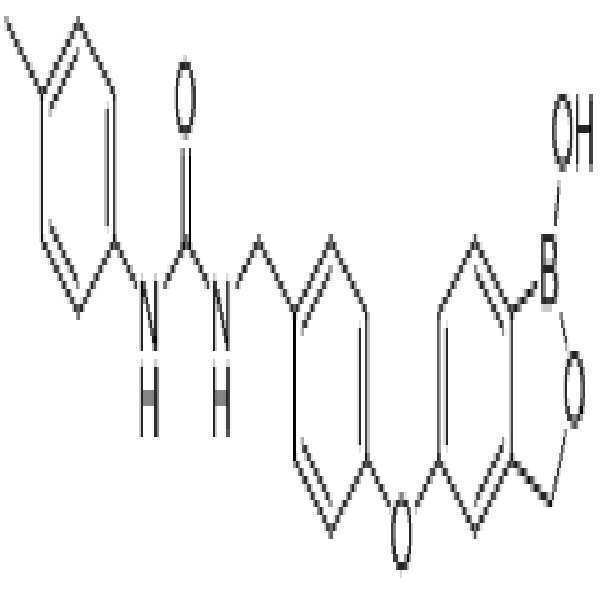
D186는 D184 과 유사한 과정을 이용하여 준비되었다. LCMS (m/z) 389 (M+H); 1H NMR (DMSO-d6) δ: 9.07 (s, 1H), 8.40 (s, 1H), 7.68 (d, J = 8.0 Hz, 1H), 7.24 - 7.35 (m, 4H), 6.98 - 7.05 (m, 4H), 6.89 - 6.96 (m, 2H), 6.53 (s, 1H), 4.89 (s, 2H), 4.26 (d, J = 5.9 Hz, 2H), 2.19 (s, 3H). D186 was prepared using a procedure similar to D184 . LCMS (m / z) 389 (M + H); 1 H NMR (DMSO-d 6 ) δ: 9.07 (s, 1H), 8.40 (s, 1H), 7.68 (d, J = 8.0 Hz, 1H), 7.24 - 7.35 (m, 4H), 6.98 - 7.05 ( 2H), 2.19 (s, 3H), 4.89 (s, 2H), 4.26 (d, J = 5.9 Hz, 2H).
1- 시클로헥실 -3-[4-(1- 하이드록시 -1,3- 디하이드로 - 벤조[c][1,2]옥사보롤 -5- 일 옥시)-벤질]-우레아 (D187) 1-cyclohexyl-3- [4- (1-hydroxy-1,3-dihydro-benzo [c] [1,2] oxazol-5-yl borol oxy) -benzyl] -urea (D187)

D187는 D184 과 유사한 과정을 이용하여 준비되었다. LCMS (m/z) 381 (M+H); 1H NMR (DMSO-d6) δ: 9.07 (s, 1H), 7.68 (d, J = 8.0 Hz, 1H), 7.26 (d, J = 8.6 Hz, 2H), 7.00 (d, J = 8.5 Hz, 1H), 6.97 - 7.03 (m, 1H), 6.88 - 6.95 (m, 2H), 6.16 (s, 1H), 5.80 (d, J = 8.0 Hz, 1H), 4.89 (s, 2H), 4.17 (d, J = 6.0 Hz, 2H), 1.71 (br. s., 2H), 1.60 (br. s., 2H), 1.44 - 1.55 (m, 1H), 1.23 (br. s., 2H), 1.08 (br. s., 3H). D187 was prepared using a procedure similar to D184 . LCMS (m / z) 381 (M + H) +; 1 H NMR (DMSO-d 6 ) δ: 9.07 (s, 1H), 7.68 (d, J = 8.0 Hz, 1H), 7.26 (d, J = 8.6 Hz, 2H), 7.00 (d, J = 8.5 Hz (M, 2H), 6.16 (s, 1H), 5.80 (d, J = 8.0 Hz, 1H), 4.89 (s, 2H), 4.17 1H), 1.23 (br s, 2H), 1.08 (br s, 2H), 1.60 (br. s., 3H).
1-(4- 클로로 -페닐)-3-[4-(1- 하이드록시 -1,3- 디하이드로 - 벤조[c][1,2]옥사보 롤-5-일 옥시)-벤질]-우레아 (D188) L- (4-Chloro-phenyl) -3- [4- (1-hydroxy-1,3-dihydro-benzo [c] [1,2] oxazol-5-yl beam roll-phenoxy) -benzyl] Urea (D188)

D188는 D184 과 유사한 과정을 이용하여 준비되었다. LCMS (m/z) 409 (M+H); 1H NMR (DMSO-d6) δ: 9.08 (br. s., 1H), 8.70 (s, 1H), 7.68 (d, J = 8.0 Hz, 1H), 7.42 (d, J = 8.9 Hz, 1H), 7.42 (q, J = 5.2 Hz, 1H), 7.30 - 7.38 (m, 2H), 7.24 (d, J = 8.9 Hz, 1H), 7.24 (q, J = 5.1 Hz, 1H), 6.96 - 7.05 (m, 1H), 7.02 (d, J = 8.5 Hz, 1H), 6.88 - 6.96 (m, 2H), 6.66 (s, 1H), 4.89 (s, 2H), 4.27 (d, J = 5.9 Hz, 2H). D188 was prepared using a procedure similar to D184 . LCMS (m / z) 409 (M + H); 1 H NMR (DMSO-d 6 ) δ: 9.08 (.. Br s, 1H), 8.70 (s, 1H), 7.68 (d, J = 8.0 Hz, 1H), 7.42 (d, J = 8.9 Hz, 1H ), 7.42 (q, J = 5.2 Hz, 1H), 7.30-7.38 (m, 2H), 7.24 (d, J = 8.9 Hz, 2H, J = 5.9 Hz, 1H), 7.02 (d, J = 8.5 Hz, 1H), 6.88-6.96 (m, 2H), 6.66 (s, 2H).
1-(4-디메틸아미노-페닐)-3-[4-(1- 하이드록시 -1,3- 디하이드로 - 벤조[c][1,2] 옥사보롤-5-일 옥시)-벤질]-우레아 (D189) 1- (4-Dimethylamino-phenyl) -3- [4- (1-hydroxy-1,3-dihydro-benzo [c] [1,2] oxazole borol 5-yl oxy) benzyl] - Urea (D189)

D189는 D184 과 유사한 과정을 이용하여 준비되었다. LCMS (m/z) 418 (M+H); 1H NMR (DMSO-d6) δ: 9.07 (s, 1H), 8.13 (s, 1H), 7.67 (s, 1H), 7.31 (s, 2H), 7.18 (d, J = 9.1 Hz, 2H), 7.02 (d, J = 8.6 Hz, 2H), 6.90 (s, 2H), 6.63 (d, J = 9.1 Hz, 2H), 6.41 (s, 1H), 4.89 (s, 2H), 4.26 (s, 2H), 2.78 (s, 6H). D189 was prepared using a procedure similar to D184 . LCMS (m / z) 418 (M + H); 1 H NMR (DMSO-d 6 ) δ: 9.07 (s, 1H), 8.13 (s, 1H), 7.67 (s, 1H), 7.31 (s, 2H), 7.18 (d, J = 9.1 Hz, 2H) , 7.02 (d, J = 8.6 Hz, 2H), 6.90 (s, 2H), 6.63 (d, J = 9.1 Hz, 2H), 6.41 (s, 2H), 2.78 (s, 6H).
{1-[4-(1- 하이드록시 -1,3- 디하이드로 - 벤조[c][1,2]옥사보롤 -5-일 옥시 )- 벤질 카르바모일]-th일}-카르바민산tert-부틸 에스테르 (D190) {1- [4- (1-hydroxy-1,3-dihydro-benzo [c] [1,2] oxazol-5-yl borol oxy) -benzyl carbamoyl] -th yl} - carbamic acid tert-butyl ester (D190)

5-(4-아미노메틸-페녹시)-3H-벤조[c][1,2]옥사보롤-1-올 (350 mg, 1.37 mmol, 1.0 eq.), EDCI (314.4 mg, 1.64 mmol, 1.2 eq.), HOBt (221.6 mg, 1.64 mmol, 1.2 eq.) and Et3N (0.46 mL mg, 3.29 mmol, 2.4 eq.)의 DCM (15.0 mL)이 포함된 40mL 신틸레이션 바이알에 2-tert-부톡시카르보닐아미노-프로피온산(311.1 mg, 1.64 mmol, 1.2 eq.)이 점적되었다. 혼합물은 실온에서 하룻밤 동안 교반되었다. 혼합물은 H2O (10 mL)으로 처리되었고, 층들은 분리되었다. 수성은 DCM (2 x 10 mL)으로 추출되었고, 복합되어 유기 상은 소금물로 세척되고 (10 mL), MgSO4상에서 건조되고 여과되었고, 그리고 여과액은 감압하에서 농축되었다. 잔유물은 실리카 크로마토그래피에 제공되어, MeOH/DCM (0:100 내지 10:90)로 용리되어, {1-[4-(1-하이드록시-1,3-디하이드로-벤조[c][1,2]옥사보롤-5-일 옥시)-벤질카르바모일]-thyl}-카르바민산tert-부틸 에스테르가 백색 고체로 제공되었다. LCMS (m/z) 449 (M+23); 1H NMR (DMSO-d6) δ: 9.08 (s, 1H), 8.26 (t, J = 5.7 Hz, 1H), 7.68 (d, J = 8.0 Hz, 1H), 7.22 - 7.31 (m, J = 8.4 Hz, 2H), 6.96 - 7.01 (m, J = 8.5 Hz, 2H), 6.88 - 6.95 (m, 3H), 4.89 (s, 2H), 4.21 - 4.30 (m, 2H), 3.88 - 4.02 (m, 1H), 1.35 (s, 9H), 1.18 (d, J = 7.1 Hz, 3H).(350 mg, 1.37 mmol, 1.0 eq.), EDCI (314.4 mg, 1.64 mmol, 1.2 < RTI ID = 0.0 & To a 40 mL scintillation vial containing DCM (15.0 mL) of HOBt (221.6 mg, 1.64 mmol, 1.2 eq.) and Et 3 N (0.46 mL, 3.29 mmol, 2.4 eq.) was added 2-tert- Lt; / RTI > acid (311.1 mg, 1.64 mmol, 1.2 eq.). The mixture was stirred at room temperature overnight. The mixture was treated with H 2 O (10 mL) and the layers were separated. The aqueous was extracted with DCM (2 x 10 mL), the combined organic phases were washed with brine (10 mL), dried over MgSO 4 and filtered, and the filtrate was concentrated under reduced pressure. The residue was subjected to silica chromatography and eluted with MeOH / DCM (0: 100 to 10:90) to give {1- [4- (1-hydroxy-1,3-dihydro- benzo [c] [1 , 2] oxaborol-5-yloxy) -benzylcarbamoyl] -thyl} -carbamic acid tert-butyl ester as a white solid. LCMS (m / z) 449 (M + 23); 1 H NMR (DMSO-d 6 ) δ: 9.08 (s, 1H), 8.26 (t, J = 5.7 Hz, 1H), 7.68 (d, J = 8.0 Hz, 1H), 7.22 - 7.31 (m, J = 2H), 6.96-7.01 (m, J = 8.5 Hz, 2H), 6.88-6.95 (m, 3H), 4.89 (s, 2H), 4.21-4.30 , ≪ / RTI > 1H), 1.35 (s, 9H), 1.18 (d, J = 7.1 Hz, 3H).
{1-[4-(1- 하이드록시 -1,3- 디하이드로 - 벤조[c][1,2]옥사보롤 -5-일 옥시 )- 벤질 카르바모일]-2-페닐-에틸}-카르바민산tert-부틸 에스테르) (D191) {1- [4- (1-hydroxy-1,3-dihydro-benzo [c] [1,2] oxazol-5-yl borol oxy) -benzyl-carbamoyl] -2-phenyl-ethyl} - Carbamic acid tert-butyl ester) (D191)

D191는 D190 과 유사한 과정을 이용하여 준비되었다. LCMS (m/z) 525 (M+23); 1H NMR (DMSO-d6) δ: 9.08 (s, 1H), 8.39 (t, J = 5.7 Hz, 1H), 7.68 (d, J = 8.0 Hz, 1H), 7.18 - 7.27 (m, 8H), 6.89 - 6.99 (m, 4H), 4.89 (s, 2H), 4.26 (d, J = 5.9 Hz, 2H), 4.11 - 4.21 (m, 1H), 2.89 - 3.03 (m, 1H), 2.71 - 2.86 (m, 1H), 1.29 (s, 9H). D191 was prepared using a procedure similar to D190 . LCMS (m / z) 525 (M + 23); 1 H NMR (DMSO-d 6 ) δ: 9.08 (s, 1H), 8.39 (t, J = 5.7 Hz, 1H), 7.68 (d, J = 8.0 Hz, 1H), 7.18 - 7.27 (m, 8H) , 6.89 - 6.99 (m, 4H), 4.89 (s, 2H), 4.26 (d, J = 5.9 Hz, 2H) (m, 1 H), 1.29 (s, 9 H).
{[4-(1- 하이드록시 -1,3- 디하이드로 - 벤조[c][1,2]옥사보롤 -5-일 옥시 )- 벤질카 르바모일]-메틸}-카르바민산tert-부틸 에스테르 (D192) {[4- (1-hydroxy-1,3-dihydro-benzo [c] [1,2] oxazol-5-yl borol oxy) -benzyl car Yerba] -methyl} - carbamic acid tert- butyl Ester (D192)

D192는 D190 과 유사한 과정을 이용하여 준비되었다. LCMS (m/z) 435 (M+23); 1H NMR (클로로포름-d) δ: 7.66 (br. s., 1H), 7.24 (d, J = 6.2 Hz, 1H), 7.26 (s, 1H), 6.93 - 6.98 (m, 3H), 6.85 (s, 1H), 6.73 (br. s., 1H), 4.98 (br. s., 2H), 4.44 (d, J = 5.9 Hz, 2H), 3.83 (d, J = 6.1 Hz, 2H), 2.16 (s, 1H), 2.07 (s, 1H), 1.41 (s, 9H). D192 was prepared using a procedure similar to D190 . LCMS (m / z) 435 (M + 23); 1 H NMR (chloroform -d) δ: 7.66 (.. Br s, 1H), 7.24 (d, J = 6.2 Hz, 1H), 7.26 (s, 1H), 6.93 - 6.98 (m, 3H), 6.85 ( J = 5.9 Hz, 2H), 3.83 (d, J = 6.1 Hz, 2H), 2.16 (br s, (s, 1 H), 2.07 (s, 1 H), 1.41 (s, 9 H).
{1-[4-(1- 하이드록시 -1,3- 디하이드로 - 벤조[c][1,2]옥사보롤 -5-일 옥시 )- 벤질 카르바모일]-3-메틸-부틸}-카르바민산tert-부틸 에스테르 (D193) {1- [4- (1-hydroxy-1,3-dihydro-benzo [c] [1,2] oxazol-5-yl borol oxy) -benzyl-carbamoyl] -3-methyl-butyl} - Carbamic acid tert-butyl ester (D193)

D193는 D190 과 유사한 과정을 이용하여 준비되었다. LCMS (m/z) 491 (M+23); 1H NMR (DMSO-d6) δ: 9.08 (s, 1H), 8.30 (t, J = 5.9 Hz, 1H), 7.68 (d, J = 8.0 Hz, 1H), 7.26 (d, J = 8.5 Hz, 2H), 6.98 (d, J = 8.5 Hz, 2H), 6.85 - 6.94 (m, 3H), 4.89 (s, 2H), 4.24 (d, J = 5.9 Hz, 2H), 3.92 - 4.01 (m, 1H), 1.39 - 1.48 (m, 1H), 1.35 (s, 9H), 1.26 - 1.32 (m, 1H), 0.84 (dd, J = 10.5, 6.6 Hz, 7H). D193 was prepared using a procedure similar to D190 . LCMS (m / z) 491 (M + 23); 1 H NMR (DMSO-d 6 ) δ: 9.08 (s, 1H), 8.30 (t, J = 5.9 Hz, 1H), 7.68 (d, J = 8.0 Hz, 1H), 7.26 (d, J = 8.5 Hz 2H), 6.98 (d, J = 8.5 Hz, 2H), 6.85-6.94 (m, 3H), 4.89 1H), 1.39-1.48 (m, 1H), 1.35 (s, 9H), 1.26-1.32 (m, 1H), 0.84 (dd, J = 10.5, 6.6 Hz, 7H).
{[4-(1- 하이드록시 -1,3- 디하이드로 - 벤조[c][1,2]옥사보롤 -5-일 옥시 )- 벤질카 르바모일]-메틸}-메틸-카르바민산-tert-부틸 에스테르 (D194) {[4- (1-hydroxy-1,3-dihydro-benzo [c] [1,2] oxazol-5-yl borol oxy) -benzyl car Yerba] -methyl} -methyl-carbamic acid - tert-butyl ester (D194)

D194 는 D190 과 유사한 과정을 이용하여 준비되었다. LCMS (m/z) 449 (M+23); 1H NMR (DMSO-d6) δ: 9.08 (s, 1H), 8.35 (t, J = 5.5 Hz, 1H), 7.68 (d, J = 8.0 Hz, 1H), 7.29 (d, J = 7.8 Hz, 2H), 6.97 - 7.04 (m, 2H), 6.86 - 6.96 (m, 2H), 4.89 (s, 2H), 4.26 (d, J = 6.0 Hz, 2H), 3.74 - 3.83 (m, 2H), 2.80 (br. s., 3H), 1.38 (s, 4H), 1.29 (s, 5H). D194 was prepared using a procedure similar to D190 . LCMS (m / z) 449 (M + 23); 1 H NMR (DMSO-d 6 ) δ: 9.08 (s, 1H), 8.35 (t, J = 5.5 Hz, 1H), 7.68 (d, J = 8.0 Hz, 1H), 7.29 (d, J = 7.8 Hz 2H), 6.97 - 7.04 (m, 2H), 6.86-6.96 (m, 2H), 4.89 2.80 (s, 3H), 1.38 (s, 4H), 1.29 (s, 5H).
2-디메틸아미노-N-[4-(1- 하이드록시 -1,3- 디하이드로 - 벤조[c][1,2]옥사보롤 - 5-일 옥시)-벤질]-아세타아미드(D195) 2-dimethylamino -N- [4- (1- hydroxy-1,3-dihydro-benzo [c] [1,2] oxazole borol - 5-1 oxy) -benzyl] amide O theta (D195)

D195는 D190 과 유사한 과정을 이용하여 준비되었다. LCMS (m/z) 341 (M+H); 1H NMR (DMSO-d6) δ: 9.08 (s, 1H), 8.26 (t, J = 6.2 Hz, 1H), 7.68 (d, J = 8.1 Hz, 1H), 7.25 - 7.31 (m, 2H), 6.97 - 7.02 (m, 2H), 6.88 - 6.95 (m, 2H), 4.89 (s, 2H), 4.26 (d, J = 6.2 Hz, 2H), 2.89 (s, 2H), 2.19 (s, 6H). D195 was prepared using a procedure similar to D190. LCMS (m / z) 341 (M + H) +; 1 H NMR (DMSO-d 6 ) δ: 9.08 (s, 1H), 8.26 (t, J = 6.2 Hz, 1H), 7.68 (d, J = 8.1 Hz, 1H), 7.25 - 7.31 (m, 2H) 2H), 2.89 (s, 2H), 2.19 (s, 6H), 6.97 (s, 2H) ).
1- 메틸 - 피롤리딘 -2- 카르복실산4 -(1- 하이드록시 -1,3- 디하이드로 - 벤조[c][1,2] 옥사보롤-5-일 옥시)-벤질아미드 ( D196) 1-methyl-pyrrolidine-2-carboxylic acid 4- (1-hydroxy-1,3-dihydro-benzo [c] [1,2] oxazol-5-yl borol oxy) -benzyl amide (D196 )

D196는 D190 과 유사한 과정을 이용하여 준비되었다. LCMS (m/z) 367 (M+H); 1H NMR (DMSO-d6) δ: 9.08 (s, 1H), 8.25 (t, J = 6.2 Hz, 1H), 7.68 (d, J = 8.0 Hz, 1H), 7.22 - 7.29 (m, J = 8.6 Hz, 2H), 6.96 - 7.03 (m, 2H), 6.89 - 6.96 (m, 2H), 4.89 (s, 2H), 4.19 - 4.31 (m, 2H), 2.97 - 3.04 (m, 1H), 2.74 (dd, J = 9.4, 5.8 Hz, 1H), 2.26 (s, 3H), 2.19 - 2.24 (m, 1H), 2.01 - 2.12 (m, 1H), 1.62 - 1.75 (m, 3H). D196 was prepared using a procedure similar to D190 . LCMS (m / z) 367 (M + H); 1 H NMR (DMSO-d 6 ) δ: 9.08 (s, 1H), 8.25 (t, J = 6.2 Hz, 1H), 7.68 (d, J = 8.0 Hz, 1H), 7.22 - 7.29 (m, J = 2H), 2.97-3.04 (m, 2H), 6.89-6.96 (m, 2H), 4.89 (s, 2H) (d, J = 9.4, 5.8 Hz, 1H), 2.26 (s, 3H), 2.19-2.24 (m, 1H), 2.01-2.12 (m, 1H), 1.62-1.75 (m, 3H).
2-디메틸아미노-N-[4-(1- 하이드록시 -1,3- 디하이드로 - 벤조[c][1,2]옥사보롤 - 5-일 옥시)-벤질]-3-페닐-프로피온아미드 (D197) 2-dimethylamino -N- [4- (1- hydroxy-1,3-dihydro-benzo [c] [1,2] oxazole borol - 5-1 oxy) -benzyl] -3-phenyl-propionamide (D197)
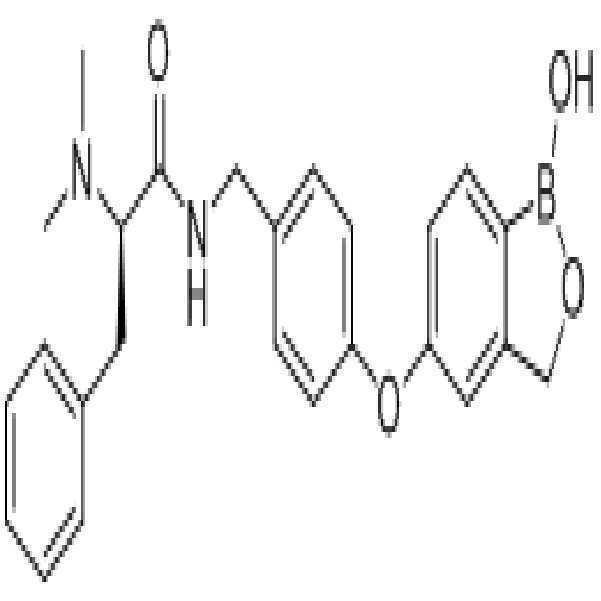
D197는 D190 과 유사한 과정을 이용하여 준비되었다. LCMS (m/z) 431 (M+H); 1H NMR (DMSO-d6) δ: 9.08 (s, 1H), 8.24 (t, J = 5.9 Hz, 1H), 7.68 (d, J = 8.0 Hz, 1H), 7.12 - 7.24 (m, 5H), 7.03 (d, J = 8.6 Hz, 2H), 6.87 - 6.93 (m, 4H), 4.90 (s, 2H), 4.25 - 4.32 (m, 1H), 4.10 (dd, J = 14.7, 5.2 Hz, 1H), 3.27 (dd, J = 9.5, 5.1 Hz, 1H), 2.96 (dd, J = 13.1, 9.5 Hz, 1H), 2.76 (dd, J = 13.1, 5.1 Hz, 1H), 2.25 (s, 6H). D197 was prepared using a procedure similar to D190 . LCMS (m / z) 431 (M + H); 1 H NMR (DMSO-d 6 ) δ: 9.08 (s, 1H), 8.24 (t, J = 5.9 Hz, 1H), 7.68 (d, J = 8.0 Hz, 1H), 7.12 - 7.24 (m, 5H) , 7.03 (d, J = 8.6 Hz, 2H), 6.87-6.93 (m, 4H), 4.90 (s, 2H), 4.25-4.32 J = 13.1, 5.1 Hz, 1H), 2.25 (s, 6H), 3.27 (dd, J = .
(2-[4-(1- 하이드록시 -1,3- 디하이드로 - 벤조[c][1,2]옥사보롤 -5-일 옥시 )- 벤질 카르바모일]-피롤리딘-1-카르복실산-tert-부틸 에스테르 (D198) (2- [4- (1-hydroxy-1,3-dihydro-benzo [c] [1,2] oxazol-5-yl borol oxy) -benzyl carbamoyl] -pyrrolidine-1-carboxylic Butyl-tert-butyl ester (D198)

D198는 D190 과 유사한 과정을 이용하여 준비되었다. LCMS (m/z) 475 (M+23); 1H NMR (DMSO-d6) &: 9.08 (s, 1H), 8.29 - 8.40 (m, 1H), 7.68 (d, J = 8.0 Hz, 1H), 7.25 - 7.34 (m, 2H), 6.95 - 7.03 (m, 2H), 6.87 - 6.95 (m, 2H), 4.89 (s, 2H), 4.26 - 4.35 (m, 1H), 4.01 - 4.25 (m, 2H), 3.33 - 3.43 (m, 1H), 3.22 - 3.30 (m, 2H), 1.66 - 1.87 (m, 3H), 1.38 (s, 3H), 1.25 (s, 6H). D198 was prepared using a procedure similar to D190 . LCMS (m / z) 475 (M + 23); 1 H NMR (DMSO-d 6 ) &: 9.08 (s, 1H), 8.29 - 8.40 (m, 1H), 7.68 (d, J = 8.0 Hz, 1H), 7.25 - 7.34 (m, 2H), 6.95 - 2H), 3.33-3.43 (m, IH), 4.03-4. 35 (m, 2H) 3.22-3.30 (m, 2H), 1.66-1.87 (m, 3H), 1.38 (s, 3H), 1.25 (s, 6H).
2-[4-(1- 하이드록시 -1,3- 디하이드로 - 벤조[c][1,2]옥사보롤 -5-일 옥시 )- 벤질 카르바모일]-피페리딘-1-카르복실산-tert-부틸 에스테르 (D199) 2- [4- (1-hydroxy-1,3-dihydro-benzo [c] [1,2] oxazol-5-yl borol oxy) -benzyl-carbamoyl] -piperidine-1-carboxylic Acid-tert-butyl ester (D199)

D199 는 D190 과 유사한 과정을 이용하여 준비되었다. LCMS (m/z) 489 (M+23); 1H NMR (DMSO-d6) δ: 9.08 (s, 4H), 7.68 (d, J = 7.5 Hz, 3H), 7.67 (d, J = 0.2 Hz, 1H), 7.27 (d, J = 8.6 Hz, 7H), 6.97 - 7.02 (m, 7H), 4.89 (s, 7H), 3.29 (s, 5H), 2.48 (dt, J = 3.7, 1.8 Hz, 17H), 2.48 (d, J = 7.6 Hz, 17H). D199 was prepared using a procedure similar to D190 . LCMS (m / z) 489 (M + 23); 1 H NMR (DMSO-d 6 ) δ: 9.08 (s, 4H), 7.68 (d, J = 7.5 Hz, 3H), 7.67 (d, J = 0.2 Hz, 1H), 7.27 (d, J = 8.6 Hz , 7H), 6.97 (s, 7H), 4.89 (s, 7H), 3.29 (s, 5H), 2.48 (dt, J = 3.7, 1.8 Hz, 17H).
2-아미노-N-[4-(1- 하이드록시 -1,3- 디하이드로 - 벤조[c][1,2]옥사보롤 -5-일 옥 시)-벤질]-3-페닐-프로피온아미드 (D200) 2-amino -N- [4- (1- hydroxy-1,3-dihydro-benzo [c] [1,2] oxazol-5-yl octanoic borol City) - benzyl] -3-phenyl-propionamide (D200)

{1-[4-(1-하이드록시-1,3-디하이드로-벤조[c][1,2]옥사보롤-5-일 옥시)-벤질카르바모일]-2-페닐-에틸}-카르바민산tert-부틸 에스테르 (190 mg, 0.38 mmol, 1.0 eq.)의 DCM (5.0 mL)을 포함하는 20mL 신틸레이션 바이알에 HCl (5.0 mL, 1,4-디옥산내4.0M)이 첨가되었고, 혼합물은 실온에서 하룻밤 동안 교반되었다. 혼합물은 감암하에서 농축되어 2-아미노-N-[4-(1-하이드록시-1,3-디하이드로-벤조[c][1,2]옥사보롤-5-일 옥시)-벤질]-3-페닐-프로피온아미드가 밝은 황색 유리질 고체로 제공되었다. LCMS (m/z) 403 (M+H); 1H NMR (DMSO-d6) δ: 8.91 (br. s., 1H), 8.32 (br. s., 3H), 7.70 (d, J = 8.0 Hz, 1H), 7.23 - 7.33 (m, 4H), 7.19 - 7.23 (m, 2H), 7.11 (d, J = 8.6 Hz, 2H), 6.88 - 6.99 (m, 4H), 4.90 (s, 2H), 4.27 - 4.35 (m, 1H), 4.15 - 4.24 (m, 1H), 3.98 - 4.06 (m, 1H), 3.04 (d, J = 7.2 Hz, 2H).Benzyl] -2-phenyl-ethyl} - < / RTI > benzo [b] HCl (5.0 mL, 4.0 M in 1,4-dioxane) was added to a 20 mL scintillation vial containing DCM (5.0 mL) of carbamic acid tert-butyl ester (190 mg, 0.38 mmol, 1.0 eq. The mixture was stirred at room temperature overnight. The mixture was concentrated under reduced pressure to give 2-amino-N- [4- (1 -hydroxy-1,3-dihydro-benzo [c] [1,2] oxaborol-5-yloxy) -Phenyl-propionamide was provided as a light yellow glassy solid. LCMS (m / z) 403 (M + H); 1 H NMR (DMSO-d 6 ) ?: 8.91 (br s, 1H), 8.32 (br s, 3H), 7.70 (d, J = 8.0 Hz, 1H), 7.23-7.33 ), 7.19-7.33 (m, 2H), 7.11 (d, J = 8.6 Hz, 2H), 6.88-6.99 (m, 4H), 4.90 4.24 (m, 1H), 3.98-4.06 (m, 1H), 3.04 (d, J = 7.2 Hz, 2H).
2-아미노-N-[4-(1- 하이드록시 -1,3- 디하이드로 - 벤조[c][1,2]옥사보롤 -5-일 옥 시)-벤질]-프로피온아미드 (D201) 2-amino -N- [4- (1- hydroxy-1,3-dihydro-benzo [c] [1,2] oxazol-5-yl octanoic borol City) -benzyl] -propionamide (D201)

D201는 D200 과 유사한 과정을 이용하여 준비되었다. LCMS (m/z) 327 (M+H); 1H NMR (DMSO-d6) δ: 8.88 (s, 1H), 8.14 (br. s., 3H), 7.69 (d, J = 8.0 Hz, 1H), 7.30 (d, J = 8.6 Hz, 2H), 6.99 - 7.05 (m, 2H), 6.89 - 6.96 (m, 2H), 4.89 (s, 2H), 4.32 (t, J = 5.3 Hz, 2H), 3.82 - 3.91 (m, 1H), 1.36 (d, J = 7.0 Hz, 3H). D201 was prepared using a procedure similar to D200 . LCMS (m / z) 327 (M + H); 1 H NMR (DMSO-d 6 ) δ: 8.88 (s, 1H), 8.14 (.. Br s, 3H), 7.69 (d, J = 8.0 Hz, 1H), 7.30 (d, J = 8.6 Hz, 2H ), 6.99-7.05 (m, 2H), 6.89-6.96 (m, 2H), 4.89 (s, 2H), 4.32 d, J = 7.0 Hz, 3H).
2-아미노-4- 메틸 - 펜타논산 4-(1- 하이드록시 -1,3- 디하이드로 - 벤조[c][1,2]옥 사보롤-5-일 옥시)-벤질아미드 (D202) 2-amino-4-methyl-pentanoic acid 4- (1-hydroxy-1,3-dihydro-benzo [c] [1,2] octanoic Sabo roll-5-yl-oxy) -benzyl amide (D202)

D202 는 D200 과 유사한 과정을 이용하여 준비되었다. LCMS (m/z) 369 (M+H); 1H NMR (DMSO-d6) δ: 9.07 - 9.15 (m, 2H), 8.29 (br. s., 3H), 7.71 (d, J = 8.0 Hz, 1H), 7.29 - 7.36 (m, J = 8.6 Hz, 2H), 6.99 - 7.06 (m, 2H), 6.88 - 6.96 (m, 2H), 4.90 (s, 2H), 4.26 - 4.36 (m, 2H), 3.72 - 3.83 (m, 1H), 1.53 - 1.66 (m, 3H), 0.87 (dd, J = 7.6, 6.2 Hz, 6H). D202 was prepared using a procedure similar to D200 . LCMS (OT / Z) 369 (M + H); 1 H NMR (DMSO-d 6 ) δ: 9.07 - 9.15 (m, 2H), 8.29 (.. Br s, 3H), 7.71 (d, J = 8.0 Hz, 1H), 7.29 - 7.36 (m, J = 2H), 6.99-7.66 (m, 2H), 6.88-6.96 (m, 2H), 4.90 - 1.66 (m, 3H), 0.87 (dd, J = 7.6, 6.2 Hz, 6H).
N-[4-(1- 하이드록시 -1,3- 디하이드로 - 벤조[c][1,2]옥사보롤 -5-일 옥시 )- 벤 질]-2-메틸아미노-아세타아미드(D203) N- [4- (1- hydroxy-1,3-dihydro-benzo [c] [1,2] oxazol-5-yl borol oxy) ben quality] amino-2-methyl-o theta amide (D203 )

D203는 D200 과 유사한 과정을 이용하여 준비되었다. LCMS (m/z) 327 (M+H); 1H NMR (DMSO-d6) δ: 7.70 (d, J = 8.0 Hz, 1H), 7.32 (d, J = 8.4 Hz, 2H), 7.03 (d, J = 8.6 Hz, 2H), 6.89 - 6.96 (m, 2H), 4.90 (s, 2H), 4.33 (d, J = 5.9 Hz, 2H), 3.74 (t, J = 5.7 Hz, 2H), 2.55 (dd, 3H). D203 was prepared using a procedure similar to D200 . LCMS (m / z) 327 (M + H); 1 H NMR (DMSO-d 6 ) δ: 7.70 (d, J = 8.0 Hz, 1H), 7.32 (d, J = 8.4 Hz, 2H), 7.03 (d, J = 8.6 Hz, 2H), 6.89 - 6.96 (m, 2H), 4.90 (s, 2H), 4.33 (d, J = 5.9 Hz, 2H), 3.74 (t, J = 5.7 Hz, 2H), 2.55 (dd,
피롤리딘 -2- 카르복실산4 -(1- 하이드록시 -1,3- 디하이드로 - 벤조[c][1,2]옥사보 롤-5-일 옥시)-벤질아미드 (D204) Pyrrolidine-2-carboxylic acid 4- (1-hydroxy-1,3-dihydro-benzo [c] [1,2] oxazol-5-yl-oxy-roll beam) -benzyl amide (D204)

D204 는 D200 과 유사한 과정을 이용하여 준비되었다. LCMS (m/z) 353 (M+H); 1H NMR (DMSO-d6) δ: 9.11 (br. s., 1H), 9.06 (t, J = 5.8 Hz, 1H), 7.70 (d, J = 8.0 Hz, 1H), 7.31 (d, J = 8.6 Hz, 2H), 7.03 (d, J = 8.6 Hz, 1H), 7.03 (q, J = 4.9 Hz, 1H), 6.89 - 6.97 (m, 2H), 4.90 (s, 2H), 4.33 (d, J = 5.8 Hz, 2H), 4.18 (br. s., 1H), 3.17 - 3.26 (m, 2H), 2.23 - 2.35 (m, 1H), 1.79 - 1.94 (m, 3H). D204 was prepared using a procedure similar to D200 . LCMS (m / z) 353 (M + H) +; 1 H NMR (DMSO-d 6 ) δ: 9.11 (.. Br s, 1H), 9.06 (t, J = 5.8 Hz, 1H), 7.70 (d, J = 8.0 Hz, 1H), 7.31 (d, J 2H), 7.03 (d, J = 8.6 Hz, 1H), 7.03 (q, J = 4.9 Hz, 1H), 6.89-6.97 1H, J = 5.8 Hz, 2H), 4.18 (br s, 1H), 3.17-3.26 (m, 2H), 2.23-2.35 (m, 1H), 1.79-1.94 (m, 3H).
피페리딘-2- 카르복실산4 -(1- 하이드록시 -1,3- 디하이드로 - 벤조[c][1,2]옥사보 롤-5-일 옥시)-벤질아미드 (D205) Piperidine-2-carboxylic acid 4- (1-hydroxy-1,3-dihydro-benzo [c] [1,2] oxazol-5-yl-oxy-roll beam) -benzyl amide (D205)

D205 는 D200 과 유사한 과정을 이용하여 준비되었다. LCMS (m/z) 367 (M+H); 1H NMR (DMSO-d6): 9.12 (br. s., 1H), 9.03 (t, J = 5.8 Hz, 1H), 8.62 - 8.72 (m, 1H), 7.71 (d, J = 8.0 Hz, 1H), 7.30 (d, J = 8.6 Hz, 2H), 6.99 - 7.05 (m, 2H), 6.89 - 6.96 (m, 2H), 4.90 (s, 2H), 4.32 (dd, J = 5.6, 3.2 Hz, 2H), 3.73 - 3.82 (m, 1H), 3.25 - 3.40 (m, 2H), 3.20 (d, J = 12.5 Hz, 1H), 2.86 - 2.95 (m, 0H), 2.12 (d, J = 12.0 Hz, 1H), 1.44 - 1.79 (m, 3H). D205 was prepared using a procedure similar to D200 . LCMS (m / z) 367 (M + H); 1 H NMR (DMSO-d 6 ): 9.12 (.. Br s, 1H), 9.03 (t, J = 5.8 Hz, 1H), 8.62 - 8.72 (m, 1H), 7.71 (d, J = 8.0 Hz, 2H), 4.90 (s, 2H), 4.32 (dd, J = 5.6, 3.2 Hz, 2H), 7.30 (d, J = 8.6 Hz, 2H), 6.99-7. 2H), 3.73-3.82 (m, 1H), 3.25-3.40 (m, 2H), 3.20 (d, J = 12.5 Hz, 1H), 2.86-2.95 Hz, < / RTI > 1H), 1.44-1.79 (m, 3H).
4-(1- 하이드록시 -1,3- 디하이드로 - 벤조[c][1,2]옥사보롤 -5-일 옥시 )-벤조산 하이드라지드(D206) 4- (1-hydroxy-1,3-dihydro-benzo [c] [1,2] oxazole borol 5-yl oxy) -benzoic acid hydrazide (D206)

D206는 D200 과 유사한 과정을 이용하여 준비되었다. LCMS (m/z) 285 (M+H); 1H NMR (DMSO-d6) δ: 11.68 (s, 1H), 7.92 - 8.04 (m, 2H), 7.79 (d, J = 8.0 Hz, 1H), 7.08 - 7.15 (m, 3H), 7.06 (dd, J = 8.0, 2.1 Hz, 1H), 4.94 (s, 2H). D206 was prepared using a procedure similar to D200 . LCMS (m / z) 285 (M + H) +; 1 H NMR (DMSO-d 6 ) δ: 11.68 (s, 1H), 7.92 - 8.04 (m, 2H), 7.79 (d, J = 8.0 Hz, 1H), 7.08 - 7.15 (m, 3H), 7.06 ( dd, J = 8.0,2.1 Hz, 1H), 4.94 (s, 2H).
2-아미노-N-[4-(1- 하이드록시 -1,3- 디하이드로 - 벤조[c][1,2]옥사보롤 -5-일 옥 시)-벤질]-아세타아미드(D207) 2-amino -N- [4- (1- hydroxy-1,3-dihydro-benzo [c] [1,2] oxazol-5-yl octanoic borol City) -benzyl] amide O theta (D207)

D207는 D200 과 유사한 과정을 이용하여 준비되었다. LCMS (m/z) 313 (M+23); 1H NMR (DMSO-d6) δ: 8.95 (br. s., 1H), 8.16 (br. s., 2H), 7.71 (d, J = 8.0 Hz, 1H), 7.29 - 7.36 (m, 2H), 6.98 - 7.06 (m, 2H), 6.88 - 6.97 (m, 2H), 4.90 (s, 2H), 4.32 (d, J = 5.9 Hz, 2H), 3.47 - 3.67 (m, 2H). D207 was prepared using a procedure similar to D200 . LCMS (m / z) 313 (M + 23); 1 H NMR (DMSO-d 6 ) δ: 8.95 (.. Br s, 1H), 8.16 (.. Br s, 2H), 7.71 (d, J = 8.0 Hz, 1H), 7.29 - 7.36 (m, 2H ), 6.98-7.06 (m, 2H), 6.88-6.97 (m, 2H), 4.90 (s, 2H), 4.32 (d, J = 5.9 Hz, 2H), 3.47-3.67 (m, 2H).
6-(1- 하이드록시 -3- 메틸 -1,3- 디하이드로 - 벤조[c][1,2]옥사보롤 -5-일 옥시 )- 니코틴니트릴 (D208) 6- (1-hydroxy-3-methyl-1,3-dihydro-benzo [c] [1,2] oxazol-5-yl borol oxy) - nicotine nitrile (D208)

6-[3-포밀-4-(4,4,5,5-테트라메틸-[1,3,2]디옥사보란-2-일)-페녹시]-니코틴니트릴 (105 mg, 0.3 mmol, 1.0 eq.)의 THF (5.0 mL) 현탁액에 0 ℃에서 MeMgBr (0.15 mL, 0.45 mmol, 1.5eq.)가 점적되었다. 혼합물은 0 ℃에서 20분간 교반되었고, 추가 시간동안 실온으로 데워졌다. 0 ℃로 냉각된 후, 맑은 용액은 H2O (1 mL)으로 조심스레 처리되고 이어서, HCl (10 mL, 3N)를 천천히 첨가하였다. 생성된 황색 현탁액은 점진적으로 실온이 되도록 하고, 2시간 동안 교반되었다. 그 다음 혼합물의 pH 가 7일 될 때까지 sat. NaHCO3 을 점적 첨가되었고, EtOAc (3 x 10 mL)으로 추출되었다. 복합된 유기 추출물은 소금물로 세척하고 (10 mL), MgSO4상에서 건조되고, 여과되고, 여과액은 감압하에서 농축되었다. 잔유물은 실리카 크로마토그래피에 제공되어, MeOH/DCM (0:100 내지 10: 90)로 용리되면, 6-(1-하이드록시-3-메틸-1,3-디하이드로-벤조[c][1,2]옥사보롤-5-일 옥시)-니코틴니트릴이 백색 고체로 제공되었다. LCMS (m/z) 267 (M+H); 1H NMR (DMSO-d6) δ: 9.19 (s, 1H), 8.71 (dd, J = 2.3, 0.6 Hz, 1H), 8.38 (dd, J = 8.7, 2.4 Hz, 1H), 7.80 (d, J = 7.9 Hz, 1H), 7.28 - 7.35 (m, 2H), 7.20 (dd, J = 7.9, 2.0 Hz, 1H), 5.26 (q, J = 6.5 Hz, 1H), 1.45 (d, J = 6.6 Hz, 3H).Phenoxy] -nicotinonitrile (105 mg, 0.3 mmol, < RTI ID = 0.0 > 1.0 eq.) In THF (5.0 mL) was added MeMgBr (0.15 mL, 0.45 mmol, 1.5 eq.) At 0 ° C. The mixture was stirred for 20 min at 0 < 0 > C and warmed to room temperature for an additional hour. After cooling to 0 ° C, the clear solution was carefully treated with H 2 O (1 mL) and then HCl (10 mL, 3N) was slowly added. The resulting yellow suspension was allowed to gradually warm to room temperature and stirred for 2 hours. Then sat. Until the pH of the mixture is 7 days. Was added dropwise to NaHCO 3, it was extracted with EtOAc (3 x 10 mL). The combined organic extracts are washed with brine, dried over (10 mL), MgSO 4, filtered, the filtrate was concentrated under reduced pressure. The residue was subjected to silica chromatography and eluted with MeOH / DCM (0: 100 to 10:90) to give 6- (1-hydroxy-3-methyl-1,3-dihydro- benzo [c] [1 , 2] oxaborol-5-yloxy) -nicotinonitrile was provided as a white solid. LCMS (m / z) 267 (M + H); 1 H NMR (DMSO-d 6 ) δ: 9.19 (s, 1H), 8.71 (dd, J = 2.3, 0.6 Hz, 1H), 8.38 (dd, J = 8.7, 2.4 Hz, 1H), 7.80 (d, J = 7.9 Hz, 1H), 7.28-7.55 (m, 2H), 7.20 (dd, J = 7.9, 2.0 Hz, 1H) Hz, 3H).
4-(1- 하이드록시 -1,3- 디하이드로 - 벤조[c][1,2]옥사보롤 -5-일 옥시 )- 벤즈알데 히드 (D209) 4- (1-hydroxy-1,3-dihydro-benzo [c] [1,2] oxazol-5-yl borol oxy) benzamide aldehyde hydroxide (D209)

4-플루오르-벤즈알데히드 (5.4 mL, 50.0 mmol, 1.0 eq.), 4-브로모-3-하이드록시메틸-페놀 (10.6 g, 50.0 mmol, 1.0 eq.)의 DMF (140.0 mL) 용액에 질소 대기하에 K2CO3 (8.3 g, 60.0 mmol, 1.2 eq.) 가 첨가되었다. 혼합물은 80 ℃에서 하룻밤 동안 교반되었다. 실온으로 냉각된 후, 혼합물은 EtOAc (10 mL) 및 sat. H2O (100 mL)에 넣었다. 층들이 분리되고 수성 상은 EtOAc (3 x 100 mL)로 추출되었다. 복합된 유기 추출물은 소금물로 세척되고 (100 mL), MgSO4상에서 건조되었고, 여과되었고, 여과액은 감압하에서 농축되었다. 잔유물은 실리카 크로마토그래피에 제공되어, MeOH/DCM (0:100 내지 10: 90)로 용리시키면 4-(4-브로모-3-하이드록시메틸-페녹시)-벤즈알데히드가 황색 오일로 제공되었다. 1H NMR (클로로포름-d) δ: 9.93 (s, 1H), 7.80 - 7.89 (m, 2H), 7.55 (d, J = 8.6 Hz, 1H), 7.27 (d, J = 3.1 Hz, 1H), 7.06 (d, J = 8.7 Hz, 2H), 6.89 (dd, J = 8.6, 2.9 Hz, 1H), 4.74 (s, 2H). 수득된 양, 15.2g, 99% 산출량.To a DMF (140.0 mL) solution of 4-fluoro-benzaldehyde (5.4 mL, 50.0 mmol, 1.0 eq.) And 4- bromo-3- hydroxymethyl- phenol (10.6 g, 50.0 mmol, 1.0 eq. Was added K 2 CO 3 (8.3 g, 60.0 mmol, 1.2 eq.). The mixture was stirred at 80 < 0 > C overnight. After cooling to room temperature, the mixture was diluted with EtOAc (10 mL) and sat. H 2 O (100 mL). The layers were separated and the aqueous phase was extracted with EtOAc (3 x 100 mL). The combined organic extracts were washed with brine (100 mL), dried over MgSO 4 , filtered and the filtrate was concentrated under reduced pressure. The residue was subjected to silica chromatography and eluted with MeOH / DCM (0: 100 to 10: 90) to give 4- (4-bromo-3-hydroxymethyl-phenoxy) -benzaldehyde as a yellow oil. 1 H NMR (chloroform -d) δ: 9.93 (s, 1H), 7.80 - 7.89 (m, 2H), 7.55 (d, J = 8.6 Hz, 1H), 7.27 (d, J = 3.1 Hz, 1H), 7.06 (d, J = 8.7 Hz, 2H), 6.89 (dd, J = 8.6, 2.9 Hz, 1H), 4.74 (s, 2H). The amount obtained, 15.2 g, 99% yield.
44-(4-브로모-3-하이드록시메틸-페녹시)-벤즈알데히드(15.2g, 49.5 mmol, 1.0 eq)의 DCM (250 mL) 현탁액에 3,4-디하이드로-2H-피란 (6.7 mL, 74.2 mmol, 1.5 eq.)이 첨가되었고, 캄포르술폰산 (300 mg)이 첨가되었다. 혼합물은 실온에서 2h동안 교반되었다. K2CO3 (1g)를 첨가한 후, 혼합물은 H2O (150 mL), 소금물 (150 mL)로 세척되었다. 유기 상은 MgSO4상에서 건조되었고, 여과되었고, 여과액은 감압하에서 농축되었다. 오일성 잔유물은 실리카 크로마토그래피에 제공되어, EtOAc/헵탄 (0:100 내지 50:50)로 용리시키면 4-[4-브로모-3-(테트라하이드로-피란-2-일 옥시메틸)-페녹시]-벤즈알데히드가 밝은 황색 오일로 제공되었다. 1H NMR (클로로포름-d) δ: 9.93 (s, 1H), 7.81 - 7.89 (m, 2H), 7.54 (d, J = 8.6 Hz, 1H), 7.29 (d, J = 2.9 Hz, 1H), 7.04 - 7.11 (m, 2H), 6.87 (dd, J = 8.6, 2.9 Hz, 1H), 4.81 (d, J = 14.0 Hz, 1H), 4.76 (t, J = 3.4 Hz, 1H), 4.55 (d, J = 14.0 Hz, 1H), 3.88 (ddd, J = 11.3, 8.6, 3.1 Hz, 1H), 3.51 - 3.61 (m, 1H), 1.71 - 1.88 (m, 6H).To a suspension of 44- (4-bromo-3-hydroxymethyl-phenoxy) -benzaldehyde (15.2 g, 49.5 mmol, 1.0 eq) in DCM (250 mL) was added 6.7 mL , 74.2 mmol, 1.5 eq.) Was added and camphorsulfonic acid (300 mg) was added. The mixture was stirred at room temperature for 2 h. K 2 CO 3 (1 g), the mixture was washed with H 2 O (150 mL), brine (150 mL). The organic phase was dried over MgSO 4, was filtered off, the filtrate was concentrated under reduced pressure. The oily residue was subjected to silica chromatography and eluted with EtOAc / heptane (0: 100 to 50:50) to give 4- [4-bromo-3- (tetrahydro-pyran- 2- yloxymethyl) ] -Benzaldehyde as a light yellow oil. 1 H NMR (chloroform -d) δ: 9.93 (s, 1H), 7.81 - 7.89 (m, 2H), 7.54 (d, J = 8.6 Hz, 1H), 7.29 (d, J = 2.9 Hz, 1H), (D, J = 8.6, 2.9 Hz, 1H), 4.81 (d, J = 14.0 Hz, 1H), 4.76 1H, J = 14.0 Hz, 1H), 3.88 (ddd, J = 11.3, 8.6, 3.1 Hz, 1H), 3.51-3.61 (m, 1H), 1.71-1.88 (m, 6H).
4-[4-브로모-3-(테트라하이드로-피란-2-일 옥시메틸)-페녹시]-벤즈알데히드 (1.17 g, 3.0 mmol, 1.0 eq.)의 1,4-디옥산(20 mL) 용액에 비스-피나콜-다이보론 (838 mg, 3.3 mmol, 1.1 eq.), KOAc (883 mg, 9.0 mmol, 3.0 eq.) 및 PdCl2(dppf)2 (65.8 mg, 0.09 mmol, 0.03 eq.)이 첨가되었다. 혼합물은 N2 로 탈기되었고, 80 ℃에서 하룻밤 동안 가열되었다. 실온으로 냉각된 후, 혼합물은 짧은 셀라이트 팩을 통하여 여과되었고, 여과액은 감압하에서 농축되었다. 잔유물은 실리카 크로마토그래피에 제공되어, EtOAc/헵탄 (0:100 내지 70: 30)로 용리되면, 4-[3-(테트라하이드로-피란-2-일 옥시메틸)-4-(4,4,5,5-테트라메틸-[1,3,2]디옥사보란-2-일)-페녹시]-벤즈알데히드이 맑은 오일로 제공되었다. 1H NMR (클로로포름-d) δ: 9.93 (s, 1H), 7.84 (d, J = 8.8 Hz, 2H), 7.26 (s, 1H), 7.05 - 7.11 (m, 2H), 6.95 (dd, J = 8.2, 2.4 Hz, 1H), 4.95 (d, J = 13.2 Hz, 1H), 4.84 (d, J = 13.3 Hz, 1H), 4.75 (t, J = 3.5 Hz, 1H), 3.89 (ddd, J = 11.3, 8.4, 3.0 Hz, 1H), 3.48 - 3.59 (m, 1H), 1.55 - 1.75 (m, 6H), 1.34 (s, 12H). (20 mL) solution of 4- [4-bromo-3- (tetrahydro-pyran-2-yloxymethyl) -phenoxy] -benzaldehyde (1.17 g, 3.0 mmol, 1.0 eq. To a solution of bis-pinacol-diboron (838 mg, 3.3 mmol, 1.1 eq.), KOAc (883 mg, 9.0 mmol, 3.0 eq.) And PdCl 2 (dppf) 2 (65.8 mg, 0.09 mmol, 0.03 eq. ) Was added. The mixture was degassed with N 2, and heated overnight at 80 ℃. After cooling to room temperature, the mixture was filtered through a short celite pack and the filtrate was concentrated under reduced pressure. The residue was subjected to silica chromatography and eluted with EtOAc / heptane (0: 100 to 70:30) to give 4- [3- (tetrahydro-pyran-2-yloxymethyl) -4- 5,5-tetramethyl- [1,3,2] dioxaborane-2-yl) -phenoxy] -benzaldehyde was provided as a clear oil. 1 H NMR (chloroform -d) δ: 9.93 (s, 1H), 7.84 (d, J = 8.8 Hz, 2H), 7.26 (s, 1H), 7.05 - 7.11 (m, 2H), 6.95 (dd, J = 8.2, 2.4 Hz, 1H), 4.95 (d, J = 13.2 Hz, 1H), 4.84 (d, J = 13.3 Hz, 1H) = 11.3, 8.4, 3.0 Hz, 1H), 3.48-3.59 (m, 1H), 1.55-1.75 (m, 6H), 1.34 (s, 12H).
4-[3-(테트라하이드로-피란-2-일 옥시메틸)-4-(4,4,5,5-테트라메틸-[1,3,2]디옥사보란-2-일)-페녹시]-벤즈알데히드 (1.4 g, 3.2 mmol, 1.0 eq.)의 EtOH (15 mL) 현탁액에 0 ℃에서 HCl (15 mL, 3N)이 첨가되었다. 혼합물은 0 ℃에서 20분간 교반되었고, 추가 1시간 동안 실온으로 데워졌다. 그 다음 혼합물의 pH가 7이 될 때까지 sat. NaHCO3 를 점적시켰다. 침전물은 여과를 통하여 수거되었고, H2O로 세척되어, 4-(1-하이드록시-1,3-디하이드로-벤조[c][1,2]옥사보롤-5-일 옥시)-벤즈알데히드가 백색 고체로 제공되었다. LCMS (m/z) 255 (M+H); 1H NMR (DMSO-d6) δ: 9.92 (s, 1H), 9.19 (s, 1H), 7.92 (d, J = 8.8 Hz, 1H), 7.92 (q, J = 4.6 Hz, 1H), 7.78 (d, J = 8.0 Hz, 1H), 7.16 (d, J = 8.7 Hz, 2H), 7.12 - 7.19 (m, 1H), 7.09 (dd, J = 8.0, 2.1 Hz, 1H), 4.95 (s, 2H).4- (4,4,5,5-tetramethyl- [1,3,2] dioxaboran-2-yl) -phenoxy ] -Benzaldehyde (1.4 g, 3.2 mmol, 1.0 eq.) In EtOH (15 mL) at 0 ° C was added HCl (15 mL, 3N). The mixture was stirred for 20 minutes at 0 < 0 > C and warmed to room temperature for an additional 1 hour. Then saturate until the pH of the mixture is 7. It was the exclusive NaHCO 3. The precipitate was collected via filtration and washed with H 2 O to give 4- (1-hydroxy-1,3-dihydro-benzo [c] [1,2] oxaborol-5-yloxy) -benzaldehyde It was provided as a white solid. LCMS (m / z) 255 (M + H) < + >; 1 H NMR (DMSO-d 6 ) δ: 9.92 (s, 1H), 9.19 (s, 1H), 7.92 (d, J = 8.8 Hz, 1H), 7.92 (q, J = 4.6 Hz, 1H), 7.78 (d, J = 8.0 Hz, 1H), 7.16 (d, J = 8.7 Hz, 2H), 7.12 - 7.19 2H).
5-(4-5- (4- 메틸아미노메틸Methylaminomethyl -- 페녹시Phenoxy )-3H-) -3H- 벤조[c][1,2]옥사보롤Benzo [c] [1,2] oxaborol -1-올 -1-ol (D210)(D210)

4-(1-하이드록시-1,3-디하이드로-벤조[c][1,2]옥사보롤-5-일 옥시)-벤즈알데히드 (76.2 mg, 0.3 mmol, 1.0 eq.)의 MeOH (3.0 mL) 용액에 디메틸아민 (170 μL, 0.33 mmol, 1.1 eq.)이 첨가되었다. 혼합물은 실온에서 30분간 교반되었다. 0 ℃로 냉각된 후, NaBH4 (11.3 mg, 0.3 mmol, 1.0 eq.) 일부분으로 첨가되었고, 그리고 혼합물은 실온으로 데워지고, 2시간 동안 교반되었다. 혼합물은 묽은 HCl (5 mL)으로 조심스럽게 처리되고, 수성 상은 EtOAc (3 x 10 mL)으로 추출되었다. 복합된 유기 추출물은 소금물로 세척하고 (10 mL), MgSO4상에서 건조되었고 여과되었고, 그리고 여과액은 감압하에서 농축되었다. 잔유물은 실리카 크로마토그래피에 제공되어, MeOH/DCM (0:100 내지 10: 90)로 용리시키면, 5-(4-메틸아미노메틸-페녹시)-3H-벤조[c][1,2]옥사보롤-1-올이 백색 고체로 제공되었다. LCMS (m/z) 270 (M+H); 1H NMR (DMSO-d6) δ: 7.67 - 7.74 (m, 1H), 7.41 - 7.46 (m, J = 8.5 Hz, 2H), 7.00 - 7.07 (m, 2H), 6.91 - 6.98 (m, 2H), 4.91 (s, 2H), 4.53 (s, 3H), 3.85 (s, 2H).To a solution of 3.0 mmol (0.04 mmol) of 4- (1-hydroxy-1,3-dihydro-benzo [c] [1,2] oxaborol-5-yloxy) -benzaldehyde (76.2 mg, 0.3 mmol, 1.0 equiv) ) Was added dimethylamine (170 [mu] L, 0.33 mmol, 1.1 eq.). The mixture was stirred at room temperature for 30 minutes. After cooling to 0 ℃, NaBH 4 (11.3 mg , 0.3 mmol, 1.0 eq.) Was added in portions, and the mixture is warmed to room temperature, stirred for 2 hours. The mixture was carefully treated with dilute HCl (5 mL) and the aqueous phase was extracted with EtOAc (3 x 10 mL). The combined organic extracts were washed with brine (10 mL), dried over MgSO 4 and filtered, and the filtrate was concentrated under reduced pressure. The residue was subjected to silica chromatography and eluted with MeOH / DCM (0: 100 to 10:90) to give 5- (4-methylaminomethyl-phenoxy) -3H-benzo [c] Lt; / RTI > was provided as a white solid. LCMS (m / z) 270 (M + H) < + >; 1 H NMR (DMSO-d 6 ) δ: 7.67 - 7.74 (m, 1H), 7.41 - 7.46 (m, J = 8.5 Hz, 2H), 7.00 - 7.07 (m, 2H), 6.91 - 6.98 (m, 2H ), 4.91 (s, 2H), 4.53 (s, 3H), 3.85 (s, 2H).
5-(4-5- (4- 디메틸아미노메틸Dimethylaminomethyl -- 페녹시Phenoxy )-3H-) -3H- 벤조[c][1,2]옥사보롤Benzo [c] [1,2] oxaborol -1-올 -1-ol (D211)(D211)

D211는 D210 과 유사한 과정을 이용하여 준비되었다. LCMS (m/z) 284 (M+H); 1H NMR (DMSO-d6) δ: 9.09 (br. s., 1H), 7.67 - 7.73 (m, 1H), 7.29 - 7.35 (m, J = 8.5 Hz, 2H), 6.97 - 7.03 (m, 2H), 6.92 - 6.97 (m, 2H), 4.90 (s, 2H), 4.54 (s, 6H), 3.45 (s, 2H). D211 was prepared using a procedure similar to D210 . LCMS (m / z) 284 (M + H) +; 1 H NMR (DMSO-d 6 ) δ: 9.09 (.. Br s, 1H), 7.67 - 7.73 (m, 1H), 7.29 - 7.35 (m, J = 8.5 Hz, 2H), 6.97 - 7.03 (m, 2H), 6.92-6.97 (m, 2H), 4.90 (s, 2H), 4.54 (s, 6H), 3.45 (s, 2H).
4-(1- 하이드록시 -1,3- 디하이드로 - 벤조[c][1,2]옥사보롤 -5-일 옥시 )-N-(4- 메 틸-벤질)-벤자미드 (D212) 4- (1-hydroxy-1,3-dihydro-benzo [c] [1,2] oxazol-5-yl borol oxy) -N- (4-methyl-benzyl) benzamide (D212)

D212 는 D229 과 유사한 과정을 이용하여 준비되었다. LCMS (m/z) 374 (M+H); 1H NMR (DMSO-d6) δ: 9.16 (s, 1H), 8.96 (t, J = 5.9 Hz, 1H), 7.90 - 7.98 (m, 2H), 7.75 (d, J = 7.9 Hz, 1H), 7.17 - 7.22 (m, 2H), 7.07 - 7.15 (m, 4H), 7.02 - 7.07 (m, 2H), 4.95 (s, 2H), 4.43 (d, J = 6.0 Hz, 2H), 2.27 (s, 3H). D212 was prepared using a procedure similar to D229 . LCMS (m / z) 374 (M + H); 1 H NMR (DMSO-d 6 ) δ: 9.16 (s, 1H), 8.96 (t, J = 5.9 Hz, 1H), 7.90 - 7.98 (m, 2H), 7.75 (d, J = 7.9 Hz, 1H) , 7.17-7.22 (m, 2H), 7.07-7.15 (m, 4H), 7.02-7.07 (m, 2H), 4.95 , 3H).
4-(1- 하이드록시 -1,3- 디하이드로 - 벤조[c][1,2]옥사보롤 -5-일 옥시 )-N-(4- 메 톡시-벤질)-벤자미드 (D213) 4- (1-hydroxy-1,3-dihydro-benzo [c] [1,2] oxazol-5-yl borol oxy) -N- (4-methoxy-benzyl) benzamide (D213)

D213 는 D229 과 유사한 과정을 이용하여 준비되었다. LCMS (m/z) 412 (M+23); 1H NMR (DMSO-d6) δ: 9.16 (s, 1H), 8.93 (t, J = 6.0 Hz, 1H), 7.89 - 7.98 (m, 2H), 7.75 (d, J = 7.9 Hz, 1H), 7.20 - 7.27 (m, 2H), 7.07 - 7.12 (m, 2H), 7.02 - 7.07 (m, 2H), 6.86 - 6.91 (m, 2H), 4.94 (s, 2H), 4.40 (d, J = 6.0 Hz, 2H), 3.72 (s, 3H). D213 was prepared using a procedure similar to D229 . LCMS (m / z) 412 (M + 23); 1 H NMR (DMSO-d 6 ) δ: 9.16 (s, 1H), 8.93 (t, J = 6.0 Hz, 1H), 7.89 - 7.98 (m, 2H), 7.75 (d, J = 7.9 Hz, 1H) 2H), 7.40-7.27 (m, 2H), 7.07-7.12 (m, 2H), 7.02-7. 07 (m, 2H), 6.86-6.91 6.0 Hz, 2 H), 3.72 (s, 3 H).
4-(1- 하이드록시 -1,3- 디하이드로 - 벤조[c][1,2]옥사보롤 -5-일 옥시 )-N-페닐- 벤자미드 (D214) 4- (1-hydroxy-1,3-dihydro-benzo [c] [1,2] oxazol-5-yl borol oxy) -N- phenyl-benzamide (D214)
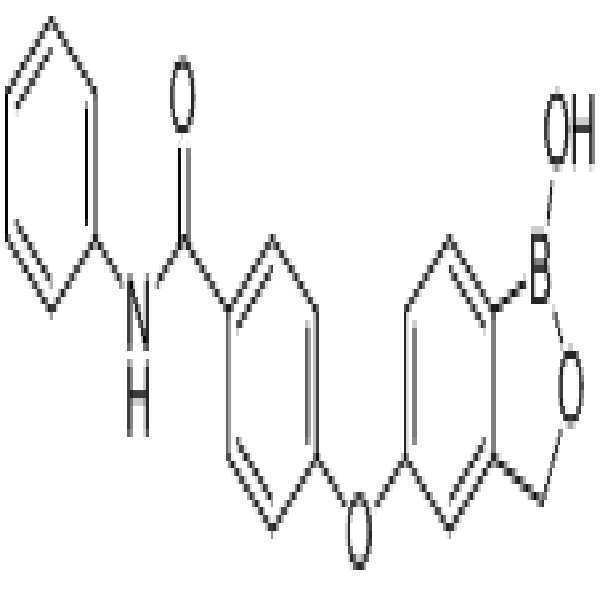
D214 는 D229 과 유사한 과정을 이용하여 준비되었다. LCMS (m/z) 368 (M+23); 1H NMR (DMSO-d6) δ: 10.17 (s, 1H), 7.99 (d, J = 8.6 Hz, 2H), 7.74 (dd, J = 7.8, 4.7 Hz, 3H), 7.32 (t, J = 7.8 Hz, 2H), 7.13 (d, J = 8.6 Hz, 2H), 7.01 - 7.09 (m, 3H), 4.93 (s, 2H). D214 was prepared using a procedure similar to D229 . LCMS (m / z) 368 (M + 23); 1 H NMR (DMSO-d 6 ) δ: 10.17 (s, 1H), 7.99 (d, J = 8.6 Hz, 2H), 7.74 (dd, J = 7.8, 4.7 Hz, 3H), 7.32 (t, J = 7.8 Hz, 2H), 7.13 (d, J = 8.6 Hz, 2H), 7.01-7.09 (m, 3H), 4.93 (s, 2H).
N- 시클로프로필 -4-(1- 하이드록시 -1,3- 디하이드로 - 벤조[c][1,2]옥사보롤 -5-일 옥시)-벤자미드 (D215) N- cyclopropyl-4- (1-hydroxy-1,3-dihydro-benzo [c] [1,2] oxazol-5-yl borol oxy) benzamide (D215)

D215는 D229 과 유사한 과정을 이용하여 준비되었다. LCMS (m/z) 310 (M+H); 1H NMR (DMSO-d6) δ: 9.13 (s, 1H), 8.36 (d, J = 4.0 Hz, 1H), 7.83 (d, J = 8.8 Hz, 2H), 7.66 - 7.77 (m, 1H), 6.98 - 7.11 (m, 4H), 4.92 (s, 2H), 2.81 (td, J = 7.3, 3.7 Hz, 1H), 0.62 - 0.70 (m, 2H), 0.49 - 0.57 (m, 2H). D215 was prepared using a procedure similar to D229 . LCMS (OT / Z) 310 (M + H); 1 H NMR (DMSO-d 6 ) δ: 9.13 (s, 1H), 8.36 (d, J = 4.0 Hz, 1H), 7.83 (d, J = 8.8 Hz, 2H), 7.66 - 7.77 (m, 1H) , 6.98-7.11 (m, 4H), 4.92 (s, 2H), 2.81 (td, J = 7.3, 3.7 Hz, 1H), 0.62-0.70 (m, 2H), 0.49-0.57 (m, 2H).
4-(1- 하이드록시 -1,3- 디하이드로 - 벤조[c][1,2]옥사보롤 -5-일 옥시 )-N-( 테트 라하이드로-퓨란-2-일메틸)-벤자미드 (D216) 4- (1-hydroxy-1,3-dihydro-benzo [c] [1,2] oxazol-5-yl borol oxy) -N- (Tet la dihydro-furan-2-ylmethyl) - benzamide (D216)

D216는 D229 과 유사한 과정을 이용하여 준비되었다. LCMS (m/z) 376 (M+23); 1H NMR (메탄올-d4) δ: 8.38 (br. s., 1H), 7.81 - 7.88 (m, 2H), 7.66 (d, J = 7.9 Hz, 1H), 6.99 - 7.07 (m, 4H), 5.02 (s, 2H), 4.10 (qd, J = 6.8, 4.8 Hz, 1H), 3.89 (dt, J = 8.1, 6.7 Hz, 1H), 3.72 - 3.79 (m, 1H), 3.46 - 3.54 (m, 1H), 3.37 - 3.45 (m, 1H), 1.84 - 2.07 (m, 3H), 1.61 - 1.70 (m, 1H) D216 was prepared using a procedure similar to D229 . LCMS (m / z) 376 (M + 23); 1 H NMR (methanol -d 4) δ: 8.38 (. . Br s, 1H), 7.81 - 7.88 (m, 2H), 7.66 (d, J = 7.9 Hz, 1H), 6.99 - 7.07 (m, 4H) , 5.02 (s, 2H), 4.10 (qd, J = 6.8, 4.8 Hz, 1H), 3.89 (dt, J = 8.1, 6.7 Hz, 1H), 3.72-3.79 1H), 3.37-3.45 (m, 1H), 1.84-2.07 (m, 3H), 1.61-1.70 (m,
4-(1- 하이드록시 -1,3- 디하이드로 - 벤조[c][1,2]옥사보롤 -5-일 옥시 )-N- 메틸 - 벤자미드 (D217) 4- (1-hydroxy-1,3-dihydro-benzo [c] [1,2] oxazol-5-yl borol oxy) -N- methyl-benzamide (D217)

D217는 D229 과 유사한 과정을 이용하여 준비되었다. LCMS (m/z) 284 (M+H); 1H NMR (DMSO-d6) δ: 9.13 (s, 1H), 8.36 (d, J = 4.5 Hz, 1H), 7.82 - 7.87 (m, 2H), 7.73 (d, J = 7.9 Hz, 1H), 6.99 - 7.08 (m, 4H), 4.92 (s, 2H), 2.75 (d, J = 4.5 Hz, 3H). D217 was prepared using a procedure similar to D229 . LCMS (m / z) 284 (M + H) +; 1 H NMR (DMSO-d 6 ) δ: 9.13 (s, 1H), 8.36 (d, J = 4.5 Hz, 1H), 7.82 - 7.87 (m, 2H), 7.73 (d, J = 7.9 Hz, 1H) , 6.99-7.08 (m, 4H), 4.92 (s, 2H), 2.75 (d, J = 4.5 Hz, 3H).
4-(1- 하이드록시 -1,3- 디하이드로 - 벤조[c][1,2]옥사보롤 -5-일 옥시 )- N,N -디메 틸-벤자미드 (D218) 4- (1-hydroxy-1,3-dihydro-benzo [c] [1,2] oxazol-5-yl borol oxy) - N, N-butyl-dimethoxy-benzamide (D218)

D218 는 D229 과 유사한 과정을 이용하여 준비되었다. LCMS (m/z) 298 (M+H); 1H NMR (DMSO-d6) δ : 9.29 (s, 1H), 7.71 (d, J = 8.0 Hz, 1H), 7.38 - 7.45 (m, 2H), 6.97 - 7.05 (m, 4H), 4.91 (s, 2H), 2.92 (br. s., 6H). D218 was prepared using a procedure similar to D229 . LCMS (m / z) 298 (M + H); 1 H NMR (DMSO-d 6 ) δ: 9.29 (s, 1H), 7.71 (d, J = 8.0 Hz, 1H), 7.38 - 7.45 (m, 2H), 6.97 - 7.05 (m, 4H), 4.91 ( s, 2H), 2.92 (br s, 6H).
N'-[4-(1- 하이드록시 -1,3- 디하이드로 - 벤조[c][1,2]옥사보롤 -5-일 옥시 )- 벤조 일]-하이드라진카르복실산tert-부틸에스테르 (D219) N '- [4- (1- hydroxy-1,3-dihydro-benzo [c] [1,2] oxazol-5-yl borol oxy) benzo yl] -hydrazinecarboxylic acid tert- butyl ester ( D219)

D219는 D229 과 유사한 과정을 이용하여 준비되었다. LCMS (m/z) 407 (M+23); 1H NMR (DMSO-d6) δ : 10.13 (s, 1H), 9.15 (s, 1H), 8.87 (s, 1H), 7.88 (d, J = 8.6 Hz, 2H), 7.75 (d, J = 8.0 Hz, 1H), 7.02 - 7.10 (m, 4H), 4.93 (s, 2H), 1.41 (s, 9H). D219 was prepared using a procedure similar to D229 . LCMS (m / z) 407 (M + 23); 1 H NMR (DMSO-d 6 ) δ: 10.13 (s, 1H), 9.15 (s, 1H), 8.87 (s, 1H), 7.88 (d, J = 8.6 Hz, 2H), 7.75 (d, J = 8.0 Hz, 1H), 7.02-7.10 (m, 4H), 4.93 (s, 2H), 1.41 (s, 9H).
4-(1-4- (1- 하이드록시Hydroxy -1,3--1,3- 디하이드로Dihydro -- 벤조[c][1,2]옥사보롤Benzo [c] [1,2] oxaborol -5-일 -5 days 옥시Oxy )-) - 벤자미드Benzamide (D220)(D220)

4-(1-하이드록시-1,3-디하이드로-벤조[c][1,2]옥사보롤-5-일 옥시)-벤조산(77 mg, 0.28 mmol, 1.0 eq.) 및 CDI (101.3 mg, 0.62 mmol), 2.5 eq.)의 DMF (3.0 mL)을 포함하는 40mL 신틸레이션 바이알에 탄산암모니움염(123.3 mg, 1.28 mmol, 4.5 eq.)이 첨가되었다. 혼합물은 실온에서 하룻밤 동안 교반되었다. 혼합물은 H2O (5 mL)으로 처리되었고, 그리고 층들은 분리되었다. 수성은 EtOAc (2 x 5 mL)으로 추출되고, 복합되었고, 유기상은 소금물로 세척되고 (10 mL), MgSO4상에서 건조되고, 여과되었고, 그리고 여과액은 감압하에서 농축되었다. 잔유물은 실리카 크로마토그래피에 제공되어, MeOH/DCM (0:100 내지 10:90)로 용리되면, 4-(1-하이드록시-1,3-디하이드로-벤조[c][1,2]옥사보롤-5-일 옥시)-벤자미드가 백색 고체로 제공되었다. LCMS (m/z) 270 (M+H); 1H NMR (DMSO-d6) δ : 9.14 (s, 1H), 7.87 - 7.92 (m, 2H), 7.73 (d, J = 7.8 Hz, 1H), 7.05 (d, J = 8.8 Hz, 4H), 4.93 (s, 2H).Benzoic acid (77 mg, 0.28 mmol, 1.0 eq.) And CDI (101.3 mg, 0.28 mmol, 1.0 equiv) , 0.62 mmol), 2.5 eq.) In DMF (3.0 mL) was added ammonium carbonate (123.3 mg, 1.28 mmol, 4.5 eq.) To a 40 mL scintillation vial. The mixture was stirred at room temperature overnight. The mixture was treated with H 2 O (5 mL), and the layers were separated. The aqueous was extracted with EtOAc (2 x 5 mL) and combined, and the organic phase was washed with brine (10 mL), dried over MgSO 4 , filtered, and the filtrate was concentrated under reduced pressure. The residue was subjected to silica chromatography and eluted with MeOH / DCM (0: 100 to 10:90) to give 4- (1-hydroxy-1,3-dihydro-benzo [c] 5-yloxy) -benzamide was provided as a white solid. LCMS (m / z) 270 (M + H) < + >; 1 H NMR (DMSO-d 6 ) δ: 9.14 (s, 1H), 7.87 - 7.92 (m, 2H), 7.73 (d, J = 7.8 Hz, 1H), 7.05 (d, J = 8.8 Hz, 4H) , ≪ / RTI > 4.93 (s, 2H).
5-(4-5- (4- 하이드록시메틸Hydroxymethyl -- 페녹시Phenoxy )-3H-) -3H- 벤조[c][1,2]옥사보롤Benzo [c] [1,2] oxaborol -1-올-1-ol (D221) (D221)

4-(1-하이드록시-1,3-디하이드로-벤조[c][1,2]옥사보롤-5-일 옥시)-벤조산(200mg, 0.74 mmol, 1.0 eq.), 트리메틸 붕산염(0.5 mL, 4.4 mmol, 6.0 eq.)의 THF (7.0 mL)용액에 보란 테트라하이드로퓨란 복합물 용액 (1.5 mL, THF내 1.0 M, 1.5 mmol, 2.0 eq.)이 질소 대기하에 점적되었다. 혼합물은 실온에서 하룻밤 교반되었다. 혼합물은 MeOH (2 mL)로 조심스레 처리하고, EtOAc (10 mL) 및 sat. NaHCO3 (10 mL)에 넣었다. 층들이 분리되었고 수성 상은 EtOAc (3 x 10 mL)로 추출되었다. 복합된 유기 추출물은 소금물로 세척되고 (10 mL), MgSO4상에서 건조되었고, 여과되었고 그리고 여과액은 감압하에서 농축되었다. 잔유물은 실리카 크로마토그래피에 제공되어 MeOH/DCM (0:100 내지 10: 90)로 용리시키면, 5-(4-하이드록시메틸-페녹시)-3H-벤조[c][1,2]옥사보롤-1-올이 백색 고체로 제공되었다. LCMS (m/z) 279 (M+23); 1H NMR (DMSO-d6) δ : 9.09 (s, 1H), 7.70 (d, J = 8.0 Hz, 1H), 7.34 - 7.38 (m, J = 8.7 Hz, 2H), 7.01 - 7.05 (m, 2H), 6.96 (dd, J = 8.0, 2.1 Hz, 1H), 6.91 - 6.93 (m, 1H), 5.18 (t, J = 5.7 Hz, 1H), 4.91 (s, 2H), 4.49 (d, J = 5.7 Hz, 2H).Benzoic acid (200 mg, 0.74 mmol, 1.0 eq.), Trimethylborate (0.5 mL, 0.20 mmol), and triethylamine , 4.4 mmol, 6.0 eq.) In THF (7.0 mL) was added dropwise a solution of borane tetrahydrofuran complex (1.5 mL, 1.0 M in THF, 1.5 mmol, 2.0 eq.) Under a nitrogen atmosphere. The mixture was stirred at room temperature overnight. The mixture was carefully treated with MeOH (2 mL), EtOAc (10 mL) and sat. NaHCO < / RTI > 3 (10 mL). The layers were separated and the aqueous phase was extracted with EtOAc (3 x 10 mL). The combined organic extracts were washed with brine (10 mL), dried over MgSO 4 , filtered and the filtrate was concentrated under reduced pressure. The residue was subjected to silica chromatography and eluted with MeOH / DCM (0: 100 to 10:90) to give 5- (4-hydroxymethyl-phenoxy) -3H-benzo [c] -L-ol was provided as a white solid. LCMS (m / z) 279 (M + 23); 1 H NMR (DMSO-d 6 ) δ: 9.09 (s, 1H), 7.70 (d, J = 8.0 Hz, 1H), 7.34 - 7.38 (m, J = 8.7 Hz, 2H), 7.01 - 7.05 (m, 2H), 4.49 (d, J = 7.9 Hz, 2H), 6.96 (dd, J = 8.0,2.1 Hz, 1H), 6.91-6.93 = 5.7 Hz, 2H).
5-(4-니트로-5- (4-Nitro- 페녹시Phenoxy )-3H-) -3H- 벤조[c][1,2]옥사보롤Benzo [c] [1,2] oxaborol -1-올 -1-ol (D222)(D222)

1-플루오르-4-니트로-벤젠 (1.1 mL, 10.0 mmol, 1.0 eq.), 2-브로모-5-하이드록시-벤즈알데히드 (2.0 g, 10.0 mmol, 1.0 eq.)의 DMF (30.0 mL)용액에 질소 대기하에서 K2CO3 (1.7 g, 12.0 mmol, 1.2 eq.)가 첨가되었다. 혼합물은 100 ℃에서 하룻밤 동안 가열되었다. 실온으로 냉각된 후, 혼합물을 EtOAc (30 mL) 및 sat. H2O (30 mL)에 부었다. 층들이 분리되었고 수성 상은 EtOAc (3 x 20 mL)로 추출되었다. 복합된 유기 추출물은 소금물로 세척되었고 (30 mL), MgSO4상에서 건조되었고, 여과되었고, 그리고 여과액은 감압하에서 농축되었다. 잔유물은 실리카 크로마토그래피에 제공되어 EtOAc/헵탄 (0:100 내지 100: 0)로 용리되면, 2-브로모-5-(4-니트로-페녹시)-벤즈알데히드가 황색 미세 분말로 제공되었다. 1H NMR (클로로포름-d) δ : 10.31 - 10.37 (m, 10H), 8.26 (dd, J = 9.0, 0.3 Hz, 15H), 8.21 - 8.28 (m, 13H), 7.73 (d, J = 8.6 Hz, 3H), 7.73 (dt, J = 8.7, 0.5 Hz, 7H), 7.62 (dd, J = 3.1, 0.3 Hz, 10H), 7.20 - 7.29 (m, 19H), 7.00 - 7.10 (m, 23H). 수득된 양, 2.6g, 80.7% 산출량.A DMF (30.0 mL) solution of 2-bromo-5-hydroxy-benzaldehyde (2.0 g, 10.0 mmol, 1.0 equiv) was added to a solution of 1- fluoro-4-nitro- benzene (1.1 mL, 10.0 mmol, 1.0 eq. Was added K 2 CO 3 (1.7 g, 12.0 mmol, 1.2 eq.) Under a nitrogen atmosphere. The mixture was heated at 100 < 0 > C overnight. After cooling to room temperature, the mixture was diluted with EtOAc (30 mL) and sat. And poured into H 2 O (30 mL). The layers were separated and the aqueous phase was extracted with EtOAc (3 x 20 mL). The combined organic extracts were washed with brine (30 mL), dried over MgSO 4 , filtered and the filtrate was concentrated under reduced pressure. The residue was subjected to silica chromatography and eluted with EtOAc / heptane (0: 100 to 100: 0) to give 2-bromo-5- (4-nitro-phenoxy) -benzaldehyde as a yellow fine powder. 1 H NMR (chloroform -d) δ: 10.31 - 10.37 ( m, 10H), 8.26 (dd, J = 9.0, 0.3 Hz, 15H), 8.21 - 8.28 (m, 13H), 7.73 (d, J = 8.6 Hz (M, 3H), 7.73 (dt, J = 8.7, 0.5 Hz, 7H), 7.62 (dd, J = 3.1, 0.3 Hz, 10H), 7.20-7.29 (m, 19H), 7.00-7.10 (m, 23H). The amount obtained, 2.6 g, 80.7% yield.
2-브로모-5-(4-니트로-페녹시)-벤즈알데히드 (966 mg, 3.0 mmol, 1.0 eq.)의 1,4-디옥산(25 mL) 용액에 비스-피나콜-다이보론 (838 mg, 3.3 mmol, 1.1 eq.), KOAc (883 mg, 9.0 mmol, 3.0 eq.) 그리고 PdCl2(dppf)2 (66 mg, 0.09 mmol, 0.03 eq.)가 첨가되었다. 혼합물은 N2 로 탈기되고, 80 ℃에서 하룻밤 동안 가열되었다. 실온으로 냉각된 후, 혼합물은 짧은 셀라이트 팩을 통하여 여과되었고, 여과액은 감압하에서 농축되었다. 잔유물은 실리카 크로마토그래피에 제공되어, EtOAc/헵탄 (0:100 내지 100: 0)로 용리되면, 5-(4-니트로-페녹시)-2-(4,4,5-트리메틸-[1,3,2]디옥사보란-2-일)-벤즈알데히드가 황색 고체로 제공되었다. 1H NMR (클로로포름-d) δ: 10.65 (s, 1H), 8.19 - 8.29 (m, J = 9.3 Hz, 2H), 8.01 (d, J = 8.2 Hz, 1H), 7.66 (d, J = 2.5 Hz, 1H), 7.32 (dd, J = 8.2, 2.5 Hz, 1H), 7.04 - 7.10 (m, 2H), 1.41 (s, 12H). 수득된 양, 724 mg, 65.3% 산출량.To a solution of 2-bromo-5- (4-nitro-phenoxy) -benzaldehyde (966 mg, 3.0 mmol, 1.0 eq.) In 1,4- dioxane (25 mL) was added bis-pinacol- (88 mg, 9.0 mmol, 3.0 eq.) and PdCl 2 (dppf) 2 (66 mg, 0.09 mmol, 0.03 eq.) were added. The mixture was degassed with N 2, and heated overnight at 80 ℃. After cooling to room temperature, the mixture was filtered through a short celite pack and the filtrate was concentrated under reduced pressure. The residue was subjected to silica chromatography and eluted with EtOAc / heptane (0: 100 to 100: 0) to give 5- (4-nitro- phenoxy) -2- (4,4,5- 3,2] dioxaborane-2-yl) -benzaldehyde as a yellow solid. 1 H NMR (chloroform -d) δ: 10.65 (s, 1H), 8.19 - 8.29 (m, J = 9.3 Hz, 2H), 8.01 (d, J = 8.2 Hz, 1H), 7.66 (d, J = 2.5 Hz, 1H), 7.32 (dd, J = 8.2,2.5 Hz, 1H), 7.04-7.10 (m, 2H), 1.41 (s, 12H). The amount obtained, 724 mg, 65.3% yield.
5-(4-니트로-페녹시)-2-(4,4,5-트리메틸-[1,3,2]디옥사보란-2-일)-벤즈알데히드 (721 mg, 1.9 mmol, 1.0 eq.)의 EtOH (15 mL)현탁액에 0 ℃에서 소부분으로 NaBH4 (73.8 mg, 1.9 mmol, 1.0 eq.)이 첨가되었다. 혼합물은 0 ℃ 에서 20분간 교반되었고, 추가 1시간 동안 실온으로 데워졌다. 0 ℃로 냉각된 후, 맑은 용액은 H2O (1 mL)으로 조심스레 처리되었고, 이어서 HCl (5 mL, 3N)를 천천히 첨가하였다. 생성된 황색 현탁액은 점진적으로 실온이 되도록 두고, 2시간 동안 교반되었다. 혼합물은 그 다음 pH가 7이 될 때까지 sat. NaHCO3 를 점적시켰다. 침전물은 여과를 통하여 수거되었고, H2O로 세척하여, 5-(4-니트로-페녹시)-3H-벤조[c][1,2]옥사보롤-1-올은 백색 분말로 제공되었다. LCMS (m/z) 294 (M+23); 1H NMR (DMSO-d6) δ : 7.26 (d, J = 8.6 Hz, 1H), 6.93 (d, J = 3.0 Hz, 1H), 6.56 (dd, J = 8.5, 3.0 Hz, 1H), 4.37 (s, 2H). 수득된 양, 510 mg, 96.4% 산출량.Benzaldehyde (721 mg, 1.9 mmol, 1.0 equiv) was added to a solution of 5- (4-nitro-phenoxy) -2- (4,4,5-trimethyl- [1,3,2] dioxaborane- In EtOH (15 mL) was added NaBH 4 (73.8 mg, 1.9 mmol, 1.0 eq.) In portions at 0 ° C. The mixture was stirred for 20 minutes at 0 < 0 > C and warmed to room temperature for an additional 1 hour. After cooling to 0 ° C, the clear solution was carefully treated with H 2 O (1 mL), followed by the slow addition of HCl (5 mL, 3N). The resulting yellow suspension was allowed to gradually warm to room temperature and stirred for 2 hours. The mixture is then saturated until the pH is 7. It was the exclusive NaHCO 3. The precipitate was collected via filtration and washed with H 2 O to give 5- (4-nitro-phenoxy) -3H-benzo [c] [1,2] oxaborol-1-ol as a white powder. LCMS (m / z) 294 (M + 23); 1 H NMR (DMSO-d 6 ) δ: 7.26 (d, J = 8.6 Hz, 1H), 6.93 (d, J = 3.0 Hz, 1H), 6.56 (dd, J = 8.5, 3.0 Hz, 1H), 4.37 (s, 2H). The amount obtained, 510 mg, 96.4% yield.
5-(4-아미노-5- (4-Amino- 페녹시Phenoxy )-3H-) -3H- 벤조[c][1,2]옥사보롤Benzo [c] [1,2] oxaborol -1-올 -1-ol (D223)(D223)

자석 교반 막대가 갖추어진 25 mL 밑둥근 플라스크에 5-(4-니트로-페녹시)-3H-벤조[c][1,2]옥사보롤-1-ol (310 mg, 1.1 mmol, 1.0eq.)를 첨가하고, 이어서 MeOH (10 mL)를 첨가하였다. 플라스크의 공기를 빼내고, N2 로 2회 재충전시켰다. 교반된 용액에 5% Pd/C (60 mg)가 첨가되었고, 플라스크에 공기를 빼내고, H2 로 3회 재충전시켰다. 생성된 현탁액은 H2 기구하에 실온에서 하룻밤 동안 교반되었다. 혼합물은 짧은 셀라이트 팩을 통하여 여과되었고, MeOH (3 x 10 mL)로 세척되었다. 복합된 여과액은 감압하에서 농축되었고, 밝은 황색 오일이 제공되었다. 오일은 최소량의 MeOH에 용해되었고, HCl (conc.)으로 조심스레 처리되었다. 침전물은 여과에 의해 수거되었고, 헵탄으로 세척되어 5-(4-아미노-페녹시)-3H-벤조[c][1,2]옥사보롤-1-올 하이드로클로라이드 염은 백색 고체로 제공되었다. LCMS (m/z) 242 (M+H); 1H NMR (DMSO-d6) δ : 9.03 (br. s., 1H), 7.64 (d, J = 8.0 Hz, 1H), 6.77 - 6.89 (m, 4H), 6.64 - 6.77 (m, 2H), 4.86 (s, 2H), 3.30 (br. s., 2H).Benzo [c] [1,2] oxaborol-1-ol (310 mg, 1.1 mmol, 1.0 eq.) Was added to a 25 mL round bottomed flask equipped with a magnetic stir bar. ) Was added followed by MeOH (10 mL). Remove the air in the flask was recharged twice with N 2. To the stirred solution was added 5% Pd / C (60 mg) and the flask was evacuated and refilled with H 2 three times. The resulting suspension was stirred under H 2 apparatus at room temperature overnight. The mixture was filtered through a short celite pack and washed with MeOH (3 x 10 mL). The combined filtrate was concentrated under reduced pressure and a light yellow oil was provided. The oil was dissolved in the minimum amount of MeOH and carefully treated with HCl (conc.). The precipitate was collected by filtration and washed with heptane to give 5- (4-amino-phenoxy) -3H-benzo [c] [1,2] oxaborol-1-ol hydrochloride salt as a white solid. LCMS (m / z) 242 (M + H); 1 H NMR (DMSO-d 6 ) δ: 9.03 (.. Br s, 1H), 7.64 (d, J = 8.0 Hz, 1H), 6.77 - 6.89 (m, 4H), 6.64 - 6.77 (m, 2H) , 4.86 (s, 2H), 3.30 (br.s, 2H).
N-[4-(1- 하이드록시 -1,3- 디하이드로 - 벤조[c][1,2]옥사보롤 -5-일 옥시 )-페 닐]-아세타아미드(D224) N- [4- (1- hydroxy-1,3-dihydro-benzo [c] [1,2] oxazol-5-yl borol oxy) - Fe carbonyl] - O theta amide (D224)

5-(4-아미노-페녹시)-3H-벤조[c][1,2]옥사보롤-1-ol (68 mg, 0.28 mmol, 1.0 eq.)의 DCM (3.0 mL)을 포함하는 20mL 신틸레이션 바이알에 Et3N (47 μL, 0.33 mmol, 1.2 eq.)가 첨가되었고, 아세틸 클로라이드 (22 μL, 0.31 mmol, 1.1 eq.)가 첨가되었다. 혼합물은 실온에서 하룻밤 교반되었다. 혼합물은 감압하에서 농축되었다. 잔유물은 실리카 크로마토그래피에 제공되어, MeOH/DCM (0:100 내지 10:90)으로 용리되면, N-[4-(1-하이드록시-1,3-디하이드로-벤조[c][1,2]옥사보롤-5-일 옥시)-페닐]-아세타아미드가 백색 고체로 제공되었다. LCMS (m/z) 284 (M+H); 1H NMR (DMSO-d6) δ : 10.17 (s, 1H), 7.68 (d, J = 8.1 Hz, 1H), 7.58 - 7.63 (m, 2H), 6.94 - 6.99 (m, 2H), 6.88 (dd, J = 8.0, 2.1 Hz, 1H), 6.84 (d, J = 1.5 Hz, 1H), 4.85 (s, 2H), 3.12 (s, 1H), 2.00 (s, 3H).A 20 mL scintillation containing DCM (3.0 mL) of 5- (4-amino-phenoxy) -3H-benzo [c] [1,2] oxaborol-1-ol (68 mg, 0.28 mmol, 1.0 eq. Et 3 N (47 μL, 0.33 mmol, 1.2 eq.) Was added to the vial and acetyl chloride (22 μL, 0.31 mmol, 1.1 eq.) Was added. The mixture was stirred at room temperature overnight. The mixture was concentrated under reduced pressure. The residue was subjected to silica chromatography and eluted with MeOH / DCM (0: 100 to 10:90) to give N- [4- (1-hydroxy-1, 3-dihydro- benzo [c] 2] oxaborol-5-yloxy) -phenyl] -acetamide was provided as a white solid. LCMS (m / z) 284 (M + H) +; 1 H NMR (DMSO-d 6 ) δ: 10.17 (s, 1H), 7.68 (d, J = 8.1 Hz, 1H), 7.58 - 7.63 (m, 2H), 6.94 - 6.99 (m, 2H), 6.88 ( (d, J = 8.0, 2.1 Hz, 1H), 6.84 (d, J = 1.5 Hz, 1H), 4.85 (s, 2H), 3.12
N-[4-(1- 하이드록시 -1,3- 디하이드로 - 벤조[c][1,2]옥사보롤 -5-일 옥시 )-페 닐]-메탄술폰아미드 (D225) N- [4- (1- hydroxy-1,3-dihydro-benzo [c] [1,2] oxazol-5-yl borol oxy) - Fe carbonyl] - methanesulfonamide (D225)

5-(4-아미노-페녹시)-3H-벤조[c][1,2]옥사보롤-1-올 (50 mg, 0.21 mmol, 1.0 eq.)의 DCM (3.0 mL)을 포함하는 20mL 신틸레이션 바이알에 Et3N (35 μL, 0.25 mmol, 1.2 eq.)이 첨가되고, 이어서 메탄술포닐 클로라이드 (18 μL, 0.31 mmol, 1.1 eq.)가 첨가되었다. 혼합물은 실온에서 하룻밤동안 교반되었다. 혼합물은 감압하에서 농축되었다. 잔유물은 실리카 크로마토그래피에 제공되어, MeOH/DCM (0:100 내지 10:90)로 용리시키면, N-[4-(1-하이드록시-1,3-디하이드로-벤조[c][1,2]옥사보롤-5-일 옥시)-페닐]-메탄술폰아미드가 백색 고체로 제공되었다. LCMS (m/z) 342 (M+23); 1H NMR (DMSO-d6) δ : 9.72 (s, 1H), 7.65 - 7.79 (m, 1H), 7.21 - 7.26 (m, 2H), 7.01 - 7.05 (m, 2H), 6.91 - 6.94 (m, 1H), 6.89 - 6.91 (m, 1H), 4.88 (s, 2H), 2.94 (s, 3H).A 20 mL scintillation involving DCM (3.0 mL) of 5- (4-amino-phenoxy) -3H-benzo [c] [1,2] oxaborol-1-ol (50 mg, 0.21 mmol, 1.0 eq. Et 3 N (35 μL, 0.25 mmol, 1.2 eq.) Was added to the vial followed by methanesulfonyl chloride (18 μL, 0.31 mmol, 1.1 eq.). The mixture was stirred at room temperature overnight. The mixture was concentrated under reduced pressure. The residue was subjected to silica chromatography and eluted with MeOH / DCM (0: 100 to 10:90) to give N- [4- (1-hydroxy-1,3-dihydro- benzo [c] 2] oxaborol-5-yloxy) -phenyl] -methanesulfonamide as a white solid. LCMS (m / z) 342 (M + 23); 1 H NMR (DMSO-d 6 ) δ: 9.72 (s, 1H), 7.65 - 7.79 (m, 1H), 7.21 - 7.26 (m, 2H), 7.01 - 7.05 (m, 2H), 6.91 - 6.94 (m , 6.99 (s, 3H).
4-(1- 하이드록시 -1,3- 디하이드로 - 벤조[c][1,2]옥사보롤 -5-일 옥시 )-벤조 산(D226) 4- (1-hydroxy-1,3-dihydro-benzo [c] [1,2] oxazol-5-yl borol oxy) benzoate (D226)

자석 교반기가 갖추어진, 4-(1-하이드록시-1,3-디하이드로-벤조[c][1,2]옥사보롤-5-일 옥시)-벤조니트릴 (5.0g, 20.0 mmol, 1.0eq.), MeOH (90 mL) 및 1,4-디옥산 (50 mL)이 포함된, 250 mL 밑 둥근 플라스크에 NaOH (6N, 20 mL)를 서서히 첨가시켰다. 플라스크에는 에어 콘덴서가 갖추어져 있고, 90 ℃ 로 미리 가열된 오일 바스 내에서 2일간 가열되었다. 그 다음 플라스크를 얼음-바스에 넣고, 용액은 pH가 2가 될 때까지 HCl (1N)로 조심스럽게 처리되었다. 혼합물은EtOAc (3 x 150 mL)으로 추출되었다. 복합된 유기 추출물은 H2O (200 mL) 및 소금물 (200 mL)로 세척되었고, MgSO4상에서 건조되었고, 여과되었고, 그리고 여과액은 감압하에서 농축되어, 4-(1-하이드록시-1,3-디하이드로-벤조[c][1,2]옥사보롤-5-일 옥시)-벤조산이 백색 고체로 제공되었다. LCMS (m/z) 271 (M+H); 1H NMR (DMSO-d6) : 12.80 (br. s., 1H), 9.16 (s, 1H), 7.94 (d, J = 8.6 Hz, 2H), 7.76 (d, J = 8.0 Hz, 1H), 7.01 - 7.15 (m, 4H), 4.94 (s, 2H). 수득된 양, 4.7 g, 87.0% 산출량.Benzo [c] [1,2] oxaborol-5-yloxy) -benzonitrile (5.0 g, 20.0 mmol, 1.0 eq.), Equipped with a magnetic stirrer ), MeOH (90 mL) and 1,4-dioxane (50 mL) was slowly added NaOH (6N, 20 mL) to a 250 mL round bottom flask. The flask was equipped with an air condenser and heated in an oil bath preheated to 90 DEG C for 2 days. The flask was then placed in an ice-bath and the solution was carefully treated with HCl (1 N) until the pH was 2. The mixture was extracted with EtOAc (3 x 150 mL). The combined organic extracts were washed with H 2 O (200 mL) and brine (200 mL), dried over MgSO 4 , filtered and the filtrate was concentrated under reduced pressure to give 4- (1-hydroxy- 3-dihydro-benzo [c] [1,2] oxaborol-5-yloxy) -benzoic acid as a white solid. LCMS (OT / Z) 271 (M + H); 1 H NMR (DMSO-d 6 ): 12.80 (.. Br s, 1H), 9.16 (s, 1H), 7.94 (d, J = 8.6 Hz, 2H), 7.76 (d, J = 8.0 Hz, 1H) , 7.01-7.15 (m, 4H), 4.94 (s, 2H). The amount obtained, 4.7 g, 87.0% yield.
[4-(1- 하이드록시 -1,3- 디하이드로 - 벤조[c][1,2]옥사보롤 -5-일 옥시 )-페닐]- 몰포린-4-일-메타논 (D227) [4- (1-hydroxy-1,3-dihydro-benzo [c] [1,2] oxazole borol 5-yl) -phenyl] - morpholine-4-yl-methanone (D227)

D227 는 D229과 유사한 방법으로 준비되었다. LCMS (m/z) 701 (2M+23); 1H NMR (DMSO-d6) δ: 9.15 (s, 1H), 7.75 (d, J = 7.9 Hz, 1H), 7.42 - 7.49 (m, 2H), 7.06 - 7.10 (m, 3H), 7.02 - 7.06 (m, 1H), 4.95 (s, 2H), 3.40 - 3.65 (m, 8H). D227 was prepared in a similar manner to D229 . LCMS (m / z) 701 (2M + 23); 1 H NMR (DMSO-d 6 ) δ: 9.15 (s, 1H), 7.75 (d, J = 7.9 Hz, 1H), 7.42 - 7.49 (m, 2H), 7.06 - 7.10 (m, 3H), 7.02 - 7.06 (m, 1H), 4.95 (s, 2H), 3.40-3.65 (m, 8H).
N- 시클로펜틸 -4-(1- 하이드록시 -1,3- 디하이드로 - 벤조[c][1,2]옥사보롤 -5-일 옥시)-벤자미드 (D228) N- cyclopentyl-4- (1-hydroxy-1,3-dihydro-benzo [c] [1,2] oxazol-5-yl borol oxy) benzamide (D228)

D228는 D229 과 유사한 방법으로 준비되었다. LCMS (m/z) 352 (M+H); 1H NMR (DMSO-d6) δ : 9.15 (s, 1H), 8.15 (d, J = 7.9 Hz, 1H), 7.86 - 7.92 (m, 2H), 7.75 (d, J = 8.5 Hz, 1H), 7.05 - 7.11 (m, 2H), 7.00 - 7.05 (m, 2H), 4.94 (s, 2H), 3.69 - 3.81 (m, 1H), 1.77 - 1.86 (m, 2H), 1.67 - 1.77 (m, 2H), 1.56 - 1.65 (m, 1H), 1.22 - 1.37 (m, 4H), 1.04 - 1.20 (m, 1H). D228 was prepared in a similar manner to D229 . LCMS (m / z) 352 (M + H); 1 H NMR (DMSO-d 6 ) δ: 9.15 (s, 1H), 8.15 (d, J = 7.9 Hz, 1H), 7.86 - 7.92 (m, 2H), 7.75 (d, J = 8.5 Hz, 1H) 2H), 1.67-1.77 (m, 2H), 7.05-7.11 (m, 2H), 7.00-7.05 2H), 1.56-1.65 (m, 1H), 1.22-1.37 (m, 4H), 1.04-1.20 (m, 1H).
N- 벤질 -4-(1- 하이드록시 -1,3- 디하이드로 - 벤조[c][1,2]옥사보롤 -5-일 옥시 )- 벤자미드 (D229) N- benzyl-4- (1-hydroxy-1,3-dihydro-benzo [c] [1,2] oxazol-5-yl borol oxy) benzamide (D229)

4-(1-하이드록시-1,3-디하이드로-벤조[c][1,2]옥사보롤-5-일 옥시)-벤조산 (150 mg, 0.55 mmol, 1.0 eq.), EDCI (157.2 mg, 0.82 mmol, 1.5 eq.), HOBt (111.5 mg, 0.82 mmol, 1.5 eq.) 및 DMAP (12 mg, 0.1 mmol, 0.2 eq.)의 DCM (10.0 mL)을 포함하는 40ml 신틸레이션 바이알에 벤질아민 (24 μL, 2.2 mmol, 4.0 eq.)이 점적되었다. 혼합물은 실온에서 하룻밤동안 교반되었다. 혼합물은 H2O (10 mL)으로 처리되었고, 층들은 분리되었다. 수성은 DCM (2 x 5 mL)으로 추출되었고, 복합된 유기 상은 소금물로 세척되었고 (10 mL), MgSO4상에서 건조되었고, 여과되었고 그리고 여과액은 감압하에서 농축되었다. 잔유물은 실리카 크로마토그래피 에 제공되어, MeOH/DCM (0:100 내지 10:90)로 용리되면 N-벤질-4-(1-하이드록시-1,3-디하이드로-벤조[c][1,2]옥사보롤-5-일 옥시)-벤자미드가 백색 고체로 제공되었다. LCMS (m/z) 360 (M+H); 1H NMR (DMSO-d6) δ: 9.01 (t, J = 6.0 Hz, 1H), 7.91 - 8.00 (m, 2H), 7.76 (d, J = 7.9 Hz, 1H), 7.29 - 7.36 (m, 5H), 7.21 - 7.27 (m, 1H), 7.08 - 7.13 (m, 2H), 7.02 - 7.07 (m, 2H), 4.95 (s, 2H), 4.48 (d, J = 6.0 Hz, 2H).Benzoic acid (150 mg, 0.55 mmol, 1.0 eq.), EDCI (157.2 mg, 0.15 mmol) was added to a solution of 4- (1 -hydroxy- 1, 3- dihydro-benzo [c] [1,2] oxaborol- To a 40 ml scintillation vial containing DCM (10.0 mL), 0.82 mmol, 1.5 eq.), HOBt (111.5 mg, 0.82 mmol, 1.5 eq.) And DMAP (12 mg, 0.1 mmol, 0.2 eq.) In
실시예Example 20 20
IN VITRO 분석IN VITRO ANALYSIS
여기에서 설명된 화합물의 사전-염증성 사이토킨 또는 포스포디에스테라제를 저해하는 능력에 대해 테스트되었다. Was tested for the ability of the compounds described herein to inhibit pre-inflammatory cytokines or phosphodiesterase.
사이토킨Cytokine 분석 analysis
냉동된 사람의 말초 혈액 단핵세포(PBMC)들이 해동되고, 원심분리되었다. 냉동보존 배지는 세포 펠렛으로부터 빨아내고, 세포는 96웰 플레이트에서 RPMI 1640 및 10% FBS가 포함된 새로운 배양 배지(CM)에서 재현탁되었다. 테스트 물질은 DMSO 용해되어, 10 mM 샘플을 만든다(DMSO, 100%). 10 mM 샘플은 CM (DMSO, 1%)에서 100 μM으로 희석되고, 그 다음 200 μL CM (n = 3)에서 10, 1, 0.1, 0.01μM으로 더 희석되었다. 유도물질(TNF- 및 IL-1 [및 IL-6]의 경우 1 g/mL LPS 또는 IFN , IL-2, IL-4, IL-5 및 IL-10의 경우 20 ug/mL PHA. IL-23는 THP-1 세포를 이용하여, 100 ng/ml IFN-g + 1 mg/ml LPS으로 유도되었다. 비이클 (1% DMSO)은 이 실험에서 대조군으로 이용되었다. 유도물질없는 비이클은 네가티브 대조군으로 이용되었다. 세포들은 37℃, 5% CO2에서 배양되었다. 상층액은 24 시간(TNF- , IL-1 , IL-2, IL-6 및 IFN 의 경우) 및 48 시간(IL-4, IL-5, IL-10 및 IL-23의 경우)에서 추출되었고, -20 ℃에서 저장되었다. 상층액은 해동되었고, 플루오르크롬-라벨된 사이토킨-특이성 비드와 BD FACSArrayTM를 이용하여 사이토킨 발현에 대해 분석되었다. IL-23는 시판되는 ELISA kit (R&D Systems)를 이용하여 분석되었다.Frozen human peripheral blood mononuclear cells (PBMCs) were thawed and centrifuged. The cryopreservation medium was sucked from the cell pellet, and the cells were resuspended in 96-well plates in a new culture medium (CM) containing


이때, ^ 는 <30%이며, ^^는 30 내지 < 60%이며, ^^^는 60 내지 < 90%이며, ^^^^는 90 내지 100%이다.In this case,? Is in the range of 30%, 30 to 60%, 60 to 90%, and 90 to 100%.
이때, ++++는 <1 μM이며, +++ 는 1 내지 < 4 μM이며, ++는 4 내지 10 μM이며, + 는 >10 μM이다.At this time, ++++ is <1 μM, +++ is 1 to <4 μM, ++ is 4 to 10 μM, and + is> 10 μM.
PDEPDE 이소폼Isoform 프로파일링 Profiling
재조합인간 PDE 효소는 베큘로바이러스 시스템에서 발현되었다. 분석은 Thompson & Appleman (Biochem. 10:311-316, 1971)의 2-단계 방법을 변형시킨 것인데, 96-웰 플레이트 포멧에 대해 개조되었다. 원액은 100% DMSO에서 40mM로 준비되었다. 최종[DMSO]는 5%였다. 각 화합물은 100 mM의 농도에서 출발하여 4회 연속 희석을 하나를 실행시켜 테스트되었다. 각 농도에서 2회 반복 테스트되었다. IC50은 11-포인트 커브로부터 생성되었고, Prism 소프트웨어(GraphPad Inc.)를 이용하여 분석되었다. 테스트된 PDE 이소폼에는 PDE1A3 (cAMP), PDE1A3 (cGMP), PDE2A3, PDE3Cat, PDE4Cat, PDE4A4, PDE4B2, PDE4C2, PDE4D3, PDE5Cat, PDE6AB, PDE7A1, PDE8A1, PDE9A1, PDE10A1 (cAMP), PDE10A1 (cGMP), PDE11A1 (cAMP) 그리고 PDE11A1 (cGMP)이 포함되었다.The recombinant human PDE enzyme was expressed in the Baculovirus system. The assay was a modification of the two-step method of Thompson & Appleman (Biochem. 10: 311-316, 1971), which was modified for the 96-well plate format. The stock solution was prepared at 40 mM in 100% DMSO. The final [DMSO] was 5%. Each compound was tested by running one of four serial dilutions starting at a concentration of 100 mM. Repeated twice at each concentration. The IC50 was generated from an 11-point curve and analyzed using Prism software (GraphPad Inc.). The tested PDE isoforms include PDE1A3 (cAMP), PDE1A3 (cGMP), PDE2A3, PDE3Cat, PDE4Cat, PDE4A4, PDE4B2, PDE4C2, PDE4D3, PDE5Cat, PDE6AB, PDE7A1, PDE8A1, PDE9A1, PDE10A1 PDE11A1 (cAMP) and PDE11A1 (cGMP).
PDE4PDE4 분석 analysis
인간 U-937 골수 백혈병 세포로부터 정제된 PDE4가 이용되었다. 테스트 물질 및/또는 비이클은 0.01 mM [3H]cAMP/Tris 완충액, pH 7.5,이 포함된 0.2 mg 효소 및 1 mM cAMP에서, 25 ℃에서 20분간 배양되었다. 반응은 2분간 가열시켜 종료되었고, 생성된 AMP는 10 mg/ml 뱀 독 뉴클레오티다제를 추가하고, 37 ℃에서 10분간 추가 항온처리시키면 아데노신으로 전환된다. 가수분해안된 cAMP는 AG1-X2 수지에 결합되어 있고, 수성상에 있는 나머지 [3H]아데노신은 신틸레이션 카운팅으로 정량화되었다. 테스트 물질은 IC50 결정을 위하여 10, 3, 1, 0.3, 0.1, 0.03, 0.01, 0.003, 및 0.001μM에서 테스트되었다. Purified PDE4 from human U-937 myeloid leukemia cells was used. The test substance and / or vehicle were incubated at 25 占 폚 for 20 minutes in 0.2 mM enzyme and 1 mM cAMP containing 0.01 mM [3H] cAMP / Tris buffer, pH 7.5. The reaction was terminated by heating for 2 minutes and the resulting AMP was converted to adenosine by the addition of 10 mg / ml snake venom nucleotidase and further incubation at 37 ° C for 10 minutes. The hydrolyzed cAMP was bound to the AG1-X2 resin and the remaining [3H] adenosine on the aqueous phase was quantified by scintillation counting. Test materials were tested for IC 50 determinations at 10, 3, 1, 0.3, 0.1, 0.03, 0.01, 0.003, and 0.001 μM.


이때, ++++는 <1 μM이며, +++는 1 내지 < 4 μM이며, ++는 4 내지 10 μM이며, +는 >10 μM이다.At this time, ++++ is <1 μM, +++ is 1 to <4 μM, ++ is 4 to 10 μM, and + is> 10 μM.
실시예Example 21 21
IN IN VIVOVIVO 분석 analysis
1. 포르볼 에스테르로 유도된 생쥐 귀 부종 모델에서 in vivo 항-염증 활 성 1. FORT mice in vivo, wherein the ear swelling model induced by visible ester-inflammatory active
포르볼 12-미리스테이트 13-아세테이트 (PMA, 20 μL의 아세톤내 5 μg)가 CD-1 (Crl .) 유도된 수컷 각 5 마리 (체중 22 ± 2 g)로 된 8개 그룹의 우측 귀 전방 및 후방 표면에 국소적으로 제공되었다. 테스트 물질 및 비이클 (아세톤:에탄올/1:1, 20 μL/귀)는 PMA 도전전 30분과 도전후 15분에 모두 국소적으로 귀에 각각 제공되었다. 덱사메타손(1 mg/귀 x 2)은 포지티트 대조 물질로 이용되어, 동일한 제공 과정에 따라 테스트 동물에 국소적으로 투여되었다. Dyer 모델 마이크로미터 가우지를 사용하여 PMA 제공후 6시간 째에 염증 지수로써 귀 부풀어오름을 측정하였다. 다음 화학식에 따라 저해도가 계산되었다: [(Ic - It)/Ic] x 100%, 이때 Ic 및 It는 대조군과 처리된 생쥐에서 각각 귀 두께(mm)의 증가를 나타낸다. 귀 부풀어오름에서 30% 또는 그 이상의 저해도는 상당한 항-염증성 활성으로 간주되었다. Phorbol 12-myristate 13-acetate a CD-1 (Crl.) Derived male right ears, the front of each of the 5 dogs (


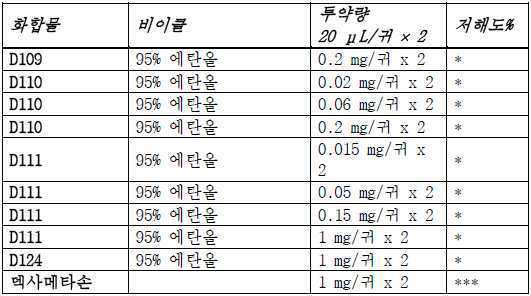
이때, *는 <30%이며, **는 30 내지 < 60%이며, ***는 60 내지 < 90%이며, ****는 90 내지 100%이다.In this case, * is < 30%, ** is 30 to < 60%, *** is 60 to < 90%, and **** is 90 to 100%.
2.2. 옥사졸론Oxazolone 유도된 생쥐 귀 부종 모델에서 In the induced mouse ear edema model In In vivovivo 항-염증 활성 Anti-inflammatory activity
5 BALB/c 수컷 생쥐(체중 23 ± 2 g) 군이 이용되었다. 테스트 동물의 미리-털이 제거된 복부에 아세톤에 용해된 100 μL 1.5% 옥사졸론 용액을 제공하여 민감하게 하였다. 최초 민감화후 7일뒤에 테스트 물질 뿐만 아니라 비이클 (아세톤:에탄올/1:1, 20 μL/귀)은 국소 경로를 통하여 제 2 옥사졸론(아세톤에서 1%, 20 ml/귀) 제공 전 30분 그리고 제공후 15분에 우측 쥐의 전후면에 국소적으로 투여되었다. 포지티브 대조로, 인도메타신(0.3 mg/귀 x 2)이 테스트 화합물과 동일한 처리 과정에 따라 국소적으로 투여되었다. 제 2 옥사졸론 제공후 24시간 후에, 각 생쥐의 귀 두께는 Dyer 모델 마이크로메터 가우지를 이용하여 측정되었다. 비이클 대조군에 비하여 귀 부풀어오름이 30% 또는 그 이상인 경우 상당히 유의적이며, 이는 항-염증성 활성이 있음을 나타낸 것이다. 5 BALB / c male mice (

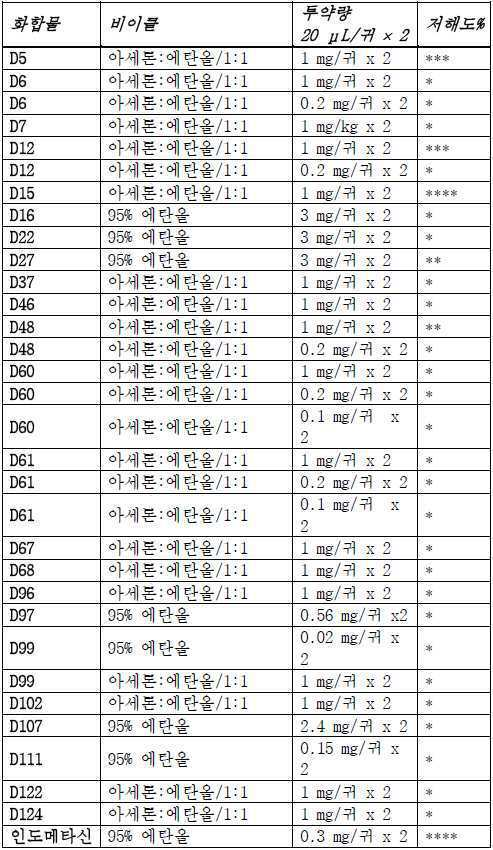
이때, *는 <20%이며, **는 20 내지 < 30%이고, ***는 30 내지 < 40%이며, ****는 40 내지 60%이다.At this time, * is 20%, ** is 20 to 30%, *** is 30 to 40%, and **** is 40 to 60%.
실시예Example 22 22
건선의Psoriatic 국소 치료를 위하여 개발된 C17, C17, developed for local treatment, 신규한New 옥사보롤의Oxaborous 임상전Preclinical 독물학toxicology
C17 (5-(4-시아노페녹시)-1,3-디하이드로-1-하이드록시-2,1-벤조옥사보롤e) 는 항-염증성 활성을 가진 새로운 옥사보롤 화합물이다. 임상전 독성학 데이터는 들쥐, 흰족제비, 쥐 그리고 생쥐에 전신 및 국소 투여후 시험관 및 생체 연구에 이용된다. C17 (1μM)은 낮은 효능의 hERG-체널 차단물질로 분류되어, 심혈관 안정성에 대해 우려를 최소화시킨다. C17 (플레이트당 최대 5000μg)은 살모넬라 티리무리움(Salmonella typhimurium )균주 TA98, TA100, TA1535, 및 TA1537 그리고 대장균(Escherichia coli) 균주 WP2 uvrA에 대해 아르클로-유도된 S9 간 분취물 존부하에 돌연변이생성 활성이 없는 것으로 설명된다. C17 (최대 500μg/mL)은 인간 말초 혈액 임파세포를 이용하여 아르클로-유도된 S9의 존부하에 염색체의 구조적이상(clastogenic) 활성이 없음이 설명되었다. 들쥐(Suncus murinus)에 10, 30, 및 100 mg/kg를 경구 투여후 약량 반응에 따른 구토 효과가 관찰되었다. 관찰된 효과가 없는 수준(NOEL)은 10 mg/kg이었고, 이는 유의적인 혈장 노출되 연관된다. 흰족제비에 10, 30, 및 100 mg/kg을 경구 후여후, 임의 약량 군에서도 구토 경우는 관찰되지 않았다. 암수 Sprague-Dawley 쥐에 연속 14일간 매일 30, 100, 및 300 mg/kg의 양으로 경구 투여하였을 때, NOEL는 300 mg/kg/day이었다. 임의 약량 군에서도 치사는 없었고, 임상적 병인에 부작용 또는 미소 또는 거시적 변화가 관찰되지 않았다. C17 는 아세톤/에탄올 (50:50, v/v)에서 1%, 5%, 및 10% 용액으로 제조하고, 과민 반응을 유도하기 위한 능력에 대해 국소 림프절에서 테스트되었다. 암컷 CBA/J를 C17으로 국소 치료하면 자극 지수가 3 또는 그 이상이 되지 않았으며, 따라서, C17 은 피부 민감화 활성을 가지고 있지 않는 것으로 간주되었다. C17은 건선의 국소 치료를 위해 개발된 새로운 화합물이며, 다양한 임상전 독성 연구에서 안전한 것으로 설명되었다. C17 (5- (4-cyanophenoxy) -1,3-dihydro-1-hydroxy-2,1-benzoxaborol e) is a novel oxaborol compound with anti-inflammatory activity. Preclinical toxicology data are used for in vitro and in vivo studies after systemic and topical administration to mice, ferrets, rats and mice. C17 (1 μM) is classified as a low-efficacy hERG-channel blocker, minimizing concerns about cardiovascular stability. C17 (up to 5000 micrograms per plate) mutated to the arcl-induced S9 intercalated zone load of Salmonella typhimurium strains TA98, TA100, TA1535, and TA1537 and Escherichia coli strain WP2 uvrA It is described as having no activity. C17 (up to 500 μg / mL) was demonstrated to have no chromosomal clastogenic activity in the zone load of arcl-induced S9 using human peripheral blood lymphocytes. Suncus After oral administration of 10, 30, and 100 mg / kg to murinus , vomiting effects were observed following dose response. The observed no effect level (NOEL) was 10 mg / kg, which is associated with significant plasma exposure. After oral administration of 10, 30, and 100 mg / kg to ferrets, no cases of vomiting were observed in any dose group. The NOEL was 300 mg / kg / day when administered orally to male and female Sprague-Dawley rats at doses of 30, 100, and 300 mg / kg daily for 14 consecutive days. There were no mortalities in the random dose group, and there were no adverse effects or microscopic or macroscopic changes in the clinical pathogenesis. C17 was prepared in 1%, 5%, and 10% solutions in acetone / ethanol (50:50, v / v) and tested in local lymph nodes for ability to induce hypersensitive response. Local treatment of female CBA / J with C17 did not result in an irritation index of 3 or more, and therefore C17 was considered to have no skin sensitizing activity. C17 is a new compound developed for topical treatment of psoriasis and has been described as safe in a variety of preclinical toxicity studies.
실시예Example 23 23
건선치료를 위해 개발된 신규한 옥사보롤인 C17의 in vitro 활성 및 작용 기전 Newly developed for psoriasis treatment In vitro activity and action of oxaborylin C17
C17 (4-시아노페녹시)-1-하이드록시-1, 3-디하이드로-2, 1-벤조옥사보롤)은 플락 건소의 국소 치료를 위해 현재 개발중인 광범위한 스팩트럼의 항-염증성 화합물이다. C17은 파이토헤마글루티난(PHA)을 나노몰 범위로 자극시킨 후, 리포폴리사카라이드(LPS) 및 IL-2 그리고 IFN-γ분비에 의해 자극된 말초 혈액 단핵세포(PBMCs)로부터 TNF-γ분비를 저해시킨다. C17 은 770nM의 IC50으로 TNF-γ 분비를 저해시킨다; 그러나 사전-염증성 사이토킨 IL-1 및 IL-6 는 C17에 영향을 받지 않는다. IL-2 및 IFN- γ 는 각각 IC50이 460 nM 및 270 nM이었다. IL-5 및 IL-10는 낮은 마이크로몰 범위에서 C17에 의해 저해되었다. 광범위한 사이토킨 분비를 저해시키는 C17의 작용 기전중 하나는 포스포디에스테라제 4 (PDE4)의 저해를 통하는 것일 수 있다. C17은 인간 U937 세포에서 PDE4 효소 활성을 저해시키는데, 이때IC50 값은 0.49μ M이며, 네가지 PDE4 이소폼(isoforms)을 동등하게 저해시킨다. C17는 효소 역학 분석에 의해 결정된 것과 같이, 기질 cAMP의 경쟁적인 저해제로 나타났다. C17 은 또한, PDE7를 저해시키는데, IC50 값은 0.73μ M이나, PDE1, 2, 3, 또는 5는 유의적으로 저해시키지 않았다. 고유 PDE4 저해제, 가령, 롤리프람(Rolipram)과 대조적으로, C17는 인간 THP-1 대식세포로부터 IL-23 생산을 저해시키는데, IC50은 2.25μM이었다. TNF-α와 TH1 사이토킨의 저해와 함께 이 활성으로 C17이 건선 치료에 효과가 있음을 나타낸다. C17 (4-cyanophenoxy) -1-hydroxy-1,3-dihydro-2,1-benzoxazole) is an extensive spectrum of anti-inflammatory compounds currently under development for topical treatment of Frag. C17 stimulates phytohemaglutinan (PHA) in the nanomolar range and then secretes TNF-γ from peripheral blood mononuclear cells (PBMCs) stimulated by lipopolysaccharide (LPS) and IL-2 and IFN- It inhibits secretion. C17 inhibits TNF-y secretion with an IC 50 of 770 nM; However, pre-inflammatory cytokines IL-1 and IL-6 are not affected by C17. IL-2 and IFN-? Had an IC 50 of 460 nM and 270 nM, respectively. IL-5 and IL-10 were inhibited by C17 in the low micromolar range. One of the mechanisms of action of C17 that inhibits a wide range of cytokine secretion may be through the inhibition of phosphodiesterase 4 (PDE4). C17 inhibits PDE4 enzyme activity in human U937 cells, with an IC 50 value of 0.49 μM, which equally inhibits four PDE4 isoforms. C17 appeared to be a competitive inhibitor of substrate cAMP, as determined by enzymatic epidemiology. C17 is also sikineunde inhibit PDE7, IC 50 values or 0.73μ M, PDE1, 2, 3, or 5 did not inhibit significantly. In contrast to the native PDE4 inhibitor, such as Rolipram, C17 inhibits IL-23 production from human THP-1 macrophages, with an IC 50 of 2.25 μM. This inhibition of TNF-α and TH1 cytokines, together with their activity, indicates that C17 is effective in the treatment of psoriasis.


실시예Example 24 24
건전 치료를 위해 개발중인 C17, C17, which is under development for sound therapy, 신규한New 옥사보롤의Oxaborous in in vivovivo 활성activation
C17 는 TNF-α, IFN-γ, IL-1β, IL-2, IL 4, IL-5, IL-6, IL-8, IL-10, IL-12, 및 IL-23을 포함하는 사전-염증성 사이토킨의 방출 저해에 근거한 항-염증성 활성을 가진 붕소-함유된 신규한 옥사보롤 약물이다. C17는 또한 케모킨 MCP-1 및 PGE2의 방출도 저해시킨다. 이 활성은 포스포디에스테라제-4 (PDE-4) 저해에 의해 부분적으로 설명된다.C17 is a pro-inflammatory cytokine that includes TNF- [alpha], IFN- [gamma], IL-l [beta], IL-2, IL4, IL-5, IL-6, IL-8, IL-10, IL- Is a novel borox-containing oxaborol drug with anti-inflammatory activity based on the inhibition of the release of inflammatory cytokines. C17 also inhibits the release of chemokine MCP-1 and PGE2. This activity is partly explained by phosphodiesterase-4 (PDE-4) inhibition.
C17의 항-건선 활성을 평가하기 위하여, 건선이 있는 12명의 환자가 단일-중심, 무작위화된, 비이클-조절된, 관찰자-블라인드 연구에 등록되었다. 각 개체에서 6가지 테스트 목록이 다루어졌다(두 가지 활성 제제: C17 연고, 5 %, C17 크림, 5 %, 두개 비이클, 그리고 두개 비교물질). To evaluate the anti-psoriasis activity of C17, twelve patients with psoriasis were enrolled in a single-centered, randomized, vehicle-controlled, observer-blind study. Six test lists were covered in each individual (two active agents: C17 ointment, 5%, C17 cream, 5%, two vehicles, and two comparative substances).
연구 제제1은 C17 연고(여기에서 설명된 제제)로 구성되며, 12일 기간에 걸쳐 매일 테스트 필드(1.1 cm2)당 약 200 μl 연고를 국소적으로 제공하였다(10회 치료). 약량은 약100 mg 활성 성분의 전체 약량에 대해 매일 약10 mg 활성 성분이 되었다.
연구 제제2는 C17 크림(여기에서 설명된 제제)로 구성되며, 12일 기간에 걸쳐 매일 테스트 필드(1.1 cm2)당 약 200 μl 크림을 국소적으로 제공하였다(10회 치료). 약량은 약100 mg 활성 성분의 전체 약량에 대해 매일 약10 mg 활성 성분이 되었다.
연구 제제3은 연구 제제1의 비이클(C17는 없음)로 구성되며, 12일 기간에 걸쳐 매일 테스트 필드(1.1 cm2)당 약 200 μl 크림을 국소적으로 제공하였다(10회 치료).
연구 제제4는 연구 제제2의 비이클(C17는 없음)로 구성되며, 12일 기간에 걸쳐 매일 테스트 필드(1.1 cm2)당 약 200 μl 크림을 국소적으로 제공하였다(10회 치료).
비교물질 1은 Betnesol®-V Creme 0.1 %으로 구성되는데, 12일 기간에 걸쳐 매일 테스트 필드(1.1 cm2)당 약 200 μl 크림을 국소적으로 제공하였다(10회 치료). 약량은 약2 mg 베타메타손의 전체 약량에 대해 매일 약0.2 mg 베타메타손이 되었다.
비교물질 2은 Protopic® Ointment 0.1 %으로 구성되는데, 12일 기간에 걸쳐 매일 테스트 필드(1.1 cm2)당 약 200 μl 크림을 국소적으로 제공하였다(10회 치료). 약량은 약2 mg 타크로리무스의 전체 약량에 대해 매일 약0.2 mg 타크로리무스가 되었다.
테스트 제제는 Dow Pharmaceutical Sciences, 1330A Redwood Way, Petaluma , CA 94954, USA에서 제조되었다. 비교물질 Betnesol-VCreme0.1%은 GlaxoWellcome GmbH & Co에서 제조되었다. 비교물질 Protopic 0.1 %은 Astellas Pharma GmbH , Neumarkter Str . 61, 81673 Munich, Germany에서 제조되었다. 연구 제제의 라벨링은 Anacor Pharmaceuticals, 1060 East Meadow Circle, Palo Alto, CA 94303-4230, USA에서 실시되었다.Test formulations were prepared in Dow Pharmaceutical Sciences, 1330A Redwood Way, Petaluma , CA 94954, USA. The comparative substance Betnesol-VCreme 0.1% is manufactured by GlaxoWellcome GmbH & Co. The comparative substance Protopic 0.1% is Astellas Pharma GmbH , Neumarkter Str . 61, 81673 Munich, Germany . Labeling of the study product was performed at Anacor Pharmaceuticals, 1060 East Meadow Circle, Palo Alto, CA 94303-4230, USA .
200 μl의 각 연구 제제 및 제제는 치료시마다 테스트 필드에 제공되었다. 연구 제제는 하이드로콜로이드 드레싱내에 펀치된 구멍내에 위치된 Duhring 쳄버(12 mm 내부 Ø, 14 mm 외부 Ø)에서 제공되었다 (Varihesive ® , Bristol- Myers Squibb Gruppe , Munich, Germany). 챔버는 해당량으로 완전하게 채워졌다. 챔버는 접착 패취(Fixomull ® , BSN,Hamburg,Germany )가 있는 위치에 고정되었다. 기존 연구에서, 하이드로콜로이드 드레싱은 양호한 내성이 있는 것으로 나타났다. 국소 제공 전후에, 침투액 두께를 측정하여, 건선에서 드레싱은 치료요법적 영향이 없음이 증명되었다. 챔버간에 거리는 최소 1.5 cm가 되어야 한다. 이 거리는 이웃한 테스트 필드간에 상호작용을 배제시키는데 충분한 거리가 된다. 모든 테스트 필드는 12일간에 걸쳐 10회 폐쇄하에 처리되었다. 새로운 처리전에 매회 남아있는 제제는 별도의 부드러운 티슈로 각 테스트 필드를 부드럽게 닦아냄으로써, 제거되었다. 연구 10일 째 처리가 실시되었다(연구일 1 - 6 및 8 - 11). 하이드로콜로이드 드레싱은 최대 7일간 두었으며, 연구 8일째 새것으로 교체되었다. 200 μl of each study formulation and formulation was provided in the test field at each treatment. The study formulation was provided in a Duhring chamber (12 mm internal Ø, 14 mm external Ø) located within the punched hole in the hydrocolloid dressing ( Varihesive ® , Bristol - Myers Squibb Gruppe , Munich, Germany ). The chamber was completely filled with the volume. The chamber was secured in place with adhesive patches ( Fixomull ® , BSN, Hamburg, Germany ) . In previous studies, hydrocolloid dressings were found to have good resistance. Before and after topical delivery, permeation fluid thickness was measured, demonstrating that dressing in psoriasis has no therapeutic effect. The distance between chambers should be at least 1.5 cm. This distance is sufficient to exclude interaction between neighboring test fields. All test fields were treated with 10 occlusions over 12 days. The formulation that remained each time before the new treatment was removed by gently wiping each test field with a separate soft tissue. The study was carried out on the 10th day (Study days 1-6 and 8-11). The hydrocolloid dressing was left for up to 7 days and replaced with a new one on
실험 측정에는 초음파 검사, 사진 증빙 서류 및 개체내 처리간 비교가 포함된 임상적 평가가 포함된다. Experimental measurements include clinical assessments that include a comparison between ultrasound, photographic evidence, and in-subject treatments.
연구 첫날 플락의 아웃라인은 투명한 플라스틱 쉬트상에 표시해두었다. 원하는 테스트 필드를 쉬트상에 그리고, 필드간에 최소 1.5 cm 간격을 두도록 하였다. 테스트 필드는 1-6으로 번호를 매겨두었다. 플라스틱 쉬트는 케이스 보고 양식(CRF)에 부착되었다. 베이스라인 초음파 측정 및 사진현상이 실시되었다. 사전처리 임상 평가 수치는 모든 테스트 필드에서 0으로 정의하였다. 하이드로콜로이드 드레싱이 부착되었고, 상기에서 설명된 것과 같이 첫 처리가 실행되었다. On the first day of the study, Flak's outline was marked on a transparent plastic sheet. The desired test field was placed on the sheet and spaced at least 1.5 cm from the field. Test fields were numbered 1-6. The plastic sheet was attached to the Case Report Form (CRF). Baseline ultrasound measurements and photographic phenomena were performed. The pre-treatment clinical evaluation values were defined as 0 in all test fields. The hydrocolloid dressing was attached and the first treatment was performed as described above.
연구 2일째 내지 6일째와 8일내지 11일째, 폐쇄 챔버가 제거되고, 일일 1회씩 처리가 재개되었다. 연구 7일째, 드레싱 및 쳄버는 8일째까지 그 위치에 남겨두었다. 연구 8일째와 12일째 하이드로콜로이드 드레싱이 제거되었고, 제제 잔유물이 제거된 후 초음파 측정 및 사진 현성이 실행되었다. 연구 마지막 날, 안정성 실험실 테스트(혈액학, 임상 화학 및 소변검사)를 포함하는 최종 임상 검사가 실시되었다. On
초음파 측정은 20 MHz 고주파수 초음파기(DUB 20S,TabernaproMedicum,Lueneburg)가 이용되었다. 일련의 A-스캔으로 구성되며, 피부 단편으로 모니터상에 나타난다. 약 200 의 측면 해상도와 약 80 의 축해상도가 가능하다. 에코패턴(echo patterns)에 따라 표피, 진피 및 피하조직의 성분들이 제시되었다. 따라서, 피부 두께의 정확한 측정이 가능하였다. 염증성 건선 침윤액은 엔트런스 에코(entrance echo) 아래 명백하게 한정될 수 있는 에코 루슨트 밴드(echo lucent band)로 볼 수 있다. 에코 루슨트 밴드의 두계가 결정되고, 기록되었다. 두께는 ㎛로 측정되며 T로 표시되었다.Ultrasonic measurements were performed using a 20 MHz high frequency sonicator ( DUB 20S, TabernaproMedicum, Lueneburg). It consists of a series of A-scans and appears on the monitor as a piece of skin. Approximately 200 lateral resolutions and about 80 axial resolutions are possible. Components of epidermis, dermis and subcutaneous tissue were presented according to echo patterns. Thus, accurate measurement of skin thickness was possible. The inflammatory psoriatic infiltrate can be seen as an echo lucent band that can be clearly defined under the entrance echo. Two sets of eco-Lucent bands were determined and recorded. The thickness is measured in [mu] m and is indicated by T.
테스트 필드의 임상 평가(전체 평가)는 5개 스코어를 이용하여 실시되었다: -1 = 악화됨; 0 = 변화없음(효과없음); 1 = 약간 개선; 2 = 분명한 개선이 있지만, 완전하게 치료되지는 않음; 3 = 완전하게 치료됨. 하이드로콜로이드 드레싱 아래 치료안된 플락으로 비교를 하였다. 홍반과 침윤에서 임상적으로 명백한 차이가 이와 같은 전체 평가에 도움이 되었다. The clinical evaluation (overall evaluation) of the test field was carried out using five scores: -1 = worse; 0 = no change (no effect); 1 = some improvement; 2 = There is a clear improvement, but it is not completely cured; 3 = completely cured. Compared with untreated flak under hydrocolloid dressing. Clinically significant differences in erythema and infiltration were helpful in this overall assessment.
침윤 두께에서 C17을 이용하여 치료하면, 대응하는 명백한 개선이 있음을 볼 수 있다. C17-제제에서 침윤 두계의 평균 감소 비율은 54%였고, 비이클에서 침윤 투께의 평균에 변화는 없었다. 통계학적 비교에서, C17, 연고 5%은 대응 비이클보다 침윤 두계에서 상당한 감소가 있음이 설명되었다(p < 0.025). 비교물질, Protopic™ 연고 0.1%의 경우 침윤 두께의 평균 감소 비율(48%)은 더 낮았다. 비교물질, Betnesol™-V Creme, 0.1 %의 경우 침윤 두계의 더 높은 감소(72%)가 있었다. C17 연고, 5 % 와 Betnesol™-V Creme 0.1 % 사이에 연구 12일째 유의적인 차이는 없었다. 모든 다른 비교에서, Betnesol™-V Creme 0.1 %은 침윤 두께에서 상당한 더 높은 감소가 있었다. 임상 평가 및 다른 2차 엔드포인트는 초음파 측정 발견들과 유사하였다. Treatment with C17 in the infiltration thickness shows a corresponding obvious improvement. The mean reduction rate of invasive cervix in the C17-formulation was 54% and there was no change in the mean of invasive cervix in the vehicle. In statistical comparisons, C17, 5% ointment was shown to have a significant reduction in invasiveness compared to the corresponding vehicle (p <0.025). For the comparison material, Protopic ™ ointment 0.1%, the mean reduction rate of infiltration thickness (48%) was lower. There was a higher reduction (72%) of the comparative substance, Betnesol ™ -V Creme, 0.1%, in the invasive system. There was no significant difference between the C17 ointment, 5% and Betnesol ™ -V Creme 0.1% on
실시예Example 25 25
C27, 항-염증성 활성을 가진 신규한 옥사보롤 화합물: in vivo 효과와 전임상 안전성 연구 결과 C27, a novel & lt; RTI ID = 0.0 > Oxaboroline compounds: in vivo Effects and Pre- Service Safety Studies
C27는 포스포디에스테라제 4 (PDE4)의 강력한 저해를 통하여 TNFα 방출을 감소시키는 신규한 옥사보랄 화합물중 두번째다. 이와 같은 새로운 약물은 현재 건선 및 아토피성 피부염의 사전임상 개발에 있다. C27은 급성 피부 자극 도멜에서 상당한 in vivo 활성을 설명한다. 아세톤/에탄올 비이클에서, 5% C27는 15% 덱사메타손보다 PMA 유도된 귀 부종을 훨씬 더 저해하였고 (82% vs 73% 저해, p0.01), 그리고 이 모델에서 0.01%와 같은 낮은 농도에서도 연고 비이클에서 활성이 있었다. 국소 C27는 또한 옥사졸론 유도된 귀 부풀어오름(알레르기 접촉 피부염 모델)을 상당히 저해시켰다. In vitro 스크리닝에서, C27은 상당한 hERG 또는 p450 효소 저해는 없는 것으로 나타났다. 100 mg/kg으로 경구 투여후 쥐에서 약리역학 분석에서, 상대적으로 낮은 생체이용성이 설명되었고(7%) 그리고, 20 mg/kg으로 정맥투여후, 평균 혈장 잔류 시간은 0.64 h이었다. 쥐에서 C27을 10, 100, 300 mg/kg/day으로 14일간 경구로 반복 투여하였을 때, C27은 안전하다; 임의 약량에서 임상적 화학 또는 혈액학 영향은 나타나지 않았다. 또한 롤리프람보다 구토 효과도 적은 것으로 나타났다. 들쥐(shrew) 구토 분석에서 C27의 효과가 없는 Cmax 혈장 수준은 12.4 /ml이었다. Gminipig의 표면적 15%에 걸쳐 5% C27 연고 또는 크림을 피부에 바르면, 화합물(LLOQ = 0.01 /ml)이 감지불가능한 혈장 수준을 가지며, 24시간 노출후 피부 자극은 없었다. 이와 같은 초기 연구에서 C27는 in vivo 생물학적 활성을 가지며, 임상적 시도를 가능하게 하는 양호한 사전임상 안전성 프로파일을 가진다는 것을 알 수 있다. C27 is the second of a new oxalborate compound that reduces TNFα release through potent inhibition of phosphodiesterase 4 (PDE4). These new drugs are currently in the preclinical development of psoriasis and atopic dermatitis. C27 demonstrates significant in vivo activity in acute skin irritation dorms. In the acetone / ethanol vehicle, 5% C27 significantly inhibited PMA-induced ear edema (82% vs. 73% inhibition, p0.01) over 15% dexamethasone, and in this model even at low concentrations such as 0.01% Lt; / RTI > Topical C27 also significantly inhibited oxazolone-induced ear swelling (an allergic contact dermatitis model). In in vitro screening, C27 showed no significant hERG or p450 enzyme inhibition. A relatively low bioavailability (7%) was demonstrated in pharmacokinetic analysis in rats after oral administration at 100 mg / kg, and the mean plasma residence time after intravenous administration at 20 mg / kg was 0.64 h. When rats were orally administered C27 at 10, 100, and 300 mg / kg / day for 14 days, C27 was safe; No clinical chemistry or hematology effects were observed at any dose. It also showed less vomiting effect than Lollipop. Cmax plasma levels without effect of C27 in shrew vomiting were 12.4 / ml. When 5% C27 ointment or cream was applied to the skin over 15% of the surface area of Gminipig, the compound (LLOQ = 0.01 / ml) had undetectable plasma levels and no skin irritation after 24 hours exposure. In these early studies, C27 has biological activity in vivo and has a good pro-clinical safety profile that allows clinical trials.
실시예Example 26 26
항-염증성 활성이 있는 신규한 옥사보롤 화합물인 C17 및 C27의 구조-활성 연구 Novel anti-inflammatory < RTI ID = 0.0 > Structure-activity studies of oxaboryl compounds C17 and C27
신규한 붕소-함유 항-염증성 물질의 구조-활성 상관관계가 연구되었다. C17 (5-(4-시아노페녹시)-1-하이드록시-1,3-디하이드로-2,1-벤조옥사보롤)은 플락 건선의 국소 치료를 위해 현재 개발중인 광범위한 스펙트럼의 항-염증성 화합물이다. C17은 리포폴리사카라이드(LPS)에 의해 자극된 말초 혈액 단세포(PBMCs)로부터 TNF-알파의 방출을 저해하였다. C17은 인간 U937세포에서 유도된 포스포디에스테라제 4 (PDE4)효소를 저해하는 것으로 밝혀졌다. PDE4 저해는 TNF-알파 방출을 저해하는 이의 작용 기전의 일부로 간주되었고, 좀더 강력한PDE4/TNF-알파 저해제를 확인하기 위하여 이 화합물에서 구조-활성 상관관계의 조사가 실시되었다. Structural-active correlations of novel boron-containing anti-inflammatory substances have been studied. C17 (5- (4-cyanophenoxy) -1-hydroxy-1,3-dihydro-2,1-benzoxazole boron) has been shown to be effective in the treatment of a wide spectrum of anti- / RTI > C17 inhibited the release of TNF-alpha from peripheral blood monocytes (PBMCs) stimulated by lipopolysaccharide (LPS). C17 was found to inhibit the phosphodiesterase 4 (PDE4) enzyme induced in human U937 cells. PDE4 inhibition was considered to be part of its mechanism of action to inhibit TNF-alpha release, and an investigation of the structure-activity relationship in this compound was conducted to identify more potent PDE4 / TNF-alpha inhibitors.
PDE4 효소에 대항한 생화학적 분석 및 LPS 또는 파이토헤마글루티닌(PHA)에 의해 자극된 PBMCs를 이용한 세포계 사이토킨 방출 분석에 의해 화합물들이 스크리닝되었다. 결과에서, 전자-회수 기 가령, 시아노 및 N,N-디알킬카르바모일은 산소원자에 대해 파라(para)위치에서 활성에 중요하였다. 에스테르 및 피리딘 유사체 또한 강력한 활성을 나타내었다. 그러나, 카르복시유도체는 이 두가지 분석에서 대부분의 활성을 상실하였다. C27은 PDE4 (IC5060nM)에 대해 강력한 저해활성을 가지나, C17 및 롤리프람의 IC50는 각각 490 nM 및 860 nM이었다. 시아노기의 위치이성질체(regioisomer)는 다소 활성이 적었다. C27은 또한 사이토킨, 가령, TNF-알파 (IC50160nM),IL-2(IC50180nM),및 인터페론-감마(IC50220nM)의 방출도 저해하였다. C27는 L929 및 HepG2 세포주에 대해 최대 100 micro M까지 세포독성을 나타내지 않았다. Compounds were screened by biochemical analysis against PDE4 enzymes and cell-based cytokine release assays using PBMCs stimulated with LPS or phytohemagglutinin (PHA). In the results, electron-withdrawing radicals such as cyano and N, N -dialkylcarbamoyl were important for activity at the para position relative to the oxygen atom. The ester and pyridine analogs also showed potent activity. However, the carboxy derivative lost most of its activity in these two assays. C27 is a strong inhibitory activity against PDE4 gajina (IC 50 60nM), C17 and IC 50 of the roll leaf person was 490 nM and 860 nM, respectively. The regioisomer of the cyano group was somewhat less active. C27 is also cytokines, e.g., TNF- alpha (IC 50 160nM), IL- 2 (
실시예Example 27 27
C17 또는 C27의 연고 제제Ointment formulation of C17 or C27
제조 용기에 필요한 백색 바세린을 첨가하고, 65 ±5 ℃에서 녹이기 위해 열을 가하였다. 스테인레스 강 용기내에서, 맑은 용액 (5% C17의 경우에는 현탁액)이 수득될 때까지 65± 5 ℃ 로 가열하면서, C17 또는 C27, 올레일 알코올 및 옥틸 하이드록시스테아레이트 촉진제 믹스를 첨가하였다. 균질화기(Homogenizer) 혼합하면서, 제조 용기에 C17 또는 C27 혼합물을 첨가하였다. 최소 5분간 65 ± 5 ℃에서 균질화시켰다. 잔류 열은 제거하였고, 냉각이 시작되었다. 연고가 균질화될 때까지 혼합을 지속한다. The white vaseline required for the preparation vessel was added and heat was applied to dissolve at 65 占 폚. In a stainless steel vessel, a mixture of C17 or C27, oleyl alcohol and octylhydroxystearate accelerator was added while heating to 65 +/- 5 DEG C until a clear solution (suspension for 5% C17) was obtained. Homogenizer A C17 or C27 mixture was added to the preparation vessel while mixing. And homogenized at 65 ± 5 ° C for a minimum of 5 minutes. Residual heat was removed and cooling started. Continue mixing until the ointment is homogenized.
C17 연고의 조성물은 하기에서 제공된다.Composition of C17 ointment is provided below.
C17 연고의 정량적인 조성물, 0.5%, 2% 및 5%The quantitative composition of C17 ointment, 0.5%, 2% and 5%

C27 연고의 조성물은 하기에 제공된다. Composition of C27 ointment is provided below.
C27 연고의 정량적 조성물, 0.01, 0.1%, 1% 및 2%Quantitative compositions of C27 ointment, 0.01, 0.1%, 1% and 2%

실시예Example 28 28
C17 크림 제제 C17 cream formulation
C17의 크림색 제제 ACream formulation C17
스테인레스 강 (SS) 용기 1에, 정제된 물과 산탄 검 블렌드 제제를 위한 글리신이 첨가되었다. 프로펠라 혼합과 함께, 유연하고 균질한 겔이 형성될 때까지 산탄 컴 및 혼합물이 첨가된다. 스테인레스 강 용기 2에는, 정제된 물과 수산화나트륨을 첨가하고, 맑은 10% 수산화나트륨 용액이 수득될 때까지 교반 막대로 혼합한다. 스테인레스 강 용기 3에는, C17, 올레일 알코올, 에틸헥실 하이드록시스테아레이트, 글리세릴 모노스테아레이트SE, 콜레스테롤, 그리고 부틸화된 하이드록시톨루엔이 첨가된다. 맑은 용액이 수득될 때까지 80 ± 5 ℃로 가열하면서 프로펠라 혼합시킨다. 균질화기 혼합하면서, SS 용기3의 용액을 제조용기에 첨가한다. 최소 5분간 80 ± 5 ℃에서 균질화시킨다. 가열 소스를 제거하고, 냉각을 시작한다. 옅은 크림이 형성될 때까지 프로펠라 믹스를 지속하고, 30-35 ℃에 이른다. 균질화기 혼합하면서, SS 용기 1로부터 산탄 검 블랜드를 첨가한다. 크림이 진해지고, 부드러워지고 균질화될 때까지 균질화를 지속한다. 크림의 pH는 10% 수산화나트륨 용액 또는 희석된 염산용액을 이용하여 pH 6.0 ± 0.3으로 조정한다. 배치는 남아있는 정제수로 100%로 맞춘다. 크림이 부드럽고 균질화될 때까지 프로펠러로 혼합한다. In stainless steel (SS)
C17 크림의 조성물은 하기에 제공된다.Composition of C17 cream is provided below.
C17, 5%의 크림 제제 AC17, 5% cream formulation A

산탄검Xanthan gum 블랜드Blend

10% 수산화나트륨 용액10% sodium hydroxide solution

C17 C17 크림제제Cream formulation B B
스테인레스 강 용기내에, 올레일 알코올, 벤질 알코올, 디이소프로필 아디페이트, 글리세릴 모노스테아레이트SE, 옥틸도데카놀, 부틸화된하이드록시톨루엔 및 C17이 첨가된다. 맑은 용액이 수득될 때까지 60 ± 5 ℃ 로 가열하면서 프로펠라 혼합시킨다. 지속적인 프로펠라 혼합과 함께, 페무렌(pemulen) TR-2이 첨가된다. 오일 성분들이 시각적으로 균질화 될때까지 혼합한다. 온도는 유지한다. 제조 용기내에, 정제된 물, 메틸파라벤, 프로필파라벤, 프로필렌 글리콜, 그리고 이나트륨 에데테이트가 첨가된다. 맑은 용액이 수득될 때까지 60 ± 5 ℃로 가열하면서 프로펠라 혼합시킨다. 온도는 유지된다. In a stainless steel container, oleyl alcohol, benzyl alcohol, diisopropyl adipate, glyceryl monostearate SE, octyldodecanol, butylated hydroxytoluene and C17 are added. Mix with propeller while heating to 60 ± 5 ° C until a clear solution is obtained. With continuous propeller mixing, pemulen TR-2 is added. Mix until the oil components are visually homogenized. The temperature is maintained. In the production vessel, purified water, methylparaben, propylparaben, propylene glycol, and disodium edetate are added. Mix with propeller while heating to 60 ± 5 ° C until a clear solution is obtained. The temperature is maintained.
지속적인 프로펠라 혼합과 함께, 카르보폴 울트레즈(carbopol ultrez) 10가 첨가된다. 수성 상이 시각적으로 균질화될 때까지 혼합한다. 온도는 유지된다. 균질화 혼합과 함께, 제조 용기내 수성상에 오일상이 첨가된다. 최소 5분간 60 ± 5 ℃에서 균질화된다. 열 소스를 제거하고, 냉각이 시작된다. 프로펠라 혼합을 지속하고, 크림이 진해지고, 부드러워지고, 실온이 될 때까지 25% 트롤아민이 첨가된다. With continuous propeller mixing, carbopol ultrez 10 is added. Mix until the aqueous phase is visually homogenized. The temperature is maintained. Along with homogenization mixing, an oil phase is added to the aqueous in the production vessel. And homogenized at 60 ± 5 ° C for at least 5 minutes. The heat source is removed, and cooling begins. Propeller mixing is continued and 25% troll amine is added until the cream is thickened, softened, and brought to room temperature.
또 다른 C17 크림의 조성물은 하기에 제공된다. Another composition of C17 cream is provided below.
C17, 0.3 - 2%의 크림 제제 BC17, 0.3 - 2% cream formulation B

25% 25% 트롤아민Troll amine 용액 solution

실시예Example 29 29
C27 크림 제제C27 cream formulation
스테인레스 강 용기내에, 벤질 알코올, 옥틸도데카놀, C27, 스테아릴 알코올, 세틸 알코올, BHT 및 글리세릴 모노스테아레이트가 첨가된다. 고체가 용융되고, 균질한 용액이 나타날 때까지 65±5℃로 가열하면서 프로펠라 혼합한다. 온도는 유지된다. 제조 용기내에, 정제된 물, 폴리소르베이트 60, 프로필렌 글리콜, 메틸 파라벤, 프로필 파라벤 그리고 에데테이트 나트륨이 첨가된다. 맑은 용액이 수득될 때까지 균질화기로 혼합하면서 65±5℃로 가열한다. 온도는 유지된다. 균질화기로 혼합하면서, 제조용기내 수성성에 C27오일 성분이 첨가된다. 65 ± 5 ℃에서 최소 5분간 균질화시킨다. 열 소스를 제거하고 냉각이 시작된다. 크림이 진해지고, 부드러워지고, 실온에 도달될 때까지 프로펠러 혼합은 지속된다. In a stainless steel container, benzyl alcohol, octyldodecanol, C27, stearyl alcohol, cetyl alcohol, BHT and glyceryl monostearate are added. The solids are melted and mixed with propeller while heating to 65 ± 5 ° C until homogeneous solution appears. The temperature is maintained. In the production vessel, purified water,
C27 크림의 조성물이 하기에 제공된다.Compositions of C27 cream are provided below.

여기에서 설명된 실시예 및 구체예는 설명을 위함이며, 이의 다양한 변화 및 수정이 당업자에게 제안될 수 있으며, 이는 본 발명의 범위 및 사상 그리고 청구범위내에 속한다. 여기에서 언급된 모든 공보, 특허 및 출원은 모든 목적을 위하여 이들의 전문이 첨부된다. The embodiments and examples described herein are for the purpose of illustration and various changes and modifications thereof may be suggested to those skilled in the art, which fall within the scope and spirit of the invention and the claims. All publications, patents and applications mentioned herein are incorporated by reference in their entirety for all purposes.
Claims (69)

이때,
Ra 는 CN, C(O)NR1R2, C(O)OR3에서 선택된 멤버이며;
이때, R3 는 치환된 또는 치환안된 알킬에서 선택된 멤버이며,
X는 N, CH 및 CRb 에서 선택된 멤버이며,
Rb는 할로겐 및 치환된 또는 치환안된 알킬, C(O)R4, C(O)OR4, OR4, NR4R5 에서 선택된 멤버이며,
이때, R1, R2, R4 및 R5 는 각각 독립적으로 H, 치환된 또는 치환안된 알킬, 치환된 또는 치환안된 헤테로알킬, 치환된 또는 치환안된 시클로알킬, 치환된 또는 치환안된 헤테로시클로알킬, 치환된 또는 치환안된 아릴, 및 치환된 또는 치환안된 헤테로아릴에서 선택된 멤버이며,
단서조건으로 R1 및 R2은 여기에 부착된 원자와 함께 선택적으로 복합되어, 4- 내지 8개 멤버로된 치환된 또는 치환안된 헤테로시클로알킬 링을 형성하고,
단서조건으로 R4 및 R5는 여기에 부착된 원자와 함께 선택적으로 복합되어, 4- 내지 8개 멤버로된 치환된 또는 치환안된 헤테로시클로알킬 링을 형성하고,
단서조건으로 Rb가 C(O)OR4일 때, R4는 H가 아니다.A compound having a structure according to the following formula:
At this time,
R a is a member selected from CN, C (O) NR 1 R 2 , C (O) OR 3 ;
Wherein R < 3 > is a member selected from substituted or unsubstituted alkyl,
X is a member selected from N, CH and CR b ,
R b is a member selected from halogen and substituted or unsubstituted alkyl, C (O) R 4 , C (O) OR 4 , OR 4 , NR 4 R 5 ,
Wherein R 1 , R 2 , R 4 and R 5 are each independently H, substituted or unsubstituted alkyl, substituted or unsubstituted heteroalkyl, substituted or unsubstituted cycloalkyl, substituted or unsubstituted heterocycloalkyl , Substituted or unsubstituted aryl, and substituted or unsubstituted heteroaryl,
As a precondition, R 1 and R 2 are optionally combined with the atoms attached thereto to form a 4- or 8-membered substituted or unsubstituted heterocycloalkyl ring,
As a precondition, R 4 and R 5 are optionally combined with the atoms attached thereto to form a 4- or 8-membered substituted or unsubstituted heterocycloalkyl ring,
When R b is C (O) OR 4 , R 4 is not H.








및

And
이때, R4 및 R5 는 독립적으로 H, 치환된 또는 치환안된 알킬, 치환된 또는 치환안된 헤테로알킬, 치환된 또는 치환안된 시클로알킬, 치환된 또는 치환안된 헤테로시클로알킬, 치환된 또는 치환안된 아릴, 그리고 치환된 또는 치환안된 헤테로아릴에서 선택된, 화합물 또는 이의 염. The method of claim 1 wherein, R b is NR 4 R 5,
Wherein R 4 and R 5 are independently H, substituted or unsubstituted alkyl, substituted or unsubstituted heteroalkyl, substituted or unsubstituted cycloalkyl, substituted or unsubstituted heterocycloalkyl, substituted or unsubstituted aryl , And substituted or unsubstituted heteroaryl.
이때, R4 는 H이며 또는 치환안된 알킬; 그리고
R5 는 치환안된 알킬 또는 하이드록실, 페닐, 치환안된 알콕시 및 페닐로 치환된 알콕시에서 선택된 멤버로 치환된 알킬이 되는, 화합물 또는 이의 염. 29. The method of claim 28, wherein, R b is NR 4 R 5,
Wherein R < 4 > is H or unsubstituted alkyl; And
R < 5 > is alkyl unsubstituted or substituted with a member selected from hydroxyl, phenyl, unsubstituted alkoxy and alkoxy substituted with phenyl, or a salt thereof.
이때, R4 는 H 또는 CH3 에서 선택된 멤버인, 화합물 또는 이의 염. 30. The method of claim 29, wherein, R b is NR 4 R 5,
In this case, R 4 is a member of, the compound or a salt thereof selected from H or CH 3.
이때, R4 및 R5 는 각각 독립적으로 치환된 또는 치환안된 알킬에서 선택된 멤버인, 화합물 또는 이의 염. 29. The method of claim 28, wherein, R b is NR 4 R 5,
Wherein R 4 and R 5 are each independently selected from substituted or unsubstituted alkyl.
이때, R4 는 치환안된 알킬이며; 그리고
R5 는 치환된 또는 치환안된 알킬인, 화합물 또는 이의 염. 29. The method of claim 28, wherein, R b is NR 4 R 5,
Wherein R < 4 > is unsubstituted alkyl; And
And R < 5 > is substituted or unsubstituted alkyl.
이때, R4 는 치환안된 알킬이며; 그리고
R5 는 치환된 또는 치환안된 알콕시 및 하이드록시에서 선택된 멤버로 치환된 알킬인, 화합물 또는 이의 염. 29. The method of claim 28, wherein, R b is NR 4 R 5,
Wherein R < 4 > is unsubstituted alkyl; And
R 5 is alkyl substituted with a member selected from substituted or unsubstituted alkoxy and hydroxy.
이때, R4 는 치환안된 알킬이며; 그리고
R5 는 치환안된 알콕시로 치환된 알킬인, 화합물 또는 이의 염. 29. The method of claim 28, wherein, R b is NR 4 R 5,
Wherein R < 4 > is unsubstituted alkyl; And
And R < 5 > is alkyl substituted with unsubstituted alkoxy.
이때, R4 는 치환안된 알킬이며; 그리고
R5 는 페닐로 치환된 알콕시로 치환된 알킬인, 화합물 또는 이의 염. 29. The method of claim 28, wherein, R b is NR 4 R 5,
Wherein R < 4 > is unsubstituted alkyl; And
And R < 5 > is alkyl substituted with alkoxy substituted with phenyl.
이때, R4 는 치환안된 알킬이며; 그리고
R5 는 치환안된 알콕시로 치환된 알킬인, 화합물 또는 이의 염. 29. The method of claim 28, wherein, R b is NR 4 R 5, and
Wherein R < 4 > is unsubstituted alkyl; And
And R < 5 > is alkyl substituted with unsubstituted alkoxy.
이때, R4 및 R5는 여기에 부착된 질소와 함께 복합되어 4- 내지 8개 멤버로된 치환된 또는 치환안된 헤테로시클로알킬 링을 형성하는, 화합물 또는 이의 염. The method of claim 1 wherein, R b is NR 4 R 5,
Wherein R < 4 > and R < 5 > are taken together with the nitrogen to which they are attached to form a 4- or 8-membered substituted or unsubstituted heterocycloalkyl ring.
이때, R4 및 R5는 여기에 부착된 질소와 함께 복합되어, 5- 또는 6개 멤버로된 치환된 또는 치환안된 헤테로시클로알킬 링을 형성하는, 화합물 또는 이의 염. 39. The method of claim 38, wherein, R b is NR 4 R 5,
Wherein R < 4 > and R < 5 > are taken together with the nitrogen to which they are attached to form a 5- or 6-membered substituted or unsubstituted heterocycloalkyl ring.

(a) 활성 성분으로서, 제 1 항의 화합물 또는 이의 약학적으로 허용되는 염; 및
(b) 캐리어, 희석제 및 비히클로부터 선택된 약학적으로 허용되는 부형제를 포함하는, 약학적 제제.Atherosclerotic heart disease, seizures, aortic valve stenosis, renal failure, lupus, pancreatitis, allergy, fibrosis, anemia, atherosclerosis, arthritis, rheumatoid arthritis, inflammatory bowel disease, psoriasis, pulmonary disease, multiple sclerosis, Type II diabetes, type II diabetes, liver disease, gastrointestinal disease, ophthalmic disease, allergic conjunctivitis, diabetic retinopathy, Sjogren's syndrome ), Uveitis, plonary disorder, kidney disease, dermatitis, HIV-related cachexia, cerebral malaria, ankylosing spondylitis, leprosy, anemia, fibromyalgia, acne and acne rosacea as,
(a) a compound of claim 1 or a pharmaceutically acceptable salt thereof as an active ingredient; And
(b) a pharmaceutically acceptable excipient selected from a carrier, a diluent and a vehicle.

이때, R*은 H이며;
X는 CRa, CRb 및 N에서 선택된 멤버이며;
Ra 는 CN, -C(O)NR1R2, 및 -C(O)OR3에서 선택된 멤버이며;
Rb 및 Rc 는 H, OR4, NR4R5, SR4, -S(O)R4, -S(O)2R4, -S(O)2NR4R5, -C(O)R4, -C(O)OR4, -C(O)NR4R5, 니트로, 할로겐, 치환된 또는 치환안된 알킬, 치환된 또는 치환안된 헤테로알킬, 치환된 또는 치환안된 시클로알킬, 치환된 또는 치환안된 헤테로시클로알킬, 치환된 또는 치환안된 아릴, 그리고 치환된 또는 치환안된 헤테로아릴로부터 독립적으로 선택된 멤버이며;
이때, 각 R1, R2, R4 및 R5 는 H, 니트로, 할로겐, 시아노, 치환된 또는 치환안된 알킬, 치환된 또는 치환안된 헤테로알킬, 치환된 또는 치환안된 시클로알킬, 치환된 또는 치환안된 헤테로시클로알킬, 치환된 또는 치환안된 아릴, 그리고 치환된 또는 치환안된 헤테로아릴로부터 독립적으로 선택된 멤버이며;
R3 는 치환된 또는 치환안된 알킬에서 선택된 멤버이며;
단서조건으로 R1 및 R2는 여기에 부착된 원자와 함께 선택적으로 조합되어, 5- 내지 7-멤버로 된 치환된 또는 치환안된 헤테로시클로알킬 링을 형성하고;
단서조건으로 R4 및 R5는 여기에 부착된 원자와 함께 선택적으로 조합되어 5- 내지 7-멤버로된 치환된 또는 치환안된 헤테로시클로알킬 링을 형성하고;
단서조건으로 Rb 및 Rc 는 모두 H가 되지 않고;
단서조건으로 Ra 및 Rb 는 선택적으로 결합되어 두개 옥소 모이어티를 포함하는 5- 내지 8-멤버로 된 링을 형성하고;
단서조건으로 Rb 또는 Rc 또는 Rb 및 Rc 가 C(O)OR4일 때, R4는 H가 아니다. A compound having a structure according to the following formula:
Wherein R * is H;
X is a member selected from CR & lt ; a >, CR < b > and N;
R a is a member selected from CN, -C (O) NR 1 R 2 , and -C (O) OR 3 ;
R b and R c is H, OR 4, NR 4 R 5, SR 4, -S (O) R 4, -S (O) 2 R 4, -S (O) 2 NR 4 R 5, -C ( O) R 4, -C (O ) oR 4, -C (O) NR 4 R 5, nitro, halogen, substituted or untested substituted alkyl, substituted heteroaryl or untested substituted alkyl, substituted or substituted cycloalkyl untested, Substituted or unsubstituted heteroaryl, substituted or unsubstituted heterocycloalkyl, substituted or unsubstituted aryl, and substituted or unsubstituted heteroaryl;
Wherein each R 1 , R 2 , R 4 and R 5 is H, nitro, halogen, cyano, substituted or unsubstituted alkyl, substituted or unsubstituted heteroalkyl, substituted or unsubstituted cycloalkyl, Substituted or unsubstituted heteroaryl, unsubstituted heterocycloalkyl, substituted or unsubstituted aryl, and substituted or unsubstituted heteroaryl;
R 3 is a member selected from substituted or unsubstituted alkyl;
As a consequence, R 1 and R 2 are optionally combined with the atoms attached thereto to form a 5- or 7-membered substituted or unsubstituted heterocycloalkyl ring;
As a consequence, R 4 and R 5 are optionally combined with the atoms attached thereto to form a 5- or 7-membered substituted or unsubstituted heterocycloalkyl ring;
A lead condition R b and R c are not all H;
As a precondition, R & lt ; a & gt ; and R < b & gt ; are optionally linked to form a 5- to 8-membered ring comprising a two oxomoiety;
As a clue condition, R b or R c or R b and R c Is C (O) OR < 4 >, R < 4 >

이때,
n은 1 또는 2이고;
RS는 에틸, n-프로필, 이소프로필, n-부틸, 이소부틸, sec-부틸, 및 tert-부틸이다.A compound having a structure according to the following formula:
At this time,
n is 1 or 2;
R S is ethyl, n-propyl, isopropyl, n-butyl, isobutyl, sec-butyl, and tert-butyl.
(a) 활성 성분으로서, 제 58 항의 화합물 또는 이의 약학적으로 허용되는 염; 및
(b) 캐리어, 희석제 및 비히클로부터 선택된 약학적으로 허용되는 부형제를 포함하는, 약학적 제제.Atherosclerotic heart disease, seizures, aortic valve stenosis, renal failure, lupus, pancreatitis, allergy, fibrosis, anemia, atherosclerosis, arthritis, rheumatoid arthritis, inflammatory bowel disease, psoriasis, pulmonary disease, multiple sclerosis, Type II diabetes, type II diabetes, liver disease, gastrointestinal disease, ophthalmic disease, allergic conjunctivitis, diabetic retinopathy, Sjogren's syndrome ), Uveitis, plonary disorder, kidney disease, dermatitis, HIV-related cachexia, cerebral malaria, ankylosing spondylitis, leprosy, anemia, fibromyalgia, acne and acne rosacea as,
(a) a compound of claim 58 as an active ingredient, or a pharmaceutically acceptable salt thereof; And
(b) a pharmaceutically acceptable excipient selected from a carrier, a diluent and a vehicle.

이때,
n은 2 또는 3이고;
RS는 메틸, 에틸, n-프로필, 및 이소프로필에서 선택된다.A compound having a structure according to the following formula:
At this time,
n is 2 or 3;
R S is selected from methyl, ethyl, n-propyl, and isopropyl.
RS는 에틸인, 화합물 또는 이의 염.68. The compound of claim 67, wherein n is 2;
R S is ethyl, or a salt thereof.
(a) 활성 성분으로서, 제 67 항의 화합물 또는 이의 약학적으로 허용되는 염; 및
(b) 캐리어, 희석제 및 비히클로부터 선택된 약학적으로 허용되는 부형제를 포함하는, 약학적 제제.Atherosclerotic heart disease, seizures, aortic valve stenosis, renal failure, lupus, pancreatitis, allergy, fibrosis, anemia, atherosclerosis, arthritis, rheumatoid arthritis, inflammatory bowel disease, psoriasis, pulmonary disease, multiple sclerosis, Type II diabetes, type II diabetes, liver disease, gastrointestinal disease, ophthalmic disease, allergic conjunctivitis, diabetic retinopathy, Sjogren's syndrome ), Uveitis, plonary disorder, kidney disease, dermatitis, HIV-related cachexia, cerebral malaria, ankylosing spondylitis, leprosy, anemia, fibromyalgia, acne and acne rosacea as,
(a) a compound of claim 67, or a pharmaceutically acceptable salt thereof, as an active ingredient; And
(b) a pharmaceutically acceptable excipient selected from a carrier, a diluent and a vehicle.
Applications Claiming Priority (15)
| Application Number | Priority Date | Filing Date | Title |
|---|---|---|---|
| US3437108P | 2008-03-06 | 2008-03-06 | |
| US61/034,371 | 2008-03-06 | ||
| US5263708P | 2008-05-12 | 2008-05-12 | |
| US61/052,637 | 2008-05-12 | ||
| US9440608P | 2008-09-04 | 2008-09-04 | |
| US61/094,406 | 2008-09-04 | ||
| US10599008P | 2008-10-16 | 2008-10-16 | |
| US61/105,990 | 2008-10-16 | ||
| US11090308P | 2008-11-03 | 2008-11-03 | |
| US61/110,903 | 2008-11-03 | ||
| US14370009P | 2009-01-09 | 2009-01-09 | |
| US61/143,700 | 2009-01-09 | ||
| US14873109P | 2009-01-30 | 2009-01-30 | |
| US61/148,731 | 2009-01-30 | ||
| PCT/US2009/036250 WO2009111676A2 (en) | 2008-03-06 | 2009-03-05 | Boron-containing small molecules as anti-inflammatory agents |
Related Parent Applications (1)
| Application Number | Title | Priority Date | Filing Date |
|---|---|---|---|
| KR1020107022132A Division KR101672511B1 (en) | 2008-03-06 | 2009-03-05 | Boron-containing small molecules as anti-inflammatory agents |
Publications (1)
| Publication Number | Publication Date |
|---|---|
| KR20150065941A true KR20150065941A (en) | 2015-06-15 |
Family
ID=41342554
Family Applications (2)
| Application Number | Title | Priority Date | Filing Date |
|---|---|---|---|
| KR1020157014083A Ceased KR20150065941A (en) | 2008-03-06 | 2009-03-05 | Boron-containing small molecules as anti-inflammatory agents |
| KR1020107022132A Expired - Fee Related KR101672511B1 (en) | 2008-03-06 | 2009-03-05 | Boron-containing small molecules as anti-inflammatory agents |
Family Applications After (1)
| Application Number | Title | Priority Date | Filing Date |
|---|---|---|---|
| KR1020107022132A Expired - Fee Related KR101672511B1 (en) | 2008-03-06 | 2009-03-05 | Boron-containing small molecules as anti-inflammatory agents |
Country Status (12)
| Country | Link |
|---|---|
| US (5) | US8039450B2 (en) |
| EP (2) | EP3246034A1 (en) |
| KR (2) | KR20150065941A (en) |
| CN (1) | CN102014927A (en) |
| AU (1) | AU2009221793B2 (en) |
| BR (1) | BRPI0908565A2 (en) |
| CA (1) | CA2718170A1 (en) |
| ES (1) | ES2630036T3 (en) |
| IL (1) | IL207955A (en) |
| MX (1) | MX2010009765A (en) |
| NZ (1) | NZ587955A (en) |
| RU (2) | RU2015109165A (en) |
Cited By (2)
| Publication number | Priority date | Publication date | Assignee | Title |
|---|---|---|---|---|
| KR20180083935A (en) * | 2015-11-30 | 2018-07-23 | 아나코르 파마슈티칼스 인코포레이티드 | Topical pharmaceutical agents for treating inflammatory-related conditions |
| KR20210068532A (en) * | 2018-10-05 | 2021-06-09 | 화이자 인코포레이티드 | Boron-containing PDE4 inhibitors |
Families Citing this family (100)
| Publication number | Priority date | Publication date | Assignee | Title |
|---|---|---|---|---|
| US8512718B2 (en) | 2000-07-03 | 2013-08-20 | Foamix Ltd. | Pharmaceutical composition for topical application |
| IL152486A0 (en) | 2002-10-25 | 2003-05-29 | Meir Eini | Alcohol-free cosmetic and pharmaceutical foam carrier |
| US7700076B2 (en) | 2002-10-25 | 2010-04-20 | Foamix, Ltd. | Penetrating pharmaceutical foam |
| US10117812B2 (en) | 2002-10-25 | 2018-11-06 | Foamix Pharmaceuticals Ltd. | Foamable composition combining a polar solvent and a hydrophobic carrier |
| US20080138296A1 (en) | 2002-10-25 | 2008-06-12 | Foamix Ltd. | Foam prepared from nanoemulsions and uses |
| US9668972B2 (en) | 2002-10-25 | 2017-06-06 | Foamix Pharmaceuticals Ltd. | Nonsteroidal immunomodulating kit and composition and uses thereof |
| US9211259B2 (en) | 2002-11-29 | 2015-12-15 | Foamix Pharmaceuticals Ltd. | Antibiotic kit and composition and uses thereof |
| US7704518B2 (en) | 2003-08-04 | 2010-04-27 | Foamix, Ltd. | Foamable vehicle and pharmaceutical compositions thereof |
| US8900554B2 (en) | 2002-10-25 | 2014-12-02 | Foamix Pharmaceuticals Ltd. | Foamable composition and uses thereof |
| US8486376B2 (en) | 2002-10-25 | 2013-07-16 | Foamix Ltd. | Moisturizing foam containing lanolin |
| US7820145B2 (en) | 2003-08-04 | 2010-10-26 | Foamix Ltd. | Oleaginous pharmaceutical and cosmetic foam |
| EP1556009B2 (en) | 2002-10-25 | 2021-07-21 | Foamix Pharmaceuticals Ltd. | Cosmetic and pharmaceutical foam |
| US9265725B2 (en) | 2002-10-25 | 2016-02-23 | Foamix Pharmaceuticals Ltd. | Dicarboxylic acid foamable vehicle and pharmaceutical compositions thereof |
| US7575739B2 (en) | 2003-04-28 | 2009-08-18 | Foamix Ltd. | Foamable iodine composition |
| US8486374B2 (en) | 2003-08-04 | 2013-07-16 | Foamix Ltd. | Hydrophilic, non-aqueous pharmaceutical carriers and compositions and uses |
| US8795693B2 (en) | 2003-08-04 | 2014-08-05 | Foamix Ltd. | Compositions with modulating agents |
| PT3424932T (en) | 2005-02-16 | 2021-05-19 | Anacor Pharmaceuticals Inc | Boronophthalides for therapeutic use |
| JP2009526751A (en) | 2005-12-30 | 2009-07-23 | アナコール ファーマシューティカルズ,インコーポレイテッド | Boron-containing small molecule |
| RU2508113C2 (en) | 2006-02-16 | 2014-02-27 | Анакор Фармасьютикалз, Инк. | Boron-based small molecules as anti-inflammatory drugs |
| US20080260655A1 (en) | 2006-11-14 | 2008-10-23 | Dov Tamarkin | Substantially non-aqueous foamable petrolatum based pharmaceutical and cosmetic compositions and their uses |
| US10265265B2 (en) | 2007-03-15 | 2019-04-23 | Drug Delivery Solutions Limited | Topical composition |
| US8636982B2 (en) | 2007-08-07 | 2014-01-28 | Foamix Ltd. | Wax foamable vehicle and pharmaceutical compositions thereof |
| WO2009069006A2 (en) | 2007-11-30 | 2009-06-04 | Foamix Ltd. | Foam containing benzoyl peroxide |
| US8518376B2 (en) | 2007-12-07 | 2013-08-27 | Foamix Ltd. | Oil-based foamable carriers and formulations |
| WO2009072007A2 (en) | 2007-12-07 | 2009-06-11 | Foamix Ltd. | Carriers, formulations, methods for formulating unstable active agents for external application and uses thereof |
| EP2242476A2 (en) | 2008-01-14 | 2010-10-27 | Foamix Ltd. | Poloxamer foamable pharmaceutical compositions with active agents and/or therapeutic cells and uses |
| KR20150065941A (en) * | 2008-03-06 | 2015-06-15 | 아나코르 파마슈티칼스 인코포레이티드 | Boron-containing small molecules as anti-inflammatory agents |
| EP2348863A4 (en) * | 2008-09-04 | 2012-03-07 | Anacor Pharmaceuticals Inc | SMALL MOLECULES CONTAINING BORON |
| WO2010028005A1 (en) * | 2008-09-04 | 2010-03-11 | Anacor Pharmaceuticals, Inc. | Boron-containing small molecules |
| WO2010036945A2 (en) * | 2008-09-26 | 2010-04-01 | The Regents Of The University Of Michigan | Nanoemulsion therapeutic compositions and methods of using the same |
| US9493489B2 (en) * | 2008-10-15 | 2016-11-15 | Anacor Pharmaceuticals, Inc. | Boron-containing small molecules as anti-protozoal agents |
| WO2010125470A2 (en) | 2009-04-28 | 2010-11-04 | Foamix Ltd. | Foamable vehicle and pharmaceutical compositions comprising aprotic polar solvents and uses thereof |
| WO2011013009A2 (en) | 2009-07-29 | 2011-02-03 | Foamix Ltd. | Non surfactant hydro-alcoholic foamable compositions, breakable foams and their uses |
| WO2011013008A2 (en) | 2009-07-29 | 2011-02-03 | Foamix Ltd. | Non surface active agent non polymeric agent hydro-alcoholic foamable compositions, breakable foams and their uses |
| WO2011019618A1 (en) | 2009-08-14 | 2011-02-17 | Anacor Pharmaceuticals, Inc. | Boron-containing small molecules as antiprotozoal agents |
| US9849142B2 (en) | 2009-10-02 | 2017-12-26 | Foamix Pharmaceuticals Ltd. | Methods for accelerated return of skin integrity and for the treatment of impetigo |
| WO2011138678A2 (en) * | 2010-05-04 | 2011-11-10 | Foamix Ltd. | Compositions, gels and foams with rheology modulators and uses thereof |
| US8871184B2 (en) | 2009-10-02 | 2014-10-28 | Foamix Ltd. | Topical tetracycline compositions |
| WO2011049971A1 (en) | 2009-10-20 | 2011-04-28 | Anacor Pharmaceuticals, Inc. | Boron-containing small molecules as antiprotozoal agents |
| US20110212918A1 (en) * | 2009-11-11 | 2011-09-01 | Anacor Pharmaceuticals, Inc. | Boron-containing small molecules |
| US8716478B2 (en) | 2010-01-27 | 2014-05-06 | Anacor Pharmaceuticals, Inc. | Boron-containing small molecules |
| US8623911B2 (en) | 2010-03-19 | 2014-01-07 | Anacor Pharmaceuticals, Inc. | Boron-containing small molecules as anti-protozoal agent |
| CN108610356B (en) | 2010-09-07 | 2021-02-26 | 阿纳科制药公司 | Benzoxaborole Derivatives for the Treatment of Bacterial Infections |
| JP2014504271A (en) | 2010-11-08 | 2014-02-20 | オメロス コーポレーション | Treatment of addiction and impulse control disorders with PDE7 inhibitors |
| US9220715B2 (en) | 2010-11-08 | 2015-12-29 | Omeros Corporation | Treatment of addiction and impulse-control disorders using PDE7 inhibitors |
| JP5932830B2 (en) | 2010-12-15 | 2016-06-08 | オラテック セラピューティクス リミティド ライアビリティ カンパニー | 3-Methanesulfonylpropionitrile for treating inflammation and pain |
| EP2819995B1 (en) | 2012-02-27 | 2017-02-01 | Olatec Therapeutics LLC | Process for preparing 3-methylsulfonylpropionitrile |
| KR102134046B1 (en) | 2012-06-05 | 2020-07-14 | 오라텍 세라퓨틱스 엘엘씨 | Pharmaceutical composition for treating inflammation and pain |
| CN104349772B (en) | 2012-06-11 | 2017-09-05 | 欧拉泰克工业有限责任公司 | Compound for treating inflammation and pain |
| AU2013274325A1 (en) * | 2012-06-13 | 2014-12-11 | Fred Hutchinson Cancer Research Center | Compositions comprising chalcogenides and related methods |
| US9114122B2 (en) | 2012-06-14 | 2015-08-25 | Olatec Industries Llc | Compounds for treating inflammation and pain |
| US8669207B1 (en) | 2013-01-30 | 2014-03-11 | Dow Agrosciences, Llc. | Compounds and compositions |
| NZ710723A (en) | 2013-01-30 | 2019-12-20 | Agrofresh Inc | Use of benzoxaboroles as volatile antimicrobial agents on meats, plants, or plant parts |
| US10070649B2 (en) | 2013-01-30 | 2018-09-11 | Agrofresh Inc. | Volatile applications against pathogens |
| US9585396B2 (en) | 2013-01-30 | 2017-03-07 | Agrofresh Inc. | Volatile applications against pathogens |
| US11039617B2 (en) | 2013-01-30 | 2021-06-22 | Agrofresh Inc. | Large scale methods of uniformly coating packaging surfaces with a volatile antimicrobial to preserve food freshness |
| WO2014121124A1 (en) | 2013-02-01 | 2014-08-07 | Anacor Pharmaceuticals, Inc. | Boron-containing small molecules as antiprotozoal agents |
| AU2014202928B1 (en) | 2013-06-05 | 2014-09-11 | Agrofresh Inc. | Compounds and compositions |
| WO2016001834A1 (en) * | 2014-07-01 | 2016-01-07 | Daiichi Sankyo Company, Limited | Tricyclic benzoxaboroles as antibacterial agents |
| EP3261437B1 (en) | 2015-02-12 | 2019-09-11 | AgroFresh Inc. | Fungicidal compounds and compositions |
| US10633399B2 (en) | 2015-08-17 | 2020-04-28 | Channel Therapeutics, Inc. | Functionalized aminobenzoboroxoles |
| TW201735792A (en) | 2016-03-07 | 2017-10-16 | 農業保鮮股份有限公司 | Synergistic method using a benzoxaborole compound and an antiseptic gas as an antimicrobial agent for crops |
| CA3023851C (en) * | 2016-05-09 | 2021-01-26 | Anacor Pharmaceuticals, Inc. | Crystal forms of crisaborole in free form and preparation method and use thereof |
| US10398641B2 (en) | 2016-09-08 | 2019-09-03 | Foamix Pharmaceuticals Ltd. | Compositions and methods for treating rosacea and acne |
| GB201701583D0 (en) * | 2017-01-31 | 2017-03-15 | Drug Delivery Solutions Ltd | Topical composition |
| WO2018156554A1 (en) * | 2017-02-21 | 2018-08-30 | Dow Agrosciences Llc | 1-HYDROXY-1,3-DIHYDROBENZO[c][1,2]OXABOROLES AND THEIR USE AS HERBICIDES |
| CN108864160A (en) * | 2017-05-16 | 2018-11-23 | 苏州旺山旺水生物医药有限公司 | The preparation method of boron-containing small molecules |
| TWI791527B (en) | 2017-06-01 | 2023-02-11 | 美商必治妥美雅史谷比公司 | Substituted nitrogen containing compounds |
| WO2018227300A1 (en) * | 2017-06-14 | 2018-12-20 | UNIVERSITé LAVAL | Novel urea compounds and bioisosteres thereof and their use for treating inflammation and inflammation-related pathologies |
| CN109517003A (en) * | 2017-09-18 | 2019-03-26 | 成都安满生物医药科技有限公司 | A kind of preparation method of crith sand boron |
| AU2018375795A1 (en) | 2017-11-30 | 2020-07-02 | Boragen, Inc. | Benzoxaborole compounds and formulations thereof |
| US10329311B1 (en) | 2017-12-21 | 2019-06-25 | Olon S.P.A. | Process for the preparation of crisaborole |
| KR101974145B1 (en) * | 2017-12-22 | 2019-04-30 | 한국생명공학연구원 | Composition for preventing, ameliorating or treating atopic dermatitis comprising Sagittaria aginashi extract as effective component |
| CN108148085B (en) * | 2018-01-04 | 2019-11-01 | 合肥医工医药股份有限公司 | With compound, preparation method and its medicinal usage for inhibiting phosphodiesterase 4 |
| CN108047261B (en) * | 2018-01-10 | 2020-12-18 | 苏州旺山旺水生物医药有限公司 | A kind of preparation method of criborole |
| EP3542788A1 (en) | 2018-03-19 | 2019-09-25 | MC2 Therapeutics Limited | Topical composition comprising calcipotriol and betamethasone dipropionate |
| CN108546245A (en) * | 2018-05-22 | 2018-09-18 | 绍兴文理学院 | A kind of preparation method of antiproliferative activity intermediate ML-098 |
| GB201809378D0 (en) * | 2018-06-07 | 2018-07-25 | Glaxosmithkline Ip Dev Ltd | Novel compounds |
| CN108997394A (en) * | 2018-06-12 | 2018-12-14 | 广州百霆医药科技有限公司 | Benzoxaborole Polymorphs alkyl compound and preparation method thereof |
| CN108997399A (en) * | 2018-07-24 | 2018-12-14 | 武汉轻工大学 | The preparation method of gram vertical boron sieve intermediate |
| CA3105417C (en) * | 2018-07-31 | 2025-07-08 | MC2 Therapeutics Limited | A composition comprising a continuous aqueous phase, a discontinuous liquid oil phase and crisaborole |
| WO2020041200A1 (en) * | 2018-08-18 | 2020-02-27 | Boragen Inc. | Solid forms of substituted benzoxaborole and compositions thereof |
| PL3952995T3 (en) * | 2019-04-12 | 2024-03-11 | Riboscience Llc | Bicyclic heteroaryl derivatives as ectonucleotide pyrophosphatase phosphodiesterase 1 inhibitors |
| EP3969458A4 (en) | 2019-05-13 | 2023-05-17 | Borah, Inc. | Chemical compounds |
| CN114341145B (en) | 2019-07-03 | 2024-08-16 | 博拉公司 | Chemical compound |
| AR120504A1 (en) | 2019-11-22 | 2022-02-16 | Agrofresh Inc | COMPOSITION AND METHOD FOR TREATMENT OF PLANTS AND PARTS OF PLANTS WITH VOLATILE ASSETS FOR THE CONTROL OF DECOMPOSITION ORGANISMS |
| KR102334997B1 (en) * | 2019-11-27 | 2021-12-03 | 한국화학연구원 | Compositions for preventing or treating oral disease or bone disease comprising extracts of Sagittaria genus |
| IL295239A (en) | 2020-02-05 | 2022-10-01 | Agrofresh Inc | Antimicrobial compounds and compositions |
| KR102698413B1 (en) | 2020-05-05 | 2024-08-26 | 뉴베일런트, 아이엔씨. | Heteroaromatic macrocyclic ether chemotherapeutic agent |
| KR20240132391A (en) | 2020-05-05 | 2024-09-03 | 뉴베일런트, 아이엔씨. | Heteroaromatic macrocyclic ether chemotherapeutic agents |
| CN111595974A (en) * | 2020-05-30 | 2020-08-28 | 山东希尔康泰药业有限公司 | Analysis method of roflumilast raw material medicine |
| CN113801089B (en) * | 2020-06-15 | 2024-03-15 | 鲁南制药集团股份有限公司 | Preparation method of clenbuterol intermediate |
| WO2022135550A1 (en) | 2020-12-25 | 2022-06-30 | 瑞石生物医药有限公司 | Borate derivative and uses thereof |
| CN114685537A (en) * | 2020-12-28 | 2022-07-01 | 南京理工大学 | Application of Butylphthalide Derivative G-3702 in Preparation of Drugs for Prevention and Treatment of Cerebral Ischemia-Reperfusion Injury |
| RU2756250C1 (en) * | 2021-02-04 | 2021-09-28 | Федеральное бюджетное учреждение науки «Екатеринбургский медицинский-научный центр профилактики и охраны здоровья рабочих промпредприятий» Федеральной службы по надзору в сфере защиты прав потребителей и благополучия человека (ФБУН ЕМНЦ ПОЗРПП Роспотребнадзора) | Method for increasing the body's resistance to the cytotoxic effect of crystalline silicon dioxide |
| CN113387971B (en) * | 2021-04-19 | 2023-10-27 | 安徽普利药业有限公司 | Synthesis method of clenbuterol |
| TW202320768A (en) | 2021-10-01 | 2023-06-01 | 美商努法倫特公司 | Solid forms, pharmaceutical compositions and preparation of heteroaromatic macrocyclic ether compounds |
| TW202404610A (en) | 2022-06-24 | 2024-02-01 | 大陸商瑞石生物醫藥有限公司 | A cyrstal form of a borate derivative, its preparation method and use |
| CN120230131A (en) * | 2023-12-31 | 2025-07-01 | 上海鼎雅药物化学科技有限公司 | Preparation method of 4-[(1,3-dihydro-1-hydroxy-2,1-benzoxaborol-5-yl)oxy]benzonitrile |
| CN119285528B (en) * | 2024-12-11 | 2025-05-09 | 济南大学 | A kind of synthetic method of 1,2-cyclopentanedicarboximide |
Family Cites Families (84)
| Publication number | Priority date | Publication date | Assignee | Title |
|---|---|---|---|---|
| US2260336A (en) * | 1939-10-16 | 1941-10-28 | Dow Chemical Co | Method of preparation of organic borates |
| US3686398A (en) | 1970-07-20 | 1972-08-22 | Chevron Res | 10,9-boroxarophenanthrene as fungicides |
| GB1396904A (en) * | 1972-08-11 | 1975-06-11 | Ici Ltd | Method for the control of micro-organisms |
| US4602011A (en) | 1975-10-24 | 1986-07-22 | Chapman Chemical Company | Antimicrobial compositions and methods of using same |
| US4766113A (en) | 1975-10-24 | 1988-08-23 | Chapman Chemical Company | Antimicrobial compositions and methods of using same |
| US5169637A (en) | 1983-03-24 | 1992-12-08 | The Liposome Company, Inc. | Stable plurilamellar vesicles |
| CA1237671A (en) | 1983-08-01 | 1988-06-07 | Michael W. Fountain | Enhancement of pharmaceutical activity |
| US4716035A (en) | 1985-05-24 | 1987-12-29 | The Procter & Gamble Company | Oral compositions and methods for treating gingivitis |
| US4975282A (en) | 1985-06-26 | 1990-12-04 | The Liposome Company, Inc. | Multilamellar liposomes having improved trapping efficiencies |
| US5409704A (en) | 1985-06-26 | 1995-04-25 | The Liposome Company, Inc. | Liposomes comprising aminoglycoside phosphates and methods of production and use |
| US5023087A (en) | 1986-02-10 | 1991-06-11 | Liposome Technology, Inc. | Efficient method for preparation of prolonged release liposome-based drug delivery system |
| US5962498A (en) * | 1986-06-11 | 1999-10-05 | Procyon Pharmaceuticals, Inc. | Protein kinase C modulators. C. indolactam structural-types with anti-inflammatory activity |
| IE60901B1 (en) | 1986-08-21 | 1994-08-24 | Vestar Inc | Improved treatment of systemic fungal infections with phospholipid particles encapsulating polyene antifungal antibiotics |
| US5049388A (en) | 1986-11-06 | 1991-09-17 | Research Development Foundation | Small particle aerosol liposome and liposome-drug combinations for medical use |
| US4894220A (en) | 1987-01-30 | 1990-01-16 | Colgate-Palmolive Company | Antibacterial antiplaque oral composition |
| US5032582A (en) | 1987-02-27 | 1991-07-16 | Liposome Technology, Inc. | Method for treating fungal infections with amphotericin B/cholesterol sulfate composition |
| US4994213A (en) | 1988-05-17 | 1991-02-19 | Liposome Technology, Inc. | Method of preparing lipid structures |
| US4919934A (en) | 1989-03-02 | 1990-04-24 | Richardson-Vicks Inc. | Cosmetic sticks |
| US5194266A (en) | 1989-08-08 | 1993-03-16 | Liposome Technology, Inc. | Amphotericin B/cholesterol sulfate composition and method |
| US5356633A (en) | 1989-10-20 | 1994-10-18 | Liposome Technology, Inc. | Method of treatment of inflamed tissues |
| DK0580817T3 (en) | 1991-04-19 | 1996-08-05 | Nexstar Pharmaceuticals Inc | Pharmaceutical composition and method of preparation thereof |
| SG47101A1 (en) | 1992-07-31 | 1998-03-20 | Us Bioscience | Crystalline amifostine compositions and methods for the preparation and use of same |
| US5552155A (en) | 1992-12-04 | 1996-09-03 | The Liposome Company, Inc. | Fusogenic lipsomes and methods for making and using same |
| US5348947A (en) | 1993-05-07 | 1994-09-20 | American Cyanamid Company | Diarylboron ester and thioester fungicidal agents |
| US5348948A (en) | 1993-05-07 | 1994-09-20 | American Cyanamid Company | 2,2-diaryl-1-(oxa and thia)-2a-azonia-2-borataacenaphthene fungicidal |
| US5594151A (en) * | 1994-01-28 | 1997-01-14 | Prolinx, Inc. | Phenylboronic acid complexing reagents derived from aminosalicylic acid |
| GB9411587D0 (en) * | 1994-06-09 | 1994-08-03 | Zeneca Ltd | Compound, composition and use |
| US6083903A (en) * | 1994-10-28 | 2000-07-04 | Leukosite, Inc. | Boronic ester and acid compounds, synthesis and uses |
| GB9500856D0 (en) | 1995-01-17 | 1995-03-08 | Zeneca Ltd | Composition and use |
| WO1996040061A1 (en) | 1995-06-07 | 1996-12-19 | Nexstar Pharmaceuticals, Inc. | Method for encapsulating pharmaceutical materials |
| US6632955B1 (en) | 1996-12-02 | 2003-10-14 | Chisso Corporation | Optically active nitro alcohol derivatives, optically active amino alcohol derivatives, and process for preparing the same |
| GB9604926D0 (en) | 1996-03-08 | 1996-05-08 | Sandoz Ltd | Organic compounds |
| CA2258728C (en) | 1996-06-19 | 2011-09-27 | Rhone Poulenc Rorer Limited | Substituted azabicylic compounds and their use as inhibitors of the production of tnf and cyclic amp phosphodiesterase |
| US5831046A (en) * | 1996-08-05 | 1998-11-03 | Prolinx, Incorporated | Boronic acid-contaning nucleic acid monomers |
| WO1998012206A1 (en) | 1996-09-19 | 1998-03-26 | The Board Of Trustees Of Leland Stanford Jr. University | Dna adenine methyltransferases and uses thereof |
| US6221640B1 (en) | 1997-05-14 | 2001-04-24 | Cubist Pharmaceuticals, Inc. | Enterococcal aminoacyl-trna synthetase proteins, nucleic acids and strains comprising same |
| DE19829947A1 (en) | 1998-07-04 | 2000-01-05 | Bayer Ag | Electroluminescent devices with boron chelates |
| CN1335836A (en) | 1998-11-06 | 2002-02-13 | 巴斯福股份公司 | Tricyclic pyrazole derivatives |
| US6462036B1 (en) | 1998-11-06 | 2002-10-08 | Basf Aktiengesellschaft | Tricyclic pyrazole derivatives |
| WO2000044387A1 (en) | 1999-01-29 | 2000-08-03 | Nitto Kasei Co., Ltd. | Organoboron compounds exhibiting anticoccidial activities |
| CA2373279A1 (en) | 1999-05-25 | 2000-12-14 | The Penn State Research Foundation | Dna methyltransferase inhibitors |
| US6306628B1 (en) * | 1999-08-25 | 2001-10-23 | Ambergen, Incorporated | Methods for the detection, analysis and isolation of Nascent proteins |
| EP1767629B1 (en) | 1999-08-25 | 2011-04-20 | Ambergen, Inc. | Methods for the detection, analysis and isolation of nascent proteins |
| WO2001025226A1 (en) * | 1999-10-05 | 2001-04-12 | Bethesda Pharmaceuticals, Inc. | Dithiolane derivatives |
| JP2003519188A (en) | 2000-01-06 | 2003-06-17 | マランテック ホールディング リミテッド ライアビリティ カンパニー | Compositions and methods for promoting skin growth and treating skin conditions |
| US6521619B2 (en) * | 2000-06-29 | 2003-02-18 | Icos Corporation | Aryl phenylcyclopropyl sulfide derivatives and their use as cell adhesion inhibiting anti-inflammatory and immune suppressive agents |
| WO2002006316A2 (en) | 2000-07-14 | 2002-01-24 | Zycos, Inc. | Alpha-msh related compounds and methods of use |
| EP1339725B1 (en) | 2000-11-30 | 2006-11-22 | The Penn State Research Foundation | Dna methyl transferase inhibitors |
| US6537733B2 (en) * | 2001-02-23 | 2003-03-25 | Applied Materials, Inc. | Method of depositing low dielectric constant silicon carbide layers |
| DE10110051C2 (en) | 2001-03-02 | 2003-07-03 | Clariant Gmbh | Process for the preparation of boronic and boric acids |
| US6737042B2 (en) | 2001-05-24 | 2004-05-18 | Alexza Molecular Delivery Corporation | Delivery of drug esters through an inhalation route |
| US7766013B2 (en) | 2001-06-05 | 2010-08-03 | Alexza Pharmaceuticals, Inc. | Aerosol generating method and device |
| GB0117645D0 (en) * | 2001-07-19 | 2001-09-12 | Isis Innovation | Therapeutic stratergies for prevention and treatment of alzheimers disease |
| DE10143979A1 (en) | 2001-09-07 | 2003-03-27 | Clariant Gmbh | Process for the preparation of bisallylboranes and non-aromatic boronic acids |
| EP1444981A1 (en) | 2001-10-11 | 2004-08-11 | Katsuhiko Mikoshiba | Intracellular calcium concentration increase inhibitors |
| CA2473238A1 (en) | 2002-01-10 | 2003-07-24 | The Penn State Research Foundation | Methods for the preparation of alkyl diaryl borinates and complexed diarylboronic acids |
| AU2003248921A1 (en) * | 2002-07-09 | 2004-01-23 | Point Therapeutics, Inc. | Boroproline compound combination therapy |
| US20050288299A1 (en) | 2002-10-09 | 2005-12-29 | Mavunkel Babu J | Azaindole derivatives as inhibitors of p38 kinase |
| DE60313357T2 (en) | 2002-12-02 | 2008-01-03 | Solvias Ag | METHOD FOR THE CATALYTIC HYDROGENATION OF CARBON HETEROATOM DOUBLE BINDINGS |
| US7390806B2 (en) | 2002-12-18 | 2008-06-24 | Anacor Pharmaceuticals, Inc. | Antibiotics containing borinic acid complexes and methods of use |
| EP1581500A4 (en) | 2002-12-18 | 2008-03-05 | Anacor Pharmaceuticals Inc | ANTIBIOTICS CONTAINING BORINIC ACID COMPLEXES AND METHOD OF USE |
| WO2005000200A2 (en) | 2003-05-09 | 2005-01-06 | Sugen, Inc. | Novel kinases |
| RU2006101228A (en) | 2003-06-16 | 2006-07-27 | Анакор Фармасьютикалз, Инк. (Us) | HYDROLYTICALLY SUSTAINABLE BORN-CONTAINING THERAPEUTIC AGENTS AND WAYS OF THEIR APPLICATION |
| WO2005112970A2 (en) * | 2004-05-12 | 2005-12-01 | The Brigham And Women's Hospital, Inc. | Use of gelsolin to treat infections |
| AR049915A1 (en) | 2004-06-14 | 2006-09-13 | Anacor Pharmaceuticals Inc | COMPOUNDS WITH BORO CONTENT AND METHODS OF USE OF THE SAME |
| WO2006062731A1 (en) * | 2004-11-19 | 2006-06-15 | University Of North Texas Health Science Center At Fort Worth | Phenanthroline and derivatives thereof used to lower intraocular pressure in an affected eye |
| GB0501944D0 (en) | 2005-01-31 | 2005-03-09 | Univ Cambridge Tech | Compounds for use in chemical detection and/or quantitation |
| PT3424932T (en) * | 2005-02-16 | 2021-05-19 | Anacor Pharmaceuticals Inc | Boronophthalides for therapeutic use |
| EP1856113B1 (en) | 2005-03-08 | 2016-01-06 | Agency for Science, Technology and Research | Chiral bisoxazoline catalysts |
| TW200722087A (en) | 2005-03-30 | 2007-06-16 | Astion Dev As | Treatment of dermatological diseases and pruritus |
| US20080234229A1 (en) * | 2005-08-18 | 2008-09-25 | Auspex Pharmaceuticals, Inc. | Novel Therapeutic Agents for the Treatment of Cancer, Metabolic Diseases and Skin Disorders |
| JP2009526751A (en) | 2005-12-30 | 2009-07-23 | アナコール ファーマシューティカルズ,インコーポレイテッド | Boron-containing small molecule |
| RU2508113C2 (en) * | 2006-02-16 | 2014-02-27 | Анакор Фармасьютикалз, Инк. | Boron-based small molecules as anti-inflammatory drugs |
| EP2044091A4 (en) | 2006-06-12 | 2010-08-04 | Anacor Pharmaceuticals Inc | COMPOUNDS FOR TREATING A PERIODONTAL DISEASE |
| US20070286822A1 (en) | 2006-06-12 | 2007-12-13 | Anacor Pharmaceuticals Inc. | Compounds for the Treatment of Periodontal Disease |
| KR100848491B1 (en) | 2007-01-16 | 2008-07-28 | 영진약품공업주식회사 | 2-thiazolidine derivatives having a betaamino group, pharmaceutically acceptable salts thereof and preparation method thereof |
| JO3396B1 (en) * | 2007-06-20 | 2019-10-20 | Anacor Pharmaceuticals Inc | Boron-containing small molecules |
| KR100895300B1 (en) | 2007-07-20 | 2009-05-07 | 한국전자통신연구원 | Biosignal garments and biosignal processing systems |
| WO2009111676A2 (en) | 2008-03-06 | 2009-09-11 | Anacor Pharmaceuticals, Inc | Boron-containing small molecules as anti-inflammatory agents |
| KR20150065941A (en) * | 2008-03-06 | 2015-06-15 | 아나코르 파마슈티칼스 인코포레이티드 | Boron-containing small molecules as anti-inflammatory agents |
| WO2009140309A2 (en) | 2008-05-12 | 2009-11-19 | Anacor Pharmaceuticals, Inc. | Boron-containing small molecules |
| WO2010028005A1 (en) | 2008-09-04 | 2010-03-11 | Anacor Pharmaceuticals, Inc. | Boron-containing small molecules |
| US9493489B2 (en) | 2008-10-15 | 2016-11-15 | Anacor Pharmaceuticals, Inc. | Boron-containing small molecules as anti-protozoal agents |
| WO2010045505A1 (en) | 2008-10-15 | 2010-04-22 | Anacor Pharmaceuticals, Inc | Boron-containing small molecules as anti-protozoal agents |
-
2009
- 2009-03-05 KR KR1020157014083A patent/KR20150065941A/en not_active Ceased
- 2009-03-05 CA CA 2718170 patent/CA2718170A1/en not_active Abandoned
- 2009-03-05 AU AU2009221793A patent/AU2009221793B2/en not_active Ceased
- 2009-03-05 BR BRPI0908565A patent/BRPI0908565A2/en not_active IP Right Cessation
- 2009-03-05 ES ES12178640.4T patent/ES2630036T3/en active Active
- 2009-03-05 RU RU2015109165/04A patent/RU2015109165A/en not_active Application Discontinuation
- 2009-03-05 CN CN2009801162797A patent/CN102014927A/en active Pending
- 2009-03-05 KR KR1020107022132A patent/KR101672511B1/en not_active Expired - Fee Related
- 2009-03-05 MX MX2010009765A patent/MX2010009765A/en active IP Right Grant
- 2009-03-05 EP EP17158536.7A patent/EP3246034A1/en not_active Withdrawn
- 2009-03-05 US US12/399,015 patent/US8039450B2/en active Active
- 2009-03-05 EP EP12178640.4A patent/EP2564857B1/en not_active Not-in-force
- 2009-03-05 RU RU2010140803/04A patent/RU2547441C2/en not_active IP Right Cessation
- 2009-03-05 NZ NZ58795509A patent/NZ587955A/en not_active IP Right Cessation
-
2010
- 2010-09-02 IL IL207955A patent/IL207955A/en not_active IP Right Cessation
-
2011
- 2011-09-19 US US13/236,543 patent/US8461135B2/en active Active
-
2013
- 2013-06-11 US US13/915,494 patent/US9012431B2/en active Active
-
2015
- 2015-03-23 US US14/666,075 patent/US9416146B2/en active Active
-
2016
- 2016-07-08 US US15/205,995 patent/US20160318955A1/en not_active Abandoned
Cited By (2)
| Publication number | Priority date | Publication date | Assignee | Title |
|---|---|---|---|---|
| KR20180083935A (en) * | 2015-11-30 | 2018-07-23 | 아나코르 파마슈티칼스 인코포레이티드 | Topical pharmaceutical agents for treating inflammatory-related conditions |
| KR20210068532A (en) * | 2018-10-05 | 2021-06-09 | 화이자 인코포레이티드 | Boron-containing PDE4 inhibitors |
Also Published As
| Publication number | Publication date |
|---|---|
| AU2009221793B2 (en) | 2015-02-19 |
| KR101672511B1 (en) | 2016-11-03 |
| IL207955A0 (en) | 2010-12-30 |
| EP3246034A1 (en) | 2017-11-22 |
| BRPI0908565A2 (en) | 2017-05-23 |
| AU2009221793A1 (en) | 2009-09-11 |
| RU2010140803A (en) | 2012-04-20 |
| CN102014927A (en) | 2011-04-13 |
| MX2010009765A (en) | 2013-07-12 |
| RU2547441C2 (en) | 2015-04-10 |
| ES2630036T3 (en) | 2017-08-17 |
| IL207955A (en) | 2015-05-31 |
| EP2564857B1 (en) | 2017-05-03 |
| US9416146B2 (en) | 2016-08-16 |
| EP2564857A1 (en) | 2013-03-06 |
| RU2015109165A (en) | 2015-11-10 |
| US20120214765A1 (en) | 2012-08-23 |
| US20090291917A1 (en) | 2009-11-26 |
| US20160318955A1 (en) | 2016-11-03 |
| NZ587955A (en) | 2012-10-26 |
| US20140011768A1 (en) | 2014-01-09 |
| CA2718170A1 (en) | 2009-09-11 |
| US20150291629A1 (en) | 2015-10-15 |
| US8461135B2 (en) | 2013-06-11 |
| US9012431B2 (en) | 2015-04-21 |
| US8039450B2 (en) | 2011-10-18 |
| KR20110000739A (en) | 2011-01-05 |
Similar Documents
| Publication | Publication Date | Title |
|---|---|---|
| KR101672511B1 (en) | Boron-containing small molecules as anti-inflammatory agents | |
| WO2009111676A2 (en) | Boron-containing small molecules as anti-inflammatory agents | |
| US20240358728A1 (en) | Boron containing small molecules as anti-inflammatory agents | |
| US8716478B2 (en) | Boron-containing small molecules | |
| WO2009140309A2 (en) | Boron-containing small molecules | |
| JP5745279B2 (en) | Boron-containing small molecules as anti-inflammatory agents | |
| JP2017048198A (en) | Boron-containing small molecules as anti-inflammatory agents | |
| AU2015202701A1 (en) | Boron-containing small molecules as anti-inflammatory agents | |
| HK1182945A (en) | Boron-containing small molecules as anti-inflammatory agents |
Legal Events
| Date | Code | Title | Description |
|---|---|---|---|
| A107 | Divisional application of patent | ||
| PA0104 | Divisional application for international application |
Comment text: Divisional Application for International Patent Patent event code: PA01041R01D Patent event date: 20150527 Application number text: 1020107022132 Filing date: 20101004 |
|
| PG1501 | Laying open of application | ||
| A201 | Request for examination | ||
| PA0201 | Request for examination |
Patent event code: PA02012R01D Patent event date: 20150625 Comment text: Request for Examination of Application |
|
| E902 | Notification of reason for refusal | ||
| PE0902 | Notice of grounds for rejection |
Comment text: Notification of reason for refusal Patent event date: 20150904 Patent event code: PE09021S01D |
|
| E90F | Notification of reason for final refusal | ||
| PE0902 | Notice of grounds for rejection |
Comment text: Final Notice of Reason for Refusal Patent event date: 20160727 Patent event code: PE09021S02D |
|
| E601 | Decision to refuse application | ||
| PE0601 | Decision on rejection of patent |
Patent event date: 20170201 Comment text: Decision to Refuse Application Patent event code: PE06012S01D Patent event date: 20160727 Comment text: Final Notice of Reason for Refusal Patent event code: PE06011S02I Patent event date: 20150904 Comment text: Notification of reason for refusal Patent event code: PE06011S01I |