KR20100091965A - Novel compound having affinity for amyloid - Google Patents
Novel compound having affinity for amyloid Download PDFInfo
- Publication number
- KR20100091965A KR20100091965A KR1020107010117A KR20107010117A KR20100091965A KR 20100091965 A KR20100091965 A KR 20100091965A KR 1020107010117 A KR1020107010117 A KR 1020107010117A KR 20107010117 A KR20107010117 A KR 20107010117A KR 20100091965 A KR20100091965 A KR 20100091965A
- Authority
- KR
- South Korea
- Prior art keywords
- group
- substituent
- pyridine
- iodine
- methylimidazo
- Prior art date
- Legal status (The legal status is an assumption and is not a legal conclusion. Google has not performed a legal analysis and makes no representation as to the accuracy of the status listed.)
- Withdrawn
Links
- 150000001875 compounds Chemical class 0.000 title claims abstract description 82
- 150000002367 halogens Chemical group 0.000 claims abstract description 52
- 230000002285 radioactive effect Effects 0.000 claims abstract description 36
- 125000002887 hydroxy group Chemical group [H]O* 0.000 claims abstract description 22
- 125000001424 substituent group Chemical group 0.000 claims abstract description 18
- 125000000217 alkyl group Chemical group 0.000 claims abstract description 14
- 229910052736 halogen Inorganic materials 0.000 claims abstract description 14
- 238000001514 detection method Methods 0.000 claims abstract description 12
- 239000003153 chemical reaction reagent Substances 0.000 claims abstract description 9
- 125000004093 cyano group Chemical group *C#N 0.000 claims abstract description 8
- 125000004435 hydrogen atom Chemical class [H]* 0.000 claims abstract description 8
- 229910052739 hydrogen Inorganic materials 0.000 claims abstract description 7
- 239000001257 hydrogen Substances 0.000 claims abstract description 7
- 125000001997 phenyl group Chemical group [H]C1=C([H])C([H])=C(*)C([H])=C1[H] 0.000 claims description 55
- -1 iodine-3-methylimidazo [1,2-a] pyridine Chemical compound 0.000 claims description 44
- 229910052740 iodine Inorganic materials 0.000 claims description 22
- 239000011630 iodine Substances 0.000 claims description 22
- 238000000034 method Methods 0.000 claims description 21
- VNHBYKHXBCYPBJ-UHFFFAOYSA-N 5-ethynylimidazo[1,2-a]pyridine Chemical compound C#CC1=CC=CC2=NC=CN12 VNHBYKHXBCYPBJ-UHFFFAOYSA-N 0.000 claims description 15
- 150000003839 salts Chemical class 0.000 claims description 11
- 125000001207 fluorophenyl group Chemical group 0.000 claims description 6
- 125000000449 nitro group Chemical group [O-][N+](*)=O 0.000 claims description 6
- SJJUONSCRJOYJD-SQZVAGKESA-N 2-[4-(2-(18F)fluoranylethoxy)phenyl]-6-methoxy-3-methylimidazo[1,2-a]pyridine Chemical compound [18F]CCOC1=CC=C(C=C1)C=1N=C2N(C=C(C=C2)OC)C=1C SJJUONSCRJOYJD-SQZVAGKESA-N 0.000 claims description 3
- 125000006005 fluoroethoxy group Chemical group 0.000 claims description 3
- DLTHEPWEENQLKV-UHFFFAOYSA-N 3-methylimidazo[1,2-a]pyridine Chemical compound C1=CC=CN2C(C)=CN=C21 DLTHEPWEENQLKV-UHFFFAOYSA-N 0.000 claims description 2
- AFVFQIVMOAPDHO-UHFFFAOYSA-N Methanesulfonic acid Chemical group CS(O)(=O)=O AFVFQIVMOAPDHO-UHFFFAOYSA-N 0.000 claims description 2
- ITMCEJHCFYSIIV-UHFFFAOYSA-N triflic acid Chemical group OS(=O)(=O)C(F)(F)F ITMCEJHCFYSIIV-UHFFFAOYSA-N 0.000 claims description 2
- 125000004432 carbon atom Chemical group C* 0.000 claims 15
- 238000003384 imaging method Methods 0.000 abstract description 18
- 239000000523 sample Substances 0.000 abstract description 14
- 230000008685 targeting Effects 0.000 abstract description 3
- XEKOWRVHYACXOJ-UHFFFAOYSA-N Ethyl acetate Chemical compound CCOC(C)=O XEKOWRVHYACXOJ-UHFFFAOYSA-N 0.000 description 105
- WEVYAHXRMPXWCK-UHFFFAOYSA-N Acetonitrile Chemical compound CC#N WEVYAHXRMPXWCK-UHFFFAOYSA-N 0.000 description 72
- 239000000243 solution Substances 0.000 description 59
- OKKJLVBELUTLKV-UHFFFAOYSA-N Methanol Chemical compound OC OKKJLVBELUTLKV-UHFFFAOYSA-N 0.000 description 57
- IAZDPXIOMUYVGZ-UHFFFAOYSA-N Dimethylsulphoxide Chemical compound CS(C)=O IAZDPXIOMUYVGZ-UHFFFAOYSA-N 0.000 description 40
- 238000006243 chemical reaction Methods 0.000 description 39
- VLKZOEOYAKHREP-UHFFFAOYSA-N n-Hexane Chemical compound CCCCCC VLKZOEOYAKHREP-UHFFFAOYSA-N 0.000 description 39
- 210000004556 brain Anatomy 0.000 description 36
- 239000000047 product Substances 0.000 description 36
- HEDRZPFGACZZDS-UHFFFAOYSA-N Chloroform Chemical compound ClC(Cl)Cl HEDRZPFGACZZDS-UHFFFAOYSA-N 0.000 description 34
- 238000003786 synthesis reaction Methods 0.000 description 32
- ZMANZCXQSJIPKH-UHFFFAOYSA-N Triethylamine Chemical compound CCN(CC)CC ZMANZCXQSJIPKH-UHFFFAOYSA-N 0.000 description 30
- 230000015572 biosynthetic process Effects 0.000 description 30
- XLYOFNOQVPJJNP-UHFFFAOYSA-N water Substances O XLYOFNOQVPJJNP-UHFFFAOYSA-N 0.000 description 30
- RTZKZFJDLAIYFH-UHFFFAOYSA-N Diethyl ether Chemical compound CCOCC RTZKZFJDLAIYFH-UHFFFAOYSA-N 0.000 description 24
- 239000002904 solvent Substances 0.000 description 23
- ZMXDDKWLCZADIW-UHFFFAOYSA-N N,N-Dimethylformamide Chemical compound CN(C)C=O ZMXDDKWLCZADIW-UHFFFAOYSA-N 0.000 description 22
- CIWBSHSKHKDKBQ-JLAZNSOCSA-N Ascorbic acid Chemical compound OC[C@H](O)[C@H]1OC(=O)C(O)=C1O CIWBSHSKHKDKBQ-JLAZNSOCSA-N 0.000 description 20
- DTQVDTLACAAQTR-UHFFFAOYSA-N Trifluoroacetic acid Chemical compound OC(=O)C(F)(F)F DTQVDTLACAAQTR-UHFFFAOYSA-N 0.000 description 20
- 239000002244 precipitate Substances 0.000 description 19
- KBPLFHHGFOOTCA-UHFFFAOYSA-N 1-Octanol Chemical compound CCCCCCCCO KBPLFHHGFOOTCA-UHFFFAOYSA-N 0.000 description 18
- ZCYVEMRRCGMTRW-UHFFFAOYSA-N 7553-56-2 Chemical compound [I] ZCYVEMRRCGMTRW-UHFFFAOYSA-N 0.000 description 18
- 238000005481 NMR spectroscopy Methods 0.000 description 18
- FVAUCKIRQBBSSJ-UHFFFAOYSA-M sodium iodide Chemical compound [Na+].[I-] FVAUCKIRQBBSSJ-UHFFFAOYSA-M 0.000 description 18
- 238000012360 testing method Methods 0.000 description 17
- 239000003480 eluent Substances 0.000 description 15
- 239000007788 liquid Substances 0.000 description 15
- 238000010898 silica gel chromatography Methods 0.000 description 15
- VEXZGXHMUGYJMC-UHFFFAOYSA-N Hydrochloric acid Chemical compound Cl VEXZGXHMUGYJMC-UHFFFAOYSA-N 0.000 description 14
- MHAJPDPJQMAIIY-UHFFFAOYSA-N Hydrogen peroxide Chemical compound OO MHAJPDPJQMAIIY-UHFFFAOYSA-N 0.000 description 14
- 238000001914 filtration Methods 0.000 description 14
- 239000000203 mixture Substances 0.000 description 14
- 210000001519 tissue Anatomy 0.000 description 13
- ZCYVEMRRCGMTRW-AHCXROLUSA-N Iodine-123 Chemical compound [123I] ZCYVEMRRCGMTRW-AHCXROLUSA-N 0.000 description 12
- 239000012043 crude product Substances 0.000 description 12
- 239000002504 physiological saline solution Substances 0.000 description 12
- 238000004458 analytical method Methods 0.000 description 11
- 238000004128 high performance liquid chromatography Methods 0.000 description 11
- 208000024827 Alzheimer disease Diseases 0.000 description 10
- NLXLAEXVIDQMFP-UHFFFAOYSA-N Ammonia chloride Chemical compound [NH4+].[Cl-] NLXLAEXVIDQMFP-UHFFFAOYSA-N 0.000 description 10
- UIIMBOGNXHQVGW-UHFFFAOYSA-M Sodium bicarbonate Chemical class [Na+].OC([O-])=O UIIMBOGNXHQVGW-UHFFFAOYSA-M 0.000 description 10
- 235000010323 ascorbic acid Nutrition 0.000 description 10
- 229960005070 ascorbic acid Drugs 0.000 description 10
- 239000011668 ascorbic acid Substances 0.000 description 10
- QTMDXZNDVAMKGV-UHFFFAOYSA-L copper(ii) bromide Chemical compound [Cu+2].[Br-].[Br-] QTMDXZNDVAMKGV-UHFFFAOYSA-L 0.000 description 10
- BWHMMNNQKKPAPP-UHFFFAOYSA-L potassium carbonate Chemical compound [K+].[K+].[O-]C([O-])=O BWHMMNNQKKPAPP-UHFFFAOYSA-L 0.000 description 10
- 238000010992 reflux Methods 0.000 description 10
- 238000005160 1H NMR spectroscopy Methods 0.000 description 9
- OKTJSMMVPCPJKN-UHFFFAOYSA-N Carbon Chemical group [C] OKTJSMMVPCPJKN-UHFFFAOYSA-N 0.000 description 9
- 238000000605 extraction Methods 0.000 description 9
- 239000000706 filtrate Substances 0.000 description 9
- 239000000725 suspension Substances 0.000 description 9
- QQFSREJMXIMHQJ-UHFFFAOYSA-N 2-bromo-1-(4-hydroxyphenyl)propan-1-one Chemical compound CC(Br)C(=O)C1=CC=C(O)C=C1 QQFSREJMXIMHQJ-UHFFFAOYSA-N 0.000 description 8
- PMZURENOXWZQFD-UHFFFAOYSA-L Sodium Sulfate Chemical compound [Na+].[Na+].[O-]S([O-])(=O)=O PMZURENOXWZQFD-UHFFFAOYSA-L 0.000 description 8
- 238000003745 diagnosis Methods 0.000 description 8
- FVAUCKIRQBBSSJ-VVUPZWBASA-M sodium;iodine-123(1-) Chemical compound [Na+].[123I-] FVAUCKIRQBBSSJ-VVUPZWBASA-M 0.000 description 8
- 238000003756 stirring Methods 0.000 description 8
- 229940125782 compound 2 Drugs 0.000 description 7
- 201000010099 disease Diseases 0.000 description 7
- 208000037265 diseases, disorders, signs and symptoms Diseases 0.000 description 7
- 238000002474 experimental method Methods 0.000 description 7
- 230000008569 process Effects 0.000 description 7
- 239000011541 reaction mixture Substances 0.000 description 7
- CZDYPVPMEAXLPK-UHFFFAOYSA-N tetramethylsilane Chemical compound C[Si](C)(C)C CZDYPVPMEAXLPK-UHFFFAOYSA-N 0.000 description 7
- JADVWWSKYZXRGX-UHFFFAOYSA-M thioflavine T Chemical compound [Cl-].C1=CC(N(C)C)=CC=C1C1=[N+](C)C2=CC=C(C)C=C2S1 JADVWWSKYZXRGX-UHFFFAOYSA-M 0.000 description 7
- KWOLFJPFCHCOCG-UHFFFAOYSA-N Acetophenone Chemical compound CC(=O)C1=CC=CC=C1 KWOLFJPFCHCOCG-UHFFFAOYSA-N 0.000 description 6
- 208000037259 Amyloid Plaque Diseases 0.000 description 6
- YMWUJEATGCHHMB-UHFFFAOYSA-N Dichloromethane Chemical compound ClCCl YMWUJEATGCHHMB-UHFFFAOYSA-N 0.000 description 6
- YLQBMQCUIZJEEH-UHFFFAOYSA-N Furan Chemical compound C=1C=COC=1 YLQBMQCUIZJEEH-UHFFFAOYSA-N 0.000 description 6
- 238000009825 accumulation Methods 0.000 description 6
- 206010002022 amyloidosis Diseases 0.000 description 6
- KPMVHELZNRNSMN-UHFFFAOYSA-N chembl1985849 Chemical compound N1=CC=C2NCCN21 KPMVHELZNRNSMN-UHFFFAOYSA-N 0.000 description 6
- 230000000052 comparative effect Effects 0.000 description 6
- 229940125904 compound 1 Drugs 0.000 description 6
- 229940126214 compound 3 Drugs 0.000 description 6
- 239000000945 filler Substances 0.000 description 6
- 239000011259 mixed solution Substances 0.000 description 6
- 239000002243 precursor Substances 0.000 description 6
- 230000005855 radiation Effects 0.000 description 6
- 229920006395 saturated elastomer Polymers 0.000 description 6
- 235000009518 sodium iodide Nutrition 0.000 description 6
- FPGGTKZVZWFYPV-UHFFFAOYSA-M tetrabutylammonium fluoride Chemical compound [F-].CCCC[N+](CCCC)(CCCC)CCCC FPGGTKZVZWFYPV-UHFFFAOYSA-M 0.000 description 6
- 239000003643 water by type Substances 0.000 description 6
- WOTSEKGXOIGTRF-UHFFFAOYSA-N 2-bromoethoxy-tert-butyl-diphenylsilane Chemical compound C=1C=CC=CC=1[Si](OCCBr)(C(C)(C)C)C1=CC=CC=C1 WOTSEKGXOIGTRF-UHFFFAOYSA-N 0.000 description 5
- 229910021590 Copper(II) bromide Inorganic materials 0.000 description 5
- JUJWROOIHBZHMG-UHFFFAOYSA-N Pyridine Chemical group C1=CC=NC=C1 JUJWROOIHBZHMG-UHFFFAOYSA-N 0.000 description 5
- ATJFFYVFTNAWJD-UHFFFAOYSA-N Tin Chemical compound [Sn] ATJFFYVFTNAWJD-UHFFFAOYSA-N 0.000 description 5
- 238000010521 absorption reaction Methods 0.000 description 5
- 235000019270 ammonium chloride Nutrition 0.000 description 5
- 239000007864 aqueous solution Substances 0.000 description 5
- 238000000211 autoradiogram Methods 0.000 description 5
- 229910052799 carbon Inorganic materials 0.000 description 5
- 239000003054 catalyst Substances 0.000 description 5
- 239000013078 crystal Substances 0.000 description 5
- IJKVHSBPTUYDLN-UHFFFAOYSA-N dihydroxy(oxo)silane Chemical compound O[Si](O)=O IJKVHSBPTUYDLN-UHFFFAOYSA-N 0.000 description 5
- 238000000799 fluorescence microscopy Methods 0.000 description 5
- 229940087646 methanolamine Drugs 0.000 description 5
- NFHFRUOZVGFOOS-UHFFFAOYSA-N palladium;triphenylphosphane Chemical compound [Pd].C1=CC=CC=C1P(C=1C=CC=CC=1)C1=CC=CC=C1.C1=CC=CC=C1P(C=1C=CC=CC=1)C1=CC=CC=C1.C1=CC=CC=C1P(C=1C=CC=CC=1)C1=CC=CC=C1.C1=CC=CC=C1P(C=1C=CC=CC=1)C1=CC=CC=C1 NFHFRUOZVGFOOS-UHFFFAOYSA-N 0.000 description 5
- 229910000027 potassium carbonate Inorganic materials 0.000 description 5
- LYAHJFZLDZDIOH-VURMDHGXSA-N (Z)-2-(2-furyl)-3-(5-nitro-2-furyl)acrylamide Chemical group C=1C=COC=1/C(C(=O)N)=C/C1=CC=C([N+]([O-])=O)O1 LYAHJFZLDZDIOH-VURMDHGXSA-N 0.000 description 4
- TXFPEBPIARQUIG-UHFFFAOYSA-N 4'-hydroxyacetophenone Chemical compound CC(=O)C1=CC=C(O)C=C1 TXFPEBPIARQUIG-UHFFFAOYSA-N 0.000 description 4
- 108010090849 Amyloid beta-Peptides Proteins 0.000 description 4
- 102000013455 Amyloid beta-Peptides Human genes 0.000 description 4
- 206010012289 Dementia Diseases 0.000 description 4
- LFQSCWFLJHTTHZ-UHFFFAOYSA-N Ethanol Chemical compound CCO LFQSCWFLJHTTHZ-UHFFFAOYSA-N 0.000 description 4
- 241000700159 Rattus Species 0.000 description 4
- WYURNTSHIVDZCO-UHFFFAOYSA-N Tetrahydrofuran Chemical compound C1CCOC1 WYURNTSHIVDZCO-UHFFFAOYSA-N 0.000 description 4
- 210000004727 amygdala Anatomy 0.000 description 4
- FFBHFFJDDLITSX-UHFFFAOYSA-N benzyl N-[2-hydroxy-4-(3-oxomorpholin-4-yl)phenyl]carbamate Chemical compound OC1=C(NC(=O)OCC2=CC=CC=C2)C=CC(=C1)N1CCOCC1=O FFBHFFJDDLITSX-UHFFFAOYSA-N 0.000 description 4
- 229940125898 compound 5 Drugs 0.000 description 4
- 239000003814 drug Substances 0.000 description 4
- 125000004857 imidazopyridinyl group Chemical group N1C(=NC2=C1C=CC=N2)* 0.000 description 4
- 239000003550 marker Substances 0.000 description 4
- 238000005259 measurement Methods 0.000 description 4
- 230000035772 mutation Effects 0.000 description 4
- 238000009206 nuclear medicine Methods 0.000 description 4
- RARSHUDCJQSEFJ-UHFFFAOYSA-N p-Hydroxypropiophenone Chemical compound CCC(=O)C1=CC=C(O)C=C1 RARSHUDCJQSEFJ-UHFFFAOYSA-N 0.000 description 4
- 238000012636 positron electron tomography Methods 0.000 description 4
- 239000012488 sample solution Substances 0.000 description 4
- 239000000758 substrate Substances 0.000 description 4
- 230000002889 sympathetic effect Effects 0.000 description 4
- MHYGQXWCZAYSLJ-UHFFFAOYSA-N tert-butyl-chloro-diphenylsilane Chemical compound C=1C=CC=CC=1[Si](Cl)(C(C)(C)C)C1=CC=CC=C1 MHYGQXWCZAYSLJ-UHFFFAOYSA-N 0.000 description 4
- RYHBNJHYFVUHQT-UHFFFAOYSA-N 1,4-Dioxane Chemical compound C1COCCO1 RYHBNJHYFVUHQT-UHFFFAOYSA-N 0.000 description 3
- COQJBMJORPPNJA-UHFFFAOYSA-N 2-[4-(2-hydroxyethoxy)phenyl]-6-tributylstannylimidazo[1,2-a]pyridine-3-carbonitrile Chemical compound N#CC=1N2C=C([Sn](CCCC)(CCCC)CCCC)C=CC2=NC=1C1=CC=C(OCCO)C=C1 COQJBMJORPPNJA-UHFFFAOYSA-N 0.000 description 3
- CKIJHNTYTCOPHP-UHFFFAOYSA-N 2-[4-(3-methyl-6-tributylstannylimidazo[1,2-a]pyridin-2-yl)phenoxy]ethanol Chemical compound CC=1N2C=C([Sn](CCCC)(CCCC)CCCC)C=CC2=NC=1C1=CC=C(OCCO)C=C1 CKIJHNTYTCOPHP-UHFFFAOYSA-N 0.000 description 3
- WFVVMVXYDDXINJ-UHFFFAOYSA-N 4-(3-methyl-6-tributylstannylimidazo[1,2-a]pyridin-2-yl)phenol Chemical compound CC=1N2C=C([Sn](CCCC)(CCCC)CCCC)C=CC2=NC=1C1=CC=C(O)C=C1 WFVVMVXYDDXINJ-UHFFFAOYSA-N 0.000 description 3
- 206010002091 Anaesthesia Diseases 0.000 description 3
- LYCAIKOWRPUZTN-UHFFFAOYSA-N Ethylene glycol Chemical compound OCCO LYCAIKOWRPUZTN-UHFFFAOYSA-N 0.000 description 3
- 241000700157 Rattus norvegicus Species 0.000 description 3
- FAPWRFPIFSIZLT-UHFFFAOYSA-M Sodium chloride Chemical class [Na+].[Cl-] FAPWRFPIFSIZLT-UHFFFAOYSA-M 0.000 description 3
- HEMHJVSKTPXQMS-UHFFFAOYSA-M Sodium hydroxide Chemical compound [OH-].[Na+] HEMHJVSKTPXQMS-UHFFFAOYSA-M 0.000 description 3
- 230000037005 anaesthesia Effects 0.000 description 3
- 230000008499 blood brain barrier function Effects 0.000 description 3
- 239000000032 diagnostic agent Substances 0.000 description 3
- 229940039227 diagnostic agent Drugs 0.000 description 3
- 229940079593 drug Drugs 0.000 description 3
- 238000010438 heat treatment Methods 0.000 description 3
- RAXXELZNTBOGNW-UHFFFAOYSA-N imidazole Natural products C1=CNC=N1 RAXXELZNTBOGNW-UHFFFAOYSA-N 0.000 description 3
- 210000000056 organ Anatomy 0.000 description 3
- 239000007800 oxidant agent Substances 0.000 description 3
- 238000001556 precipitation Methods 0.000 description 3
- 238000000746 purification Methods 0.000 description 3
- 238000002603 single-photon emission computed tomography Methods 0.000 description 3
- HPALAKNZSZLMCH-UHFFFAOYSA-M sodium;chloride;hydrate Chemical class O.[Na+].[Cl-] HPALAKNZSZLMCH-UHFFFAOYSA-M 0.000 description 3
- 238000010186 staining Methods 0.000 description 3
- 239000000126 substance Substances 0.000 description 3
- LDWBTUBZQBFMPX-UHFFFAOYSA-N tributyl-[2-(4-fluorophenyl)-3-methylimidazo[1,2-a]pyridin-6-yl]stannane Chemical compound CC=1N2C=C([Sn](CCCC)(CCCC)CCCC)C=CC2=NC=1C1=CC=C(F)C=C1 LDWBTUBZQBFMPX-UHFFFAOYSA-N 0.000 description 3
- 238000005406 washing Methods 0.000 description 3
- 238000001644 13C nuclear magnetic resonance spectroscopy Methods 0.000 description 2
- IAVCEBMLYVGBLA-UHFFFAOYSA-N 2-[1-[6-[2-fluoroethyl(methyl)amino]naphthalen-2-yl]ethylidene]propanedinitrile Chemical compound C1=C(C(C)=C(C#N)C#N)C=CC2=CC(N(CCF)C)=CC=C21 IAVCEBMLYVGBLA-UHFFFAOYSA-N 0.000 description 2
- MRDGODDAKZMSLD-UHFFFAOYSA-N 2-[4-(2-fluoroethoxy)phenyl]-6-methoxyimidazo[1,2-a]pyridine Chemical compound C=1N2C=C(OC)C=CC2=NC=1C1=CC=C(OCCF)C=C1 MRDGODDAKZMSLD-UHFFFAOYSA-N 0.000 description 2
- ZQAQXZBSGZUUNL-UHFFFAOYSA-N 2-[4-(methylamino)phenyl]-1,3-benzothiazol-6-ol Chemical compound C1=CC(NC)=CC=C1C1=NC2=CC=C(O)C=C2S1 ZQAQXZBSGZUUNL-UHFFFAOYSA-N 0.000 description 2
- QKHHCXOSPQAQQI-UHFFFAOYSA-N 2-bromo-1-(4-fluorophenyl)propan-1-one Chemical compound CC(Br)C(=O)C1=CC=C(F)C=C1 QKHHCXOSPQAQQI-UHFFFAOYSA-N 0.000 description 2
- LJYOFQHKEWTQRH-UHFFFAOYSA-N 2-bromo-1-(4-hydroxyphenyl)ethanone Chemical compound OC1=CC=C(C(=O)CBr)C=C1 LJYOFQHKEWTQRH-UHFFFAOYSA-N 0.000 description 2
- ZKEAOLVGPKCNCT-UHFFFAOYSA-N 2-bromo-3-methoxy-6-nitropyridine Chemical compound COC1=CC=C([N+]([O-])=O)N=C1Br ZKEAOLVGPKCNCT-UHFFFAOYSA-N 0.000 description 2
- PDOWLYNSFYZIQX-UHFFFAOYSA-N 2-bromo-3-methoxypyridine Chemical compound COC1=CC=CN=C1Br PDOWLYNSFYZIQX-UHFFFAOYSA-N 0.000 description 2
- LDLCZOVUSADOIV-UHFFFAOYSA-N 2-bromoethanol Chemical compound OCCBr LDLCZOVUSADOIV-UHFFFAOYSA-N 0.000 description 2
- ZHWJONXIBRILIF-UHFFFAOYSA-N 4-(6-methoxyimidazo[1,2-a]pyridin-2-yl)phenol Chemical compound C=1N2C=C(OC)C=CC2=NC=1C1=CC=C(O)C=C1 ZHWJONXIBRILIF-UHFFFAOYSA-N 0.000 description 2
- XJKJHILCYUUVSJ-UHFFFAOYSA-N 5-methoxypyridin-2-amine Chemical compound COC1=CC=C(N)N=C1 XJKJHILCYUUVSJ-UHFFFAOYSA-N 0.000 description 2
- CSCPPACGZOOCGX-UHFFFAOYSA-N Acetone Chemical compound CC(C)=O CSCPPACGZOOCGX-UHFFFAOYSA-N 0.000 description 2
- XKRFYHLGVUSROY-UHFFFAOYSA-N Argon Chemical compound [Ar] XKRFYHLGVUSROY-UHFFFAOYSA-N 0.000 description 2
- OTMSDBZUPAUEDD-UHFFFAOYSA-N Ethane Chemical compound CC OTMSDBZUPAUEDD-UHFFFAOYSA-N 0.000 description 2
- QUSNBJAOOMFDIB-UHFFFAOYSA-N Ethylamine Chemical compound CCN QUSNBJAOOMFDIB-UHFFFAOYSA-N 0.000 description 2
- KFSLWBXXFJQRDL-UHFFFAOYSA-N Peracetic acid Chemical compound CC(=O)OO KFSLWBXXFJQRDL-UHFFFAOYSA-N 0.000 description 2
- DHXVGJBLRPWPCS-UHFFFAOYSA-N Tetrahydropyran Chemical compound C1CCOCC1 DHXVGJBLRPWPCS-UHFFFAOYSA-N 0.000 description 2
- KRHYYFGTRYWZRS-BJUDXGSMSA-N ac1l2y5h Chemical compound [18FH] KRHYYFGTRYWZRS-BJUDXGSMSA-N 0.000 description 2
- 239000002253 acid Substances 0.000 description 2
- BVKZGUZCCUSVTD-UHFFFAOYSA-N carbonic acid Chemical compound OC(O)=O BVKZGUZCCUSVTD-UHFFFAOYSA-N 0.000 description 2
- 239000012295 chemical reaction liquid Substances 0.000 description 2
- 230000003920 cognitive function Effects 0.000 description 2
- 238000001816 cooling Methods 0.000 description 2
- 230000008021 deposition Effects 0.000 description 2
- LOKCTEFSRHRXRJ-UHFFFAOYSA-I dipotassium trisodium dihydrogen phosphate hydrogen phosphate dichloride Chemical compound P(=O)(O)(O)[O-].[K+].P(=O)(O)([O-])[O-].[Na+].[Na+].[Cl-].[K+].[Cl-].[Na+] LOKCTEFSRHRXRJ-UHFFFAOYSA-I 0.000 description 2
- 238000009826 distribution Methods 0.000 description 2
- 125000001301 ethoxy group Chemical group [H]C([H])([H])C([H])([H])O* 0.000 description 2
- 238000011156 evaluation Methods 0.000 description 2
- 102000034240 fibrous proteins Human genes 0.000 description 2
- 108091005899 fibrous proteins Proteins 0.000 description 2
- 125000000524 functional group Chemical group 0.000 description 2
- IKDUDTNKRLTJSI-UHFFFAOYSA-N hydrazine hydrate Chemical compound O.NN IKDUDTNKRLTJSI-UHFFFAOYSA-N 0.000 description 2
- 238000010191 image analysis Methods 0.000 description 2
- UTCSSFWDNNEEBH-UHFFFAOYSA-N imidazo[1,2-a]pyridine Chemical compound C1=CC=CC2=NC=CN21 UTCSSFWDNNEEBH-UHFFFAOYSA-N 0.000 description 2
- 238000001727 in vivo Methods 0.000 description 2
- 239000007924 injection Substances 0.000 description 2
- 238000002347 injection Methods 0.000 description 2
- 238000007917 intracranial administration Methods 0.000 description 2
- 238000002372 labelling Methods 0.000 description 2
- 239000003446 ligand Substances 0.000 description 2
- UKVIEHSSVKSQBA-UHFFFAOYSA-N methane;palladium Chemical compound C.[Pd] UKVIEHSSVKSQBA-UHFFFAOYSA-N 0.000 description 2
- 125000002496 methyl group Chemical group [H]C([H])([H])* 0.000 description 2
- UIUXUFNYAYAMOE-UHFFFAOYSA-N methylsilane Chemical compound [SiH3]C UIUXUFNYAYAMOE-UHFFFAOYSA-N 0.000 description 2
- 230000005012 migration Effects 0.000 description 2
- 238000013508 migration Methods 0.000 description 2
- 210000002682 neurofibrillary tangle Anatomy 0.000 description 2
- 239000003960 organic solvent Substances 0.000 description 2
- 238000005192 partition Methods 0.000 description 2
- 230000001575 pathological effect Effects 0.000 description 2
- 230000035699 permeability Effects 0.000 description 2
- 239000008363 phosphate buffer Substances 0.000 description 2
- 239000002953 phosphate buffered saline Substances 0.000 description 2
- 125000002924 primary amino group Chemical group [H]N([H])* 0.000 description 2
- 108090000623 proteins and genes Proteins 0.000 description 2
- UMJSCPRVCHMLSP-UHFFFAOYSA-N pyridine Natural products COC1=CC=CN=C1 UMJSCPRVCHMLSP-UHFFFAOYSA-N 0.000 description 2
- SCRMTKHVIWALAV-UHFFFAOYSA-N pyridine;hydrobromide;hydrochloride Chemical compound Cl.Br.C1=CC=NC=C1 SCRMTKHVIWALAV-UHFFFAOYSA-N 0.000 description 2
- 235000017557 sodium bicarbonate Nutrition 0.000 description 2
- 229910000030 sodium bicarbonate Inorganic materials 0.000 description 2
- 238000001179 sorption measurement Methods 0.000 description 2
- PJANXHGTPQOBST-UHFFFAOYSA-N stilbene Chemical compound C=1C=CC=CC=1C=CC1=CC=CC=C1 PJANXHGTPQOBST-UHFFFAOYSA-N 0.000 description 2
- 235000021286 stilbenes Nutrition 0.000 description 2
- KZNICNPSHKQLFF-UHFFFAOYSA-N succinimide Chemical compound O=C1CCC(=O)N1 KZNICNPSHKQLFF-UHFFFAOYSA-N 0.000 description 2
- 210000003462 vein Anatomy 0.000 description 2
- 0 *c1c(-c2ccccc2)nc2[n]1cccc2 Chemical compound *c1c(-c2ccccc2)nc2[n]1cccc2 0.000 description 1
- BCMCBBGGLRIHSE-UHFFFAOYSA-N 1,3-benzoxazole Chemical compound C1=CC=C2OC=NC2=C1 BCMCBBGGLRIHSE-UHFFFAOYSA-N 0.000 description 1
- QIJNVLLXIIPXQT-UHFFFAOYSA-N 1-(4-fluorophenyl)propan-1-one Chemical compound CCC(=O)C1=CC=C(F)C=C1 QIJNVLLXIIPXQT-UHFFFAOYSA-N 0.000 description 1
- XRINQDIUVGZCGM-UHFFFAOYSA-N 2-(4-fluorophenyl)-3-methylimidazo[1,2-a]pyridine Chemical compound N1=C2C=CC=CN2C(C)=C1C1=CC=C(F)C=C1 XRINQDIUVGZCGM-UHFFFAOYSA-N 0.000 description 1
- ZQAQXZBSGZUUNL-BJUDXGSMSA-N 2-[4-(methylamino)phenyl]-1,3-benzothiazol-6-ol Chemical compound C1=CC(N[11CH3])=CC=C1C1=NC2=CC=C(O)C=C2S1 ZQAQXZBSGZUUNL-BJUDXGSMSA-N 0.000 description 1
- YKHQFTANTNMYPP-UHFFFAOYSA-N 2-bromopyridin-3-ol Chemical compound OC1=CC=CN=C1Br YKHQFTANTNMYPP-UHFFFAOYSA-N 0.000 description 1
- FDRCIXUKBBBOPH-UHFFFAOYSA-N 2-ethenyl-1,3-benzoxazole Chemical class C1=CC=C2OC(C=C)=NC2=C1 FDRCIXUKBBBOPH-UHFFFAOYSA-N 0.000 description 1
- XNRDLSNSMTUXBV-UHFFFAOYSA-N 2-fluoroethyl 4-methylbenzenesulfonate Chemical compound CC1=CC=C(S(=O)(=O)OCCF)C=C1 XNRDLSNSMTUXBV-UHFFFAOYSA-N 0.000 description 1
- 125000004777 2-fluoroethyl group Chemical group [H]C([H])(F)C([H])([H])* 0.000 description 1
- BMYNFMYTOJXKLE-UHFFFAOYSA-N 3-azaniumyl-2-hydroxypropanoate Chemical compound NCC(O)C(O)=O BMYNFMYTOJXKLE-UHFFFAOYSA-N 0.000 description 1
- ORSAWSKIWREEPO-UHFFFAOYSA-N 4-(3-methylimidazo[1,2-a]pyridin-2-yl)phenol Chemical compound CC1=C(N=C2N1C=CC=C2)C1=CC=C(C=C1)O ORSAWSKIWREEPO-UHFFFAOYSA-N 0.000 description 1
- 238000010953 Ames test Methods 0.000 description 1
- 231100000039 Ames test Toxicity 0.000 description 1
- VHUUQVKOLVNVRT-UHFFFAOYSA-N Ammonium hydroxide Chemical compound [NH4+].[OH-] VHUUQVKOLVNVRT-UHFFFAOYSA-N 0.000 description 1
- 108010048112 Amyloidogenic Proteins Proteins 0.000 description 1
- 102000009091 Amyloidogenic Proteins Human genes 0.000 description 1
- 230000007082 Aβ accumulation Effects 0.000 description 1
- DGAQECJNVWCQMB-PUAWFVPOSA-M Ilexoside XXIX Chemical compound C[C@@H]1CC[C@@]2(CC[C@@]3(C(=CC[C@H]4[C@]3(CC[C@@H]5[C@@]4(CC[C@@H](C5(C)C)OS(=O)(=O)[O-])C)C)[C@@H]2[C@]1(C)O)C)C(=O)O[C@H]6[C@@H]([C@H]([C@@H]([C@H](O6)CO)O)O)O.[Na+] DGAQECJNVWCQMB-PUAWFVPOSA-M 0.000 description 1
- 241001465754 Metazoa Species 0.000 description 1
- 241000699670 Mus sp. Species 0.000 description 1
- BRFOGCNOLRDVCD-UHFFFAOYSA-N N=1C=CN2C1C=CC=C2.[I] Chemical compound N=1C=CN2C1C=CC=C2.[I] BRFOGCNOLRDVCD-UHFFFAOYSA-N 0.000 description 1
- GRYLNZFGIOXLOG-UHFFFAOYSA-N Nitric acid Chemical compound O[N+]([O-])=O GRYLNZFGIOXLOG-UHFFFAOYSA-N 0.000 description 1
- 229920003189 Nylon 4,6 Polymers 0.000 description 1
- ZNKJSDXVXWEUCF-UHFFFAOYSA-N OCCOC1=CC=C(C=C1)C=1N=C2N(C=CC=C2)C1 Chemical compound OCCOC1=CC=C(C=C1)C=1N=C2N(C=CC=C2)C1 ZNKJSDXVXWEUCF-UHFFFAOYSA-N 0.000 description 1
- 238000012879 PET imaging Methods 0.000 description 1
- 239000002202 Polyethylene glycol Substances 0.000 description 1
- ZLMJMSJWJFRBEC-UHFFFAOYSA-N Potassium Chemical compound [K] ZLMJMSJWJFRBEC-UHFFFAOYSA-N 0.000 description 1
- 241000293869 Salmonella enterica subsp. enterica serovar Typhimurium Species 0.000 description 1
- PJANXHGTPQOBST-VAWYXSNFSA-N Stilbene Natural products C=1C=CC=CC=1/C=C/C1=CC=CC=C1 PJANXHGTPQOBST-VAWYXSNFSA-N 0.000 description 1
- IUJDSEJGGMCXSG-UHFFFAOYSA-N Thiopental Chemical compound CCCC(C)C1(CC)C(=O)NC(=S)NC1=O IUJDSEJGGMCXSG-UHFFFAOYSA-N 0.000 description 1
- 150000007513 acids Chemical class 0.000 description 1
- 230000032683 aging Effects 0.000 description 1
- VREFGVBLTWBCJP-UHFFFAOYSA-N alprazolam Chemical compound C12=CC(Cl)=CC=C2N2C(C)=NN=C2CN=C1C1=CC=CC=C1 VREFGVBLTWBCJP-UHFFFAOYSA-N 0.000 description 1
- 235000011114 ammonium hydroxide Nutrition 0.000 description 1
- 230000003942 amyloidogenic effect Effects 0.000 description 1
- YUENFNPLGJCNRB-UHFFFAOYSA-N anthracen-1-amine Chemical compound C1=CC=C2C=C3C(N)=CC=CC3=CC2=C1 YUENFNPLGJCNRB-UHFFFAOYSA-N 0.000 description 1
- 210000000702 aorta abdominal Anatomy 0.000 description 1
- 229910052786 argon Inorganic materials 0.000 description 1
- 125000006615 aromatic heterocyclic group Chemical group 0.000 description 1
- 230000002146 bilateral effect Effects 0.000 description 1
- 238000001574 biopsy Methods 0.000 description 1
- 235000010290 biphenyl Nutrition 0.000 description 1
- 239000004305 biphenyl Substances 0.000 description 1
- 239000008280 blood Substances 0.000 description 1
- 210000004369 blood Anatomy 0.000 description 1
- 210000001218 blood-brain barrier Anatomy 0.000 description 1
- 210000000988 bone and bone Anatomy 0.000 description 1
- 239000012267 brine Substances 0.000 description 1
- ODWXUNBKCRECNW-UHFFFAOYSA-M bromocopper(1+) Chemical compound Br[Cu+] ODWXUNBKCRECNW-UHFFFAOYSA-M 0.000 description 1
- 230000003197 catalytic effect Effects 0.000 description 1
- 230000008859 change Effects 0.000 description 1
- WRJWRGBVPUUDLA-UHFFFAOYSA-N chlorosulfonyl isocyanate Chemical compound ClS(=O)(=O)N=C=O WRJWRGBVPUUDLA-UHFFFAOYSA-N 0.000 description 1
- 238000003759 clinical diagnosis Methods 0.000 description 1
- 239000012141 concentrate Substances 0.000 description 1
- 238000012790 confirmation Methods 0.000 description 1
- 238000010511 deprotection reaction Methods 0.000 description 1
- 239000002552 dosage form Substances 0.000 description 1
- 230000004064 dysfunction Effects 0.000 description 1
- 230000000694 effects Effects 0.000 description 1
- 238000001704 evaporation Methods 0.000 description 1
- 230000005284 excitation Effects 0.000 description 1
- 239000012634 fragment Substances 0.000 description 1
- 230000006870 function Effects 0.000 description 1
- 239000000499 gel Substances 0.000 description 1
- 230000036541 health Effects 0.000 description 1
- 210000002216 heart Anatomy 0.000 description 1
- 230000002209 hydrophobic effect Effects 0.000 description 1
- CUILPNURFADTPE-UHFFFAOYSA-N hypobromous acid Chemical compound BrO CUILPNURFADTPE-UHFFFAOYSA-N 0.000 description 1
- 239000012216 imaging agent Substances 0.000 description 1
- 150000005234 imidazo[1,2-a]pyridines Chemical class 0.000 description 1
- 150000005232 imidazopyridines Chemical class 0.000 description 1
- 238000011503 in vivo imaging Methods 0.000 description 1
- 239000012442 inert solvent Substances 0.000 description 1
- 230000016507 interphase Effects 0.000 description 1
- 238000001990 intravenous administration Methods 0.000 description 1
- INQOMBQAUSQDDS-UHFFFAOYSA-N iodomethane Chemical compound IC INQOMBQAUSQDDS-UHFFFAOYSA-N 0.000 description 1
- 210000001503 joint Anatomy 0.000 description 1
- 230000003902 lesion Effects 0.000 description 1
- 210000004072 lung Anatomy 0.000 description 1
- CUONGYYJJVDODC-UHFFFAOYSA-N malononitrile Chemical compound N#CCC#N CUONGYYJJVDODC-UHFFFAOYSA-N 0.000 description 1
- 238000004519 manufacturing process Methods 0.000 description 1
- 239000000463 material Substances 0.000 description 1
- 230000004060 metabolic process Effects 0.000 description 1
- 231100000219 mutagenic Toxicity 0.000 description 1
- 230000003505 mutagenic effect Effects 0.000 description 1
- 231100000299 mutagenicity Toxicity 0.000 description 1
- 230000007886 mutagenicity Effects 0.000 description 1
- 150000002790 naphthalenes Chemical class 0.000 description 1
- 239000013642 negative control Substances 0.000 description 1
- 230000001537 neural effect Effects 0.000 description 1
- 230000004770 neurodegeneration Effects 0.000 description 1
- 208000015122 neurodegenerative disease Diseases 0.000 description 1
- 230000007135 neurotoxicity Effects 0.000 description 1
- 229910017604 nitric acid Inorganic materials 0.000 description 1
- 125000006501 nitrophenyl group Chemical group 0.000 description 1
- 210000000496 pancreas Anatomy 0.000 description 1
- 230000007170 pathology Effects 0.000 description 1
- 238000012831 peritoneal equilibrium test Methods 0.000 description 1
- ZUOUZKKEUPVFJK-UHFFFAOYSA-N phenylbenzene Natural products C1=CC=CC=C1C1=CC=CC=C1 ZUOUZKKEUPVFJK-UHFFFAOYSA-N 0.000 description 1
- 229920001223 polyethylene glycol Polymers 0.000 description 1
- 239000013641 positive control Substances 0.000 description 1
- 238000012877 positron emission topography Methods 0.000 description 1
- 229910052700 potassium Inorganic materials 0.000 description 1
- 239000011591 potassium Substances 0.000 description 1
- 230000000750 progressive effect Effects 0.000 description 1
- 239000000376 reactant Substances 0.000 description 1
- 230000009257 reactivity Effects 0.000 description 1
- 230000035945 sensitivity Effects 0.000 description 1
- 125000003808 silyl group Chemical group [H][Si]([H])([H])[*] 0.000 description 1
- 229910052708 sodium Inorganic materials 0.000 description 1
- 239000011734 sodium Substances 0.000 description 1
- 239000011780 sodium chloride Substances 0.000 description 1
- AKHNMLFCWUSKQB-UHFFFAOYSA-L sodium thiosulfate Chemical compound [Na+].[Na+].[O-]S([O-])(=O)=S AKHNMLFCWUSKQB-UHFFFAOYSA-L 0.000 description 1
- 235000019345 sodium thiosulphate Nutrition 0.000 description 1
- SUBJHSREKVAVAR-UHFFFAOYSA-N sodium;methanol;methanolate Chemical compound [Na+].OC.[O-]C SUBJHSREKVAVAR-UHFFFAOYSA-N 0.000 description 1
- 150000001629 stilbenes Chemical class 0.000 description 1
- 238000005556 structure-activity relationship Methods 0.000 description 1
- 229960002317 succinimide Drugs 0.000 description 1
- QAOWNCQODCNURD-UHFFFAOYSA-N sulfuric acid Substances OS(O)(=O)=O QAOWNCQODCNURD-UHFFFAOYSA-N 0.000 description 1
- 208000024891 symptom Diseases 0.000 description 1
- 238000001308 synthesis method Methods 0.000 description 1
- 230000002194 synthesizing effect Effects 0.000 description 1
- PJSWCLCQUIRIQP-UHFFFAOYSA-N tert-butyl-ethoxy-diphenylsilane Chemical compound C=1C=CC=CC=1[Si](C(C)(C)C)(OCC)C1=CC=CC=C1 PJSWCLCQUIRIQP-UHFFFAOYSA-N 0.000 description 1
- 239000012085 test solution Substances 0.000 description 1
- 230000001225 therapeutic effect Effects 0.000 description 1
- PCYCVCFVEKMHGA-UHFFFAOYSA-N thiirane 1-oxide Chemical compound O=S1CC1 PCYCVCFVEKMHGA-UHFFFAOYSA-N 0.000 description 1
- 229960003279 thiopental Drugs 0.000 description 1
- 230000036962 time dependent Effects 0.000 description 1
- 238000011200 topical administration Methods 0.000 description 1
- 238000012546 transfer Methods 0.000 description 1
- 230000007704 transition Effects 0.000 description 1
- 125000000391 vinyl group Chemical group [H]C([*])=C([H])[H] 0.000 description 1
- 238000005303 weighing Methods 0.000 description 1
Images


Classifications
-
- C—CHEMISTRY; METALLURGY
- C07—ORGANIC CHEMISTRY
- C07D—HETEROCYCLIC COMPOUNDS
- C07D471/00—Heterocyclic compounds containing nitrogen atoms as the only ring hetero atoms in the condensed system, at least one ring being a six-membered ring with one nitrogen atom, not provided for by groups C07D451/00 - C07D463/00
- C07D471/02—Heterocyclic compounds containing nitrogen atoms as the only ring hetero atoms in the condensed system, at least one ring being a six-membered ring with one nitrogen atom, not provided for by groups C07D451/00 - C07D463/00 in which the condensed system contains two hetero rings
- C07D471/04—Ortho-condensed systems
-
- A—HUMAN NECESSITIES
- A61—MEDICAL OR VETERINARY SCIENCE; HYGIENE
- A61K—PREPARATIONS FOR MEDICAL, DENTAL OR TOILETRY PURPOSES
- A61K51/00—Preparations containing radioactive substances for use in therapy or testing in vivo
- A61K51/02—Preparations containing radioactive substances for use in therapy or testing in vivo characterised by the carrier, i.e. characterised by the agent or material covalently linked or complexing the radioactive nucleus
- A61K51/04—Organic compounds
- A61K51/041—Heterocyclic compounds
- A61K51/044—Heterocyclic compounds having nitrogen as a ring hetero atom, e.g. guanethidine, rifamycins
- A61K51/0455—Heterocyclic compounds having nitrogen as a ring hetero atom, e.g. guanethidine, rifamycins having six-membered rings with one nitrogen as the only ring hetero atom
-
- A—HUMAN NECESSITIES
- A61—MEDICAL OR VETERINARY SCIENCE; HYGIENE
- A61P—SPECIFIC THERAPEUTIC ACTIVITY OF CHEMICAL COMPOUNDS OR MEDICINAL PREPARATIONS
- A61P25/00—Drugs for disorders of the nervous system
- A61P25/28—Drugs for disorders of the nervous system for treating neurodegenerative disorders of the central nervous system, e.g. nootropic agents, cognition enhancers, drugs for treating Alzheimer's disease or other forms of dementia
Landscapes
- Health & Medical Sciences (AREA)
- Chemical & Material Sciences (AREA)
- Organic Chemistry (AREA)
- Life Sciences & Earth Sciences (AREA)
- General Health & Medical Sciences (AREA)
- Veterinary Medicine (AREA)
- Medicinal Chemistry (AREA)
- Pharmacology & Pharmacy (AREA)
- Public Health (AREA)
- Animal Behavior & Ethology (AREA)
- Optics & Photonics (AREA)
- Neurosurgery (AREA)
- Physics & Mathematics (AREA)
- Proteomics, Peptides & Aminoacids (AREA)
- Engineering & Computer Science (AREA)
- Bioinformatics & Cheminformatics (AREA)
- Biomedical Technology (AREA)
- Epidemiology (AREA)
- Neurology (AREA)
- Hospice & Palliative Care (AREA)
- Psychiatry (AREA)
- Chemical Kinetics & Catalysis (AREA)
- General Chemical & Material Sciences (AREA)
- Nuclear Medicine, Radiotherapy & Molecular Imaging (AREA)
- Nitrogen Condensed Heterocyclic Rings (AREA)
- Medicines Containing Antibodies Or Antigens For Use As Internal Diagnostic Agents (AREA)
Abstract
(과제) 아밀로이드를 표적으로 한 화상진단 프로브로서 유효한 화합물 및 그 화합물을 배합한 생체조직에 침착된 아밀로이드의 검출 시약을 제공한다.
(해결수단) 하기 식으로 나타내어지는 화합물 및 그 화합물을 배합해서 이루어지는 생체조직에 침착된 아밀로이드의 검출 시약.

식 중, R1은 할로겐 치환기, 탄소수 1∼4의 알킬 치환기, 알킬쇄의 탄소수가 1∼4인 알콕시 치환기, 및 수산기로 이루어지는 군에서 선택되는 기, R2는 시아노 치환기, 탄소수 1∼4의 알킬 치환기, 및 할로겐 치환기로 이루어지는 군에서 선택되는 기, R3은 수산기, 할로겐 치환기, 및 하기 식:

(여기에서, R4는 수소, 할로겐 치환기, 또는 수산기이며, m은 1∼4의 정수)으로 나타내어지는 치환기로 이루어지는 군에서 선택되는 기이다. 단, R1, R2, R3, 및 R4 중 적어도 하나는 방사성 할로겐이다.(Problem) The present invention provides a compound effective as an imaging diagnostic probe targeting amyloid and a reagent for detecting amyloid deposited on biological tissue containing the compound.
(Resolution) The amyloid detection reagent deposited on the compound represented by the following formula and a biological tissue comprising the compound.
In formula, R <1> is group selected from the group which consists of a halogen substituent, a C1-C4 alkyl substituent, the alkoxy substituent of C1-C4 of an alkyl chain, and a hydroxyl group, R <2> is a cyano substituent, C1-C4 A group selected from the group consisting of alkyl substituents and halogen substituents, R 3 is a hydroxyl group, a halogen substituent, and the following formula:
(Wherein R 4 is hydrogen, a halogen substituent or a hydroxyl group, m is an integer of 1 to 4) and is a group selected from the group consisting of substituents. Provided that at least one of R 1 , R 2 , R 3 , and R 4 is a radioactive halogen.
Description
본 발명은 두부 변성 질환의 진단에 사용하는 화합물에 관한 것이다. 보다 상세하게는, 알츠하이머병을 비롯한 아밀로이드가 축적되는 질환의 진단에 있어서 병소부위에 있어서의 아밀로이드의 검출에 유용한 화합물에 관한 것이다.The present invention relates to a compound for use in the diagnosis of head degenerative disease. More specifically, the present invention relates to compounds useful for the detection of amyloid at the lesion site in the diagnosis of diseases in which amyloid accumulates including Alzheimer's disease.
아밀로이드라고 불리는 섬유상 단백질이 체내의 각종 기관 또는 조직에 침착됨으로써 발증되는 질환은 아밀로이도시스라고 총칭되고 있다. 아밀로이도시스에 공통되고 있는 것은 아밀로이드라고 불리는 β시트 구조가 풍부한 섬유상 단백질이 전신의 여러 장기 또는 국소에 침착되어 그 장기나 조직에 있어서의 기능 이상을 발생시키는 점이다.A disease caused by deposition of fibrous proteins called amyloid on various organs or tissues in the body is collectively called amyloidosis. Common to amyloidosis is a fibrous protein rich in β-sheet structure called amyloid, which is deposited on various organs or areas of the whole body, causing dysfunction in the organs or tissues.
아밀로이도시스의 대표적 질환인 알츠하이머병(이하, AD라고 한다)은 인지증의 원인이 되는 질환으로서 알려져 있다. 이 병은 점차 진행성으로 아밀로이드가 뇌에 침착되어 죽음에 이르는 질환이기 때문에, 다른 아밀로이도시스와 비교해도 사회적 관심이 높은 질환이라고 할 수 있다. 최근, 선진 각 국에서는 사회의 고령화에 따라 AD 환자수가 급격하게 증가하고 있어, 사회적인 문제로 되고 있다.Alzheimer's disease (hereinafter referred to as AD), which is a representative disease of amyloidosis, is known as a disease causing dementia. This disease is progressive and progresses in that amyloid is deposited in the brain and leads to death. Therefore, it can be said to be a disease with high social interest compared to other amyloidosis. In recent years, the number of AD patients is rapidly increasing in advanced countries with the aging of society, which is a social problem.
병리조직학적 견지에 의하면, AD는 노인반(senile plaques)의 출현, 신경원 섬유변화(neurofibrillary tangles) 및 광범위한 신경탈락의 3개의 뇌내 병리소견에 의해 특징지어진다. 노인반은 아밀로이드를 주요 구성 성분으로 하는 구조물이며, AD 발증에 있어서의 최초기, 즉 임상증상이 출현하는 10년 이상전에 출현하는 뇌내의 병리소견으로 된다.Histopathologically, AD is characterized by the appearance of three intracranial pathologies of the appearance of senile plaques, neurofibrillary tangles, and extensive neurodegeneration. The senile plaque is a structure whose major component is amyloid, and is a pathological finding in the brain that appears at least 10 years before the onset of AD, that is, clinical symptoms.
AD의 진단은 CT 및 MRI 등의 화상진단을 보조적으로 조합한 후에, 각종 인지 기능 평가(예를 들면, 하세가와식 스케일, ADAS-JCog, MMSE 등)를 행함으로써 실시되고 있다. 그러나, 이러한 인지 기능 평가에 의거한 방법은 발증 초기에 있어서의 진단 감도가 낮고, 또한, 각 개인이 선천적으로 갖는 인식 기능에 의해 진단 결과가 영향을 받기 쉽다는 결점이 있다. 또한, 확정 진단에는 질환부의 생검이 불가결하기 때문에, 환자의 존명중에 AD의 확정 진단을 행하는 것은 현상황에서는 사실상 불가능하다(비특허문헌1).Diagnosis of AD is performed by assisting a combination of image diagnosis such as CT and MRI, and then performing various cognitive function evaluations (e.g., Hasegawa scale, ADAS-JCog, MMSE, etc.). However, such a method based on the evaluation of cognitive function has a drawback that the diagnostic sensitivity at the initial stage of onset is low, and that the diagnosis result is easily influenced by the recognition function inherent in each individual. In addition, since the biopsy of the diseased part is indispensable for the definite diagnosis, it is virtually impossible to perform the definite diagnosis of AD in the honor of the patient (Non-Patent Document 1).
한편, 노인반을 구성하는 아밀로이드는 아밀로이드 β단백질(이하, Aβ라고 함)의 응집체인 것이 보고되고 있고, 또한 Aβ의 응집체가 β시트 구조를 취함으로써 신경세포 독성을 나타내는 것이 많은 연구로부터 보고되고 있다. 이들 지견에 의거해서 Aβ의 뇌내로의 침착이 방아쇠가 되어 그 하류의 현상으로서 신경원 섬유변화의 형성 및 신경탈락이 일어난다고 하는 소위 「아밀로이드 캐스케이드 가설」이 제창되어 있다(비특허문헌2).On the other hand, the amyloid constituting the senile plaque is reported to be an aggregate of amyloid β protein (hereinafter referred to as Aβ), and many studies have reported that the aggregate of Aβ exhibits neuronal toxicity by taking the β sheet structure. Based on these findings, the so-called "amyloid cascade hypothesis" suggests that the deposition of Aβ into the brain triggers and neurofibrillary tangle formation and neuronal dropout occur as a downstream phenomenon (Non-Patent Document 2).
이러한 사실에 의거하여, 최근, 아밀로이드에 높은 친화성을 갖는 화합물을 마커로서 사용해서 AD를 인비보(in vivo)에서 검출하는 시도가 이루어지고 있다.Based on this fact, in recent years, attempts have been made to detect AD in vivo using a compound having a high affinity for amyloid as a marker.
이러한 뇌내 아밀로이드 화상진단용 프로브의 대부분은 아밀로이드에 대한 친화성이 높고, 또한 뇌이행성이 높은 소수성의 저분자 화합물을 각종 방사성 핵종, 예를 들면 11C, 18F 및 123I 등으로 표식한 화합물이다. 구체예로서 6-요오드-2-[4'-(N,N-디메틸아미노)페닐]벤조티아졸(이하, TZDM이라고 함)이나 6-히드록시-2-[4'-(N-메틸아미노)페닐]벤조티아졸(이하, 6-OH-BTA-1이라고 함)을 비롯한 각종 티오플라빈 유도체(특허문헌1, 비특허문헌3), (E)-4-메틸아미노-4'-히드록시스틸벤(이하, SB-13이라고 함)이나 (E)-4-디메틸아미노-4'-요오드스틸벤(이하, m-I-SB라고 함)을 비롯한 스틸벤 화합물(특허문헌2, 비특허문헌4, 비특허문헌5), 6-요오드-2-[4'-(N,N-디메틸아미노)페닐]벤조옥사졸(이하, IBOX라고 함), 6-[2-(플루오로)에톡시]-2-[2-(2-디메틸아미노티아졸-5-일)에테닐]벤조옥사졸을 비롯한 벤조옥사졸 유도체(비특허문헌6, 비특허문헌7), 2-(1-{6-[(2-플루오로에틸)(메틸)아미노]-2-나프틸}에틸리덴)말로노니트릴(이하, FDDNP라고 함)을 비롯한 DDNP 유도체(특허문헌4, 비특허문헌8) 및 6-요오드-2-[4'-(N,N-디메틸아미노)페닐]이미다조[1,2-a]피리딘(이하, IMPY라고 함)을 비롯한 이미다조피리딘 유도체(특허문헌3, 비특허문헌9) 등을 11C나 방사성 할로겐으로 표식한 화합물이 보고되고 있다. 또한, 이들 화상진단용 프로브의 일부에 대해서는 인간 이미징 연구가 실시되어 AD 환자에 있어서 건강례와는 분명히 다른 뇌로의 방사능 집적을 나타내는 것이 보고되어 있다(비특허문헌10, 비특허문헌11, 비특허문헌12, 비특허문헌13). Most of the amyloid imaging probes in the brain are compounds which have high affinity for amyloid and high brain migration and hydrophobic low-molecular compounds labeled with various radionuclides such as 11 C, 18 F and 123 I. Specific examples include 6-iodine-2- [4 '-(N, N-dimethylamino) phenyl] benzothiazole (hereinafter referred to as TZDM) or 6-hydroxy-2- [4'-(N-methylamino ) Phenyl] benzothiazole (hereinafter referred to as 6-OH-BTA-1) and various thioflavin derivatives (Patent Document 1, Non-Patent Document 3), (E) -4-methylamino-4'-hydride Stilbene compounds (hereinafter referred to as SB-13) and (E) -4-dimethylamino-4'-iodine stilbene (hereinafter referred to as mI-SB) (
또한, 국제공개 2007/002540호 팜플렛에는 아밀로이드 친화성기에 에틸렌글리콜 또는 폴리에틸렌글리콜을 통해 방사성 동위체 표식부위 결합시킨 일련의 화합물이 개시되어 있다(특허문헌5).In addition, the international publication 2007/002540 pamphlet discloses a series of compounds in which radioisotope labeling sites are bound to amyloid affinity groups through ethylene glycol or polyethylene glycol (Patent Document 5).
또한, 국제공개 2007/063946호 팜플렛에는 뇌내에서의 대사를 억제하는 목적으로 5원의 방향족 복소환식 기를 결합시킨 일련의 화합물이 개시되어 있다(특허문헌6).In addition, the international publication 2007/063946 pamphlet discloses a series of compounds in which a five-membered aromatic heterocyclic group is bound for the purpose of suppressing metabolism in the brain (Patent Document 6).
상기 한 바와 같이 아밀로이드를 대상으로 한 화상진단 프로브로서 각종 화합물이 개시되고, 임상응용을 향해서 검토가 진행되고 있다.As described above, various compounds have been disclosed as image diagnosis probes targeting amyloid, and studies have been conducted for clinical applications.
TZDM, IBOX 및 m-I-SB의 요오드를 [125I]로 표식한 화합물은 정상 마우스를 사용한 실험의 결과, 투여후 2분점에 있어서 모두 뇌내로의 이행이 확인되었다. 그러나 이들 화합물은 정상조직으로부터의 클리어런스가 충분하지 않고, 투여후의 시간경과에 따라 서서히 뇌내에 집적되는 경향을 나타내고 있다(일본 특허 공표 2005-512945호 공보, Zhi-Ping Zhuang et al., Nuclear Medicine and Biology, 2001, 28, p.887-894, H. F. Kung et al., J. Am. Chem. Soc., 2001, 123, p.12740-12741). 정상조직으로부터의 클리어런스가 충분하지 않으면 아밀로이드 집적 부위에 있어서 충분한 콘트라스트가 얻어지지 않는다는 문제가 있다. SB-13을 [11C]로 표식한 화합물에 대해서는 래트를 사용한 실험에 의해 정상조직으로부터의 클리어런스를 갖는 것이 나타내어져 있지만, 그 클리어런스 속도는 충분히 빠르다고는 할 수 없다(Masahiro Ono et al., Nuclear Medicine and Biology, 2003, 30, p.565-571).Compounds labeled with [ 125 I] of iodine of TZDM, IBOX, and mI-SB were found to be intracerebral in all 2 minutes after administration as a result of experiments using normal mice. However, these compounds do not have sufficient clearance from normal tissues and tend to gradually accumulate in the brain over time after administration (Japanese Patent Publication No. 2005-512945, Zhi-Ping Zhuang et al., Nuclear Medicine and Biology, 2001, 28, p. 887-894, HF Kung et al., J. Am. Chem. Soc., 2001, 123, p. 12740-12741). If the clearance from normal tissues is not sufficient, there is a problem that sufficient contrast cannot be obtained at the amyloid accumulation site. Compounds labeled SB-13 with [ 11 C] have been shown to have clearance from normal tissues by experiments using rats, but the clearance rate is not sufficiently fast (Masahiro Ono et al., Nuclear). Medicine and Biology, 2003, 30, p.565-571).
한편, IMPY를 비롯한 이미다조피리딘 골격을 갖는 화합물은 투여후 뇌내로 이행해서 아밀로이드에 집적된다는 성질을 가짐과 아울러, 상술한 화합물과는 달리 정상조직으로부터의 클리어런스가 빠르다는 우수한 성질을 갖는 것이 [125I] 표식 화합물을 사용한 실험의 결과 명확하다고 되어 있다. 그러나, IMPY는 복귀 돌연변이 시험에서 양성을 나타내는 화합물이며, 이 화합물을 화상진단 프로브로서 사용하기 위해서는 그 투여량이나 투여형태에 대해서 충분한 주의가 필요하게 된다.(국제공개 제03/106439호 팜플렛)On the other hand, compounds having an imidazopyridine backbone, including IMPY, have the property to migrate into the brain after administration and accumulate in amyloid, and, unlike the above-mentioned compounds, to have excellent properties of rapid clearance from normal tissues [ 125 I] It is clear that the results of the experiment using the labeled compound are clear. However, IMPY is a compound that is positive in a reverse mutation test, and in order to use the compound as an imaging probe, sufficient attention must be paid to its dosage and dosage form (International Publication No. 03/106439 pamphlet).
FDDNP에 대해서도 복귀 돌연변이 시험에서 양성을 나타내는 것이 보고되어 있다.(국제공개 제03/106439호 팜플렛)FDDNP has also been reported to be positive in reverse mutation testing. (International Publication No. 03/106439 pamphlet)
본 발명은 아밀로이드를 표적으로 한 화상진단 프로브로서 각종 화합물이 개시되어 있지만, 임상사용에 견딜 수 있는 성능을 갖는 것이 확인된 화합물은 아직 존재하고 있지 않다는 상기 사정을 감안하여 이루어진 것이며, 아밀로이드를 표적으로 한 화상진단 프로브로서 유효한 화합물 및 상기 화합물을 배합한 생체조직에 침착된 아밀로이드의 검출 시약을 얻는 것을 목적으로 했다.The present invention has been made in view of the above circumstances that various compounds have been disclosed as amyloid-targeted imaging probes, but no compounds have yet been found to have the ability to withstand clinical use. It was an object to obtain a compound effective as an imaging probe and a reagent for detecting amyloid deposited on biological tissues containing the compound.
발명자 등은 예의 검토를 거듭한 결과, 이미다조피리딘-페닐 골격을 갖고, 3위치의 탄소에 수소원자 이외의 치환기를 결합시킨 일련의 화합물에 의해 아밀로이드를 표적으로 한 화상진단 프로브로서 유효한 화합물을 제공할 수 있는 것을 찾아내어 본 발명을 완성시켰다.As a result of intensive studies, the inventors have provided a compound which is effective as an imaging probe having an imidazopyridine-phenyl skeleton and targeting amyloid by a series of compounds in which a substituent other than a hydrogen atom is bonded to a carbon at 3-position. The present invention was completed by finding out what could be done.
본 발명의 일측면에 의하면, 하기 식(1):According to one aspect of the present invention, the following formula (1):

로 나타내어지는 화합물 및 그 염, 및 상기 식(1)로 나타내어지는 화합물 또는 그 염을 배합해서 이루어지는 생체조직에 침착된 아밀로이드의 검출 시약이 제공된다. 여기에서, 생체조직으로서는 아밀로이도시스에 있어서 아밀로이드가 침착되는 것이 알려져 있는 각종 조직으로 할 수 있다. 이러한 생체조직의 대표예로서는 뇌, 심장, 폐, 췌장, 뼈, 관절 등을 들 수 있고, 가장 대표적인 생체조직으로서는 뇌를 들 수 있다. 뇌를 대상으로 한 경우에 있어서의 대표적인 아밀로이도시스는 알츠하이머병 및 루이바디성 치매이다.Provided is a compound and salt thereof, and a reagent for detecting amyloid deposited on a biological tissue comprising the compound or salt represented by formula (1). Here, as the biological tissues, various tissues known to deposit amyloid in amyloidosis can be used. Representative examples of such biological tissues include the brain, heart, lungs, pancreas, bones, joints, and the like. The most representative biological tissues include the brain. Representative amyloidosis in the case of the brain is Alzheimer's disease and Louis B. dementia.
식(1) 중, R1은 할로겐 치환기, 탄소수 1∼4의 알킬 치환기, 알킬쇄의 탄소수가 1∼4인 알콕시 치환기, 및 수산기로 이루어지는 군에서 선택되는 기, R2는 시아노 치환기, 탄소수 1∼4의 알킬 치환기, 및 할로겐 치환기로 이루어지는 군에서 선택되는 기이다.In formula (1), R <1> is group selected from the group which consists of a halogen substituent, a C1-C4 alkyl substituent, the C1-C4 alkoxy substituent of an alkyl chain, and a hydroxyl group, R <2> is a cyano substituent, carbon number It is group chosen from the group which consists of an alkyl substituent of 1-4, and a halogen substituent.
R3은 수산기, 할로겐 치환기, 및 하기 식(2):R 3 is a hydroxyl group, a halogen substituent, and the following formula (2):

로 나타내어지는 치환기로 이루어지는 군에서 선택되는 기이다. 또한, 식(2)에 있어서 R4는 수소, 할로겐 치환기, 또는 수산기이며, m은 1∼4의 정수이다.It is group chosen from the group which consists of a substituent represented by. In addition, in Formula (2), R <4> is hydrogen, a halogen substituent, or a hydroxyl group, m is an integer of 1-4.
또한, 본 발명에 따른 화합물은 화상진단 프로브로서 사용되는 것이므로, R1, R2, R3, 및 R4 중 적어도 하나는 방사성 할로겐일 필요가 있다.In addition, since the compound according to the present invention is used as an imaging probe, at least one of R 1 , R 2 , R 3 , and R 4 needs to be a radioactive halogen.
방사성 할로겐으로서는 SPECT나 PET에 있어서 통상 사용되고 있는 핵종을 사용할 수 있다. 보다 구체적으로는, 18F, 76Br, 123I, 124I, 125I 및 131I로 이루어지는 군에서 선택되는 방사성 할로겐을 사용할 수 있고, 보다 바람직하게는 18F 또는 123I를 사용할 수 있다.As a radioactive halogen, the nuclide normally used in SPECT and PET can be used. More specifically, a radioactive halogen selected from the group consisting of 18 F, 76 Br, 123 I, 124 I, 125 I and 131 I can be used, and more preferably 18 F or 123 I can be used.
바람직한 형태에 있어서, 본 발명에 따른 화합물은 2-(4'-플루오로페닐)-6-[123I]요오드-3-메틸이미다조[1,2-a]피리딘, 2-[4'-(2"-히드록시에톡시)페닐]-6-[123I]요오드-3-메틸이미다조[1,2-a]피리딘, 2-(4'-히드록시페닐)-6-[123I]요오드-3-메틸이미다조[1,2-a]피리딘, 3-시아노-2-[4'-(2"-히드록시에톡시)페닐]-6-[123I]요오드이미다조[1,2-a]피리딘, 2-[4'-(2"-[18F]플루오로에톡시)페닐]-3-요오드-6-메톡시이미다조[1,2-a]피리딘, 2-[4'-(2"-[18F]플루오로에톡시)페닐]-6-메톡시-3-메틸이미다조[1,2-a]피리딘, 및 2-(4'-[18F]플루오로페닐)-6-요오드-3-메틸이미다조[1,2-a]피리딘으로 이루어지는 군에서 선택되고, 본 발명에 따른 검출 시약은 이들 화합물 또는 그 염을 배합해서 이루어지는 것이다.In a preferred form, the compounds according to the invention are 2- (4'-fluorophenyl) -6- [ 123 I] iodine-3-methylimidazo [1,2-a] pyridine, 2- [4 ' -(2 "-hydroxyethoxy) phenyl] -6- [ 123 I] iodine-3-methylimidazo [1,2-a] pyridine, 2- (4'-hydroxyphenyl) -6- [ 123 I] iodine-3-methylimidazo [1,2-a] pyridine, 3-cyano-2- [4 '-(2 "-hydroxyethoxy) phenyl] -6- [ 123 I] iodine Imidazo [1,2-a] pyridine, 2- [4 '-(2 "-[ 18 F] fluoroethoxy) phenyl] -3-iodine-6-methoxyimidazo [1,2-a] Pyridine, 2- [4 '-(2 "-[ 18 F] fluoroethoxy) phenyl] -6-methoxy-3-methylimidazo [1,2-a] pyridine, and 2- (4' -[ 18 F] fluorophenyl) -6-iodine-3-methylimidazo [1,2-a] pyridine, and the detection reagent according to the present invention is formulated by combining these compounds or salts thereof It is done.
본 발명의 다른 일측면에 의하면, 하기 식(3):According to another aspect of the present invention, the following formula (3):

하기 식(5):Formula (5):

하기 식(6):Formula (6):

또는, 하기 식(7):Or, following formula (7):

중 어느 하나로 나타내어지는 화합물 또는 그 염이 제공된다.There is provided a compound represented by any one of the salts or salts thereof.
상기 식 중, R5는 할로겐 치환기, 탄소수 1∼4의 알킬 치환기, 알킬쇄의 탄소수가 1∼4인 알콕시 치환기, 및 수산기로 이루어지는 군에서 선택되는 기, R6은 시아노 치환기, 탄소수 1∼4의 알킬 치환기, 및 할로겐 치환기로 이루어지는 군에서 선택되는 기, R7은 수산기, 할로겐 치환기, 및 하기 식(4):In said formula, R <5> is group selected from the group which consists of a halogen substituent, a C1-C4 alkyl substituent, the alkoxy substituent of C1-C4 of an alkyl chain, and a hydroxyl group, R <6> is a cyano substituent, C1-C4 A group selected from the group consisting of an alkyl substituent of 4 and a halogen substituent, R 7 is a hydroxyl group, a halogen substituent, and the following formula (4):

로 나타내어지는 치환기로 이루어지는 군에서 선택되는 기이다. 여기에서, R8은 수소, 할로겐 치환기, 또는 수산기이며, n은 1∼4의 정수이다.It is group chosen from the group which consists of a substituent represented by. Here, R <8> is hydrogen, a halogen substituent, or a hydroxyl group, n is an integer of 1-4.
또한, R9는 비방사성 할로겐 치환기, 니트로기, 알킬쇄의 길이가 1∼4인 트리알킬스타닐 치환기 또는 트리페닐스타닐기로 이루어지는 군에서 선택되는 기, R10은 비방사성 할로겐 치환기, 니트로기, 알킬쇄의 길이가 1∼4인 트리알킬스타닐 치환기 또는 트리페닐스타닐기로 이루어지는 군에서 선택되는 기, R11은 비방사성 할로겐 치환기, 니트로 치환기, 알킬쇄의 길이가 1∼4인 트리알킬스타닐 치환기, 및 트리페닐스타닐 치환기로 이루어지는 군에서 선택되는 기, R12는 비방사성 할로겐 치환기, 메탄술폰산 치환기, 트리플루오로메탄술폰산 치환기 및 방향족 술폰산 치환기로 이루어지는 군에서 선택되는 기이다.In addition, R 9 is a non-radioactive halogen substituent, a nitro group, a group selected from the group consisting of trialkylstanyl substituents or triphenylstannyl groups having an alkyl chain length of 1 to 4, R 10 is a non-radioactive halogen substituent, a nitro group , A group selected from the group consisting of trialkylstannyl substituents or triphenylstannyl groups having an alkyl chain length of 1 to 4, and R 11 is a non-radioactive halogen substituent, a nitro substituent, or a trialkyl having an alkyl chain length of 1 to 4; A group selected from the group consisting of a stanyl substituent and a triphenylstanyl substituent, and R 12 is a group selected from the group consisting of a non-radioactive halogen substituent, a methanesulfonic acid substituent, a trifluoromethanesulfonic acid substituent, and an aromatic sulfonic acid substituent.
(발명의 효과)(Effects of the Invention)
본 발명에 의해 생체내에 있어서의 양호한 아밀로이드 묘출능을 갖는 신규인 아밀로이드 친화성 화합물 및 생체조직에 침착된 아밀로이드의 검출 시약을 얻는 것이 가능해졌다.The present invention has made it possible to obtain novel amyloid-affinity compounds having good amyloidogenic ability in vivo and detection reagents for amyloid deposited on biological tissues.
도 1은 2-[4'-(2"-히드록시에톡시)페닐]-6-요오드-3-메틸이미다조[1,2-a]피리딘(비방사성 요오드체)의 합성 스킴이다.
도 2는 6-트리부틸스타닐-2-[4'-(2"-히드록시에톡시)페닐]-3-메틸이미다조[1,2-a]피리딘의 합성 스킴이다.
도 3은 2-(4'-플루오로페닐)-6-요오드-3-메틸이미다조[1,2-a]피리딘(비방사성 요오드체)의 합성 스킴이다.
도 4는 6-트리부틸스타닐-2-(4'-플루오로페닐)-3-메틸이미다조[1,2-a]피리딘의 합성 스킴이다.
도 5는 2-(4'-히드록시페닐)-6-요오드-3-메틸이미다조[1,2-a]피리딘(비방사성 요오드체)의 합성 스킴이다.
도 6은 6-트리부틸스타닐-2-(4'-히드록시페닐)-3-메틸이미다조[1,2-a]피리딘의 합성 스킴이다.
도 7은 3-시아노-2-[4'-(2"-히드록시에톡시)페닐]-6-요오드이미다조[1,2-a]피리딘(비방사성 요오드체)의 합성 스킴이다.
도 8은 6-트리부틸스타닐-3-시아노-2-[4'-(2"-히드록시에톡시)페닐]-이미다조[1,2-a]피리딘의 합성 스킴이다.
도 9는 2-[4'-(2"-플루오로에톡시)페닐]-3-요오드-6-메톡시이미다조[1,2-a]피리딘(비방사성 요오드체)의 합성 스킴이다.
도 10은 2-(4'-플루오로페닐)-6-[123I]요오드-3-메틸이미다조[1,2-a]피리딘 투여후의 뇌절편에 있어서의 (a)오토라디오그램 및 (b)티오플라빈 T 염색 시료의 형광현미경상(아밀로이드 현탁액 투여 부위의 확대 표시.)이다.
도 11은 2-[4'-(2"-히드록시에톡시)페닐]-6-[123I]요오드-3-메틸이미다조[1,2-a]피리딘 투여후의 뇌절편에 있어서의 (a)오토라디오그램 및 (b)티오플라빈 T 염색 시료의 형광현미경상(아밀로이드 현탁액 투여 부위의 확대 표시.)이다.
도 12는 2-(4'-히드록시페닐)-6-[123I]요오드-3-메틸이미다조[1,2-a]피리딘 투여후의 뇌절편에 있어서의 (a)오토라디오그램 및 (b)티오플라빈 T 염색 시료의 형광현미경상(아밀로이드 현탁액 투여 부위의 확대 표시.)이다.
도 13은 3-시아노-2-[4'-(2"-히드록시에톡시)페닐]-6-[123I]요오드이미다조[1,2-a]피리딘 투여후의 뇌절편에 있어서의 (a)오토라디오그램 및 (b)티오플라빈 T 염색 시료의 형광현미경상(아밀로이드 현탁액 투여 부위의 확대 표시.)이다.1 is a synthetic scheme of 2- [4 '-(2 "-hydroxyethoxy) phenyl] -6-iodine-3-methylimidazo [1,2-a] pyridine (non-radioactive iodine).
2 is a synthetic scheme of 6-tributylstannyl-2- [4 '-(2 "-hydroxyethoxy) phenyl] -3-methylimidazo [1,2-a] pyridine.
Figure 3 is a synthetic scheme of 2- (4'-fluorophenyl) -6-iodine-3-methylimidazo [1,2-a] pyridine (non-radioactive iodine).
4 is a synthetic scheme of 6-tributylstannyl-2- (4'-fluorophenyl) -3-methylimidazo [1,2-a] pyridine.
Fig. 5 is a synthesis scheme of 2- (4'-hydroxyphenyl) -6-iodine-3-methylimidazo [1,2-a] pyridine (non-radioactive iodine).
FIG. 6 is a synthetic scheme of 6-tributylstannyl-2- (4′-hydroxyphenyl) -3-methylimidazo [1,2-a] pyridine.
FIG. 7 is a synthesis scheme of 3-cyano-2- [4 '-(2 "-hydroxyethoxy) phenyl] -6-iodineimidazo [1,2-a] pyridine (non-radioactive iodine).
8 is a synthesis scheme of 6-tributylstannyl-3-cyano-2- [4 '-(2 "-hydroxyethoxy) phenyl] -imidazo [1,2-a] pyridine.
9 is a synthesis scheme of 2- [4 '-(2 "-fluoroethoxy) phenyl] -3-iodine-6-methoxyimidazo [1,2-a] pyridine (non-radioactive iodine).
Fig. 10 shows (a) autoradiogram in brain sections after administration of 2- (4'-fluorophenyl) -6- [ 123I ] iodine-3-methylimidazo [1,2-a] pyridine and (b) Fluorescence microscopy of the thioflavin T stained sample (enlarged display of amyloid suspension administration site.).
Figure 11 shows brain sections after administration of 2- [4 '-(2 "-hydroxyethoxy) phenyl] -6- [ 123 I] iodine-3-methylimidazo [1,2-a] pyridine. (a) Autoradiogram and (b) Fluorescence microscopy (magnified display of amyloid suspension administration site) of thioflavin T stained sample.
Fig. 12 shows (a) autoradiogram in brain sections after administration of 2- (4'-hydroxyphenyl) -6- [ 123 I] iodine-3-methylimidazo [1,2-a] pyridine and (b) Fluorescence microscopy of the thioflavin T stained sample (enlarged display of amyloid suspension administration site.).
Fig. 13 shows brain sections after 3-cyano-2- [4 '-(2 "-hydroxyethoxy) phenyl] -6- [ 123I ] iodineimidazo [1,2-a] pyridine administration. (a) Autoradiogram and (b) Fluorescence microscopy (magnified display of amyloid suspension administration site) of thioflavin T stained sample.
(표식 전구체 화합물의 합성)Synthesis of Marker Precursor Compounds
이하, 6-트리부틸스타닐-2-[4'-(2"-히드록시에톡시)페닐]-3-메틸이미다조[1,2-a]피리딘을 합성하는 경우를 예로 들어 본 발명에 따른 화합물의 합성 방법에 대해서 설명한다.Hereinafter, the present invention will be described by taking 6-tributylstannyl-2- [4 '-(2 "-hydroxyethoxy) phenyl] -3-methylimidazo [1,2-a] pyridine as an example. The synthesis | combining method of the compound which concerns on this is demonstrated.
6-트리부틸스타닐-2-[4'-(2"-히드록시에톡시)페닐]-3-메틸이미다조[1,2-a]피리딘의 합성에 있어서는, 우선, 4'-히드록시프로피오페논과 브롬화 제2동을 반응시켜 2-브로모-4'-히드록시프로피오페논을 얻는다(도 1, 공정 1). 이 반응은 정법, 예를 들면 문헌(King L. Carroll & Ostrum G. Kenneth, Journal of Organic Chemistry, 1964, 29(12), p.3459-3461)에 기재된 방법에 따라서 행할 수 있다.In the synthesis of 6-tributylstann-2- [4 '-(2 "-hydroxyethoxy) phenyl] -3-methylimidazo [1,2-a] pyridine, 4'-hydride is first used. Roxypropiophenone is reacted with cupric bromide to give 2-bromo-4'-hydroxypropiophenone (FIG. 1, step 1) This reaction is prepared by the methods described in, for example, King L. Carroll & Ostrum. G. Kenneth, Journal of Organic Chemistry, 1964, 29 (12), p. 3459-3461).
다음에, 상기에서 합성한 2-브로모-4'-히드록시프로피오페논을 2-아미노-5-요오드피리딘과 반응시켜 2-(4'-히드록시페닐)-6-요오드-3-메틸이미다조[1,2-a]피리딘을 합성한다(도 1, 공정 2). 이 공정은, 예를 들면, 하기의 요령으로 행할 수 있다.Next, the 2-bromo-4'-hydroxypropiophenone synthesized above is reacted with 2-amino-5-iodinepyridine to give 2- (4'-hydroxyphenyl) -6-iodine-3-methyl. Imidazo [1,2-a] pyridine is synthesized (FIG. 1, step 2). This process can be performed by the following method, for example.
우선, 2-브로모-4'-히드록시프로피오페논과 2-아미노-5-요오드피리딘을 아세토니트릴 등의 불활성 용매에 용해하고, 환류 온도에서 2∼6시간 반응시키면 2-(4'-히드록시페닐)-6-요오드-3-메틸이미다조[1,2-a]피리딘의 브롬화 수소산염이 생성되어 백색 침전을 발생시킨다. 이 때의 용매로서는 아세토니트릴 외에 메탄올이나 아세톤이라는 동일한 반응에서 통상 사용되는 용매를 사용할 수 있다. 또한, 반응 온도는 환류할 수 있는 온도이면 좋고, 예를 들면 아세토니트릴을 용매로 한 경우에는 110℃로 할 수 있다. 또한, 사용하는 용매의 양은 반응에 충분한 양이면 좋지만, 지나치게 많으면 반응물의 침전을 얻을 수 없기 때문에 주의가 필요하다. 예를 들면, 10mmol상당의 2-브로모-4'-히드록시프로피오페논을 사용해서 반응시킬 경우는 약 40∼80mL의 용매를 사용하면 좋다.First, 2-bromo-4'-hydroxypropiophenone and 2-amino-5-iodinepyridine are dissolved in an inert solvent such as acetonitrile and reacted at reflux for 2 to 6 hours to give 2- (4'-hydride. Hydroxybromide of oxyphenyl) -6-iodine-3-methylimidazo [1,2-a] pyridine is produced, resulting in a white precipitate. As the solvent at this time, in addition to acetonitrile, a solvent usually used in the same reaction as methanol or acetone can be used. The reaction temperature may be any temperature that can be refluxed. For example, the reaction temperature may be 110 ° C when acetonitrile is used as the solvent. In addition, the amount of the solvent to be used may be an amount sufficient for the reaction. However, if the amount is excessively large, attention must be paid because precipitation of the reactant cannot be obtained. For example, when reacting using 10 mmol equivalent 2-bromo-4'-hydroxypropiophenone, about 40-80 mL of solvent may be used.
다음에, 반응액을 여과해서 침전물을 여과분별 후, 이 백색 침전을 메탄올/물 혼합액(1:1)에 현탁하고, 이것에 포화 탄산수소나트륨 수용액을 침전물에 대하여 대과잉이 되도록 첨가하면 2-(4'-히드록시페닐)-6-요오드-3-메틸이미다조[1,2-a]피리딘이 유리되어 침전이 생긴다. 이 새롭게 생긴 침전을 여과채취함으로써, 본 공정의 목적물인 2-(4'-히드록시페닐)-6-요오드-3-메틸이미다조[1,2-a]피리딘을 얻을 수 있다(도 1, 공정 2). 메탄올/물 혼합액의 양은 반응시키기 위해서 충분한 양이면 특별히 한정할 필요는 없지만, 지나치게 많으면 생성물의 석출에 방해가 되므로 주의가 필요하다. 예를 들면, 10mmol상당의 2-브로모-4'-히드록시프로피오페논을 사용한 경우이면, 40∼100mL 정도의 메탄올/물 혼합액을 사용하면 좋다. 또한, 탄산수소나트륨의 양은 반응 기질인 상기 침전물에 대하여 대과잉이면 특별히 한정할 필요는 없고, 예를 들면, 상기 조건으로 반응시킬 경우이면, 50mL 정도의 포화 탄산수소나트륨 수용액을 반응액에 첨가하면 좋다.Next, the reaction solution was filtered and the precipitates were separated by filtration, and then this white precipitate was suspended in a methanol / water mixture (1: 1), and saturated sodium bicarbonate aqueous solution was added to the precipitate so that 2- (4'-hydroxyphenyl) -6-iodine-3-methylimidazo [1,2-a] pyridine is liberated, resulting in precipitation. By filtering this newly formed precipitate, 2- (4'-hydroxyphenyl) -6-iodine-3-methylimidazo [1,2-a] pyridine, which is the target product of this step, can be obtained (Fig. 1). , Process 2). The amount of the methanol / water mixed liquid is not particularly limited as long as it is sufficient in order to react. However, if the amount is too high, it is necessary to pay attention because it prevents the precipitation of the product. For example, when 10 mmol equivalent 2-bromo-4'-hydroxypropiophenone is used, about 40-100 mL of methanol / water mixed liquid may be used. The amount of sodium hydrogen carbonate is not particularly limited as long as it is excessive with respect to the precipitate as the reaction substrate. For example, when the reaction is carried out under the above conditions, about 50 mL of saturated sodium hydrogen carbonate aqueous solution is added to the reaction liquid. good.
여기서 별도로 2-브로모에탄올과 t-부틸디페닐클로로실란(TBDPSCl)을 반응시켜 1-브로모-2-(t-부틸디페닐실록시)에탄을 합성한다(도 1, 공정 3). 이 때의 반응은 정법, 예를 들면 문헌(Organic Syntheses, Coll. Vol. 10, p.170(2004); Vol.79, p.59(2002))에 기재된 방법에 따라서 행할 수 있다.Here, 2-bromoethanol and t-butyldiphenylchlorosilane (TBDPSCl) are reacted to synthesize 1-bromo-2- (t-butyldiphenylsiloxy) ethane (FIG. 1, step 3). The reaction at this time can be carried out according to a method described in, for example, Organic Syntheses, Coll. Vol. 10, p. 170 (2004); Vol. 79, p. 59 (2002).
이어서, 합성한 2-(4'-히드록시페닐)-6-요오드-3-메틸이미다조[1,2-a]피리딘을 충분히 건조시킨 후, N,N-디메틸포름아미드에 용해하고, 탄산칼륨 및 1-브로모-2-(t-부틸디페닐실록시)에탄을 첨가한다. 이 혼합물을 약 90℃에서 약 2시간 교반후, 포화 염화나트륨 수용액을 첨가해서 아세트산 에틸로 추출하고, 아세트산 에틸층을 농축해서 크로마토그램 정제를 행함으로써 2-[4'-(2"-t-부틸디페닐실록시에톡시)페닐]-6-요오드-3-메틸이미다조[1,2-a]피리딘을 얻는다(도 1, 공정 4). 탄산칼륨의 양은 반응중에 1-브로모-2-(t-부틸디페닐실록시)에탄으로부터 발생하는 브롬화 수소산을 중화할 수 있는 양이면 좋고, 전형적으로는 부원료인 1-브로모-2-(t-부틸디페닐실록시)에탄에 대하여 몰비로 해서 2∼3배 정도 사용하면 좋다. 또한, 1-브로모-2-(t-부틸디페닐실록시)에탄의 양은 반응 기질에 대하여 과잉량이면 좋고, 전형적으로는 반응 기질인 2-(4'-히드록시페닐)-6-요오드-3-메틸이미다조[1,2-a]피리딘에 대하여 몰비로 해서 1.5배 정도 사용하면 좋다.Subsequently, the synthesized 2- (4'-hydroxyphenyl) -6-iodine-3-methylimidazo [1,2-a] pyridine is sufficiently dried, and then dissolved in N, N-dimethylformamide, Potassium carbonate and 1-bromo-2- (t-butyldiphenylsiloxy) ethane are added. After stirring this mixture at about 90 degreeC for about 2 hours, saturated sodium chloride aqueous solution was added, extraction was performed with ethyl acetate, the ethyl acetate layer was concentrated, and chromatogram purification was carried out to obtain 2- [4 '-(2 "-t-butyl). Diphenylsiloxyethoxy) phenyl] -6-iodine-3-methylimidazo [1,2-a] pyridine is obtained (Fig. 1, step 4) The amount of potassium carbonate is 1-bromo-2 during the reaction. What is necessary is just the quantity which can neutralize the hydrobromic acid which arises from-(t-butyl diphenyl siloxy) ethane, and is molar ratio with respect to 1-bromo-2- (t-butyl diphenyl siloxy) ethane which is typically a subsidiary material. The amount of 1-bromo-2- (t-butyldiphenylsiloxy) ethane may be used in excess of the reaction substrate, and typically 2- ( The molar ratio of 4'-hydroxyphenyl) -6-iodine-3-methylimidazo [1,2-a] pyridine may be about 1.5 times.
이어서, 얻어진 2-[4'-(2"-t-부틸디페닐실록시에톡시)페닐]-6-요오드-3-메틸이미다조[1,2-a]피리딘의 t-부틸디페닐실릴기를 테트라부틸암모늄플루오라이드를 사용해서 탈보호함으로써 2-[4'-(2"-히드록시에톡시)페닐]-6-요오드-3-메틸이미다조[1,2-a]피리딘을 얻을 수 있다(도 1, 공정 5). 이 때의 반응은 정법, 예를 들면 문헌(Organic Syntheses, Coll. Vol.9, p.417(1998); Vol.74, p.248(1997))에 기재된 방법에 따라서 행할 수 있다.Subsequently, t-butyldiphenyl of 2- [4 '-(2 "-t-butyldiphenylsiloxyethoxy) phenyl] -6-iodine-3-methylimidazo [1,2-a] pyridine Deprotection of the silyl group with tetrabutylammonium fluoride gave 2- [4 '-(2 "-hydroxyethoxy) phenyl] -6-iodine-3-methylimidazo [1,2-a] pyridine. It can obtain (FIG. 1, process 5). The reaction at this time can be performed according to a method described in, for example, Organic Syntheses, Coll. Vol. 9, p. 417 (1998); Vol. 74, p. 248 (1997).
얻어진 2-[4'-(2"-히드록시에톡시)페닐]-6-요오드-3-메틸이미다조[1,2-a]피리딘을 디옥산에 용해하고, 트리에틸아민을 첨가한 후, 비스트리부틸주석 및 촉매량의 테트라키스트리페닐포스핀팔라듐을 첨가한다. 이 반응액을 약 90℃로 가열해서 약 24시간 반응시킨 후, 용매를 증류제거하고, 크로마토그램 정제를 행하여 목적물인 6-트리부틸스타닐-2-[4'-(2"-히드록시에톡시)페닐]-3-메틸이미다조[1,2-a]피리딘을 얻을 수 있다(도 2, 공정 1). 이 때, 비스트리부틸주석의 양은 반응 기질에 대하여 과잉량이 되는 조건을 충족시키는 양이면 좋고, 구체적으로는 반응 기질인 2-[4'-(2"-히드록시에톡시)페닐]-6-요오드-3-메틸이미다조[1,2-a]피리딘에 대하여 몰비로 해서 1.5배 정도이면 좋다.The obtained 2- [4 '-(2 "-hydroxyethoxy) phenyl] -6-iodine-3-methylimidazo [1,2-a] pyridine was dissolved in dioxane and triethylamine was added thereto. Then, bistributyltin and a catalytic amount of tetrakistriphenylphosphinepalladium are added, and the reaction solution is heated to about 90 DEG C and reacted for about 24 hours, after which the solvent is distilled off and chromatogram purification is carried out. 6-tributylstann-2- [4 '-(2 "-hydroxyethoxy) phenyl] -3-methylimidazo [1,2-a] pyridine can be obtained (Fig. 2, step 1) . At this time, the amount of bistributyltin may be an amount that satisfies the condition of being an excess amount with respect to the reaction substrate, specifically 2- [4 '-(2 "-hydroxyethoxy) phenyl] -6- which is a reaction substrate. The molar ratio of iodine-3-methylimidazo [1,2-a] pyridine may be about 1.5 times.
또한, 이미다조피리딘환에 있어서의 6위치의 치환기를 트리부틸스타닐 치환기 이외의 트리알킬스타닐 치환기로 한 화합물을 얻는 경우는, 도 2의 공정 1에서 비스트리부틸주석을 사용하는 대신에 목적에 따른 각종 비스트리알킬주석을 사용하면 좋다. 예를 들면, 6위치의 치환기를 트리메틸스타닐 치환기로 한 화합물을 합성할 경우는, 도 2의 공정 1에 있어서 비스트리메틸주석을 사용해서 상기와 동일한 반응을 행하면 좋다.In addition, when obtaining the compound which made the substituent of the 6-position in the imidazopyridine ring into trialkylstannyl substituents other than a tributylstannyl substituent, instead of using bistributyl tin in the process 1 of FIG. Various bistrialkyl tins according to the present invention may be used. For example, when synthesize | combining the compound which made the 6-position substituent into the trimethylstannyl substituent, what is necessary is just to perform reaction similar to the above using bistrimethyl tin in the process 1 of FIG.
이미다조피리딘환에 있어서의 관능기의 결합 부위를 6위치의 탄소 이외의 탄소로 한 화합물은 도 1의 공정 2에서 사용한 2-아미노-5-요오드피리딘 대신에 피리딘환에 있어서의 요오드의 결합 부위가 여러가지 다른 화합물을 사용함으로써 얻을 수 있다. 예를 들면, 관능기의 결합 부위를 이미다조피리딘환의 8위치의 탄소로 할 경우는, 도 1의 공정 2에 있어서, 2-아미노-5-요오드피리딘 대신에 2-아미노-3-요오드피리딘을 사용하면 좋다.Compounds in which the bonding site of the functional group in the imidazopyridine ring is carbon other than carbon in the 6-position include the binding site of iodine in the pyridine ring instead of 2-amino-5-iodinepyridine used in
(방사성 할로겐 표식 화합물의 합성 방법)(Synthesis method of radioactive halogen labeled compound)
다음에, 방사성 요오드 표식체 화합물을 예로 들어 본 발명의 다른 일측면에 따른 방사성 할로겐 표식 화합물의 제조 방법에 대해서 설명한다.Next, a method for producing a radioactive halogen-labeled compound according to another aspect of the present invention will be described taking the radioactive iodine-labeled compound as an example.
방사성 요오드 표식체 화합물의 합성은 상기의 요령으로 합성한 표식 전구체 화합물을 불활성 유기 용매에 용해하고, 이것에 공지의 방법으로 얻어진 [123I]요오드화나트륨 용액 등을 첨가하고, 산 및 산화제를 첨가해서 반응시킴으로써 행할 수 있다. 표식 전구체 화합물을 용해시키는 불활성 유기 용매로서는 표식 전구체 및 [123I]요오드화나트륨 등과의 사이에서 반응성을 갖지 않는 각종 용매를 사용할 수 있고, 바람직하게는 메탄올을 사용할 수 있다.Synthesis of the radioactive iodine marker compound is carried out by dissolving the labeled precursor compound synthesized according to the above method in an inert organic solvent, adding thereto a [ 123 I] sodium iodide solution obtained by a known method, and adding an acid and an oxidizing agent. It can be performed by making it react. Examples of the inert organic solvent dissolving the precursor compound may be labeled using various solvents having no reactivity between the like-labeled precursor and [123 I] sodium iodide, preferably in methanol can be used.
산은 각종의 것을 사용할 수 있고, 바람직하게는 염산을 사용할 수 있다. Various acids can be used, Preferably hydrochloric acid can be used.
산화제는 반응액 중의 요오드를 산화시킬 수 있는 것이면 특별히 한정할 필요는 없고, 바람직하게는 과산화수소 또는 과아세트산을 사용할 수 있다. 산화제의 첨가량은 반응용액 중의 요오드를 산화시키기에 충분한 양이면 좋다.The oxidizing agent does not need to be particularly limited as long as it can oxidize iodine in the reaction solution, and preferably hydrogen peroxide or peracetic acid can be used. The amount of the oxidizing agent added may be sufficient to oxidize iodine in the reaction solution.
요오드 이외의 방사성 할로겐 표식체는 합성 목적에 따른 표식 전구체를 목적에 따른 방사성 할로겐으로 표식함으로써 합성할 수 있다. 예를 들면, 2-(4'[18F]플루오로페닐)-6-요오드-3-메틸이미다조[1,2-a]피리딘을 합성할 경우는 표식 전구체인 2-(4'-니트로페닐)-6-요오드-3-메틸이미다조[1,2-a]피리딘을 상간 이동 촉매와 탄산칼륨의 존재 하에서 [18F]불화물 이온과 반응시키면 좋다.Radioactive halogen markers other than iodine can be synthesized by labeling the labeled precursors for the purpose of synthesis with the radioactive halogens for the purpose. For example, when synthesizing 2- (4 '[ 18 F] fluorophenyl) -6-iodine-3-methylimidazo [1,2-a] pyridine, 2- (4'- which is a labeled precursor is used. Nitrophenyl) -6-iodine-3-methylimidazo [1,2-a] pyridine may be reacted with [ 18 F] fluoride ions in the presence of an interphase transfer catalyst and potassium carbonate.
(본 발명에 따른 진단제의 조제 방법 및 사용 방법)(Method for preparing and using the diagnostic agent according to the present invention)
본 발명에 따른 진단제는 다른 일반적으로 알려져 있는 방사성 진단제와 마찬가지로 본 발명에 따른 방사성 할로겐 표식 화합물을 소망에 의해 적당한 pH로 조정된 물 또는 생리식염수, 또는 링겔액 등에 배합시킨 액으로서 조제할 수 있다. 이 경우에 있어서의 본 화합물의 농도는 배합된 본 화합물의 안정성이 얻어지는 농도 이하로 할 필요가 있다. 본 화합물의 투여량은 투여된 약제의 분포를 화상화하기 위해서 충분한 농도이면 특별히 한정할 필요는 없다. 예를 들면, 요오드-123(123I) 표식 화합물 및 불소-18(18F) 표식 화합물의 경우는 체중 60kg의 성인 1인당 50∼600MBq 정도, 정맥투여 또는 국소투여해서 사용할 수 있다. 투여된 약제의 분포는 공지의 방법으로 화상화할 수 있고, 예를 들면 요오드-123(123I) 표식 화합물의 경우는 SPECT 장치, 불소-18(18F) 표식 화합물의 경우는 PET 장치를 사용해서 화상화할 수 있다.The diagnostic agent according to the present invention can be prepared as a solution in which the radioactive halogen-labeled compound according to the present invention is mixed with water or physiological saline, ring gel solution, or the like, adjusted to an appropriate pH as desired, as with other generally known radiological diagnostic agents. have. In this case, it is necessary to make the density | concentration of this compound into below the density | concentration from which stability of this compound compounded is obtained. The dosage of the present compound need not be particularly limited as long as it is a sufficient concentration to image the distribution of the administered drug. For example, the iodine-123 ( 123 I) labeled compound and the fluorine-18 ( 18 F) labeled compound may be used by intravenous or topical administration of about 50 to 600 MBq per adult, weighing 60 kg. The distribution of the administered drug can be imaged by known methods, for example using SPECT devices for iodine-123 ( 123 I) labeled compounds and PET devices for fluorine-18 ( 18 F) labeled compounds. It can be imaged.
이하, 실시예, 비교예 및 참고예를 기재해서 본 발명을 더욱 상세하게 설명하지만, 본 발명은 이들 내용에 한정되는 것은 아니다. 또한, 하기 실시예에 있어서 실험에 제공하는 화합물의 명칭을 표 1과 같이 정의했다.Hereinafter, although an Example, a comparative example, and a reference example are described and this invention is demonstrated in detail, this invention is not limited to these content. In addition, in the following Example, the name of the compound provided for an experiment was defined like Table 1.
화합물명
Compound name
관용명
Common name
화합물1
Compound 1
화합물2
화합물3
2- (4'-hydroxyphenyl) -6- [ 123 I] iodine-3-methylimidazo [1,2-a] pyridine
화합물4
화합물5
Compound 5
(실시예 1) (Example 1)
2-[4'-(2"-히드록시에톡시)페닐]-6-요오드-3-메틸이미다조[1,2-a]피리딘(비방사성 요오드체)의 합성Synthesis of 2- [4 '-(2 "-hydroxyethoxy) phenyl] -6-iodine-3-methylimidazo [1,2-a] pyridine (non-radioactive iodine)
브롬화 제2동 6.26g(27.9mmol 상당)에 아세트산 에틸 40mL를 첨가해서 현탁시키고, 이것에 4'-히드록시프로피오페논 2.00g(13.3mmol 상당)을 첨가하고, 가열 환류했다. 2시간후, 반응액을 실온까지 냉각해서 여과를 행하고, 여과액을 감압 농축했다. 얻어진 조생성물을 플래시 실리카겔 컬럼 크로마토그래피(용리액:헥산/아세트산 에틸=3/1)로 정제하고, 2-브로모-4'-히드록시프로피오페논 3.49g(15.2mmol 상당)을 얻었다(도 1, 공정 1).To 6.26 g (27.9 mmol) of cupric bromide, 40 mL of ethyl acetate was added and suspended, and 2.00 g (equivalent to 13.3 mmol) of 4'-hydroxypropiophenone was added thereto, followed by heating to reflux. After 2 hours, the reaction solution was cooled to room temperature and filtered. The filtrate was concentrated under reduced pressure. The obtained crude product was purified by flash silica gel column chromatography (eluent: hexane / ethyl acetate = 3/1) to obtain 3.49 g (equivalent to 15.2 mmol) of 2-bromo-4'-hydroxypropiophenone (Fig. 1). , Process 1).
2-브로모-4'-히드록시프로피오페논 734mg(3.20mmol 상당)과 2-아미노-5-요오드피리딘 705mg(3.20mmol 상당)을 아세토니트릴 15mL에 용해하고, 110℃의 오일욕에서 4시간 가열 환류했다. 반응 종료후, 반응액을 실온까지 냉각하고, 침전물을 여과분별한 후, 아세토니트릴로 세정하고, 감압하에서 건조시켰다. 얻어진 조결정은 물 3.0mL-메탄올 1.0mL 혼합액에 현탁시킨 후, 이것에 포화 탄산수소나트륨 용액을 약 10mL 첨가하고, 초음파 세정기로 5분간 진탕했다. 얻어진 혼합물로부터 침전물을 여과분별해서 물로 잘 세정하고, 감압하에서 건조시켜 2-(4'-히드록시페닐)-6-요오드-3-메틸이미다조[1,2-a]피리딘 226mg(0.645mmol 상당)을 얻었다(도 1, 공정 2).734 mg (corresponding to 3.20 mmol) of 2-bromo-4'-hydroxypropiophenone and 705 mg (corresponding to 3.20 mmol) of 2-amino-5-iodinepyridine were dissolved in 15 mL of acetonitrile, and the mixture was stirred for 4 hours in an oil bath at 110 ° C. Heated to reflux. After the reaction was completed, the reaction solution was cooled to room temperature, the precipitate was separated by filtration, washed with acetonitrile and dried under reduced pressure. The obtained crude crystal was suspended in a 3.0 mL water-1.0 mL mixed solution, and about 10 mL of saturated sodium hydrogencarbonate solution was added thereto, followed by shaking for 5 minutes with an ultrasonic cleaner. The precipitate was collected by filtration, washed well with water, and dried under reduced pressure to obtain 226 mg (0.645 mmol) of 2- (4'-hydroxyphenyl) -6-iodine-3-methylimidazo [1,2-a] pyridine. Equivalent) (FIG. 1, step 2).
별도로, 2-브로모에탄올 2.50g(20.0mmol 상당)과 이미다졸(Imidazole) 2.72g(40.0mmol 상당)을 N,N-디메틸포름아미드(DMF) 10mL에 용해하고, 0℃로 냉각한 후, t-부틸디페닐클로로실란(TBDPSCl) 5.50g(20.0mmol 상당)을 첨가했다. 반응 혼합물을 실온에서 18시간 교반한 후, 포화 염화나트륨 수용액을 첨가하여 아세트산 에틸로 3회 추출을 행했다. 합친 아세트산 에틸층을 무수황산 나트륨으로 건조후 감압 농축하고, 얻어진 조생성물을 실리카겔 컬럼 크로마토그래피(용리액:헥산/아세트산 에틸=10/1)로 정제를 행하고, 1-브로모-2-(t-부틸디페닐실록시)에탄 7.04g(19.4mmol 상당)을 얻었다(도 1, 공정 3).Separately, 2.50 g (equivalent to 20.0 mmol) of 2-bromoethanol and 2.72 g (equivalent to 40.0 mmol) of imidazole were dissolved in 10 mL of N, N-dimethylformamide (DMF), cooled to 0 ° C., 5.50 g (equivalent to 20.0 mmol) of t-butyldiphenylchlorosilane (TBDPSCl) was added. The reaction mixture was stirred at room temperature for 18 hours, and then saturated aqueous sodium chloride solution was added, followed by extraction three times with ethyl acetate. The combined ethyl acetate layers were dried over anhydrous sodium sulfate, and then concentrated under reduced pressure. The resulting crude product was purified by silica gel column chromatography (eluent: hexane / ethyl acetate = 10/1) to obtain 1-bromo-2- (t- 7.04 g (equivalent to 19.4 mmol) of butyldiphenylsiloxy) ethane were obtained (FIG. 1, step 3).
2-(4'-히드록시페닐)-6-요오드-3-메틸이미다조[1,2-a]피리딘 220mg(0.628mmol 상당)을 N,N-디메틸포름아미드 3.0mL에 용해하고, 탄산칼륨 260mg(1.88mmol 상당)을 첨가한한 후, 1-브로모-2-(t-부틸디페닐실록시)에탄 251mg(0.691mmol 상당)을 첨가했다. 반응 혼합물을 90℃에서 2시간 교반한 후, 포화 염화암모늄 수용액을 첨가하고, 아세트산 에틸로 3회 추출을 행했다. 합친 아세트산 에틸층을 무수황산 나트륨으로 건조후 감압 농축하고, 얻어진 조생성물을 실리카겔 컬럼 크로마토그래피(용리액:헥산/아세트산 에틸=3/1)로 정제를 행하고, 2-[4'-(2"-t-부틸디페닐실록시에톡시)페닐]-6-요오드-3-메틸이미다조[1,2-a]피리딘 344mg(0.544mmol 상당)을 얻었다(도 1, 공정 4).220 mg (equivalent to 0.628 mmol) of 2- (4'-hydroxyphenyl) -6-iodine-3-methylimidazo [1,2-a] pyridine are dissolved in 3.0 mL of N, N-dimethylformamide, followed by carbonic acid. After adding 260 mg (equivalent to 1.88 mmol) of potassium, 251 mg (equivalent to 0.691 mmol) of 1-bromo-2- (t-butyldiphenylsiloxy) ethane were added. The reaction mixture was stirred at 90 ° C. for 2 hours, and then saturated aqueous ammonium chloride solution was added, followed by extraction three times with ethyl acetate. The combined ethyl acetate layers were dried over anhydrous sodium sulfate, and then concentrated under reduced pressure. The crude product thus obtained was purified by silica gel column chromatography (eluent: hexane / ethyl acetate = 3/1), to obtain 2- [4 '-(2 "- 344 mg (equivalent to 0.544 mmol) of t-butyldiphenylsiloxyethoxy) phenyl] -6-iodine-3-methylimidazo [1,2-a] pyridine were obtained (Fig. 1, step 4).
2-[4'-(2"-t-부틸디페닐실록시에톡시)페닐]-6-요오드-3-메틸이미다조[1,2-a]피리딘 344mg(0.544mmol 상당)을 테트라히드로푸란 1.0mL에 용해하고, 테트라부틸암모늄플루오라이드의 1.0mol/L 테트라히드로푸란 용액 0.65mL를 첨가했다. 실온에서 30분간 교반한 후, 염화암모늄 수용액을 첨가하고, 계속해서 물 5.0mL와 아세토니트릴 2.0mL를 첨가해서 석출된 침전물을 여과분별했다. 여과분별된 침전물을 물, 아세토니트릴의 순으로 세정하고, 2-[4'-(2"-히드록시에톡시)페닐]-6-요오드-3-메틸이미다조[1,2-a]피리딘 166mg(0.421mmol 상당)을 얻었다(도 1, 공정 5).344 mg (equivalent to 0.544 mmol) of 2- [4 '-(2 "-t-butyldiphenylsiloxyethoxy) phenyl] -6-iodine-3-methylimidazo [1,2-a] pyridine It was dissolved in 1.0 mL of furan and 0.65 mL of 1.0 mol / L tetrahydrofuran solution of tetrabutylammonium fluoride was added, after stirring for 30 minutes at room temperature, an aqueous solution of ammonium chloride was added, followed by 5.0 mL of water and acetonitrile. 2.0 mL was added to precipitate the precipitate, which was separated by filtration, and the filtrate was washed with water and acetonitrile in the order of 2- [4 '-(2 "-hydroxyethoxy) phenyl] -6-iodine-. 166 mg (equivalent to 0.421 mmol) of 3-methylimidazo [1,2-a] pyridine were obtained (FIG. 1, step 5).
얻어진 2-[4'-(2"-히드록시에톡시)페닐]-6-요오드-3-메틸이미다조[1,2-a]피리딘의 NMR 측정 결과(내부 표준 물질:테트라메틸실란)은 이하와 같았다.NMR measurement results of 2- [4 '-(2 "-hydroxyethoxy) phenyl] -6-iodine-3-methylimidazo [1,2-a] pyridine obtained (internal standard: tetramethylsilane) Was as follows.
사용 NMR 장치:JNM-ECP-500(니혼 덴시 가부시키가이샤제)Use NMR apparatus: JNM-ECP-500 (product made in Nippon Denshi Corporation)
1H-NMR(용매:중디메틸술폭시드, 공감 주파수:500MHz): δ8.59(s, 1H), 7.01(d, J=7.3Hz, 2H), 7.38(s, 2H), 7.03(d, J=7.3Hz, 2H), 4.87(t, J=5.5Hz, 1H), 4.02(t, J=5.0Hz, 2H), 3.73(dt, J=5.5, 5.0Hz, 2H), 2.60(s, 2H). 1 H-NMR (solvent: medium dimethyl sulfoxide, sympathetic frequency: 500 MHz): δ 8.59 (s, 1 H), 7.01 (d, J = 7.3 Hz, 2H), 7.38 (s, 2H), 7.03 (d, J = 7.3 Hz, 2H), 4.87 (t, J = 5.5 Hz, 1H), 4.02 (t, J = 5.0 Hz, 2H), 3.73 (dt, J = 5.5, 5.0 Hz, 2H), 2.60 (s, 2H).
13C-NMR(용매:중디메틸술폭시드, 공감 주파수:125MHz): δ158.9, 142.7, 142.1, 131.8, 129.8, 129.6, 127.6, 118.4, 116.6, 115.3, 76.3, 70.3, 60.4, 10.2. 13 C-NMR (solvent: heavy dimethyl sulfoxide, empathy frequency: 125 MHz): δ 158.9, 142.7, 142.1, 131.8, 129.8, 129.6, 127.6, 118.4, 116.6, 115.3, 76.3, 70.3, 60.4, 10.2.
(실시예 2)(Example 2)
6-트리부틸스타닐-2-[4'-(2"-히드록시에톡시)페닐]-3-메틸이미다조[1,2-a]피리딘의 합성Synthesis of 6-tributylstann-2- [4 '-(2 "-hydroxyethoxy) phenyl] -3-methylimidazo [1,2-a] pyridine
실시예 1에서 얻어진 2-[4'-(2"-히드록시에톡시)페닐]-6-요오드-3-메틸이미다조[1,2-a]피리딘 50.0mg(0.127mmol 상당)을 디옥산 3.0mL에 용해하고, 트리에틸아민 0.50mL를 첨가한 후, 비스트리부틸주석 0.10mL(0.19mmol 상당)와 테트라키스트리페닐포스핀팔라듐 9.7mg(촉매량)을 첨가했다. 반응 혼합물을 90℃에서 18시간 교반한 후, 용매를 감압하에서 증류제거하고, 잔사를 플래시 실리카겔 컬럼 크로마토그래피(용리액:헥산/아세트산 에틸=2/1)로 정제를 행하고, 6-트리부틸스타닐-2-[4'-(2"-히드록시에톡시)페닐]-3-메틸이미다조[1,2-a]피리딘 52.9mg(0.0949mmol 상당)을 얻었다(도 2, 공정 1).50.0 mg (equivalent to 0.127 mmol) of 2- [4 '-(2 "-hydroxyethoxy) phenyl] -6-iodine-3-methylimidazo [1,2-a] pyridine obtained in Example 1 After dissolving in 3.0 mL of oxane and adding 0.50 mL of triethylamine, 0.10 mL of bistributyl tin (equivalent to 0.19 mmol) and 9.7 mg of tetrakistriphenylphosphinepalladium (catalyst amount) were added. After stirring for 18 hours, the solvent was distilled off under reduced pressure, and the residue was purified by flash silica gel column chromatography (eluent: hexane / ethyl acetate = 2/1) to give 6-tributylstannyl-2- [4. 52.9 mg (equivalent to 0.0949 mmol) of '-(2 "-hydroxyethoxy) phenyl] -3-methylimidazo [1,2-a] pyridine were obtained (Fig. 2, step 1).
얻어진 6-트리부틸스타닐-2-[4'-(2"-히드록시에톡시)페닐]-3-메틸이미다조[1,2-a]피리딘의 NMR 측정 결과(내부 표준 물질:테트라메틸실란)은 이하와 같았다.NMR measurement results of 6-tributylstannyl-2- [4 '-(2 "-hydroxyethoxy) phenyl] -3-methylimidazo [1,2-a] pyridine obtained (internal standard: tetra) Methylsilane) was as follows.
사용 NMR 장치:JNM-ECP-500(니혼 덴시 가부시키가이샤제)Use NMR apparatus: JNM-ECP-500 (product made in Nippon Denshi Corporation)
1H-NMR(용매:중클로로포름, 공명 주파수:500MHz): δ7.76-7.65(m, 3H), 7.61(d, J=8.7Hz, 1H), 7.18(d, J=8.7Hz, 1H), 7.00(d, J=10.2Hz, 2H), 4.10(t, J=4.6Hz, 2H), 3.98(t, J=4.6Hz, 2H), 2.63(s, 3H), 1.64-1.51(m, 6H), 1.40-1.32(m, 6H), 1.20-1.10(m, 6H), 0.91(t, J=7.4Hz, 9H). 1 H-NMR (solvent: medium chloroform, resonance frequency: 500 MHz): δ7.76-7.65 (m, 3H), 7.61 (d, J = 8.7 Hz, 1H), 7.18 (d, J = 8.7 Hz, 1H) , 7.00 (d, J = 10.2 Hz, 2H), 4.10 (t, J = 4.6 Hz, 2H), 3.98 (t, J = 4.6 Hz, 2H), 2.63 (s, 3H), 1.64-1.51 (m, 6H), 1.40-1.32 (m, 6H), 1.20-1.10 (m, 6H), 0.91 (t, J = 7.4 Hz, 9H).
(실시예 3)(Example 3)
2-[4'-(2"-히드록시에톡시)페닐]-6-[123I]요오드-3-메틸이미다조[1,2-a]피리딘의 합성Synthesis of 2- [4 '-(2 "-hydroxyethoxy) phenyl] -6- [ 123 I] iodine-3-methylimidazo [1,2-a] pyridine
6-트리부틸스타닐-2-[4'-(2"-히드록시에톡시)페닐]-3-메틸이미다조[1,2-a]피리딘의 메탄올/디메틸술폭시드=9/1 혼합 용액(농도:1mg/mL) 60μL에 1mol/L 염산 30μL, 1mmol/mL 요오드화나트륨 15μL, 303MBq의 [123I]요오드화나트륨 18μL, 10%(W/V) 과산화수소 15μL를 첨가했다. 상기 혼합액을 50℃에서 10분간 정치한 후, 하기의 조건의 HPLC에 부여해서 2-[4'-(2"-히드록시에톡시)페닐]-6-[123I]요오드-3-메틸이미다조[1,2-a]피리딘 획분을 분취했다.Methanol / dimethylsulfoxide of 6-tributylstann-2- [4 '-(2 "-hydroxyethoxy) phenyl] -3-methylimidazo [1,2-a] pyridine = 9/1 mixed To 60 μL of solution (concentration: 1 mg / mL) was added 30 μL of 1 mol / L hydrochloric acid, 15 μL of 1 mmol / mL sodium iodide, 18 μL of 303 MBq of [ 123 I] sodium iodide, and 15 μL of 10% (W / V) hydrogen peroxide. After standing at 10 ° C. for 10 minutes, it was applied to HPLC under the following conditions, and 2- [4 ′-(2 ”-hydroxyethoxy) phenyl] -6- [ 123 I] iodine-3-methylimidazo [1 , 2-a] pyridine fractions were aliquoted.
HPLC 조건:HPLC conditions:
컬럼:Phenomenex Luna C18(상품명, Phenomenex사제, 사이즈:4.6×150mm)A column: Phenomenex Luna C18 (brand name, product made in Phenomenex company, size: 4.6 * 150mm)
이동상:0.1% 트리플루오로아세트산/0.1% 트리플루오로아세트산을 함유하는 아세토니트릴=20/80→0/100(17분)Mobile phase: acetonitrile with 0.1% trifluoroacetic acid / 0.1% trifluoroacetic acid = 20/80 → 0/100 (17 min)
유속:1.0mL/분Flow rate: 1.0 mL / min
검출기:자외 가시 흡광 광도계(검출 파장:282nm) 및 방사선 검출기(raytest사 STEFFI형)Detector: ultraviolet visible absorption photometer (detection wavelength: 282nm) and radiation detector (raytest company STEFFI type)
상기 획분에 물 10mL를 첨가한 액을 역상 컬럼(상품명:Sep-Pak(등록상표) Light C8 Cartridges, Waters사제, 충전제의 충전량 145mg)에 통액하고, 2-[4'-(2"-히드록시에톡시)페닐]-6-[123I]요오드-3-메틸이미다조[1,2-a]피리딘을 상기 컬럼에 흡착 포집했다. 이 컬럼을 물 1mL로 세정한 후, 디에틸에테르 1mL를 통액해서 2-[4'-(2"-히드록시에톡시)페닐]-6-[123I]요오드-3-메틸이미다조[1,2-a]피리딘을 용출시켰다. 얻어진 방사능량은 합성 직후에 있어서 184.5MBq였다. 또한, 하기의 조건에 의한 TLC 분석을 행한 결과, 그 방사 화학적 순도는 99%였다The solution to which 10 mL of water was added to the fraction was passed through a reverse phase column (trade name: Sep-Pak® Light C8 Cartridges, manufactured by Waters, 145 mg of filler), and 2- [4 '-(2 "-hydroxy). Ethoxy) phenyl] -6- [ 123 I] iodine-3-methylimidazo [1,2-a] pyridine was collected by adsorption on the column, which was washed with 1 mL of water and then 1 mL of diethyl ether. Was passed through to elute 2- [4 '-(2 "-hydroxyethoxy) phenyl] -6- [ 123I ] iodine-3-methylimidazo [1,2-a] pyridine. The obtained radioactivity was 184.5 MBq at the end of synthesis. In addition, the results of TLC analysis under the following conditions showed that the radiochemical purity was 99%.
TLC 분석 조건:TLC analysis conditions:
TLC 플레이트:Silica Gel 60 F254(제품명, 메르크사제)TLC plate: Silica Gel 60 F 254 (product name, product made in Merck)
전개상:클로로포름/메탄올/트리에틸아민=100/1/2Developing phase: Chloroform / methanol / triethylamine = 100/1/2
검출기:Rita Star(제품명, raytest사제)Detector: Rita Star (product name, raytest company product)
(실시예 4)(Example 4)
2-(4'-플루오로페닐)-6-요오드-3-메틸이미다조[1,2-a]피리딘(비방사성 요오드체)의 합성Synthesis of 2- (4'-fluorophenyl) -6-iodine-3-methylimidazo [1,2-a] pyridine (non-radioactive iodine)
브롬화 제2동 1.50g(6.44mmol 상당)에 아세트산 에틸 20mL를 첨가해서 현탁시키고, 이것에 4'-플루오로프로피오페논 426mg(2.80mmol 상당)을 첨가하고, 가열 환류했다. 2시간후, 반응액을 실온까지 냉각해서 여과를 행하고, 여과액을 감압 농축했다. 잔사를 아세트산 에틸에 용해하고, 얻어진 조생성물을 플래시 실리카겔 컬럼 크로마토그래피(용리액:헥산/아세트산 에틸=10/1)로 정제하고, 2-브로모-4'-플루오로프로피오페논 650mg(2.80mmol 상당)을 얻었다(도 3, 공정 1).20 mL of ethyl acetate was added and suspended to 1.50 g (equivalent to 6.44 mmol) of cupric bromide, and 426 mg (equivalent to 2.80 mmol) of 4'-fluoropropiophenone was added thereto, and it heated and refluxed. After 2 hours, the reaction solution was cooled to room temperature and filtered. The filtrate was concentrated under reduced pressure. The residue was dissolved in ethyl acetate, and the obtained crude product was purified by flash silica gel column chromatography (eluent: hexane / ethyl acetate = 10/1), and 650 mg (2.80 mmol) of 2-bromo-4'-fluoropropiophenone. Equivalent)) (FIG. 3, step 1).
2-브로모-4'-플루오로프로피오페논 650mg(2.80mmol 상당)과 2-아미노-5-요오드피리딘 616mg(2.80mmol 상당)을 아세토니트릴 15mL에 용해하고, 110℃의 오일욕에서 2시간 가열 환류했다. 반응 종료후, 반응액을 실온까지 냉각하고, 침전물을 여과분별한 후, 아세토니트릴로 세정하고, 감압하에서 건조시켰다. 얻어진 조결정은 물 1.0mL-메탄올 1.0mL 혼합액에 현탁시킨 후, 이것에 포화 탄산수소나트륨 용액을 약 1.0mL 첨가하고, 초음파 세정기로 10분간 진탕했다. 얻어진 혼합물로부터 침전물을 여과분별해서 물로 잘 세정하고, 감압하에서 건조하고, 2-(4'-플루오로페닐)-6-요오드-3-메틸이미다조[1,2-a]피리딘 42.8mg(0.122mmol 상당)을 얻었다(도 3, 공정 2).650 mg (equivalent to 2.80 mmol) of 2-bromo-4'-fluoropropiophenone and 616 mg (equivalent to 2.80 mmol) of 2-amino-5-iodinepyridine were dissolved in 15 mL of acetonitrile, followed by 2 hours in an oil bath at 110 ° C. Heated to reflux. After the reaction was completed, the reaction solution was cooled to room temperature, the precipitate was separated by filtration, washed with acetonitrile and dried under reduced pressure. The obtained crude crystal was suspended in 1.0 mL of water and 1.0 mL of methanol, and about 1.0 mL of saturated sodium hydrogencarbonate solution was added thereto, followed by shaking for 10 minutes with an ultrasonic cleaner. The precipitate was separated from the obtained mixture by filtration, washed well with water, dried under reduced pressure, and 42.8 mg of 2- (4'-fluorophenyl) -6-iodine-3-methylimidazo [1,2-a] pyridine ( 0.122 mmol equivalent) (FIG. 3, process 2).
얻어진 2-(4'-플루오로페닐)-6-요오드-3-메틸이미다조[1,2-a]피리딘의 NMR 측정 결과(내부 표준 물질:테트라메틸실란)은 이하와 같았다.The NMR measurement results (internal standard: tetramethylsilane) of the obtained 2- (4'-fluorophenyl) -6-iodine-3-methylimidazo [1,2-a] pyridine were as follows.
사용 NMR 장치:JNM-ECP-500(니혼 덴시 가부시키가이샤제)Use NMR apparatus: JNM-ECP-500 (product made in Nippon Denshi Corporation)
1H-NMR(용매:중클로로포름, 공감 주파수:500MHz): δ8.17(s, 1H), 7.76-7.74(m, 2H), 7.46(d, J=9.2Hz, 1H), 7.37(d, J=9.2Hz, 1H), 7.19-7.15(m, 2H), 2.62(s, 3H). 1 H-NMR (solvent: medium chloroform, sympathetic frequency: 500 MHz): δ 8.17 (s, 1 H), 7.76-7.74 (m, 2H), 7.46 (d, J = 9.2 Hz, 1H), 7.37 (d, J = 9.2 Hz, 1H), 7.19-7.15 (m, 2H), 2.62 (s, 3H).
(실시예 5)(Example 5)
6-트리부틸스타닐-2-(4'-플루오로페닐)-3-메틸이미다조[1,2-a]피리딘의 합성Synthesis of 6-tributylstannyl-2- (4'-fluorophenyl) -3-methylimidazo [1,2-a] pyridine
실시예 4에서 얻어진 2-(4'-플루오로페닐)-6-요오드-3-메틸이미다조[1,2-a]피리딘 22.5mg(63.9μmol 상당)을 디옥산 2.0mL에 용해하고, 트리에틸아민 1.0mL를 첨가한 후, 비스트리부틸주석 0.048mL(96μmol 상당)와 테트라키스트리페닐포스핀팔라듐 0.6mg(촉매량)을 첨가했다. 반응 혼합물을 90℃에서 22시간 교반한 후, 용매를 감압하에서 증류제거하고, 잔사를 플래시 실리카겔 컬럼 크로마토그래피(용리액:헥산/아세트산 에틸=5/1)로 정제를 행하고, 6-트리부틸스타닐-2-(4'-플루오로페닐)-3-메틸이미다조[1,2-a]피리딘 31.9mg(61.9μmol 상당)을 얻었다(도 4, 공정 1).22.5 mg (63.9 μmol equivalent) of 2- (4′-fluorophenyl) -6-iodine-3-methylimidazo [1,2-a] pyridine obtained in Example 4 was dissolved in 2.0 mL of dioxane, After adding 1.0 mL of triethylamine, 0.048 mL of bistributyl tin (equivalent to 96 µmol) and 0.6 mg of tetrakistriphenylphosphinepalladium (catalyst amount) were added. The reaction mixture was stirred at 90 ° C. for 22 hours, the solvent was distilled off under reduced pressure, and the residue was purified by flash silica gel column chromatography (eluent: hexane / ethyl acetate = 5/1) to give 6-tributylstannyl. 31.9 mg (equivalent to 61.9 μmol) of 2- (4'-fluorophenyl) -3-methylimidazo [1,2-a] pyridine was obtained (Fig. 4, step 1).
얻어진 6-트리부틸스타닐-2-(4'-플루오로페닐)-3-메틸이미다조[1,2-a]피리딘의 NMR 측정 결과(내부 표준 물질:테트라메틸실란)은 이하와 같았다.The NMR measurement results (internal standard: tetramethylsilane) of the obtained 6-tributylstannyl-2- (4'-fluorophenyl) -3-methylimidazo [1,2-a] pyridine were as follows. .
사용 NMR 장치:JNM-ECP-500(니혼 덴시 가부시키가이샤제)Use NMR apparatus: JNM-ECP-500 (product made in Nippon Denshi Corporation)
1H-NMR(용매:중클로로포름, 공감 주파수:500MHz): δ7.78(m, 3H), 7.63(d, J=8.8Hz, 1H), 7.19-7.14(m, 3H), 2.63(s, 3H), 1.69-1.49(m, 6H), 1.40-1.34(m, 6H), 1.20-1.07(m, 6H), 0.94-0.90(m, 9H). 1 H-NMR (solvent: medium chloroform, sympathetic frequency: 500 MHz): δ7.78 (m, 3H), 7.63 (d, J = 8.8 Hz, 1H), 7.19-7.14 (m, 3H), 2.63 (s, 3H), 1.69-1.49 (m, 6H), 1.40-1.34 (m, 6H), 1.20-1.07 (m, 6H), 0.94-0.90 (m, 9H).
13C-NMR(용매:중클로로포름, 공감 주파수:125MHz): δ144.3, 140.7, 130.9, 130.6, 130.1, 130.0, 127.3, 121.9, 116.8, 115.5, 114.7, 29.0, 27.3, 16.4, 13.7, 9.9. 13 C-NMR (solvent: medium chloroform, sympathy frequency: 125 MHz): δ 144.3, 140.7, 130.9, 130.6, 130.1, 130.0, 127.3, 121.9, 116.8, 115.5, 114.7, 29.0, 27.3, 16.4, 13.7, 9.9.
(실시예 6)(Example 6)
2-(4'-플루오로페닐)-6-[123I]요오드-3-메틸이미다조[1,2-a]피리딘의 합성Synthesis of 2- (4'-fluorophenyl) -6- [ 123I ] iodine-3-methylimidazo [1,2-a] pyridine
6-트리부틸스타닐-2-(4'-플루오로페닐)-3-메틸이미다조[1,2-a]피리딘의 메탄올/디메틸술폭시드=9/1 혼합 용액(농도:1mg/mL) 60μL에 2mol/L 염산 70μL, 1mmol/mL 요오드화나트륨 15μL, 348MBq의 [123I]요오드화나트륨 100μL, 10%(W/V) 과산화수소 15μL를 첨가했다. 상기 혼합액을 50℃에서 10분간 정치한 후, 하기의 조건의 HPLC에 부여해서 2-(4'-플루오로페닐)-6-[123I]요오드-3-메틸이미다조[1,2-a] 피리딘 획분을 분취했다.Methanol / dimethylsulfoxide = 9/1 mixed solution of 6-tributylstann-2- (4'-fluorophenyl) -3-methylimidazo [1,2-a] pyridine (concentration: 1 mg / mL ) To 60 µL, 70 µL of 2 mol / L hydrochloric acid, 15 µL of 1 mmol / mL sodium iodide, and 100 µL of [ 123 I] sodium iodide of 348 MBq, and 15 µL of 10% (W / V) hydrogen peroxide were added. The mixture was allowed to stand at 50 ° C. for 10 minutes and then subjected to HPLC under the following conditions to give 2- (4′-fluorophenyl) -6- [ 123I ] iodine-3-methylimidazo [1,2- a] An aliquot of pyridine was aliquoted.
HPLC 조건:HPLC conditions:
컬럼:Phenomenex Luna C18(상품명, Phenomenex사제, 사이즈:4.6×150mm)A column: Phenomenex Luna C18 (brand name, product made in Phenomenex company, size: 4.6 * 150mm)
이동상:0.1% 트리플루오로아세트산/0.1% 트리플루오로아세트산을 함유하는 아세토니트릴=20/80→0/100(17분)Mobile phase: acetonitrile with 0.1% trifluoroacetic acid / 0.1% trifluoroacetic acid = 20/80 → 0/100 (17 min)
유속:1.0mL/분Flow rate: 1.0 mL / min
검출기:자외 가시 흡광 광도계(검출 파장:282nm) 및 방사선 검출기(raytest사 STEFFI형)Detector: ultraviolet visible absorption photometer (detection wavelength: 282nm) and radiation detector (raytest company STEFFI type)
상기 획분에 물 10mL를 첨가한 액을 역상 컬럼(상품명:Sep-Pak(등록상표) Light C8 Cartridges, Waters사제, 충전제의 충전량 145mg)에 통액하고, 2-(4'-플루오로페닐)-6-[123I]요오드-3-메틸이미다조[1,2-a]피리딘을 상기 컬럼에 흡착 포집했다. 이 컬럼을 물 1mL로 세정한 후, 디에틸에테르 1mL를 통액해서 2-(4'-플루오로페닐)-6-[123I]요오드-3-메틸이미다조[1,2-a]피리딘을 용출시켰다. 얻어진 방사능량은 합성 직후에 있어서 114.2MBq였다. 또한, 하기의 조건에 의한 TLC 분석을 행한 결과, 그 방사 화학적 순도는 99%였다.The solution to which 10 mL of water was added to the fraction was passed through a reverse phase column (trade name: Sep-Pak® Light C8 Cartridges, manufactured by Waters, 145 mg of filler), and 2- (4'-fluorophenyl) -6 -[ 123 I] iodine-3-methylimidazo [1,2-a] pyridine was adsorbed onto the column. After washing this column with 1 mL of water, 1 mL of diethyl ether was passed through to obtain 2- (4'-fluorophenyl) -6- [ 123 I] iodine-3-methylimidazo [1,2-a] pyridine. Eluted. The amount of radioactivity of the obtained compound was 114.2 MBq immediately after synthesis. Moreover, the radiochemical purity was 99% as a result of TLC analysis on condition of the following.
TLC 분석 조건:TLC analysis conditions:
TLC 플레이트:Silica Gel 60 F254(제품명, 메르크사제)TLC plate: Silica Gel 60 F 254 (product name, product made in Merck)
전개상:클로로포름/메탄올/트리에틸아민=100/1/2Developing phase: Chloroform / methanol / triethylamine = 100/1/2
검출기:Rita Star(제품명, raytest사제)Detector: Rita Star (product name, raytest company product)
(실시예 7)(Example 7)
2-(4'-히드록시페닐)-6-요오드-3-메틸이미다조[1,2-a]피리딘(비방사성 요오드체)의 합성Synthesis of 2- (4'-hydroxyphenyl) -6-iodine-3-methylimidazo [1,2-a] pyridine (non-radioactive iodine)
브롬화 제2동 6.26g(27.9mmol 상당)에 아세트산 에틸 40mL를 첨가해서 현탁시키고, 이것에 4'-히드록시프로피오페논 2.00g(13.3mmol 상당)을 첨가하고, 가열 환류했다. 2시간후 반응액을 실온까지 냉각해서 여과를 행하고, 여과액을 감압 농축했다. 얻어진 조생성물을 플래시 실리카겔 컬럼 크로마토그래피(용리액:헥산/아세트산 에틸=3/1)로 정제하고, 2-브로모-4'-히드록시프로피오페논 3.49g(15.2mmol 상당)을 얻었다(도 5, 공정 1).To 6.26 g (27.9 mmol) of cupric bromide, 40 mL of ethyl acetate was added and suspended, and 2.00 g (equivalent to 13.3 mmol) of 4'-hydroxypropiophenone was added thereto, followed by heating to reflux. After 2 hours, the reaction solution was cooled to room temperature and filtered. The filtrate was concentrated under reduced pressure. The obtained crude product was purified by flash silica gel column chromatography (eluent: hexane / ethyl acetate = 3/1) to obtain 3.49 g (equivalent to 15.2 mmol) of 2-bromo-4'-hydroxypropiophenone (Fig. 5). , Process 1).
2-브로모-4'-히드록시프로피오페논 734mg(3.20mmol 상당)과 2-아미노-5-요오드피리딘 705mg(3.20mmol 상당)을 아세토니트릴 15mL에 용해하고, 110℃의 오일욕에서 4시간 가열 환류했다. 반응 종료후, 반응액을 실온까지 냉각하고, 침전물을 여과분별한 후, 아세토니트릴로 세정하고, 감압하에서 건조시켰다. 얻어진 조결정은 물 3.0mL-메탄올 1.0mL 혼합액에 현탁시킨 후, 이것에 포화 탄산수소나트륨 용액을 약 10mL 첨가하고, 초음파 세정기로 5분간 진탕했다. 얻어진 혼합물로부터 침전물을 여과분별해서 물로 잘 세정하고, 감압하에서 건조하고, 2-(4'-히드록시페닐)-6-요오드-3-메틸이미다조[1,2-a]피리딘 226mg(0.645mmol 상당)을 얻었다(도 5, 공정 2).734 mg (corresponding to 3.20 mmol) of 2-bromo-4'-hydroxypropiophenone and 705 mg (corresponding to 3.20 mmol) of 2-amino-5-iodinepyridine were dissolved in 15 mL of acetonitrile, and the mixture was stirred for 4 hours in an oil bath at 110 ° C. Heated to reflux. After the reaction was completed, the reaction solution was cooled to room temperature, the precipitate was separated by filtration, washed with acetonitrile and dried under reduced pressure. The obtained crude crystal was suspended in a 3.0 mL water-1.0 mL mixed solution, and about 10 mL of saturated sodium hydrogencarbonate solution was added thereto, followed by shaking for 5 minutes with an ultrasonic cleaner. The precipitate was separated from the obtained mixture by filtration, washed well with water, dried under reduced pressure, and 226 mg (0.645) of 2- (4'-hydroxyphenyl) -6-iodine-3-methylimidazo [1,2-a] pyridine. equivalent to mmol) (FIG. 5, step 2).
얻어진 2-(4'-히드록시페닐)-6-요오드-3-메틸이미다조[1,2-a]피리딘의 NMR 측정 결과(내부 표준 물질:테트라메틸실란)은 이하와 같았다.The NMR measurement results (internal standard: tetramethylsilane) of the obtained 2- (4'-hydroxyphenyl) -6-iodine-3-methylimidazo [1,2-a] pyridine were as follows.
사용 NMR 장치:JNM-ECP-500(니혼 덴시 가부시키가이샤제)Use NMR apparatus: JNM-ECP-500 (product made in Nippon Denshi Corporation)
1H-NMR(용매:중디메틸포름아미드, 공감 주파수:500MHz): δ9.77(s, 1H), 8.79(s, 1H), 7.66-7.64(m, 1H), 7.60-7.58(m, 2H), 7.51-7.49(m, 1H), 6.92-6.90(m, 2H), 2.61(s, 3H). 1 H-NMR (solvent: medium dimethylformamide, sympathy frequency: 500 MHz): δ9.77 (s, 1H), 8.79 (s, 1H), 7.66-7.64 (m, 1H), 7.60-7.58 (m, 2H ), 7.51-7.49 (m, 1H), 6.92-6.90 (m, 2H), 2.61 (s, 3H).
(실시예 8)(Example 8)
6-트리부틸스타닐-2-(4'-히드록시페닐)-3-메틸이미다조[1,2-a]피리딘의 합성Synthesis of 6-tributylstannyl-2- (4'-hydroxyphenyl) -3-methylimidazo [1,2-a] pyridine
실시예 7에서 얻어진 2-(4'-히드록시페닐)-6-요오드-3-메틸이미다조[1,2-a]피리딘 100mg(0.286mmol 상당)을 디옥산 4.0mL에 용해하고, 트리에틸아민 2.0mL를 첨가한 후, 비스트리부틸주석 0.22mL(0.43mmol 상당)와 테트라키스트리페닐포스핀팔라듐 19.8mg(촉매량)을 첨가했다. 반응 혼합물을 90℃에서 78시간 교반한 후, 용매를 감압하에서 증류제거하고, 잔사를 플래시 실리카겔 컬럼 크로마토그래피(용리액:헥산/아세트산 에틸=1/1)로 정제를 행하고, 6-트리부틸스타닐-2-(4'-히드록시페닐)-3-메틸이미다조[1,2-a]피리딘 55.0mg(0.107mmol 상당)을 얻었다(도 6, 공정 1).100 mg (0.286 mmol equivalent) of 2- (4'-hydroxyphenyl) -6-iodine-3-methylimidazo [1,2-a] pyridine obtained in Example 7 were dissolved in 4.0 mL of dioxane, After adding 2.0 mL of ethylamine, 0.22 mL of bistributyltin (corresponding to 0.43 mmol) and 19.8 mg of tetrakistriphenylphosphinepalladium (catalyst amount) were added. The reaction mixture was stirred at 90 ° C. for 78 hours, the solvent was distilled off under reduced pressure, and the residue was purified by flash silica gel column chromatography (eluent: hexane / ethyl acetate = 1/1) to give 6-tributylstannyl. 55.0 mg (0.107 mmol equivalent) of 2- (4'-hydroxyphenyl) -3-methylimidazo [1,2-a] pyridine were obtained (Fig. 6, step 1).
얻어진 6-트리부틸스타닐-2-(4'-히드록시페닐)-3-메틸이미다조[1,2-a]피리딘의 NMR 측정 결과(내부 표준 물질:테트라메틸실란)은 이하와 같았다.The NMR measurement results (internal standard: tetramethylsilane) of the obtained 6-tributylstannyl-2- (4'-hydroxyphenyl) -3-methylimidazo [1,2-a] pyridine were as follows. .
사용 NMR 장치:JNM-ECP-500(니혼 덴시 가부시키가이샤제)Use NMR apparatus: JNM-ECP-500 (product made in Nippon Denshi Corporation)
1H-NMR(용매:중클로로포름, 공명 주파수:500MHz): δ7.72(s, 1H), 7.63(d, J=8.7Hz, 1H), 7.52(d, J=8.7Hz, 2H), 7.17(d, J=8.7Hz, 1H), 6.85(d, J=8.7Hz, 2H), 2.60(s, 3H), 1.65-1.48(m, 6H), 1.39-1.32(m, 6H), 1.19-1.06(m, 6H), 0.90(t, J=7.3Hz, 9H). 1 H-NMR (solvent: medium chloroform, resonance frequency: 500 MHz): δ7.72 (s, 1 H), 7.63 (d, J = 8.7 Hz, 1H), 7.52 (d, J = 8.7 Hz, 2H), 7.17 (d, J = 8.7 Hz, 1H), 6.85 (d, J = 8.7 Hz, 2H), 2.60 (s, 3H), 1.65-1.48 (m, 6H), 1.39-1.32 (m, 6H), 1.19- 1.06 (m, 6H), 0.90 (t, J = 7.3 Hz, 9H).
(실시예 9)(Example 9)
2-(4'-히드록시페닐)-6-[123I]요오드-3-메틸이미다조[1,2-a]피리딘의 합성Synthesis of 2- (4'-hydroxyphenyl) -6- [ 123 I] iodine-3-methylimidazo [1,2-a] pyridine
6-트리부틸스타닐-2-(4'-히드록시페닐)-3-메틸이미다조[1,2-a]피리딘의 메탄올/디메틸술폭시드=9/1 혼합 용액(농도:1mg/mL) 60μL에 1mol/L 염산 30μL, 1mmol/mL 요오드화나트륨 15μL, 303MBq의 [123I] 요오드화나트륨 18μL, 10%(W/V) 과산화수소 15μL를 첨가했다. 상기 혼합액을 50℃에서 10분간 정치한 후, 하기의 조건의 HPLC에 부여해서 2-(4'-히드록시페닐)-6-[123I]요오드-3-메틸이미다조[1,2-a]피리딘 획분을 분취했다.Methanol / dimethylsulfoxide = 9/1 mixed solution of 6-tributylstann-2- (4'-hydroxyphenyl) -3-methylimidazo [1,2-a] pyridine (concentration: 1 mg / mL ) To 60 µL, 30 µL of 1 mol / L hydrochloric acid, 15 µL of 1 mmol / mL sodium iodide, 18 µL of 303 MBq of [ 123 I] sodium iodide, and 15 µL of 10% (W / V) hydrogen peroxide were added. The mixture was allowed to stand at 50 ° C. for 10 minutes and then added to HPLC under the following conditions to give 2- (4′-hydroxyphenyl) -6- [ 123I ] iodine-3-methylimidazo [1,2- a] pyridine fractions were aliquoted.
HPLC 조건:HPLC conditions:
컬럼:Phenomenex Luna C18(상품명, Phenomenex사제, 사이즈:4.6×150mm)A column: Phenomenex Luna C18 (brand name, product made in Phenomenex company, size: 4.6 * 150mm)
이동상:0.1% 트리플루오로아세트산/0.1% 트리플루오로아세트산을 함유하는 아세토니트릴=20/80→0/100(17분)Mobile phase: acetonitrile with 0.1% trifluoroacetic acid / 0.1% trifluoroacetic acid = 20/80 → 0/100 (17 min)
유속:1.0mL/분Flow rate: 1.0 mL / min
검출기:자외 가시 흡광 광도계(검출 파장:282nm) 및 방사선 검출기(raytest사 STEFFI형)Detector: ultraviolet visible absorption photometer (detection wavelength: 282nm) and radiation detector (raytest company STEFFI type)
상기 획분에 물 10mL를 첨가한 액을 역상 컬럼(상품명:Sep-Pak(등록상표) Light C8 Cartridges, Waters사제, 충전제의 충전량 145mg)에 통액하고, 2-(4'-히드록시페닐)-6-[123I]요오드-3-메틸이미다조[1,2-a]피리딘을 상기 컬럼에 흡착 포집했다. 이 컬럼을 물 1mL로 세정한 후, 디에틸에테르 1mL를 통액해서 2-(4'-히드록시페닐)-6-[123I]요오드-3-메틸이미다조[1,2-a]피리딘을 용출시켰다. 얻어진 방사능량은 합성 직후에 있어서 95.7MBq였다. 또한, 하기의 조건에 의한 TLC 분석을 행한 결과, 그 방사 화학적 순도는 99%였다.The liquid to which 10 mL of water was added to the fraction was passed through a reverse phase column (trade name: Sep-Pak® Light C8 Cartridges, manufactured by Waters, 145 mg of filler), and 2- (4'-hydroxyphenyl) -6 -[ 123 I] iodine-3-methylimidazo [1,2-a] pyridine was adsorbed onto the column. After washing this column with 1 mL of water, 1 mL of diethyl ether was passed through to obtain 2- (4'-hydroxyphenyl) -6- [ 123 I] iodine-3-methylimidazo [1,2-a] pyridine. Eluted. The obtained radioactivity was 95.7 MBq immediately after synthesis. Moreover, the radiochemical purity was 99% as a result of TLC analysis on condition of the following.
TLC 분석 조건:TLC analysis conditions:
TLC 플레이트:Silica Gel 60 F254(제품명, 메르크사제)TLC plate: Silica Gel 60 F 254 (product name, product made in Merck)
전개상:클로로포름/메탄올/트리에틸아민=100/1/2Developing phase: Chloroform / methanol / triethylamine = 100/1/2
검출기:Rita Star(제품명, raytest사제)Detector: Rita Star (product name, raytest company product)
(실시예 10)(Example 10)
3-시아노-2-[4'-(2"-히드록시에톡시)페닐]-6-요오드이미다조[1,2-a]피리딘(비방사성 요오드체)의 합성Synthesis of 3-cyano-2- [4 '-(2 "-hydroxyethoxy) phenyl] -6-iodineimidazo [1,2-a] pyridine (non-radioactive iodine)
4'-히드록시아세토페논 300mg(2.20mmol 상당)을 디메틸포름아미드 10.0mL에 용해하고, 탄산칼륨 365mg(2.64mmol 상당)을 첨가한 후, 실시예 1의 공정 3에서 합성한 1-브로모-2-(t-부틸디페닐실록시)에탄 800mg(2.20mmol 상당)을 첨가했다. 반응 혼합물을 90℃에서 2시간 교반한 후, 포화 염화암모늄 수용액을 첨가하고, 아세트산 에틸로 3회 추출을 행했다. 합친 아세트산 에틸층을 무수황산 나트륨으로 건조후 감압 농축하고, 얻어진 조생성물을 실리카겔 컬럼 크로마토그래피(용리액:헥산/아세트산 에틸=10/1)로 정제를 행하고, 4'-(2"-t-부틸디페닐실록시에톡시)아세토페논 499mg(1.19mmol 상당)을 얻었다(도 7, 공정 1).300 mg of 4'-hydroxyacetophenone (equivalent to 2.20 mmol) was dissolved in 10.0 mL of dimethylformamide, 365 mg of potassium carbonate (equivalent to 2.64 mmol) was added, and then 1-bromo- synthesized in
브롬화 제2동 585mg(2.62mmol 상당)에 아세트산 에틸 10mL를 첨가해서 현탁시키고, 이것에 4'-(2"-t-부틸디페닐실록시에톡시)아세토페논 499mg(1.19mmol 상당)을 첨가하고, 가열 환류했다. 2시간후, 반응액을 실온까지 냉각해서 여과를 행하고, 여과액을 감압 농축했다. 잔사를 아세트산 에틸에 용해하고, 활성탄을 첨가해서 탈색 조작을 행한 후, 용액을 여과, 농축했다. 얻어진 조생성물을 플래시 실리카겔 컬럼 크로마토그래피(용리액:헥산/아세트산 에틸=10/1)로 정제하고, 2-브로모-4'-(2"-t-부틸디페닐실록시에톡시)아세토페논 398mg(0.800mmol 상당)을 얻었다(도 7, 공정 2).To 585 mg of copper bromide (equivalent to 2.62 mmol), 10 mL of ethyl acetate was added and suspended, and 499 mg (equivalent to 1.19 mmol) of 4 '-(2 "-t-butyldiphenylsiloxyethoxy) acetophenone was added thereto. After 2 hours, the reaction solution was cooled to room temperature, filtered, and the filtrate was concentrated under reduced pressure, the residue was dissolved in ethyl acetate, and activated carbon was added to decolorize the solution, followed by filtration and concentration. The obtained crude product was purified by flash silica gel column chromatography (eluent: hexane / ethyl acetate = 10/1), and 2-bromo-4 '-(2 "-t-butyldiphenylsiloxyethoxy) aceto 398 mg (equivalent to 0.800 mmol) of phenone were obtained (FIG. 7, Step 2).
2-브로모-4'-(2"-t-부틸디페닐실록시에톡시)아세토페논 398mg(0.800mmol 상당)과 2-아미노-5-요오드피리딘 194mg(0.880mmol 상당)을 아세토니트릴 5.0mL에 용해하고, 110℃의 오일욕에서 4시간 가열 환류했다. 반응 종료후, 반응액을 실온까지 냉각하고, 침전물을 여과분별한 후, 아세토니트릴로 세정하고, 감압하에서 건조시키고, 2-[4'-(2"-t-부틸디페닐실록시에톡시)페닐]-6-요오드이미다조[1,2-a]피리딘·브롬화 수소산염 271mg(0.386mmol 상당)을 얻었다(도 7, 공정 3).5.0 ml of acetonitrile in 398 mg (equivalent to 0.800 mmol) of 2-bromo-4 '-(2 "-t-butyldiphenylsiloxyethoxy) acetophenone and 194 mg (equivalent to 0.880 mmol) of 2-amino-5-iodinepyridine It was dissolved in and heated to reflux for 4 hours in an oil bath at 110 ° C. After the completion of the reaction, the reaction solution was cooled to room temperature, the precipitate was separated by filtration, washed with acetonitrile and dried under reduced pressure, followed by 2- [4. 271 mg (0.386 mmol equivalent) of '-(2 "-t-butyldiphenylsiloxyethoxy) phenyl] -6-iodineimidazo [1,2-a] pyridine-bromide hydrochloride were obtained (Fig. 7, Step 3). ).
2-[4'-(2"-t-부틸디페닐실록시에톡시)페닐]-6-요오드이미다조[1,2-a]피리딘·브롬화 수소산염 180mg(0.257mmol 상당)을 아세토니트릴 3.0mL에 용해하고, 트리에틸아민 36μL(0.257mmol 상당)을 첨가한 후, 0℃로 냉각하고 클로로술포닐이소시아네이트 48μL(0.514mmol 상당)을 천천히 적하했다. 실온에서 3일간 교반한 후, 포화 탄산수소나트륨 수용액을 첨가하고, 디클로로메탄으로 3회 추출을 행했다. 합친 디클로로메탄층을 무수황산 나트륨으로 건조후 감압 농축하고, 얻어진 조생성물을 실리카겔 컬럼 크로마토그래피(용리액:헥산/아세트산 에틸=5/1)로 정제를 행하고, 2-[4'-(2"-t-부틸디페닐실록시에톡시)페닐]-3-시아노-6-요오드이미다조[1,2-a]피리딘 143mg(0.222mmol 상당)을 얻었다(도 7, 공정 4).180 mg (equivalent to 0.257 mmol) of 2- [4 '-(2 "-t-butyldiphenylsiloxyethoxy) phenyl] -6-iodineimidazo [1,2-a] pyridine-bromide hydrochloride are acetonitrile 3.0 After dissolving in mL and adding 36 µL of triethylamine (corresponding to 0.257 mmol), the mixture was cooled to 0 ° C. and 48 µL of chlorosulfonyl isocyanate (corresponding to 0.514 mmol) was slowly added dropwise after stirring at room temperature for 3 days, followed by saturated hydrogen carbonate. An aqueous sodium solution was added, followed by extraction three times with dichloromethane The combined dichloromethane layer was dried over anhydrous sodium sulfate, and then concentrated under reduced pressure, and the resulting crude product was subjected to silica gel column chromatography (eluent: hexane / ethyl acetate = 5/1). Purification was carried out with 143 mg (0.222 mmol) of 2- [4 '-(2 "-t-butyldiphenylsiloxyethoxy) phenyl] -3-cyano-6-iodeimidazo [1,2-a] pyridine. Equivalent)) (Fig. 7, Step 4).
2-[4'-(2"-t-부틸디페닐실록시에톡시)페닐]-3-시아노-6-요오드이미다조[1,2-a]피리딘 143mg(0.222mmol 상당)을 테트라히드로푸란 1.0mL에 용해하고, 테트라부틸암모늄플루오라이드의 1.0mol/L 테트라히드로푸란 용액 0.23mL를 첨가했다. 실온에서 30분간 교반한 후, 염화암모늄 수용액을 첨가하고, 계속해서 물 5.0mL와 아세토니트릴 1.0mL를 첨가해서 석출된 침전물을 여과분별했다. 여과분별된 침전물을 물, 아세토니트릴의 순으로 세정하고, 3-시아노-2-[4'-(2"-히드록시에톡시)페닐]-6-요오드이미다조[1,2-a]피리딘 84.0mg(0.207mmol 상당)을 얻었다(도 7, 공정 5).143 mg (equivalent to 0.222 mmol) of 2- [4 '-(2 "-t-butyldiphenylsiloxyethoxy) phenyl] -3-cyano-6-iodineimidazo [1,2-a] pyridine It was dissolved in 1.0 mL of furan and 0.23 mL of 1.0 mol / L tetrahydrofuran solution of tetrabutylammonium fluoride was added, after stirring for 30 minutes at room temperature, an aqueous solution of ammonium chloride was added, followed by 5.0 mL of water and acetonitrile. 1.0 mL was added to precipitate the precipitate, which was separated by filtration, and the filtrate was washed with water and acetonitrile in the order of 3-cyano-2- [4 '-(2 "-hydroxyethoxy) phenyl]. 84.0 mg (equivalent to 0.207 mmol) of −6-ioimidazo [1,2-a] pyridine were obtained (Fig. 7, Step 5).
얻어진 3-시아노-2-[4'-(2"-히드록시에톡시)페닐]-6-요오드이미다조[1,2-a]피리딘의 NMR 측정 결과(내부 표준 물질:테트라메틸실란)은 이하와 같았다.NMR measurement results of 3-cyano-2- [4 '-(2 "-hydroxyethoxy) phenyl] -6-iomididazo [1,2-a] pyridine (internal standard: tetramethylsilane) Was as follows.
사용 NMR 장치:JNM-ECP-500(니혼 덴시 가부시키가이샤제)Use NMR apparatus: JNM-ECP-500 (product made in Nippon Denshi Corporation)
1H-NMR(용매:중디메틸포름아미드, 공감 주파수:500MHz): δ8.60(s, 1H), 8.10(d, J=8.7Hz, 2H), 7.59(d, J=9, 1Hz, 1H), 7.51(d, J=9.1Hz, 1H), 7.11(d, J=8.7Hz, 2H), 4.95(t, J=5.5Hz, 1H), 4.13(t, J=4.6Hz, 2H), 3.85(t, J=4.6Hz, 2H). 1 H-NMR (solvent: medium dimethylformamide, sympathetic frequency: 500 MHz): δ 8.60 (s, 1H), 8.10 (d, J = 8.7 Hz, 2H), 7.59 (d, J = 9, 1 Hz, 1H ), 7.51 (d, J = 9.1 Hz, 1H), 7.11 (d, J = 8.7 Hz, 2H), 4.95 (t, J = 5.5 Hz, 1H), 4.13 (t, J = 4.6 Hz, 2H), 3.85 (t, J = 4.6 Hz, 2H).
(실시예 11)(Example 11)
6-트리부틸스타닐-3-시아노-2-[4'-(2"-히드록시에톡시)페닐]이미다조[1,2-a]피리딘의 합성Synthesis of 6-tributylstann-3-cyano-2- [4 '-(2 "-hydroxyethoxy) phenyl] imidazo [1,2-a] pyridine
상기 실시예 10에서 얻어진 3-시아노-2-[4'-(2"-히드록시에톡시)페닐]-6-요오드이미다조[1,2-a]피리딘 50mg(0.123mmol 상당)을 디옥산 2.0mL에 용해하고, 트리에틸아민 1.0mL를 첨가한 후, 비스트리부틸주석 0.10mL(0.19mmol 상당)와 테트라키스트리페닐포스핀팔라듐 8.5mg(촉매량)을 첨가했다. 반응 혼합물을 90℃에서 20시간 교반한 후, 용매를 감압하에서 증류제거하고, 잔사를 플래시 실리카겔 컬럼 크로마토그래피(용리액:헥산/아세트산 에틸=1/2)로 정제를 행하고, 6-트리부틸스타닐-3-시아노-2-[4'-(2"-히드록시에톡시)페닐]이미다조[1,2-a]피리딘 43.2mg(0.0760mmol 상당)을 얻었다(도 8, 공정 1).50 mg (corresponding to 0.123 mmol) of 3-cyano-2- [4 '-(2 "-hydroxyethoxy) phenyl] -6-iomididazo [1,2-a] pyridine obtained in Example 10 above The solution was dissolved in 2.0 mL of oxane, 1.0 mL of triethylamine was added, and then 0.10 mL of bistributyl tin (equivalent to 0.19 mmol) and 8.5 mg (catalyst amount) of tetrakistriphenylphosphinepalladium were added. After stirring for 20 hours, the solvent was distilled off under reduced pressure, and the residue was purified by flash silica gel column chromatography (eluent: hexane / ethyl acetate = 1/2) to give 6-tributylstannyl-3-cyano. 43.2 mg (equivalent to 0.0760 mmol) of 2- [4 '-(2 "-hydroxyethoxy) phenyl] imidazo [1,2-a] pyridine were obtained (Fig. 8, step 1).
얻어진 6-트리부틸스타닐-3-시아노-2-[4'-(2"-히드록시에톡시)페닐]이미다조[1,2-a]피리딘의 NMR 측정 결과(내부 표준 물질:테트라메틸실란)은 이하와 같았다.NMR measurement results of 6-tributylstannyl-3-cyano-2- [4 '-(2 "-hydroxyethoxy) phenyl] imidazo [1,2-a] pyridine obtained (internal standard: tetra) Methylsilane) was as follows.
사용 NMR 장치:JNM-ECP-500(니혼 덴시 가부시키가이샤제)Use NMR apparatus: JNM-ECP-500 (product made in Nippon Denshi Corporation)
1H-NMR(용매:중클로로포름, 공명 주파수:500MHz): δ8.08(d, J=8.7Hz, 2H), 8.00(s, 1H), 7.59(d, J=8.7Hz, 1H), 7.24(d, J=8.7Hz, 1H), 7.03(d, J=8.7Hz, 2H), 4.15(d, J=4.6Hz, 2H), 4.00(t, J=4.6Hz, 2H), 1.63-1.50(m, 6H), 1.41-1.33(m, 6H), 1.22-1.12(m, 6H), 0.92(t, J=7.4Hz, 9H). 1 H-NMR (solvent: medium chloroform, resonance frequency: 500 MHz): δ 8.08 (d, J = 8.7 Hz, 2H), 8.00 (s, 1H), 7.59 (d, J = 8.7 Hz, 1H), 7.24 (d, J = 8.7 Hz, 1H), 7.03 (d, J = 8.7 Hz, 2H), 4.15 (d, J = 4.6 Hz, 2H), 4.00 (t, J = 4.6 Hz, 2H), 1.63-1.50 (m, 6H), 1.41-1.33 (m, 6H), 1.22-1.12 (m, 6H), 0.92 (t, J = 7.4 Hz, 9H).
(실시예 12)(Example 12)
3-시아노-2-[4'-(2"-히드록시에톡시)페닐]-6-[123I]요오드이미다조[1,2-a]피리딘의 합성Synthesis of 3-cyano-2- [4 '-(2 "-hydroxyethoxy) phenyl] -6- [ 123 I] iodineimidazo [1,2-a] pyridine
6-트리부틸스타닐-3-시아노-2-[4'-(2"-히드록시에톡시)페닐]이미다조[1,2-a]피리딘의 메탄올/디메틸술폭시드=9/1 혼합 용액(농도:1mg/mL) 70μL에 1mol/L 염산70μL, 1mmol/mL 요오드화나트륨 20μL, 634MBq의 [123I]요오드화나트륨 100μL, 10%(W/V) 과산화수소 20μL를 첨가했다. 상기 혼합액을 50℃에서 10분간 정치한 후, 하기의 조건의 HPLC에 부여해서 3-시아노-2-[4'-(2"-히드록시에톡시)페닐]-6-[123I]요오드이미다조[1,2-a]피리딘 획분을 분취했다.Methanol / dimethylsulfoxide = 6/1 of 6-tributylstannyl-3-cyano-2- [4 '-(2 "-hydroxyethoxy) phenyl] imidazo [1,2-a] pyridine To 70 μL of solution (concentration: 1 mg / mL) was added 70 μL of 1 mol / L hydrochloric acid, 20 μL of 1 mmol / mL sodium iodide, and 100 μL of 634 MBq of [ 123 I] sodium iodide, 10 μL of 10% (W / V) hydrogen peroxide. After standing at 10 ° C. for 10 minutes, it was applied to HPLC under the following conditions, and 3-cyano-2- [4 '-(2 "-hydroxyethoxy) phenyl] -6- [ 123I ] iodineimidazo [1 , 2-a] pyridine fractions were aliquoted.
HPLC 조건:HPLC conditions:
컬럼:Phenomenex Luna C18(상품명, Phenomenex사제, 사이즈:4.6×150mm)A column: Phenomenex Luna C18 (brand name, product made in Phenomenex company, size: 4.6 * 150mm)
이동상:0.1% 트리플루오로아세트산/0.1% 트리플루오로아세트산을 함유하는 아세토니트릴=20/80→0/100(17분)Mobile phase: acetonitrile with 0.1% trifluoroacetic acid / 0.1% trifluoroacetic acid = 20/80 → 0/100 (17 min)
유속:1.0mL/분Flow rate: 1.0 mL / min
검출기:자외 가시 흡광 광도계(검출 파장:282nm) 및 방사선 검출기(raytest사 STEFFI형)Detector: ultraviolet visible absorption photometer (detection wavelength: 282nm) and radiation detector (raytest company STEFFI type)
상기 획분에 물 10mL를 첨가한 액을 역상 컬럼(상품명:Sep-Pak(등록상표) Light C8 Cartridges, Waters사제, 충전제의 충전량 145mg)에 통액하고, 3-시아노-2-[4'-(2"-히드록시에톡시)페닐]-6-[123I]요오드이미다조[1,2-a]피리딘을 상기 컬럼에 흡착 포집했다. 이 컬럼을 물 1mL로 세정한 후, 디에틸에테르 1mL를 통액해서 3-시아노-2-[4'-(2"-히드록시에톡시)페닐]-6-[123I]요오드이미다조[1,2-a]피리딘을 용출시켰다. 얻어진 방사능량은 합성 직후에 있어서 499MBq였다. 또한, 하기의 조건에 의한 TLC 분석을 행한 결과, 그 방사 화학적 순도는 94%였다.The liquid to which 10 mL of water was added to the fraction was passed through a reverse phase column (trade name: Sep-Pak® Light C8 Cartridges, manufactured by Waters, 145 mg of filler), and 3-cyano-2- [4 '-( 2 "-hydroxyethoxy) phenyl] -6- [ 123 I] iodineimidazo [1,2-a] pyridine was adsorbed onto the column. The column was washed with 1 mL of water and then 1 mL of diethyl ether. The mixture was passed through to elute 3-cyano-2- [4 '-(2 "-hydroxyethoxy) phenyl] -6- [ 123I ] iodineimidazo [1,2-a] pyridine. The obtained radioactivity was 499 MBq immediately after synthesis. Moreover, the radiochemical purity was 94% as a result of TLC analysis on condition of the following.
TLC 분석 조건:TLC analysis conditions:
TLC 플레이트:Silica Gel 60 F254(제품명, 메르크사제)TLC plate: Silica Gel 60 F 254 (product name, product made in Merck)
전개상:클로로포름/메탄올/트리에틸아민=100/1/2Developing phase: Chloroform / methanol / triethylamine = 100/1/2
검출기:Rita Star(제품명, raytest사제)Detector: Rita Star (product name, raytest company product)
(실시예 13)(Example 13)
2-[4'-(2"-플루오로에톡시)페닐]-3-요오드-6-메톡시이미다조[1,2-a]피리딘(비방사성 요오드체)의 합성Synthesis of 2- [4 '-(2 "-fluoroethoxy) phenyl] -3-iodine-6-methoxyimidazo [1,2-a] pyridine (non-radioactive iodine)
2-브로모-3-히드록시피리딘 100.0g(0.575mol 상당)을 디메틸술폭시드 310mL에 용해하고, 이것에 1mol/L 나트륨메톡시드-메탄올 용액 575mL(0.575mol 상당)를 첨가한 후, 반응액을 90℃로 가온하여 메탄올을 증류제거했다. 반응액을 10℃ 이하까지 냉각후, 요오드화메틸 93.9g(0.662mol 상당)을 첨가하고, 실온에서 20.5시간 교반했다. 반응 종료후, 반응액을 얼음물에 붓고 클로로포름으로 2회 추출했다. 합친 클로로포름층을 1mol/L 수산화나트륨으로 세정한 후, 포화 식염수로 2회 세정했다. 이것을 무수황산 나트륨으로 건조후, 용매를 감압하에서 증류제거함으로써 2-브로모-3-메톡시 피리딘 65.4g(0.348mol)을 얻었다(도 9, 공정 1).After dissolving 100.0 g (corresponding to 0.575 mol) of 2-bromo-3-hydroxypyridine in 310 mL of dimethyl sulfoxide and adding 575 mL (corresponding to 0.575 mol) of 1 mol / L sodium methoxide-methanol solution thereto, the reaction solution Was heated to 90 ° C. to distill methanol off. After cooling the reaction liquid to 10 degrees C or less, 93.9 g (0.662 mol equivalency) of methyl iodide was added, and it stirred at room temperature for 20.5 hours. After the reaction was completed, the reaction solution was poured into iced water and extracted twice with chloroform. The combined chloroform layers were washed with 1 mol / L sodium hydroxide and then washed twice with saturated brine. This was dried over anhydrous sodium sulfate, and the solvent was distilled off under reduced pressure to obtain 65.4 g (0.348 mol) of 2-bromo-3-methoxy pyridine (Fig. 9, step 1).
농황산 262mL를 -2℃까지 냉각하고, 이것에 90% 질산 262mL를 주의깊게 첨가한 후, 2-브로모-3-메톡시피리딘 65.3g(0.347mmol 상당)을 주의깊게 첨가했다. 얻어진 혼합물을 빙욕하에서 10분 교반후, 실온에서 30분 교반하고, 다시 55℃까지 승온해서 1.5시간 교반했다. 반응액을 냉각후, 서서히 얼음속에 붓고 침전물을 생성시키고, 이것을 여과채취해서 물로 세정했다. 얻어진 침전물에 대해서 5산화 2인의 존재하에서 감압 건조를 행하고, 2-브로모-3-메톡시-6-니트로피리딘 55.7g(0.239mmol 상당)을 얻었다(도 9, 공정 2).262 mL of concentrated sulfuric acid was cooled to -2 ° C, and 262 mL of 90% nitric acid was carefully added thereto, followed by careful addition of 65.3 g (0.347 mmol) of 2-bromo-3-methoxypyridine. After stirring the obtained mixture for 10 minutes in an ice bath, it stirred at room temperature for 30 minutes, heated up to 55 degreeC again, and stirred for 1.5 hours. After cooling the reaction solution, the mixture was slowly poured into ice to form a precipitate, which was filtered and washed with water. The obtained precipitate was dried under reduced pressure in the presence of diphosphorous pentaoxide to obtain 55.7 g (equivalent to 0.239 mmol) of 2-bromo-3-methoxy-6-nitropyridine (Fig. 9, step 2).
2-브로모-3-메톡시-6-니트로피리딘 55.6g(0.239mol 상당)을 에탄올 1700mL에 용해하고, 아르곤 기류하에서 10% 팔라듐 탄소(50%wet) 37.3g을 첨가후, 히드라진 1수화물 283mL를 적하했다. 반응 혼합물을 70분간 가열 환류후, 반응액을 실온까지 냉각해서 팔라듐 탄소를 여과하고, 다시 여과물을 에탄올로 세정해서 세정액을 여과액과 합쳤다. 이 액을 감압 농축후, 물 1300mL와 농암모니아수 130mL를 첨가하고, 클로로포름으로 8회 추출했다. 합친 클로로포름층을 무수황산 나트륨으로 건조후 감압 농축하고, 얻어진 조생성물을 감압 증류하고, 2-아미노-5-메톡시피리딘 26.2g(0.211mol 상당)을 얻었다(도 9, 공정 3).55.6 g of 2-bromo-3-methoxy-6-nitropyridine (equivalent to 0.239 mol) was dissolved in 1700 mL of ethanol, and 37.3 g of 10% palladium carbon (50% wet) was added under an argon stream, followed by 283 mL of hydrazine monohydrate. Dropped. After the reaction mixture was heated to reflux for 70 minutes, the reaction solution was cooled to room temperature, the palladium carbon was filtered out, the filtrate was washed with ethanol again, and the washing solution was combined with the filtrate. After concentrate | evaporating this liquid under reduced pressure, 1300 mL of water and 130 mL of concentrated ammonia water were added, and it extracted with chloroform eight times. The combined chloroform layers were dried over anhydrous sodium sulfate, and then concentrated under reduced pressure. The resulting crude product was distilled under reduced pressure to obtain 26.2 g (equivalent to 0.211 mol) of 2-amino-5-methoxypyridine (Fig. 9, step 3).
브롬화 제2동 4.69g(21.0mmol 상당)에 아세트산 에틸 30mL를 첨가해서 현탁시키고, 이것에 4'-히드록시아세토페논 1.36g(10.0mmol 상당)을 아세트산 에틸 30mL에 용해한 액을 첨가하고, 가열 환류했다. 1.5시간후, 반응액을 실온까지 냉각해서 여과를 행하고, 여과액을 감압 농축했다. 잔사를 아세트산 에틸에 용해하고, 활성탄을 첨가해서 탈색 조작을 행한 후, 용액을 여과, 농축했다. 얻어진 조생성물을 플래시 실리카겔 컬럼 크로마토그래피(용리액:클로로포름/메탄올=20/1)로 정제하고, 2-브로모-4'-히드록시아세토페논 2.15g(10.0mmol 상당)을 얻었다(도 9, 공정 4).30 ml of ethyl acetate was added to and suspended in 4.69 g (21.0 mmol) of cupric bromide. A solution of 1.36 g (10.0 mmol) of 4'-hydroxyacetophenone in 30 ml of ethyl acetate was added thereto, followed by heating to reflux. did. After 1.5 hours, the reaction solution was cooled to room temperature and filtered. The filtrate was concentrated under reduced pressure. The residue was dissolved in ethyl acetate, activated carbon was added to decolorize, and the solution was filtered and concentrated. The obtained crude product was purified by flash silica gel column chromatography (eluent: chloroform / methanol = 20/1) to obtain 2.15 g (equivalent to 10.0 mmol) of 2-bromo-4'-hydroxyacetophenone (FIG. 9, step). 4).
2-브로모-4'-히드록시아세토페논 645mg(3.00mmol 상당)과 2-아미노-5-메톡시피리딘 372mg(3.00mmol 상당)을 아세토니트릴 20mL에 용해하고, 90℃의 오일욕에서 2시간 가열 환류했다. 반응 종료후, 반응액을 실온까지 냉각하고, 침전물을 여과분별했다. 여과분별된 침전물을 아세토니트릴로 세정하고, 감압하에서 건조시켜서 조결정을 얻었다. 얻어진 조결정을 물 4.0mL-메탄올 4.0mL 혼합액에 현탁시키고, 이것에 포화 탄산수소나트륨 용액을 약 2.0mL 첨가하고, 초음파 세정기로 5분간 진탕했다. 침전물을 여과분별해서 물로 잘 세정하고, 감압하에서 건조하고, 2-(4'-히드록시페닐)-6-메톡시이미다조[1,2-a]피리딘 512mg(2.17mmol 상당)을 얻었다(도 9, 공정 5).645 mg (corresponding to 3.00 mmol) of 2-bromo-4'-hydroxyacetophenone and 372 mg (corresponding to 3.00 mmol) of 2-amino-5-methoxypyridine were dissolved in 20 mL of acetonitrile, followed by 2 hours in an oil bath at 90 ° C. Heated to reflux. After the reaction was completed, the reaction solution was cooled to room temperature, and the precipitate was separated by filtration. The filtrated fractions were washed with acetonitrile and dried under reduced pressure to give crude crystals. The obtained crude crystal was suspended in a 4.0 mL water-4.0 mL mixed solution, and about 2.0 mL of saturated sodium bicarbonate solution was added thereto, followed by shaking for 5 minutes with an ultrasonic cleaner. The precipitate was separated by filtration, washed well with water and dried under reduced pressure to yield 512 mg (equivalent to 2.17 mmol) of 2- (4'-hydroxyphenyl) -6-methoxyimidazo [1,2-a] pyridine (Fig. 9, process 5).
충분히 건조시켜 수분을 제거한 2-(4'-히드록시페닐)-6-메톡시이미다조[1,2-a]피리딘 246mg(1.02mmol 상당)을 N,N-디메틸포름아미드 9.0mL에 용해하고, 이것에 탄산칼륨 353mg(3.06mmol 상당)을 첨가했다. 이것에 2-플루오로-1-파라톨루엔술포닐옥시에탄 279mg(1.53mmol 상당)을 첨가하고, 90℃에서 2시간 교반했다. 반응 종료후, 포화 염화암모늄 수용액을 첨가하고, 아세트산 에틸로 3회 추출을 행했다. 합친 아세트산 에틸층을 물 및 포화 식염수로 세정한 후, 무수황산 나트륨으로 건조후 감압 농축했다. 얻어진 조생성물을 실리카겔 컬럼 크로마토그래피(용리액:아세트산 에틸)로 정제를 행하고, 2-[4'-(2"-플루오로에톡시)페닐]-6-메톡시이미다조[1,2-a]피리딘 247mg(0.863mmol 상당)을 얻었다(도 9, 공정 6).246 mg (equivalent to 1.02 mmol) of 2- (4'-hydroxyphenyl) -6-methoxyimidazo [1,2-a] pyridine, which had been sufficiently dried to remove moisture, was dissolved in 9.0 mL of N, N-dimethylformamide. To this, 353 mg of potassium carbonate (equivalent to 3.06 mmol) were added. 279 mg (equivalent to 1.53 mmol) of 2-fluoro-1-paratoluenesulfonyloxyethane was added to this, and it stirred at 90 degreeC for 2 hours. After the reaction was completed, saturated aqueous ammonium chloride solution was added, and extraction was performed three times with ethyl acetate. The combined ethyl acetate layers were washed with water and brine, dried over anhydrous sodium sulfate, and then concentrated under reduced pressure. The obtained crude product was purified by silica gel column chromatography (eluent: ethyl acetate) to give 2- [4 '-(2 "-fluoroethoxy) phenyl] -6-methoxyimidazo [1,2-a] 247 mg (equivalent to 0.863 mmol) of pyridine were obtained (FIG. 9, step 6).
2-[4'-(2"-플루오로에톡시)페닐]-6-메톡시이미다조[1,2-a]피리딘 247mg(0.863mmol 상당)을 아세토니트릴 8.0mL에 용해하고, N-요오드숙신이미드 233mg(1.04mmol 상당)을 첨가했다. 반응 혼합물을 0℃에서 20분간 교반을 행한 후, 포화 탄산수소나트륨 수용액 및 포화 티오황산 나트륨 수용액을 첨가하고, 아세트산 에틸로 3회 추출을 행했다. 합친 아세트산 에틸층을 물 및 포화 식염수로 세정한 후, 무수황산 나트륨으로 건조후 감압 농축하고, 얻어진 조생성물을 실리카겔 컬럼 크로마토그래피(용리액:헥산/아세트산 에틸=1/2)로 정제를 행하고, 2-[4'-(2"-플루오로에톡시)페닐]-3-요오드-6-메톡시이미다조[1,2-a]피리딘 352mg(0.854mmol 상당)을 얻었다(도 9, 공정 7).247 mg (equivalent to 0.863 mmol) of 2- [4 '-(2 "-fluoroethoxy) phenyl] -6-methoxyimidazo [1,2-a] pyridine are dissolved in 8.0 mL of acetonitrile and N-iodine 233 mg (corresponding to 1.04 mmol) of succinimide were added The reaction mixture was stirred at 0 ° C. for 20 minutes, and then saturated aqueous sodium bicarbonate solution and saturated aqueous sodium thiosulfate solution were added, followed by extraction three times with ethyl acetate. The combined ethyl acetate layers were washed with water and saturated brine, dried over anhydrous sodium sulfate, and then concentrated under reduced pressure, and the resulting crude product was purified by silica gel column chromatography (eluent: hexane / ethyl acetate = 1/2). 352 mg (equivalent to 0.854 mmol) of-[4 '-(2 "-fluoroethoxy) phenyl] -3-iodine-6-methoxyimidazo [1,2-a] pyridine were obtained (Fig. 9, step 7) .
얻어진 2-[4'-(2"-플루오로에톡시)페닐]-3-요오드-6-메톡시이미다조[1,2-a]피리딘의 NMR 측정 결과(내부 표준 물질:테트라메틸실란)은 이하와 같았다.NMR measurement results of 2- [4 '-(2 "-fluoroethoxy) phenyl] -3-iodine-6-methoxyimidazo [1,2-a] pyridine (internal standard: tetramethylsilane) Was as follows.
사용 NMR 장치:JNM-ECP-500(니혼 덴시 가부시키가이샤제)Use NMR apparatus: JNM-ECP-500 (product made in Nippon Denshi Corporation)
1H-NMR(용매:중클로로포름, 공감 주파수:500MHz): δ7.99(d, J=8.7Hz, 2H), 7.74(s, 1H), 7.51(d, J=9.6Hz, 1H), 7.06-7.02(m, 3H), 4.79(dt, 2JHF=48.0Hz, J=4.6Hz, 2H), 4.29(dt, 3JHF=27.5Hz, J=4.6Hz, 2H), 3.91(s, 3H). 1 H-NMR (solvent: medium chloroform, sympathy frequency: 500 MHz): δ 7.99 (d, J = 8.7 Hz, 2H), 7.74 (s, 1H), 7.51 (d, J = 9.6 Hz, 1H), 7.06 -7.02 (m, 3H), 4.79 (dt, 2 J HF = 48.0 Hz, J = 4.6 Hz, 2H), 4.29 (dt, 3 J HF = 27.5 Hz, J = 4.6 Hz, 2H), 3.91 (s, 3H).
(실시예 14)(Example 14)
2-[4'-(2"-플루오로에톡시)페닐]-3-[123I]요오드-6-메톡시이미다조[1,2-a]피리딘의 합성Synthesis of 2- [4 '-(2 "-fluoroethoxy) phenyl] -3- [ 123 I] iodine-6-methoxyimidazo [1,2-a] pyridine
2-[4'-(2"-플루오로에톡시)페닐]-6-메톡시이미다조[1,2-a]피리딘의 메탄올/디메틸술폭시드=9/1 혼합 용액(농도:1mg/mL) 60μL에 2mol/L 염산 70μL, 1mmol/mL 요오드화나트륨 15μL, 243MBq의 [123I]요오드화나트륨 100μL, 10%(W/V) 과산화수소 15μL를 첨가했다. 상기 혼합액을 50℃에서 10분간 정치한 후, 하기의 조건의 HPLC에 부여해서 2-[4'-(2"-플루오로에톡시)페닐]-3-[123I]요오드-6-메톡시이미다조[1,2-a]피리딘 획분을 분취했다.Methanol / dimethylsulfoxide = 9/1 mixed solution of 2- [4 '-(2 "-fluoroethoxy) phenyl] -6-methoxyimidazo [1,2-a] pyridine (concentration: 1 mg / mL 70 μL of 2 mol / L hydrochloric acid, 15 μL of 1 mmol / mL sodium iodide, and 100 μL of 243 MBq of [ 123 I] sodium iodide, 15 μL of 10% (W / V) hydrogen peroxide were added to 60 μL. , 2- [4 '-(2 "-fluoroethoxy) phenyl] -3- [ 123I ] iodine-6-methoxyimidazo [1,2-a] pyridine fraction by imparting to HPLC under the following conditions Aliquoted.
HPLC 조건:HPLC conditions:
컬럼:Phenomenex Luna C18(상품명, Phenomenex사제, 사이즈:4.6×150mm)A column: Phenomenex Luna C18 (brand name, product made in Phenomenex company, size: 4.6 * 150mm)
이동상:0.1% 트리플루오로아세트산/0.1% 트리플루오로아세트산을 함유하는 아세토니트릴=20/80→0/100(17분)Mobile phase: acetonitrile with 0.1% trifluoroacetic acid / 0.1% trifluoroacetic acid = 20/80 → 0/100 (17 min)
유속:1.0mL/분Flow rate: 1.0 mL / min
검출기:자외 가시 흡광 광도계(검출 파장:282nm) 및 방사선 검출기(raytest사 STEFFI형)Detector: ultraviolet visible absorption photometer (detection wavelength: 282nm) and radiation detector (raytest company STEFFI type)
상기 획분에 물 10mL를 첨가한 액을 역상 컬럼(상품명:Sep-Pak(등록상표) Light C8 Cartridges, Waters사제, 충전제의 충전량 145mg)에 통액하고, 2-[4'-(2"-플루오로에톡시)페닐]-3-[123I]요오드-6-메톡시이미다조[1,2-a]피리딘을 상기 컬럼에 흡착 포집했다. 이 컬럼을 물 1mL로 세정한 후, 디에틸에테르 1mL를 통액해서 2-[4'-(2"-플루오로에톡시)페닐]-3-[123I]요오드-6-메톡시이미다조[1,2-a]피리딘을 용출시켰다. 얻어진 방사능량은 합성 직후에 있어서 96.9MBq였다. 또한, 하기의 조건에 의한 TLC 분석을 행한 결과, 그 방사 화학적 순도는 89.6%였다.The solution to which 10 mL of water was added to the fraction was passed through a reverse phase column (trade name: Sep-Pak® Light C8 Cartridges, manufactured by Waters, 145 mg of filler), and 2- [4 '-(2 "-fluoro). Ethoxy) phenyl] -3- [ 123I ] iodine-6-methoxyimidazo [1,2-a] pyridine was collected by adsorption on the column, which was washed with 1 mL of water and then 1 mL of diethyl ether. Was passed through to elute 2- [4 '-(2 "-fluoroethoxy) phenyl] -3- [ 123 I] iodine-6-methoxyimidazo [1,2-a] pyridine. The obtained radioactivity was 96.9 MBq immediately after synthesis. Moreover, the radiochemical purity was 89.6% as a result of TLC analysis on condition of the following.
TLC 분석 조건:TLC analysis conditions:
TLC 플레이트:Silica Gel 60 F254(제품명, 메르크사제)TLC plate: Silica Gel 60 F 254 (product name, product made in Merck)
전개상:클로로포름/메탄올/트리에틸아민=100/1/2Developing phase: Chloroform / methanol / triethylamine = 100/1/2
검출기:Rita Star(제품명, raytest사제)Detector: Rita Star (product name, raytest company product)
(참고예 1)(Reference Example 1)
[123I]-IMPY의 합성[ 123 I]-Synthesis of IMPY
logPoctanol의 측정 등에 있어서의 비교예에 사용하기 위해서 하기의 공정에 따라 [123I]-IMPY를 합성했다.[ 123 I] -IMPY was synthesize | combined according to the following process in order to use for the comparative example in the measurement of logP octanol .
문헌(Zhi-Ping Zhuang et al., J. Med. Chem, 2003, 46, p.237-243)에 기재된 방법에 따라 6-트리부틸스타닐-2-[4'-(N,N-디메틸아미노)페닐]이미다조[1,2-a]피리딘을 합성하고, 메탄올에 용해했다(농도:1mg/mL). 상기 용액 53μL에 1mol/L 염산 75μL, 224∼253MBq의 [123I]요오드화나트륨 60∼70μL, 1mmol/L 요오드화나트륨 용액 10μL, 10%(W/V) 과산화수소 15μL를 첨가했다. 상기 혼합액을 50℃에서 10분간 정치한 후, 실시예 3과 같은 조건에 의한 HPLC에 부여해서 [123I]-IMPY 획분을 분취했다.6-tributylstannyl-2- [4 '-(N, N-dimethyl) according to the method described in Zhi-Ping Zhuang et al., J. Med. Chem, 2003, 46, p.237-243. Amino) phenyl] imidazo [1,2-a] pyridine was synthesized and dissolved in methanol (concentration: 1 mg / mL). To 53 µL of the solution was added 75 µL of 1 mol / L hydrochloric acid, 60 to 70 µL of [ 123 I] sodium iodide of 224 to 253 MBq, 10 µL of 1 mmol / L sodium iodide solution, and 15 µL of 10% (W / V) hydrogen peroxide. The mixture was allowed to stand at 50 ° C. for 10 minutes, and then subjected to HPLC under the same conditions as in Example 3 to extract a [ 123 I] -IMPY fraction.
상기 획분에 물 10mL를 첨가한 액을 역상 컬럼(상품명:Sep-Pak(등록상표) Light C8 Cartridges, Waters사제, 충전제의 충전량:145mg)에 통액하고, [123I]-IMPY를 상기 컬럼에 흡착 포집했다. 이 컬럼을 물 1mL로 세정한 후, 디에틸에테르 1mL를 통액해서 [123I]-IMPY를 용출시켰다. 얻어진 방사능량은 합성 직후에 있어서 41∼57MBq였다. 또한, 실시예 3과 같은 조건으로 TLC 분석을 행한 결과, 그 방사 화학적 순도는 93%였다.The liquid to which 10 mL of water was added to the fraction was passed through a reverse phase column (trade name: Sep-Pak (R) Light C8 Cartridges, Waters, Filler: 145 mg), and [ 123 I] -IMPY was adsorbed on the column. Captured. The column was washed with 1 mL of water, and then 1 mL of diethyl ether was passed through to elute [ 123 I] -IMPY. The obtained radioactivity was 41-57 MBq immediately after synthesis. Further, TLC analysis was carried out under the same conditions as in Example 3, and the radiochemical purity thereof was 93%.
(실시예 15∼실시예 18, 비교예 1)(Examples 15-18, Comparative Example 1)
옥탄올 추출법을 사용한 분배 계수의 측정Measurement of Partition Coefficients Using Octanol Extraction Method
화합물의 혈액 뇌관문(이하, BBB라고 함) 투과성의 지표로서 일반적으로 알려져 있는 옥탄올 추출법을 사용한 분배 계수(이하, logPoctanol이라고 함)를 측정했다.The partition coefficient (hereinafter referred to as logP octanol ) using the octanol extraction method generally known as an index of blood brain barrier (hereinafter referred to as BBB) permeability of the compound was measured.
(방법)(Way)
화합물1, 화합물2, 화합물3, 및 화합물4의 각 디에틸에테르 용액 및 [123I]-IMPY의 디에틸에테르 용액을 각각 10mg/mL 아스코르브산 함유 생리 식염액으로 희석하고, 방사능 농도 27∼30MBq/mL로 조정했다. 이들 액 각 10μL를 각각 옥탄올 2mL에 첨가하고, 다시 10mmol/L 인산 완충액(pH7.4) 2mL를 첨가해서 30초간 교반했다. 각각의 혼합액을 저속 원심기(형식:CTD4, 히타치 코키 가부시키가이샤제)로 원심분리(2000회전/분×60분간)한 후, 옥탄올층 및 수층을 각 1mL 분취하고, 각각의 방사능 카운트를 오토웰 감마 시스템(형식:ARC-301B, Aloka사제)으로 계측했다. 얻어진 방사능 카운트에 대해서 식(1)을 사용해서 logPoctanol값을 산출했다.Diethyl ether solution of compound 1,

(결과)(result)
결과를 표 2에 나타낸다. 이 표에 나타낸 바와 같이, logPoctanol의 값은 각 화합물 모두 1∼3 사이의 값을 나타내고 있었다. BBB를 투과 가능한 화합물에 있어서는 logPoctanol값은 1∼3 사이의 값인 것이 알려져 있다(Douglas D. Dischino et al., J.Nucl.Med.,(1983), 24, p.1030-1038). 이상의 결과로부터 본 실험에 사용한 각 화합물은 IMPY와 마찬가지로 BBB 투과성을 갖는 것이 시사되었다.The results are shown in Table 2. As shown in this table, the value of logP octanol showed the value between 1 and 3 in all the compounds. It is known that the logP octanol value is between 1 and 3 for BBB-permeable compounds (Douglas D. Dischino et al., J. Nucl. Med., (1983), 24, p. 1030-1038). From the above result, it was suggested that each compound used for this experiment has BBB permeability similarly to IMPY.

(실시예 19∼실시예 22, 비교예 2)(Examples 19-22, Comparative Example 2)
뇌내 이행성 및 클리어런스의 측정Measurement of brain transition and clearance
화합물1, 화합물2, 화합물3 및 화합물4를 사용하고, 웅성의 Wistar계 래트(7주령)에 있어서의 뇌로의 방사능 집적의 경시적 변화를 측정했다. The compound 1, the
(방법)(Way)
화합물1을 10mg/mL 아스코르브산 함유 생리식염액에 용해한 액(방사능 농도 27MBq/mL), 화합물2를 10mg/mL 아스코르브산 함유 생리식염액에 용해한 액(방사능농도 27MBq/mL), 화합물3을 10mg/mL 아스코르브산 함유 생리식염액에 용해한 액(방사능 농도 28MBq/mL), 화합물4를 10mg/mL 아스코르브산 함유 생리식염액에 용해한 액(방사능 농도 30MBq/mL)을 조제하고, 시료용액으로 했다. 이 시료용액을 티오펜탄올 마취하에서 꼬리정맥으로부터 웅성의 Wistar계 래트(7주령)에게 투여했다(투여량:0.05mL, 투여한 방사능:1.4∼1.5MBq 상당). 투여후 2분, 5분, 30분, 60분에 복부 대동맥으로부터 탈혈한 후에 뇌를 채취하고, 뇌의 질량을 측정하고, 다시 뇌의 방사능을 싱글 채널 애널라이저(검출기 형번:SP-20, 오요 코켄 고교 가부시키가이샤제)를 사용해서 계측했다(이하, 본 실시예에서 A라고 한다). 또한, 나머지 전신의 방사능량을 마찬가지로 측정했다(이하, 본 실시예에서 B라고 한다). 이들 측정 결과를 사용해서 하기 식(2)로부터 각 해부 시간점에 있어서의 뇌에의 단위 중량당의 방사능 집적량(%ID/g)을 산출했다(실시예 19∼실시예 22).A solution of Compound 1 dissolved in 10 mg / mL ascorbic acid-containing physiological saline solution (radioactivity concentration 27 MBq / mL), a solution of
별도로, [123I]-IMPY를 10mg/mL 아스코르브산 함유 생리식염액에 용해한 액(방사능 농도 16MBq/mL)을 조제하고, 상기와 동일한 조작을 행해서 각 해부 시간점에 있어서의 뇌에의 단위 중량당의 방사능 집적량(%ID/g)을 산출했다(비교예 1). 또한, 각 실시예 및 비교예 2 모두 각 시간점에 있어서 각각 3마리의 동물을 사용해서 실험을 행했다.Separately, a solution (radioactivity concentration 16 MBq / mL) in which [ 123 I] -IMPY was dissolved in 10 mg / mL ascorbic acid-containing physiological saline was prepared, and the same operation as described above was performed, and the unit weight to the brain at each anatomical time point. The radioactivity accumulation amount (% ID / g) of sugar was calculated (Comparative Example 1). In each of Examples and Comparative Examples 2, experiments were conducted using three animals at each time point.

(결과)(result)
결과를 표 3에 나타낸다. 표 3에 나타낸 바와 같이, 본 발명에 따른 각 화합물은 투여후 2분점에 있어서, 123I-IMPY와 마찬가지로 높은 방사능 집적이 확인되고, 그 후 60분에 걸쳐서 신속하게 소실되는 경향을 나타내고 있었다. 이 결과로부터 화합물1, 화합물2, 화합물3 및 화합물4는 123I-IMPY와 마찬가지로 높은 뇌이행성 및 신속한 뇌로부터의 클리어런스를 갖는 것이 시사되었다.The results are shown in Table 3. As shown in Table 3, each compound according to the present invention showed a high radioactivity accumulation similar to 123 I-IMPY at 2 minutes after administration, and tended to disappear rapidly over 60 minutes thereafter. From these results, it was suggested that Compound 1,

(실시예 23∼실시예 26)(Examples 23 to 26)
뇌내 아밀로이드의 묘출의 확인Confirmation of expression of amyloid in brain
본 발명에 따른 화합물이 뇌내 아밀로이드를 묘출할 수 있을지를 평가하기 위해서 하기의 실험을 행했다.In order to evaluate whether the compound according to the present invention can express amyloid in the brain, the following experiment was conducted.
(방법)(Way)
(1)Aβ1-42(와코 쥰야쿠 고교)를 인산 완충액(pH7.4)으로 용해해서 37℃에서 72시간 진탕시켜 1mg/mL의 응집 Aβ 현탁액(이하, 본 실시예에서 아밀로이드 현탁액이라고 함)을 얻었다.(1) Aβ1-42 (Wako Pure Chemical Industries, Ltd.) was dissolved in phosphate buffer (pH7.4) and shaken at 37 ° C for 72 hours to give a 1 mg / mL aggregated Aβ suspension (hereinafter referred to as amyloid suspension in this example). Got it.
(2)티오펜탈 마취하에서 웅성 Wistar계 래트(7주령)의 편측 편도핵에 상기 아밀로이드 현탁액을 2.5μL(25μg 상당) 주입하고, 대조로서 반대측의 편도핵에 인산 완충 생리식염액(pH7.4)을 2.5μL 주입했다. 아밀로이드 현탁액 및 인산 완충 생리식염액(pH7.4) 주입 1일후의 래트를 검체로 했다.(2) 2.5 μL (25 μg) of the amyloid suspension was injected into the unilateral amygdala nucleus of male Wistar rats (7 weeks old) under thiopental anesthesia, and a phosphate buffered saline solution (pH 7.4) was injected into the amygdala nucleus on the opposite side as a control. 2.5 μL was injected. Rats 1 day after injection of amyloid suspension and phosphate buffered saline (pH 7.4) were used as samples.
(3)화합물1을 10mg/mL 아스코르브산 함유 생리식염액에 용해한 액(방사능 농도 27MBq/mL, 실시예 23), 화합물2를 10mg/mL 아스코르브산 함유 생리식염액에 용해한 액(방사능 농도 27MBq/mL, 실시예 24), 화합물3을 10mg/mL 아스코르브산 함유 생리식염액에 용해한 액(방사능 농도 28MBq/mL, 실시예 25), 화합물4를 10mg/mL 아스코르브산 함유 생리식염액에 용해한 액(방사능 농도 30MBq/mL, 실시예 26)을 각각 조제하고, 시료용액으로 했다. 이 시료용액을 티오멘탈 마취하에서 상기 래트에 꼬리정맥으로부터 투여했다(투여량:0.5mL, 투여한 방사능:14∼15MBq 상당).(3) A solution in which Compound 1 was dissolved in 10 mg / mL ascorbic acid-containing physiological saline solution (radioactivity concentration 27 MBq / mL, Example 23), and a
(4)투여 60분후에 뇌를 적출하고, 미크로톰(형식:CM3050S, LEICA사제)을 사용해서 두께 10μm의 뇌절편을 제작했다. 상기 뇌절편을 이미징 플레이트 상에서 20시간 노광시킨 후, 바이오 이미징 애널라이저(형식:BAS-2500, 후지 샤신 필름 가부시키가이샤제)를 사용해서 화상해석을 행했다.(4) 60 minutes after administration, the brain was extracted and 10 micrometer-thick brain slices were produced using the microtome (model: CM3050S, LEICA Corporation). After exposing the brain slices on an imaging plate for 20 hours, image analysis was performed using a bio-imaging analyzer (format: BAS-2500, manufactured by Fuji-Shashin Film Co., Ltd.).
(5)바이오 이미징 애널라이저를 사용한 상기 화상해석의 종료후, 티오플라빈T에 의한 병리염색을 행해서 형광현미경(가부시키가이샤 니콘제, 형식:TE2000-U형, 여기 파장:400∼440nm, 검출 파장:470nm)을 사용한 이미징을 행하고, 상기 절편 상에 아밀로이드가 침착되어 있는 것을 확인했다(도 10b, 도 11b, 도 12b 및 도 13b).(5) After completion of the above-described image analysis using a bio-imaging analyzer, pathological staining with thioflavin T was performed, followed by fluorescence microscopy (manufactured by Nikon Corporation, model: TE2000-U type, excitation wavelength: 400 to 440 nm, detection wavelength). (470 nm) was used to confirm that amyloid was deposited on the fragments (Figs. 10B, 11B, 12B and 13B).
(결과)(result)
아밀로이드 뇌내 주입 래트의 뇌절편에 있어서의 오토라디오그램 및 티오플라빈 T 염색의 이미지를 도 10∼도 13에 나타낸다. 이 도면에 나타낸 바와 같이, 아밀로이드 현탁액을 주입한 측의 편도핵에 있어서 명확한 방사능 집적이 확인되었다. 또한, 방사능 집적 부위에 있어서의 티오플라빈 T 염색의 결과로부터 상기 부위에 있어서 아밀로이드가 존재하고 있는 것이 확인되었다. 한편, 생리식염액을 주입한 측의 편도핵에 있어서는 다른 부위와 비교한 유의한 방사능 집적은 확인되지 않았다.10-13 show images of autoradiograms and thioflavin T staining in brain sections of amyloid intracranial injection rats. As shown in this figure, clear radioactivity was confirmed in the amygdala nucleus on which the amyloid suspension was injected. In addition, it was confirmed from the result of thioflavin T staining at the radioactive accumulation site that amyloid was present at the site. On the other hand, in the amygdala nucleus on which the physiological saline was injected, no significant radioactivity was observed compared with other sites.
이 결과로부터 각 화합물은 뇌내 아밀로이드에 집적되는 성능을 갖고, 뇌내 아밀로이드의 묘출능을 갖는 것이 나타내어졌다.From these results, it was shown that each compound has the ability to integrate with amyloid in the brain, and has the ability to render amyloid in the brain.
(실시예 27)(Example 27)
복귀 돌연변이 시험Revert mutation test
화합물5의 유전자 돌연변이 유발성을 조사하기 위해서 쥐티푸스균(Salmonella typhimurium)의 TA98, TA100을 사용하는 복귀 돌연변이 시험(이하, Ames 시험이라고 함)을 행했다.In order to investigate the gene mutagenicity of Compound 5, a reverse mutation test (hereinafter referred to as Ames test) using TA98 and TA100 of Salmonella typhimurium was performed.
시험은 S9mix 무첨가와 S9mix 첨가의 경우에 대해서 실시했다. 음성 대상은 디메틸렌술폭사이드(이하, DMSO라고 함)를 사용했다. 양성 대상은 S9mix 무첨가로 할 경우는 2-(2-푸릴)-3-(5-니트로-2-푸릴)아크릴아미드(이하, AF-2라고 함)를 사용하고, S9mix 첨가의 경우는 2-아미노안트라센(이하, 2-AA라고 함)을 사용했다.The test was carried out for the absence of S9mix and the addition of S9mix. Dimethylene sulfoxide (henceforth DMSO) was used for the negative object. The positive target is 2- (2-furyl) -3- (5-nitro-2-furyl) acrylamide (hereinafter referred to as AF-2) when no S9mix is added, and 2- when S9mix is added. Aminoanthracene (hereinafter referred to as 2-AA) was used.
시험용 플레이트에 첨가하는 피험액으로서 화합물5를 DMSO로 용해한 최고 농도액(화합물 농도:50mg/mL) 및 최고 농도액을 DMSO로 희석한 각 농도의 피험액을 조제했다. S9mix 무첨가로 할 경우의 양성 대상에 대해서는 시험 균주에게 TA98을 사용할 경우는 AF-2를 DMSO로 용해한 피험액(화합물 농도:1μg/mL), 시험 균주에게 TA100을 사용할 경우는 AF-2를 DMSO로 용해한 피험액(화합물 농도:0.1μg/mL)을 조제했다. S9mix를 첨가할 경우의 양성 대상에 대해서는 시험 균주에게 TA98을 사용할 경우는 2-AA를 DMSO로 용해한 피험액(화합물 농도:5μg/mL), 시험 균주에게 TA100을 사용할 경우는 2-AA를 DMSO로 용해한 피험액(화합물 농도:10μg/mL)을 조제했다. 각 피험액의 첨가 액량은 0.1mL/플레이트로 하고, 음성 대상에 대해서는 DMSO만을 0.1mL/플레이트가 되도록 첨가했다.As a test liquid to be added to the test plate, the highest concentration liquid (compound concentration: 50 mg / mL) in which Compound 5 was dissolved in DMSO and the test liquid at each concentration in which the highest concentration liquid was diluted with DMSO were prepared. For positive subjects with no S9mix, test liquid containing AF-2 dissolved in DMSO if TA98 was used for the test strain (compound concentration: 1 μg / mL), and AF-2 for DMSO if TA100 was used for the test strain. The dissolved test liquid (compound concentration: 0.1 μg / mL) was prepared. For positive subjects when S9mix was added, test solution containing 2-AA as DMSO when TA98 was used for the test strain (compound concentration: 5 μg / mL), or 2-AA as DMSO when TA100 was used as the test strain. The dissolved test liquid (compound concentration: 10 µg / mL) was prepared. The addition liquid amount of each test liquid was 0.1 mL / plate, and only DMSO was added so that it might become 0.1 mL / plate for a negative object.
결과를 표 4에 나타낸다. 화합물2 처리군에 있어서의 복귀 이변 콜러니수는 어느 균주와도 S9mix 첨가의 유무 및 피험물질 첨가량에 관계없이, 음성 대조 물질 처리군의 2배 미만이었다. 한편, 양성 대조 물질 처리군은 명확한 복귀 이변 콜러니수의 증가를 나타내고 있었다. 이상의 결과로부터 화합물5는 Ames 음성으로 판정되고, 유전자 돌연변이 유발성은 없는 것이라고 판단되었다.The results are shown in Table 4. The number of returned variable colonies in the

(산업상의 이용 가능성)(Industrial availability)
본 발명에 따른 화합물 및 검출 시약은 진단 의약분야에 있어서 이용할 수 있다.The compounds and detection reagents according to the invention can be used in the field of diagnostic medicine.
Claims (10)

[식 중, R1은 할로겐 치환기, 탄소수 1∼4의 알킬 치환기, 알킬쇄의 탄소수가 1∼4인 알콕시 치환기, 및 수산기로 이루어지는 군에서 선택되는 기,
R2는 시아노 치환기, 탄소수 1∼4의 알킬 치환기, 및 할로겐 치환기로 이루어지는 군에서 선택되는 기,
R3은 수산기, 할로겐 치환기, 및 하기 식(2):

로 나타내어지는 치환기로 이루어지는 군에서 선택되는 기,
여기에서, R4는 수소, 할로겐 치환기, 또는 수산기이며, m은 1∼4의 정수이다. 단, R1, R2, R3, 및 R4 중 하나 이상은 방사성 할로겐이다.]로 나타내어지는 것을 특징으로 하는 화합물 및 그 염.Formula (1)
[Wherein, R 1 is a group selected from the group consisting of a halogen substituent, an alkyl substituent having 1 to 4 carbon atoms, an alkoxy substituent having 1 to 4 carbon atoms in the alkyl chain, and a hydroxyl group,
R 2 is a group selected from the group consisting of a cyano substituent, an alkyl substituent having 1 to 4 carbon atoms, and a halogen substituent,
R 3 is a hydroxyl group, a halogen substituent, and the following formula (2):
A group selected from the group consisting of substituents represented by
Here, R <4> is hydrogen, a halogen substituent, or a hydroxyl group, m is an integer of 1-4. Provided that at least one of R 1 , R 2 , R 3 , and R 4 is a radioactive halogen.
상기 R1, R2, R3 및 R4 중 하나 이상은 18F, 76Br, 123I, 124I, 125I 또는 131I로 이루어지는 군에서 선택되는 방사성 할로겐인 것을 특징으로 하는 화합물 및 그 염.The method of claim 1,
At least one of R 1 , R 2 , R 3 and R 4 is a radioactive halogen selected from the group consisting of 18 F, 76 Br, 123 I, 124 I, 125 I or 131 I and salts thereof .
2-(4'플루오로페닐)-6-[123I]요오드-3-메틸이미다조[1,2-a]피리딘, 2-[4'-(2"-히드록시에톡시)페닐]-6-[123I]요오드-3-메틸이미다조[1,2-a]피리딘, 2-(4'-히드록시페닐)-6-[123I]요오드-3-메틸이미다조[1,2-a]피리딘, 3-시아노-2-[4'-(2"-히드록시에톡시)페닐]-6-[123I]요오드이미다조[1,2-a]피리딘, 2-[4'-(2"-[18F]플루오로에톡시)페닐]-3-요오드-6-메톡시이미다조[1,2-a]피리딘, 2-[4'-(2"-[18F]플루오로에톡시)페닐]-6-메톡시-3-메틸이미다조[1,2-a]피리딘, 및 2-(4'[18F]플루오로페닐)-6-요오드-3-메틸이미다조[1,2-a]피리딘으로 이루어지는 군에서 선택되는 것을 특징으로 하는 화합물 및 그 염.The method of claim 2,
2- (4'fluorophenyl) -6- [ 123 I] iodine-3-methylimidazo [1,2-a] pyridine, 2- [4 '-(2 "-hydroxyethoxy) phenyl] -6- [ 123 I] iodine-3-methylimidazo [1,2-a] pyridine, 2- (4'-hydroxyphenyl) -6- [ 123 I] iodine-3-methylimidazo [ 1,2-a] pyridine, 3-cyano-2- [4 '-(2 "-hydroxyethoxy) phenyl] -6- [ 123 I] iodineimidazo [1,2-a] pyridine, 2 -[4 '-(2 "-[ 18 F] fluoroethoxy) phenyl] -3-iodine-6-methoxyimidazo [1,2-a] pyridine, 2- [4'-(2"- [ 18 F] fluoroethoxy) phenyl] -6-methoxy-3-methylimidazo [1,2-a] pyridine, and 2- (4 '[ 18 F] fluorophenyl) -6-iodine 3-Methylimidazo [1,2-a] pyridine A compound and salt thereof.
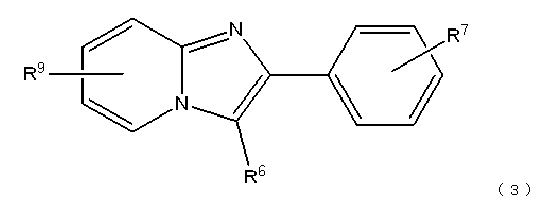
[식 중, R9는 비방사성 할로겐 치환기, 니트로기, 알킬쇄의 길이가 1∼4인 트리알킬스타닐 치환기 또는 트리페닐스타닐기로 이루어지는 군에서 선택되는 기,
R6은 시아노 치환기, 탄소수 1∼4의 알킬 치환기, 및 할로겐 치환기로 이루어지는 군에서 선택되는 기,
R7은 수산기, 할로겐 치환기, 및 하기 식(4):

로 나타내어지는 치환기로 이루어지는 군에서 선택되는 기,
여기에서, R8은 수소, 할로겐 치환기, 또는 수산기이며, n은 1∼4의 정수이다.]으로 나타내어지는 것을 특징으로 하는 화합물 및 그 염.Formula (3):
[Wherein R 9 is a group selected from the group consisting of a non-radioactive halogen substituent, a nitro group, a trialkylstannyl substituent having 1 to 4 alkyl groups or a triphenylstannyl group,
R 6 is a group selected from the group consisting of a cyano substituent, an alkyl substituent having 1 to 4 carbon atoms, and a halogen substituent,
R 7 is a hydroxyl group, a halogen substituent, and the following formula (4):
A group selected from the group consisting of substituents represented by
Wherein R 8 is hydrogen, a halogen substituent, or a hydroxyl group, n is an integer of 1 to 4; and a compound and salt thereof.

[식 중, R5는 할로겐 치환기, 탄소수 1∼4의 알킬 치환기, 알킬쇄의 탄소수가 1∼4인 알콕시 치환기, 및 수산기로 이루어지는 군에서 선택되는 기,
R10은 비방사성 할로겐 치환기, 니트로기, 알킬쇄의 길이가 1∼4인 트리알킬스타닐 치환기 또는 트리페닐스타닐기로 이루어지는 군에서 선택되는 기,
R7은 수산기, 할로겐 치환기, 및 하기 식(4):
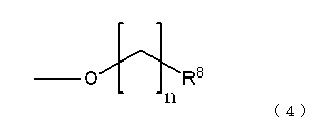
로 나타내어지는 치환기로 이루어지는 군에서 선택되는 기,
여기에서, R8은 수소, 할로겐 치환기, 또는 수산기이며, n은 1∼4의 정수이다.]로 나타내어지는 것을 특징으로 하는 화합물 및 그 염.Formula (5):
[Wherein R 5 is a group selected from the group consisting of a halogen substituent, an alkyl substituent having 1 to 4 carbon atoms, an alkoxy substituent having 1 to 4 carbon atoms in the alkyl chain, and a hydroxyl group,
R 10 is a group selected from the group consisting of a non-radioactive halogen substituent, a nitro group, a trialkylstannyl substituent having 1 to 4 alkyl chain lengths or a triphenylstannyl group,
R 7 is a hydroxyl group, a halogen substituent, and the following formula (4):
A group selected from the group consisting of substituents represented by
Wherein R 8 is hydrogen, a halogen substituent, or a hydroxyl group, n is an integer of 1 to 4; and the compound and its salt characterized by the above-mentioned.

[식 중, R5는 할로겐 치환기, 탄소수 1∼4의 알킬 치환기, 알킬쇄의 탄소수가 1∼4인 알콕시 치환기, 및 수산기로 이루어지는 군에서 선택되는 기,
R6은 시아노 치환기, 탄소수 1∼4의 알킬 치환기, 및 할로겐 치환기로 이루어지는 군에서 선택되는 기,
R11은 비방사성 할로겐 치환기, 니트로 치환기, 알킬쇄의 길이가 1∼4인 트리알킬스타닐 치환기, 및 트리페닐스타닐 치환기로 이루어지는 군에서 선택되는 기이다.]으로 나타내어지는 것을 특징으로 하는 화합물 및 그 염.Formula (6):
[Wherein R 5 is a group selected from the group consisting of a halogen substituent, an alkyl substituent having 1 to 4 carbon atoms, an alkoxy substituent having 1 to 4 carbon atoms in the alkyl chain, and a hydroxyl group,
R 6 is a group selected from the group consisting of a cyano substituent, an alkyl substituent having 1 to 4 carbon atoms, and a halogen substituent,
R 11 is a group selected from the group consisting of a non-radioactive halogen substituent, a nitro substituent, a trialkylstannyl substituent having an alkyl chain length of 1 to 4, and a triphenylstannyl substituent. And salts thereof.

[식 중, R5는 할로겐 치환기, 탄소수 1∼4의 알킬 치환기, 알킬쇄의 탄소수가 1∼4인 알콕시 치환기, 및 수산기로 이루어지는 군에서 선택되는 기,
R6은 시아노 치환기, 탄소수 1∼4의 알킬 치환기, 및 할로겐 치환기로 이루어지는 군에서 선택되는 기,
R12는 비방사성 할로겐 치환기, 메탄술폰산 치환기, 트리플루오로메탄술폰산 치환기 및 방향족 술폰산 치환기로 이루어지는 군에서 선택되는 기,
n은 1∼4의 정수이다.]로 나타내어지는 것을 특징으로 하는 화합물 및 그 염.Formula (7):
[Wherein R 5 is a group selected from the group consisting of a halogen substituent, an alkyl substituent having 1 to 4 carbon atoms, an alkoxy substituent having 1 to 4 carbon atoms in the alkyl chain, and a hydroxyl group,
R 6 is a group selected from the group consisting of a cyano substituent, an alkyl substituent having 1 to 4 carbon atoms, and a halogen substituent,
R 12 is a group selected from the group consisting of non-radioactive halogen substituents, methanesulfonic acid substituents, trifluoromethanesulfonic acid substituents and aromatic sulfonic acid substituents,
n is an integer of 1-4.] The compound and its salt characterized by the above-mentioned.

[식 중, R1은 할로겐 치환기, 탄소수 1∼4의 알킬 치환기, 알킬쇄의 탄소수가 1∼4인 알콕시 치환기, 및 수산기로 이루어지는 군에서 선택되는 기,
R2는 시아노 치환기, 탄소수 1∼4의 알킬 치환기, 및 할로겐 치환기로 이루어지는 군에서 선택되는 기,
R3은 수산기, 할로겐 치환기, 및 하기 식(2):

로 나타내어지는 치환기로 이루어지는 군에서 선택되는 기,
여기에서, R4는 수소, 할로겐 치환기, 또는 수산기이며, m은 1∼4의 정수이다. 단, R1, R2, R3, 및 R4 중 하나 이상은 방사성 할로겐이다.]로 나타내어지는 화합물을 배합해서 이루어지는 것을 특징으로 하는 생체조직에 침착된 아밀로이드의 검출 시약.Formula (1)
[Wherein, R 1 is a group selected from the group consisting of a halogen substituent, an alkyl substituent having 1 to 4 carbon atoms, an alkoxy substituent having 1 to 4 carbon atoms in the alkyl chain, and a hydroxyl group,
R 2 is a group selected from the group consisting of a cyano substituent, an alkyl substituent having 1 to 4 carbon atoms, and a halogen substituent,
R 3 is a hydroxyl group, a halogen substituent, and the following formula (2):
A group selected from the group consisting of substituents represented by
Here, R <4> is hydrogen, a halogen substituent, or a hydroxyl group, m is an integer of 1-4. Provided that at least one of R 1 , R 2 , R 3 , and R 4 is a radioactive halogen.
상기 R1, R2, R3, 및 R4 중 하나 이상은 18F, 76Br, 123I, 124I, 125I 또는 131I로 이루어지는 군에서 선택되는 방사성 할로겐인 것을 특징으로 하는 생체조직에 침착된 아밀로이드의 검출 시약.The method of claim 8,
At least one of R 1 , R 2 , R 3 , and R 4 is a radioactive halogen selected from the group consisting of 18 F, 76 Br, 123 I, 124 I, 125 I or 131 I Reagent for detection of deposited amyloid.
Applications Claiming Priority (2)
| Application Number | Priority Date | Filing Date | Title |
|---|---|---|---|
| JP2007276826 | 2007-10-24 | ||
| JPJP-P-2007-276826 | 2007-10-24 |
Publications (1)
| Publication Number | Publication Date |
|---|---|
| KR20100091965A true KR20100091965A (en) | 2010-08-19 |
Family
ID=40579598
Family Applications (1)
| Application Number | Title | Priority Date | Filing Date |
|---|---|---|---|
| KR1020107010117A Withdrawn KR20100091965A (en) | 2007-10-24 | 2008-10-24 | Novel compound having affinity for amyloid |
Country Status (9)
| Country | Link |
|---|---|
| US (1) | US20100249418A1 (en) |
| EP (1) | EP2213672A4 (en) |
| JP (1) | JPWO2009054496A1 (en) |
| KR (1) | KR20100091965A (en) |
| CN (1) | CN101903381A (en) |
| AU (1) | AU2008314870A1 (en) |
| CA (1) | CA2703649A1 (en) |
| TW (1) | TW200918102A (en) |
| WO (1) | WO2009054496A1 (en) |
Families Citing this family (12)
| Publication number | Priority date | Publication date | Assignee | Title |
|---|---|---|---|---|
| TW200803903A (en) * | 2006-04-28 | 2008-01-16 | Nihon Mediphysics Co Ltd | Novel compound having affinity to amyloid |
| US8303935B2 (en) * | 2006-05-19 | 2012-11-06 | Nihon Medi-Physics Co., Ltd. | Alkoxy substituted imidazo[1,2-a]pyridines having affinity for amyloid |
| KR20090025282A (en) * | 2006-06-21 | 2009-03-10 | 니혼 메디피직스 가부시키가이샤 | New Amyloid Affinity Compounds |
| JPWO2008056481A1 (en) * | 2006-11-09 | 2010-02-25 | 日本メジフィジックス株式会社 | Radiodiagnostic agent |
| CA2669522A1 (en) * | 2006-11-17 | 2008-05-22 | Nihon Medi-Physics Co., Ltd. | Novel compounds with affinity for amyloid |
| CA2670436A1 (en) * | 2006-11-30 | 2008-06-05 | Nihon Medi-Physics Co., Ltd. | Novel compound having affinity for amyloid |
| ES2421886T3 (en) | 2007-02-13 | 2013-09-06 | Nihon Mediphysics Co Ltd | Method for producing a radiation diagnostic imaging agent |
| JP5313158B2 (en) * | 2007-10-26 | 2013-10-09 | 日本メジフィジックス株式会社 | Novel amyloid affinity compound |
| AU2008319985A1 (en) * | 2007-10-30 | 2009-05-07 | Nihon Medi-Physics Co., Ltd. | Use of novel compound having affinity for amyloid, and process for production of the same |
| TW200922628A (en) * | 2007-10-30 | 2009-06-01 | Nihon Mediphysics Co Ltd | Use of novel compound having affinity for amyloid, and process for production of the same |
| AU2012259929B2 (en) * | 2011-05-20 | 2016-08-04 | Nihon Medi-Physics Co., Ltd. | Novel compound having affinity for amyloid |
| KR101854228B1 (en) | 2011-06-24 | 2018-05-03 | 니혼 메디피직스 가부시키가이샤 | Novel compound with amyloid affinity |
Family Cites Families (46)
| Publication number | Priority date | Publication date | Assignee | Title |
|---|---|---|---|---|
| GB1473819A (en) * | 1976-01-28 | 1977-05-18 | Gallardo Antonio Sa | Derivatives of imidazo 1,2-a pyridine |
| FR2492382A1 (en) * | 1980-10-22 | 1982-04-23 | Synthelabo | IMIDAZO (1,2-A) PYRIDINE DERIVATIVES, THEIR PREPARATION AND THERAPEUTIC USE THEREOF |
| US4791117A (en) * | 1986-09-22 | 1988-12-13 | Ortho Pharmaceutical Corporation | 2- or 3-aryl substituted imidazo[1,2-a]pyridines and their use as calcium channel blockers |
| US4833149A (en) * | 1986-09-22 | 1989-05-23 | Ortho Pharmaceutical Corporation | 2- or 3-aryl substituted imidazo[1,2-a]pyridines |
| US4727145A (en) * | 1986-09-22 | 1988-02-23 | Ortho Pharmaceutical Corporation | 2- Or 3- aryl substituted imidazo [1,2-a]pyridines |
| US4871745A (en) * | 1986-09-22 | 1989-10-03 | Ortho Pharmaceutical Corporation | 2- or 3-aryl substituted imidazo(1,2-A)pyridines and their use as antisecretory agents |
| US4880615A (en) * | 1988-11-25 | 1989-11-14 | Merck & Co., Inc. | Stabilized radiopharmaceutical compositions |
| ES2079994B1 (en) * | 1992-10-07 | 1996-08-01 | Cusi Lab | PHARMACEUTICAL FORMULATION BASED ON POLYMIXINE-TRIMETOPRIM AND AN ANTI-INFLAMMATORY AGENT FOR ITS TOPICAL OPHTHALMIC AND ETHICAL USE. |
| DE4327027A1 (en) * | 1993-02-15 | 1994-08-18 | Bayer Ag | Imidazoazine |
| JP2000510816A (en) * | 1995-10-17 | 2000-08-22 | ジー.ディー.サール アンド カンパニー | Method for detecting cyclooxygenase-2 |
| US6812327B1 (en) * | 1996-10-25 | 2004-11-02 | Human Genome Sciences, Inc. | Neutrokine-alpha polypeptides |
| HUP9603001A3 (en) * | 1996-10-30 | 1999-07-28 | Richter Gedeon Vegyeszet | Heterocycle compounds comprising nitrogen, process for producing them and pharmaceutical compositions containing the same |
| US5985892A (en) * | 1998-04-02 | 1999-11-16 | Merck & Co., Ltd. | Antagonists of gonadotropin releasing hormone |
| AU759945B2 (en) * | 1998-08-20 | 2003-05-01 | Regents Of The University Of California, The | Methods for labeling beta-amyloid plaques and neurofibrillary tangles |
| AU3514200A (en) * | 1999-03-10 | 2000-09-28 | Merck & Co., Inc. | 6-azaindole compounds as antagonists of gonadotropin releasing hormone |
| US20010051632A1 (en) * | 2000-03-31 | 2001-12-13 | Wenying Chai | Phenyl-substituted indolizines and tetrahydroindolizines |
| WO2001074813A2 (en) * | 2000-03-31 | 2001-10-11 | Ortho Mcneil Pharmaceutical, Inc. | METHOD FOR USING 2- OR 3-ARYL SUBSTITUTED IMIDAZO[1,2-a] PYRIDINES AS H3 ANTAGONISTS |
| ES2286114T3 (en) * | 2000-03-31 | 2007-12-01 | Ortho-Mcneil Pharmaceutical, Inc. | IMIDAZOPIRIDINE PHENYL-SUBSTITUTED. |
| US20020022022A1 (en) * | 2000-05-19 | 2002-02-21 | Yi Shi | Inhibition of cell proliferation and matrix synthesis by antioxidants and NAD(P)H oxidase inhibitors |
| US6514969B2 (en) * | 2000-08-16 | 2003-02-04 | Boehringer Ingelheim Pharma Kg | β-amyloid inhibitors, processes for preparing them, and their use in pharmaceutical compositions |
| EP1334091B1 (en) * | 2000-08-24 | 2012-09-19 | University of Pittsburgh - Of the Commonwealth System of Higher Education | Thioflavin derivatives and their use in diagnosis and therapy of alzheimer's disease |
| SE0100568D0 (en) * | 2001-02-20 | 2001-02-20 | Astrazeneca Ab | Compounds |
| SE0100567D0 (en) * | 2001-02-20 | 2001-02-20 | Astrazeneca Ab | Compounds |
| CA2438204A1 (en) * | 2001-02-26 | 2002-09-06 | Bristol-Myers Squibb Pharma Company | Ascorbic acid analogs for metalloradiopharmaceuticals |
| US6596731B2 (en) * | 2001-03-27 | 2003-07-22 | Hoffmann-La Roche Inc. | Substituted imidazo[1,2-A] pyridine derivatives |
| KR20040058111A (en) * | 2001-04-23 | 2004-07-03 | 더 트러스티스 오브 더 유니버시티 오브 펜실바니아 | Amyloid plaque aggregation inhibitors and diagnostic imaging agents |
| WO2003000689A1 (en) * | 2001-06-21 | 2003-01-03 | Smithkline Beecham Corporation | Imidazo`1,2-a!pyridine derivatives for the prophylaxis and treatment of herpes viral infections |
| DK1432453T3 (en) | 2001-08-27 | 2013-11-18 | Univ Pennsylvania | STYLE BENDER DERIVATIVES AND ITS USE FOR BINDING AND IMAGING AMYLOID PLAQUES |
| US7060270B2 (en) * | 2001-11-02 | 2006-06-13 | Diagenics International Corporation | Methods and compositions of monoclonal antibodies specific for beta-amyloid proteins |
| GB0205281D0 (en) * | 2002-03-06 | 2002-04-17 | Novartis Ag | Organic compounds |
| EP1356827A1 (en) * | 2002-04-24 | 2003-10-29 | Mallinckrodt Inc. | Method for obtaining a 2-18F-fluor-2-deoxy-D-glucose (18F-FDG)-solution |
| WO2003106439A1 (en) | 2002-06-12 | 2003-12-24 | 株式会社ビーエフ研究所 | Probe compound for image diagnosis of disease with amyloid accumulation, compound for staining age spots/diffuse age spots, and remedy for disease with amyloid accumulation |
| CA2496633A1 (en) * | 2002-08-30 | 2004-04-29 | Bf Research Institute, Inc. | Diagnostic probes and remedies for diseases with accumulation of prion protein, and stains for prion protein |
| GB0229695D0 (en) * | 2002-12-20 | 2003-01-29 | Amersham Plc | Solid-phase preparation of 18F-labelled amino acids |
| JP4758909B2 (en) * | 2003-12-31 | 2011-08-31 | シェーリング−プラウ・リミテッド | Control of parasites in animals by using imidazo [1,2-b] pyridazine derivatives |
| CA2617319A1 (en) | 2005-06-24 | 2007-01-04 | The Trustees Of The University Of Pennsylvania | Radiolabeled-pegylation of ligands for use as imaging agents |
| WO2007033080A2 (en) * | 2005-09-12 | 2007-03-22 | Emory University | Alzheimer's disease imaging agents |
| JP4738419B2 (en) * | 2005-11-30 | 2011-08-03 | 富士フイルムRiファーマ株式会社 | Diagnostic and therapeutic agents for diseases caused by amyloid aggregation and / or deposition |
| TW200803903A (en) * | 2006-04-28 | 2008-01-16 | Nihon Mediphysics Co Ltd | Novel compound having affinity to amyloid |
| US8303935B2 (en) * | 2006-05-19 | 2012-11-06 | Nihon Medi-Physics Co., Ltd. | Alkoxy substituted imidazo[1,2-a]pyridines having affinity for amyloid |
| KR20090025282A (en) * | 2006-06-21 | 2009-03-10 | 니혼 메디피직스 가부시키가이샤 | New Amyloid Affinity Compounds |
| CA2670436A1 (en) * | 2006-11-30 | 2008-06-05 | Nihon Medi-Physics Co., Ltd. | Novel compound having affinity for amyloid |
| JP5313158B2 (en) * | 2007-10-26 | 2013-10-09 | 日本メジフィジックス株式会社 | Novel amyloid affinity compound |
| CN101909659A (en) * | 2007-10-30 | 2010-12-08 | 日本医事物理股份有限公司 | Application and preparation method of novel compound with affinity to amyloid |
| AU2008319985A1 (en) * | 2007-10-30 | 2009-05-07 | Nihon Medi-Physics Co., Ltd. | Use of novel compound having affinity for amyloid, and process for production of the same |
| CA2724842A1 (en) * | 2008-05-19 | 2009-11-26 | Sunovion Pharmaceuticals Inc. | Imidazo[1,2-a]pyridine compounds |
-
2008
- 2008-10-24 CN CN2008801215624A patent/CN101903381A/en active Pending
- 2008-10-24 WO PCT/JP2008/069335 patent/WO2009054496A1/en not_active Ceased
- 2008-10-24 AU AU2008314870A patent/AU2008314870A1/en not_active Abandoned
- 2008-10-24 CA CA2703649A patent/CA2703649A1/en not_active Abandoned
- 2008-10-24 KR KR1020107010117A patent/KR20100091965A/en not_active Withdrawn
- 2008-10-24 US US12/739,348 patent/US20100249418A1/en not_active Abandoned
- 2008-10-24 EP EP08842644A patent/EP2213672A4/en not_active Withdrawn
- 2008-10-24 TW TW097140793A patent/TW200918102A/en unknown
- 2008-10-24 JP JP2009538277A patent/JPWO2009054496A1/en active Pending
Also Published As
| Publication number | Publication date |
|---|---|
| EP2213672A4 (en) | 2012-05-02 |
| AU2008314870A1 (en) | 2009-04-30 |
| EP2213672A1 (en) | 2010-08-04 |
| WO2009054496A1 (en) | 2009-04-30 |
| TW200918102A (en) | 2009-05-01 |
| US20100249418A1 (en) | 2010-09-30 |
| CN101903381A (en) | 2010-12-01 |
| JPWO2009054496A1 (en) | 2011-03-10 |
| CA2703649A1 (en) | 2009-04-30 |
Similar Documents
| Publication | Publication Date | Title |
|---|---|---|
| KR20100091965A (en) | Novel compound having affinity for amyloid | |
| ES2376491T3 (en) | COMPOUND THAT HAS AFFINITY FOR AMILOID. | |
| JP5313158B2 (en) | Novel amyloid affinity compound | |
| JP5180838B2 (en) | Novel amyloid affinity compound | |
| KR20140040722A (en) | Novel compound having affinity for amyloid | |
| KR20100101577A (en) | Utilization of novel compounds with amyloid affinity and method of producing the same | |
| JP5048655B2 (en) | Novel amyloid affinity compound | |
| WO2007148755A1 (en) | Novel compound having affinity for amyloid | |
| KR101854228B1 (en) | Novel compound with amyloid affinity | |
| KR20100089858A (en) | Use of novel compound having affinity for amyloid, and process for production of the same | |
| KR20090091287A (en) | New Amyloid Affinity Compounds | |
| EP2216052A1 (en) | Use of novel compound having affinity for amyloid, and process for production of the same | |
| KR20100094478A (en) | Use of novel compound having affinity for amyloid, and process for production of the same | |
| CN101466711A (en) | Novel compound having affinity for amyloid | |
| JP5247442B2 (en) | Novel amyloid affinity compound | |
| HK1149009A (en) | Novel compound having affinity for amyloid | |
| JP2009120591A (en) | Novel amyloid affinity compound | |
| HK1149006A (en) | Novel compound having affinity for amyloid | |
| HK1148951A (en) | Use of novel compound having affinity for amyloid, and process for production of the same | |
| JP2009120590A (en) | Novel amyloid affinity compound | |
| HK1148949A (en) | Use of novel compound having affinity for amyloid, and process for production of the same | |
| HK1148950A (en) | Use of novel compound having affinity for amyloid, and process for production of the same | |
| HK1134482A (en) | Novel compounds with affinity for amyloid | |
| HK1148952A (en) | Utilization of novel compounds with amyloid affinity and mehtod of producing the same |
Legal Events
| Date | Code | Title | Description |
|---|---|---|---|
| PA0105 | International application |
Patent event date: 20100507 Patent event code: PA01051R01D Comment text: International Patent Application |
|
| PG1501 | Laying open of application | ||
| PC1203 | Withdrawal of no request for examination | ||
| WITN | Application deemed withdrawn, e.g. because no request for examination was filed or no examination fee was paid |