WO2007148755A1 - Novel compound having affinity for amyloid - Google Patents
Novel compound having affinity for amyloid Download PDFInfo
- Publication number
- WO2007148755A1 WO2007148755A1 PCT/JP2007/062503 JP2007062503W WO2007148755A1 WO 2007148755 A1 WO2007148755 A1 WO 2007148755A1 JP 2007062503 W JP2007062503 W JP 2007062503W WO 2007148755 A1 WO2007148755 A1 WO 2007148755A1
- Authority
- WO
- WIPO (PCT)
- Prior art keywords
- group
- compound
- pyridine
- salt
- amyloid
- Prior art date
- Legal status (The legal status is an assumption and is not a legal conclusion. Google has not performed a legal analysis and makes no representation as to the accuracy of the status listed.)
- Ceased
Links
Classifications
-
- C—CHEMISTRY; METALLURGY
- C07—ORGANIC CHEMISTRY
- C07D—HETEROCYCLIC COMPOUNDS
- C07D471/00—Heterocyclic compounds containing nitrogen atoms as the only ring hetero atoms in the condensed system, at least one ring being a six-membered ring with one nitrogen atom, not provided for by groups C07D451/00 - C07D463/00
- C07D471/02—Heterocyclic compounds containing nitrogen atoms as the only ring hetero atoms in the condensed system, at least one ring being a six-membered ring with one nitrogen atom, not provided for by groups C07D451/00 - C07D463/00 in which the condensed system contains two hetero rings
- C07D471/04—Ortho-condensed systems
-
- A—HUMAN NECESSITIES
- A61—MEDICAL OR VETERINARY SCIENCE; HYGIENE
- A61K—PREPARATIONS FOR MEDICAL, DENTAL OR TOILETRY PURPOSES
- A61K51/00—Preparations containing radioactive substances for use in therapy or testing in vivo
- A61K51/02—Preparations containing radioactive substances for use in therapy or testing in vivo characterised by the carrier, i.e. characterised by the agent or material covalently linked or complexing the radioactive nucleus
- A61K51/04—Organic compounds
- A61K51/041—Heterocyclic compounds
- A61K51/044—Heterocyclic compounds having nitrogen as a ring hetero atom, e.g. guanethidine, rifamycins
- A61K51/0455—Heterocyclic compounds having nitrogen as a ring hetero atom, e.g. guanethidine, rifamycins having six-membered rings with one nitrogen as the only ring hetero atom
-
- C—CHEMISTRY; METALLURGY
- C07—ORGANIC CHEMISTRY
- C07D—HETEROCYCLIC COMPOUNDS
- C07D487/00—Heterocyclic compounds containing nitrogen atoms as the only ring hetero atoms in the condensed system, not provided for by groups C07D451/00 - C07D477/00
- C07D487/02—Heterocyclic compounds containing nitrogen atoms as the only ring hetero atoms in the condensed system, not provided for by groups C07D451/00 - C07D477/00 in which the condensed system contains two hetero rings
- C07D487/04—Ortho-condensed systems
Definitions
- the present invention relates to a compound used for diagnosis of head degenerative diseases. More specifically, the present invention relates to a compound useful for detection of amyloid at a lesion site in the diagnosis of diseases in which amyloid accumulates such as Alzheimer's disease.
- amyloidosis Diseases that develop when fibrous proteins called amyloid are deposited in various organs or tissues in the body are collectively called amyloidosis.
- a common feature of amyloidosis is that fibrillar protein called amyloid rich in ⁇ -sheet structure is deposited in various organs or regions throughout the body, causing functional abnormalities in the organs and tissues.
- AD and RE Alzheimer's disease
- AD and RE which is a typical disease of amyloidosis
- AD and RE is known as a disease causing dementia. Since this disease is a disease in which amyloid gradually deposits in the brain and causes death, it can be said that this disease has a higher social interest than other amyloidosis.
- AD and RE Alzheimer's disease
- AD is characterized by three intracerebral pathological findings: appearance of senile plaques, neurofibrillary tangles and extensive neuronal loss.
- Senile plaques are structures with amyloid as the main component, and their appearance is considered to be the first stage of AD development, that is, a pathological finding in the brain that appears more than 10 years before the appearance of clinical symptoms.
- Diagnosis of AD is performed by performing various cognitive function evaluations (for example, Hasegawa scale, ADAS_JCog, MMSE, etc.) after supplementarily combining image diagnosis such as CT and MRI. Yes.
- various cognitive function evaluations for example, Hasegawa scale, ADAS_JCog, MMSE, etc.
- image diagnosis such as CT and MRI.
- amyloid composing senile plaques is an aggregate of amyloid protein (hereinafter referred to as A), and further, the aggregate of A has a ⁇ sheet structure, thereby causing neurocytotoxicity. Many studies have reported this. Based on these findings, the so-called “amyloid cascade hypothesis” has been proposed, in which the deposition of ⁇ / 3 in the brain triggers the formation of neurofibrillary tangles and neuronal loss as downstream phenomena ( Non-patent literature 2).
- Non-patent Document 10 There have been reports of compounds labeled with 11 C and radioactive halogens such as [1,2, _a] pyridine (hereinafter referred to as IMPY) and imidazopyridine derivatives (Patent Document 3, Non-Patent Document 9).
- IMPY radioactive halogens
- Patent Document 9 imidazopyridine derivatives
- some of these diagnostic imaging probes have undergone human imaging studies and may show radioactive accumulation in the brain that is clearly different from normal cases in AD patients. It has been reported (Non-patent document 10, Non-patent document 11).
- Patent Document 1 Japanese Translation of Special Publication 2004—506723
- Patent Document 2 JP 2005-504055 gazette
- Patent Document 3 Special Table 2005-512945
- Patent Document 4 Japanese Translation of Special Publication 2002-523383
- Non-Patent Document 1 J. A. Hardy & G. A. Higgins, Alzheimer's Disease: The Amyloid Cascade Hypohesis., Science, 1992, 256, p.184-185
- Non-Patent Document 2 G. McKhann et al "" Clinical diagnosis of Alzheimer's disease: Report of the NINCDS-ADRDA Work Group under the auspices of Department of Health and Human Services Task Force on Alzheimer's Disease., Neurology, 1984, 34, p.9 39-944
- Non-Patent Document 3 Z.-P. Zhuang et al "" Radioiodinated Styrylbenzenes and Thioflavins a s Probes for Amyloid Aggregates. ", J. Med. Chem., 2001, 44, p.1905-1914
- Non-Special Reference 5 H. F. Kung et al, "Novel Stilbenes as Probes for amyloid plaques., J. American Chemical Society, 2001, 123, p.12740-12741
- Non-Patent Document 6 Zhi_Ping Zhuang et al., "IBOX (2- (4'-dimethylaminophenyl) -6- iodob ensoxazole): a ligand for imaging amyloid plaques in the brain., Nuclear Medicine a nd Biology, 2001, 28, p.887- 894
- Non-Patent Document 7 Furumoto Y et al "" [11C] BF- 227: A New 11C- Labeled 2-Ethenylbe nzoxazole Derivative for Amyloid- ⁇ Plaques Imaging., European Journal of Nuclear Medicine and Molecular Imaging, 2005, 32, Sup. L, P759
- Patent Document 8 Eric D. Agdeppa et al, "2-Dialkylamino-6-Acylmalononitrile Substitu ted Naphthalenes (DDNP Analogs): Novel Diagnostic and Therapeutic Tools in Alzh eimer's Disease.”, Molecular Imaging and Biology, 2003, 5 , P.404-417
- Patent Document 9 Zhi— Ping Zhuang et al., “Structure— Activity Relationship of Imidazo [l , 2-a] pyridines as Ligands for Detecting ⁇ -Amyloid Plaques in the Brain. ", J. Med. Chem, 2003, 46, p.237-243
- Non-Patent Document 10 W. E. Klunk et al., "Imaging brain amyloid in Alzheumer's disease w ith Pittsburgh Compound-B.”, Ann. Neurol., 2004, 55, p.306-319
- Patent Document 11 Nicolaas P. L. G. VerhoefF et al "" In- Vivo Imaging of Alzheimer Dis ease ⁇ -Amyloid With [11C] SB-13 PET., American Journal of Geriatric Psychiatry, 2004, 12, p.584-595
- the compound labeled with SB-13 with ["C] may have a clearance from normal tissues in experiments using rats. The force shown The clearance speed is not fast enough (Masahiro Ono et al., Nuclear Medicine and Biology, 2003, 30, ⁇ ⁇ 565_571).
- IMPY and other compounds having an imidazopyridine skeleton have the following properties when they migrate into the brain after administration and accumulate in amyloid. Unlike the compounds described above, clearance from normal tissues to have excellent properties such as fast, there is a clear result of the experiments with [12 3 ⁇ 4 Hyoshikyi ⁇ compound. However, IMPY is a compound that shows a positive result in a reverse mutation test, and in order to use this compound as an imaging diagnostic probe, it is necessary to pay sufficient attention to its dosage and dosage form. (International Publication No. 03/106439 Issue pamphlet)
- the present invention has been made in view of the above circumstances, and has a compound having affinity for amyloid, sufficiently high clearance from normal tissue, and reduced toxicity such as mutagenicity. Aimed to obtain.
- the inventor has found that a compound group satisfying the above conditions can be obtained by using a compound having an imidazopyridine phenyl skeleton, in which oxygen is bonded to carbon of the phenyl group. Was completed.
- R 1 is hydrogen, a hydroxyl group, a carboxyl group, a sulfate group, an amino group, a nitro group, a cyano group, an alkyl substituent having 1 to 4 carbon atoms, or an alkoxy substituent having 1 to 4 carbon atoms. More arbitrary groups can be selected. R 1 is more preferably a hydroxyl group, a methyl substituent, or a methoxy substituent, preferably a hydroxyl group, an alkyl substituent having 1 to 4 carbon atoms, or an alkoxy substituent having 1 to 4 carbon atoms. Masle.
- R 2 can be any radioactive halogen substituent, 18 F, 76 Br, 123 I, 124 I, 125 I or 131 preferably be used a halogen selected from I instrument 18 F, 76 Select from Br, 123 1 or 125 1 It is more preferred to use a halogen, which is particularly preferred.
- M is an integer of 0-2.
- amyloid deposits comprising the compound represented by the formula (1) or a salt thereof and a pharmaceutically acceptable carrier or excipient.
- a pharmaceutical composition for in vivo imaging is provided.
- a compound represented by the formula (1) or a salt thereof for use in in vivo imaging of amyloid deposition there is provided a compound represented by the formula (1) or a salt thereof for use in in vivo imaging of amyloid deposition.
- the step (b) is performed by PET or SPECT imaging.
- R 3 is hydrogen, a hydroxyl group, a carboxyl group, a sulfate group, an amino group, a nitro group, a cyano group, an alkyl substituent having 1 to 4 carbon atoms, or an alkoxy substituent having 1 to 4 carbon atoms. More arbitrary groups can be selected. R 3 is more preferably a hydroxyl group, a methyl substituent, or a methoxy substituent, preferably a hydroxyl group, an alkyl substituent having 1 to 4 carbon atoms, or an alkoxy substituent having 1 to 4 carbon atoms. Masle.
- R 4 may be a group selected from a non-radioactive halogen substituent, a methanesulfonic acid substituent, a trifluoromethanesulfonic acid substituent, or an aromatic sulfonic acid substituent.
- a non-radioactive halogen substituent a halogen that can be a target in a nucleophilic substitution reaction using radioactive fluorine can be used, and preferably iodine or bromine can be used.
- M is an integer of 0-2.
- reaction conditions at this time can be carried out according to a conventional method, for example, a method described in literature (King, L. Carroll and Ostrum, G. Kenneth, Journal of Organic Chemistry, 1964, 29 (12), p. 3459_3461).
- the amount of the solvent used is sufficient if it is sufficient for the reaction. However, if it is too much, it is impossible to obtain a precipitate of the reaction product, so care must be taken.
- a solvent of about 40 to 50 mL may be used.
- the reaction solution is filtered and the precipitate is filtered off.
- the white precipitate is suspended in a methanol / water mixture (1: 1), and then a saturated sodium bicarbonate aqueous solution is suspended in this precipitate. If it is added so that it becomes a large square IJ, 2_ (4,1hydroxyphenyl) 1-6-methoxyimidazo [1,2,2-a] pyridine is liberated and precipitation occurs.
- 2- (4, -hydroxyphenyl) -6-methoxyimidazo [1,2-a] pyridine which is the target product of this step, can be obtained as crystals. it can.
- the amount of the water / methanol mixed solution is not particularly limited as long as it is sufficient for the reaction. However, if it is too much, caution is required because it will hinder the precipitation of crystals. For example, if 2-bromo-4'-hydroxyacetophenone equivalent to lOmmol is used, a water / methanol mixture of about 40 to: OOmL may be used.
- the amount of sodium bicarbonate is not particularly limited if it is a large excess with respect to the precipitate as a reaction substrate. For example, in the case of reacting under the above conditions, about 25 mL of saturated sodium bicarbonate Add an aqueous solution to the reaction solution.
- 1, step 7 1,3_propanedionomonomononaphthenosenosulfonate f as an auxiliary material.
- f row literature Abderrahim Bouzide and Gilles Sauv e, Organic Letters, 2002, 4 (14), ⁇ ⁇ 2329_2332 ⁇
- Fig. 1, step 6 it may be used in a molar ratio of about 2-fold with respect to 2- (4'-hydroxyphenyl) -6-methoxyimidazo [1, 2_a] pyridine, which is a reaction substrate.
- triphenylphosphine and diisopropylazodicarboxylate are the same as those of 1,3_propanediol monoparatoluene sulfonate, which is typically an auxiliary material, according to general Mitsunobu reaction conditions. About a mole may be used.
- the compound in which the 6-position is a hydroxy substituent is obtained by adding boron tribromide or the like to 2_ (4'-hydroxyphenyl) _6-methoxyimidazo [1,2_a] pyridine obtained in Step 5 above. After the demethylation reaction is performed, the 6-position hydroxyl group is protected with a tetrahydropyranyl group, etc., and then the reaction in Step 7 is performed, and finally the 6-position protection group is deprotected. That power S.
- the H 180 concentrated water containing [ 18 F] fluoride ions is passed through an anion exchange column.
- Liquid is adsorbed and collected on the column, and separated from H 180 concentrated water. Then the
- a mixture containing a phase transfer catalyst, [ 18 F] fluoride ions and potassium ions is obtained by flowing potassium carbonate solution through the column to elute the [ 18 F] fluoride ions and adding a phase transfer catalyst to dryness. Can be obtained.
- phase transfer catalyst various compounds having a property of forming an inclusion with [ 18 F] fluoride ion can be used. Specifically, various compounds used in the production of radioactive fluorine-labeled organic compounds can be used, and 18-crown-6-ether and other various aminopolyethers can be used. . As the most preferable mode, Talibufix 222 (trade name, manufactured by Merck & Co., Inc.) can be used.
- the reaction conditions can be set according to the conditions in other radiofluorinated compounds such as 2- [ 18 F] fluoro-2-deoxy-D-glucose.
- the reaction solution can be used under the condition of 90 to 130 ° C for 5 to 10 minutes.
- radiohalogen-labeled compounds can be performed by appropriately selecting a labeling precursor and a radiohalogen to be used, and giving reaction conditions according to known methods.
- a labeling precursor and a radiohalogen for example, the synthesis of 2— [4, — (3 ,, — [ 12 3 ⁇ 4 odopropoxy) phenyl] — 6-methoxymidazo [1, 2—a] pyridine can be synthesized using 2- [4 ′ 3 "- black port propoxy) Hue sulfonyl] - 6-methoxy-imidazo [1, 2 _a] Yore ,, acetone or methanol in a solvent of pyridine, be obtained by metathesis reaction with Na [123 I] it can.
- the diagnostic agent according to the present invention is water or physiological saline or Ringer's solution in which the radiohalogen-labeled compound according to the present invention is adjusted to an appropriate pH as required. It can be prepared as a liquid blended with the above. In this case, the concentration of the present compound needs to be lower than the concentration at which the stability of the blended present compound is obtained. The dose of the compound should be sufficient to image the distribution of the administered drug There is no particular limitation as long as the concentration is high.
- NMR apparatus used JNM— ECP— 500 (manufactured by JEOL Ltd.)
- reaction solution was concentrated, and 57 mL of chloroform and 57 mL of methanol were added thereto for repulping, followed by filtration to separate the precipitate and the filtrate.
- the precipitate was washed with 114 mL of a black form-methanol mixture (1: 1), and the filtrates were combined and concentrated under reduced pressure.
- NMR apparatus used JNM—GSX—270 (manufactured by JEOL Ltd.)
- NMR measurement results (internal standard substance: tetramethylsilane) were as follows.
- NMR apparatus used JNM— ECP— 500 (manufactured by JEOL Ltd.)
- NMR apparatus used JNM— ECP— 500 (manufactured by JEOL Ltd.)
- NMR apparatus used JNM— ECP— 500 (manufactured by JEOL Ltd.)
- NMR apparatus used JNM- ECP-500 (manufactured by JEOL Ltd.)
- Detector Bioimaging analyzer, BAS-2500 (Type: BAS-2500, manufactured by Fuji Photo Film Co., Ltd.)
- NMR apparatus used JNM- ECP-500 (manufactured by JEOL Ltd.)
- TLC plate Silica Gel 60 F (product name, manufactured by Merck)
- amyloid affinity of the compound of the present invention was evaluated by the following in vitro binding test.
- amyloid suspension After dissolution, the mixture was shaken at 37 ° C. for 62 to 72 hours to obtain a lmg / mL aggregated AiS suspension (hereinafter referred to as amyloid suspension in this example).
- Table 3 shows the IC value of each evaluation compound.
- Compounds 1-3 are all less than 100 IC
- Amyloid aggregated A higher than Congo Red and Thioflavin ⁇ ⁇
- logP The partition coefficient by HPLC
- each evaluation compound shown in Table 5 was dissolved in methanol containing 10% dimethyl sulfoxide so as to have a concentration of 1 mg / mL to prepare a sample solution.
- the sample solution 1 was subjected to HPLC analysis under the following conditions.
- the solvent elution time (t) and the compound elution time (t) were subjected to HPLC analysis under the following conditions.
- the retention factor (hereinafter referred to as “retention factor”) of each evaluation compound is calculated from the formula (3).
- the y intercept was estimated. Using this value, the logP value and logP value are between pH 7.2 and 7.
- the logP value for the compound was determined.
- Each 0.05 mL of the solution dissolved in the solution was administered to the rats through the tail vein under thiopental anesthesia.
- blood was collected from the abdominal aorta and the brain was collected, and the radioactivity in the brain was measured using the Autoll 'gamma system (form: ARC_ 301B, manufactured by Aloka).
- the brain mass was further measured.
- the amount of radioactivity was measured in the same manner for 0.05 mL of a 1000-fold diluted solution (hereinafter referred to as “B” in this example).
- the radioactivity distribution rate (% 107 ⁇ ) per unit weight to the brain at each dissection time point was calculated from the following formula (5). The experiment was performed using three animals at each time point.
- amyloid suspension a lmg / mL aggregated Aj3 suspension (hereinafter referred to as amyloid suspension in this example) was obtained.
- Fig. 9 shows images of autoradiogram and thioflavin T staining in brain sections of rats injected with amyloid in the brain.
- the amygdaloid nucleus on the side injected with the amyloid suspension had a clear radioactivity accumulation and a good image with little non-specific accumulation at other sites.
- the results of thioflavin T staining at the radioactive accumulation site confirmed that amyloid was present at the site where accumulation was observed.
- no significant radioactivity accumulation was confirmed in the amygdaloid nucleus on the side injected with phosphate buffered saline as compared with other sites.
- Compound 4 has the ability to accumulate in brain amyloid and has the ability to visualize brain amyloid.
- Each sample was added to the test plate at a maximum dose of 1250 xg / plate for Compound 1, 7 doses (common ratio 4), and 5000 z gZ plates for Compound 2 and Compound 3. The highest dose was 7 doses (public ratio 3).
- the test substance and the test strain (TA98 or TA100), or the test substance, S9mix and the test strain were mixed, and then layered on the medium on the test plate using soft agar and cultured at 37 ° C for 48 hours. Judgment was made by counting the number of revertant colonies in the plate after culturing, and when the number of revertant colonies showed a value more than twice that of the negative control and further increased depending on the concentration. Positive.
- Example 1 Compound 1 Negative Negative Negative Negative Negative Example 1 3 Compound 2 Negative Negative Negative Example 1 4 Compound 3 Negative Negative Negative Negative Industrial applicability
- the compounds according to the present invention can be used in the field of diagnostic agents.
- FIG. 1 Synthesis scheme of 6-methoxy-2- [4 '-(3 "-paratoluenesulfonyloxypropoxy) phenino] imidazo [1,2-a] pyridine.
- FIG. 2 Synthesis scheme of 2- [4 '-(3 "fluoropropoxy) phenyl] 6-methoxyimidazo [1,2-a] pyridine (non-radioactive fluorinated product).
- FIG. 8 Synthesis scheme of [ 12 3 ⁇ 4_2_ (4'-hydroxyphenyl) _6_ odoimidazo [1, 2_a] pyridine.
- FIG. 9 (a) Autoradiogram in brain section 30 minutes after administration of Compound 4 and (b) Fluorescent micrograph of thioflavine T-stained sample (enlarged display of amyloid suspension administration site.)
Landscapes
- Chemical & Material Sciences (AREA)
- Organic Chemistry (AREA)
- Health & Medical Sciences (AREA)
- Life Sciences & Earth Sciences (AREA)
- Epidemiology (AREA)
- Medicinal Chemistry (AREA)
- Optics & Photonics (AREA)
- Pharmacology & Pharmacy (AREA)
- Physics & Mathematics (AREA)
- Animal Behavior & Ethology (AREA)
- General Health & Medical Sciences (AREA)
- Public Health (AREA)
- Veterinary Medicine (AREA)
- Proteomics, Peptides & Aminoacids (AREA)
- Medicines Containing Antibodies Or Antigens For Use As Internal Diagnostic Agents (AREA)
- Nitrogen Condensed Heterocyclic Rings (AREA)
Abstract
Description
明 細 書 Specification
新規アミロイド親和性化合物 Novel amyloid affinity compound
技術分野 Technical field
[0001] 本発明は頭部変性疾患の診断に用いる化合物に関する。より詳しくは、アルッハイマ 一病を初めとするアミロイドが蓄積する疾患の診断において、病巣部位におけるアミ ロイドの検出に有用な化合物に関する。 [0001] The present invention relates to a compound used for diagnosis of head degenerative diseases. More specifically, the present invention relates to a compound useful for detection of amyloid at a lesion site in the diagnosis of diseases in which amyloid accumulates such as Alzheimer's disease.
背景技術 Background
[0002] アミロイドと呼ばれる繊維状蛋白質が体内の種々の器官あるいは組織に沈着すること により発症する疾患は、アミロイド一シスと総称されている。アミロイド一シスに共通し ているのはアミロイドと呼ばれる βシート構造に富んだ繊維状蛋白質が全身の諸臓 器あるいは局所に沈着し、その臓器や組織における機能異常を生じる点である。 [0002] Diseases that develop when fibrous proteins called amyloid are deposited in various organs or tissues in the body are collectively called amyloidosis. A common feature of amyloidosis is that fibrillar protein called amyloid rich in β-sheet structure is deposited in various organs or regions throughout the body, causing functional abnormalities in the organs and tissues.
[0003] アミロイド一シスの代表的疾患であるアルツハイマー病(以下、 ADとレ、う)は、認知症 の原因となる疾患として知られている。この病気は、漸次進行性にアミロイドが脳に沈 着して死に至る疾患であるため、他のアミロイド一シスと比較しても社会的関心の高 い疾患であるといえる。近年、先進各国では社会の高齢化に伴レ、 AD患者数が急激 に増加しており、社会的な問題となっている。 [0003] Alzheimer's disease (hereinafter referred to as AD and RE), which is a typical disease of amyloidosis, is known as a disease causing dementia. Since this disease is a disease in which amyloid gradually deposits in the brain and causes death, it can be said that this disease has a higher social interest than other amyloidosis. In recent years, with the aging of society in advanced countries, the number of AD patients has increased rapidly, which has become a social problem.
[0004] 病理組織学的見地によると、 ADは、老人斑(senile plaques)の出現、神経原繊維変 ィ匕(neurofibrillary tangles)及び広範な神経脱落の 3つの脳内病理所見によって特徴 付けられる。老人斑はアミロイドを主要構成成分とする構造物であり、その出現は、 A D発症における最初期、すなわち臨床症状が出現する 10年以上前に出現する脳内 の病理所見とされる。 [0004] According to histopathological aspects, AD is characterized by three intracerebral pathological findings: appearance of senile plaques, neurofibrillary tangles and extensive neuronal loss. Senile plaques are structures with amyloid as the main component, and their appearance is considered to be the first stage of AD development, that is, a pathological finding in the brain that appears more than 10 years before the appearance of clinical symptoms.
[0005] ADの診断は、 CT及び MRI等の画像診断を補助的に組み合わせた上で、種々の認 知機能評価 (例えば、長谷川式スケール、 ADAS_JCog、 MMSE等)を行うことにより実 施されている。しかし、このような認知機能評価に基づく方法は、発症初期における 診断感度が低ぐさらに、各個人が生来有する認識機能により診断結果が影響を受 けやすいという欠点がある。また、確定診断には疾患部の生検が不可欠であるため、 患者の存命中に ADの確定診断を行うことは、現状では事実上不可能である(非特 許文献 1)。 [0005] Diagnosis of AD is performed by performing various cognitive function evaluations (for example, Hasegawa scale, ADAS_JCog, MMSE, etc.) after supplementarily combining image diagnosis such as CT and MRI. Yes. However, such a method based on the evaluation of cognitive function has a drawback that the diagnostic sensitivity is low in the early stage of the onset, and the diagnosis result is easily influenced by the cognitive function inherent in each individual. In addition, because a biopsy of the diseased part is indispensable for a definitive diagnosis, it is virtually impossible to make a definitive diagnosis of AD during the life of the patient (non-specialty). Permissible literature 1).
[0006] 一方、老人斑を構成するアミロイドはアミロイド 蛋白質(以下、 A という)の凝集体 であることが報告されており、さらに A の凝集体が βシート構造をとることで神経細 胞毒性を示すことが多くの研究より報告されている。これらの知見に基づき、 Α /3の脳 内への沈着が引き金となり、その下流の現象として神経原繊維変化の形成及び神経 脱落が起こるとする、いわゆる「アミロイドカスケード仮説」が提唱されている(非特許 文献 2)。 [0006] On the other hand, it has been reported that the amyloid composing senile plaques is an aggregate of amyloid protein (hereinafter referred to as A), and further, the aggregate of A has a β sheet structure, thereby causing neurocytotoxicity. Many studies have reported this. Based on these findings, the so-called “amyloid cascade hypothesis” has been proposed, in which the deposition of Α / 3 in the brain triggers the formation of neurofibrillary tangles and neuronal loss as downstream phenomena ( Non-patent literature 2).
[0007] このような事実に基づき、近年、アミロイドに高い親和性を有する化合物をマーカーと して用い、 ADをインビボ(in vivo)で検出する試みがなされている。 [0007] Based on these facts, attempts have recently been made to detect AD in vivo using a compound having a high affinity for amyloid as a marker.
このような脳内アミロイド画像診断用プローブの多くは、アミロイドに対する親和性が 高ぐかつ脳移行性の高い疎水性の低分子化合物を、種々の放射性核種、例えば11 C、 18F及び1231等で標識した化合物である。具体例として、 6—ョード—2— [4' - (N , N ジメチルァミノ)フエニル]ベンゾチアゾール(以下、 TZDMという)や 6—ヒドロキ シ一 2 [4,一(N メチノレアミノ)フエニル]ベンゾチアゾール(以下、 6— OH— BTA 1という)を始めとする種々のチオフラビン誘導体 (特許文献 1、非特許文献 3)、 (E )—4—メチルアミノー 4,一ヒドロキシスチルベン(以下、 SB— 13という)や(E)— 4 ジメチルアミノー 4,ーョードスチルベン(以下、 m—I— SBという)を初めとするスチル ベン化合物 (特許文献 2、非特許文献 4,非特許文献 5)、 6 ョードー 2— [4 '一(N , N ジメチルァミノ)フエニル]ベンゾォキサゾール(以下、 IBOXという)、 6 - [2- ( フルォロ)ェトキシ]ー2—[2—(2—ジメチルァミノチアゾール 5 ィル)ェテニル] ベンゾォキサゾールを初めとするベンゾォキサゾール誘導体(非特許文献 6,非特許 文献 7)、 2_ (1 _ { 6 _ [ (2 _フルォロェチル)(メチル)ァミノ] _ 2_ナフチル }ェチリ デン)マロノ二トリル(以下、 FDDNPとレ、う)を初めとする DDNP誘導体(特許文献 4、 非特許文献 8)及び 6 _ョード _ 2_ [4' - (N, N—ジメチルァミノ)フヱニル]イミダゾ Many of these cerebral amyloid imaging probes have hydrophobic low molecular weight compounds with high affinity for amyloid and high brain migration, and various radionuclides such as 11 C, 18 F and 123 1, etc. The compound labeled with Specific examples include 6-yodo-2- [4 '-(N, N dimethylamino) phenyl] benzothiazole (hereafter referred to as TZDM) and 6-hydroxy-1 [4,1 (N methinoreamino) phenyl] benzothiazole ( Hereinafter, various thioflavine derivatives (referred to as 6-OH-BTA 1) (Patent Document 1, Non-patent Document 3), (E) -4-methylamino-4, monohydroxystilbene (hereinafter referred to as SB-13) and (E) -4 stilbene compounds such as dimethylamino-4, -odostilbene (hereinafter referred to as m-I-SB) (Patent Document 2, Non-Patent Document 4, Non-Patent Document 5), 6 2— [4 '-(N, N-dimethylamino) phenyl] benzoxazole (hereinafter referred to as IBOX), 6- [2- (Fluoro) ethoxy] -2- [2- (2-Dimethylaminothiazole 5 Le) ethenyl] Benzoxazole and other Zoxazole derivatives (Non-patent literature 6, Non-patent literature 7), 2_ (1 _ {6 _ [(2 _ fluorethyl) (methyl) amino] _ 2_ naphthyl} ethylidene) malononitrile (hereinafter referred to as FDDNP and Les, ) And other DDNP derivatives (patent document 4, non-patent document 8) and 6_yodo_2 [4 '-(N, N-dimethylamino) phenyl] imidazo
[1 , 2_a]ピリジン (以下、 IMPYという)を初めとするイミダゾピリジン誘導体(特許文 献 3、非特許文献 9)等を11 Cや放射性ハロゲンで標識した化合物が報告されてレ、る。 さらに、これらの画像診断用プローブの一部については、ヒトイメージング研究が実施 され、 AD患者において健常例とは明らかに異なる脳への放射能集積を示すことが 報告されている (非特許文献 10、非特許文献 11)。 There have been reports of compounds labeled with 11 C and radioactive halogens such as [1,2, _a] pyridine (hereinafter referred to as IMPY) and imidazopyridine derivatives (Patent Document 3, Non-Patent Document 9). In addition, some of these diagnostic imaging probes have undergone human imaging studies and may show radioactive accumulation in the brain that is clearly different from normal cases in AD patients. It has been reported (Non-patent document 10, Non-patent document 11).
特許文献 1 :特表 2004— 506723号公報 Patent Document 1: Japanese Translation of Special Publication 2004—506723
特許文献 2:特表 2005— 504055号公報 Patent Document 2: JP 2005-504055 gazette
特許文献 3:特表 2005— 512945号公報 Patent Document 3: Special Table 2005-512945
特許文献 4:特表 2002— 523383号公報 Patent Document 4: Japanese Translation of Special Publication 2002-523383
非特許文献 1: J. A. Hardy & G. A. Higgins, Alzheimer s Disease: The Amyloid Ca scade Hypohesis. , Science, 1992, 256, p.184 - 185 Non-Patent Document 1: J. A. Hardy & G. A. Higgins, Alzheimer's Disease: The Amyloid Cascade Hypohesis., Science, 1992, 256, p.184-185
非特許文献 2 : G. McKhann et al" "Clinical diagnosis of Alzheimer' s disease: Report of the NINCDS-ADRDA Work Group under the auspices of Department of Health a nd Human Services Task Force on Alzheimer' s Disease. , Neurology, 1984, 34, p.9 39-944 Non-Patent Document 2: G. McKhann et al "" Clinical diagnosis of Alzheimer's disease: Report of the NINCDS-ADRDA Work Group under the auspices of Department of Health and Human Services Task Force on Alzheimer's Disease., Neurology, 1984, 34, p.9 39-944
非特許文献 3 : Z. - P. Zhuang et al" "Radioiodinated Styrylbenzenes and Thioflavins a s Probes for Amyloid Aggregates.", J. Med. Chem., 2001, 44, p.1905-1914 Non-Patent Document 3: Z.-P. Zhuang et al "" Radioiodinated Styrylbenzenes and Thioflavins a s Probes for Amyloid Aggregates. ", J. Med. Chem., 2001, 44, p.1905-1914
特言午文献 4 : Masahiro Ono et al , "11し一labeled stilbene derivatives as A j3 -aggre gate-specific PET imaging agents for Alzheimer' s disease.", Nuclear Medicine and Biology, 2003, 30, p.565-571 Special Article 4: Masahiro Ono et al, "11 stilbene derivatives as A j3 -aggre gate-specific PET imaging agents for Alzheimer's disease.", Nuclear Medicine and Biology, 2003, 30, p.565- 571
非特言午文献 5 : H. F. Kung et al, "Novel Stilbenes as Probes for amyloid plaques . , J. American Chemical Society, 2001, 123, p.12740-12741 Non-Special Reference 5: H. F. Kung et al, "Novel Stilbenes as Probes for amyloid plaques., J. American Chemical Society, 2001, 123, p.12740-12741
非特許文献 6 : Zhi_Ping Zhuang et al., "IBOX(2-(4' -dimethylaminophenyl)-6- iodob ensoxazole): a ligand for imaging amyloid plaques in the brain. , Nuclear Medicine a nd Biology, 2001, 28, p.887- 894 Non-Patent Document 6: Zhi_Ping Zhuang et al., "IBOX (2- (4'-dimethylaminophenyl) -6- iodob ensoxazole): a ligand for imaging amyloid plaques in the brain., Nuclear Medicine a nd Biology, 2001, 28, p.887- 894
非特許文献 7 : Furumoto Y et al" "[11C]BF- 227: A New 11C- Labeled 2 - Ethenylbe nzoxazole Derivative for Amyloid- β Plaques Imaging. , European Journal of Nuclea r Medicine and Molecular Imaging, 2005, 32, Sup. l, P759 Non-Patent Document 7: Furumoto Y et al "" [11C] BF- 227: A New 11C- Labeled 2-Ethenylbe nzoxazole Derivative for Amyloid- β Plaques Imaging., European Journal of Nuclear Medicine and Molecular Imaging, 2005, 32, Sup. L, P759
^特許文献 8 : Eric D. Agdeppa et al, "2-Dialkylamino-6-Acylmalononitrile Substitu ted Naphthalenes (DDNP Analogs): Novel Diagnostic and Therapeutic Tools in Alzh eimer' s Disease.", Molecular Imaging and Biology, 2003, 5, p.404-417 ^ Patent Document 8: Eric D. Agdeppa et al, "2-Dialkylamino-6-Acylmalononitrile Substitu ted Naphthalenes (DDNP Analogs): Novel Diagnostic and Therapeutic Tools in Alzh eimer's Disease.", Molecular Imaging and Biology, 2003, 5 , P.404-417
^特許文献 9 : Zhi— Ping Zhuang et al., "Structure— Activity Relationship of Imidazo[l ,2-a]pyridines as Ligands for Detecting β -Amyloid Plaques in the Brain.", J. Med. Chem, 2003, 46, p.237- 243 ^ Patent Document 9: Zhi— Ping Zhuang et al., “Structure— Activity Relationship of Imidazo [l , 2-a] pyridines as Ligands for Detecting β-Amyloid Plaques in the Brain. ", J. Med. Chem, 2003, 46, p.237-243
非特許文献 10 : W. E. Klunk et al., "Imaging brain amyloid in Alzheumer' s disease w ith Pittsburgh Compound-B.", Ann. Neurol., 2004, 55, p.306-319 Non-Patent Document 10: W. E. Klunk et al., "Imaging brain amyloid in Alzheumer's disease w ith Pittsburgh Compound-B.", Ann. Neurol., 2004, 55, p.306-319
特許文献 11 : Nicolaas P. L. G. VerhoefF et al" "In- Vivo Imaging of Alzheimer Dis ease β -Amyloid With [11C]SB-13 PET. , American Journal of Geriatric Psychiatry , 2004, 12, p.584-595 Patent Document 11: Nicolaas P. L. G. VerhoefF et al "" In- Vivo Imaging of Alzheimer Dis ease β -Amyloid With [11C] SB-13 PET., American Journal of Geriatric Psychiatry, 2004, 12, p.584-595
発明の開示 Disclosure of the invention
発明が解決しょうとする課題 Problems to be solved by the invention
[0009] 上記の様に、アミロイドを対象とした画像診断プローブとして、種々の化合物が開示さ れ、臨床応用に向けて検討が進められている。 [0009] As described above, various compounds have been disclosed as diagnostic imaging probes for amyloid and are being studied for clinical application.
TZDM、 IBOX及び m— I— SBのョードを [12¾で標識した化合物は、正常マウスを 用いた実験の結果、投与後 2分点において、いずれも脳内への移行が認められてい る。し力 これらの化合物は、正常組織からのクリアランスが十分ではなぐ投与後の 時間経過に伴レ、、徐々に脳内に集積する傾向を示している(特表 2005 _ 512945 号公報、 Zhi-Ping Zhuang et al, Nuclear Medicine and Biology, 2001, 28, p.887-894 、 H. F. Kung et al. J. Am. Chem. Soc" 2001, 123, p.12740-12741)。正常組織から のクリアランスが十分でないと、アミロイド集積部位において十分なコントラストが得ら れないといった問題がある。 SB— 13を ["C]で標識した化合物については、ラットを 用いた実験より正常組織からのクリアランスを有することが示されている力 そのクリア ランス速度は十分に速いとはいえなレ、 (Masahiro Ono et al., Nuclear Medicine and B iology, 2003, 30, ρ·565_571)。 As a result of experiments using normal mice, TZDM, IBOX, and m-I-SB-labeled compounds [ 12 ¾] have all been transferred into the brain at 2 minutes after administration. These compounds show a tendency to accumulate gradually in the brain over time after administration, when clearance from normal tissues is not sufficient (Special Table 2005 _ 512945, Zhi-Ping) Zhuang et al, Nuclear Medicine and Biology, 2001, 28, p.887-894, HF Kung et al. J. Am. Chem. Soc "2001, 123, p.12740-12741). Otherwise, there is a problem that sufficient contrast cannot be obtained at the site of amyloid accumulation.The compound labeled with SB-13 with ["C] may have a clearance from normal tissues in experiments using rats. The force shown The clearance speed is not fast enough (Masahiro Ono et al., Nuclear Medicine and Biology, 2003, 30, ρ · 565_571).
[0010] 一方、 IMPYを初めとするイミダゾピリジン骨格を有する化合物は、投与後脳内へ移 行してアミロイドに集積するとレ、つた性質を有すると共に、上述した化合物とは異なり 正常組織からのクリアランスが速いといった優れた性質を有することが、 [12¾標識ィ匕 合物を用いた実験の結果明らかとされている。しかし、 IMPYは、復帰突然変異試験 にて陽性を示す化合物であり、この化合物を画像診断プローブとして用いるには、そ の投与量や投与形態につき十分な注意が必要となる。 (国際公開第 03/106439 号パンフレット) [0010] On the other hand, IMPY and other compounds having an imidazopyridine skeleton have the following properties when they migrate into the brain after administration and accumulate in amyloid. Unlike the compounds described above, clearance from normal tissues to have excellent properties such as fast, there is a clear result of the experiments with [12 ¾ Hyoshikyi匕compound. However, IMPY is a compound that shows a positive result in a reverse mutation test, and in order to use this compound as an imaging diagnostic probe, it is necessary to pay sufficient attention to its dosage and dosage form. (International Publication No. 03/106439 Issue pamphlet)
FDDNPについても、復帰突然変異試験にて陽性を示すことが、報告されている。 ( 国際公開第 03/106439号パンフレット) FDDNP has also been reported to be positive in the reverse mutation test. (International pamphlet No. 03/106439)
[0011] アミロイドを標的とした画像診断プローブとしては、アミロイドへの親和性を有し、正常 組織からのクリアランスが十分に速いといった IMPYの優れた性能を維持しつつ、変 異原性等の毒性がおさえられた化合物を用いることが好ましいが、現在のところその ような性能を備えた化合物は開示されていない。 [0011] As a diagnostic imaging probe targeting amyloid, it has affinity for amyloid and maintains the excellent performance of IMPY such as sufficiently high clearance from normal tissue, while maintaining toxicity such as mutagenicity. Although it is preferred to use compounds that have been suppressed, no compounds with such performance are currently disclosed.
[0012] 本発明は上記事情に鑑みてなされたものであり、アミロイドへの親和性を有し、正常 組織からのクリアランスが十分に速ぐかつ、変異原性等の毒性がおさえられた化合 物を得ることを目的とした。 [0012] The present invention has been made in view of the above circumstances, and has a compound having affinity for amyloid, sufficiently high clearance from normal tissue, and reduced toxicity such as mutagenicity. Aimed to obtain.
課題を解決するための手段 Means for solving the problem
[0013] 発明者はイミダゾピリジン フエニル骨格を有する化合物であって、そのフエニル基 の炭素に酸素を結合させた化合物を用いることにより、上記条件を充たし得る化合物 群が得られることを見出し、本発明を完成した。 [0013] The inventor has found that a compound group satisfying the above conditions can be obtained by using a compound having an imidazopyridine phenyl skeleton, in which oxygen is bonded to carbon of the phenyl group. Was completed.
[0014] すなわち、本発明は、下記式(1): That is, the present invention provides the following formula (1):
[0015] [化 4]

[0016] 式(1)中、 R1は水素、水酸基、カルボキシル基、硫酸基、アミノ基、ニトロ基、シァノ基 、炭素数 1〜4のアルキル置換基又は炭素数 1〜4のアルコキシ置換基より任意の基 を選択することができる。 R1は、水酸基、炭素数 1〜4のアルキル置換基、又は炭素 数 1〜4のアルコキシ置換基であることが好ましぐ水酸基、メチル置換基、又はメトキ シ置換基であることがより好ましレ、。 In the formula (1), R 1 is hydrogen, a hydroxyl group, a carboxyl group, a sulfate group, an amino group, a nitro group, a cyano group, an alkyl substituent having 1 to 4 carbon atoms, or an alkoxy substituent having 1 to 4 carbon atoms. More arbitrary groups can be selected. R 1 is more preferably a hydroxyl group, a methyl substituent, or a methoxy substituent, preferably a hydroxyl group, an alkyl substituent having 1 to 4 carbon atoms, or an alkoxy substituent having 1 to 4 carbon atoms. Masle.
R2は、任意の放射性ハロゲン置換基を用いることができ、 18F、 76Br、 123I、 124I、 125I又 は131Iより選択されるハロゲンを用いることが好ましぐ 18F、 76Br、 1231又は1251より選択 されるハロゲンを用いることがより好ましく、 であることが特に好ましレ、。 R 2 can be any radioactive halogen substituent, 18 F, 76 Br, 123 I, 124 I, 125 I or 131 preferably be used a halogen selected from I instrument 18 F, 76 Select from Br, 123 1 or 125 1 It is more preferred to use a halogen, which is particularly preferred.
また、 mは 0〜2の整数である。 M is an integer of 0-2.
[0017] また、本発明の他の側面によれば、前記式(1)で表される化合物またはその塩と、薬 学的に許容される担体または賦形剤とを含んでなる、アミロイド沈着のインビボ撮像 用医薬組成物が提供される。 [0017] Further, according to another aspect of the present invention, amyloid deposits comprising the compound represented by the formula (1) or a salt thereof and a pharmaceutically acceptable carrier or excipient. A pharmaceutical composition for in vivo imaging is provided.
本発明のさらに他の側面によれば、医薬用途に使用される、前記式(1)で表される 化合物またはその塩が提供される。 According to still another aspect of the present invention, there is provided a compound represented by the formula (1) or a salt thereof used for pharmaceutical use.
本発明のさらに他の側面によれば、アミロイド沈着のインビボ撮像用途に使用される 前記式(1)で表される化合物またはその塩が提供される。 According to still another aspect of the present invention, there is provided a compound represented by the formula (1) or a salt thereof for use in in vivo imaging of amyloid deposition.
本発明のさらに他の側面によれば、(a)前記式(1)で表される化合物またはその塩の 検出可能な量を投与するステップと、 According to still another aspect of the present invention, (a) administering a detectable amount of the compound represented by the formula (1) or a salt thereof;
(b)前記化合物またはその塩の患者のアミロイド沈着への結合を検出するステップと、 を含んでなる、患者のアミロイド沈着をインビボで検出する方法が提供される。 (b) detecting binding of said compound or salt thereof to amyloid deposits in a patient, and a method for detecting amyloid deposits in a patient in vivo, comprising:
本発明の好ましい実施形態によれば、前記ステップ (b)は、 PET又は SPECT撮像によ り行われる。 According to a preferred embodiment of the present invention, the step (b) is performed by PET or SPECT imaging.
[0018] また、本発明の別の一側面によると、下記式(2): [0018] According to another aspect of the present invention, the following formula (2):
[0019] [化 5]

[0020] で表される化合物並びにその塩が提供される。 [0020] and a salt thereof are provided.
[0021] 式(2)中、 R3は水素、水酸基、カルボキシル基、硫酸基、アミノ基、ニトロ基、シァノ基 、炭素数 1〜4のアルキル置換基又は炭素数 1〜4のアルコキシ置換基より任意の基 を選択することができる。 R3は、水酸基、炭素数 1〜4のアルキル置換基、又は炭素 数 1〜4のアルコキシ置換基であることが好ましぐ水酸基、メチル置換基、又はメトキ シ置換基であることがより好ましレ、。 In the formula (2), R 3 is hydrogen, a hydroxyl group, a carboxyl group, a sulfate group, an amino group, a nitro group, a cyano group, an alkyl substituent having 1 to 4 carbon atoms, or an alkoxy substituent having 1 to 4 carbon atoms. More arbitrary groups can be selected. R 3 is more preferably a hydroxyl group, a methyl substituent, or a methoxy substituent, preferably a hydroxyl group, an alkyl substituent having 1 to 4 carbon atoms, or an alkoxy substituent having 1 to 4 carbon atoms. Masle.
[0022] R4は非放射性ハロゲン置換基、メタンスルホン酸置換基、トリフルォロメタンスルホン 酸置換基又は芳香族スルホン酸置換基より選ばれる基を用いることができる。 非放射性ハロゲン置換基としては、放射性フッ素を用いた求核置換反応における標 的となりうるハロゲンを用いることができ、好ましくはヨウ素又は臭素を用いることがで きる。 [0022] R 4 may be a group selected from a non-radioactive halogen substituent, a methanesulfonic acid substituent, a trifluoromethanesulfonic acid substituent, or an aromatic sulfonic acid substituent. As the non-radioactive halogen substituent, a halogen that can be a target in a nucleophilic substitution reaction using radioactive fluorine can be used, and preferably iodine or bromine can be used.
また、 mは 0〜2の整数である。 M is an integer of 0-2.
発明の効果 The invention's effect
[0023] 本発明により、アミロイドへの親和性を有し、正常組織からのクリアランスが十分に速く 、かつ、変異原性等の毒性がおさえられた化合物及び低毒性アルツハイマー病診断 剤を得ることが可能となった。 [0023] According to the present invention, it is possible to obtain a compound and a low-toxicity Alzheimer's disease diagnostic agent having affinity for amyloid, sufficiently high clearance from normal tissues, and suppressed toxicity such as mutagenicity. It has become possible.
発明を実施するための最良の形態 BEST MODE FOR CARRYING OUT THE INVENTION
[0024] 以下、 6 メトキシ一 2_ [4' - (3" _パラトルエンスルホニルォキシプロポキシ)フエ ニル]イミダゾ [1 , 2_a]ピリジンを例にとり、本発明の一つの実施形態に係る、放射 性ハロゲン標識化合物の前駆体化合物の合成方法を説明する。 [0024] In the following, taking 6-methoxy-2- (4 '-(3 "_para-toluenesulfonyloxypropoxy) phenyl] imidazo [1, 2_a] pyridine as an example, the radioactivity according to one embodiment of the present invention A method for synthesizing a precursor compound of a halogen-labeled compound will be described.
[0025] まず、 2_ブロモ _ 3—ヒドロキシピリジンをナトリウムメトキシドの存在下、ヨウィ匕メチノレ と反応させ、 2_ブロモ _ 3 メトキシピリジンを合成する。次に、濃硫酸-濃硝酸の 混酸によるニトロ化を行レ、、 2 _ブロモ _ 3 メトキシ _ 6 _ニトロピリジンへと変換した 後、パラジウム炭素によるブロモ基の還元的脱離とニトロ基の還元を行って、 2_アミ ノ一 5 メトキシピリジンを合成する(図 1、工程:!〜 3)。これら一連の反応において、 反 条件は定法、例えは文献(Joseph G. Lombardino, Journal of Medicinal Chemist ry, 1981, 24, p. 39_42)記載の方法に従って設定することができる. [0025] First, 2_bromo_3-methoxypyridine is reacted with yowi-methinole in the presence of sodium methoxide to synthesize 2_bromo_3-methoxypyridine. Next, nitration with a mixed acid of concentrated sulfuric acid and concentrated nitric acid was performed, and after conversion to 2_bromo_3 methoxy_6_nitropyridine, reductive elimination of the bromo group by palladium carbon and reduction of the nitro group To synthesize 2_amino-5-methoxypyridine (FIG. 1, steps:! To 3). In these series of reactions, the reaction conditions can be set according to standard methods, for example, the method described in the literature (Joseph G. Lombardino, Journal of Medicinal Chemistry, 1981, 24, p. 39_42).
[0026] また別途、 4'ーヒドロキシァセトフエノンと臭化第二銅とを反応させ、 2—プロモー 4' ーヒドロキシァセトフヱノンを合成する(図 1、工程 4)。このときの反応条件は定法、例 えば文献 (King, L. Carroll and O strum, G. Kenneth, Journal of Organic Chemistry, 1964, 29(12), p.3459_3461)記載の方法に従って行うことができる。 Separately, 4′-hydroxyacetophenone and cupric bromide are reacted to synthesize 2-promo 4′-hydroxyacetophenone (FIG. 1, step 4). The reaction conditions at this time can be carried out according to a conventional method, for example, a method described in literature (King, L. Carroll and Ostrum, G. Kenneth, Journal of Organic Chemistry, 1964, 29 (12), p. 3459_3461).
[0027] 次に、上記で合成した 2 ブロモ 4'—ヒドロキシァセトフエノンと 2 アミノー 5—メト キシピリジンとを反応させ、 2— (4'—ヒドロキシフエ二ル)一 6—メトキシイミダゾ [1 , 2 a]ピリジンを合成する(図 1、工程 5)。この工程は、下記の要領にて行うことができ る。 [0027] Next, the 2 bromo 4'-hydroxyacetophenone synthesized above and 2 amino-5-methoxypyridine were reacted with each other to produce 2- (4'-hydroxyphenyl) 1-6-methoxyimidazo [1, 2 a] Pyridine is synthesized (Figure 1, Step 5). This process can be performed as follows.
[0028] まず、 2_ブロモ _4,一ヒドロキシァセトフエノンと 2—ァミノ _ 5 メトキシピリジンをァ セトニトリル等の不活性溶媒に溶解し、還流温度にて 2〜6時間反応させると、 2— (4 ,ーヒドロキシフエニル)ー6—メトキシイミダゾ [ 1 , 2— a]ピリジンの臭化水素塩が生成 し、白色沈殿を生じる。このときの不活性溶媒としては、ァセトニトリルの他、メタノール やアセトンといった、同様の反応にて通常用いられる溶媒を用いることができる。また 、反応温度は還流することができる温度であればよぐ例えばァセトニトリルを溶媒と した場合は 90°Cとすることができる。なお、用いる溶媒の量は、反応に十分な量であ ればよいが、多過ぎると反応物の沈殿を得ることができないため、注意が必要である 。例えば、 lOmmol相当の 2 _ブロモ _4 '—ヒドロキシァセトフエノンを用いて反応さ せる場合は、 40〜50mL位の溶媒を用いればよい。 [0028] First, 2_bromo_4, monohydroxyacetophenone and 2-amino_5 methoxypyridine When dissolved in an inert solvent such as cetonitrile and allowed to react at reflux temperature for 2-6 hours, 2- (4, -hydroxyphenyl) -6-methoxyimidazo [1,2-a] pyridine hydrobromide To form a white precipitate. As the inert solvent at this time, in addition to acetonitrile, a solvent usually used in the same reaction such as methanol or acetone can be used. The reaction temperature is not particularly limited as long as it can be refluxed. For example, when acetonitrile is used as a solvent, the reaction temperature can be 90 ° C. It should be noted that the amount of the solvent used is sufficient if it is sufficient for the reaction. However, if it is too much, it is impossible to obtain a precipitate of the reaction product, so care must be taken. For example, when 2_bromo_4′-hydroxyacetophenone equivalent to lOmmol is used for the reaction, a solvent of about 40 to 50 mL may be used.
[0029] 次に、反応液をろ過して沈殿物をろ別後、この白色沈殿をメタノール/水混液(1: 1 ) に懸濁し、これに飽和炭酸水素ナトリウム水溶液を懸濁させた沈殿物に対して大過 乗 IJとなるように加えると、 2 _ (4,一ヒドロキシフエ二ル)一 6—メトキシイミダゾ [1 , 2 - a ]ピリジンが遊離して沈殿が生じる。この新たに生じた沈殿をろ取することによって、本 工程の目的物である 2—(4,ーヒドロキシフエニル)ー6—メトキシイミダゾ [1 , 2— a]ピ リジンを結晶として得ることができる。水/メタノール混液の量は、反応させるために 十分な量であれば特に限定する必要はないが、多すぎると結晶の析出の妨げとなる ため注意が必要である。例えば、 lOmmol相当の 2—ブロモー 4 'ーヒドロキシァセト フエノンを用いた場合であれば、 40〜: !OOmL程度の水/メタノール混液を用いれば よい。また、炭酸水素ナトリウムの量は、反応基質である前記沈殿物に対して大過剰 であれば特に限定する必要はなぐ例えば、前記条件にて反応させる場合であれば 、 25mL程度の飽和炭酸水素ナトリウム水溶液を反応液に添加すればょレ、。 [0029] Next, the reaction solution is filtered and the precipitate is filtered off. Then, the white precipitate is suspended in a methanol / water mixture (1: 1), and then a saturated sodium bicarbonate aqueous solution is suspended in this precipitate. If it is added so that it becomes a large square IJ, 2_ (4,1hydroxyphenyl) 1-6-methoxyimidazo [1,2,2-a] pyridine is liberated and precipitation occurs. By filtering this newly generated precipitate, 2- (4, -hydroxyphenyl) -6-methoxyimidazo [1,2-a] pyridine, which is the target product of this step, can be obtained as crystals. it can. The amount of the water / methanol mixed solution is not particularly limited as long as it is sufficient for the reaction. However, if it is too much, caution is required because it will hinder the precipitation of crystals. For example, if 2-bromo-4'-hydroxyacetophenone equivalent to lOmmol is used, a water / methanol mixture of about 40 to: OOmL may be used. Further, the amount of sodium bicarbonate is not particularly limited if it is a large excess with respect to the precipitate as a reaction substrate. For example, in the case of reacting under the above conditions, about 25 mL of saturated sodium bicarbonate Add an aqueous solution to the reaction solution.
[0030] 次いで、合成した 2 _ (4,一ヒドロキシフヱニル) _ 6—メトキシイミダゾ [1 , 2 _ a]ピリ ジンと 1, 3 _プロパンジオールモノパラトルエンスルホネートを、テトラヒドロフランと N , N—ジメチルホルムアミドの混液に溶解し、これにトリフエニルホスフィンとジイソプロ ピルァゾジカルボキシレートを加えて光延反応を行うことで、 目的物である 6—メトキシ - 2 - [4' - (3" _パラトルエンスルホニルォキシプロポキシ)フエニル]イミダゾ [1 , 2 _ a]ピリジンを得ることができる(図 1、工程 7)。副原料である 1, 3 _プロパンジォー ノレモノノヽフトノレエンスノレホネート fま、 f列ぇ 文献 (Abderrahim Bouzide and Gilles Sauv e, Organic Letters, 2002, 4(14), ρ·2329_2332·)記載の方法に従って容易に合成す ることができ(図 1、工程 6)、その使用量は反応基質に対して過剰量であれば良ぐ 典型的には反応基質である 2— (4'ーヒドロキシフエニル)ー6—メトキシイミダゾ [1, 2_a]ピリジンに対してモル比にして 2. 2倍程度用いればよい。トリフエニルホスフィ ンとジイソプロピルァゾジカルボキシレートの量については、一般的な光延反応の条 件に従えばよぐ典型的には副原料である 1, 3 _プロパンジオールモノパラトルエン スルホネートと同モル程度用いればよい。 [0030] Next, the synthesized 2_ (4, monohydroxyphenyl) _6-methoxyimidazo [1,2, _a] pyridine and 1,3_propanediol monoparatoluenesulfonate were added to tetrahydrofuran, N, N — Dissolve in a mixed solution of dimethylformamide, add triphenylphosphine and diisopropylpropyl dicarboxylate to this, and perform Mitsunobu reaction, which is the target product 6-methoxy-2-[4 '-(3 "_ P-toluenesulfonyloxypropoxy) phenyl] imidazo [1,2_a] pyridine can be obtained (Fig. 1, step 7), 1,3_propanedionomonomononaphthenosenosulfonate f as an auxiliary material. f row literature (Abderrahim Bouzide and Gilles Sauv e, Organic Letters, 2002, 4 (14), ρ · 2329_2332 ·), and can be easily synthesized (Fig. 1, step 6). Typically, it may be used in a molar ratio of about 2-fold with respect to 2- (4'-hydroxyphenyl) -6-methoxyimidazo [1, 2_a] pyridine, which is a reaction substrate. The amounts of triphenylphosphine and diisopropylazodicarboxylate are the same as those of 1,3_propanediol monoparatoluene sulfonate, which is typically an auxiliary material, according to general Mitsunobu reaction conditions. About a mole may be used.
[0031] なお、 6位がヒドロキシ置換基である化合物は、前記工程 5で得られた 2_ (4'—ヒドロ キシフエニル) _ 6—メトキシイミダゾ [1, 2_a]ピリジンに三臭化ほう素などを作用さ せて脱メチル化反応を行った後、 6位水酸基をテトラヒドロピラニル基などで保護して から、前記工程 7の反応を行い、最後に 6位の保護基を脱保護することによって得る こと力 Sできる。また、 6位の炭素に結合する置換基がメチル置換基やエトキシ置換基 である化合物は、前記工程 4における 2 アミノー 5 メトキシピリジンの代わりに、そ れぞれ 2—ァミノ一 5 メチルピリジン及び 2—ァミノ一 5—エトキシピリジンを用レヽれ ばよぐイミダゾ [1 , 2— a]ピリジン環における置換基の位置の異なる化合物、例えば 8位の炭素にメチル置換基ゃメトキシ置換基が結合した化合物は、工程 4における 2 アミノー 5—メトキシピリジンの代わりに、それぞれ 2 アミノー 3 メチルピリジン及 び 2 アミノー 3—メトキシピリジンを用レ、ればよレ、。 [0031] The compound in which the 6-position is a hydroxy substituent is obtained by adding boron tribromide or the like to 2_ (4'-hydroxyphenyl) _6-methoxyimidazo [1,2_a] pyridine obtained in Step 5 above. After the demethylation reaction is performed, the 6-position hydroxyl group is protected with a tetrahydropyranyl group, etc., and then the reaction in Step 7 is performed, and finally the 6-position protection group is deprotected. That power S. In addition, compounds in which the substituent bonded to the carbon at the 6-position is a methyl substituent or an ethoxy substituent are substituted with 2-amino-5-methylpyridine and 2-amino-5-methoxypyridine in Step 4, respectively. —Imidazo [1, 2—a] Compounds with different substituent positions in the pyridine ring, for example, compounds having a methyl substituent or a methoxy substituent bonded to the 8-position carbon Instead of 2 amino-5-methoxypyridine in step 4, use 2 amino-3 methylpyridine and 2 amino-3-methoxypyridine, respectively.
[0032] 次に、 2— [4,—(3"— [18F]フルォロプロポキシ)フエ二ル]— 6—メトキシイミダゾ [1 , 2— a]ピリジンを例にとり、本発明に係る放射性ハロゲン標識化合物の製造方法に ついて説明する。 [0032] Next, 2- [4,-(3 "-[ 18 F] fluoropropoxy) phenyl] -6-methoxyimidazo [1,2, -a] pyridine is taken as an example in accordance with the present invention. A method for producing a radiohalogen-labeled compound will be described.
[0033] 2- [4' - (3" - [18F]フルォロプロポキシ)フエニル]― 6 メトキシイミダゾ [1 , 2 _ a ]ピリジンの製造においては、まず、相間移動触媒と [18F]フッ化物イオンとカリウムィ オンとを含む混合物を得る。 [18F]フッ化物イオンは公知の方法にて得ることができ、 例えば、 H 18〇濃縮水をターゲットとしてプロトン照射を行うといった方法により、得る [0033] 2- [4 '- (3 "- [18 F] Full O b propoxy) phenyl] - In 6-methoxy-imidazo [1, 2 _ a] pyridine, first, a phase transfer catalyst [18 F ] A mixture containing fluoride ion and potassium ion is obtained [ 18 F] fluoride ion can be obtained by a known method, for example, by proton irradiation with H 18 O concentrated water as a target, obtain
2 2
こと力 Sできる。このとき、 [18F]フッ化物イオンはターゲットとした H 180濃縮水中に存 That power S. At this time, [ 18 F] fluoride ions are present in the target H 180 concentrated water.
2 2
在している。この [18F]フッ化物イオンを含む H 180濃縮水を陰イオン交換カラムに通 Exist. The H 180 concentrated water containing [ 18 F] fluoride ions is passed through an anion exchange column.
2 2
液して該カラムに放射性フッ素を吸着捕集し、 H 18〇濃縮水と分離する。その後、該 Liquid is adsorbed and collected on the column, and separated from H 180 concentrated water. Then the
2 カラムに炭酸カリウム溶液を流して [18F]フッ化物イオンを溶出させ、相間移動触媒を 加えて乾固させることにより、相間移動触媒と [18F]フッ化物イオンとカリウムイオンと を含有する混合物を得ることができる。 2 A mixture containing a phase transfer catalyst, [ 18 F] fluoride ions and potassium ions is obtained by flowing potassium carbonate solution through the column to elute the [ 18 F] fluoride ions and adding a phase transfer catalyst to dryness. Can be obtained.
[0034] ここで、相間移動触媒は、 [18F]フッ化物イオンとの間で包摂体を形成する性質を有 する種々の化合物を用いることができる。具体的には、放射性フッ素標識有機化合 物の製造に用いられている種々の化合物を用いることができ、 18—クラウン一 6—ェ 一テル及びその他の種々のァミノポリエーテルを用いることができる。最も好ましい態 様としては、タリブトフィックス 222 (商品名、メルク社製)を用いることができる。 [0034] Here, as the phase transfer catalyst, various compounds having a property of forming an inclusion with [ 18 F] fluoride ion can be used. Specifically, various compounds used in the production of radioactive fluorine-labeled organic compounds can be used, and 18-crown-6-ether and other various aminopolyethers can be used. . As the most preferable mode, Talibufix 222 (trade name, manufactured by Merck & Co., Inc.) can be used.
[0035] 次に、標識前駆体である 6—メトキシ一 2_ [4, - (3" _パラトルエンスルホニルォキ シプロボキシ)フエニル]イミダゾ [1, 2 _a]ピリジンのジメチルホルムアミド溶液を調製 し、上記で調製した相間移動触媒と [18F]フッ化物イオンとカリウムイオンとを含有す る混合物に加え、反応条件を与えて求核置換反応を行うことにより、 2- [4' - (3" - [18F]フルォロプロポキシ)フエニル]—6—メトキシイミダゾ [1 , 2— a]ピリジンが合成 される。反応条件としては、 2— [18F]フルォロ— 2—デォキシ— D—グルコースを初 めとする他の放射性フッ素標識化合物における条件に準じて設定することができる。 例えば、前記反応溶液を 90〜: 130°C程度の条件で 5〜: 10分間反応させるといった 条件を用いることができる。 [0035] Next, a dimethylformamide solution of 6-methoxy-1,2- [4,-(3 "_paratoluenesulfonyloxypropoxy) phenyl] imidazo [1,2_a] pyridine, which is a labeling precursor, was prepared and 2- [4 '-(3 "-] by carrying out the nucleophilic substitution reaction under the reaction conditions in addition to the mixture containing the phase transfer catalyst, [ 18 F] fluoride ion and potassium ion prepared in [ 18 F] Fluoropropoxy) phenyl] -6-methoxyimidazo [1,2-a] pyridine is synthesized. The reaction conditions can be set according to the conditions in other radiofluorinated compounds such as 2- [ 18 F] fluoro-2-deoxy-D-glucose. For example, the reaction solution can be used under the condition of 90 to 130 ° C for 5 to 10 minutes.
[0036] 他の放射性ハロゲン標識化合物の合成は、標識前駆体及び用いる放射性ハロゲン を適宜選択し、それぞれ公知の方法に準じた反応条件を与えることによって行うこと ができる。例えば、 2— [4,—(3,,— [12¾ョードプロポキシ)フエ二ル]— 6—メトキシィ ミダゾ [1, 2— a]ピリジンの合成は、標識前駆体として 2— [4'一(3 "—クロ口プロポキ シ)フエ二ル]— 6—メトキシイミダゾ [1 , 2 _a]ピリジンを用レ、、アセトンまたはメタノー ル溶媒中、 Na[123I]と複分解反応させることによって得ることができる。 [0036] The synthesis of other radiohalogen-labeled compounds can be performed by appropriately selecting a labeling precursor and a radiohalogen to be used, and giving reaction conditions according to known methods. For example, the synthesis of 2— [4, — (3 ,, — [ 12 ¾ odopropoxy) phenyl] — 6-methoxymidazo [1, 2—a] pyridine can be synthesized using 2- [4 ′ 3 "- black port propoxy) Hue sulfonyl] - 6-methoxy-imidazo [1, 2 _a] Yore ,, acetone or methanol in a solvent of pyridine, be obtained by metathesis reaction with Na [123 I] it can.
[0037] 本発明に係る診断剤は、他の一般に知られている放射性診断剤と同様、本発明に 係る放射性ハロゲン標識化合物を所望により適当な pHに調整された水又は生理食 塩水、あるいはリンゲル液等に配合させた液として調製することができる。この場合に おける本化合物の濃度は、配合された本化合物の安定性が得られる濃度以下とする 必要がある。本化合物の投与量は、投与された薬剤の分布を画像化するために十分 な濃度であれば特に限定する必要はない。例えば、ヨウ素 123標識化合物及びフ ッ素— 18標識化合物の場合は、体重 60kgの成人一人当り 50〜600MBq程度、静 脈投与又は局所投与して使用することができる。投与された薬剤の分布は、公知の 方法にて画像化することができ、例えばヨウ素 123標識化合物の場合は SPECT 装置、フッ素— 18標識化合物の場合は PET装置を用いて画像化することができる。 実施例 [0037] The diagnostic agent according to the present invention, like other generally known radioactive diagnostic agents, is water or physiological saline or Ringer's solution in which the radiohalogen-labeled compound according to the present invention is adjusted to an appropriate pH as required. It can be prepared as a liquid blended with the above. In this case, the concentration of the present compound needs to be lower than the concentration at which the stability of the blended present compound is obtained. The dose of the compound should be sufficient to image the distribution of the administered drug There is no particular limitation as long as the concentration is high. For example, in the case of an iodine 123-labeled compound and a fluorine-18-labeled compound, it can be used by intravenous administration or local administration of about 50 to 600 MBq per adult with a body weight of 60 kg. The distribution of the administered drug can be imaged by a known method. For example, in the case of iodine-123 labeled compound, it can be imaged using a SPECT apparatus, and in the case of fluorine-18-labeled compound, it can be imaged using a PET apparatus. . Example
[0038] 以下、実施例、参考例及び比較例を記載して本発明をさらに詳しく説明するが、本 発明の内容はこれらに限定されるものではない。 [0038] Hereinafter, the present invention will be described in more detail with reference to Examples, Reference Examples, and Comparative Examples, but the contents of the present invention are not limited thereto.
なお、下記実施例において、各化合物の名称を、表 1のように定義した。 In the following examples, the names of the respective compounds were defined as shown in Table 1.
[0039] [表 1] [0039] [Table 1]

[0040] (参考例 1 ) 2 _ [4 ' _ (3" _フルォロプロポキシ)フヱニル] - 6 メトキシイミダゾ [ 1, [0040] (Reference Example 1) 2_ [4 '_ (3 "_fluoropropoxy) phenyl] -6 methoxyimidazo [1,
2_a]ピリジン (非放射性フッ素化体)の合成 Synthesis of 2_a] pyridine (non-radioactive fluorinated product)
[0041] 本発明に係る化合物のアミロイドへの親和性、脂溶性並びに変異原性を調べるため の試料として、 2— [4' - (3"—フルォロプロポキシ)フエ二ル]— 6 メトキシイミダゾ [ 1 , 2— a]ピリジンの非放射性フッ素化体の合成を行った。 [0041] As a sample for investigating the affinity, lipophilicity and mutagenicity of the compound of the present invention to amyloid, 2- [4 '-(3 "-fluoropropoxy) phenyl] -6 methoxy A non-radioactive fluorinated product of imidazo [1,2-a] pyridine was synthesized.
[0042] 2 ブロモ 3 ヒドロキシピリジン 100· 0g (0. 575mol相当)をジメチルスルホキシ ド 310mLに溶解し、これに lmol/Lナトリウムメトキシド一メタノール溶液 575mL (0 . 575mol相当)を加えた後、反応液を 90°Cに加温しメタノールを留去した。反応液 を 10°C以下まで冷却後、ヨウィ匕メチル 93. 9g (0. 662mol相当)を加え、室温で 20. 5時間攪拌した。反応終了後、反応液を氷水に注ぎクロ口ホルムで 2回抽出した。合 わせたクロ口ホルム層は lmol/L水酸化ナトリウムで洗浄したのち、飽和食塩水で 2 回洗浄し、無水硫酸ナトリウムで乾燥後、溶媒を減圧下留去して、 2—プロモー 3—メ トキシピリジン 65· 4g (0. 348mol相当)を得た(図 2、工程 1)。 [0042] 100 · 0 g of 2 bromo 3 hydroxypyridine (equivalent to 0.575 mol) was dissolved in 310 mL of dimethyl sulfoxide, and 575 mL of lmol / L sodium methoxide / methanol solution (equivalent to 0.575 mol) was added thereto. The reaction solution was heated to 90 ° C. and methanol was distilled off. After cooling the reaction solution to 10 ° C or lower, 93.9 g (corresponding to 0.662 mol) of yowi-methyl was added and stirred at room temperature for 20.5 hours. After completion of the reaction, the reaction solution was poured into ice water and extracted twice with black mouth form. The combined black mouth form layer was washed with lmol / L sodium hydroxide and then washed with saturated saline solution. After washing twice and drying over anhydrous sodium sulfate, the solvent was distilled off under reduced pressure to obtain 6-4 g (corresponding to 0.348 mol) of 2-promo-3-methoxypyridine (FIG. 2, step 1).
[0043] 濃硫酸 262mLを— 2°Cまで冷却し、これに 90%硝酸 262mLを注意深く加えた後、 [0043] After cooling 262 mL of concentrated sulfuric acid to 2 ° C, carefully adding 262 mL of 90% nitric acid,
2_ブロモ _ 3—メトキシピリジン 65. 3g (0. 347mmol相当)を注意深く加えた。反 応混合物を氷浴下 10分攪拌後、室温で 30分攪拌し、さらに 55°Cまで昇温して 1. 5 時間攪拌した。反応液を室温まで冷却後、少量ずつ氷中に注いで沈殿物を生成さ せ、この沈殿物をろ取して水で洗浄した。これを五酸化二リンの存在下、減圧下乾燥 を行レ、、 2—ブロモ一3—メトキシ一 6—ニトロピリジン 55. 7g (0. 239mol相当)を得 た(図 2、工程 2)。 2_Bromo_3-methoxypyridine 65.3 g (corresponding to 0.347 mmol) was carefully added. The reaction mixture was stirred in an ice bath for 10 minutes, then stirred at room temperature for 30 minutes, further heated to 55 ° C and stirred for 1.5 hours. The reaction solution was cooled to room temperature and then poured into ice in small portions to form a precipitate. The precipitate was collected by filtration and washed with water. This was dried under reduced pressure in the presence of diphosphorus pentoxide to obtain 55.7 g (corresponding to 0.239 mol) of 2-bromo-1-methoxy-6-nitropyridine (FIG. 2, step 2).
[0044] 2_ブロモ _ 3—メトキシ _ 6 _ニトロピリジン 55. 6g (0. 239mol相当)をエタノール 1 700mLに溶解し、アルゴン気流下 10。 /。パラジウム炭素(50%wet) 37. 3gを添加後 、ヒドラジン 1水和物 283mLを滴下した。反応混合物を 70分間加熱還流後、反応液 を室温まで冷却してパラジウム炭素をろ過し、さらにろ過物をエタノールで洗浄して 洗浄液をろ液と合わせた。この液を減圧濃縮後、水 1300mLと濃アンモニア水 130 mLを加え、クロ口ホルムで 8回抽出した。合わせたクロ口ホルム層は、無水硫酸ナトリ ゥムで乾燥後、減圧濃縮し、得られた粗生成物を減圧蒸留して、 2—アミノー 5—メト キシピリジン 26· 2g (0. 211mol相当)を得た(図 2、工程 3)。 [0044] 2_Bromo_3-methoxy_6_nitropyridine 55.6 g (corresponding to 0.239 mol) was dissolved in 1700 mL of ethanol, and under an argon stream10. /. After adding 37.3 g of palladium on carbon (50% wet), 283 mL of hydrazine monohydrate was added dropwise. The reaction mixture was heated to reflux for 70 minutes, and then the reaction solution was cooled to room temperature and palladium carbon was filtered. The filtrate was washed with ethanol, and the washing solution was combined with the filtrate. The solution was concentrated under reduced pressure, water (1300 mL) and concentrated aqueous ammonia (130 mL) were added, and the mixture was extracted eight times with black mouth form. The combined chloroform layer was dried over anhydrous sodium sulfate and concentrated under reduced pressure. The resulting crude product was distilled under reduced pressure to give 2 · 2 g of 2-amino-5-methoxypyridine (corresponding to 0.211 mol). Obtained (FIG. 2, step 3).
[0045] 臭化第二銅 28. 17g (126mmol相当)に酢酸ェチル 50mLを加えて懸濁させ、これ に 4'—ヒドロキシァセトフエノン 8· 18g (60. Ommol相当)を酢酸ェチル 50mL—クロ 口ホルム 50mL混液に溶解した液をカ卩え、加熱還流した。 5時間後、反応液を室温ま で冷却してろ過を行い、ろ液を減圧濃縮した。残渣を酢酸ェチルに溶解し、活性炭 をカロえて脱色操作を行った後、溶液をろ過、濃縮した。得られた粗生成物を、フラッ シュシリカゲルカラムクロマトグラフィー(溶離液:クロ口ホルム/メタノール = 20/1) で精製し、さらに酢酸ェチル一石油エーテルから再結晶を行レ、、 2_ブロモ _4 '—ヒ ドロキシァセトフヱノン 7. 25g (33. 7mmol相当)を得た。 (図 2、工程 4)。 [0045] 50 mL of ethyl acetate was suspended in 28.17 g (corresponding to 126 mmol) of cupric bromide, and 8 · 18 g (corresponding to 60. Ommol) of 4'-hydroxyacetophenone was suspended in 50 mL of ethyl acetate. A solution dissolved in 50 mL of mouth form was collected and heated to reflux. After 5 hours, the reaction solution was cooled to room temperature and filtered, and the filtrate was concentrated under reduced pressure. The residue was dissolved in ethyl acetate, the activated carbon was removed and the color was removed, and then the solution was filtered and concentrated. The resulting crude product was purified by flash silica gel column chromatography (eluent: chloroform / methanol = 20/1) and recrystallized from ethyl acetate / petroleum ether, 2_bromo_4 7.25 g (corresponding to 33.7 mmol) of '-hydroxyacetophenone was obtained. (Figure 2, Step 4).
[0046] 2—ブロモ一4,一ヒドロキシァセトフエノン 2. 15g (10. Ommol相当)と 2—ァミノ一 5 —メトキシピリジン 1. 25g (10. Ommol木目当)をァセトニトリノレ 50mL こ溶角军し、 90°C の油浴にて 3. 5時間加熱還流した。反応終了後、反応液を室温まで冷却し、沈殿物 をろ別したのち、ァセトニトリルで洗浄し、減圧下乾燥させた。得られた粗結晶は、水[0046] 2.15 g of 2-bromo-1,4-hydroxyacetophenone (corresponding to 10. Ommol) and 1.25 g of 2-amino-1-methoxypyridine (10. Ommol of wood) were dissolved in 50 mL of acetonitrile. The mixture was heated to reflux for 3.5 hours in an oil bath at 90 ° C. After completion of the reaction, the reaction solution is cooled to room temperature, After filtering off, it was washed with acetonitrile and dried under reduced pressure. The obtained crude crystals are water
40mL—メタノール 40mL混液に懸濁させた後、これに飽和炭酸水素ナトリウム溶液 を約 20mL加え、超音波洗浄器を用いて 5分間振とうした。得られた混合物から、沈 殿物をろ別して水でよく洗浄し、減圧下乾燥して、 2- (4'—ヒドロキシフヱニル) _ 6 —メトキシイミダゾ [1 , 2_a]ピリジン 1. 96g (8. 16mmol相当)を得た(図 2、工程 5) After suspending in a 40 mL-methanol 40 mL mixture, about 20 mL of a saturated sodium bicarbonate solution was added thereto, and the mixture was shaken for 5 minutes using an ultrasonic cleaner. From the resulting mixture, the precipitate was filtered off, washed well with water, dried under reduced pressure, and 2- (4'-hydroxyphenyl) _ 6 -methoxyimidazo [1,2, _a] pyridine 1.96 g ( 8. 16mmol equivalent) was obtained (Fig. 2, step 5)
[0047] 十分に乾燥させ水分を取り除いた 2_ (4'—ヒドロキシフヱニル) _6—メトキシイミダ ゾ [1, 2_a]ピリジン 242mg (l . Ommol相当)を N, N—ジメチルホルムアミド 10mL に溶解し、これに炭酸カリウム 418mg (3. Ommol相当)を加えた。これに 1—ブロモ _ 3_フルォロプロパン 140 z L (l . 5mmol相当)を加え、室温下 18時間攪拌した。 反応終了後、反応液を水に注ぎクロ口ホルムで 3回抽出した。合わせたクロ口ホルム 層は水と飽和食塩水で 1回ずつ洗浄したのち、無水硫酸ナトリウムで乾燥し、ろ過、 濃縮した。得られた粗生成物をリサィクル分取^1?1^ ?1^装置丄〇—908 (製品 名、 日本分析工業社製)、カラム: JAIGEL 2H (製品名、 日本分析工業社製)を 2本 連結、移動相:クロ口ホルム)を用レ、て精製し、 2- [4' - (3" -フルォロプロポキシ) フエ二ル]— 6—メトキシイミダゾ [1 , 2— a]ピリジン(以下、化合物 1とする) 189mg (0 . 63mmol相当)を得た(図 2、工程 6)。 [0047] 2_ (4'-hydroxyphenyl) _6-methoxyimidazo [1,2_a] pyridine 242mg (equivalent to 1 .Ommol) which had been thoroughly dried to remove water was dissolved in 10mL of N, N-dimethylformamide, To this was added 418 mg (equivalent to 3. Ommol) of potassium carbonate. 1-Bromo_3_fluoropropane 140 z L (equivalent to 1.5 mmol) was added thereto, and the mixture was stirred at room temperature for 18 hours. After completion of the reaction, the reaction solution was poured into water and extracted three times with black mouth form. The combined black mouth form layer was washed once with water and saturated brine, dried over anhydrous sodium sulfate, filtered and concentrated. Recycle fraction of the obtained crude product ^ 1? 1 ^? 1 ^ Device 丄 〇-908 (Product name, manufactured by Nihon Analytical Industrial Co., Ltd.), Column: Two JAIGEL 2H (Product name, manufactured by Nihon Analytical Industrial Co., Ltd.) connected, mobile phase: Kuroguchi Holm) 2- [4 '-(3 "-fluoropropoxy) phenyl] -6-methoxyimidazo [1,2-a] pyridine (hereinafter referred to as Compound 1) 189 mg (corresponding to 0.63 mmol) Obtained (Figure 2, step 6).
[0048] 得られた化合物の NMR測定結果(内部標準物質:テトラメチルシラン)は、以下の通 りであった。 [0048] The NMR measurement result (internal standard substance: tetramethylsilane) of the obtained compound was as follows.
[0049] 使用 NMR装置: JNM— ECP— 500 (日本電子株式会社製) [0049] NMR apparatus used: JNM— ECP— 500 (manufactured by JEOL Ltd.)
— NMR (溶媒:重クロ口ホルム、共鳴周波数: 500MHz): δ 7.83-7.79 ( m, 2Η ) , 7.64-7.63 ( s, 1H ), 7.56-7.54 ( m, IH ), 7.48-7.45 ( m, IH ), 6.95—6.92 ( m, 2H ) , 6.93-6.90 ( m, IH ), 4.65 ( dt, 2J = 47.0 Hz, J = 6.0 Hz, 2H ), 4.11 ( t, J = 6.0 H — NMR (solvent: heavy chloroform, resonance frequency: 500MHz): δ 7.83-7.79 (m, 2Η), 7.64-7.63 (s, 1H), 7.56-7.54 (m, IH), 7.48-7.45 (m, IH), 6.95—6.92 (m, 2H), 6.93-6.90 (m, IH), 4.65 (dt, 2 J = 47.0 Hz, J = 6.0 Hz, 2H), 4.11 (t, J = 6.0 H
HF HF
z, 2H ), 3.75 ( s, 3H ), 2.17 ( dquint, 3J = 25.9 Hz, J = 6.0 Hz, 2H )。 z, 2H), 3.75 (s, 3H), 2.17 (dquint, 3 J = 25.9 Hz, J = 6.0 Hz, 2H).
HF HF
[0050] 13C_NMR (溶媒:重クロ口ホルム、共鳴周波数: 125MHz): δ 158.48, 149.06, 14 5.42, 142.64, 126.93, 126.80, 119.39, 117.22, 114.58, 108.31, 107.39, 80.66 ( d, 'j = 164.6 Hz ), 63.46 ( d, 3J = 5.8 Hz ), 56.02, 30.33 ( d, 2J = 20.2 Hz )。 [0050] 13 C_NMR (solvent: deuterium formaldehyde, resonance frequency: 125 MHz): δ 158.48, 149.06, 14 5.42, 142.64, 126.93, 126.80, 119.39, 117.22, 114.58, 108.31, 107.39, 80.66 (d, 'j = 164.6 Hz), 63.46 (d, 3 J = 5.8 Hz), 56.02, 30.33 (d, 2 J = 20.2 Hz).
CF CF CF CF CF CF
[0051] 19F_NMR (溶媒:重クロ口ホルム、共鳴周波数: 470MHz): δ -221.94 ( tt, 2J = 47.0 Hz, 3J = 25.9 Hz )。 [0051] 19 F_NMR (solvent: heavy-mouthed form, resonance frequency: 470 MHz): δ -221.94 (tt, 2 J = 47.0 Hz, 3 J = 25.9 Hz).
HF HF
[0052] (参考例 2) 2— [4,一(3 "—フルォロプロポキシ)フエニル]ー6—ヒドロキシイミダゾ [1 , 2— a]ピリジン (非放射性フッ素化体)の合成 [0052] (Reference Example 2) Synthesis of 2- [4,1 (3 "-fluoropropoxy) phenyl] -6-hydroxyimidazo [1,2-a] pyridine (non-radioactive fluorinated compound)
[0053] 本発明に係る化合物のアミロイドへの親和性、脂溶性並びに変異原性を調べるため の試料として、 2_ [4' _ (3" _フルォロプロポキシ)フエ二ル]— 6—ヒドロキシイミダ ゾ [ 1, 2— a]ピリジンの非放射性フッ素化体の合成を行った。 [0053] 2_ [4 '_ (3 "_Fluoropropoxy) phenyl]-6-hydroxy was used as a sample for investigating the affinity, lipophilicity and mutagenicity of the compounds of the present invention for amyloid. A non-radioactive fluorinated compound of imidazo [1,2-a] pyridine was synthesized.
[0054] 2_ブロモ _ 3—ヒドロキシピリジン 31. l lg (178. 88mmol相当)をジメチルスルホ キシド 95. 8mLに溶解し、これに ImolZLナトリウムメトキシド一メタノール溶液 89. 9 mL (89. 9mmol相当)を加えた後、反応液を 90°Cに加温しメタノールを留去した。 反応液を 5°C以下まで冷却後、ヨウィ匕メチノレ 29. 2g (205. 62mmol相当)を加え、室 温で 17時間攪拌した。反応終了後、反応液を氷水に注ぎクロ口ホルムで 2回抽出し た。合わせたクロ口ホルム層は lmol/L水酸化ナトリウムで洗浄したのち、飽和食塩 水で 2回洗浄し、無水硫酸ナトリウムで乾燥後、溶媒を減圧下留去して、 2—プロモー 3—メトキシピリジン 20· 74g (110. 31mmol相当)を得た(図 3、工程 1)。 [0054] 2_Bromo_ 3-hydroxypyridine 31. l lg (equivalent to 178. 88 mmol) was dissolved in 95.8 mL of dimethyl sulfoxide, and 89.9 mL of ImolZL sodium methoxide / methanol solution (equivalent to 89.9 mmol) ) Was added, and the reaction solution was heated to 90 ° C to distill off methanol. After cooling the reaction solution to 5 ° C or lower, 29.2 g (corresponding to 205.62 mmol) of yowi methinole was added and stirred at room temperature for 17 hours. After completion of the reaction, the reaction solution was poured into ice water and extracted twice with black mouth form. The combined chloroform layer was washed with lmol / L sodium hydroxide, then washed twice with saturated brine, dried over anhydrous sodium sulfate, and the solvent was evaporated under reduced pressure to give 2-promo 3-methoxypyridine. 20 · 74 g (corresponding to 110.31 mmol) were obtained (FIG. 3, step 1).
[0055] 濃硫酸 83mLを— 5°Cまで冷却し、これに 90%硝酸 83mLを注意深く加えた後、 2— ブロモー 3—メトキシピリジン 20· 69g (110. 04mmol相当)を注意深く加えた。反応 混合物を氷浴下 5分攪拌後、室温で 10分攪拌し、さらに 55°Cまで昇温して 1時間攪 拌した。反応液を室温まで冷却後、少量ずつ氷中に注いで沈殿物を生成させ、この 沈殿物をろ取して水で洗浄した。これを五酸化二リンの存在下で減圧乾燥させ、 2— ブロモー 3—メトキシー 6—二トロピリジン 17· 41g (74. 71mmol相当)を得た(図 3、 工程 2)。 [0055] 83 mL of concentrated sulfuric acid was cooled to -5 ° C, and 83 mL of 90% nitric acid was carefully added thereto, and then 20 · 69 g of 2-bromo-3-methoxypyridine (equivalent to 110.04 mmol) was added carefully. The reaction mixture was stirred in an ice bath for 5 minutes, then stirred at room temperature for 10 minutes, further heated to 55 ° C. and stirred for 1 hour. The reaction solution was cooled to room temperature and then poured into ice in small portions to form a precipitate. The precipitate was collected by filtration and washed with water. This was dried under reduced pressure in the presence of diphosphorus pentoxide to obtain 17-41 g (corresponding to 74.71 mmol) of 2-bromo-3-methoxy-6-ditropyridine (FIG. 3, step 2).
[0056] 2_ブロモ _ 3—メトキシ _ 6 _ニトロピリジン 17. 36g (74. 50mmol相当)をエタノー ル 520mLに溶解し、アルゴン気流下 10%パラジウム炭素(50%wet) 11. 63gを添 加後、ヒドラジン 1水和物 88. 4mLを滴下した。この混合物を 45分間加熱還流後、室 温まで冷却してパラジウム炭素をろ過し、さらにろ過物をエタノールで洗浄して洗浄 液をろ液と合わせた。この液を減圧濃縮後、水 402mLと濃アンモニア水 38mLを加 え、クロ口ホルムで 8回抽出した。合わせたクロ口ホルム層を、無水硫酸ナトリウムで乾 燥後減圧濃縮し、次いで減圧蒸留して、 2—ァミノ— 5—メトキシピリジン 8. 14g (65. 57mmol相当)を得た(図 3、工程 3)。 [0056] 17.36 g (equivalent to 74. 50 mmol) of 2_bromo_3-methoxy_6_nitropyridine was dissolved in 520 mL of ethanol, and 11.63 g of 10% palladium carbon (50% wet) was added under an argon stream. Thereafter, 88.4 mL of hydrazine monohydrate was added dropwise. The mixture was heated to reflux for 45 minutes, cooled to room temperature, palladium carbon was filtered, the filtrate was washed with ethanol, and the washing was combined with the filtrate. The solution was concentrated under reduced pressure, 402 mL of water and 38 mL of concentrated aqueous ammonia were added, and the mixture was extracted 8 times with black mouth form. The combined chloroform layer was dried over anhydrous sodium sulfate, concentrated under reduced pressure, and then distilled under reduced pressure to give 8.14 g of 2-amino-5-methoxypyridine (65. (Corresponding to 57 mmol) was obtained (Fig. 3, step 3).
[0057] 4,一ベンゾィルォキシァセトフエノン 13· 50g (59. 66mmol相当)をメタノーノレ 1100 mLに溶解し、テトラ一 n ブチルアンモニゥムトリブロミド 34· 52g (71. 59mmol相 当)を加え、室温で終夜攪拌した。溶媒を減圧下留去後、残渣を酢酸ェチルに溶解 し、これを水で 2回洗浄したのち、飽和食塩水で洗浄した。酢酸ェチル層を無水硫酸 ナトリウムで乾燥後、減圧濃縮して得られた粗生成物を、シリカゲルカラムクロマトダラ フィー(溶離液:へキサン Z塩ィ匕メチレン = 1/1)で精製して、 4'—ベンゾィルォキシ _ 2—ブロモアセトフヱノン 13. 38g (43. 84mmol相当)を得た(図 3、工程 4)。 [0057] 4, 1-Benzoxylacetophenone 13 · 50g (equivalent to 59.66mmol) was dissolved in 1100mL of methanol and 34 · 52g of tetrabutyl butylammonium tribromide (71.59mmol equivalent) was added. And stirred at room temperature overnight. After the solvent was distilled off under reduced pressure, the residue was dissolved in ethyl acetate, washed twice with water and then with saturated brine. The crude product obtained by drying the ethyl acetate layer over anhydrous sodium sulfate and concentrating under reduced pressure was purified by silica gel column chromatography (eluent: hexane Z salt 匕 methylene = 1/1). 13.38 g (corresponding to 43.84 mmol) of '-benzoyloxy_2-bromoacetophenone was obtained (Fig. 3, step 4).
[0058] 4'—ベンゾィルォキシ一2—ブロモアセトフエノン 13. 33g (43. 68mmol相当)と 2 —ァミノ一 5—メトキシピリジン 5. 67g (45. 67mmol相当)をエタノール 481mLに溶 解し、 2時間加熱還流した。反応液を冷却後、炭酸水素ナトリウム 6. 64g (79. 09m mol相当)をカ卩え、反応混合物をさらに 4時間加熱還流した。反応終了後溶媒を減圧 濃縮し、残渣をクロ口ホルムに溶解した後、水で洗浄した。クロ口ホルム層を無水硫酸 ナトリウムで乾燥させた後に溶媒を留去し、得られた粗生成物をシリカゲルカラムクロ マトグラフィー(溶離液:クロ口ホルム/酢酸ェチル = 20/1)で精製して、 2 (4,一 ベンゾィルォキシフエ二ル)一 6—メトキシイミダゾ [1 , 2— a]ピリジン 10· 20g (30. 8 7mmol相当)を得た(図 3、工程 5)。 [0058] 4'-Benzoxyl-2-bromoacetophenone 13.33g (equivalent to 43.68mmol) and 2-amino-5-methoxypyridine 5.67g (equivalent to 45.67mmol) were dissolved in 481mL of ethanol. Heated to reflux for hours. After cooling the reaction solution, 6.64 g (equivalent to 79.09 mmol) of sodium hydrogen carbonate was added, and the reaction mixture was further heated to reflux for 4 hours. After completion of the reaction, the solvent was concentrated under reduced pressure, and the residue was dissolved in black mouth form and washed with water. After the chloroform layer was dried over anhydrous sodium sulfate, the solvent was distilled off, and the resulting crude product was purified by silica gel column chromatography (eluent: chloroform / ethyl acetate = 20/1). 2 (4,1 Benzoxylphenyl) 1 6-methoxyimidazo [1,2-a] pyridine 10 · 20 g (corresponding to 30.87 mmol) (FIG. 3, step 5).
[0059] 十分に乾燥させ水分を取り除いた 2— (4' ベンゾィルォキシフエニル) 6—メトキ シイミダゾ [1, 2— a]ピリジン 4· 90g (14. 83mmol相当)をクロ口ホルム 245mLに溶 解し、 15°Cまで冷却した。これに三臭化ホウ素 12· 62mL (133. 48mmol相当) をジクロロメタン 134mLに溶解した液を滴下し、室温に昇温後 17時間攪拌した。反 応終了後、反応液を氷冷してメタノール 668mLをカ卩え、さらに室温にて 3時間攪拌し たのち、反応混合物を減圧濃縮した。得られた粗生成物にクロ口ホルム 290mLとメタ ノール 29mLをカ卩えてリパルプ後、沈殿物をろ別した。ろ別した沈殿物をクロ口ホルム で洗浄した後、減圧下乾燥を行い、 2- (4'—ヒドロキシフエニル) _ 6—ヒドロキシイミ ダゾ [1 , 2_a]ピリジン 3. 00g (13. 28mmol相当)を得た(図 3、工程 6)。 [0059] 2— (4 'Benzoxylphenyl) 6-methoxyimidazo [1, 2— a] pyridine (90.90 g (14.83 mmol equivalent)) that had been thoroughly dried to remove water was added to 245 mL Dissolved and cooled to 15 ° C. A solution obtained by dissolving 12.62 mL of boron tribromide (equivalent to 133.48 mmol) in 134 mL of dichloromethane was added dropwise thereto, and the mixture was warmed to room temperature and stirred for 17 hours. After completion of the reaction, the reaction mixture was ice-cooled, 668 mL of methanol was added, and the mixture was further stirred at room temperature for 3 hours, and then the reaction mixture was concentrated under reduced pressure. The crude product thus obtained was repulped with 290 mL of black mouth form and 29 mL of methanol, and the precipitate was filtered off. The precipitate separated by filtration was washed with black mouth form, dried under reduced pressure, and 2- (4'-hydroxyphenyl) _6-hydroxyimidazo [1,2, _a] pyridine (3.00 g, equivalent to 13.28 mmol) (Figure 3, Step 6).
[0060] 2_ (4,一ヒドロキシフエ二ル)一 6—ヒドロキシイミダゾ [1 , 2 _a]ピリジン 2. 98g (13 . 17mmol相当)をジメチルホルムアミド 114mLに溶解したのち、炭酸カリウム 2. 19 g (15. 8mmol相当)を加え、 4°Cに冷却した。これにメトキシメチルクロリド 1 · 59mL ( 21. 08mmol相当)をジメチルホルムアミド 4. 8mLに溶解した液を滴下し、反応液を 室温まで昇温後、 21時間攪拌した。反応終了後、反応液を濃縮したのち、これにクロ 口ホルム 57mLとメタノール 57mLを加えてリパルプし、ろ過を行って沈殿物とろ液と に分けた。沈殿物をクロ口ホルム—メタノール混液(1: 1) 114mLで洗浄し、前記ろ液 を合わせて減圧濃縮した。得られた粗生成物を、シリカゲルカラムクロマトグラフィー( 溶離液:クロ口ホルム/メタノール = 10/1→5/1)で精製し、 2- (4'—ヒドロキシフ ェニル) _4—メトキシメチル _ 6—メトキシメトキシイミダゾ [1 , 2_a]ピリジニゥムクロリ ド 2. 03g (5. 78mmol)を得た(図 3、工程 7)。 [0060] 2_ (4,1hydroxyphenyl) 1-6-hydroxyimidazo [1, 2 _a] pyridine 2.98 g (equivalent to 13.17 mmol) was dissolved in dimethylformamide 114 mL, and then potassium carbonate 2.19 g (corresponding to 15.8 mmol) was added and cooled to 4 ° C. To this was added dropwise a solution of methoxymethyl chloride 1 · 59 mL (corresponding to 21.08 mmol) in dimethylformamide 4.8 mL, and the reaction solution was warmed to room temperature and stirred for 21 hours. After completion of the reaction, the reaction solution was concentrated, and 57 mL of chloroform and 57 mL of methanol were added thereto for repulping, followed by filtration to separate the precipitate and the filtrate. The precipitate was washed with 114 mL of a black form-methanol mixture (1: 1), and the filtrates were combined and concentrated under reduced pressure. The resulting crude product was purified by silica gel column chromatography (eluent: chloroform / methanol = 10/1 → 5/1) and 2- (4'-hydroxyphenyl) _4-methoxymethyl _ 6 —Methoxymethoxyimidazo [1,2, _a] pyridinum chloride 2.03 g (5.78 mmol) was obtained (FIG. 3, step 7).
[0061] 2- (4,一ヒドロキシフエニル) _4—メトキシメチル _ 6—メトキシメトキシイミダゾ [1 , 2 _a]ピリジニゥムクロリド 2. 01g (5. 73mmol相当)をジメチルホルムアミド 83. 6mL に溶解し、炭酸カリウム 3. 17g (22. 92mmol相当)と 1 _ブロモ _ 3_フルォロプロ パン 1. 62g (l l . 46mmol相当)を加え、室温にて終夜攪拌した。反応終了後、反 応液を水に注ぎ塩化ナトリウムを加え塩析しながらクロ口ホルムで 2回抽出した。合わ せたクロ口ホルム層を飽和食塩水で洗浄後、無水硫酸マグネシウムで乾燥して濃縮 し、得られた粗生成物をシリカゲルカラムクロマトグラフィー(溶離液:クロ口ホルム/メ タノール = 10/1→5/1)で精製して、 2— [4,一(3 "—フルォロプロポキシ)フエ二 ノレ ]ー4ーメトキシメチルー 6—メトキシメトキシイミダゾ [1 , 2— a]ピリジニゥムクロリド 1 • 95g (4. 57mmol相当)を得た(図 3、工程 8)。 [0061] 2- (4,1-hydroxyphenyl) _4-methoxymethyl-6-methoxymethoxyimidazo [1, 2 _a] pyridinum chloride 2.01 g (corresponding to 5.73 mmol) in 83.6 mL of dimethylformamide After dissolution, 3.17 g (corresponding to 22.92 mmol) of potassium carbonate and 1.62 g (corresponding to ll. 46 mmol) of 1_bromo_3_fluoropropane were added and stirred overnight at room temperature. After completion of the reaction, the reaction solution was poured into water, sodium chloride was added, and the mixture was extracted twice with black mouth form while salting out. The combined black mouth form layer was washed with saturated brine, dried over anhydrous magnesium sulfate and concentrated. The resulting crude product was subjected to silica gel column chromatography (eluent: black mouth form / methanol = 10/1). → 5/1), 2— [4,1 (3 ”-Fluoropropoxy) phenol] -4-methoxymethyl-6-methoxymethoxyimidazo [1,2, —a] pyridinium Muclide 1 • 95 g (corresponding to 4.57 mmol) was obtained (Fig. 3, step 8).
[0062] 2—[4'ー(3 "—フルォロプロポキシ)フエニル ]ー4ーメトキシメチルー 6—メトキシメト キシイミダゾ [1 , 2— a]ピリジニゥムクロリド 1 · 93g (4. 53mmol相当)をメタノール 29 mLに溶解し、濃塩酸 0. 95mLをカ卩えて、 2時間加熱還流した。反応液を冷却後、水 中に注ぎ塩化ナトリウムをカ卩ぇ塩析しながらクロ口ホルムで 2回抽出した。合わせたク ロロホルム層を、無水硫酸マグネシウムで乾燥後濃縮し、得られた粗生成物をシリカ ゲルカラムクロマトグラフィー(溶離液:クロ口ホルム/メタノール = 10/1→5/1)で 精製して、 2_ [4, _ (3" _フルォロプロポキシ)フエ二ル]— 6—メトキシメトキシイミダ ゾ [1, 2_a]ピリジン 1. 22g (3. 68mmol相当)を得た(図 3、工程 9)。 [0062] 2- [4 '-(3 "-Fluoropropoxy) phenyl] -4-methoxymethyl-6-methoxymethoxyimidazo [1,2, -a] pyridinum chloride 1 · 93g (corresponding to 4.53mmol) ) Was dissolved in 29 mL of methanol, 0.95 mL of concentrated hydrochloric acid was added, and the mixture was heated to reflux for 2 hours.The reaction mixture was cooled, then poured into water and poured into water to form sodium chloride. The combined chloroform layer was dried over anhydrous magnesium sulfate and concentrated, and the resulting crude product was subjected to silica gel column chromatography (eluent: black mouth form / methanol = 10/1 → 5/1). 2_ [4, _ (3 "_ Fluoropropoxy) phenyl] -6-methoxymethoxyimidazo [1,2_a] pyridine 1.22g (equivalent to 3.68mmol) ( Figure 3, Step 9).
[0063] 2- [4' - (3" _フルォロプロポキシ)フエ二ル]— 6—メトキシメトキシイミダゾ [1 , 2 - a]ピリジン 1 · 18g (3. 57mmol相当)をイソプロピルアルコール 29mLに溶解し、濃 塩酸 0. 59mLをカ卩えて 23時間加熱還流した。反応液を冷却後、水中に注ぎ塩化ナ トリウムを加え塩祈しながらクロ口ホルムで 2回抽出した。合わせたクロ口ホルム層を、 無水硫酸マグネシウムで乾燥し、得られた粗生成物をシリカゲルカラムクロマトグラフ ィー(溶離液:クロ口ホルム Zメタノール = 10Zl)で精製して、 2 _ [4 ' _ (3" _フル ォロプロポキシ)フエニル ] _ 6—ヒドロキシイミダゾ [ 1, 2 _ a]ピリジン(以下、化合物 2 とする) 481mg (l . 68mmol相当)を得た(図 3、工程 10)。 [0063] 2- [4 '-(3 "_Fluoropropoxy) phenyl]-6-methoxymethoxyimidazo [1, 2- a] Pyridine 1 · 18 g (corresponding to 3.57 mmol) was dissolved in 29 mL of isopropyl alcohol, and 0.59 mL of concentrated hydrochloric acid was added and heated to reflux for 23 hours. After cooling the reaction solution, it was poured into water and extracted twice with black mouth form while adding sodium chloride and praying for salt. The combined chromatophore layers were dried over anhydrous magnesium sulfate, and the resulting crude product was purified by silica gel column chromatography (eluent: chromatoform Zmethanol = 10Zl). _ (3 "_fluoropropoxy) phenyl] _6-hydroxyimidazo [1,2_a] pyridine (hereinafter referred to as compound 2) 481 mg (corresponding to l.68 mmol) was obtained (FIG. 3, step 10).
[0064] 得られた化合物の NMR測定結果(内部標準物質:ジメチルスルホキシド)は、以下の 通りであった。 [0064] The NMR measurement results (internal standard substance: dimethyl sulfoxide) of the obtained compound were as follows.
[0065] 使用 NMR装置: JNM— GSX— 270 (日本電子株式会社製) [0065] NMR apparatus used: JNM—GSX—270 (manufactured by JEOL Ltd.)
iH— NMR (溶媒:重ジメチルスルホキシド、共鳴周波数: 270MHz): δ 8.52 ( s, 2 H ), 8.30-8.25 ( m, 1H ), 7.85-7.79 ( m, 1H ), 7.67-7.62 ( m, 1H ), 7.22-7.16 ( m, 2H ), 5.64 ( s, 1H ), 4.62 ( dt, 2J = 47.0 Hz, J = 5.9 Hz, 2H ), 4.17 ( t, J = 5.9 Hz, iH—NMR (solvent: deuterated dimethyl sulfoxide, resonance frequency: 270 MHz): δ 8.52 (s, 2 H), 8.30-8.25 (m, 1H), 7.85-7.79 (m, 1H), 7.67-7.62 (m, 1H ), 7.22-7.16 (m, 2H), 5.64 (s, 1H), 4.62 (dt, 2 J = 47.0 Hz, J = 5.9 Hz, 2H), 4.17 (t, J = 5.9 Hz,
HF HF
2H ), 2.14 ( dquint, 3J = 26.2 Hz, J = 5.9 Hz, 2H )。 2H), 2.14 (dquint, 3 J = 26.2 Hz, J = 5.9 Hz, 2H).
HF HF
[0066] (参考例 3) 2— [4,一(3"—フルォロプロポキシ)フエニル]イミダゾ [1 , 2— a]ピリジン [0066] (Reference Example 3) 2— [4,1 (3 ”-Fluoropropoxy) phenyl] imidazo [1, 2, a] pyridine
(非放射性フッ素化体)の合成 Synthesis of (non-radioactive fluorinated product)
[0067] 本発明に係る化合物のアミロイドへの親和性、脂溶性並びに変異原性を調べるため の試料として、 2— [4,一(3 "—フルォロプロポキシ)フエニル]イミダゾ [ 1 , 2— a]ピリ ジンの非放射性フッ素化体の合成を行った。 [0067] As a sample for examining the affinity, lipophilicity and mutagenicity of the compound of the present invention for amyloid, 2- [4,1 (3 "-fluoropropoxy) phenyl] imidazo [1, 2 — We synthesized a non-radioactive fluorinated product of a] pyridine.
[0068] 臭化第二銅 28. 17g (126mmol相当)に酢酸ェチル 50mLを加えて懸濁させ、これ に 4 '—ヒドロキシァセトフエノン 8· 18g (60. Ommol相当)を酢酸ェチル 50mL—クロ 口ホルム 50mL混液に溶解させた液をカ卩え、加熱還流した。 5時間後、反応混合物を 室温まで冷却してろ過を行い、ろ液を減圧濃縮した。残渣を酢酸ェチルに溶解し、 活性炭を加えて脱色操作を行った後、溶液をろ過、濃縮した。得られた粗生成物を、 フラッシュシリカゲルカラムクロマトグラフィー(溶離液:クロ口ホルム/メタノール = 20 /1)で精製し、さらに酢酸ェチル—石油エーテルから再結晶を行レ、、 2 _ブロモ _4 ,一ヒドロキシァセトフヱノン 7. 25g (33. 7mmol相当)を得た。 (図 4、工程 1)。 [0068] 50 mL of ethyl acetate is suspended in 28.17 g (corresponding to 126 mmol) of cupric bromide, and 8 · 18 g (corresponding to 60. Ommol) of 4'-hydroxyacetophenone is suspended in 50 mL of ethyl acetate. A solution dissolved in 50 mL of mouth form was collected and heated to reflux. After 5 hours, the reaction mixture was cooled to room temperature and filtered, and the filtrate was concentrated under reduced pressure. The residue was dissolved in ethyl acetate and decolorized by adding activated carbon, and then the solution was filtered and concentrated. The obtained crude product was purified by flash silica gel column chromatography (eluent: chloroform / methanol = 20/1) and recrystallized from ethyl acetate-petroleum ether, 2_bromo_4, 7.25 g (corresponding to 33.7 mmol) of monohydroxyacetophenone was obtained. (Figure 4, step 1).
[0069] 2 _ブロモ _4 '—ヒドロキシァセトフエノン 649mg (3. Ommol相当)と 2—ァミノピリジ ン 285mg (3. Ommol相当)とをァセトニトリル 20mLに溶解し、 110°Cの油浴にて 1 時間加熱還流した。反応液を室温まで冷却した後、炭酸水素ナトリウム 254mg (5. 4 mmol相当)をカ卩え、さらに 100°Cの油浴で 1時間加熱還流した。反応終了後、反応 液を室温まで冷却し、沈殿物をろ別したのち、得られた沈殿物をァセトニトリルと水で 洗浄した。これを減圧下乾燥させて、 2_ (4 '—ヒドロキシフヱニル)イミダゾ [1 , 2 -a ]ピリジン 405mg (l . 9mmol相当)を得た(図 4、工程 2)。 [0069] 2_Bromo_4'-hydroxyacetophenone 649mg (equivalent to 3. Ommol) and 2-aminominopyridy 285 mg (equivalent to 3. Ommol) was dissolved in 20 mL of acetonitrile and heated to reflux in an oil bath at 110 ° C for 1 hour. After cooling the reaction solution to room temperature, 254 mg (equivalent to 5.4 mmol) of sodium hydrogen carbonate was added, and the mixture was further heated to reflux in a 100 ° C. oil bath for 1 hour. After completion of the reaction, the reaction solution was cooled to room temperature, the precipitate was filtered off, and the obtained precipitate was washed with acetonitrile and water. This was dried under reduced pressure to obtain 405 mg (corresponding to 1 .9 mmol) of 2_ (4′-hydroxyphenyl) imidazo [1,2-a] pyridine (FIG. 4, step 2).
[0070] 十分に乾燥させ水分を取り除いた 2 _ (4'—ヒドロキシフヱニル)イミダゾ [1 , 2_a]ピ リジン 398mg (l . 89mmol相当)を N, N ジメチルホルムアミド 15mLに溶解し、こ れに炭酸カリウム 788mg (5. 7mmol相当)を加えた。これに 1 _ブロモ _ 3_フルォ 口プロパン 260 x L (2. 8mmol相当)を加え、室温下 20. 5時間攪拌した。反応終了 後、反応液を水に注ぎクロ口ホルムで 3回抽出した。合わせたクロ口ホルム層は水と飽 和食塩水で洗浄したのち、無水硫酸ナトリウムで乾燥し、ろ過、濃縮した。得られた粗 生成物をリサイクル分取 HPLC (HPLC装置: LC 908 (製品名、 日本分析工業社 製)、カラム: JAIGEL 2H (製品名、 日本分析工業社製)を 2本連結、移動相:クロ口 ホルム)を用いて精製し、 2- [4'一(3 "—フルォロプロポキシ)フエニル]イミダゾ [1, 2— a]ピリジン(以下、化合物 3とする) 264mg (0. 98mmol相当)を得た(図 4、工程 3)。 [0070] 2_ (4'-Hydroxyphenyl) imidazo [1,2, _a] pyridine (398 mg, equivalent to 1.89 mmol), which had been thoroughly dried to remove water, was dissolved in 15 mL of N, N dimethylformamide. To this was added 788 mg of potassium carbonate (corresponding to 5.7 mmol). 1_Bromo_3_fluorinated propane 260 x L (equivalent to 2.8 mmol) was added thereto, and the mixture was stirred at room temperature for 20.5 hours. After completion of the reaction, the reaction solution was poured into water and extracted three times with black mouth form. The combined black mouth form layer was washed with water and saturated Japanese salt water, dried over anhydrous sodium sulfate, filtered and concentrated. The resulting crude product is recycled by preparative HPLC (HPLC apparatus: LC 908 (product name, manufactured by Nihon Analytical Industrial Co., Ltd.)), column: JAIGEL 2H (product name, manufactured by Nihon Analytical Industrial Co., Ltd.), two linked, mobile phase: 2- [4 '-(3 "-fluoropropoxy) phenyl] imidazo [1,2-a] pyridine (hereinafter referred to as Compound 3) 264mg (corresponding to 0.998mmol) (Figure 4, step 3).
[0071] NMR測定結果(内部標準物質:テトラメチルシラン)は、以下の通りであった。 [0071] NMR measurement results (internal standard substance: tetramethylsilane) were as follows.
[0072] 使用 NMR装置: JNM— ECP— 500 (日本電子株式会社製) [0072] NMR apparatus used: JNM— ECP— 500 (manufactured by JEOL Ltd.)
1H— NMR (溶媒:重クロ口ホルム、共鳴周波数: 500MHz): δ 8.09 ( dt, J = 6.9, 1. 1 H—NMR (solvent: heavy chloroform, resonance frequency: 500 MHz): δ 8.09 (dt, J = 6.9, 1.
2 Hz, 1H ), 7.90-7.86 ( m, 2H ), 7.76 ( d, J = 0.7 Hz, 1H ), 7.62—7.59 ( m, 1H ), 7.2 Hz, 1H), 7.90-7.86 (m, 2H), 7.76 (d, J = 0.7 Hz, 1H), 7.62-7.59 (m, 1H), 7.
14 ( ddd, J = 9.1, 6.7, 1.2 Hz, 1H ), 6.99—6.95 ( m, 2H ), 6.75 ( dt, J = 6.7, 1.2 Hz,14 (ddd, J = 9.1, 6.7, 1.2 Hz, 1H), 6.99—6.95 (m, 2H), 6.75 (dt, J = 6.7, 1.2 Hz,
1H ), 4.67 ( dt, 2J = 47.0 Hz, J = 6.0 Hz, 2H ), 4.14 ( t, J = 6.0 Hz, 2H ), 2.19 ( d 1H), 4.67 (dt, 2 J = 47.0 Hz, J = 6.0 Hz, 2H), 4.14 (t, J = 6.0 Hz, 2H), 2.19 (d
HF HF
quint., J = 25.9 Hz, J = 6.0 Hz, 2H )。 quint., J = 25.9 Hz, J = 6.0 Hz, 2H).
HF HF
[0073] 13C_NMR (溶媒:重クロ口ホルム、共鳴周波数: 125MHz): δ 158.74, 145.68, 145 • 61, 127.29, 126.67, 125.42, 124.41, 117.29, 114.69, 112.21, 107.21, 80.73 ( d, [0073] 13 C_NMR (solvent: deuterium form, resonance frequency: 125 MHz): δ 158.74, 145.68, 145 • 61, 127.29, 126.67, 125.42, 124.41, 117.29, 114.69, 112.21, 107.21, 80.73 (d,
c c
= 164.6 Hz ), 63.53 ( d, 3J = 5.3 Hz ), 30.42 ( d, 2J = 20.2 Hz )。 = 164.6 Hz), 63.53 (d, 3 J = 5.3 Hz), 30.42 (d, 2 J = 20.2 Hz).
F CF CF F CF CF
[0074] 19F_NMR (溶媒:重クロ口ホルム、共鳴周波数: 470MHz): δ -222.04 ( dd, 2J = 4 7.0 Hz, 3J = 25.9 Hz ). [0074] 19 F_NMR (solvent: deuterated form, resonance frequency: 470 MHz): δ -222.04 (dd, 2 J = 4 7.0 Hz, 3 J = 25.9 Hz).
HF HF
[0075] (参考例 4) 2— [4,一(3" フルォロプロポキシ)フエニル] 6 ョードイミダゾ [1, 2 a]ピリジン (非放射性フッ素化体)の合成 [0075] (Reference Example 4) 2— [4,1 (3 "Fluoropropoxy) phenyl] 6 Synthesis of [1, 2 a] pyridine (non-radioactive fluorinated compound)
[0076] 本発明に係る化合物の logP の算出に用いる計算式を作成する目的で、 2_ [4' [0076] For the purpose of creating a calculation formula used for calculating logP of the compound according to the present invention, 2_ [4 '
HPLC HPLC
- (3" _フルォロプロポキシ)フエニル ] _ 6 _ョードイミダゾ [1, 2_a]ピリジンの非放 射性フッ素化体の合成を行った。 -A non-radioactive fluorinated compound of (3 "_fluoropropoxy) phenyl] _ 6 _odoimidazo [1,2_a] pyridine was synthesized.
[0077] 臭化第二銅 28. 17g (126mmol相当)に酢酸ェチル 50mLを加えて懸濁させ、これ に 4' ヒドロキシァセトフエノン 8. 18g (60. Ommol相当)の酢酸ェチル 50mL ク ロロホルム 50mL混液を加え、加熱還流した。 5時間後、反応液を室温まで冷却して ろ過を行い、ろ液を減圧濃縮した。残渣を酢酸ェチルに溶解し、活性炭を加えて脱 色操作を行った後、溶液をろ過、濃縮した。得られた粗生成物を、フラッシュシリカゲ ルカラムクロマトグラフィー(溶離液:クロ口ホルム/メタノール = 20/1)で精製し、さ らに酢酸ェチルー石油エーテルから再結晶を行レ、、 2 ブロモー 4'ーヒドロキシァセ トフエノン 7· 25g (33. 7mmol相当)を得た(図 5、工程 1)。 [0077] Add 50 mL of ethyl acetate to 28.17 g (corresponding to 126 mmol) of cupric bromide and suspend it, and then add 8.18 g (corresponding to 60. Ommol) of 4'-hydroxyacetophenone 50 mL of ethyl acetate 50 mL chloroform 50 mL The mixture was added and heated to reflux. After 5 hours, the reaction solution was cooled to room temperature and filtered, and the filtrate was concentrated under reduced pressure. The residue was dissolved in ethyl acetate and decolorized by adding activated carbon, and then the solution was filtered and concentrated. The resulting crude product was purified by flash silica gel column chromatography (eluent: chloroform / methanol = 20/1) and recrystallized from ethyl acetate petroleum ether. 7-25 g (corresponding to 33.7 mmol) of '-hydroxyacetophenone was obtained (Fig. 5, step 1).
[0078] 2 ブロモ 4,一ヒドロキシァセトフエノン 441mg (2. Ommol相当)と 2 アミノー 5— ョードピリジン 449mg (2. Ommol相当)をァセトニトリル 15mLに溶解し、 110°Cの油 浴にて 5時間加熱還流した。反応終了後、反応液を室温まで冷却し、沈殿物をろ別 したのち、ァセトニトリルで洗浄し、減圧下乾燥させた。得られた粗結晶は、水 lOmL メタノール lOmL混液に懸濁させた後、これに飽和炭酸水素ナトリウム溶液を約 10 mL加え、超音波洗浄器で 5分間振とうした。得られた混合物から、沈殿物をろ別して 水でよく洗浄し、減圧下乾燥して、 2— (4'ーヒドロキシフエニル)ー6 ョードイミダゾ [1 , 2_a]ピリジン 526mg (l . 56mmol相当)を得た(図 5、工程 2)。 [0078] 441 mg (corresponding to 2. Ommol) of bromo-4, monohydroxyacetophenone and 449 mg of 2-amino-5-iodopyridine (corresponding to 2. Ommol) are dissolved in 15 mL of acetonitrile and heated in an oil bath at 110 ° C for 5 hours. Refluxed. After completion of the reaction, the reaction solution was cooled to room temperature, and the precipitate was filtered off, washed with acetonitrile, and dried under reduced pressure. The obtained crude crystals were suspended in a mixture of water (10 mL) and methanol (10 mL), about 10 mL of a saturated sodium bicarbonate solution was added thereto, and the mixture was shaken with an ultrasonic cleaner for 5 minutes. From the resulting mixture, the precipitate was filtered off, washed well with water, and dried under reduced pressure to give 526 mg of 2- (4'-hydroxyphenyl) -6 odoimidazo [1,2, _a] pyridine (corresponding to 56 mmol). Obtained (FIG. 5, step 2).
[0079] 十分に乾燥させ水分を取り除いた 2 _ (4'—ヒドロキシフヱニル) _6 _ョードイミダゾ [ 1 , 2_&]ピリジン67311^ (2. Ommol相当)を N, N ジメチルホルムアミド 25mLに 溶解し、これに炭酸カリウム 831mg (6. Ommol相当)を加えた。これに 1—ブロモ一 3—フノレオ口プロパン 275 z L (3. Ommol相当)を加え、室温下 24時間攪拌した。反 応終了後、反応液を水に注ぎクロ口ホルムで 3回抽出した。合わせたクロ口ホルム層 は水と飽和食塩水で洗浄したのち、無水硫酸ナトリウムで乾燥し、ろ過、濃縮した。得 られた粗生成物を、フラッシュシリカゲルカラムクロマトグラフィー(溶離液:クロロホノレ ム)で精製し、さらにリサイクル分取 HPLC (HPLC装置: LC— 908 (製品名、 日本分 析工業社製)、カラム: JAIGEL 2H (製品名、 日本分析工業社製)を 2本連結、移動 相:クロ口ホルム)を用いて精製して、 2 _ [4, _ (3" _フルォロプロポキシ)フエニル] _ 6 _ョードイミダゾ [1 , 2 _a]ピリジン 349mg (0. 881mmol相当)を得た(図 5、ェ 程 3)。 [0079] 2_ (4'-Hydroxyphenyl) _6 _Edoimidazo [1, 2 _ &] pyridine 67711 ^ (corresponding to 2. Ommol), which was thoroughly dried and dehydrated, was dissolved in 25 mL of N, N dimethylformamide, To this was added 831 mg (equivalent to 6. Ommol) of potassium carbonate. To this was added 1-bromo-1-3-funoleopropane 275 z L (corresponding to 3. Ommol), and the mixture was stirred at room temperature for 24 hours. After completion of the reaction, the reaction mixture was poured into water and extracted three times with black mouth form. The combined chloroform layer was washed with water and saturated brine, dried over anhydrous sodium sulfate, filtered and concentrated. Gain The resulting crude product was purified by flash silica gel column chromatography (eluent: chlorophenol), and further recycled preparative HPLC (HPLC apparatus: LC-908 (product name, manufactured by Japan Analytical Industries, Ltd.), column: JAIGEL 2 _ [4, _ (3 "_Fluoropropoxy) phenyl] _ 6 _ 2H (Product name, manufactured by Nippon Analytical Industrial Co., Ltd.) This gave 349 mg (equivalent to 0.881 mmol) of pseudoimidazo [1, 2 _a] pyridine (Fig. 5, step 3).
[0080] 得られた 2_ [4' _ (3" _フルォロプロポキシ)フエニル] _ 6 _ョードイミダゾ [1 , 2- a]ピリジンの NMR測定結果(内部標準物質:テトラメチルシラン)は、以下の通りであ つた。 [0080] NMR measurement results (internal standard substance: tetramethylsilane) of 2_ [4 '_ (3 "_Fluoropropoxy) phenyl] _6_phoidimidazo [1,2-a] pyridine obtained are as follows: It was as follows.
[0081] 使用 NMR装置: JNM— ECP— 500 (日本電子株式会社製) [0081] NMR apparatus used: JNM— ECP— 500 (manufactured by JEOL Ltd.)
iH— NMR (溶媒:重クロ口ホルム、共鳴周波数: 500MHz) : δ 8.37-8.35 ( m, 1H ), 7.88-7.84 ( m, 2H ), 7.72 ( s, 1H ), 7.42-7.39 ( m, 1H ), 7.32 ( dd, J = 9.4, 1.6 Hz, 1H ), 6.99-6.96 ( m, 2H ), 4.67 ( dt, 2J = 47.0 Hz, J = 6.0 Hz, 2H ), 4.15 ( t, J = iH—NMR (solvent: heavy chloroform, resonance frequency: 500 MHz): δ 8.37-8.35 (m, 1H), 7.88-7.84 (m, 2H), 7.72 (s, 1H), 7.42-7.39 (m, 1H ), 7.32 (dd, J = 9.4, 1.6 Hz, 1H), 6.99-6.96 (m, 2H), 4.67 (dt, 2 J = 47.0 Hz, J = 6.0 Hz, 2H), 4.15 (t, J =
HF HF
6.0 Hz, 2H ), 2.20 ( dquint, 3J = 25.9 Hz, J = 6.0 Hz, 2H )。 6.0 Hz, 2H), 2.20 (dquint, 3 J = 25.9 Hz, J = 6.0 Hz, 2H).
HF HF
[0082] 13C— NMR (溶媒:重クロ口ホルム、共鳴周波数: 125MHz) : δ 159.01, 146.23, 144 .16, 132.36, 130.28, 127.42, 126.05, 118.31, 114.77, 106.90, 80.72 ( d, 'j = 164. [0082] 13 C—NMR (solvent: deuterated form, resonance frequency: 125 MHz): δ 159.01, 146.23, 144.16, 132.36, 130.28, 127.42, 126.05, 118.31, 114.77, 106.90, 80.72 (d, 'j = 164.
CF CF
6 Hz ), 74.80, 63.57 ( d, 3J = 5.3 Hz ), 30.42 ( d, 2J = 20.2 Hz )。 6 Hz), 74.80, 63.57 (d, 3 J = 5.3 Hz), 30.42 (d, 2 J = 20.2 Hz).
CF CF CF CF
[0083] 19F— NMR (溶媒:重クロ口ホルム、共鳴周波数: 470MHz) : 5 -222.09 ( dd, 2J = 4 [0083] 19 F—NMR (solvent: heavy chloroform, resonance frequency: 470 MHz): 5 -222.09 (dd, 2 J = 4
HF HF
7.0 Hz, 3J = 25.9 Hz )。 7.0 Hz, 3 J = 25.9 Hz).
HF HF
[0084] (参考例 5) 2—(4,ーヒドロキシフエニル)ー6—ョードイミダゾ [1 , 2— a]ピリジンの合 成 [0084] (Reference Example 5) Synthesis of 2- (4, -hydroxyphenyl) -6-odoimidazo [1,2, -a] pyridine
[0085] 本発明に係る化合物の logP の算出に用いる計算式を作成する目的で、 2- (4' [0085] For the purpose of preparing a calculation formula used for calculating logP of the compound according to the present invention, 2- (4 '
HPLC HPLC
—ヒドロキシフヱニル) _6 _ョードイミダゾ [1, 2_a]ピリジンの非放射性フッ素化体 の合成を行った。 —Hydroxyphenyl) _6 _Edoimidazo [1, 2_a] pyridine non-radioactive fluorinated compound was synthesized.
[0086] 臭化第二銅 28. 17g (126mmol相当)に酢酸ェチル 50mLを加えて懸濁させ、これ に 4'—ヒドロキシァセトフエノン 8. 18g (60. Ommol相当)の酢酸ェチル 50mL—ク ロロホルム 50mL混液を加え、加熱還流した。 5時間後、反応液を室温まで冷却して ろ過を行い、ろ液を減圧濃縮した。残渣を酢酸ェチルに溶解し、活性炭を加えて脱 色操作を行った後、溶液をろ過、濃縮した。得られた粗生成物を、フラッシュシリカゲ ルカラムクロマトグラフィー(溶離液:クロ口ホルム/メタノール = 20/1)で精製し、さ らに酢酸ェチルー石油エーテルから再結晶を行レ、、 2—ブロモー 4'ーヒドロキシァセ トフヱノン 7. 25g (33. 7mmol相当)を得た(図 6、工程 1)。 [0086] Add 50 mL of ethyl acetate to 28.17 g (corresponding to 126 mmol) of cupric bromide and suspend it, and then add 8.18 g (corresponding to 60. Ommol) of 4'-hydroxyacetophenone in 50 mL of ethyl acetate. A mixture of 50 ml of roloform was added and heated to reflux. After 5 hours, the reaction solution was cooled to room temperature and filtered, and the filtrate was concentrated under reduced pressure. Dissolve the residue in ethyl acetate and add activated carbon to remove. After color operation, the solution was filtered and concentrated. The resulting crude product was purified by flash silica gel column chromatography (eluent: chloroform / methanol = 20/1), and recrystallized from ethyl acetate-petroleum ether, 2-bromo- 4.25 g (corresponding to 33.7 mmol) of 4′-hydroxyacetophenone was obtained (FIG. 6, step 1).
[0087] 2—ブロモ一 4'—ヒドロキシァセトフエノン 441mg (2. Ommol相当)と 2—ァミノ一 5— ョードピリジン 449mg (2. Ommol相当)をァセトニトリル 15mLに溶解し、 110。Cの油 浴にて 5時間加熱還流した。反応終了後、反応液を室温まで冷却し、沈殿物をろ別 したのち、ァセトニトリルで洗浄し、減圧下乾燥させた。得られた粗結晶は、水 10mL —メタノール 10mL混液に懸濁させた後、これに飽和炭酸水素ナトリウム溶液を約 10 mL加え、超音波洗浄器で 5分間振とうした。得られた混合物から、沈殿物をろ別して 水でよく洗浄し、減圧下乾燥して、 2- (4'—ヒドロキシフエニル) _6 _ョードイミダゾ [1 , 2_a]ピリジン 526mg (l . 56mmol相当)を得た(図 6、工程 2)。 [0087] 441 mg (corresponding to 2. Ommol) of 2-bromo-1 4'-hydroxyacetophenone and 449 mg (corresponding to 2. Ommol) of 2-amino-1-sodium pyridine were dissolved in 15 mL of acetonitrile. The mixture was heated to reflux for 5 hours in a C oil bath. After completion of the reaction, the reaction solution was cooled to room temperature, and the precipitate was filtered off, washed with acetonitrile, and dried under reduced pressure. The obtained crude crystals were suspended in a mixture of 10 mL of water and 10 mL of methanol, about 10 mL of a saturated sodium bicarbonate solution was added thereto, and the mixture was shaken with an ultrasonic cleaner for 5 minutes. The resulting mixture was filtered off, washed well with water and dried under reduced pressure to give 526 mg of 2- (4'-hydroxyphenyl) _6 _odoimidazo [1,2, _a] pyridine (corresponding to .56 mmol). Obtained (FIG. 6, step 2).
[0088] 得られた 2— (4'—ヒドロキシフエ二ル)一 6—ョードイミダゾ [1, 2— a]ピリジンの NM R測定結果(内部標準物質:ジメチルスルホキシド)は、以下の通りであった。 [0088] The results of NMR measurement (internal standard substance: dimethyl sulfoxide) of the obtained 2- (4'-hydroxyphenyl) -6-6-imidazo [1,2-a] pyridine were as follows. .
[0089] 使用 NMR装置: JNM— ECP— 500 (日本電子株式会社製) [0089] NMR apparatus used: JNM— ECP— 500 (manufactured by JEOL Ltd.)
iH— NMR (溶媒:重ジメチルスルホキシド、共鳴周波数: 500MHz): 5 8.86-8.84 ( m, 1H ), 8.14 ( s, 1H ), 7.78-7.74 ( m, 2H ), 7.40-7.35 ( m, 2H ), 6.86—6.82 ( m, 2 H )。 iH—NMR (solvent: heavy dimethyl sulfoxide, resonance frequency: 500 MHz): 5 8.86-8.84 (m, 1H), 8.14 (s, 1H), 7.78-7.74 (m, 2H), 7.40-7.35 (m, 2H) 6.86—6.82 (m, 2H).
[0090] 13C— NMR (溶媒:重ジメチルスルホキシド、共鳴周波数: 125MHz): δ 158.08, 14 5.87, 143.87, 132.48, 131.72, 127.67, 124.99, 118.14, 116.14, 108.02, 75.85。 [0090] 13 C—NMR (solvent: deuterated dimethyl sulfoxide, resonance frequency: 125 MHz): δ 158.08, 14 5.87, 143.87, 132.48, 131.72, 127.67, 124.99, 118.14, 116.14, 108.02, 75.85.
[0091] (参考例 6) [12¾— 2—(4,一(3 "—フルォロプロポキシ) フエ二ルー 6—ョードイミダ ゾ [1, 2 _ a]ピリジンの合成 [0091] (Reference Example 6) [ 12 ¾— 2— (4,1 (3 "-Fluoropropoxy) Synthesis of 6-Yodoimidazo [1,2_a] pyridine
[0092] LogP の算出に用いる計算式を作成する目的で、下記の工程に従い、 [12¾ - 2 [0092] For the purpose of creating a calculation formula used to calculate LogP, the following steps are followed: [ 12 ¾-2
HPLC HPLC
- (4,_ (3" _フルォロプロポキシ)フエニル一 6 _ョードイミダゾ [1, 2_a]ピリジンを 合成した。 -(4, _ (3 "_Fluoropropoxy) phenyl 1-6 odoimidazo [1, 2_a] pyridine was synthesized.
[0093] 臭化第二銅 28. 17g (126mmol相当)に酢酸ェチル 50mLを加えて懸濁させ、これ に 4'—ヒドロキシァセトフエノン 8. 18g (60. Ommol相当)を酢酸ェチル 50mL—クロ 口ホルム 50mL混液に溶解させた液をカ卩え、加熱還流した。 5時間後、反応混合物を 室温まで冷却してろ過を行い、ろ液を減圧濃縮した。残渣を酢酸ェチルに溶解し、 活性炭を加えて脱色操作を行った後、溶液をろ過、濃縮した。得られた粗生成物を、 フラッシュシリカゲルカラムクロマトグラフィー(溶離液:クロ口ホルム/メタノール = 20 /1)で精製し、さらに酢酸ェチル—石油エーテルから再結晶を行レ、、 2_ブロモ _4 '—ヒドロキシァセトフヱノン 7. 25g(33. 7mmol相当)を得た(図 7、工程 1)。 [0093] 50 mL of ethyl acetate was suspended in 28.17 g (corresponding to 126 mmol) of cupric bromide, and 8.18 g (corresponding to 60. Ommol) of 4'-hydroxyacetophenone was suspended in 50 mL of ethyl acetate. A solution dissolved in 50 mL of mouth form was collected and heated to reflux. After 5 hours, the reaction mixture The mixture was cooled to room temperature and filtered, and the filtrate was concentrated under reduced pressure. The residue was dissolved in ethyl acetate and decolorized by adding activated carbon, and then the solution was filtered and concentrated. The obtained crude product was purified by flash silica gel column chromatography (eluent: chloroform / methanol = 20/1), and recrystallized from ethyl acetate-petroleum ether, 2_bromo _4 ' —Hydroxyacetophenone 7.25 g (corresponding to 33.7 mmol) was obtained (FIG. 7, step 1).
[0094] 2—ブロモ一4,一ヒドロキシァセトフエノン 2. 15g(10. Ommol相当)と 2—ァミノ一 5 —ブロモピリジン 1. 74g(10. Ommol木目当)をァセトニトリノレ 50mLこ溶角军し、 105°C の油浴にて 6時間加熱還流した。反応終了後、反応液を室温まで冷却し、沈殿物を ろ別したのち、ァセトニトリルで洗浄し、減圧下乾燥させた。得られた粗結晶は、水 20 mL_メタノール 20mL混液に懸濁させた後、これに飽和炭酸水素ナトリウム溶液を 約 25mL加え、超音波洗浄器で 5分間振とうした。得られた混合物から、沈殿物をろ 別して水でよく洗浄し、減圧下乾燥して、 6_ブロモ _2_ (4'—ヒドロキシフヱニル) イミダゾ [1, 2— a]ピリジン 2. 41g(8. 32mmol相当)を得た(図 7、工程 2)。 [0094] 2.15 g (corresponding to 10. Ommol) of 2-bromo-1,4-hydroxyacetophenone and 1.74 g (10. Ommol of wood) of 2-amino-1,5-mol pyridine were dissolved in 50 mL of acetonitrile. The mixture was heated to reflux for 6 hours in an oil bath at 105 ° C. After completion of the reaction, the reaction solution was cooled to room temperature, the precipitate was filtered off, washed with acetonitrile, and dried under reduced pressure. The obtained crude crystals were suspended in a mixture of 20 mL of water and 20 mL of methanol, about 25 mL of a saturated sodium hydrogen carbonate solution was added thereto, and the mixture was shaken with an ultrasonic cleaner for 5 minutes. From the resulting mixture, the precipitate was filtered off, washed well with water, dried under reduced pressure, and 6_bromo_2_ (4'-hydroxyphenyl) imidazo [1,2-a] pyridine 2.41 g (8 (Equivalent to 32 mmol) was obtained (Fig. 7, step 2).
[0095] 十分に乾燥させ水分を取り除いた 6—ブロモー 2— (4'ーヒドロキシフヱニル)イミダゾ [0095] 6-Bromo 2- (4'-hydroxyphenyl) imidazo after thoroughly drying to remove moisture
[1, 2— a]ピリジン 290mg(l. Ommol相当)を N, N—ジメチルホルムアミド lOmLに 溶解し、これに炭酸カリウム 413mg(3. Ommol相当)を加えた。これに 1—ブロモ— 3—フルォロプロパン 138 /i L(l. 5mmol相当)を加え、室温下 20· 5時間攪拌した 。反応終了後、反応液を水に注ぎクロ口ホルムで 3回抽出した。合わせたクロ口ホルム 層は飽和食塩水で洗浄したのち、無水硫酸ナトリウムで乾燥し、ろ過、濃縮した。得 られた粗生成物をリサイクル分取 HPLC (HPLC装置: LC— 908 (製品名、 日本分 析工業社製)、カラム: JAIGEL 2H (製品名、 日本分析工業社製)を 2本連結、移動 相:クロ口ホルム)を用いて精製し、 6_ブロモ _2_[4,_ (3"_フルォロプロポキシ) フエニル]イミダゾ [1, 2_a]ピリジン 302mg(0. 866mmol相当)を得た(図 7、工程 3)。 [1,2-a] pyridine (290 mg, equivalent to 1 Ommol) was dissolved in N, N-dimethylformamide (10 mL), and potassium carbonate (413 mg, equivalent to 3. Ommol) was added thereto. 1-Bromo-3-fluoropropane 138 / i L (corresponding to 5 mmol) was added thereto, and the mixture was stirred at room temperature for 20.5 hours. After completion of the reaction, the reaction solution was poured into water and extracted three times with black mouth form. The combined black mouth form layers were washed with saturated brine, dried over anhydrous sodium sulfate, filtered and concentrated. Recycled preparative HPLC (HPLC equipment: LC-908 (product name, manufactured by Nippon Analytical Industrial Co., Ltd.), column: JAIGEL 2H (product name, manufactured by Nihon Analytical Industrial Co., Ltd.) Phase: 6_bromo_2_ [4, _ (3 "_fluoropropoxy) phenyl] imidazo [1,2_a] pyridine (302 mg, equivalent to 0.866 mmol) 7, step 3).
[0096] 6 _ブロモ _ 2 _ [4 ' _ (3" _フルォロプロポキシ)フエニル]イミダゾ [ 1, 2 _ a]ピリジ ン 85mg(0. 24mmol相当)をジォキサン lOmLに溶角孝し、トリエチノレアミン 2mLをカロ えた後、これにビストリブチルスズ 185〃L(0. 36mmol相当)とテトラキストリフエニル ホスフィンパラジウム 20mg (触媒量)を添加した。反応混合物を 90°Cで 24時間攪拌 した後、溶媒を減圧下留去し、残渣をプレパラーティブ TLC (溶離液:へキサン/酢 酸ェチル = 6/4)にて精製した。さらに得られた粗生成物をリサイクル分取 HPLC( HPLC装置: LC— 908(製品名、 日本分析工業社製)、カラム: JAIGEL 2H (製品 名、 日本分析工業社製)を 2本連結、移動相:クロ口ホルム)を用いて精製し、 6_トリ ブチルスタニル _2_[4' - (3"_フルォロプロポキシ)フエ二ノレ]イミダゾ [1, 2-a] ピリジン 42mg(74.2 zmol相当)を得た(図 7、工程 4)。 [0096] 6_Bromo_2_ [4 '_ (3 "_Fluoropropoxy) phenyl] imidazo [1,2_a] pyridin 85mg (equivalent to 0.24mmol) was dissolved in dioxan lOmL, After 2 mL of trichinoleamine was added, 185〃L (corresponding to 0.36 mmol) of bistributyltin and 20 mg (catalytic amount) of tetrakistriphenylphosphine palladium were added to this, and the reaction mixture was stirred at 90 ° C for 24 hours. After that, the solvent was distilled off under reduced pressure, and the residue was purified by preparative TLC (eluent: hexane / ethyl acetate = 6/4). Furthermore, the obtained crude product was recycled by preparative HPLC (HPLC equipment: LC-908 (product name, manufactured by Nihon Analytical Industrial Co., Ltd.), column: JAIGEL 2H (product name, manufactured by Nihon Analytical Industrial Co., Ltd.). 6_tributylstannyl _2_ [4 '-(3 "_fluoropropoxy) feninore] imidazo [1, 2-a] pyridine 42mg (equivalent to 74.2 zmol) Obtained (FIG. 7, step 4).
[0097] 得られた 6_トリブチルスタニル _2_[4, - (3" _フルォロプロポキシ)フエニル]イミ ダゾ [1, 2_a]ピリジンの NMR測定結果(内部標準物質:テトラメチルシラン)は、以 下の通りであった。 [0097] The result of NMR measurement of 6_tributylstannyl _2_ [4,-(3 "_fluoropropoxy) phenyl] imidazo [1, 2_a] pyridine (internal standard substance: tetramethylsilane) is It was as follows.
[0098] 使用 NMR装置: JNM— ECP— 500(日本電子株式会社製) [0098] NMR apparatus used: JNM- ECP-500 (manufactured by JEOL Ltd.)
iH— NMR (溶媒:重クロ口ホルム、共鳴周波数: 500MHz): δ 8.01-7.93 ( m, IH ), 7.91-7.87 ( m, 2H ), 7.75-7.74 ( m, IH ), 7.63-7.58 ( m, IH ), 7.20-7.11 ( m, IH ) , 7.00-6.95 ( m, 2H ), 4.67 ( dt, J = 47.0 Hz, J = 6.0 Hz, 2H ), 4.15 ( t, J = 6.0 H iH—NMR (solvent: heavy chloroform, resonance frequency: 500 MHz): δ 8.01-7.93 (m, IH), 7.91-7.87 (m, 2H), 7.75-7.74 (m, IH), 7.63-7.58 (m , IH), 7.20-7.11 (m, IH), 7.00-6.95 (m, 2H), 4.67 (dt, J = 47.0 Hz, J = 6.0 Hz, 2H), 4.15 (t, J = 6.0 H
HF HF
z, 2H ), 2.20 ( dquint, J = 26.1 Hz, J = 6.0 Hz, 2H ), 1.64-1.47 ( m, 6H ), 1.39-1. z, 2H), 2.20 (dquint, J = 26.1 Hz, J = 6.0 Hz, 2H), 1.64-1.47 (m, 6H), 1.39-1.
HF HF
31 ( m, 6H ), 1.19-1.04 ( m, 6H ), 0.91 ( t, J = 7.2 Hz, 9H ) 31 (m, 6H), 1.19-1.04 (m, 6H), 0.91 (t, J = 7.2 Hz, 9H)
[0099] 6—トリブチルスタニル—2— [4, - (3"—フルォロプロポキシ)フエニル]イミダゾ [1 , 2— a]ピリジンのメタノール溶液(濃度: lmg/mL)100/iLに、 lmol/L塩酸 50 /iL、 37〜370MBqの [1251]ヨウ化ナトリウム 10〜: 100/iL、 10%(W/V)過酸化水 素 20 / Lを添加した。当該混合液を室温にて 10分間静置した後、下記の条件の HP LCに付して [1251]— 2— (4,一(3"—フルォロプロポキシ)フエ二ルー 6—ョードイミダ ゾ [1, 2— a]ピリジン画分を分取した(図 7,工程 5)。 [0099] 6-tributylstannyl-2- [4,-(3 "-fluoropropoxy) phenyl] imidazo [1,2, -a] pyridine in methanol (concentration: lmg / mL) to 100 / iL, I mol / L hydrochloric acid 50 / iL, [125 1] sodium iodide 10 of 37~370MBq:. 100 / iL, 10 % (W / V) was added peroxide hydrogen 20 / L of the mixed solution to room temperature The sample was allowed to stand for 10 minutes, and then subjected to HP LC under the following conditions: [ 125 1] — 2— (4, 1 (3 ”-fluoropropoxy) phenol 6- odoimidazo [1, 2— a] Pyridine fraction was collected (FIG. 7, step 5).
[0100] HPLC条件: [0100] HPLC conditions:
カラム: Phenomenex Luna 〇18(商品名、?116 011½116 社製、サィズ:4.6 150mm) Column: Phenomenex Luna 〇18 (trade name,? 116 011½116, size: 4.6 150mm)
移動相: 0. 1%トリフルォロ酢酸 Z0.1%トリフルォロ酢酸を含むァセトニトリル =8 0/20→0/100(17分) Mobile phase: 0.1% Trifluoroacetic acid Z 0.1% Triacetoacetate containing acetonitrile = 8 0/20 → 0/100 (17 minutes)
流速: 1.0 mL/分 Flow rate: 1.0 mL / min
検出器:紫外可視吸光光度計 (検出波長: 282nm)及び放射線検出器 (raytes t社 STEFFI型) Detector: UV-visible absorptiometer (detection wavelength: 282nm) and radiation detector (raytes) t company STEFFI type)
[0101] 当該画分に水 lOmLを添加した液を Sep— Pak C18カラム(商品名: Sep— Pak (登 録商標) Light C18 Cartridges, Waters社製、充填剤の充填量 130mg)に通液し 、 [1251] _ 2_ (4' _ (3,,_フルォロプロポキシ)フェニル_6 _ョードィミダゾ[1 , 2- a]ピリジンを当該カラムに吸着捕集した。このカラムを水 lmLで洗浄した後、エタノー ノレ lmLを通液して [12¾ - 2- (4' - (3" -フルォロプロポキシ)フエニル _ 6—ョー ドイミダゾ [1 , 2_a]ピリジンを溶出させた。得られた放射能量は合成直後において 3 7. 5MBqであった。また、下記の条件による TLC分析を行ったところ、その放射化学 的純度は 96. 5%であった。 [0101] A solution obtained by adding lOmL of water to the fraction was passed through a Sep-Pak C18 column (trade name: Sep-Pak (registered trademark) Light C18 Cartridges, Waters, packing amount of filler 130 mg). , [ 125 1] _ 2_ (4 '_ (3, _fluoropropoxy) phenyl_6 _ odomididazo [1, 2-a] pyridine was adsorbed and collected on the column. This column was washed with 1 mL of water. After that, ethanol (mL) was passed through to elute [ 12 ¾-2- (4 '-(3 "-fluoropropoxy) phenyl-6-thiodoimidazo [1, 2_a] pyridine. The radioactivity was 37.5MBq immediately after synthesis, and the radiochemical purity was 96.5% by TLC analysis under the following conditions.
[0102] TLC分析条件: [0102] TLC analysis conditions:
TLCプレート: RP— 18F254 (製品名、メルク社製) TLC plate: RP—18F254 (product name, Merck)
展開相:メタノール/水 = 20/1 Developing phase: methanol / water = 20/1
検出器:バイオイメージングアナライザー, BAS— 2500 (形式: BAS— 2500、富士 写真フィルム株式会社製) Detector: Bioimaging analyzer, BAS-2500 (Type: BAS-2500, manufactured by Fuji Photo Film Co., Ltd.)
[0103] (参考例 7) [1251] - 2 - (4,ーヒドロキシフエニル)ー6 ョードイミダゾ [1 , 2— a]ピリ ジンの合成 [0103] (Reference Example 7) [ 125 1]-2-(4, -Hydroxyphenyl) -6 Synthesis of [1, 2-a] pyridine
[0104] LogP の算出に用いる計算式を作成する目的で、下記の工程に従い、 [1251] [0104] For the purpose of creating the calculation formula used to calculate LogP, the following steps are followed: [ 125 1]
HPLC HPLC
—2— (4,一ヒドロキシフエニル) 6 ョードイミダゾ [1, 2— a]ピリジンを合成した。 —2— (4, 1-hydroxyphenyl) 6 pseudoimidazo [1, 2-a] pyridine was synthesized.
[0105] 臭化第二銅 28. 17g (126mmol相当)に酢酸ェチル 50mLを加えて懸濁させ、これ に 4' ヒドロキシァセトフエノン 8· 18g (60. Ommol相当)を酢酸ェチル 50mL クロ 口ホルム 50mL混液に溶解させた液を加え、加熱還流した。 5時間後、反応混合物を 室温まで冷却してろ過を行い、ろ液を減圧濃縮した。残渣を酢酸ェチルに溶解し、 活性炭を加えて脱色操作を行った後、溶液をろ過、濃縮した。得られた粗生成物を、 フラッシュシリカゲルカラムクロマトグラフィー(溶離液:クロ口ホルム/メタノール = 20 /1)で精製し、さらに酢酸ェチル—石油エーテルから再結晶を行レ、、 2_ブロモ _4 '—ヒドロキシァセトフヱノン 7. 25g (33. 7mmol相当)を得た(図 8、工程 1)。 [0105] 50 mL of ethyl acetate is suspended in 28.17 g (corresponding to 126 mmol) of cupric bromide, and 8 · 18 g (corresponding to 60. Ommol) of 4'-hydroxyacetophenone is suspended in 50 mL of ethyl acetate. A solution dissolved in a 50 mL mixed solution was added and heated to reflux. After 5 hours, the reaction mixture was cooled to room temperature and filtered, and the filtrate was concentrated under reduced pressure. The residue was dissolved in ethyl acetate and decolorized by adding activated carbon, and then the solution was filtered and concentrated. The obtained crude product was purified by flash silica gel column chromatography (eluent: chloroform / methanol = 20/1), and recrystallized from ethyl acetate-petroleum ether, 2_bromo _4 ' —Hydroxyacetophenone 7.25 g (corresponding to 33.7 mmol) was obtained (FIG. 8, step 1).
[0106] 2—ブロモ一4,一ヒドロキシァセトフエノン 2. 15g (10. Ommol相当)と 2—ァミノ一 5 —ブロモピリジン 1. 74g (10. Ommol木目当)をァセトニトリノレ 50mLこ溶角军し、 105°C の油浴にて 6時間加熱還流した。反応終了後、反応液を室温まで冷却し、沈殿物を ろ別したのち、ァセトニトリルで洗浄し、減圧下乾燥させた。得られた粗結晶は、水 20 mL—メタノール 20mL混液に懸濁させた後、これに飽和炭酸水素ナトリウム溶液を 約 25mL加え、超音波洗浄器で 5分間振とうした。得られた混合物から、沈殿物をろ 別して水でよく洗浄し、減圧下乾燥して、 6_ブロモ _2_ (4'—ヒドロキシフヱニル) イミダゾ [1, 2 _ a]ピリジン 2. 41g(8. 32mmol相当)を得た(図 8、工程 2)。 [0106] 2.15 g (corresponding to 10. Ommol) of 2-bromo-1,4-hydroxyacetophenone and 1.74 g (10. Ommol of wood) of 2-amino-1,5 ml of acetonitrinol , 105 ° C The mixture was heated to reflux in an oil bath for 6 hours. After completion of the reaction, the reaction solution was cooled to room temperature, the precipitate was filtered off, washed with acetonitrile, and dried under reduced pressure. The obtained crude crystals were suspended in a mixture of 20 mL of water and 20 mL of methanol, and about 25 mL of a saturated sodium bicarbonate solution was added thereto, followed by shaking with an ultrasonic cleaner for 5 minutes. From the resulting mixture, the precipitate was filtered, washed well with water, dried under reduced pressure, and 6_bromo_2_ (4'-hydroxyphenyl) imidazo [1,2_a] pyridine 2.41 g (8 (Equivalent to 32 mmol) was obtained (Fig. 8, step 2).
[0107] 6_ブロモ _2_(4 ' —ヒドロキシフエニル)イミダゾ [1, 2_a]ピリジン 138mg(0. 47 6mmol相当)をジォキサン 20mLに溶解し、トリェチルァミン 2mLを加えた後、ピスト リブチノレスズ 360 β L·(0. 713mmol相当)とテトラキストリフエニルホスフィンパラジゥ ム 20mg (触媒量)を加えた。反応混合物を 90°Cで 22時間攪拌した後、溶媒を減圧 下留去し、残渣をプレパラーティブ TLC (溶離液:へキサン/酢酸ェチル =1Z4)に て精製した。さらに得られた粗生成物をリサイクル分取 HPLC (HPLC装置: LC _ 90 8(製品名、 日本分析工業社製)、カラム: JAIGEL 2H (製品名、 日本分析工業社 製)を 2本連結、移動相:クロ口ホルム)を用いて精製し、 6 トリブチルスタニル—2— (4,ーヒドロキシフエニル)イミダゾ [1, 2— a]ピリジン 47mg(94. 9/imol相当)を得 た(図 8、工程 3)。 [0107] 6_Bromo _2_ (4 '-hydroxyphenyl) imidazo [1, 2_a] pyridine 138 mg (equivalent to 0.47 mmol) was dissolved in 20 mL of dioxane, 2 mL of triethylamine was added, and then pistiblibutinoles 360 β L · (Corresponding to 0.771 mmol) and 20 mg (catalytic amount) of tetrakistriphenylphosphine palladium were added. After stirring the reaction mixture at 90 ° C. for 22 hours, the solvent was distilled off under reduced pressure, and the residue was purified by preparative TLC (eluent: hexane / ethyl acetate = 1Z4). Furthermore, the obtained crude product is recycled by preparative HPLC (HPLC apparatus: LC_908 (product name, manufactured by Nihon Analytical Industrial), column: JAIGEL 2H (product name, manufactured by Nihon Analytical Industrial), Mobile phase: chloroform) to obtain 47 mg (equivalent to 94.9 / imol) of 6-tributylstannyl-2- (4, -hydroxyphenyl) imidazo [1,2-a] pyridine ( Figure 8, process 3).
[0108] 6 トリブチルスタニル 2— (4, 一ヒドロキシフエニル)イミダゾ [1, 2— a]ピリジンのメ タノール溶液(濃度: lmg/mL)53 iLに、 lmol/L塩酸 50/iL、 136MBqの [12 ¾ヨウ化ナトリウム (容量として、 40 / L)、 10% (W/V)過酸化水素 10 μ Lを添加し た。当該混合液を 50°Cにて 10分間静置した後、参考例 6と同様の条件の HPLCに 付して [ 2— (4, 一ヒドロキシフエニル) 6—ョードイミダゾ [ 1 , 2— a]ピリジン 画分を分取した(図 8,工程 4)。 [0108] 6 Tributylstannyl 2- (4, monohydroxyphenyl) imidazo [1, 2-a] pyridine in methanol (concentration: lmg / mL) 53 iL, lmol / L hydrochloric acid 50 / iL, 136MBq [ 12 ¾ sodium iodide (capacity 40 / L), 10% (W / V) hydrogen peroxide 10 μL was added. The mixture was allowed to stand at 50 ° C for 10 minutes, and then subjected to HPLC under the same conditions as in Reference Example 6 [2- (4, monohydroxyphenyl) 6-odoimidazo [1, 2—a] The pyridine fraction was collected (Fig. 8, step 4).
[0109] 当該画分に水 10mLを添加した液を逆相カラム(商品名: Sep Pak (登録商標、ゥ オターズ 'インヴエストメンッ'リミテッド) Light C18 Cartridges, Waters社製、充填 剤の充填量: 130mg)に通液し、 [12¾ _2_ (4,—ヒドロキシフヱニル) _6_ョード イミダゾ [1, 2_a]ピリジンを当該カラムに吸着捕集した。このカラムを水 ImLで洗浄 した後、エタノール ImLを通液して [1251]_2_ (4,一ヒドロキシフエニル) _6—ョー ドイミダゾ [1, 2_a]ピリジンを溶出させた。得られた放射能量は合成直後において 3 7. 5MBqであった。また、上記参考例 6と同様の条件による TLC分析にて測定したと ころ、その放射化学的純度は 96. 5%であった。 [0109] A solution obtained by adding 10 mL of water to the relevant fraction was used as a reverse-phase column (trade name: Sep Pak (registered trademark, Waters 'Investmen' Limited) Light C18 Cartridges, Waters, Packing amount of packing material : 130 mg), [ 12 ¾ _2_ (4, -hydroxyphenyl) _6_ odoimidazo [1, 2_a] pyridine was adsorbed and collected on the column. The column was washed with ImL of water, and then ImL of ethanol was passed through to elute [ 125 1] _2_ (4, monohydroxyphenyl) _6-deidoimidazo [1, 2_a] pyridine. The amount of radioactivity obtained was 3 immediately after synthesis. 7. It was 5MBq. In addition, as measured by TLC analysis under the same conditions as in Reference Example 6, the radiochemical purity was 96.5%.
[0110] (参考例 8) [1231] IMPYの合成 [0110] (Reference Example 8) [ 123 1] Synthesis of IMPY
[0111] LogP 及び脳集積性に関する検討における比較例に用いるため、下記の工程 [0111] The following steps are used for the comparative example in the study on LogP and brain accumulation.
octanol octanol
に従い、 [123I] _IMPYを合成した。 According to the above, [ 123 I] _IMPY was synthesized.
[0112] 文献(Zhi-Ping Zhuang et al., J. Med. Chem, 2003, 46, p.237-243)記載の方法に従 レ、、 6 _トリブチルスタニル_ 2_ [4,_ (^^, N—ジメチルァミノ)フエニル]イミダゾ [1 , 2_a]ピリジンを合成し、メタノールに溶解した (濃度: lmgZmL)。当該溶液 53 μ Uこ、 lmol/L塩酸 100 L、 190〜240MBqの [1231コョウイ匕ナトリウム 20〜50 μ L、 ImmolZLヨウ化ナトリウム溶液 10 x L、 10% (WZV)過酸化水素 10 μ Lを添 カロした。当該混合液を 50°Cにて 10分間静置した後、参考例 4と同様の条件の HPL Cに付して [12¾—IMPY画分を分取した。 [0112] According to the method described in the literature (Zhi-Ping Zhuang et al., J. Med. Chem, 2003, 46, p.237-243), 6 _tributylstannyl_ 2_ [4, _ (^ ^, N-dimethylamino) phenyl] imidazo [1,2_a] pyridine was synthesized and dissolved in methanol (concentration: lmgZmL). 53 μU of this solution, lmol / L hydrochloric acid 100 L, 190-240 MBq of [ 123 1 Kouwi 匕 sodium 20-50 μL, ImmolZL sodium iodide solution 10 x L, 10% (WZV) hydrogen peroxide 10 μL I made a mistake. The mixture was allowed to stand at 50 ° C. for 10 minutes, and then subjected to HPLC under the same conditions as in Reference Example 4 to fractionate [ 12 ¾-IMPY fraction.
[0113] 当該画分に水 10mLを添加した液を逆相カラム(商品名: Sep— Pak (登録商標) Lig ht C18 Cartridges, Waters社製、充填剤の充填量: 130mg)に通液し、 [12¾—I MPYを当該カラムに吸着捕集した。このカラムを水 lmLで洗浄した後、エタノーノレ 1 mLを通液して [1231]— IMPYを溶出させた。得られた放射能量は合成直後において 47〜56MBqであった。また、参考例 4と同様の条件にて TLC分析を行ったところ、 その放射化学的純度は 98. 0%であった。 [0113] A solution obtained by adding 10 mL of water to the fraction was passed through a reverse-phase column (trade name: Sep-Pak (registered trademark) Light C18 Cartridges, Waters, packing amount of filler: 130 mg), [ 12 ¾—I MPY was adsorbed and collected on the column. The column was washed with 1 mL of water, and 1 mL of ethanol was then passed through to elute [ 123 1] -IMPY. The amount of radioactivity obtained was 47-56 MBq immediately after synthesis. When TLC analysis was performed under the same conditions as in Reference Example 4, the radiochemical purity was 98.0%.
[0114] (実施例 1) 6—メトキシー2— [4'一(3 "—パラトルエンスルホニルォキシプロポキシ) フエニル]イミダゾ [1, 2— a]ピリジンの合成 [0114] (Example 1) Synthesis of 6-methoxy-2- [4 '-(3 "-paratoluenesulfonyloxypropoxy) phenyl] imidazo [1,2-a] pyridine
[0115] 2 ブロモ 3 ヒドロキシピリジン 100· 0g (0. 575mol相当)をジメチルスルホキシ ド 310mLに溶解し、これに lmol/Lナトリウムメトキシド一メタノール溶液 575mL (0 . 575mol相当)をカ卩えた後、反応液を 90°Cに加温しメタノールを留去した。反応液 を 10°C以下まで冷却後、ヨウィ匕メチノレ 93. 9g (0. 662mol相当)を加え、室温で 20. 5時間攪拌した。反応終了後、反応液を氷水に注ぎクロ口ホルムで 2回抽出した。合 わせたクロ口ホルム層を ImolZL水酸化ナトリウムで洗浄したのち、飽和食塩水で 2 回洗浄した。これを無水硫酸ナトリウムで乾燥後、溶媒を減圧下留去することにより、 2_ブロモ _ 3 メトキシピリジン 65. 4g (0. 348mol)を得た(図 1、工程 1)。 [0116] 濃硫酸 262mLを— 2°Cまで冷却し、これに 90%硝酸 262mLを注意深く加えた後、 2—ブロモー 3—メトキシピリジン 65· 3g (0. 347mmol相当)を注意深く加えた。得ら れた混合物を氷浴下 10分攪拌後、室温で 30分攪拌し、さらに 55°Cまで昇温して 1. 5時間攪拌した。反応液を冷却後、徐々に氷中に注いで沈殿物を生成させ、これを ろ取し水で洗浄した。得られた沈殿物につき五酸化二リンの存在下で減圧乾燥を行 レヽ、 2 _ブロモ _ 3—メトキシ _ 6 _ニトロピリジン 55. 7g (0. 239mmol相当)を得た( 図 1、工程 2)。 [0115] After dissolving 100 · 0 g of 2-bromo-3-hydroxypyridine (equivalent to 0.575 mol) in 310 mL of dimethyl sulfoxide, 575 mL of lmol / L sodium methoxide / methanol solution (equivalent to 0.575 mol) was prepared. The reaction solution was heated to 90 ° C. and methanol was distilled off. After cooling the reaction solution to 10 ° C or lower, 93.9 g (corresponding to 0.662 mol) of yowi methinole was added and stirred at room temperature for 20.5 hours. After completion of the reaction, the reaction solution was poured into ice water and extracted twice with black mouth form. The combined black mouth form layer was washed with ImolZL sodium hydroxide and then washed twice with saturated saline. After drying this over anhydrous sodium sulfate, the solvent was distilled off under reduced pressure to obtain 65.4 g (0.348 mol) of 2_bromo_3 methoxypyridine (FIG. 1, step 1). [0116] 262 mL of concentrated sulfuric acid was cooled to 2 ° C, and 262 mL of 90% nitric acid was carefully added thereto, and then 65.3 g (corresponding to 0.347 mmol) of 2-bromo-3-methoxypyridine was carefully added. The resulting mixture was stirred in an ice bath for 10 minutes, then stirred at room temperature for 30 minutes, further heated to 55 ° C. and stirred for 1.5 hours. After cooling the reaction solution, it was gradually poured into ice to form a precipitate, which was collected by filtration and washed with water. The resulting precipitate was dried under reduced pressure in the presence of diphosphorus pentoxide to obtain 55.7 g (corresponding to 0.239 mmol) of 2_bromo_3-methoxy_6_nitropyridine (Figure 1, step 2). ).
[0117] 2_ブロモ _ 3—メトキシ _ 6 _ニトロピリジン 55. 6g (0. 239mol相当)をエタノール 1 700mLに溶解し、アルゴン気流下 10。 /。パラジウム炭素(50%wet) 37. 3gを添加後 、ヒドラジン 1水和物 283mLを滴下した。反応混合物を 70分間加熱還流後、反応液 を室温まで冷却してパラジウム炭素をろ過し、さらにろ過物をエタノールで洗浄して 洗浄液をろ液と合わせた。この液を減圧濃縮後、水 1300mLと濃アンモニア水 130 mLをカロえ、クロ口ホルムで 8回抽出した。合わせたクロ口ホルム層を、無水硫酸ナトリ ゥムで乾燥後減圧濃縮し、得られた粗生成物を減圧蒸留して、 2—アミノー 5—メトキ シピリジン 26· 2g (0. 211mol相当)を得た(図 1、工程 3)。 [0117] 2_Bromo_3-methoxy-6_nitropyridine 55.6 g (equivalent to 0.239 mol) was dissolved in 1700 mL of ethanol, and under an argon stream10. /. After adding 37.3 g of palladium on carbon (50% wet), 283 mL of hydrazine monohydrate was added dropwise. The reaction mixture was heated to reflux for 70 minutes, and then the reaction solution was cooled to room temperature and palladium carbon was filtered. The filtrate was washed with ethanol, and the washing solution was combined with the filtrate. After concentrating this solution under reduced pressure, 1300 mL of water and 130 mL of concentrated aqueous ammonia were added and extracted eight times with black mouth form. The combined chloroform layer was dried over anhydrous sodium sulfate and concentrated under reduced pressure. The resulting crude product was distilled under reduced pressure to obtain 26.2 g of 2-amino-5-methoxypyridine (corresponding to 0.211 mol). (Figure 1, step 3).
[0118] 臭化第二銅 28. 17g (126mmol相当)に酢酸ェチル 50mLを加えて懸濁させ、これ に 4'—ヒドロキシァセトフエノン 8· 18g (60. Ommol相当)を酢酸ェチル 50mL—クロ 口ホルム 50mL混液に溶解した液をカ卩え、加熱還流した。 5時間後、反応液を室温ま で冷却してろ過を行い、ろ液を減圧濃縮した。残渣を酢酸ェチルに溶解し、活性炭 をカ卩えて脱色操作を行った後、溶液をろ過、濃縮した。得られた粗生成物を、フラッ シュシリカゲルカラムクロマトグラフィー(溶離液:クロ口ホルム/メタノール = 20/1) で精製し、さらに酢酸ェチル一石油エーテルから再結晶を行レ、、 2_ブロモ _4 '—ヒ ドロキシァセトフヱノン 7. 25g (33. 7mmol相当)を得た(図 1、工程 4)。 [0118] 50 mL of ethyl acetate is suspended in 28.17 g (corresponding to 126 mmol) of cupric bromide, and then 8 · 18 g (corresponding to 60. Ommol) of 4'-hydroxyacetophenone is added in 50 mL of ethyl acetate. A solution dissolved in 50 mL of mouth form was collected and heated to reflux. After 5 hours, the reaction solution was cooled to room temperature and filtered, and the filtrate was concentrated under reduced pressure. The residue was dissolved in ethyl acetate, and after decolorization operation with activated carbon, the solution was filtered and concentrated. The resulting crude product was purified by flash silica gel column chromatography (eluent: chloroform / methanol = 20/1) and recrystallized from ethyl acetate / petroleum ether, 2_bromo_4 7.25 g (corresponding to 33.7 mmol) of '-hydroxyacetophenone was obtained (Fig. 1, step 4).
[0119] 2—ブロモ一4,一ヒドロキシァセトフエノン 2. 15g (10. Ommol相当)と 2—ァミノ一 5 —メトキシピリジン 1. 25g (10. Ommol木目当)とをァセトニトリノレ 50mLに溶角军し、 90 °Cの油浴にて 3. 5時間加熱還流した。反応終了後、反応液を室温まで冷却し、沈殿 物をろ別した。ろ別した沈殿物をァセトニトリルで洗浄し、減圧下乾燥させて粗結晶を 得た。得られた粗結晶を、水 40mL_メタノール 40mL混液に懸濁させ、これに飽和 炭酸水素ナトリウム溶液を約 20mL加え、超音波洗浄器で 5分間振とうした。沈殿物 をろ別して水でよく洗浄し、減圧下乾燥して、 2- (4'—ヒドロキシフエニル)—6—メト キシイミダゾ [1, 2— a]ピリジン 1. 96g(8. 16mmol相当)を得た(図 1、工程 5)。 [0119] 2.15 g (corresponding to 10. Ommol) of 2-bromo-1,4-hydroxyacetophenone and 1.25 g of 2-amino-1-methoxypyridine (10. Ommol of wood) were dissolved in 50 mL of acetonitrile. The mixture was heated to reflux for 3.5 hours in an oil bath at 90 ° C. After completion of the reaction, the reaction solution was cooled to room temperature, and the precipitate was filtered off. The precipitate separated by filtration was washed with acetonitrile and dried under reduced pressure to obtain crude crystals. The obtained crude crystals are suspended in a mixture of 40 mL of water and 40 mL of methanol. About 20 mL of sodium bicarbonate solution was added, and the mixture was shaken with an ultrasonic cleaner for 5 minutes. The precipitate was filtered off, washed well with water, dried under reduced pressure, and 1.96 g (equivalent to 8.16 mmol) of 2- (4'-hydroxyphenyl) -6-methoxyimidazo [1,2-a] pyridine was obtained. Obtained (Figure 1, step 5).
[0120] 1, 3 _プロパンジオール 1. 45mL(20. Ommol相当)を塩化メチレン 200mLに溶 角军し、水浴下これに酸ィ匕銀 6. 96g(30. Ommol木目当)、ヨウィ匕カリウム 666mg (4. 0 mmol相当)及びパラトルエンスルホユルクロリド 4. 21g(22. Ommol相当)を加え、 室温にて 3時間攪拌した。反応混合物から不溶分をろ過し、さらに不溶分を酢酸ェチ ルで洗浄した。ろ液と洗液をあわせて濃縮し、得られた粗生成物をフラッシュシリカゲ ルクロマトグラフィー(溶離液:へキサン/酢酸ェチル = 3Z2→lZl)で精製して、 1 , 3 _プロパンジオールモノパラトルエンスルホネート 2. 47g(10. 7mmol相当)を得 た(図 1、工程 6)。 [0120] 1, 3 _Propanediol 1. 45 mL (equivalent to 20. Ommol) is dissolved in 200 mL of methylene chloride, and 6.96 g (30. 666 mg (equivalent to 4.0 mmol) and paratoluenesulfuryl chloride 4.21 g (equivalent to 22. Ommol) were added, and the mixture was stirred at room temperature for 3 hours. Insoluble matter was filtered from the reaction mixture, and the insoluble matter was further washed with ethyl acetate. The filtrate and washings were combined and concentrated, and the resulting crude product was purified by flash silica gel chromatography (eluent: hexane / ethyl acetate = 3Z2 → lZl) to obtain 1,3_propanediol monoparaffin. 2.47 g (corresponding to 10.7 mmol) of toluenesulfonate was obtained (Fig. 1, step 6).
[0121] 1, 3 _プロパンジオールモノパラトルエンスルホネート 554mg (2. 40mmol相当)の テトラヒドロフラン 10mL溶液に、 2— (4,一ヒドロキシフエニル) 6—メトキシイミダゾ [ 1, 2— a]ピリジン 260mg(l. 08mmol申目当)とトリフエ二ノレホスフィン 636mg(2. 42 mmol相当)を加え、さらに N, N ジメチルホルムアミド 5mLを加えて内容物を完溶 させた。反応混合物にジイソプロピルァゾジカルボキシレート 0.48mL(2.42mmol 相当)を加え、室温下 23時間攪拌した後、反応液を濃縮した。得られた粗生成物を フラッシュシリカゲルカラムクロマトグラフィー(溶離液:クロ口ホルム/酢酸ェチル = 1 9/1)で精製し、さらにリサイクル分取 HPLC(HPLC装置: LC— 908(製品名、 日 本分析工業社製)、カラム: JAIGEL 2H (製品名、 日本分析工業社製)を 2本連結、 移動相:クロ口ホルム)を用いて精製した後、再度フラッシュシリカゲルカラムクロマトグ ラフィー(溶離液:へキサン Z酢酸ェチル = 35/65)で精製して、 2-[4' - (3" - パラトルエンスルホニルォキシプロポキシ)フエニル] _6 メトキシイミダゾ [1, 2-a] ピリジン 220mg(0. 487mmol相当)を得た(図 1、工程 7)。 [0121] 1,3_Propanediol monoparatoluenesulfonate 554mg (equivalent to 2.40mmol) in tetrahydrofuran 10mL solution, 2- (4, monohydroxyphenyl) 6-methoxyimidazo [1,2-a] pyridine 260mg ( l. 08 mmol application) and 636 mg of triphenylenophosphine (equivalent to 2.42 mmol) were added, and 5 mL of N, N dimethylformamide was added to completely dissolve the contents. To the reaction mixture, 0.48 mL (equivalent to 2.42 mmol) of diisopropylazodicarboxylate was added and stirred at room temperature for 23 hours, and then the reaction solution was concentrated. The resulting crude product was purified by flash silica gel column chromatography (eluent: black mouth form / ethyl acetate = 19/1), and further recycled preparative HPLC (HPLC apparatus: LC-908 (product name, Japan) Analytical Industrial Co., Ltd.), column: JAIGEL 2H (product name, manufactured by Nihon Analytical Industrial Co., Ltd.) is connected in two, mobile phase: Chloroform form, and purified again using flash silica gel column chromatography (eluent: to 2- [4 '-(3 "-paratoluenesulfonyloxypropoxy) phenyl] _6 methoxyimidazo [1,2-a] pyridine 220mg (equivalent to 0.487mmol) (Figure 1, Step 7).
[0122] 得られた化合物の NMR測定結果(内部標準物質:テトラメチルシラン)は、以下の通 りであった。 [0122] The NMR measurement results (internal standard substance: tetramethylsilane) of the obtained compound were as follows.
[0123] 使用 NMR装置: JNM— ECP— 500(日本電子株式会社製) [0123] NMR apparatus used: JNM- ECP-500 (manufactured by JEOL Ltd.)
iH NMR (溶媒:重クロ口ホルム、共鳴周波数: 500MHz): δ 7.81-7.77 ( m, 2H ), 7.76-7.72 ( m, 2H ), 7.71-7.70 ( m, IH ), 7.64-7.62 ( m, IH ), 7.49-7.46 ( m, 2H ) , 7.24-7.21 ( m, 2H ), 6.95—6.92 ( m, IH ), 6.81-6.77 ( m, 2H ), 4.25 ( t, J = 6.0 Hz , 2H ), 3.95 ( t, J = 6.0 Hz, 2H ), 3.80 ( s, 3H ), 2.34 ( s, 3H ), 2.11 ( quint., J = 6.0iH NMR (solvent: heavy chloroform, resonance frequency: 500 MHz): δ 7.81-7.77 (m, 2H), 7.76-7.72 (m, 2H), 7.71-7.70 (m, IH), 7.64-7.62 (m, IH), 7.49-7.46 (m, 2H), 7.24-7.21 (m, 2H), 6.95—6.92 (m , IH), 6.81-6.77 (m, 2H), 4.25 (t, J = 6.0 Hz, 2H), 3.95 (t, J = 6.0 Hz, 2H), 3.80 (s, 3H), 2.34 (s, 3H) , 2.11 (quint., J = 6.0
Hz, 2H )。 Hz, 2H).
[0124] 13C_NMR (溶媒:重クロ口ホルム、共鳴周波数: 125MHz) : δ 158.16, 149.11, 145 • 41, 144.77, 142.71, 132.64, 129.75, 127.71, 126.93, 126.85, 119.45, 117.28, 114.4 7, 108.35, 107.49, 66.99, 62.97, 56.11, 28.77, 21.52. [0124] 13 C_NMR (solvent: heavy chloroform, resonance frequency: 125 MHz): δ 158.16, 149.11, 145 • 41, 144.77, 142.71, 132.64, 129.75, 127.71, 126.93, 126.85, 119.45, 117.28, 114.4 7, 108.35 , 107.49, 66.99, 62.97, 56.11, 28.77, 21.52.
[0125] (実施例 2) 2 _ [4' - (3" _ [18F]フルォロプロポキシ)フエ二ル]— 6—メトキシイミダ ゾ [ 1, 2 _ a]ピリジンの合成 [0125] (Example 2) 2 _ [4 '- (3 "_ [18 F] Full O b propoxy) Hue sulfonyl] - 6-Metokishiimida zone [1, 2 _ a] pyridine
[0126] [18F]フッ化物イオン含有 H 18〇(放射能量 5087MBq、合成開始時補正値)を、 Se [ 18 F] fluoride ion-containing H 18 〇 (radioactivity 5087 MBq, correction value at the start of synthesis), Se
2 2
p -Pak Light QMA (商品名、 日本ウォーターズ株式会社製)に通液し、 [18F]フ ッ化物イオンを吸着捕集した。次いで、該カラムに炭酸カリウム水溶液(66. 7mmol /L、 0. 3mL)及びタリプトフィックス 222 (商品名、メルク社製) 20mg (53· 1 /i mol 相当)のァセトニトリル 1. 5mL溶液を通液して、 [18F]フッ化物イオンを溶出した。 The solution was passed through p-Pak Light QMA (trade name, manufactured by Nippon Waters Co., Ltd.), and [ 18 F] fluoride ions were adsorbed and collected. Next, an aqueous solution of potassium carbonate (66.7 mmol / L, 0.3 mL) and 20 mg (equivalent to 53.1 / i mol) of acetonitrile with 1.5 mL of a solution of potassium carbonate (66.7 mmol / L, 0.3 mL) were passed through the column. And [ 18 F] fluoride ions were eluted.
[0127] これをヘリウムガスの通気下、 100°Cに加熱して水を蒸発させた後、ァセトニトリノレ(0 . 3mL X 2)を加えて共沸させ、乾固させた。ここに上記実施例 1にて合成した 2— [4 ,一(3 "—パラトルエンスルホニルォキシプロポキシ)フエニル]ー6—メトキシイミダゾ[ 1 , 2— a]ピリジン 5mgの N, N—ジメチルホルムアミド 1 · OmL溶液を加え、 130°Cで 10分間加熱した。反応液を 30°Cまで冷却したのち、反応液にジェチルエーテル 3. OmLをカロえ、 Sep— Pak Plus Silica (商品名, 日本ウォーターズ社製)に通液した 。さらに Sep— Pak Plus Silicaに、ジェチルエーテル 3· 5mLと Ν, N—ジメチノレホ ノレムアミド 0. 5mLの混液を 2回通液した。通液後のジェチルエーテル溶液を、へリウ ムガスの通気下 60°Cに加温して濃縮し、濃縮液にァセトニトリル Z水 Zトリェチルアミ ン = 550: 450: 1の混合液 2mLを加え希釈した。 [0127] This was heated to 100 ° C under a flow of helium gas to evaporate water, and then acetonitrinol (0.3 mL X 2) was added and azeotroped to dryness. Here, 2- [4,1 (3 "-paratoluenesulfonyloxypropoxy) phenyl] -6-methoxyimidazo [1,2-a] pyridine synthesized in Example 1 above 5 mg of N, N-dimethylformamide 1 · OmL solution was added and heated for 10 minutes at 130 ° C.After cooling the reaction solution to 30 ° C, the reaction solution was charged with 3. ethyl acetate, Sep- Pak Plus Silica (trade name, Japan) The mixture was further passed through Sep- Pak Plus Silica twice with a mixture of 3.5 mL of jetyl ether and 0.5 mL of Ν, N-dimethylolenolemamide 0.5 mL. The solution was heated to 60 ° C. under aeration of helium gas and concentrated, and diluted by adding 2 mL of a mixture of acetonitrile, water Z, triethylamine = 550: 450: 1.
[0128] 得られた溶液を HPLC (カラム: SUMIPAX ODS JP— 06 (20mmi. d. X 250m m、住化分析センター製)、溶離液:ァセトニトリル Z水 Zトリェチルァミン = 500/50 0/1、流量: 7. 5mL/min)を用いて精製を行った。 目的物を含む溶離液のフラク シヨンに水 50mLを加えて希釈した後、この液を Sep_ Pak Plus C18 (商品名、 日 本ウォーターズ社製)に通液し、 目的物を吸着捕集した。次いで該カラムに水 20mL を通液して洗浄した後、エタノール 2mLを通液して溶出し、 2-[4' - (3"— [18F]フ ルォロプロポキシ)フエニル ] 6—メトキシイミダゾ [1, 2 a]ピリジンのエタノール溶 液を得た。得られた放射能量は 1795MBq (合成開始後 94分)であり、下記条件に て TLC分析を行ったところ、その放射化学的純度は 90. 4%であった。 [0128] The obtained solution was HPLC (column: SUMIPAX ODS JP—06 (20 mmi. D. X 250 mm, manufactured by Sumika Chemical Analysis Center), eluent: acetonitrile, water Z, triethylamine = 500/50 0/1, flow rate : 7.5 mL / min). After diluting the eluent fraction containing the target product with 50 mL of water, add this solution to Sep_Pak Plus C18 (trade name, date). The target product was adsorbed and collected. Next, 20 mL of water was passed through the column for washing, and then 2 mL of ethanol was passed through and eluted to give 2- [4 '-(3 "— [ 18 F] fluoropropoxy) phenyl] 6-methoxyimidazo [1 , 2 a] Pyridine in ethanol was obtained, and the amount of radioactivity obtained was 1795 MBq (94 minutes after the start of synthesis), and TLC analysis was performed under the following conditions. %Met.
[0129] TLC分析条件: [0129] TLC analysis conditions:
TLCプレート: Silica Gel 60 F (製品名、メルク社製) TLC plate: Silica Gel 60 F (product name, manufactured by Merck)
254 254
展開相:クロ口ホルム/メタノール/トリェチルァミン = 50/1/2 Developing phase: black mouth form / methanol / triethylamine = 50/1/2
検出器: Rita Star (製品名、 raytest社製) Detector: Rita Star (product name, manufactured by raytest)
[0130] (実施例 3〜5、比較例 1〜5)アミロイド親和性の測定 [0130] (Examples 3-5, Comparative Examples 1-5) Amyloid affinity measurement
本発明化合物のアミロイド親和性を、以下の in vitro結合試験により評価した。 The amyloid affinity of the compound of the present invention was evaluated by the following in vitro binding test.
[0131] (1)Αβ (ペプチド研究所)(以下、 Α /3 という)をリン酸緩衝液 (pH 7. 4)で [0131] (1) Αβ (Peptide Institute) (hereinafter referred to as Α / 3) with phosphate buffer (pH 7.4)
1-40 1-40 1-40 1-40
溶解して 37°Cで 62〜72時間振盪させ、 lmg/mLの凝集 AiS懸濁液(以下、本実 施例にてアミロイド懸濁液という)を得た。 After dissolution, the mixture was shaken at 37 ° C. for 62 to 72 hours to obtain a lmg / mL aggregated AiS suspension (hereinafter referred to as amyloid suspension in this example).
[0132] (2)上記アミロイド懸濁液につき、文献(Naiki, Η·ら、 Laboratory Investigation.!^ Ρ·3 74-383(1996))記載の方法に従い、チオフラビン T(Fluka社製)を用いた蛍光光度測 定による定性実験を行い、 (1)で得た凝集化 A がアミロイドであることを確認した( 測定条件:励起波長 446nm,蛍光波長 490nm)。 [0132] (2) For the above amyloid suspension, use Thioflavin T (Fluka) according to the method described in the literature (Naiki, Tsuji et al., Laboratory Investigation.! ^ Ρ 3 74-383 (1996)). Qualitative experiments were performed by measuring the fluorescence intensity, and it was confirmed that the aggregated A obtained in (1) was amyloid (measurement conditions: excitation wavelength 446 nm, fluorescence wavelength 490 nm).
[0133] (3)文献(Wang, Υ·ら、 J. Labelled Compounds Radiopharmaceut.M、 S239(2001)) 記載の方法に従い、 2-(4' アミノフヱニル)ベンゾチアゾールを標識前駆体として [3] (3) 2- (4 ′ aminophenyl) benzothiazole was used as a labeling precursor according to the method described in the literature (Wang, Tsuji et al., J. Labeled Compounds Radiopharmaceut.M, S239 (2001)).
[1251]2— (3,一ョードー 4,一ァミノフエニル)ベンゾチアゾール(以下、 [12¾3'— I— BTA—0)を調製し、エタノールに溶解した。コンゴ一レッド、チオフラビン T及び 6_ メチル _2_[4'_ (N, N—ジメチルァミノ)フエニル]ベンゾチアゾール(以下、 6_ Me_BTA_2)は、市販の試薬をそのまま秤量して用いた。 [ 125 1] 2- (3, 1,4,1-aminophenyl) benzothiazole (hereinafter, [ 12 ¾3'-I-BTA-0) was prepared and dissolved in ethanol. Congo Red, Thioflavin T and 6_Methyl_2_ [4 '_ (N, N-dimethylamino) phenyl] benzothiazole (hereinafter 6_Me_BTA_2) were used after weighing commercially available reagents.
[0134] (4)2— (3, _ョード _4,一ァミノフエニル)ベンゾチアゾール(以下、 3,_I_BTA_ 0)及び IMPYを、それぞれ文献(Wang, Y.ら、 J. Labelled Compounds Radiopharma ceut.44 S239(2001))及び文献(Zhuang, Z.P.ら、 J.Med. Chem. ,237(2003))記載の 方法に従って合成した。 [0135] (5) 5 3 ' I BTA— 0、各評価化合物及びアミロイドの最終濃度が表 2記載の 濃度となるように 0. 1%牛血清アルブミン含有リン酸緩衝液 (pH 7. 4)に溶解した試 料を調製し、 96穴マイクロプレートの各ゥエル (容量約 0· 3mL)に充填した。 [0134] (4) 2— (3, __ do_4, monoaminophenyl) benzothiazole (hereinafter 3, _I_BTA_0) and IMPY are described in the literature (Wang, Y. et al., J. Labeled Compounds Radiopharmaceut. 44 S239). (2001)) and the literature (Zhuang, ZP et al., J. Med. Chem., 237 (2003)). [0135] (5) 5 3 ′ I BTA—0, 0.1% bovine serum albumin-containing phosphate buffer (pH 7.4) so that the final concentrations of each evaluation compound and amyloid are as shown in Table 2. Samples dissolved in 1 were prepared and filled into each well (volume: about 0.3 mL) of a 96-well microplate.
[0136] [表 2] 表 2 試料溶液中における各化合物の最終濃度 [0136] [Table 2] Table 2 Final concentration of each compound in the sample solution

[0137] (6)試料溶液を充填したマイクロプレートを、 22°Cで 3時間、一定速度(400回転 Z 分)で振盪した後、各試料溶液をグラスファイバーフィルター(商品名: MultiscreenT M— FC、ミリポア社製)にて濾過することにより、アミロイドに結合した [12¾ 3,一 I一 B TA—0と結合していない [125I] 3,_I_BTA_0とを分離した。 [0137] (6) The microplate filled with the sample solution, 3 hours at 22 ° C, After shaking at a constant speed (400 rpm Z min), each sample solution glass fiber filter (trade name: Multiscreen T M - [ 12 ¾ 3, 1 I 1 B TA-0 and [ 125 I] 3, _I_BTA_0 not bound to amyloid were separated by filtration through FC, manufactured by Millipore).
[0138] (7)各試料溶液の濾過に用いたグラスファイバーフィルターを、 0. 1%牛血清アルブ ミン含有リン酸緩衝液(pH 7. 4)で洗浄(0· 5mL X 5回)し、グラスファイバーフィノレ ターの放射能をオートゥエル'ガンマシステム (Aloka社製、形式: ARC— 301B)で 測定し、各試料溶液の放射能量として阻害率の計算に用いた (以下、各評価化合物 濃度が 0の試料における放射能量を A、評価化合物濃度が 0. OOlnmol/L以上の 試料における放射能量を Bとする)。 [7138] (7) The glass fiber filter used for the filtration of each sample solution was washed with 0.1% bovine serum albumin-containing phosphate buffer (pH 7.4) (0.5 mL x 5 times). The radioactivity of the glass fiber finolators was measured with the Otouer 'gamma system (Aloka, model: ARC-301B), and used for the calculation of the inhibition rate as the radioactivity of each sample solution. The radioactivity in a sample of 0 is A, and the radioactivity in a sample with an evaluation compound concentration of 0.OOlnmol / L or more is B).
[0139] (8)別に、 6— Me— BTA— 2を 15 i mol/L、 [12¾ 3, 一 I— BTA— 0を 400pmol /L、 A iS を 1 μ mol/L配合させた液を調製し、上記(6)及び(7)と同様の操作 [8139] (8) Separately, 6-Me—BTA-2 was mixed with 15 i mol / L, [ 12 ¾ 3, 1 I—BTA-0 was mixed with 400 pmol / L, and A iS was mixed with 1 μmol / L. And the same operation as in (6) and (7) above.
1 -40 1 -40
を行って放射能量を測定した。求めた放射能量をバックグランド放射能量とし、阻害 率の計算に用いた (以下、 BGとする)。 The amount of radioactivity was measured. The obtained radioactivity was used as the background radioactivity and used to calculate the inhibition rate (hereinafter referred to as BG).
[0140] (9)上記(7)及び (8)にて測定した放射能量を用い、下記式(1): (9) Using the radioactivity measured in the above (7) and (8), the following formula (1):
[0141] [数 1] fi~gGxl00 (%) ( 1 ) [0141] [Equation 1] fi ~ gG xl00 (%) ( 1)
A-BG A-BG
[0142] より阻害率を求めた。得られた阻害率をプロビット変換した値を評価化合物の濃度の 対数に対してプロットしたグラフを作成し、最小二乗法にて近似直線を作成した。この 直線を用い、放射能量が各評価化合物無添加試料における値の半分となるような各 評価化合物濃度を求め、各化合物の 50%阻害濃度 (以下、 IC 値という)とした。こ [0142] The inhibition rate was determined. A graph was prepared by plotting the value obtained by probit conversion of the obtained inhibition rate against the logarithm of the concentration of the evaluation compound, and an approximate straight line was prepared by the method of least squares. Using this straight line, the concentration of each evaluation compound was determined so that the amount of radioactivity was half of the value in the sample to which no evaluation compound was added, and the 50% inhibitory concentration (hereinafter referred to as IC value) of each compound was determined. This
50% 50%
の値を指標として用い、各評価化合物のアミロイド (凝集化 A β )親和性を評価し As an index, the affinity of each evaluation compound for amyloid (aggregated Aβ) was evaluated.
1-40 1-40
た。 It was.
[0143] 各評価化合物における IC 値を表 3に示す。化合物 1〜3は、何れも 100未満の IC [0143] Table 3 shows the IC value of each evaluation compound. Compounds 1-3 are all less than 100 IC
50% 50%
値を示し、コンゴ一レッド及びチオフラビン Τよりも高いアミロイド (凝集化 A ) Amyloid (aggregated A) higher than Congo Red and Thioflavin 示 し
50% 1-40 親和性を有していた。この結果より、化合物 1〜3は、良好なアミロイド (凝集化 A 50% had 1-40 affinity. From this result, compounds 1 to 3 show good amyloid (aggregated A
1- 1-
)親和性を有する化合物であることが示された。特に、化合物 1においては、 3' -I) It was shown to be a compound with affinity. In particular, in Compound 1, 3'-I
40 40
ーBTA—0及び6— Me— BTA—2ょりも高くIMPYと同等のァミロィド(凝集化AJ3 )親和性を有していた。 -BTA-0 and 6-Me-BTA-2 were also high and had affinity for amyloid (aggregated A J 3) equivalent to IMPY.
-40 -40
[0144] [表 3] 表 3 本発明化合物の I C 5 Q ¾値 [0144] [Table 3] Table 3 IC 5 Q ¾ values of the compounds of the present invention

[0145] (実施例 6、比較例 6)ォクタノール抽出法を用いた分配係数の測定 (Example 6, Comparative Example 6) Measurement of partition coefficient using octanol extraction method
[0146] 化合物の血液脳関門(以下、 BBBという)透過性の指標として一般に知られているォ クタノール抽出法を用いた分配係数 (以下、 logP という)を測定した。 [0146] The partition coefficient (hereinafter referred to as logP) using the octanol extraction method, which is generally known as an indicator of the permeability of the compound to the blood brain barrier (hereinafter referred to as BBB), was measured.
octano丄 octano 丄
[0147] ォクタノール 2mLに化合物 4(実施例 5)を含む溶液 10 xL及び 10mmol/Lリン酸 緩衝液 (pH7. 4) 2mLを添加し、 30秒間攪拌した。この混合液を低速遠心機(日立 ェ機株式会社製、形式: CENTRIFUGE CT4D)で遠心分離(2000回転/分 X 60 分間)した後、ォクタノール層及び水層を各 lmL分取し、それぞれの放射能をオート ゥエル'ガンマシステム (Aloka社製、形式: ARC— 301B)にて計測した。得られた放 射能を用い、式 (2)より logP 値を算出した。 [0147] 10 mL of a solution containing Compound 4 (Example 5) in 2 mL of octanol and 10 mmol / L phosphoric acid 2 mL of buffer solution (pH 7.4) was added and stirred for 30 seconds. This mixture is centrifuged (2000 rpm / min x 60 min) with a low-speed centrifuge (Hitachi Co., Ltd., model: CENTRIFUGE CT4D). The performance was measured with an Autowell gamma system (Aloka, model: ARC-301B). The logP value was calculated from Equation (2) using the obtained radioactivity.
[0148] [数 2] ォクタノール層の放射能力ゥント [0148] [Equation 2] Radiation capacity of Octanol layer

[0149] 結果を表 4に示す。 BBBを透過可能な化合物においては、 logP 値は:!〜 3の間 [0149] The results are shown in Table 4. For compounds that are permeable to BBB, the logP value is between:! And 3
octanol octanol
の値の値であることが知られている(Douglas D. Dischino et al., J.Nucl.Med., (1983), 24, p.1030-1038)。化合物 4の logP の値は 1. 8であり、比較例の IMPY同様に (Douglas D. Dischino et al., J. Nucl. Med., (1983), 24, p. 1030-1038). Compound 4 has a logP value of 1.8, similar to IMPY in the comparative example.
octanol octanol
BBB透過性を有することが示唆された。 It was suggested to have BBB permeability.
[0150] [表 4] 表 4 本発明化合物の 1 ο g P。e t a n。 >値
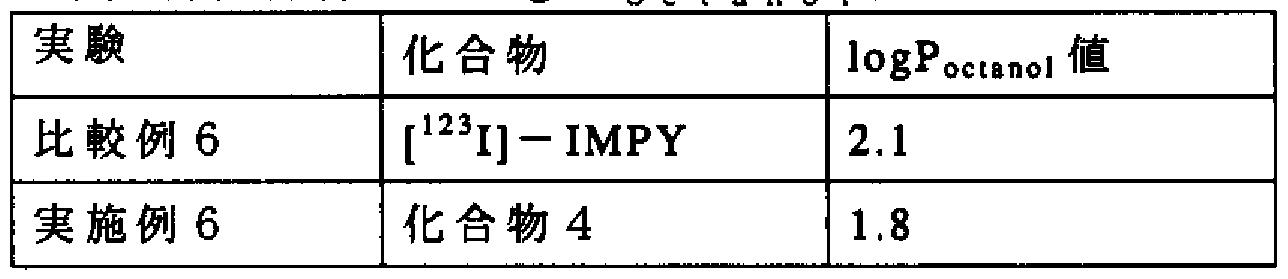
[0151] (実施例 7〜9、比較例 7) HPLCを用いた分配係数の測定 [0151] (Examples 7 to 9, Comparative Example 7) Measurement of partition coefficient using HPLC
[0152] HPLCによる分配係数(以下、 logP という)を下記の方法により測定した。この log [0152] The partition coefficient by HPLC (hereinafter referred to as logP) was measured by the following method. This log
HPLC HPLC
P は、化合物の BBB透過性の指標として一般に知られている logP と、 pH 7 P is logP, which is generally known as an index of BBB permeability of compounds, and pH 7
HPLC octanolHPLC octanol
. 2〜7· 4において同等の値を有することが知られている数値である (Franco Lombar do et al., J.Med.Chem., (2000), 43, ρ·2922- 2927)。 It is a numerical value known to have an equivalent value in 2 to 7 · 4 (Franco Lombar do et al., J. Med. Chem., (2000), 43, ρ · 2922- 2927).
[0153] まず、表 5記載の各評価化合物を、濃度 lmg/mLとなるように 10%ジメチルスルホ キシド含有メタノールに溶解し、試料溶液を調製した。この試料溶液 1 にっき、下 記の条件による HPLC分析を行い、溶媒の溶出時間(t )及び化合物の溶出時間(t [0153] First, each evaluation compound shown in Table 5 was dissolved in methanol containing 10% dimethyl sulfoxide so as to have a concentration of 1 mg / mL to prepare a sample solution. The sample solution 1 was subjected to HPLC analysis under the following conditions. The solvent elution time (t) and the compound elution time (t
0 R 0 R
)を求めた。 [0154] [表 5] ) [0154] [Table 5]
表 5 各実験における評価化合物 Table 5 Evaluation compounds in each experiment

[0155] HPLC条件: [0155] HPLC conditions:
カラム: Prodigy ODS (3) (製品名、 phenomenex社製、サイズ: 4· 6 X 250 mm) 移動相: 50mMトリェチルァミンリン酸(pH 7. 2) /ァセトニトリル =40/60混液 流速: 0. 7mL/分 Column: Prodigy ODS (3) (product name, manufactured by phenomenex, size: 4.6 x 250 mm) Mobile phase: 50 mM triethylamine phosphate (pH 7.2) / acetonitrile = 40/60 mixture Flow rate: 0 7mL / min
検出器:紫外可視吸光光度計 (検出波長: 282nm) Detector: UV-Vis spectrophotometer (Detection wavelength: 282nm)
[0156] 得られた t及び tを用い、計算式(3)より各評価化合物のリテンションファクター(以 [0156] Using the obtained t and t, the retention factor (hereinafter referred to as “retention factor”) of each evaluation compound is calculated from the formula (3).
0 R 0 R
下、 κ, 値という)を求めた。 (Hereinafter, κ, value).
HPLC HPLC
[0157] [数 3] HPLC = (tR― to)' to ■" V 3 ) [0157] [Equation 3] HPLC = (tR― to) 'to ■ "V 3)
[0158] 別に、上記参考例 6にて合成した [12¾ _ 2_ (4, - (3,, _フルォロプロボキシ)フエ 二ルー 6 ョードイミダゾ [ 1, 2— a]ピリジン溶液 (放射能濃度 37MBqZmL)及び、 上記参考例 7にて合成した [12¾— 2— (4,—ヒドロキシフエニル)—6—ョードイミダ ゾ [1, 2_a]ピリジン溶液(放射能濃度37MBq/mL)を、別々に用意したォクタノー ル 2mLに 10 μ Lずつ添加し、さらにそれぞれの溶液に lOmmolZLリン酸緩衝液(ρ H7. 4) 2mLをカ卩えた。各液を 30秒間攪拌した後、 2000回転/分の条件にて 60分 間遠心分離を行った。ォクタノール相及び水相それぞれ lmLにっき、放射能をォー トウエル'ガンマシステム(Aloka社製、形式: ARC— 301B)にて計測した。得られた 放射能より、上記の式(2)を用いて logP 値を算出した。 [0158] Separately, the [ 12 ¾ _ 2_ (4,-(3, _fluoropropoxy)] ferro 6 rhododazo [1, 2-a] pyridine solution (radioactivity) synthesized in Reference Example 6 above Concentration 37MBqZmL) and [ 12 ¾—2— (4, -hydroxyphenyl) -6-odoimidazo [1,2_a] pyridine solution (radioactivity concentration 37MBq / mL) synthesized in Reference Example 7 above 10 μL each was added to 2 mL of the prepared octanol, and 2 mL of lOmmolZL phosphate buffer solution (ρ H7.4) was added to each solution. Centrifugation was carried out for 60 minutes under the same conditions, measuring 1 mL each of the octanol phase and the aqueous phase, and measuring the radioactivity with an Otowell gamma system (Aloka, model: ARC-301B). From the above, the logP value was calculated using the above equation (2).
octanol octanol
[0159] さらに、上記参考例 4にて合成した 2—(4,一(3" フルォロプロポキシ)フエ二ルー 6 ョードイミダゾ [1 , 2— a]ピリジン溶液及び上記参考例 5にて合成した 2— (4'ーヒ ドロキシフエニル)ー6 ョードイミダゾ [1 , 2— a]ピリジン溶液のそれぞれについて上 記と同様の HPLC分析を行レ、、 K' 値を求めた。 -フルォロプロポキシ)フエ二ノレ一 6—ョードイミダゾ [ 1 , 2— a]ピリジン -ヒドロキシフエニル) 6 ョードイミダゾ [1, 2— a]ピリジンにおける log[0159] Furthermore, 2- (4,1 (3 "fluoropropoxy) phenyl 6-imidazole [1, 2-a] pyridine solution synthesized in Reference Example 4 and the above Reference Example 5 were synthesized. The same HPLC analysis was performed on each of the 2- (4′-hydroxyphenyl) -6 pseudoimidazo [1,2-a] pyridine solution to obtain the K ′ value. -Fluoropropoxy) 6-Choidoimidazo [1,2-a] pyridine-Hydroxyphenyl) 6-Chocoidimidazo [1,2-a] pyridine
K' に対して [12¾— 2—(4,一(3,,一フルォロプロポキシ)フエ二ルー 6 ョード[ 12 ¾— 2— (4, 1 (3, 1 Fluoropropoxy)) 6
10 HPLC 10 HPLC
イミダゾ [1, 2_a]ピリジン及び [ I]一 2_ (4,一ヒドロキシフエニル) _6_ョードイミ ダゾ [1, 2_a]ピリジンにおける logP 値をプロットしたグラフを作成し、直線の傾 Create a graph plotting the logP values for imidazo [1,2_a] pyridine and [I] 1-2_ (4,1hydroxyphenyl) _6_ odoimidazo [1,2_a] pyridine.
octanol octanol
きと y切片を見積もった。この値を用レ、、 logP 値と logP 値とが pH 7. 2〜7. The y intercept was estimated. Using this value, the logP value and logP value are between pH 7.2 and 7.
octanol HPLC octanol HPLC
4におレ、て等しレ、と仮定して、下記式 (4)を求めた。 Assuming 4 and 4 are equal, the following equation (4) is obtained.
[数 4]

[0162] 各評価化合物について求めた K' を用い、上記計算式 (4)に従って、各評価化 [0162] Using K ′ obtained for each evaluation compound, each evaluation was performed according to the above equation (4).
HPLC HPLC
合物における logP 値を求めた。 The logP value for the compound was determined.
HPLC HPLC
[0163] 結果を表 6に示す。この表に示すように、 logP 値は、化合物 1〜3のいずれにお [0163] The results are shown in Table 6. As shown in this table, the logP value is
HPLC HPLC
いても、:!〜 3の間の値を示していた。上述したように、 BBBを透過可能な化合物に おいては、 logP 値は 1〜3の間の値であることが知られている (Douglas D. Dischi Even though: showed values between:! As mentioned above, the logP value is known to be between 1 and 3 for compounds that are permeable to BBB (Douglas D. Dischi
octanol octanol
no et al., J.Nucl.Med., (1983), 24, p.1030— 1038)。また、 logP と logP とは pH no et al., J. Nucl. Med., (1983), 24, p. 1030-1038). LogP and logP are pH
octanol HPLC octanol HPLC
7. 2〜7.4において同等の値を有することが知られている(Franco Lombardo et al, J.Med.Chem., (2000), 43, p.2922-2927)0以上の結果より、化合物:!〜 3は、 BBBを 透過する性質を有するものであることが示唆された。 7. It is known to have a same value in 2~7.4 (. Franco Lombardo et al, J.Med.Chem, (2000), 43, p.2922-2927) from 0 above results, the compound: It was suggested that! ~ 3 has the property of permeating the BBB.
[0164] [表 6] [0164] [Table 6]

[0165] (実施例 10、比較例 8)脳内移行性及びクリアランスの測定 (Example 10, Comparative Example 8) Measurement of brain migration and clearance
[0166] 化合物 4を用い、雄性の Wistar系ラット(7週齢)における脳への放射能集積の経時 的変化を測定した。 [0166] Time course of radioactivity accumulation in the brain of male Wistar rats (7 weeks old) using Compound 4 Changes were measured.
[0167] 化合物 4を 10mg/mLァスコルビン酸含有生理食塩液に溶解した液、及び上記参 考例 8にて調製した [12¾— IMPY (比較例 7)を 10mg/mLァスコルビン酸含有生 理食塩液に溶解した液 (放射能濃度 15〜31MBq/mL)各 0. 05mLを、チォペン タール麻酔下で尾静脈より上記ラットに投与した。投与後 2分、 5分、 30分、 60分に 腹部大動脈より脱血した上で脳を採取し、脳の放射能をオートゥエル'ガンマシステ ム(形式: ARC_ 301B、 Aloka社製)を用いて計測し(以下、本実施例にて Aとする )、さらに脳の質量を測定した。また、投与液を 1000倍希釈した溶液 0. 05mLにつ レ、ての放射能量を同様に測定した(以下、本実施例にて Bとする)。これらの測定結 果を用い、下記式 (5)より、各解剖時間点における、脳への単位重量当たりの放射能 分布率(%107§)を算出した。なお、各時間点において 3匹の動物を用いて実験を 行った。 [0167] A solution prepared by dissolving Compound 4 in a physiological saline containing 10 mg / mL ascorbic acid and the above-described Reference Example 8 [ 12 ¾- IMPY (Comparative Example 7) was prepared as a physiological salt containing 10 mg / mL ascorbic acid. Each 0.05 mL of the solution dissolved in the solution (radioactive concentration 15 to 31 MBq / mL) was administered to the rats through the tail vein under thiopental anesthesia. At 2, 5, 30, and 60 minutes after administration, blood was collected from the abdominal aorta and the brain was collected, and the radioactivity in the brain was measured using the Autoll 'gamma system (form: ARC_ 301B, manufactured by Aloka). (Hereinafter referred to as A in this example), and the brain mass was further measured. In addition, the amount of radioactivity was measured in the same manner for 0.05 mL of a 1000-fold diluted solution (hereinafter referred to as “B” in this example). Using these measurement results, the radioactivity distribution rate (% 107 §) per unit weight to the brain at each dissection time point was calculated from the following formula (5). The experiment was performed using three animals at each time point.
[0168] [数 5] [0168] [Equation 5]
%ID/g= ^ X 100 … ( 5 ) % ID / g = ^ X 100… (5)
B X 1000 X脳の質量 B X 1000 X Brain mass
[0169] 結果を表 7に示す。表 7に示すように、化合物 4は、投与後 2分点において、 123I_IM PYと同等以上の集積が認められ、その後 60分にかけて速やかに消失する傾向を示 していた。この結果より、化合物 4は123I-IMPYと同様、高い脳移行性及び速やか な脳からのクリアランスを有することが示唆された。 The results are shown in Table 7. As shown in Table 7, Compound 4 showed an accumulation equal to or greater than 123 I_IMP at 2 minutes after administration, and then showed a tendency to disappear rapidly over 60 minutes. From these results, it was suggested that Compound 4 has high brain migration and rapid clearance from the brain, similar to 123 I-IMPY.
[0170] [表 7] 表 7 本発明化合物の静脈内投与後の脳への放射能集積 (ラッ ト) [0170] [Table 7] Table 7 Radioactivity accumulation in the brain after intravenous administration of the compound of the present invention (rat)

[0171] (実施例 11)脳内アミロイドの描出の確認 [Example 11] Confirmation of visualization of amyloid in the brain
[0172] 本発明に係る化合物が脳内アミロイドを描出し得るかを評価するため、下記の実験を 行った。 [0173] ( 1 ) Α β (和光純薬工業)をリン酸緩衝液 (ρΗ7· 4)で溶解して 37°Cで 72時間振[0172] In order to evaluate whether the compound according to the present invention can depict amyloid in the brain, the following experiment was conducted. [0173] (1) Dissolve Αβ (Wako Pure Chemical Industries) in phosphate buffer (ρΗ7.4) and shake at 37 ° C for 72 hours
1 -42 1 -42
盪させ、 lmg/mLの凝集 A j3懸濁液(以下、本実施例にてアミロイド懸濁液という) を得た。 Then, a lmg / mL aggregated Aj3 suspension (hereinafter referred to as amyloid suspension in this example) was obtained.
[0174] (2)雄性 Wistar系ラット(7週齢)の片側扁桃核へ上記アミロイド懸濁液を 2. 5 U L (2 相当)注入し、対照として、反対側の扁桃核にリン酸緩衝生理食塩液 (pH7. 4) を 2. 注入した。アミロイド懸濁液及びリン酸緩衝生理食塩液(pH7. 4)注入 3 日後のラットを、検体とした。 [0174] (2) 2.5 U L (equivalent to 2) of the above amyloid suspension was injected into one side of the amygdala of male Wistar rats (7 weeks old) and, as a control, phosphate buffer was added to the amygdala on the other side 2. Saline solution (pH 7.4) was injected. Rats 3 days after the injection of amyloid suspension and phosphate buffered saline (pH 7.4) were used as specimens.
[0175] (3)化合物 4を l OmgZmLァスコルビン酸含有生理食塩液に溶解し、試料溶液とし た (放射能濃度 84MBqZmL)。この溶液を、上記ラットに尾静脈より投与した (投与 量: 0. 5mL、投与した放射能: 42MBq相当)。 [0175] (3) Compound 4 was dissolved in 1 OmgZmL ascorbic acid-containing physiological saline to give a sample solution (radioactivity concentration 84 MBqZmL). This solution was administered to the rat through the tail vein (dose: 0.5 mL, dosed radioactivity: equivalent to 42 MBq).
[0176] (4)投与 30分後に脳を摘出して、ミクロトーム (形式: CM3050S、 LEICA社製)を用 いて厚さ 10 x mの脳切片を作製した。当該脳切片をイメージングプレート上で 1. 5 時間露光させた後、バイオイメージングアナライザー(形式: BAS— 2500、富士写真 フィルム株式会社製)を用いて画像解析を行った。 [0176] (4) The brain was removed 30 minutes after administration, and a brain section having a thickness of 10 x m was prepared using a microtome (format: CM3050S, manufactured by LEICA). The brain section was exposed on an imaging plate for 1.5 hours, and then image analysis was performed using a bioimaging analyzer (form: BAS-2500, manufactured by Fuji Photo Film Co., Ltd.).
[0177] (5)バイオイメージングアナライザーを用いた上記画像解析の終了後、チオフラビン Τによる病理染色を行って蛍光顕微鏡 (株式会社ニコン製、形式: TE2000— U型、 励起波長: 400〜440nm、検出波長: 470nm)を用いたイメージングを行い、当該 切片上にアミロイドが沈着していることを確認した(図 9b)。 [0177] (5) After completion of the above image analysis using a bioimaging analyzer, pathological staining with thioflavin Τ was performed and fluorescence microscope (Nikon Corporation, model: TE2000—U type, excitation wavelength: 400-440 nm, detection Imaging using a wavelength of 470 nm) confirmed that amyloid was deposited on the section (FIG. 9b).
[0178] アミロイド脳内注入ラットの脳切片におけるオートラジオグラム及びチオフラビン T染 色のイメージを図 9に示す。この図に示すように、アミロイド懸濁液を注入した側の扁 桃核において、明らかな放射能集積性を有すると共に、その他の部位における非特 異的な集積が少ない良好な画像が得られていた。また、放射能集積部位におけるチ オフラビン T染色の結果より、集積の認められた部位においてアミロイドが存在してい ることが確認された。一方、リン酸緩衝生理食塩液を注入した側の扁桃核においては 、他の部位と比較した有意な放射能集積は確認されなかった。 [0178] Fig. 9 shows images of autoradiogram and thioflavin T staining in brain sections of rats injected with amyloid in the brain. As shown in this figure, the amygdaloid nucleus on the side injected with the amyloid suspension had a clear radioactivity accumulation and a good image with little non-specific accumulation at other sites. . In addition, the results of thioflavin T staining at the radioactive accumulation site confirmed that amyloid was present at the site where accumulation was observed. On the other hand, no significant radioactivity accumulation was confirmed in the amygdaloid nucleus on the side injected with phosphate buffered saline as compared with other sites.
この結果より、化合物 4は、脳内アミロイドに集積する性能を有し、脳内アミロイドの描 出能を有することが示唆された。 From these results, it was suggested that Compound 4 has the ability to accumulate in brain amyloid and has the ability to visualize brain amyloid.
[0179] (実施例 12〜: 14)復帰突然変異試験 [0180] 化合物 1、化合物 2及び化合物 3の遺伝子突然変異誘発性を調べるため、ネズミチフ ス菌(Salmonella typhimurium)の TA98及び TA100を用いる復帰突然変異試験(以 下、 Ames試験とレ、う)を行った。 [0179] (Examples 12-: 14) Reverse mutation test [0180] In order to examine the gene mutagenicity of Compound 1, Compound 2 and Compound 3, a reverse mutation test (hereinafter referred to as Ames test) using TA98 and TA100 of Salmonella typhimurium was carried out. went.
[0181] 試験は S9mix無添加と S9mix添カ卩の場合について実施した。陰性対象はジメチル スルホキシドを用い、陽性対象は S9mix無添加の場合は 2_ (2_フリル) - 3 - (5 —ニトロ _ 2_フリル)アクリルアミドを用レ、、 S9mix添加の場合は 2_アミノアントラセ ンを用いた。 [0181] The test was conducted with no S9mix and with S9mix. Negative subjects use dimethyl sulfoxide, and positive subjects use 2_ (2_furyl)-3-(5 —nitro _ 2_furyl) acrylamide when S9mix is not added, and 2_aminoanthra when S9mix is added. Sen was used.
[0182] 試験用プレートへの各試料の添加量は、化合物 1については 1250 x g/プレートを 最高用量として、 7用量 (公比 4)で実施とし,化合物 2及び化合物 3については 5000 z gZプレートを最高用量として、 7用量 (公比 3)で実施とした。被験物質と試験菌株 (TA98又は TA100)、あるいは被験物質と S9mixと試験菌株とを混合後,軟寒天を 用いて試験用プレート上の培地へ重層し、 37°Cで 48時間培養した。判定は、培養 後のプレートにおける復帰突然変異コロニー数をカウントすることにより行レ、、復帰突 然変異コロニー数が陰性対照の 2倍以上の値を示し、更に濃度に依存して増加した 場合を陽性とした。 [0182] Each sample was added to the test plate at a maximum dose of 1250 xg / plate for Compound 1, 7 doses (common ratio 4), and 5000 z gZ plates for Compound 2 and Compound 3. The highest dose was 7 doses (public ratio 3). The test substance and the test strain (TA98 or TA100), or the test substance, S9mix and the test strain were mixed, and then layered on the medium on the test plate using soft agar and cultured at 37 ° C for 48 hours. Judgment was made by counting the number of revertant colonies in the plate after culturing, and when the number of revertant colonies showed a value more than twice that of the negative control and further increased depending on the concentration. Positive.
[0183] 結果を表 8に示す。化合物 1、化合物 2及び化合物 3の処理群における復帰変異コロ ニー数は、いずれの菌株とも S9mix添カ卩の有無にかかわらず、陰性対照の 2倍未満 であった。一方、陽性対照物質処理群は、明らかな復帰変異コロニー数の増加を示 していた。以上の結果より、化合物 1、化合物 2及び化合物 3は Ames陰性と判定され 、遺伝子突然変異誘発性は無いものと判断された。 [0183] The results are shown in Table 8. The number of reverse mutation colonies in the treatment groups of Compound 1, Compound 2 and Compound 3 was less than twice that of the negative control regardless of the presence or absence of S9mix supplements. On the other hand, the positive control substance-treated group showed a clear increase in the number of revertant colonies. Based on the above results, Compound 1, Compound 2 and Compound 3 were determined to be Ames negative and determined not to have gene mutagenicity.
[0184] [表 8] 表 8 A m e s 試験の結果 [0184] [Table 8] Table 8 Results of A m e s test
変異原性 Mutagenicity
化合物 S9mi 無添加 S9mi 添カロ Compound S9mi No additive S9mi Caro
TA98 TA100 TA98 TA100 TA98 TA100 TA98 TA100
実施例 1 2 化合物 1 陰性 陰性 陰性 陰性 実施例 1 3 化合物 2 陰性 陰性 陰性 陰性 実施例 1 4 化合物 3 陰性 陰性 陰性 陰性 産業上の利用可能性 Example 1 2 Compound 1 Negative Negative Negative Negative Example 1 3 Compound 2 Negative Negative Negative Negative Example 1 4 Compound 3 Negative Negative Negative Negative Industrial applicability
[0185] 本発明に係る化合物は、診断薬分野において利用することができる。 [0185] The compounds according to the present invention can be used in the field of diagnostic agents.
図面の簡単な説明 Brief Description of Drawings
[0186] [図 1]6—メトキシー 2—[4'一(3 "—パラトルエンスルホニルォキシプロポキシ)フエ二 ノレ]イミダゾ [1, 2— a]ピリジンの合成スキーム。 [0186] [Fig. 1] Synthesis scheme of 6-methoxy-2- [4 '-(3 "-paratoluenesulfonyloxypropoxy) phenino] imidazo [1,2-a] pyridine.
[図 2] 2— [4 '一(3" フルォロプロポキシ)フエニル] 6—メトキシイミダゾ [ 1 , 2— a] ピリジン (非放射性フッ素化体)の合成スキーム。 [Fig. 2] Synthesis scheme of 2- [4 '-(3 "fluoropropoxy) phenyl] 6-methoxyimidazo [1,2-a] pyridine (non-radioactive fluorinated product).
[図 3] 2— [4,一(3" フルォロプロポキシ)フエニル] - 6—ヒドロキシイミダゾ [1, 2— a]ピリジン (非放射性フッ素化体)の合成スキーム。 [Fig. 3] Synthesis scheme of 2— [4,1 (3 ”fluoropropoxy) phenyl] -6-hydroxyimidazo [1,2-a] pyridine (non-radioactive fluorinated compound).
[図 4]2_[4, - (3"_フルォロプロポキシ)フヱニル]イミダゾ [1, 2_a]ピリジン(非放 射性フッ素化体)の合成スキーム。 [Fig.4] Synthesis scheme of 2_ [4,-(3 "_fluoropropoxy) phenyl] imidazo [1, 2_a] pyridine (non-radioactive fluorinated product).
[図 5] 2 _ (4, _ (3" _フルォロプロポキシ)フエニル _ 6—ョードイミダゾ [ 1, 2 _ a]ピ リジンの合成スキーム。 [Fig. 5] Synthesis scheme of 2 _ (4, _ (3 "_ fluorpropoxy) phenyl _ 6- odorimidazo [1, 2 _ a] pyridine.
[図 6]2— (4,一ヒドロキシフエニル)一6—ョードイミダゾ [1, 2— a]ピリジンの合成スキ ーム。 [Fig.6] Synthetic scheme of 2- (4,1hydroxyphenyl) 6-6-imidazo [1,2-a] pyridine.
[図 7][12¾_2_(4' _(3,,_フルォロプロポキシ)フエニル一 6_ョードイミダゾ [1, 2-a]ピリジンの合成スキーム。 [Fig. 7] [ 12 ¾_2_ (4 '_ (3 ,, _ Fluoropropoxy) phenyl 1-6 odoimidazo [1, 2-a] pyridine synthesis scheme.
[図 8][12¾_2_(4'—ヒドロキシフエニル) _6_ョードイミダゾ [1, 2_a]ピリジンの 合成スキーム。 [FIG. 8] Synthesis scheme of [ 12 ¾_2_ (4'-hydroxyphenyl) _6_ odoimidazo [1, 2_a] pyridine.
[図 9] (a)化合物 4投与 30分後の脳切片におけるオートラジオグラム及び (b)チオフラ ビン T染色試料の蛍光顕微鏡像 (アミロイド懸濁液投与部位の拡大表示。 ) [FIG. 9] (a) Autoradiogram in brain section 30 minutes after administration of Compound 4 and (b) Fluorescent micrograph of thioflavine T-stained sample (enlarged display of amyloid suspension administration site.)
Claims


Priority Applications (11)
| Application Number | Priority Date | Filing Date | Title |
|---|---|---|---|
| EP07767329.1A EP2042501B1 (en) | 2006-06-21 | 2007-06-21 | Compound having affinity for amyloid |
| US12/308,715 US8277777B2 (en) | 2006-06-21 | 2007-06-21 | Compound having affinity for amyloid |
| HK09111320.9A HK1133254B (en) | 2006-06-21 | 2007-06-21 | Compound having affinity for amyloid |
| JP2008522509A JP5247442B2 (en) | 2006-06-21 | 2007-06-21 | Novel amyloid affinity compound |
| ES07767329.1T ES2629768T3 (en) | 2006-06-21 | 2007-06-21 | Compound with amyloid affinity |
| NZ574164A NZ574164A (en) | 2006-06-21 | 2007-06-21 | Novel compound having affinity for amyloid |
| CA002655826A CA2655826A1 (en) | 2006-06-21 | 2007-06-21 | Novel compound having affinity for amyloid |
| CN2007800298930A CN101501033B (en) | 2006-06-21 | 2007-06-21 | Compounds with an affinity for amyloid |
| AU2007261985A AU2007261985B2 (en) | 2006-06-21 | 2007-06-21 | Novel compound having affinity for amyloid |
| IL196046A IL196046A0 (en) | 2006-06-21 | 2008-12-18 | Novel compound having affinity for amyloid |
| NO20090233A NO20090233L (en) | 2006-06-21 | 2009-01-14 | New composition having affinity for amyloid |
Applications Claiming Priority (4)
| Application Number | Priority Date | Filing Date | Title |
|---|---|---|---|
| US80535606P | 2006-06-21 | 2006-06-21 | |
| US60/805356 | 2006-06-21 | ||
| JP2006-188034 | 2006-07-07 | ||
| JP2006188034 | 2006-07-07 |
Publications (1)
| Publication Number | Publication Date |
|---|---|
| WO2007148755A1 true WO2007148755A1 (en) | 2007-12-27 |
Family
ID=38833493
Family Applications (1)
| Application Number | Title | Priority Date | Filing Date |
|---|---|---|---|
| PCT/JP2007/062503 Ceased WO2007148755A1 (en) | 2006-06-21 | 2007-06-21 | Novel compound having affinity for amyloid |
Country Status (9)
| Country | Link |
|---|---|
| US (1) | US8277777B2 (en) |
| EP (1) | EP2042501B1 (en) |
| KR (1) | KR20090025282A (en) |
| CN (1) | CN101501033B (en) |
| AU (1) | AU2007261985B2 (en) |
| CA (1) | CA2655826A1 (en) |
| IL (1) | IL196046A0 (en) |
| NO (1) | NO20090233L (en) |
| WO (1) | WO2007148755A1 (en) |
Cited By (7)
| Publication number | Priority date | Publication date | Assignee | Title |
|---|---|---|---|---|
| WO2009054497A1 (en) * | 2007-10-26 | 2009-04-30 | Nihon Medi-Physics Co., Ltd. | Novel compound having affinity for amyloid |
| EP2218464A1 (en) * | 2009-02-11 | 2010-08-18 | Technische Universität München | Compounds for non-invasive measurement of aggregates of amyloid peptides |
| JP2010241788A (en) * | 2009-04-09 | 2010-10-28 | Industry-Univ Cooperation Foundation Sogang Univ | Pharmaceutical composition for diagnosis or treatment of degenerative brain disease |
| WO2012176587A1 (en) * | 2011-06-24 | 2012-12-27 | 日本メジフィジックス株式会社 | Novel compound with amyloid affinity |
| JP2016520046A (en) * | 2013-04-29 | 2016-07-11 | エフ.ホフマン−ラ ロシュ アーゲーF. Hoffmann−La Roche Aktiengesellschaft | 2-phenyl or 2-hetarylimidazole [1,2-a] pyridine derivatives |
| JP2017503012A (en) * | 2013-12-20 | 2017-01-26 | ベイジン ズィボォ バイオメディカル テクノロジー カンパニー、リミテッド | Phenylbenzyl ether derivatives and their preparation and applications |
| JP2017529340A (en) * | 2014-08-29 | 2017-10-05 | シーエイチディーアイ ファウンデーション,インコーポレーテッド | Huntington protein imaging probe |
Families Citing this family (6)
| Publication number | Priority date | Publication date | Assignee | Title |
|---|---|---|---|---|
| TW200803903A (en) | 2006-04-28 | 2008-01-16 | Nihon Mediphysics Co Ltd | Novel compound having affinity to amyloid |
| US8303935B2 (en) | 2006-05-19 | 2012-11-06 | Nihon Medi-Physics Co., Ltd. | Alkoxy substituted imidazo[1,2-a]pyridines having affinity for amyloid |
| CA2670436A1 (en) | 2006-11-30 | 2008-06-05 | Nihon Medi-Physics Co., Ltd. | Novel compound having affinity for amyloid |
| CN101903381A (en) * | 2007-10-24 | 2010-12-01 | 日本医事物理股份有限公司 | New compound with affinity for amyloid |
| US9926316B2 (en) * | 2016-03-03 | 2018-03-27 | The Cleveland Clinic Foundation | Antitumor derivatives for differentiation therapy |
| CN108822105A (en) * | 2018-08-14 | 2018-11-16 | 河南师范大学 | A method of by ethylbenzene class compound synthesis 2- Aryimidazole simultaneously [1,2-a] pyridine compounds and their |
Citations (10)
| Publication number | Priority date | Publication date | Assignee | Title |
|---|---|---|---|---|
| JPS6391391A (en) * | 1986-09-22 | 1988-04-22 | オーソ・フアーマシユーチカル・コーポレーシヨン | 2- or 3-aryl substituted imidazo (1, 2-a) pyridine |
| WO2001074815A2 (en) * | 2000-03-31 | 2001-10-11 | Ortho Mcneil Pharmaceutical, Inc. | Phenyl-substituted imidazopyridines |
| WO2001074813A2 (en) * | 2000-03-31 | 2001-10-11 | Ortho Mcneil Pharmaceutical, Inc. | METHOD FOR USING 2- OR 3-ARYL SUBSTITUTED IMIDAZO[1,2-a] PYRIDINES AS H3 ANTAGONISTS |
| JP2002523383A (en) | 1998-08-20 | 2002-07-30 | リージェンツ オブ ザ ユニバーシティー オブ カリフォルニア | Labeling method for β-amyloid plaques and neurofibrillary tangles |
| WO2003106439A1 (en) | 2002-06-12 | 2003-12-24 | 株式会社ビーエフ研究所 | Probe compound for image diagnosis of disease with amyloid accumulation, compound for staining age spots/diffuse age spots, and remedy for disease with amyloid accumulation |
| JP2004506723A (en) | 2000-08-24 | 2004-03-04 | ユニバーシティー オブ ピッツバーグ | Thioflavin derivatives for use in prenatal diagnosis of Alzheimer's disease and in vivo imaging and prevention of amyloid deposits |
| JP2004506633A (en) * | 2000-08-16 | 2004-03-04 | ベーリンガー インゲルハイム ファルマ ゲゼルシャフト ミット ベシュレンクテル ハフツング ウント コンパニー コマンディトゲゼルシャフト | Novel β-amyloid inhibitors, their production and use as pharmaceutical compositions |
| JP2005504055A (en) | 2001-08-27 | 2005-02-10 | ザ トラスティーズ オブ ザ ユニバーシティ オブ ペンシルバニア | Stilbene derivatives and their use for binding and imaging of amyloid plaques |
| JP2005512945A (en) | 2001-04-23 | 2005-05-12 | ザ・トラスティーズ・オブ・ザ・ユニバーシティ・オブ・ペンシルベニア | Amyloid plaque aggregation inhibitor and diagnostic contrast agent |
| JP2005526749A (en) * | 2002-03-06 | 2005-09-08 | ノバルティス アクチエンゲゼルシャフト | Coumarins useful as biomarkers |
Family Cites Families (20)
| Publication number | Priority date | Publication date | Assignee | Title |
|---|---|---|---|---|
| US4791117A (en) | 1986-09-22 | 1988-12-13 | Ortho Pharmaceutical Corporation | 2- or 3-aryl substituted imidazo[1,2-a]pyridines and their use as calcium channel blockers |
| US4871745A (en) | 1986-09-22 | 1989-10-03 | Ortho Pharmaceutical Corporation | 2- or 3-aryl substituted imidazo(1,2-A)pyridines and their use as antisecretory agents |
| US4833149A (en) | 1986-09-22 | 1989-05-23 | Ortho Pharmaceutical Corporation | 2- or 3-aryl substituted imidazo[1,2-a]pyridines |
| JP2000510816A (en) | 1995-10-17 | 2000-08-22 | ジー.ディー.サール アンド カンパニー | Method for detecting cyclooxygenase-2 |
| US6812327B1 (en) | 1996-10-25 | 2004-11-02 | Human Genome Sciences, Inc. | Neutrokine-alpha polypeptides |
| JP4025468B2 (en) | 1999-07-29 | 2007-12-19 | 三井化学株式会社 | Organic electroluminescence device |
| US20010051632A1 (en) | 2000-03-31 | 2001-12-13 | Wenying Chai | Phenyl-substituted indolizines and tetrahydroindolizines |
| US6514969B2 (en) | 2000-08-16 | 2003-02-04 | Boehringer Ingelheim Pharma Kg | β-amyloid inhibitors, processes for preparing them, and their use in pharmaceutical compositions |
| CA2438204A1 (en) | 2001-02-26 | 2002-09-06 | Bristol-Myers Squibb Pharma Company | Ascorbic acid analogs for metalloradiopharmaceuticals |
| US6596731B2 (en) | 2001-03-27 | 2003-07-22 | Hoffmann-La Roche Inc. | Substituted imidazo[1,2-A] pyridine derivatives |
| EP1356827A1 (en) | 2002-04-24 | 2003-10-29 | Mallinckrodt Inc. | Method for obtaining a 2-18F-fluor-2-deoxy-D-glucose (18F-FDG)-solution |
| KR101001300B1 (en) | 2002-11-05 | 2010-12-14 | 이온빔 어플리케이션스 에스.에이. | Stabilization of 18-Epro Labeled Radiation Drugs |
| GB0229695D0 (en) | 2002-12-20 | 2003-01-29 | Amersham Plc | Solid-phase preparation of 18F-labelled amino acids |
| JP4758909B2 (en) | 2003-12-31 | 2011-08-31 | シェーリング−プラウ・リミテッド | Control of parasites in animals by using imidazo [1,2-b] pyridazine derivatives |
| CA2617319A1 (en) * | 2005-06-24 | 2007-01-04 | The Trustees Of The University Of Pennsylvania | Radiolabeled-pegylation of ligands for use as imaging agents |
| WO2007033080A2 (en) * | 2005-09-12 | 2007-03-22 | Emory University | Alzheimer's disease imaging agents |
| US8303935B2 (en) | 2006-05-19 | 2012-11-06 | Nihon Medi-Physics Co., Ltd. | Alkoxy substituted imidazo[1,2-a]pyridines having affinity for amyloid |
| CN101903381A (en) | 2007-10-24 | 2010-12-01 | 日本医事物理股份有限公司 | New compound with affinity for amyloid |
| JP5313158B2 (en) | 2007-10-26 | 2013-10-09 | 日本メジフィジックス株式会社 | Novel amyloid affinity compound |
| CN101909659A (en) | 2007-10-30 | 2010-12-08 | 日本医事物理股份有限公司 | Application and preparation method of novel compound with affinity to amyloid |
-
2007
- 2007-06-21 KR KR1020087031662A patent/KR20090025282A/en not_active Withdrawn
- 2007-06-21 US US12/308,715 patent/US8277777B2/en active Active
- 2007-06-21 CN CN2007800298930A patent/CN101501033B/en active Active
- 2007-06-21 EP EP07767329.1A patent/EP2042501B1/en active Active
- 2007-06-21 CA CA002655826A patent/CA2655826A1/en not_active Abandoned
- 2007-06-21 AU AU2007261985A patent/AU2007261985B2/en not_active Expired - Fee Related
- 2007-06-21 WO PCT/JP2007/062503 patent/WO2007148755A1/en not_active Ceased
-
2008
- 2008-12-18 IL IL196046A patent/IL196046A0/en unknown
-
2009
- 2009-01-14 NO NO20090233A patent/NO20090233L/en not_active Application Discontinuation
Patent Citations (10)
| Publication number | Priority date | Publication date | Assignee | Title |
|---|---|---|---|---|
| JPS6391391A (en) * | 1986-09-22 | 1988-04-22 | オーソ・フアーマシユーチカル・コーポレーシヨン | 2- or 3-aryl substituted imidazo (1, 2-a) pyridine |
| JP2002523383A (en) | 1998-08-20 | 2002-07-30 | リージェンツ オブ ザ ユニバーシティー オブ カリフォルニア | Labeling method for β-amyloid plaques and neurofibrillary tangles |
| WO2001074815A2 (en) * | 2000-03-31 | 2001-10-11 | Ortho Mcneil Pharmaceutical, Inc. | Phenyl-substituted imidazopyridines |
| WO2001074813A2 (en) * | 2000-03-31 | 2001-10-11 | Ortho Mcneil Pharmaceutical, Inc. | METHOD FOR USING 2- OR 3-ARYL SUBSTITUTED IMIDAZO[1,2-a] PYRIDINES AS H3 ANTAGONISTS |
| JP2004506633A (en) * | 2000-08-16 | 2004-03-04 | ベーリンガー インゲルハイム ファルマ ゲゼルシャフト ミット ベシュレンクテル ハフツング ウント コンパニー コマンディトゲゼルシャフト | Novel β-amyloid inhibitors, their production and use as pharmaceutical compositions |
| JP2004506723A (en) | 2000-08-24 | 2004-03-04 | ユニバーシティー オブ ピッツバーグ | Thioflavin derivatives for use in prenatal diagnosis of Alzheimer's disease and in vivo imaging and prevention of amyloid deposits |
| JP2005512945A (en) | 2001-04-23 | 2005-05-12 | ザ・トラスティーズ・オブ・ザ・ユニバーシティ・オブ・ペンシルベニア | Amyloid plaque aggregation inhibitor and diagnostic contrast agent |
| JP2005504055A (en) | 2001-08-27 | 2005-02-10 | ザ トラスティーズ オブ ザ ユニバーシティ オブ ペンシルバニア | Stilbene derivatives and their use for binding and imaging of amyloid plaques |
| JP2005526749A (en) * | 2002-03-06 | 2005-09-08 | ノバルティス アクチエンゲゼルシャフト | Coumarins useful as biomarkers |
| WO2003106439A1 (en) | 2002-06-12 | 2003-12-24 | 株式会社ビーエフ研究所 | Probe compound for image diagnosis of disease with amyloid accumulation, compound for staining age spots/diffuse age spots, and remedy for disease with amyloid accumulation |
Non-Patent Citations (27)
| Title |
|---|
| ABDERRAHIM BOUZIDE; GILLES SAUVE, ORGANIC LETTERS, vol. 4, no. 14, 2002, pages 2329 - 2332 |
| DOUGLAS D. DISCHINO ET AL., J. NUCL. MED., vol. 24, 1983, pages 1030 - 1038 |
| ERIC D. AGDEPPA ET AL.: "2-Dialkylamino-6-Acylmalononitrile Substituted Naphthalenes (DDNP Analogs): Novel Diagnostic and Therapeutic Tools in Alzheimer's Disease.", MOLECULAR IMAGING AND BIOLOGY, vol. 5, 2003, pages 404 - 417 |
| FRANCO LOMBARDO ET AL., J. MED. CHEM., vol. 43, 2000, pages 2922 - 2927 |
| FURUMOTO Y ET AL.: "11c] BF-227: A New 11C-Labeled 2-Ethenylbenzoxazole Derivative for Amyloid-ß Plaques Imaging", EUROPEAN JOURNAL OF NUCLEAR MEDICINE AND MOLECULAR IMAGING, vol. 32, no. 1, 2005, pages 759 |
| G. MCKHANN ET AL.: "Clinical diagnosis of Alzheimer's disease: Report of the NINLDS-ADRDA Work Group under the auspices of Department of Health and Human Services Task Force on Alzheimer's Disease", NEUROLOGY, vol. 34, 1984, pages 939 - 944, XP000671871 |
| H. F. KUNG ET AL., J. AM. CHEM. SOC., vol. 123, 2001, pages 12740 - 12741 |
| H. F. KUNG ET AL.: "Novel Stilbenes as Probes for amyloid plaques", J. AMERICAN CHEMICAL SOCIETY, vol. 123, 2001, pages 12740 - 12741 |
| J. A. HARDY; G. A. HIGGINS: "Alzheimer's Disease: The Amyloid Cascade Hypothesis", SCIENCE, vol. 256, 1992, pages 184 - 185 |
| JOSEPH G. LOMBARDINO, JOURNAL OF MEDICINAL CHEMISTRY, vol. 24, 1981, pages 39 - 42 |
| KING, L. CARROLL; OSTRUM, G. KENNETH, JOURNAL OF ORGANIC CHEMISTRY, vol. 29, no. 12, 1964, pages 3459 - 3461 |
| MASAHIRO ONO ET AL., NUCLEAR MEDICINE AND BIOLOGY, vol. 30, 2003, pages 565 - 571 |
| MASAHIRO ONO ET AL.: "11C-labeled stilbene derivatives as Aß-aggregate-specific PET imaging agents for Alzheimer's disease", NUCLEAR MEDICINE AND BIOLOGY, vol. 30, 2003, pages 565 - 571, XP004444174, DOI: doi:10.1016/S0969-8051(03)00049-0 |
| NAIKI, H. ET AL., LABORATORY INVESTIGATION, vol. 74, 1996, pages 374 - 383 |
| NICOLAAS P. L. G. VERHOEFF ET AL.: "In-Vivo Imaging of Alzheimer Disease ß-Amyloid With [11C]SB-13 PET.", AMERICAN JOURNAL OF GERIATRIC PSYCHIATRY, vol. 12, 2004, pages 584 - 595, XP009121906 |
| SANFILIPPO P.J. ET AL.: "Synthesis of (Aryloxy) alkylamides. 2. Novel Imidazo-fused Heterocycles with Calcium Channel Blocking and Local Anesthetic Activity", JOURNAL OF MEDICINAL CHEMISTRY, vol. 31, no. 11, 1988, pages 2221 - 2227, XP002182515 * |
| See also references of EP2042501A4 |
| SHAH C. ET AL.: "Novel Human Histamine H3 Receptor Antagonists", BIOORGANIC & MEDICINAL CHEMISTRY LETTERS, vol. 12, no. 22, 2002, pages 3309 - 3312, XP002353596 * |
| W. E. KLUNK ET AL.: "Imaging brain amyloid in Alzheumer's disease with Pittsburgh Compound-B.", ANN. NEUROL., vol. 55, 2004, pages 306 - 319, XP008031485, DOI: doi:10.1002/ana.20009 |
| WANG, Y. ET AL., J. LABELLED COMPOUNDS RADIOPHARMACEUT., vol. 44, 2001, pages 239 |
| WANG. Y. ET AL., J. LABELLED COMPOUNDS RADIOPHARMACEUT., vol. 44, 2001, pages 239 |
| Z.-P. ZHUANG ET AL.: "Radioiodinated Styrylbenzenes and Thioflavins as Probes for Amyloid Aggregates", J. MED. CHEM., vol. 44, 2001, pages 1905 - 1914, XP002410969, DOI: doi:10.1021/jm010045q |
| ZHI-PING ZHUANG ET AL., J. MED. CHEM., vol. 46, 2003, pages 237 - 243 |
| ZHI-PING ZHUANG ET AL., NUCLEAR MEDICINE AND BIOLOGY, vol. 28, 2001, pages 887 - 894 |
| ZHI-PING ZHUANG ET AL.: "IBOX(2-(4' -dimethylaminophenyl)-6-iodobenzoxazole): a ligand for imaging amyloid plaques in the brain", NUCLEAR MEDICINE AND BIOLOGY, vol. 28, 2001, pages 887 - 894, XP002386398 |
| ZHI-PING ZHUANG ET AL.: "Structure-Activity Relationship of Imidazo[1,2- a]pyridines as Ligands for Detecting ß-Amyloid Plaques in the Brain", J. MED. CHEM, vol. 46, 2003, pages 237 - 243, XP002446716, DOI: doi:10.1021/jm020351j |
| ZHUANG, Z. P. ET AL., J. MED. CHEM., vol. 46, 2003, pages 237 |
Cited By (13)
| Publication number | Priority date | Publication date | Assignee | Title |
|---|---|---|---|---|
| JP5313158B2 (en) * | 2007-10-26 | 2013-10-09 | 日本メジフィジックス株式会社 | Novel amyloid affinity compound |
| WO2009054497A1 (en) * | 2007-10-26 | 2009-04-30 | Nihon Medi-Physics Co., Ltd. | Novel compound having affinity for amyloid |
| US8399672B2 (en) | 2007-10-26 | 2013-03-19 | Nihon Medi-Physics Co., Ltd. | Compound having affinity for amyloid |
| EP2218464A1 (en) * | 2009-02-11 | 2010-08-18 | Technische Universität München | Compounds for non-invasive measurement of aggregates of amyloid peptides |
| JP2010241788A (en) * | 2009-04-09 | 2010-10-28 | Industry-Univ Cooperation Foundation Sogang Univ | Pharmaceutical composition for diagnosis or treatment of degenerative brain disease |
| WO2012176587A1 (en) * | 2011-06-24 | 2012-12-27 | 日本メジフィジックス株式会社 | Novel compound with amyloid affinity |
| JP5167436B2 (en) * | 2011-06-24 | 2013-03-21 | 日本メジフィジックス株式会社 | Novel amyloid affinity compound |
| US9211350B2 (en) | 2011-06-24 | 2015-12-15 | Nihon Medi-Physics Co., Ltd. | Compound with amyloid affinity |
| JP2016520046A (en) * | 2013-04-29 | 2016-07-11 | エフ.ホフマン−ラ ロシュ アーゲーF. Hoffmann−La Roche Aktiengesellschaft | 2-phenyl or 2-hetarylimidazole [1,2-a] pyridine derivatives |
| US10975073B2 (en) | 2013-04-29 | 2021-04-13 | Hoffmann-La Roche Inc. | Imaging methods using 2-hetaryl imidazol[1,2-a]pyridine derivatives |
| US11358962B2 (en) | 2013-04-29 | 2022-06-14 | Hoffmann-La Roche Inc. | 2-hetaryl imidazol[1,2-a]pyridine derivatives |
| JP2017503012A (en) * | 2013-12-20 | 2017-01-26 | ベイジン ズィボォ バイオメディカル テクノロジー カンパニー、リミテッド | Phenylbenzyl ether derivatives and their preparation and applications |
| JP2017529340A (en) * | 2014-08-29 | 2017-10-05 | シーエイチディーアイ ファウンデーション,インコーポレーテッド | Huntington protein imaging probe |
Also Published As
| Publication number | Publication date |
|---|---|
| AU2007261985A1 (en) | 2007-12-27 |
| US8277777B2 (en) | 2012-10-02 |
| HK1133254A1 (en) | 2010-03-19 |
| EP2042501A1 (en) | 2009-04-01 |
| EP2042501B1 (en) | 2017-04-12 |
| EP2042501A4 (en) | 2012-11-21 |
| CA2655826A1 (en) | 2007-12-27 |
| CN101501033A (en) | 2009-08-05 |
| AU2007261985B2 (en) | 2012-04-19 |
| NO20090233L (en) | 2009-02-11 |
| KR20090025282A (en) | 2009-03-10 |
| CN101501033B (en) | 2012-08-01 |
| US20100092387A1 (en) | 2010-04-15 |
| IL196046A0 (en) | 2009-09-01 |
Similar Documents
| Publication | Publication Date | Title |
|---|---|---|
| WO2007148755A1 (en) | Novel compound having affinity for amyloid | |
| JP5238496B2 (en) | Novel amyloid affinity compound | |
| JP5313158B2 (en) | Novel amyloid affinity compound | |
| JP5180838B2 (en) | Novel amyloid affinity compound | |
| JPWO2009054496A1 (en) | Novel amyloid affinity compound | |
| JP5048655B2 (en) | Novel amyloid affinity compound | |
| JPWO2008059714A1 (en) | Novel amyloid affinity compound | |
| KR20100089858A (en) | Use of novel compound having affinity for amyloid, and process for production of the same | |
| EP2216052A1 (en) | Use of novel compound having affinity for amyloid, and process for production of the same | |
| KR20100094478A (en) | Use of novel compound having affinity for amyloid, and process for production of the same | |
| JP5247442B2 (en) | Novel amyloid affinity compound | |
| HK1133254B (en) | Compound having affinity for amyloid | |
| HK1134482A (en) | Novel compounds with affinity for amyloid | |
| HK1148949A (en) | Use of novel compound having affinity for amyloid, and process for production of the same | |
| JP2009120590A (en) | Novel amyloid affinity compound | |
| HK1148951A (en) | Use of novel compound having affinity for amyloid, and process for production of the same |
Legal Events
| Date | Code | Title | Description |
|---|---|---|---|
| WWE | Wipo information: entry into national phase |
Ref document number: 200780029893.0 Country of ref document: CN |
|
| 121 | Ep: the epo has been informed by wipo that ep was designated in this application |
Ref document number: 07767329 Country of ref document: EP Kind code of ref document: A1 |
|
| WWE | Wipo information: entry into national phase |
Ref document number: 2008522509 Country of ref document: JP |
|
| WWE | Wipo information: entry into national phase |
Ref document number: 196046 Country of ref document: IL |
|
| ENP | Entry into the national phase |
Ref document number: 2655826 Country of ref document: CA |
|
| NENP | Non-entry into the national phase |
Ref country code: DE |
|
| WWE | Wipo information: entry into national phase |
Ref document number: 1020087031662 Country of ref document: KR |
|
| WWE | Wipo information: entry into national phase |
Ref document number: 574164 Country of ref document: NZ |
|
| WWE | Wipo information: entry into national phase |
Ref document number: 2007261985 Country of ref document: AU |
|
| REEP | Request for entry into the european phase |
Ref document number: 2007767329 Country of ref document: EP |
|
| WWE | Wipo information: entry into national phase |
Ref document number: 371/DELNP/2009 Country of ref document: IN Ref document number: 2007767329 Country of ref document: EP |
|
| ENP | Entry into the national phase |
Ref document number: 2007261985 Country of ref document: AU Date of ref document: 20070621 Kind code of ref document: A |
|
| WWE | Wipo information: entry into national phase |
Ref document number: 12308715 Country of ref document: US |