CN101903381A - New compound with affinity for amyloid - Google Patents
New compound with affinity for amyloid Download PDFInfo
- Publication number
- CN101903381A CN101903381A CN2008801215624A CN200880121562A CN101903381A CN 101903381 A CN101903381 A CN 101903381A CN 2008801215624 A CN2008801215624 A CN 2008801215624A CN 200880121562 A CN200880121562 A CN 200880121562A CN 101903381 A CN101903381 A CN 101903381A
- Authority
- CN
- China
- Prior art keywords
- group
- pyridine
- substituent
- compound
- iodo
- Prior art date
- Legal status (The legal status is an assumption and is not a legal conclusion. Google has not performed a legal analysis and makes no representation as to the accuracy of the status listed.)
- Pending
Links
Images




Classifications
-
- C—CHEMISTRY; METALLURGY
- C07—ORGANIC CHEMISTRY
- C07D—HETEROCYCLIC COMPOUNDS
- C07D471/00—Heterocyclic compounds containing nitrogen atoms as the only ring hetero atoms in the condensed system, at least one ring being a six-membered ring with one nitrogen atom, not provided for by groups C07D451/00 - C07D463/00
- C07D471/02—Heterocyclic compounds containing nitrogen atoms as the only ring hetero atoms in the condensed system, at least one ring being a six-membered ring with one nitrogen atom, not provided for by groups C07D451/00 - C07D463/00 in which the condensed system contains two hetero rings
- C07D471/04—Ortho-condensed systems
-
- A—HUMAN NECESSITIES
- A61—MEDICAL OR VETERINARY SCIENCE; HYGIENE
- A61K—PREPARATIONS FOR MEDICAL, DENTAL OR TOILETRY PURPOSES
- A61K51/00—Preparations containing radioactive substances for use in therapy or testing in vivo
- A61K51/02—Preparations containing radioactive substances for use in therapy or testing in vivo characterised by the carrier, i.e. characterised by the agent or material covalently linked or complexing the radioactive nucleus
- A61K51/04—Organic compounds
- A61K51/041—Heterocyclic compounds
- A61K51/044—Heterocyclic compounds having nitrogen as a ring hetero atom, e.g. guanethidine, rifamycins
- A61K51/0455—Heterocyclic compounds having nitrogen as a ring hetero atom, e.g. guanethidine, rifamycins having six-membered rings with one nitrogen as the only ring hetero atom
-
- A—HUMAN NECESSITIES
- A61—MEDICAL OR VETERINARY SCIENCE; HYGIENE
- A61P—SPECIFIC THERAPEUTIC ACTIVITY OF CHEMICAL COMPOUNDS OR MEDICINAL PREPARATIONS
- A61P25/00—Drugs for disorders of the nervous system
- A61P25/28—Drugs for disorders of the nervous system for treating neurodegenerative disorders of the central nervous system, e.g. nootropic agents, cognition enhancers, drugs for treating Alzheimer's disease or other forms of dementia
Landscapes
- Health & Medical Sciences (AREA)
- Chemical & Material Sciences (AREA)
- Organic Chemistry (AREA)
- Life Sciences & Earth Sciences (AREA)
- General Health & Medical Sciences (AREA)
- Veterinary Medicine (AREA)
- Medicinal Chemistry (AREA)
- Pharmacology & Pharmacy (AREA)
- Public Health (AREA)
- Animal Behavior & Ethology (AREA)
- Optics & Photonics (AREA)
- Neurosurgery (AREA)
- Physics & Mathematics (AREA)
- Proteomics, Peptides & Aminoacids (AREA)
- Engineering & Computer Science (AREA)
- Bioinformatics & Cheminformatics (AREA)
- Biomedical Technology (AREA)
- Epidemiology (AREA)
- Neurology (AREA)
- Hospice & Palliative Care (AREA)
- Psychiatry (AREA)
- Chemical Kinetics & Catalysis (AREA)
- General Chemical & Material Sciences (AREA)
- Nuclear Medicine, Radiotherapy & Molecular Imaging (AREA)
- Nitrogen Condensed Heterocyclic Rings (AREA)
- Medicines Containing Antibodies Or Antigens For Use As Internal Diagnostic Agents (AREA)
Abstract
本发明提供一种用作以淀粉样蛋白为靶向的图像诊断探针的化合物,和用于检测沉积在生物组织上的淀粉样蛋白的包含该化合物的试剂。本发明提供如下式(1)所示的化合物以及包含该化合物的试剂:其中R1选自以下的基团:卤素取代基,具有1-4个碳原子的烷基取代基,烷基链具有1-4个碳原子的烷氧基取代基和羟基,R2选自以下的基团:氰基取代基,具有1-4个碳原子的烷基取代基和卤素取代基,R3选自以下的基团:羟基,卤素取代基和下式表示的取代基:(其中R4是氢,卤素取代基或羟基,且m是1-4的整数),条件是,R1、R2、R3和R4中的至少一个表示放射性卤素。The present invention provides a compound useful as an image diagnostic probe targeting amyloid, and a reagent comprising the compound for detecting amyloid deposited on biological tissue. The present invention provides a compound represented by the following formula (1) and a reagent comprising the compound: wherein R is selected from the group consisting of halogen substituents, alkyl substituents having 1-4 carbon atoms, alkoxy substituents having 1-4 carbon atoms in the alkyl chain and hydroxyl, R is selected from The following groups: a cyano substituent, an alkyl substituent with 1-4 carbon atoms and a halogen substituent, R3 are selected from the following groups: a hydroxyl group, a halogen substituent and a substituent represented by the following formula: (wherein R 4 is hydrogen, a halogen substituent or hydroxyl, and m is an integer from 1 to 4), with the proviso that at least one of R 1 , R 2 , R 3 and R 4 represents a radioactive halogen.
Description
技术领域technical field
本发明涉及用于诊断脑变性疾病的化合物。更具体地,本发明涉及在阿尔茨海默病和其他与淀粉样蛋白蓄积有关的疾病的诊断中用于在病灶部位检测淀粉样蛋白的化合物。The present invention relates to compounds useful in the diagnosis of brain degenerative diseases. More specifically, the present invention relates to compounds useful for detecting amyloid at lesion sites in the diagnosis of Alzheimer's disease and other diseases associated with amyloid accumulation.
背景技术Background technique
由被称作淀粉样蛋白的纤维状蛋白质在体内各种器官或组织中沉积而引发的疾病统称作淀粉样变性病。淀粉样变性病的共同特征是,富含β-折叠结构的被称作淀粉样蛋白的纤维状蛋白质在各种器官中系统性地或在位点局部性地沉积,以至于在器官或组织中触发了功能异常。Diseases caused by the deposition of a fibrous protein called amyloid in various organs or tissues in the body are collectively called amyloidosis. A common feature of amyloidosis is the deposition of a fibrillar protein called amyloid rich in β-sheet structures, either systemically or locally at sites, so that in organs or tissues A functional exception was triggered.
阿尔茨海默病(以下称作AD)是一种典型的淀粉样变性病,已知它是一种引发痴呆的疾病。随着淀粉样蛋白在脑内的渐进性沉积,该疾病是致命性的,因此,据称它是一种与其他淀粉样变性病相比更受社会关注的疾病。近年来,随着社会的老龄化,发达国家的AD患者数量迅速增加,从而引发社会问题。Alzheimer's disease (hereinafter referred to as AD) is a typical amyloidosis, which is known as a dementia-inducing disease. With the progressive deposition of amyloid in the brain, the disease is fatal and, therefore, it is said to be a disease that has received more social attention than other amyloidosis diseases. In recent years, with the aging of society, the number of AD patients in developed countries has rapidly increased, thereby causing social problems.
从病理组织学的观点来看,AD的特征在于在脑内的三种病理检查发现,即老年斑的出现,神经元纤维缠结的形成和广泛的神经元丢失。老年斑具有主要由淀粉样蛋白组成的结构,据称其出现在AD发病的最初阶段,因此,在临床症状发生前约10年或更久时间在脑内就会出现这种病理学现象。From a histopathological point of view, AD is characterized by three pathological findings in the brain, namely the appearance of senile plaques, the formation of neurofibrillary tangles and extensive neuronal loss. Senile plaques, which have a structure mainly composed of amyloid, are said to appear at the initial stage of the onset of AD, and thus, this pathology appears in the brain about 10 years or more before the onset of clinical symptoms.
诊断AD,包括在图像诊断例如CT和MRI的组合帮助下,进行各种认知功能的各种评价(例如,Hasegawa scale,ADAS-JCog和MMSE)。但是,基于这些认知功能的评价的方法在发病早期阶段中诊断灵敏度较低,此外,存在诊断结果容易受到个体的先天认知功能影响的问题。目前,当AD患者仍然在世时,实际上不可能进行AD的确诊,因为确诊需要对病变部位的活组织检查(非专利文献1)。Diagnosis of AD includes various evaluations of various cognitive functions (eg, Hasegawa scale, ADAS-JCog, and MMSE) with the help of a combination of image diagnosis such as CT and MRI. However, methods based on evaluation of these cognitive functions have low diagnostic sensitivity in the early stages of disease onset, and there is a problem that diagnostic results are easily affected by the individual's innate cognitive functions. Currently, it is practically impossible to make a definitive diagnosis of AD while an AD patient is still alive, since the diagnosis requires a biopsy of the lesion (Non-Patent Document 1).
同时,有报告称,构成老年斑的淀粉样蛋白是淀粉状β蛋白(以下称作Aβ)的凝集物。同时,很多报告指出,Aβ凝集物形成了导致神经细胞毒性的β-折叠结构。基于这些发现,提出了所谓“淀粉样蛋白联锁反应假说”,它提出Aβ的脑内沉积引发了下游现象,即,神经元纤维缠结的形成和神经元丢失(非专利文献2)。Meanwhile, it has been reported that amyloid constituting senile plaques is an aggregate of amyloid β protein (hereinafter referred to as Aβ). Meanwhile, many reports indicate that Aβ aggregates form a β-sheet structure that causes neurocytotoxicity. Based on these findings, the so-called "amyloid cascade hypothesis" was proposed, which proposes that brain deposition of Aβ triggers downstream phenomena, namely, formation of neurofibrillary tangles and neuronal loss (Non-Patent Document 2).
基于这些事实,近来试图用与淀粉样蛋白具有高度亲和性的化合物作为标记物进行AD的体内检测。Based on these facts, in vivo detection of AD has recently been attempted using a compound having a high affinity with amyloid as a marker.
用于脑内淀粉样蛋白的图像诊断的很多这样的探针是疏水性的低分子量化合物,其与淀粉样蛋白具有高度的亲和性,且脑转移性很高,用各种放射性核素例如11C、18F和123I标记。例如,有报告指出,11C或放射性卤素标记的化合物包括各种硫磺素衍生物例如6-碘-2-[4′-(N,N-二甲氨基)苯基]苯并噻唑(以下称作TZDM)和6-羟基-2-[4′-(N-甲基氨基)苯基]苯并噻唑(以下称作6-OH-BTA-1)(专利文献1,非专利文献3);均二苯乙烯化合物例如(E)-4-甲基氨基-4′-羟基均二苯乙烯(以下称作SB-13)和(E)-4-二甲氨基-4′-碘代均二苯乙烯(以下称作m-I-SB)(专利文献2,非专利文献4,非专利文献5);苯并噁唑衍生物例如6-碘-2-[4′-(N,N-二甲氨基)苯基]苯并噁唑(以下称作IBOX)和6-[2-(氟)乙氧基]-2-[2-(2-二甲氨基噻唑-5-基)乙烯基]苯并噁唑(非专利文献6,非专利文献7),DDNP衍生物例如2-(1-{6-[(2-氟乙基)(甲基)氨基]-2-萘基}亚乙基)丙二腈(以下称作FDDNP)(专利文献4,非专利文献8);和咪唑并吡啶衍生物例如6-碘-2-[4′-(N,N-二甲氨基)苯基]咪唑并[1,2-a]吡啶(以下称作IMPY)(专利文献3,非专利文献9)。此外,对用于图像诊断的某些探针,已经进行了人体图像研究,并且报道了与正常人相比,在AD患者的脑内有显著的蓄积(非专利文献10,非专利文献11,非专利文献12,非专利文献13)。Many of such probes used for image diagnosis of amyloid in the brain are hydrophobic low-molecular-weight compounds that have a high affinity for amyloid and are highly metastatic to the brain, and are used with various radionuclides such as 11 C, 18 F and 123 I labels. For example, it has been reported that 11 C or radiohalogen-labeled compounds include various thiosulfon derivatives such as 6-iodo-2-[4′-(N,N-dimethylamino)phenyl]benzothiazole (hereinafter referred to as TZDM) and 6-hydroxy-2-[4'-(N-methylamino)phenyl]benzothiazole (hereinafter referred to as 6-OH-BTA-1) (Patent Document 1, Non-Patent Document 3); Stilbene compounds such as (E)-4-methylamino-4'-hydroxystilbene (hereinafter referred to as SB-13) and (E)-4-dimethylamino-4'-iodo-stilbene Styrene (hereinafter referred to as mI-SB) (
国际公开WO2007/002540小册子披露了一系列的化合物,它们具有与淀粉样蛋白有亲和性的基团,该基团与放射性核素标记的位点通过乙二醇或聚乙二醇连接(专利文献5)。International Publication WO2007/002540 pamphlet discloses a series of compounds, which have a group with affinity to amyloid, and the group is linked to the site of radionuclide labeling via ethylene glycol or polyethylene glycol ( Patent Document 5).
国际公开WO2007/063946小册子披露了一系列的化合物,它们与五元芳香杂环相连以防止它们在脑内代谢(专利文献6)。International Publication WO2007/063946 pamphlet discloses a series of compounds which are linked to a five-membered aromatic heterocycle to prevent their metabolism in the brain (Patent Document 6).
[专利文献1]JP-T-2004-506723[Patent Document 1] JP-T-2004-506723
[专利文献2]JP-T-2005-504055[Patent Document 2] JP-T-2005-504055
[专利文献3]JP-T-2005-512945[Patent Document 3] JP-T-2005-512945
[专利文献4]JP-T-2002-523383[Patent Document 4] JP-T-2002-523383
[专利文献5]国际公开WO2007/002540小册子[Patent Document 5] International Publication WO2007/002540 Pamphlet
[专利文献6]国际公开WO2007/063946小册子[Patent Document 6] International Publication WO2007/063946 Pamphlet
[非专利文献1]J.A.Hardy & G.A.Higgins,“Alzheimer′sDisease:The Amyloid Cascade Hypothesis.”,Science,1992,256,p.184-185[Non-Patent Document 1] J.A.Hardy & G.A.Higgins, "Alzheimer's Disease: The Amyloid Cascade Hypothesis.", Science, 1992, 256, p.184-185
[非专利文献2]G.McKhann等人,“Clinical diagnosis ofAlzheimer′s disease:Report of the NINCDS-ADRDA Work Group underthe auspices of Department of Health and Human Services TaskForce on Alzheimer′s Disease.”,Neurology,1984,34,p.939-944[Non-Patent Document 2] G.McKhann et al., "Clinical diagnosis of Alzheimer's disease: Report of the NINCDS-ADRDA Work Group under the auspices of Department of Health and Human Services TaskForce on Alzheimer's Disease.", Neurology, 1984, 34, p.939-944
[非专利文献3]Z.-P.Zhuang等人,“RadioiodinatedStyrylbenzenes and Thioflavins as Probes for AmyloidAggregates.”,J.Med.Chem.,2001,44,p.1905-1914[Non-Patent Document 3] Z.-P.Zhuang et al., "Radioiodinated Styrylbenzenes and Thioflavins as Probes for Amyloid Aggregates.", J.Med.Chem., 2001, 44, p.1905-1914
[非专利文献4]Masahiro Ono等人,“11C-labeled stilbenederivatives as Aβ-aggregate-specific PET imaging agents forAlzheimer′s disease.”,Nuclear Medicine and Biology,2003,30,p.565-571[Non-Patent Document 4] Masahiro Ono et al., "11C-labeled stilbenederivatives as Aβ-aggregate-specific PET imaging agents for Alzheimer's disease.", Nuclear Medicine and Biology, 2003, 30, p.565-571
[非专利文献5]H.F.Kung等人,“Novel Stilbenes as Probesfor amyloid plaques.”,J.American Chemical Society,2001,123,p.12740-12741[Non-Patent Document 5] H.F.Kung et al., "Novel Stilbenes as Probes for amyloid plaques.", J.American Chemical Society, 2001, 123, p.12740-12741
[非专利文献6]Zhi-Ping Zhuang等人,“IBOX(2-(4′-dimethylaminophenyl)-6-iodobensoxazole):a ligand for imaging amyloidplaques in the brain.”,Nuclear Medicine and Biology,2001,28,p.887-894[Non-Patent Document 6] Zhi-Ping Zhuang et al., "IBOX (2-(4'-dimethylaminophenyl)-6-iodobensoxazole): a ligand for imaging amyloidplaques in the brain.", Nuclear Medicine and Biology, 2001, 28, p.887-894
[非专利文献7]Furumoto Y等人,“[11C]BF-227:A New 11C-Labeled2-Ethenylbenzoxazole Derivative for Amyloid-β PlaquesImaging.”,European Journal of Nuclear Medicine and MolecularImaging,2005,32,Sup.1,P759[Non-Patent Document 7] Furumoto Y et al., "[ 11 C]BF-227: A New 11 C-Labeled2-Ethenylbenzoxazole Derivative for Amyloid-β Plaques Imaging.", European Journal of Nuclear Medicine and Molecular Imaging, 2005, 32, Sup .1, P759
[非专利文献8]Eric D.Agdeppa等人,“2-Dialkylamino-6-Acylmalononitrile Substituted Naphthalenes(DDNP Analogs):NovelDiagnostic and Therapeutic Tools in Alzheimer′s Disease.”,Molecular Imaging and Biology,2003,5,p.404-417[Non-Patent Document 8] Eric D. Agdeppa et al., "2-Dialkylamino-6-Acylmalononitrile Substituted Naphthalenes (DDNP Analogs): NovelDiagnostic and Therapeutic Tools in Alzheimer's Disease.", Molecular Imaging and Biology, 2003, 5, p .404-417
[非专利文献9]Zhi-Ping Zhuang等人,“Structure-ActivityRelationship of Imidazo[1,2-a]Pyridines as Ligands forDetecting β-Amyloid Plaques in the Brain.”,J.Med.Chem,2003,46,p.237-243[Non-Patent Document 9] Zhi-Ping Zhuang et al., "Structure-Activity Relationship of Imidazo[1,2-a]Pyridines as Ligands for Detecting β-Amyloid Plaques in the Brain.", J.Med.Chem, 2003, 46, p.237-243
[非专利文献10]W.E.Klunk等人,“Imaging brain amyloidin Alzheimer′s disease with Pittsburgh Compound-B.”,Ann.Neurol.,2004,55,p.306-319[Non-Patent Document 10] W.E.Klunk et al., "Imaging brain amyloidin Alzheimer's disease with Pittsburgh Compound-B.", Ann.Neurol., 2004, 55, p.306-319
[非专利文献11]Nicolaas P.L.G.Verhoeff等人,“In-VivoImaging of Alzheimer Disease β-Amyloid With[11C]SB-13PET.”,American Journal of Geriatric Psychiatry,2004,12,p.584-595[Non-Patent Document 11] Nicolaas P.L.G.Verhoeff et al., "In-VivoImaging of Alzheimer Disease β-Amyloid With [11C]SB-13PET.", American Journal of Geriatric Psychiatry, 2004, 12, p.584-595
[非专利文献12]Hiroyuki Arai等人,“[11C]-BF-227 AND PETto Visualize Amyloid in Alzheimer′s Disease Patients”,Alzheimer′s & Dementia:The Journal of the Alzheimer′sAssociation,2006,2,Sup.1,S312[Non-Patent Document 12] Hiroyuki Arai et al., "[11C]-BF-227 AND PETto Visualize Amyloid in Alzheimer's Disease Patients", Alzheimer's & Dementia: The Journal of the Alzheimer's Association, 2006, 2, Sup .1, S312
[非专利文献13]Christopher M.Clark等人,“Imaging Amyloidwith I123 IMPY SPECT”,Alzheimer′s & Dementia:The Journal ofthe Alzheimer′s Association,2006,2,Sup.1,S342[Non-Patent Document 13] Christopher M. Clark et al., "Imaging Amyloid with I123 IMPY SPECT", Alzheimer's & Dementia: The Journal of the Alzheimer's Association, 2006, 2, Sup.1, S342
发明内容Contents of the invention
发明要解决的课题The problem to be solved by the invention
如上所述,公开了各种化合物可以作为以淀粉样蛋白为对象的图像诊断的探针,并研究了其临床用途。As described above, various compounds have been disclosed as probes for imaging diagnosis of amyloid, and their clinical use has been investigated.
使用正常小鼠进行的实验表明,用[125I]标记的TZDM、IBOX和m-I-SB都会在施用2分钟后转移到脑内。但是,这些化合物从正常组织中的清除是不充分的,并且会随着施用后时间的推移而在脑内逐渐蓄积(JP-T-2005-512945:Zhi-Ping Zhuang等人,Nuclear Medicineand Biology,2001,28,P.887-894;H.F.Kung等人,J.Am.Chem.Soc.,2001,123,p.12740-12741)。当从正常组织中的清除不充分时,就出现了一个问题:在淀粉样蛋白蓄积位点不能获得足够的对比度。用[11C]标记的SB-13在使用大鼠进行的实验中显示了其具有从正常组织中的清除性能,但清除速度还谈不上足够快(Masahiro Ono等人,NuclearMedicine and Biology,2003,30,p.565-571)。Experiments using normal mice showed that TZDM, IBOX and mI-SB labeled with [ 125 I] were all transferred to the
同时,据披露,如使用[125I]标记的化合物进行的实验结果所示,具有咪唑并吡啶骨架的化合物例如IMPY具有在施用后转移到脑内并在淀粉样蛋白上蓄积的性质,其也具有与上述化合物不同的从正常组织中迅速清除的优良性质。但是,IMPY是一种在回复突变试验中呈阳性的化合物。为了将这种化合物用作图像诊断的探针,必须充分考虑剂量和给药方式(国际公开WO03/106439小册子)。Meanwhile, it has been disclosed that compounds having an imidazopyridine skeleton such as IMPY have properties of transferring into the brain after administration and accumulating on amyloid as shown by the results of experiments using [ 125 I]-labeled compounds, which also It has the excellent property of being cleared rapidly from normal tissues different from the above-mentioned compounds. However, IMPY was a compound that was positive in the reverse mutation assay. In order to use this compound as a probe for image diagnosis, sufficient consideration must be given to the dosage and administration (International Publication WO03/106439 pamphlet).
据报道,FDDNP在回复突变试验中也是呈阳性的。(国际公开WO03/106439小册子)。FDDNP was also reported to be positive in reverse mutation assays. (International Publication WO03/106439 Pamphlet).
本发明正是鉴于下述情况而完成的,其中已经公开了作为靶向淀粉样蛋白的图像诊断探针的各化合物,但是还没有化合物被证实具有临床可容许的性质。本发明的目的在于提供一种有效作为靶向淀粉样蛋白的图像诊断探针的化合物和包含该化合物的用于检测沉积在生物组织上的淀粉样蛋白的试剂。The present invention has been made in view of the situation in which various compounds have been disclosed as image diagnostic probes targeting amyloid, but no compound has been confirmed to have clinically acceptable properties. An object of the present invention is to provide a compound effective as an image diagnostic probe targeting amyloid and a reagent for detecting amyloid deposited on biological tissues comprising the compound.
解决课题的方法Solution to the problem
作为深入研究的结果,本发明人发现,通过一系列具有咪唑并吡啶-苯基骨架且该骨架的3-位碳原子上连接有除了氢原子以外的取代基的化合物,可以提供有效用作靶向淀粉样蛋白的图像诊断探针的化合物,由此完成了本发明。As a result of intensive studies, the present inventors found that by a series of compounds having an imidazopyridine-phenyl skeleton to which a substituent other than a hydrogen atom is attached to the carbon atom at the 3-position of the skeleton, effective targets for use as targets can be provided. The present invention has been accomplished as a compound of a probe for image diagnosis of amyloid.
根据本发明的一个方面,提供如下式(1)表示的化合物及其盐:According to one aspect of the present invention, compounds and salts thereof represented by the following formula (1) are provided:
以及包含式(1)所示化合物或其盐的用于检测沉积在生物组织上的淀粉样蛋白的试剂。这里,生物组织可以是已知在淀粉样变性病中淀粉样蛋白沉淀于其中的各种组织。这些生物组织的典型例子包括脑、心、肺、胰腺、骨和关节,在最典型的生物组织中,可举出脑。在脑的情况下,典型的淀粉样变性病包括阿尔茨海默病和Lewy体痴呆。And a reagent for detecting amyloid protein deposited on biological tissues comprising a compound represented by formula (1) or a salt thereof. Here, the biological tissue may be various tissues known to deposit amyloid in amyloidosis. Typical examples of these biological tissues include brain, heart, lung, pancreas, bone, and joint, and among the most typical biological tissues, the brain can be cited. In the case of the brain, typical amyloidoses include Alzheimer's disease and dementia with Lewy bodies.
在式(1)中,R1选自以下的基团:卤素取代基,具有1-4个碳原子的烷基取代基,烷基链具有1-4个碳原子的烷氧基取代基和羟基,且R2选自以下的基团:氰基取代基,具有1-4个碳原子的烷基取代基和卤素取代基。In formula (1), R is selected from the group consisting of halogen substituents, alkyl substituents having 1-4 carbon atoms, alkoxy substituents having 1-4 carbon atoms in the alkyl chain and Hydroxy, and R2 is selected from the following groups: cyano substituents, alkyl substituents with 1-4 carbon atoms and halogen substituents.
R3选自以下的基团:羟基,卤素取代基和下式(2)表示的取代基: R3 is selected from the following groups: a hydroxyl group, a halogen substituent and a substituent represented by the following formula (2):

同时,在式(2)中,R4为氢,卤素取代基或羟基,且m是1-4的整数。Meanwhile, in formula (2), R 4 is hydrogen, a halogen substituent or hydroxyl, and m is an integer of 1-4.
另外,由于本发明的化合物用作图像诊断探针,所以R1、R2、R3和R4中的至少一个需要是放射性卤素。作为放射性卤素,可以使用通常用于SPECT和PET的核素。更具体地,可以使用选自18F,76Br,123I,124I,125I和131I的放射性卤素,更优选使用18F或123I。In addition, since the compound of the present invention is used as an image diagnostic probe, at least one of R 1 , R 2 , R 3 and R 4 needs to be a radioactive halogen. As radioactive halogens, nuclides commonly used in SPECT and PET can be used. More specifically, a radioactive halogen selected from 18 F, 76 Br, 123 I, 124 I, 125 I and 131 I may be used, more preferably 18 F or 123 I is used.
因此,根据优选实施方案,本发明的化合物选自2-(4′-氟苯基)-6-[123I]碘-3-甲基咪唑并[1,2-a]吡啶,2-[4′-(2″-羟基乙氧基)苯基]-6-[123I]碘-3-甲基咪唑并[1,2-a]吡啶,2-(4′-羟基苯基)-6-[123I]碘-3-甲基咪唑并[1,2-a]吡啶,3-氰基-2-[4′-(2″-羟基乙氧基)苯基]-6-[123I]碘咪唑并[1,2-a]吡啶,2-[4′-(2″-[18F]氟乙氧基)苯基]-3-碘代-6-甲氧基咪唑并[1,2-a]吡啶,2-[4′-(2″-[18F]氟乙氧基)苯基]-6-甲氧基-3-甲基咪唑并[1,2-a]吡啶和2-(4′-[18F]氟苯基)-6-碘代-3-甲基咪唑并[1,2-a]吡啶,本发明的检测试剂包含这些化合物或其盐。Therefore, according to a preferred embodiment, the compound of the invention is selected from 2-(4'-fluorophenyl)-6-[ 123 I]iodo-3-methylimidazo[1,2-a]pyridine, 2-[ 4′-(2″-hydroxyethoxy)phenyl]-6-[ 123I ]iodo-3-methylimidazo[1,2-a]pyridine, 2-(4′-hydroxyphenyl)- 6-[ 123 I]iodo-3-methylimidazo[1,2-a]pyridine, 3-cyano-2-[4′-(2″-hydroxyethoxy)phenyl]-6-[ 123 I]iodoimidazo[1,2-a]pyridine, 2-[4′-(2″-[ 18F ]fluoroethoxy)phenyl]-3-iodo-6-methoxyimidazo [1,2-a]pyridine, 2-[4′-(2″-[ 18F ]fluoroethoxy)phenyl]-6-methoxy-3-methylimidazo[1,2-a ]pyridine and 2-(4'-[ 18 F]fluorophenyl)-6-iodo-3-methylimidazo[1,2-a]pyridine, and the detection reagent of the present invention contains these compounds or salts thereof.
根据本发明的另一个方面,提供了由下式(3):According to another aspect of the present invention, the following formula (3) is provided:

下式(5):The following formula (5):

下式(6):The following formula (6):
或下式(7):Or the following formula (7):
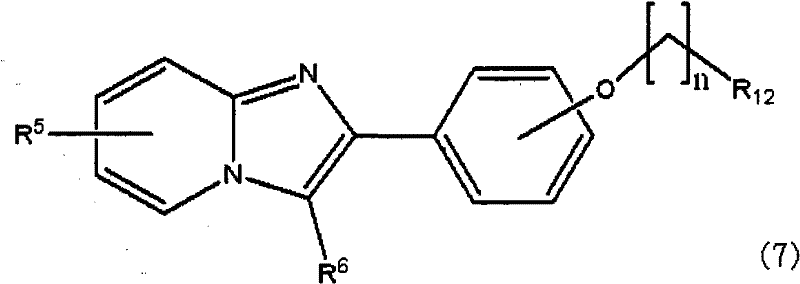
中的任一个表示的化合物或其盐。Any one of the compounds or salts thereof.
在上述各式中,R5选自以下的基团:卤素取代基,具有1-4个碳原子的烷基取代基,烷基链具有1-4个碳原子的烷氧基取代基和羟基,R6选自以下的基团:氰基取代基,具有1-4个碳原子的烷基取代基和卤素取代基,且R7选自以下的基团:羟基,卤素取代基和下式(4)表示的取代基:In each of the above formulas, R is selected from the group consisting of halogen substituents, alkyl substituents having 1-4 carbon atoms, alkoxy substituents having 1-4 carbon atoms in the alkyl chain, and hydroxyl , R6 is selected from the following groups: cyano substituents, alkyl substituents having 1-4 carbon atoms and halogen substituents, and R7 is selected from the following groups: hydroxyl, halogen substituents and the following formula Substituents represented by (4):

其中R8为氢,卤素取代基或羟基,且n是1-4的整数。wherein R 8 is hydrogen, a halogen substituent or a hydroxyl group, and n is an integer of 1-4.
R9选自以下的基团:非放射性卤素取代基,硝基,烷基链具有1-4个碳原子的三烷基甲锡烷基取代基或三苯基甲锡烷基,R10选自以下的基团:非放射性卤素取代基,硝基,烷基链具有1-4个碳原子的三烷基甲锡烷基取代基或三苯基甲锡烷基,R11选自以下的基团:非放射性卤素取代基,硝基取代基,烷基链具有1-4个碳原子的三烷基甲锡烷基取代基和三苯基甲锡烷基取代基,且R12选自以下的基团:非放射性卤素取代基,甲磺酰氧基取代基,三氟甲磺酰氧基取代基和芳香族磺酰氧基取代基。 R9 is selected from the following groups: non-radioactive halogen substituent, nitro, trialkylstannyl substituent or triphenylstannyl with alkyl chain having 1-4 carbon atoms, R10 is selected from Groups selected from the group consisting of non-radioactive halogen substituents, nitro, trialkylstannyl substituents or triphenylstannyl groups having an alkyl chain of 1 to 4 carbon atoms, R selected from Groups: non-radioactive halogen substituents, nitro substituents, trialkylstannyl substituents and triphenylstannyl substituents with an alkyl chain having 1 to 4 carbon atoms, and R is selected from The following groups: non-radioactive halogen substituents, methanesulfonyloxy substituents, trifluoromethanesulfonyloxy substituents and aromatic sulfonyloxy substituents.
发明效果Invention effect
本发明提供了一种对淀粉样蛋白具有亲和性并且具有优异的使生物体中的淀粉样蛋白显像的能力的新化合物,以及用于检测沉积在生物组织上的淀粉样蛋白的试剂。The present invention provides a novel compound having an affinity for amyloid and an excellent ability to image amyloid in a living body, and a reagent for detecting amyloid deposited on biological tissue.
附图说明Description of drawings
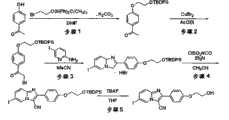
图1是2-[4′-(2″-羟基乙氧基)苯基]-6-碘代-3-甲基咪唑并[1,2-a]吡啶(非放射性碘化形式)的合成路线。Figure 1 is the synthesis of 2-[4′-(2″-hydroxyethoxy)phenyl]-6-iodo-3-methylimidazo[1,2-a]pyridine (non-radioactive iodinated form) route.
图2是6-三丁基甲锡烷基-2-[4′-(2″-羟基乙氧基)苯基]-3-甲基咪唑并[1,2-a]吡啶的合成路线。Fig. 2 is the synthetic route of 6-tributylstannyl-2-[4'-(2"-hydroxyethoxy)phenyl]-3-methylimidazo[1,2-a]pyridine.
图3是2-(4′-氟苯基)-6-碘代-3-甲基咪唑并[1,2-a]吡啶(非放射性碘化形式)的合成路线。Figure 3 is a synthetic route to 2-(4'-fluorophenyl)-6-iodo-3-methylimidazo[1,2-a]pyridine (non-radioactively iodinated form).
图4是6-三丁基甲锡烷基-2-(4′-氟苯基)-3-甲基咪唑并[1,2-a]吡啶的合成路线。Fig. 4 is a synthetic route of 6-tributylstannyl-2-(4'-fluorophenyl)-3-methylimidazo[1,2-a]pyridine.
图5是2-(4′-羟基苯基)-6-碘代-3-甲基咪唑并[1,2-a]吡啶(非放射性碘化形式)的合成路线。Figure 5 is a synthetic route to 2-(4'-hydroxyphenyl)-6-iodo-3-methylimidazo[1,2-a]pyridine (non-radioactively iodinated form).
图6是6-三丁基甲锡烷基-2-(4′-羟基苯基)-3-甲基咪唑并[1,2-a]吡啶的合成路线。Fig. 6 is a synthetic route of 6-tributylstannyl-2-(4'-hydroxyphenyl)-3-methylimidazo[1,2-a]pyridine.
图7是3-氰基-2-[4′-(2″-羟基乙氧基)苯基]-6-碘咪唑并[1,2-a]吡啶(非放射性碘化形式)的合成路线。Figure 7 is the synthetic route of 3-cyano-2-[4'-(2"-hydroxyethoxy)phenyl]-6-iodoimidazo[1,2-a]pyridine (non-radioactive iodized form) .
图8是6-三丁基甲锡烷基-3-氰基-2-[4′-(2″-羟基乙氧基)苯基]-咪唑并[1,2-a]吡啶的合成路线。Fig. 8 is a synthetic route of 6-tributylstannyl-3-cyano-2-[4'-(2"-hydroxyethoxy)phenyl]-imidazo[1,2-a]pyridine.
图9是2-[4′-(2″-氟乙氧基)苯基]-3-碘代-6-甲氧基咪唑并[1,2-a]吡啶(非放射性碘化形式)的合成路线。Figure 9 is 2-[4'-(2"-fluoroethoxy)phenyl]-3-iodo-6-methoxyimidazo[1,2-a]pyridine (non-radioactive iodinated form) synthetic route.
图10(a)是注射2-(4′-氟苯基)-6-[123I]碘-3-甲基咪唑并[1,2-a]吡啶后的脑切片的放射自显影图,图10(b)是硫磺素T染色的样品的荧光显微镜图像(注射淀粉样蛋白混悬液的位点的放大图)。Figure 10(a) is an autoradiogram of a brain slice after injection of 2-(4'-fluorophenyl)-6-[ 123I ]iodo-3-methylimidazo[1,2-a]pyridine, Fig. 10(b) is a fluorescence microscope image of a Thioflavin T-stained sample (enlarged view of the site where the amyloid suspension was injected).
图11(a)是注射2-[4′-(2″-羟基乙氧基)苯基]-6-[123I]碘-3-甲基咪唑并[1,2-a]吡啶后的脑切片的放射自显影图,图11(b)是硫磺素T染色的样品的荧光显微镜图像(注射淀粉样蛋白混悬液的位点的放大图)。Fig. 11(a) is after injection of 2-[4′-(2″-hydroxyethoxy)phenyl]-6-[ 123I ]iodo-3-methylimidazo[1,2-a]pyridine Autoradiography of brain slices, Fig. 11(b) is a fluorescence microscope image of a Thioflavin T-stained sample (magnified view of the site where the amyloid suspension was injected).
图12(a)是注射2-(4′-羟基苯基)-6-[123I]碘-3-甲基咪唑并[1,2-a]吡啶后的脑切片的放射自显影图,图12(b)是硫磺素T染色的样品的荧光显微镜图像(注射淀粉样蛋白混悬液的位点的放大图)。图13(a)是注射3-氰基-2-[4′-(2″-羟基乙氧基)苯基]-6-[123I]碘咪唑并[1,2-a]吡啶后的脑切片的放射自显影图,图13(b)是硫磺素T染色的样品的荧光显微镜图像(注射淀粉样蛋白混悬液的位点的放大图)。Figure 12(a) is an autoradiogram of a brain slice after injection of 2-(4'-hydroxyphenyl)-6-[ 123I ]iodo-3-methylimidazo[1,2-a]pyridine, Fig. 12(b) is a fluorescence microscope image of a Thioflavin T-stained sample (enlarged view of the site where the amyloid suspension was injected). Fig. 13(a) is after injecting 3-cyano-2-[4′-(2″-hydroxyethoxy)phenyl]-6-[ 123I ]iodoimidazo[1,2-a]pyridine Autoradiography of brain slices, Fig. 13(b) is a fluorescence microscope image of a sample stained with Thioflavin T (enlarged view of the site where the amyloid suspension was injected).
具体实施方式Detailed ways
(放射性卤素标记化合物的前体化合物的合成)(Synthesis of Precursor Compounds of Radioactive Halogen Labeled Compounds)
以下,以6-三丁基甲锡烷基-2-[4′-(2″-羟基乙氧基)苯基]-3-甲基咪唑并[1,2-a]吡啶的合成为例,描述本发明化合物的合成方法。Below, take the synthesis of 6-tributylstannyl-2-[4'-(2"-hydroxyethoxy) phenyl]-3-methylimidazo[1,2-a]pyridine as an example, describe Synthetic methods of compounds of the present invention.
为了合成6-三丁基甲锡烷基-2-[4′-(2″-羟基乙氧基)苯基]-3-甲基咪唑并[1,2-a]吡啶,首先使4′-羟基苯丙酮与溴化铜反应,以制备2-溴-4′-羟基苯丙酮(图1,步骤1)。该反应可以根据常规方法进行,例如在文献King,L.Carroll & Ostrum,G.Kenneth,Journal ofOrganic Chemistry,1964,29(12),p.3459-3461中描述的方法。In order to synthesize 6-tributylstannyl-2-[4′-(2″-hydroxyethoxy)phenyl]-3-methylimidazo[1,2-a]pyridine, the 4′-hydroxy Propiophenone reacts with copper bromide to prepare 2-bromo-4'-hydroxypropiophenone (Fig. 1, step 1). This reaction can be carried out according to conventional methods, for example in literature King, L.Carroll & Ostrum, G.Kenneth , the method described in Journal of Organic Chemistry, 1964, 29(12), p.3459-3461.
然后,使如上制备的2-溴-4′-羟基苯丙酮与2-氨基-5-碘吡啶反应,以制备2-(4′-羟基苯基)-6-碘代-3-甲基咪唑并[1,2-a]吡啶(图1,步骤2)。该步骤可以根据例如以下方法进行。Then, 2-bromo-4'-hydroxypropiophenone prepared as above was reacted with 2-amino-5-iodopyridine to prepare 2-(4'-hydroxyphenyl)-6-iodo-3-methylimidazole and[1,2-a]pyridine (Figure 1, step 2). This step can be performed according to, for example, the following method.
首先,将2-溴-4′-羟基苯丙酮和2-氨基-5-碘吡啶溶解于惰性溶剂诸如乙腈中,并允许彼此在回流温度反应2-6小时,得到2-(4′-羟基苯基)-6-碘代-3-甲基咪唑并[1,2-a]吡啶的氢溴酸盐,为白色沉淀物。在该情况中使用的溶剂可以是乙腈或通常用于类似反应的其它溶剂,例如甲醇和丙酮。反应温度可以是允许回流的温度,例如在溶剂是乙腈时为110℃。使用的溶剂的量可以是足以实现反应的量,然而,予以说明,如果溶剂太多,则难以获得反应产物的沉淀物。例如,当使用相当于10mmol量的2-溴-4′-羟基苯丙酮进行反应时,所使用的溶剂的量可以是约40-80mL。First, 2-bromo-4'-hydroxypropiophenone and 2-amino-5-iodopyridine are dissolved in an inert solvent such as acetonitrile and allowed to react with each other at reflux temperature for 2-6 hours to give 2-(4'-hydroxy Phenyl)-6-iodo-3-methylimidazo[1,2-a]pyridine hydrobromide as a white precipitate. The solvent used in this case may be acetonitrile or other solvents commonly used for similar reactions, such as methanol and acetone. The reaction temperature may be a temperature allowing reflux, for example, 110°C when the solvent is acetonitrile. The amount of the solvent used may be an amount sufficient to achieve the reaction, however, it is noted that if the solvent is too much, it is difficult to obtain a precipitate of the reaction product. For example, when the reaction is carried out using 2-bromo-4'-hydroxypropiophenone in an amount corresponding to 10 mmol, the amount of the solvent used may be about 40-80 mL.
然后,可以将反应液过滤,以回收沉淀物。将该白色沉淀物混悬在甲醇/水(1∶1)的混合液中。然后,向其中加入相对于混悬的沉淀物为较大过量的碳酸氢钠饱和水溶液,以释放作为沉淀物的2-(4′-羟基苯基)-6-碘代-3-甲基咪唑并[1,2-a]吡啶。将新生成的沉淀物过滤,以回收作为本步骤的目标化合物的2-(4′-羟基苯基)-6-碘代-3-甲基咪唑并[1,2-a]吡啶,(图1,步骤2)。对于甲醇/水的混合液的量没有具体限制,只要它足以实现反应即可。然而,予以说明,如果混合液的量太大,则会妨碍产物的析出。例如,当使用相当于10mmol量的2-溴-4′-羟基苯丙酮时,甲醇/水的混合液可以以约40-100mL的量使用。对于碳酸氢钠的量没有具体限制,只要其相对于作为反应底物的上述沉淀物为较大过量即可。例如,当反应在上述条件下进行时,加入到反应液中的碳酸氢钠饱和水溶液的量可以为约50mL。Then, the reaction liquid can be filtered to recover the precipitate. The white precipitate was suspended in a methanol/water (1:1) mixture. Then, a large excess of saturated aqueous sodium bicarbonate solution was added thereto with respect to the suspended precipitate to release 2-(4'-hydroxyphenyl)-6-iodo-3-methylimidazole as the precipitate And[1,2-a]pyridine. The newly generated precipitate was filtered to recover 2-(4'-hydroxyphenyl)-6-iodo-3-methylimidazo[1,2-a]pyridine as the target compound of this step, (Fig. 1, step 2). There is no particular limitation on the amount of the methanol/water mixed liquid as long as it is sufficient to effect the reaction. However, it should be noted that if the amount of the mixed solution is too large, the precipitation of the product will be hindered. For example, when 2-bromo-4'-hydroxypropiophenone is used in an amount corresponding to 10 mmol, a methanol/water mixed solution can be used in an amount of about 40-100 mL. There is no specific limitation on the amount of sodium bicarbonate as long as it is in a large excess relative to the above-mentioned precipitate as the reaction substrate. For example, when the reaction is carried out under the above conditions, the amount of saturated aqueous sodium bicarbonate solution added to the reaction liquid may be about 50 mL.
在此,使2-溴乙醇和叔丁基二苯基氯硅烷(TBDPSC1)彼此反应,以制备1-溴-2-(叔丁基二苯基甲硅烷氧基)乙烷(图1,步骤3)。在该情况中,反应可以根据常规方法进行,例如在文献(Organic Syntheses,Coll.Vol.10,p.170(2004);Vol.79,p.59(2002))中描述的方法。Here, 2-bromoethanol and tert-butyldiphenylchlorosilane (TBDPSC1) are reacted with each other to prepare 1-bromo-2-(tert-butyldiphenylsilyloxy)ethane (Figure 1, step 3). In this case, the reaction can be performed according to a conventional method, for example, a method described in literature (Organic Syntheses, Coll. Vol.10, p.170 (2004); Vol.79, p.59 (2002)).
然后,将上述制备的2-(4′-羟基苯基)-6-碘代-3-甲基咪唑并[1,2-a]吡啶充分干燥,溶解于N,N-二甲基甲酰胺,用其中加入碳酸钾和1-溴-2-(叔丁基二苯基甲硅烷氧基)乙烷。在将该混合物在大约90℃搅拌约2小时后,加入饱和氯化钠水溶液,随后用乙酸乙酯萃取,浓缩乙酸乙酯层,进行色谱纯化,得到2-[4′-(2″-叔丁基二苯基甲硅烷氧基乙氧基)苯基]-6-碘代-3-甲基咪唑并[1,2-a]吡啶(图1,步骤4)。碳酸钾的量可以是可中和反应过程中由1-溴-2-(叔丁基二苯基甲硅烷氧基)乙烷生成的氢溴酸的量,并典型地是另一种原料1-溴-2-(叔丁基二苯基甲硅烷氧基)乙烷的约2~3倍的摩尔比。另外,1-溴-2-(叔丁基二苯基甲硅烷氧基)乙烷可以以相对于反应底物过量的量使用,并典型地为反应底物2-(4′-羟基苯基)-6-碘代-3-甲基咪唑并[1,2-a]吡啶的约1.5倍的摩尔比。Then, the 2-(4′-hydroxyphenyl)-6-iodo-3-methylimidazo[1,2-a]pyridine prepared above was fully dried and dissolved in N,N-dimethylformamide , to which potassium carbonate and 1-bromo-2-(tert-butyldiphenylsilyloxy)ethane were added. After the mixture was stirred at about 90°C for about 2 hours, saturated aqueous sodium chloride solution was added, followed by extraction with ethyl acetate, and the ethyl acetate layer was concentrated and chromatographically purified to give 2-[4'-(2"-tert Butyldiphenylsilyloxyethoxy)phenyl]-6-iodo-3-methylimidazo[1,2-a]pyridine (Figure 1, step 4).The amount of potassium carbonate can be Can neutralize the amount of hydrobromic acid generated from 1-bromo-2-(tert-butyldiphenylsilyloxy)ethane during the reaction and is typically another starting material 1-bromo-2-( 2-3 times the molar ratio of tert-butyldiphenylsilyloxy)ethane.In addition, 1-bromo-2-(tert-butyldiphenylsilyloxy)ethane can be relative to the reaction The amount of substrate is used in excess, and is typically about 1.5 times the mole of the reaction substrate 2-(4'-hydroxyphenyl)-6-iodo-3-methylimidazo[1,2-a]pyridine Compare.
然后,使用氟化四丁铵将得到的2-[4′-(2″-叔丁基二苯基甲硅烷氧基乙氧基)苯基]-6-碘代-3-甲基咪唑并[1,2-a]吡啶的叔丁基二苯基甲硅烷基脱保护,得到2-[4′-(2″-羟基乙氧基)苯基]-6-碘代-3-甲基咪唑并[1,2-a]吡啶(图1,步骤5)。在该情况中,反应可以根据常规方法进行,例如在文献(Organic Syntheses,Coll.Vol.9,p.417(1998);Vol.74,p.248(1997))中描述的方法。Then, the obtained 2-[4′-(2″-tert-butyldiphenylsilyloxyethoxy)phenyl]-6-iodo-3-methylimidazo Deprotection of the tert-butyldiphenylsilyl group of [1,2-a]pyridine affords 2-[4′-(2″-hydroxyethoxy)phenyl]-6-iodo-3-methyl Imidazo[1,2-a]pyridine (Figure 1, step 5). In this case, the reaction can be performed according to a conventional method, for example, a method described in literature (Organic Syntheses, Coll. Vol. 9, p. 417 (1998); Vol. 74, p. 248 (1997)).
将得到的2-[4′-(2″-羟基乙氧基)]苯基]-6-碘代-3-甲基咪唑并[1,2-a]吡啶溶解于二噁烷,用溶液加入三乙胺,随后加入双(三丁基锡)和催化剂量的四(三苯膦)钯。将该反应液在大约90℃加热以进行反应约24小时。然后将溶剂蒸馏掉,并进行色谱纯化,得到目标化合物6-三丁基甲锡烷基-2-[4′-(2″-羟基乙氧基)苯基]-3-甲基咪唑并[1,2-a]吡啶(图2,步骤1)。在该情况中使用的双(三丁基锡)的量可以是满足其相对于反应底物过量这一条件的量,具体地,其相对于反应底物2-[4′-(2″-羟基乙氧基)苯基]-6-碘代-3-甲基咪唑并[1,2-a]吡啶为约1.5倍的摩尔比。The obtained 2-[4′-(2″-hydroxyethoxy)]phenyl]-6-iodo-3-methylimidazo[1,2-a]pyridine was dissolved in dioxane, and the solution Add triethylamine, then add bis(tributyltin) and tetrakis(triphenylphosphine)palladium of catalytic amount.The reaction solution is heated at about 90°C to carry out the reaction for about 24 hours.Then the solvent is distilled off and chromatographically purified , to obtain target compound 6-tributylstannyl-2-[4'-(2"-hydroxyethoxy) phenyl]-3-methylimidazo[1,2-a]pyridine (Fig. 2, step 1). The amount of bis(tributyltin) used in this case may be such that it is in excess relative to the reaction substrate, specifically, it is relative to the reaction substrate 2-[4′-(2″-hydroxyethyl Oxy)phenyl]-6-iodo-3-methylimidazo[1,2-a]pyridine in a molar ratio of about 1.5 times.
当得到的化合物的咪唑并吡啶环的6位上的取代基是三丁基甲锡烷基取代基以外的三烷基甲锡烷基取代基时,可以使用适合目的的各种双(三烷基锡)来代替图2的步骤1中的双(三丁基锡)。例如,当合成6位上的取代基是三甲基甲锡烷基取代基的化合物时,可以在图2的步骤1中使用双(三甲基锡)进行与上述类似的反应。When the substituent at the 6-position of the imidazopyridine ring of the obtained compound is a trialkylstannyl substituent other than a tributylstannyl substituent, various bis(trialkyltin) suitable for the purpose can be used. ) to replace bis(tributyltin) in step 1 of Figure 2. For example, when synthesizing a compound in which the substituent at the 6-position is a trimethylstannyl substituent, a reaction similar to the above can be performed using bis(trimethyltin) in step 1 of FIG. 2 .
可以使用吡啶环上的碘的结合位置各不相同的各种化合物来代替图1的步骤2中使用的2-氨基-5-碘吡啶,得到咪唑并吡啶环上的官能团的结合位置是6位碳以外的碳原子的化合物。例如,当官能团的结合位置是咪唑并吡啶环的8位碳时,可以使用2-氨基-3-碘吡啶来代替图1的步骤2中的2-氨基-5-碘吡啶。Instead of the 2-amino-5-iodopyridine used in
(放射性卤素标记化合物的合成方法)(Synthesis method of radioactive halogen-labeled compound)
下面以放射性碘标记的化合物的合成为例,描述根据本发明另一个方面的放射性卤素标记的化合物的制备方法。The preparation method of the radioactive halogen-labeled compound according to another aspect of the present invention is described below by taking the synthesis of the radioactive iodine-labeled compound as an example.
可以如下合成放射性碘标记的化合物:将按照上述操作制备的标记前体化合物溶解于惰性有机溶剂中,向其中加入通过已知方法得到的[123I]碘化钠溶液等,用其中加入酸和氧化剂进行反应。作为溶解标记前体化合物的惰性有机溶剂,可以使用与标记前体、[123I]碘化钠等之间没有反应性的各种溶剂,优选可以使用甲醇。A radioactively iodine-labeled compound can be synthesized by dissolving the labeling precursor compound prepared by the above operation in an inert organic solvent, adding thereto a [ 123 I]sodium iodide solution or the like obtained by a known method, adding an acid and The oxidizing agent reacts. As an inert organic solvent for dissolving the labeling precursor compound, various solvents that have no reactivity with the labeling precursor, [ 123 I]sodium iodide, etc. can be used, and methanol is preferably used.
作为酸,可以使用各种酸,优选盐酸。As the acid, various acids can be used, preferably hydrochloric acid.
对于氧化剂没有特别的限制,只要它可以使反应液中的碘氧化即可,优选过氧化氢或过乙酸。氧化剂的添加量可以是足以氧化反应液中的碘的量。The oxidizing agent is not particularly limited as long as it can oxidize iodine in the reaction liquid, preferably hydrogen peroxide or peracetic acid. The amount of the oxidizing agent added may be an amount sufficient to oxidize iodine in the reaction liquid.
可以通过用符合目的的放射性卤素来标记符合合成目的的标记前体,来合成用碘以外的放射性卤素标记的化合物。例如,为了合成2-(4′-[18F]氟苯基)-6-碘代-3-甲基咪唑并[1,2-a]吡啶,可以使标记前体2-(4′-硝基苯基)-6-碘代-3-甲基咪唑并[1,2-a]吡啶与[18F]氟离子在相转移催化剂和碳酸钾的存在下反应。A compound labeled with a radioactive halogen other than iodine can be synthesized by labeling a labeling precursor suitable for the synthesis purpose with a radioactive halogen suitable for the purpose. For example, for the synthesis of 2-(4′-[ 18 F]fluorophenyl)-6-iodo-3-methylimidazo[1,2-a]pyridine, the labeling precursor 2-(4′- Nitrophenyl)-6-iodo-3-methylimidazo[1,2-a]pyridine was reacted with [ 18 F]fluoride in the presence of a phase transfer catalyst and potassium carbonate.
(本发明诊断剂的制备方法和使用方法)(Preparation method and use method of diagnostic agent of the present invention)
本发明的诊断剂,可以与其它一般公知的放射性诊断剂同样地,制备成将本发明的放射性卤素标记的化合物混合入根据希望任选调整至适当pH的水或生理盐水或林格液等而成的溶液。此时,应将本发明化合物的浓度调整至不超过确保本发明化合物的稳定性的浓度。本发明化合物的剂量没有特别限定,只要它足以获得所给予的药剂的分布图像即可。例如,在碘-123(123I)标记的化合物和氟-18(18F)标记的化合物的场合,可以以静脉或局部给予约50~600MBq/60kg成人体重。所给予药剂的分布可以通过公知的方法显像。例如,可以通过SPECT装置将碘-123(123I)标记的化合物显像,另外可以通过PET装置将氟-18(18F)标记的化合物显像。The diagnostic agent of the present invention can be prepared in the same manner as other generally known radioactive diagnostic agents by mixing the radioactive halogen-labeled compound of the present invention with water or physiological saline or Ringer's solution, etc., optionally adjusted to an appropriate pH as desired. into the solution. At this time, the concentration of the compound of the present invention should be adjusted to not exceed the concentration ensuring the stability of the compound of the present invention. The dose of the compound of the present invention is not particularly limited as long as it is sufficient to obtain a profile of the distribution of the administered agent. For example, in the case of iodine-123 ( 123 I)-labeled compounds and fluorine-18 ( 18 F)-labeled compounds, about 50 to 600 MBq/60 kg adult body weight can be administered intravenously or locally. The distribution of administered agents can be visualized by known methods. For example, an iodine-123 ( 123 I)-labeled compound can be imaged by a SPECT apparatus, and a fluorine-18 ( 18 F)-labeled compound can be imaged by a PET apparatus.
下面,通过实施例、比较例和参考例更详细地描述本发明。但是,这些例子并不限制本发明的范围。同时,在下列实施例中,实验中所用各化合物的名称如表1中所定义。Hereinafter, the present invention is described in more detail by way of Examples, Comparative Examples and Reference Examples. However, these examples do not limit the scope of the present invention. Meanwhile, in the following examples, the names of the respective compounds used in the experiments are as defined in Table 1.
表1Table 1
实施例1:2-[4′-(2″-羟基乙氧基)苯基]-6-碘代-3-甲基咪唑并Example 1: 2-[4'-(2"-hydroxyethoxy)phenyl]-6-iodo-3-methylimidazo [1,2-a]吡啶(非放射性碘化形式)的合成Synthesis of [1,2-a]pyridine (non-radioactive iodinated form)
向6.26g(相当于27.9mmol)的溴化铜加入40mL乙酸乙酯以得到混悬液,向其中加入2.00g(相当于13.3mmol)的4′-羟基苯丙酮。然后,将得到的混合物加热回流。在2小时后,将反应混合物冷却到室温并过滤。将得到的滤液减压浓缩。得到的粗产物通过快速硅胶柱色谱法纯化(洗脱溶剂:己烷/乙酸乙酯=3/1),得到3.49g(相当于15.2mmol)的2-溴-4′-羟基苯丙酮(图1,步骤1)。To 6.26 g (corresponding to 27.9 mmol) of copper bromide was added 40 mL of ethyl acetate to obtain a suspension, to which 2.00 g (corresponding to 13.3 mmol) of 4'-hydroxypropiophenone was added. Then, the resulting mixture was heated to reflux. After 2 hours, the reaction mixture was cooled to room temperature and filtered. The obtained filtrate was concentrated under reduced pressure. The obtained crude product was purified by flash silica gel column chromatography (elution solvent: hexane/ethyl acetate=3/1) to obtain 3.49 g (equivalent to 15.2 mmol) of 2-bromo-4'-hydroxypropiophenone (Fig. 1, step 1).
将734mg(相当于3.20mmol)的2-溴-4′-羟基苯丙酮和705mg(相当于3.20mmol)的2-氨基-5-碘吡啶溶解于15mL的乙腈中。得到的溶液在油浴中在110℃加热回流4小时。在反应完成后,将反应液冷却到室温,并过滤和回收沉淀物。沉淀物用乙腈洗涤并减压干燥。将得到的粗结晶混悬在3.0mL水和1.0mL甲醇的混合液中。然后,向其中加入约10mL的饱和碳酸氢钠溶液,并使用超声洗涤机将混合物声处理5分钟。从得到的混合物过滤和回收沉淀物,用水充分洗涤,并减压干燥,得到226mg(相当于0.645mmol)的2-(4′-羟基苯基)-6-碘代-3-甲基咪唑并[1,2-a]吡啶(图1,步骤2)。734 mg (corresponding to 3.20 mmol) of 2-bromo-4′-hydroxypropiophenone and 705 mg (corresponding to 3.20 mmol) of 2-amino-5-iodopyridine were dissolved in 15 mL of acetonitrile. The resulting solution was heated to reflux at 110° C. in an oil bath for 4 hours. After the reaction was completed, the reaction liquid was cooled to room temperature, and the precipitate was filtered and recovered. The precipitate was washed with acetonitrile and dried under reduced pressure. The obtained crude crystals were suspended in a mixed solution of 3.0 mL of water and 1.0 mL of methanol. Then, about 10 mL of saturated sodium bicarbonate solution was added thereto, and the mixture was sonicated for 5 min using an ultrasonic washer. The precipitate was filtered and recovered from the resulting mixture, washed well with water, and dried under reduced pressure to obtain 226 mg (equivalent to 0.645 mmol) of 2-(4'-hydroxyphenyl)-6-iodo-3-methylimidazo [1,2-a]pyridine (Figure 1, step 2).
另外,将2.50g(相当于20.0mmol)的2-溴乙醇和2.72g(相当于40.0mmol)的咪唑溶解于10mL的N,N-二甲基甲酰胺(DMF)中,并冷却到0℃。然后,向其中加入5.50g(相当于20.0mmol)的叔丁基二苯基氯硅烷(TBDPSC1)。在将反应混合物室温搅拌18小时后,加入饱和氯化钠水溶液,用乙酸乙酯萃取3次。合并的乙酸乙酯层用无水硫酸钠干燥,并减压浓缩。将得到的粗产物通过硅胶柱色谱法纯化(洗脱溶剂:己烷/乙酸乙酯=10/1),得到7.04g(相当于19.4mmol)的1-溴-2-(叔丁基二苯基甲硅烷氧基)乙烷(图1,步骤3)。Separately, 2.50 g (corresponding to 20.0 mmol) of 2-bromoethanol and 2.72 g (corresponding to 40.0 mmol) of imidazole were dissolved in 10 mL of N,N-dimethylformamide (DMF), and cooled to 0°C . Then, 5.50 g (corresponding to 20.0 mmol) of tert-butyldiphenylchlorosilane (TBDPSC1) was added thereto. After the reaction mixture was stirred at room temperature for 18 hours, a saturated aqueous sodium chloride solution was added and extracted 3 times with ethyl acetate. The combined ethyl acetate layers were dried over anhydrous sodium sulfate, and concentrated under reduced pressure. The obtained crude product was purified by silica gel column chromatography (elution solvent: hexane/ethyl acetate=10/1) to obtain 7.04 g (corresponding to 19.4 mmol) of 1-bromo-2-(tert-butyldiphenyl silyloxy)ethane (Figure 1, step 3).
将220mg(相当于0.628mmol)的2-(4′-羟基苯基)-6-碘代-3-甲基咪唑并[1,2-a]吡啶溶解于3.0mL的N,N-二甲基甲酰胺中,用其中加入260mg(相当于1.88mmol)的碳酸钾。然后,向其中加入251mg(相当于0.691mmol)的1-溴-2-(叔丁基二苯基甲硅烷氧基)乙烷。在将反应混合物在90℃搅拌2小时后,加入饱和氯化铵水溶液,用乙酸乙酯萃取3次。合并的乙酸乙酯层用无水硫酸钠干燥,并减压浓缩。得到的粗产物通过硅胶柱色谱法纯化(洗脱溶剂:己烷/乙酸乙酯=3/1),得到344mg(相当于0.544mmol)的2-[4′-(2″-叔丁基二苯基甲硅烷氧基乙氧基)苯基]-6-碘代-3-甲基咪唑并[1,2-a]吡啶(图1,步骤4)。Dissolve 220 mg (equivalent to 0.628 mmol) of 2-(4′-hydroxyphenyl)-6-iodo-3-methylimidazo[1,2-a]pyridine in 3.0 mL of N,N-dimethyl 260 mg (corresponding to 1.88 mmol) of potassium carbonate was added thereto. Then, 251 mg (equivalent to 0.691 mmol) of 1-bromo-2-(tert-butyldiphenylsilyloxy)ethane was added thereto. After the reaction mixture was stirred at 90°C for 2 hours, a saturated aqueous ammonium chloride solution was added, and extracted 3 times with ethyl acetate. The combined ethyl acetate layers were dried over anhydrous sodium sulfate, and concentrated under reduced pressure. The obtained crude product was purified by silica gel column chromatography (elution solvent: hexane/ethyl acetate = 3/1) to obtain 344 mg (equivalent to 0.544 mmol) of 2-[4'-(2"-tert-butyldi phenylsilyloxyethoxy)phenyl]-6-iodo-3-methylimidazo[1,2-a]pyridine (Figure 1, step 4).
将344mg(相当于0.544mmol)的2-[4′-(2″-叔丁基二苯基甲硅烷氧基乙氧基)苯基]-6-碘代-3-甲基咪唑并[1,2-a]吡啶溶解于1.0mL的四氢呋喃,用其中加入0.65mL的含1.0mol/L四丁基氟化铵的四氢呋喃溶液。在将反应混合物室温搅拌30分钟后,加入氯化铵水溶液,随后加入5.0mL水和2.0mL乙腈。然后将沉淀物过滤。将过滤的沉淀物依次用水和乙腈洗涤,得到166mg(相当于0.421mmol)的2-[4′-(2″-羟基乙氧基)苯基]-6-碘代-3-甲基咪唑并[1,2-a]吡啶(图1,步骤5)。344mg (equivalent to 0.544mmol) of 2-[4'-(2"-tert-butyldiphenylsilyloxyethoxy)phenyl]-6-iodo-3-methylimidazo[1 , 2-a] pyridine is dissolved in the tetrahydrofuran of 1.0mL, the tetrahydrofuran solution containing 1.0mol/L tetrabutylammonium fluoride is added wherein with 0.65mL.After the reaction mixture was stirred at room temperature for 30 minutes, ammonium chloride aqueous solution was added, Subsequently, 5.0 mL of water and 2.0 mL of acetonitrile were added. The precipitate was then filtered. The filtered precipitate was washed with water and acetonitrile successively to obtain 166 mg (equivalent to 0.421 mmol) of 2-[4'-(2"-hydroxyethoxy ) phenyl]-6-iodo-3-methylimidazo[1,2-a]pyridine (Figure 1, step 5).
得到的2-[4′-(2″-羟基乙氧基)苯基]-6-碘代-3-甲基咪唑并[1,2-a]吡啶的NMR测定结果(内标物:四甲基硅烷)如下所示。The NMR measurement result (internal standard substance: four Methylsilane) is shown below.
使用的NMR装置:JNM-ECP-500(由日本电子株式会社(JEOL)制)NMR apparatus used: JNM-ECP-500 (manufactured by JEOL)
1H-NMR(溶剂:二甲亚砜-d6;共振频率:500MHz):δ8.59(s,1H),7.01(d,J=7.3Hz,2H),7.38(s,2H),7.03(d,J=7.3Hz,2H),4.87(t,J=5.5Hz,1H),4.02(t,J=5.0Hz,2H),3.73(dt,J=5.5,5.0Hz,2H),2.60(s,2H)。 1 H-NMR (solvent: dimethylsulfoxide-d6; resonance frequency: 500MHz): δ8.59(s, 1H), 7.01(d, J=7.3Hz, 2H), 7.38(s, 2H), 7.03( d, J=7.3Hz, 2H), 4.87(t, J=5.5Hz, 1H), 4.02(t, J=5.0Hz, 2H), 3.73(dt, J=5.5, 5.0Hz, 2H), 2.60( s, 2H).
13C-NMR(溶剂:二甲亚砜-d6,共振频率:125MHz):δ158.9,142.7,142.1,131.8,129.8,129.6,127.6,118.4,116.6,115.3,76.3,70.3,60.4,10.2。 13 C-NMR (solvent: dimethyl sulfoxide-d6, resonance frequency: 125 MHz): δ158.9, 142.7, 142.1, 131.8, 129.8, 129.6, 127.6, 118.4, 116.6, 115.3, 76.3, 70.3, 60.4, 10.2.
实施例2:6-三丁基甲锡烷基-2-[4′-(2″-羟基乙氧基)苯基]-3-Example 2: 6-tributylstannyl-2-[4'-(2"-hydroxyethoxy)phenyl]-3- 甲基咪唑并[1,2-a]吡啶的合成Synthesis of Methylimidazo[1,2-a]pyridine
将实施例1中得到的50.0mg(相当于0.127mmol)的2-[4′-(2″-羟基乙氧基)苯基]-6-碘代-3-甲基咪唑并[1,2-a]吡啶溶解于3.0mL的二噁烷,用其中加入0.50mL的三乙胺。然后,向其中加入0.10mL(相当于0.19mmol)的双(三丁基锡)和9.7mg(催化剂量)的四(三苯膦)钯。在将反应混合物在90℃搅拌18小时后,将溶剂减压蒸馏掉。残余物通过快速硅胶柱色谱法纯化(洗脱溶剂:己烷/乙酸乙酯=2/1),得到52.9mg(相当于0.0949mmol)的6-三丁基甲锡烷基-2-[4′-(2″-羟基乙氧基)苯基]-3-甲基咪唑并[1,2-a]吡啶(图2,步骤1)。50.0mg (corresponding to 0.127mmol) of 2-[4'-(2"-hydroxyethoxy)phenyl]-6-iodo-3-methylimidazo[1,2 -a] Pyridine is dissolved in 3.0 mL of dioxane, and 0.50 mL of triethylamine is added thereto. Then, 0.10 mL (equivalent to 0.19 mmol) of bis(tributyltin) and 9.7 mg (catalyst amount) of Tetrakis(triphenylphosphine)palladium. After the reaction mixture was stirred at 90° C. for 18 hours, the solvent was distilled off under reduced pressure. The residue was purified by flash silica gel column chromatography (elution solvent: hexane/ethyl acetate=2/ 1), to obtain 52.9mg (equivalent to 0.0949mmol) of 6-tributylstannyl-2-[4'-(2"-hydroxyethoxy) phenyl]-3-methylimidazo[1,2 - a] pyridine (Figure 2, step 1).
得到的6-三丁基甲锡烷基-2-[4′-(2″-羟基乙氧基)苯基]-3-甲基咪唑并[1,2-a]吡啶的NMR测定结果(内标物:四甲基硅烷)如下所示。The NMR measurement result of the 6-tributylstannyl-2-[4 '-(2 "-hydroxyethoxy) phenyl]-3-methylimidazo[1,2-a]pyridine obtained (internal standard Substance: tetramethylsilane) as shown below.
使用的NMR装置:JNM-ECP-500(由日本电子株式会社(JEOL)制)NMR apparatus used: JNM-ECP-500 (manufactured by JEOL)
1H-NMR(溶剂:氯仿-d1;共振频率:500MHz):δ7.76-7.65(m,3H),7.61(d,J=8.7Hz,1H),7.18(d,J=8.7Hz,1H),7.00(d,J=10.2Hz,2H),4.10(t,J=4.6Hz,2H),3.98(t,J=4.6Hz,2H),2.63(s,3H),1.64-1.51(m,6H),1.40-1.32(m,6H),1.20-1.10(m,6H),0.91(t,J=7.4Hz,9H)。 1 H-NMR (solvent: chloroform-d1; resonance frequency: 500MHz): δ7.76-7.65(m, 3H), 7.61(d, J=8.7Hz, 1H), 7.18(d, J=8.7Hz, 1H ), 7.00(d, J=10.2Hz, 2H), 4.10(t, J=4.6Hz, 2H), 3.98(t, J=4.6Hz, 2H), 2.63(s, 3H), 1.64-1.51(m , 6H), 1.40-1.32 (m, 6H), 1.20-1.10 (m, 6H), 0.91 (t, J=7.4Hz, 9H).
实施例3:2-[4′-(2″-羟基乙氧基)苯基]-6-[Example 3: 2-[4'-(2"-hydroxyethoxy) phenyl]-6-[ 123123 I]碘-3-甲基咪唑I] Iodo-3-methylimidazole 并[1,2-a]吡啶的合成Synthesis of [1,2-a]pyridine
向60μL的6-三丁基甲锡烷基-2-[4′-(2″-羟基乙氧基)苯基]-3-甲基咪唑并[1,2-a]吡啶在甲醇/二甲亚砜(混合比:9/1)混合液中的溶液(浓度:1mg/mL)中,加入30μL的1mol/L盐酸、15μL的1mmol/L碘化钠、18μL的303MBq的[123I]碘化钠和15μL的10%(W/V)过氧化氢。在将混合液在50℃静置10分钟后,使其在下述条件下进行HPLC,得到2-[4′-(2″-羟基乙氧基)苯基]-6-[123I]碘-3-甲基咪唑并[1,2-a]吡啶的级分。To 60 μL of 6-tributylstannyl-2-[4′-(2″-hydroxyethoxy)phenyl]-3-methylimidazo[1,2-a]pyridine in methanol/dimethyl Add 30 μL of 1mol/L hydrochloric acid, 15 μL of 1 mmol/L sodium iodide, and 18 μL of 303MBq [ 123 I] iodide to the solution (concentration: 1 mg/mL) in the sulfone (mixing ratio: 9/1) mixture Sodium and 15 μL of 10% (W/V) hydrogen peroxide. After the mixture was allowed to stand at 50° C. for 10 minutes, it was subjected to HPLC under the following conditions to obtain 2-[4′-(2″-hydroxyethyl oxy)phenyl]-6-[ 123 I]iodo-3-methylimidazo[1,2-a]pyridine fraction.
HPLC条件:HPLC conditions:
柱:Phenomenex Luna C18(商品名;由Phenomenex公司制备;规格:4.6×150mm)Column: Phenomenex Luna C18 (trade name; prepared by Phenomenex; specification: 4.6 × 150mm)
流动相:含0.1%三氟乙酸的水/含0.1%三氟乙酸的乙腈=20/80→0/100(17分钟)Mobile phase: water containing 0.1% trifluoroacetic acid/acetonitrile containing 0.1% trifluoroacetic acid=20/80→0/100 (17 minutes)
流速:1.0mL/min。Flow rate: 1.0 mL/min.
检测器:紫外可见吸光光度计(检测波长:282nm)和放射性活度计数器(Raytest公司制;STEFFI型)Detector: UV-visible absorbance photometer (detection wavelength: 282nm) and radioactivity counter (manufactured by Raytest; STEFFI type)
向所述级分加入10ml水。使得到的溶液通过反相柱(商品名:Sep-Pak(注册商标)Light C8 Cartridges,由Waters制备;填充剂的填充量:145mg),使所述柱吸附和收集2-[4′-(2″-羟基乙氧基)苯基]-6-[123I]碘-3-甲基咪唑并[1,2-a]吡啶。将柱用1mL水漂洗,然后使1mL乙醚通过柱,以洗脱2-[4′-(2″-羟基乙氧基)苯基]-6-[123I]碘-3-甲基咪唑并[1,2-a]吡啶。在合成结束时,得到的化合物的放射性活度的量是184.5MBq。另外,在下述条件下进行TLC分析,结果,所得化合物的放射化学纯度是99%。10 ml of water were added to the fractions. The resulting solution was passed through a reverse-phase column (trade name: Sep-Pak (registered trademark) Light C8 Cartridges, manufactured by Waters; filling amount of filler: 145 mg), and the column was allowed to adsorb and collect 2-[4′-( 2″-hydroxyethoxy)phenyl]-6-[ 123I ]iodo-3-methylimidazo[1,2-a]pyridine. Rinse the column with 1 mL of water, then pass 1 mL of diethyl ether through the column to 2-[4'-(2"-hydroxyethoxy)phenyl]-6-[ 123I ]iodo-3-methylimidazo[1,2-a]pyridine was eluted. At the end of the synthesis, the amount of activity of the obtained compound was 184.5 MBq. In addition, TLC analysis was performed under the following conditions, and as a result, the radiochemical purity of the obtained compound was 99%.
TLC分析条件:TLC analysis conditions:
TLC板:硅胶60F254(商品名;由默克公司制)TLC plate: silica gel 60F 254 (trade name; manufactured by Merck & Co.)
流动相:氯仿/甲醇/三乙胺=100/1/2Mobile phase: chloroform/methanol/triethylamine=100/1/2
检测器:Rita Star(商品名;由Raytest公司制)Detector: Rita Star (trade name; manufactured by Raytest Corporation)
实施例4:2-(4′-氟苯基)-6-碘代-3-甲基咪唑并[1,2-a]吡啶(非Example 4: 2-(4'-fluorophenyl)-6-iodo-3-methylimidazo[1,2-a]pyridine (not 放射性碘化形式)的合成Synthesis of radioiodinated form)
向1.50g(相当于6.44mmol)的溴化铜加入20mL乙酸乙酯,得到混悬液,向其中加入426mg(相当于2.80mmol)的4′-氟苯丙酮。然后,将混合物加热回流。在2小时后,将反应液冷却到室温并过滤。然后将得到的滤液减压浓缩。将残余物溶解于乙酸乙酯,并将得到的粗产物通过快速硅胶柱色谱法纯化(洗脱溶剂:己烷/乙酸乙酯=10/1),得到650mg(相当于2.80mmol)的2-溴-4′-氟苯丙酮(图3,步骤1)。To 1.50 g (corresponding to 6.44 mmol) of copper bromide was added 20 mL of ethyl acetate to obtain a suspension, to which 426 mg (corresponding to 2.80 mmol) of 4'-fluoropropiophenone was added. Then, the mixture was heated to reflux. After 2 hours, the reaction was cooled to room temperature and filtered. The resulting filtrate was then concentrated under reduced pressure. The residue was dissolved in ethyl acetate, and the obtained crude product was purified by flash silica gel column chromatography (elution solvent: hexane/ethyl acetate=10/1) to obtain 650 mg (equivalent to 2.80 mmol) of 2- Bromo-4'-fluoropropiophenone (Figure 3, step 1).
将650mg(相当于2.80mmol)的2-溴-4′-氟苯丙酮和616mg(相当于2.80mmol)的2-氨基-5-碘吡啶溶解于15mL乙腈。将得到的溶液在油浴中在110℃加热回流2小时。在反应完成后,将反应液冷却到室温,并将沉淀物过滤。然后,将沉淀物用乙腈洗涤并减压干燥。将得到的粗晶体混悬在1.0mL水和1.0mL甲醇的混合液中。然后向其中加入约1.0mL的饱和碳酸氢钠溶液,并使用超声洗涤机将混合物声处理10分钟。从得到的混合物过滤和回收沉淀物,用水充分洗涤,并减压干燥,得到42.8mg(相当于0.122mmol)的2-(4′-氟苯基)-6-碘代-3-甲基咪唑并[1,2-a]吡啶(图3,步骤2)。650 mg (equivalent to 2.80 mmol) of 2-bromo-4'-fluoropropiophenone and 616 mg (equivalent to 2.80 mmol) of 2-amino-5-iodopyridine were dissolved in 15 mL of acetonitrile. The resulting solution was heated to reflux at 110° C. in an oil bath for 2 hours. After the reaction was completed, the reaction solution was cooled to room temperature, and the precipitate was filtered. Then, the precipitate was washed with acetonitrile and dried under reduced pressure. The obtained crude crystals were suspended in a mixed solution of 1.0 mL of water and 1.0 mL of methanol. Then about 1.0 mL of saturated sodium bicarbonate solution was added thereto, and the mixture was sonicated for 10 min using an ultrasonic washer. The precipitate was filtered and recovered from the resulting mixture, washed well with water, and dried under reduced pressure to obtain 42.8 mg (equivalent to 0.122 mmol) of 2-(4'-fluorophenyl)-6-iodo-3-methylimidazole and[1,2-a]pyridine (Figure 3, step 2).
得到的2-(4′-氟苯基)-6-碘代-3-甲基咪唑并[1,2-a]吡啶的NMR测定结果(内标物:四甲基硅烷)如下所示。The NMR measurement results of the obtained 2-(4'-fluorophenyl)-6-iodo-3-methylimidazo[1,2-a]pyridine (internal standard: tetramethylsilane) are shown below.
使用的NMR装置:JNM-ECP-500(由日本电子株式会社(JEOL)制)NMR apparatus used: JNM-ECP-500 (manufactured by JEOL)
1H-NMR(溶剂:氯仿-d1;共振频率:500MHz):δ8.17(s,1H),7.76-7.74(m,2H),7.46(d,J=9.2Hz,1H),7.37(d,J=9.2Hz,1H),7.19-7.15(m,2H),2.62(s,3H)。 1 H-NMR (solvent: chloroform-d1; resonance frequency: 500MHz): δ8.17(s, 1H), 7.76-7.74(m, 2H), 7.46(d, J=9.2Hz, 1H), 7.37(d , J=9.2Hz, 1H), 7.19-7.15(m, 2H), 2.62(s, 3H).
实施例5:6-三丁基甲锡烷基-2-(4′-氟苯基)-3-甲基咪唑并Example 5: 6-tributylstannyl-2-(4'-fluorophenyl)-3-methylimidazo [1,2-a]吡啶的合成Synthesis of [1,2-a]pyridine
将22.5mg(相当于63.9μmol)实施例4中得到的2-(4′-氟苯基)-6-碘代-3-甲基咪唑并[1,2-a]吡啶溶解于2.0mL二噁烷中,向其中加入1.0mL三乙胺。然后向其中加入0.048mL(相当于96μmol)的双(三丁基锡)和0.6mg(催化剂量)的四(三苯膦)钯。在将反应混合物在90℃搅拌22小时后,将溶剂减压蒸馏掉。残余物通过快速硅胶柱色谱法纯化(洗脱溶剂:己烷/乙酸乙酯=5/1),得到31.9mg(相当于61.9μmol)的6-三丁基甲锡烷基-2-(4′-氟苯基)-3-甲基咪唑并[1,2-a]吡啶(图4,步骤1)。22.5 mg (corresponding to 63.9 μmol) of 2-(4′-fluorophenyl)-6-iodo-3-methylimidazo[1,2-a]pyridine obtained in Example 4 was dissolved in 2.0 mL of di oxane, and 1.0 mL of triethylamine was added thereto. Then 0.048 mL (equivalent to 96 μmol) of bis(tributyltin) and 0.6 mg (catalytic amount) of tetrakis(triphenylphosphine)palladium were added thereto. After the reaction mixture was stirred at 90°C for 22 hours, the solvent was distilled off under reduced pressure. The residue was purified by flash silica gel column chromatography (elution solvent: hexane/ethyl acetate=5/1) to obtain 31.9 mg (equivalent to 61.9 μmol) of 6-tributylstannyl-2-(4'- Fluorophenyl)-3-methylimidazo[1,2-a]pyridine (Figure 4, step 1).
得到的6-三丁基甲锡烷基-2-(4′-氟苯基)-3-甲基咪唑并[1,2-a]吡啶的NMR测定结果(内标物:四甲基硅烷)如下所示。The NMR measurement result (internal standard substance: tetramethylsilane) of the obtained 6-tributylstannyl-2-(4'-fluorophenyl)-3-methylimidazo[1,2-a]pyridine is as follows shown.
使用的NMR装置:JNM-ECP-500(由日本电子株式会社(JEOL)制)NMR apparatus used: JNM-ECP-500 (manufactured by JEOL)
1H-NMR(溶剂:氯仿-d1;共振频率:500MHz):δ7.78(m,3H),7.63(d,J=8.8Hz,1H),7.19-7.14(m,3H),2.63(s,3H),1.69-1.49(m,6H),1.40-1.34(m,6H),1.20-1.07(m,6H),0.94-0.90(m,9H)。 1 H-NMR (solvent: chloroform-d1; resonance frequency: 500MHz): δ7.78(m, 3H), 7.63(d, J=8.8Hz, 1H), 7.19-7.14(m, 3H), 2.63(s , 3H), 1.69-1.49 (m, 6H), 1.40-1.34 (m, 6H), 1.20-1.07 (m, 6H), 0.94-0.90 (m, 9H).
13C-NMR(溶剂:氯仿-d1,共振频率:125MHz):δ144.3,140.7,130.9,130.6,130.1,130.0,127.3,121.9,116.8,115.5,114.7,29.0,27.3,16.4,13.7,9.9。 13 C-NMR (solvent: chloroform-d1, resonance frequency: 125MHz): δ144.3, 140.7, 130.9, 130.6, 130.1, 130.0, 127.3, 121.9, 116.8, 115.5, 114.7, 29.0, 27.3, 16.4, 13.7, 9.9 .
实施例6:2-(4′-氟苯基)-6-[Example 6: 2-(4'-fluorophenyl)-6-[ 123123 I]碘-3-甲基咪唑并[1,2-a]吡啶I] Iodo-3-methylimidazo[1,2-a]pyridine 的合成Synthesis
向60μL的6-三丁基甲锡烷基-2-(4′-氟苯基)-3-甲基咪唑并[1,2-a]吡啶在甲醇/二甲亚砜(混合比例:9/1)混合液中的溶液(浓度:1mg/mL)中,加入70μL的2mol/L盐酸、15μL的1mmol/L碘化钠、100μL的348MBq的[123I]碘化钠和15μL的10%(W/V)过氧化氢。在将混合液在50℃静置10分钟后,使其在下述条件下进行HPLC,得到2-(4′-氟苯基)-6-[123I]碘-3-甲基咪唑并[1,2-a]吡啶的级分。To 60 μL of 6-tributylstannyl-2-(4′-fluorophenyl)-3-methylimidazo[1,2-a]pyridine in methanol/dimethylsulfoxide (mixing ratio: 9/1 ) solution (concentration: 1mg/mL) in the mixed solution, add 2mol/L hydrochloric acid of 70 μ L, the 1mmol/L sodium iodide of 15 μ L, the [ 123 I] sodium iodide of the 348MBq of 100 μ L and 10% (W /v) hydrogen peroxide. After the mixture was left to stand at 50°C for 10 minutes, it was subjected to HPLC under the following conditions to obtain 2-(4'-fluorophenyl)-6-[ 123 I]iodo-3-methylimidazo[1 , 2-a] pyridine fraction.
HPLC条件:HPLC conditions:
柱:Phenomenex Luna C18(商品名;由Phenomenex公司制备;规格:4.6×150mm)Column: Phenomenex Luna C18 (trade name; prepared by Phenomenex; specification: 4.6 × 150mm)
流动相:含0.1%三氟乙酸的水/含0.1%三氟乙酸的乙腈=20/80→0/100(17分钟)Mobile phase: water containing 0.1% trifluoroacetic acid/acetonitrile containing 0.1% trifluoroacetic acid=20/80→0/100 (17 minutes)
流速:1.0mL/min。Flow rate: 1.0 mL/min.
检测器:紫外可见吸光光度计(检测波长:282nm)和放射性活度计数器(由Raytest公司制备;STEFFI型)Detector: UV-visible absorbance photometer (detection wavelength: 282nm) and radioactivity counter (manufactured by Raytest; STEFFI type)
向所述级分加入10mL水。使得到的溶液通过反相柱(商品名:Sep-Pak(注册商标)Light C8 Cartridges,由Waters制备;填充剂的填充量:145mg),使所述柱吸附和收集2-(4′-氟苯基)-6-[123I]碘-3-甲基咪唑并[1,2-a]吡啶。将柱用1mL水漂洗,然后使1mL的乙醚通过柱以洗脱2-(4′-氟苯基)-6-[123I]碘-3-甲基咪唑并[1,2-a]吡啶。在合成结束时,得到的化合物的放射性活度的量是114.2MBq。另外,在下述条件下进行TLC分析,结果,所得化合物的放射化学纯度是99%。10 mL of water was added to the fractions. The resulting solution was passed through a reverse-phase column (trade name: Sep-Pak (registered trademark) Light C8 Cartridges, manufactured by Waters; filling amount of filler: 145 mg), and the column was allowed to adsorb and collect 2-(4′-fluoro phenyl)-6-[ 123 I]iodo-3-methylimidazo[1,2-a]pyridine. Rinse the column with 1 mL of water, then pass 1 mL of diethyl ether through the column to elute 2-(4'-fluorophenyl)-6-[ 123I ]iodo-3-methylimidazo[1,2-a]pyridine . At the end of the synthesis, the amount of activity of the obtained compound was 114.2 MBq. In addition, TLC analysis was performed under the following conditions, and as a result, the radiochemical purity of the obtained compound was 99%.
TLC分析条件:TLC analysis conditions:
TLC板:硅胶60F254(商品名;由默克公司制)TLC plate: silica gel 60F 254 (trade name; manufactured by Merck & Co.)
流动相:氯仿/甲醇/三乙胺=100/1/2Mobile phase: chloroform/methanol/triethylamine=100/1/2
检测器:Rita Star(商品名;由Raytest公司制)Detector: Rita Star (trade name; manufactured by Raytest Corporation)
实施例7:2-(4′-羟基苯基)-6-碘代-3-甲基咪唑并[1,2-a]吡啶Example 7: 2-(4'-hydroxyphenyl)-6-iodo-3-methylimidazo[1,2-a]pyridine (非放射性碘化形式)的合成(Non-radioiodinated form) Synthesis
向6.26g(相当于27.9mmol)的溴化铜加入40mL乙酸乙酯,得到混悬液,向其中加入2.00g(相当于13.3mmol)的4′-羟基苯丙酮。然后将混合物加热回流。在2小时后,将反应液冷却到室温并过滤。然后,将得到的滤液减压浓缩。得到的粗产物通过快速硅胶柱色谱法纯化(洗脱溶剂:己烷/乙酸乙酯=3/1),得到3.49g(相当于15.2mmol)的2-溴-4′-羟基苯丙酮(图5,步骤1)。40 mL of ethyl acetate was added to 6.26 g (corresponding to 27.9 mmol) of copper bromide to obtain a suspension, to which 2.00 g (corresponding to 13.3 mmol) of 4'-hydroxypropiophenone was added. The mixture was then heated to reflux. After 2 hours, the reaction was cooled to room temperature and filtered. Then, the obtained filtrate was concentrated under reduced pressure. The obtained crude product was purified by flash silica gel column chromatography (elution solvent: hexane/ethyl acetate=3/1) to obtain 3.49 g (equivalent to 15.2 mmol) of 2-bromo-4'-hydroxypropiophenone (Fig. 5. Step 1).
将734mg(相当于3.20mmol)的2-溴-4′-羟基苯丙酮和705mg(相当于3.20mmol)的2-氨基-5-碘吡啶溶解于15mL乙腈中。将得到的溶液在油浴中在110℃加热回流4小时。在反应完成后,将反应液冷却到室温,并将沉淀物过滤。然后,将沉淀物用乙腈洗涤并减压干燥。将得到的粗结晶混悬在3.0mL水和1.0mL甲醇的混合液中。然后,向其中加入大约10mL的饱和碳酸氢钠溶液,并使用超声洗涤机将混合物声处理5分钟。从得到的混合物过滤和回收沉淀物,用水充分洗涤,并减压干燥,得到226mg(相当于0.645mmol)的2-(4′-羟基苯基)-6-碘代-3-甲基咪唑并[1,2-a]吡啶(图5,步骤2)。734 mg (equivalent to 3.20 mmol) of 2-bromo-4'-hydroxypropiophenone and 705 mg (equivalent to 3.20 mmol) of 2-amino-5-iodopyridine were dissolved in 15 mL of acetonitrile. The resulting solution was heated to reflux at 110° C. in an oil bath for 4 hours. After the reaction was completed, the reaction solution was cooled to room temperature, and the precipitate was filtered. Then, the precipitate was washed with acetonitrile and dried under reduced pressure. The obtained crude crystals were suspended in a mixed solution of 3.0 mL of water and 1.0 mL of methanol. Then, about 10 mL of saturated sodium bicarbonate solution was added thereto, and the mixture was sonicated for 5 min using an ultrasonic washer. The precipitate was filtered and recovered from the resulting mixture, washed well with water, and dried under reduced pressure to obtain 226 mg (equivalent to 0.645 mmol) of 2-(4'-hydroxyphenyl)-6-iodo-3-methylimidazo [1,2-a]pyridine (Figure 5, step 2).
得到的2-(4′-羟基苯基)-6-碘代-3-甲基咪唑并[1,2-a]吡啶的NMR测定结果(内标物:四甲基硅烷)如下所示。The NMR measurement results of the obtained 2-(4'-hydroxyphenyl)-6-iodo-3-methylimidazo[1,2-a]pyridine (internal standard: tetramethylsilane) are shown below.
使用的NMR装置:JNM-ECP-500(由日本电子株式会社(JEOL)制)NMR apparatus used: JNM-ECP-500 (manufactured by JEOL)
1H-NMR(溶剂:二甲亚砜-d6;共振频率:500MHz):δ9.77(s,1H),8.79(s,1H),7.66-7.64(m,1H),7.60-7.58(m,2H),7.51-7.49(m,1H),6.92-6.90(m,2H),2.61(s,3H)。 1 H-NMR (solvent: dimethylsulfoxide-d6; resonance frequency: 500MHz): δ9.77(s, 1H), 8.79(s, 1H), 7.66-7.64(m, 1H), 7.60-7.58(m , 2H), 7.51-7.49 (m, 1H), 6.92-6.90 (m, 2H), 2.61 (s, 3H).
实施例8:6-三丁基甲锡烷基-2-(4′-羟基苯基)-3-甲基咪唑并Example 8: 6-tributylstannyl-2-(4'-hydroxyphenyl)-3-methylimidazo [1,2-a]吡啶的合成Synthesis of [1,2-a]pyridine
将100mg(相当于0.286mmol)实施例7中得到的2-(4′-羟基苯基)-6-碘代-3-甲基咪唑并[1,2-a]吡啶溶解于4.0mL二噁烷中,用其中加入2.0mL三乙胺。然后,向其中加入0.22mL(相当于0.43mmol)的双(三丁基锡)和19.8mg(催化剂量)的四(三苯膦)钯。在将反应混合物在90℃搅拌78小时后,将溶剂减压蒸馏掉。残余物通过快速硅胶柱色谱法纯化(洗脱溶剂:己烷/乙酸乙酯=1/1),得到55.0mg(相当于0.107mmol)的6-三丁基甲锡烷基-2-(4′-羟基苯基)-3-甲基咪唑并[1,2-a]吡啶(图6,步骤1)。100 mg (equivalent to 0.286 mmol) of 2-(4'-hydroxyphenyl)-6-iodo-3-methylimidazo[1,2-a]pyridine obtained in Example 7 was dissolved in 4.0 mL of dioxane In alkanes, 2.0 mL of triethylamine was added thereto. Then, 0.22 mL (equivalent to 0.43 mmol) of bis(tributyltin) and 19.8 mg (catalytic amount) of tetrakis(triphenylphosphine)palladium were added thereto. After the reaction mixture was stirred at 90°C for 78 hours, the solvent was distilled off under reduced pressure. The residue was purified by flash silica gel column chromatography (elution solvent: hexane/ethyl acetate = 1/1) to obtain 55.0 mg (equivalent to 0.107 mmol) of 6-tributylstannyl-2-(4'- hydroxyphenyl)-3-methylimidazo[1,2-a]pyridine (Figure 6, step 1).
得到的6-三丁基甲锡烷基-2-(4′-羟基苯基)-3-甲基咪唑并[1,2-a]吡啶的NMR测定结果(内标物:四甲基硅烷)如下所示。The NMR measurement result (internal standard substance: tetramethylsilane) of the obtained 6-tributylstannyl-2-(4'-hydroxyphenyl)-3-methylimidazo[1,2-a]pyridine is as follows shown.
使用的NMR装置:JNM-ECP-500(由日本电子株式会社(JEOL)制)NMR apparatus used: JNM-ECP-500 (manufactured by JEOL)
1H-NMR(溶剂:氯仿-d1;共振频率:500MHz):δ7.72(s,1H),7.63(d,J=8.7Hz,1H),7.52(d,J=8.7Hz,2H),7.17(d,J=8.7Hz,1H),6.85(d,J=8.7Hz,2H),2.60(s,3H),1.65-1.48(m,6H),1.39-1.32(m,6H),1.19-1.06(m,6H),0.90(t,J=7.3Hz,9H)。 1 H-NMR (solvent: chloroform-d1; resonance frequency: 500MHz): δ7.72(s, 1H), 7.63(d, J=8.7Hz, 1H), 7.52(d, J=8.7Hz, 2H), 7.17(d, J=8.7Hz, 1H), 6.85(d, J=8.7Hz, 2H), 2.60(s, 3H), 1.65-1.48(m, 6H), 1.39-1.32(m, 6H), 1.19 -1.06 (m, 6H), 0.90 (t, J=7.3Hz, 9H).
实施例9:2-(4′-羟基苯基)-6-[Example 9: 2-(4'-hydroxyphenyl)-6-[ 123123 I]碘-3-甲基咪唑并[1,2-a]吡I] Iodo-3-methylimidazo[1,2-a]pyridine 啶的合成Synthesis of pyridine
向60μL的6-三丁基甲锡烷基-2-(4′-羟基苯基)-3-甲基咪唑并[1,2-a]吡啶在甲醇/二甲亚砜(混合比:9/1)的混合液中的溶液(浓度:1mg/mL)中,加入30μL的1mol/L盐酸、15μL的1mmol/L碘化钠、18μL的303MBq的[123I]碘化钠和15μL的10%(W/V)过氧化氢。在将混合液在50℃静置10分钟后,使其在下述条件下进行HPLC,得到2-(4′-羟基苯基)-6-[123I]碘-3-甲基咪唑并[1,2-a]吡啶的级分。Add 60 μL of 6-tributylstannyl-2-(4′-hydroxyphenyl)-3-methylimidazo[1,2-a]pyridine in methanol/dimethylsulfoxide (mixing ratio: 9/1 ) solution (concentration: 1mg/mL), add 30 μL of 1mol/L hydrochloric acid, 15 μL of 1 mmol/L sodium iodide, 18 μL of 303MBq [ 123 I] sodium iodide and 15 μL of 10% ( W/V) hydrogen peroxide. After the mixture was left to stand at 50°C for 10 minutes, it was subjected to HPLC under the following conditions to obtain 2-(4'-hydroxyphenyl)-6-[ 123 I]iodo-3-methylimidazo[1 , 2-a] pyridine fraction.
HPLC条件:HPLC conditions:
柱:Phenomenex Luna C18(商品名;由Phenomenex公司制备;规格:4.6×150mm)Column: Phenomenex Luna C18 (trade name; prepared by Phenomenex; specification: 4.6 × 150mm)
流动相:含0.1%三氟乙酸的水/含0.1%三氟乙酸的乙腈=20/80→0/100(17分钟)Mobile phase: water containing 0.1% trifluoroacetic acid/acetonitrile containing 0.1% trifluoroacetic acid=20/80→0/100 (17 minutes)
流速:1.0mL/min。Flow rate: 1.0 mL/min.
检测器:紫外可见吸光光度计(检测波长:282nm)和放射性活度计数器(由Raytest公司制备;STEFFI型)Detector: UV-visible absorbance photometer (detection wavelength: 282nm) and radioactivity counter (manufactured by Raytest; STEFFI type)
向所述级分加入10mL水。使得到的溶液通过反相柱(商品名:Sep-Pak(注册商标)Light C8 Cartridges,由Waters制备;填充剂的填充量:145mg),使所述柱吸附和收集2-(4′-羟基苯基)-6-[123I]碘-3-甲基咪唑并[1,2-a]吡啶。将该柱用1mL水漂洗,然后使1mL的乙醚通过柱,以洗脱2-(4′-羟基苯基)-6-[123I]碘-3-甲基咪唑并[1,2-a]吡啶。在合成结束时,得到的化合物的放射性活度的量是95.7MBq。另外,在下述条件下进行TLC分析,结果,所得化合物的放射化学纯度是99%。10 mL of water was added to the fractions. The resulting solution was passed through a reversed-phase column (trade name: Sep-Pak (registered trademark) Light C8 Cartridges, manufactured by Waters; filling amount of filler: 145 mg), and the column was allowed to adsorb and collect 2-(4′-hydroxyl phenyl)-6-[ 123 I]iodo-3-methylimidazo[1,2-a]pyridine. Rinse the column with 1 mL of water, then pass 1 mL of diethyl ether through the column to elute 2-(4'-hydroxyphenyl)-6-[ 123I ]iodo-3-methylimidazo[1,2-a ] Pyridine. At the end of the synthesis, the amount of activity of the obtained compound was 95.7 MBq. In addition, TLC analysis was performed under the following conditions, and as a result, the radiochemical purity of the obtained compound was 99%.
TLC分析条件:TLC analysis conditions:
TLC板:硅胶60F254(商品名;由默克公司制)TLC plate: silica gel 60F 254 (trade name; manufactured by Merck & Co.)
流动相:氯仿/甲醇/三乙胺=100/1/2Mobile phase: chloroform/methanol/triethylamine=100/1/2
检测器:Rita Star(商品名;由Raytest公司制)Detector: Rita Star (trade name; manufactured by Raytest Corporation)
实施例10:3-氰基-2-[4′-(2″-羟基乙氧基)苯基]-6-碘咪唑并Example 10: 3-cyano-2-[4'-(2"-hydroxyethoxy)phenyl]-6-iodoimidazo [1,2-a]吡啶(非放射性碘化形式)的合成Synthesis of [1,2-a]pyridine (non-radioactive iodinated form)
将300mg(相当于2.20mmol)的4′-羟基苯乙酮溶解于10.0mL的二甲基甲酰胺中,向其中加入365mg(相当于2.64mmol)的碳酸钾。然后,向其中加入800mg(相当于2.20mmol)实施例1的步骤3中合成的1-溴-2-(叔丁基二苯基甲硅烷氧基)乙烷。在将反应混合物在90℃搅拌2小时后,加入饱和氯化铵水溶液,并用乙酸乙酯萃取3次。合并的乙酸乙酯层用无水硫酸钠干燥,并减压浓缩。使得到的粗产物通过硅胶柱色谱法纯化(洗脱溶剂:己烷/乙酸乙酯=10/1),得到499mg(相当于1.19mmol)的4′-(2″-叔丁基二苯基甲硅烷氧基乙氧基)苯乙酮(图7,步骤1)。300 mg (corresponding to 2.20 mmol) of 4'-hydroxyacetophenone was dissolved in 10.0 mL of dimethylformamide, and 365 mg (corresponding to 2.64 mmol) of potassium carbonate was added thereto. Then, 800 mg (equivalent to 2.20 mmol) of 1-bromo-2-(tert-butyldiphenylsilyloxy)ethane synthesized in
向585mg(相当于2.62mmol)的溴化铜加入10mL的乙酸乙酯,得到混悬液,向其中加入499mg(相当于1.19mmol)的4′-(2″-叔丁基二苯基甲硅烷氧基乙氧基)苯乙酮。然后将得到的混合物加热回流。在2小时后,将反应混合物冷却到室温并过滤。将得到的滤液减压浓缩。将残余物溶解于乙酸乙酯并通过加入活性碳进行脱色操作。然后,将得到的溶液过滤并浓缩。得到的粗产物通过快速硅胶柱色谱法纯化(洗脱溶剂:己烷/乙酸乙酯=10/1),得到398mg(相当于0.800mmol)的2-溴-4′-(2″-叔丁基二苯基甲硅烷氧基乙氧基)苯乙酮(图7,步骤2)。To 585 mg (equivalent to 2.62 mmol) of copper bromide was added 10 mL of ethyl acetate to obtain a suspension, to which 499 mg (equivalent to 1.19 mmol) of 4′-(2″-tert-butyldiphenylsilane was added Oxyethoxy) acetophenone. The resulting mixture was then heated to reflux. After 2 hours, the reaction mixture was cooled to room temperature and filtered. The resulting filtrate was concentrated under reduced pressure. The residue was dissolved in ethyl acetate and passed through Add active carbon and carry out decolorization operation.Then, the solution obtained is filtered and concentrated.The crude product obtained is purified by flash silica gel column chromatography (elution solvent: hexane/ethyl acetate=10/1), obtains 398mg (equivalent to 0.800 mmol) of 2-bromo-4'-(2"-tert-butyldiphenylsilyloxyethoxy)acetophenone (Figure 7, step 2).
将398mg(相当于0.800mmol)的2-溴-4′-(2″-叔丁基二苯基甲硅烷氧基乙氧基)苯乙酮和194mg(相当于0.880mmol)的2-氨基-5-碘吡啶溶解于5.0mL的乙腈。将得到的溶液在油浴中在110℃加热回流4小时。在反应完成后,将反应液冷却到室温,并过滤和回收沉淀物。沉淀物用乙腈洗涤并减压干燥,得到271mg(相当于0.386mmol)的2-[4′-(2″-叔丁基二苯基甲硅烷氧基乙氧基)苯基]-6-碘咪唑并[1,2-a]吡啶-氢溴酸盐(图7,步骤3)。398 mg (equivalent to 0.800 mmol) of 2-bromo-4'-(2 "-tert-butyldiphenylsilyloxyethoxy) acetophenone and 194 mg (equivalent to 0.880 mmol) of 2-amino- 5-iodopyridine is dissolved in the acetonitrile of 5.0mL.The solution obtained is refluxed at 110 ℃ in oil bath for 4 hours.After the reaction is completed, the reaction solution is cooled to room temperature, and filters and reclaims the precipitate.The precipitate is washed with acetonitrile Washing and drying under reduced pressure gave 271mg (equivalent to 0.386mmol) of 2-[4'-(2"-tert-butyldiphenylsilyloxyethoxy)phenyl]-6-iodoimidazo[1 , 2-a] Pyridine-hydrobromide (Figure 7, step 3).
将180mg(相当于0.257mmol)的2-[4′-(2″-叔丁基二苯基甲硅烷氧基乙氧基)苯基]-6-碘咪唑并[1,2-a]吡啶-氢溴酸盐溶解于3.0mL的乙腈中,用其中加入36μL(相当于0.257mmol)的三乙胺。然后,将反应混合物冷却到0℃,并缓慢滴加48μL(相当于0.514mmol)的氯磺酰基异氰酸酯。在将反应混合物室温搅拌3天后,加入饱和碳酸氢钠水溶液,用二氯甲烷萃取3次。合并的二氯甲烷层用无水硫酸钠干燥,并减压浓缩。得到的粗产物通过硅胶柱色谱法纯化(洗脱溶剂:己烷/乙酸乙酯=5/1),得到143mg(相当于0.222mmol)的2-[4′-(2″-叔丁基二苯基甲硅烷氧基乙氧基)苯基]-3-氰基-6-碘咪唑并[1,2-a]吡啶(图7,步骤4)。180mg (equivalent to 0.257mmol) of 2-[4'-(2"-tert-butyldiphenylsilyloxyethoxy)phenyl]-6-iodoimidazo[1,2-a]pyridine - Hydrobromide was dissolved in 3.0 mL of acetonitrile, and 36 μL (equivalent to 0.257 mmol) of triethylamine was added thereto. Then, the reaction mixture was cooled to 0° C., and 48 μL (equivalent to 0.514 mmol) of triethylamine was slowly added dropwise Chlorosulfonyl isocyanate. After the reaction mixture was stirred at room temperature for 3 days, saturated aqueous sodium bicarbonate was added, and extracted 3 times with dichloromethane. The combined dichloromethane layer was dried over anhydrous sodium sulfate, and concentrated under reduced pressure. The obtained crude The product was purified by silica gel column chromatography (elution solvent: hexane/ethyl acetate = 5/1) to obtain 143 mg (equivalent to 0.222 mmol) of 2-[4'-(2"-tert-butyldiphenylmethane Silyloxyethoxy)phenyl]-3-cyano-6-iodoimidazo[1,2-a]pyridine (Figure 7, step 4).
将143mg(相当于0.222mmol)的2-[4′-(2″-叔丁基二苯基甲硅烷氧基乙氧基)苯基]-3-氰基-6-碘咪唑并[1,2-a]吡啶溶解于1.0mL的四氢呋喃,用其中加入0.23mL的1.0mol/L四丁基氟化铵的四氢呋喃溶液。在将反应混合物室温搅拌30分钟后,加入氯化铵水溶液,随后加入5.0mL水和1.0mL乙腈,以过滤析出的沉淀。将过滤的沉淀物依次用水和乙腈洗涤,得到84.0mg(相当于0.207mmol)的3-氰基-2-[4′-(2″-羟基乙氧基)苯基]-6-碘咪唑并[1,2-a]吡啶(图7,步骤5)。143mg (equivalent to 0.222mmol) of 2-[4'-(2"-tert-butyldiphenylsilyloxyethoxy)phenyl]-3-cyano-6-iodoimidazo[1, 2-a] Pyridine was dissolved in 1.0 mL of tetrahydrofuran, and 0.23 mL of 1.0 mol/L tetrabutylammonium fluoride tetrahydrofuran solution was added thereto. After the reaction mixture was stirred at room temperature for 30 minutes, ammonium chloride aqueous solution was added, followed by 5.0mL of water and 1.0mL of acetonitrile to filter the separated precipitate.The filtered precipitate was washed with water and acetonitrile successively to obtain 84.0mg (equivalent to 0.207mmol) of 3-cyano-2-[4'-(2"- hydroxyethoxy)phenyl]-6-iodoimidazo[1,2-a]pyridine (Figure 7, step 5).
得到的3-氰基-2-[4′-(2″-羟基乙氧基)苯基]-6-碘咪唑并[1,2-a]吡啶的NMR测定结果(内标物:四甲基硅烷)如下所示。The NMR measurement result of the obtained 3-cyano-2-[4'-(2"-hydroxyethoxy) phenyl]-6-iodoimidazo[1,2-a]pyridine (internal standard: tetramethyl silanes) are shown below.
使用的NMR装置:JNM-ECP-500(由日本电子株式会社(JEOL)制)NMR apparatus used: JNM-ECP-500 (manufactured by JEOL)
1H-NMR(溶剂:二甲基甲酰胺-d6;共振频率:500MHz):δ8.60(s,1H),8.10(d,J=8.7Hz,2H),7.59(d,J=9.1Hz,1H),7.51(d,J=9.1Hz,1H),7.11(d,J=8.7Hz,2H),4.95(t,J=5.5Hz,1H),4.13(t,J=4.6Hz,2H),3.85(t,J=4.6Hz,2H)。 1 H-NMR (solvent: dimethylformamide-d6; resonance frequency: 500MHz): δ8.60(s, 1H), 8.10(d, J=8.7Hz, 2H), 7.59(d, J=9.1Hz , 1H), 7.51(d, J=9.1Hz, 1H), 7.11(d, J=8.7Hz, 2H), 4.95(t, J=5.5Hz, 1H), 4.13(t, J=4.6Hz, 2H ), 3.85 (t, J=4.6Hz, 2H).
实施例11:6-三丁基甲锡烷基-3-氰基-2-[4′-(2″-羟基乙氧基)Example 11: 6-tributylstannyl-3-cyano-2-[4′-(2″-hydroxyethoxy) 苯基]咪唑并[1,2-a]吡啶的合成Synthesis of phenyl]imidazo[1,2-a]pyridine
将50mg(相当于0.123mmol)上述实施例10中得到的3-氰基-2-[4′-(2″-羟基乙氧基)苯基]-6-碘咪唑并[1,2-a]吡啶溶解于2.0mL的二噁烷,用其中加入1.0mL的三乙胺。然后向其中加入0.10mL(相当于0.19mmol)的双(三丁基锡)和8.5mg(催化剂量)的四(三苯膦)钯。在将反应混合物在90℃搅拌20小时后,将溶剂减压蒸馏掉。残余物通过快速硅胶柱色谱法纯化(洗脱溶剂:己烷/乙酸乙酯=1/2),得到43.2mg(相当于0.0760mmol)的6-三丁基甲锡烷基-3-氰基-2-[4′-(2″-羟基乙氧基)苯基]咪唑并[1,2-a]吡啶(图8,步骤1)。50mg (equivalent to 0.123mmol) of 3-cyano-2-[4'-(2"-hydroxyethoxy)phenyl]-6-iodoimidazo[1,2-a obtained in Example 10 above ] pyridine is dissolved in the dioxane of 2.0mL, and the triethylamine of 1.0mL is added therein. Then two (tributyltin) and 8.5mg (catalyst amount) of four (tributyltin) are added wherein to 0.10mL (equivalent to 0.19mmol) phenylphosphine) palladium. After the reaction mixture was stirred at 90° C. for 20 hours, the solvent was distilled off under reduced pressure. The residue was purified by flash silica gel column chromatography (elution solvent: hexane/ethyl acetate=1/2), 43.2 mg (equivalent to 0.0760 mmol) of 6-tributylstannyl-3-cyano-2-[4'-(2"-hydroxyethoxy)phenyl]imidazo[1,2-a] were obtained Pyridine (Figure 8, step 1).
得到的6-三丁基甲锡烷基-3-氰基-2-[4′-(2″-羟基乙氧基)苯基]咪唑并[1,2-a]吡啶的NMR测定结果(内标物:四甲基硅烷)如下所示。The NMR measurement result (internal standard Substance: tetramethylsilane) as shown below.
使用的NMR装置:JNM-ECP-500(由日本电子株式会社(JEOL)制)NMR apparatus used: JNM-ECP-500 (manufactured by JEOL)
1H-NMR(溶剂:氯仿-d1;共振频率:500MHz):δ8.08(d,J=8.7Hz,2H),8.00(s,1H),7.59(d,J=8.7Hz,1H),7.24(d,J=8.7Hz,1H),7.03(d,J=8.7Hz,2H),4.15(d,J=4.6Hz,2H),4.00(t,J=4.6Hz,2H),1.63-1.50(m,6H),1.41-1.33(m,6H),1.22-1.12(m,6H),0.92(t,J=7.4Hz,9H)。 1 H-NMR (solvent: chloroform-d1; resonance frequency: 500MHz): δ8.08(d, J=8.7Hz, 2H), 8.00(s, 1H), 7.59(d, J=8.7Hz, 1H), 7.24(d, J=8.7Hz, 1H), 7.03(d, J=8.7Hz, 2H), 4.15(d, J=4.6Hz, 2H), 4.00(t, J=4.6Hz, 2H), 1.63- 1.50 (m, 6H), 1.41-1.33 (m, 6H), 1.22-1.12 (m, 6H), 0.92 (t, J=7.4Hz, 9H).
实施例12:3-氰基-2-[4′-(2″-羟基乙氧基)苯基]-6-[Example 12: 3-cyano-2-[4'-(2"-hydroxyethoxy)phenyl]-6-[ 123123 I]碘咪唑I] Iodoimidazole 并[1,2-a]吡啶的合成Synthesis of [1,2-a]pyridine
向70μL的6-三丁基甲锡烷基-3-氰基-2-[4′-(2″-羟基乙氧基)苯基]咪唑并[1,2-a]吡啶在甲醇/二甲亚砜(9/1)混合液中的溶液(浓度:1mg/mL)中,加入70μL的1mol/L盐酸、20μL的1mmol/L碘化钠、100μL的634MBq的[123I]碘化钠和20μL的10%(W/V)过氧化氢。在将混合液在50℃静置10分钟后,使其在下述条件下进行HPLC,得到3-氰基-2-[4′-(2″-羟基乙氧基)苯基]-6-[123I]碘咪唑并[1,2-a]吡啶的级分。Add 70 μL of 6-tributylstannyl-3-cyano-2-[4′-(2″-hydroxyethoxy)phenyl]imidazo[1,2-a]pyridine in methanol/dimethylmethylene Add 70 μL of 1mol/L hydrochloric acid, 20 μL of 1 mmol/L sodium iodide, 100 μL of 634MBq [ 123 I]sodium iodide and 20 μL 10% (W/V) hydrogen peroxide. After the mixture was left to stand at 50°C for 10 minutes, it was subjected to HPLC under the following conditions to obtain 3-cyano-2-[4'-(2"- hydroxyethoxy)phenyl]-6-[ 123 I]iodoimidazo[1,2-a]pyridine fractions.
HPLC条件:HPLC conditions:
柱:Phenomenex Luna C18(商品名;由Phenomenex公司制备;规格:4.6×150mm)Column: Phenomenex Luna C18 (trade name; prepared by Phenomenex; specification: 4.6 × 150mm)
流动相:含0.1%三氟乙酸的水/含0.1%三氟乙酸的乙腈=20/80→0/100(17分钟)Mobile phase: water containing 0.1% trifluoroacetic acid/acetonitrile containing 0.1% trifluoroacetic acid=20/80→0/100 (17 minutes)
流速:1.0mL/min。Flow rate: 1.0 mL/min.
检测器:紫外可见吸光光度计(检测波长:282nm)和放射性活度计数器(由Raytest公司制备;STEFFI型)Detector: UV-visible absorbance photometer (detection wavelength: 282nm) and radioactivity counter (manufactured by Raytest; STEFFI type)
向所述级分加入10mL水。使得到的溶液通过反相柱(商品名:Sep-Pak(注册商标)Light C8 Cartridges,由Waters制备;填充剂的填充量:145mg),使所述柱吸附和收集3-氰基-2-[4′-(2″-羟基乙氧基)苯基]-6-[123I]碘咪唑并[1,2-a]吡啶。将柱用1mL水漂洗,然后使1mL的乙醚通过柱以洗脱3-氰基-2-[4′-(2″-羟基乙氧基)苯基]-6-[123I]碘咪唑并[1,2-a]吡啶。在合成结束时,得到的化合物的放射性活度的量是499MBq。另外,在下述条件下进行TLC分析,结果,所得化合物的放射化学纯度是94%。10 mL of water was added to the fractions. The resulting solution was passed through a reverse-phase column (trade name: Sep-Pak (registered trademark) Light C8 Cartridges, manufactured by Waters; filling amount of filler: 145 mg), and the column was allowed to adsorb and collect 3-cyano-2- [4′-(2″-hydroxyethoxy)phenyl]-6-[ 123I ]iodoimidazo[1,2-a]pyridine. Rinse the column with 1 mL of water, then pass 1 mL of diethyl ether through the column to 3-Cyano-2-[4'-(2"-hydroxyethoxy)phenyl]-6-[ 123I ]iodoimidazo[1,2-a]pyridine was eluted. At the end of the synthesis, the amount of activity of the obtained compound was 499 MBq. In addition, TLC analysis was performed under the following conditions, and as a result, the radiochemical purity of the obtained compound was 94%.
TLC分析条件:TLC analysis conditions:
TLC板:硅胶60F254(商品名;由默克公司制)TLC plate: silica gel 60F 254 (trade name; manufactured by Merck & Co.)
流动相:氯仿/甲醇/三乙胺=100/1/2Mobile phase: chloroform/methanol/triethylamine=100/1/2
检测器:Rita Star(商品名;由Raytest公司制)Detector: Rita Star (trade name; manufactured by Raytest Corporation)
实施例13:2-[4′-(2″-氟乙氧基)苯基]-3-碘代-6-甲氧基咪唑并Example 13: 2-[4'-(2"-fluoroethoxy)phenyl]-3-iodo-6-methoxyimidazo [1,2-a]吡啶(非放射性碘化形式)的合成Synthesis of [1,2-a]pyridine (non-radioactive iodinated form)
将100.0g(相当于0.575mol)的2-溴-3-羟基吡啶溶解于310mL的二甲亚砜中,用其中加入575mL(相当于0.575mol)的1mol/L甲醇钠-甲醇溶液。然后,将反应液加热到90℃以蒸馏掉甲醇。在将反应液冷却到10℃或更低后,加入93.9g(相当于0.662mol)的碘甲烷,然后室温搅拌20.5小时。在反应完成后,将反应液倾倒在冰水中并用氯仿萃取2次。合并的氯仿层用1mol/L氢氧化钠溶液洗涤,用饱和氯化钠溶液洗涤2次,用无水硫酸钠干燥。在将溶剂减压蒸馏掉后,得到65.4g(相当于0.348mol)的2-溴-3-甲氧基吡啶(图9,步骤1)。100.0 g (equivalent to 0.575 mol) of 2-bromo-3-hydroxypyridine was dissolved in 310 mL of dimethyl sulfoxide, and 575 mL (equivalent to 0.575 mol) of 1 mol/L sodium methoxide-methanol solution was added thereto. Then, the reaction liquid was heated to 90° C. to distill off methanol. After cooling the reaction liquid to 10° C. or lower, 93.9 g (equivalent to 0.662 mol) of iodomethane was added, followed by stirring at room temperature for 20.5 hours. After the reaction was completed, the reaction liquid was poured into ice water and extracted twice with chloroform. The combined chloroform layers were washed with 1 mol/L sodium hydroxide solution, washed twice with saturated sodium chloride solution, and dried over anhydrous sodium sulfate. After the solvent was distilled off under reduced pressure, 65.4 g (corresponding to 0.348 mol) of 2-bromo-3-methoxypyridine was obtained ( FIG. 9 , step 1).
将262mL的浓硫酸冷却到-2℃,并小心地向其中加入262mL的90%硝酸。随后,小心地向其中加入65.3g(相当于0.347mmol)的2-溴-3-甲氧基吡啶。在将反应混合物在冰浴中搅拌10分钟后,将混合物在室温搅拌30分钟,然后加热到55℃并进一步搅拌1.5小时。在将反应液冷却后,将反应液逐渐地倾倒在碎冰中,以生成沉淀物。将沉淀物过滤并用水洗涤,然后在减压下用五氧化二磷干燥,得到55.7g(相当于0.239mmol)的2-溴-3-甲氧基-6-硝基吡啶(图9,步骤2)。262 mL of concentrated sulfuric acid was cooled to -2°C, and 262 mL of 90% nitric acid was carefully added thereto. Subsequently, 65.3 g (corresponding to 0.347 mmol) of 2-bromo-3-methoxypyridine was carefully added thereto. After the reaction mixture was stirred in an ice bath for 10 minutes, the mixture was stirred at room temperature for 30 minutes, then heated to 55° C. and further stirred for 1.5 hours. After cooling the reaction solution, the reaction solution was gradually poured into crushed ice to form a precipitate. The precipitate was filtered and washed with water, then dried under reduced pressure with phosphorus pentoxide to obtain 55.7 g (corresponding to 0.239 mmol) of 2-bromo-3-methoxy-6-nitropyridine (Figure 9, step 2).
将55.6g(相当于0.239mol)的2-溴-3-甲氧基-6-硝基吡啶溶解于1700mL的乙醇,并在氩气流下向其中加入37.3g(50%湿度)的10%钯-碳。然后向混合物滴加283mL的一水合肼。在将反应混合物加热回流70分钟后,将反应液冷却到室温。然后将钯-碳过滤掉,残余物用乙醇洗涤,并将洗液与滤液合并。将合并的溶液减压浓缩。然后,向浓缩物加入1300mL水和130mL浓氨水,并将得到的混合物用氯仿萃取8次。合并的氯仿层用无水硫酸钠干燥并减压浓缩。将得到的粗产物减压蒸馏,得到26.2g(相当于0.211mol)的2-氨基-5-甲氧基吡啶(图9,步骤3)。55.6 g (equivalent to 0.239 mol) of 2-bromo-3-methoxy-6-nitropyridine was dissolved in 1700 mL of ethanol, and 37.3 g (50% humidity) of 10% palladium was added thereto under argon flow -carbon. Then 283 mL of hydrazine monohydrate was added dropwise to the mixture. After heating the reaction mixture to reflux for 70 minutes, the reaction solution was cooled to room temperature. The palladium-carbon was then filtered off, the residue was washed with ethanol, and the washings were combined with the filtrate. The combined solutions were concentrated under reduced pressure. Then, 1300 mL of water and 130 mL of concentrated ammonia water were added to the concentrate, and the resulting mixture was extracted 8 times with chloroform. The combined chloroform layers were dried over anhydrous sodium sulfate and concentrated under reduced pressure. The obtained crude product was distilled under reduced pressure to obtain 26.2 g (corresponding to 0.211 mol) of 2-amino-5-methoxypyridine ( FIG. 9 , step 3).
向4.69g(相当于21.0mmol)的溴化铜加入30mL的乙酸乙酯,得到混悬液,向其中加入1.36g(相当于10.0mmol)4′-羟基苯乙酮在30mL乙酸乙酯中的溶液,并将得到的混合物加热回流。在1.5小时后,将反应混合物冷却到室温并过滤。将得到的滤液减压浓缩。将残余物溶解于乙酸乙酯并通过加入活性碳进行脱色操作。然后,将得到的溶液过滤并浓缩。得到的粗产物通过快速硅胶柱色谱法纯化(洗脱溶剂:氯仿/甲醇=20/1),得到2.15g(相当于10.0mmol)的2-溴-4′-羟基苯乙酮(图9,步骤4)。Add 30 mL of ethyl acetate to 4.69 g (corresponding to 21.0 mmol) of copper bromide to obtain a suspension, add 1.36 g (corresponding to 10.0 mmol) of 4'-hydroxyacetophenone in 30 mL of ethyl acetate solution, and the resulting mixture was heated to reflux. After 1.5 hours, the reaction mixture was cooled to room temperature and filtered. The obtained filtrate was concentrated under reduced pressure. The residue was dissolved in ethyl acetate and decolorized by adding activated carbon. Then, the resulting solution was filtered and concentrated. The obtained crude product was purified by flash silica gel column chromatography (elution solvent: chloroform/methanol=20/1) to obtain 2.15 g (equivalent to 10.0 mmol) of 2-bromo-4'-hydroxyacetophenone (Figure 9, Step 4).
将645mg(相当于3.00mmol)的2-溴-4′-羟基苯乙酮和372mg(相当于3.00mmol)的2-氨基-5-甲氧基吡啶溶解于20mL的乙腈。将得到的溶液在油浴中在90℃加热回流2小时。在反应完成后,将反应液冷却到室温,并过滤和回收沉淀物。将沉淀物用乙腈洗涤并减压干燥,得到粗结晶。将得到的粗结晶混悬在4.0mL水和4.0mL甲醇的混合液中。然后向其中加入大约2.0mL的饱和碳酸氢钠溶液,并使用超声洗涤机将混合物声处理5分钟。从得到的混合物过滤和回收沉淀物,用水充分洗涤,并减压干燥,得到512mg(相当于2.17mmol)的2-(4′-羟基苯基)-6-甲氧基咪唑并[1,2-a]吡啶(图9,步骤5)。645 mg (corresponding to 3.00 mmol) of 2-bromo-4′-hydroxyacetophenone and 372 mg (corresponding to 3.00 mmol) of 2-amino-5-methoxypyridine were dissolved in 20 mL of acetonitrile. The resulting solution was heated to reflux at 90° C. in an oil bath for 2 hours. After the reaction was completed, the reaction liquid was cooled to room temperature, and the precipitate was filtered and recovered. The precipitate was washed with acetonitrile and dried under reduced pressure to obtain crude crystals. The obtained crude crystals were suspended in a mixed solution of 4.0 mL of water and 4.0 mL of methanol. Then about 2.0 mL of saturated sodium bicarbonate solution was added thereto, and the mixture was sonicated for 5 minutes using an ultrasonic washer. The precipitate was filtered and recovered from the resulting mixture, washed well with water, and dried under reduced pressure to obtain 512 mg (equivalent to 2.17 mmol) of 2-(4'-hydroxyphenyl)-6-methoxyimidazo[1,2 - a] pyridine (Figure 9, step 5).
将充分干燥而除去水分的246mg(相当于1.02mmol)的2-(4′-羟基苯基)-6-甲氧基咪唑并[1,2-a]吡啶溶解于9.0mL的N,N-二甲基甲酰胺,用其中加入353mg(相当于3.06mmol)的碳酸钾。为混合物补充279mg(相当于1.53mmol)的2-氟-1-对甲苯磺酰氧基乙烷,然后将溶液在90℃搅拌2小时。在反应完成后,向其中加入饱和氯化铵水溶液,用乙酸乙酯萃取3次。合并的乙酸乙酯层用水和饱和氯化钠溶液洗涤,用无水硫酸钠干燥,并减压浓缩。得到的粗产物通过硅胶柱色谱法纯化(洗脱溶剂:乙酸乙酯),得到247mg(相当于0.863mmol)的2-[4′-(2″-氟乙氧基)苯基]-6-甲氧基咪唑并[1,2-a]吡啶(图9,步骤6)。Dissolve 246 mg (equivalent to 1.02 mmol) of 2-(4'-hydroxyphenyl)-6-methoxyimidazo[1,2-a]pyridine that was fully dried to remove moisture in 9.0 mL of N,N- Dimethylformamide was used, and 353 mg (equivalent to 3.06 mmol) of potassium carbonate was added thereto. The mixture was supplemented with 279 mg (equivalent to 1.53 mmol) of 2-fluoro-1-p-toluenesulfonyloxyethane, and the solution was stirred at 90°C for 2 hours. After the reaction was completed, a saturated aqueous ammonium chloride solution was added thereto, and extracted 3 times with ethyl acetate. The combined ethyl acetate layers were washed with water and saturated sodium chloride solution, dried over anhydrous sodium sulfate, and concentrated under reduced pressure. The obtained crude product was purified by silica gel column chromatography (elution solvent: ethyl acetate) to obtain 247 mg (equivalent to 0.863 mmol) of 2-[4′-(2″-fluoroethoxy)phenyl]-6- Methoxyimidazo[1,2-a]pyridine (Figure 9, step 6).
将247mg(相当于0.863mmol)的2-[4′-(2″-氟乙氧基)苯基]-6-甲氧基咪唑并[1,2-a]吡啶溶解于8.0mL的乙腈,用其中加入233mg(相当于1.04mmol)的N-碘琥珀酰亚胺。将反应混合物在0℃搅拌20分钟,然后向其中加入饱和碳酸氢钠水溶液和饱和硫代硫酸钠水溶液,用乙酸乙酯萃取3次。合并的乙酸乙酯层用水和饱和氯化钠溶液洗涤,用无水硫酸钠干燥,并减压浓缩。得到的粗产物通过硅胶柱色谱法纯化(洗脱溶剂:己烷/乙酸乙酯=1/2),得到352mg(相当于0.854mmol)的2-[4′-(2″-氟乙氧基)苯基]-3-碘代-6-甲氧基咪唑并[1,2-a]吡啶(图9,步骤7)。247 mg (equivalent to 0.863 mmol) of 2-[4'-(2"-fluoroethoxy)phenyl]-6-methoxyimidazo[1,2-a]pyridine was dissolved in 8.0 mL of acetonitrile, Add 233 mg (corresponding to 1.04 mmol) of N-iodosuccinimide therein. The reaction mixture was stirred at 0° C. for 20 minutes, then saturated aqueous sodium bicarbonate and saturated aqueous sodium thiosulfate were added thereto, and ethyl acetate Extracted 3 times. The combined ethyl acetate layer was washed with water and saturated sodium chloride solution, dried over anhydrous sodium sulfate, and concentrated under reduced pressure. The crude product obtained was purified by silica gel column chromatography (elution solvent: hexane/acetic acid ethyl ester=1/2), to obtain 352mg (equivalent to 0.854mmol) of 2-[4'-(2"-fluoroethoxy)phenyl]-3-iodo-6-methoxyimidazo[1 , 2-a] pyridine (Figure 9, step 7).
得到的2-[4′-(2″-氟乙氧基)苯基]-3-碘代-6-甲氧基咪唑并[1,2-a]吡啶的NMR测定结果(内标物:四甲基硅烷)如下所示。The NMR measurement result (internal standard substance: Tetramethylsilane) is shown below.
使用的NMR装置:JNM-ECP-500(由日本电子株式会社(JEOL)制)NMR apparatus used: JNM-ECP-500 (manufactured by JEOL)
1H-NMR(溶剂:氯仿-d1;共振频率:500MHz):δ7.99(d,J=8.7Hz,2H),7.74(s,1H),7.51(d,J=9.6Hz,1H),7.06-7.02(m,3H),4.79(dt,2JHF=48.0Hz,J=4.6Hz,2H),4.29(dt,3JHF=27.5Hz,J=4.6Hz,2H),3.91(s,3H)。 1 H-NMR (solvent: chloroform-d1; resonance frequency: 500MHz): δ7.99(d, J=8.7Hz, 2H), 7.74(s, 1H), 7.51(d, J=9.6Hz, 1H), 7.06-7.02 (m, 3H), 4.79 (dt, 2 J HF = 48.0Hz, J = 4.6Hz, 2H), 4.29 (dt, 3 J HF = 27.5Hz, J = 4.6Hz, 2H), 3.91 (s , 3H).
实施例14:2-[4′-(2″-氟乙氧基)苯基]-3-[Example 14: 2-[4'-(2"-fluoroethoxy)phenyl]-3-[ 123123 I]碘-6-甲氧基咪唑I] Iodo-6-methoxyimidazole 并[1,2-a]吡啶的合成Synthesis of [1,2-a]pyridine
向60μL的2-[4′-(2″-氟乙氧基)苯基]-6-甲氧基咪唑并[1,2-a]吡啶在甲醇/二甲亚砜(混合比为9/1)混合液中的溶液(浓度:1mg/mL)中,加入70μL的2mol/L盐酸、15μL的1mmol/L碘化钠、100μL的243MBq的[123I]碘化钠和15μL的10%(W/V)过氧化氢。在将混合液在50℃静置10分钟后,使溶液在下述条件下进行HPLC,得到2-[4′-(2″-氟乙氧基)苯基]-3-[123I]碘-6-甲氧基咪唑并[1,2-a]吡啶的级分。To 60 μL of 2-[4′-(2″-fluoroethoxy)phenyl]-6-methoxyimidazo[1,2-a]pyridine in methanol/dimethylsulfoxide (mixing ratio of 9/ 1) Add 70 μL of 2mol/L hydrochloric acid, 15 μL of 1 mmol/L sodium iodide, 100 μL of 243MBq [ 123 I]sodium iodide and 15 μL of 10% ( W/V) Hydrogen peroxide. After the mixed solution was left to stand at 50° C. for 10 minutes, the solution was subjected to HPLC under the following conditions to obtain 2-[4′-(2″-fluoroethoxy)phenyl]- Fractions of 3-[ 123 I]iodo-6-methoxyimidazo[1,2-a]pyridine.
HPLC条件:HPLC conditions:
柱:Phenomenex Luna C18(商品名;由Phenomenex公司制备;规格:4.6×150mm)Column: Phenomenex Luna C18 (trade name; prepared by Phenomenex; specification: 4.6 × 150mm)
流动相:含0.1%三氟乙酸的水/含0.1%三氟乙酸的乙腈=20/80→0/100(17分钟)Mobile phase: water containing 0.1% trifluoroacetic acid/acetonitrile containing 0.1% trifluoroacetic acid=20/80→0/100 (17 minutes)
流速:1.0mL/min。Flow rate: 1.0 mL/min.
检测器:紫外可见吸光光度计(检测波长:282nm)和放射性活度计数器(由Raytest公司制备;STEFFI型)Detector: UV-visible absorbance photometer (detection wavelength: 282nm) and radioactivity counter (manufactured by Raytest; STEFFI type)
向所述级分加入10mL水。使得到的溶液通过反相柱(商品名:Sep-Pak(注册商标)Light C8 Cartridges,由Waters制备;填充剂的填充量:145mg),使所述柱吸附和收集2-[4′-(2″-氟乙氧基)苯基]-3-[123I]碘-6-甲氧基咪唑并[1,2-a]吡啶。将柱用1mL水漂洗,然后使1mL的乙醚通过柱,以洗脱2-[4′-(2″-氟乙氧基)苯基]-3-[123I]碘-6-甲氧基咪唑并[1,2-a]吡啶。在合成结束时,得到的化合物的放射性活度的量是96.9MBq。另外,在下述条件下进行TLC分析,结果,所得化合物的放射化学纯度是89.6%。10 mL of water was added to the fractions. The resulting solution was passed through a reverse-phase column (trade name: Sep-Pak (registered trademark) Light C8 Cartridges, manufactured by Waters; filling amount of filler: 145 mg), and the column was allowed to adsorb and collect 2-[4′-( 2″-fluoroethoxy)phenyl]-3-[ 123I ]iodo-6-methoxyimidazo[1,2-a]pyridine. Rinse the column with 1 mL of water, then pass 1 mL of diethyl ether through the column , to elute 2-[4′-(2″-fluoroethoxy)phenyl]-3-[ 123 I]iodo-6-methoxyimidazo[1,2-a]pyridine. At the end of the synthesis, the amount of activity of the obtained compound was 96.9 MBq. In addition, TLC analysis was performed under the following conditions, and as a result, the radiochemical purity of the obtained compound was 89.6%.
TLC分析条件:TLC analysis conditions:
TLC板:硅胶60F254(商品名;由默克公司制)TLC plate: silica gel 60F 254 (trade name; manufactured by Merck & Co.)
流动相:氯仿/甲醇/三乙胺=100/1/2Mobile phase: chloroform/methanol/triethylamine=100/1/2
检测器:Rita Star(商品名;由Raytest公司制)Detector: Rita Star (trade name; manufactured by Raytest Corporation)
参考例1:[Reference example 1: [ 123123 I]-IMPY的合成Synthesis of I]-IMPY
根据以下步骤合成[123I]-IMPY,用于在比较例中通过测定logP辛醇进行评价。[ 123 I]-IMPY was synthesized according to the following procedure for evaluation by measuring logP octanol in Comparative Example.
根据在文献(Zhi-Ping Zhuang等人,J.Med.Chem,2003,46,p.237-243)中描述的方法合成6-三丁基甲锡烷基-2-[4′-(N,N-二甲氨基)苯基]咪唑并[1,2-a]吡啶,将其溶解于甲醇(浓度:1mg/mL)。向53μL所得溶液中加入75μL的1mol/L盐酸、60-70μL的224-253MBq的[123I]碘化钠、10μL的1mmol/L碘化钠溶液和15μL的10%(W/V)过氧化氢。在将混合液在50℃静置10分钟后,使溶液在与实施例3相同的条件下进行HPLC,得到[123I]-IMPY的级分。Synthesis of 6-tributylstannyl-2-[4'-(N,N -Dimethylamino)phenyl]imidazo[1,2-a]pyridine, which was dissolved in methanol (concentration: 1 mg/mL). To 53 μL of the resulting solution, add 75 μL of 1 mol/L hydrochloric acid, 60-70 μL of 224-253 MBq [ 123 I]sodium iodide, 10 μL of 1 mmol/L sodium iodide solution, and 15 μL of 10% (W/V) peroxide hydrogen. After the mixed solution was left to stand at 50° C. for 10 minutes, the solution was subjected to HPLC under the same conditions as in Example 3 to obtain a fraction of [ 123 I]-IMPY.
向所述级分加入10mL水。将得到的溶液通过反相柱(商品名:Sep-Pak(注册商标)Light C8 Cartridges,由Waters制备;填充剂的填充量:145mg),使所述柱吸附和收集[123]-IMPY。将柱用1mL水漂洗,然后让1mL乙醚通过柱,以洗脱[123I]-IMPY。在合成结束时,得到的化合物的放射性活度的量是41-57MBq。另外,在与实施例3相同的条件下进行TLC分析,结果,所得化合物的放射化学纯度是93%。10 mL of water was added to the fractions. The resulting solution was passed through a reverse phase column (trade name: Sep-Pak (registered trademark) Light C8 Cartridges, manufactured by Waters; filling amount of filler: 145 mg), which was allowed to adsorb and collect [ 123 ]-IMPY. The column was rinsed with 1 mL of water, and then 1 mL of diethyl ether was passed through the column to elute [ 123 I]-IMPY. At the end of the synthesis, the amount of activity of the obtained compound was 41-57 MBq. In addition, TLC analysis was performed under the same conditions as in Example 3, and as a result, the radiochemical purity of the obtained compound was 93%.
实施例15-18、比较例1:基于辛醇萃取法的分配系数的测定Examples 15-18, Comparative Example 1: Determination of partition coefficient based on octanol extraction method
测定了基于辛醇萃取法的分配系数(以下称作logP辛醇),通常已知其是化合物通过血脑屏障(以下称作BBB)的渗透性的指示。The partition coefficient based on the octanol extraction method (hereinafter referred to as logP octanol ), which is generally known to be indicative of the permeability of a compound across the blood-brain barrier (hereinafter referred to as BBB), was determined.
方法method
将化合物1、化合物2、化合物3和化合物4各自的乙醚溶液以及[123I]-IMPY的乙醚溶液分别用包含10mg/mL抗坏血酸的生理盐水稀释,并调节到27-30MBq/mL的放射性浓度。分别向2mL辛醇中加入10μL的各溶液,并加入2mL的10mmol/L磷酸盐缓冲液(pH 7.4),随后搅拌30秒。在将各混合物用低速离心机(型号:CTD4,日立工业株式会社制)离心(2000rpm×60min)后,对辛醇层和水层各自取样1mL,并使用Autowell Gamma系统(型号:ARC-301B,由Aloka制)进行放射性活度计数的测定。使用所测得的放射性活度计数,根据以下公式(1)计算logP辛醇。The ether solutions of Compound 1,

结果result
结果示出在表2中。如该表所示,所有的化合物的logP辛醇值都显示在1~3之间。众所周知,能够渗透BBB的化合物的logP辛醇值都显示在1~3之间(Douglas D.Dischino等人,J.Nucl.Med.,(1983),24,p.1030-1038)。上述结果表明,本实验的各化合物都具有与IMPY同等的BBB渗透能力。The results are shown in Table 2. As shown in the table, all compounds showed logP octanol values between 1 and 3. It is well known that compounds capable of penetrating the BBB exhibit logP octanol values between 1 and 3 (Douglas D. Dischino et al., J. Nucl. Med., (1983), 24, p. 1030-1038). The above results show that each compound in this experiment has the same BBB penetration ability as IMPY.
表2:本发明化合物的logP辛醇值Table 2: logP Octanol Values of Compounds of the Invention
实施例19-22、比较例2:脑内转移性和清除性的测定Examples 19-22, Comparative Example 2: Determination of brain metastasis and clearance
使用化合物1,化合物2,化合物3和化合物4,测定在雄性Wistar大鼠(7周龄)的脑中放射性蓄积的经时变化。Using Compound 1,
方法method
制备在包含10mg/mL抗坏血酸的生理盐水中的化合物1(放射性浓度为27MBq/mL),在包含10mg/mL抗坏血酸的生理盐水中的化合物2(放射性浓度为27MBq/mL),在包含10mg/mL抗坏血酸的生理盐水中的化合物3(放射性浓度为28MBq/mL),和在包含10mg/mL抗坏血酸的生理盐水中的化合物4(放射性浓度为30MBq/mL),得到样品溶液。在硫喷妥钠麻醉下将各样品溶液注射到雄性Wistar大鼠(7周龄)的尾静脉中(剂量:0.05mL,剂量给药的放射性活度:相当于1.4-1.5MBq)。在注射后的2、5、30和60分钟,通过从腹部大动脉放血将这些大鼠处死,取出脑,测定脑质量,然后用单通道分析仪(检测器型号:SP-20,应用光研工业株式会社制)测定放射性活度(在本实施例中,以下称作A)。另外,根据与上述相同的方法测定身体其余部分的放射性活度水平(在本实施例中,以下称作B)。使用这些测定结果,根据下式(2)计算在各解剖时间点的每单位脑重量的放射性蓄积量(%ID/g)(实施例19-22)。Compound 1 (radioactive concentration of 27 MBq/mL) in physiological saline containing 10 mg/mL ascorbic acid, compound 2 (radioactive concentration of 27 MBq/mL) in physiological saline containing 10 mg/mL ascorbic acid, Compound 3 (radioactivity concentration: 28 MBq/mL) in physiological saline containing ascorbic acid, and Compound 4 (radioactivity concentration: 30 MBq/mL) in physiological saline containing 10 mg/mL ascorbic acid to obtain sample solutions. Each sample solution was injected into the tail vein of male Wistar rats (7 weeks old) under sodium thiopental anesthesia (dose: 0.05 mL, radioactivity at dosing: equivalent to 1.4-1.5 MBq). At 2, 5, 30, and 60 minutes after the injection, these rats were sacrificed by exsanguination from the abdominal aorta, the brain was removed, and the brain mass was measured, and then analyzed with a single-channel analyzer (detector model: SP-20, Applied Koken Co., Ltd. Co., Ltd.) to measure radioactivity (in this example, hereinafter referred to as A). In addition, the radioactivity level of the rest of the body (in this example, hereinafter referred to as B) was measured according to the same method as above. Using these measurement results, radioactivity accumulation per unit brain weight (%ID/g) at each anatomical time point was calculated according to the following formula (2) (Examples 19-22).
另外,制备在包含10mg/mL抗坏血酸的生理盐水中的[123I]-IMPY(放射性浓度为16MBq/mL),进行与上述相同的操作,并计算各解剖时间点的每单位脑重量的放射性蓄积量(%ID/g)(比较例1)。Separately, [ 123 I]-IMPY (radioactivity concentration: 16 MBq/mL) in physiological saline containing 10 mg/mL ascorbic acid was prepared, the same operation as above was performed, and radioactive accumulation per unit brain weight was calculated at each dissection time point Amount (%ID/g) (Comparative Example 1).
同时,对于所有的实施例和比较例2,在各时间点使用三只动物。Meanwhile, for all Examples and Comparative Example 2, three animals were used at each time point.

结果result
结果示出在表3中。如表3所示,本发明的各化合物都在注射后的2分钟时间点表现出与[123I]-IMPY同等的显著的放射性蓄积,然后显示了在60分钟内快速清除的趋势。这些结果提示,化合物1、2、3和4具有与[123I]-IMPY同样优异的脑中转移性,并且可从脑中快速清除。The results are shown in Table 3. As shown in Table 3, each compound of the present invention showed significant radioactivity accumulation equivalent to that of [ 123 I]-IMPY at 2 minutes after injection, and then showed a tendency of rapid clearance within 60 minutes. These results suggest that
表3:本发明化合物在静脉注射后的脑中放射性蓄积(大鼠)Table 3: Accumulation of radioactivity in the brain of compounds of the present invention after intravenous injection (rats)
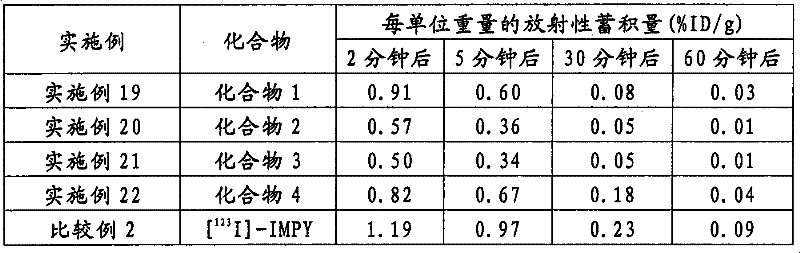
实施例23-26:脑内淀粉样蛋白的显像确认Example 23-26: Imaging confirmation of amyloid in the brain
进行以下实验以考查本发明化合物是否能够使脑内淀粉样蛋白显像。The following experiments were performed to examine whether the compounds of the present invention can image amyloid in the brain.
方法method
(1)将Aβ1-42(由Wako制)溶解于磷酸盐缓冲液(pH 7.4),在37℃振荡72小时,得到1mg/mL的凝集Aβ混悬液(在本实施例中,以下称为淀粉样蛋白混悬液)。(1) Aβ 1-42 (manufactured by Wako) was dissolved in phosphate buffer (pH 7.4), and shaken at 37°C for 72 hours to obtain a 1 mg/mL agglutinated Aβ suspension (in this example, hereinafter referred to as for the amyloid suspension).
(2)在硫喷妥钠麻醉下,将2.5μL(相当于25μg)的淀粉样蛋白混悬液注射到雄性Wistar大鼠(7周龄)一侧的杏仁核中。作为对照,将2.5μL的磷酸盐缓冲生理盐水(pH 7.4)注射到大鼠另一侧的杏仁核中。在注射淀粉样蛋白混悬液和磷酸盐缓冲生理盐水(pH 7.4)1天后,对大鼠进行研究。(2) Under thiopental anesthesia, 2.5 μL (equivalent to 25 μg) of the amyloid suspension was injected into the amygdala of one side of male Wistar rats (7 weeks old). As a control, 2.5 μL of phosphate-buffered saline (pH 7.4) was injected into the amygdala on the other side of the rat. Rats were studied 1 day after injection of amyloid suspension and phosphate-buffered saline (pH 7.4).
(3)分别制备在包含10mg/mL抗坏血酸的生理盐水中的化合物1(放射性浓度为27MBq/mL,实施例23),在包含10mg/mL抗坏血酸的生理盐水中的化合物2(放射性浓度为27MBq/mL,实施例24),在包含10mg/mL抗坏血酸的生理盐水中的化合物3(放射性浓度为28MBq/mL,实施例25)和在包含10mg/mL抗坏血酸的生理盐水中的化合物4(放射性浓度为30MBq/mL,实施例26),得到样品溶液。在硫喷妥钠的麻醉下通过尾静脉将各样品溶液注射到大鼠体内(剂量:0.5mL,剂量给药的放射性活度:相当于14-15MBq)。(3) Compound 1 (radioactive concentration of 27MBq/mL, Example 23) in physiological saline containing 10mg/mL ascorbic acid and compound 2 (radioactive concentration of 27MBq/mL) in physiological saline containing 10mg/mL ascorbic acid were prepared respectively. mL, Example 24), Compound 3 (radioactive concentration of 28 MBq/mL, Example 25) in physiological saline containing 10 mg/mL ascorbic acid and compound 4 in physiological saline containing 10 mg/mL ascorbic acid (radioactive concentration of 30MBq/mL, embodiment 26), obtain sample solution. Each sample solution was injected into rats through the tail vein under thiopental anesthesia (dose: 0.5 mL, radioactivity of dosing: equivalent to 14-15 MBq).
(4)在注射后60分钟,将脑取出,用切片机(型号:CM3050S,由LEICA制)制成10μm厚的脑切片。将该脑切片在成像板上曝光20小时,然后使用生物-图像分析仪(型号:BAS-2500;富士胶片公司制)进行图像分析。(4) 60 minutes after the injection, the brain was taken out, and a 10-μm-thick brain slice was prepared with a microtome (model: CM3050S, manufactured by LEICA). The brain slice was exposed to an imaging plate for 20 hours, and image analysis was performed using a bio-image analyzer (model: BAS-2500; manufactured by Fujifilm Corporation).
(5)在使用生物-图像分析仪进行图像分析后,用硫磺素T进行病理学染色,使用荧光显微镜(尼康公司制;型号:TE2000-U型;激发波长:400-440nm;检测波长:470nm)进行显像。由此证实淀粉样蛋白沉积在该切片上(图10b,图11b,图12b和图13b)。(5) After image analysis using a bio-image analyzer, pathological staining was performed with Thioflavin T, using a fluorescence microscope (manufactured by Nikon; model: TE2000-U; excitation wavelength: 400-440nm; detection wavelength: 470nm ) for imaging. It was thus confirmed that amyloid was deposited on the section (Fig. 10b, Fig. 11b, Fig. 12b and Fig. 13b).
结果result
图10-13示出了脑内注射淀粉样蛋白的大鼠的脑切片的放射自显影图和硫磺素T染色得到的图像。如图中所示,在注射淀粉样蛋白混悬液的那一侧的杏仁核中观察到显著的放射性蓄积。从放射性蓄积位点的硫磺素T染色的结果,证实了在该位点存在有淀粉样蛋白。另一方面,在注射生理盐水的那一侧杏仁核中没有观察到与其它位点相比显著的放射性蓄积。10-13 show autoradiography and Thioflavin T-stained images of brain slices of rats intracerebrally injected with amyloid. As shown in the figure, significant radioactive accumulation was observed in the amygdala on the side where the amyloid suspension was injected. From the results of Thioflavin T staining at the site of radioactive accumulation, the presence of amyloid protein at the site was confirmed. On the other hand, no significant radioactive accumulation was observed in the amygdala on the saline-injected side compared with other sites.
这些结果提示,各化合物都具有在脑内淀粉样蛋白上蓄积的性质和使脑内淀粉样蛋白显像的能力。These results suggest that each compound has the property of accumulating on brain amyloid and the ability to image brain amyloid.
实施例27:回复突变试验Embodiment 27: reverse mutation test
为了考查化合物5的基因诱变性,使用鼠伤寒沙门氏菌TA98和TA100进行回复突变试验(以下称作Ames试验)。In order to examine the gene mutagenicity of Compound 5, a reverse mutation test (hereinafter referred to as Ames test) was performed using Salmonella typhimurium TA98 and TA100.
在有和没有添加S9mix的情况下进行试验。使用二甲亚砜(以下称作DMSO)作为阴性对照。在没有添加S9mix的情况下的阳性对照是2-(2-呋喃基)-3-(5-硝基-2-呋喃基)丙烯酰胺(以下称作AF-2),在添加S9mix的情况下的阳性对照是2-氨基蒽(以下称作2-AA)。Experiment with and without S9mix added. Dimethyl sulfoxide (hereinafter referred to as DMSO) was used as a negative control. The positive control without the addition of S9mix is 2-(2-furyl)-3-(5-nitro-2-furyl)acrylamide (hereinafter referred to as AF-2), in the case of adding S9mix The positive control for ® is 2-aminoanthracene (hereinafter referred to as 2-AA).
作为要被添加到试验板上的样品溶液,制备了化合物5以最大浓度溶解于DMSO中的溶液(化合物浓度:50mg/mL)和将最大浓度溶液用DMSO稀释而得到的每个浓度的要被添加到试验板的样品溶液。作为用于制备阳性对照样品的样品溶液,在使用TA98作为试验菌株而没有添加S9mix的情况中,制备AF-2的DMSO溶液(化合物浓度:1μg/mL);在使用TA100作为试验菌株而没有添加S9mix的情况中,制备AF-2的DMSO溶液(化合物浓度:0.1μg/mL);在使用TA98作为试验菌株并添加S9mix的情况中,制备2-AA的DMSO溶液(化合物浓度:5μg/mL);在使用TA100作为试验菌株并添加S9mix的情况中,制备2-AA的DMSO溶液(化合物浓度:10μg/mL)。各样品的添加量为0.1mL/板,作为阴性对照,仅添加0.1mL/板的DMSO。As a sample solution to be added to the test plate, a solution in which Compound 5 was dissolved in DMSO at the maximum concentration (compound concentration: 50 mg/mL) and a solution of each concentration obtained by diluting the maximum concentration solution with DMSO were prepared. Add the sample solution to the test plate. As a sample solution for preparing a positive control sample, in the case of using TA98 as the test strain without adding S9mix, a DMSO solution of AF-2 (compound concentration: 1 μg/mL) was prepared; in the case of using TA100 as the test strain without adding In the case of S9mix, a DMSO solution of AF-2 (compound concentration: 0.1 μg/mL) was prepared; in the case of using TA98 as the test strain and adding S9mix, a DMSO solution of 2-AA was prepared (compound concentration: 5 μg/mL) ; In the case of using TA100 as the test strain and adding S9mix, a DMSO solution of 2-AA (compound concentration: 10 μg/mL) was prepared. The amount of each sample added was 0.1 mL/plate, and only 0.1 mL/plate of DMSO was added as a negative control.
结果示出在表4中。不管是否添加了S9mix和待检样品的添加量是多少,在用化合物2处理的组中的回复突变菌落数低于用阴性对照物处理的组的2倍。另一方面,用阳性对照物处理的组表现出回复突变菌落数的明显增加。从上述结果判断,化合物5在Ames试验中呈阴性,没有基因诱变性。The results are shown in Table 4. Regardless of whether S9mix was added or not and how much the sample to be tested was added, the number of revertant colonies in the group treated with
表4:Ames试验的结果Table 4: Results of the Ames test

产业实用性Industrial applicability
本发明的化合物和检测试剂可以在诊断剂领域中应用。The compounds and detection reagents of the present invention can be used in the field of diagnostic agents.
Claims (10)


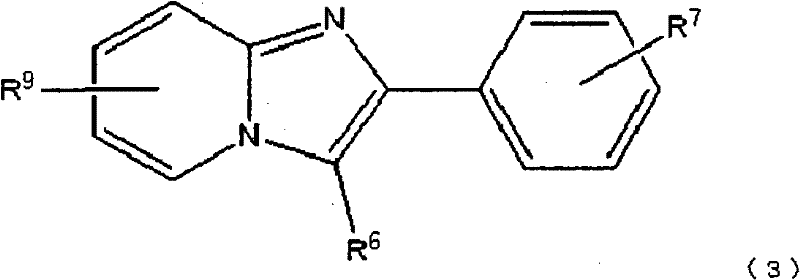
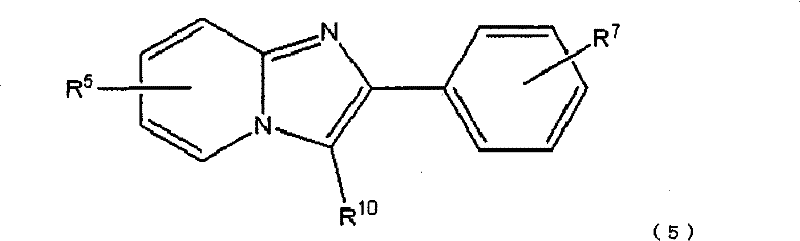


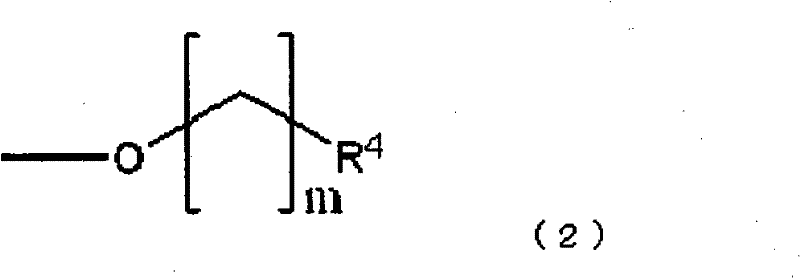
Applications Claiming Priority (3)
| Application Number | Priority Date | Filing Date | Title |
|---|---|---|---|
| JP2007276826 | 2007-10-24 | ||
| JP2007-276826 | 2007-10-24 | ||
| PCT/JP2008/069335 WO2009054496A1 (en) | 2007-10-24 | 2008-10-24 | Novel compound having affinity for amyloid |
Publications (1)
| Publication Number | Publication Date |
|---|---|
| CN101903381A true CN101903381A (en) | 2010-12-01 |
Family
ID=40579598
Family Applications (1)
| Application Number | Title | Priority Date | Filing Date |
|---|---|---|---|
| CN2008801215624A Pending CN101903381A (en) | 2007-10-24 | 2008-10-24 | New compound with affinity for amyloid |
Country Status (9)
| Country | Link |
|---|---|
| US (1) | US20100249418A1 (en) |
| EP (1) | EP2213672A4 (en) |
| JP (1) | JPWO2009054496A1 (en) |
| KR (1) | KR20100091965A (en) |
| CN (1) | CN101903381A (en) |
| AU (1) | AU2008314870A1 (en) |
| CA (1) | CA2703649A1 (en) |
| TW (1) | TW200918102A (en) |
| WO (1) | WO2009054496A1 (en) |
Families Citing this family (12)
| Publication number | Priority date | Publication date | Assignee | Title |
|---|---|---|---|---|
| TW200803903A (en) * | 2006-04-28 | 2008-01-16 | Nihon Mediphysics Co Ltd | Novel compound having affinity to amyloid |
| US8303935B2 (en) * | 2006-05-19 | 2012-11-06 | Nihon Medi-Physics Co., Ltd. | Alkoxy substituted imidazo[1,2-a]pyridines having affinity for amyloid |
| KR20090025282A (en) * | 2006-06-21 | 2009-03-10 | 니혼 메디피직스 가부시키가이샤 | New Amyloid Affinity Compounds |
| JPWO2008056481A1 (en) * | 2006-11-09 | 2010-02-25 | 日本メジフィジックス株式会社 | Radiodiagnostic agent |
| CA2669522A1 (en) * | 2006-11-17 | 2008-05-22 | Nihon Medi-Physics Co., Ltd. | Novel compounds with affinity for amyloid |
| CA2670436A1 (en) * | 2006-11-30 | 2008-06-05 | Nihon Medi-Physics Co., Ltd. | Novel compound having affinity for amyloid |
| ES2421886T3 (en) | 2007-02-13 | 2013-09-06 | Nihon Mediphysics Co Ltd | Method for producing a radiation diagnostic imaging agent |
| JP5313158B2 (en) * | 2007-10-26 | 2013-10-09 | 日本メジフィジックス株式会社 | Novel amyloid affinity compound |
| AU2008319985A1 (en) * | 2007-10-30 | 2009-05-07 | Nihon Medi-Physics Co., Ltd. | Use of novel compound having affinity for amyloid, and process for production of the same |
| TW200922628A (en) * | 2007-10-30 | 2009-06-01 | Nihon Mediphysics Co Ltd | Use of novel compound having affinity for amyloid, and process for production of the same |
| AU2012259929B2 (en) * | 2011-05-20 | 2016-08-04 | Nihon Medi-Physics Co., Ltd. | Novel compound having affinity for amyloid |
| KR101854228B1 (en) | 2011-06-24 | 2018-05-03 | 니혼 메디피직스 가부시키가이샤 | Novel compound with amyloid affinity |
Family Cites Families (46)
| Publication number | Priority date | Publication date | Assignee | Title |
|---|---|---|---|---|
| GB1473819A (en) * | 1976-01-28 | 1977-05-18 | Gallardo Antonio Sa | Derivatives of imidazo 1,2-a pyridine |
| FR2492382A1 (en) * | 1980-10-22 | 1982-04-23 | Synthelabo | IMIDAZO (1,2-A) PYRIDINE DERIVATIVES, THEIR PREPARATION AND THERAPEUTIC USE THEREOF |
| US4791117A (en) * | 1986-09-22 | 1988-12-13 | Ortho Pharmaceutical Corporation | 2- or 3-aryl substituted imidazo[1,2-a]pyridines and their use as calcium channel blockers |
| US4833149A (en) * | 1986-09-22 | 1989-05-23 | Ortho Pharmaceutical Corporation | 2- or 3-aryl substituted imidazo[1,2-a]pyridines |
| US4727145A (en) * | 1986-09-22 | 1988-02-23 | Ortho Pharmaceutical Corporation | 2- Or 3- aryl substituted imidazo [1,2-a]pyridines |
| US4871745A (en) * | 1986-09-22 | 1989-10-03 | Ortho Pharmaceutical Corporation | 2- or 3-aryl substituted imidazo(1,2-A)pyridines and their use as antisecretory agents |
| US4880615A (en) * | 1988-11-25 | 1989-11-14 | Merck & Co., Inc. | Stabilized radiopharmaceutical compositions |
| ES2079994B1 (en) * | 1992-10-07 | 1996-08-01 | Cusi Lab | PHARMACEUTICAL FORMULATION BASED ON POLYMIXINE-TRIMETOPRIM AND AN ANTI-INFLAMMATORY AGENT FOR ITS TOPICAL OPHTHALMIC AND ETHICAL USE. |
| DE4327027A1 (en) * | 1993-02-15 | 1994-08-18 | Bayer Ag | Imidazoazine |
| JP2000510816A (en) * | 1995-10-17 | 2000-08-22 | ジー.ディー.サール アンド カンパニー | Method for detecting cyclooxygenase-2 |
| US6812327B1 (en) * | 1996-10-25 | 2004-11-02 | Human Genome Sciences, Inc. | Neutrokine-alpha polypeptides |
| HUP9603001A3 (en) * | 1996-10-30 | 1999-07-28 | Richter Gedeon Vegyeszet | Heterocycle compounds comprising nitrogen, process for producing them and pharmaceutical compositions containing the same |
| US5985892A (en) * | 1998-04-02 | 1999-11-16 | Merck & Co., Ltd. | Antagonists of gonadotropin releasing hormone |
| AU759945B2 (en) * | 1998-08-20 | 2003-05-01 | Regents Of The University Of California, The | Methods for labeling beta-amyloid plaques and neurofibrillary tangles |
| AU3514200A (en) * | 1999-03-10 | 2000-09-28 | Merck & Co., Inc. | 6-azaindole compounds as antagonists of gonadotropin releasing hormone |
| US20010051632A1 (en) * | 2000-03-31 | 2001-12-13 | Wenying Chai | Phenyl-substituted indolizines and tetrahydroindolizines |
| WO2001074813A2 (en) * | 2000-03-31 | 2001-10-11 | Ortho Mcneil Pharmaceutical, Inc. | METHOD FOR USING 2- OR 3-ARYL SUBSTITUTED IMIDAZO[1,2-a] PYRIDINES AS H3 ANTAGONISTS |
| ES2286114T3 (en) * | 2000-03-31 | 2007-12-01 | Ortho-Mcneil Pharmaceutical, Inc. | IMIDAZOPIRIDINE PHENYL-SUBSTITUTED. |
| US20020022022A1 (en) * | 2000-05-19 | 2002-02-21 | Yi Shi | Inhibition of cell proliferation and matrix synthesis by antioxidants and NAD(P)H oxidase inhibitors |
| US6514969B2 (en) * | 2000-08-16 | 2003-02-04 | Boehringer Ingelheim Pharma Kg | β-amyloid inhibitors, processes for preparing them, and their use in pharmaceutical compositions |
| EP1334091B1 (en) * | 2000-08-24 | 2012-09-19 | University of Pittsburgh - Of the Commonwealth System of Higher Education | Thioflavin derivatives and their use in diagnosis and therapy of alzheimer's disease |
| SE0100568D0 (en) * | 2001-02-20 | 2001-02-20 | Astrazeneca Ab | Compounds |
| SE0100567D0 (en) * | 2001-02-20 | 2001-02-20 | Astrazeneca Ab | Compounds |
| CA2438204A1 (en) * | 2001-02-26 | 2002-09-06 | Bristol-Myers Squibb Pharma Company | Ascorbic acid analogs for metalloradiopharmaceuticals |
| US6596731B2 (en) * | 2001-03-27 | 2003-07-22 | Hoffmann-La Roche Inc. | Substituted imidazo[1,2-A] pyridine derivatives |
| KR20040058111A (en) * | 2001-04-23 | 2004-07-03 | 더 트러스티스 오브 더 유니버시티 오브 펜실바니아 | Amyloid plaque aggregation inhibitors and diagnostic imaging agents |
| WO2003000689A1 (en) * | 2001-06-21 | 2003-01-03 | Smithkline Beecham Corporation | Imidazo`1,2-a!pyridine derivatives for the prophylaxis and treatment of herpes viral infections |
| DK1432453T3 (en) | 2001-08-27 | 2013-11-18 | Univ Pennsylvania | STYLE BENDER DERIVATIVES AND ITS USE FOR BINDING AND IMAGING AMYLOID PLAQUES |
| US7060270B2 (en) * | 2001-11-02 | 2006-06-13 | Diagenics International Corporation | Methods and compositions of monoclonal antibodies specific for beta-amyloid proteins |
| GB0205281D0 (en) * | 2002-03-06 | 2002-04-17 | Novartis Ag | Organic compounds |
| EP1356827A1 (en) * | 2002-04-24 | 2003-10-29 | Mallinckrodt Inc. | Method for obtaining a 2-18F-fluor-2-deoxy-D-glucose (18F-FDG)-solution |
| WO2003106439A1 (en) | 2002-06-12 | 2003-12-24 | 株式会社ビーエフ研究所 | Probe compound for image diagnosis of disease with amyloid accumulation, compound for staining age spots/diffuse age spots, and remedy for disease with amyloid accumulation |
| CA2496633A1 (en) * | 2002-08-30 | 2004-04-29 | Bf Research Institute, Inc. | Diagnostic probes and remedies for diseases with accumulation of prion protein, and stains for prion protein |
| GB0229695D0 (en) * | 2002-12-20 | 2003-01-29 | Amersham Plc | Solid-phase preparation of 18F-labelled amino acids |
| JP4758909B2 (en) * | 2003-12-31 | 2011-08-31 | シェーリング−プラウ・リミテッド | Control of parasites in animals by using imidazo [1,2-b] pyridazine derivatives |
| CA2617319A1 (en) | 2005-06-24 | 2007-01-04 | The Trustees Of The University Of Pennsylvania | Radiolabeled-pegylation of ligands for use as imaging agents |
| WO2007033080A2 (en) * | 2005-09-12 | 2007-03-22 | Emory University | Alzheimer's disease imaging agents |
| JP4738419B2 (en) * | 2005-11-30 | 2011-08-03 | 富士フイルムRiファーマ株式会社 | Diagnostic and therapeutic agents for diseases caused by amyloid aggregation and / or deposition |
| TW200803903A (en) * | 2006-04-28 | 2008-01-16 | Nihon Mediphysics Co Ltd | Novel compound having affinity to amyloid |
| US8303935B2 (en) * | 2006-05-19 | 2012-11-06 | Nihon Medi-Physics Co., Ltd. | Alkoxy substituted imidazo[1,2-a]pyridines having affinity for amyloid |
| KR20090025282A (en) * | 2006-06-21 | 2009-03-10 | 니혼 메디피직스 가부시키가이샤 | New Amyloid Affinity Compounds |
| CA2670436A1 (en) * | 2006-11-30 | 2008-06-05 | Nihon Medi-Physics Co., Ltd. | Novel compound having affinity for amyloid |
| JP5313158B2 (en) * | 2007-10-26 | 2013-10-09 | 日本メジフィジックス株式会社 | Novel amyloid affinity compound |
| CN101909659A (en) * | 2007-10-30 | 2010-12-08 | 日本医事物理股份有限公司 | Application and preparation method of novel compound with affinity to amyloid |
| AU2008319985A1 (en) * | 2007-10-30 | 2009-05-07 | Nihon Medi-Physics Co., Ltd. | Use of novel compound having affinity for amyloid, and process for production of the same |
| CA2724842A1 (en) * | 2008-05-19 | 2009-11-26 | Sunovion Pharmaceuticals Inc. | Imidazo[1,2-a]pyridine compounds |
-
2008
- 2008-10-24 CN CN2008801215624A patent/CN101903381A/en active Pending
- 2008-10-24 WO PCT/JP2008/069335 patent/WO2009054496A1/en not_active Ceased
- 2008-10-24 AU AU2008314870A patent/AU2008314870A1/en not_active Abandoned
- 2008-10-24 CA CA2703649A patent/CA2703649A1/en not_active Abandoned
- 2008-10-24 KR KR1020107010117A patent/KR20100091965A/en not_active Withdrawn
- 2008-10-24 US US12/739,348 patent/US20100249418A1/en not_active Abandoned
- 2008-10-24 EP EP08842644A patent/EP2213672A4/en not_active Withdrawn
- 2008-10-24 TW TW097140793A patent/TW200918102A/en unknown
- 2008-10-24 JP JP2009538277A patent/JPWO2009054496A1/en active Pending
Also Published As
| Publication number | Publication date |
|---|---|
| EP2213672A4 (en) | 2012-05-02 |
| AU2008314870A1 (en) | 2009-04-30 |
| EP2213672A1 (en) | 2010-08-04 |
| WO2009054496A1 (en) | 2009-04-30 |
| TW200918102A (en) | 2009-05-01 |
| US20100249418A1 (en) | 2010-09-30 |
| JPWO2009054496A1 (en) | 2011-03-10 |
| CA2703649A1 (en) | 2009-04-30 |
| KR20100091965A (en) | 2010-08-19 |
Similar Documents
| Publication | Publication Date | Title |
|---|---|---|
| CN101903381A (en) | New compound with affinity for amyloid | |
| AU2007252658B2 (en) | Novel compound having affinity for amyloid | |
| CN101903383A (en) | Novel compounds having affinity for amyloid | |
| EP2716641B1 (en) | Radioactive iodine labeled compound having affinity for amyloid | |
| JP5180838B2 (en) | Novel amyloid affinity compound | |
| CN101909659A (en) | Application and preparation method of novel compound with affinity to amyloid | |
| NZ572741A (en) | Novel compound having affinity to amyloid for diagnosing Alzheimer's | |
| CA2839199C (en) | Novel compound with amyloid affinity | |
| CN101535309A (en) | Novel compound having affinity for amyloid | |
| CA2704172A1 (en) | Use of novel compound having affinity for amyloid, and process for production of the same | |
| CN101909658A (en) | Application and preparation method of novel compound with affinity to amyloid | |
| CN101918039B (en) | Use of novel compound having affinity for amyloid, and process for production of the same | |
| CN101466711A (en) | Novel compound having affinity for amyloid | |
| HK1149009A (en) | Novel compound having affinity for amyloid | |
| HK1149006A (en) | Novel compound having affinity for amyloid | |
| HK1148951A (en) | Use of novel compound having affinity for amyloid, and process for production of the same | |
| HK1148950A (en) | Use of novel compound having affinity for amyloid, and process for production of the same | |
| HK1148952A (en) | Utilization of novel compounds with amyloid affinity and mehtod of producing the same |
Legal Events
| Date | Code | Title | Description |
|---|---|---|---|
| C06 | Publication | ||
| PB01 | Publication | ||
| C10 | Entry into substantive examination | ||
| SE01 | Entry into force of request for substantive examination | ||
| REG | Reference to a national code |
Ref country code: HK Ref legal event code: DE Ref document number: 1149009 Country of ref document: HK |
|
| AD01 | Patent right deemed abandoned |
Effective date of abandoning: 20101201 |
|
| C20 | Patent right or utility model deemed to be abandoned or is abandoned | ||
| REG | Reference to a national code |
Ref country code: HK Ref legal event code: WD Ref document number: 1149009 Country of ref document: HK |