KR102208596B1 - Semiconductor device and manufacturing method of the same - Google Patents
Semiconductor device and manufacturing method of the same Download PDFInfo
- Publication number
- KR102208596B1 KR102208596B1 KR1020200041486A KR20200041486A KR102208596B1 KR 102208596 B1 KR102208596 B1 KR 102208596B1 KR 1020200041486 A KR1020200041486 A KR 1020200041486A KR 20200041486 A KR20200041486 A KR 20200041486A KR 102208596 B1 KR102208596 B1 KR 102208596B1
- Authority
- KR
- South Korea
- Prior art keywords
- oxide semiconductor
- film
- insulating film
- semiconductor film
- transistor
- Prior art date
- Legal status (The legal status is an assumption and is not a legal conclusion. Google has not performed a legal analysis and makes no representation as to the accuracy of the status listed.)
- Active
Links
Images


Classifications
-
- H—ELECTRICITY
- H10—SEMICONDUCTOR DEVICES; ELECTRIC SOLID-STATE DEVICES NOT OTHERWISE PROVIDED FOR
- H10D—INORGANIC ELECTRIC SEMICONDUCTOR DEVICES
- H10D86/00—Integrated devices formed in or on insulating or conducting substrates, e.g. formed in silicon-on-insulator [SOI] substrates or on stainless steel or glass substrates
- H10D86/40—Integrated devices formed in or on insulating or conducting substrates, e.g. formed in silicon-on-insulator [SOI] substrates or on stainless steel or glass substrates characterised by multiple TFTs
- H10D86/421—Integrated devices formed in or on insulating or conducting substrates, e.g. formed in silicon-on-insulator [SOI] substrates or on stainless steel or glass substrates characterised by multiple TFTs having a particular composition, shape or crystalline structure of the active layer
- H10D86/423—Integrated devices formed in or on insulating or conducting substrates, e.g. formed in silicon-on-insulator [SOI] substrates or on stainless steel or glass substrates characterised by multiple TFTs having a particular composition, shape or crystalline structure of the active layer comprising semiconductor materials not belonging to the Group IV, e.g. InGaZnO
-
- H01L29/7869—
-
- G—PHYSICS
- G02—OPTICS
- G02F—OPTICAL DEVICES OR ARRANGEMENTS FOR THE CONTROL OF LIGHT BY MODIFICATION OF THE OPTICAL PROPERTIES OF THE MEDIA OF THE ELEMENTS INVOLVED THEREIN; NON-LINEAR OPTICS; FREQUENCY-CHANGING OF LIGHT; OPTICAL LOGIC ELEMENTS; OPTICAL ANALOGUE/DIGITAL CONVERTERS
- G02F1/00—Devices or arrangements for the control of the intensity, colour, phase, polarisation or direction of light arriving from an independent light source, e.g. switching, gating or modulating; Non-linear optics
- G02F1/01—Devices or arrangements for the control of the intensity, colour, phase, polarisation or direction of light arriving from an independent light source, e.g. switching, gating or modulating; Non-linear optics for the control of the intensity, phase, polarisation or colour
- G02F1/13—Devices or arrangements for the control of the intensity, colour, phase, polarisation or direction of light arriving from an independent light source, e.g. switching, gating or modulating; Non-linear optics for the control of the intensity, phase, polarisation or colour based on liquid crystals, e.g. single liquid crystal display cells
- G02F1/133—Constructional arrangements; Operation of liquid crystal cells; Circuit arrangements
- G02F1/136—Liquid crystal cells structurally associated with a semi-conducting layer or substrate, e.g. cells forming part of an integrated circuit
- G02F1/1362—Active matrix addressed cells
- G02F1/1368—Active matrix addressed cells in which the switching element is a three-electrode device
-
- H01L27/1255—
-
- H—ELECTRICITY
- H10—SEMICONDUCTOR DEVICES; ELECTRIC SOLID-STATE DEVICES NOT OTHERWISE PROVIDED FOR
- H10D—INORGANIC ELECTRIC SEMICONDUCTOR DEVICES
- H10D1/00—Resistors, capacitors or inductors
- H10D1/60—Capacitors
- H10D1/68—Capacitors having no potential barriers
- H10D1/692—Electrodes
-
- H—ELECTRICITY
- H10—SEMICONDUCTOR DEVICES; ELECTRIC SOLID-STATE DEVICES NOT OTHERWISE PROVIDED FOR
- H10D—INORGANIC ELECTRIC SEMICONDUCTOR DEVICES
- H10D30/00—Field-effect transistors [FET]
- H10D30/60—Insulated-gate field-effect transistors [IGFET]
- H10D30/67—Thin-film transistors [TFT]
- H10D30/6704—Thin-film transistors [TFT] having supplementary regions or layers in the thin films or in the insulated bulk substrates for controlling properties of the device
-
- H—ELECTRICITY
- H10—SEMICONDUCTOR DEVICES; ELECTRIC SOLID-STATE DEVICES NOT OTHERWISE PROVIDED FOR
- H10D—INORGANIC ELECTRIC SEMICONDUCTOR DEVICES
- H10D30/00—Field-effect transistors [FET]
- H10D30/60—Insulated-gate field-effect transistors [IGFET]
- H10D30/67—Thin-film transistors [TFT]
- H10D30/6729—Thin-film transistors [TFT] characterised by the electrodes
- H10D30/673—Thin-film transistors [TFT] characterised by the electrodes characterised by the shapes, relative sizes or dispositions of the gate electrodes
- H10D30/6733—Multi-gate TFTs
- H10D30/6734—Multi-gate TFTs having gate electrodes arranged on both top and bottom sides of the channel, e.g. dual-gate TFTs
-
- H—ELECTRICITY
- H10—SEMICONDUCTOR DEVICES; ELECTRIC SOLID-STATE DEVICES NOT OTHERWISE PROVIDED FOR
- H10D—INORGANIC ELECTRIC SEMICONDUCTOR DEVICES
- H10D30/00—Field-effect transistors [FET]
- H10D30/60—Insulated-gate field-effect transistors [IGFET]
- H10D30/67—Thin-film transistors [TFT]
- H10D30/6729—Thin-film transistors [TFT] characterised by the electrodes
- H10D30/6737—Thin-film transistors [TFT] characterised by the electrodes characterised by the electrode materials
- H10D30/6739—Conductor-insulator-semiconductor electrodes
-
- H—ELECTRICITY
- H10—SEMICONDUCTOR DEVICES; ELECTRIC SOLID-STATE DEVICES NOT OTHERWISE PROVIDED FOR
- H10D—INORGANIC ELECTRIC SEMICONDUCTOR DEVICES
- H10D30/00—Field-effect transistors [FET]
- H10D30/60—Insulated-gate field-effect transistors [IGFET]
- H10D30/67—Thin-film transistors [TFT]
- H10D30/674—Thin-film transistors [TFT] characterised by the active materials
- H10D30/6755—Oxide semiconductors, e.g. zinc oxide, copper aluminium oxide or cadmium stannate
-
- H—ELECTRICITY
- H10—SEMICONDUCTOR DEVICES; ELECTRIC SOLID-STATE DEVICES NOT OTHERWISE PROVIDED FOR
- H10D—INORGANIC ELECTRIC SEMICONDUCTOR DEVICES
- H10D30/00—Field-effect transistors [FET]
- H10D30/60—Insulated-gate field-effect transistors [IGFET]
- H10D30/67—Thin-film transistors [TFT]
- H10D30/6758—Thin-film transistors [TFT] characterised by the insulating substrates
-
- H—ELECTRICITY
- H10—SEMICONDUCTOR DEVICES; ELECTRIC SOLID-STATE DEVICES NOT OTHERWISE PROVIDED FOR
- H10D—INORGANIC ELECTRIC SEMICONDUCTOR DEVICES
- H10D62/00—Semiconductor bodies, or regions thereof, of devices having potential barriers
- H10D62/40—Crystalline structures
-
- H—ELECTRICITY
- H10—SEMICONDUCTOR DEVICES; ELECTRIC SOLID-STATE DEVICES NOT OTHERWISE PROVIDED FOR
- H10D—INORGANIC ELECTRIC SEMICONDUCTOR DEVICES
- H10D62/00—Semiconductor bodies, or regions thereof, of devices having potential barriers
- H10D62/80—Semiconductor bodies, or regions thereof, of devices having potential barriers characterised by the materials
-
- H—ELECTRICITY
- H10—SEMICONDUCTOR DEVICES; ELECTRIC SOLID-STATE DEVICES NOT OTHERWISE PROVIDED FOR
- H10D—INORGANIC ELECTRIC SEMICONDUCTOR DEVICES
- H10D64/00—Electrodes of devices having potential barriers
- H10D64/60—Electrodes characterised by their materials
- H10D64/66—Electrodes having a conductor capacitively coupled to a semiconductor by an insulator, e.g. MIS electrodes
- H10D64/68—Electrodes having a conductor capacitively coupled to a semiconductor by an insulator, e.g. MIS electrodes characterised by the insulator, e.g. by the gate insulator
- H10D64/691—Electrodes having a conductor capacitively coupled to a semiconductor by an insulator, e.g. MIS electrodes characterised by the insulator, e.g. by the gate insulator comprising metallic compounds, e.g. metal oxides or metal silicates
-
- H—ELECTRICITY
- H10—SEMICONDUCTOR DEVICES; ELECTRIC SOLID-STATE DEVICES NOT OTHERWISE PROVIDED FOR
- H10D—INORGANIC ELECTRIC SEMICONDUCTOR DEVICES
- H10D64/00—Electrodes of devices having potential barriers
- H10D64/60—Electrodes characterised by their materials
- H10D64/66—Electrodes having a conductor capacitively coupled to a semiconductor by an insulator, e.g. MIS electrodes
- H10D64/68—Electrodes having a conductor capacitively coupled to a semiconductor by an insulator, e.g. MIS electrodes characterised by the insulator, e.g. by the gate insulator
- H10D64/693—Electrodes having a conductor capacitively coupled to a semiconductor by an insulator, e.g. MIS electrodes characterised by the insulator, e.g. by the gate insulator the insulator comprising nitrogen, e.g. nitrides, oxynitrides or nitrogen-doped materials
-
- H—ELECTRICITY
- H10—SEMICONDUCTOR DEVICES; ELECTRIC SOLID-STATE DEVICES NOT OTHERWISE PROVIDED FOR
- H10D—INORGANIC ELECTRIC SEMICONDUCTOR DEVICES
- H10D86/00—Integrated devices formed in or on insulating or conducting substrates, e.g. formed in silicon-on-insulator [SOI] substrates or on stainless steel or glass substrates
- H10D86/01—Manufacture or treatment
- H10D86/021—Manufacture or treatment of multiple TFTs
-
- H—ELECTRICITY
- H10—SEMICONDUCTOR DEVICES; ELECTRIC SOLID-STATE DEVICES NOT OTHERWISE PROVIDED FOR
- H10D—INORGANIC ELECTRIC SEMICONDUCTOR DEVICES
- H10D86/00—Integrated devices formed in or on insulating or conducting substrates, e.g. formed in silicon-on-insulator [SOI] substrates or on stainless steel or glass substrates
- H10D86/40—Integrated devices formed in or on insulating or conducting substrates, e.g. formed in silicon-on-insulator [SOI] substrates or on stainless steel or glass substrates characterised by multiple TFTs
- H10D86/481—Integrated devices formed in or on insulating or conducting substrates, e.g. formed in silicon-on-insulator [SOI] substrates or on stainless steel or glass substrates characterised by multiple TFTs integrated with passive devices, e.g. auxiliary capacitors
-
- H—ELECTRICITY
- H10—SEMICONDUCTOR DEVICES; ELECTRIC SOLID-STATE DEVICES NOT OTHERWISE PROVIDED FOR
- H10D—INORGANIC ELECTRIC SEMICONDUCTOR DEVICES
- H10D86/00—Integrated devices formed in or on insulating or conducting substrates, e.g. formed in silicon-on-insulator [SOI] substrates or on stainless steel or glass substrates
- H10D86/40—Integrated devices formed in or on insulating or conducting substrates, e.g. formed in silicon-on-insulator [SOI] substrates or on stainless steel or glass substrates characterised by multiple TFTs
- H10D86/60—Integrated devices formed in or on insulating or conducting substrates, e.g. formed in silicon-on-insulator [SOI] substrates or on stainless steel or glass substrates characterised by multiple TFTs wherein the TFTs are in active matrices
-
- H—ELECTRICITY
- H10—SEMICONDUCTOR DEVICES; ELECTRIC SOLID-STATE DEVICES NOT OTHERWISE PROVIDED FOR
- H10K—ORGANIC ELECTRIC SOLID-STATE DEVICES
- H10K59/00—Integrated devices, or assemblies of multiple devices, comprising at least one organic light-emitting element covered by group H10K50/00
- H10K59/10—OLED displays
- H10K59/12—Active-matrix OLED [AMOLED] displays
- H10K59/121—Active-matrix OLED [AMOLED] displays characterised by the geometry or disposition of pixel elements
- H10K59/1213—Active-matrix OLED [AMOLED] displays characterised by the geometry or disposition of pixel elements the pixel elements being TFTs
-
- H—ELECTRICITY
- H10—SEMICONDUCTOR DEVICES; ELECTRIC SOLID-STATE DEVICES NOT OTHERWISE PROVIDED FOR
- H10K—ORGANIC ELECTRIC SOLID-STATE DEVICES
- H10K59/00—Integrated devices, or assemblies of multiple devices, comprising at least one organic light-emitting element covered by group H10K50/00
- H10K59/10—OLED displays
- H10K59/12—Active-matrix OLED [AMOLED] displays
- H10K59/121—Active-matrix OLED [AMOLED] displays characterised by the geometry or disposition of pixel elements
- H10K59/1216—Active-matrix OLED [AMOLED] displays characterised by the geometry or disposition of pixel elements the pixel elements being capacitors
Landscapes
- Physics & Mathematics (AREA)
- Engineering & Computer Science (AREA)
- Microelectronics & Electronic Packaging (AREA)
- Nonlinear Science (AREA)
- Geometry (AREA)
- Chemical & Material Sciences (AREA)
- Crystallography & Structural Chemistry (AREA)
- Optics & Photonics (AREA)
- General Physics & Mathematics (AREA)
- Mathematical Physics (AREA)
- Thin Film Transistor (AREA)
- Devices For Indicating Variable Information By Combining Individual Elements (AREA)
- Liquid Crystal (AREA)
- Electroluminescent Light Sources (AREA)
- Metal-Oxide And Bipolar Metal-Oxide Semiconductor Integrated Circuits (AREA)
- Manufacturing & Machinery (AREA)
Abstract
개구율이 높은 반도체 장치를 제공한다.
질화 절연막과, 질화 절연막 위에 형성된 트랜지스터와, 질화 절연막 위에 형성된 한 쌍의 전극을 갖는 용량 소자를 갖고, 트랜지스터의 채널 형성 영역, 및 용량 소자의 한쪽의 전극은 산화물 반도체층으로 형성되고, 용량 소자의 다른 한쪽의 전극은 투광성 도전막으로 형성되고, 용량 소자의 한쪽의 전극은 질화 절연막에 접하고, 용량 소자의 다른 한쪽의 전극은 트랜지스터에 포함되는 소스 전극 또는 드레인 전극의 한쪽과 전기적으로 접속한다.A semiconductor device having a high aperture ratio is provided.
A capacitor having a nitride insulating film, a transistor formed on the nitride insulating film, and a pair of electrodes formed on the nitride insulating film, the channel formation region of the transistor, and one electrode of the capacitor are formed of an oxide semiconductor layer, The other electrode is formed of a light-transmitting conductive film, one electrode of the capacitor element is in contact with the nitride insulating film, and the other electrode of the capacitor element is electrically connected to one of a source electrode or a drain electrode included in the transistor.
Description
본 발명은 물건, 방법 또는 제조 방법에 관한 것이다. 또는, 본 발명은 프로세스, 머신, 매뉴팩처 또는 조성물(composition of matter)에 관한 것이다. 특히, 본 발명은, 예를 들면, 반도체 장치, 표시 장치, 발광 장치, 이들의 구동 방법 또는 이들의 제작 방법에 관한 것이다. 특히, 본 발명은, 예를 들면, 산화물 반도체를 포함하는 반도체 장치, 표시 장치 또는 발광 장치 및 그 제작 방법에 관한 것이다.The present invention relates to an article, a method or a manufacturing method. Alternatively, the present invention relates to a process, machine, manufacture or composition of matter. In particular, the present invention relates to, for example, a semiconductor device, a display device, a light emitting device, a driving method thereof, or a manufacturing method thereof. In particular, the present invention relates to, for example, a semiconductor device, a display device or a light emitting device containing an oxide semiconductor, and a method of manufacturing the same.
최근, 액정 디스플레이(LCD) 등의 플랫 패널 디스플레이가 널리 보급되고 있다. 플랫 패널 디스플레이 등의 표시 장치에 있어서, 행 방향 및 열 방향에 배치된 화소내에는 스위칭 소자인 트랜지스터와, 상기 트랜지스터와 전기적으로 접속된 액정 소자와, 상기 액정 소자와 병렬로 접속된 용량 소자가 설치되어 있다.In recent years, flat panel displays such as liquid crystal displays (LCDs) have been widely spread. In a display device such as a flat panel display, a transistor as a switching element, a liquid crystal element electrically connected to the transistor, and a capacitor element connected in parallel with the liquid crystal element are installed in pixels arranged in row and column directions. Has been.
상기 트랜지스터의 반도체막을 구성하는 반도체 재료로서는 아몰퍼스(amorphous, 비정질) 실리콘 또는 폴리(다결정) 실리콘 등의 실리콘 반도체가 범용되고 있다.As a semiconductor material constituting the semiconductor film of the transistor, a silicon semiconductor such as amorphous (amorphous) silicon or poly (polycrystalline) silicon is widely used.
또한, 반도체 특성을 나타내는 금속 산화물(이하, 산화물 반도체라고 기재한다)은, 트랜지스터의 반도체막에 적용할 수 있는 반도체 재료이다. 예를 들면, 산화아연 또는 In-Ga-Zn계 산화물 반도체를 사용하여 트랜지스터를 제작하는 기술이 개시되어 있다(특허문헌 1 및 특허문헌 2를 참조).In addition, a metal oxide exhibiting semiconductor properties (hereinafter, referred to as an oxide semiconductor) is a semiconductor material applicable to a semiconductor film of a transistor. For example, a technique for fabricating a transistor using zinc oxide or an In-Ga-Zn-based oxide semiconductor has been disclosed (see
용량 소자는 한 쌍의 전극 사이에 유전체막이 설치되어 있고, 한 쌍의 전극 중 적어도 한쪽의 전극은, 트랜지스터를 구성하는 게이트(gate) 전극, 소스 전극 또는 드레인(drain) 전극 등과 동일 재료로 형성되기 때문에 금속 등의 차광성을 갖는 도전막으로 형성되어 있는 경우가 많다.In the capacitive element, a dielectric film is provided between a pair of electrodes, and at least one of the pair of electrodes is formed of the same material as a gate electrode, a source electrode, or a drain electrode constituting a transistor. Therefore, it is often formed of a conductive film having light-shielding properties such as metal.
또한, 용량 소자의 용량값을 크게 할수록 전계(電界)를 가한 상황에서, 액정 소자의 액정 분자의 배향을 일정하게 유지할 수 있는 기간을 길게 할 수 있다. 정지 화상을 표시시킬 수 있는 표시 장치에 있어서, 상기 기간을 길게 할 수 있는 것은 화상 데이터를 재기록하는 회수를 저감시킬 수 있어, 소비 전력의 저감이 기대된다.Further, as the capacitance value of the capacitive element is increased, the period during which the alignment of the liquid crystal molecules of the liquid crystal element can be kept constant in a situation where an electric field is applied can be lengthened. In a display device capable of displaying a still image, being able to lengthen the period can reduce the number of times image data is rewritten, and a reduction in power consumption is expected.
용량 소자의 전하 용량을 크게 하기 위하여는, 화소내에서의 용량 소자의 점유 면적을 크게 하는, 구체적으로는 한 쌍의 전극이 중첩되어 있는 면적을 크게 하는 수단이 있다. 그러나, 상기 표시 장치에 있어서, 한 쌍의 전극이 중첩되어 있는 면적을 크게 하기 위하여 차광성을 갖는 도전막의 면적을 크게 하면 화소의 개구율이 저감되고, 화상의 표시 품질이 저하된다.In order to increase the charge capacity of the capacitive element, there is a means for increasing the area occupied by the capacitive element in the pixel, specifically increasing the area in which a pair of electrodes overlap. However, in the above display device, if the area of the conductive film having light-shielding property is increased in order to increase the area where the pair of electrodes overlap, the aperture ratio of the pixel is reduced and the display quality of the image is deteriorated.
따라서, 상기 과제를 감안하여 본 발명의 일 양태는 개구율이 높은 반도체 장치 등을 제공하는 것을 목적중 하나로 한다. 또는, 전하 용량을 증대시키는 것이 가능한 용량 소자를 포함하는 반도체 장치 등을 제공하는 것을 목적중 하나로 한다. 또는, 포토리소그래피 공정의 마스크 매수를 삭감할 수 있는 반도체 장치 등을 제공하는 것을 목적중 하나로 한다. 또는, 오프 전류가 낮은 반도체 장치 등을 제공하는 것을 목적중 하나로 한다. 또는, 소비 전력을 저감시킨 반도체 장치 등을 제공하는 것을 목적중 하나로 한다. 또는, 투명한 반도체층을 사용한 반도체 장치 등을 제공하는 것을 목적중 하나로 한다. 또는, 신뢰성이 높은 반도체 장치 등을 제공하는 것을 목적중 하나로 한다. 또는, 눈이 편한 반도체 장치 등을 제공하는 것을 목적중 하나로 한다. 또는, 신규의 반도체 장치 등을 제공하는 것을 목적중 하나로 한다. 또는, 신규의 반도체 장치 등의 제작 방법을 제공하는 것을 목적중 하나로 한다.Accordingly, in view of the above problems, an aspect of the present invention is to provide a semiconductor device or the like having a high aperture ratio. Another object of the present invention is to provide a semiconductor device including a capacitive element capable of increasing charge capacity. Another object of the present invention is to provide a semiconductor device or the like capable of reducing the number of masks in a photolithography process. Another object of the present invention is to provide a semiconductor device or the like having a low off current. Another object is to provide a semiconductor device with reduced power consumption. Another object is to provide a semiconductor device or the like using a transparent semiconductor layer. Another object is to provide a highly reliable semiconductor device or the like. Another object of the present invention is to provide a semiconductor device or the like that is easy on the eyes. Another object is to provide a novel semiconductor device or the like. Another object is to provide a method for manufacturing a novel semiconductor device or the like.
또한, 이들 과제의 기재는 다른 과제의 존재를 방해하는 것이 아니다. 또한, 본 발명의 일 양태는 이들 과제의 전부를 해결할 필요는 없는 것으로 한다. 또한, 이들 이외의 과제는 명세서, 도면, 청구항 등의 기재로부터 저절로 명확해 지는 것이고, 명세서, 도면, 청구항 등의 기재로부터 이들 이외의 과제를 추출하는 것이 가능하다.In addition, description of these issues does not hinder the existence of other issues. In addition, one aspect of the present invention assumes that it is not necessary to solve all of these problems. In addition, problems other than these are automatically clarified from the description of the specification, drawings, claims, etc., and it is possible to extract the problems other than these from the description of the specification, drawings, and claims.
본 발명의 일 양태는, 산화물 반도체층을 한쪽의 전극으로 하고, 투광성 도전막을 다른 한쪽의 전극으로 하는 투광성을 갖는 용량 소자를 포함하는 반도체 장치에 관한 것이다.One aspect of the present invention relates to a semiconductor device including a light-transmitting capacitive element in which an oxide semiconductor layer is used as one electrode and a light-transmitting conductive film is used as the other electrode.
본 발명의 일 양태는 트랜지스터를 포함하는 반도체 장치이며, 제 1 절연막 위에 형성된 게이트 전극층, 제 1 배선 및 상기 제 1 배선과 전기적으로 접속된 제 1 산화물 반도체층과, 게이트 전극층 및 제 1 배선 위에 형성된 제 2 절연막과, 게이트 전극층과 중첩되고, 제 2 절연막 위에 형성된 제 2 산화물 반도체층과, 제 2 산화물 반도체층과 전기적으로 접속된 소스 전극층 및 드레인 전극층과, 제 1 산화물 반도체층, 제 2 산화물 반도체층, 제 2 절연막, 소스 전극층 및 드레인 전극층 위에 형성된 제 3 절연막과, 제 3 절연막 위에 형성된 제 4 절연막과, 제 1 산화물 반도체층 위에서, 제 4 절연막 위에 형성된 투광성 도전막을 갖고, 제 1 산화물 반도체층을 한쪽의 전극으로 하고, 제 3 절연막 및 제 4 절연막을 유전체로 하고, 투광성 도전막을 다른 한쪽의 전극으로 한 용량 소자를 포함하는 것을 특징으로 하는 반도체 장치이다.One aspect of the present invention is a semiconductor device including a transistor, a gate electrode layer formed on a first insulating film, a first wiring, and a first oxide semiconductor layer electrically connected to the first wiring, and the gate electrode layer and the first wiring. A second insulating film, a second oxide semiconductor layer overlapping the gate electrode layer and formed on the second insulating film, a source electrode layer and a drain electrode layer electrically connected to the second oxide semiconductor layer, a first oxide semiconductor layer, and a second oxide semiconductor A layer, a second insulating film, a third insulating film formed over the source electrode layer and the drain electrode layer, a fourth insulating film formed over the third insulating film, a translucent conductive film formed over the first oxide semiconductor layer and over the fourth insulating film, and a first oxide semiconductor layer A semiconductor device comprising a capacitor having one electrode, a third insulating film and a fourth insulating film as dielectrics, and a translucent conductive film as the other electrode.
제 1 산화물 반도체층 및 제 2 산화물 반도체층은 같은 재료로 형성되어 있는 것이 바람직하다.It is preferable that the first oxide semiconductor layer and the second oxide semiconductor layer are formed of the same material.
또한, 제 1 산화물 반도체층 및 제 2 산화물 반도체층은 에너지 갭이 2.0eV 이상인 것이 바람직하다.In addition, it is preferable that the first oxide semiconductor layer and the second oxide semiconductor layer have an energy gap of 2.0 eV or more.
또한, 제 1 절연막은 질화산화실리콘, 질화실리콘, 질화알루미늄, 질화산화알루미늄 중에서 선택된 질화 절연 재료의 단층 구조 또는 적층 구조로 형성하는 것이 바람직하다.In addition, the first insulating film is preferably formed in a single layer structure or a laminated structure of a nitride insulating material selected from silicon nitride oxide, silicon nitride, aluminum nitride, and aluminum nitride oxide.
또한, 제 3 절연막은 산화실리콘, 산화질화실리콘, 산화알루미늄, 산화하프늄, 산화갈륨 또는 Ga-Zn계 금속 산화물 중에서 선택된 산화 절연 재료의 단층 구조 또는 적층 구조로 형성하는 것이 바람직하다.Further, the third insulating film is preferably formed in a single layer structure or a laminated structure of an oxide insulating material selected from silicon oxide, silicon oxynitride, aluminum oxide, hafnium oxide, gallium oxide, or Ga-Zn-based metal oxide.
또한, 제 4 절연막은 질화산화실리콘, 질화실리콘, 질화알루미늄, 질화산화알루미늄 중에서 선택된 질화 절연 재료의 단층 구조 또는 적층 구조로 형성하는 것이 바람직하다.Further, the fourth insulating film is preferably formed in a single-layer structure or a laminated structure of a nitride insulating material selected from silicon nitride oxide, silicon nitride, aluminum nitride, and aluminum nitride oxide.
또한, 게이트 전극층 및 제 1 배선은 같은 재료로 형성되어 있는 것이 바람직하다.In addition, it is preferable that the gate electrode layer and the first wiring are made of the same material.
또한, 투광성 도전막은 소스 전극 또는 드레인 전극의 한쪽과 전기적으로 접속되어 있는 구성으로 할 수 있다.In addition, the light-transmitting conductive film can be configured to be electrically connected to one of the source electrode or the drain electrode.
또한, 제 1 배선과 제 1 산화물 반도체층은 직접 접함으로써 전기적으로 접속되는 구성으로 할 수 있다.Further, the first wiring and the first oxide semiconductor layer can be electrically connected by direct contact.
또한, 제 1 배선과 제 1 산화물 반도체층은 제 2 배선을 통하여 접함으로써 전기적으로 접속되는 구성으로 할 수 있다.Further, the first wiring and the first oxide semiconductor layer can be electrically connected by making contact with each other through the second wiring.
또한, 본 발명의 다른 일 양태는 제 1 절연막 위에 게이트 전극층 및 제 1 배선을 형성하고, 제 1 절연막, 게이트 전극층 및 제 1 배선 위에 제 2 절연막을 형성하고, 제 2 절연막을 선택적으로 에칭하여 제 1 배선의 일부 및 제 1 절연막의 일부를 노출시키고, 노출된 제 1 배선의 일부 및 제 1 절연막의 일부 위에 제 1 산화물 반도체층, 게이트 전극층과 중첩되도록 제 2 절연막 위에 제 2 산화물 반도체층을 형성하고, 제 2 산화물 반도체층과 전기적으로 접속된 소스 전극층 및 드레인 전극층을 형성하고, 제 1 산화물 반도체층, 제 2 산화물 반도체층, 제 2 절연막, 소스 전극층 및 드레인 전극층 위에 제 3 절연막을 형성하고, 제 3 절연막 위에 제 4 절연막을 형성하고, 제 3 절연막 및 제 4 절연막에 소스 전극층 또는 드레인 전극층으로 통하는 개구부를 형성하고, 제 4 절연막 위에 개구부에서 소스 전극층 또는 드레인 전극층과 전기적으로 접속하고, 또한 제 1 산화물 반도체층과 중첩된 투광성 도전막을 형성하고, 트랜지스터와, 제 1 산화물 반도체층을 한쪽의 전극으로 하고, 제 3 절연막 및 제 4 절연막을 유전체로 하고, 투광성 도전막을 다른 한쪽의 전극으로 한 용량 소자를 형성하는 것을 특징으로 하는 반도체 장치의 제작 방법이다.In another aspect of the present invention, a gate electrode layer and a first wiring are formed on a first insulating film, a second insulating film is formed on the first insulating film, the gate electrode layer, and the first wiring, and the second insulating film is selectively etched. 1 Part of the wiring and a part of the first insulating film are exposed, and a second oxide semiconductor layer is formed on the second insulating film so as to overlap with the first oxide semiconductor layer and the gate electrode layer on the exposed part of the first wire and the part of the first insulating film. And forming a source electrode layer and a drain electrode layer electrically connected to the second oxide semiconductor layer, forming a third insulating film on the first oxide semiconductor layer, the second oxide semiconductor layer, the second insulating film, the source electrode layer, and the drain electrode layer, A fourth insulating film is formed on the third insulating film, an opening leading to the source electrode layer or the drain electrode layer is formed in the third insulating film and the fourth insulating film, and electrically connected to the source electrode layer or the drain electrode layer through the opening on the fourth insulating film. 1 Capacitance in which a translucent conductive film superimposed on the oxide semiconductor layer is formed, the transistor and the first oxide semiconductor layer are used as one electrode, the third insulating film and the fourth insulating film are dielectrics, and the transparent conductive film is the other electrode It is a method of manufacturing a semiconductor device characterized by forming an element.
제 1 산화물 반도체층 및 제 2 산화물 반도체층은 같은 재료로 형성하는 것이 바람직하다.The first oxide semiconductor layer and the second oxide semiconductor layer are preferably formed of the same material.
또한, 제 1 산화물 반도체층 및 제 2 산화물 반도체층은 에너지 갭이 2.0eV 이상의 재료로 형성하는 것이 바람직하다.Further, the first oxide semiconductor layer and the second oxide semiconductor layer are preferably formed of a material having an energy gap of 2.0 eV or more.
또한, 제 1 절연막을 질화산화실리콘, 질화실리콘, 질화알루미늄, 질화산화알루미늄 중에서 선택된 질화 절연 재료의 단층 구조 또는 적층 구조로 형성하는 것이 바람직하다.In addition, it is preferable to form the first insulating film in a single layer structure or a laminated structure of a nitride insulating material selected from silicon nitride oxide, silicon nitride, aluminum nitride, and aluminum nitride oxide.
또한, 제 3 절연막을 산화실리콘, 산화질화실리콘, 산화알루미늄, 산화하프늄, 산화갈륨 또는 Ga-Zn계 금속 산화물 중에서 선택된 산화 절연 재료의 단층 구조 또는 적층 구조로 형성하는 것이 바람직하다.Further, it is preferable to form the third insulating film in a single layer structure or a laminated structure of an oxide insulating material selected from silicon oxide, silicon oxynitride, aluminum oxide, hafnium oxide, gallium oxide, or Ga-Zn-based metal oxide.
또한, 제 4 절연막을 질화산화실리콘, 질화실리콘, 질화알루미늄, 질화산화알루미늄 중에서 선택된 질화 절연 재료의 단층 구조 또는 적층 구조로 형성하는 것이 바람직하다.Further, it is preferable to form the fourth insulating film in a single layer structure or a laminated structure of a nitride insulating material selected from silicon nitride oxide, silicon nitride, aluminum nitride, and aluminum nitride oxide.
또한, 게이트 전극층 및 제 1 배선은 같은 재료로 형성하는 것이 바람직하다.Further, it is preferable that the gate electrode layer and the first wiring are formed of the same material.
또한, 제 1 배선과 제 1 산화물 반도체층은 직접 접하도록 형성하고, 전기적으로 접속할 수 있다.Further, the first wiring and the first oxide semiconductor layer are formed to be in direct contact, and can be electrically connected.
또한, 제 1 배선과 제 1 산화물 반도체층은 제 2 배선을 통하여 접하도록 형성하고, 전기적으로 접속하여도 좋다.Further, the first wiring and the first oxide semiconductor layer may be formed so as to be in contact with each other through the second wiring, and may be electrically connected.
본 발명의 일 양태에서, 개구율이 높은 반도체 장치 등을 제공할 수 있다. 또는, 전하 용량을 증대시키는 것이 가능한 용량 소자를 갖는 반도체 장치 등을 제공할 수 있다. 또는, 포토리소그래피 공정의 마스크 매수를 삭감할 수 있는 반도체 장치 등을 제공할 수 있다. 또는, 오프 전류가 낮은 반도체 장치 등을 제공할 수 있다. 또는, 소비 전력을 저감시킨 반도체 장치 등을 제공할 수 있다. 또는, 투명한 반도체층을 사용한 반도체 장치 등을 제공할 수 있다. 또는, 신뢰성이 높은 반도체 장치 등을 제공할 수 있다. 또는, 눈이 편한 반도체 장치를 제공할 수 있다. 또는, 반도체 장치의 제작 방법을 제공할 수 있다.In one aspect of the present invention, a semiconductor device or the like having a high aperture ratio can be provided. Alternatively, it is possible to provide a semiconductor device or the like having a capacitance element capable of increasing the charge capacity. Alternatively, a semiconductor device or the like capable of reducing the number of masks in a photolithography process can be provided. Alternatively, a semiconductor device or the like having a low off-current can be provided. Alternatively, a semiconductor device or the like in which power consumption is reduced can be provided. Alternatively, a semiconductor device and the like using a transparent semiconductor layer can be provided. Alternatively, a highly reliable semiconductor device or the like can be provided. Alternatively, a semiconductor device that is easy on the eyes can be provided. Alternatively, a method of manufacturing a semiconductor device can be provided.
도 1은 반도체 장치를 설명하는 상면도.
도 2는 반도체 장치를 설명하는 단면도.
도 3은 반도체 장치를 설명하는 도면.
도 4a 및 도 4b는 반도체 장치의 화소를 설명하는 회로도.
도 5a 및 도 5b는 반도체 장치의 제작 방법을 설명하는 단면도.
도 6a 및 도 6b는 반도체 장치의 제작 방법을 설명하는 단면도.
도 7은 반도체 장치의 용량 소자를 설명하는 단면도.
도 8은 반도체 장치를 설명하는 단면도.
도 9a 및 도 9b는 반도체 장치를 설명하는 단면도.
도 10a 및 도 10b는 산화물 반도체막의 극미(極微) 전자선 회절 패턴을 도시한 도면.
도 11a 및 도 11b는 산화물 반도체막의 CPM 측정 결과를 도시한 도면.
도 12는 CAAC-OS막의 CPM 측정 결과를 도시한 도면.
도 13a는 산화물 반도체막의 단면 TEM상이고, 도 13b 내지 도 13d는 극미 전자선 회절 패턴.
도 14a는 산화물 반도체막의 평면 TEM상이고, 도 14b는 제한 시야 전자선 회절 패턴.
도 15a 내지 도 15c는 전자선 회절 강도 분포의 개념도.
도 16은 석영 유리 기판의 극미 전자선 회절 패턴.
도 17은 산화물 반도체막의 극미 전자선 회절 패턴.
도 18a 및 도 18b는 산화물 반도체막의 단면 TEM상.
도 19는 산화물 반도체막의 X선 회절 분석 결과.
도 20은 CAAC-OS막의 단면 TEM상.
도 21a 내지 도 21d는 CAAC-OS막의 전자선 회절 패턴.
도 22는 CAAC-OS막의 단면 TEM상.
도 23a는 CAAC-OS막의 단면 TEM상이고, 도 23b는 X선 회절 스펙트럼.
도 24a 내지 도 24d는 CAAC-OS막의 전자선 회절 패턴.
도 25a는 CAAC-OS막의 단면 TEM상이고, 도 25b는 X선 회절 스펙트럼.
도 26a 내지 도 26d는 CAAC-OS막의 전자선 회절 패턴.
도 27a는 CAAC-OS막의 단면 TEM상이고, 도 27b는 X선 회절 스펙트럼.
도 28a 내지 도 28d는 CAAC-OS막의 전자선 회절 패턴.
도 29a 내지 도 29c는 반도체 장치를 설명하는 상면도.
도 30은 반도체 장치를 설명하는 단면도.
도 31a 및 도 31c는 반도체 장치를 설명하는 단면도이고, 31b는 상면도.
도 32는 표시 기능을 갖는 정보 처리 장치의 구성을 설명하는 블록도.
도 33a1 및 도 33a2는 정보 처리 장치의 표시부의 구성을 설명하는 블록도이고, 도 33b1 및 도 33b2는 회로도.
도 34a는 정보 처리 장치의 구성을 설명하는 블록도이고, 도 34b는 화상 데이터를 설명하기 위한 모식도.
도 35a1 및 도 35a2, 도 35b1 및 도 35b2는 정보 처리 장치의 효과를 설명하는 도면.
도 36은 정보 처리 장치를 설명하는 블록도.
도 37a 내지 도 37c는 반도체 장치를 사용한 전자 기기를 설명하는 도면.
도 38a 및 도 38b는 반도체 장치를 사용한 전자 기기를 설명하는 도면.
도 39a 내지 도 39c는 반도체 장치를 사용한 전자 기기를 설명하는 도면.1 is a top view illustrating a semiconductor device.
2 is a cross-sectional view illustrating a semiconductor device.
3 is a diagram explaining a semiconductor device.
4A and 4B are circuit diagrams illustrating pixels of a semiconductor device.
5A and 5B are cross-sectional views illustrating a method of manufacturing a semiconductor device.
6A and 6B are cross-sectional views illustrating a method of manufacturing a semiconductor device.
7 is a cross-sectional view illustrating a capacitor element of a semiconductor device.
8 is a cross-sectional view illustrating a semiconductor device.
9A and 9B are cross-sectional views illustrating a semiconductor device.
10A and 10B are diagrams showing microscopic electron beam diffraction patterns of an oxide semiconductor film.
11A and 11B are diagrams showing CPM measurement results of an oxide semiconductor film.
12 is a diagram showing a CPM measurement result of a CAAC-OS film.
13A is a cross-sectional TEM image of an oxide semiconductor film, and FIGS. 13B to 13D are microelectron ray diffraction patterns.
14A is a planar TEM image of an oxide semiconductor film, and FIG. 14B is a limited-field electron beam diffraction pattern.
15A to 15C are conceptual diagrams of electron diffraction intensity distribution.
16 is an ultrafine electron beam diffraction pattern of a quartz glass substrate.
17 is an extremely fine electron beam diffraction pattern of an oxide semiconductor film.
18A and 18B are cross-sectional TEM images of an oxide semiconductor film.
19 is an X-ray diffraction analysis result of an oxide semiconductor film.
Fig. 20 is a cross-sectional TEM image of a CAAC-OS film.
21A to 21D are electron diffraction patterns of the CAAC-OS film.
Fig. 22 is a cross-sectional TEM image of a CAAC-OS film.
23A is a cross-sectional TEM image of a CAAC-OS film, and FIG. 23B is an X-ray diffraction spectrum.
24A to 24D are electron diffraction patterns of the CAAC-OS film.
Fig. 25A is a cross-sectional TEM image of a CAAC-OS film, and Fig. 25B is an X-ray diffraction spectrum.
26A to 26D are electron diffraction patterns of the CAAC-OS film.
Fig. 27A is a cross-sectional TEM image of a CAAC-OS film, and Fig. 27B is an X-ray diffraction spectrum.
28A to 28D are electron diffraction patterns of the CAAC-OS film.
29A to 29C are top views illustrating a semiconductor device.
30 is a cross-sectional view illustrating a semiconductor device.
31A and 31C are cross-sectional views illustrating a semiconductor device, and 31B is a top view.
Fig. 32 is a block diagram for explaining the configuration of an information processing device having a display function.
33A1 and 33A2 are block diagrams for explaining the configuration of a display unit of an information processing apparatus, and FIGS. 33B1 and 33B2 are circuit diagrams.
Fig. 34A is a block diagram for explaining a configuration of an information processing device, and Fig. 34B is a schematic diagram for explaining image data.
Figs. 35A1 and 35A2, and Figs. 35B1 and 35B2 are diagrams for explaining effects of the information processing apparatus.
36 is a block diagram illustrating an information processing device.
37A to 37C are diagrams for explaining an electronic device using a semiconductor device.
38A and 38B are diagrams for explaining an electronic device using a semiconductor device.
39A to 39C are diagrams for explaining an electronic device using a semiconductor device.
이하에서는, 본 발명의 실시형태에 대하여 도면을 사용하여 상세하게 설명한다. 다만, 본 발명은 이하의 설명에 한정되지 않고, 그 형태 및 상세한 사항을 다양하게 변경할 수 있는 것은 당업자라면 용이하게 이해할 수 있다. 또한, 본 발명은 이하의 실시형태의 기재 내용에 한정하여 해석되는 것은 아니다.Hereinafter, embodiments of the present invention will be described in detail with reference to the drawings. However, the present invention is not limited to the following description, and it can be easily understood by those skilled in the art that the form and details can be variously changed. In addition, the present invention is not interpreted as being limited to the description of the following embodiments.
이하에 설명하는 본 발명의 구성에서 동일한 부분 또는 같은 기능을 갖는 부분에는 동일한 부호를 상이한 도면 간에서 공통적으로 사용하며, 그 반복 설명은 생략한다. 또한, 같은 기능을 갖는 부분을 가리키는 경우에는, 해치 패턴을 동일하게 하고, 특별히 부호를 붙이지 않는 경우가 있다.In the configuration of the present invention described below, the same reference numerals are used in common between different drawings for the same part or parts having the same function, and a repeated description thereof will be omitted. In addition, when referring to a portion having the same function, the hatch pattern is made the same, and there is a case where no symbol is given.
본 명세서에서 설명하는 각 도면에 있어서 각 구성의 크기, 막의 두께, 또는 영역은 명료화를 위하여 과장되어 있는 경우가 있다. 따라서, 반드시 그 스케일에 한정되는 것은 아니다.In each drawing described in the present specification, the size, film thickness, or region of each component may be exaggerated for clarity. Therefore, it is not necessarily limited to that scale.
본 명세서 등에서 제 1, 제 2 등으로 붙여지는 서수사는 편의상 사용하는 것이며, 공정순 또는 적층순을 나타내는 것은 아니다. 또한, 본 명세서 등에서 발명을 특정하기 위한 사항으로서 고유한 명칭을 나타내는 것은 아니다.In this specification, the ordinal numbers attached as first, second, etc. are used for convenience, and do not indicate order of process or stacking. In addition, in this specification and the like, it is not intended to indicate a unique name as matters for specifying the invention.
또한, 전압이란 2점 간에서의 전위차를 말하고, 전위란 어느 한점에서의 정전장의 속에 있는 단위 전하가 갖는 정전 에너지(전기적인 위치 에너지)를 말한다. 단지, 일반적으로 어느 한점에서의 전위와 기준이 되는 전위(예를 들면, 접지 전위)의 전위차를, 단지 전위 또는 전압이라고 부르고, 전위와 전압이 동의어로서 사용되는 경우가 많다. 이 때문에, 본 명세서에서는 특별히 지정하는 경우를 제외하고 전위를 전압이라고 하여도 좋고, 전압을 전위라고 하여도 좋은 것으로 한다.In addition, voltage refers to the potential difference between two points, and the potential refers to electrostatic energy (electric potential energy) possessed by a unit charge in an electrostatic field at a certain point. However, in general, the potential difference between a potential at a point and a reference potential (for example, a ground potential) is simply referred to as a potential or a voltage, and potential and voltage are often used as synonyms. For this reason, in the present specification, the potential may be referred to as a voltage or the voltage may be referred to as a potential, except when specifically designated.
본 명세서에서, 포토리소그래피 처리를 행한 후에 에칭 처리를 행하는 경우에는 포토리소그래피 처리로 형성한 레지스트 마스크는 제거하는 것으로 한다.In this specification, in the case of performing the etching treatment after performing the photolithography treatment, it is assumed that the resist mask formed by the photolithography treatment is removed.
(실시형태 1)(Embodiment 1)
본 실시형태에서는 본 발명의 일 양태인 반도체 장치에 대하여 도면을 사용하여 설명한다. 또한, 본 실시형태에서는 액정 표시 장치를 예로 하여 본 발명의 일 양태인 반도체 장치를 설명한다. 또한, 본 발명의 일 양태인 반도체 장치는 다른 표시 장치에도 적용할 수 있다.In this embodiment, a semiconductor device as an aspect of the present invention will be described with reference to the drawings. In addition, in this embodiment, the semiconductor device which is an aspect of this invention is demonstrated using the liquid crystal display device as an example. Further, the semiconductor device as an aspect of the present invention can be applied to other display devices.
도 3은 본 발명의 일 양태의 반도체 장치를 설명하는 도면이다. 도 3에 도시한 반도체 장치는 화소부(100)와, 제 1 구동 회로(104)와, 제 2 구동 회로(106)와, 각각이 평행 또는 대략 평행하게 배치되고, 또한 제 1 구동 회로(104)에 의해 전위가 제어되는 m개의 주사선(107)과, 각각이 평행 또는 대략 평행하게 배치되고, 또한 제 2 구동 회로(106)에 의해 전위가 제어되는 n개의 신호선(109)을 갖는다. 또한, 화소부(100)는 매트릭스 형상으로 배치된 복수의 화소(101)를 갖는다. 또한, 상기 반도체 장치는 용량선(115)(도 3에 도시하지 않음)을 갖는다. 용량선(115)은, 주사선(107)을 따라 각각이 평행 또는 대략 평행하게 배치, 또는 신호선(109)을 따라 각각이 평행 또는 대략 평행하게 배치되어 있다.3 is a diagram illustrating a semiconductor device according to an embodiment of the present invention. In the semiconductor device shown in FIG. 3, the
각 주사선(107)은, 화소부(100)에서 m행 n열에 배치된 화소(101) 중 어느 하나의 행에 배치된 n개의 화소(101)와 전기적으로 접속된다. 또한, 각 신호선(109)은, m행 n열에 배치된 화소(101) 중 어느 하나의 열에 배치된 m개의 화소(101)와 전기적으로 접속된다. m, n은 모두 1 이상의 정수이다. 또한, 각 용량선(115)은, m행 n열에 배치된 화소(101) 중 어느 하나의 행에 배치된 n개의 화소(101)와 전기적으로 접속된다. 또한, 용량선(115)이 신호선(109)을 따라 각각이 평행 또는 대략 평행하게 배치되어 있는 경우에는, m행 n열에 배치된 화소(101) 중 어느 하나의 열에 배치된 m개의 화소(101)와 전기적으로 접속된다. Each
또한, 제 1 구동 회로(104)는 주사선(107)에 접속된 트랜지스터를 스위칭하는 신호를 공급하는 기능, 예를 들면, 주사선 구동 회로로서의 기능을 가질 수 있다. 또한, 제 2 구동 회로(106)는 신호선(109)에 접속된 트랜지스터에 영상 신호를 공급하는 기능, 예를 들면, 신호선 구동 회로로서의 기능을 가질 수 있다. 또한, 이것에 한정되지 않고, 제 1 구동 회로(104) 및 제 2 구동 회로(106)는 별도의 신호를 공급할 수 있다.Further, the
또한, 본 실시형태에서는 액정 표시 장치를 예로서 설명하기 위하여, 편의상, 제 1 구동 회로(104)에 접속된 배선을 주사선(107), 용량선(115)이라고 칭하고, 제 2 구동 회로(106)에 접속된 배선을 신호선(109)이라고 칭하지만, 그 명칭에 의해 기능을 한정하는 것은 아니다.In this embodiment, in order to describe the liquid crystal display as an example, for convenience, the wiring connected to the
도 1은 상기 반도체 장치에 포함되는 화소(101)의 일례의 구성을 설명하는 상면도이다. 또한, 도 1에서는, 액정 소자 및 액정 소자가 접속되는 한 쌍의 전극 중 하나를 생략한다.1 is a top view illustrating an exemplary configuration of a
도 1에 도시한 화소(101)에서, 주사선(107)은 신호선(109)에 대략 직교하는 방향(도면 중 좌우 방향)으로 연신하여 설치되어 있다. 신호선(109)은 주사선(107)에 대략 직교하는 방향(도면 중 상하 방향)으로 연신하여 설치되어 있다. 용량선(115)은 주사선(107)과 평행 방향으로 연신하여 설치되어 있다. 또한, 주사선(107)은 제 1 구동 회로(104)(도 3 참조)와 전기적으로 접속되어 있고, 신호선(109)은 제 2 구동 회로(106)(도 3 참조)에 전기적으로 접속되어 있다.In the
트랜지스터(103)는 주사선(107) 및 신호선(109)이 교차하는 영역 근방에 설치되어 있다. 트랜지스터(103)는 적어도 채널 형성 영역을 갖는 반도체막(111), 게이트 전극, 게이트 절연막(도 1에 도시하지 않음), 소스 전극 및 드레인 전극을 포함한다. 또한, 주사선(107)에서, 반도체막(111)과 중첩하는 영역은 트랜지스터(103)의 게이트 전극으로서 기능한다. 신호선(109)에서, 반도체막(111)과 중첩하는 영역은 트랜지스터(103)의 소스 전극 또는 드레인 전극의 한쪽으로서 기능한다. 도전막(113)에서, 반도체막(111)과 중첩하는 영역은 트랜지스터(103)의 소스 전극 또는 드레인 전극의 다른 한쪽으로서 기능한다. 이 때문에, 게이트 전극, 소스 전극, 드레인 전극을 각각 주사선(107), 신호선(109), 도전막(113)이라고 나타내는 경우가 있다. 또한, 도 1에서, 주사선(107)은 상면 형상에 있어서 단부가 반도체막(111)의 단부보다 외측에 위치한다. 이 때문에, 주사선(107)은 백 라이트(backlight) 등의 광원으로부터의 광을 차단하는 차광막으로서 기능한다. 그 결과, 트랜지스터에 포함되는 반도체막(111)에 광이 조사되지 않고, 트랜지스터의 전기 특성의 변동을 억제할 수 있다.The
또한, 본 발명의 일 양태에서는 반도체막(111)에 산화물 반도체를 사용하는 것이 바람직하다. 산화물 반도체를 사용한 트랜지스터는 적절한 조건으로 제작함으로써 오프 전류를 상당히 작게 할 수 있다. 따라서, 반도체 장치의 소비 전력을 저감시킬 수 있다.In addition, in one aspect of the present invention, it is preferable to use an oxide semiconductor for the
본 발명의 일 양태에 있어서, 산화물 반도체를 사용한 트랜지스터는 n채널형 트랜지스터이다. 또한, 산화물 반도체에 포함되는 산소 결손은 캐리어를 생성하는 경우가 있고, 트랜지스터의 전기 특성 및 신뢰성을 저하시킬 우려가 있다. 예를 들면, 트랜지스터 임계값 전압이 마이너스 방향으로 변동하고, 게이트 전압이 0V일 때에 드레인 전류가 흘러버리는 경우가 있다. 이렇게, 게이트 전압이 0V인 경우에 드레인 전류가 흘러버리는 것을 노멀리 온(normally-on) 특성이라고 한다. 또한, 게이트 전압이 0V인 경우에 드레인 전류가 흐르지 않는다고 간주할 수 있는 트랜지스터를 노멀리 오프(normally-off) 특성이라고 한다.In one aspect of the present invention, a transistor using an oxide semiconductor is an n-channel transistor. In addition, oxygen vacancies contained in the oxide semiconductor may generate carriers, and there is a concern that the electrical characteristics and reliability of the transistor may be deteriorated. For example, when the transistor threshold voltage fluctuates in the negative direction and the gate voltage is 0 V, the drain current may flow. In this way, when the gate voltage is 0V, the drain current flows, which is referred to as a normally-on characteristic. In addition, when the gate voltage is 0V, a transistor that can be regarded as not flowing a drain current is referred to as a normally-off characteristic.
그 때문에 반도체막(111)에 산화물 반도체를 사용할 때, 반도체막(111)인 산화물 반도체막에 포함되는 결함(대표적으로는 산소 결손)은, 가능한 한 저감되어 있는 것이 바람직하다. 예를 들면, 자장의 방향을 막 면에 대하여 평행하게 인가 한 전자 스핀 공명법에 의한 g값=1.93의 스핀 밀도(산화물 반도체막에 포함되는 결함 밀도에 상당한다)는, 측정기의 검출 하한 이하까지 저감되어 있는 것이 바람직하다. 산화물 반도체막에 포함되는 결함을 가능한 한 저감시킴으로써, 트랜지스터(103)가 노멀리 온 특성이 되는 것을 억제할 수 있고, 반도체 장치의 전기 특성 및 신뢰성을 향상시킬 수 있다.Therefore, when an oxide semiconductor is used for the
트랜지스터의 임계값 전압의 마이너스 방향으로의 변동은 산소 결손뿐만 아니라, 산화물 반도체에 포함되는 수소(물 등의 수소 화합물을 포함한다)에 의해서도 야기되는 경우가 있다. 산화물 반도체에 포함되는 수소의 일부는 도너 준위의 형성에 기여하고, 캐리어인 전자를 생성해버린다. 따라서, 수소가 포함되어 있는 산화물 반도체를 사용한 트랜지스터는 노멀리 온 특성이 되기 쉽다.The fluctuation in the negative direction of the threshold voltage of the transistor may be caused not only by oxygen vacancies but also by hydrogen (including hydrogen compounds such as water) contained in the oxide semiconductor. Some of the hydrogen contained in the oxide semiconductor contributes to the formation of the donor level and generates electrons as carriers. Therefore, a transistor using an oxide semiconductor containing hydrogen tends to have a normally-on characteristic.
따라서, 반도체막(111)에 산화물 반도체를 사용할 때, 반도체막(111)인 산화물 반도체막은 수소가 가능한 한 저감되어 있는 것이 바람직하다. 구체적으로는, 2차 이온 질량 분석법(SIMS: Secondary Ion Mass Spectrometry)에 의해 얻어지는 수소 농도를 5×10¹⁸atoms/cm3 미만, 바람직하게는 1×10¹⁸atoms/cm3 이하, 보다 바람직하게는 5×10¹⁷atoms/cm3 이하, 더욱 바람직하게는 1×10¹⁶atoms/cm3 이하로 하는 영역을 갖도록 반도체막(111)을 형성한다.Therefore, when an oxide semiconductor is used for the
또한, 2차 이온 질량 분석법에 의해 얻어지는 알칼리 금속 또는 알칼리 토류 금속의 농도를 1×10¹⁸atoms/cm3 이하, 바람직하게는 2×10¹⁶atoms/cm3 이하로 하는 영역을 갖도록 반도체막(111)을 형성하는 것이 바람직하다. 알칼리 금속 및 알칼리 토류 금속은, 산화물 반도체와 결합하면 캐리어를 생성하는 경우가 있고, 트랜지스터(103)의 오프 전류를 증대시키는 경우가 있다.Further, the
또한, 반도체막(111)인 산화물 반도체막에 질소가 포함되어 있으면 캐리어인 전자가 생기고, 캐리어 밀도가 증가하여 n형화되기 쉽다. 그 결과, 질소가 포함되어 있는 산화물 반도체를 사용한 트랜지스터는 노멀리 온 특성이 되기 쉽다. 따라서, 상기 산화물 반도체막에서, 질소는 가능한 한 저감되어 있는 것이 바람직하다, 예를 들면, 질소 농도는 5×10¹⁸atoms/cm3 이하로 하는 영역을 갖도록 반도체막(111)을 형성하는 것이 바람직하다.In addition, when nitrogen is contained in the oxide semiconductor film, which is the
이렇게, 불순물(수소, 질소, 알칼리 금속 또는 알칼리 토류 금속 등)을 가능한 한 저감시키고, 고순도화시킨 산화물 반도체막을 반도체막(111)으로 함으로써, 트랜지스터(103)가 노멀리 온 특성이 되는 것을 억제할 수 있고, 트랜지스터(103)의 오프 전류를 상당히 저감시킬 수 있다. 따라서, 양호한 전기 특성에 갖는 반도체 장치를 제작할 수 있다. 또한, 신뢰성을 향상시킨 반도체 장치를 제작할 수 있다.In this way, impurities (hydrogen, nitrogen, alkali metal, alkaline earth metal, etc.) are reduced as much as possible and the highly purified oxide semiconductor film is used as the
또한, 고순도화된 산화물 반도체막을 사용한 트랜지스터의 오프 전류가 낮은 것은 여러가지 실험에 의해 증명할 수 있다. 예를 들면, 채널 폭이 1×10⁶㎛이고 채널 길이(L)가 10㎛인 소자라도, 소스 전극과 드레인 전극간의 전압(드레인 전압)이 1V에서 10V의 범위에서, 오프 전류가 반도체 파라미터 애널라이저의 측정 한계이하, 즉 1×10-13A 이하라는 특성을 얻을 수 있다. 이 경우, 트랜지스터의 채널 폭으로 나눈 수치에 상당하는 오프 전류는, 100zA/㎛ 이하인 것을 알 수 있다. 또한, 용량 소자와 트랜지스터를 접속하여, 용량 소자에 유입 또는 용량 소자로부터 유출되는 전하를 상기 트랜지스터에서 제어하는 회로를 사용하여, 오프 전류의 측정을 행하였다. 상기 측정에서는 상기 트랜지스터에 고순도화된 산화물 반도체막을 채널 형성 영역에 사용하고, 용량 소자의 단위 시간당의 전하량의 추이로부터 상기 트랜지스터의 오프 전류를 측정하였다. 그 결과, 트랜지스터의 소스 전극과 드레인 전극간의 전압이 3V인 경우에, 수십 yA/㎛라는 상당히 낮은 오프 전류가 얻어지는 것을 알았다. 따라서, 고순도화된 산화물 반도체막을 사용한 트랜지스터는 오프 전류가 현저하게 작다고 할 수 있다.Further, it can be proved by various experiments that the off current of the transistor using the highly purified oxide semiconductor film is low. For example, even in a device with a channel width of 1×10 6 μm and a channel length (L) of 10 μm, the off current is in the range of 1 V to 10 V between the source electrode and the drain electrode, and the off current is a semiconductor parameter analyzer. It is possible to obtain a characteristic below the measurement limit of, that is, 1 × 10 -13 A or less. In this case, it can be seen that the off current corresponding to the value divided by the channel width of the transistor is 100 zA/µm or less. Further, by connecting the capacitor and the transistor, the off current was measured using a circuit that controls the charge flowing into or out of the capacitor by the transistor. In the above measurement, an oxide semiconductor film made highly purified in the transistor was used in a channel formation region, and the off current of the transistor was measured from the change in the amount of charge per unit time of the capacitor element. As a result, it was found that when the voltage between the source electrode and the drain electrode of the transistor was 3 V, a considerably low off current of several tens of yA/µm was obtained. Therefore, it can be said that a transistor using a highly purified oxide semiconductor film has a remarkably small off current.
도 1에 있어서, 도전막(113)은 개구(117)를 통하여 투광성을 갖는 도전막으로 형성되는 액정 소자의 한쪽의 전극인 화소 전극(121)과 전기적으로 접속되어 있다.In FIG. 1, the
용량 소자(105)는, 투광성을 갖는 산화물 반도체로 형성되는 반도체막(119)을 한쪽의 전극으로 하고, 투광성을 갖는 화소 전극(121)을 다른 한쪽의 전극으로 하여 트랜지스터(103)에 포함되고, 투광성을 갖는 절연막(도 1에 도시하지 않음)을 유전체막으로서 구성되어 있다. 즉, 용량 소자(105)는 투광성을 갖는다. 또한, 용량 소자(105)의 한쪽의 전극인 반도체막(119)은, 개구(123)에서 용량선(115)과 전기적으로 접속되어 있다.The
이렇게, 용량 소자(105)는 투광성을 갖기 때문에 액정 소자와의 중첩영역에서도 광을 투과시킬 수 있다. 따라서, 화소(101)내에 용량 소자(105)를 크게(대면적으로) 형성하여도 개구율을, 예를 들면, 55% 이상, 또는 60% 이상으로 높게 하는 것이 가능해진다. 또한, 용량 소자에서의 전하 용량을 증대시킨 반도체 장치를 얻을 수 있다.In this way, since the
예를 들면, 해상도가 높은 액정 표시 장치에서는 화소 전체의 면적이 축소되지만, 용량 소자에서는 필요한 전하 용량을 확보하지 않으면 안 되고, 면적의 축소에는 한도가 있다. 이 때문에, 해상도가 높은 액정 표시 장치에서는 개구율이 작아진다. 한편, 본 실시형태에 나타낸 용량 소자(105)는 투광성을 갖기 때문에, 상기 용량 소자를 화소에 설치함으로써 각 화소에서 충분한 전하 용량을 얻으면서, 개구율을 높일 수 있다. 대표적으로는 화소 밀도가 200ppi 이상, 또한 300ppi 이상인 고해상도의 액정 표시 장치에 사용하는 것이 적합하다. 또한, 본 발명의 일 양태는 개구율을 높일 수 있기 때문에 백 라이트 등의 광원의 광을 효율적으로 이용할 수 있고, 표시 장치의 소비 전력을 저감시킬 수 있다.For example, in a liquid crystal display device with high resolution, the area of the entire pixel is reduced, but in a capacitor element, a required charge capacity must be secured, and there is a limit to the reduction in area. For this reason, in a liquid crystal display device with high resolution, the aperture ratio becomes small. On the other hand, since the
이어서, 도 1에 도시한 일점(一點) 쇄선 A1-A2 사이, 일점 쇄선 B1-B2 사이, 일점 쇄선 C1-C2 사이의 단면도, 및 도 3에 도시한 제 1 구동 회로(104)에 사용되는 트랜지스터의 단면도를 도 2에 도시한다. 또한, 제 1 구동 회로(104)의 상면도를 생략하는 동시에, 도 2에서는, 제 1 구동 회로(104)의 단면도를 D1-D2로서 도시한다. 또한, 제 1 구동 회로(104)에 사용되는 트랜지스터는 제 2 구동 회로(106)에 사용할 수도 있다.Next, a cross-sectional view between the dashed-dotted line A1-A2, the dashed-dotted line B1-B2, and the dashed-dotted line C1-C2 shown in FIG. 1, and a transistor used in the
우선, 화소(101)의 일점 쇄선 A1-A2 사이, 일점 쇄선 B1-B2 사이, 및 일점 쇄선 C1-C2 사이의 단면 구조에 대하여 설명한다.First, the cross-sectional structure between the dashed-dotted line A1-A2, the dashed-dotted line B1-B2, and the dashed-dotted line C1-C2 of the
기판(102) 위에는 질화 절연막(110)이 설치되고, 상기 질화 절연막 위에 트랜지스터(103)의 게이트 전극을 포함하는 주사선(107), 및 주사선(107)과 동일 표면 위에 설치되어 있는 용량선(115)이 설치되어 있다. 주사선(107) 및 용량선(115) 위에는 게이트 절연막(127)이 설치되어 있고, 게이트 절연막(127)의 주사선(107)과 중첩하는 영역 위에 반도체막(111)이 설치되어 있다. 반도체막(111) 및 게이트 절연막(127) 위에는, 트랜지스터(103)의 소스 전극 또는 드레인 전극의 한쪽을 포함하는 신호선(109), 및 트랜지스터(103)의 소스 전극 또는 드레인 전극의 다른 한쪽을 포함하는 도전막(113)이 설치되어 있다. 게이트 절연막(127)에는 용량선(115) 및 질화 절연막에 도달하는 개구(123)(도 1 참조)가 설치되어 있고, 상기 개구를 덮도록 반도체막(119)이 설치되어 있다. 게이트 절연막(127) 위, 신호선(109) 위, 반도체막(111) 위, 도전막(113) 위, 반도체막(119) 위에는, 트랜지스터(103)의 보호 절연막으로서 기능하는 절연막(129), 절연막(131) 및 절연막(132)이 설치되어 있다. 절연막(129), 절연막(131) 및 절연막(132)에는 도전막(113)에 도달하는 개구(117)(도 1 참조)가 설치되어 있고, 상기 개구를 덮도록 화소 전극(121)(도 1 참조)이 설치되어 있다.A
본 실시형태에 나타낸 용량 소자(105)는 한 쌍의 전극 중 한쪽의 전극이 반도체막(111)과 같이 형성된 반도체막(119)이고, 한 쌍의 전극 중 다른 한쪽의 전극이 화소 전극(121)이고, 한 쌍의 전극 사이에 설치된 유전체막이 절연막(129), 절연막(131) 및 절연막(132)이다.In the
반도체막(119)은 개구(123)를 덮도록 설치되어 있고, 그 대부분의 영역이 질화 절연막(110)과 접하고 있다. 질화 절연막(110)에는 질소 및 수소가 다량으로 함유되어 있고, 이들을 반도체막(119)에 확산시킬 수 있다. 반도체막(119)으로서 산화물 반도체를 사용하는 경우, 산화물 반도체 내에 취입한 질소 및 수소의 일부는 캐리어를 생성하는 도너 준위의 형성에 기여하기 때문에, 산화물 반도체층을 n형화시켜서 도전율을 높일 수 있다. 따라서, 반도체막(119)은 도전막이라고도 할 수 있고, 용량 소자(105)의 한쪽 전극으로서 사용할 수 있다. 또한, 제조 공정에서 가열 처리함으로써 상기 질화 절연막에 포함되는 질소, 및 수소의 반도체막(119)으로의 확산을 더욱 조장시킬 수 있다.The
또한, 도전막으로서 작용하는 반도체막(119)은 반도체막(111)보다 수소 농도가 높은 것이 바람직하다. 반도체막(119)에 있어서, 2차 이온 질량 분석법(SIMS: Secondary Ion Mass Spectrometry)에 의해 얻어지는 수소 농도는 8×10¹⁹atoms/cm3 이상, 바람직하게는 1×10²⁰atoms/cm3 이상, 보다 바람직하게는 5×10²⁰atoms/cm3 이상이다. 반도체막(111)에 있어서, 2차 이온 질량 분석법에 의해 얻어지는 수소 농도는 5×10¹⁹atoms/cm3 이하, 바람직하게는 5×10¹⁸atoms/cm3 이하, 보다 바람직하게는 1×10¹⁸atoms/cm3 이하, 보다 바람직하게는 5×10¹⁷atoms/cm3 이하, 더욱 바람직하게는 1×10¹⁶atoms/cm3 이하이다.Further, the
또한, 도전막으로서 작용하는 반도체막(119)은 반도체막(111)보다 저항율이 낮다. 반도체막(119)의 저항율이, 반도체막(111)의 저항율의 1×10⁻⁸배 이상 1×10⁻¹배 이하인 것이 바람직하고, 대표적으로는 1×10⁻³Ωcm 이상 1×10⁴Ωcm 미만, 더욱 바람직하게는 저항율이 1×10⁻³Ωcm 이상 1×10⁻¹Ωcm 미만이면 좋다.Further, the
또한, 질화 절연막(110)은 상기 산화물 반도체층의 n형화에 기여하는 것 이외에, 기판(102)에서 게이트 절연막(127)이나 반도체막(119)으로의 불순물 혼입을 억제하는 하지막(下地膜)으로서의 기능을 가진다.In addition, the
또한, 반도체막(119) 위에, 선택적으로, 질화 절연막 등과 접하는 영역을 설치하여도 좋다. 그 질화 절연막은 반도체막(119) 위에 선택적으로 형성하여도 좋다. 또는, 절연막(131)에 개구를 설치하여, 절연막(131) 위에 질화규소막, 또는 절연막(132)을 설치하여도 좋다. 이때, 반도체막(111)의 채널 영역 위에는 질화규소막이 직접 접하지 않는 것이 바람직하다.Further, on the
또한, 반도체막(119)과 마찬가지로 반도체막을 형성하고, 그 반도체막을 사용하여 저항 소자를 구성하는 것도 가능하다. 그리고, 그 저항 소자를 사용하여 보호 회로를 구성하는 것도 가능하다. 보호 회로를 설치함으로써 정전기 등으로부터의 파괴를 저감시킬 수 있다.In addition, similarly to the
다음에, 제 1 구동 회로(104)에 설치되는 트랜지스터의 구조에 대하여 설명한다.Next, the structure of the transistor provided in the
기판(102) 위에는 질화 절연막(110)이 설치되고, 상기 질화 절연막 위에 트랜지스터(223)의 게이트 전극(227)이 설치되어 있다. 게이트 전극(227) 위에는 게이트 절연막(127)이 설치되고, 상기 게이트 절연막의 게이트 전극(227)과 중첩하는 영역 위에 반도체막(231)이 설치되어 있다. 또한, 반도체막(231) 위, 및 게이트 절연막(127) 위에 트랜지스터(223)의 소스 전극 또는 드레인 전극의 한쪽인 배선(229) 및 소스 전극 또는 드레인 전극의 다른 한쪽인 배선(233)이 설치되어 있다. 그리고, 게이트 절연막(127) 위, 배선(229) 위, 반도체막(231) 위, 배선(233) 위에는 트랜지스터(223)의 보호 절연막으로서 기능하는 절연막(129), 절연막(131), 및 절연막(132)이 설치되어 있다. 또한, 절연막(132) 위에는 도전막(241)이 설치되어 있다. 또한, 제 1 구동 회로(104)에 설치되는 트랜지스터는 도전막(241)을 설치하지 않는 구성으로 할 수도 있다.A
트랜지스터(223)에 있어서, 반도체막(231)을 통하여 게이트 전극(227)과 중첩되는 도전막(241)을 설치함으로써, 다른 드레인 전압에서, 온 전류의 상승 게이트 전압의 편차를 저감시킬 수 있다. 또한, 도전막(241)과 대향하는 반도체막(231)의 면에서, 배선(229) 및 배선(233) 사이에 흐르는 전류를 제어하는 것이 가능하고, 트랜지스터간에 있어서의 전기 특성의 편차를 저감시킬 수 있다. 또한, 도전막(241)을 설치함으로써, 주위의 전계의 변화가 반도체막(231)에 주는 영향을 경감시켜서, 트랜지스터의 신뢰성을 향상시킬 수 있다. 또한, 도전막(241)의 전위를, 구동 회로의 최저 전위(Vss, 예를 들면, 배선(229)의 전위를 기준으로 할 경우, 배선(229)의 전위)와 같은 전위 또는 그것과 동등 전위로 함으로써, 트랜지스터의 임계값 전압의 변동을 저감시키는 것이 가능하고, 트랜지스터의 신뢰성을 높일 수 있다.In the
또한, 기판(102)과 질화 절연막(110) 사이에는 질화 절연막(110)과는 다른 절연막이 설치되어 있어도 좋다. 또한, 반도체막(111), 반도체막(119) 및 반도체막(231) 위에 설치되는 절연막은 상기한 3층의 구성에 한정되지 않고, 1층, 2층, 또는 4층 이상이라도 좋다.Further, an insulating film different from the
다음에, 상기 구조의 구성 요소에 대하여 상세를 설명한다.Next, details of the constituent elements of the above structure will be described.
기판(102)의 재질 등에 큰 제한은 없지만, 적어도 반도체 장치의 제작 공정에서 행하는 열처리에 견딜 수 있는 정도의 내열성을 갖고 있을 필요가 있다. 예를 들면, 유리 기판, 세라믹 기판, 플라스틱 기판 등이 있고, 유리 기판으로서는 바륨붕규산 유리, 알루미노붕규산 유리 또는 알루미노규산 유리 등의 무 알칼리 유리 기판을 사용하면 좋다. 또한, 스테인레스 합금 등의 투광성을 갖고 있지 않는 기판을 사용할 수도 있다. 이 경우에는 기판 표면에 절연막을 설치하는 것이 바람직하다. 또한, 기판(102)으로서 석영 기판, 사파이어 기판, 단결정 반도체 기판, 다결정 반도체 기판, 화합물 반도체 기판, SOI(Silicon On Insulator) 기판 등을 사용할 수도 있다.Although there is no great limitation on the material of the
질화 절연막(110)은, 예를 들면, 질화산화실리콘, 질화실리콘, 질화알루미늄, 질화산화알루미늄 등의 질화 절연 재료를 사용하고, 단층 구조 또는 적층 구조로 형성할 수 있다. 질화 절연막(110)의 1 영역의 두께는 30nm 이상 500nm 이하, 바람직하게는 150nm 이상 400nm 이하로 한다.The
주사선(107), 용량선(115) 및 게이트 전극(227)은 저항 손실을 저감시키기 위하여, 저항이 낮은 금속막으로 형성하는 것이 바람직하다. 주사선(107), 용량선(115) 및 게이트 전극(227)은, 예를 들면, 몰리브덴(Mo), 티탄늄(Ti), 텅스텐(W), 탄탈(Ta), 알루미늄(Al), 구리(Cu), 크롬(Cr), 네오디뮴(Nd), 스칸듐(Sc) 등의 금속 재료 또는 이들을 주성분으로 하는 합금 재료를 사용하고, 단층 구조 또는 적층 구조로 형성할 수 있다.The
주사선(107), 용량선(115) 및 게이트 전극(227)의 일례로서는 실리콘을 함유하는 알루미늄을 사용한 단층 구조, 알루미늄 위에 티탄늄을 적층하는 2 층 구조, 질화티탄늄 위에 티탄늄을 적층하는 2 층 구조, 질화티탄늄 위에 텅스텐을 적층하는 2 층 구조, 질화탄탈 위에 텅스텐을 적층하는 2 층 구조, 구리-마그네슘-알루미늄 합금 위에 구리를 적층하는 2 층 구조, 질화티탄늄 위에 구리를 적층하고, 또한 그 위에 텅스텐을 형성하는 3층 구조 등이 있다.Examples of the
예를 들면, 주사선(107), 용량선(115) 및 게이트 전극(227)에는, 저저항 재료인 알루미늄이나 구리를 사용하는 것이 바람직하다. 알루미늄이나 구리를 사용함으로써 신호 지연을 저감시키고, 표시 품질을 높일 수 있다. 또한, 알루미늄은 내열성이 낮고, 힐록(hilllock), 위스커(whisker), 또는 마이그레이션(migration)에 의한 불량이 발생하기 쉽다. 알루미늄의 마이그레이션을 방지하기 위하여, 알루미늄에 몰리브덴, 티탄늄, 텅스텐 등의, 알루미늄보다도 융점이 높은 금속 재료를 적층하는 것이 바람직하다. 또한, 구리를 사용하는 경우에도, 마이그레이션에 의한 불량이나 구리 원소의 확산을 방지하기 위하여, 몰리브덴, 티탄늄, 텅스텐 등의, 구리보다도 융점이 높은 금속 재료를 적층하는 것이 바람직하다.For example, it is preferable to use aluminum or copper which is a low-resistance material for the
또한, 주사선(107), 용량선(115) 및 게이트 전극(227)의 재료로서, 화소 전극(121)에 적용 가능한 투광성을 갖는 도전 재료를 사용할 수 있다. 또한, 본 발명의 일 양태인 반도체 장치를 반사형의 표시 장치로 할 경우, 화소 전극(121) 또는 기판(102)에 투광성을 갖지 않는 도전성 재료를 사용할 수 있다.Further, as materials for the
또한, 주사선(107), 용량선(115) 및 게이트 전극(227)의 일부의 재료로서, 질소를 포함하는 금속 산화물, 구체적으로는 질소를 포함하는 In-Ga-Zn계 산화물이나, 질소를 포함하는 In-Sn계 산화물이나, 질소를 포함하는 In-Ga계 산화물이나, 질소를 포함하는 In-Zn계 산화물이나, 질소를 포함하는 Sn계 산화물이나, 질소를 포함하는 In계 산화물이나, 금속 질화막(InN, SnN 등)을 사용할 수 있다. 이들 재료는 5eV(전자 볼트) 이상의 일 함수(work function)를 갖는다. 트랜지스터(103)의 반도체막(111)에 산화물 반도체를 사용하는 경우, 주사선(107)(트랜지스터(103)의 게이트 전극)으로서 질소를 포함하는 금속 산화물을 사용함으로써 트랜지스터(103)의 임계값 전압을 플러스 방향으로 변동시킬 수 있고, 소위 노멀리-오프 특성을 갖는 트랜지스터를 실현할 수 있다. 예를 들면, 질소를 포함하는 In-Ga-Zn계 산화물을 사용하는 경우, 적어도 반도체막(111)의 산화물 반도체막보다 높은 질소 농도, 구체적으로는 질소 농도가 7원자% 이상인 In-Ga-Zn계 산화물을 사용할 수 있다.In addition, as a material for a part of the
게이트 절연막(127)은, 예를 들면, 산화실리콘, 산화질화실리콘, 질화산화실리콘, 질화실리콘, 산화알루미늄, 산화하프늄, 산화갈륨 또는 Ga-Zn계 금속 산화물 등의 절연 재료를 사용하고, 단층 구조 또는 적층 구조로 형성할 수 있다. 또한, 반도체막(111)인 산화물 반도체막과의 계면 특성을 향상시키기 위하여, 게이트 절연막(127)에 있어서 적어도 반도체막(111)과 접하는 영역은 산소를 포함하는 절연막으로 형성하는 것이 바람직하다.The
또한, 게이트 절연막(127)에 산소, 수소, 물 등에 대한 배리어성(barrier property)을 갖는 절연막을 사용함으로써 반도체막(111)인 산화물 반도체막에서의 산소의 외부로의 확산과, 외부에서 상기 산화물 반도체막으로의 수소, 물 등의 침입을 방지할 수 있다. 산소, 수소, 물 등에 대한 배리어성을 갖는 절연막으로서는, 산화알루미늄, 산화질화알루미늄, 산화갈륨, 산화질화갈륨, 산화이트륨, 산화질화이트륨, 산화하프늄, 산화질화하프늄, 질화실리콘 등이 있다.In addition, by using an insulating film having barrier properties to oxygen, hydrogen, water, etc. for the
또한, 게이트 절연막(127)으로서 하프늄실리케이트(HfSiOx), 질소를 갖는 하프늄실리케이트(HfSixOyNz), 질소를 갖는 하프늄알루미네이트(HfAlxOyNz), 산화하프늄, 산화이트륨 등의 high-k 재료를 사용함으로써 트랜지스터(103)의 게이트 누설(gate leakage)을 저감시킬 수 있다.In addition, as the
또한, 게이트 절연막(127)은 게이트 전극측에서 이하의 적층 구조로 하는 것이 바람직하다. 제 1 질화실리콘막으로서 결함량이 적은 질화실리콘막을 설치하고, 제 1 질화실리콘막 위에 제 2 질화실리콘막으로서 수소 탈리량 및 암모니아 탈리량이 적은 질화실리콘막을 설치하고, 제 2 질화실리콘막 위에, 상기 게이트 절연막(127)으로서 사용할 수 있는 산소를 포함하는 절연막 중 어느 하나를 설치하는 것이 바람직하다.In addition, it is preferable that the
제 2 질화실리콘막으로서는, 승온 탈리 가스 분석법에 있어서 수소 분자의 탈리량이 5×10²¹분자/cm3 미만, 바람직하게는 3×10²¹분자/cm3 이하, 더욱 바람직하게는 1×10²¹분자/cm3 이하이고, 암모니아 분자의 탈리량이 1×10²²분자/cm3 미만, 바람직하게는 5×10²¹분자/cm3 이하, 더욱 바람직하게는 1×10²¹분자/cm3 이하인 질화실리콘막을 사용하는 것이 바람직하다. 상기 제 1 질화실리콘막 및 제 2 질화실리콘막을 게이트 절연막(127)의 일부로서 사용함으로써 게이트 절연막(127)으로서 결함량이 적고, 또한 수소 및 암모니아의 탈리량이 적은 게이트 절연막을 형성할 수 있다. 따라서, 게이트 절연막(127)에 포함되는 수소 및 질소의 반도체막(111)으로의 확산량을 저감시킬 수 있다.As the second silicon nitride film, the amount of desorption of hydrogen molecules in the heated desorption gas analysis method is less than 5×10 21 molecules/cm 3 , preferably 3×10 21 molecules/cm 3 or less, more preferably 1×10 21 molecules. /cm 3 or less, and the amount of ammonia molecules desorbed is less than 1×10 22 molecules/cm 3 , preferably 5×10 21 molecules/cm 3 or less, and more preferably 1×10 21 molecules/cm 3 or less. It is preferable to use. By using the first silicon nitride film and the second silicon nitride film as part of the
산화물 반도체를 사용한 트랜지스터에 있어서, 산화물 반도체막 및 게이트 절연막의 계면 또는 게이트 절연막에 포획 준위(계면 준위라고도 한다)가 존재하면, 트랜지스터의 임계값 전압의 변동, 대표적으로는 임계값 전압의 마이너스 방향으로의 변동이 일어나기 쉬워진다. 또한 상기 포획 준위는, 트랜지스터가 온(on) 상태가 될 때에 드레인 전류가 1항(一桁) 변화되는데 필요한 게이트 전압을 나타내는 서브쓰레홀드 계수(subthreshold swing)(S값)의 증대 원인이 되기도 한다. 또한, 상기 전기 특성의 변화는 고르지 않고, 트랜지스터마다 전기 특성이 불균일하다는 문제가 있다. 이 때문에, 게이트 절연막으로서 결함량이 적은 질화실리콘막을 사용할 것, 또한, 반도체막(111)과 접하는 영역에 산소를 포함하는 절연막을 설치함으로써, 임계값 전압의 마이너스 시프트를 저감시키는 동시에 S값의 증대를 억제할 수 있다.In a transistor using an oxide semiconductor, if a trapping level (also referred to as an interface level) exists at the interface between the oxide semiconductor film and the gate insulating film or at the gate insulating film, the threshold voltage of the transistor fluctuates, typically in the negative direction of the threshold voltage. Fluctuations are likely to occur. In addition, the trapping level also causes an increase in the subthreshold swing (S value) representing the gate voltage required to change the drain current by one term when the transistor is turned on. . In addition, there is a problem that the change in the electrical characteristics is uneven and the electrical characteristics are uneven for each transistor. For this reason, a silicon nitride film with a small amount of defects should be used as the gate insulating film, and by providing an insulating film containing oxygen in a region in contact with the
게이트 절연막(127)의 1 영역의 두께는 5nm 이상 400nm 이하, 보다 바람직하게는 10nm 이상 300nm 이하, 보다 바람직하게는 50nm 이상 250nm 이하로 한다.The thickness of one region of the
반도체막(111), 반도체막(119) 및 반도체막(231)에는 산화물 반도체막을 사용하는 것이 바람직하다. 상기 산화물 반도체막은 비정질 구조, 단결정 구조, 또는 다결정 구조로 할 수 있다. 또한, 반도체막(111)의 1 영역의 두께는 1nm 이상 100nm 이하, 바람직하게는 1nm 이상 50nm 이하, 더욱 바람직하게는 1nm 이상 30nm 이하, 가장 바람직하게는 3nm 이상 20nm 이하로 한다.It is preferable to use an oxide semiconductor film for the
반도체막(111), 반도체막(119) 및 반도체막(231)에 적용 가능한 반도체로서 에너지 갭이 2eV 이상, 바람직하게는 2.5eV 이상, 보다 바람직하게는 3eV 이상이며, 3.9eV 미만, 바람직하게는 3.7eV 미만, 보다 바람직하게는 3.5eV 미만인 산화물 반도체를 들 수 있다. 이렇게, 에너지 갭이 넓은 산화물 반도체를 사용함으로써 트랜지스터(103)의 오프 전류를 저감시킬 수 있다. 또한, 상기 산화물 반도체는 가시광에 대한 투과율이 높고, 용량 소자(105)의 한쪽의 전극에 사용함으로써 투광성을 갖는 용량 소자를 형성할 수 있고, 액정 표시 장치 등의 화소의 개구율을 향상시킬 수 있다.As a semiconductor applicable to the
또한, 산화물 반도체막을 n형화함으로써 산화물 반도체막의 광학 밴드 갭은 2.4eV 이상 3.1eV 이하, 또는 2.6eV 이상 3.0eV 이하로 할 수 있다. 또한, 예를 들면, 반도체막(119)으로서 사용하는 산화물 반도체막을 원자수 비가 In:Ga:Zn=1:1:1인 In-Ga-Zn계 금속 산화물로 하였을 경우, 그 광학 밴드 갭은 3.15eV이다. 또한, 화소 전극(121) 등에 사용되는 인듐주석 산화물의 광학 밴드 갭은 3.7eV 내지 3.9eV이다. 따라서, 화소 전극(121)에서는 투과해 버리는 가시광선 중에서 가장 에너지가 높은 파장을 포함하는 광 및 자외광을 반도체막(119)에서는 흡수할 수 있다. 상기 에너지가 높은 파장을 포함하는 광 및 자외광에 의한 눈에의 피해가 걱정되고, 화소(101)에 투광성을 갖는 용량 소자(105)를 사용한 반도체 장치는, 눈이 편하다고 할 수 있다. 또한, 용량 소자(105)가 화소(101)의 전체 영역과 중첩되지 않아도 좋다. 적어도, 용량 소자(105)가 화소(101)의 일부와 중첩됨으로써 가시광선 중에서도 에너지가 높은 파장을 포함하는 광 및 자외광을 흡수할 수 있다.Further, by making the oxide semiconductor film n-type, the optical band gap of the oxide semiconductor film can be set to 2.4 eV or more and 3.1 eV or less, or 2.6 eV or more and 3.0 eV or less. Further, for example, when the oxide semiconductor film used as the
반도체막(111), 반도체막(119) 및 반도체막(231)에 적용 가능한 산화물 반도체는, 적어도 인듐(In) 또는 아연(Zn)을 포함하는 것이 바람직하다. 또는, In과 Zn 양쪽을 포함하는 것이 바람직하다. 또한, 상기 산화물 반도체를 사용한 트랜지스터의 전기 특성의 편차를 감소시키기 위하여, 이들과 함께 스테빌라이저(stabilizer)의 하나, 또는 복수를 갖는 것이 바람직하다.The oxide semiconductor applicable to the
스테빌라이저로서는 갈륨(Ga), 주석(Sn), 하프늄(Hf), 알루미늄(Al) 또는 지르코늄(Zr) 등이 있다. 또한, 다른 스테빌라이저로서는 란타노이드인 란탄(La), 세륨(Ce), 프라세오디뮴(Pr), 네오디뮴(Nd), 사마륨(Sm), 유로퓸(Eu), 가돌리늄(Gd), 테르븀(Tb), 디스프로슘(Dy), 홀뮴(Ho), 에르븀(Er), 톨륨(Tm), 이테르븀(Yb), 루테튬(Lu) 등이 있다. Examples of stabilizers include gallium (Ga), tin (Sn), hafnium (Hf), aluminum (Al), or zirconium (Zr). Other stabilizers include lanthanoids such as lanthanum (La), cerium (Ce), praseodymium (Pr), neodymium (Nd), samarium (Sm), europium (Eu), gadolinium (Gd), terbium (Tb), and dysprosium. (Dy), holmium (Ho), erbium (Er), tolium (Tm), ytterbium (Yb), lutetium (Lu), and the like.
반도체막(111), 반도체막(119) 및 반도체막(231)에 적용할 수 있는 산화물 반도체로서는, 예를 들면, 산화물 반도체로서 산화인듐, 산화주석, 산화아연, 2종류의 금속을 포함하는 산화물인 In-Zn계 산화물, Sn-Zn계 산화물, Al-Zn계 산화물, Zn-Mg계 산화물, Sn-Mg계 산화물, In-Mg계 산화물, In-Ga계 산화물, 3종류의 금속을 포함하는 산화물인 In-Ga-Zn계 산화물(IGZO라고도 표기한다), In-Al-Zn계 산화물, In-Sn-Zn계 산화물, Sn-Ga-Zn계 산화물, Al-Ga-Zn계 산화물, Sn-Al-Zn계 산화물, In-Hf-Zn계 산화물, In-Zr-Zn계 산화물, In-Ti-Zn계 산화물, In-Sc-Zn계 산화물, In-Y-Zn계 산화물, In-La-Zn계 산화물, In-Ce-Zn계 산화물, In-Pr-Zn계 산화물, In-Nd-Zn계 산화물, In-Sm-Zn계 산화물, In-Eu-Zn계 산화물, In-Gd-Zn계 산화물, In-Tb-Zn계 산화물, In-Dy-Zn계 산화물, In-Ho-Zn계 산화물, In-Er-Zn계 산화물, In-Tm-Zn계 산화물, In-Yb-Zn계 산화물, In-Lu-Zn계 산화물, 4종류의 금속을 포함하는 산화물인 In-Sn-Ga-Zn계 산화물, In-Hf-Ga-Zn계 산화물, In-Al-Ga-Zn계 산화물, In-Sn-Al-Zn계 산화물, In-Sn-Hf-Zn계 산화물, In-Hf-Al-Zn계 산화물을 사용할 수 있다.An oxide semiconductor applicable to the
여기에서, In-Ga-Zn계 산화물이란 In, Ga 및 Zn을 주성분으로서 갖는 산화물을 의미하며, In, Ga 및 Zn의 비율은 불문한다. 또한, In, Ga 및 Zn 이외의 금속 원소가 들어 있어도 좋다.Here, the In-Ga-Zn-based oxide means an oxide having In, Ga, and Zn as main components, and the ratio of In, Ga, and Zn is irrelevant. Further, metal elements other than In, Ga and Zn may be contained.
또한, 산화물 반도체로서 InMO3(ZnO)m(m>0)으로 표기되는 재료를 사용하여도 좋다. 또한, M은 Ga, Fe, Mn 및 Co 중에서 선택된 하나의 금속 원소 또는 복수의 금속 원소, 또는 상기의 스테빌라이저로서의 원소를 나타낸다.Further, as the oxide semiconductor, a material represented by InMO 3 (ZnO) m (m>0) may be used. Further, M represents one metal element or a plurality of metal elements selected from Ga, Fe, Mn, and Co, or an element as the above stabilizer.
예를 들면, In:Ga:Zn=1:1:1(=1/3:1/3:1/3), In:Ga:Zn=2:2:1(=2/5:2/5:1/5), 또는 In:Ga:Zn=3:1:2(=1/2:1/6:1/3)의 원자수 비인 In-Ga-Zn계 금속 산화물을 사용할 수 있다. 또는, In:Sn:Zn=1:1:1(=1/3:1/3:1/3), In:Sn:Zn=2:1:3(=1/3:1/6:1/2) 또는 In:Sn:Zn=2:1:5(=1/4:1/8:5/8)의 원자수 비인 In-Sn-Zn계 금속 산화물을 사용하면 좋다. 또한, 금속 산화물의 원자수 비는 오차로서 상기의 원자수 비의 ±20%의 변동을 포함한다.For example, In:Ga:Zn=1:1:1(=1/3:1/3:1/3), In:Ga:Zn=2:2:1(=2/5:2/5 :1/5), or In:Ga:Zn=3:1:2 (=1/2:1/6:1/3), an In-Ga-Zn-based metal oxide having an atomic number ratio may be used. Or, In:Sn:Zn=1:1:1(=1/3:1/3:1/3), In:Sn:Zn=2:1:3(=1/3:1/6:1 /2) Or In:Sn:Zn=2:1:5 (=1/4:1/8:5/8), an In-Sn-Zn-based metal oxide having an atomic ratio of 5/8 may be used. In addition, the atomic number ratio of the metal oxide includes a variation of ±20% of the atomic number ratio as an error.
그러나, 이들에 한정되지 않고, 필요로 하는 반도체 특성 및 전기 특성(전계 효과 이동도, 임계값 전압 등)에 따라 적절한 원자수 비의 것을 사용하면 좋다. 또한, 필요로 하는 반도체 특성을 얻기 위하여, 캐리어 밀도나 불순물 농도, 결함 밀도, 금속 원소와 산소의 원자수 비, 원자간 거리, 밀도 등을 적절한 것으로 하는 것이 바람직하다. 예를 들면, In-Sn-Zn계 산화물에서는 비교적 용이하게 높은 전계 효과 이동도를 얻을 수 있다. 다만, In-Ga-Zn계 산화물에서도 벌크 내 결함 밀도를 저감시킴으로써 전계 효과 이동도를 향상시킬 수 있다.However, the present invention is not limited to these, and a suitable atomic number ratio may be used depending on the required semiconductor characteristics and electrical characteristics (field effect mobility, threshold voltage, etc.). In addition, in order to obtain the required semiconductor properties, it is preferable that the carrier density or impurity concentration, the defect density, the ratio of the number of atoms of the metal element and oxygen, the distance between atoms, the density, and the like are appropriate. For example, in the In-Sn-Zn-based oxide, high field effect mobility can be obtained relatively easily. However, even in In-Ga-Zn-based oxides, the field effect mobility can be improved by reducing the defect density in the bulk.
트랜지스터(103)의 소스 전극 또는 드레인 전극의 한쪽을 포함하는 신호선(109), 트랜지스터(103)의 소스 전극 또는 드레인 전극의 다른 한쪽을 포함하는 도전막(113), 및 배선(229) 및 배선(233)은 주사선(107), 용량선(115) 및 게이트 전극(227)에 적용할 수 있는 재료를 사용하고, 단층 구조 또는 적층 구조로 형성할 수 있다.The
절연막(129) 및 절연막(131)은, 예를 들면, 산화실리콘, 산화질화실리콘, 산화알루미늄, 산화하프늄, 산화갈륨 또는 Ga-Zn계 금속 산화물 등의 산화 절연 재료를 사용하고, 단층 구조 또는 적층 구조로 형성할 수 있다.The insulating
절연막(129)의 1 영역의 두께는 5nm 이상 150nm 이하, 바람직하게는 5nm 이상 50nm 이하, 보다 바람직하게는 10nm 이상 30nm 이하로 한다. 또한, 절연막(131)의 1 영역의 두께는 30nm 이상 500nm 이하, 바람직하게는 150nm 이상 400nm 이하로 한다.The thickness of one region of the insulating
절연막(129) 및 절연막(131)의 한쪽 또는 양쪽은, 화학량론적 조성을 만족시키는 산소보다도 많은 산소를 포함하는 산화 절연막인 것이 바람직하다. 이렇게 함으로써, 상기 산화물 반도체막으로부터의 산소의 탈리를 방지하는 동시에, 산소 과잉 영역에 포함되는 산소를 산화물 반도체막에 확산시켜서, 산소 결손을 보충할 수 있다. 예를 들면, 승온 탈리 가스 분석(이하, TDS 분석이라고 한다)에 의해 측정된, 100℃ 이상 700℃ 이하, 바람직하게는 100℃ 이상 500℃ 이하의 가열 처리에서의 산소 분자의 방출량이, 1.0×10¹⁸분자/cm3 이상인 산화 절연막을 사용함으로써 상기 산화물 반도체막에 포함되는 산소 결손을 보충할 수 있다. 또한, 절연막(129) 및 절연막(131)의 한쪽 또는 양쪽에서, 화학량론적 조성보다도 과잉으로 산소를 포함하는 영역(산소 과잉 영역)이 부분적으로 존재하고 있는 산화 절연막 이라도 좋고, 적어도 반도체막(111)과 중첩하는 영역에 산소 과잉 영역이 존재함으로써, 상기 산화물 반도체막으로부터의 산소의 탈리를 방지하는 동시에, 산소 과잉 영역에 포함되는 산소를 산화물 반도체막에 확산시켜서, 산소 결손을 보충할 수 있다.It is preferable that one or both of the insulating
절연막(131)이 화학량론적 조성을 만족시키는 산소보다도 많은 산소를 포함하는 산화 절연막인 경우, 절연막(129)은 산소를 투과하는 산화 절연막으로 하는 것이 바람직하다. 또한, 절연막(129)에서, 외부에서 절연막(129)으로 들어간 산소는 모두 절연막(129)을 통과하여 확산되지 않고, 절연막(129)에 머무르는 산소도 있다. 또한, 미리 절연막(129)에 포함되어 있고, 절연막(129)에서 외부로 확산하는 산소도 있다. 그래서, 절연막(129)은 산소의 확산 계수가 큰 산화 절연막인 것이 바람직하다.When the insulating
또한, 절연막(129)은 반도체막(111) 및 반도체막(231)인 산화물 반도체막과 접하기 때문에, 산소를 투과시킬 뿐만 아니라, 반도체막(111) 및 반도체막(231)의 계면 준위가 낮아지는 산화 절연막인 것이 바람직하다. 예를 들면, 절연막(129)은 절연막(131)보다도 막 중의 결함 밀도가 낮은 산화 절연막인 것이 바람직하다. 구체적으로는, 전자 스핀 공명 측정에 의한 g값=2.001(E´-center)의 스핀 밀도가 3.0×10¹⁷spins/cm3 이하, 바람직하게는 5.0×10¹⁶spins/cm3 이하의 산화 절연막이다. 또한, 전자 스핀 공명 측정에 의한 g값=2.001의 스핀 밀도는, 절연막(129)에 포함되는 댕글링 본드(dangling bond)의 존재량에 대응한다.In addition, since the insulating
또한, 절연막(129) 및 절연막(131)의 한쪽 또는 양쪽이 질소에 대한 배리어성을 갖는 절연막인 것이 바람직하다. 예를 들면, 치밀한 산화 절연막으로 함으로써 질소에 대한 배리어성을 가질 수 있고, 구체적으로는 25℃에서 0.5중량%의 불화수소산을 사용한 경우의 에칭 속도가 10nm/분 이하인 산화 절연막으로 하는 것이 바람직하다.In addition, it is preferable that one or both of the insulating
또한, 절연막(129) 및 절연막(131)의 한쪽 또는 양쪽을, 산화질화실리콘 또는 질화산화실리콘 등 질소를 포함하는 산화 절연막으로 할 경우, SIMS에서 얻을 수 있는 질소 농도는 SIMS 검출 하한 이상 3×10²⁰atoms/cm3 미만, 바람직하게는 1×10¹⁸atoms/cm3 이상 1×10²⁰atoms/cm3 이하로 하는 영역을 갖도록 형성하는 것이 바람직하다. 이렇게 함으로써, 트랜지스터(103)에 포함되는 반도체막(111)으로의 질소의 이동량을 적게 할 수 있다. 또한, 이와 같이 함으로써, 질소를 포함하는 산화 절연막 자체의 결함량을 적게 할 수 있다.In addition, when one or both of the insulating
또한, 절연막(132)은, 예를 들면, 질화산화실리콘, 질화실리콘, 질화알루미늄, 질화산화알루미늄 등의 질화 절연 재료를 사용하고, 단층 구조 또는 적층 구조로 형성할 수 있다.In addition, the insulating
절연막(132)으로서 수소 함유량이 적은 질화 절연막을 설치하여도 좋다. 상기 질화 절연막으로서는, 예를 들면, TDS 분석에 의해 측정되는 수소 분자의 방출량이 5.0×10²¹분자/cm3 미만이고, 바람직하게는 3.0×10²¹분자/cm3 미만이고, 더욱 바람직하게는 1.0×10²¹분자/cm3 미만인 질화 절연막을 사용할 수 있다.As the insulating
절연막(132)의 1 영역은 외부로부터 수소나 물 등의 불순물 침입을 억제하는 기능을 발휘할 수 있는 것이 바람직하다. 예를 들면, 50nm 이상 200nm 이하, 바람직하게는 50nm 이상 150nm 이하, 더욱 바람직하게는 50nm 이상 100nm 이하로 한다. 절연막(132)을 설치함으로써 탄소 등의 불순물이 절연막(132)에서 블로킹되고, 트랜지스터(103) 및 트랜지스터(223)의 반도체막(111) 및 반도체막(231)으로의 불순물의 외부로부터의 이동이 저감되기 때문에, 트랜지스터의 전기 특성의 편차를 저감시킬 수 있다.It is preferable that one region of the insulating
또한, 반도체막(111), 반도체막(119) 및 반도체막(231) 위에 설치되는 절연막이 1 층인 경우에는, 절연막(131)을 설치하는 것이 바람직하다. 또한, 절연막이 2 층인 경우에는 상기 반도체막측에서 절연막(131), 절연막(132)의 순서로 설치하는 것이 바람직하다.In addition, when the
또한, 반도체막(111), 반도체막(119) 및 반도체막(231)과, 화소 전극(121), 도전막(241) 및 이들과 동시에 형성할 수 있는 배선 등의 사이에 형성되는 절연막으로서는, 유기 실란 가스를 사용한 CVD법(화학 기상 성장법)에 의해 형성한 산화 절연막, 대표적으로는 산화실리콘막이 함유되어 있어도 좋다.In addition, as an insulating film formed between the
상기 산화실리콘막은 300nm 이상 600nm 이하로 형성할 수 있다. 유기 실란 가스로서는, 규산에틸(TEOS: 화학식 Si(OC2H5)4), 테트라메틸실란(TMS: 화학식 Si(CH3)4), 테트라메틸사이클로테트라실록산(TMCTS), 옥타메틸사이클로테트라실록산(OMCTS), 헥사메틸디실라잔(HMDS), 트리에톡시실란(SiH(OC2H5)3), 트리스디메틸아미노실란(SiH(N(CH3)2)3) 등의 실리콘 함유 화합물을 사용할 수 있다.The silicon oxide film may be formed in a thickness of 300 nm or more and 600 nm or less. As the organosilane gas, ethyl silicate (TEOS: chemical formula Si (OC 2 H 5 ) 4 ), tetramethylsilane (TMS: chemical formula Si (CH 3 ) 4 ), tetramethylcyclotetrasiloxane (TMCTS), octamethylcyclotetrasiloxane Silicone-containing compounds such as (OMCTS), hexamethyldisilazane (HMDS), triethoxysilane (SiH(OC 2 H 5 ) 3 ), and trisdimethylaminosilane (SiH(N(CH 3 ) 2 ) 3 ) Can be used.
상기 산화실리콘막을 유기 실란 가스를 사용한 CVD법에 의해 형성함으로써, 기판(102) 위에 형성되는 소자부 표면의 평탄성을 높이는 것이 가능하다. 그 결과, 유기 수지로 형성되는 평탄화막을 설치하지 않아도 액정의 배향 혼란을 저감시키고, 광 누설의 저감이 가능함과 동시에 콘트라스트를 높일 수 있다. 물론, 상기 산화실리콘막 대신에 유기 수지를 사용하여도 좋고, 상기 산화실리콘막과 유기 수지를 포함하는 적층을 사용하여도 좋다.By forming the silicon oxide film by a CVD method using an organic silane gas, it is possible to increase the flatness of the surface of the element portion formed on the
화소 전극(121) 및 도전막(241)은 인듐주석 산화물, 산화텅스텐을 포함하는 인듐 산화물, 산화텅스텐을 포함하는 인듐아연 산화물, 산화티탄을 포함하는 인듐 산화물, 산화티탄을 포함하는 인듐주석 산화물, 인듐아연 산화물, 산화규소를 첨가한 인듐주석 산화물 등의 투광성을 갖는 도전 재료로 형성할 수 있다.The
다음에, 본 실시형태에 나타낸 화소(101)에 포함되는 각 구성 요소에 대하여 설명한다.Next, each constituent element included in the
도 4a는 상기한 화소(101)의 회로도의 일례이다. 화소(101)는, 트랜지스터(103), 용량 소자(105) 및 액정 소자(108)를 갖는다. 트랜지스터(103)의 게이트 전극은 주사선(107)에 전기적으로 접속되고, 소스 전극 또는 드레인 전극의 한쪽은 신호선(109)과 전기적으로 접속되고, 소스 전극 또는 드레인 전극의 다른 한쪽은 용량 소자(105)의 한쪽의 전극 및 액정 소자(108)의 한쪽의 전극(화소 전극)과 전기적으로 접속된다. 또한, 용량 소자(105)의 다른 한쪽의 전극은 용량선(115)에 전기적으로 접속되고, 액정 소자(108)의 다른 한쪽의 전극(대향 전극)은, 대향 전극에 대향 전위를 공급하는 배선에 전기적으로 접속된다.4A is an example of a circuit diagram of the
액정 소자(108)는 트랜지스터(103) 및 화소 전극이 형성되는 기판과, 대향하는 기판(예를 들면, 대향 전극이 형성되는 기판)으로 협지(挾持)되는 액정의 광학적 변조 작용에 의해, 광의 투과 또는 비투과를 제어하는 소자이다. 또한, 액정의 광학적 변조 작용은 액정에 걸리는 전계(세로 방향의 전계 또는 경사 방향의 전계를 포함한다)에 의해 제어된다. 또한, 화소 전극 및 대향 전극(공통 전극이라고도 한다)이 한쪽의 기판측에 형성되는 경우에는, 액정에 걸리는 전계는 가로 방향의 전계가 된다.The
또한, 도 4b는 화소(101)의 상세한 회로도의 일례이다. 도 4b 및 도 2에 도시한 바와 같이 트랜지스터(103)는 게이트 전극을 포함하는 주사선(107)과, 소스 전극 또는 드레인 전극의 한쪽을 포함하는 신호선(109)과, 소스 전극 또는 드레인 전극의 다른 한쪽을 포함하는 도전막(113)을 갖는다.4B is an example of a detailed circuit diagram of the
용량 소자(105)에서는, 용량선(115)과 접속하는 반도체막(119)이 한쪽의 전극으로서 기능한다. 또한, 소스 전극 또는 드레인 전극의 다른 한쪽을 포함하는 도전막(113)에 접속하는 화소 전극(121)이 다른 한쪽의 전극으로서 기능한다. 또한, 반도체막(119) 및 화소 전극(121) 사이에 설치되는 절연막(129), 절연막(131), 절연막(132)이 유전체막으로서 기능한다.In the
액정 소자(108)는 화소 전극(121), 대향 전극(154), 및 화소 전극(121) 및 대향 전극(154) 사이에 설치되는 액정층으로 구성된다.The
용량 소자(105)에 있어서, 반도체막(119)은 반도체막(111)과 동일한 구성이라도, 용량 소자(105)의 전극으로서 기능한다. 왜냐하면, 화소 전극(121)을 게이트 전극, 절연막(129), 절연막(131) 및 절연막(132)을 게이트 절연막, 용량선(115)을 소스 전극 또는 드레인 전극과 기능시킬 수 있고, 그 결과, 용량 소자(105)를 트랜지스터와 같이 동작시켜서, 반도체막(119)을 도통(導通) 상태로 할 수 있기 때문이다. 따라서, 반도체막(119)을 용량 소자(105)의 한쪽의 전극으로서 기능시킬 수 있다. In the
다음에, 도 1 및 도 2에 도시한 반도체 장치의 제작 방법에 대하여 도 5a 및 도 5b, 도 6a 및 도 6b를 사용하여 설명한다. Next, a method of manufacturing the semiconductor device shown in Figs. 1 and 2 will be described with reference to Figs. 5A and 5B, and Figs. 6A and 6B.
우선, 기판(102) 위에 질화 절연막(110)을 형성한다. 다음에, 상기 질화 절연막 위에 주사선(107), 용량선(115) 및 게이트 전극(227)을 형성한다. 다음에, 주사선(107), 용량선(115) 및 게이트 전극(227)을 덮도록 게이트 절연막(127)을 형성한다. 그리고, 게이트 절연막(127)에 개구(123)(도 1 참조)를 설치하고, 용량선(115)의 일부 및 질화 절연막(110)의 일부를 노출시킨다. First, a
다음에, 게이트 절연막(127) 위의 주사선(107)과 중첩하는 영역에 반도체막(111)을 형성하고, 개구(123)를 덮도록 반도체막(119)을 형성하고, 게이트 전극(227)과 중첩하는 영역에 반도체막(231)을 형성한다(도 5a 참조).Next, a
질화 절연막(110)은 상술한 재료를 사용하여 형성할 수 있다. 상기 질화 절연막은 증착법, CVD법, 스퍼터링법, 스핀 코트법 등의 각종 성막 방법을 사용할 수 있다.The
주사선(107), 용량선(115) 및 게이트 전극(227)은 상술한 재료를 사용하여 도전막을 형성하고, 상기 도전막 위에 마스크를 형성하고, 상기 마스크를 사용하여 가공함으로써 형성할 수 있다. 상기 도전막은 증착법, CVD법, 스퍼터링법, 스핀 코트법 등의 각종 성막 방법을 사용할 수 있다. 또한, 상기 도전막의 두께는 특별히 한정되지 않고, 형성하는 시간이나 원하는 저항율 등을 고려하여 정할 수 있다. 상기 마스크는, 예를 들면, 포토리소그래피 공정에 의해 형성한 레지스트 마스크로 할 수 있다. 또한, 상기 도전막의 가공은 드라이 에칭 및 웨트 에칭(wet etching) 중 한쪽 또는 양쪽에 의해 행할 수 있다.The
게이트 절연막(127)은 상술한 재료를 사용하여, CVD법 또는 스퍼터링법 등의 각종 성막 방법을 사용하여 형성할 수 있다.The
또한, 게이트 절연막(127)에 산화갈륨을 적용하는 경우에는, MOCVD(Metal Organic Chemical Vapor Deposition)법을 사용하여 형성할 수 있다.In addition, when gallium oxide is applied to the
개구(123)는 게이트 절연막(127) 위의 소정의 영역에 마스크를 형성하고, 상기 마스크를 사용하여 가공함으로써 형성할 수 있다. 또한, 상기 마스크 및 상기 가공은 주사선(107), 용량선(115) 및 게이트 전극(227)과 같도록 하여 행할 수 있다.The
반도체막(111), 반도체막(119) 및 반도체막(231)은, 상술한 산화물 반도체를 사용하여 산화물 반도체막을 형성하고, 상기 산화물 반도체막 위에 마스크를 형성하고, 상기 마스크를 사용하여 가공함으로써 형성할 수 있다. 상기 산화물 반도체막은 스퍼터링법, 도포법, 펄스레이저(pulsed laser) 증착법, 레이저 아브레이션법(laser ablation method) 등을 사용하여 형성할 수 있다. 인쇄법을 사용함으로써 소자 분리된 반도체막(111) 및 반도체막(119)을 게이트 절연막(127) 위에 직접 형성할 수 있다. 스퍼터링법으로 상기 산화물 반도체막을 형성할 경우, 플라즈마를 발생시키기 위한 전원 장치는, RF 전원 장치, AC 전원 장치 또는 DC 전원 장치 등을 적절히 사용할 수 있다. 스퍼터링 가스는 희가스(대표적으로는 아르곤), 산소, 희가스 및 산소의 혼합 가스를 적절히 사용한다. 또한, 희가스 및 산소의 혼합 가스의 경우, 희가스에 대하여 산소의 가스비를 높이는 것이 바람직하다. 또한, 타깃은 형성하는 산화물 반도체막의 조성에 맞추어 적절히 선택하면 좋다. 또한, 상기 마스크는, 예를 들면, 포토리소그래피 공정에 의해 형성한 레지스트 마스크로 할 수 있다. 또한, 상기 산화물 반도체막의 가공은 드라이 에칭 및 웨트 에칭 중 한쪽 또는 양쪽에 의해 행할 수 있다. 원하는 형상으로 에칭할 수 있도록 재료에 맞추어 에칭 조건(에칭 가스나 에칭액, 에칭 시간, 온도 등)을 적절히 설정한다.The
또한, 상기 산화물 반도체막은 CVD법에 의해 형성하여도 좋다. CVD법으로서는 MOCVD(Metal Organic Chemical Vapor Deposition)법이나 ALD(Atomic Layer Deposition)법 등의 열 CVD법을 사용하여도 좋다.Further, the oxide semiconductor film may be formed by a CVD method. As the CVD method, a thermal CVD method such as a MOCVD (Metal Organic Chemical Vapor Deposition) method or an ALD (Atomic Layer Deposition) method may be used.
열 CVD법은 플라즈마를 사용하지 않는 성막 방법이기 때문에 플라즈마 대미지(damage)에 의해 결함이 생성되는 경우가 없다는 이점을 갖는다.Since the thermal CVD method is a film-forming method that does not use plasma, it has an advantage that no defects are generated by plasma damage.
열 CVD법은 원료 가스와 산화제를 동시에 챔버 내로 보내고, 챔버 내를 대기압 또는 감압하로 하고, 기판 근방 또는 기판 위에서 반응시켜서 기판 위에 퇴적시킴으로써 성막을 행하여도 좋다.In the thermal CVD method, a raw material gas and an oxidizing agent may be sent into a chamber at the same time, and the interior of the chamber is brought to atmospheric pressure or reduced pressure, and the film is deposited on the substrate by reacting near or on the substrate.
또한, ALD법은 챔버 내를 대기압 또는 감압하로 하여, 반응을 위한 원료 가스가 순차적으로 챔버에 도입되고, 그 가스 도입의 순서를 반복함으로써 성막을 행하여도 좋다. 예를 들면, 각각의 스위칭 밸브(고속 밸브라고도 부른다)를 전환하여 2종류 이상의 원료 가스를 순번으로 챔버에 공급하고, 복수종의 원료 가스가 혼합되지 않도록 제 1 원료 가스와 동시 또는 그 후에 불활성 가스(아르곤, 또는 질소 등) 등을 도입하고, 제 2 원료 가스를 도입한다. 또한, 동시에 불활성 가스를 도입하는 경우에는, 불활성 가스는 캐리어 가스가 되고, 또한, 제 2 원료 가스의 도입시에도 동시에 불활성 가스를 도입하여도 좋다. 또한, 불활성 가스를 도입하는 대신에 진공 배기에 의해 제 1 원료 가스를 배출한 후, 제 2 원료 가스를 도입하여도 좋다. 제 1 원료 가스가 기판의 표면에 흡착하여 제 1 층을 성막하고, 나중에 도입되는 제 2 원료 가스와 반응하여 제 2 층이 제 1 층 위에 적층되어 박막이 형성된다. 이 가스 도입 순서를 제어하면서 원하는 두께가 될 때까지 복수회 반복함으로써 단차 피복성이 우수한 박막을 형성할 수 있다. 박막의 두께는, 가스 도입 순서를 반복하는 회수에 의해 조절할 수 있기 때문에, 정밀한 막 두께 조절이 가능하고, 미세한 트랜지스터를 제작하는 경우에 적합하다.Further, in the ALD method, a film may be formed by placing the inside of the chamber under atmospheric pressure or reduced pressure, by sequentially introducing a raw material gas for reaction into the chamber, and repeating the procedure of introducing the gas. For example, by switching each of the switching valves (also referred to as high-speed valves), two or more types of raw material gases are supplied to the chamber in sequence, and at the same time as or after the first raw material gas so that multiple types of raw material gases are not mixed (Argon, nitrogen, etc.) etc. are introduced, and a second source gas is introduced. In addition, when the inert gas is introduced at the same time, the inert gas becomes a carrier gas, and the inert gas may be introduced at the same time when the second source gas is introduced. Further, instead of introducing the inert gas, the first source gas may be discharged by evacuation, and then the second source gas may be introduced. The first source gas is adsorbed on the surface of the substrate to form a first layer, and reacts with the second source gas introduced later, so that a second layer is laminated on the first layer to form a thin film. A thin film having excellent step coverage can be formed by repeating a plurality of times until the desired thickness is achieved while controlling the gas introduction procedure. Since the thickness of the thin film can be adjusted by the number of times the gas introduction sequence is repeated, precise film thickness adjustment is possible, and is suitable for producing a fine transistor.
예를 들면, InGaZnOx(X>0)막을 성막할 경우에는, 트리메틸인듐, 트리메틸갈륨 및 디메틸아연을 사용한다. 또한, 트리메틸인듐의 화학식은 In(CH3)3이다. 또한, 트리메틸갈륨의 화학식은 Ga(CH3)3이다. 또한, 디메틸아연의 화학식은 Zn(CH3)2이다. 또한, 이들의 조합에 한정되지 않고, 트리메틸갈륨 대신에 트리에틸갈륨(화학식 Ga(C2H5)3)을 사용할 수도 있고, 디메틸아연 대신에 디에틸아연(화학식 Zn(C2H5)2)을 사용할 수도 있다.For example, when forming an InGaZnO x (X>0) film, trimethyl indium, trimethyl gallium, and dimethyl zinc are used. In addition, the chemical formula of trimethylindium is In(CH 3 ) 3 . In addition, the chemical formula of trimethylgallium is Ga(CH 3 ) 3 . In addition, the chemical formula of dimethyl zinc is Zn(CH 3 ) 2 . In addition, it is not limited to a combination thereof, and triethyl gallium (chemical formula Ga(C 2 H 5 ) 3 ) may be used instead of trimethyl gallium, and diethyl zinc (chemical formula Zn(C 2 H 5 ) 2 ) may be used instead of dimethyl zinc. ) Can also be used.
In-Ga-Zn-O막을 ALD법으로 성막할 경우에는, In(CH3)3 가스와 O3 가스를 순차 반복 도입하여 InO2층을 형성하고, 그 후에 Ga(CH3)3 가스와 O3 가스를 동시에 도입하여 GaO층을 형성하고, 또한 그 후 Zn(CH3)2와 O3 가스를 동시에 도입하여 ZnO층을 형성한다. 또한, 이들의 층 순번은 이 예에 한정되지 않는다. 또한, 이들의 가스를 혼합하여 In-Ga-O층이나 In-Zn-O층, Ga-In-O층, Zn-In-O층, Ga-Zn-O층 등의 혼합 화합물층을 형성하여도 좋다. 또한, O3 가스 대신에 Ar 등의 불활성 가스로 버블링하여 얻어진 H2O 가스를 사용하여도 좋지만, H를 포함하지 않는 O3 가스를 사용하는 편이 바람직하다. 또한, In(CH3)3 가스 대신에 In(C2H5)3 가스를 사용하여도 좋다. 또한, Ga(CH3)3 가스 대신에 Ga(C2H5)3 가스를 사용하여도 좋다. 또한, In(CH3)3 가스 대신에 In(C2H5)3 가스를 사용하여도 좋다. 또한, Zn(CH3)2 가스를 사용하여도 좋다.When the In-Ga-Zn-O film is formed by the ALD method, In(CH 3 ) 3 gas and O 3 gas are sequentially and repeatedly introduced to form an InO 2 layer, and then Ga(CH 3 ) 3 gas and O Three gases are simultaneously introduced to form a GaO layer, and then Zn(CH 3 ) 2 and O 3 gases are simultaneously introduced to form a ZnO layer. In addition, the order of these layers is not limited to this example. In addition, by mixing these gases, a mixed compound layer such as an In-Ga-O layer, an In-Zn-O layer, a Ga-In-O layer, a Zn-In-O layer, and a Ga-Zn-O layer may be formed. good. In addition, H 2 O gas obtained by bubbling with an inert gas such as Ar may be used instead of the O 3 gas, but it is preferable to use an O 3 gas that does not contain H. In addition, an In(C 2 H 5 ) 3 gas may be used instead of the In(CH 3 ) 3 gas. In addition, a Ga(C 2 H 5 ) 3 gas may be used instead of the Ga(CH 3 ) 3 gas. In addition, an In(C 2 H 5 ) 3 gas may be used instead of the In(CH 3 ) 3 gas. Further, a Zn(CH 3 ) 2 gas may be used.
반도체막(111), 반도체막(119) 및 반도체막(231)을 형성한 후에 가열 처리를 하고, 반도체막(111), 반도체막(119) 및 반도체막(231)인 산화물 반도체막의 탈수소화 또는 탈수화를 하는 것이 바람직하다. 상기 가열 처리의 온도는, 대표적으로는 150℃ 이상 기판 변형점 미만, 바람직하게는 200℃ 이상 450℃ 이하, 더욱 바람직하게는 300℃ 이상 450℃ 이하로 한다. 또한, 상기 가열 처리는 반도체막(111), 반도체막(119) 및 반도체막(231)에 가공하기 전의 산화물 반도체막에 행하여도 좋다.After the
상기 가열 처리에서, 가열 처리 장치는 전기로에 한정되지 않고, 가열된 가스 등의 매체로부터의 열전도, 또는 열복사에 의해, 피처리물을 가열하는 장치라도 좋다. 예를 들면, GRTA(Gas Rapid Thermal Anneal) 장치, LRTA(Lamp Rapid Thermal Anneal) 장치 등의 RTA(Rapid Thermal Anneal) 장치를 사용할 수 있다. LRTA 장치는 할로겐 램프, 메탈할라이드 램프, 크세논아크 램프, 카본아크 램프, 고압 나트륨 램프, 고압 수은 램프 등의 램프에서 발하는 광(전자파)의 복사에 의해, 피처리물을 가열하는 장치이다. GRTA 장치는 고온의 가스를 사용하여 가열 처리하는 장치이다.In the above heat treatment, the heat treatment device is not limited to an electric furnace, and may be a device that heats the object to be processed by heat conduction or heat radiation from a medium such as a heated gas. For example, a Rapid Thermal Anneal (RTA) device such as a Gas Rapid Thermal Anneal (GRTA) device or a Lamp Rapid Thermal Anneal (LRTA) device may be used. The LRTA device is a device that heats an object to be treated by radiation of light (electromagnetic waves) emitted from lamps such as halogen lamps, metal halide lamps, xenon arc lamps, carbon arc lamps, high pressure sodium lamps, and high pressure mercury lamps. The GRTA device is a device that performs heat treatment using hot gas.
상기 가열 처리는 질소, 산소, 초건조 공기(물의 함유량이 20ppm 이하, 바람직하게는 1ppm 이하, 바람직하게는 10ppb 이하의 공기), 또는 희가스(아르곤, 헬륨 등)의 분위기하에서 행하면 좋다. 또한, 상기 질소, 산소, 초건조 공기, 또는 희가스에 수소, 물 등이 포함되지 않는 것이 바람직하다. 불활성 가스 분위기에서 가열한 후, 산소 분위기에서 가열하여도 좋다. 또한, 처리 시간은 3분 내지 24시간으로 하는 것이 바람직하다.The heat treatment may be performed in an atmosphere of nitrogen, oxygen, ultra-dry air (air with a water content of 20 ppm or less, preferably 1 ppm or less, preferably 10 ppb or less), or a rare gas (argon, helium, etc.). In addition, it is preferable that hydrogen, water, and the like are not included in the nitrogen, oxygen, ultra-dry air, or rare gas. After heating in an inert gas atmosphere, you may heat in an oxygen atmosphere. In addition, the treatment time is preferably 3 minutes to 24 hours.
또한, 상기 가열 처리에 의해, 질화 절연막(110)에 포함되는 질소 및 수소의 반도체막(119)으로의 확산을 조장시킬 수 있고, 반도체막(119)의 저항을 보다 저하시킬 수 있다.Further, by the heat treatment, diffusion of nitrogen and hydrogen contained in the
또한, 기판(102)과 질화 절연막(110) 사이에 절연막을 설치하는 경우에는, 상기 절연막에는 산화실리콘, 산화질화실리콘, 질화실리콘, 질화산화실리콘, 산화갈륨, 산화하프늄, 산화이트륨, 산화알루미늄, 산화질화알루미늄 등을 사용할 수 있다. 또한, 상기 절연막으로서 질화실리콘, 산화갈륨, 산화하프늄, 산화이트륨, 산화알루미늄 등을 사용함으로써 기판(102)으로부터 불순물, 대표적으로는 알칼리 금속, 물, 수소 등이 반도체막(111), 반도체막(119) 및 반도체막(231)으로 확산하는 것을 억제할 수 있다. 상기 절연막은 스퍼터링법 또는 CVD법을 사용하여 형성할 수 있다.In addition, when an insulating film is provided between the
다음에, 트랜지스터(103)의 소스 전극 또는 드레인 전극의 한쪽을 포함하는 신호선(109), 트랜지스터(103)의 소스 전극 또는 드레인 전극의 다른 한쪽을 포함하는 도전막(113), 배선(229) 및 배선(233)을 형성한다(도 5b 참조).Next, the
신호선(109), 도전막(113), 배선(229) 및 배선(233)은 주사선(107), 용량선(115), 및 게이트 전극(227)에 적용할 수 있는 재료를 사용하여 도전막을 형성하고, 상기 도전막 위에 마스크를 형성하고, 상기 마스크를 사용하여 가공함으로써 형성할 수 있다. 상기 마스크 및 상기 가공은 주사선(107), 용량선(115) 및 게이트 전극(227)과 같게 하여 행할 수 있다.The
다음에, 반도체막(111), 반도체막(119) 및 반도체막(231), 신호선(109), 도전막(113), 배선(229) 및 배선(233), 및 게이트 절연막(127) 위에 절연막(129), 절연막(131) 및 절연막(132)을 형성한다(도 6a 참조). 또한, 절연막(129), 절연막(131) 및 절연막(132)은 연속하여 형성하는 것이 바람직하다. 연속하여 형성함으로써 절연막(129), 절연막(131) 및 절연막(132) 각각의 계면에 불순물이 혼입되는 것을 억제할 수 있다.Next, an insulating film over the
절연막(129), 절연막(131) 및 절연막(132)은 상술한 재료를 사용하여 CVD법 또는 스퍼터링법 등의 각종 성막 방법에 의해 형성할 수 있다.The insulating
절연막(129)에 반도체막(111)과의 계면 준위 밀도가 낮아지는 산화 절연막을 적용하는 경우, 절연막(129)은 이하의 형성 조건을 사용하여 형성할 수 있다. 또한, 여기에서는 상기 산화 절연막으로서 산화실리콘막 또는 산화질화실리콘막을 형성하는 경우에 대하여 기재한다. 상기 형성 조건은, 플라즈마 CVD 장치의 진공 배기된 처리실 내에 탑재된 기판을 180℃ 이상 400℃ 이하, 더 바람직하게는 200℃ 이상 370℃ 이하로 유지하고, 처리실에 원료 가스의 실리콘을 포함하는 퇴적성 기체 및 산화성 기체를 도입하여 처리실 내에서의 압력을 20Pa 이상 250Pa 이하, 더욱 바람직하게는 40Pa 이상 200Pa 이하로 하고, 처리실 내에 설치된 전극에 고주파 전력을 공급하는 조건이다.When an oxide insulating film having a lower density of interface states with the
실리콘을 포함하는 퇴적성 기체의 대표예로서는 실란, 디실란, 트리실란, 불화실란 등이 있다. 산화성 기체로서는 산소, 오존, 일산화이질소, 이산화질소 등이 있다.Representative examples of the deposition gas containing silicon include silane, disilane, trisilane, and fluorinated silane. Examples of oxidizing gases include oxygen, ozone, dinitrogen monoxide, and nitrogen dioxide.
또한, 실리콘을 포함하는 퇴적성 기체에 대한 산화성 기체량을 100배 이상으로 함으로써, 절연막(129)에 포함되는 수소 함유량을 저감시킬 수 있는 동시에, 절연막(129)에 함유되는 댕글링 본드를 저감시킬 수 있다. 절연막(131)으로부터 확산하는 산소는, 절연막(129)에 포함되는 댕글링 본드에 의해 포획되는 경우가 있기 때문에, 절연막(129)에 포함되는 댕글링 본드가 저감되어 있으면, 절연막(131)에 포함되는 산소를 효율적으로 반도체막(111) 및 반도체막(231)에 확산시켜서, 반도체막(111) 및 반도체막(231)인 산화물 반도체막에 포함되는 산소 결손을 보충하는 것이 가능하다. 그 결과, 상기 산화물 반도체막에 혼입되는 수소량을 저감시킬 수 있는 동시에 산화물 반도체막에 포함되는 산소 결손을 저감시키는 것이 가능하다.In addition, by increasing the amount of the oxidizing gas to the sedimentary gas containing silicon by 100 times or more, the hydrogen content contained in the insulating
절연막(131)을 상기의 산소 과잉 영역을 포함하는 산화 절연막 또는 화학량론적 조성을 만족시키는 산소보다도 많은 산소를 포함하는 산화 절연막으로 할 경우, 절연막(131)은 이하의 형성 조건을 사용하여 형성할 수 있다. 또한, 여기에서는 상기 산화 절연막으로서, 산화실리콘막 또는 산화질화실리콘막을 형성하는 경우에 대하여 기재한다. 상기 형성 조건으로서는, 플라즈마 CVD 장치의 진공 배기된 처리실 내에 탑재된 기판을 180℃ 이상 260℃ 이하, 더 바람직하게는 180℃ 이상 230℃ 이하로 유지하고, 처리실에 원료 가스를 도입하여 처리실 내에서의 압력을 100Pa 이상 250Pa 이하, 더 바람직하게는 100Pa 이상 200Pa 이하로 하고, 처리실 내에 설치된 전극에 0.17W/cm2 이상 0.5W/cm2 이하, 더 바람직하게는 0.25W/cm2 이상 0.35W/cm2 이하의 고주파 전력을 공급하는 조건을 일례로서 들 수 있다.When the insulating
절연막(131)의 원료 가스는 절연막(129)에 적용할 수 있는 원료 가스로 할 수 있다.The raw material gas of the insulating
절연막(131)의 형성 조건으로서, 상기 압력의 반응실에서 상기 파워 밀도의 고주파 전력을 공급함으로써, 플라즈마 중에서 원료 가스의 분해 효율이 높아지고, 산소 라디칼이 증가되며, 원료 가스의 산화가 진행되기 때문에, 절연막(131) 중에서의 산소 함유량이 화학량론적 조성보다도 많아진다. 그렇지만, 기판 온도가 상기 형성 조건의 온도이면 실리콘과 산소의 결합력이 약하기 때문에 가열에 의해 산소의 일부가 탈리한다. 그 결과, 화학량론적 조성을 만족시키는 산소보다도 많은 산소를 포함하고, 가열에 의해 산소의 일부가 탈리하는 산화 절연막을 형성할 수 있다. 또한, 반도체막(111) 위에 절연막(129)이 설치되어 있다. 이 때문에, 절연막(131)의 형성 공정에서 절연막(129)이 반도체막(111)의 보호막이 된다. 그 결과, 파워 밀도가 높은 고주파 전력을 사용하여 절연막(131)을 형성하여도, 반도체막(111) 및 반도체막(231)으로의 대미지를 억제할 수 있다.As a condition for forming the insulating
또한, 절연막(131)은 막 두께를 두껍게 함으로써 가열에 의해 탈리하는 산소의 양을 많게 할 수 있다는 점에서, 절연막(131)은 절연막(129)보다 두껍게 형성하는 것이 바람직하다. 절연막(129)을 설치함으로써 절연막(131)을 두껍게 설치하는 경우에도 피복성을 양호하게 할 수 있다.In addition, the insulating
절연막(132)을 수소 함유량이 적은 질화 절연막으로 설치하는 경우, 절연막(132)은 이하의 형성 조건을 사용하여 형성할 수 있다. 또한, 여기에서는 상기 질화 절연막으로서 질화실리콘막을 형성하는 경우에 대하여 기재한다. 상기 형성 조건의 일례로서는, 플라즈마 CVD 장치의 진공 배기된 처리실 내에 탑재된 기판을 80℃ 이상 400℃ 이하, 더 바람직하게는 200℃ 이상 370℃ 이하로 유지하고, 처리실에 원료 가스를 도입하여 처리실 내에서의 압력을 100Pa 이상 250Pa 이하로 하고, 바람직하게는 100Pa 이상 200Pa 이하로 하고, 처리실 내에 설치되는 전극에 고주파 전력을 공급하는 조건을 들 수 있다.When the insulating
절연막(132)의 원료 가스로서는 실리콘을 포함하는 퇴적성 기체, 질소 및 암모니아를 사용하는 것이 바람직하다. 실리콘을 포함하는 퇴적성 기체의 대표예로서는 실란, 디실란, 트리실란, 불화실란 등이 있다. 또한, 질소의 유량은 암모니아의 유량에 대하여 5배 이상 50배 이하, 바람직하게는 10배 이상 50배 이하로 하는 것이 바람직하다. 또한, 원료 가스로서 암모니아를 사용함으로써 실리콘을 포함하는 퇴적성 기체 및 질소의 분해를 촉진할 수 있다. 이것은, 암모니아가 플라즈마 에너지나 열 에너지에 의해 해리(解離)되고, 해리됨으로써 생기는 에너지가, 실리콘을 포함하는 퇴적성 기체 분자의 결합 및 질소 분자의 결합의 분해에 기여하기 때문이다. 이렇게 함으로써, 수소 함유량이 적고, 외부로부터 수소나 물 등의 불순물의 침입을 억제하는 것이 가능한 질화실리콘막을 형성할 수 있다.As the raw material gas of the insulating
적어도 절연막(131)을 형성한 후에 가열 처리를 하고, 절연막(129) 또는 절연막(131)에 포함되는 과잉 산소를 반도체막(111) 및 반도체막(231)에 확산시켜서, 반도체막(111) 및 반도체막(231)인 산화물 반도체막의 산소 결손을 보충하는 것이 바람직하다. 또한, 상기 가열 처리는 반도체막(111) 및 반도체막(231)의 탈수소화 또는 탈수화를 행하는 가열 처리의 상세를 참조하여 적절히 행할 수 있다.At least after the insulating
다음에, 절연막(129), 절연막(131) 및 절연막(132)의 도전막(113)과 중첩하는 영역에, 도전막(113)에 도달하는 개구(117)(도 1 참조)를 형성한다. 개구(117)는 개구(123)와 마찬가지로 형성할 수 있다.Next, an opening 117 (see Fig. 1) reaching the
다음에, 화소 전극(121) 및 도전막(241)을 형성함으로써 도 1, 도 2에 도시한 반도체 장치를 제작할 수 있다(도 6b 참조). 화소 전극(121)은 상술한 재료를 사용하고, 개구(117)를 통하여 도전막(113)에 접하는 도전막을 형성하고, 상기 도전막 위에 마스크를 형성하고, 상기 마스크를 사용하여 가공함으로써 형성할 수 있다. 또한, 상기 마스크 및 상기 가공은, 주사선(107) 및 용량선(115)과 마찬가지로 행할 수 있다.Next, the semiconductor device shown in Figs. 1 and 2 can be manufactured by forming the
또한, 본 발명의 일 양태인 반도체 장치에 있어서는, 용량 소자를 구성하는 한쪽의 전극인 반도체막(119)과 용량선(115)의 접속을 적절히 변경할 수 있다. 예를 들면, 도 7의 용량 소자(105)의 단면도에 도시한 바와 같이 용량선(115)과 반도체막(119)의 접속을 도전막(125)을 사용하여 행하여도 좋다. 이때, 도전막(125)은, 트랜지스터(103)의 소스 전극 또는 드레인 전극의 한쪽을 포함하는 신호선(109), 트랜지스터(103)의 소스 전극 또는 드레인 전극의 다른 한쪽을 포함하는 도전막(113), 배선(229) 및 배선(233)과 동시에 형성할 수 있다.Further, in the semiconductor device according to an aspect of the present invention, the connection between the
또한, 본 발명의 일 양태인 반도체 장치에 있어서는, 화소 내에 설치되는 트랜지스터의 형상은 도 1 및 도 2에 도시한 트랜지스터의 형상에 한정되지 않고, 적절히 변경할 수 있다. 예를 들면, 트랜지스터에 있어서, 신호선(109)에 포함되는 소스 전극 또는 드레인 전극의 한쪽이 U자형(C자형, 대괄호형(square-bracket-like shape), 또는 말굽형)으로 하고, 소스 전극 또는 드레인 전극의 다른 한쪽을 포함하는 도전막을 둘러싸는 형상의 트랜지스터라도 좋다. 이러한 형상으로 함으로써, 트랜지스터의 면적이 작아도, 충분한 채널 폭을 확보하는 것이 가능해지고, 트랜지스터의 도통시에 흐르는 드레인 전류(온 전류라고도 한다)의 양을 증가시키는 것이 가능해진다.In addition, in the semiconductor device according to an aspect of the present invention, the shape of the transistor provided in the pixel is not limited to the shape of the transistor shown in Figs. 1 and 2, and can be appropriately changed. For example, in the transistor, one of the source electrode or the drain electrode included in the
또한, 상기에 나타낸 화소(101)에 있어서, 트랜지스터로서 채널 에치형(etched)의 트랜지스터를 제시하였지만, 도 8에 도시한 바와 같은 채널 보호형의 트랜지스터를 사용할 수도 있다. 채널 보호막(150)을 설치함으로써, 반도체막(111)의 표면은 신호선 및 도전막의 형성 공정으로 사용하는 에천트(etchant)나 에칭 가스에 노출되지 않고, 반도체막(111) 및 채널 보호막 사이의 불순물을 저감시킬 수 있다. 그 결과, 트랜지스터의 소스 전극 및 드레인 전극 사이에 흐르는 누설 전류를 저감시키는 것이 가능하다. 또한, 채널 보호형의 트랜지스터는, 제 1 구동 회로(104) 및 제 2 구동 회로(106)에 사용할 수도 있다.Further, in the above-described
또한, 상기에 나타낸 화소(101)에 있어서, 트랜지스터로서 1개의 게이트 전극을 갖는 트랜지스터를 나타냈지만, 반도체막(111)을 개재하여 대향하는 2개의 게이트 전극을 갖는 트랜지스터를 사용할 수 있다. 또한, 2개의 게이트 전극을 갖는 트랜지스터의 구성으로서는, 예를 들면, 도 2에 도시한 게이트 전극(227) 및 도전막(241)을 갖는 제 1 구동 회로(104)에 사용되는 트랜지스터를 참조할 수 있다.Further, in the above-described
상기 2개의 게이트 전극을 갖는 트랜지스터는 본 실시형태에서 설명한 트랜지스터(103)의 절연막(132) 위에 도전막을 갖는다. 도전막은 적어도 반도체막(111)의 채널 형성 영역과 중첩된다. 도전막을 반도체막(111)의 채널 형성 영역과 중첩되는 위치에 설치함으로써, 도전막의 전위는 신호선(109)에 입력되는 비디오 신호의 최저 전위로 하는 것이 바람직하다. 그 결과, 도전막과 대향하는 반도체막(111)의 면에서, 소스 전극 및 드레인 전극 사이에 흐르는 전류를 제어하는 것이 가능하고, 트랜지스터의 전기 특성의 편차를 저감시킬 수 있다. 또한, 도전막을 설치함으로써 주위의 전계의 변화가 반도체막(111)에 주는 영향을 경감하고, 트랜지스터의 신뢰성을 향상시킬 수 있다.The transistor having the two gate electrodes has a conductive film on the insulating
또한, 상기 도전막은 주사선(107), 신호선(109), 화소 전극(121) 등과 같은 재료 및 방법에 의해 형성할 수 있다.In addition, the conductive film may be formed by materials and methods such as the
이상에서, 용량 소자의 한쪽의 전극으로서, 트랜지스터에 포함되는 반도체막과 같은 형성 공정으로 형성되는 반도체막을 사용함으로써 개구율을 높이면서, 전하 용량을 증대시킨 용량 소자를 갖는 반도체 장치를 제작할 수 있다. 그 결과, 표시 품질이 우수한 반도체 장치를 얻을 수 있다.In the above, by using a semiconductor film formed in the same formation process as the semiconductor film included in the transistor as one electrode of the capacitor, it is possible to manufacture a semiconductor device having a capacitor having an increased charge capacity while increasing an aperture ratio. As a result, a semiconductor device having excellent display quality can be obtained.
또한, 상기 용량 소자의 한쪽의 전극으로서 사용하는 반도체막은 질화 절연막과 접하도록 형성함으로써, 질화 절연막으로부터 반도체막에 불순물을 확산시킬 수 있고, 반도체막을 효율적으로 n형화시킬 수 있다. 또한, 반도체막이 질화 절연막과 접하기 위하여 형성되는 개구는, 게이트 전극과 다른 배선과의 접속 등에 필요한 게이트 절연막으로의 개구와 같은 공정으로 형성할 수 있기 때문에, 마스크 매수는 증가하지 않는다.Further, the semiconductor film used as one electrode of the capacitor is formed so as to be in contact with the nitride insulating film, so that impurities can be diffused from the nitride insulating film to the semiconductor film, and the semiconductor film can be efficiently n-typed. In addition, the number of masks does not increase because the openings formed so that the semiconductor film contacts the nitride insulating film can be formed in the same process as the opening to the gate insulating film necessary for connection between the gate electrode and other wirings.
또한, 트랜지스터에 포함되는 반도체막인 산화물 반도체막은 산소 결손이 저감되고, 수소 등의 불순물이 저감되어 있다는 점에서, 본 발명의 일 양태인 반도체 장치는 양호한 전기 특성을 갖는 반도체 장치가 된다.Further, since the oxide semiconductor film, which is a semiconductor film included in the transistor, has reduced oxygen vacancies and reduced impurities such as hydrogen, the semiconductor device according to an embodiment of the present invention is a semiconductor device having good electrical characteristics.
또한, 본 실시형태는, 본 명세서에서 나타내는 다른 실시형태와 적절히 조합할 수 있다.In addition, this embodiment can be suitably combined with the other embodiment shown in this specification.
(실시형태 2)(Embodiment 2)
본 실시형태에서는, 상기 실시형태에서 설명한 반도체 장치에 포함되어 있는 트랜지스터 및 용량 소자에 있어서, 반도체막으로서 사용되는 산화물 반도체막에 적용 가능한 일 양태에 대하여 설명한다.In this embodiment, an aspect applicable to an oxide semiconductor film used as a semiconductor film in a transistor and a capacitor included in the semiconductor device described in the above embodiment will be described.
산화물 반도체는 비(非)단결정을 가져도 좋다. 비단결정은, 예를 들면, CAAC(C Axis Aligned Crystal), 다결정, 미결정, 비정질부를 갖는다.The oxide semiconductor may have a non-single crystal. Non-single crystals have, for example, CAAC (C Axis Aligned Crystal), polycrystalline, microcrystalline, and amorphous portions.
산화물 반도체는 CAAC를 가져도 좋다. 또한, CAAC를 갖는 산화물 반도체를 CAAC-OS(C Axis Aligned Crystalline Oxide Semiconductor)라고 부른다.The oxide semiconductor may have CAAC. In addition, the oxide semiconductor having CAAC is called CAAC-OS (C Axis Aligned Crystalline Oxide Semiconductor).
CAAC-OS는, 투과형 전자 현미경(TEM: Transmission Electron Microscope)에 의한 관찰상에서, 결정부를 확인할 수 있는 경우가 있다. CAAC-OS에 포함되는 결정부는 TEM에 의한 관찰상에서, 1변 100nm의 입방체 내에 들어가는 크기인 경우가 많다. 또한, CAAC-OS는, TEM에 의한 관찰상에서, 결정부와 결정부의 경계를 명확하게 확인할 수 없는 경우가 있다. 또한, CAAC-OS는, TEM에 의한 관찰상에서, 입계(그레인 바운더리(grain boundary)라고도 한다)를 명확하게 확인할 수 없는 경우가 있다. CAAC-OS는, 명확한 입계를 갖지 않기 때문에 불순물이 편석(偏析)하는 경우가 적다. 또한, CAAC-OS는, 명확한 입계를 갖지 않기 때문에 결함 준위 밀도가 높아지는 경우가 적다. 또한, CAAC-OS는, 명확한 입계를 갖지 않기 때문에 전자 이동도의 저하가 작다.In CAAC-OS, a crystal part may be confirmed on observation with a Transmission Electron Microscope (TEM). The crystal part included in the CAAC-OS is in many cases a size that fits in a cube having one side of 100 nm on observation by TEM. In addition, CAAC-OS may not be able to clearly confirm the boundary between the crystal part and the crystal part on observation by TEM. In addition, in CAAC-OS, on observation by TEM, grain boundaries (also referred to as grain boundaries) may not be clearly confirmed in some cases. Because CAAC-OS does not have a clear grain boundary, there are few cases where impurities segregate. In addition, since CAAC-OS does not have a clear grain boundary, the density of defect states is rarely increased. In addition, since CAAC-OS does not have a clear grain boundary, the decrease in electron mobility is small.
CAAC-OS는 복수의 결정부를 갖고, 상기 복수의 결정부에서 c축이 피형성면(被形成面)의 법선 벡터 또는 표면의 법선 벡터에 평행한 방향에 일치하고 있는 경우가 있다. 그 때문에 CAAC-OS는, X선 회절(XRD: X-Ray Diffraction) 장치를 사용하여 out-of-plane법에 의한 분석을 행하면, 2θ가 31°근방의 피크가 나타나는 경우가 있다. 2θ가 31°근방의 피크는 InGaZnO4의 결정이면, (009)면에 배향하고 있는 것을 나타낸다. 또한, CAAC-OS는 2θ가 36°근방의 피크가 나타나는 경우가 있다. 2θ가 36°근방의 피크는 ZnGa2O4의 결정이면, (222)면에 배향하고 있는 것을 나타낸다. CAAC-OS는 바람직하게는 2θ가 31°근방에 피크가 나타나고, 2θ가 36°근방에 피크가 나타나지 않는다.The CAAC-OS has a plurality of crystal parts, and in the plurality of crystal parts, the c-axis may coincide with a normal vector of a surface to be formed or a direction parallel to a normal vector of the surface. Therefore, when CAAC-OS is analyzed by an out-of-plane method using an X-ray diffraction (XRD) device, a peak of 2θ around 31° may appear. The peak at 2θ around 31° indicates that it is oriented on the (009) plane if it is a crystal of InGaZnO 4 . In addition, in CAAC-OS, a peak of 2θ around 36° may appear. The peak at 2θ around 36° indicates that it is oriented on the (222) plane if it is a crystal of ZnGa 2 O 4 . CAAC-OS preferably has a peak at 2θ around 31°, and no peak at 2θ at around 36°.
또한, CAAC-OS는, 상이한 결정부간에서 각각 a축 및 b축의 방향이 일치하지않는 경우가 있다. InGaZnO4의 결정을 갖는 CAAC-OS이면, XRD 장치를 사용하고, c축에 수직인 방향에서 X선을 입사시키는 in-plane법에 의한 분석을 행하면, 2θ가 56°근방의 피크가 나타나는 경우가 있다. 2θ가 56°근방의 피크는 InGaZnO4의 결정의 (110)면을 나타낸다. 여기에서, 2θ를 56°근방에서 고정하고, 표면의 법선 벡터를 축(φ축)으로 하여 시료를 회전시켜서 분석(φ스캔)을 행하면, a축 및 b축의 방향이 일치하고 있는 단결정 산화물 반도체의 경우에는 6개의 대칭성 피크가 나타나지만, CAAC-OS의 경우에는 명료한 피크가 나타나지 않는다.In addition, in the CAAC-OS, the directions of the a-axis and the b-axis may not coincide with each other between different crystal parts. In the case of CAAC-OS with InGaZnO 4 crystal, if an XRD device is used and an analysis by the in-plane method in which X-rays are incident in the direction perpendicular to the c-axis is performed, a peak of 2θ around 56° may appear. have. The peak at 2θ around 56° represents the (110) plane of the InGaZnO 4 crystal. Here, if 2θ is fixed around 56° and the sample is rotated with the normal vector of the surface as the axis (φ axis) and analysis (φ scan) is performed, the single crystal oxide semiconductor in which the directions of the a-axis and the b-axis coincide. In the case of the case, six symmetric peaks appear, but in the case of CAAC-OS, no clear peak appears.
이렇게, CAAC-OS는 c축 배향하고, a축 또는/및 b축은 거시적으로 일치하지 않는 경우가 있다.In this way, the CAAC-OS is oriented in the c-axis, and the a-axis or/and the b-axis may not macroscopically coincide.
또한, CAAC-OS는 전자선 회절 패턴에서 스폿(휘점(輝點))이 관측되는 경우가 있다. 또한, 특히, 빔 직경이 10nmφ 이하, 또는 5nmφ 이하인 전자선을 사용하여 얻어지는 전자선 회절 패턴을, 극미 전자선 회절 패턴이라고 부른다.In addition, in CAAC-OS, spots (bright spots) may be observed in the electron beam diffraction pattern. In particular, an electron beam diffraction pattern obtained by using an electron beam having a beam diameter of 10 nmφ or less or 5 nmφ or less is referred to as an ultrafine electron beam diffraction pattern.
도 10a는 CAAC-OS를 갖는 시료의 극미 전자선 회절 패턴의 일례이다. 여기에서는, 시료를 CAAC-OS의 피형성면에 수직인 방향으로 절단하고, 두께가 40nm 정도가 되도록 박편화한다. 또한, 여기에서는, 빔 직경이 1nmφ인 전자선을 시료의 절단면에 수직인 방향에서 입사시킨다. 도 10a에서, CAAC-OS의 극미 전자선 회절 패턴은 스폿이 관측되는 것을 알 수 있다.10A is an example of a microelectron beam diffraction pattern of a sample having CAAC-OS. Here, the sample is cut in a direction perpendicular to the surface to be formed of CAAC-OS, and thinned so that the thickness is about 40 nm. Further, here, an electron beam having a beam diameter of 1 nm? is incident in a direction perpendicular to the cut surface of the sample. In FIG. 10A, it can be seen that spots are observed in the microelectron-ray diffraction pattern of CAAC-OS.
CAAC-OS에 포함되는 결정부는, c축이 CAAC-OS인 피형성면의 법선 벡터 또는 표면의 법선 벡터에 평행한 방향이 되도록 일치되고, 또는 ab면에 수직인 방향에서 보아 금속 원자가 삼각 형상 또는 육각 형상으로 배열되고, c축에 수직인 방향에서 보아 금속 원자가 층 형상 또는 금속 원자와 산소 원자가 층 형상으로 배열되어 있다. 또한, 상이한 결정부간에서, a축 및 b축의 방향이 각각 상이하여도 좋다. 본 명세서에서, 단순히 수직이라고 기재하는 경우, 80°이상 100°이하, 바람직하게는 85°이상 95°이하의 범위도 포함되는 것으로 한다. 또한, 단순히 평행이라고 기재하는 경우, -10°이상 10°이하, 바람직하게는 -5°이상 5°이하의 범위도 포함되는 것으로 한다.The crystal part included in the CAAC-OS coincides so that the c-axis is a normal vector of the surface to be formed of CAAC-OS or a direction parallel to the normal vector of the surface, or when viewed from a direction perpendicular to the ab plane, the metal atoms have a triangular shape or It is arranged in a hexagonal shape, and when viewed from a direction perpendicular to the c-axis, metal atoms are arranged in a layered shape or metal atoms and oxygen atoms are arranged in a layered shape. In addition, the directions of the a-axis and the b-axis may be different between different crystal parts. In the present specification, when simply described as vertical, the range of 80° or more and 100° or less, and preferably 85° or more and 95° or less is also included. In addition, when simply described as parallel, the range of -10° or more and 10° or less, and preferably -5° or more and 5° or less is also included.
CAAC-OS에 포함되는 결정부의 c축은, CAAC-OS의 피형성면인 법선 벡터 또는 표면의 법선 벡터에 평행한 방향이 되도록 일치하므로, CAAC-OS의 형상(피형성면의 단면 형상 또는 표면의 단면 형상)에 따라서는 서로 상이한 방향을 향하는 경우가있다. 또한, 결정부는 성막하였을 때, 또는 성막 후에 가열 처리 등의 결정화 처리를 행하였을 때 형성된다. 따라서, 결정부의 c축은 CAAC-OS가 형성되었을 때의 피형성면의 법선 벡터 또는 표면의 법선 벡터에 평행한 방향이 되도록 일치한다.The c-axis of the crystal part included in the CAAC-OS coincides so as to be in a direction parallel to the normal vector of the surface to be formed of the CAAC-OS or the normal vector of the surface, so that the shape of the CAAC-OS (cross-sectional shape of the surface to be formed or the surface Depending on the cross-sectional shape), there are cases where they face different directions. Further, the crystal portion is formed when a film is formed or when a crystallization treatment such as heat treatment is performed after film formation. Therefore, the c-axis of the crystal part coincides so that the direction parallel to the normal vector of the surface to be formed or the normal vector of the surface when the CAAC-OS is formed.
CAAC-OS는, 불순물 농도를 저감시킴으로써 형성할 수 있는 경우가 있다. 여기에서, 불순물은 수소, 탄소, 실리콘, 전이 금속 원소 등의 산화물 반도체의 주성분 이외의 원소이다. 특히, 실리콘 등의 원소는 산화물 반도체를 구성하는 금속 원소보다도 산소와의 결합력이 강하다. 따라서, 상기 원소가 산화물 반도체로부터 산소를 빼앗은 경우, 산화물 반도체의 원자 배열을 혼란시키고, 결정성을 저하시키는 경우가 있다. 또한, 철이나 니켈 등의 중금속, 아르곤, 이산화탄소 등은, 원자 반경(또는 분자 반경)이 크기 때문에, 산화물 반도체의 원자 배열을 교란시키고, 산화물 반도체의 결정성을 저하시키는 경우가 있다. 따라서, CAAC-OS는 불순물 농도가 낮은 산화물 반도체이다. 또한, 산화물 반도체에 포함되는 불순물은 캐리어 발생원이 되는 경우가 있다.CAAC-OS can be formed by reducing the impurity concentration in some cases. Here, the impurity is an element other than the main component of the oxide semiconductor such as hydrogen, carbon, silicon, and transition metal elements. In particular, elements such as silicon have stronger bonding strength with oxygen than metal elements constituting the oxide semiconductor. Therefore, when the element deprives oxygen from the oxide semiconductor, the atomic arrangement of the oxide semiconductor may be disrupted and crystallinity may be lowered. In addition, heavy metals such as iron and nickel, argon, carbon dioxide, and the like have a large atomic radius (or molecular radius), and thus disturb the atomic arrangement of the oxide semiconductor and deteriorate the crystallinity of the oxide semiconductor. Therefore, CAAC-OS is an oxide semiconductor having a low impurity concentration. In addition, impurities contained in the oxide semiconductor may serve as carrier generation sources.
또한, CAAC-OS에서, 결정부의 분포가 고르지 않아도 좋다. 예를 들면, CAAC-OS의 형성 과정에서 산화물 반도체의 표면측으로부터 결정 성장시키는 경우, 피형성면의 근방에 대하여 표면의 근방에서는 결정부가 차지하는 비율이 높아지는 경우가 있다. 또한, CAAC-OS에 불순물이 혼입함으로써 상기 불순물 혼입 영역에서 결정부의 결정성이 저하되는 경우가 있다.In addition, in CAAC-OS, it is not necessary to have an uneven distribution of crystal parts. For example, in the case of crystal growth from the surface side of the oxide semiconductor in the process of forming the CAAC-OS, the ratio of the crystal portion in the vicinity of the surface to the vicinity of the surface to be formed may increase. In addition, the incorporation of impurities into the CAAC-OS may deteriorate the crystallinity of the crystal part in the impurity mixing region.
또한, CAAC-OS는 결함 준위 밀도를 저감시킴으로써 형성할 수 있다. 산화물 반도체에 있어서 산소 결손은 결함 준위이다. 산소 결손은, 트랩 준위가 되는 것이나, 수소를 포획함으로써 캐리어 발생원이 되는 경우가 있다. CAAC-OS를 형성하기 위하여는, 산화물 반도체에 산소 결손을 생기게 하지 않는 것이 중요하다. 따라서, CAAC-OS는 결함 준위 밀도가 낮은 산화물 반도체이다. 또는, CAAC-OS는 산소 결손이 적은 산화물 반도체이다. In addition, CAAC-OS can be formed by reducing the density of defect states. In oxide semiconductors, oxygen vacancies are defect levels. Oxygen vacancies become trap levels, and sometimes become carrier generation sources by trapping hydrogen. In order to form CAAC-OS, it is important not to cause oxygen vacancies in the oxide semiconductor. Therefore, CAAC-OS is an oxide semiconductor with a low density of defect states. Alternatively, CAAC-OS is an oxide semiconductor with little oxygen vacancies.
불순물 농도가 낮고, 결함 준위 밀도가 낮은(산소 결손이 적은) 것을 고순도 진성(眞性) 또는 실질적으로 고순도 진성이라고 부른다. 고순도 진성 또는 실질적으로 고순도 진성인 산화물 반도체는, 캐리어 발생원이 적기 때문에 캐리어 밀도를 낮게 할 수 있는 경우가 있다. 따라서, 상기 산화물 반도체를 채널 형성 영역에 사용한 트랜지스터는, 임계값 전압이 마이너스가 되는 전기 특성(노멀리 온이라고도 한다)이 되는 일이 적지 않은 경우가 있다. 또한, 고순도 진성 또는 실질적으로 고순도 진성인 산화물 반도체는, 결함 준위 밀도가 낮기 때문에 트랩 준위 밀도도 낮아지는 경우가 있다. 따라서, 상기 산화물 반도체를 채널 형성 영역에 사용한 트랜지스터는 전기 특성의 변동이 작고, 신뢰성이 높은 트랜지스터가 되는 경우가 있다. 또한, 산화물 반도체의 트랩 준위에 포획된 전하는, 소실되기까지 필요로 하는 시간이 길고, 마치 고정 전하와 같이 행동하는 경우가 있다. 그 때문에 트랩 준위 밀도가 높은 산화물 반도체를 채널 형성 영역에 사용한 트랜지스터는 전기 특성이 불안정해지는 경우가 있다.Those with a low impurity concentration and a low density of defect states (less oxygen defects) are referred to as high purity intrinsic or substantially high purity intrinsic. The high-purity intrinsic or substantially high-purity intrinsic oxide semiconductor has few sources of carrier generation, and thus the carrier density can be reduced in some cases. Accordingly, there are many cases in which a transistor using the oxide semiconductor for a channel formation region has a negative threshold voltage (also referred to as normally ON). In addition, the high-purity intrinsic or substantially high-purity intrinsic oxide semiconductor has a low density of defect states, and thus the density of trap states may also decrease. Therefore, a transistor in which the oxide semiconductor is used for the channel formation region has a small variation in electrical characteristics and may be a highly reliable transistor. In addition, the charge trapped at the trap level of the oxide semiconductor takes a long time to disappear, and may behave like a fixed charge. Therefore, a transistor in which an oxide semiconductor having a high trap state density is used in the channel formation region may have unstable electrical characteristics.
또한, 고순도 진성 또는 실질적으로 고순도 진성인 CAAC-OS를 사용한 트랜지스터는, 가시광이나 자외광의 조사에 의한 전기 특성의 변동이 작다.In addition, a transistor using a high-purity intrinsic or substantially high-purity intrinsic CAAC-OS exhibits little variation in electrical characteristics due to irradiation of visible light or ultraviolet light.
CAAC-OS는, 예를 들면, DC 전원을 사용한 스퍼터링법에 의해 형성할 수 있다.CAAC-OS can be formed, for example, by a sputtering method using a DC power supply.
산화물 반도체는 다결정을 가져도 좋다. 또한, 다결정을 갖는 산화물 반도체를 다결정 산화물 반도체라고 부른다. 다결정 산화물 반도체는 복수의 결정립을 포함한다.The oxide semiconductor may have polycrystals. In addition, an oxide semiconductor having a polycrystalline is called a polycrystalline oxide semiconductor. The polycrystalline oxide semiconductor includes a plurality of crystal grains.
다결정 산화물 반도체는, TEM에 의한 관찰상에서 결정립을 확인할 수 있는 경우가 있다. 다결정 산화물 반도체에 포함되는 결정립은 TEM에 의한 관찰상에서, 2nm 이상 300nm 이하, 3nm 이상 100nm 이하 또는 5nm 이상 50nm 이하인 입자 직경인 경우가 많다. 또한, 다결정 산화물 반도체는, TEM에 의한 관찰상에서 결정립과 결정립의 경계를 확인할 수 있는 경우가 있다. 또한, 다결정 산화물 반도체는, 예를 들면, TEM에 의한 관찰상에서 입계를 확인할 수 있는 경우가 있다.In a polycrystalline oxide semiconductor, crystal grains may be confirmed on observation by TEM in some cases. The crystal grains contained in the polycrystalline oxide semiconductor often have a particle diameter of 2 nm or more and 300 nm or less, 3 nm or more and 100 nm or less, or 5 nm or more and 50 nm or less on observation by TEM. In addition, in the case of a polycrystalline oxide semiconductor, the boundary between crystal grains and grains can be confirmed on the observation by TEM in some cases. In addition, in a polycrystalline oxide semiconductor, grain boundaries can be confirmed on an observation image by, for example, TEM in some cases.
다결정 산화물 반도체는 복수의 결정립을 갖고, 상기 복수의 결정립에서 방향이 상이한 경우가 있다. 또한, 다결정 산화물 반도체는 XRD 장치를 사용하고, out-of-plane법에 의한 분석을 행하면, 배향을 나타내는 2θ가 31°근방의 피크, 또는 복수종의 배향을 나타내는 피크가 나타나는 경우가 있다. 또한, 다결정 산화물 반도체는 전자선 회절 패턴에서 스폿이 관측되는 경우가 있다.The polycrystalline oxide semiconductor may have a plurality of crystal grains, and the directions of the plurality of crystal grains are different. In addition, when an XRD device is used for the polycrystalline oxide semiconductor and analysis by an out-of-plane method is performed, a peak at 2θ indicating orientation around 31° or a peak indicating multiple types of orientation may appear. Further, in the polycrystalline oxide semiconductor, spots may be observed in the electron beam diffraction pattern.
다결정 산화물 반도체는 높은 결정성을 갖기 때문에 높은 전자 이동도를 갖는 경우가 있다. 따라서, 다결정 산화물 반도체를 채널 형성 영역에 사용한 트랜지스터는, 높은 전계 효과 이동도를 갖는다. 다만, 다결정 산화물 반도체는 입계에 불순물이 편석(偏析)하는 경우가 있다. 또한, 다결정 산화물 반도체의 입계는 결함 준위가 된다. 다결정 산화물 반도체는, 입계가 캐리어 발생원, 트랩 준위가 되는 경우가 있기 때문에, 다결정 산화물 반도체를 채널 형성 영역에 사용한 트랜지스터는, CAAC-OS를 채널 형성 영역에 사용한 트랜지스터에 비하여 전기 특성의 변동이 크고, 신뢰성이 낮은 트랜지스터가 되는 경우가 있다.Since the polycrystalline oxide semiconductor has high crystallinity, it may have high electron mobility. Therefore, a transistor using a polycrystalline oxide semiconductor for the channel formation region has a high field effect mobility. However, in the case of polycrystalline oxide semiconductors, impurities may segregate at grain boundaries. In addition, the grain boundaries of the polycrystalline oxide semiconductor become defect levels. In polycrystalline oxide semiconductors, the grain boundary may be a carrier generation source and a trap level. Therefore, a transistor using a polycrystalline oxide semiconductor for the channel formation region has a larger variation in electrical characteristics than a transistor using CAAC-OS for the channel formation region. In some cases, it is a transistor with low reliability.
다결정 산화물 반도체는 고온에서의 가열 처리, 또는 레이저광 처리에 의해 형성할 수 있다.The polycrystalline oxide semiconductor can be formed by heat treatment at high temperature or laser light treatment.
산화물 반도체는 미결정을 가져도 좋다. 또한, 미결정을 갖는 산화물 반도체를 미결정 산화물 반도체라고 부른다.The oxide semiconductor may have microcrystals. In addition, an oxide semiconductor having microcrystalline is called a microcrystalline oxide semiconductor.
미결정 산화물 반도체는, TEM에 의한 관찰상에서는 명확하게 결정부를 확인할 수 없는 경우가 있다. 미결정 산화물 반도체에 포함되는 결정부는 1nm 이상 100nm 이하, 또는 1nm 이상 10nm 이하의 크기인 경우가 많다. 특히, 1nm 이상 10nm 이하의 미결정을 나노 결정(nc: nanocrystal)이라고 부른다. 나노 결정을 갖는 산화물 반도체를 nc-OS(nanocrystalline Oxide Semiconductor)라고 부른다. 또한, nc-OS는, TEM에 의한 관찰상에서는 결정부와 결정부의 경계를 명확하게 확인할 수 없는 경우가 있다. 또한, nc-OS는, TEM에 의한 관찰상에서는 명확한 입계를 갖지 않기 때문에 불순물이 편석하는 경우가 적다. 또한, nc-OS는, 명확한 입계를 갖지 않기 때문에 결함 준위 밀도가 높아지는 경우가 적다. 또한, nc-OS는, 명확한 입계를 갖지 않기 때문에 전자 이동도의 저하가 작다.In the microcrystalline oxide semiconductor, a crystal part may not be clearly confirmed on the observation by TEM in some cases. The crystal part included in the microcrystalline oxide semiconductor has a size of 1 nm or more and 100 nm or less, or 1 nm or more and 10 nm or less in many cases. In particular, microcrystals of 1 nm or more and 10 nm or less are called nanocrystals (nc). Oxide semiconductors with nanocrystals are called nanocrystalline oxide semiconductors (nc-OS). In addition, in nc-OS, the boundary between a crystal part and a crystal part may not be clearly confirmed on the observation image by TEM. In addition, since nc-OS does not have a clear grain boundary on observation by TEM, impurities are less likely to segregate. Further, since nc-OS does not have a clear grain boundary, the density of defect states is less likely to increase. Moreover, since nc-OS does not have a clear grain boundary, the decrease in electron mobility is small.
nc-OS는, 미소한 영역(예를 들면, 1nm 이상 10nm 이하의 영역)에서 원자 배열에 주기성을 갖는 경우가 있다. 또한, nc-OS는, 결정부와 결정부 사이에서 규칙성이 없기 때문에, 거시적으로는 원자 배열에 주기성이 보이지 않는 경우, 또는 장거리 질서가 보이지 않는 경우가 있다. 따라서, nc-OS는, 분석 방법에 따라서는 비정질 산화물 반도체와 구별되지 않는 경우가 있다. nc-OS는, 예를 들면, XRD 장치를 사용하고, 결정부보다도 큰 빔 직경의 X선에서 out-of-plane법에 의한 분석을 행하면, 배향을 나타내는 피크가 검출되지 않는 경우가 있다. 또한, nc-OS는, 결정부보다도 큰 빔 직경(예를 들면, 20nmφ 이상, 또는 50nmφ 이상)인 전자선을 사용하는 전자선 회절 패턴에서는, 로(low) 패턴이 관측되는 경우가 있다. 또한, nc-OS는, 결정부와 같거나 결정부보다 작은 빔 직경(예를 들면, 10nmφ 이하, 또는 5nmφ 이하)인 전자선을 사용하는 극미 전자선 회절 패턴에서는, 스폿이 관측되는 경우가 있다. 또한, nc-OS의 극미 전자선 회절 패턴은 원을 그리는 것과 같이 휘도가 높은 영역이 관측되는 경우가 있다. 또한, nc-OS의 극미 전자선 회절 패턴은 상기 영역 내에 복수의 스폿이 관측되는 경우가 있다.The nc-OS may have periodicity in atomic arrangement in a minute region (eg, 1 nm or more and 10 nm or less). In addition, since nc-OS has no regularity between the crystal part and the crystal part, macroscopically, periodicity is not seen in the atomic arrangement, or long-distance order is not observed. Therefore, the nc-OS may not be distinguished from an amorphous oxide semiconductor depending on the analysis method. In the nc-OS, for example, when an XRD device is used and an out-of-plane analysis is performed on an X-ray having a beam diameter larger than that of the crystal portion, a peak indicating the orientation may not be detected. In addition, in the nc-OS, a low pattern may be observed in an electron beam diffraction pattern using an electron beam having a larger beam diameter than the crystal portion (eg, 20 nmφ or more, or 50 nmφ or more). In addition, in the nc-OS, spots may be observed in an ultrafine electron beam diffraction pattern using an electron beam having a beam diameter equal to or smaller than the crystal portion (for example, 10 nmφ or less, or 5 nmφ or less) as the crystal portion. In addition, in the ultrafine electron beam diffraction pattern of nc-OS, a region with high luminance, such as drawing a circle, may be observed. In addition, in the ultrafine electron beam diffraction pattern of the nc-OS, a plurality of spots may be observed in the region.
도 10b는 nc-OS를 갖는 시료의 극미 전자선 회절 패턴의 일례이다. 여기에서는, 시료를 nc-OS의 피형성면에 수직인 방향으로 절단하고, 두께가 40nm 정도가 되도록 박편화한다. 또한, 여기에서는, 빔 직경이 1nmφ인 전자선을 시료의 절단면에 수직인 방향에서 입사시킨다. 도 10b에서, nc-OS의 극미 전자선 회절 패턴은 원을 그리는 것과 같이 휘도가 높은 영역이 관측되고, 또한 상기 영역내에 복수의 스폿이 관측되는 것을 알 수 있다.10B is an example of a microelectron ray diffraction pattern of a sample having nc-OS. Here, the sample is cut in a direction perpendicular to the surface to be formed of the nc-OS, and thinned to a thickness of about 40 nm. Further, here, an electron beam having a beam diameter of 1 nm? is incident in a direction perpendicular to the cut surface of the sample. In Fig. 10B, it can be seen that in the ultrafine electron beam diffraction pattern of the nc-OS, a region with high luminance, such as drawing a circle, is observed, and a plurality of spots are observed in the region.
nc-OS는, 미소한 영역에서 원자 배열에 주기성을 갖는 경우가 있기 때문에, 비정질 산화물 반도체보다도 결함 준위 밀도가 낮아진다. 다만, nc-OS는, 결정부와 결정부 사이에서 규칙성이 없기 때문에, CAAC-OS에 비하여 결함 준위 밀도가 높아진다.Since nc-OS may have periodicity in atomic arrangement in a small region, the density of defect states is lower than that of an amorphous oxide semiconductor. However, since nc-OS has no regularity between the crystal part and the crystal part, the density of defect states is higher than that of CAAC-OS.
따라서, nc-OS는 CAAC-OS에 비하여 캐리어 밀도가 높아지는 경우가 있다. 캐리어 밀도가 높은 산화물 반도체는 전자 이동도가 높아지는 경우가 있다. 따라서, nc-OS를 채널 형성 영역에 사용한 트랜지스터는 높은 전계 효과 이동도를 갖는 경우가 있다. 그러나, nc-OS는 CAAC-OS에 비하여 결함 준위 밀도가 높기 때문에, 트랩 준위 밀도도 높아지는 경우가 있다. 따라서, nc-OS를 채널 형성 영역에 사용한 트랜지스터는, CAAC-OS를 채널 형성 영역에 사용한 트랜지스터에 비하여 전기 특성의 변동이 크고, 신뢰성이 낮은 트랜지스터가 되는 경우가 있다. 단만, nc-OS는, 비교적 불순물이 많이 포함되어 있어도 형성할 수 있기 때문에, CAAC-OS보다도 형성이 용이해지고, 용도에 따라서는 적합하게 사용할 수 있는 경우가 있다. 또한, AC 전원을 사용한 스퍼터링법 등의 성막 방법에 의해 nc-OS를 형성하여도 좋다. AC 전원을 사용한 스퍼터링법은 대형 기판에 균일성 높게 성막하는 것이 가능하기 때문에, nc-OS를 채널 형성 영역에 사용한 트랜지스터를 갖는 반도체 장치는 생산성 높게 제작할 수 있다.Therefore, the nc-OS may have a higher carrier density than the CAAC-OS. Oxide semiconductors having a high carrier density may have high electron mobility. Therefore, a transistor in which the nc-OS is used for the channel formation region has a high field effect mobility in some cases. However, since nc-OS has a higher density of defect states than that of CAAC-OS, the density of trap states may also increase. Therefore, the transistor using the nc-OS for the channel formation region may have a larger variation in electrical characteristics and less reliable than the transistor using the CAAC-OS for the channel formation region. However, since nc-OS can be formed even if it contains a relatively large amount of impurities, it is easier to form than CAAC-OS, and may be suitably used depending on the application. Further, the nc-OS may be formed by a film forming method such as a sputtering method using an AC power source. Since the sputtering method using an AC power source can form a film with high uniformity on a large substrate, a semiconductor device having a transistor using nc-OS for the channel formation region can be manufactured with high productivity.
산화물 반도체는 비정질부를 가져도 좋다. 또한, 비정질부를 갖는 산화물 반도체를 비정질 산화물 반도체라고 부른다. 비정질 산화물 반도체는 원자 배열이 무질서하고, 결정부를 갖지 않는다. 또는, 비정질 산화물 반도체는 석영과 같은 무정형 상태를 갖고, 원자 배열에 규칙성이 보이지 않는다.The oxide semiconductor may have an amorphous portion. Further, an oxide semiconductor having an amorphous portion is referred to as an amorphous oxide semiconductor. The amorphous oxide semiconductor has disordered atomic arrangement and no crystal part. Alternatively, the amorphous oxide semiconductor has an amorphous state such as quartz, and there is no regularity in atomic arrangement.
비정질 산화물 반도체는, TEM에 의한 관찰상에서 결정부를 확인할 수 없는 경우가 있다.In an amorphous oxide semiconductor, a crystal part may not be confirmed on observation by TEM in some cases.
비정질 산화물 반도체는 XRD 장치를 사용하고, out-of-plane법에 의한 분석을 행하면, 배향을 나타내는 피크가 검출되지 않는 경우가 있다. 또한, 비정질 산화물 반도체는 전자선 회절 패턴에서 할로 패턴이 관측되는 경우가 있다. 또한, 비정질 산화물 반도체는 극미 전자선 회절 패턴에서 스폿을 관측할 수 없고, 할로 패턴이 관측되는 경우가 있다.When an amorphous oxide semiconductor is analyzed by an out-of-plane method using an XRD device, a peak indicating orientation may not be detected. In addition, in an amorphous oxide semiconductor, a halo pattern may be observed in an electron beam diffraction pattern. In addition, in the amorphous oxide semiconductor, spots cannot be observed in an ultrafine electron beam diffraction pattern, and a halo pattern may be observed.
비정질 산화물 반도체는, 수소 등의 불순물을 높은 농도로 포함시킴으로써 형성할 수 있는 경우가 있다. 따라서, 비정질 산화물 반도체는 불순물을 높은 농도로 포함하는 산화물 반도체이다.The amorphous oxide semiconductor may be formed by containing impurities such as hydrogen at a high concentration. Accordingly, an amorphous oxide semiconductor is an oxide semiconductor containing impurities in a high concentration.
산화물 반도체에 불순물이 높은 농도로 포함되면, 산화물 반도체에 산소 결손 등의 결함 준위를 형성하는 경우가 있다. 따라서, 불순물 농도가 높은 비정질 산화물 반도체는 결함 준위 밀도가 높다. 또한, 비정질 산화물 반도체는 결정성이 낮기 때문에 CAAC-OS나 nc-OS에 비하여 결함 준위 밀도가 높다.When the oxide semiconductor contains a high concentration of impurities, defect levels such as oxygen vacancies may be formed in the oxide semiconductor. Accordingly, an amorphous oxide semiconductor having a high impurity concentration has a high density of defect states. In addition, since the amorphous oxide semiconductor has low crystallinity, the density of defect states is higher than that of CAAC-OS and nc-OS.
따라서, 비정질 산화물 반도체는 nc-OS에 비하여 더욱 캐리어 밀도가 높아지는 경우가 있다. 그 때문에, 비정질 산화물 반도체를 채널 형성 영역에 사용한 트랜지스터는 노멀리 온의 전기 특성이 되는 경우가 있다. 따라서, 노멀리 온의 전기 특성이 요구되는 트랜지스터에 적합하게 사용할 수 있는 경우가 있다. 비정질 산화물 반도체는 결함 준위 밀도가 높기 때문에, 트랩 준위 밀도도 높아지는 경우 있다. 따라서, 비정질 산화물 반도체를 채널 형성 영역에 사용한 트랜지스터는, CAAC-OS나 nc-OS를 채널 형성 영역에 사용한 트랜지스터에 비하여 전기 특성의 변동이 크고, 신뢰성이 낮은 트랜지스터가 되는 경우가 있다. 다만, 비정질 산화물 반도체는, 비교적 불순물이 많이 포함되어버리는 성막 방법에 의해서도 형성할 수 있기 때문에 형성이 용이해지고, 용도에 따라서는 적합하게 사용할 수 있는 경우가 있다. 예를 들면, 스핀 코트법, 졸-겔법, 침지법, 스프레이법, 스크린 인쇄법, 콘택트 프린트법, 잉크젯 인쇄법, 롤 코트법, 미스트 CVD법 등의 성막 방법에 의해 비정질 산화물 반도체를 형성하여도 좋다. 따라서, 비정질 산화물 반도체를 채널 형성 영역에 사용한 트랜지스터를 갖는 반도체 장치는 생산성 높게 제작할 수 있다.Therefore, the amorphous oxide semiconductor may have a higher carrier density than that of nc-OS. Therefore, a transistor in which an amorphous oxide semiconductor is used in the channel formation region may have normally-on electrical characteristics. Therefore, it may be suitably used for a transistor requiring normally-on electrical characteristics. Since the amorphous oxide semiconductor has a high density of defect states, the density of trap states also increases in some cases. Therefore, a transistor in which an amorphous oxide semiconductor is used for the channel formation region has a larger variation in electrical characteristics than a transistor in which CAAC-OS or nc-OS is used for the channel formation region and becomes a transistor with low reliability in some cases. However, since the amorphous oxide semiconductor can be formed by a film forming method that contains a relatively large amount of impurities, it becomes easy to form and may be suitably used depending on the application. For example, an amorphous oxide semiconductor may be formed by a film forming method such as a spin coating method, a sol-gel method, an immersion method, a spray method, a screen printing method, a contact printing method, an inkjet printing method, a roll coating method, and a mist CVD method. good. Accordingly, a semiconductor device having a transistor in which an amorphous oxide semiconductor is used in the channel formation region can be manufactured with high productivity.
또한, 산화물 반도체가 CAAC-OS, 다결정 산화물 반도체, 미결정 산화물 반도체, 비정질 산화물 반도체의 2종 이상을 갖는 혼합막이라도 좋다. 혼합막은, 예를 들면, 비정질 산화물 반도체의 영역, 미결정 산화물 반도체의 영역, 다결정 산화물 반도체의 영역, CAAC-OS의 영역 중 어느 2종 이상의 영역을 갖는 경우가 있다. 또한, 혼합막은, 예를 들면, 비정질 산화물 반도체의 영역, 미결정 산화물 반도체의 영역, 다결정 산화물 반도체의 영역, CAAC-OS의 영역 중 어느 2종 이상의 영역의 적층 구조를 갖는 경우가 있다.Further, the oxide semiconductor may be a mixed film having two or more types of CAAC-OS, polycrystalline oxide semiconductor, microcrystalline oxide semiconductor, and amorphous oxide semiconductor. The mixed film may have, for example, any two or more of amorphous oxide semiconductor region, microcrystalline oxide semiconductor region, polycrystalline oxide semiconductor region, and CAAC-OS region. In addition, the mixed film may have, for example, a laminated structure of any two or more of amorphous oxide semiconductor regions, microcrystalline oxide semiconductor regions, polycrystalline oxide semiconductor regions, and CAAC-OS regions.
산화물 반도체는, 예를 들면, 단결정을 가져도 좋다. 또한, 단결정을 갖는 산화물 반도체를 단결정 산화물 반도체라고 부른다.The oxide semiconductor may have a single crystal, for example. In addition, an oxide semiconductor having a single crystal is referred to as a single crystal oxide semiconductor.
단결정 산화물 반도체는, 예를 들면, 불순물 농도가 낮고, 결함 준위 밀도가 낮기(산소 결손이 적다) 때문에, 캐리어 밀도를 낮게 할 수 있다. 따라서, 단결정 산화물 반도체를 채널 형성 영역에 사용한 트랜지스터는, 노멀리 온의 전기 특성이 되는 일이 적지 않은 경우가 있다. 또한, 단결정 산화물 반도체는 결함 준위 밀도가 낮기 때문에 트랩 준위 친밀도도 낮아지는 경우가 있다. 따라서, 단결정 산화물 반도체를 채널 형성 영역에 사용한 트랜지스터는 전기 특성의 변동이 작고, 신뢰성이 높은 트랜지스터가 되는 경우가 있다.The single crystal oxide semiconductor has, for example, a low impurity concentration and a low density of defect states (less oxygen vacancies), so that the carrier density can be reduced. Therefore, transistors using a single crystal oxide semiconductor for the channel formation region are often not normally-on electrical characteristics. In addition, since the single crystal oxide semiconductor has a low density of defect states, the intimacy of trap states may also decrease. Therefore, a transistor in which a single crystal oxide semiconductor is used for the channel formation region has a small variation in electrical characteristics and may be a highly reliable transistor.
산화물 반도체는 결함이 적으면 밀도가 높아지는 경우가 있다. 또한, 산화물 반도체는 결정성이 높으면 밀도가 높아지는 경우가 있다. 또한, 산화물 반도체는, 예를 들면, 수소 등의 불순물 농도가 낮으면 밀도가 높아진다. 또한, 단결정 산화물 반도체는 CAAC-OS보다도 밀도가 높은 경우가 있다. 또한, CAAC-OS는 미결정 산화물 반도체보다도 밀도가 높은 경우가 있다. 또한, 다결정 산화물 반도체는 미결정 산화물 반도체보다도 밀도가 높은 경우가 있다. 또한, 미결정 산화물 반도체는 비정질 산화물 반도체보다도 밀도가 높은 경우가 있다.Oxide semiconductors sometimes increase in density when there are few defects. In addition, the density of the oxide semiconductor may increase when the crystallinity is high. In addition, the density of the oxide semiconductor increases when the concentration of impurities such as hydrogen is low. In addition, the single crystal oxide semiconductor has a higher density than CAAC-OS in some cases. In addition, CAAC-OS may have a higher density than a microcrystalline oxide semiconductor. Further, a polycrystalline oxide semiconductor may have a higher density than a microcrystalline oxide semiconductor in some cases. In addition, the microcrystalline oxide semiconductor has a higher density than the amorphous oxide semiconductor in some cases.
또한, CAAC-OS를 성막하기 위하여 이하의 조건을 적용하는 것이 바람직하다.In addition, it is preferable to apply the following conditions in order to form a CAAC-OS.
성막시의 불순물 혼입을 저감시킴으로써 불순물에 의해 결정 상태가 붕괴되는 것을 억제할 수 있다. 예를 들면, 성막실내에 존재하는 불순물 농도(수소, 물, 이산화탄소 및 질소 등)를 저감시키면 좋다. 또한, 성막 가스 중의 불순물 농도를 저감시키면 좋다. 구체적으로는, 노점이 -80℃ 이하, 바람직하게는 -100℃ 이하인 성막 가스를 사용한다.By reducing the incorporation of impurities during film formation, it is possible to suppress the collapse of the crystal state by impurities. For example, it is good to reduce the impurity concentration (hydrogen, water, carbon dioxide, nitrogen, etc.) existing in the film formation chamber. Moreover, it is good to reduce the impurity concentration in the film forming gas. Specifically, a film forming gas having a dew point of -80°C or less, preferably -100°C or less is used.
또한, 성막시의 피성막면의 가열 온도(예를 들면, 기판 가열 온도)를 높임으로써 피성막면에 도달 후에 스퍼터링 입자의 마이그레이션이 일어난다. 구체적으로는, 피성막면의 온도를 100℃ 이상 740℃ 이하, 바람직하게는 150℃ 이상 500℃ 이하로 하여 성막한다.Further, by increasing the heating temperature of the film-forming surface during film formation (for example, the substrate heating temperature), migration of sputtering particles occurs after reaching the film-forming surface. Specifically, the film is formed by setting the temperature of the film-forming surface to be 100°C or more and 740°C or less, and preferably 150°C or more and 500°C or less.
또한, 성막 가스 중의 산소 비율을 높이고, 전력을 최적화함으로써 성막시의 플라즈마 대미지를 경감시키면 바람직하다. 성막 가스 중의 산소 비율은 30체적% 이상, 바람직하게는 100체적%로 한다.Further, it is desirable to reduce the plasma damage during film formation by increasing the oxygen ratio in the film formation gas and optimizing the power. The oxygen ratio in the film forming gas is 30 vol% or more, preferably 100 vol%.
스퍼터링용 타깃의 일례로서 In-Ga-Zn-O 화합물 타깃에 대하여 이하에 나타낸다.As an example of a target for sputtering, an In-Ga-Zn-O compound target is shown below.
InOx 분말, GaOY 분말 및 ZnOZ 분말을 소정의 mol수로 혼합하고, 가압 처리후, 1000℃ 이상 1500℃ 이하의 온도로 가열 처리함으로써 다결정인 In-Ga-Zn계 금속 산화물 타깃으로 한다. 또한, 상기 가압 처리는 냉각(또는 방냉(放冷))하면서 행하여도 좋고, 가열하면서 행하여도 좋다. 또한, X, Y 및 Z는 임의의 정수이다. 여기에서, 소정의 mol수 비는, 예를 들면, InOx 분말, GaOY 분말 및 ZnOZ 분말이 2:2:1, 8:4:3, 3:1:1, 1:1:1, 4:2:3 또는 3:1:2 등이 있다. 또한, 분말의 종류 및 그 혼합하는 mol수 비는 제작하는 스퍼터링용 타깃에 의해 적절히 변경하면 좋다.InO x powder, GaO Y powder, and ZnO Z powder are mixed in a predetermined number of moles, subjected to pressure treatment, and then heated at a temperature of 1000°C or more and 1500°C or less to obtain a polycrystalline In-Ga-Zn-based metal oxide target. Further, the pressurization treatment may be performed while cooling (or allowed to cool), or may be performed while heating. In addition, X, Y, and Z are arbitrary integers. Here, the predetermined ratio of moles is, for example, InO x powder, GaO Y powder, and ZnO Z powder 2:2:1, 8:4:3, 3:1:1, 1:1:1, It can be 4:2:3 or 3:1:2. In addition, the type of powder and the ratio of the number of mols to be mixed may be appropriately changed depending on the target for sputtering to be produced.
여기에서, 결정 상태에서의 산화물 반도체(OS로 표시한다) 및 실리콘(Si로 표시한다)의 대비를 표 1에 기재한다.Here, the contrast between the oxide semiconductor (represented by OS) and silicon (represented by Si) in the crystal state is shown in Table 1.

산화물 반도체의 결정 상태로는, 예를 들면, 표 1에 기재한 바와 같이 비정질 산화물 반도체(a-OS, a-OS: H), 미결정 산화물 반도체(nc-OS, μc-OS), 다결정 산화물 반도체(다결정 OS), 연속 결정 산화물 반도체(CAAC-OS), 단결정 산화물 반도체(단결정 OS) 등이 있다. 또한, 실리콘의 결정 상태로는, 예를 들면, 표 1에 기재한 바와 같이 비정질 실리콘(a-Si나 a-Si: H), 미결정 실리콘(nc-Si, μc-Si), 다결정 실리콘(다결정 Si), 연속 결정 실리콘(CG(Continuous Grain) 실리콘), 단결정 실리콘(단결정 Si) 등이 있다.As the crystal state of the oxide semiconductor, for example, as shown in Table 1, an amorphous oxide semiconductor (a-OS, a-OS: H), a microcrystalline oxide semiconductor (nc-OS, μc-OS), and a polycrystalline oxide semiconductor (Polycrystalline OS), continuous crystal oxide semiconductor (CAAC-OS), single crystal oxide semiconductor (single crystal OS), and the like. In addition, as the crystal state of silicon, for example, as shown in Table 1, amorphous silicon (a-Si or a-Si: H), microcrystalline silicon (nc-Si, μc-Si), polycrystalline silicon (polycrystalline Si), continuous crystal silicon (CG (Continuous Grain) silicon), single crystal silicon (single crystal Si), and the like.
각 결정 상태에서의 산화물 반도체에 대하여, 빔 직경을 10nmφ 이하로 결속시킨 전자선을 사용한 전자선 회절(극미 전자선 회절)을 행하면, 이하와 같은 전자선 회절 패턴(극미 전자선 회절 패턴)이 관측된다. 비정질 산화물 반도체에서는 할로 패턴(할로-링 또는 할로라고도 한다)이 관측된다. 미결정 산화물 반도체에서는 스폿 또는/및 링 패턴이 관측된다. 다결정 산화물 반도체에서는 스폿이 관측된다. 연속 결정 산화물 반도체에서는 스폿이 관측된다. 단결정 산화물 반도체에서는 스폿이 관측된다.For the oxide semiconductor in each crystal state, when electron beam diffraction (microelectron beam diffraction) using an electron beam bound to a beam diameter of 10 nm? or less is performed, the following electron beam diffraction pattern (microelectron beam diffraction pattern) is observed. In an amorphous oxide semiconductor, a halo pattern (also called a halo-ring or halo) is observed. Spot or/and ring patterns are observed in the microcrystalline oxide semiconductor. Spots are observed in the polycrystalline oxide semiconductor. Spots are observed in the continuous crystal oxide semiconductor. Spots are observed in the single crystal oxide semiconductor.
또한, 극미 전자선 회절 패턴에서, 미결정 산화물 반도체는 결정부가 나노미터(nm)에서 마이크로미터(㎛)의 직경인 것을 알 수 있다. 다결정 산화물 반도체는 결정부와 결정부 사이에 입계를 갖고, 경계가 불연속인 것을 알 수 있다. 연속 결정 산화물 반도체는 결정부와 결정부 사이에 경계가 관측되지 않고, 연속적으로 이어지는 것을 알 수 있다.In addition, in the microelectron ray diffraction pattern, it can be seen that the crystal part of the microcrystalline oxide semiconductor has a diameter of nanometers (nm) to micrometers (µm). It can be seen that the polycrystalline oxide semiconductor has a grain boundary between the crystal part and the crystal part, and the boundary is discontinuous. It can be seen that in the continuous crystal oxide semiconductor, no boundary is observed between the crystal part and the crystal part, but it is continuously connected.
각 결정 상태에서의 산화물 반도체의 밀도에 대하여 설명한다. 비정질 산화물 반도체의 밀도는 낮다. 미결정 산화물 반도체의 밀도는 중 정도이다. 연속 결정 산화물 반도체의 밀도는 높다. 즉, 연속 결정 산화물 반도체의 밀도는 미결정 산화물 반도체의 밀도보다 높고, 미결정 산화물 반도체의 밀도는 비정질 산화물 반도체의 밀도보다 높다.The density of the oxide semiconductor in each crystal state will be described. The density of the amorphous oxide semiconductor is low. The density of the microcrystalline oxide semiconductor is medium. The density of the continuous crystal oxide semiconductor is high. That is, the density of the continuous crystal oxide semiconductor is higher than that of the microcrystalline oxide semiconductor, and the density of the microcrystalline oxide semiconductor is higher than that of the amorphous oxide semiconductor.
각 결정 상태에서의 산화물 반도체에 존재하는 상태 밀도(DOS)의 특징을 설명한다. 비정질 산화물 반도체는 DOS가 높다. 미결정 산화물 반도체는 DOS가 약간 낮다. 연속 결정 산화물 반도체는 DOS가 낮다. 단결정 산화물 반도체는 DOS가 상당히 낮다. 즉, 단결정 산화물 반도체는 연속 결정 산화물 반도체보다 DOS가 낮고, 연속 결정 산화물 반도체는 미결정 산화물 반도체보다 DOS가 낮고, 미결정 산화물 반도체는 비정질 산화물 반도체보다 DOS가 낮다.The characteristics of the density of states (DOS) present in the oxide semiconductor in each crystal state will be described. The amorphous oxide semiconductor has a high DOS. Microcrystalline oxide semiconductors have a slightly lower DOS. Continuous crystal oxide semiconductors have low DOS. Single crystal oxide semiconductors have a fairly low DOS. That is, the single crystal oxide semiconductor has a lower DOS than the continuous crystal oxide semiconductor, the continuous crystal oxide semiconductor has a lower DOS than the microcrystalline oxide semiconductor, and the microcrystalline oxide semiconductor has a lower DOS than the amorphous oxide semiconductor.
또한, 산화물 반도체막은 복수의 산화물 반도체막이 적층된 구조라도 좋다. 예를 들면, 도 9a에 도시한 트랜지스터와 같이, 반도체막을 제 1 산화물 반도체막(188a)과 제 2 산화물 반도체막(188b)의 적층으로 할 수 있다. 제 1 산화물 반도체막(188a)과 제 2 산화물 반도체막(188b)에 상이한 원자수 비의 금속 산화물을 사용하여도 좋다. 예를 들면, 한쪽의 산화물 반도체막에 2종류의 금속을 포함하는 산화물, 3종류의 금속을 포함하는 산화물, 4종류의 금속을 포함하는 산화물 중 하나를 사용하고, 다른 한쪽의 산화물 반도체막에 한쪽의 산화물 반도체막과 상이한 2종류의 금속을 포함하는 산화물, 3종류의 금속을 포함하는 산화물, 4종류의 금속을 포함하는 산화물을 사용하여도 좋다.Further, the oxide semiconductor film may have a structure in which a plurality of oxide semiconductor films are stacked. For example, like the transistor shown in Fig. 9A, the semiconductor film can be a stack of the first
또한, 제 1 산화물 반도체막(188a)과 제 2 산화물 반도체막(188b)의 구성 원소를 동일하게 하고, 양자의 원자수 비를 상이하게 하여도 좋다. 예를 들면, 한쪽의 산화물 반도체막의 원자수 비를 In:Ga:Zn=3:1:2로 하고, 다른 한쪽의 산화물 반도체막의 원자수 비를 In:Ga:Zn=1:1:1로 하여도 좋다. 또한, 한쪽의 산화물 반도체막의 원자수 비를 In:Ga:Zn=2:1:3으로 하고, 다른 한쪽의 산화물 반도체막의 원자수 비를 In:Ga:Zn=1:3:2로 하여도 좋다. 또한, 한쪽의 산화물 반도체막의 원자수 비를 In:Ga:Zn=1:1:1로 하고, 다른 한쪽의 산화물 반도체막의 원자수 비를 In:Ga:Zn=1:3:2로 하여도 좋다. 또한, 한쪽의 산화물 반도체막의 원자수 비를 In:Ga:Zn=1:1:1로 하고, 다른 한쪽의 산화물 반도체막의 원자수 비를 In:Ga:Zn=1:6:4로 하여도 좋다. 또한, 한쪽의 산화물 반도체막의 원자수 비를 In:Ga:Zn=1:1:1로 하고, 다른 한쪽의 산화물 반도체막의 원자수 비를 In:Ga:Zn=1:9:6으로 하여도 좋다. 또한, 각 산화물 반도체막의 원자수 비는 오차로서 상기의 원자수 비의 ±20%의 변동을 포함한다.Further, the constituent elements of the first
이때, 한쪽의 산화물 반도체막과 다른 한쪽의 산화물 반도체막 중, 게이트 전극에 가까운 측(채널측)의 산화물 반도체막의 In과 Ga의 원자수 비를 In≥Ga로 하고, 게이트 전극에서 먼 측(백 채널측)의 산화물 반도체막의 In과 Ga의 원자수 비를 In<Ga로 함으로써 전계 효과 이동도가 높은 트랜지스터를 제작할 수 있다. 한편, 채널측의 산화물 반도체막의 In과 Ga의 원자수 비를 In<Ga로 하고, 백 채널측의 산화물 반도체막의 In과 Ga의 원자수 비를 In≥Ga로 함으로써, 트랜지스터의 경시 변화나 신뢰성 시험에 의한 임계값 전압의 변동량을 저감시킬 수 있다.At this time, the ratio of the atomic number of In and Ga of the oxide semiconductor film on the side close to the gate electrode (channel side) of one oxide semiconductor film and the other oxide semiconductor film is set to In≥Ga, and the side far from the gate electrode (white A transistor having high field effect mobility can be fabricated by setting the atomic ratio of In to Ga in the oxide semiconductor film (on the channel side) to In<Ga. On the other hand, by setting the ratio of the number of atoms of In and Ga in the channel side oxide semiconductor film to In<Ga and the ratio of the number of atoms of In and Ga of the oxide semiconductor film on the back channel side to In≥Ga, changes over time and reliability tests of transistors It is possible to reduce the amount of fluctuation of the threshold voltage caused by.
또한, 트랜지스터의 반도체막을 제 1 산화물 반도체막 내지 제 3 산화물 반도체막으로 이루어지는 3층 구조로 하여도 좋다. 이때, 제 1 산화물 반도체막 내지 제 3 산화물 반도체막의 구성 원소를 동일하게 하고, 또한 각각의 원자수 비를 상이하게 하여도 좋다. 반도체막을 3층 구조로 하는 트랜지스터의 구성에 대하여 도 9b를 사용하여 설명한다.Further, the semiconductor film of the transistor may have a three-layer structure made of a first oxide semiconductor film to a third oxide semiconductor film. At this time, the constituent elements of the first oxide semiconductor film to the third oxide semiconductor film may be the same, and the atomic ratio may be different. The configuration of a transistor in which the semiconductor film has a three-layer structure will be described with reference to Fig. 9B.
도 9b에 도시한 트랜지스터는 제 1 산화물 반도체막(199a), 제 2 산화물 반도체막(199b), 및 제 3 산화물 반도체막(199c)이 게이트 절연막(127)측에서 순차적으로 적층되어 있다. 제 1 산화물 반도체막(199a) 및 제 3 산화물 반도체막(199c)을 구성하는 재료는, InM1xZnyOz(x≥1, y>1, z>0, M1=Ga, Hf 등)로 표기할 수 있는 재료를 사용한다. 다만, 제 1 산화물 반도체막(199a) 및 제 3 산화물 반도체막(199c)을 구성하는 재료에 Ga를 포함시킬 경우, 포함시키는 Ga의 비율이 많은, 구체적으로는 InM1XZnYOZ로 표기할 수 있는 재료로 X=10을 초과하면 성막시에 가루가 발생할 우려가 있어, 부적합하다.In the transistor shown in FIG. 9B, a first
또한, 제 2 산화물 반도체막(199b)을 구성하는 재료는 InM2xZnyOz(x≥1, y≥x, z>0, M2=Ga, Sn 등)로 표기할 수 있는 재료를 사용한다.In addition, the material constituting the second
제 1 산화물 반도체막(199a)의 전도대 하단 및 제 3 산화물 반도체막(199c)의 전도대 하단에 비하여 제 2 산화물 반도체막(199b)의 전도대 하단이 진공 준위에서 가장 깊어지는 우물형 구조를 구성하도록 제 1, 제 2 및 제 3 산화물 반도체막의 재료를 적절히 선택한다.Compared to the lower part of the conduction band of the first
또한, 산화물 반도체막에 있어서 제 14족 원소의 하나인 실리콘이나 탄소는 도너 준위의 형성에 기여하는 경우가 있다. 이 때문에, 실리콘이나 탄소가 산화물 반도체막에 포함되면 산화물 반도체막은 n형화되어 버린다. 따라서, 실리콘 및 탄소 각각의 농도는 3×10¹⁸/cm3 이하, 바람직하게는 3×10¹⁷/cm3로 하는 영역을 갖도록 각 산화물 반도체막을 형성하는 것이 바람직하다. 특히, 제 2 산화물 반도체막(199b)에 제 14족 원소가 많이 혼입되지 않도록, 제 1 산화물 반도체막(199a) 및 제 3 산화물 반도체막(199c)으로, 캐리어 패스가 되는 제 2 산화물 반도체막(199b)을 끼우는, 또는 둘러싸는 구성으로 하는 것이 바람직하다. 즉, 제 1 산화물 반도체막(199a) 및 제 3 산화물 반도체막(199c)은 실리콘, 탄소 등의 제 14족 원소가 제 2 산화물 반도체막 199b에 혼입되는 것을 방지하는 배리어막이라고도 할 수 있다.Further, in the oxide semiconductor film, silicon or carbon, which is one of the elements of Group 14, may contribute to the formation of a donor level. For this reason, when silicon or carbon is contained in the oxide semiconductor film, the oxide semiconductor film becomes n-type. Therefore, it is preferable to form each oxide semiconductor film so that the concentration of each of silicon and carbon is 3×10 18 /cm 3 or less, preferably 3×10 17 /cm 3 . In particular, the first
예를 들면, 제 1 산화물 반도체막(199a) 및 제 3 산화물 반도체막(199c)을 원자수 비가 In:Ga:Zn=1:3:2, 또는 1:6:4, 또는 1:9:6인 산화물 반도체막으로 형성하고, 제 2 산화물 반도체막(199b)의 원자수 비가 In:Ga:Zn=1:1:1, 또는 3:1:2인 산화물 반도체막으로 형성할 수 있다.For example, the atomic ratio of the first
또는, 제 1 산화물 반도체막(199a)을 원자수 비가 In:Ga:Zn=1:3:2인 산화물 반도체막으로 형성하고, 제 2 산화물 반도체막(199b)을 원자수 비가 In:Ga:Zn=1:1:1 또는 In:Ga:Zn=3:1:2인 산화물 반도체막으로 형성하고, 제 3 산화물 반도체막(199c)을 원자수 비가 In:Ga:Zn=1:6:4, 또는 1:9:6인 산화물 반도체막으로 형성하여도 좋다.Alternatively, the first
제 1 산화물 반도체막(199a) 내지 제 3 산화물 반도체막(199c)의 구성 원소는 동일하므로, 제 2 산화물 반도체막(199b)은 제 1 산화물 반도체막(199a)과의 계면에서의 결함 준위(트랩 준위)가 적다. 상세하게는, 상기 결함 준위(트랩 준위)는, 게이트 절연막(127)과 제 1 산화물 반도체막(199a)의 계면에서의 결함 준위보다도 적다. 이 때문에, 상기한 바와 같이 산화물 반도체막이 적층되어 있음으로써 트랜지스터의 경시 변화나 신뢰성 시험에 의한 임계값 전압의 변동량을 저감시킬 수 있다.Since the constituent elements of the first
또한, 제 1 산화물 반도체막(199a)의 전도대 하단 및 제 3 산화물 반도체막(199c)의 전도대 하단에 비하여 제 2 산화물 반도체막(199b)의 전도대 하단이 진공 준위에서 가장 깊어지는 우물형 구조를 구성하도록, 제 1, 제 2 및 제 3 산화물 반도체막의 재료를 적절히 선택함으로써, 트랜지스터의 전계 효과 이동도를 높이는 것이 가능함과 동시에 트랜지스터의 경시 변화나 신뢰성 시험에 의한 임계값 전압의 변동량을 저감시킬 수 있다.In addition, compared to the lower end of the conduction band of the first
또한, 제 1 산화물 반도체막(199a) 내지 제 3 산화물 반도체막(199c)에, 결정성이 상이한 산화물 반도체를 적용하여도 좋다. 즉, 단결정 산화물 반도체, 다결정 산화물 반도체, 미결정(나노 결정) 산화물 반도체, 비정질 산화물 반도체, 및 CAAC-OS막을 적절히 조합한 구성으로 하여도 좋다. 또한, 제 1 산화물 반도체막(199a) 내지 제 3 산화물 반도체막(199c) 중 어느 하나에 비정질 산화물 반도체를 적용하면, 산화물 반도체막의 내부 응력이나 외부로부터의 응력을 완화시키고, 트랜지스터의 특성 편차가 저감되며, 또한 트랜지스터의 경시 변화나 신뢰성 시험에 의한 임계값 전압의 변동량을 저감시킬 수 있다.Further, oxide semiconductors having different crystallinity may be applied to the first
또한, 적어도 채널 형성 영역이 될 수 있는 제 2 산화물 반도체막(199b)은 CAAC-OS막인 것이 바람직하다.In addition, it is preferable that the second
또한, 산소와 결합하기 쉬운 도전 재료(예를 들면, 소스 전극 또는 드레인 전극에 사용되는 금속)와 산화물 반도체막을 접촉시키면, 산화물 반도체막 중의 산소가 산소와 결합하기 쉬운 도전 재료측으로 확산하는 현상이 일어난다. 상기 현상은 온도가 높을수록 현저하게 일어난다. 트랜지스터의 제작 공정에는 몇 가지 가열 공정이 있기 때문에, 상기 현상에 의해, 산화물 반도체층의 소스 전극 또는 드레인 전극과 접촉한 근방의 영역에 산소 결손이 발생하고, 상기 영역은 n형화된다. 따라서, n형화된 상기 영역은 트랜지스터의 소스 또는 드레인으로서 작용시킬 수 있다.In addition, when an oxide semiconductor film is brought into contact with a conductive material that is easily bonded with oxygen (for example, a metal used for a source electrode or a drain electrode), a phenomenon occurs in which oxygen in the oxide semiconductor film diffuses toward a conductive material that is easily bonded with oxygen. . This phenomenon occurs remarkably as the temperature increases. Since there are several heating processes in the manufacturing process of the transistor, oxygen vacancies occur in a region in the vicinity of the oxide semiconductor layer in contact with the source electrode or the drain electrode due to the above phenomenon, and the region becomes n-type. Thus, the n-typed region can act as a source or drain of a transistor.
상기 n형화된 영역은 도 9a, 도 9b에 예시된다. 반도체막 중에 점선으로 표시되는 경계(135)는 진성 반도체 영역과 n형 반도체 영역의 경계이고, 산화물 반도체에서의 소스 전극 또는 드레인 전극과 접촉한 근방의 영역이 n형화된 영역이 된다. 또한, 경계(135)는 모식적으로 나타난 것이고, 실제로는 명료하지 않는 경우가 있다. 또한, 경계(135)의 위치도 도시한 위치와는 다른 경우가 있다.The n-type region is illustrated in FIGS. 9A and 9B. The
또한, 본 실시형태는, 본 명세서에서 나타내는 다른 실시형태와 적절히 조합할 수 있다.In addition, this embodiment can be suitably combined with the other embodiment shown in this specification.
(실시형태 3)(Embodiment 3)
본 실시형태에서는, 본 발명의 일 양태에 사용할 수 있는 나노 결정 산화물 반도체막의 전자선 회절 패턴, 및 국재(局在) 준위로 설명한다.In this embodiment, the electron beam diffraction pattern of the nanocrystalline oxide semiconductor film that can be used in one aspect of the present invention, and the localized level will be described.
나노 결정 산화물 반도체막은, 빔 직경이 10nmφ 이하로 한 전자선 회절(극미 전자선 회절)을 사용한 전자선 회절 패턴에 있어서, 비정질 상태를 나타내는 할로 패턴과도 상이하고, 특정한 면에 배향한 결정 상태를 나타내는 규칙성을 갖는 스폿과도 상이하며, 방향성을 갖지 않는 스폿이 관찰되는 산화물 반도체막이다.The nanocrystalline oxide semiconductor film is also different from the halo pattern showing an amorphous state in an electron beam diffraction pattern using electron beam diffraction (extreme electron diffraction) with a beam diameter of 10 nmφ or less, and a regularity indicating a crystal state oriented on a specific surface. It is an oxide semiconductor film in which a spot having no directionality is observed, which is also different from a spot having.
도 13a에 나노 결정 산화물 반도체막의 단면 TEM(Transmission Electron Microscopy(투과형 전자 현미경)) 상을 도시한다. 또한, 도 13b에 도 13a의 포인트(1)에서 극미 전자선 회절을 사용하여 측정한 전자선 회절 패턴을, 도 13c에 도 13a의 포인트(2)에서 극미 전자선 회절을 사용하여 측정한 전자선 회절 패턴을, 도 13d에 도 13a의 포인트(3)에서 극미 전자선 회절을 사용하여 측정한 전자선 회절 패턴을 각각 도시한다.13A shows a cross-sectional TEM (Transmission Electron Microscopy) image of a nanocrystalline oxide semiconductor film. In addition, FIG. 13B shows an electron beam diffraction pattern measured using microelectron diffraction at point (1) of FIG. 13A, and FIG. 13C shows an electron beam diffraction pattern measured at point (2) of FIG. 13A using microelectron diffraction. Fig. 13D shows the electron beam diffraction patterns measured using the microelectron diffraction at
도 13a 내지 도 13d에서는, 나노 결정 산화물 반도체막의 일례로서, In-Ga-Zn계 산화물막을 석영 유리 기판 위에 막 두께 50nm로 성막한 시료를 사용한다. 도 13a 내지 도 13d에 도시한 나노 결정 산화물 반도체막의 성막 조건은, In:Ga:Zn=1:1:1(원자수 비)인 산화물 타깃을 사용하고, 산소 분위기하(유량 45sccm), 압력 0.4Pa, 직류(DC) 전원 0.5kW, 기판 온도를 실온으로 하였다. 그리고, 성막한 나노 결정 산화물 반도체막을 100nm 이하(예를 들면, 40nm±10nm)의 폭으로 박편화하여, 단면 TEM상 및 극미 전자선 회절에 의한 전자선 회절 패턴을 얻었다.In Figs. 13A to 13D, as an example of a nanocrystalline oxide semiconductor film, a sample in which an In-Ga-Zn-based oxide film is formed on a quartz glass substrate with a film thickness of 50 nm is used. The film formation conditions of the nanocrystalline oxide semiconductor film shown in Figs. 13A to 13D are: an oxide target of In:Ga:Zn=1:1:1 (atomic number ratio), under an oxygen atmosphere (flow
도 13a는, 투과형 전자 현미경(히타치하이테크놀러지즈 제조 「H-9000NAR」)을 사용하고, 가속 전압을 300kV, 배율 200만배로 하여 촬영한 나노 결정 산화물 반도체막의 단면 TEM상이다. 또한, 도 13b 내지 도 13d는, 투과형 전자 현미경(히타치하이테크놀러지즈 제조 「HF-2000」)을 사용하고, 가속 전압을 200kV, 빔 직경을 약 1nmφ로 하여 극미 전자선 회절에 의해 얻어진 전자선 회절 패턴이다. 또한, 빔 직경을 약 1nmφ로 하였을 경우의 극미 전자선 회절에서의 측정 범위는 5nmφ 이상 10nmφ 이하이다.Fig. 13A is a cross-sectional TEM image of a nanocrystalline oxide semiconductor film photographed using a transmission electron microscope ("H-9000NAR" manufactured by Hitachi High Technologies) with an acceleration voltage of 300 kV and a magnification of 2 million times. 13B to 13D are electron diffraction patterns obtained by ultrafine electron diffraction using a transmission electron microscope ("HF-2000" manufactured by Hitachi High Technologies), with an acceleration voltage of 200 kV and a beam diameter of about 1 nmφ. . In addition, when the beam diameter is set to about 1 nmφ, the measurement range in microelectron diffraction is 5 nmφ or more and 10 nmφ or less.
도 13b에 도시한 바와 같이 나노 결정 산화물 반도체막은, 극미 전자선 회절을 사용한 전자선 회절 패턴에 있어서, 원주 형상으로 배치된 복수의 스폿(휘점)이 관찰된다. 바꾸어 말하면, 나노 결정 산화물 반도체막에서는, 원주 형상(동심원 형상)으로 분포된 복수의 스폿이 관찰된다고도 할 수 있다. 또는, 원주 형상으로 분포된 복수의 스폿이 복수의 동심원을 형성한다고도 할 수 있다.As shown in Fig. 13B, in the nanocrystal oxide semiconductor film, a plurality of spots (bright spots) arranged in a columnar shape are observed in an electron beam diffraction pattern using ultrafine electron diffraction. In other words, it can be said that in the nanocrystalline oxide semiconductor film, a plurality of spots distributed in a columnar shape (concentric circle shape) are observed. Alternatively, it can be said that a plurality of spots distributed in a circumferential shape form a plurality of concentric circles.
또한, 석영 유리 기판과의 계면 근방인 도 13d 및, 나노 결정 산화물 반도체막의 막 두께 방향 중앙부의 도 13c에서도 도 13b와 같이 원주 형상으로 분포된 복수의 스폿이 관찰된다. 도 13c에서, 메인 스폿에서 원주 형상의 스폿까지의 거리는 3.88/nm에서 4.93/nm이었다. 면 간격으로 환산하면, 0.203nm에서 0.257nm이다.In addition, in FIG. 13D in the vicinity of the interface with the quartz glass substrate and in FIG. 13C at the center portion in the film thickness direction of the nanocrystalline oxide semiconductor film, a plurality of spots distributed in a columnar shape as shown in FIG. 13B are observed. In Fig. 13C, the distance from the main spot to the columnar spot was from 3.88/nm to 4.93/nm. In terms of plane spacing, it is 0.203 nm to 0.257 nm.
도 13a 내지 도 13d의 극미 전자선 회절 패턴으로부터, 나노 결정 산화물 반도체막은 면 방위가 불규칙하고 또한 크기가 다른 결정부가 복수 혼재하는 막인 것을 알 수 있다.From the microelectron-ray diffraction patterns of FIGS. 13A to 13D, it can be seen that the nanocrystalline oxide semiconductor film is a film in which a plurality of crystal parts having an irregular plane orientation and different sizes are mixed.
이어서, 도 14a에 나노 결정 산화물 반도체막의 평면 TEM상을 도시한다. 또한, 도 14b에 도 14a에서 원으로 둘러싼 영역을 제한 시야 전자선 회절을 사용하여 측정한 전자선 회절 패턴을 도시한다.Next, a planar TEM image of the nanocrystalline oxide semiconductor film is shown in Fig. 14A. In addition, FIG. 14B shows an electron beam diffraction pattern measured by using limited-field electron diffraction in the area enclosed by a circle in FIG. 14A.
도 14a 및 도 14b에서는, 나노 결정 산화물 반도체막의 일례로서, In-Ga-Zn계 산화물막을 석영 유리 기판 위에 막 두께 30nm로 성막한 시료를 사용한다. 도 14a 및 도 14b에 도시한 나노 결정 산화물 반도체막의 성막 조건은 In:Ga:Zn=1:1:1(원자수 비)인 산화물 타깃을 사용하고, 산소 분위기하(유량 45sccm), 압력 0.4Pa, 직류(DC) 전원 0.5kW, 기판 온도를 실온으로 하였다. 그리고, 시료를 박편화하여, 나노 결정 산화물 반도체막의 나노 결정 산화물 반도체막의 평면 TEM상 및 전자선 회절에 의한 전자선 회절 패턴을 얻었다.In FIGS. 14A and 14B, as an example of a nanocrystalline oxide semiconductor film, a sample in which an In-Ga-Zn-based oxide film is formed on a quartz glass substrate with a thickness of 30 nm is used. 14A and 14B, an oxide target of In:Ga:Zn=1:1:1 (atomic number ratio) was used as the deposition conditions for the nanocrystalline oxide semiconductor film shown in FIGS. 14A and 14B, and under an oxygen atmosphere (flow
도 14a는, 투과형 전자 현미경(히타치하이테크놀러지즈 제조 「H-9000NAR」)을 사용하고, 가속 전압을 300kV, 배율 50만배로 하여 촬영한 나노 결정 산화물 반도체막의 평면 TEM 사진이다. 또한, 도 14b는, 제한 시야를 300nmφ로 하여 전자선 회절에 의해 얻어진 전자선 회절 패턴이다. 또한, 전자선의 확대를 고려하면, 측정 범위는 300nmφ 이상이다.Fig. 14A is a plan view TEM photograph of a nanocrystalline oxide semiconductor film taken using a transmission electron microscope ("H-9000NAR" manufactured by Hitachi High Technologies) with an acceleration voltage of 300 kV and a magnification of 500,000 times. 14B is an electron beam diffraction pattern obtained by electron beam diffraction with a limited field of view of 300 nm?. In addition, considering the expansion of the electron beam, the measurement range is 300 nmφ or more.
도 14b에 도시한 바와 같이 나노 결정 산화물 반도체막은, 극미 전자선 회절보다도 측정 범위가 넓은 제한 시야 전자선 회절을 사용한 전자선 회절 패턴에서는, 극미 전자선 회절에 의해 관찰된 복수의 스폿이 보이지 않고, 할로 패턴이 관찰된다.As shown in Fig. 14B, in the nanocrystalline oxide semiconductor film, in the electron beam diffraction pattern using limited field electron diffraction, which has a wider measurement range than the micro electron diffraction, a plurality of spots observed by microelectron diffraction are not seen, and a halo pattern is observed. do.
다음에, 도 15a 내지 도 15c에, 도 13a 내지 도 13d 및 도 14a 및 도 14b의 전자선 회절 패턴에서의 회절 강도의 분포를 개념적으로 도시한다. 도 15a는, 도 13b 내지 도 13d에 도시한 극미 전자선 회절 패턴에서의 회절 강도의 분포의 개념도이다. 또한, 도 15b는, 도 14b에 도시한 제한 시야 전자선 회절 패턴에서의 회절 강도의 분포의 개념도이다. 또한, 도 15c는 단결정 구조 또는 다결정 구조의 전자선 회절 패턴에서의 회절 강도의 분포의 개념도이다.Next, Figs. 15A to 15C conceptually show the distribution of diffraction intensity in the electron beam diffraction pattern of Figs. 13A to 13D and Figs. 14A and 14B. 15A is a conceptual diagram of a distribution of diffraction intensity in the microelectron beam diffraction pattern shown in FIGS. 13B to 13D. 15B is a conceptual diagram of distribution of diffraction intensity in the limited-field electron beam diffraction pattern shown in FIG. 14B. 15C is a conceptual diagram of the distribution of diffraction intensity in the electron beam diffraction pattern of a single crystal structure or a polycrystalline structure.
도 15a 내지 도 15c에서, 세로축은 스폿 등의 분포를 나타내는 전자선 회절 강도(임의 단위), 가로축은 메인 스폿으로부터의 거리를 나타낸다.In Figs. 15A to 15C, the vertical axis represents electron diffraction intensity (arbitrary unit) representing the distribution of spots and the like, and the horizontal axis represents the distance from the main spot.
도 15c에 도시한 단결정 구조 또는 다결정 구조에서는, 결정부가 배향하는 면의 면 간격(d값)에 따른, 메인 스폿으로부터의 특정한 거리에 스폿이 관찰된다.In the single crystal structure or polycrystalline structure shown in Fig. 15C, a spot is observed at a specific distance from the main spot according to the surface spacing (d value) of the plane on which the crystal portion is oriented.
한편, 도 13a 내지 도 13d에 도시한 바와 같이 나노 결정 산화물 반도체막의 극미 전자선 회절 패턴에서 관찰되는 복수의 스폿에 의해 형성된 원주 형상의 영역은, 비교적 큰 폭을 갖는다. 따라서, 도 15a는 이산적(離散的)인 강도 분포를 나타낸다. 또한, 극미 전자선 회절 패턴에 있어서, 동심원 형상의 영역 사이에 명확한 스폿이 되지 않는 것의 휘도가 높은 영역이 존재하는 것을 알 수 있다.On the other hand, as shown in Figs. 13A to 13D, a columnar region formed by a plurality of spots observed in the ultrafine electron beam diffraction pattern of the nanocrystalline oxide semiconductor film has a relatively large width. Thus, Fig. 15A shows a discrete intensity distribution. In addition, it can be seen that in the ultrafine electron beam diffraction pattern, there is a region with high luminance that does not become a clear spot between concentric regions.
또한, 도 15b에 도시한 바와 같이, 나노 결정 산화물 반도체막의 제한 시야 전자선 회절 패턴에서의 전자선 회절 강도 분포는, 연속적인 강도 분포를 나타낸다. 도 15b는, 도 15a에 도시한 전자선 회절 강도 분포를 광범위하게 관찰한 결과와 근사 가능하므로, 복수의 스폿이 중첩되어 이어져서, 연속적인 강도 분포가 얻어진 것이라고 고찰할 수 있다.In addition, as shown in Fig. 15B, the electron beam diffraction intensity distribution in the limited-field electron beam diffraction pattern of the nanocrystalline oxide semiconductor film shows a continuous intensity distribution. Fig. 15B can be approximated to the result of extensive observation of the electron beam diffraction intensity distribution shown in Fig. 15A, so it can be considered that a plurality of spots are overlapped and connected to obtain a continuous intensity distribution.
도 15a 내지 도 15c에 도시한 바와 같이, 나노 결정 산화물 반도체막은, 면 방위가 불규칙하고 또한 크기가 다른 결정부가 복수 혼재하는 막이고, 또한, 그 결정부는, 제한 시야 전자선 회절 패턴에서는 스폿이 관찰되지 않는 정도로 극히 미세한 것이 시사된다.As shown in Figs. 15A to 15C, the nanocrystalline oxide semiconductor film is a film in which a plurality of crystal parts having an irregular plane orientation and different sizes are mixed, and the crystal part has no spot observed in the limited-field electron beam diffraction pattern. It is suggested that it is extremely fine to the extent that it does not.
복수의 스폿이 관찰된 도 13a 내지 도 13d에 있어서, 나노 결정 산화물 반도체막은 50nm 이하로 박편화되어 있다. 또한 전자선의 빔 직경은 1nmφ로 결속되어 있기 때문에, 그 측정 범위는 5nm 이상 10nm 이하이다. 따라서, 나노 결정 산화물 반도체막에 포함되는 결정부는 50nm 이하이고, 예를 들면, 10nm 이하 또는 5nm 이하인 것이 추측된다.13A to 13D in which a plurality of spots were observed, the nanocrystalline oxide semiconductor film is thinned to 50 nm or less. Further, since the beam diameter of the electron beam is bound at 1 nm?, the measurement range is 5 nm or more and 10 nm or less. Therefore, it is estimated that the crystal part contained in the nanocrystal oxide semiconductor film is 50 nm or less, for example, 10 nm or less or 5 nm or less.
여기에서, 도 16에, 석영 유리 기판에서의 극미 전자선 회절 패턴을 도시한다. 측정 조건은 도 13b 내지 도 13d에 도시한 전자선 회절 패턴과 같게 하였다.Here, in Fig. 16, an ultrafine electron beam diffraction pattern in a quartz glass substrate is shown. Measurement conditions were the same as the electron beam diffraction patterns shown in FIGS. 13B to 13D.
도 16에 도시한 바와 같이, 비정질 구조를 갖는 석영 유리 기판에서는, 특정한 스폿을 갖지 않고, 메인 스폿에서 휘도가 연속적으로 변화되는 할로 패턴이 관측된다. 이렇게, 비정질 구조를 갖는 막에서는 극히 미소한 영역의 전자선 회절을 행하여도, 나노 결정 산화물 반도체막에서 관찰되는 바와 같은 원주 형상으로 분포된 복수의 스폿이 관찰되지 않는다. 따라서, 도 13b 내지 도 13d에서 관찰되는 원주 형상으로 분포된 복수의 스폿은, 나노 결정 산화물 반도체막에 특유한 것이라는 사실이 확인된다.As shown in Fig. 16, in a quartz glass substrate having an amorphous structure, a halo pattern in which the luminance continuously changes at the main spot is observed without having a specific spot. Thus, in a film having an amorphous structure, even when electron beam diffraction in an extremely small region is performed, a plurality of spots distributed in a columnar shape as observed in the nanocrystalline oxide semiconductor film are not observed. Accordingly, it is confirmed that the plurality of spots distributed in a columnar shape observed in FIGS. 13B to 13D are peculiar to the nanocrystalline oxide semiconductor film.
또한, 도 17에, 도 13a에 도시한 포인트 2에 빔 직경을 약 1nmφ로 결속한 전자선을 1분간 조사한 후에, 측정한 전자선 회절 패턴을 도시한다.Further, Fig. 17 shows an electron beam diffraction pattern measured after irradiating an electron beam having a beam diameter of about 1 nm? bound to point 2 shown in Fig. 13A for 1 minute.
도 17에 도시한 전자선 회절 패턴은, 도 13c에 도시한 전자선 회절 패턴과 같이 원주 형상으로 분포된 복수의 스폿이 관찰되고, 양자의 측정 결과에 특별한 차이점은 확인되지 않는다. 이것은, 도 13c의 전자선 회절 패턴에서 확인되는 결정부는, 산화물 반도체막의 성막시부터 존재하고 있는 것을 의미하고, 결속 전자선을 조사함으로써 결정부가 형성된 것은 아니라는 것을 의미한다.In the electron beam diffraction pattern shown in FIG. 17, a plurality of spots distributed in a columnar shape like the electron beam diffraction pattern shown in FIG. 13C are observed, and no particular difference is observed in the measurement results of both. This means that the crystal part identified in the electron beam diffraction pattern of Fig. 13C exists since the formation of the oxide semiconductor film, and it means that the crystal part was not formed by irradiating the binding electron beam.
다음에, 도 18a 및 도 18b에, 도 13a에 도시한 단면 TEM상의 부분 확대도를 도시한다. 도 18a는, 도 13a의 포인트 1 근방(나노 결정 산화물 반도체막 표면)을 배율 800만배로 관찰한 단면 TEM상이다. 또한, 도 18b는, 도 13a의 포인트 2 근방(나노 결정 산화물 반도체막의 막 두께 방향 중앙부)을 배율 800만배로 관찰한 단면 TEM상이다.Next, Fig. 18A and Fig. 18B are partially enlarged views of the cross-sectional TEM image shown in Fig. 13A. FIG. 18A is a cross-sectional TEM image obtained by observing the vicinity of point 1 (the surface of a nanocrystal oxide semiconductor film) in FIG. 13A at a magnification of 8 million. In addition, FIG. 18B is a cross-sectional TEM image obtained by observing the vicinity of
도 18a 및 도 18b에 도시한 단면 TEM에서는, 나노 결정 산화물 반도체막에서 결정 구조가 명확하게는 확인할 수 없다.In the cross-sectional TEM shown in Figs. 18A and 18B, the crystal structure cannot be clearly confirmed in the nanocrystalline oxide semiconductor film.
또한, 도 13a 내지 도 13d 및 도 14a 및 도 14b의 관찰에 사용한, 석영 유리 기판 위에 본 실시형태의 나노 결정 산화물 반도체막이 성막된 시료를 X선 회절(XRD: X-Ray Diffraction)을 사용하여 분석하였다. 도 19에 out-of-plane법을 사용하여 XRD 스펙트럼을 측정한 결과를 도시한다.In addition, a sample in which the nanocrystalline oxide semiconductor film of the present embodiment was deposited on a quartz glass substrate used for observation of FIGS. 13A to 13D and FIGS. 14A and 14B was analyzed using X-ray diffraction (XRD). I did. 19 shows the result of measuring the XRD spectrum using the out-of-plane method.
도 19에서, 세로축은 X선 회절 강도(임의 단위)이고, 가로축은 회절각 2θ(deg.)이다. 또한, XRD 스펙트럼의 측정은 Bruker AXS사 제조 X선 회절 장치 D-8 ADVANCE를 사용하였다.In Fig. 19, the vertical axis is the X-ray diffraction intensity (arbitrary unit), and the horizontal axis is the diffraction angle 2θ (deg.). In addition, the XRD spectrum was measured using an X-ray diffraction apparatus D-8 ADVANCE manufactured by Bruker AXS.
도 19에 도시한 바와 같이 2θ=20 내지 23°근방에 석영에 기인하는 피크가 관찰되었지만, 나노 결정 산화물 반도체막에 포함되는 결정부에 기인하는 피크는 확인할 수 없다.As shown in Fig. 19, a peak due to quartz was observed in the vicinity of 2θ = 20 to 23°, but a peak due to a crystal part included in the nanocrystalline oxide semiconductor film could not be confirmed.
도 18a 및 도 18b 및 도 19의 결과로도, 나노 결정 산화물 반도체막에 포함되는 결정부는 극히 미세한 결정부인 것이 시사된다.18A, 18B, and 19 also suggest that the crystal part included in the nanocrystalline oxide semiconductor film is an extremely fine crystal part.
이상에서 나타낸 바와 같이, 본 실시형태의 나노 결정 산화물 반도체막에서는, 측정 범위가 넓은 X선 회절(XRD: X-ray diffraction)에 의한 분석에서는 배향을 나타내는 피크가 검출되지 않고, 또한, 측정 범위가 넓은 제한 시야 전자선 회절에 의해 얻어지는 전자선 회절 패턴에서는 할로 패턴이 관측된다. 따라서, 본 실시형태의 나노 결정 산화물 반도체막은 거시적으로는 무질서한 원자 배열을 갖는 막과 동등하다고 할 수 있다. 그러나, 전자선의 빔 직경이 충분히 작은 직경(예를 들면, 10nmφ 이하)의 극미 전자선 회절에 의해 나노 결정 산화물 반도체막을 측정함으로써, 얻어지는 극미 전자선 회절 패턴에서는 스폿(휘점)을 관측할 수 있다. 따라서, 본 실시형태의 나노 결정 산화물 반도체막은 면 방위가 불규칙한 극미한 결정부(예를 들면, 입자 직경이 10nm 이하, 또는 5nm 이하, 또는 3nm 이하의 결정부)가 응집하여 형성된 막이라고 추측할 수 있다. 또한, 극미세한 결정부를 함유하는 나노 결정 영역은 나노 결정 산화물 반도체막의 막 두께 방향의 전체 영역에서 포함된다.As shown above, in the nanocrystalline oxide semiconductor film of the present embodiment, in the analysis by X-ray diffraction (XRD: X-ray diffraction) having a wide measurement range, no peak indicating orientation is detected, and the measurement range is A halo pattern is observed in the electron beam diffraction pattern obtained by wide limited field electron diffraction. Therefore, it can be said that the nanocrystalline oxide semiconductor film of the present embodiment is macroscopically equivalent to a film having disordered atomic arrangement. However, spots (bright spots) can be observed in the microelectron beam diffraction pattern obtained by measuring the nanocrystalline oxide semiconductor film by microelectron diffraction with a sufficiently small beam diameter (for example, 10 nmφ or less) of the electron beam. Therefore, it can be assumed that the nanocrystalline oxide semiconductor film of the present embodiment is a film formed by agglomeration of minute crystal parts with irregular surface orientation (for example, crystal parts having a particle diameter of 10 nm or less, or 5 nm or less, or 3 nm or less). have. Further, the nanocrystalline region containing the ultrafine crystal portion is included in the entire region in the film thickness direction of the nanocrystalline oxide semiconductor film.
여기에서, 나노 결정 산화물 반도체막의 국재 준위에 대하여 설명한다. 여기에서는, 나노 결정 산화물 반도체막을 CPM(Constant photocurrent method) 측정으로 평가한 결과에 대하여 설명한다.Here, the localized level of the nanocrystalline oxide semiconductor film will be described. Here, the result of evaluating the nanocrystalline oxide semiconductor film by CPM (constant photocurrent method) measurement will be described.
우선, 측정 시료의 구조에 대하여 설명한다.First, the structure of the measurement sample will be described.
측정 시료는 유리 기판 위에 설치된 산화물 반도체막과, 상기 산화물 반도체막에 접하는 한 쌍의 전극과, 산화물 반도체막 및 한 쌍의 전극을 덮는 절연막을 갖는다.The measurement sample has an oxide semiconductor film provided on a glass substrate, a pair of electrodes in contact with the oxide semiconductor film, and an oxide semiconductor film and an insulating film covering the pair of electrodes.
다음에, 측정 시료에 포함되는 산화물 반도체막의 형성 방법에 대하여 설명한다.Next, a method of forming the oxide semiconductor film included in the measurement sample will be described.
In-Ga-Zn산화물(In:Ga:Zn=1:1:1 [원자수 비])인 타깃을 사용하고, 성막 가스로서 아르곤 가스를 30sccm, 산소 가스를 15sccm 사용하고, 압력을 0.4Pa로 하고, 기판 온도를 실온으로 하고, DC 전력을 0.5kW 인가하는 조건을 사용한 스퍼터링법에 의해 제 1 산화물 반도체막을 형성하였다. 또한, 제 1 산화물 반도체막은 나노 결정 산화물 반도체막이다.A target of In-Ga-Zn oxide (In:Ga:Zn=1:1:1 [atomic number ratio]) was used, argon gas was used as 30 sccm, oxygen gas was 15 sccm, and the pressure was 0.4 Pa. Then, a first oxide semiconductor film was formed by a sputtering method using conditions of setting the substrate temperature to room temperature and applying 0.5 kW of DC power. Further, the first oxide semiconductor film is a nanocrystalline oxide semiconductor film.
또한, 제 1 산화물 반도체막을 450℃의 질소 분위기에서 1시간 가열한 후, 450℃의 산소 분위기에서 1시간 가열함으로써, 제 1 산화물 반도체막에 포함되는 수소를 탈리시키는 처리 및 제 1 산화물 반도체막에 산소를 공급하는 처리를 행하여, 제 2 산화물 반도체막을 형성하였다. 또한, 제 2 산화물 반도체막은 나노 결정 산화물 반도체막이다.In addition, by heating the first oxide semiconductor film in a nitrogen atmosphere at 450° C. for 1 hour and then heating in an oxygen atmosphere at 450° C. for 1 hour, the treatment of desorbing hydrogen contained in the first oxide semiconductor film, and A treatment of supplying oxygen was performed to form a second oxide semiconductor film. Further, the second oxide semiconductor film is a nanocrystalline oxide semiconductor film.
다음에, 제 1 산화물 반도체막을 갖는 측정 시료, 및 제 2 산화물 반도체막을 갖는 측정 시료에 대하여 CPM 측정을 행하였다. 구체적으로는, 산화물 반도체막에 접하여 설치한 한 쌍의 전극 사이에 전압을 인가한 상태에서 광전류값이 일정하게 되도록 단자간의 측정 시료면에 조사하는 광량을 조정하고, 원하는 파장의 범위에서 조사광량으로부터 흡수 계수를 도출하였다.Next, CPM measurement was performed on the measurement sample having the first oxide semiconductor film and the measurement sample having the second oxide semiconductor film. Specifically, in a state in which a voltage is applied between a pair of electrodes installed in contact with the oxide semiconductor film, the amount of light irradiated to the surface of the measurement sample between the terminals is adjusted so that the photocurrent value becomes constant, and from the amount of irradiation light within the desired wavelength range. The absorption coefficient was derived.
각 측정 시료를 CPM 측정하여 얻어진 흡수 계수에서 밴드 테일(band tail) 기인의 흡수 계수를 제외한 흡수 계수, 즉 결함에 기인하는 흡수 계수를 도 11a 및 도 11b에 도시한다. 도 11a 및 도 11b에서, 가로축은 흡수 계수를 표시하고, 세로축은 광 에너지를 표시한다. 또한, 도 11a 및 도 11b의 세로축에서, 산화물 반도체막의 전도대의 하단을 0eV로 하고, 가전자대의 상단을 3.15eV로 한다. 또한, 도 11a 및 도 11b에서, 각 곡선은 흡수 계수와 광 에너지의 관계를 나타내는 곡선이고, 결함 준위에 상당한다.The absorption coefficients obtained by CPM measurement of each measurement sample excluding the absorption coefficient due to a band tail, that is, the absorption coefficient due to defects, are shown in Figs. 11A and 11B. In Figs. 11A and 11B, the horizontal axis represents the absorption coefficient, and the vertical axis represents the light energy. In addition, in the vertical axes of Figs. 11A and 11B, the lower end of the conduction band of the oxide semiconductor film is set to 0 eV, and the upper end of the valence band is set to 3.15 eV. In addition, in Figs. 11A and 11B, each curve is a curve showing a relationship between an absorption coefficient and light energy, and corresponds to a defect level.
도 11a는, 제 1 산화물 반도체막을 갖는 측정 시료의 측정 결과이고, 결함 준위에 의한 흡수 계수는 5.28×10⁻¹cm-1이었다. 도 11b는, 제 2 산화물 반도체막을 갖는 측정 시료의 측정 결과이고, 결함 준위에 의한 흡수 계수는 1.75×10⁻²cm-1이었다.11A is a measurement result of a measurement sample having a first oxide semiconductor film, and the absorption coefficient by the defect level was 5.28×10 -1 cm -1 . 11B is a measurement result of a measurement sample having a second oxide semiconductor film, and the absorption coefficient by the defect level was 1.75×10 -2 cm -1 .
따라서, 가열 처리에 의해, 산화물 반도체막에 포함되는 결함을 저감시킬 수 있다.Therefore, by heat treatment, defects contained in the oxide semiconductor film can be reduced.
또한, 제 1 산화물 반도체막 및 제 2 산화물 반도체막에 관한 것으로, X선 반사율법(XRR(X-ray Reflectometry))을 사용한 막 밀도의 측정을 행하였다. 제 1 산화물 반도체막의 막 밀도는, 5.9g/cm3이고, 제 2 산화물 반도체막의 막 밀도는 6.1g/cm3이었다.Further, it relates to a first oxide semiconductor film and a second oxide semiconductor film, and the film density was measured using an X-ray reflectometry (XRR (X-ray Reflectometry)). The film density of the first oxide semiconductor film was 5.9 g/cm 3 , and the film density of the second oxide semiconductor film was 6.1 g/cm 3 .
따라서, 가열 처리로 의해, 산화물 반도체막의 막 밀도를 높일 수 있다.Therefore, the film density of the oxide semiconductor film can be increased by heat treatment.
즉, 산화물 반도체막에 있어서, 막 밀도가 높을수록 막 중에 포함되는 결함이 적은 것을 알 수 있다.That is, in the oxide semiconductor film, it can be seen that the higher the film density, the fewer defects contained in the film.
또한, 본 실시형태는, 본 명세서에서 나타내는 다른 실시형태와 적절히 조합할 수 있다.In addition, this embodiment can be suitably combined with the other embodiment shown in this specification.
(실시형태 4)(Embodiment 4)
본 실시형태에서는, 본 발명의 일 양태에 사용할 수 있는 CAAC-OS막에 대하여, 전자선 회절 패턴, 및 국재 준위에 대하여 설명한다.In this embodiment, an electron beam diffraction pattern and a localized level are described with respect to the CAAC-OS film that can be used in one aspect of the present invention.
본 실시형태에 사용하는 CAAC-OS막은, In-Ga-Zn산화물(In:Ga:Zn=1:1:1[원자수 비])인 타깃, 및 산소를 포함하는 성막 가스를 사용한 스퍼터링법으로 형성한 In-Ga-Zn계 산화물막이다. 상기 CAAC-OS막의 제작 방법 등의 상세한 설명은 실시형태 1, 2를 참조 할 수 있다.The CAAC-OS film used in this embodiment is a target of In-Ga-Zn oxide (In:Ga:Zn=1:1:1 [atomic number ratio]), and a sputtering method using a film forming gas containing oxygen. It is the formed In-Ga-Zn-based oxide film. For a detailed description of the method of manufacturing the CAAC-OS film, etc., refer to
도 20에 CAAC-OS막의 단면 TEM(Transmission Electron Microscope(투과형 전자 현미경))상을 도시한다. 또한, 도 21a 내지 도 21d에 도 20의 포인트 1 내지 포인트 4에서 전자선 회절을 사용하여 측정한 전자선 회절 패턴을 도시한다.Fig. 20 shows a cross-sectional TEM (Transmission Electron Microscope (transmission electron microscope)) image of the CAAC-OS film. In addition, in FIGS. 21A to 21D, electron beam diffraction patterns measured using electron beam diffraction at
도 20에 도시한 단면 TEM 화상은 투과형 전자 현미경(히타치하이테크놀러지즈 제조 「H-9000NAR」)을 사용하고, 가속 전압을 300kV, 배율 200만배로 촬영한 화상이다. 또한, 도 21a 내지 도 21d에 도시한 전자선 회절 패턴은 투과형 전자 현미경(히타치하이테크놀러지즈 제조 「HF-2000」)을 사용하고, 가속 전압을 200kV, 빔 직경을 약 1nmφ 또는 약 50nmφ로 한 전자선 회절 패턴이다. 또한, 빔 직경이 10nmφ 이하로 한 전자선 회절을 특별히 극미 전자선 회절이라고 부르는 경우가 있다. 또한, 빔 직경을 약 1nmφ로 한 경우의 전자선 회절에서의 측정 범위는 5nmφ 이상 10nmφ 이하이다.The cross-sectional TEM image shown in Fig. 20 is an image obtained by using a transmission electron microscope ("H-9000NAR" manufactured by Hitachi High-Technologies Corporation) and an acceleration voltage of 300 kV and a magnification of 2 million times. In addition, the electron beam diffraction pattern shown in Figs. 21A to 21D uses a transmission electron microscope ("HF-2000" manufactured by Hitachi High Technologies), with an acceleration voltage of 200 kV and a beam diameter of about 1 nmφ or about 50 nmφ. It's a pattern. In addition, electron diffraction with a beam diameter of 10 nm? or less is sometimes referred to as ultrafine electron diffraction. Further, when the beam diameter is about 1 nm?, the measurement range in electron diffraction is 5 nm? or more and 10 nm? or less.
도 20에 도시한 포인트 1(막 표면측), 포인트 2(막 중앙), 포인트 3(막 하지측)에서의 전자선 회절 패턴이 도 21a, 도 21b, 도 21c에 각각 대응하고, 전자 빔 직경을 약 1nmφ로 한 전자선 회절 패턴이다. 또한, 도 20에 도시한 포인트 4(막 전체)에서의 전자선 회절 패턴이 도 21d이고, 전자빔 직경을 약 50nmφ로 한 전자선 회절 패턴이다.The electron beam diffraction patterns at point 1 (film surface side), point 2 (film center), and point 3 (film bottom side) shown in FIG. 20 correspond to FIGS. 21A, 21B, and 21C, respectively, and the electron beam diameter is It is an electron beam diffraction pattern of about 1 nm?. In addition, the electron beam diffraction pattern at point 4 (the entire film) shown in FIG. 20 is FIG. 21D, and the electron beam diffraction pattern is about 50 nm?.
포인트 1(막 표면측) 및 포인트 2(막 중앙)의 전자선 회절 패턴은, 스폿(휘점)에 의한 패턴의 형성을 확인할 수 있지만, 포인트 3(막 하지측)에서는, 패턴이 붕괴한다. 이것은, CAAC-OS막의 막 두께 방향에 있어서, 결정 상태가 상이한 것을 시사하고 있다. 또한, 포인트 4(막 전체)에서는, 스폿(휘점)에 의한 패턴의 형성을 확인할 수 있으므로 막 전체로서는 CAAC-OS막, 또는 CAAC-OS막을 포함하는 막이라고 할 수 있다.In the electron beam diffraction pattern at point 1 (film surface side) and point 2 (film center), the formation of a pattern due to spots (bright spots) can be confirmed, but at point 3 (film base side), the pattern collapses. This suggests that the crystal state is different in the film thickness direction of the CAAC-OS film. In addition, at point 4 (the entire film), the formation of a pattern by spots (bright spots) can be confirmed, and thus the entire film can be referred to as a CAAC-OS film or a film including a CAAC-OS film.
도 22는, 도 20에서의 포인트 1(막 표면측) 근방의 확대 사진이다. 층간 절연막인 산화질화규소막과의 계면까지 CAAC-OS막의 배향성을 나타내는 명료한 격자상을 확인할 수 있다.22 is an enlarged photograph of the vicinity of point 1 (film surface side) in FIG. 20. A clear lattice pattern indicating the orientation of the CAAC-OS film up to the interface with the interlayer insulating film, the silicon oxynitride film, can be confirmed.
도 23a, 도 23b는, 도 20의 단면 TEM 관찰에 사용한 CAAC-OS막과는 상이한 CAAC-OS막의 단면 TEM 사진과 X선 회절 스펙트럼이다. CAAC-OS막은 여러가지 형태가 있고, 도 23b에 도시한 바와 같은 2θ=31°근방에 결정 성분을 나타내는 피크 A가 나타난다. 또한, 상기 피크는 명료하게 나타나지 않는 경우도 있다.23A and 23B are cross-sectional TEM photographs and X-ray diffraction spectra of a CAAC-OS film different from the CAAC-OS film used for cross-sectional TEM observation in FIG. 20. The CAAC-OS film has various forms, and a peak A indicating a crystal component appears near 2θ = 31° as shown in Fig. 23B. In addition, the peak may not appear clearly.
도 23a의 CAAC-OS막에 동심원으로 표시한 영역에서, 전자선의 빔 직경을 1nmφ, 20nmφ, 50nmφ, 70nmφ로 하여 전자선 회절을 행한 결과를 도 24a, 도 24b, 도 24c, 도 24d에 도시한다. 전자선의 빔 직경이 1nmφ에서는, 도 21a, 도 21b와 같이 명료한 스폿(휘점)에 의한 패턴의 형성을 확인할 수 있다. 전자선의 빔 직경을 크게 하면 스폿(휘점)이 다소 불명료해지지만, 회절 패턴은 확인할 수 있고, 막 전체로서는 CAAC-OS막, 또는 CAAC-OS막를 포함하는 막이라고 할 수 있다.In the region indicated by concentric circles on the CAAC-OS film of FIG. 23A, the electron beam diffraction results are shown in FIGS. 24A, 24B, 24C, and 24D with the beam diameters of the electron beams as 1 nmφ, 20 nmφ, 50 nmφ, and 70 nmφ. When the beam diameter of the electron beam is 1 nm?, it is possible to confirm the formation of a pattern by clear spots (bright spots) as shown in Figs. 21A and 21B. When the beam diameter of the electron beam is increased, the spot (bright point) becomes somewhat obscured, but the diffraction pattern can be confirmed, and the entire film can be said to be a CAAC-OS film or a film including a CAAC-OS film.
도 25a, 도 25b는, 도 23a의 단면 TEM 관찰에 사용한 CAAC-OS막을 450℃에서 어닐한 후의 단면 TEM 사진과 X선 회절 스펙트럼이다.25A and 25B are cross-sectional TEM photographs and X-ray diffraction spectra after the CAAC-OS film used for cross-sectional TEM observation of FIG. 23A was annealed at 450°C.
도 25a의 CAAC-OS막에 동심원으로 표시한 영역에서, 전자선의 빔 직경을 1nmφ, 20nmφ, 50nmφ, 70nmφ로 하여 전자선 회절을 행한 결과를 도 26a, 도 26b, 도 26c, 도 26d에 도시한다. 도 24a 내지 도 24d에 도시한 결과와 같이, 전자선의 빔 직경이 1nmφ에서는 명료한 스폿(휘점)에 의한 패턴의 형성을 확인할 수 있다. 또한, 전자선의 빔 직경을 크게 하면 스폿(휘점)이 다소 불명료해지지만, 회절 패턴은 확인할 수 있고, 막 전체로서는 CAAC-OS막, 또는 CAAC-OS막을 포함하는 막이라고 할 수 있다.In the region indicated by concentric circles on the CAAC-OS film of FIG. 25A, the electron beam diffraction results are shown in FIGS. 26A, 26B, 26C, and 26D with the beam diameters of the electron beams as 1 nmφ, 20 nmφ, 50 nmφ, and 70 nmφ. 24A to 24D, when the beam diameter of the electron beam is 1 nm?, it is possible to confirm the formation of a pattern by a clear spot (bright point). Further, when the beam diameter of the electron beam is increased, the spot (bright spot) becomes somewhat obscured, but the diffraction pattern can be confirmed, and the entire film can be referred to as a CAAC-OS film or a film including a CAAC-OS film.
도 27a, 도 27b는, 도 20의 단면 TEM 사진에 사용한 CAAC-OS막, 및 도 23a의 단면 TEM 관찰에 사용한 CAAC-OS막과는 다른 CAAC-OS막의 단면 TEM 사진과 X선 회절 스펙트럼이다. CAAC-OS막은 여러가지 형태가 있고, 도 27b에 도시한 바와 같이 2θ=31°근방에 결정 성분을 나타내는 피크 A가 나타나는 동시에, 스피넬 결정 구조에 유래하는 피크 B가 나타나는 경우도 있다.27A and 27B are cross-sectional TEM photographs and X-ray diffraction spectra of the CAAC-OS film used for the cross-sectional TEM photograph of FIG. 20 and the CAAC-OS film different from the CAAC-OS film used for the cross-sectional TEM observation of FIG. 23A. The CAAC-OS film has various forms, and as shown in Fig. 27B, a peak A indicating a crystal component appears near 2θ = 31°, and a peak B derived from a spinel crystal structure may appear.
도 27a의 CAAC-OS막에 동심원으로 표시한 영역에서, 전자선의 빔 직경을 1nmφ, 20nmφ, 50nmφ, 90nmφ로 하여 전자선 회절을 행한 결과를 도 28a, 도 28b, 도 28c, 도 28d에 도시한다. 전자선의 빔 직경이 1nmφ에서는 명료한 스폿(휘점)에 의한 패턴의 형성을 확인할 수 있다. 또한, 전자선의 빔 직경을 크게 하면 스폿(휘점)이 다소 불명료해지지만, 회절 패턴은 확인할 수 있다. 또한, 빔 직경 90nmφ에서는 보다 명료한 스폿(휘점)을 확인할 수 있다. 따라서, 막 전체로서는 CAAC-OS막, 또는 CAAC-OS막을 포함하는 막이라고 할 수 있다.In the area indicated by concentric circles on the CAAC-OS film of FIG. 27A, the electron beam diffraction results are shown in FIGS. 28A, 28B, 28C, and 28D with beam diameters of 1 nmφ, 20 nmφ, 50 nmφ, and 90 nmφ. When the beam diameter of the electron beam is 1 nmφ, it is possible to confirm the formation of a pattern by a clear spot (bright point). Further, when the beam diameter of the electron beam is increased, the spot (bright point) becomes somewhat obscure, but the diffraction pattern can be confirmed. In addition, a more clear spot (bright spot) can be confirmed with a beam diameter of 90 nmφ. Accordingly, the entire film can be referred to as a CAAC-OS film or a film including a CAAC-OS film.
여기에서, CAAC-OS막의 국재 준위에 대하여 설명한다. 여기에서는, CAAC-OS막을 CPM(Constant photocurrent method) 측정으로 평가한 결과에 대하여 설명한다.Here, the localization level of the CAAC-OS film will be described. Here, the result of evaluating the CAAC-OS film by CPM (constant photocurrent method) measurement will be described.
우선, CPM 측정한 시료의 구조에 대하여 설명한다.First, the structure of the sample measured by CPM will be described.
측정 시료는 유리 기판 위에 설치된 산화물 반도체막과, 상기 산화물 반도체막에 접하는 한 쌍의 전극과, 산화물 반도체막 및 한 쌍의 전극을 덮는 절연막을 갖는다.The measurement sample has an oxide semiconductor film provided on a glass substrate, a pair of electrodes in contact with the oxide semiconductor film, and an oxide semiconductor film and an insulating film covering the pair of electrodes.
다음에, 측정 시료에 포함되는 산화물 반도체막의 형성 방법에 대하여 설명한다.Next, a method of forming the oxide semiconductor film included in the measurement sample will be described.
In-Ga-Zn산화물(In:Ga:Zn=1:1:1 [원자수 비])인 타깃을 사용하고, 성막 가스로서 아르곤 가스를 30sccm, 산소 가스를 15sccm 사용하고, 압력을 0.4Pa로 하고, 기판 온도를 400℃로 하고, DC전력을 0.5kW 인가하는 조건을 사용한 스퍼터링법에 의해 산화물 반도체막을 형성하였다. 다음에, 450℃의 질소 분위기에서 1시간 가열한 후, 450℃의 산소 분위기에서 1시간 가열하여, 산화물 반도체막에 포함되는 수소를 탈리시키는 처리 및 산화물 반도체막에 산소를 공급하는 처리를 행하였다. 또한, 상기 산화물 반도체막은 CAAC-OS막이다.A target of In-Ga-Zn oxide (In:Ga:Zn=1:1:1 [atomic number ratio]) was used, argon gas was used as 30 sccm, oxygen gas was 15 sccm, and the pressure was 0.4 Pa. Then, an oxide semiconductor film was formed by a sputtering method using the conditions of setting the substrate temperature to 400°C and applying 0.5 kW of DC power. Next, after heating in a nitrogen atmosphere at 450°C for 1 hour, heating in an oxygen atmosphere at 450°C for 1 hour to desorb hydrogen contained in the oxide semiconductor film, and supplying oxygen to the oxide semiconductor film were performed. . Further, the oxide semiconductor film is a CAAC-OS film.
다음에, 산화물 반도체막을 갖는 측정 시료에 대하여 CPM 측정을 행하였다. 구체적으로는, 산화물 반도체막에 접하여 설치한 한 쌍의 전극 사이에 전압을 인가한 상태에서 광전류값이 일정하게 되도록 단자간의 시료면에 조사하는 광량을 조정하고, 원하는 파장의 범위에서 조사광량으로부터 흡수 계수를 도출하였다.Next, CPM measurement was performed on a measurement sample having an oxide semiconductor film. Specifically, in a state in which a voltage is applied between a pair of electrodes installed in contact with the oxide semiconductor film, the amount of light irradiated to the sample surface between the terminals is adjusted so that the photocurrent value becomes constant, and is absorbed from the amount of irradiated light within the desired wavelength range. The coefficient was derived.
각 측정 시료를 CPM 측정하여 얻어진 흡수 계수에서 밴드 테일 기인의 흡수 계수를 제외한 흡수 계수, 즉 결함에 기인하는 흡수 계수를 도 12에 도시한다. 도 12에서, 가로축은 흡수 계수를 표시하고, 세로축은 광 에너지를 표시한다. 또한, 도 12의 세로축에서, 산화물 반도체막의 전도대의 하단을 0eV로 하고, 가전자대의 상단을 3.15eV로 한다. 또한, 도 12에서, 곡선은 흡수 계수와 광 에너지의 관계를 나타내고, 결함 준위에 상당한다.12 shows the absorption coefficient excluding the absorption coefficient due to the band tail from the absorption coefficient obtained by measuring each measurement sample by CPM, that is, the absorption coefficient due to a defect. In FIG. 12, the horizontal axis represents the absorption coefficient, and the vertical axis represents the light energy. 12, the lower end of the conduction band of the oxide semiconductor film is set to 0 eV, and the upper end of the valence band is set to 3.15 eV. In addition, in Fig. 12, the curve shows the relationship between the absorption coefficient and the light energy, and corresponds to the defect level.
도 12에 도시한 곡선에 있어서, 결함 준위에 의한 흡수 계수는 5.86×10⁻⁴cm이었다. 즉, CAAC-OS막은 결함 준위에 의한 흡수 계수가 1×10⁻³/cm 미만, 바람직하게는 1×10⁻⁴/cm 미만이고, 결함 준위 밀도가 낮은 막이다.In the curve shown in Fig. 12, the absorption coefficient by the defect level was 5.86 x 10 -4 cm. That is, the CAAC-OS film has an absorption coefficient due to a defect level of less than 1×10 -3 /cm, preferably less than 1×10 -4 /cm, and a low density of defect states.
또한, 산화물 반도체막에 관한 것으로, X선 반사율법(XRR(X-ray Reflectometry))을 사용한 막 밀도의 측정을 행하였다. 산화물 반도체막의 막 밀도는 6.3g/cm3이었다. 즉, CAAC-OS막은 막 밀도가 높은 막이다.Further, regarding an oxide semiconductor film, the film density was measured using an X-ray reflectometry (XRR (X-ray Reflectometry)). The film density of the oxide semiconductor film was 6.3 g/cm 3 . That is, the CAAC-OS film is a film having a high film density.
또한, 본 실시형태는, 본 명세서에서 나타내는 다른 실시형태와 적절히 조합할 수 있다.In addition, this embodiment can be suitably combined with the other embodiment shown in this specification.
(실시형태 5)(Embodiment 5)
상기 실시형태에서 일 예를 나타낸 트랜지스터 및 용량 소자를 사용하여 표시 기능을 갖는 반도체 장치(표시 장치)를 제작할 수 있다. 또한, 트랜지스터를 포함하는 구동 회로의 일부 또는 전체를 화소부와 같은 기판 위에 일체로 형성하고, 시스템 온 패널(system-on-panel)을 형성할 수 있다. 본 실시형태에서는, 상기 실시형태에서 일례를 나타낸 트랜지스터를 사용한 표시 장치의 예에 대하여, 도 29a 내지 도 31c를 사용하여 설명한다. 또한, 도 30은, 도 29b 중에서 M-N의 일점 쇄선으로 표시한 부위의 단면 구성을 도시한 단면도이다. 또한, 도 30에서, 화소부의 구조는 일부만을 기재하고 있다.In the above embodiment, a semiconductor device (display device) having a display function can be fabricated by using the transistor and the capacitor element shown as an example. In addition, some or all of the driving circuit including the transistor may be integrally formed on a substrate such as a pixel portion, and a system-on-panel may be formed. In this embodiment, an example of a display device using the transistor shown in the above embodiment will be described with reference to Figs. 29A to 31C. Further, Fig. 30 is a cross-sectional view showing a cross-sectional configuration of a portion indicated by a dashed-dotted line M-N in Fig. 29B. Further, in Fig. 30, only a part of the structure of the pixel portion is described.
도 29a에 있어서, 제 1 기판(901) 위에 설치된 화소부(902)를 둘러싸도록 하여 씰재(sealant)(905)가 설치되고, 제 2 기판(906)에 의해 봉지되어 있다. 도 29a에서는, 제 1 기판(901) 위의 씰재(905)에 의해 둘러싸여 있는 영역과는 다른 영역에, 별도 준비된 기판 위에 단결정 반도체 또는 다결정 반도체로 형성된 제 2 구동 회로(903), 및 제 1 구동 회로(904)가 실장되어 있다. 또한, 제 2 구동 회로(903), 제 1 구동 회로(904), 또는 화소부(902)에 주어지는 각종 신호 및 전위는 FPC(Flexible printed circuit)(918a), FPC(918b)로부터 공급되고 있다.In FIG. 29A, a
또한, 제 1 구동 회로(904)는 주사선 구동 회로로서의 기능을 갖는다. 또한, 제 2 구동 회로(903)는 신호선 구동 회로로서의 기능을 갖는다.Further, the
도 29b 및 도 29c에 있어서, 제 1 기판(901) 위에 설치된 화소부(902)와, 제 1 구동 회로(904)를 둘러싸도록 하여 씰재(905)가 설치되어 있다. 또한 화소부(902)와 제 1 구동 회로(904) 위에 제 2 기판(906)이 설치되어 있다. 따라서, 화소부(902)와 제 1 구동 회로(904)는, 제 1 기판(901)과 씰재(905)와 제 2 기판(906)에 의해 표시 소자와 함께 봉지되어 있다. 도 29b 및 도 29c에서는, 제 1 기판(901) 위의 씰재(905)에 의해 둘러싸여 있는 영역과는 다른 영역에, 별도 준비된 단결정 반도체 또는 다결정 반도체로 형성된 제 2 구동 회로(903)가 실장되어 있다. 도 29b 및 도 29c에서는, 제 2 구동 회로(903), 제 1 구동 회로(904), 또는 화소부(902)에 주어지는 각종 신호 및 전위는 FPC(918)로부터 공급되고 있다.29B and 29C, a sealing
또한, 도 29b 및 도 29c에서는, 제 2 구동 회로(903)를 별도 형성하고, 제 1 기판(901)에 실장되어 있는 예를 도시하였지만 이 구성에 한정되지 않는다. 제 1 구동 회로를 별도 형성하여 실장하여도 좋고, 제 2 구동 회로의 일부 또는 제 1 구동 회로의 일부만을 별도 형성하여 실장하여도 좋다.In Figs. 29B and 29C, an example in which the
또한, 별도 형성한 구동 회로의 접속 방법은 특별히 한정되는 것은 아니고, COG(Chip On Glass)법, 와이어 본딩법, 또는 TCP(Tape carrier package) 등을 실장하는 방법을 사용할 수 있다. 도 29a는, COG 방법에 의해 제 2 구동 회로(903), 제 1 구동 회로(904)를 실장하는 예이고, 도 29b는, COG 방법에 의해 제 2 구동 회로(903)를 실장하는 예이고, 도 29c는, 제 2 구동 회로(903)를 TCP로서 실장하는 예이다.In addition, a method of connecting a separately formed driving circuit is not particularly limited, and a method of mounting a chip on glass (COG) method, a wire bonding method, or a tape carrier package (TCP) may be used. 29A is an example of mounting the
또한, 표시 장치는, 표시 소자가 봉지된 상태에 있는 패널과, 상기 패널에 콘트롤러를 포함하는 IC 등을 실장한 상태에 있는 모듈을 포함한다.Further, the display device includes a panel in a state in which the display element is sealed, and a module in a state in which an IC including a controller is mounted on the panel.
또한, 본 명세서에서의 표시 장치란 화상 표시 디바이스 또는 표시 디바이스를 가리킨다. 또한, 표시 장치 대신에 광원(조명 장치 포함)으로 하여 기능시킬 수 있다. 또한, 커넥터, 예를 들면, FPC 또는 TCP가 장착된 모듈, TCP의 끝에 프린트 배선판이 설치된 모듈, 또는 표시 소자에 COG방식에 의해 IC(집적 회로)가 직접 실장된 모듈도 모두 표시 장치에 포함되는 것으로 한다.In addition, a display device in this specification refers to an image display device or a display device. Moreover, it can function as a light source (including a lighting device) instead of a display device. In addition, a connector, for example, a module with an FPC or TCP, a module with a printed wiring board at the end of the TCP, or a module in which an IC (integrated circuit) is directly mounted on the display element by the COG method, is also included in the display device. It should be.
또한, 제 1 기판 위에 설치된 화소부 및 제 1 구동 회로는 트랜지스터를 복수 갖고 있고, 상기 실시형태에서 나타낸 트랜지스터를 적용할 수 있다.Further, the pixel portion and the first driving circuit provided on the first substrate have a plurality of transistors, and the transistor shown in the above embodiment can be applied.
표시 장치에 설치되는 표시 소자로서는 액정 소자, 발광 소자 등을 사용할 수 있다. 액정 소자의 일례로서는, 액정의 광학적 변조 작용에 의해 광의 투과 또는 비투과를 제어하는 소자가 있다. 이 소자는 한 쌍의 전극과 액정층에 의해 구조되는 것이 가능하다. 또한, 액정의 광학적 변조 작용은 액정에 걸리는 전계(가로 방향의 전계, 세로 방향의 전계 또는 경사 방향의 전계를 포함한다)에 의해 제어된다. 또한, 구체적으로는, 액정 소자의 일례로서는, 네마틱 액정, 콜레스테릭 액정, 스메틱 액정, 디스코틱 액정, 서모트로픽 액정, 레오트로픽 액정, 저분자 액정, 고분자 액정, 고분자 분산형 액정(PDLC), 강유전 액정, 반 강유전 액정, 주쇄형 액정, 측쇄형 고분자 액정, 바나나형 액정 등을 들 수 있다. 또한 액정의 구동 방법으로서는, TN(Twisted Nematic) 모드, STN(Super Twisted Nematic) 모드, IPS(In-Plane-Switching) 모드, FFS(Fringe Field Switching) 모드, MVA(Multi-domain Vertical Alignment) 모드, PVA(Patterned Vertical Alignment) 모드, ASV(Advanced Super View) 모드, ASM(Axially Symmetric aligned Micro-cell) 모드, OCB(Optically Compensated Birefringence) 모드, ECB(Electrically Controlled Birefringence) 모드, FLC(Ferroelectric Liquid Crystal) 모드, AFLC(AntiFerroelectric Liquid Crystal) 모드, PDLC(Polymer Dispersed Liquid Crystal) 모드, PNLC(Polymer Network Liquid Crystal) 모드, 게스트호스트(Guest-host) 모드, 블루상(Blue Phase) 모드 등이 있다. 다만, 이것에 한정되지 않고, 액정 소자 및 그 구동 방식으로서 여러가지를 사용할 수 있다. 발광 소자는, 전류 또는 전압에 의해 휘도가 제어되는 소자를 그 범주에 포함하고 있고, 구체적으로는 무기 EL(Electro Luminescence) 소자, 유기 EL 소자 등이 포함된다. 또한, 전자 잉크 등, 전기적 작용에 의해 콘트라스트가 변화되는 표시 매체도 적용할 수 있다. 도 30에, 표시 소자로서 액정 소자를 사용한 액정 표시 장치의 예를 도시한다.As a display element provided in the display device, a liquid crystal element, a light-emitting element, or the like can be used. As an example of a liquid crystal element, there is an element that controls transmission or non-transmission of light by an optical modulating action of the liquid crystal. This element can be structured by a pair of electrodes and a liquid crystal layer. Further, the optical modulating action of the liquid crystal is controlled by an electric field applied to the liquid crystal (including an electric field in a horizontal direction, an electric field in a vertical direction, or an electric field in an oblique direction). In addition, specifically, as an example of a liquid crystal element, nematic liquid crystal, cholesteric liquid crystal, smectic liquid crystal, discotic liquid crystal, thermotropic liquid crystal, rheotropic liquid crystal, low molecular liquid crystal, polymer liquid crystal, polymer dispersed liquid crystal (PDLC) , Ferroelectric liquid crystal, antiferroelectric liquid crystal, main chain liquid crystal, side chain polymer liquid crystal, banana liquid crystal, and the like. In addition, as a driving method of the liquid crystal, TN (Twisted Nematic) mode, STN (Super Twisted Nematic) mode, IPS (In-Plane-Switching) mode, FFS (Fringe Field Switching) mode, MVA (Multi-domain Vertical Alignment) mode, Patterned Vertical Alignment (PVA) Mode, Advanced Super View (ASV) Mode, Axially Symmetric Aligned Micro-cell (ASM) Mode, Optically Compensated Birefringence (OCB) Mode, Electrically Controlled Birefringence (ECB) Mode, Ferroelectric Liquid Crystal (FLC) Mode , AFLC (AntiFerroelectric Liquid Crystal) mode, PDLC (Polymer Dispersed Liquid Crystal) mode, PNLC (Polymer Network Liquid Crystal) mode, guest-host (Guest-host) mode, Blue Phase (Blue Phase) mode. However, it is not limited to this, and various can be used as a liquid crystal element and its driving method. The light-emitting element includes an element whose luminance is controlled by a current or voltage, and specifically includes an inorganic EL (Electro Luminescence) element, an organic EL element, and the like. Further, a display medium in which the contrast changes due to an electrical action, such as electronic ink, can also be applied. In Fig. 30, an example of a liquid crystal display device using a liquid crystal element as a display element is shown.
도 30은 세로 전계 방식의 액정 표시 장치의 단면도이다. 상기 액정 표시 장치는 접속 단자 전극(915) 및 단자 전극(916)을 갖고 있고, 접속 단자 전극(915) 및 단자 전극(916)은 FPC(918)가 갖는 단자와 이방성 도전제(919)를 통하여 전기적으로 접속되어 있다.30 is a cross-sectional view of a vertical electric field type liquid crystal display. The liquid crystal display device has a
접속 단자 전극(915)은 제 1 전극(930)과 같은 도전막으로 형성되고, 단자 전극(916)은 트랜지스터(910, 911)의 소스 전극 및 드레인 전극과 같은 도전막으로 형성되어 있다.The
또한, 제 1 기판(901) 위에 설치된 화소부(902)와, 제 1 구동 회로(904)는 트랜지스터를 복수 갖고 있고, 화소부(902)에 포함되는 트랜지스터(910)와, 제 1 구동 회로(904)에 포함되는 트랜지스터(911)를 예시하고 있다. 트랜지스터(910) 및 트랜지스터(911) 위에는 실시형태 1에 나타낸 절연막(129), 절연막(131) 및 절연막(132)에 상당하는 절연막(924)이 설치되어 있다. 또한, 절연막(924) 위에는 평탄성을 높이기 위한 절연막(934)이 설치되어 있다. 또한, 절연막(923)은 질화 절연막이다.In addition, the
본 실시형태에서는, 트랜지스터(910)로서 상기 실시형태 1에서 나타낸 화소(101)에 설치되는 트랜지스터를 적용할 수 있다. 또한, 트랜지스터(911)로서, 상기 실시형태 1에서 나타낸 제 1 구동 회로(104)에 설치되는 트랜지스터를 적용할 수 있다. 또한, 트랜지스터(911)는 도전막(917)을 설치한 구성을 예시하고 있지만, 도전막(917)을 설치하지 않는 구성이라도 좋다.In this embodiment, as the
또한, 산화물 반도체막(927), 절연막(924), 절연막(934) 및 제 1 전극(930)을 사용하여 용량 소자(936)를 구성한다. 또한, 산화물 반도체막(927)은 용량선(929)과 전기적으로 접속한다. 용량선(929)은 트랜지스터(910), 트랜지스터(911)의 게이트 전극과 같은 도전막으로 형성된다. 또한, 여기에서는, 용량 소자(936)로서 실시형태 1에 나타낸 용량 소자를 도시하였지만, 적절히 다른 실시형태에 나타낸 용량 소자를 사용할 수 있다.In addition, the oxide semiconductor film 927, the insulating
화소부(902)에 설치된 트랜지스터(910)는 표시 소자와 전기적으로 접속하고, 표시 패널을 구성한다. 표시 소자는 표시를 행할 수 있으면 특별히 한정되지 않고, 여러가지 표시 소자를 사용할 수 있다.The
표시 소자인 액정 소자(913)는 제 1 전극(930), 제 2 전극(931) 및 액정층(908)을 포함한다. 또한, 액정층(908)을 협지하도록 배향막으로서 기능하는 절연막(932) 및 절연막(933)이 설치되어 있다. 또한, 제 2 전극(931)은 제 2 기판(906)측에 설치되고, 제 1 전극(930)과 제 2 전극(931)은 액정층(908)을 개재하여 중첩하는 구성으로 되어 있다.The
표시 소자에 전압을 인가하기 위하여 설치되는 제 1 전극(930) 및 제 2 전극(931)(화소 전극, 공통 전극, 대향 전극 등이라고도 한다)에서는, 취출되는 광의 방향, 전극이 설치되는 장소, 및 전극의 패턴 구조에 의해 투광성, 반사성을 선택할 수 있다.In the
제 1 전극(930) 및 제 2 전극(931)은, 실시형태 1에 나타낸 화소 전극(121)과 같은 재료를 적절히 사용할 수 있다.For the
또한, 스페이서(935)는 절연막을 선택적으로 에칭함으로써 얻어지는 기둥 형상의 스페이서이고, 제 1 전극(930)과 제 2 전극(931)의 간격(셀 갭)을 제어하기 위하여 설치되어 있다. 또한, 구 형상의 스페이서를 사용하여도 좋다.Further, the
표시 소자로서 액정 소자를 사용하는 경우, 서모트로픽 액정, 저분자 액정, 고분자 액정, 고분자 분산형 액정, 강유전성 액정, 반 강유전성 액정 등을 사용할 수 있다. 이들 액정 재료는 조건에 따라 콜레스테릭상, 스메틱상, 큐빅상, 키랄 네마틱상, 등방상 등을 나타낸다.When a liquid crystal element is used as a display element, a thermotropic liquid crystal, a low molecular liquid crystal, a polymer liquid crystal, a polymer dispersed liquid crystal, a ferroelectric liquid crystal, an antiferroelectric liquid crystal, or the like can be used. These liquid crystal materials exhibit a cholesteric phase, a smectic phase, a cubic phase, a chiral nematic phase, an isotropic phase, and the like depending on conditions.
또한, 배향막을 사용하지 않는 블루상을 나타내는 액정을 사용하여도 좋다. 블루상은 액정상의 하나이고, 콜레스테릭 액정을 승온해 가면, 콜레스테릭상으로부터 등방상으로 전이하기 직전에 발현하는 상이다. 블루상은 좁은 온도 범위에서밖에 발현되지 않기 때문에, 온도 범위를 개선하기 위하여 키랄제를 혼합시킨 액정 조성물을 사용하여 액정층에 사용한다. 또한, 배향막은 유기 수지로 구성되고 있고, 유기 수지는 수소 또는 물 등을 포함하므로, 본 발명의 일 양태인 반도체 장치의 트랜지스터의 전기 특성을 저하시킬 우려가 있다. 그래서, 액정층으로서, 블루상을 사용함으로써 유기 수지를 사용하지 않고 본 발명의 일 양태인 반도체 장치를 제작할 수 있고, 신뢰성이 높은 반도체 장치를 얻을 수 있다.Moreover, you may use the liquid crystal which shows a blue phase which does not use an alignment film. The blue phase is one of the liquid crystal phases, and when the temperature of the cholesteric liquid crystal is raised, it is a phase that is expressed immediately before the transition from the cholesteric phase to the isotropic phase. Since the blue phase is expressed only in a narrow temperature range, in order to improve the temperature range, a liquid crystal composition mixed with a chiral agent is used for the liquid crystal layer. Further, since the alignment film is made of an organic resin, and the organic resin contains hydrogen or water, there is a concern that the electrical characteristics of the transistor of the semiconductor device according to the embodiment of the present invention may be deteriorated. Thus, by using a blue phase as the liquid crystal layer, a semiconductor device according to an aspect of the present invention can be produced without using an organic resin, and a highly reliable semiconductor device can be obtained.
제 1 기판(901) 및 제 2 기판(906)은 씰재(925)에 의해 고정되어 있다. 씰재(925)는, 열경화 수지, 광경화 수지 등의 유기 수지를 사용할 수 있다. 또한, 씰재(925)는 절연막(924)과 접하고 있다. 또한, 씰재(925)는 도 29a 내지 도 29c에 도시한 씰재(905)에 상당한다.The
씰재(925)는 절연막(924) 위에 설치되어 있다. 또한, 절연막(934)은 씰재(925)의 내측에 설치되어 있다. 절연막(924)의 최상층은 질화 절연막이고, 외부로부터 수소나 물 등의 불순물의 침입을 억제하는 것이 가능하다. 한편, 절연막(934)은 투습성이 높다. 이 때문에, 절연막(934)을 씰재(925)의 내측에 설치되고, 절연막(924) 위에 씰재(925)를 설치함으로써, 외부로부터 수소나 물 등의 불순물의 침입을 억제하여, 트랜지스터(910) 및 트랜지스터(911)의 전기 특성의 변동을 억제할 수 있다.The sealing
또한, 액정 표시 장치에 있어서, 블랙 매트릭스(차광막), 편광 부재, 위상차 부재, 반사 방지 부재 등의 광학 부재(광학 기판) 등은 적절히 설치한다. 예를 들면, 편광 기판 및 위상차 기판에 의한 원 편광을 사용하여도 좋다. 또한, 광원으로서 백 라이트, 사이드 라이트 등을 사용하여도 좋다.Moreover, in a liquid crystal display device, optical members (optical substrates), such as a black matrix (light shielding film), a polarizing member, a retardation member, and an antireflection member, are appropriately provided. For example, circular polarization by a polarizing substrate and a retardation substrate may be used. Further, a backlight, a side light, or the like may be used as a light source.
또한, 트랜지스터는 정전기 등에 의해 파괴되기 쉽기 때문에, 구동 회로 보호용의 보호 회로를 설치하는 것이 바람직하다. 보호 회로는 비선형 소자를 사용하여 구성하는 것이 바람직하다.Further, since the transistor is apt to be destroyed by static electricity or the like, it is preferable to provide a protection circuit for protecting the drive circuit. It is preferable to configure the protection circuit using a nonlinear element.
도 31a 내지 도 31c에, 도 30에 도시한 액정 표시 장치에 있어서, 기판(906)에 설치한 제 2 전극(931)과 전기적으로 접속하기 위한 공통 접속부(패드부)를 기판(901) 위에 형성하는 예를 도시한다.31A to 31C, in the liquid crystal display device shown in FIG. 30, a common connection portion (pad portion) for electrically connecting with the
공통 접속부는, 기판(901)과 기판(906)을 접착하기 위한 씰재와 중첩되는 위치에 배치되고, 씰재에 포함되는 도전성 입자를 통하여 제 2 전극(931)과 전기적으로 접속된다. 또는, 씰재와 중첩되지 않는 개소(단, 화소부를 제외한다)에 공통 접속부를 설치하고, 공통 접속부에 중첩되도록 도전성 입자를 포함하는 페이스트를 씰재와는 별도로 설치하여 제 2 전극(931)과 전기적으로 접속하여도 좋다.The common connection portion is disposed at a position overlapping with a sealing material for bonding the
도 31a의 우측은 화소부에 설치된 트랜지스터(910)의 단면도이고, 도 31a의 좌측은, 상기 트랜지스터와 같은 공정을 이용하여 형성할 수 있는 공통 접속부의 단면도이다. 도 31a에 도시한 공통 접속부는 도 31b에 도시한 공통 접속부의 상면도에서의 I-J의 단면에 상당한다.The right side of FIG. 31A is a cross-sectional view of the
공통 전위선(975)은 게이트 절연막(922) 위에 설치되고, 트랜지스터(910)의 소스 전극(971) 또는 드레인 전극(973)과 같은 재료 및 같은 공정을 이용하여 제작된다.The common
또한, 공통 전위선(975)은 절연막(924) 및 절연막(934)으로 덮어지고, 절연막(924) 및 절연막(934)은, 공통 전위선(975)과 중첩되는 위치에 복수의 개구를 갖고 있다. 이 개구는, 트랜지스터(910)의 소스 전극(971) 또는 드레인 전극(973)의 한쪽과, 제 1 전극(930)을 접속하는 콘택트홀과 같은 공정을 이용하여 제작된다.In addition, the common
또한, 공통 전위선(975) 및 공통 전극(977)은 절연막(924) 및 절연막(934)에 설치되는 개구에서 전기적으로 접속한다. 공통 전극(977)은 절연막(934) 위에 설치되고, 접속 단자 전극(915)이나, 화소부의 제 1 전극(930)과 같은 재료 및 같은 공정을 이용하여 제작된다.Further, the common
이렇게, 화소부(902)의 스위칭 소자의 제작 공정과 공통되게 하여 공통 접속부를 제작할 수 있다.In this way, the common connection part may be manufactured by making it common to the manufacturing process of the switching element of the
공통 전극(977)은 씰재에 포함되는 도전성 입자와 접촉하는 전극이고, 기판(906)의 제 2 전극(931)과 전기적으로 접속이 행해진다.The
또한, 도 31c에 도시한 바와 같이 공통 전위선(985)을 트랜지스터(910)의 게이트 전극과 같은 재료, 같은 공정을 이용하여 제작하여도 좋다.In addition, as shown in Fig. 31C, the common
도 31c에 도시한 공통 접속부에 있어서, 공통 전위선(985)은 게이트 절연막(922), 절연막(924) 및 절연막(934)의 하층에 설치되고, 게이트 절연막(922), 절연막(924) 및 절연막(934)은 공통 전위선(985)과 중첩되는 위치에 복수의 개구를 갖는다. 상기 개구는, 트랜지스터(910)의 소스 전극(971) 또는 드레인 전극(973)의 한쪽과 제 1 전극(930)을 접속하는 콘택트홀과 같은 공정을 이용하여 절연막(924) 및 절연막(934)을 에칭한 후, 더욱 게이트 절연막(922)을 선택적으로 에칭 함으로써 형성된다.In the common connection portion shown in Fig. 31C, the common
또한, 공통 전위선(985) 및 공통 전극(987)은 게이트 절연막(922), 절연막(924) 및 절연막(934)에 설치되는 개구에서 전기적으로 접속한다. 공통 전극(987)은 절연막(934) 위에 설치되고, 접속 단자 전극(915)이나, 화소부의 제 1 전극(930)과 같은 재료와 같은 공정을 이용하여 제작된다.Further, the common
이상에서, 상기 실시형태에서 나타낸 트랜지스터 및 용량 소자를 적용함으로써 개구율을 높이면서, 전하 용량을 증대시킨 용량 소자를 갖는 반도체 장치를 제공할 수 있다. 그 결과, 표시 품질이 좋은 반도체 장치를 얻을 수 있다.As described above, by applying the transistors and capacitors shown in the above embodiments, it is possible to provide a semiconductor device having a capacitor having an increased charge capacity while increasing an aperture ratio. As a result, a semiconductor device having good display quality can be obtained.
또한, 트랜지스터에 포함되는 반도체막인 산화물 반도체막은 산소 결손이 저감되고, 수소 등의 불순물이 저감되므로, 본 발명의 일 양태인 반도체 장치는 양호한 전기 특성을 갖는 반도체 장치가 된다.In addition, since the oxide semiconductor film, which is a semiconductor film included in the transistor, reduces oxygen vacancies and impurities such as hydrogen, the semiconductor device according to an aspect of the present invention becomes a semiconductor device having good electrical characteristics.
또한, 본 실시형태는, 본 명세서에서 나타내는 다른 실시형태와 적절히 조합할 수 있다.In addition, this embodiment can be suitably combined with the other embodiment shown in this specification.
(실시형태 6)(Embodiment 6)
본 실시형태에서는, 본 발명의 일 양태의 반도체 장치를 적용할 수 있는 화상 정보의 처리 및 표시가 가능한 정보 처리 장치의 구성에 대하여, 도 32 및 도 33a1 내지 도 33b2를 참조하면서 설명한다.In this embodiment, a configuration of an information processing device capable of processing and displaying image information to which the semiconductor device of one aspect of the present invention can be applied will be described with reference to FIGS. 32 and 33A1 to 33B2.
구체적으로는, 화소를 선택하는 G 신호를 30Hz(1초간에 30회) 이상의 빈도, 바람직하게는 60Hz(1초간에 60회) 이상 960Hz(1초간에 960회) 미만의 빈도로 출력하는 제 1 모드와, 11.6μHz(1일에 1회) 이상 0.1Hz(1초간에 0.1회) 미만의 빈도, 바람직하게는 0.28mHz(1시간에 1회) 이상 1Hz(1초간에 1회) 미만의 빈도로 출력하는 제 2 모드를 구비하는 정보 처리 장치에 대하여 설명한다.Specifically, the first to output the G signal for selecting a pixel at a frequency of 30 Hz (30 times per second) or more, preferably 60 Hz (60 times per second) or more and 960 Hz (960 times per second). Mode and a frequency of 11.6 μHz (once per day) or more and less than 0.1 Hz (0.1 times per second), preferably 0.28 mHz (once per hour) or more and less than 1 Hz (once per second) An information processing device including a second mode for outputting to a computer will be described.
본 발명의 일 양태의 정보 처리 장치를 사용하여 정지 화상을 표시하면, 리프레시 레이트(refresh rate)를 1Hz 미만, 바람직하게는 0.2Hz 이하로 할 수 있고, 사용자의 눈에 편한 표시, 사용자의 눈의 피로를 경감시키는 표시, 사용자의 눈에 부담을 주지 않는 표시를 할 수 있다. 또한, 표시부에 표시하는 화상의 성질에 따라 최적의 빈도로 표시 화상을 리프레시할 수 있다. 구체적으로는, 동영상을 매끄럽게 표시하는 경우에 비하여, 리프레시를 낮은 빈도로 함으로써, 플리커(flicker)가 적은 정지 화상을 표시할 수 있다. 더하여, 소비 전력을 저감시키는 효과도 나타낸다.When a still image is displayed using the information processing device of one aspect of the present invention, the refresh rate can be set to less than 1 Hz, preferably less than 0.2 Hz, and the display is convenient for the user's eyes. It is possible to display a sign that relieves fatigue and does not put a burden on the user's eyes. Further, the display image can be refreshed at an optimum frequency according to the nature of the image displayed on the display unit. Specifically, compared to a case where a moving picture is displayed smoothly, a still image with less flicker can be displayed by performing the refresh at a lower frequency. In addition, the effect of reducing power consumption is also exhibited.
도 32는, 본 발명의 일 양태의 표시 기능을 갖는 정보 처리 장치의 구성을 설명하는 블록도이다.Fig. 32 is a block diagram illustrating the configuration of an information processing apparatus having a display function according to an aspect of the present invention.
도 33a1 내지 도 33b2는, 본 발명의 일 양태의 표시 장치가 구비하는 표시부의 구성을 설명하는 블록도이다.33A1 to 33B2 are block diagrams illustrating a configuration of a display unit included in a display device according to an aspect of the present invention.
본 실시형태에서 설명하는 표시 기능을 갖는 정보 처리 장치(600)는 표시 장치(640), 연산 장치(620) 및 입력 수단(500)(도 32 참조)을 갖는다.The
표시 장치(640)는 표시부(630) 및 제어부(610)를 갖는다(도 32 참조). 1차 화상 신호(625_V) 및 1차 제어 신호(625_C)가 표시 장치(640)에 공급될 수 있다. 표시 장치(640)는 화상 정보를 표시부(630)에 표시할 수 있다.The display device 640 has a
1차 화상 신호(625_V)는 화상의 계조(階調) 정보(휘도 정보라고도 할 수 있다) 이외에, 예를 들면, 색도(色度) 정보 등을 포함한다.The primary image signal 625_V includes, for example, chromaticity information, in addition to image gradation information (which may also be referred to as luminance information).
1차 제어 신호(625_C)는, 예를 들면, 표시 장치(640)의 주사 동작의 타이밍 등을 제어하기 위한 신호 등을 포함한다.The primary control signal 625_C includes, for example, a signal for controlling the timing of the scanning operation of the display device 640 and the like.
또한, 전원 전위 등은 표시 장치(640)의 제어부(610) 및 표시부(630)에 공급된다.Also, the power potential and the like are supplied to the control unit 610 and the
제어부(610)는 표시부(630)를 제어하는 기능을 갖는다. 예를 들면, 2차 화상 신호(615_V) 및/또는 2차 제어 신호(615_C) 등을 생성한다.The control unit 610 has a function of controlling the
제어부(610)가 극성 결정 회로를 구비하는 구성으로 하여도 좋다. 극성 결정 회로는 신호의 극성을 프레임마다 반전할 수 있다.The control unit 610 may be configured to include a polarity determining circuit. The polarity determination circuit can reverse the polarity of the signal for each frame.
극성 결정 회로는, 2차 화상 신호(615_V)의 극성을 반전하는 타이밍을 통지하고, 상기 타이밍에 따라, 제어부(610)가 2차 화상 신호(615_V)의 극성을 반전하는 기능을 구비하는 구성으로 하여도 좋다. 또한, 2차 화상 신호(615_V)의 극성을 제어부(610)내에서 반전하여도 좋고, 제어부(610)로부터의 명령에 따라 표시부(630)내에서 반전하여도 좋다.The polarity determination circuit notifies the timing of reversing the polarity of the secondary image signal 615_V, and in accordance with the timing, the control unit 610 has a function of inverting the polarity of the secondary image signal 615_V. You may do it. Further, the polarity of the secondary image signal 615_V may be inverted within the control unit 610 or may be reversed within the
또한, 극성 결정 회로가 카운터와 신호 생성 회로를 갖고, 동기 신호를 사용하여 2차 화상 신호(615_V)의 극성을 반전시키는 타이밍을 결정하는 기능을 가져도 좋다.Further, the polarity determination circuit may have a counter and a signal generation circuit, and may have a function of determining the timing of inverting the polarity of the secondary image signal 615_V using a synchronization signal.
또한, 카운터는, 수평 동기 신호의 펄스를 사용하여 프레임 기간의 수를 세는 기능을 갖는다. 또한, 신호 생성 회로는, 2차 화상 신호(615_V)의 극성을 반전시키는 타이밍을 제어부(610)에 통지하는 기능을 갖는다. 이에 의해, 카운터에서 얻어진 프레임 기간의 수의 정보를 사용하여, 연속된 복수 프레임 기간마다 2차 화상 신호(615_V)의 극성을 반전할 수 있다.In addition, the counter has a function of counting the number of frame periods using the pulses of the horizontal synchronization signal. Further, the signal generation circuit has a function of notifying the control unit 610 of the timing of inverting the polarity of the secondary image signal 615_V. Thereby, the polarity of the secondary image signal 615_V can be inverted for each successive frame period using the information on the number of frame periods obtained by the counter.
2차 화상 신호(615_V)에는 화상 정보를 포함시킬 수 있다.Image information may be included in the secondary image signal 615_V.
예를 들면, 제어부(610)는 2차 화상 신호(615_V)를 1차 화상 신호(625_V)에서 생성하고, 상기 2차 화상 신호(615_V)를 출력하여도 좋다.For example, the control unit 610 may generate a secondary image signal 615_V from the primary image signal 625_V and output the secondary image signal 615_V.
또한, 제어부(610)는 1차 화상 신호(625_V)와 기준 전위(Vsc)의 차를 진폭으로 하고, 극성이 프레임마다 반전하는 신호를 2차 화상 신호(615_V)로 하여 생성하여도 좋다.Further, the control unit 610 may generate the difference between the primary image signal 625_V and the reference potential Vsc as an amplitude, and a signal whose polarity is inverted for each frame as the secondary image signal 615_V.
2차 제어 신호(615_C)에는, 표시부(630)의 제 1 구동 회로(G 구동 회로(632)라고도 한다)를 제어하기 위한 신호 또는 제 2 구동 회로(S 구동 회로(633)라고도 한다)를 제어하기 위한 신호를 포함시킬 수 있다.In the secondary control signal 615_C, a signal for controlling the first driving circuit (also referred to as the G driving circuit 632) or the second driving circuit (also referred to as the S driving circuit 633) of the
예를 들면, 제어부(610)가, 수직 동기 신호, 수평 동기 신호 등의 동기 신호를 포함하는 1차 제어 신호(625_C)에서 2차 제어 신호(615_C)를 생성하여도 좋다.For example, the control unit 610 may generate the secondary control signal 615_C from the primary control signal 625_C including a synchronization signal such as a vertical synchronization signal and a horizontal synchronization signal.
2차 제어 신호(615_C)는, 예를 들면, 스타트 펄스 신호(SP), 래치(latch) 신호(LP), 펄스 폭 제어 신호(PWC), 클록 신호(CK) 등을 포함한다.The secondary control signal 615_C includes, for example, a start pulse signal SP, a latch signal LP, a pulse width control signal PWM, and a clock signal CK.
구체적으로는, 2차 제어 신호(615_C)에는 S 구동 회로(633)의 동작을 제어하는 S 구동 회로용의 스타트 펄스 신호(SP), S 구동 회로용의 클록 신호(CK), 래치 신호(LP) 등을 포함시킬 수 있다. 또한, G 구동 회로(632)의 동작을 제어하는 G 구동 회로용의 스타트 펄스 신호(SP), G 구동 회로용의 클록 신호(CK), 펄스 폭 제어 신호(PWC) 등을 포함시킬 수 있다.Specifically, the secondary control signal 615_C includes a start pulse signal SP for the S driving circuit that controls the operation of the
표시부(630)는 화소부(631), 제 1 구동 회로(G 구동 회로(632)라고도 한다) 및 제 2 구동 회로(S 구동 회로(633)라고도 한다)를 갖는다.The
화소부(631)는 표시광에 420nm보다 짧은 파장의 광을 포함하지 않고, 또한 150ppi 이상의 세밀도로 설치된 복수의 화소(631p) 및 상기 복수의 화소를 접속하는 배선을 갖는다. 각각의 화소(631p)는 주사선(G)의 적어도 하나와 접속되고, 신호선(S)의 적어도 하나와 접속되어 있다. 또한, 배선의 종류 및 그 수는 화소(631p)의 구성, 수 및 배치에 의존한다.The
예를 들면, 화소(631p)가, x열×y행의 매트릭스 형상으로 화소부(631)에 배치되어 있는 경우, 신호선(S1) 내지 신호선(Sx) 및 주사선(G1) 내지 주사선(Gy)을, 화소부(631)내에 배치한다(도 33a1 참조). 복수의 주사선(G1 내지 Gy)은 G 신호를 행마다 공급할 수 있다. 복수의 신호선(S1 내지 Sx)은 복수의 화소에 S 신호를 공급할 수 있다.For example, when the
G 구동 회로(632)는 G 신호(632_G)의 공급을 제어하여 주사선(G)을 선택할 수 있다(도 32 참조).The
예를 들면, 화소부(631)를 복수의 영역(구체적으로는 제 1 영역(631a), 제 2 영역(631b) 및 제 3 영역(631c))에 분할하여 구동하여도 좋다(도 33a2 참조).For example, the
각 영역에는 복수의 화소(631p), 상기 화소(631p)를 행마다 선택하기 위한 복수의 주사선(G) 및 선택된 화소(631p)에 S 신호(633_S)를 공급하기 위한 복수의 신호선(S)을 설치할 수 있다.In each region, a plurality of
또한, 복수의 G 구동 회로(구체적으로는 제 1G 구동 회로(632a), 제 2G 구동 회로(632b) 및 제 3G 구동 회로(632c))를 형성하여도 좋다.Further, a plurality of G driving circuits (specifically, the first
G 구동 회로는, G 신호(632_G)의 공급을 제어하여 각 영역에 설치된 주사선(G)(구체적으로는 제 1G 구동 회로(632a)는 주사선(G1) 내지 주사선(Gj), 제 2G 구동 회로(632b)는 주사선(Gj+1) 내지 주사선(G2j) 및 제 3G 구동 회로(632c)는 주사선(G2j+1) 내지 주사선(Gy))을 선택할 수 있다.The G driving circuit controls the supply of the G signal 632_G to control the supply of the G signal 632_G to provide a scanning line G installed in each region (specifically, the first
G 구동 회로는, 화소 회로(634)를 선택하는 제 1 구동 신호(G 신호라고도 한다)(632_G)를 화소 회로(634)에 출력한다. G 구동 회로(632)는, 각 주사선을 선택하는 G 신호(632_G)를 각 주사선에 30Hz(1초간에 30회) 이상의 빈도, 바람직하게는 60Hz(1초간에 60회) 이상 960Hz(1초간에 960회) 미만의 빈도로 출력하는 제 1 모드와, 11.6μHz(1일에 1회) 이상 0.1Hz(1초간에 0.1회) 미만의 빈도, 바람직하게는 0.28mHz(1시간에 1회) 이상 1Hz(1초간에 1회) 미만의 빈도로 출력하는 제 2 모드를 구비한다.The G driving circuit outputs a first driving signal (also referred to as a G signal) 632_G for selecting the
G 구동 회로(632)는 제 1 모드와 제 2 모드를 전환하여 동작할 수 있다. 예를 들면, 모드 전환 신호를 포함하는 2차 제어 신호(615_C) 또는 2차 제어 신호(615_C)에 포함되는 G 구동 회로용의 스타트 펄스를 사용하여, G 구동 회로(632)의 제 1 모드와 제 2 모드를 전환할 수 있다. 구체적으로는, 제어부(610)가 출력하는 G 구동 회로용의 스타트 펄스의 출력 빈도를 제어하여도 좋다.The
G 신호(632_G)는 G 구동 회로(632)에 의해 생성된다. G 신호(632_G)는 행마다 화소(631p)에 출력되고, 화소(631p)는 행마다 선택된다.The G signal 632_G is generated by the
표시부(630)는 S 구동 회로(633)을 갖고 있어도 좋다. S 구동 회로는 제 2 구동 신호(S 신호(633_S)라고도 한다)를 2차 화상 신호(615_V)에서 생성하고, 상기 S 신호(633_S)의 신호선(S)(구체적으로는 S1 내지 Sx)으로의 공급을 제어한다.The
S 신호(633_S)는 화상의 계조 정보 등을 포함한다. S 신호(633_S)는 G 신호(632_G)에 선택된 화소(631p)에 공급된다.The S signal 633_S includes gray level information and the like of an image. The S signal 633_S is supplied to the
화소부(631)는 복수의 화소(631p)를 갖는다.The
화소(631p)는 표시 소자(635)와 상기 표시 소자(635)를 포함하는 화소 회로(634)를 구비한다(도 32 참조).The
화소 회로(634)는 공급되는 S 신호(633_S)를 유지하고, 표시 소자(635)에 화상 정보의 일부를 표시한다. 또한, 표시 소자(635)의 종류 또는 구동 방법에 따른 구성을 선택하여 화소 회로(634)에 사용할 수 있다.The
화소 회로(634)의 일례로서, 액정 소자(635LC)를 표시 소자(635)에 적용하는 구성을 도 33b1에 도시한다.As an example of the
화소 회로(634)는 G 신호(632_G)가 입력되는 게이트 전극과, S 신호가 입력되는 제 1 전극을 구비하는 트랜지스터(634t)와, 트랜지스터(634t)의 제 2 전극에 전기적으로 접속되는 제 1 전극과, 공통 전위가 공급되는 제 2 전극을 구비하는 액정 소자(635LC)를 구비한다.The
화소 회로(634)는, S 신호(633_S)의 표시 소자(635)로의 공급을 제어하는 트랜지스터(634t)를 갖는다.The
트랜지스터(634t)의 게이트는 주사선(G1)에서 주사선(Gy) 중 어느 하나에 접속되어 있다. 트랜지스터(634t)의 소스 및 드레인의 한쪽은 신호선(S1)에서 신호선(Sx) 중 어느 하나에 접속되고, 트랜지스터(634t)의 소스 및 드레인의 다른 한쪽은 표시 소자(635)의 제 1 전극에 접속되어 있다.The gate of the
화소(631p)는 트랜지스터(634t)를 S 신호(633_S)의 화소(631p)로의 입력을 제어하는 스위칭 소자로서 사용한다. 또한, 복수의 트랜지스터를 하나의 스위칭 소자로서 화소(631p)에 사용하여도 좋다. 상기 복수의 트랜지스터를 병렬로 접속하여 하나의 스위칭 소자로서 사용하여도 좋고, 직렬로 접속하여 사용하여도 좋고, 직렬과 병렬이 조합된 접속을 사용하여도 좋다.The
화소(631p)는, 필요에 따라 액정 소자(635LC)의 제 1 전극과 제 2 전극간의 전압을 유지하기 위한 용량 소자(634c) 이외에, 트랜지스터, 다이오드, 저항 소자, 용량 소자, 인덕터 등 그 밖의 회로 소자를 갖고 있어도 좋다. 표시 소자(635)의 제 2 전극에는 소정의 공통 전위(Vcom)가 부여되어 있다.In addition to the
용량 소자(634c)의 용량은 적절히 조정하면 좋다. 예를 들면, 후술하는 제 2 모드에 있어서, S 신호(633_S)를 비교적 긴 기간 동안(구체적으로는, 1/60sec 이상) 유지하는 경우에는 용량 소자(634c)를 설치한다. 또한, 용량 소자(634c) 이외의 구성을 사용하여 화소 회로(634)의 용량을 조절하여도 좋다. 또한, 액정 소자(635LC)의 제 1 전극과 제 2 전극을 거듭 설치하는 구성에 의해, 실질적으로 용량 소자를 형성하여도 좋다.The capacity of the
화소 회로의 다른 일례로서, EL 소자(635EL)를 표시 소자(635)에 적용하는 구성을 도 33b2에 도시한다.As another example of the pixel circuit, a configuration in which the EL element 635EL is applied to the display element 635 is shown in Fig. 33B2.
화소 회로(634EL)는 G 신호(632_G)가 입력되는 게이트 전극과, S 신호가 입력되는 제 1 전극과, 용량 소자(634c)의 제 1 전극과 전기적으로 접속되는 제 2 전극을 갖는 제 1 트랜지스터(634t_1)를 갖는다. 또한, 제 1 트랜지스터(634t_1)의 제 2 전극에 전기적으로 접속되는 게이트 전극과, 용량 소자(634c)의 제 2 전극과 전기적으로 접속되는 제 1 전극과, EL 소자(635EL)의 제 1 전극과 전기적으로 접속되는 제 2 전극을 갖는 제 2 트랜지스터(634t_2)를 갖는다. 또한, 용량 소자 (634c)의 제 2 전극과, 제 2 트랜지스터(634t_2)의 제 1 전극에는 전원 전위가 공급되고, EL 소자(635EL)의 제 2 전극에는 공통 전위가 공급된다. 또한, 전원 전위와 공통 전위의 전위 차는 EL 소자(635EL)의 발광 개시 전압보다도 크다.The pixel circuit 634EL is a first transistor having a gate electrode to which a G signal 632_G is input, a first electrode to which an S signal is input, and a second electrode electrically connected to the first electrode of the
화소 회로(634)에 있어서, 트랜지스터(634t)는 신호선(S)의 전위를 표시 소자(635)의 제 1 전극에 부여할지 여부를 제어한다.In the
또한, 본 발명의 일 양태의 표시 장치에 적합한 트랜지스터로서 산화물 반도체를 사용한 트랜지스터를 적용할 수 있다. 산화물 반도체를 사용한 트랜지스터의 상세한 설명에 대하여는 실시형태 1 및 2의 기재를 참작할 수 있다.Further, as a transistor suitable for the display device of one aspect of the present invention, a transistor using an oxide semiconductor can be applied. For a detailed description of a transistor using an oxide semiconductor, the description of
산화물 반도체막이 적용된 트랜지스터는, 오프 상태에서의 소스와 드레인간의 누설 전류(오프 전류)를 종래의 실리콘을 사용한 트랜지스터와 비교하여 상당히 낮은 것으로 할 수 있다. 오프 전류가 상당히 작은 트랜지스터를 표시부의 화소부에 사용함으로써 플리커의 발생을 억제하면서 프레임 주파수를 낮출 수 있다.In the transistor to which the oxide semiconductor film is applied, the leakage current (off current) between the source and the drain in the off state can be considerably lower than that of a conventional transistor using silicon. The frame frequency can be lowered while suppressing the occurrence of flicker by using a transistor having a very small off current in the pixel portion of the display portion.
표시 소자(635)는 액정 소자(635LC)에 한정되지 않고, 예를 들면, 전압을 가함으로써 루미네센스(Electroluminescence)가 발생하는 OLED 소자나, 전기 영동을 사용하는 전자 잉크 등 여러가지 표시 소자를 적용할 수 있다.The display element 635 is not limited to the liquid crystal element 635LC, and various display elements such as, for example, an OLED element generating luminescence by applying a voltage, and electronic ink using electrophoresis, are applied. can do.
예를 들면, 액정 소자(635LC)의 편광의 투과율은 S 신호(633_S)의 전위에 의해 제어할 수 있고, 이에 의해 계조를 표시할 수 있다.For example, the transmittance of polarized light of the liquid crystal element 635LC can be controlled by the potential of the S signal 633_S, thereby displaying a gray scale.
예를 들면, 투과형의 액정 소자를 표시 소자(635)에 적용한 경우, 광 공급부(650)를 표시부(630)에 설치할 수 있다. 광 공급부(650)는 광원을 갖는다. 제어부(610)는 광 공급부(650)가 갖는 광원의 구동을 제어한다. 액정 소자가 설치된 화소부(631)에 광을 공급하여, 백 라이트로서 기능한다.For example, when a transmissive liquid crystal element is applied to the display element 635, the light supply unit 650 may be installed on the
광 공급부(650)의 광원으로서는 냉음극 형광 램프, 발광 다이오드(LED), OLED 소자 등을 사용할 수 있다.As the light source of the light supply unit 650, a cold cathode fluorescent lamp, a light emitting diode (LED), an OLED device, or the like can be used.
특히, 광원이 발하는 청색 광의 강도를 다른 색의 광의 강도보다 약하게 한 구성이 바람직하다. 광원이 발하는 광에 포함되는 청색을 띠는 광은, 눈의 각막이나 수정체에서 흡수되지 않고 망막까지 도달하기 때문에, 장기적인 망막에 대한 영향(예를 들면, 가령 황반 변성 등)이나, 밤중까지 청색의 광에 폭로되었을 때의 생리 리듬(Circadian rhythm)에 대한 악영향 등을 저감시킬 수 있다. 구체적으로는, 400nm 이하, 바람직하게는 420nm 이하, 보다 바람직하게는 440nm 이하의 파장을 갖는 광(UVA라고도 한다)을 포함하지 않는 광을 발하는 광원이 바람직하다.In particular, a configuration in which the intensity of blue light emitted by the light source is weakened than that of other colors is preferable. Since the blue light contained in the light emitted by the light source reaches the retina without being absorbed by the cornea or lens of the eye, it has long-term effects on the retina (for example, macular degeneration, etc.) or blue until the middle of the night. It is possible to reduce adverse effects on the circadian rhythm when exposed to light. Specifically, a light source that emits light that does not contain light (also referred to as UVA) having a wavelength of 400 nm or less, preferably 420 nm or less, and more preferably 440 nm or less is preferable.
또한, 본 발명의 일 양태의 반도체 장치에서의 화소에서는 상기 파장을 갖는 광을 흡수하고, 투과하기 어려운 특징을 갖는다. 따라서, 상기 파장을 갖는 광을 발하는 광원을 사용하여도, 본 발명의 일 양태의 반도체 장치를 사용함으로써 상기 파장을 갖는 광을 저감 또는 차단할 수 있다.Further, the pixel in the semiconductor device according to the aspect of the present invention has a characteristic that it is difficult to absorb and transmit light having the above wavelength. Therefore, even when a light source emitting light having the above wavelength is used, light having the above wavelength can be reduced or blocked by using the semiconductor device of one aspect of the present invention.
연산 장치(620)는, 1차 화상 신호(625_V) 및 모드 전환 신호를 포함하는 1차 제어 신호(625_C)를 생성한다.The computing device 620 generates a primary control signal 625_C including a primary image signal 625_V and a mode switching signal.
모드 전환 신호는, 정보 처리 장치(600)의 사용자의 명령에 따라 생성하여도 좋다.The mode switching signal may be generated according to an instruction of the user of the
정보 처리 장치(600)의 사용자는 입력 수단(500)을 사용하여 표시를 전환하는 명령을 할 수 있다. 화상 전환 신호(500_C)가 연산 장치(620)에 공급되고, 연산 장치(620)가 모드 전환 신호를 포함하는 1차 제어 신호(625_C)를 출력하도록 구성하여도 좋다.A user of the
모드 전환 신호를 포함하는 1차 제어 신호(625_C)가, 표시 장치(640)의 제어부(610)에 공급되고, 제어부가 모드 전환 신호를 포함하는 2차 제어 신호(615_C)를 출력한다.A primary control signal 625_C including a mode change signal is supplied to the control unit 610 of the display device 640, and the control unit outputs a secondary control signal 615_C including a mode change signal.
예를 들면, 제 2 모드에서 제 1 모드로 전환하는 모드 전환 신호를 포함하는 1차 제어 신호(625_C)가 G 구동 회로(632)에 공급되면, G 구동 회로(632)는 제 2 모드에서 제 1 모드로 전환된다. 그리고, G 구동 회로(632)는 G 신호를 1프레임 분 이상 출력하고, 그 후 제 2 모드로 전환된다.For example, when a primary control signal 625_C including a mode switching signal for switching from the second mode to the first mode is supplied to the
구체적으로는, 입력 수단(500)이 페이지 넘김 동작을 검지하였을 경우에, 화상 전환 신호(500_C)를 연산 장치(620)에 출력하도록 구성하여도 좋다.Specifically, when the input means 500 detects a page turning operation, it may be configured to output an image switching signal 500_C to the computing device 620.
연산 장치(620)는, 페이지 넘김 동작을 포함하는 1차 화상 신호(625_V)를 생성하고, 상기 1차 화상 신호(625_V)와 함께 모드 전환 신호를 포함하는 1차 제어 신호(625_C)를 출력한다.The arithmetic unit 620 generates a primary image signal 625_V including a page turning operation, and outputs a primary control signal 625_C including a mode switching signal together with the primary image signal 625_V. .
상기 1차 화상 신호(625_V)와 상기 1차 제어 신호(625_C)가 공급된 제어부(610)는, 모드 전환 신호를 포함하는 2차 제어 신호(615_C)와 페이지 넘김 동작을 포함하는 2차 화상 신호(615_V)를 공급한다.The control unit 610 supplied with the primary image signal 625_V and the primary control signal 625_C includes a secondary control signal 615_C including a mode change signal and a secondary image signal including a page turning operation. Supply (615_V).
모드 전환 신호를 포함하는 2차 제어 신호(615_C)가 공급된 G 구동 회로(632)는 제 2 모드에서 제 1 모드로 전환되고, 높은 빈도로 G 신호(632_G)를 출력한다.The
페이지 넘김 동작을 포함하는 2차 화상 신호(615_V)가 공급된 S 구동 회로(633)는, 상기 2차 화상 신호(615_V)에서 생성한 S 신호(633_S)를 화소 회로(634)에 출력한다.The
이에 의해, 화소(631p)는, 페이지 넘김 동작을 포함하는 다수의 프레임 화상을 높은 빈도로 재기록할 수 있다. 그 결과, 페이지 넘김 동작을 포함하는 2차 화상 신호(615_V)를 매끄럽게 표시할 수 있다.Thereby, the
연산 장치(620)가, 표시부(630)에 출력하는 1차 화상 신호(625_V)가 동영상 인지 정지 화상인지를 판별하고, 그 판별 결과에 따라 모드 전환 신호를 포함하는 1차 제어 신호(625_C)를 출력하도록 구성하여도 좋다.The arithmetic unit 620 determines whether the primary image signal 625_V output to the
구체적으로는, 1차 화상 신호(625_V)가 동영상인 경우에 있어서, 상기 연산 장치(620)가 제 1 모드를 선택하는 전환 신호를 출력하고, 정지 화상인 경우에 있어서, 상기 연산 장치(620)가 제 2 모드를 선택하는 전환 신호를 출력하는 구성으로 하여도 좋다.Specifically, when the primary image signal 625_V is a moving picture, the computing device 620 outputs a switching signal for selecting the first mode, and when the primary image signal 625_V is a still image, the computing device 620 May be configured to output a switching signal for selecting the second mode.
또한, 동영상인지 정지 화상인지를 판별하는 방법으로서는, 1차 화상 신호(625_V)에 포함되는 1의 프레임과 그 전후의 프레임 신호의 차이가, 미리 정해진 차이보다 큰 경우에 동영상이라고 판별하고, 그 이하인 경우에 정지 화상이라고 판별하면 좋다.In addition, as a method of determining whether it is a moving image or a still image, when the difference between the frame signal of 1 included in the primary image signal 625_V and the frame signal before and after it is greater than a predetermined difference, it is determined that it is a moving image, and In this case, it may be determined that it is a still image.
제어부(610)가, G 구동 회로의 동작 모드를 하나의 모드에서 다른 모드로 전환할 때(예를 들면, 제 2 모드에서 제 1 모드로 전환할 때) G 구동 회로는, G 신호(632_G)를 1회 이상 소정 회수 출력한 후에, 다른 모드로 전환되는 구성으로 하여도 좋다.When the control unit 610 switches the operation mode of the G driving circuit from one mode to another (e.g., when switching from the second mode to the first mode), the G driving circuit generates a G signal 632_G. After outputting a predetermined number of times or more, it may be configured to switch to another mode.
입력 수단(500)으로서는 터치 패널, 터치 패드, 마우스, 조이스틱, 트랙 볼, 데이터 글로브, 촬상 장치 등을 사용할 수 있다. 연산 장치(620)는, 입력 수단(500)에서 입력되는 전기 신호와 표시부의 좌표를 관련지을 수 있다. 그에 따라, 사용하는 자가 표시부에 표시되는 정보를 처리하기 위한 명령을 입력할 수 있다.As the input means 500, a touch panel, a touch pad, a mouse, a joystick, a track ball, a data glove, an imaging device, or the like can be used. The computing device 620 may associate the electric signal input from the input means 500 with the coordinates of the display unit. Accordingly, the user can input a command for processing the information displayed on the display unit.
사용하는 자가 입력 수단(500)에서 입력하는 정보로서는, 예를 들면, 표시부에 표시되는 화상의 표시 위치를 바꾸기 위하여 드랙하는 명령, 표시되어 있는 화상을 보내고 다음 화상을 표시하기 위하여 스와이핑(swiping)하는 명령, 띠 형상 의 화상을 순차적으로 보내기 위하여 스크롤하는 명령, 특정한 화상을 선택하는 명령, 화상을 표시하는 크기를 변화시키기 위하여 핀치·인, 핀치·아웃하는 명령 이외에, 수기(handwritten) 문자 입력하는 명령 등을 들 수 있다.As information inputted by the user input means 500, for example, a command to drag to change the display position of an image displayed on the display unit, and swiping to send the displayed image and display the next image. In addition to commands to perform, scroll to sequentially send strip-shaped images, select a specific image, pinch-in and pinch-out to change the display size of the image, handwritten characters are input. And orders.
또한, 조도는 단위 면적의 피조면(被照面)에 단위 시간당 입사되는 눈의 분광 감도가 가미된 광의 양이다.In addition, illuminance is the amount of light to which the spectral sensitivity of the eye incident per unit time is added to the surface to be illuminated in a unit area.
또한, 본 실시형태는, 본 명세서에서 나타내는 다른 실시형태와 적절히 조합할 수 있다.In addition, this embodiment can be suitably combined with the other embodiment shown in this specification.
(실시형태 7)(Embodiment 7)
본 실시형태에서는, 본 발명의 일 양태의 반도체 장치를 사용한 정보 처리 장치의 정보 처리 방법에 대하여 도 34a 및 도 34b를 참조하면서 설명한다.In this embodiment, an information processing method of an information processing device using the semiconductor device of one aspect of the present invention will be described with reference to Figs. 34A and 34B.
구체적으로는, 본 발명의 일 양태의 반도체 장치를 사용한 정보 처리 장치의 표시부에서 표시 가능한 화상의 생성 방법에 대하여 설명한다. 특히, 표시부에 표시된 화상을 다른 화상에 재기록할 때에 사용자의 눈에 편한 화상의 전환 방법, 사용자의 눈의 피로를 경감시키는 화상의 전환 방법, 사용자의 눈에 부담을 주지 않는 화상의 전환 방법에 대하여 설명한다.Specifically, a method of generating an image that can be displayed on the display unit of an information processing device using the semiconductor device of one aspect of the present invention will be described. In particular, a method of converting an image that is comfortable for the user's eyes when rewriting an image displayed on the display to another image, a method of converting an image that reduces eye fatigue, and a method of converting an image that does not burden the user's eyes. Explain.
도 34a 및 도 34b는 본 발명의 일 양태의 반도체 장치를 사용한 정보 처리 장치의 구성을 설명하는 블록도 및 화상 데이터를 설명하기 위한 모식도이다.34A and 34B are block diagrams for explaining the configuration of an information processing apparatus using the semiconductor device of one aspect of the present invention and a schematic diagram for explaining image data.
본 발명의 일 양태는, 정보 처리 장치의 표시부에서, 매끄럽게 표시 화상을 재기록하는 것이다.One aspect of the present invention is to rewrite a displayed image smoothly on a display portion of an information processing apparatus.
이에 의해, 표시의 전환시에 사용자의 눈에 가해지는 부담이 경감된다. 그 결과, 연산부가 처리한 정보를 포함하는 화상을 눈이 편하게 표시할 수 있는 신규의 정보 처리 방법을 제공할 수 있다.As a result, the burden on the eyes of the user at the time of switching display is alleviated. As a result, it is possible to provide a novel information processing method in which an image including information processed by the operation unit can be easily displayed.
화상을 빠르게 전환하여 표시하면 사용자의 안정(眼精) 피로를 유발하는 경우가 있다. 예를 들면, 현저하게 다른 장면이 전환되는 동영상이나, 다른 정지 화상을 전환하는 경우 등이 포함된다.If the image is quickly switched and displayed, it may cause the user's stability fatigue. For example, a moving picture in which a remarkably different scene is switched, or a case in which another still image is switched are included.
다른 화상을 전환하여 표시할 때에는, 순간적으로 표시를 전환하는 것이 아니라, 매끄럽게(조용히), 자연스럽게 화상을 전환하여 표시하는 것이 바람직하다.When switching and displaying other images, it is preferable to switch and display the images smoothly (quietly) and naturally, rather than instantaneously switching the display.
예를 들면, 제 1 정지 화상에서 제 2 정지화상으로 표시를 전환할 경우, 제 1 정지 화상과 제 2 정지 화상 사이에 제 1 정지 화상이 페이드 아웃(fade out)하여 표시되는 동영상 또는/및 제 2 정지 화상이 페이드 인(fade in)하는 동영상을 삽입하면 바람직하다. 또한, 제 1 정지 화상이 페이드 아웃하는 동시에 제 2 정지 화상이 페이드 인(크로스 페이드라고도 한다)하도록, 양자의 화상을 중합한 동영상을 삽입하여도 좋고, 제 1 정지 화상이 제 2 정지 화상으로 점차로 변화되는 모양(모핑(morphing)이라고도 한다)을 표시하는 동영상을 삽입하여도 좋다.For example, when switching the display from the first still image to the second still image, the first still image fades out between the first still image and the second still image, 2 It is preferable to insert a moving picture in which the still picture fades in. In addition, a moving picture in which both images are superimposed may be inserted so that the first still image fades out and the second still image fades in (also referred to as crossfading), and the first still image gradually becomes the second still image. You may also insert a video that displays the changing shape (also called morphing).
또한, 제 1 정지 화상 데이터를 낮은 리프레시 레이트로 표시하고, 계속하여 화상의 전환을 위한 화상을 높은 리프레시 레이트로 표시한 후에, 제 2 정지 화상 데이터를 낮은 리프레시 레이트로 표시하여도 좋다.Further, the first still image data may be displayed at a low refresh rate, and an image for image switching may be continuously displayed at a high refresh rate, and then the second still image data may be displayed at a low refresh rate.
이하에, 서로 다른 화상 A와 화상 B를 전환하는 방법의 일례에 대하여 설명한다.Hereinafter, an example of a method of switching between different images A and B will be described.
도 34a는, 화상의 전환 동작을 행할 수 있는 표시부의 구성을 도시한 블록도이다. 도 34a에 도시한 표시부는 연산부(701), 기억부(702), 제어부(703), 및 표시부(704)를 구비한다.Fig. 34A is a block diagram showing a configuration of a display unit capable of performing an image switching operation. The display unit shown in Fig. 34A includes an
제 1 스텝에서, 연산부(701)는 외부 기억부 등으로부터 화상 A, 및 화상 B의 각 데이터를 기억부(702)에 저장한다.In the first step, the
제 2 스텝에서, 연산부(701)는 미리 설정된 분할 수의 값에 따라, 화상 A와 화상 B의 각 화상 데이터를 바탕으로 새로운 화상 데이터를 순차 생성한다.In the second step, the
제 3 스텝에서, 생성된 화상 데이터를 제어부(703)에 출력한다. 제어부(703)는 입력된 화상 데이터를 표시부(704)에 표시시킨다.In the third step, the generated image data is output to the
도 34b는, 화상 A에서 화상 B에 걸쳐서 단계적으로 화상을 전환할 때의, 생성되는 화상 데이터를 설명하기 위한 모식도이다.34B is a schematic diagram for explaining generated image data when switching images stepwise from image A to image B. FIG.
도 34b에서는, 화상 A에서 화상 B에 걸쳐서 N(N은 자연수)개의 화상 데이터를 생성하고, 각각 1개당 화상 데이터를 f(f는 자연수) 프레임 기간 동안 표시한 경우에 대하여 도시하고 있다. 따라서, 화상 A에서 화상 B로 전환될 때까지의 기간은 f×N 프레임이 된다.Fig. 34B shows a case where N (N is a natural number) number of image data is generated from image A to image B, and each image data is displayed for an f (f is a natural number) frame period. Accordingly, the period from image A to image B is fxN frames.
여기에서, 상기한 N 및 f 등의 파라미터는 사용자가 자유롭게 설정 가능한 것이 바람직하다. 연산부(701)는 이들 파라미터를 미리 취득하고, 상기 파라미터 에 따라 화상 데이터를 생성한다.Here, it is preferable that the parameters such as N and f can be freely set by the user. The
i번째에 생성되는 화상 데이터(i는 1 이상 N 이하의 정수)는, 화상 A의 화상 데이터와 화상 B의 화상 데이터에 대하여 각각 가중치를 부여하여 계산함으로써 생성할 수 있다. 예를 들면, 어느 화소에서, 화상 A를 표시한 때의 휘도(계조)를 a, 화상 B를 표시한 때의 휘도(계조)를 b라고 하면, i번째에 생성되는 화상 데이터를 표시한 때의 상기 화소의 휘도(계조) c는 식 1에 기재하는 값이 된다. 또한, 계조란 표시부가 표시하는 농담(濃淡)의 단계이다. 백색과 흑색의 2단계만을 갖는 화상은 2계조의 계조를 갖는 화상이라고 말할 수 있다. 예를 들면, 종래의 퍼스널 컴퓨터의 표시부는 적색, 녹색, 청색을 표시하는 부(副)화소를 갖는다. 각각의 부화소에는 256단계의 농담을 표시하기 위한 신호가 입력된다.The i-th image data (i is an integer of 1 or more and N or less) can be generated by applying weights to the image data of the image A and the image data of the image B, respectively, and calculating them. For example, if the luminance (gradation) at the time of displaying the image A is a and the luminance (gradation) at the time of displaying the image B is b, in a certain pixel, the i-th generated image data is displayed. The luminance (gradation) c of the pixel becomes a value described in
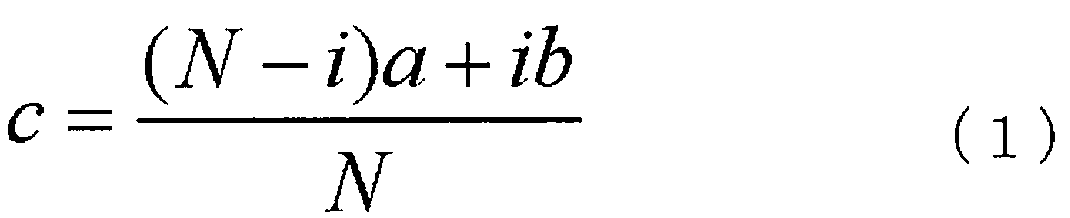
이러한 방법에 의해 생성된 화상 데이터를 사용하여 화상 A에서 화상 B로 전환함으로써, 매끄럽게(조용히), 자연스럽게 불연속의 화상을 전환할 수 있다.By switching from image A to image B using the image data generated by this method, it is possible to smoothly (quietly) and naturally switch discontinuous images.
또한, 수학식 1에 있어서, 모든 화소에 대하여 a=0인 경우가, 흑색 화상에서 서서히 화상 B로 전환되는 페이드 인에 상당한다. 또한, 모든 화소에 대하여 b=0인 경우가, 화상 A에서 서서히 흑색 화상으로 전환되는 페이드 아웃에 상당한다.Further, in
상기에서는, 2개의 화상을 일시적으로 오버랩시켜서 화상을 전환하는 방법에 대하여 서술하였지만, 오버랩시키지 않는 방법으로 하여도 좋다.In the above, a method of switching images by temporarily overlapping two images has been described, but a method of not overlapping may be employed.
2개의 화상을 오버랩시키지 않는 경우, 화상 A에서 화상 B로 전환하는 경우에, 사이에 흑색 화상을 삽입하여도 좋다. 이때, 화상 A에서 흑색 화상으로 전이할 때, 또는 흑색 화상에서 화상 B로 전이할 때, 또는 그 양쪽에 상술한 바와 같은 화상 전환 방법을 사용하여도 좋다. 또한, 화상 A와 화상 B 사이에 삽입하는 화상은 흑색 화상뿐만 아니라, 백색 화상 등의 단일 색의 화상을 사용하여도 좋고, 화상 A나 화상 B는 상이한, 다색의 화상을 사용하여도 좋다.When the two images are not overlapped, or when switching from image A to image B, a black image may be inserted between them. At this time, when transitioning from image A to black image, or when transitioning from black image to image B, or both, the image switching method described above may be used. In addition, as an image inserted between the image A and the image B, not only a black image but also a single color image such as a white image may be used, and images A and B may use different multicolor images.
화상 A와 화상 B 사이에 상이한 화상, 특히 흑색 화상 등의 단일 색의 화상을 삽입함으로써, 화상 전환의 타이밍을 보다 자연스럽게 사용자가 감지할 수 있고, 사용자에게 스트레스를 느끼게 하지 않고 화상을 전환할 수 있다.By inserting a different image between image A and image B, especially a single color image such as a black image, the user can more naturally detect the timing of image switching, and the image can be switched without causing the user to feel stress. .
또한, 본 실시형태는, 본 명세서에서 나타내는 다른 실시형태와 적절히 조합할 수 있다.In addition, this embodiment can be suitably combined with the other embodiment shown in this specification.
(실시형태 8)(Embodiment 8)
본 실시형태에서는, 본 발명의 일 양태의 반도체 장치를 사용한 정보 처리 장치의 구성에 대하여 도 35a1 내지 도 35b2 및 도 36을 참조하면서 설명한다.In this embodiment, a configuration of an information processing device using the semiconductor device of one aspect of the present invention will be described with reference to FIGS. 35A1 to 35B2 and FIG. 36.
도 35a1 내지 도 35b2는 정보 처리 장치의 효과를 설명하는 도면이다.35A1 to 35B2 are diagrams for explaining the effect of the information processing apparatus.
도 36은 정보 처리 장치의 구성을 설명하는 블록도이다.36 is a block diagram illustrating a configuration of an information processing device.
눈의 피로에는 신경계의 피로와 근육계의 피로 2종류가 있다. 눈의 피로를 설명하는 모식도를 도 35a에 도시한다.There are two types of eye fatigue: nervous system fatigue and muscular system fatigue. A schematic diagram illustrating eye fatigue is shown in Fig. 35A.
신경계의 피로는, 표시부가 발하는 광이나 점멸 화면을 장시간 동안 계속하여 봄으로써 그 밝기가 눈의 망막, 신경 또는 뇌를 자극하여 피로하게 하는 것이다. 형광등이나 종래의 표시 장치의 표시부가 조금씩 명멸(明滅)하는 현상을 플리커라고 하지만, 이러한 플리커는 신경계의 피로를 일으킨다.The nervous system's fatigue is a result of continuously watching light emitted by the display unit or a flickering screen for a long period of time, and the brightness stimulates the retina, nerves, or brain of the eye, causing fatigue. Flicker is a phenomenon in which a display portion of a fluorescent lamp or a conventional display device gradually flickers, but such flicker causes fatigue of the nervous system.
근육계의 피로는, 핀트 조절시에 사용하는 모양체(毛樣體)의 근육을 혹사함으로써 피로하게 하는 것이다.Fatigue of the muscular system causes fatigue by overworking the muscles of the ciliary body used during focus adjustment.
도 35a1에, 종래의 표시부의 표시를 나타내는 모식도를 도시한다. 종래의 표시부는 1초간에 60회 화상의 재기록이 행하여지고 있다. 이러한 화면을 장시간 동안 계속하여 봄으로써 사용자의 눈의 망막, 신경 또는 뇌를 자극하여 눈의 피로가 야기될 우려가 있다.Fig. 35A1 is a schematic diagram showing a display of a conventional display unit. In the conventional display unit, images are rewritten 60 times per second. By continuously viewing such a screen for a long time, there is a concern that eye fatigue may be caused by stimulating the retina, nerves, or brain of the user's eyes.
또한, 도 35a2에 도시한 바와 같이 1화소의 사이즈가 큰 경우(예를 들면, 세밀도가 150ppi 미만인 경우), 표시부에 표시된 문자 등의 윤곽이 희미해져 버린다. 표시부에 표시된 윤곽이 희미해진 문자 등을 장시간 동안 계속하여 보면, 모양체의 근육이 끊임없이 핀트를 맞추려고 움직여서 계속 긴장됨으로써, 눈에 부담을 가해버릴 우려가 있다.In addition, as shown in Fig. 35A2, when the size of one pixel is large (for example, when the fineness is less than 150 ppi), outlines of characters and the like displayed on the display portion become blurred. If a character or the like with a blurred outline displayed on the display portion is continuously viewed for a long time, the ciliary muscles constantly move to focus and continue to be tense, thereby putting a burden on the eyes.
또한, 눈의 피로를 정량적으로 측정하는 방법이 검토되고 있다. 예를 들면, 신경계 피로의 평가 지표로서는 임계 융합 주파수(CFF: Critical Flicker(Fusion) Frequency) 등이 알려져 있다. 또한, 근육계 피로의 평가 지표로서는 조절 시간이나 조절 근점 거리 등이 알려져 있다.In addition, methods of quantitatively measuring eye fatigue are being studied. For example, as an evaluation index of nervous system fatigue, a critical fusion frequency (CFF: Critical Flicker (Fusion) Frequency) is known. In addition, as an evaluation index of muscular system fatigue, the adjustment time, the adjustment near point distance, etc. are known.
그 밖에, 눈의 피로를 평가하는 방법으로서 뇌파 측정, 서모그래피법, 깜박임 회수의 측정, 눈물액량의 평가, 동공의 수축 반응 속도의 평가나, 자각 증상을 조사하기 위한 앙케트 등이 있다.Other methods for evaluating eye fatigue include brain wave measurement, thermography, measurement of the number of flickering, evaluation of the amount of tear fluid, evaluation of the rate of contraction reaction of the pupil, and questionnaire to investigate subjective symptoms.
상기 과제를 해결하기 위하여, 본 발명의 일 양태는 작업 환경의 조도와 표시 장치에 표시되는 화상 정보의 배경의 계조에 착안하였다. 이하에 설명하는 실시형태에는, 환경의 조도 정보와 화상 정보 배경의 계조 정보에 착안하여 창작된 본 발명의 일 양태가 포함된다.In order to solve the above problems, an aspect of the present invention has focused on the illuminance of the work environment and the gradation of the background of image information displayed on the display device. Embodiments described below include one aspect of the present invention created by focusing on environmental illuminance information and gradation information of image information and background.
본 발명의 일 양태의 화상 정보의 처리 및 표시 방법은, 환경의 조도 정보 및 표시부에 표시하는 화상 정보 배경의 계조 정보를 취득하는 스텝과, 이들 정보를 사용하여 화상 정보를, 표시광에 420nm보다 짧은 파장의 광을 포함하지 않고 또한 150ppi 이상의 세밀도로 설치된 복수의 화소를 구비하는 표시부에 표시하는 스텝을 갖는다. 이에 의해, 화상 정보를 환경의 조도에 알맞은 밝기로 표시할 수 있다. 그 결과, 화상 정보의 처리 및 눈이 편한 표시를 할 수 있는 신규의 화상 정보의 처리 및 표시 방법을 제공할 수 있다.The image information processing and display method of one aspect of the present invention includes the steps of acquiring environmental illuminance information and image information to be displayed on a display unit and gradation information of a background, and using these information to transfer image information to display light of less than 420 nm. There is a step of displaying on a display unit including a plurality of pixels that do not contain light of a short wavelength and are provided with a fine density of 150 ppi or more. As a result, image information can be displayed with a brightness suitable for the illuminance of the environment. As a result, it is possible to provide a novel image information processing and display method capable of processing image information and displaying easy-to-eye.
본 발명의 일 양태의 화상 정보의 처리 및 표시 방법을 적용할 수 있는 정보 처리 장치의 블록도의 일례를 도 36에 도시한다.Fig. 36 shows an example of a block diagram of an information processing apparatus to which the method of processing and displaying image information according to an aspect of the present invention can be applied.
정보 처리 장치(330)는 연산부(311), 기억부(312) 및 전송로(314)를 갖는다. 전송로(314)는 연산부(311), 기억부(312) 및 입출력 인터페이스(315)를 서로 접속하고, 정보의 전송을 행한다. 또한, 이들 구성은 명확하게 분리할 수 없고, 하나의 구성이 다른 구성을 겸하는 경우나 다른 구성의 일부를 포함하는 경우가 있다. 예를 들면, 터치 패널은 표시부임과 동시에 입력 수단이기도 한다.The
입출력 장치(320)는, 입출력 인터페이스(315)를 통하여 전송로(314)에 접속된다. 입출력 장치(320)는 연산 장치(310)의 외부에서 정보를 입력 또는 연산 장치(310)의 외부에 정보를 출력하기 위한 장치이다.The input/
입출력 장치(320)로서는, 통신 기기, 네트워크 접속 기기 또는 하드 디스크, 리무버블 메모리 등 기록 가능한 외부 기억부를 그 일례로서 들 수 있다.Examples of the input/
입력 수단(321)으로서는, 키보드, 마우스 또는 터치 패널 등의 휴먼 인터페이스 기기, 디지털 카메라, 디지털 비디오 카메라 등의 카메라, 스캐너, CDROM, DVDROM 등 판독 전용의 외부 기억부를 그 일례로서 들 수 있다. 예를 들면, 정보 처리 장치(330)의 사용자는, 입력 수단(321)에서 페이지 넘김 명령 등을 입력할 수 있다.Examples of the input means 321 include human interface devices such as a keyboard, mouse or touch panel, cameras such as digital cameras and digital video cameras, and read-only external storage units such as scanners, CDROMs, and DVDROMs. For example, a user of the
출력 장치로서는 표시부(322) 이외에, 스피커, 프린터 등을 접속할 수 있다.As the output device, in addition to the
본 발명의 일 양태의 정보 처리 장치(330)는 표시부(322)를 구비한다. 특히, 표시부(322)는, 표시광에 420nm보다 짧은 파장의 광, 바람직하게는 440nm보다 단파장의 광을 포함하지 않는다. 그리고, 표시 영역에 150ppi 이상, 바람직하게는 200ppi 이상의 세밀도로 설치된 복수의 화소를 구비하면 좋다. 이에 의해, 눈이 편한 표시를 하는 것이 가능하게 된다. 또한, 본 명세서에서 표시광이란, 정보 처리 장치의 표시부가 화상을 표시하기 위하여 사용자를 향하여 발하는, 또는 반사하는 광을 말한다.The
본 발명의 일 양태에 관한 표시부의 표시광은, 눈의 각막이나 수정체에서 흡수되지 않고 망막까지 도달하기 때문에, 장기적인 망막에 대한 영향이나, 생체 리듬에 대한 악영향이 있는 광을 포함하지 않는다. 구체적으로는, 화상을 표시하는 광에 400nm, 바람직하게는 420nm, 보다 바람직하게는 440nm 이하의 파장을 갖는 광(UVA라고도 한다)을 포함하지 않는다.Since the display light of the display unit according to an aspect of the present invention reaches the retina without being absorbed by the cornea or lens of the eye, it does not contain light that has a long-term effect on the retina or adversely affects a physiological rhythm. Specifically, light (also referred to as UVA) having a wavelength of 400 nm, preferably 420 nm, and more preferably 440 nm or less is not included in the light for displaying an image.
본 발명의 일 양태의 정보 처리 장치(330)에는 본 발명의 일 양태의 반도체 장치를 사용할 수 있다. 상기 반도체 장치에 있어서의 화소에서는, 상기 파장을 갖는 광을 흡수하고, 투과하기 어려운 특징을 갖는다. 따라서, 상기 파장을 갖는 광을 발하는 광원을 사용하여도, 본 발명의 일 양태의 반도체 장치를 사용함으로써 상기 파장을 갖는 광을 저감 또는 차단할 수 있다.The semiconductor device of one aspect of the present invention can be used for the
또한, 본 발명의 일 양태에 관한 표시부가 구비하는 화소의 세밀도가 150ppi, 바람직하게는 200ppi 이상이고, 1화소의 사이즈가 작다. 이에 의해, 사용자의 눈의 근육계의 피로가 경감된다.In addition, the pixel density of the display unit according to the aspect of the present invention is 150 ppi, preferably 200 ppi or more, and the size of one pixel is small. As a result, fatigue in the muscular system of the user's eyes is reduced.
본 발명의 일 양태의 정보 처리 장치의 눈의 피로를 경감시키는 효과를 설명하는 모식도를 도 35b에 도시한다.Fig. 35B is a schematic diagram illustrating the effect of reducing eye fatigue of the information processing device of one embodiment of the present invention.
본 발명의 일 양태의 정보 처리 장치는 화소를 선택하는 신호를 출력하는 빈도를 바꿀 수 있다. 특히, 오프 전류가 상당히 작은 트랜지스터를 표시부의 화소부에 사용함으로써 플리커의 발생을 억제하면서 프레임 주파수를 낮출 수 있다. 예를 들면, 5초간에 1회 화상의 재기록이 가능해지기 때문에, 같은 화상을 보는 것이 가능해지고, 사용자에게 시인되는 화면의 어른거림이 저감된다. 이에 의해, 사용자의 눈의 망막, 신경 또는 뇌가 받는 자극이 저감되어, 신경계의 피로가 경감된다(도 35b1 참조).The information processing apparatus of an aspect of the present invention can change the frequency of outputting a signal for selecting a pixel. In particular, by using a transistor having a very small off-current in the pixel portion of the display portion, it is possible to reduce the frame frequency while suppressing the occurrence of flicker. For example, since an image can be rewritten once every 5 seconds, it becomes possible to view the same image, and flicker on the screen visually recognized by the user is reduced. As a result, stimulation received by the retina, nerves or brain of the user's eyes is reduced, and fatigue of the nervous system is alleviated (see Fig. 35B1).
또한, 오프 전류가 상당히 작은 트랜지스터로서는, 예를 들면, 산화물 반도체를 사용한 트랜지스터, 특히, CAAC-OS를 사용한 트랜지스터가 적합하다.Further, as a transistor having a considerably small off current, a transistor using an oxide semiconductor, in particular, a transistor using a CAAC-OS is suitable.
본 발명의 일 양태의 정보 처리 장치는 1화소의 사이즈가 작다. 구체적으로는, 세밀도가 150ppi, 바람직하게는 200ppi 이상의 고정밀한 표시가 가능하다. 화상의 윤곽을 명료하게, 또한 치밀하고 매끄럽게 표시할 수 있다. 이에 의해, 모양체의 근육이 핀트를 맞추기가 쉬워지기 때문에, 사용자의 근육계의 피로가 경감된다(도 35b2 참조). 또한, 세밀도는 화소 밀도(ppi: pixcel per inch)를 사용하여 표현할 수 있다. 화소 밀도는 1인치당 화소의 수이다. 또한, 화소는 화상을 구성하는 단위이다.The information processing apparatus of one aspect of the present invention has a small size of one pixel. Specifically, a high-definition display of 150 ppi, preferably 200 ppi or more, is possible. The outline of the image can be clearly displayed, and it is possible to display a detailed and smooth image. As a result, since the muscles of the ciliary body are more easily focused, fatigue of the user's muscular system is alleviated (see Fig. 35B2). In addition, the fineness can be expressed using a pixel density (ppi: pixcel per inch). Pixel density is the number of pixels per inch. Further, a pixel is a unit constituting an image.
또한, 본 실시형태는, 본 명세서에서 나타내는 다른 실시형태와 적절히 조합할 수 있다.In addition, this embodiment can be suitably combined with the other embodiment shown in this specification.
(실시형태 9)(Embodiment 9)
본 발명의 일 양태인 반도체 장치는 다양한 전자 기기(게임기도 포함한다)에 적용할 수 있다. 전자 기기로서는, 텔레비전 장치, 컴퓨터용 등의 모니터, 디지털 카메라, 디지털 비디오 카메라, 디지털 포토 프레임, 휴대 전화기, 게임기, 휴대형 게임기, 휴대 정보 단말, 음향 재생 장치, 게임기(파친코기, 슬롯 머신 등)를 들 수 있다. 이들 전자 기기의 일례를 도 37a 내지 도 37c, 도 38a 및 도 38b에 도시한다.The semiconductor device as an aspect of the present invention can be applied to various electronic devices (including game machines). As electronic devices, TV devices, monitors for computers, digital cameras, digital video cameras, digital photo frames, mobile phones, game machines, portable game machines, portable information terminals, sound reproduction devices, game machines (pachinko machines, slot machines, etc.) Can be lifted. Examples of these electronic devices are shown in Figs. 37A to 37C and Figs. 38A and 38B.
도 37a는 표시부를 갖는 테이블을 도시하고 있다. 테이블(9000)은 케이싱 (9001)에 표시부(9003)가 내장되어 있고, 표시부(9003)에 의해 영상을 표시하는 것이 가능하다. 또한, 4개의 다리부(9002)에 의해 케이싱(9001)을 지지한 구성을 도시하고 있다. 또한, 전력 공급을 위한 전원 코드(9005)를 케이싱(9001)에 갖고 있다.37A shows a table having a display portion. In the table 9000, a
상기 실시형태 중 어느 하나에 나타낸 반도체 장치는 표시부(9003)에 사용하는 것이 가능하다. 그 때문에, 표시부(9003)의 표시 품질을 높게 할 수 있다.The semiconductor device shown in any of the above embodiments can be used for the
표시부(9003)는 터치 입력 기능을 가지며, 테이블(9000)의 표시부(9003)에 표시된 표시 버튼(9004)을 손가락 등으로 터치함으로써 화면을 조작하거나 정보를 입력할 수 있고, 또한 다른 가전 제품과의 통신을 가능하게 하는, 또는 제어를 가능하게 함으로써 화면 조작에 의해 다른 가전 제품을 컨트롤하는 제어 장치로 하여도 좋다. 예를 들면, 터치 센서 기능이나 이미지 센서 기능을 갖는 반도체 장치를 사용하면, 표시부(9003)에 터치 입력 기능을 부여할 수 있다.The
또한, 케이싱(9001)에 설치된 힌지에 의해 표시부(9003)의 화면을 바닥에 수직으로 세울 수도 있고, 텔레비전 장치로서도 이용할 수 있다. 좁은 방에서는 화면이 큰 텔레비전 장치는 설치하면 자유 공간이 좁아지지만, 테이블에 표시부가 내장되어 있으면 방의 공간을 유효하게 이용할 수 있다.Further, the screen of the
도 37b는 텔레비전 장치를 도시하고 있다. 텔레비전 장치(9100)는 케이싱 (9101)에 표시부(9103)가 내장되어 있고, 표시부(9103)에 의해 영상을 표시하는 것이 가능하다. 또한, 여기에서는 스탠드(9105)에 의해 케이싱(9101)을 지지한 구성을 도시하고 있다.37B shows a television device. In the
텔레비전 장치(9100)의 조작은 케이싱(9101)이 구비한 조작 스위치나, 별개의 리모트 컨트롤러(9110)에 의해 행할 수 있다. 리모트 콘트롤러(9110)가 구비한 조작키(9109)에 의해 채널이나 음량을 조작할 수 있고, 표시부(9103)에 표시되는 영상을 조작할 수 있다. 또한, 리모트 콘트롤러(9110)에, 상기 리모트 콘트롤러로부터 출력하는 정보를 표시하는 표시부(9107)를 설치하는 구성으로 하여도 좋다.The
도 37b에 도시한 텔레비전 장치(9100)는 수신기나 통신 수단 등을 구비하고 있다. 텔레비전 장치(9100)는 수신기에 의해 일반적인 텔레비전 방송을 수신할 수 있고, 또한 통신 수단을 통하여 유선 또는 무선에 의한 통신 네트워크에 접속함으로써 일방향(송신자로부터 수신자) 또는 쌍방향(송신자와 수신자 사이 또는 수신자들 사이 등)의 정보 통신을 행하는 것도 가능하다.The
상기 실시형태 중 어느 하나에 나타낸 반도체 장치는 표시부(9103, 9107)에 사용하는 것이 가능하다. 그 때문에, 텔레비전 장치의 표시 품질을 향상시킬 수 있다.The semiconductor device described in any of the above embodiments can be used for the
도 37c는 컴퓨터(9200)이고, 본체(9201), 케이싱(9202), 표시부(9203), 키보드(9204), 외부 접속 포트(9205), 포인팅 디바이스(9206) 등을 포함한다.37C shows a
상기 실시형태 중 어느 하나에 나타낸 반도체 장치는 표시부(9203)에 사용하는 것이 가능하다. 그 때문에, 컴퓨터(9200)의 표시 품질을 향상시킬 수 있다.The semiconductor device described in any of the above embodiments can be used for the
표시부(9203)는 터치 입력 기능을 갖고 있고, 표시부(9203)에 표시된 표시 버튼 등을 손가락 등으로 터치함으로써 화면 조작이나 정보를 입력할 수 있다. 또한, 키보드나 음성으로 정보를 입력할 수 있다.The
도 38a 및 도 38b는 접이식 가능한 태블릿형 단말이다. 도 38a는 연 상태이고, 태블릿형 단말은 케이싱(9630), 표시부(9631a), 표시부(9631b), 표시 모드 전환 스위치(9034), 전원 스위치(9035), 전력 절약 모드 전환 스위치(9036), 잠금쇠(9033), 조작 스위치(9038)를 갖는다.38A and 38B are foldable tablet-type terminals. 38A is an open state, and the tablet-type terminal includes a
상기 실시형태 중 어느 하나에 나타낸 반도체 장치는, 표시부(9631a), 표시부(9631b)에 사용하는 것이 가능하다. 그 때문에, 태블릿 단말의 표시 품질을 향상시킬 수 있다.The semiconductor device shown in any one of the above embodiments can be used for the
표시부(9631a)는, 일부를 터치 패널의 영역(9632a)으로 할 수 있고, 표시된 조작 키(9638)에 터치함으로서 데이터 입력을 할 수 있다. 또한, 표시부(9631a)에 서는, 일례로서 절반의 영역이 표시 기능만을 갖는 구성, 나머지 절반의 영역이 터치 패널의 기능을 갖는 구성을 나타내고 있지만 상기 구성에 한정되지 않는다. 표시부(9631a)의 모든 영역이 터치 패널의 기능을 갖는 구성으로 하여도 좋다. 예를 들면, 표시부(9631a)의 전면을 키보드 버튼 표시시켜서 터치 패널로 하고, 표시부(9631b)를 표시 화면으로 하여 사용할 수 있다.A part of the
또한, 표시부(9631b)에서도 표시부(9631a)와 같이, 표시부(9631b)의 일부를 터치 패널의 영역(9632b)으로 할 수 있다. 또한, 터치 패널의 키보드 표시 전환 버튼(9639)이 표시되어 있는 위치에 손가락이나 스타일러스(stylus) 등으로 터치함으로써 표시부(9631b)에 키보드 버튼 표시할 수 있다.Also, in the
또한, 터치 패널의 영역(9632a)과 터치 패널의 영역(9632b)에 대하여 동시에 터치 입력할 수도 있다.In addition, a touch input may be performed on the
또한, 표시 모드 전환 스위치(9034)는 세로 표시 또는 가로 표시 등의 표시 방향을 전환, 흑백 표시나 컬러 표시의 전환 등을 선택할 수 있다. 전력 절약 모드 전환 스위치(9036)는, 태블릿형 단말에 내장되어 있는 광센서에서 검출되는 사용시의 외광의 광량에 따라 표시의 휘도를 최적인 것으로 할 수 있다. 태블릿형 단말은 광센서뿐만 아니라, 자이로스코프(gyroscope), 가속도 센서 등의 경사를 검출하는 센서 등의 다른 검출 장치를 내장시켜도 좋다.In addition, the display
또한, 도 38a에서는 표시부(9631b)와 표시부(9631a)의 표시 면적이 같은 예를 도시하고 있지만 특별히 한정되지 않고, 한쪽의 사이즈와 다른 한쪽의 사이즈가 상이하여도 좋고, 표시의 품질도 상이하여도 좋다. 예를 들면, 한쪽이 다른 한쪽보다도 고정밀한 표시를 행할 수 있는 표시 패널로 하여도 좋다.38A shows an example in which the display area of the
도 38b는 닫은 상태이고, 태블릿형 단말은 케이싱(9630)에 태양 전지(9633), 충방전 제어 회로(9634)를 갖고 있어도 좋다. 또한, 도 38b에서는 충방전 제어 회로(9634)의 일례로서 배터리(9635), DCDC 컨버터(9636)를 갖는 구성에 대하여 도시하고 있다.38B is a closed state, and the tablet-type terminal may have a
또한, 태블릿형 단말은 접이식 가능하기 때문에, 미사용시에 케이싱(9630)을 닫은 상태로 할 수 있다. 따라서, 표시부(9631a), 표시부(9631b)를 보호할 수 있으므로 내구성이 우수하고, 장기 사용의 관점에서도 신뢰성이 우수한 태블릿형 단말을 제공할 수 있다.Further, since the tablet-type terminal is foldable, the
또한, 이 밖에도 도 38a 및 도 38b에 도시한 태블릿형 단말은, 여러가지 정보(정지 화상, 동영상, 텍스트 화상 등)를 표시하는 기능, 카렌다, 날짜 또는 시간 등을 표시부에 표시하는 기능, 표시부에 표시한 정보를 터치 입력 조작 또는 편집하는 터치 입력 기능, 여러가지 소프트웨어(프로그램)에 의해 처리를 제어하는 기능 등을 갖을 수 있다.In addition, in addition, the tablet terminal shown in Figs. 38A and 38B has a function to display various information (still image, video, text image, etc.), a function to display a calendar, date or time, etc. on the display unit, and display on the display unit. It may have a touch input function of manipulating or editing one piece of information, a function of controlling processing by various software (programs), and the like.
태블릿형 단말의 표면에 장착된 태양 전지(9633)에 의해, 전력을 터치 패널, 표시부, 또는 영상 신호 처리부 등에 공급할 수 있다. 또한, 태양 전지(9633)는 케이싱(9630)의 한 면 또는 양면에 설치할 수 있고, 배터리(9635)의 충전을 효율적으로 행할 수 있다. 또한 배터리(9635)로서는 리튬 이온 전지를 사용하면 소형화를 도모할 수 있는 등의 이점이 있다.Power can be supplied to a touch panel, a display unit, an image signal processing unit, or the like by the
또한, 도 38b에 도시한 충방전 제어 회로(9634)의 구성 및 동작에 대하여 도 39a 내지 도 39c에 블록도를 도시하여 설명한다. 도 39a에서는 태양 전지(9633), 배터리(9635), DCDC 컨버터(9636), DCDC 컨버터(9637), 스위치(SW1 내지 SW3), 부하(표시부(9631) 등)에 대하여 도시하고 있고, 배터리(9635), DCDC 컨버터(9636), DCDC 컨버터(9637), 스위치(SW1 내지 SW3)가 도 38b에 도시한 충방전 제어 회로(9634)에 대응하는 개소가 된다.In addition, the configuration and operation of the charge/
우선, 태양 전지(9633)에 의해 발전이 되는 경우의 동작의 예에 대하여 설명한다. 태양 전지에서 발전한 전력은, 배터리(9635)를 충전하기 위한 전압이 되도록 DCDC 컨버터(9636)로 승압 또는 강압이 된다. 그리고, 부하(표시부(9631) 등)의 동작에 태양 전지(9633)로부터의 전력이 사용될 때는 스위치(SW1)를 온으로 하고, DCDC 컨버터(9637)로 부하(표시부(9631) 등)에 필요한 전압에 승압 또는 강압을 하는 것으로 된다. 또한, 부하(표시부(9631) 등)로의 전력의 공급을 행하지 않을 때에는 SW1을 오프로하고, SW2를 온으로 하여 배터리(9635)의 충전을 행하는 구성으로 하면 좋다.First, an example of the operation in the case of generating power by the
또한, 부하(표시부(9631) 등)로의 전력 공급을 항상 배터리(9635)를 통하여 행하는 경우에는, 도 39b에 도시한 바와 같이 스위치(SW1)를 생략한 구성으로 하여도 좋다.In addition, when power supply to the load (
또한, 부하에 공급하는 적절한 전압 범위와 배터리(9635)의 전압이 동등한 경우에는, 도 39c에 도시한 바와 같이 더욱 DCDC 컨버터(9637)를 생략한 구성으로 하여도 좋다.In addition, when the appropriate voltage range supplied to the load and the voltage of the
또한, 태양 전지(9633)에 대하여는 발전 수단의 일례로서 나타냈지만 특별히 한정되지 않고, 압전 소자(피에조 소자(piezoelectric element))나 열전 변환 소자(펠티에 소자(Peltier element)) 등의 다른 발전 수단에 의한 배터리(9635)의 충전을 행하는 구성이라도 좋다. 예를 들면, 무선(비접촉)으로 전력을 송수신하여 충전하는 무접점 전력 전송 모듈이나, 또 다른 충전 수단을 조합하여 행하는 구성으로 하여도 좋다.In addition, the
또한, 본 실시형태에 나타낸 구성 등은 다른 실시형태에 나타낸 구성과 적절히 조합하여 사용할 수 있다.In addition, the configurations shown in this embodiment and the like can be used in appropriate combinations with the configurations shown in other embodiments.
100 화소부
101 화소
102 기판
103 트랜지스터
104 제 1 구동 회로
105 용량 소자
106 제 2 구동 회로
107 주사선
108 액정 소자
109 신호선
110 질화 절연막
111 반도체막
113 도전막
115 용량선
117 개구
119 반도체막
121 화소 전극
123 개구
125 도전막
127 게이트 절연막
129 절연막
131 절연막
132 절연막
135 경계
150 채널 보호막
154 대향 전극
188a 산화물 반도체막
188b 산화물 반도체막
199a 산화물 반도체막
199b 산화물 반도체막
199c 산화물 반도체막
223 트랜지스터
227 게이트 전극
229 배선
231 반도체막
233 배선
241 도전막
310 연산 장치
311 연산부
312 기억부
314 전송로
315 입출력 인터페이스
320 입출력 장치
321 입력 수단
322 표시부
330 정보 처리 장치
500 입력 수단
500_C 신호
600 정보 처리 장치
610 제어부
615_C 2차 제어 신호
615_V 2차 화상 신호
620 연산 장치
625_C 1차 제어 신호
625_V 1차 화상 신호
630 표시부
631 화소부
631a 영역
631b 영역
631c 영역
631p 화소
632 G 구동 회로
632_G G 신호
632a G 구동 회로
632b G 구동 회로
632c G 구동 회로
633 S 구동 회로
633_S S 신호
634 화소 회로
634c 용량 소자
634EL 화소 회로
634t 트랜지스터
634t_1 트랜지스터
634t_2 트랜지스터
635 표시 소자
635EL EL 소자
635LC 액정 소자
640 표시 장치
650 광 공급부
701 연산부
702 기억부
703 제어부
704 표시부
901 기판
902 화소부
903 제 2 구동 회로
904 제 1 구동 회로
905 씰재
906 기판
908 액정층
910 트랜지스터
911 트랜지스터
913 액정 소자
915 접속 단자 전극
916 단자 전극
917 도전막
918 FPC
918b FPC
919 이방성 도전제
922 게이트 절연막
923 절연막
924 절연막
925 씰재
926 용량 소자
927 산화물 반도체막
929 용량선
930 전극
931 전극
932 절연막
933 절연막
934 절연막
935 스페이서
936 용량 소자
971 소스 전극
973 드레인 전극
975 공통 전위선
977 공통 전극
985 공통 전위선
987 공통 전극
9000 테이블
9001 케이싱
9002 다리부
9003 표시부
9004 표시 버튼
9005 전원 코드
9033 도구
9034 스위치
9035 전원 스위치
9036 스위치
9038 조작 스위치
9100 텔레비전 장치
9101 케이싱
9103 표시부
9105 스탠드
9107 표시부
9109 조작 키
9110 리모트 콘트롤러
9200 컴퓨터
9201 본체
9202 케이싱
9203 표시부
9204 키보드
9205 외부 접속 포트
9206 포인팅 디바이스
9630 케이싱
9631 표시부
9631a 표시부
9631b 표시부
9632a 영역
9632b 영역
9633 태양 전지
9634 충방전 제어 회로
9635 배터리
9636 DCDC 컨버터
9637 DCDC 컨버터
9638 조작 키
9639 버튼100 pixels
101 pixels
102 substrate
103 transistor
104 first drive circuit
105 capacitive element
106 second drive circuit
107 scan line
108 liquid crystal element
109 signal line
110 nitride insulating film
111 semiconductor film
113 Conductive Film
115 capacity line
117 opening
119 semiconductor film
121 pixel electrode
123 opening
125 conductive film
127 gate insulating film
129 Insulation film
131 insulating film
132 Insulation film
135 border
150 channel shield
154 counter electrode
188a oxide semiconductor film
188b oxide semiconductor film
199a oxide semiconductor film
199b oxide semiconductor film
199c oxide semiconductor film
223 transistor
227 gate electrode
229 wiring
231 semiconductor film
233 wiring
241 Conductive Film
310 computing device
311 Operation unit
312 Memory
314 transmission line
315 input/output interface
320 input/output devices
321 input means
322 display
330 information processing unit
500 input means
500_C signal
600 information processing unit
610 control unit
615_C secondary control signal
615_V secondary image signal
620 computing unit
625_C primary control signal
625_V primary picture signal
630 display
631 pixel part
631c area
631p pixels
632 G drive circuit
632_G G signal
632a G drive circuit
632b G drive circuit
632c G drive circuit
633 S drive circuit
633_S S signal
634 pixel circuit
634c capacitive element
634EL pixel circuit
634t transistor
634t_1 transistor
634t_2 transistor
635 display element
635EL EL element
635LC liquid crystal element
640 display unit
650 light supply
701 operation unit
702 Memory
703 control
704 display
901 substrate
902 pixel part
903 second drive circuit
904 first drive circuit
905 seal material
906 substrate
908 liquid crystal layer
910 transistor
911 transistor
913 liquid crystal element
915 connection terminal electrode
916 terminal electrode
917 conductive film
918 FPC
918b FPC
919 Anisotropic Conductive Agent
922 gate insulating film
923 insulating film
924 insulating film
925 seal materials
926 capacitive element
927 oxide semiconductor film
929 capacity line
930 electrode
931 electrode
932 insulating film
933 insulating film
934 insulating film
935 spacer
936 capacitive element
971 source electrode
973 drain electrode
975 common potential line
977 common electrode
985 common potential line
987 common electrode
9000 tables
9001 casing
9002 leg
9003 display
9004 display button
9005 power cord
9033 tool
9034 switch
9035 power switch
9036 switch
9038 control switch
9100 television device
9101 casing
9103 display
9105 stand
9107 display
9109 operation keys
9110 remote controller
9200 computer
9201 main body
9202 casing
9203 display
9204 keyboard
9205 external connection port
9206 pointing device
9630 casing
9631 display
9631a display
9631b display
9632a area
9632b area
9633 solar cell
9634 charge/discharge control circuit
9635 battery
9636 DCDC converter
9637 DCDC converter
9638 operation keys
9639 button
Claims (4)
제 1 산화물 반도체층을 채널로서 갖는 트랜지스터와, 상기 트랜지스터와 전기적으로 접속되는 용량 소자와, 화소 전극을 갖는 화소를 복수로 갖고,
상기 제 1 산화물 반도체층은, 상기 트랜지스터의 소스 전극 및 드레인 전극 중 한쪽으로서의 기능을 갖는 제 1 도전층과 전기적으로 접속되고,
상기 제 1 산화물 반도체층은, 상기 트랜지스터의 상기 소스 전극 및 상기 드레인 전극 중 다른 쪽으로서의 기능을 갖는 제 2 도전층을 통하여 상기 화소 전극과 전기적으로 접속되고,
상기 화소 전극은, 상기 제 2 도전층의 상면과 접하는 영역을 갖고,
상기 제 1 산화물 반도체층은, 상기 트랜지스터의 게이트 전극으로서의 기능을 갖는 제 3 도전층과 중첩하는 영역을 갖고,
상기 용량 소자는, 한쪽의 전극으로서 제 2 산화물 반도체층을 갖고,
상기 제 2 산화물 반도체층은, 상기 제 1 산화물 반도체층과 동일면 위에 제공되는 영역을 갖고,
상기 제 2 산화물 반도체층은, 상기 화소 전극과 중첩하는 영역을 갖고, 또한 상기 화소 전극과는 접하지 않고,
상기 제 2 산화물 반도체층의 면적은, 상기 제 1 산화물 반도체층의 면적보다도 크고,
상기 제 2 산화물 반도체층은, 상기 제 2 산화물 반도체층 아래에 위치하는 제 4 도전층과 중첩하는 영역을 갖고,
상기 제 4 도전층은, 상기 제 3 도전층과는 분리되어 있고,
상기 제 1 산화물 반도체층은, In과 Ga과 Zn을 갖고,
상기 제 2 산화물 반도체층은, In과 Ga과 Zn을 갖는, 표시 장치.As a display device,
A transistor having a first oxide semiconductor layer as a channel, a capacitor element electrically connected to the transistor, and a plurality of pixels having a pixel electrode,
The first oxide semiconductor layer is electrically connected to a first conductive layer having a function as one of a source electrode and a drain electrode of the transistor,
The first oxide semiconductor layer is electrically connected to the pixel electrode through a second conductive layer having a function of the other of the source electrode and the drain electrode of the transistor,
The pixel electrode has a region in contact with an upper surface of the second conductive layer,
The first oxide semiconductor layer has a region overlapping with a third conductive layer having a function as a gate electrode of the transistor,
The capacitance element has a second oxide semiconductor layer as one electrode,
The second oxide semiconductor layer has a region provided on the same surface as the first oxide semiconductor layer,
The second oxide semiconductor layer has a region overlapping the pixel electrode, and does not contact the pixel electrode,
The area of the second oxide semiconductor layer is larger than the area of the first oxide semiconductor layer,
The second oxide semiconductor layer has a region overlapping with a fourth conductive layer positioned below the second oxide semiconductor layer,
The fourth conductive layer is separated from the third conductive layer,
The first oxide semiconductor layer has In, Ga, and Zn,
The second oxide semiconductor layer has In, Ga, and Zn.
유기 EL 소자와, 제 1 산화물 반도체층을 채널로서 갖는 트랜지스터와, 상기 트랜지스터와 전기적으로 접속되는 용량 소자를 갖는 화소를 복수로 갖고,
상기 제 1 산화물 반도체층은, 상기 트랜지스터의 소스 전극 및 드레인 전극 중 한쪽으로서의 기능을 갖는 제 1 도전층과 전기적으로 접속되고,
상기 제 1 산화물 반도체층은, 상기 트랜지스터의 상기 소스 전극 및 상기 드레인 전극 중 다른 쪽으로서의 기능을 갖는 제 2 도전층을 통하여 상기 유기 EL 소자와 전기적으로 접속되고,
상기 유기 EL 소자의 하부 전극은, 상기 제 2 도전층의 상면과 접하는 영역을 갖고,
상기 제 1 산화물 반도체층은, 상기 트랜지스터의 게이트 전극으로서의 기능을 갖는 제 3 도전층과 중첩하는 영역을 갖고,
상기 용량 소자는, 한쪽의 전극으로서 제 2 산화물 반도체층을 갖고,
상기 제 2 산화물 반도체층은, 상기 제 1 산화물 반도체층과 동일면 위에 제공되는 영역을 갖고,
상기 제 2 산화물 반도체층은, 상기 하부 전극과 중첩하는 영역을 갖고, 또한 상기 하부 전극과는 접하지 않고,
상기 제 2 산화물 반도체층의 면적은, 상기 제 1 산화물 반도체층의 면적보다도 크고,
상기 제 2 산화물 반도체층은, 상기 제 2 산화물 반도체층 아래에 위치하는 제 4 도전층과 중첩하는 영역을 갖고,
상기 제 4 도전층은, 상기 제 3 도전층과는 분리되어 있고,
상기 제 1 산화물 반도체층은, In과 Ga과 Zn을 갖고,
상기 제 2 산화물 반도체층은, In과 Ga과 Zn을 갖는, 표시 장치.As a display device,
A plurality of pixels having an organic EL element, a transistor having a first oxide semiconductor layer as a channel, and a capacitor element electrically connected to the transistor,
The first oxide semiconductor layer is electrically connected to a first conductive layer having a function as one of a source electrode and a drain electrode of the transistor,
The first oxide semiconductor layer is electrically connected to the organic EL element through a second conductive layer having a function of the other of the source electrode and the drain electrode of the transistor,
The lower electrode of the organic EL element has a region in contact with the upper surface of the second conductive layer,
The first oxide semiconductor layer has a region overlapping with a third conductive layer having a function as a gate electrode of the transistor,
The capacitance element has a second oxide semiconductor layer as one electrode,
The second oxide semiconductor layer has a region provided on the same surface as the first oxide semiconductor layer,
The second oxide semiconductor layer has a region overlapping the lower electrode, and does not contact the lower electrode,
The area of the second oxide semiconductor layer is larger than the area of the first oxide semiconductor layer,
The second oxide semiconductor layer has a region overlapping with a fourth conductive layer positioned below the second oxide semiconductor layer,
The fourth conductive layer is separated from the third conductive layer,
The first oxide semiconductor layer has In, Ga, and Zn,
The second oxide semiconductor layer has In, Ga, and Zn.
Priority Applications (1)
| Application Number | Priority Date | Filing Date | Title |
|---|---|---|---|
| KR1020200094970A KR102271517B1 (en) | 2012-12-28 | 2020-07-30 | Semiconductor device and manufacturing method of the same |
Applications Claiming Priority (4)
| Application Number | Priority Date | Filing Date | Title |
|---|---|---|---|
| JP2012288968 | 2012-12-28 | ||
| JPJP-P-2012-288968 | 2012-12-28 | ||
| JP2013049065 | 2013-03-12 | ||
| JPJP-P-2013-049065 | 2013-03-12 |
Related Parent Applications (1)
| Application Number | Title | Priority Date | Filing Date |
|---|---|---|---|
| KR1020130165904A Division KR102125690B1 (en) | 2012-12-28 | 2013-12-27 | Semiconductor device and manufacturing method of the same |
Related Child Applications (1)
| Application Number | Title | Priority Date | Filing Date |
|---|---|---|---|
| KR1020200094970A Division KR102271517B1 (en) | 2012-12-28 | 2020-07-30 | Semiconductor device and manufacturing method of the same |
Publications (2)
| Publication Number | Publication Date |
|---|---|
| KR20200038909A KR20200038909A (en) | 2020-04-14 |
| KR102208596B1 true KR102208596B1 (en) | 2021-01-28 |
Family
ID=50928694
Family Applications (9)
| Application Number | Title | Priority Date | Filing Date |
|---|---|---|---|
| KR1020130165904A Active KR102125690B1 (en) | 2012-12-28 | 2013-12-27 | Semiconductor device and manufacturing method of the same |
| KR1020200041486A Active KR102208596B1 (en) | 2012-12-28 | 2020-04-06 | Semiconductor device and manufacturing method of the same |
| KR1020200094970A Active KR102271517B1 (en) | 2012-12-28 | 2020-07-30 | Semiconductor device and manufacturing method of the same |
| KR1020210079884A Active KR102344562B1 (en) | 2012-12-28 | 2021-06-21 | Semiconductor device and manufacturing method of the same |
| KR1020210180273A Active KR102481054B1 (en) | 2012-12-28 | 2021-12-16 | Semiconductor device and manufacturing method of the same |
| KR1020220170693A Active KR102690167B1 (en) | 2012-12-28 | 2022-12-08 | Semiconductor device and manufacturing method of the same |
| KR1020240091519A Active KR102772485B1 (en) | 2012-12-28 | 2024-07-11 | Semiconductor device and manufacturing method of the same |
| KR1020250020674A Active KR102885398B1 (en) | 2012-12-28 | 2025-02-18 | Semiconductor device and manufacturing method of the same |
| KR1020250165727A Pending KR20250164672A (en) | 2012-12-28 | 2025-11-06 | Semiconductor device and manufacturing method of the same |
Family Applications Before (1)
| Application Number | Title | Priority Date | Filing Date |
|---|---|---|---|
| KR1020130165904A Active KR102125690B1 (en) | 2012-12-28 | 2013-12-27 | Semiconductor device and manufacturing method of the same |
Family Applications After (7)
| Application Number | Title | Priority Date | Filing Date |
|---|---|---|---|
| KR1020200094970A Active KR102271517B1 (en) | 2012-12-28 | 2020-07-30 | Semiconductor device and manufacturing method of the same |
| KR1020210079884A Active KR102344562B1 (en) | 2012-12-28 | 2021-06-21 | Semiconductor device and manufacturing method of the same |
| KR1020210180273A Active KR102481054B1 (en) | 2012-12-28 | 2021-12-16 | Semiconductor device and manufacturing method of the same |
| KR1020220170693A Active KR102690167B1 (en) | 2012-12-28 | 2022-12-08 | Semiconductor device and manufacturing method of the same |
| KR1020240091519A Active KR102772485B1 (en) | 2012-12-28 | 2024-07-11 | Semiconductor device and manufacturing method of the same |
| KR1020250020674A Active KR102885398B1 (en) | 2012-12-28 | 2025-02-18 | Semiconductor device and manufacturing method of the same |
| KR1020250165727A Pending KR20250164672A (en) | 2012-12-28 | 2025-11-06 | Semiconductor device and manufacturing method of the same |
Country Status (6)
| Country | Link |
|---|---|
| US (2) | US9196639B2 (en) |
| JP (11) | JP2014199416A (en) |
| KR (9) | KR102125690B1 (en) |
| CN (1) | CN103915447B (en) |
| DE (2) | DE102013022607B4 (en) |
| TW (1) | TWI607510B (en) |
Families Citing this family (35)
| Publication number | Priority date | Publication date | Assignee | Title |
|---|---|---|---|---|
| KR102209871B1 (en) | 2012-12-25 | 2021-02-01 | 가부시키가이샤 한도오따이 에네루기 켄큐쇼 | Semiconductor device |
| KR102440904B1 (en) | 2012-12-28 | 2022-09-05 | 가부시키가이샤 한도오따이 에네루기 켄큐쇼 | Semiconductor device and manufacturing method thereof |
| US9269315B2 (en) | 2013-03-08 | 2016-02-23 | Semiconductor Energy Laboratory Co., Ltd. | Driving method of semiconductor device |
| US9293480B2 (en) | 2013-07-10 | 2016-03-22 | Semiconductor Energy Laboratory Co., Ltd. | Semiconductor device and display device including the semiconductor device |
| KR102244553B1 (en) * | 2013-08-23 | 2021-04-23 | 가부시키가이샤 한도오따이 에네루기 켄큐쇼 | Capacitor and semiconductor device |
| JP2015179247A (en) | 2013-10-22 | 2015-10-08 | 株式会社半導体エネルギー研究所 | display device |
| JP6506545B2 (en) | 2013-12-27 | 2019-04-24 | 株式会社半導体エネルギー研究所 | Semiconductor device |
| TWI657488B (en) * | 2014-03-20 | 2019-04-21 | 日商半導體能源研究所股份有限公司 | Semiconductor device, display device including semiconductor device, display module including display device, and electronic device including semiconductor device, display device, and display module |
| KR102268641B1 (en) | 2014-07-10 | 2021-06-23 | 현대모비스 주식회사 | Around view system and the operating method |
| EP3175496B1 (en) | 2014-08-01 | 2021-06-16 | Orthogonal Inc. | Photolithographic patterning of organic electronic devices |
| EP3175497A4 (en) | 2014-08-01 | 2018-11-21 | Orthogonal Inc. | Photolithographic patterning of devices |
| KR102401993B1 (en) | 2014-08-01 | 2022-05-25 | 올싸거널 인코포레이티드 | Photolithographic patterning of devices |
| JP6653316B2 (en) | 2014-08-01 | 2020-02-26 | オーソゴナル,インコーポレイテッド | Pattern formation of organic EL device by photolithography |
| US9766517B2 (en) | 2014-09-05 | 2017-09-19 | Semiconductor Energy Laboratory Co., Ltd. | Display device and display module |
| WO2016076168A1 (en) * | 2014-11-11 | 2016-05-19 | シャープ株式会社 | Semiconductor device and method for making same |
| CN107111985B (en) | 2014-12-29 | 2020-09-18 | 株式会社半导体能源研究所 | Semiconductor device and display device including the same |
| KR102585396B1 (en) * | 2015-02-12 | 2023-10-10 | 가부시키가이샤 한도오따이 에네루기 켄큐쇼 | Oxide semiconductor film and semiconductor device |
| JP6758844B2 (en) * | 2015-02-13 | 2020-09-23 | 株式会社半導体エネルギー研究所 | Display device |
| KR102526654B1 (en) | 2015-03-03 | 2023-04-26 | 가부시키가이샤 한도오따이 에네루기 켄큐쇼 | An oxide semiconductor film, a semiconductor device including the oxide semiconductor film, and a display device including the semiconductor device |
| CN106558620B (en) * | 2015-09-29 | 2021-09-07 | 联华电子股份有限公司 | Semiconductor element and method of forming the same |
| WO2017109642A1 (en) * | 2015-12-24 | 2017-06-29 | 株式会社半導体エネルギー研究所 | Metal oxide film and semiconductor device |
| US20170229554A1 (en) * | 2016-02-05 | 2017-08-10 | Applied Materials, Inc. | High-k dielectric materials utilized in display devices |
| FR3050338B1 (en) * | 2016-04-15 | 2023-01-06 | Enerbee | ELECTRICITY GENERATOR COMPRISING A MAGNETO-ELECTRIC CONVERTER AND ASSOCIATED MANUFACTURING METHOD |
| JP6870926B2 (en) * | 2016-06-22 | 2021-05-12 | 株式会社半導体エネルギー研究所 | Display devices, display modules, and electronics |
| US20180047692A1 (en) * | 2016-08-10 | 2018-02-15 | Amkor Technology, Inc. | Method and System for Packing Optimization of Semiconductor Devices |
| JP6698486B2 (en) * | 2016-09-26 | 2020-05-27 | 株式会社ジャパンディスプレイ | Display device |
| KR102447148B1 (en) | 2017-03-13 | 2022-09-23 | 가부시키가이샤 한도오따이 에네루기 켄큐쇼 | Semiconductor device and method of manufacturing semiconductor device |
| CN107579006B (en) * | 2017-09-13 | 2019-08-06 | 京东方科技集团股份有限公司 | A kind of thin film transistor (TFT), array substrate and preparation method thereof |
| CN108585853B (en) * | 2017-12-11 | 2021-12-24 | 上海大学 | Europium-doped scandium oxide scintillator and preparation method and application thereof |
| WO2020202902A1 (en) * | 2019-04-05 | 2020-10-08 | ソニー株式会社 | Imaging element, laminated imaging element, solid-state imaging element, and method for manufacturing imaging element |
| JP2021136384A (en) * | 2020-02-28 | 2021-09-13 | 株式会社ジャパンディスプレイ | Semiconductor substrate and display device |
| US11978723B2 (en) * | 2021-03-31 | 2024-05-07 | Taiwan Semiconductor Manufacturing Company, Ltd. | Vertical interconnect structures in three-dimensional integrated circuits |
| US12295163B2 (en) | 2021-12-16 | 2025-05-06 | Asm Ip Holding B.V. | Formation of gate stacks comprising a threshold voltage tuning layer |
| KR20240154164A (en) * | 2023-04-18 | 2024-10-25 | 한양대학교 산학협력단 | A stackable multi-channel structure and a method of fabricating the same, and a thin film transistor comprising the same |
| CN119105219B (en) * | 2024-09-10 | 2025-12-16 | 京东方科技集团股份有限公司 | Display module, manufacturing method and display device |
Citations (1)
| Publication number | Priority date | Publication date | Assignee | Title |
|---|---|---|---|---|
| JP2012084865A (en) | 2010-09-13 | 2012-04-26 | Semiconductor Energy Lab Co Ltd | Liquid crystal display device and liquid crystal display device manufacturing method |
Family Cites Families (155)
| Publication number | Priority date | Publication date | Assignee | Title |
|---|---|---|---|---|
| JPS60198861A (en) | 1984-03-23 | 1985-10-08 | Fujitsu Ltd | Thin film transistor |
| JPH0244256B2 (en) | 1987-01-28 | 1990-10-03 | Kagaku Gijutsucho Mukizaishitsu Kenkyushocho | INGAZN2O5DESHIMESARERUROTSUHOSHOKEINOSOJOKOZOOJUSURUKAGOBUTSUOYOBISONOSEIZOHO |
| JPS63210023A (en) | 1987-02-24 | 1988-08-31 | Natl Inst For Res In Inorg Mater | Compound having a hexagonal layered structure represented by InGaZn↓4O↓7 and its manufacturing method |
| JPH0244260B2 (en) | 1987-02-24 | 1990-10-03 | Kagaku Gijutsucho Mukizaishitsu Kenkyushocho | INGAZN5O8DESHIMESARERUROTSUHOSHOKEINOSOJOKOZOOJUSURUKAGOBUTSUOYOBISONOSEIZOHO |
| JPH0244258B2 (en) | 1987-02-24 | 1990-10-03 | Kagaku Gijutsucho Mukizaishitsu Kenkyushocho | INGAZN3O6DESHIMESARERUROTSUHOSHOKEINOSOJOKOZOOJUSURUKAGOBUTSUOYOBISONOSEIZOHO |
| JPH0244262B2 (en) | 1987-02-27 | 1990-10-03 | Kagaku Gijutsucho Mukizaishitsu Kenkyushocho | INGAZN6O9DESHIMESARERUROTSUHOSHOKEINOSOJOKOZOOJUSURUKAGOBUTSUOYOBISONOSEIZOHO |
| JPH0244263B2 (en) | 1987-04-22 | 1990-10-03 | Kagaku Gijutsucho Mukizaishitsu Kenkyushocho | INGAZN7O10DESHIMESARERUROTSUHOSHOKEINOSOJOKOZOOJUSURUKAGOBUTSUOYOBISONOSEIZOHO |
| JPH05251705A (en) | 1992-03-04 | 1993-09-28 | Fuji Xerox Co Ltd | Thin-film transistor |
| JPH07104312A (en) | 1993-09-30 | 1995-04-21 | Sanyo Electric Co Ltd | Production of liquid crystal display device |
| JP3479375B2 (en) | 1995-03-27 | 2003-12-15 | 科学技術振興事業団 | Metal oxide semiconductor device in which a pn junction is formed with a thin film transistor made of a metal oxide semiconductor such as cuprous oxide, and methods for manufacturing the same |
| DE69635107D1 (en) | 1995-08-03 | 2005-09-29 | Koninkl Philips Electronics Nv | SEMICONDUCTOR ARRANGEMENT WITH A TRANSPARENT CIRCUIT ELEMENT |
| JP3625598B2 (en) | 1995-12-30 | 2005-03-02 | 三星電子株式会社 | Manufacturing method of liquid crystal display device |
| JP4170454B2 (en) | 1998-07-24 | 2008-10-22 | Hoya株式会社 | Article having transparent conductive oxide thin film and method for producing the same |
| JP2000150861A (en) | 1998-11-16 | 2000-05-30 | Tdk Corp | Oxide thin film |
| JP3276930B2 (en) | 1998-11-17 | 2002-04-22 | 科学技術振興事業団 | Transistor and semiconductor device |
| JP2000286254A (en) * | 1999-03-31 | 2000-10-13 | Hitachi Ltd | Semiconductor integrated circuit device and method of manufacturing the same |
| TW460731B (en) | 1999-09-03 | 2001-10-21 | Ind Tech Res Inst | Electrode structure and production method of wide viewing angle LCD |
| JP4089858B2 (en) | 2000-09-01 | 2008-05-28 | 国立大学法人東北大学 | Semiconductor device |
| KR20020038482A (en) | 2000-11-15 | 2002-05-23 | 모리시타 요이찌 | Thin film transistor array, method for producing the same, and display panel using the same |
| JP3997731B2 (en) | 2001-03-19 | 2007-10-24 | 富士ゼロックス株式会社 | Method for forming a crystalline semiconductor thin film on a substrate |
| JP2002289859A (en) | 2001-03-23 | 2002-10-04 | Minolta Co Ltd | Thin film transistor |
| JP3925839B2 (en) | 2001-09-10 | 2007-06-06 | シャープ株式会社 | Semiconductor memory device and test method thereof |
| JP4090716B2 (en) | 2001-09-10 | 2008-05-28 | 雅司 川崎 | Thin film transistor and matrix display device |
| WO2003040441A1 (en) | 2001-11-05 | 2003-05-15 | Japan Science And Technology Agency | Natural superlattice homologous single crystal thin film, method for preparation thereof, and device using said single crystal thin film |
| JP4164562B2 (en) | 2002-09-11 | 2008-10-15 | 独立行政法人科学技術振興機構 | Transparent thin film field effect transistor using homologous thin film as active layer |
| JP3964223B2 (en) | 2002-02-15 | 2007-08-22 | シャープ株式会社 | Thin film transistor device |
| JP4083486B2 (en) | 2002-02-21 | 2008-04-30 | 独立行政法人科学技術振興機構 | Method for producing LnCuO (S, Se, Te) single crystal thin film |
| CN1445821A (en) | 2002-03-15 | 2003-10-01 | 三洋电机株式会社 | Forming method of ZnO film and ZnO semiconductor layer, semiconductor element and manufacturing method thereof |
| JP3933591B2 (en) | 2002-03-26 | 2007-06-20 | 淳二 城戸 | Organic electroluminescent device |
| JP3989761B2 (en) * | 2002-04-09 | 2007-10-10 | 株式会社半導体エネルギー研究所 | Semiconductor display device |
| US7339187B2 (en) | 2002-05-21 | 2008-03-04 | State Of Oregon Acting By And Through The Oregon State Board Of Higher Education On Behalf Of Oregon State University | Transistor structures |
| JP2004022625A (en) | 2002-06-13 | 2004-01-22 | Murata Mfg Co Ltd | Semiconductor device and method of manufacturing the semiconductor device |
| US7105868B2 (en) | 2002-06-24 | 2006-09-12 | Cermet, Inc. | High-electron mobility transistor with zinc oxide |
| US7067843B2 (en) | 2002-10-11 | 2006-06-27 | E. I. Du Pont De Nemours And Company | Transparent oxide semiconductor thin film transistors |
| JP4166105B2 (en) | 2003-03-06 | 2008-10-15 | シャープ株式会社 | Semiconductor device and manufacturing method thereof |
| JP2004273732A (en) | 2003-03-07 | 2004-09-30 | Sharp Corp | Active matrix substrate and manufacturing method thereof |
| JP4108633B2 (en) | 2003-06-20 | 2008-06-25 | シャープ株式会社 | THIN FILM TRANSISTOR, MANUFACTURING METHOD THEREOF, AND ELECTRONIC DEVICE |
| US7262463B2 (en) | 2003-07-25 | 2007-08-28 | Hewlett-Packard Development Company, L.P. | Transistor including a deposited channel region having a doped portion |
| JP4483235B2 (en) | 2003-09-01 | 2010-06-16 | カシオ計算機株式会社 | Transistor array substrate manufacturing method and transistor array substrate |
| CN102867855B (en) | 2004-03-12 | 2015-07-15 | 独立行政法人科学技术振兴机构 | Amorphous oxide and thin film transistor |
| US7297977B2 (en) | 2004-03-12 | 2007-11-20 | Hewlett-Packard Development Company, L.P. | Semiconductor device |
| US7282782B2 (en) | 2004-03-12 | 2007-10-16 | Hewlett-Packard Development Company, L.P. | Combined binary oxide semiconductor device |
| US7145174B2 (en) | 2004-03-12 | 2006-12-05 | Hewlett-Packard Development Company, Lp. | Semiconductor device |
| US7211825B2 (en) | 2004-06-14 | 2007-05-01 | Yi-Chi Shih | Indium oxide-based thin film transistors and circuits |
| JP2006100760A (en) | 2004-09-02 | 2006-04-13 | Casio Comput Co Ltd | Thin film transistor and manufacturing method thereof |
| US7285501B2 (en) | 2004-09-17 | 2007-10-23 | Hewlett-Packard Development Company, L.P. | Method of forming a solution processed device |
| US7298084B2 (en) | 2004-11-02 | 2007-11-20 | 3M Innovative Properties Company | Methods and displays utilizing integrated zinc oxide row and column drivers in conjunction with organic light emitting diodes |
| US7453065B2 (en) | 2004-11-10 | 2008-11-18 | Canon Kabushiki Kaisha | Sensor and image pickup device |
| US7829444B2 (en) | 2004-11-10 | 2010-11-09 | Canon Kabushiki Kaisha | Field effect transistor manufacturing method |
| CA2585190A1 (en) | 2004-11-10 | 2006-05-18 | Canon Kabushiki Kaisha | Amorphous oxide and field effect transistor |
| RU2358355C2 (en) | 2004-11-10 | 2009-06-10 | Кэнон Кабусики Кайся | Field transistor |
| CN101057333B (en) | 2004-11-10 | 2011-11-16 | 佳能株式会社 | Light emitting device |
| US7791072B2 (en) | 2004-11-10 | 2010-09-07 | Canon Kabushiki Kaisha | Display |
| US7863611B2 (en) | 2004-11-10 | 2011-01-04 | Canon Kabushiki Kaisha | Integrated circuits utilizing amorphous oxides |
| US7579224B2 (en) | 2005-01-21 | 2009-08-25 | Semiconductor Energy Laboratory Co., Ltd. | Method for manufacturing a thin film semiconductor device |
| TWI569441B (en) | 2005-01-28 | 2017-02-01 | 半導體能源研究所股份有限公司 | Semiconductor device, electronic device, and method of manufacturing semiconductor device |
| TWI505473B (en) | 2005-01-28 | 2015-10-21 | 半導體能源研究所股份有限公司 | Semiconductor device, electronic device, and method of manufacturing semiconductor device |
| US7858451B2 (en) | 2005-02-03 | 2010-12-28 | Semiconductor Energy Laboratory Co., Ltd. | Electronic device, semiconductor device and manufacturing method thereof |
| US7948171B2 (en) | 2005-02-18 | 2011-05-24 | Semiconductor Energy Laboratory Co., Ltd. | Light emitting device |
| US20060197092A1 (en) | 2005-03-03 | 2006-09-07 | Randy Hoffman | System and method for forming conductive material on a substrate |
| US8681077B2 (en) | 2005-03-18 | 2014-03-25 | Semiconductor Energy Laboratory Co., Ltd. | Semiconductor device, and display device, driving method and electronic apparatus thereof |
| WO2006105077A2 (en) | 2005-03-28 | 2006-10-05 | Massachusetts Institute Of Technology | Low voltage thin film transistor with high-k dielectric material |
| US7645478B2 (en) | 2005-03-31 | 2010-01-12 | 3M Innovative Properties Company | Methods of making displays |
| US8300031B2 (en) | 2005-04-20 | 2012-10-30 | Semiconductor Energy Laboratory Co., Ltd. | Semiconductor device comprising transistor having gate and drain connected through a current-voltage conversion element |
| JP2006344849A (en) | 2005-06-10 | 2006-12-21 | Casio Comput Co Ltd | Thin film transistor |
| US7691666B2 (en) | 2005-06-16 | 2010-04-06 | Eastman Kodak Company | Methods of making thin film transistors comprising zinc-oxide-based semiconductor materials and transistors made thereby |
| US7402506B2 (en) | 2005-06-16 | 2008-07-22 | Eastman Kodak Company | Methods of making thin film transistors comprising zinc-oxide-based semiconductor materials and transistors made thereby |
| US7507618B2 (en) | 2005-06-27 | 2009-03-24 | 3M Innovative Properties Company | Method for making electronic devices using metal oxide nanoparticles |
| KR100711890B1 (en) | 2005-07-28 | 2007-04-25 | 삼성에스디아이 주식회사 | OLED display and manufacturing method thereof |
| JP2007059128A (en) | 2005-08-23 | 2007-03-08 | Canon Inc | Organic EL display device and manufacturing method thereof |
| JP2007073705A (en) | 2005-09-06 | 2007-03-22 | Canon Inc | Oxide semiconductor channel thin film transistor and method for manufacturing the same |
| JP5116225B2 (en) | 2005-09-06 | 2013-01-09 | キヤノン株式会社 | Manufacturing method of oxide semiconductor device |
| JP4280736B2 (en) | 2005-09-06 | 2009-06-17 | キヤノン株式会社 | Semiconductor element |
| JP4850457B2 (en) | 2005-09-06 | 2012-01-11 | キヤノン株式会社 | Thin film transistor and thin film diode |
| JP5078246B2 (en) | 2005-09-29 | 2012-11-21 | 株式会社半導体エネルギー研究所 | Semiconductor device and manufacturing method of semiconductor device |
| EP1998373A3 (en) | 2005-09-29 | 2012-10-31 | Semiconductor Energy Laboratory Co, Ltd. | Semiconductor device having oxide semiconductor layer and manufacturing method thereof |
| JP5064747B2 (en) | 2005-09-29 | 2012-10-31 | 株式会社半導体エネルギー研究所 | Semiconductor device, electrophoretic display device, display module, electronic device, and method for manufacturing semiconductor device |
| JP5037808B2 (en) | 2005-10-20 | 2012-10-03 | キヤノン株式会社 | Field effect transistor using amorphous oxide, and display device using the transistor |
| KR20090130089A (en) | 2005-11-15 | 2009-12-17 | 가부시키가이샤 한도오따이 에네루기 켄큐쇼 | Diodes and Active Matrix Displays |
| TWI292281B (en) | 2005-12-29 | 2008-01-01 | Ind Tech Res Inst | Pixel structure of active organic light emitting diode and method of fabricating the same |
| US7867636B2 (en) | 2006-01-11 | 2011-01-11 | Murata Manufacturing Co., Ltd. | Transparent conductive film and method for manufacturing the same |
| JP4977478B2 (en) | 2006-01-21 | 2012-07-18 | 三星電子株式会社 | ZnO film and method of manufacturing TFT using the same |
| US7576394B2 (en) | 2006-02-02 | 2009-08-18 | Kochi Industrial Promotion Center | Thin film transistor including low resistance conductive thin films and manufacturing method thereof |
| US7977169B2 (en) | 2006-02-15 | 2011-07-12 | Kochi Industrial Promotion Center | Semiconductor device including active layer made of zinc oxide with controlled orientations and manufacturing method thereof |
| EP1843194A1 (en) | 2006-04-06 | 2007-10-10 | Semiconductor Energy Laboratory Co., Ltd. | Liquid crystal display device, semiconductor device, and electronic appliance |
| KR20070101595A (en) | 2006-04-11 | 2007-10-17 | 삼성전자주식회사 | ZnO TFT |
| US20070252928A1 (en) | 2006-04-28 | 2007-11-01 | Toppan Printing Co., Ltd. | Structure, transmission type liquid crystal display, reflection type display and manufacturing method thereof |
| JP5250944B2 (en) | 2006-04-28 | 2013-07-31 | 凸版印刷株式会社 | Structure, transmissive liquid crystal display device, semiconductor circuit manufacturing method, and transmissive liquid crystal display device manufacturing method |
| JP5028033B2 (en) | 2006-06-13 | 2012-09-19 | キヤノン株式会社 | Oxide semiconductor film dry etching method |
| JP4999400B2 (en) | 2006-08-09 | 2012-08-15 | キヤノン株式会社 | Oxide semiconductor film dry etching method |
| JP4609797B2 (en) | 2006-08-09 | 2011-01-12 | Nec液晶テクノロジー株式会社 | Thin film device and manufacturing method thereof |
| JP4332545B2 (en) | 2006-09-15 | 2009-09-16 | キヤノン株式会社 | Field effect transistor and manufacturing method thereof |
| JP5164357B2 (en) | 2006-09-27 | 2013-03-21 | キヤノン株式会社 | Semiconductor device and manufacturing method of semiconductor device |
| JP4274219B2 (en) | 2006-09-27 | 2009-06-03 | セイコーエプソン株式会社 | Electronic devices, organic electroluminescence devices, organic thin film semiconductor devices |
| US7622371B2 (en) | 2006-10-10 | 2009-11-24 | Hewlett-Packard Development Company, L.P. | Fused nanocrystal thin film semiconductor and method |
| JP5116290B2 (en) | 2006-11-21 | 2013-01-09 | キヤノン株式会社 | Thin film transistor manufacturing method |
| US7772021B2 (en) | 2006-11-29 | 2010-08-10 | Samsung Electronics Co., Ltd. | Flat panel displays comprising a thin-film transistor having a semiconductive oxide in its channel and methods of fabricating the same for use in flat panel displays |
| JP2008140684A (en) | 2006-12-04 | 2008-06-19 | Toppan Printing Co Ltd | Color EL display and manufacturing method thereof |
| KR101303578B1 (en) | 2007-01-05 | 2013-09-09 | 삼성전자주식회사 | Etching method of thin film |
| US8207063B2 (en) | 2007-01-26 | 2012-06-26 | Eastman Kodak Company | Process for atomic layer deposition |
| KR100851215B1 (en) | 2007-03-14 | 2008-08-07 | 삼성에스디아이 주식회사 | Thin film transistor and organic light emitting display device using same |
| US7795613B2 (en) | 2007-04-17 | 2010-09-14 | Toppan Printing Co., Ltd. | Structure with transistor |
| KR101325053B1 (en) | 2007-04-18 | 2013-11-05 | 삼성디스플레이 주식회사 | Thin film transistor substrate and manufacturing method thereof |
| KR20080094300A (en) | 2007-04-19 | 2008-10-23 | 삼성전자주식회사 | Thin film transistors and methods of manufacturing the same and flat panel displays comprising thin film transistors |
| KR101334181B1 (en) | 2007-04-20 | 2013-11-28 | 삼성전자주식회사 | Thin Film Transistor having selectively crystallized channel layer and method of manufacturing the same |
| WO2008133345A1 (en) | 2007-04-25 | 2008-11-06 | Canon Kabushiki Kaisha | Oxynitride semiconductor |
| JP5044273B2 (en) | 2007-04-27 | 2012-10-10 | 三菱電機株式会社 | Thin film transistor array substrate, manufacturing method thereof, and display device |
| KR101345376B1 (en) | 2007-05-29 | 2013-12-24 | 삼성전자주식회사 | Fabrication method of ZnO family Thin film transistor |
| KR101375831B1 (en) | 2007-12-03 | 2014-04-02 | 삼성전자주식회사 | Display device using oxide semiconductor thin film transistor |
| JP5215158B2 (en) | 2007-12-17 | 2013-06-19 | 富士フイルム株式会社 | Inorganic crystalline alignment film, method for manufacturing the same, and semiconductor device |
| JP4623179B2 (en) | 2008-09-18 | 2011-02-02 | ソニー株式会社 | Thin film transistor and manufacturing method thereof |
| KR102246123B1 (en) * | 2008-09-19 | 2021-04-30 | 가부시키가이샤 한도오따이 에네루기 켄큐쇼 | Display device |
| JP5451280B2 (en) | 2008-10-09 | 2014-03-26 | キヤノン株式会社 | Wurtzite crystal growth substrate, manufacturing method thereof, and semiconductor device |
| JP5491833B2 (en) | 2008-12-05 | 2014-05-14 | 株式会社半導体エネルギー研究所 | Semiconductor device |
| EP2515337B1 (en) | 2008-12-24 | 2016-02-24 | Semiconductor Energy Laboratory Co., Ltd. | Driver circuit and semiconductor device |
| TWI549198B (en) * | 2008-12-26 | 2016-09-11 | 半導體能源研究所股份有限公司 | Semiconductor device and method of manufacturing same |
| KR101681884B1 (en) | 2009-03-27 | 2016-12-05 | 가부시키가이샤 한도오따이 에네루기 켄큐쇼 | Semiconductor device, display device, and electronic appliance |
| JP4571221B1 (en) | 2009-06-22 | 2010-10-27 | 富士フイルム株式会社 | IGZO-based oxide material and method for producing IGZO-based oxide material |
| JP4415062B1 (en) | 2009-06-22 | 2010-02-17 | 富士フイルム株式会社 | THIN FILM TRANSISTOR AND METHOD FOR PRODUCING THIN FILM TRANSISTOR |
| KR102386147B1 (en) | 2009-07-31 | 2022-04-14 | 가부시키가이샤 한도오따이 에네루기 켄큐쇼 | Semiconductor device and manufacturing method thereof |
| TWI596741B (en) * | 2009-08-07 | 2017-08-21 | 半導體能源研究所股份有限公司 | Semiconductor device and method of manufacturing same |
| KR101746198B1 (en) | 2009-09-04 | 2017-06-12 | 가부시키가이샤 한도오따이 에네루기 켄큐쇼 | Display device and electronic device |
| CN102576174B (en) * | 2009-10-09 | 2018-02-23 | 株式会社半导体能源研究所 | Liquid crystal display device and electronic equipment including the liquid crystal display device |
| KR101073272B1 (en) | 2009-11-04 | 2011-10-12 | 삼성모바일디스플레이주식회사 | Method of manufacturing organic light emitting display device |
| WO2011055769A1 (en) | 2009-11-06 | 2011-05-12 | Semiconductor Energy Laboratory Co., Ltd. | Method for manufacturing semiconductor element and semiconductor device, and deposition apparatus |
| EP2511896B1 (en) | 2009-12-09 | 2019-05-08 | Sharp Kabushiki Kaisha | Semiconductor device and method for producing same |
| JP5708910B2 (en) | 2010-03-30 | 2015-04-30 | ソニー株式会社 | THIN FILM TRANSISTOR, MANUFACTURING METHOD THEREOF, AND DISPLAY DEVICE |
| WO2011148537A1 (en) | 2010-05-24 | 2011-12-01 | シャープ株式会社 | Thin film transistor substrate and method for producing same |
| KR20130044312A (en) * | 2010-07-02 | 2013-05-02 | 매티슨 트라이-개스, 인크. | Thin films and methods of making them using cyclohexasilane |
| US8728860B2 (en) * | 2010-09-03 | 2014-05-20 | Semiconductor Energy Laboratory Co., Ltd. | Method for manufacturing semiconductor device |
| US9142568B2 (en) * | 2010-09-10 | 2015-09-22 | Semiconductor Energy Laboratory Co., Ltd. | Method for manufacturing light-emitting display device |
| US8546161B2 (en) * | 2010-09-13 | 2013-10-01 | Semiconductor Energy Laboratory Co., Ltd. | Manufacturing method of thin film transistor and liquid crystal display device |
| US8647919B2 (en) * | 2010-09-13 | 2014-02-11 | Semiconductor Energy Laboratory Co., Ltd. | Light-emitting display device and method for manufacturing the same |
| US9230994B2 (en) | 2010-09-15 | 2016-01-05 | Semiconductor Energy Laboratory Co., Ltd. | Liquid crystal display device |
| TWI562379B (en) | 2010-11-30 | 2016-12-11 | Semiconductor Energy Lab Co Ltd | Semiconductor device and method for manufacturing semiconductor device |
| TWI432865B (en) | 2010-12-01 | 2014-04-01 | 友達光電股份有限公司 | Pixel structure and its making method |
| KR101763052B1 (en) | 2010-12-03 | 2017-07-28 | 가부시키가이샤 한도오따이 에네루기 켄큐쇼 | Semiconductor device |
| TWI534905B (en) * | 2010-12-10 | 2016-05-21 | 半導體能源研究所股份有限公司 | Display device and method of manufacturing display device |
| CN103270601B (en) * | 2010-12-20 | 2016-02-24 | 夏普株式会社 | Semiconductor device and display unit |
| US8883556B2 (en) | 2010-12-28 | 2014-11-11 | Semiconductor Energy Laboratory Co., Ltd. | Semiconductor device and manufacturing method thereof |
| JP5685989B2 (en) * | 2011-02-28 | 2015-03-18 | ソニー株式会社 | Display device and electronic device |
| JP2012191025A (en) | 2011-03-11 | 2012-10-04 | Dainippon Printing Co Ltd | Thin-film transistor array substrate, thin-film integrated circuit device, and method for manufacturing them |
| US8686416B2 (en) | 2011-03-25 | 2014-04-01 | Semiconductor Energy Laboratory Co., Ltd. | Oxide semiconductor film and semiconductor device |
| US9478668B2 (en) | 2011-04-13 | 2016-10-25 | Semiconductor Energy Laboratory Co., Ltd. | Oxide semiconductor film and semiconductor device |
| US20120298998A1 (en) | 2011-05-25 | 2012-11-29 | Semiconductor Energy Laboratory Co., Ltd. | Method for forming oxide semiconductor film, semiconductor device, and method for manufacturing semiconductor device |
| US9171840B2 (en) * | 2011-05-26 | 2015-10-27 | Semiconductor Energy Laboratory Co., Ltd. | Semiconductor device and manufacturing method thereof |
| CN103290371B (en) * | 2011-06-08 | 2015-02-25 | 株式会社半导体能源研究所 | Sputtering target, method for manufacturing sputtering target, and method for forming thin film |
| US9318506B2 (en) * | 2011-07-08 | 2016-04-19 | Semiconductor Energy Laboratory Co., Ltd. | Semiconductor device and manufacturing method thereof |
| JP2013049065A (en) | 2011-08-30 | 2013-03-14 | Jfe Steel Corp | Molten steel spill gate opening / closing device |
| US8937307B2 (en) | 2012-08-10 | 2015-01-20 | Semiconductor Energy Laboratory Co., Ltd. | Semiconductor device |
| TWI575663B (en) * | 2012-08-31 | 2017-03-21 | 半導體能源研究所股份有限公司 | Semiconductor device |
| US9569992B2 (en) | 2012-11-15 | 2017-02-14 | Semiconductor Energy Laboratory Co., Ltd. | Method for driving information processing device, program, and information processing device |
| JP2014130577A (en) | 2012-11-30 | 2014-07-10 | Semiconductor Energy Lab Co Ltd | Semiconductor device and program |
| US9905585B2 (en) * | 2012-12-25 | 2018-02-27 | Semiconductor Energy Laboratory Co., Ltd. | Semiconductor device comprising capacitor |
| KR102440904B1 (en) * | 2012-12-28 | 2022-09-05 | 가부시키가이샤 한도오따이 에네루기 켄큐쇼 | Semiconductor device and manufacturing method thereof |
-
2013
- 2013-12-17 TW TW102146662A patent/TWI607510B/en active
- 2013-12-19 US US14/134,371 patent/US9196639B2/en active Active
- 2013-12-20 DE DE102013022607.4A patent/DE102013022607B4/en active Active
- 2013-12-20 DE DE102013226794.0A patent/DE102013226794B4/en active Active
- 2013-12-26 JP JP2013268875A patent/JP2014199416A/en not_active Withdrawn
- 2013-12-26 CN CN201310730813.1A patent/CN103915447B/en active Active
- 2013-12-27 KR KR1020130165904A patent/KR102125690B1/en active Active
-
2015
- 2015-01-26 JP JP2015012681A patent/JP6262162B2/en active Active
- 2015-10-22 US US14/920,259 patent/US9705006B2/en active Active
-
2017
- 2017-12-13 JP JP2017238416A patent/JP6553703B2/en active Active
-
2019
- 2019-07-04 JP JP2019125491A patent/JP6638108B2/en active Active
- 2019-12-23 JP JP2019231640A patent/JP6686225B1/en active Active
-
2020
- 2020-04-01 JP JP2020065781A patent/JP6740499B2/en active Active
- 2020-04-06 KR KR1020200041486A patent/KR102208596B1/en active Active
- 2020-07-22 JP JP2020125520A patent/JP7145182B2/en active Active
- 2020-07-30 KR KR1020200094970A patent/KR102271517B1/en active Active
-
2021
- 2021-06-21 KR KR1020210079884A patent/KR102344562B1/en active Active
- 2021-12-16 KR KR1020210180273A patent/KR102481054B1/en active Active
-
2022
- 2022-09-16 JP JP2022147645A patent/JP7407253B2/en active Active
- 2022-12-08 KR KR1020220170693A patent/KR102690167B1/en active Active
-
2023
- 2023-12-18 JP JP2023213130A patent/JP7588706B2/en active Active
-
2024
- 2024-07-11 KR KR1020240091519A patent/KR102772485B1/en active Active
- 2024-11-12 JP JP2024197325A patent/JP7720467B2/en active Active
-
2025
- 2025-02-18 KR KR1020250020674A patent/KR102885398B1/en active Active
- 2025-07-28 JP JP2025125334A patent/JP2025146931A/en active Pending
- 2025-11-06 KR KR1020250165727A patent/KR20250164672A/en active Pending
Patent Citations (1)
| Publication number | Priority date | Publication date | Assignee | Title |
|---|---|---|---|---|
| JP2012084865A (en) | 2010-09-13 | 2012-04-26 | Semiconductor Energy Lab Co Ltd | Liquid crystal display device and liquid crystal display device manufacturing method |
Also Published As
Similar Documents
| Publication | Publication Date | Title |
|---|---|---|
| KR102208596B1 (en) | Semiconductor device and manufacturing method of the same | |
| JP7434388B2 (en) | semiconductor equipment |
Legal Events
| Date | Code | Title | Description |
|---|---|---|---|
| A107 | Divisional application of patent | ||
| A302 | Request for accelerated examination | ||
| PA0107 | Divisional application |
St.27 status event code: A-0-1-A10-A18-div-PA0107 St.27 status event code: A-0-1-A10-A16-div-PA0107 |
|
| PA0201 | Request for examination |
St.27 status event code: A-1-2-D10-D11-exm-PA0201 |
|
| PA0302 | Request for accelerated examination |
St.27 status event code: A-1-2-D10-D17-exm-PA0302 St.27 status event code: A-1-2-D10-D16-exm-PA0302 |
|
| PG1501 | Laying open of application |
St.27 status event code: A-1-1-Q10-Q12-nap-PG1501 |
|
| E902 | Notification of reason for refusal | ||
| PE0902 | Notice of grounds for rejection |
St.27 status event code: A-1-2-D10-D21-exm-PE0902 |
|
| E13-X000 | Pre-grant limitation requested |
St.27 status event code: A-2-3-E10-E13-lim-X000 |
|
| P11-X000 | Amendment of application requested |
St.27 status event code: A-2-2-P10-P11-nap-X000 |
|
| P13-X000 | Application amended |
St.27 status event code: A-2-2-P10-P13-nap-X000 |
|
| PA0107 | Divisional application |
St.27 status event code: A-0-1-A10-A18-div-PA0107 St.27 status event code: A-0-1-A10-A16-div-PA0107 |
|
| E701 | Decision to grant or registration of patent right | ||
| PE0701 | Decision of registration |
St.27 status event code: A-1-2-D10-D22-exm-PE0701 |
|
| PR0701 | Registration of establishment |
St.27 status event code: A-2-4-F10-F11-exm-PR0701 |
|
| PR1002 | Payment of registration fee |
St.27 status event code: A-2-2-U10-U11-oth-PR1002 Fee payment year number: 1 |
|
| PG1601 | Publication of registration |
St.27 status event code: A-4-4-Q10-Q13-nap-PG1601 |
|
| PR1001 | Payment of annual fee |
St.27 status event code: A-4-4-U10-U11-oth-PR1001 Fee payment year number: 4 |
|
| PR1001 | Payment of annual fee |
St.27 status event code: A-4-4-U10-U11-oth-PR1001 Fee payment year number: 5 |
|
| P22-X000 | Classification modified |
St.27 status event code: A-4-4-P10-P22-nap-X000 |
|
| PR1001 | Payment of annual fee |
St.27 status event code: A-4-4-U10-U11-oth-PR1001 Fee payment year number: 6 |
|
| U11 | Full renewal or maintenance fee paid |
Free format text: ST27 STATUS EVENT CODE: A-4-4-U10-U11-OTH-PR1001 (AS PROVIDED BY THE NATIONAL OFFICE) Year of fee payment: 6 |