JP7304393B2 - Methods for detecting genomic copy alterations in DNA samples - Google Patents
Methods for detecting genomic copy alterations in DNA samples Download PDFInfo
- Publication number
- JP7304393B2 JP7304393B2 JP2021180899A JP2021180899A JP7304393B2 JP 7304393 B2 JP7304393 B2 JP 7304393B2 JP 2021180899 A JP2021180899 A JP 2021180899A JP 2021180899 A JP2021180899 A JP 2021180899A JP 7304393 B2 JP7304393 B2 JP 7304393B2
- Authority
- JP
- Japan
- Prior art keywords
- region
- sample
- adapter
- dna
- genomic dna
- Prior art date
- Legal status (The legal status is an assumption and is not a legal conclusion. Google has not performed a legal analysis and makes no representation as to the accuracy of the status listed.)
- Active
Links
Images




Classifications
-
- C—CHEMISTRY; METALLURGY
- C12—BIOCHEMISTRY; BEER; SPIRITS; WINE; VINEGAR; MICROBIOLOGY; ENZYMOLOGY; MUTATION OR GENETIC ENGINEERING
- C12Q—MEASURING OR TESTING PROCESSES INVOLVING ENZYMES, NUCLEIC ACIDS OR MICROORGANISMS; COMPOSITIONS OR TEST PAPERS THEREFOR; PROCESSES OF PREPARING SUCH COMPOSITIONS; CONDITION-RESPONSIVE CONTROL IN MICROBIOLOGICAL OR ENZYMOLOGICAL PROCESSES
- C12Q1/00—Measuring or testing processes involving enzymes, nucleic acids or microorganisms; Compositions therefor; Processes of preparing such compositions
- C12Q1/68—Measuring or testing processes involving enzymes, nucleic acids or microorganisms; Compositions therefor; Processes of preparing such compositions involving nucleic acids
- C12Q1/6806—Preparing nucleic acids for analysis, e.g. for polymerase chain reaction [PCR] assay
-
- A—HUMAN NECESSITIES
- A61—MEDICAL OR VETERINARY SCIENCE; HYGIENE
- A61P—SPECIFIC THERAPEUTIC ACTIVITY OF CHEMICAL COMPOUNDS OR MEDICINAL PREPARATIONS
- A61P35/00—Antineoplastic agents
-
- C—CHEMISTRY; METALLURGY
- C12—BIOCHEMISTRY; BEER; SPIRITS; WINE; VINEGAR; MICROBIOLOGY; ENZYMOLOGY; MUTATION OR GENETIC ENGINEERING
- C12Q—MEASURING OR TESTING PROCESSES INVOLVING ENZYMES, NUCLEIC ACIDS OR MICROORGANISMS; COMPOSITIONS OR TEST PAPERS THEREFOR; PROCESSES OF PREPARING SUCH COMPOSITIONS; CONDITION-RESPONSIVE CONTROL IN MICROBIOLOGICAL OR ENZYMOLOGICAL PROCESSES
- C12Q1/00—Measuring or testing processes involving enzymes, nucleic acids or microorganisms; Compositions therefor; Processes of preparing such compositions
- C12Q1/68—Measuring or testing processes involving enzymes, nucleic acids or microorganisms; Compositions therefor; Processes of preparing such compositions involving nucleic acids
-
- C—CHEMISTRY; METALLURGY
- C12—BIOCHEMISTRY; BEER; SPIRITS; WINE; VINEGAR; MICROBIOLOGY; ENZYMOLOGY; MUTATION OR GENETIC ENGINEERING
- C12Q—MEASURING OR TESTING PROCESSES INVOLVING ENZYMES, NUCLEIC ACIDS OR MICROORGANISMS; COMPOSITIONS OR TEST PAPERS THEREFOR; PROCESSES OF PREPARING SUCH COMPOSITIONS; CONDITION-RESPONSIVE CONTROL IN MICROBIOLOGICAL OR ENZYMOLOGICAL PROCESSES
- C12Q1/00—Measuring or testing processes involving enzymes, nucleic acids or microorganisms; Compositions therefor; Processes of preparing such compositions
- C12Q1/68—Measuring or testing processes involving enzymes, nucleic acids or microorganisms; Compositions therefor; Processes of preparing such compositions involving nucleic acids
- C12Q1/6809—Methods for determination or identification of nucleic acids involving differential detection
-
- C—CHEMISTRY; METALLURGY
- C12—BIOCHEMISTRY; BEER; SPIRITS; WINE; VINEGAR; MICROBIOLOGY; ENZYMOLOGY; MUTATION OR GENETIC ENGINEERING
- C12Q—MEASURING OR TESTING PROCESSES INVOLVING ENZYMES, NUCLEIC ACIDS OR MICROORGANISMS; COMPOSITIONS OR TEST PAPERS THEREFOR; PROCESSES OF PREPARING SUCH COMPOSITIONS; CONDITION-RESPONSIVE CONTROL IN MICROBIOLOGICAL OR ENZYMOLOGICAL PROCESSES
- C12Q1/00—Measuring or testing processes involving enzymes, nucleic acids or microorganisms; Compositions therefor; Processes of preparing such compositions
- C12Q1/68—Measuring or testing processes involving enzymes, nucleic acids or microorganisms; Compositions therefor; Processes of preparing such compositions involving nucleic acids
- C12Q1/6844—Nucleic acid amplification reactions
- C12Q1/6851—Quantitative amplification
-
- C—CHEMISTRY; METALLURGY
- C12—BIOCHEMISTRY; BEER; SPIRITS; WINE; VINEGAR; MICROBIOLOGY; ENZYMOLOGY; MUTATION OR GENETIC ENGINEERING
- C12Q—MEASURING OR TESTING PROCESSES INVOLVING ENZYMES, NUCLEIC ACIDS OR MICROORGANISMS; COMPOSITIONS OR TEST PAPERS THEREFOR; PROCESSES OF PREPARING SUCH COMPOSITIONS; CONDITION-RESPONSIVE CONTROL IN MICROBIOLOGICAL OR ENZYMOLOGICAL PROCESSES
- C12Q1/00—Measuring or testing processes involving enzymes, nucleic acids or microorganisms; Compositions therefor; Processes of preparing such compositions
- C12Q1/68—Measuring or testing processes involving enzymes, nucleic acids or microorganisms; Compositions therefor; Processes of preparing such compositions involving nucleic acids
- C12Q1/6844—Nucleic acid amplification reactions
- C12Q1/686—Polymerase chain reaction [PCR]
-
- C—CHEMISTRY; METALLURGY
- C12—BIOCHEMISTRY; BEER; SPIRITS; WINE; VINEGAR; MICROBIOLOGY; ENZYMOLOGY; MUTATION OR GENETIC ENGINEERING
- C12Q—MEASURING OR TESTING PROCESSES INVOLVING ENZYMES, NUCLEIC ACIDS OR MICROORGANISMS; COMPOSITIONS OR TEST PAPERS THEREFOR; PROCESSES OF PREPARING SUCH COMPOSITIONS; CONDITION-RESPONSIVE CONTROL IN MICROBIOLOGICAL OR ENZYMOLOGICAL PROCESSES
- C12Q1/00—Measuring or testing processes involving enzymes, nucleic acids or microorganisms; Compositions therefor; Processes of preparing such compositions
- C12Q1/68—Measuring or testing processes involving enzymes, nucleic acids or microorganisms; Compositions therefor; Processes of preparing such compositions involving nucleic acids
- C12Q1/6869—Methods for sequencing
-
- C—CHEMISTRY; METALLURGY
- C12—BIOCHEMISTRY; BEER; SPIRITS; WINE; VINEGAR; MICROBIOLOGY; ENZYMOLOGY; MUTATION OR GENETIC ENGINEERING
- C12Q—MEASURING OR TESTING PROCESSES INVOLVING ENZYMES, NUCLEIC ACIDS OR MICROORGANISMS; COMPOSITIONS OR TEST PAPERS THEREFOR; PROCESSES OF PREPARING SUCH COMPOSITIONS; CONDITION-RESPONSIVE CONTROL IN MICROBIOLOGICAL OR ENZYMOLOGICAL PROCESSES
- C12Q1/00—Measuring or testing processes involving enzymes, nucleic acids or microorganisms; Compositions therefor; Processes of preparing such compositions
- C12Q1/68—Measuring or testing processes involving enzymes, nucleic acids or microorganisms; Compositions therefor; Processes of preparing such compositions involving nucleic acids
- C12Q1/6876—Nucleic acid products used in the analysis of nucleic acids, e.g. primers or probes
- C12Q1/6883—Nucleic acid products used in the analysis of nucleic acids, e.g. primers or probes for diseases caused by alterations of genetic material
- C12Q1/6886—Nucleic acid products used in the analysis of nucleic acids, e.g. primers or probes for diseases caused by alterations of genetic material for cancer
-
- C—CHEMISTRY; METALLURGY
- C40—COMBINATORIAL TECHNOLOGY
- C40B—COMBINATORIAL CHEMISTRY; LIBRARIES, e.g. CHEMICAL LIBRARIES
- C40B40/00—Libraries per se, e.g. arrays, mixtures
- C40B40/04—Libraries containing only organic compounds
- C40B40/06—Libraries containing nucleotides or polynucleotides, or derivatives thereof
- C40B40/08—Libraries containing RNA or DNA which encodes proteins, e.g. gene libraries
-
- G—PHYSICS
- G16—INFORMATION AND COMMUNICATION TECHNOLOGY [ICT] SPECIALLY ADAPTED FOR SPECIFIC APPLICATION FIELDS
- G16B—BIOINFORMATICS, i.e. INFORMATION AND COMMUNICATION TECHNOLOGY [ICT] SPECIALLY ADAPTED FOR GENETIC OR PROTEIN-RELATED DATA PROCESSING IN COMPUTATIONAL MOLECULAR BIOLOGY
- G16B20/00—ICT specially adapted for functional genomics or proteomics, e.g. genotype-phenotype associations
-
- G—PHYSICS
- G16—INFORMATION AND COMMUNICATION TECHNOLOGY [ICT] SPECIALLY ADAPTED FOR SPECIFIC APPLICATION FIELDS
- G16B—BIOINFORMATICS, i.e. INFORMATION AND COMMUNICATION TECHNOLOGY [ICT] SPECIALLY ADAPTED FOR GENETIC OR PROTEIN-RELATED DATA PROCESSING IN COMPUTATIONAL MOLECULAR BIOLOGY
- G16B20/00—ICT specially adapted for functional genomics or proteomics, e.g. genotype-phenotype associations
- G16B20/10—Ploidy or copy number detection
-
- G—PHYSICS
- G16—INFORMATION AND COMMUNICATION TECHNOLOGY [ICT] SPECIALLY ADAPTED FOR SPECIFIC APPLICATION FIELDS
- G16B—BIOINFORMATICS, i.e. INFORMATION AND COMMUNICATION TECHNOLOGY [ICT] SPECIALLY ADAPTED FOR GENETIC OR PROTEIN-RELATED DATA PROCESSING IN COMPUTATIONAL MOLECULAR BIOLOGY
- G16B20/00—ICT specially adapted for functional genomics or proteomics, e.g. genotype-phenotype associations
- G16B20/20—Allele or variant detection, e.g. single nucleotide polymorphism [SNP] detection
-
- G—PHYSICS
- G16—INFORMATION AND COMMUNICATION TECHNOLOGY [ICT] SPECIALLY ADAPTED FOR SPECIFIC APPLICATION FIELDS
- G16B—BIOINFORMATICS, i.e. INFORMATION AND COMMUNICATION TECHNOLOGY [ICT] SPECIALLY ADAPTED FOR GENETIC OR PROTEIN-RELATED DATA PROCESSING IN COMPUTATIONAL MOLECULAR BIOLOGY
- G16B20/00—ICT specially adapted for functional genomics or proteomics, e.g. genotype-phenotype associations
- G16B20/40—Population genetics; Linkage disequilibrium
-
- G—PHYSICS
- G16—INFORMATION AND COMMUNICATION TECHNOLOGY [ICT] SPECIALLY ADAPTED FOR SPECIFIC APPLICATION FIELDS
- G16B—BIOINFORMATICS, i.e. INFORMATION AND COMMUNICATION TECHNOLOGY [ICT] SPECIALLY ADAPTED FOR GENETIC OR PROTEIN-RELATED DATA PROCESSING IN COMPUTATIONAL MOLECULAR BIOLOGY
- G16B25/00—ICT specially adapted for hybridisation; ICT specially adapted for gene or protein expression
-
- G—PHYSICS
- G16—INFORMATION AND COMMUNICATION TECHNOLOGY [ICT] SPECIALLY ADAPTED FOR SPECIFIC APPLICATION FIELDS
- G16B—BIOINFORMATICS, i.e. INFORMATION AND COMMUNICATION TECHNOLOGY [ICT] SPECIALLY ADAPTED FOR GENETIC OR PROTEIN-RELATED DATA PROCESSING IN COMPUTATIONAL MOLECULAR BIOLOGY
- G16B25/00—ICT specially adapted for hybridisation; ICT specially adapted for gene or protein expression
- G16B25/10—Gene or protein expression profiling; Expression-ratio estimation or normalisation
-
- G—PHYSICS
- G16—INFORMATION AND COMMUNICATION TECHNOLOGY [ICT] SPECIALLY ADAPTED FOR SPECIFIC APPLICATION FIELDS
- G16B—BIOINFORMATICS, i.e. INFORMATION AND COMMUNICATION TECHNOLOGY [ICT] SPECIALLY ADAPTED FOR GENETIC OR PROTEIN-RELATED DATA PROCESSING IN COMPUTATIONAL MOLECULAR BIOLOGY
- G16B30/00—ICT specially adapted for sequence analysis involving nucleotides or amino acids
-
- G—PHYSICS
- G16—INFORMATION AND COMMUNICATION TECHNOLOGY [ICT] SPECIALLY ADAPTED FOR SPECIFIC APPLICATION FIELDS
- G16B—BIOINFORMATICS, i.e. INFORMATION AND COMMUNICATION TECHNOLOGY [ICT] SPECIALLY ADAPTED FOR GENETIC OR PROTEIN-RELATED DATA PROCESSING IN COMPUTATIONAL MOLECULAR BIOLOGY
- G16B30/00—ICT specially adapted for sequence analysis involving nucleotides or amino acids
- G16B30/10—Sequence alignment; Homology search
-
- C—CHEMISTRY; METALLURGY
- C12—BIOCHEMISTRY; BEER; SPIRITS; WINE; VINEGAR; MICROBIOLOGY; ENZYMOLOGY; MUTATION OR GENETIC ENGINEERING
- C12Q—MEASURING OR TESTING PROCESSES INVOLVING ENZYMES, NUCLEIC ACIDS OR MICROORGANISMS; COMPOSITIONS OR TEST PAPERS THEREFOR; PROCESSES OF PREPARING SUCH COMPOSITIONS; CONDITION-RESPONSIVE CONTROL IN MICROBIOLOGICAL OR ENZYMOLOGICAL PROCESSES
- C12Q2523/00—Reactions characterised by treatment of reaction samples
- C12Q2523/30—Characterised by physical treatment
- C12Q2523/301—Sonication
-
- C—CHEMISTRY; METALLURGY
- C12—BIOCHEMISTRY; BEER; SPIRITS; WINE; VINEGAR; MICROBIOLOGY; ENZYMOLOGY; MUTATION OR GENETIC ENGINEERING
- C12Q—MEASURING OR TESTING PROCESSES INVOLVING ENZYMES, NUCLEIC ACIDS OR MICROORGANISMS; COMPOSITIONS OR TEST PAPERS THEREFOR; PROCESSES OF PREPARING SUCH COMPOSITIONS; CONDITION-RESPONSIVE CONTROL IN MICROBIOLOGICAL OR ENZYMOLOGICAL PROCESSES
- C12Q2525/00—Reactions involving modified oligonucleotides, nucleic acids, or nucleotides
- C12Q2525/10—Modifications characterised by
- C12Q2525/191—Modifications characterised by incorporating an adaptor
-
- C—CHEMISTRY; METALLURGY
- C12—BIOCHEMISTRY; BEER; SPIRITS; WINE; VINEGAR; MICROBIOLOGY; ENZYMOLOGY; MUTATION OR GENETIC ENGINEERING
- C12Q—MEASURING OR TESTING PROCESSES INVOLVING ENZYMES, NUCLEIC ACIDS OR MICROORGANISMS; COMPOSITIONS OR TEST PAPERS THEREFOR; PROCESSES OF PREPARING SUCH COMPOSITIONS; CONDITION-RESPONSIVE CONTROL IN MICROBIOLOGICAL OR ENZYMOLOGICAL PROCESSES
- C12Q2537/00—Reactions characterised by the reaction format or use of a specific feature
- C12Q2537/10—Reactions characterised by the reaction format or use of a specific feature the purpose or use of
- C12Q2537/16—Assays for determining copy number or wherein the copy number is of special importance
-
- C—CHEMISTRY; METALLURGY
- C12—BIOCHEMISTRY; BEER; SPIRITS; WINE; VINEGAR; MICROBIOLOGY; ENZYMOLOGY; MUTATION OR GENETIC ENGINEERING
- C12Q—MEASURING OR TESTING PROCESSES INVOLVING ENZYMES, NUCLEIC ACIDS OR MICROORGANISMS; COMPOSITIONS OR TEST PAPERS THEREFOR; PROCESSES OF PREPARING SUCH COMPOSITIONS; CONDITION-RESPONSIVE CONTROL IN MICROBIOLOGICAL OR ENZYMOLOGICAL PROCESSES
- C12Q2545/00—Reactions characterised by their quantitative nature
- C12Q2545/10—Reactions characterised by their quantitative nature the purpose being quantitative analysis
- C12Q2545/114—Reactions characterised by their quantitative nature the purpose being quantitative analysis involving a quantitation step
-
- C—CHEMISTRY; METALLURGY
- C12—BIOCHEMISTRY; BEER; SPIRITS; WINE; VINEGAR; MICROBIOLOGY; ENZYMOLOGY; MUTATION OR GENETIC ENGINEERING
- C12Q—MEASURING OR TESTING PROCESSES INVOLVING ENZYMES, NUCLEIC ACIDS OR MICROORGANISMS; COMPOSITIONS OR TEST PAPERS THEREFOR; PROCESSES OF PREPARING SUCH COMPOSITIONS; CONDITION-RESPONSIVE CONTROL IN MICROBIOLOGICAL OR ENZYMOLOGICAL PROCESSES
- C12Q2563/00—Nucleic acid detection characterized by the use of physical, structural and functional properties
- C12Q2563/159—Microreactors, e.g. emulsion PCR or sequencing, droplet PCR, microcapsules, i.e. non-liquid containers with a range of different permeability's for different reaction components
-
- C—CHEMISTRY; METALLURGY
- C12—BIOCHEMISTRY; BEER; SPIRITS; WINE; VINEGAR; MICROBIOLOGY; ENZYMOLOGY; MUTATION OR GENETIC ENGINEERING
- C12Q—MEASURING OR TESTING PROCESSES INVOLVING ENZYMES, NUCLEIC ACIDS OR MICROORGANISMS; COMPOSITIONS OR TEST PAPERS THEREFOR; PROCESSES OF PREPARING SUCH COMPOSITIONS; CONDITION-RESPONSIVE CONTROL IN MICROBIOLOGICAL OR ENZYMOLOGICAL PROCESSES
- C12Q2563/00—Nucleic acid detection characterized by the use of physical, structural and functional properties
- C12Q2563/179—Nucleic acid detection characterized by the use of physical, structural and functional properties the label being a nucleic acid
-
- C—CHEMISTRY; METALLURGY
- C12—BIOCHEMISTRY; BEER; SPIRITS; WINE; VINEGAR; MICROBIOLOGY; ENZYMOLOGY; MUTATION OR GENETIC ENGINEERING
- C12Q—MEASURING OR TESTING PROCESSES INVOLVING ENZYMES, NUCLEIC ACIDS OR MICROORGANISMS; COMPOSITIONS OR TEST PAPERS THEREFOR; PROCESSES OF PREPARING SUCH COMPOSITIONS; CONDITION-RESPONSIVE CONTROL IN MICROBIOLOGICAL OR ENZYMOLOGICAL PROCESSES
- C12Q2600/00—Oligonucleotides characterized by their use
- C12Q2600/156—Polymorphic or mutational markers
-
- G—PHYSICS
- G01—MEASURING; TESTING
- G01N—INVESTIGATING OR ANALYSING MATERIALS BY DETERMINING THEIR CHEMICAL OR PHYSICAL PROPERTIES
- G01N2570/00—Omics, e.g. proteomics, glycomics or lipidomics; Methods of analysis focusing on the entire complement of classes of biological molecules or subsets thereof, i.e. focusing on proteomes, glycomes or lipidomes
-
- G—PHYSICS
- G01—MEASURING; TESTING
- G01N—INVESTIGATING OR ANALYSING MATERIALS BY DETERMINING THEIR CHEMICAL OR PHYSICAL PROPERTIES
- G01N2800/00—Detection or diagnosis of diseases
- G01N2800/70—Mechanisms involved in disease identification
- G01N2800/7023—(Hyper)proliferation
- G01N2800/7028—Cancer
Landscapes
- Chemical & Material Sciences (AREA)
- Life Sciences & Earth Sciences (AREA)
- Health & Medical Sciences (AREA)
- Engineering & Computer Science (AREA)
- Organic Chemistry (AREA)
- Proteomics, Peptides & Aminoacids (AREA)
- Physics & Mathematics (AREA)
- Bioinformatics & Cheminformatics (AREA)
- Analytical Chemistry (AREA)
- Genetics & Genomics (AREA)
- General Health & Medical Sciences (AREA)
- Wood Science & Technology (AREA)
- Zoology (AREA)
- Biotechnology (AREA)
- Biophysics (AREA)
- Molecular Biology (AREA)
- Immunology (AREA)
- Biochemistry (AREA)
- General Engineering & Computer Science (AREA)
- Microbiology (AREA)
- Theoretical Computer Science (AREA)
- Bioinformatics & Computational Biology (AREA)
- Evolutionary Biology (AREA)
- Medical Informatics (AREA)
- Spectroscopy & Molecular Physics (AREA)
- Chemical Kinetics & Catalysis (AREA)
- Pathology (AREA)
- Hospice & Palliative Care (AREA)
- Oncology (AREA)
- Physiology (AREA)
- Ecology (AREA)
- Medicinal Chemistry (AREA)
- General Chemical & Material Sciences (AREA)
- Veterinary Medicine (AREA)
- Public Health (AREA)
- Animal Behavior & Ethology (AREA)
- Pharmacology & Pharmacy (AREA)
- Nuclear Medicine, Radiotherapy & Molecular Imaging (AREA)
- Measuring Or Testing Involving Enzymes Or Micro-Organisms (AREA)
- Medicines That Contain Protein Lipid Enzymes And Other Medicines (AREA)
Description
関連出願の参照
本出願は、2016年8月25日に出願された米国仮特許出願第62/379,593号、及び2017年4月4日に出願された米国仮特許出願第62/481,538号に優先権を主張し、これらのそれぞれは、参照によりそれらの全体が本明細書に援用される。
REFERENCE TO RELATED APPLICATIONS This application is based on U.S. Provisional Patent Application No. 62/379,593, filed Aug. 25, 2016, and U.S. Provisional Patent Application No. 62/481, filed Apr. 4, 2017. 538, each of which is incorporated herein by reference in its entirety.
配列表に関する記述
本出願に関連する配列表は、紙媒体の代わりにテキスト形式で提供され、参照により本明細書に援用される。配列表を含むテキストファイルの名称は、CLFK_005_02WO_ST25である。テキストファイルは、2,238KBであり、2017年8月24日に作成され、EFS-Webを介して電子提出された。
STATEMENT REGARDING SEQUENCE LISTING The Sequence Listing associated with this application is provided in text format in lieu of paper and is incorporated herein by reference. The name of the text file containing the sequence listing is CLFK_005_02WO_ST25. The text file is 2,238 KB and was created on August 24, 2017 and submitted electronically via EFS-Web.
本発明は、概して、生体試料、たとえば、直接組織診または末梢血液などの定量的遺伝子解析のための組成物及び方法に関する。特に、本発明は、生体試料の、遺伝子特性及び解析と同様に、標的特異的コピー数変化の検出方法に関する。 The present invention relates generally to compositions and methods for quantitative genetic analysis of biological samples, such as direct histology or peripheral blood. In particular, the invention relates to methods for detecting target-specific copy number alterations as well as genetic characterization and analysis of biological samples.
全部でないにしてもほとんどの場合、最も一般的なヒトの癌がヒトゲノムの疾患であることは、明らかになりつつある。個人の一生の間に体細胞変異が蓄積し、体細胞変異がひそむ細胞が腫瘍中に発生する可能性を体細胞変異のいくつかが増加させると考えられる。蓄積された変異事象の誤った組み合わせだけで、前癌性増殖は、制御されない増殖を阻止する制約を失った結果、細胞塊が癌になる。癌の原因となるのに必要かつ十分である一連の変異は、「ドライバー変異」と合わせて称されることが多い。最新の、かつ集中的な分子解析から現れた主題の1つは、癌が以前は単一の組織特異的疾患と考えられていたが、実際には特有の分子病理を各有する関連した疾患群であることである。ヒトゲノム計画は、癌のゲノムワイド解析についての基礎を築いた。 It is becoming clear that most, if not all, of the most common human cancers are diseases of the human genome. Somatic mutations accumulate during an individual's lifetime, and some are thought to increase the likelihood that cells harboring somatic mutations will develop in tumors. By simply miscombining accumulated mutational events, precancerous growth loses the constraints that prevent uncontrolled growth, resulting in a mass of cells becoming cancerous. A set of mutations that are both necessary and sufficient to cause cancer are often collectively referred to as "driver mutations." One of the themes emerging from modern and intensive molecular analysis is that cancer, previously thought of as a single tissue-specific disease, is actually a group of related diseases, each with a unique molecular pathology. is to be The Human Genome Project laid the groundwork for genome-wide analysis of cancer.
遺伝子コピー数における変化は、生物学的多様性の基本的なドライバーである。進化の背景に、遺伝子の重複、及び機能の多様性は、種の多様性の良く認識されたドライバーである。ヒト疾患の背景に、体細胞内の遺伝子減少及び遺伝子増幅は、癌などの患部組織の特徴である。ある一定の治療薬は、これらのゲノムの増加及び/または減少変異を有する細胞上に特異的に作用するが、これらのような変異が患部細胞または癌細胞のDNA内にのみ存在することが多く、体の他の細胞中で見出されないために、これらのコピー数多型の同定は困難である。患部組織または細胞が変異したDNAの主な供給源であり、バイオプシーを介してDNAを取得することは、侵襲的で、危険であり、そして不可能であることが多い。瀕死の腫瘍または癌細胞が無細胞DNAまたは循環DNAと称される、それらのDNAの小片を血流中に放出する観察は、血液試料などの、低侵襲性技術によって実施されることが可能である遺伝子検査の開発を可能にした。しかしながら、試料から無細胞DNAを単離することから、DNAのわずかな量のみを取得することができ、全DNAの一部のみは、疾患と関連する変異を保因するであろう。たとえば、癌ゲノムの背景に、診断上著しい腫瘍変異は、有意に50%未満であるマイナーアレル頻度でのみ見出されることが多い。これは、アレル頻度が一般的に約100%、50%または0%である、従来のSNP遺伝子型判定と対照的である。 Variation in gene copy number is a fundamental driver of biological diversity. In an evolutionary context, gene duplication and functional diversity are well-recognized drivers of species diversity. In the context of human disease, gene loss and gene amplification within somatic cells are hallmarks of diseased tissues such as cancer. Certain therapeutic agents act specifically on cells with these genomic gain and/or loss mutations, but such mutations are often present only in the DNA of diseased or cancer cells. , identification of these copy number variations is difficult because they are not found in other cells of the body. Affected tissues or cells are a major source of mutated DNA, and obtaining DNA via biopsy is often invasive, dangerous, and impossible. Observation that dying tumor or cancer cells release small pieces of their DNA, called cell-free or circulating DNA, into the bloodstream can be performed by minimally invasive techniques, such as blood samples. enabled the development of certain genetic tests. However, from isolating cell-free DNA from a sample, only a small amount of DNA can be obtained, and only a portion of the total DNA will carry mutations associated with disease. For example, in the context of cancer genomes, diagnostically significant tumor mutations are often found only with minor allele frequencies that are significantly less than 50%. This is in contrast to conventional SNP genotyping, where allele frequencies are typically around 100%, 50% or 0%.
したがって、特異的な標的遺伝子座における遺伝子コピー数変化を検出することが可能であるゲノム技術が必要である。 Therefore, there is a need for genomic techniques that are capable of detecting gene copy number changes at specific target loci.
cfDNAにおける希少変異を検出する方法は、国際PCT公開第WO2016/028316号に先行して記載されている。しかしながら、これらの技術は、非常にマイナーなアレル頻度で最も希少なコピー数減少を検出するために必要な感度を依然として欠く。本明細書に提供されるのは、標的特異的コピー数変化の検出用の組成物及び方法であり、これらの組成物及び方法は、直接組織診、末梢血液、及び特にcfDNAを含む、いくつかの試料タイプに適用可能である。本明細書に記載されるこれらの組成物及び方法は、全DNAのわずかな一部のみに存在するコピー数における変化を検出するのに十分に高感度である。 Methods for detecting rare mutations in cfDNA have been previously described in International PCT Publication No. WO2016/028316. However, these techniques still lack the sensitivity necessary to detect the rarest copy number losses at very minor allele frequencies. Provided herein are compositions and methods for the detection of target-specific copy number alterations, including direct histology, peripheral blood, and in particular cfDNA. sample types. These compositions and methods described herein are sufficiently sensitive to detect changes in copy number present in only a small fraction of total DNA.
本発明は、とりわけ、細胞ゲノムDNA(たとえば、組織診試料からの)またはcfDNA(たとえば、血液試料からの)の試料内の、変異性変化、SNP、転座、逆位、欠失、コピー数における変化、または他の遺伝的変異の検出のために有用である組成物及び方法を含む。特に、本発明のこれらの組成物及び方法は、生体試料(たとえば、血液)から全cfDNAのごく一部中のコピー数多型を検出する際に特に有用である非常に高水準の分解能を提供する。 The present invention relates inter alia to mutational alterations, SNPs, translocations, inversions, deletions, copy number within samples of cellular genomic DNA (e.g. from histology samples) or cfDNA (e.g. from blood samples). Also included are compositions and methods that are useful for the detection of changes in , or other genetic variations. In particular, these compositions and methods of the invention provide very high levels of resolution that are particularly useful in detecting copy number variations in a small fraction of total cfDNA from biological samples (e.g., blood). do.
特定の実施形態は、DNA標的領域上で試験試料から遺伝子解析を実施する方法に描画され、この方法は、(a)複数のDNAライブラリ断片を含むゲノムDNAライブラリを生成することであって、各DNAライブラリ断片は試験試料からのゲノムDNA断片、及びアダプタを含む、生成すること、(b)DNA標的領域に特異的に結着する複数のキャプチャプローブとゲノムDNAライブラリを接触させることにより、DNA標的領域を含むキャプチャプローブとDNAライブラリ断片との間に複合体を形成すること、ならびに(c)DNA標的領域を含むゲノムDNA断片の定量的遺伝子解析を実施することを備え、そこでアダプタは増幅領域、試料タグ領域、及びアンカー領域を含むDNAポリヌクレオチドであり、そこで増幅領域はPCR増幅についてプライマー認識部位として機能することが可能であるポリヌクレオチド配列を含み、そこで試料タグはユニークライブラリDNA断片の一致度を符号化し、試験試料の一致度を符号化するポリヌクレオチド配列を含み、そこでアンカー領域は試験試料の一致度を符号化するポリヌクレオチド配列を含み、アンカー領域はゲノムDNA断片に付着することが可能であり、そこで遺伝子解析は疾患状態を示す遺伝的変化を検出するために実施される。 A particular embodiment is drawn to a method of performing genetic analysis from a test sample on a DNA target region, the method comprising: (a) generating a genomic DNA library comprising a plurality of DNA library fragments; generating a DNA library fragment comprising a genomic DNA fragment from a test sample and an adapter; forming a complex between a capture probe and a DNA library fragment containing the region; and (c) performing quantitative genetic analysis of the genomic DNA fragment containing the DNA target region, wherein the adapter comprises the amplified region, A DNA polynucleotide comprising a sample tag region and an anchor region, wherein the amplification region comprises a polynucleotide sequence capable of functioning as a primer recognition site for PCR amplification, wherein the sample tag is a unique library DNA fragment identity. and encoding a test sample identity, wherein the anchor region comprises a polynucleotide sequence encoding the test sample identity, and the anchor region is capable of attaching to a genomic DNA fragment , where genetic analysis is performed to detect genetic alterations indicative of a disease state.
いくつかの実施形態において、疾患状態を示す遺伝的変化は、一塩基多様体(SNV)、40ヌクレオチド長未満の挿入、40ヌクレオチド長未満のDNA領域の欠失、及び/またはコピー数における変化から選択される。特定の実施形態において、疾患状態を示す遺伝的変化は、コピー数における変化である。いくつかの実施形態において、試験試料は、組織診である。さまざまな実施形態において、組織診は、腫瘍、または腫瘍であると疑われる組織から採取される。ある一定の実施形態において、ゲノムDNAは、無細胞DNA(cfDNA)または細胞DNAである。特定の実施形態において、ゲノムDNAは、試験試料から単離されるcfDNAであり、この試験試料は、羊水、血液、血漿、血清、精液、リンパ液、脳脊髄液、眼液、尿、唾液、便、粘液、及び汗からなる群から選択される生体試料である。 In some embodiments, the genetic alteration indicative of a disease state is from a single nucleotide variant (SNV), an insertion less than 40 nucleotides in length, a deletion of a DNA region less than 40 nucleotides in length, and/or an alteration in copy number. selected. In certain embodiments, a genetic change indicative of a disease state is a change in copy number. In some embodiments, the test sample is a biopsy. In various embodiments, the biopsy is taken from a tumor or tissue suspected of being a tumor. In certain embodiments, genomic DNA is cell-free DNA (cfDNA) or cellular DNA. In certain embodiments, the genomic DNA is cfDNA isolated from a test sample, which is amniotic fluid, blood, plasma, serum, semen, lymph, cerebrospinal fluid, ocular fluid, urine, saliva, stool, A biological sample selected from the group consisting of mucus and sweat.
ある一定の実施形態において、ゲノムDNA断片は、(i)試験試料から細胞DNAを単離すること、及び(ii)この細胞DNAを断片化してゲノムDNA断片を取得すること、を備えるステップによって取得される。特定の実施形態において、ステップ(ii)は、細胞DNAを少なくとも1個の消化酵素と接触させることによって実施される。いくつかの実施形態において、ステップ(ii)は、機械的応力を細胞DNAへ加えることによって実施される。ある一定の実施形態において、この機械的応力は、細胞DNAを超音波処理することによって加えられる。 In certain embodiments, the genomic DNA fragments are obtained by steps comprising: (i) isolating cellular DNA from a test sample; and (ii) fragmenting the cellular DNA to obtain genomic DNA fragments. be done. In certain embodiments, step (ii) is performed by contacting cellular DNA with at least one digestive enzyme. In some embodiments, step (ii) is performed by applying mechanical stress to cellular DNA. In certain embodiments, this mechanical stress is applied by sonicating the cellular DNA.
特定の実施形態において、この試料タグは、ユニークゲノムDNA断片の同定を容易にするユニーク分子識別子(UMI)をさらに含む。 In certain embodiments, the sample tag further comprises a unique molecular identifier (UMI) that facilitates identification of unique genomic DNA fragments.
いくつかの実施形態において、増幅領域は、10から50の間のヌクレオチド長にある。特定の実施形態において、増幅領域は、20から30の間のヌクレオチド長にある。ある一定の実施形態において、増幅領域は、25ヌクレオチド長にある。 In some embodiments, the amplified region is between 10 and 50 nucleotides in length. In certain embodiments, the amplified region is between 20 and 30 nucleotides in length. In certain embodiments, the amplified region is 25 nucleotides in length.
いくつかの実施形態において、試料タグは、5から50の間のヌクレオチド長にある。特定の実施形態において、試料タグは、5から15の間のヌクレオチド長にある。ある一定の実施形態において、試料タグは、8ヌクレオチド長にある。いくつかの実施形態において、UMI増倍管は、試料タグ領域に隣接する、または試料タグ領域内に含まれる。 In some embodiments, sample tags are between 5 and 50 nucleotides in length. In certain embodiments, sample tags are between 5 and 15 nucleotides in length. In certain embodiments, sample tags are 8 nucleotides in length. In some embodiments, the UMI intensifier is adjacent to or contained within the sample tagging area.
ある一定の実施形態において、UMI増倍管は、1から5の間のヌクレオチド長にある。特定の実施形態において、UMI増倍管は、3ヌクレオチド長にあり、64個の可能なヌクレオチド配列のうちの1個を含む。 In certain embodiments, UMI intensifiers are between 1 and 5 nucleotides in length. In certain embodiments, the UMI multiplier is 3 nucleotides in length and contains 1 of 64 possible nucleotide sequences.
いくつかの実施形態において、アンカー領域は、1から50の間のヌクレオチド長にある。特定の実施形態において、アンカー領域は、5から25の間のヌクレオチド長にある。ある一定の実施形態において、アンカー領域は、10ヌクレオチド長にある。 In some embodiments, the anchor region is between 1 and 50 nucleotides in length. In certain embodiments, the anchor region is between 5 and 25 nucleotides in length. In certain embodiments, the anchor region is 10 nucleotides in length.
本発明の特定の実施形態は、(a)複数のDNAライブラリ断片を含むゲノムDNAライブラリを生成することのステップは、ゲノムDNA断片を複数のアダプタへ付着させることを備える。ある一定の実施形態において、ゲノムDNA断片は、ゲノムDNA断片を複数のアダプタと付着させる前に、末端修復される。特定の実施形態において、複数のアダプタの各アダプタの増幅領域は、同一のヌクレオチド配列を含む。 Certain embodiments of the invention provide that the step of (a) generating a genomic DNA library comprising a plurality of DNA library fragments comprises attaching the genomic DNA fragments to a plurality of adaptors. In certain embodiments, the genomic DNA fragment is end-repaired prior to attaching the genomic DNA fragment with multiple adapters. In certain embodiments, the amplified region of each adapter of the plurality of adapters comprises identical nucleotide sequences.
ある一定の実施形態において、複数のアダプタの各アダプタの試料タグ領域は、2から1,000個の間のヌクレオチド配列のうちの1個を含む。特定の実施形態において、複数のアダプタの各アダプタの試料タグ領域は、50から500個の間のヌクレオチド配列のうちの1個を含む。さまざまな実施形態において、複数のアダプタの各アダプタの試料タグ領域は、100から400個の間のヌクレオチド配列のうちの1個を含む。いくつかの実施形態において、複数のアダプタの各アダプタの試料タグ領域は、200から300個の間のヌクレオチド配列のうちの1個を含む。ある一定の実施形態において、複数のアダプタの各アダプタの試料タグ領域は、8ヌクレオチド長にある。いくつかの実施形態において、ヌクレオチド配列の各配列は、少なくとも2のハミング距離によって240個のヌクレオチド配列のいずれかの他の配列から分離する。 In certain embodiments, the sample tag region of each adapter of the plurality of adapters comprises 1 of between 2 and 1,000 nucleotide sequences. In certain embodiments, the sample tag region of each adapter of the plurality of adapters comprises 1 of between 50 and 500 nucleotide sequences. In various embodiments, the sample tag region of each adapter of the plurality of adapters comprises 1 of between 100 and 400 nucleotide sequences. In some embodiments, the sample tag region of each adapter of the plurality of adapters comprises one of between 200 and 300 nucleotide sequences. In certain embodiments, the sample tag region of each adapter of the plurality of adapters is 8 nucleotides in length. In some embodiments, each sequence of the nucleotide sequences is separated from any other sequence of the 240 nucleotide sequences by a Hamming distance of at least 2.
特定の実施形態において、複数のアダプタのそれぞれは、試料タグ領域に隣接する、または試料タグ領域内に含まれるUMI増倍管を含む。いくつかの実施形態において、複数のアダプタのそれぞれは、試料タグ領域に隣接するUMI増倍管を含む。ある一定の実施形態において、複数のアダプタの各アダプタのUMI増倍管は、1から5の間のヌクレオチド長にある。いくつかの実施形態において、複数のアダプタの各アダプタのUMI増倍管は、3ヌクレオチド長にある。 In certain embodiments, each of the plurality of adapters includes a UMI multiplier adjacent to or contained within the sample tagging region. In some embodiments, each of the multiple adapters includes a UMI intensifier tube adjacent to the sample tag region. In certain embodiments, the UMI multiplier of each adapter of the plurality of adapters is between 1 and 5 nucleotides in length. In some embodiments, the UMI multiplier of each adapter of the plurality of adapters is 3 nucleotides in length.
特定の実施形態において、複数のアダプタの各アダプタのアンカータグ領域は、4個のヌクレオチド配列のうちの1個を含み、所与の配列の各試料領域は、所与の配列の4個のアンカー領域のうちの1個のみに対合される。 In certain embodiments, the anchor tag region of each adapter of the plurality of adapters comprises one of the four nucleotide sequences and each sample region of the given sequence comprises four anchors of the given sequence. Only one of the regions is matched.
いくつかの実施形態において、複数のアダプタの各アダプタの増幅領域は、同一のヌクレオチド配列を含み、複数のアダプタの各アダプタの試料タグ領域は、8ヌクレオチド長にあり、各試料タグのヌクレオチド配列は、少なくとも2のハミング距離によって複数のアダプタの試料タグのいずれかの他のヌクレオチド配列から分離し、複数のアダプタのそれぞれは、試料タグ領域に隣接する、または試料タグ領域内に含まれるUMI増倍管を備え、複数のアダプタの各アダプタのUMI増倍管は、3ヌクレオチド長にあり、それぞれの可能なヌクレオチド配列のUMI増倍管は、複数のアダプタの各試料タグ領域に対合され、複数のアダプタの各アダプタのアンカータグ領域は、4個のヌクレオチド配列のうちの1個を含み、所与の配列の各試料領域は、所与の配列の4個のアンカー領域のうちの1個のみに対合される。 In some embodiments, the amplified region of each adapter of the plurality of adapters comprises the same nucleotide sequence, the sample tag region of each adapter of the plurality of adapters is 8 nucleotides in length, and the nucleotide sequence of each sample tag is , separated from any other nucleotide sequence of the sample tag of the plurality of adapters by a Hamming distance of at least 2, each of the plurality of adapters having a UMI multiplication adjacent to or contained within the sample tag region a UMI multiplier of each adapter of the plurality of adapters is 3 nucleotides long, and a UMI multiplier of each possible nucleotide sequence is paired with each sample tag region of the plurality of adapters; The anchor tag region of each adapter of the adapters in contains one of the four nucleotide sequences and each sample region of a given sequence contains only one of the four anchor regions of the given sequence is matched with
本発明の特定の実施形態は、方法について描画し、この方法においてゲノムDNA断片を複数のアダプタと付着させるステップは、(i)アンカー領域の少なくとも一部を含むオリゴヌクレオチドを各ゲノムDNA断片へ付着させることであって、アンカー領域の少なくとも一部を含むオリゴヌクレオチドはパートナー鎖によって二本鎖にされる5’リン酸化付着鎖を含むDNA二本鎖であり、パートナー鎖は化学修飾による付着からその3’末端で遮断され、付着鎖はゲノムDNA断片に付着する、付着させること、(ii)アンカー領域の少なくとも一部を含むオリゴヌクレオチドに付着するゲノムDNA断片を、複数のアダプタの各アダプタのヌクレオチド配列についてアダプタ配列の全長を符号化するDNAオリゴヌクレオチドと接触させること、ならびに(iii)DNAライゲーションに適切な条件下で、ゲノムDNA断片、及びアダプタ配列の全長を符号化するDNAオリゴヌクレオチドを、T4ポリヌクレオチドキナーゼ、Taq DNAリガーゼ及びBstポリメラーゼの全長と接触させることを備え、それらにより、複数のアダプタをゲノムDNA断片に付着させる。いくつかの実施形態において、ゲノムDNA断片は、cfDNAである。ある一定の実施形態において、DNA標的領域をコピー数における変化について解析する。 A particular embodiment of the present invention depicts a method wherein the step of attaching genomic DNA fragments with a plurality of adapters comprises: (i) attaching an oligonucleotide comprising at least a portion of an anchor region to each genomic DNA fragment; wherein the oligonucleotide comprising at least a portion of the anchor region is a DNA duplex comprising a 5' phosphorylated attachment strand that is made double-stranded by the partner strand, the partner strand detaching from its attachment by chemical modification. (ii) the genomic DNA fragment is interrupted at the 3′ end and the attached strand is attached to a genomic DNA fragment attached to an oligonucleotide comprising at least a portion of the anchor region; contacting a DNA oligonucleotide encoding the full length of the adapter sequence for the sequence and (iii) under conditions appropriate for DNA ligation, the genomic DNA fragment and the DNA oligonucleotide encoding the full length of the adapter sequence, T4 Contact with full-length polynucleotide kinase, Taq DNA ligase and Bst polymerase, which attach multiple adapters to genomic DNA fragments. In some embodiments, the genomic DNA fragment is cfDNA. In certain embodiments, DNA target regions are analyzed for changes in copy number.
特定の実施形態において、DNA標的領域を含むゲノムDNA断片の定量的遺伝子解析を実施するステップ(c)は、DNA標的領域を含むキャプチャプローブとDNAライブラリ断片との間に形成される複合体の精製を有する。ある一定の実施形態において、ステップ(c)は、DNA標的領域を含むキャプチャプローブとDNAライブラリ断片との間に形成される複合体の精製を有し、ゲノムDNAライブラリから関心領域を含むDNAライブラリ断片のプライマー伸長及び/または増幅を実施する。いくつかの実施形態において、ステップ(c)は、DNA標的領域を含むキャプチャプローブとDNAライブラリ断片との間に形成される複合体の精製を有し、ゲノムDNAライブラリから関心領域を含むDNAライブラリ断片のプライマー伸長及び増幅を実施する。ある一定の実施形態において、ステップ(c)は、複数のシーケンシングリードを生成するために、DNA標的領域を含むDNAライブラリ断片のDNAシーケンシングを備える。 In certain embodiments, step (c) of performing quantitative genetic analysis of genomic DNA fragments containing the DNA target region comprises purifying complexes formed between capture probes containing the DNA target region and DNA library fragments have In certain embodiments, step (c) comprises purifying complexes formed between capture probes containing the DNA target region and the DNA library fragment, wherein the DNA library fragment containing the region of interest from a genomic DNA library. of primer extension and/or amplification are performed. In some embodiments, step (c) comprises purifying complexes formed between capture probes containing the DNA target region and the DNA library fragment, wherein the DNA library fragment containing the region of interest from a genomic DNA library. of primer extension and amplification are performed. In certain embodiments, step (c) comprises DNA sequencing of the DNA library fragment containing the DNA target region to generate multiple sequencing reads.
いくつかの実施形態において、本発明は、方法を描画し、そこでゲノム解析は、DNA関心領域におけるコピー数の変化を測定することを備え、またそこでステップ(c)は、DNA標的領域を含むゲノムDNA断片の定量的遺伝子解析を実施し、試験試料に由来するゲノムDNAライブラリに存在する関心領域のコピー数を測定すること、そしてそれを標準試料に由来するゲノムDNAライブラリに存在する関心領域のコピー数と比較することを備え、そこで標準試料は、DNA標的領域の既知のコピー数を有する。 In some embodiments, the invention depicts a method wherein the genomic analysis comprises measuring copy number alterations in the DNA region of interest, and wherein step (c) comprises Performing quantitative genetic analysis of DNA fragments to determine the number of copies of the region of interest present in the genomic DNA library derived from the test sample; number, wherein the standard sample has a known copy number of the DNA target region.
いくつかの実施形態において、関心領域においてコピー数を測定することは、複数のシーケンシングリードを生成するためにDNA標的領域を含むDNAライブラリ断片のDNAシーケンシングを備え、そこで各シーケンシングリードは、ユニーク分子識別素子(UMIE)を含む。いくつかの実施形態において、UMIEは、アダプタからのシーケンシング情報、及びゲノムDNA配列の少なくとも一部を含む。いくつかの実施形態において、同一UMIEを含むシーケンシングリードは、ユニークゲノム配列(UGS)として識別される。 In some embodiments, measuring copy number in the region of interest comprises DNA sequencing of DNA library fragments comprising the DNA target region to generate a plurality of sequencing reads, wherein each sequencing read comprises: Includes a unique molecular identifier (UMIE). In some embodiments, the UMIE includes sequencing information from the adapter and at least a portion of the genomic DNA sequence. In some embodiments, sequencing reads containing the same UMIE are identified as unique genomic sequences (UGS).
いくつかの実施形態において、コピー数を測定する方法は、ゲノムDNAライブラリと接触するキャプチャプローブのそれぞれについて生のゲノム深度(RGD)を測定することをさらに備える。いくつかの実施形態において、RGDを測定することは、試料複製物群内の各キャプチャプローブ配列と関連するUGSの平均数を測定することを備える。いくつかの実施形態において、非常にばらつきのある数のUGSと関連するキャプチャプローブは、ノイズの多いプローブとして識別され、さらなる計算から除外される。いくつかの実施形態において、RGDを測定することは、試料についてRGDを計算することをさらに備え、この試料中のすべてのキャプチャプローブについてすべてのRGDの数値平均を計算することを備える。いくつかの実施形態において、ノイズの多いプローブについてのRGD値は、試料についてRGDを計算する際に含まれない。 In some embodiments, the method of measuring copy number further comprises measuring the raw genomic depth (RGD) for each capture probe that contacts the genomic DNA library. In some embodiments, measuring RGD comprises measuring the average number of UGS associated with each capture probe sequence within the set of sample replicates. In some embodiments, capture probes associated with highly variable numbers of UGS are identified as noisy probes and excluded from further calculations. In some embodiments, measuring RGD further comprises calculating RGD for the sample and calculating a numerical average of all RGDs for all capture probes in the sample. In some embodiments, RGD values for noisy probes are not included when calculating RGD for samples.
いくつかの実施形態において、キャプチャプローブ用のRGDは、プローブ特異的な正規化されたリードカウントに各キャプチャプローブ用のRGDを変換することによって実験群中のすべての試料にわたり正規化され、これは、(i)試料中の各キャプチャプローブRGDに正規化定数を乗算することであって、正規化定数はいずれかの実数を含む、乗算すること、及び(ii)対応する試料について計算されるRGDで(i)の積を除算すること、または(iii)1サブセットのプローブから計算される平均RGDで(i)の積を除算することを備える。いくつかの実施形態において、1サブセットのプローブは、1セットの対照プローブである。 In some embodiments, the RGD for the capture probes is normalized across all samples in the experimental group by converting the RGD for each capture probe to probe-specific normalized read counts, which is , (i) multiplying each capture probe RGD in the sample by a normalization constant, the normalization constant comprising any real number, and (ii) the RGD calculated for the corresponding sample or (iii) dividing the product of (i) by the average RGD calculated from one subset of probes. In some embodiments, a subset of probes is a set of control probes.
いくつかの実施形態において、プローブ特異的な正規化されたリードカウントは、コピー数値に変換され、これは、(i)女性に由来する試料において、常染色体及び/またはX連鎖領域を対象とするプローブのプローブ特異的な正規化されたリードカウントに2を乗算すること、(ii)男性に由来する試料において、Y連鎖領域及び/またはX連鎖領域を対象とするプローブのプローブ特異的な正規化されたリードカウントに1を乗算すること、(iii)実験において、すべての試料にわたり(i)及び/または(ii)の積を平均すること、及び(iv)(iii)の平均値で(i)及び/または(ii)の積を除算することを備える。いくつかの実施形態において、特異的な遺伝子を標的にするすべてのプローブについて近似したコピー数値を平均する。 In some embodiments, probe-specific normalized read counts are converted to copy numbers, which (i) cover autosomal and/or X-linked regions in samples from females multiplying the probe-specific normalized read count of the probe by 2, (ii) in samples from males, probe-specific normalization of probes directed to the Y-linked region and/or the X-linked region; (iii) averaging the products of (i) and/or (ii) over all samples in the experiment; and (iv) with the average value of (iii) (i ) and/or (ii). In some embodiments, approximate copy numbers for all probes targeting a specific gene are averaged.
いくつかの実施形態において、本発明は、コピー数増加及びコピー数減少の高感度検出方法について描画され、この方法は、(i)キャプチャプローブについてRGDを測定すること、(ii)キャプチャプローブについてのRGDをプローブ特異的な正規化されたリードカウントに変換することによって実験群中のすべての試料にわたりキャプチャプローブについてのRGDを正規化すること、(iii)各プローブ特異的な正規化されたリードカウントについて近似したコピー数値を計算すること、及び(iv)特異的な遺伝子を標的にするすべてのプローブについて近似したコピー数値を平均することを備える。 In some embodiments, the present invention is directed to a sensitive detection method for copy number gains and copy number losses, comprising: (i) measuring RGD for capture probes; normalizing the RGD for the capture probes across all samples in the experimental group by converting the RGD to probe-specific normalized read counts, (iii) each probe-specific normalized read counts and (iv) averaging the approximate copy numbers for all probes targeting a specific gene.
いくつかの実施形態において、本発明は、染色体安定性を測定する方法について描画され、この方法は、(i)1セットの1個以上の染色体安定性プローブを設計し、妥当性確認することであって、これらの染色体安定性プローブはヒト染色体にわたり一様に分布する、妥当性確認すること、(ii)1つ以上の染色体安定性プローブを使用して患者試料上で標的シーケンシングを実施すること、(iii)各染色体プローブについて近似したコピー数値を測定すること、(iv)患者試料のゲノム表現型を決定することであって、患者試料中の1つ以上の染色体プローブについてコピー数値における増減はゲノム不安定性を示す、決定することを備える。 In some embodiments, the invention is directed to a method of measuring chromosomal stability, comprising (i) designing and validating a set of one or more chromosomal stability probes; and these chromosomal stability probes are uniformly distributed across human chromosomes, validating, (ii) performing targeted sequencing on patient samples using one or more chromosomal stability probes (iii) determining the approximate copy number for each chromosomal probe; (iv) determining the genomic phenotype of the patient sample, wherein an increase or decrease in copy number for one or more chromosomal probes in the patient sample; comprises determining, indicating genomic instability.
いくつかの実施形態において、本発明は、それを必要とする被験体中の癌を処置する方法について描画され、この被験体は請求項62の方法に従い、不安定化されたゲノムを含むと識別され、癌を処置する方法は薬学的に有効量のPARP阻害剤を投与することを備える。
In some embodiments, the invention is directed to a method of treating cancer in a subject in need thereof, wherein the subject is identified as containing a destabilized genome according to the method of
いくつかの実施形態において、本発明は、方法を描画し、そこでゲノム解析は、DNA関心領域におけるコピー数の変化を測定することを備え、またそこでステップ(c)は、DNA標的領域を含むゲノムDNA断片の定量的遺伝子解析を実施し、試験試料に由来するゲノムDNAライブラリに存在する関心領域のコピー数を測定すること、そしてそれを標準試料に由来するゲノムDNAライブラリに存在する関心領域のコピー数と比較することを備え、そこで標準試料は、DNA標的領域の既知のコピー数を有する。いくつかの実施形態において、関心領域は、遺伝子、または遺伝子の一部である。特定の実施形態では、遺伝子は、疾患と関連する。ある一定の実施形態では、この疾患は、がんである。さまざまな実施形態において、この遺伝子は、BRCA2、ATM、BRCA1、BRIP1、CHEK2、FANCA、HDAC2、及び/またはPALB2である。 In some embodiments, the invention depicts a method wherein the genomic analysis comprises measuring copy number alterations in the DNA region of interest, and wherein step (c) comprises Performing quantitative genetic analysis of DNA fragments to determine the number of copies of the region of interest present in the genomic DNA library derived from the test sample; number, wherein the standard sample has a known copy number of the DNA target region. In some embodiments, the region of interest is a gene, or part of a gene. In certain embodiments, the gene is associated with disease. In certain embodiments, the disease is cancer. In various embodiments, the gene is BRCA2, ATM, BRCA1, BRIP1, CHEK2, FANCA, HDAC2, and/or PALB2.
特定の実施形態は、複数のDNAライブラリ断片を含むゲノムDNAライブラリについて描画され、そこで各DNAライブラリ断片はアダプタ及びゲノムDNA断片を含み、そこでアダプタは増幅領域、試料タグ領域、及びアンカー領域を含むDNAポリヌクレオチドであり、そこで増幅領域はPCR増幅についてプライマー認識部位として機能することが可能であるポリヌクレオチド配列を含み、そこで試料タグはユニークライブラリDNA断片の一致度を符号化し、試験試料の一致度を符号化するポリヌクレオチド配列を含み、そこでアンカー領域は試験試料の一致度を符号化するポリヌクレオチド配列を含み、アンカー領域はゲノムDNA断片に付着することが可能である。いくつかの実施形態において、この試料タグは、ユニーク分子識別子(UMI)をさらに含み、そこでUMIはユニークゲノムDNA断片の同定を容易にする。特定の実施形態において、増幅領域は、10から50の間のヌクレオチド長にある。特定の実施形態において、増幅領域は、25ヌクレオチド長にある。特定の実施形態において、試料タグは、5から50の間のヌクレオチド長にある。ある一定の実施形態において、試料タグは、8ヌクレオチド長にある。いくつかの実施形態において、UMI増倍管は、試料タグ領域に隣接する、または試料タグ領域内に含まれる。特定の実施形態において、UMI増倍管は、1から5の間のヌクレオチド長にある。ある一定の実施形態において、アンカー領域は、1から50の間のヌクレオチド長にある。いくつかの実施形態において、アンカー領域は、10ヌクレオチド長にある。特定の実施形態において、複数のアダプタの各アダプタの増幅領域は、同一のヌクレオチド配列を含む。いくつかの実施形態において、試料タグの各ヌクレオチド配列は、少なくとも2のハミング距離によって試料のヌクレオチド配列のいずれかの他の配列から分離する。ある一定の実施形態において、複数のアダプタのそれぞれは、試料タグ領域に隣接する、または試料タグ領域内に含まれるUMI増倍管を含む。特定の実施形態において、複数のアダプタのそれぞれは、試料タグ領域に隣接するUMI増倍管を含む。いくつかの実施形態において、複数のアダプタの各アダプタのアンカータグ領域は、4個のヌクレオチド配列のうちの1個を含み、所与の配列の各試料領域は、所与の配列の4個のアンカー領域のうちの1個のみに対合される。いくつかの実施形態において、ゲノムDNA断片は、cfDNAである。 A particular embodiment is drawn for a genomic DNA library comprising a plurality of DNA library fragments, wherein each DNA library fragment comprises an adapter and a genomic DNA fragment, wherein the adapter comprises DNA comprising an amplification region, a sample tag region, and an anchor region. A polynucleotide, wherein the amplified region comprises a polynucleotide sequence capable of functioning as a primer recognition site for PCR amplification, wherein the sample tag encodes the identity of the unique library DNA fragment and the identity of the test sample. An encoding polynucleotide sequence is included, wherein the anchor region includes a polynucleotide sequence that encodes the identity of the test sample, and the anchor region is capable of attaching to a genomic DNA fragment. In some embodiments, the sample tag further comprises a unique molecular identifier (UMI), wherein the UMI facilitates identification of unique genomic DNA fragments. In certain embodiments, the amplified region is between 10 and 50 nucleotides in length. In certain embodiments, the amplified region is 25 nucleotides in length. In certain embodiments, sample tags are between 5 and 50 nucleotides in length. In certain embodiments, sample tags are 8 nucleotides in length. In some embodiments, the UMI intensifier is adjacent to or contained within the sample tagging area. In certain embodiments, the UMI multiplier is between 1 and 5 nucleotides in length. In certain embodiments, the anchor region is between 1 and 50 nucleotides in length. In some embodiments, the anchor region is 10 nucleotides in length. In certain embodiments, the amplified region of each adapter of the plurality of adapters comprises identical nucleotide sequences. In some embodiments, each nucleotide sequence of the sample tag is separated from any other of the sample nucleotide sequences by a Hamming distance of at least two. In certain embodiments, each of the plurality of adapters includes a UMI intensifier adjacent to or contained within the sample tagging region. In certain embodiments, each of the plurality of adapters includes a UMI multiplier tube adjacent to the sample tag region. In some embodiments, the anchor tag region of each adapter of the plurality of adapters comprises one of the four nucleotide sequences and each sample region of the given sequence comprises four nucleotide sequences of the given sequence. Only one of the anchor regions is matched. In some embodiments, the genomic DNA fragment is cfDNA.
ある一定の実施形態において、複数のアダプタの各アダプタの増幅領域は、同一のヌクレオチド配列を含み、複数のアダプタの各アダプタの試料タグ領域は、8ヌクレオチド長にあり、複数のアダプタの各アダプタの試料タグ領域は、少なくとも2のハミング距離によって複数のアダプタの試料タグのいずれかの他のヌクレオチド配列から分離するヌクレオチド配列を含み、複数のアダプタのそれぞれは、試料タグ領域に隣接する、または試料タグ領域内に含まれるUMI増倍管を備え、複数のアダプタの各アダプタのUMI増倍管は、3ヌクレオチド長にあり、それぞれの可能なヌクレオチド配列のUMI増倍管は、複数のアダプタの各試料タグ領域に対合され、複数のアダプタの各アダプタのアンカータグ領域は、4個のヌクレオチド配列のうちの1個を含み、所与の配列の各試料領域は、所与の配列の4個のアンカー領域のうちの1個のみに対合される。いくつかの実施形態において、ゲノムDNA断片は、cfDNAである。 In certain embodiments, the amplified region of each adapter of the plurality of adapters comprises the same nucleotide sequence, the sample tag region of each adapter of the plurality of adapters is 8 nucleotides in length, and the The sample tag region comprises a nucleotide sequence separated from any other nucleotide sequence of the sample tag of the plurality of adapters by a Hamming distance of at least 2, each of the plurality of adapters adjacent to the sample tag region or sample tag with a UMI multiplier contained within a region, the UMI multiplier of each adapter of the plurality of adapters being 3 nucleotides in length, and the UMI multiplier of each possible nucleotide sequence of each sample of the plurality of adapters The anchor tag region of each adapter of the plurality of adapters paired with the tag region comprises one of the four nucleotide sequences, and each sample region of a given sequence comprises the four nucleotide sequences of the given sequence. Only one of the anchor regions is matched. In some embodiments, the genomic DNA fragment is cfDNA.
ある一定の実施形態は、本明細書に記載される1つより多いゲノムライブラリを含む、複数のゲノムDNAライブラリについて描画される。いくつかの実施形態において、複数のゲノムDNAライブラリに属する1つのゲノムDNAライブラリの試料タグ領域の核酸配列は、複数のゲノムDNAライブラリに属する他のゲノムDNAライブラリの試料タグ領域の核酸配列と異なる。特定の実施形態において、複数のゲノムDNAライブラリに属する1つのゲノムDNAライブラリの増幅領域の核酸配列は、複数のゲノムDNAライブラリに属する他のゲノムDNAライブラリの増幅領域の核酸配列に同一である。 Certain embodiments are delineated for multiple genomic DNA libraries, including more than one genomic library described herein. In some embodiments, the nucleic acid sequence of the sample tag region of one genomic DNA library belonging to the plurality of genomic DNA libraries differs from the nucleic acid sequence of the sample tag region of another genomic DNA library belonging to the plurality of genomic DNA libraries. In certain embodiments, the nucleic acid sequence of the amplified region of one genomic DNA library belonging to the plurality of genomic DNA libraries is identical to the nucleic acid sequence of the amplified region of another genomic DNA library belonging to the plurality of genomic DNA libraries.
ある一定の実施形態は、無細胞DNA(cfDNA)のDNA標的領域の遺伝子解析方法について描画され、この遺伝子解析方法は、(a)本明細書に記載されるようなDNAライブラリを生成すること、(b)DNA標的領域に特異的に結着する複数のキャプチャプローブとcfDNAライブラリを接触させることにより、DNA標的領域を含むキャプチャプローブとDNAライブラリ断片との間に複合体を形成すること、及び(c)DNA標的領域を含むcfDNA断片の定量的遺伝子解析を実施すること、を備え、それらによりDNA標的領域の遺伝子解析を実施する。 Certain embodiments are drawn to a method of genetic analysis of DNA target regions of cell-free DNA (cfDNA), the method comprising (a) generating a DNA library as described herein; (b) contacting the cfDNA library with a plurality of capture probes that specifically bind to the DNA target region to form complexes between the capture probes and DNA library fragments containing the DNA target region; c) performing quantitative genetic analysis of the cfDNA fragments containing the DNA target region, thereby performing genetic analysis of the DNA target region.
ある一定の実施形態は、被験体における遺伝性疾患を予測する、診断する、または監視する方法を対象とし、この方法は、(a)試験試料を被験体から取得すること、(b)ゲノムDNAを試験試料から単離すること、(c)複数のDNAライブラリ断片を含むDNAライブラリを生成することであって、各DNAライブラリ断片は試験試料からのゲノムDNA断片、及びアダプタを含む、生成すること、(d)DNA標的領域に特異的に結着する複数のキャプチャプローブとcfDNAライブラリを接触させることにより、DNA標的領域を含むキャプチャプローブとDNAライブラリ断片との間に複合体を形成すること、ならびに(e)cfDNAクローンライブラリにおける遺伝性疾患に関連する1つ以上の標的遺伝子座の定量的遺伝子解析を実施することであって、1つ以上の標的遺伝子座における1つ以上の遺伝子損傷の同定または検出は遺伝性疾患の進行の予後判定、診断、または監視である、実施することを備える。特定の実施形態では、定量的遺伝子解析は、複数のシーケンシングリードを生成するためのDNAシーケンシングを含む。 Certain embodiments are directed to methods of predicting, diagnosing, or monitoring an inherited disease in a subject, the method comprising: (a) obtaining a test sample from the subject; from the test sample; (c) producing a DNA library comprising a plurality of DNA library fragments, each DNA library fragment comprising a genomic DNA fragment from the test sample and an adapter; , (d) contacting the cfDNA library with a plurality of capture probes that specifically bind to the DNA target region to form complexes between the capture probes and DNA library fragments containing the DNA target region; (e) performing a quantitative genetic analysis of one or more target loci associated with an inherited disease in a cfDNA clone library to identify one or more genetic lesions at the one or more target loci; Detection comprises performing, which is prognostication, diagnosis, or monitoring of genetic disease progression. In certain embodiments, quantitative genetic analysis comprises DNA sequencing to generate multiple sequencing reads.
特定の実施形態は、ユニークゲノムDNA断片の一致度、及び試験試料の一致度を符号化する1セットのアダプタについて描画され、ゲノムDNAライブラリを生成する際の使用のために、そこで1セットのアダプタ中の各アダプタは、増幅領域、試料タグ領域、及びアンカー領域を含むDNAポリヌクレオチドであり、そこで増幅領域は、PCR増幅についてプライマー認識部位として機能することが可能であるポリヌクレオチド配列を含み、そこで試料タグは、ユニークライブラリDNA断片の一致度を符号化し、試験試料の一致度を符号化するポリヌクレオチド配列を含み、そこでアンカー領域は、試験試料の一致度を符号化するポリヌクレオチド配列を含み、アンカー領域は、ゲノムDNA断片に付着することが可能である。いくつかの実施形態において、この試料タグは、ユニーク分子識別子(UMI)をさらに含み、そこでUMIはユニークゲノムDNA断片の同定を容易にする。さまざまな実施形態において、増幅領域は、10から50の間のヌクレオチド長にある。ある一定の実施形態において、増幅領域は、25ヌクレオチド長にある。特定の実施形態において、試料タグは、5から50の間のヌクレオチド長にある。いくつかの実施形態において、試料タグは、8ヌクレオチド長にある。特定の実施形態において、UMI増倍管は、試料タグ領域に隣接する、または試料タグ領域内に含まれる。いくつかの実施形態において、UMI増倍管は、1から5の間のヌクレオチド長にある。特定の実施形態において、アンカー領域は、1から50の間のヌクレオチド長にある。いくつかの実施形態において、アンカー領域は、10ヌクレオチド長にある。ある一定の実施形態において、複数のアダプタの各アダプタの増幅領域は、同一のヌクレオチド配列を含む。 A specific embodiment is drawn for a set of adapters that encode unique genomic DNA fragment identities, and test sample identities, where a set of adapters is for use in generating a genomic DNA library. Each adapter therein is a DNA polynucleotide comprising an amplification region, a sample tag region, and an anchor region, wherein the amplification region comprises a polynucleotide sequence capable of functioning as a primer recognition site for PCR amplification, wherein the sample tag encodes the identity of the unique library DNA fragment and comprises a polynucleotide sequence encoding the identity of the test sample, wherein the anchor region comprises a polynucleotide sequence encoding the identity of the test sample; Anchor regions are capable of attaching to genomic DNA fragments. In some embodiments, the sample tag further comprises a unique molecular identifier (UMI), wherein the UMI facilitates identification of unique genomic DNA fragments. In various embodiments, the amplified region is between 10 and 50 nucleotides in length. In certain embodiments, the amplified region is 25 nucleotides in length. In certain embodiments, sample tags are between 5 and 50 nucleotides in length. In some embodiments, the sample tag is 8 nucleotides in length. In certain embodiments, the UMI intensifier is adjacent to or contained within the sample tagging area. In some embodiments, the UMI multiplier is between 1 and 5 nucleotides in length. In certain embodiments, the anchor region is between 1 and 50 nucleotides in length. In some embodiments, the anchor region is 10 nucleotides in length. In certain embodiments, the amplified region of each adapter of the plurality of adapters comprises identical nucleotide sequences.
いくつかの実施形態において、試料タグの各ヌクレオチド配列は、少なくとも2のハミング距離によって1セットのアダプタの試料タグのいずれかの他のヌクレオチド配列から分離する。さまざまな実施形態において、複数のアダプタのそれぞれは、試料タグ領域に隣接する、または試料タグ領域内に含まれるUMI増倍管を含む。特定の実施形態において、複数のアダプタのそれぞれは、試料タグ領域に隣接するUMI増倍管を含む。 In some embodiments, each nucleotide sequence of the sample tag is separated from any other nucleotide sequence of the sample tags of a set of adapters by a Hamming distance of at least 2. In various embodiments, each of the plurality of adapters includes a UMI intensifier adjacent to or contained within the sample tagging region. In certain embodiments, each of the plurality of adapters includes a UMI multiplier tube adjacent to the sample tag region.
いくつかの実施形態において、複数のアダプタの各アダプタのアンカータグ領域は、4個のヌクレオチド配列のうちの1個を含み、所与の配列の各試料領域は、所与の配列の4個のアンカー領域のうちの1個のみに対合される。請求項75の1セットのアダプタにおいて、複数のアダプタの各アダプタの増幅領域は、同一のヌクレオチド配列を含み、各アダプタの試料タグ領域は、8ヌクレオチド長にあり、試料タグの各ヌクレオチド配列は、少なくとも2のハミング距離によって1セットのアダプタの試料タグのいずれかの他のヌクレオチド配列から分離し、複数のアダプタのそれぞれは、試料タグ領域に隣接する、または試料タグ領域内に含まれるUMI増倍管を備え、複数のアダプタの各アダプタのUMI増倍管は、3ヌクレオチド長にあり、UMI増倍管は、64個の可能なヌクレオチド配列のうちの1個を含み、それぞれの64個の可能なヌクレオチド配列のUMI増倍管は、複数のアダプタの試料タグ領域のそれぞれに対合され、複数のアダプタの各アダプタのアンカータグ領域は、4個のヌクレオチド配列のうちの1個を含み、所与の配列の各試料領域は、所与の配列の4個のアンカー領域のうちの1個のみに対合される。
特定の実施形態では、例えば以下の項目が提供される。
(項目1)
DNA標的領域上で試験試料から遺伝子解析を実施する方法であって、
(a)複数のDNAライブラリ断片を含むゲノムDNAライブラリを生成することであって、そこで各前記DNAライブラリ断片は前記試験試料からのゲノムDNA断片、及びアダプタを含む、前記生成すること、
(b)DNA標的領域に特異的に結着する複数のキャプチャプローブと前記ゲノムDNAライブラリを接触させることにより、前記DNA標的領域を含む前記キャプチャプローブとDNAライブラリ断片との間に複合体を形成すること、ならびに
(c)前記DNA標的領域を含む前記ゲノムDNA断片の定量的遺伝子解析を実施すること、
を備え、
そこで前記アダプタは増幅領域、試料タグ領域、及びアンカー領域を含むDNAポリヌクレオチドであり、
そこで前記増幅領域はPCR増幅についてプライマー認識部位として機能することが可能であるポリヌクレオチド配列を含み、
そこで前記試料タグは前記ユニークライブラリDNA断片の一致度を符号化し、前記試験試料の一致度を符号化するポリヌクレオチド配列を含み、
そこで前記アンカー領域は前記試験試料の前記一致度を符号化するポリヌクレオチド配列を含み、そこで前記アンカー領域は前記ゲノムDNA断片に付着することが可能であり、
そこで前記遺伝子解析は疾患状態を示す遺伝的変化を検出するために実施される、
前記方法。
(項目2)
疾患状態を示す前記遺伝的変化は、一塩基多様体(SNV)、40ヌクレオチド長未満の挿入、40ヌクレオチド長未満のDNA領域の欠失、及び/またはコピー数における変化から選択される、項目1に記載の前記方法。
(項目3)
疾患状態を示す前記遺伝的変化は、コピー数における変化である、項目1に記載の前記方法。
(項目4)
前記試験試料は、組織診である、項目1から3のいずれかに記載の前記方法。
(項目5)
前記組織診は、腫瘍、または腫瘍であると疑われる組織から採取される、項目4に記載の前記方法。
(項目6)
前記ゲノムDNAは、無細胞DNA(cfDNA)または細胞DNAである、項目1から3のいずれかに記載の前記方法。
(項目7)
前記ゲノムDNAは、前記試験試料から単離されるcfDNAであり、前記試験試料は、羊水、血液、血漿、血清、精液、リンパ液、脳脊髄液、眼液、尿、唾液、便、粘液、及び汗からなる群から選択される生体試料である、項目6に記載の前記方法。
(項目8)
前記ゲノムDNA断片は、
(i)前記試験試料から細胞DNAを単離すること、
(ii)前記細胞DNAを断片化し、前記ゲノムDNA断片を取得すること、
を備えるステップによって取得される、項目1から5のいずれかに記載の前記方法。
(項目9)
ステップ(ii)は、前記細胞DNAを少なくとも1個の消化酵素と接触させることによって実施される、項目8に記載の前記方法。
(項目10)
ステップ(ii)は、機械的応力を前記細胞DNAへ加えることによって実施される、項目8に記載の前記方法。
(項目11)
前記機械的応力は、前記細胞DNAを超音波処理することによって加えられる、項目10に記載の前記方法。
(項目12)
前記試料タグは、前記ユニークゲノムDNA断片の前記同定を容易にするユニーク分子識別子(UMI)をさらに含む、先行項目のいずれかに記載の前記方法。
(項目13)
前記増幅領域は、10から50の間のヌクレオチド長にある、先行項目のうちのいずれか1項に記載の前記方法。
(項目14)
前記増幅領域は、20から30の間のヌクレオチド長にある、先行項目のうちのいずれか1項のいずれかに記載の前記方法。
(項目15)
前記増幅領域は、25ヌクレオチド長にある、先行項目のうちのいずれか1項のいずれかに記載の前記方法。
(項目16)
前記試料タグは、5から50の間のヌクレオチド長にある、先行項目のうちのいずれか1項に記載の前記方法。
(項目17)
前記試料タグは、5から15の間のヌクレオチド長にある、項目16に記載の前記方法。
(項目18)
前記試料タグは、8ヌクレオチド長にある、項目16に記載の前記方法。
(項目19)
前記UMI増倍管は、前記試料タグ領域に隣接する、または前記試料タグ領域内に含まれる、項目12から18のうちのいずれか1項に記載の前記方法。
(項目20)
前記UMI増倍管は、1から5の間のヌクレオチド長にある、項目19に記載の前記方法。
(項目21)
前記UMI増倍管は、3ヌクレオチド長にあり、64個の可能なヌクレオチド配列のうちの1個を含む、項目19に記載の前記方法。
(項目22)
前記アンカー領域は、1から50の間のヌクレオチド長にある、先行項目のうちのいずれか1項に記載の前記方法。
(項目23)
前記アンカー領域は、5から25の間のヌクレオチド長にある、項目22に記載の前記方法。
(項目24)
前記アンカー領域は、10ヌクレオチド長にある、項目22または23に記載の前記方法。
(項目25)
ステップ(a)は、前記ゲノムDNA断片を複数のアダプタへ付着させることを備える、先行項目のいずれか1項に記載の前記方法。
(項目26)
前記ゲノムDNA断片は、前記ゲノムDNA断片を複数のアダプタと付着させる前に、末端修復される、項目25に記載の前記方法。
(項目27)
前記複数のアダプタの各アダプタの前記増幅領域は、同一のヌクレオチド配列を含む、項目25に記載の前記方法。
(項目28)
前記複数のアダプタの各アダプタの前記試料タグ領域は、2から1,000個の間のヌクレオチド配列のうちの1個を含む、項目26または27に記載の前記方法。
(項目29)
前記複数のアダプタの各アダプタの前記試料タグ領域は、50から500個の間のヌクレオチド配列のうちの1個を含む、項目28に記載の前記方法。
(項目30)
前記複数のアダプタの各アダプタの前記試料タグ領域は、100から400個の間のヌクレオチド配列のうちの1個を含む、項目28に記載の前記方法。
(項目31)
前記複数のアダプタの各アダプタの前記試料タグ領域は、200から300個の間のヌクレオチド配列のうちの1個を含む、項目28に記載の前記方法。
(項目32)
前記複数のアダプタの各アダプタの前記試料タグ領域は、8ヌクレオチド長にある、項目28に記載の前記方法。
(項目33)
前記ヌクレオチド配列の各配列は、少なくとも2のハミング距離によって前記240個のヌクレオチド配列のいずれかの他の配列から分離する、項目28から32のいずれかに記載の前記方法。
(項目34)
前記複数のアダプタのそれぞれは、前記試料タグ領域に隣接する、または前記試料タグ領域内に含まれるUMI増倍管を備える、項目26から33のうちのいずれか1項に記載の前記方法。
(項目35)
前記複数のアダプタのそれぞれは、前記試料タグ領域に隣接するUMI増倍管を備える、項目26から34のうちのいずれか1項に記載の前記方法。
(項目36)
前記複数のアダプタの各アダプタの前記UMI増倍管は、1から5の間のヌクレオチド長にある、項目34または35に記載の前記方法。
(項目37)
前記複数のアダプタの各アダプタの前記UMI増倍管は、3ヌクレオチド長にある、項目36に記載の前記方法。
(項目38)
前記複数のアダプタの各アダプタの前記アンカータグ領域は、4個のヌクレオチド配列のうちの1個を含み、所与の配列の各試料領域は、所与の配列の前記4個のアンカー領域のうちの1個のみに対合される、項目26から37に記載の前記方法。
(項目39)
前記複数のアダプタの各アダプタの前記増幅領域は、同一のヌクレオチド配列を含み、
前記複数のアダプタの各アダプタの前記試料タグ領域は、8ヌクレオチド長にあり、各試料タグの前記ヌクレオチド配列は、少なくとも2のハミング距離によって前記複数のアダプタの前記試料タグのいずれかの他のヌクレオチド配列から分離し、
前記複数のアダプタのそれぞれは、前記試料タグ領域に隣接する、または前記試料タグ領域内に含まれるUMI増倍管を備え、前記複数のアダプタの各アダプタの前記UMI増倍管は、3ヌクレオチド長にあり、それぞれの前記可能なヌクレオチド配列の前記UMI増倍管は、前記複数のアダプタの各試料タグ領域に対合され、
前記複数のアダプタの各アダプタの前記アンカータグ領域は、4個のヌクレオチド配列のうちの1個を含み、所与の配列の各試料領域は、所与の配列の前記4個のアンカー領域のうちの1個のみに対合される、
項目25または26に記載の前記方法。
(項目40)
前記ゲノムDNA断片を複数のアダプタと付着させる前記ステップは、
(i)アンカー領域の少なくとも一部を含むオリゴヌクレオチドを各ゲノムDNA断片へ付着させることであって、そこでアンカー領域の少なくとも一部を含む前記オリゴヌクレオチドはパートナー鎖によって二本鎖にされる5’リン酸化付着鎖を含むDNA二本鎖であり、そこで前記パートナー鎖は化学修飾による付着からその3’末端で遮断され、そこで前記付着鎖は前記ゲノムDNA断片に付着する、前記付着させること、
(ii)前記複数のアダプタの各アダプタのヌクレオチド配列についてアダプタ配列の全長を符号化するDNAオリゴヌクレオチドと、前記アンカー領域の少なくとも一部を含む前記オリゴヌクレオチドに付着する前記ゲノムDNA断片を接触させること、ならびに
(iii)DNAライゲーションに適切な条件下でT4ポリヌクレオチドキナーゼ、Taq DNAリガーゼ、及びBstポリメラーゼ全長と、前記ゲノムDNA断片、及び前記アダプタ配列の全長を符号化する前記DNAオリゴヌクレオチドを接触させること、
を備え、
それらにより、前記複数のアダプタを前記ゲノムDNA断片に付着させる、項目25から39のいずれか1項に記載の前記方法。
(項目41)
前記ゲノムDNA断片は、cfDNAである、項目25から40のいずれかに記載の前記方法。
(項目42)
前記DNA標的領域は、コピー数における変化について解析される、項目25から41のいずれかに記載の前記方法。
(項目43)
ステップ(c)は、前記DNA標的領域を含む前記キャプチャプローブとDNAライブラリ断片との間に形成される前記複合体の精製を備える、先行項目のいずれか1項に記載の前記方法。
(項目44)
ステップ(c)は、前記DNA標的領域を含む前記キャプチャプローブとDNAライブラリ断片との間に形成される前記複合体の精製を備え、前記ゲノムDNAライブラリから前記関心領域を含む前記DNAライブラリ断片のプライマー伸長及び/または増幅を実施する、先行項目のいずれか1項に記載の前記方法。
(項目45)
ステップ(c)は、前記DNA標的領域を含む前記キャプチャプローブとDNAライブラリ断片との間に形成される前記複合体の精製を備え、前記ゲノムDNAライブラリから前記関心領域を含む前記DNAライブラリ断片のプライマー伸長及び増幅を実施する、先行項目のいずれか1項に記載の前記方法。
(項目46)
ステップ(c)は、複数のシーケンシングリードを生成するために、前記DNA標的領域を含む前記DNAライブラリ断片のDNAシーケンシングを備える、先行項目のいずれか1項に記載の前記方法。
(項目47)
前記ゲノム解析は、DNA関心領域におけるコピー数の変化を測定することを備え、ステップ(c)は、
(i)前記試験試料に由来する前記ゲノムDNAライブラリ中に存在する前記関心領域のコピー数を測定すること、及び
(ii)ステップ(i)において測定された前記コピー数を標準試料に由来する前記ゲノムDNAライブラリ中に存在する前記関心領域のコピー数と比較すること、
を備え、
前記標準試料は、前記DNA標的領域の既知のコピー数を有する、
先行項目のいずれか1項に記載の前記方法。
(項目48)
前記関心領域における前記コピー数を測定することは、複数のシーケンシングリードを生成するために前記DNA標的領域を含む前記DNAライブラリ断片のDNAシーケンシングを備え、各シーケンシングリードは、ユニーク分子識別素子(UMIE)を含む、項目47に記載の前記方法。
(項目49)
前記UMIEは、前記アダプタからのシーケンシング情報、及び前記ゲノムDNA配列の少なくとも一部を含む、項目48に記載の前記方法。
(項目50)
同一UMIEを含むシーケンシングリードは、ユニークゲノム配列(UGS)として識別される、項目49に記載の前記方法。
(項目51)
前記ゲノムDNAライブラリと接触する前記キャプチャプローブのそれぞれについて生のゲノム深度(RGD)を測定することをさらに備える、項目47から50のいずれかに記載の前記方法。
(項目52)
前記RGDは、試料複製物群内の各キャプチャプローブ配列と関連するUGSの前記平均数を測定することを備える、項目51に記載の前記方法。
(項目53)
非常にばらつきのある数のUGSと関連するキャプチャプローブは、ノイズの多いプローブとして識別され、さらなる計算から除外される、項目52に記載の前記方法。
(項目54)
試料についてRGDを計算することをさらに備え、前記試料中のすべてのキャプチャプローブについてすべてのRGDの数値平均を計算することを備える、項目52に記載の前記方法。
(項目55)
ノイズの多いプローブについての前記RGD値は、試料についてRGDを計算する際に含まれない、項目52に記載の前記方法。
(項目56)
前記キャプチャプローブについての前記RGDは、各キャプチャプローブについての前記RGDをプローブ特異的な正規化されたリードカウントに変換することによって実験群中のすべての試料にわたり正規化され、
前記プローブ特異的な正規化されたリードカウントは、
(i)試料中の各キャプチャプローブRGDに正規化定数を乗算することであって、そこで前記正規化定数はいずれかの実数を含む、前記乗算すること、及び
(ii)前記対応する試料について計算される前記RGDで(i)の前記積を除算すること、または
(iii)1サブセットのプローブから計算される平均RGDで(i)の前記積を除算すること、
を備える、項目51から55のいずれかに記載の前記方法。
(項目57)
前記1サブセットのプローブは、1セットの対照プローブである、項目56に記載の前記方法。
(項目58)
前記プローブ特異的な、正規化されたリードカウントは、コピー数値に変換され、
前記コピー数値は、
(i).女性に由来する試料において、常染色体及び/またはX連鎖領域を対象とするプローブの前記プローブ特異的な、正規化されたリードカウントに2を乗算すること、
(ii).男性に由来する試料において、Y連鎖領域及び/またはX連鎖領域を対象とするプローブの前記プローブ特異的な、正規化されたリードカウントに1を乗算すること、(iii).実験中に、すべての試料にわたり(i)及び/または(ii)の前記積を平均すること、ならびに
(iv).(iii)の前記平均値で(i)及び/または(ii)の前記積を除算すること、
を備える、項目57に記載の前記方法。
(項目59)
特異的な遺伝子を標的にするすべてのプローブについて前記近似したコピー数値は、平均される、項目58に記載の前記方法。
(項目60)
コピー数増加及びコピー数減少の高感度検出方法であって、
(i)キャプチャプローブについてRGDを測定すること、
(ii)前記キャプチャプローブについての前記RGDをプローブ特異的な、正規化されたリードカウントに変換することによって、実験群中にすべての試料にわたり前記キャプチャプローブについての前記RGDを正規化すること、
(iii)各プローブ特異的な、正規化されたリードカウントについて近似したコピー数値を計算すること、及び
(iv)特異的な遺伝子を標的にするすべてのプローブについて前記近似したコピー数値を平均すること、
を備える、前記方法。
(項目61)
染色体安定性を測定する方法であって、
(i)1セットの1つ以上の染色体安定性プローブを設計し、妥当性確認することであって、前記染色体安定性プローブはヒト染色体にわたり均一に分布する、前記妥当性確認すること、
(ii)前記1つ以上の染色体安定性プローブを使用して患者試料上で標的シーケンシングを実施すること、
(iii)各染色体プローブについて近似したコピー数値を決定すること、
(iv)患者試料のゲノム表現型を決定することであって、そこで前記患者試料中の1つ以上の染色体プローブについて前記コピー数値における増減はゲノム不安定性を示すこと、
を備える、前記方法。
(項目62)
それを必要とする被験体中の癌を処置する方法であって、
前記被験体は項目61の前記方法に従い、不安定化されたゲノムを含むと識別され、
前記癌を処置する前記方法は薬学的に有効量のPARP阻害剤を投与する、
ことを備える、前記方法。
(項目63)
前記関心領域は、遺伝子、または前記遺伝子の一部である、先行項目のいずれか1項に記載の前記方法。
(項目64)
前記遺伝子は、疾患と関連する、項目63に記載の前記方法。
(項目65)
前記疾患は、癌である、項目64に記載の前記方法。
(項目66)
前記遺伝子は、BRCA2、ATM、BRCA1、BRIP1、CHEK2、FANCA、HDAC2、及び/またはPALB2である、項目63に記載の前記方法。
(項目67)
複数のDNAライブラリ断片を含むゲノムDNAライブラリであって、
前記DNAライブラリ断片のそれぞれはアダプタ及びゲノムDNA断片を含み、
前記アダプタは増幅領域、試料タグ領域、及びアンカー領域を含むDNAポリヌクレオチドであり、
前記増幅領域はPCR増幅についてプライマー認識部位として機能することが可能であるポリヌクレオチド配列を含み、
前記試料タグは前記ユニークライブラリDNA断片の一致度を符号化し、前記試験試料の一致度を符号化するポリヌクレオチド配列を含み、
前記アンカー領域は前記試験試料の前記一致度を符号化するポリヌクレオチド配列を含み、前記アンカー領域は前記ゲノムDNA断片に付着することが可能である、
前記ゲノムDNAライブラリ。
(項目68)
前記試料タグは、ユニーク分子識別子(UMI)をさらに含み、前記UMIは、前記ユニークゲノムDNA断片の前記同定を容易にする、項目67に記載の前記ゲノムDNAライブラリ。
(項目69)
前記増幅領域は、10から50の間のヌクレオチド長にある、項目67または68に記載の前記ゲノムDNAライブラリ。
(項目70)
前記増幅領域は、25ヌクレオチド長にある、項目69に記載の前記ゲノムDNAライブラリ。
(項目71)
前記試料タグは、5から50の間のヌクレオチド長にある、先行項目のうちのいずれか1項に記載の前記ゲノムDNAライブラリ。
(項目72)
前記試料タグは、8ヌクレオチド長にある、項目71に記載の前記ゲノムDNAライブラリ。
(項目73)
前記UMI増倍管は、前記試料タグ領域に隣接する、または前記試料タグ領域内に含まれる、項目67から72のうちのいずれか1項に記載の前記ゲノムDNAライブラリ。
(項目74)
前記UMI増倍管は、1から5の間のヌクレオチド長にある、項目73に記載の前記ゲノムDNAライブラリ。
(項目75)
前記アンカー領域は、1から50の間のヌクレオチド長にある、先行項目のうちのいずれか1項に記載の前記ゲノムDNAライブラリ。
(項目76)
前記アンカー領域は、10ヌクレオチド長にある、項目75に記載の前記ゲノムDNAライブラリ。
(項目77)
前記複数のアダプタの各アダプタの前記増幅領域は、同一のヌクレオチド配列を含む、項目67から76のいずれか1項に記載の前記ゲノムDNAライブラリ。
(項目78)
前記試料タグの各ヌクレオチド配列は、少なくとも2のハミング距離によって前記試料の前記ヌクレオチド配列のいずれかの他の配列から分離する、項目67から77のいずれか1項に記載の前記ゲノムDNAライブラリ。
(項目79)
前記複数のアダプタのそれぞれは、前記試料タグ領域に隣接する、または前記試料タグ領域内に含まれるUMI増倍管を備える、項目67から78のいずれか1項に記載の前記ゲノムDNAライブラリ。
(項目80)
前記複数のアダプタのそれぞれは、前記試料タグ領域に隣接するUMI増倍管を備える、項目67から78のいずれか1項に記載の前記ゲノムDNAライブラリ。
(項目81)
前記複数のアダプタの各アダプタの前記アンカータグ領域は、4個のヌクレオチド配列のうちの1個を含み、所与の配列の各試料領域は、所与の配列の前記4個のアンカー領域のうちの1個のみに対合される、項目67から78のいずれか1項に記載の前記ゲノムDNAライブラリ。
(項目82)
前記複数のアダプタの各アダプタの前記増幅領域は、同一のヌクレオチド配列を含み、
前記複数のアダプタの各アダプタの前記試料タグ領域は、8ヌクレオチド長にあり、前記複数のアダプタの各アダプタの前記試料タグ領域は、少なくとも2のハミング距離によって前記複数のアダプタの前記試料タグのいずれかの他のヌクレオチド配列から分離し、
前記複数のアダプタのそれぞれは、前記試料タグ領域に隣接する、または前記試料タグ領域内に含まれるUMI増倍管を備え、前記複数のアダプタの各アダプタの前記UMI増倍管は、3ヌクレオチド長にあり、それぞれの前記可能なヌクレオチド配列の前記UMI増倍管は、前記複数のアダプタの前記試料タグ領域のそれぞれに対合され、
前記複数のアダプタの各アダプタの前記アンカータグ領域は、4個のヌクレオチド配列のうちの1個を含み、
所与の配列の各試料領域は、所与の配列の前記4個のアンカー領域のうちの1個のみに対合される、
項目67に記載の前記ゲノムDNAライブラリ。
(項目83)
前記ゲノムDNA断片は、cfDNAである、項目67から82のいずれかに記載の前記ゲノムDNAライブラリ。
(項目84)
項目67から83のいずれか1項に従い、1個より多いゲノムライブラリを含む、複数のゲノムDNAライブラリ。
(項目85)
前記複数のゲノムDNAライブラリに属する1個のゲノムDNAライブラリの前記試料タグ領域の前記核酸配列は、前記複数のゲノムDNAライブラリに属する他のゲノムDNAライブラリの前記試料タグ領域の前記核酸配列と異なる、項目84に記載の前記複数のゲノムDNAライブラリ。
(項目86)
前記複数のゲノムDNAライブラリに属する1個のゲノムDNAライブラリの前記増幅領域の前記核酸配列は、前記複数のゲノムDNAライブラリに属する他のゲノムDNAライブラリの前記増幅領域の前記核酸配列に同一である、項目84または85に記載の前記複数のゲノムDNAライブラリ。
(項目87)
無細胞DNA(cfDNA)のDNA標的領域の遺伝子解析方法であって、
(a)項目67から86のいずれかに記載の前記DNAライブラリを生成すること、
(b)DNA標的領域に特異的に結着する複数のキャプチャプローブと前記cfDNAライブラリを接触させることにより、前記DNA標的領域を含む前記キャプチャプローブとDNAライブラリ断片との間に複合体を形成すること、及び
(c)前記DNA標的領域を含む前記cfDNA断片の定量的遺伝子解析を実施すること、
を備え
それらにより、前記DNA標的領域の遺伝子解析を実施する、
前記遺伝子解析方法。
(項目88)
被験体における遺伝性疾患を予測する、診断する、または監視する方法であって、
(a)前記被験体から試験試料を得ることと、
(b)前記試験試料からゲノムDNAを単離することと、
(c)複数のDNAライブラリ断片を含むDNAライブラリを生成することであって、前記DNAライブラリ断片のそれぞれは前記試験試料からのゲノムDNA断片、及びアダプタを含む、前記生成することと、
(d)DNA標的領域に特異的に結着する複数のキャプチャプローブと前記cfDNAライブラリを接触させることにより、前記DNA標的領域を含む前記キャプチャプローブとDNAライブラリ断片との間に複合体を形成することと、
(e)前記cfDNAクローンライブラリにおける前記遺伝性疾患に関連する1つ以上の標的遺伝子座の定量的遺伝子解析を実施することであって、前記1つ以上の標的遺伝子座における1つ以上の遺伝子損傷の前記同定または検出は前記遺伝性疾患の前記進行の予後判定、診断、または監視である、前記実施することと、
を含む前記方法。
(項目89)
前記定量的遺伝子解析は、複数のシーケンシングリードを生成するためのDNAシーケンシングを含む、項目87または88に記載の前記方法。
(項目90)
ユニークゲノムDNA断片の一致度、及び試験試料の一致度を符号化する1セットのアダプタであって、ゲノムDNAライブラリを生成する際の使用のために、
前記1セットのアダプタ中の各アダプタは増幅領域、試料タグ領域、及びアンカー領域を含むDNAポリヌクレオチドであり、
前記増幅領域はPCR増幅についてプライマー認識部位として機能することが可能であるポリヌクレオチド配列を含み、
前記試料タグは前記ユニークライブラリDNA断片の前記一致度を符号化し、前記試験試料の前記一致度を符号化するポリヌクレオチド配列を含み、
前記アンカー領域は前記試験試料の前記一致度を符号化するポリヌクレオチド配列を含み、前記アンカー領域は前記ゲノムDNA断片に付着することが可能である、
前記1セットのアダプタ。
(項目91)
前記試料タグは、ユニーク分子識別子(UMI)をさらに含み、前記UMIは、前記ユニークゲノムDNA断片の前記同定を容易にする、項目90に記載の前記1セットのアダプタ。
(項目92)
前記増幅領域は、10から50の間のヌクレオチド長にある、項目90または91に記載の前記1セットのアダプタ。
(項目93)
前記増幅領域は、25ヌクレオチド長にある、項目90から92のいずれか1項に記載の前記1セットのアダプタ。
(項目94)
前記試料タグは、5から50の間のヌクレオチド長にある、先行項目のいずれか1項に記載の前記1セットのアダプタ。
(項目95)
前記試料タグは、8ヌクレオチド長にある、項目94に記載の前記1セットのアダプタ。(項目96)
前記UMI増倍管は、前記試料タグ領域に隣接する、または前記試料タグ領域内に含まれる、項目90から95のいずれか1項に記載の前記1セットのアダプタ。
(項目97)
前記UMI増倍管は、1から5の間のヌクレオチド長にある、項目96に記載の前記1セットのアダプタ。
(項目98)
前記アンカー領域は、1から50の間のヌクレオチド長にある、項目90から97に記載の前記1セットのアダプタ。
(項目99)
前記アンカー領域は、10ヌクレオチド長にある、項目98に記載の前記1セットのアダプタ。
(項目100)
前記複数のアダプタの各アダプタの前記増幅領域は、同一のヌクレオチド配列を含む、項目90から99のいずれかに記載の前記1セットのアダプタ。
(項目101)
前記試料タグの各ヌクレオチド配列は、少なくとも2のハミング距離によって前記1セットのアダプタの前記試料タグのいずれかの他のヌクレオチド配列から分離する、項目100に記載の前記1セットのアダプタ。
(項目102)
前記複数のアダプタのそれぞれは、前記試料タグ領域に隣接する、または前記試料タグ領域内に含まれるUMI増倍管を備える、項目90から101のいずれか1項に記載の前記1セットのアダプタ。
(項目103)
前記複数のアダプタのそれぞれは、前記試料タグ領域に隣接するUMI増倍管を備える、項目90から101のいずれか1項に記載の前記1セットのアダプタ。
(項目104)
前記複数のアダプタの各アダプタの前記アンカータグ領域は、4個のヌクレオチド配列のうちの1個を含み、所与の配列の各試料領域は、所与の配列の前記4個のアンカー領域のうちの1個のみに対合される、項目103に記載の前記1セットのアダプタ。
(項目105)
前記複数のアダプタの各アダプタの前記増幅領域は、同一のヌクレオチド配列を含み、
各アダプタの前記試料タグ領域は、8ヌクレオチド長にあり、前記試料タグの各ヌクレオチド配列は、少なくとも2のハミング距離によって前記1セットのアダプタの前記試料タグのいずれかの他のヌクレオチド配列から分離し、
前記複数のアダプタのそれぞれは、前記試料タグ領域に隣接する、または前記試料タグ領域内に含まれるUMI増倍管を備え、前記複数のアダプタの各アダプタの前記UMI増倍管は、3ヌクレオチド長にあり、前記UMI増倍管は、64個の可能なヌクレオチド配列のうちの1個を含み、それぞれの前記64個の可能なヌクレオチド配列の前記UMI増倍管は、前記複数のアダプタの前記試料タグ領域のそれぞれに対合され、
前記複数のアダプタの各アダプタの前記アンカータグ領域は、4個のヌクレオチド配列のうちの1個を含み、
所与の配列の各試料領域は、所与の配列の前記4個のアンカー領域のうちの1個のみに対合される、
項目90から104のいずれか1項に記載の前記1セットのアダプタ。
In some embodiments, the anchor tag region of each adapter of the plurality of adapters comprises one of the four nucleotide sequences and each sample region of the given sequence comprises four nucleotide sequences of the given sequence. Only one of the anchor regions is matched. 76. The set of adapters of
In certain embodiments, for example, the following items are provided.
(Item 1)
A method of performing genetic analysis from a test sample on a DNA target region comprising:
(a) generating a genomic DNA library comprising a plurality of DNA library fragments, wherein each said DNA library fragment comprises a genomic DNA fragment from said test sample and an adapter;
(b) contacting the genomic DNA library with a plurality of capture probes that specifically bind to DNA target regions to form complexes between the capture probes containing the DNA target regions and DNA library fragments; and (c) performing a quantitative genetic analysis of said genomic DNA fragment containing said DNA target region;
with
wherein said adapter is a DNA polynucleotide comprising an amplification region, a sample tag region and an anchor region;
wherein said amplified region comprises a polynucleotide sequence capable of functioning as a primer recognition site for PCR amplification,
wherein said sample tag encodes the degree of identity of said unique library DNA fragment and comprises a polynucleotide sequence that encodes the degree of identity of said test sample;
wherein said anchor region comprises a polynucleotide sequence encoding said identity of said test sample, wherein said anchor region is capable of being attached to said genomic DNA fragment;
wherein said genetic analysis is performed to detect genetic alterations indicative of a disease state;
the aforementioned method.
(Item 2)
(Item 3)
2. The method of
(Item 4)
4. The method of any of items 1-3, wherein the test sample is a biopsy.
(Item 5)
5. The method of
(Item 6)
4. The method of any of items 1-3, wherein the genomic DNA is cell-free DNA (cfDNA) or cellular DNA.
(Item 7)
The genomic DNA is cfDNA isolated from the test sample, and the test sample is amniotic fluid, blood, plasma, serum, semen, lymph, cerebrospinal fluid, ocular fluid, urine, saliva, stool, mucus, and sweat. 7. The method of
(Item 8)
The genomic DNA fragment is
(i) isolating cellular DNA from said test sample;
(ii) fragmenting the cellular DNA to obtain the genomic DNA fragment;
6. The method of any of items 1-5, obtained by the step of:
(Item 9)
9. The method of
(Item 10)
9. The method of
(Item 11)
11. The method of
(Item 12)
The method of any of the preceding items, wherein said sample tag further comprises a unique molecular identifier (UMI) that facilitates said identification of said unique genomic DNA fragment.
(Item 13)
The method of any one of the preceding items, wherein the amplified region is between 10 and 50 nucleotides in length.
(Item 14)
The method of any one of the preceding items, wherein the amplified region is between 20 and 30 nucleotides in length.
(Item 15)
The method of any one of the preceding items, wherein the amplified region is 25 nucleotides in length.
(Item 16)
The method of any one of the preceding items, wherein the sample tag is between 5 and 50 nucleotides in length.
(Item 17)
17. The method of
(Item 18)
17. The method of
(Item 19)
19. The method of any one of items 12-18, wherein the UMI intensifier tube is adjacent to or contained within the sample tagging area.
(Item 20)
20. The method of
(Item 21)
20. The method of
(Item 22)
The method of any one of the preceding items, wherein the anchor region is between 1 and 50 nucleotides in length.
(Item 23)
23. The method of
(Item 24)
24. The method of
(Item 25)
3. The method of any one of the preceding items, wherein step (a) comprises attaching the genomic DNA fragment to a plurality of adapters.
(Item 26)
26. The method of
(Item 27)
26. The method of
(Item 28)
28. The method of
(Item 29)
29. The method of
(Item 30)
29. The method of
(Item 31)
29. The method of
(Item 32)
29. The method of
(Item 33)
33. The method of any of items 28-32, wherein each sequence of said nucleotide sequences is separated from any other sequence of said 240 nucleotide sequences by a Hamming distance of at least 2.
(Item 34)
34. The method of any one of items 26-33, wherein each of the plurality of adapters comprises a UMI multiplier adjacent to or contained within the sample tagging area.
(Item 35)
35. The method of any one of items 26-34, wherein each of the plurality of adapters comprises a UMI intensifier tube adjacent to the sample tagging area.
(Item 36)
36. The method of
(Item 37)
37. The method of
(Item 38)
The anchor tag region of each adapter of the plurality of adapters comprises one of four nucleotide sequences, and each sample region of a given sequence comprises one of the four anchor regions of a given sequence. 38. The method of items 26-37, wherein the method is paired with only one of
(Item 39)
the amplified region of each adapter of the plurality of adapters comprises the same nucleotide sequence;
The sample tag region of each adapter of the plurality of adapters is eight nucleotides in length, and the nucleotide sequence of each sample tag is at least two nucleotides apart from any other nucleotide of the sample tag of the plurality of adapters by a Hamming distance of at least two. separate from the array,
each of the plurality of adapters comprises a UMI multiplier adjacent to or contained within the sample tag region, wherein the UMI multiplier of each adapter of the plurality of adapters is 3 nucleotides long wherein said UMI multiplier of each said possible nucleotide sequence is matched to each sample tag region of said plurality of adapters;
The anchor tag region of each adapter of the plurality of adapters comprises one of four nucleotide sequences, and each sample region of a given sequence comprises one of the four anchor regions of a given sequence. matches only one of
27. The method of
(Item 40)
The step of attaching the genomic DNA fragment with a plurality of adapters comprises:
(i) attaching an oligonucleotide comprising at least a portion of the anchor region to each genomic DNA fragment, wherein said oligonucleotide comprising at least a portion of the anchor region is 5' double-stranded by the partner strand; a DNA duplex comprising a phosphorylated attachment strand, wherein the partner strand is blocked at its 3′ end from attachment by chemical modification, wherein the attachment strand attaches to the genomic DNA fragment, said attaching;
(ii) contacting the genomic DNA fragment attached to the oligonucleotide containing at least part of the anchor region with a DNA oligonucleotide encoding the full length of the adapter sequence for each adapter nucleotide sequence of the plurality of adapters; and (iii) contacting the DNA oligonucleotide encoding the full length of the genomic DNA fragment and the adapter sequence with T4 polynucleotide kinase, Taq DNA ligase, and Bst polymerase under conditions suitable for DNA ligation. matter,
with
40. Said method according to any one of
(Item 41)
41. The method of any of items 25-40, wherein the genomic DNA fragment is cfDNA.
(Item 42)
42. The method of any of items 25-41, wherein the DNA target region is analyzed for changes in copy number.
(Item 43)
3. The method of any one of the preceding items, wherein step (c) comprises purifying the complexes formed between the capture probes containing the DNA target regions and DNA library fragments.
(Item 44)
step (c) comprises purifying said complex formed between said capture probe and a DNA library fragment containing said DNA target region, and priming said DNA library fragment containing said region of interest from said genomic DNA library; The method according to any one of the preceding items, wherein extension and/or amplification is performed.
(Item 45)
step (c) comprises purifying said complex formed between said capture probe and a DNA library fragment containing said DNA target region, and priming said DNA library fragment containing said region of interest from said genomic DNA library; The method according to any one of the preceding items, wherein extension and amplification are performed.
(Item 46)
3. The method of any one of the preceding items, wherein step (c) comprises DNA sequencing of the DNA library fragment containing the DNA target region to generate a plurality of sequencing reads.
(Item 47)
The genomic analysis comprises measuring copy number alterations in the DNA region of interest, and step (c) comprises
(i) measuring the copy number of the region of interest present in the genomic DNA library derived from the test sample; and (ii) converting the copy number determined in step (i) to the comparing the number of copies of the region of interest present in a genomic DNA library;
with
the standard sample has a known copy number of the DNA target region;
The method according to any one of the preceding items.
(Item 48)
Determining the copy number in the region of interest comprises DNA sequencing of the DNA library fragment containing the DNA target region to generate a plurality of sequencing reads, each sequencing read comprising a unique
(Item 49)
49. The method of
(Item 50)
50. The method of
(Item 51)
51. The method of any of items 47-50, further comprising measuring the raw genomic depth (RGD) for each of the capture probes that contact the genomic DNA library.
(Item 52)
52. The method of
(Item 53)
53. The method of
(Item 54)
53. The method of
(Item 55)
53. The method of
(Item 56)
the RGD for the capture probe is normalized across all samples in the experimental group by converting the RGD for each capture probe to probe-specific normalized read counts;
The probe-specific normalized read count is
(i) multiplying each capture probe RGD in a sample by a normalization constant, wherein said normalization constant comprises any real number; and (ii) calculating for said corresponding sample or (iii) dividing the product of (i) by the average RGD calculated from one subset of probes;
56. The method of any of items 51-55, comprising:
(Item 57)
57. The method of
(Item 58)
the probe-specific, normalized read counts are converted to copy numbers;
The copy number is
(i). multiplying the probe-specific, normalized read count of probes directed to autosomal and/or X-linked regions in samples from females by 2;
(ii). multiplying by one the probe-specific, normalized read count of probes directed to the Y-linked region and/or the X-linked region in samples from males; (iii). averaging said products of (i) and/or (ii) over all samples during the experiment; and (iv). dividing the product of (i) and/or (ii) by the average value of (iii);
58. The method of
(Item 59)
59. The method of
(Item 60)
A method for sensitive detection of copy number gains and copy number losses, comprising:
(i) measuring RGD for the capture probe;
(ii) normalizing the RGD for the capture probe across all samples in an experimental group by converting the RGD for the capture probe to probe-specific, normalized read counts;
(iii) calculating the approximated copy number for each probe-specific, normalized read count, and (iv) averaging said approximated copy number for all probes targeting a specific gene. ,
The method as described above, comprising:
(Item 61)
A method of measuring chromosomal stability, comprising:
(i) designing and validating a set of one or more chromosomal stability probes, wherein said chromosomal stability probes are uniformly distributed across human chromosomes;
(ii) performing targeted sequencing on a patient sample using said one or more chromosomal stability probes;
(iii) determining the approximate copy number for each chromosomal probe;
(iv) determining a genomic phenotype of a patient sample, wherein an increase or decrease in copy number for one or more chromosomal probes in said patient sample is indicative of genomic instability;
The method as described above, comprising:
(Item 62)
A method of treating cancer in a subject in need thereof comprising:
said subject identified as containing a destabilized genome according to said method of
said method of treating said cancer administering a pharmaceutically effective amount of a PARP inhibitor;
The above method, comprising:
(Item 63)
The method of any one of the preceding items, wherein said region of interest is a gene or part of said gene.
(Item 64)
64. The method of
(Item 65)
65. The method of
(Item 66)
64. The method of
(Item 67)
A genomic DNA library comprising a plurality of DNA library fragments,
each of said DNA library fragments comprises an adapter and a genomic DNA fragment;
said adapter is a DNA polynucleotide comprising an amplification region, a sample tag region, and an anchor region;
said amplified region comprises a polynucleotide sequence capable of functioning as a primer recognition site for PCR amplification;
said sample tag encodes the degree of identity of said unique library DNA fragment and comprises a polynucleotide sequence that encodes the degree of identity of said test sample;
said anchor region comprises a polynucleotide sequence encoding said identity of said test sample, said anchor region capable of being attached to said genomic DNA fragment;
said genomic DNA library;
(Item 68)
68. The genomic DNA library of
(Item 69)
69. Said genomic DNA library of
(Item 70)
70. The genomic DNA library of
(Item 71)
The genomic DNA library of any one of the preceding items, wherein the sample tags are between 5 and 50 nucleotides in length.
(Item 72)
72. The genomic DNA library of
(Item 73)
73. The genomic DNA library of any one of items 67-72, wherein the UMI multiplier is adjacent to or contained within the sample tag region.
(Item 74)
74. The genomic DNA library of
(Item 75)
The genomic DNA library of any one of the preceding items, wherein the anchor region is between 1 and 50 nucleotides in length.
(Item 76)
76. The genomic DNA library of
(Item 77)
77. The genomic DNA library of any one of items 67-76, wherein the amplified region of each adapter of the plurality of adapters comprises identical nucleotide sequences.
(Item 78)
78. The genomic DNA library of any one of items 67-77, wherein each nucleotide sequence of the sample tag is separated from any other of the nucleotide sequences of the sample by a Hamming distance of at least two.
(Item 79)
79. The genomic DNA library of any one of items 67-78, wherein each of the plurality of adapters comprises a UMI multiplier adjacent to or contained within the sample tag region.
(Item 80)
79. The genomic DNA library of any one of items 67-78, wherein each of the plurality of adapters comprises a UMI multiplier adjacent to the sample tag region.
(Item 81)
The anchor tag region of each adapter of the plurality of adapters comprises one of four nucleotide sequences, and each sample region of a given sequence comprises one of the four anchor regions of a given sequence. 79. The genomic DNA library of any one of items 67-78, which is paired with only one of
(Item 82)
the amplified region of each adapter of the plurality of adapters comprises the same nucleotide sequence;
The sample tag region of each adapter of the plurality of adapters is eight nucleotides in length, and the sample tag region of each adapter of the plurality of adapters is located between the sample tags of the plurality of adapters by a Hamming distance of at least two. separated from any other nucleotide sequence,
each of the plurality of adapters comprises a UMI multiplier adjacent to or contained within the sample tag region, wherein the UMI multiplier of each adapter of the plurality of adapters is 3 nucleotides long wherein said UMI multiplier of each said possible nucleotide sequence is matched to each of said sample tag regions of said plurality of adapters;
wherein the anchor tag region of each adapter of the plurality of adapters comprises one of four nucleotide sequences;
each sample region of a given sequence is matched to only one of said four anchor regions of a given sequence;
68. The genomic DNA library of
(Item 83)
83. The genomic DNA library of any of items 67-82, wherein the genomic DNA fragments are cfDNA.
(Item 84)
A plurality of genomic DNA libraries, comprising more than one genomic library, according to any one of items 67-83.
(Item 85)
the nucleic acid sequence of the sample tag region of one genomic DNA library belonging to the plurality of genomic DNA libraries is different from the nucleic acid sequence of the sample tag region of another genomic DNA library belonging to the plurality of genomic DNA libraries; 85. The plurality of genomic DNA libraries of
(Item 86)
the nucleic acid sequence of the amplified region of one genomic DNA library belonging to the plurality of genomic DNA libraries is identical to the nucleic acid sequence of the amplified region of another genomic DNA library belonging to the plurality of genomic DNA libraries; 86. The plurality of genomic DNA libraries of
(Item 87)
A method for genetic analysis of a DNA target region of cell-free DNA (cfDNA) comprising:
(a) generating the DNA library of any of items 67-86;
(b) contacting said cfDNA library with a plurality of capture probes that specifically bind to DNA target regions to form complexes between said capture probes and DNA library fragments comprising said DNA target regions; and (c) performing a quantitative genetic analysis of said cfDNA fragment containing said DNA target region;
with which a genetic analysis of said DNA target region is performed;
The gene analysis method.
(Item 88)
A method of predicting, diagnosing, or monitoring a genetic disease in a subject, comprising:
(a) obtaining a test sample from the subject;
(b) isolating genomic DNA from the test sample;
(c) generating a DNA library comprising a plurality of DNA library fragments, each of said DNA library fragments comprising a genomic DNA fragment from said test sample and an adapter;
(d) contacting said cfDNA library with a plurality of capture probes that specifically bind to DNA target regions to form complexes between said capture probes and DNA library fragments comprising said DNA target regions; and,
(e) performing quantitative genetic analysis of one or more target loci associated with said inherited disease in said cfDNA clone library, wherein one or more genetic lesions at said one or more target loci; said identifying or detecting is prognosticating, diagnosing, or monitoring said progression of said genetic disease;
The above method comprising
(Item 89)
89. The method of
(Item 90)
a set of adapters encoding unique genomic DNA fragment identities and test sample identities for use in generating a genomic DNA library;
each adapter in the set of adapters is a DNA polynucleotide comprising an amplification region, a sample tag region, and an anchor region;
said amplified region comprises a polynucleotide sequence capable of functioning as a primer recognition site for PCR amplification;
said sample tag encodes said identity for said unique library DNA fragment and comprises a polynucleotide sequence encoding said identity for said test sample;
said anchor region comprises a polynucleotide sequence encoding said identity of said test sample, said anchor region capable of being attached to said genomic DNA fragment;
said one set of adapters;
(Item 91)
91. The set of adapters of item 90, wherein said sample tag further comprises a unique molecular identifier (UMI), said UMI facilitating said identification of said unique genomic DNA fragment.
(Item 92)
92. Said set of adapters according to item 90 or 91, wherein said amplified region is between 10 and 50 nucleotides in length.
(Item 93)
93. The set of adapters according to any one of items 90-92, wherein the amplified region is 25 nucleotides in length.
(Item 94)
The set of adapters according to any one of the preceding items, wherein the sample tags are between 5 and 50 nucleotides in length.
(Item 95)
95. The set of adapters of
96. The set of adapters according to any one of items 90-95, wherein the UMI intensifier tube is adjacent to or contained within the sample tagging area.
(Item 97)
97. The set of adapters of
(Item 98)
98. Said set of adapters according to items 90-97, wherein said anchor region is between 1 and 50 nucleotides in length.
(Item 99)
99. Said set of adapters according to
(Item 100)
99. The set of adapters according to any of items 90-99, wherein the amplified regions of each adapter of the plurality of adapters comprise identical nucleotide sequences.
(Item 101)
101. The set of adapters of
(Item 102)
102. The set of adapters according to any one of items 90-101, wherein each of the plurality of adapters comprises a UMI multiplier adjacent to or contained within the sample tagging area.
(Item 103)
102. The set of adapters of any one of items 90-101, wherein each of the plurality of adapters comprises a UMI intensifier tube adjacent to the sample tagging area.
(Item 104)
The anchor tag region of each adapter of the plurality of adapters comprises one of four nucleotide sequences, and each sample region of a given sequence comprises one of the four anchor regions of a given sequence. 104. The set of adapters according to
(Item 105)
the amplified region of each adapter of the plurality of adapters comprises an identical nucleotide sequence;
The sample tag region of each adapter is 8 nucleotides in length, and each nucleotide sequence of the sample tag is separated from any other nucleotide sequence of the sample tags of the set of adapters by a Hamming distance of at least 2. ,
each of the plurality of adapters comprises a UMI multiplier adjacent to or contained within the sample tag region, wherein the UMI multiplier of each adapter of the plurality of adapters is 3 nucleotides long wherein said UMI multiplier contains one of 64 possible nucleotide sequences, and said UMI multiplier of each of said 64 possible nucleotide sequences is said sample of said plurality of adapters matched to each of the tagging regions,
wherein the anchor tag region of each adapter of the plurality of adapters comprises one of four nucleotide sequences;
each sample region of a given sequence is matched to only one of said four anchor regions of a given sequence;
104. The set of adapters according to any one of items 90-104.
A.概要
本発明は、とりわけ、細胞ゲノムDNA(たとえば、組織診試料からの)またはcfDNA(たとえば、血液試料からの)の試料内の、変異性変化、SNP、転座、逆位、欠失、コピー数における変化、または他の遺伝的変異の検出のために有用である組成物及び方法を含む。本発明のこれらの組成物及び方法は、絶妙な分解能によって生体試料(たとえば、血液)からcfDNA中のコピー数多型を検出する、信じられないほど困難な検出をする際に特に有用である。特に、本発明のいくつかの実施形態は、アダプタへ付着するゲノムDNA断片から作製されるゲノムDNAライブラリを生成し、DNA標的領域を複数のキャプチャプローブによってキャプチャし、このDNA標的領域を含むDNAライブラリ断片を単離し、DNA標的領域の定量的遺伝子解析を実施することによりDNA標的領域のコピー数を測定することによって、試験試料からDNA標的領域のコピー数を検出する方法について描画される。本明細書に記載されるアダプタは、試料の一致度またはゲノムDNAの供給源と同様に、配列されている個々のDNA断片の同定を可能にする。
A. Overview The present invention provides, inter alia, mutational alterations, SNPs, translocations, inversions, deletions, copies within samples of cellular genomic DNA (e.g., from biopsy samples) or cfDNA (e.g., from blood samples). Includes compositions and methods that are useful for detecting changes in numbers, or other genetic variations. These compositions and methods of the invention are particularly useful in the incredibly difficult detection of detecting copy number variations in cfDNA from biological samples (eg, blood) with exquisite resolution. In particular, some embodiments of the present invention generate a genomic DNA library made from genomic DNA fragments attached to adapters, capture a DNA target region with a plurality of capture probes, and generate a DNA library containing this DNA target region. A method for detecting the copy number of a DNA target region from a test sample is delineated by isolating fragments and determining the copy number of the DNA target region by performing quantitative genetic analysis of the DNA target region. The adapters described herein allow identification of individual DNA fragments that are sequenced, as well as the identity of the sample or source of genomic DNA.
本発明は、直接組織診及び末梢血を含むがこれらに限定されない、いくつかの試料タイプに適用可能である標的に特異的なコピー数変化の検出のための組成物及び方法を部分的に企図する。癌ゲノミクス、特に、固形腫瘍の解析のための無細胞DNA(cfDNA)アッセイとの関連で、腫瘍DNA量は、DNA全体のごくわずかな割合であることが多い。さらにコピー数減少は、ゲノムDNAアッセイ、特にコピー数変化が試料、たとえば、cfDNAアッセイからの全ゲノムDNAの一部にのみ存在することができるゲノムDNAアッセイ中で検出することが困難である。たとえば、癌患者から抽出される無細胞DNAの大部分は、正常な供給源に由来し、二倍体コピー数を有する(男性被験体中のX連鎖遺伝子を除く)。癌患者、たとえば、血漿から抽出される2%の循環DNAが腫瘍に由来する患者などにおいて、腫瘍に由来するDNAの割合は、低いマイナーアレル頻度を有することが多い。腫瘍抑制遺伝子(たとえば、乳癌中のBRCA1)の1コピーの減少は、検出可能なゲノム断片が存在しないマイナーアレル頻度が1%であることを意味する。この状況において、操作されるコピー数減少アッセイは、100コピー(正常)から99コピー(ヘテロ接合性遺伝子消失)の間で識別することが可能でなければならない。したがって、特定の実施形態は、本発明の方法及び組成物がcfDNAとの関連でもマイナーアレル頻度でコピー数における変化を検出するのに十分な分解能によってコピー数変化の検出を可能にすることを企図する。 The present invention contemplates, in part, compositions and methods for the detection of target-specific copy number alterations that are applicable to several sample types, including but not limited to direct histology and peripheral blood. do. In the context of cancer genomics, particularly cell-free DNA (cfDNA) assays for the analysis of solid tumors, the amount of tumor DNA is often a very small percentage of the total DNA. Furthermore, copy number loss is difficult to detect in genomic DNA assays, particularly where copy number alterations can be present in only a portion of the total genomic DNA from a sample, eg, a cfDNA assay. For example, the majority of cell-free DNA extracted from cancer patients is derived from normal sources and has a diploid copy number (except X-linked genes in male subjects). In cancer patients, such as those in whom 2% of circulating DNA extracted from plasma is derived from tumors, the proportion of tumor-derived DNA often has low minor allele frequencies. A one-copy loss of a tumor suppressor gene (eg, BRCA1 in breast cancer) equates to a 1% minor allele frequency with no detectable genomic fragment. In this context, the engineered copy number reduction assay must be able to discriminate between 100 copies (normal) and 99 copies (heterozygous gene loss). Accordingly, certain embodiments contemplate that the methods and compositions of the invention allow detection of copy number alterations with sufficient resolution to detect alterations in copy number at minor allele frequencies even in the context of cfDNA. do.
この水準の識別を達成するために、本発明は、新規の試料アダプタ設計を提供する。本発明のこれらのアダプタは、(i)アダプタ全体に均一な性能、(ii)多数のユニーク分子識別子(UMI)、(iii)高効率の付着、及び(iv)試料多重化への適応能を含む、成功したコピー数減少のアッセイ性能について重要な特徴を有するように設計される。たとえば、本発明のアダプタは、以下を提供する。 To achieve this level of discrimination, the present invention provides a novel sample adapter design. These adapters of the present invention exhibit (i) uniform performance across adapters, (ii) a large number of unique molecular identifiers (UMIs), (iii) high efficiency attachment, and (iv) adaptability to sample multiplexing. It is designed to have characteristics important for successful copy number reduction assay performance, including: For example, the adapter of the present invention provides:
アダプタ全体に均一な性能:生物情報学的解析は、試料内プローブ性能及び試料間プローブ性能に目を向けることが多い。したがって、試料にわたるアダプタプール間のいずれかの性能変動がCNL解析に必要とされるわずかな変動を検出する能力に悪影響を与えると想定される。本発明において、この性能の均一性は、固定試料タグ領域(試料及びゲノム断片の両方を識別するように機能する)が各プールについてランダムに選択されながら、各試料タグプールにすべて見受けられる複数のアンカータグと、ゲノム断片を識別するためにユニーク試料タグ配列を増加させるUMI増倍管とを含むことによって達成される。 Uniform Performance Across Adapters: Bioinformatic analysis often looks at intra-sample and inter-sample probe performance. Therefore, any performance variation between adapter pools across samples is assumed to adversely affect the ability to detect the small variations required for CNL analysis. In the present invention, this uniformity of performance is achieved by the multiple number of samples all found in each sample tag pool, while the fixed sample tag regions (which function to identify both samples and genomic fragments) are randomly selected for each pool. This is accomplished by including an anchor tag and a UMI multiplier that multiplies the unique sample tag sequence to identify genomic fragments.
多数のユニーク分子識別子(UMI):これらのアダプタが分子生物学的観点から機能的に当量でなければならならず、それらは、ユニークゲノム断片の同定を増強させる非常に多数のユニーク配列のタグ(≧10,000)を含まなければならない。これに関連して、「増強させる」ことによって、二本鎖DNAを切断したゲノム配列中の位置に対応する断片化部位の特定の対を各ゲノムクローン断片が含むことを意味する。各クローンが異なる切断部位を含む可能性が高いため、この切断部位を使用して、ユニークゲノムクローンを区別する。しかしながら、数千個の独立したクローンを含むライブラリにおいて、ユニークに由来する断片は、全く同一の切断部位を含むことが多い。同一の切断部位を共有するゲノムクローン(すなわち、断片)は、同一の試料に由来する他のクローン配列に関して、ユニークまたは冗長のいずれか一方として分類されることが可能である。非常に多様性である配列タグを導入するアダプタを付着させることにより、同一の切断部位を共有する異なるゲノムクローンは、ユニークとして識別される可能性がさらに高い。このシステムにおいて、UMIは、UMI増倍管と試料タグ領域の組み合わせによって作製される。UMI及び切断部位の組み合わせは、ユニーク分子識別子素子(UMIE)を作製し、このUMIEは、冗長リードまたはユニークリードとして配列リードの分類を容易にする。特定の実施形態は、UMI増倍管がより長い配列、またはより短い配列を含み、全体的なUMI複雑性を増す、または低下させることが可能であることを企図する。 Multiple Unique Molecular Identifiers (UMI): These adapters must be functionally equivalent from a molecular biological point of view, they tag a very large number of unique sequences to enhance the identification of unique genomic fragments ( > 10,000). In this context, by "enhancing" is meant that each genomic clone fragment contains specific pairs of fragmentation sites corresponding to the locations in the genomic sequence where the double-stranded DNA was cut. This cleavage site is used to distinguish unique genomic clones, as each clone likely contains a different cleavage site. However, in libraries containing thousands of independent clones, uniquely derived fragments often contain identical cleavage sites. Genomic clones (ie, fragments) that share the same cleavage site can be classified as either unique or redundant with respect to other clonal sequences derived from the same sample. By attaching adapters that introduce sequence tags that are highly diverse, different genomic clones sharing the same cleavage site are more likely to be identified as unique. In this system, a UMI is created by a combination of a UMI intensifier tube and a sample tagging area. The combination of UMI and cleavage site creates a unique molecular identifier element (UMIE), which facilitates classification of sequence reads as redundant or unique reads. Certain embodiments contemplate that UMI multipliers may include longer or shorter sequences to increase or decrease overall UMI complexity.
高効率の付着:アダプタは、ゲノム断片に高効率で付着しなければならない。ほとんどの腫瘍学用途において、利用可能な細胞DNAまたはcfDNAの量は、限られるため、ゲノムライブラリクローンへのこれらのゲノム断片の変換は、非常に効率的でなければならない。これを達成するために、本発明のいくつかの態様において、本明細書に記載されるアダプタシステムは、約25%から約50%以上のゲノムインプット断片をゲノムライブラリクローンに変換する。 Efficient attachment: Adapters must attach to genomic fragments with high efficiency. In most oncology applications, the amount of cellular DNA or cfDNA available is limited, so conversion of these genomic fragments into genomic library clones must be very efficient. To accomplish this, in some embodiments of the invention, the adapter systems described herein convert about 25% to about 50% or more of genomic input fragments into genomic library clones.
試料多重化への適応能:一般に、アダプタの異なるセットのプールがなければならず、そこでセットの各ユニークアダプタを異なる試料に付着させる。同時に、アダプタのセットの各メンバーは、セット中のすべての他のメンバーへ本質的に同一挙動(配列カウント観点から)を有さなければならない。これを達成するために、いくつかの実施形態において、試料タグ領域は、いずれかの他の可能な試料タグ組み合わせ間で2のハミング距離を有し、リードが誤った試料に擬似的に割り当てられる可能性を減らす。いくつかの実施形態において、各セットのアダプタをプール中で分断し、特異的なアンカー領域と対合させ、試料多重化解除におけるエラーの可能性のさらなる減少を可能にする。たとえば、2のハミング距離を有する8merのタグにおいて、可能な配列の全数は、16,384個である。 Adaptability to sample multiplexing: In general, there must be a pool of different sets of adapters, where each unique adapter of the set is attached to a different sample. At the same time, each member of the set of adapters must have essentially the same behavior (in terms of sequence count) to all other members in the set. To achieve this, in some embodiments, the sample tag regions have a Hamming distance of 2 between any other possible sample tag combinations so that reads are pseudo-assigned to the wrong samples. reduce the chances. In some embodiments, each set of adapters is split in the pool and paired with a specific anchoring region, allowing further reduction of the potential for error in sample demultiplexing. For example, in an 8mer tag with a Hamming distance of 2, the total number of possible sequences is 16,384.
特定の実施形態において、アダプタのオリゴヌクレオチドの所定のプールを提供する。これらのような所定のプールを使用して、単一の試料を表す。すなわち、X個のアダプタのオリゴヌクレオチドの各プールにおける各アダプタ配列(上記の所与の例において16,384個)は、他の試料を識別するために使用されるあらゆる他のプール中の各アダプタ配列と異なる。当業者は、アダプタのオリゴヌクレオチドについて可能である別個の所定のプール数が試料タグ及び/またはUMI増倍管の長さに依存することを認識するであろう。 In certain embodiments, a predetermined pool of adapter oligonucleotides is provided. Predefined pools such as these are used to represent a single sample. That is, each adapter sequence in each pool of X adapter oligonucleotides (16,384 in the example given above) is associated with each adapter sequence in every other pool used to identify other samples. Differs from an array. Those skilled in the art will recognize that the number of distinct predetermined pools possible for adapter oligonucleotides depends on the sample tag and/or the length of the UMI multiplier.
したがって、ある一定の実施形態において、これらのアダプタは、1個の配列を含む、すなわち、試料タグ及び隣接する及び/または包含されたUMI増倍管は、両方の試料を表し、または識別し、遺伝子断片をユニークに識別する。これは、配列を識別するためにランダムに生成されたタグと、多重化を可能にするインデックスを付ける別々のバーコードまたはシーケンサとを使用する、当該技術分野において用いられる現在のシステムに対して全く対照的である。 Thus, in certain embodiments, these adapters comprise a sequence, i.e., the sample tag and the adjacent and/or contained UMI multiplier represent or identify both samples; Uniquely identifies gene segments. This is in contrast to current systems used in the art, which use randomly generated tags to identify sequences and separate barcodes or sequencers indexing to allow multiplexing. In contrast.
図3において、標的に特異的なコピー数変化を試料から取得されるDNA内で検出するために例示的な実施形態を示す。図3は、cfDNAからDNAライブラリを生成するが、この例示的な手順は、他の供給源、たとえば、断片化された細胞DNAなどからのDNAによって使用されることが可能である。図3に示されるように、cfDNAを捕集する(最上部のパネル)。つぎに、本発明のゲノムライブラリアダプタ(灰色の丸)をゲノムDNAにコンジュゲートすることによって、ゲノムライブラリをcfDNAから生成する。関心のゲノム領域を認識するキャプチャプローブ(黒色の丸)によってゲノムDNA断片を捕らえる。関心のゲノムDNAを配列決定し、関心のゲノムDNAのコピー減少解析及び/または特徴についてデータ解析を実施する。 In FIG. 3, an exemplary embodiment is shown for detecting target-specific copy number alterations in DNA obtained from a sample. Although FIG. 3 generates a DNA library from cfDNA, this exemplary procedure can be used with DNA from other sources, such as fragmented cellular DNA. As shown in Figure 3, cfDNA is collected (top panel). A genomic library is then generated from cfDNA by conjugating genomic library adapters of the invention (grey circles) to genomic DNA. Genomic DNA fragments are captured by capture probes (black circles) that recognize genomic regions of interest. The genomic DNA of interest is sequenced and data analysis is performed for copy reduction analysis and/or characterization of the genomic DNA of interest.
反対のことが明示されない限り、本発明における特定の実施形態の実施には、化学、生化学、有機化学、分子生物学、微生物学、組換えDNA技術、遺伝学、免疫学、及び細胞生物学における当業者の技能範囲内の従来的な方法が用いられることになり、これらの多くを、例示の目的で後に説明する。このような技法は、文献で十分に説明されている。たとえば、Sambrook,et al.,Molecular Cloning:A Laboratory Manual(3rd Edition,2001);Sambrook,et al.,Molecular Cloning:A Laboratory Manual(2nd Edition,1989);Maniatis et al.,Molecular Cloning:A Laboratory Manual(1982);Ausubel et al.,Current Protocols
in Molecular Biology(John Wiley and Sons,updated July 2008);Short Protocols in Molecular Biology:A Compendium of Methods from Current Protocols in Molecular Biology,Greene Pub.Associates and Wiley-Interscience;Glover,DNA Cloning:A Practical Approach,vol.I&II(IRL Press,Oxford,1985);Anand,Techniques for the Analysis of Complex Genomes,(Academic Press,New York,1992);Transcription and Translation(B.Hames&S.Higgins,Eds.,1984);Perbal,A Practical Guide to Molecular Cloning(1984);及びHarlow and Lane,Antibodies,(Cold Spring Harbor Laboratory Press,Cold Spring Harbor,N.Y.,1998)を参照する。
B.定義
Unless specified to the contrary, the practice of certain embodiments of the present invention involves chemistry, biochemistry, organic chemistry, molecular biology, microbiology, recombinant DNA technology, genetics, immunology, and cell biology. Conventional methods within the skill of those in the art will be used, many of which are described below for purposes of illustration. Such techniques are explained fully in the literature. For example, Sambrook, et al. , Molecular Cloning: A Laboratory Manual (3rd Edition, 2001); Sambrook, et al. , Molecular Cloning: A Laboratory Manual (2nd Edition, 1989); Maniatis et al. , Molecular Cloning: A Laboratory Manual (1982); Ausubel et al. , Current Protocols
in Molecular Biology (John Wiley and Sons, updated July 2008); Short Protocols in Molecular Biology: A Compendium of Methods from Current Protocols in Molecular Biology, Greene Pub. Associates and Wiley-Interscience; Glover, DNA Cloning: A Practical Approach, vol. I & II (IRL Press, Oxford, 1985); Anand, Techniques for the Analysis of Complex Genomes, (Academic Press, New York, 1992); Transcription and Translation (B. Hames & S. Higgins, Eds., 1984); Guide to Molecular Cloning (1984); and Harlow and Lane, Antibodies, (Cold Spring Harbor Laboratory Press, Cold Spring Harbor, N.Y., 1998).
B. definition
別途定義されない限り、本明細書で使用する技術的用語及び科学的用語は、本発明が属する技術分野の当業者によって一般的に理解されている意味と同じ意味を有する。本発明の実施または試験の際に、本明細書に記載の方法及び材料に類似したまたは同等の、任意の方法及び材料を使用することは可能であるが、好ましい実施形態の組成物、方法、及び材料について説明する。本発明において、以下の用語は下記のように定義する。 Unless defined otherwise, technical and scientific terms used herein have the same meaning as commonly understood by one of ordinary skill in the art to which this invention belongs. Although any methods and materials similar or equivalent to those described herein can be used in the practice or testing of the present invention, the preferred embodiment compositions, methods, and materials. In the present invention, the following terms are defined as follows.
冠詞「a」、「an」、及び「the」は、本明細書では、冠詞の文法的対象の1つまたは複数(すなわち、少なくとも1つ)を指すように使用している。例として、「(an)要素」は、1つの要素または1つを超える要素を意味する。 The articles "a," "an," and "the" are used herein to refer to one or more (ie, at least one) of the grammatical objects of the article. By way of example, "(an) element" means one element or more than one element.
選択肢(例えば、「または(or)」)の使用は、選択肢のうちの1つ、両方、またはその任意の組合せのいずれかを意味するものと理解されたい。 The use of alternatives (eg, “or”) should be understood to mean either one of the alternatives, both, or any combination thereof.
「及び/または(and/or)」という用語は、選択肢のうちの1つまたは両方のいずれかを意味するものと理解されたい。 The term "and/or" should be understood to mean either one or both of the alternatives.
本明細書で使用する「約(about)」または「およそ(approximately)」という用語は、参照の量、レベル、値、数、頻度、パーセンテージ、寸法、サイズ、量、重量、または長さに対し、15%、10%、9%、8%、7%、6%、5%、4%、3%、2%、または1%の分変動する量、レベル、値、数、頻度、パーセンテージ、寸法、サイズ、量、重量、または長さを指す。一実施形態では、「約(about)」または「およそ(approximately)」という用語は、参照の量、レベル、値、数、頻度、パーセンテージ、寸法、サイズ、量、重量、または長さについて、±15%、±10%、±9%、±8%、±7%、±6%、±5%、±4%、±3%、±2%、または±1%の量、レベル、値、数、頻度、パーセンテージ、寸法、サイズ、量、重量、または長さの範囲を指す。 As used herein, the term "about" or "approximately" refers to an amount, level, value, number, frequency, percentage, dimension, size, amount, weight, or length of reference. , 15%, 10%, 9%, 8%, 7%, 6%, 5%, 4%, 3%, 2%, or 1% amount, level, value, number, frequency, percentage, Refers to a dimension, size, amount, weight, or length. In one embodiment, the term “about” or “approximately” refers to a reference amount, level, value, number, frequency, percentage, dimension, size, amount, weight, or length ± 15%, ±10%, ±9%, ±8%, ±7%, ±6%, ±5%, ±4%, ±3%, ±2%, or ±1% amount, level, value, Refers to a range of numbers, frequencies, percentages, dimensions, sizes, amounts, weights, or lengths.
本明細書全体において、文脈上他の意味が要求されない限り、「含む(comprise、comprises、comprising)」という語は、述べられるステップ若しくは要素またはステップ若しくは要素の群を含むことを意味し、ただし任意の他のステップ若しくは要素またはステップ若しくは要素の群を除外することを意味するものではないことを理解されたい。特定の実施形態では、「含む(include)」、「有する(has)」、「含有する(contain)」、及び「含む(comprise)」は同義語として使用される。 Throughout this specification, unless the context requires otherwise, the terms "comprise, comprises, comprising" mean including the recited step or element or group of steps or elements, except that any is not meant to exclude other steps or elements or groups of steps or elements. In certain embodiments, the terms "include," "has," "contain," and "comprise" are used synonymously.
「~からなる(consisting of)」は、「~からなる(consisting of)」という語句の後に来るものすべてを含み、それに限定されることを意味する。したがって、「~からなる(consisting of)」という語句は、挙げられる要素が必要または必須であり、かつ他の要素は存在しない場合があることを示す。 By "consisting of" is meant including, and limited to, whatever follows the phrase "consisting of." Thus, the phrase "consisting of" indicates that the named element is required or required and that other elements may be absent.
「本質的に~からなる(consisting essentially of)」は、このフレーズの後に挙げられる任意の要素を含み、他の要素については、挙げられる要素の開示内容で指定された活性または作用を妨げず、寄与もしない要素に限定することを意味する。したがって、「本質的に~からなる(consisting essentially of)」というフレーズは、挙げられる要素は必要または必須であるが、他の要素については任意選択ではなく、挙げられる要素の活性または作用に影響を及ぼすかどうかに応じて、他の要素が存在する場合もあれば存在しない場合もあることを示す。 "consisting essentially of" includes any element listed after this phrase and does not preclude the activity or action specified in the disclosure of the listed element for other elements; Means to restrict to elements that do not contribute. Thus, the phrase "consisting essentially of" indicates that the listed element is required or essential, but that other elements are not optional, and do not affect the activity or action of the listed element. Indicates that other elements may or may not be present, depending on whether they affect
本明細書全体における「一実施形態(one embodiment)」、「一実施形態(an enbodiment)」、「特定の実施形態」、「関連した実施形態」、「ある特定の実施形態(a certain embodiment)」、「追加的な実施形態」、若しくは「さらなる実施形態」、またはこれらの組合せに対する言及は、実施形態に関連して記載されている特定の特徴、構造、または特色が本発明の少なくとも1つの実施形態に含まれていることを意味する。したがって、本明細書全体の様々な箇所で出現する上記フレーズが、必ずしも全て同じ実施形態を言及しているわけではない。さらに、特定の特徴、構造、または特色は、1つ以上の実施形態における任意の好適な方法で組み合わせることができる。 References to "one embodiment," "an embodiment," "specific embodiment," "related embodiment," and "a specific embodiment" throughout this specification , "additional embodiments," or "further embodiments," or any combination thereof, may be used to indicate that a particular feature, structure, or feature described in connection with the embodiments is at least one aspect of the present invention. It is meant to be included in the embodiment. Thus, the appearances of the above phrases in various places throughout the specification are not necessarily all referring to the same embodiment. Moreover, the particular features, structures, or features may be combined in any suitable manner in one or more embodiments.
本明細書で使用する「単離した(isolated)」という用語は、天然の状態において通常は付随する構成要素を実質的または本質的に含まない材料を意味する。特定の実施形態では、「取得した(obtained)」または「導き出した(derived)」という用語は、「単離した」の同義語として使用される。 As used herein, the term "isolated" means material that is substantially or essentially free from components that normally accompany it in its natural state. In certain embodiments, the terms "obtained" or "derived" are used synonymously with "isolated."
本明細書で使用する「DNA」という用語は、デオキシリボ核酸を指す。様々な実施形態では、DNAという用語は、ゲノムDNA、組換えDNA、合成DNA、またはcDNAを指す。一実施形態では、DNAはゲノムDNAまたはcDNAを指す。特定の実施形態において、DNAは「標的領域」を含む。本明細書で企図されるDNAライブラリは、ゲノムDNAライブラリ、及びRNAから構築するcDNAライブラリ、例えば、RNA発現ライブラリなどが含まれる。様々な実施形態では、DNAライブラリは1つ以上の追加的なDNA配列及び/またはタグを含む。 The term "DNA" as used herein refers to deoxyribonucleic acid. In various embodiments, the term DNA refers to genomic DNA, recombinant DNA, synthetic DNA, or cDNA. In one embodiment, DNA refers to genomic DNA or cDNA. In certain embodiments, the DNA includes a "target region." DNA libraries contemplated herein include genomic DNA libraries and cDNA libraries constructed from RNA, such as RNA expression libraries. In various embodiments, the DNA library includes one or more additional DNA sequences and/or tags.
用語、「標的遺伝子座」及び「DNA標的領域」は、本明細書に互換的に使用され、DNA配列内の関心領域を指す。様々な実施形態では、標的遺伝子座に対し標的化遺伝子解析を実施する。特定の実施形態では、DNA標的領域は、特定の遺伝子様相、遺伝子状態、遺伝性疾患、胎児検査、遺伝子モザイク、父子鑑定、薬物治療に対する応答の予測、医学的状態の診断若しくは監視、マイクロバイオームプロファイリング、病原体スクリーニング、または臓器移植監視に関連する遺伝子の領域である。さらに実施形態において、DNA標的領域は、特定のヒト染色体、たとえば、特定の常染色体若しくはX連鎖染色体、またはその領域(たとえば、ユニーク染色体領域)などと関連するDNA配列である。 The terms "target locus" and "DNA target region" are used interchangeably herein to refer to a region of interest within a DNA sequence. In various embodiments, targeted genetic analysis is performed on target loci. In certain embodiments, DNA target regions are used for specific genetic modalities, genetic conditions, inherited diseases, prenatal testing, genetic mosaicism, paternity testing, predicting response to drug therapy, diagnosing or monitoring medical conditions, microbiome profiling. , pathogen screening, or regions of genes associated with organ transplant surveillance. In further embodiments, the DNA target region is a DNA sequence associated with a particular human chromosome, such as a particular autosomal or X-linked chromosome, or region thereof (eg, a unique chromosomal region).
本明細書で使用する「循環DNA」、「循環セルフリーDNA」、及び「セルフリーDNA」という用語は、しばしば互換的に使用され、細胞外DNAであるDNA、細胞から押し出されたDNA、またはネクローシス性細胞若しくはアポトーシス性細胞から放出されたDNAを指す。この用語は、「細胞ゲノムDNA」または「細胞DNA」と対照的に使用されることが多く、本明細書に互換的に使用され、ゲノムDNAを指し、このゲノムDNAは、細胞(すなわち、ヌクレアーゼ)内に含まれ、また細胞の完全性にある、またはその他の方法により細胞の完全性を破壊することによって、本明細書に記載されるこれらのような分子生物学的技術に唯一到達可能である。 As used herein, the terms "circulating DNA", "circulating cell-free DNA", and "cell-free DNA" are often used interchangeably and refer to DNA that is extracellular DNA, DNA extruded from cells, or Refers to DNA released from necrotic or apoptotic cells. The term is often used in contrast to "cellular genomic DNA" or "cellular DNA", and is used interchangeably herein to refer to genomic DNA, which contains cells (i.e., nucleases ) and is only accessible to molecular biological techniques such as those described herein by being in the integrity of the cell or otherwise disrupting the integrity of the cell. be.
本明細書で使用する「対象」、「個体」、または「患者」には、本明細書で企図する組成物により検出または識別され得る状態の症状を示す任意の動物が含まれる。好適な対象としては、実験動物(例えば、マウス、ラット、ウサギ、またはモルモット)、家畜(例えば、ウマ、ウシ、ヒツジ、ブタ)、飼育動物、すなわちペット(例えば、ネコまたはイヌ)が挙げられる。特定の実施形態では、対象は哺乳類である。あるいくつかの実施形態では、対象は非ヒト霊長類であり、好ましい実施形態では、対象はヒトである。 A "subject," "individual," or "patient," as used herein, includes any animal exhibiting symptoms of a condition that can be detected or identified by the compositions contemplated herein. Suitable subjects include laboratory animals (eg, mice, rats, rabbits, or guinea pigs), farm animals (eg, horses, cows, sheep, pigs), domestic animals or pets (eg, cats or dogs). In certain embodiments, the subject is a mammal. In certain embodiments the subject is a non-human primate, and in preferred embodiments the subject is human.
本明細書に使用されるように、用語「対合された」は、異なるポリヌクレオチド配列を含むDNAの2個の異なるポリヌクレオチド配列または領域に関連して使用されるときに、異なるポリヌクレオチド配列を含むDNAの2個の異なるポリヌクレオチド配列または領域が同一のポリヌクレオチド上に存在することを意味する。たとえば、DNAの特定の試料タグ領域がDNAの特定の増幅領域に対合されると言われる場合に、試料タグ領域及び増幅タグが同一のDNAポリヌクレオチド分子上に存在することを意味する。 As used herein, the term "paired" when used in reference to two different polynucleotide sequences or regions of DNA that contain different polynucleotide sequences. means that two different polynucleotide sequences or regions of DNA containing are present on the same polynucleotide. For example, when a particular sample tag region of DNA is said to be paired with a particular amplified region of DNA, it means that the sample tag region and the amplification tag are present on the same DNA polynucleotide molecule.
C.コピー数解析方法
様々な実施形態では、DNA標的領域のDNAのコピー数解析方法を提供する。ある一定の実施形態において、コピー数解析は、ゲノムDNA断片及びアダプタを各含むDNAライブラリ断片のゲノムDNAライブラリを生成し、これらのDNA標的領域を含むDNAライブラリ断片を単離し、DNA標的領域の定量的遺伝子解析を行うことによって実施される。「定量的遺伝子解析」は、DNA変異、SNP、転座、欠失、及びコピー数多型(CNV)を含むが、これらに限定されない、DNA(たとえば、遺伝子、遺伝子座、関心の標的領域など)における変化を定量化することが可能である、いずれかの分子生物学的技術によって実施される解析を意味する。ある一定の実施形態では、定量的遺伝子解析をシーケンシング、たとえば、次世代シーケンシングによって実施する。
C. Methods for Copy Number Analysis In various embodiments, methods for DNA copy number analysis of DNA target regions are provided. In certain embodiments, the copy number analysis generates a genomic DNA library of DNA library fragments each comprising genomic DNA fragments and adapters, isolates the DNA library fragments comprising these DNA target regions, quantifies the DNA target regions, It is carried out by performing targeted genetic analysis. "Quantitative genetic analysis" includes, but is not limited to, DNA mutations, SNPs, translocations, deletions, and copy number variations (CNVs) (e.g., genes, loci, target regions of interest, etc.). ) means an analysis performed by any molecular biological technique that is capable of quantifying changes in . In certain embodiments, quantitative genetic analysis is performed by sequencing, eg, next generation sequencing.
次世代DNAシーケンシング(NGS)は、2つの診断用途に最適である。最初は、莫大な規模のDNA配列の決定である。本発明に関連して、この能力は、効果的な治療決定を導く、稀な、実施可能な変異体についての検索を可能にする。つぎは、遺伝子コピー数をカウントすることである。数百万個の独立した配列のアウトプットは、ゲノムワイドスケールで遺伝子コピー数の正確な測定を可能にすることができる。胎児トリソミー用の母体血試料からの非侵襲的な出生前検査の出現は、この能力に対する証明である。インプットがゲノムDNAよりもむしろRNA(cDNA)であるが、RNAseq、すなわち、NGSを使用する遺伝子発現プロファイリング技術は、別の例である。現在のキャプチャ方法の比較は、Samorodnitsky et al.J Mol Diagn.2015 Jan;17(1):64-75、に記載される。 Next-generation DNA sequencing (NGS) is ideal for two diagnostic applications. The first is the determination of DNA sequences on a large scale. In the context of the present invention, this ability allows searching for rare, viable variants that guide effective therapeutic decisions. The next step is to count the number of gene copies. The output of millions of independent sequences can allow accurate measurement of gene copy number on a genome-wide scale. The advent of non-invasive prenatal tests from maternal blood samples for fetal trisomy is a testament to this ability. RNAseq, a gene expression profiling technique that uses NGS, although the input is RNA (cDNA) rather than genomic DNA, is another example. A comparison of current capture methods can be found in Samorodnitsky et al. J Mol Diagn. 2015 Jan;17(1):64-75.
本発明は、NGSカウント能力を標的ハイブリッドキャプチャ方法の範囲に拡張する。本明細書に記載されるこれらの方法は、それらが以下の4つの品質を有するために、少なくとも部分的にコピー数多型の検出に効果的である。
(a)本発明のこれらの方法は、ユニーククローンと冗長クローンとを区別する。増幅されたゲノムDNAライブラリ断片のNGSシーケンシングは、複数の個々のNGSリードをもたらし、これらのNGSリードは、特異的なヒトゲノム配列に結合されるアダプタ符号化配列情報を各含む。これらの素子は、すべてのクローンの一致度を定義する。キャプチャされたゲノム領域をPCRによって増幅するため、その後のNGS解析で同一のクローンに数回遭遇することは、珍しくはない。単一クローン化及びキャプチャプロセスに由来するリード群は、「冗長リード」と称される。2個以上の冗長リードは、ユニーク分子識別素子(UMIE)によって提供されるシーケンシング情報に基づき冗長リードとして識別される。UMIEは、アダプタタグからの配列情報、及びゲノムDNA配列の開始の組み合わせを指す。同一UMIEを含む2個以上のリードを冗長リードとして識別する。冗長リードを合わせてグループ化し、単一の代表的なコンセンサス配列を冗長リードのファミリーから組み立てる。このコンセンサス配列は、「ユニークリード」または「ユニークゲノム配列」(UGS)と称される。各ユニークリードは、元のDNA検体から分離したクローンを表す。冗長クローンファミリーを識別し、グループ化するプロセス、及びこのファミリーを表す単一のユニークリードを生成するプロセスを、「重複排除」と定義する。これらのアダプタは、ゲノムライブラリを作製するために使用され、ユニーク試料タグ情報(1個のアダプタあたり15,360個のコード)の非常に深いレパートリーをもつ。それぞれのキャプチャされたゲノムクローン(キャプチャプローブに関して>100の異なる位置に及ぶことが可能である)の正確なマッピング座標と併せて適用するときに、ゲノムライブラリに生成された後に、標的特異的キャプチャプローブによって取得される各ユニーククローンは、同一のキャプチャ環境を包含するすべての他のユニーククローンと区別可能である非常に高い尤度を有する。ユニーククローンを冗長クローンと区別する能力は、本明細書に記載される方法に中心となるものである。
(b)ゲノムライブラリを作製するために使用されるアダプタは、アダプタ間のばらつきをコピー数カウントにおいて生じることなく試料多重化を可能にする。コピー数決定の重要な基礎は、単一のシーケンシングラン内ですべて処理された1セットの試料の同時解析である。これにより、正及び負の対照を臨床試料に加えて含むことが可能である。以前のアダプタ設計繰り返しに関する主な課題は、同一の対照試料間の遺伝子コピーカウントにおけるわずかなシフトを誘導し、実際には、血液に基づく、固形腫瘍遺伝子型判定アッセイに臨床的に有益であるには高すぎたシグナル対ノイズの不確実性閾値を設定した。本発明は、この課題を克服し、シングルコピー遺伝子減少が≦2%のマイナーアレル頻度で検出可能であるように、シグナル対ノイズ閾値を実質的下げる。この改善されたシグナル認識は、本発明の方法が腫瘍DNAアッセイを循環させる際に有意な臨床的有用性を有することを可能にする。
(c)本明細書に使用される独自開発の標的ハイブリッドキャプチャ方法は、すべての標的にわたり非常に均一な「標的上」リードカバレッジを作製しなければならない。本明細書に記載されるものなどの、ユニークゲノム断片のカウントに頼り、コピー数を推定する方法は、すべての可能なユニーク断片に遭遇する観点から近飽和を達成しなければならない。オーバーサンプリング、すなわち、最終的に遭遇するユニークリード数より多いシーケンシングリードを集めることによってのみ近飽和を達成する。実用的、スケーラブル、及び経済的であるために、標的上リードの<10倍のオーバーサンプリング、及び好ましくは標的上リードの<4倍のオーバーサンプリングが>90%のユニーク標的上リードをすべての標的遺伝子座でキャプチャするように、標的ハイブリッドキャプチャライブラリ中のユニークリードは、十分な均一性を示さなければならない。
(d)標的ハイブリッドキャプチャ方法(米国特許公開第2014-0274731号を参照する)は、高い標的上捕捉率を有さなければならない。実用的、スケーラブル、及び経済的であるために、換言すれば、この分野における他の技術と比較して本開示の顕著な特徴であるために、この方法は、>90%、好ましくは>95%の標的上リードを達成しなければならない。標的上マッピング率が95%を超えながら、標的上リードの4から10倍のオーバーサンプリングについての要件、及びオーバーサンプリング全体についての要件は、同一のものである。
The present invention extends NGS counting capabilities to a range of targeted hybrid capture methods. These methods described herein are effective at detecting copy number variation, at least in part because they possess the following four qualities.
(a) These methods of the invention distinguish between unique and redundant clones. NGS sequencing of the amplified genomic DNA library fragments yields multiple individual NGS reads, each containing adapter-encoded sequence information bound to a specific human genomic sequence. These elements define the match of all clones. Because the captured genomic regions are amplified by PCR, it is not uncommon to encounter the same clone several times in subsequent NGS analysis. A group of reads derived from a single cloning and capture process are referred to as "redundant reads". Two or more redundant reads are identified as redundant reads based on sequencing information provided by a unique molecular identifier (UMIE). UMIE refers to the combination of the sequence information from the adapter tag and the beginning of the genomic DNA sequence. Two or more reads containing the same UMIE are identified as redundant reads. Redundant reads are grouped together and a single representative consensus sequence is assembled from the family of redundant reads. This consensus sequence is called a "unique read" or "unique genomic sequence" (UGS). Each unique read represents a clone isolated from the original DNA sample. The process of identifying and grouping redundant clone families and generating a single unique read representing this family is defined as "deduplication". These adapters are used to generate genomic libraries and have a very deep repertoire of unique sample tag information (15,360 codes per adapter). Target-specific capture probes after being generated into a genomic library when applied in conjunction with the precise mapping coordinates of each captured genomic clone (which can span >100 different locations with respect to the capture probe) Each unique clone obtained by has a very high likelihood of being distinguishable from all other unique clones encompassing the same capture environment. The ability to distinguish unique from redundant clones is central to the methods described herein.
(b) The adapters used to generate the genomic library allow sample multiplexing without introducing variability between adapters in copy number counts. An important cornerstone of copy number determination is the simultaneous analysis of a set of samples all processed within a single sequencing run. This allows the inclusion of positive and negative controls in addition to clinical samples. A major challenge with previous adapter design iterations was that they induced small shifts in gene copy counts between identical control samples, which may indeed be clinically beneficial for blood-based, solid tumor genotyping assays. set the signal-to-noise uncertainty threshold too high. The present invention overcomes this problem and substantially lowers the signal-to-noise threshold such that single-copy gene loss is detectable at ≤2% minor allele frequencies. This improved signal recognition allows the methods of the invention to have significant clinical utility in cycling tumor DNA assays.
(c) The proprietary target hybrid capture method used herein must produce very uniform "on-target" read coverage across all targets. Methods that rely on counting unique genomic fragments to estimate copy number, such as those described herein, must achieve near saturation in terms of encountering all possible unique fragments. Near saturation is achieved only by oversampling, ie collecting more sequencing reads than the number of unique reads that will eventually be encountered. To be practical, scalable, and economical, <10-fold oversampling of on-target reads, and preferably <4-fold oversampling of on-target reads, results in >90% unique on-target reads for all targets. Unique reads in the target hybrid capture library must exhibit sufficient homogeneity to capture at the locus.
(d) The target hybrid capture method (see US Patent Publication No. 2014-0274731) must have a high on-target capture rate. In order to be practical, scalable and economical, in other words a distinguishing feature of the present disclosure compared to other techniques in the field, the method achieves >90%, preferably >95 % reads on target should be achieved. The requirements for 4- to 10-fold oversampling of on-target reads and for overall oversampling are identical, with on-target mapping rates exceeding 95%.
いくつかの実施形態では、試料中に存在するDNA標的領域のコピー数を定量的遺伝子解析によって決定する。いくつかの実施形態において、試料中に存在するDNA標的領域のコピー量を比較すること、またそれを既知のコピー数を有する1つ以上の試料中に存在するDNA標的領域の量と比較することによって、DNA標的領域のコピー数を決定する。 In some embodiments, the copy number of the DNA target region present in the sample is determined by quantitative genetic analysis. In some embodiments, comparing the amount of copies of a DNA target region present in a sample and comparing it to the amount of a DNA target region present in one or more samples with known copy numbers. to determine the copy number of the DNA target region.
特定の実施形態は、本明細書に記載される組成物及び方法がゲノムDNAの試料中のコピー数における変化を検出するために特に有益であることを企図し、そこで試料中の全ゲノムDNAの一部のみがコピー数における変化を有する。たとえば、有意な腫瘍変異は、試料、たとえば、無細胞DNAの試料などの中に存在する可能性があり、すなわち、アレル頻度が一般的に約100%、50%または0%である従来のSNP遺伝子型判定と比較して、有意に50%未満で(たとえば、0.1%から>20%の範囲に)あるマイナーアレル頻度に存在する。当業者は、本発明の組成物及び方法が一塩基多様体(SNV)、短い(たとえば、40塩基対(bp)未満の)挿入、及び欠失(インデル)を含む変異の他のタイプと、発癌遺伝子融合を含むゲノム再編成とを検出する際にまた有用であることを認識するであろう。 Certain embodiments contemplate that the compositions and methods described herein are particularly useful for detecting changes in copy number in a sample of genomic DNA, wherein Only some have changes in copy number. For example, a significant tumor mutation may be present in a sample, such as a sample of cell-free DNA, i. Significantly less than 50% (eg, in the range of 0.1% to >20%) are present at some minor allele frequency compared to genotyping. Those skilled in the art will appreciate that the compositions and methods of the present invention can be used for other types of mutations, including single nucleotide variants (SNVs), short (e.g., less than 40 base pairs (bp)) insertions, and deletions (indels); It will be appreciated that it is also useful in detecting genomic rearrangements involving oncogene fusions.
ある一定の実施形態において、本明細書に記載される本発明の組成物及び/または方法は、1つ以上のDNA標的領域のコピー数における変化を検出する、識別する、観察する、及び/または明らかにするために有用であり、これらをすることができ、これらをすることに適しており、及び/またはこれらをすることができ、このコピー数における変化は、試料からの全ゲノムDNAの、約20%未満、約19%未満、約18%未満、約17%未満、約16%未満、約15%未満、約14%未満、約13%未満、約12%未満、約11%未満、約10%未満、約9%未満、約8%未満、約7%未満、約6%未満、約5%未満、約4%未満、約3%未満、約2%未満、約1%未満、約0.5%未満、約0.2%未満、または約0.1%未満に存在する。いくつかの実施形態において、本発明の方法は、試料からの全ゲノムDNAの、約0.01%から約100%、約0.01%から約50%、及び/または約0.1%から約20%の間に存在する1つ以上のDNA標的領域のコピー数における変化を検出する、識別する、観察する、及び/または明らかにするために有用であり、これらをすることが可能であり、これらをするのに適しており、及び/またはこれらのことをすることができる。 In certain embodiments, the compositions and/or methods of the invention described herein detect, identify, observe, and/or detect changes in copy number of one or more DNA target regions. is useful for determining, which can, is suitable for, and/or which changes in copy number of total genomic DNA from a sample, less than about 20%, less than about 19%, less than about 18%, less than about 17%, less than about 16%, less than about 15%, less than about 14%, less than about 13%, less than about 12%, less than about 11%; less than about 10%, less than about 9%, less than about 8%, less than about 7%, less than about 6%, less than about 5%, less than about 4%, less than about 3%, less than about 2%, less than about 1%; present in less than about 0.5%, less than about 0.2%, or less than about 0.1%. In some embodiments, the methods of the present invention use about 0.01% to about 100%, about 0.01% to about 50%, and/or about 0.1% to about 0.1% of total genomic DNA from a sample. useful and capable of detecting, identifying, observing and/or revealing changes in copy number of one or more DNA target regions present between about 20% , suitable for and/or capable of doing these things.
特定の実施形態を図1に図示される概念的なフレームワークによって表す。図1において、各遺伝子を縦列によって表し、各患者試料を横列として表す。いずれかの所与のゲノムDNA試料内に、各個々の遺伝子について計数される断片数は、ある程度のばらつきを有し、そしてその関心のいずれかの所与のDNA領域、たとえば、遺伝子などについて、他の試料中のDNA標的領域へ正規化されたカウントに関して有意な断片カウント偏差としてコピー数における撹乱を検出する。このようなアッセイは、試料内で遺伝子ごとの断片カウントプロファイルが再現性のあることを要求し、また試料ごとのカウントプロファイルは同等性が高いことを要求する。アッセイ要件の両方は、良好なシグナル対ノイズカウント識別を要求する。 Certain embodiments are represented by the conceptual framework illustrated in FIG. In FIG. 1, each gene is represented by a column and each patient sample is represented by a row. Within any given genomic DNA sample, the number of fragments counted for each individual gene has some variability, and for any given DNA region of interest, such as a gene, Perturbations in copy number are detected as significant fragment count deviations relative to normalized counts to DNA target regions in other samples. Such assays require reproducible gene-to-gene fragment count profiles within samples, and require high comparability of sample-to-sample count profiles. Both assay requirements demand good signal-to-noise count discrimination.
いくつかの実施形態は、図2に示されるように、シグナル対ノイズ比を増すことに寄与するアッセイ要素がゲノムインプット、プローブ数、及びシーケンシング深度であることを企図する。 Some embodiments contemplate that the assay factors that contribute to increasing the signal-to-noise ratio are genome input, probe number, and sequencing depth, as shown in FIG.
特定の実施形態では、cfDNAの遺伝子解析方法は、cfDNAライブラリを生成及び増幅すること、cfDNAライブラリにおけるゲノム当量数を決定すること、ならびに1つ以上のゲノム標的遺伝子座の定量的遺伝子解析を実施することを含む。 In certain embodiments, a method for genetic analysis of cfDNA involves generating and amplifying a cfDNA library, determining the number of genomic equivalents in the cfDNA library, and performing quantitative genetic analysis of one or more genomic target loci. Including.
特定の実施形態は、本明細書に記載される方法及び組成物のいずれかが、ゲノムDNA、たとえば、細胞DNAまたはcfDNAなどを使用して、遺伝子状態、遺伝子条件、遺伝性疾患、遺伝子モザイク現象、胎児診断、父子鑑定、マイクロバイオームプロファイリング、病原体スクリーニング、及び臓器移植監視を効率的に解析する、検出する、診断する、及び/または監視するための使用に効果的であり、そこで試料中の全ゲノムDNAのすべて、または一部のみが関心特徴、たとえば、遺伝子損傷、変異、一塩基多様体(SNV)などを含むことを企図する。いくつかの実施形態において、関心特徴は、疾患または状態と関連する遺伝子特徴である。たとえば、有意な腫瘍変異は、試料、たとえば、cfDNAの試料などの中に存在する可能性があり、アレル頻度が一般的に約100%、50%または0%である従来のSNP遺伝子型判定と比較して、有意に50%未満で(たとえば、0.1%から>20%の範囲に)あるマイナーアレル頻度に存在する。 Certain embodiments provide that any of the methods and compositions described herein use genomic DNA, such as cellular DNA or cfDNA, to diagnose genetic conditions, genetic conditions, inherited diseases, genetic mosaicism, and the like. , fetal diagnosis, paternity testing, microbiome profiling, pathogen screening, and organ transplant surveillance, where all It is contemplated that all or only part of the genomic DNA contains features of interest, eg, genetic lesions, mutations, single nucleotide variants (SNVs), and the like. In some embodiments, the feature of interest is a genetic feature associated with a disease or condition. For example, significant tumor mutations may be present in a sample, such as a sample of cfDNA, compared to conventional SNP genotyping, where allele frequencies are typically about 100%, 50% or 0%. By comparison, significantly less than 50% (eg, in the range of 0.1% to >20%) are present at some minor allele frequency.
ある一定の実施形態において、本明細書に記載される本発明の組成物及び/または方法は、1つ以上のDNA標的領域の遺伝子損傷を検出する、識別する、観察する、及び/または明らかにするために有用であり、これらをすることが可能であり、これらをすることに適し、及び/またはこれらをすることができ、1つ以上のDNA標的領域のこの遺伝子損傷は、試料からの全ゲノムDNAの、約20%未満、約19%未満、約18%未満、約17%未満、約16%未満、約15%未満、約14%未満、約13%未満、約12%未満、約11%未満、約10%未満、約9%未満、約8%未満、約7%未満、約6%未満、約5%未満、約4%未満、約3%未満、約2%未満、約1%未満、約0.5%未満、約0.2%未満、または約0.1%未満に存在する。いくつかの実施形態において、本発明の方法は、試料からの全ゲノムDNAの、約0.01%から約100%、約0.01%から約50%、及び/または約0.1%から約20%の間に存在する1つ以上のDNA標的領域の遺伝子損傷を検出する、識別する、観察する、及び/または明らかにするために有用である、これらをすることが可能である、これらをするのに適している、及び/またはこれらをすることができる。 In certain embodiments, inventive compositions and/or methods described herein detect, identify, observe, and/or reveal genetic damage in one or more DNA target regions. is useful for, capable of, suitable for, and/or capable of doing, and this genetic damage of one or more DNA target regions results in total loss from the sample. less than about 20%, less than about 19%, less than about 18%, less than about 17%, less than about 16%, less than about 15%, less than about 14%, less than about 13%, less than about 12%, about Less than 11%, less than about 10%, less than about 9%, less than about 8%, less than about 7%, less than about 6%, less than about 5%, less than about 4%, less than about 3%, less than about 2%, about Present in less than 1%, less than about 0.5%, less than about 0.2%, or less than about 0.1%. In some embodiments, the methods of the present invention use about 0.01% to about 100%, about 0.01% to about 50%, and/or about 0.1% to about 0.1% of total genomic DNA from a sample. Useful for detecting, identifying, observing and/or revealing genetic lesions in one or more DNA target regions present between about 20% and/or capable of doing
1.DNAライブラリの生成
特定の実施形態において、本明細書に企図される遺伝子解析方法は、末端修復DNAを生成するために1つ以上の末端修復酵素によって処置するcfDNAまたは断片化細胞ゲノムDNAを含むDNAライブラリを生成すること、及びDNAライブラリを生成するために末端修復DNAの各末端に1つ以上のアダプタを付着させることを備える。
1. Generation of DNA Libraries In certain embodiments, the genetic analysis methods contemplated herein involve DNA, including cfDNA or fragmented cellular genomic DNA, treated with one or more end-repair enzymes to generate end-repaired DNA. generating a library; and attaching one or more adapters to each end of the end-repaired DNA to generate the DNA library.
ゲノムDNA
特定の実施形態において、本明細書で企図される方法及び組成物は、ゲノムDNAをアナライトとして使用して、コピー数における変化を効率的に解析、検出、診断、及び/または監視するように設計される。ある一定の実施形態において、コピー数解析は、試験試料、たとえば、組織診などの生体試料などから得られるゲノムDNAからゲノムDNAライブラリを生成することによって実施される。ある一定の実施形態において、ゲノムDNAは、循環または無細胞DNAである。いくつかの実施形態において、ゲノムDNAは、細胞ゲノムDNAである。
genomic DNA
In certain embodiments, the methods and compositions contemplated herein use genomic DNA as an analyte to efficiently analyze, detect, diagnose, and/or monitor alterations in copy number. Designed. In certain embodiments, copy number analysis is performed by generating a genomic DNA library from genomic DNA obtained from a test sample, such as a biological sample such as a biopsy. In certain embodiments, genomic DNA is circulating or cell-free DNA. In some embodiments, the genomic DNA is cellular genomic DNA.
ある一定の実施形態において、骨髄、食道、胃、十二指腸、直腸、結腸、回腸、膵臓、肺、肝臓、前立腺、脳、神経、髄膜組織、腎組織、子宮内膜組織、子宮頸部組織、乳房、リンパ節、筋肉、及び皮膚を含むが、これらに限定されない、組織試料、または組織から得られる組織診からゲノムDNAを取得する。ある一定の実施形態において、組織試料は、腫瘍、または疑わしい腫瘍の組織診である。特定の実施形態において、腫瘍は、癌性である、または癌性であると疑われる。特定の実施形態において、組織試料は、癌細胞、または癌性であると疑われる細胞を含む。 In certain embodiments, bone marrow, esophagus, stomach, duodenum, rectum, colon, ileum, pancreas, lung, liver, prostate, brain, nerve, meningeal tissue, renal tissue, endometrial tissue, cervical tissue, Genomic DNA is obtained from a tissue sample or biopsy obtained from tissue, including but not limited to breast, lymph node, muscle, and skin. In certain embodiments, the tissue sample is a tumor, or a biopsy of a suspected tumor. In certain embodiments, the tumor is or is suspected to be cancerous. In certain embodiments, the tissue sample comprises cancer cells or cells suspected of being cancerous.
細胞からの、または細胞から構成される生体組織からのゲノムDNAを精製する方法は、当該技術分野において周知であり、当業者は、組織、及び組織を取得する条件に応じて、最適な手順または市販のキットを認識するであろう。いくつかの実施形態は、組織からの細胞DNAを精製することにより、たとえば、化学的方法及び物理的方法によって、細胞DNAを曝露するために細胞破砕または細胞溶解を必要とすることを企図し、これらの化学的方法及び物理的方法は、組織試料を配合する、粉砕する、または超音波処理すること、細胞溶解にも機能する界面活性剤またはサーファクタントを加えることによって、膜脂質を除去し、任意選択で、たとえば、プロテアーゼを加えることなどによって、タンパク質を除去すること、たとえば、RNaseを加えることなどによって、RNAを除去すること、ならびにたとえば、細胞溶解ステップ中に使用される界面活性剤、タンパク質、塩類及び試薬類からの、DNA精製などである。たとえば、エタノールまたはイソプロパノールによる、沈殿によって、またフェノール-クロロホルム抽出によって、DNA精製を実施することができる。 Methods for purifying genomic DNA from cells or from biological tissue composed of cells are well known in the art, and the skilled artisan will know the optimal procedure or You will recognize commercially available kits. Some embodiments contemplate that purifying cellular DNA from tissue requires cell disruption or lysis to expose cellular DNA, e.g., by chemical and physical methods, These chemical and physical methods remove membrane lipids by blending, grinding, or sonicating tissue samples, adding detergents or surfactants that also function in cell lysis, and optionally In selection, removing proteins, such as by adding proteases, removing RNA, such as by adding RNases, as well as detergents, proteins, e.g. used during cell lysis steps, Such as DNA purification from salts and reagents. DNA purification can be performed, for example, by precipitation with ethanol or isopropanol, and by phenol-chloroform extraction.
特定の実施形態において、本明細書に記載されるようにゲノムDNAライブラリを取得する、生成する、作製する、形成する、及び/または産生する前に、またはこれらをする間に、組織及び/または細胞から取得される細胞DNAを断片化する。当業者は、DNA断片化についていくつかの適切な技術があることを理解し、次世代シーケンシングを有するが、これに限定されない、DNAシーケンシングについてゲノムDNAライブラリを生成するために、細胞DNAを断片化するために適切な技術を認識し、識別することが可能である。ある一定の実施形態は、物理的断片化、酵素的断片化、及び化学的せん断を有するが、これらに限定されない、方法によってライブラリを生成するために、適切な、及び/または十分な長さの断片に細胞DNAを断片化することが可能であることを企図する。 In certain embodiments, prior to or during obtaining, generating, creating, forming and/or producing a genomic DNA library as described herein, the tissue and/or Cellular DNA obtained from cells is fragmented. Those skilled in the art will appreciate that there are several suitable techniques for DNA fragmentation, and cellular DNA to generate genomic DNA libraries for DNA sequencing, including but not limited to next generation sequencing. It is possible to recognize and identify suitable techniques for fragmentation. Certain embodiments provide suitable and/or sufficient lengths to generate libraries by methods including, but not limited to, physical fragmentation, enzymatic fragmentation, and chemical shearing. It is contemplated that it is possible to fragment cellular DNA into fragments.
物理的断片化は、音響学的せん断、超音波処理、及び流体力学的せん断を有するが、これらに限定されないことが可能である。いくつかの実施形態において、物理的断片化によって細胞DNAを断片化する。特定の実施形態では、音響学的せん断または超音波処理によって、細胞DNAを断片化する。特定の実施形態は、音響学的せん断及び超音波処理が細胞DNAをせん断するために使用される共通の物理的方法であることを企図する。Covaris(登録商標)機器(Woburn,MA)は、DNAを100から5kb bpで破壊するための音響装置である。またCovarisは、メイトペアライブラリについて、試料を6から20kbで処理するチューブ(gTube)を製造する。Bioruptor(登録商標)(Denville,NJ)は、クロマチン、DNAをせん断し、組織を撹乱するために利用される超音波処理装置である。わずかな量のDNAを150から1kbの長さでせん断することが可能である。Digilab(Marlborough,MA)からのHydroshearは、DNAをせん断するために流体力を利用する。またNebulizer(Life Tech,Grand Island,NY)を使用して、圧縮空気を用いて液体を微粒化し、DNAを100から3kb断片に数秒でせん断することが可能である。噴霧化は、低コストであるが、このプロセスは、元の試料からの細胞DNAの約30%の減少を引き起こすことがある。ある一定の実施形態において、超音波処理によって、細胞DNAを断片化する。 Physical fragmentation can include, but is not limited to, acoustic shear, sonication, and hydrodynamic shear. In some embodiments, cellular DNA is fragmented by physical fragmentation. In certain embodiments, cellular DNA is fragmented by acoustic shearing or sonication. Certain embodiments contemplate that acoustic shearing and sonication are common physical methods used to shear cellular DNA. The Covaris® instrument (Woburn, Mass.) is an acoustic device for destroying DNA at 100-5 kb bp. Covaris also manufactures tubes (gTube) that process samples from 6 to 20 kb for mate pair libraries. The Bioruptor® (Denville, NJ) is a sonicator used to shear chromatin, DNA, and disrupt tissue. It is possible to shear small amounts of DNA in lengths of 150 to 1 kb. Hydroshear from Digilab (Marlborough, Mass.) utilizes fluid force to shear DNA. A Nebulizer (Life Tech, Grand Island, NY) can also be used to atomize liquids with compressed air and shear DNA into 100 to 3 kb fragments in seconds. Nebulization is low cost, but the process can cause about 30% reduction of cellular DNA from the original sample. In certain embodiments, sonication fragments cellular DNA.
酵素的断片化は、制限エンドヌクレアーゼ、たとえば、DNase Iによる処置、または非特異的ヌクレアーゼによる処理を含むが、これらに限定されないことが可能である。いくつかの実施形態において、酵素的断片化によって細胞DNAを断片化する。特定の実施形態において、制限エンドヌクレアーゼによる処置によって、細胞DNAを断片化する。いくつかの実施形態において、非特異的ヌクレアーゼによる処置によって、細胞DNAを断片化する。ある一定の実施形態において、トランスポサーゼによる処置によって、細胞DNAを断片化する。ある一定の実施形態は、細胞DNAを小片にせん断する酵素的方法がDNAse I、マルトース結合タンパク質(MBP)-T7 Endo I及び非特異的ヌクレアーゼの組み合わせ、Vibrio vulnificus(Vvn)New England Biolabs(Ipswich,MA)の Fragmentase、及びNextera tagmentation technology(Illumina,San Diego,CA)を含むことを企図する。非特異的ヌクレアーゼ及びT7Endoの組み合わせは、相乗的に機能し、非特異的ニック及びカウンタニックを産生し、ニック部位から8ヌクレオチド以下を解離する断片を生成する。タグメンテーションは、アダプタを二本鎖DNA上で同時に断片化し、挿入するトランスポサーゼを使用する。 Enzymatic fragmentation can include, but is not limited to, treatment with restriction endonucleases, such as DNase I, or treatment with non-specific nucleases. In some embodiments, cellular DNA is fragmented by enzymatic fragmentation. In certain embodiments, cellular DNA is fragmented by treatment with restriction endonucleases. In some embodiments, cellular DNA is fragmented by treatment with a non-specific nuclease. In certain embodiments, treatment with a transposase fragments cellular DNA. In certain embodiments, the enzymatic method of shearing cellular DNA into small pieces is a combination of DNAse I, maltose binding protein (MBP)-T7 Endo I and a non-specific nuclease, Vibrio vulnificus (Vvn) New England Biolabs (Ipswich, Mass.), and Nextera tagmentation technology (Illumina, San Diego, Calif.). The combination of non-specific nuclease and T7Endo act synergistically to produce non-specific nicks and counter-nicks, producing fragments that dissociate 8 nucleotides or less from the nick site. Tagmentation uses a transposase that simultaneously fragments and inserts adapters onto double-stranded DNA.
化学的断片化は、加温及び二価の金属カチオンによる処置を有することが可能である。いくつかの実施形態において、化学的断片化によってゲノムDNAを断片化する。特定の実施形態は、ゲノムDNAに対向するように長いRNA断片の粉砕のために化学的せん断をより一般的に使用することを企図する。化学的断片化は、二価の金属カチオン(マグネシウムまたは亜鉛)によってDNAの加温消化を通して一般的に実施される。インキュベーション時間を増加させる、または減少させることによって、DNA断片の長さを調整することが可能である。 Chemical fragmentation can include heating and treatment with divalent metal cations. In some embodiments, genomic DNA is fragmented by chemical fragmentation. Certain embodiments contemplate the more general use of chemical shearing for the disruption of long RNA fragments against genomic DNA. Chemical fragmentation is commonly performed through thermal digestion of DNA with divalent metal cations (magnesium or zinc). By increasing or decreasing the incubation time, it is possible to adjust the length of the DNA fragments.
特定の実施形態において、本明細書で企図される方法及び組成物は、無細胞DNA(cfDNA)をアナライトに使用して、コピー数における変化を効率的に解析、検出、診断、及び/または監視するように設計される。cfDNAのサイズ分布は、約150bpから約180bp断片の範囲である。cfDNAの断片化は、エンドヌクレアーゼ及び/またはエキソヌクレアーゼ活性の結果であり得るものであり、この断片化により、正確で信頼性の高いロバストなcfDNA解析に対する困難な課題が提示される。cfDNA解析に関するもう1つの課題は、血流における半減期が約15分程度と短いことである。いかなる特定の理論にも拘泥されることは望まないが、本発明は、その一部として、cfDNAの解析が「リキッドバイオプシー」に類似するものであり、現在の生体プロセスのリアルタイムスナップショットであることを企図している。 In certain embodiments, the methods and compositions contemplated herein use cell-free DNA (cfDNA) as an analyte to efficiently analyze, detect, diagnose, and/or alter changes in copy number. Designed to monitor. The size distribution of cfDNA ranges from about 150 bp to about 180 bp fragments. Fragmentation of cfDNA, which can be the result of endonuclease and/or exonuclease activity, presents a difficult challenge to accurate, reliable and robust cfDNA analysis. Another challenge with cfDNA analysis is its short half-life in the bloodstream of about 15 minutes. While not wishing to be bound by any particular theory, the present invention, in part, recognizes that analysis of cfDNA is analogous to a "liquid biopsy", a real-time snapshot of current biological processes. is intended.
さらに、cfDNAは、細胞内に見出されず、また生物学的流体及び便試料を含むが、これらに限定されない、複数の適切な供給源から得ることができるため、解析される組織への直接アクセスなどの、次世代シーケンシング解析を困難にする既存の制限を受けない。 Furthermore, since cfDNA is not found intracellularly and can be obtained from multiple suitable sources, including but not limited to biological fluids and stool samples, such as direct access to the tissue to be analyzed. , does not suffer from existing limitations that make next-generation sequencing analysis difficult.
特定の実施形態においてcfDNAを単離するための好適な供与源となる生物学的流体の例示的な例は、以下に限定するものではないが、羊水、血液、血漿、血清、精液、リンパ液、脳脊髄液、眼液、尿、唾液、粘液、及び汗が挙げられる。特定の実施形態では、生物学的流体は血液または血漿である。 Illustrative examples of suitable source biological fluids for isolating cfDNA in certain embodiments include, but are not limited to, amniotic fluid, blood, plasma, serum, seminal fluid, lymph, Cerebrospinal fluid, ocular fluid, urine, saliva, mucus, and sweat. In certain embodiments, the biological fluid is blood or plasma.
ある一定の実施形態では、市販されているキット及び当業者に知られた他の方法を使用して、患者の生物学的流体から、または過去に取得し、任意選択により安定化させた生物学的試料(例えば、凍結及び/または酵素キレート剤(EDTA、EGTA、または2価カチオンに特異的な他のキレート剤を含むが、これに限定されない)による安定化)から、直接cfDNAを単離することができる。 In certain embodiments, biological samples obtained from or previously obtained from a patient's biological fluid and optionally stabilized using commercially available kits and other methods known to those of skill in the art. Isolate cfDNA directly from a sample (e.g., frozen and/or stabilized with an enzyme chelator, including but not limited to EDTA, EGTA, or other chelators specific for divalent cations) be able to.
(a)末端修復cfDNAの生成
特定の実施形態において、ゲノムDNAライブラリを生成することは、単離されたcfDNAまたは断片化細胞DNAの末端修復を備える。断片化cfDNAまたは細胞DNAを末端修復酵素によって処理し、平滑末端、5’-オーバーハング、または3’-オーバーハングによって、末端修復cfDNAを生成する。いくつかの実施形態において、末端修復酵素は、たとえば産生することが可能である。いくつかの実施形態において、末端修復cfDNAまたは細胞DNAは、平滑末端を含有する。いくつかの実施形態では、末端修復細胞DNAまたはcfDNAは、平滑末端を含有するように処理される。いくつかの実施形態では、末端修復cfDNAまたは細胞DNAの平滑末端は、単一塩基対オーバーハングを含有するように、さらに修飾される。いくつかの実施形態では、平滑末端を含む末端修復cfDNAまたは細胞DNAは、アデニン(A)/チミン(T)オーバーハングを含有するようにさらに処理されることが可能である。いくつかの実施形態では、平滑末端を含む末端修復cfDNAまたは細胞DNAは、単一塩基対オーバーハングとしてアデニン(A)/チミン(T)オーバーハングを含有するように、さらに処理されることが可能である。いくつかの実施形態では、末端修復cfDNAまたは細胞DNAは、非鋳型化3’オーバーハングを有する。いくつかの実施形態では、末端修復cfDNAまたは細胞DNAは、3’オーバーハングを含むように処理される。一部の実施形態では、末端修復cfDNAまたは細胞DNAは、3’オーバーハングを含有するように末端トランスフェラーゼ(TdT)で処理される。一部の実施形態では、TdTによりGテールを加えてもよい。いくつかの実施形態では、末端修復cfDNAまたは細胞DNAは、オーバーハング末端を含有するように、任意の公知の制限酵素(例えば、Sau3A酵素など)による部分的消化を用いて処理される。
(a) Generating End-Repaired cfDNA In certain embodiments, generating a genomic DNA library comprises end-repairing isolated cfDNA or fragmented cellular DNA. Fragmented cfDNA or cellular DNA is treated with end-repair enzymes to generate end-repaired cfDNA with blunt ends, 5'-overhangs, or 3'-overhangs. In some embodiments, end repair enzymes can be produced, for example. In some embodiments, the end-repaired cfDNA or cellular DNA contains blunt ends. In some embodiments, the end-repaired cell DNA or cfDNA is treated to contain blunt ends. In some embodiments, the blunt ends of the end-repaired cfDNA or cellular DNA are further modified to contain single base pair overhangs. In some embodiments, the end-repaired cfDNA or cellular DNA containing blunt ends can be further treated to contain adenine (A)/thymine (T) overhangs. In some embodiments, end-repaired cfDNA or cellular DNA containing blunt ends can be further treated to contain adenine (A)/thymine (T) overhangs as single base pair overhangs. is. In some embodiments, the end-repaired cfDNA or cellular DNA has untemplated 3' overhangs. In some embodiments, the end-repaired cfDNA or cellular DNA is engineered to contain 3' overhangs. In some embodiments, the end-repaired cfDNA or cellular DNA is treated with terminal transferase (TdT) to contain 3' overhangs. In some embodiments, TdT may add a G tail. In some embodiments, the end-repaired cfDNA or cellular DNA is treated to contain overhanging ends using partial digestion with any known restriction enzyme (eg, Sau3A enzyme, etc.).
(b)末端修復cfDNAへのアダプタ分子の付着
特定の実施形態において、cfDNAライブラリを生成することは、1つ以上のアダプタを末端修復cfDNAの各末端へ付着させることを備える。本発明は、部分的に、cfDNAライブラリ中の多数のゲノム当量を収容するように設計されるアダプタモジュールを企図する。アダプタモジュールは、cfDNAライブラリに存在するゲノム当量数を測定するように構成され、伸長によって、シーケンシングアッセイの感度を使用して、配列変異を識別した。
(b) Attaching Adapter Molecules to End-Repaired cfDNA In certain embodiments, generating the cfDNA library comprises attaching one or more adapters to each end of the end-repaired cfDNA. The present invention contemplates, in part, adapter modules designed to accommodate multiple genomic equivalents in a cfDNA library. The adapter module was configured to measure the number of genomic equivalents present in the cfDNA library, and by extension the sensitivity of the sequencing assay was used to discriminate sequence variations.
本明細書に使用されるように、用語「アダプタ」及び「アダプタモジュール」は、互換的に使用され、また増幅領域、試料タグ領域、及びアンカー領域の少なくとも3つの要素を含むポリヌクレオチドを指す。特定の実施形態において、アダプタは、増幅領域、試料タグ領域、及びアンカー領域を含む。いくつかの実施形態において、このアダプタは、ユニーク分子識別子(UMI)をも含む。特定の実施形態では、このアダプタは、1つ以上の増幅領域、1つ以上の試料タグ領域、1つ以上のUMI、及び/または1つ以上のアンカー領域を含む。いくつかの実施形態において、このアダプタは、5’から3’の順に、増幅領域、試料タグ領域、UMI、及びアンカー領域を含む。特定の実施形態において、このアダプタは、5’から3’の順に、増幅領域、試料タグ領域、UMI、及びアンカー領域を含む。ある一定の実施形態において、UMIは、試料タグ領域内に含まれ、このアダプタは、5’から3’の順に、増幅領域、組み込まれた試料タグ/UMI領域、及びアンカー領域を含む。 As used herein, the terms "adaptor" and "adaptor module" are used interchangeably and refer to a polynucleotide that includes at least three elements: an amplification region, a sample tag region, and an anchor region. In certain embodiments, an adapter includes an amplification region, a sample tag region, and an anchor region. In some embodiments, this adapter also contains a unique molecular identifier (UMI). In certain embodiments, the adapter comprises one or more amplification regions, one or more sample tag regions, one or more UMIs, and/or one or more anchor regions. In some embodiments, the adapter comprises, in 5' to 3' order, an amplification region, a sample tag region, a UMI, and an anchor region. In certain embodiments, the adapter comprises, in 5' to 3' order, an amplification region, a sample tag region, a UMI, and an anchor region. In certain embodiments, the UMI is contained within the sample tag region and the adapter comprises, in 5' to 3' order, an amplification region, an integrated sample tag/UMI region, and an anchor region.
本明細書に使用されるように、用語「増幅領域」は、PCR増幅についてプライマー認識部位として機能することが可能であるポリヌクレオチド配列を含むアダプタ分子の元素を指す。特定の実施形態では、アダプタは、ゲノムDNAライブラリのシングルプライマー増幅について1つ以上のプライマー認識配列を含有する増幅領域を含む。いくつかの実施形態では、増幅領域は、ゲノムDNAライブラリのシングルプライマー増幅について、1個、2個、3個、4個、5個、6個、7個、8個、9個、10個、または10個超のプライマー認識配列を含む。 As used herein, the term "amplification region" refers to an element of an adapter molecule that contains a polynucleotide sequence capable of functioning as a primer recognition site for PCR amplification. In certain embodiments, the adapter comprises an amplification region containing one or more primer recognition sequences for single primer amplification of genomic DNA libraries. In some embodiments, the amplified regions are 1, 2, 3, 4, 5, 6, 7, 8, 9, 10, 1, 2, 3, 4, 5, 6, 7, 8, 9, 10, or contains more than 10 primer recognition sequences.
いくつかの実施形態において、増幅領域は、約5から50の間のヌクレオチド長、10から45の間のヌクレオチド長、15から40の間のヌクレオチド長、または20から30の間のヌクレオチド長にある。いくつかの実施形態では、増幅領域は、10個のヌクレオチド、11個のヌクレオチド、12個のヌクレオチド、13個のヌクレオチド、14個のヌクレオチド、15個のヌクレオチド、16個のヌクレオチド、17個のヌクレオチド、約18個のヌクレオチド、19個のヌクレオチド、20個のヌクレオチド、21個のヌクレオチド、22個のヌクレオチド、23個のヌクレオチド、24個のヌクレオチド、25個のヌクレオチド、26個のヌクレオチド、27個のヌクレオチド、28個のヌクレオチド、29個のヌクレオチド、30個のヌクレオチド、31個のヌクレオチド、32個のヌクレオチド、33個のヌクレオチド、34個のヌクレオチド、35個のヌクレオチド、36個のヌクレオチド、37個のヌクレオチド、38個のヌクレオチド、39個のヌクレオチド、または40個以上のヌクレオチドである。特定の実施形態において、増幅領域は、25ヌクレオチド長にある。 In some embodiments, the amplified region is between about 5 and 50 nucleotides in length, between 10 and 45 nucleotides in length, between 15 and 40 nucleotides in length, or between 20 and 30 nucleotides in length. . In some embodiments, the amplified region is 10 nucleotides, 11 nucleotides, 12 nucleotides, 13 nucleotides, 14 nucleotides, 15 nucleotides, 16 nucleotides, 17 nucleotides , about 18 nucleotides, 19 nucleotides, 20 nucleotides, 21 nucleotides, 22 nucleotides, 23 nucleotides, 24 nucleotides, 25 nucleotides, 26 nucleotides, 27 nucleotides nucleotide, 28 nucleotides, 29 nucleotides, 30 nucleotides, 31 nucleotides, 32 nucleotides, 33 nucleotides, 34 nucleotides, 35 nucleotides, 36 nucleotides, 37 nucleotides nucleotides, 38 nucleotides, 39 nucleotides, or 40 or more nucleotides. In certain embodiments, the amplified region is 25 nucleotides in length.
本明細書に使用されるように、用語「試料タグ」または「試料タグ領域」は、互換的に使用され、それが由来した試料と同様に特定のDNA断片をユニークに識別するポリヌクレオチド配列を含むアダプタ素子を指す。 As used herein, the terms "sample tag" or "sample tag region" are used interchangeably and refer to a polynucleotide sequence that uniquely identifies a particular DNA fragment as well as the sample from which it was derived. Refers to the containing adapter element.
ある一定の実施形態において、試料タグ領域は、約3から50の間のヌクレオチド長、約3から25の間のヌクレオチド長、または約5から15の間のヌクレオチド長にある。いくつかの実施形態では、試料タグ領域は、3ヌクレオチド長、4ヌクレオチド長、5ヌクレオチド長、6ヌクレオチド長、7ヌクレオチド長、8ヌクレオチド長、9ヌクレオチド長、10ヌクレオチド長、約11ヌクレオチド長、12ヌクレオチド長、13ヌクレオチド長、14ヌクレオチド長、15ヌクレオチド長、16ヌクレオチド長、17ヌクレオチド長、18ヌクレオチド長、19ヌクレオチド長、または20ヌクレオチド長以上にある。 In certain embodiments, the sample tag region is between about 3 and 50 nucleotides in length, between about 3 and 25 nucleotides in length, or between about 5 and 15 nucleotides in length. In some embodiments, the sample tag region is 3 nucleotides long, 4 nucleotides long, 5 nucleotides long, 6 nucleotides long, 7 nucleotides long, 8 nucleotides long, 9 nucleotides long, 10 nucleotides long, about 11 nucleotides long, 12 nucleotides long, 13 nucleotides, 14 nucleotides, 15 nucleotides, 16 nucleotides, 17 nucleotides, 18 nucleotides, 19 nucleotides, or 20 nucleotides or more in length.
ある一定の実施形態では、アダプタは、UMI増倍管を含み、そこでUMI増倍管は、少なくとも1ヌクレオチド長、少なくとも2ヌクレオチド長、少なくとも3ヌクレオチド長、少なくとも4ヌクレオチド長、少なくとも5ヌクレオチド長、少なくとも6ヌクレオチド長、少なくとも7ヌクレオチド長、少なくとも8ヌクレオチド長、少なくとも9ヌクレオチド長、または少なくとも10ヌクレオチド長にある。 In certain embodiments, the adapter comprises a UMI multiplier, wherein the UMI multiplier is at least 1 nucleotide in length, at least 2 nucleotides in length, at least 3 nucleotides in length, at least 4 nucleotides in length, at least 5 nucleotides in length, at least 6 nucleotides in length, at least 7 nucleotides in length, at least 8 nucleotides in length, at least 9 nucleotides in length, or at least 10 nucleotides in length.
ある一定の実施形態において、UMI増倍管の各ヌクレオチド位置は、アデニン、グアニン、シトシン、またはチミンのいずれかを含むことが可能である。したがって、いくつかの実施形態において、n個のヌクレオチドを含むUMI増倍管は、n4個の可能なヌクレオチド配列のいずれかを含むことが可能である。いくつかの実施形態において、UMI増倍管は、1ヌクレオチド長にあり、4個の可能な配列のうちの1個を含む。いくつかの実施形態において、UMI増倍管は、2ヌクレオチド長にあり、16個の可能な配列のうちの1個を含む。いくつかの実施形態において、UMI増倍管は、3ヌクレオチド長にあり、64個の可能な配列のうちの1個を含む。いくつかの実施形態において、UMI増倍管は、4ヌクレオチド長にあり、256個の可能な配列のうちの1個を含む。いくつかの実施形態において、UMI増倍管は、5ヌクレオチド長にあり、1,024個の可能な配列のうちの1個を含む。いくつかの実施形態において、UMI増倍管は、6ヌクレオチド長にあり、4,096個の可能な配列のうちの1個を含む。いくつかの実施形態において、UMI増倍管は、7ヌクレオチド長にあり、16,384個の可能な配列のうちの1個を含む。いくつかの実施形態において、UMI増倍管は、8ヌクレオチド長にあり、65,5336個の可能な配列のうちの1個を含む。いくつかの実施形態において、UMI増倍管は、9ヌクレオチド長にあり、262,144個の可能な配列のうちの1個を含む。いくつかの実施形態において、UMI増倍管は、10以上のヌクレオチド長にあり、1,048,576個以上の可能な配列のうちの1個を含む。 In certain embodiments, each nucleotide position of a UMI multiplier can contain either adenine, guanine, cytosine, or thymine. Thus, in some embodiments, a UMI multiplier containing n nucleotides can contain any of the n 4 possible nucleotide sequences. In some embodiments, the UMI multiplier is 1 nucleotide long and contains 1 of 4 possible sequences. In some embodiments, the UMI multiplier is 2 nucleotides in length and contains 1 of 16 possible sequences. In some embodiments, the UMI multiplier is 3 nucleotides in length and contains 1 of 64 possible sequences. In some embodiments, the UMI multiplier is 4 nucleotides long and contains 1 of 256 possible sequences. In some embodiments, the UMI multiplier is 5 nucleotides in length and contains 1 of 1,024 possible sequences. In some embodiments, the UMI multiplier is 6 nucleotides long and contains 1 of 4,096 possible sequences. In some embodiments, the UMI multiplier is 7 nucleotides long and contains 1 of 16,384 possible sequences. In some embodiments, the UMI multiplier is 8 nucleotides long and contains 1 of 65,5336 possible sequences. In some embodiments, the UMI multiplier is 9 nucleotides long and contains 1 of 262,144 possible sequences. In some embodiments, the UMI multiplier is 10 or more nucleotides in length and comprises 1 of 1,048,576 or more possible sequences.
特定の実施形態において、アダプタは、UMI増倍管を含み、そこでUMI増倍管は、試料タグ領域(図5A)に隣接する、またはこの試料タグ領域内に含まれる。試料タグに隣接する、または試料タグ内に含まれるUMI増倍管の例示的な例を図5Bに示す。図5Bにおいて、隣接するUMI増倍管(縦列の最上部及び最下部)、または試料タグ(中間の7縦列)内に組み込まれるUMI増倍管を含む、8-mer試料タグ領域を示す。いくつかの実施形態において、そのアダプタは、8ヌクレオチド長にある試料タグ、及び3ヌクレオチド長にあり、64個の可能な配列のうちの1個を含むUMI増倍管を含み、そこでUMI増倍管は、試料タグ領域に隣接する、またはこの試料タグ領域内に含まれる。いくつかの実施形態において、同一のプロセスは、アダプタ全長をゲノム断片の他の末端に付着させる。 In certain embodiments, the adapter includes a UMI multiplier, where the UMI multiplier is adjacent to or contained within the sample tag region (FIG. 5A). An illustrative example of a UMI intensifier adjacent to or contained within a sample tag is shown in FIG. 5B. In FIG. 5B, an 8-mer sample tag region is shown that includes adjacent UMI multipliers (top and bottom columns) or UMI multipliers integrated within a sample tag (middle 7 columns). In some embodiments, the adapter comprises a sample tag that is 8 nucleotides long and a UMI multiplier that is 3 nucleotides long and contains 1 of 64 possible sequences, where UMI multiplication is performed. The tube is adjacent to or contained within the sample tag area. In some embodiments, the same process attaches the full length adapter to the other end of the genomic fragment.
特定の実施形態では、アダプタモジュールは、1つ以上のアンカー配列を含む。本明細書に使用されるように、「アンカー領域」及び「アンカー配列」は、互換的に使用され、パートナーオリゴヌクレオチドをハイブリダイズするヌクレオチド配列を指す。いくつかの実施形態では、アンカー領域は、以下の3つの特性を有する。(1)各アンカー配列は、伸長内の各部位に4個の可能なDNA塩基のそれぞれを合わせて表す2個以上のアンカー配列のファミリーの部分であり、この特徴、平衡した塩基表現は、特定の実施形態においてシーケンシングリードにおける適切な塩基呼び出しを較正するために有用である。(2)各アンカー配列は、4個の可能な塩基のうちの2個のみから構成され、そしてこれらは、いずれかの数の、また等しい数のA+C、または等しい数のG+Tであるように特異的に選択され、2個の塩基のみから形成されるアンカー配列は、アンカー配列が適切なアダプタ機能を妨げる二次構造の形成に関与する可能性を減少させる。そして(3)各アンカー配列は、等しい数のA+CまたはG+Tから構成され、各アンカー配列は、1セットの4個中のすべての他のアンカー配列と同一の融解温度及び二本鎖安定性を大まかに共有する。 In certain embodiments, an adapter module includes one or more anchor sequences. As used herein, "anchor region" and "anchor sequence" are used interchangeably and refer to nucleotide sequences that hybridize to partner oligonucleotides. In some embodiments, the anchor region has the following three properties. (1) Each anchor sequence is part of a family of two or more anchor sequences that together represent each of the four possible DNA bases at each site within the stretch, and this feature, balanced base representation, is defined by a specific is useful for calibrating proper base calls in sequencing reads in embodiments of (2) Each anchor sequence is composed of only two of the four possible bases, and these are unique to be any number and equal number of A+C, or an equal number of G+T. An anchor sequence that is strategically selected and formed from only two bases reduces the likelihood that the anchor sequence will participate in the formation of secondary structures that interfere with proper adapter function. and (3) each anchor sequence is composed of an equal number of A+Cs or G+Ts, and each anchor sequence has roughly the same melting temperature and duplex stability as all other anchor sequences in the set of four. share to.
いくつかの実施形態において、アンカー配列は、1から50の間のヌクレオチド長にある。いくつかの実施形態において、アンカー配列は、4から40の間のヌクレオチド長にある。ある一定の実施形態において、アンカー領域は、5から25の間のヌクレオチド長にある。特定の実施形態では、アンカー領域は、少なくとも4ヌクレオチド長、少なくとも6ヌクレオチド長、少なくとも8ヌクレオチド長、少なくとも10ヌクレオチド長、少なくとも12ヌクレオチド長、少なくとも14ヌクレオチド長、または少なくとも16ヌクレオチド長にある。特定の実施形態において、アンカー領域は、10ヌクレオチド長にある。 In some embodiments, the anchor sequence is between 1 and 50 nucleotides in length. In some embodiments, the anchor sequence is between 4 and 40 nucleotides in length. In certain embodiments, the anchor region is between 5 and 25 nucleotides in length. In certain embodiments, the anchor region is at least 4, at least 6, at least 8, at least 10, at least 12, at least 14, or at least 16 nucleotides in length. In certain embodiments, the anchor region is 10 nucleotides in length.
特定の実施形態では、付着ステップは、「タグ付き」ゲノムDNAライブラリを生成するためにアダプタモジュールを末端修復cfDNAまたは細胞DNAに付着させる/ライゲーションすることを備える。いくつかの実施形態では、単一アダプタモジュールを用いる。いくつかの実施形態では、2種、3種、4種、または5種のアダプタモジュールを用いる。いくつかの実施形態では、同一配列のアダプタモジュールを、断片化した末端修復DNAの各末端に付着させる。 In certain embodiments, the attaching step comprises attaching/ligating adapter modules to end-repaired cfDNA or cellular DNA to generate a "tagged" genomic DNA library. In some embodiments, a single adapter module is used. In some embodiments, 2, 3, 4, or 5 adapter modules are used. In some embodiments, an adapter module of identical sequence is attached to each end of the fragmented end-repaired DNA.
いくつかの実施形態では、複数種のアダプタを末端修復細胞または無細胞ゲノムDNA断片に付着させる。これらの複数種のアダプタのそれぞれは、cfDNAまたは細胞DNAライブラリの増幅について1個以上の増幅領域と、cfDNAまたは細胞ゲノムDNA断片の同定、及び個々の試料の同定について1個以上の試料タグ領域と、DNAシーケンシングについて1個以上の配列とを含むことができる。 In some embodiments, multiple types of adapters are attached to end-repaired cells or cell-free genomic DNA fragments. Each of these multiple types of adapters has one or more amplification regions for amplification of cfDNA or cellular DNA libraries and one or more sample tagging regions for identification of cfDNA or cellular genomic DNA fragments and identification of individual samples. , one or more sequences for DNA sequencing.
いくつかの実施形態において、複数種のアダプタは、試料の末端修復細胞または無細胞ゲノムDNA断片に付着し、複数種のアダプタは、同一のヌクレオチド配列の増幅領域をすべて含む。 In some embodiments, multiple types of adapters are attached to the end-repaired cells or cell-free genomic DNA fragments of the sample, and the multiple types of adapters all contain amplified regions of the same nucleotide sequence.
ある一定の実施形態において、試料からのゲノムDNAを、複数のアダプタと付着させ、これらの複数のアダプタは、他の試料からのゲノムDNA断片に付着するアダプタ中の試料タグ領域の他の配列とすべて異なる試料タグ配列を含む。 In certain embodiments, genomic DNA from a sample is attached with multiple adapters, and these multiple adapters are combined with other sequences of sample tag regions in adapters that attach genomic DNA fragments from other samples. All contain different sample tag sequences.
特定の実施形態において、複数種のアダプタを試料からの末端修復細胞または無細胞ゲノムDNA断片に付着させ、これらの複数のアダプタは、2から10,000個の間のヌクレオチド配列のうちの1個、5から5,000個の間のヌクレオチド配列のうちの1個、25から1,000個の間のヌクレオチド配列のうちの1個、50から500個の間のヌクレオチド配列のうちの1個、100から400個の間のヌクレオチド配列のうちの1個、または200から300個の間のヌクレオチド配列のうちの1個を含有する1個以上の試料タグ領域をすべて含む。いくつかの実施形態において、各アダプタの試料タグ領域は、8ヌクレオチド長にあり、複数のアダプタの各試料タグ領域は、240個のヌクレオチド配列のうちの1個を含む。 In certain embodiments, multiple types of adapters are attached to end-repaired cells or cell-free genomic DNA fragments from a sample, wherein the multiple adapters are one of between 2 and 10,000 nucleotide sequences. , 1 of between 5 and 5,000 nucleotide sequences, 1 of between 25 and 1,000 nucleotide sequences, 1 of between 50 and 500 nucleotide sequences, All include one or more sample tag regions containing one of between 100 and 400 nucleotide sequences, or one of between 200 and 300 nucleotide sequences. In some embodiments, the sample tag region of each adapter is 8 nucleotides in length and each sample tag region of the plurality of adapters comprises 1 of 240 nucleotide sequences.
ある一定の実施形態において、複数種のアダプタは、試料からの末端修復細胞または無細胞ゲノムDNA断片に付着し、複数種のアダプタの試料タグ領域は、1、2、3、4または4を上回るハミング距離によって互いに異なるヌクレオチド配列を含む。特定の実施形態では、ハミング距離は、2である。 In certain embodiments, multiple types of adapters are attached to end-repaired cells or cell-free genomic DNA fragments from a sample, wherein the multiple types of adapters have sample tagging regions of 1, 2, 3, 4, or more than 4. It includes nucleotide sequences that differ from each other by Hamming distance. In certain embodiments, the Hamming distance is two.
特定の実施形態において、試料のゲノムDNA断片に付着する複数のアダプタの試料タグ領域は、8ヌクレオチド長にあり、2のハミング距離によって互いに異なる240個のヌクレオチド配列のうちの1個を含む。 In certain embodiments, the sample tag regions of the plurality of adapters attached to the genomic DNA fragment of the sample are 8 nucleotides in length and comprise 1 of 240 nucleotide sequences that differ from each other by a Hamming distance of 2.
ある一定の実施形態において、試料タグ領域は、個々のゲノムDNA断片を識別するように、また個々の試料、すなわち、ゲノムライブラリ供給源を識別するように機能する。たとえば、試料に付着する複数のアダプタの試料タグが240個の可能な配列のうちの1個を含むときに、各試料は、240個の可能なタグのうちの1個を含むと識別され、各試料は、2のハミング距離(一方のタグを他方のタグに変化させるために2塩基変化を必要とすることを意味する)によっていずれかの他の試料から分離する、240個のタグの1セットを受容する。これらの同一のタグを使用し、クローン多様性を列挙するので、それらは、配列タグとしても機能する、すなわち、ゲノムDNA断片を識別する。可能な配列タグの多様性をさらに増すために、UMI増倍管を加えることができる。たとえば、3塩基の64個の可能な組み合わせからなる3個のヌクレオチドを含むアダプタ領域にUMI増倍管を加えることが可能である。加えて、複数のアダプタは、1個を上回るアンカー配列を含むことが可能である。たとえば、複数のアダプタは、同時に使用される4個の異なるアンカー配列を含むことができる。また、エラーを少なくするために試料多重化解除中に、これらのアンカー配列を使用することができる。 In certain embodiments, sample tagging regions function to identify individual genomic DNA fragments and to identify individual samples, ie, genomic library sources. For example, when the sample tags of the multiple adapters attached to the sample contain 1 of 240 possible sequences, each sample is identified as containing 1 of 240 possible tags; Each sample is 1 of 240 tags separated from any other sample by a Hamming distance of 2 (meaning it takes 2 base changes to change one tag to the other) Accept the set. Since these same tags are used to enumerate clonal diversity, they also function as sequence tags, ie, identify genomic DNA fragments. A UMI multiplier can be added to further increase the diversity of possible sequence tags. For example, it is possible to add a UMI multiplier to the adapter region containing 3 nucleotides of 64 possible combinations of 3 bases. Additionally, multiple adapters can include more than one anchor sequence. For example, multiple adapters can include four different anchor sequences that are used simultaneously. Also, these anchor sequences can be used during sample demultiplexing to reduce errors.
図4は、第一生成アダプタ(図4A及び図4B)と本発明のアダプタ(図4Cから図4E)との間の例示的な比較を示す。図4A及び図4Bは、40ntの長さにあり、別々のPCR増幅配列、配列タグ、及び試料タグからなる第一生成アダプタの例を示す。ここで、試料は、固定配列(配列タグ)によって識別され、この固定配列は、試料からDNAライブラリを生成するために使用されるすべてのアダプタ上に存在する。個々のゲノム断片は、別々の、また別個の配列(配列タグ)によって識別される。図4Cから図4Eは、本発明からのアダプタの例示的な例を示す。示される例示的なアダプタは、47ヌクレオチド長にあり、配列タグは、試料タグと混合する。3塩基の64個の可能な組み合わせからなる、追加の3ntの配列、UMI増倍管がある。10ntのアンカー配列は、4個の異なる別個の配列のうちの1個である。 FIG. 4 shows an exemplary comparison between the first production adapter (FIGS. 4A and 4B) and the adapter of the present invention (FIGS. 4C-4E). Figures 4A and 4B show examples of first generated adapters that are 40 nt in length and consist of separate PCR amplified sequences, sequence tags and sample tags. Here, the sample is identified by a fixed sequence (sequence tag), which is present on all adapters used to generate the DNA library from the sample. Individual genomic fragments are identified by separate and distinct sequences (sequence tags). Figures 4C to 4E show illustrative examples of adapters from the present invention. The exemplary adapter shown is 47 nucleotides long and the sequence tag is mixed with the sample tag. There is an additional 3 nt sequence, the UMI multiplier, consisting of 64 possible combinations of 3 bases. The 10 nt anchor sequence is one of four different and distinct sequences.
したがって、例示的な例(図4Cから図4Eを参照する)において、単一の試料に関連して使用される1セットのアダプタは、240個の試料タグ配列を含み、これらの試料タグ配列は、4セットの試料タグ配列に分割され、各セットは、60個のタグ(各ヌクレオチド、A、C、T及びGについて1個)を含むことが可能である。したがって、60個のタグの各セットは、4個のアンカー配列のうちの1個に特異的である。合計で、1試料あたり240個の可能な試料タグ配置のプールが可能である。具体的に、この事態において、これらの240個の試料タグ配列を60個の配列の4セットに分割し、この各セットは、特異的なアンカー領域を対象とする。したがって、試料IDは、8個のヌクレオチド試料タグからの配列情報だけではなく、関連したアンカー配列情報をも含む。加えて、リード内の配列の位置を固定するので、試料タグ及びアンカー配列は、下流の考察用に封入体フィルタを通すため、シーケンシングリード内に固定位置を有さなければならない。さらに、UMI増倍管の封入体は、配列タグ多様性を240から240×64=15,360個の可能な配列タグまで増加させる。 Thus, in the illustrative example (see FIGS. 4C-4E), a set of adapters used in connection with a single sample includes 240 sample tag sequences, which sample tag sequences are , into four sets of sample tag sequences, each set can contain 60 tags (one for each nucleotide, A, C, T and G). Each set of 60 tags is therefore specific to one of the four anchor sequences. In total, a pool of 240 possible sample tag arrangements per sample is possible. Specifically, in this situation, these 240 sample tag sequences were divided into 4 sets of 60 sequences, each set directed to a specific anchor region. Therefore, the sample ID contains not only the sequence information from the 8 nucleotide sample tag, but also the associated anchor sequence information. In addition, since the position of the sequences within the read is fixed, the sample tag and anchor sequences must have a fixed position within the sequencing read in order to pass through the inclusion body filter for downstream consideration. In addition, inclusion bodies in UMI intensifiers increase the sequence tag diversity from 240 to 240 x 64 = 15,360 possible sequence tags.
本明細書に企図される1個以上のアダプタの付着を当業者に知られている方法によって実施することができる。特定の実施形態において、本明細書に企図される1個以上のアダプタを、平滑末端を含む末端修復cfDNAに付着させる。ある一定の実施形態において、本明細書に企図される1個以上のアダプタは、用いられる付着方法に適切である相補的な末端を含む末端修復cfDNAに付着する。ある一定の実施形態において、本明細書企図される1個以上のアダプタは、3’オーバーハングを含む末端修復cfDNAに付着する。 Attachment of one or more adapters contemplated herein can be performed by methods known to those skilled in the art. In certain embodiments, one or more adapters contemplated herein are attached to end-repaired cfDNA comprising blunt ends. In certain embodiments, one or more adapters contemplated herein attach to end-repaired cfDNA comprising complementary ends appropriate to the attachment method used. In certain embodiments, one or more adapters contemplated herein attach to end-repaired cfDNA comprising 3' overhangs.
いくつかの実施形態において、ゲノムDNA断片を複数のアダプタに付着させることは、末端修復cfDNAまたは細胞DNA断片を、アンカー領域の少なくとも一部を含むオリゴヌクレオチドに付着させるステップを備える。いくつかの実施形態において、オリゴヌクレオチドは、全アンカー領域を含む。特定の実施形態において、オリゴヌクレオチドは、パートナー鎖によって二本鎖にされる5’リン酸化付着鎖を含むDNA二本鎖であり、そこでパートナー鎖は、化学修飾による付着からその3’末端で遮断され、そこで付着鎖は、ゲノムDNA断片に付着する。ある一定の実施形態において、つぎにアンカー領域の少なくとも一部と付着するDNA断片を、DNAオリゴヌクレオチドによってアニールし、アダプタ配列の全長を符号化する。特定の実施形態において、1個以上のポリヌクレオチドキナーゼ、1個以上のDNAリガーゼ、及び/または1個以上のDNAポリメラーゼを、ゲノムDNA断片、及びDNAオリゴヌクレオチドに加え、アダプタ配列の全長を符号化する。いくつかの実施形態において、ポリヌクレオチドキナーゼは、T4ポリヌクレオチドキナーゼである。いくつかの実施形態において、DNAリガーゼは、Taq DNAリガーゼである。ある一定の実施形態において、DNAポリメラーゼは、Taqポリメラーゼである。特定の実施形態において、DNAポリメラーゼは、Bstポリメラーゼ全長である。 In some embodiments, attaching the genomic DNA fragment to multiple adapters comprises attaching the end-repaired cfDNA or cellular DNA fragment to an oligonucleotide comprising at least a portion of the anchor region. In some embodiments the oligonucleotide comprises the entire anchor region. In certain embodiments, the oligonucleotide is a DNA duplex comprising a 5' phosphorylated attachment strand that is double-stranded by the partner strand, wherein the partner strand is blocked at its 3' end from attachment by chemical modification. where the attachment strand attaches to the genomic DNA fragment. In certain embodiments, DNA fragments attached to at least a portion of the anchor region are then annealed by DNA oligonucleotides to encode the full length of the adapter sequence. In certain embodiments, one or more polynucleotide kinases, one or more DNA ligases, and/or one or more DNA polymerases are added to genomic DNA fragments and DNA oligonucleotides to encode the entire length of the adapter sequence. do. In some embodiments, the polynucleotide kinase is T4 polynucleotide kinase. In some embodiments, the DNA ligase is Taq DNA ligase. In certain embodiments, the DNA polymerase is Taq polymerase. In certain embodiments, the DNA polymerase is full-length Bst polymerase.
図6は、複数のアダプタを修復されたDNA断片の3’末端に付着させる例示的な方法を示す。第一ステップにおいて、アンカー配列をゲノム断片の3’末端に付着させる。このステップにおいて、アンカー部分は、DNA二本鎖であり、このDNA二本鎖において、10ヌクレオチドの5’リン酸化「付着鎖」は、8ヌクレオチド「パートナー鎖」によって二本鎖にされ、これらのヌクレオチドパートナー鎖は、化学修飾による付着からその3’末端で遮断される。アンカー二本鎖は、リン酸化/遮断末端上の平滑末端であるので、平滑末端ゲノム断片に付着することが可能である。つぎのステップにおいて、全アダプタ配列を符号化するオリゴヌクレオチドのプールを最初のアンカー配列にアニールする。T4ポリヌクレオチドキナーゼ、Taq DNAリガーゼ、及びBstポリメラーゼの全長の混合作用は、上部の鎖について図示されるようにライゲーションを介してこのオリゴヌクレオチドを付着させ、最初のアンカー配列をDNA重合によって下部の鎖上に伸長させ、アダプタ配列の全長を完成させる。同一のプロセスを使用して、アダプタ全長をゲノム断片の5’末端に付着させることができる。
FIG. 6 shows an exemplary method of attaching multiple adapters to the 3' ends of repaired DNA fragments. In the first step, an anchor sequence is attached to the 3' end of the genomic fragment. In this step, the anchor portion is a DNA duplex in which a 10-
2.DNAライブラリ増幅
特定の実施形態において、本明細書に企図される遺伝子解析方法は、ゲノムDNAライブラリ、たとえば、細胞DNAライブラリまたはcfDNAライブラリなどの増幅を有し、1個のDNAクローンライブラリ、若しくは複数のDNAクローンの1個のライブラリ、たとえば、1個のcfDNAクローンライブラリ、若しくは複数のcfDNAクローンの1個のライブラリ、または1個の細胞DNAクローンライブラリ、若しくは複数の細胞DNAクローンの1個のライブラリなどを生成する。DNAライブラリの各分子は、末端修復DNA断片の各末端に付着するアダプタを含み、各アダプタは、1つ以上の増幅領域を含む。いくつかの実施形態において、異なるアダプタを末端修復cfDNAの異なる末端に付着させる。特定の実施形態において、異なるアダプタを末端修復細胞DNAの異なる末端に付着させる。
2. DNA Library Amplification In certain embodiments, the genetic analysis methods contemplated herein involve amplification of a genomic DNA library, such as a cellular DNA library or a cfDNA library, a DNA clone library, or a plurality of DNA clone libraries. A library of DNA clones, such as a cfDNA clone library, or a library of cfDNA clones, or a cellular DNA clone library, or a library of cellular DNA clones, etc. Generate. Each molecule of the DNA library contains an adapter attached to each end of the end-repaired DNA fragment, each adapter containing one or more amplified regions. In some embodiments, different adapters are attached to different ends of the end-repaired cfDNA. In certain embodiments, different adapters are attached to different ends of the end-repaired cell DNA.
いくつかの実施形態において、同じアダプタをDNA断片の両方の末端に付着させる。末端修復DNAの両方の末端への同一アダプタの付着により、シングルプライマー配列によるPCR増幅が可能である。特定の実施形態において、アダプタが付着したcfDNAライブラリの一部を、シングルプライマー配列駆動増幅による標準的なPCR手法を用いて増幅することになる。一実施形態では、単一プライマー配列は、約25ヌクレオチドであり、任意選択により、標準的なイオン強度条件下で≧55℃の推定Tmを有する。 In some embodiments, the same adapter is attached to both ends of the DNA fragment. Attachment of the same adapter to both ends of the end-repaired DNA allows PCR amplification with a single primer sequence. In certain embodiments, a portion of the adapter-attached cfDNA library will be amplified using standard PCR techniques with single primer sequence-driven amplification. In one embodiment, a single primer sequence is about 25 nucleotides and optionally has an estimated Tm of ≧55° C. under standard ionic strength conditions.
特定の実施形態において、ピコグラム単位の初期ゲノムDNAライブラリ、たとえば、細胞DNAライブラリまたはcfDNAライブラリを、マイクログラム単位のDNAクローンに増幅、つまり10,000倍に増幅する。増幅産物の量は、当該技術分野で公知の方法(例えば、Qubit2.0またはNanodrop装置での定量化)を用いて測定されることができる。 In certain embodiments, picograms of an initial genomic DNA library, eg, a cellular DNA library or a cfDNA library, are amplified into micrograms of DNA clones, or amplified 10,000-fold. The amount of amplification product can be measured using methods known in the art (eg, quantification with a Qubit 2.0 or Nanodrop instrument).
3.ゲノム当量数の決定
様々な実施形態において、ゲノムDNAの遺伝子解析方法は、DNAクローンライブラリにおけるゲノム当量数を決定することを備える。本明細書で使用する「ゲノム当量」という用語は、各ライブラリにおけるゲノムコピー数を指す。本明細書で企図する組成物及び方法が遭遇する重要な課題は、遺伝子配列における希少な遺伝子突然変異または相違を検出し解析するのに十分なアッセイ感度を達成することである。試料ごとに基づいてアッセイ感度の値を決定するために、シーケンシングライブラリ内に存在するゲノム当量数を測定することにより、各試料内に存在する異なる別々の配列の数を測定する。感度を確立するため、ゲノム当量数を試料ライブラリごとに測定しなければならない。
3. Determining the Number of Genomic Equivalents In various embodiments, a method for genetic analysis of genomic DNA comprises determining the number of genomic equivalents in a DNA clone library. As used herein, the term "genome equivalent" refers to the genome copy number in each library. A significant challenge encountered by the compositions and methods contemplated herein is achieving sufficient assay sensitivity to detect and analyze rare genetic mutations or differences in gene sequences. To determine assay sensitivity values on a sample-by-sample basis, the number of different distinct sequences present within each sample is determined by measuring the number of genome equivalents present within the sequencing library. To establish sensitivity, the number of genome equivalents must be determined for each sample library.
ゲノム当量数は、qPCRアッセイにより、またはシーケンシング実施後のバイオインフォマティクスに基づくカウントにより決定されることができる。臨床試料のプロセスフローでは、ゲノム当量のqPCR測定は、DNAライブラリ、たとえば、cfDNAライブラリまたはゲノムDNAライブラリなどにQCステップとして使用される。配列解析の前にアッセイ感度の期待値を確立させ、試料に対応するDNAクローンライブラリがゲノム当量の要求深度を欠く場合は、その試料を解析から除外することが可能になる。最終的には、バイオインフォマティクスに基づくゲノム当量カウントも使用してゲノム当量を特定する。そのため、それぞれの所与のDNAクローンライブラリに対するアッセイ感度及び偽陰性推定値も特定される。 Genomic equivalent numbers can be determined by qPCR assays or by bioinformatics-based counting after sequencing is performed. In the clinical sample process flow, qPCR measurements of genome equivalents are used as a QC step for DNA libraries, such as cfDNA or genomic DNA libraries. An expectation of assay sensitivity is established prior to sequence analysis, allowing samples to be excluded from analysis if the DNA clone library corresponding to the sample lacks the required depth of genome equivalents. Finally, bioinformatics-based genome equivalent counting is also used to identify genome equivalents. As such, assay sensitivity and false negative estimates for each given DNA clone library are also specified.
実験的qPCRアッセイ及び統計的カウントアッセイは十分に相互関係を有するべきである。シーケンシングによってDNAクローンライブラリにおける配列深度が明らかにならない場合は、DNAクローンライブラリの再処理及び/または追加的なシーケンシングが必要となり得る。 Experimental qPCR assays and statistical counting assays should correlate well. If sequencing does not reveal sequence depth in the DNA clone library, reprocessing of the DNA clone library and/or additional sequencing may be required.
一実施形態では、細胞DNAまたはcfDNAクローンライブラリにおけるゲノム当量を定量的PCR(qPCR)アッセイを用いて決定する。特定の実施形態では、既知濃度の標準的なライブラリを使用して標準曲線を構築し、この得られた標準曲線にqPCRアッセイを適合させ、適合度からゲノム当量の値を導き出す。本発明者らは、ゲノム中の共通配列、たとえば、反復配列などへ特異的にハイブリダイズする一方のプライマーと、アダプタ中のプライマー結着部位へ結着する他方のプライマーとを含むqPCR「反復に基づく」アッセイがアダプタの特異的なプライマー(cfDNAクローンの両方の末端上に存在する)だけを使用する方法と比較してゲノム当量中で8倍増加を測定したことを発見した。反復に基づくアッセイにより測定されるゲノム当量数は、より一貫したライブラリ間パフォーマンスをもたらし、またゲノム当量のqPCR推定値とシーケンシング実行時にバイオインフォマティクス的にカウントしたタグ当量との間のアライメントをより良好なものにする。 In one embodiment, genomic equivalents in cellular DNA or cfDNA clone libraries are determined using quantitative PCR (qPCR) assays. In certain embodiments, a standard library of known concentrations is used to construct a standard curve, a qPCR assay is fitted to this resulting standard curve, and genome equivalent values are derived from the goodness of fit. The inventors used a qPCR "repeat-to-repeat" primer that includes one primer that specifically hybridizes to a consensus sequence in the genome, such as a repetitive sequence, and the other primer that binds to a primer attachment site in the adapter. Based" assay measured an 8-fold increase in genome equivalents compared to the method using only adapter-specific primers (present on both ends of the cfDNA clone). Genomic equivalent numbers measured by replicate-based assays lead to more consistent library-to-library performance and better alignment between qPCR estimates of genome equivalents and bioinformatically counted tag equivalents at the time of sequencing runs. make something
本明細書で企図する反復に基づくゲノム当量アッセイでの使用に好適な、反復の例示的な例としては、以下に限定するものではないが、短散在型核内反復配列(SINE)(例えば、Alu反復)、長散在型反復配列(LINE)(例えば、LINE1、LINE2、LINE3)、マイクロサテライト反復配列(例えば、短いタンデム反復(STR)、単純反復配列(SSR))、及び哺乳類散在型反復(MIR)が挙げられる。 Illustrative examples of repeats suitable for use in the repeat-based genome equivalence assays contemplated herein include, but are not limited to, short interspersed nuclear repeats (SINEs) (e.g., Alu repeats), long interspersed repeats (LINEs) (e.g., LINE1, LINE2, LINE3), microsatellite repeats (e.g., short tandem repeats (STR), simple repeats (SSR)), and mammalian interspersed repeats ( MIR).
一実施形態では、反復はAlu反復である。 In one embodiment, the repeats are Alu repeats.
4.定量的遺伝子解析
様々な実施形態では、ゲノムDNA、たとえば、ゲノム細胞またはcfDNAなどの遺伝子解析方法は、DNAライブラリクローンにおける1つ以上の標的遺伝子座の定量的遺伝子解析を含む。定量的遺伝子解析は、以下のステップの1つ以上、または全てを含む:標的遺伝子座を含むDNAクローンのキャプチャ;キャプチャした標的遺伝子座の増幅;キャプチャし増幅した標的遺伝子座のシーケンシング;及び得られたシークエンスリードのバイオインフォマティクス解析。本明細書に使用されるように、用語「DNAライブラリクローン」は、DNAライブラリ断片を指し、そこでアダプタ及びゲノムDNA断片の組み合わせは、ユニークDNA配列(たとえば、その別のDNAライブラリクローンと区別されることが可能であるDNA配列)をもたらす。
4. Quantitative Genetic Analysis In various embodiments, methods of genetic analysis of genomic DNA, eg, genomic cell or cfDNA, involve quantitative genetic analysis of one or more target loci in DNA library clones. Quantitative genetic analysis includes one or more or all of the following steps: capture of DNA clones containing target loci; amplification of captured target loci; sequencing of captured and amplified target loci; Bioinformatics analysis of generated sequence reads. As used herein, the term "DNA library clone" refers to a DNA library fragment in which a combination of adapter and genomic DNA fragments has a unique DNA sequence (e.g., that distinguishes it from another DNA library clone). resulting in a DNA sequence that is capable of
(a)標的遺伝子座のキャプチャ
本発明は、その一部として、より大きなプローブの効率及び信頼性を保持するように設計され、ただしより小さなDNA断片を含むゲノムDNAライブラリ、たとえば、cfDNAクローンライブラリなどにおける情報価値のない配列の生成を最小限にとどめる、キャプチャプローブモジュールを企図する。本明細書に使用されるような「キャプチャプローブ」または「キャプチャプローブモジュール」は、互換的に使用され、キャプチャプローブ配列及びテール配列を含むポリヌクレオチドを指す。特定の実施形態では、キャプチャプローブモジュール配列またはその一部は、1つ以上のシーケンシングプライマーのためのプライマー結合部位として働く。
(a) Capture of Target Loci The present invention is for its part designed to retain the efficiency and reliability of larger probes, but containing smaller DNA fragments, such as genomic DNA libraries, such as cfDNA clone libraries. A capture probe module is contemplated that minimizes the generation of uninformative sequences in . "Capture probe" or "capture probe module" as used herein are used interchangeably and refer to a polynucleotide comprising a capture probe sequence and a tail sequence. In certain embodiments, a capture probe module sequence or portion thereof serves as a primer binding site for one or more sequencing primers.
特定の実施形態では、キャプチャプローブモジュールはキャプチャプローブを含む。本明細書で使用する「キャプチャプローブ」とは、特異的なDNA標的領域とハイブリダイズすることができる領域を指す。いくつかのの実施形態において、キャプチャプローブは、細胞DNAから構築されるゲノムDNAライブラリによって使用される。特定の実施形態において、キャプチャプローブは、cfDNAから構築されるゲノムDNAライブラリによって使用される。cfDNAの平均サイズが約150から約170bpであり、また高度に断片化されるため、ある一定の実施形態は、対象となるDNA標的領域を調べるための高密度及び比較的短いキャプチャプローブの使用を含む本明細書で企図される組成物及び方法を対象とする。いくつかの実施形態において、キャプチャプローブは、すべての染色体セグメントにわたり均一な密度で分布する、DNA標的領域にハイブリダイズすることが可能である。1セットのこれらのようなキャプチャプローブは、本明細書において「染色体安定性プローブ」と称される。染色体コピー数(たとえば、染色体倍数性)のゲノムワイド測定を提供するために、これらの染色体安定性プローブを使用して、コピー数多型をゲノムワイドスケール上で調べる。 In certain embodiments, the capture probe module includes capture probes. As used herein, "capture probe" refers to a region capable of hybridizing to a specific DNA target region. In some embodiments, capture probes are used with genomic DNA libraries constructed from cellular DNA. In certain embodiments, capture probes are used with genomic DNA libraries constructed from cfDNA. Because cfDNA has an average size of about 150 to about 170 bp and is highly fragmented, certain embodiments employ the use of high density and relatively short capture probes to interrogate DNA target regions of interest. are directed to the compositions and methods contemplated herein, including In some embodiments, capture probes are capable of hybridizing to DNA target regions distributed in uniform density across all chromosomal segments. A set of capture probes such as these is referred to herein as "chromosomal stability probes." These chromosomal stability probes are used to examine copy number variation on a genome-wide scale to provide a genome-wide measure of chromosomal copy number (eg, chromosomal ploidy).
高密度キャプチャプローブの使用に関する特定の懸念の1つは、概して、キャプチャプローブが特異的な「配列規則」を用いて設計されていることである。たとえば、冗長配列の領域、または極端に塩基組成物に偏る領域は、キャプチャプローブを設計する際に一般的に排除される。しかし、発明者らは、キャプチャプローブの設計規則が柔軟性に欠けることで、プローブの性能に対する実質的影響が生じるわけではないことを発見した。対照的に、位置的な制約により厳密に選ばれたキャプチャプローブは、標的上の配列情報を提供し、標的外のマッピング不可能なリードキャプチャはごくわずかしか示さず、少数の例外を除いて均一で有用で標的上にリードをもたらす。その上、近接したプローブ間隔での高冗長性は、時として低性能となるキャプチャプローブを補って余りあるものである。 One particular concern with the use of high-density capture probes is that capture probes are generally designed with specific "sequence rules." For example, regions of redundant sequence, or regions with extreme base composition bias are commonly excluded when designing capture probes. However, the inventors have discovered that the inflexibility of capture probe design rules does not have a substantial impact on probe performance. In contrast, capture probes that are strictly chosen due to positional constraints provide sequence information on-target, show very few off-target unmappable read captures, and, with few exceptions, are uniformly distributed. and yield leads on target. Moreover, the high redundancy in close probe spacing more than compensates for the sometimes lower performance of the capture probes.
特定の実施形態では、1つの標的領域を複数のキャプチャプローブが標的とし、任意の2つ以上のキャプチャプローブは、当該標的領域に対し、互いの10ヌクレオチド以内、互いの15ヌクレオチド以内、互いの20ヌクレオチド以内、互いの25ヌクレオチド以内、互いの30ヌクレオチド以内、互いの35ヌクレオチド以内、互いの40ヌクレオチド以内、互いの45ヌクレオチド以内、若しくは互いの50ヌクレオチド以内、またはそれより多いヌクレオチド以内、さらにこれらの間にある全てのヌクレオチド長で結合するように設計される。 In certain embodiments, one target region is targeted by multiple capture probes, and any two or more capture probes are within 10 nucleotides of each other, within 15 nucleotides of each other, within 20 within 25 nucleotides of each other, within 30 nucleotides of each other, within 35 nucleotides of each other, within 40 nucleotides of each other, within 45 nucleotides of each other, or within 50 nucleotides of each other, or more nucleotides, and Designed to bind at all nucleotide lengths in between.
一実施形態では、キャプチャプローブは、約25ヌクレオチド、約26ヌクレオチド、約27ヌクレオチド、約28ヌクレオチド、約29ヌクレオチド、約30ヌクレオチド、約31ヌクレオチド、約32ヌクレオチド、約33ヌクレオチド、約34ヌクレオチド、約35ヌクレオチド、約36ヌクレオチド、約37ヌクレオチド、約38ヌクレオチド、約39ヌクレオチド、約40ヌクレオチド、約41ヌクレオチド、約42ヌクレオチド、約43ヌクレオチド、約44ヌクレオチド、または約45ヌクレオチドである。 In one embodiment, the capture probe is about 35 nucleotides, about 36 nucleotides, about 37 nucleotides, about 38 nucleotides, about 39 nucleotides, about 40 nucleotides, about 41 nucleotides, about 42 nucleotides, about 43 nucleotides, about 44 nucleotides, or about 45 nucleotides.
一実施形態では、キャプチャプローブは、約100ヌクレオチド、約200ヌクレオチド、約300ヌクレオチド、約400ヌクレオチド、または約100ヌクレオチドである。別の実施形態では、キャプチャプローブは、約100ヌクレオチド~約500ヌクレオチド、約200ヌクレオチド~約500ヌクレオチド、約300ヌクレオチド~約500ヌクレオチド、若しくは約400ヌクレオチド~約500ヌクレオチド、またはこれらの間にある任意の範囲である。 In one embodiment, a capture probe is about 100 nucleotides, about 200 nucleotides, about 300 nucleotides, about 400 nucleotides, or about 100 nucleotides. In another embodiment, the capture probes are from about 100 nucleotides to about 500 nucleotides, from about 200 nucleotides to about 500 nucleotides, from about 300 nucleotides to about 500 nucleotides, or from about 400 nucleotides to about 500 nucleotides, or any in between. is in the range of
特定の実施形態では、キャプチャプローブは60ヌクレオチドである。別の実施形態では、キャプチャプローブは、実質的に60ヌクレオチドより小さいが、同じDNA標的領域を標的とする60ヌクレオチドのキャプチャプローブと同等に、同様に、またはより良好にハイブリダイズする。あるいくつかの実施形態では、キャプチャプローブは40ヌクレオチドである。 In certain embodiments, the capture probe is 60 nucleotides. In another embodiment, the capture probe is substantially smaller than 60 nucleotides but hybridizes equally, similarly, or better than a 60 nucleotide capture probe targeting the same DNA target region. In some embodiments, the capture probe is 40 nucleotides.
あるいくつかの実施形態では、キャプチャプローブモジュールはテール配列を含む。本明細書で使用する「テール配列」という用語は、キャプチャプローブモジュールの5’末端におけるポリヌクレオチドを指し、これは特定の実施形態においてプライマー結合部位として働き得る。特定の実施形態では、シーケンシングプライマーは、テール領域内のプライマー結合部位に結合する。 In some embodiments, the capture probe module includes a tail sequence. As used herein, the term "tail sequence" refers to a polynucleotide at the 5' end of the capture probe module, which in certain embodiments can serve as a primer binding site. In certain embodiments, sequencing primers bind to primer binding sites within the tail region.
特定の実施形態では、テール配列は、約5~約100ヌクレオチド、約10~約100ヌクレオチド、約5~約75ヌクレオチド、約5~約50ヌクレオチド、約5~約25ヌクレオチド、または約5~約20ヌクレオチドである。あるいくつかの実施形態では、第3の領域は、約10~約50ヌクレオチド、約15~約40ヌクレオチド、約20~約30ヌクレオチド、若しくは約20ヌクレオチド、または間にある任意の数のヌクレオチドである。 In certain embodiments, the tail sequence is from about 5 to about 100 nucleotides, from about 10 to about 100 nucleotides, from about 5 to about 75 nucleotides, from about 5 to about 50 nucleotides, from about 5 to about 25 nucleotides, or from about 5 to about 20 nucleotides. In some embodiments, the third region is about 10 to about 50 nucleotides, about 15 to about 40 nucleotides, about 20 to about 30 nucleotides, or about 20 nucleotides, or any number of nucleotides in between. be.
特定の実施形態では、テール配列は、約30ヌクレオチド、約31ヌクレオチド、約32ヌクレオチド、約33ヌクレオチド、約34ヌクレオチド、約35ヌクレオチド、約36ヌクレオチド、約37ヌクレオチド、約38ヌクレオチド、約39ヌクレオチド、または約40ヌクレオチドである。 In certain embodiments, the tail sequence is about 30 nucleotides, about 31 nucleotides, about 32 nucleotides, about 33 nucleotides, about 34 nucleotides, about 35 nucleotides, about 36 nucleotides, about 37 nucleotides, about 38 nucleotides, about 39 nucleotides, or about 40 nucleotides.
様々な実施形態では、キャプチャプローブモジュールは、キャプチャプローブとハイブリダイズするタグ付き及び/または増幅したゲノムDNAライブラリ(たとえば、細胞またはcfDNAライブラリ)における1つ以上のキャプチャした断片の単離及び/または精製を可能にする、特定のメンバーの結合対を含む。特定の実施形態では、キャプチャプローブモジュールは、ビオチンまたは他の好適なハプテン(例えば、ジニトロフェノール、ジゴキシゲニン)に共役する。 In various embodiments, the capture probe module isolates and/or purifies one or more captured fragments in a tagged and/or amplified genomic DNA library (e.g., cell or cfDNA library) that hybridizes with the capture probe. including binding pairs of specific members that allow for In certain embodiments, the capture probe module is conjugated to biotin or other suitable hapten (eg, dinitrophenol, digoxigenin).
様々な実施形態では、キャプチャプローブモジュールを、タグ付きの、任意選択により増幅したDNAライブラリとハイブリダイズして、複合体を形成する。一部の実施形態では、多機能のキャプチャプローブモジュールは、DNAライブラリにおける特異的なゲノム標的領域と実質的にハイブリダイズする。 In various embodiments, the capture probe module is hybridized with a tagged, optionally amplified DNA library to form a complex. In some embodiments, a multifunctional capture probe module substantially hybridizes to a specific genomic target region in a DNA library.
ハイブリダイゼーションまたはハイブリダイズ条件には、2つのヌクレオチド配列が安定した複合体を形成する(例えば、タグ付きDNAライブラリ及びキャプチャプローブモジュールが安定したタグ付きDNAライブラリ-キャプチャプローブモジュール複合体を形成する)任意の反応条件が含まれ得る。これらのような反応条件は、当技術分野において周知であり、当業者であれば、これらのような条件は、例えばアニーリング温度を低くし、長さの短いキャプチャプローブを用いるというように、必要に応じて、かつ本発明の範囲内で改変することができることを理解することになる。キャプチャプローブ複合体の第2の領域が、タグ付きDNAライブラリの領域に対し、100%、99%、98%、97%、96%、95%、94%、93%、92%、91%、90%、89%、88%、85%、80%、75%、または70%の配列一致度、相同性、または相補性を示す場合、実質的なハイブリダイゼーションが起こり得る。 Any hybridization or hybridization conditions in which the two nucleotide sequences form a stable complex (e.g., a tagged DNA library and a capture probe module form a stable tagged DNA library-capture probe module complex) can include reaction conditions of Reaction conditions such as these are well known in the art, and one skilled in the art will recognize that conditions such as these may be used as needed, e.g., lower annealing temperatures and use of shorter length capture probes. It will be understood that modifications may be made accordingly and within the scope of the invention. the second region of the capture probe complex is 100%, 99%, 98%, 97%, 96%, 95%, 94%, 93%, 92%, 91% of the region of the tagged DNA library; Substantial hybridization may occur when exhibiting 90%, 89%, 88%, 85%, 80%, 75% or 70% sequence identity, homology or complementarity.
特定の実施形態では、キャプチャプローブは約40ヌクレオチドであり、約44℃~約47℃の最適アニーリング温度を有する。 In certain embodiments, the capture probe is about 40 nucleotides and has an optimal annealing temperature of about 44°C to about 47°C.
あるいくつかの実施形態では、本明細書で企図する方法は、タグ付きcfDNAライブラリ-キャプチャプローブモジュール複合体を単離することを含む。特定の実施形態では、DNA複合体を単離する方法は当業者に周知であり、当業者が適切とみなす任意の方法を本発明の方法で用いることができる(Ausubel et al.,Current
Protocols in Molecular Biology,2007-2012)。特定の実施形態では、ビオチン-ストレプトアビジン単離技術を用いて複合体を単離する。
In certain embodiments, methods contemplated herein comprise isolating tagged cfDNA library-capture probe module complexes. In certain embodiments, methods for isolating DNA complexes are well known to those of skill in the art, and any method deemed appropriate by one of skill in the art can be used in the methods of the present invention (Ausubel et al., Current
Protocols in Molecular Biology, 2007-2012). In certain embodiments, complexes are isolated using biotin-streptavidin isolation techniques.
特定の実施形態では、単離したタグ付きDNAライブラリ断片-キャプチャプローブモジュール複合体からの1本鎖の3’末端除去を企図している。あるいくつかの実施形態では、当該方法は、1本鎖の3’末端を除去するための、単離したタグ付きDNAライブラリ-多機能キャプチャプローブモジュール複合体の3’-5’エキソヌクレアーゼ酵素処理を含む。 Certain embodiments contemplate removal of single-stranded 3' ends from isolated tagged DNA library fragment-capture probe module complexes. In certain embodiments, the method includes 3′-5′ exonuclease enzymatic treatment of isolated tagged DNA library-multifunctional capture probe module complexes to remove single-stranded 3′ ends. including.
あるいくつかの他の実施形態では、当該方法は、単離したタグ付きDNAライブラリ断片を鋳型として利用して多機能キャプチャプローブの5’-3’DNAポリメラーゼ伸長を実施することを含む。 In certain other embodiments, the method comprises performing 5'-3' DNA polymerase extension of the multifunctional capture probes using the isolated tagged DNA library fragments as templates.
ある一定の他の実施形態において、これらの方法は、5’FLAPエンドヌクレアーゼ、DNA重合、及びDNAリガーゼによるニック閉鎖の協調作用を通じて、ハイブリッドキャプチャプローブ-単離したタグ付きDNA標的分子、たとえば、タグ付きcfDNA標的分子またはタグ付き細胞DNA標的分子などを創出することを含む。 In certain other embodiments, these methods combine hybrid capture probe-isolated tagged DNA target molecules, e.g., tags, through the concerted action of nick closure by 5' FLAP endonuclease, DNA polymerization, and DNA ligase. creating tagged cfDNA target molecules or tagged cellular DNA target molecules and the like.
単離したタグ付きDNAライブラリ-多機能キャプチャプローブモジュール複合体の3’-5’エキソヌクレアーゼ酵素処理用に様々な酵素を用いることができる。3’-5’エキソヌクレアーゼ酵素活性を示し、特定の実施形態で使用することができる好適な酵素の例示的例は、限定するものではないが、T4またはエキソヌクレアーゼI、III、Vを含む(Shevelev IV,Hubscher U.,Nat Rev Mol Cell Biol.3(5):364-76(2002)も参照)。特定の実施形態において、3’-5’エキソヌクレアーゼ活性を備える酵素は、T4ポリメラーゼである。特定の実施形態では、3’-5’エキソヌクレアーゼ酵素活性を示し、プライマー鋳型伸長が可能な酵素を使用することができ、これには、例えばT4またはエキソヌクレアーゼI、III、V(同上)が含まれる。 Various enzymes can be used for the 3'-5' exonuclease enzymatic treatment of the isolated tagged DNA library-multifunctional capture probe module complexes. Illustrative examples of suitable enzymes that exhibit 3'-5' exonuclease enzymatic activity and that can be used in certain embodiments include, but are not limited to, T4 or exonucleases I, III, V ( See also Shevelev IV, Hubscher U., Nat Rev Mol Cell Biol.3(5):364-76 (2002)). In certain embodiments, the enzyme with 3'-5' exonuclease activity is T4 polymerase. In certain embodiments, enzymes that exhibit 3'-5' exonuclease enzymatic activity and are capable of primer-template extension can be used, including, for example, T4 or exonucleases I, III, V (Id.). included.
一部の実施形態では、本明細書で企図する方法は、上記または本明細書の他の箇所で論じられている3’-5’エキソヌクレアーゼ酵素処理をした複合体に、シーケンシング及び/またはPCRを実施することを含む。特定の実施形態では、ハイブリッド核酸分子を生成するために、キャプチャプローブ分子のテール部分をコピーする。一実施形態では、生成したハイブリッド核酸分子は、キャプチャプローブモジュールへハイブリダイズ可能な標的領域と、キャプチャプローブモジュールテール配列の相補配列とを含む。 In some embodiments, the methods contemplated herein include sequencing and/or Including performing PCR. In certain embodiments, the tail portion of the capture probe molecule is copied to generate a hybrid nucleic acid molecule. In one embodiment, the hybrid nucleic acid molecule produced comprises a target region hybridizable to the capture probe module and a sequence complementary to the capture probe module tail sequence.
特定の実施形態では、遺伝子解析は、a)1個以上のキャプチャプローブモジュールを複数のゲノムDNAライブラリクローン中の1個以上の標的遺伝子座にハイブリダイズして、1個以上のキャプチャプローブモジュール-DNAライブラリクローン複合体を形成すること;b)a)からの1個以上のキャプチャプローブモジュール-DNAライブラリクローン複合体を単離すること;c)ステップb)からの1個以上の単離したキャプチャプローブモジュール-DNAライブラリクローン複合体を酵素処理すること;d)c)からの酵素処理した複合体にPCRを実施することであって、増幅したハイブリッド核酸分子を生成するためにキャプチャプローブ分子のテール部分をコピーし、増幅したハイブリッド核酸分子がキャプチャプローブにハイブリダイズ可能な標的ゲノム遺伝子座位内の標的配列と、キャプチャプローブモジュールテール配列の相補配列とを含む、実施すること;及びe)d)からの増幅したハイブリッド核酸分子上に定量的遺伝子解析を実施すること、を含む。 In certain embodiments, the genetic analysis comprises: a) hybridizing one or more capture probe modules to one or more target loci in a plurality of genomic DNA library clones; forming library clone complexes; b) isolating one or more capture probe module-DNA library clone complexes from a); c) one or more isolated capture probes from step b). enzymatically treating the module-DNA library clone complex; d) performing PCR on the enzymatically treated complex from c), tailing the capture probe molecule to generate an amplified hybrid nucleic acid molecule; and wherein the amplified hybrid nucleic acid molecule comprises a target sequence within the target genomic locus capable of hybridizing to the capture probe and a complementary sequence of the capture probe module tail sequence; and e) from d). performing quantitative genetic analysis on the amplified hybrid nucleic acid molecules.
特定の実施形態では、特異的な標的遺伝子座のコピー数を決定する方法が企図され、この方法は、a)1個以上のキャプチャプローブモジュールを複数のDNAライブラリクローンにおける1個以上の標的遺伝子座にハイブリダイズして、1個以上のキャプチャプローブモジュール-DNAライブラリクローン複合体を形成すること;b)a)から1個以上のキャプチャプローブモジュール-DNAライブラリクローン複合体を単離すること;c)ステップb)からの1個以上の単離したキャプチャプローブモジュール-DNAライブラリクローン複合体を酵素処理すること;d)c)からの酵素処理した複合体上にPCRを実施することであって、増幅したハイブリッド核酸分子を生成するためにキャプチャプローブ分子のテール部分をコピーし、増幅したハイブリッド核酸分子がキャプチャプローブにハイブリダイズ可能な標的遺伝子座内の標的配列と、キャプチャプローブモジュールテール配列の相補配列とを含む、実施すること;e)d)における増幅したハイブリッド核酸分子のPCR増幅を実施すること;及びf)e)におけるPCR反応を定量化することであって、この定量化によって、特異的な標的領域のコピー数を決定することができる、定量化することを備える。 In certain embodiments, a method of determining the copy number of a specific target locus is contemplated, comprising: a) binding one or more capture probe modules to one or more target loci in a plurality of DNA library clones; to form one or more capture probe module-DNA library clone complexes; b) isolating one or more capture probe module-DNA library clone complexes from a); c) enzymatically treating one or more of the isolated capture probe module-DNA library clone complexes from step b); d) performing PCR on the enzymatically treated complexes from c), copying the tail portion of the capture probe molecule to produce an amplified hybrid nucleic acid molecule, and combining a target sequence within the target locus to which the amplified hybrid nucleic acid molecule can hybridize to the capture probe and the complementary sequence of the capture probe module tail sequence; e) performing PCR amplification of the amplified hybrid nucleic acid molecule in d); and f) quantifying the PCR reaction in e), wherein the quantification yields a specific Quantifying, wherein the copy number of the target region can be determined.
一実施形態では、ステップc)の酵素処理は、3’-5’エキソヌクレアーゼ活性を有する酵素を用いて、b)からの1個以上のキャプチャプローブモジュール-DNAライブラリクローン複合体上に3’-5’エキソヌクレアーゼ酵素処理を実施して1本鎖の3’末端を除去すること;5’FLAPエンドヌクレアーゼ、DNA重合、及びDNAリガーゼによるニック閉鎖の協調作用を通じて、1個以上のハイブリッドキャプチャプローブ-cfDNAライブラリクローン分子を創出すること;または、複合体内の単離したDNAクローンを鋳型として用いてキャプチャプローブの5’-3’DNAポリメラーゼ伸長を実施すること、を含む。 In one embodiment, the enzymatic treatment of step c) uses an enzyme with 3′-5′ exonuclease activity to 3′- performing a 5′ exonuclease enzymatic treatment to remove single-stranded 3′ ends; one or more hybrid capture probes through the concerted action of nick closure by 5′ FLAP endonuclease, DNA polymerization, and DNA ligase— creating cfDNA library clone molecules; or performing 5'-3' DNA polymerase extension of capture probes using the isolated DNA clones in the complex as templates.
一実施形態では、ステップc)の酵素処理は、複合体内の単離したDNAクローンを鋳型として用いてキャプチャプローブの5’-3’DNAポリメラーゼ伸長を実施することを含む。 In one embodiment, the enzymatic treatment of step c) comprises performing a 5'-3' DNA polymerase extension of the capture probe using the isolated DNA clone within the complex as a template.
特定の実施形態では、当業者に周知である任意の標準的なPCR反応条件を用いてPCRを実施することができる。ある一定の実施形態において、e)におけるPCR反応は、2個のPCRプライマーを用いる。一実施形態では、e)におけるPCR反応は、標的遺伝子座内の反復にハイブリダイズする第1のPCRプライマーを用いる。特定の実施形態では、e)におけるPCR反応は、標的遺伝子座/テール接合部におけるハイブリッド核酸分子にハイブリダイズする第2のPCRプライマーを用いる。あるいくつかの実施形態では、e)におけるPCR反応は、標的遺伝子座にハイブリダイズする第1のPCRプライマーを用い、第2のPCRプライマーは、標的遺伝子座/テール接合部における増幅したハイブリッド核酸分子にハイブリダイズする。特定の実施形態では、プライマーの少なくとも1個以上のヌクレオチドは標的遺伝子座にハイブリダイズし、プライマーの少なくとも1個以上のヌクレオチドはテール配列にハイブリダイズするように、第2のプライマーは、標的遺伝子座/テール接合部にハイブリダイズする。 In certain embodiments, PCR can be performed using any standard PCR reaction conditions well known to those of skill in the art. In certain embodiments, the PCR reaction in e) uses two PCR primers. In one embodiment, the PCR reaction in e) uses a first PCR primer that hybridizes to a repeat within the target locus. In certain embodiments, the PCR reaction in e) uses a second PCR primer that hybridizes to the hybrid nucleic acid molecule at the target locus/tail junction. In some embodiments, the PCR reaction in e) uses a first PCR primer that hybridizes to the target locus and a second PCR primer to amplify the hybrid nucleic acid molecule at the target locus/tail junction. hybridize to In certain embodiments, the second primer comprises a target locus such that at least one or more nucleotides of the primer hybridize to the target locus and at least one or more nucleotides of the primer hybridize to the tail sequence. /Hybridizes to the tail junction.
あるいくつかの実施形態では、ステップe)から取得する増幅したハイブリッド核酸分子を配列決定し、配列を水平方向にアライメントを取る。すなわち、参照配列に対してではなく、互いに対しアライメントを取る。特定の実施形態では、a)からe)のステップを1個以上のキャプチャプローブモジュールで1回以上反復する。キャプチャプローブモジュールは、同じであっても異なっていてもよく、標的遺伝子座のいずれかのcfDNA鎖を標的にするように設計され得る。一部の実施形態では、キャプチャプローブが異なる場合、これらのキャプチャプローブは、タグ付きcfDNAクローンライブラリにおける標的遺伝子座内のオーバーラップまたは隣接する標的配列にハイブリダイズする。一実施形態では、高密度キャプチャプローブ計画を使用し、この計画で複数のキャプチャプローブは、標的遺伝子座にハイブリダイズし、複数のキャプチャプローブのそれぞれは、タグ付きDNAクローンライブラリ中の標的遺伝子座にハイブリダイズする任意の他のキャプチャプローブから約5、10、15、20、25、30、35、40、45、50、100、200bp以上(間にある全ての距離を含む)内の標的遺伝子座にハイブリダイズする。 In some embodiments, the amplified hybrid nucleic acid molecules obtained from step e) are sequenced and the sequences are horizontally aligned. That is, they are aligned to each other, not to the reference sequences. In certain embodiments, steps a) through e) are repeated one or more times with one or more capture probe modules. The capture probe modules can be the same or different and can be designed to target either cfDNA strand of the target locus. In some embodiments, when the capture probes are different, they hybridize to overlapping or adjacent target sequences within the target locus in the tagged cfDNA clone library. In one embodiment, a high density capture probe scheme is used in which multiple capture probes hybridize to a target locus, each of the multiple capture probes hybridizing to a target locus in a tagged DNA clone library. A target locus within about 5, 10, 15, 20, 25, 30, 35, 40, 45, 50, 100, 200 bp or more (including all distances in between) from any other hybridizing capture probe hybridize to
一部の実施形態において、この方法は、標的遺伝子座ごとに2個のキャプチャプローブモジュールを用いて実施されることができ、この一方が標的領域の上流にある「ワトソン」鎖(非コード鎖または鋳型鎖)にハイブリダイズし、一方が標的領域の下流にある「クリック」鎖(コード鎖または非鋳型鎖)にハイブリダイズする。 In some embodiments, the method can be performed with two capture probe modules per target locus, one of which is the "Watson" strand upstream of the target region (non-coding or template strand) and one hybridizes to the "click" strand (coding or non-template strand) downstream of the target region.
特定の実施形態では、本明細書で企図する方法は、標的遺伝子座ごとに、任意の組合せでワトソン鎖またはクリック鎖にハイブリダイズする任意の数のキャプチャプローブモジュール、例えば、2、3、4、5、6、7、8、9、または10、またはそれ以上のキャプチャプローブモジュールを用いて、さらに複数回実施することができる。一部の実施形態では、取得した配列は、複数の相違のいずれかを識別するために相互にアライメントを取ることができる。 In certain embodiments, methods contemplated herein include any number of capture probe modules, e.g., 2, 3, 4, that hybridize to Watson or Crick strands in any combination for each target locus. Further multiple iterations can be performed with 5, 6, 7, 8, 9, or 10 or more capture probe modules. In some embodiments, the sequences obtained can be aligned with each other to identify any of the multiple differences.
あるいくつかの実施形態では、複数の標的遺伝子座を、1つ以上のキャプチャプローブモジュールを用いた1回の反応で、例えば、100、200、300、400、500、600、700、800、900、1000、1500、2000、2500、3000、3500、4000、4500、5000、10000、50000、100000、500000またはそれ以上調べる。 In certain embodiments, multiple target loci are targeted in a single reaction using one or more capture probe modules, e.g. , 1000, 1500, 2000, 2500, 3000, 3500, 4000, 4500, 5000, 10000, 50000, 100000, 500000 or more.
(b)シーケンシング
特定の実施形態では、定量的遺伝子解析は、本明細書の上記の他の箇所で論じているように複数のハイブリッド核酸分子を配列決定して、複数のユニークシーケンシングリードを取得するのに十分なシーケンシング深度を生成することを含む。用語「ユニークリード」または「ユニークゲノム配列」(UGS)は、本明細書に互換的に使用され、個々の冗長リードを合わせて「ファミリー」にグループ化することによって識別される。これらの冗長リードは、個々のUMIEを共有する(たとえば、同一リードコード、及び同一DNA配列の開始位置をゲノム配列内で共有する)配列リードであり、単一の付着事象に由来するため、増幅由来の互いの「同胞」である。冗長リードのファミリーを代表する単一のコンセンサスをユニークリードまたはUGSとして進める。それぞれのユニークリードまたはUGSは、ユニーク付着事象とみなされる。特定のキャプチャプローブに対応するユニークリードの合計は、その特定のキャプチャプローブについての「生のゲノム深度」(RGD)と称される。各キャプチャプローブは、ファミリーにグループ化することにより全リードから計算的に抽出される1セットのユニークリードをもたらす。次に所与の試料についてのユニークリード(たとえば、試料についての生のゲノム深度)を、プローブごとに観察される全てのユニークリードの平均値として計算する。ユニークリードは、それぞれがユニークゲノムDNAクローンから導き出されなければならないため、重要である。それぞれのユニークリードは、一倍体当量のゲノムDNAのインプット及び解析を表す。ユニークリードの和は、解析した一倍体ゲノムの和である。そして解析したゲノムの数は、シーケンシングアッセイの感度を定義する。非限定的な例として、ユニークリードの平均カウントが100ゲノム当量である場合、この特定のアッセイは100のうちの1つの変異リード、すなわち1%を検出することができる感度を有する。これを下回るいかなる観察も正当ではない。
(b) Sequencing In certain embodiments, quantitative genetic analysis involves sequencing a plurality of hybrid nucleic acid molecules as discussed elsewhere herein above to generate a plurality of unique sequencing reads. Including generating sufficient sequencing depth to acquire. The terms "unique read" or "unique genomic sequence" (UGS) are used interchangeably herein and are distinguished by grouping together individual redundant reads into "families." These redundant reads are sequence reads that share individual UMIEs (e.g., share the same read code and the same starting position of the same DNA sequence within the genomic sequence) and are derived from a single attachment event, and thus are not amplified. They are “brothers” of each other in origin. A single consensus representing a family of redundant reads is forwarded as a unique read or UGS. Each unique read or UGS is considered a unique attachment event. The sum of unique reads corresponding to a particular capture probe is referred to as the "raw genomic depth" (RGD) for that particular capture probe. Each capture probe results in a set of unique reads that are computationally extracted from all reads by grouping them into families. A unique read for a given sample (eg, the raw genomic depth for the sample) is then calculated as the average of all unique reads observed per probe. Unique reads are important because each must be derived from a unique genomic DNA clone. Each unique read represents the input and analysis of a haploid equivalent of genomic DNA. The sum of unique reads is the sum of the haploid genomes analyzed. And the number of genomes analyzed defines the sensitivity of the sequencing assay. As a non-limiting example, if the average count of unique reads is 100 genome equivalents, this particular assay has a sensitivity that can detect 1 mutational read out of 100, or 1%. Any observation below this is not valid.
明らかなコピー数の変化(たとえば、ノイズの多いプローブの例)がある場合は、試料平均値の計算に使用するデータセットから除外する。本明細書において、「ノイズの多いプローブ」は、大規模な1セットの同一の試料中のユニークリードの非常にばらつきのある数(たとえば、12から16個の試料複製物中のユニークリードの非常にばらつきのある数)をキャプチャするプローブを指す。いくつかの実施形態において、ノイズの多いプローブと関連するユニークリード数は、50%以上までの試料についてのユニークリードの平均数と比較して増加する。いくつかの実施形態において、ノイズの多いプローブと関連するユニークリード数は、50%以上までの試料についてのユニークリードの平均数と比較して減少する。いくつかの実施形態において、特定の解析において使用される、約2%から約4%のプローブをノイズの多いプローブとして識別し、計算から除外し、所与の試料についてユニークリードの平均数を決定する。 If there is an obvious copy number change (eg example of a noisy probe), exclude it from the data set used to calculate the sample mean. As used herein, a "noisy probe" refers to a highly variable number of unique reads in a large set of identical samples (e.g., a highly variable number of unique reads in 12 to 16 sample replicates). It refers to a probe that captures In some embodiments, the number of unique reads associated with noisy probes is increased compared to the average number of unique reads for samples by 50% or more. In some embodiments, the number of unique reads associated with noisy probes is reduced compared to the average number of unique reads for samples by 50% or more. In some embodiments, about 2% to about 4% of probes used in a particular analysis are identified as noisy probes and excluded from calculations to determine the average number of unique reads for a given sample. do.
いくつかの実施形態において、シーケンシングリードを「標的上リード」または「標的外リード」のいずれか一方として識別する。標的上リードは、ゲノムライブラリを作製するために使用されるキャプチャプローブの近くにマッピングするゲノムDNA配列を含む。いくつかの実施形態において、各ゲノム配列を特異的なキャプチャプローブへ物理的に結合し、ゲノムセグメント及びキャプチャプローブの両方の配列を統合情報として決定し、開始座標が対応するキャプチャプローブの3’末端の400bp内に、またより一般的に200bp内に、マッピングされるいずれかのゲノム配列として標的上リードを定義する。キャプチャプローブに関して、≧500の塩基対の位置に基準ゲノムにアライメントを取るゲノム配列を含む(及び完全に異なる染色体にマッピングすることがさらに多い)ものとして標的外リードを定義する。 In some embodiments, sequencing reads are identified as either "on-target reads" or "off-target reads." On-target reads contain genomic DNA sequences that map near the capture probes used to generate the genomic library. In some embodiments, each genomic sequence is physically linked to a specific capture probe, the sequences of both the genome segment and the capture probe are determined as integrated information, and the starting coordinates correspond to the 3' end of the capture probe. An on-target read is defined as any genomic sequence that maps within 400 bp, and more commonly within 200 bp, of . For capture probes, off-target reads are defined as those containing genomic sequences that align to the reference genome at ≧500 base pairs (and more often map to completely different chromosomes).
特定の実施形態では、定量的遺伝子解析は複数の試料に由来するハイブリッド核酸分子の多重シーケンシングを含む。 In certain embodiments, quantitative genetic analysis comprises multiplex sequencing of hybrid nucleic acid molecules derived from multiple samples.
様々な実施形態では、定量的遺伝子解析は、それぞれが第1のDNA配列及び第2のDNA配列を含む、1つ以上または複数のタグ付きDNAライブラリのクローンを取得することであって、第1のDNA配列が標的とする遺伝子座内に配列を含み、第2のDNA配列がキャプチャプローブ配列を含む、取得すること;1つ以上のクローンに対し、対合した末端のシーケンシング反応を実施し1つ以上のシーケンシングリードを取得すること、または、1つ以上のクローンに対し、約100、200、300、400、500またはそれ以上のヌクレオチドを上回る単一の長いシーケンシングリードを取得するシーケンシング反応を実施することであって、リードが第1のDNA配列及び第2のDNA配列の両方を識別するのに十分である、実施すること;ならびに、1つ以上のクローンのシーケンシングリードをシーケンシングリードのプローブ配列に従って順序付けまたはクラスター化すること、を含む。 In various embodiments, the quantitative genetic analysis is obtaining clones of one or more tagged DNA libraries, each containing a first DNA sequence and a second DNA sequence, wherein the first a DNA sequence comprising a sequence within the targeted locus and a second DNA sequence comprising a capture probe sequence; performing a paired-end sequencing reaction on one or more clones; Obtaining one or more sequencing reads, or sequencing to obtain a single long sequencing read of greater than about 100, 200, 300, 400, 500 or more nucleotides for one or more clones performing a sing reaction, wherein the reads are sufficient to identify both the first DNA sequence and the second DNA sequence; and sequencing reads of one or more clones. ordering or clustering according to the probe sequences of the sequencing reads.
(c)バイオインフォマティクス解析
様々な実施形態では、定量的遺伝子解析は、シーケンシングリードのバイオインフォマティクス解析を含む。バイオインフォマティクス解析により、シーケンシングのための組成物または方法が不在の場合に実施されるいかなる純粋な精神的解析も除外される。あるいくつかの実施形態では、バイオインフォマティクス解析には、以下に限定するものではないが、配列アライメント、ゲノム当量解析、一塩基多様体(SNV)解析、遺伝子コピー数多型(CNV)解析、染色体コピー数の測定、及び遺伝子損傷の検出が含まれる。特定の実施形態では、バイオインフォマティクス解析は、cfDNAクローンライブラリにおいて解析するゲノム当量数の定量化、標的遺伝子座の遺伝子状態の検出、標的遺伝子座における遺伝子損傷の検出、及び標的遺伝子座内のコピー数変動の測定に有用である。
(c) Bioinformatics Analysis In various embodiments, quantitative genetic analysis comprises bioinformatics analysis of sequencing reads. Bioinformatic analysis excludes any purely psychological analysis performed in the absence of compositions or methods for sequencing. In certain embodiments, bioinformatics analysis includes, but is not limited to, sequence alignments, genome equivalence analysis, single nucleotide variant (SNV) analysis, gene copy number variation (CNV) analysis, chromosomal Included are copy number measurements and detection of genetic lesions. In certain embodiments, the bioinformatic analysis includes quantification of the number of genome equivalents analyzed in the cfDNA clone library, detection of the genetic status of the target locus, detection of genetic damage at the target locus, and copy number within the target locus. Useful for measuring variability.
配列アライメントは、配列リードと1つ以上のヒト参照DNA配列との間で実施されることができる。特定の実施形態では、シーケンシングアライメントは、標的遺伝子座における遺伝子損傷の検出に使用することができ、遺伝子損傷の検出には、以下に限定するものではないが、ヌクレオチドのトランジション若しくはトランスバージョン、ヌクレオチドの挿入若しくは欠失、ゲノム再編成、コピー数の変化、または遺伝子融合の検出が含まれる。原因または予後の指標である遺伝子損傷の検出は、特定の遺伝子の状態または疾患の診断、予後判定、処置、及び/または監視に有用であり得る。 A sequence alignment can be performed between the sequence reads and one or more human reference DNA sequences. In certain embodiments, sequencing alignments can be used to detect genetic lesions at target loci, including but not limited to nucleotide transitions or transversions, nucleotide insertions or deletions, genomic rearrangements, copy number changes, or detection of gene fusions. Detection of genetic damage, either causative or prognostic, can be useful in the diagnosis, prognosis, treatment, and/or monitoring of particular genetic conditions or diseases.
本明細書には、参照配列に対するアライメントの必要なしに実施されることができる配列アライメント解析の方法も企図されており、本明細書ではこの方法を水平配列解析と呼ぶ。このような解析は、本明細書で企図する方法または他の任意の方法によって生成した任意の配列に対し実施されることができる。特定の実施形態では、この配列解析は、本明細書で企図する方法によって取得したリードに対し、配列アライメントを実施することを含む。 Also contemplated herein is a method of sequence alignment analysis that can be performed without the need for alignment to a reference sequence, referred to herein as horizontal sequence analysis. Such analysis can be performed on any sequence produced by the methods contemplated herein or any other method. In certain embodiments, this sequence analysis comprises performing a sequence alignment on the reads obtained by the methods contemplated herein.
一実施形態では、cfDNAクローンライブラリにおけるゲノム当量は、シーケンシングの実施後にバイオインフォマティクスに基づくカウントを用いて決定される。各シーケンシングリードは、特定のキャプチャプローブと関連し、各キャプチャプローブに割り当てられたリードの集合体は、群にパースされる。群内において、個々のリードのセットは、ゲノム配列内で同じリードコード、及び同じDNA配列の開始位置を共有する。これらの個々のリードは、「ファミリー」にグループ化され、このファミリーを代表する単一のコンセンサスは、「ユニークリード」として進められる。ファミリーを構成した個々のリードのすべては、単一の付着事象に由来するため、これらは、互いに増幅由来の「同胞」である。それぞれのユニークリードは、ユニーク付着事象とみなされ、ユニークリードの和は、解析されるゲノム当量数に相当するとみなされる。 In one embodiment, genome equivalents in a cfDNA clone library are determined using bioinformatics-based counting after sequencing is performed. Each sequencing read is associated with a specific capture probe, and the collection of reads assigned to each capture probe is parsed into groups. Within a group, individual sets of reads share the same read code and the same starting position of the DNA sequence within the genomic sequence. These individual reads are grouped into "families" and a single consensus representative of this family is forwarded as a "unique read". Since all of the individual reads that made up the family were derived from a single attachment event, they are amplification-derived "siblings" of each other. Each unique read is considered a unique attachment event and the sum of unique reads is considered to represent the number of genome equivalents analyzed.
ユニーククローンの数が、可能な配列組合せの総数に近づくにつれ、確率は、独立した事象により同じコード及び開始部位が創出されること、またこれらの独立した事象が不適切な形で1つのファミリーにグループ化されることを示す。最終結果は、解析ゲノム当量より少ない見積もりとなり、希少な変異リードは、同じ識別子を有する野生型リードと重複するという理由からシーケンシングエラーとして廃棄される場合がある。 As the number of unique clones approaches the total number of possible sequence combinations, the probability increases that independent events create the same code and initiation site, and that these independent events are inappropriately grouped into one family. Indicates that they are grouped. The end result is an estimate of less than the analyzed genome equivalent, and rare mutation reads may be discarded as sequencing errors because they overlap wild-type reads with the same identifier.
特定の実施形態では、cfDNAクローンライブラリの正確な解析を提供するため、解析ゲノム当量数は、可能なユニーククローン数の約1/10、約1/12、約1/14、約1/16、約1/18、約1/20、約1/25またはそれ以下である。上記で概説されている手順が例示的なものに過ぎず、非限定的であることを理解されたい。 In certain embodiments, to provide accurate analysis of cfDNA clone libraries, the number of genome equivalents analyzed is about 1/10, about 1/12, about 1/14, about 1/16 the number of possible unique clones, about 1/18, about 1/20, about 1/25 or less. It should be understood that the procedures outlined above are exemplary only and non-limiting.
一部の実施形態では、解析するゲノム当量数を増加させる必要があり得る。ゲノム当量の深度を拡大するため、少なくとも2つの解決策が企図されている。第1の解決策は、試料ごとに2つ以上のアダプタセットを使用することである。アダプタを組み合わせることにより、可能なクローンの総数を乗法的に拡大し、そのためゲノムインプットの無理のない限界を拡大することが可能である。第2の解決策は、リードコードを1つ、2つ、3つ、4つ、若しくは5つ、またはそれ以上の塩基の分拡大することである。他の全てのリードコードから少なくとも2塩基の分異なる可能なリードコードの数は、4(n-1)のスケールであり、式中、nはリードコード内の塩基の数である。したがって、非限定的な例において、リードコードが5ヌクレオチドであれば4(5-1)=256であるから、追加的な塩基を含めることで、利用可能なレパートリーは追加塩基1つにつき4倍拡大する。 In some embodiments, it may be necessary to increase the number of genome equivalents analyzed. At least two approaches are contemplated to extend the depth of genome equivalents. A first solution is to use more than one adapter set per sample. By combining adapters, it is possible to multiplicatively expand the total number of possible clones, thus expanding the reasonable limits of genome input. A second solution is to extend the read code by 1, 2, 3, 4, or 5 or more bases. The number of possible read codes that differ from every other read code by at least two bases is on the scale of 4 (n-1) , where n is the number of bases in the read code. Thus, in a non-limiting example, if the read code is 5 nucleotides, then 4 (5−1) =256, so including an additional base quadruples the available repertoire for each additional base. Expanding.
一実施形態では、定量的遺伝子解析は、希少な一塩基多様体(SNV)を識別するための、シーケンシングリードのバイオインフォマティクス解析を含む。 In one embodiment, quantitative genetic analysis includes bioinformatics analysis of sequencing reads to identify rare single nucleotide variants (SNVs).
次世代シーケンシングは、大まかに0.02から0.02%の固有のエラー率を有し、これは1/200から1/500のいずれかの塩基呼び出しが不正確であることを意味する。これより低い頻度(例えば、1000配列当たり1の頻度)で発生する変異体及び他の突然変異を検出するため、分子アノテーション計画を発動する必要がある。非限定的な例として、標的配列キャプチャ技術を用いて5000個のユニーク分子を解析すれば、>50,000リードの十分なシーケンシング深度で、5000ユニークリードの集合(各ユニークリードは、いずれもが同じリードコードを所持しているリードの「ファミリー」に属する)が生成されることになる。ファミリー内で発生するSNVは、希少変異体としての候補である。この同じ変異体が2つ以上のファミリーで観察される場合、開始試料内に存在する希少変異体としての非常に有力な候補となる。これに対し、複数ファミリー内で散発的に生じる変異体は、シーケンシングエラーである可能性があり、1つ及び1つのみのファミリー内で生じる変異体は、希少であるかまたは生体外で生じる塩基変更(例えば、DNA塩基の酸化またはPCRにより導入されたエラー)の結果である。 Next-generation sequencing has an inherent error rate of roughly 0.02 to 0.02%, meaning that anywhere from 1/200 to 1/500 base calls are incorrect. To detect variants and other mutations that occur at frequencies lower than this (eg, 1 per 1000 sequences), molecular annotation programs need to be launched. As a non-limiting example, analysis of 5000 unique molecules using target sequence capture technology yields a set of 5000 unique reads with sufficient sequencing depth of >50,000 reads (each unique read belonging to a "family" of leads possessing the same lead code) will be generated. SNVs that occur within families are candidates for rare variants. If this same variant is observed in more than one family, it becomes a very strong candidate as a rare variant present in the starting sample. In contrast, variants that occur sporadically within multiple families are likely to be sequencing errors, and variants that occur within one and only one family are rare or occur in vitro. It is the result of base alterations (eg, oxidation of DNA bases or errors introduced by PCR).
一実施形態では、SNVを検出する方法は、アッセイにおける所望の標的感度の10倍以上のゲノムインプット(ゲノムまたはゲノム当量)を導入することを含む。非限定的な一例では、所望の感度が2%(100のうち2)である場合、実験的標的は2000ゲノムのインプットである。 In one embodiment, the method of detecting SNV comprises introducing a genome input (genome or genome equivalent) that is 10 times or more the desired target sensitivity in the assay. In one non-limiting example, if the desired sensitivity is 2% (2 out of 100), the experimental target is an input of 2000 genomes.
特定の実施形態では、シーケンシングデータのバイオインフォマティクス解析は、遺伝子の様相、状態または疾患、遺伝子モザイク、胎児検査、父子鑑定、薬物治療に対する応答の予測、医学的状態の診断または監視、マイクロバイオームプロファイリング、病原体スクリーニング、及び臓器移植の監視に関連するSNVの検出または識別に使用される。 In certain embodiments, bioinformatic analysis of sequencing data is used for genetic modalities, conditions or diseases, genetic mosaicism, fetal testing, paternity testing, predicting response to drug therapy, diagnosing or monitoring medical conditions, microbiome profiling , pathogen screening, and detection or identification of SNVs associated with organ transplantation surveillance.
様々な実施形態では、コピー数決定解析の方法であって、それぞれが第1のDNA配列及び第2のDNA配列を含む、1つ以上または複数のクローンを取得することを含み、第1のDNA配列が標的とする遺伝子座内に配列を含み、第2のDNA配列がキャプチャプローブ配列を含む、方法が提供される。関係する実施形態では、1つ以上のクローンに対し、対合した末端のシーケンシング反応を実施し、1つ以上のシーケンシングリードを取得する。別の実施形態では、1個以上のクローン上でシーケンシング反応を実施し、約100個を上回るヌクレオチドの単一の長いシーケンシングリードを取得し、このリードは、第一DNA配列及び第二DNA配列の両方を識別するのに十分である。1つ以上のクローンのシーケンシングリードは、シーケンシングリードのプローブ配列に従って順序付けまたはクラスター化することができる。 In various embodiments, a method of copy number determination analysis comprises obtaining one or more clones, each clone comprising a first DNA sequence and a second DNA sequence, wherein the first DNA A method is provided wherein the sequence comprises a sequence within a targeted locus and the second DNA sequence comprises a capture probe sequence. In a related embodiment, a paired-end sequencing reaction is performed on one or more clones to obtain one or more sequencing reads. In another embodiment, a sequencing reaction is performed on one or more clones to obtain a single long sequencing read of greater than about 100 nucleotides, the read comprising a first DNA sequence and a second DNA sequence. sufficient to identify both sequences. Sequencing reads for one or more clones can be ordered or clustered according to the probe sequences of the sequencing reads.
コピー数解析には、以下に限定するものではないが、所与のゲノムDNA試料で生じる特定の遺伝子または突然変異のコピー数を調べる解析が含まれ、またさらに、所与の遺伝子のコピー数、または所与の試料中の配列相違数の定量的決定も含まれ得る。特定の実施形態では、コピー数解析は、遺伝子の様相、状態または疾患、胎児検査、遺伝子モザイク、父子鑑定、薬物治療に対する応答の予測、医学的状態の診断または監視、マイクロバイオームプロファイリング、病原体スクリーニング、及び臓器移植の監視に関連する遺伝子増幅の検出または識別に使用される。 Copy number analysis includes, but is not limited to, analyzes that examine the copy number of a particular gene or mutation occurring in a given genomic DNA sample, and also the copy number of a given gene, Alternatively, it can involve a quantitative determination of the number of sequence differences in a given sample. In certain embodiments, copy number analysis is used for genetic modalities, conditions or diseases, fetal testing, genetic mosaicism, paternity testing, predicting response to drug therapy, diagnosing or monitoring medical conditions, microbiome profiling, pathogen screening, and detection or identification of gene amplifications associated with organ transplantation surveillance.
いくつかの実施形態において、コピー数解析を使用して、染色体不安定性を測定する。これらのような実施形態において、染色体安定性プローブを含むキャプチャプローブセットを使用して、コピー数多型をすべての染色体セットにわたり均一な密度で決定する。コピー数解析を各染色体安定性プローブについて実施し、その後、染色体安定性プローブをそれらの染色体標的に従い順序付けする。これは、ゲノムにわたるコピー数減少または増加の視覚化を可能にし、染色体安定性の測定として機能することが可能である。 In some embodiments, copy number analysis is used to measure chromosomal instability. In embodiments such as these, capture probe sets comprising chromosomal stability probes are used to determine copy number variation at uniform density across all chromosome sets. A copy number analysis is performed on each chromosomal stability probe, after which the chromosomal stability probes are ordered according to their chromosomal targets. This allows visualization of copy number losses or gains across the genome and can serve as a measure of chromosomal stability.
特定の実施形態では、シーケンシングデータのバイオインフォマティクス解析は、標的遺伝子座における1個以上の配列または遺伝子損傷の検出または識別に使用されることができ、これらの検出または識別には、以下に限定するものではないが、ヌクレオチドのトランジション若しくはトランスバージョン、ヌクレオチドの挿入若しくは欠失、ゲノム再編成、コピー数の変化、または遺伝子融合の検出が含まれる。原因または予後の指標である遺伝子損傷の検出は、特定の遺伝子の状態または疾患の診断、予後判定、処置、及び/または監視に有用であり得る。一実施形態では、遺伝子損傷は、遺伝子の様相、状態または疾患、胎児検査、遺伝子モザイク、父子鑑定、薬物治療に対する応答の予測、医学的状態の診断または監視、マイクロバイオームプロファイリング、病原体スクリーニング、及び臓器移植の監視に関連する。 In certain embodiments, bioinformatic analysis of sequencing data can be used to detect or identify one or more sequences or genetic lesions at a target locus, including but not limited to detection of nucleotide transitions or transversions, nucleotide insertions or deletions, genomic rearrangements, copy number changes, or gene fusions. Detection of genetic damage, either causative or prognostic, can be useful in the diagnosis, prognosis, treatment, and/or monitoring of particular genetic conditions or diseases. In one embodiment, genetic damage is used in genetic modalities, conditions or diseases, fetal testing, genetic mosaicism, paternity testing, predicting response to drug therapy, diagnosing or monitoring medical conditions, microbiome profiling, pathogen screening, and organ Relevant to transplant monitoring.
D.定量的CNLアッセイの臨床応用
様々な実施形態では、本発明は、関心領域における、変異性変化、SNP、転座、逆位、欠失、コピー数における変化、または他の遺伝的変異を検出することによって、被験体における状態または疾患を検出する、識別する、予測する、診断する、または監視する方法を企図する。
D. Clinical Applications of Quantitative CNL Assays In various embodiments, the present invention detects mutational changes, SNPs, translocations, inversions, deletions, changes in copy number, or other genetic variations in regions of interest. Thereby, methods of detecting, identifying, predicting, diagnosing, or monitoring a condition or disease in a subject are contemplated.
E.定量的遺伝子解析の臨床応用
様々な実施形態では、本発明は、被験体における状態または疾患を検出、識別、予測、診断、または監視する方法を企図している。
E. Clinical Applications of Quantitative Genetic Analysis In various embodiments, the present invention contemplates methods of detecting, identifying, predicting, diagnosing, or monitoring a condition or disease in a subject.
特定の実施形態では、被験体における遺伝子の様相、状態、または疾患を検出、識別、予測、診断、または監視する方法は、DNAクローンライブラリにおける1つ以上の標的遺伝子座の定量的遺伝子解析を実施して、1つ以上の標的遺伝子座での配列における変化を検出する、または識別することを含む。いくつかの実施形態において、この変化は、コピー数における変化である。 In certain embodiments, the method of detecting, identifying, predicting, diagnosing, or monitoring a genetic aspect, condition, or disease in a subject comprises performing quantitative genetic analysis of one or more target loci in a DNA clone library. to detect or identify alterations in sequences at one or more target loci. In some embodiments, the change is a change in copy number.
1つの実施形態において、遺伝子状態、条件または疾患を検出する、識別する、予測する、診断する、または監視する方法は、細胞DNAまたはcfDNAを被験体の生体試料から単離する、または取得すること、細胞DNAまたはcfDNAを1個以上の末端修復酵素によって処置し、末端修復DNAを生成すること、1個以上のアダプタを末端修復DNAの各末端に付着させて、ゲノムDNAライブラリを生成すること、DNAライブラリを増幅して、DNAクローンライブラリを生成すること、DNAクローンライブラリ中の遺伝子当量数を決定すること、及び1個以上の標的遺伝子座の定量的遺伝子解析をDNAクローンライブラリ中で実施して、1つ以上の標的遺伝子座の、配列における変化、たとえば、SNP、転座、逆位、欠失、またはコピー数における変化などを検出する、または識別することを備える。 In one embodiment, a method of detecting, identifying, predicting, diagnosing, or monitoring a genetic state, condition, or disease comprises isolating or obtaining cellular DNA or cfDNA from a biological sample of a subject. treating cellular DNA or cfDNA with one or more end-repair enzymes to generate end-repaired DNA; attaching one or more adapters to each end of the end-repaired DNA to generate a genomic DNA library; Amplifying a DNA library to generate a DNA clone library, determining the number of gene equivalents in the DNA clone library, and performing quantitative genetic analysis of one or more target loci in the DNA clone library. , detecting or identifying alterations in sequence, such as SNPs, translocations, inversions, deletions, or changes in copy number, at one or more target loci.
特定の実施形態において、遺伝性疾患、遺伝子モザイク現象、胎児検査、父子鑑定、薬物治療に対する応答の予測、医学的状態の診断または監視、マイクロバイオームプロファイリング、病原体スクリーニング、及び臓器移植の監視からなる群から選択される、遺伝子様相、または遺伝子の状態若しくは疾患を検出、識別、予測、診断、または監視する方法は、ゲノムDNAを被験体の生体試料から単離する、または取得すること、DNAを1個以上の末端修復酵素によって処置して、末端修復DNAを生成すること、1個以上のアダプタを末端修復DNAの各末端に付着させて、ゲノムDNAライブラリを生成すること、ゲノムDNAライブラリを増幅して、DNAクローンライブラリを生成すること、ゲノム当量数をDNAクローンライブラリ中で決定すること、及び1個以上の標的遺伝子座の定量的遺伝子解析をDNAクローンライブラリ中で実施して、1個以上の標的遺伝子座で配列におけるヌクレオチドのトランジション若しくはトランスバージョン、ヌクレオチドの挿入若しくは欠失、ゲノム再編成、コピー数における変化、または遺伝子融合を検出する、または識別することを備える。 In certain embodiments, the group consisting of genetic disease, genetic mosaicism, fetal testing, paternity testing, predicting response to drug therapy, diagnosing or monitoring medical conditions, microbiome profiling, pathogen screening, and organ transplantation monitoring. A method of detecting, identifying, predicting, diagnosing, or monitoring a genetic modality or a genetic condition or disease selected from isolating or obtaining genomic DNA from a biological sample of a subject; treating with one or more end-repair enzymes to generate end-repaired DNA; attaching one or more adapters to each end of the end-repaired DNA to generate a genomic DNA library; amplifying the genomic DNA library; determining the number of genome equivalents in the DNA clone library; and performing quantitative genetic analysis of one or more target loci in the DNA clone library to obtain one or more Detecting or identifying nucleotide transitions or transversions, nucleotide insertions or deletions, genomic rearrangements, changes in copy number, or gene fusions in a sequence at a target locus.
本明細書に企図される組成物及び方法によって検出される、識別される、予測される、診断される、または監視されることが可能である遺伝性疾患の例示的な例は、アルツハイマー病(APOE1)、シャルコー・マリー・トゥース病、レーベル遺伝性視神経症(LHON)、アンジェルマン症候群(UBE3A、ユビキチン-タンパク質リガーゼE3A)、プラダー・ウィリー症候群(染色体15中の領域)、βサラセミア(HBB、β-グロビン)、ゴーシェ病(1型)(GBA、グルコセレブロシダーゼ)、嚢胞性線維症(CFTR、上皮クロライドチャネル)、鎌状赤血球症(HBB、β-グロビン)、テイ・サックス病(HEXA、ヘキソサミニダーゼA)、フェニルケトン尿症(PAH、フェニルアラニンヒドロリアーゼ)、家族性高コレステロール血症(LDLR、低密度リポタンパク質受容体)、成人型嚢胞腎(PKD1、ポリシスチン)、ハンチントン病(HDD、ハンチンチン)、神経線維腫症I型(NF1、NF1腫瘍抑制遺伝子)、筋緊張性ジストロフィー(DM、ミオトニン)、結節性硬化症(TSC1、ツベリン)、軟骨形成不全(FGFR3、線維芽細胞増殖因子受容体)、脆弱X染色体症候群(FMR1、RNA結合タンパク質)、デュシェンヌ型筋ジストロフィー(DMD、ジストロフィン)、血友病A(F8C、血液凝固第VIII因子)、レッシュ・ナイハン症候群(HPRT1、ヒポキサンチングアニンリボシルトランスフェラーゼ1)、及び副腎白質ジストロフィー(ABCD1)を有するが、これらに限定されない。 Illustrative examples of genetic diseases that can be detected, identified, predicted, diagnosed, or monitored by the compositions and methods contemplated herein include Alzheimer's disease ( APOE1), Charcot-Marie-Tooth disease, Leber hereditary optic neuropathy (LHON), Angelman syndrome (UBE3A, ubiquitin-protein ligase E3A), Prader-Willi syndrome (region in chromosome 15), beta thalassemia (HBB, beta -globin), Gaucher disease (type 1) (GBA, glucocerebrosidase), cystic fibrosis (CFTR, epithelial chloride channel), sickle cell disease (HBB, β-globin), Tay-Sachs disease (HEXA, hex sosaminidase A), phenylketonuria (PAH, phenylalanine hydrolyase), familial hypercholesterolemia (LDLR, low-density lipoprotein receptor), adult cystic kidney disease (PKD1, polycystin), Huntington's disease (HDD, huntingtin), neurofibromatosis type I (NF1, NF1 tumor suppressor gene), myotonic dystrophy (DM, myotonin), tuberous sclerosis (TSC1, tuberin), chondroplasia (FGFR3, fibroblast growth factor) receptor), fragile X chromosome syndrome (FMR1, RNA binding protein), Duchenne muscular dystrophy (DMD, dystrophin), hemophilia A (F8C, blood clotting factor VIII), Lesch-Nyhan syndrome (HPRT1, hypoxanthine guanine ribosyl with, but not limited to, transferase 1), and adrenoleukodystrophy (ABCD1).
本明細書で企図される組成物及び方法によって検出される、識別される、予測される、診断される、または監視されることが可能である癌の例示的な例は、B細胞癌、例えば、多発性骨髄腫、黒色腫、乳癌、肺癌(非小細胞肺癌腫またはNSCLCなど)、気管支癌、結腸直腸癌、前立腺癌、膵臓癌、胃癌(stomach cancer)、卵巣癌、膀胱癌、脳または中枢神経系癌、末梢神経系癌、食道癌、子宮頸癌、子宮または子宮内膜癌、口腔または咽頭の癌、肝臓癌、腎臓癌、精巣癌、胆道癌、小腸または虫垂癌、唾液腺癌、甲状腺癌(thyroid gland cancer)、副腎癌、骨肉腫、軟骨肉腫、血液組織の癌、腺癌腫、炎症性筋線維芽細胞腫、消化管間質腫瘍(GIST)、結腸癌、多発性骨髄腫(MM)、骨髄異形成症候群(MDS)、骨髄増殖性障害(MPD)、急性リンパ球性白血病(ALL)、急性骨髄球性白血病(AML)、慢性骨髄球性白血病(CML)、慢性リンパ球性白血病(CLL)、真性赤血球増加症、ホジキンリンパ腫、非ホジキンリンパ腫(NHL)、軟部組織肉腫、線維肉腫、粘液肉腫、脂肪肉腫、骨原性肉腫、脊索腫、血管肉腫、内皮肉腫(endotheliosarcoma)、リンパ管肉腫、リンパ管内皮肉腫(lymphangioendotheliosarcoma)、滑膜腫、中皮腫、ユーイング腫瘍、平滑筋肉腫、横紋筋肉腫、扁平上皮細胞癌腫、基底細胞癌腫、腺癌腫、汗腺癌腫、脂腺癌腫、乳頭癌腫、乳頭腺癌腫、髄様癌腫、気管支癌腫、腎細胞癌腫、肝細胞癌、胆管癌腫、絨毛癌腫、セミノーマ、胎生期癌腫、ウィルムス腫瘍、膀胱癌腫、上皮癌腫、神経膠腫、星状細胞腫、髄芽細胞腫、頭蓋咽頭腫、上衣腫、松果体腫、血管芽細胞腫、聴神経腫、乏突起神経膠腫、髄膜腫、神経芽細胞腫、網膜芽細胞腫、濾胞性リンパ腫、びまん性大細胞型B細胞リンパ腫、マントル細胞リンパ腫、肝細胞癌腫、甲状腺癌(thyroid cancer)、胃癌(gastric cancer)、頭頸部癌、小細胞癌、本態性血小板血症、特発性骨髄化生、好酸球増加症候群、全身性肥満細胞症、一般的な過好酸球増加症、慢性好酸球性白血病、神経内分泌癌、カルチノイド腫瘍などを含むが、これらに限定されない。 Illustrative examples of cancers that can be detected, identified, predicted, diagnosed, or monitored by the compositions and methods contemplated herein are B-cell cancers, e.g. , multiple myeloma, melanoma, breast cancer, lung cancer (such as non-small cell lung carcinoma or NSCLC), bronchial cancer, colorectal cancer, prostate cancer, pancreatic cancer, stomach cancer, ovarian cancer, bladder cancer, brain or Central nervous system cancer, peripheral nervous system cancer, esophageal cancer, cervical cancer, uterine or endometrial cancer, oral cavity or pharynx cancer, liver cancer, kidney cancer, testicular cancer, biliary tract cancer, small bowel or appendix cancer, salivary gland cancer, thyroid gland cancer, adrenal cancer, osteosarcoma, chondrosarcoma, carcinoma of blood tissue, adenocarcinoma, inflammatory myofibroblastoma, gastrointestinal stromal tumor (GIST), colon cancer, multiple myeloma ( MM), myelodysplastic syndrome (MDS), myeloproliferative disorder (MPD), acute lymphocytic leukemia (ALL), acute myelocytic leukemia (AML), chronic myelocytic leukemia (CML), chronic lymphocytic Leukemia (CLL), polycythemia vera, Hodgkin's lymphoma, non-Hodgkin's lymphoma (NHL), soft tissue sarcoma, fibrosarcoma, myxosarcoma, liposarcoma, osteogenic sarcoma, chordoma, angiosarcoma, endotheliosarcoma, Lymphangiosarcoma, lymphangioendotheliosarcoma, synovioma, mesothelioma, Ewing tumor, leiomyosarcoma, rhabdomyosarcoma, squamous cell carcinoma, basal cell carcinoma, adenocarcinoma, sweat gland carcinoma, sebaceous carcinoma , papillary carcinoma, papillary adenocarcinoma, medullary carcinoma, bronchial carcinoma, renal cell carcinoma, hepatocellular carcinoma, cholangiocarcinoma, choriocarcinoma, seminoma, fetal carcinoma, Wilms tumor, bladder carcinoma, epithelial carcinoma, glioma, stellate Cytoma, medulloblastoma, craniopharyngioma, ependymoma, pineocytoma, hemangioblastoma, acoustic neuroma, oligodendroglioma, meningioma, neuroblastoma, retinoblastoma, follicular Lymphoma, diffuse large B-cell lymphoma, mantle cell lymphoma, hepatocellular carcinoma, thyroid cancer, gastric cancer, head and neck cancer, small cell carcinoma, essential thrombocythemia, idiopathic myelination Including, but not limited to, hypereosinophilic syndrome, systemic mastocytosis, generalized hypereosinophilia, chronic eosinophilic leukemia, neuroendocrine cancer, carcinoid tumors, and the like.
1つの実施形態において、遺伝子損傷は、Cosmicデータベースで注釈がつけられた損傷(損傷及び配列データはオンラインで利用可能であり、CosmicウェブサイトのCancer Gene Census sectionからダウンロードされることが可能である)、またはCancer Genome Atlasで注釈がつけられた損傷(損傷及び配列データはオンラインで利用可能であり、Cancer Genome Atlasウェブサイトからダウンロードされることが可能である)である。 In one embodiment, the genetic lesion is an annotated lesion in the Cosmic database (lesions and sequence data are available online and can be downloaded from the Cancer Gene Census section of the Cosmic website). , or lesions annotated in the Cancer Genome Atlas (lesions and sequence data are available online and can be downloaded from the Cancer Genome Atlas website).
本明細書で企図する組成物及び方法により検出、識別、予測、診断、または監視することができるがんに関連する1つ以上の遺伝子損傷を有する遺伝子の例示的な例としては、以下に限定するものではないが、ABCB1、ABCC2、ABCC4、ABCG2、ABL1、ABL2、AKT1、AKT2、AKT3、ALDH4A1、ALK、APC、AR、ARAF、ARFRP1、ARID1A、ATM、ATR、AURKA、AURKB、BCL2、BCL2A1、BCL2L1、BCL2L2、BCL6、BRAF、BRCA1、BRCA2、Clorf144、CARD11、CBL、CCND1、CCND2、CCND3、CCNE1、CDH1、CDH2、CDH20、CDH5、CDK4、CDK6、CDK8、CDKN2A、CDKN2B、CDKN2C、CEBPA、CHEK1、CHEK2、CRKL、CRLF2、CTNNB1、CYP1B1、CYP2C19、CYP2C8、CYP2D6、CYP3A4、CYP3A5、DNMT3A、DOT1L、DPYD、EGFR、EPHA3、EPHA5、EPHA6、EPHA7、EPHB1、EPHB4、EPHB6、EPHX1、ERBB2、ERBB3、ERBB4、ERCC2、ERG、ESR1、ESR2、ETV1、ETV4、ETV5、ETV6、EWSR1、EZH2、FANCA、FBXW7、FCGR3A、FGFR1、FGFR2、FGFR3、FGFR4、FLT1、FLT3、FLT4、FOXP4、GATA1、GNA11、GNAQ、GNAS、GPR124、GSTP1、GUCY1A2、HOXA3、HRAS、HSP90AA1、IDH1、IDH2、IGF1R、IGF2R、IKBKE、IKZF1、INHBA、IRS2、ITPA、JAK1、JAK2、JAK3、JUN、KDR、KIT、KRAS、LRP1B、LRP2、LTK、MAN1B1、MAP2K1、MAP2K2、MAP2K4、MCL1、MDM2、MDM4、MEN1、MET、MITF、MLH1、MLL、MPL、MRE11A、MSH2、MSH6、MTHFR、MTOR、MUTYH、MYC、MYCL1、MYCN、NF1、NF2、NKX2-1、NOTCH1、NPM1、NQO1、NRAS、NRP2、NTRK1、NTRK3、PAK3、PAX5、PDGFRA、PDGFRB、PIK3CA、PIK3R1、PKHD1、PLCG1、PRKDC、PTCH1、PTEN、PTPN11、PTPRD、RAF1、RARA、RB1、RET、RICTOR、RPTOR、RUNX1、SLC19A1、SLC22A2、SLCO1B3、SMAD2、SMAD3、SMAD4、SMARCA4、SMARCB1、SMO、SOD2、SOX10、SOX2、SRC、STK11、SULT1A1、TBX22、TET2、TGFBR2、TMPRSS2、TNFRSF14、TOP1、TP53、TPMT、TSC1、TSC2、TYMS、UGT1A1、UMPS、USP9X、VHL、及びWT1が挙げられる。
Illustrative examples of genes with one or more genetic lesions associated with cancer that can be detected, identified, predicted, diagnosed, or monitored by the compositions and methods contemplated herein include: ABCB1, ABCC2, ABCC4, ABCG2, ABL1, ABL2, AKT1, AKT2, AKT3, ALDH4A1, ALK, APC, AR, ARAF, ARFRP1, ARID1A, ATM, ATR, AURKA, AURKB, BCL2, BCL2A1, BCL2L1, BCL2L2, BCL6, BRAF, BRCA1, BRCA2, Clorf144, CARD11, CBL, CCND1, CCND2, CCND3, CCNE1, CDH1, CDH2, CDH20, CDH5, CDK4, CDK6, CDK8, CDKN2A, CDKN2B, CDKN2C, CEBPA, CHEK1, CHEK2, CRKL, CRLF2, CTNNB1, CYP1B1, CYP2C19, CYP2C8, CYP2D6, CYP3A4, CYP3A5, DNMT3A, DOT1L, DPYD, EGFR, EPHA3, EPHA5, EPHA6, EPHA7, EPHB1, EPHB4, EPHB6,
特定の実施形態では、遺伝子損傷は、ヌクレオチドのトランジション若しくはトランスバージョン、ヌクレオチドの挿入若しくは欠失、ゲノム再編成、コピー数の変化、または遺伝子融合を含む。 In certain embodiments, genetic damage comprises nucleotide transitions or transversions, nucleotide insertions or deletions, genomic rearrangements, copy number changes, or gene fusions.
一実施形態では、遺伝子損傷は、ALK遺伝子の3’コード領域を別の遺伝子に融合させる遺伝子融合である。 In one embodiment, the genetic lesion is a gene fusion that fuses the 3' coding region of the ALK gene to another gene.
一実施形態では、遺伝子損傷は、ALK遺伝子の3’コード領域をEML4遺伝子に融合させる遺伝子融合である。 In one embodiment, the genetic lesion is a gene fusion that fuses the 3' coding region of the ALK gene to the EML4 gene.
本明細書で企図される組成物及び方法によって検出される、識別される、予測される、診断される、または監視されることが可能である胎児検査に適している条件の例示的な例は、ダウン症候群(トリソミー21)、エドワード症候群(トリソミー18)、パトー症候群(トリソミー13)、クラインフェルター症候群(XXY)、トリプルX症候群、XYY症候群、トリソミー8、トリソミー16、ターナー症候群(XO)、ロバートソン転座、ディジョージ症候群、及びウォルフ・ヒルショルン症候群を含むが、これらに限定されない。
Illustrative examples of conditions suitable for fetal testing that can be detected, identified, predicted, diagnosed, or monitored by the compositions and methods contemplated herein are , Down's Syndrome (Trisomy 21), Edward's Syndrome (Trisomy 18), Patau's Syndrome (Trisomy 13), Klinefelter's Syndrome (XXY), Triple X Syndrome, XYY Syndrome,
本明細書で企図される組成物及び方法によって検出される、識別される、予測される、診断される、または監視されることが可能である父子鑑定に適しているアレルの例示的な例は、D20S1082、D6S474、D12ATA63、D22S1045、D10S1248、D1S1677、D11S4463、D4S2364、D9S1122、D2S1776、D10S1425、D3S3053、D5S2500、D1S1627、D3S4529、D2S441、D17S974、D6S1017、D4S2408、D9S2157、アメロゲニン、D17S1301、D1GATA113、D18S853、D20S482、及びD14S1434のうちの16個以上を含むが、これらに限定されない。
Illustrative examples of alleles suitable for paternity testing that can be detected, identified, predicted, diagnosed, or monitored by the compositions and methods contemplated herein are , D20S1082, D6S474, D12ATA63, D22S1045, D10S1248, D1S1677, D11S4463, D4S2364, D9S1122, D2S1776, D10S1425, D3S3053, D5S2500, D1S1627,
本明細書で企図される組成物及び方法によって検出される、識別される、予測される、診断される、または監視されることが可能である薬物治療に対する応答を予測するのに適している遺伝子の例示的な例は、以下の遺伝子、ABCB1(ATP-結着カセット、サブファミリーB(MDR/TAP)、メンバー1)、ACE(酵素を変換するアンジオテンシンI)、ADH1A(アルコール脱水素酵素1A(クラスI)、アルファポリペプチド)、ADH1B(アルコール脱水素酵素1B(クラスI)、ベータポリペプチド)、ADH1C(アルコール脱水素酵素1C(クラスI)、ガンマポリペプチド)、ADRB1(アドレナリン作動性、ベータ-1-、受容体)、ADRB2(アドレナリン作動性、ベータ-2-、受容体、表面)、AHR(アリール炭化水素受容体)、ALDH1A1(アルデヒド脱水素酵素1ファミリー、メンバーA1)、ALOX5(アラキドン酸5-リポキシゲナーゼ)、BRCA1(乳癌1、早期発症型)、COMT(カテコール-O-メチルトランスフェラーゼ)、CYP2A6(チトクロムP450、ファミリー2、サブファミリーA、ポリペプチド6)、CYP2B6(チトクロムP450、ファミリー2、サブファミリーB、ポリペプチド6)、CYP2C9(チトクロムP450、ファミリー2、サブファミリーC、ポリペプチド9)、CYP2C19(チトクロムP450、ファミリー2、サブファミリーC、ポリペプチド19)、CYP2D6(チトクロムP450、ファミリー2、サブファミリーD、ポリペプチド6)、CYP2J2(チトクロムP450、ファミリー2、サブファミリーJ、ポリペプチド2)、CYP3A4(チトクロムP450、ファミリー3、サブファミリーA、ポリペプチド4)、CYP3A5(チトクロムP450、ファミリー3、サブファミリーA、ポリペプチド5)、DPYD(ジヒドロピリミジン脱水素酵素)、DRD2(ドーパミン受容体D2)、F5(凝固因子V)、GSTP1(グルタチオンS-トランスフェラーゼパイ)、HMGCR(3-ヒドロキシ-3-メチルグルタリル-コエンザイムA還元酵素)、KCNH2(電位依存性カリウムチャネル、サブファミリーH(eag関連の)、メンバー2)KCNJ11(内向き整流性カリウムチャネル、サブファミリーJ、メンバー11)、MTHFR(5,10-メチレンテトラヒドロ葉酸還元酵素(NADPH))、NQO1(NAD(P)H脱水素酵素、キノン1)、P2RY1(プリン受容体P2Y、G-タンパク質共役型、1)、P2RY12(プリン受容体P2Y、G-タンパク質共役型、12)、PTGIS(プロスタグランジンI2(プロスタサイクリン)シンターゼ)、SCN5A(ナトリウムチャネル、電位依存性、V型、アルファ(QT延長症候群3))、SLC19A1(溶質輸送体ファミリー19(葉酸トランスポーター)、メンバー1)、SLCO1B1(溶質輸送体有機アニオン輸送体ファミリー、メンバー1B1)、SULT1A1(スルホトランスフェラーゼファミリー、サイトゾル、1A、フェノールが好ましい、メンバー1)、TPMT(チオプリンS-メチルトランスフェラーゼ)、TYMS(チミジル酸シンターゼ)、UGT1A1(UDPグルクロノシルトランスフェラーゼ1ファミリー、ポリペプチドA1)、VDR(ビタミンD(1,25-ジヒドロキシビタミンD3)受容体)、VKORC1(ビタミンKエポキシドレダクターゼ複合体、サブユニット1)のうちの1個以上を含むが、これらに限定されない。 Genes suitable for predicting response to drug therapy that can be detected, identified, predicted, diagnosed, or monitored by the compositions and methods contemplated herein Illustrative examples of are the following genes: ABCB1 (ATP-binding cassette, subfamily B (MDR/TAP), member 1), ACE (angiotensin I converting enzyme), ADH1A (alcohol dehydrogenase 1A ( class I), alpha polypeptide), ADH1B (alcohol dehydrogenase 1B (class I), beta polypeptide), ADH1C (alcohol dehydrogenase 1C (class I), gamma polypeptide), ADRB1 (adrenergic, beta -1-, receptor), ADRB2 (adrenergic, beta-2-, receptor, surface), AHR (aryl hydrocarbon receptor), ALDH1A1 (aldehyde dehydrogenase 1 family, member A1), ALOX5 (arachidone acid 5-lipoxygenase), BRCA1 (breast cancer 1, early onset), COMT (catechol-O-methyltransferase), CYP2A6 (cytochrome P450, family 2, subfamily A, polypeptide 6), CYP2B6 (cytochrome P450, family 2 , subfamily B, polypeptide 6), CYP2C9 (cytochrome P450, family 2, subfamily C, polypeptide 9), CYP2C19 (cytochrome P450, family 2, subfamily C, polypeptide 19), CYP2D6 (cytochrome P450, family 2, subfamily D, polypeptide 6), CYP2J2 (cytochrome P450, family 2, subfamily J, polypeptide 2), CYP3A4 (cytochrome P450, family 3, subfamily A, polypeptide 4), CYP3A5 (cytochrome P450, family 3, subfamily A, polypeptide 5), DPYD (dihydropyrimidine dehydrogenase), DRD2 (dopamine receptor D2), F5 (coagulation factor V), GSTP1 (glutathione S-transferase py), HMGCR (3-hydroxy -3-methylglutaryl-coenzyme A reductase), KCNH2 (voltage-gated potassium channel, subfamily H (eag-related), member 2) KCNJ11 (inward rectifying potassium channel, subfamily J, member 11), MTHFR (5,10-methylenetetrahydrofolate reductase (NADPH)), NQO1 (NAD(P)H dehydrogenase, quinone 1), P2RY1 (purinergic receptor P2Y, G-protein coupled, 1), P2RY12 (purinergic receptor P2Y, G-protein coupled, 12), PTGIS (prostaglandin I2 (prostacyclin) synthase), SCN5A (sodium channel, voltage-gated, type V, alpha (long QT syndrome 3)), SLC19A1 (solute transporter family 19 (folate transporters), member 1), SLCO1B1 (solute transporter organic anion transporter family, member 1B1), SULT1A1 (sulfotransferase family, cytosolic, 1A, preferred phenol, member 1), TPMT ( thiopurine S-methyltransferase), TYMS (thymidylate synthase), UGT1A1 (UDP glucuronosyltransferase 1 family, polypeptide A1), VDR (vitamin D (1,25-dihydroxyvitamin D3) receptor), VKORC1 (vitamin K Epoxide reductase complex, including but not limited to one or more of subunits 1).
本明細書で企図する組成物及び方法により検出、識別、予測、診断、または監視することができる医学的状態の例示的な例としては、以下に限定するものではないが、脳卒中、一過性脳虚血発作、外傷性脳損傷、心疾患、心臓発作、アンギナ、粥状動脈硬化、及び高血圧が挙げられる。 Illustrative examples of medical conditions that can be detected, identified, predicted, diagnosed, or monitored by the compositions and methods contemplated herein include, but are not limited to, stroke, transient Cerebral ischemic stroke, traumatic brain injury, heart disease, heart attack, angina, atherosclerosis, and hypertension.
本明細書で企図する組成物及び方法によりスクリーニングすることができる病原体の例示的な例としては、以下に限定するものではないが、細菌、真菌、及びウイルスが挙げられる。 Illustrative examples of pathogens that can be screened by the compositions and methods contemplated herein include, but are not limited to, bacteria, fungi, and viruses.
本明細書で企図する組成物及び方法によりスクリーニングすることができる細菌種の例示的な例としては、以下に限定するものではないが、Mycobacterium種、Pneumococcus種、Escherichia種、Campylobacter種、Corynebacterium種、Clostridium種、Streptococcus種、Staphylococcus種、Pseudomonas種、Shigella種、Treponema種、またはSalmonella種が挙げられる。 Illustrative examples of bacterial species that can be screened by the compositions and methods contemplated herein include, but are not limited to, Mycobacterium species, Pneumococcus species, Escherichia species, Campylobacter species, Corynebacterium species, Clostridium species, Streptococcus species, Staphylococcus species, Pseudomonas species, Shigella species, Treponema species, or Salmonella species.
本明細書で企図する組成物及び方法によりスクリーニングすることができる真菌種の例示的な例としては、以下に限定するものではないが、Aspergillis種、Blastomyces種、Candida種、Coccicioides種、Cryptococcus種、皮膚糸状菌、Tinea種、Trichophyton種、Microsporum種、Fusarium種、Histoplasma種、Mucoromycotina種、Pneumocystis種、Sporothrix種、Exserophilum種、またはCladosporium種が挙げられる。 Illustrative examples of fungal species that can be screened by the compositions and methods contemplated herein include, but are not limited to, Aspergillis spp., Blastomyces spp., Candida spp., Coccicioides spp., Cryptococcus spp. Dermatophytes, Tinea species, Trichophyton species, Microsporum species, Fusarium species, Histoplasma species, Mucoromycotina species, Pneumocystis species, Sporothrix species, Exserophilum species, or Cladosporium species.
本明細書に企図される組成物及び方法によりスクリーニングされることができるウイルスの例示的な例としては、インフルエンザA(たとえば、H1N1、H1N2、H3N2及びH5N1(鳥インフルエンザ)などの)、インフルエンザB、インフルエンザCウイルス、肝炎Aウイルス、肝炎Bウイルス、肝炎Cウイルス、肝炎Dウイルス、肝炎Eウイルス、ロタウイルス、ノーウォークウイルス群のうちのいずれかのウイルス、腸管アデノウイルス、パルボウイルス、デング熱ウイルス、サル痘、モノネガウイルス目、リッサウイルス(たとえば、狂犬病、ラゴスコウモリウイルス、モコラウイルス、ドゥベンヘイジウイルス、ヨーロッパコウモリウイルス1&2、及びオーストラリアコウモリウイルス)、エフェメロウイルス、ベジクロウイルス、水疱性口内炎ウイルス(VSV)、ヘルペスウイルス属(たとえば、単純ヘルペスウイルス1及び2型、水痘帯状発疹、サイトメガロウイルス、エプスタイン・バールウイルス(EBV)、ヒトヘルペスウイルス(HHV)、ヒトヘルペスウイルス6型及び8型)、モロニーマウス白血病ウイルス(M-MuLV)、モロニーマウス肉腫ウイルス(MoMSV)、ハーベイマウス肉腫ウイルス(HaMuSV)、マウス乳癌ウイルス(MuMTV)、テナガザル白血病ウイルス(GaLV)、ネコ白血病ウイルス(FLV)、スプーマウイルス、フレンドマウス白血病ウイルス、マウス幹細胞ウイルス(MSCV)及びラウス肉腫ウイルス(RSV)、HIV(HIV1型、及びHIV2型を含むヒト免疫不全ウイルス)、ビスナ・マエディウイルス(VMV)、ヤギ関節炎脳炎ウイルス(CAEV)、ウマ伝染性貧血ウイルス(EIAV)、ネコ免疫不全ウイルス(FIV)、ウシ免疫不全ウイルス(BIV)、及びサル免疫不全ウイルス(SIV)、パピローマウイルス、マウスガンマヘルペスウイルス、アレナウイルス科(たとえば、アルゼンチン出血熱ウイルス、ボリビア出血熱ウイルス、サビア関連出血熱ウイルス、ベネズエラ出血熱ウイルス、ラッサ熱ウイルス、マチュポウイルス、リンパ球性脈絡髄膜炎ウイルス(LCMV))、ブニヤウイルス科(Bunyaviridiae)(たとえば、クリミア・コンゴ出血熱ウイルス、ハンタウイルス、腎症候性出血熱を引き起こすウイルス、リフトバレー熱ウイルス)、フィロウイルス科(フィロウイルス)(エボラ出血熱及びマールブルグ出血熱を含む)、フラビウイルス科(キャサヌール森林病ウイルス、オムスク出血熱ウイルス、ダニ媒介脳炎を引き起こすウイルス含む)及びパラミクソウイルス科(ヘンドラウイルス及びニパウイルスを含む)、大痘瘡及び小痘瘡(痘瘡)、アルファウイルス属(たとえば、ベネズエラウマ脳炎ウイルス、東部ウマ脳炎ウイルス、西部ウマ脳炎ウイルス)、SARS関連コロナウイルス(SARS-CoV)、西ナイルウイルス、ならびにいずれかの脳炎(encephaliltis)を引き起こすウイルスが挙げられるが、これらに限定されない。 Illustrative examples of viruses that can be screened by the compositions and methods contemplated herein include Influenza A (such as H1N1, H1N2, H3N2 and H5N1 (bird flu)), Influenza B, Influenza C virus, hepatitis A virus, hepatitis B virus, hepatitis C virus, hepatitis D virus, hepatitis E virus, rotavirus, Norwalk virus, intestinal adenovirus, parvovirus, dengue virus, monkeys Pox, Mononegavirales, Lyssaviruses (e.g. Rabies, Lagos Bat Virus, Mokola Virus, Dubenhage Virus, European Bat Virus 1 & 2, and Australian Bat Virus), Ephemerovirus, Vediculovirus, Vesicular Stomatitis Virus (VSV ), herpesviruses (e.g., herpes simplex virus types 1 and 2, varicella zoster, cytomegalovirus, Epstein-Barr virus (EBV), human herpesvirus (HHV), human herpesvirus types 6 and 8), Moloney Murine Leukemia Virus (M-MuLV), Moloney Murine Sarcoma Virus (MoMSV), Harvey Murine Sarcoma Virus (HaMuSV), Mouse Mammary Tumor Virus (MuMTV), Gibbon Leukemia Virus (GaLV), Feline Leukemia Virus (FLV), Spumavirus, Friend Murine Leukemia Virus, Mouse Stem Cell Virus (MSCV) and Rous Sarcoma Virus (RSV), HIV (Human Immunodeficiency Viruses including HIV 1 and 2), Visna Maedi Virus (VMV), Goat Arthritis Encephalitis Virus (CAEV) , Equine Infectious Anemia Virus (EIAV), Feline Immunodeficiency Virus (FIV), Bovine Immunodeficiency Virus (BIV), and Simian Immunodeficiency Virus (SIV), Papillomavirus, Murine Gammaherpesvirus, Arenaviridae (e.g., Argentina Hemorrhagic Fever Virus, Bolivian Hemorrhagic Fever Virus, Savia-associated Hemorrhagic Fever Virus, Venezuelan Hemorrhagic Fever Virus, Lassa Fever Virus, Machupo Virus, Lymphocytic Choriomeningitis Virus (LCMV)), Bunyaviridae (e.g. Crimean Congo hemorrhagic fever virus, hantavirus, renal symptomatic hemorrhagic fever virus, Rift Valley fever virus), Filoviridae (Filovirus) (including Ebola hemorrhagic fever and Marburg hemorrhagic fever), Flaviviridae (Kyasanur forest disease virus, Omsk hemorrhagic fever virus, viruses causing tick-borne encephalitis) and Paramyxoviridae (including Hendra virus and Nipah virus), Variola major and minor (variola), Alphavirus genera (e.g. Venezuelan equine encephalitis virus, Eastern equine encephalitis virus, western equine encephalitis virus), SARS-associated coronavirus (SARS-CoV), West Nile virus, and any virus that causes encephaliltis.
本明細書で企図される組成物及び方法によって検出される、識別される、予測される、診断される、または監視されることが可能である移植患者における臓器移植を監視するのに適している遺伝子の例示的な例は、以下の遺伝子、HLA-A、HLA-B、HLA-C、HLA-DR、HLA-DP、及びHLA-DQのうちの1つ以上を含むが、これらに限定されない。 Suitable for monitoring organ transplantation in transplant patients that can be detected, identified, predicted, diagnosed or monitored by the compositions and methods contemplated herein Illustrative examples of genes include, but are not limited to, one or more of the following genes HLA-A, HLA-B, HLA-C, HLA-DR, HLA-DP, and HLA-DQ .
特定の実施形態では、バイオインフォマティクス解析は、cfDNAクローンライブラリにおいて解析されるゲノム当量数の定量化;標的遺伝子座における遺伝子変異体の検出;標的遺伝子座における突然変異の検出;標的遺伝子座における遺伝子融合の検出、または標的遺伝子座におけるコピー数変動の測定のために使用される。 In certain embodiments, the bioinformatic analysis includes quantifying the number of genomic equivalents analyzed in the cfDNA clone library; detecting genetic variants at the target locus; detecting mutations at the target locus; gene fusions at the target locus or for the measurement of copy number variations at target loci.
F.コンパニオン診断
さまざまな実施形態において、遺伝性疾患についてのコンパニオン診断を提供し、このコンパニオン診断は、ゲノムDNAを被験体の生体試料から単離する、または取得すること、DNAを1個以上の末端修復酵素によって処置して、末端修復DNAを生成すること、1個以上のアダプタを末端修復DNAの各末端へ付着させて、DNAライブラリを生成すること、DNAライブラリを増幅して、DNAクローンライブラリを生成すること、DNAクローンライブラリ中のゲノム当量数を決定すること、及びDNAクローンライブラリ中の遺伝性疾患と関連する1個以上のバイオマーカーの定量的遺伝子解析を実施することを備え、そこで1個以上のバイオマーカーのうちの少なくとも1個の検出、またはこれらの検出の失敗は、被験体を遺伝性疾患について処置するかどうかを示す。いくつかの実施形態では、このDNAはcfDNAである。特定の実施形態では、このDNAは細胞DNAである。
F. Companion Diagnostics In various embodiments, companion diagnostics for inherited diseases are provided, which involve isolating or obtaining genomic DNA from a biological sample of a subject; treating with an enzyme to generate end-repaired DNA; attaching one or more adapters to each end of the end-repaired DNA to generate a DNA library; amplifying the DNA library to generate a DNA clone library. determining the number of genome equivalents in the DNA clone library; and performing a quantitative genetic analysis of one or more biomarkers associated with an inherited disease in the DNA clone library, wherein one or more Detection of at least one of the biomarkers, or failure to detect them, indicates whether the subject is to be treated for the genetic disease. In some embodiments, the DNA is cfDNA. In certain embodiments, the DNA is cellular DNA.
本明細書で使用する「コンパニオン診断」という用語は、特定の抗がん療法に結びついた診断検査を指す。特定の実施形態では、これらの診断方法は、生体試料に関連するバイオマーカーにおける遺伝子損傷の検出を含むことにより、患者を抗がん療法で治療すべきかそうでないかの迅速な識別が可能になる。 As used herein, the term "companion diagnostic" refers to a diagnostic test tied to a specific anticancer therapy. In certain embodiments, these diagnostic methods include detection of genetic lesions in biomarkers associated with biological samples to allow rapid identification of whether or not a patient should be treated with anti-cancer therapy. .
抗がん療法としては、以下に限定するものではないが、手術、放射線照射、化学療法、抗がん剤、及び免疫調節剤が挙げられる。 Anti-cancer therapies include, but are not limited to, surgery, radiation, chemotherapy, anti-cancer agents, and immunomodulatory agents.
抗がん薬の例示的な例は、アルキル化剤(たとえば、チオテパ及びシクロホスファミド(CYTOXAN(商標)))、アルキルスルホン酸塩類(たとえば、ブスルファン、インプロスルファン及びピポスルファン)、アジリジン類(たとえば、ベンゾドパ、カルボコン、メツレドパ、及びウレドパ)、エチレンイミン類及びメチラメラミン類(たとえば、アルトレタミン、トリエチレンメラミン、トリエチレンホスホルアミド、トリエチレンチオホスファオルアミド、及びトリメチルオロメラミンレジュームを含む)、ナイトロジェンマスタード類(たとえば、クロラムブシル、クロルナファジン、コロホスファミド、エストラムスチン、イホスファミド、メクロレタミン、メクロレタミンオキシド塩酸塩、メルファラン、ノブエンビキン、フェネステリン、プレドニムスチン、トロホスファミド、ウラシルマスタード)、ニトロソウレア類(たとえば、カルムスチン、クロロゾトシン、ホテムスチン、ロムスチン、ニムスチン、ラニムスチン)、抗生物質類(たとえば、アクラシノマイシン類、アクチノマイシン、オースラマイシン、アザセリン、ブレオマイシン類、カクチノマイシン、カリチアマイシン、カラビシン、カルミノマイシン、カルチノフィリン、クロモマイシン類、ダクチノマイシン、ダウノルビシン、デトルビシン、6-ジアゾ-5-オキソ-L-ノルロイシン、ドキソルビシンとそのペグ化製剤類、エピルビシン、エソルビシン、イダルビシン、マルセロマイシン、マイトマイシン類、ミコフェノール酸、ノガラマイシン、オリボマイシン類、ペプロマイシン、ポトフィロマイシン、ピューロマイシン、クエラマイシン、ロドルビシン、ストレプトニグリン、ストレプトゾシン、ツベルシジン、ウベニメクス、ジノスタチン、ゾルビシン)、代謝拮抗剤類(たとえば、メトトレキサート及び5-フルオロウラシル(5-FU))、葉酸類似体(たとえば、デノプテリン、メトトレキサート、プテロプテリン、トリメトレキサート)、プリン類似体(たとえば、フルダラビン、6-メルカプトプリン、チアミプリン、チオグアニン)、ピリミジン類似体(たとえば、アンシタビン、アザシチジン、6-アザウリジン、カルモフール、シタラビン、ジデオキシウリジン、ドキシフルリジン、エノシタビン、フロクスウリジン、5-FU)、アンドロゲン類(たとえば、カルステロン、プロピオン酸ドロモスタノロン、エピチオスタノール、メピチオスタン、テストラクトン)、抗副腎剤類(たとえば、アミノグルテチミド、ミトタン、トリロスタン)、葉酸補充薬(たとえば、フォリン酸(frolinic acid))、アセグラトン、アルドホスファミド配糖体、アミノレブリン酸、アムサクリン、ベストラブシル、ビサントレン、エダトラキサート、デフォファミン、デメコルシン、ジアジクオン、エルホルミチン、エリプチニウムアセテート、エトグルシド、硝酸ガリウム、ヒドロキシ尿素、レンチナン、ロニダミン、ミトグアゾン、ミトキサントロン、モピダモール、ニトラクリン、ペントスタチン、フェナメット、ピラルビシン、ポドフィリン酸、2-エチルヒドラジド、プロカルバジン、PSK(登録商標)、ラゾキサン、シゾフィラン、スピロゲルマニウム、テヌアゾン酸、トリアジコン、2,2’,2’’-トリクロロトリエチルアミン、ウレタン、ビンデシン、ダカルバジン、マンノムスチン、ミトブロニトール、ミトラクトール、ピポブロマン、ガシトシン、アラビノシド(「Ara-C」)、シクロホスファミド、チオテパ、タキソイド類(たとえば、パクリタキセル(TAXOL(登録商標)、Bristol-Myers Squibb Oncology,Princeton,N.J.)及びドキセタキセル(TAXOTERE(登録商標)、Rhne-Poulenc Rorer,Antony,France))、クロラムブシル、ゲムシタビン、6-チオグアニン、メルカプトプリン、メトトレキサート、白金類似体(たとえば、シスプラチン及びカルボプラチン)、ビンブラスチン、白金、エトポシド(VP-16)、イホスファミド、マイトマイシンC、ミトキサントロン、ビンクリスチン、ビノレルビン、ナベルビン、ノバントロン、テニポシド、アミノプテリン、ゼローダ、イバンドロネート、CPT-11、トポイソメラーゼ阻害剤RFS2000、ジフルオロメチロマイシン(difluoromethylomithine)(DMFO)、レチノイン酸誘導体(たとえば、Targretin(商標)(ベキサロテン)、Panretin(商標)(アリトレチノイン))、ONTAK(商標)(デニロイキンジフチトクス)、エスペラミシン類、カペシタビン、ならびに上記いずれかの薬学的に許容される塩類、酸類、または誘導体を含むが、これらに限定されない。この定義にさらに含まれるものとして、がんに対するホルモン作用を調節または阻害するように作用する抗ホルモン剤、例えば、抗エストロゲン剤(例えば、タモキシフェン、ラロキシフェン、アロマターゼ阻害4(5)-イミダゾール類、4-ヒドロキシタモキシフェン、トリオキシフェン、ケオキシフェン、LY117018、オナプリストン、及びトレミフェン(Fareston)を含む)、ならびに抗アンドロゲン剤(例えば、フルタミド、ニルタミド、ビカルタミド、ロイプロリド、及びゴセレリン)、ならびに上記のいずれかの薬学的に許容される塩類、酸類、または誘導体がある。 Illustrative examples of anticancer drugs include alkylating agents (e.g., thiotepa and cyclophosphamide (CYTOXAN™)), alkylsulfonates (e.g., busulfan, improsulfan and piposulfan), aziridines ( benzodopa, carbocone, metledopa, and uredopa), ethyleneimines and methylamelamines (including, for example, altretamine, triethylenemelamine, triethylenephosphoramide, triethylenethiophosphaolamide, and trimethylolomelamine resume), Nitrogen mustards (e.g. chlorambucil, chlornafadine, colophosfamide, estramustine, ifosfamide, mechlorethamine, mechlorethamine oxide hydrochloride, melphalan, nobuenbiquin, phenesterine, prednimustine, trophosphamide, uracil mustard), nitrosoureas (e.g. , carmustine, chlorozotocin, fotemustine, lomustine, nimustine, ranimustine), antibiotics (e.g. aclacinomycins, actinomycin, auslamycin, azaserine, bleomycins, cactinomycin, calicheamicin, carabicin, carminomycin, Cartinophilin, chromomycins, dactinomycin, daunorubicin, detrubicin, 6-diazo-5-oxo-L-norleucine, doxorubicin and its pegylated preparations, epirubicin, ethorubicin, idarubicin, marcelomycin, mitomycins, mycophenol acid, nogaramycin, olibomycins, peplomycin, potofilomycin, puromycin, queramycin, rhodorubicin, streptonigrin, streptozocin, tubercidin, ubenimex, dinostatin, zorubicin), antimetabolites (e.g., methotrexate and 5-fluorouracil ( 5-FU)), folate analogs (e.g. denopterin, methotrexate, pteropterin, trimetrexate), purine analogs (e.g. fludarabine, 6-mercaptopurine, thiamipurine, thioguanine), pyrimidine analogs (e.g. ancitabine, azacytidine , 6-azauridine, carmofur, cytarabine, dideoxyuridine, doxifluridine, enocitabine, floxuridine, 5-FU), androgens (e.g., carsterone, dromostanolone propionate, epithiostanol, mepithiostane, testolactone), anti-adrenal agents (e.g. aminoglutethimide, mitotane, trilostane), folic acid supplements (e.g. folinic acid), acegratone, aldophosphamide glycosides, aminolevulinic acid, amsacrine, bestraxil, bisantrene, edatraxate, defofamine, demecolcine, diaziquone, elformitin, elliptinium acetate, etogluside, gallium nitrate, hydroxyurea, lentinan, lonidamine, mitoguazone, mitoxantrone, mopidamole, nitracrine, pentostatin, fenamet, pirarubicin, podophyllic acid, 2-ethylhydrazide , procarbazine, PSK®, lazoxan, schizophyllan, spirogermanium, tenuazonic acid, triazicon, 2,2′,2″-trichlorotriethylamine, urethane, vindesine, dacarbazine, mannomustine, mitobronitol, mitractol, pipobroman, gacytosine, arabinoside (“Ara-C”), cyclophosphamide, thiotepa, taxoids (eg, paclitaxel (TAXOL®), Bristol-Myers Squibb Oncology, Princeton, N.H.; J. ) and doxetaxel (TAXOTERE®, Rhne-Poulenc Rorer, Antony, France)), chlorambucil, gemcitabine, 6-thioguanine, mercaptopurine, methotrexate, platinum analogues (eg, cisplatin and carboplatin), vinblastine, platinum, etoposide (VP-16), Ifosfamide, Mitomycin C, Mitoxantrone, Vincristine, Vinorelbine, Navelbine, Novantrone, Teniposide, Aminopterin, Xeloda, Ibandronate, CPT-11, Topoisomerase inhibitor RFS2000, Difluoromethylomithine (DMFO), retinoic acid derivatives (e.g., Targretin™ (bexarotene), Panretin™ (alitretinoin)), ONTAK™ (denileukin diftitox), esperamicins, capecitabine, and any of the above Including, but not limited to, pharmaceutically acceptable salts, acids, or derivatives. Also included in this definition are antihormonal agents that act to modulate or inhibit hormone action on cancer, such as antiestrogenic agents (e.g., tamoxifen, raloxifene, aromatase inhibitors 4(5)-imidazoles, - hydroxytamoxifen, trioxyfen, keoxifene, LY117018, onapristone, and toremifene (Fareston)), and antiandrogens (e.g., flutamide, nilutamide, bicalutamide, leuprolide, and goserelin), and any of the above pharmaceuticals are pharmaceutically acceptable salts, acids, or derivatives.
免疫調節剤の例示的な例としては、以下に限定するものではないが、シクロスポリン、タクロリムス、トレスペリムス、ピメクロリムス、シロリムス、ベロリムス、ラフルニムス、ラキニモド及びイミキモド、ならびにこれらの類似体、誘導体、塩類、イオン類、及び複合体が挙げられる。 Illustrative examples of immunomodulatory agents include, but are not limited to, cyclosporine, tacrolimus, tresperimus, pimecrolimus, sirolimus, berolimus, laflunimus, laquinimod and imiquimod, and analogs, derivatives, salts, and ions thereof. , and complexes.
いくつかの実施形態では、抗がん薬は、ポリ-ADPリボースポリメラーゼ(PARP)阻害剤を含むことができる。PARP阻害剤の例示的な例は、オラパリブ(AZD-2281)、ルカパリブ(AG014699またはPF-01367338)、ニラパリブ(MK-4827)、タラゾパリブ(BMN-673)、ベリパリブ(ABT-888)、CEP 9722、E7016、BGB-290、3-アミノベンズアミドを含むが、これらに限定されない。 In some embodiments, anti-cancer agents can include poly-ADP ribose polymerase (PARP) inhibitors. Illustrative examples of PARP inhibitors are olaparib (AZD-2281), rucaparib (AG014699 or PF-01367338), niraparib (MK-4827), talazoparib (BMN-673), veliparib (ABT-888), CEP 9722, Including but not limited to E7016, BGB-290, 3-aminobenzamide.
本明細書で引用された全ての刊行物、特許出願及び発行された特許は、個々の刊行物、特許出願、または発行された特許が明確に及び個々に示され、参照により援用されているかのように、参照により本明細書に援用される。特に、国際PCT公開第WO2016/028316号の全内容は、参照により具体的に援用される。 All publications, patent applications and issued patents cited in this specification are hereby incorporated by reference unless the individual publication, patent application or issued patent is clearly and individually indicated and incorporated by reference. As such, incorporated herein by reference. In particular, the entire contents of International PCT Publication No. WO2016/028316 are specifically incorporated by reference.
上記の発明を、明快に理解するための例示及び例を通じてある程度詳細に説明してきたが、本発明の教示を踏まえた上で、添付の請求項の趣旨または範囲から逸脱することなく、本発明にあるいくつかの変更及び修正を施してもよいことは、当業者には直ちに明らかになることである。以下の実施例は、単に例として提供されるものであり、限定として提供されるものではない。当業者であれば、本質的に同様な結果をもたらすために変更または修正ができるであろう様々な重要性の低いパラメーターがあることを容易に認識することになる。 Although the foregoing invention has been described in some detail by way of illustration and example for purposes of clarity and understanding, it is believed that the present invention, in light of the teachings of the invention, does not depart from the spirit or scope of the appended claims. It will be readily apparent to those skilled in the art that certain changes and modifications may be made. The following examples are provided by way of illustration only and not as a limitation. Those of ordinary skill in the art will readily recognize a variety of noncritical parameters that could be changed or modified to yield essentially similar results.
実施例1:断片化ゲノムDNAの配合物を含む試料のコピー数解析
断片化された野生型ヒトgDNA試料中に添加されたΔATMまたはΔBRCA2の不死化ヒト試料に由来するDNAを含んだ、断片化ゲノムDNAの配合物を細心に生成した。この試料タイプの利点は、組成を慎重に制御することが可能であり、試料の入手可能性が本質的に無制限であることである。
Example 1 Copy Number Analysis of Samples Containing Formulations of Fragmented Genomic DNA A formulation of genomic DNA was carefully generated. The advantage of this sample type is that the composition can be carefully controlled and sample availability is essentially unlimited.
野生型、ヒト女性ゲノムDNAを、健康な志願者によって提供された全血試料から精製した。ATM遺伝子(NA09596、ΔATM)を網羅するヘテロ接合性欠失を宿す不死化細胞からゲノムDNAを単離し、BRCA2(NA02718、ΔBRCA2)のヘテロ接合性欠失を有する別々の試料をCoriellリポジトリから取得した。重要なことに、これらの試料は、ゲノムの残部にわたりほかの点では正常な倍数性を有するようにみえた。ΔATM試料は、男性ドナーに由来したため、X連鎖AR遺伝子についてのコピー数において、ヘミ接合性でもあった。無細胞DNA(cfDNA)を健康な女性または男性由来のドナー血漿試料から取得した。ライブラリ構築のために、ゲノムDNAを、Covaris機器に関して200bpの設定で超音波処理し、つぎにさらに「両側」DNAビーズ精製を使用して、サイズを選択した。ライブラリインプットDNA試料を図7に示す。 Wild-type, human female genomic DNA was purified from whole blood samples provided by healthy volunteers. Genomic DNA was isolated from immortalized cells harboring a heterozygous deletion encompassing the ATM gene (NA09596, ΔATM) and a separate sample with a heterozygous deletion of BRCA2 (NA02718, ΔBRCA2) was obtained from the Coriell repository. . Importantly, these samples appeared to have otherwise normal ploidy across the remainder of the genome. The ΔATM sample was also hemizygous in copy number for the X-linked AR gene because it was derived from a male donor. Cell-free DNA (cfDNA) was obtained from donor plasma samples from healthy females or males. For library construction, genomic DNA was sonicated at a setting of 200 bp on the Covaris instrument and then further 'two-sided' DNA bead purification was used to size select. Library input DNA samples are shown in FIG.
断片化したcfDNA試料の適切な組み合わせを配合して、百分率で定義し、末端修復し、そしてゲノムライブラリに変換した。約500ngの各ライブラリを8個の試料セットに混合し、2304個のDNAプローブを含んだ前立腺プローブプールのコピー数減少(CNL)にハイブリダイズした。試料処理後、8個の試料の各セットを、6千万リード/試料に対応する、Illumina NextSeq NGS機器上で、約4億8千万個のパスフィルタリードの深度へ配列決定した。おおよそ95%のリードは、妥当な試料IDタグを含み、ヒト基準ゲノムにアライメントを取り、そしてこれらのうちの、約98%を意図された標的遺伝子座へマッピングした。シーケンシング深度全体を、1個のプローブにつき、1個のインプットゲノムあたりのリード数として測定し(平均ゲノム深度(2500)によって除算し、またプローブカウント(2400)によって除算する、標的上リード(6千万)として計算した)、1個のプローブにつき、1個のインプットゲノムあたり約10リードであった。コピー数減少解析のグラフ表示を図1に示す。コピー数撹乱を矢印で強調表示した。(試料1、女性DNA中の5%の男性DNA、試料2、女性DNA中の5%のΔATM DNA(男性)、試料3、女性DNA中の5%のΔBRCA2
DNA(女性)、試料4、純粋な女性DNA)。
Appropriate combinations of fragmented cfDNA samples were combined, defined as percentages, end-repaired, and converted into genomic libraries. Approximately 500 ng of each library was mixed into eight sample sets and hybridized to copy number reduction (CNL) prostate probe pools containing 2304 DNA probes. After sample processing, each set of 8 samples was sequenced to a depth of approximately 480 million pass-filtered reads on an Illumina NextSeq NGS instrument, corresponding to 60 million reads/sample. Approximately 95% of reads contained valid sample ID tags, aligned to the human reference genome, and of these, approximately 98% mapped to the intended target locus. The overall sequencing depth is measured as the number of reads per input genome per probe (divided by the average genome depth (2500) and divided by the probe count (2400), on-target reads (6 10 million), approximately 10 reads per input genome per probe. A graphical representation of the copy number reduction analysis is shown in FIG. Copy number perturbations are highlighted with arrows. (
DNA (female),
CNL呼び出し側は、冗長リードを識別し、これらを単一のコンセンサスリード中に縮合させ、つぎに各プローブ位置で定量化する。この情報を遺伝子ごとのコピー数平均値にさらに縮合した。最後に、各CNL測定で検出された偏差に、統計学的有意性を割り当て、これをlog10P値の統計的有意性としてグラフで示す。 The CNL caller identifies redundant reads, condenses them into a single consensus read, and then quantifies at each probe position. This information was further condensed into copy number averages for each gene. Finally, the deviations detected in each CNL measurement were assigned statistical significance, which is graphically represented as log 10 P-value statistical significance.
図8は、断片化され、配合されたゲノムライブラリ中のAR遺伝子(図8B)及びATM遺伝子(図8C)についてコピー数決定の箱ひげ図を示す。ΔATM試料が男性であるため、AR遺伝子(X連鎖、ヘミ接合性)及びATM遺伝子の両方は、CNL挙動を示した。予測されたように、測定されたコピー変動の大きさは、中程度であった。図9Bに示される統計解析は、観察されたコピー増減が統計的に有意であったことを実証する。さらに、均一なコピー特性を示すと予測された残りの遺伝子中で、ほとんど有意な増減は観察されなかった。これらの値は、さまざまなゲノム配合物について予測された頻度と良く相関していた。図10は、異性からcfDNAの微量なスパイクイン、または断片化gDNAの微量な追加のいずれか一方を有する、主にcfDNAであった試料中で、統計的に有意なコピー増減も容易に観察されたことを示す。これらの値は、さまざまなゲノム配合物について予測された頻度と良く相関していた。断片化されたgDNA、及びcfDNAの両方に関してみられた、これらの結果は、同等であったことにより、アッセイの完全性を実証し、この完全性が臨床試料に翻訳されることを示した。 FIG. 8 shows boxplots of copy number determinations for the AR gene (FIG. 8B) and the ATM gene (FIG. 8C) in the fragmented and merged genomic library. Both the AR gene (X-linked, hemizygous) and the ATM gene showed CNL behavior since the ΔATM sample was male. As expected, the magnitude of copy variation measured was moderate. Statistical analysis, shown in FIG. 9B, demonstrates that the observed copy gains and losses were statistically significant. Furthermore, few significant increases or decreases were observed among the remaining genes that were predicted to exhibit uniform copy characteristics. These values correlated well with the predicted frequencies for the various genomic formulations. Figure 10 shows that statistically significant copy gains and losses were also readily observed in samples that were predominantly cfDNA, with either minor spike-ins of cfDNA from isomers, or minor additions of fragmented gDNA. indicates that These values correlated well with the predicted frequencies for the various genomic formulations. These results, seen with both fragmented gDNA and cfDNA, were comparable, thereby demonstrating the integrity of the assay and showing that this integrity translates into clinical samples.
これらのデータは、遺伝子コピー数において2%のマイナーアレル頻度に下がった、わずかな変化を検出するアッセイシステムの能力を実証する。提示された実証例の焦点は、コピー数減少にあるが、技術は、染色体アーム重複及び局所的増幅を通して発生する遺伝子コピーにおける増加を含む、コピー数増加の検出に等しく良く適している。このアッセイは、SNV、インデル及び遺伝子融合(染色体再編成)を含む、他の種類のゲノム変異体を検出する能力をさらに保持する。重要なことには、これらのデータは、血漿に由来するゲノムDNAに、また組織などの他の供給源及び他の身体供給源に由来するゲノムDNAに、この方法を適用することが可能であることを実証する。 These data demonstrate the ability of the assay system to detect subtle changes in gene copy number down to 2% minor allele frequency. Although the focus of the presented demonstration is on copy number loss, the technique is equally well suited for detecting copy number gains, including gains in gene copies that occur through chromosomal arm duplications and focal amplifications. This assay also retains the ability to detect other types of genomic variants, including SNVs, indels and gene fusions (chromosomal rearrangements). Importantly, these data allow the method to be applied to genomic DNA derived from plasma, as well as to genomic DNA from other sources such as tissue and other bodily sources. Demonstrate that.
実施例2:健康なドナー及び癌患者からのcfDNAのコピー数解析
以下の例は、ゲノムライブラリ構築中に、またハイブリダイゼーション処理後に、追加される分子特徴を使用して、コピー数解析を生成する方式を示す。Qiagen Circulating Nucleic Acids Extractionキット(Qiagen,Hilden,Germany)を用いて、16個の健康なドナー、及び1個の去勢抵抗性前立腺癌の患者の血漿からDNAを抽出した。Qubit蛍光光度計(Thermo Fisher,Waltham,MA)、及び対応するhsDNA定量化キットを用いて、二本鎖DNAの収量を定量化した。ゲル電気泳動法を2%のアガロースゲル上に用いて、サイズ規格としてPCRマーカー(New England Biolabs,Ipswich,MA)によって、サイズ解析を実施した。試料からのcfDNAの収量によって、約40から100ngのcfDNAをライブラリ構築に使用した。
Example 2 Copy Number Analysis of cfDNA from Healthy Donors and Cancer Patients The following example uses additional molecular features during genomic library construction and after the hybridization process to generate copy number analysis. Show the method. DNA was extracted from the plasma of 16 healthy donors and 1 patient with castration-resistant prostate cancer using the Qiagen Circulating Nucleic Acids Extraction kit (Qiagen, Hilden, Germany). Double-stranded DNA yield was quantified using a Qubit fluorometer (Thermo Fisher, Waltham, Mass.) and corresponding hsDNA quantification kit. Size analysis was performed using gel electrophoresis on a 2% agarose gel with PCR markers (New England Biolabs, Ipswich, Mass.) as size standards. Approximately 40 to 100 ng of cfDNA was used for library construction, depending on the yield of cfDNA from the sample.
ライブラリ構築の基本的な特徴を図11Aから11Cに示す。最初にcfDNAを脱リン酸化した後に、二段階プロセスで修復し、末端を平滑末端化した。短い、10ntのアンカー配列は、リン酸化ライゲーション鎖及び不活性パートナー鎖からなり、つぎにcfDNAにライゲーションされた。4個のアンカー配列のセットを作製するために用いられた8個のオリゴヌクレオチドを表1に示す。
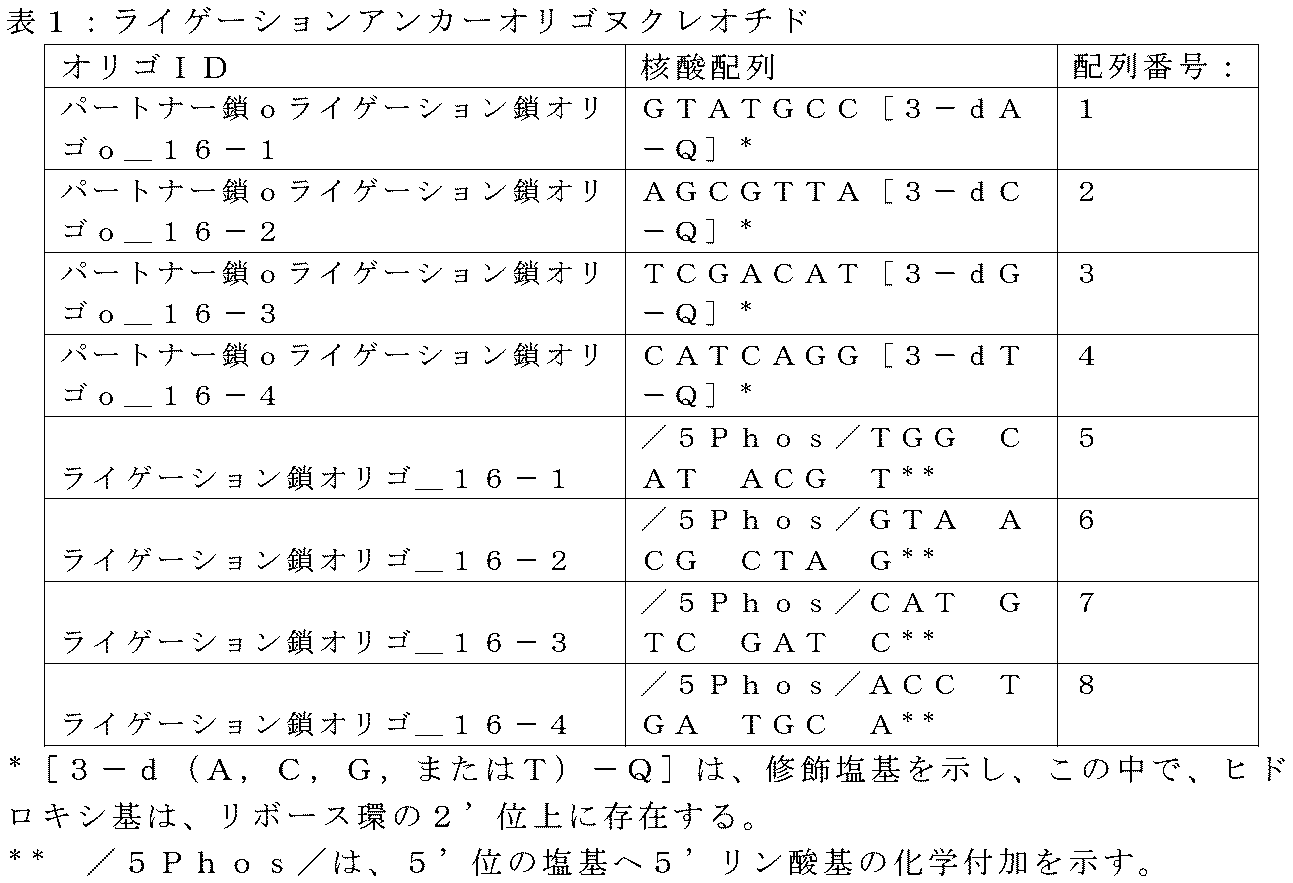
アダプタ構造は、アンカー配列にアニールしたアダプタ配列全長の付加によって完成した。32セットのアダプタ配列を、240個のメンバーから各構成し、図12から図22に示す。これらのアダプタをcfDNAに付着させ、ポリヌクレオチドキナーゼ、DNAポリメラーゼ及びDNAリガーゼの協調作用を通して伸長させ、ゲノムライブラリを生成した。シーケンシング前の品質管理ステップとして、得られたゲノムライブラリをqPCRによってカバレッジの深度について定量化した。つぎにゲノムライブラリを増幅し、特異的な遺伝子を標的にするプローブセットへハイブリダイズした(図11B)。ハイブリダイゼーション後に、プローブのプライマー伸長を用いて、キャプチャされたゲノム配列をコピーし、情報を付着したアダプタ中で符号化した(図11C)。標準的な次世代解析ソフトウェアを用いたシーケンシング解析後の例を図11Dに示す。この解析をシーケンシングラン上で実施し、このシーケンシングランは、32個の試料(28個の癌患者試料、及び4個の野生型対照)を含み、それは、シーケンシングリードの全体的な分布を表示する。 The adapter structure was completed by the addition of the full length adapter sequence annealed to the anchor sequence. The 32 sets of adapter sequences, each consisting of 240 members, are shown in Figures 12-22. These adapters were attached to cfDNA and extended through the concerted action of polynucleotide kinase, DNA polymerase and DNA ligase to generate a genomic library. As a quality control step prior to sequencing, the resulting genomic libraries were quantified for depth of coverage by qPCR. The genomic library was then amplified and hybridized to probe sets targeting specific genes (Fig. 11B). After hybridization, primer extension of the probe was used to copy the captured genomic sequence and encode the information in the attached adapter (Fig. 11C). An example after sequencing analysis using standard next generation analysis software is shown in FIG. 11D. This analysis was performed on a sequencing run containing 32 samples (28 cancer patient samples and 4 wild-type controls), which represents the overall distribution of sequencing reads. display.
本明細書に記載される標的ハイブリッドキャプチャプラットフォームの中心となる機能は、それが複数の種類のゲノム情報を提供することである。キャプチャプローブの1つの必須機能は、標的領域にわたり深いカバレッジ深度で変異検出を提供することである。この機能をキャプチャプローブの配列構成、密度、及び配置によって管理し、TP53遺伝子に関して図23に示す(TP53プローブ配列を以下の表2に示す)。等しい有意性の、標的ハイブリッドキャプチャプラットフォームアッセイを有意な変異が検出されなかった領域中の等しいカバレッジ深度からの読み出しを生成した。これらのデータは、有害な変異が検出されなかった場合に統計的有意性を加えるため、医師及び患者に重要である。

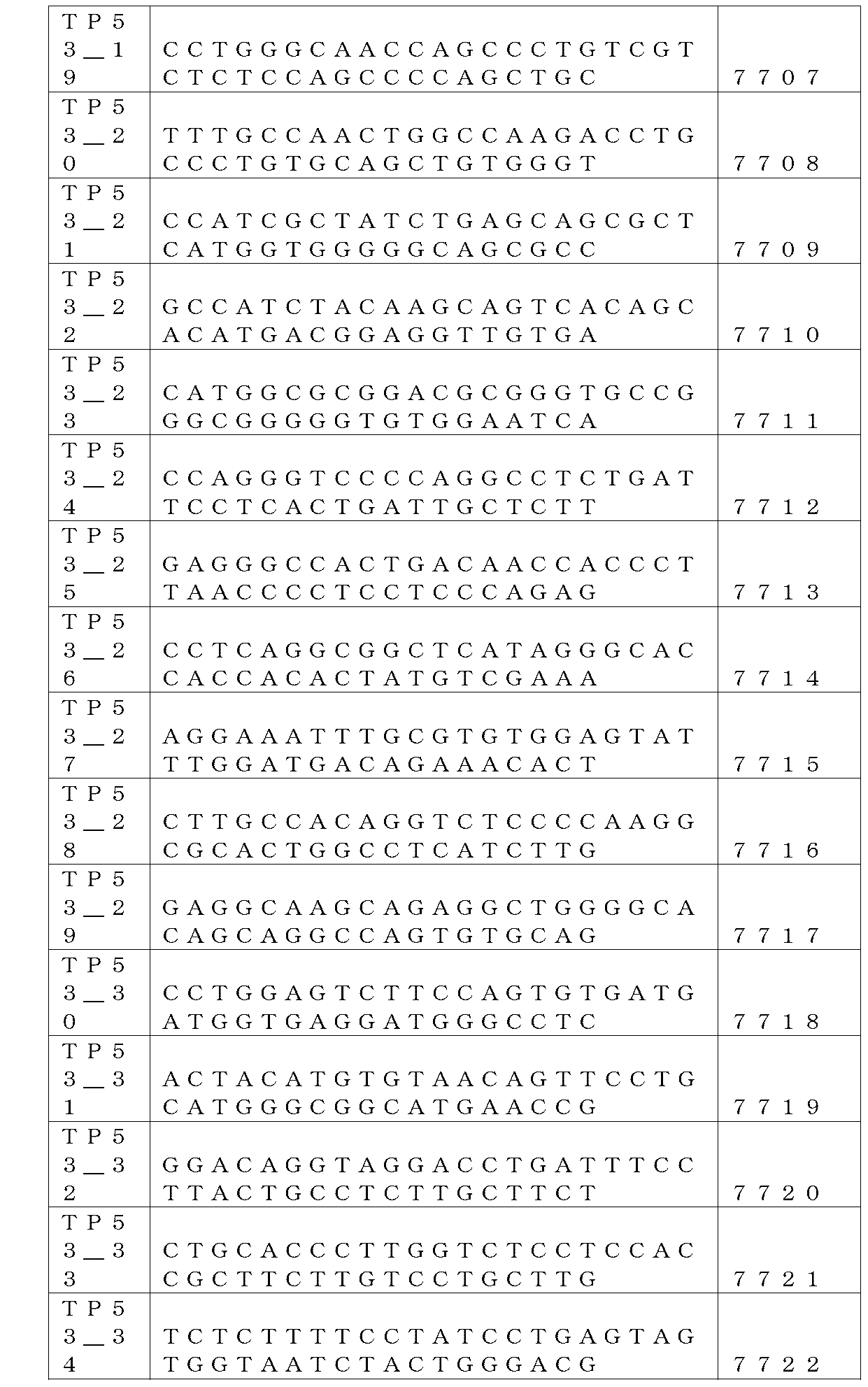

キャプチャされたゲノム配列(図11C)のキャプチャプローブの連鎖は、各プローブ位置におけるゲノム深度の測定をも容易にした。実験に使用されたすべてのキャプチャプローブと関連するユニークリード数を測定した(図24)。図24に示されるデータを、16個の健康なドナーのcfDNA試料を解析したシーケンシングランから導出した。TP53遺伝子中の1箇所のプローブ位置において各試料中で遭遇したユニークリードの深度を計算した(図24に示された生のユニークリードカウント)。ユニークリードの広範な試料間分布に反映されたように、各試料は、ユニークライブラリ深度を有した。また実験において、2596個すべてのキャプチャプローブにわたるユニークリード深度の網羅的平均を計算した(図24B)。有意には、すべてのプローブについて測定された網羅的なユニークリード深度によって図24Cに表された、単一のプローブ部位で観察されたリード深度の正規化は、正規化されたユニークリードの均一な密度を明らかにした。これらのデータは、試料間から解析のために選択された特定のプローブのキャプチャ性能が均一であり、それぞれの個々のライブラリのゲノム深度に比例したことを示す。 Concatenation of capture probes of the captured genomic sequence (Fig. 11C) also facilitated measurement of genomic depth at each probe position. The number of unique reads associated with all capture probes used in the experiment was determined (Figure 24). The data shown in Figure 24 were derived from a sequencing run in which 16 healthy donor cfDNA samples were analyzed. The depth of unique reads encountered in each sample at one probe position in the TP53 gene was calculated (raw unique read counts shown in Figure 24). Each sample had a unique library depth, as reflected in the broad sample-to-sample distribution of unique reads. Also in the experiment, we calculated the global average of unique read depths across all 2596 capture probes (Fig. 24B). Significantly, the normalization of read depths observed at a single probe site, represented in FIG. reveal the density. These data demonstrate that the capture performance of the particular probes selected for analysis across samples was uniform and proportional to the genomic depth of each individual library.
この同一の正規化機能を図23に示される45個のTP53-特異的プローブに適用した(図25に示される正規化データ)。図23は、TP53コード領域のシーケンシング深度へのすべてのプローブの凝集寄与を示すが、図25は、個々の各プローブによって取得された正規化深度を示す。個々の各プローブによって取得された正規化深度は、いずれかの所与のプローブについて試料間で一般的に一貫していたが、一方のプローブを他方と比較したときにいくぶんばらつきがあった。いくつかの要因は、プローブ間で観察された正規化後のキャプチャ深度における差を支配し、最も有意なのは、互いに関するプローブの配置であり、またゲノム反復領域に対するプローブの近接性であった。ほとんどのプローブは、均一なキャプチャ挙動を示すが、キャプチャ性能が一貫していなかった2個のプローブを図25に矢印によって強調表示する。しかしながら、これらのデータは、これらのようなプローブが稀であり、容易に識別されることを示す。またこのようなものとして、それらを下流側コピー数解析から除外することが可能である。 This same normalization function was applied to the 45 TP53-specific probes shown in Figure 23 (normalized data shown in Figure 25). Figure 23 shows the aggregate contribution of all probes to the sequencing depth of the TP53 coding region, while Figure 25 shows the normalized depth obtained by each individual probe. The normalized depth acquired by each individual probe was generally consistent between samples for any given probe, although there was some variability when comparing one probe to the other. Several factors governed the differences in normalized capture depth observed between probes, the most significant being the placement of the probes with respect to each other and the proximity of the probes to genomic repeat regions. Most of the probes show uniform capture behavior, but two probes with inconsistent capture performance are highlighted by arrows in FIG. However, these data indicate that probes such as these are rare and easily identified. Also as such, it is possible to exclude them from the downstream copy number analysis.
均一なキャプチャ性能は、図25中に45個のTP53標的プローブによって示され、本明細書に記載される標的ハイブリッドキャプチャプラットフォームの一般的な特徴である。図26において、この実験中に、特性を明らかにされた16個すべての正常なcfDNAライブラリについて、2596個のキャプチャプローブの1つのパネル中の各プローブについて平均キャプチャ深度を計算した。つぎに散布図解析を使用して、平均値を3個の代表的な試料と個々に比較した。各点は、異なるプローブを表し、グラフ上の各点の位置は、x軸上の平均値とy軸上の個々の試料との比較である。大多数のプローブの緊密な対角分布は、ほとんどのプローブの高い相関関係のユニークリードキャプチャ性能を反映した(3つのグラフすべてについて、R2相関関係≧0.95)。重要なことには、プローブごとのシーケンシング深度の一貫性は、コピー数測定における標的ハイブリッドキャプチャプラットフォームの使用をサポートする。 Uniform capture performance is demonstrated by the 45 TP53 target probes in Figure 25 and is a general feature of the targeted hybrid capture platform described herein. In FIG. 26, the average capture depth was calculated for each probe in one panel of 2596 capture probes for all 16 normal cfDNA libraries characterized during this experiment. Scatterplot analysis was then used to compare mean values individually with three representative samples. Each point represents a different probe and the position of each point on the graph is the comparison of the average value on the x-axis to the individual sample on the y-axis. The tight diagonal distribution of the majority of probes reflected the highly correlated unique read capture performance of most probes ( R2 correlation ≥ 0.95 for all three graphs). Importantly, the consistency of sequencing depth from probe to probe supports the use of targeted hybrid capture platforms in copy number measurements.
コピー数に関して、プローブデータの最も直接的な処理は、常染色体中で「2」の二倍体平均値に発生する調整されたゲノム深度値をさらに正規化することである。X連鎖性の遺伝子座について女性に発生するプローブ値についても同様である。正常な男性中のX連鎖領域及びY連鎖領域について、平均されたコピー値を「1」へ適宜に設定する。上記に詳細に考察される、この数値変換を、染色体対照プローブ(表3で、22個すべての常染色体上で選択された遺伝子座を標的とする239個のプローブ)のセット、X連鎖AR遺伝子を標的とする199個のプローブのセット、及び45個のTP53-特異的プローブに適用した(図27A及び27B)。各点は、個々のプローブについての値を表す。稀な「ノイズの多い」プローブを除き、領域中の大多数の個々のプローブカウントは、約「2」であった二倍体を含む値であると予測された。健康な男性中のAR遺伝子についてプローブは、予測された「1」に近い平均値に関して増減した。

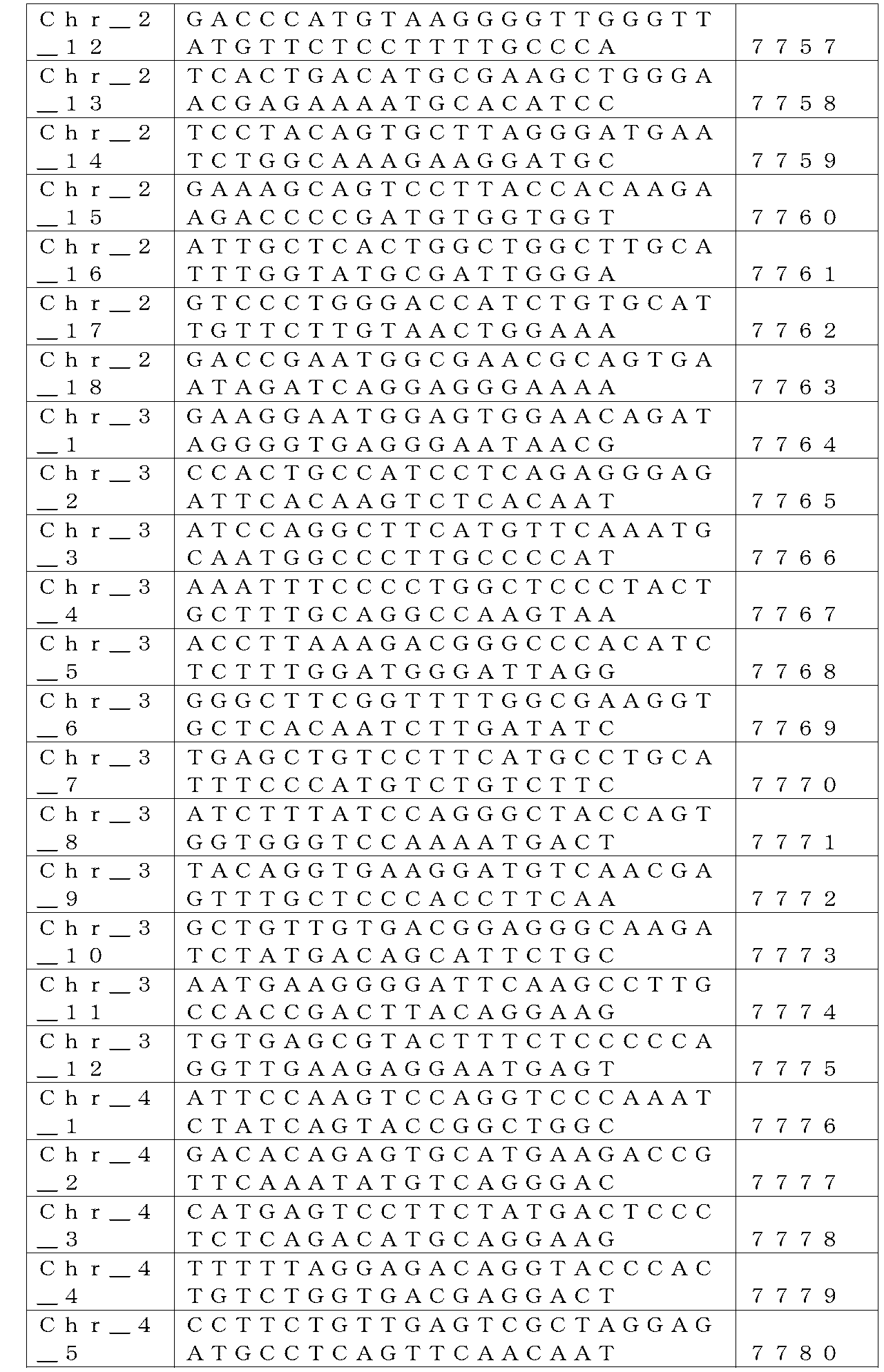

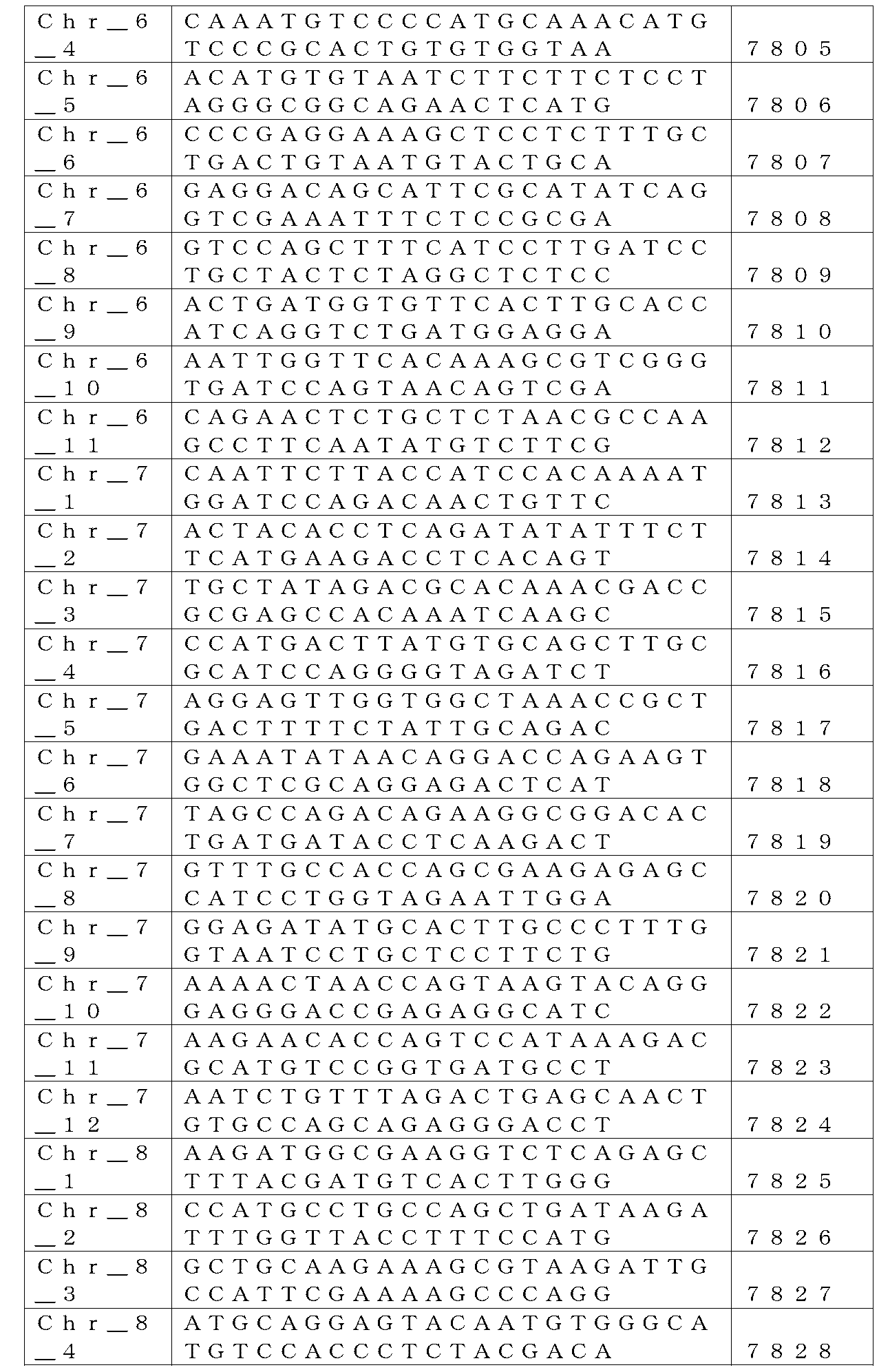
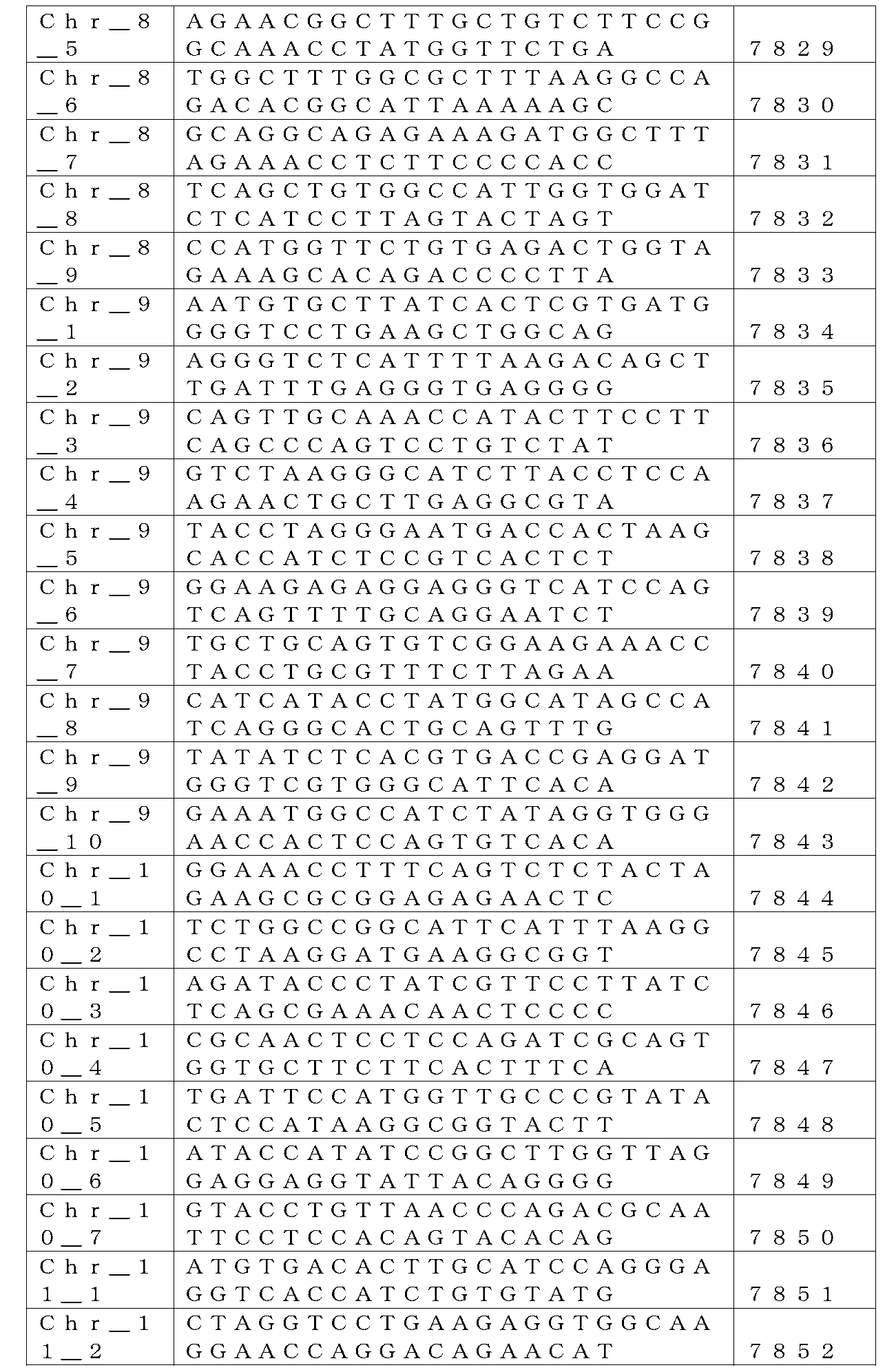


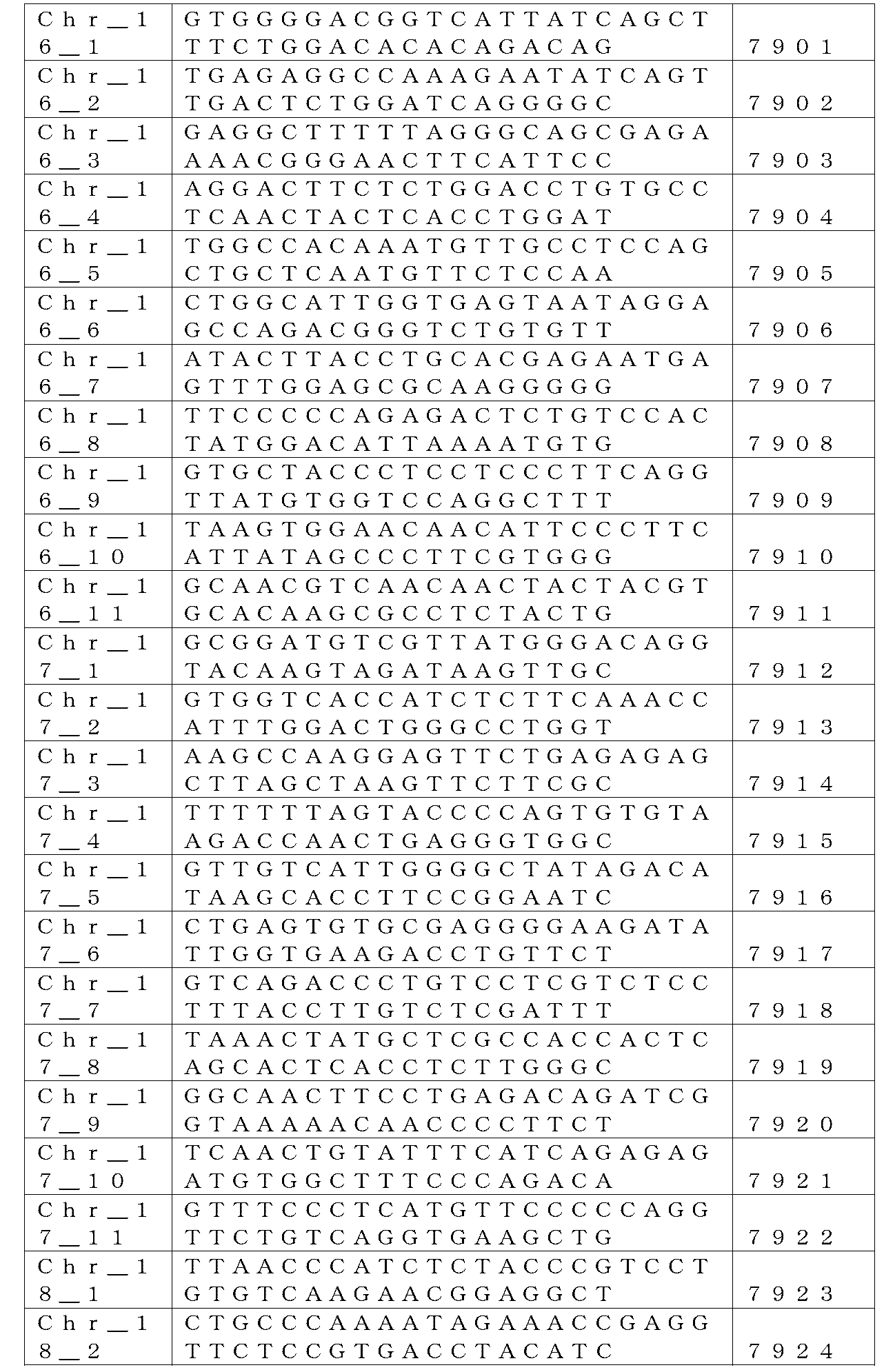


有意には、去勢抵抗性前立腺癌の患者の血液の血漿部分から収集されたcfDNAに対して、健常試料を使用した正規化対照と同一の解析を適用したときに、3つの突出した特徴が現れた(図27C)。第一に、すべての対照プローブは、ノイズの多いカウント挙動を示した。第二に、すべてのARプローブにわたるカウントは、有意に「1」の正常な値から約「5」の増幅された値へ上昇した。AR遺伝子の増幅は、進行前立腺癌において一貫して観察された。第三に、TP53プローブカウントは、より密接にクラスター化し、「2」の所期の値よりはるかに「1」に近い平均値を有した。これは、腫瘍組織に由来した循環DNA部分におけるコピー数減少によって、TP53の一方または両方のアレルの不活性化を反映した可能性がある。 Significantly, cfDNA collected from the plasma portion of the blood of patients with castration-resistant prostate cancer exhibited three prominent features when the same analysis as normalized controls using healthy samples was applied. (Fig. 27C). First, all control probes exhibited noisy counting behavior. Second, the counts across all AR probes rose significantly from normal values of '1' to amplified values of approximately '5'. Amplification of the AR gene has been consistently observed in advanced prostate cancer. Third, the TP53 probe counts clustered more closely and had a mean value much closer to '1' than the expected value of '2'. This may reflect inactivation of one or both alleles of TP53 by copy number reduction in circulating DNA segments derived from tumor tissue.
これらのデータは、本発明の方法が3つの重要な核型分析の態様を有することを示した。すなわち、本明細書に記載されるこれらの方法は、一般染色体異数性、特異的な標的遺伝子のコピー増加、及び同一の特異的な標的遺伝子におけるコピー減少を検出する。さらにこれらの結果は、3つすべてのこれらのゲノム異常が癌に発生することが多いので、本明細書に記載される方法及びプラットフォームが精密治療の使用を導くことが可能であることを示す。 These data demonstrated that the method of the present invention has three important karyotyping aspects. That is, the methods described herein detect general chromosomal aneuploidies, specific target gene copy gains, and copy losses in the same specific target genes. Furthermore, these results demonstrate that the methods and platforms described herein can lead to the use of precision therapy, as all three of these genomic aberrations are common in cancer.
健常対照(茶色の点)と比較した、去勢抵抗性前立腺癌の患者試料(青色の点)についての一般染色体異数性を測定した(図28)。この解析において、実験に使用された239個すべての対照プローブについてほぼ倍数性を、それらの染色体標的に従い順序付けした。いくつかの染色体(たとえば、染色体1及び染色体22)について、患者試料と対照試料との間で同様の倍数性の「2」の値を観察した。他の事例において、これら2個の試料間の偏差を観察した。これらの実験によって提供される、ゲノム倍数性全体についての情報の程度を、使用された対照プローブの数及び密度によって制限した。しかしながら、これらのデータは、均一な密度で染色体セグメントをすべて覆うより高密度なプローブパネルを、本発明の追加のユニーク特徴と併せて使用することが可能であることを示す。これらのような解析は、より高い分解能の、染色体コピー数のゲノムワイド測定を提供するであろう。
Common chromosomal aneuploidies were measured for castration-resistant prostate cancer patient samples (blue dots) compared to healthy controls (brown dots) (Figure 28). In this analysis, the approximate ploidy for all 239 control probes used in the experiment were ordered according to their chromosomal targets. For some chromosomes (eg,
これらのデータは、精密治療についてのガイドとして本発明の可能性をさらに強調する。たとえば、相同組換え修復においてゲノム欠損を有する腫瘍は、非常に不安定化した染色体倍数性を示すことが多く、またこれらのような腫瘍を含む患者は、PARP酵素複合体の阻害剤について良い候補である(Popova et al.,Genome Biol.2009;10(11):R128参照)。腫瘍の遺伝子型を探すほとんどのシーケンシングアッセイと異なり、本明細書に記載されるこれらのアッセイは、腫瘍の表現型を駆動する原因の変異が標的解析から隠されている場合でも、シーケンシングを使用して、この腫瘍の表現型として不安定化した染色体倍数性を検出する。 These data further emphasize the potential of the present invention as a guide for precision therapy. For example, tumors with genomic defects in homologous recombination repair often exhibit highly destabilized chromosomal polyploidy, and patients with such tumors are good candidates for inhibitors of the PARP enzyme complex. (see Popova et al., Genome Biol. 2009; 10(11):R128). Unlike most sequencing assays that look for tumor genotype, these assays described herein allow sequencing even when the causal mutation driving the tumor phenotype is hidden from targeted analysis. is used to detect destabilized chromosomal polyploidy as a phenotype of this tumor.
固形腫瘍から脱落するDNA中の遺伝子減少を検出する能力は、特に有意である。腫瘍抑制遺伝子の変異及び欠失は、がんゲノム中で頻繁な事象であり、さらに腫瘍抑制遺伝子の生殖系列喪失に関する個体は、高齢期にがんにかかることに対してユニークに脆弱である。液体バイオプシーコピー数減少(CNL)アッセイの診断値は、その感度に正比例する。本明細書に記載される本発明についての検出の下限値を決定するために、実施例1に記載される不死化株を「ゲノム・イン・ア・ボトル」基準の細胞株、NA12878中で系統的に希釈した。一方の株は、ATMのシングルコピー欠失(単一アレルの減少)を有し、他方の株は、BRCA2のシングルコピー欠失を有する。実験は、純粋なNA12878の4個の対照試料、及び16%の各単一アレル欠失株を含有する8個のスパイクイン試料を含んだ(図29)。報告目的のために、これは、両アレル減少の8%のマイナーアレル頻度に対応する。特異的な遺伝子を標的とするすべてのプローブについての平均値、及び2個の追加の、欠失のない対照遺伝子を図29に示す。ATM及びBRCA2のコピー減少をスパイクイン試料のみに限定した。このデータの追加の計算上の処理は、2%のマイナーアレル頻度まで下げる、両アレル欠失の確信的なコピー減少呼び出しを明らかにした。この感度は、標準的な血液に基づく遺伝子型判定アッセイにおけるコピー減少呼び出しを常に有するため、本発明が特別な配慮を必要としないことを示した。 The ability to detect gene loss in DNA shed from solid tumors is particularly significant. Mutations and deletions of tumor suppressor genes are frequent events in cancer genomes, and individuals with germline loss of tumor suppressor genes are uniquely vulnerable to developing cancer at an older age. The diagnostic value of the liquid biopsy copy number reduction (CNL) assay is directly proportional to its sensitivity. To determine the lower limit of detection for the invention described herein, the immortalized strain described in Example 1 was strained in the “genome in a bottle” reference cell line, NA12878. properly diluted. One strain has a single copy deletion of ATM (reduction of a single allele) and the other strain has a single copy deletion of BRCA2. The experiment included 4 control samples of pure NA12878 and 8 spike-in samples containing 16% of each single-allelic deletion strain (Figure 29). For reporting purposes, this corresponds to a minor allele frequency of 8% of biallelic reduction. Mean values for all probes targeting specific genes and two additional, non-deleted control genes are shown in FIG. Copy reduction of ATM and BRCA2 was restricted to spike-in samples only. Additional computational processing of this data revealed a convincing copy reduction call for biallelic deletions, reducing the minor allele frequency to 2%. This sensitivity indicated that the present invention does not require special considerations, as it always has a copy reduction call in standard blood-based genotyping assays.
これらのデータは、標的ゲノム遺伝子座のコピー数増加及びコピー数減少の両方を含む、コピー数の解析のためのプローブ特異的ゲノムキャプチャデータの使用を実証する。加えて、本明細書に記載される本発明は、単一のヌクレオチド変異体、単一のヌクレオチドからなん千もの塩基対に及ぶ挿入及び欠失、ならびに異常な変異プロセスによる染色体再編成(PCT公開第WO2016/028316号、及び米国特許公開第2014-0274731号を参照)に起因する遺伝子融合を検出するために、感度の高い能力をもつことを示している。これらの変異プロセスのすべては、新生物がんへの正常な組織の形質転換に寄与する可能性があり、精密治療が出現し続けるなら、これらの疾患ゲノム特性の正確な診断は、次第に精密医薬の不可欠な機能となるであろう。 These data demonstrate the use of probe-specific genomic capture data for copy number analysis, including both copy number gains and copy number losses of target genomic loci. In addition, the invention described herein provides for single nucleotide variants, insertions and deletions ranging from single nucleotides to thousands of base pairs, and chromosomal rearrangements due to aberrant mutational processes (PCT publications). WO 2016/028316, and US Patent Publication No. 2014-0274731) have shown to have a sensitive ability to detect gene fusions. All of these mutational processes are likely to contribute to the transformation of normal tissues into neoplastic cancers, and as precision therapies continue to emerge, accurate diagnosis of these disease genomic signatures will increasingly become the focus of precision medicine. will be an essential function of
Claims (89)
(i)増幅領域、
(ii)試料タグ領域、および
(iii)アンカー領域
を含み、前記アダプタセットの各アダプタの前記試料タグ領域が、ポリヌクレオチド配列を含み、前記ポリヌクレオチド配列が、前記試験試料を同定し、前記ポリヌクレオチド配列が、ユニークDNAライブラリ断片を同定し;
前記試料タグ領域内の少なくとも3ヌクレオチドを含むいかなる連続配列も、ユニーク試料タグ領域の前記プールの全試料タグ領域の間で保存されない、
複数の組成物。 A plurality of compositions for generating a DNA library from a test sample containing DNA fragments, said plurality of compositions comprising an adapter set comprising a pool of unique sample tagging regions, each adapter comprising:
(i) an amplification region;
(ii) a sample tag region; and (iii) an anchor region, wherein the sample tag region of each adapter of the adapter set comprises a polynucleotide sequence, the polynucleotide sequence identifying the test sample; the nucleotide sequence identifies a unique DNA library fragment;
no contiguous sequence comprising at least 3 nucleotides within said sample tag region is conserved among all sample tag regions of said pool of unique sample tag regions;
multiple compositions.
前記試験試料が、羊水、血液、血漿、血清、精液、リンパ液、脳脊髄液、眼液、尿、唾液、便、粘液および汗からなる群より選択される生体試料である、
請求項1~8のいずれか一項に記載の複数の組成物。 said DNA fragment is isolated from said test sample; and said test sample is from the group consisting of amniotic fluid, blood, plasma, serum, semen, lymph, cerebrospinal fluid, ocular fluid, urine, saliva, stool, mucus and sweat. is a selected biological sample,
A plurality of compositions according to any one of claims 1-8.
(i)アンカー配列を含むライゲーション鎖;
(ii)非ライゲーションパートナー鎖;および
(iii)全長アダプタ鎖であって、前記ライゲーション鎖のオリゴヌクレオチドよりも長い、全長アダプタ鎖
を含む、複数の組成物。 A plurality of compositions according to any one of claims 1-32,
(i) a ligation strand comprising an anchor sequence;
(ii) a non-ligation partner strand; and (iii) a full-length adapter strand, the full-length adapter strand being longer than the oligonucleotides of said ligation strand.
(i)増幅領域、
(ii)試料タグ領域、および
(iii)UMI増倍管
のうち少なくとも1個とを含む、請求項33~36のいずれか一項に記載の複数の組成物。 The full-length adapter strand comprises an anchor sequence and:
(i) an amplification region;
(ii) a sample tagging region; and (iii) at least one of a UMI multiplier tube.
(i)テール配列、および
(ii)前記試験試料の標的遺伝子座にハイブリダイズすることが可能なキャプチャプローブ配列
を含む、請求項45に記載の複数の組成物。 Each capture probe module
46. The plurality of compositions of claim 45, comprising (i) a tail sequence, and (ii) a capture probe sequence capable of hybridizing to a target locus of said test sample.
前記複数のDNAライブラリ断片が、複数のDNA断片を含む試験試料から生成され、
前記DNAライブラリ断片の各々が、1個のDNA断片に付着された、ユニーク試料タグ領域のプールを含むアダプタセット由来の1個のアダプタを含み、
前記アダプタセットの各アダプタが、
(i)増幅領域、
(ii)試料タグ領域、および
(iii)アンカー領域
を含み、前記アダプタセットの各アダプタの前記試料タグ領域が、ポリヌクレオチド配列を含み、前記ポリヌクレオチド配列が、前記試験試料を同定し、前記ポリヌクレオチド配列が、ユニークDNAライブラリ断片を同定し;
前記試料タグ領域内の少なくとも3ヌクレオチドを含むいかなる連続配列も、ユニーク試料タグ領域の前記プールの全試料タグ領域の間で保存されない、
ゲノムDNAライブラリ。 A genomic DNA library comprising a plurality of DNA library fragments ,
wherein said plurality of DNA library fragments are generated from a test sample comprising a plurality of DNA fragments;
each of said DNA library fragments comprising, attached to one DNA fragment , one adapter from an adapter set comprising a pool of unique sample tagging regions ;
Each adapter in the adapter set includes:
(i) an amplification region;
(ii) a sample tag region; and (iii) an anchor region, wherein the sample tag region of each adapter of the adapter set comprises a polynucleotide sequence, the polynucleotide sequence identifying the test sample; the nucleotide sequence identifies a unique DNA library fragment;
no contiguous sequence comprising at least 3 nucleotides within said sample tag region is conserved among all sample tag regions of said pool of unique sample tag regions;
Genomic DNA library.
前記試験試料が、羊水、血液、血漿、血清、精液、リンパ液、脳脊髄液、眼液、尿、唾液、便、粘液および汗からなる群より選択される生体試料である、
請求項55~62のいずれか一項に記載のゲノムDNAライブラリ。 said DNA fragment is isolated from said test sample; and said test sample is from the group consisting of amniotic fluid, blood, plasma, serum, semen, lymph, cerebrospinal fluid, ocular fluid, urine, saliva, stool, mucus and sweat. is a selected biological sample,
A genomic DNA library according to any one of claims 55-62.
Priority Applications (2)
| Application Number | Priority Date | Filing Date | Title |
|---|---|---|---|
| JP2023044421A JP2023078336A (en) | 2016-08-25 | 2023-03-20 | Methods for detecting genomic copy alterations in DNA samples |
| JP2024094503A JP2024107320A (en) | 2016-08-25 | 2024-06-11 | Method for detecting genome copy changes in a DNA sample |
Applications Claiming Priority (6)
| Application Number | Priority Date | Filing Date | Title |
|---|---|---|---|
| US201662379593P | 2016-08-25 | 2016-08-25 | |
| US62/379,593 | 2016-08-25 | ||
| US201762481538P | 2017-04-04 | 2017-04-04 | |
| US62/481,538 | 2017-04-04 | ||
| PCT/US2017/048434 WO2018039463A1 (en) | 2016-08-25 | 2017-08-24 | Methods for the detection of genomic copy changes in dna samples |
| JP2019511456A JP7217224B2 (en) | 2016-08-25 | 2017-08-24 | Methods for detecting genomic copy alterations in DNA samples |
Related Parent Applications (1)
| Application Number | Title | Priority Date | Filing Date |
|---|---|---|---|
| JP2019511456A Division JP7217224B2 (en) | 2016-08-25 | 2017-08-24 | Methods for detecting genomic copy alterations in DNA samples |
Related Child Applications (1)
| Application Number | Title | Priority Date | Filing Date |
|---|---|---|---|
| JP2023044421A Division JP2023078336A (en) | 2016-08-25 | 2023-03-20 | Methods for detecting genomic copy alterations in DNA samples |
Publications (3)
| Publication Number | Publication Date |
|---|---|
| JP2022023213A JP2022023213A (en) | 2022-02-07 |
| JP2022023213A5 JP2022023213A5 (en) | 2022-08-19 |
| JP7304393B2 true JP7304393B2 (en) | 2023-07-06 |
Family
ID=61245331
Family Applications (4)
| Application Number | Title | Priority Date | Filing Date |
|---|---|---|---|
| JP2019511456A Active JP7217224B2 (en) | 2016-08-25 | 2017-08-24 | Methods for detecting genomic copy alterations in DNA samples |
| JP2021180899A Active JP7304393B2 (en) | 2016-08-25 | 2021-11-05 | Methods for detecting genomic copy alterations in DNA samples |
| JP2023044421A Pending JP2023078336A (en) | 2016-08-25 | 2023-03-20 | Methods for detecting genomic copy alterations in DNA samples |
| JP2024094503A Pending JP2024107320A (en) | 2016-08-25 | 2024-06-11 | Method for detecting genome copy changes in a DNA sample |
Family Applications Before (1)
| Application Number | Title | Priority Date | Filing Date |
|---|---|---|---|
| JP2019511456A Active JP7217224B2 (en) | 2016-08-25 | 2017-08-24 | Methods for detecting genomic copy alterations in DNA samples |
Family Applications After (2)
| Application Number | Title | Priority Date | Filing Date |
|---|---|---|---|
| JP2023044421A Pending JP2023078336A (en) | 2016-08-25 | 2023-03-20 | Methods for detecting genomic copy alterations in DNA samples |
| JP2024094503A Pending JP2024107320A (en) | 2016-08-25 | 2024-06-11 | Method for detecting genome copy changes in a DNA sample |
Country Status (13)
| Country | Link |
|---|---|
| US (2) | US11319594B2 (en) |
| EP (2) | EP3504347B1 (en) |
| JP (4) | JP7217224B2 (en) |
| KR (2) | KR102850460B1 (en) |
| CN (2) | CN117286217A (en) |
| AU (2) | AU2017315769B2 (en) |
| CA (1) | CA3034649A1 (en) |
| ES (1) | ES3053343T3 (en) |
| IL (2) | IL312894A (en) |
| MX (2) | MX2019002093A (en) |
| RU (1) | RU2019108294A (en) |
| SG (1) | SG11201901371XA (en) |
| WO (1) | WO2018039463A1 (en) |
Families Citing this family (24)
| Publication number | Priority date | Publication date | Assignee | Title |
|---|---|---|---|---|
| SG10202009015SA (en) | 2012-12-10 | 2020-10-29 | Resolution Bioscience Inc | Methods for targeted genomic analysis |
| US20160053301A1 (en) | 2014-08-22 | 2016-02-25 | Clearfork Bioscience, Inc. | Methods for quantitative genetic analysis of cell free dna |
| CN108431233B (en) | 2015-11-11 | 2022-04-01 | 分析生物科学有限公司 | Efficient construction of DNA libraries |
| ES3053343T3 (en) * | 2016-08-25 | 2026-01-21 | Resolution Bioscience Inc | Methods for quantitative genetic analysis of dna fragments using adaptors with unique molecular identifiers and sample tags |
| JP2021514663A (en) * | 2018-03-08 | 2021-06-17 | セント・ジョーンズ・ユニバーシティSt. Johns University | Circulating Serum Cell-Free DNA Biomarkers and Methods |
| CA3094717A1 (en) | 2018-04-02 | 2019-10-10 | Grail, Inc. | Methylation markers and targeted methylation probe panels |
| AU2019351130B2 (en) | 2018-09-27 | 2025-10-23 | Grail, Inc. | Methylation markers and targeted methylation probe panel |
| CN111118610A (en) * | 2018-10-31 | 2020-05-08 | 深圳华大基因股份有限公司 | Gene chip for gene mutation high-depth sequencing and preparation method and application thereof |
| CN112930407A (en) * | 2018-11-02 | 2021-06-08 | 加利福尼亚大学董事会 | Methods of diagnosing and treating cancer using non-human nucleic acids |
| EP3884071B1 (en) * | 2019-01-03 | 2025-03-26 | Ncan Genomics, Inc. | Linked target capture |
| AU2020210912A1 (en) * | 2019-01-24 | 2021-01-21 | Illumina, Inc. | Methods and systems for monitoring organ health and disease |
| SG11202112680XA (en) * | 2019-05-17 | 2021-12-30 | Univ Johns Hopkins | Rapid aneuploidy detection |
| KR102452413B1 (en) * | 2019-08-19 | 2022-10-11 | 주식회사 지씨지놈 | Method for detecting chromosomal abnormality using distance information between nucleic acid fragments |
| US20230178182A1 (en) * | 2019-08-19 | 2023-06-08 | Green Cross Genome Corporation | Method for detecting chromosomal abnormality by using information about distance between nucleic acid fragments |
| KR102184277B1 (en) * | 2020-01-16 | 2020-11-30 | 성균관대학교산학협력단 | All-in-one ai self health care apparatus for ultrasound diagnosis and dna check-up, and remote medical-diagnosis method using the same |
| WO2021159184A1 (en) * | 2020-02-13 | 2021-08-19 | Garvan Institute Of Medical Research | Reference ladders and adaptors |
| US11475981B2 (en) | 2020-02-18 | 2022-10-18 | Tempus Labs, Inc. | Methods and systems for dynamic variant thresholding in a liquid biopsy assay |
| US11211144B2 (en) | 2020-02-18 | 2021-12-28 | Tempus Labs, Inc. | Methods and systems for refining copy number variation in a liquid biopsy assay |
| US11211147B2 (en) | 2020-02-18 | 2021-12-28 | Tempus Labs, Inc. | Estimation of circulating tumor fraction using off-target reads of targeted-panel sequencing |
| CN113496760B (en) * | 2020-04-01 | 2024-01-12 | 深圳华大基因科技服务有限公司 | Polyploid genome assembling method and device based on third generation sequencing |
| CN113113085B (en) * | 2021-03-15 | 2022-08-19 | 杭州杰毅生物技术有限公司 | Analysis system and method for tumor detection based on intelligent metagenome sequencing data |
| GB202108237D0 (en) * | 2021-06-09 | 2021-07-21 | Univ London | Cancer methods |
| CN114649094B (en) * | 2022-03-30 | 2022-11-15 | 广东省人民医院 | Breast cancer multi-parameter clinical decision auxiliary device based on nuclear magnetic resonance |
| WO2024029814A1 (en) | 2022-08-04 | 2024-02-08 | 주식회사 엘지에너지솔루션 | Battery pack |
Citations (7)
| Publication number | Priority date | Publication date | Assignee | Title |
|---|---|---|---|---|
| US20140100792A1 (en) | 2012-10-04 | 2014-04-10 | Sequenom, Inc. | Methods and processes for non-invasive assessment of genetic variations |
| WO2014055790A2 (en) | 2012-10-04 | 2014-04-10 | Sequenom, Inc. | Methods and processes for non-invasive assessment of genetic variations |
| US20140242581A1 (en) | 2013-01-23 | 2014-08-28 | Reproductive Genetics And Technology Solutions, Llc | Compositions and methods for genetic analysis of embryos |
| US20150111757A1 (en) | 2013-10-18 | 2015-04-23 | Good Start Genetics, Inc. | Methods for determining carrier status |
| WO2016022833A1 (en) | 2014-08-06 | 2016-02-11 | Nugen Technologies, Inc. | Digital measurements from targeted sequencing |
| WO2016028316A1 (en) | 2014-08-22 | 2016-02-25 | Resolution Bioscience, Inc. | Methods for quantitative genetic analysis of cell free dna |
| JP2019526257A (en) | 2016-08-25 | 2019-09-19 | レゾリューション バイオサイエンス, インコーポレイテッド | Method for detecting genomic copy changes in DNA samples |
Family Cites Families (99)
| Publication number | Priority date | Publication date | Assignee | Title |
|---|---|---|---|---|
| US5591582A (en) | 1985-07-23 | 1997-01-07 | The Board Of Rijks Universiteit Leiden | Methods for detecting activated RAS oncogenes |
| US5888731A (en) | 1995-08-30 | 1999-03-30 | Visible Genetics Inc. | Method for identification of mutations using ligation of multiple oligonucleotide probes |
| WO1999011819A1 (en) | 1997-08-28 | 1999-03-11 | The Perkin-Elmer Corporation | Improved detection of mutations in nucleic acids by chemical cleavage |
| US6480791B1 (en) | 1998-10-28 | 2002-11-12 | Michael P. Strathmann | Parallel methods for genomic analysis |
| US6812341B1 (en) | 2001-05-11 | 2004-11-02 | Ambion, Inc. | High efficiency mRNA isolation methods and compositions |
| WO2003052116A2 (en) | 2001-07-17 | 2003-06-26 | Stratagene | Methods for detection of a target nucleic acid using multi-subunit probes |
| WO2003020979A1 (en) | 2001-08-31 | 2003-03-13 | Rosetta Inpharmactis Llc. | Methods for preparing nucleic acid samples |
| US7361821B2 (en) | 2002-09-20 | 2008-04-22 | Intel Corporation | Controlled alignment of nanobarcodes encoding specific information for scanning probe microscopy (SPM) reading |
| AU2003284420A1 (en) | 2002-12-11 | 2004-06-30 | Keio University | Method of constructing assigned molecule and library comprising the same and method of using the same |
| TW200506052A (en) | 2003-05-07 | 2005-02-16 | Takara Bio Inc | Method of analyzing DNA region |
| US7393665B2 (en) | 2005-02-10 | 2008-07-01 | Population Genetics Technologies Ltd | Methods and compositions for tagging and identifying polynucleotides |
| EP2476761A3 (en) | 2005-07-07 | 2012-10-17 | Athlomics Pty Ltd | Polynucleotide marker genes and their expression, for diagnosis of endotoxemia |
| GB0522310D0 (en) | 2005-11-01 | 2005-12-07 | Solexa Ltd | Methods of preparing libraries of template polynucleotides |
| US7939645B2 (en) | 2006-01-06 | 2011-05-10 | Agilent Technologies, Inc | Reaction buffer composition for nucleic acid replication with packed DNA polymerases |
| US7537897B2 (en) | 2006-01-23 | 2009-05-26 | Population Genetics Technologies, Ltd. | Molecular counting |
| US8383338B2 (en) | 2006-04-24 | 2013-02-26 | Roche Nimblegen, Inc. | Methods and systems for uniform enrichment of genomic regions |
| US7754429B2 (en) | 2006-10-06 | 2010-07-13 | Illumina Cambridge Limited | Method for pair-wise sequencing a plurity of target polynucleotides |
| US8568979B2 (en) | 2006-10-10 | 2013-10-29 | Illumina, Inc. | Compositions and methods for representational selection of nucleic acids from complex mixtures using hybridization |
| US12180549B2 (en) | 2007-07-23 | 2024-12-31 | The Chinese University Of Hong Kong | Diagnosing fetal chromosomal aneuploidy using genomic sequencing |
| US8067164B2 (en) | 2007-08-12 | 2011-11-29 | Integrated Dna Technologies, Inc. | Microarray system with improved sequence specificity |
| US9388457B2 (en) | 2007-09-14 | 2016-07-12 | Affymetrix, Inc. | Locus specific amplification using array probes |
| EP2227563B1 (en) | 2007-12-05 | 2012-06-06 | Complete Genomics, Inc. | Efficient base determination in sequencing reactions |
| WO2009091798A1 (en) | 2008-01-16 | 2009-07-23 | Helicos Biosciences Corporation | Quantitative genetic analysis |
| US8202691B2 (en) | 2008-01-25 | 2012-06-19 | Illumina, Inc. | Uniform fragmentation of DNA using binding proteins |
| US8383345B2 (en) | 2008-09-12 | 2013-02-26 | University Of Washington | Sequence tag directed subassembly of short sequencing reads into long sequencing reads |
| US8728764B2 (en) | 2008-10-02 | 2014-05-20 | Illumina Cambridge Limited | Nucleic acid sample enrichment for sequencing applications |
| WO2010068856A1 (en) | 2008-12-11 | 2010-06-17 | Trustees Of Boston University | Isolation of rna |
| US8691509B2 (en) | 2009-04-02 | 2014-04-08 | Fluidigm Corporation | Multi-primer amplification method for barcoding of target nucleic acids |
| WO2010127186A1 (en) | 2009-04-30 | 2010-11-04 | Prognosys Biosciences, Inc. | Nucleic acid constructs and methods of use |
| WO2010129937A2 (en) | 2009-05-08 | 2010-11-11 | Life Technologies Corporation | Methods for detecting genetic variations in dna samples |
| EP2669387B1 (en) | 2009-08-25 | 2016-07-20 | Illumina, Inc. | Methods for selecting and amplifying polynucleotides |
| US9315857B2 (en) | 2009-12-15 | 2016-04-19 | Cellular Research, Inc. | Digital counting of individual molecules by stochastic attachment of diverse label-tags |
| US8835358B2 (en) | 2009-12-15 | 2014-09-16 | Cellular Research, Inc. | Digital counting of individual molecules by stochastic attachment of diverse labels |
| US10388403B2 (en) | 2010-01-19 | 2019-08-20 | Verinata Health, Inc. | Analyzing copy number variation in the detection of cancer |
| US10378064B1 (en) | 2010-04-16 | 2019-08-13 | Chronix Biomedical | Analyzing circulating nucleic acids to identify a biomarker representative of cancer presented by a patient population |
| US9677118B2 (en) | 2014-04-21 | 2017-06-13 | Natera, Inc. | Methods for simultaneous amplification of target loci |
| US8828688B2 (en) | 2010-05-27 | 2014-09-09 | Affymetrix, Inc. | Multiplex amplification methods |
| WO2011156529A2 (en) | 2010-06-08 | 2011-12-15 | Nugen Technologies, Inc. | Methods and composition for multiplex sequencing |
| EP2426217A1 (en) | 2010-09-03 | 2012-03-07 | Centre National de la Recherche Scientifique (CNRS) | Analytical methods for cell free nucleic acids and applications |
| US9309556B2 (en) | 2010-09-24 | 2016-04-12 | The Board Of Trustees Of The Leland Stanford Junior University | Direct capture, amplification and sequencing of target DNA using immobilized primers |
| EA038374B1 (en) | 2010-11-30 | 2021-08-17 | Те Чайниз Юниверсити Ов Гонконг | Method of analyzing a biological sample of an organism for chromosomal deletions or amplifications associated with cancer |
| KR20140024270A (en) | 2010-12-30 | 2014-02-28 | 파운데이션 메디신 인코포레이티드 | Optimization of multigene analysis of tumor samples |
| CA2824387C (en) | 2011-02-09 | 2019-09-24 | Natera, Inc. | Methods for non-invasive prenatal ploidy calling |
| WO2012129363A2 (en) | 2011-03-24 | 2012-09-27 | President And Fellows Of Harvard College | Single cell nucleic acid detection and analysis |
| SI3078752T1 (en) | 2011-04-12 | 2018-12-31 | Verinata Health, Inc | Resolving genome fractions using polymorphism counts |
| HUE068153T2 (en) | 2011-04-15 | 2024-12-28 | Univ Johns Hopkins | Safe sequencing system |
| US9809904B2 (en) * | 2011-04-21 | 2017-11-07 | University Of Washington Through Its Center For Commercialization | Methods for retrieval of sequence-verified DNA constructs |
| WO2013056178A2 (en) | 2011-10-14 | 2013-04-18 | Foundation Medicine, Inc. | Novel estrogen receptor mutations and uses thereof |
| CN103103624B (en) | 2011-11-15 | 2014-12-31 | 深圳华大基因科技服务有限公司 | Method for establishing high-throughput sequencing library and application thereof |
| US10227587B2 (en) | 2012-01-10 | 2019-03-12 | Berry Genomics Co., Ltd. | Method for constructing a plasma DNA sequencing library |
| US9892230B2 (en) | 2012-03-08 | 2018-02-13 | The Chinese University Of Hong Kong | Size-based analysis of fetal or tumor DNA fraction in plasma |
| EP2828218B9 (en) | 2012-03-20 | 2021-04-07 | University Of Washington Through Its Center For Commercialization | Methods of lowering the error rate of massively parallel dna sequencing using duplex consensus sequencing |
| US20130288915A1 (en) | 2012-04-27 | 2013-10-31 | Htg Molecular Diagnostics, Inc. | Compositions and methods for alk molecular testing |
| CA2872141C (en) | 2012-05-31 | 2016-01-19 | Board Of Regents, The University Of Texas System | Method for accurate sequencing of dna |
| SG10201610861XA (en) | 2012-07-03 | 2017-02-27 | Integrated Dna Tech Inc | Tm-enhanced blocking oligonucleotides and baits for improved target enrichment and reduced off-target selection |
| DK2880447T3 (en) | 2012-07-31 | 2019-08-12 | Novartis Ag | Markers associated with sensitivity to human double minute 2 inhibitors (MDM2) |
| EP2880448B1 (en) | 2012-08-03 | 2022-06-29 | Foundation Medicine, Inc. | Human papilloma virus as predictor of cancer prognosis |
| US20160040229A1 (en) | 2013-08-16 | 2016-02-11 | Guardant Health, Inc. | Systems and methods to detect rare mutations and copy number variation |
| GB2533006B (en) | 2012-09-04 | 2017-06-07 | Guardant Health Inc | Systems and methods to detect copy number variation |
| US10876152B2 (en) | 2012-09-04 | 2020-12-29 | Guardant Health, Inc. | Systems and methods to detect rare mutations and copy number variation |
| EP2900836B1 (en) | 2012-09-28 | 2023-05-10 | Cepheid | Two-primer pcr for microrna multiplex assay |
| US20150291953A1 (en) | 2012-11-02 | 2015-10-15 | Enzymatics Inc. | Methods and kits for nucleic acid sample preparation for sequencing |
| AU2013337277B2 (en) | 2012-11-05 | 2018-03-08 | Foundation Medicine, Inc. | Novel NTRK1 fusion molecules and uses thereof |
| SG10202009015SA (en) * | 2012-12-10 | 2020-10-29 | Resolution Bioscience Inc | Methods for targeted genomic analysis |
| ES2703764T3 (en) | 2012-12-14 | 2019-03-12 | Chronix Biomedical | Custom biomarkers for cancer |
| US11158425B2 (en) | 2013-01-05 | 2021-10-26 | Foundation Medicine, Inc. | System and method for managing genomic information |
| EP2954054B1 (en) | 2013-02-08 | 2018-12-05 | Qiagen GmbH | Method for separating dna by size |
| EP3795696B1 (en) | 2013-03-15 | 2023-04-26 | The Board of Trustees of the Leland Stanford Junior University | Identification and use of circulating nucleic acid tumor markers |
| CA2906818C (en) | 2013-03-15 | 2022-08-16 | Verinata Health, Inc. | Generating cell-free dna libraries directly from blood |
| EP2994847B1 (en) | 2013-05-10 | 2025-02-12 | Foundation Medicine, Inc. | Analysis of genetic variants |
| US20150072344A1 (en) * | 2013-09-10 | 2015-03-12 | Imdaptive Incorporated | Barcoded Universal Marker Indicator (BUMI) Tags |
| CA2929596C (en) | 2013-11-13 | 2022-07-05 | Nugen Technologies, Inc. | Compositions and methods for identification of a duplicate sequencing read |
| CN103668471B (en) | 2013-12-19 | 2015-09-30 | 上海交通大学 | A kind of method of constructed dna high-throughput sequencing library and matched reagent box thereof |
| EP3378952B1 (en) | 2013-12-28 | 2020-02-05 | Guardant Health, Inc. | Methods and systems for detecting genetic variants |
| CN109971826B (en) | 2014-01-31 | 2022-12-30 | 斯威夫特生物科学股份有限公司 | Improved method for processing DNA substrates |
| EP3114231B1 (en) | 2014-03-03 | 2019-01-02 | Swift Biosciences, Inc. | Enhanced adaptor ligation |
| US10975371B2 (en) | 2014-04-29 | 2021-04-13 | Illumina, Inc. | Nucleic acid sequence analysis from single cells |
| JP2017522866A (en) | 2014-06-26 | 2017-08-17 | 10エックス ジェノミクス, インコーポレイテッド | Nucleic acid sequence analysis |
| US20160053301A1 (en) | 2014-08-22 | 2016-02-25 | Clearfork Bioscience, Inc. | Methods for quantitative genetic analysis of cell free dna |
| US10648031B2 (en) | 2014-09-05 | 2020-05-12 | Qiagen Gmbh | Preparation of adapter-ligated amplicons |
| CN107075513B (en) | 2014-09-12 | 2020-11-03 | 深圳华大智造科技有限公司 | Isolated oligonucleotides and their use in nucleic acid sequencing |
| US11085084B2 (en) | 2014-09-12 | 2021-08-10 | The Board Of Trustees Of The Leland Stanford Junior University | Identification and use of circulating nucleic acids |
| EP3227464B1 (en) | 2014-12-05 | 2022-04-20 | Foundation Medicine, Inc. | Multigene analysis of tumor samples |
| WO2016094853A1 (en) | 2014-12-12 | 2016-06-16 | Verinata Health, Inc. | Using cell-free dna fragment size to determine copy number variations |
| AU2015374259B2 (en) | 2014-12-31 | 2020-08-13 | Guardant Health, Inc. | Detection and treatment of disease exhibiting disease cell heterogeneity and systems and methods for communicating test results |
| EP3256605B1 (en) | 2015-02-10 | 2022-02-09 | The Chinese University Of Hong Kong | Detecting mutations for cancer screening and fetal analysis |
| CA2993362A1 (en) | 2015-07-23 | 2017-01-26 | The Chinese University Of Hong Kong | Analysis of fragmentation patterns of cell-free dna |
| WO2017062867A1 (en) | 2015-10-09 | 2017-04-13 | Helmy Eltoukhy | Population based treatment recommender using cell free dna |
| ES2796501T3 (en) | 2015-10-10 | 2020-11-27 | Guardant Health Inc | Methods and applications of gene fusion detection in cell-free DNA analysis |
| CN108431233B (en) | 2015-11-11 | 2022-04-01 | 分析生物科学有限公司 | Efficient construction of DNA libraries |
| US10095831B2 (en) | 2016-02-03 | 2018-10-09 | Verinata Health, Inc. | Using cell-free DNA fragment size to determine copy number variations |
| JP6930992B2 (en) | 2016-02-29 | 2021-09-01 | ファウンデーション・メディシン・インコーポレイテッド | Methods and systems for assessing tumor mutation loading |
| US11708574B2 (en) | 2016-06-10 | 2023-07-25 | Myriad Women's Health, Inc. | Nucleic acid sequencing adapters and uses thereof |
| US9850523B1 (en) | 2016-09-30 | 2017-12-26 | Guardant Health, Inc. | Methods for multi-resolution analysis of cell-free nucleic acids |
| WO2018064629A1 (en) | 2016-09-30 | 2018-04-05 | Guardant Health, Inc. | Methods for multi-resolution analysis of cell-free nucleic acids |
| AU2017363180B2 (en) | 2016-11-17 | 2023-11-02 | LGC Clinical Diagnostics, Inc. | Methods for preparing DNA reference material and controls |
| JP7048609B2 (en) | 2016-12-09 | 2022-04-05 | ボリアル ジェノミクス, インコーポレイテッド | Linked ligation |
| ES2868074T3 (en) | 2017-04-14 | 2021-10-21 | Guardant Health Inc | Methods for binding adapters to sample nucleic acids |
| AU2019384154B2 (en) | 2018-11-21 | 2025-11-20 | Agilent Technologies, Inc. | Methods for targeted nucleic acid library formation |
-
2017
- 2017-08-24 ES ES17844424T patent/ES3053343T3/en active Active
- 2017-08-24 RU RU2019108294A patent/RU2019108294A/en not_active Application Discontinuation
- 2017-08-24 WO PCT/US2017/048434 patent/WO2018039463A1/en not_active Ceased
- 2017-08-24 MX MX2019002093A patent/MX2019002093A/en unknown
- 2017-08-24 CN CN202310805405.1A patent/CN117286217A/en not_active Withdrawn
- 2017-08-24 CA CA3034649A patent/CA3034649A1/en active Pending
- 2017-08-24 SG SG11201901371XA patent/SG11201901371XA/en unknown
- 2017-08-24 US US15/685,834 patent/US11319594B2/en active Active
- 2017-08-24 JP JP2019511456A patent/JP7217224B2/en active Active
- 2017-08-24 EP EP17844424.6A patent/EP3504347B1/en active Active
- 2017-08-24 KR KR1020237006718A patent/KR102850460B1/en active Active
- 2017-08-24 EP EP25208083.3A patent/EP4667584A2/en active Pending
- 2017-08-24 IL IL312894A patent/IL312894A/en unknown
- 2017-08-24 KR KR1020197008555A patent/KR102505122B1/en active Active
- 2017-08-24 IL IL264971A patent/IL264971B2/en unknown
- 2017-08-24 AU AU2017315769A patent/AU2017315769B2/en active Active
- 2017-08-24 CN CN201780059053.2A patent/CN109804080B/en active Active
-
2019
- 2019-02-21 MX MX2024001256A patent/MX2024001256A/en unknown
-
2021
- 2021-11-05 JP JP2021180899A patent/JP7304393B2/en active Active
-
2022
- 2022-01-27 US US17/586,143 patent/US20220325353A1/en active Pending
-
2023
- 2023-03-20 JP JP2023044421A patent/JP2023078336A/en active Pending
-
2024
- 2024-04-12 AU AU2024202414A patent/AU2024202414A1/en active Pending
- 2024-06-11 JP JP2024094503A patent/JP2024107320A/en active Pending
Patent Citations (7)
| Publication number | Priority date | Publication date | Assignee | Title |
|---|---|---|---|---|
| US20140100792A1 (en) | 2012-10-04 | 2014-04-10 | Sequenom, Inc. | Methods and processes for non-invasive assessment of genetic variations |
| WO2014055790A2 (en) | 2012-10-04 | 2014-04-10 | Sequenom, Inc. | Methods and processes for non-invasive assessment of genetic variations |
| US20140242581A1 (en) | 2013-01-23 | 2014-08-28 | Reproductive Genetics And Technology Solutions, Llc | Compositions and methods for genetic analysis of embryos |
| US20150111757A1 (en) | 2013-10-18 | 2015-04-23 | Good Start Genetics, Inc. | Methods for determining carrier status |
| WO2016022833A1 (en) | 2014-08-06 | 2016-02-11 | Nugen Technologies, Inc. | Digital measurements from targeted sequencing |
| WO2016028316A1 (en) | 2014-08-22 | 2016-02-25 | Resolution Bioscience, Inc. | Methods for quantitative genetic analysis of cell free dna |
| JP2019526257A (en) | 2016-08-25 | 2019-09-19 | レゾリューション バイオサイエンス, インコーポレイテッド | Method for detecting genomic copy changes in DNA samples |
Also Published As
Similar Documents
| Publication | Publication Date | Title |
|---|---|---|
| JP7304393B2 (en) | Methods for detecting genomic copy alterations in DNA samples | |
| JP7318054B2 (en) | Highly efficient construction of DNA library | |
| CA2957657A1 (en) | Methods for quantitative genetic analysis of cell free dna | |
| EP4211246B1 (en) | Adaptors and methods for high efficiency construction of genetic libraries and genetic analysis | |
| US20240191293A1 (en) | Compositions and methods for simultaneous genetic analysis of multiple libraries | |
| HK40105139A (en) | Methods for the detection of genomic copy changes in dna samples | |
| BR112019003704B1 (en) | METHOD FOR PERFORMING A GENETIC ANALYSIS ON A TARGET REGION OF DNA FROM A TEST SAMPLE | |
| HK40096223B (en) | Adaptors and methods for high efficiency construction of genetic libraries and genetic analysis | |
| HK40096223A (en) | Adaptors and methods for high efficiency construction of genetic libraries and genetic analysis | |
| NZ791679A (en) | Methods for the detection of genomic copy changes in dna samples |
Legal Events
| Date | Code | Title | Description |
|---|---|---|---|
| A621 | Written request for application examination |
Free format text: JAPANESE INTERMEDIATE CODE: A621 Effective date: 20211105 |
|
| A521 | Request for written amendment filed |
Free format text: JAPANESE INTERMEDIATE CODE: A523 Effective date: 20220809 |
|
| A131 | Notification of reasons for refusal |
Free format text: JAPANESE INTERMEDIATE CODE: A131 Effective date: 20221021 |
|
| A601 | Written request for extension of time |
Free format text: JAPANESE INTERMEDIATE CODE: A601 Effective date: 20230118 |
|
| A521 | Request for written amendment filed |
Free format text: JAPANESE INTERMEDIATE CODE: A523 Effective date: 20230320 |
|
| TRDD | Decision of grant or rejection written | ||
| A01 | Written decision to grant a patent or to grant a registration (utility model) |
Free format text: JAPANESE INTERMEDIATE CODE: A01 Effective date: 20230530 |
|
| A61 | First payment of annual fees (during grant procedure) |
Free format text: JAPANESE INTERMEDIATE CODE: A61 Effective date: 20230626 |
|
| R150 | Certificate of patent or registration of utility model |
Ref document number: 7304393 Country of ref document: JP Free format text: JAPANESE INTERMEDIATE CODE: R150 |
|
| RD02 | Notification of acceptance of power of attorney |
Free format text: JAPANESE INTERMEDIATE CODE: R3D02 |