JP7050770B2 - Method for preparing antibody drug conjugate - Google Patents
Method for preparing antibody drug conjugate Download PDFInfo
- Publication number
- JP7050770B2 JP7050770B2 JP2019517907A JP2019517907A JP7050770B2 JP 7050770 B2 JP7050770 B2 JP 7050770B2 JP 2019517907 A JP2019517907 A JP 2019517907A JP 2019517907 A JP2019517907 A JP 2019517907A JP 7050770 B2 JP7050770 B2 JP 7050770B2
- Authority
- JP
- Japan
- Prior art keywords
- antibody
- amino acid
- seq
- hvr
- acid sequence
- Prior art date
- Legal status (The legal status is an assumption and is not a legal conclusion. Google has not performed a legal analysis and makes no representation as to the accuracy of the status listed.)
- Active
Links
Images



Classifications
-
- A—HUMAN NECESSITIES
- A61—MEDICAL OR VETERINARY SCIENCE; HYGIENE
- A61K—PREPARATIONS FOR MEDICAL, DENTAL OR TOILETRY PURPOSES
- A61K47/00—Medicinal preparations characterised by the non-active ingredients used, e.g. carriers or inert additives; Targeting or modifying agents chemically bound to the active ingredient
- A61K47/50—Medicinal preparations characterised by the non-active ingredients used, e.g. carriers or inert additives; Targeting or modifying agents chemically bound to the active ingredient the non-active ingredient being chemically bound to the active ingredient, e.g. polymer-drug conjugates
- A61K47/51—Medicinal preparations characterised by the non-active ingredients used, e.g. carriers or inert additives; Targeting or modifying agents chemically bound to the active ingredient the non-active ingredient being chemically bound to the active ingredient, e.g. polymer-drug conjugates the non-active ingredient being a modifying agent
- A61K47/68—Medicinal preparations characterised by the non-active ingredients used, e.g. carriers or inert additives; Targeting or modifying agents chemically bound to the active ingredient the non-active ingredient being chemically bound to the active ingredient, e.g. polymer-drug conjugates the non-active ingredient being a modifying agent the modifying agent being an antibody, an immunoglobulin or a fragment thereof, e.g. an Fc-fragment
- A61K47/6889—Conjugates wherein the antibody being the modifying agent and wherein the linker, binder or spacer confers particular properties to the conjugates, e.g. peptidic enzyme-labile linkers or acid-labile linkers, providing for an acid-labile immuno conjugate wherein the drug may be released from its antibody conjugated part in an acidic, e.g. tumoural or environment
-
- A—HUMAN NECESSITIES
- A61—MEDICAL OR VETERINARY SCIENCE; HYGIENE
- A61K—PREPARATIONS FOR MEDICAL, DENTAL OR TOILETRY PURPOSES
- A61K47/00—Medicinal preparations characterised by the non-active ingredients used, e.g. carriers or inert additives; Targeting or modifying agents chemically bound to the active ingredient
- A61K47/50—Medicinal preparations characterised by the non-active ingredients used, e.g. carriers or inert additives; Targeting or modifying agents chemically bound to the active ingredient the non-active ingredient being chemically bound to the active ingredient, e.g. polymer-drug conjugates
- A61K47/51—Medicinal preparations characterised by the non-active ingredients used, e.g. carriers or inert additives; Targeting or modifying agents chemically bound to the active ingredient the non-active ingredient being chemically bound to the active ingredient, e.g. polymer-drug conjugates the non-active ingredient being a modifying agent
- A61K47/62—Medicinal preparations characterised by the non-active ingredients used, e.g. carriers or inert additives; Targeting or modifying agents chemically bound to the active ingredient the non-active ingredient being chemically bound to the active ingredient, e.g. polymer-drug conjugates the non-active ingredient being a modifying agent the modifying agent being a protein, peptide or polyamino acid
- A61K47/65—Peptidic linkers, binders or spacers, e.g. peptidic enzyme-labile linkers
-
- A—HUMAN NECESSITIES
- A61—MEDICAL OR VETERINARY SCIENCE; HYGIENE
- A61K—PREPARATIONS FOR MEDICAL, DENTAL OR TOILETRY PURPOSES
- A61K47/00—Medicinal preparations characterised by the non-active ingredients used, e.g. carriers or inert additives; Targeting or modifying agents chemically bound to the active ingredient
- A61K47/50—Medicinal preparations characterised by the non-active ingredients used, e.g. carriers or inert additives; Targeting or modifying agents chemically bound to the active ingredient the non-active ingredient being chemically bound to the active ingredient, e.g. polymer-drug conjugates
- A61K47/51—Medicinal preparations characterised by the non-active ingredients used, e.g. carriers or inert additives; Targeting or modifying agents chemically bound to the active ingredient the non-active ingredient being chemically bound to the active ingredient, e.g. polymer-drug conjugates the non-active ingredient being a modifying agent
- A61K47/68—Medicinal preparations characterised by the non-active ingredients used, e.g. carriers or inert additives; Targeting or modifying agents chemically bound to the active ingredient the non-active ingredient being chemically bound to the active ingredient, e.g. polymer-drug conjugates the non-active ingredient being a modifying agent the modifying agent being an antibody, an immunoglobulin or a fragment thereof, e.g. an Fc-fragment
- A61K47/6801—Drug-antibody or immunoglobulin conjugates defined by the pharmacologically or therapeutically active agent
- A61K47/6803—Drugs conjugated to an antibody or immunoglobulin, e.g. cisplatin-antibody conjugates
-
- A—HUMAN NECESSITIES
- A61—MEDICAL OR VETERINARY SCIENCE; HYGIENE
- A61P—SPECIFIC THERAPEUTIC ACTIVITY OF CHEMICAL COMPOUNDS OR MEDICINAL PREPARATIONS
- A61P29/00—Non-central analgesic, antipyretic or antiinflammatory agents, e.g. antirheumatic agents; Non-steroidal antiinflammatory drugs [NSAID]
-
- A—HUMAN NECESSITIES
- A61—MEDICAL OR VETERINARY SCIENCE; HYGIENE
- A61P—SPECIFIC THERAPEUTIC ACTIVITY OF CHEMICAL COMPOUNDS OR MEDICINAL PREPARATIONS
- A61P31/00—Antiinfectives, i.e. antibiotics, antiseptics, chemotherapeutics
-
- A—HUMAN NECESSITIES
- A61—MEDICAL OR VETERINARY SCIENCE; HYGIENE
- A61P—SPECIFIC THERAPEUTIC ACTIVITY OF CHEMICAL COMPOUNDS OR MEDICINAL PREPARATIONS
- A61P33/00—Antiparasitic agents
- A61P33/02—Antiprotozoals, e.g. for leishmaniasis, trichomoniasis, toxoplasmosis
- A61P33/06—Antimalarials
-
- A—HUMAN NECESSITIES
- A61—MEDICAL OR VETERINARY SCIENCE; HYGIENE
- A61P—SPECIFIC THERAPEUTIC ACTIVITY OF CHEMICAL COMPOUNDS OR MEDICINAL PREPARATIONS
- A61P35/00—Antineoplastic agents
-
- A—HUMAN NECESSITIES
- A61—MEDICAL OR VETERINARY SCIENCE; HYGIENE
- A61P—SPECIFIC THERAPEUTIC ACTIVITY OF CHEMICAL COMPOUNDS OR MEDICINAL PREPARATIONS
- A61P37/00—Drugs for immunological or allergic disorders
- A61P37/02—Immunomodulators
- A61P37/06—Immunosuppressants, e.g. drugs for graft rejection
-
- A—HUMAN NECESSITIES
- A61—MEDICAL OR VETERINARY SCIENCE; HYGIENE
- A61P—SPECIFIC THERAPEUTIC ACTIVITY OF CHEMICAL COMPOUNDS OR MEDICINAL PREPARATIONS
- A61P43/00—Drugs for specific purposes, not provided for in groups A61P1/00-A61P41/00
-
- A—HUMAN NECESSITIES
- A61—MEDICAL OR VETERINARY SCIENCE; HYGIENE
- A61P—SPECIFIC THERAPEUTIC ACTIVITY OF CHEMICAL COMPOUNDS OR MEDICINAL PREPARATIONS
- A61P5/00—Drugs for disorders of the endocrine system
- A61P5/24—Drugs for disorders of the endocrine system of the sex hormones
- A61P5/28—Antiandrogens
-
- A—HUMAN NECESSITIES
- A61—MEDICAL OR VETERINARY SCIENCE; HYGIENE
- A61P—SPECIFIC THERAPEUTIC ACTIVITY OF CHEMICAL COMPOUNDS OR MEDICINAL PREPARATIONS
- A61P5/00—Drugs for disorders of the endocrine system
- A61P5/24—Drugs for disorders of the endocrine system of the sex hormones
- A61P5/32—Antioestrogens
-
- C—CHEMISTRY; METALLURGY
- C07—ORGANIC CHEMISTRY
- C07K—PEPTIDES
- C07K16/00—Immunoglobulins [IGs], e.g. monoclonal or polyclonal antibodies
- C07K16/18—Immunoglobulins [IGs], e.g. monoclonal or polyclonal antibodies against material from animals or humans
- C07K16/22—Immunoglobulins [IGs], e.g. monoclonal or polyclonal antibodies against material from animals or humans against growth factors ; against growth regulators
-
- C—CHEMISTRY; METALLURGY
- C07—ORGANIC CHEMISTRY
- C07K—PEPTIDES
- C07K16/00—Immunoglobulins [IGs], e.g. monoclonal or polyclonal antibodies
- C07K16/18—Immunoglobulins [IGs], e.g. monoclonal or polyclonal antibodies against material from animals or humans
- C07K16/28—Immunoglobulins [IGs], e.g. monoclonal or polyclonal antibodies against material from animals or humans against receptors, cell surface antigens or cell surface determinants
- C07K16/2863—Immunoglobulins [IGs], e.g. monoclonal or polyclonal antibodies against material from animals or humans against receptors, cell surface antigens or cell surface determinants against receptors for growth factors, growth regulators
Landscapes
- Health & Medical Sciences (AREA)
- Chemical & Material Sciences (AREA)
- Life Sciences & Earth Sciences (AREA)
- Bioinformatics & Cheminformatics (AREA)
- Engineering & Computer Science (AREA)
- Medicinal Chemistry (AREA)
- General Health & Medical Sciences (AREA)
- Veterinary Medicine (AREA)
- Animal Behavior & Ethology (AREA)
- Public Health (AREA)
- Pharmacology & Pharmacy (AREA)
- Organic Chemistry (AREA)
- Immunology (AREA)
- Nuclear Medicine, Radiotherapy & Molecular Imaging (AREA)
- General Chemical & Material Sciences (AREA)
- Chemical Kinetics & Catalysis (AREA)
- Epidemiology (AREA)
- Proteomics, Peptides & Aminoacids (AREA)
- Molecular Biology (AREA)
- Biochemistry (AREA)
- Genetics & Genomics (AREA)
- Biophysics (AREA)
- Endocrinology (AREA)
- Diabetes (AREA)
- Tropical Medicine & Parasitology (AREA)
- Transplantation (AREA)
- Oncology (AREA)
- Communicable Diseases (AREA)
- Pain & Pain Management (AREA)
- Rheumatology (AREA)
- Peptides Or Proteins (AREA)
- Medicines Containing Antibodies Or Antigens For Use As Internal Diagnostic Agents (AREA)
- Medicinal Preparation (AREA)
- Plural Heterocyclic Compounds (AREA)
- Nitrogen Condensed Heterocyclic Rings (AREA)
- Pharmaceuticals Containing Other Organic And Inorganic Compounds (AREA)
- Indole Compounds (AREA)
Description
[関連出願の相互参照]
この出願は、2016年10月5日出願の米国仮出願第62/404514号に基づく優先権の利益を主張し、その出願の内容はその全体が出典明示によりここに援用される。
[Cross-reference of related applications]
This application claims the benefit of priority under US Provisional Application No. 62/404514 filed on October 5, 2016, the entire content of which is incorporated herein by source.
[EFS-WEBによってテキストファイルとして提出された配列表の参照]
配列表の正式な写しは、2017年10月3日に作成され、73.3キロバイトのサイズを持つSEQLIST_ST25.TXTとの名称が付されたファイルと共にASCIIフォーマットの配列表としてEPO File Managerによって電子的に提出され、本明細書と同時に出願されている。このASCIIフォーマットの文書に含まれる配列表は本明細書の一部であり、その全体が出典明示によりここに援用される。
[Reference to the sequence listing submitted as a text file by EFS-WEB]
A formal copy of the sequence listing was made on October 3, 2017, and has a size of 73.3 kilobytes in SEQ_ST25. It was submitted electronically by the EPO File Manager as an ASCII format sequence listing with a file named TXT and is filed at the same time as this specification. The sequence listings contained in this ASCII format document are part of this specification and are incorporated herein by reference in their entirety.
[発明の分野]
ここに記載の主題は、抗体がリンカーを介して薬物に連結され、薬物が第二級窒素を有するヘテロアリール基を含み、かつリンカーが第二級窒素を介して薬物に結合している、所定の抗体-薬物コンジュゲート(ADC)を調製する方法に関する。
[Field of invention]
The subject matter described herein is predetermined that the antibody is linked to the drug via a linker, the drug comprises a heteroaryl group having secondary nitrogen, and the linker is bound to the drug via secondary nitrogen. For methods of preparing antibody-drug conjugates (ADCs).
がん専門医ががんの治療に使用する主な治療様式は、外科的切除、放射線療法、そして古典的な化学療法薬である。残念なことに、外科的切除は多くの腫瘍又はがんの形態に対して実行可能な選択肢ではない。更に、放射線療法と化学療法薬は異常細胞のみを標的としていないため、オフターゲットの健康な細胞に損傷が生じることが多い。 The main modes of treatment used by oncologists to treat cancer are surgical resection, radiation therapy, and classical chemotherapeutic agents. Unfortunately, surgical resection is not a viable option for many tumors or cancer forms. In addition, radiation therapy and chemotherapeutic agents do not target only abnormal cells, which often results in damage to healthy off-target cells.
抗原の腫瘍特異的発現又は腫瘍細胞内の特定のタンパク質の不適切な過剰発現もしくは活性化を利用することによって、腫瘍細胞をより特異的に標的とする治療法が開発されている。しかしながら、腫瘍細胞は変異する傾向があり、腫瘍細胞を特異的に標的とする薬物に対して耐性になりうる。 Treatments have been developed that target tumor cells more specifically by taking advantage of tumor-specific expression of antigens or improper overexpression or activation of specific proteins within tumor cells. However, tumor cells tend to mutate and can become resistant to drugs that specifically target the tumor cells.
抗体療法は、オフターゲットの毒性がより少ない、より標的を絞った治療を提供しうる。細胞傷害剤又は細胞分裂阻害剤の局所送達のための抗体-薬物コンジュゲート(ADC)の使用は、腫瘍への薬物部分の送達と、その中での細胞内蓄積をもたらしうる。ADCをデザインする努力は、モノクローナル抗体(mAb)の選択性並びに薬物作用機序、薬物連結、及び薬物/抗体比(負荷)に焦点を当ててきた。 Antibody therapy may provide less targeted treatment with less off-target toxicity. The use of antibody-drug conjugates (ADCs) for local delivery of cytotoxic or cell division inhibitors can result in delivery of the drug portion to the tumor and intracellular accumulation therein. Efforts to design ADCs have focused on monoclonal antibody (mAb) selectivity as well as drug mechanism of action, drug linkage, and drug / antibody ratio (load).
上記の努力内で、薬物リンカーのデザインは、それがADCの有効性と安全性の双方に影響を及ぼすため、重要である。リンカーは、全身循環中において十分な安定性をもたらすが、活性形態での薬物の迅速かつ効率的な細胞内放出を可能にする必要がある。 Within the above efforts, the design of the drug linker is important because it affects both the efficacy and safety of the ADC. The linker provides sufficient stability during systemic circulation, but needs to allow rapid and efficient intracellular release of the drug in its active form.
しかしながら、現在のところ、リンカーと薬物との間の結合を形成するのに使用されうる化学官能基は限られている。これは、ADCに使用されうるリンカーと薬物の双方を制限する。従って、ADCの製造において様々な化学官能基を持つ薬物を使用することを可能にする方法が必要とされている。 However, at present, the chemical functional groups that can be used to form the bond between the linker and the drug are limited. This limits both the linker and the drug that can be used in the ADC. Therefore, there is a need for a method that allows the use of drugs with various chemical functional groups in the manufacture of ADCs.
実施態様では、ここに記載の主題は、式IのADCを製造する方法に関する。
実施態様では、ここに記載の主題は、式IのADCに関する。
実施態様では、ここに記載の主題は、式IIIの化合物を製造する方法に関する。
実施態様では、ここに記載の主題は、式IIIの化合物に関する。
他の実施態様もまた記載される。
In embodiments, the subject matter described herein relates to a method of making an ADC of formula I.
In embodiments, the subject matter described herein relates to the ADC of Formula I.
In embodiments, the subject matter described herein relates to a method of making a compound of formula III.
In embodiments, the subject matter described herein relates to a compound of formula III.
Other embodiments are also described.
ここに記載されるのは、生物学的に活性な分子の構造中に含まれる第二級窒素に共有結合しているリンカーを介して抗体を生物学的に活性な分子にコンジュゲートするための方法である。以下に記載されるように、本方法は、抗体とのコンジュゲーションに適している式II及びIIIの化合物を提供する。式II及びIIIの化合物は、生物学的に活性な分子上の第二級窒素とリンカー部分上のオキシカルボニルとによって形成されるカルバメートを含む。ついで、式II及びIIIの化合物を、多種多様な抗体、改変抗体、抗体断片等々とコンジュゲートさせて、式IのADCを調製することができる。 Described herein are for conjugating an antibody to a biologically active molecule via a linker covalently attached to a secondary nitrogen contained in the structure of the biologically active molecule. The method. As described below, the method provides compounds of formulas II and III suitable for conjugation with antibodies. Compounds of formulas II and III include carbamate formed by secondary nitrogen on a biologically active molecule and oxycarbonyl on the linker moiety. The compounds of formulas II and III can then be conjugated to a wide variety of antibodies, modified antibodies, antibody fragments and the like to prepare ADCs of formula I.
本開示の主題を以下に更に十分に説明する。しかし、ここに記載された本開示の主題の多くの変形態様及び他の実施態様が、前述の説明に提示された教示の利益を享受する本開示の主題が関係する分野の当業者には思い浮かぶであろう。従って、本開示の主題は開示された特定の実施態様に限定されるべきではなく、変形態様及び他の実施態様が添付の特許請求の範囲内に含まれることが意図されることを理解されたい。言い換えれば、ここに記載の主題は、あらゆる代替態様、変形態様、及び均等物に及ぶ。定義された用語、用語の使用法、記載された技術などを含むがそれらに限定されない、援用された文献、特許、及び類似の資料の一又は複数がこの出願と異なるか又は矛盾する場合、この出願が優先する。他に定義されない限り、ここで使用される全ての技術的及び科学的用語は、この分野の当業者によって一般的に理解されるものと同じ意味を有する。ここで言及された全ての刊行物、特許出願、特許、及び他の参考文献は、その全体が出典明示により援用される。 The subject matter of this disclosure is described further in full below. However, many variations and other embodiments of the subject matter of the present disclosure described herein will be appreciated by those skilled in the art in the context of the subject matter of the present disclosure, who enjoy the benefits of the teachings presented in the aforementioned description. Will come to mind. Therefore, it should be understood that the subject matter of this disclosure should not be limited to the particular embodiments disclosed, but that modifications and other embodiments are intended to be included within the appended claims. .. In other words, the subject matter described herein extends to all alternative aspects, variants, and equivalents. If any one or more of the incorporated literature, patents, and similar materials, including but not limited to defined terms, term usage, described techniques, etc., differ from or contradict this application. The application takes precedence. Unless otherwise defined, all technical and scientific terms used herein have the same meaning as commonly understood by one of ordinary skill in the art. All publications, patent applications, patents, and other references mentioned herein are incorporated by reference in their entirety.
I.定義
ここで使用される場合、「アルキル」という用語は、1~12の炭素原子を含む直鎖又は分岐の炭化水素基を指す。アルキル基の例には、メチル、エチル、n-プロピル、イソプロピル、tert-ブチル、及びn-ペンチルが含まれる。アルキル基は、場合によっては一又は複数の置換基で置換されていてもよい。
I. Definitions As used herein, the term "alkyl" refers to a linear or branched hydrocarbon group containing 1-12 carbon atoms. Examples of alkyl groups include methyl, ethyl, n-propyl, isopropyl, tert-butyl, and n-pentyl. The alkyl group may be optionally substituted with one or more substituents.
「置換基」という用語は、分子上の水素原子を置き換える原子又は原子団を指す。「置換(された)」という用語は、特定の分子が一又は複数の置換基を有することを示す。置換基の例には、アルキル、シクロアルキル、アリール、ヘテロアリール、ヒドロキシル、ニトリル、ハロ、アルコキシ、ハロアルコキシ、アリールアルコキシ、アシルオキシ、アルキルチオ、スルホネート、アミノ、アルキルアミノ、アシルアミノ、カルバモイル、アルキルカルバモイル、又はニトロが含まれる。 The term "substituent" refers to an atom or group of atoms that replaces a hydrogen atom on a molecule. The term "substituted" indicates that a particular molecule has one or more substituents. Examples of substituents include alkyl, cycloalkyl, aryl, heteroaryl, hydroxyl, nitrile, halo, alkoxy, haloalkoxy, arylalkoxy, acyloxy, alkylthio, sulfonate, amino, alkylamino, acylamino, carbamoyl, alkylcarbamoyl, or. Includes nitro.
「アルコキシ」という用語は、-O-アルキル基を指す。アルコキシ基は、場合によっては一又は複数の置換基で置換されていてもよい。
「ハロアルコキシ」という用語は、一又は複数のハロ置換基によって置換されている-O-アルキル基を指す。ハロアルコキシ基の例には、トリフルオロメトキシ及び2,2,2-トリフルオロエトキシが含まれる。
「アリールアルコキシ」という用語は、アリール置換基で置換されている-O-アルキル基を指す。アリールアルコキシ基の例は、O-ベンジルである。
The term "alkoxy" refers to an -O-alkyl group. The alkoxy group may be substituted with one or more substituents in some cases.
The term "haloalkoxy" refers to an -O-alkyl group substituted with one or more halo substituents. Examples of haloalkoxy groups include trifluoromethoxy and 2,2,2-trifluoroethoxy.
The term "arylalkoxy" refers to an -O-alkyl group substituted with an aryl substituent. An example of an arylalkoxy group is O-benzyl.
「アルキルアミノ」という用語は、1又は2のアルキル基で更に置換されているアミノ置換基を指す。
「アルキルチオ」という用語は、-S-アルキル基を指す。アルキルチオ基は、場合によっては一又は複数の置換基で置換されていてもよい。
「アシルアミノ」という用語は、-CO-R基で更に置換されているアミノ置換基を指す。アシルアミノ基の例には、アセトアミド及び2-フェニルアセトアミドが含まれる。
The term "alkylamino" refers to an amino substituent further substituted with one or two alkyl groups.
The term "alkylthio" refers to the -S-alkyl group. The alkylthio group may be optionally substituted with one or more substituents.
The term "acylamino" refers to an amino substituent that is further substituted with a -CO-R group. Examples of acylamino groups include acetamide and 2-phenylacetamide.
「式の化合物(a compound of the formula)」又は「式の化合物(a compound of formula)」又は「式の化合物(compounds of the formula)」又は「式の化合物(compounds of formula)」という用語は、式II、III、V、VI、VII、VIII、IX、X、及びXIによって定義される化合物の属から選択される任意の化合物を指す。 The term "a compound of the formula" or "a compound of formula" or "compounds of the formula" or "compounds of formula" , V, VI, VII, VIII, IX, X, and any compound selected from the genus of compounds defined by XI.
「ベンジル」という用語は、問題の基への結合点がCH2位にある式C6H5CH2の炭化水素を指す。ベンジルは芳香環上で置換されていてもよい。一実施態様では、アリール基の0、1、2、3、4、又は5個の原子が置換基によって置換されていてもよい。
ここで使用される場合、「ハロゲン」、「hal」又は「ハロ」という用語は、-F、-Cl、-Br又は-Iを意味する。
The term "benzyl" refers to the hydrocarbon of formula C 6 H 5 CH 2 where the binding point to the group in question is at the CH 2 -position. Benzyl may be substituted on the aromatic ring. In one embodiment, 0, 1, 2, 3, 4, or 5 atoms of the aryl group may be substituted with a substituent.
As used herein, the terms "halogen", "hal" or "halo" mean -F, -Cl, -Br or -I.
「シクロアルキル」という用語は、少なくとも一つの飽和環を有するか又は少なくとも一つの非芳香族環を有する炭化水素3~8員の単環式又は7~14員の二環式環系を指し、非芳香族環は幾らかの不飽和度を有していてもよい。シクロアルキル基は、場合によっては一又は複数の置換基で置換されていてもよい。一実施態様では、シクロアルキル基の各環の0、1、2、3、又は4個の原子が置換基によって置換されていてもよい。シクロアルキル基の代表例には、シクロプロピル、シクロペンチル、シクロヘキシル、シクロブチル、シクロヘプチル、シクロペンテニル、シクロペンタジエニル、シクロヘキセニル、シクロヘキサジエニル等々が含まれる。 The term "cycloalkyl" refers to a 3- to 8-membered monocyclic or 7 to 14-membered bicyclic ring system of hydrocarbons having at least one saturated ring or at least one unaromatic ring. The non-aromatic ring may have some degree of unsaturation. The cycloalkyl group may be optionally substituted with one or more substituents. In one embodiment, 0, 1, 2, 3, or 4 atoms of each ring of the cycloalkyl group may be substituted with a substituent. Representative examples of cycloalkyl groups include cyclopropyl, cyclopentyl, cyclohexyl, cyclobutyl, cycloheptyl, cyclopentenyl, cyclopentadienyl, cyclohexenyl, cyclohexadienyl and the like.
「アリール」という用語は、炭化水素単環式、二環式又は三環式芳香環系を指す。アリール基は、場合によっては一又は複数の置換基で置換されていてもよい。一実施態様では、アリール基の各環の0、1、2、3、4、5又は6個の原子が置換基によって置換されていてもよい。アリール基の例には、フェニル、ナフチル、アントラセニル、フルオレニル、インデニル、アズレニル等々が含まれる。 The term "aryl" refers to hydrocarbon monocyclic, bicyclic or tricyclic aromatic ring systems. Aryl groups may be optionally substituted with one or more substituents. In one embodiment, 0, 1, 2, 3, 4, 5 or 6 atoms of each ring of the aryl group may be substituted with a substituent. Examples of aryl groups include phenyl, naphthyl, anthrasenyl, fluorenyl, indenyl, azulenyl and the like.
「ヘテロアリール」という用語は、単環式ならば1~4個の環ヘテロ原子を、二環式ならば1~6個のヘテロ原子を、又は三環式ならば1~9個のヘテロ原子を有する芳香族5~8員単環式、8~12員二環式、又は11~14員三環式環系を指し、前記ヘテロ原子はO、N、又はSから選択され、残りの環原子は炭素である(他に示されない限り適切な水素原子を有する)。ヘテロアリール基は、1、2、又はそれ以上の異なる互変異性型を有していてもよい。ヘテロアリール基は、場合によっては一又は複数の置換基で置換されていてもよい。一実施態様では、ヘテロアリール基の各環の0、1、2、3、又は4個の原子が置換基によって置換されていてもよい。そのようなヘテロアリール基の非限定的な例としては、イミダゾリル、キノリル、イソキノリル、インドリル、インダゾリル、ピリダジル、ピリジル、ピロリル、ピラゾリル、ピラジニル、キノキソリル、ピラニル、ピリミジニル、フリル、チエニル、トリアゾリル、チアゾリル、カルボリニル(carbolinyl)、テトラゾリル、ベンゾフラニル、チアモルホリニルスルホン、オキサゾリル、ベンゾオキサゾリル、ベンズイミダゾリル、ベンゾチアゾリル、オキソピペリジニル、オキソピロリジニル、オキソアゼピニル、アゼピニル、イソオキサゾリル、イソチアゾリル、フラザニル、チアジアジル、オキサチオリル、アクリジニル、フェナントリジニル、及びベンゾシンノリニル等々が含まれる。 The term "heteroaryl" refers to 1 to 4 ring heteroatoms for monocyclic, 1 to 6 heteroatoms for bicyclic, or 1 to 9 heteroatoms for tricyclic. Refers to an aromatic 5- to 8-membered monocyclic, 8- to 12-membered bicyclic, or 11 to 14-membered tricyclic ring system, wherein the heteroatom is selected from O, N, or S and the remaining ring. The atom is carbon (has a suitable hydrogen atom unless otherwise indicated). Heteroaryl groups may have 1, 2, or more different tautomeric types. The heteroaryl group may be optionally substituted with one or more substituents. In one embodiment, 0, 1, 2, 3, or 4 atoms of each ring of the heteroaryl group may be substituted with a substituent. Non-limiting examples of such heteroaryl groups include imidazolyl, quinolyl, isoquinolyl, indolyl, indazolyl, pyridadyl, pyridyl, pyrrolyl, pyrazolyl, pyrazinyl, quinoxoryl, pyranyl, pyrimidinyl, frills, thienyl, triazolyl, thiazolyl, carbolinyl. (Carbolinyl), tetrazolyl, benzofuranyl, thiamorpholinyl sulfone, oxazolyl, benzoxazolyl, benzimidazolyl, benzthiazolyl, oxopiperidinyl, oxopyrrolidinyl, oxoazepinyl, azepinyl, isooxazolyl, isothiazolyl, frazanyl, thiadiazil, oxathiolyl, Includes acridinyl, phenanthridinyl, benzosinnolinyl and the like.
「互変異性体」又は「互変異性型」という用語は、低エネルギー障壁を介して相互変換可能である異なるエネルギーの構造異性体を指す。例えば、プロトン互変異性体(プロトトロピー互変異性体としても知られる)は、ケト-エノール及びイミン-エナミン異性化のようなプロトンの移動を介する相互変換を含む。原子価互変異性体は、幾つかの結合電子の再編成による相互変換を含む。 The term "tautomer" or "tautomer" refers to structural isomers of different energies that are interchangeable through a low energy barrier. For example, proton tautomers (also known as prototropy tautomers) include interconversion via proton transfer such as keto-enol and imine-enamine isomerization. Valence tautomers include interconversion by rearrangement of some bound electrons.
「ヘテロシクロアルキル」という用語は、窒素、酸素、及び硫黄から選択される少なくとも1個のヘテロ原子を含む環又は環系を指し、ここで前記ヘテロ原子は非芳香環中にある。ヘテロシクロアルキル環は、場合によっては、他のヘテロシクロアルキル環及び/又は非芳香族炭化水素環及び/又はフェニル環と縮合しているか、又は別の結合をしている。ヘテロシクロアルキル基の例には、例えば、ピペラジニル、モルホリニル、1,2,3,4-テトラヒドロイソキノリニル、ピペリジニル、テトラヒドロフラニル、ピロリジニル、ピリジノイル、及びピラゾリジニルが含まれる。ヘテロシクロアルキル基は置換されていてもよい。 The term "heterocycloalkyl" refers to a ring or ring system containing at least one heteroatom selected from nitrogen, oxygen, and sulfur, wherein the heteroatom is in a non-aromatic ring. The heterocycloalkyl ring may, in some cases, be condensed with or have another bond with another heterocycloalkyl ring and / or a non-aromatic hydrocarbon ring and / or a phenyl ring. Examples of heterocycloalkyl groups include, for example, piperazinyl, morpholinyl, 1,2,3,4-tetrahydroisoquinolinyl, piperidinyl, tetrahydrofuranyl, pyrrolidinyl, pyridinoyl, and pyrazolidinyl. The heterocycloalkyl group may be substituted.
ここで使用される場合、請求項において別の定義がなされない限り、「場合によっては」という用語は、次に記載される事象が生じても生じなくてもよいことを意味し、起こる事象と起こらない事象の双方を含む。
ここで使用される場合、別の定義がなされない限り、「置換されていてもよい(場合によっては置換された)」、「置換(された)」という語句又はそれらの変形語は、一又は複数の置換基、例えば一つ、二つ又は三つの置換基を含む多置換度を含む任意選択の置換を示す。この語句は、ここに記載され示された置換の重複として解釈されるべきではない。
As used herein, the term "in some cases" means that the following events may or may not occur, unless otherwise defined in the claims. Includes both events that do not occur.
As used herein, the phrase "may be replaced (possibly replaced)", "replaced" or a variant thereof, unless otherwise defined, is one or a variant thereof. Indicates an optional substitution that includes a polysubstitution degree that includes multiple substituents, such as one, two, or three substituents. This phrase should not be construed as a duplicate of the substitutions described and shown herein.
「キラル」という用語は、鏡像パートナーの重ね合わせることができないという性質を有する分子を指す一方、「アキラル」という用語は、それらの鏡像パートナーに重ね合わせることができる分子を指す。ここで使用される場合、キラル原子は、前記キラル原子における絶対配置を示すために「R」及び「S」命名法を使用する。 The term "chiral" refers to molecules that have the property that mirror image partners cannot be superimposed, while the term "achiral" refers to molecules that can be superimposed on those mirror image partners. As used herein, chiral atoms use the "R" and "S" nomenclature to indicate the absolute configuration at said chiral atom.
「ジアステレオマー」という用語は、2つ以上の非対称中心を有し、その分子が互いにマイナーな像ではない立体異性体を指す。 The term "diastereomer" refers to a stereoisomer having two or more asymmetric centers whose molecules are not minor images of each other.
「エナンチオマー」という用語は、互いに重ね合わせることができない鏡像である化合物の2つの立体異性体を指す。2つのエナンチオマーの等モル混合物は、「ラセミ混合物」又は「ラセミ体」と呼ばれる。 The term "enantiomer" refers to two stereoisomers of a compound that are mirror images that cannot be superimposed on each other. An equimolar mixture of two enantiomers is referred to as a "racemic mixture" or "racemic mixture".
「異性体」又は「立体異性体」という用語は、同一の化学構造を有するが、空間における原子又は基の配置に関しては異なる化合物を指す。 The terms "isomer" or "stereoisomer" refer to compounds that have the same chemical structure but differ in terms of the arrangement of atoms or groups in space.
ここで使用される場合、「脱離基」とは、共役反応において求核剤によって置換される基である。脱離基は、アニオン又は中性分子でありうる。アニオン性脱離基は、例えば、ハロゲン化物及びスルホン酸エステルでありうる。脱離基を置換する基は、例えば求核剤でありうる。「求核剤」又は「求核基」は、非共有対電子を有する化学種(例えば、任意のルイス塩基)であり、中性でありうるか又は負電荷を有しうる。求核剤は、化学反応中に電子対を供与して化学結合を形成する。求核基の非限定的な例には、酸素含有基(例えば、ヒドロキシル、アルコキシ、又はアシルオキシ)、硫黄含有基(例えば、メルカプト、アルキルチオ、又はスルホネート)、窒素含有基(例えば、アミノ、アルキルアミノ、アシルアミノ、ニトロ、アジド、又はイソシアナト)、及びハロゲンが含まれる。 As used herein, a "leaving group" is a group that is substituted by a nucleophile in a conjugated reaction. The leaving group can be an anion or a neutral molecule. The anionic leaving group can be, for example, a halide and a sulfonic acid ester. The group that replaces the leaving group can be, for example, a nucleophile. A "nucleophile" or "nucleophile" is a chemical species with an unpaired pair electron (eg, any Lewis base) and can be neutral or have a negative charge. Nucleophiles donate electron pairs during a chemical reaction to form a chemical bond. Non-limiting examples of nucleophilic groups include oxygen-containing groups (eg, hydroxyl, alkoxy, or acyloxy), sulfur-containing groups (eg, mercapto, alkylthio, or sulfonate), nitrogen-containing groups (eg, amino, alkylamino). , Acylamino, nitro, azide, or isocyanato), and halogens.
「保護基」という用語は、官能基(例えば、第一級又は第二級アミン、カルボン酸、又はチオール)の保護のために化合物又は抗体-薬物コンジュゲートの調製中に使用される化学部分を指す。保護基とそれらの使用の一般的な説明については、T. W. Greene, Protective Groups in Organic Synthesis, John Wiley & Sons, New York, 1991を参照のこと。 The term "protecting group" refers to a chemical moiety used in the preparation of a compound or antibody-drug conjugate for the protection of a functional group (eg, a primary or secondary amine, carboxylic acid, or thiol). Point to. See T. W. Greene, Protective Groups in Organic Synthesis, John Wiley & Sons, New York, 1991 for a general description of protecting groups and their use.
適切なアミノ保護基には、アセチル、トリフルオロアセチル、t-ブトキシカルボニル(Boc)、ベンジルオキシカルボニル(CBz又はCBZ)及び9-フルオレニルメチレンオキシカルボニル(Fmoc)が含まれる。適切なチオール保護基は、例えば、非置換又は置換ベンジル基、例えばベンジル基、p-メトキシベンジル基、4-メチルベンジル基、3,4-ジメチルベンジル基、p-ヒドロキシベンジル基、p-アセトキシベンジル基、及びp-ニトロベンジル基、ジフェニルメチル基、トリチル基、t-ブチル基、アセチル基、ベンゾイル基等々であり、酸に不安定な保護基がより好ましい。酸に不安定なチオール保護基は、例えば、トリチル、フルオレニル、ジメトキシベンジル、メトキシベンジル、2,4,6-トリメチルベンジル、キサンテニル、フェロセニル、メトキシメチル、イソブトキシメチル、及びジフェニルメチルでありうる。適切なカルボン酸保護基は、例えば、分枝及び非分枝のアルキル基及びシリル基でありうる。 Suitable amino protecting groups include acetyl, trifluoroacetyl, t-butoxycarbonyl (Boc), benzyloxycarbonyl (CBz or CBZ) and 9-fluorenylmethyleneoxycarbonyl (Fmoc). Suitable thiol-protecting groups are, for example, unsubstituted or substituted benzyl groups such as benzyl group, p-methoxybenzyl group, 4-methylbenzyl group, 3,4-dimethylbenzyl group, p-hydroxybenzyl group, p-acetoxybenzyl. A group, a p-nitrobenzyl group, a diphenylmethyl group, a trityl group, a t-butyl group, an acetyl group, a benzoyl group, etc., and an acid-unstable protective group is more preferable. Acid-labile thiol protecting groups can be, for example, trityl, fluorenyl, dimethoxybenzyl, methoxybenzyl, 2,4,6-trimethylbenzyl, xanthenyl, ferrosenyl, methoxymethyl, isobutoxymethyl, and diphenylmethyl. Suitable carboxylic acid protecting groups can be, for example, branched and unbranched alkyl and silyl groups.
一般に、保護基の種は、それが化合物の他の位置でのその後の反応の条件に対して安定であり、分子の残りに悪影響を及ぼすことなく適切な時点で除去されうる限り、重要ではない。 In general, the protecting group species is not important as long as it is stable to the conditions of subsequent reactions at other positions of the compound and can be removed at the appropriate time without adversely affecting the rest of the molecule. ..
ここで使用される場合、「接触させる」とは、反応が起こりうるように近接した試薬を指す。
ここで使用されるとき、「周囲温度」又は「室温」は、約20~25℃の範囲の温度を指す。
As used herein, "contacting" refers to reagents in close proximity so that a reaction can occur.
As used herein, "ambient temperature" or "room temperature" refers to temperatures in the range of about 20-25 ° C.
「薬学的に許容可能な」という語句は、物質又は組成物が、製剤を構成する他の成分及び/又はそれを用いて治療される対象と、化学的及び/又は毒物学的に適合性でなければならないことを示す。 The phrase "pharmaceutically acceptable" means that the substance or composition is chemically and / or toxicologically compatible with the other ingredients and / or the subject treated with it. Indicates that it must be done.
ここで使用される「薬学的に許容可能な塩」という語句は、ここに記載される主題の化合物の薬学的に許容可能な有機又は無機塩を指す。例示的な塩には、限定されないが、硫酸塩、クエン酸塩、酢酸塩、シュウ酸塩、塩化物、臭化物、ヨウ化物、硝酸塩、重硫酸塩、リン酸塩、過リン酸塩、イソニコチン酸塩、乳酸塩、サリチル酸塩、過クエン酸塩、酒石酸塩、オレイン酸塩、タンニン酸塩、パントテン酸塩、酒石酸水素塩、アスコルビン酸塩、コハク酸塩、マレイン酸塩、ゲンチシン酸塩、フマル酸塩、グルコン酸塩、グルクロン酸塩、サッカリン酸塩、ギ酸塩、安息香酸塩、グルタミン酸塩、メタンスルホン酸塩「メシル酸塩」、エタンスルホン酸塩、ベンゼンスルホン酸塩、p-トルエンスルホン酸塩、パモ酸(すなわち1,1’-メチレン-ビス-(2-ヒドロキシ-3-ナフトエ酸)塩、アルカリ金属(例えばナトリウム及びカリウム)塩、アルカリ土類金属(例えばマグネシウム)塩、及びアンモニウム塩が含まれる。薬学的に許容可能な塩は、酢酸イオン、コハク酸イオン又は他の対イオンなどの他の分子の含有物を含みうる。対イオンは、親化合物上の電荷を安定させる任意の有機又は無機部分でありうる。更に、薬学的に許容可能な塩は、その構造中に複数の荷電原子を有していてもよい。複数の荷電原子が薬学的に許容可能な塩の一部である場合、塩は複数の対イオンを有しうる。従って、薬学的に許容可能な塩は、一又は複数の荷電原子及び/又は一又は複数の対イオンを有しうる。 As used herein, the phrase "pharmaceutically acceptable salt" refers to a pharmaceutically acceptable organic or inorganic salt of the subject compound described herein. Exemplary salts include, but are not limited to, sulfates, citrates, acetates, oxalates, chlorides, bromides, iodides, nitrates, bicarbonates, phosphates, perphosphates, isonicotins. Acid, lactate, salicylate, percitrate, tartrate, oleate, tannate, pantothenate, tartrate hydrogenate, ascorbate, succinate, maleate, gentisinate, fumal Acids, Gluconate, Glucronate, Saccharate, Gyrate, Sabotate, Glutamate, Methansulfonate "Mesylate", Ethansulfonate, benzenesulfonate, p-Toluenesulfonic acid Salts, pamoic acids (ie 1,1'-methylene-bis- (2-hydroxy-3-naphthoic acid) salts, alkali metal (eg sodium and potassium) salts, alkaline earth metal (eg magnesium) salts, and ammonium salts. The pharmaceutically acceptable salt may include the inclusion of other molecules such as acetate, succinate or other counterion. The counterion is any that stabilizes the charge on the parent compound. It can be an organic or inorganic moiety. Further, a pharmaceutically acceptable salt may have a plurality of charged atoms in its structure; the plurality of charged atoms is part of a pharmaceutically acceptable salt. If, the salt may have multiple counterions. Thus, a pharmaceutically acceptable salt may have one or more charged atoms and / or one or more pairions.
薬学的に許容可能ではない他の塩が、ここに記載の化合物の調製において有用である場合があり、これらは本主題の更なる態様を形成すると考えられるべきである。シュウ酸又はトリフルオロ酢酸塩などのこれらの塩は、それ自体は薬学的に許容可能ではないが、ここに記載の化合物とそれらの薬学的に許容可能な塩を得る際の中間体として有用な塩の調製に有用な場合がある。 Other salts that are not pharmaceutically acceptable may be useful in the preparation of the compounds described herein and should be considered to form further embodiments of the subject. These salts, such as oxalic acid or trifluoroacetic acid salts, are not pharmaceutically acceptable in their own right, but are useful as intermediates in obtaining the compounds described herein and their pharmaceutically acceptable salts. May be useful for salt preparation.
ADCの構成要素はまた「残基」、「部分」又は「基」に関して記載することもでき、これはその構成要素が別の構成要素に共有結合していることを指す。
「共有結合(covalently bound)」又は「共有結合(covalently linked)」という用語は、一又は複数対の電子を共有することによって形成される化学結合を指す。
A component of an ADC can also be described with respect to a "residue", "part" or "group", which means that the component is covalently attached to another component.
The term "covalently bound" or "covalently linked" refers to a chemical bond formed by sharing one or more pairs of electrons.
ここでの「抗体」という用語は最も広義に使用され、特にモノクローナル抗体、ポリクローナル抗体、二量体、多量体、多重特異性抗体(例えば二重特異性抗体)、及びそれらが所望の生物活性を示す限り抗体断片を包含する(Miller 等(2003) Jour. of Immunology 170:4854-4861)。抗体はマウス、ヒト、ヒト化、キメラ、又は他の種由来でありうる。抗体は特定の抗原を認識しそれに結合することができる免疫系によって産生されるタンパク質である。(Janeway,C., Travers, P., Walport, M., Shlomchik (2001) Immuno Biology, 5版, Garland Publishing, New York)。標的抗原は、一般に、複数の抗体上のCDRによって認識されるエピトープとも呼ばれる多くの結合部位を有している。異なったエピトープに特異的に結合する各抗体は異なった構造を有している。よって、一つの抗原は一を越える対応の抗体を有しうる。抗体は、完全長免疫グロブリン分子又は完全長免疫グロブリン分子の免疫学的に活性な部分、つまり、対象の標的の抗原又はその一部に免疫特異的に結合する抗原結合部位を含む分子を含み、かかる標的は、限定しないが、がん細胞又は自己免疫疾患に関連する自己免疫抗体を産生する細胞を含む。ここに開示される免疫グロブリンは、免疫グロブリン分子の任意のタイプ(例えば、IgG、IgE、IgM、IgD、及びIgA)、クラス(例えば、IgG1、IgG2、IgG3、IgG4、IgA1及びIgA2)又はサブラスでありうる。免疫グロブリンは、任意の種に由来しうる。しかしながら、一態様では、免疫グロブリンはヒト、マウス、又はウサギ由来である。 The term "antibody" is used in the broadest sense here, especially monoclonal antibodies, polyclonal antibodies, dimers, multimers, multispecific antibodies (eg bispecific antibodies), and they have the desired biological activity. Includes antibody fragments to the extent indicated (Miller et al. (2003) Jour. Of Immunology 170: 4854-4861). Antibodies can be from mice, humans, humanized, chimeric, or other species. Antibodies are proteins produced by the immune system that are capable of recognizing and binding to specific antigens. (Janeway, C., Travers, P., Walport, M., Shlomchik (2001) Immuno Biology, 5th Edition, Garland Publishing, New York). Target antigens generally have many binding sites, also called epitopes, recognized by CDRs on multiple antibodies. Each antibody that specifically binds to a different epitope has a different structure. Thus, one antigen may have more than one corresponding antibody. An antibody comprises a full-length immunoglobulin molecule or an immunologically active portion of a full-length immunoglobulin molecule, i.e., a molecule comprising an antigen-binding site that immunospecifically binds to or a portion of the target antigen of interest. Such targets include, but are not limited to, cancer cells or cells that produce autoimmune antibodies associated with autoimmune diseases. The immunoglobulins disclosed herein are of any type (eg, IgG, IgE, IgM, IgD, and IgA), class (eg, IgG1, IgG2, IgG3, IgG4, IgA1 and IgA2) or sublas of immunoglobulin molecules. It is possible. Immunoglobulins can be derived from any species. However, in one aspect, the immunoglobulin is from human, mouse, or rabbit.
ここで使用される場合、「還元抗体」とは、少なくとも一つのシステインが遊離チオール基を有する抗体を指す。 As used herein, "reducing antibody" refers to an antibody in which at least one cysteine has a free thiol group.
ここで使用される場合、「酸性条件」という用語は、7.0未満のpHを有する環境、具体的には脱離基又は保護基の開裂に適している条件、例えば1.0未満、2.0未満、3.0未満、4.0未満、5.0未満、又は6.0未満のpHを指す。 As used herein, the term "acidic condition" refers to an environment having a pH of less than 7.0, specifically conditions suitable for cleavage of leaving or protecting groups, such as less than 1.0, 2. Refers to a pH of less than 0.0, less than 3.0, less than 4.0, less than 5.0, or less than 6.0.
ここで使用される場合、「還元剤」は、他の物質を還元させ、その過程で酸化される試薬である。抗体の存在下では、還元剤は、遊離システインを安定化し、ジスルフィド結合を還元するために使用されうる。還元剤の非限定的な例は、2-メルカプトエタノール、2-メルカプトエチルアミン、ジチオトレイトール、及びトリス(2-カルボキシエチル)ホスフィンである。 As used herein, a "reducing agent" is a reagent that reduces other substances and is oxidized in the process. In the presence of the antibody, the reducing agent can be used to stabilize free cysteine and reduce disulfide bonds. Non-limiting examples of reducing agents are 2-mercaptoethanol, 2-mercaptoethylamine, dithiothreitol, and tris (2-carboxyethyl) phosphine.
ここで使用される場合、「酸化剤」は、他の物質を酸化させ、その過程で還元される物質である。酸化剤の非限定的な例はDHAAである。 As used herein, an "oxidizer" is a substance that oxidizes other substances and is reduced in the process. A non-limiting example of an oxidant is DHAA.
ここで使用される場合、「緩衝液」は、酸又は塩基がそれに添加されたときにpHの変化に抵抗する溶液である。緩衝液は典型的には弱酸又は塩基をその塩の一つと共に含む。緩衝液の非限定的な例は、トリス、HEPES、PBS(リン酸緩衝食塩水)、酢酸トリエチルアンモニウム緩衝液、及び重炭酸トリエチルアンモニウム緩衝液である。 As used herein, a "buffer" is a solution that resists changes in pH when an acid or base is added to it. The buffer typically contains a weak acid or base with one of its salts. Non-limiting examples of buffers are Tris, HEPES, PBS (Phosphate Buffered Saline), Triethylammonium Acetate Buffer, and Triethylammonium Bicarbonate Buffer.
ここで使用される「抗体断片」という用語は、全長抗体の一部、一般にはその抗原結合又は可変領域を含む。抗体断片の例には、Fab、Fab’、F(ab’)2、及びFv断片;ダイアボディ;線状抗体;ミニボディ(Olafsen等(2004) Protein Eng. Design & Sel. 17(4):315-323)、Fab発現ライブラリーによって産生される断片、抗イディオタイプ(抗Id)抗体、CDR(相補性決定領域)、及びがん細胞抗原、ウイルス抗原又は微生物抗原に免疫特異的に結合する上記の何れかのエピトープ結合断片、一本鎖抗体分子;及び抗体断片から形成される多重特異性抗体が含まれる。 As used herein, the term "antibody fragment" includes a portion of a full-length antibody, generally its antigen binding or variable region. Examples of antibody fragments include Fab, Fab', F (ab') 2 , and Fv fragments; diabody; linear antibody; minibody (Olafsen et al. (2004) Protein Eng. Design & Sel. 17 (4): 315-323), fragments produced by the Fab expression library, anti-idiotype (anti-Id) antibodies, CDRs (complementary determination regions), and immunospecific binding to cancer cell antigens, viral or microbial antigens. Includes any of the above epitope-binding fragments, single-stranded antibody molecules; and multispecific antibodies formed from antibody fragments.
ここで使用される「モノクローナル抗体」という用語は、実質的に均一な抗体の集団から得られる抗体を意味する。すなわち、少量で存在しうる可能な天然に生じる変異を除いて、集団を構成する個々の抗体が同一である。モノクローナル抗体は高度に特異的であり、単一の抗原部位に対するものである。更に、異なる決定基(エピトープ)に対する異なる抗体を含むポリクローナル抗体調製物とは異なり、各モノクローナル抗体は抗原上の単一の決定基に対するものである。その特異性に加えて、モノクローナル抗体は、それらが他の抗体によって汚染されないで合成されうる点で有利である。「モノクローナル」との修飾語句は、実質的に均一な抗体の集団から得たものとしての抗体の性質を示すものであり、抗体が何か特定の方法により産生されることが必要であると解釈されるものではない。例えば、ここに記載の主題に従って使用されるモノクローナル抗体は、最初にKohler等(1975) Nature, 256:495に記載されたハイブリドーマ法によって作製することができ、あるいは組換えDNA法によって作製することができる(例えば、米国特許第4816567号;同第5807715号を参照)。またモノクローナル抗体は、例えば、Clackson等(1991) Nature, 352:624-628;Marks等(1991) J. Mol. Biol., 222:581-597に記載された技術を使用してファージ抗体ライブラリーから単離することもできる。 As used herein, the term "monoclonal antibody" means an antibody obtained from a substantially homogeneous population of antibodies. That is, the individual antibodies that make up the population are identical, except for possible naturally occurring mutations that may be present in small amounts. Monoclonal antibodies are highly specific and are for a single antigenic site. Moreover, unlike polyclonal antibody preparations, which contain different antibodies against different determinants (epitope), each monoclonal antibody is against a single determinant on the antigen. In addition to its specificity, monoclonal antibodies are advantageous in that they can be synthesized without being contaminated by other antibodies. The modifier "monoclonal" indicates the nature of the antibody as derived from a substantially homogeneous population of antibodies and is interpreted that the antibody needs to be produced by some particular method. It is not something that will be done. For example, monoclonal antibodies used according to the subject matter described herein can be first made by the hybridoma method described in Kohler et al. (1975) Nature, 256: 495, or by recombinant DNA methods. Yes (see, eg, US Pat. No. 4,816,567; No. 5807715). Monoclonal antibodies can also be obtained using the techniques described in, for example, Clackson et al. (1991) Nature, 352: 624-628; Marks et al. (1991) J. Mol. Biol., 222: 581-597. It can also be isolated from.
ここでのモノクローナル抗体は、重鎖及び/又は軽鎖の一部が、特定の種由来又は特定の抗体クラスもしくはサブクラスに属する抗体における対応する配列に一致するか又は相同であり、鎖の残りが、別の種由来又は別の抗体クラスもしくはサブクラスに属する抗体における対応する配列に一致するか又は相同である「キメラ」抗体、並びにそれらが所望の生物学的活性を示す限り、そのような抗体の断片を特に含む(米国特許第4816567号;及びMorrison等(1984) Proc. Natl. Acad. Sci. USA, 81:6851-6855)。ここでの対象のキメラ抗体は、非ヒト霊長類(例えば旧世界ザル、類人猿等)由来の可変ドメイン抗原結合配列とヒト定常領域配列を含む「プリマタイズ」抗体を含む。 Monoclonal antibodies herein are heavy chains and / or parts of light chains that match or are homologous to the corresponding sequences in antibodies of a particular species origin or belonging to a particular antibody class or subclass, with the rest of the chain remaining. A "chimeric" antibody that matches or is homologous to the corresponding sequence in an antibody of another species or belonging to another antibody class or subclass, and of such antibodies as long as they exhibit the desired biological activity. In particular, it contains fragments (US Pat. No. 4,816,567; and Morrison et al. (1984) Proc. Natl. Acad. Sci. USA, 81: 6851-6855). Chimera antibodies of interest herein include "primatize" antibodies comprising variable domain antigen binding sequences from non-human primates (eg Old World monkeys, apes, etc.) and human constant region sequences.
「キメラ」抗体という用語は、重鎖及び/又は軽鎖の一部が特定の供給源又は種に由来し、重鎖及び/又は軽鎖の残りが異なる供給源又は種に由来する抗体を指す。 The term "chimeric" antibody refers to an antibody in which part of a heavy chain and / or light chain is derived from a particular source or species and the rest of the heavy chain and / or light chain is derived from a different source or species. ..
抗体の「クラス」とは、その重鎖が有する定常ドメイン又は定常領域のタイプを指す。抗体の5つの主要なクラス:IgA、IgD、IgE、IgG、及びIgMがあり、これらの幾つかはサブクラス(アイソタイプ)、例えばIgG1、IgG2、IgG3、IgG4、IgA1、及びIgA2に更に分割されうる。免疫グロブリンの異なるクラスに対応する重鎖定常ドメインは、それぞれ、α、δ、ε、γ、及びμと呼ばれる。 The "class" of an antibody refers to the type of constant domain or constant region of its heavy chain. There are five major classes of antibodies: IgA, IgD, IgE, IgG, and IgM, some of which are subclasses (isotypes) such as IgG 1 , IgG 2 , IgG 3 , IgG 4 , IgA 1 , and IgA 2 . Can be further divided into. Heavy chain constant domains corresponding to different classes of immunoglobulins are called α, δ, ε, γ, and μ, respectively.
ここで使用される「インタクトな抗体」という用語は、VL及びVHドメイン、並びに軽鎖定常ドメイン(CL)及び重鎖定常ドメインCH1、CH2及びCH3を含むものである。定常ドメインは天然配列定常ドメイン(例えば、ヒト天然配列定常ドメイン)又はそのアミノ酸配列バリアントでありうる。インタクトな抗体は、抗体のFc定常領域(天然配列Fc領域又はアミノ酸配列バリアントFc領域)に起因する生物学的活性を指す一又は複数の「エフェクター機能」を有しうる。抗体エフェクター機能の例には、C1q結合;補体依存性細胞傷害性;Fc受容体結合;抗体依存性細胞媒介細胞傷害性(ADCC);ファゴサイトーシス;並びにB細胞受容体及びBCRのような細胞表面受容体のダウンレギュレーションが含まれる。 As used herein, the term "intact antibody" includes VL and VH domains, as well as light chain constant domains (CL) and heavy chain constant domains CH1, CH2 and CH3. The constant domain can be a natural sequence constant domain (eg, a human natural sequence constant domain) or an amino acid sequence variant thereof. An intact antibody may have one or more "effector functions" pointing to the biological activity resulting from the Fc constant region of the antibody (natural sequence Fc region or amino acid sequence variant Fc region). Examples of antibody effector function include C1q binding; complement-dependent cytotoxicity; Fc receptor binding; antibody-dependent cell-mediated cytotoxicity (ADCC); phagocytosis; and B cell receptors and BCRs. Includes down-regulation of cell surface receptors.
ここで使用される「Fc領域」という用語は、定常領域の少なくとも一部を含む免疫グロブリン重鎖のC末端領域を意味する。本用語は、天然配列Fc領域とバリアントFc領域を含む。一実施態様では、ヒトIgG重鎖Fc領域は、Cys226から、又はPro230から重鎖のカルボキシル末端へと伸長する。しかしながら、Fc領域のC末端リジン(Lys447)は、存在しても存在していなくともよい。ここで別段の特定がない限り、Fc領域又は定常領域におけるアミノ酸残基の番号付けは、Kabat等, Sequences of Proteins of Immunological Interest, 5版 Public Health Service, National Institutes of Health, Bethesda, MD, 1991に記載されているような、EUインデックスとも呼ばれるEU番号付けシステムに従う。 As used herein, the term "Fc region" means the C-terminal region of an immunoglobulin heavy chain that contains at least a portion of a constant region. The term includes the native sequence Fc region and the variant Fc region. In one embodiment, the human IgG heavy chain Fc region extends from Cys226 or from Pro230 to the carboxyl terminus of the heavy chain. However, the C-terminal lysine (Lys447) in the Fc region may or may not be present. Unless otherwise specified, the numbering of amino acid residues in the Fc region or constant region is described in Kabat et al., Sequences of Proteins of Immunological Interest, 5th Edition Public Health Service, National Institutes of Health, Bethesda, MD, 1991. It follows an EU numbering system, also known as an EU index, as described.
ここで使用される「フレームワーク」又は「FR」という用語は、超可変領域(HVR)残基以外の可変ドメイン残基を指す。可変ドメインのFRは、一般に4つのFRドメイン:FR1、FR2、FR3、及びFR4からなる。従って、HVR及びFR配列は、一般にVH(又はVL)において以下の配列で現れる:FR1-H1(L1)-FR2-H2(L2)-FR3-H3(L3)-FR4。 As used herein, the term "framework" or "FR" refers to variable domain residues other than hypervariable region (HVR) residues. A variable domain FR generally consists of four FR domains: FR1, FR2, FR3, and FR4. Thus, the HVR and FR sequences generally appear in VH (or VL) with the following sequences: FR1-H1 (L1) -FR2-H2 (L2) -FR3-H3 (L3) -FR4.
「全長抗体」、「インタクトな抗体」、及び「全抗体」という用語は、ここでは同じ意味で使用され、天然抗体構造と実質的に類似した構造を有するか又はここで定義されるFc領域を含む重鎖を有する抗体を指す。 The terms "full-length antibody," "intact antibody," and "whole antibody" are used interchangeably herein to refer to an Fc region that has a structure substantially similar to that of a native antibody or is defined herein. Refers to an antibody having a heavy chain containing it.
「ヒト抗体」は、ヒトもしくはヒト細胞により産生される抗体、又はヒト抗体レパートリーもしくはその他のヒト抗体コード配列を利用する非ヒト源に由来する抗体のアミノ酸配列に対応するアミノ酸配列を有するものである。ヒト抗体のこの定義は、非ヒト抗原結合残基を含むヒト化抗体を特に除外する。 A "human antibody" has an amino acid sequence corresponding to an antibody produced by a human or human cell, or an antibody derived from a non-human source utilizing a human antibody repertoire or other human antibody coding sequence. .. This definition of human antibody specifically excludes humanized antibodies that contain non-human antigen binding residues.
「ヒト化」抗体は、非ヒトHVRのアミノ酸残基とヒトFRのアミノ酸残基を含むキメラ抗体を指す。所定の実施態様では、ヒト化抗体は、少なくとも一つ、典型的には二つの可変ドメインの実質的に全てを含み、HVR(例えば、CDR)の全て又は実質的に全てが非ヒト抗体のものに対応し、FRの全て又は実質的に全てがヒト抗体のものに対応する。ヒト化抗体は場合によってはヒト抗体に由来する抗体定常領域の少なくとも一部を含んでいてもよい。抗体、例えば、非ヒト抗体の「ヒト化型」は、ヒト化を受けた抗体を指す。 A "humanized" antibody refers to a chimeric antibody that comprises a non-human HVR amino acid residue and a human FR amino acid residue. In certain embodiments, the humanized antibody comprises substantially all of at least one, typically two variable domains, and all or substantially all of the HVR (eg, CDR) is a non-human antibody. Corresponds to, and all or substantially all of FR corresponds to those of human antibodies. The humanized antibody may optionally contain at least a portion of the antibody constant region derived from the human antibody. An antibody, eg, a "humanized form" of a non-human antibody, refers to an antibody that has undergone humanization.
「単離抗体」は、その自然環境の構成成分から分離されているものである。幾つかの実施態様では、抗体は、例えば、電気泳動(例えば、SDS-PAGE、等電点電気泳動(IEF)、キャピラリー電気泳動)又はクロマトグラフィー(例えば、イオン交換もしくは逆相HPLC)により定量されて、95%又は99%超の純度まで精製される。抗体純度の評価方法の概説については、例えば、Flatman等, J. Chromatogr. B 848:79-87 (2007)を参照のこと。 An "isolated antibody" is one that has been isolated from its constituents of its natural environment. In some embodiments, the antibody is quantified, for example, by electrophoresis (eg, SDS-PAGE, isoelectric focusing (IEF), capillary electrophoresis) or chromatography (eg, ion exchange or reverse phase HPLC). Purifies to a purity greater than 95% or 99%. See, for example, Flatman et al., J. Chromatogr. B 848: 79-87 (2007) for an overview of how to assess antibody purity.
「単離核酸」は、その自然環境の構成成分から分離されている核酸分子を指す。単離核酸は、核酸分子を通常含んでいる細胞内に含まれる核酸分子を含むが、その核酸分子は、染色体外に、又はその自然の染色体位置とは異なる染色体位置に存在する。 "Isolated nucleic acid" refers to a nucleic acid molecule that has been isolated from its constituents of its natural environment. An isolated nucleic acid comprises a nucleic acid molecule contained within a cell that normally contains the nucleic acid molecule, which is located extrachromosomally or at a chromosomal position different from its natural chromosomal position.
「抗体をコードする単離核酸」は、抗体重鎖及び軽鎖(又はそれらの断片)をコードする一又は複数の核酸分子を指し、単一ベクター又は別々のベクター内のそのような核酸分子(複数可)と、宿主細胞内の一又は複数の位置に存在するそのような核酸分子を含む。 "An isolated nucleic acid encoding an antibody" refers to one or more nucleic acid molecules encoding antibody heavy and light chains (or fragments thereof), such nucleic acid molecules within a single vector or separate vectors (or fragments thereof). Multiple) and such nucleic acid molecules present at one or more positions in the host cell.
「ネイキッド抗体」は、異種部分(例えば、細胞傷害性部分)又は放射標識とコンジュゲートされていない抗体を指す。ネイキッド抗体は薬学的製剤中に存在していてもよい。 "Naked antibody" refers to an antibody that is not conjugated to a heterologous moiety (eg, a cytotoxic moiety) or radiolabel. The naked antibody may be present in the pharmaceutical product.
「天然抗体」は、様々な構造を有する天然に生じる免疫グロブリン分子を指す。例えば、天然IgG抗体は、ジスルフィド結合した2本の同一の軽鎖と2本の同一の重鎖で構成される約150000ダルトンのヘテロ四量体糖タンパク質である。N末端からC末端へと、各重鎖は、可変重鎖ドメイン又は重鎖可変ドメインとも呼ばれる可変領域(VH)を有し、それに3つの定常ドメイン(CH1、CH2、及びCH3)が続く。同様に、N末端からC末端へと、各軽鎖は、可変軽鎖ドメイン又は軽鎖可変ドメインとも呼ばれる可変領域(VL)を有し、それに定常軽鎖(CL)ドメインが続く。抗体の軽鎖は、その定常ドメインのアミノ酸配列に基づいて、カッパ(κ)とラムダ(λ)と呼ばれる2種のうち一方に割り当てられうる。 "Natural antibody" refers to a naturally occurring immunoglobulin molecule with a variety of structures. For example, a native IgG antibody is a heterotetrameric glycoprotein of approximately 150,000 daltons composed of two identical light chains disulfide-bonded and two identical heavy chains. From the N-terminus to the C-terminus, each heavy chain has a variable region (VH), also called a variable heavy chain domain or heavy chain variable domain, followed by three constant domains (CH1, CH2, and CH3). Similarly, from the N-terminus to the C-terminus, each light chain has a variable region (VL), also called a variable light chain domain or a light chain variable domain, followed by a stationary light chain (CL) domain. The light chain of an antibody can be assigned to one of two species, called kappa (κ) and lambda (λ), based on the amino acid sequence of its constant domain.
参照ポリペプチド配列に対する「パーセント(%)アミノ酸配列同一性」は、配列を整列させて、最大のパーセント配列同一性を得るために必要であればギャップを導入した後、如何なる保存的置換も配列同一性の一部として考慮せずに、参照ポリペプチド配列中のアミノ酸残基と同一である、候補配列中のアミノ酸残基のパーセンテージとして定義される。パーセントアミノ酸配列同一性を決定するためのアラインメントは、当該分野の技術の範囲内である様々な方法で、例えば、BLAST、BLAST-2、ALIGN又はMegalign(DNASTAR)ソフトウェアなどの公的に入手可能なコンピュータソフトウェアを使用して達成されうる。当業者であれば、比較されている配列の全長にわたって最大のアラインメントを達成するのに必要とされる任意のアルゴリズムを含む、配列を整列させるための適切なパラメータを決定することができる。しかしながら、ここでの目的では、%アミノ酸配列同一性値は、配列比較コンピュータプログラムALIGN-2を使用して生成される。ALIGN-2配列比較コンピュータプログラムは、Genentech社によって著作され、ソースコードが、米国著作権局(Washington D.C., 20559)にユーザー向け書類と共に申請され、米国著作権登録番号TXU510087の下で登録されている。ALIGN-2プログラムは、Genentech社(South San Francisco, California)から公的に入手可能であり、又はソースコードからコンパイルされてもよい。ALIGN-2プログラムは、デジタルUNIX V4.0Dを含む、UNIXオペレーティングシステム上での使用のためにコンパイルされるべきである。全ての配列比較パラメータは、ALIGN-2プログラムによって設定され、変動しない。 "Percent (%) amino acid sequence identity" to a reference polypeptide sequence is sequence identity for any conservative substitution after aligning the sequences and introducing gaps if necessary to obtain maximum percent sequence identity. It is defined as the percentage of amino acid residues in the candidate sequence that are identical to the amino acid residues in the reference polypeptide sequence, without consideration as part of the sex. Alignments for determining percent amino acid sequence identity are publicly available in various ways within the skill of the art, such as BLAST, BLAST-2, ALIGN or Megaligin (DNASTAR) software. Can be achieved using computer software. One of ordinary skill in the art can determine appropriate parameters for aligning the sequences, including any algorithm required to achieve maximum alignment over the entire length of the sequence being compared. However, for the purposes here, the% amino acid sequence identity value is generated using the sequence comparison computer program ALIGN-2. The ALIGN-2 Sequence Comparison Computer Program was written by Genentech and the source code was filed with the US Copyright Office (Washington D.C., 20559) along with user documentation and registered under the US Copyright Registration Number TXU51087. .. The ALIGN-2 program is publicly available from Genentech (South San Francisco, California) or may be compiled from source code. The ALIGN-2 program should be compiled for use on UNIX operating systems, including digital UNIX V4.0D. All sequence comparison parameters are set by the ALIGN-2 program and do not fluctuate.
アミノ酸配列比較にALIGN-2が用いられる状況では、所与のアミノ酸配列Aの、所与のアミノ酸配列Bへの、所与のアミノ酸配列Bとの、又は所与のアミノ酸配列Bに対する%アミノ酸配列同一性(これは、所与のアミノ酸配列Bに、所与のアミノ酸配列Bと、又は所与のアミノ酸配列Bに対して、所定の%アミノ酸配列同一性を有するか又は含む所与のアミノ酸配列Aと言い換えることもできる)は、次の通りに算出される:
分率X/Yの100倍
(式中、Xは配列アラインメントプログラムALIGN-2によって、AとBのそのプログラムのアラインメントにおいて同一であると一致したスコアのアミノ酸残基の数であり、YはBの総アミノ酸残基数である)。アミノ酸配列Aの長さがアミノ酸配列Bの長さとは等しくない場合、AのBに対する%アミノ酸配列同一性は、BのAに対する%アミノ酸配列同一性とは等しくないことが理解される。別段の記載が特にない限り、ここで使用される全ての%アミノ酸配列同一性値は、ALIGN-2コンピュータプログラムを使用して、直前の段落に記載されるようにして得られる。
In situations where ALIGN-2 is used for amino acid sequence comparisons, the% amino acid sequence of a given amino acid sequence A to a given amino acid sequence B, to a given amino acid sequence B, or to a given amino acid sequence B. Identity (This is a given amino acid sequence having or containing a given% amino acid sequence identity to a given amino acid sequence B, to a given amino acid sequence B, or to a given amino acid sequence B. (Also paraphrased as A) is calculated as follows:
100 times the fraction X / Y (in the formula, X is the number of amino acid residues with a score consistently identical in the alignment of A and B in that program by the sequence alignment program ALIGN-2, where Y is B. The total number of amino acid residues in). If the length of amino acid sequence A is not equal to the length of amino acid sequence B, it is understood that the% amino acid sequence identity of A to B is not equal to the% amino acid sequence identity of B to A. Unless otherwise stated, all% amino acid sequence identity values used herein are obtained using the ALIGN-2 computer program as described in the preceding paragraph.
その重鎖の定常ドメインのアミノ酸配列に応じて、インタクトな抗体には異なった「クラス」が割り当てられうる。インタクトな免疫グロブリン抗体の5つの主要なクラス:IgA、IgD、IgE、IgG、及びIgMがあり、これらの幾つかは更に「サブクラス」(アイソタイプ)、例えば、IgG1、IgG2、IgG3、IgG4、IgA、及びIgA2に更に分割されうる。抗体の異なったクラスに対応する重鎖定常ドメインはそれぞれα、δ、ε、γ、及びμと呼ばれる。免疫グロブリンの異なったクラスのサブユニット構造及び三次元立体構造はよく知られている。Ig形態は、ヒンジ修飾されたもの又はヒンジレス形態を含む(Roux等(1998) J. Immunol. 161:4083-4090;Lund等(2000) Eur. J. Biochem. 267:7246-7256;米国特許出願公開第2005/0048572号;米国特許出願公開第2004/0229310号)。 Depending on the amino acid sequence of the constant domain of the heavy chain, intact antibodies may be assigned different "classes". There are five major classes of intact immunoglobulin antibodies: IgA, IgD, IgE, IgG, and IgM, some of which are further "subclasses" (isotypes) such as IgG1, IgG2, IgG3, IgG4, IgA, And IgA2 can be further divided. The heavy chain constant domains corresponding to different classes of antibodies are called α, δ, ε, γ, and μ, respectively. Different classes of subunit structures and three-dimensional conformations of immunoglobulins are well known. Ig forms include hinged or hingeless forms (Roux et al. (1998) J. Immunol. 161: 4083-4090; Lund et al. (2000) Eur. J. Biochem. 267: 7246-7256; US patent application Publication No. 2005/0048572; Publication No. 2004/0229310 of US Patent Application).
ここで使用される「ヒトコンセンサスフレームワーク」という用語は、ヒト免疫グロブリンVL又はVHフレームワーク配列の選別において最も共通して生じるアミノ酸残基を表すフレームワークを指す。一般に、ヒト免疫グロブリンVL又はVH配列の選別は、可変ドメイン配列のサブグループからである。一般に、配列のサブグループはKabat等, Sequences of Proteins of Immunological Interest, 5版, NIH Publication 91-3242, Bethesda MD (1991), vols. 1-3によるサブグループである。一実施態様では、VLについて、サブグループは上掲のKabatによるサブグループカッパIである。一実施態様では、VHについて、サブグループは上掲のKabatによるサブグループIIIである。 As used herein, the term "human consensus framework" refers to a framework that represents the most commonly occurring amino acid residues in the selection of human immunoglobulin VL or VH framework sequences. In general, the selection of human immunoglobulin VL or VH sequences is from a subgroup of variable domain sequences. In general, sequence subgroups are from Kabat et al., Sequences of Proteins of Immunological Interest, 5th Edition, NIH Publication 91-3242, Bethesda MD (1991), vols. 1-3. In one embodiment, for VL, the subgroup is Kabat's Subgroup Kappa I, listed above. In one embodiment, for VH, the subgroup is Kabat's subgroup III, listed above.
ここでの目的のための「アクセプターヒトフレームワーク」は、以下に定義されるように、ヒト免役グロブリンフレームワーク又はヒトコンセンサスフレームワークに由来する軽鎖可変ドメイン(VL)フレームワーク又は重鎖可変ドメイン(VH)フレームワークのアミノ酸配列を含むフレームワークである。ヒト免役グロブリンフレームワーク又はヒトコンセンサスフレームワーク「に由来する」アクセプターヒトフレームワークは、その同じアミノ酸配列を含みうるか、又はアミノ酸配列変化を含みうる。幾つかの実施態様では、アミノ酸変化の数は、10以下、9以下、8以下、7以下、6以下、5以下、4以下、3以下、又は2以下である。幾つかの実施態様では、VLアクセプターヒトフレームワークは、配列において、VLヒト免役グロブリンフレームワーク配列又はヒトコンセンサスフレームワーク配列と同一である。 The "acceptor human framework" for this purpose is, as defined below, a light chain variable domain (VL) framework or heavy chain variable derived from the human immunity globulin framework or the human consensus framework. A framework that includes the amino acid sequences of a domain (VH) framework. An acceptor human framework "derived from" the human immunity globulin framework or the human consensus framework may contain the same amino acid sequence or may contain amino acid sequence changes. In some embodiments, the number of amino acid changes is 10 or less, 9 or less, 8 or less, 7 or less, 6 or less, 5 or less, 4 or less, 3 or less, or 2 or less. In some embodiments, the VL acceptor human framework is identical in sequence to the VL human immunized globulin framework sequence or the human consensus framework sequence.
ここで使用される「可変領域」又は「可変ドメイン」という用語は、抗体の抗原に対する結合に関与する抗体重鎖又は抗体軽鎖のドメインを指す。天然抗体の重鎖及び軽鎖の可変ドメイン(それぞれVH及びVL)は一般に類似構造を有し、各ドメインは、4つの保存されたフレームワーク領域(FR)と3つの超可変領域(HVR)を含む。(例えば、Kindt等 Kuby Immunology, 6版, W.H. Freeman and Co., page 91 (2007)を参照のこと)。単一のVH又はVLドメインが、抗原結合特異性を与えるのに十分でありうる。更に、特定の抗原に結合する抗体を、その抗原に結合する抗体に由来するVHドメイン又はVLドメインを使用して単離して、それぞれ相補的VL又はVHドメインのライブラリーをスクリーニングしうる。例えば、Portolano等, J. Immunol. 150:880-887 (1993);Clarkson等, Nature 352:624-628 (1991)を参照のこと。 As used herein, the term "variable region" or "variable domain" refers to the domain of an antibody heavy or light chain involved in the binding of an antibody to an antigen. The variable domains of the heavy and light chains of the native antibody (VH and VL, respectively) generally have similar structures, with each domain having four conserved framework regions (FR) and three hypervariable regions (HVR). include. (See, for example, Kindt et al. Kuby Immunology, 6th Edition, W.H. Freeman and Co., page 91 (2007)). A single VH or VL domain may be sufficient to confer antigen binding specificity. In addition, antibodies that bind to a particular antigen can be isolated using the VH domain or VL domain derived from the antibody that binds to that antigen and screened for a library of complementary VL or VH domains, respectively. See, for example, Portolano et al., J. Immunol. 150: 880-887 (1993); Clarkson et al., Nature 352: 624-628 (1991).
ここで使用される「超可変領域」又は「HVR」という用語は、配列が超可変性であり、構造的に定まったループ(「超可変ループ」)を形成する抗体可変ドメインの各領域を指す。一般に、天然の4本鎖抗体は、6つのHVR(VHにおいて3つ(H1、H2、H3)及びVLにおいて3つ(L1、L2、L3))を含む。HVRは一般に、超可変ループ及び/又は「相補性決定領域」(CDR)からのアミノ酸残基を含み、後者は最も高い配列可変性であり、及び/又は抗原認識に関与する。例示的な超可変ループは、アミノ酸残基26-32(L1)、50-52(L2)、91-96(L3)、26-32(H1)、53-55(H2)、及び96-101(H3)で生じる。(Chothia及びLesk, J. Mol. Biol. 196:901-917 (1987))。例示的なCDR(CDR-L1、CDR-L2、CDR-L3、CDR-H1、CDR-H2、及びCDR-H3)は、L1のアミノ酸残基24-34、L2の50-56、L3の89-97、H1の31-35B、H2の50-65、及びH3の95-102に生じる。(Kabat等, Sequences of Proteins of Immunological Interest, 5版 Public Health Service, National Institutes of Health, Bethesda, MD (1991))。VH中のCDR1を除いて、CDRは一般に超可変ループを形成するアミノ酸残基を含む。CDRはまた、抗原と接触する残基である「特異性決定残基」又は「SDR」を含む。SDRは、短縮型(abbreviated)CDR、又はa-CDRと呼ばれるCDRの領域内に含まれる。例示的なa-CDR(a-CDR-L1、a-CDR-L2、a-CDR-L3、a-CDR-H1、a-CDR-H2、及びa-CDR-H3)は、L1のアミノ酸残基31-34、L2のアミノ酸残基50-55、L3のアミノ酸残基89-96、H1のアミノ酸残基31-35B、H2のアミノ酸残基50-58、及びH3のアミノ酸残基95-102に生じる。(Almagro及びFransson, Front. Biosci. 13:1619-1633 (2008)を参照)。別に示されない限り、HVR残基及び可変ドメイン中の他の残基(例えば、FR残基)は、上掲のKabat等に従ってここで番号付けされる。 As used herein, the term "hypervariable region" or "HVR" refers to each region of an antibody variable domain in which the sequence is hypervariable and forms a structurally defined loop ("hypervariable loop"). .. In general, natural four-stranded antibodies include six HVRs (three in VH (H1, H2, H3) and three in VL (L1, L2, L3)). HVRs generally contain amino acid residues from hypervariable loops and / or "complementarity determining regions" (CDRs), the latter being the highest sequence variability and / or involved in antigen recognition. Exemplary hypervariable loops are amino acid residues 26-32 (L1), 50-52 (L2), 91-96 (L3), 26-32 (H1), 53-55 (H2), and 96-101. It occurs in (H3). (Chothia and Lesk, J. Mol. Biol. 196: 901-917 (1987)). Exemplary CDRs (CDR-L1, CDR-L2, CDR-L3, CDR-H1, CDR-H2, and CDR-H3) are amino acid residues 24-34 of L1, 50-56 of L2, 89 of L3. It occurs at -97, 31-35B of H1, 50-65 of H2, and 95-102 of H3. (Kabat et al., Sequences of Proteins of Immunological Interest, 5th Edition Public Health Service, National Institutes of Health, Bethesda, MD (1991)). With the exception of CDR1 in VH, CDRs generally contain amino acid residues that form a hypervariable loop. CDRs also include "specificity-determining residues" or "SDRs" that are residues that come into contact with the antigen. SDRs are included within the region of CDRs, called abbreviated CDRs, or a-CDRs. Exemplary a-CDRs (a-CDR-L1, a-CDR-L2, a-CDR-L3, a-CDR-H1, a-CDR-H2, and a-CDR-H3) are the amino acid residues of L1. Group 31-34, amino acid residue 50-55 of L2, amino acid residue 89-96 of L3, amino acid residue 31-35B of H1, amino acid residue 50-58 of H2, and amino acid residue 95-102 of H3 Occurs in. (See Almagro and Fransson, Front. Biosci. 13: 1619-1633 (2008)). Unless otherwise indicated, HVR residues and other residues in the variable domain (eg, FR residues) are numbered herein according to Kabat et al., Supra.
「エフェクター機能」は、抗体のFc領域に起因する生物活性を指し、抗体のアイソタイプにより変化する。抗体エフェクター機能の例には、C1q結合及び補体依存性細胞傷害性(CDC);Fc受容体結合;抗体依存性細胞媒介性細胞傷害性(ADCC);ファゴサイトーシス;細胞表面受容体(例えば、B細胞受容体)のダウンレギュレーション;並びにB細胞活性化が含まれる。 "Effector function" refers to the biological activity resulting from the Fc region of an antibody and varies with the isotype of the antibody. Examples of antibody effector functions include C1q binding and complement-dependent cytotoxicity (CDC); Fc receptor binding; antibody-dependent cell-mediated cytotoxicity (ADCC); phagocytosis; cell surface receptors (eg, eg). , B cell receptor) downregulation; as well as B cell activation.
「エピトープ」という用語は、抗体が結合する抗原分子上の特定の部位を指す。 The term "epitope" refers to a particular site on an antigenic molecule to which an antibody binds.
「エピトープ4D5」又は「4D5エピトープ」又は「4D5」は、抗体4D5(ATCC CRL 10463)及びトラスツズマブが結合するHER2の細胞外ドメイン内の領域である。このエピトープは、HER2の膜貫通ドメインの近くにあり、HER2のドメインIV内にある。4D5エピトープに結合する抗体をスクリーニングするために、Antibodies, A Laboratory Manual, Cold Spring Harbor Laboratory, Ed Harlow及びDavid Lane (1988)に記載されるもののような常套的クロスブロッキングアッセイを実施することができる。あるいは、エピトープマッピングを実施し、抗体がHER2の4D5エピトープ(例えば、HER2のおよそ残基550からおよそ残基610までの領域内の任意の一又は複数の残基(配列番号:39))に結合するかどうかを評価することができる。 "Epitope 4D5" or "4D5 epitope" or "4D5" is a region within the extracellular domain of HER2 to which antibody 4D5 (ATCC CRL 10463) and trastuzumab bind. This epitope is near the transmembrane domain of HER2 and is within domain IV of HER2. Conventional cross-blocking assays such as those described in Antibodies, A Laboratory Manual, Cold Spring Harbor Laboratory, Ed Harlow and David Lane (1988) can be performed to screen for antibodies that bind to the 4D5 epitope. Alternatively, epitope mapping is performed and the antibody binds to any one or more residues within the region from approximately residue 550 to approximately residue 610 of HER2 (eg, residue (SEQ ID NO: 39)) of HER2. You can evaluate whether to do it.
「エピトープ2C4」又は「2C4エピトープ」は、抗体2C4が結合するHER2の細胞外ドメイン内の領域である。2C4エピトープに結合する抗体をスクリーニングするために、Antibodies, A Laboratory Manual, Cold Spring Harbor Laboratory, Ed Harlow及びDavid Lane (1988)に記載されるもののような常套的クロスブロッキングアッセイを実施することができる。あるいは、エピトープマッピングを実施し、抗体がHER2の2C4エピトープに結合するかどうかを評価することができる。エピトープ2C4は、HER2の細胞外ドメイン内のドメインIIに由来する残基を含む。2C4抗体及びペルツズマブは、ドメインI、II、及びIIIの接合部でHER2の細胞外ドメインに結合する(Franklin等 Cancer Cell 5:317-328 (2004))。 The "epitope 2C4" or "2C4 epitope" is a region within the extracellular domain of HER2 to which antibody 2C4 binds. Conventional cross-blocking assays such as those described in Antibodies, A Laboratory Manual, Cold Spring Harbor Laboratory, Ed Harlow and David Lane (1988) can be performed to screen for antibodies that bind to the 2C4 epitope. Alternatively, epitope mapping can be performed to assess whether the antibody binds to the 2C4 epitope of HER2. Epitope 2C4 contains residues from domain II within the extracellular domain of HER2. The 2C4 antibody and pertuzumab bind to the extracellular domain of HER2 at the junction of domains I, II, and III (Franklin et al. Cancer Cell 5: 317-328 (2004)).
「親和性」は、分子(例えば、抗体)の単一結合部位とその結合パートナー(例えば、抗原)との間の非共有結合相互作用の総和の強度を指す。ここで使用される場合、特に断らない限り、「結合親和性」は、結合対(例えば、抗体と抗原)のメンバー間の1:1の相互作用を反映する固有の結合親和性を指す。分子XのそのパートナーYに対する親和性は、一般に、解離定数(Kd)によって表すことができる。親和性は、ここに記載されたものを含む当該技術分野で知られた一般的な方法により測定することができる。結合親和性を測定するための特定の例証的かつ例示的な実施態様は次に記載される。所定の実施態様では、ここに記載の抗体は、≦1μM、≦100nM、≦10nM、≦5nm、≦4nM、≦3nM、≦2nM、≦1nM、≦0.1nM、≦0.01nM、又は≦0.001nM(例えば、10-8M以下、例えば、10-8M~10-13M、例えば、10-9M~10-13M)の解離定数(Kd)を有する。 "Affinity" refers to the total strength of non-covalent interactions between a single binding site of a molecule (eg, an antibody) and its binding partner (eg, an antigen). As used herein, "binding affinity" refers to a unique binding affinity that reflects a 1: 1 interaction between members of a binding pair (eg, an antibody and an antigen), unless otherwise noted. The affinity of the molecule X for its partner Y can generally be expressed by the dissociation constant (Kd). Affinity can be measured by common methods known in the art, including those described herein. Specific exemplary and exemplary embodiments for measuring binding affinity are described below. In certain embodiments, the antibodies described herein are ≦ 1 μM, ≦ 100 nM, ≦ 10 nM, ≦ 5 nm, ≦ 4 nM, ≦ 3 nM, ≦ 2 nM, ≦ 1 nM, ≦ 0.1 nM, ≦ 0.01 nM, or ≦ 0. It has a dissociation constant (Kd) of .001 nM (eg, 10-8 M or less, eg 10-8 M- 10-13 M, eg 10-9 M- 10-13 M).
「親和性成熟」抗体は、そのような改変を持たない親抗体と比較して、一又は複数の超可変領域(HVR)に一又は複数の改変を有する抗体を指し、そのような改変によって抗原に対する抗体の親和性が改善される。 "Affinity maturation" antibody refers to an antibody that has one or more modifications in one or more hypervariable regions (HVRs) as compared to a parent antibody that does not have such modifications, and the antigen by such modifications. The affinity of the antibody for is improved.
ここで使用される「遊離システインアミノ酸」という用語は、親抗体中に操作され、チオール官能基(-SH)を有し、分子内又は分子間ジスルフィド架橋として対合していないシステインアミノ酸残基を指す。 The term "free cysteine amino acid" as used herein refers to a cysteine amino acid residue that is engineered in the parent antibody and has a thiol functional group (-SH) and is not paired as an intramolecular or intermolecular disulfide bridge. Point to.
ここで使用される「アミノ酸」という用語は、グリシン、アラニン、バリン、ロイシン、イソロイシン、フェニルアラニン、プロリン、セリン、スレオニン、チロシン、システイン、メチオニン、リジン、アルギニン、ヒスチジン、トリプトファン、アスパラギン酸、グルタミン酸、アスパラギン、グルタミン又はシトルリンを意味する。 The term "amino acid" used herein refers to glycine, alanine, valine, leucine, isoleucine, phenylalanine, proline, serine, threonine, tyrosine, cysteine, methionine, lysine, arginine, histidine, tryptophan, aspartic acid, glutamic acid, aspartic acid. , Glutamine or citrulin.
ここで使用される「リンカー」、「リンカーユニット」、又は「リンク」という用語は、薬物を抗体に共有結合させる原子鎖を含む化学部分を意味する。様々な実施態様では、リンカーは、L1として特定される二価基である。 As used herein, the terms "linker," "linker unit," or "link" mean a chemical moiety that contains an atomic chain that covalently binds a drug to an antibody. In various embodiments, the linker is a divalent group identified as L1.
ここで使用される場合、「複数」という用語は二以上のコンジュゲートを指す。各コンジュゲートは複数の中の任意の他のコンジュゲートと同じか又は異なりうる。 As used herein, the term "plurality" refers to two or more conjugates. Each conjugate can be the same as or different from any other conjugate in the plurality.
ここでの他の用語、定義及び略語には、以下のものが含まれる:野生型(「WT」);システイン操作変異抗体(「チオ」);軽鎖(「LC」);重鎖(「HC」);6-マレイミドカプロイル(「MC」);マレイミドプロパノイル(「MP」);バリン-シトルリン(「val-cit」又は「vc」)、アラニン-フェニルアラニン(「ala-phe」)、p-アミノベンジル(「PAB」)、及びp-アミノベンジルオキシカルボニル(「PABC」);A118C(EU番号付け)=A121C(シーケンシャル番号付け)=重鎖のA114C(カバット番号付け)軽鎖のK149C(カバット番号付け)。また更なる定義及び略語がここの他の個所に提供される。
更なる定義が以下にまた提供される。
Other terms, definitions and abbreviations herein include: wild type (“WT”); cysteine engineered mutant antibody (“thio”); light chain (“LC”); heavy chain (“LT”). HC "); 6-maleimide caproyl ("MC "); maleimide propanoyl ("MP "); valine-citrulin ("val-cit "or" vc "), alanine-phenylalanine ("ala-phe "), p-aminobenzyl (“PAB”), and p-aminobenzyloxycarbonyl (“PABC”); A118C (EU numbering) = A121C (sequential numbering) = heavy chain A114C (Kabat numbering) light chain K149C (Kabat numbering). Further definitions and abbreviations are provided elsewhere here.
Further definitions are also provided below.
II.抗体-薬物コンジュゲート(ADC)及び調製方法
ここに記載の抗体-薬物コンジュゲート(ADC)分子は、リンカー(L1)を介して薬物にコンジュゲートした抗体を含む。ADCの一般式Iは、

ここに記載の方法は、式IのADC、並びに式Iにおけるように、一を超える、つまり1から10の整数のリンカー-生物活性分子が単一抗体にコンジュゲートしているADCを調製するのに有用である。 The method described herein prepares an ADC of formula I, as well as an ADC in which more than one, i.e. an integer of 1 to 10, a linker-biologically active molecule is conjugated to a single antibody. It is useful for.
実施態様において、式I:

Abは抗体であり;
L1は連結部分であり;
Dは第二級窒素含有ヘテロアリールを含む生物学的に活性な分子であり、L1は第二級窒素に共有結合しており;かつ
pは約1、2、3、4、5、6、7、8、9、又は10であり、好ましくは約2である]
の抗体-薬物コンジュゲート又はその薬学的に許容可能な塩を調製するための方法であって;
i 式II

L1とDは上記の通りであり、
Tは構造R5-Sを有する脱離基であり、
R5は置換されていてもよいピリジンである]
の化合物を抗体と接触させて、式Iの抗体-薬物コンジュゲートを調製することを含む、方法。
In embodiments, formula I:
Ab is an antibody;
L1 is the connecting part;
D is a biologically active molecule containing a secondary nitrogen-containing heteroaryl, L1 is covalently attached to the secondary nitrogen; and p is about 1, 2, 3, 4, 5, 6, 7, 8, 9, or 10, preferably about 2.]
Antibodies-A method for preparing drug conjugates or pharmaceutically acceptable salts thereof;
i formula II
L1 and D are as described above,
T is a leaving group with structure R5 - S and
R 5 is a optionally substituted pyridine]
A method comprising contacting a compound of formula I with an antibody to prepare an antibody-drug conjugate of formula I.
任意の上記実施態様に記載のように、
L1が、構造

R1、R2、R3、及びR4は、H、置換されていてもよい分岐もしくは直鎖C1-C5アルキル、及び置換されていてもよいC3-C6シクロアルキルからなる群から独立して選択され、又はR3とR4はそれらが結合する炭素原子と共にC3-C6シクロアルキル環を形成し、
前記置換されていてもよいアルキル又はシクロアルキルは、アルキル、シクロアルキル、アリール、ヘテロアリール、ヒドロキシル、ニトリル、ハロ、アルコキシ、ハロアルコキシ、アリールアルコキシ、アシルオキシ、アルキルチオ、スルホネート、アミノ、アルキルアミノ、アシルアミノ、カルバモイル、アルキルカルバモイル、又はニトロで置換されていてもよい]
を有する、方法。
As described in any of the above embodiments,
L1 is the structure
R 1 , R 2 , R 3 and R 4 are a group consisting of H, an optionally substituted branched or linear C 1 -C 5 alkyl, and an optionally substituted C 3 -C 6 cycloalkyl. Selected independently from , or R3 and R4 form a C3 - C6 cycloalkyl ring with the carbon atom to which they bond.
The substituted alkyl or cycloalkyl may be alkyl, cycloalkyl, aryl, heteroaryl, hydroxyl, nitrile, halo, alkoxy, haloalkoxy, arylalkoxy, acyloxy, alkylthio, sulfonate, amino, alkylamino, acylamino, May be substituted with carbamoyl, alkylcarbamoyl, or nitro]
The method.
T-L1-Dが次の式:

を有する、任意の上記実施態様に記載の方法。
T-L1-D is the following formula:
The method according to any of the above embodiments.
R5が5-ニトロピリジンである、任意の上記実施態様に記載の方法。 The method of any of the above embodiments, wherein R5 is 5 -nitropyridine.
R1、R2、R3、及びR4が、H及び置換されていてもよい分岐もしくは直鎖C1-C5アルキルからなる群から独立して選択される、任意の上記実施態様に記載の方法。 Described in any of the above embodiments, wherein R 1 , R 2 , R 3 , and R 4 are independently selected from the group consisting of H and optionally substituted branched or linear C1 - C5 alkyl. the method of.
R1、R2、R3、及びR4の一つが置換されていてもよい分岐もしくは直鎖C1-C5アルキルで、他のものがHである、任意の上記実施態様に記載の方法。 The method of any of the above embodiments, wherein one of R1 , R2 , R3 , and R4 is a branched or linear C1 - C5 alkyl optionally substituted, the other being H. ..
置換されていてもよい分岐もしくは直鎖C1-C5アルキルがメチルである、任意の上記実施態様に記載の方法。 The method of any of the above embodiments, wherein the optionally substituted branched or linear C1 - C5 alkyl is methyl.
R1がメチルであり、R2、R3、及びR4がそれぞれHである、任意の上記実施態様に記載の方法。 The method of any of the above embodiments, wherein R 1 is methyl and R 2 , R 3 and R 4 are H, respectively.
式Iの前記抗体-薬物コンジュゲートが構造:

を有する、任意の上記実施態様に記載の方法。
The antibody-drug conjugate of formula I is structured:
The method according to any of the above embodiments.
式Iの前記抗体-薬物コンジュゲートが構造:

を有する、任意の上記実施態様に記載の方法。
The antibody-drug conjugate of formula I is structured:
The method according to any of the above embodiments.
前記Abがシステイン操作抗体又はそのバリアントである、任意の上記実施態様に記載の方法。 The method according to any of the above embodiments, wherein the Ab is a cysteine engineered antibody or a variant thereof.
抗体がHER2又はB7-H4に結合する、任意の上記実施態様に記載の方法。 The method of any of the above embodiments, wherein the antibody binds to HER2 or B7-H4.
抗体がHER2に結合する、任意の上記実施態様に記載の方法。 The method of any of the above embodiments, wherein the antibody binds to HER2.
前記接触が、
i. 前記Abを適切な還元剤と接触させて還元Abを調製する工程、
ii. 前記還元Abを酸化してAb’を調製する工程、及び
iii. 適切な緩衝液の存在下で前記Ab’をT-L1-Dと接触させる工程
を含む、任意の上記実施態様に記載の方法。
The contact
i. A step of preparing a reduced Ab by contacting the Ab with an appropriate reducing agent.
ii. The step of oxidizing the reduced Ab to prepare Ab', and iii. The method of any of the above embodiments comprising contacting the Ab'with T-L1-D in the presence of a suitable buffer.
前記緩衝液が約8.5のpHを有する、任意の上記実施態様に記載の方法。 The method of any of the above embodiments, wherein the buffer has a pH of about 8.5.
前記接触が、
i. 前記Abを周囲温度においてモル過剰のDTTと接触させて還元Abを調製する工程、
ii. 前記還元されたAbを精製する工程、
iii. 前記精製された還元Abを周囲温度でDHAAで酸化してAb’を調製する工程、
iv. 前記Ab’を精製する工程、
v. 前記精製されたAb’を約8.5のpHの緩衝液中でT-L1-Dと接触させてAb-L1-Dを調製する工程、及び
vi. 前記Ab-L1-Dを精製する工程
を含む、任意の上記実施態様に記載の方法。
The contact
i. A step of preparing a reduced Ab by contacting the Ab with a molar excess of DTT at ambient temperature.
ii. The step of purifying the reduced Ab.
iii. A step of preparing Ab'by oxidizing the purified reduced Ab with DHAA at an ambient temperature.
iv. The step of purifying the Ab',
v. The step of contacting the purified Ab'with T-L1-D in a buffer solution having a pH of about 8.5 to prepare Ab-L1-D, and vi. The method according to any of the above embodiments, comprising the step of purifying the Ab-L1-D.
L1のカルボニルがDのヘテロアリールの前記第二級窒素に共有結合しており、前記ヘテロアリールが、

ヘテロアリールが、

ヘテロアリールが、

ヘテロアリールが、

Dが、

Dが、

Dが、

式Iの抗体-薬物コンジュゲートが

からなる群から選択される、任意の上記実施態様に記載の方法。
Antibodies of formula I-drug conjugate
The method according to any of the above embodiments, selected from the group consisting of.
前記抗体が抗HER2 7C2 LC K149C又は抗B7H41 D11v1.9varD LC K149Cである、任意の上記実施態様に記載の方法。 The method of any of the above embodiments, wherein the antibody is anti-HER2 7C2 LC K149C or anti-B7H41 D11v1.9varD LC K149C.
実施態様において、ここでの主題は、式IV:

Abは抗体であり;
R1、R2、R3、及びR4は、H、置換されていてもよい分岐もしくは直鎖C1-C5アルキル、及び置換されていてもよいC3-C6シクロアルキルからなる群から独立して選択され、又はR3とR4はそれらが結合する炭素原子と共にC3-C6シクロアルキル環を形成し、
前記置換されていてもよいアルキル又はシクロアルキルは、アルキル、シクロアルキル、アリール、ヘテロアリール、ヒドロキシル、ニトリル、ハロ、アルコキシ、ハロアルコキシ、アリールアルコキシ、アシルオキシ、アルキルチオ、スルホネート、アミノ、アルキルアミノ、アシルアミノ、カルバモイル、アルキルカルバモイル、又はニトロで置換されていてもよく;
Dは、第二級窒素含有ヘテロアリールを含む生物学的に活性な分子であり、ここで、式IV中のカルボニルがD中の第二級窒素に共有結合しており;かつ
pは1、2、3、4、5、6、7、8、9、又は10であり、好ましくはpは約2である]
の抗体-薬物コンジュゲート又はその薬学的に許容可能な塩に関する。
In embodiments, the subject matter herein is Equation IV:
Ab is an antibody;
R 1 , R 2 , R 3 and R 4 are a group consisting of H, an optionally substituted branched or linear C 1 -C 5 alkyl, and an optionally substituted C 3 -C 6 cycloalkyl. Selected independently from , or R3 and R4 form a C3 - C6 cycloalkyl ring with the carbon atom to which they are attached.
The substituted alkyl or cycloalkyl may be alkyl, cycloalkyl, aryl, heteroaryl, hydroxyl, nitrile, halo, alkoxy, haloalkoxy, arylalkoxy, acyloxy, alkylthio, sulfonate, amino, alkylamino, acylamino, It may be substituted with carbamoyl, alkylcarbamoyl, or nitro;
D is a biologically active molecule containing a secondary nitrogen-containing heteroaryl, where the carbonyl in formula IV is covalently attached to the secondary nitrogen in D; and p is 1, 2, 3, 4, 5, 6, 7, 8, 9, or 10, preferably p is about 2.]
Antibodies-drug conjugates or pharmaceutically acceptable salts thereof.
任意の上記実施態様におけるように、R1、R2、R3、及びR4が、H及び置換されていてもよい分岐もしくは直鎖C1-C5アルキルからなる群から独立して選択される、抗体-薬物コンジュゲート。 As in any of the above embodiments, R1 , R2 , R3 , and R4 are independently selected from the group consisting of H and optionally substituted branched or linear C1 - C5 alkyl. , Antibodies-drug conjugates.
任意の上記実施態様におけるように、R1、R2、R3、及びR4の一つが置換されていてもよい分岐もしくは直鎖C1-C5アルキルで、他のものがHである、抗体-薬物コンジュゲート。 As in any of the above embodiments, one of R1, R2 , R3 , and R4 may be substituted with a branched or linear C1 - C5 alkyl, the other being H. Antibody-drug conjugate.
任意の上記実施態様におけるように、前記置換されていてもよい分岐もしくは直鎖C1-C5アルキルがメチルである、抗体-薬物コンジュゲート。 An antibody - drug conjugate in which the optionally substituted branched or linear C1 - C5 alkyl is methyl, as in any of the above embodiments.
任意の上記実施態様におけるように、R1がメチルであり、R2、R3、及びR4がそれぞれHである、抗体-薬物コンジュゲート。 An antibody-drug conjugate in which R 1 is methyl and R 2 , R 3 and R 4 are H, respectively, as in any of the above embodiments.
任意の上記実施態様におけるように、式IVの前記抗体-薬物コンジュゲートが構造:

を有する、抗体-薬物コンジュゲート。
As in any of the above embodiments, the antibody-drug conjugate of formula IV is structured:
With antibody-drug conjugate.
任意の上記実施態様におけるように、式IVの前記抗体-薬物コンジュゲートが構造:

を有する、抗体-薬物コンジュゲート。
As in any of the above embodiments, the antibody-drug conjugate of formula IV is structured:
With antibody-drug conjugate.
任意の上記実施態様におけるように、前記Abがシステイン操作抗体又はそのバリアントである、抗体-薬物コンジュゲート。 An antibody-drug conjugate, wherein the Ab is a cysteine engineered antibody or variant thereof, as in any of the above embodiments.
任意の上記実施態様におけるように、抗体がHER2又はB7-H4に結合する、抗体-薬物コンジュゲート。 An antibody-drug conjugate in which the antibody binds to HER2 or B7-H4, as in any of the above embodiments.
任意の上記実施態様におけるように、抗体がHER2に結合する、抗体-薬物コンジュゲート。 An antibody-drug conjugate to which the antibody binds to HER2, as in any of the above embodiments.
任意の上記実施態様におけるように、式IVのカルボニルがDのヘテロアリールの前記第二級窒素に共有結合しており、ヘテロアリールが、

任意の上記実施態様におけるように、ヘテロアリールが、
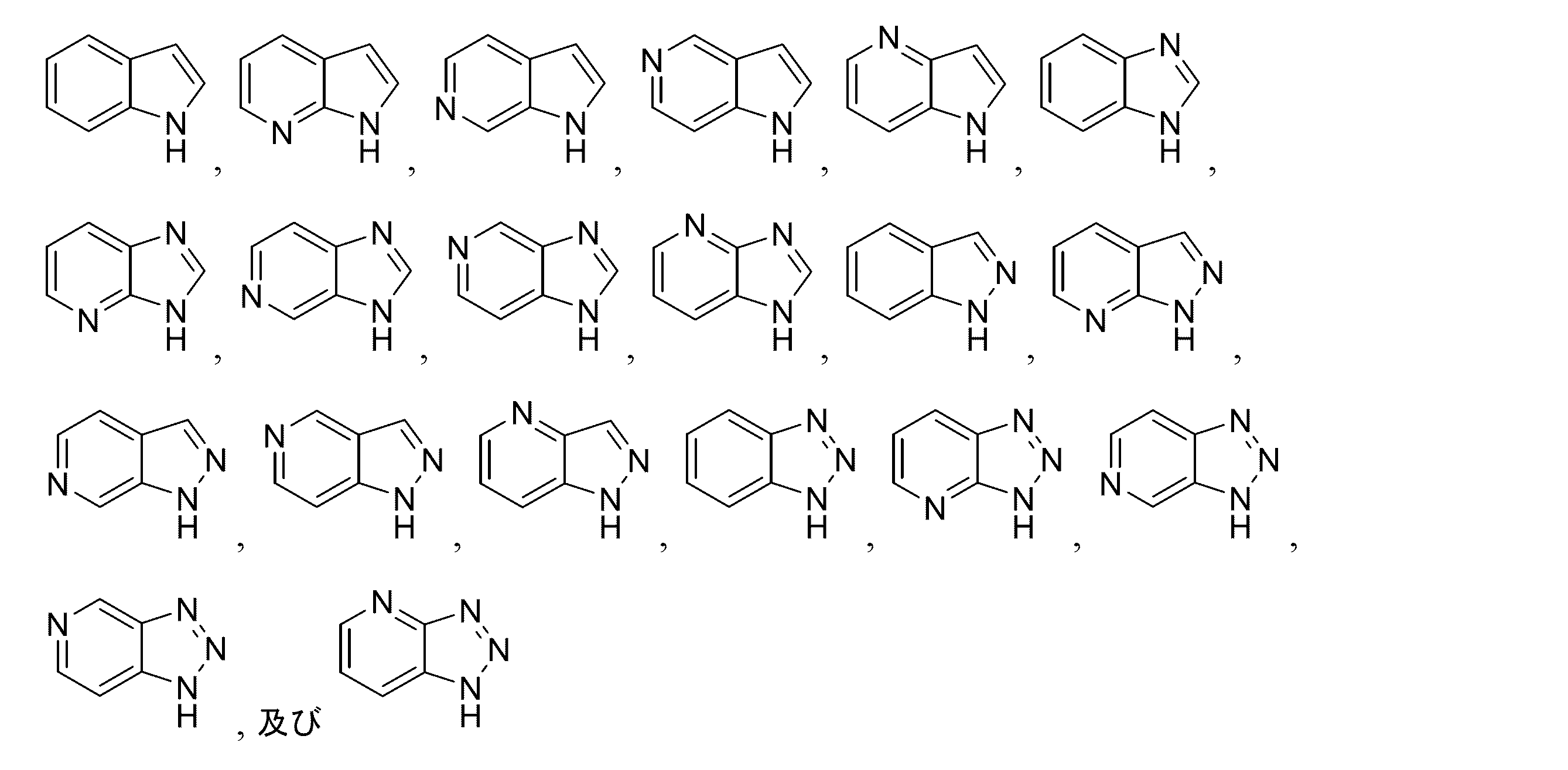
任意の上記実施態様におけるように、ヘテロアリールが、

任意の上記実施態様におけるように、ヘテロアリールが、

任意の上記実施態様におけるように、Dが、

任意の上記実施態様におけるように、Dが、

任意の上記実施態様におけるように、Dが、

任意の上記実施態様におけるように、

からなる群から選択される、抗体-薬物コンジュゲート。
As in any of the above embodiments,
An antibody-drug conjugate selected from the group consisting of.
任意の上記実施態様におけるように、構造
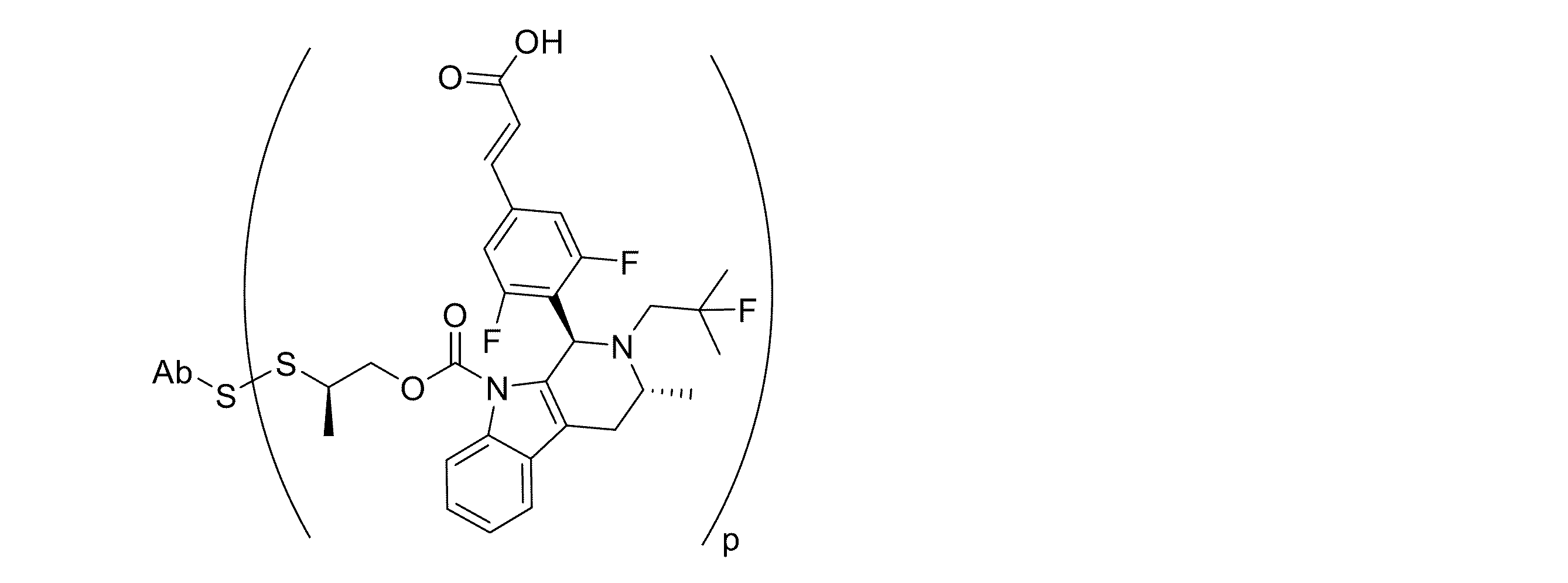
を有する、抗体-薬物コンジュゲート。
As in any of the above embodiments, the structure
With antibody-drug conjugate.
任意の上記実施態様におけるように、構造
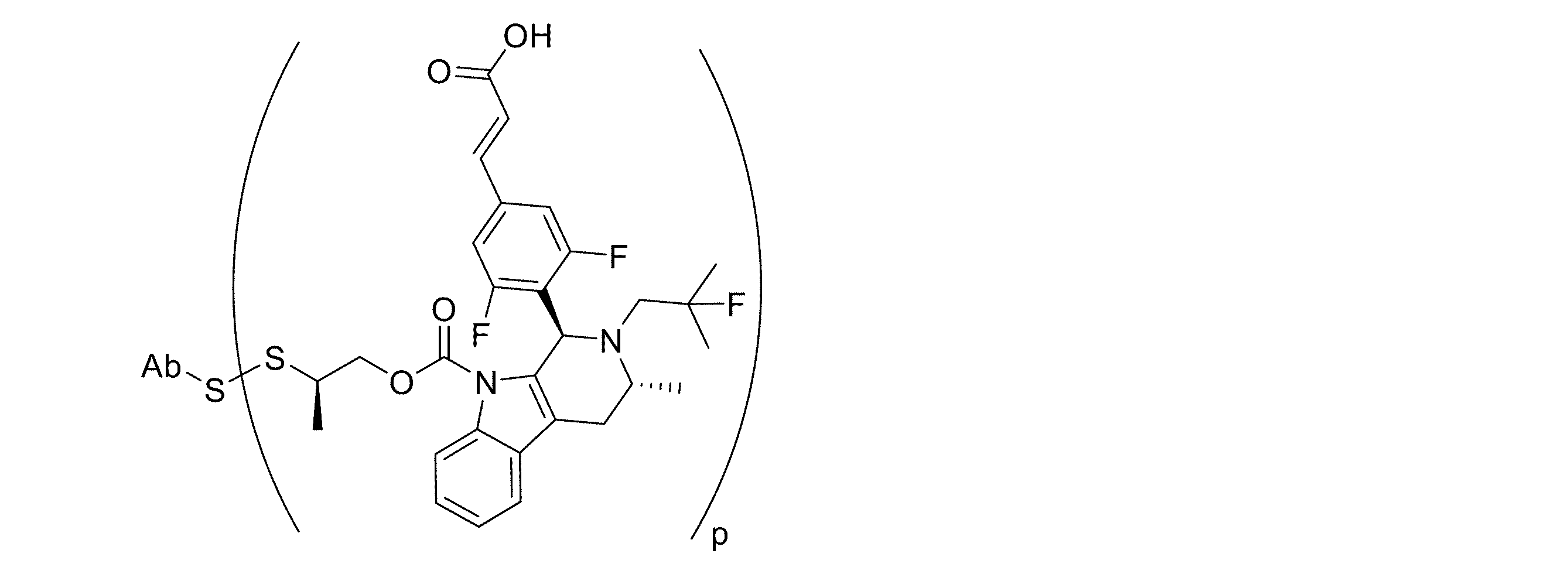
を有する、抗体-薬物コンジュゲート。
As in any of the above embodiments, the structure
With antibody-drug conjugate.
実施態様において、式III:

R1、R2、R3、及びR4は、H、置換されていてもよい分岐もしくは直鎖C1-C5アルキル、及び置換されていてもよいC3-C6シクロアルキルからなる群から独立して選択され、又はR3とR4はそれらが結合する炭素原子と共にC3-C6シクロアルキル環を形成し、
前記置換されていてもよいアルキル又はシクロアルキルは、アルキル、シクロアルキル、アリール、ヘテロアリール、ヒドロキシル、ニトリル、ハロ、アルコキシ、ハロアルコキシ、アリールアルコキシ、アシルオキシ、アルキルチオ、スルホネート、アミノ、アルキルアミノ、アシルアミノ、カルバモイル、アルキルカルバモイル、又はニトロで置換されていてもよく;
Dは、第二級窒素含有ヘテロアリールを含む生物学的に活性な分子であり、ここで、式III中のカルボニルがD中の第二級窒素に共有結合しており;
R5は、置換されていてもよいピリジン及びニトロピリジンからなる群から選択される]の化合物を調製するための方法であって、
i. 式V:


ii. 式VIの化合物を酸性条件下で脱保護して式III:

を含む方法。
In embodiments, Formula III:
R 1 , R 2 , R 3 and R 4 are a group consisting of H, an optionally substituted branched or linear C 1 -C 5 alkyl, and an optionally substituted C 3 -C 6 cycloalkyl. Selected independently from , or R3 and R4 form a C3 - C6 cycloalkyl ring with the carbon atom to which they bond.
The substituted alkyl or cycloalkyl may be alkyl, cycloalkyl, aryl, heteroaryl, hydroxyl, nitrile, halo, alkoxy, haloalkoxy, arylalkoxy, acyloxy, alkylthio, sulfonate, amino, alkylamino, acylamino, It may be substituted with carbamoyl, alkylcarbamoyl, or nitro;
D is a biologically active molecule containing a secondary nitrogen-containing heteroaryl, where the carbonyl in formula III is covalently attached to the secondary nitrogen in D;
R5 is selected from the group consisting of optionally substituted pyridine and nitropyridine].
i. Equation V:
ii. Deprotecting compounds of formula VI under acidic conditions Formula III:
保護基PGが、チオール保護に適した保護基である、任意の上記実施態様に記載の方法。 The method of any of the above embodiments, wherein the protecting group PG is a protecting group suitable for thiol protection.
保護基PGが酸不安定性保護基である、任意の上記実施態様に記載の方法。 The method of any of the above embodiments, wherein the protecting group PG is an acid instability protecting group.
保護基PGが、トリチル、フルオレニル、ジメトキシベンジル、メトキシベンジル、2,4,6-トリメチルベンジル、キサンテニル、フェロセニル、メトキシメチル、イソブトキシメチル、及びジフェニルメチルからなる群から選択される、任意の上記実施態様に記載の方法。 The above-mentioned embodiment in which the protecting group PG is selected from the group consisting of trityl, fluorenyl, dimethoxybenzyl, methoxybenzyl, 2,4,6-trimethylbenzyl, xanthenyl, ferrosenyl, methoxymethyl, isobutoxymethyl, and diphenylmethyl. The method according to the embodiment.
保護基PGがトリチル基である、任意の上記実施態様に記載の方法。 The method of any of the above embodiments, wherein the protecting group PG is a trityl group.
脱離基LGが、求核剤による置換に適した基である、任意の上記実施態様に記載の方法。 The method according to any of the above embodiments, wherein the leaving group LG is a group suitable for substitution with a nucleophile.
脱離基LGがハロゲンである、任意の上記実施態様に記載の方法。 The method according to any of the above embodiments, wherein the leaving group LG is a halogen.
脱離基LGが塩素である、任意の上記実施態様に記載の方法。 The method according to any of the above embodiments, wherein the leaving group LG is chlorine.
R5がニトロピリジンである、任意の上記実施態様に記載の方法。 The method of any of the above embodiments, wherein R5 is nitropyridine.
R5が5-ニトロピリジンである、任意の上記実施態様に記載の方法。 The method of any of the above embodiments, wherein R5 is 5 -nitropyridine.
実施態様において、式III:

R1、R2、R3、及びR4は、H、置換されていてもよい分岐もしくは直鎖C1-C5アルキル、及び置換されていてもよいC3-C6シクロアルキルからなる群から独立して選択され、又はR3とR4はそれらが結合する炭素原子と共にC3-C6シクロアルキル環を形成し、
前記置換されていてもよいアルキル又はシクロアルキルは、アルキル、シクロアルキル、アリール、ヘテロアリール、ヒドロキシル、ニトリル、ハロ、アルコキシ、ハロアルコキシ、アリールアルコキシ、アシルオキシ、アルキルチオ、スルホネート、アミノ、アルキルアミノ、アシルアミノ、カルバモイル、アルキルカルバモイル、又はニトロで置換されていてもよく;
R5は、置換されていてもよいピリジン及びニトロピリジンからなる群から選択され;
かつ
Dは、第二級窒素含有ヘテロアリールを含む生物学的に活性な分子であり、ここで、式III中のカルボニルがD中の第二級窒素に共有結合している]
の化合物。
In embodiments, Formula III:
R 1 , R 2 , R 3 and R 4 are a group consisting of H, an optionally substituted branched or linear C 1 -C 5 alkyl, and an optionally substituted C 3 -C 6 cycloalkyl. Selected independently from , or R3 and R4 form a C3 - C6 cycloalkyl ring with the carbon atom to which they are attached.
The substituted alkyl or cycloalkyl may be alkyl, cycloalkyl, aryl, heteroaryl, hydroxyl, nitrile, halo, alkoxy, haloalkoxy, arylalkoxy, acyloxy, alkylthio, sulfonate, amino, alkylamino, acylamino, It may be substituted with carbamoyl, alkylcarbamoyl, or nitro;
R5 is selected from the group consisting of optionally substituted pyridines and nitropyridines;
And D is a biologically active molecule containing a secondary nitrogen-containing heteroaryl, where the carbonyl in Formula III is covalently attached to the secondary nitrogen in D].
Compound.
任意の上記実施態様におけるように、R5が5-ニトロピリジンである、化合物。 A compound, wherein R5 is 5 -nitropyridine, as in any of the above embodiments.
任意の上記実施態様におけるように、R1がメチルであり、R2、R3、及びR4がそれぞれHである、化合物。 A compound in which R 1 is methyl and R 2 , R 3 and R 4 are H, respectively, as in any of the above embodiments.
任意の上記実施態様におけるように、R1がメチルであり、かつR立体化学を有する、化合物。 A compound in which R 1 is methyl and has R stereochemistry, as in any of the above embodiments.
任意の上記実施態様におけるように、式IIIの化合物が、

実施態様において、式IV:

Abは抗体であり;
R1、R2、R3、及びR4は、H、置換されていてもよい分岐もしくは直鎖C1-C5アルキル、及び置換されていてもよいC3-C6シクロアルキルからなる群から独立して選択され、又はR3とR4はそれらが結合する炭素原子と共にC3-C6シクロアルキル環を形成し、
前記置換されていてもよいアルキル又はシクロアルキルは、アルキル、シクロアルキル、アリール、ヘテロアリール、ヒドロキシル、ニトリル、ハロ、アルコキシ、ハロアルコキシ、アリールアルコキシ、アシルオキシ、アルキルチオ、スルホネート、アミノ、アルキルアミノ、アシルアミノ、カルバモイル、アルキルカルバモイル、又はニトロで置換されていてもよく;
Dは、第二級窒素含有ヘテロアリールを含む生物学的に活性な分子であり、ここで、式IV中のカルボニルがD中の第二級窒素に共有結合しており;かつ
pは1、2、3、4、5、6、7、8、9、又は10であり、好ましくは2である]
の抗体-薬物コンジュゲート又はその薬学的に許容可能な塩を調製するための方法であって、
i. 式V:


ii. 式VIの化合物を酸性条件下でジスルフィドR5-S-S-R5と接触させて、式III:

の化合物を調製する工程;及び
iii. 式IIIの化合物を抗体と接触させて、式IVの抗体-薬物コンジュゲートを調製する工程
を含む、方法。
In embodiments, formula IV:
Ab is an antibody;
R 1 , R 2 , R 3 and R 4 are a group consisting of H, an optionally substituted branched or linear C 1 -C 5 alkyl, and an optionally substituted C 3 -C 6 cycloalkyl. Selected independently from , or R3 and R4 form a C3 - C6 cycloalkyl ring with the carbon atom to which they bond.
The substituted alkyl or cycloalkyl may be alkyl, cycloalkyl, aryl, heteroaryl, hydroxyl, nitrile, halo, alkoxy, haloalkoxy, arylalkoxy, acyloxy, alkylthio, sulfonate, amino, alkylamino, acylamino, It may be substituted with carbamoyl, alkylcarbamoyl, or nitro;
D is a biologically active molecule containing a secondary nitrogen-containing heteroaryl, where the carbonyl in formula IV is covalently attached to the secondary nitrogen in D; and p is 1, 2, 3, 4, 5, 6, 7, 8, 9, or 10, preferably 2.]
Antibodies-A method for preparing a drug conjugate or a pharmaceutically acceptable salt thereof.
i. Equation V:
ii. The compound of formula VI is contacted with the disulfide R5 - SSR5 under acidic conditions to formulate III :.
Steps of preparing the compounds of; and iii. A method comprising contacting a compound of formula III with an antibody to prepare an antibody-drug conjugate of formula IV.
実施態様において、式VII:

PGは保護基であり;かつ
Dは、第二級窒素含有ヘテロアリールを含む生物学的に活性な分子であり、ここで式VII中のエステルカルボニルは、D中の第二級窒素とカルバメートを形成する]
の化合物を調製するための方法であって、
i. 式VIII:


の化合物と接触させて、式VIIの化合物を調製する工程
を含む、方法。
In an embodiment, the formula VII:
PG is a protecting group; and D is a biologically active molecule containing a secondary nitrogen-containing heteroaryl, where the ester carbonyl in formula VII is carbamate with the secondary nitrogen in D. Form]
It is a method for preparing the compound of
i. Formula VIII:
A method comprising contacting with a compound of formula VII to prepare a compound of formula VII.
式VIIの化合物が
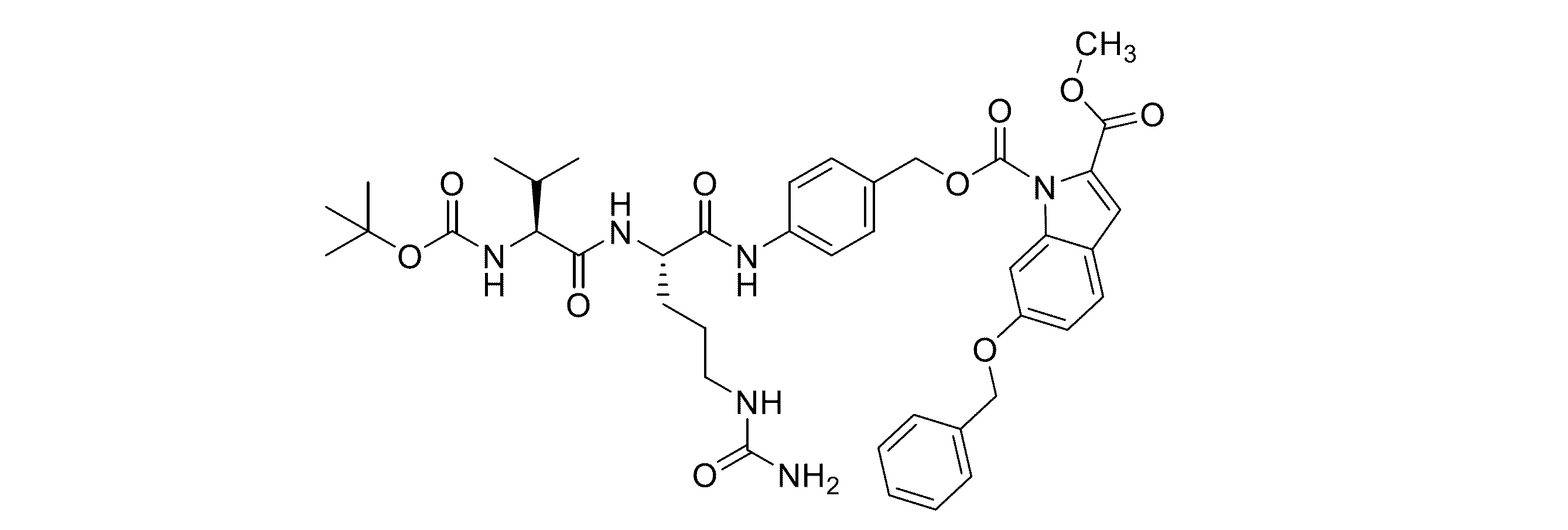
実施態様において、上記任意の実施態様に記載の方法によって調製された抗体-薬物コンジュゲート。 In embodiments, antibody-drug conjugates prepared by the method according to any of the above embodiments.
実施態様において、上記任意の実施態様に記載の方法によって調製された式IIIの化合物。 In embodiments, the compound of formula III prepared by the method according to any of the above embodiments.
前記ヘテロアリールが、インドール、インダゾール、ベンズイミダゾール、ベンゾトリアゾール、ピロール、ピロロピリジン、イミダゾール、トリアゾール、及びテトラゾールからなる群から選択される、任意の上記実施態様に記載の方法。 The method according to any of the above embodiments, wherein the heteroaryl is selected from the group consisting of indole, indazole, benzimidazole, benzotriazole, pyrrole, pyrrolopyridine, imidazole, triazole, and tetrazole.
前記Dが、細胞傷害剤;増殖阻害剤;抗生物質;毒素;抗腫瘍又は抗がん剤;アルキル化剤;アルキルスルホネート;アジリジン;エチレンイミン及びメチラメラミン(methylamelamine);アセトゲニン;トポイソメラーゼ1阻害剤;プロテオソーム阻害剤;EGFR阻害剤;チロシンキナーゼ阻害剤;セリン-トレオニンキナーゼ阻害剤;ファルネシルトランスフェラーゼ阻害剤;抗ホルモン剤;選択的エストロゲン受容体モジュレーター(SERM);抗エストロゲン;アロマターゼ阻害剤;黄体形成ホルモン放出ホルモンアゴニスト;性ステロイド;エストロゲン;及びアンドロゲン/レチノイド;エストロゲン受容体ダウンレギュレーター(ERD);抗アンドロゲン;免疫抑制剤;非ステロイド系抗炎症薬(NSAID);抗炎症剤;シクロオキシゲナーゼ阻害剤、ロイコトリエン受容体アンタゴニスト;プリンアンタゴニスト;ステロイド;ジヒドロ葉酸レダクターゼ阻害剤;及び抗マラリア剤からなる群から選択される、任意の上記実施態様に記載の方法。 D is a cytotoxic agent; growth inhibitor; antibiotic; toxin; antitumor or anticancer agent; alkylating agent; alkylsulfonate; aziridine; ethyleneimine and methylamelamine; acetogenin; topoisomerase 1 inhibitor; proteosome. Inhibitors; EGFR inhibitors; tyrosine kinase inhibitors; serine-threonine kinase inhibitors; farnesyl transferase inhibitors; antihormonal agents; selective estrogen receptor modulators (SERMs); anti-estrogens; aromatase inhibitors; luteinizing hormone-releasing hormones Amplifiers; sex steroids; estrogen; and androgens / retinoids; estrogen receptor down regulators (ERDs); anti-androgens; immunosuppressants; non-steroidal anti-inflammatory drugs (NSAIDs); anti-inflammatory agents; cyclooxygenase inhibitors, leukotriene receptor antagonists The method according to any of the above embodiments, selected from the group consisting of; purine antagonists; steroids; dihydrofolate reductase inhibitors; and anti-malaria agents.
前記Dが、アマニチン、ビンブラスチン、ビンクリスチン、デュオカルマイシンA、デュオカルマイシンSA、CC-1065、アドゼレシン、U-76074、U-73073、カルゼレシン(U-80244)、KW-2189、ジアゾナミドA、エソメプラゾール、アリピプラゾール、バルサルタン、ランソプラゾール、ラベプラゾール、ポメトレキセド、オルメサルタン、タダラフィル、パントプラゾール、カンドサルタン、オメプラゾール、スニチニブ、ペメトレキセド、アレクチニブ、ダカルバジン、セマキサニブ、ダシノスタット、ドビチニブ、メベンダゾール、及びピモベンダンからなる群から選択される、任意の上記実施態様に記載の方法。 D is amanitin, vinblastine, vincristine, duocarmycin A, duocarmycin SA, CC-1065, adzelesin, U-76074, U-73073, calzeresin (U-80244), KW-2189, diazonamide A, esomeprazole. Prazol, alipiprazole, balsartane, lansoprazole, rabeprazole, pometrexed, olmesartan, tadalafil, pantoprazole, candosartan, omeprazole, snitinib, pemetrexed, arectinib, dacarbazine, semaxanib, dasinostat, dobitinib The method according to any of the above embodiments.
化合物は、特にここに含まれる説明に照らして、化学技術分野においてよく知られているものと、その各々が出典明示により明示的にここに援用される Comprehensive Heterocyclic Chemistry II, 編者Katritzky及びRees, Elsevier, 1997, 例えば3巻;Liebigs Annalen der Chemie, (9):1910-16, (1985);Helvetica Chimica Acta, 41:1052-60, (1958);Arzneimittel-Forschung, 40(12):1328-31, (1990)に記載された他の複素環に対するものに類似した方法を含む合成経路によって合成することができる。出発物質はアルドリッチ・ケミカルズ(Milwaukee, WI)のような市販元から一般に入手でき、又は当業者によく知られている方法を使用して直ぐに調製される(例えば、Louis F. Fieser及びMary Fieser, Reagents for Organic Synthesis, v. 1-23, Wiley, N.Y. (1967-2006版)、又はBeilsteins Handbuch der organischen Chemie, 4, Aufl.版 Springer-Verlag, Berlinで補遺版を含むもの(Beilsteinオンラインデータベースによってもまた入手可能)に一般に記載された方法によって調製される)。DTTはジチオトレイトールを指す。DHAAはデヒドロアスコルビン酸を指す。
The compounds are well known in the field of chemical technology, especially in the light of the description contained herein, and each of them is explicitly incorporated herein by Comprehensive Heterocyclic Chemistry II, editors Katritzky and Rees, Elsevier. , 1997, for example,
化合物と必要な試薬と中間体の合成に有用な合成化学変換及び保護基法(保護及び脱保護)は、当該技術分野で知られており、例えば、R. Larock, Comprehensive Organic Transformations, VCH Publishers (1989);T. W. Greene及びP. G .M. Wuts, Protective Groups in Organic Synthesis, 3版, John Wiley and Sons (1999);及びL. Paquette編, Encyclopedia of Reagents for Organic Synthesis, John Wiley and Sons (1995)とその続版に記載されたものを含む。 Synthetic chemical transformations and protecting groups (protection and deprotection) useful for the synthesis of compounds, required reagents and intermediates are known in the art and are described, for example, in R. Larock, Comprehensive Organic Transformations, VCH Publishers ( 1989); T. W. Greene and P. G. M. Wuts, Protective Groups in Organic Synthesis, 3rd Edition, John Wiley and Sons (1999); and L. Paquette ed., Encyclopedia of Reagents for Organic Synthesis, John Wiley and Sons (1995). ) And its sequel.
化合物は、単独で、又は少なくとも2種、例えば5~1000種の化合物、もしくは10~100種の化合物を含む化合物ライブラリーとして調製することができる。式Iの化合物のライブラリーは、コンビナトリアル「スプリット及びミックス」アプローチによって、又は溶液相もしくは固相化学の何れかを使用する複数のパラレル合成によって、当業者に知られている手順によって調製することができる。従って、更なる態様によれば、少なくとも2種の化合物、又はその薬学的に許容可能な塩を含む化合物ライブラリーが提供される。 The compounds can be prepared alone or as a compound library containing at least two compounds, for example 5 to 1000 compounds, or 10 to 100 compounds. A library of compounds of formula I can be prepared by procedures known to those of skill in the art by a combinatorial "split and mix" approach or by multiple parallel syntheses using either solution phase or solid phase chemistry. can. Therefore, according to a further aspect, a compound library containing at least two compounds, or pharmaceutically acceptable salts thereof, is provided.
抗体を精製するための方法論は当該技術分野において周知である。ここに記載されるように、抗体、還元抗体などを精製するために、任意の既知の方法を使用することができる。 Methodologies for purifying antibodies are well known in the art. As described herein, any known method can be used to purify antibodies, reducing antibodies and the like.
一般手順及び実施例は、化合物を調製するための例示的な方法を提供する。当業者であれば、化合物を合成するために他の合成経路を使用してもよいことは理解されるであろう。特定の出発物質と経路がスキーム、一般手順、及び実施例において示され、検討されるが、他の出発物質及び経路も様々な誘導体及び/又は反応条件を提供するために容易に代用されうる。加えて、記載された方法で調製される例示的化合物の多くは、当業者によく知られた常套的化学を使用して、この開示に照らして更に改変することができる。 General procedures and examples provide exemplary methods for preparing compounds. Those of skill in the art will appreciate that other synthetic routes may be used to synthesize the compound. Although specific starting materials and routes are shown and discussed in schemes, general procedures, and examples, other starting materials and routes can be readily substituted to provide various derivatives and / or reaction conditions. In addition, many of the exemplary compounds prepared by the described methods can be further modified in the light of this disclosure using conventional chemistry well known to those of skill in the art.
一般に、本主題は、一般スキームAのような方法でADCを作製するための方法を記載する:

A:適当な溶媒中の適当な塩基。
B:リンカーと反応するための遊離システインチオールを提供する反応条件。一実施態様では、工程Bは、i)Abを還元剤と接触させること、ii)還元抗体の精製、iii)精製抗体を酸化剤と接触させてAb’を形成すること、及びiv)Ab’の精製を含みうる。
C:適切な溶媒中の適切な塩基。
In general, the subject describes methods for making ADCs in a manner such as General Scheme A:
A: A suitable base in a suitable solvent.
B: Reaction conditions that provide free cysteine thiol for reaction with the linker. In one embodiment, step B is i) contacting Ab with a reducing agent, ii) purifying the reducing antibody, iii) contacting the purified antibody with an oxidizing agent to form Ab', and iv) Ab'. Can include purification of.
C: The right base in the right solvent.
スキーム1は、ここに記載の薬物ジスルフィド-リンカー分子を調製するための合成経路を示す。

スキーム2は、ここに記載の薬物ジスルフィド-リンカー分子を調製するための合成経路を示す。

スキーム3は、ここに記載の薬物-保護ペプチドリンカー分子を調製するための合成経路を示す。

スキーム4は、薬物-ペプチドリンカーを調製するための合成経路を示す。

ここに記載のADCは、次の構成要素からなる:
1.抗体(Ab)
ここに記載されるように、抗体、例えばモノクローナル抗体(mAB)は、標的細胞、例えば薬物によって標的化される特定のタンパク質を発現する細胞に薬物を送達するために使用される。
The ADC described herein consists of the following components:
1. 1. Antibody (Ab)
As described herein, an antibody, eg, a monoclonal antibody (mAB), is used to deliver a drug to a target cell, eg, a cell expressing a particular protein targeted by the drug.
a.ヒト抗体
所定の実施態様では、ここで提供される抗体はヒト抗体である。ヒト抗体は、当該技術分野において知られている様々な技術を使用して産生することができる。ヒト抗体は一般にvan Dijk及びvan de Winkel, Curr. Opin. Pharmacol. 5: 368-74 (2001)とLonberg, Curr. Opin. Immunol. 20:450-459 (2008)に記載されている。
a. Human antibody In certain embodiments, the antibody provided herein is a human antibody. Human antibodies can be produced using a variety of techniques known in the art. Human antibodies are commonly described in van Dijk and van de Winkel, Curr. Opin. Pharmacol. 5: 368-74 (2001) and Lonberg, Curr. Opin. Immunol. 20: 450-459 (2008).
ヒト抗体は、抗原チャレンジに応答してインタクトなヒト抗体又はヒト可変領域を有するインタクトな抗体を生成するように改変されたトランスジェニック動物に、免疫原を投与することによって調製することができる。そのような動物は、典型的には内因性免疫グロブリン遺伝子座を置換するか、又は染色体外に存在するかもしくは動物の染色体にランダムに組み込まれているヒト免疫グロブリン遺伝子座の全て又は一部を含む。そのようなトランスジェニックマウスでは、内因性免疫グロブリン遺伝子座が一般に不活性化されている。トランスジェニック動物からヒト抗体を得るための方法の概説については、Lonberg, Nat. Biotech. 23:1117-1125 (2005)を参照のこと。また、例えばXENOMOUSETM技術を記載している米国特許第6075181号及び第6150584号、HUMAB(登録商標)技術を記載している米国特許第5770429号、K-M MOUSE(登録商標)技術を記載している米国特許第7041870号、及びVELOCIMOUSE(登録商標)技術を記載している米国特許出願公開第2007/0061900号を参照のこと。そのような動物により産生されるインタクトな抗体由来のヒト可変領域は、例えば、異なるヒト定常領域と組み合わせることにより、更に改変されうる。 Human antibodies can be prepared by administering an immunogen to a transgenic animal that has been modified to produce an intact human antibody or an intact antibody with a human variable region in response to an antigenic challenge. Such animals typically replace the endogenous immunoglobulin locus, or have all or part of the human immunoglobulin locus that is extrachromosomal or randomly integrated into the animal's chromosome. include. In such transgenic mice, the endogenous immunoglobulin locus is generally inactivated. See Lonberg, Nat. Biotech. 23: 1117-1125 (2005) for an overview of methods for obtaining human antibodies from transgenic animals. Also described are, for example, US Pat. Nos. 6075181 and 6150584 describing XENOMOUS TM technology, US Patent No. 57704249 describing HUMAB® technology, and KM MOUSE® technology. See U.S. Patent No. 704187, and U.S. Patent Application Publication No. 2007/0061900, which describes VELOCIMOUSE® technology. Human variable regions derived from intact antibodies produced by such animals can be further modified, for example, by combining with different human constant regions.
ヒト抗体は、ハイブリドーマに基づく方法によって作製することもできる。ヒトモノクローナル抗体の産生のためのヒト骨髄腫及びマウス-ヒト異種骨髄腫細胞株が記述されている。(例えば、Kozbor J. Immunol., 133: 3001 (1984);Brodeur等, Monoclonal Antibody Production Techniques and Applications, pp. 51-63 (Marcel Dekker, Inc., New York, 1987);及びBoerner等, J. Immunol., 147: 86 (1991)を参照)。ヒトB細胞ハイブリドーマ技術により作製されるヒト抗体もまたLi等, Proc. Natl. Acad. Sci. USA, 103:3557-3562 (2006)に記載されている。更なる方法には、例えば、米国特許第7189826号(ハイブリドーマ細胞株由来のモノクローナルヒトIgM抗体の産生を記載)及びNi, Xiandai Mianyixue, 26(4):265-268 (2006)(ヒト-ヒトハイブリドーマを記載)に記載されるものが含まれる。ヒトハイブリドーマ技術(トリオーマ技術)もまたVollmers及びBrandlein, Histology and Histopathology, 20(3):927-937 (2005)並びにVollmers及びBrandlein, Methods and Findings in Experimental and Clinical Pharmacology, 27(3):185-91 (2005)に記載されている。 Human antibodies can also be produced by hybridoma-based methods. Human myeloma and mouse-human heterologous myeloma cell lines for the production of human monoclonal antibodies have been described. (For example, Kozbor J. Immunol., 133: 3001 (1984); Brodeur et al., Monoclonal Antibody Production Techniques and Applications, pp. 51-63 (Marcel Dekker, Inc., New York, 1987); and Boerner et al., J. Immunol., 147: 86 (1991)). Human antibodies produced by human B cell hybridoma technology are also described in Li et al., Proc. Natl. Acad. Sci. USA, 103: 3557-3562 (2006). Further methods include, for example, US Pat. No. 7,189,826 (described in the production of monoclonal human IgM antibodies derived from hybridoma cell lines) and Ni, Xiandai Mianyixue, 26 (4): 265-268 (2006) (human-human hybridoma). ) Includes those described in. Human hybridoma technology (trioma technology) is also Vollmers and Brandlein, Histology and Histopathology, 20 (3): 927-937 (2005) and Vollmers and Brandlein, Methods and Findings in Experimental and Clinical Pharmacology, 27 (3): 185-91. It is described in (2005).
ヒト抗体は、ヒト由来のファージディスプレイライブラリーから選択されたFvクローン可変ドメイン配列を単離することによってもまた作製されうる。ついで、そのような可変ドメイン配列を、所望のヒト定常ドメインと組み合わせてもよい。抗体ライブラリーからヒト抗体を選択するための技術を以下に記載する。 Human antibodies can also be made by isolating Fv clone variable domain sequences selected from human-derived phage display libraries. Such variable domain sequences may then be combined with the desired human constant domain. Techniques for selecting human antibodies from the antibody library are described below.
b.ライブラリー由来抗体
ADCにおいて使用される抗体は、所望の活性又は活性群を有する抗体のコンビナトリアルライブラリーをスクリーニングすることによって単離されうる。例えば、ファージディスプレイライブラリーを作成して所望の結合特性を有する抗体のそのようなライブラリーをスクリーニングするための様々な方法が、当該技術分野で知られている。更なる方法は、例えば、Hoogenboom等, in Methods in Molecular Biology 178:1-37(O’Brien等編, Human Press, Totowa, NJ, 2001)に概説があり、更に例えば、McCafferty等, Nature 348:552-554;Clackson等, Nature 352: 624-628 (1991);Marks等, J. Mol. Biol. 222: 581-597 (1992);Marks及びBradbury, in Methods in Molecular Biology 248:161-175(Lo編, Human Press, Totowa, NJ, 2003);Sidhu等, J. Mol. Biol. 338(2): 299-310 (2004);Lee等, J. Mol. Biol. 340(5): 1073-1093 (2004);Fellouse, Proc. Natl. Acad. Sci. USA 101(34): 12467-12472 (2004);及びLee等, J. Immunol. Methods 284(1-2): 119-132(2004)に記載されている。
b. Library-derived antibodies Antibodies used in ADCs can be isolated by screening a combinatorial library of antibodies with the desired activity or group of activities. For example, various methods for creating phage display libraries and screening such libraries of antibodies with the desired binding properties are known in the art. Further methods are outlined in, for example, Hoogenboom et al., In Methods in Molecular Biology 178: 1-37 (O'Brien et al., Human Press, Totowa, NJ, 2001), and further, for example, McCafferty et al., Nature 348: 552-554; Clackson et al., Nature 352: 624-628 (1991); Marks et al., J. Mol. Biol. 222: 581-597 (1992); Marks and Bradbury, in Methods in Molecular Biology 248: 161-175 ( Lo ed., Human Press, Totowa, NJ, 2003); Sidhu et al., J. Mol. Biol. 338 (2): 299-310 (2004); Lee et al., J. Mol. Biol. 340 (5): 1073- 1093 (2004); Fellouse, Proc. Natl. Acad. Sci. USA 101 (34): 12467-12472 (2004); and Lee et al., J. Immunol. Methods 284 (1-2): 119-132 (2004) It is described in.
所定のファージディスプレイ法では、VH及びVL遺伝子のレパートリーを、ポリメラーゼ連鎖反応(PCR)により別個にクローニングし、ファージライブラリーにおいてランダムに再結合させ、これをついで、Winter等, Ann. Rev. Immunol., 12: 433-455 (1994)に記載されるように、抗原結合ファージについてスクリーニングすることができる。ファージは、典型的には単鎖Fv(scFv)断片又はFab断片の何れかとして抗体断片を提示する。免疫化された供給源からのライブラリーは、ハイブリドーマを構築する必要なしに、免疫原に対して高親和性の抗体を提供する。あるいは、Griffiths等, EMBO J, 12: 725-734 (1993)に記載されるように、ナイーブなレパートリーを、如何なる免疫感作も無く、広範囲の非自己抗原及び自己抗原に対して抗体の単一起源を提供するために、(例えば、ヒトから)クローニングすることができる。最後に、ナイーブなライブラリーは、幹細胞由来の再配置されていないV遺伝子セグメントをクローニングし、ランダム配列を含むPCRプライマーを使用して高度に可変性のCDR3領域をコードし、Hoogenboom及びWinter, J. Mol. Biol., 227: 381-388 (1992)により記載されるようにインビトロでの再配置を達成することにより、合成的に作製することもできる。ヒト抗体ファージライブラリーを記載している特許刊行物には、例えば米国特許第5750373号、並びに米国特許出願公開第2005/0079574号、第2005/0119455号、第2005/0266000号、第2007/0117126号、第2007/0160598号、第2007/0237764号、第2007/0292936号、及び第2009/0002360号が含まれる。 In a given phage display method, the repertoire of VH and VL genes is cloned separately by polymerase chain reaction (PCR) and randomly recombined in a phage library, which is then followed by Winter et al., Ann. Rev. Immunol. , 12: 433-455 (1994) can be screened for antigen-binding phage. Phage typically present an antibody fragment as either a single chain Fv (scFv) fragment or a Fab fragment. Libraries from immunized sources provide antibodies with high affinity for immunogens without the need to construct hybridomas. Alternatively, as described in Griffiths et al., EMBO J, 12: 725-734 (1993), a naive repertoire, a single antibody against a wide range of non-self-antigens and self-antigens without any immunosensitization. It can be cloned (eg, from humans) to provide its origin. Finally, a naive library clones unrearranged V gene segments from stem cells and encodes highly variable CDR3 regions using PCR primers containing random sequences, Hoogenboom and Winter, J. It can also be made synthetically by achieving in vitro rearrangement as described by Mol. Biol., 227: 381-388 (1992). Patent publications describing the human antibody phage library include, for example, US Pat. No. 5,750,373, and US Patent Application Publication Nos. 2005/0079574, 2005/0119455, 2005/0266000, 2007/0117126. No., No. 2007/0160598, No. 2007/0237764, No. 2007/0292936, and No. 2009/0002360.
ヒト抗体ライブラリーから単離された抗体又は抗体断片は、ここではヒト抗体又はヒト抗体の断片とみなされる。 Antibodies or antibody fragments isolated from the human antibody library are considered herein as human antibodies or fragments of human antibodies.
c.キメラ、ヒト化及びヒト抗体
所定の実施態様では、ここで提供される抗体はキメラ抗体である。所定のキメラ抗体は、例えば、米国特許第4816567号、及びMorrison等, Proc. Natl. Acad. Sci. USA, 81:6851-6855 (1984)に記載されている。一例では、キメラ抗体は、非ヒト可変領域(例えば、マウス、ラット、ハムスター、ウサギ、又はサル等の非ヒト霊長類由来の可変領域)とヒト定常領域とを含む。更なる例では、キメラ抗体は、クラス又はサブクラスが親抗体のものから変更されている「クラススイッチ」抗体である。キメラ抗体は、その抗原結合断片を含む。
c. Chimeric, Humanized and Human Antibodies In certain embodiments, the antibodies provided herein are chimeric antibodies. Given chimeric antibodies are described, for example, in US Pat. No. 4,816,567, and Morrison et al., Proc. Natl. Acad. Sci. USA, 81: 6851-6855 (1984). In one example, the chimeric antibody comprises a non-human variable region (eg, a variable region derived from a non-human primate such as a mouse, rat, hamster, rabbit, or monkey) and a human constant region. In a further example, a chimeric antibody is a "class switch" antibody whose class or subclass has been altered from that of the parent antibody. The chimeric antibody contains the antigen-binding fragment thereof.
所定の実施態様では、キメラ抗体はヒト化抗体である。典型的には、非ヒト抗体は、ヒトに対する免疫原性を低減するために、親の非ヒト抗体の特異性と親和性を保持したままヒト化される。一般に、ヒト化抗体は、HVR、例えばCDR(又はその一部)が非ヒト抗体に由来し、かつFR(又はその一部)がヒト抗体配列に由来する、一又は複数の可変ドメインを含む。ヒト化抗体は、場合によっては、ヒト定常領域の少なくとも一部をまた含むであろう。幾つかの実施態様では、ヒト化抗体の幾つかのFR残基は、例えば、抗体特異性又は親和性を回復させ又は改善するために、非ヒト抗体(例えば、HVR残基が由来する抗体)由来の対応する残基で置換される。 In certain embodiments, the chimeric antibody is a humanized antibody. Typically, non-human antibodies are humanized while preserving the specificity and affinity of the parent non-human antibody in order to reduce immunogenicity to humans. Generally, a humanized antibody comprises one or more variable domains in which the HVR, eg, CDR (or part thereof), is derived from a non-human antibody and FR (or part thereof) is derived from a human antibody sequence. Humanized antibodies will in some cases also contain at least a portion of the human constant region. In some embodiments, some FR residues of a humanized antibody are, for example, a non-human antibody (eg, an antibody from which an HVR residue is derived) in order to restore or improve antibody specificity or affinity. Substituted with the corresponding residue of origin.
ヒト化抗体とそれらの作製方法は、例えば、Almagro及びFransson, Front. Biosci. 13:1619-1633 (2008)において概説され、更に、例えばRiechmann等, Nature 332:323-329 (1988);Queen等, Proc. Nat'l Acad. Sci. USA 86:10029-10033 (1989);米国特許第5821337号、同第7527791号、同第6982321号、及び同第7087409号;Kashmiri等, Methods 36:25-34 (2005)(SDR(a-CDR)グラフティングを記載);Padlan, Mol. Immunol. 28:489-498 (1991)(「リサーフェシング」を記載);Dall’Acqua等, Methods 36:43-60 (2005)(「FRシャッフリング」を記載);及びOsbourn等, Methods 36:61-68 (2005)及びKlimka等, Br. J. Cancer, 83:252-260 (2000)(FRシャッフリングへの「誘導選択」手法を記載)に記載されている。 Humanized antibodies and their methods of production are outlined in, for example, Almagro and Fransson, Front. Biosci. 13: 1619-1633 (2008), and further, for example, Riechmann et al., Nature 332: 323-329 (1988); Queen et al. , Proc. Nat'l Acad. Sci. USA 86: 10029-10033 (1989); US Pat. 34 (2005) (described in SDR (a-CDR) graphing); Padlan, Mol. Immunol. 28: 489-498 (1991) (described in "Resurfacing"); Dall'Acqua et al., Methods 36: 43-60 (2005) (described "FR shuffling"); and Osbourn et al., Methods 36: 61-68 (2005) and Klimka et al., Br. J. Cancer, 83: 252-260 (2000) ("Induction" to FR shuffling. "Selection" method is described).
ヒト化に使用されうるヒトフレームワーク領域には、限定されないが、「ベストフィット」法を使用して選択されるフレームワーク領域(例えば、Sims等 J. Immunol. 151:2296 (1993)を参照);軽鎖又は重鎖可変領域の特定のサブグループのヒト抗体のコンセンサス配列に由来するフレームワーク領域(例えば、Carter等 Proc. Natl. Acad. Sci. USA, 89:4285 (1992);及びPresta等 J. Immunol., 151:2623 (1993)を参照);ヒト成熟(体細胞変異)フレームワーク領域又はヒト生殖細胞系列フレームワーク領域(例えば、Almagro及びFransson, Front. Biosci. 13:1619-1633 (2008)を参照);及びFRライブラリーのスクリーニング由来のフレームワーク領域(例えば、Baca等, J. Biol. Chem. 272:10678-10684 (1997)及びRosok等, J. Biol. Chem. 271:22611-22618 (1996)を参照)が含まれる。 The human framework regions that can be used for humanization are, but are not limited to, the framework regions selected using the "best fit" method (see, eg, Sims et al., J. Immunol. 151: 2296 (1993)). Framework regions derived from the consensus sequence of human antibodies in specific subgroups of light or heavy chain variable regions (eg Carter et al. Proc. Natl. Acad. Sci. USA, 89: 4285 (1992); and Presta et al. J. Immunol., 151: 2623 (1993)); Human maturation (somatic cell mutation) framework region or human germ cell lineage framework region (eg, Almagro and Fransson, Front. Biosci. 13: 1619-1633 (eg) 2008); and framework regions from the screening of FR libraries (eg, Baca et al., J. Biol. Chem. 272: 10678-10684 (1997) and Rosok et al., J. Biol. Chem. 271: 22611). -22618 (1996)) is included.
d.多重特異性抗体
所定の実施態様では、ここに提供される抗体は、多重特異性抗体、例えば、二重特異性抗体である。ここで使用される「多重特異性抗体」という用語は、ポリエピトープ(polyepitopic)特異性を有する(すなわち、1個の分子上の2つ以上の異なるエピトープに結合可能であるか、又は2個以上の異なる分子上のエピトープに結合可能である)抗原結合ドメインを含む抗体を指す。
d. Multispecific Antibodies In certain embodiments, the antibodies provided herein are multispecific antibodies, eg bispecific antibodies. The term "multispecific antibody" as used herein has polyepitopic specificity (ie, is capable of binding to two or more different epitopes on one molecule, or two or more. Refers to an antibody containing an antigen-binding domain (which can bind to an epitope on a different molecule).
幾つかの実施態様では、多重特異性抗体は、少なくとも2つの異なる抗原結合部位に対する結合特異性を有するモノクローナル抗体(例えば、二重特異性抗体)である。幾つかの実施態様では、多重特異性抗体の第一の抗原結合ドメインと第二の抗原結合ドメインが、1個の同じ分子内の2つのエピトープと結合してもよい(分子内結合)。例えば、多重特異性抗体の第一の抗原結合ドメインと第二の抗原結合ドメインが、同じタンパク質分子上の2つの異なるエピトープに結合してもよい。所定の実施態様では、多重特異性抗体が結合する2つの異なるエピトープは、1つの単一特異性抗体、例えば、一般的な抗体又は一つの免疫グロブリン単一可変ドメイン等によって通常は同時に結合されないエピトープである。幾つかの実施態様では、多重特異性抗体の第一の抗原結合ドメインと第二の抗原結合ドメインは、2個の明確に異なる分子内に位置するエピトープと結合してもよい(分子間結合)。例えば、多重特異性抗体の第一の抗原結合ドメインは、1個のタンパク質分子上の一つのエピトープに結合してもよく、一方で、多重特異性抗体の第二の抗原結合ドメインは、異なるタンパク質分子上の別のエピトープに結合し、それによって2個の分子を架橋してもよい。 In some embodiments, the multispecific antibody is a monoclonal antibody (eg, a bispecific antibody) that has binding specificity for at least two different antigen binding sites. In some embodiments, the first and second antigen-binding domains of a multispecific antibody may bind to two epitopes within the same molecule (intramolecular binding). For example, the first and second antigen-binding domains of a multispecific antibody may bind to two different epitopes on the same protein molecule. In certain embodiments, two different epitopes to which a multispecific antibody binds are usually not simultaneously bound by one monospecific antibody, such as a common antibody or one immunoglobulin single variable domain. Is. In some embodiments, the first and second antigen-binding domains of a multispecific antibody may bind to epitopes located within two distinctly distinct molecules (intermolecular binding). .. For example, the first antigen-binding domain of a multispecific antibody may bind to one epitope on one protein molecule, while the second antigen-binding domain of a multispecific antibody may be a different protein. Two molecules may be crosslinked by binding to another epitope on the molecule.
幾つかの実施態様では、多重特異性抗体(例えば、二重特異性抗体)の抗原結合ドメインは、2つのVH/VLユニットを含み、第一のVH/VLユニットは、第一のエピトープと結合し、第二のVH/VLユニットは、第二のエピトープに結合し、各VH/VLユニットは、重鎖可変ドメイン(VH)と軽鎖可変ドメイン(VL)を含む。このような多重特異性抗体には、完全長抗体、2つ以上のVL及びVHドメインを有する抗体、及び抗体断片(例えば、Fab、Fv、dsFv、scFv、ダイアボディ、二重特異性ダイアボディ及びトリアボディ、共有結合又は非共有結合で連結されている抗体断片)が含まれるが、これらに限定されない。重鎖可変領域の少なくとも一部及び/又は軽鎖可変領域の少なくとも一部を更に含むVH/VLユニットは、「アーム」又は「ヘミマー」又は「半抗体」とも称されうる。幾つかの実施態様では、ヘミマーは、第二のヘミマーとの分子内ジスルフィド結合の形成を可能にするのに十分な重鎖可変領域の部分を含む。幾つかの実施態様では、ヘミマーは、例えば、相補的なホール変異もしくはノブ変異を含む第二のヘミマー又は半抗体とのヘテロ二量体化を可能にするノブ変異又はホール変異を含む。ノブ変異及びホール変異は、以下に更に考察される。 In some embodiments, the antigen binding domain of a multispecific antibody (eg, a bispecific antibody) comprises two VH / VL units, the first VH / VL unit binding to the first epitope. A second VH / VL unit binds to a second epitope, and each VH / VL unit comprises a heavy chain variable domain (VH) and a light chain variable domain (VL). Such multispecific antibodies include full-length antibodies, antibodies with two or more VL and VH domains, and antibody fragments (eg, Fab, Fv, dsFv, scFv, diabody, bispecific diabody and). Includes, but is not limited to, tribodys, covalently or non-covalently linked antibody fragments). A VH / VL unit further comprising at least a portion of the heavy chain variable region and / or at least a portion of the light chain variable region may also be referred to as an "arm" or "hemimer" or "half antibody". In some embodiments, the hemimer comprises a portion of the heavy chain variable region sufficient to allow the formation of an intramolecular disulfide bond with the second hemimer. In some embodiments, the hemimer comprises a knob or whole mutation that allows heterodimerization with a second hemimer or semi-antibody, including, for example, a complementary whole or knob mutation. Knob and Hall mutations are further discussed below.
所定の実施態様では、ここに提供される多重特異性抗体は二重特異性抗体でありうる。ここで使用される「二重特異性抗体」という用語は、一つの分子上の二つの異なるエピトープに結合可能であるか、又は二つの異なる分子上のエピトープに結合可能である抗原結合ドメインを含む多重特異性抗体を指す。二重特異性(bispecific)抗体は、「二重特異性(dual specificity)」を有するもの、又は「二重特異的(dual specific)」であるものと称される場合もある。例示的な二重特異性抗体は、タンパク質と任意の他の抗原の両方に結合しうる。所定の実施態様では、結合特異性のうちの一方は、タンパク質に対するものであり、他方はCD3に対するものである。例えば、米国特許第5821337号を参照のこと。所定の実施態様では、二重特異性抗体は、同じタンパク質分子の二つの異なるエピトープに結合しうる。所定の実施態様では、二重特異性抗体は、二つの異なるタンパク質分子上の二つの異なるエピトープに結合しうる。二重特異性抗体はまたタンパク質を発現する細胞に細胞傷害性薬剤を局在化させるために使用されうる。二重特異性抗体は、完全長抗体又は抗体断片として調製することができる。 In certain embodiments, the multispecific antibodies provided herein can be bispecific antibodies. As used herein, the term "bispecific antibody" comprises an antigen binding domain that is capable of binding to two different epitopes on one molecule or to an epitope on two different molecules. Refers to multispecific antibodies. Bispecific antibodies are sometimes referred to as having "dual specificity" or being "dual specific". Exemplary bispecific antibodies can bind both proteins and any other antigen. In certain embodiments, one of the binding specificities is for a protein and the other is for CD3. See, for example, US Pat. No. 5,821,337. In certain embodiments, bispecific antibodies can bind to two different epitopes of the same protein molecule. In certain embodiments, bispecific antibodies can bind to two different epitopes on two different protein molecules. Bispecific antibodies can also be used to localize cytotoxic agents to cells expressing proteins. Bispecific antibodies can be prepared as full-length antibodies or antibody fragments.
多重特異性抗体を作製するための技法には、異なる特異性を有する二つの免疫グロブリン重鎖-軽鎖対の組換え同時発現(Milstein及びCuello, Nature 305: 537 (1983)、国際公開第93/08829号、及びTraunecker等, EMBO J. 10: 3655 (1991)を参照)、及び「ノブ・イン・ホール(knob-in-hole)」操作(例えば、米国特許第5731168号、国際公開第2009/089004号、米国特許出願公開第2009/0182127号、米国特許出願公開第2011/0287009号、Marvin及びZhu, Acta Pharmacol. Sin. (2005) 26(6):649-658、及びKontermann (2005) Acta Pharmacol. Sin., 26:1-9を参照)が含まれるが、これらに限定されない。ここで使用される「ノブ・イントゥ・ホール」又は「KnH」技術という用語は、それらが相互作用する界面において一方のポリペプチド中に隆起(ノブ)を導入し、他方のポリペプチド中に空洞(ホール)を導入することにより、インビトロ又はインビボで二つのポリペプチドの一緒の対形成を誘導する技術を指す。例えば、KnHは、抗体のFc:Fc結合界面、CL:CH1界面、又はVH/VL界面に導入されている(例えば、米国特許出願公開第2011/0287009号、米国特許出願公開第2007/0178552号、国際公開第96/027011号、国際公開第98/050431号、Zhu等, 1997, Protein Science 6:781-788、及び国際公開第2012/106587号を参照)。幾つかの実施態様では、KnHは、多重特異性抗体の製造中に二つの異なる重鎖が一緒になる対形成を推進する。例えば、そのFc領域内にKnHを有する多重特異性抗体は、各Fc領域に連結された単一可変ドメインを更に含むことができ、あるいは、同様のもしくは異なる軽鎖可変ドメインと対になる異なる重鎖可変ドメインを更に含む。KnH技術はまた、二つの異なる受容体の細胞外ドメイン、又は異なる標的認識配列を含む任意の他のポリペプチド配列(例えば、アフィボディ、ペプチボディ及び他のFc融合物を含む)を一緒に対形成するために使用することができる。 Techniques for making multispecific antibodies include recombinant co-expression of two immunoglobulin heavy chain-light chain pairs with different specificities (Milstein and Cuello, Nature 305: 537 (1983), WO 93. / 08829, and Traunecker et al., EMBO J. 10: 3655 (1991)), and "knob-in-hole" operations (eg, US Pat. No. 5,731,168, International Publication No. 2009). / 089004, US Patent Application Publication No. 2009/018212, US Patent Application Publication No. 2011/0287009, Marvin and Zhu, Acta Pharmacol. Sin. (2005) 26 (6): 649-658, and Kontermann (2005). Acta Pharmacol. Sin., 26: 1-9), but is not limited to these. The term "knob into hole" or "KnH" technique used herein introduces a ridge (knob) into one polypeptide at the interface where they interact and a cavity in the other polypeptide. Hall) refers to a technique for inducing the combined formation of two polypeptides in vitro or in vivo. For example, KnH has been introduced at the Fc: Fc binding interface, CL: CH1 interface, or VH / VL interface of an antibody (eg, US Patent Application Publication No. 2011/028709, US Patent Application Publication No. 2007/0178552). , International Publication No. 96/027011, International Publication No. 98/050431, Zhu et al., 1997, Protein Science 6: 781-788, and International Publication No. 2012/106587). In some embodiments, KnH promotes pairing of two different heavy chains together during the production of a multispecific antibody. For example, a multispecific antibody having KnH within its Fc region can further comprise a single variable domain linked to each Fc region, or a different weight paired with a similar or different light chain variable domain. Further includes a chain variable domain. KnH technology also pairs together extracellular domains of two different receptors, or any other polypeptide sequence containing different target recognition sequences, including, for example, affibody, peptibody and other Fc fusions. Can be used to.
ここで使用される「ノブ変異」という用語は、ポリペプチドが別のポリペプチドと相互作用する界面において、ポリペプチドに隆起(ノブ)を導入する変異を指す。幾つかの実施態様では、他方のポリペプチドは、ホール突然変異を有する。 As used herein, the term "knob mutation" refers to a mutation that introduces a ridge (knob) into a polypeptide at the interface where the polypeptide interacts with another polypeptide. In some embodiments, the other polypeptide has a whole mutation.
ここで使用される「ホール変異」という用語は、ポリペプチドが別のポリペプチドと相互作用する界面において、ポリペプチドに空洞(ホール)を導入する変異を指す。幾つかの実施態様では、他方のポリペプチドは、ノブ変異を有する。 As used herein, the term "hole mutation" refers to a mutation that introduces a cavity into a polypeptide at the interface where the polypeptide interacts with another polypeptide. In some embodiments, the other polypeptide has a knob mutation.
「隆起」は、第一のポリペプチドの界面から突出し、従ってヘテロ多量体を安定化させるように隣接界面(すなわち、第二のポリペプチドの界面)にある補償的空洞内に位置付け可能であり、よって、例えば、ホモ多量体形成と比べてヘテロ多量体形成を優先する、少なくとも一つのアミノ酸側鎖を指す。隆起は、元の界面に存在してもよく、又は合成的に(例えば、界面をコードする核酸を変化させることによって)導入されてもよい。幾つかの実施態様では、第一のポリペプチドの界面をコードする核酸は、隆起をコードするように変化させられる。これを達成するために、第一のポリペプチドの界面にある少なくとも一つの「元の」アミノ酸残基をコードする核酸が、元のアミノ酸残基よりも大きな側鎖体積を有する少なくとも一つの「移入」アミノ酸残基をコードする核酸と置換される。一を超える元の残基及び対応する移入残基がありうることは理解されよう。様々なアミノ残基の側鎖体積は、例えば、米国特許出願公開第2011/0287009号の表1に示されている。「隆起」を導入する変異は、「ノブ変異」と称される場合がある。 The "ridge" can be positioned within the compensatory cavity at the adjacent interface (ie, the interface of the second polypeptide) so as to project from the interface of the first polypeptide and thus stabilize the heteromultimer. Thus, for example, it refers to at least one amino acid side chain that prioritizes heteromultimer formation over homomultimer formation. The ridge may be present at the original interface or may be introduced synthetically (eg, by altering the nucleic acid encoding the interface). In some embodiments, the nucleic acid encoding the interface of the first polypeptide is altered to encode a ridge. To achieve this, the nucleic acid encoding at least one "original" amino acid residue at the interface of the first polypeptide has at least one "import" having a larger side chain volume than the original amino acid residue. It is replaced with the nucleic acid encoding the amino acid residue. It will be appreciated that there can be more than one original residue and a corresponding introduced residue. The side chain volumes of the various amino residues are shown, for example, in Table 1 of US Patent Application Publication No. 2011/028709. Mutations that introduce "uplift" are sometimes referred to as "knob mutations."
幾つかの実施態様では、隆起の形成のための移入残基は、アルギニン(R)、フェニルアラニン(F)、チロシン(Y)及びトリプトファン(W)から選択される天然に生じるアミノ酸残基である。幾つかの実施態様では、移入残基は、トリプトファン又はチロシンである。幾つかの実施態様では、隆起の形成のための元の残基は、アラニン、アスパラギン、アスパラギン酸、グリシン、セリン、スレオニン又はバリンのように、小さな側鎖体積を有する。 In some embodiments, the transfer residue for the formation of the ridge is a naturally occurring amino acid residue selected from arginine (R), phenylalanine (F), tyrosine (Y) and tryptophan (W). In some embodiments, the transfer residue is tryptophan or tyrosine. In some embodiments, the original residue for the formation of the ridge has a small side chain volume, such as alanine, asparagine, aspartic acid, glycine, serine, threonine or valine.
「空洞」は、第二のポリペプチドの界面から凹んでおり、従って第一のポリペプチドの隣接界面上の対応する隆起を収容する少なくとも一つのアミノ酸側鎖を指す。空洞は、元の界面内に存在してもよく、又は合成的に(例えば、界面をコードする核酸を変化させることによって)導入されてもよい。幾つかの実施態様では、第二のポリペプチドの界面をコードする核酸は、空洞をコードするように変化させられる。これを達成するために、第二のポリペプチドの界面にある少なくとも一つの「元の」アミノ酸残基をコードする核酸が、元のアミノ酸残基よりも小さな側鎖体積を有する少なくとも一つの「移入」アミノ酸残基をコードするDNAで置換される。一を超える元の残基及び対応する移入残基がありうることは理解されよう。幾つかの実施態様では、空洞の形成のための移入残基は、アラニン(A)、セリン(S)、スレオニン(T)及びバリン(V)から選択される天然に生じるアミノ酸残基である。幾つかの実施態様では、移入残基は、セリン、アラニン又はスレオニンである。幾つかの実施態様では、空洞の形成のための元の残基は、チロシン、アルギニン、フェニルアラニン又はトリプトファンのように、大きな側鎖体積を有する。「空洞」を導入する変異は、「ホール変異」と称される場合がある。 "Cavity" refers to at least one amino acid side chain that is recessed from the interface of the second polypeptide and thus contains the corresponding ridge on the adjacent interface of the first polypeptide. The cavities may be present within the original interface or may be introduced synthetically (eg, by altering the nucleic acid encoding the interface). In some embodiments, the nucleic acid encoding the interface of the second polypeptide is varied to encode the cavity. To achieve this, the nucleic acid encoding at least one "original" amino acid residue at the interface of the second polypeptide has at least one "import" with a smaller side chain volume than the original amino acid residue. It is replaced with the DNA encoding the amino acid residue. It will be appreciated that there can be more than one original residue and a corresponding introduced residue. In some embodiments, the transfer residue for the formation of cavities is a naturally occurring amino acid residue selected from alanine (A), serine (S), threonine (T) and valine (V). In some embodiments, the transfer residue is serine, alanine or threonine. In some embodiments, the original residue for cavity formation has a large side chain volume, such as tyrosine, arginine, phenylalanine or tryptophan. Mutations that introduce "cavities" are sometimes referred to as "hole mutations."
隆起は空洞内に「位置付け可能」であり、これは、それぞれ第一のポリペプチドと第二のポリペプチドの界面上の隆起と空洞の空間的位置、並びに隆起と空洞の大きさが、界面における第一及び第二のポリペプチドの正常な会合を著しく乱すことなく隆起が空洞内に位置しうるようなものであることを意味する。Tyr、Phe及びTrpのような隆起は、典型的には界面の軸から直交して延びず、好ましい立体構造を有していないため、隆起の対応する空洞とのアライメントは、ある場合には、X線結晶解析又は核磁気共鳴(NMR)によって得られるもの等の三次元構造に基づく隆起/空洞対のモデリングに依存しうる。これは、当該技術分野で広く受け入れられている技法を使用して達成することができる。 The ridges are "positionable" within the cavity, where the spatial location of the ridges and cavities on the interface between the first and second polypeptides, as well as the size of the ridges and cavities, at the interface. It means that the ridge can be located within the cavity without significantly disturbing the normal association of the first and second polypeptides. Because ridges such as Tyr, Phe and Trp typically do not extend orthogonally to the axis of the interface and do not have the preferred three-dimensional structure, alignment of the ridge with the corresponding cavity may be present. It may rely on the modeling of raised / cavity pairs based on three-dimensional structure, such as those obtained by X-ray crystallography or nuclear magnetic resonance (NMR). This can be achieved using techniques that are widely accepted in the art.
幾つかの実施態様では、IgG1定常領域内のノブ変異は、T366W(EU番号付け)である。幾つかの実施態様では、IgG1定常領域内のホール変異は、T366S、L368A及びY407V(EU番号付け)から選択される一又は複数の変異を含む。幾つかの実施態様では、IgG1定常領域内のホール変異は、T366S、L368A及びY407V(EU番号付け)を含む。 In some embodiments, the knob mutation within the IgG1 constant region is T366W (EU numbering). In some embodiments, Hall mutations within the IgG1 constant region include one or more mutations selected from T366S, L368A and Y407V (EU numbering). In some embodiments, Hall mutations within the IgG1 constant region include T366S, L368A and Y407V (EU numbering).
幾つかの実施態様では、IgG4定常領域内のノブ変異は、T366W(EU番号付け)である。幾つかの実施態様では、IgG4定常領域内のホール変異は、T366S、L368A、及びY407V(EU番号付け)から選択される一又は複数の変異を含む。幾つかの実施態様では、IgG4定常領域内のホール変異は、T366S、L368A、及びY407V(EU番号付け)を含む。 In some embodiments, the knob mutation within the IgG4 constant region is T366W (EU numbering). In some embodiments, Hall mutations within the IgG4 constant region include one or more mutations selected from T366S, L368A, and Y407V (EU numbering). In some embodiments, Hall mutations within the IgG4 constant region include T366S, L368A, and Y407V (EU numbering).
多重特異性抗体はまた、静電ステアリングエフェクト効果を操作して抗体Fc-ヘテロ二量体分子を作製すること(国際公開第2009/089004A1号);二以上の抗体又は断片を架橋すること(例えば、米国特許第4676980号、及びBrennan等, Science, 229: 81 (1985)を参照);ロイシンジッパーを使用して二重特異性抗体を産生すること(例えば、Kostelny等, J. Immunol., 148(5):1547-1553 (1992)を参照);「ダイアボディ」技術を使用して二重特異性抗体断片を作製すること(例えば、Hollinger等, Proc. Natl. Acad. Sci. USA, 90:6444-6448 (1993)を参照);及び1本鎖Fv(sFv)二量体を使用すること(例えば、Gruber等, J. Immunol., 152:5368 (1994)を参照);並びに例えばTutt等 J. Immunol. 147: 60 (1991)に記載されるように三重特異性抗体を調製することによって、作製されてもよい。 Multispecific antibodies also manipulate the electrostatic steering effect effect to generate antibody Fc-heterodimer molecules (International Publication No. 2009/089004A1); crosslinking two or more antibodies or fragments (eg,). , U.S. Pat. No. 4,676,980, and Brennan et al., Science, 229: 81 (1985)); Producing bispecific antibodies using leucine zippers (eg, Kostelny et al., J. Immunol., 148). (5): 1547-1553 (1992)); Producing bispecific antibody fragments using "diabody" techniques (eg, Hollinger et al., Proc. Natl. Acad. Sci. USA, 90). : 6444-6448 (1993); and using single-stranded Fv (sFv) dimers (see, eg, Gruber et al., J. Immunol., 152: 5368 (1994)); and eg Tutt. Etc. J. Immunol. 147: 60 (1991) may be made by preparing trispecific antibodies.
「オクトパス(Octopus)抗体」又は「二重可変ドメイン免疫グロブリン」(DVD)を含む、三以上の機能的抗原結合部位を有する操作抗体もまたここに含まれる(例えば、米国特許出願公開第2006/0025576A1号、及びWu等 Nature Biotechnology (2007))を参照。)。ここでの抗体又は断片にはまた標的タンパク質並びに別の異なる抗原に結合する抗原結合部位を含む「二重作用(Dual Acting)FAb」又は「DAF」が含まれる(例えば、米国特許出願公開第2008/0069820号を参照)。 Also included herein are engineered antibodies having three or more functional antigen binding sites, including "Octopus antibody" or "dual variable domain immunoglobulin" (DVD) (eg, US Patent Application Publication No. 2006 / See 0025576A1 and Nature Biotechnology (2007) by Wu et al. ). Antibodies or fragments herein also include "Dual Acting FAbs" or "DAFs" that include a target protein as well as an antigen binding site that binds to another different antigen (eg, US Patent Application Publication No. 2008). / See No. 0069820).
e.抗体断片
所定の実施態様では、ここで提供される抗体は抗体断片である。抗体断片には、限定されないが、Fab、Fab’、Fab’-SH、F(ab’)2、Fv、及びscFv断片、並びに以下に記載される他の断片が含まれる。所定の抗体断片の概説については、Hudson等 Nat. Med. 9:129-134 (2003)を参照のこと。scFv断片の概説については、例えば、Pluckthun, in The Pharmacology of Monoclonal Antibodies, vol. 113, Rosenburg及びMoore編, (Springer-Verlag, New York), pp. 269-315 (1994)を参照;また、国際公開第93/16185号;及び米国特許第5571894号及び同第5587458号もまた参照のこと。サルベージ受容体結合エピトープ残基を含み、かつインビボ半減期が増加したFab及びF(ab’)2断片の検討については、米国特許第5869046号を参照のこと。
e. Antibody Fragment In certain embodiments, the antibody provided herein is an antibody fragment. Antibody fragments include, but are not limited to, Fab, Fab', Fab'-SH, F (ab') 2 , Fv, and scFv fragments, as well as other fragments described below. See Nat. Med. 9: 129-134 (2003) by Hudson et al. For an overview of a given antibody fragment. For an overview of scFv fragments, see, for example, Pluckthun, in The Pharmacology of Monoclonal Antibodies, vol. 113, Rosenburg and Moore, (Springer-Verlag, New York), pp. 269-315 (1994); See also Publication No. 93/16185; and US Pat. Nos. 5,571894 and 5587458. See U.S. Pat. No. 5,869046 for a study of Fab and F (ab') 2 fragments containing salvage receptor binding epitope residues and having an increased in vivo half-life.
ダイアボディは、二価又は二重特異性でありうる二つの抗原結合部位を有する抗体断片である。例えば、欧州特許出願公開第404097号;国際公開第1993/01161号;Hudson等, Nat. Med. 9:129-134 (2003);及びHollinger等, Proc. Natl. Acad. Sci. USA 90: 6444-6448 (1993)を参照のこと。トリアボディ及びテトラボディはまたHudson等, Nat. Med. 9:129-134 (2003)に記載されている。 A diabody is an antibody fragment having two antigen binding sites that can be divalent or bispecific. For example, European Patent Application Publication No. 404097; International Publication No. 1993/01161; Hudson et al., Nat. Med. 9: 129-134 (2003); and Hollinger et al., Proc. Natl. Acad. Sci. USA 90: 6444. See -6448 (1993). Triabodies and tetrabodies are also described in Hudson et al., Nat. Med. 9: 129-134 (2003).
単一ドメイン抗体は、抗体の重鎖可変ドメインの全て又は一部、又は軽鎖可変ドメインの全て又は一部を含む抗体断片である。所定の実施態様では、単一ドメイン抗体はヒト単一ドメイン抗体である(Domantis, Inc., Waltham, MA;例えば、米国特許第6248516B1号を参照)。 A single domain antibody is an antibody fragment comprising all or part of the heavy chain variable domain of an antibody, or all or part of the light chain variable domain. In certain embodiments, the single domain antibody is a human single domain antibody (Domantis, Inc., Waltham, MA; see, eg, US Pat. No. 6,248,516B1).
抗体断片は、ここに記載されるように、限定されないが、インタクトな抗体のタンパク質消化、並びに組換え宿主細胞(例えば、大腸菌又はファージ)による産生を含む、様々な技術によって作製することができる。 Antibody fragments can be made by a variety of techniques, including, but not limited to, protein digestion of intact antibodies, as well as production by recombinant host cells (eg, E. coli or phage), as described herein.
f.抗体バリアント
所定の実施態様では、ここで提供される抗体のアミノ酸配列バリアントが考慮される。例えば、抗体の結合親和性及び/又は他の生物学的特性を改善することが望ましい場合がある。抗体のアミノ酸配列バリアントは、抗体をコードするヌクレオチド配列中に適切な修飾を導入することにより、又はペプチド合成により調製されうる。そのような修飾には、例えば、抗体のアミノ酸配列内の残基からの欠失、及び/又は残基中への挿入、及び/又は残基の置換が含まれる。最終コンストラクトが所望の特徴、例えば、抗原結合性を有する限り、欠失、挿入、及び置換の任意の組み合わせが最終コンストラクトに到達するように行なわれうる。
f. Antibody Variants In certain embodiments, the amino acid sequence variants of the antibodies provided herein are considered. For example, it may be desirable to improve the binding affinity and / or other biological properties of the antibody. Amino acid sequence variants of an antibody can be prepared by introducing appropriate modifications into the nucleotide sequence encoding the antibody, or by peptide synthesis. Such modifications include, for example, deletions from residues in the amino acid sequence of an antibody and / or insertions into residues, and / or substitutions of residues. Any combination of deletions, insertions, and substitutions can be made to reach the final construct, as long as the final construct has the desired characteristics, eg, antigen binding.
i.置換、挿入、及び欠失バリアント
所定の実施態様では、一又は複数のアミノ酸置換を有する抗体バリアントが提供される。置換変異誘発の目的の部位は、HVR及びFRを含む。保存的置換は、「好ましい置換」と題して表1に示される。より実質的な変化は、「例示的置換」と題して表1に提供され、アミノ酸側鎖クラスを参照して以下に更に記載される。アミノ酸置換は、目的の抗体に導入することができ、その産物は、所望の活性、例えば、抗原結合の保持/改善、免疫原性の低下、又はADCCもしくはCDCの改善についてスクリーニングされる。
i. Substitution, Insertion, and Deletion Variants In certain embodiments, antibody variants with one or more amino acid substitutions are provided. Sites of interest for induction of substitution mutations include HVR and FR. Conservative substitutions are shown in Table 1 entitled "Favorable Substitutions". More substantive changes are provided in Table 1 entitled "Exemplary Substitutions" and are further described below with reference to the amino acid side chain classes. Amino acid substitutions can be introduced into the antibody of interest and the product is screened for the desired activity, eg, retention / improvement of antigen binding, decreased immunogenicity, or improvement of ADCC or CDC.

(1)疎水性:ノルロイシン、Met、Ala、Val、Leu、Ile;
(2)中性の親水性:Cys、Ser、Thr、Asn、Gln;
(3)酸性:Asp、Glu;
(4)塩基性:His、Lys、Arg;
(5)鎖の配向に影響を与える残基:Gly、Pro;
(6)芳香族:Trp、Tyr、Phe。
(1) Hydrophobicity: norleucine, Met, Ala, Val, Leu, Ile;
(2) Neutral hydrophilicity: Cys, Ser, Thr, Asn, Gln;
(3) Acid: Asp, Glu;
(4) Basicity: His, Lys, Arg;
(5) Residues that affect the orientation of the chain: Gly, Pro;
(6) Aromatic: Trp, Tyr, Phe.
非保存的置換は、これらのクラスのうちの一つのメンバーを別のクラスのものと交換することを必要とする。 Non-conservative permutations require the replacement of one member of one of these classes with that of another.
置換バリアントの一種は、親抗体(例えばヒト化又はヒト抗体)の一又は複数の超可変領域残基の置換を伴う。一般には、更なる研究のために選択される得られたバリアントは、親抗体と比較して、所定の生物学的特性に修飾(例えば、改善)(例えば、親和性の向上、免疫原性の低下)を有し、及び/又は親抗体の所定の生物学的特性を実質的に保持しているであろう。例示的な置換バリアントは、親和性成熟抗体であり、これは、例えば、ここに記載されるもののようなファージディスプレイに基づく親和性成熟技術を使用して、簡便に作製されうる。簡潔に言えば、一又は複数のHVR残基が変異させられ、バリアント抗体がファージ上に提示され、特定の生物学的活性(例えば、結合親和性)についてスクリーニングされる。 A type of substitution variant involves substitution of one or more hypervariable region residues of a parent antibody (eg, humanized or human antibody). In general, the resulting variants selected for further study are modified (eg, improved) to a given biological property (eg, improved affinity, immunogenicity) as compared to the parent antibody. (Decrease) and / or will substantially retain the predetermined biological properties of the parent antibody. An exemplary substitution variant is an affinity maturation antibody, which can be conveniently made using phage display-based affinity maturation techniques such as those described herein. Briefly, one or more HVR residues are mutated and variant antibodies are presented on phage and screened for specific biological activity (eg, binding affinity).
改変(例えば、置換)は、例えば抗体親和性を改善するために、HVRにおいて行うことができる。そのような改変は、HVR「ホットスポット」、すなわち、体細胞成熟過程中に高頻度で変異を受けるコドンによりコードされた残基(例えばChowdhury, Methods Mol. Biol. 207:179-196 (2008)を参照)、及び/又はSDR(a-CDR)で行うことができ、得られたバリアントVH又はVLが結合親和性について試験される。二次ライブラリーから構築し選択し直すことによる親和性成熟が、例えばHoogenboom等 Methods in Molecular Biology 178:1-37 (O’Brien等編, Human Press, Totowa, NJ, (2001))に記載されている。親和性成熟の幾つかの実施態様では、多様性が、様々な方法(例えば、エラープローンPCR、鎖シャッフリング、又はオリゴヌクレオチド指定突然変異)の何れかにより、成熟のために選択された可変遺伝子中に導入される。ついで、二次ライブラリーが作成される。ついで、ライブラリーが、所望の親和性を持つあらゆる抗体バリアントを同定するためにスクリーニングされる。多様性を導入する別の方法は、幾つかのHVR残基(例えば、一度に4~6残基)がランダム化されるHVR指向性手法を含む。抗原結合に関与するHVR残基は、例えばアラニンスキャニング突然変異誘発又はモデリングを使用して、特異的に同定することができる。特に、CDR-H3及びCDR-L3がしばしば標的とされる。 Modifications (eg, substitutions) can be made, for example, in HVRs to improve antibody affinity. Such modifications are HVR "hot spots", ie residues encoded by codons that are frequently mutated during somatic cell maturation (eg Chowdhury, Methods Mol. Biol. 207: 179-196 (2008)). ) And / or can be done with SDR (a-CDR) and the resulting variant VH or VL is tested for binding affinity. Affinity maturation by constructing and reselecting from a secondary library is described, for example, in Hoogenboom et al. Methods in Molecular Biology 178: 1-37 (O'Brien et al., Human Press, Totowa, NJ, (2001)). ing. In some embodiments of affinity maturation, the diversity is in the variable gene selected for maturation by any of a variety of methods (eg, error-prone PCR, strand shuffling, or oligonucleotide-designated mutations). Will be introduced to. Then a secondary library is created. The library is then screened to identify any antibody variant with the desired affinity. Another method of introducing diversity involves an HVR-directed technique in which several HVR residues (eg, 4-6 residues at a time) are randomized. HVR residues involved in antigen binding can be specifically identified using, for example, alanine scanning mutagenesis or modeling. In particular, CDR-H3 and CDR-L3 are often targeted.
所定の実施態様では、置換、挿入、又は欠失は、そのような改変が抗原に結合する抗体の能力を実質的に低下させない限り、一又は複数のHVR内で生じうる。例えば、実質的に結合親和性を低下させない保存的改変(例えばここで提供される保存的置換)をHVR内で行うことができる。このような改変は、HVR「ホットスポット」又はSDRの外側であってもよい。上に与えられたバリアントVH及びVL配列の所定の実施態様では、各HVRは不変であるか、又は多くとも一つ、二つ又は三つのアミノ酸置換しか含まない。 In certain embodiments, substitutions, insertions, or deletions can occur within one or more HVRs, as long as such modifications do not substantially reduce the ability of the antibody to bind the antigen. For example, conservative modifications (eg, the conservative substitutions provided herein) that do not substantially reduce the binding affinity can be made within the HVR. Such modifications may be outside the HVR "hotspot" or SDR. In certain embodiments of the variants VH and VL sequences given above, each HVR is unchanged or contains at most one, two or three amino acid substitutions.
突然変異誘発のために標的とすることができる抗体の残基又は領域を同定するための有用な方法は、Cunningham及びWells (1989) Science, 244:1081-1085により記載されるように「アラニンスキャニング変異誘発」と呼ばれる。この方法では、残基又は標的残基群(例えば、arg、asp、his、lys及びgluなどの荷電残基)が特定され、抗原と抗体との相互作用が影響を受けるかどうかを決定するために、中性又は負に荷電したアミノ酸(例えば、アラニン又はポリアラニン)により置き換えられる。更なる置換が、最初の置換に対する機能的感受性を示すアミノ酸位置に導入されうる。あるいは又は加えて、抗体と抗原の間の接触点を特定するために抗原-抗体複合体の結晶構造が使用される。そのような接触残基と隣接残基が、置換の候補として標的とされ得、又は排除されうる。バリアントは、それらが所望の性質を含んでいるかどうかを決定するためにスクリーニングされうる。 A useful method for identifying antibody residues or regions that can be targeted for mutagenesis is described in Cunningham and Wells (1989) Science, 244: 1081-1085, "Alanine scanning. It is called "mutagenesis". In this method, residues or target residues (eg, charged residues such as arg, asp, his, lys and glu) are identified to determine if the antigen-antibody interaction is affected. Is replaced by a neutral or negatively charged amino acid (eg, alanine or polyalanine). Further substitutions can be introduced at amino acid positions that are functionally sensitive to the first substitution. Alternatively or additionally, the crystal structure of the antigen-antibody complex is used to identify the point of contact between the antibody and the antigen. Such contact residues and adjacent residues can be targeted or eliminated as candidates for substitution. Variants can be screened to determine if they contain the desired properties.
アミノ酸配列挿入物は、1残基から、100以上の残基を有するポリペプチドの長さに及ぶアミノ末端及び/又はカルボキシル末端融合体、並びに単一又は複数のアミノ酸残基の配列内挿入物を含む。末端挿入物の例は、N末端メチオニル残基を有する抗体を含む。抗体分子の他の挿入バリアントは、抗体の血清半減期を延ばすポリペプチド又は酵素(例えばADEPTのための)に対する抗体のN末端又はC末端への融合体を含む。 Amino acid sequence inserts are amino-terminal and / or carboxyl-terminal fusions ranging in length from one residue to a polypeptide having 100 or more residues, as well as intra-sequence inserts of single or multiple amino acid residues. include. Examples of terminal inserts include antibodies with N-terminal methionyl residues. Other insertion variants of the antibody molecule include fusions of the antibody to the N-terminus or C-terminus to a polypeptide or enzyme (eg, for ADEPT) that prolongs the serum half-life of the antibody.
ii.システイン操作抗体バリアント
所定の実施態様では、抗体の一又は複数の残基がシステイン残基で置換されているシステイン操作抗体、例えば、「THIOMAB(商標)抗体」をつくり出すことが望ましい場合がある。特定の実施態様では、置換残基は抗体の到達可能な部位に生じる。その残基をシステインで置換することにより、反応性チオール基がそれにより抗体の到達可能な部位に位置させられ、ここに更に記載されるように、抗体を薬物又はリンカーL1-薬物中間体のような他の部分にコンジュゲートさせて、ADCをつくり出すために使用されうる。所定の実施態様では、次の残基のうちの任意の一又は複数が、システインで置換されうる:軽鎖のV205(Kabat番号付け);重鎖のA140(EU番号付け);重鎖のL174(EU番号付け);重鎖のY373(EU番号付け);軽鎖のK149(Kabat番号付け);重鎖のA118(EU番号付け);及び重鎖Fc領域のS400(EU番号付け)。特定の実施態様では、ここに記載の抗体は、HC-A140C(EU番号付け)システイン置換を含む。特定の実施態様では、ここに記載の抗体は、LC-K149C(Kabat番号付け)システイン置換を含む。特定の実施態様では、ここに記載の抗体は、HC-A118C(EU番号付け)システイン置換を含む。
ii. Cysteine-manipulated antibody variant In certain embodiments, it may be desirable to produce a cysteine-manipulated antibody, eg, a "THIOMAB ™ antibody", in which one or more residues of the antibody are replaced with cysteine residues. In certain embodiments, the substitution residue occurs at the reachable site of the antibody. By substituting the residue with cysteine, the reactive thiol group is thereby located at the reachable site of the antibody, making the antibody like a drug or linker L1-drug intermediate, as further described herein. It can be used to create an ADC by conjugating it to other parts. In certain embodiments, any one or more of the following residues can be replaced with cysteine: light chain V205 (Kabat numbering); heavy chain A140 (EU numbering); heavy chain L174. (EU numbering); heavy chain Y373 (EU numbering); light chain K149 (Kabat numbering); heavy chain A118 (EU numbering); and heavy chain Fc region S400 (EU numbering). In certain embodiments, the antibodies described herein comprise HC-A140C (EU numbered) cysteine substitution. In certain embodiments, the antibodies described herein comprise LC-K149C (Kabat numbering) cysteine substitution. In certain embodiments, the antibodies described herein comprise HC-A118C (EU numbered) cysteine substitution.
システイン操作抗体は、例えば、米国特許第7521541号に記載されるように作製されてもよい。 Cysteine-operated antibodies may be made, for example, as described in US Pat. No. 7,521,541.
所定の実施態様では、抗体は、次の重鎖システイン置換のうちの一つを含む:

所定の実施態様では、抗体は、次の軽鎖システイン置換のうちの一つを含む:
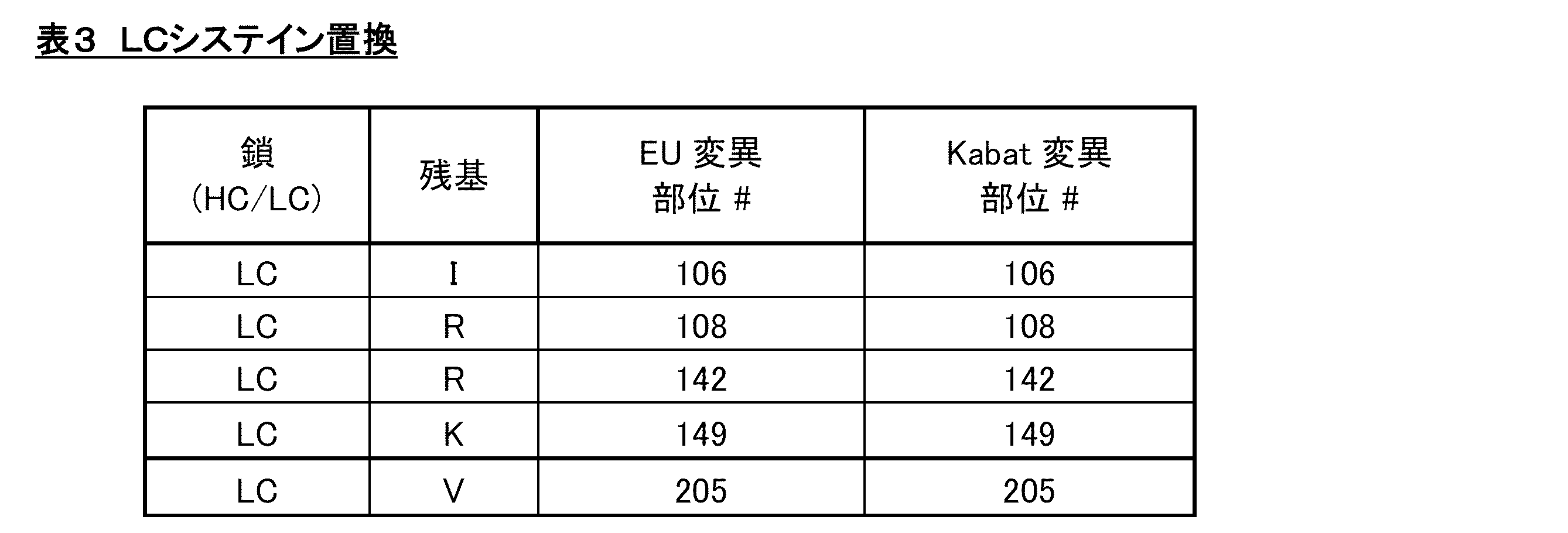
非限定的で例示的なhu7C2.v2.2.LA軽鎖(LC)K149C THIOMAB(商標)は、それぞれ配列番号:26及び30の重鎖及び軽鎖アミノ酸配列を有する。非限定的で例示的なhu7C2.v2.2.LA重鎖(HC)A118C THIOMAB(商標)は、それぞれ配列番号:31及び25の重鎖及び軽鎖アミノ酸配列を有する。 Non-limiting and exemplary hu7C2. v2.2. LA light chain (LC) K149C THIOMAB ™ has heavy and light chain amino acid sequences of SEQ ID NOs: 26 and 30, respectively. Non-limiting and exemplary hu7C2. v2.2. LA Heavy Chain (HC) A118C THIOMAB ™ has heavy and light chain amino acid sequences of SEQ ID NOs: 31 and 25, respectively.
ADCは、野生型又は親抗体の一又は複数のアミノ酸がシステインアミノ酸で置き換えられているシステイン操作抗体を含む。任意の形態の抗体がそのように操作される、すなわち変異させられうる。例えば、親Fab抗体断片は、ここで「ThioFab」と呼ばれるシステイン操作Fabを形成するように操作されうる。同様に、親モノクローナル抗体は、「ThioMab」を形成するように操作されうる。IgG抗体の二量体の性質のために、単一部位変異はThioMab中に2つの操作システイン残基をもたらすが、単一部位変異はThioFab中に単一の操作システイン残基をもたらすことに留意すべきである。置き換えられた(「操作」)システイン(Cys)残基を有する変異体は、新しく導入された操作システインチオール基の反応性について評価される。チオール反応性値は、0~1.0の範囲の相対的な数値であり、任意のシステイン操作抗体について測定されうる。 ADCに使用されるシステイン操作抗体のチオール反応性値は、0.6~1.0;0.7~1.0;又は0.8~1.0の範囲にある。 ADCs include cysteine engineered antibodies in which one or more amino acids of the wild-type or parent antibody have been replaced with cysteine amino acids. Any form of antibody can be so engineered, i.e., mutated. For example, the parent Fab antibody fragment can be engineered to form a cysteine engineered Fab, which is now referred to as "ThioFab". Similarly, the parental monoclonal antibody can be engineered to form a "ThioMab". Note that due to the dimer nature of IgG antibodies, single-site mutations result in two engineered cysteine residues in TioMab, whereas single-site mutations result in single engineered cysteine residues in TioFab. Should. Mutants with replaced (“manipulated”) cysteine (Cys) residues are evaluated for the reactivity of the newly introduced engineered cysteine thiol group. The thiol reactivity value is a relative number in the range 0-1.0 and can be measured for any cysteine engineered antibody. The thiol reactivity value of the cysteine engineered antibody used in the ADC ranges from 0.6 to 1.0; 0.7 to 1.0; or 0.8 to 1.0.
突然変異誘発によりシステイン操作抗体を調製するために、出発ポリペプチドのアミノ酸配列バリアントをコードするDNAが当該技術分野において既知の様々な方法により調製される。これらの方法には、限定されないが、ポリペプチドをコードする先に調製されたDNAの部位特異的(又はオリゴヌクレオチド媒介)突然変異誘発、PCR突然変異誘発、及びカセット突然変異誘発による調製が含まれる。組換え抗体のバリアントは、制限断片操作又は合成オリゴヌクレオチドを用いたオーバーラップ伸長PCRによっても構築することができる。変異原性プライマーはシステインコドン置換をコードする。標準的な突然変異誘発技術を用いて、そのような変異システイン操作抗体をコードするDNAを作製することができる。一般的なガイダンスは、Sambrook等 Molecular Cloning, A Laboratory Manual, Cold Spring Harbor Laboratory Press, Cold Spring Harbor, N.Y., 1989;及びAusubel等 Current Protocols in Molecular Biology, Greene Publishing and Wiley-Interscience, New York, N.Y., 1993に見出すことができる。 To prepare cysteine engineered antibodies by mutagenesis, DNA encoding amino acid sequence variants of the starting polypeptide is prepared by various methods known in the art. These methods include, but are not limited to, site-specific (or oligonucleotide-mediated) mutagenesis, PCR mutagenesis, and cassette mutagenesis preparations of previously prepared DNA encoding the polypeptide. .. Recombinant antibody variants can also be constructed by restriction fragment manipulation or overlapping extension PCR with synthetic oligonucleotides. Mutagenic primers encode cysteine codon substitutions. Standard mutagenesis techniques can be used to generate DNA encoding such mutant cysteine engineered antibodies. General guidance is Sambrook et al. Molecular Cloning, A Laboratory Manual, Cold Spring Harbor Laboratory Press, Cold Spring Harbor, N.Y., 1989; and Ausubel et al. Current Protocols in Molecular Biology, Greene Publishing and Wiley-Interscience, New York, N.Y., Can be found in 1993.
システインアミノ酸は抗体内の反応性部位で操作され得、鎖内又は分子間ジスルフィド結合を形成しない(Junutula等, 2008b Nature Biotech., 26(8):925-932;Dornan等 (2009) Blood 114(13):2721-2729;米国特許第7521541号;米国特許第7723485号;国際公開第2009/052249号,Shen等(2012) Nature Biotech., 30(2):184-191;Junutula等(2008) Jour of Immun. Methods 332:41-52)。操作システインチオールは、マレイミド又はアルファ-ハロアミドなどのチオール反応性求電子基を有する、ここに記載のリンカー試薬又はリンカー-薬物中間体と反応して、システイン操作抗体(ThioMab)と薬物残基を含むADCを形成しうる。薬物部分の位置がこのようにしてデザインされ、制御され、知られうる。操作システインチオール基は典型的にはチオール反応性リンカー試薬又はリンカー-薬物中間体と高収率で反応するので、薬物/抗体比(「PAR」)を制御することができる。重鎖又は軽鎖上の単一部位での置換によってシステインアミノ酸を導入するために抗体を操作すると、対称な抗体上に2つの新しいシステインがもたらされる。約2のPARを達成することができ、共役生成物の均一性に近い。 Cysteine amino acids can be engineered at reactive sites within the antibody and do not form intrachain or intermolecular disulfide bonds (Junutula et al., 2008b Nature Biotech., 26 (8): 925-932; Dornan et al. (2009) Blood 114 (2009) 13): 2721-2729; US Pat. No. 7521541; US Pat. No. 7723485; International Publication No. 2009/052249, Shen et al. (2012) Nature Biotech., 30 (2): 184-191; Junutula et al. (2008) Jour of Immun. Methods 332: 41-52). The engineered cysteine thiol comprises a cysteine engineered antibody (ThioMab) and a drug residue by reacting with the linker reagent or linker-drug intermediate described herein having a thiol-reactive electrophilic group such as maleimide or alpha-haloamide. It can form an ADC. The location of the drug moiety can be designed, controlled and known in this way. Operation Cysteine The thiol group typically reacts with a thiol-reactive linker reagent or linker-drug intermediate in high yields so that the drug / antibody ratio (“PAR”) can be controlled. Manipulating an antibody to introduce a cysteine amino acid by single site substitution on a heavy or light chain results in two new cysteines on a symmetric antibody. A PAR of about 2 can be achieved, which is close to the uniformity of the conjugated product.
システイン操作抗体は、好ましくはそれらの野生型の親抗体対応物の抗原結合能を保持する。従って、システイン操作抗体は、好ましくは特異的に、抗原に結合することができる。そのような抗原には、例えば、腫瘍関連抗原(TAA)、細胞表面受容体タンパク質及び他の細胞表面分子、膜貫通タンパク質、シグナル伝達タンパク質、細胞生存調節因子、細胞増殖調節因子、組織発生又は分化に(例えば機能的に寄与することが知られ又は疑われている)関連する分子、リンホカイン、サイトカイン、細胞周期調節に関与する分子、脈管形成に関与する分子、及び血管形成に(例えば機能的に寄与することが知られ又は疑われている)関連する分子が含まれる。腫瘍関連抗原は、クラスター分化因子(すなわち、CDタンパク質)でありうる。システイン操作抗体が結合することができる抗原は、上記のカテゴリーのうちの一つのサブセットのメンバーであり得、ここで前記カテゴリーの他のサブセットは、(興味のある抗原に関して)明確に異なる特徴を有する他の分子/抗原を含む。 Cysteine-operated antibodies preferably retain the antigen-binding ability of their wild-type parent antibody counterparts. Therefore, the cysteine engineered antibody is preferably capable of specifically binding to the antigen. Such antigens include, for example, tumor-related antigens (TAAs), cell surface receptor proteins and other cell surface molecules, transmembrane proteins, signaling proteins, cell survival regulators, cell growth regulators, tissue development or differentiation. Related molecules (eg, known or suspected to contribute functionally), lymphocains, cytokines, molecules involved in cell cycle regulation, molecules involved in angiogenesis, and angiogenesis (eg, functional). Includes related molecules (known or suspected to contribute to). The tumor-related antigen can be a cluster differentiation factor (ie, CD protein). The antigen to which the cysteine engineered antibody can bind can be a member of one subset of the above categories, where the other subset of the category has distinctly different characteristics (with respect to the antigen of interest). Contains other molecules / antigens.
システイン操作抗体は、鎖内ジスルフィド基の還元及び再酸化によるリンカー又はリンカー-薬物中間体とのコンジューションのために調製される。 Cysteine-operated antibodies are prepared for conjugation with linkers or linker-drug intermediates by reduction and reoxidation of intrachain disulfide groups.
iii.グリコシル化バリアント
所定の実施態様では、ここで提供される抗体は、抗体がグリコシル化される度合いを増大又は低下させるように改変される。抗体に対するグリコシル化部位の付加又は欠失は、一又は複数のグリコシル化部位がつくり出され又は除去されるようにアミノ酸配列を改変させることによって、簡便に達成されうる。
iii. Glycosylation Variants In certain embodiments, the antibodies provided herein are modified to increase or decrease the degree to which the antibody is glycosylated. Addition or deletion of glycosylation sites to an antibody can be readily accomplished by modifying the amino acid sequence so that one or more glycosylation sites are created or removed.
抗体がFc領域を含む場合、それに結合する炭水化物を改変させることができる。哺乳動物細胞によって産生される天然抗体は、一般的にはFc領域のCH2ドメインのAsn297へN結合によって結合した、分枝した二分岐オリゴ糖を典型的には含む。例えば、Wright等 TIBTECH 15:26-32 (1997)を参照のこと。オリゴ糖は、様々な炭水化物、例えば、マンノース、N-アセチルグルコサミン(GlcNAc)、ガラクトース、及びシアル酸、並びに二分岐のオリゴ糖構造の「幹」のGlcNAcに結合したフコースを含みうる。幾つかの実施態様では、所定の改善した性質を有する抗体バリアントをつくり出すために、抗体中のオリゴ糖の修飾がなされうる。 If the antibody contains an Fc region, the carbohydrates that bind to it can be modified. Natural antibodies produced by mammalian cells typically contain branched bifurcated oligosaccharides that are generally bound by N-binding to Asn297 in the CH2 domain of the Fc region. See, for example, Wright et al. TIBTECH 15: 26-32 (1997). Oligosaccharides can include various carbohydrates such as mannose, N-acetylglucosamine (GlcNAc), galactose, and sialic acid, as well as fucose bound to the "stem" GlcNAc of the bifurcated oligosaccharide structure. In some embodiments, the oligosaccharides in the antibody can be modified to produce antibody variants with predetermined improved properties.
一実施態様では、Fc領域に(直接的又は間接的に)結合したフコースを欠く炭水化物構造を有する抗体バリアントが提供される。例えば、そのような抗体におけるフコースの量は、1%~80%、1%~65%、5%~65%又は20%~40%でありうる。フコースの量は、例えば国際公開第2008/077546号に記載されているように、MALDI-TOF質量分析法によって測定されて、Asn297に結合した全ての糖構造(例えば複合、ハイブリド及び高マンノース構造)の合計に対する、Asn297における糖鎖内のフコースの平均量を計算することによって決定される。Asn297は、Fc領域の約297位(Fc領域残基のEu番号付け)に位置するアスパラギン残基を指す;しかしながら、Asn297は、抗体の軽微な配列多様性のため、297位の約±3アミノ酸上流又は下流、すなわち294位と300位の間に位置する場合もありうる。そのようなフコシル化バリアントは、改善したADCC機能を有しうる。例えば、米国特許出願公開第2003/0157108号(Presta, L.);米国特許出願公開第2004/0093621号(協和発酵工業株式会社)を参照のこと。「脱フコシル化」又は「フコース欠損」抗体バリアントに関する刊行物の例には、米国特許出願公開第2003/0157108号;国際公開第2000/61739号;国際公開第2001/29246号;米国特許出願公開第2003/0115614号;米国特許出願公開第2002/0164328号;米国特許出願公開第2004/0093621号;米国特許出願公開第2004/0132140号;米国特許出願公開第2004/0110704号;米国特許出願公開第2004/0110282号;米国特許出願公開第2004/0109865号;国際公開第2003/085119号;国際公開第2003/084570号;国際公開第2005/035586号;国際公開第2005/035778号;国際公開第2005/053742号;国際公開第2002/031140号;Okazaki等 J. Mol. Biol. 336:1239-1249 (2004);Yamane-Ohnuki等 Biotech. Bioeng. 87: 614 (2004)が含まれる。脱フコシル化抗体を産生することができる細胞株の例には、タンパク質のフコシル化を欠いたLec13CHO細胞(Ripka等 Arch. Biochem. Biophys. 249:533-545 (1986);米国特許出願公開第2003/0157108A1号,Presta, L;及び国際公開第2004/056312A1号,Adams等、特に実施例11)、及びノックアウト細胞株、例えば、アルファ-1,6-フコシルトランスフェラーゼ遺伝子,FUT8,ノックアウトCHO細胞(例えば、Yamane-Ohnuki等 Biotech. Bioeng. 87: 614 (2004);Kanda, Y.等, Biotechnol. Bioeng., 94(4):680-688 (2006);及び国際公開第2003/085107号を参照のこと)が含まれる。 In one embodiment, an antibody variant having a carbohydrate structure lacking fucose bound (directly or indirectly) to the Fc region is provided. For example, the amount of fucose in such an antibody can be 1% -80%, 1% -65%, 5% -65% or 20% -40%. The amount of fucose has been measured by MALDI-TOF mass spectrometry, for example as described in WO 2008/077546, and all sugar structures bound to Asn297 (eg, complex, hybrid and high mannose structures). It is determined by calculating the average amount of fucose in the sugar chain in Asn297 with respect to the total of. Asn297 refers to an asparagine residue located at position 297 of the Fc region (Eu numbering of Fc region residues); however, Asn297 refers to about ± 3 amino acids at position 297 due to the slight sequence diversity of the antibody. It may be located upstream or downstream, that is, between positions 294 and 300. Such fucosylated variants may have improved ADCC function. See, for example, US Patent Application Publication No. 2003/0151788 (Presta, L.); US Patent Application Publication No. 2004/093621 (Kyowa Hakko Kogyo Co., Ltd.). Examples of publications relating to "defucosylated" or "fucose-deficient" antibody variants include US Patent Application Publication No. 2003/0151782; International Publication No. 2000/61739; International Publication No. 2001/29246; US Patent Application Publication. 2003/0115614; US Patent Application Publication No. 2002/016432; US Patent Application Publication No. 2004/093621; US Patent Application Publication No. 2004/0132140; US Patent Application Publication No. 2004/0110704; US Patent Application Publication 2004/0110282; US Patent Application Publication No. 2004/0109865; International Publication No. 2003/08511; International Publication No. 2003/084570; International Publication No. 2005/035586; International Publication No. 2005/035778; International Publication No. 2005/053742; International Publication No. 2002/031140; Okazaki et al. J. Mol. Biol. 336: 1239-1249 (2004); Yamane-Ohnuki et al. Biotech. Bioeng. 87: 614 (2004). Examples of cell lines capable of producing defucosylated antibodies include Rec13CHO cells lacking protein fucosylation (Ripka et al. Arch. Biochem. Biophys. 249: 533-545 (1986); US Patent Application Publication No. 2003. / 0157108A1, Presta, L; and WO 2004/056312A1, Adams et al., Especially Example 11), and knockout cell lines, such as alpha-1,6-fucosyltransferase gene, FUT8, knockout CHO cells (eg,). , Yamane-Ohnuki et al. Biotech. Bioeng. 87: 614 (2004); Kanda, Y. et al., Biotechnol. Bioeng., 94 (4): 680-688 (2006); and International Publication No. 2003/085107. That) is included.
抗体バリアントは、二分されたオリゴ糖を更に備えており、例えば、抗体のFc領域に結合した二分岐のオリゴ糖がGlcNAcによって二分されている。そのような抗体バリアントは、フコシル化が低減されている、及び/又はADCC機能が改善されている場合がある。そのような抗体バリアントの例は、例えば、国際公開第2003/011878号(Jean-Mairet等);米国特許第6602684号(Umana等);及び米国特許出願公開第2005/0123546号(Umana等)に記載されている。Fc領域に結合したオリゴ糖中に少なくとも一つのガラクトース残基を有する抗体バリアントもまた提供される。そのような抗体バリアントは、CDC機能が改善されている場合がある。そのような抗体バリアントは、例えば、国際公開第1997/30087号(Patel等);国際公開第1998/58964号(Raju, S.);及び国際公開第1999/22764号(Raju, S.)に記載されている。 The antibody variant further comprises a bisected oligosaccharide, for example, a bifurcated oligosaccharide bound to the Fc region of the antibody is bisected by GlcNAc. Such antibody variants may have reduced fucosylation and / or improved ADCC function. Examples of such antibody variants are, for example, in International Publication No. 2003/011878 (Jean-Mairet et al.); US Pat. No. 6,602,684 (Umana et al.); And US Patent Application Publication No. 2005/0123546 (Umana et al.). Have been described. Also provided is an antibody variant having at least one galactose residue in the oligosaccharide bound to the Fc region. Such antibody variants may have improved CDC function. Such antibody variants are described, for example, in WO 1997/30087 (Patel et al.); WO 1998/58964 (Raju, S.); and WO 1999/22764 (Raju, S.). Have been described.
iv.Fc領域バリアント
所定の実施態様では、一又は複数のアミノ酸修飾が、ここで提供される抗体のFc領域中に導入され得、それによって、Fc領域バリアントが作製される。Fc領域バリアントは、一又は複数のアミノ酸位置にアミノ酸修飾(例えば置換)を含むヒトFc領域配列(例えば、ヒトIgG1、IgG2、IgG3又はIgG4 Fc領域)を含みうる。
iv. Fc region variant In certain embodiments, one or more amino acid modifications can be introduced into the Fc region of the antibody provided herein, thereby creating an Fc region variant. Fc region variants can include human Fc region sequences (eg, human IgG1, IgG2, IgG3 or IgG4 Fc regions) that include amino acid modifications (eg, substitutions) at one or more amino acid positions.
所定の実施態様では、ここに記載の主題は、インビボでの抗体半減期は重要であるが、所定のエフェクター機能(例えば補体及びADCCなど)が不要であるか又は有害である用途に対して望ましい候補とならしめる、全てではないが幾つかのエフェクター機能を有する抗体バリアントを対象としている。インビトロ及び/又はインビボ細胞傷害性アッセイは、CDC及び/又はADCC活性の低下/欠乏を確認するために実施することができる。例えば、Fc受容体(FcR)結合アッセイを実施して、抗体が、FcγR結合を欠く(従っておそらくADCC活性を欠く)がFcRn結合能を保持することを確認することができる。ADCCを媒介するための初代細胞であるNK細胞はFcγRIIIのみを発現する一方、単球は、FcγRI、FcγRII、及びFcγRIIIを発現する。造血細胞におけるFcRの発現は、Ravetch及びKinet, Annu. Rev. Immunol. 9:457-492 (1991)の464頁の表3に要約されている。目的の分子のADCC活性を評価するインビトロアッセイの非限定的な例は、米国特許第5500362号(例えば、Hellstrom等 Proc. Nat'l Acad. Sci. USA 83:7059-7063 (1986)を参照)及びHellstrom, I等, Proc. Nat'l Acad. Sci. USA 82:1499-1502 (1985);米国特許第5821337号(Bruggemann, M.等, J. Exp. Med. 166:1351-1361 (1987)を参照)に記載されている。あるいは、非放射性アッセイ法を用いてもよい(例えば、フローサイトメトリーのためのACTITM非放射性細胞傷害性アッセイ(CellTechnology, Inc. Mountain View, CA;及びCytoTox96(登録商標)非放射性細胞傷害性アッセイ(Promega, Madison, WI)を参照)。そのようなアッセイに有用なエフェクター細胞には、末梢血単核細胞(PBMC)及びナチュラルキラー(NK)細胞が含まれる。あるいは、又は加えて、目的の分子のADCC活性は、例えば、Clynes等, Proc. Nat'l. Acad. Sci. USA 95:652-656 (1998)に開示されているもののような動物モデルにおいて、インビボで評価されうる。また、C1q結合アッセイを、抗体がC1qに結合できず、よってCDC活性を欠くことを確認するために実施することができる。例えば、国際公開第2006/029879号及び国際公開第2005/100402号におけるC1q及びC3c結合ELISAを参照のこと。補体活性化を評価するために、CDCアッセイを実施することができる(例えば、Gazzano-Santoro等, J. Immunol. Methods 202:163 (1996);Cragg, M.S.等, Blood 101:1045-1052 (2003);並びにCragg, M.S.及びM.J. Glennie, Blood 103:2738-2743 (2004)を参照)。FcRn結合及びインビボクリアランス/半減期の決定もまた当該分野で知られている方法を使用して実施することができる(例えば、Petkova, S.B.等, Int'l. Immunol. 18(12):1759-1769 (2006)を参照)。 In certain embodiments, the subject matter described herein is for applications in which antibody half-life in vivo is important but certain effector functions (eg, complement and ADCC) are unnecessary or harmful. It targets antibody variants with some, but not all, effector functions that make them desirable candidates. In vitro and / or in vivo cytotoxicity assays can be performed to confirm reduced / deficient CDC and / or ADCC activity. For example, an Fc receptor (FcR) binding assay can be performed to confirm that an antibody lacks FcγR binding (and thus probably lacks ADCC activity) but retains FcRn binding capacity. NK cells, which are primary cells for mediating ADCC, express only FcγRIII, while monocytes express FcγRI, FcγRII, and FcγRIII. Expression of FcR in hematopoietic cells is summarized in Table 3 on page 464 of Ravetch and Kinet, Annu. Rev. Immunol. 9: 457-492 (1991). A non-limiting example of an in vitro assay for assessing ADCC activity of a molecule of interest is US Pat. No. 5,500,362 (see, eg, Hellstrom et al. Proc. Nat'l Acad. Sci. USA 83: 7059-7063 (1986)). And Hellstrom, I et al., Proc. Nat'l Acad. Sci. USA 82: 1499-1502 (1985); US Pat. No. 5,821,337 (Bruggemann, M. et al., J. Exp. Med. 166: 1351-1361 (1987). )). Alternatively, non-radioactive assays may be used (eg, ACTITM non-radioactive cytotoxic assay for flow cytometry (Cell Technology, Inc. Mountain View, CA; and CytoTox 96® non-radioactive cytotoxic assay). (See Promega, Madison, WI). Effector cells useful for such assays include peripheral blood mononuclear cells (PBMC) and natural killer (NK) cells, or in addition, of interest. The ADCC activity of a molecule can also be assessed in vivo in animal models such as those disclosed in Clynes et al., Proc. Nat'l. Acad. Sci. USA 95: 652-656 (1998). A C1q binding assay can be performed to confirm that the antibody is unable to bind C1q and thus lacks CDC activity, eg, C1q and in WO 2006/029879 and WO 2005/100402. See C3c-binding ELISA. CDC assays can be performed to assess complement activation (eg, Gazzano-Santoro et al., J. Immunol. Methods 202: 163 (1996); Cragg, MS et al.). , Blood 101: 1045-1052 (2003); and Cragg, MS and MJ Glennie, Blood 103: 2738-2743 (2004)). FcRn binding and in vivo clearance / half-life determination are also known in the art. (See, eg, Petkova, SB et al., Int'l. Immunol. 18 (12): 1759-1769 (2006)).
幾つかの実施態様では、新生児Fc受容体へのIgGの結合を増加させるために、ここで提供される抗体のFc部分中に一又は複数のアミノ酸修飾が導入されうる。所定の実施態様では、抗体は、EU番号付けに従って次の3つの変異を含む:M252Y、S254T、及びT256E(「YTE変異」)(米国特許第8697650号;Dall'Acqua等, Journal of Biological Chemistry 281(33):23514-23524 (2006)も参照)。所定の実施態様では、YTE変異は抗体のその同族抗原に結合する能力に影響を与えない。所定の実施態様では、YTE変異は、天然(すなわち、非YTE変異型)抗体と比較して、抗体の血清半減期を増加させる。幾つかの実施態様では、YTE変異は、天然(すなわち、非YTE変異型)抗体と比較して、抗体の血清半減期を3倍増加させる。幾つかの実施態様では、YTE変異は、天然(すなわち、非YTE変異型)抗体と比較して、抗体の血清半減期を2倍増加させる。幾つかの実施態様では、YTE変異は、天然(すなわち、非YTE変異型)抗体と比較して、抗体の血清半減期を4倍増加させる。幾つかの実施態様では、YTE変異は、天然(すなわち、非YTE変異型)抗体と比較して、抗体の血清半減期を少なくとも5倍増加させる。幾つかの実施態様では、YTE変異は、天然(すなわち、非YTE変異型)抗体と比較して、抗体の血清半減期を少なくとも10倍増加させる。例えば、米国特許第8697650号を参照のこと;またDall'Acqua等, Journal of Biological Chemistry 281(33):23514-23524 (2006)を参照のこと。 In some embodiments, one or more amino acid modifications can be introduced into the Fc portion of the antibody provided herein to increase the binding of IgG to the neonatal Fc receptor. In certain embodiments, the antibody comprises three mutations according to EU numbering: M252Y, S254T, and T256E (“YTE mutation”) (US Pat. No. 8,695,650; Dall'Acqua et al., Journal of Biological Chemistry 281). (33): 23514-23524 (2006)). In certain embodiments, the YTE mutation does not affect the antibody's ability to bind its cognate antigen. In certain embodiments, the YTE mutation increases the serum half-life of the antibody as compared to a native (ie, non-YTE mutant) antibody. In some embodiments, the YTE mutation increases the serum half-life of the antibody by a factor of 3 as compared to a native (ie, non-YTE mutant) antibody. In some embodiments, the YTE mutation increases the serum half-life of the antibody by a factor of 2 as compared to a native (ie, non-YTE mutant) antibody. In some embodiments, the YTE mutation increases the serum half-life of the antibody by a factor of 4 as compared to a native (ie, non-YTE mutant) antibody. In some embodiments, the YTE mutation increases the serum half-life of the antibody by at least 5-fold as compared to a native (ie, non-YTE mutant) antibody. In some embodiments, the YTE mutation increases the serum half-life of the antibody by at least 10-fold compared to a native (ie, non-YTE mutant) antibody. See, for example, U.S. Pat. No. 8697650; also Dall'Acqua et al., Journal of Biological Chemistry 281 (33): 23514-23524 (2006).
所定の実施態様では、YTE変異体は、抗体の抗体依存性細胞媒介性細胞傷害(ADCC)活性を調節する手段を提供する。所定の実施態様では、YTEO変異体は、ヒト抗原に対するヒト化IgG抗体のADCC活性を調節する手段を提供する。例えば、米国特許第8697650号を参照のこと;またDall'Acqua等, Journal of Biological Chemistry 281(33):23514-23524 (2006)を参照のこと。 In certain embodiments, the YTE variant provides a means of regulating antibody-dependent cellular cytotoxicity (ADCC) activity of an antibody. In certain embodiments, the YTEO variant provides a means of regulating ADCC activity of a humanized IgG antibody against a human antigen. See, for example, U.S. Pat. No. 8697650; also Dall'Acqua et al., Journal of Biological Chemistry 281 (33): 23514-23524 (2006).
所定の実施態様では、YTE変異体は、血清半減期、組織分布、及び抗体活性(例えば、IgG抗体のADCC活性)の同時調節を可能にする。例えば、米国特許第8697650号を参照のこと;またDall'Acqua等, Journal of Biological Chemistry 281(33):23514-23524 (2006)を参照のこと。 In certain embodiments, the YTE variant allows for co-regulation of serum half-life, tissue distribution, and antibody activity (eg, ADCC activity of an IgG antibody). See, for example, U.S. Pat. No. 8697650; also Dall'Acqua et al., Journal of Biological Chemistry 281 (33): 23514-23524 (2006).
エフェクター機能が低下した抗体には、EU番号付けに従ってFc領域残基238、265、269、270、297、327及び329の一又は複数の置換を有するものが含まれる(米国特許第6737056号)。そのようなFc変異体には、EU番号付けに従ってアミノ酸位置265、269、270、297及び327のうちの2つ以上に置換を有するFc変異体が含まれ、EU番号付けに従って残基265及び297がアラニンに置換された(すなわち、EU番号付けに従ってD265A及びN297A)いわゆる「DANA」Fc変異体が含まれる(米国特許第7332581号)。所定の実施態様では、Fc変異体は次の2つのアミノ酸置換を含む:D265A及びN297A。所定の実施態様では、Fc変異体は、次の2つのアミノ酸置換からなる:D265A及びN297A。 Antibodies with reduced effector function include those having one or more substitutions of Fc region residues 238, 265, 269, 270, 297, 327 and 329 according to EU numbering (US Pat. No. 6737056). Such Fc variants include Fc variants having substitutions at two or more of amino acid positions 265, 269, 270, 297 and 327 according to EU numbering and residues 265 and 297 according to EU numbering. Includes so-called "DANA" Fc variants in which alanine has been replaced (ie, D265A and N297A according to EU numbering) (US Pat. No. 7,332,581). In certain embodiments, the Fc variant comprises two amino acid substitutions: D265A and N297A. In certain embodiments, the Fc variant consists of two amino acid substitutions: D265A and N297A.
所定の実施態様では、野生型ヒトFc領域の329位(EU番号付け)のプロリン(P329)が、グリシンもしくはアルギニン、又はFcのP329とFcgRIIIのトリプトファン残基W87及びW110との間に形成されるFc/Fcγ受容体界面内のプロリンサンドイッチを破壊するのに十分に大きいアミノ酸残基で置換される(Sondermann等: Nature 406, 267-273 (20 July 2000))。更なる実施態様では、Fcバリアントにおける少なくとも一つの更なるアミノ酸置換は、S228P、E233P、L234A、L235A、L235E、N297A、N297D、又はP331Sであり、更に別の実施態様では、前記少なくとも一つの更なるアミノ酸置換は、ヒトIgG1 Fc領域のL234A及びL235A、あるいはヒトIgG4 Fc領域のS228P及びL235Eであり、全てEU番号付けによる(その全体が出典明示により援用される米国特許第8969526号)。 In certain embodiments, proline (P329) at position 329 (EU numbering) of the wild-type human Fc region is formed between glycine or arginine, or between P329 of Fc and tryptophan residues W87 and W110 of FcgRIII. Substituted with amino acid residues large enough to disrupt the proline sandwich within the Fc / Fcγ receptor interface (Sondermann et al .: Nature 406, 267-273 (20 July 2000)). In a further embodiment, the at least one further amino acid substitution in the Fc variant is S228P, E233P, L234A, L235A, L235E, N297A, N297D, or P331S, and in yet another embodiment, the at least one further amino acid substitution. Amino acid substitutions are L234A and L235A in the human IgG1 Fc region, or S228P and L235E in the human IgG4 Fc region, all by EU numbering (US Pat. No. 8969526, which is incorporated by reference in its entirety).
所定の実施態様では、ポリペプチドは、ポリペプチドが、グリシンで置換されたヒトIgG Fc領域のP329を有し、Fcバリアントが、ヒトIgG1 Fc領域のL234A及びL235A又はヒトIgG4 Fc領域のS228P及びL235Eに少なくとも2つの更なるアミノ酸置換を含み、残基がEU番号付けに従って番号付けされている、野生型ヒトIgG Fc領域のFcバリアントを含む(その全体が出典明示により援用される米国特許第8969526号)。所定の実施態様では、P329G、L234A及びL235A(EU番号付け)置換を含むポリペプチドは、野生型ヒトIgG Fc領域を含むポリペプチドによって誘導されるADCCの少なくとも20%までのADCCの下方調節について、及び/又はADCPの下方調節について、ヒトFcγRIIIA及びFcγRIIAに対する親和性の低下を示す(その全体が出典明示により援用される米国特許第8969526号)。 In certain embodiments, the polypeptide has P329 of a human IgG Fc region in which the polypeptide has been replaced with glycine, and the Fc variant is L234A and L235A of the human IgG1 Fc region or S228P and L235E of the human IgG4 Fc region. Includes an Fc variant of the wild-type human IgG Fc region, which comprises at least two additional amino acid substitutions and the residues are numbered according to EU numbering (all of which are incorporated by reference in US Pat. No. 8969526). ). In certain embodiments, the polypeptide comprising P329G, L234A and L235A (EU numbering) substitutions is for down-regulation of ADCC up to at least 20% of ADCC induced by the polypeptide comprising the wild-type human IgG Fc region. And / or for downward regulation of ADCP, it shows a decrease in affinity for human FcγRIIIA and FcγRIIA (US Pat. No. 8969526, which is incorporated by reference in its entirety).
特定の実施態様では、野生型ヒトFcポリペプチドのFcバリアントを含むポリペプチドは、三重変異を含む:EU番号付け(P329/LALA)によるPro329位のアミノ酸置換、L234A及びL235A変異(その全体が出典明示により援用される米国特許第8969526号)。特定の実施態様では、ポリペプチドは次のアミノ酸置換を含む:EUの番号付けによるP329G、L234A、及びL235A。 In certain embodiments, the polypeptide comprising the Fc variant of the wild-type human Fc polypeptide comprises a triple mutation: amino acid substitution at position Pro329 by EU numbering (P329 / LALA), L234A and L235A mutations (all sources). US Pat. No. 8969526, expressly incorporated). In certain embodiments, the polypeptide comprises the following amino acid substitutions: EU numbered P329G, L234A, and L235A.
FcRへの改善された又は減少した結合を有する所定の抗体バリアントが記載されている。(例えば、米国特許第6737056号;国際公開第2004/056312号、及びShields等, J. Biol. Chem. 9(2): 6591-6604 (2001)を参照。) Predetermined antibody variants with improved or reduced binding to FcR have been described. (See, for example, US Pat. No. 6,737,056; International Publication No. 2004/056312, and Shields et al., J. Biol. Chem. 9 (2): 6591-6604 (2001).)
所定の実施態様では、抗体バリアントは、ADCCを改善する一又は複数のアミノ酸置換、例えばFc領域の298位、333位、及び/又は334位に置換(EU番号付け)を有するFc領域を含む。 In certain embodiments, the antibody variant comprises an Fc region having one or more amino acid substitutions that improve ADCC, eg, substitutions (EU numbering) at positions 298, 333, and / or 334 of the Fc region.
幾つかの実施態様では、例えば、米国特許第6194551号、国際公開第99/51642号、及びIdusogie等 J. Immunol. 164: 4178-4184 (2000)に記載されているように、改変されたC1q結合及び/又は補体依存性細胞傷害(CDC)を生じる改変がFc領域においてなされる。 In some embodiments, modified C1q, eg, as described in US Pat. No. 6,194,551, WO 99/51642, and Idusogie et al. J. Immunol. 164: 4178-4184 (2000). Modifications that result in binding and / or complement-dependent cytotoxicity (CDC) are made in the Fc region.
半減期が増加し、新生児Fc受容体(FcRn)への結合が改善された抗体は、母体IgGの胎児への転移の原因であり(Guyer等, J. Immunol. 117:587 (1976)及びKim等, J. Immunol. 24:249 (1994))、米国特許出願公開第2005/0014934A1号(Hinton等)に記載されている。それら抗体は、Fc領域のFcRnへの結合を改善する一又は複数の置換をそこに有するFc領域を含む。そのようなFcバリアントは、Fc領域残基:238、256、265、272、286、303、305、307、311、312、317、340、356、360、362、376、378、380、382、413、424又は434の一又は複数に置換を有するもの、例えばEU番号付けによる、Fc領域残基434の置換(米国特許第7371826号)を有するものを含む。またDuncan及びWinter, Nature 322:738-40 (1988);米国特許第5648260号;米国特許第5624821号;及びFc領域バリアントの他の例に関する国際公開第94/29351号を参照のこと。 Antibodies with increased half-life and improved binding to neonatal Fc receptors (FcRn) are responsible for the transfer of maternal IgG to the fetus (Guyer et al., J. Immunol. 117: 587 (1976) and Kim. Etc., J. Immunol. 24: 249 (1994)), US Patent Application Publication No. 2005/0014934A1 (Hinton et al.). Those antibodies include an Fc region there that has one or more substitutions that improve the binding of the Fc region to FcRn. Such Fc variants include Fc region residues: 238, 256, 265, 272, 286, 303, 305, 307, 311, 312, 317, 340, 356, 360, 362, 376, 378, 380, 382, 413, 424 or 434 having one or more substitutions, eg, having a substitution of Fc region residue 434 by EU numbering (US Pat. No. 7371826). See also Duncan and Winter, Nature 322: 738-40 (1988); US Pat. No. 5,648,260; US Pat. No. 5,624,821; and International Publication No. 94/29351 for other examples of Fc region variants.
g.抗体誘導体
所定の実施態様では、ここで提供される抗体は、当該技術分野で知られており容易に利用可能な更なる非タンパク質性部分を含むように、更に改変されうる。抗体の誘導体化に適した部分としては、限定されないが、水溶性ポリマーが含まれる。水溶性ポリマーの非限定例としては、限定されないが、ポリエチレングリコール(PEG)、エチレングリコール/プロピレングリコールのコポリマー、カルボキシメチルセルロース、デキストラン、ポリビニルアルコール、ポリビニルピロリドン、ポリ-1,3-ジオキソラン、ポリ-1,3,6-トリオキサン、エチレン/無水マレイン酸コポリマー、ポリアミノ酸(ホモポリマー又はランダムコポリマーの何れか)、及びデキストラン又はポリ(n-ビニルピロリドン)ポリエチレングリコール、プロプロピレングリコールホモポリマー、ポリプロピレンオキシド/エチレンオキシドコポリマー、ポリオキシエチル化ポリオール(例えばグリセロール)、ポリビニルアルコール、並びにそれらの混合物が含まれる。ポリエチレングリコールプロピオンアルデヒドは、水中でのその安定性のため、製造において利点を有しうる。ポリマーは、任意の分子量のものでよく、分枝でも非分枝でもよい。抗体に結合したポリマーの数は変動し得、一種を超えるポリマーが結合する場合、それらは同じ分子でも異なる分子でもよい。一般に、誘導体化に使用されるポリマーの数及び/又はタイプは、限定されないが、改善される抗体の特定の性質又は機能、抗体誘導体が定まった条件下で治療法に使用されるかどうか等々を含む考慮に基づいて決定することができる。
g. Antibody Derivatives In certain embodiments, the antibodies provided herein can be further modified to include additional non-proteinaceous moieties known in the art and readily available. Suitable moieties for derivatizing the antibody include, but are not limited to, water-soluble polymers. Non-limiting examples of water-soluble polymers include, but are not limited to, polyethylene glycol (PEG), ethylene glycol / propylene glycol copolymers, carboxymethyl cellulose, dextran, polyvinyl alcohol, polyvinylpyrrolidone, poly-1,3-dioxolane, poly-1. , 3,6-trioxane, ethylene / maleic anhydride copolymer, polyamino acid (either homopolymer or random copolymer), and dextran or poly (n-vinylpyrrolidone) polyethylene glycol, propropylene glycol homopolymer, polypropylene oxide / ethylene oxide Includes copolymers, polyoxyethylated polyols (eg, glycerol), polyvinyl alcohol, and mixtures thereof. Polyethylene glycol propionaldehyde may have advantages in production due to its stability in water. The polymer may have any molecular weight and may be branched or unbranched. The number of polymers bound to an antibody can vary, and if more than one polymer binds, they may be the same molecule or different molecules. In general, the number and / or type of polymer used for derivatization is not limited, but the specific properties or functions of the antibody to be improved, whether the antibody derivative is used in a therapeutic method under certain conditions, and the like. It can be determined based on the considerations involved.
別の実施態様では、放射線への曝露によって選択的に加熱されうる非タンパク質性部分と抗体のコンジュゲートが提供される。一実施態様では、非タンパク質性部分は、カーボンナノチューブ(Kam等, Proc. Natl. Acad. Sci. USA 102: 11600-11605 (2005))である。放射線は任意の波長のものであり得、限定はされないが、通常の細胞を害さないが、抗体-非タンパク質性部分の近位細胞が死滅する温度に非タンパク質性部分を加熱する波長が含まれる。 In another embodiment, a non-protein moiety and an antibody conjugate that can be selectively heated by exposure to radiation are provided. In one embodiment, the non-protein moiety is a carbon nanotube (Kam et al., Proc. Natl. Acad. Sci. USA 102: 11600-11605 (2005)). The radiation can be of any wavelength and, without limitation, does not harm normal cells, but includes wavelengths that heat the non-protein part to a temperature at which the proximal cells of the antibody-non-protein part die. ..
h.腫瘍関連抗原
がんの治療においてここに記載のADCに有用でありうる、限定されないがシステイン操作抗体を含む抗体には、限定されないが、細胞表面受容体及び腫瘍関連抗原(TAA)に対する抗体が含まれる。所定の腫瘍関連抗原は当該分野で知られており、当該分野で周知である方法及び情報を使用して抗体の作製に使用するために調製されうる。がんの診断及び治療のための効果的な細胞標的を発見する試みにおいて、研究者等は、一又は複数の正常な非がん性細胞と比較して一又は複数の特定の種類のがん細胞の表面上に特異的に発現される膜貫通又はその他の腫瘍関連ポリペプチドを同定しようとした。多くの場合、そのような腫瘍関連ポリペプチドは、非がん性細胞の表面上と比較してがん細胞の表面上でより豊富に発現される。そのような腫瘍関連細胞表面抗原ポリペプチドの同定は、抗体ベースの治療法による破壊のためにがん細胞をより特異的に標的とする能力をもたらした。
h. Tumor-Related Antigens Antibodies, including, but not limited to, cysteine-manipulated antibodies that may be useful for the ADCs described herein include, but are not limited to, antibodies to cell surface receptors and tumor-related antigens (TAAs). Is done. Certain tumor-related antigens are known in the art and can be prepared for use in the production of antibodies using methods and information well known in the art. In an attempt to find effective cell targets for the diagnosis and treatment of cancer, researchers have found that one or more specific types of cancer compared to one or more normal non-cancerous cells. Attempts have been made to identify transmembrane or other tumor-related polypeptides that are specifically expressed on the surface of cells. Often, such tumor-related polypeptides are more abundantly expressed on the surface of cancer cells than on the surface of non-cancer cells. The identification of such tumor-associated cell surface antigen polypeptides has provided the ability to target cancer cells more specifically for destruction by antibody-based therapies.
腫瘍関連抗原TAAの例としては、限定されないが、以下に列挙されるものが含まれる。便宜上、その全てが当該技術分野で知られているこれらの抗原に関する情報を以下に列挙するが、国立バイオテクノロジー情報センター(NCBI)の核酸及びタンパク質配列同定規約に従って、名称、代替名、Genbankアクセッション番号及び主要文献を含む。以下に列挙されるTAAに対応する核酸及びタンパク質配列は、GenBankなどの公共のデータベースで入手可能である。抗体によって標的化される腫瘍関連抗原には、引用文献において同定された配列に対して少なくとも約70%、80%、85%、90%、又は95%の配列同一性を有する、及び/又は引用文献に見出される配列を有するTAAと実質的に同じ生物学的性質又は特徴を示す、全てのアミノ酸配列バリアント及びアイソフォームが含まれる。例えば、バリアント配列を有するTAAは一般に、列挙された対応する配列を有するTAAに特異的に結合する抗体に特異的に結合することができる。ここに特に列挙された文献中の配列及び開示は、出典明示により明示的に援用される。 Examples of tumor-related antigen TAA include, but are not limited to, those listed below. For convenience, information on these antigens, all of which are known in the art, is listed below, but according to the National Center for Biotechnology Information (NCBI) nucleic acid and protein sequence identification conventions, names, alternative names, Genbank accessions. Includes numbers and key literature. The nucleic acid and protein sequences corresponding to TAA listed below are available in public databases such as GenBank. Tumor-related antigens targeted by the antibody have at least about 70%, 80%, 85%, 90%, or 95% sequence identity to the sequences identified in the cited literature and / or cited. Includes all amino acid sequence variants and isoforms that exhibit substantially the same biological properties or characteristics as TAAs having the sequences found in the literature. For example, a TAA having a variant sequence can generally specifically bind to an antibody that specifically binds to a TAA having the corresponding sequence listed. The sequences and disclosures in the literature specifically listed herein are expressly incorporated by explicit source.
i.組換え法及び組成物
抗体は、例えば、米国特許第4816567号に記載されているような組換え法及び組成物を使用して産生することができる。一実施態様では、ここに記載の抗体をコードする単離核酸が提供される。そのような核酸は、抗体のVLを含むアミノ酸配列及び/又は抗体のVHを含むアミノ酸配列(例えば、抗体の軽鎖及び/又は重鎖)をコードしうる。更なる実施態様では、そのような核酸を含む一又は複数のベクター(例えば発現ベクター)が提供される。更なる実施態様では、そのような核酸を含む宿主細胞が提供される。そのような一実施態様では、宿主細胞は、次のものを含む(例えば、次のもので形質転換されている):(1)抗体のVLを含むアミノ酸配列と抗体のVHを含むアミノ酸配列をコードする核酸を含むベクター、又は(2)抗体のVLを含むアミノ酸配列をコードする核酸を含む第一のベクターと、抗体のVHを含むアミノ酸配列をコードする核酸を含む第二のベクター。一実施態様では、宿主細胞は、真核細胞、例えば、チャイニーズハムスター卵巣(CHO)細胞又はリンパ系細胞(例えば、Y0、NS0、Sp20細胞)である。一実施態様では、抗体を作製する方法が提供され、その方法は、上に提供された抗体をコードする核酸を含む宿主細胞を、抗体の発現に適した条件下で培養することと、場合によっては、宿主細胞(又は宿主細胞培地)から抗体を回収することを含む。
i. Recombinations and Compositions Antibodies can be produced using, for example, recombinant methods and compositions as described in US Pat. No. 4,816,567. In one embodiment, isolated nucleic acids encoding the antibodies described herein are provided. Such nucleic acids may encode an amino acid sequence comprising the VL of the antibody and / or an amino acid sequence comprising the VH of the antibody (eg, the light chain and / or the heavy chain of the antibody). In a further embodiment, one or more vectors containing such nucleic acids (eg, expression vectors) are provided. In a further embodiment, a host cell containing such nucleic acid is provided. In one such embodiment, the host cell comprises (eg, transformed with): (1) an amino acid sequence comprising VL of the antibody and an amino acid sequence comprising VH of the antibody. A vector containing a nucleic acid encoding, or (2) a first vector containing a nucleic acid encoding an amino acid sequence containing VL of an antibody, and a second vector containing a nucleic acid encoding an amino acid sequence containing VH of an antibody. In one embodiment, the host cell is a eukaryotic cell, eg, a Chinese hamster ovary (CHO) cell or a lymphoid cell (eg, Y0, NS0, Sp20 cell). In one embodiment, a method of making an antibody is provided, wherein the host cell containing the nucleic acid encoding the antibody provided above is cultured under conditions suitable for antibody expression, and optionally. Includes recovering the antibody from the host cell (or host cell medium).
抗体の組換え産生のために、例えば上に記載のような、抗体をコードする核酸が単離され、更なるクローニング及び/又は宿主細胞での発現のために一又は複数のベクター中に挿入される。そのような核酸は、一般的な手順を使用して(例えば、抗体の重鎖及び軽鎖をコードする遺伝子に特異的に結合することができるオリゴヌクレオチドプローブを使用することによって)、容易に単離され、配列決定されうる。 For recombinant production of the antibody, nucleic acids encoding the antibody, eg, as described above, have been isolated and inserted into one or more vectors for further cloning and / or expression in host cells. To. Such nucleic acids are readily simpler using common procedures (eg, by using oligonucleotide probes capable of specifically binding to genes encoding the heavy and light chains of an antibody). Can be separated and sequenced.
抗体をコードするベクターのクローニング又は発現に適切な宿主細胞としては、ここに記載の原核又は真核細胞が含まれる。例えば、抗体は、特に、グリコシル化及びFcエフェクター機能が必要でない場合は、細菌中で産生させることができる。細菌中での抗体断片及びポリペプチドの発現については、例えば、米国特許第5648237号、第5789199号、及び第5840523号を参照のこと(大腸菌中での抗体断片の発現を記載する、Charlton, Methods in Molecular Biology, Vol. 248 (B.K.C. Lo編, Humana Press, Totowa, NJ, 2003), pp.245-254も参照のこと)。発現後、抗体は、可溶性画分の細菌細胞ペーストから単離することができ、更に精製することができる。 Suitable host cells for cloning or expression of the vector encoding the antibody include the prokaryotic or eukaryotic cells described herein. For example, antibodies can be produced in bacteria, especially if glycosylation and Fc effector functions are not required. For expression of antibody fragments and polypeptides in bacteria, see, for example, US Pat. Nos. 5,648,239, 5789199, and 5840523 (described in E. coli expression of antibody fragments, Charlton, Methods). in Molecular Biology, Vol. 248 (see also B.K.C. Lo ed., Humana Press, Totowa, NJ, 2003), pp.245-254). After expression, the antibody can be isolated from the bacterial cell paste of the soluble fraction and further purified.
原核生物に加えて、糸状菌又は酵母などの真核微生物が、抗体をコードするベクターのための適切なクローニング又は発現宿主であり、これには、そのグリコシル化経路が「ヒト化され」、その結果、部分的に又は完全にヒトグリコシル化パターンを有する抗体を生じる真菌及び酵母株が含まれる。Gerngross, Nat. Biotech. 22:1409-1414 (2004)、及びLi等, Nat. Biotech. 24:210-215 (2006)を参照のこと。 In addition to prokaryotes, eukaryotic microorganisms such as filamentous fungi or yeast are suitable cloning or expression hosts for the vector encoding the antibody, which "humanizes" its glycosylation pathway. As a result, fungal and yeast strains that yield antibodies with partially or wholly human glycosylation patterns are included. See Gerngross, Nat. Biotech. 22: 1409-1414 (2004), and Li et al., Nat. Biotech. 24: 210-215 (2006).
グリコシル化抗体の発現に適切な宿主細胞はまた多細胞生物(無脊椎動物及び脊椎動物)にも由来する。無脊椎動物細胞の例には植物細胞及び昆虫細胞が含まれる。昆虫細胞と併せて使用することができ、特にヨトウガ細胞のトランスフェクションのために使用することができる、多数のバキュロウイルス株が同定されている。 Suitable host cells for the expression of glycosylated antibodies are also derived from multicellular organisms (invertebrates and vertebrates). Examples of invertebrate cells include plant cells and insect cells. Numerous baculovirus strains have been identified that can be used in conjunction with insect cells, especially for transfection of Spodoptera frugiperda cells.
植物細胞培養物もまた宿主として利用することができる。例えば、米国特許第5959177号、第6040498号、第6420548号、第7125978号及び第6417429号(トランスジェニック植物において抗体を産生するためのPLANTIBODIES(商標)技術を記載)を参照のこと。 Plant cell cultures can also be used as hosts. See, for example, U.S. Pat. Nos. 5959177, 6040498, 6420548, 7125978 and 6417429 (described PLANTIBODIES ™ technology for producing antibodies in transgenic plants).
脊椎動物細胞もまた宿主として使用することができる。例えば、懸濁液中で増殖するように適合されている哺乳動物細胞株が有用でありうる。有用な哺乳動物宿主細胞株の他の例は、SV40(COS-7)によって形質転換されたサル腎臓CV1株;ヒト胎児由来腎臓株(例えば、Graham等, J. Gen Virol. 36:59 (1977)に記載されているような293又は293細胞);ベビーハムスター腎臓細胞(BHK);マウスセルトリ細胞(例えば、Mather, Biol. Reprod. 23:243-251 (1980)に記載されているようなTM4細胞);サル腎臓細胞(CV1);アフリカミドリザル腎臓細胞(VERO-76);ヒト子宮頚がん細胞(HELA);イヌ腎臓細胞(MDCK);バッファローラット肝細胞(BRL3A);ヒト肺細胞(W138);ヒト肝細胞(Hep G2);マウス乳房腫瘍(MMT060562);例えば、Mather等, Annals N.Y. Acad. Sci. 383:44-68 (1982)に記載されているようなTRI細胞;MRC5細胞;及びFS4細胞である。他の有用な哺乳動物宿主細胞株には、DHFR-CHO細胞(Urlaub等, Proc. Natl. Acad. Sci. USA 77:4216 (1980))を含むチャイニーズハムスター卵巣(CHO)細胞;及びY0、NS0及びSp2/0などの骨髄腫細胞株が含まれる。抗体産生に適した所定の哺乳動物宿主細胞株の概説については、例えば、Yazaki及びWu, Methods in Molecular Biology, Vol. 248 (B.K.C. Lo編, Humana Press, Totowa, NJ), pp. 255-268 (2003)を参照こと。 Vertebrate cells can also be used as hosts. For example, a mammalian cell line adapted to grow in suspension may be useful. Another example of a useful mammalian host cell line is a monkey kidney CV1 strain transformed with SV40 (COS-7); a human embryonic kidney strain (eg, Graham et al., J. Gen Virol. 36:59 (1977). 293 or 293 cells as described in); Baby hamster kidney cells (BHK); TM4 as described in Mouse Celltri cells (eg, Mather, Biol. Reprod. 23: 243-251 (1980)). Cells); Monkey kidney cells (CV1); African green monkey kidney cells (VERO-76); Human cervical cancer cells (HELA); Canine kidney cells (MDCK); Buffalo lat hepatitis (BRL3A); Human lung cells (W138) ); Human hepatocytes (Hep G2); Mouse breast tumors (MMT060562); For example, TRI cells as described in Mather et al., Annals NY Acad. Sci. 383: 44-68 (1982); MRC5 cells; and FS4 cells. Other useful mammalian host cell lines include Chinese hamster ovary (CHO) cells including DHFR - CHO cells (Urlaub et al., Proc. Natl. Acad. Sci. USA 77: 4216 (1980)); and Y0, NS0. And Sp2 / 0 and other myeloma cell lines. For an overview of predetermined mammalian host cell lines suitable for antibody production, see, for example, Yazaki and Wu, Methods in Molecular Biology, Vol. 248 (BKC Lo ed., Humana Press, Totowa, NJ), pp. 255-268 ( See 2003).
以下、抗体親和性に注目すると、実施態様において、抗体は、(1)-(53)から選択される一又は複数の腫瘍関連抗原もしくは細胞表面受容体に結合する:
(1)BMPR1B(骨形成タンパク質受容体IB型、Genbankアクセッション番号NM_001203)
ten Dijke,P.等 Science 264 (5155):101-104 (1994), Oncogene 14 (11):1377-1382 (1997));国際公開第2004063362号(請求項2);国際公開第2003042661号(請求項12);米国特許出願公開第2003134790-A1号(38~39頁);国際公開第2002102235号(請求項13;296頁);国際公開第2003055443号(91~92頁);国際公開第200299122号(実施例2;528~530頁);国際公開第2003029421号(請求項6);国際公開第2003024392号(請求項2;図112);国際公開第200298358号(請求項1;183頁);国際公開第200254940号(100~101頁);国際公開第200259377号(349~350頁);国際公開第200230268号(請求項27;376頁);国際公開第200148204号(実施例;図4);
NP_001194骨形成タンパク質受容体,IB型/pid=NP_001194.1
相互参照:MIM:603248;NP_001194.1;AY065994
(2)E16(LAT1、SLC7A5、Genbankアクセッション番号NM_003486)
Biochem. Biophys. Res. Commun. 255 (2), 283-288 (1999), Nature 395 (6699):288-291 (1998), Gaugitsch, H.W.等 (1992) J. Biol. Chem. 267 (16):11267-11273);国際公開第2004048938号(実施例2);国際公開第2004032842号(実施例IV);国際公開第2003042661号(請求項12);国際公開第2003016475号(請求項1);国際公開第200278524号(実施例2);国際公開第200299074号(請求項19;127~129頁);国際公開第200286443号(請求項27;222頁、393頁);国際公開第2003003906号(請求項10;293頁);国際公開第200264798号(請求項33;93~95頁);国際公開第200014228号(請求項5;133~136頁);米国特許出願公開第2003224454号(図3);国際公開第2003025138号(請求項12;150頁);
NP_003477溶質担体ファミリー7(カチオン性アミノ酸輸送体,y+系)、メンバー5/pid=NP_003477.3-Homo sapiens
相互参照:MIM:600182;NP_003477.3;NM_015923;NM_003486_1
(3)STEAP1(前立腺の6回膜貫通上皮抗原、Genbankアクセッション番号NM_012449)
Cancer Res. 61 (15), 5857-5860 (2001), Hubert, R.S.等 (1999) Proc. Natl. Acad. Sci. U.S.A. 96 (25):14523-14528);国際公開第2004065577号(請求項6);国際公開第2004027049号(図1L);欧州特許出願公開第1394274号(実施例11);国際公開第2004016225号(請求項2);国際公開第2003042661号(請求項12);米国特許出願公開第2003157089号(実施例5);米国特許出願公開第2003185830号(実施例5);米国特許出願公開第2003064397号(図2);国際公開第200289747号(実施例5;618~619頁);国際公開第2003022995号(実施例9;図13A、実施例53;173頁、実施例2;図2A);
NP_036581 前立腺の6回膜貫通上皮抗原
相互参照:MIM:604415;NP_036581.1;NM_012449_1
(4)0772P(CA125、MUC16、Genbankアクセッション番号AF361486)
J. Biol. Chem. 276 (29):27371-27375 (2001));国際公開第2004045553号(請求項14);国際公開第200292836号(請求項6;図12);国際公開第200283866号(請求項15;116~121頁);米国特許出願公開第2003124140号(実施例16);米国特許第798959号。相互参照:GI:34501467;AAK74120.3;AF361486_1
(5)MPF(MPF、MSLN、SMR、巨核球増強因子、メソテリン、Genbankアクセッション番号NM_005823)Yamaguchi, N.等 Biol. Chem. 269 (2), 805-808 (1994), Proc. Natl. Acad. Sci. U.S.A. 96 (20):11531-11536 (1999), Proc. Natl. Acad. Sci. U.S.A. 93 (1):136-140 (1996), J. Biol. Chem. 270 (37):21984-21990 (1995));国際公開第2003101283号(請求項14);(国際公開第2002102235号(請求項13;287~288頁);国際公開第2002101075号(請求項4;308~309頁);国際公開第200271928号(320~321頁);国際公開第9410312号(52~57頁);相互参照:MIM:601051;NP_005814.2;NM_005823_1
(6)Napi2b(Napi3b、NAPI-3B、NPTIIb、SLC34A2、溶質担体ファミリー34(リン酸ナトリウム)、メンバー2,II型ナトリウム依存性リン酸輸送体3b、Genbankアクセッション番号NM_006424)
J. Biol. Chem. 277 (22):19665-19672 (2002), Genomics 62 (2):281-284 (1999), Feild, J.A.等 (1999) Biochem. Biophys. Res. Commun. 258 (3):578-582);国際公開第2004022778号(請求項2);欧州特許出願公開第1394274号(実施例11);国際公開第2002102235号(請求項13;326頁);欧州特許出願公開第875569号(請求項1;17~19頁);国際公開第200157188号(請求項20;329頁);国際公開第2004032842号(実施例IV);国際公開第200175177号(請求項24;139~140頁);
相互参照:MIM:604217;NP_006415.1;NM_006424_1
(7)Sema5b(FLJ10372、KIAA1445、Mm.42015、SEMA5B、SEMAG、セマフォリン5b Hlog、セマドメイン、7回トロンボスポンジン反復(1型及び1型様)、膜貫通ドメイン(TM)及びショート細胞質ドメイン、(セマフォリン)5B、Genbankアクセッション番号AB040878)
Nagase T.等 (2000) DNA Res. 7 (2):143-150);国際公開第2004000997号(請求項1);国際公開第2003003984号(請求項1);国際公開第200206339号(請求項1;50頁);国際公開第200188133号(請求項1;41~43頁、48~58頁);国際公開第2003054152号(請求項20);国際公開第2003101400号(請求項11);アクセッション:Q9P283;EMBL;AB040878;BAA95969.1.Genew;HGNC:10737;
(8)PSCA hlg(2700050C12Rik、C530008O16Rik、RIKEN cDNA 2700050C12、RIKEN cDNA 2700050C12遺伝子、Genbankアクセッション番号AY358628);Ross等 (2002) Cancer Res. 62:2546-2553;米国特許出願公開第2003129192号(請求項2);米国特許出願公開第2004044180号(請求項12);米国特許出願公開第2004044179号(請求項11);米国特許出願公開第2003096961号(請求項11);米国特許出願公開第2003232056号(実施例5);国際公開第2003105758号(請求項12);米国特許出願公開第2003206918号(実施例5);欧州特許出願公開第1347046号(請求項1);国際公開第2003025148号(請求項20);
相互参照:GI:37182378;AAQ88991.1;AY358628_1
(9)ETBR(エンドセリンB型受容体、Genbankアクセッション番号AY275463);
Nakamuta M.等 Biochem. Biophys. Res. Commun. 177, 34-39, 1991;Ogawa Y.等 Biochem. Biophys. Res. Commun. 178, 248-255, 1991;Arai H.等 Jpn. Circ. J. 56, 1303-1307, 1992;Arai H.等 J. Biol. Chem. 268, 3463-3470, 1993;Sakamoto A., Yanagisawa M.等 Biochem. Biophys. Res. Commun. 178, 656-663, 1991;Elshourbagy N.A.等 J. Biol. Chem. 268, 3873-3879, 1993;Haendler B.等 J. Cardiovasc. Pharmacol. 20, s1-S4, 1992;Tsutsumi M.等 Gene 228, 43-49, 1999;Strausberg R.L.等 Proc. Natl. Acad. Sci. U.S.A. 99, 16899-16903, 2002;Bourgeois C.等 J. Clin. Endocrinol. Metab. 82, 3116-3123, 1997;Okamoto Y.等 Biol. Chem. 272, 21589-21596, 1997;Verheij J.B.等 Am. J. Med. Genet. 108, 223-225, 2002;Hofstra R.M.W.等 Eur. J. Hum. Genet. 5, 180-185, 1997;Puffenberger E.G.等 Cell 79, 1257-1266, 1994;Attie T.等, Hum. Mol. Genet. 4, 2407-2409, 1995;Auricchio A.等 Hum. Mol. Genet. 5:351-354, 1996;Amiel J.等 Hum. Mol. Genet. 5, 355-357, 1996;Hofstra R.M.W.等 Nat. Genet. 12, 445-447, 1996;Svensson P.J.等 Hum. Genet. 103, 145-148, 1998;Fuchs S.等 Mol. Med. 7, 115-124, 2001;Pingault V.等 (2002) Hum. Genet. 111, 198-206;国際公開第2004045516号(請求項1);国際公開第2004048938号(実施例2);国際公開第2004040000号(請求項151);国際公開第2003087768号(請求項1);国際公開第2003016475号(請求項1);国際公開第2003016475号(請求項1);国際公開第200261087号(図1);国際公開第2003016494号(図6);国際公開第2003025138号(請求項12;144頁);国際公開第200198351号(請求項1;124~125頁);欧州特許出願公開第522868号(請求項8;図2);国際公開第200177172号(請求項1;297~299頁);米国特許出願公開第2003109676号;米国特許第6518404号(図3);米国特許第5773223号(請求項1a;31~34欄);国際公開第2004001004号;
(10)MSG783(RNF124、仮想タンパク質FLJ20315、Genbankアクセッション番号NM_017763);
国際公開第2003104275号(請求項1);国際公開第2004046342号(実施例2);国際公開第2003042661号(請求項12);国際公開第2003083074号(請求項14;61頁);国際公開第2003018621号(請求項1);国際公開第2003024392号(請求項2;図93);国際公開第200166689号(実施例6);
相互参照:LocusID:54894;NP_060233.2;NM_017763_1
(11)STEAP2(HGNC_8639、IPCA-1、PCANAP1、STAMP1、STEAP2、STMP、前立腺がん関連遺伝子1、前立腺がん関連タンパク質1、前立腺の6回膜貫通上皮抗原2、6回膜貫通前立腺タンパク質、Genbankアクセッション番号AF455138)
Lab. Invest. 82 (11):1573-1582 (2002));国際公開第2003087306号;米国特許出願公開第2003064397号(請求項1;図1);国際公開第200272596号(請求項13;54~55頁);国際公開第200172962号(請求項1;図4B);国際公開第2003104270号(請求項11);国際公開第2003104270号(請求項16);米国特許出願公開第2004005598号(請求項22);国際公開第2003042661号(請求項12);米国特許出願公開第2003060612号(請求項12;図10);国際公開第200226822号(請求項23;図2);国際公開第200216429号(請求項12;図10);
相互参照:GI:22655488;AAN04080.1;AF455138_1
(12)TrpM4(BR22450、FLJ20041、TRPM4、TRPM4B、一過性受容体電位カチオンチャネル、サブファミリーM、メンバー4、Genbankアクセッション番号NM_017636)
Xu, X.Z.等 Proc. Natl. Acad. Sci. U.S.A. 98 (19):10692-10697 (2001), Cell 109 (3):397-407 (2002), J. Biol. Chem. 278 (33):30813-30820 (2003));米国特許出願公開第2003143557号(請求項4);国際公開第200040614号(請求項14;100~103頁);国際公開第200210382号(請求項1;図9A);国際公開第2003042661号(請求項12);国際公開第200230268号(請求項27;391頁);米国特許出願公開第2003219806号(請求項4);国際公開第200162794号(請求項14;図1A~D);
相互参照:MIM:606936;NP_060106.2;NM_017636_1
(13)CRIPTO(CR、CR1、CRGF、CRIPTO、TDGF1、奇形がん由来増殖因子、Genbankアクセッション番号NP_003203又はNM_003212)
Ciccodicola, A.等 EMBO J. 8 (7):1987-1991 (1989), Am. J. Hum. Genet. 49 (3):555-565 (1991));米国特許出願公開第2003224411号(請求項1);国際公開第2003083041号(実施例1);国際公開第2003034984号(請求項12);国際公開第200288170号(請求項2;52~53頁);国際公開第2003024392号(請求項2;図58);国際公開第200216413号(請求項1;94~95、105頁);国際公開第200222808号(請求項2;図1);米国特許第5854399号(実施例2;17~18欄);米国特許出願公開第5792616号(図2);
相互参照:MIM:187395;NP_003203.1;NM_003212_1
(14)CD21(CR2(補体受容体2)又はC3DR(C3d/エプスタインバーウイルス受容体)又はHs.73792GenBankアクセッション番号M26004)
Fujisaku等 (1989) J. Biol. Chem. 264 (4):2118-2125);Weis J.J.等 J. Exp. Med. 167, 1047-1066, 1988;Moore M.等 Proc. Natl. Acad. Sci. U.S.A. 84, 9194-9198, 1987;Barel M.等 Mol. Immunol. 35, 1025-1031, 1998;Weis J.J.等 Proc. Natl. Acad. Sci. U.S.A. 83, 5639-5643, 1986;Sinha S.K.等 (1993) J. Immunol. 150, 5311-5320;国際公開第2004045520号(実施例4);米国特許出願公開第2004005538号(実施例1);国際公開第2003062401号(請求項9);国際公開第2004045520号(実施例4);国際公開第9102536号(図9.1~9.9);国際公開第2004020595号(請求項1);
アクセッション:P20023;Q13866;Q14212;EMBL;M26004;AAA35786.1。
(15)CD79b(CD79B、CD79、IGb(免疫グロブリン関連ベータ)、B29、Genbankアクセッション番号NM_000626又は11038674)
Proc. Natl. Acad. Sci. U.S.A. (2003) 100 (7):4126-4131, Blood (2002) 100 (9):3068-3076, Muller等 (1992) Eur. J. Immunol. 22 (6):1621-1625);国際公開第2004016225号(請求項2、図140);国際公開第2003087768号、米国特許出願公開第2004101874号(請求項1、102頁);国際公開第2003062401号(請求項9);国際公開第200278524号(実施例2);米国特許出願公開第2002150573号(請求項5、15頁);米国特許第5644033号;国際公開第2003048202号(請求項1、306頁及び309頁);国際公開第99/558658号、米国特許第6534482号(請求項13、図17A/B);国際公開第200055351号(請求項11、1145~1146頁);
相互参照:MIM:147245;NP_000617.1;NM_000626_1
(16)FcRH2(IFGP4、IRTA4、SPAP1A(SH2ドメイン含有ホスファターゼアンカータンパク質1a)、SPAP1B、SPAP1C、Genbankアクセッション番号NM_030764、AY358130)
Genome Res. 13 (10):2265-2270 (2003), Immunogenetics 54 (2):87-95 (2002), Blood 99 (8):2662-2669 (2002), Proc. Natl. Acad. Sci. U.S.A. 98 (17):9772-9777 (2001), Xu, M.J.等 (2001) Biochem. Biophys. Res. Commun. 280 (3):768-775;国際公開第2004016225号(請求項2);国際公開第2003077836号;国際公開第200138490号(請求項5;図18D-1~18D-2);国際公開第2003097803号(請求項12);国際公開第2003089624号(請求項25);
相互参照:MIM:606509;NP_110391.2;NM_030764_1
(17)HER2(ErbB2、Genbankアクセッション番号M11730)
Coussens L.等 Science (1985) 230(4730):1132-1139);Yamamoto T.等 Nature 319, 230-234, 1986;Semba K.等 Proc. Natl. Acad. Sci. U.S.A. 82, 6497-6501, 1985;Swiercz J.M.等 J. Cell Biol. 165, 869-880, 2004;Kuhns J.J.等 J. Biol. Chem. 274, 36422-36427, 1999;Cho H.-S.等 Nature 421, 756-760, 2003;Ehsani A.等 (1993) Genomics 15, 426-429;国際公開第2004048938号(実施例2);国際公開第2004027049号(図1I);国際公開第2004009622号;国際公開第2003081210号;国際公開第2003089904号(請求項9);国際公開第2003016475号(請求項1);米国特許出願公開第2003118592号;国際公開第2003008537号(請求項1);国際公開第2003055439号(請求項29;図1A~B);国際公開第2003025228号(請求項37;図5C);国際公開第200222636号(実施例13;95~107頁);国際公開第200212341号(請求項68;図7);国際公開第200213847号(71~74頁);国際公開第200214503号(114~117頁);国際公開第200153463号(請求項2;41~46頁);国際公開第200141787号(15頁);国際公開第200044899号(請求項52;図7);国際公開第200020579号(請求項3;図2);米国特許第5869445号(請求項3;31~38欄);国際公開第9630514号(請求項2;56~61頁);欧州特許出願公開第1439393号(請求項7);国際公開第2004043361号(請求項7);国際公開第2004022709号;国際公開第200100244号(実施例3;図4);
アクセッション:P04626;EMBL;M11767;AAA35808.1.EMBL;M11761;AAA35808.1。
(18)NCA(CEACAM6、Genbankアクセッション番号M18728);
Barnett T.等 Genomics 3, 59-66, 1988;Tawaragi Y.等 Biochem. Biophys. Res. Commun. 150, 89-96, 1988;Strausberg R.L.等 Proc. Natl. Acad. Sci. U.S.A. 99:16899-16903, 2002;国際公開第2004063709号;欧州特許出願公開第1439393号(請求項7);国際公開第2004044178号(実施例4);国際公開第2004031238号;国際公開第2003042661号(請求項12);国際公開第200278524号(実施例2);国際公開第200286443号(請求項27;427頁);国際公開第200260317号(請求項2);
アクセッション:P40199;Q14920;EMBL;M29541;AAA59915.1.EMBL;M18728;
(19)MDP(DPEP1、Genbankアクセッション番号BC017023)
Proc. Natl. Acad. Sci. U.S.A. 99 (26):16899-16903 (2002));国際公開第2003016475号(請求項1);国際公開第200264798号(請求項33;85~87頁);日本国特許出願公開第05003790号(図6~8);国際公開第9946284号(図9);
相互参照:MIM:179780;AAH17023.1;BC017023_1
(20)IL20Rα(IL20Ra、ZCYTOR7、Genbankアクセッション番号AF184971)、
Clark H.F.等 Genome Res. 13, 2265-2270, 2003;Mungall A.J.等 Nature 425, 805-811, 2003;Blumberg H.等 Cell 104, 9-19, 2001;Dumoutier L.等 J. Immunol. 167, 3545-3549, 2001;Parrish-Novak J.等 J. Biol. Chem. 277, 47517-47523, 2002;Pletnev S.等 (2003) Biochemistry 42:12617-12624;Sheikh F.等 (2004) J. Immunol. 172, 2006-2010;欧州特許出願公開第1394274号(実施例11);米国特許出願公開第2004005320号(実施例5);国際公開第2003029262号(74~75頁);国際公開第2003002717号(請求項2;63頁);国際公開第200222153号(45~47頁);米国特許出願公開第2002042366号(20~21頁);国際公開第200146261号(57~59頁);国際公開第200146232号(63~65頁);国際公開第9837193号(請求項1;55~59頁);
アクセッション:Q9UHF4;Q6UWA9;Q96SH8;EMBL;AF184971;AAF01320.1。
(21)ブレビカン(BCAN、BEHAB、Genbankアクセッション番号AF229053)
Gary S.C.等 Gene 256, 139-147, 2000;Clark H.F.等 Genome Res. 13, 2265-2270, 2003;Strausberg R.L.等 Proc. Natl. Acad. Sci. U.S.A. 99, 16899-16903, 2002;米国特許出願公開第2003186372号(請求項11);米国特許出願公開第2003186373号(請求項11);米国特許出願公開第2003119131号(請求項1;図52);米国特許出願公開第2003119122号(請求項1;図52);米国特許出願公開第2003119126号(請求項1);米国特許出願公開第2003119121号(請求項1;図52);米国特許出願公開第2003119129号(請求項1);米国特許出願公開第2003119130号(請求項1);米国特許出願公開第2003119128号(請求項1;図52);米国特許出願公開第2003119125号(請求項1);国際公開第2003016475号(請求項1);国際公開第200202634号(請求項1);
(22)EphB2R(DRT、ERK、Hek5、EPHT3、Tyro5、Genbankアクセッション番号NM_004442)
Chan,J.及びWatt, V.M., Oncogene 6 (6), 1057-1061 (1991) Oncogene 10 (5):897-905 (1995), Annu. Rev. Neurosci. 21:309-345 (1998), Int. Rev. Cytol. 196:177-244 (2000));国際公開第2003042661号(請求項12);国際公開第200053216号(請求項1;41頁);国際公開第2004065576号(請求項1);国際公開第2004020583号(請求項9);国際公開第2003004529号(128~132頁);国際公開第200053216号(請求項1;42頁);
相互参照:MIM:600997;NP_004433.2;NM_004442_1
(23)ASLG659(B7h、Genbankアクセッション番号AX092328)
米国特許出願公開第20040101899号(請求項2);国際公開第2003104399号(請求項11);国際公開第2004000221号(図3);米国特許出願公開第2003165504号(請求項1);米国特許出願公開第2003124140号(実施例2);米国特許出願公開第2003065143号(図60);国際公開第2002102235号(請求項13;299頁);米国特許出願公開第2003091580号(実施例2);国際公開第200210187号(請求項6;図10);国際公開第200194641号(請求項12;図7b);国際公開第200202624号(請求項13;図1A~1B);米国特許出願公開第2002034749号(請求項54;45~46頁);国際公開第200206317号(実施例2;320~321頁、請求項34;321~322頁);国際公開第200271928号(468~469頁);国際公開第200202587号(実施例1;図1);国際公開第200140269号(実施例3;190~192頁);国際公開第200036107号(実施例2;205~207頁);国際公開第2004053079号(請求項12);国際公開第2003004989号(請求項1);国際公開第200271928号(233~234頁、452~453頁);国際公開第0116318号;
(24)PSCA(前立腺幹細胞抗原前駆体、アクセッション番号AJ297436)
Reiter R.E.等 Proc. Natl. Acad. Sci. U.S.A. 95, 1735-1740, 1998;Gu Z.等 Oncogene 19, 1288-1296, 2000; Biochem. Biophys. Res. Commun. (2000) 275(3):783-788;国際公開第2004022709号;欧州特許出願公開第1394274号(実施例11);米国特許出願公開第2004018553号(請求項17);国際公開第2003008537号(請求項1);国際公開第200281646号(請求項1;164頁);国際公開第2003003906号(請求項10;288頁);国際公開第200140309号(実施例1;図17);米国特許出願公開第2001055751号(実施例1;図1b);国際公開第200032752号(請求項18;図1);国際公開第9851805号(請求項17;97頁);国際公開第9851824号(請求項10;94頁);国際公開第9840403号(請求項2;図1B);
アクセッション:O43653;EMBL;AF043498;AAC39607.1.
(25)GEDA(Genbankアクセッション番号AY260763);
AAP14954脂肪腫HMGIC融合パートナー様タンパク質/pid=AAP14954.1-Homo sapiens
種:Homo sapiens(ヒト);国際公開第2003054152号(請求項20);国際公開第2003000842号(請求項1);国際公開第2003023013号(実施例3;請求項20);米国特許出願公開第2003194704号(請求項45);
相互参照:GI:30102449;AAP14954.1;AY260763_1
(26)BAFF-R(B細胞活性化因子受容体、BLyS受容体3、BR3、Genbankアクセッション番号AF116456);BAFF受容体/pid=NP_443177.1-Homo sapiens
Thompson, J.S.等 Science 293 (5537), 2108-2111 (2001);国際公開第2004058309号;国際公開第2004011611号;国際公開第2003045422号(実施例;32~33頁);国際公開第2003014294号(請求項35;図6B);国際公開第2003035846号(請求項70;615~616頁);国際公開第200294852号(136~137欄);国際公開第200238766号(請求項3;133頁);国際公開第200224909号(実施例3;図3);
相互参照:MIM:606269;NP_443177.1;NM_052945_1;AF132600
(27)CD22(B細胞受容体CD22-Bアイソフォーム、BL-CAM、Lyb-8、Lyb8、SIGLEC-2、FLJ22814、Genbankアクセッション番号AK026467);Wilson等 (1991) J. Exp. Med. 173:137-146;国際公開第2003072036号(請求項1;図1);
相互参照:MIM:107266;NP_001762.1;NM_001771_1
(28)CD79a(CD79A、CD79α、免疫グロブリン関連アルファ、Igベータ(CD79B)と共有結合により相互作用し、IgM分子と表面上に複合体を形成し、B細胞分化に関与するシグナルを伝達するB細胞特異的タンパク質)、pI:4.84、MW:25028 TM:2[P]遺伝子染色体:19q13.2、Genbankアクセッション番号NP_001774.10)
国際公開第2003088808号、米国特許出願公開第20030228319号;国際公開第2003062401号(請求項9);米国特許出願公開第2002150573号(請求項4;13~14頁);国際公開第9958658号(請求項13、図16);国際公開第9207574号(図1);米国特許第5644033号;Ha等 (1992) J. Immunol. 148(5):1526-1531;Mueller等 (1992) Eur. J. Biochem. 22:1621-1625;Hashimoto等 (1994) Immunogenetics 40(4):287-295;Preud'homme等 (1992) Clin. Exp. Immunol. 90(1):141-146;Yu等 (1992) J. Immunol. 148(2) 633-637;Sakaguchi等 (1988) EMBO J. 7(11):3457-3464;
(29)CXCR5(バーキットリンパ腫受容体1、CXCL13ケモカインによって活性化され、リンパ球遊走及び体液性防御において機能し、HIV-2感染と恐らくはAIDS、リンパ腫、骨髄腫、及び白血病の発症において役割を果たすGタンパク質共役型受容体);372aa、pI:8.54 MW:41959 TM:7[P]遺伝子染色体:11q23.3、Genbankアクセッション番号NP_001707.1)
国際公開第2004040000号;国際公開第2004015426号;米国特許出願公開第2003105292号(実施例2);米国特許第6555339号(実施例2);国際公開第200261087号(図1);国際公開第200157188号(請求項20;269頁);国際公開第200172830号(12~13頁);国際公開第200022129号(実施例1、152~153頁、実施例2、254~256頁);国際公開第9928468号(請求項1、38頁);米国特許第5440021号(実施例2、49~52欄);国際公開第9428931号(56~58頁);国際公開第9217497号(請求項7、図5);Dobner等 (1992) Eur. J. Immunol. 22:2795-2799;Barella等 (1995) Biochem. J. 309:773-779;
(30)HLA-DOB(ペプチドと結合し、CD4+Tリンパ球にそれらを提示するMHCクラスII分子(Ia抗原)のベータサブユニット);273aa、pI:6.56 MW:30820 TM:1[P]遺伝子染色体:6p21.3、Genbankアクセッション番号NP_002111.1)
Tonnelle等 (1985) EMBO J. 4(11):2839-2847;Jonsson等 (1989) Immunogenetics 29(6):411-413;Beck等 (1992) J. Mol. Biol. 228:433-441;Strausberg等 (2002) Proc. Natl. Acad. Sci USA 99:16899-16903;Servenius等 (1987) J. Biol. Chem. 262:8759-8766;Beck等 (1996) J. Mol. Biol. 255:1-13;Naruse等 (2002) Tissue Antigens 59:512-519;国際公開第9958658号(請求項13、図15);米国特許第6153408号(35~38欄);米国特許第5976551号(168~170欄);米国特許第6011146号(145~146欄);Kasahara等 (1989) Immunogenetics 30(1):66-68;Larhammar等 (1985) J. Biol. Chem. 260(26):14111-14119;
(31)P2X5(細胞外ATPによって開閉されるイオンチャネルであるプリン受容体P2Xリガンド開口型イオンチャネル5、シナプス伝達及び神経発生に関与している可能性があり、不足すると特発性排尿筋不安定の病態生理の一因となる場合がある);422aa)、pI:7.63、MW:47206 TM:1[P] 遺伝子染色体:17p13.3、Genbankアクセッション番号NP_002552.2)
Le等 (1997) FEBS Lett. 418(1-2):195-199;国際公開第2004047749号;国際公開第2003072035号(請求項10);Touchman等 (2000) Genome Res. 10:165-173;国際公開第200222660号(請求項20);国際公開第2003093444号(請求項1);国際公開第2003087768号(請求項1);国際公開第2003029277号(82頁);
(32)CD72(B細胞分化抗原CD72、Lyb-2)タンパク質配列全長maeaity...tafrfpd(1..359;359aa)、pI:8.66、MW:40225 TM:1[P] 遺伝子染色体:9p13.3、Genbankアクセッション番号NP_001773.1)
国際公開第2004042346号(請求項65);国際公開第2003026493号(51~52頁、57~58頁);国際公開第200075655号(105~106頁);Von Hoegen等 (1990) J. Immunol. 144(12):4870-4877;Strausberg等 (2002) Proc. Natl. Acad. Sci USA 99:16899-16903;
(33)LY64(リンパ球抗原64(RP105)、ロイシンリッチ反復(LRR)ファミリーのI型膜タンパク質で、B細胞活性化及びアポトーシスを制御し、機能喪失が全身性エリテマトーデスの患者における疾患活性の増加と関連する);661aa、pI:6.20、MW:74147 TM:1[P] 遺伝子染色体:5q12、Genbankアクセッション番号NP_005573.1)
米国特許出願公開第2002193567号;国際公開第9707198号(請求項11、39~42頁);Miura等 (1996) Genomics 38(3):299-304;Miura等 (1998) Blood 92:2815-2822;国際公開第2003083047号;国際公開第9744452号(請求項8、57~61頁);国際公開第200012130号(24~26頁);
(34)FcRH1(Fc受容体様タンパク質1、C2型Ig様及びITAMドメインを含む免疫グロブリンFcドメインの推定受容体で、Bリンパ球分化において役割を有する可能性がある);429aa、pI:5.28、MW:46925 TM:1[P] 遺伝子染色体:1q21-1q22、Genbankアクセッション番号NP_443170.1)
国際公開第2003077836号;国際公開第200138490号(請求項6、図18E-1~18-E-2);Davis等 (2001) Proc. Natl. Acad. Sci USA 98(17):9772-9777;国際公開第2003089624号(請求項8);欧州特許出願公開第1347046号(請求項1);国際公開第2003089624号(請求項7);
(35)FCRH5(IRTA2、免疫グロブリンスーパーファミリー受容体転座関連2で、B細胞発生及びリンパ腫形成において可能な役割を有する推定免疫受容体;転座による遺伝子の制御解除が一部のB細胞悪性腫瘍で生じる);977aa、pI:6.88 MW:106468 TM:1[P] 遺伝子染色体:1q21、Genbankアクセッション番号ヒト:AF343662、AF343663、AF343664、AF343665、AF369794、AF397453、AK090423、AK090475、AL834187、AY358085;マウス:AK089756、AY158090、AY506558;NP_112571.1
国際公開第2003024392号(請求項2、図97);Nakayama等 (2000) Biochem. Biophys. Res. Commun. 277(1):124-127;国際公開第2003077836号;国際公開第200138490号(請求項3、図18B-1~18B-2);
(36)TENB2(TMEFF2、トモレグリン、TPEF、HPP1、TR、推定膜貫通プロテオグリカン、成長因子のEGF/ヘレグリンファミリー及びフォリスタチンに関連する);374aa、NCBIアクセッション:AAD55776、AAF91397、AAG49451、NCBI RefSeq:NP_057276;NCBI遺伝子:23671;OMIM:605734;SwissProt Q9UIK5;Genbankアクセッション番号AF179274;AY358907、CAF85723、CQ782436
国際公開第2004074320号(配列番号810);日本国特許出願公開第2004113151号(配列番号2、4、8);国際公開第2003042661号(配列番号580);国際公開第2003009814号(配列番号411);欧州特許出願公開第1295944号(69~70頁);国際公開第200230268号(329頁);国際公開第200190304号(配列番号2706);米国特許出願公開第2004249130号;米国特許出願公開第2004022727号;国際公開第2004063355号;米国特許出願公開第2004197325号;米国特許出願公開第2003232350号;米国特許出願公開第2004005563号;米国特許出願公開第2003124579号;Horie等 (2000) Genomics 67:146-152;Uchida等 (1999) Biochem. Biophys. Res. Commun. 266:593-602;Liang等 (2000) Cancer Res. 60:4907-12;Glynne-Jones等 (2001) Int J Cancer. Oct 15;94(2):178-84;
(37)PMEL17(シルバーホモログ;SILV;D12S53E;PMEL17;SI;SIL);ME20;gp100)BC001414;BT007202;M32295;M77348;NM_006928;McGlinchey, R.P.等 (2009) Proc. Natl. Acad. Sci. U.S.A. 106 (33), 13731-13736;Kummer, M.P.等 (2009) J. Biol. Chem. 284 (4), 2296-2306;
(38)TMEFF1(EGF様ドメイン及び2つのフォリスタチン様ドメインを有する膜貫通タンパク質1;トモレグリン-1);H7365;C9orf2;C9ORF2;U19878;X83961;NM_080655;NM_003692;Harms, P.W. (2003) Genes Dev. 17 (21), 2624-2629;Gery, S.等 (2003) Oncogene 22 (18):2723-2727;
(39)GDNF-Ra1(GDNFファミリー受容体アルファ1;GFRA1;GDNFR;GDNFRA;RETL1;TRNR1;RET1L;GDNFR-アルファ1;GFR-ALPHA-1);U95847;BC014962;NM_145793 NM_005264;Kim, M.H.等 (2009) Mol. Cell. Biol. 29 (8), 2264-2277;Treanor, J.J.等 (1996) Nature 382 (6586):80-83;
(40)Ly6E(リンパ球抗原6複合体、遺伝子座E;Ly67、RIG-E、SCA-2、TSA-1);NP_002337.1;NM_002346.2;de Nooij-van Dalen, A.G.等 (2003) Int. J. Cancer 103 (6), 768-774;Zammit, D.J.等 (2002) Mol. Cell. Biol. 22 (3):946-952;国際公開第2013/17705号;
(41)TMEM46(shisaホモログ2(アフリカツメガエル);SHISA2);NP_001007539.1;NM_001007538.1;Furushima, K.等 (2007) Dev. Biol. 306 (2), 480-492;Clark, H.F.等 (2003) Genome Res. 13 (10):2265-2270;
(42)Ly6G6D(リンパ球抗原6複合体、遺伝子座G6D;Ly6-D、MEGT1);NP_067079.2;NM_021246.2;Mallya, M.等 (2002) Genomics 80 (1):113-123;Ribas, G.等 (1999) J. Immunol. 163 (1):278-287;
(43)LGR5(ロイシンリッチ反復含有Gタンパク質共役型受容体5;GPR49、GPR67);NP_003658.1;NM_003667.2;Salanti, G.等 (2009) Am. J. Epidemiol. 170 (5):537-545;Yamamoto, Y.等 (2003) Hepatology 37 (3):528-533;
(44)RET(retがん原遺伝子;MEN2A;HSCR1;MEN2B;MTC1;PTC;CDHF12;Hs.168114;RET51;RET-ELE1);NP_066124.1;NM_020975.4;Tsukamoto, H.等 (2009) Cancer Sci. 100 (10):1895-1901;Narita, N.等 (2009) Oncogene 28 (34):3058-3068;
(45)LY6K(リンパ球抗原6複合体、遺伝子座K;LY6K;HSJ001348;FLJ35226);NP_059997.3;NM_017527.3;Ishikawa, N.等 (2007) Cancer Res. 67 (24):11601-11611;de Nooij-van Dalen, A.G.等 (2003) Int. J. Cancer 103 (6):768-774;
(46)GPR19(Gタンパク質共役型受容体19;Mm.4787);NP_006134.1;NM_006143.2;Montpetit, A.及びSinnett, D. (1999) Hum. Genet. 105 (1-2):162-164;O'Dowd, B.F.等 (1996) FEBS Lett. 394 (3):325-329;
(47)GPR54(KISS1受容体;KISS1R;GPR54;HOT7T175;AXOR12);NP_115940.2;NM_032551.4;Navenot, J.M.等 (2009) Mol. Pharmacol. 75 (6):1300-1306;Hata, K.等 (2009) Anticancer Res. 29 (2):617-623;
(48)ASPHD1(アスパラギン酸ベータ-ヒドロキシラーゼドメイン含有1;LOC253982);NP_859069.2;NM_181718.3;Gerhard, D.S.等 (2004) Genome Res. 14 (10B):2121-2127;
(49)チロシナーゼ(TYR;OCAIA;OCA1A;チロシナーゼ;SHEP3);NP_000363.1;NM_000372.4;Bishop, D.T.等 (2009) Nat. Genet. 41 (8):920-925;Nan, H.等 (2009) Int. J. Cancer 125 (4):909-917;
(50)TMEM118(ringフィンガータンパク質、膜貫通2;RNFT2;FLJ14627);NP_001103373.1;NM_001109903.1;Clark, H.F.等 (2003) Genome Res. 13 (10):2265-2270;Scherer, S.E.等 (2006) Nature 440 (7082):346-351
(51)GPR172A(Gタンパク質共役型受容体172A;GPCR41;FLJ11856;D15Ertd747e);NP_078807.1;NM_024531.3;Ericsson, T.A.等 (2003) Proc. Natl. Acad. Sci. U.S.A. 100 (11):6759-6764;Takeda, S.等 (2002) FEBS Lett. 520 (1-3):97-101。
(52)CD33、シアル酸結合免疫グロブリン様レクチンファミリーのメンバーは、67kDaのグリコシル化膜貫通タンパク質である。CD33は、拘束性骨髄単球及び赤血球前駆細胞に加えて、大半の骨髄性及び単球性白血病細胞上で発現される。これは、最も初期の多能性幹細胞、成熟顆粒球、リンパ系細胞、又は非造血細胞上では見られない(Sabbath等, (1985) J. Clin. Invest. 75:756-56;Andrews等, (1986) Blood 68:1030-5)。CD33は、その細胞質側末端に2つのチロシン残基を含み、その各々に、多くの阻害性受容体に見られる免疫受容抑制性チロシンモチーフ(ITIM)に類似した疎水性残基が続いている。
(53)CLL-1(CLEC12A、MICL、及びDCAL2)、これはC型レクチン/C型レクチン様ドメイン(CTL/CTLD)スーパーファミリーのメンバーをコードする。このファミリーのメンバーは、共通のタンパク質折り畳みを共有し、多様な機能、例えば、細胞接着、細胞間シグナル伝達、糖タンパク質の代謝回転、並びに炎症及び免疫応答における役割などを有する。この遺伝子によってコードされるタンパク質は、顆粒球及び単球機能の負の制御因子である。この遺伝子の幾つかの選択的スプライス転写物バリアントが記載されているが、これらのバリアントの一部の全長の性質は分かっていない。この遺伝子は、染色体12p13上のナチュラルキラー遺伝子複合体領域におけるその他のCTL/CTLDスーパーファミリーメンバーと密接に関連している(Drickamer K (1999) Curr. Opin. Struct. Biol. 9 (5):585-90;van Rhenen A等, (2007) Blood 110 (7):2659-66;Chen CH等 (2006) Blood 107 (4):1459-67;Marshall AS等 (2006) Eur. J. Immunol. 36 (8):2159-69;Bakker AB等 (2005) Cancer Res. 64 (22):8443-50;Marshall AS等 (2004) J. Biol. Chem. 279 (15):14792-802)。CLL-1は、単一のC型レクチン様ドメイン(カルシウム又は糖の何れかと結合するとは予測されていない)、ストーク領域、膜貫通ドメイン及びITIMモチーフを含む短い細胞質側末端を含む、II型膜貫通受容体であることが示されている。
Focusing below on antibody affinity, in embodiments, the antibody binds to one or more tumor-related antigens or cell surface receptors selected from (1)-(53):
(1) BMPR1B (bone morphogenetic protein receptor IB type, Genbank accession number NM_001203)
ten Dijke, P. et al. Science 264 (5155): 101-104 (1994), Oncogene 14 (11): 1377-1382 (1997)); International Publication No. 201463362 (Claim 2); International Publication No. 200342661 ( 12); U.S. Patent Application Publication No. 2003134790-A1 (pages 38-39); International Publication No. 2002012235 (Claim 13; pp. 296); International Publication No. 200355443 (pages 91-92); International Publication No. 2000291222 (Example 2; pp. 528-530); International Publication No. 200329421 (Claim 6); International Publication No. 2003024392 (
NP_001194 Bone morphogenetic protein receptor, type IB / pid = NP_001194.1
Cross-reference: MIM: 603248; NP_001194.1; AY06594
(2) E16 (LAT1, SLC7A5, Genbank accession number NM_003486)
Biochem. Biophys. Res. Commun. 255 (2), 283-288 (1999), Nature 395 (6699): 288-291 (1998), Gaugitsch, HW et al. (1992) J. Biol. Chem. 267 (16) : 11267-11273); International Publication No. 2004048938 (Example 2); International Publication No. 2004032842 (Example IV); International Publication No. 200342661 (Claim 12); International Publication No. 200306475 (Claim 1); International Publication No. 2000278524 (Embodiment 2); International Publication No. 2000299074 (Claim 19; pp. 127-129); International Publication No. 200286443 (Claim 27; pp. 222, pp. 393); International Publication No. 200303906 (Claim 27; pp. 222, 393)
NP_003477 Solute carrier family 7 (cationic amino acid transporter, y + system), member 5 / pid = NP_0034777.3-Homo sapiens
Cross-reference: MIM: 600182; NP_003477.3; NM_015923; NM_003486_1
(3) STEAP1 (
Cancer Res. 61 (15), 5857-5860 (2001), Hubert, RS, etc. (1999) Proc. Natl. Acad. Sci. USA 96 (25): 14523-14528); International Publication No. 2004065577 (Claim 6) ); International Publication No. 2004027049 (Fig. 1L); European Patent Application Publication No. 1394274 (Example 11); International Publication No. 200406225 (Claim 2); International Publication No. 200342661 (Claim 12); US Patent Application Publication No. 2003157089 (Example 5); US Patent Application Publication No. 2003185830 (Example 5); US Patent Application Publication No. 200364397 (Fig. 2); International Publication No. 200289747 (Example 5; pp. 618-619) International Publication No. 200322995 (Example 9; FIG. 13A, Example 53; page 173, Example 2; FIG. 2A);
(4) 0772P (CA125, MUC16, Genbank accession number AF361486)
J. Biol. Chem. 276 (29): 27371-27375 (2001)); International Publication No. 2004045553 (Claim 14); International Publication No. 200292836 (
(5) MPF (MPF, MSLN, SMR, megakaryocyte enhancer, mesothelin, Genbank accession number NM_005823) Yamaguchi, N. et al. Biol. Chem. 269 (2), 805-808 (1994), Proc. Natl. Acad . Sci. USA 96 (20): 11531-11536 (1999), Proc. Natl. Acad. Sci. USA 93 (1): 136-140 (1996), J. Biol. Chem. 270 (37): 21984- 21990 (1995)); International Publication No. 2003011283 (Claim 14); (International Publication No. 2002012235 (Claim 13; pp. 287-288); International Publication No. 2002011075 (
(6) Napi2b (Napi3b, NAPI-3B, NPTIIb, SLC34A2, solute carrier family 34 (sodium phosphate),
J. Biol. Chem. 277 (22): 19665-19672 (2002), Genomics 62 (2): 281-284 (1999), Feild, JA et al. (1999) Biochem. Biophys. Res. Commun. 258 (3) : 578-582); International Publication No. 2004022778 (Claim 2); European Patent Application Publication No. 1394274 (Example 11); International Publication No. 2002102235 (Claim 13; pp. 326); European Patent Application Publication No. 875569 No. 1 (Claim 1; pp. 17-19); International Publication No. 201571188 (
Cross-reference: MIM: 604217; NP_006415.1; NM_006424_1
(7) Sema5b (FLJ10372, KIAA1445, Mm.42015, SEMA5B, SEMAG, semaphorin 5b Hlog, semaphorin, 7-time thrombospondin repeat (types 1 and 1-like), transmembrane domain (TM) and short cytoplasmic domain, (Semaphorin) 5B, Genbank accession number AB040878)
Nagase T. et al. (2000) DNA Res. 7 (2): 143-150); International Publication No. 2004000997 (Claim 1); International Publication No. 2003003984 (Claim 1); International Publication No. 200206339 (Claim 1) 1; page 50); International Publication No. 200188133 (Claim 1; pp. 41-43, pp. 48-58); International Publication No. 2013054152 (Claim 20); International Publication No. 2003101400 (Claim 11); Session: Q9P283; EMBL; AB040878; BAA95969.1. Genew; HGNC: 10737;
(8) PSCA hlg (2700050C12Rik, C530008O16Rik, RIKEN cDNA2700050C12, RIKEN cDNA2700050C12 gene, Genbank accession number AY358628); Ross et al. (2002) Cancer Res. 62: 2546-2553; 2); US Patent Application Publication No. 2004044180 (claim 12); US Patent Application Publication No. 200404179 (claim 11); US Patent Application Publication No. 2013096961 (claim 11); US Patent Application Publication No. 2003232056 (claim 11) Example 5); International Publication No. 200315758 (claim 12); US Patent Application Publication No. 2003206918 (Example 5); European Patent Application Publication No. 1347046 (claim 1); International Publication No. 200325148 (claim). 20);
Cross-reference: GI: 37182378; AAQ88991.1; AY358628_1
(9) ETBR (endothelin type B receptor, Genbank accession number AY2754363);
Nakamuta M. et al. Biochem. Biophys. Res. Commun. 177, 34-39, 1991; Ogawa Y. et al. Biochem. Biophys. Res. Commun. 178, 248-255, 1991; Arai H. et al. Jpn. Circ. J. 56, 1303-1307, 1992; Arai H. et al. J. Biol. Chem. 268, 3463-3470, 1993; Sakamoto A., Yanagisawa M. et al. Biochem. Biophys. Res. Commun. 178, 656-663, 1991; Elshourbagy NA et al. J. Biol. Chem. 268, 3873-3879, 1993; Haendler B. et al. J. Cardiovasc. Pharmacol. 20, s1-S4, 1992; Tsutsumi M. et al. Gene 228, 43-49, 1999; Strausberg RL Etc. Proc. Natl. Acad. Sci. USA 99, 16899-16903, 2002; Bourgeois C. et al. J. Clin. Endocrinol. Metab. 82, 3116-3123, 1997; Okamoto Y. et al. Biol. Chem. 272, 21589- 21596, 1997; Verheij JB, etc. Am. J. Med. Genet. 108, 223-225, 2002; Hofstra RMW, etc. Eur. J. Hum. Genet. 5, 180-185, 1997; Puffenberger EG, etc. Cell 79, 1257- 1266, 1994; Attie T. et al., Hum. Mol. Genet. 4, 2407-2409, 1995; Auricchio A. et al. Hum. Mol. Genet. 5: 351-354, 1996; Amiel J. et al. Hum. Mol. Genet 5, 355-357, 1996; Hofstra RMW, etc. Nat. Genet. 12, 445-447, 1996; Svensson PJ, etc. Hum. Genet. 103, 145-148, 1998; Fuchs S., etc. Mol. Med. 7, 115 -124, 2001; Pingault V. et al. (2002) Hum. Genet. 111, 198-206; International Publication No. 2004405516 (Claim 1); International Publication No. 2004048938 (Example 2); International Publication No. 2004040000 (Claim 151) ); International Publication No. 2003087768 (Claim 1); International Publication No. 200306475 (Claim 1); International Publication No. 2003016475 (Claim 1); International Publication No. 20061087 (Fig. 1); International Publication No. 20030649494 (Fig. 6); International Publication No. 200325138 (
(10) MSG783 (RNF124, virtual protein FLJ20315, Genbank accession number NM_017763);
International Publication No. 2003104275 (Claim 1); International Publication No. 2004046342 (Claim 2); International Publication No. 20130426661 (Claim 12); International Publication No. 2003083074 (Claim 14; page 61); International Publication No. 2003018621 (Claim 1); International Publication No. 2003024392 (
Cross-reference: LocusID: 54894; NP_0602333.2; NM_017763_1
(11) STEAP2 (HGNC_8639, IPCA-1, PCANAP1, STAMP1, STEAP2, STMP, prostate cancer-related gene 1, prostate cancer-related protein 1, prostate 6-transmembrane
Lab. Invest. 82 (11): 1573-1582 (2002)); International Publication No. 2003087306; US Patent Application Publication No. 200364397 (Claim 1; FIG. 1); International Publication No. 200272596 (Claim 13; 54) -Page 55); International Publication No. 2000129962 (Claim 1; FIG. 4B); International Publication No. 2003104270 (Claim 11); International Publication No. 200314270 (Claim 16); US Patent Application Publication No. 2004005598 (Claim) 22); International Publication No. 200342661 (Claim 12); US Patent Application Publication No. 2013060612 (
Cross-reference: GI: 22655488; AAN040800.1; AF455138_1
(12) TrpM4 (BR22450, FLJ20041, TRPM4, TRPM4B, transient receptor potential cation channel, subfamily M,
Xu, XZ, etc. Proc. Natl. Acad. Sci. USA 98 (19): 10692-10697 (2001), Cell 109 (3): 397-407 (2002), J. Biol. Chem. 278 (33): 30913 -30820 (2003)); US Patent Application Publication No. 2003143557 (Claim 4); International Publication No. 200040614 (Claim 14; pp. 100-103); International Publication No. 200210382 (Claim 1; FIG. 9A); International Publication No. 200342661 (Claim 12); International Publication No. 200230268 (Claim 27; 391); US Patent Application Publication No. 20032198806 (Claim 4); International Publication No. 200162794 (Claim 14; FIG. 1A). ~ D);
Cross-reference: MIM: 606936; NP_060106.2; NM_017636_1
(13) CRIPTO (CR, CR1, CRGF, CRIPTO, TDGF1, growth factor derived from malformation cancer, Genbank accession number NP_003203 or NM_003212)
Ciccodicola, A. et al. EMBO J. 8 (7): 1987-1991 (1989), Am. J. Hum. Genet. 49 (3): 555-565 (1991)); Item 1); International Publication No. 200383041 (Example 1); International Publication No. 2003304984 (Claim 12); International Publication No. 200288170 (
Cross-reference: MIM: 187395; NP_003203.1; NM_003212_1
(14) CD21 (CR2 (complement receptor 2) or C3DR (C3d / Epstein-Barr virus receptor) or Hs. 73792 GenBank accession number M26004)
Fujisaku et al. (1989) J. Biol. Chem. 264 (4): 2118-2125); Weis JJ et al. J. Exp. Med. 167, 1047-1066, 1988; Moore M. et al. Proc. Natl. Acad. Sci. USA 84, 9194-9198, 1987; Barel M. et al. Mol. Immunol. 35, 1025-1031, 1998; Weis JJ et al. Proc. Natl. Acad. Sci. USA 83, 5639-5643, 1986; Sinha SK et al. (1993) ) J. Immunol. 150, 5311-5320; International Publication No. 2004045520 (Example 4); US Patent Application Publication No. 2004005538 (Example 1); International Publication No. 2003062401 (Claim 9); International Publication No. 200445520 No. (Example 4); International Publication No. 9102536 (Figs. 9.1 to 9.9); International Publication No. 2004020595 (Claim 1);
Accession: P20023; Q13866; Q14212; EMBL; M26004; AAA35786.1.
(15) CD79b (CD79B, CD79, IGb (immunoglobulin-related beta), B29, Genbank accession number NM_000626 or 11038674).
Proc. Natl. Acad. Sci. USA (2003) 100 (7): 4126-4131, Blood (2002) 100 (9): 3068-3076, Muller et al. (1992) Eur. J. Immunol. 22 (6): 1621-1625); International Publication No. 200406225 (
Cross-reference: MIM: 147245; NP_000617.1; NM_000626_1
(16) FcRH2 (IFGP4, IRTA4, SPAP1A (SH2 domain-containing phosphatase anchor protein 1a), SPAP1B, SPAP1C, Genbank accession number NM_030764, AY358130)
Genome Res. 13 (10): 2265-2270 (2003), Immunogenetics 54 (2): 87-95 (2002), Blood 99 (8): 2662-2669 (2002), Proc. Natl. Acad. Sci. USA 98 (17): 9772-9777 (2001), Xu, MJ et al. (2001) Biochem. Biophys. Res. Commun. 280 (3): 768-775; International Publication No. 200406225 (Claim 2); International Publication No. 2003077836; International Publication No. 200138490 (Claim 5; FIGS. 18D-1 to 18D-2); International Publication No. 20130978803 (Claim 12); International Publication No. 2013089624 (Claim 25);
Cross-reference: MIM: 606509; NP_110391.2; NM_030764_1
(17) HER2 (ErbB2, Genbank accession number M11730)
Coussens L. et al. Science (1985) 230 (4730): 1132-1139); Yamamoto T. et al. Nature 319, 230-234, 1986; Semba K. et al. Proc. Natl. Acad. Sci. USA 82, 6497-6501, 1985; Swiercz JM et al. J. Cell Biol. 165, 869-880, 2004; Kuhns JJ et al. J. Biol. Chem. 274, 36422-36427, 1999; Cho H.-S. Etc. Nature 421, 756-760, 2003 Ehsani A. et al. (1993)
Accession: P04626; EMBL; M11767; AAA3588.1. EMBL; M11761; AAA3588.1.
(18) NCA (CEACAM6, Genbank Accession No. M18728);
Barnett T. et al.
Accession: P40199; Q14920; EMBL; M29541; AAA59915.1. EMBL; M18728;
(19) MDP (DPEP1, Genbank Accession No. BC017023)
Proc. Natl. Acad. Sci. USA 99 (26): 16899-16903 (2002)); International Publication No. 200306475 (Claim 1); International Publication No. 20064798 (Claim 33; pp. 85-87); Japan National Patent Application Publication No. 05003790 (Figs. 6-8); International Publication No. 9946284 (Fig. 9);
Cross-reference: MIM: 179780; AAH17023.1; BC017023_1
(20) IL20Rα (IL20Ra, ZCYTOR7, Genbank accession number AF184971),
Clark HF, etc. Genome Res. 13, 2265-2270, 2003; Mungall AJ, etc. Nature 425, 805-811, 2003; Blumberg H., etc. Cell 104, 9-19, 2001; Dumutier L., etc. J. Immunol. 167, 3545 -3549, 2001; Parrish-Novak J. et al. J. Biol. Chem. 277, 47517-47523, 2002; Pletnev S. et al. (2003) Biochemistry 42: 12617-12624; Sheikh F. et al. (2004) J. Immunol. 172, 2006-2010; European Patent Application Publication No. 1394274 (Example 11); US Patent Application Publication No. 2004005320 (Example 5); International Publication No. 2003209262 (pages 74-75); International Publication No. 2003002717 (Example 5).
Accession: Q9UHF4; Q6UWA9; Q96SH8; EMBL; AF184971; AAF01320.1.
(21) Brevican (BCAN, BEHAB, Genbank accession number AF22953)
Gary SC et al. Gene 256, 139-147, 2000; Clark HF et al. Genome Res. 13, 2265-2270, 2003; Strausberg RL et al. Proc. Natl. Acad. Sci. USA 99, 16899-16903, 2002; US patent application published 2003186372 (claim 11); US Patent Application Publication No. 2003186373 (claim 11); US Patent Application Publication No. 2003119131 (claim 1; FIG. 52); US Patent Application Publication No. 2003119122 (claim 1; FIG. 52); US Patent Application Publication No. 2003119126 (Claim 1); US Patent Application Publication No. 2003119121 (Claim 1; FIG. 52); US Patent Application Publication No. 2003119129 (Claim 1); US Patent Application Publication 200319130 (claim 1); US Patent Application Publication No. 2003119128 (claim 1; FIG. 52); US Patent Application Publication No. 2003119125 (claim 1); International Publication No. 2003016475 (claim 1); International Publication No. 200202634 (claim 1);
(22) EphB2R (DRT, ERK, Hek5, EPHT3, Tyro5, Genbank accession number NM_004442)
Chan, J. and Watt, VM, Oncogene 6 (6), 1057-1061 (1991) Oncogene 10 (5): 897-905 (1995), Annu. Rev. Neurosci. 21: 309-345 (1998), Int Rev. Cytol. 196: 177-244 (2000)); International Publication No. 200342661 (Claim 12); International Publication No. 2000523216 (Claim 1; p. 41); International Publication No. 2004065576 (Claim 1) International Publication No. 2004020583 (Claim 9); International Publication No. 2003004529 (pages 128-132); International Publication No. 2000523216 (Claim 1; pp. 42);
Cross-reference: MIM: 600997; NP_004433.2; NM_004442_1
(23) ASLG659 (B7h, Genbank accession number AX092328)
US Patent Application Publication No. 20040101899 (Claim 2); International Publication No. 2003104399 (Claim 11); International Publication No. 2004000221 (Fig. 3); US Patent Application Publication No. 2003165504 (Claim 1); US Patent Application Publication No. 2003124140 (Example 2); US Patent Application Publication No. 2003065143 (FIG. 60); International Publication No. 2002012235 (Claim 13; p. 299); US Patent Application Publication No. 2013091580 (Example 2); International Publication No. 200210187 (
(24) PSCA (Prostate Stem Cell Antigen Precursor, Accession No. AJ297436)
Reiter RE et al. Proc. Natl. Acad. Sci. USA 95, 1735-1740, 1998; Gu Z. et al. Oncogene 19, 1288-1296, 2000; Biochem. Biophys. Res. Commun. (2000) 275 (3): 783 -788; International Publication No. 2004022709; European Patent Application Publication No. 1394274 (Example 11); US Patent Application Publication No. 2004018553 (Claim 17); International Publication No. 200608537 (Claim 1); International Publication No. 200281646. No. 1 (Claim 1; p. 164); International Publication No. 200303906 (
Accession: O43653; EMBL; AF043498; AAC39607.1.
(25) GEDA (Genbank accession number AY260763);
AAP14954 Lipoma HMGIC Fusion Partner-like Protein / pid = AAP149541-Homo sapiens
Species: Homo sapiens (human); International Publication No. 2003054152 (Claim 20); International Publication No. 2003000842 (Claim 1); International Publication No. 2003203013 (Example 3; Claim 20); US Patent Application Publication No. 2003194704 (Claim 45);
Cross-reference: GI: 30102449; AAP149541; AY260763_1
(26) BAFF-R (B cell activating factor receptor,
Thompson, JS et al. Science 293 (5537), 2108-2111 (2001); International Publication No. 2004058309; International Publication No. 20040111611; International Publication No. 201304422 (Examples; pp. 32-33); International Publication No. 2003012494 (Examples; pp. 32-33) 35; FIG. 6B); International Publication No. 200335846 (
Cross-reference: MIM: 606269; NP_443177.1.; NM_052945_1; AF132600
(27) CD22 (B cell receptor CD22-B isoform, BL-CAM, Lyb-8, Lyb8, SIGLEC-2, FLJ22814, Genbank accession number AK026467); Wilson et al. (1991) J. Exp. Med. 173 : 137-146; International Publication No. 2013072036 (Claim 1; FIG. 1);
Cross-reference: MIM: 107266; NP_0017162.1.; NM_0017171_1
(28) B that covalently interacts with CD79a (CD79A, CD79α, immunoglobulin-related alpha, Igbeta (CD79B), forms a complex on the surface with IgM molecules, and transmits signals involved in B cell differentiation. Cell-specific protein), pI: 4.84, MW: 25028 TM: 2 [P] gene chromosome: 19q13.2., Genbank accession number NP_001774.10)
International Publication No. 20130888808, US Patent Application Publication No. 20130228319; International Publication No. 2003062401 (Claim 9); US Patent Application Publication No. 2002150573 (
(29) Activated by CXCR5 (Burkitt lymphoma receptor 1, CXCL13 chemokine, functioning in lymphocyte migration and humoral defense, playing a role in HIV-2 infection and possibly AIDS, lymphoma, myeloma, and leukemia development. G protein-conjugated receptor); 372aa, pI: 8.54 MW: 41959 TM: 7 [P] gene chromosome: 11q23.3, Genbank accession number NP_001707.1)
International Publication No. 2004040000; International Publication No. 200405426; US Patent Application Publication No. 2003105292 (Example 2); US Patent No. 65555339 (Example 2); International Publication No. 200231087 (Fig. 1); International Publication No. 200157188 No. (
(30) HLA-DOB (beta subunit of MHC class II molecule (Ia antigen) that binds to peptides and presents them to CD4 + T lymphocytes); 273aa, pI: 6.56 MW: 30820 TM: 1 [P] Gene chromosome: 6p21.3, Genbank accession number NP_002111.1)
Tonnelle et al. (1985) EMBO J. 4 (11): 2839-2847; Jonsson et al. (1989) Immunogenetics 29 (6): 411-413; Beck et al. (1992) J. Mol. Biol. 228: 433-441; Strausberg Etc. (2002) Proc. Natl. Acad. Sci USA 99: 16899-16903; Servenius et al. (1987) J. Biol. Chem. 262: 8759-8766; Beck et al. (1996) J. Mol. Biol. 255: 1- 13; Naruse et al. (2002) Tissue Antigens 59: 512-519; International Publication No. 99658658 (claim 13, FIG. 15); US Pat. No. 6,153,408 (columns 35-38); US Pat. No. 5,976551 (168-170). Column); US Pat. No. 6011146 (columns 145 to 146); Kasahara et al. (1989) Immunogenetics 30 (1): 66-68; Larhammar et al. (1985) J. Biol. Chem. 260 (26): 14111-14119;
(31) P2X5 (purinergic receptor P2X ligand open ion channel 5, which is an ion channel opened and closed by extracellular ATP, may be involved in synaptic transmission and neurogenesis, and if insufficient, idiopathic urinary muscle instability 422aa)), pI: 7.63, MW: 47206 TM: 1 [P] gene chromosome: 17p13.3, Genbank accession number NP_002552.2)
Le et al. (1997) FEBS Lett. 418 (1-2): 195-199; International Publication No. 2004847949; International Publication No. 2013072035 (Claim 10); Touchman et al. (2000) Genome Res. 10: 165-173; International Publication No. 200222660 (Claim 20); International Publication No. 2013093444 (Claim 1); International Publication No. 2003087768 (Claim 1); International Publication No. 2003092277 (page 82);
(32) CD72 (B cell differentiation antigen CD72, Lyb-2) protein sequence full length maeity. .. .. tafrfpd (1..359; 359aa), pI: 8.66, MW: 40225 TM: 1 [P] gene chromosome: 9p13.3, Genbank accession number NP_001773.1.
International Publication No. 20040423346 (Claim 65); International Publication No. 2003026493 (pages 51-52, 57-58); International Publication No. 200075655 (pages 105-106); Von Hoegen et al. (1990) J. Immunol. 144 (12): 4870-4877; Strausberg et al. (2002) Proc. Natl. Acad. Sci USA 99: 16899-16903;
(33) LY64 (lymphocyte antigen 64 (RP105), a type I membrane protein of the leucine-rich repeat (LRR) family that regulates B cell activation and apoptosis, and loss of function increases disease activity in patients with systemic lupus erythematosus. ); 661aa, pI: 6.20, MW: 74147 TM: 1 [P] gene chromosome: 5q12, Genbank Apoptosis No. NP_005573.1.)
U.S. Patent Application Publication No. 2002193567; International Publication No. 9707198 (Claims 11, 39-42); Miura et al. (1996) Genomics 38 (3): 299-304; Miura et al. (1998) Blood 92: 2815-2822 International Publication No. 200383047; International Publication No. 97444452 (
(34) FcRH1 (presumed receptor for immunoglobulin Fc domain, including Fc receptor-like protein 1, C2-type Ig-like and ITAM domains, which may have a role in B lymphocyte differentiation); 429aa, pI: 5 .28, MW: 46925 TM: 1 [P] gene chromosome: 1q21-1q22, Genbank accession number NP_443170.1)
International Publication No. 2013077836; International Publication No. 200138490 (
(35) FCRH5 (IRTA2, an immunoglobulin superfamily receptor translocation-related 2, presumed immunoreceptor having a possible role in B cell development and lymphoma formation; deregulation of genes by translocation is part of B cell malignancy Occurs in tumors); 977aa, pI: 6.88 MW: 106468 TM: 1 [P] gene chromosome: 1q21, Genbank accession number humans: AF343662, AF343663, AF343664, AF343665, AF369794, AF397453, AK090423, AK090475, AL834187, AY35885; Mouse: AK089756, AY158090, AY506558; NP_112571.1.
International Publication No. 2003024392 (
(36) TENB2 (related to TMEFF2, tomoregulin, TPEF, HPP1, TR, putative transmembrane proteoglycan, growth factor EGF / helegrine family and follistatin); 374aa, NCBI accession: AAD55776, AAF91397, AAG49451, NCBI RefS. : NP_057276; NCBI gene: 23671; OMIM: 605734; SwissProt Q9UIK5; Genbank accession number AF179274; AY355907, CAF85723, CQ782436
International Publication No. 2004074320 (SEQ ID NO: 810); Japanese Patent Application Publication No. 200411351 (SEQ ID NO: 2, 4, 8); International Publication No. 200342661 (SEQ ID NO: 580); International Publication No. 200309814 (SEQ ID NO: 411) European Patent Application Publication No. 1295944 (pages 69-70); International Publication No. 200230268 (page 329); International Publication No. 200109304 (SEQ ID NO: 2706); US Patent Application Publication No. 2004249130; US Patent Application Publication No. 2004022727 No.; International Publication No. 20040633355; US Patent Application Publication No. 2004997325; US Patent Application Publication No. 2003232350; US Patent Application Publication No. 2004005563; US Patent Application Publication No. 2003124579; Horie et al. (2000) Genomics 67: 146- 152; Uchida et al. (1999) Biochem. Biophys. Res. Commun. 266: 593-602; Liang et al. (2000) Cancer Res. 60: 4907-12; Glynne-Jones et al. (2001) Int J Cancer.
(37) PMEL17 (silver homolog; SILV; D12S53E; PMEL17; SI; SIL); ME20; gp100) BC001414; BT007202; M32295; M77348; NM_006928; McGlinchey, RP, etc. (2009) Proc. Natl. Acad. Sci. USA 106 (33), 13731-13736; Kummer, MP, etc. (2009) J. Biol. Chem. 284 (4), 2296-2306;
(38) TMEFF1 (transmembrane protein 1 with EGF-like domain and two follistatin-like domains; tomoregulin-1); H7365; C9orf2; C9ORF2; U19878; X83961; NM_080655; NM_003692; Harms, PW (2003) Genes Dev. 17 (21), 2624-2629; Gery, S. et al. (2003) Oncogene 22 (18): 2723-2727;
(39) GDNF-Ra1 (GDNF family receptor alpha 1; GFRA1; GDNFR; GDNFRA; RTTL1; TRNR1; RET1L; GDNFR-alpha 1; GFR-ALPHA-1); U95847; BC014962; NM_145793; NM_005264; 2009) Mol. Cell. Biol. 29 (8), 2264-2277; Treanor, JJ et al. (1996) Nature 382 (6586): 80-83;
(40) Ly6E (
(41) TMEM46 (shisa homolog 2 (Xenopus laevis); SHISA2); NP_001007539.1; NM_001007538.1; Furushima, K. et al. (2007) Dev. Biol. 306 (2), 480-492; Clark, HF et al. ( 2003) Genome Res. 13 (10): 2265-2270 ;
(42) Ly6G6D (
(43) LGR5 (leucine-rich repeat-containing G protein-coupled receptor 5; GPR49, GPR67); NP_003658.1; NM_003667.2; Salanti, G. et al. (2009) Am. J. Epidemiol. 170 (5): 537 -545 ; Yamamoto, Y. et al. (2003) Hepatology 37 (3): 528-533 ;
(44) RET (ret proto-oncogene; MEN2A; HSCR1; MEN2B; MTC1; PTC; CDHF12; Hs.168114; RET51; RET-ELE1); NP_066124.1; NM_020975.4; Tsukamoto, H. et al. (2009) Cancer Sci. 100 (10): 1895-1901; Narita, N. et al. (2009) Oncogene 28 (34): 3058-3068;
(45) LY6K (
(46) GPR19 (G protein-coupled receptor 19; Mm. 4787); NP_006134.1; NM_006143.2.; Montpetit, A. and Sinnett, D. (1999) Hum. Genet. 105 (1-2): 162 -164; O'Dowd, BF, etc. (1996) FEBS Lett. 394 (3): 325-329;
(47) GPR54 (KISS1 receptor; KISS1R; GPR54; HOT7T175; AXOR12); NP_115940.2; NM_032551.4; Navenot, JM et al. (2009) Mol. Pharmacol. 75 (6): 1300-1306; Hata, K. Etc. (2009) Anticancer Res. 29 (2): 617-623;
(48) ASPHD1 (aspartic acid beta-hydroxylase domain-containing 1; LOC253982); NP_859069.2; NM_181718.3.; Gerhard, DS et al. (2004) Genome Res. 14 (10B): 2121-2127;
(49) Tyrosinase (TYR; OCIA; OCA1A; Tyrosine; SHEP3); NP_000363.1; NM_000372.4; Bishop, DT et al. (2009) Nat. Genet. 41 (8): 920-925; Nan, H. et al. (2009) 2009) Int. J. Cancer 125 (4): 909-917;
(50) TMEM118 (ring finger protein, transmembrane 2; RNFT2; FLJ14627); NP_0011033733.1; NM_001109903.1; Clark, HF et al. (2003) Genome Res. 13 (10): 2265-2270; Scherer, SE et al. ( 2006) Nature 440 (7082): 346-351
(51) GPR172A (G protein-coupled receptor 172A; GPCR41; FLJ11856; D15Ertd747e); NP_07880.1; NM_024531.3; Ericsson, TA et al. (2003) Proc. Natl. Acad. Sci. USA 100 (11): 6759 -6764; Takeda, S. et al. (2002) FEBS Lett. 520 (1-3): 97-101.
(52) CD33, a member of the sialic acid-binding immunoglobulin-like lectin family, is a 67 kDa glycosylated transmembrane protein. CD33 is expressed on most myelomonocyte and monocytic leukemia cells, in addition to restraining myelomonocytes and erythroid progenitor cells. It is not found on the earliest pluripotent stem cells, mature granulocytes, lymphoid cells, or non-hematopoietic cells (Sabbath et al., (1985) J. Clin. Invest. 75: 756-56; Andrews et al., (1986) Blood 68: 1030-5). CD33 contains two tyrosine residues at its cytoplasmic end, each of which is followed by hydrophobic residues similar to the immunoreceptive inhibitory tyrosine motif (ITIM) found in many inhibitory receptors.
(53) CLL-1 (CLEC12A, MICL, and DCAL2), which encodes a member of the C-type lectin / C-type lectin-like domain (CTL / CTLD) superfamily. Members of this family share a common protein fold and have diverse functions such as cell adhesion, cell-cell signaling, glycoprotein turnover, and roles in inflammation and immune response. The protein encoded by this gene is a negative regulator of granulocyte and monocyte function. Several selective splice transcript variants of this gene have been described, but the full-length properties of some of these variants are unknown. This gene is closely associated with other CTL / CTLD superfamily members in the natural killer gene complex region on chromosome 12p13 (Drickamer K (1999) Curr. Opin. Struct. Biol. 9 (5): 585). -90; van Rhenen A et al., (2007) Blood 110 (7): 2659-66; Chen CH et al. (2006) Blood 107 (4): 1459-67; Marshall AS et al. (2006) Eur. J. Immunol. 36 (8): 2159-69; Bakker AB et al. (2005) Cancer Res. 64 (22): 8443-50; Marshall AS et al. (2004) J. Biol. Chem. 279 (15): 14792-802). CLL-1 is a type II membrane containing a single C-type lectin-like domain (not expected to bind to either calcium or sugar), a stalk region, a transmembrane domain and a short cytoplasmic terminal containing an ITIM motif. It has been shown to be a transmembrane receptor.
ここに記載されるように、ADCは、抗体、例えば次のものから選択される抗体を含む:
[抗Ly6E抗体]
所定の実施態様では、ADCは抗Ly6E抗体を含みうる。リンパ球抗原6複合体,遺伝子座E(Ly6E)は、レチノイン酸誘導遺伝子E(RIG-E)及び幹細胞抗原2(SCA-2)としても知られる。それは、既知の結合パートナーを持たず、未知の機能の、GPI修飾、131アミノ酸長の約8.4kDaタンパク質である。それは、マウスにおける未熟胸腺細胞、胸腺髄質上皮細胞において発現された転写物として最初に同定された(Mao等 (1996) Proc. Natl. Acad. Sci. U.S.A. 93:5910-5914)。幾つかの実施態様では、ここに記載の主題は、PCT公開番号国際公開第2013/177055号に記載の抗Ly6E抗体を含むADCを提供する。
As described herein, ADCs include antibodies, eg, antibodies selected from:
[Anti-Ly6E antibody]
In certain embodiments, the ADC may include an anti-Ly6E antibody. The
幾つかの実施態様では、ここに記載の主題は、(a)配列番号:12のアミノ酸配列を含むHVR-H1;(b)配列番号:13のアミノ酸配列を含むHVR-H2;(c)配列番号:14のアミノ酸配列を含むHVR-H3;(d)配列番号:9のアミノ酸配列を含むHVR-L1;(e)配列番号:10のアミノ酸配列を含むHVR-L2;及び(f)配列番号:11のアミノ酸配列を含むHVR-L3から選択される少なくとも一、二、三、四、五、又は六のHVRを含む抗Ly6E抗体を含むADCを提供する。 In some embodiments, the subject matter described herein is (a) HVR-H1 comprising the amino acid sequence of SEQ ID NO: 12; (b) HVR-H2 comprising the amino acid sequence of SEQ ID NO: 13; (c) sequence. HVR-H3 containing the amino acid sequence of number: 14; (d) HVR-L1 containing the amino acid sequence of SEQ ID NO: 9; (e) HVR-L2 containing the amino acid sequence of SEQ ID NO: 10; and (f) SEQ ID NO: Provided is an ADC comprising an anti-Ly6E antibody comprising at least one, two, three, four, five, or six HVRs selected from HVR-L3 comprising an amino acid sequence of: 11.
一態様では、ここに記載の主題は、(a)配列番号:12のアミノ酸配列を含むHVR-H1;(b)配列番号:13のアミノ酸配列を含むHVR-H2;及び(c)配列番号:14のアミノ酸配列を含むHVR-H3から選択される少なくとも一、少なくとも二、又は三つ全てのVH HVR配列を含む抗体を含むADCを提供する。更なる実施態様では、抗体は、(a)配列番号:12のアミノ酸配列を含むHVR-H1;(b)配列番号:13のアミノ酸配列を含むHVR-H2;及び(c)配列番号:14のアミノ酸配列を含むHVR-H3を含む。 In one aspect, the subject matter described herein is (a) HVR-H1 comprising the amino acid sequence of SEQ ID NO: 12; (b) HVR-H2 comprising the amino acid sequence of SEQ ID NO: 13; and (c) SEQ ID NO: :. Provided is an ADC comprising an antibody comprising at least one, at least two, or all three VH HVR sequences selected from HVR-H3 comprising 14 amino acid sequences. In a further embodiment, the antibody comprises (a) HVR-H1 comprising the amino acid sequence of SEQ ID NO: 12; (b) HVR-H2 comprising the amino acid sequence of SEQ ID NO: 13; and (c) SEQ ID NO: 14. Includes HVR-H3 containing an amino acid sequence.
他の態様では、ここに記載の主題は、(a)配列番号:9のアミノ酸配列を含むHVR-L1;(b)配列番号:10のアミノ酸配列を含むHVR-L2;及び(c)配列番号:11のアミノ酸配列を含むHVR-L3から選択される少なくとも一、少なくとも二、又は三つ全てのVL HVR配列を含む抗体を含むADCを提供する。一実施態様では、抗体は、(a)配列番号:9のアミノ酸配列を含むHVR-L1;(b)配列番号:10のアミノ酸配列を含むHVR-L2;及び(c)配列番号:11のアミノ酸配列を含むHVR-L3を含む。 In another aspect, the subject matter described herein is (a) HVR-L1 comprising the amino acid sequence of SEQ ID NO: 9; (b) HVR-L2 comprising the amino acid sequence of SEQ ID NO: 10; and (c) SEQ ID NO: Provided is an ADC comprising an antibody comprising at least one, at least two, or all three VL HVR sequences selected from HVR-L3 comprising an amino acid sequence of: 11. In one embodiment, the antibody comprises (a) HVR-L1 comprising the amino acid sequence of SEQ ID NO: 9; (b) HVR-L2 comprising the amino acid sequence of SEQ ID NO: 10; and (c) the amino acid of SEQ ID NO: 11. Includes HVR-L3 containing the sequence.
他の態様では、ADCは、(a)配列番号:12のアミノ酸配列を含むHVR-H1;(b)配列番号:13のアミノ酸配列を含むHVR-H2;及び(c)配列番号:14のアミノ酸配列を含むHVR-H3から選択される少なくとも一、少なくとも二、又は三つ全てのVH HVR配列を含むVHドメインと;(b)(i)配列番号:9のアミノ酸配列を含むHVR-L1;(ii)配列番号:10のアミノ酸配列を含むHVR-L2;及び(c)配列番号:11のアミノ酸配列を含むHVR-L3から選択される少なくとも一、少なくとも二、又は三つ全てのVL HVR配列を含むVLドメインとを含む抗体を含む。 In another aspect, the ADC is (a) HVR-H1 comprising the amino acid sequence of SEQ ID NO: 12; (b) HVR-H2 comprising the amino acid sequence of SEQ ID NO: 13; and (c) the amino acid of SEQ ID NO: 14. A VH domain comprising at least one, at least two, or all three VH HVR sequences selected from the HVR-H3 comprising the sequence; (b) (i) HVR-L1 comprising the amino acid sequence of SEQ ID NO: 9; ii) HVR-L2 containing the amino acid sequence of SEQ ID NO: 10; and (c) at least one, at least two, or all three VL HVR sequences selected from HVR-L3 containing the amino acid sequence of SEQ ID NO: 11. Includes an antibody comprising the VL domain and the inclusion.
他の態様では、ここに記載の主題は、(a)配列番号:12のアミノ酸配列を含むHVR-H1;(b)配列番号:13のアミノ酸配列を含むHVR-H2;(c)配列番号:14のアミノ酸配列を含むHVR-H3;(d)配列番号:9のアミノ酸配列を含むHVR-L1;(e)配列番号:10のアミノ酸配列を含むHVR-L2;及び(f)配列番号:11のアミノ酸配列を含むHVR-L3を含む抗体を含むADCを提供する。 In another aspect, the subject matter described herein is (a) HVR-H1 comprising the amino acid sequence of SEQ ID NO: 12; (b) HVR-H2 comprising the amino acid sequence of SEQ ID NO: 13; (c) SEQ ID NO:: HVR-H3 containing 14 amino acid sequences; (d) HVR-L1 containing the amino acid sequence of SEQ ID NO: 9; (e) HVR-L2 containing the amino acid sequence of SEQ ID NO: 10; and (f) SEQ ID NO: 11 Provided is an ADC containing an antibody containing HVR-L3 containing the amino acid sequence of.
上記実施態様の何れにおいても、ADCの抗Ly6E抗体はヒト化されている。一実施態様では、抗Ly6E抗体は、上記の実施態様の何れかにおけるようなHVRを含み、更にヒトアクセプターフレームワーク、例えば、ヒト免疫グロブリンフレームワーク又はヒトコンセンサスフレームワークを含む。 In any of the above embodiments, the ADC anti-Ly6E antibody has been humanized. In one embodiment, the anti-Ly6E antibody comprises HVR as in any of the above embodiments and further comprises a human acceptor framework, such as a human immunoglobulin framework or a human consensus framework.
他の態様では、ADCの抗Ly6E抗体は、配列番号:8のアミノ酸配列に対して少なくとも90%、91%、92%、93%、94%、95%、96%、97%、98%、99%、又は100%の配列同一性を有する重鎖可変ドメイン(VH)配列を含む。所定の実施態様では、配列番号:8のアミノ酸配列に対して少なくとも90%、91%、92%、93%、94%、95%、96%、97%、98%、又は99%の同一性を有するVH配列は、参照配列に対して置換(例えば、保存的置換)、挿入、又は欠失を含むが、その配列を含む抗Ly6E抗体は、Ly6Eに結合する能力を保持している。所定の実施態様では、合計1~10のアミノ酸が、配列番号:8において置換され、挿入され、及び/又は欠失される。所定の実施態様では、合計1~5のアミノ酸が、配列番号:8において置換され、挿入され、及び/又は欠失される。所定の実施態様では、置換、挿入、又は欠失は、HVRの外側の領域において(すなわち、FRにおいて)生じる。場合によっては、抗Ly6E抗体は、その配列の翻訳後修飾を含む、配列番号:8のVH配列を含む。特定の実施態様では、VHは、(a)配列番号:12のアミノ酸配列を含むHVR-H1、(b)配列番号:13のアミノ酸配列を含むHVR-H2、及び(c)配列番号:14のアミノ酸配列を含むHVR-H3から選択される一、二又は三のHVRを含む。 In another aspect, the ADC anti-Ly6E antibody is at least 90%, 91%, 92%, 93%, 94%, 95%, 96%, 97%, 98%, relative to the amino acid sequence of SEQ ID NO: 8. Includes heavy chain variable domain (VH) sequences with 99% or 100% sequence identity. In certain embodiments, at least 90%, 91%, 92%, 93%, 94%, 95%, 96%, 97%, 98%, or 99% identity to the amino acid sequence of SEQ ID NO: 8. A VH sequence with is comprising a substitution (eg, conservative substitution), insertion, or deletion with respect to the reference sequence, whereas the anti-Ly6E antibody comprising that sequence retains the ability to bind Ly6E. In certain embodiments, a total of 1-10 amino acids are substituted, inserted and / or deleted in SEQ ID NO: 8. In certain embodiments, a total of 1-5 amino acids are substituted, inserted and / or deleted in SEQ ID NO: 8. In certain embodiments, substitutions, insertions, or deletions occur in the outer region of the HVR (ie, in the FR). In some cases, the anti-Ly6E antibody comprises the VH sequence of SEQ ID NO: 8, which comprises a post-translational modification of that sequence. In certain embodiments, the VH comprises (a) HVR-H1 comprising the amino acid sequence of SEQ ID NO: 12, (b) HVR-H2 comprising the amino acid sequence of SEQ ID NO: 13, and (c) SEQ ID NO: 14. Includes one, two or three HVRs selected from HVR-H3 containing an amino acid sequence.
他の態様では、ADCの抗Ly6E抗体が提供され、その抗体は配列番号:7のアミノ酸配列に対して少なくとも90%、91%、92%、93%、94%、95%、96%、97%、98%、99%、又は100%の配列同一性を有する軽鎖可変ドメイン(VL)を含む。所定の実施態様では、配列番号:7のアミノ酸配列に対して少なくとも90%、91%、92%、93%、94%、95%、96%、97%、98%、又は99%の同一性を有するVL配列は、参照配列に対して置換(例えば、保存的置換)、挿入、又は欠失を含むが、その配列を含む抗Ly6E抗体は、Ly6Eに結合する能力を保持している。所定の実施態様では、合計1~10のアミノ酸が、配列番号:7において置換され、挿入され、及び/又は欠失される。所定の実施態様では、合計1~5のアミノ酸が、配列番号:7において置換され、挿入され、及び/又は欠失される。所定の実施態様では、置換、挿入、又は欠失は、HVRの外側の領域において(すなわち、FRにおいて)生じる。場合によっては、抗Ly6E抗体は、その配列の翻訳後修飾を含む、配列番号:7のVL配列を含む。特定の実施態様では、VLは、(a)配列番号:9のアミノ酸配列を含むHVR-L1;(b)配列番号:10のアミノ酸配列を含むHVR-L2、及び(c)配列番号:11のアミノ酸配列を含むHVR-L3から選択される一、二又は三のHVRを含む。 In another aspect, an anti-Ly6E antibody of ADC is provided, which antibody is at least 90%, 91%, 92%, 93%, 94%, 95%, 96%, 97 with respect to the amino acid sequence of SEQ ID NO: 7. Includes a light chain variable domain (VL) with a%, 98%, 99%, or 100% sequence identity. In certain embodiments, at least 90%, 91%, 92%, 93%, 94%, 95%, 96%, 97%, 98%, or 99% identity to the amino acid sequence of SEQ ID NO: 7. A VL sequence with is comprising a substitution (eg, conservative substitution), insertion, or deletion with respect to the reference sequence, whereas the anti-Ly6E antibody comprising that sequence retains the ability to bind Ly6E. In certain embodiments, a total of 1-10 amino acids are substituted, inserted and / or deleted in SEQ ID NO: 7. In certain embodiments, a total of 1-5 amino acids are substituted, inserted and / or deleted in SEQ ID NO: 7. In certain embodiments, substitutions, insertions, or deletions occur in the outer region of the HVR (ie, in the FR). In some cases, the anti-Ly6E antibody comprises the VL sequence of SEQ ID NO: 7, which comprises a post-translational modification of that sequence. In certain embodiments, the VL comprises (a) HVR-L1 comprising the amino acid sequence of SEQ ID NO: 9; (b) HVR-L2 comprising the amino acid sequence of SEQ ID NO: 10 and (c) SEQ ID NO: 11. Includes one, two or three HVRs selected from HVR-L3 containing an amino acid sequence.
他の態様では、抗Ly6E抗体を含むADCが提供され、その抗体は上で提供される実施態様の何れかにおけるようなVHと、上で提供される実施態様の何れかにおけるようなVLとを含む。 In another aspect, an ADC comprising an anti-Ly6E antibody is provided, wherein the antibody comprises VH as in any of the embodiments provided above and VL as in any of the embodiments provided above. include.
一実施態様では、抗体が、その配列の翻訳後修飾を含む、それぞれ配列番号:8及び配列番号:7におけるVH及びVL配列を含む、ADCが提供される。 In one embodiment, an ADC is provided in which the antibody comprises the VH and VL sequences in SEQ ID NO: 8 and SEQ ID NO: 7, respectively, comprising post-translational modification of the sequence.
更なる態様では、ここに提供されるものは、ここに提供される抗Ly6E抗体と同じエピトープに結合する抗体を含むADCである。例えば、所定の実施態様では、それぞれ配列番号:8のVH配列と配列番号:7のVL配列を含む抗Ly6E抗体と同じエピトープに結合する抗体を含むADCが提供される。 In a further aspect, what is provided herein is an ADC comprising an antibody that binds to the same epitope as the anti-Ly6E antibody provided herein. For example, in certain embodiments, ADCs comprising an antibody that binds to the same epitope as an anti-Ly6E antibody comprising a VH sequence of SEQ ID NO: 8 and a VL sequence of SEQ ID NO: 7, respectively, are provided.
更なる態様では、上記の実施態様の何れかによるADCの抗Ly6E抗体は、ヒト抗体を含むモノクローナル抗体である。一実施態様では、ADCの抗Ly6E抗体は、抗体断片、例えばFv、Fab、Fab’、scFv、ダイアボディ、又はF(ab’)2断片である。他の実施態様では、抗体は実質的に全長の抗体、例えばIgG1抗体、IgG2a抗体、又はここで定義されるような他の抗体クラスもしくはアイソタイプである。幾つかの実施態様では、ADCは、それぞれ配列番号:16及び15のアミノ酸配列を含む重鎖及び軽鎖を含む抗Ly6E抗体を含む。 In a further aspect, the anti-Ly6E antibody of the ADC according to any of the above embodiments is a monoclonal antibody comprising a human antibody. In one embodiment, the ADC anti-Ly6E antibody is an antibody fragment, eg, Fv, Fab, Fab', scFv, diabody, or F (ab') 2 fragment. In other embodiments, the antibody is a substantially full length antibody, such as an IgG1 antibody, an IgG2a antibody, or another antibody class or isotype as defined herein. In some embodiments, the ADC comprises an anti-Ly6E antibody comprising a heavy chain and a light chain comprising the amino acid sequences of SEQ ID NOs: 16 and 15, respectively.


[抗HER2抗体]
所定の実施態様では、ADCは抗HER2抗体を含む。一実施態様では、ADCの抗HER2抗体は、ヒト化抗HER2抗体、例えば、出典明示によりここに特に援用される米国特許第5821337号の表3に記載されているような、huMAb4D5-1、huMAb4D5-2、huMAb4D5-3、huMAb4D5-4、huMAb4D5-5、huMAb4D5-6、huMAb4D5-7及びhuMAb4D5-8を含む。それら抗体は、HER2に結合するマウス抗体(4D5)の相補性決定領域と共にヒトフレームワーク領域を含む。ヒト化抗体huMAb4D5-8は、商品名HERCEPTIN(登録商標)で市販されているトラスツズマブとも呼ばれる。別の実施態様では、ADCの抗HER2抗体は、米国特許第7862817号に記載されているように、ヒト化抗HER2抗体、例えばヒト化2C4を含む。例示的なヒト化2C4抗体は、商品名PERJETA(登録商標)として市販されているペルツズマブである。
[Anti-HER2 antibody]
In certain embodiments, the ADC comprises an anti-HER2 antibody. In one embodiment, the ADC anti-HER2 antibody is a humanized anti-HER2 antibody, eg, huMAb4D5-1, huMAb4D5, as described in Table 3 of US Pat. No. 5,821,337 specifically incorporated herein by source. -2, huMAb4D5-3, huMAb4D5-4, huMAb4D5-5, huMAb4D5-6, huMAb4D5-7 and huMAb4D5-8. These antibodies include the human framework regions as well as the complementarity determining regions of the mouse antibody (4D5) that binds to HER2. The humanized antibody huMAb4D5-8 is also referred to as trastuzumab, which is commercially available under the trade name HERCEPTIN®. In another embodiment, the ADC anti-HER2 antibody comprises a humanized anti-HER2 antibody, eg, humanized 2C4, as described in US Pat. No. 7,862,817. An exemplary humanized 2C4 antibody is pertuzumab, which is commercially available under the trade name PERJETA®.
別の実施態様では、ADCの抗HER2抗体はヒト化7C2抗HER2抗体を含む。ヒト化7C2抗体は抗HER2抗体である。 In another embodiment, the ADC anti-HER2 antibody comprises a humanized 7C2 anti-HER2 antibody. The humanized 7C2 antibody is an anti-HER2 antibody.
幾つかの実施態様では、ここに記載されるものは、(a)配列番号:22のアミノ酸配列を含むHVR-H1;(b)配列番号:23、27、又は28のアミノ酸配列を含むHVR-H2;(c)配列番号:24又は29のアミノ酸配列を含むHVR-H3;(d)配列番号:19のアミノ酸配列を含むHVR-L1;(e)配列番号:20のアミノ酸配列を含むHVR-L2;及び(f)配列番号:21のアミノ酸配列を含むHVR-L3から選択される少なくとも一、二、三、四、五、又は六のHVRを含む抗HER2抗体を含むADCである。幾つかの実施態様では、ここに記載されるものは、(a)配列番号:22のアミノ酸配列を含むHVR-H1;(b)配列番号:23のアミノ酸配列を含むHVR-H2;(c)配列番号:24のアミノ酸配列を含むHVR-H3;(d)配列番号:19のアミノ酸配列を含むHVR-L1;(e)配列番号:20のアミノ酸配列を含むHVR-L2;及び(f)配列番号:21のアミノ酸配列を含むHVR-L3から選択される少なくとも一、二、三、四、五、又は六のHVRを含む抗HER2抗体を含むADCである。 In some embodiments, those described herein are (a) HVR-H1 comprising the amino acid sequence of SEQ ID NO: 22; (b) HVR- comprising the amino acid sequence of SEQ ID NO: 23, 27, or 28. H2; (c) HVR-H3 comprising the amino acid sequence of SEQ ID NO: 24 or 29; (d) HVR-L1 comprising the amino acid sequence of SEQ ID NO: 19; (e) HVR-containing the amino acid sequence of SEQ ID NO: 20. L2; and (f) ADC comprising an anti-HER2 antibody comprising at least one, two, three, four, five, or six HVRs selected from HVR-L3 comprising the amino acid sequence of SEQ ID NO: 21. In some embodiments, those described herein are (a) HVR-H1 comprising the amino acid sequence of SEQ ID NO: 22; (b) HVR-H2 comprising the amino acid sequence of SEQ ID NO: 23; (c). HVR-H3 comprising the amino acid sequence of SEQ ID NO: 24; (d) HVR-L1 comprising the amino acid sequence of SEQ ID NO: 19; (e) HVR-L2 comprising the amino acid sequence of SEQ ID NO: 20; and (f) sequence. An ADC comprising an anti-HER2 antibody comprising at least one, two, three, four, five, or six HVRs selected from HVR-L3 comprising the amino acid sequence of number: 21.
一態様では、ここに記載されるものは、(a)配列番号:22のアミノ酸配列を含むHVR-H1;(b)配列番号:23、27、又は28のアミノ酸配列を含むHVR-H2;及び(c)配列番号:24又は29のアミノ酸配列を含むHVR-H3から選択される少なくとも一、少なくとも二、又は三つ全てのVH HVR配列を含む抗体を含むADCである。一態様では、ここに記載されるものは、(a)配列番号:22のアミノ酸配列を含むHVR-H1;(b)配列番号:23のアミノ酸配列を含むHVR-H2;及び(c)配列番号:24のアミノ酸配列を含むHVR-H3から選択される少なくとも一、少なくとも二、又は三つ全てのVH HVR配列を含む抗体を含むADCである。更なる実施態様では、抗体は、(a)配列番号:68のアミノ酸配列を含むHVR-H1;(b)配列番号:23、27、又は28のアミノ酸配列を含むHVR-H2;及び(c)配列番号:24又は29のアミノ酸配列を含むHVR-H3を含む。更なる実施態様では、抗体は、(a)配列番号:22のアミノ酸配列を含むHVR-H1;(b)配列番号:23のアミノ酸配列を含むHVR-H2;及び(c)配列番号:24のアミノ酸配列を含むHVR-H3を含む。 In one aspect, those described herein are (a) HVR-H1 comprising the amino acid sequence of SEQ ID NO: 22; (b) HVR-H2 comprising the amino acid sequence of SEQ ID NO: 23, 27, or 28; and. (C) ADC comprising an antibody comprising at least one, at least two, or all three VH HVR sequences selected from HVR-H3 comprising the amino acid sequence of SEQ ID NO: 24 or 29. In one aspect, those described herein are (a) HVR-H1 comprising the amino acid sequence of SEQ ID NO: 22; (b) HVR-H2 comprising the amino acid sequence of SEQ ID NO: 23; and (c) SEQ ID NO: : ADC comprising an antibody comprising at least one, at least two, or all three VH HVR sequences selected from HVR-H3 comprising an amino acid sequence of 24. In a further embodiment, the antibody is (a) HVR-H1 comprising the amino acid sequence of SEQ ID NO: 68; (b) HVR-H2 comprising the amino acid sequence of SEQ ID NO: 23, 27, or 28; and (c). SEQ ID NO: HVR-H3 comprising the amino acid sequence of 24 or 29. In a further embodiment, the antibody comprises (a) HVR-H1 comprising the amino acid sequence of SEQ ID NO: 22; (b) HVR-H2 comprising the amino acid sequence of SEQ ID NO: 23; and (c) SEQ ID NO: 24. Includes HVR-H3 containing an amino acid sequence.
他の態様では、ここに記載されるものは、(a)配列番号:19のアミノ酸配列を含むHVR-L1;(b)配列番号:20のアミノ酸配列を含むHVR-L2;及び(c)配列番号:21のアミノ酸配列を含むHVR-L3から選択される少なくとも一、少なくとも二、又は三つ全てのVL HVR配列を含む抗体を含むADCである。一実施態様では、抗体は、(a)配列番号:19のアミノ酸配列を含むHVR-L1;(b)配列番号:20のアミノ酸配列を含むHVR-L2;及び(c)配列番号:21のアミノ酸配列を含むHVR-L3を含む。
In another aspect, those described herein are (a) HVR-L1 comprising the amino acid sequence of SEQ ID NO: 19; (b) HVR-L2 comprising the amino acid sequence of SEQ ID NO: 20; and (c) sequence. An ADC comprising an antibody comprising at least one, at least two, or all three VL HVR sequences selected from HVR-L3 comprising the amino acid sequence of
他の態様では、ADCは、(a)(i)配列番号:22のアミノ酸配列を含むHVR-H1;(ii)配列番号:23、27、又は28のアミノ酸配列を含むHVR-H2、及び(iii)配列番号:24又は29から選択されるアミノ酸配列を含むHVR-H3から選択される少なくとも一、少なくとも二、又は三つ全てのVH HVR配列を含むVHドメインと;(b)(i)配列番号:19のアミノ酸配列を含むHVR-L1;(ii)配列番号:20のアミノ酸配列を含むHVR-L2;及び(c)配列番号:21のアミノ酸配列を含むHVR-L3から選択される少なくとも一、少なくとも二、又は三つ全てのVL HVR配列を含むVLドメインとを含む抗体を含む。他の態様では、ADCは、(a)(i)配列番号:22のアミノ酸配列を含むHVR-H1;(ii)配列番号:23のアミノ酸配列を含むHVR-H2、及び(iii)配列番号:24から選択されるアミノ酸配列を含むHVR-H3から選択される少なくとも一、少なくとも二、又は三つ全てのVH HVR配列を含むVHドメインと;(b)(i)配列番号:19のアミノ酸配列を含むHVR-L1;(ii)配列番号:20のアミノ酸配列を含むHVR-L2、及び(c)配列番号:21のアミノ酸配列を含むHVR-L3から選択される少なくとも一、少なくとも二、又は三つ全てのVL HVR配列を含むVLドメインとを含む抗体を含む。 In another aspect, the ADC is HVR-H1 comprising the amino acid sequence of (a) (i) SEQ ID NO: 22; HVR-H2 comprising the amino acid sequence of (ii) SEQ ID NO: 23, 27, or 28, and ( iii) SEQ ID NO: With a VH domain comprising at least one, at least two, or all three VH HVR sequences selected from HVR-H3 containing an amino acid sequence selected from 24 or 29; (b) (i) sequence. HVR-L1 comprising the amino acid sequence of number: 19; (ii) HVR-L2 comprising the amino acid sequence of SEQ ID NO: 20; and (c) at least one selected from HVR-L3 comprising the amino acid sequence of SEQ ID NO: 21. , Includes an antibody comprising a VL domain comprising at least two or all three VL HVR sequences. In another embodiment, the ADC is HVR-H1 comprising the amino acid sequence of (a) (i) SEQ ID NO: 22; HVR-H2 comprising the amino acid sequence of (ii) SEQ ID NO: 23, and (iii) SEQ ID NO:: With a VH domain comprising at least one, at least two, or all three VH HVR sequences selected from HVR-H3 containing an amino acid sequence selected from 24; (b) (i) the amino acid sequence of SEQ ID NO: 19. HVR-L1; (ii) HVR-L2 comprising the amino acid sequence of SEQ ID NO: 20 and (c) at least one, at least two or three selected from HVR-L3 comprising the amino acid sequence of SEQ ID NO: 21. Includes an antibody comprising a VL domain containing all VL HVR sequences.
他の態様では、ここに記載されるものは、(a)配列番号:22のアミノ酸配列を含むHVR-H1;(b)配列番号:23、27、又は28のアミノ酸配列を含むHVR-H2;(c)配列番号:24又は29から選択されるアミノ酸配列を含むHVR-H3;(d)配列番号:19のアミノ酸配列を含むHVR-L1;(e)配列番号:20のアミノ酸配列を含むHVR-L2;及び(f)配列番号:21のアミノ酸配列を含むHVR-L3を含む抗体を含むADCである。他の態様では、ここに記載されるものは、(a)配列番号:22のアミノ酸配列を含むHVR-H1;(b)配列番号:23のアミノ酸配列を含むHVR-H2;(c)配列番号:24のアミノ酸配列を含むHVR-H3;(d)配列番号:19のアミノ酸配列を含むHVR-L1;(e)配列番号:20のアミノ酸配列を含むHVR-L2;及び(f)配列番号:21のアミノ酸配列を含むHVR-L3を含む抗体を含むADCである。 In another aspect, those described herein are (a) HVR-H1 comprising the amino acid sequence of SEQ ID NO: 22; (b) HVR-H2 comprising the amino acid sequence of SEQ ID NO: 23, 27, or 28; (C) HVR-H3 containing an amino acid sequence selected from SEQ ID NO: 24 or 29; (d) HVR-L1 containing the amino acid sequence of SEQ ID NO: 19; (e) HVR containing the amino acid sequence of SEQ ID NO: 20. -L2; and (f) ADC comprising an antibody comprising HVR-L3 comprising the amino acid sequence of SEQ ID NO: 21. In another aspect, those described herein are (a) HVR-H1 comprising the amino acid sequence of SEQ ID NO: 22; (b) HVR-H2 comprising the amino acid sequence of SEQ ID NO: 23; (c) SEQ ID NO: : HVR-H3 containing 24 amino acid sequences; (d) HVR-L1 containing the amino acid sequence of SEQ ID NO: 19; (e) HVR-L2 containing the amino acid sequence of SEQ ID NO: 20; and (f) SEQ ID NO:: An ADC containing an antibody comprising HVR-L3 comprising an amino acid sequence of 21.
上記実施態様の何れにおいても、ADCの抗HER2抗体はヒト化されている。一実施態様では、ADCの抗HER2抗体は、上記の実施態様の何れかにおけるようなHVRを含み、更にヒトアクセプターフレームワーク、例えば、ヒト免疫グロブリンフレームワーク又はヒトコンセンサスフレームワークを含む。 In any of the above embodiments, the ADC anti-HER2 antibody has been humanized. In one embodiment, the ADC anti-HER2 antibody comprises an HVR as in any of the above embodiments, and further comprises a human acceptor framework, such as a human immunoglobulin framework or a human consensus framework.
他の態様では、ADCの抗HER2抗体は、配列番号:18のアミノ酸配列に対して少なくとも90%、91%、92%、93%、94%、95%、96%、97%、98%、99%、又は100%の配列同一性を有する重鎖可変ドメイン(VH)配列を含む。所定の実施態様では、配列番号:18のアミノ酸配列に対して少なくとも90%、91%、92%、93%、94%、95%、96%、97%、98%、又は99%の同一性を有するVH配列は、参照配列に対して置換(例えば、保存的置換)、挿入、又は欠失を含むが、その配列を含む抗HER2抗体は、HER2に結合する能力を保持している。所定の実施態様では、合計1~10のアミノ酸が、配列番号:18において置換され、挿入され、及び/又は欠失される。所定の実施態様では、合計1~5のアミノ酸が、配列番号:18において置換され、挿入され、及び/又は欠失される。所定の実施態様では、置換、挿入、又は欠失は、HVRの外側の領域において(すなわち、FRにおいて)生じる。場合によっては、抗HER2抗体は、その配列の翻訳後修飾を含む、配列番号:18のVH配列を含む。特定の実施態様では、VHは、(a)配列番号:22のアミノ酸配列を含むHVR-H1、(b)配列番号:23のアミノ酸配列を含むHVR-H2、及び(c)配列番号:24のアミノ酸配列を含むHVR-H3から選択される一、二又は三のHVRを含む。 In another aspect, the anti-HER2 antibody of ADC is at least 90%, 91%, 92%, 93%, 94%, 95%, 96%, 97%, 98%, relative to the amino acid sequence of SEQ ID NO: 18. Includes heavy chain variable domain (VH) sequences with 99% or 100% sequence identity. In certain embodiments, at least 90%, 91%, 92%, 93%, 94%, 95%, 96%, 97%, 98%, or 99% identity to the amino acid sequence of SEQ ID NO: 18. A VH sequence having a reference sequence comprises a substitution (eg, conservative substitution), insertion, or deletion with respect to the reference sequence, whereas the anti-HER2 antibody comprising that sequence retains the ability to bind to HER2. In certain embodiments, a total of 1-10 amino acids are substituted, inserted and / or deleted at SEQ ID NO: 18. In certain embodiments, a total of 1-5 amino acids are substituted, inserted and / or deleted at SEQ ID NO: 18. In certain embodiments, substitutions, insertions, or deletions occur in the outer region of the HVR (ie, in the FR). In some cases, the anti-HER2 antibody comprises the VH sequence of SEQ ID NO: 18, which comprises a post-translational modification of that sequence. In certain embodiments, the VH comprises (a) HVR-H1 comprising the amino acid sequence of SEQ ID NO: 22, (b) HVR-H2 comprising the amino acid sequence of SEQ ID NO: 23, and (c) SEQ ID NO: 24. Includes one, two or three HVRs selected from HVR-H3 containing an amino acid sequence.
他の態様では、ADCの抗HER2抗体が提供され、その抗体は配列番号:17のアミノ酸配列に対して少なくとも90%、91%、92%、93%、94%、95%、96%、97%、98%、99%、又は100%の配列同一性を有する軽鎖可変ドメイン(VL)を含む。所定の実施態様では、配列番号:17のアミノ酸配列に対して少なくとも90%、91%、92%、93%、94%、95%、96%、97%、98%、又は99%の同一性を有するVL配列は、参照配列に対して置換(例えば、保存的置換)、挿入、又は欠失を含むが、その配列を含む抗HER2抗体は、HER2に結合する能力を保持している。所定の実施態様では、合計1~10のアミノ酸が、配列番号:17において置換され、挿入され、及び/又は欠失される。所定の実施態様では、合計1~5のアミノ酸が、配列番号:17において置換され、挿入され、及び/又は欠失される。所定の実施態様では、置換、挿入、又は欠失は、HVRの外側の領域において(すなわち、FRにおいて)生じる。場合によっては、抗HER2抗体は、その配列の翻訳後修飾を含む、配列番号:17のVL配列を含む。特定の実施態様では、VLは、(a)配列番号:19のアミノ酸配列を含むHVR-L1;(b)配列番号:20のアミノ酸配列を含むHVR-L2;及び(c)配列番号:21のアミノ酸配列を含むHVR-L3から選択される一、二又は三のHVRを含む。 In another aspect, an anti-HER2 antibody for ADC is provided, which antibody is at least 90%, 91%, 92%, 93%, 94%, 95%, 96%, 97 with respect to the amino acid sequence of SEQ ID NO: 17. Includes a light chain variable domain (VL) with a%, 98%, 99%, or 100% sequence identity. In certain embodiments, at least 90%, 91%, 92%, 93%, 94%, 95%, 96%, 97%, 98%, or 99% identity to the amino acid sequence of SEQ ID NO: 17. A VL sequence with is comprising a substitution (eg, conservative substitution), insertion, or deletion with respect to the reference sequence, whereas the anti-HER2 antibody comprising that sequence retains the ability to bind to HER2. In certain embodiments, a total of 1-10 amino acids are substituted, inserted and / or deleted at SEQ ID NO: 17. In certain embodiments, a total of 1-5 amino acids are substituted, inserted and / or deleted at SEQ ID NO: 17. In certain embodiments, substitutions, insertions, or deletions occur in the outer region of the HVR (ie, in the FR). In some cases, the anti-HER2 antibody comprises the VL sequence of SEQ ID NO: 17, which comprises a post-translational modification of that sequence. In certain embodiments, the VL comprises (a) HVR-L1 comprising the amino acid sequence of SEQ ID NO: 19; (b) HVR-L2 comprising the amino acid sequence of SEQ ID NO: 20; and (c) SEQ ID NO: 21. Includes one, two or three HVRs selected from HVR-L3 containing an amino acid sequence.
他の態様では、抗HER2抗体を含むADCが提供され、その抗体は上で提供される実施態様の何れかにおけるようなVHと、上で提供される実施態様の何れかにおけるようなVLとを含む。 In another aspect, an ADC comprising an anti-HER2 antibody is provided in which the antibody comprises VH as in any of the embodiments provided above and VL as in any of the embodiments provided above. include.
一実施態様では、抗体を含むADCが提供され、その抗体が、その配列の翻訳後修飾を含む、それぞれ配列番号:18及び配列番号:17におけるVH及びVL配列を含む、ADCが提供される。 In one embodiment, an ADC comprising an antibody is provided, wherein the antibody comprises the VH and VL sequences at SEQ ID NO: 18 and SEQ ID NO: 17, respectively, comprising post-translational modifications of the sequence.
一実施態様では、抗体を含むADCが提供され、その抗体は、配列番号:30のヒト化7C2.v2.2.LA(hu7C2)K149Cカッパ軽鎖配列を含む。 In one embodiment, an ADC comprising an antibody is provided, wherein the antibody is humanized 7C2. v2.2. LA (hu7C2) K149C kappa light chain sequence is included.
一実施態様では、抗体を含むADCが提供され、その抗体は、配列番号:31のHu7C2 A118C IgG1重鎖配列を含む。 In one embodiment, an ADC comprising an antibody is provided, wherein the antibody comprises the Hu7C2 A118C IgG1 heavy chain sequence of SEQ ID NO: 31.
更なる態様では、ここに提供されるものは、ここに提供される抗HER2抗体と同じエピトープに結合する抗体を含むADCである。例えば、所定の実施態様では、それぞれ配列番号:18のVH配列と配列番号:17のVL配列を含む抗HER2抗体と同じエピトープに結合する抗体を含むADCが提供される。 In a further aspect, what is provided herein is an ADC comprising an antibody that binds to the same epitope as the anti-HER2 antibody provided herein. For example, in certain embodiments, ADCs comprising an antibody that binds to the same epitope as an anti-HER2 antibody comprising a VH sequence of SEQ ID NO: 18 and a VL sequence of SEQ ID NO: 17, respectively, are provided.
更なる態様では、上記の実施態様の何れかによるADCの抗HER2抗体は、ヒト抗体を含むモノクローナル抗体である。一実施態様では、ADCの抗HER2抗体は、抗体断片、例えばFv、Fab、Fab’、scFv、ダイアボディ、又はF(ab’)2断片である。他の実施態様では、ADCは、実質的に全長の抗体、例えばIgG1抗体、IgG2a抗体、又はここで定義されるような他の抗体クラスもしくはアイソタイプである抗体を含む。 In a further aspect, the anti-HER2 antibody of the ADC according to any of the above embodiments is a monoclonal antibody comprising a human antibody. In one embodiment, the ADC anti-HER2 antibody is an antibody fragment, eg, Fv, Fab, Fab', scFv, diabody, or F (ab') 2 fragment. In other embodiments, the ADC comprises a substantially full length antibody such as an IgG1 antibody, an IgG2a antibody, or an antibody of another antibody class or isotype as defined herein.


[抗MUC16抗体]
所定の実施態様では、ADCは抗MUC16抗体を含む。
幾つかの実施態様では、ここに記載されるものは、(a)配列番号:35のアミノ酸配列を含むHVR-H1;(b)配列番号:36のアミノ酸配列を含むHVR-H2;(c)配列番号:37のアミノ酸配列を含むHVR-H3;(d)配列番号:32のアミノ酸配列を含むHVR-L1;(e)配列番号:33のアミノ酸配列を含むHVR-L2;及び(f)配列番号:34のアミノ酸配列を含むHVR-L3から選択される少なくとも一、二、三、四、五、又は六のHVRを含む抗MUC16抗体を含むADCである。
[Anti-MUC16 antibody]
In certain embodiments, the ADC comprises an anti-MUC16 antibody.
In some embodiments, those described herein are (a) HVR-H1 comprising the amino acid sequence of SEQ ID NO: 35; (b) HVR-H2 comprising the amino acid sequence of SEQ ID NO: 36; (c). HVR-H3 comprising the amino acid sequence of SEQ ID NO: 37; (d) HVR-L1 comprising the amino acid sequence of SEQ ID NO: 32; (e) HVR-L2 comprising the amino acid sequence of SEQ ID NO: 33; and (f) sequence. An ADC comprising an anti-MUC16 antibody comprising at least one, two, three, four, five, or six HVRs selected from HVR-L3 comprising the amino acid sequence of number: 34.
一態様では、ここに記載されるものは、(a)配列番号:35のアミノ酸配列を含むHVR-H1;(b)配列番号:36のアミノ酸配列を含むHVR-H2;及び(c)配列番号:37のアミノ酸配列を含むHVR-H3から選択される少なくとも一、少なくとも二、又は三つ全てのVH HVR配列を含む抗体を含むADCである。更なる実施態様では、抗体は、(a)配列番号:35のアミノ酸配列を含むHVR-H1;(b)配列番号:36のアミノ酸配列を含むHVR-H2;(c)配列番号:37のアミノ酸配列を含むHVR-H3を含む。 In one aspect, those described herein are (a) HVR-H1 comprising the amino acid sequence of SEQ ID NO: 35; (b) HVR-H2 comprising the amino acid sequence of SEQ ID NO: 36; and (c) SEQ ID NO: : ADC comprising an antibody comprising at least one, at least two, or all three VH HVR sequences selected from HVR-H3 comprising an amino acid sequence of 37. In a further embodiment, the antibody is (a) HVR-H1 comprising the amino acid sequence of SEQ ID NO: 35; (b) HVR-H2 comprising the amino acid sequence of SEQ ID NO: 36; (c) the amino acid of SEQ ID NO: 37. Includes HVR-H3 containing the sequence.
他の態様では、ここに記載されるものは、(a)配列番号:32のアミノ酸配列を含むHVR-L1;(b)配列番号:33のアミノ酸配列を含むHVR-L2;及び(c)配列番号:34のアミノ酸配列を含むHVR-L3から選択される少なくとも一、少なくとも二、又は三つ全てのVL HVR配列を含む抗体を含むADCである。一実施態様では、抗体は、(a)配列番号:32のアミノ酸配列を含むHVR-L1;(b)配列番号:33のアミノ酸配列を含むHVR-L2;及び(c)配列番号:34のアミノ酸配列を含むHVR-L3を含む。 In another aspect, those described herein are (a) HVR-L1 comprising the amino acid sequence of SEQ ID NO: 32; (b) HVR-L2 comprising the amino acid sequence of SEQ ID NO: 33; and (c) sequence. An ADC comprising an antibody comprising at least one, at least two, or all three VL HVR sequences selected from HVR-L3 comprising the amino acid sequence of number: 34. In one embodiment, the antibody comprises (a) HVR-L1 comprising the amino acid sequence of SEQ ID NO: 32; (b) HVR-L2 comprising the amino acid sequence of SEQ ID NO: 33; and (c) the amino acid of SEQ ID NO: 34. Includes HVR-L3 containing the sequence.
他の態様では、ADCは、(a)配列番号:35のアミノ酸配列を含むHVR-H1;(b)配列番号:36のアミノ酸配列を含むHVR-H2;及び(c)配列番号:37のアミノ酸配列を含むHVR-H3から選択される少なくとも一、少なくとも二、又は三つ全てのVH HVR配列を含むVHドメインと;(b)(i)配列番号:32のアミノ酸配列を含むHVR-L1;(ii)配列番号:33のアミノ酸配列を含むHVR-L2、及び(c)配列番号:34のアミノ酸配列を含むHVR-L3から選択される少なくとも一、少なくとも二、又は三つ全てのVL HVR配列を含むVLドメインとを含む抗体を含む。 In another aspect, the ADC is (a) HVR-H1 comprising the amino acid sequence of SEQ ID NO: 35; (b) HVR-H2 comprising the amino acid sequence of SEQ ID NO: 36; and (c) the amino acid of SEQ ID NO: 37. A VH domain comprising at least one, at least two, or all three VH HVR sequences selected from the HVR-H3 comprising the sequence; (b) (i) HVR-L1 comprising the amino acid sequence of SEQ ID NO: 32; ii) At least one, at least two, or all three VL HVR sequences selected from HVR-L2 containing the amino acid sequence of SEQ ID NO: 33 and (c) HVR-L3 containing the amino acid sequence of SEQ ID NO: 34. Includes an antibody comprising the VL domain and the inclusion.
他の態様では、ここに記載されるものは、(a)配列番号:35のアミノ酸配列を含むHVR-H1;(b)配列番号:36のアミノ酸配列を含むHVR-H2;(c)配列番号:37のアミノ酸配列を含むHVR-H3;(d)配列番号:32のアミノ酸配列を含むHVR-L1;(e)配列番号:33のアミノ酸配列を含むHVR-L2;及び(f)配列番号:34のアミノ酸配列を含むHVR-L3を含む抗体を含むADCである。 In another aspect, those described herein are (a) HVR-H1 comprising the amino acid sequence of SEQ ID NO: 35; (b) HVR-H2 comprising the amino acid sequence of SEQ ID NO: 36; (c) SEQ ID NO: : HVR-H3 containing the amino acid sequence of 37; (d) HVR-L1 containing the amino acid sequence of SEQ ID NO: 32; (e) HVR-L2 containing the amino acid sequence of SEQ ID NO: 33; and (f) SEQ ID NO:: An ADC containing an antibody comprising HVR-L3 comprising an amino acid sequence of 34.
上記実施態様の何れにおいても、ADCの抗MUC16抗体はヒト化されている。一実施態様では、抗MUC16抗体は、上記の実施態様の何れかにおけるようなHVRを含み、更にヒトアクセプターフレームワーク、例えば、ヒト免疫グロブリンフレームワーク又はヒトコンセンサスフレームワークを含む。 In any of the above embodiments, the ADC anti-MUC16 antibody has been humanized. In one embodiment, the anti-MUC16 antibody comprises HVR as in any of the above embodiments, and further comprises a human acceptor framework, such as a human immunoglobulin framework or a human consensus framework.
他の態様では、ADCの抗MUC16抗体は、配列番号:39のアミノ酸配列に対して少なくとも90%、91%、92%、93%、94%、95%、96%、97%、98%、99%、又は100%の配列同一性を有する重鎖可変ドメイン(VH)配列を含む。所定の実施態様では、配列番号:39のアミノ酸配列に対して少なくとも90%、91%、92%、93%、94%、95%、96%、97%、98%、又は99%の同一性を有するVH配列は、参照配列に対して置換(例えば、保存的置換)、挿入、又は欠失を含むが、その配列を含む抗MUC16抗体は、MUC16に結合する能力を保持している。所定の実施態様では、合計1~10のアミノ酸が、配列番号:39において置換され、挿入され、及び/又は欠失される。所定の実施態様では、合計1~5のアミノ酸が、配列番号:39において置換され、挿入され、及び/又は欠失される。所定の実施態様では、置換、挿入、又は欠失は、HVRの外側の領域において(すなわち、FRにおいて)生じる。場合によっては、抗MUC16抗体は、その配列の翻訳後修飾を含む、配列番号:39のVH配列を含む。特定の実施態様では、VHは、(a)配列番号:35のアミノ酸配列を含むHVR-H1、(b)配列番号:36のアミノ酸配列を含むHVR-H2、及び(c)配列番号:37のアミノ酸配列を含むHVR-H3から選択される一、二又は三のHVRを含む。 In another aspect, the anti-MUC16 antibody of ADC is at least 90%, 91%, 92%, 93%, 94%, 95%, 96%, 97%, 98%, relative to the amino acid sequence of SEQ ID NO: 39. Includes heavy chain variable domain (VH) sequences with 99% or 100% sequence identity. In certain embodiments, at least 90%, 91%, 92%, 93%, 94%, 95%, 96%, 97%, 98%, or 99% identity to the amino acid sequence of SEQ ID NO: 39. A VH sequence having is comprising a substitution (eg, conservative substitution), insertion, or deletion with respect to the reference sequence, whereas the anti-MUC16 antibody comprising that sequence retains the ability to bind to MUC16. In certain embodiments, a total of 1-10 amino acids are substituted, inserted and / or deleted at SEQ ID NO: 39. In certain embodiments, a total of 1-5 amino acids are substituted, inserted and / or deleted at SEQ ID NO: 39. In certain embodiments, substitutions, insertions, or deletions occur in the outer region of the HVR (ie, in the FR). In some cases, the anti-MUC16 antibody comprises the VH sequence of SEQ ID NO: 39, which comprises a post-translational modification of that sequence. In certain embodiments, the VH comprises (a) HVR-H1 comprising the amino acid sequence of SEQ ID NO: 35, (b) HVR-H2 comprising the amino acid sequence of SEQ ID NO: 36, and (c) SEQ ID NO: 37. Includes one, two or three HVRs selected from HVR-H3 containing an amino acid sequence.
他の態様では、ADCの抗MUC16抗体が提供され、その抗体は配列番号:38のアミノ酸配列に対して少なくとも90%、91%、92%、93%、94%、95%、96%、97%、98%、99%、又は100%の配列同一性を有する軽鎖可変ドメイン(VL)を含む。所定の実施態様では、配列番号:38のアミノ酸配列に対して少なくとも90%、91%、92%、93%、94%、95%、96%、97%、98%、又は99%の同一性を有するVL配列は、参照配列に対して置換(例えば、保存的置換)、挿入、又は欠失を含むが、その配列を含む抗MUC16抗体は、MUC16に結合する能力を保持している。所定の実施態様では、合計1~10のアミノ酸が、配列番号:38において置換され、挿入され、及び/又は欠失される。所定の実施態様では、合計1~5のアミノ酸が、配列番号:38において置換され、挿入され、及び/又は欠失される。所定の実施態様では、置換、挿入、又は欠失は、HVRの外側の領域において(すなわち、FRにおいて)生じる。場合によっては、抗MUC16抗体は、その配列の翻訳後修飾を含む、配列番号:38のVL配列を含む。特定の実施態様では、VLは、(a)配列番号:32のアミノ酸配列を含むHVR-L1;(b)配列番号:33のアミノ酸配列を含むHVR-L2;及び(c)配列番号:34のアミノ酸配列を含むHVR-L3から選択される一、二又は三のHVRを含む。 In another aspect, an anti-MUC16 antibody for ADC is provided, which antibody is at least 90%, 91%, 92%, 93%, 94%, 95%, 96%, 97 with respect to the amino acid sequence of SEQ ID NO: 38. Includes a light chain variable domain (VL) with a%, 98%, 99%, or 100% sequence identity. In certain embodiments, at least 90%, 91%, 92%, 93%, 94%, 95%, 96%, 97%, 98%, or 99% identity to the amino acid sequence of SEQ ID NO: 38. A VL sequence having is comprising a substitution (eg, conservative substitution), insertion, or deletion with respect to the reference sequence, whereas the anti-MUC16 antibody comprising that sequence retains the ability to bind to MUC16. In certain embodiments, a total of 1-10 amino acids are substituted, inserted and / or deleted at SEQ ID NO: 38. In certain embodiments, a total of 1-5 amino acids are substituted, inserted and / or deleted at SEQ ID NO: 38. In certain embodiments, substitutions, insertions, or deletions occur in the outer region of the HVR (ie, in the FR). In some cases, the anti-MUC16 antibody comprises the VL sequence of SEQ ID NO: 38, which comprises a post-translational modification of that sequence. In certain embodiments, the VL comprises (a) HVR-L1 comprising the amino acid sequence of SEQ ID NO: 32; (b) HVR-L2 comprising the amino acid sequence of SEQ ID NO: 33; and (c) SEQ ID NO: 34. Includes one, two or three HVRs selected from HVR-L3 containing an amino acid sequence.
他の態様では、抗MUC16抗体を含むADCが提供され、その抗体は上で提供される実施態様の何れかにおけるようなVHと、上で提供される実施態様の何れかにおけるようなVLとを含む。 In another aspect, an ADC comprising an anti-MUC16 antibody is provided, wherein the antibody comprises VH as in any of the embodiments provided above and VL as in any of the embodiments provided above. include.
一実施態様では、抗体が、その配列の翻訳後修飾を含む、それぞれ配列番号:39及び配列番号:38におけるVH及びVL配列を含む、ADCが提供される。 In one embodiment, an ADC is provided in which the antibody comprises the VH and VL sequences at SEQ ID NO: 39 and SEQ ID NO: 38, respectively, comprising post-translational modifications of the sequence.
更なる態様では、ここに提供されるものは、ここに提供される抗MUC16抗体と同じエピトープに結合する抗体を含むADCである。例えば、所定の実施態様では、それぞれ配列番号:39のVH配列と配列番号:38のVL配列を含む抗MUC16抗体と同じエピトープに結合する抗体を含むADCが提供される。 In a further aspect, what is provided herein is an ADC comprising an antibody that binds to the same epitope as the anti-MUC16 antibody provided herein. For example, in certain embodiments, ADCs comprising an antibody that binds to the same epitope as an anti-MUC16 antibody comprising a VH sequence of SEQ ID NO: 39 and a VL sequence of SEQ ID NO: 38, respectively, are provided.
更なる態様では、上記の実施態様の何れかによるADCの抗MUC16抗体は、ヒト抗体を含むモノクローナル抗体である。一実施態様では、ADCの抗MUC16抗体は、抗体断片、例えばFv、Fab、Fab’、scFv、ダイアボディ、又はF(ab’)2断片である。他の実施態様では、抗体は実質的に全長の抗体、例えばIgG1抗体、IgG2a抗体、又はここで定義されるような他の抗体クラスもしくはアイソタイプである。 In a further aspect, the anti-MUC16 antibody of the ADC according to any of the above embodiments is a monoclonal antibody comprising a human antibody. In one embodiment, the ADC anti-MUC16 antibody is an antibody fragment, eg, Fv, Fab, Fab', scFv, diabody, or F (ab') 2 fragment. In other embodiments, the antibody is a substantially full length antibody, such as an IgG1 antibody, an IgG2a antibody, or another antibody class or isotype as defined herein.

[抗STEAP-1抗体]
所定の実施態様では、ADCは抗STEAP-1抗体を含む。
幾つかの実施態様では、ここに記載されるものは、(a)配列番号:40のアミノ酸配列を含むHVR-H1;(b)配列番号:41のアミノ酸配列を含むHVR-H2;(c)配列番号:42のアミノ酸配列を含むHVR-H3;(d)配列番号:43のアミノ酸配列を含むHVR-L1;(e)配列番号:44のアミノ酸配列を含むHVR-L2及び(f)配列番号:45のアミノ酸配列を含むHVR-L3から選択される少なくとも一、二、三、四、五、又は六のHVRを含む抗STEAP-1抗体を含むADCである。
[Anti-STEAP-1 antibody]
In certain embodiments, the ADC comprises an anti-STEAP-1 antibody.
In some embodiments, those described herein are (a) HVR-H1 comprising the amino acid sequence of SEQ ID NO: 40; (b) HVR-H2 comprising the amino acid sequence of SEQ ID NO: 41; (c). HVR-H3 containing the amino acid sequence of SEQ ID NO: 42; (d) HVR-L1 containing the amino acid sequence of SEQ ID NO: 43; (e) HVR-L2 containing the amino acid sequence of SEQ ID NO: 44 and (f) SEQ ID NO: An ADC containing an anti-STEAP-1 antibody comprising at least one, two, three, four, five, or six HVRs selected from HVR-L3 containing an amino acid sequence of: 45.
一態様では、ここに記載されるものは、(a)配列番号:40のアミノ酸配列を含むHVR-H1;(b)配列番号:41のアミノ酸配列を含むHVR-H2;(c)配列番号:42のアミノ酸配列を含むHVR-H3から選択される少なくとも一、少なくとも二、又は三つ全てのVH HVR配列を含む抗体を含むADCである。更なる実施態様では、抗体は、(a)配列番号:40のアミノ酸配列を含むHVR-H1;(b)配列番号:41のアミノ酸配列を含むHVR-H2;(c)配列番号:42のアミノ酸配列を含むHVR-H3を含む。 In one aspect, what is described herein is (a) HVR-H1 comprising the amino acid sequence of SEQ ID NO: 40; (b) HVR-H2 comprising the amino acid sequence of SEQ ID NO: 41; (c) SEQ ID NO:: An ADC comprising an antibody comprising at least one, at least two, or all three VH HVR sequences selected from HVR-H3 comprising 42 amino acid sequences. In a further embodiment, the antibody is (a) HVR-H1 comprising the amino acid sequence of SEQ ID NO: 40; (b) HVR-H2 comprising the amino acid sequence of SEQ ID NO: 41; (c) the amino acid of SEQ ID NO: 42. Includes HVR-H3 containing the sequence.
他の態様では、ここに記載されるものは、(a)配列番号:43のアミノ酸配列を含むHVR-L1;(b)配列番号:44のアミノ酸配列を含むHVR-L2;及び(c)配列番号:45のアミノ酸配列を含むHVR-L3から選択される少なくとも一、少なくとも二、又は三つ全てのVL HVR配列を含む抗体を含むADCである。一実施態様では、抗体は、(a)配列番号:43のアミノ酸配列を含むHVR-L1;(b)配列番号:44のアミノ酸配列を含むHVR-L2;及び(c)配列番号:45のアミノ酸配列を含むHVR-L3を含む。 In another aspect, those described herein are (a) HVR-L1 comprising the amino acid sequence of SEQ ID NO: 43; (b) HVR-L2 comprising the amino acid sequence of SEQ ID NO: 44; and (c) sequence. An ADC comprising an antibody comprising at least one, at least two, or all three VL HVR sequences selected from HVR-L3 comprising the amino acid sequence of number: 45. In one embodiment, the antibody comprises (a) HVR-L1 comprising the amino acid sequence of SEQ ID NO: 43; (b) HVR-L2 comprising the amino acid sequence of SEQ ID NO: 44; and (c) the amino acid of SEQ ID NO: 45. Includes HVR-L3 containing the sequence.
他の態様では、ADCは、(a)配列番号:40のアミノ酸配列を含むHVR-H1;(b)配列番号:41のアミノ酸配列を含むHVR-H2、及び(c)配列番号:42のアミノ酸配列を含むHVR-H3から選択される少なくとも一、少なくとも二、又は三つ全てのVH HVR配列を含むVHドメインと;(b)(i)配列番号:43のアミノ酸配列を含むHVR-L1;(ii)配列番号:44のアミノ酸配列を含むHVR-L2、及び(c)配列番号:45のアミノ酸配列を含むHVR-L3から選択される少なくとも一、少なくとも二、又は三つ全てのVL HVR配列を含むVLドメインとを含む抗体を含む。 In another embodiment, the ADC is (a) HVR-H1 comprising the amino acid sequence of SEQ ID NO: 40; (b) HVR-H2 comprising the amino acid sequence of SEQ ID NO: 41, and (c) the amino acid of SEQ ID NO: 42. A VH domain comprising at least one, at least two, or all three VH HVR sequences selected from HVR-H3 comprising a sequence; (b) (i) HVR-L1 comprising the amino acid sequence of SEQ ID NO: 43; ii) At least one, at least two, or all three VL HVR sequences selected from HVR-L2 containing the amino acid sequence of SEQ ID NO: 44 and (c) HVR-L3 containing the amino acid sequence of SEQ ID NO: 45. Includes an antibody comprising the VL domain and the inclusion.
他の態様では、ここに記載されるものは、(a)配列番号:40のアミノ酸配列を含むHVR-H1;(b)配列番号:41のアミノ酸配列を含むHVR-H2;(c)配列番号:42のアミノ酸配列を含むHVR-H3;(d)配列番号:43のアミノ酸配列を含むHVR-L1;(e)配列番号:44のアミノ酸配列を含むHVR-L2;及び(f)配列番号:45のアミノ酸配列を含むHVR-L3を含む抗体を含むADCである。 In another aspect, those described herein are (a) HVR-H1 comprising the amino acid sequence of SEQ ID NO: 40; (b) HVR-H2 comprising the amino acid sequence of SEQ ID NO: 41; (c) SEQ ID NO: : HVR-H3 containing the amino acid sequence of 42; (d) HVR-L1 containing the amino acid sequence of SEQ ID NO: 43; (e) HVR-L2 containing the amino acid sequence of SEQ ID NO: 44; and (f) SEQ ID NO:: An ADC containing an antibody comprising HVR-L3 comprising an amino acid sequence of 45.
上記実施態様の何れにおいても、ADCの抗STEAP-1抗体はヒト化されている。一実施態様では、抗STEAP-1抗体は、上記の実施態様の何れかにおけるようなHVRを含み、更にヒトアクセプターフレームワーク、例えば、ヒト免疫グロブリンフレームワーク又はヒトコンセンサスフレームワークを含む。 In any of the above embodiments, the ADC anti-STEAP-1 antibody has been humanized. In one embodiment, the anti-STEAP-1 antibody comprises HVR as in any of the above embodiments and further comprises a human acceptor framework, such as a human immunoglobulin framework or a human consensus framework.
他の態様では、ADCの抗STEAP-1抗体は、配列番号:46のアミノ酸配列に対して少なくとも90%、91%、92%、93%、94%、95%、96%、97%、98%、99%、又は100%の配列同一性を有する重鎖可変ドメイン(VH)配列を含む。所定の実施態様では、配列番号:46のアミノ酸配列に対して少なくとも90%、91%、92%、93%、94%、95%、96%、97%、98%、又は99%の同一性を有するVH配列は、参照配列に対して置換(例えば、保存的置換)、挿入、又は欠失を含むが、その配列を含む抗STEAP-1抗体は、STEAP-1に結合する能力を保持している。所定の実施態様では、合計1~10のアミノ酸が、配列番号:46において置換され、挿入され、及び/又は欠失される。所定の実施態様では、合計1~5のアミノ酸が、配列番号:46において置換され、挿入され、及び/又は欠失される。所定の実施態様では、置換、挿入、又は欠失は、HVRの外側の領域において(すなわち、FRにおいて)生じる。場合によっては、抗STEAP-1抗体は、その配列の翻訳後修飾を含む、配列番号:46のVH配列を含む。特定の実施態様では、VHは、(a)配列番号:40のアミノ酸配列を含むHVR-H1、(b)配列番号:41のアミノ酸配列を含むHVR-H2、及び(c)配列番号:42のアミノ酸配列を含むHVR-H3から選択される一、二又は三のHVRを含む。 In another aspect, the ADC anti-STEAP-1 antibody is at least 90%, 91%, 92%, 93%, 94%, 95%, 96%, 97%, 98 relative to the amino acid sequence of SEQ ID NO: 46. Includes heavy chain variable domain (VH) sequences with%, 99%, or 100% sequence identity. In certain embodiments, at least 90%, 91%, 92%, 93%, 94%, 95%, 96%, 97%, 98%, or 99% identity to the amino acid sequence of SEQ ID NO: 46. A VH sequence with is comprising a substitution (eg, conservative substitution), insertion, or deletion with respect to the reference sequence, whereas the anti-STEAP-1 antibody comprising that sequence retains the ability to bind STEAP-1. ing. In certain embodiments, a total of 1-10 amino acids are substituted, inserted and / or deleted at SEQ ID NO: 46. In certain embodiments, a total of 1-5 amino acids are substituted, inserted and / or deleted at SEQ ID NO: 46. In certain embodiments, substitutions, insertions, or deletions occur in the outer region of the HVR (ie, in the FR). In some cases, the anti-STEAP-1 antibody comprises the VH sequence of SEQ ID NO: 46, which comprises a post-translational modification of that sequence. In certain embodiments, the VH comprises (a) HVR-H1 comprising the amino acid sequence of SEQ ID NO: 40, (b) HVR-H2 comprising the amino acid sequence of SEQ ID NO: 41, and (c) SEQ ID NO: 42. Includes one, two or three HVRs selected from HVR-H3 containing an amino acid sequence.
他の態様では、ADCの抗STEAP-1抗体が提供され、その抗体は配列番号:47のアミノ酸配列に対して少なくとも90%、91%、92%、93%、94%、95%、96%、97%、98%、99%、又は100%の配列同一性を有する軽鎖可変ドメイン(VL)を含む。所定の実施態様では、配列番号:47のアミノ酸配列に対して少なくとも90%、91%、92%、93%、94%、95%、96%、97%、98%、又は99%の同一性を有するVL配列は、参照配列に対して置換(例えば、保存的置換)、挿入、又は欠失を含むが、その配列を含む抗STEAP-1抗体は、STEAP-1に結合する能力を保持している。所定の実施態様では、合計1~10のアミノ酸が、配列番号:47において置換され、挿入され、及び/又は欠失される。所定の実施態様では、合計1~5のアミノ酸が、配列番号:47において置換され、挿入され、及び/又は欠失される。所定の実施態様では、置換、挿入、又は欠失は、HVRの外側の領域において(すなわち、FRにおいて)生じる。場合によっては、抗STEAP-1抗体は、その配列の翻訳後修飾を含む、配列番号:47のVL配列を含む。特定の実施態様では、VLは、(a)配列番号:43のアミノ酸配列を含むHVR-L1;(b)配列番号:44のアミノ酸配列を含むHVR-L2;及び(c)配列番号:45のアミノ酸配列を含むHVR-L3から選択される一、二又は三のHVRを含む。 In another aspect, an anti-STEAP-1 antibody for ADC is provided, which antibody is at least 90%, 91%, 92%, 93%, 94%, 95%, 96% to the amino acid sequence of SEQ ID NO: 47. , 97%, 98%, 99%, or 100% contains a light chain variable domain (VL) with sequence identity. In certain embodiments, at least 90%, 91%, 92%, 93%, 94%, 95%, 96%, 97%, 98%, or 99% identity to the amino acid sequence of SEQ ID NO: 47. A VL sequence having a VL sequence containing a substitution (eg, conservative substitution), insertion, or deletion with respect to the reference sequence, but the anti-STEAP-1 antibody containing the sequence retains the ability to bind STEAP-1. ing. In certain embodiments, a total of 1-10 amino acids are substituted, inserted and / or deleted at SEQ ID NO: 47. In certain embodiments, a total of 1-5 amino acids are substituted, inserted and / or deleted at SEQ ID NO: 47. In certain embodiments, substitutions, insertions, or deletions occur in the outer region of the HVR (ie, in the FR). In some cases, the anti-STEAP-1 antibody comprises the VL sequence of SEQ ID NO: 47, which comprises a post-translational modification of that sequence. In certain embodiments, the VL comprises (a) HVR-L1 comprising the amino acid sequence of SEQ ID NO: 43; (b) HVR-L2 comprising the amino acid sequence of SEQ ID NO: 44; and (c) SEQ ID NO: 45. Includes one, two or three HVRs selected from HVR-L3 containing an amino acid sequence.
他の態様では、抗STEAP-1抗体を含むADCが提供され、その抗体は上で提供される実施態様の何れかにおけるようなVHと、上で提供される実施態様の何れかにおけるようなVLとを含む。 In another aspect, an ADC comprising an anti-STEAP-1 antibody is provided, wherein the antibody is VH as in any of the embodiments provided above and VL as in any of the embodiments provided above. And include.
一実施態様では、抗体が、その配列の翻訳後修飾を含む、それぞれ配列番号:46及び配列番号:47におけるVH及びVL配列を含む、ADCが提供される。 In one embodiment, an ADC is provided in which the antibody comprises the VH and VL sequences in SEQ ID NO: 46 and SEQ ID NO: 47, respectively, comprising post-translational modifications of the sequence.
更なる態様では、ここに提供されるものは、ここに提供される抗STEAP-1抗体と同じエピトープに結合する抗体を含むADCである。例えば、所定の実施態様では、それぞれ配列番号:46のVH配列と配列番号:47のVL配列を含む抗STEAP-1抗体と同じエピトープに結合する抗体を含むADCが提供される。 In a further aspect, what is provided herein is an ADC comprising an antibody that binds to the same epitope as the anti-STEAP-1 antibody provided herein. For example, in certain embodiments, ADCs comprising an antibody that binds to the same epitope as an anti-STEAP-1 antibody comprising a VH sequence of SEQ ID NO: 46 and a VL sequence of SEQ ID NO: 47, respectively, are provided.
更なる態様では、上記の実施態様の何れかによるADCの抗STEAP-1抗体は、ヒト抗体を含むモノクローナル抗体である。一実施態様では、ADCの抗STEAP-1抗体は、抗体断片、例えばFv、Fab、Fab’、scFv、ダイアボディ、又はF(ab’)2断片である。他の実施態様では、抗体は実質的に全長の抗体、例えばIgG1抗体、IgG2a抗体、又はここで定義されるような他の抗体クラスもしくはアイソタイプである。 In a further aspect, the anti-STEAP-1 antibody of the ADC according to any of the above embodiments is a monoclonal antibody comprising a human antibody. In one embodiment, the ADC anti-STEAP-1 antibody is an antibody fragment, eg, Fv, Fab, Fab', scFv, diabody, or F (ab') 2 fragment. In other embodiments, the antibody is a substantially full length antibody, such as an IgG1 antibody, an IgG2a antibody, or another antibody class or isotype as defined herein.

[抗NaPi2b抗体]
所定の実施態様では、ADCは抗NaPi2b抗体を含む。
幾つかの実施態様では、ここに記載されるものは、(a)配列番号:48のアミノ酸配列を含むHVR-H1;(b)配列番号:49のアミノ酸配列を含むHVR-H2;(c)配列番号:50のアミノ酸配列を含むHVR-H3;(d)配列番号:51のアミノ酸配列を含むHVR-L1;(e)配列番号:52のアミノ酸配列を含むHVR-L2及び(f)配列番号:53のアミノ酸配列を含むHVR-L3から選択される少なくとも一、二、三、四、五、又は六のHVRを含む抗NaPi2b抗体を含むADCである。
[Anti-NaPi2b antibody]
In certain embodiments, the ADC comprises an anti-NaPi2b antibody.
In some embodiments, those described herein are (a) HVR-H1 comprising the amino acid sequence of SEQ ID NO: 48; (b) HVR-H2 comprising the amino acid sequence of SEQ ID NO: 49; (c). SEQ ID NO: HVR-H3 containing the amino acid sequence of SEQ ID NO: 50; (d) HVR-L1 containing the amino acid sequence of SEQ ID NO: 51; (e) HVR-L2 containing the amino acid sequence of SEQ ID NO: 52 and (f) SEQ ID NO: An ADC containing an anti-NaPi2b antibody comprising at least one, two, three, four, five, or six HVRs selected from HVR-L3 containing the amino acid sequence of: 53.
一態様では、ここに記載されるものは、(a)配列番号:48のアミノ酸配列を含むHVR-H1;(b)配列番号:49のアミノ酸配列を含むHVR-H2;(c)配列番号:50のアミノ酸配列を含むHVR-H3から選択される少なくとも一、少なくとも二、又は三つ全てのVH HVR配列を含む抗体を含むADCである。更なる実施態様では、抗体は、(a)配列番号:48のアミノ酸配列を含むHVR-H1;(b)配列番号:49のアミノ酸配列を含むHVR-H2;(c)配列番号:50のアミノ酸配列を含むHVR-H3を含む。 In one aspect, what is described herein is (a) HVR-H1 comprising the amino acid sequence of SEQ ID NO: 48; (b) HVR-H2 comprising the amino acid sequence of SEQ ID NO: 49; (c) SEQ ID NO:: An ADC comprising an antibody comprising at least one, at least two, or all three VH HVR sequences selected from HVR-H3 comprising 50 amino acid sequences. In a further embodiment, the antibody is (a) HVR-H1 comprising the amino acid sequence of SEQ ID NO: 48; (b) HVR-H2 comprising the amino acid sequence of SEQ ID NO: 49; (c) the amino acid of SEQ ID NO: 50. Includes HVR-H3 containing the sequence.
他の態様では、ここに記載されるものは、(a)配列番号:51のアミノ酸配列を含むHVR-L1;(b)配列番号:52のアミノ酸配列を含むHVR-L2;及び(c)配列番号:53のアミノ酸配列を含むHVR-L3から選択される少なくとも一、少なくとも二、又は三つ全てのVL HVR配列を含む抗体を含むADCである。一実施態様では、抗体は、(a)配列番号:51のアミノ酸配列を含むHVR-L1;(b)配列番号:52のアミノ酸配列を含むHVR-L2;及び(c)配列番号:53のアミノ酸配列を含むHVR-L3を含む。 In another aspect, those described herein are (a) HVR-L1 comprising the amino acid sequence of SEQ ID NO: 51; (b) HVR-L2 comprising the amino acid sequence of SEQ ID NO: 52; and (c) sequence. An ADC comprising an antibody comprising at least one, at least two, or all three VL HVR sequences selected from HVR-L3 comprising the amino acid sequence of number: 53. In one embodiment, the antibody comprises (a) HVR-L1 comprising the amino acid sequence of SEQ ID NO: 51; (b) HVR-L2 comprising the amino acid sequence of SEQ ID NO: 52; and (c) the amino acid of SEQ ID NO: 53. Includes HVR-L3 containing the sequence.
他の態様では、ADCは、(a)(i)配列番号:48のアミノ酸配列を含むHVR-H1;(ii)配列番号:49のアミノ酸配列を含むHVR-H2、及び(iii)配列番号:50のアミノ酸配列を含むHVR-H3から選択される少なくとも一、少なくとも二、又は三つ全てのVH HVR配列を含むVHドメインと;(b)(i)配列番号:51のアミノ酸配列を含むHVR-L1;(ii)配列番号:52のアミノ酸配列を含むHVR-L2、及び(c)配列番号:53のアミノ酸配列を含むHVR-L3から選択される少なくとも一、少なくとも二、又は三つ全てのVL HVR配列を含むVLドメインとを含む抗体を含む。 In another aspect, the ADC is (a) (i) HVR-H1 comprising the amino acid sequence of SEQ ID NO: 48; (ii) HVR-H2 comprising the amino acid sequence of SEQ ID NO: 49, and (iii) SEQ ID NO:: A VH domain containing at least one, at least two, or all three VH HVR sequences selected from HVR-H3 containing 50 amino acid sequences; (b) (i) HVR-containing the amino acid sequence of SEQ ID NO: 51. L1; (ii) At least one, at least two, or all three VLs selected from HVR-L2 containing the amino acid sequence of SEQ ID NO: 52 and (c) HVR-L3 containing the amino acid sequence of SEQ ID NO: 53. Includes an antibody comprising a VL domain comprising an HVR sequence.
他の態様では、ここに記載されるものは、(a)配列番号:48のアミノ酸配列を含むHVR-H1;(b)配列番号:49のアミノ酸配列を含むHVR-H2;(c)配列番号:50のアミノ酸配列を含むHVR-H3;(d)配列番号:51のアミノ酸配列を含むHVR-L1;(e)配列番号:52のアミノ酸配列を含むHVR-L2;及び(f)配列番号:53のアミノ酸配列を含むHVR-L3を含む抗体を含むADCである。 In another aspect, those described herein are (a) HVR-H1 comprising the amino acid sequence of SEQ ID NO: 48; (b) HVR-H2 comprising the amino acid sequence of SEQ ID NO: 49; (c) SEQ ID NO: : HVR-H3 containing the amino acid sequence of 50; (d) HVR-L1 containing the amino acid sequence of SEQ ID NO: 51; (e) HVR-L2 containing the amino acid sequence of SEQ ID NO: 52; and (f) SEQ ID NO:: An ADC containing an antibody comprising HVR-L3 comprising an amino acid sequence of 53.
上記実施態様の何れにおいても、ADCの抗NaPi2b抗体はヒト化されている。一実施態様では、抗NaPi2b抗体は、上記の実施態様の何れかにおけるようなHVRを含み、更にヒトアクセプターフレームワーク、例えば、ヒト免疫グロブリンフレームワーク又はヒトコンセンサスフレームワークを含む。 In any of the above embodiments, the ADC anti-NaPi2b antibody has been humanized. In one embodiment, the anti-NaPi2b antibody comprises HVR as in any of the above embodiments and further comprises a human acceptor framework, such as a human immunoglobulin framework or a human consensus framework.
他の態様では、ADCの抗NaPi2b抗体は、配列番号:54のアミノ酸配列に対して少なくとも90%、91%、92%、93%、94%、95%、96%、97%、98%、99%、又は100%の配列同一性を有する重鎖可変ドメイン(VH)配列を含む。所定の実施態様では、配列番号:54のアミノ酸配列に対して少なくとも90%、91%、92%、93%、94%、95%、96%、97%、98%、又は99%の同一性を有するVH配列は、参照配列に対して置換(例えば、保存的置換)、挿入、又は欠失を含むが、その配列を含む抗NaPi2b抗体は、NaPi2bに結合する能力を保持している。所定の実施態様では、合計1~10のアミノ酸が、配列番号:54において置換され、挿入され、及び/又は欠失される。所定の実施態様では、合計1~5のアミノ酸が、配列番号:54において置換され、挿入され、及び/又は欠失される。所定の実施態様では、置換、挿入、又は欠失は、HVRの外側の領域において(すなわち、FRにおいて)生じる。場合によっては、抗NaPi2b抗体は、その配列の翻訳後修飾を含む、配列番号:54のVH配列を含む。特定の実施態様では、VHは、(a)配列番号:48のアミノ酸配列を含むHVR-H1、(b)配列番号:49のアミノ酸配列を含むHVR-H2、及び(c)配列番号:50のアミノ酸配列を含むHVR-H3から選択される一、二又は三のHVRを含む。 In another aspect, the ADC anti-NaPi2b antibody is at least 90%, 91%, 92%, 93%, 94%, 95%, 96%, 97%, 98%, relative to the amino acid sequence of SEQ ID NO: 54. Includes heavy chain variable domain (VH) sequences with 99% or 100% sequence identity. In certain embodiments, at least 90%, 91%, 92%, 93%, 94%, 95%, 96%, 97%, 98%, or 99% identity to the amino acid sequence of SEQ ID NO: 54. A VH sequence with is comprising a substitution (eg, conservative substitution), insertion, or deletion with respect to the reference sequence, whereas the anti-NaPi2b antibody comprising that sequence retains the ability to bind NaPi2b. In certain embodiments, a total of 1-10 amino acids are substituted, inserted and / or deleted at SEQ ID NO: 54. In certain embodiments, a total of 1-5 amino acids are substituted, inserted and / or deleted at SEQ ID NO: 54. In certain embodiments, substitutions, insertions, or deletions occur in the outer region of the HVR (ie, in the FR). In some cases, the anti-NaPi2b antibody comprises the VH sequence of SEQ ID NO: 54, which comprises a post-translational modification of that sequence. In certain embodiments, the VH comprises (a) HVR-H1 comprising the amino acid sequence of SEQ ID NO: 48, (b) HVR-H2 comprising the amino acid sequence of SEQ ID NO: 49, and (c) SEQ ID NO: 50. Includes one, two or three HVRs selected from HVR-H3 containing an amino acid sequence.
他の態様では、ADCの抗NaPi2b抗体が提供され、その抗体は配列番号:55のアミノ酸配列に対して少なくとも90%、91%、92%、93%、94%、95%、96%、97%、98%、99%、又は100%の配列同一性を有する軽鎖可変ドメイン(VL)を含む。所定の実施態様では、配列番号:55のアミノ酸配列に対して少なくとも90%、91%、92%、93%、94%、95%、96%、97%、98%、又は99%の同一性を有するVL配列は、参照配列に対して置換(例えば、保存的置換)、挿入、又は欠失を含むが、その配列を含む抗NaPi2b抗体は、NaPi2bに結合する能力を保持している。所定の実施態様では、合計1~10のアミノ酸が、配列番号:55において置換され、挿入され、及び/又は欠失される。所定の実施態様では、合計1~5のアミノ酸が、配列番号:55において置換され、挿入され、及び/又は欠失される。所定の実施態様では、置換、挿入、又は欠失は、HVRの外側の領域において(すなわち、FRにおいて)生じる。場合によっては、抗NaPi2b抗体は、その配列の翻訳後修飾を含む、配列番号:55のVL配列を含む。特定の実施態様では、VLは、(a)配列番号:51のアミノ酸配列を含むHVR-L1;(b)配列番号:52のアミノ酸配列を含むHVR-L2;及び(c)配列番号:53のアミノ酸配列を含むHVR-L3から選択される一、二又は三のHVRを含む。 In another aspect, an anti-NaPi2b antibody of ADC is provided, which antibody is at least 90%, 91%, 92%, 93%, 94%, 95%, 96%, 97 with respect to the amino acid sequence of SEQ ID NO: 55. Includes a light chain variable domain (VL) with a%, 98%, 99%, or 100% sequence identity. In certain embodiments, at least 90%, 91%, 92%, 93%, 94%, 95%, 96%, 97%, 98%, or 99% identity to the amino acid sequence of SEQ ID NO: 55. A VL sequence with is comprising a substitution (eg, conservative substitution), insertion, or deletion with respect to the reference sequence, whereas the anti-NaPi2b antibody comprising that sequence retains the ability to bind NaPi2b. In certain embodiments, a total of 1-10 amino acids are substituted, inserted and / or deleted at SEQ ID NO: 55. In certain embodiments, a total of 1-5 amino acids are substituted, inserted and / or deleted at SEQ ID NO: 55. In certain embodiments, substitutions, insertions, or deletions occur in the outer region of the HVR (ie, in the FR). In some cases, the anti-NaPi2b antibody comprises the VL sequence of SEQ ID NO: 55, which comprises a post-translational modification of that sequence. In certain embodiments, the VL comprises (a) HVR-L1 comprising the amino acid sequence of SEQ ID NO: 51; (b) HVR-L2 comprising the amino acid sequence of SEQ ID NO: 52; and (c) SEQ ID NO: 53. Includes one, two or three HVRs selected from HVR-L3 containing an amino acid sequence.
他の態様では、抗NaPi2b抗体を含むADCが提供され、その抗体は上で提供される実施態様の何れかにおけるようなVHと、上で提供される実施態様の何れかにおけるようなVLとを含む。 In another aspect, an ADC comprising an anti-NaPi2b antibody is provided, wherein the antibody comprises VH as in any of the embodiments provided above and VL as in any of the embodiments provided above. include.
一実施態様では、抗体が、その配列の翻訳後修飾を含む、それぞれ配列番号:54及び配列番号:55におけるVH及びVL配列を含む、ADCが提供される。 In one embodiment, an ADC is provided in which the antibody comprises the VH and VL sequences at SEQ ID NO: 54 and SEQ ID NO: 55, respectively, comprising post-translational modifications of the sequence.
更なる態様では、ここに提供されるものは、ここに提供される抗NaPi2b抗体と同じエピトープに結合する抗体を含むADCである。例えば、所定の実施態様では、それぞれ配列番号:54のVH配列と配列番号:55のVL配列を含む抗NaPi2b抗体と同じエピトープに結合する抗体を含むADCが提供される。 In a further aspect, what is provided herein is an ADC comprising an antibody that binds to the same epitope as the anti-NaPi2b antibody provided herein. For example, in certain embodiments, ADCs comprising an antibody that binds to the same epitope as an anti-NaPi2b antibody comprising a VH sequence of SEQ ID NO: 54 and a VL sequence of SEQ ID NO: 55, respectively, are provided.
更なる態様では、上記の実施態様の何れかによるADCの抗NaPi2b抗体は、ヒト抗体を含むモノクローナル抗体である。一実施態様では、ADCの抗NaPi2b抗体は、抗体断片、例えばFv、Fab、Fab’、scFv、ダイアボディ、又はF(ab’)2断片である。他の実施態様では、抗体は実質的に全長の抗体、例えばIgG1抗体、IgG2a抗体、又はここで定義されるような他の抗体クラスもしくはアイソタイプである。 In a further aspect, the anti-NaPi2b antibody of the ADC according to any of the above embodiments is a monoclonal antibody comprising a human antibody. In one embodiment, the ADC anti-NaPi2b antibody is an antibody fragment, eg, Fv, Fab, Fab', scFv, diabody, or F (ab') 2 fragment. In other embodiments, the antibody is a substantially full length antibody, such as an IgG1 antibody, an IgG2a antibody, or another antibody class or isotype as defined herein.

[抗CD79b抗体]
所定の実施態様では、ADCは抗CD79b抗体を含む。
幾つかの実施態様では、ここに記載されるものは、(a)配列番号:58のアミノ酸配列を含むHVR-H1;(b)配列番号:59のアミノ酸配列を含むHVR-H2;(c)配列番号:60のアミノ酸配列を含むHVR-H3;(d)配列番号:61のアミノ酸配列を含むHVR-L1;(e)配列番号:62のアミノ酸配列を含むHVR-L2;及び(f)配列番号:63のアミノ酸配列を含むHVR-L3から選択される少なくとも一、二、三、四、五、又は六のHVRを含む抗CD79b抗体を含むADCである。
[Anti-CD79b antibody]
In certain embodiments, the ADC comprises an anti-CD79b antibody.
In some embodiments, those described herein are (a) HVR-H1 comprising the amino acid sequence of SEQ ID NO: 58; (b) HVR-H2 comprising the amino acid sequence of SEQ ID NO: 59; (c). HVR-H3 comprising the amino acid sequence of SEQ ID NO: 60; (d) HVR-L1 comprising the amino acid sequence of SEQ ID NO: 61; (e) HVR-L2 comprising the amino acid sequence of SEQ ID NO: 62; and (f) sequence. An ADC comprising an anti-CD79b antibody comprising at least one, two, three, four, five, or six HVRs selected from HVR-L3 comprising the amino acid sequence of number: 63.
一態様では、ここに記載されるものは、(a)配列番号:58のアミノ酸配列を含むHVR-H1;(b)配列番号:59のアミノ酸配列を含むHVR-H2;(c)配列番号:60のアミノ酸配列を含むHVR-H3から選択される少なくとも一、少なくとも二、又は三つ全てのVH HVR配列を含む抗体を含むADCである。更なる実施態様では、抗体は、(a)配列番号:58のアミノ酸配列を含むHVR-H1;(b)配列番号:59のアミノ酸配列を含むHVR-H2;(c)配列番号:60のアミノ酸配列を含むHVR-H3を含む。 In one aspect, what is described herein is (a) HVR-H1 comprising the amino acid sequence of SEQ ID NO: 58; (b) HVR-H2 comprising the amino acid sequence of SEQ ID NO: 59; (c) SEQ ID NO:: An ADC comprising an antibody comprising at least one, at least two, or all three VH HVR sequences selected from HVR-H3 comprising 60 amino acid sequences. In a further embodiment, the antibody is (a) HVR-H1 comprising the amino acid sequence of SEQ ID NO: 58; (b) HVR-H2 comprising the amino acid sequence of SEQ ID NO: 59; (c) the amino acid of SEQ ID NO: 60. Includes HVR-H3 containing the sequence.
他の態様では、ここに記載されるものは、(a)配列番号:61のアミノ酸配列を含むHVR-L1;(b)配列番号:62のアミノ酸配列を含むHVR-L2;及び(c)配列番号:63のアミノ酸配列を含むHVR-L3から選択される少なくとも一、少なくとも二、又は三つ全てのVL HVR配列を含む抗体を含むADCである。一実施態様では、抗体は、(a)配列番号:61のアミノ酸配列を含むHVR-L1;(b)配列番号:62のアミノ酸配列を含むHVR-L2;及び(c)配列番号:63のアミノ酸配列を含むHVR-L3を含む。 In another aspect, those described herein are (a) HVR-L1 comprising the amino acid sequence of SEQ ID NO: 61; (b) HVR-L2 comprising the amino acid sequence of SEQ ID NO: 62; and (c) sequence. An ADC comprising an antibody comprising at least one, at least two, or all three VL HVR sequences selected from HVR-L3 comprising the amino acid sequence of number: 63. In one embodiment, the antibody comprises (a) HVR-L1 comprising the amino acid sequence of SEQ ID NO: 61; (b) HVR-L2 comprising the amino acid sequence of SEQ ID NO: 62; and (c) the amino acid of SEQ ID NO: 63. Includes HVR-L3 containing the sequence.
他の態様では、ADCは、(a)(i)配列番号:58のアミノ酸配列を含むHVR-H1;(ii)配列番号:59のアミノ酸配列を含むHVR-H2、及び(iii)配列番号:60のアミノ酸配列を含むHVR-H3から選択される少なくとも一、少なくとも二、又は三つ全てのVH HVR配列を含むVHドメインと;(b)(i)配列番号:61のアミノ酸配列を含むHVR-L1;(ii)配列番号:62のアミノ酸配列を含むHVR-L2、及び(c)配列番号:63のアミノ酸配列を含むHVR-L3から選択される少なくとも一、少なくとも二、又は三つ全てのVL HVR配列を含むVLドメインとを含む抗体を含む。 In another embodiment, the ADC is (a) (i) HVR-H1 comprising the amino acid sequence of SEQ ID NO: 58; (ii) HVR-H2 comprising the amino acid sequence of SEQ ID NO: 59, and (iii) SEQ ID NO: :. A VH domain containing at least one, at least two, or all three VH HVR sequences selected from HVR-H3 containing 60 amino acid sequences; (b) (i) HVR-containing the amino acid sequence of SEQ ID NO: 61. L1; (ii) At least one, at least two, or all three VLs selected from HVR-L2 containing the amino acid sequence of SEQ ID NO: 62 and (c) HVR-L3 containing the amino acid sequence of SEQ ID NO: 63. Includes an antibody comprising a VL domain comprising an HVR sequence.
他の態様では、ここに記載されるものは、(a)配列番号:58のアミノ酸配列を含むHVR-H1;(b)配列番号:59のアミノ酸配列を含むHVR-H2;(c)配列番号:60のアミノ酸配列を含むHVR-H3;(d)配列番号:61のアミノ酸配列を含むHVR-L1;(e)配列番号:62のアミノ酸配列を含むHVR-L2;及び(f)配列番号:63のアミノ酸配列を含むHVR-L3を含む抗体を含むADCである。 In another aspect, those described herein are (a) HVR-H1 comprising the amino acid sequence of SEQ ID NO: 58; (b) HVR-H2 comprising the amino acid sequence of SEQ ID NO: 59; (c) SEQ ID NO: : HVR-H3 containing the amino acid sequence of 60; (d) HVR-L1 containing the amino acid sequence of SEQ ID NO: 61; (e) HVR-L2 containing the amino acid sequence of SEQ ID NO: 62; and (f) SEQ ID NO:: An ADC containing an antibody comprising HVR-L3 comprising an amino acid sequence of 63.
上記実施態様の何れにおいても、ADCの抗CD79b抗体はヒト化されている。一実施態様では、抗CD79b抗体は、上記の実施態様の何れかにおけるようなHVRを含み、更にヒトアクセプターフレームワーク、例えば、ヒト免疫グロブリンフレームワーク又はヒトコンセンサスフレームワークを含む。 In any of the above embodiments, the ADC anti-CD79b antibody has been humanized. In one embodiment, the anti-CD79b antibody comprises HVR as in any of the above embodiments and further comprises a human acceptor framework, such as a human immunoglobulin framework or a human consensus framework.
他の態様では、ADCの抗CD79b抗体は、配列番号:56のアミノ酸配列に対して少なくとも90%、91%、92%、93%、94%、95%、96%、97%、98%、99%、又は100%の配列同一性を有する重鎖可変ドメイン(VH)配列を含む。所定の実施態様では、配列番号:56のアミノ酸配列に対して少なくとも90%、91%、92%、93%、94%、95%、96%、97%、98%、又は99%の同一性を有するVH配列は、参照配列に対して置換(例えば、保存的置換)、挿入、又は欠失を含むが、その配列を含む抗CD79b抗体は、CD79bに結合する能力を保持している。所定の実施態様では、合計1~10のアミノ酸が、配列番号:56において置換され、挿入され、及び/又は欠失される。所定の実施態様では、合計1~5のアミノ酸が、配列番号:56において置換され、挿入され、及び/又は欠失される。所定の実施態様では、置換、挿入、又は欠失は、HVRの外側の領域において(すなわち、FRにおいて)生じる。場合によっては、抗CD79b抗体は、その配列の翻訳後修飾を含む、配列番号:8のVH配列を含む。特定の実施態様では、VHは、(a)配列番号:58のアミノ酸配列を含むHVR-H1、(b)配列番号:59のアミノ酸配列を含むHVR-H2、及び(c)配列番号:60のアミノ酸配列を含むHVR-H3から選択される一、二又は三のHVRを含む。 In another aspect, the ADC anti-CD79b antibody is at least 90%, 91%, 92%, 93%, 94%, 95%, 96%, 97%, 98%, relative to the amino acid sequence of SEQ ID NO: 56. Includes heavy chain variable domain (VH) sequences with 99% or 100% sequence identity. In certain embodiments, at least 90%, 91%, 92%, 93%, 94%, 95%, 96%, 97%, 98%, or 99% identity to the amino acid sequence of SEQ ID NO: 56. A VH sequence having a reference sequence comprises a substitution (eg, conservative substitution), insertion, or deletion with respect to the reference sequence, whereas the anti-CD79b antibody comprising that sequence retains the ability to bind to CD79b. In certain embodiments, a total of 1-10 amino acids are substituted, inserted and / or deleted at SEQ ID NO: 56. In certain embodiments, a total of 1-5 amino acids are substituted, inserted and / or deleted at SEQ ID NO: 56. In certain embodiments, substitutions, insertions, or deletions occur in the outer region of the HVR (ie, in the FR). In some cases, the anti-CD79b antibody comprises the VH sequence of SEQ ID NO: 8, which comprises a post-translational modification of that sequence. In certain embodiments, the VH comprises (a) HVR-H1 comprising the amino acid sequence of SEQ ID NO: 58, (b) HVR-H2 comprising the amino acid sequence of SEQ ID NO: 59, and (c) SEQ ID NO: 60. Includes one, two or three HVRs selected from HVR-H3 containing an amino acid sequence.
他の態様では、ADCの抗CD79b抗体が提供され、その抗体は配列番号:57のアミノ酸配列に対して少なくとも90%、91%、92%、93%、94%、95%、96%、97%、98%、99%、又は100%の配列同一性を有する軽鎖可変ドメイン(VL)を含む。所定の実施態様では、配列番号:57のアミノ酸配列に対して少なくとも90%、91%、92%、93%、94%、95%、96%、97%、98%、又は99%の同一性を有するVL配列は、参照配列に対して置換(例えば、保存的置換)、挿入、又は欠失を含むが、その配列を含む抗CD79b抗体は、CD79bに結合する能力を保持している。所定の実施態様では、合計1~10のアミノ酸が、配列番号:57において置換され、挿入され、及び/又は欠失される。所定の実施態様では、合計1~5のアミノ酸が、配列番号:57において置換され、挿入され、及び/又は欠失される。所定の実施態様では、置換、挿入、又は欠失は、HVRの外側の領域において(すなわち、FRにおいて)生じる。場合によっては、抗CD79b抗体は、その配列の翻訳後修飾を含む、配列番号:57のVL配列を含む。特定の実施態様では、VLは、(a)配列番号:61のアミノ酸配列を含むHVR-L1;(b)配列番号:62のアミノ酸配列を含むHVR-L2;及び(c)配列番号:63のアミノ酸配列を含むHVR-L3から選択される一、二又は三のHVRを含む。 In another aspect, an anti-CD79b antibody for ADC is provided, which antibody is at least 90%, 91%, 92%, 93%, 94%, 95%, 96%, 97 to the amino acid sequence of SEQ ID NO: 57. Includes a light chain variable domain (VL) with a%, 98%, 99%, or 100% sequence identity. In certain embodiments, at least 90%, 91%, 92%, 93%, 94%, 95%, 96%, 97%, 98%, or 99% identity to the amino acid sequence of SEQ ID NO: 57. A VL sequence having is comprising a substitution (eg, conservative substitution), insertion, or deletion with respect to the reference sequence, whereas the anti-CD79b antibody comprising that sequence retains the ability to bind to CD79b. In certain embodiments, a total of 1-10 amino acids are substituted, inserted and / or deleted at SEQ ID NO: 57. In certain embodiments, a total of 1-5 amino acids are substituted, inserted and / or deleted at SEQ ID NO: 57. In certain embodiments, substitutions, insertions, or deletions occur in the outer region of the HVR (ie, in the FR). In some cases, the anti-CD79b antibody comprises the VL sequence of SEQ ID NO: 57, which comprises a post-translational modification of that sequence. In certain embodiments, the VL comprises (a) HVR-L1 comprising the amino acid sequence of SEQ ID NO: 61; (b) HVR-L2 comprising the amino acid sequence of SEQ ID NO: 62; and (c) SEQ ID NO: 63. Includes one, two or three HVRs selected from HVR-L3 containing an amino acid sequence.
他の態様では、抗CD79b抗体を含むADCが提供され、その抗体は上で提供される実施態様の何れかにおけるようなVHと、上で提供される実施態様の何れかにおけるようなVLとを含む。 In another aspect, an ADC comprising an anti-CD79b antibody is provided, wherein the antibody comprises VH as in any of the embodiments provided above and VL as in any of the embodiments provided above. include.
一実施態様では、抗体が、その配列の翻訳後修飾を含む、それぞれ配列番号:56及び配列番号:57におけるVH及びVL配列を含む、ADCが提供される。 In one embodiment, an ADC is provided in which the antibody comprises the VH and VL sequences in SEQ ID NO: 56 and SEQ ID NO: 57, respectively, comprising post-translational modifications of the sequence.
更なる態様では、ここに提供されるものは、ここに提供される抗CD79b抗体と同じエピトープに結合する抗体を含むADCである。例えば、所定の実施態様では、それぞれ配列番号:56のVH配列と配列番号:57のVL配列を含む抗CD79b抗体と同じエピトープに結合する抗体を含むADCが提供される。 In a further aspect, what is provided herein is an ADC comprising an antibody that binds to the same epitope as the anti-CD79b antibody provided herein. For example, in certain embodiments, ADCs comprising an antibody that binds to the same epitope as an anti-CD79b antibody comprising a VH sequence of SEQ ID NO: 56 and a VL sequence of SEQ ID NO: 57, respectively, are provided.
更なる態様では、上記の実施態様の何れかによるADCの抗CD79b抗体は、ヒト抗体を含むモノクローナル抗体である。一実施態様では、ADCの抗CD79b抗体は、抗体断片、例えばFv、Fab、Fab’、scFv、ダイアボディ、又はF(ab’)2断片である。他の実施態様では、抗体は実質的に全長の抗体、例えばIgG1抗体、IgG2a抗体、又はここで定義されるような他の抗体クラスもしくはアイソタイプである。 In a further aspect, the anti-CD79b antibody of the ADC according to any of the above embodiments is a monoclonal antibody comprising a human antibody. In one embodiment, the ADC anti-CD79b antibody is an antibody fragment, eg, Fv, Fab, Fab', scFv, diabody, or F (ab') 2 fragment. In other embodiments, the antibody is a substantially full length antibody, such as an IgG1 antibody, an IgG2a antibody, or another antibody class or isotype as defined herein.

[抗CD22抗体]
所定の実施態様では、ADCは、3つの軽鎖超可変領域(HVR-L1、HVR-L2及びHVR-L3)並びに3つの重鎖超可変領域(HVR-H1、HVR-H2及びHVR-H3)を含む抗CD22抗体を含みうる。一実施態様では、ADCの抗CD22抗体は、それらの配列が以下に示される、3つの軽鎖超可変領域及び3つの重鎖超可変領域(配列番号66-71)を含む。一実施態様では、ADCの抗CD22抗体は、配列番号:72の可変軽鎖配列及び配列番号:73の可変重鎖配列を含む。一実施態様では、ここに記載の本主題のADCの抗CD22抗体は、配列番号:74の軽鎖配列及び配列番号:75の重鎖配列を含む。
[Anti-CD22 antibody]
In certain embodiments, the ADC has three light chain hypervariable regions (HVR-L1, HVR-L2 and HVR-L3) and three heavy chain hypervariable regions (HVR-H1, HVR-H2 and HVR-H3). Can include anti-CD22 antibodies comprising. In one embodiment, the ADC anti-CD22 antibody comprises three light chain hypervariable regions and three heavy chain hypervariable regions (SEQ ID NOs: 66-71), the sequences of which are shown below. In one embodiment, the ADC anti-CD22 antibody comprises a variable light chain sequence of SEQ ID NO: 72 and a variable heavy chain sequence of SEQ ID NO: 73. In one embodiment, the anti-CD22 antibody of the subject ADC described herein comprises a light chain sequence of SEQ ID NO: 74 and a heavy chain sequence of SEQ ID NO: 75.


[抗CD33抗体]
所定の実施態様では、ADCは、その配列(配列番号76-81)が以下に示される、3つの軽鎖超可変領域及び3つの重鎖超可変領域を含む抗CD33抗体を含みうる。一実施態様では、ADCの抗CD33抗体は、配列番号:82の可変軽鎖配列及び配列番号:83の可変重鎖配列を含む。
[Anti-CD33 antibody]
In certain embodiments, the ADC may comprise an anti-CD33 antibody, the sequence of which is set forth below (SEQ ID NO: 76-81), comprising three light chain hypervariable regions and three heavy chain hypervariable regions. In one embodiment, the ADC anti-CD33 antibody comprises a variable light chain sequence of SEQ ID NO: 82 and a variable heavy chain sequence of SEQ ID NO: 83.

一実施態様では、ADCの抗CD33抗体は、配列番号:84の軽鎖配列及び配列番号:85の重鎖配列を含む。一実施態様では、ADCの抗CD33抗体は、その配列(配列番号:84-89)が以下に示される、3つの軽鎖超可変領域及び3つの重鎖超可変領域を含む。一実施態様では、ADCの抗CD33抗体は、配列番号:90の可変軽鎖配列及び配列番号:91の可変重鎖配列を含む。一実施態様では、ADCの抗CD33抗体は、配列番号:92の可変軽鎖配列及び配列番号:93の可変重鎖配列を含む。一実施態様では、ここに記載の本主題のADCの抗CD33抗体は、配列番号:94の可変軽鎖配列及び配列番号95の可変重鎖配列を含む。一実施態様では、ここに記載の本主題のADCの抗CD33抗体は、配列番号:96の可変軽鎖配列及び配列番号:97の可変重鎖配列を含む。 In one embodiment, the ADC anti-CD33 antibody comprises a light chain sequence of SEQ ID NO: 84 and a heavy chain sequence of SEQ ID NO: 85. In one embodiment, the ADC anti-CD33 antibody comprises three light chain hypervariable regions and three heavy chain hypervariable regions whose sequence (SEQ ID NO: 84-89) is shown below. In one embodiment, the ADC anti-CD33 antibody comprises a variable light chain sequence of SEQ ID NO: 90 and a variable heavy chain sequence of SEQ ID NO: 91. In one embodiment, the ADC anti-CD33 antibody comprises a variable light chain sequence of SEQ ID NO: 92 and a variable heavy chain sequence of SEQ ID NO: 93. In one embodiment, the anti-CD33 antibody of the subject ADC described herein comprises a variable light chain sequence of SEQ ID NO: 94 and a variable heavy chain sequence of SEQ ID NO: 95. In one embodiment, the anti-CD33 antibody of the subject ADC described herein comprises a variable light chain sequence of SEQ ID NO: 96 and a variable heavy chain sequence of SEQ ID NO: 97.

[抗体親和性]
所定の実施態様では、ここに提供される抗体は、≦1μM、≦100nM、≦50nM、≦10nM、≦5nM、≦1nM、≦0.1nM、≦0.01nM、又は≦0.001nMの解離定数(Kd)を有し、場合によっては、≧10-13M(例えば10-8M以下、例えば10-8M~10-13M、例えば10-9M~10-13M)である。
[Antibody affinity]
In certain embodiments, the antibodies provided herein have a dissociation constant of ≦ 1 μM, ≦ 100 nM, ≦ 50 nM, ≦ 10 nM, ≦ 5 nM, ≦ 1 nM, ≦ 0.1 nM, ≦ 0.01 nM, or ≦ 0.001 nM. (Kd), and in some cases, ≧ 10-13 M (for example, 10-8 M or less, for example, 10-8 M to 10-13 M, for example, 10-9 M to 10-13 M).
一実施態様では、 一実施態様では、Kdは、次のアッセイにより記載されるように、対象の抗体のFab型とその抗原を用いて実施される放射標識抗原結合アッセイ(RIA)により測定される。非標識抗原の滴定系列の存在下で、最小濃度の(125I)標識抗原でFabを平衡化し、ついで抗Fab抗体被覆プレートで結合した抗原を捕捉することによって、抗原に対するFabの溶液結合親和性を測定する(例えばChen等, J. Mol. Biol. 293:865-881(1999)を参照)。アッセイの条件を決めるために、MICROTITER(登録商標)マルチウェルプレート(Thermo Scientific)を、50mMの炭酸ナトリウム(pH9.6)中の5μg/mlの捕獲抗Fab抗体(Cappel Labs)で一晩コートし、続いてPBS中の2%(w/v)のウシ血清アルブミンで室温(およそ23℃)において2~5時間、遮断する。非吸着プレート(Nunc#269620)において、100pM又は26pMの[125I]抗原を、段階希釈した対象のFabと混合する(例えば、Presta等, Cancer Res. 57:4593-4599 (1997)における抗VEGF抗体,Fab-12の評価と一致する)。ついで対象のFabを一晩インキュベートする;しかし、インキュベーションは平衡状態に達したことを担保するため長時間(例えば約65時間)かかる場合がある。その後、混合物を捕捉プレートに移し、室温において(例えば1時間)インキュベートする。ついで、溶液を除去し、プレートをPBS中0.1%のポリソルベート20(TWEEN-20(登録商標))で8回洗浄する。プレートが乾燥したところで、150μl/ウェルの閃光物質(MICROSCINT-20TM;Packard)を加え、プレートをTOPCOUNTTMガンマカウンター(Packard)で10分間カウントする。最大結合の20%より少ないか又は等しい濃度の各Fabを選択して競合結合アッセイに使用する。 In one embodiment, in one embodiment, Kd is measured by a radiolabeled antigen binding assay (RIA) performed with the Fab type of the antibody of interest and its antigen, as described by the following assay. .. The solution binding affinity of Fab for antigen by equilibrating the Fab with the lowest concentration of ( 125 I) labeled antigen and then capturing the bound antigen with an anti-Fab antibody coated plate in the presence of a titration series of unlabeled antigens. (See, eg, Chen et al., J. Mol. Biol. 293: 865-881 (1999)). To determine assay conditions, MICROTITER® multiwell plates (Thermo Scientific) were coated overnight with 5 μg / ml capture anti-Fab antibody (Cappel Labs) in 50 mM sodium carbonate (pH 9.6). Then block with 2% (w / v) bovine serum albumin in PBS for 2-5 hours at room temperature (approximately 23 ° C.). On a non-adsorbed plate (Nunc # 269620), 100 pM or 26 pM [ 125 I] antigen is mixed with the serially diluted Fab of interest (eg, Presta et al., Cancer Res. 57: 4593-4599 (1997)) anti-VEGF. Consistent with the evaluation of antibody, Fab-12). The Fab of interest is then incubated overnight; however, the incubation can take a long time (eg, about 65 hours) to ensure that equilibrium is reached. The mixture is then transferred to a capture plate and incubated at room temperature (eg 1 hour). The solution is then removed and the plate is washed 8 times with 0.1% polysorbate 20 (TWEEN-20®) in PBS. When the plate is dry, 150 μl / well of flash material (MICROSCINT-20 TM ; Packard) is added and the plate is counted on a TOPCOUNT TM gamma counter (Packard) for 10 minutes. Each Fab with a concentration less than or equal to 20% of maximum binding is selected for use in the competitive binding assay.
他の実施態様によれば、Kdは、約10応答単位(RU)で固定化抗原CM5チップを用いて25℃でBIACORE(登録商標)-2000又はBIACORE(登録商標)-3000(BIAcore, Inc., Piscataway, NJ)を使用する表面プラズモン共鳴アッセイを使用して測定される。簡潔に述べると、カルボキシメチル化デキストランバイオセンサーチップ(CM5,BIACORE, Inc.)が、供給者の説明書に従い、N-エチル-N’-(3-ジメチルアミノプロピル)-カルボジイミド塩酸塩(EDC)及びN-ヒドロキシスクシンイミド(NHS)で活性化される。抗原を10mMの酢酸ナトリウム(pH4.8)で5μg/ml(約0.2μM)に希釈した後、およそ10応答単位(RU)の結合タンパク質を達成するように5μl/分の流量で注入する。抗原の注入後、未反応基を遮断するために1Mのエタノールアミンを注入する。動態測定のために、Fabの2倍段階希釈液(0.78nMから500nM)を、0.05%のポリソルベート20(TWEEN-20TM)界面活性剤を含むPBS(PBST)中、およそ25ul/分の流量で25℃で注入する。会合速度(kon)と解離速度(koff)を、単純な1対1のLangmuir結合モデル(BIACORE(登録商標)Evaluation Softwareバージョン3.2)を使用して、会合及び解離センサーグラムを同時にフィッティングさせることにより算出する。平衡解離定数(Kd)は比率koff/konとして算出される。例えば、Chen等, J. Mol. Biol. 293:865-881 (1999)を参照。上記の表面プラズモン共鳴アッセイによるオン速度が106M-1s-1を上回る場合、オン速度は、分光計、例えば、ストップフロー式分光光度計(Aviv Instruments)又は撹拌キュベットを用いる8000シリーズのSLM-AMINCOTM分光光度計(ThermoSpectronic)で測定される、漸増濃度の抗原の存在下でのPBS(pH7.2)中20nMの抗抗原抗体(Fab型)の25℃における蛍光発光強度(励起=295nm;発光=340nm、16nmのバンドパス)の増加又は減少を測定する蛍光消光技術を使用することによって決定されうる。 According to another embodiment, Kd is BIACORE®-2000 or BIACORE®-3000 (BIAcore, Inc.) at 25 ° C. using an immobilized antigen CM5 chip in about 10 response units (RU). , Piscataway, NJ) measured using a surface plasmon resonance assay. Briefly, the carboxymethylated dextran biosensor chip (CM5, BIACORE, Inc.) is N-ethyl-N'-(3-dimethylaminopropyl) -carbodiimide hydrochloride (EDC) according to the supplier's instructions. And activated with N-hydroxysuccinimide (NHS). The antigen is diluted to 5 μg / ml (about 0.2 μM) with 10 mM sodium acetate (pH 4.8) and then injected at a flow rate of 5 μl / min to achieve approximately 10 response units (RU) of bound protein. After injection of the antigen, 1M ethanolamine is injected to block unreacted groups. For kinetic measurements, Fab 2-fold serial dilutions (0.78 nM to 500 nM) in PBS (PBST) containing 0.05% polysorbate 20 (TWEEN-20 TM ) detergent, approximately 25 ul / min. Inject at 25 ° C. at the flow rate of. Simultaneous fitting of association and dissociation sensorgrams using a simple one-to-one Langmuir binding model ( BIACORE® Evolution Software version 3.2) for association rate (kon) and dissociation rate ( koff ). Calculate by letting. The equilibrium dissociation constant (Kd) is calculated as a ratio koff / kon . See, for example, Chen et al., J. Mol. Biol. 293: 865-881 (1999). If the on-velocity from the surface plasmon resonance assay described above exceeds 106 M -1 s -1 , the on-velocity is the 8000 series SLM using a spectrometer, eg, a stop-flow spectrophotometer (Aviv Instruments) or a stirring cuvette. -Fluorescence intensity (excitation = 295 nm) of 20 nM anti-antigen antibody (Fab type) in PBS (pH 7.2) at 25 ° C. in the presence of increasing concentrations of antigen as measured by an AMINCO TM spectrophotometer (ThermoSpectronic). It can be determined by using a fluorescence quenching technique that measures the increase or decrease of emission = 340 nm, 16 nm bandpass).
2.リンカー(L1)
ここに記載されるように、「リンカー」(L1)は、一又は複数の薬物部分(D)を抗体(Ab)に連結させてADCを形成するために使用されうる二官能性又は多官能性部分である。幾つかの実施態様では、ADCは、薬物及び抗体に共有結合させるための反応性官能基を有するL1を使用して調製することができる。例えば、幾つかの実施態様では、抗体(Ab)のシステインチオールは、リンカー又はリンカーL1-薬物中間体の反応性官能基と結合を形成して、ADCを作製することができる。特に、リンカーの化学構造は、ADCの有効性と安全性の双方に重大な影響を及ぼしうる(Ducry & Stump, Bioconjugate Chem, 2010, 21, 5-13)。正しいリンカーの選択が、標的細胞の意図された細胞内コンパートメントへの適切な薬物送達に影響を与える。
2. 2. Linker (L1)
As described herein, the "linker" (L1) is bifunctional or polyfunctional which can be used to link one or more drug moieties (D) to an antibody (Ab) to form an ADC. It is a part. In some embodiments, ADCs can be prepared using L1 with reactive functional groups for covalent attachment to drugs and antibodies. For example, in some embodiments, the cysteine thiol of the antibody (Ab) can form a bond with the reactive functional group of the linker or linker L1-drug intermediate to make the ADC. In particular, the chemical structure of the linker can have a significant impact on both the efficacy and safety of the ADC (Ducry & Stump, Bioconjugate Chem, 2010, 21, 5-13). The choice of the correct linker influences proper drug delivery to the intended intracellular compartment of the target cell.
リンカーは一般的に2つのカテゴリーに分けることができる:切断可能(ペプチド、ヒドラゾン、又はジスルフィド等)又は切断不可能(チオエーテル等)。リソソーム酵素(カテプシンB等)によって加水分解されうるバリン-シトルリン(Val-Cit)などのペプチドリンカーが、薬物を抗体と結合させるために使用されてきた(米国特許第6214345号)。それらは、部分的には、全身循環中のそれらの相対的安定性と腫瘍中に薬物を効率的に放出する能力のために、特に有用であった。しかしながら、天然ペプチドによって表されるケミカルスペースは限られている;従って、ペプチドのように作用し、かつリソソームプロテアーゼにより効率的に切断されうる様々な非ペプチドリンカーがあることが望ましい。非ペプチド構造のより大きな多様性は、ペプチドリンカーによってもたらされない新規で有益な特性をもたらしうる。ここで提供されるのは、リソソーム酵素によって切断されうるリンカーL1のための異なる種類の非ペプチドリンカーである。 Linkers can generally be divided into two categories: cleavable (such as peptides, hydrazone, or disulfides) or non-cleavable (such as thioethers). Peptide linkers such as valine-citrulline (Val-Cit), which can be hydrolyzed by lysosomal enzymes (cathepsin B, etc.), have been used to bind drugs to antibodies (US Pat. No. 6,214,345). They were particularly useful, in part, because of their relative stability during systemic circulation and their ability to efficiently release the drug into the tumor. However, the chemical space represented by the native peptide is limited; therefore it is desirable to have a variety of non-peptide linkers that act like peptides and can be efficiently cleaved by lysosomal proteases. Greater diversity of non-peptide structures can result in novel and beneficial properties not provided by peptide linkers. Provided here are different types of non-peptide linkers for linker L1 that can be cleaved by lysosomal enzymes.
a.ペプチドミメティックリンカー
ここに提供されるのは、リソソーム酵素によって切断可能である、ADCのための異なる種類の非ペプチドのペプチドミメティックリンカーである。例えば、ジペプチド(例えばVal-Cit)の中央のアミド結合をアミド模倣物で置き換え;及び/又は全アミノ酸(例えば、Val-Citジペプチド中のバリンアミノ酸)を非アミノ酸部分(例えば、シクロアルキルジカルボニル構造(例えば、環サイズ=4又は5))で置き換えた。
a. Peptide Mimetic Linkers Provided here are different types of non-peptide peptide mimetic linkers for ADCs that can be cleaved by lysosomal enzymes. For example, the central amide bond of the dipeptide (eg Val-Cit) is replaced with an amide mimic; and / or the entire amino acid (eg, the valine amino acid in the Val-Cit dipeptide) is replaced with a non-amino acid moiety (eg, a cycloalkyldicarbonyl structure). (For example, ring size = 4 or 5)).
L1がペプチドミメティックリンカーである場合、それは次の式

Strは、Abに共有結合したストレッチャー単位であり;
Spは、生物学的に活性な部分に共有結合している結合又はスペーサー単位であり;
PMは、

Wは、-NH-ヘテロシクロアルキル-又はヘテロシクロアルキルであり;
Yは、ヘテロアリール、アリール、-C(O)C1-C6アルキレン、C1-C6アルキレン-NH2、C1-C6アルキレン-NH-CH3、C1-C6アルキレン-N-(CH3)2、C1-C6アルケニル又はC1-C6アルキレニルであり;
各R6は、独立して、C1-C10アルキル、C1-C10アルケニル、(C1-C10アルキル)NHC(NH)NH2又は(C1-C10アルキル)NHC(O)NH2であり;
R7及びR8は、それぞれ独立して、H、C1-C10アルキル、C1-C10アルケニル、アリールアルキル又はヘテロアリールであるか、あるいはR7及びR8が一緒になってC3-C7シクロアルキルを形成してもよく;
R9及びR10は、それぞれ独立して、C1-C10アルキル、C1-C10アルケニル、アリールアルキル、ヘテロアリール、(C1-C10アルキル)OCH2-であるか、あるいはR9及びR10がC3-C7シクロアルキル環を形成してもよく;
pは約1から約10までの値を有する]
によって表される。
If L1 is a peptide mimetic linker, it has the following formula:
Str is a stretcher unit covalently bonded to Ab;
Sp is a binding or spacer unit that is covalently attached to a biologically active moiety;
PM is
W is -NH-heterocycloalkyl- or heterocycloalkyl;
Y is heteroaryl, aryl, -C (O) C 1 -C 6 alkylene, C 1 -C 6 alkylene-NH 2 , C 1 -C 6 alkylene-NH-CH 3 , C 1 -C 6 alkylene-N. -(CH 3 ) 2 , C 1 -C 6 alkenyl or C 1 -C 6 alkylenyl;
Each R 6 is independently C 1 -C 10 alkyl, C 1 -C 10 alkenyl, (C 1 -C 10 alkyl) NHC (NH) NH 2 or (C 1 -C 10 alkyl) NHC (O). NH 2 ;
R 7 and R 8 are independently H, C 1 -C 10 alkyl, C 1 -C 10 alkenyl, aryl alkyl or heteroaryl, or R 7 and R 8 are combined to form C3-. C7 cycloalkyl may be formed;
R 9 and R 10 are independently C1-C 10 alkyl, C 1 - C 10 alkenyl, aryl alkyl, heteroaryl, (C 1 -C 10 alkyl) OCH 2- , or R 9 And R 10 may form a C3 - C7 cycloalkyl ring ;
p has a value from about 1 to about 10]
Represented by.
実施態様において、Yはヘテロアリールであり;R9及びR10は一緒になってシクロブチル環を形成する。 In embodiments, Y is heteroaryl; R 9 and R 10 together form a cyclobutyl ring.
実施態様において、Yは、

実施態様において、Strは次の式

実施態様において、Strは、式:

実施態様において、Lは、次の式

R7及びR8は、それぞれ独立してH又はC1-C10アルキルである]によって表される非ペプチド化学部分である。
In an embodiment, L is the following formula:
R 7 and R 8 are independently H or C 1 -C 10 alkyl, respectively] are non-peptide chemical moieties.
実施態様において、Lは、次の式

R9及びR10は一緒になってC3-C7シクロアルキル環を形成する]によって表される非ペプチド化学部分である。
In an embodiment, L is the following formula:
R 9 and R 10 together form a C3 - C7 cycloalkyl ring] is a non - peptide chemical moiety.
実施態様において、Lは、次の式

幾つかの実施態様では、リンカーは、国際公開第2015/095227号、国際公開第2015/095124号又は国際公開第2015/095223号(これら文献はその全体が出典明示によりここに援用される)に記載されているものなどのペプチドミメティックリンカーでありうる。 In some embodiments, the linker is referred to in WO 2015/095227, WO 2015/095124 or WO 2015/095223 (these documents are hereby incorporated by reference in their entirety). It can be a peptide mimetic linker such as those described.
b.非ペプチドミメティックリンカー
一態様では、リンカーL1は抗体とジスルフィド結合を形成し、リンカーは構造:


別の態様では、リンカーL1は、存在する遊離チオールを含むシステインを有する抗体と反応して共有結合を形成することができる官能基を有する。非限定的で例示的なそのような反応官能基には、マレイミド、ハロアセトアミド、α-ハロアセチル、活性化エステル、例えばスクシンイミドエステル、4-ニトロフェニルエステル、ペンタフルオロフェニルエステル、テトラフルオロフェニルエステル、無水物、酸塩化物、塩化スルホニル、イソシアネート、及びイソチオシアネートが含まれる。例えば、Klussman等 (2004), Bioconjugate Chemistry 15(4):765-773の766頁のコンジュゲーション法、及びここでの実施例を参照のこと。 In another embodiment, the linker L1 has a functional group capable of reacting with an antibody having a cysteine containing a free thiol present to form a covalent bond. Non-limiting and exemplary such reaction functional groups include maleimides, haloacetamides, α-haloacetyls, activated esters such as succinimide esters, 4-nitrophenyl esters, pentafluorophenyl esters, tetrafluorophenyl esters, anhydrous. Includes esters, acidifieds, sulfonyl chlorides, isocyanates, and isothiocyanates. See, for example, the conjugation method on page 766 of Klussman et al. (2004), Bioconjugate Chemistry 15 (4): 765-773, and the examples herein.
幾つかの実施態様では、リンカーは、抗体上に存在する求電子基と反応することができる官能基を有する。例示的なそのような求電子基には、これらに限定されないが、アルデヒド基及びケトンカルボニル基が含まれる。幾つかの実施態様では、リンカーの反応性官能基のヘテロ原子は、抗体上の求電子基と反応することができ、抗体ユニットに対して共有結合を形成することができる。非限定的で例示的なそのような反応官能基には、これらに限定されないが、ヒドラジド、オキシム、アミノ、ヒドラジン、チオセミカルバゾン、ヒドラジンカルボキシレート、及びアリールヒドラジドが含まれる。 In some embodiments, the linker has a functional group capable of reacting with an electrophilic group present on the antibody. Exemplary such electrophilic groups include, but are not limited to, aldehyde groups and ketone carbonyl groups. In some embodiments, the heteroatom of the reactive functional group of the linker is capable of reacting with the electrophobic group on the antibody and forming a covalent bond to the antibody unit. Non-limiting and exemplary such reaction functional groups include, but are not limited to, hydrazides, oximes, aminos, hydrazines, thiosemicarbazones, hydrazine carboxylates, and aryl hydrazides.
リンカーは、一又は複数のリンカー構成成分を含みうる。例示的リンカー構成成分には、6-マレイミドカプロイル(「MC」)、マレイミドプロパノイル(「MP」)、バリン-シトルリン(「val-cit」又は「vc」)、アラニン-フェニルアラニン(「ala-phe」)、p-アミノベンジルオキシカルボニル(「PAB」)、N-スクシンイミジル4-(2-ピリジルチオ)ペンタノエート(「SPP」)、及び4-(N-マレイミドメチル)シクロヘキサン-1カルボキシレート(「MCC」)が含まれる。様々なリンカー構成成分が当該分野で知られており、それらの幾つかを以下に記載する。 The linker may contain one or more linker components. Exemplary linker constituents include 6-maleimide caproyl (“MC”), maleimide propanoyl (“MP”), valine-citrulin (“val-cit” or “vc”), alanine-phenylalanine (“ala-”). phe ”), p-aminobenzyloxycarbonyl (“PAB”), N-succinimidyl 4- (2-pyridylthio) pentanoate (“SPP”), and 4- (N-maleimidemethyl) cyclohexane-1 carboxylate (“MCC”). ") Is included. Various linker components are known in the art and some of them are described below.
リンカーは、薬物の放出を促進する「切断可能リンカー」でありうる。非限定的で例示的な切断可能リンカーには、(例えばヒドラゾンを含む)酸不安定性リンカー、プロテアーゼ感受性(例えばペプチダーゼ感受性)リンカー、感光性リンカー、又はジスルフィド含有リンカー(Chari等, Cancer Research 52:127-131 (1992);米国特許第5208020号)が含まれる。 The linker can be a "cleavable linker" that promotes the release of the drug. Non-limiting and exemplary cleavable linkers include acid-labile linkers (including, for example, hydrazone), protease-sensitive (eg, peptidase-sensitive) linkers, photosensitive linkers, or disulfide-containing linkers (Chari et al., Cancer Research 52: 127). -131 (1992); US Pat. No. 5,208,020) is included.
所定の実施態様では、リンカーは、次の式II:

幾つかの実施態様では、リンカー構成成分は、抗体を他のリンカー構成成分又は生物学的に活性な部分に連結する「ストレッチャーユニット」を含む。非限定的で例示的なストレッチャーユニットを以下に示す(ここで、波線は抗体、生物学的に活性な、又は更なるリンカー構成成分への共有結合の部位を示す):
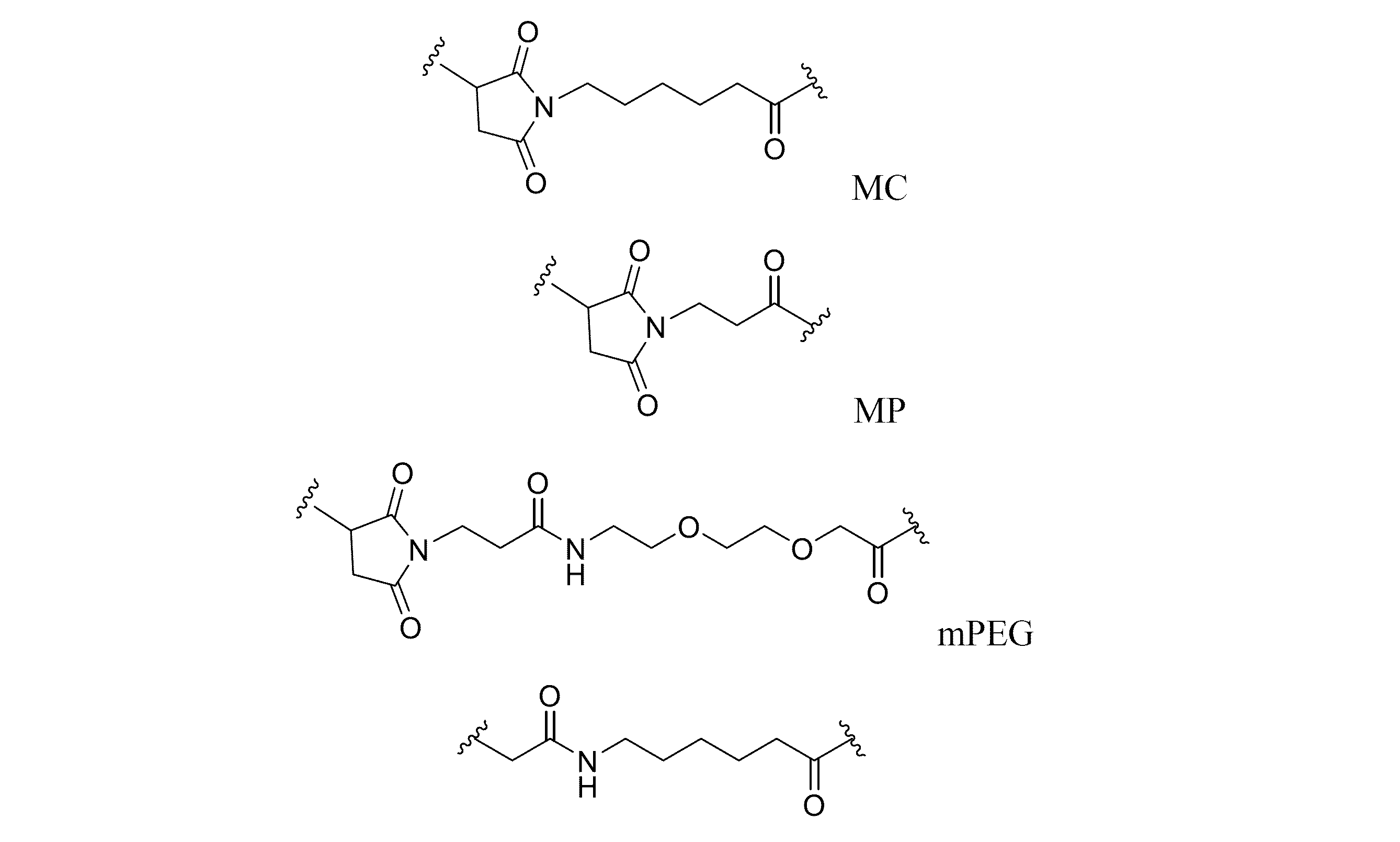
3.薬物(D)
ここで使用される場合、「薬物」という用語は、第二級窒素含有ヘテロアリールを含む生物学的に活性な分子を指す。「第二級窒素」という用語は、共有結合官能化に利用可能な窒素を指す。すなわち、薬物は、ここで更に定義されるように、前記窒素がリンカー(L1)への共有結合を形成することができる第二級窒素含有ヘテロアリール基を有する。第二級窒素は、高度に置換されているコア官能基の一部であっても、置換されていてもいなくてもよいペンダントピースであるかにかかわらず、薬物分子の任意の部分内の薬物中に存在しうる。例えば、薬物は、インドール、インダゾール、ベンズイミダゾール、ベンゾトリアゾール、ピロール、ピロロピリジン、イミダゾール、トリアゾール、テトラゾール等々のヘテロアリール基を含みうる。特定の例には、これらに限定されないが、次のヘテロアリール構造が含まれる:

As used herein, the term "drug" refers to a biologically active molecule containing a secondary nitrogen-containing heteroaryl. The term "secondary nitrogen" refers to the nitrogen available for covalent functionalization. That is, the drug has a secondary nitrogen-containing heteroaryl group from which the nitrogen can form a covalent bond to the linker (L1), as further defined herein. Secondary nitrogen is a drug within any portion of the drug molecule, whether it is part of a highly substituted core functional group or a pendant piece that may or may not be substituted. Can exist inside. For example, the drug may include heteroaryl groups such as indole, indazole, benzimidazole, benzotriazole, pyrrole, pyrrolopyridine, imidazole, triazole, tetrazole and the like. Specific examples include, but are not limited to, the following heteroaryl structures:
ヘテロアリール基はまた、

前述のヘテロアリール基は、例えば更なる官能基化又は縮合環などの多くの形態に置換されうる。第二級窒素は、構造中、N-Hとして表されうる。これは、ADCにおいて、N-Hが、ADCにおける薬物の結合点

ここで使用される場合、「生物学的に活性な分子」という用語とは、生物学的状況、例えば生物、細胞、インビトロモデル、又はインビボ系において機能もしくは作用を果たすか又は刺激するか又は機能に応答することができる小分子を指す。特に、対象の疾患又は状態を治療することができる小分子である。機能は、受容体、酵素、イオンチャネル、標的等々に関連しうる。 As used herein, the term "biologically active molecule" refers to a function or action or stimulus or function in a biological context, such as an organism, cell, in vitro model, or in vivo system. Refers to a small molecule that can respond to. In particular, small molecules capable of treating a disease or condition of interest. Function can be associated with receptors, enzymes, ion channels, targets, etc.
有用な薬物は、細胞機能を阻害もしくは防止し、及び/又は細胞死もしくは破壊を引き起こす細胞傷害剤;増殖阻害剤;核酸分解酵素などの酵素及びその断片;抗生物質;細菌、真菌、植物又は動物起源の小分子毒素もしくは酵素活性毒素などの毒素(それらの断片及び/又はバリアントを含む);抗腫瘍剤又は抗がん剤、例えばアルキル化剤;アルキルスルホネート;アジリジン;エチレンイミン及びメチルメラミン;アセトゲニン(特に、ブルラタシン及びブルラタシノン);アンチセンスオリゴヌクレオチド、特に異常な細胞増殖に関与するシグナル伝達経路における遺伝子の発現を阻害するもの;トポイソメラーゼ1阻害剤;プロテオソーム阻害剤;EGFR阻害剤;チロシンキナーゼ阻害剤;セリン-スレオニンキナーゼ阻害剤;ファルネシルトランスフェラーゼ阻害剤;並びに上記の何れかの薬学的に許容可能な塩、酸又は誘導体を含みうる。 Useful drugs are cytotoxic agents that inhibit or prevent cell function and / or cause cell death or destruction; growth inhibitors; enzymes such as nucleic acid-degrading enzymes and fragments thereof; antibiotics; bacteria, fungi, plants or animals. Toxins of origin, such as small molecule toxins or enzyme-active toxins (including fragments and / or variants thereof); antitumor or anticancer agents such as alkylating agents; alkylsulfonates; aziridine; ethyleneimine and methylmelamine; acetogenin (Especially bulratacin and bulratatinone); antisense oligonucleotides, especially those that inhibit the expression of genes in signaling pathways involved in abnormal cell proliferation; topoisomerase 1 inhibitors; proteosome inhibitors; EGFR inhibitors; tyrosine kinase inhibitors It may include a serine-threonine kinase inhibitor; a farnesyl transferase inhibitor; as well as any of the above pharmaceutically acceptable salts, acids or derivatives.
更なる薬物には、がんの増殖を促進しうるホルモンの作用を調節し、低下させ、遮断し、又は阻害するように作用する「抗ホルモン剤」又は「内分泌療法剤」が含まれる。それらはホルモン自体であり得、限定されないが、アゴニスト/アンタゴニストの混合プロファイルを有する抗エストロゲン;選択的エストロゲン受容体モジュレーター(SERM);アゴニスト特性のない純粋な抗エストロゲン;ステロイド系アロマターゼ阻害剤及び非ステロイド系アロマターゼ阻害剤を含むアロマターゼ阻害剤;黄体形成ホルモン放出ホルモンアゴニスト;性ステロイド;エストロゲン;及びアンドロゲン/レチノイド;エストロゲン受容体ダウンレギュレーター(ERD);抗アンドロゲン;並びに上記の何れかの薬学的に許容可能な塩、酸又は誘導体を含む。 Further drugs include "antihormonal agents" or "endocrine therapies" that act to regulate, reduce, block, or inhibit the action of hormones that can promote the growth of cancer. They can be hormones themselves, but not limited to anti-estrogens with a mixed profile of agonists / antagonists; selective estrogen receptor modulators (SERMs); pure estrogens without agonistic properties; steroidal aromatase inhibitors and non-steroids. Aromatase inhibitors, including system aromatase inhibitors; luteinizing hormone-releasing hormone agonists; sex steroids; estrogen; and androgens / retinoids; estrogen receptor down regulators (ERDs); anti-androgen; and any of the above pharmaceutically acceptable Contains steroids, acids or derivatives.
補助治療に対してここで使用される「免疫抑制剤」という用語は、ここで治療されている哺乳動物の免疫系を抑制し又は遮蔽するように作用する物質を指す。これには、サイトカイン産生を抑制し、自己抗原発現をダウンレギュレートしもしくは抑制し、又はMHC抗原を遮蔽する物質;非ステロイド系抗炎症薬(NSAID);抗炎症剤;シクロオキシゲナーゼ阻害剤、ロイコトリエン受容体アンタゴニスト;プリンアンタゴニスト;ステロイド;ジヒドロ葉酸レダクターゼ阻害剤;抗マラリア薬が含まれるであろう。 The term "immunosuppressive agent" as used herein for adjunctive therapy refers to a substance that acts to suppress or shield the immune system of the mammal being treated herein. These include substances that suppress cytokine production, down-regulate or suppress self-antigen expression, or block MHC antigens; non-steroidal anti-inflammatory drugs (NSAIDs); anti-inflammatory drugs; cyclooxygenase inhibitors, leukotriene receptors. Body antagonists; purine antagonists; steroids; dihydrofolate reductase inhibitors; anti-malaria drugs will be included.
第二級窒素含有ヘテロアリールを含む薬物の非限定的な例は、アマニチン、ビンブラスチン、ビンクリスチン、デュオカルマイシンA、デュオカルマイシンSA、CC-1065、アドゼレシン、U-76074、U-73073、カルゼレシン(U-80244)、KW-2189、ジアゾナミドA、エソメプラゾール、アリピプラゾール、バルサルタン、ランソプラゾール、ラベプラゾール、ポメトレキセド(pometrexed)、オルメサルタン、タダラフィル、パントプラゾール、カンドサルタン(candosartan)、オメプラゾール、スニチニブ、ペメトレキセド、アレクチニブ、ダカルバジン、セマキサニブ、ダシノスタット(dacinostat)、ドビチニブ、メベンダゾール、及びピモベンダンである。薬物の例には、次の化合物もまた含まれる:

加えて、当業者ならば、ここで定義されるカテゴリーに分子を分類するであろう、正式名称を受け取っていないが試験をまだ受けている、窒素含有ヘテロアリールを含む生物活性分子のより多くの例が存在することが分かるであろう。 In addition, one of ordinary skill in the art would classify the molecule into the categories defined herein, more of bioactive molecules, including nitrogen-containing heteroaryl, which have not received a formal name but are still being tested. You can see that there is an example.
ここに記載の主題は、式Iの抗体-薬物コンジュゲートの薬学的に許容可能な塩をまた含む。 The subject matter described herein also comprises a pharmaceutically acceptable salt of the antibody-drug conjugate of Formula I.
式Iの抗体-薬物コンジュゲートがカチオン性であるか、又はカチオン性でありうる官能基(例えば、NH2はNH3 +でありうる)を有する場合、所望の薬学的に許容可能な塩は、当該分野で利用可能な任意の適切な方法、例えば、無機酸、例えば塩酸、臭化水素酸、硫酸、硝酸、メタンスルホン酸、リン酸等々での、あるいは有機酸、例えば酢酸、マレイン酸、コハク酸、マンデル酸、フマル酸、マロン酸、ピルビン酸、シュウ酸、グリコール酸、サリチル酸、ピラノシジル酸、例えばグルクロン酸もしくはガラクツロン酸、アルファヒドロキシ酸、例えばクエン酸もしくは酒石酸、アミノ酸、例えばアスパラギン酸もしくはグルタミン酸、芳香族酸、例えば安息香酸もしくはケイ皮酸、スルホン酸、例えばp-トルエンスルホン酸もしくはエタンスルホン酸等々での遊離塩基の処理によって調製されうる。 If the antibody-drug conjugate of Formula I is cationic or has a functional group that can be cationic (eg, NH 2 can be NH 3+ ) , the desired pharmaceutically acceptable salt is Any suitable method available in the art, such as inorganic acids such as hydrochloric acid, hydrobromic acid, sulfuric acid, nitric acid, methanesulfonic acid, phosphoric acid, etc., or organic acids such as acetic acid, maleic acid, Succinic acid, mandelic acid, fumaric acid, malonic acid, pyruvate, oxalic acid, glycolic acid, salicylic acid, pyranosidilic acid, such as glucuronic acid or galacturonic acid, alphahydroxy acid, such as citric acid or tartaric acid, amino acids, such as aspartic acid or glutamic acid. , Can be prepared by treatment of free bases with aromatic acids such as benzoic acid or silicic acid, sulfonic acid such as p-toluenesulfonic acid or ethanesulfonic acid.
式Iの抗体-薬物コンジュゲートがアニオン性であるか、又はアニオン性でありうる官能基(例えば、-COOHは-COO-でありうる)を有する場合、所望の薬学的に許容可能な塩は、任意の適切な方法、例えば、無機又は有機塩基、例えばアミン(一級、二級又は三級)、アルカリ金属水酸化物もしくはアルカリ土類金属水酸化物等々での遊離酸の処理によって調製されうる。適切な塩の例示的な例には、限定されないが、グリシン及びアルギニンなどのアミノ酸、アンモニア、一級、二級、及び三級アミン、並びにピペリジン、モルホリン及びピペラジンなどの環状アミンから誘導される有機塩と、ナトリウム、カルシウム、カリウム、マグネシウム、マンガン、鉄、銅、亜鉛、アルミニウム及びリチウムから誘導される無機塩が含まれる。 If the antibody-drug conjugate of Formula I has a functional group that is anionic or can be anionic (eg, -COOH can be -COO- ) , the desired pharmaceutically acceptable salt is , Can be prepared by treatment of free acids with any suitable method, eg, inorganic or organic bases such as amines (primary, secondary or tertiary), alkali metal hydroxides or alkaline earth metal hydroxides, etc. .. Exemplary examples of suitable salts are, but are not limited to, organic salts derived from amino acids such as glycine and arginine, ammonia, primary, secondary and tertiary amines, and cyclic amines such as piperidine, morpholine and piperazine. And inorganic salts derived from sodium, calcium, potassium, magnesium, manganese, iron, copper, zinc, aluminum and lithium.
他の適切な塩の例示的な例には、限定されないが、グリシン及びアルギニンなどのアミノ酸、アンモニア、一級、二級、及び三級アミン、並びにピペリジン、モルホリン及びピペラジンなどの環状アミンから誘導される有機塩と、ナトリウム、カルシウム、カリウム、マグネシウム、マンガン、鉄、銅、亜鉛、アルミニウム及びリチウムから誘導される無機塩が含まれる。 Illustrative examples of other suitable salts are derived from amino acids such as glycine and arginine, ammonia, primary, secondary and tertiary amines, and cyclic amines such as piperidine, morpholine and piperazine. Includes organic salts and inorganic salts derived from sodium, calcium, potassium, magnesium, manganese, iron, copper, zinc, aluminum and lithium.
次の実施例は例示のために提供されるもので、限定のためではない。 The following examples are provided for illustration purposes only and are not intended to be limiting.
実施例1 分析的LCMS条件
[条件A]
イオン化源としてESIを使用して、SHIMADZU 2010EV MSD質量分析計を備えたSHIMADZU 20A HPLC(PDA検出器付き)で実験を実施した。LC分離は、1.5mL/分の流量でMK RP18e25-2mmカラムを使用して行った。溶媒Aは4Lの水当たり1.5mLのTFAであり、溶媒Bは4Lのアセトニトリル当たり0.75mLのTFAであった。勾配は、0.7分かけて5-95%の溶媒B、続いて0.4分間95%のBに保持し、続いて0.4分間平衡にすることからなった。LCカラム温度は50℃であった。UV吸光度を220nm及び254nmでモニターし、質量分析フルスキャンを全ての実験に適用した。
Example 1 Analytical LCMS condition [Condition A]
Experiments were performed on SHIMADZU 20A HPLC (with PDA detector) equipped with a SHIMADZU 2010EV MSD mass spectrometer using ESI as the ionization source. LC separation was performed using an MK RP18e 25-2 mm column at a flow rate of 1.5 mL / min. Solvent A was 1.5 mL TFA per 4 L of water and solvent B was 0.75 mL TFA per 4 L of acetonitrile. The gradient consisted of holding in 5-95% solvent B over 0.7 minutes, followed by 95% B for 0.4 minutes, followed by equilibration for 0.4 minutes. The LC column temperature was 50 ° C. UV absorbance was monitored at 220 nm and 254 nm and mass spectrometric full scan was applied to all experiments.
[条件B]
イオン化源としてESIを使用して、Agilent MSD(6140)質量分析計と連結されたAgilent 1290 UHPLCで実験を実施した。LC分離は、0.4mL/分の流量でPhenomenex XB-C18,1.7um,50×2.1mmカラムを使用して行った。溶媒Aは0.1%のギ酸を含む水であり、溶媒Bは0.1%のギ酸を含むアセトニトリルであった。勾配は、7分かけて2-98%の溶媒B、続いて1.5分間98%のBに保持し、続いて1.5分間平衡にすることからなった。LCカラム温度は40℃であった。UV吸光度を220nm及び254nmでモニターし、質量分析フルスキャンを全ての実験に適用した。
[Condition B]
Experiments were performed on an Agilent 1290 UHPLC coupled with an Agilent MSD (6140) mass spectrometer using ESI as the ionization source. LC separation was performed using a Phenomenex XB-C18, 1.7 um, 50 × 2.1 mm column at a flow rate of 0.4 mL / min. Solvent A was water containing 0.1% formic acid and solvent B was acetonitrile containing 0.1% formic acid. The gradient consisted of holding in 2-98% solvent B over 7 minutes, followed by 98% B for 1.5 minutes, followed by equilibration for 1.5 minutes. The LC column temperature was 40 ° C. UV absorbance was monitored at 220 nm and 254 nm and mass spectrometric full scan was applied to all experiments.
[条件C]
イオン化源としてESIを使用して、Waters LCT Premier XE質量分析計を備えたWaters Acquity UPLCで実験を実施した。LC分離は、0.6mL/分の流量でAcquity UPLC BEH C18,1.7um,2.1×50mmカラムを使用して行った。溶媒Aは0.05%のTFAを含む水であり、溶媒Bは0.05%のTFAを含むアセトニトリルであった。勾配は、5分かけて2-98%の溶媒B、続いて0.5分間98%のBに保持し、続いて0.5分間平衡にすることからなった。LCカラム温度は40℃であった。UV吸光度を220nm及び254nmでモニターし、質量分析フルスキャンを全ての実験に適用した。
[Condition C]
Experiments were performed on a Waters Equipment UPLC equipped with a Waters LCT Premier XE mass spectrometer using ESI as the ionization source. LC separation was performed using an Accuracy UPLC BEH C18, 1.7 um, 2.1 × 50 mm column at a flow rate of 0.6 mL / min. Solvent A was water containing 0.05% TFA and solvent B was acetonitrile containing 0.05% TFA. The gradient consisted of holding in 2-98% solvent B over 5 minutes, followed by 98% B for 0.5 minutes, followed by equilibration for 0.5 minutes. The LC column temperature was 40 ° C. UV absorbance was monitored at 220 nm and 254 nm and mass spectrometric full scan was applied to all experiments.
実施例2 (E)-3-(3,5-ジフルオロ-4-((1R,3R)-2-(2-フルオロ-2-メチルプロピル)-3-メチル-9-(((R)-2-((5-ニトロピリジン-2-イル)ジスルファネイル)プロポキシ)カルボニル)-2,3,4,9-テトラヒドロ-1H-ピリド[3,4-b]インドール-1-イル)フェニル)アクリル酸(化合物8)の合成


工程2:(E)-3-(3,5-ジフルオロ-4-((1R,3R)-2-(2-フルオロ-2-メチルプロピル)-3-メチル-2,3,4,9-テトラヒドロ-1H-ピリド[3,4-b]インドール-1-イル)フェニル)アクリル酸tert-ブチル
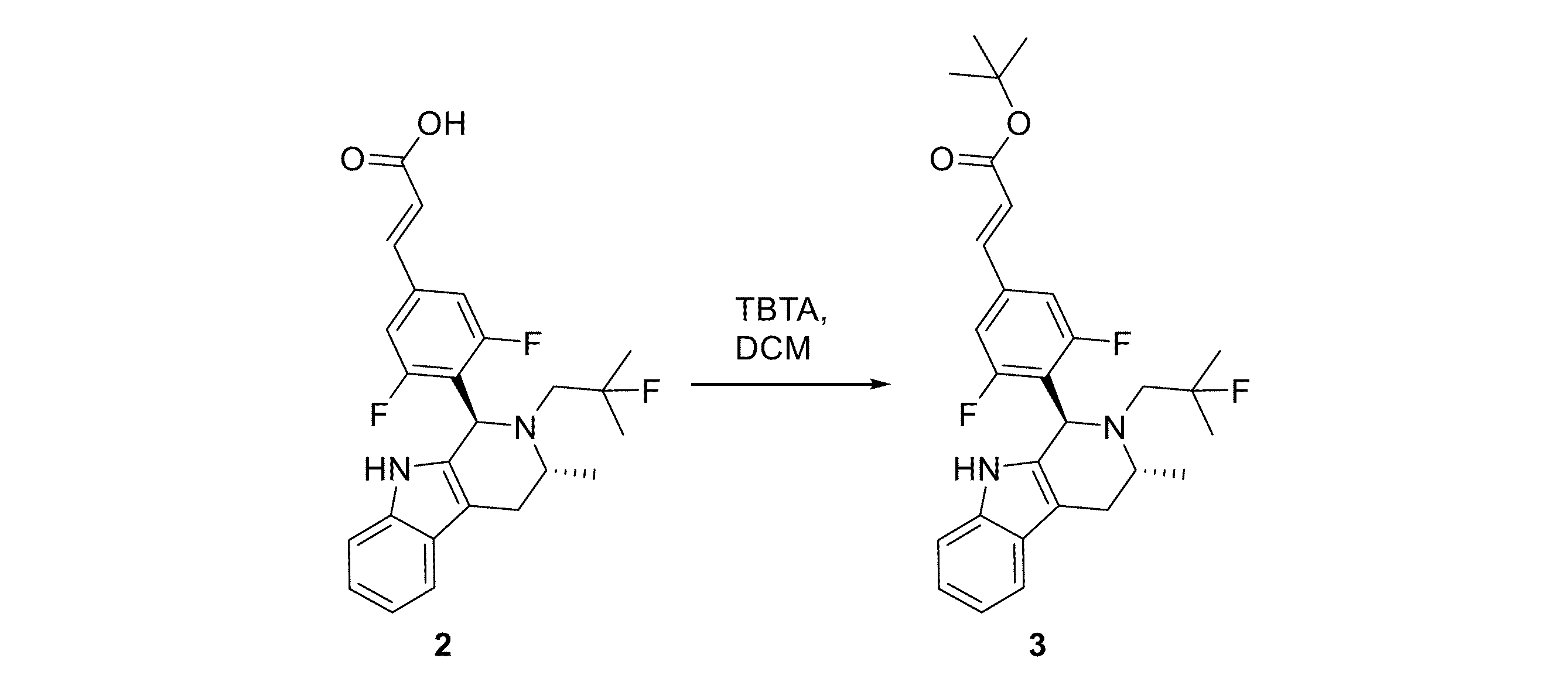
工程3:(R)-2-(トリチルチオ)プロパン-1-オール

工程4:カルボノクロリド酸(R)-2-(トリチルチオ)プロピル

工程5:(1R,3R)-1-(4-((E)-3-(tert-ブトキシ)-3-オキソプロパ-1-エン-1-イル)-2,6-ジフルオロフェニル)-2-(2-フルオロ-2-メチルプロピル)-3-メチル-1,2,3,4-テトラヒドロ-9H-ピリド[3,4-b]インドール-9-カルボン酸(R)-2-(トリチルチオ)プロピル

工程6:(E)-3-(3,5-ジフルオロ-4-((1R,3R)-2-(2-フルオロ-2-メチルプロピル)-3-メチル-9-(((R)-2-((5-ニトロピリジン-2-イル)ジスルファネイル)プロポキシ)カルボニル)-2,3,4,9-テトラヒドロ-1H-ピリド[3,4-b]インドール-1-イル)フェニル)アクリル酸

実施例3 (E)-3-(3,5-ジフルオロ-4-((1R,3R)-2-(2-フルオロ-2-メチルプロピル)-3-メチル-9-((2-((5-ニトロピリジン-2-イル)ジスルファネイル)エトキシ)カルボニル)-2,3,4,9-テトラヒドロ-1H-ピリド[3,4-b]インドール-1-イル)フェニル)アクリル酸(化合物13)の合成


工程2:カルボノクロリド酸2-(トリチルチオ)エチル

工程3:(1R,3R)-1-(4-((E)-3-(tert-ブトキシ)-3-オキソプロパ-1-エン-1-イル)-2,6-ジフルオロフェニル)-2-(2-フルオロ-2-メチルプロピル)-3-メチル-1,2,3,4-テトラヒドロ-9H-ピリド[3,4-b]インドール-9-カルボン酸2-(トリチルチオ)エチル

工程4:(E)-3-(3,5-ジフルオロ-4-((1R,3R)-2-(2-フルオロ-2-メチルプロピル)-3-メチル-9-((2-((5-ニトロピリジン-2-イル)ジスルファネイル)エトキシ)カルボニル)-2,3,4,9-テトラヒドロ-1H-ピリド[3,4-b]インドール-1-イル)フェニル)アクリル酸
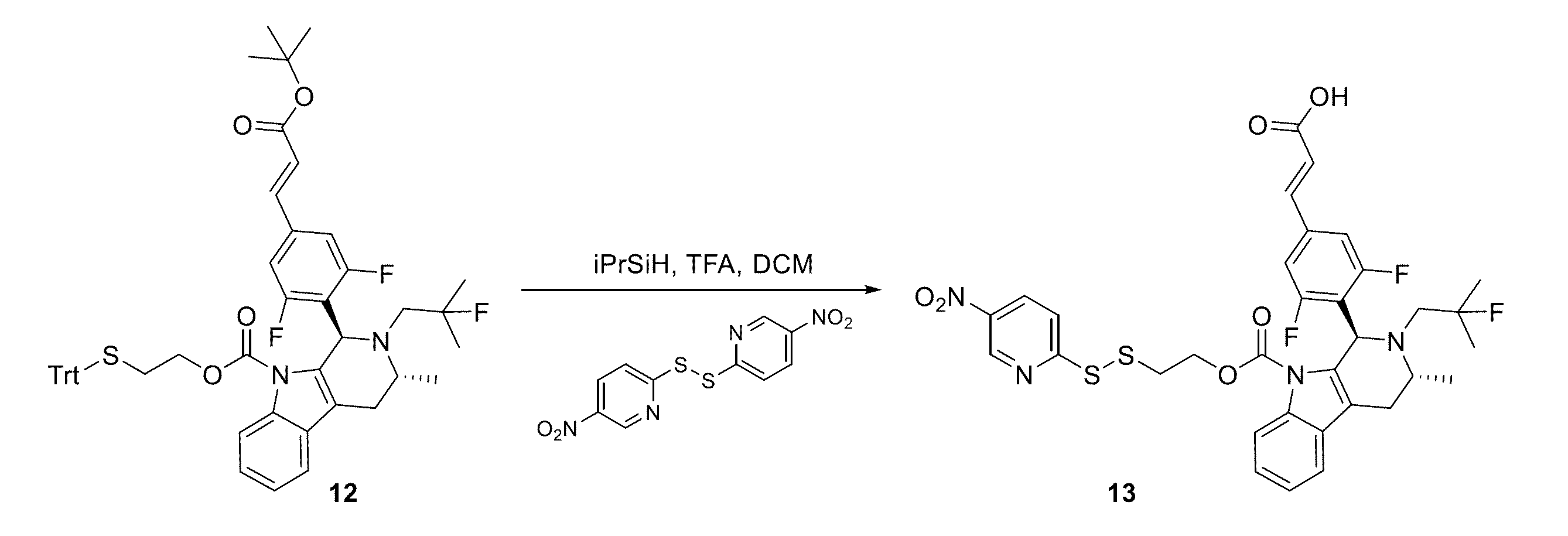
実施例4 6-(ベンジルオキシ)-1H-インドール-1,2-ジカルボン酸1-(4-((S)-2-((S)-2-((tert-ブトキシカルボニル)アミノ)-3-メチルブタンアミド)-5-ウレイドペンタンアミド)ベンジル)2-メチル(化合物17)の合成

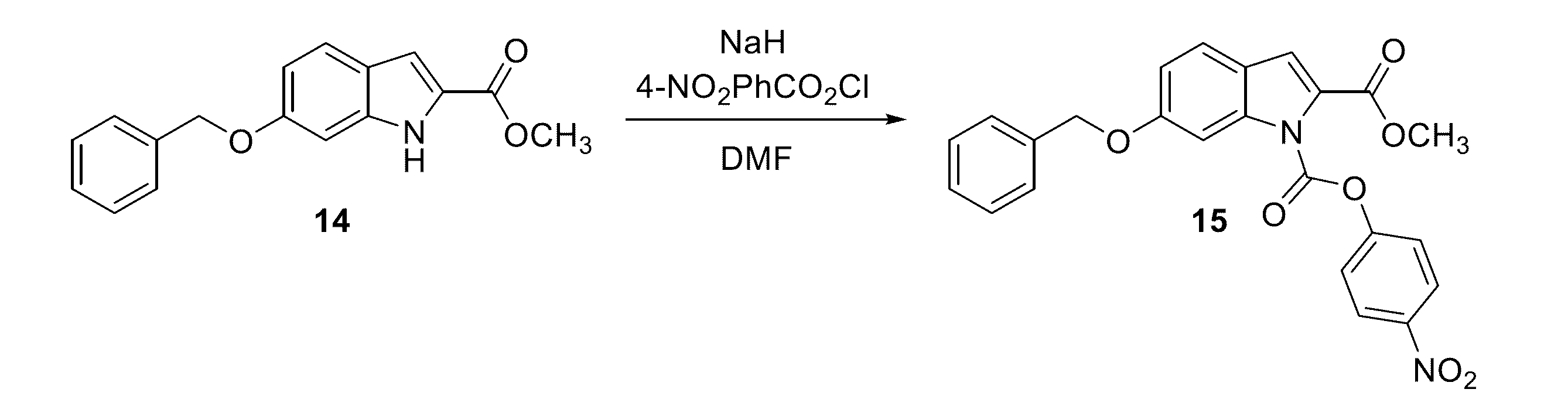
工程2:6-(ベンジルオキシ)-1H-インドール-1,2-ジカルボン酸1-(4-((S)-2-((S)-2-((tert-ブトキシカルボニル)アミノ)-3-メチルブタンアミド)-5-ウレイドペンタンアミド)ベンジル)2-メチル
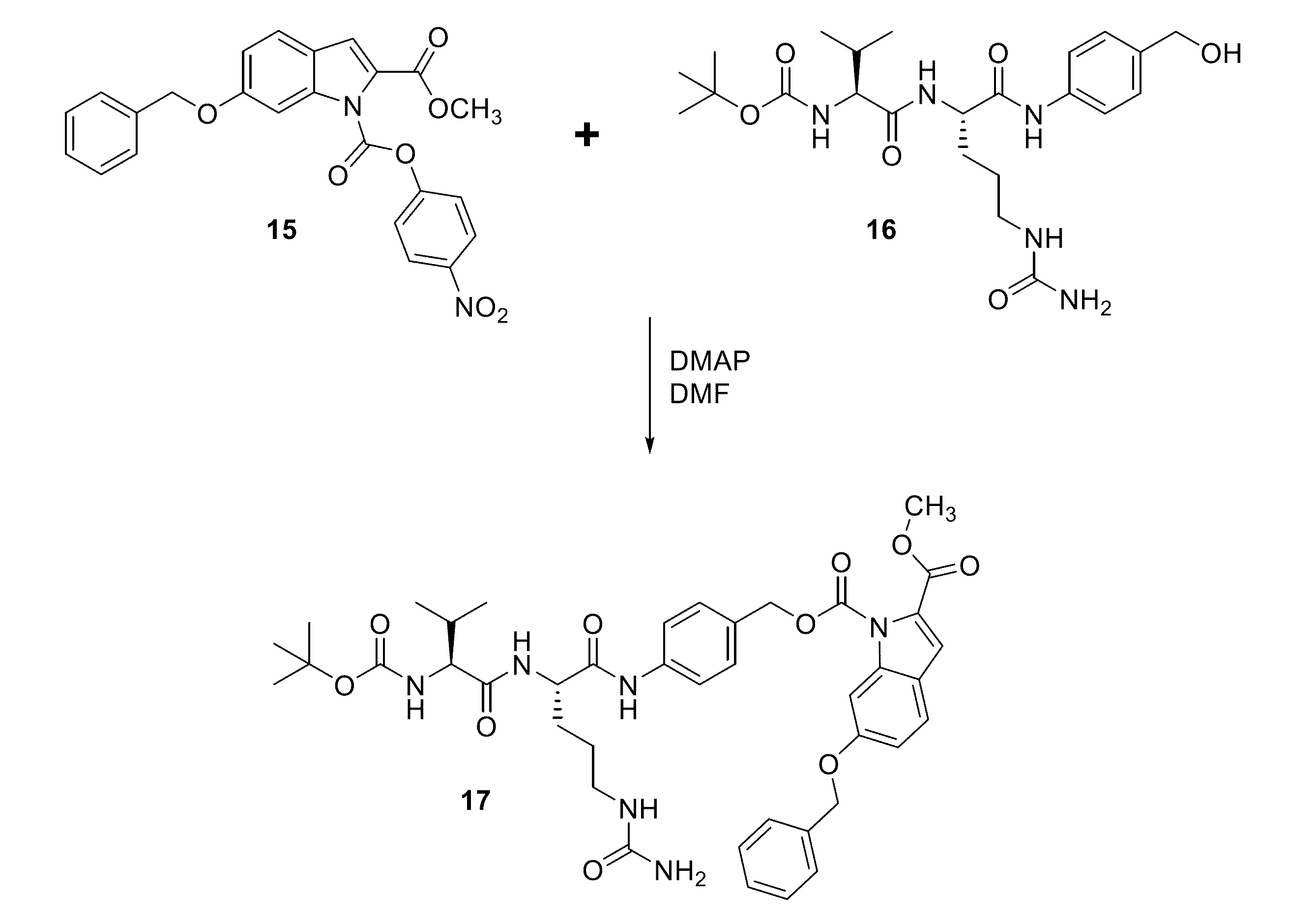
実施例5 6-(ベンジルオキシ)-1H-インドール-1,2-ジカルボン酸2-メチル1-(2-(トリチルチオ)エチル)(化合物18)の合成

実施例6 抗体-薬物コンジュゲートの合成
抗HER2 7C2 LC K149C及び抗B7H4 1D11 LC K149Cを、操作されたLC K149Cシステイン残基を介して化合物8又は化合物13にコンジュゲートさせた。50mMのトリス(pH8.5)中の10mg/mLの所与の抗体の溶液を、周囲温度において16~18時間、50モル過剰のDTTで還元した。SP HP陽イオン交換クロマトグラフィーを使用して還元抗体を精製した。50mMのトリス(pH8)中の精製抗体を、周囲温度において2~3時間、DMAに溶解した15モル過剰のDHAAを用使用して再酸化した。SP HP陽イオン交換カラムを使用して抗体を再度精製し、DHAA及び凝集物を除去した。DMF中の3ないし5倍モル当量の化合物8又は13を、100mMのトリス(pH8.5~9.0)中の5から10mg/mLの精製抗体溶液に加え、続いて10%DMFの最終濃度にするために追加のDMFを加えた。ついで、カップリング反応物を周囲温度において3から4時間インキュベートした。次の方法の何れかを使用して、コンジュゲート抗体を精製した:HiTrap SP HP樹脂を使用するか又はZeba spin 7kDa MWCO脱塩樹脂による陽イオン交換クロマトグラフィーと、続くデキストラン被覆チャコールを使用する過剰な遊離薬物の除去。得られた精製コンジュゲートを、10kDa MWCO Slide-a-Lyzer透析カセットを用いた透析を使用して、20mMのヒスチジンアセテート(pH5.5)、240mMのスクロース、0.02%のポリソルベート-20中に処方した。
Example 6 Synthesis of antibody-drug conjugates Anti-HER2 7C2 LC K149C and anti-B7H4 1D11 LC K149C were conjugated to compound 8 or compound 13 via engineered LC K149C cysteine residues. A solution of a given antibody at 10 mg / mL in 50 mM Tris (pH 8.5) was reduced with 50 mol excess DTT at ambient temperature for 16-18 hours. Reducing antibodies were purified using SP HP cation exchange chromatography. Purified antibody in 50 mM Tris (pH 8) was reoxidized using 15 mol excess DHAA dissolved in DMA for 2-3 hours at ambient temperature. Antibodies were repurified using the SP HP cation exchange column to remove DHAA and aggregates.
コンジュゲーション反応条件と何れかの精製スキームを使用して製造されたコンジュゲートは、典型的には50~80%のタンパク質収率をもたらした。全てのコンジュゲートを、凝集(SEC HPLC)、薬物対抗体比(LC/MS)、コンジュゲートしたニトロ-ピリジルジスルフィド(ニトロPDS)種の割合(LC/MS)及び最終コンジュゲート中に存在する遊離薬物の量(LC/MS)に関して特徴付けた。全てのコンジュゲートにおいて、抗体に対するコンジュゲート種の5%未満が、ジスルフィド結合の薬物側の硫黄ではなくニトロPDS硫黄へのコンジュゲーションから生じるニトロPDSであった。各コンジュゲートについての詳細な特徴付けデータを以下の表13に提供する。 Conjugates made using conjugation reaction conditions and any purification scheme typically yielded protein yields of 50-80%. All conjugates are aggregated (SEC HPLC), drug-to-antibody ratio (LC / MS), percentage of conjugated nitro-pyridyl disulfide (nitro PDS) species (LC / MS) and free present in the final conjugate. It was characterized with respect to the amount of drug (LC / MS). For all conjugates, less than 5% of the conjugate species to the antibody was nitro PDS resulting from the conjugation to nitro PDS sulfur rather than the drug-side sulfur of the disulfide bond. Detailed characterization data for each conjugate is provided in Table 13 below.
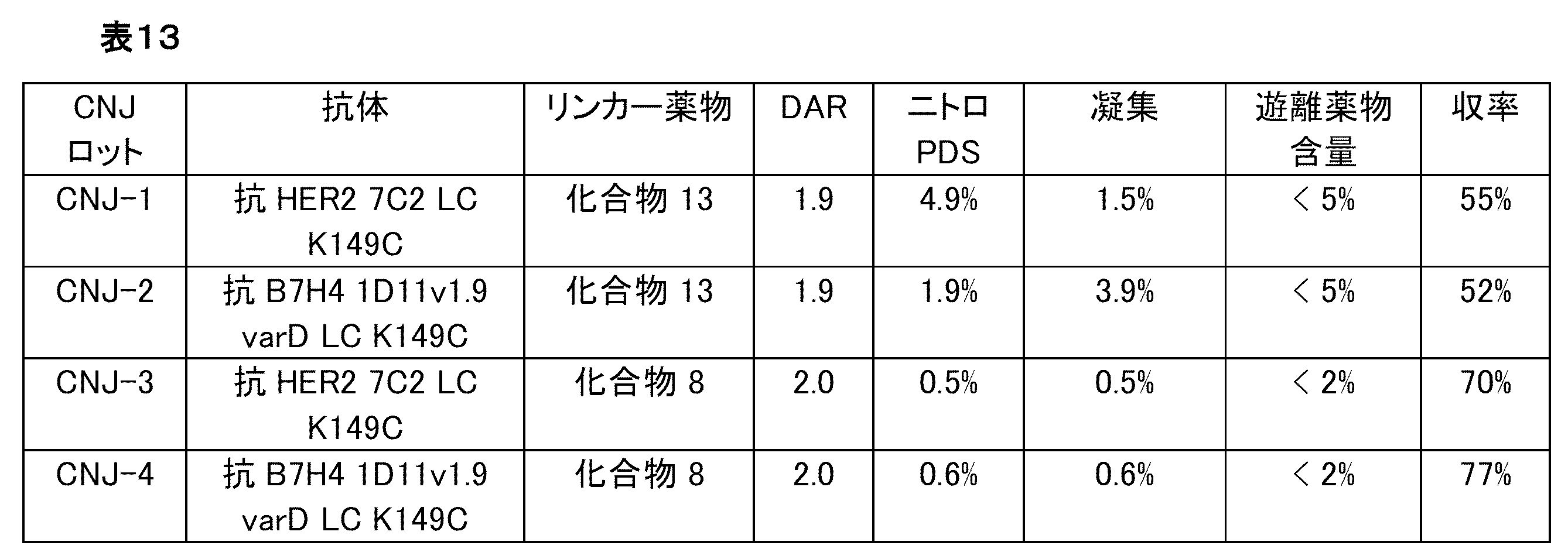
実施例7 生物学的アッセイ
[全血試料の調製]
安定性試料を、マウス(CB17 SCID)、ラット(スプラーグドーリーラット)、カニクイザル及びヒト全血漿並びに緩衝液(0及び24時間の時点)で作製した。血液はバイオレクラメーション(bioreclamation)によって収集され、ついで低温で一晩かけて出荷され、到着後直ぐに試料を作製した。安定性試料を作製するために、ソースコンジュゲートの初期希釈物を、全ての分子が1mg/mL濃度になるように、緩衝液(1×PBS,0.5%BSA,15ppmプロクリン)中で作製した。次に、1:10倍希釈(36uLの1mg/mL初期希釈物+324uLの血液又は緩衝液)を実施して、100ug/mLの最終化合物濃度の安定性試料を作製した。一度混合し、150μLの全血/緩衝液安定性試料を、2つの異なる時点で2つの別々のチューブセットに等分した。ついで、0時間の時点のものを-80℃の冷凍庫に入れ、24時間の時点のものを37℃のインキュベーター中の振盪機に配した。24時間の試料が所与の時点に達したとき、それらをまた-80℃の冷凍庫に入れた。
Example 7 Biological Assay [Preparation of Whole Blood Sample]
Stability samples were prepared in mice (CB17 SCID), rats (Sprague dolly rats), cynomolgus monkey and human whole plasma and buffers (at 0 and 24 hours). Blood was collected by bioreclamation and then shipped overnight at low temperatures to prepare samples immediately upon arrival. To prepare a stable sample, an initial dilution of the source conjugate was prepared in buffer (1 x PBS, 0.5% BSA, 15 ppm proclin) so that all molecules had a concentration of 1 mg / mL. bottom. Next, 1:10 fold dilution (36 uL 1 mg / mL initial dilution + 324 uL blood or buffer) was performed to prepare a stable sample with a final compound concentration of 100 ug / mL. Once mixed, 150 μL whole blood / buffer stability samples were equally divided into two separate tube sets at two different time points. Then, the one at 0 hours was placed in a freezer at −80 ° C., and the one at 24 hours was placed in a shaker in an incubator at 37 ° C. When the 24-hour samples reached a given point in time, they were also placed in the -80 ° C freezer.
[全血試料の安定性測定のためのアフィニティーキャプチャーLC-MSアッセイ]
全血安定性試料を、アフィニティーキャプチャーLC-MSアッセイを使用して評価した。最初に、ストレプトアビジン被覆磁気ビーズ(Life Technologies Corporation, Grand Island, NY)をHBS-EP緩衝液(GE Healthcare, Sunnyvale, CA)で2回洗浄し、ついでKingFisher Flex(Thermo Fisher Scientific, Waltham, MA)を使用してビオチン化HER2抗イディオタイプ抗体と混合し、穏やかに撹拌しながら室温において2時間インキュベートした。2時間後、SA-ビーズ/ビオチン-xId Ab複合体をHBS-EP緩衝液で2回洗浄し、希釈した全血安定性試料と混合し、ついで穏やかに撹拌しながら室温において2時間インキュベートした。2時間後、SA-ビーズ/ビオチン-xId Ab/試料複合体をHBS-EP緩衝液で2回洗浄し、脱グリコシル化酵素PNGase F(New England BioLabs, Ipswich, MA)と混合し、穏やかに撹拌しながら37℃において一晩インキュベートした。一晩のインキュベーション後、脱グリコシル化SA-ビーズ/ビオチン-xId Ab/試料複合体をHBS-EP緩衝液で2回洗浄し、続いて水(Optima H2O,Fisher Scientific, Pittsburgh, PA)で2回洗浄し、最後に10%のアセトニトリルで1回洗浄した。ビーズを、溶出のために30%のアセトニトリル/0.1%のギ酸中に配し、そこでビーズを収集する前にそれらを穏やかに撹拌しながら室温において30分間インキュベートした。溶出した試料を注入し、65℃に維持したThermo Scientific PepSwift RPモノリスカラム(500μm×5cm)上にロードした。次の勾配を用いて20μL/分の流量でWaters Acquity UPLCシステムを使用して試料をカラムで分離させた:0-2分で20%B(95%アセトニトリル+0.1%ギ酸);2.5分で35%B;5分で65%B;5.5分で95%B;6分で5%B。カラムを、500~5000Th(m/z)の取得質量範囲で、ポジティブESIで操作されるWaters Synapt G2-S Q-ToF質量分析とオンライン検出のために直接連結した。
[Affinity capture LC-MS assay for measuring the stability of whole blood samples]
Whole blood stability samples were evaluated using an affinity capture LC-MS assay. First, streptavidin-coated magnetic beads (Life Technologies Corporation, Grand Island, NY) were washed twice with HBS-EP buffer (GE Healthcare, Sunnyvale, CA), followed by King Fisher Flex (Thermo Fisher Scientific, Waltham, MA). Was mixed with biotinylated HER2 anti-idiotype antibody and incubated for 2 hours at room temperature with gentle stirring. After 2 hours, the SA-beads / biotin-xIdAb complex was washed twice with HBS-EP buffer, mixed with a diluted whole blood stability sample, and then incubated at room temperature for 2 hours with gentle stirring. After 2 hours, the SA-beads / biotin-xIdAb / sample complex was washed twice with HBS-EP buffer, mixed with the deglycosylation enzyme PNGase F (New England BioLabs, Ipswich, MA) and gently stirred. Incubated overnight at 37 ° C. After overnight incubation, the deglycosylated SA-beads / biotin-xId Ab / sample complex was washed twice with HBS-EP buffer, followed by water (Optima H2 O, Fisher Scientific, Pittsburgh, PA). It was washed twice and finally once with 10% acetonitrile. The beads were placed in 30% acetonitrile / 0.1% formic acid for elution, where they were incubated for 30 minutes at room temperature with gentle stirring prior to collecting the beads. The eluted sample was injected and loaded onto a Thermo Scientific PepSwift RP monolith column (500 μm × 5 cm) maintained at 65 ° C. Samples were separated by column using the Waters Accuracy UPLC system at a flow rate of 20 μL / min using the following gradient: 20% B (95% acetonitrile + 0.1% formic acid) at 0-2 minutes; 2.5. 35% B in minutes; 65% B in 5 minutes; 95% B in 5.5 minutes; 5% B in 6 minutes. Columns were directly linked for positive ESI-operated Waters Synapt G2-S Q-ToF mass spectrometry and online detection in the acquisition mass range of 500-5000 Th (m / z).
[乳がん細胞ERα高含有量蛍光イメージングアッセイ(F10)]
MCF7-neo/HER2乳がん細胞を、1日目に、L-グルタミンを含む50ul/ウェルのRPMI(フェノールレッド不含)、10%のFBS(チャコール除去)中の、384ウェルのポリ-リジンコーティング組織培養プレート(Greiner#T-3101-4)において、1ウェル当たり10000細胞の密度で播種した。2日目に、抗体コンジュゲートをRTにおいて解凍し、37℃の増殖培地中それぞれ60ug/mLに希釈し、続いて384ウェルプレート(Ref:781091)で20ポイントの2倍段階希釈を行った。段階希釈からの各試料10uLを細胞プレートのウェルに移した。ADCの最高の使用濃度は10ug/mLであった。細胞プレートカラム1、2、23及び24はデータ正規化のために未処理のままにする一方、カラム3~22にはADC希釈物を含めた。化合物処理後、細胞プレートを37℃のインキュベーターに72時間保存した。5日目に次のようにBiotek EL406プレートウォッシャー及びディスペンサーを使用して固定及び透過処理を実施した。Biotek EL406上の蠕動ポンプ5uLカセットを使用して、15uLの16%のパラホルムアルデヒド(Electron Microscopy Sciences #15710-S)を各ウェル中の50uL細胞培養培地に直接添加することによって細胞を固定した(ホルムアルデヒドの最終濃度は3.7%w/vであった)。試料を30分インキュベートした。ウェル内容物を吸引し、0.5%w/vのウシ血清アルブミンと0.5%v/vのTriton X-100(抗体希釈バッファー)を含むリン酸緩衝生理食塩水(PBS)50ul/ウェルを各ウェルに添加した。試料を30分間インキュベートした。ウェル内容物を吸引し、100ul/ウェルのPBSで3回洗浄した。次の通りにBiotek EL406プレートウォッシャー及びディスペンサーを使用して、エストロゲン受容体アルファ(ESR1)の免疫蛍光染色を実施した。ウェル上清をウェルから吸引し、抗体希釈バッファー中の1:1000に希釈された抗ESR1 mAb(F10)(Santa Cruz sc-8002)25uL/ウェルを分注した。試料を室温において2時間インキュベートし、ついで100ul/ウェルのPBSで4回洗浄した。1:1000に希釈された25ul/ウェルの二次抗体溶液(Alexafluor488コンジュゲート抗マウスIgG(LifeTechnologies#A21202)と抗体希釈バッファー中に希釈された1ug/mlのHoechst33342を各ウェル中に分注した。試料を室温において2時間インキュベートし、ついでBiotek EL406を使用して、100uL/ウェルのPBSで3回洗浄した。Cellomics VTI Arrayscan V(Thermo)を使用して、ESR1の定量的蛍光イメージングを実施した。両チャネルについて25%標的飽和に設定された「ピーク標的パーセンタイル」を設定する自動露出(DMSO対照ウェルに基づく)を使用するバイオアプリケーション「コンパートメント解析」を使用するCellomics Arrayscanを使用して、試料の蛍光画像[チャネル1:XF53 Hoechst(DNA染色);チャネル2:XF53 FITC(ESR1染色)]を獲得した。チャネル1(DNA染色)を使用して、核領域(Circ)を画定した。核領域内のAlexafluor488蛍光強度(ESR1)である「Mean_CircAvgIntCh2」の測定値を細胞当たりのベースで測定し、全ての測定細胞にわたり平均した。DMSOを用い、ESR1の0%及び100%変化を規定するために使用される一次抗体対照処理試料を伴わないでGraphPad Prism6を使用してデータ解析を実施した。用量反応対数(阻害剤)対反応を使用して、曲線の変曲点(EC50)及び最大効果のプラトーを定義した。
[Breast Cancer Cell ERα High Content Fluorescence Imaging Assay (F10)]
MCF7-neo / HER2 breast cancer cells 384-well poly-lysine coated tissue in 50 ul / well RPMI (phenol red free), 10% FBS (charcoal removal) containing L-glutamine on day 1. In culture plates (Greener # T-3101-4), seeded at a density of 10,000 cells per well. On
[MCF7-neo/HER2由来腫瘍におけるERαレベルのインビボ調節]
ヒト乳がんMCF7細胞を、もともとアメリカ培養細胞系統保存機関(Rockville, MD)から入手し、GenentechにおいてHER2を過剰発現するように操作してMCF7-neo/HER2を作製した。腫瘍細胞移植の4日前に、55匹の雌NCRヌードマウス(Taconic)を0.003%エタノール中0.8ug/mLの17β-エストラジオール(Sigma; St. Louis, MO)を含む自由のエストロゲン強化水に接触させた。50%のフェノールレッドフリーのMatrigel(Becton Dickinson Bioscience; San Jose, CA)及びハンクス平衡塩類溶液中に再懸濁したMCF7-neo/HER2細胞を、2/3番乳房脂肪パッドに皮下接種した。各マウスに5×106細胞を注射した。腫瘍がおよそ400mm3の腫瘍体積に達するまで腫瘍をモニターした。腫瘍移植の17日後(コンジュゲートを投与する4日前)に、マウスを1群当たり4匹のマウスの5群に分け、エストロゲン強化水を除去し、自由の通常の飲料水と交換した。研究の1日目と指定された腫瘍移植の21日後に、マウスに、200uLの容量の2、10、又は25mg/kgでビヒクル(20mMのヒスチジンアセテート(pH5.5)、240mMのスクロース、0.02%のポリソルベート20)、CNJ-1(HER2)の、あるいは25mg/kgでCNJ-2(B7H4)の単回静脈内注射を施した。投与後24時間の血液を後眼窩採血により採取し、血清に処理した。4日目に、全てのマウスを安楽死させ、腫瘍と血液を採取した。腫瘍を-80℃で急速冷凍し、血液を血清に処理した。
[In vivo regulation of ERα levels in MCF7-neo / HER2-derived tumors]
Human breast cancer MCF7 cells were originally obtained from the American Culture Cell Lineage Conservation Agency (Rockville, MD) and engineered to overexpress HER2 in Genentech to produce MCF7-neo / HER2. Four days prior to tumor cell transplantation, 55 female NCR nude mice (Taconic) were subjected to free estrogen-enriched water containing 0.8 ug / mL 17β-estradiol (Sigma; St. Louis, MO) in 0.003% ethanol. Was brought into contact with. MCF7-neo / HER2 cells resuspended in 50% phenol red-free Matrigel (Becton Dickinson Bioscience; San Jose, CA) and Hanks equilibrium salt solution were subcutaneously inoculated into a 2/3 breast fat pad. Each mouse was injected with 5 x 10⁶ cells. Tumors were monitored until the tumor reached a tumor volume of approximately 400 mm 3 . Seventeen days after tumor transplantation (4 days prior to administration of the conjugate), the mice were divided into 5 groups of 4 mice per group, estrogen-enriched water was removed and replaced with free normal drinking water. Twenty-one days after tumor transplantation designated as day 1 of the study, mice were given a vehicle (20 mM histidine acetate (pH 5.5), 240 mM sucrose, 0. A single intravenous injection of 02% polysorbate 20), CNJ-1 (HER2), or CNJ-2 (B7H4) at 25 mg / kg was given. Blood was collected 24 hours after administration by posterior orbital blood sampling and treated into serum. On
タンパク質抽出のために、各凍結腫瘍を組織TUBE(Covaris)に移し、インパクトレベル5に設定したcryoPREPインパクター(Covaris)を使用して凍結破砕した。粉砕した腫瘍試料の半分を、プロテアーゼ阻害剤カクテル(Roche)、ホスファターゼ阻害剤カクテル(Sigma)が補填され、1/8”のConeball(Glenmills)を1個と3mmのジルコニアビーズ(Glenmills)を2個含む300uLの細胞抽出緩衝液(FNN0011,Life Technologies)に再懸濁させた。試料をGenoグラインダー(SPEX Sample Prep)で1500rpmで1.5分間ホモジナイズし、抽出物を遠心分離(4℃において14000rpmで10分間)によって2回清澄化した。タンパク質濃度はBCAアッセイ(Thermo Fisher Scientific)によって決定した。各腫瘍試料について、26μgの総タンパク質を、MOPS緩衝液(Thermo Fisher Scientific)を使用して4-12%のNuPAGE Bis-Trisゲル上で分離し、ニトロセルロース膜に移した。膜をOdysseyブロッキング緩衝液(LI-COR、カタログ番号927-40000)中で1時間ブロックし、ERα(1:1000希釈,Novus Biologicals,カタログ番号NBP2-26481)及びβ-チューブリン(希釈率1:1000,LI-COR、カタログ#926-42212)に対する一次抗体と共に一晩インキュベートした。 PBS-tweenで15分間3回洗浄した後、膜を二次抗体IR Dye800 CWロバ抗ウサギ(希釈1:10000,LI-COR,カタログ#926-32213)及びIR色素680RDロバ抗マウス(希釈1:10000,LI-COR,カタログ#926-68072)と共に45分間インキュベートした。PBS-tweenで15分間3回洗浄した後、Odyssey CLx装置(LI-COR)を使用して膜をスキャンし、ERα及びチューブリンレベルを定量した。ERα/チューブリン比及び平均の標準誤差(SEM)を、エクセルを使用して計算し、Prism6(Graphpad)を使用してプロットした。 For protein extraction, each frozen tumor was transferred to tissue TUBE (Covaris) and frozen and crushed using a cryoPREP impactor (Covaris) set at impact level 5. Half of the ground tumor sample is supplemented with protease inhibitor cocktail (Roche), phosphatase inhibitor cocktail (Sigma), 1/8 "Coneball (Glenmills) and 2 3 mm zirconia beads (Glenmills). The sample was resuspended in 300 uL of cell extraction buffer containing (FNN0011, Life Technologies). The sample was homogenized with a Geno grinder (SPEX Sample Prep) at 1500 rpm for 1.5 minutes, and the extract was centrifuged (at 14000 rpm at 4 ° C.). Clarified twice by (10 minutes). Protein concentration was determined by BCA assay (Thermo Fisher Scientific). For each tumor sample, 26 μg total protein was 4-12 using MOPS buffer (Thermo Fisher Scientific). % NuPAGE Bis-Tris gel was separated and transferred to a nitrocellulose membrane. The membrane was blocked in Odyssey blocking buffer (LI-COR, Catalog No. 927-40000) for 1 hour and ERα (1: 1000 diluted, Incubated overnight with primary antibodies to Novus Biologicals, Catalog No. NBP2-26481) and β-tubulin (dilution ratio 1: 1000, LI-COR, Catalog # 926-42212). Washed 3 times with PBS-tween for 15 minutes. Later, the membrane was subjected to secondary antibody IR Dye800 CW donkey anti-rabbit (dilution 1: 10000, LI-COR, catalog # 926-32213) and IR dye 680RD donkey anti-mouse (dilution 1: 10000, LI-COR, catalog # 926-). Incubated with 68072) for 45 minutes. After washing 3 times in PBS-tween for 15 minutes, the membrane was scanned using an Odyssey CLx device (LI-COR) to quantify ERα and tubularin levels. ERα / tubularin. The standard error (SEM) of ratios and means was calculated using Excel and plotted using Prism6 (Graphpad).
使用される数字(例えば、量、温度等々)に関して正確性を確実にする努力がなされてきたが、幾らかの実験誤差及び偏差は考慮されるべきである。 Efforts have been made to ensure accuracy with respect to the numbers used (eg, quantity, temperature, etc.), but some experimental errors and deviations should be considered.
当業者であれば、ここに記載の主題を実施する際に使用することができる、ここに記載のものと類似するか又は同等の多くの方法及び材料を認識するであろう。本開示は、記載された方法及び材料だけに決して限定されない。 One of ordinary skill in the art will recognize many methods and materials similar to or equivalent to those described herein that can be used in carrying out the subjects described herein. The present disclosure is by no means limited to the methods and materials described.
他の定義がなされない限り、ここで使用される技術及び科学用語は、この主題が属する分野の当業者によって一般的に理解されるものと同じ意味を有し、Singleton等 (1994) Dictionary of Microbiology and Molecular Biology, 2版, J. Wiley & Sons, New York, NY;及びJaneway, C., Travers, P., Walport, M., Shlomchik (2001) Immunobiology, 5版, Garland Publishing, New Yorkと一致する。 Unless otherwise defined, the technical and scientific terms used herein have the same meaning as commonly understood by those of skill in the field to which this subject belongs, such as Singleton et al. (1994) Dictionary of Microbiology. and Molecular Biology, 2nd Edition, J. Wiley & Sons, New York, NY; and Janeway, C., Travers, P., Walport, M., Shlomchik (2001) Immunobiology, 5th Edition, Garland Publishing, New York do.
この明細書及び特許請求の範囲を通して、「含む(comprise)」、「含む(comprises)」、及び「含む(comprising)」という用語は、文脈上他の意味が必要とされる場合を除き、非排他的な意味で使用される。ここに記載される実施態様は、「からなる」及び/又は「から本質的になる」実施態様を含むことが理解される。 Throughout this specification and claims, the terms "comprise," "comprises," and "comprising" are non-existent unless contextually requires other meanings. Used in an exclusive sense. It is understood that the embodiments described herein include "consisting of" and / or "essentially consisting of" embodiments.
ここで使用される場合、値について言及するときの「約」という用語は、特定された量から、幾つかの実施態様では±50%、幾つかの実施態様では±20%、幾つかの実施態様では±10%、幾つかの実施態様では±5%、幾つかの実施態様では±1%、幾つかの実施態様では±0.5%、及び幾つかの実施態様では±0.1%の変動を包含することを意味する(開示された方法を実施し又は開示された組成物を用いるにはこのような変動が適当であるため)。 As used herein, the term "about" when referring to a value is ± 50% in some embodiments, ± 20% in some embodiments, and some practices from the specified amount. ± 10% in embodiments, ± 5% in some embodiments, ± 1% in some embodiments, ± 0.5% in some embodiments, and ± 0.1% in some embodiments. Means to include variations of (because such variations are appropriate for implementing the disclosed methods or using the disclosed compositions).
ある範囲の値が提供される場合、文脈が明らかに別の意味を示していない限り、その範囲の上限と下限との間の、下限の単位の10分の1までの、それぞれの介在する値とその記載された範囲内の任意の他の記載され又は介在する値が包含されることが理解される。記載された範囲内の任意の特に除外された限界を条件として、より狭い範囲に独立して含まれうるこれらの狭い範囲の上限及び下限もまた包含される。記載された範囲が限界の一方又は両方を含む場合、それら含まれた限界の何れか又は両方を除外する範囲もまた含まれる。 When a range of values is provided, each intervening value between the upper and lower bounds of the range, up to one tenth of the lower bound unit, unless the context clearly indicates a different meaning. And any other described or intervening value within its described range is understood to be included. Also included are upper and lower limits of these narrow ranges that can be independently included in the narrower range, subject to any particularly excluded limits within the stated range. If the stated range includes one or both of the limits, then a range that excludes one or both of those included limits is also included.
ここに記載された多くの変形態様及び他の実施態様が、前述の説明及び関連する図面に提示された教示の恩恵を受けるこの主題が関係する当業者に思い浮かぶであろう。従って、主題が、開示された特定の実施態様に限定されるべきではなく、変形態様及び他の実施態様が、添付の特許請求の範囲内に含まれることが意図されると理解されるべきである。ここでは特定の用語が用いられているが、それらは上位概念的かつ説明的な意味でのみ使用されており、限定の目的ではない。 Many modifications and other embodiments described herein will be appreciated by those skilled in the art associated with this subject who would benefit from the teachings presented in the aforementioned description and related drawings. Therefore, it should be understood that the subject matter should not be limited to the particular embodiments disclosed, but that modifications and other embodiments are intended to be included within the appended claims. be. Although specific terms are used here, they are used only in a superordinate conceptual and descriptive sense and are not for limited purposes.
Claims (41)

Abは抗体であり;
L1は、
構造

R 1 、R 2 、R 3 、及びR 4 は、H、置換されていてもよい分岐もしくは直鎖C 1 -C 5 アルキル、及び置換されていてもよいC 3 -C 6 シクロアルキルからなる群から独立して選択され、又はR 3 とR 4 はそれらが結合する炭素原子と共にC 3 -C 6 シクロアルキル環を形成し、
前記置換されていてもよいアルキル又はシクロアルキルは、アルキル、シクロアルキル、アリール、ヘテロアリール、ヒドロキシル、ニトリル、ハロ、アルコキシ、ハロアルコキシ、アリールアルコキシ、アシルオキシ、アルキルチオ、スルホネート、アミノ、アルキルアミノ、アシルアミノ、カルバモイル、アルキルカルバモイル、又はニトロで置換されていてもよい]
を有する連結部分であり;
Dは、

L1は第二級窒素に共有結合しており;かつ
pは1、2、3、4、5、6、7、8、9、又は10である]
の抗体-薬物コンジュゲート又はその薬学的に許容可能な塩を調製するための方法であって;
i. 式II

L1とDは上記の通りであり、
Tは構造R5-Sを有する脱離基であり、
R5は置換されていてもよいピリジンである]
の化合物を抗体と接触させて、式Iの抗体-薬物コンジュゲートを調製する工程を含む、方法。 Formula I:
Ab is an antibody;
L1 is
Construction
R 1 , R 2 , R 3 and R 4 are a group consisting of H, an optionally substituted branched or linear C 1 - C 5 alkyl, and an optionally substituted C 3 - C 6 cycloalkyl. Selected independently from, or R3 and R4 form a C3 - C6 cycloalkyl ring with the carbon atom to which they are attached .
The substituted alkyl or cycloalkyl may be alkyl, cycloalkyl, aryl, heteroaryl, hydroxyl, nitrile, halo, alkoxy, haloalkoxy, arylalkoxy, acyloxy, alkylthio, sulfonate, amino, alkylamino, acylamino, May be substituted with carbamoyl, alkylcarbamoyl, or nitro]
Is a connecting part with;
D is
L1 is covalently bound to secondary nitrogen; and p is 1, 2, 3, 4, 5, 6, 7, 8, 9, or 10]
Antibodies-A method for preparing drug conjugates or pharmaceutically acceptable salts thereof;
i . Equation II
L1 and D are as described above,
T is a leaving group with structure R5 - S and
R 5 is a optionally substituted pyridine]
A method comprising contacting a compound of formula I with an antibody to prepare an antibody-drug conjugate of formula I.

を有する、請求項1に記載の方法。 T-L1-D is the following formula:
The method according to claim 1.

を有する、請求項7に記載の方法。 The antibody-drug conjugate of formula I is structured:
7. The method according to claim 7 .

を有する、請求項7に記載の方法。 The antibody-drug conjugate of formula I is structured:
7. The method according to claim 7 .


からなる群から選択される、請求項1に記載の方法。 The antibody of formula I-drug conjugate,
The method according to claim 1 , which is selected from the group consisting of.

Abは抗体であり;
R1、R2、R3、及びR4は、H、置換されていてもよい分岐もしくは直鎖C1-C5アルキル、及び置換されていてもよいC3-C6シクロアルキルからなる群から独立して選択され、又はR3とR4はそれらが結合する炭素原子と共にC3-C6シクロアルキル環を形成し、
前記置換されていてもよいアルキル又はシクロアルキルは、アルキル、シクロアルキル、アリール、ヘテロアリール、ヒドロキシル、ニトリル、ハロ、アルコキシ、ハロアルコキシ、アリールアルコキシ、アシルオキシ、アルキルチオ、スルホネート、アミノ、アルキルアミノ、アシルアミノ、カルバモイル、アルキルカルバモイル、又はニトロで置換されていてもよく;
Dは、

pは1、2、3、4、5、6、7、8、9、又は10である]
の抗体-薬物コンジュゲート又はその薬学的に許容可能な塩。 Equation IV:
Ab is an antibody;
R 1 , R 2 , R 3 and R 4 are a group consisting of H, an optionally substituted branched or linear C 1 -C 5 alkyl, and an optionally substituted C 3 -C 6 cycloalkyl. Selected independently from , or R3 and R4 form a C3 - C6 cycloalkyl ring with the carbon atom to which they are attached.
The substituted alkyl or cycloalkyl may be alkyl, cycloalkyl, aryl, heteroaryl, hydroxyl, nitrile, halo, alkoxy, haloalkoxy, arylalkoxy, acyloxy, alkylthio, sulfonate, amino, alkylamino, acylamino, It may be substituted with carbamoyl, alkylcarbamoyl, or nitro;
D is
Antibodies-drug conjugates or pharmaceutically acceptable salts thereof.

を有する、請求項19に記載の抗体-薬物コンジュゲート。 The antibody-drug conjugate of formula IV is structured:
19. The antibody-drug conjugate according to claim 19 .

を有する、請求項19に記載の抗体-薬物コンジュゲート。 The antibody-drug conjugate of formula IV is structured:
19. The antibody-drug conjugate according to claim 19 .

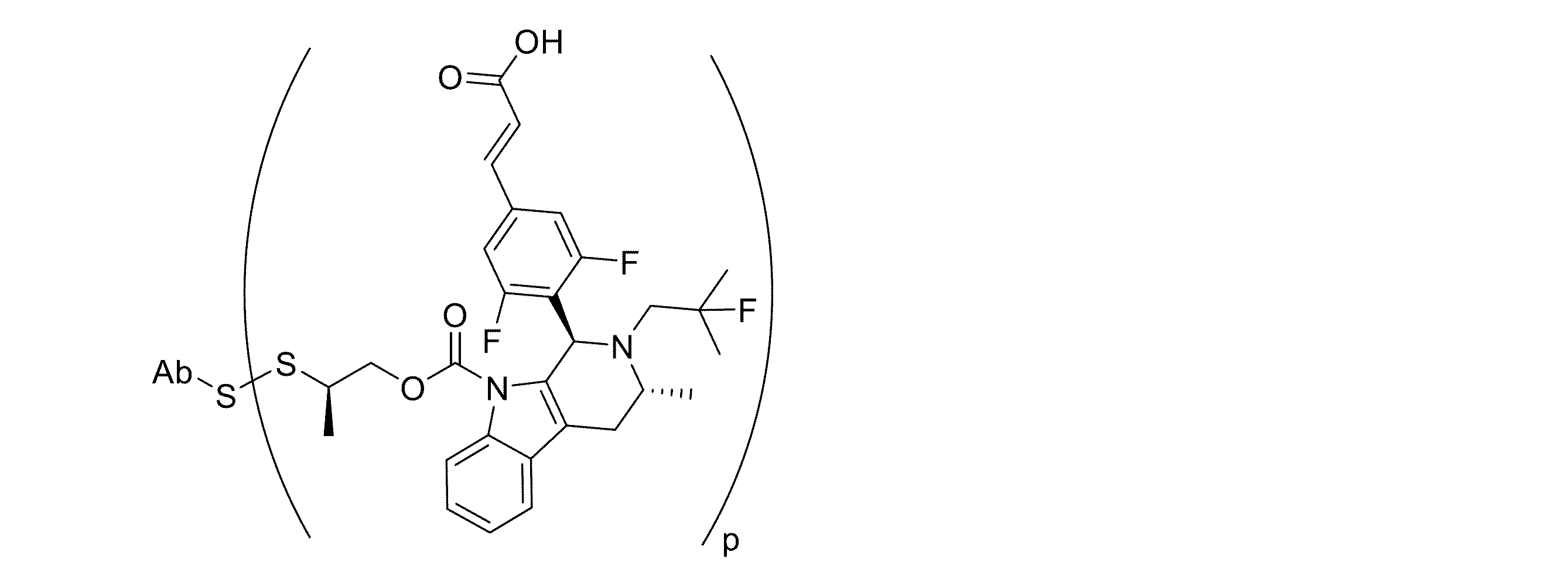
からなる群から選択される、請求項15に記載の抗体-薬物コンジュゲート。
The antibody-drug conjugate according to claim 15 , which is selected from the group consisting of.

を有する、請求項25に記載の抗体-薬物コンジュゲート。 Construction
25. The antibody-drug conjugate according to claim 25 .

を有する、請求項25に記載の抗体-薬物コンジュゲート。 Construction
25. The antibody-drug conjugate according to claim 25 .

R1、R2、R3、及びR4は、H、置換されていてもよい分岐もしくは直鎖C1-C5アルキル、及び置換されていてもよいC3-C6シクロアルキルからなる群から独立して選択され、又はR3とR4はそれらが結合する炭素原子と共にC3-C6シクロアルキル環を形成し、
前記置換されていてもよいアルキル又はシクロアルキルは、アルキル、シクロアルキル、アリール、ヘテロアリール、ヒドロキシル、ニトリル、ハロ、アルコキシ、ハロアルコキシ、アリールアルコキシ、アシルオキシ、アルキルチオ、スルホネート、アミノ、アルキルアミノ、アシルアミノ、カルバモイル、アルキルカルバモイル、又はニトロで置換されていてもよく;
Dは、

R5は、置換されていてもよいピリジン及びニトロピリジンからなる群から選択される]の化合物を調製するための方法であって、
i. 式V:


ii. 式VIの化合物を酸性条件下で脱保護して、式III:

を含む方法。 Equation III:
R 1 , R 2 , R 3 and R 4 are a group consisting of H, an optionally substituted branched or linear C 1 -C 5 alkyl, and an optionally substituted C 3 -C 6 cycloalkyl. Selected independently from , or R3 and R4 form a C3 - C6 cycloalkyl ring with the carbon atom to which they are attached.
The substituted alkyl or cycloalkyl may be alkyl, cycloalkyl, aryl, heteroaryl, hydroxyl, nitrile, halo, alkoxy, haloalkoxy, arylalkoxy, acyloxy, alkylthio, sulfonate, amino, alkylamino, acylamino, It may be substituted with carbamoyl, alkylcarbamoyl, or nitro;
D is
R5 is selected from the group consisting of optionally substituted pyridine and nitropyridine].
i. Equation V:
ii. The compound of formula VI is deprotected under acidic conditions to formula III:


Abは抗体であり;
R1、R2、R3、及びR4は、H、置換されていてもよい分岐もしくは直鎖C1-C5アルキル、及び置換されていてもよいC3-C6シクロアルキルからなる群から独立して選択され、又はR3とR4はそれらが結合する炭素原子と共にC3-C6シクロアルキル環を形成し、
前記置換されていてもよいアルキル又はシクロアルキルは、アルキル、シクロアルキル、アリール、ヘテロアリール、ヒドロキシル、ニトリル、ハロ、アルコキシ、ハロアルコキシ、アリールアルコキシ、アシルオキシ、アルキルチオ、スルホネート、アミノ、アルキルアミノ、アシルアミノ、カルバモイル、アルキルカルバモイル、又はニトロで置換されていてもよく;
Dは、

pは1、2、3、4、5、6、7、8、9、又は10である]
の抗体-薬物コンジュゲート又はその薬学的に許容可能な塩を調製するための方法であって、
i. 式V:


ii. 式VIの化合物を酸性条件下でジスルフィドR5-S-S-R5と接触させて、式III:

の化合物を調製する工程;及び
iii. 式IIIの化合物を抗体と接触させて、式IVの抗体-薬物コンジュゲートを調製する工程
を含む、方法。 Equation IV:
Ab is an antibody;
R 1 , R 2 , R 3 and R 4 are a group consisting of H, an optionally substituted branched or linear C 1 -C 5 alkyl, and an optionally substituted C 3 -C 6 cycloalkyl. Selected independently from , or R3 and R4 form a C3 - C6 cycloalkyl ring with the carbon atom to which they are attached.
The substituted alkyl or cycloalkyl may be alkyl, cycloalkyl, aryl, heteroaryl, hydroxyl, nitrile, halo, alkoxy, haloalkoxy, arylalkoxy, acyloxy, alkylthio, sulfonate, amino, alkylamino, acylamino, It may be substituted with carbamoyl, alkylcarbamoyl, or nitro;
D is
Antibodies-A method for preparing a drug conjugate or a pharmaceutically acceptable salt thereof.
i. Equation V:
ii. The compound of formula VI is contacted with the disulfide R5 - SSR5 under acidic conditions to formulate III :.
Steps of preparing the compounds of; and iii. A method comprising contacting a compound of formula III with an antibody to prepare an antibody-drug conjugate of formula IV.
Applications Claiming Priority (3)
| Application Number | Priority Date | Filing Date | Title |
|---|---|---|---|
| US201662404514P | 2016-10-05 | 2016-10-05 | |
| US62/404,514 | 2016-10-05 | ||
| PCT/EP2017/075272 WO2018065501A1 (en) | 2016-10-05 | 2017-10-04 | Methods for preparing antibody drug conjugates |
Publications (2)
| Publication Number | Publication Date |
|---|---|
| JP2019537558A JP2019537558A (en) | 2019-12-26 |
| JP7050770B2 true JP7050770B2 (en) | 2022-04-08 |
Family
ID=60143682
Family Applications (1)
| Application Number | Title | Priority Date | Filing Date |
|---|---|---|---|
| JP2019517907A Active JP7050770B2 (en) | 2016-10-05 | 2017-10-04 | Method for preparing antibody drug conjugate |
Country Status (5)
| Country | Link |
|---|---|
| US (2) | US11547762B2 (en) |
| EP (1) | EP3522933B1 (en) |
| JP (1) | JP7050770B2 (en) |
| CN (1) | CN110139674B (en) |
| WO (1) | WO2018065501A1 (en) |
Families Citing this family (9)
| Publication number | Priority date | Publication date | Assignee | Title |
|---|---|---|---|---|
| WO2017172957A1 (en) | 2016-04-01 | 2017-10-05 | Kalyra Pharmaceuticals, Inc. | Estrogen receptor modulators |
| JP7050770B2 (en) | 2016-10-05 | 2022-04-08 | エフ・ホフマン-ラ・ロシュ・アクチェンゲゼルシャフト | Method for preparing antibody drug conjugate |
| KR20210021493A (en) * | 2018-06-04 | 2021-02-26 | 프레시전 인코포레이티드 | MUC16 specific chimeric antigen receptor and uses thereof |
| AU2020288275A1 (en) * | 2019-06-06 | 2022-02-03 | Jiangsu Hansoh Pharmaceutical Group Co., Ltd. | Anti-B7-H4 antibody–drug conjugate and medicinal use thereof |
| GB201909103D0 (en) * | 2019-06-25 | 2019-08-07 | Univ Bath | Compounds |
| AU2020326691A1 (en) | 2019-08-06 | 2022-03-03 | Recurium Ip Holdings, Llc | Estrogen receptor modulators for treating mutants |
| CA3163860A1 (en) * | 2020-01-06 | 2021-07-15 | Siew Schleyer | Auristatin-related compounds, conjugated auristatin-related compounds, and methods of use thereof |
| CN114075285B (en) * | 2020-08-20 | 2023-05-30 | 瑞阳(苏州)生物科技有限公司 | Humanized monoclonal antibody against human CD38 and application thereof |
| JP2024515342A (en) * | 2021-04-26 | 2024-04-09 | 江▲蘇▼恒瑞医▲薬▼股▲フン▼有限公司 | Anti-Nectin-4 antibody and anti-Nectin-4 antibody-drug conjugate and medical uses thereof |
Citations (2)
| Publication number | Priority date | Publication date | Assignee | Title |
|---|---|---|---|---|
| WO2016040724A1 (en) | 2014-09-12 | 2016-03-17 | Genentech, Inc. | Anti-b7-h4 antibodies and immunoconjugates |
| WO2016044560A1 (en) | 2014-09-17 | 2016-03-24 | Genentech, Inc. | Pyrrolobenzodiazepines and antibody disulfide conjugates thereof |
Family Cites Families (335)
| Publication number | Priority date | Publication date | Assignee | Title |
|---|---|---|---|---|
| US798959A (en) | 1904-12-19 | 1905-09-05 | George W Goss | Corn-husker. |
| US4816567A (en) | 1983-04-08 | 1989-03-28 | Genentech, Inc. | Recombinant immunoglobin preparations |
| JPS6098584A (en) | 1983-11-02 | 1985-06-01 | Canon Inc | Camera - Body shape VTR |
| US5807715A (en) | 1984-08-27 | 1998-09-15 | The Board Of Trustees Of The Leland Stanford Junior University | Methods and transformed mammalian lymphocyte cells for producing functional antigen-binding protein including chimeric immunoglobulin |
| US4676980A (en) | 1985-09-23 | 1987-06-30 | The United States Of America As Represented By The Secretary Of The Department Of Health And Human Services | Target specific cross-linked heteroantibodies |
| US6548640B1 (en) | 1986-03-27 | 2003-04-15 | Btg International Limited | Altered antibodies |
| IL85035A0 (en) | 1987-01-08 | 1988-06-30 | Int Genetic Eng | Polynucleotide molecule,a chimeric antibody with specificity for human b cell surface antigen,a process for the preparation and methods utilizing the same |
| WO1988007089A1 (en) | 1987-03-18 | 1988-09-22 | Medical Research Council | Altered antibodies |
| WO1990005144A1 (en) | 1988-11-11 | 1990-05-17 | Medical Research Council | Single domain ligands, receptors comprising said ligands, methods for their production, and use of said ligands and receptors |
| DE3920358A1 (en) | 1989-06-22 | 1991-01-17 | Behringwerke Ag | BISPECIFIC AND OLIGO-SPECIFIC, MONO- AND OLIGOVALENT ANTI-BODY CONSTRUCTS, THEIR PRODUCTION AND USE |
| CA2023779A1 (en) | 1989-08-23 | 1991-02-24 | Margaret D. Moore | Compositions and methods for detection and treatment of epstein-barr virus infection and immune disorders |
| US5208020A (en) | 1989-10-25 | 1993-05-04 | Immunogen Inc. | Cytotoxic agents comprising maytansinoids and their therapeutic use |
| US5959177A (en) | 1989-10-27 | 1999-09-28 | The Scripps Research Institute | Transgenic plants expressing assembled secretory antibodies |
| US6150584A (en) | 1990-01-12 | 2000-11-21 | Abgenix, Inc. | Human antibodies derived from immunized xenomice |
| US6075181A (en) | 1990-01-12 | 2000-06-13 | Abgenix, Inc. | Human antibodies derived from immunized xenomice |
| US5256643A (en) | 1990-05-29 | 1993-10-26 | The Government Of The United States | Human cripto protein |
| US5770429A (en) | 1990-08-29 | 1998-06-23 | Genpharm International, Inc. | Transgenic non-human animals capable of producing heterologous antibodies |
| AU9016591A (en) | 1990-10-25 | 1992-05-26 | Tanox Biosystems, Inc. | Glycoproteins associated with membrane-bound immunoglobulins as antibody targets on B cells |
| DE69129154T2 (en) | 1990-12-03 | 1998-08-20 | Genentech, Inc., South San Francisco, Calif. | METHOD FOR ENRICHING PROTEIN VARIANTS WITH CHANGED BINDING PROPERTIES |
| US5571894A (en) | 1991-02-05 | 1996-11-05 | Ciba-Geigy Corporation | Recombinant antibodies specific for a growth factor receptor |
| WO1992017497A1 (en) | 1991-03-29 | 1992-10-15 | Genentech, Inc. | Human pf4a receptors and their use |
| US5440021A (en) | 1991-03-29 | 1995-08-08 | Chuntharapai; Anan | Antibodies to human IL-8 type B receptor |
| US5543503A (en) | 1991-03-29 | 1996-08-06 | Genentech Inc. | Antibodies to human IL-8 type A receptor |
| JP4124480B2 (en) | 1991-06-14 | 2008-07-23 | ジェネンテック・インコーポレーテッド | Immunoglobulin variants |
| GB9114948D0 (en) | 1991-07-11 | 1991-08-28 | Pfizer Ltd | Process for preparing sertraline intermediates |
| JP3050424B2 (en) | 1991-07-12 | 2000-06-12 | 塩野義製薬株式会社 | Human endothelin receptor |
| US5264557A (en) | 1991-08-23 | 1993-11-23 | The United States Of America As Represented By The Department Of Health And Human Services | Polypeptide of a human cripto-related gene, CR-3 |
| WO1993006217A1 (en) | 1991-09-19 | 1993-04-01 | Genentech, Inc. | EXPRESSION IN E. COLI OF ANTIBODY FRAGMENTS HAVING AT LEAST A CYSTEINE PRESENT AS A FREE THIOL, USE FOR THE PRODUCTION OF BIFUNCTIONAL F(ab')2 ANTIBODIES |
| FI941572L (en) | 1991-10-07 | 1994-05-27 | Oncologix Inc | Combination and method of use of anti-erbB-2 monoclonal antibodies |
| WO1993008829A1 (en) | 1991-11-04 | 1993-05-13 | The Regents Of The University Of California | Compositions that mediate killing of hiv-infected cells |
| US6153408A (en) | 1991-11-15 | 2000-11-28 | Institut Pasteur And Institut National De La Sante Et De La Recherche Medicale | Altered major histocompatibility complex (MHC) determinant and methods of using the determinant |
| US6011146A (en) | 1991-11-15 | 2000-01-04 | Institut Pasteur | Altered major histocompatibility complex (MHC) determinant and methods of using the determinant |
| ATE503496T1 (en) | 1992-02-06 | 2011-04-15 | Novartis Vaccines & Diagnostic | BIOSYNTHETIC BINDING PROTEIN FOR TUMOR MARKERS |
| IL107366A (en) | 1992-10-23 | 2003-03-12 | Chugai Pharmaceutical Co Ltd | Genes coding for megakaryocyte potentiator |
| US5644033A (en) | 1992-12-22 | 1997-07-01 | Health Research, Inc. | Monoclonal antibodies that define a unique antigen of human B cell antigen receptor complex and methods of using same for diagnosis and treatment |
| US5801005A (en) | 1993-03-17 | 1998-09-01 | University Of Washington | Immune reactivity to HER-2/neu protein for diagnosis of malignancies in which the HER-2/neu oncogene is associated |
| US5869445A (en) | 1993-03-17 | 1999-02-09 | University Of Washington | Methods for eliciting or enhancing reactivity to HER-2/neu protein |
| US6214345B1 (en) | 1993-05-14 | 2001-04-10 | Bristol-Myers Squibb Co. | Lysosomal enzyme-cleavable antitumor drug conjugates |
| CA2163345A1 (en) | 1993-06-16 | 1994-12-22 | Susan Adrienne Morgan | Antibodies |
| US5773223A (en) | 1993-09-02 | 1998-06-30 | Chiron Corporation | Endothelin B1, (ETB1) receptor polypeptide and its encoding nucleic acid methods, and uses thereof |
| US5750370A (en) | 1995-06-06 | 1998-05-12 | Human Genome Sciences, Inc. | Nucleic acid encoding human endothlein-bombesin receptor and method of producing the receptor |
| US5789199A (en) | 1994-11-03 | 1998-08-04 | Genentech, Inc. | Process for bacterial production of polypeptides |
| US5731168A (en) | 1995-03-01 | 1998-03-24 | Genentech, Inc. | Method for making heteromultimeric polypeptides |
| US5840523A (en) | 1995-03-01 | 1998-11-24 | Genetech, Inc. | Methods and compositions for secretion of heterologous polypeptides |
| US5869046A (en) | 1995-04-14 | 1999-02-09 | Genentech, Inc. | Altered polypeptides with increased half-life |
| US5707829A (en) | 1995-08-11 | 1998-01-13 | Genetics Institute, Inc. | DNA sequences and secreted proteins encoded thereby |
| US20020193567A1 (en) | 1995-08-11 | 2002-12-19 | Genetics Institute, Inc. | Secreted proteins and polynucleotides encoding them |
| GB9603256D0 (en) | 1996-02-16 | 1996-04-17 | Wellcome Found | Antibodies |
| JP3646191B2 (en) | 1996-03-19 | 2005-05-11 | 大塚製薬株式会社 | Human gene |
| NZ332598A (en) | 1996-05-17 | 2000-04-28 | Schering Corp | Human BAS-1 protein, and use as an antagonist for modulating physiology or development of a cell |
| US5945511A (en) | 1997-02-20 | 1999-08-31 | Zymogenetics, Inc. | Class II cytokine receptor |
| US20030185830A1 (en) | 1997-02-25 | 2003-10-02 | Corixa Corporation | Compositions and methods for the therapy and diagnosis of prostate cancer |
| US7033827B2 (en) | 1997-02-25 | 2006-04-25 | Corixa Corporation | Prostate-specific polynucleotide compositions |
| US6261791B1 (en) | 1997-03-10 | 2001-07-17 | The Regents Of The University Of California | Method for diagnosing cancer using specific PSCA antibodies |
| US6541212B2 (en) | 1997-03-10 | 2003-04-01 | The Regents Of The University Of California | Methods for detecting prostate stem cell antigen protein |
| AU739407C (en) | 1997-03-10 | 2002-08-08 | Regents Of The University Of California, The | PSCA: prostate stem cell antigen |
| US6555339B1 (en) | 1997-04-14 | 2003-04-29 | Arena Pharmaceuticals, Inc. | Non-endogenous, constitutively activated human protein-coupled receptors |
| US6319688B1 (en) | 1997-04-28 | 2001-11-20 | Smithkline Beecham Corporation | Polynucleotide encoding human sodium dependent phosphate transporter (IPT-1) |
| IL132560A0 (en) | 1997-05-02 | 2001-03-19 | Genentech Inc | A method for making multispecific antibodies having heteromultimeric and common components |
| US6890749B2 (en) | 1997-05-15 | 2005-05-10 | Abbott Laboratories | Reagents and methods useful for detecting diseases of the prostate |
| WO1998051824A1 (en) | 1997-05-15 | 1998-11-19 | Abbott Laboratories | Reagents and methods useful for detecting disease of the urinary tract |
| ES2244066T3 (en) | 1997-06-24 | 2005-12-01 | Genentech, Inc. | PROCEDURE AND COMPOSITIONS OF GALACTOSILATED GLICOPROTEINS. |
| US6040498A (en) | 1998-08-11 | 2000-03-21 | North Caroline State University | Genetically engineered duckweed |
| US20030060612A1 (en) | 1997-10-28 | 2003-03-27 | Genentech, Inc. | Compositions and methods for the diagnosis and treatment of tumor |
| WO1999022764A1 (en) | 1997-10-31 | 1999-05-14 | Genentech, Inc. | Methods and compositions comprising glycoprotein glycoforms |
| US20020034749A1 (en) | 1997-11-18 | 2002-03-21 | Billing-Medel Patricia A. | Reagents and methods useful for detecting diseases of the breast |
| US6610833B1 (en) | 1997-11-24 | 2003-08-26 | The Institute For Human Genetics And Biochemistry | Monoclonal human natural antibodies |
| US6110695A (en) | 1997-12-02 | 2000-08-29 | The Regents Of The University Of California | Modulating the interaction of the chemokine, B Lymphocyte Hemoattractant, and its Receptor, BLR1 |
| WO1999029888A1 (en) | 1997-12-05 | 1999-06-17 | The Scripps Research Institute | Humanization of murine antibody |
| ES2313779T3 (en) | 1998-03-13 | 2009-03-01 | The Burnham Institute | MOLECULES THAT MIGRATE DIFFERENT ORGANS OR SELECTED FABRICS. |
| US6194551B1 (en) | 1998-04-02 | 2001-02-27 | Genentech, Inc. | Polypeptide variants |
| ATE375365T1 (en) | 1998-04-02 | 2007-10-15 | Genentech Inc | ANTIBODIES VARIANTS AND FRAGMENTS THEREOF |
| PT1071700E (en) | 1998-04-20 | 2010-04-23 | Glycart Biotechnology Ag | Glycosylation engineering of antibodies for improving antibody-dependent cellular cytotoxicity |
| WO1999058658A2 (en) | 1998-05-13 | 1999-11-18 | Epimmune, Inc. | Expression vectors for stimulating an immune response and methods of using the same |
| US20020187472A1 (en) | 2001-03-09 | 2002-12-12 | Preeti Lal | Steap-related protein |
| US20030064397A1 (en) | 1998-05-22 | 2003-04-03 | Incyte Genomics, Inc. | Transmembrane protein differentially expressed in prostate and lung tumors |
| WO2002016429A2 (en) | 2000-08-24 | 2002-02-28 | Genentech, Inc. | Compositions and methods for the diagnosis and treatment of tumor |
| WO2000012130A1 (en) | 1998-08-27 | 2000-03-09 | Smithkline Beecham Corporation | Rp105 agonists and antagonists |
| JP4689781B2 (en) | 1998-09-03 | 2011-05-25 | 独立行政法人科学技術振興機構 | Amino acid transport protein and its gene |
| AU5963699A (en) | 1998-10-02 | 2000-04-26 | Mcmaster University | Spliced form of (erb)b-2/neu oncogene |
| US20030091580A1 (en) | 2001-06-18 | 2003-05-15 | Mitcham Jennifer L. | Compositions and methods for the therapy and diagnosis of ovarian cancer |
| US20020119158A1 (en) | 1998-12-17 | 2002-08-29 | Corixa Corporation | Compositions and methods for the therapy and diagnosis of ovarian cancer |
| US6858710B2 (en) | 1998-12-17 | 2005-02-22 | Corixa Corporation | Compositions and methods for the therapy and diagnosis of ovarian cancer |
| US6468546B1 (en) | 1998-12-17 | 2002-10-22 | Corixa Corporation | Compositions and methods for therapy and diagnosis of ovarian cancer |
| US6962980B2 (en) | 1999-09-24 | 2005-11-08 | Corixa Corporation | Compositions and methods for the therapy and diagnosis of ovarian cancer |
| HK1041009B (en) | 1998-12-30 | 2009-05-08 | Beth Israel Deaconess Medical Center, Inc. | Characterization of the soc/crac calcium channel protein family |
| US20030187196A1 (en) | 1998-12-30 | 2003-10-02 | Genentech, Inc. | Secreted and transmembrane polypeptides and nucleic acids encoding the same |
| EP1141024B1 (en) | 1999-01-15 | 2018-08-08 | Genentech, Inc. | POLYPEPTIDE COMPRISING A VARIANT HUMAN IgG1 Fc REGION |
| US6737056B1 (en) | 1999-01-15 | 2004-05-18 | Genentech, Inc. | Polypeptide variants with altered effector function |
| ES2348708T3 (en) | 1999-01-29 | 2010-12-13 | Corixa Corporation | FUSION PROTEINS OF HER-2 / NEU. |
| GB9905124D0 (en) | 1999-03-05 | 1999-04-28 | Smithkline Beecham Biolog | Novel compounds |
| AU3395900A (en) | 1999-03-12 | 2000-10-04 | Human Genome Sciences, Inc. | Human lung cancer associated gene sequences and polypeptides |
| ES2601882T5 (en) | 1999-04-09 | 2021-06-07 | Kyowa Kirin Co Ltd | Procedure to monitor the activity of an immunofunctional molecule |
| US7304126B2 (en) | 1999-05-11 | 2007-12-04 | Genentech, Inc. | Secreted and transmembrane polypeptides and nucleic acids encoding the same |
| AU4952600A (en) | 1999-06-03 | 2000-12-28 | Takeda Chemical Industries Ltd. | Screening method with the use of cd100 |
| US6949245B1 (en) | 1999-06-25 | 2005-09-27 | Genentech, Inc. | Humanized anti-ErbB2 antibodies and treatment with anti-ErbB2 antibodies |
| PT2283866E (en) | 1999-06-25 | 2015-07-20 | Genentech Inc | Methods of treatment using anti-erbb antibody-maytansinoid conjugates |
| US7589172B2 (en) | 1999-07-20 | 2009-09-15 | Genentech, Inc. | PRO256 polypeptides |
| US7297770B2 (en) | 1999-08-10 | 2007-11-20 | Genentech, Inc. | PRO6496 polypeptides |
| US7294696B2 (en) | 1999-08-17 | 2007-11-13 | Genentech Inc. | PRO7168 polypeptides |
| JP3951035B2 (en) | 1999-09-01 | 2007-08-01 | ジェネンテック・インコーポレーテッド | Secreted and transmembrane polypeptides and nucleic acids encoding them |
| US20030206918A1 (en) | 1999-09-10 | 2003-11-06 | Corixa Corporation | Compositions and methods for the therapy and diagnosis of ovarian cancer |
| US20030232056A1 (en) | 1999-09-10 | 2003-12-18 | Corixa Corporation | Compositions and methods for the therapy and diagnosis of ovarian cancer |
| US20030129192A1 (en) | 1999-09-10 | 2003-07-10 | Corixa Corporation | Compositions and methods for the therapy and diagnosis of ovarian cancer |
| KR100797667B1 (en) | 1999-10-04 | 2008-01-23 | 메디카고 인코포레이티드 | How to regulate transcription of foreign genes |
| US7125978B1 (en) | 1999-10-04 | 2006-10-24 | Medicago Inc. | Promoter for regulating expression of foreign genes |
| CA2388245C (en) | 1999-10-19 | 2012-01-10 | Tatsuya Ogawa | The use of serum-free adapted rat cells for producing heterologous polypeptides |
| AU778199B2 (en) | 1999-10-29 | 2004-11-25 | Genentech Inc. | Anti-prostate stem cell antigen (PSCA) antibody compositions and methods of use |
| EP2363403B1 (en) | 1999-11-29 | 2016-04-20 | The Trustees of Columbia University in the City of New York | Isolation of five novel genes coding for new fc receptors-type melanoma involved in the pathogenesis of lymphoma/melanoma |
| CA2392510A1 (en) | 1999-11-30 | 2001-06-07 | Corixa Corporation | Compositions and methods for therapy and diagnosis of breast cancer |
| WO2001041787A1 (en) | 1999-12-10 | 2001-06-14 | Epimmune Inc. | INDUCING CELLULAR IMMUNE RESPONSES TO HER2/neu USING PEPTIDE AND NUCLEIC ACID COMPOSITIONS |
| AU784983B2 (en) | 1999-12-15 | 2006-08-17 | Genentech Inc. | Shotgun scanning, a combinatorial method for mapping functional protein epitopes |
| EP1743648B1 (en) | 1999-12-23 | 2010-03-03 | ZymoGenetics, Inc. | Method for treating inflammation |
| NZ502058A (en) | 1999-12-23 | 2003-11-28 | Ovita Ltd | Isolated mutated nucleic acid molecule for regulation of ovulation rate |
| DE60040240D1 (en) | 1999-12-23 | 2008-10-23 | Zymogenetics Inc | SOLUBLE INTERLEUKIN-20 RECEPTOR |
| US6610286B2 (en) | 1999-12-23 | 2003-08-26 | Zymogenetics, Inc. | Method for treating inflammation using soluble receptors to interleukin-20 |
| US7294695B2 (en) | 2000-01-20 | 2007-11-13 | Genentech, Inc. | PRO10268 polypeptides |
| AU2001234493A1 (en) | 2000-01-21 | 2001-07-31 | Corixa Corporation | Compounds and methods for prevention and treatment of her-2/neu associated malignancies |
| US20030224379A1 (en) | 2000-01-21 | 2003-12-04 | Tang Y. Tom | Novel nucleic acids and polypeptides |
| AU2001243142A1 (en) | 2000-02-03 | 2001-08-14 | Hyseq, Inc. | Novel nucleic acids and polypeptides |
| US20030104562A1 (en) | 2000-02-11 | 2003-06-05 | Genentech, Inc. | Secreted and transmembrane polypeptides and nucleic acids encoding the same |
| WO2001062794A2 (en) | 2000-02-22 | 2001-08-30 | Millennium Pharmaceuticals, Inc. | 18607, a human calcium channel |
| US20030219806A1 (en) | 2000-02-22 | 2003-11-27 | Millennium Pharmaceuticals, Inc. | Novel 18607, 15603, 69318, 12303, 48000, 52920, 5433, 38554, 57301, 58324, 55063, 52991, 59914, 59921 and 33751 molecules and uses therefor |
| US20040002068A1 (en) | 2000-03-01 | 2004-01-01 | Corixa Corporation | Compositions and methods for the detection, diagnosis and therapy of hematological malignancies |
| US20040005561A1 (en) | 2000-03-01 | 2004-01-08 | Corixa Corporation | Compositions and methods for the detection, diagnosis and therapy of hematological malignancies |
| CA2402293A1 (en) | 2000-03-07 | 2001-09-13 | Hyseq, Inc. | Novel nucleic acids and polypeptides |
| AU4941101A (en) | 2000-03-24 | 2001-10-08 | Fahri Saatcioglu | Novel prostate-specific or testis-specific nucleic acid molecules, polypeptides,and diagnostic and therapeutic methods |
| WO2001072830A2 (en) | 2000-03-31 | 2001-10-04 | Ipf Pharmaceuticals Gmbh | Diagnostic and medicament for analysing the cell surface proteome of tumour and inflammatory cells and for treating tumorous and inflammatory diseases, preferably using a specific chemokine receptor analysis and the chemokine receptor-ligand interaction |
| AU2001253140A1 (en) | 2000-04-03 | 2001-10-15 | The Government Of The United States Of America, As Represented By The Secretary Of The Department Of Health And Human Services | Tumor markers in ovarian cancer |
| IL152136A0 (en) | 2000-04-07 | 2003-05-29 | Arena Pharm Inc | Non-endogenous, constitutively activated known g protein-coupled receptors |
| DK2857516T3 (en) | 2000-04-11 | 2017-08-07 | Genentech Inc | Multivalent antibodies and uses thereof |
| AU2001263105A1 (en) | 2000-05-18 | 2001-11-26 | Lexicon Genetics Incorporated | Human semaphorin homologs and polynucleotides encoding the same |
| WO2001090304A2 (en) | 2000-05-19 | 2001-11-29 | Human Genome Sciences, Inc. | Nucleic acids, proteins, and antibodies |
| WO2001094641A2 (en) | 2000-06-09 | 2001-12-13 | Idec Pharmaceuticals Corporation | Gene targets and ligands that bind thereto for treatment and diagnosis of ovarian carcinomas |
| CA2409776A1 (en) | 2000-06-16 | 2001-12-27 | Incyte Genomics, Inc. | G-protein coupled receptors |
| US20020165347A1 (en) | 2000-06-30 | 2002-11-07 | Amgen, Inc. | B7-like molecules and uses thereof |
| JP2004528003A (en) | 2000-06-30 | 2004-09-16 | インサイト・ゲノミックス・インコーポレイテッド | Extracellular matrix and cell adhesion molecules |
| AU2001271714A1 (en) | 2000-06-30 | 2002-01-14 | Human Genome Sciences, Inc. | B7-like polynucleotides, polypeptides, and antibodies |
| AU2002214531A1 (en) | 2000-07-03 | 2002-01-30 | Curagen Corporation | Proteins and nucleic acids encoding same |
| US20040044179A1 (en) | 2000-07-25 | 2004-03-04 | Genentech, Inc. | Secreted and transmembrane polypeptides and nucleic acids encoding the same |
| AU2001283507A1 (en) | 2000-07-27 | 2002-02-13 | Mayo Foundation For Medical Education And Research | B7-h3 and b7-h4, novel immunoregulatory molecules |
| EP1366158B1 (en) | 2000-07-28 | 2008-05-21 | Ulrich Wissenbach | Trp8 markers for cancer |
| US7229623B1 (en) | 2000-08-03 | 2007-06-12 | Corixa Corporation | Her-2/neu fusion proteins |
| AU2001283360A1 (en) | 2000-08-14 | 2002-02-25 | Corixa Corporation | Methods for diagnosis and therapy of hematological and virus-associated malignancies |
| JP2004522412A (en) | 2000-08-14 | 2004-07-29 | コリクサ コーポレイション | Compositions and methods for the treatment and diagnosis of HER-2 / NEU-related malignancies |
| GB0020953D0 (en) | 2000-08-24 | 2000-10-11 | Smithkline Beecham Biolog | Vaccine |
| EP1346040A2 (en) | 2000-09-11 | 2003-09-24 | Nuvelo, Inc. | Novel nucleic acids and polypeptides |
| US7582293B2 (en) | 2000-09-15 | 2009-09-01 | Genentech, Inc. | Anti-PRO6308 antibodies |
| ATE333888T1 (en) | 2000-09-15 | 2006-08-15 | Zymogenetics Inc | USE OF A POLYPEPTIDE CONTAINING THE EXTRACELLULAR DOMAIN OF IL-20RA AND IL-20RB FOR THE TREATMENT OF INFLAMMATION |
| US6613567B1 (en) | 2000-09-15 | 2003-09-02 | Isis Pharmaceuticals, Inc. | Antisense inhibition of Her-2 expression |
| CA2422814A1 (en) | 2000-09-18 | 2002-03-21 | Biogen, Inc. | Cripto mutant and uses thereof |
| UA83458C2 (en) | 2000-09-18 | 2008-07-25 | Байоджен Айдек Ма Інк. | The isolated polypeptide baff-r (the receptor of the factor of activation of b-cells of the family tnf) |
| HU231090B1 (en) | 2000-10-06 | 2020-07-28 | Kyowa Kirin Co., Ltd. | Cells producing antibody compositions |
| US6946292B2 (en) | 2000-10-06 | 2005-09-20 | Kyowa Hakko Kogyo Co., Ltd. | Cells producing antibody compositions with increased antibody dependent cytotoxic activity |
| US7064191B2 (en) | 2000-10-06 | 2006-06-20 | Kyowa Hakko Kogyo Co., Ltd. | Process for purifying antibody |
| AU2002215345A1 (en) | 2000-10-13 | 2002-04-22 | Eos Biotechnology, Inc. | Methods of diagnosis of prostate cancer, compositions and methods of screening for modulators of prostate cancer |
| US6596541B2 (en) | 2000-10-31 | 2003-07-22 | Regeneron Pharmaceuticals, Inc. | Methods of modifying eukaryotic cells |
| ATE432986T1 (en) | 2000-11-07 | 2009-06-15 | Zymogenetics Inc | HUMAN RECEPTOR FOR TUMOR NECROSIS FACTOR |
| US20020150573A1 (en) | 2000-11-10 | 2002-10-17 | The Rockefeller University | Anti-Igalpha-Igbeta antibody for lymphoma therapy |
| EP1916303B1 (en) | 2000-11-30 | 2013-02-27 | Medarex, Inc. | Nucleic acids encoding rearranged human immunoglobulin sequences from transgenic transchromosomal mice |
| WO2002061087A2 (en) | 2000-12-19 | 2002-08-08 | Lifespan Biosciences, Inc. | Antigenic peptides, such as for g protein-coupled receptors (gpcrs), antibodies thereto, and systems for identifying such antigenic peptides |
| AU2002243495A1 (en) | 2001-01-12 | 2002-07-24 | University Of Medicine And Dentistry Of New Jersey | Bone morphogenetic protein-2 in the treatment and diagnosis of cancer |
| US20030119133A1 (en) | 2001-01-16 | 2003-06-26 | Genentech, Inc. | Secreted and transmembrane polypeptides and nucleic acids encoding the same |
| US20030119125A1 (en) | 2001-01-16 | 2003-06-26 | Genentech, Inc. | Secreted and transmembrane polypeptides and nucleic acids encoding the same |
| US7754208B2 (en) | 2001-01-17 | 2010-07-13 | Trubion Pharmaceuticals, Inc. | Binding domain-immunoglobulin fusion proteins |
| WO2002059377A2 (en) | 2001-01-24 | 2002-08-01 | Protein Design Labs | Methods of diagnosis of breast cancer, compositions and methods of screening for modulators of breast cancer |
| AU2002251841A1 (en) | 2001-01-30 | 2002-08-12 | Corixa Corporation | Compositions and methods for the therapy and diagnosis of pancreatic cancer |
| WO2002064775A1 (en) | 2001-02-12 | 2002-08-22 | Bionomics Limited | Identification of genes involved in the tumourigenic process |
| US20030087250A1 (en) | 2001-03-14 | 2003-05-08 | Millennium Pharmaceuticals, Inc. | Nucleic acid molecules and proteins for the identification, assessment, prevention, and therapy of ovarian cancer |
| US20040236091A1 (en) | 2001-03-28 | 2004-11-25 | Chicz Roman M. | Translational profiling |
| WO2003008537A2 (en) | 2001-04-06 | 2003-01-30 | Mannkind Corporation | Epitope sequences |
| US6820011B2 (en) | 2001-04-11 | 2004-11-16 | The Regents Of The University Of Colorado | Three-dimensional structure of complement receptor type 2 and uses thereof |
| AU2002254615A1 (en) | 2001-04-17 | 2002-10-28 | The Board Of Trustees Of The University Of Arkansas | Repeat sequences of the ca125 gene and their use for diagnostic and therapeutic interventions |
| JP2005527180A (en) | 2001-04-18 | 2005-09-15 | プロテイン デザイン ラブス, インコーポレイテッド | Lung cancer diagnosis method, composition of lung cancer modifier and screening method |
| HUP0501113A3 (en) | 2001-04-26 | 2007-12-28 | Biogen Idec Inc | Cripto blocking antibodies and uses thereof |
| JP2005504513A (en) | 2001-05-09 | 2005-02-17 | コリクサ コーポレイション | Compositions and methods for treatment and diagnosis of prostate cancer |
| WO2002092836A2 (en) | 2001-05-11 | 2002-11-21 | Sloan-Kettering Institute For Cancer Research | Nucleic acid sequence encoding ovarian antigen, ca125, and uses thereof |
| ATE446771T1 (en) | 2001-05-24 | 2009-11-15 | Zymogenetics Inc | TACI-IMMUNOGLOBULIN FUSION PROTEINS |
| US7157558B2 (en) | 2001-06-01 | 2007-01-02 | Genentech, Inc. | Polypeptide encoded by a polynucleotide overexpresses in tumors |
| AU2002314901A1 (en) | 2001-06-04 | 2002-12-16 | Eos Biotechnology, Inc. | Methods of diagnosis and treatment of androgen-dependent prostate cancer, prostate cancer undergoing androgen-withdrawal, and androgen-independent prostate cancer |
| WO2003000842A2 (en) | 2001-06-04 | 2003-01-03 | Curagen Corporation | Novel proteins and nucleic acids encoding same |
| WO2002099140A1 (en) | 2001-06-05 | 2002-12-12 | Exelixis, Inc. | GLRAs AS MODIFIERS OF THE p53 PATHWAY AND METHODS OF USE |
| EP1572872A2 (en) | 2001-06-05 | 2005-09-14 | Exelixis, Inc. | Igs as modifiers of the p53 pathway and methods of use |
| US7235358B2 (en) | 2001-06-08 | 2007-06-26 | Expression Diagnostics, Inc. | Methods and compositions for diagnosing and monitoring transplant rejection |
| US7125663B2 (en) | 2001-06-13 | 2006-10-24 | Millenium Pharmaceuticals, Inc. | Genes, compositions, kits and methods for identification, assessment, prevention, and therapy of cervical cancer |
| US7189507B2 (en) | 2001-06-18 | 2007-03-13 | Pdl Biopharma, Inc. | Methods of diagnosis of ovarian cancer, compositions and methods of screening for modulators of ovarian cancer |
| CA2451465A1 (en) | 2001-06-18 | 2002-12-27 | Eos Biotechnology Inc. | Methods of diagnosis of ovarian cancer, compositions and methods of screening for modulators of ovarian cancer |
| US7705120B2 (en) | 2001-06-21 | 2010-04-27 | Millennium Pharmaceuticals, Inc. | Compositions, kits, and methods for identification, assessment, prevention, and therapy of breast cancer |
| US20030108958A1 (en) | 2001-06-28 | 2003-06-12 | Rene De Waal Malefyt | Biological activity of AK155 |
| AU2002314433A1 (en) | 2001-07-02 | 2003-01-21 | Licentia Ltd. | Ephrin-tie receptor materials and methods |
| US20040076955A1 (en) | 2001-07-03 | 2004-04-22 | Eos Biotechnology, Inc. | Methods of diagnosis of bladder cancer, compositions and methods of screening for modulators of bladder cancer |
| WO2003003984A2 (en) | 2001-07-05 | 2003-01-16 | Curagen Corporation | Novel proteins and nucleic acids encoding same |
| US7446185B2 (en) | 2001-07-18 | 2008-11-04 | The Regents Of The University Of California | Her2/neu target antigen and use of same to stimulate an immune response |
| US20030108963A1 (en) | 2001-07-25 | 2003-06-12 | Millennium Pharmaceuticals, Inc. | Novel genes, compositions, kit, and methods for identification, assessment, prevention and therapy of prostate cancer |
| EP1423510A4 (en) | 2001-08-03 | 2005-06-01 | Glycart Biotechnology Ag | ANTIBODY GLYCOSYLATION VARIANTS WITH INCREASED CELL CYTOTOXICITY DEPENDENT OF ANTIBODIES |
| EA007984B1 (en) | 2001-08-03 | 2007-02-27 | Дженентек, Инк. | TACIs AND BR3 POLYPEPTIDES AND USE THEREOF |
| WO2003016475A2 (en) | 2001-08-14 | 2003-02-27 | The General Hospital Corporation | Nucleic acid and amino acid sequences involved in pain |
| US20030092013A1 (en) | 2001-08-16 | 2003-05-15 | Vitivity, Inc. | Diagnosis and treatment of vascular disease |
| AU2002313559A1 (en) | 2001-08-23 | 2003-03-10 | Oxford Biomedica (Uk) Limited | Genes |
| WO2003029262A2 (en) | 2001-08-29 | 2003-04-10 | Vanderbilt University | The human mob-5 (il-24) receptors and uses thereof |
| US20030124579A1 (en) | 2001-09-05 | 2003-07-03 | Eos Biotechnology, Inc. | Methods of diagnosis of ovarian cancer, compositions and methods of screening for modulators of ovarian cancer |
| EP1429793B1 (en) | 2001-09-06 | 2015-02-25 | Agensys, Inc. | Nucleic acid and corresponding protein entitled steap-1 useful in treatment and detection of cancer |
| AU2002330039A1 (en) | 2001-09-17 | 2003-04-01 | Eos Biotechnology, Inc. | Methods of diagnosis of cancer compositions and methods of screening for modulators of cancer |
| EP2143438B1 (en) | 2001-09-18 | 2011-07-13 | Genentech, Inc. | Compositions and methods for the diagnosis and treatment of tumors |
| IL160933A0 (en) | 2001-09-18 | 2004-08-31 | Proteologics Inc | Methods and compositions for treating ?cap associated diseases |
| CA2460621A1 (en) | 2001-09-19 | 2003-03-27 | Nuvelo, Inc. | Novel nucleic acids and polypeptides |
| AU2002327792A1 (en) | 2001-09-28 | 2003-04-07 | Bing Yang | Diagnosis and treatment of diseases caused by mutations in cd72 |
| AU2002362436A1 (en) | 2001-10-03 | 2003-04-14 | Rigel Pharmaceuticals, Inc. | Modulators of lymphocyte activation and migration |
| WO2003029421A2 (en) | 2001-10-03 | 2003-04-10 | Origene Technologies, Inc. | Regulated breast cancer genes |
| US20050123925A1 (en) | 2002-11-15 | 2005-06-09 | Genentech, Inc. | Compositions and methods for the diagnosis and treatment of tumor |
| CA2675409A1 (en) | 2001-10-19 | 2003-05-01 | Genentech, Inc. | Compositions and methods for the diagnosis and treatment of inflammatory bowel disorders |
| US20040241703A1 (en) | 2002-08-19 | 2004-12-02 | Genentech, Inc. | Compositions and methods for the diagnosis and treatment of tumor |
| EP1525213B1 (en) | 2001-10-24 | 2012-06-27 | National Jewish Health | Three-dimensional structures of tall-1 and its cognate receptors and modified proteins and methods related thereto |
| HUP0600342A3 (en) | 2001-10-25 | 2011-03-28 | Genentech Inc | Glycoprotein compositions |
| US7405192B2 (en) | 2001-10-31 | 2008-07-29 | Alcon, Inc. | Bone morphogenic proteins (BMP), BMP receptors and BMP binding proteins and their use in the diagnosis and treatment of glaucoma |
| US20030232350A1 (en) | 2001-11-13 | 2003-12-18 | Eos Biotechnology, Inc. | Methods of diagnosis of cancer, compositions and methods of screening for modulators of cancer |
| WO2003042661A2 (en) | 2001-11-13 | 2003-05-22 | Protein Design Labs, Inc. | Methods of diagnosis of cancer, compositions and methods of screening for modulators of cancer |
| EP1448226A1 (en) | 2001-11-29 | 2004-08-25 | Genset S.A. | Agonists and antagonists of prolixin for the treatment of metabolic disorders |
| WO2003048202A2 (en) | 2001-12-03 | 2003-06-12 | Asahi Kasei Pharma Corporation | Nf-kappab activating genes |
| WO2003054152A2 (en) | 2001-12-10 | 2003-07-03 | Nuvelo, Inc. | Novel nucleic acids and polypeptides |
| US20040093621A1 (en) | 2001-12-25 | 2004-05-13 | Kyowa Hakko Kogyo Co., Ltd | Antibody composition which specifically binds to CD20 |
| US20030134790A1 (en) | 2002-01-11 | 2003-07-17 | University Of Medicine And Dentistry Of New Jersey | Bone Morphogenetic Protein-2 And Bone Morphogenetic Protein-4 In The Treatment And Diagnosis Of Cancer |
| US7452675B2 (en) | 2002-01-25 | 2008-11-18 | The Queen's Medical Center | Methods of screening for TRPM4b modulators |
| CN1646161A (en) | 2002-02-21 | 2005-07-27 | 杜克大学 | Agents and methods of treatment for autoimmune diseases |
| JP2005535290A (en) | 2002-02-22 | 2005-11-24 | ジェネンテック・インコーポレーテッド | Compositions and methods for the treatment of immune related diseases |
| WO2003074662A2 (en) | 2002-03-01 | 2003-09-12 | Exelixis, Inc. | SCDs AS MODIFIERS OF THE p53 PATHWAY AND METHODS OF USE |
| WO2003101400A2 (en) | 2002-06-04 | 2003-12-11 | Avalon Pharmaceuticals, Inc. | Cancer-linked gene as target for chemotherapy |
| EP2258712A3 (en) | 2002-03-15 | 2011-05-04 | Multicell Immunotherapeutics, Inc. | Compositions and Methods to Initiate or Enhance Antibody and Major-histocompatibility Class I or Class II-restricted T Cell Responses by Using Immunomodulatory, Non-coding RNA Motifs |
| CA2486490A1 (en) | 2002-03-19 | 2003-12-31 | Curagen Corporation | Therapeutic polypeptides, nucleic acids encoding same, and methods of use |
| EP1579186A4 (en) | 2002-03-21 | 2008-10-08 | Sunesis Pharmaceuticals Inc | IDENTIFICATION OF KINASE INHIBITORS |
| EP1494693B1 (en) | 2002-03-22 | 2010-12-08 | Biogen Idec MA Inc. | Cripto-specific antibodies |
| US7193069B2 (en) | 2002-03-22 | 2007-03-20 | Research Association For Biotechnology | Full-length cDNA |
| EP1490085A2 (en) | 2002-03-25 | 2004-12-29 | Uab Research Foundation | Fc receptor homolog, reagents, and uses thereof |
| WO2003083074A2 (en) | 2002-03-28 | 2003-10-09 | Idec Pharmaceuticals Corporation | Novel gene targets and ligands that bind thereto for treatment and diagnosis of colon carcinomas |
| US20030194704A1 (en) | 2002-04-03 | 2003-10-16 | Penn Sharron Gaynor | Human genome-derived single exon nucleic acid probes useful for gene expression analysis two |
| CA2481503A1 (en) | 2002-04-05 | 2003-10-23 | Agensys, Inc. | Nucleic acid and corresponding protein entitled 98p4b6 useful in treatment and detection of cancer |
| US20050031613A1 (en) | 2002-04-09 | 2005-02-10 | Kazuyasu Nakamura | Therapeutic agent for patients having human FcgammaRIIIa |
| CA2481656A1 (en) | 2002-04-09 | 2003-10-16 | Kyowa Hakko Kogyo Co., Ltd. | Cells in which activity of the protein involved in transportation of gdp-fucose is reduced or lost |
| WO2003085119A1 (en) | 2002-04-09 | 2003-10-16 | Kyowa Hakko Kogyo Co., Ltd. | METHOD OF ENHANCING ACTIVITY OF ANTIBODY COMPOSITION OF BINDING TO FcϜ RECEPTOR IIIa |
| WO2003084569A1 (en) | 2002-04-09 | 2003-10-16 | Kyowa Hakko Kogyo Co., Ltd. | Drug containing antibody composition |
| CA2481837A1 (en) | 2002-04-09 | 2003-10-16 | Kyowa Hakko Kogyo Co., Ltd. | Production process for antibody composition |
| CN102911987B (en) | 2002-04-09 | 2015-09-30 | 协和发酵麒麟株式会社 | The adorned cell of genome |
| WO2003087768A2 (en) | 2002-04-12 | 2003-10-23 | Mitokor | Targets for therapeutic intervention identified in the mitochondrial proteome |
| AU2003230874A1 (en) | 2002-04-16 | 2003-11-03 | Genentech, Inc. | Compositions and methods for the diagnosis and treatment of tumor |
| WO2003089904A2 (en) | 2002-04-17 | 2003-10-30 | Baylor College Of Medicine | Aib1 as a prognostic marker and predictor of resistance to encocrine therapy |
| AU2003228869A1 (en) | 2002-05-03 | 2003-11-17 | Incyte Corporation | Transporters and ion channels |
| EP1572925A4 (en) | 2002-05-15 | 2007-08-15 | Avalon Pharmaceuticals | CANCER-RELATED GENE AS A TARGET FOR CHEMOTHERAPY |
| AU2003232453A1 (en) | 2002-05-30 | 2003-12-19 | David K. Bol | Human solute carrier family 7 member 11 (hslc7a11) |
| CA2488441C (en) | 2002-06-03 | 2015-01-27 | Genentech, Inc. | Synthetic antibody phage libraries |
| WO2003101283A2 (en) | 2002-06-04 | 2003-12-11 | Incyte Corporation | Diagnostics markers for lung cancer |
| AU2003242633A1 (en) | 2002-06-06 | 2003-12-22 | Molecular Engines Laboratories | Dudulin genes, non-human animal model: uses in human hematological disease |
| AU2003241179C1 (en) | 2002-06-06 | 2010-11-25 | Oncotherapy Science, Inc. | Genes and polypeptides relating to human colon cancers |
| AU2003249691A1 (en) | 2002-06-07 | 2003-12-22 | Avalon Pharmaceuticals, Inc | Cancer-linked gene as target for chemotherapy |
| AU2003245441A1 (en) | 2002-06-12 | 2003-12-31 | Avalon Pharmaceuticals, Inc. | Cancer-linked gene as target for chemotherapy |
| US20040249130A1 (en) | 2002-06-18 | 2004-12-09 | Martin Stanton | Aptamer-toxin molecules and methods for using same |
| JP2005533794A (en) | 2002-06-18 | 2005-11-10 | アーケミックス コーポレイション | Aptamer-toxin molecules and methods of using the same |
| US7304149B2 (en) | 2002-06-20 | 2007-12-04 | Washington University In St. Louis | BTLA nucleic acids |
| EP1534331B1 (en) | 2002-06-21 | 2014-10-29 | Johns Hopkins University School of Medicine | Membrane associated tumor endothelium markers |
| AU2003281515A1 (en) | 2002-07-19 | 2004-02-09 | Cellzome Ag | Protein complexes of cellular networks underlying the development of cancer and other diseases |
| MXPA05000940A (en) | 2002-07-25 | 2005-05-16 | Genentech Inc | Taci antibodies and uses thereof. |
| JP2004121218A (en) | 2002-08-06 | 2004-04-22 | Jenokkusu Soyaku Kenkyusho:Kk | Method for testing bronchial asthma or chronic obstructive pulmonary disease |
| WO2004015426A1 (en) | 2002-08-06 | 2004-02-19 | Bayer Healthcare Ag | Diagnostics and therapeutics for diseases associated with human cxc chemokine receptor 5(cxcr5) |
| WO2004020583A2 (en) | 2002-08-27 | 2004-03-11 | Bristol-Myers Squibb Company | Polynucleotide predictor set for identifying protein tyrosine kinase modulators |
| WO2004020595A2 (en) | 2002-08-29 | 2004-03-11 | Five Prime Therapeutics, Inc. | Novel human polypeptides encoded by polynucleotides |
| AU2002951346A0 (en) | 2002-09-05 | 2002-09-26 | Garvan Institute Of Medical Research | Diagnosis of ovarian cancer |
| EP1545610A4 (en) | 2002-09-06 | 2006-11-08 | Mannkind Corp | Epitope sequences |
| WO2004040000A2 (en) | 2002-09-09 | 2004-05-13 | Nura, Inc | G protein coupled receptors and uses thereof |
| JP2004113151A (en) | 2002-09-27 | 2004-04-15 | Sankyo Co Ltd | Oncogene and its application |
| CA2500978A1 (en) | 2002-10-03 | 2004-04-15 | Mcgill University | Antibodies and cyclic peptides which bind cea (carcinoembryonic antigen) and their use as cancer therapeutics |
| US20060183120A1 (en) | 2002-10-04 | 2006-08-17 | Teh Bin T | Molecular sub-classification of kidney tumors and the discovery of new diagnostic markers |
| US7361740B2 (en) | 2002-10-15 | 2008-04-22 | Pdl Biopharma, Inc. | Alteration of FcRn binding affinities or serum half-lives of antibodies by mutagenesis |
| US7608429B2 (en) | 2002-10-31 | 2009-10-27 | Genentech, Inc. | Methods and compositions for increasing antibody production |
| EP1581169A4 (en) | 2002-11-08 | 2008-09-17 | Genentech Inc | COMPOSITIONS AND METHODS FOR TREATING DISEASES RELATED TO NATURAL K CELLS |
| WO2004044178A2 (en) | 2002-11-13 | 2004-05-27 | Genentech, Inc. | Methods and compositions for diagnosing dysplasia |
| WO2004045520A2 (en) | 2002-11-15 | 2004-06-03 | Musc Foundation For Research Development | Complement receptor 2 targeted complement modulators |
| MXPA05005237A (en) | 2002-11-15 | 2005-08-16 | Univ Arkansas | Ca125 gene and its use for diagnostic and therapeutic interventions. |
| AU2003297300A1 (en) | 2002-11-20 | 2004-06-15 | Biogen Idec Inc. | Novel gene targets and ligands that bind thereto for treatment and diagnosis of carcinomas |
| US7557092B2 (en) | 2002-11-21 | 2009-07-07 | University Of Utah Research Foundation | Purinergic modulation of smell |
| AU2003298786A1 (en) | 2002-11-26 | 2004-06-18 | Protein Design Labs, Inc. | Methods of detecting soft tissue sarcoma, compositions and methods of screening for soft tissue sarcoma modulators |
| AU2003302774A1 (en) | 2002-12-06 | 2004-06-30 | Diadexus, Inc. | Compositions, splice variants and methods relating to ovarian specific genes and proteins |
| US20040157278A1 (en) | 2002-12-13 | 2004-08-12 | Bayer Corporation | Detection methods using TIMP 1 |
| DK2289936T3 (en) | 2002-12-16 | 2017-07-31 | Genentech Inc | IMMUNGLOBULIN VARIATIONS AND APPLICATIONS THEREOF |
| EP1581171B1 (en) | 2002-12-20 | 2012-06-27 | Abbott Biotherapeutics Corp. | Antibodies against gpr64 and uses thereof |
| AU2003299819A1 (en) | 2002-12-23 | 2004-07-22 | Human Genome Sciences, Inc. | Neutrokine-alpha conjugate, neutrokine-alpha complex, and uses thereof |
| JP2007520995A (en) | 2003-01-08 | 2007-08-02 | ブリストル−マイヤーズ スクイブ カンパニー | Biomarkers and methods for determining susceptibility to epidermal growth factor receptor modulators |
| US20050227301A1 (en) | 2003-01-10 | 2005-10-13 | Polgen | Cell cycle progression proteins |
| WO2004063355A2 (en) | 2003-01-10 | 2004-07-29 | Protein Design Labs, Inc. | Novel methods of diagnosis of metastatic cancer, compositions and methods of screening for modulators of matastatic cancer |
| US20040171823A1 (en) | 2003-01-14 | 2004-09-02 | Nadler Steven G. | Polynucleotides and polypeptides associated with the NF-kappaB pathway |
| JP2007520996A (en) | 2003-01-15 | 2007-08-02 | ミレニアム・ファーマシューティカルズ・インコーポレイテッド | 44390, 54181, 211, 5687, 884, 1405, 636, 4421, 5410, 30905, 2045, 16405, 18560, 2047, 33751, 52721, 14063, 20739, 32544, 43239, 44373, 51164, 53010, 16852, 1587, 2207, 22245, 2387, 52908, 69112, 14990, 18547, 115, 579, 15985, 15625, 760, 18603, 2395, 2554, 8675, 32720, 4809, 14303, 16816, 17827, 32620, 577, 619, 1423, 2158, 8263, 15402, 16209, 16386, 21165, 30911, 41897, 1643, 2543, 9626, 13 31,32409,84260,2882,8203,32678 or methods and compositions for treating urological disorders using 55,053 |
| EP1585767A2 (en) | 2003-01-16 | 2005-10-19 | Genentech, Inc. | Synthetic antibody phage libraries |
| US7575893B2 (en) | 2003-01-23 | 2009-08-18 | Genentech, Inc. | Methods for producing humanized antibodies and improving yield of antibodies or antigen binding fragments in cell culture |
| EP1594893A2 (en) | 2003-02-14 | 2005-11-16 | Sagres Discovery, Inc. | Therapeutic targets in cancer |
| US20030224411A1 (en) | 2003-03-13 | 2003-12-04 | Stanton Lawrence W. | Genes that are up- or down-regulated during differentiation of human embryonic stem cells |
| WO2005035586A1 (en) | 2003-10-08 | 2005-04-21 | Kyowa Hakko Kogyo Co., Ltd. | Fused protein composition |
| WO2005035778A1 (en) | 2003-10-09 | 2005-04-21 | Kyowa Hakko Kogyo Co., Ltd. | PROCESS FOR PRODUCING ANTIBODY COMPOSITION BY USING RNA INHIBITING THE FUNCTION OF α1,6-FUCOSYLTRANSFERASE |
| DK2380910T3 (en) | 2003-11-05 | 2015-10-19 | Roche Glycart Ag | Antigen binding molecules with increased Fc receptor binding affinity and effector function |
| PT2489364E (en) | 2003-11-06 | 2015-04-16 | Seattle Genetics Inc | Monomethylvaline compounds conjugated to antibodies |
| WO2005053742A1 (en) | 2003-12-04 | 2005-06-16 | Kyowa Hakko Kogyo Co., Ltd. | Medicine containing antibody composition |
| MXPA06011199A (en) | 2004-03-31 | 2007-04-16 | Genentech Inc | Humanized anti-tgf-beta antibodies. |
| US7785903B2 (en) | 2004-04-09 | 2010-08-31 | Genentech, Inc. | Variable domain library and uses |
| PL1737891T3 (en) | 2004-04-13 | 2013-08-30 | Hoffmann La Roche | Anti-p-selectin antibodies |
| TWI380996B (en) | 2004-09-17 | 2013-01-01 | Hoffmann La Roche | Anti-ox40l antibodies |
| NZ553500A (en) | 2004-09-23 | 2009-11-27 | Genentech Inc Genentech Inc | Cysteine engineered antibodies and conjugates withCysteine engineered antibodies and conjugates with a free cysteine amino acid in the heavy chain a free cysteine amino acid in the heavy chain |
| EP1957531B1 (en) | 2005-11-07 | 2016-04-13 | Genentech, Inc. | Binding polypeptides with diversified and consensus vh/vl hypervariable sequences |
| US20070237764A1 (en) | 2005-12-02 | 2007-10-11 | Genentech, Inc. | Binding polypeptides with restricted diversity sequences |
| AR060871A1 (en) | 2006-05-09 | 2008-07-16 | Genentech Inc | UNION OF POLYPEPTIDES WITH OPTIMIZED SUPERCONTIGES |
| US20090182127A1 (en) | 2006-06-22 | 2009-07-16 | Novo Nordisk A/S | Production of Bispecific Antibodies |
| WO2008027236A2 (en) | 2006-08-30 | 2008-03-06 | Genentech, Inc. | Multispecific antibodies |
| US20080226635A1 (en) | 2006-12-22 | 2008-09-18 | Hans Koll | Antibodies against insulin-like growth factor I receptor and uses thereof |
| CL2008001334A1 (en) | 2007-05-08 | 2008-09-22 | Genentech Inc | ANTI-MUC16 ANTIBODY DESIGNED WITH CISTEINE; CONJUGADO THAT UNDERSTANDS IT; METHOD OF PRODUCTION; PHARMACEUTICAL FORMULATION THAT UNDERSTANDS IT; AND ITS USE TO TREAT CANCER. |
| US7678894B2 (en) * | 2007-05-18 | 2010-03-16 | Helicos Biosciences Corporation | Nucleotide analogs |
| CN100592373C (en) | 2007-05-25 | 2010-02-24 | 群康科技(深圳)有限公司 | Liquid crystal display panel driving device and driving method thereof |
| AU2008312457B2 (en) | 2007-10-19 | 2014-04-17 | Genentech, Inc. | Cysteine engineered anti-TENB2 antibodies and antibody drug conjugates |
| SI2235064T1 (en) | 2008-01-07 | 2016-04-29 | Amgen Inc. | Method for making antibody fc-heterodimeric molecules using electrostatic steering effects |
| CN104610454A (en) | 2010-02-16 | 2015-05-13 | 米迪缪尼有限公司 | HSA-related compositions and methods of use |
| TW201742925A (en) | 2010-04-23 | 2017-12-16 | 建南德克公司 | Production of heteromultimeric proteins |
| KR101913448B1 (en) | 2011-02-04 | 2018-10-30 | 제넨테크, 인크. | Fc VARIANTS AND METHODS FOR THEIR PRODUCTION |
| KR101614195B1 (en) | 2011-03-29 | 2016-04-20 | 로슈 글리카트 아게 | Antibody fc variants |
| WO2013017705A1 (en) | 2011-08-03 | 2013-02-07 | Salvador Moreno Rufino Baltasar | Panel system for construction with backlighting based on light-emitting diodes |
| DK2750713T3 (en) | 2011-10-14 | 2015-12-21 | Medimmune Ltd | PYRROLOBENZODIAZEPINS AND CONJUGATES THEREOF |
| AU2013222935B2 (en) * | 2012-02-24 | 2016-03-10 | Alteogen Inc. | Modified antibody in which motif comprising cysteine residue is bound, modified antibody-drug conjugate comprising the modified antibody, and production method for same |
| NZ702195A (en) | 2012-05-21 | 2016-09-30 | Genentech Inc | Anti-ly6e antibodies and immunoconjugates and methods of use |
| KR20150027829A (en) * | 2012-07-09 | 2015-03-12 | 제넨테크, 인크. | Immunoconjucates comprising anti-CD22 antibodies |
| ES2656298T3 (en) * | 2012-11-05 | 2018-02-26 | Pfizer Inc. | Ayustoestatin analogues |
| CN105229004B (en) | 2013-05-28 | 2017-05-03 | 阿斯利康(瑞典)有限公司 | Chemical compounds |
| US10442836B2 (en) * | 2013-08-12 | 2019-10-15 | Genentech, Inc. | 1-(chloromethyl)-2,3-dihydro-1H-benzo[E]indole dimer antibody-drug conjugate compounds, and methods of use and treatment |
| BR112016014126B1 (en) | 2013-12-16 | 2023-02-14 | Medimmune Limited | NON-PEPTIDE COMPOUNDS, ANTIBODY-DRUG CONJUGATES THEREOF, USE OF SAID CONJUGATES FOR THE TREATMENT OF CANCER AND PHARMACEUTICAL COMPOSITION COMPRISING THEM |
| BR112016013861A2 (en) | 2013-12-16 | 2017-10-10 | Genentech Inc | drug and antibody conjugates, compounds, treatment method and pharmaceutical composition |
| WO2015095223A2 (en) | 2013-12-16 | 2015-06-25 | Genentech, Inc. | Peptidomimetic compounds and antibody-drug conjugates thereof |
| HRP20192254T1 (en) | 2014-04-25 | 2020-03-06 | Pierre Fabre Medicament | Antibody-drug-conjugate and its use for the treatment of cancer |
| WO2016040825A1 (en) * | 2014-09-12 | 2016-03-17 | Genentech, Inc. | Anthracycline disulfide intermediates, antibody-drug conjugates and methods |
| WO2016085967A1 (en) * | 2014-11-25 | 2016-06-02 | Endocyte, Inc. | Methods of treating cancer by targeting tumor-associated macrophages |
| MA43354A (en) | 2015-10-16 | 2018-08-22 | Genentech Inc | CONJUGATE DRUG CONJUGATES WITH CLOUDY DISULPHIDE |
| JP7093767B2 (en) | 2016-08-11 | 2022-06-30 | ジェネンテック, インコーポレイテッド | Pyrrolobenzodiazepine prodrug and its antibody conjugate |
| JP7050770B2 (en) | 2016-10-05 | 2022-04-08 | エフ・ホフマン-ラ・ロシュ・アクチェンゲゼルシャフト | Method for preparing antibody drug conjugate |
-
2017
- 2017-10-04 JP JP2019517907A patent/JP7050770B2/en active Active
- 2017-10-04 WO PCT/EP2017/075272 patent/WO2018065501A1/en not_active Ceased
- 2017-10-04 EP EP17787127.4A patent/EP3522933B1/en active Active
- 2017-10-04 CN CN201780075175.0A patent/CN110139674B/en active Active
-
2019
- 2019-03-15 US US16/354,905 patent/US11547762B2/en active Active
-
2022
- 2022-11-21 US US17/990,988 patent/US12090211B2/en active Active
Patent Citations (2)
| Publication number | Priority date | Publication date | Assignee | Title |
|---|---|---|---|---|
| WO2016040724A1 (en) | 2014-09-12 | 2016-03-17 | Genentech, Inc. | Anti-b7-h4 antibodies and immunoconjugates |
| WO2016044560A1 (en) | 2014-09-17 | 2016-03-24 | Genentech, Inc. | Pyrrolobenzodiazepines and antibody disulfide conjugates thereof |
Non-Patent Citations (3)
| Title |
|---|
| ACS Med. Chem. Lett., 2016 Aug, Vol.7, pp.988-993, Suppl. 1-24 |
| European Journal of Medicinal Chemistry, 2014, Vol.83, pp.617-629 |
| J. Med. Chem., 2015, Vol.58, pp.8128-8140 |
Also Published As
| Publication number | Publication date |
|---|---|
| US20230233700A1 (en) | 2023-07-27 |
| JP2019537558A (en) | 2019-12-26 |
| CN110139674B (en) | 2023-05-16 |
| US12090211B2 (en) | 2024-09-17 |
| EP3522933B1 (en) | 2021-12-15 |
| US11547762B2 (en) | 2023-01-10 |
| CN110139674A (en) | 2019-08-16 |
| EP3522933A1 (en) | 2019-08-14 |
| US20190201544A1 (en) | 2019-07-04 |
| WO2018065501A1 (en) | 2018-04-12 |
Similar Documents
| Publication | Publication Date | Title |
|---|---|---|
| JP7050770B2 (en) | Method for preparing antibody drug conjugate | |
| CN108391422B (en) | Pyrrolobenzodiazepine antibody-drug conjugates and methods of use | |
| KR102337414B1 (en) | Peptidomimetic compounds and antibody-drug conjugates thereof | |
| JP7043425B2 (en) | Silvestrol Antibodies-Drug Conjugates and Usage | |
| JP7093767B2 (en) | Pyrrolobenzodiazepine prodrug and its antibody conjugate | |
| US10730900B2 (en) | Calicheamicin-antibody-drug conjugates and methods of use | |
| CN118436801A (en) | PROTAC antibody conjugates and methods of use thereof | |
| CN108472384A (en) | Hindered Disulfide Drug Conjugates | |
| JP2018507168A (en) | Quaternary amine compounds and antibody-drug conjugates thereof | |
| US20220047711A1 (en) | Photocrosslinking peptides for site specific conjugation to fc-containing proteins | |
| HK40012948B (en) | Methods for preparing antibody drug conjugates | |
| HK40012948A (en) | Methods for preparing antibody drug conjugates | |
| HK40002462A (en) | Protac antibody conjugates and methods of use | |
| HK1260079B (en) | Hindered disulfide drug conjugates | |
| HK1256368B (en) | Calicheamicin-antibody-drug conjugates and methods of use |
Legal Events
| Date | Code | Title | Description |
|---|---|---|---|
| A621 | Written request for application examination |
Free format text: JAPANESE INTERMEDIATE CODE: A621 Effective date: 20200930 |
|
| A131 | Notification of reasons for refusal |
Free format text: JAPANESE INTERMEDIATE CODE: A131 Effective date: 20210907 |
|
| A601 | Written request for extension of time |
Free format text: JAPANESE INTERMEDIATE CODE: A601 Effective date: 20211206 |
|
| A521 | Request for written amendment filed |
Free format text: JAPANESE INTERMEDIATE CODE: A523 Effective date: 20220307 |
|
| TRDD | Decision of grant or rejection written | ||
| A01 | Written decision to grant a patent or to grant a registration (utility model) |
Free format text: JAPANESE INTERMEDIATE CODE: A01 Effective date: 20220322 |
|
| A61 | First payment of annual fees (during grant procedure) |
Free format text: JAPANESE INTERMEDIATE CODE: A61 Effective date: 20220329 |
|
| R150 | Certificate of patent or registration of utility model |
Ref document number: 7050770 Country of ref document: JP Free format text: JAPANESE INTERMEDIATE CODE: R150 |
|
| R250 | Receipt of annual fees |
Free format text: JAPANESE INTERMEDIATE CODE: R250 |