JP5544382B2 - Ink composition for ink jet recording, ink jet recording method, and printed matter - Google Patents
Ink composition for ink jet recording, ink jet recording method, and printed matter Download PDFInfo
- Publication number
- JP5544382B2 JP5544382B2 JP2012026665A JP2012026665A JP5544382B2 JP 5544382 B2 JP5544382 B2 JP 5544382B2 JP 2012026665 A JP2012026665 A JP 2012026665A JP 2012026665 A JP2012026665 A JP 2012026665A JP 5544382 B2 JP5544382 B2 JP 5544382B2
- Authority
- JP
- Japan
- Prior art keywords
- ink composition
- component
- mass
- meth
- acrylate
- Prior art date
- Legal status (The legal status is an assumption and is not a legal conclusion. Google has not performed a legal analysis and makes no representation as to the accuracy of the status listed.)
- Active
Links
- 0 CCC1(CC(C)(C)*C(C)(C)OC(C=C)=O)COCOC1 Chemical compound CCC1(CC(C)(C)*C(C)(C)OC(C=C)=O)COCOC1 0.000 description 3
- DXPXBCAAUYLHNY-UHFFFAOYSA-N CCC1(COC(C(C)=C)=O)COCOC1 Chemical compound CCC1(COC(C(C)=C)=O)COCOC1 DXPXBCAAUYLHNY-UHFFFAOYSA-N 0.000 description 1
- STGXUBIZGYMIRM-UHFFFAOYSA-N CCC1(COC(C=C)=O)COCOC1 Chemical compound CCC1(COC(C=C)=O)COCOC1 STGXUBIZGYMIRM-UHFFFAOYSA-N 0.000 description 1
Classifications
-
- C—CHEMISTRY; METALLURGY
- C09—DYES; PAINTS; POLISHES; NATURAL RESINS; ADHESIVES; COMPOSITIONS NOT OTHERWISE PROVIDED FOR; APPLICATIONS OF MATERIALS NOT OTHERWISE PROVIDED FOR
- C09D—COATING COMPOSITIONS, e.g. PAINTS, VARNISHES OR LACQUERS; FILLING PASTES; CHEMICAL PAINT OR INK REMOVERS; INKS; CORRECTING FLUIDS; WOODSTAINS; PASTES OR SOLIDS FOR COLOURING OR PRINTING; USE OF MATERIALS THEREFOR
- C09D11/00—Inks
- C09D11/02—Printing inks
- C09D11/10—Printing inks based on artificial resins
- C09D11/101—Inks specially adapted for printing processes involving curing by wave energy or particle radiation, e.g. with UV-curing following the printing
-
- C—CHEMISTRY; METALLURGY
- C09—DYES; PAINTS; POLISHES; NATURAL RESINS; ADHESIVES; COMPOSITIONS NOT OTHERWISE PROVIDED FOR; APPLICATIONS OF MATERIALS NOT OTHERWISE PROVIDED FOR
- C09D—COATING COMPOSITIONS, e.g. PAINTS, VARNISHES OR LACQUERS; FILLING PASTES; CHEMICAL PAINT OR INK REMOVERS; INKS; CORRECTING FLUIDS; WOODSTAINS; PASTES OR SOLIDS FOR COLOURING OR PRINTING; USE OF MATERIALS THEREFOR
- C09D11/00—Inks
- C09D11/30—Inkjet printing inks
- C09D11/32—Inkjet printing inks characterised by colouring agents
- C09D11/322—Pigment inks
-
- C—CHEMISTRY; METALLURGY
- C09—DYES; PAINTS; POLISHES; NATURAL RESINS; ADHESIVES; COMPOSITIONS NOT OTHERWISE PROVIDED FOR; APPLICATIONS OF MATERIALS NOT OTHERWISE PROVIDED FOR
- C09D—COATING COMPOSITIONS, e.g. PAINTS, VARNISHES OR LACQUERS; FILLING PASTES; CHEMICAL PAINT OR INK REMOVERS; INKS; CORRECTING FLUIDS; WOODSTAINS; PASTES OR SOLIDS FOR COLOURING OR PRINTING; USE OF MATERIALS THEREFOR
- C09D11/00—Inks
- C09D11/30—Inkjet printing inks
- C09D11/38—Inkjet printing inks characterised by non-macromolecular additives other than solvents, pigments or dyes
Landscapes
- Chemical & Material Sciences (AREA)
- Life Sciences & Earth Sciences (AREA)
- Engineering & Computer Science (AREA)
- Materials Engineering (AREA)
- Wood Science & Technology (AREA)
- Organic Chemistry (AREA)
- Inks, Pencil-Leads, Or Crayons (AREA)
- Ink Jet Recording Methods And Recording Media Thereof (AREA)
- Ink Jet (AREA)
Description
本発明は、インクジェット記録用インク組成物、インクジェット記録方法、及び、印刷物に関する。 The present invention relates to an ink composition for ink jet recording, an ink jet recording method, and a printed matter.
画像データ信号に基づき、紙などの記録媒体に画像を形成する画像記録方法として、電子写真方式、昇華型及び溶融型熱転写方式、インクジェット方式などがある。
インクジェット方式は、印刷装置が安価であり、かつ、印刷時に版を必要とせず、必要とされる画像部のみにインク組成物を吐出し記録媒体上に直接画像形成を行うため、インク組成物を効率良く使用でき、特に小ロット生産の場合にランニングコストが安い。更に、騒音が少なく、画像記録方式として優れており、近年注目を浴びている。
中でも、紫外線などの放射線の照射により硬化可能なインクジェットインク組成物(放射線硬化型インクジェット記録用インク組成物)は、紫外線などの放射線の照射によりインク組成物の成分の大部分が硬化するため、溶剤系インク組成物と比べて乾燥性に優れ、また、画像がにじみにくいことから、種々の記録媒体に印字できる点で優れた方式である。
これらのインクジェットインク組成物としては、特許文献1又は2に記載のものが挙げられる。
As an image recording method for forming an image on a recording medium such as paper based on an image data signal, there are an electrophotographic method, a sublimation type and a melt type thermal transfer method, an ink jet method and the like.
The ink jet method is an inexpensive printing apparatus and does not require a plate at the time of printing, and the ink composition is ejected only on the required image portion to form an image directly on a recording medium. It can be used efficiently, and the running cost is low especially for small lot production. Furthermore, it has low noise and is excellent as an image recording method, and has attracted attention in recent years.
In particular, an ink-jet ink composition that can be cured by irradiation with radiation such as ultraviolet rays (a radiation-curable ink composition for inkjet recording) cures most of the components of the ink composition upon irradiation with radiation such as ultraviolet rays. This method is superior in that it can be printed on various recording media because it is excellent in drying properties and is less likely to bleed as compared with the ink composition.
Examples of these ink-jet ink compositions include those described in Patent Document 1 or 2.
本発明の目的は、吐出安定性に優れ、かつ、得られる画像の耐ブロッキング性、耐表面傷跡性、及び画像の粒状性が抑制されたインクジェット記録用インク組成物、並びに、前記インクジェットインク組成物を使用したインクジェット記録方法及び印刷物を提供することである。 An object of the present invention is an ink composition for ink jet recording which is excellent in ejection stability and has reduced blocking resistance, surface scar resistance and image graininess of the obtained image, and the ink jet ink composition. It is providing the inkjet recording method and printed matter using this.
本発明の上記課題は、下記の<1>、<15>及び<16>に記載の手段により解決された。好ましい実施態様である<2>〜<14>と共に以下に記載する。
<1> (成分A)ラジカル重合性化合物、(成分B)重合開始剤、(成分C)着色剤、及び、(成分D)HLBが2以上7以下のシリコーン系界面活性剤を含有し、成分Aとして(成分A−1)N−ビニルラクタム類を含有し、成分Dの含有量がインク組成物全体の0.4質量%以上4.0質量%以下であり、単官能モノマーの総量がインク組成物全体の75質量%以上であり、多官能モノマーを含有しないか、又は、多官能モノマーの総量がインク組成物全体の10質量%以下であり、25℃における表面張力が20.0mN/m以上22.5mN/m以下であることを特徴とするインクジェット記録用インク組成物、
<2> (成分E)重量平均分子量4,000〜120,000の不活性なメチルメタクリレート単独重合体及び/又は共重合体を更に含有する、<1>にインクジェット記録用インク組成物、
<3> 成分DとしてHLBが5以下のシリコーン系界面活性剤を含有する、<1>又は<2>に記載のインクジェット記録用インク組成物、
<4> 成分Dの含有量がインク組成物全体の0.5質量%以上2.0質量%以下である、<1>〜<3>のいずれか1つに記載のインクジェット記録用インク組成物。
<5> 成分Aとして(成分A−2)下記式(1)で表される化合物を更に含有する、<1>〜<4>のいずれか1つに記載のインクジェット記録用インク組成物、
The above-described problems of the present invention have been solved by the means described in <1>, <15> and <16> below. It is described below together with <2> to <14> which are preferred embodiments.
<1> (Component A) a radically polymerizable compound, (Component B) a polymerization initiator, (Component C) a colorant, and (Component D) a silicone surfactant having an HLB of 2 to 7, A contains (Component A-1) N-vinyl lactam as A, the content of Component D is 0.4% by mass or more and 4.0% by mass or less of the whole ink composition, and the total amount of monofunctional monomer is ink. 75% by mass or more of the whole composition and no polyfunctional monomer is contained, or the total amount of the polyfunctional monomer is 10% by mass or less of the whole ink composition, and the surface tension at 25 ° C. is 20.0 mN / m. An ink composition for ink jet recording, wherein the ink composition is 22.5 mN / m or less,
<2> (Component E) Ink composition for inkjet recording in <1>, further containing an inert methyl methacrylate homopolymer and / or copolymer having a weight average molecular weight of 4,000 to 120,000.
<3> The ink composition for ink jet recording according to <1> or <2>, wherein the component D includes a silicone surfactant having an HLB of 5 or less,
<4> The ink composition for ink jet recording according to any one of <1> to <3>, wherein the content of component D is 0.5% by mass or more and 2.0% by mass or less of the entire ink composition. .
<5> The ink composition for ink jet recording according to any one of <1> to <4>, further containing a compound represented by the following formula (1) as (Component A-2) as Component A:
<6> 成分Aとして(成分A−3)下記式(2)で表される化合物を更に含有する、<1>〜<5>のいずれか1つに記載のインクジェット記録用インク組成物、 <6> The ink composition for ink-jet recording according to any one of <1> to <5>, further containing a compound represented by the following formula (2) as (Component A-3) as Component A:
<7> 成分Eの含有量がインク組成物全体の0.3質量%以上2.0質量%以下である、<2>〜<6>のいずれか1つに記載のインクジェット記録用インク組成物、
<8> 成分Eの重量平均分子量が10,000〜75,000である、<2>〜<7>のいずれか1つに記載のインクジェット記録用インク組成物、
<9> 成分Eが、メチルメタクリレート単独重合体及び/又はメチルメタクリレート由来の繰り返し単位の割合が30.0〜85.0質量%の共重合体である、<2>〜<8>のいずれか1つに記載のインクジェット記録用インク組成物、
<10> 成分Eが、メチルメタクリレート単独重合体及び/又はメチルメタクリレート−n−ブチルメタクリレート共重合体である、<9>に記載のインクジェット記録用インク組成物、
<11> 成分A−1がN−ビニルカプロラクタムである、<1>〜<10>のいずれか1つに記載のインクジェット記録用インク組成物、
<12> 表面張力が20.5mN/m以上22.0mN/m以下である、<1>〜<11>のいずれか1つに記載のインクジェット記録用インク組成物、
<13> 多官能モノマーの含有量がインク組成物全体の0.5〜8質量%である、<1>〜<12>のいずれか1つに記載のインクジェット記録用インク組成物、
<14> 成分Eと成分Dのインク組成物中の質量比が1:8〜8:1である、<2>〜<13>のいずれか1つに記載のインクジェット記録用インク組成物、
<15> (a1)記録媒体上に、<1>〜<14>のいずれか1つに記載のインクジェット記録用インク組成物を吐出する工程、及び、(b1)吐出されたインクジェット記録用インク組成物に活性放射線を照射して、前記インクジェット記録用インク組成物を硬化する工程、を含むことを特徴とするインクジェット記録方法、
<16> <15>に記載のインクジェット記録方法により得られる印刷物。
<7> The ink composition for inkjet recording according to any one of <2> to <6>, wherein the content of the component E is 0.3% by mass or more and 2.0% by mass or less of the entire ink composition. ,
<8> The ink composition for inkjet recording according to any one of <2> to <7>, wherein the component E has a weight average molecular weight of 10,000 to 75,000.
<9> Any of <2> to <8>, wherein Component E is a copolymer having a methyl methacrylate homopolymer and / or a proportion of repeating units derived from methyl methacrylate of 30.0 to 85.0 mass%. Ink composition for inkjet recording as described in one,
<10> The ink composition for ink jet recording according to <9>, wherein the component E is a methyl methacrylate homopolymer and / or a methyl methacrylate-n-butyl methacrylate copolymer,
<11> The ink composition for inkjet recording according to any one of <1> to <10>, wherein Component A-1 is N-vinylcaprolactam;
<12> The ink composition for inkjet recording according to any one of <1> to <11>, wherein the surface tension is 20.5 mN / m or more and 22.0 mN / m or less,
<13> The ink composition for inkjet recording according to any one of <1> to <12>, wherein the content of the polyfunctional monomer is 0.5 to 8% by mass of the whole ink composition,
<14> The ink composition for inkjet recording according to any one of <2> to <13>, wherein the mass ratio of the component E and the component D in the ink composition is 1: 8 to 8: 1.
<15> (a 1 ) A step of discharging the ink composition for ink-jet recording according to any one of <1> to <14> on a recording medium, and (b 1 ) for discharged ink-jet recording Irradiating the ink composition with actinic radiation to cure the ink composition for ink jet recording, and an ink jet recording method comprising:
<16> Printed matter obtained by the inkjet recording method according to <15>.
本発明によれば、吐出安定性に優れ、かつ、得られる画像の耐ブロッキング性、耐表面傷跡性、及び画像の粒状性が抑制されたインクジェット記録用インク組成物、並びに、前記インクジェットインク組成物を使用したインクジェット記録方法及び印刷物を提供することができた。 According to the present invention, an ink composition for ink-jet recording having excellent ejection stability and suppressing the anti-blocking property, surface scar resistance, and image granularity of the obtained image, and the above-mentioned ink-jet ink composition Ink jet recording method and printed matter using can be provided.
(インクジェット記録用インク組成物)
本発明のインクジェット記録用インク組成物(以下、単に「インク組成物」ともいう。)は、(成分A)ラジカル重合性化合物、(成分B)重合開始剤、(成分C)着色剤、及び、(成分D)HLBが2以上7以下のシリコーン系界面活性剤を含有し、成分Aとして(成分A−1)N−ビニルラクタム類を含有し、成分Dの含有量がインク組成物全体の0.4質量%以上4.0質量%以下であり、単官能モノマーの総量がインク組成物全体の75質量%以上であり、多官能モノマーを含有しないか、又は、多官能モノマーの総量がインク組成物全体の10質量%以下であり、25℃における表面張力が20.0mN/m以上22.5mN/m以下であることを特徴とする。
なお、本発明において、数値範囲を表す「A〜B」の記載は「A以上B以下」と同義である。また、前記「(成分A)N−ビニルラクタム類」等を単に「成分A」等ともいう。
また、本発明において、「(メタ)アクリレート」は、アクリレート又はメタクリレートを表す。
更に、「質量%」及び「質量部」は、それぞれ「重量%」及び「重量部」と同義である。
(Ink composition for inkjet recording)
The ink composition for inkjet recording of the present invention (hereinafter also simply referred to as “ink composition”) includes (Component A) a radical polymerizable compound, (Component B) a polymerization initiator, (Component C) a colorant, and (Component D) HLB contains 2 to 7 silicone surfactants, Component A contains (Component A-1) N-vinyl lactams, and the content of Component D is 0 in the entire ink composition. 4% by mass or more and 4.0% by mass or less, and the total amount of the monofunctional monomer is 75% by mass or more of the whole ink composition and does not contain the polyfunctional monomer, or the total amount of the polyfunctional monomer is the ink composition. It is 10 mass% or less of the whole thing, and the surface tension in 25 degreeC is 20.0 mN / m or more and 22.5 mN / m or less, It is characterized by the above-mentioned.
In addition, in this invention, description of "A-B" showing a numerical range is synonymous with "A or more and B or less." The “(Component A) N-vinyl lactams” and the like are also simply referred to as “Component A” and the like.
In the present invention, “(meth) acrylate” represents acrylate or methacrylate.
Furthermore, “mass%” and “part by mass” are synonymous with “weight%” and “part by weight”, respectively.
本発明のインク組成物は、活性放射線(「活性エネルギー線」ともいう。)により硬化可能な油性のインク組成物である。「活性放射線」とは、その照射によりインク組成物中に開始種を発生させるエネルギーを付与できる放射線であり、α線、γ線、X線、紫外線、可視光線、電子線などを包含する。中でも、硬化感度及び装置の入手容易性の観点から紫外線及び電子線が好ましく、紫外線がより好ましい。
なお、本発明のインク組成物は、水を含有しないことが好ましい。
The ink composition of the present invention is an oil-based ink composition that can be cured by actinic radiation (also referred to as “active energy rays”). “Actinic radiation” is radiation that can give energy to generate an initial species in the ink composition by irradiation, and includes α rays, γ rays, X rays, ultraviolet rays, visible rays, electron rays, and the like. Of these, ultraviolet rays and electron beams are preferable from the viewpoint of curing sensitivity and device availability, and ultraviolet rays are more preferable.
The ink composition of the present invention preferably contains no water.
本発明のインク組成物は、前記特定の化合物を特定の割合で含有することにより、得られる画像の耐ブロッキング性及び耐表面傷跡性、並びに、基材密着性に優れ、得られる画像の粒状性が良好であり、連続吐出安定性に優れるインクジェットインク組成物が得られる。
本発明者は、鋭意検討することにより、HLBが特定の範囲のシリコーン系界面活性剤を単官能モノマー比率の多いインク組成物に添加することにより、表面張力低下能が高く、硬化膜のスリップ性が向上する結果、耐ブロッキング性や耐表面傷跡性が向上することを見出した。成分Dは、疎水性が高く、界面活性効果の高い界面活性剤であるが、インク組成物中の単官能モノマー比率を高くし、多官能モノマー比率を低くすることで、硬化時の架橋密度を抑えることができ、成分Dがより硬化膜表面に偏在するものと推測される。このように、表面偏在を促進することにより、得られる画像の耐ブロッキング性及び耐表面傷跡性に優れるものと考えられる。
また、表面張力を低くすることにより、吐出安定性及び粒状性が抑制された画像が得られるインク組成物が得られたものと推測される。
以下、本発明のインク組成物の各成分や物性値等について、説明する。
The ink composition of the present invention contains the specific compound in a specific ratio, so that the resulting image is excellent in blocking resistance and surface scar resistance, and substrate adhesion, and the resulting image is grainy. Is obtained, and an inkjet ink composition excellent in continuous discharge stability is obtained.
The present inventor has intensively studied, and by adding a silicone surfactant having an HLB in a specific range to an ink composition having a large monofunctional monomer ratio, the surface tension reducing ability is high, and the slip property of the cured film is increased. As a result, the inventors have found that blocking resistance and surface scar resistance are improved. Component D is a surfactant having a high hydrophobicity and a high surfactant effect. However, by increasing the monofunctional monomer ratio in the ink composition and decreasing the polyfunctional monomer ratio, the crosslinking density at the time of curing can be increased. It can be suppressed, and it is presumed that the component D is more unevenly distributed on the surface of the cured film. Thus, it is considered that by promoting the uneven distribution of the surface, the obtained image is excellent in blocking resistance and surface scar resistance.
In addition, it is presumed that by reducing the surface tension, an ink composition was obtained in which an image with suppressed ejection stability and granularity was obtained.
Hereinafter, each component, physical property value, etc. of the ink composition of the present invention will be described.
(成分A)重合性化合物
本発明のインク組成物は、(成分A)重合性化合物を含有し、成分Aとして(成分A−1)N−ビニルラクタム類を含有する。なお、成分Aはラジカル重合性化合物であることが好ましい。
(Component A) Polymerizable Compound The ink composition of the present invention contains (Component A) a polymerizable compound, and Component A contains (Component A-1) N-vinyl lactams. Component A is preferably a radical polymerizable compound.
(成分A−1)N−ビニルラクタム類
本発明のインク組成物は、(成分A−1)N−ビニルラクタム類を含有する。N−ビニルラクタム類を含有することにより、硬化性及び基材密着性に優れる。
N−ビニルラクタム類としては、式(a)で表される化合物が好ましい。
(Component A-1) N-vinyl lactams The ink composition of the invention contains (Component A-1) N-vinyl lactams. By containing N-vinyl lactams, it is excellent in curability and substrate adhesion.
As N-vinyl lactam, the compound represented by Formula (a) is preferable.
式(a)中、nは2〜6の整数を表し、インク組成物が硬化した後の柔軟性、記録媒体との密着性、及び、原材料の入手性の観点から、nは3〜5の整数であることが好ましく、nが3又は5であることがより好ましく、nが5である、すなわちN−ビニルカプロラクタムであることが特に好ましい。N−ビニルカプロラクタムは安全性に優れ、汎用的で比較的安価に入手でき、特に良好なインク硬化性、及び硬化膜の記録媒体への良好な密着性が得られるので好ましい。
また、上記N−ビニルラクタム類は、ラクタム環上の水素原子がアルキル基、アリール基等の置換基により置換されていてもよく、ラクタム環と飽和又は不飽和環構造とが連結していてもよい。
式(a)で表される化合物は、1種単独で使用しても、2種以上を併用してもよい。
In the formula (a), n represents an integer of 2 to 6, and n is 3 to 5 from the viewpoint of flexibility after the ink composition is cured, adhesion to a recording medium, and availability of raw materials. It is preferably an integer, more preferably n is 3 or 5, and particularly preferably n is 5, that is, N-vinylcaprolactam. N-vinylcaprolactam is preferable since it is excellent in safety, is generally available and can be obtained at a relatively low price, and provides particularly good ink curability and good adhesion of a cured film to a recording medium.
In the N-vinyllactam, a hydrogen atom on the lactam ring may be substituted with a substituent such as an alkyl group or an aryl group, or a lactam ring and a saturated or unsaturated ring structure may be linked. Good.
The compound represented by Formula (a) may be used individually by 1 type, or may use 2 or more types together.
成分A−1のインク組成物全体に対する含有量は、5〜30質量%であることが好ましく、7.5〜25質量%であることがより好ましく、10〜20質量%であることが更に好ましい。上記範囲であると、印刷物内部の硬化性を強く促進し、硬化性に優れるので好ましい。 The content of Component A-1 with respect to the entire ink composition is preferably 5 to 30% by mass, more preferably 7.5 to 25% by mass, and still more preferably 10 to 20% by mass. . The above range is preferable because the curability inside the printed material is strongly promoted and the curability is excellent.
本発明において、(成分A)重合性化合物として上記の(成分A−1)N−ビニルラクタム類以外に、他の重合性化合物を含有することが好ましく、他の重合性化合物として、(成分A−2)前記式(1)で表される化合物、(成分A−3)前記式(2)で表される化合物を含有することが好ましい。 In the present invention, in addition to the above (Component A-1) N-vinyl lactams as the (Component A) polymerizable compound, it is preferable to contain other polymerizable compounds, and as other polymerizable compounds, (Component A -2) It is preferable to contain the compound represented by the said Formula (1), (Component A-3) the compound represented by the said Formula (2).
(成分A−2)式(1)で表される化合物
本発明のインク組成物は、(成分A−2)式(1)で表される化合物を含有することが好ましい。
(Component A-2) Compound Represented by Formula (1) The ink composition of the present invention preferably comprises (Component A-2) a compound represented by Formula (1).
式(1)で表される化合物は、アクリレート化合物であっても、メタクリレート化合物であってもよいが、アクリレート化合物、すなわち、R1が水素原子であることが好ましい。
式(1)のXにおける二価の連結基としては、本発明の効果を大きく損なうものでない限り特に制限はないが、二価の炭化水素基、又は、炭化水素基と、エステル結合、ウレタン結合、ウレア結合、エーテル結合及びアミド結合よりなる群から選ばれた少なくとも1つの結合とを組み合わせた二価の連結基であることがより好ましい。
Xは、二価の炭化水素基であることが好ましい。二価の炭化水素基としては、炭素数1〜20の二価の炭化水素基がより好ましく、炭素数1〜5の二価の炭化水素基が更に好ましく、炭化水素基の中でもアルキレン基が好ましく、炭素数1すなわちメチレン基が特に好ましい。
また、Xが、炭化水素基と、エステル結合、ウレタン結合、ウレア結合、エーテル結合及びアミド結合よりなる群から選ばれた少なくとも1つの結合とを組み合わせた二価の連結基である場合、炭化水素基としては炭素数1〜5のアルキレン基が好ましい。1つ以上のアルキレン基と、エステル結合(−COO−又は−OCO−)、ウレタン結合(−NRCOO−又は−OCONR−(Rは、水素原子又はアルキル基を表す。))、ウレア結合(−NRCONR’−(R、R’は、水素原子又はアルキル基を表す。))、エーテル結合(−O−)及びアミド結合(−NRCO−又は−CONR−(Rは、水素原子又はアルキル基を表す。))よりなる群から選ばれた少なくとも1つの結合とを組み合わせた二価の連結基が好ましい。これらの中でも、1つ以上のアルキレン基と1つ以上のエーテル結合とを組み合わせた二価の連結基がより好ましい。
アルキレン基とエーテル結合とを組み合わせた二価の連結基としては、*−(アルキレン基)−O−**又は*−(アルキレン基)−O−(アルキレン基)−**が好ましい(*はXと(メタ)アクリルオキシ基の−O−との結合部、**はXと4級炭素原子との結合部を示す。)。
上記のアルキレン基とエーテル結合とを組み合わせた二価の連結基としては、−(アルキレン基)−O−部分を複数個有する、ポリ(アルキレンオキシ)基、又は、ポリ(アルキレンオキシ)アルキル基であることが好ましく、この場合の連結基の総炭素数は、1〜60であることが好ましく、1〜20であることがより好ましい。
Although the compound represented by Formula (1) may be an acrylate compound or a methacrylate compound, the acrylate compound, that is, R 1 is preferably a hydrogen atom.
The divalent linking group in X in the formula (1) is not particularly limited as long as the effects of the present invention are not significantly impaired, but a divalent hydrocarbon group or a hydrocarbon group, an ester bond, and a urethane bond. More preferably, the divalent linking group is a combination of at least one bond selected from the group consisting of a urea bond, an ether bond and an amide bond.
X is preferably a divalent hydrocarbon group. As the divalent hydrocarbon group, a divalent hydrocarbon group having 1 to 20 carbon atoms is more preferable, a divalent hydrocarbon group having 1 to 5 carbon atoms is more preferable, and an alkylene group is preferable among the hydrocarbon groups. Particularly preferred is a carbon number of 1, that is, a methylene group.
When X is a divalent linking group in which a hydrocarbon group is combined with at least one bond selected from the group consisting of an ester bond, a urethane bond, a urea bond, an ether bond and an amide bond, The group is preferably an alkylene group having 1 to 5 carbon atoms. One or more alkylene groups, an ester bond (—COO— or —OCO—), a urethane bond (—NRCOO— or —OCONR— (R represents a hydrogen atom or an alkyl group)), a urea bond (—NRCONR) '-(R, R' represents a hydrogen atom or an alkyl group))), an ether bond (-O-) and an amide bond (-NRCO- or -CONR- (R represents a hydrogen atom or an alkyl group). And a divalent linking group in combination with at least one bond selected from the group consisting of: Among these, a divalent linking group in which one or more alkylene groups and one or more ether bonds are combined is more preferable.
As the divalent linking group in which an alkylene group and an ether bond are combined, *-(alkylene group) -O-** or *-(alkylene group) -O- (alkylene group)-** is preferable (* is X represents a bond part between —O— of the (meth) acryloxy group, and ** represents a bond part between X and a quaternary carbon atom.
The divalent linking group in which the alkylene group and the ether bond are combined is a poly (alkyleneoxy) group or a poly (alkyleneoxy) alkyl group having a plurality of-(alkylene group) -O- moieties. It is preferable that the total number of carbon atoms of the linking group in this case is preferably 1 to 60, and more preferably 1 to 20.
式(1)で表される化合物の具体例としては、以下に示す化合物(A−1−1)〜(A−1−4)を好ましく例示できるが、これらに限定されるものではない。 Specific examples of the compound represented by the formula (1) include compounds (A-1-1) to (A-1-4) shown below, but are not limited thereto.
これらの中でも、サイクリックトリメチロールプロパンフォーマルアクリレート(Cyclic trimethylolpropane formal acrylate、(A−1−1)及びサイクリックトリメチロールプロパンフォーマルメタクリレート(A−1−2)がより好ましく、サイクリックトリメチロールプロパンフォーマルアクリレート(A−1−1)が特に好ましい。 Among these, cyclic trimethylolpropane formal acrylate (A-1-1) and cyclic trimethylolpropane formal methacrylate (A-1-2) are more preferable, and cyclic trimethylolpropane formal acrylate (A-1-2) is more preferable. (A-1-1) is particularly preferable.
本発明のインク組成物における成分A−2の含有量は、インク組成物全体の10〜80質量%であることが好ましく、15〜70質量%が更に好ましく、20〜60質量%が特に好ましい。上記範囲であると、得られる画像の耐ブロッキング性及び耐擦過性に優れるインク組成物が得られる。 The content of Component A-2 in the ink composition of the present invention is preferably 10 to 80% by mass, more preferably 15 to 70% by mass, and particularly preferably 20 to 60% by mass with respect to the entire ink composition. When it is in the above range, an ink composition excellent in blocking resistance and scratch resistance of the obtained image can be obtained.
(成分A−3)式(2)で表される化合物
本発明のインク組成物は、(成分A)ラジカル重合性化合物として、(成分A−3)式(2)で表される化合物を含有することが好ましい。
(Component A-3) Compound Represented by Formula (2) The ink composition of the present invention contains (Component A-3) a compound represented by Formula (2) as a radically polymerizable compound. It is preferable to do.
式(2)におけるR1は、水素原子又はメチル基を表し、硬化速度の点で、水素原子が好ましい。
式(2)におけるXとしては、アルキレン基、又は、1以上のアルキレン基とエーテル結合、エステル結合、ウレタン結合及びウレア結合よりなる群から選ばれた1以上の結合とを組み合わせた基が好ましく例示でき、アルキレン基、アルキレンオキシ基、又はポリアルキレンオキシ基がより好ましく例示できる。
前記アルキレン基、アルキレンオキシ基、又はポリアルキレンオキシ基は、炭素数2〜10であることが好ましく、炭素数2〜4であることがより好ましく、炭素数2であることが特に好ましい。また、前記アルキレン基、アルキレンオキシ基、又はポリアルキレンオキシ基は、置換基を有していてもよく、置換基としては、アルキル基、アリール基、ハロゲン原子、ヒドロキシ基等が例示できる。
これらの中でも、式(2)で表される化合物としては、フェノキシエチル(メタ)アクリレートが好ましく、フェノキシエチルアクリレートが特に好ましい。
R 1 in Formula (2) represents a hydrogen atom or a methyl group, and a hydrogen atom is preferable from the viewpoint of curing rate.
X in Formula (2) is preferably an alkylene group or a group in which one or more alkylene groups are combined with one or more bonds selected from the group consisting of an ether bond, an ester bond, a urethane bond, and a urea bond. More preferable examples include an alkylene group, an alkyleneoxy group, and a polyalkyleneoxy group.
The alkylene group, alkyleneoxy group, or polyalkyleneoxy group preferably has 2 to 10 carbon atoms, more preferably 2 to 4 carbon atoms, and particularly preferably 2 carbon atoms. The alkylene group, alkyleneoxy group, or polyalkyleneoxy group may have a substituent, and examples of the substituent include an alkyl group, an aryl group, a halogen atom, and a hydroxy group.
Among these, as a compound represented by Formula (2), phenoxyethyl (meth) acrylate is preferable and phenoxyethyl acrylate is particularly preferable.
本発明のインク組成物における成分A−3の含有量は、インク組成物全体の10〜80質量%であることが好ましく、15〜70質量%が更に好ましく、20〜60質量%が特に好ましい。上記範囲であると、得られる画像の耐ブロッキング性及び耐擦過性に優れるインク組成物が得られる。 The content of Component A-3 in the ink composition of the present invention is preferably 10 to 80% by mass, more preferably 15 to 70% by mass, and particularly preferably 20 to 60% by mass based on the entire ink composition. When it is in the above range, an ink composition excellent in blocking resistance and scratch resistance of the obtained image can be obtained.
(成分A−1〜成分A−3以外の、他の重合性モノマー)
本発明のインク組成物は、成分A−1〜成分A−3以外の、他の重合性モノマーを更に含有していてもよい。
他の重合性モノマーとしては、公知の重合性モノマーを用いることができ、成分A−1〜A−3以外の(メタ)アクリレート化合物、ビニルエーテル化合物、アリル化合物、N−ビニル化合物、不飽和カルボン酸類等が例示できる。例えば、特開2009−221414号公報に記載のラジカル重合性モノマー、特開2009−209289号公報に記載の重合性化合物、特開2009−191183号公報に記載のエチレン性不飽和化合物が挙げられる。
成分A−1〜成分A−3以外の、他の重合性モノマーとしては、特に制限はないがエチレン性不飽和化合物が好ましい。成分A−1〜成分A−3以外の単官能(メタ)アクリレート化合物を更に含有することがより好ましい。
(Other polymerizable monomers other than Component A-1 to Component A-3)
The ink composition of the present invention may further contain other polymerizable monomer other than Component A-1 to Component A-3.
As other polymerizable monomers, known polymerizable monomers can be used. (Meth) acrylate compounds other than components A-1 to A-3, vinyl ether compounds, allyl compounds, N-vinyl compounds, unsaturated carboxylic acids Etc. can be illustrated. For example, the radically polymerizable monomer described in JP2009-22214A, the polymerizable compound described in JP2009-209289A, and the ethylenically unsaturated compound described in JP2009-191183A can be mentioned.
The other polymerizable monomer other than Component A-1 to Component A-3 is not particularly limited, but an ethylenically unsaturated compound is preferable. It is more preferable to further contain a monofunctional (meth) acrylate compound other than Component A-1 to Component A-3.
<その他の単官能(メタ)アクリレートモノマー>
本発明のインク組成物は、前記成分A−1〜A−3以外に、その他の単官能モノマーを含有してもよい。その他の単官能モノマーとしては、単官能(メタ)アクリレートモノマーが好ましく、ノルボルニル(メタ)アクリレート、イソボロニル(メタ)アクリレート、テトラヒドロフルフリル(メタ)アクリレート、シクロヘキシル(メタ)アクリレート、シクロペンチル(メタ)アクリレート、シクロヘプチル(メタ)アクリレート、シクロオクチル(メタ)アクリレート、シクロデシル(メタ)アクリレート、ジシクロデシル(メタ)アクリレート、3,3,5−トリメチルシクロヘキシル(メタ)アクリレート、4−t−ブチルシクロヘキシル(メタ)アクリレート、アクリロイルモルフォリン、N−フタルイミドエチル(メタ)アクリレート、ペンタメチルピペリジル(メタ)アクリレート、テトラメチルピペリジル(メタ)アクリレート、5−(メタ)アクリロイルオキシメチル−5−エチル−1,3−ジオキサシクロヘキサン、2−エチルヘキシル(メタ)アクリレート、2−ヒドロキシエチル(メタ)アクリレート、2−ブトキシエチル(メタ)アクリレート、カルビトール(メタ)アクリレート、メチル(メタ)アクリレート、n−ブチル(メタ)アクリレート、2−(2−エトキシエトキシ)エチル(メタ)アクリレート、2−(2−ブトキシエトキシ)エチル(メタ)アクリレート、ジメチルアミノメチル(メタ)アクリレート等が挙げられる。
中でも、イソボロニル(メタ)アクリレートが好ましく、イソボロニルアクリレートが特に好ましい。
<Other monofunctional (meth) acrylate monomers>
The ink composition of the present invention may contain other monofunctional monomers in addition to the components A-1 to A-3. Other monofunctional monomers are preferably monofunctional (meth) acrylate monomers, norbornyl (meth) acrylate, isobornyl (meth) acrylate, tetrahydrofurfuryl (meth) acrylate, cyclohexyl (meth) acrylate, cyclopentyl (meth) acrylate, Cycloheptyl (meth) acrylate, cyclooctyl (meth) acrylate, cyclodecyl (meth) acrylate, dicyclodecyl (meth) acrylate, 3,3,5-trimethylcyclohexyl (meth) acrylate, 4-t-butylcyclohexyl (meth) acrylate, Acryloyl morpholine, N-phthalimidoethyl (meth) acrylate, pentamethylpiperidyl (meth) acrylate, tetramethylpiperidyl (meth) acrylate , 5- (meth) acryloyloxymethyl-5-ethyl-1,3-dioxacyclohexane, 2-ethylhexyl (meth) acrylate, 2-hydroxyethyl (meth) acrylate, 2-butoxyethyl (meth) acrylate, carbitol (Meth) acrylate, methyl (meth) acrylate, n-butyl (meth) acrylate, 2- (2-ethoxyethoxy) ethyl (meth) acrylate, 2- (2-butoxyethoxy) ethyl (meth) acrylate, dimethylaminomethyl (Meth) acrylate etc. are mentioned.
Of these, isobornyl (meth) acrylate is preferable, and isoboronyl acrylate is particularly preferable.
また、その他の単官能モノマーとしては、芳香族基を有する単官能(メタ)アクリレート化合物を含むことが好ましい。芳香族基を有する単官能(メタ)アクリレート化合物の芳香族基の環状構造には、O、N、S等のヘテロ原子を含んでいてもよい。
前記(成分A−3)式(2)で表される化合物以外の芳香族基を有する単官能(メタ)アクリレート化合物としては、1−ナフチル(メタ)アクリレート、2−ナフチル(メタ)アクリレート、2−α−ナフチルオキシエチル(メタ)アクリレート、2−β−ナフチルオキシエチル(メタ)アクリレート、2−アントリル(メタ)アクリレート、9−アントリル(メタ)アクリレート、1−フェナントリル(メタ)アクリレート、2−フェナントリル(メタ)アクリレート、エチレンオキサイド変性クレゾール(メタ)アクリレート(以下、「エチレンオキサイド」を「EO」ともいう。)、p−ノニルフェノキシエチル(メタ)アクリレート、p−ノニルフェノキシポリエチレングリコール(メタ)アクリレート、p−クミルフェノキシエチレングリコール(メタ)アクリレート、2−フリル(メタ)アクリレート、2−フルフリル(メタ)アクリレート、2−チエニル(メタ)アクリレート、2−テニル(メタ)アクリレート、1−ピロリル(メタ)アクリレート、2−ピリジル(メタ)アクリレート、2−キノリル(メタ)アクリレート、N−(1,1−ジメチル−2−フェニル)エチル(メタ)アクリルアミド、N−ジフェニルメチル(メタ)アクリルアミド、N−フタルイミドメチル(メタ)アクリルアミド、N−(1,1’−ジメチル−3−(1,2,4−トリアゾール−1−イル))プロピル(メタ)アクリルアミド等を例示できる。
Moreover, as another monofunctional monomer, it is preferable that the monofunctional (meth) acrylate compound which has an aromatic group is included. The cyclic structure of the aromatic group of the monofunctional (meth) acrylate compound having an aromatic group may contain heteroatoms such as O, N, and S.
(Component A-3) Monofunctional (meth) acrylate compounds having an aromatic group other than the compound represented by formula (2) include 1-naphthyl (meth) acrylate, 2-naphthyl (meth) acrylate, 2 -Α-naphthyloxyethyl (meth) acrylate, 2-β-naphthyloxyethyl (meth) acrylate, 2-anthryl (meth) acrylate, 9-anthryl (meth) acrylate, 1-phenanthryl (meth) acrylate, 2-phenanthryl (Meth) acrylate, ethylene oxide-modified cresol (meth) acrylate (hereinafter, “ethylene oxide” is also referred to as “EO”), p-nonylphenoxyethyl (meth) acrylate, p-nonylphenoxypolyethylene glycol (meth) acrylate, p-cumylphenoxy Lenglycol (meth) acrylate, 2-furyl (meth) acrylate, 2-furfuryl (meth) acrylate, 2-thienyl (meth) acrylate, 2-thenyl (meth) acrylate, 1-pyrrolyl (meth) acrylate, 2-pyridyl (Meth) acrylate, 2-quinolyl (meth) acrylate, N- (1,1-dimethyl-2-phenyl) ethyl (meth) acrylamide, N-diphenylmethyl (meth) acrylamide, N-phthalimidomethyl (meth) acrylamide, Examples thereof include N- (1,1′-dimethyl-3- (1,2,4-triazol-1-yl)) propyl (meth) acrylamide.
<多官能(メタ)アクリレート化合物>
本発明のインク組成物は、(成分A)重合性化合物として、成分A−1〜成分A−3以外に更に多官能(メタ)アクリレート化合物を含有してもよい。
多官能(メタ)アクリレート化合物としては、2官能(メタ)アクリレート化合物又は3官能以上の(メタ)アクリレート化合物を好ましく使用できる。
<Polyfunctional (meth) acrylate compound>
The ink composition of the present invention may further contain a polyfunctional (meth) acrylate compound in addition to Component A-1 to Component A-3 as the (Component A) polymerizable compound.
As the polyfunctional (meth) acrylate compound, a bifunctional (meth) acrylate compound or a trifunctional or higher functional (meth) acrylate compound can be preferably used.
2官能(メタ)アクリレートとしては、エチレングリコールジ(メタ)アクリレート、ジエチレングリコールジ(メタ)アクリレート、トリエチレングリコールジ(メタ)アクリレート、テトラエチレングリコールジ(メタ)アクリレート、ポリエチレングリコールジ(メタ)アクリレート、プロピレングリコールジ(メタ)アクリレート、ジプロピレングリコールジ(メタ)アクリレート、トリプロピレングリコールジ(メタ)アクリレート、テトラプロピレングリコールジ(メタ)アクリレート、ポリプロピレングリコールジアクリレート、2,2−ビス(4−(メタ)アクリロキシポリエトキシフェニル)プロパン、ビス(4−(メタ)アクリロキシポリエトキシフェニル)プロパン、等が挙げられる。
中でも、ジプロピレングリコールジ(メタ)アクリレートが好ましく、ジプロピレングリコールジアクリレートが特に好ましい。
Examples of the bifunctional (meth) acrylate include ethylene glycol di (meth) acrylate, diethylene glycol di (meth) acrylate, triethylene glycol di (meth) acrylate, tetraethylene glycol di (meth) acrylate, polyethylene glycol di (meth) acrylate, Propylene glycol di (meth) acrylate, dipropylene glycol di (meth) acrylate, tripropylene glycol di (meth) acrylate, tetrapropylene glycol di (meth) acrylate, polypropylene glycol diacrylate, 2,2-bis (4- (meth) ) Acryloxypolyethoxyphenyl) propane, bis (4- (meth) acryloxypolyethoxyphenyl) propane, and the like.
Among these, dipropylene glycol di (meth) acrylate is preferable, and dipropylene glycol diacrylate is particularly preferable.
2官能(メタ)アクリレート化合物としては、炭素数5以上の分岐を有していてもよい炭化水素鎖を有する2官能(メタ)アクリレート化合物が好ましく使用できる。
2官能(メタ)アクリレート化合物の好ましい例としては、炭素数5以上の炭化水素鎖を分子内に有する2官能(メタ)アクリレート化合物であり、具体的には、ネオペンチルグリコールジ(メタ)アクリレート、プロピレンオキサイド(PO)変性ネオペンチルグリコールジ(メタ)アクリレート、ヘキサンジオールジ(メタ)アクリレート、PO変性ヘキサンジオールジ(メタ)アクリレート、ノナンジオールジ(メタ)アクリレート、デカンジオールジ(メタ)アクリレート、ドデカンジオールジ(メタ)アクリレート、トリデカンジオールジ(メタ)アクリレート、オクタデカンジオールジ(メタ)アクリレート、3−メチル−1,5−ペンタンジオールジ(メタ)アクリレート、2−n−ブチル−2−エチル−1,3−プロパンジオールジ(メタ)アクリレート、シクロヘキサンジメタノールジ(メタ)アクリレート、及び、シクロヘキサンジ(メタ)アクリレート等が挙げられる。
As the bifunctional (meth) acrylate compound, a bifunctional (meth) acrylate compound having a hydrocarbon chain which may have a branch having 5 or more carbon atoms can be preferably used.
Preferable examples of the bifunctional (meth) acrylate compound are bifunctional (meth) acrylate compounds having a hydrocarbon chain having 5 or more carbon atoms in the molecule, specifically, neopentyl glycol di (meth) acrylate, Propylene oxide (PO) modified neopentyl glycol di (meth) acrylate, hexanediol di (meth) acrylate, PO modified hexanediol di (meth) acrylate, nonanediol di (meth) acrylate, decanediol di (meth) acrylate, dodecane Diol di (meth) acrylate, tridecanediol di (meth) acrylate, octadecanediol di (meth) acrylate, 3-methyl-1,5-pentanediol di (meth) acrylate, 2-n-butyl-2-ethyl- 1,3-propanedi Ruji (meth) acrylate, cyclohexanedimethanol di (meth) acrylate, and, cyclohexanedimethanol (meth) acrylate.
3官能(メタ)アクリレート化合物の好ましい例としては、ペンタエリスリトールトリ(メタ)アクリレート、トリメチロールエタントリ(メタ)アクリレート、トリメチロールプロパントリ(メタ)アクリレート等が挙げられる。4官能(メタ)アクリレート化合物の好ましい例としては、ペンタエリスリトールテトラ(メタ)アクリレート、ジペンタエリスリトールテトラ(メタ)アクリレート等が挙げられる。 Preferable examples of the trifunctional (meth) acrylate compound include pentaerythritol tri (meth) acrylate, trimethylolethane tri (meth) acrylate, trimethylolpropane tri (meth) acrylate and the like. Preferable examples of the tetrafunctional (meth) acrylate compound include pentaerythritol tetra (meth) acrylate and dipentaerythritol tetra (meth) acrylate.
<その他の重合性モノマー>
また、他の重合性モノマーの例としては、アクリル酸、メタクリル酸、イタコン酸、クロトン酸、イソクロトン酸、マレイン酸等の不飽和カルボン酸及びそれらの塩、エチレン性不飽和基を有する無水物、アクリロニトリル、スチレン、更に種々の不飽和ポリエステル、不飽和ポリエーテル、不飽和ポリアミド、不飽和ウレタン等のラジカル重合性化合物が挙げられる。
<Other polymerizable monomers>
Examples of other polymerizable monomers include acrylic acid, methacrylic acid, itaconic acid, crotonic acid, isocrotonic acid, maleic acid and other unsaturated carboxylic acids and salts thereof, anhydrides having an ethylenically unsaturated group, Examples include acrylonitrile, styrene, and various radically polymerizable compounds such as various unsaturated polyesters, unsaturated polyethers, unsaturated polyamides, and unsaturated urethanes.
他の重合性化合物として具体的には、N−メチロール(メタ)アクリルアミド、ジアセトン(メタ)アクリルアミド、エポキシ(メタ)アクリレート等の(メタ)アクリル酸誘導体、その他、アリルグリシジルエーテル、ジアリルフタレート、トリアリルトリメリテート等のアリル化合物の誘導体が挙げられる。 Specific examples of other polymerizable compounds include (meth) acrylic acid derivatives such as N-methylol (meth) acrylamide, diacetone (meth) acrylamide, and epoxy (meth) acrylate, allyl glycidyl ether, diallyl phthalate, and triallyl. And derivatives of allyl compounds such as trimellitate.
更に具体的には、山下晋三編「架橋剤ハンドブック」(1981年、大成社);加藤清視編「UV・EB硬化ハンドブック(原料編)」(1985年、高分子刊行会);ラドテック研究会編「UV・EB硬化技術の応用と市場」79頁(1989年、(株)シーエムシー出版);滝山栄一郎著「ポリエステル樹脂ハンドブック」(1988年、日刊工業新聞社)等に記載の市販品又は業界で公知のラジカル重合性又は架橋性のモノマー、オリゴマー及びポリマーを用いることができる。 More specifically, Shinzo Yamashita “Cross-linking agent handbook” (1981, Taiseisha); Kato Kiyosumi “UV / EB curing handbook (raw material)” (1985, Polymer publication society); Ed. “Application and Market of UV / EB Curing Technology” on page 79 (1989, CMC Publishing Co., Ltd.); “Polyester Resin Handbook” by Eiichiro Takiyama (1988, Nikkan Kogyo Shimbun) Radical polymerizable or crosslinkable monomers, oligomers and polymers known in the industry can be used.
他の重合性化合物として、単官能ビニルエーテル化合物を用いることも好ましい。
好適に用いられる単官能ビニルエーテル化合物としては、例えば、エチレングリコールモノビニルエーテル、トリエチレングリコールモノビニルエーテル、ヒドロキシエチルモノビニルエーテル、エチルビニルエーテル、n−ブチルビニルエーテル、イソブチルビニルエーテル、オクタデシルビニルエーテル、シクロヘキシルビニルエーテル、ヒドロキシブチルビニルエーテル、2−エチルヘキシルビニルエーテル、ヒドロキシノニルモノビニルエーテル、シクロヘキサンジメタノールモノビニルエーテル、n−プロピルビニルエーテル、イソプロピルビニルエーテル、ドデシルビニルエーテル、ジエチレングリコールモノビニルエーテル等が挙げられる。
It is also preferable to use a monofunctional vinyl ether compound as the other polymerizable compound.
Examples of the monofunctional vinyl ether compound suitably used include ethylene glycol monovinyl ether, triethylene glycol monovinyl ether, hydroxyethyl monovinyl ether, ethyl vinyl ether, n-butyl vinyl ether, isobutyl vinyl ether, octadecyl vinyl ether, cyclohexyl vinyl ether, hydroxybutyl vinyl ether, Examples include 2-ethylhexyl vinyl ether, hydroxynonyl monovinyl ether, cyclohexanedimethanol monovinyl ether, n-propyl vinyl ether, isopropyl vinyl ether, dodecyl vinyl ether, diethylene glycol monovinyl ether, and the like.
また、多官能ビニルエーテル化合物を用いることもできる。
好適に用いられる多官能ビニルエーテル化合物としては、例えば、エチレングリコールジビニルエーテル、ジエチレングリコールジビニルエーテル、トリエチレングリコールジビニルエーテル、プロピレングリコールジビニルエーテル、ジプロピレングリコールジビニルエーテル、ブタンジオールジビニルエーテル、ヘキサンジオールジビニルエーテル、シクロヘキサンジメタノールジビニルエーテル、トリメチロールプロパントリビニルエーテル等のジ又はトリビニルエーテル化合物が挙げられる。
Moreover, a polyfunctional vinyl ether compound can also be used.
Suitable polyfunctional vinyl ether compounds include, for example, ethylene glycol divinyl ether, diethylene glycol divinyl ether, triethylene glycol divinyl ether, propylene glycol divinyl ether, dipropylene glycol divinyl ether, butanediol divinyl ether, hexanediol divinyl ether, cyclohexane. Examples thereof include di- or trivinyl ether compounds such as dimethanol divinyl ether and trimethylolpropane trivinyl ether.
(重合性オリゴマー、重合性ポリマー)
本発明のインク組成物は、重合性化合物として重合性オリゴマーや重合性ポリマーを含有することもできるが、その含有量はインク組成物全体の10質量%以下であることが好ましく、5質量%以下であることがより好ましく、3質量%以下であることが更に好ましく、含有しないことが特に好ましい。
この「オリゴマー」とは、一般に有限個(一般的には5〜100個)のモノマーに基づく構成単位を有する重合体である。オリゴマーの重量平均分子量は800〜10,000が好ましく、1,000〜5,000がより好ましい。
(Polymerizable oligomer, polymerizable polymer)
The ink composition of the present invention can also contain a polymerizable oligomer or a polymerizable polymer as a polymerizable compound, but the content is preferably 10% by mass or less of the entire ink composition, and 5% by mass or less. It is more preferable that it is 3 mass% or less, and it is especially preferable not to contain.
The “oligomer” is a polymer having structural units generally based on a finite number of monomers (generally 5 to 100). The weight average molecular weight of the oligomer is preferably 800 to 10,000, and more preferably 1,000 to 5,000.
本発明のインク組成物において、単官能モノマーの総量がインク組成物全体の75質量%以上である。また、本発明のインク組成物において、多官能モノマーを含有しないか、又は、多官能モノマーの総量がインク組成物全体の10質量%以下である。
上記の範囲において、密着性に優れ、耐ブロッキング性及び耐表面傷跡性に優れる硬化膜(画像)を得ることができる。特に、一般に画像との密着性が低いポリプロピレン(PP)を支持体として使用した場合であっても、良好な画像密着性が得られる。
詳細な作用機構は不明であるが、以下のように推定される。単官能モノマーの含有量が多く、多官能モノマーの含有量が少ないインク組成物により作製された硬化膜は、架橋密度が低く、インク硬化後に硬化膜(画像)の界面と支持体(被記録媒体)界面間の歪エネルギーを最小に抑えることができ、種々の支持体に対して密着性に優れると推定される。
また、硬化膜の架橋密度を抑えることで、硬化時及び/又は硬化後に界面活性剤をより硬化膜表面に偏在化させることが可能となり、耐ブロッキング性及び耐表面傷跡性に優れると推定される。
単官能モノマーの総量は、インク組成物全体の80質量%以上であることが好ましく、85質量%以上であることがより好ましい。
また、多官能モノマーの総量は、インク組成物全体の0.5〜8質量%であることが好ましく、1.0〜4.0質量%であることがより好ましい。
In the ink composition of the present invention, the total amount of the monofunctional monomer is 75% by mass or more of the entire ink composition. In the ink composition of the present invention, the polyfunctional monomer is not contained, or the total amount of the polyfunctional monomer is 10% by mass or less of the entire ink composition.
Within the above range, a cured film (image) having excellent adhesion and excellent blocking resistance and surface scar resistance can be obtained. In particular, good image adhesion can be obtained even when polypropylene (PP) generally having low adhesion to an image is used as a support.
Although the detailed mechanism of action is unknown, it is estimated as follows. A cured film made of an ink composition having a high monofunctional monomer content and a low polyfunctional monomer content has a low crosslinking density, and after curing the ink, the cured film (image) interface and support (recording medium) ) It is presumed that the strain energy between the interfaces can be suppressed to the minimum, and the adhesiveness to various supports is excellent.
In addition, by suppressing the crosslinking density of the cured film, it becomes possible to make the surfactant more unevenly distributed on the surface of the cured film during and / or after curing, and it is estimated that it has excellent blocking resistance and surface scar resistance. .
The total amount of the monofunctional monomer is preferably 80% by mass or more, and more preferably 85% by mass or more based on the entire ink composition.
Further, the total amount of the polyfunctional monomer is preferably 0.5 to 8% by mass, and more preferably 1.0 to 4.0% by mass, based on the entire ink composition.
(成分B)重合開始剤
本発明のインク組成物は、(成分B)重合開始剤を含む。支持体上に吐出されたインク組成物は、活性放射線を照射することによって硬化する。これは、本発明のインク組成物に含まれる重合開始剤が活性放射線の照射により分解して、ラジカルなどの重合開始種を発生し、その開始種の機能に重合性化合物の重合反応が、生起、促進されるためである。
なお、本発明における重合開始剤は、活性放射線等の外部エネルギーを吸収して重合開始種を生成する化合物だけでなく、特定の活性エネルギー線を吸収して重合開始剤の分解を促進させる化合物(いわゆる、増感剤)も含まれる。
本発明のインク組成物において、重合開始剤と共に増感剤が存在すると、系中の増感剤が活性放射線を吸収して励起状態となり、重合開始剤と接触することによって重合開始剤の分解を促進させ、より高感度の硬化反応を達成させることができる。増感剤としては例えば、特開2008−208190号公報に記載のものが挙げられる。
前記重合開始剤は、ラジカル重合反応に用いられる重合開始剤であり、本発明のインク組成物は、重合開始剤として、(成分B−1)アシルホスフィンオキサイド化合物、(成分B−2)チオキサントン化合物又は(成分B−3)α−ヒドロキシケトン化合物が好ましく挙げられる。
以下に、成分B−1〜B−3の化合物について説明する。
(Component B) Polymerization Initiator The ink composition of the present invention contains (Component B) a polymerization initiator. The ink composition ejected on the support is cured by irradiation with actinic radiation. This is because the polymerization initiator contained in the ink composition of the present invention is decomposed by irradiation with actinic radiation to generate polymerization initiation species such as radicals, and the polymerization reaction of the polymerizable compound occurs in the function of the initiation species. Because it is promoted.
The polymerization initiator in the present invention is not only a compound that absorbs external energy such as actinic radiation to generate a polymerization initiating species, but also a compound that absorbs a specific active energy ray and promotes decomposition of the polymerization initiator ( So-called sensitizers) are also included.
In the ink composition of the present invention, when a sensitizer is present together with a polymerization initiator, the sensitizer in the system absorbs actinic radiation to be in an excited state and contacts the polymerization initiator to decompose the polymerization initiator. It can be accelerated and a more sensitive curing reaction can be achieved. Examples of the sensitizer include those described in JP-A-2008-208190.
The polymerization initiator is a polymerization initiator used for radical polymerization reaction, and the ink composition of the present invention includes (Component B-1) acylphosphine oxide compound and (Component B-2) thioxanthone compound as polymerization initiators. Or (Component B-3) an α-hydroxyketone compound is preferable.
Below, the compound of component B-1 to B-3 is demonstrated.
(成分B−1)アシルホスフィンオキサイド化合物
本発明において、(成分B)ラジカル重合開始剤として、(成分B−1)アシルホスフィンオキサイド化合物が好ましく挙げられる。(成分B−1)としては、(成分B−1−1)ビスアシルホスフィンオキサイド化合物、及び、(成分B−1−2)モノアシルホスフィンオキサイド化合物が例示される。成分B−1としては、特開2009−096985号公報の段落0080〜0098に記載のビスアシルホスフィンオキサイド化合物及びモノアシルホスフィン化合物が好ましく挙げられる。
(Component B-1) Acylphosphine oxide compound In this invention, (Component B-1) acylphosphine oxide compound is mentioned preferably as (Component B) radical polymerization initiator. Examples of (Component B-1) include (Component B-1-1) bisacylphosphine oxide compounds and (Component B-1-2) monoacylphosphine oxide compounds. As component B-1, bisacylphosphine oxide compounds and monoacylphosphine compounds described in paragraphs 0080 to 0098 of JP-A-2009-096985 are preferably exemplified.
(成分B−1−1)ビスアシルホスフィンオキサイド化合物
成分B−1−1としては、化合物の構造中に式(b−1−1)で表される部分構造を有するものが好ましい。
(Component B-1-1) Bisacylphosphine oxide compound The component B-1-1 preferably has a partial structure represented by the formula (b-1-1) in the structure of the compound.
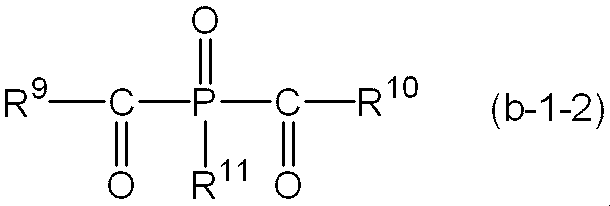
成分B−1−1としては、式(b−1−2)で示される化合物が特に好ましい。 As the component B-1-1, a compound represented by the formula (b-1-2) is particularly preferable.
式(b−1−2)で表されるビスアシルホスフィンオキサイド化合物としては、R9〜R11が、置換基としてメチル基を有していてもよいフェニル基であることが好ましく、R11がフェニル基であり、R9及びR10が1〜3個のメチル基を有するフェニル基であることがより好ましい。
中でも、式(b−1−2)で表されるビスアシルホスフィンオキサイド化合物としては、ビス(2,4,6−トリメチルベンゾイル)フェニルホスフィンオキサイド(IRGACURE819、BASFジャパン(株)製)が好ましい。
As a bisacylphosphine oxide compound represented by the formula (b-1-2), R 9 to R 11 are preferably a phenyl group which may have a methyl group as a substituent, and R 11 is More preferably, it is a phenyl group, and R 9 and R 10 are each a phenyl group having 1 to 3 methyl groups.
Among these, as the bisacylphosphine oxide compound represented by the formula (b-1-2), bis (2,4,6-trimethylbenzoyl) phenylphosphine oxide (IRGACURE819, manufactured by BASF Japan Ltd.) is preferable.
(成分B−1−2)モノアシルホスフィンオキサイド化合物
本発明において、(成分B)ラジカル重合開始剤として、(成分B−1−2)モノアシルホスフィン化合物が好ましく挙げられる。
成分B−1−2としては、化合物の構造中に式(b−2−1)で表される部分構造を有するものが好ましい。
(Component B-1-2) Monoacylphosphine oxide compound In the present invention, (Component B-1-2) monoacylphosphine compound is preferably used as the (Component B) radical polymerization initiator.
Component B-1-2 preferably has a partial structure represented by formula (b-2-1) in the structure of the compound.
成分B−1−2としては、式(b−2−2)で示される化合物が特に好ましい。 As the component B-1-2, a compound represented by the formula (b-2-2) is particularly preferable.
式(b−2−2)で表されるモノアシルホスフィンオキサイド化合物としては、R6〜R8が、置換基としてメチル基を有していてもよいフェニル基であることが好ましく、R7及びR8がフェニル基であり、R6が1〜3個のメチル基を有するフェニル基であることがより好ましい。
中でも、式(b−2−2)で表されるモノアシルホスフィンオキサイド化合物としては、2,4,6−トリメチルベンゾイルジフェニルホスフィンオキサイド(Darocur TPO:BASFジャパン(株)製、Lucirin TPO:BASF社製)が好ましい。
As the monoacylphosphine oxide compound represented by the formula (b-2-2), R 6 to R 8 are preferably a phenyl group which may have a methyl group as a substituent, and R 7 and More preferably, R 8 is a phenyl group, and R 6 is a phenyl group having 1 to 3 methyl groups.
Among them, as the monoacylphosphine oxide compound represented by the formula (b-2-2), 2,4,6-trimethylbenzoyldiphenylphosphine oxide (Darocur TPO: manufactured by BASF Japan Ltd., Lucirin TPO: manufactured by BASF) ) Is preferred.
本発明において、マゼンタインク組成物を含む着色インク組成物は、(成分B−1)アシルホスフィンオキサイド化合物を含有することが好ましい。これらの中でも、ビスアシルホスフィンオキサイド化合物及びモノアシルホスフィンオキサイド化合物を併用することが特に好ましい。
特に、ビスアシルホスフィンオキサイド化合物は、少ない添加量でも高い感度が得られる。なお、ビスアシルホスフィンオキサイドはモノアシルホスフィンオキサイドと比較して、低添加量でインクの感度を向上させることが可能であるが、一方、印刷物が黄色に着色されるという観点でクリアインクには不適である、このため、画像が黄色に変化することが目立ちにくいカラーインクにおいてはビスアシルホスフィンオキサイドとモノアシルホスフィンオキサイドとを併用することが好ましい。
In the present invention, the colored ink composition containing the magenta ink composition preferably contains (Component B-1) an acylphosphine oxide compound. Among these, it is particularly preferable to use a bisacylphosphine oxide compound and a monoacylphosphine oxide compound in combination.
In particular, the bisacylphosphine oxide compound can provide high sensitivity even with a small addition amount. It should be noted that bisacylphosphine oxide can improve the sensitivity of the ink with a lower addition amount than monoacylphosphine oxide, but is not suitable for clear ink from the viewpoint that the printed matter is colored yellow. For this reason, it is preferable to use bisacylphosphine oxide and monoacylphosphine oxide in combination in a color ink in which the image does not easily change to yellow.
インク組成物において、ラジカル重合開始剤の総量を100質量部としたとき、成分B−1の総量は、20質量部以上であることが好ましく、25質量部以上であることがより好ましく、30質量部以上であることが更に好ましい。
成分B−1の含有量は、インク組成物全体の2〜7質量%が好ましく、3〜6質量%であることがより好ましい。
In the ink composition, when the total amount of radical polymerization initiator is 100 parts by mass, the total amount of Component B-1 is preferably 20 parts by mass or more, more preferably 25 parts by mass or more, and 30 parts by mass. More preferably, it is part or more.
The content of Component B-1 is preferably 2 to 7% by mass, and more preferably 3 to 6% by mass, based on the entire ink composition.
(成分B−2)チオキサントン化合物
本発明のインク組成物は、(成分B−2)チオキサントン化合物を好ましく含有することができる。
チオキサントン化合物としては、特に制限はなく、公知のものを用いることができるが、式(b−2)で表される化合物であることが好ましい。
(Component B-2) Thioxanthone Compound The ink composition of the present invention can preferably contain (Component B-2) a thioxanthone compound.
There is no restriction | limiting in particular as a thioxanthone compound, Although a well-known thing can be used, It is preferable that it is a compound represented by Formula (b-2).
前記式(b−2)において、R1F、R2F、R3F、R4F、R5F、R6F、R7F及びR8Fはそれぞれ独立に、水素原子、アルキル基、ハロゲン原子、ヒドロキシ基、シアノ基、ニトロ基、アミノ基、アルキルチオ基、アルキルアミノ基(一置換及び二置換の場合を含む。なお、以下においても同様である。)、アルコキシ基、アルコキシカルボニル基、アシルオキシ基、アシル基、カルボキシ基又はスルホ基を表す。上記アルキル基、アルキルチオ基、アルキルアミノ基、アルコキシ基、アルコキシカルボニル基、アシルオキシ基、及び、アシル基におけるアルキル部分の炭素数は、1〜20であることが好ましく、1〜8であることがより好ましく、1〜4であることが更に好ましい。
R1F、R2F、R3F、R4F、R5F、R6F、R7F及びR8Fは、それぞれ隣接する2つが互いに連結して環を形成していてもよい。これらが環を形成する場合の環構造としては、5又は6員環の脂肪族環、芳香族環などが挙げられ、炭素原子以外の元素を含む複素環であってもよく、また、形成された環同士が更に組み合わさって2核環、例えば、縮合環を形成していてもよい。これらの環構造は置換基を更に有していてもよい。置換基としては、ハロゲン原子、ヒドロキシ基、シアノ基、ニトロ基、アミノ基、アルキルチオ基、アルキルアミノ基、アルコキシ基、アルコキシカルボニル基、アシルオキシ基、アシル基、カルボキシ基及びスルホ基が挙げられる。形成された環構造が複素環である場合のヘテロ原子の例としては、N、O、及びSを挙げることができる。
In the formula (b-2), R 1F , R 2F , R 3F , R 4F , R 5F , R 6F , R 7F and R 8F are each independently a hydrogen atom, alkyl group, halogen atom, hydroxy group, cyano Group, nitro group, amino group, alkylthio group, alkylamino group (including the case of mono- and di-substitution. The same applies to the following), alkoxy group, alkoxycarbonyl group, acyloxy group, acyl group, carboxy group Represents a group or a sulfo group. The number of carbon atoms in the alkyl group, the alkylthio group, the alkylamino group, the alkoxy group, the alkoxycarbonyl group, the acyloxy group, and the alkyl moiety in the acyl group is preferably 1-20, and more preferably 1-8. Preferably, it is 1-4.
R 1F , R 2F , R 3F , R 4F , R 5F , R 6F , R 7F, and R 8F may be bonded to each other to form a ring. Examples of the ring structure in the case where these form a ring include a 5- or 6-membered aliphatic ring, an aromatic ring, etc., and may be a heterocyclic ring containing an element other than a carbon atom. The rings may be further combined to form a binuclear ring, for example, a condensed ring. These ring structures may further have a substituent. Examples of the substituent include a halogen atom, a hydroxy group, a cyano group, a nitro group, an amino group, an alkylthio group, an alkylamino group, an alkoxy group, an alkoxycarbonyl group, an acyloxy group, an acyl group, a carboxy group, and a sulfo group. N, O, and S can be mentioned as an example of a hetero atom in case the formed ring structure is a heterocyclic ring.
チオキサントン化合物としては、チオキサントン、2−イソプロピルチオキサントン、4−イソプロピルチオキサントン、2−クロロチオキサントン、2−ドデシルチオキサントン、2,4−ジクロロチオキサントン、2,3−ジエチルチオキサントン、1−クロロ−4−プロポキシチオキサントン、2−シクロヘキシルチオキサントン、4−シクロヘキシルチオキサントン、2,4−ジエチルチオキサントン、2,4−ジメチルチオキサントン、1−メトキシカルボニルチオキサントン、2−エトキシカルボニルチオキサントン、3−(2−メトキシエトキシカルボニル)チオキサントン、4−ブトキシカルボニルチオキサントン、3−ブトキシカルボニル−7−メチルチオキサントン、1−シアノ−3−クロロチオキサントン、1−エトキシカルボニル−3−クロロチオキサントン、1−エトキシカルボニル−3−エトキシチオキサントン、1−エトキシカルボニル−3−アミノチオキサントン、1−エトキシカルボニル−3−フェニルスルフリルチオキサントン、3,4−ジ[2−(2−メトキシエトキシ)エトキシカルボニル]チオキサントン、1−エトキシカルボニル−3−(1−メチル−1−モルホリノエチル)チオキサントン、2−メチル−6−ジメトキシメチルチオキサントン、2−メチル−6−(1,1−ジメトキシベンジル)チオキサントン、2−モルホリノメチルチオキサントン、2−メチル−6−モルホリノメチルチオキサントン、n−アリルチオキサントン−3,4−ジカルボキシミド、n−オクチルチオキサントン−3,4−ジカルボキシイミド、N−(1,1,3,3−テトラメチルブチル)チオキサントン−3,4−ジカルボキシイミド、1−フェノキシチオキサントン、6−エトキシカルボニル−2−メトキシチオキサントン、6−エトキシカルボニル−2−メチルチオキサントン、チオキサントン−2−ポリエチレングリコールエステル、2−ヒドロキシ−3−(3,4−ジメチル−9−オキソ−9H−チオキサントン−2−イルオキシ)−N,N,N−トリメチル−1−プロパンアミニウムクロリドが例示できる。これらの中でも、入手容易性や硬化性の観点から、チオキサントン、2,3−ジエチルチオキサントン、2,4−ジエチルチオキサントン、2,4−ジクロロチオキサントン、1−クロロ−4−プロポキシチオキサントン、2−シクロヘキシルチオキサントン、4−シクロヘキシルチオキサントン、2−イソプロピルチオキサントン、及び、4−イソプロピルチオキサントンが好ましく、2−イソプロピルチオキサントン、及び、4−イソプロピルチオキサントンがより好ましい。 Examples of the thioxanthone compound include thioxanthone, 2-isopropylthioxanthone, 4-isopropylthioxanthone, 2-chlorothioxanthone, 2-dodecylthioxanthone, 2,4-dichlorothioxanthone, 2,3-diethylthioxanthone, 1-chloro-4-propoxythioxanthone, 2-cyclohexylthioxanthone, 4-cyclohexylthioxanthone, 2,4-diethylthioxanthone, 2,4-dimethylthioxanthone, 1-methoxycarbonylthioxanthone, 2-ethoxycarbonylthioxanthone, 3- (2-methoxyethoxycarbonyl) thioxanthone, 4-butoxy Carbonylthioxanthone, 3-butoxycarbonyl-7-methylthioxanthone, 1-cyano-3-chlorothioxanthone, 1-eth Sicarbonyl-3-chlorothioxanthone, 1-ethoxycarbonyl-3-ethoxythioxanthone, 1-ethoxycarbonyl-3-aminothioxanthone, 1-ethoxycarbonyl-3-phenylsulfylthioxanthone, 3,4-di [2- (2- Methoxyethoxy) ethoxycarbonyl] thioxanthone, 1-ethoxycarbonyl-3- (1-methyl-1-morpholinoethyl) thioxanthone, 2-methyl-6-dimethoxymethylthioxanthone, 2-methyl-6- (1,1-dimethoxybenzyl ) Thioxanthone, 2-morpholinomethylthioxanthone, 2-methyl-6-morpholinomethylthioxanthone, n-allylthioxanthone-3,4-dicarboximide, n-octylthioxanthone-3,4-dicarboximide, N (1,1,3,3-tetramethylbutyl) thioxanthone-3,4-dicarboximide, 1-phenoxythioxanthone, 6-ethoxycarbonyl-2-methoxythioxanthone, 6-ethoxycarbonyl-2-methylthioxanthone, thioxanthone- Examples include 2-polyethylene glycol ester, 2-hydroxy-3- (3,4-dimethyl-9-oxo-9H-thioxanthone-2-yloxy) -N, N, N-trimethyl-1-propaneaminium chloride. Among these, thioxanthone, 2,3-diethylthioxanthone, 2,4-diethylthioxanthone, 2,4-dichlorothioxanthone, 1-chloro-4-propoxythioxanthone, 2-cyclohexylthioxanthone from the viewpoint of availability and curability 4-cyclohexylthioxanthone, 2-isopropylthioxanthone, and 4-isopropylthioxanthone are preferable, and 2-isopropylthioxanthone and 4-isopropylthioxanthone are more preferable.
成分B−2の含有量は、インク組成物全体の0.1〜5.0質量%が好ましく、0.5〜4.0質量%がより好ましい。 The content of Component B-2 is preferably 0.1 to 5.0% by mass, and more preferably 0.5 to 4.0% by mass of the entire ink composition.
(成分B−3)α−ヒドロキシケトン化合物
本発明のインク組成物は、(成分B−3)α−ヒドロキシケトン化合物を好ましく含有することができる。
(Component B-3) α-Hydroxyketone Compound The ink composition of the present invention can preferably contain (Component B-3) an α-hydroxyketone compound.
α−ヒドロキシケトン化合物としては、例えば、1−[4−(2−ヒドロキシエトキシ)−フェニル]−2−ヒドロキシ−2−メチル−1−プロパン−1−オン、2−ヒドロキシ−2−メチル−1−フェニル−プロパン−1−オン、1−ヒドロキシシクロヘキシルフェニルケトン等が挙げられ、中でも、1−ヒドロキシシクロヘキシルフェニルケトン化合物が好ましい。なお、本発明において、1−ヒドロキシシクロヘキシルフェニルケトン化合物には、1−ヒドロキシシクロヘキシルフェニルケトンが任意の置換基で置換された化合物も含まれる。置換基としては、ラジカル重合開始剤としての能力を発揮し得る範囲で任意に選択することができ、具体的には炭素数1〜4のアルキル基が例示できる。中でも、1−ヒドロキシシクロヘキシルフェニルケトン(IRGACURE184、BASFジャパン(株)製)がより好ましい。 Examples of the α-hydroxyketone compound include 1- [4- (2-hydroxyethoxy) -phenyl] -2-hydroxy-2-methyl-1-propan-1-one, 2-hydroxy-2-methyl-1 -Phenyl-propan-1-one, 1-hydroxycyclohexyl phenyl ketone and the like are mentioned, among which 1-hydroxycyclohexyl phenyl ketone compound is preferable. In the present invention, the 1-hydroxycyclohexyl phenyl ketone compound includes a compound in which 1-hydroxycyclohexyl phenyl ketone is substituted with an arbitrary substituent. As a substituent, it can select arbitrarily in the range which can exhibit the capability as a radical polymerization initiator, Specifically, a C1-C4 alkyl group can be illustrated. Among these, 1-hydroxycyclohexyl phenyl ketone (IRGACURE184, manufactured by BASF Japan Ltd.) is more preferable.
成分B−3の含有量は、インク組成物全体の1.0〜5.0質量%が好ましく、2.0〜4.0質量%がより好ましい。 The content of Component B-3 is preferably 1.0 to 5.0% by mass, and more preferably 2.0 to 4.0% by mass of the entire ink composition.
本発明における成分Bの好ましい態様は、成分B−1〜B−3の少なくとも1つを含有することであり、より好ましくは成分B−1とB−2とを含有することであり、更に好ましくは成分B−1〜B−3の全てを含有することである。 A preferred embodiment of component B in the present invention is to contain at least one of components B-1 to B-3, more preferably to contain components B-1 and B-2, and still more preferably. Is to contain all of the components B-1 to B-3.
本発明における成分Bの総含有量は、インク組成物全体の5.0〜20.0質量%であることが好ましく、7.0〜19.0質量%であることがより好ましく、9.0〜18.0質量%であることが更に好ましい。
上記範囲であると、硬化性に優れるインク組成物が得られる。
The total content of component B in the present invention is preferably 5.0 to 20.0% by mass, more preferably 7.0 to 19.0% by mass, and 9.0% based on the entire ink composition. More preferably, it is -18.0 mass%.
When it is in the above range, an ink composition having excellent curability can be obtained.
本発明のインク組成物は、成分B−1〜B−3の重合開始剤以外のその他の重合開始剤を含んでもよい。その他の重合開始剤としては、α−アミノアルキルケトン、芳香族ケトン類、芳香族オニウム塩化合物、有機過酸化物、チオ化合物、ヘキサアリールビイミダゾール化合物、ケトオキシムエステル化合物、ボレート化合物、アジニウム化合物、メタロセン化合物、活性エステル化合物、及び、炭素ハロゲン結合を有する化合物等が挙げられる。
上記重合開始剤の詳細については、当業者に公知であり、例えば、特開2009−185186号公報の段落0090〜0116に記載されている。
The ink composition of the present invention may contain other polymerization initiator other than the polymerization initiators of components B-1 to B-3. Other polymerization initiators include α-aminoalkyl ketones, aromatic ketones, aromatic onium salt compounds, organic peroxides, thio compounds, hexaarylbiimidazole compounds, ketoxime ester compounds, borate compounds, azinium compounds, Examples thereof include metallocene compounds, active ester compounds, and compounds having a carbon halogen bond.
Details of the polymerization initiator are known to those skilled in the art, and are described, for example, in paragraphs 0090 to 0116 of JP-A-2009-185186.
(成分C)着色剤
本発明のインク組成物は、形成された画像部の視認性を向上させるため、(成分C)着色剤を含有する。着色剤としては、特に制限はないが、耐候性に優れ、色再現性に富んだ顔料及び油溶性染料が好ましく、溶解性染料等の公知の着色剤から任意に選択して使用できる。着色剤は、活性放射線による硬化反応の感度を低下させないという観点から、重合禁止剤として機能しない化合物を選択することが好ましい。
(Component C) Colorant The ink composition of the present invention contains (Component C) a colorant in order to improve the visibility of the formed image portion. Although there is no restriction | limiting in particular as a coloring agent, The pigment and oil-soluble dye which were excellent in weather resistance and were rich in color reproducibility are preferable, and it can select and use arbitrarily from well-known coloring agents, such as a soluble dye. As the colorant, it is preferable to select a compound that does not function as a polymerization inhibitor from the viewpoint of not reducing the sensitivity of the curing reaction by actinic radiation.
本発明に使用できる顔料としては、特に限定されるわけではないが、例えばカラーインデックスに記載される下記の番号の有機又は無機顔料が使用できる。
赤又はマゼンタ顔料としては、C.I.ピグメントレッド3(「Pigment Red 3」ともいう。)、5、19、22、31、38、42、43、48:1、48:2、48:3、48:4、48:5、49:1、53:1、57:1、57:2、58:4、63:1、81、81:1、81:2、81:3、81:4、88、104、108、112、122、123、144、146、149、166、168、169、170、177、178、179、184、185、202、208、216、226、257、C.I.ピグメントバイオレット3(「Pigment Violet 3」ともいう。)、19、23、29、30、37、50、88、C.I.ピグメントオレンジ13(「Pigment Orange 13」ともいう。)、16、20、36、青又はシアン顔料としては、C.I.ピグメントブルー1(「Pigment Blue 1」ともいう。)、15、15:1、15:2、15:3、15:4、15:6、16、17:1、22、27、28、29、36、60、緑顔料としては、C.I.ピグメントグリーン7(「Pigment Green 7」ともいう。)、26、36、50、黄顔料としては、C.I.ピグメントイエロー1(「Pigment Yellow 1」ともいう。)、3、12、13、14、17、34、35、37、55、74、81、83、93、94、95、97、108、109、110、120、137、138、139、150、153、154、155、157、166、167、168、180、185、193、黒顔料としては、C.I.ピグメントブラック7(「Pigment Black 7」ともいう。)、28、26、白色顔料としては、C.I.ピグメントホワイト6(「Pigment White 6」ともいう。)、18、21などが目的に応じて使用できる。
Although it does not necessarily limit as a pigment which can be used for this invention, For example, the organic or inorganic pigment of the following number described in a color index can be used.
Examples of red or magenta pigments include C.I. I. Pigment Red 3 (also referred to as “Pigment Red 3”), 5, 19, 22, 31, 38, 42, 43, 48: 1, 48: 2, 48: 3, 48: 4, 48: 5, 49: 1, 53: 1, 57: 1, 57: 2, 58: 4, 63: 1, 81, 81: 1, 81: 2, 81: 3, 81: 4, 88, 104, 108, 112, 122, 123, 144, 146, 149, 166, 168, 169, 170, 177, 178, 179, 184, 185, 202, 208, 216, 226, 257, C.I. I. Pigment violet 3 (also referred to as “Pigment Violet 3”), 19, 23, 29, 30, 37, 50, 88, C.I. I. Pigment Orange 13 (also referred to as “Pigment Orange 13”), 16, 20, 36, blue or cyan pigments include C.I. I. Pigment Blue 1 (also referred to as “Pigment Blue 1”), 15, 15: 1, 15: 2, 15: 3, 15: 4, 15: 6, 16, 17: 1, 22, 27, 28, 29, 36, 60, green pigments include C.I. I. Pigment Green 7 (also referred to as “Pigment Green 7”), 26, 36, 50, yellow pigments include C.I. I. Pigment Yellow 1 (also referred to as “Pigment Yellow 1”), 3, 12, 13, 14, 17, 34, 35, 37, 55, 74, 81, 83, 93, 94, 95, 97, 108, 109, 110, 120, 137, 138, 139, 150, 153, 154, 155, 157, 166, 167, 168, 180, 185, 193, black pigments include C.I. I. Pigment Black 7 (also referred to as “Pigment Black 7”), 28, 26, and white pigments include C.I. I. Pigment White 6 (also referred to as “Pigment White 6”), 18, 21 or the like can be used depending on the purpose.
本発明においては、水非混和性有機溶媒に溶解する範囲で分散染料を用いることもできる。分散染料は一般に水溶性の染料も包含するが、本発明においては水非混和性有機溶媒に溶解する範囲で用いることが好ましい。
分散染料の好ましい具体例としては、C.I.ディスパースイエロー 5、42、54、64、79、82、83、93、99、100、119、122、124、126、160、184:1、186、198、199、201、204、224及び237;C.I.ディスパーズオレンジ 13、29、31:1、33、49、54、55、66、73、118、119及び163;C.I.ディスパーズレッド 54、60、72、73、86、88、91、92、93、111、126、127、134、135、143、145、152、153、154、159、164、167:1、177、181、204、206、207、221、239、240、258、277、278、283、311、323、343、348、356及び362;C.I.ディスパーズバイオレット 33;C.I.ディスパーズブルー 56、60、73、87、113、128、143、148、154、158、165、165:1、165:2、176、183、185、197、198、201、214、224、225、257、266、267、287、354、358、365及び368;並びにC.I.ディスパーズグリーン 6:1及び9等が挙げられる。
In the present invention, a disperse dye can be used as long as it is soluble in a water-immiscible organic solvent. The disperse dye generally includes a water-soluble dye, but in the present invention, the disperse dye is preferably used as long as it is soluble in a water-immiscible organic solvent.
Preferable specific examples of the disperse dye include C.I. I. Disperse Yellow 5, 42, 54, 64, 79, 82, 83, 93, 99, 100, 119, 122, 124, 126, 160, 184: 1, 186, 198, 199, 201, 204, 224 and 237 C. I. Disperse Orange 13, 29, 31: 1, 33, 49, 54, 55, 66, 73, 118, 119 and 163; C.I. I. Disperse Red 54, 60, 72, 73, 86, 88, 91, 92, 93, 111, 126, 127, 134, 135, 143, 145, 152, 153, 154, 159, 164, 167: 1, 177 , 181, 204, 206, 207, 221, 239, 240, 258, 277, 278, 283, 311, 323, 343, 348, 356 and 362; I. Disperse Violet 33; C.I. I. Disperse Blue 56, 60, 73, 87, 113, 128, 143, 148, 154, 158, 165, 165: 1, 165: 2, 176, 183, 185, 197, 198, 201, 214, 224, 225 257, 266, 267, 287, 354, 358, 365 and 368; I. Disperse Green 6: 1 and 9 etc. are mentioned.
着色剤は、インク組成物に添加された後、適度に当該インク組成物内で分散することが好ましい。着色剤の分散には、例えば、ボールミル、サンドミル、アトライター、ロールミル、アジテータ、ヘンシェルミキサ、コロイドミル、超音波ホモジナイザー、パールミル、湿式ジェットミル、ペイントシェーカー等の各分散装置を用いることができる。 It is preferable that the colorant is appropriately dispersed in the ink composition after being added to the ink composition. For dispersing the colorant, for example, a dispersion device such as a ball mill, a sand mill, an attritor, a roll mill, an agitator, a Henschel mixer, a colloid mill, an ultrasonic homogenizer, a pearl mill, a wet jet mill, or a paint shaker can be used.
着色剤は、インク組成物の調製に際して、各成分と共に直接添加してもよい。また、分散性向上のため、あらかじめ溶剤又は本発明に使用する重合性化合物のような分散媒体に添加し、均一分散あるいは溶解させた後、配合することもできる。
本発明において、溶剤が硬化画像に残留する場合の耐溶剤性の劣化、及び、残留する溶剤のVOC(Volatile Organic Compound:揮発性有機化合物)の問題を避けるためにも、着色剤は、重合性化合物のような分散媒体に予め添加して、配合することが好ましい。すなわち、溶剤を含まないことが好ましい。なお、分散適性の観点のみを考慮した場合、着色剤の添加に使用する重合性化合物は、粘度の低いモノマーを選択することが好ましい。着色剤はインク組成物の使用目的に応じて、1種又は2種以上を適宜選択して用いればよい。
The colorant may be directly added together with each component when preparing the ink composition. In order to improve dispersibility, it may be added to a dispersion medium such as a solvent or a polymerizable compound used in the present invention in advance and uniformly dispersed or dissolved, and then blended.
In the present invention, in order to avoid the deterioration of solvent resistance when the solvent remains in the cured image and the problem of VOC (Volatile Organic Compound) of the remaining solvent, the colorant is polymerizable. It is preferable to add and mix in advance in a dispersion medium such as a compound. That is, it is preferable not to contain a solvent. In consideration of only dispersibility, it is preferable to select a monomer having a low viscosity as the polymerizable compound used for adding the colorant. One or more colorants may be appropriately selected and used according to the purpose of use of the ink composition.
なお、インク組成物中において固体のまま存在する顔料などの着色剤を使用する際には、着色剤粒子の平均粒径は、好ましくは0.005〜0.5μm、より好ましくは0.01〜0.45μm、更に好ましくは0.015〜0.4μmとなるよう、着色剤、分散剤、分散媒体の選定、分散条件、ろ過条件を設定することが好ましい。この粒径管理によって、ヘッドノズルの詰まりを抑制し、インク組成物の保存安定性、透明性及び硬化感度を維持することができるので好ましい。
インク組成物中における着色剤の含有量は、色、及び使用目的により適宜選択されるが、インク組成物全体の質量に対し、0.01〜30質量%であることが好ましい。
When using a colorant such as a pigment that remains solid in the ink composition, the average particle diameter of the colorant particles is preferably 0.005 to 0.5 μm, more preferably 0.01 to It is preferable to set the colorant, the dispersant, the dispersion medium, the dispersion conditions, and the filtration conditions so as to be 0.45 μm, more preferably 0.015 to 0.4 μm. This particle size control is preferable because clogging of the head nozzle can be suppressed and the storage stability, transparency, and curing sensitivity of the ink composition can be maintained.
The content of the colorant in the ink composition is appropriately selected depending on the color and purpose of use, but is preferably 0.01 to 30% by mass with respect to the mass of the entire ink composition.
<分散剤>
本発明のインク組成物は、分散剤を含有することが好ましい。特に顔料を使用する場合において、顔料をインク組成物中に安定に分散させるため、分散剤を含有することが好ましい。分散剤としては、高分子分散剤が好ましい。なお、本発明における「高分子分散剤」とは、重量平均分子量が1,000以上の分散剤を意味する。
<Dispersant>
The ink composition of the present invention preferably contains a dispersant. In particular, when a pigment is used, a dispersant is preferably contained in order to stably disperse the pigment in the ink composition. As the dispersant, a polymer dispersant is preferable. In the present invention, the “polymer dispersant” means a dispersant having a weight average molecular weight of 1,000 or more.
高分子分散剤としては、DISPERBYK−101、DISPERBYK−102、DISPERBYK−103、DISPERBYK−106、DISPERBYK−111、DISPERBYK−161、DISPERBYK−162、DISPERBYK−163、DISPERBYK−164、DISPERBYK−166、DISPERBYK−167、DISPERBYK−168、DISPERBYK−170、DISPERBYK−171、DISPERBYK−174、DISPERBYK−182(BYKケミー社製);EFKA4010、EFKA4046、EFKA4080、EFKA5010、EFKA5207、EFKA5244、EFKA6745、EFKA6750、EFKA7414、EFKA745、EFKA7462、EFKA7500、EFKA7570、EFKA7575、EFKA7580(エフカアディティブ社製);ディスパースエイド6、ディスパースエイド8、ディスパースエイド15、ディスパースエイド9100(サンノプコ(株)製);ソルスパース(SOLSPERSE)3000、5000、9000、12000、13240、13940、17000、22000、24000、26000、28000、32000、36000、39000、41000、71000などの各種ソルスパース分散剤(Noveon社製);アデカプルロニックL31、F38、L42、L44、L61、L64、F68、L72、P95、F77、P84、F87、P94、L101、P103、F108、L121、P−123((株)ADEKA製);イオネットS−20(三洋化成工業(株)製);ディスパロン KS−860、873SN、874(高分子分散剤)、#2150(脂肪族多価カルボン酸)、#7004(ポリエーテルエステル型)(楠本化成(株)製)が挙げられる。
インク組成物中における分散剤の含有量は、使用目的により適宜選択されるが、インク組成物全体の質量に対し、0.05〜15質量%であることが好ましい。
Examples of the polymer dispersant include DISPERBYK-101, DISPERBYK-102, DISPERBYK-103, DISPERBYK-106, DISPERBYK-111, DISPERBYK-161, DISPERBYK-162, DISPERBYK-163, DISPERBYK-164, DISPERBYK-166, DISPERBYK-166, and DISPERBYK-166. , DISPERBYK-168, DISPERBYK-170, DISPERBYK-171, DISPERBYK-174, DISPERBYK-182 (manufactured by BYK Chemie); EFKA7462, EFKA7500, EFKA7570, EFKA7575, EFKA7580 (manufactured by Efka Additive); Disperse Aid 6, Disperse Aid 8, Disperse Aid 15, Disperse Aid 9100 (manufactured by Sannopco); Solsperse (SOLSPERSE) 3000 Various Solsperse dispersants (manufactured by Noveon) such as 5000, 9000, 12000, 13240, 13940, 17000, 22000, 24000, 26000, 28000, 32000, 36000, 39000, 41000, 71000; Adeka Pluronic L31, F38, L42, L44 , L61, L64, F68, L72, P95, F77, P84, F87, P94, L101, P103, F108, L121, -123 (manufactured by ADEKA); Ionette S-20 (manufactured by Sanyo Chemical Industries); Disparon KS-860, 873SN, 874 (polymer dispersing agent), # 2150 (aliphatic polycarboxylic acid), # 7004 (polyether ester type) (manufactured by Enomoto Kasei Co., Ltd.).
The content of the dispersant in the ink composition is appropriately selected depending on the purpose of use, but is preferably 0.05 to 15% by mass with respect to the mass of the entire ink composition.
(成分D)HLBが2以上7以下のシリコーン系界面活性剤
本発明のインク組成物は、(成分D)HLBが2以上7以下のシリコーン系界面活性剤を含有する。また、成分Dをインク組成物全体の0.4質量%以上4質量%以下含有する。HLBとは、親水親油バランス(Hydrophile−Lipophile Balance)の略称であり、界面活性剤が果たす効果を表す指標の1つである。HLBの値が大きい程、親水性が高くなり、HLBの値が小さい程、親油性が高くなる。
シリコーン系界面活性剤では、HLBの値が小さいほど、疎水性が高く、すなわち、シリコーン部分が比率が大きく、より強い界面活性能力を示す傾向にある。
本発明においては、インク組成物に、比較的界面活性能力の高い、HLBが7以下であるシリコーン系界面活性剤を特定の含有量で添加することにより、耐ブロッキング性及び耐表面傷跡性に優れる画像が得られることを見出したものである。
なお、シリコーン系界面活性剤のHLBの値が2未満であると、相溶性が低く、7を超えると、十分な効果を得られない。
成分DのHLBは、2〜7であり、2〜5であることが好ましく、2〜4であることがより好ましい。
(Component D) Silicone Surfactant with HLB of 2 to 7 The ink composition of the present invention contains (Component D) a silicone surfactant with HLB of 2 to 7. Component D is contained in an amount of 0.4% by mass to 4% by mass based on the entire ink composition. HLB is an abbreviation for Hydrophile-Lipophile Balance, and is one of the indices representing the effect of surfactants. The larger the HLB value, the higher the hydrophilicity, and the smaller the HLB value, the higher the lipophilicity.
In the silicone-based surfactant, the smaller the HLB value, the higher the hydrophobicity, that is, the silicone portion has a larger ratio and tends to exhibit stronger surfactant activity.
In the present invention, by adding a silicone surfactant having a relatively high surface activity ability and an HLB of 7 or less to the ink composition at a specific content, the ink composition is excellent in blocking resistance and surface scar resistance. It has been found that an image can be obtained.
If the HLB value of the silicone surfactant is less than 2, the compatibility is low, and if it exceeds 7, a sufficient effect cannot be obtained.
The HLB of component D is 2 to 7, preferably 2 to 5, and more preferably 2 to 4.
また、本発明において、成分Dの添加量はインク組成物全体の0.4質量%以上4質量%以下である。従来のインク組成物が含有する界面活性剤量よりも多い、0.4質量%以上を含有することにより、耐ブロッキング性及び耐表面傷跡性に優れる画像が得られる。0.4質量%未満であると、耐ブロッキング性や耐表面傷跡性において十分な効果が得られず、4質量%を超えると、連続吐出安定性に劣る。なお、4質量%を超えて使用すると、インクジェットノズルのノズルプレート表面との間のメニスカス保持力が低下する結果、連続吐出時にインクがノズルプレート上へ流れ出し、滞留が生じ、他のノズルを覆ってしまうことで、吐出が正確に行われないことが原因と推定される。
成分Dの含有量は0.5〜2.0質量%であることが好ましく、0.7〜1.5質量%であることがより好ましい。
In the present invention, the amount of component D added is 0.4% by mass or more and 4% by mass or less of the entire ink composition. By containing 0.4% by mass or more, which is larger than the amount of surfactant contained in the conventional ink composition, an image excellent in blocking resistance and surface scar resistance can be obtained. If it is less than 0.4% by mass, sufficient effects cannot be obtained in blocking resistance and surface scar resistance, and if it exceeds 4% by mass, the continuous ejection stability is inferior. If the amount exceeds 4% by mass, the meniscus holding force between the nozzle plate surface of the inkjet nozzles is reduced, and as a result, the ink flows out onto the nozzle plate during continuous ejection, causing stagnation and covering other nozzles. Therefore, it is presumed that the discharge is not performed accurately.
The content of component D is preferably 0.5 to 2.0 mass%, more preferably 0.7 to 1.5 mass%.
本発明において、成分Dとしては、ポリエーテル変性シリコーンオイルが最も好ましい。ポリエーテル変性シリコーンオイルとしては、ジメチルポリシロキサンのメチル基の一部にポリエーテル基を導入したものが挙げられる。変性シリコーンオイルの中には、ポリエーテル変性シリコーンオイル以外にも、メチルスチレン変性シリコーンオイル、オレフィン変性シリコーンオイル、アルコール変性シリコーンオイル、アルキル変性シリコーンオイル、などの各種有機基を導入した変性シリコーンオイルがあるが、耐ブロッキング性、耐表面傷跡性に優れる印刷物を得るには、ポリエーテル変性シリコーンオイルを使用することが最も好ましい。さらに紫外線硬化性化合物、それらよりなる組成物への相溶性、親和性の点からも、ポリエーテル変性シリコーンオイルは優れている。さらに本発明において使用するポリエーテル変性シリコーンオイルとしては、変性シリコーンオイルに導入されるポリエーテル基が、側鎖型にあることがより好ましい。 In the present invention, the component D is most preferably a polyether-modified silicone oil. Examples of the polyether-modified silicone oil include those obtained by introducing a polyether group into a part of the methyl group of dimethylpolysiloxane. Among the modified silicone oils, in addition to the polyether-modified silicone oil, there are modified silicone oils introduced with various organic groups such as methylstyrene-modified silicone oil, olefin-modified silicone oil, alcohol-modified silicone oil, and alkyl-modified silicone oil. However, it is most preferable to use a polyether-modified silicone oil in order to obtain a printed material excellent in blocking resistance and surface scar resistance. Furthermore, the polyether-modified silicone oil is also excellent from the viewpoints of compatibility and affinity for ultraviolet curable compounds and compositions comprising them. Further, as the polyether-modified silicone oil used in the present invention, the polyether group introduced into the modified silicone oil is more preferably in a side chain type.
成分Dとして、市販されているシリコーン系界面活性剤から適宜選択して用いることもできる。具体的には、KF−352A(HLB=7)、KF−945(HLB=4)、KF−6020(HLB=4)、X22−6191(HLB=2)、KF−6015(HLB=5)(以上、信越化学工業(株)製)が例示できる。 Component D can be appropriately selected from commercially available silicone surfactants. Specifically, KF-352A (HLB = 7), KF-945 (HLB = 4), KF-6020 (HLB = 4), X22-6191 (HLB = 2), KF-6015 (HLB = 5) ( As mentioned above, Shin-Etsu Chemical Co., Ltd.) can be exemplified.
HLB値を求めるための種々の式が提案されている。
グリフィン法によれば、HLB値は下記式で定義される。
HLB値=20×親水部の式量の総和/分子量
また、川上法では、
HLB値=7+11.7log(親水部の式量の総和/親油部の式量の総和)
で定義される。
一方、実験的には、オクチルフェノールエトキシレートなどへの溶剤への界面活性剤溶出量を、HPLC(高速液体クロマトグラフィ)やGPC(ゲル浸透クロマトグラフィ)等を用いて算出し、HLB既知の界面活性剤の溶出量との比較を行う方法や、HLBが既知の界面活性剤(HLB既)とHLB未知の界面活性剤(HLB未)を様々な混合比率で混合し、要求HLBが既知の油(HLB油)と乳化混合物を生成し、乳化液が最も安定になる界面活性剤混合比率を同定することで、以下の式から、HLB値を求めることもできる。
HLB(油)={(W既×HLB既)+(W未×HLB未)}/(W既+W未)
ここで、W既はHLB既知の界面活性剤の質量分率、W未はHLB未知の界面活性剤の質量分率である。
本発明においては、HLB値をグリフィン法(HLB値=20×親水部の式量の総和/分子量)及びHPLC等の公知の方法で求めることが好ましく、グリフィン法にて求めることが最も好ましい。
Various formulas for determining the HLB value have been proposed.
According to the Griffin method, the HLB value is defined by the following equation.
HLB value = 20 × sum of formula weight of hydrophilic part / molecular weight In addition, in the Kawakami method,
HLB value = 7 + 11.7 log (sum of formula amount of hydrophilic part / sum of formula weight of lipophilic part)
Defined by
On the other hand, experimentally, the amount of surfactant dissolved in a solvent such as octylphenol ethoxylate was calculated using HPLC (high performance liquid chromatography), GPC (gel permeation chromatography), etc. A method for comparing with the amount of elution, a surfactant with a known HLB (HLB already) and a surfactant with an unknown HLB (HLB not yet) are mixed in various mixing ratios, and an oil with a known required HLB (HLB oil) ) And an emulsified mixture, and by identifying the surfactant mixing ratio at which the emulsified liquid is most stable, the HLB value can also be obtained from the following equation.
HLB (oil) = {(W already × HLB already) + (W not × HLB not yet)} / (W already + W not yet)
Here, W is the mass fraction of the surfactant with known HLB, and W is the mass fraction of the surfactant with unknown HLB.
In the present invention, the HLB value is preferably determined by a known method such as the Griffin method (HLB value = 20 × total amount of hydrophilic part formula weight / molecular weight) and HPLC, and most preferably by the Griffin method.
<その他の界面活性剤>
本発明のインク組成物は、上記成分Dに加え、その他の界面活性剤を含有してもよい。
成分D以外の界面活性剤としては、下記の界面活性剤が例示できる。例えば、特開昭62−173463号、同62−183457号の各公報に記載されたものが挙げられる。具体的には、例えば、ジアルキルスルホコハク酸塩類、アルキルナフタレンスルホン酸塩類、脂肪酸塩類等のアニオン性界面活性剤、ポリオキシエチレンアルキルエーテル類、ポリオキシエチレンアルキルアリルエーテル類、アセチレングリコール類、ポリオキシエチレン・ポリオキシプロピレンブロックコポリマー類等のノニオン性界面活性剤、アルキルアミン塩類、第4級アンモニウム塩類等のカチオン性界面活性剤が挙げられる。なお、前記公知の界面活性剤として、有機フルオロ化合物を用いてもよい。前記有機フルオロ化合物は、疎水性であることが好ましい。前記有機フルオロ化合物としては、例えば、フッ素系界面活性剤、オイル状フッ素系化合物(例、フッ素油)及び固体状フッ素化合物樹脂(例、四フッ化エチレン樹脂)が含まれ、特公昭57−9053号(第8から17欄)、特開昭62−135826号の各公報に記載されたものが挙げられる。
特に本発明において使用される界面活性剤は、上記界面活性剤に限定されることはなく、添加濃度に対して効率的に表面張力を低下させる能力のある添加剤であればよい。
<Other surfactants>
The ink composition of the present invention may contain other surfactant in addition to the component D.
Examples of the surfactant other than Component D include the following surfactants. Examples thereof include those described in JP-A Nos. 62-173463 and 62-183457. Specifically, for example, anionic surfactants such as dialkyl sulfosuccinates, alkyl naphthalene sulfonates, fatty acid salts, polyoxyethylene alkyl ethers, polyoxyethylene alkyl allyl ethers, acetylene glycols, polyoxyethylene -Nonionic surfactants such as polyoxypropylene block copolymers, and cationic surfactants such as alkylamine salts and quaternary ammonium salts. An organic fluoro compound may be used as the known surfactant. The organic fluoro compound is preferably hydrophobic. Examples of the organic fluoro compounds include fluorine surfactants, oily fluorine compounds (eg, fluorine oil) and solid fluorine compound resins (eg, tetrafluoroethylene resin). No. (columns 8 to 17) and those described in JP-A Nos. 62-135826.
In particular, the surfactant used in the present invention is not limited to the above-described surfactant, and may be any additive capable of efficiently reducing the surface tension with respect to the added concentration.
その他の界面活性剤の含有量は、インク組成物全体の0.4質量%未満であることが好ましく、0〜0.3質量%であることがより好ましく、0〜0.2質量%であることが更に好ましい。なお、成分Dを100質量%としたとき、100質量%未満であることが好ましく、50質量%未満であることがより好ましく、10質量%未満であることが更に好ましく、その他の界面活性剤を含有しないことが最も好ましい。 The content of the other surfactant is preferably less than 0.4% by mass of the total ink composition, more preferably 0 to 0.3% by mass, and 0 to 0.2% by mass. More preferably. When component D is 100% by mass, it is preferably less than 100% by mass, more preferably less than 50% by mass, still more preferably less than 10% by mass, and other surfactants. Most preferably it does not contain.
(成分E)重量平均分子量4,000〜120,000の不活性なメチルメタクリレート単独重合体及び/又は共重合体
本発明のインク組成物は、(成分E)重量平均分子量4,000〜120,000の不活性なメチルメタクリレート単独重合体及び/又は共重合体を含有することが好ましい。成分Eについて以下に説明する。
(Component E) Inactive methyl methacrylate homopolymer and / or copolymer having a weight average molecular weight of 4,000 to 120,000 The ink composition of the present invention comprises (Component E) a weight average molecular weight of 4,000 to 120,000. Preferably, it contains 000 inert methyl methacrylate homopolymers and / or copolymers. Component E will be described below.
本発明のインク組成物における、「不活性なメチルメタクリレート単独重合体及び/又は共重合体」とは、メチルメタクリレート単独重合体及び/又は共重合体が、更に連鎖重合反応可能な重合性の官能基をもたない、並びに、更に逐次架橋反応可能な架橋性及び/又は被架橋性の官能基をもたない重合体であることを意味する。すなわち、重合反応及び架橋反応を実質的に生じない状態のメチルメタクリレート単独重合体及び/又は共重合体を指す。 In the ink composition of the present invention, the “inert methyl methacrylate homopolymer and / or copolymer” means a polymerizable functional group capable of further chain polymerization reaction of the methyl methacrylate homopolymer and / or copolymer. It means that the polymer does not have a group, and further has no crosslinkable and / or crosslinkable functional group capable of successive crosslinking reaction. That is, it refers to a methyl methacrylate homopolymer and / or copolymer in a state that does not substantially cause a polymerization reaction and a crosslinking reaction.
また、本発明のインク組成物において、不活性なメチルメタクリレート単独重合体及び/又は共重合体は、本発明のインク組成物が含有する成分A等に溶解しているか又は相溶していることが好ましい。 Further, in the ink composition of the present invention, the inert methyl methacrylate homopolymer and / or copolymer is dissolved or compatible with the component A contained in the ink composition of the present invention. Is preferred.
不活性なメチルメタクリレート単独重合体としては、特に制約はなく、例えばメチルメタクリレートを公知の重合方法により単独重合体としたもの、又は市販の単独重合体製品として入手できるものが好ましく挙げられる。
また、不活性なメチルメタクリレート共重合体としては、特に制約はなく、例えばメチルメタクリレートとその他の重合性化合物とを公知の重合方法により共重合体としたもの、又は市販の共重合体製品として入手できるものが好ましく挙げられる。共重合体は、ランダム共重合体、ブロック共重合体又はグラフト共重合体のいずれでもよい。共重合に使用するその他の重合性化合物としては、(メタ)アクリレート化合物が好ましく挙げられる。より好ましくは、メタクリレート化合物である。
There is no restriction | limiting in particular as an inactive methylmethacrylate homopolymer, For example, what made methylmethacrylate a homopolymer by the well-known polymerization method, or what can be obtained as a commercially available homopolymer product is mentioned preferably.
Moreover, there is no restriction | limiting in particular as an inactive methylmethacrylate copolymer, For example, the thing which made methylmethacrylate and other polymeric compounds into the copolymer by the well-known polymerization method, or obtained as a commercially available copolymer product What can be preferably mentioned. The copolymer may be a random copolymer, a block copolymer, or a graft copolymer. As another polymerizable compound used for copolymerization, a (meth) acrylate compound is preferably exemplified. More preferably, it is a methacrylate compound.
成分Eの含有量は、インク組成物全体の、0.3質量%以上2.0質量%以下であることが好ましい。成分Eの含有量が、上記範囲内であると、吐出安定性に優れる。
本発明のインク組成物において画像の筋ムラが向上するのは、硬度の高い成分Cの導入による内部硬化性の向上により、打滴干渉が抑制される結果となり、筋ムラの目立たない画像が得られるものと推定される。
The content of component E is preferably 0.3% by mass or more and 2.0% by mass or less of the entire ink composition. When the content of the component E is within the above range, the ejection stability is excellent.
In the ink composition of the present invention, image streak unevenness is improved because of the improvement of internal curability due to the introduction of component C having a high hardness, resulting in suppression of droplet ejection interference, resulting in an image in which streak unevenness is not noticeable. It is estimated that
本発明のインク組成物において、成分Eの重量平均分子量は、ゲルパーミエーションクロマトグラフィ(GPC)測定法により測定されるポリスチレン換算重量平均分子量である。GPC測定装置の具体例としては、例えば、(株)島津製作所製HPLC LC−10AD等が挙げられる。また、このGPC測定には、カラムとして例えば、昭和電工(株)製のShodex GPC−KF−804が用いられ、溶離液として例えば、テトラヒドロフラン(THF)が使用され、重量平均分子量は標準ポリスチレンの分子量との比較により算出される。 In the ink composition of the present invention, the weight average molecular weight of Component E is a polystyrene-converted weight average molecular weight measured by a gel permeation chromatography (GPC) measurement method. Specific examples of the GPC measuring apparatus include HPLC LC-10AD manufactured by Shimadzu Corporation. In addition, for this GPC measurement, for example, Shodex GPC-KF-804 manufactured by Showa Denko KK is used as a column, and for example, tetrahydrofuran (THF) is used as an eluent, and the weight average molecular weight is the molecular weight of standard polystyrene. It is calculated by comparison with.
成分Eの重量平均分子量は、4,000以上120,000未満であり、好ましくは8,000〜80,000、より好ましくは10,000〜75,000、更に好ましくは10,000〜60,000であり、特に好ましくは20,000〜50,000である。成分Eの重量平均分子量が、4,000以上120,000未満であると、良好な吐出安定性が得られ、筋ムラの発生の少ない画像が得られる。 Component E has a weight average molecular weight of 4,000 or more and less than 120,000, preferably 8,000 to 80,000, more preferably 10,000 to 75,000, and still more preferably 10,000 to 60,000. And particularly preferably 20,000 to 50,000. When the weight average molecular weight of Component E is 4,000 or more and less than 120,000, good ejection stability can be obtained, and an image with less streak unevenness can be obtained.
成分Eは、重量平均分子量4,000〜120,000の不活性なメチルメタクリレート単独重合体及び/又は共重合体であり、メチルメタクリレート単独重合体以外にメチルメタクリレートとその他の重合性化合物との共重合体も好ましく用いられる。その他の重合性化合物としては、重合後の共重合体が不活性であれば特に制約はないが、メチルメタクリレート以外の(メタ)アクリレート化合物がより好ましく、メチルメタクリレート以外のメタクリレート化合物が更に好ましい。 Component E is an inert methyl methacrylate homopolymer and / or copolymer having a weight average molecular weight of 4,000 to 120,000, and in addition to the methyl methacrylate homopolymer, a copolymer of methyl methacrylate and other polymerizable compounds. A polymer is also preferably used. The other polymerizable compound is not particularly limited as long as the copolymer after polymerization is inactive, but a (meth) acrylate compound other than methyl methacrylate is more preferable, and a methacrylate compound other than methyl methacrylate is more preferable.
メチルメタクリレート以外のその他の共重合モノマーとしては、好ましい例として、エチル(メタ)アクリレート、n−プロピル(メタ)アクリレート、イソプロピル(メタ)アクリレート、n−ブチル(メタ)アクリレート、イソブチル(メタ)アクリレート、t−ブチル(メタ)アクリレート、n−ペンチル(メタ)アクリレート、イソペンチル(メタ)アクリレート、t−ペンチル(メタ)アクリレート、ネオペンチル(メタ)アクリレート、1−ナフチル(メタ)アクリレート、2−ナフチル(メタ)アクリレート、2−α−ナフトキシエチル(メタ)アクリレート、2−β−ナフトキシエチル(メタ)アクリレート、2−アントリル(メタ)アクリレート、9−アントリル(メタ)アクリレート、1−フェナントリル(メタ)アクリレート、2−フェナントリル(メタ)アクリレート、エチレンオキサイド変性クレゾール(メタ)アクリレート、p−ノニルフェノキシエチル(メタ)アクリレート、p−ノニルフェノキシポリエチレングリコール(メタ)アクリレート、p−クミルフェノキシエチレングリコール(メタ)アクリレート、2−フリル(メタ)アクリレート、2−フルフリル(メタ)アクリレート、2−チエニル(メタ)アクリレート、2−テニル(メタ)アクリレート、1−ピロリル(メタ)アクリレート、2−ピリジル(メタ)アクリレート、2−キノリル(メタ)アクリレート、ノルボルニル(メタ)アクリレート、イソボロニル(メタ)アクリレート、シクロヘキシル(メタ)アクリレート、シクロペンチル(メタ)アクリレート、シクロヘプチル(メタ)アクリレート、シクロオクチル(メタ)アクリレート、シクロデシル(メタ)アクリレート、ジシクロデシル(メタ)アクリレート、3,3,5−トリメチルシクロヘキシル(メタ)アクリレート、4−t−ブチルシクロヘキシル(メタ)アクリレート、アクリロイルモルフォリン、N−フタルイミドエチル(メタ)アクリレート、ペンタメチルピペリジル(メタ)アクリレート、テトラメチルピペリジル(メタ)アクリレート、5−(メタ)アクリロイルオキシメチル−5−エチル−1,3−ジオキサシクロヘキサン、2−エチルヘキシル(メタ)アクリレート、2−ヒドロキシエチル(メタ)アクリレート、ブトキシエチル(メタ)アクリレート、カルビトール(メタ)アクリレート、n−ブチル(メタ)アクリレート、アリル(メタ)アクリレート、グリシジル(メタ)アクリレート、ジメチルアミノメチル(メタ)アクリレート、オリゴエステル(メタ)アクリレート等が挙げられる。中でも、n−ブチル(メタ)アクリレートが好ましく、n−ブチルメタクリレートが特に好ましい。 As other copolymerizable monomers other than methyl methacrylate, ethyl (meth) acrylate, n-propyl (meth) acrylate, isopropyl (meth) acrylate, n-butyl (meth) acrylate, isobutyl (meth) acrylate, t-butyl (meth) acrylate, n-pentyl (meth) acrylate, isopentyl (meth) acrylate, t-pentyl (meth) acrylate, neopentyl (meth) acrylate, 1-naphthyl (meth) acrylate, 2-naphthyl (meth) Acrylate, 2-α-naphthoxyethyl (meth) acrylate, 2-β-naphthoxyethyl (meth) acrylate, 2-anthryl (meth) acrylate, 9-anthryl (meth) acrylate, 1-phenanthryl (meth) acryl Rate, 2-phenanthryl (meth) acrylate, ethylene oxide modified cresol (meth) acrylate, p-nonylphenoxyethyl (meth) acrylate, p-nonylphenoxypolyethylene glycol (meth) acrylate, p-cumylphenoxyethylene glycol (meth) Acrylate, 2-furyl (meth) acrylate, 2-furfuryl (meth) acrylate, 2-thienyl (meth) acrylate, 2-thenyl (meth) acrylate, 1-pyrrolyl (meth) acrylate, 2-pyridyl (meth) acrylate, 2-quinolyl (meth) acrylate, norbornyl (meth) acrylate, isobornyl (meth) acrylate, cyclohexyl (meth) acrylate, cyclopentyl (meth) acrylate, cycloheptyl ( Acrylate), cyclooctyl (meth) acrylate, cyclodecyl (meth) acrylate, dicyclodecyl (meth) acrylate, 3,3,5-trimethylcyclohexyl (meth) acrylate, 4-t-butylcyclohexyl (meth) acrylate, acryloylmorpholine N-phthalimidoethyl (meth) acrylate, pentamethylpiperidyl (meth) acrylate, tetramethylpiperidyl (meth) acrylate, 5- (meth) acryloyloxymethyl-5-ethyl-1,3-dioxacyclohexane, 2-ethylhexyl (Meth) acrylate, 2-hydroxyethyl (meth) acrylate, butoxyethyl (meth) acrylate, carbitol (meth) acrylate, n-butyl (meth) acrylate, allyl ( Data) acrylate, glycidyl (meth) acrylate, dimethylaminomethyl (meth) acrylate, oligoester (meth) acrylate. Among these, n-butyl (meth) acrylate is preferable, and n-butyl methacrylate is particularly preferable.
本発明のインク組成物において用いられるメチルメタクリレート共重合体における、メチルメタクリレート由来の繰り返し単位の割合は、質量比で共重合体の10.0〜90.0質量%であり、より好ましくは30.0〜85.0質量%である。
上記範囲であれば、上記のメチルメタクリレート共重合体は、本発明で用いられる成分A−1等の重合性化合物への溶解性及び/又は相溶性が向上することにより、本発明のインク組成物が析出等で吐出安定性が劣化するのを防止することができる。また、本発明のインク組成物は、前記共重合体のメチルメタクリレート部分の硬い構造部分により、耐ブロッキング性及び耐表面傷跡性に優れる画像硬化膜を得ることができる。
The ratio of the repeating unit derived from methyl methacrylate in the methyl methacrylate copolymer used in the ink composition of the present invention is 10.0 to 90.0% by mass of the copolymer, more preferably 30. It is 0-85.0 mass%.
If it is the said range, said methyl methacrylate copolymer will improve the solubility and / or compatibility with respect to polymeric compounds, such as component A-1 used by this invention, The ink composition of this invention. Can prevent the discharge stability from deteriorating due to precipitation or the like. In addition, the ink composition of the present invention can obtain an image cured film excellent in blocking resistance and surface scar resistance due to the hard structure portion of the methyl methacrylate portion of the copolymer.
本発明のインク組成物において用いられる不活性なメチルメタクリレート単独重合体及び/又は共重合体のうち、単独重合体は種々の分子量の単独重合体を選択して用いるのが容易である便宜性の点で好ましく、また、共重合体はその他の(メタ)アクリレートモノマーの種類を選択することにより溶解性又は相溶性のような共重合体の物性を変化させることが可能となる点で好ましい。 Among the inert methyl methacrylate homopolymers and / or copolymers used in the ink composition of the present invention, the homopolymers are easy to select and use homopolymers of various molecular weights. The copolymer is preferable in that it can change the physical properties of the copolymer such as solubility or compatibility by selecting other types of (meth) acrylate monomers.
本発明で使用される不活性なメチルメタクリレート単独重合体及び/又は共重合体は、当該分野の公知の方法で入手できる。該当する(メタ)アクリレートモノマーから重合反応により合成をしてもよいし、市販製品から入手してもよい。
本発明で使用される不活性なメチルメタクリレート単独重合体及び/又は共重合体の市販製品としては、例えば、Aldrich社製のポリメチルメタクリレート(分子量10,000、カタログ番号81497;分子量20,000、カタログ番号81498;分子量50,000、カタログ番号81501)、メチルメタクリレート/n−ブチルメタクリレート共重合体(質量比85/15、分子量75,000;カタログ番号474029)等;Lucite Intenational社製のElvacite2013(メチルメタクリレート/n−ブチルメタクリレート共重合体、質量比36/64、分子量37,000)、2021、2614、4025、4026、4028等;Rohm and Haas社製のParaloid DM55、B66等;Dinal America社製のBR113、115等が挙げられる。
The inert methyl methacrylate homopolymer and / or copolymer used in the present invention can be obtained by a method known in the art. It may be synthesized from the corresponding (meth) acrylate monomer by a polymerization reaction or may be obtained from a commercial product.
Examples of commercially available products of the inert methyl methacrylate homopolymer and / or copolymer used in the present invention include, for example, polymethyl methacrylate (molecular weight 10,000, catalog number 81497; molecular weight 20,000, manufactured by Aldrich). Catalog number 81498; molecular weight 50,000, catalog number 81501), methyl methacrylate / n-butyl methacrylate copolymer (mass ratio 85/15, molecular weight 75,000; catalog number 474029) and the like; Elvacite 2013 (methyl) manufactured by Lucite Int. Methacrylate / n-butyl methacrylate copolymer, mass ratio 36/64, molecular weight 37,000), 2021, 2614, 4025, 4026, 4028, etc .; Paraloi manufactured by Rohm and Haas DM55, B66, etc.; Dinal America Inc. of BR113,115 like.
成分Eの含有量は、インク組成物全質量に対して、0.3質量%以上2.0質量%以下であることが好ましく、より好ましくは0.5〜1.9質量%であり、更に好ましくは0.8〜1.8質量%である。上記範囲であれば、吐出安定性、耐ブロッキング性及び耐表面傷跡性に優れたインク組成物が得られる。 The content of Component E is preferably 0.3% by mass or more and 2.0% by mass or less, more preferably 0.5 to 1.9% by mass with respect to the total mass of the ink composition. Preferably it is 0.8-1.8 mass%. If it is the said range, the ink composition excellent in discharge stability, blocking resistance, and surface scar resistance will be obtained.
<その他の成分>
本発明のインク組成物は、必要に応じて、前記各成分以外に、共増感剤、紫外線吸収剤、酸化防止剤、褪色防止剤、導電性塩類、溶剤、塩基性化合物等を含んでいてもよい。これらその他の成分としては、公知のものを用いることができ、例えば、特開2009−221416号公報に記載されているものが挙げられる。
<Other ingredients>
The ink composition of the present invention contains a co-sensitizer, an ultraviolet absorber, an antioxidant, an anti-fading agent, a conductive salt, a solvent, a basic compound, etc., as necessary, in addition to the above-described components. Also good. As these other components, known components can be used, for example, those described in JP-A-2009-22214.
また、本発明のインク組成物は、保存性、及び、ヘッド詰まりの抑制という観点から、重合禁止剤を含有することが好ましい。
重合禁止剤の含有量は、本発明のインク組成物の全質量に対し、200〜20,000ppmであることが好ましい。
重合禁止剤としては、ニトロソ系重合禁止剤や、ヒンダードアミン系重合禁止剤、ハイドロキノン、ベンゾキノン、p−メトキシフェノール、TEMPO、TEMPOL、クペロンAl等が挙げられる。
The ink composition of the present invention preferably contains a polymerization inhibitor from the viewpoints of storage stability and suppression of head clogging.
The content of the polymerization inhibitor is preferably 200 to 20,000 ppm with respect to the total mass of the ink composition of the present invention.
Examples of the polymerization inhibitor include nitroso polymerization inhibitors, hindered amine polymerization inhibitors, hydroquinone, benzoquinone, p-methoxyphenol, TEMPO, TEMPOL, and cuperon Al.
<インク組成物の表面張力>
本発明のインク組成物は、25℃における表面張力が、20.0〜22.5mN/mである。好ましくは20.5〜22.0mN/m、更に好ましくは20.8〜21.8mN/mである。
25℃における表面張力が、上記範囲であると、優れた吐出安定性及び硬化膜の耐ブロッキング性及び耐表面傷跡性に優れるインク組成物が得られる。
<Surface tension of ink composition>
The ink composition of the present invention has a surface tension at 25 ° C. of 20.0 to 22.5 mN / m. Preferably it is 20.5-22.0 mN / m, More preferably, it is 20.8-21.8 mN / m.
When the surface tension at 25 ° C. is in the above range, an ink composition excellent in ejection stability, blocking resistance of a cured film and surface scar resistance can be obtained.
インク組成物の表面張力の測定方法としては、一般的に用いられる表面張力計(例えばKSV INSTRUMENTS LTD社製、表面張力計SIGMA702等)を用いて、吊環法で液温25℃にて測定する方法が例示できる。 As a method for measuring the surface tension of the ink composition, a method of measuring at a liquid temperature of 25 ° C. by a hanging ring method using a commonly used surface tension meter (for example, surface tension meter SIGMA702 manufactured by KSV INSTRUMENTS LTD). Can be illustrated.
(インクジェット記録方法、インクジェット記録装置及び印刷物)
本発明のインクジェット記録方法は、本発明のインク組成物をインクジェット記録用として記録媒体(支持体、記録材料等)上に吐出し、記録媒体上に吐出されたインク組成物に活性放射線(活性エネルギー線、ともいう。)を照射し、インク組成物を硬化して画像を形成する方法である。
(Inkjet recording method, inkjet recording apparatus and printed matter)
In the inkjet recording method of the present invention, the ink composition of the present invention is ejected onto a recording medium (support, recording material, etc.) for inkjet recording, and actinic radiation (active energy) is applied to the ink composition ejected onto the recording medium. This is a method of forming an image by irradiating the ink composition and curing the ink composition.
より具体的には、本発明のインクジェット記録方法は、(a1)記録媒体上に、本発明のインク組成物を吐出する工程、及び、(b1)吐出されたインク組成物に活性エネルギー線を照射して前記インク組成物を硬化する工程、を含むことが好ましい。
本発明のインクジェット記録方法は、上記(a1)及び(b1)工程を含むことにより、記録媒体上において硬化したインク組成物により画像が形成される。
また、本発明の印刷物は、本発明のインクジェット記録方法によって記録された印刷物である。
More specifically, the inkjet recording method of the present invention comprises (a 1 ) a step of ejecting the ink composition of the present invention onto a recording medium, and (b 1 ) an active energy ray on the ejected ink composition. It is preferable to include a step of curing the ink composition by irradiation
By including the steps (a 1 ) and (b 1 ), the ink jet recording method of the present invention forms an image with the ink composition cured on the recording medium.
The printed matter of the present invention is a printed matter recorded by the inkjet recording method of the present invention.
本発明のインクジェット記録方法における(a1)工程には、以下に詳述するインクジェット記録装置を用いることができる。 In the step (a 1 ) in the ink jet recording method of the present invention, an ink jet recording apparatus described in detail below can be used.
<インクジェット記録装置>
本発明のインクジェット記録方法に用いることができるインクジェット記録装置としては、特に制限はなく、目的とする解像度を達成し得る公知のインクジェット記録装置を任意に選択して使用することができる。すなわち、市販品を含む公知のインクジェット記録装置であれば、いずれも、本発明のインクジェット記録方法の(a1)工程における記録媒体へのインク組成物の吐出を実施することができる。
<Inkjet recording apparatus>
There is no restriction | limiting in particular as an inkjet recording device which can be used for the inkjet recording method of this invention, The well-known inkjet recording device which can achieve the target resolution can be selected arbitrarily and can be used. That is, any known ink jet recording apparatus including a commercially available product can discharge the ink composition onto the recording medium in the step (a 1 ) of the ink jet recording method of the present invention.
本発明で用いることができるインクジェット記録装置としては、例えば、インク供給系、温度センサー、活性エネルギー線源を含む装置が挙げられる。
インク供給系は、例えば、本発明のインク組成物を含む元タンク、供給配管、インクジェットヘッド直前のインク供給タンク、フィルター、ピエゾ型のインクジェットヘッドからなる。ピエゾ型のインクジェットヘッドは、好ましくは1〜100pl、より好ましくは8〜30plのマルチサイズドットを、好ましくは320×320〜4,000×4,000dpi、より好ましくは400×400〜1,600×1,600dpi、更に好ましくは720×720dpiの解像度で吐出できるよう駆動することができる。なお、本発明でいうdpiとは、2.54cm当たりのドット数を表す。
Examples of the ink jet recording apparatus that can be used in the present invention include an apparatus including an ink supply system, a temperature sensor, and an active energy ray source.
The ink supply system includes, for example, an original tank containing the ink composition of the present invention, a supply pipe, an ink supply tank immediately before the inkjet head, a filter, and a piezo-type inkjet head. The piezo-type inkjet head preferably has a multi-size dot of 1 to 100 pl, more preferably 8 to 30 pl, preferably 320 × 320 to 4,000 × 4,000 dpi, more preferably 400 × 400 to 1,600 ×. It can be driven so that it can discharge at a resolution of 1,600 dpi, more preferably 720 × 720 dpi. In the present invention, dpi represents the number of dots per 2.54 cm.
上述したように、本発明のインク組成物は、吐出されるインク組成物を一定温度にすることが好ましいことから、インクジェット記録装置には、インク組成物温度の安定化手段を備えることが好ましい。一定温度にする部位はインクタンク(中間タンクがある場合は中間タンク)からノズル射出面までの配管系、部材の全てが対象となる。すなわち、インク供給タンクからインクジェットヘッド部分までは、断熱及び加温を行うことができる。 温度コントロールの方法としては、特に制約はないが、例えば、温度センサーを各配管部位に複数設け、インク流量、環境温度に応じた加熱制御をすることが好ましい。温度センサーは、インク供給タンク及びインクジェットヘッドのノズル付近に設けることができる。また、加熱するヘッドユニットは、装置本体を外気からの温度の影響を受けないよう、熱的に遮断又は断熱されていることが好ましい。加熱に要するプリンター立上げ時間を短縮するため、あるいは、熱エネルギーのロスを低減するために、他部位との断熱を行うとともに、加熱ユニット全体の熱容量を小さくすることが好ましい。 As described above, the ink composition of the present invention is preferably provided with a means for stabilizing the temperature of the ink composition in the ink jet recording apparatus because the ink composition to be ejected is preferably kept at a constant temperature. The parts to be kept at a constant temperature are all the piping systems and members from the ink tank (intermediate tank if there is an intermediate tank) to the nozzle ejection surface. That is, heat insulation and heating can be performed from the ink supply tank to the inkjet head portion. The temperature control method is not particularly limited, but for example, it is preferable to provide a plurality of temperature sensors at each piping site and perform heating control according to the ink flow rate and the environmental temperature. The temperature sensor can be provided near the ink supply tank and the nozzle of the inkjet head. Moreover, it is preferable that the head unit to be heated is thermally shielded or insulated so that the apparatus main body is not affected by the temperature from the outside air. In order to shorten the printer start-up time required for heating or to reduce the loss of heat energy, it is preferable to insulate from other parts and reduce the heat capacity of the entire heating unit.
上記のインクジェット記録装置を用いた本発明のインク組成物の吐出は、インク組成物を、好ましくは25〜80℃、より好ましくは25〜50℃に加熱して、インク組成物の粘度を、好ましくは3〜15mPa・s、より好ましくは3〜13mPa・sに下げた後に行うことが好ましい。本発明のインク組成物は、25℃における粘度が50mPa・s以下であることが好ましく、5〜40mPa・sであることがより好ましく、10〜30mPa・sであることが更に好ましい。上記範囲であれば、インク組成物を良好に吐出が行えるので好ましい。なお、mPa・s=cP(センチポアズ)である。 For discharging the ink composition of the present invention using the above-described ink jet recording apparatus, the ink composition is preferably heated to 25 to 80 ° C., more preferably 25 to 50 ° C., and the viscosity of the ink composition is preferably set. Is preferably performed after lowering to 3 to 15 mPa · s, more preferably 3 to 13 mPa · s. The ink composition of the present invention preferably has a viscosity at 25 ° C. of 50 mPa · s or less, more preferably 5 to 40 mPa · s, and still more preferably 10 to 30 mPa · s. If it is the said range, since an ink composition can be discharged favorably, it is preferable. Note that mPa · s = cP (centipoise).
インク組成物の25℃における粘度の測定方法としては、特に制限はないが、JIS Z8803に準拠した測定方法であることが好ましい。
また、粘度の測定装置としては、回転粘度計を使用することが好ましく、B形又はE形の回転粘度計を使用することが好ましい。
インク組成物の25℃における粘度の測定方法として具体的には、例えば、RE80型粘度計(東機産業(株)製)を用いて、液温25℃にてローターを2分間回転させて安定させた後に測定する方法等が好ましい。
A method for measuring the viscosity of the ink composition at 25 ° C. is not particularly limited, but is preferably a measuring method based on JIS Z8803.
Moreover, as a viscosity measuring apparatus, it is preferable to use a rotational viscometer, and it is preferable to use a B type or E type rotational viscometer.
Specifically, as a method for measuring the viscosity of the ink composition at 25 ° C., for example, using an RE80 viscometer (manufactured by Toki Sangyo Co., Ltd.), the rotor is rotated for 2 minutes at a liquid temperature of 25 ° C. For example, a method of measuring after the measurement is preferable.
本発明のインク組成物のような放射線硬化型インク組成物は、概して通常インクジェット記録用インク組成物で使用される水性インク組成物より粘度が高いため、吐出時の温度変動による粘度変動が大きい。インク組成物の粘度変動は、液滴サイズの変化及び液滴吐出速度の変化に対して大きな影響を与え、ひいては画質劣化を引き起こす。したがって、吐出時のインク組成物の温度はできるだけ一定に保つことが必要である。よって、本発明において、インク組成物の温度の制御幅は、好ましくは設定温度の±5℃、より好ましくは設定温度の±2℃、更に好ましくは設定温度±1℃とすることが適当である。 A radiation curable ink composition such as the ink composition of the present invention generally has a higher viscosity than a water-based ink composition usually used in an ink composition for ink jet recording, and therefore has a large viscosity fluctuation due to temperature fluctuations during ejection. Viscosity fluctuation of the ink composition has a great influence on the change of the droplet size and the change of the droplet discharge speed, and thus causes the image quality deterioration. Therefore, it is necessary to keep the temperature of the ink composition during ejection as constant as possible. Therefore, in the present invention, the temperature control range of the ink composition is preferably set to ± 5 ° C. of the set temperature, more preferably ± 2 ° C. of the set temperature, and further preferably set temperature ± 1 ° C. .
本発明のインクジェット記録方法に使用されるインクジェットヘッドは、インク吐出側の面が親インク処理されたノズルプレートを有するインクジェットヘッドであることが好ましい。
インク吐出側の面が親インク処理されたノズルプレートを有するインクジェットヘッドとしては、例えばFUJIFILM Dimatix社製のピエゾ駆動方式によるオンデマンド・インクジェットヘッドが挙げられる。その具体例として、S−class、Q−class Sapphireが挙げられる。
The ink jet head used in the ink jet recording method of the present invention is preferably an ink jet head having a nozzle plate whose surface on the ink ejection side is treated with a parent ink.
An example of an inkjet head having a nozzle plate whose surface on the ink ejection side has been subjected to ink-philic processing is an on-demand inkjet head manufactured by FUJIFILM Dimatix using a piezo drive system. Specific examples thereof include S-class and Q-class Sapphire.
前記ノズルプレートは、インク吐出側の面が親インク処理されたノズルプレートであり、インク吐出側の面の少なくとも一部が親インク処理されたものであればよく、インク吐出側の面の全面が親インク処理されたものが好ましい。 The nozzle plate may be a nozzle plate whose surface on the ink discharge side has been subjected to parent ink processing, and may be one in which at least a part of the surface on the ink discharge side has been subjected to parent ink processing. Those that have been treated with a parent ink are preferred.
親インク処理の方法として、ノズルプレートの表面の少なくとも一部に非撥インク性の層を1層以上形成する方法が挙げられる。
具体的には、前記ノズルプレートが、インク吐出側の面の少なくとも一部に、金、ステンレス、鉄、チタン、タンタル、プラチナ、ロジウム、ニッケル、クロム、酸化ケイ素、窒化ケイ素及び窒化アルミニウムよりなる群から選ばれた少なくとも1種により形成された層を備えることが好ましく、金、ステンレス、鉄、チタン、酸化ケイ素、窒化ケイ素、窒化アルミニウムよりなる群から選ばれた少なくとも1種により形成された層を備えることがより好ましく、金、ステンレス及び酸化ケイ素よりなる群から選ばれた少なくとも1種により形成された層を備えることが更に好ましく、酸化ケイ素により形成された層を備えることが最も好ましい。
Examples of the method for the ink-philic treatment include a method of forming one or more non-ink-repellent layers on at least a part of the surface of the nozzle plate.
Specifically, the nozzle plate is made of gold, stainless steel, iron, titanium, tantalum, platinum, rhodium, nickel, chromium, silicon oxide, silicon nitride, and aluminum nitride on at least a part of the surface on the ink ejection side. It is preferable to include a layer formed of at least one selected from the group consisting of gold, stainless steel, iron, titanium, silicon oxide, silicon nitride, and aluminum nitride. More preferably, it is more preferable to provide a layer formed of at least one selected from the group consisting of gold, stainless steel and silicon oxide, and most preferable to include a layer formed of silicon oxide.
親インク処理方法としては、公知の方法を用いることができ、限定されないが、例えば(1)シリコン製のノズルプレートの表面を熱酸化して酸化ケイ素膜を形成する方法、(2)シリコンやシリコン以外の酸化膜を酸化的に形成する方法、若しくは、スパッタリングにより形成する方法、(3)金属膜を形成する方法、が挙げられる。これらの方法の詳細については、米国特許出願公開第2010/0141709号明細書を参照することができる。 A known ink processing method can be used as the parent ink processing method. For example, (1) a method of thermally oxidizing the surface of a silicon nozzle plate to form a silicon oxide film, and (2) silicon or silicon Examples include a method of forming an oxide film other than oxidatively, a method of forming by sputtering, and (3) a method of forming a metal film. For details of these methods, reference can be made to US Patent Application Publication No. 2010/0141709.
次に、(b1)吐出されたインク組成物に活性エネルギー線を照射して、前記インク組成物を硬化する工程について説明する。
記録媒体上に吐出されたインク組成物は、活性エネルギー線を照射することによって硬化する。これは、本発明のインク組成物に含まれる重合開始剤が活性エネルギー線の照射により分解して、ラジカルなどの重合開始種を発生し、その開始種の機能に重合性化合物の重合反応が、生起、促進されるためである。このとき、インク組成物において重合開始剤と共に増感剤が存在すると、系中の増感剤が活性エネルギー線を吸収して励起状態となり、重合開始剤と接触することによって重合開始剤の分解を促進させ、より高感度の硬化反応を達成させることができる。
Next, the step (b 1 ) of curing the ink composition by irradiating the discharged ink composition with active energy rays will be described.
The ink composition ejected onto the recording medium is cured by irradiating with active energy rays. This is because the polymerization initiator contained in the ink composition of the present invention is decomposed by irradiation with active energy rays to generate polymerization initiation species such as radicals, and the polymerization reaction of the polymerizable compound is a function of the initiation species. This is because it is created and promoted. At this time, if the sensitizer is present together with the polymerization initiator in the ink composition, the sensitizer in the system absorbs the active energy ray to be in an excited state, and the polymerization initiator is decomposed by contact with the polymerization initiator. It can be accelerated and a more sensitive curing reaction can be achieved.
ここで、使用される活性エネルギー線は、α線、γ線、電子線、X線、紫外線、可視光又は赤外光などが使用され得る。活性エネルギー線のピーク波長は、増感剤の吸収特性にもよるが、例えば、200〜600nmであることが好ましく、300〜450nmであることがより好ましく、320〜420nmであることが更に好ましく、活性エネルギー線が、ピーク波長が340〜400nmの範囲の紫外線であることが特に好ましい。 Here, α-rays, γ-rays, electron beams, X-rays, ultraviolet rays, visible light, infrared rays, or the like can be used as active energy rays. Although the peak wavelength of the active energy ray depends on the absorption characteristics of the sensitizer, for example, it is preferably 200 to 600 nm, more preferably 300 to 450 nm, still more preferably 320 to 420 nm, The active energy ray is particularly preferably ultraviolet light having a peak wavelength in the range of 340 to 400 nm.
また、本発明のインク組成物の、重合開始系は、低出力の活性エネルギー線であっても十分な感度を有するものである。したがって、露光面照度が、好ましくは10〜4,000mW/cm2、より好ましくは20〜2,500mW/cm2で硬化させることが適当である。 In addition, the polymerization initiation system of the ink composition of the present invention has sufficient sensitivity even with a low output active energy ray. Therefore, it is appropriate that the exposure surface illuminance is cured at 10 to 4,000 mW / cm 2 , more preferably 20 to 2,500 mW / cm 2 .
活性エネルギー線源としては、水銀ランプやガス・固体レーザー等が主に利用されており、紫外線光硬化型インクジェット記録用インク組成物の硬化に使用される光源としては、水銀ランプ、メタルハライドランプが広く知られている。しかしながら、現在環境保護の観点から水銀フリー化が強く望まれており、GaN系半導体紫外発光デバイスへの置き換えは産業的、環境的にも非常に有用である。更に、LED(UV−LED)、LD(UV−LD)は小型、高寿命、高効率、低コストであり、光硬化型インクジェット用光源として期待されている。
また、発光ダイオード(LED)及びレーザーダイオード(LD)を活性エネルギー線源として用いることが可能である。特に、紫外線源を要する場合、紫外LED及び紫外LDを使用することができる。例えば、日亜化学工業(株)は、主放出スペクトルが365nmと420nmとの間の波長を有する紫色LEDを上市している。更に一層短い波長が必要とされる場合、米国特許第6,084,250号明細書は、300nmと370nmとの間に中心付けされた活性エネルギー線を放出し得るLEDを開示している。また、他の紫外LEDも、入手可能であり、異なる紫外線帯域の放射を照射することができる。本発明で特に好ましい活性エネルギー線源はUV−LEDであり、特に好ましくは340〜400nmにピーク波長を有するUV−LEDである。
なお、LEDの記録媒体上での最高照度は、10〜2,000mW/cm2であることが好ましく、20〜1,000mW/cm2であることがより好ましく、50〜800mW/cm2であることが特に好ましい。
Mercury lamps, gas / solid lasers, etc. are mainly used as active energy ray sources, and mercury lamps and metal halide lamps are widely used as light sources for curing UV photocurable ink jet recording ink compositions. Are known. However, from the viewpoint of environmental protection, mercury-free is strongly desired, and replacement with a GaN-based semiconductor ultraviolet light-emitting device is very useful industrially and environmentally. Furthermore, LED (UV-LED) and LD (UV-LD) are small, have a long lifetime, high efficiency, and low cost, and are expected as light sources for photo-curable ink jets.
In addition, a light emitting diode (LED) and a laser diode (LD) can be used as an active energy ray source. In particular, when an ultraviolet light source is required, an ultraviolet LED and an ultraviolet LD can be used. For example, Nichia Corporation has launched a purple LED whose main emission spectrum has a wavelength between 365 nm and 420 nm. When even shorter wavelengths are required, US Pat. No. 6,084,250 discloses an LED that can emit active energy rays centered between 300 nm and 370 nm. Other ultraviolet LEDs are also available and can emit radiation in different ultraviolet bands. A particularly preferable active energy ray source in the present invention is a UV-LED, and a UV-LED having a peak wavelength at 340 to 400 nm is particularly preferable.
The maximum illumination intensity on the LED recording medium is preferably 10 to 2,000 mW / cm 2, more preferably 20 to 1,000 mW / cm 2, is 50 to 800 mW / cm 2 It is particularly preferred.
本発明のインク組成物は、このような活性エネルギー線に、好ましくは0.01〜120秒、より好ましくは0.1〜90秒照射されることが適当である。
活性エネルギー線の照射条件及び基本的な照射方法は、特開昭60−132767号公報に開示されている。具体的には、インク組成物の吐出装置を含むヘッドユニットの両側に光源を設け、いわゆるシャトル方式でヘッドユニットと光源を走査することによって行われる。活性エネルギー線の照射は、インク組成物の着弾後、一定時間(好ましくは0.01〜0.5秒、より好ましくは0.01〜0.3秒、更に好ましくは0.01〜0.15秒)をおいて行われることになる。このようにインク組成物の着弾から照射までの時間を極短時間に制御することにより、記録媒体に着弾したインク組成物が硬化前に滲むことを防止することが可能となる。また、多孔質な記録媒体に対しても光源の届かない深部までインク組成物が浸透する前に露光することができるため、未反応モノマーの残留を抑えることができるので好ましい。
更に、駆動を伴わない別光源によって完了させてもよい。国際公開第99/54415号パンフレットでは、照射方法として、光ファイバーを用いた方法やコリメートされた光源をヘッドユニット側面に設けた鏡面に当て、記録部へUV光を照射する方法が開示されており、このような硬化方法もまた、本発明のインクジェット記録方法に適用することができる。
The ink composition of the present invention is suitably irradiated with such active energy rays for 0.01 to 120 seconds, more preferably for 0.1 to 90 seconds.
The irradiation conditions and basic irradiation method of active energy rays are disclosed in JP-A-60-132767. Specifically, the light source is provided on both sides of the head unit including the ink composition discharge device, and the head unit and the light source are scanned by a so-called shuttle method. The irradiation with the active energy ray is performed for a certain period of time after the ink composition has landed (preferably 0.01 to 0.5 seconds, more preferably 0.01 to 0.3 seconds, and still more preferably 0.01 to 0.15). Seconds). As described above, by controlling the time from the landing of the ink composition to the irradiation to an extremely short time, it is possible to prevent the ink composition that has landed on the recording medium from bleeding before being cured. In addition, since the ink composition can be exposed to a porous recording medium before it penetrates to a deep part where the light source does not reach, it is preferable because residual unreacted monomer can be suppressed.
Furthermore, it may be completed by another light source that is not driven. International Publication No. 99/54415 pamphlet discloses a method using an optical fiber or a method of irradiating a recording unit with UV light by applying a collimated light source to a mirror surface provided on the side of the head unit, as an irradiation method. Such a curing method can also be applied to the ink jet recording method of the present invention.
上述したようなインクジェット記録方法を採用することにより、表面の濡れ性が異なる様々な記録媒体に対しても、着弾したインク組成物のドット径を一定に保つことができ、画質が向上する。なお、カラー画像を得るためには、明度の高い色から順に重ねていくことが好ましい。明度の高いインク組成物から順に重ねることにより、下部のインク組成物まで照射線が到達しやすくなり、良好な硬化感度、残留モノマーの低減、密着性の向上が期待できる。また、照射は、全色を吐出してまとめて露光することが可能だが、1色毎に露光するほうが、硬化促進の観点で好ましい。
このようにして、本発明のインク組成物は、活性エネルギー線の照射により高感度で硬化することで、記録媒体表面に画像を形成することができる。
By adopting the ink jet recording method as described above, the dot diameter of the landed ink composition can be kept constant even on various recording media having different surface wettability, and the image quality is improved. In addition, in order to obtain a color image, it is preferable to superimpose in order from the color with the highest brightness. By superimposing the ink compositions in order from the lightness, it becomes easy for the irradiation rays to reach the lower ink composition, and good curing sensitivity, reduction of residual monomers, and improvement in adhesion can be expected. In addition, irradiation can be performed by discharging all colors and collectively exposing, but exposure for each color is preferable from the viewpoint of promoting curing.
Thus, the ink composition of the present invention can form an image on the surface of a recording medium by being cured with high sensitivity by irradiation with active energy rays.
本発明のインクジェット記録方法において、吐出する各着色インク組成物の順番は、特に限定されるわけではないが、明度の高い着色インク組成物から記録媒体に付与することが好ましく、イエロー、シアン、マゼンタ、ブラックを使用する場合には、イエロー→シアン→マゼンタ→ブラックの順で記録媒体上に付与することが好ましい。また、これにホワイトを加えて使用する場合にはホワイト→イエロー→シアン→マゼンタ→ブラックの順で記録媒体上に付与することが好ましい。更に、本発明はこれに限定されず、イエロー、ライトシアン、ライトマゼンタ、シアン、マゼンタ、ブラック、ホワイトのインク組成物との計7色が少なくとも含まれるインクセットを好ましく使用することもでき、その場合には、ホワイト→ライトシアン→ライトマゼンタ→イエロー→シアン→マゼンタ→ブラックの順で記録媒体上に付与することが好ましい。 In the inkjet recording method of the present invention, the order of the respective colored ink compositions to be ejected is not particularly limited, but is preferably applied to the recording medium from a colored ink composition having high brightness, and yellow, cyan, magenta When black is used, it is preferably applied on the recording medium in the order of yellow → cyan → magenta → black. In addition, when white is used in addition to this, it is preferable to apply on the recording medium in the order of white → yellow → cyan → magenta → black. Further, the present invention is not limited to this, and an ink set including at least a total of seven colors including yellow, light cyan, light magenta, cyan, magenta, black, and white ink compositions can be preferably used. Is preferably applied to the recording medium in the order of white, light cyan, light magenta, yellow, cyan, magenta, and black.
本発明において、記録媒体としては、特に限定されず、支持体や記録材料として公知の記録媒体を使用することができる。例えば、紙、プラスチック(例えば、ポリエチレン、ポリプロピレン、ポリスチレン、等)がラミネートされた紙、金属板(例えば、アルミニウム、亜鉛、銅等)、プラスチックフィルム(例えば、二酢酸セルロース、三酢酸セルロース、プロピオン酸セルロース、酪酸セルロース、酢酸酪酸セルロース、硝酸セルロース、ポリエチレンテレフタレート、ポリエチレン、ポリスチレン、ポリプロピレン、ポリカーボネート、ポリビニルアセタール、ポリ塩化ビニル(PVC)、アクリル樹脂等)、上述した金属がラミネートされ又は蒸着された紙又はプラスチックフィルム(複合アルミ板等)等が挙げられる。また、本発明における記録媒体として、非吸収性記録媒体を好適に使用することができる。 In the present invention, the recording medium is not particularly limited, and a known recording medium can be used as a support or a recording material. For example, paper, paper laminated with plastic (eg, polyethylene, polypropylene, polystyrene, etc.), metal plate (eg, aluminum, zinc, copper, etc.), plastic film (eg, cellulose diacetate, cellulose triacetate, propionic acid) Cellulose, cellulose butyrate, cellulose acetate butyrate, cellulose nitrate, polyethylene terephthalate, polyethylene, polystyrene, polypropylene, polycarbonate, polyvinyl acetal, polyvinyl chloride (PVC), acrylic resin, etc.) A plastic film (composite aluminum plate etc.) etc. are mentioned. In addition, a non-absorbable recording medium can be suitably used as the recording medium in the present invention.
以下に実施例及び比較例を示し、本発明をより具体的に説明する。ただし、本発明はこれらの実施例によって限定されるものではない。
なお、以下の記載における「部」とは、特に断りのない限り「質量部」を示すものとする。
Hereinafter, the present invention will be described in more detail with reference to examples and comparative examples. However, the present invention is not limited to these examples.
In the following description, “parts” means “parts by mass” unless otherwise specified.
本発明で使用した素材は下記に示す通りである。
(成分C)着色剤
・IRGALITE BLUE GLVO(シアン顔料、BASFジャパン(株)製)
・CINQUASIA MAGENTA RT−355−D(マゼンタ顔料、BASFジャパン(株)製)
・NOVOPERM YELLOW 4G01(イエロー顔料、クラリアント社製)
・SPECIAL BLACK 250(ブラック顔料、BASFジャパン(株)製)
・タイペークCR60−2(ホワイト顔料、石原産業(株)製)
The materials used in the present invention are as shown below.
(Component C) Colorant / IRGALITE BLUE GLVO (Cyan Pigment, manufactured by BASF Japan Ltd.)
・ CINQUASIA MAGENTA RT-355-D (magenta pigment, manufactured by BASF Japan Ltd.)
・ NOVOPERM YELLOW 4G01 (Yellow pigment, manufactured by Clariant)
SPECIAL BLACK 250 (Black pigment, manufactured by BASF Japan Ltd.)
・ Taipeku CR60-2 (white pigment, manufactured by Ishihara Sangyo Co., Ltd.)
(分散剤)
・SOLSPERSE32000(Noveon社製分散剤)
・SOLSPERSE41000(Noveon社製分散剤)
(Dispersant)
・ SOLSPERSE32000 (Noveon dispersant)
・ SOLSPERSE 41000 (Noveon dispersant)
(成分A)重合性化合物
・V−CAP(N−ビニルカプロラクタム、ISP社製)
・SR531(サイクリックトリメチロールプロパンフォーマルアクリレート(CTFA)95質量%と、トリメチロールプロパントリアクリレート(TMPTA)5質量%との混合物、Sartomer社製)
・SR339(フェノキシエチルアクリレート、Sartomer社製)
・SR506(イソボロニルアクリレート、Sartomer社製)
・SR9003(プロポキシ化(2)ネオペンチルグリコールジアクリレート、Sartomer社製)
(Component A) Polymerizable compound / V-CAP (N-vinylcaprolactam, manufactured by ISP)
SR531 (a mixture of 95% by mass of cyclic trimethylolpropane formal acrylate (CTFA) and 5% by mass of trimethylolpropane triacrylate (TMPTA), manufactured by Sartomer)
SR339 (phenoxyethyl acrylate, manufactured by Sartomer)
SR506 (Isobornyl acrylate, manufactured by Sartomer)
SR9003 (propoxylated (2) neopentyl glycol diacrylate, manufactured by Sartomer)
(重合禁止剤)
・FIRSTCURE ST−1(重合禁止剤、トリス(N−ニトロソ−N−フェニルヒドロキシアミン)アルミニウム塩(10質量%)とフェノキシエチルアクリレート(90質量%)との混合物、Chem First社製)
(Polymerization inhibitor)
FIRSTCURE ST-1 (polymerization inhibitor, a mixture of tris (N-nitroso-N-phenylhydroxyamine) aluminum salt (10% by mass) and phenoxyethyl acrylate (90% by mass, manufactured by Chem First)
(成分B)重合開始剤
・IRGACURE 819(ビスアシルホスフィン光重合開始剤、BASFジャパン(株)製)
・LUCIRIN TPO(光重合開始剤、2,4,6−トリメチルベンゾイルジフェニルホスフィンオキサイド、BASF社製)
・IRGACURE 184(光重合開始剤、1−ヒドロキシシクロヘキシルフェニルケトン、BASFジャパン(株)製)
・SPEEDCURE ITX(光重合開始剤、イソプロピルチオキサントン、LAMBSON社製)
(Component B) Polymerization initiator IRGACURE 819 (bisacylphosphine photopolymerization initiator, manufactured by BASF Japan Ltd.)
LUCIRIN TPO (photopolymerization initiator, 2,4,6-trimethylbenzoyldiphenylphosphine oxide, manufactured by BASF)
IRGACURE 184 (photopolymerization initiator, 1-hydroxycyclohexyl phenyl ketone, manufactured by BASF Japan Ltd.)
SPEEDCURE ITX (photopolymerization initiator, isopropylthioxanthone, manufactured by LAMBSON)
(成分D)HLBが2以上7以下のシリコーン系界面活性剤
・KF−351A(シリコーン系界面活性剤、信越化学社製、HLB:12)
・KF−352A(シリコーン系界面活性剤、信越化学社製、HLB:7)
・KF−353(シリコーン系界面活性剤、信越化学社製、HLB:10)
・KF−354L(シリコーン系界面活性剤、信越化学社製、HLB:16)
・KF−945(シリコーン系界面活性剤、信越化学社製、HLB:4)
・KF−6020(シリコーン系界面活性剤、信越化学社製、HLB:4)
・X22−6191(シリコーン系界面活性剤、信越化学社製、HLB:2)
・KF−6015(シリコーン系界面活性剤、信越化学社製、HLB:5)
・X22−2516(シリコーン系界面活性剤、信越化学社製、HLB:1)
(Component D) Silicone surfactant having an HLB of 2 to 7, KF-351A (silicone surfactant, manufactured by Shin-Etsu Chemical Co., Ltd., HLB: 12)
・ KF-352A (silicone surfactant, manufactured by Shin-Etsu Chemical Co., Ltd., HLB: 7)
・ KF-353 (silicone surfactant, manufactured by Shin-Etsu Chemical Co., Ltd., HLB: 10)
・ KF-354L (silicone surfactant, manufactured by Shin-Etsu Chemical Co., Ltd., HLB: 16)
・ KF-945 (silicone surfactant, manufactured by Shin-Etsu Chemical Co., Ltd., HLB: 4)
・ KF-6020 (silicone surfactant, manufactured by Shin-Etsu Chemical Co., Ltd., HLB: 4)
X22-6191 (silicone surfactant, manufactured by Shin-Etsu Chemical Co., Ltd., HLB: 2)
・ KF-6015 (silicone surfactant, manufactured by Shin-Etsu Chemical Co., Ltd., HLB: 5)
X22-2516 (silicone surfactant, manufactured by Shin-Etsu Chemical Co., Ltd., HLB: 1)
(成分E)メチルメタクリレート重合体
・ポリメチルメタクリレート(Mw:10,000、アルドリッチ社製、カタログNo81497)
・ポリメチルメタクリレート(Mw:20,000、アルドリッチ社製、カタログNo81498)
・ポリメチルメタクリレート(Mw:50,000、アルドリッチ社製、カタログNo81501)
・ポリメチルメタクリレート(Mw:75,000、アルドリッチ社製、カタログNo81502)
・ELVACITE2013:メチルメタクリレート/n−ブチルメタクリレート共重合体(質量比36/64、Mw:37,000、Lucite International社製)
(Component E) Methyl methacrylate polymer / polymethyl methacrylate (Mw: 10,000, manufactured by Aldrich, catalog No. 81497)
Polymethyl methacrylate (Mw: 20,000, manufactured by Aldrich, catalog No. 81498)
Polymethyl methacrylate (Mw: 50,000, manufactured by Aldrich, catalog No. 81501)
Polymethyl methacrylate (Mw: 75,000, manufactured by Aldrich, catalog No. 81502)
ELVACITE 2013: Methyl methacrylate / n-butyl methacrylate copolymer (mass ratio 36/64, Mw: 37,000, manufactured by Lucite International)
(シアンミルベースA1の調製)
IRGALITE BLUE GLVOを300質量部と、SR339を620質量部と、SOLSPERSE32000を80質量部とを撹拌混合し、シアンミルベースAを得た。なお、シアンミルベースAの調製は分散機モーターミルM50(アイガー社製)に入れて、直径0.65mmのジルコニアビーズを用い、周速9m/sで4時間分散を行った。
(Preparation of cyan mill base A1)
300 parts by mass of IRGALITE BLUE GLVO, 620 parts by mass of SR339, and 80 parts by mass of SOLPERSE 32000 were mixed with stirring to obtain cyan mill base A. Cyan mill base A was prepared in a disperser motor mill M50 (manufactured by Eiger) and dispersed for 4 hours at a peripheral speed of 9 m / s using zirconia beads having a diameter of 0.65 mm.
(マゼンタミルベースBの調製)
CINQUASIA MAGENTA RT−355−Dを300質量部と、SR339を600質量部と、SOLSPERSE32000を100質量部とを撹拌混合し、マゼンタミルベースBを得た。なお、マゼンタミルベースBの調製は分散機モーターミルM50(アイガー社製)に入れて、直径0.65mmのジルコニアビーズを用い、周速9m/sで10時間分散を行った。
(Preparation of magenta mill base B)
300 parts by mass of CINQUASIA MAGENTA RT-355-D, 600 parts by mass of SR339, and 100 parts by mass of SOLPERSE 32000 were mixed with stirring to obtain magenta mill base B. The magenta mill base B was prepared in a disperser motor mill M50 (manufactured by Eiger) and dispersed for 10 hours at a peripheral speed of 9 m / s using zirconia beads having a diameter of 0.65 mm.
(イエローミルベースCの調製)
NOVOPERM YELLOW 4G01を300質量部と、SR339を600質量部と、SOLSPERSE32000を100質量部とを撹拌混合し、イエローミルベースCを得た。なお、イエローミルベースCの調製は分散機モーターミルM50(アイガー社製)に入れて、直径0.65mmのジルコニアビーズを用い、周速9m/sで10時間分散を行った。
(Preparation of yellow mill base C)
300 parts by mass of NOVOPERM YELLOW 4G01, 600 parts by mass of SR339, and 100 parts by mass of SOLPERSE 32000 were mixed with stirring to obtain Yellow Mill Base C. Yellow mill base C was prepared in a disperser motor mill M50 (manufactured by Eiger) and dispersed for 10 hours at a peripheral speed of 9 m / s using zirconia beads having a diameter of 0.65 mm.
(ブラックミルベースDの調製)
SPECIAL BLACK 250を400質量部と、SR339を520質量部と、SOLSPERSE32000を80質量部とを撹拌混合し、ブラックミルベースDを得た。なお、ブラックミルベースDの調製は分散機モーターミルM50(アイガー社製)に入れて、直径0.65mmのジルコニアビーズを用い、周速9m/sで7時間分散を行った。
(Preparation of black mill base D)
400 parts by mass of SPECIAL BLACK 250, 520 parts by mass of SR339, and 80 parts by mass of SOLSPERSE32000 were mixed with stirring to obtain a black mill base D. The black mill base D was prepared in a disperser motor mill M50 (manufactured by Eiger) and dispersed for 7 hours at a peripheral speed of 9 m / s using zirconia beads having a diameter of 0.65 mm.
(ホワイトミルベースEの調製)
タイペークCR60−2を500質量部と、SR339を440質量部と、SOLSPERSE41000を60質量部とを撹拌混合し、ホワイトミルベースEを得た。なお、ホワイトミルベースEの調製は分散機モーターミルM50(アイガー社製)に入れて、直径0.65mmのジルコニアビーズを用い、周速9m/sで4時間分散を行った。
(Preparation of white mill base E)
A white mill base E was obtained by stirring and mixing 500 parts by mass of Typek CR60-2, 440 parts by mass of SR339, and 60 parts by mass of SOLPERSE41000. The white mill base E was prepared in a disperser motor mill M50 (manufactured by Eiger) and dispersed for 4 hours at a peripheral speed of 9 m / s using zirconia beads having a diameter of 0.65 mm.
(シアンミルベースA2の調製)
IRGALITE BLUE GLVOを300質量部と、SR531を620質量部と、SOLSPERSE32000を80質量部とを撹拌混合し、シアンミルベースA2を得た。なお、シアンミルベースA2の調製は分散機モーターミルM50(アイガー社製)に入れて、直径0.65mmのジルコニアビーズを用い、周速9m/sで4時間分散を行った。
(Preparation of cyan mill base A2)
300 parts by mass of IRGALITE BLUE GLVO, 620 parts by mass of SR531, and 80 parts by mass of SOLSPERSE 32000 were mixed with stirring to obtain cyan mill base A2. Cyan mill base A2 was prepared in a disperser motor mill M50 (manufactured by Eiger) and dispersed for 4 hours at a peripheral speed of 9 m / s using zirconia beads having a diameter of 0.65 mm.
<インク組成物の作製方法>
表1〜表4に記載の素材を混合、撹拌することで、実施例1〜25及び比較例1〜10の各インク組成物をそれぞれ得た。
<Method for producing ink composition>
The ink compositions of Examples 1 to 25 and Comparative Examples 1 to 10 were obtained by mixing and stirring the materials described in Tables 1 to 4.
〔表面張力の測定方法〕
インク組成物の表面張力は、表面張力計SIGMA702(吊環法、KSV INSTRUMENTS LTD社製)を用い、25℃で測定を行った。
[Measurement method of surface tension]
The surface tension of the ink composition was measured at 25 ° C. using a surface tension meter SIGMA702 (hanging ring method, manufactured by KSV INSTRUMENTS LTD).
〔粘度の測定方法〕
インク組成物の粘度は、RE80型粘度計(東機産業(株)製)を用いて、液温25℃にてローターを2分間回転させて安定させた後に測定を行った。
[Measurement method of viscosity]
The viscosity of the ink composition was measured using a RE80 viscometer (manufactured by Toki Sangyo Co., Ltd.) after the rotor was stabilized for 2 minutes at a liquid temperature of 25 ° C.
〔HLBの測定方法〕
HLB値は、グリフィン法にて算出した。なお、グリフィン法において、HLB値は以下の式から算出される。
HLB値=20×親水部の式量の総和/分子量
[Measurement method of HLB]
The HLB value was calculated by the Griffin method. In the Griffin method, the HLB value is calculated from the following equation.
HLB value = 20 × sum of formula weight of hydrophilic part / molecular weight
<インクジェット記録方法>
UV硬化型インクジェットプリンター Acuity Advance(富士フイルム(株)製)を用い、インクジェット画像を双方向印刷モード(高生産性モード)且つFineartモード(高解像度モード)で印刷した。Fineartモードは、同一画像部分を8パスで描画するマルチパスモードで行われる印刷である。該プリンターにはUVランプ光源がヘッドユニットの左右に装着されており、双方向印刷モードは、8回のマルチパス描画において、画像同一部分に、16回のUV露光が施される。
Avery Permanent400(ポリ塩化ビニル(PVC)、Avery社製)上に、解像度600×450dpi、サイズ30cm×30cmで、100%ベタ画像の印刷を行った。ランプは、Integration Technology社製SUB ZERO 085 H bulbランプユニットを装着した
印字中、路面照度を測定したところ、690mW/cm2であった。
<Inkjet recording method>
An ink jet image was printed in a bidirectional printing mode (high productivity mode) and a fine mode (high resolution mode) using a UV curable ink jet printer, Accuracy Advance (manufactured by FUJIFILM Corporation). Fineart mode is printing performed in a multipass mode in which the same image portion is drawn in 8 passes. The printer is equipped with UV lamp light sources on the left and right sides of the head unit, and in the bi-directional printing mode, 16 times of UV exposure are performed on the same portion of the image in multi-pass drawing of 8 times.
A 100% solid image was printed on Avery Permanent400 (polyvinyl chloride (PVC), manufactured by Avery) at a resolution of 600 × 450 dpi and a size of 30 cm × 30 cm. The lamp was fitted with a SUB ZERO 085 H bulb lamp unit manufactured by Integration Technology. During printing, the road surface illuminance was measured and found to be 690 mW / cm 2 .
<耐表面傷跡性評価>
得られた画像を爪で10回擦り、画像表面の観察を行い、傷の程度(耐表面傷跡性)を以下の基準で評価した。
4:印刷物から50cmの距離で観察しても全く表面に傷が見られない
3:印刷物から50cmの距離で観察するとわずかに表面の傷が見えるが、1mの距離からは傷が見えない
2:印刷物から50cmの距離で観察するとはっきりした表面の傷が見えるが、1mの距離からは傷が見えない
1:印刷物から1mの距離で観察してもはっきりとした表面の傷が見える
<Surface scar resistance evaluation>
The obtained image was rubbed 10 times with a nail, the image surface was observed, and the degree of scratches (surface scar resistance) was evaluated according to the following criteria.
4: No scratches are observed on the surface even when observed at a distance of 50 cm from the printed matter
3: Scratches on the surface are slightly visible when observed at a distance of 50 cm from the printed material, but no scratches are visible at a distance of 1 m 2: Clearly visible scratches are observed when observed at a distance of 50 cm from the printed material, but a distance of 1 m No scratches are visible 1: Clear surface scratches are visible even when observed at a distance of 1 m from the printed material
<耐ブロッキング性評価>
上記インクジェット記録方法にて、支持体を、コート紙(150gsm、王子製紙社製)に変更、計5枚の印刷物を作成し、得られた画像を重ね合わせ、上部に5kgの重りを載せて、30℃のオーブンで24時間放置したのち、画像同士の張り付き具合を評価した。
5:印刷物同士の張り付きが全くない
4:印刷物同士に張り付きがあるが、手で簡単に引きはがれ、上部支持体背面への画像の転写はない
3:印刷物同士に張り付きがあり、手で簡単に引きはがすと、上部支持体背面への僅かな画像の転写がある
2:印刷物同士に張り付きがあり、手で簡単に引きはがすと、上部支持体背面へのかなりの画像の転写がある
1:印刷物同士に張り付きがあり、手で引きはがすのが困難である
<Blocking resistance evaluation>
In the above inkjet recording method, the support was changed to coated paper (150 gsm, manufactured by Oji Paper Co., Ltd.), a total of 5 printed materials were created, the obtained images were overlaid, and a 5 kg weight was placed on top. After leaving in an oven at 30 ° C. for 24 hours, the degree of sticking between images was evaluated.
5: There is no sticking between printed materials 4: There is sticking between printed materials, but it is easily peeled off by hand, and there is no transfer of the image to the back of the upper support 3: There is sticking between printed materials, it is easy by hand When peeled off, there is a slight transfer of the image to the back of the upper support. 2: There is sticking between the printed materials, and when peeled off easily by hand, there is a considerable transfer of the image to the back of the upper support. There is sticking to each other, it is difficult to peel off by hand
<基材密着性>
上記インクジェット記録方法にて、支持体をPriplak(膜圧0.8mm、ポリプロピレンシート、Robert Horne社製)に変更し、印刷物を作成した。硬化膜と被記録媒体との接着性はクロスハッチテスト(EN ISO2409)により評価し、ASTM法による表記5B〜1Bで表す。5Bが最も接着性に優れ、3B以上で実用上問題のないレベルであると評価する。
<Base material adhesion>
In the above inkjet recording method, the support was changed to Priplak (membrane pressure 0.8 mm, polypropylene sheet, manufactured by Robert Horne) to produce a printed matter. The adhesion between the cured film and the recording medium is evaluated by a cross hatch test (EN ISO 2409), and represented by notations 5B to 1B according to the ASTM method. It is evaluated that 5B has the most excellent adhesiveness, and 3B or more is a level having no practical problem.
<吐出安定性(10pL)の評価>
得られたインク組成物を室温で二週間保存後、親インク処理されたノズルプレートを有するインクジェットヘッドQ−class Sapphire QS−256/10(FUJIFILM DIMATIX製、ノズル数256個、液滴量10pL、50kHz、親インク処理:酸化ケイ素)を有するインクジェット記録装置を用いて、吐出液滴を10pLに固定し、被記録媒体への記録を行い、10分及び、60分の連続印字したときの、ドット抜け及びインクの飛び散りの有無を目視にて観察し、下記基準により評価した。吐出粘度は、9.0±0.2cPとなるよう、ヘッドの温度を調整し、吐出を行った。
5:ドット抜け、又は、インクの飛び散りが発生しない
4:ドット抜け、又は、インクの飛び散りが1〜3回発生
3:ドット抜け、又は、インクの飛び散りが4〜10回発生
2:ドット抜け、又は、インクの飛び散りが11〜20回発生
1:ドット抜け、又は、インクの飛び散りが21回以上発生
<Evaluation of ejection stability (10 pL)>
Inkjet head Q-class Sapphire QS-256 / 10 (manufactured by FUJIFILM DIMATIX, 256 nozzles, droplet volume 10 pL, 50 kHz after storing the obtained ink composition at room temperature for 2 weeks and having a nozzle plate treated with parent ink Using an ink jet recording apparatus having a parent ink treatment: silicon oxide), the ejected droplets are fixed at 10 pL, recording on a recording medium is performed, and dots are missing when continuous printing is performed for 10 minutes and 60 minutes. In addition, the presence or absence of ink scattering was visually observed and evaluated according to the following criteria. The ejection was performed by adjusting the temperature of the head so that the ejection viscosity was 9.0 ± 0.2 cP.
5: Dot drop or ink splatter does not occur 4: Dot drop or ink splatter occurs 1-3 times 3: Dot drop or ink splatter occurs 4 to 10 times 2: Dot drop Or, ink splattered 11 to 20 times 1: dot missing or ink splattered 21 times or more
<画像粒状性の評価>
上記インクジェット印刷方法にて、それぞれ、100%、80%、60%、40%の画像濃度の単色印刷物を作成し、以下の基準に従い、画像の粒状性評価を行った。
4:印刷物から50cmの距離で観察し、粒状感が見られない
3:印刷物から50cmの距離で観察し、わずかな粒状感が見られるが、1mの距離で観察すると、粒状感が見られない
2:印刷物から1mの距離で観察すると、わずかな粒状感が見られる
1:印刷物から1mの距離で観察すると、はっきりした粒状感が見られる
<Evaluation of image graininess>
Using the ink jet printing method, single color prints having image densities of 100%, 80%, 60%, and 40% were prepared, and the graininess of the images was evaluated according to the following criteria.
4: Observed at a distance of 50 cm from the printed material, and no graininess is observed 3: Observed at a distance of 50 cm from the printed material, a slight granularity is observed, but when observed at a distance of 1 m, no granularity is observed 2: Slight graininess is observed when observed at a distance of 1 m from the printed material. 1: Clear graininess is observed when observed at a distance of 1 m from the printed material.
結果を以下の表に示す。なお、使用した各色ミルベースは、各成分(着色剤、分散剤、モノマー等)に分けて記載している。また、表中「−」は、含有されていないことを表す。各成分の含有量は質量部で示している。 The results are shown in the table below. Each color mill base used is described separately for each component (colorant, dispersant, monomer, etc.). Moreover, "-" in a table | surface represents not containing. The content of each component is shown in parts by mass.
Claims (15)
(成分B)重合開始剤、
(成分C)着色剤、
(成分D)HLBが2以上7以下のシリコーン系界面活性剤、及び、
(成分E)重量平均分子量4,000〜120,000の不活性なメチルメタクリレート単独重合体及び/又は共重合体を含有し、
成分Aとして(成分A−1)N−ビニルラクタム類を含有し、
成分Dの含有量がインク組成物全体の0.4質量%以上4.0質量%以下であり、
単官能モノマーの総量がインク組成物全体の75質量%以上であり、
多官能モノマーを含有しないか、又は、多官能モノマーの総量がインク組成物全体の10質量%以下であり、
25℃における表面張力が20.0mN/m以上22.5mN/m以下であることを特徴とする
インクジェット記録用インク組成物。 (Component A) radical polymerizable compound,
(Component B) polymerization initiator,
(Component C) Colorant ,
(Component D) A silicone-based surfactant having an HLB of 2 or more and 7 or less , and
(Component E) containing an inert methyl methacrylate homopolymer and / or copolymer having a weight average molecular weight of 4,000 to 120,000 ,
Component (A) contains N-vinyl lactams as component A,
The content of component D is 0.4% by mass or more and 4.0% by mass or less of the entire ink composition,
The total amount of monofunctional monomers is 75% by weight or more of the total ink composition;
The polyfunctional monomer is not contained, or the total amount of the polyfunctional monomer is 10% by mass or less of the total ink composition;
An ink composition for ink jet recording, wherein the surface tension at 25 ° C. is 20.0 mN / m or more and 22.5 mN / m or less.
(b1)吐出されたインクジェット記録用インク組成物に活性放射線を照射して、前記インクジェット記録用インク組成物を硬化する工程、を含むことを特徴とする
インクジェット記録方法。 (A 1) on a recording medium, a step of discharging the ink composition for ink jet recording according to any one of claims 1 to 13, and
(B 1 ) A step of irradiating the ejected ink composition for ink jet recording with actinic radiation to cure the ink composition for ink jet recording.
Priority Applications (2)
| Application Number | Priority Date | Filing Date | Title |
|---|---|---|---|
| JP2012026665A JP5544382B2 (en) | 2012-02-09 | 2012-02-09 | Ink composition for ink jet recording, ink jet recording method, and printed matter |
| EP13153892.8A EP2626391B1 (en) | 2012-02-09 | 2013-02-04 | Ink composition for inkjet recording, inkjet recording method, and printed material |
Applications Claiming Priority (1)
| Application Number | Priority Date | Filing Date | Title |
|---|---|---|---|
| JP2012026665A JP5544382B2 (en) | 2012-02-09 | 2012-02-09 | Ink composition for ink jet recording, ink jet recording method, and printed matter |
Publications (2)
| Publication Number | Publication Date |
|---|---|
| JP2013163743A JP2013163743A (en) | 2013-08-22 |
| JP5544382B2 true JP5544382B2 (en) | 2014-07-09 |
Family
ID=47630208
Family Applications (1)
| Application Number | Title | Priority Date | Filing Date |
|---|---|---|---|
| JP2012026665A Active JP5544382B2 (en) | 2012-02-09 | 2012-02-09 | Ink composition for ink jet recording, ink jet recording method, and printed matter |
Country Status (2)
| Country | Link |
|---|---|
| EP (1) | EP2626391B1 (en) |
| JP (1) | JP5544382B2 (en) |
Families Citing this family (4)
| Publication number | Priority date | Publication date | Assignee | Title |
|---|---|---|---|---|
| JP6318473B2 (en) * | 2013-06-07 | 2018-05-09 | セイコーエプソン株式会社 | Inkjet recording method |
| CN105934484B (en) * | 2014-01-31 | 2019-04-23 | 富士胶片株式会社 | Inkjet ink composition for building material printing, inkjet ink set for building material printing, inkjet recording method, and decorative building material |
| JP6885227B2 (en) * | 2017-07-04 | 2021-06-09 | 日信化学工業株式会社 | Clear ink composition |
| JP7470286B2 (en) * | 2019-01-22 | 2024-04-18 | 株式会社リコー | Ink, ink set, ink container, recording method, and recording apparatus |
Family Cites Families (23)
| Publication number | Priority date | Publication date | Assignee | Title |
|---|---|---|---|---|
| JPS5494319A (en) | 1978-01-09 | 1979-07-26 | Konishiroku Photo Ind Co Ltd | Silver halide photographic material |
| JPS60132767A (en) | 1983-12-21 | 1985-07-15 | Seikosha Co Ltd | Inkjet printer |
| JPS62135826A (en) | 1985-12-09 | 1987-06-18 | Konishiroku Photo Ind Co Ltd | Heat developable photosensitive material |
| JPS62173463A (en) | 1986-01-28 | 1987-07-30 | Fuji Photo Film Co Ltd | Image forming method |
| JPS62183457A (en) | 1986-02-07 | 1987-08-11 | Fuji Photo Film Co Ltd | Image forming method |
| JP2000509912A (en) | 1997-03-03 | 2000-08-02 | コーニンクレッカ フィリップス エレクトロニクス エヌ ヴィ | White light emitting diode |
| DE69928198T2 (en) | 1998-04-15 | 2006-08-10 | Basf Coatings Japan Ltd., Yokohama | METHOD FOR PRODUCING A COATING FILM AND COATING COMPOSITION |
| JP3912075B2 (en) | 2001-11-08 | 2007-05-09 | 大日本インキ化学工業株式会社 | UV-curable ink composition for inkjet recording |
| GB0613583D0 (en) * | 2006-07-05 | 2006-08-16 | Sericol Ltd | A printing ink |
| JP5227521B2 (en) | 2007-02-26 | 2013-07-03 | 富士フイルム株式会社 | Ink composition, ink jet recording method, printed matter, and ink set |
| JP5241349B2 (en) | 2007-09-26 | 2013-07-17 | 富士フイルム株式会社 | Ink composition, ink jet recording method and printed matter |
| US8076393B2 (en) * | 2007-09-26 | 2011-12-13 | Fujifilm Corporation | Ink composition, inkjet recording method, and printed material |
| JP5254632B2 (en) * | 2008-02-07 | 2013-08-07 | 富士フイルム株式会社 | Ink composition, inkjet recording method, printed matter, and molded printed matter |
| JP2009191183A (en) | 2008-02-15 | 2009-08-27 | Fujifilm Corp | Ink composition, inkjet recording method, and printed matter |
| JP2009197194A (en) * | 2008-02-25 | 2009-09-03 | Fujifilm Corp | Ink composition, ink cartridge, inkjet recording method, and printed matter |
| JP5244424B2 (en) | 2008-03-05 | 2013-07-24 | 富士フイルム株式会社 | Ink composition, ink jet recording method and printed matter |
| JP2009221416A (en) | 2008-03-18 | 2009-10-01 | Fujifilm Corp | Ink set and inkjet recording method |
| JP2009221414A (en) | 2008-03-18 | 2009-10-01 | Fujifilm Corp | Ink composition, inkjet recording method and printed matter |
| JP5521281B2 (en) | 2008-04-30 | 2014-06-11 | 東洋インキScホールディングス株式会社 | Ink composition and cured product using the same |
| CN102202797A (en) | 2008-10-31 | 2011-09-28 | 富士胶卷迪马蒂克斯股份有限公司 | Shaping a nozzle outlet |
| JP5476019B2 (en) * | 2009-03-30 | 2014-04-23 | 富士フイルム株式会社 | Ink composition, ink jet recording method and printed matter |
| JP5468361B2 (en) * | 2009-11-13 | 2014-04-09 | 富士フイルム株式会社 | INK COMPOSITION, INKJET RECORDING METHOD, AND MOLDED PRINTED PRODUCTION METHOD |
| JP5489817B2 (en) * | 2010-03-29 | 2014-05-14 | 富士フイルム株式会社 | Ink set and image forming method |
-
2012
- 2012-02-09 JP JP2012026665A patent/JP5544382B2/en active Active
-
2013
- 2013-02-04 EP EP13153892.8A patent/EP2626391B1/en active Active
Also Published As
| Publication number | Publication date |
|---|---|
| EP2626391A2 (en) | 2013-08-14 |
| EP2626391B1 (en) | 2017-07-12 |
| JP2013163743A (en) | 2013-08-22 |
| EP2626391A3 (en) | 2016-05-18 |
Similar Documents
| Publication | Publication Date | Title |
|---|---|---|
| JP5419934B2 (en) | Inkjet ink composition and inkjet recording method | |
| JP5620700B2 (en) | Ink composition for ink jet recording, ink jet recording method, and printed matter | |
| JP5687964B2 (en) | Ink jet ink composition, ink jet recording method, and printed matter | |
| JP5349543B2 (en) | Ink jet ink composition, ink set, ink jet recording method, and printed matter | |
| JP5395721B2 (en) | Ink composition for ink jet recording, ink jet recording method, and printed matter | |
| JP5228034B2 (en) | Ink set for ink jet recording, ink jet recording method and printed matter | |
| JP5502675B2 (en) | Inkjet recording method | |
| JP5437824B2 (en) | Inkjet ink composition and inkjet recording method | |
| JP5244899B2 (en) | Ink composition, inkjet recording method, and printed matter | |
| JP5563921B2 (en) | Ink set for ink jet recording, ink jet recording method, and printed matter | |
| JP5559550B2 (en) | Inkjet ink composition and inkjet recording method | |
| JP5240799B2 (en) | Ink set, ink jet recording method, and ink jet recording apparatus | |
| JP2012031284A (en) | Ink composition, ink set, inkjet recording method, printed matter, method for manufacturing molded printed matter, and molded printed matter | |
| JP5483726B2 (en) | Inkjet recording method | |
| JP2012140491A (en) | Ink composition, inkjet recording method, and printed material | |
| JP2013057043A (en) | Inkjet ink composition and inkjet recording method | |
| JP5474882B2 (en) | Inkjet ink composition and inkjet recording method | |
| JP5544382B2 (en) | Ink composition for ink jet recording, ink jet recording method, and printed matter | |
| JP5349628B2 (en) | Inkjet recording method and printed matter | |
| JP2012025912A (en) | Ink-jet ink composition and ink-jet recording method | |
| JP5623933B2 (en) | Inkjet recording method and printed matter | |
| JP2013227448A (en) | Inkjet ink composition, inkjet recording method, and printed matter |
Legal Events
| Date | Code | Title | Description |
|---|---|---|---|
| A621 | Written request for application examination |
Free format text: JAPANESE INTERMEDIATE CODE: A621 Effective date: 20130704 |
|
| A977 | Report on retrieval |
Free format text: JAPANESE INTERMEDIATE CODE: A971007 Effective date: 20140116 |
|
| A131 | Notification of reasons for refusal |
Free format text: JAPANESE INTERMEDIATE CODE: A131 Effective date: 20140218 |
|
| A521 | Request for written amendment filed |
Free format text: JAPANESE INTERMEDIATE CODE: A523 Effective date: 20140327 |
|
| TRDD | Decision of grant or rejection written | ||
| A01 | Written decision to grant a patent or to grant a registration (utility model) |
Free format text: JAPANESE INTERMEDIATE CODE: A01 Effective date: 20140423 |
|
| A61 | First payment of annual fees (during grant procedure) |
Free format text: JAPANESE INTERMEDIATE CODE: A61 Effective date: 20140512 |
|
| R150 | Certificate of patent or registration of utility model |
Ref document number: 5544382 Country of ref document: JP Free format text: JAPANESE INTERMEDIATE CODE: R150 |
|
| R250 | Receipt of annual fees |
Free format text: JAPANESE INTERMEDIATE CODE: R250 |
|
| R250 | Receipt of annual fees |
Free format text: JAPANESE INTERMEDIATE CODE: R250 |
|
| R250 | Receipt of annual fees |
Free format text: JAPANESE INTERMEDIATE CODE: R250 |
|
| R250 | Receipt of annual fees |
Free format text: JAPANESE INTERMEDIATE CODE: R250 |
|
| R250 | Receipt of annual fees |
Free format text: JAPANESE INTERMEDIATE CODE: R250 |
|
| R250 | Receipt of annual fees |
Free format text: JAPANESE INTERMEDIATE CODE: R250 |
|
| R250 | Receipt of annual fees |
Free format text: JAPANESE INTERMEDIATE CODE: R250 |
|
| R250 | Receipt of annual fees |
Free format text: JAPANESE INTERMEDIATE CODE: R250 |
|
| R250 | Receipt of annual fees |
Free format text: JAPANESE INTERMEDIATE CODE: R250 |