JP4574012B2 - Functional antagonist of hedgehog activity - Google Patents
Functional antagonist of hedgehog activity Download PDFInfo
- Publication number
- JP4574012B2 JP4574012B2 JP2000579170A JP2000579170A JP4574012B2 JP 4574012 B2 JP4574012 B2 JP 4574012B2 JP 2000579170 A JP2000579170 A JP 2000579170A JP 2000579170 A JP2000579170 A JP 2000579170A JP 4574012 B2 JP4574012 B2 JP 4574012B2
- Authority
- JP
- Japan
- Prior art keywords
- antagonist
- hedgehog
- polypeptide
- isolated
- amino acid
- Prior art date
- Legal status (The legal status is an assumption and is not a legal conclusion. Google has not performed a legal analysis and makes no representation as to the accuracy of the status listed.)
- Expired - Fee Related
Links
- 239000005557 antagonist Substances 0.000 title claims abstract description 321
- 241000289669 Erinaceus europaeus Species 0.000 title claims abstract 35
- 230000000694 effects Effects 0.000 title description 55
- 108090000765 processed proteins & peptides Proteins 0.000 claims abstract description 246
- 102000004196 processed proteins & peptides Human genes 0.000 claims abstract description 227
- 108090000031 Hedgehog Proteins Proteins 0.000 claims abstract description 135
- 102000003693 Hedgehog Proteins Human genes 0.000 claims abstract description 134
- 238000000034 method Methods 0.000 claims abstract description 71
- 102000012850 Patched-1 Receptor Human genes 0.000 claims abstract description 32
- 230000001419 dependent effect Effects 0.000 claims abstract description 21
- 230000004044 response Effects 0.000 claims abstract description 16
- 101000606317 Drosophila melanogaster Protein patched Proteins 0.000 claims abstract description 12
- 238000011191 terminal modification Methods 0.000 claims abstract description 3
- 229920001184 polypeptide Polymers 0.000 claims description 216
- 108090000623 proteins and genes Proteins 0.000 claims description 177
- 210000004027 cell Anatomy 0.000 claims description 136
- 102000004169 proteins and genes Human genes 0.000 claims description 129
- 235000018102 proteins Nutrition 0.000 claims description 125
- 235000018417 cysteine Nutrition 0.000 claims description 82
- XUJNEKJLAYXESH-UHFFFAOYSA-N cysteine Natural products SCC(N)C(O)=O XUJNEKJLAYXESH-UHFFFAOYSA-N 0.000 claims description 79
- 125000000151 cysteine group Chemical group N[C@@H](CS)C(=O)* 0.000 claims description 77
- 230000014509 gene expression Effects 0.000 claims description 67
- 108091033319 polynucleotide Proteins 0.000 claims description 61
- 102000040430 polynucleotide Human genes 0.000 claims description 61
- 239000002157 polynucleotide Substances 0.000 claims description 61
- 238000003556 assay Methods 0.000 claims description 55
- 235000001014 amino acid Nutrition 0.000 claims description 53
- 102000002260 Alkaline Phosphatase Human genes 0.000 claims description 46
- 108020004774 Alkaline Phosphatase Proteins 0.000 claims description 46
- 150000001413 amino acids Chemical class 0.000 claims description 42
- 125000000539 amino acid group Chemical group 0.000 claims description 39
- 230000006698 induction Effects 0.000 claims description 39
- 125000003275 alpha amino acid group Chemical group 0.000 claims description 37
- 108091028043 Nucleic acid sequence Proteins 0.000 claims description 36
- 108010065129 Patched-1 Receptor Proteins 0.000 claims description 30
- 239000013598 vector Substances 0.000 claims description 26
- 230000027455 binding Effects 0.000 claims description 23
- HNDVDQJCIGZPNO-UHFFFAOYSA-N histidine Natural products OC(=O)C(N)CC1=CN=CN1 HNDVDQJCIGZPNO-UHFFFAOYSA-N 0.000 claims description 23
- 239000000203 mixture Substances 0.000 claims description 17
- 230000011664 signaling Effects 0.000 claims description 17
- 101100522123 Caenorhabditis elegans ptc-1 gene Proteins 0.000 claims description 16
- 241000051107 Paraechinus aethiopicus Species 0.000 claims description 16
- 238000004519 manufacturing process Methods 0.000 claims description 15
- 230000035772 mutation Effects 0.000 claims description 12
- 230000002401 inhibitory effect Effects 0.000 claims description 9
- 230000004048 modification Effects 0.000 claims description 9
- 238000012986 modification Methods 0.000 claims description 9
- 239000002202 Polyethylene glycol Substances 0.000 claims description 8
- 235000021185 dessert Nutrition 0.000 claims description 8
- 229920001223 polyethylene glycol Polymers 0.000 claims description 8
- 210000004899 c-terminal region Anatomy 0.000 claims description 7
- 230000004913 activation Effects 0.000 claims description 6
- 230000001939 inductive effect Effects 0.000 claims description 6
- FWMNVWWHGCHHJJ-SKKKGAJSSA-N 4-amino-1-[(2r)-6-amino-2-[[(2r)-2-[[(2r)-2-[[(2r)-2-amino-3-phenylpropanoyl]amino]-3-phenylpropanoyl]amino]-4-methylpentanoyl]amino]hexanoyl]piperidine-4-carboxylic acid Chemical compound C([C@H](C(=O)N[C@H](CC(C)C)C(=O)N[C@H](CCCCN)C(=O)N1CCC(N)(CC1)C(O)=O)NC(=O)[C@H](N)CC=1C=CC=CC=1)C1=CC=CC=C1 FWMNVWWHGCHHJJ-SKKKGAJSSA-N 0.000 claims description 5
- 108010070675 Glutathione transferase Proteins 0.000 claims description 5
- 102000005720 Glutathione transferase Human genes 0.000 claims description 5
- 108060003951 Immunoglobulin Proteins 0.000 claims description 5
- 125000000729 N-terminal amino-acid group Chemical group 0.000 claims description 5
- 102000018358 immunoglobulin Human genes 0.000 claims description 5
- 230000017854 proteolysis Effects 0.000 claims description 5
- 230000004568 DNA-binding Effects 0.000 claims description 4
- 229920002307 Dextran Polymers 0.000 claims description 4
- 125000003607 serino group Chemical group [H]N([H])[C@]([H])(C(=O)[*])C(O[H])([H])[H] 0.000 claims description 4
- 229910019142 PO4 Inorganic materials 0.000 claims description 3
- 239000008194 pharmaceutical composition Substances 0.000 claims description 3
- 239000003937 drug carrier Substances 0.000 claims description 2
- 230000002209 hydrophobic effect Effects 0.000 claims description 2
- 239000010452 phosphate Substances 0.000 claims description 2
- NBIIXXVUZAFLBC-UHFFFAOYSA-K phosphate Chemical compound [O-]P([O-])([O-])=O NBIIXXVUZAFLBC-UHFFFAOYSA-K 0.000 claims description 2
- 150000007523 nucleic acids Chemical class 0.000 claims 6
- 108020004707 nucleic acids Proteins 0.000 claims 4
- 102000039446 nucleic acids Human genes 0.000 claims 4
- 238000008940 Alkaline Phosphatase assay kit Methods 0.000 claims 1
- 125000002924 primary amino group Chemical group [H]N([H])* 0.000 abstract description 10
- 244000060234 Gmelina philippensis Species 0.000 description 209
- 101150088976 shh gene Proteins 0.000 description 125
- 101100203200 Danio rerio shha gene Proteins 0.000 description 124
- FAPWRFPIFSIZLT-UHFFFAOYSA-M Sodium chloride Chemical compound [Na+].[Cl-] FAPWRFPIFSIZLT-UHFFFAOYSA-M 0.000 description 79
- 229940024606 amino acid Drugs 0.000 description 47
- 239000011780 sodium chloride Substances 0.000 description 40
- 239000012634 fragment Substances 0.000 description 33
- 108020004414 DNA Proteins 0.000 description 27
- 230000006870 function Effects 0.000 description 25
- RAXXELZNTBOGNW-UHFFFAOYSA-N imidazole Natural products C1=CNC=N1 RAXXELZNTBOGNW-UHFFFAOYSA-N 0.000 description 18
- YBYRMVIVWMBXKQ-UHFFFAOYSA-N phenylmethanesulfonyl fluoride Chemical compound FS(=O)(=O)CC1=CC=CC=C1 YBYRMVIVWMBXKQ-UHFFFAOYSA-N 0.000 description 18
- 238000000338 in vitro Methods 0.000 description 17
- 241000699670 Mus sp. Species 0.000 description 16
- 230000004071 biological effect Effects 0.000 description 16
- 238000001727 in vivo Methods 0.000 description 16
- 241000700605 Viruses Species 0.000 description 15
- 210000004209 hair Anatomy 0.000 description 15
- 239000001488 sodium phosphate Substances 0.000 description 15
- 229910000162 sodium phosphate Inorganic materials 0.000 description 15
- 238000006467 substitution reaction Methods 0.000 description 15
- RYFMWSXOAZQYPI-UHFFFAOYSA-K trisodium phosphate Chemical compound [Na+].[Na+].[Na+].[O-]P([O-])([O-])=O RYFMWSXOAZQYPI-UHFFFAOYSA-K 0.000 description 15
- 102100025406 Complement C1s subcomponent Human genes 0.000 description 14
- 239000013604 expression vector Substances 0.000 description 14
- 239000013612 plasmid Substances 0.000 description 14
- 210000001519 tissue Anatomy 0.000 description 14
- 239000000047 product Substances 0.000 description 13
- 108020003175 receptors Proteins 0.000 description 13
- 239000011734 sodium Substances 0.000 description 13
- 241000588724 Escherichia coli Species 0.000 description 12
- 102000005962 receptors Human genes 0.000 description 12
- 238000012360 testing method Methods 0.000 description 12
- XUJNEKJLAYXESH-REOHCLBHSA-N L-Cysteine Chemical compound SC[C@H](N)C(O)=O XUJNEKJLAYXESH-REOHCLBHSA-N 0.000 description 11
- 238000007792 addition Methods 0.000 description 11
- 238000004458 analytical method Methods 0.000 description 11
- 238000002330 electrospray ionisation mass spectrometry Methods 0.000 description 11
- 239000002773 nucleotide Substances 0.000 description 11
- 125000003729 nucleotide group Chemical group 0.000 description 11
- 108091032973 (ribonucleotides)n+m Proteins 0.000 description 10
- 239000002299 complementary DNA Substances 0.000 description 10
- 238000001476 gene delivery Methods 0.000 description 10
- 239000000126 substance Substances 0.000 description 10
- 230000001225 therapeutic effect Effects 0.000 description 10
- DHMQDGOQFOQNFH-UHFFFAOYSA-N Glycine Chemical compound NCC(O)=O DHMQDGOQFOQNFH-UHFFFAOYSA-N 0.000 description 9
- KDXKERNSBIXSRK-YFKPBYRVSA-N L-lysine Chemical compound NCCCC[C@H](N)C(O)=O KDXKERNSBIXSRK-YFKPBYRVSA-N 0.000 description 9
- KDXKERNSBIXSRK-UHFFFAOYSA-N Lysine Natural products NCCCCC(N)C(O)=O KDXKERNSBIXSRK-UHFFFAOYSA-N 0.000 description 9
- 229920002684 Sepharose Polymers 0.000 description 9
- 239000000872 buffer Substances 0.000 description 9
- 230000004069 differentiation Effects 0.000 description 9
- 239000011347 resin Substances 0.000 description 9
- 229920005989 resin Polymers 0.000 description 9
- 241000701161 unidentified adenovirus Species 0.000 description 9
- 239000013603 viral vector Substances 0.000 description 9
- MTCFGRXMJLQNBG-REOHCLBHSA-N (2S)-2-Amino-3-hydroxypropansäure Chemical compound OC[C@H](N)C(O)=O MTCFGRXMJLQNBG-REOHCLBHSA-N 0.000 description 8
- 108010013369 Enteropeptidase Proteins 0.000 description 8
- 102100029727 Enteropeptidase Human genes 0.000 description 8
- 102000004190 Enzymes Human genes 0.000 description 8
- 108090000790 Enzymes Proteins 0.000 description 8
- 102100024392 Insulin gene enhancer protein ISL-1 Human genes 0.000 description 8
- 238000005119 centrifugation Methods 0.000 description 8
- 229940088598 enzyme Drugs 0.000 description 8
- 238000009396 hybridization Methods 0.000 description 8
- 238000002703 mutagenesis Methods 0.000 description 8
- 239000000523 sample Substances 0.000 description 8
- 238000002415 sodium dodecyl sulfate polyacrylamide gel electrophoresis Methods 0.000 description 8
- COLNVLDHVKWLRT-QMMMGPOBSA-N L-phenylalanine Chemical compound OC(=O)[C@@H](N)CC1=CC=CC=C1 COLNVLDHVKWLRT-QMMMGPOBSA-N 0.000 description 7
- AYFVYJQAPQTCCC-GBXIJSLDSA-N L-threonine Chemical compound C[C@@H](O)[C@H](N)C(O)=O AYFVYJQAPQTCCC-GBXIJSLDSA-N 0.000 description 7
- 239000004472 Lysine Substances 0.000 description 7
- 241001465754 Metazoa Species 0.000 description 7
- 241000699666 Mus <mouse, genus> Species 0.000 description 7
- 108091034117 Oligonucleotide Proteins 0.000 description 7
- 108010069873 Patched Receptors Proteins 0.000 description 7
- MTCFGRXMJLQNBG-UHFFFAOYSA-N Serine Natural products OCC(N)C(O)=O MTCFGRXMJLQNBG-UHFFFAOYSA-N 0.000 description 7
- 238000012217 deletion Methods 0.000 description 7
- 230000037430 deletion Effects 0.000 description 7
- 201000010099 disease Diseases 0.000 description 7
- 208000037265 diseases, disorders, signs and symptoms Diseases 0.000 description 7
- 238000003752 polymerase chain reaction Methods 0.000 description 7
- 235000004400 serine Nutrition 0.000 description 7
- 229920000936 Agarose Polymers 0.000 description 6
- 101000616465 Homo sapiens Sonic hedgehog protein Proteins 0.000 description 6
- 102000000017 Patched Receptors Human genes 0.000 description 6
- -1 aromatic amino acids Chemical class 0.000 description 6
- 230000001580 bacterial effect Effects 0.000 description 6
- 230000008859 change Effects 0.000 description 6
- 238000003776 cleavage reaction Methods 0.000 description 6
- 238000011161 development Methods 0.000 description 6
- 230000018109 developmental process Effects 0.000 description 6
- 210000002919 epithelial cell Anatomy 0.000 description 6
- 230000012010 growth Effects 0.000 description 6
- 230000003779 hair growth Effects 0.000 description 6
- 102000044728 human SHH Human genes 0.000 description 6
- 108010090448 insulin gene enhancer binding protein Isl-1 Proteins 0.000 description 6
- 239000006166 lysate Substances 0.000 description 6
- 239000003550 marker Substances 0.000 description 6
- 239000000463 material Substances 0.000 description 6
- 210000004897 n-terminal region Anatomy 0.000 description 6
- 230000007017 scission Effects 0.000 description 6
- 239000004475 Arginine Substances 0.000 description 5
- 241000238631 Hexapoda Species 0.000 description 5
- ODKSFYDXXFIFQN-BYPYZUCNSA-P L-argininium(2+) Chemical compound NC(=[NH2+])NCCC[C@H]([NH3+])C(O)=O ODKSFYDXXFIFQN-BYPYZUCNSA-P 0.000 description 5
- OUYCCCASQSFEME-QMMMGPOBSA-N L-tyrosine Chemical compound OC(=O)[C@@H](N)CC1=CC=C(O)C=C1 OUYCCCASQSFEME-QMMMGPOBSA-N 0.000 description 5
- 241000124008 Mammalia Species 0.000 description 5
- 240000004808 Saccharomyces cerevisiae Species 0.000 description 5
- ODKSFYDXXFIFQN-UHFFFAOYSA-N arginine Natural products OC(=O)C(N)CCCNC(N)=N ODKSFYDXXFIFQN-UHFFFAOYSA-N 0.000 description 5
- 150000001945 cysteines Chemical group 0.000 description 5
- 238000010828 elution Methods 0.000 description 5
- 238000001415 gene therapy Methods 0.000 description 5
- 230000005764 inhibitory process Effects 0.000 description 5
- 238000002347 injection Methods 0.000 description 5
- 239000007924 injection Substances 0.000 description 5
- 229930182817 methionine Natural products 0.000 description 5
- 231100000350 mutagenesis Toxicity 0.000 description 5
- 210000004898 n-terminal fragment Anatomy 0.000 description 5
- COLNVLDHVKWLRT-UHFFFAOYSA-N phenylalanine Natural products OC(=O)C(N)CC1=CC=CC=C1 COLNVLDHVKWLRT-UHFFFAOYSA-N 0.000 description 5
- 230000004481 post-translational protein modification Effects 0.000 description 5
- 238000002360 preparation method Methods 0.000 description 5
- 238000000746 purification Methods 0.000 description 5
- 239000011550 stock solution Substances 0.000 description 5
- 238000002560 therapeutic procedure Methods 0.000 description 5
- 238000013518 transcription Methods 0.000 description 5
- 230000035897 transcription Effects 0.000 description 5
- XLYOFNOQVPJJNP-UHFFFAOYSA-N water Substances O XLYOFNOQVPJJNP-UHFFFAOYSA-N 0.000 description 5
- 239000004471 Glycine Substances 0.000 description 4
- QNAYBMKLOCPYGJ-REOHCLBHSA-N L-alanine Chemical compound C[C@H](N)C(O)=O QNAYBMKLOCPYGJ-REOHCLBHSA-N 0.000 description 4
- CKLJMWTZIZZHCS-REOHCLBHSA-N L-aspartic acid Chemical compound OC(=O)[C@@H](N)CC(O)=O CKLJMWTZIZZHCS-REOHCLBHSA-N 0.000 description 4
- AGPKZVBTJJNPAG-WHFBIAKZSA-N L-isoleucine Chemical compound CC[C@H](C)[C@H](N)C(O)=O AGPKZVBTJJNPAG-WHFBIAKZSA-N 0.000 description 4
- ROHFNLRQFUQHCH-YFKPBYRVSA-N L-leucine Chemical compound CC(C)C[C@H](N)C(O)=O ROHFNLRQFUQHCH-YFKPBYRVSA-N 0.000 description 4
- 206010028980 Neoplasm Diseases 0.000 description 4
- 108091005804 Peptidases Proteins 0.000 description 4
- 102000035195 Peptidases Human genes 0.000 description 4
- 108010008281 Recombinant Fusion Proteins Proteins 0.000 description 4
- 102000007056 Recombinant Fusion Proteins Human genes 0.000 description 4
- 108090000190 Thrombin Proteins 0.000 description 4
- 108090000631 Trypsin Proteins 0.000 description 4
- 102000004142 Trypsin Human genes 0.000 description 4
- KZSNJWFQEVHDMF-UHFFFAOYSA-N Valine Chemical compound CC(C)C(N)C(O)=O KZSNJWFQEVHDMF-UHFFFAOYSA-N 0.000 description 4
- JLCPHMBAVCMARE-UHFFFAOYSA-N [3-[[3-[[3-[[3-[[3-[[3-[[3-[[3-[[3-[[3-[[3-[[5-(2-amino-6-oxo-1H-purin-9-yl)-3-[[3-[[3-[[3-[[3-[[3-[[5-(2-amino-6-oxo-1H-purin-9-yl)-3-[[5-(2-amino-6-oxo-1H-purin-9-yl)-3-hydroxyoxolan-2-yl]methoxy-hydroxyphosphoryl]oxyoxolan-2-yl]methoxy-hydroxyphosphoryl]oxy-5-(5-methyl-2,4-dioxopyrimidin-1-yl)oxolan-2-yl]methoxy-hydroxyphosphoryl]oxy-5-(6-aminopurin-9-yl)oxolan-2-yl]methoxy-hydroxyphosphoryl]oxy-5-(6-aminopurin-9-yl)oxolan-2-yl]methoxy-hydroxyphosphoryl]oxy-5-(6-aminopurin-9-yl)oxolan-2-yl]methoxy-hydroxyphosphoryl]oxy-5-(6-aminopurin-9-yl)oxolan-2-yl]methoxy-hydroxyphosphoryl]oxyoxolan-2-yl]methoxy-hydroxyphosphoryl]oxy-5-(5-methyl-2,4-dioxopyrimidin-1-yl)oxolan-2-yl]methoxy-hydroxyphosphoryl]oxy-5-(4-amino-2-oxopyrimidin-1-yl)oxolan-2-yl]methoxy-hydroxyphosphoryl]oxy-5-(5-methyl-2,4-dioxopyrimidin-1-yl)oxolan-2-yl]methoxy-hydroxyphosphoryl]oxy-5-(5-methyl-2,4-dioxopyrimidin-1-yl)oxolan-2-yl]methoxy-hydroxyphosphoryl]oxy-5-(6-aminopurin-9-yl)oxolan-2-yl]methoxy-hydroxyphosphoryl]oxy-5-(6-aminopurin-9-yl)oxolan-2-yl]methoxy-hydroxyphosphoryl]oxy-5-(4-amino-2-oxopyrimidin-1-yl)oxolan-2-yl]methoxy-hydroxyphosphoryl]oxy-5-(4-amino-2-oxopyrimidin-1-yl)oxolan-2-yl]methoxy-hydroxyphosphoryl]oxy-5-(4-amino-2-oxopyrimidin-1-yl)oxolan-2-yl]methoxy-hydroxyphosphoryl]oxy-5-(6-aminopurin-9-yl)oxolan-2-yl]methoxy-hydroxyphosphoryl]oxy-5-(4-amino-2-oxopyrimidin-1-yl)oxolan-2-yl]methyl [5-(6-aminopurin-9-yl)-2-(hydroxymethyl)oxolan-3-yl] hydrogen phosphate Polymers Cc1cn(C2CC(OP(O)(=O)OCC3OC(CC3OP(O)(=O)OCC3OC(CC3O)n3cnc4c3nc(N)[nH]c4=O)n3cnc4c3nc(N)[nH]c4=O)C(COP(O)(=O)OC3CC(OC3COP(O)(=O)OC3CC(OC3COP(O)(=O)OC3CC(OC3COP(O)(=O)OC3CC(OC3COP(O)(=O)OC3CC(OC3COP(O)(=O)OC3CC(OC3COP(O)(=O)OC3CC(OC3COP(O)(=O)OC3CC(OC3COP(O)(=O)OC3CC(OC3COP(O)(=O)OC3CC(OC3COP(O)(=O)OC3CC(OC3COP(O)(=O)OC3CC(OC3COP(O)(=O)OC3CC(OC3COP(O)(=O)OC3CC(OC3COP(O)(=O)OC3CC(OC3COP(O)(=O)OC3CC(OC3COP(O)(=O)OC3CC(OC3CO)n3cnc4c(N)ncnc34)n3ccc(N)nc3=O)n3cnc4c(N)ncnc34)n3ccc(N)nc3=O)n3ccc(N)nc3=O)n3ccc(N)nc3=O)n3cnc4c(N)ncnc34)n3cnc4c(N)ncnc34)n3cc(C)c(=O)[nH]c3=O)n3cc(C)c(=O)[nH]c3=O)n3ccc(N)nc3=O)n3cc(C)c(=O)[nH]c3=O)n3cnc4c3nc(N)[nH]c4=O)n3cnc4c(N)ncnc34)n3cnc4c(N)ncnc34)n3cnc4c(N)ncnc34)n3cnc4c(N)ncnc34)O2)c(=O)[nH]c1=O JLCPHMBAVCMARE-UHFFFAOYSA-N 0.000 description 4
- 238000010521 absorption reaction Methods 0.000 description 4
- 235000004279 alanine Nutrition 0.000 description 4
- 235000003704 aspartic acid Nutrition 0.000 description 4
- OQFSQFPPLPISGP-UHFFFAOYSA-N beta-carboxyaspartic acid Natural products OC(=O)C(N)C(C(O)=O)C(O)=O OQFSQFPPLPISGP-UHFFFAOYSA-N 0.000 description 4
- 230000015572 biosynthetic process Effects 0.000 description 4
- 230000000903 blocking effect Effects 0.000 description 4
- 238000007796 conventional method Methods 0.000 description 4
- 238000010790 dilution Methods 0.000 description 4
- 239000012895 dilution Substances 0.000 description 4
- 231100000673 dose–response relationship Toxicity 0.000 description 4
- 239000003814 drug Substances 0.000 description 4
- 238000002474 experimental method Methods 0.000 description 4
- 230000004927 fusion Effects 0.000 description 4
- 108020001507 fusion proteins Proteins 0.000 description 4
- 102000037865 fusion proteins Human genes 0.000 description 4
- IPCSVZSSVZVIGE-UHFFFAOYSA-N hexadecanoic acid Chemical compound CCCCCCCCCCCCCCCC(O)=O IPCSVZSSVZVIGE-UHFFFAOYSA-N 0.000 description 4
- 239000002609 medium Substances 0.000 description 4
- 229940024999 proteolytic enzymes for treatment of wounds and ulcers Drugs 0.000 description 4
- 230000002829 reductive effect Effects 0.000 description 4
- 238000012216 screening Methods 0.000 description 4
- 239000000243 solution Substances 0.000 description 4
- 229960004072 thrombin Drugs 0.000 description 4
- 230000002103 transcriptional effect Effects 0.000 description 4
- 229960001322 trypsin Drugs 0.000 description 4
- 239000012588 trypsin Substances 0.000 description 4
- 241001430294 unidentified retrovirus Species 0.000 description 4
- 238000005406 washing Methods 0.000 description 4
- JKMHFZQWWAIEOD-UHFFFAOYSA-N 2-[4-(2-hydroxyethyl)piperazin-1-yl]ethanesulfonic acid Chemical compound OCC[NH+]1CCN(CCS([O-])(=O)=O)CC1 JKMHFZQWWAIEOD-UHFFFAOYSA-N 0.000 description 3
- WEVYAHXRMPXWCK-UHFFFAOYSA-N Acetonitrile Chemical compound CC#N WEVYAHXRMPXWCK-UHFFFAOYSA-N 0.000 description 3
- 241000196324 Embryophyta Species 0.000 description 3
- LFQSCWFLJHTTHZ-UHFFFAOYSA-N Ethanol Chemical compound CCO LFQSCWFLJHTTHZ-UHFFFAOYSA-N 0.000 description 3
- 108010088842 Fibrinolysin Proteins 0.000 description 3
- WHUUTDBJXJRKMK-UHFFFAOYSA-N Glutamic acid Natural products OC(=O)C(N)CCC(O)=O WHUUTDBJXJRKMK-UHFFFAOYSA-N 0.000 description 3
- PEDCQBHIVMGVHV-UHFFFAOYSA-N Glycerine Chemical compound OCC(O)CO PEDCQBHIVMGVHV-UHFFFAOYSA-N 0.000 description 3
- 206010020112 Hirsutism Diseases 0.000 description 3
- 241000235058 Komagataella pastoris Species 0.000 description 3
- WHUUTDBJXJRKMK-VKHMYHEASA-N L-glutamic acid Chemical compound OC(=O)[C@@H](N)CCC(O)=O WHUUTDBJXJRKMK-VKHMYHEASA-N 0.000 description 3
- FFEARJCKVFRZRR-BYPYZUCNSA-N L-methionine Chemical compound CSCC[C@H](N)C(O)=O FFEARJCKVFRZRR-BYPYZUCNSA-N 0.000 description 3
- ROHFNLRQFUQHCH-UHFFFAOYSA-N Leucine Natural products CC(C)CC(N)C(O)=O ROHFNLRQFUQHCH-UHFFFAOYSA-N 0.000 description 3
- OKKJLVBELUTLKV-UHFFFAOYSA-N Methanol Chemical compound OC OKKJLVBELUTLKV-UHFFFAOYSA-N 0.000 description 3
- 108010021466 Mutant Proteins Proteins 0.000 description 3
- 102000008300 Mutant Proteins Human genes 0.000 description 3
- 108020004511 Recombinant DNA Proteins 0.000 description 3
- AYFVYJQAPQTCCC-UHFFFAOYSA-N Threonine Natural products CC(O)C(N)C(O)=O AYFVYJQAPQTCCC-UHFFFAOYSA-N 0.000 description 3
- 239000004473 Threonine Substances 0.000 description 3
- 241000251539 Vertebrata <Metazoa> Species 0.000 description 3
- 238000002835 absorbance Methods 0.000 description 3
- 210000004102 animal cell Anatomy 0.000 description 3
- 230000003042 antagnostic effect Effects 0.000 description 3
- 238000004113 cell culture Methods 0.000 description 3
- 230000024245 cell differentiation Effects 0.000 description 3
- 210000003169 central nervous system Anatomy 0.000 description 3
- 210000001612 chondrocyte Anatomy 0.000 description 3
- KRKNYBCHXYNGOX-UHFFFAOYSA-N citric acid Chemical compound OC(=O)CC(O)(C(O)=O)CC(O)=O KRKNYBCHXYNGOX-UHFFFAOYSA-N 0.000 description 3
- 238000010367 cloning Methods 0.000 description 3
- 238000012258 culturing Methods 0.000 description 3
- 229960002086 dextran Drugs 0.000 description 3
- 235000013922 glutamic acid Nutrition 0.000 description 3
- 239000004220 glutamic acid Substances 0.000 description 3
- 230000009459 hedgehog signaling Effects 0.000 description 3
- 230000007062 hydrolysis Effects 0.000 description 3
- 238000006460 hydrolysis reaction Methods 0.000 description 3
- 206010020718 hyperplasia Diseases 0.000 description 3
- 229960000310 isoleucine Drugs 0.000 description 3
- AGPKZVBTJJNPAG-UHFFFAOYSA-N isoleucine Natural products CCC(C)C(N)C(O)=O AGPKZVBTJJNPAG-UHFFFAOYSA-N 0.000 description 3
- 150000002632 lipids Chemical group 0.000 description 3
- 239000002502 liposome Substances 0.000 description 3
- 210000001161 mammalian embryo Anatomy 0.000 description 3
- 238000005259 measurement Methods 0.000 description 3
- 125000001360 methionine group Chemical group N[C@@H](CCSC)C(=O)* 0.000 description 3
- 210000002161 motor neuron Anatomy 0.000 description 3
- 210000001020 neural plate Anatomy 0.000 description 3
- 210000000963 osteoblast Anatomy 0.000 description 3
- 230000002018 overexpression Effects 0.000 description 3
- 239000000816 peptidomimetic Substances 0.000 description 3
- 239000002953 phosphate buffered saline Substances 0.000 description 3
- 229940012957 plasmin Drugs 0.000 description 3
- 238000011160 research Methods 0.000 description 3
- 230000000717 retained effect Effects 0.000 description 3
- 230000002441 reversible effect Effects 0.000 description 3
- 239000006228 supernatant Substances 0.000 description 3
- 235000008521 threonine Nutrition 0.000 description 3
- 235000002374 tyrosine Nutrition 0.000 description 3
- OUYCCCASQSFEME-UHFFFAOYSA-N tyrosine Natural products OC(=O)C(N)CC1=CC=C(O)C=C1 OUYCCCASQSFEME-UHFFFAOYSA-N 0.000 description 3
- QKNYBSVHEMOAJP-UHFFFAOYSA-N 2-amino-2-(hydroxymethyl)propane-1,3-diol;hydron;chloride Chemical compound Cl.OCC(N)(CO)CO QKNYBSVHEMOAJP-UHFFFAOYSA-N 0.000 description 2
- XZKIHKMTEMTJQX-UHFFFAOYSA-N 4-Nitrophenyl Phosphate Chemical compound OP(O)(=O)OC1=CC=C([N+]([O-])=O)C=C1 XZKIHKMTEMTJQX-UHFFFAOYSA-N 0.000 description 2
- QFVHZQCOUORWEI-UHFFFAOYSA-N 4-[(4-anilino-5-sulfonaphthalen-1-yl)diazenyl]-5-hydroxynaphthalene-2,7-disulfonic acid Chemical compound C=12C(O)=CC(S(O)(=O)=O)=CC2=CC(S(O)(=O)=O)=CC=1N=NC(C1=CC=CC(=C11)S(O)(=O)=O)=CC=C1NC1=CC=CC=C1 QFVHZQCOUORWEI-UHFFFAOYSA-N 0.000 description 2
- 241000251468 Actinopterygii Species 0.000 description 2
- 201000004384 Alopecia Diseases 0.000 description 2
- DCXYFEDJOCDNAF-UHFFFAOYSA-N Asparagine Natural products OC(=O)C(N)CC(N)=O DCXYFEDJOCDNAF-UHFFFAOYSA-N 0.000 description 2
- 241000972773 Aulopiformes Species 0.000 description 2
- 241000894006 Bacteria Species 0.000 description 2
- 108091003079 Bovine Serum Albumin Proteins 0.000 description 2
- 125000001433 C-terminal amino-acid group Chemical group 0.000 description 2
- 108090000317 Chymotrypsin Proteins 0.000 description 2
- 108091026890 Coding region Proteins 0.000 description 2
- 108020004705 Codon Proteins 0.000 description 2
- 241000702421 Dependoparvovirus Species 0.000 description 2
- 239000006144 Dulbecco’s modified Eagle's medium Substances 0.000 description 2
- KCXVZYZYPLLWCC-UHFFFAOYSA-N EDTA Chemical compound OC(=O)CN(CC(O)=O)CCN(CC(O)=O)CC(O)=O KCXVZYZYPLLWCC-UHFFFAOYSA-N 0.000 description 2
- 102100031780 Endonuclease Human genes 0.000 description 2
- 241000701959 Escherichia virus Lambda Species 0.000 description 2
- 108700039691 Genetic Promoter Regions Proteins 0.000 description 2
- 101001053263 Homo sapiens Insulin gene enhancer protein ISL-1 Proteins 0.000 description 2
- DGAQECJNVWCQMB-PUAWFVPOSA-M Ilexoside XXIX Chemical compound C[C@@H]1CC[C@@]2(CC[C@@]3(C(=CC[C@H]4[C@]3(CC[C@@H]5[C@@]4(CC[C@@H](C5(C)C)OS(=O)(=O)[O-])C)C)[C@@H]2[C@]1(C)O)C)C(=O)O[C@H]6[C@@H]([C@H]([C@@H]([C@H](O6)CO)O)O)O.[Na+] DGAQECJNVWCQMB-PUAWFVPOSA-M 0.000 description 2
- 102000028688 Indian hedgehog proteins Human genes 0.000 description 2
- 108050007241 Indian hedgehog proteins Proteins 0.000 description 2
- DCXYFEDJOCDNAF-REOHCLBHSA-N L-asparagine Chemical compound OC(=O)[C@@H](N)CC(N)=O DCXYFEDJOCDNAF-REOHCLBHSA-N 0.000 description 2
- ZDXPYRJPNDTMRX-VKHMYHEASA-N L-glutamine Chemical compound OC(=O)[C@@H](N)CCC(N)=O ZDXPYRJPNDTMRX-VKHMYHEASA-N 0.000 description 2
- HNDVDQJCIGZPNO-YFKPBYRVSA-N L-histidine Chemical compound OC(=O)[C@@H](N)CC1=CN=CN1 HNDVDQJCIGZPNO-YFKPBYRVSA-N 0.000 description 2
- QIVBCDIJIAJPQS-VIFPVBQESA-N L-tryptophane Chemical compound C1=CC=C2C(C[C@H](N)C(O)=O)=CNC2=C1 QIVBCDIJIAJPQS-VIFPVBQESA-N 0.000 description 2
- KZSNJWFQEVHDMF-BYPYZUCNSA-N L-valine Chemical compound CC(C)[C@H](N)C(O)=O KZSNJWFQEVHDMF-BYPYZUCNSA-N 0.000 description 2
- GDBQQVLCIARPGH-UHFFFAOYSA-N Leupeptin Natural products CC(C)CC(NC(C)=O)C(=O)NC(CC(C)C)C(=O)NC(C=O)CCCN=C(N)N GDBQQVLCIARPGH-UHFFFAOYSA-N 0.000 description 2
- 241000829100 Macaca mulatta polyomavirus 1 Species 0.000 description 2
- 208000000172 Medulloblastoma Diseases 0.000 description 2
- 125000001429 N-terminal alpha-amino-acid group Chemical group 0.000 description 2
- 241000283973 Oryctolagus cuniculus Species 0.000 description 2
- 208000012868 Overgrowth Diseases 0.000 description 2
- 235000021314 Palmitic acid Nutrition 0.000 description 2
- 108090000284 Pepsin A Proteins 0.000 description 2
- 102000057297 Pepsin A Human genes 0.000 description 2
- NBIIXXVUZAFLBC-UHFFFAOYSA-N Phosphoric acid Chemical compound OP(O)(O)=O NBIIXXVUZAFLBC-UHFFFAOYSA-N 0.000 description 2
- 108010004729 Phycoerythrin Proteins 0.000 description 2
- 241000235648 Pichia Species 0.000 description 2
- 108010076504 Protein Sorting Signals Proteins 0.000 description 2
- 101000616475 Rattus norvegicus Sonic hedgehog protein Proteins 0.000 description 2
- PMZURENOXWZQFD-UHFFFAOYSA-L Sodium Sulfate Chemical compound [Na+].[Na+].[O-]S([O-])(=O)=O PMZURENOXWZQFD-UHFFFAOYSA-L 0.000 description 2
- 108700019146 Transgenes Proteins 0.000 description 2
- QIVBCDIJIAJPQS-UHFFFAOYSA-N Tryptophan Natural products C1=CC=C2C(CC(N)C(O)=O)=CNC2=C1 QIVBCDIJIAJPQS-UHFFFAOYSA-N 0.000 description 2
- IXKSXJFAGXLQOQ-XISFHERQSA-N WHWLQLKPGQPMY Chemical compound C([C@@H](C(=O)N[C@@H](CC=1C2=CC=CC=C2NC=1)C(=O)N[C@@H](CC(C)C)C(=O)N[C@@H](CCC(N)=O)C(=O)N[C@@H](CC(C)C)C(=O)N1CCC[C@H]1C(=O)NCC(=O)N[C@@H](CCC(N)=O)C(=O)N[C@@H](CC(O)=O)C(=O)N1CCC[C@H]1C(=O)N[C@@H](CCSC)C(=O)N[C@@H](CC=1C=CC(O)=CC=1)C(O)=O)NC(=O)[C@@H](N)CC=1C2=CC=CC=C2NC=1)C1=CNC=N1 IXKSXJFAGXLQOQ-XISFHERQSA-N 0.000 description 2
- HMNZFMSWFCAGGW-XPWSMXQVSA-N [3-[hydroxy(2-hydroxyethoxy)phosphoryl]oxy-2-[(e)-octadec-9-enoyl]oxypropyl] (e)-octadec-9-enoate Chemical compound CCCCCCCC\C=C\CCCCCCCC(=O)OCC(COP(O)(=O)OCCO)OC(=O)CCCCCCC\C=C\CCCCCCCC HMNZFMSWFCAGGW-XPWSMXQVSA-N 0.000 description 2
- 230000002159 abnormal effect Effects 0.000 description 2
- 230000019552 anatomical structure morphogenesis Effects 0.000 description 2
- 235000009582 asparagine Nutrition 0.000 description 2
- 229960001230 asparagine Drugs 0.000 description 2
- 230000008901 benefit Effects 0.000 description 2
- UCMIRNVEIXFBKS-UHFFFAOYSA-N beta-alanine Chemical compound NCCC(O)=O UCMIRNVEIXFBKS-UHFFFAOYSA-N 0.000 description 2
- 239000000969 carrier Substances 0.000 description 2
- 230000022131 cell cycle Effects 0.000 description 2
- 125000003636 chemical group Chemical group 0.000 description 2
- 238000007385 chemical modification Methods 0.000 description 2
- 238000006243 chemical reaction Methods 0.000 description 2
- 239000003153 chemical reaction reagent Substances 0.000 description 2
- HVYWMOMLDIMFJA-DPAQBDIFSA-N cholesterol Chemical compound C1C=C2C[C@@H](O)CC[C@]2(C)[C@@H]2[C@@H]1[C@@H]1CC[C@H]([C@H](C)CCCC(C)C)[C@@]1(C)CC2 HVYWMOMLDIMFJA-DPAQBDIFSA-N 0.000 description 2
- 238000004587 chromatography analysis Methods 0.000 description 2
- 239000003593 chromogenic compound Substances 0.000 description 2
- 229960002376 chymotrypsin Drugs 0.000 description 2
- 150000001875 compounds Chemical class 0.000 description 2
- 239000000039 congener Substances 0.000 description 2
- 210000004748 cultured cell Anatomy 0.000 description 2
- 230000002950 deficient Effects 0.000 description 2
- 238000001514 detection method Methods 0.000 description 2
- 229960000633 dextran sulfate Drugs 0.000 description 2
- 239000003085 diluting agent Substances 0.000 description 2
- LOKCTEFSRHRXRJ-UHFFFAOYSA-I dipotassium trisodium dihydrogen phosphate hydrogen phosphate dichloride Chemical compound P(=O)(O)(O)[O-].[K+].P(=O)(O)([O-])[O-].[Na+].[Na+].[Cl-].[K+].[Cl-].[Na+] LOKCTEFSRHRXRJ-UHFFFAOYSA-I 0.000 description 2
- 229940079593 drug Drugs 0.000 description 2
- 210000000981 epithelium Anatomy 0.000 description 2
- 239000006167 equilibration buffer Substances 0.000 description 2
- 239000012091 fetal bovine serum Substances 0.000 description 2
- 210000002950 fibroblast Anatomy 0.000 description 2
- 235000019688 fish Nutrition 0.000 description 2
- 238000001943 fluorescence-activated cell sorting Methods 0.000 description 2
- 238000009472 formulation Methods 0.000 description 2
- 230000002068 genetic effect Effects 0.000 description 2
- ZDXPYRJPNDTMRX-UHFFFAOYSA-N glutamine Natural products OC(=O)C(N)CCC(N)=O ZDXPYRJPNDTMRX-UHFFFAOYSA-N 0.000 description 2
- 235000004554 glutamine Nutrition 0.000 description 2
- 229930182470 glycoside Natural products 0.000 description 2
- 239000001963 growth medium Substances 0.000 description 2
- 230000031774 hair cycle Effects 0.000 description 2
- 208000024963 hair loss Diseases 0.000 description 2
- 230000003676 hair loss Effects 0.000 description 2
- 238000004128 high performance liquid chromatography Methods 0.000 description 2
- 210000005260 human cell Anatomy 0.000 description 2
- 230000002390 hyperplastic effect Effects 0.000 description 2
- VKOBVWXKNCXXDE-UHFFFAOYSA-N icosanoic acid Chemical compound CCCCCCCCCCCCCCCCCCCC(O)=O VKOBVWXKNCXXDE-UHFFFAOYSA-N 0.000 description 2
- 230000000977 initiatory effect Effects 0.000 description 2
- 238000003780 insertion Methods 0.000 description 2
- 230000037431 insertion Effects 0.000 description 2
- 230000003993 interaction Effects 0.000 description 2
- 230000003834 intracellular effect Effects 0.000 description 2
- 238000007918 intramuscular administration Methods 0.000 description 2
- 238000001990 intravenous administration Methods 0.000 description 2
- 238000005342 ion exchange Methods 0.000 description 2
- 150000002500 ions Chemical class 0.000 description 2
- BPHPUYQFMNQIOC-NXRLNHOXSA-N isopropyl beta-D-thiogalactopyranoside Chemical compound CC(C)S[C@@H]1O[C@H](CO)[C@H](O)[C@H](O)[C@H]1O BPHPUYQFMNQIOC-NXRLNHOXSA-N 0.000 description 2
- AWJUIBRHMBBTKR-UHFFFAOYSA-N isoquinoline Chemical class C1=NC=CC2=CC=CC=C21 AWJUIBRHMBBTKR-UHFFFAOYSA-N 0.000 description 2
- GDBQQVLCIARPGH-ULQDDVLXSA-N leupeptin Chemical compound CC(C)C[C@H](NC(C)=O)C(=O)N[C@@H](CC(C)C)C(=O)N[C@H](C=O)CCCN=C(N)N GDBQQVLCIARPGH-ULQDDVLXSA-N 0.000 description 2
- 108010052968 leupeptin Proteins 0.000 description 2
- 239000003446 ligand Substances 0.000 description 2
- 239000007788 liquid Substances 0.000 description 2
- 239000012139 lysis buffer Substances 0.000 description 2
- 210000004962 mammalian cell Anatomy 0.000 description 2
- 230000035800 maturation Effects 0.000 description 2
- 239000012528 membrane Substances 0.000 description 2
- 210000002901 mesenchymal stem cell Anatomy 0.000 description 2
- 108020004999 messenger RNA Proteins 0.000 description 2
- BDAGIHXWWSANSR-UHFFFAOYSA-N methanoic acid Natural products OC=O BDAGIHXWWSANSR-UHFFFAOYSA-N 0.000 description 2
- 230000003278 mimic effect Effects 0.000 description 2
- 238000010369 molecular cloning Methods 0.000 description 2
- WQEPLUUGTLDZJY-UHFFFAOYSA-N n-Pentadecanoic acid Natural products CCCCCCCCCCCCCCC(O)=O WQEPLUUGTLDZJY-UHFFFAOYSA-N 0.000 description 2
- 230000017074 necrotic cell death Effects 0.000 description 2
- 230000001613 neoplastic effect Effects 0.000 description 2
- 210000005036 nerve Anatomy 0.000 description 2
- 230000001537 neural effect Effects 0.000 description 2
- 210000000276 neural tube Anatomy 0.000 description 2
- 210000002569 neuron Anatomy 0.000 description 2
- 230000007935 neutral effect Effects 0.000 description 2
- 210000000056 organ Anatomy 0.000 description 2
- 239000002245 particle Substances 0.000 description 2
- 230000001575 pathological effect Effects 0.000 description 2
- 239000008188 pellet Substances 0.000 description 2
- 229940111202 pepsin Drugs 0.000 description 2
- 108010091212 pepstatin Proteins 0.000 description 2
- FAXGPCHRFPCXOO-LXTPJMTPSA-N pepstatin A Chemical compound OC(=O)C[C@H](O)[C@H](CC(C)C)NC(=O)[C@H](C)NC(=O)C[C@H](O)[C@H](CC(C)C)NC(=O)[C@H](C(C)C)NC(=O)[C@H](C(C)C)NC(=O)CC(C)C FAXGPCHRFPCXOO-LXTPJMTPSA-N 0.000 description 2
- 239000000546 pharmaceutical excipient Substances 0.000 description 2
- 239000000825 pharmaceutical preparation Substances 0.000 description 2
- 230000026731 phosphorylation Effects 0.000 description 2
- 238000006366 phosphorylation reaction Methods 0.000 description 2
- 229920000642 polymer Polymers 0.000 description 2
- 239000001267 polyvinylpyrrolidone Substances 0.000 description 2
- 229920000036 polyvinylpyrrolidone Polymers 0.000 description 2
- 235000013855 polyvinylpyrrolidone Nutrition 0.000 description 2
- 239000000843 powder Substances 0.000 description 2
- 230000008569 process Effects 0.000 description 2
- 238000012545 processing Methods 0.000 description 2
- 230000035755 proliferation Effects 0.000 description 2
- 238000002708 random mutagenesis Methods 0.000 description 2
- 238000010188 recombinant method Methods 0.000 description 2
- 230000001105 regulatory effect Effects 0.000 description 2
- 108091008146 restriction endonucleases Proteins 0.000 description 2
- 230000001177 retroviral effect Effects 0.000 description 2
- 235000019515 salmon Nutrition 0.000 description 2
- 150000003839 salts Chemical class 0.000 description 2
- 238000012163 sequencing technique Methods 0.000 description 2
- 238000013207 serial dilution Methods 0.000 description 2
- 238000002741 site-directed mutagenesis Methods 0.000 description 2
- 238000001542 size-exclusion chromatography Methods 0.000 description 2
- 229910052708 sodium Inorganic materials 0.000 description 2
- PUZPDOWCWNUUKD-UHFFFAOYSA-M sodium fluoride Chemical compound [F-].[Na+] PUZPDOWCWNUUKD-UHFFFAOYSA-M 0.000 description 2
- 229910052938 sodium sulfate Inorganic materials 0.000 description 2
- 235000011152 sodium sulphate Nutrition 0.000 description 2
- 239000002904 solvent Substances 0.000 description 2
- 238000007920 subcutaneous administration Methods 0.000 description 2
- 239000000758 substrate Substances 0.000 description 2
- 238000001890 transfection Methods 0.000 description 2
- 230000009261 transgenic effect Effects 0.000 description 2
- 238000013519 translation Methods 0.000 description 2
- 239000004474 valine Substances 0.000 description 2
- 239000011701 zinc Substances 0.000 description 2
- 239000011592 zinc chloride Substances 0.000 description 2
- 125000003088 (fluoren-9-ylmethoxy)carbonyl group Chemical group 0.000 description 1
- LRANPJDWHYRCER-UHFFFAOYSA-N 1,2-diazepine Chemical class N1C=CC=CC=N1 LRANPJDWHYRCER-UHFFFAOYSA-N 0.000 description 1
- IIZPXYDJLKNOIY-JXPKJXOSSA-N 1-palmitoyl-2-arachidonoyl-sn-glycero-3-phosphocholine Chemical compound CCCCCCCCCCCCCCCC(=O)OC[C@H](COP([O-])(=O)OCC[N+](C)(C)C)OC(=O)CCC\C=C/C\C=C/C\C=C/C\C=C/CCCCC IIZPXYDJLKNOIY-JXPKJXOSSA-N 0.000 description 1
- GZCWLCBFPRFLKL-UHFFFAOYSA-N 1-prop-2-ynoxypropan-2-ol Chemical compound CC(O)COCC#C GZCWLCBFPRFLKL-UHFFFAOYSA-N 0.000 description 1
- OWEGMIWEEQEYGQ-UHFFFAOYSA-N 100676-05-9 Natural products OC1C(O)C(O)C(CO)OC1OCC1C(O)C(O)C(O)C(OC2C(OC(O)C(O)C2O)CO)O1 OWEGMIWEEQEYGQ-UHFFFAOYSA-N 0.000 description 1
- CHHHXKFHOYLYRE-UHFFFAOYSA-M 2,4-Hexadienoic acid, potassium salt (1:1), (2E,4E)- Chemical compound [K+].CC=CC=CC([O-])=O CHHHXKFHOYLYRE-UHFFFAOYSA-M 0.000 description 1
- OSJPPGNTCRNQQC-UWTATZPHSA-N 3-phospho-D-glyceric acid Chemical compound OC(=O)[C@H](O)COP(O)(O)=O OSJPPGNTCRNQQC-UWTATZPHSA-N 0.000 description 1
- OSWFIVFLDKOXQC-UHFFFAOYSA-N 4-(3-methoxyphenyl)aniline Chemical compound COC1=CC=CC(C=2C=CC(N)=CC=2)=C1 OSWFIVFLDKOXQC-UHFFFAOYSA-N 0.000 description 1
- XZKIHKMTEMTJQX-UHFFFAOYSA-L 4-nitrophenyl phosphate(2-) Chemical compound [O-][N+](=O)C1=CC=C(OP([O-])([O-])=O)C=C1 XZKIHKMTEMTJQX-UHFFFAOYSA-L 0.000 description 1
- 239000013607 AAV vector Substances 0.000 description 1
- 102000013563 Acid Phosphatase Human genes 0.000 description 1
- 108010051457 Acid Phosphatase Proteins 0.000 description 1
- 229930024421 Adenine Natural products 0.000 description 1
- GFFGJBXGBJISGV-UHFFFAOYSA-N Adenine Chemical compound NC1=NC=NC2=C1N=CN2 GFFGJBXGBJISGV-UHFFFAOYSA-N 0.000 description 1
- 108010039627 Aprotinin Proteins 0.000 description 1
- 241000271566 Aves Species 0.000 description 1
- 241000193830 Bacillus <bacterium> Species 0.000 description 1
- 206010004146 Basal cell carcinoma Diseases 0.000 description 1
- 108010017384 Blood Proteins Proteins 0.000 description 1
- 102000004506 Blood Proteins Human genes 0.000 description 1
- 102000007350 Bone Morphogenetic Proteins Human genes 0.000 description 1
- 108010007726 Bone Morphogenetic Proteins Proteins 0.000 description 1
- 241000701822 Bovine papillomavirus Species 0.000 description 1
- 206010006187 Breast cancer Diseases 0.000 description 1
- 208000026310 Breast neoplasm Diseases 0.000 description 1
- QYOVMAREBTZLBT-KTKRTIGZSA-N CCCCCCCC\C=C/CCCCCCCCOCCOCCOCCOCCOCCOCCOCCOCCOCCOCCO Chemical compound CCCCCCCC\C=C/CCCCCCCCOCCOCCOCCOCCOCCOCCOCCOCCOCCOCCO QYOVMAREBTZLBT-KTKRTIGZSA-N 0.000 description 1
- 101100335894 Caenorhabditis elegans gly-8 gene Proteins 0.000 description 1
- 101100273797 Caenorhabditis elegans pct-1 gene Proteins 0.000 description 1
- 101100348617 Candida albicans (strain SC5314 / ATCC MYA-2876) NIK1 gene Proteins 0.000 description 1
- 101710132601 Capsid protein Proteins 0.000 description 1
- 201000009030 Carcinoma Diseases 0.000 description 1
- 241000282693 Cercopithecidae Species 0.000 description 1
- 241000867607 Chlorocebus sabaeus Species 0.000 description 1
- 101710094648 Coat protein Proteins 0.000 description 1
- 241000699800 Cricetinae Species 0.000 description 1
- 241000699802 Cricetulus griseus Species 0.000 description 1
- 241000701022 Cytomegalovirus Species 0.000 description 1
- XUJNEKJLAYXESH-UWTATZPHSA-N D-Cysteine Chemical compound SC[C@@H](N)C(O)=O XUJNEKJLAYXESH-UWTATZPHSA-N 0.000 description 1
- AHLPHDHHMVZTML-SCSAIBSYSA-N D-Ornithine Chemical compound NCCC[C@@H](N)C(O)=O AHLPHDHHMVZTML-SCSAIBSYSA-N 0.000 description 1
- QNAYBMKLOCPYGJ-UWTATZPHSA-N D-alanine Chemical compound C[C@@H](N)C(O)=O QNAYBMKLOCPYGJ-UWTATZPHSA-N 0.000 description 1
- QNAYBMKLOCPYGJ-UHFFFAOYSA-N D-alpha-Ala Natural products CC([NH3+])C([O-])=O QNAYBMKLOCPYGJ-UHFFFAOYSA-N 0.000 description 1
- ODKSFYDXXFIFQN-SCSAIBSYSA-N D-arginine Chemical compound OC(=O)[C@H](N)CCCNC(N)=N ODKSFYDXXFIFQN-SCSAIBSYSA-N 0.000 description 1
- 229930028154 D-arginine Natural products 0.000 description 1
- KDXKERNSBIXSRK-RXMQYKEDSA-N D-lysine Chemical compound NCCCC[C@@H](N)C(O)=O KDXKERNSBIXSRK-RXMQYKEDSA-N 0.000 description 1
- FFEARJCKVFRZRR-SCSAIBSYSA-N D-methionine Chemical compound CSCC[C@@H](N)C(O)=O FFEARJCKVFRZRR-SCSAIBSYSA-N 0.000 description 1
- 229930182818 D-methionine Natural products 0.000 description 1
- 102000053602 DNA Human genes 0.000 description 1
- 102100033072 DNA replication ATP-dependent helicase DNA2 Human genes 0.000 description 1
- 108010016626 Dipeptides Proteins 0.000 description 1
- 108700018846 Drosophila hh Proteins 0.000 description 1
- 229930195710 D‐cysteine Natural products 0.000 description 1
- 241000349709 Echinosorex gymnura Species 0.000 description 1
- 108010042407 Endonucleases Proteins 0.000 description 1
- 241000283074 Equus asinus Species 0.000 description 1
- 241000289659 Erinaceidae Species 0.000 description 1
- 241001198387 Escherichia coli BL21(DE3) Species 0.000 description 1
- 229920001917 Ficoll Polymers 0.000 description 1
- 238000012413 Fluorescence activated cell sorting analysis Methods 0.000 description 1
- 241000233866 Fungi Species 0.000 description 1
- 241000287828 Gallus gallus Species 0.000 description 1
- 108700028146 Genetic Enhancer Elements Proteins 0.000 description 1
- 206010018338 Glioma Diseases 0.000 description 1
- WQZGKKKJIJFFOK-GASJEMHNSA-N Glucose Natural products OC[C@H]1OC(O)[C@H](O)[C@@H](O)[C@@H]1O WQZGKKKJIJFFOK-GASJEMHNSA-N 0.000 description 1
- 108090000288 Glycoproteins Proteins 0.000 description 1
- 102000003886 Glycoproteins Human genes 0.000 description 1
- 102100021181 Golgi phosphoprotein 3 Human genes 0.000 description 1
- 239000007995 HEPES buffer Substances 0.000 description 1
- 208000025309 Hair disease Diseases 0.000 description 1
- 239000012981 Hank's balanced salt solution Substances 0.000 description 1
- 108010093488 His-His-His-His-His-His Proteins 0.000 description 1
- 108091006054 His-tagged proteins Proteins 0.000 description 1
- 241000282412 Homo Species 0.000 description 1
- 101000927313 Homo sapiens DNA replication ATP-dependent helicase DNA2 Proteins 0.000 description 1
- 101000926206 Homo sapiens Putative glutathione hydrolase 3 proenzyme Proteins 0.000 description 1
- 108010001336 Horseradish Peroxidase Proteins 0.000 description 1
- 108091006905 Human Serum Albumin Proteins 0.000 description 1
- 102000008100 Human Serum Albumin Human genes 0.000 description 1
- 241000701806 Human papillomavirus Species 0.000 description 1
- 206010020649 Hyperkeratosis Diseases 0.000 description 1
- 206010020843 Hyperthermia Diseases 0.000 description 1
- 208000001126 Keratosis Diseases 0.000 description 1
- 241001506991 Komagataella phaffii GS115 Species 0.000 description 1
- QUOGESRFPZDMMT-UHFFFAOYSA-N L-Homoarginine Natural products OC(=O)C(N)CCCCNC(N)=N QUOGESRFPZDMMT-UHFFFAOYSA-N 0.000 description 1
- AHLPHDHHMVZTML-BYPYZUCNSA-N L-Ornithine Chemical compound NCCC[C@H](N)C(O)=O AHLPHDHHMVZTML-BYPYZUCNSA-N 0.000 description 1
- ONIBWKKTOPOVIA-BYPYZUCNSA-N L-Proline Chemical compound OC(=O)[C@@H]1CCCN1 ONIBWKKTOPOVIA-BYPYZUCNSA-N 0.000 description 1
- 239000004201 L-cysteine Substances 0.000 description 1
- 235000013878 L-cysteine Nutrition 0.000 description 1
- QUOGESRFPZDMMT-YFKPBYRVSA-N L-homoarginine Chemical compound OC(=O)[C@@H](N)CCCCNC(N)=N QUOGESRFPZDMMT-YFKPBYRVSA-N 0.000 description 1
- 125000000773 L-serino group Chemical group [H]OC(=O)[C@@]([H])(N([H])*)C([H])([H])O[H] 0.000 description 1
- 125000000510 L-tryptophano group Chemical group [H]C1=C([H])C([H])=C2N([H])C([H])=C(C([H])([H])[C@@]([H])(C(O[H])=O)N([H])[*])C2=C1[H] 0.000 description 1
- WHXSMMKQMYFTQS-UHFFFAOYSA-N Lithium Chemical compound [Li] WHXSMMKQMYFTQS-UHFFFAOYSA-N 0.000 description 1
- 241000721701 Lynx Species 0.000 description 1
- 101710125418 Major capsid protein Proteins 0.000 description 1
- GUBGYTABKSRVRQ-PICCSMPSSA-N Maltose Natural products O[C@@H]1[C@@H](O)[C@H](O)[C@@H](CO)O[C@@H]1O[C@@H]1[C@@H](CO)OC(O)[C@H](O)[C@H]1O GUBGYTABKSRVRQ-PICCSMPSSA-N 0.000 description 1
- 101710175625 Maltose/maltodextrin-binding periplasmic protein Proteins 0.000 description 1
- 241001529936 Murinae Species 0.000 description 1
- 108010062010 N-Acetylmuramoyl-L-alanine Amidase Proteins 0.000 description 1
- 238000005481 NMR spectroscopy Methods 0.000 description 1
- 208000009277 Neuroectodermal Tumors Diseases 0.000 description 1
- 101100109397 Neurospora crassa (strain ATCC 24698 / 74-OR23-1A / CBS 708.71 / DSM 1257 / FGSC 987) arg-8 gene Proteins 0.000 description 1
- 101100366988 Neurospora crassa (strain ATCC 24698 / 74-OR23-1A / CBS 708.71 / DSM 1257 / FGSC 987) stu-1 gene Proteins 0.000 description 1
- 239000000020 Nitrocellulose Substances 0.000 description 1
- 101710141454 Nucleoprotein Proteins 0.000 description 1
- 108700026244 Open Reading Frames Proteins 0.000 description 1
- AHLPHDHHMVZTML-UHFFFAOYSA-N Orn-delta-NH2 Natural products NCCCC(N)C(O)=O AHLPHDHHMVZTML-UHFFFAOYSA-N 0.000 description 1
- UTJLXEIPEHZYQJ-UHFFFAOYSA-N Ornithine Natural products OC(=O)C(C)CCCN UTJLXEIPEHZYQJ-UHFFFAOYSA-N 0.000 description 1
- 101710160107 Outer membrane protein A Proteins 0.000 description 1
- 101150012394 PHO5 gene Proteins 0.000 description 1
- 229930040373 Paraformaldehyde Natural products 0.000 description 1
- 108010071083 Patched-2 Receptor Proteins 0.000 description 1
- 102000007497 Patched-2 Receptor Human genes 0.000 description 1
- 102000004160 Phosphoric Monoester Hydrolases Human genes 0.000 description 1
- 108090000608 Phosphoric Monoester Hydrolases Proteins 0.000 description 1
- 108091000080 Phosphotransferase Proteins 0.000 description 1
- 108010039918 Polylysine Proteins 0.000 description 1
- 101710083689 Probable capsid protein Proteins 0.000 description 1
- ONIBWKKTOPOVIA-UHFFFAOYSA-N Proline Natural products OC(=O)C1CCCN1 ONIBWKKTOPOVIA-UHFFFAOYSA-N 0.000 description 1
- 102000007327 Protamines Human genes 0.000 description 1
- 108010007568 Protamines Proteins 0.000 description 1
- 101710149951 Protein Tat Proteins 0.000 description 1
- 241000589516 Pseudomonas Species 0.000 description 1
- 102100034060 Putative glutathione hydrolase 3 proenzyme Human genes 0.000 description 1
- 108010092799 RNA-directed DNA polymerase Proteins 0.000 description 1
- 241000700159 Rattus Species 0.000 description 1
- 108700025701 Retinoblastoma Genes Proteins 0.000 description 1
- 230000018199 S phase Effects 0.000 description 1
- 101100007329 Saccharomyces cerevisiae (strain ATCC 204508 / S288c) COS1 gene Proteins 0.000 description 1
- 101100221606 Saccharomyces cerevisiae (strain ATCC 204508 / S288c) COS7 gene Proteins 0.000 description 1
- VYPSYNLAJGMNEJ-UHFFFAOYSA-N Silicium dioxide Chemical compound O=[Si]=O VYPSYNLAJGMNEJ-UHFFFAOYSA-N 0.000 description 1
- 241000700584 Simplexvirus Species 0.000 description 1
- 108020004682 Single-Stranded DNA Proteins 0.000 description 1
- 208000000453 Skin Neoplasms Diseases 0.000 description 1
- 108010090804 Streptavidin Proteins 0.000 description 1
- 241000187747 Streptomyces Species 0.000 description 1
- 101710137500 T7 RNA polymerase Proteins 0.000 description 1
- 229920004890 Triton X-100 Polymers 0.000 description 1
- 239000013504 Triton X-100 Substances 0.000 description 1
- 108700025716 Tumor Suppressor Genes Proteins 0.000 description 1
- 102000044209 Tumor Suppressor Genes Human genes 0.000 description 1
- 108010003533 Viral Envelope Proteins Proteins 0.000 description 1
- 108700005077 Viral Genes Proteins 0.000 description 1
- DGEZNRSVGBDHLK-UHFFFAOYSA-N [1,10]phenanthroline Chemical compound C1=CN=C2C3=NC=CC=C3C=CC2=C1 DGEZNRSVGBDHLK-UHFFFAOYSA-N 0.000 description 1
- DPXJVFZANSGRMM-UHFFFAOYSA-N acetic acid;2,3,4,5,6-pentahydroxyhexanal;sodium Chemical compound [Na].CC(O)=O.OCC(O)C(O)C(O)C(O)C=O DPXJVFZANSGRMM-UHFFFAOYSA-N 0.000 description 1
- 230000021736 acetylation Effects 0.000 description 1
- 238000006640 acetylation reaction Methods 0.000 description 1
- 230000002378 acidificating effect Effects 0.000 description 1
- 230000009471 action Effects 0.000 description 1
- 229960000643 adenine Drugs 0.000 description 1
- 210000001789 adipocyte Anatomy 0.000 description 1
- 239000000556 agonist Substances 0.000 description 1
- 238000012867 alanine scanning Methods 0.000 description 1
- 125000001931 aliphatic group Chemical group 0.000 description 1
- 230000029936 alkylation Effects 0.000 description 1
- 238000005804 alkylation reaction Methods 0.000 description 1
- PNEYBMLMFCGWSK-UHFFFAOYSA-N aluminium oxide Inorganic materials [O-2].[O-2].[O-2].[Al+3].[Al+3] PNEYBMLMFCGWSK-UHFFFAOYSA-N 0.000 description 1
- 229910000147 aluminium phosphate Inorganic materials 0.000 description 1
- CEGOLXSVJUTHNZ-UHFFFAOYSA-K aluminium tristearate Chemical compound [Al+3].CCCCCCCCCCCCCCCCCC([O-])=O.CCCCCCCCCCCCCCCCCC([O-])=O.CCCCCCCCCCCCCCCCCC([O-])=O CEGOLXSVJUTHNZ-UHFFFAOYSA-K 0.000 description 1
- 229940063655 aluminum stearate Drugs 0.000 description 1
- 230000009435 amidation Effects 0.000 description 1
- 238000007112 amidation reaction Methods 0.000 description 1
- 229960000723 ampicillin Drugs 0.000 description 1
- AVKUERGKIZMTKX-NJBDSQKTSA-N ampicillin Chemical compound C1([C@@H](N)C(=O)N[C@H]2[C@H]3SC([C@@H](N3C2=O)C(O)=O)(C)C)=CC=CC=C1 AVKUERGKIZMTKX-NJBDSQKTSA-N 0.000 description 1
- 230000003321 amplification Effects 0.000 description 1
- 238000010171 animal model Methods 0.000 description 1
- 238000000137 annealing Methods 0.000 description 1
- 230000008485 antagonism Effects 0.000 description 1
- 238000013459 approach Methods 0.000 description 1
- 229960004405 aprotinin Drugs 0.000 description 1
- 238000000376 autoradiography Methods 0.000 description 1
- 150000001538 azepines Chemical class 0.000 description 1
- 210000000270 basal cell Anatomy 0.000 description 1
- 230000006399 behavior Effects 0.000 description 1
- PXXJHWLDUBFPOL-UHFFFAOYSA-N benzamidine Chemical compound NC(=N)C1=CC=CC=C1 PXXJHWLDUBFPOL-UHFFFAOYSA-N 0.000 description 1
- 229940049706 benzodiazepine Drugs 0.000 description 1
- 150000001557 benzodiazepines Chemical class 0.000 description 1
- WQZGKKKJIJFFOK-VFUOTHLCSA-N beta-D-glucose Chemical compound OC[C@H]1O[C@@H](O)[C@H](O)[C@@H](O)[C@@H]1O WQZGKKKJIJFFOK-VFUOTHLCSA-N 0.000 description 1
- 229940000635 beta-alanine Drugs 0.000 description 1
- 230000002457 bidirectional effect Effects 0.000 description 1
- 102000023732 binding proteins Human genes 0.000 description 1
- 108091008324 binding proteins Proteins 0.000 description 1
- 238000004166 bioassay Methods 0.000 description 1
- 230000008827 biological function Effects 0.000 description 1
- 230000008512 biological response Effects 0.000 description 1
- 210000004369 blood Anatomy 0.000 description 1
- 239000008280 blood Substances 0.000 description 1
- 210000002449 bone cell Anatomy 0.000 description 1
- 229940112869 bone morphogenetic protein Drugs 0.000 description 1
- 229940098773 bovine serum albumin Drugs 0.000 description 1
- 239000007853 buffer solution Substances 0.000 description 1
- 210000004900 c-terminal fragment Anatomy 0.000 description 1
- 201000011510 cancer Diseases 0.000 description 1
- 125000002915 carbonyl group Chemical group [*:2]C([*:1])=O 0.000 description 1
- 239000001768 carboxy methyl cellulose Substances 0.000 description 1
- 230000021523 carboxylation Effects 0.000 description 1
- 238000006473 carboxylation reaction Methods 0.000 description 1
- 231100000504 carcinogenesis Toxicity 0.000 description 1
- 238000012219 cassette mutagenesis Methods 0.000 description 1
- 238000005341 cation exchange Methods 0.000 description 1
- 125000002091 cationic group Chemical group 0.000 description 1
- 230000030833 cell death Effects 0.000 description 1
- 230000032823 cell division Effects 0.000 description 1
- 230000003915 cell function Effects 0.000 description 1
- 230000010261 cell growth Effects 0.000 description 1
- 230000004663 cell proliferation Effects 0.000 description 1
- 210000003850 cellular structure Anatomy 0.000 description 1
- 239000001913 cellulose Substances 0.000 description 1
- 229920002678 cellulose Polymers 0.000 description 1
- 235000010980 cellulose Nutrition 0.000 description 1
- 239000003795 chemical substances by application Substances 0.000 description 1
- 229960005091 chloramphenicol Drugs 0.000 description 1
- WIIZWVCIJKGZOK-RKDXNWHRSA-N chloramphenicol Chemical compound ClC(Cl)C(=O)N[C@H](CO)[C@H](O)C1=CC=C([N+]([O-])=O)C=C1 WIIZWVCIJKGZOK-RKDXNWHRSA-N 0.000 description 1
- 235000012000 cholesterol Nutrition 0.000 description 1
- 239000013611 chromosomal DNA Substances 0.000 description 1
- 239000000512 collagen gel Substances 0.000 description 1
- 239000008119 colloidal silica Substances 0.000 description 1
- 238000004440 column chromatography Methods 0.000 description 1
- 238000002742 combinatorial mutagenesis Methods 0.000 description 1
- 230000009137 competitive binding Effects 0.000 description 1
- 230000000295 complement effect Effects 0.000 description 1
- 238000004590 computer program Methods 0.000 description 1
- 230000021615 conjugation Effects 0.000 description 1
- 230000001276 controlling effect Effects 0.000 description 1
- 239000006071 cream Substances 0.000 description 1
- 239000013078 crystal Substances 0.000 description 1
- 239000012228 culture supernatant Substances 0.000 description 1
- 238000005520 cutting process Methods 0.000 description 1
- ATDGTVJJHBUTRL-UHFFFAOYSA-N cyanogen bromide Chemical compound BrC#N ATDGTVJJHBUTRL-UHFFFAOYSA-N 0.000 description 1
- 239000000824 cytostatic agent Substances 0.000 description 1
- 230000001085 cytostatic effect Effects 0.000 description 1
- 239000002254 cytotoxic agent Substances 0.000 description 1
- 229940127089 cytotoxic agent Drugs 0.000 description 1
- 231100000599 cytotoxic agent Toxicity 0.000 description 1
- 230000007850 degeneration Effects 0.000 description 1
- 230000003111 delayed effect Effects 0.000 description 1
- 238000002716 delivery method Methods 0.000 description 1
- 238000004925 denaturation Methods 0.000 description 1
- 230000036425 denaturation Effects 0.000 description 1
- 238000000326 densiometry Methods 0.000 description 1
- 230000014155 detection of activity Effects 0.000 description 1
- 229940000986 dextran 110 Drugs 0.000 description 1
- 239000008121 dextrose Substances 0.000 description 1
- 238000003745 diagnosis Methods 0.000 description 1
- 235000014113 dietary fatty acids Nutrition 0.000 description 1
- ZBCBWPMODOFKDW-UHFFFAOYSA-N diethanolamine Chemical compound OCCNCCO ZBCBWPMODOFKDW-UHFFFAOYSA-N 0.000 description 1
- 230000029087 digestion Effects 0.000 description 1
- GXGAKHNRMVGRPK-UHFFFAOYSA-N dimagnesium;dioxido-bis[[oxido(oxo)silyl]oxy]silane Chemical compound [Mg+2].[Mg+2].[O-][Si](=O)O[Si]([O-])([O-])O[Si]([O-])=O GXGAKHNRMVGRPK-UHFFFAOYSA-N 0.000 description 1
- ZPWVASYFFYYZEW-UHFFFAOYSA-L dipotassium hydrogen phosphate Chemical compound [K+].[K+].OP([O-])([O-])=O ZPWVASYFFYYZEW-UHFFFAOYSA-L 0.000 description 1
- 235000019797 dipotassium phosphate Nutrition 0.000 description 1
- 229910000396 dipotassium phosphate Inorganic materials 0.000 description 1
- BNIILDVGGAEEIG-UHFFFAOYSA-L disodium hydrogen phosphate Chemical compound [Na+].[Na+].OP([O-])([O-])=O BNIILDVGGAEEIG-UHFFFAOYSA-L 0.000 description 1
- 208000034653 disorder of pilosebaceous unit Diseases 0.000 description 1
- 238000006073 displacement reaction Methods 0.000 description 1
- 210000005064 dopaminergic neuron Anatomy 0.000 description 1
- 239000002552 dosage form Substances 0.000 description 1
- 230000008278 dynamic mechanism Effects 0.000 description 1
- 230000005584 early death Effects 0.000 description 1
- 239000003792 electrolyte Substances 0.000 description 1
- 238000001962 electrophoresis Methods 0.000 description 1
- 230000013020 embryo development Effects 0.000 description 1
- 210000002257 embryonic structure Anatomy 0.000 description 1
- 238000005516 engineering process Methods 0.000 description 1
- 208000010932 epithelial neoplasm Diseases 0.000 description 1
- 238000011156 evaluation Methods 0.000 description 1
- 230000007717 exclusion Effects 0.000 description 1
- 230000001747 exhibiting effect Effects 0.000 description 1
- 230000008622 extracellular signaling Effects 0.000 description 1
- 229930195729 fatty acid Natural products 0.000 description 1
- 239000000194 fatty acid Substances 0.000 description 1
- 150000004665 fatty acids Chemical class 0.000 description 1
- 238000000855 fermentation Methods 0.000 description 1
- 230000004151 fermentation Effects 0.000 description 1
- 210000003754 fetus Anatomy 0.000 description 1
- 239000000835 fiber Substances 0.000 description 1
- 238000011049 filling Methods 0.000 description 1
- 239000012467 final product Substances 0.000 description 1
- 239000012530 fluid Substances 0.000 description 1
- 238000002594 fluoroscopy Methods 0.000 description 1
- 239000006260 foam Substances 0.000 description 1
- 235000019253 formic acid Nutrition 0.000 description 1
- 230000002538 fungal effect Effects 0.000 description 1
- 125000001965 gamma-lactamyl group Chemical group 0.000 description 1
- 230000036252 glycation Effects 0.000 description 1
- 125000005456 glyceride group Chemical group 0.000 description 1
- 230000002414 glycolytic effect Effects 0.000 description 1
- 239000003102 growth factor Substances 0.000 description 1
- 230000003662 hair growth rate Effects 0.000 description 1
- 230000009579 hair morphogenesis Effects 0.000 description 1
- 208000029824 high grade glioma Diseases 0.000 description 1
- 238000010562 histological examination Methods 0.000 description 1
- 239000005556 hormone Substances 0.000 description 1
- 229940088597 hormone Drugs 0.000 description 1
- 229910052739 hydrogen Inorganic materials 0.000 description 1
- 239000001257 hydrogen Substances 0.000 description 1
- 125000001165 hydrophobic group Chemical group 0.000 description 1
- 230000036031 hyperthermia Effects 0.000 description 1
- 238000009217 hyperthermia therapy Methods 0.000 description 1
- 210000001822 immobilized cell Anatomy 0.000 description 1
- 230000000984 immunochemical effect Effects 0.000 description 1
- 229940127121 immunoconjugate Drugs 0.000 description 1
- 238000012760 immunocytochemical staining Methods 0.000 description 1
- 230000002163 immunogen Effects 0.000 description 1
- 238000000099 in vitro assay Methods 0.000 description 1
- 238000005462 in vivo assay Methods 0.000 description 1
- 238000011534 incubation Methods 0.000 description 1
- 239000000411 inducer Substances 0.000 description 1
- 208000015181 infectious disease Diseases 0.000 description 1
- 206010022000 influenza Diseases 0.000 description 1
- 238000001802 infusion Methods 0.000 description 1
- 239000003112 inhibitor Substances 0.000 description 1
- ZPNFWUPYTFPOJU-LPYSRVMUSA-N iniprol Chemical compound C([C@H]1C(=O)NCC(=O)NCC(=O)N[C@H]2CSSC[C@H]3C(=O)N[C@@H](CCCCN)C(=O)N[C@@H](C)C(=O)N[C@@H](CCCNC(N)=N)C(=O)N[C@H](C(N[C@H](C(=O)N[C@@H](CCCNC(N)=N)C(=O)N[C@@H](CC=4C=CC(O)=CC=4)C(=O)N[C@@H](CC=4C=CC=CC=4)C(=O)N[C@@H](CC=4C=CC(O)=CC=4)C(=O)N[C@@H](CC(N)=O)C(=O)N[C@@H](C)C(=O)N[C@@H](CCCCN)C(=O)N[C@@H](C)C(=O)NCC(=O)N[C@@H](CC(C)C)C(=O)N[C@@H](CSSC[C@H](NC(=O)[C@H](CC(O)=O)NC(=O)[C@H](CCC(O)=O)NC(=O)[C@H](C)NC(=O)[C@H](CO)NC(=O)[C@H](CCCCN)NC(=O)[C@H](CC=4C=CC=CC=4)NC(=O)[C@H](CC(N)=O)NC(=O)[C@H](CC(N)=O)NC(=O)[C@H](CCCNC(N)=N)NC(=O)[C@H](CCCCN)NC(=O)[C@H](C)NC(=O)[C@H](CCCNC(N)=N)NC2=O)C(=O)N[C@@H](CCSC)C(=O)N[C@@H](CCCNC(N)=N)C(=O)N[C@@H]([C@@H](C)O)C(=O)N[C@@H](CSSC[C@H](NC(=O)[C@H](CC=2C=CC=CC=2)NC(=O)[C@H](CC(O)=O)NC(=O)[C@H]2N(CCC2)C(=O)[C@@H](N)CCCNC(N)=N)C(=O)N[C@@H](CC(C)C)C(=O)N[C@@H](CCC(O)=O)C(=O)N2[C@@H](CCC2)C(=O)N2[C@@H](CCC2)C(=O)N[C@@H](CC=2C=CC(O)=CC=2)C(=O)N[C@@H]([C@@H](C)O)C(=O)NCC(=O)N2[C@@H](CCC2)C(=O)N3)C(=O)NCC(=O)NCC(=O)N[C@@H](C)C(O)=O)C(=O)N[C@@H](CCC(N)=O)C(=O)N[C@H](C(=O)N[C@@H](CC=2C=CC=CC=2)C(=O)N[C@H](C(=O)N1)C(C)C)[C@@H](C)O)[C@@H](C)CC)=O)[C@@H](C)CC)C1=CC=C(O)C=C1 ZPNFWUPYTFPOJU-LPYSRVMUSA-N 0.000 description 1
- 210000001208 inner root sheath cell Anatomy 0.000 description 1
- 230000010189 intracellular transport Effects 0.000 description 1
- 238000007917 intracranial administration Methods 0.000 description 1
- 238000007912 intraperitoneal administration Methods 0.000 description 1
- 238000007913 intrathecal administration Methods 0.000 description 1
- 238000010253 intravenous injection Methods 0.000 description 1
- 230000002427 irreversible effect Effects 0.000 description 1
- 229930027917 kanamycin Natural products 0.000 description 1
- 229960000318 kanamycin Drugs 0.000 description 1
- SBUJHOSQTJFQJX-NOAMYHISSA-N kanamycin Chemical compound O[C@@H]1[C@@H](O)[C@H](O)[C@@H](CN)O[C@@H]1O[C@H]1[C@H](O)[C@@H](O[C@@H]2[C@@H]([C@@H](N)[C@H](O)[C@@H](CO)O2)O)[C@H](N)C[C@@H]1N SBUJHOSQTJFQJX-NOAMYHISSA-N 0.000 description 1
- 229930182823 kanamycin A Natural products 0.000 description 1
- 210000003734 kidney Anatomy 0.000 description 1
- 239000000787 lecithin Substances 0.000 description 1
- 229940067606 lecithin Drugs 0.000 description 1
- 235000010445 lecithin Nutrition 0.000 description 1
- 208000032839 leukemia Diseases 0.000 description 1
- 229910052744 lithium Inorganic materials 0.000 description 1
- 230000004807 localization Effects 0.000 description 1
- 229920002521 macromolecule Polymers 0.000 description 1
- TWRXJAOTZQYOKJ-UHFFFAOYSA-L magnesium chloride Substances [Mg+2].[Cl-].[Cl-] TWRXJAOTZQYOKJ-UHFFFAOYSA-L 0.000 description 1
- 229910001629 magnesium chloride Inorganic materials 0.000 description 1
- 239000000391 magnesium silicate Substances 0.000 description 1
- 229940099273 magnesium trisilicate Drugs 0.000 description 1
- 229910000386 magnesium trisilicate Inorganic materials 0.000 description 1
- 235000019793 magnesium trisilicate Nutrition 0.000 description 1
- 201000011614 malignant glioma Diseases 0.000 description 1
- 238000013507 mapping Methods 0.000 description 1
- 238000004949 mass spectrometry Methods 0.000 description 1
- 239000011159 matrix material Substances 0.000 description 1
- 230000007246 mechanism Effects 0.000 description 1
- 230000001404 mediated effect Effects 0.000 description 1
- 210000001259 mesencephalon Anatomy 0.000 description 1
- 230000011987 methylation Effects 0.000 description 1
- 238000007069 methylation reaction Methods 0.000 description 1
- 239000003607 modifier Substances 0.000 description 1
- 239000000178 monomer Substances 0.000 description 1
- 210000005170 neoplastic cell Anatomy 0.000 description 1
- 230000010309 neoplastic transformation Effects 0.000 description 1
- 210000000653 nervous system Anatomy 0.000 description 1
- 230000004031 neuronal differentiation Effects 0.000 description 1
- 230000004112 neuroprotection Effects 0.000 description 1
- 230000003472 neutralizing effect Effects 0.000 description 1
- 229920001220 nitrocellulos Polymers 0.000 description 1
- 231100000065 noncytotoxic Toxicity 0.000 description 1
- 230000002020 noncytotoxic effect Effects 0.000 description 1
- 210000003458 notochord Anatomy 0.000 description 1
- 238000003199 nucleic acid amplification method Methods 0.000 description 1
- 238000002515 oligonucleotide synthesis Methods 0.000 description 1
- 231100000590 oncogenic Toxicity 0.000 description 1
- 230000002246 oncogenic effect Effects 0.000 description 1
- 230000003287 optical effect Effects 0.000 description 1
- 229960003104 ornithine Drugs 0.000 description 1
- 210000001672 ovary Anatomy 0.000 description 1
- 108010043846 ovoinhibitor Proteins 0.000 description 1
- 238000004806 packaging method and process Methods 0.000 description 1
- 238000004091 panning Methods 0.000 description 1
- 229920002866 paraformaldehyde Polymers 0.000 description 1
- 230000036961 partial effect Effects 0.000 description 1
- 230000037361 pathway Effects 0.000 description 1
- 229950000964 pepstatin Drugs 0.000 description 1
- 230000000144 pharmacologic effect Effects 0.000 description 1
- 125000001997 phenyl group Chemical group [H]C1=C([H])C([H])=C(*)C([H])=C1[H] 0.000 description 1
- 102000020233 phosphotransferase Human genes 0.000 description 1
- 230000000704 physical effect Effects 0.000 description 1
- 210000002826 placenta Anatomy 0.000 description 1
- 229920002401 polyacrylamide Polymers 0.000 description 1
- 229920000058 polyacrylate Polymers 0.000 description 1
- 229920000656 polylysine Polymers 0.000 description 1
- 230000001323 posttranslational effect Effects 0.000 description 1
- 239000004302 potassium sorbate Substances 0.000 description 1
- 235000010241 potassium sorbate Nutrition 0.000 description 1
- 229940069338 potassium sorbate Drugs 0.000 description 1
- 238000001556 precipitation Methods 0.000 description 1
- 239000002243 precursor Substances 0.000 description 1
- 208000029340 primitive neuroectodermal tumor Diseases 0.000 description 1
- 229950008679 protamine sulfate Drugs 0.000 description 1
- 230000004224 protection Effects 0.000 description 1
- 229940076372 protein antagonist Drugs 0.000 description 1
- 238000000159 protein binding assay Methods 0.000 description 1
- 238000001742 protein purification Methods 0.000 description 1
- 230000002797 proteolythic effect Effects 0.000 description 1
- 210000001938 protoplast Anatomy 0.000 description 1
- 239000012264 purified product Substances 0.000 description 1
- 230000005855 radiation Effects 0.000 description 1
- 238000002601 radiography Methods 0.000 description 1
- 238000001959 radiotherapy Methods 0.000 description 1
- 238000001525 receptor binding assay Methods 0.000 description 1
- 230000006798 recombination Effects 0.000 description 1
- 238000005215 recombination Methods 0.000 description 1
- 230000008929 regeneration Effects 0.000 description 1
- 238000011069 regeneration method Methods 0.000 description 1
- 230000008844 regulatory mechanism Effects 0.000 description 1
- 230000008439 repair process Effects 0.000 description 1
- 238000003757 reverse transcription PCR Methods 0.000 description 1
- 238000004007 reversed phase HPLC Methods 0.000 description 1
- 238000012552 review Methods 0.000 description 1
- VGGUKFAVHPGNBF-UHFFFAOYSA-N s-ethyl 2,2,2-trifluoroethanethioate Chemical compound CCSC(=O)C(F)(F)F VGGUKFAVHPGNBF-UHFFFAOYSA-N 0.000 description 1
- 229920006395 saturated elastomer Polymers 0.000 description 1
- 238000013341 scale-up Methods 0.000 description 1
- 230000028327 secretion Effects 0.000 description 1
- 238000000926 separation method Methods 0.000 description 1
- 238000010008 shearing Methods 0.000 description 1
- 108091006024 signal transducing proteins Proteins 0.000 description 1
- 102000034285 signal transducing proteins Human genes 0.000 description 1
- 230000008410 smoothened signaling pathway Effects 0.000 description 1
- 235000019812 sodium carboxymethyl cellulose Nutrition 0.000 description 1
- 229920001027 sodium carboxymethylcellulose Polymers 0.000 description 1
- 239000001509 sodium citrate Substances 0.000 description 1
- NLJMYIDDQXHKNR-UHFFFAOYSA-K sodium citrate Chemical compound O.O.[Na+].[Na+].[Na+].[O-]C(=O)CC(O)(CC([O-])=O)C([O-])=O NLJMYIDDQXHKNR-UHFFFAOYSA-K 0.000 description 1
- FQENQNTWSFEDLI-UHFFFAOYSA-J sodium diphosphate Chemical compound [Na+].[Na+].[Na+].[Na+].[O-]P([O-])(=O)OP([O-])([O-])=O FQENQNTWSFEDLI-UHFFFAOYSA-J 0.000 description 1
- 239000011775 sodium fluoride Substances 0.000 description 1
- 235000013024 sodium fluoride Nutrition 0.000 description 1
- CMZUMMUJMWNLFH-UHFFFAOYSA-N sodium metavanadate Chemical compound [Na+].[O-][V](=O)=O CMZUMMUJMWNLFH-UHFFFAOYSA-N 0.000 description 1
- 229940048086 sodium pyrophosphate Drugs 0.000 description 1
- 239000007790 solid phase Substances 0.000 description 1
- 210000001082 somatic cell Anatomy 0.000 description 1
- 241000894007 species Species 0.000 description 1
- 230000003595 spectral effect Effects 0.000 description 1
- 210000000278 spinal cord Anatomy 0.000 description 1
- 239000007921 spray Substances 0.000 description 1
- 238000010561 standard procedure Methods 0.000 description 1
- 210000000130 stem cell Anatomy 0.000 description 1
- 210000002536 stromal cell Anatomy 0.000 description 1
- 238000010254 subcutaneous injection Methods 0.000 description 1
- 239000007929 subcutaneous injection Substances 0.000 description 1
- 230000001629 suppression Effects 0.000 description 1
- 230000008961 swelling Effects 0.000 description 1
- 238000001308 synthesis method Methods 0.000 description 1
- 238000003786 synthesis reaction Methods 0.000 description 1
- 230000002194 synthesizing effect Effects 0.000 description 1
- 238000007910 systemic administration Methods 0.000 description 1
- 230000009885 systemic effect Effects 0.000 description 1
- 125000005931 tert-butyloxycarbonyl group Chemical group [H]C([H])([H])C(OC(*)=O)(C([H])([H])[H])C([H])([H])[H] 0.000 description 1
- TUNFSRHWOTWDNC-HKGQFRNVSA-N tetradecanoic acid Chemical compound CCCCCCCCCCCCC[14C](O)=O TUNFSRHWOTWDNC-HKGQFRNVSA-N 0.000 description 1
- 235000019818 tetrasodium diphosphate Nutrition 0.000 description 1
- 239000001577 tetrasodium phosphonato phosphate Substances 0.000 description 1
- 229940124597 therapeutic agent Drugs 0.000 description 1
- 230000000699 topical effect Effects 0.000 description 1
- 231100000331 toxic Toxicity 0.000 description 1
- 230000002588 toxic effect Effects 0.000 description 1
- 231100000419 toxicity Toxicity 0.000 description 1
- 230000001988 toxicity Effects 0.000 description 1
- 238000010361 transduction Methods 0.000 description 1
- 230000026683 transduction Effects 0.000 description 1
- 238000012546 transfer Methods 0.000 description 1
- 230000009466 transformation Effects 0.000 description 1
- 230000001131 transforming effect Effects 0.000 description 1
- 230000014621 translational initiation Effects 0.000 description 1
- 102000035160 transmembrane proteins Human genes 0.000 description 1
- 108091005703 transmembrane proteins Proteins 0.000 description 1
- 238000010396 two-hybrid screening Methods 0.000 description 1
- 241000701447 unidentified baculovirus Species 0.000 description 1
- 241001529453 unidentified herpesvirus Species 0.000 description 1
- 230000003827 upregulation Effects 0.000 description 1
- 238000011144 upstream manufacturing Methods 0.000 description 1
- 229960005486 vaccine Drugs 0.000 description 1
- 235000013311 vegetables Nutrition 0.000 description 1
- 239000003981 vehicle Substances 0.000 description 1
- 230000002861 ventricular Effects 0.000 description 1
- 238000001262 western blot Methods 0.000 description 1
- 210000002268 wool Anatomy 0.000 description 1
- 150000003751 zinc Chemical class 0.000 description 1
- 229910000166 zirconium phosphate Inorganic materials 0.000 description 1
Images


Classifications
-
- C—CHEMISTRY; METALLURGY
- C07—ORGANIC CHEMISTRY
- C07K—PEPTIDES
- C07K14/00—Peptides having more than 20 amino acids; Gastrins; Somatostatins; Melanotropins; Derivatives thereof
- C07K14/435—Peptides having more than 20 amino acids; Gastrins; Somatostatins; Melanotropins; Derivatives thereof from animals; from humans
- C07K14/46—Peptides having more than 20 amino acids; Gastrins; Somatostatins; Melanotropins; Derivatives thereof from animals; from humans from vertebrates
-
- A—HUMAN NECESSITIES
- A61—MEDICAL OR VETERINARY SCIENCE; HYGIENE
- A61P—SPECIFIC THERAPEUTIC ACTIVITY OF CHEMICAL COMPOUNDS OR MEDICINAL PREPARATIONS
- A61P35/00—Antineoplastic agents
-
- A—HUMAN NECESSITIES
- A61—MEDICAL OR VETERINARY SCIENCE; HYGIENE
- A61P—SPECIFIC THERAPEUTIC ACTIVITY OF CHEMICAL COMPOUNDS OR MEDICINAL PREPARATIONS
- A61P43/00—Drugs for specific purposes, not provided for in groups A61P1/00-A61P41/00
-
- A—HUMAN NECESSITIES
- A61—MEDICAL OR VETERINARY SCIENCE; HYGIENE
- A61K—PREPARATIONS FOR MEDICAL, DENTAL OR TOILETRY PURPOSES
- A61K38/00—Medicinal preparations containing peptides
-
- C—CHEMISTRY; METALLURGY
- C07—ORGANIC CHEMISTRY
- C07K—PEPTIDES
- C07K2319/00—Fusion polypeptide
Landscapes
- Health & Medical Sciences (AREA)
- Chemical & Material Sciences (AREA)
- Organic Chemistry (AREA)
- Life Sciences & Earth Sciences (AREA)
- General Health & Medical Sciences (AREA)
- Medicinal Chemistry (AREA)
- Molecular Biology (AREA)
- Gastroenterology & Hepatology (AREA)
- Nuclear Medicine, Radiotherapy & Molecular Imaging (AREA)
- Animal Behavior & Ethology (AREA)
- General Chemical & Material Sciences (AREA)
- Public Health (AREA)
- Veterinary Medicine (AREA)
- Proteomics, Peptides & Aminoacids (AREA)
- Chemical Kinetics & Catalysis (AREA)
- Toxicology (AREA)
- Zoology (AREA)
- Pharmacology & Pharmacy (AREA)
- Biochemistry (AREA)
- Biophysics (AREA)
- Genetics & Genomics (AREA)
- Bioinformatics & Cheminformatics (AREA)
- Engineering & Computer Science (AREA)
- Peptides Or Proteins (AREA)
- Medicines That Contain Protein Lipid Enzymes And Other Medicines (AREA)
- Pharmaceuticals Containing Other Organic And Inorganic Compounds (AREA)
- Measuring Or Testing Involving Enzymes Or Micro-Organisms (AREA)
- Preparation Of Compounds By Using Micro-Organisms (AREA)
- Micro-Organisms Or Cultivation Processes Thereof (AREA)
Abstract
Description
【0001】
発明の背景
ヘッジホッグタンパク質は、脊椎動物及び無脊椎動物の両者において胚発生の様々な面を調節する細胞外シグナリングタンパク質のファミリーである(総説としては、Perrimon,N.(1995)Cell 80,517-520及び、Johnson,R.L.及びTabin,C.(1995)Cell 81,313-316を参照されたい)。このファミリーは、様々な動物から得られるメンバーを含み、ソニック、デザート及びインディアンヘッジホッグを含む。最も徹底的に特性決定された哺乳動物の同族体は、ソニックヘッジホッグ(「Shh」)であり、これは、中枢神経系内の底板の誘導及び腹側極性の確立並びに発生中の肢の適当な前後パターンを含む種々の胚誘導事象に関与している(Riddle,R.D.等(1993)Cell 75,1401-1416;Echelard,Y.等(1993)Cell 75,1417-1471;Roelink,H.等(1994)Cell 76,761-775;及びRoelink,H.等(1995)Cell 81,445-455)。これらの効果の媒介において、Shhは、短距離用の接触依存性インデューサー及び長距離用の拡散性モルフォゲンとして作用すると考えられている。Shhは、胚の脊索において発現され、神経管の腹側正中線において底板形成を接触依存様式で誘導する(Riddle等及びRoelink等、Cell,81:445前書参照)。データは、Shhが、腹側ニューロン例えば中脳におけるドーパミン作動性ニューロン(Wang,M.Z.等(1995),Nature Med.1,1184-1188)及び脊髄における運動ニューロン(Roelink等、Cell 81:445,前書)のその後の分化を促進する長距離用の拡散性モルフォゲンとしても領域特異的様式で作用し得ることを示唆している。
【0002】
生化学的及び遺伝学的データは、ヘッジホッグレセプターが、パッチされた腫瘍抑制遺伝子の産物であること(Marigo,V.等(1996)Nature 384,176-179;Stone,D.M.等(1996)Nature 384,129-134)及びスムースンド(Alcedo,J.(1996)Cell 86,221-232)、キュビタスインターラプタス又はその哺乳動物の対応物のgli(Dominguez,M.等(1996)Science 272,1621-1625;Alexandre,C.等(1996)Genes&Dev.10,2003-2013)及びヒューズド(Therond,P.P.等(1996)Proc.Natl.Acad.Sci. USA 93,4224-4228)を含む他のタンパク質がヘッジホッグシグナリング経路に含まれることを示唆している。パッチト−1及びgli−1発現の誘導は、ヘッジホッグシグナリングの下流マーカーであり、ヘッジホッグ機能に対する単純マーカーとして働く。第2のパッチト遺伝子、パッチト−2は、ヘッジホッグによっても誘導される(Takabatake,T.等(1997)FEBS Letts.410,485-489)。膜貫通タンパク質のHipも又、ヘッジホッグのレセプターとして同定されている(PCT公開WO98/12326)。
【0003】
Shhは、45kDaの前駆体タンパク質として合成され、これは、自己触媒的に開裂されて、すべての公知のヘッジホッグ生物学的活性(「成熟」ソニックヘッジホッグ)の原因である20kDaのN末端断片と、自己プロセッシング機構を含む(Lee,J.J.等(1994)Science 266,1528-1536;Bumcrot,D.A.等(1995)Mol.Cell Biol.15,2294-2303;Porter,J.A.等(1995)Nature 374,363-366)25kDaのC末端断片とを生じる。このN末端断片は、そのC末端の脂質係留鎖の付加により膜結合を維持している(Porter,J.A.等(1996)Science 274,255-258;Porter,J.A.等(1995)Cell 86,21-34)。最近の生化学的データは、この脂質係留鎖をコレステロールと同定した(Porter,J.A.等(1996)Science 274、前書)が、その付加は、自己プロセッシングステップ中にC末端ドメインにより触媒される。Shhは又、そのN末端においても、パルミンチン酸により修飾されている(PCT特許出願PCT/US98/15923及びPepinsky等(1998)J.Biol.Chem.,273:14037-14045に記載されている)。脂質係留鎖は、ヘッジホッグシグナルの組織局在化を制限し、おそらく、ヘッジホッグによる短距離−長距離シグナリングの調節機構の部分として進化してきたのであろう。
【0004】
様々な神経の癌を含むある種の病理学的状態は、ヘッジホッグタンパク質の過剰発現により引き起こされる。これらの状態その他に関して、ヘッジホッグレセプタータンパク質に結合し得るがヘッジホッグによるシグナリングを誘出せず、それ故、ヘッジホッグ活性に対するアンタゴニストとして働くヘッジホッグのバージョンを開発することは有用であろう。
【0005】
発明の要約
我々は、成熟ヘッジホッグタンパク質のN末端システインが生物学的活性に重要であること及びN末端の変化を含むあるヘッジホッグの変異体がヘッジホッグ機能をブロックし得ること;そうして、これらの変異体を機能的アンタゴニストとして役立たせることができることを発見した。これらのポリペプチドは、ヘッジホッグレセプター、パッチト−1に結合する能力を有するが、ヘッジホッグ依存性の応答を誘出する能力を有しないか又は減じた能力を有している。
【0006】
この発明の一つの面は、ヘッジホッグポリペプチドの単離された機能的アンタゴニストである。かかるヘッジホッグポリペプチドが機能的ヘッジホッグアンタゴニストであるかどうかを決定する一次アミノ酸配列の臨界的特徴は、ヘッジホッグポリペプチドが、(i)成熟ヘッジホッグのCys−1に対応するN末端システインを欠いているか又は(ii)変化した形態の成熟ヘッジホッグのCys−1に対応するN末端システインを含むことである。両方の場合に、このアンタゴニストの構造は、野生型ヘッジホッグの構造に十分に類似していて、C3H10T1/2細胞においてこのタンパク質のヘッジホッグレセプターへの結合を可能にするが、ヘッジホッグ依存性のシグナリング応答の誘導は与えない。このヘッジホッグポリペプチドは、この臨界的一次アミノ酸配列を含む限り、ヘッジホッグファミリーの任意のメンバーの改変型であってよい。
【0007】
それ故、一具体例において、この機能的アンタゴニストは、N末端伸長部分を含む。この部分は、成熟ヘッジホッグポリペプチドのCys−1に対応するN末端システインを含むことができる。この具体例においては、N末端伸長部分は、成熟ヘッジホッグポリペプチドのCys−1に対応するN末端システインが生物学的活性を示すのを効果的に阻止する。このN末端伸長部分は又、成熟ヘッジホッグポリペプチドのCys−1を置き換えることができる。
【0008】
他の具体例において、この機能的アンタゴニストは、成熟ヘッジホッグポリペプチドのCys−1に対応するN末端システインから始まるアミノ酸を最大で約12アミノ酸失っている。
【0009】
更に別の具体例において、この機能的アンタゴニストは、成熟ヘッジホッグポリペプチドのCys−1に対応するN末端システインのセリン又はアスパラギン酸等の極性アミノ酸残基又は帯電アミノ酸残基への変異を有する。
【0010】
この発明の他の面は、N末端システインが成熟ヘッジホッグポリペプチドのCys−1に対応するが、もはやこの成熟ペプチドのCys−1の活性を有しない改変形態のN末端システインを含むヘッジホッグポリペプチドを含むヘッジホッグポリペプチドの単離された機能的アンタゴニストである。一具体例において、この機能的アンタゴニストは、N末端システインを酸化形態で有する。
【0011】
成熟ヘッジホッグポリペプチドのCys−1は、(a)成熟ソニックヘッジホッグポリペプチドのCys−1;(b)成熟インディアンヘッジホッグポリペプチドのCys−1;及び(c)成熟デザートヘッジホッグポリペプチドのCys−1よりなる群から選択することができる。ヘッジホッグポリペプチドの好適な単離された機能的アンタゴニストは、SEQ ID NO:5、6、7、8及び9よりなるポリペプチドの群から選択する。
【0012】
この発明の更なる面は、少なくとも次の特性を有するを有するヘッジホッグポリペプチドの単離された機能的アンタゴニストである:(i)単離されたタンパク質がレセプターパッチト−1に、成熟ヘッジホッグタンパク質のパッチト−1への結合についての親和性より低い(好ましくは、同じ)親和性で結合すること;及び(ii)単離されたタンパク質が、イン・ビトロでC3H10T1/2細胞ベースのAP誘導アッセイで試験した場合に、アルカリホスファターゼ(AP)の成熟ヘッジホッグタンパク質による誘導をブロックすること。これらの特性を有するアンタゴニストは、成熟ソニック、インディアン又はデザートヘッジホッグのCys−1に対応するN末端システインを欠くヘッジホッグポリペプチドを含むことができる。
【0013】
好適具体例において、このアンタゴニストポリペプチドは、SEQ ID NO:1〜8からのアミノ酸配列と少なくとも60%相同なアミノ酸配列を含み、このアンタゴニストポリペプチドは、少なくとも100アミノ酸長である。好ましくは、このアンタゴニストポリペプチドは、機能的アンタゴニスト生物学的活性を示す:即ち(i)この単離されたタンパク質が、成熟ヘッジホッグタンパク質のパッチト−1への結合についての親和性より低い(好ましくは、同じ)親和性でレセプターパッチト−1に結合すること;及び(ii)単離されたタンパク質が、C3H10T1/2細胞ベースのAP誘導アッセイで試験した場合に、APの成熟タンパク質による誘導をブロックすること。
【0014】
単離されたポリペプチド(例えば、RNA又はDNA)も又、請求の範囲に含まれる。この発明の一具体例は、発現に際して、成熟ソニックヘッジホッグのCys−1に対応するN末端システインを欠くヘッジホッグポリペプチドを含む臨界的一次アミノ酸配列を含む機能的アンタゴニストをコードする単離されたDNA配列である。
【0015】
一具体例において、単離されたDNA配列は、成熟ソニックヘッジホッグのCys−1を含むN末端伸長部分を含む機能的アンタゴニストをコードする。他の具体例において、この単離されたDNA配列は、成熟ソニックヘッジホッグのCys−1(最もN末端側のアミノ酸残基)を置き換えるN末端伸長部分を含む機能的アンタゴニストをコードする。
【0016】
他の具体例において、単離されたDNA配列は、成熟ソニックヘッジホッグのCys−1に対応するN末端システインから始まるアミノ酸を最大で約12アミノ酸欠いている機能的アンタゴニストをコードする。
【0017】
更に別の具体例において、単離されたDNA配列は、N末端システインの他のアミノ酸残基への突然変異を有する機能的アンタゴニストをコードする。
【0018】
発現に際して、成熟デザート又はインディアンヘッジホッグのCys−1に対応するN末端システインを欠くヘッジホッグポリペプチドを含む臨界的一次アミノ酸配列を含む機能的アンタゴニストをコードする単離されたポリヌクレオチド(例えば、RNA又はDNA)も又、請求の範囲に含まれる。例えば、この発明の単離されたDNA配列は、成熟デザート又はインディアンのCys−1を含むN末端伸長部分を含む機能的アンタゴニストをコードすることができる。他の具体例において、単離されたDNA配列は、成熟デザート又はインディアンヘッジホッグのCys−1(最もN末端側のアミノ酸残基)を置き換えるN末端伸長部分を含む機能的アンタゴニストをコードする。他の具体例において、単離されたDNA配列は、成熟デザート又はインディアンヘッジホッグのCys−1に対応するN末端システインから始まるアミノ酸を最大で約12個失っている機能的アンタゴニストをコードする。
【0019】
他の具体例において、このアンタゴニストポリペプチドは、ここに記載のヘッジホッグアンタゴニスト配列並びに他のN末端及び/又はC末端アミノ酸配列を含む。このアンタゴニストポリペプチドは又、SEQ ID NO:1〜4及び5〜8からのアミノ酸配列の全部又は断片を、更なるアミノ酸残基に(好ましくは、SEQ ID NO:1〜4及び5〜8からの配列をコードするゲノムDNAの5’側のゲノムDNAによりコードされる残基に)読み枠を合わせて融合させて含んでもよい。更に別の好適具体例において、アンタゴニストポリペプチドは、第1のポリペプチド部分と該ポリペプチド部分(例えば、アンタゴニストポリペプチドに無関係なアミノ酸配列を有する第1の付加的ポリペプチド部分)の5’側又は3’側に融合又は結合されたヘッジホッグアンタゴニスト部分とを有するタンパク質である。即ち、この付加的ポリペプチド部分は、例えば、アンタゴニスト部分のN末端又はC末端に融合又は結合されたグルタチオン−S−トランスフェラーゼ、DNA結合ドメイン又はポリメラーゼ活性化ドメイン、ヒスチジンタグ、免疫グロブリン若しくはその部分の何れかであってよい。この発明のポリペプチドは、同義遺伝子の存在、選択的転写事象、選択的RNAスプライシング事象及び選択的翻訳及び非翻訳事象の結果として生じるものを含む。このポリペプチドは、天然の細胞において発現されるヘッジホッグアンタゴニストを発現させたときに存在するのと実質的に同じ翻訳後修飾を生じる系例えば培養細胞において、又は自然の細胞で発現させたときに存在する翻訳後修飾の脱落を生じる発現させることができる。
【0020】
この発明の他の面は、N末端システインが成熟ソニックヘッジホッグのCys−1に対応する、修飾形態のN末端システインを含むヘッジホッグポリペプチドを含む機能的アンタゴニストをコードする単離されたDNA配列である。一具体例において、このDNA配列は、N末端伸長部分の一部として含まれるN末端システインを有する機能的アンタゴニストをコードする。
【0021】
好適DNA配列は、SEQ ID NO:1〜4及び5〜8よりなる群から選択するヘッジホッグポリペプチドをコードする。
【0022】
この発明の更なる面は、少なくとも下記の特性を有するヘッジホッグポリペプチドの機能的アンタゴニストをコードする単離されたDNA配列である:(i)単離されたタンパク質がレセプターパッチト−1に、成熟ヘッジホッグタンパク質のパッチト−1に対する結合親和性より低いが少なくとも類似の親和性で結合し;及び(ii)この単離されたタンパク質が、イン・ビトロでC3H10T1/2細胞ベースのAP誘導アッセイで調べたときに、成熟ヘッジホッグタンパク質によるAPの誘導をブロックする。これらの特性を有するアンタゴニストをコードするDNA配列は、最も好ましくは、成熟ソニックヘッジホッグのCys−1に対応するN末端システインを欠くヘッジホッグポリペプチドをコードする。この発明のDNA配列が、ソニックヘッジホッグ、インディアンヘッジホッグ及びデザートヘッジホッグよりなる群から選択する脊椎動物ヘッジホッグポリペプチドをコードするDNA等の脊椎動物ヘッジホッグファミリーのメンバーであるヘッジホッグポリペプチドをコードすることは好ましい。
【0023】
ヘッジホッグポリペプチドの機能的アンタゴニストをコードする好適DNA配列は、下記よりなる群から選択するポリヌクレオチドを含む:
(a) SEQ ID NO:16及び17;
(b) 標準的ハイブリダイゼーション条件下で前記の配列の何れかにハイブリダイズし且つヘッジホッグポリペプチドの機能的アンタゴニストの活性を有するタンパク質をコードするポリヌクレオチド;及び
(c) 発現に際して、前記のポリヌクレオチド配列の何れかによりコードされるタンパク質をコードするポリヌクレオチド。
【0024】
尚更なる好適具体例において、この発明のアンタゴニストポリペプチドをコードするポリヌクレオチドは、標準的条件下で、SEQ ID NO:16及び17からの少なくとも12の連続するヌクレオチドに対応するポリヌクレオチドプローブにハイブリダイズする。この発明の他の具体例は、ポリペプチドSEQ ID NO:1〜4及び5〜8より選択する群のポリペプチドと少なくとも60%相同であるヘッジホッグポリペプチドをコードするDNA配列を含む。
【0025】
主題のアンタゴニストポリヌクレオチドは、例えば発現ベクターとしての利用に適したヘッジホッグアンタゴニスト遺伝子配列を与えるように、ヘッジホッグアンタゴニスト遺伝子配列に機能的に結合された転写調節配列例えば転写プロモーター又は転写エンハンサー配列の少なくとも1つを含むことができる。
【0026】
従って、この発明の他の面は、発現に際して、成熟ヘッジホッグポリペプチドのCys−1に対応するN末端システインを欠くヘッジホッグポリペプチドを含むコア物理的構造を含む機能的アンタゴニストをコードするDNA配列を含むベクター及びこのベクターを含む宿主細胞である。他の面において、この発明は、発現に際して機能的ヘッジホッグアンタゴニストをコードするポリヌクレオチドを含む細胞又は細胞の精製調製物を特徴とする。この細胞調製物は、ヒト又は非ヒト細胞例えばマウス、ハムスター若しくはラットの細胞、ウサギの細胞、サル若しくはブタの細胞よりなってよい。好適具体例において、これらの細胞は、アンタゴニストトランスジーン例えばアンタゴニスト遺伝子の異質形態を含む。治療用組成物も又、この発明に包含されることが意図される。治療用組成物は、この発明の機能的アンタゴニストポリペプチドを許容し得るキャリアーと共に含む。好ましくは、アンタゴニストポリペプチド及び少なくとも一種の付加的成分例えばキャリアー、希釈剤又は溶剤を含む組成物も又、この発明に含まれる。この付加的成分は、この組成物を、イン・ビトロ、イン・ビボの医薬的利用又は獣医学的利用に有用なものとするものであってよい。
【0027】
機能的ヘッジホッグアンタゴニストの製造方法は、この発明の更なる面である。一つの方法は、成熟ヘッジホッグポリペプチドの残基Cys−1に対応する残基からのヘッジホッグポリペプチドのN末端システイン残基を成熟ヘッジホッグポリペプチドのCys−1に対応しない残基に変えることを含む。この方法は、単離されたヘッジホッグポリペプチドを、生成する断片がCys−1を含まないようにタンパク質分解にさらすステップを含むことができる。
【0028】
機能的ヘッジホッグアンタゴニストタンパク質の他の製造方法は、機能的アンタゴニストタンパク質を宿主細胞からこの発明のDNA配列とベクターを用いて発現させ、次いで、その発現させたアンタゴニストタンパク質を精製することを含む。機能的ヘッジホッグアンタゴニストタンパク質の更なる製造方法は、ヘッジホッグタンパク質を宿主細胞からこの発明のDNA配列とベクターを用いて発現させ、次いで、その発現されたタンパク質を改変してこの発明のアンタゴニストタンパク質を形成することを含む。この改変は、少なくとも一の化学的部分のヘッジホッグタンパク質への付加(制限はしないが、例えば、ポリエチレングリコール(PEG)付加及びデキストランの付加)を含むことができる。
【0029】
患者におけるヘッジホッグ依存性シグナリングを阻害する好適な治療方法は、その患者に、この発明の治療用組成物を投与することを含む。それ故、この好適な発明は、病気(例えば、異所的又は望ましくないレベルのヘッジホッグポリペプチドを特徴とする病気)の危険にある哺乳動物例えばヒトを治療する方法を特徴とする。一つの遺伝子治療方法は、その哺乳動物に治療剤(例えば、有効量のアンタゴニストポリペプチドをコードするポリヌクレオチド)を投与することを含む。他の具体例において、この方法は、その哺乳動物に、有効量のアンタゴニストポリペプチドを投与することを含む。好適具体例において、この病気は、様々な中枢神経系の細胞の過形成及び新生物形質転換の一種である。一般に、この発明のアンタゴニストは、広範囲の細胞、組織及び臓器の機能的性能の調節に有用であり、神経防護、神経再生及び神経機能の調節の範囲の治療用途を有している。遺伝子治療における利用のための更なる治療用組成物は、機能的アンタゴニストトランスジーンを含むこの発明のベクタを含む。
【0030】
これらのアンタゴニストポリペプチド及びポリヌクレオチドは、ヘッジホッグ活性をイン・ビボ又はイン・ビトロで調節することのできるペプチド分子の製造に;ヘッジホッグレセプターの活性化の分析に;アンタゴニストを発現する細胞の同定又はアンタゴニスト発現のレベルの評価に有用な抗アンタゴニスト抗体の生成に;ヘッジホッグ活性をイン・ビボ又はイン・ビトロで調節するのに利用できるヘッジホッグのアンタゴニスト断片の製造に有用である。
【0031】
発明の詳細な説明
I.定義
この発明を今から下記の詳細な説明を参照しながら説明するが、それは、下記の定義を含む:
「アミノ酸」−ペプチド、ポリペプチド又はタンパク質のモノマーユニット。天然のペプチド、ポリペプチド及びタンパク質中には、20種類のアミノ酸が見出され、そのすべてはL−異性体である。この用語は又、アミノ酸の類似体、修飾アミノ酸残基、並びにタンパク質アミノ酸及びそれらの類似体のD−異性体をも包含する。
【0032】
「タンパク質」−本質的に20種類のアミノ酸の任意のものよりなる任意のポリマー。しばしば「ポリペプチド」を比較的大きいポリペプチドに関して用い、「ペプチド」を小さいポリペプチドに関して用いるが、これらの用語の当分野での使用は、重複しており変更される。用語「タンパク質」は、ここで用いる場合、別途記載のない限り、ペプチド、タンパク質及びポリペプチドをいう。
【0033】
「N末端」−成熟形態のタンパク質の第一番目のアミノ酸(アミノ酸番号1)をいい、「成熟形態」のタンパク質は、任意のシグナルその他の配列の除去後の一次アミノ酸配列よりなる。
【0034】
「N末端システイン」は、ヘッジホッグタンパク質のN末端を占める任意のシステインをいう。「成熟」ソニックヘッジホッグN末端断片のCys−1(SEQ ID NO:3のアミノ酸残基番号1)は、シグナル領域を含む遺伝子配列によりコードされるアミノ酸残基1〜23が除去されて「成熟」タンパク質を形成するので、ソニックヘッジホッグ遺伝子配列の残基番号24に対応する。特に、
【0035】
「N末端システイン」は、ヒトソニックヘッジホッグポリペプチド配列において占めるのと同じ位置を、ヘッジホッグポリペプチドにおいて占める。特に、「N末端システイン」は、SEQ ID NO:2〜4における第1のアミノ酸残基としてのアミノ酸残基番号1をいう。他のヘッジホッグタンパク質のN末端システインは、成熟ソニックヘッジホッグのCys−1に正確には対応し得ないということは理解されよう。例えば、シグナル配列の異なる長さ及び配列のために、ソニックヘッジホッグ配列の残基番号24のシステイン(シグナル配列の除去後の成熟形態の[SEQ ID NO:3]のCys−1)は、インディアンヘッジホッグの残基番号28のシステイン(SEQ ID NO:2の最初のアミノ酸残基)に対応し、デザートヘッジホッグの残基番号23のシステイン(SEQ ID NO:4の最初のアミノ酸残基)に対応する。これらのタンパク質の最大の相同性は、これらのシステイン(成熟タンパク質中のCys−1)を図1に示したように整列させることにより得られる。それにもかかわらず、当業者は、成熟タンパク質の任意所定の「N末端システイン」の正確な残基番号がヘッジホッグファミリーの異なるメンバー間で僅かに変動し得ることを認めよう。更に、当業者は、所定のヘッジホッグポリペプチドのどの残基が実際にN末端残基であるのかを測定することができよう。本発明は、この変化性により制限されることを意図していない。
【0036】
「N末端伸長部分」は、N末端システインからの5’伸長をいい、少なくとも1つの個別のユニット(「エレメント」)を含む。N末端伸長部分のエレメントの1つ(例えば、アミノ酸残基)は、成熟ヘッジホッグポリペプチドのN末端システインを置き換えることができる。
【0037】
「機能的アンタゴニスト」は、タンパク質の機能をイン・ビトロ又はイン・ビボで阻害することのできる因子(例えば、ヘッジホッグタンパク質)をいう。更に、この用語は、C3H10T1/2細胞におけるヘッジホッグ依存性応答の誘出には不活性であるが、ヘッジホッグレセプターへの結合についてヘッジホッグと競争するヘッジホッグタンパク質を包含する。
【0038】
「断片」は、単離されたアンタゴニストに適用する場合、アンタゴニスト活性を保持していれば、単一アミノ酸程に小さくてもよい。それは、少なくとも約10残基、一層典型的には少なくともやく40残基、好ましくは約100残基長であってよい。断片は、当業者に公知の方法により生成することができる。単離されたヘッジホッグの生物学的活性を示す候補断片の能力も、ここに記載したような当業者に公知の方法によって評価することができる。
【0039】
この発明のヘッジホッグアンタゴニストの「機能的同等物」は、ヘッジホッグアンタゴニストと異なるアミノ酸残基を有してよいが、それにもかかわらず機能的アンタゴニストとして作用する因子である。
【0040】
「遺伝子の融合」−2つ以上のタンパク質又はその断片の、それらをコードするポリヌクレオチド分子の遺伝子発現による、個々のペプチド主鎖の共直線的な共有結合をいう。
【0041】
「変異体」−生物の遺伝物質の任意の変化、特に野生型ポリヌクレオチド配列における任意の変化(即ち、欠失、置換、付加又は変化)又は野生型タンパク質における任意の変化。
【0042】
「野生型」−タンパク質のエキソンの天然のポリヌクレオチド配列若しくはその部分、又はイン・ビボで正常に存在する通りのタンパク質配列若しくはその部分。
【0043】
「成熟」ヘッジホッグタンパク質−「成熟」は、プロセッシングを受けたN末端ドメインを含む野生型配列をいう。例えば、ヒトソニックヘッジホッグ(Shh)の残基24〜197、ヒトインディアンヘッジホッグ(Ihh)の残基23〜197、ヒトデザートヘッジホッグ(Dhh)の残基28〜203。成熟ヘッジホッグタンパク質の天然型は翻訳後修飾を受けるが、ここで用いる組換えバージョンの幾つかは、これらの修飾を欠くが、尚活性であり、成熟と呼ぶ。
【0044】
用語「ポリヌクレオチド配列」と「ヌクレオチド配列」は、交換可能に用い、ここで用いる場合、断片及び同等物を含むことができる。用語「同等物」は、機能的に同等なポリペプチドをコードするヌクレオチド配列をいう。「同等な」ヌクレオチド配列は、少なくとも1ヌクレオチドの置換、付加又は欠失により異なる配列例えば対立遺伝子変異体を含み、遺伝コードの縮重のためにこの発明のヘッジホッグアンタゴニストをコードするヌクレオチド配列と異なる配列を含む。
【0045】
「標準的ハイブリダイゼーション条件」−0.5×SSC〜約5×SSC及び65℃に実質的に等しいハイブリダイゼーション及び洗浄の両方のための塩及び温度条件。用語「標準的ハイブリダイゼーション条件」は、それ故、ここで用いる場合、操作的定義であり、ハイブリダイゼーション条件の範囲を包含する。一層高緊縮の条件は、例えば、プラークスクリーンバッファー(0.2%ポリビニルピロリドン、0.2%フィコール400;0.2%ウシ血清アルブミン、50mMトリス−HCl(pH7.5);1M NaCl;0.1%ピロリン酸ナトリウム;1%SDS);10%デキストラン硫酸及び100(g/ml変性超音波処理済サケ精子DNAを用いて65℃で12〜20時間ハイブリダイズさせ、75mMNaCl/7.5mMクエン酸ナトリウム(0.5×SSC)/1%SDSで65℃で洗浄する。一層低緊縮の条件は、例えば、プラークスクリーンバッファー、10%デキストラン硫酸及び110(g/ml変性超音波処理済みサケ精子DNAを用いて55℃で12〜20時間ハイブリダイズさせ、300mMNaCl/30mMクエン酸ナトリウム(2.0×SSC)/1%SDSで、55℃で洗浄する。Current Protocols in Molecular Biology, John Wiley & Sons, Inc. New York, 6.3.1-6.3.6節(1989)も参照されたい。
【0046】
「発現制御配列」−遺伝子に機能的に結合された場合に、その遺伝子の発現を制御し、調節するポリヌクレオチド配列。
【0047】
「機能的に結合された」−ポリヌクレオチド配列(DNA、RNA)は、発現制御配列がそのポリヌクレオチド配列の転写及び翻訳を制御し、調節する場合に、機能的に発現制御配列に結合される。用語「機能的に結合された」は、適当な開始シグナル(例えば、ATG)を発現されるべきポリヌクレオチド配列の前に有すること及び、発現制御配列の制御下でのポリヌクレオチド配列の発現及びそのポリヌクレオチド配列によりコードされる所望のポリペプチドの生成を可能にする正しい読み枠を維持することを包含する。
【0048】
「発現ベクター」−宿主細胞に導入された場合に、少なくとも一つの遺伝子の発現を可能にするポリヌクレオチド例えばDNAプラスミド又はファージ(他の一般的例の内で)。このベクターは、細胞中で、複製することができてもできなくてもよい。
【0049】
「単離された」(「実質的に純粋な」と交換可能に用いる)−ポリペプチドをコードするポリヌクレオチド即ちポリヌクレオチド配列に適用する場合、その起源又は操作により、(i)それが天然において結合しているすべてのポリヌクレオチドと結合してなく(例えば、宿主細胞中で発現ベクター又はその部分として存在し);又は(ii)それが天然において結合していた部分以外のポリヌクレオチド又は他の化学的部分に結合されており;又は(iii)天然に存在しないRNA若しくはDNAポリヌクレオチド、ゲノムポリヌクレオチドの部分、cDNA又は合成ポリヌクレオチドを意味する。「単離された」は、更に、(i)イン・ビトロで例えばポリメラーゼ連鎖反応(PCR)により増幅され;(ii)化学合成され;(iii)クローニングにより組換え技術で生成され;又は(iv)開裂及びゲル分離等により精製されるポリヌクレオチド配列を意味する。従って、「実質的に純粋なポリヌクレオチド」は、それが得られた生物の天然のゲノムにおいて通常隣接しているコード配列の一方又は両方と直接隣接していないポリヌクレオチドである。実質的に純粋なDNAは又、更なるヘッジホッグ配列をコードするハイブリッド遺伝子の部分である組換えDNAをも包含する。
【0050】
「単離された」(「実質的に純粋な」と交換可能に用いる)−ポリペプチドに適用する場合は、その起源又は操作によって、(i)発現ベクターの一部の発現産物として宿主細胞中に存在し;又は(ii)それが天然で結合していたもの以外のタンパク質又は他の化学的部分に結合しており;又は(iii)天然に存在しないポリペプチド又はその部分を意味する。「単離された」は、更に、(i)化学合成された;又は(ii)宿主細胞で発現されて結合タンパク質から精製されたタンパク質を意味する。この用語は、一般に、天然において共存していた他のタンパク質及びポリヌクレオチドから分離されたポリペプチドを意味する。好ましくは、このポリペプチドは、それを精製するために用いた物質例えば抗体又はゲルマトリクス(ポリアクリルアミド)からも分離されている。
【0051】
「異質プロモーター」−ここで用いる場合、これは、自然には遺伝子又は精製ポリヌクレオチドと結合していないプロモーターである。
【0052】
「相同な」−ここで用いる場合、これは、用語「同一」と同義語であり、2つのポリペプチド、分子間の又は2つのポリヌクレオチド間の配列類似性をいう。2つの比較する配列の両方のある位置が同じ塩基又はアミノ酸モノマーサブユニットで占められていれば(例えば、2つのDNA分子の各々のある位置がアデニンで占められており、又は2つのポリペプチドの各々のある位置がリジンで占められていれば)、それぞれの分子は、その位置で相同である。2つの配列の間の相同性パーセンテージは、それらの2つの配列により共有されるマッチング位置又は相同位置の数を比較した位置の数で除したものを100倍したものの関数である。例えば、2つの配列中の10の位置の内の6がマッチし又は相同であるならば、これらの2つの配列は、60%相同である。例えば、DNA配列CTGACTとCAGGTTは、50%相同性を共有している(6の全位置の内の3がマッチしている)。一般に、比較は、2つの配列を最大の相同性を与えるように整列させて行う。かかるアラインメントは、例えば、Needleman等,J.Mol Biol.48:443-453(1970)の方法を用いて与えることができ、便利にコンピュータープログラム例えばAlignプログラム(DNAstar, Inc.)により実行することができる。相同な配列は、同一の又は類似のアミノ酸残基を共有しており、類似の残基は、整列された参照配列中の対応するアミノ酸残基についての保存的置換体であり、又は「許された点突然変異」である。この点について、参照配列中の残基の「保存的置換」は、対応する参照残基に物理的又は機能的に類似する置換である(例えば、類似の大きさ、形状、電荷、共有結合又は水素結合を形成する能力を含む化学的特性等を有するもの)。特に好適な保存的置換は、Dayhoff等、5:Atlas of Protein Sequence and Structure, 5: 前書、3, 22章:354-352, Nat.Biomed.Res.Foundation, Washington, D.C.(1978)で「許容される点突然変異」について規定された基準を満たすものである。
【0053】
この発明の「ヘッジホッグタンパク質」は、少なくともSEQ ID NO:2〜4よりなる一部分を有することにより定義される。この用語は又、ヘッジホッグポリペプチド又はヘッジホッグポリペプチドの機能的変異体又はヘッジホッグポリペプチド若しくは機能的変異体の生物学的活性を有する類似体をも意味する。
【0054】
用語「ペプチド」、「タンパク質」及び「ポリペプチド」は、ここでは、交換可能に用いられる。用語「ポリヌクレオチド配列」及び「ヌクレオチド配列」も又、ここでは、交換可能に用いられる。用語「ヘッジホッグ断片」は、「ヘッジホッグ」と交換可能に用いられる。
【0055】
ヘッジホッグ分子は、それが、次の特性の少なくとも一つを有するならば、「生物学的活性」を有する:(i)その分子は、ここに規定したヘッジホッグ共通基準を満たし(SEQ ID NO:4)且つそのレセプターパッチト−1に結合する能力を有し又は、発現に際してこの特性を有するポリペプチドをコードすること;(ii)その分子は、ここに規定したヘッジホッグ共通基準を満たし又は、発現に際してこの特性を有するポリペプチドをコードすること;及び(iii)C3H10T1/2細胞においてアルカリホスファターゼ活性を誘導すること。
【0056】
本発明の実施は、別途指示しない限り、細胞生物学、細胞培養、分子生物学、微生物学、組換えDNA、タンパク質化学及び免疫学の慣用的技術を用いるが、これらは、当分野の技術範囲内である。かかる技術は、文献に記載されている。例えば、Molecular Cloning: A Laboratory Manual, 第二版、(Sambrook, Fritsch 及び Maniatis編), Cold Spring Harbor Laboratory Pess, 1989;DNA Cloning, 第I及びII巻(D.N.Glover編),1985;Oligonucleotide Synthesis,(M.J.Gait編)、1984;米国特許第4,683,195号(Mullis等);Polynucleotide Hybridization (B.D.Hames及びS.J.Higgins編)、1984;Culture of Animal Cells (R.I.Freshney編).Alan R.Liss, Inc.,1987; Immobilized Cells and Enzymes, IRL Press,1989; A Practical Guide to Molecular Cloning(B.Perbal),1984; Methods in Enzymology, 第154及び155巻(Wu等編)、Academic Press, New York; Gene Transfer Vector for Mammalian Cells (J.H.Miller及びM.P.Calos編),1987,Cold Spring Harbor Laboratory; Immunochemical Methods in Cell and Molecular Biology (Mayer及びWalker編), Academic Press, London, 1987; Handbook of Experiment Immunology, 第I-IV巻 (D.M.Weir及びC.C.Blackwell編),1986; Manipulating the Mouse Embryo, Cold Spring Harbor Laboratory Press, 1986を参照されたい。
【0057】
この発明の他の特徴及び利点は、下記の詳細な説明及び請求の範囲から明らかとなろう。別に指示しない限り、発明の詳細な説明中で引用したすべての参考文献を本明細書中に参考として援用する。発明の背景中の参考文献は、従来技術ではない。
【0058】
II.ヘッジホッグタンパク質の一般的特徴
本発明の機能的アンタゴニストは、単離されたヘッジホッグタンパク質から得ることができる。従って、ソニック、インディアン又はデザートを機能的アンタゴニストに変換することができる。
【0059】
単離されたヘッジホッグタンパク質は、ヘッジホッグファミリーの天然の又は組換えのタンパク質であり、無脊椎動物又は脊椎動物起源から得ることができる(下記参照)。脊椎動物のヘッジホッグタンパク質のファミリーのメンバーは、キイロショウジョウバエヘッジホッグ(hh)遺伝子によりコードされるタンパク質と相同性を共有している(Mohler及びVani,(1992) Development 115,957-971)。今日まで、マウスのゲノムライブラリーとcDNAライブラリーの組み合わせたスクリーニングは、デザートヘッジホッグ(Dhh)、ソニックヘッジホッグ(Shh)及びインディアンヘッジホッグ(Ihh)と呼ばれる3つの哺乳動物hh対応物を同定しており、これらは、他の哺乳動物例えばヒト並びに魚類及び鳥類にも存在する。他のメンバーは、ムーンラットヘッジホッグ(Mhh)並びにティギーウィンクルヘッジホッグ(TwHh)及びハリモグラヘッジホッグ(Ehh)を包含する。
【0060】
ヘッジホッグ遺伝子は、糖タンパク質をコードし、これは、開裂されて、シグナリングの原因である約20kDaのN末端ドメイン(SEQ ID NO:2〜4及び図1)及び約25kDaのカルボキシ末端断片を生じる。この20kDaの部分を含む様々な他の断片が、「単離されたヘッジホッグタンパク質」の定義内にあると考えられる。これらの配列並びにそれらの化学的及び物理的特性を開示している刊行物には、Hall等(1995)Nature 378,212-216;Ekker等(1995)Current Biology 5,944-955;Fan等(1995) Cell 81,457-465、Chang等(1994) Development 120, 3339-3353;Echelard等(1993)Cell 75, 1414-1430 34-38;PCT特許出願WO9523223(及び)が含まれる。
【0061】
ヘッジホッグ同族体には、対立形質的、系統発生的相当物などの、自然に存在するあらゆる天然ヘッジホッグ蛋白質;又はムテイン又は突然変異蛋白質などの、天然に起こる、化学的に合成した、あるいは組換えによる、他の変異体、活性を有する新規なヘッジホッグ同族体などが含まれる。アンタゴニストの作成に特に有用なヘッジホッグポリペプチドは、配列番号2〜4である。
【0062】
III.ヘッジホッグアンタゴニスト
本発明のポリペプチドで最も好ましいものは、天然又は組換えヘッジホッグ蛋白質(例えば、上記したSonic、Indian又はDesertヘッジホッグ蛋白質から得られる、脊椎動物科蛋白質などの、単離ヘッジホッグ)の生物学的活性に対するアンタゴニストである。機能的なアンタゴニストは、少なくとも以下の特性を有する。(i)単離蛋白質は、成熟ヘッジホッグ蛋白質によるpatched−1への結合に比べて、おそらくはより少ない親和性で、しかし好ましくは少なくとも同程度の親和性で、受容体patched−1に結合する。(ii)CR310T1/2細胞を用いた生体外アルカリホスファターゼ(AP)誘導アッセイで試験した時、単離蛋白質は、成熟ヘッジホッグ蛋白質によるAP誘導を阻害する。本発明のアンタゴニストは更に以下の特徴を有してもよい。(iii)ptc−1及びgli−1発現を誘発することができない。
【0063】
当業者は、ヘッジホッグアンタゴニストと推定されるものについて、これらの特徴を容易に調べることができるであろう。より具体的に述べると、マウスの胚繊維芽細胞系C3H10T1/2は、ヘッジホッグ応答性の間充織幹細胞系である。細胞をヘッジホッグで処理することによって、gli−1及びpatched−1(公知のヘッジホッグ依存性シグナル伝達の指標)のアップレギュレーションが起こり、さらにアルカリホスファターゼ活性が誘導される。これが軟骨細胞/骨芽細胞系統に細胞が分化したことの指標となる。本発明者らは幾つかのヘッジホッグ変異体の系統パネルを作成し研究した結果、ある種の変異体は、C3H10T1/2細胞におけるヘッジホッグ依存性応答の誘導について不活性であるだけでなく、その機能について成熟ヘッジホッグと競合する、すなわち機能的アンタゴニストとして作用することを発見した。
【0064】
A.アンタゴニストとしてのN末端改変ヘッジホッグポリペプチド
本発明者らはN末端を改変したある種のヘッジホッグ変異体は、ヘッジホッグ依存性応答を誘導する能力を持たないが、ヘッジホッグ受容体であるpatched−1に結合する能力を保持しているため、ヘッジホッグ機能を阻害するということを発見した。
【0065】
ヘッジホッグポリペプチド(すなわちSonic、Indian又はDesertヘッジホッグ)が、ヘッジホッグの機能的アンタゴニストであるかどうかを決定する主要な一次アミノ酸配列は、成熟ヘッジホッグのCys−1に相当するN末端システイン残基である(図1参照)。ヘッジホッグポリペプチドがこのN末端システインを完全に欠損しているか、このN末端システインを改変した形状で有している(例えば化学的に改変するか、N末端の伸長基の部分として)限りは、得られるポリペプチドはヘッジホッグの機能的アンタゴニストとして作用することができる。これに関して、N末端システインが「Cys−1に相当する」ということは、(a)N末端システインが成熟Sonic、Indian又はDesertヘッジホッグのCys−1である、又は(b)N末端システインが、成熟Sonic、Indian又はDesertヘッジホッグのCys−1と同じ位置を占める、ということを意味している。例えば仮にSonicヘッジホッグが、本明細書に記すように変化したさもなくば改変した、Cys−1に相当するN末端システインを有するとすると、 そのヘッジホッグは、他のあらゆるヘッジホッグ同族体の活性に拮抗できることになる。本発明者らはSonic及びIndianヘッジホッグの活性に拮抗するSonicヘッジホッグ蛋白質、並びにSonicヘッジホッグの活性に拮抗するDesertヘッジホッグ蛋白質を作成した。従って当業者は、本発明に詳述する方法に従って、Sonic、Desert又はIndianヘッジホッグの活性に拮抗するIndianヘッジホッグ蛋白質を作成することが可能であることが理解されるであろう。
【0066】
こうしたN末端改変の例を本明細書に記載するが、当業者は、ここに記載のアンタゴニストの構造を、例えば断片又は類似体を作成することによって改変することができるし、新たに作成した構造体について、アンタゴニスト活性を有するかどうかを試験することができるであろう。断片及び類似体の作成及び試験を可能にする従来方法の例は下記に詳述する。これらの又は類似の方法を用いて、アンタゴニストポリペプチドの断片及び類似体を作成及びスクリーニングすることができる。従って本発明に含まれる変異体は幾つも存在する。
【0067】
1.N末端伸長
本発明のアンタゴニストポリペプチドは、N末端システインがN末端伸長基に結合した、ヘッジホッグポリペプチド配列を含んでいてもよい。従って例えば、単離アンタゴニストポリペプチドは、下記の特徴を有する組換え融合蛋白質であってもよい(ただしこれに限定されるものではない)。(a)ヘッジホッグポリペプチド本体の5’側に位置することができ、ヘッジホッグとは関係のない少なくとも1個の要素(例えばアミノ酸残基)を含む第一のN末端ポリペプチド部分を有する。(b)本発明のヘッジホッグアンタゴニストの一部分である、SonicヘッジホッグのCys−1に相当するN末端システインに、又はヘッジホッグアンタゴニストの一部分に連結する。このN末端伸長基(例えば第一のN末端ポリペプチド部分)の例としては、ヒスチジンタグ、マルトース結合蛋白質、グルタチオン−S−トランスフェラーゼ、DNA結合領域、又はポリメラーゼ活性化領域が挙げられる。機能的アンタゴニストは、成熟ヘッジホッグのCys−1に置き換わる要素又は成熟SonicヘッジホッグのCys−1に相当するN末端システインを含む、N末端伸長基を有していてもよい。そのようなアンタゴニストは、配列番号1で表わされる。ここではCys−1自体は改変されていないが、N末端伸長基部分としての要素(すなわち、アミノ酸残基)に結合している。理論に拘泥されることは望まないが、この蛋白質がアンタゴニスト特性を有するのは、N末端伸長基(ヒスチジンタグ)が、伸長基が存在しない場合には機能するN末端システインが機能するのを阻害することが理由だと思われる。
【0068】
2.N末端欠失
他の態様において、機能的アンタゴニストは、成熟ヘッジホッグのCys−1に相当するN末端システインに始まる約12個未満のアミノ酸を欠損する。最初の連続するアミノ酸残基が約12個以上欠失している場合には、機能的アンタゴニストにならないことが判明した。約10個の連続したアミノ酸を欠失したものが、好適な機能的アンタゴニストとして作用する。しかし、10個未満の連続した残基を欠失させても、アンタゴニスト機能は保持されていた。更に、少なくとも合計約3個の残基を欠失させる場合には、不連続の残基を様々な組合わせで欠失させることもできる。
【0069】
以下、幾つかのそのようなSonicヘッジホッグアンタゴニスト:Shh(“N−10”)(配列番号5:N末端領域の最初の10個のアミノ酸を欠損する);Shh(“N−9、C−3”)(配列番号6:N末端システインに始まる最初の9個のアミノ酸残基を欠損し、C末端からの最後の3個の残基を欠損する);Shh(“N−5”)(配列番号7:N末端システインに始まる最初の5個のアミノ酸残基を欠損する)について述べる。
【0070】
これらの構造を調べることによって、ヘッジホッグ蛋白質のN末端が有する機能の重要性が明らかになる。全ての変異体は、patched−1への結合能については成熟Sonicヘッジホッグ(Shh)と区別がつかなかったが、生体外のC3H10T1/2AP誘導アッセイでは不活性であった。“N−10”(配列番号5)変異体については、ptc−1及びgli−1発現の誘導能についても試験したが、不活性であった。これらN末端変異体の全てがヘッジホッグ依存性シグナル伝達を誘導することができなかった。
【0071】
3.N末端突然変異体
更に他の態様においては、機能的アンタゴニストは、N末端システインが突然変異で他のアミノ酸残基に置換されている。どのアミノ酸残基を用いてもよい。当業者は本明細書の開示に従うことによって、突然変異を行い、得られる突然変異体の作用を調べることができる。その一例として、N末端システインがセリン残基で置換されたShh(“C1S”)(配列番号8)が挙げられる。この突然変異体は、patched−1への結合能について成熟Shhと区別がつかないが、C3H10T1/2AP誘導アッセイにおける機能を試験した場合、成熟ShhによるAP誘導を阻害した。配列番号8のShhを、ptc−1及びgli−1発現の誘導能についても試験したところ、不活性であった。
【0072】
4.N末端システイン改変
ヘッジホッグの一次アミノ酸配列は生物学的活性にとって重要なCys−1を含んでいるので、ある種の他の改変によって、ヘッジホッグ蛋白質の不活性なアンタゴニスト変異体が得られると予想される。本発明の他の特徴は、ヘッジホッグポリペプチドの、単離された機能的アンタゴニストであり、これはシステインが改変されていることを除いては、成熟SonicヘッジホッグのCys−1に相当するN末端システインを含む、ヘッジホッグポリペプチドを包含する。本発明のアンタゴニストポリペプチドは、N末端システインの生体内又は生体外での化学的変性、並びにアセチル化、メチル化、リン酸化、アミド化、カルボキシル化又は糖化といった様々な変化を含む、配列ではない改変を有してもよい。例えば機能的アンタゴニストは、酸化したN末端システインを有することができる。機能的アンタゴニストは、N末端伸長基の一部として包含することによって、効果的に改変できるN末端システインを有することができることが本発明者らによって示されている。
【0073】
B.他の態様
本発明のアンタゴニストポリペプチドは、配列番号1〜8及び11のアミノ酸配列と、少なくとも60%の相同性を有するアミノ酸配列を含むことができる。アンタゴニストポリペプチドは、配列番号1〜4、5〜8及び11の、少なくとも100個の連続するアミノ酸を含むことができる。アンタゴニストポリペプチドは、少なくとも以下の機能的アンタゴニスト特性を有する。(i)単離蛋白質は、成熟ヘッジホッグ蛋白質によるpatched−1への結合に比べて、おそらくはより少ない親和性で、しか好ましくは少なくとも同程度の親和性で、受容体patched−1に結合する。(ii)CH310T1/2細胞を用いた生体外アルカリホスファターゼ(AP)誘導アッセイで試験した時、単離蛋白質は、成熟ヘッジホッグ蛋白質によるAP誘導を阻害する。
【0074】
本発明のポリペプチドは、同義遺伝子の存在、代替的な転写現象、代替的なRNAスプライシング現象、及び代替的な翻訳及び翻訳後現象の結果生じるものを含む。ポリペプチドは、合成によって全体を作成することができるし、あるいは蛋白質が自然に存在する細胞内で発現された時と実質的に同じ翻訳後修飾が得られる系(例えば培養細胞)内で、又は自然に存在する細胞内で発現された時に翻訳後修飾が省略される系内で発現することもできる。
【0075】
好ましい態様においては、単離されたアンタゴニストは下記の特徴を1つ以上有するポリペプチドである。
(i)配列番号2〜8のアミノ酸と、少なくとも60、より好ましくは90、最も好ましくは95%の配列同一性を有する;
(ii)改変されたN末端システインを有するか、あるいはN末端システインを欠損するか、ヘッジホッグのCys−1に相当するN末端システインとは異なるN末端システインを有する;
(iii)CH310T1/2細胞中で、成熟ヘッジホッグによるアルカリホスファターゼ誘導を阻害する;
【0076】
(iv)成熟ヘッジホッグ蛋白質によるpatched−1への結合に比べて、おそらくはより少ない親和性で、しかし好ましくは少なくとも同程度の親和性で、受容体patched−1と結合または相互に作用する;
(v)生体外のCH310T1/2細胞中で、ptc−1及びgli−1の発現を誘導することができない;
(vi)CH310T1/2アッセイで、APを誘導することができない。
【0077】
その上更に、本発明の単離されたヘッジホッグアンタゴニストは、ヘッジホッグとは関係のないC末端配列を更に含む、組換え融合蛋白質であってもよい。したがって、アンタゴニストポリペプチドは、配列番号1〜4及び5〜8のアミノ酸配列全てまたは断片が読み枠内でアミノ酸残基にさらに融合したものを含んでもよい。本発明のポリペプチドの一例としては、第一のポリペプチド部分及びヘッジホッグアンタゴニスト部分を有する蛋白質が挙げられる。このアンタゴニスト部分は、第一のポリペプチド部分と5’又は3’側で融合又は結合している。従って、まず、追加のポリペプチド部分は、アンタゴニストポリペプチドと関係のないアミノ酸配列を有する。追加のポリペプチド部分の例としては、アンタゴニスト部分のN又はC末端と融合又は結合した、グルタチオン−S−トランスフェラーゼ、DNA結合領域又はポリメラーゼ活性化領域、ヒスチジンタグ、免疫グロブリン又はその部分が挙げられる。さらなる改変ポリペプチドの例としては、ポリエチレングリコール(PEG)及び/又はデキストランなどの化学基を有するものが挙げられる。そのような化学基の追加は、N末端システインに特異的であってもよいし、アンタゴニストポリペプチドの他のアミノ酸残基との結合を通じてもよい。PEG又はデキストランといった基や、免疫グロブリン融合体等の構造体を用いれば、治療用に用いられるアンタゴニスト蛋白質の効能半減期を延長させることができる。
【0078】
IV.アンタゴニストポリペプチドの発現及び作成
ここに記載した全長ヘッジホッグポリペプチド及びアンタゴニストポリペプチドは、当分野で公知の方法のうち好適なものであればどのような方法を用いても作成できるということを当業者は理解されるであろう。そのような方法としては、蛋白質を直接合成する方法から、上記したアンタゴニストポリペプチド配列を直接コードするDNA配列を作成し、これらのアンタゴニスト配列を好適な形質転換宿主内で発現させる方法まで、多岐に渡るものが挙げられる。 あるいは、本発明の機能的アンタゴニストポリペプチドは、全長ヘッジホッグ蛋白質を発現させてから、機能的アンタゴニストを形成するように適当に改変することによって得てもよい。
【0079】
A.機能的アンタゴニストの直接発現
一般に、ヘッジホッグ配列(アンタゴニストであるかどうかに関わらず)を作成するために、ヘッジホッグのアミノ酸配列全体を用いて逆に翻訳した遺伝子を作成することができる(Maniatis他、上述参照)。更に、全長ヘッジホッグをコードするヌクレオチド配列を含むDNAオリゴマーを合成してもよい。例えば、所望のヘッジホッグポリペプチド部分をコードする小さなオリゴヌクレオチドを幾つか合成して連結してもよい。個々のオリゴヌクレオチドは通常、相補的組合せのため5’又は3’に張り出し部分がある。ヘッジホッグcDNAは、配列番号1〜8及び11のヘッジホッグポリペプチドをコードする標識付けしたDNA断片でヒトcDNAライブラリーをスクリーニングし、オートラジオグラフィーで正のクローンを同定することによって、得ることができる。プラーク精製及びハイブリダイゼーションを更に行う場合も、従来の方法を用いて行うことができる。
【0080】
全長ヘッジホッグポリペプチドをコードするDNA配列が得られたら、DNAを改変又は突然変異誘発させて(例えばC及びD章;Zoeller他(1984)Proc.Natl.Acad.Sci.USA81、5662−66、及び米国特許第4,588,585号参照)、機能的アンタゴニストポリペプチドを発現させることができる。組換え方法において、ヘッジホッグポリペプチドの内部断片又は末端断片は、単離ヘッジホッグポリペプチドをコードするDNA配列の一端(末端断片用)又は両端(内部断片用)から1個以上のヌクレオチドを除去することによって、作成することができる。突然変異誘発したDNAを発現することによってポリペプチド断片を得て、生物学的活性を試験する。「末端ニブリング」エンドヌクレアーゼで切断することによって、断片の配列をコードするDNAを作成することもできる。蛋白質断片をコードするDNAは、ランダム剪断、制限酵素切断、又はそれらの組み合わせによっても作成することができる。同様のDNA配列を作成する他の方法として、オリゴヌクレオチド合成装置を用いて化学的に合成する方法が挙げられる。そのようなオリゴヌクレオチドは、好ましくは所望のポリペプチドのアミノ酸配列に基づいた構造をもつものであり、好ましくは目的の組換えポリペプチドが内部で作成される宿主細胞に都合のよいコドンが選択される。
【0081】
従って、単離されたポリヌクレオチド(例えばRNA又はDNA)は本発明の範囲に含まれる。これらには、配列番号16及び17及び配列番号1〜8及び11をコードする配列が含まれる。本発明の単離ポリヌクレオチドは、N末端システインがN末端伸長基で置換されたヘッジホッグポリペプチド配列を含む、機能的ヘッジホッグアンタゴニストをコードすることができる。従って例えば、単離されたDNA配列は、下記の特徴を有する組換え融合蛋白質をコードすることができる(ただしこれに限定されるものではない)。(a)ヘッジホッグポリペプチド本体の5’側に位置することができ、ヘッジホッグとは関係がなくヘッジホッグのN末端システインを置換する、少なくとも1個の要素(例えばアミノ酸残基)を含む、第一のN末端ポリペプチド部分を有し、(b)ヘッジホッグアンタゴニスト、又はヘッジホッグアンタゴニストの部分である第二のポリペプチドに連結する。本発明の単離ポリヌクレオチドは、成熟ヘッジホッグポリペプチド(例えばSonicヘッジホッグ)のCys−1を含みうるN末端伸長基を有する、機能的アンタゴニストをコードすることもできる。
【0082】
単離DNA配列は、発現に際して、成熟ヘッジホッグ(例えば成熟Sonicヘッジホッグ)のCys−1に相当するN末端システインを欠損した、ヘッジホッグポリペプチドを包含する一次アミノ酸配列を含む、機能的アンタゴニストをコードすることができる。例えば、単離DNA配列又はその部分(例えば配列番号16)は、成熟SonicヘッジホッグのCys−1に相当するN末端システインに始まる約12個未満のアミノ酸を欠失した、機能的アンタゴニスト(配列番号5〜7参照)をコードすることができる。N末端システインを他のアミノ酸残基に置換した突然変異を有する機能的アンタゴニストをコードする、本発明の単離ポリヌクレオチド(例えば配列番号17)を作成することもできる。単離DNA配列は、N末端伸長基を含む機能的アンタゴニストをコードすることもできる(配列番号1)。
【0083】
ヘッジホッグポリペプチドの機能的アンタゴニストをコードするDNA配列の好ましいものとしては、(a)配列番号16及び17;(b)標準的ハイブリダイゼーション条件下で、上記した全ての配列にハイブリダイズし、ヘッジホッグポリペプチドの機能的アンタゴニストの活性を有する蛋白質をコードするポリヌクレオチド;及び(c)上記した全てのポリヌクレオチド配列にコードされる蛋白質をコードするポリヌクレオチド、からなる群より選ばれるポリヌクレオチドが挙げられる。更に、本発明のアンタゴニストポリペプチドをコードするポリヌクレオチドは、配列番号16及び17の少なくとも12個の連続するヌクレオチド、より好ましくは配列番号16及び17の少なくとも20個の連続するヌクレオチドに相当するポリヌクレオチドプローブに、標準的条件下でハイブリダイズする。
【0084】
一度(合成、指定部位突然変異誘発、又は他の方法によって)作成したら、目的とする特定の単離ポリペプチドをコードするDNA配列を、発現ベクターに挿入し、所望の宿主内での蛋白質発現に適した発現制御配列に、操作可能に連結させる。正しく連結が行われたかどうかは、ヌクレオチド配列決定、制限酵素地図作成、及び好適な宿主内での生物学的活性を有するポリペプチドの発現によって、確認することができる。当分野で知られるように、トランスフェクトされた遺伝子を宿主内で高いレベルで発現させるためには、選択された発現宿主内で機能を有する転写及び翻訳発現制御配列に、その遺伝子を操作可能に連結する必要がある。
【0085】
発現制御配列及び発現ベクターは、宿主に応じて選択される。様々な発現宿主/ベクターの組み合わせを用いることができる。真核細胞宿主に有用な発現ベクターの例としては、SV40、ウシパピローマウィルス、アデノウィルス及びサイトメガロウィルスから得た発現制御配列を包含するベクターが挙げられる。バクテリア宿主に有用な発現ベクターの例としては、pCR1、pBR322、pMB9などの、大腸菌から得たプラスミド及びその誘導体といった、公知のバクテリアプラスミド;M13及び繊維状一本鎖DNAファージといった、広い宿主範囲のプラスミドなどが挙げられる。好ましい大腸菌ベクターの例としては、λファージpLプロモーターを含むpLベクター(米国特許第4,874,702号)、T7ポリメラーゼプロモーターを含むpETベクター(Studier他、Methods in Enzymology185:60−89、1990 1)及びpSP72ベクターが挙げられる。酵母菌に有用な発現ベクターの例としては、動原体プラスミドが挙げられる。
【0086】
更に、多種多様なあらゆる発現制御配列をこれらベクター内で用いることができる。そのような有用な発現制御配列には、上記した発現ベクターの構造遺伝子に関連した発現制御配列が含まれる。有用な発現制御配列の例としては、SV40又はアデノウィルス、lac系、trp系、TAC又はTRC系の初期及び後期プロモーター、ラムダファージ(例えばpL)のメジャーオペレーター及びプロモーター領域、fd外殻蛋白質の制御領域、3−ホスホグリセリン酸キナーゼ又は他の糖分解酵素のプロモーター、酸性ホスファターゼ(Pho5等)のプロモーター、酵母菌α交配系のプロモーター、原核細胞又は真核細胞遺伝子及びそれらのウィルスの発現を制御することが知られる他の配列、それらの様々な組み合わせが挙げられる。ここに記載した単離ヘッジホッグポリペプチドを大量に作成するには、好適な宿主であればどのようなものを用いることができる。宿主の例としては、バクテリア、菌類(酵母菌など)、植物、昆虫、哺乳類又は他の適当な動物の細胞又は細胞系、並びにトランスジェニック動物又は植物が挙げられる。これらの宿主のより具体的な例としては、大腸菌株(実施例1)、シュードモナス属株、バチルス属株、ストレプトミセス属株、菌類株、酵母菌株(例えばPichia;実施例3);ヨトウガ(SF9)及びHigh FiveTM等の昆虫細胞;チャイニーズハムスター卵巣(CHO)、NS/O細胞等のマウス細胞、ミドリザル細胞COS1、COS7、BSC1、BSC40及びBMT10、ヒト細胞等の動物細胞;及び植物細胞といった、公知の真核細胞及び原核細胞宿主が挙げられる。
【0087】
全てのベクター及び発現制御配列は、所与の単離ポリペプチドを発現するために同等に機能する訳ではないことは理解されよう。同様に、同じ発現系で、全ての宿主が同等に機能する訳ではない。しかし、当業者はこれらのベクター、発現制御系及び宿主から適当な組み合わせを選択して実験を行うことができる。例えば、目的の単離ポリペプチドを大規模な動物培養で作成するためには、発現ベクターの数を制御する必要がある。増幅可能ベクターは、当分野において公知である(例えばKaufman及びSharp(1982)Mol.Cell.Biol.2、1304−1319及び米国特許第4,470,461号及び第5,122,464号参照)。DNA配列を発現制御配列に操作可能に連結させるには、DNA配列上流の正しい読み枠内に、翻訳開始シグナルを設ける必要がある。発現される特定のDNA配列がメチオニンで始まっていない場合、開始シグナルを置くことによって産生物のN末端に追加のアミノ酸(メチオニン)が置かれることになる。これによって、発現されたアンタゴニストの中心となる構造体が確実に保持される。
【0088】
形質転換した宿主によって産生された蛋白質は、好適な方法であればどのようなものを用いても精製することができる。そのような標準的方法の例としては、クロマトグラフィー(例えばイオン交換、親和性及びサイズ排除カラムクロマトグラフィー)、遠心分離、示差溶解度(differential solubility)、又は他の標準的な蛋白質精製方法が挙げられる。免疫親和性クロマトグラフィーにおいては、Sonicヘッジホッグ等の蛋白質又は関連蛋白質に応答するように作成し、固定支持体に固着した抗体を包含する親和性カラムに、蛋白質を結合させることによって、蛋白質を単離することができる。あるいは、ヘキサヒスチジン、マルトース結合領域、インフルエンザ外殻配列及びグルタチオン−S−トランスフェラーゼ等の、親和性タグを蛋白質に付着させ、適当な親和性カラムを通過させて、容易に精製することができる。単離した蛋白質は、蛋白質分解、質量分析法、核磁気共鳴及びX線結晶構造解析等の方法を用いて、物理的に特徴付けることができる。
【0089】
B.全長ポリペプチドからのアンタゴニストの作成
ヘッジホッグアンタゴニスト活性を有する単離ヘッジホッグ蛋白質断片(例えば配列番号2〜4)は、当業者に公知の方法を用いても効率的に作成できる。実施例に詳述する方法で、未反応のヘッジホッグ蛋白質から機能的ヘッジホッグアンタゴニストを作成する。
【0090】
ペプチドは蛋白質分解酵素によって特異的に切断される。こうした酵素の例としてはプラスミン、トロンビン、トリプシン、キモトリプシン又はペプシンが挙げられる(ただしこれらに限定されるものではない)。これらの酵素はそれぞれペプチド結合の種類に応じて特異的に作用する。トリプシンは、塩基性アミノ酸、通常はアルギニン又はリジンに由来するカルボニル基を有するペプチド結合の加水分解を触媒する。ペプシン及びキモトリプシンはトリプトファン、チロシン及びフェニルアラニン等の芳香族アミノ酸由来のペプチド結合の加水分解を触媒する。蛋白質分解酵素に切断されやすい部位の切断を防ぐことによって、別の切断蛋白質断片セットを作成することができる。例えば、弱塩基溶液中でのε−アミノ酸群であるリジンとエチルトリフルオロチオアセテートとの反応によって、隣接するペプチド結合がトリプシンによる加水分解の影響をもはや受けない、ブロックアミノ酸残基を生じる。蛋白質を改変して、蛋白質分解酵素の影響を受けやすいペプチド連結が得られる。例えば、システイン残基をα−ハロエチルアミンでアルキル化することによって、トリプシンで加水分解されるペプチド連結が得られる(Lindley(1956)Nature178、647)。加えて、化学試薬を用いて、特異的な残基でペプチド鎖を切断することが出きる。例えば、ブロモシアンは、メチオニン残基においてペプチドを切断する(Gross及びWitkip(1961)J.Am.Chem.Soc.83、1510)。従って、改質剤、蛋白質分解酵素及び/又は化学試薬の様々な組み合わせを用いて蛋白質を処理することによって、蛋白質を、望ましい長さの重複することのない断片に分割するか、或いは望ましい長さの重複する断片に分割することができる。
【0091】
C.科学的合成方法
ヘッジホッグアンタゴニストは、メリーフィールド固相Fmoc又はt−Boc化学作用等の当分野で公知の方法を用いて、化学的に合成することもできる(Merrifield、Recent Progress in Hormone Research23:451(1967)参照)。アンタゴニストを作成し試験する従来方法の例は、下記に述べる。これらの又は類似の方法を用いて、生物学的活性を有する単離ポリペプチド(例えばヘッジホッグ)の断片及び類似体を作成し、スクリーニングすることができる。 ヘッジホッグアンタゴニストは、ヘッジホッグキメラを作成する化学的方法及び組換え方法を組み合わせて用いることによって、作成することもできる。
【0092】
D.他のアンタゴニストDNA及びペプチド配列の作成
1.ランダム突然変異誘発方法
配列番号2〜8の全体又は部分を含む、ヘッジホッグの機能的アンタゴニストのアミノ酸配列変異体は、蛋白質又はその特定の部分をコードするDNAをランダム突然変異誘発させることによって調製することができる。突然変異を誘導する有用な方法として、PCR突然変異誘発及び飽和突然変異が挙げられる。以下に挙げるそのような方法の例は、本発明の範囲を限定するものではなく、単に代表的な方法を例証するものである。この点について、当業者は、他の方法も有用であると理解できるであろう。
【0093】
PCR突然変異誘発:例えばLeung他(1989)Technique1、11−15参照。
飽和突然変異誘発: Mayers他(1989)Science229、242に記載の方法参照。
縮重オリゴヌクレオチド突然変異誘発:例えばHarang,S.A.(1983)Tetrahedron39、3;Itakura他(1984)Ann.Rev.Biochem.53、323及びItakura他、Recombinant DNA、Proc.3rd Cleveland Symposium on Macromolecules、pp.273−289(A.G.Waton編)エルゼビア社、アムステルダム(1981)参照。
【0094】
2.指定突然変異誘発法
部位を指定する方法は、N末端システイン(又は機能的同等物)を効果的に除去し、ヘッジホッグの機能的アンタゴニストの中心構造を作成する、別の方法である。非ランダムの、又は指定された突然変異誘発を行うことによって、単離ポリペプチドをコードする特異的配列又はポリヌクレオチド配列の特異的部分における突然変異を得て、単離ポリペプチドの公知のアミノ酸配列残基の欠失、挿入又は置換を含む変異体が得られる。
【0095】
アラニンスキャニング突然変異誘発:Cunningham及びWells(1989)Science244、1081−1085参照。
オリゴヌクレオチド媒介突然変異誘発:例えばAdelman他(1983)DNA2、183参照。オリゴヌクレオチド指定突然変異誘発を用いて、N末端システインを他のアミノ残基、好ましくはセリン残基に突然変異させた機能的アンタゴニストをコードする単離DNA配列を遺伝子工学処理して、機能的アンタゴニストを作成した(配列番号17:実施例7)。
【0096】
カセット突然変異誘発:Wells他(1985)Gene34、315参照。組み合わせ突然変異誘発:例えばLadner他、WO88/06630参照。
主題であるアンタゴニストヘッジホッグ蛋白質の突然変異体をセットで作成する方法が存在し、そのような方法は、ヘッジホッグ蛋白質の生物学的活性の潜在的な機能的アンタゴニストである変異体配列(例えば相同体)を同定するのに特に有用であることが当業者には理解されよう。そのようにして得たアンタゴニスト突然変異体セットを含んでいる組み合わせライブラリーをスクリーニングして、例えば、アンタゴニストとして作用できる新規なヘッジホッグ相同体を作成することができる。このようにして得たヘッジホッグ相同体は、例えばpatched受容体に結合するが、いかなる生物学的応答も誘導しないという模倣能を有し、従って本物のヘッジホッグ又はヘッジホッグアゴニストの作用を阻害するという点で、アンタゴニストとして作用する。
【0097】
本方法の1つの特徴においては、ヘッジホッグアンタゴニスト群のアミノ酸配列を整列させて、好ましくは可能な限り高い相同性を示す。そのような変異体群としては、例えば1以上の種から得たヘッジホッグアンタゴニストが挙げられる。整列したアンタゴニスト配列の各位置に現れるアミノ酸は、組み合わせ配列の縮重群をなすように選択される。
【0098】
例証的な態様においては、公知である脊椎動物ヘッジホッグ蛋白質各種の成熟蛋白質の、N末端約168残基の整列(すなわち最初の10個のアミノ酸残基を欠損する蛋白質)を用いて、配列番号9によって表わされる機能的アンタゴニストポリペプチドの縮重セットが得られる。ここで配列番号9における縮重位置「Xaa」のそれぞれは、あるヘッジホッグ蛋白質のその位置に現れるアミノ酸であってもよいし、或いはライブラリーを拡張するためには、各Xaaが、それらの位置に天然で生じるアミノ酸の保守的置換であるアミノ酸残基から選択されたものであってもよい。
【0099】
例えば、Xaa(6)はPhe、His又はTyrを表すが、Lys、Arg又はHisであってもよい;Xaa(7)はPro又はAlaを表すが、Ser、Thr、Tyr、Trp又はPheであってもよい;Xaa(9)はLys、Arg又はHisのいずれかのアミノ酸を表す;Xaa(10)はVal又はThrを表すが、Met、Cys、Ser又はThrであってもよい;そしてXaa(11)はAla又はValを表すが、Leu、Ile、Ser又はThrであってもよい。各Xaa残基は、配列番号9に記載される残基であってもよいし、当業者に公知のように、保守的置換されたものであってもよい。より拡張したライブラリーにおいては、各Xaaを、あらゆるアミノ酸から選択することができる。様々な方法で、上記した潜在的なヘッジホッグアンタゴニスト相同体のライブラリーを作成することができる。作成した突然変異遺伝子産物をスクリーニングする様々な方法が当分野において知られている。
【0100】
大きな遺伝子ライブラリーをスクリーニングする方法は、一般に:遺伝子ライブラリーを複製可能な発現ベクター内にクローンし;適当な細胞を得られるベクターのライブラリーで形質転換し;所望の活性(例えばこの場合はアンタゴニスト活性、又は下流細胞内蛋白質に対する活性)の検出によって、検出した産物の遺伝子をコードするベクターが比較的容易に行える条件下で遺伝子を発現する、という工程が含まれる。そのような方法は、ヘッジホッグ受容体が「餌」蛋白質として用いられ、ヘッジホッグアンタゴニストの変異体のライブラリーが「魚」蛋白質として発現される2ハイブリッド系、並びにアンタゴニスト候補が細胞又はウィルス粒子表面上に呈示される様々な呈示ライブラリーを含む。特定の細胞又はウィルス粒子が有する、呈示された産生物を介して適当な受容体蛋白質へ結合する能力は、「パニングアッセイ」によって検出される(例えばLadner他、WO88/06630;Ladner他、PCT公開番号WO90/02909;Garrard他、PCT公開番号WO92/09690;Marks他(1992)J.Biol.Chem.267:16007−16010;Griffiths他(1993)EMBOJ12:725−734;Clackson他(1991)Nature352:624−628;Barbas他(1992)PNAS89:4457−4461)、Charbit他(1986)EMBO5、3029−3037)、Schorr他(1991)Vaccines91、pp.387−392)、Agterberg他(1990)Gene88、37−45、Thiry他(1989)Appl.Environ.Microbiol.55、984−993);Kuwajima他(1988)Bio/Tech.6、1080−1083);Hansson他(1992)J. Bacteriol.174、4239−4245及びKlauser他(1990)EMBOJ.9、1991−1999);Cull他(1992)PNAS USA89:1865−1869参照)。
【0101】
F.単離アンタゴニストポリペプチドの他の変異体
本発明に含まれる単離分子の例としては、突然変異体、自然突然変異体、誘発突然変異体、本発明の機能的アンタゴニスト等のポリペプチドをコードするポリヌクレオチドに、高又は低緊縮条件下でハイブリダイズするDNAによってコードされる蛋白質が挙げられる。ここに記載した全ての変異体はアンタゴニストの生物学的機能を保持することが期待される。具体的には、生物学的に活性を有する断片又は類似体は、配列番号5〜8及び11に示すペプチド、又は配列番号2〜4のヘッジホッグペプチドの生物学的活性に拮抗するペプチドの特徴である生体内又は生体外活性を有するものである。最も好ましくは、アンタゴニストは全ての生体内又は生体外アッセイにおいて、配列番号5〜8及び11のアンタゴニスト活性の、少なくとも10%、好ましくは40%以上、最も好ましくは少なくとも90%の活性を有する。
【0102】
好ましい類似体の例としては、1個以上の保守的アミノ酸置換によって又は1個以上の非保守的アミノ酸置換によって、あるいは単離蛋白質の生物学的活性を損なわない欠失又は挿入によって、ここに開示した配列とは異なる配列を有する、生物学的に活性なアンタゴニスト断片が挙げられる。 保守的置換は一般に1個のアミノ酸をそれに類似した特徴を有する他のアミノ酸に置換することを含み、以下に挙げるグループ内で行われる。バリン、アラニン及びグリシン;ロイシン及びイソロイシン;アスパラギン酸及びグルタミン酸;アスパラギン及びグルタミン;セリン及びトレオニン;リジン及びアルギニン;並びにフェニルアラニン及びチロシン。非極性疎水性アミノ酸には、アラニン、ロイシン、イソロイシン、バリン、プロリン、フェニルアラニン、トリプトファン及びメチオニンがある。極性中性アミノ酸には、グリシン、セリン、トレオニン、システイン、チロシン、アスパラギン及びグルタミンがある。陽電荷(塩基性)アミノ酸にはアルギニン、リジン及びヒスチジンがある。陰電荷(酸性)アミノ酸にはアスパラギン酸及びグルタミン酸がある。他の保守的置換は、当業者に公知のものである。例えば、アミノ酸アラニンについては、保守的置換をD−アラニン、グリシン、β−アラニン、L−システイン及びD−システインのいずれかから行うことができる。リジンについては、置換をD−リジン、アルギニン、D−アルギニン、ホモ−アルギニン、メチオニン、D−メチオニン、オルニチン又はD−オルニチンのいずれかで行うことができる。
【0103】
一般に、単離ポリペプチドの機能的特性に変化を与えると思われる置換は以下のものである:(i)極性残基、例えばセリン又はトレオニンを疎水性残基、例えばロイシン、イソロイシン、フェニルアラニン又はアラニンと置換した(又はその逆の)場合;(ii)システイン残基(すなわち、1個以上の他の内部システインを更に含んでもよいN末端システイン)を他の残基と置換した(又はその逆の)場合;(iii)陽性の側鎖を有する残基、例えばリジン、アルギニン又はヒスチジンを、陰性の側鎖を有する残基、例えばグルタミン酸又はアスパラギン酸と置換した(又はその逆の)場合;あるいは(iv)嵩高な側鎖を有する残基、例えばフェニルアラニンを、そのような側鎖を有さない残基、例えばグリシンと置換した(又はその逆の)場合。
【0104】
G.ペプチド模倣体(Mimetics)
本発明は、例えばペプチド又は非ペプチドの拮抗剤といった、模倣体の生成も提供する。ペプチド模倣体は、例えばヘッジホッグによる天然リガンド(例えば受容体)への結合を分断することによって、ヘッジホッグ蛋白質の生物学的活性に拮抗することができる。受容体ポリペプチドの分子認識に重要な役割を果たす、又はヘッジホッグ依存性シグナル伝達を促進する能力の阻害に重要な役割を果たす、目的のアンタゴニストポリペプチドの残基は、検出が可能であり、それを用いてアンタゴニスト由来ペプチド模倣体を作成することができる(例えば「網膜芽腫遺伝子蛋白質に結合するヒトパピローマウィルス蛋白質の、ペプチド阻害剤」欧州特許出願EP−412,762A及びEP−B31,080A参照)。例えば、スキャニング突然変異誘発を用いて、ヘッジホッグ依存性シグナル伝達を促進する能力の阻害に関与する特定のアンタゴニストポリペプチドのアミノ酸残基地図を作成することができる。これらの残基を模倣し、従ってヘッジホッグの機能を阻害することのできるペプチド模倣体化合物(例えばジアゼピン又はイソキノリン誘導体)を作成することができる。
【0105】
重要な残基の非加水分解性ペプチド類似体は、ベンゾジアゼピンを用いて作成することができる(例えばFreidinger他、Peptides:Chemistry and Biology、G.R.Marshall編、ESCOM出版:オランダ国ライデン、1988参照)、アゼピン(例えばHuffman他、Peptides:Chemistry and Biology、G.R.Marshall編、ESCOM出版:オランダ国ライデン、1988参照)、置換γラクタム環(Garvey他、Peptides:Chemistry and Biology、G.R.Marshall編、ESCOM出版:オランダ国ライデン、1988)、ケトメチレン模擬ペプチド(Ewenson他(1986)J.Med.Chem.29:295;及びEwenson他、in Peptides:Structure and Function(第9回アメリカペプチドシンポジウム議事録、Pierce Chemical社、イリノイ州ロックランド、1985)、β−回転ジペプチドコア(Nagai他(1985)Tetrahedron Lett.26:647);及びSato他(1986)J Chem Soc Perkin Trans1:1231)及びβ−アミノアルコール(Gordon他(1985)Biochem Biophys Res Commun126:419);及びDann他(1986)Biochem Biophys Res Commun134:71)。
【0106】
V.機能的拮抗作用の試験
多くの生物検定が、ヘッジホッグ活性を調べるのに用いられてきたが、C3H10T1/2細胞系を用いれば、一次細胞培養又は臓器外植を扱うという煩雑な操作を必要とせずに、ヘッジホッグ機能を単純に調べることができる。マウスの胚繊維芽細胞系C3H10T1/2は、ある決まった条件下で、含脂肪細胞、軟骨細胞及び骨芽細胞に分化することのできる間充織幹細胞系である(Taylor,S.M.及びJones,P.A.、Cell17:771−779(1979)及びWang,E.A.他、Growth Factors9:57−71(1993))。骨形態発生蛋白質はC3H10T1/2細胞の骨細胞系統への分化を誘導し、アルカリホスファターゼ誘導がこの工程のマーカーとして用いられている(Wang他、上述)。ShhはC3H10T1/2細胞に対して同様の効果を有し(Kinto,N.他、FEBS Letts.404:319−323(1997))、Shhによるアルカリホスファターゼ誘導は、生体外での効力を定量的に測定するのに用いられている。Shh処理を行って、gli−1及びptc−1発現の増加を投与量に依存させることもできる(これはPCRを持ちいた分析によって容易に検出することができる)。
【0107】
IV.用途
A.一般
一般に、ここに記載したヘッジホッグの機能的アンタゴニスト蛋白質は、治療、診断及び研究において有用である。ヘッジホッグ蛋白質の通常の生物学的活性に拮抗させることによって、本発明の化合物を生体内及び生体外の両方の組織培養における組織の操作、例えば組織分化に用いることができる。例として、精子産生の阻害が挙げられる。他の用途として、組織中の上皮細胞の成長又は分化を阻害すること、特に動物の毛の成長を阻害することが挙げられる(実施例8参照)。また、アンタゴニストを用いて、発生時の現象におけるヘッジホッグの役割、並びに成人組織におけるヘッジホッグの正常な細胞性機能を調べることができる。そのような方法は細胞培養内で用いられるだけでなく、ある種のトランスジェニック動物内でも用いることができる。
【0108】
治療目的で用いる場合には、アンタゴニストは一般的な用途に適した方法で用いられ、全身及び局所投与を含む様々な投与形態に調合することができる。方法及び調合についてはRemington’s Pharmaceutical Sciences(Meade出版社、ペンシルバニア州イーストン)に記載がある。全身投与の場合は、筋肉内、静脈内、腹腔内及び皮下などの注射が好ましい。アンタゴニストの溶液を調合することができるが、ハンクス溶液やリンガー溶液などの生理学的に適合性のある担体に調合するのが好ましい。凍結乾燥の形状も挙げられる。
【0109】
具体的には、治療する疾病、患者個人の状態、単離ポリペプチドの投与部位、投与方法及び医者に知られる他の要因を考慮に入れた有効な診療に沿った方法で、治療に用いられる蛋白質組成物を調合し、投与量を決定する。本発明の蛋白質の治療用投与は、皮下、静脈内、筋肉内、関節内、骨液内、胸骨内、髄腔内、肝臓内、病変内及び頭蓋内の注射又は輸液法等の、非経口投与が好ましい。あるいはタブレット類、市販されている液剤用の噴霧器、乾燥粉末、凍結乾燥化又はエーロゾル化したリポソーム吸入薬などの形態をとることができる。液剤を粉末剤から再構成して用いることもできるし、局所塗布用にクリームの形状にすることもできる。
【0110】
ここに記載した蛋白質組成物は、薬学的に受容可能な担体を含む無菌医薬組成物として投与することができる。この担体は、数多く存在する公知の担体のどれであってもよく、例としては水、食塩水、リン酸緩衝食塩水、デキストロース、グリセロル、エタノール、イオン交換剤、アルミナ、ステアリン酸アルミニウム、レシチン、ヒト血清アルブミンなどの血清蛋白質、リン酸塩などの緩衝物、グリシン、ソルビン酸カリウム、硫酸プロタミンなどの飽和野菜脂肪酸・水・塩又は電解質の部分グリセリド混合物、リン酸水素二ナトリウム、リン酸水素カリウム、塩化ナトリウム、亜鉛塩、コロイドシリカ、三珪酸マグネシウム、ポリビニルピロリドン、セルロースに基づく物質、ポリエチレングリコール、カルボキシメチルセルロースナトリウム、ポリアクリレート、蝋、ポリエチレン−ポリオキシプロピレン−ブロック重合体、ポリエチレングリコール及び羊毛脂などや、これらの組み合わせが挙げられる。
【0111】
投与量は、医者によく知られているように、用いる蛋白質の特性(例えば結合活性、生体内原形質での半減期)、調合物における蛋白質の濃度、投与経路、投与部位及び投与期間、患者の臨床上の寛容性、患者の病理学上の状態などに依存する。一般に、1人の患者につき、1投与あたり約0.5×10⁻⁶モル未満からの蛋白質の用量が好ましいが、用量はもちろん蛋白質の性質にも依存する。一連の投与の間に投与量を変えることもできる。
【0112】
本発明の発明アンタゴニストポリペプチドは、ヘッジホッグ蛋白質の過度な発現により特徴付けられる疾病の治療、又はより一般的には、ヘッジホッグ蛋白質の機能に拮抗することが望まれる状態の治療に、特に有用である。ある種の基底細胞癌は、ヘッジホッグの過度な発現に関係し(Oro他(1997)Science276:817−821)、ある種のヒト腫瘍、例えば乳癌、髄芽細胞腫がShh遺伝子において発癌性突然変異を有することが判明しており(Epstein他、米国特許第5,759,811号)、本発明のアンタゴニストをそのような疾病の治療に用いることができるだろう。
【0113】
治療目的で本発明の蛋白質を用いる例として、本発明の治療用アンタゴニストを、中枢神経系の新生細胞又は細胞の過形成形質転換といった様々な疾患を有する患者に投与することができる。ある種のヘッジホッグ蛋白質は、神経性細胞腫瘍の発生に関与していることがある。従って、本発明のヘッジホッグアンタゴニストを、例えば悪性神経膠腫、髄芽細胞腫、神経外胚葉腫瘍及び脳室上皮腫の治療に用いることができるであろう。
【0114】
更に、神経系が発達する間およびおそらくは成人期間においても神経分化を制御する能力をヘッジホッグ蛋白質が有すということから、ヘッジホッグアンタゴニストが、正常細胞の維持、機能動作及び成熟;損傷細胞の修復及び再生;並びに変性及び早期死について、成人のニューロン制御を促進することが予想される。
蛋白質を調合し、蛍光透視法又はラジオグラフィーにおいて不透明である物質などの検出可能なマーカーに結合させ、被験者に投与して組織を映像化することもできる。これらの複合体をセイヨウワサビペルオキシダーゼなどの物質に結合させて、免疫細胞化学的染色を行い、組織片上でヘッジホッグリガンドについて正の細胞領域を視覚化することもできる。
【0115】
B.遺伝子治療
本発明の単離ポリヌクレオチドを遺伝子治療プロトコルの一部として用いて、アンタゴニスト形状のヘッジホッグポリペプチドをコードするポリヌクレオチドを投与することもできる。本発明は、ヘッジホッグポリペプチドの機能に拮抗させるための、特定の細胞型における生体内トランスフェクション及びアンタゴニストポリペプチド発現用の発現ベクターを特徴とする。アンタゴニストポリペプチドの発現用構造体は、生物学的に有効である担体、例えば生体内で細胞にポリヌクレオチドを効果的に投与することのできる調合又は組成物であればどのようなものを用いても投与することができる。
【0116】
工程には、目的の遺伝子を、ウィルスベクター(組換えレトロウィルス、アデノウィルス、アデノ関連ウィルス及び単純性疱疹ウィルス)あるいは組換えバクテリアプラスミド又は真核細胞プラスミドへ挿入することが含まれる。ウィルスベクターは細胞に直接トランスフェクトする。プラスミドDNAは、陽イオン性リポソーム(リポフェクチン)又はその誘導体(例えば抗体連結体)、ポリリジン連結体、グラマシジンS、人工ウィルスエンベロープ、又はそのような他の細胞内担体を利用して投与することができるし、遺伝子構造体の直接注射又は生体内のCaPO4沈殿などによって投与することもできる。
【0117】
生体内条件で細胞内へポリヌクレオチドを導入する好ましい方法は、アンタゴニストポリペプチドをコードするポリヌクレオチド、例えばcDNAを含むウィルスベクターを用いるものである。ウィルスベクターを用いて細胞を感染させることには、標的細胞の大部分がポリヌクレオチドを受容できるという利点がある。加えて、ウィルスベクター内にコードされる分子、例えばウィルスベクターに含まれるcDNAは、ウィルスベクターポリヌクレオチドを取り込んだ細胞内で効率的に発現される。
【0118】
様々なウィルスベクターを用いて、外来遺伝子の生体内投与、特にヒトへの投与を行うための組換え遺伝子投与系とすることができる。これらのベクターを用いると、遺伝子が細胞内に効率よく投与され、運搬されたポリヌクレオチドは安定的に宿主の染色体DNA内に組み込まれる(Miller,A.D.(1990)Blood76:271参照)。組換えレトロウィルスの作成、及びそれらウィルスによる生体外又は生体内での細胞への感染プロトコルについては、Current Protocols in Molecular Biology、Ausubel,F.M.他(編)Greene Publishing Associates(1989)、9章10−14及び他の標準的実験マニュアルを参照されたい。好適なレトロウィルスの例は、当業者に公知のものが挙げられる。環境栄養性及び両栄養性レトロウィルス系を調製するのに好適なパッケージングウィルス系の例としては、Crip、Cre2及びAmが挙げられる。レトロウィルスは、様々な遺伝子を様々な細胞型(例えば上皮細胞など)に生体外及び/又は生体内で導入するのに用いられて来た(例えばEglitis他(1985)Science230:1395−1398;Danos及びMulligan(1988)Proc.Natl.Acad.Sci.USA85:6460−6464;Wilson他(1988)Proc.Natl.Acad.Sci.USA85:3014−3018;Armentano他(1990)Proc.Natl.Acad.Sci.USA87:6141−6145;Huber他(1991)Proc.Natl.Acad.Sci.USA88:8039−8043;Ferry他(1991)Proc.Natl.Acad.Sci.USA88:8377−8381;Chowdhury他(1991)Science254:1802−1805;van Beusechem他(1992)Proc.Natl.Acad.Sci.USA89:7640−7644;Kay他(1992)Human Gene Therapy3:641−647;Dai他(1992)Proc.Natl.Acad.Sci.USA89:10892−10895;Hwu他(1993)J.Immnol.150:4104−4115;米国特許第4,868,116号;米国特許第4,980,286号;PCT出願番号WO89/07136;PCT出願番号WO89/02468;PCT出願番号WO89/05345;及びPCT出願番号WO92/07573参照)。
【0119】
本発明で有用な他のウィルス遺伝子運搬系は、アデノウィルス由来ベクターを用いるものである(例えばBerkner他(1988)Bio Techniques6:616;Rosenfeld他(1991)Science252:431−434;及びRosenfeld他(1992)Cell68:143−155参照)。アデノウィルス株Ad 5dl324型又は他のアデノウィルス株(例えばAd2、Ad3、Ad7など)に由来する、好適なアデノウィルスは、当業者に公知のものである。組換えアデノウィルスは分裂していない細胞に感染することができず、上皮細胞を含む幅広い種類の細胞型を感染させることができるという点で、ある種の条件においては有利である(Rosenfeld他(1992)、上述参照)。
【0120】
目的の遺伝子投与に有用な他のウィルスベクター系には、アデノ関連ウィルス(AAV)がある。アデノ関連ウィルスは、効率的かつ生産的な生活環を達成するのにアデノウィルス又はヘルペスウィルス等の他のウィルスをヘルパーウィルスとして必要とする、自然に存在する欠損ウィルスである(Muzyczka他、Curr.Topics in Micro.and Immunol.(1992)158:97−129参照)。様々なポリヌクレオチドが、AAVベクターを用いる様々な細胞型に導入されている(例えばHermonat他(1984)Proc.Natl.Acad.Sci.USA81:6466−6470;Tratschin他(1985)Mol.Cell.Biol.4:2072−2081;Wondisford他(1988)Mol.Endocrinol.2:32−39;Tratschin他(1984)J.Virol.51:611−619;及びFlotte他(1993)J.Biol.Chem.268:3781−3790参照)。
【0121】
上に例証したようなウィルスを用いる運搬方法に加えて、ウィルスを用いない方法を使って動物組織内でアンタゴニストポリペプチドを発現させることができる。ウィルスを用いないで遺伝子を運搬する方法の殆どが、巨大分子の吸収及び細胞内輸送を行うのに哺乳類細胞が用いている通常の機能に依存している。好ましい態様においては、本発明におけるウィルスを用いない投与系は、目的のアンタゴニスト遺伝子の吸収を標的細胞の環内経路に依存している。この種の遺伝子投与系の例としては、人工ウィルスエンベロープ、tat蛋白質由来複合体が挙げられる(米国特許第5,747,641号参照)。代表的な態様においては、アンタゴニストポリペプチドをコードする遺伝子は、表面に陽電荷を生じる(或いは更に、標的組織の細胞表面抗原に対する抗体でタグ付けした)リポソーム(例えばリポフェクチン)に封入することができる(PCT公開番号WO91/06309;日本国特許出願第1047381号;及び欧州特許公開番号EP−A−43075参照)。
【0122】
臨床用途では、治療用アンタゴニスト遺伝子用の遺伝子運搬系を、当分野で公知の各方法を任意の数だけ組み合わせたものによって患者に導入することができる。例えば、遺伝子運搬系を医薬として調製したものを、静脈内注射によって全身投与すると、転写調節配列による受容体遺伝子の発現又はその組換えの制御から来る、遺伝子運搬賦形剤、細胞型又は組織型発現によって与えられるトランスフェクトの特異性から、標的細胞中で蛋白質の特異的な形質導入が支配的に起こる。他の態様にあっては、組換え遺伝子の初期投与は、非常に局所的な投与で限定されたものである。例えば遺伝子運搬賦形剤を、カテーテルによって(米国特許第5,328,470号)又は定位注射によって(Chen他(1994)Proc.Nat.Acad.Sci.USA91:3054−3057)導入する。
【0123】
遺伝子治療用構造体の薬学的調整物は、許容可能な希釈剤中の遺伝子運搬系から実質的に構成することができるし、遺伝子運搬賦形剤を封入した、緩効性基質を包含することもできる。あるいは、組換え細胞から、レトロウィルスベクターなどの完全な遺伝子運搬系が未反応で得られる場合には、医薬調整物は、遺伝子運搬系を形成する細胞1個以上を包含することができる。
本発明を下記実施例によって例証するが、これら実施例によって限定されるものではない。
【0124】
実施例1:大腸菌でのSonicヘッジホッグの作成
A.大腸菌内での発現
成熟SonicヘッジホッグのN末端システインから174アミノ酸残基まで伸長するヒトSonicヘッジホッグN末端領域(Shh)蛋白質(配列番号3)を、成熟Shh配列のN末端システインに隣接する構造体内に工学的にエンテロキナーゼ切断部位を組み込んだ6ヒスチジンタグ付き融合蛋白質(ヒスチジンタグ−Shh)(配列番号1参照)の形で、pET11d発現ベクター内にサブクローンした。(アンピシリン耐性遺伝子を有する)プラスミドを、大腸菌株BL21(DE3)plysSに移転した。この系においては、IPTGはT7RNAポリメラーゼの発現を誘発し、ポリメラーゼが、目的の遺伝子を含む移転されたプラスミドのT7プロモーター領域に結合する。標的遺伝子産物が大腸菌にとって十分な毒性を有する場合には、ポリメラーゼによって得られるこの基底レベルは、プラスミドを十分に防ぐことができる。(クロラムフェニコール耐性遺伝子を含む)第二のプラスミドplysSは、誘発していない条件下でポリメラーゼと結合し転写を低減させる、低レベルのT7リゾチームを産生する。この系を用いることによって、プラスミドを毒性の有無に関わらず確実に維持及び発現させることができる。形質転換バクテリアを、A550が0.5になるまで育成し、1mM IPTGで誘発したのち更に2時間育成した。培養基のアリコートをSDS−PAGEにかけた。 ゲルをクーマシーブルーで染色し、ヘッジホッグの発現レベルをデンシトメトリーで定量した。全蛋白質の4−5%がヘッジホッグであるというのが典型的な発現レベルであった。バクテリアの残余を遠心分離で集め、−70℃で貯蔵した。plysSプラスミドの非存在下では、ヘッジホッグの発現レベルは低かった。誘導の後SDS−PAGE中に溶解物をクーマシーブルーで染色したところ、ヘッジホッグを示すバンドは現われなかった。このことは、ヘッジホッグの発現が、全蛋白質の1%未満であることを意味している。
【0125】
精製において、特に記さない場合には、全ての工程4℃で行った。全蛋白質の4−5%でShhを発現する細胞からのバクテリア菌糸塊を解凍し、溶解緩衝液(25mMリン酸ナトリウム(pH8)、150mM NaCl、1mM EDTA、1mM PMSF、0.5mM DTT)に1:4(w/v)の割合で再懸濁し、Gaulinプレス(APV Rannie製、デンマーク国コペンハーゲン)に12,000psiにて2回通過させて溶解した。ホモジェネートを19,000gで60分間遠心分離し、得られた溶解物にMES 0.5M(pH5)を、1:10(v/v)の割合で添加した。この溶解物を、25mMリン酸ナトリウム(pH5.5)、150mM NaClで予め平衡させた、SP Sepharose(R)Fast Flow(Pharmacia、ニュージャージー州ピスカタウェイ)カラム(4g大腸菌湿潤重量/ml樹脂)に、pH5.5で充填した。カラムをカラム体積(CV)4倍分の平衡緩衝液で洗浄し、さらに3CVの25mMリン酸ナトリウム(pH5.5)、200mM NaCl、0.5mM DTTで洗浄し、同じ緩衝液中に800mM NaClで、ヒスチジンタグ−Shhを溶出した。溶出分画を280nmでの吸光度及びSDS−PAGEで分析した。SP Sepharose(R)溶出からの分画を含むピークのShhプールにイミダゾール(pH7の1M原液)及びNaCl(5M原液)を添加して、それぞれ最終濃度を20mM及び1Mとし、これを、25mMリン酸ナトリウム(pH8)、1M NaCl、20mMイミダゾール、0.5mM DTTで予め平衡させた、Ni−NTAアガロース(Qiagen、カリフォルニア州サンタクララ)カラム(20mg/ml樹脂)に充填した。カラムを5CVの同じ緩衝液で洗浄し、3CVの25mMリン酸ナトリウム(pH8)、1M NaCl、200mMイミダゾール、0.5mM DTTでヒスチジンタグ−Shhを溶出した。Niカラムからの溶出プール中の蛋白質量を、280nmにおける吸光度によって測定した。Niアガロース溶出液に等量の2.5M硫酸ナトリウムを室温で添加し、得られた物質を、25mMリン酸ナトリウム(pH8)、400mM NaCl、1.25M硫酸ナトリウム、0.5mM DTTで予め平衡させた、フェニルSepharose(R)Fast Row(Pharmacia、ニュージャージー州ピスカタウェイ)カラム(20mg/ml樹脂)に充填した。室温にて25mMリン酸ナトリウム(pH8)、400mM NaCl、0.5mM DTTでヒスチジンタグ−Shhを溶出した。ほとんどの場合、0.5kg(湿潤重量)のバクテリアペーストから、2〜3gのヒスチジンタグ−Shhを回収した。産生物を0.2μmフィルターで濾過し、アリコートを−70℃で貯蔵した。ヒスチジンタグ−Shhの純度をSDS−PAGEで測定したところ約95%であった。精製した産生物の特徴を更に調べるために、試料を電子スプレーイオン化質量分析法(ESI−MS)で評価した。蛋白質の約50%が、N末端メチオニンを欠いていた。
【0126】
ヒスチジンタグ−Shh及びヒスチジンタグを除去した産生物のESI−MSデータを表1に示す。MS分析として、精製した特定ヘッジホッグのアリコートを狭孔C4カラム(Vydac、カタログ番号214TP104、内径0.46×25cm)にて逆相HPLCにかけた。ピークの画分を、280nmにおける吸光度によって同定し、電子スプレーイオン源を備えたMicromass Quattro II三重四極子質量分析計に注入した。6μl(1pmol/μl)のHPLC−精製ヘッジホッグを、10μ1/mmの割合で、シリンジポンプ内の水50%、アセトニトリル50%、及び0.1%蟻酸を溶媒として、イオン源に直接注入した。試料注入を通じて走査を行った。Micromass Mass Lynxデータシステムを用いて、得られた全てのスペクトルデータをプロファイルモードにためて処理した。平均残基質量を用いて、質量値を計算した。
【0127】
【表1】
表1.ESI−MSによる天然及び末端切断Shh変異体の特徴
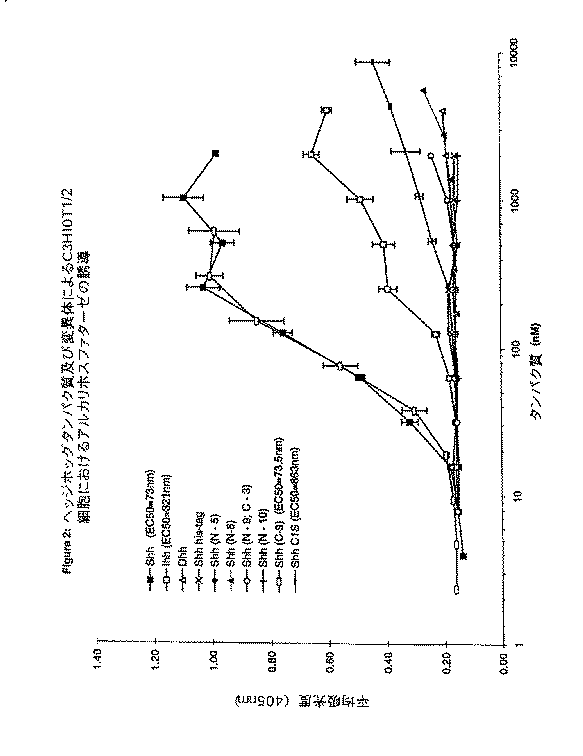
6ヒスチジンタグを切断除去するために、エンテロキナーゼ(Biozyme、カリフォルニア州サンディエゴ)を1:1000の酵素:Shh比(w/w)でヒスチジンタグ−Shhと共に28℃で保温した。未切断のヒスチジンタグ−Shh及び結合していないヒスチジンタグを、第二のNi−NTAアガロースカラム(20mg Shh/ml樹脂)に通過させて消化することによって除去した。充填に先だって、消化にイミダゾール(pH7の1M原液)及びNaCl(5M原液)を添加し、最終濃度をそれぞれ20mM及び600mMとした。この物質を、25mMリン酸ナトリウム(pH8)、600mM NaCl、20mMイミダゾール、0.5mM DTTで予め平衡させたNi−NTAカラムに充填し、通過させた液を集めた。カラムを1CVの同じ緩衝液で洗浄し、通過流と共にプールした。MES(pH5の0.5M原液)をNiアガロース未結合画分に添加して最終濃度を50mMとし、2容量分の水を添加した。この物質を、5mMリン酸ナトリウム(pH5.5);150mM NaCl、0.5mM DTTで予め平衡させた、第二のSP Sepharose(R)Fast Flowカラム(20mg/ml樹脂)に充填した。カラムを3CVの平衡緩衝液と、300mM NaClを含む1CVの同じ緩衝液で洗浄した。Shhを5mMリン酸ナトリウム(pH5.5)、800mM NaCl、0.5mM DTTで溶出した。得られた原子吸光分析データは、Shhがこの段階で0.5モル当量のZn2+を含んでいることを示した。等モル濃度のZnCl2をShh溶出に添加し、蛋白質を5mMリン酸ナトリウム(pH5.5)、150mM NaCl、0.5mM DTTで透析した。得られたShhは、SDS−PAGE、サイズ排除クロマトグラフィー(SEC)及びESI−MSによって>98%の純度を持ち、原子吸光分析によって0.9〜1.1Zn2+/Shhを含んでいることが示された。
【0129】
ヒスチジンタグの除去とそれに続く精製で得られる精製Shhは、ESI−MSによって測定した予想質量と同じ質量を有することが示された(表1)。予備実験ではヒスチジンタグを有さない完全な構造体としてShhが発現された。Shhの発現レベルは低く、得られた蛋白質は過度に酸化されていた。その結果、大腸菌中でも発現したヘッジホッグ変異体は、ヒスチジンタグ融合体として産生された。
【0130】
実施例2:アンタゴニストの機能についての試験
外来ヘッジホッグ蛋白質に応答する様々な細胞系が同定されている。これらの応答には、ptc−1及びgli−1 mRNAの誘導(Takabatake他、Febs.Lett.410:485−489(1997))、patched−1発現の誘導(Nakamura他、Biochem.Biophys.Res.Comm.237:465−469(1997))、融合体のリン酸化(Threond他、Proc.Nat.Acad.Sci.93:42245−4228(1996))などがあり、軟骨細胞/砕骨細胞系統については、アルカリホスファターゼ活性の誘導などがある。本研究においては、C3H10T1/2細胞系を、ヘッジホッグシグナル伝達のレポーターとして用いた。下記に述べるアッセイにおいて、成熟Sonicヘッジホッグがpatched−1に結合し、シグナルを発生させることができるのに対し、様々なヘッジホッグ変異体は、成熟蛋白質と同等の親和性でpatched−1に結合するが、特定の機能的読み出しに対しては不活性であることがわかっている。ヘッジホッグのこれらの形態は不活性であっただけでなく、野生型Sonicヘッジホッグと機能について効果的に競争しており、従ってアンタゴニストとして作用した。そのようなアンタゴニストの特異的な例は、実施例3〜7に記載する。
【0131】
A.C3H10T1/2細胞におけるアルカリホスファターゼ活性の測定
多能性間充織細胞系C3H10T1/2(Reznikoff,C.A.他、Cancer Research33、3231−3238(1973))を、American Type Cell Collection(ATCC)から得て、10%ウシ胎児血清(FBS)を含むダルベッコ改変イーグル培地(DMEM)にて組織培養を37℃で維持した。AP誘導のアッセイ用に、5,000細胞/ウェルで96ウェルプレートに細胞を培養し、24時間後に2倍連続希釈した精製ヘッジホッグ蛋白質を培養に添加し、更に5日間培養した。10mMジエタノールアミン(pH9.5)、0.5mM MgCl2中で37℃にて30分培養して細胞を溶解し、溶解液中に色素産生基質p−ニトロフェニルホスフェート(pNPP)を用いて、アルカリホスファターゼ(AP)活性について調べた。溶解物をpNPPで30分間培養し、96ウェルプレートリーダー(PerSeptive Biosystems、マサチューセッツ州フレーミングハム)にて405nmで数値を読んだ。APは、軟骨細胞/骨芽細胞系統への分化のマーカーである。C3H10T1/2アッセイにおけるShhの用量反応は、0.1〜10μg/mlの範囲で観察された。
【0132】
大腸菌から得た、ヒスチジンタグ付き蛋白質として発現され後にタグが除去されたヒト成熟ヘッジホッグ(配列番号3)について、AP活性を読み出しとして用いるC3H10T1/2アッセイによって機能を調べた。このアッセイにおいて、Shhは、80nMのEC50、250nMの最大シグナルでの用量依存応答を示した(図2)。この活性は、抗ヘッジホッグ中和mAb 5E1によって中和することができる(データ示さず)。
【0133】
他の形態のヘッジホッグは、C3H10T1/2アッセイで機能を調べた結果、不活性であるか、実質的に減少した活性を有することが示された(図2)。これらには、ヒトShh(N−10)(配列番号6、実施例3)、ラットShh(N−8)(実施例4)、Shh(N−9/C−3)(実施例6)、Shh(N−5)(実施例6)、Shh(N−8)(実施例6)等の先端切断型;C1S Shh(実施例5)等のN末端改変型;及びヒスチジンタグ−Shh(実施例7)等のN末端伸長型がある。
これに対して、C末端から最後の9残基だけ欠けて発現されたShh変異体(表1における「Shh(C−9)」:配列番号10)は、成熟体に比べて、C3H10T1/2活性の減少は見られない(図2)。
【0134】
B.RT−PCRによるC3H10T1/2細胞におけるptc−1及びgli−1誘導の測定
Trizol法(Chomcyznski,P.及びSacchi,N.、Anal.Biochem.162:156(1987))によって、全RNAを調製した。マウス白血病ウィルス逆転写酵素を用いて37℃、45分間で第一のcDNA鎖を合成した。続いて、下記条件のPCRを27サイクル(ptc−1)又は29サイクル(gli−1)行って増幅した。95℃で3.5分、アニーリングを62℃で1分(patched−1)又は64℃で20秒(gli−1)、72℃で1分(ptc−1)又は20秒(gli−1)。プライマーは下記のものを用いた。
【0135】
Ptc−1 5’−CATTGGCAGGAGGAGTTGATTGTGG−3’(配列番号12)
5’−AGCACCTTTTGAGTGGAGTTTGGGG−3’(配列番号13)
Gli−1 5’−CGGGGTCTCAAACTGCCCAGCTT−3’(配列番号14)
5’−GGCTGGGTCACTGGCCCTC−3’(配列番号15)
【0136】
ptc−1及びgli−1はそれぞれ270bp及び386bpのPCR産物を検出することによって調べた。2日後にShhによるptc−1及びgli−1RNAの誘導は最大になった(ptc−1RNAは2倍、gli−1RNAは5倍)。アッセイを5日後に終了した時、ptc−1及びgli−1mRNAのレベルは両方とも、2日目のレベルより低下していた。
【0137】
C.C3H10T1/2細胞を持ちいたアッセイにおける、patched−1蛋白質の誘導
C3H10T1/2細胞をT75フラスコ内で増殖させ(3×106個)、Sonicヘッジホッグ(2μg/ml)又はShh(N−10)(配列番号6)(2μg/ml)と共に培養した。0、1、2、3又は4日後に、上澄液を捨て、細胞をPBSで洗浄した。Brij96(Sigma Chemical社、ミズーリ州セントルイス)、mM HEPES(pH7.4)、150mM NaCl、1mM EDTA、1mM PMSF、10 μg/mlアプロチニン、10μg/mlロイペプチン、10μg/ml O−フェナントロリン、10mMベンザミジン(benzamidine)、10μg/mlペプスタチンA、0.2 mg/mlバナジン酸ナトリウム、4mg/mlフッ化ナトリウムを含む、氷上の緩衝液に30分漬けて細胞を溶解した。溶解物を10,000gで15分間遠心分離し、上澄を親和精製したウサギ抗patched−1抗体及び蛋白質A−Sepharose(R)と共に静置した。
【0138】
抗体の免疫原として、Matt Scott博士(スタンフォード大学から進呈)により提供された大腸菌構造体から精製した、GST−C末端ネズミpatched断片(残基1237−1414)を用いた。抗体を、第一の非特異性GST樹脂と、第二のGST−patched C末端樹脂の2段階精製にかけた。ペレット形成の後、ペレットを溶解緩衝液で5回洗浄したのち、SDSを含む電気泳動緩衝液中で5分間沸騰した。試料を縮小(reducing)4〜20%SDS−PAGEゲル上で泳動させ、ニトロセルロースに転写した(100Vで2時間)。抗patched−1 C末端抗体をプローブにしてブロッティングを行い、蛋白質A−アルカリホスファターゼ及びピアスウルトラスーパーシグナル基質を用いてバンドを視覚化した。
【0139】
Mr=250,000のpatched蛋白質は、Shhによる処理前ではかろうじて検出できるレベルであったが、Shh処理の結果、用量及び時間に依存して増加することが示された。Shhは、2日目にpatched−1蛋白質応答の最大値(発現にして約5倍の増加)を誘導した。5日後にも、patched蛋白質発現は上昇したままであり、この時点でアッセイを終了した。
【0140】
D.Islet−1誘導アッセイ
中間神経板外植片を、第10期の鶏胚の尾側領域から切除した。運動ニューロンを誘導するために、中間神経板外植片をコラーゲンゲルに植え、ヘッジホッグ蛋白質を添加してN2培地で48時間培養した。Islet−1+運動ニューロンのマーカーであるIslet−1を、Islet−1特異モノクローナル抗体で検出した。神経板外植片を1%パラホルムアルデヒドを用いて4℃で1〜3時間固定した。外植片を一次抗体と4℃で一晩培養し、ビオチン化した抗マウスIgGと共に4℃で一晩培し、最後にCy3−複合ストレプトアビジンと共に4℃で一晩培養した。外植片を洗浄して顕微板に乗せた。外植片を蛍光光学部品を備えた顕微鏡で観察し、陽性反応を示した核を数えた。
【0141】
Shh及びShhの末端切断変異体は、神経管外植片におけるIsl−1発現を比較可能用量応答で誘発することができた(データは示さず)。Shh、並びにShh N−b、Shh N−9及びShh N−5の変異体のEC50は、〜2nMであった。islet−1アッセイにおけるこの活性は、ヘッジホッグアンタゴニスト属に共通の特徴を示しているようである。
【0142】
E.patched−1結合アッセイ
Mycタグ−patched−1で一時的にトランスフェクトしたヒト腎胚芽293細胞を用いて、結合実験を行った。直接結合は、293/patched−1細胞(1×106/ml)をヒトShh−Ig融合蛋白質(5nM)(Shhは、ヒトIgG1の、Fcヒンジ部に向って残基197の後の、CH2CH3部分の枠内で融合する;Jakubowski他、Cell Commun.3:131−142)と培養することによって調べた。細胞を洗浄したのち、フィコエリトリン(PE)標識化ロバ抗ヒトIgGと保温した。細胞を固定して、FACSにて読み出した。競合結合用に、160nMのShh又は他の蛋白質を添加し、一連の2倍希釈で力価を求めた。
【0143】
FACSを用いたアッセイを用いて、SonicヘッジホッグN末端領域が明らかにpatched−1に結合するIC50を調べたところ、〜3.5nMであった。Shhの末端を切断した変異体(表1)は、同様の親和性で結合した(図4)。C1Sアンタゴニスト(配列番号8)(実施例5参照)は、わずかに高い親和性(〜1nM)で結合した。
【0144】
F.アンタゴニストとしてのヘッジホッグ変異体の評価
C3H10T1/2アッセイを用いて、野生型Shh機能を阻害する能力を評価することによって、試料の持つヘッジホッグ機能のアンタゴニスト性について試験した。全てのウェルに、試験試料の連続希釈に加えて2μg/mlの成熟Shhを入れたことを除いては、本実施例のセクションAと実質的に同様にしてアッセイを行った。アンタゴニストの存在下で、Shh誘導AP活性における減少を用いることで阻害を測定することができ、読み出しに用いることによって、APの阻害を検定した。図3に示すデータは、patched−1に結合したがC3H10T1/2アッセイにおいて非活性又は低い活性しか有さなかった全てのヘッジホッグ変異体が、成熟Shhと競合し、従って機能的アンタゴニストであることを示している。
【0145】
実施例3
Pichia pastoris内で生成されるShhからのアンタゴニストの検出
ヒトShhの最初の10個のアミノ酸が欠けているN−10変異体を、Pichia pastoris中で、成熟したSonicヘッジホッグのN末端断片(配列番号3)をコードする構造体の発現により生成した。すべての方法及びPichia pastorisに対する成長培地は製造業者から提供されているInvitrogen社製品マニュアルに記載されている。
【0146】
pUB55−1の作製:
pUB55は分泌シグナルとしてα因子PrePro領域を有するヒトSonicヘッジホッグN末端領域(配列番号3)を含んでいる。pUB55はpPIC9(カリフォルニア州サンジエゴのInvitoron社製)のSpH1部位に挿入されたpUC4−Kのカナマイシン遺伝子(HincII−HincII断片)によるpPIC9誘導体であるpCCM73中で構成された。Ear1−Not1からのヒトSonicヘッジホッグをコードする配列は、停止コドンとNot1部位をコード配列中にGly197に続くNot部位とを有するpEAG543から得られた。プラスミドpCCM73はXhoIとNotIで切断され、pEAG543のEar1−Not1とXhoI−EarI断片を構成するオリゴヌクレオチド[5’TCG AGA AAA GAT GCG GAC CGG GCA GGG GGT 3’:配列番号18及び5' CGA ACC CCC TGC CCG GTC CGC ATC TTT TC 3’:配列番号19]で結合され、Sonicヘッジホッグをフレーム中のα因子リーダ配列に近接させて配置するための適当なコード配列を作る。
【0147】
UB66−1の作製:
pUB55−1をStu1で消化し、10μgのDNAをInvitrogen社の指示する方法によりPichia pastoris GS115細胞に形質転換した。His+形質転換体はMDプレート上で選択し、捕集し、それを増殖形質転換体のための選択を行うためにYPD/G418プレート上に広げた。株を10mlのBMGY培地で30℃で2日間生育し、次いで細胞を2%メタノールを含む2mlのBMMY中に再懸濁させ、30℃でさらに2日間生育した。発現は上記のSDS−PAGE分析により評価した。スケールアップ及び発酵のためにクローンUB66−1を選択した。
【0148】
形質転換したイーストは10リットルの発酵器中30℃で5日間生育した。その時点で、細胞は遠心分離により除去した。発現は200−400mg/lであったが、蛋白質の大部分(80%以上)は蛋白質分解された。遠心分離の後、培養液の上澄みを3容積の水で希釈し、それを25mMのリン酸ナトリウムpH5.4、150mMのNaClで平衡させたSP Sepharose FFカラム(商品名)に装入した。カラムを、各々25mMリン酸ナトリウムpH5.4、200mMのNaCl、及び1CVの25mMリン酸ナトリウムpH5.4、400mMのNaClでの、3×1カラム容積(CV)の順次の洗浄工程に付した。
【0149】
洗浄後、蛋白質分解により最初の10アミノ酸が欠損した事後翻訳的に切り出したSonicヘッジホッグ変異体N−10(配列番号5)を、25mMリン酸ナトリウムpH5.5中450 mMNaClで溶出し、6画分の0.5CVを捕集した。完全なSonicヘッジホッグを650mM及び800mMのNaClでさらに溶出した。 これらの画分のすべては還元及び非還元条件下ににESI−MS及び SDS−PAGEにより特徴を調べた。それぞれの画分を0.2μmの膜を通して濾過し、等分し、−70℃で保存した。90%以上のShhをN−10変異体として含む画分450−1ないし450−3を、後の全ての検査に使用した。表1に示した配列番号5に対する ESI−MSデータは、予想された質量を示した。450mM の塩に曝した後の溶出画分はN−10変異体と完全なSonicヘッジホッグの混合物を含んでいた。
【0150】
Pichiaからの成熟ShhはC3H10T1/2アッセイで作用したが、N−10形態(配列番号5,表1のN−10)はC3H10T1/2アッセイで不活性であった(図2)。patched−1結合試験では、N−10変異体は成熟Shhに対するそれに比肩できる親和性をもってpatched−1に結合する能力を保持した。N−10変異体は成熟蛋白質の親和性をもってpatched−1に結合したが、C3H10T1/2アッセイにおいてヘッジホッグシグナルを出すことが出来なかったので、その蛋白質は成熟生成物のアンタゴニストとして作用すると考えられた。この可能性を調べるために、C3H10T1/2細胞で競合を調べた。すなわちShhを一定の2.5μg/mlの濃度で、変異体の8個2倍系列の希釈物を全てのウエルに、完全なShhの添加に先立つ予備培養工程で、またはShhの添加と同時に細胞を収容したウエルに直接に、添加した。C3H10T1/2アッセイでは、N末端から10個のアミノ酸が欠けている、Phicia中で生成したShh切断変異体(“Shh(N−10)”:配列番号5)は、約250nMのIC50で成熟蛋白質Shh(図3)によるAP活性の誘導を遮断することができた。
【0151】
実施例4: 昆虫細胞で生成したShhからのヘッジホッグアンタゴニストの検出
ラットの最初の8個のN末端アミノ酸が欠けているShh−NのN−8変異体を、High Five昆虫細胞(商品名)中で、ラットShh−N(ラットの遺伝子配列中の25−198残基)をコードするcDNAの発現により発生させた。Sf−900II培地(Life Technolory社製,Gaithersburg,MD)2.4×10⁶細胞/mlの密度に成長させた昆虫細胞の20×100mlの培地に、細胞あたり4感染ウイルスの感染倍率で、ラットShhのcDNAをコードするバキュウロウイルスで感染させた。28℃で48時間培養後に、細胞を遠心分離により収集し、1.2リットルの10mM Na2HPO4 pH6.0、150mM NaCl、0.5mM PMSFに再懸濁させ、次いで遠心分離により収集した。細胞を次に1.2リットルの10mM Na2HPO4 pH6.0、150mM NaCl/0.5mM PMSFに再懸濁し、遠心分離により収集し、次いで−70℃で保存した。
【0152】
細胞(37.5 g)を解凍して、これを300mlの10mM Na2HPO4pH6.5、150mM NaCl、0.5mM PMSF、5μMのペプスタチン、10μg/mlのロイペプチン、2μg/mlのEMに再懸濁し、次いで30mlの10%のTritonX−100を添加した。この混合物を30分間氷上で培養し、次いで粒状物を1500Gで10分間遠心分離して除去した。
その上澄み(330ml)に33mlの0.5M MES(pH5.0)を添加し、そして全体の試料を、5mM Na2HPO4 pH5.5、150mM NaCl、0.5mM PMSF、0.1%NP−40中で平衡化したSP-Sepharose高速流樹脂(Parmashia社,Piscataway,NJ)の37.5mlカラム(2.5cm×7.7cm)に装入した。一旦装入したら、カラムを5mM Na2HPO4 pH5.5、150mM NaCl、0.5mM PMSF、0.1% NP−40の2×37.5ml等分液で洗浄し、次いで50mlの5mM Na2HPO4 pH5.5、300mM NaCl、0.5mM PMSF、0.1%NP−40で洗浄した。
【0153】
結合した蛋白質を10×12.5ml画分の5mM Na2HPO4 pH5.5、800mM NaCl、0.5mM PMSF、0.1%NP−40で溶出した。ラットShh−N(ウエスタンブロット分析で確認)を含有する画分をプールし(体積67.5ml)、次いで、135mlの50mM Hepes pH7.5と混合した。試料全体を次に、アンチヘッジホッグモノクローナル抗体5E1が4.0mg抗体/ml膨潤ゲルの濃度で結合している3mlのSepharose 4Bと混合した。4℃で2時間培養した後、樹脂をカラムに充填し、10×4.2mlのリン酸塩緩衝塩水pH7.2、1%オクチルグリコシドで洗浄し、次いでラットShh−Nを、10×1.0ml画分の25mM NaH2PO4 pH3.0、300mM NaCl、1%オクチルグリコシドで溶出して、100μlの1M Hepes pH7.5を収容した試験管に入れた。
【0154】
この生成した蛋白質のHPLC及びESI−MS分析の結果、約80%がN−8変異体であり、残りの20%がN末端システイン残基でミリスチン酸、パルミチン酸及びアラキジン酸変性を有する全長蛋白質の混合物であった。N−8変異体をHPLCにより脂肪族アクリル化形態のものから分離した。N−8変異体はC3H10T1/2アッセイにおいて不活性であり、同じアッセイにおいて成熟Shh活性を遮断するアンタゴニストとして作用した(図2〜3)。
【0155】
実施例5:直接発現によるアンタゴニストの生成
N末端システインがセリンに変異したSonicヘッジホッグN末端領域変異体(C1S:DNAに対する配列番号17)はE.Coli中でヒスタッグ(標識)した蛋白質として発現され、精製され、成熟蛋白質対して上述したようにして特性を決定された(表1参照)。C1S変異体はC3H10T1/2アッセイにおいて減少した活性を有し(図2)、成熟した蛋白質に対して機能性アンタゴニストとして作用した。ヒトShhのN末端システインをセリンで置換したもの(C1S:配列番号8)はC3H10T1/2アッセイにおいて活性を実質的に失う。このアンタゴニストの能力(EC50)は濃度が成熟蛋白質に比して3倍高くシフトし、最大AP活性(効率)は3番低い。C1S変異体はまたヒトShhによるAP誘導を0.5mMのIC50で遮断することができる。(データは示さない)。
【0156】
ある場合には、本発明のアンタゴニストを生成させるのに使用される他の改変手段と関連してC末端から1個以上のアミノ酸を除去するのに有用であり得る。他の例では、C末端のアミノ酸延長が本発明のアンタゴニストの生成に使用できる。この目的で、最後のアミノ酸9個が欠けたSonicヘッジホッグN末端に変異体をコードするポリヌクレオチド(Shh(C−9):配列番号10)を創出した。コードされた蛋白質はE.Coli中でヒスタッグ蛋白質として発現され、生成され、成熟蛋白質に対して上述したと同様にして特性が決定された(表1参照)。配列番号10の蛋白質はC3H10T1/2アッセイにおいて成熟蛋白質に比肩しうる活性を有し(図2)、ShhにおけるC末端配列は重要な機能を有しないことを示した。
【0157】
実施例6:ヘッジホッグ蛋白質アンタゴニストの蛋白質分解による生成
限定された蛋白質分解はShhアンタゴニストを成熟した蛋白質から生成するのに使用できる別の方法を提供する。多くの酵素が断片の生成に利用できるが、本発明者はプラスミン、トロンビン及びエンテロキナーゼについてこのアプローチの成功を見た。
【0158】
N末端からアミノ酸CGPGRGFGKを欠き且つC末端から残基SGGを欠いているShhのN−9/C−3変異体(配列番号6)が、ヒスタッグShhをウシプラスミン(Sigma Chemical Company,St.Louis,MO) と共に、Shh対酵素比10対1(重量比)で、50mM Tris−HCl pH7.4中、20℃にて3時間培養することにより生成された。消化物を同一バッファー中でオボインヒビターカラム(Pierce, Rockford, IL) に通すことにより、プラスミンを除去した。開裂しなかったヒスタッグShhは、試料を25mM Na2HPO4 pH8.0、1M NaCl、20mMイミダゾール、0.5mM DTT中のNi2+ NTAアガロースカラム(Qiagen, Santa Clarita, CA)に通すことにより除去し、残りの蛋白質はpH5.5でSP Sepharose FF(商品名)に成熟Shhとして捕捉し溶出することにより濃縮した。等モルのZnCl2をこのShh変異体に添加し、これら蛋白質を5mMのリン酸ナトリウムpH5.5、150mM NaCl、0.5mM DTTに対して透析した。最終生成物はESI−MS(表1)とN末端配列決定により特性を決定した。
【0159】
N末端から残基CGPGRを欠いているShhのN−5変異体(配列番号7)が、ヒスタッグShhをビオチニル化トロンビン(Novagen, Madison, WI) と共に50mM Tris−Cl pH7.4中、Shh対酵素比10:1(重量比)で、20℃にて3時間培養することにより生成された。ビオチニル化トロンビンは、消化物をストレプトアバジンアガロースカラムを通すことにより除去した。このN−S変異体を精製し、N−9/C−3変異体に関して述べたと同様にして分析した。
【0160】
ShhのN−8変異体(配列番号11)が、ヒスタッグShhの変異形(Gly−8がArg:“G8R-Shh”で置換されたもの)をエンテロキナーゼ(Biozyme, San Diego,CA)と共に、25mM Na2HPO4 pH8.0、400mM NaCl、0.5mM DTT中、ヒスタッグG8R−Shh:エンテロキナーゼ比525:1(重量比)で、28℃にて2時間培養することにより生成された。完全なG8R変異体蛋白質(変位蛋白質の開始部位直近のエンテロキナーゼ部位で開裂)及びN−8切断形(Arg-8のC末端で開裂)を含有している流出物は、次にBiorad(商品名)(Hercules,CA)Bio−Scale S2陽イオン交換カラムで精製して、上記2つの形態に分離し、エンテロキナーゼを分離した。これら蛋白質を5mM Na2HPO4 pH5.5、0.5mM DTT中で、150mM〜1.0M NaClの直線勾配で溶出した。N−8形態の変異体は完全なG8R変異体蛋白質よりも充分低いNaCl濃度でカラムから溶出した。N−8形態の変異体を5mM Na2HPO4 pH5.5、150mM NaCl、0.5mM DTTで充分に透析した後、−80℃で保存した。
【0161】
N−9/C−3(配列番号6)及び配列番号7(表1のN−5)はいずれもC3H10T1/2アッセイで不活性である(図2)。ShhのN−9/C−3(配列番号6)及びN−S(配列番号7)切断変異体は、成熟蛋白質により誘導されるAP活性を遮断し(図3)、いずれも約80nMのIC50を有する。対照蛋白質BSAまたは免疫グロブリンアイソタイプ G (IgG) の添加はAP活性のShh誘導を遮断しなかった(データは示さない)。ShhのN−9/C−3切断変異体(配列番号6)は実施例2に記載したアッセイで試験したときにpct−1を誘導することが出来なかった(データは示さない)。これらの切断されたShh変異体は、Shhに対するものに比肩できる量的応答で中性試験管植片中でIsl-1発現を誘導することが出来た(データは示さない)。Shhと変異体に対するEC50はIslet−1伝導アッセイで約2nMであった。
【0162】
実施例7:その他のアンタゴニスト
ヒトShhのN末端システインをセリン(C1S:配列番号8)で置換すると(C1S:配列番号8)、AP誘導で評価したときC3H10T1/2アッセイで活性をほ実質的に失う(図2)。このC1S変異体の能力(EC50)は野生型に対して3倍高濃度側にシフトする。C1S変異体はまた0.5mMのIC50でヒトShhによるAP誘導を遮断することができる。ヘッジホッグN末端システインのある種の化学改変(修飾)もまたアンタゴニスト変異体を精製することが期待される。
【0163】
ヒスタッグShh(配列番号1)のようなN末端延長を有するShh変異体はC3H10T1/2アッセイにおいて不活性であり(図2)、アンタゴニストとして作用できる(図3)。Sonicヘッジホッグ蛋白質以外のヘッジホッグ蛋白質はこれらのアッセイにおいてアンタゴニストとして作用できる。IndianヘッジホッグのN末端領域(その遺伝子配列によりコードされたCys23−197残基)、及びDesertヘッジホッグのN末端(その遺伝子配列によりコードされるCys 28−203アミノ酸残基)は、Sonicヘッジホッグ蛋白質に関して述べた方法によりヒスタッグ蛋白質として発現され、そして精製された。得られる生成物は同様に98%以上の純度を有し、表1にまとめたESI−MSデータはこれらの生成物に対して期待される物質を示した。
【0164】
C3HLOT1/2アッセイにおいて、Indianヘッジホッグ(Ihh)はSonicヘッジホッグよりも能力が劣り、EC50が約1mMである(図2)。同じアッセイでDesertヘッジホッグ(Dhh)は不活性である。ここで精製されたShhのN末端切断変異体(例えばN−9/C−3とN−10)もまたC3H10T1/2アッセイにおいてIhhを遮断することができる(データは示さない)。
【0165】
発明者はC3H10T1/2アッセイでIndianヘッジホッグ及びDesertヘッジホッグの各種変異体を試験した。本発明の開示に基づいて当業者はIhh及びDhhの切断変異体(既に説明したものを含む)を生成することが出来るであろう。Shhの切断変異体について生成した方法と同様にして生成されるこれらのIhh及びDhhの切断変異体は、野生型の蛋白質Shh及びIhhによるAP活性を遮断することを期待できる。
【0166】
Desertヘッジホッグ自体はまたアンタゴニストとして作用し、C3H10T1/2アッセイにおいてShhまたはIhh活性を遮断できる。C1S変異体、ヒスタッグShh、Ihh及びDhhは全てpatched−1レセプタにSonicヘッジホッグに比肩し得る親和性をもって結合する(図4)。 Sonicヘッジホッグに対すると同様な方法で生成されたIhh及びDhhの切断変異体はShhまたはIhh蛋白質によるAP活性の誘導を遮断することができる。
【0167】
Dhh自体もまたアンタゴニストとして作用して、C3H10T1/2アッセイにおいてSonicヘッジホッグまたはIndianヘッジホッグの活性を遮断できる。
C1S変異体、ヒスタッグShh、Ihh、及びDhhは全てpatched−1レセプタにSonicヘッジホッグに比肩し得る親和性をもって結合する(図4)。
【0168】
実施例8:Hhアンタゴニストを使用する毛成長の抑制
ヘッジホッグ及びそのレセプタpatched(ptc)は皮膚(たとえば毛小泡体)(Iseki et al. (1996) Biochem.Biophys.Res.Comm.218,688-693; St-Jaques et al. (1998) Current Biology 8, 1058-1068) の上皮及び/又は間充細胞成分に発現される。上皮及び皮膚間充細胞の間の二方向相互作用は毛小泡体の発達を指令する。この相互作用を阻害すると、毛及び又は上皮組織の構造(例えばガット)を生じる増殖及び/又は分化の変動を生じることが予期される。例えばShh(N−10)のようなヘッジホッグアンタゴニストを毛小泡体細胞の成長及び分化の抑制に使用することができる。毛の成長とは、細胞分割により毛繊維の形成と伸長が起きることを指す。本発明のアンタゴニストを試験する技術が入手でき且つ知られている。一つの動物モデルは妊娠したマウスを本発明のアンタゴニストで処理してアンタゴニストを胎盤を通して胎児に与え、胚及び新生マウスに対して各種の試験を行うことを可能にする。
マウスはJackson Laboratory (Bar Harbor, Maine) 及び Charles River Laboratoriesから入手した。Balb/c及びC57bl/6を使用した。
【0169】
A.不治マウスにおける毛小泡体(Follicle)の形態形成の遮断
マウスにおける体毛の発達は胚時期13.5日で開始することが示されたので、E12.5の妊娠マウスに本発明のアンタゴニストを注射した。ヘッジホッグ蛋白質に結合するが10T1/2細胞の分化を遮断しない対照ヘッジホッグを使用した。処理したマウス及び処理しないマウスの子孫に対して組織学的検査を行った。E18.5の発達段階にあるマウスの組織分析は、上皮細胞由来の基質細胞が対照マウスで内側毛根鞘の形態形成を行うことを示したが、この過程は同じ発達段階にあるアンタゴニストで処理したマウスでは存在せず最初の週を通じて遅延状態に留まることが分かった。
【0170】
より加齢した不治マウスの遮断
本発明のアンタゴニスト蛋白質を毛成長サイクルの第2(年齢3週)及び第4(年齢9週)成長期にあるマウスに投与した。毛成長に対する影響をはっきりさせるために、これらのマウスの背中の毛を剃った。結果は対照マウスの背中の毛は3週間で完全に修復したが、アンタゴニストで処理した毛の成長は完全に阻止された。
【0171】
B.誕生後の遮断
本発明者はさらに、より発達した段階でのアンタゴニストの投与により、毛形態形成を維持するのにはヘッジホッグシグナル伝達が必要であることを示す。この点を実行するために、マウスを誕生後の毛小泡体の形態形成が始まった段階でアンタゴニストの投与をおこなった。アンタゴニストで処理したマウスでは体毛が形成されたが、毛は短かく、毛成長の遅延があることが示唆された。
【0172】
C.遮断の逆行
無毛表現型アンタゴニストによる処理の撤回により逆行できるかどうかを調べるために、皮下注射でアンタゴニストを投与された数匹の子犬での投与を中止した。
本方法は毛成長サイクルの動的機構を変化して直接に毛小泡細胞の増殖を直接禁止し及び/又は直接幹細胞の分化を変化させるための手段を提供する。例えば、本方法は毛成長の禁止が望まれる領域の皮膚に、動物の毛小泡体寸法及び/又は毛成長速度を減少するに充分な量のヘッジホッグアンタゴニスト(例えばShh(N10))を投与することよりなる。このような効果は可逆的または非可逆的である。例えば、本発明の方法は毛の異常な過剰成長又は濃密成長(例えば多毛症)により特徴付けられる毛発病の治療に使用できる。ヘッジホッグアンタゴニストは、異常な多毛症である男性型多毛症の処置に使用できる。本方法はまた脱毛期間を延長する方法も提供する。
【0173】
本発明のアンタゴニストは上皮由来の組織の分化を抑制するために使用できる。これらの分子形は上皮組織を含む過剰形成状態及び/又は新生状態を処置するための各種治療の分化治療の基礎を提供できる。例えば、本発明の薬剤としてのアンタゴニストは、角化症のような過剰成長表皮状態の処置、或いは、基底細胞の悪性腫瘍や扁平上皮細胞の悪性腫瘍のような各種皮膚癌における高増殖率で特徴づけられる新生上皮細胞状態の処置などを意図している。ヘッジホッグアンタゴニストは、温熱又は放射線治療を受けていて通常は頭髪の喪失を生じるような患者に使用できる。ヘッジホッグアンタゴニストはしばしば上皮細胞に対して細胞増殖抑制的であり、細胞毒性が無く、このような薬剤は、放射線誘導壊死のような、効果のためには細胞サイクルのS期に進行することを要求する細胞毒性を有する薬剤から毛小泡体細胞を保護するのに使用できる。このように、治療中に細胞サイクルを抑制することにより、本発明の処置は、細胞死プログラムの活性化から生じるであろう壊死から、毛小泡体細胞を保護することができる。本発明の方法による処置は、毛小泡体細胞を休止状態にすることにより保護を行う。治療が終わったら、処置を中止して処方体細胞の増殖の抑制を解除する。
【0174】
配列の説明
SEQ ID NO:1は、pET11bベクター中にサブクローン化されたcDNAによりコードされるhisタグ付きソニックヘッジホッグN末端ドメイン融合タンパク質(遺伝子工学により構築物中に成熟Shh配列のCys1の直ぐ隣りにエンテロキナーゼ開裂部位を有する6ヒスチジンタグ付き融合タンパク質として)である。
【図面の簡単な説明】
【図1】 ヒトインディアン、ソニック及びデザートヘッジホッグ(それぞれ、SEQ ID NO:2、3及び4)よりなる様々なヒトヘッジホッグタンパク質のN末端断片のアラインメント。
【図2】 ヒトソニックヘッジホッグN末端ドメイン及び変異体のC3H10T1/2アッセイ。huShh及び変異体の活性を、アルカリホスファターゼ誘導を測定するC3H10T1/2アッセイにおいて評価した。
【図3】 Shh−N及び切り詰めた変異体のレセプター結合アッセイにおける分析。Shh(■)、Ihh(□)、Dhh(△)、hisタグ付きShh(×)、Shh(N−5)(◆)、Shh(N−9/C−3)(○)、Shh(N−10)(│)、Shh(C1S)(−)及びShh(N−8)(▲)のパッチトに結合する相対的効力を、パッチトトランスフェクトしたEBNA−293細胞につき、FACS分析により評価した。試験試料の一連の希釈物をEBNA−293細胞とインキュベートし、洗浄してから、結合パーセントをこれらの試料が細胞への結合をShh−Igと競争する能力により測定した。結合したShh−Igを平均蛍光により定量した。このデータを非線形回帰により双曲線に当てはめた。
【図4】 Shh変異体によるShh活性のC3H10T1/2ブロッキングアッセイ。APのShh誘導をブロックするShh変異体の能力を評価した。Dhh、Shh(N−5)、Shh(N−10)、Shh(N−9/C−3)、hisタグ付きShh−N及びShh(N−8)の一連の2倍希釈物をShh(2μg/ml)と30分間インキュベートしてから、C3HT101/2アッセイにおける分析にかけた。[0001]
Background of the Invention
Hedgehog proteins are a family of extracellular signaling proteins that regulate various aspects of embryonic development in both vertebrates and invertebrates (for review see Perrimon, N. (1995)
[0002]
Biochemical and genetic data indicate that the hedgehog receptor is the product of a patched tumor suppressor gene (Marigo, V. et al. (1996) Nature 384,176-179; Stone, DM et al. (1996) Nature 384,129- 134) and smoothund (Alcedo, J. (1996) Cell 86, 221-232), cubitus interruptus or its mammalian counterpart gli (Dominguez, M. et al. (1996) Science 272, 1621-1625; Alexandre , C. et al. (1996) Genes & Dev. 10, 2003-2013) and fused (Therond, PP et al. (1996) Proc. Natl. Acad. Sci. USA 93,4224-4228) are hedgehog signaling pathways. It is suggested to be included in. Induction of patched-1 and gli-1 expression is a downstream marker of hedgehog signaling and serves as a simple marker for hedgehog function. The second patched gene, patched-2, is also induced by hedgehog (Takabatake, T. et al. (1997) FEBS Letts. 410, 485-489). The transmembrane protein Hip has also been identified as a receptor for hedgehog (PCT Publication WO 98/12326).
[0003]
Shh is synthesized as a 45 kDa precursor protein, which is cleaved autocatalytically and is a 20 kDa N-terminal fragment responsible for all known hedgehog biological activities (“mature” sonic hedgehog) And a self-processing mechanism (Lee, JJ et al. (1994) Science 266, 1528-1536; Bumcrot, DA et al. (1995) Mol. Cell Biol. 15, 2294-2303; Porter, JA et al. (1995) Nature 374,363- 366) yielding a 25 kDa C-terminal fragment. This N-terminal fragment maintains membrane binding by addition of its C-terminal lipid tether (Porter, JA et al. (1996) Science 274, 255-258; Porter, JA et al. (1995) Cell 86, 21-34). . Recent biochemical data have identified this lipid tether as cholesterol (Porter, J.A. et al. (1996) Science 274, supra), whose addition is catalyzed by the C-terminal domain during the self-processing step. Shh is also modified at its N-terminus with palmitic acid (described in PCT patent application PCT / US98 / 15923 and Pepinsky et al. (1998) J. Biol. Chem., 273: 14037-14045). . Lipid tethers limit the tissue localization of hedgehog signals and have probably evolved as part of the regulatory mechanism of short-to-long distance signaling by hedgehog.
[0004]
Certain pathological conditions, including various neuronal cancers, are caused by overexpression of hedgehog proteins. For these conditions and others, it would be useful to develop a version of hedgehog that can bind to the hedgehog receptor protein but does not elicit signaling by hedgehog and therefore acts as an antagonist to hedgehog activity.
[0005]
Summary of invention
We note that the N-terminal cysteine of mature hedgehog proteins is important for biological activity and that certain hedgehog variants containing N-terminal changes can block hedgehog function; It has been discovered that mutants can serve as functional antagonists. These polypeptides have the ability to bind to the hedgehog receptor, patched-1, but have no or reduced ability to elicit a hedgehog dependent response.
[0006]
One aspect of the invention is an isolated functional antagonist of a hedgehog polypeptide. A critical feature of the primary amino acid sequence that determines whether such a hedgehog polypeptide is a functional hedgehog antagonist is that the hedgehog polypeptide has (i) an N-terminal cysteine corresponding to Cys-1 of mature hedgehog. It contains the N-terminal cysteine corresponding to Cys-1 of the lacking or altered form of mature hedgehog. In both cases, the structure of the antagonist is sufficiently similar to that of wild-type hedgehog and allows binding of the protein to the hedgehog receptor in C3H10T1 / 2 cells, but is hedgehog-dependent. No induction of signaling response is given. The hedgehog polypeptide may be a modified version of any member of the hedgehog family as long as it contains this critical primary amino acid sequence.
[0007]
Thus, in one embodiment, the functional antagonist includes an N-terminal extension. This portion can include an N-terminal cysteine corresponding to Cys-1 of the mature hedgehog polypeptide. In this embodiment, the N-terminal extension effectively blocks the N-terminal cysteine corresponding to Cys-1 of the mature hedgehog polypeptide from exhibiting biological activity. This N-terminal extension can also replace Cys-1 of the mature hedgehog polypeptide.
[0008]
In other embodiments, the functional antagonist has lost up to about 12 amino acids starting at the N-terminal cysteine corresponding to Cys-1 of the mature hedgehog polypeptide.
[0009]
In yet another embodiment, the functional antagonist has a mutation of the N-terminal cysteine corresponding to Cys-1 of the mature hedgehog polypeptide to a polar amino acid residue such as serine or aspartic acid or a charged amino acid residue.
[0010]
Another aspect of the invention is a hedgehog poly comprising a modified form of an N-terminal cysteine wherein the N-terminal cysteine corresponds to the mature hedgehog polypeptide Cys-1, but no longer has the activity of the mature peptide Cys-1. An isolated functional antagonist of a hedgehog polypeptide comprising a peptide. In one embodiment, the functional antagonist has an N-terminal cysteine in oxidized form.
[0011]
The mature hedgehog polypeptide Cys-1 comprises (a) a mature sonic hedgehog polypeptide Cys-1; (b) a mature Indian hedgehog polypeptide Cys-1; and (c) a mature dessert hedgehog polypeptide. It can be selected from the group consisting of Cys-1. Suitable isolated functional antagonists of the hedgehog polypeptide are selected from the group of polypeptides consisting of SEQ ID NOs: 5, 6, 7, 8, and 9.
[0012]
A further aspect of the invention is an isolated functional antagonist of a hedgehog polypeptide having at least the following properties: (i) the isolated protein is in receptor patch-1 and mature hedgehog Bind with a lower (preferably the same) affinity than the protein for binding to patch-1; and (ii) the isolated protein is C3H10T1 / 2 cell-based AP induction in vitro. Block the induction of alkaline phosphatase (AP) by mature hedgehog protein when tested in the assay. Antagonists having these properties can include hedgehog polypeptides lacking the N-terminal cysteine corresponding to Cys-1 of mature sonic, Indian or desert hedgehog.
[0013]
In a preferred embodiment, the antagonist polypeptide comprises an amino acid sequence at least 60% homologous to the amino acid sequence from SEQ ID NOs: 1-8, and the antagonist polypeptide is at least 100 amino acids long. Preferably, the antagonist polypeptide exhibits a functional antagonist biological activity: (i) the isolated protein has a lower affinity for binding of mature hedgehog protein to patched-1 (preferably Bind to receptor patch-1 with the same affinity; and (ii) induction of AP by mature proteins when the isolated protein is tested in a C3H10T1 / 2 cell-based AP induction assay. To block.
[0014]
Isolated polypeptides (eg, RNA or DNA) are also included in the claims. One embodiment of this invention is an isolated encoding a functional antagonist comprising a critical primary amino acid sequence comprising a hedgehog polypeptide lacking an N-terminal cysteine corresponding to Cys-1 of mature sonic hedgehog upon expression. DNA sequence.
[0015]
In one embodiment, the isolated DNA sequence encodes a functional antagonist comprising an N-terminal extension comprising the mature sonic hedgehog Cys-1. In other embodiments, the isolated DNA sequence encodes a functional antagonist comprising an N-terminal extension that replaces Cys-1 (the most N-terminal amino acid residue) of mature sonic hedgehog.
[0016]
In other embodiments, the isolated DNA sequence encodes a functional antagonist that lacks up to about 12 amino acids starting at the N-terminal cysteine corresponding to Cys-1 of mature sonic hedgehog.
[0017]
In yet another embodiment, the isolated DNA sequence encodes a functional antagonist having a mutation to another amino acid residue of the N-terminal cysteine.
[0018]
Upon expression, an isolated polynucleotide encoding a functional antagonist comprising a critical primary amino acid sequence comprising a hedgehog polypeptide lacking the N-terminal cysteine corresponding to Cys-1 of mature dessert or Indian hedgehog (e.g., RNA Or DNA) is also within the scope of the claims. For example, the isolated DNA sequence of the present invention can encode a functional antagonist comprising an N-terminal extension comprising mature dessert or Indian Cys-1. In other embodiments, the isolated DNA sequence encodes a functional antagonist comprising an N-terminal extension that replaces Cys-1 (the most N-terminal amino acid residue) of mature dessert or Indian hedgehog. In other embodiments, the isolated DNA sequence encodes a functional antagonist that has lost up to about 12 amino acids starting at the N-terminal cysteine corresponding to Cys-1 of mature dessert or Indian hedgehog.
[0019]
In other embodiments, the antagonist polypeptide comprises a hedgehog antagonist sequence described herein and other N-terminal and / or C-terminal amino acid sequences. The antagonist polypeptide also converts all or a fragment of the amino acid sequence from SEQ ID NOs: 1-4 and 5-8 to additional amino acid residues (preferably from SEQ ID NOs: 1-4 and 5-8). (A residue encoded by the
[0020]
Another aspect of the invention is an isolated DNA sequence encoding a functional antagonist comprising a hedgehog polypeptide comprising a modified form of the N-terminal cysteine, wherein the N-terminal cysteine corresponds to Cys-1 of mature sonic hedgehog It is. In one embodiment, the DNA sequence encodes a functional antagonist having an N-terminal cysteine that is included as part of the N-terminal extension.
[0021]
Preferred DNA sequences encode hedgehog polypeptides selected from the group consisting of SEQ ID NOs: 1-4 and 5-8.
[0022]
A further aspect of the invention is an isolated DNA sequence encoding a functional antagonist of a hedgehog polypeptide having at least the following properties: (i) the isolated protein is in receptor patch-1; Binds with a binding affinity that is lower than, but at least similar to, the binding of mature hedgehog protein to patched-1; and (ii) the isolated protein is analyzed in vitro in a C3H10T1 / 2 cell-based AP induction assay. When examined, it blocks AP induction by mature hedgehog proteins. A DNA sequence encoding an antagonist having these properties most preferably encodes a hedgehog polypeptide lacking the N-terminal cysteine corresponding to Cys-1 of mature sonic hedgehog. A hedgehog polypeptide that is a member of a vertebrate hedgehog family, such as a DNA encoding a vertebrate hedgehog polypeptide selected from the group consisting of sonic hedgehog, indian hedgehog and desert hedgehog. It is preferable to code.
[0023]
Preferred DNA sequences encoding a functional antagonist of a hedgehog polypeptide include a polynucleotide selected from the group consisting of:
(a) SEQ ID NOs: 16 and 17;
(b) a polynucleotide that encodes a protein that hybridizes under any standard hybridization conditions to any of the foregoing sequences and that has the activity of a functional antagonist of a hedgehog polypeptide; and
(c) a polynucleotide encoding a protein encoded by any of the polynucleotide sequences described above upon expression.
[0024]
In still further preferred embodiments, a polynucleotide encoding an antagonist polypeptide of the invention hybridizes under standard conditions to a polynucleotide probe corresponding to at least 12 consecutive nucleotides from SEQ ID NOs: 16 and 17. To do. Another embodiment of the invention includes a DNA sequence encoding a hedgehog polypeptide that is at least 60% homologous to a group of polypeptides selected from the polypeptides SEQ ID NOs: 1-4 and 5-8.
[0025]
The subject antagonist polynucleotides include, for example, a transcriptional regulatory sequence operably linked to a hedgehog antagonist gene sequence, eg, a transcription promoter or transcription enhancer sequence, to provide a hedgehog antagonist gene sequence suitable for use as an expression vector. One can be included.
[0026]
Accordingly, another aspect of the present invention is a DNA sequence encoding a functional antagonist comprising a core physical structure comprising a hedgehog polypeptide lacking an N-terminal cysteine corresponding to Cys-1 of mature hedgehog polypeptide upon expression. And a host cell containing this vector. In another aspect, the invention features a cell or purified preparation of cells that includes a polynucleotide that encodes a functional hedgehog antagonist upon expression. The cell preparation may consist of human or non-human cells such as mouse, hamster or rat cells, rabbit cells, monkey or pig cells. In preferred embodiments, these cells contain a heterogeneous form of an antagonist transgene, eg, an antagonist gene. Therapeutic compositions are also intended to be encompassed by this invention. The therapeutic composition comprises a functional antagonist polypeptide of this invention with an acceptable carrier. Preferably, compositions comprising an antagonist polypeptide and at least one additional component such as a carrier, diluent or solvent are also included in this invention. This additional component may make the composition useful for in vitro, in vivo pharmaceutical or veterinary use.
[0027]
A method for producing a functional hedgehog antagonist is a further aspect of the invention. One method is to change the N-terminal cysteine residue of the hedgehog polypeptide from the residue corresponding to residue Cys-1 of the mature hedgehog polypeptide to a residue that does not correspond to Cys-1 of the mature hedgehog polypeptide. Including that. The method can include subjecting the isolated hedgehog polypeptide to proteolysis such that the resulting fragment does not contain Cys-1.
[0028]
Another method for producing a functional hedgehog antagonist protein involves expressing a functional antagonist protein from a host cell using the DNA sequences and vectors of this invention and then purifying the expressed antagonist protein. A further method for producing a functional hedgehog antagonist protein is to express a hedgehog protein from a host cell using the DNA sequence and vector of the invention, and then modify the expressed protein to produce the antagonist protein of the invention. Forming. This modification can include the addition of at least one chemical moiety to the hedgehog protein, including but not limited to, polyethylene glycol (PEG) addition and dextran addition.
[0029]
A preferred therapeutic method for inhibiting hedgehog-dependent signaling in a patient comprises administering to the patient a therapeutic composition of the invention. This preferred invention therefore features a method of treating a mammal, such as a human, at risk for a disease (eg, a disease characterized by ectopic or undesirable levels of hedgehog polypeptides). One gene therapy method involves administering to the mammal a therapeutic agent (eg, a polynucleotide encoding an effective amount of an antagonist polypeptide). In other embodiments, the method comprises administering to the mammal an effective amount of an antagonist polypeptide. In a preferred embodiment, the disease is a type of cell hyperplasia and neoplastic transformation of various central nervous systems. In general, the antagonists of this invention are useful for modulating the functional performance of a wide range of cells, tissues and organs and have therapeutic applications ranging from neuroprotection, nerve regeneration and modulation of nerve function. Additional therapeutic compositions for use in gene therapy include the vectors of this invention that include a functional antagonist transgene.
[0030]
These antagonist polypeptides and polynucleotides are useful for the production of peptide molecules that can modulate hedgehog activity in vivo or in vitro; for the analysis of hedgehog receptor activation; for the identification of cells expressing the antagonist. Or for the production of anti-antagonist antibodies useful for assessing the level of antagonist expression; useful for the production of hedgehog antagonist fragments that can be used to modulate hedgehog activity in vivo or in vitro.
[0031]
Detailed Description of the Invention
I. Definition
The invention will now be described with reference to the following detailed description, which includes the following definitions:
“Amino acid” —a monomeric unit of a peptide, polypeptide or protein. In natural peptides, polypeptides and proteins, 20 amino acids are found, all of which are L-isomers. The term also encompasses amino acid analogs, modified amino acid residues, and D-isomers of protein amino acids and their analogs.
[0032]
“Protein” —Any polymer consisting essentially of any of the 20 amino acids. Often “polypeptide” is used for relatively large polypeptides and “peptide” is used for small polypeptides, but the use of these terms in the art is redundant and varied. The term “protein” as used herein refers to peptides, proteins and polypeptides unless otherwise stated.
[0033]
“N-terminal” —refers to the first amino acid (amino acid number 1) of the mature form of the protein, which consists of the primary amino acid sequence after removal of any signal or other sequence.
[0034]
“N-terminal cysteine” refers to any cysteine occupying the N-terminus of a hedgehog protein. Cys-1 (amino
[0035]
The “N-terminal cysteine” occupies the same position in the hedgehog polypeptide as it occupies in the human sonic hedgehog polypeptide sequence. In particular, “N-terminal cysteine” refers to amino
[0036]
“N-terminal extension” refers to a 5 ′ extension from an N-terminal cysteine and includes at least one individual unit (“element”). One element (eg, an amino acid residue) of the N-terminal extension can replace the N-terminal cysteine of the mature hedgehog polypeptide.
[0037]
“Functional antagonist” refers to a factor (eg, hedgehog protein) capable of inhibiting the function of a protein in vitro or in vivo. Furthermore, the term encompasses hedgehog proteins that are inactive in eliciting hedgehog-dependent responses in C3H10T1 / 2 cells, but compete with hedgehog for binding to the hedgehog receptor.
[0038]
A “fragment”, when applied to an isolated antagonist, may be as small as a single amino acid as long as it retains antagonist activity. It may be at least about 10 residues, more typically at least 40 residues, preferably about 100 residues long. Fragments can be generated by methods known to those skilled in the art. The ability of candidate fragments to exhibit the biological activity of isolated hedgehog can also be assessed by methods known to those skilled in the art as described herein.
[0039]
A “functional equivalent” of a hedgehog antagonist of this invention is a factor that may have different amino acid residues than a hedgehog antagonist, but nevertheless acts as a functional antagonist.
[0040]
“Gene fusion” —refers to the co-linear covalent linkage of individual peptide backbones by gene expression of two or more proteins, or fragments thereof, of the polynucleotide molecules that encode them.
[0041]
“Mutant” —Any change in the genetic material of an organism, particularly any change in the wild-type polynucleotide sequence (ie, deletion, substitution, addition or change) or any change in the wild-type protein.
[0042]
“Wild-type” —a natural polynucleotide sequence or portion thereof of an exon of a protein, or a protein sequence or portion thereof as normally present in vivo.
[0043]
“Mature” hedgehog protein— “Maturation” refers to a wild-type sequence comprising a processed N-terminal domain. For example, residues 24-197 of human sonic hedgehog (Shh), residues 23-197 of human Indian hedgehog (Ihh), residues 28-203 of human desert hedgehog (Dhh). Although the native form of mature hedgehog protein undergoes post-translational modifications, some of the recombinant versions used herein lack these modifications but are still active and are referred to as mature.
[0044]
The terms “polynucleotide sequence” and “nucleotide sequence” are used interchangeably and, as used herein, can include fragments and equivalents. The term “equivalent” refers to a nucleotide sequence that encodes a functionally equivalent polypeptide. “Equivalent” nucleotide sequences include sequences that differ by at least one nucleotide substitution, addition or deletion, such as allelic variants, and differ from the nucleotide sequence encoding the hedgehog antagonists of this invention due to the degeneracy of the genetic code. Contains an array.
[0045]
“Standard hybridization conditions” —salt and temperature conditions for both hybridization and washing substantially equal to 0.5 × SSC to about 5 × SSC and 65 ° C. The term “standard hybridization conditions”, therefore, as used herein is an operational definition and encompasses a range of hybridization conditions. Higher stringency conditions include, for example, plaque screen buffer (0.2% polyvinylpyrrolidone, 0.2% Ficoll 400; 0.2% bovine serum albumin, 50 mM Tris-HCl (pH 7.5); 1 M NaCl; 1% sodium pyrophosphate; 1% SDS); hybridized with 10% dextran sulfate and 100 (g / ml denatured sonicated salmon sperm DNA for 12-20 hours at 65 ° C., 75 mM NaCl / 7.5 mM citric acid Wash with sodium (0.5 × SSC) / 1% SDS at 65 ° C. Lower stringency conditions include, for example, plaque screen buffer, 10% dextran sulfate and 110 (g / ml denatured sonicated salmon sperm DNA For 12-20 hours at 55 ° C. and 300 mM NaCl / 30 mM sodium citrate. Wash with Lithium (2.0 × SSC) / 1% SDS at 55 ° C. See also Current Protocols in Molecular Biology, John Wiley & Sons, Inc. New York, 6.3.1-6.3.6 (1989). I want.
[0046]
“Expression control sequence” —a polynucleotide sequence that controls and regulates expression of a gene when operably linked to the gene.
[0047]
“Functionally linked” —a polynucleotide sequence (DNA, RNA) is operably linked to an expression control sequence when the expression control sequence controls and regulates the transcription and translation of that polynucleotide sequence. . The term “operably linked” refers to having an appropriate initiation signal (eg, ATG) in front of the polynucleotide sequence to be expressed and expressing the polynucleotide sequence under the control of the expression control sequence and its It includes maintaining the correct reading frame that allows the production of the desired polypeptide encoded by the polynucleotide sequence.
[0048]
"Expression vector"-a polynucleotide, such as a DNA plasmid or phage (among other common examples), that allows expression of at least one gene when introduced into a host cell. This vector may or may not be able to replicate in the cell.
[0049]
“Isolated” (used interchangeably with “substantially pure”) — when applied to a polynucleotide or polynucleotide sequence encoding a polypeptide, depending on its origin or manipulation, (i) it is naturally occurring Not associated with all the associated polynucleotides (eg, present in the host cell as an expression vector or portion thereof); or (ii) a polynucleotide other than the portion to which it is naturally associated or other Means (iii) a non-naturally occurring RNA or DNA polynucleotide, part of a genomic polynucleotide, cDNA or synthetic polynucleotide; “Isolated” can further be (i) amplified in vitro, for example by polymerase chain reaction (PCR); (ii) chemically synthesized; (iii) produced recombinantly by cloning; or (iv) ) Means a polynucleotide sequence purified by cleavage, gel separation, etc. Thus, a “substantially pure polynucleotide” is a polynucleotide that is not directly adjacent to one or both of the coding sequences that normally flank the natural genome of the organism from which it was obtained. Substantially pure DNA also includes recombinant DNA that is part of a hybrid gene encoding additional hedgehog sequences.
[0050]
“Isolated” (used interchangeably with “substantially pure”) — when applied to a polypeptide, depending on its origin or manipulation, (i) as part of the expression vector in the host cell Or (ii) bound to a protein or other chemical moiety other than that it was naturally bound to; or (iii) a non-naturally occurring polypeptide or portion thereof. “Isolated” further means a protein that has been (i) chemically synthesized; or (ii) expressed in a host cell and purified from the binding protein. The term generally refers to a polypeptide that has been separated from other proteins and polynucleotides that coexisted in nature. Preferably, the polypeptide is also separated from the material used to purify it, such as an antibody or gel matrix (polyacrylamide).
[0051]
“Heterologous promoter” —As used herein, this is a promoter that is not naturally associated with a gene or purified polynucleotide.
[0052]
“Homologous” —As used herein, this is synonymous with the term “identical” and refers to sequence similarity between two polypeptides, molecules or between two polynucleotides. If a position in both of the two sequences to be compared is occupied by the same base or amino acid monomer subunit (eg, a position in each of the two DNA molecules is occupied by adenine, or two polypeptides If each position is occupied by lysine, each molecule is homologous at that position. The percentage homology between the two sequences is a function of 100 times the number of matching positions or homologous positions shared by the two sequences divided by the number of positions compared. For example, if 6 out of 10 positions in two sequences are matched or homologous, then these two sequences are 60% homologous. For example, the DNA sequences CTGACT and CAGGTT share 50% homology (3 of all 6 positions are matched). In general, the comparison is made by aligning the two sequences to give maximum homology. Such alignment can be provided, for example, using the method of Needleman et al., J. Mol Biol. 48: 443-453 (1970), and can be conveniently performed by a computer program such as the Align program (DNAstar, Inc.). it can. Homologous sequences share the same or similar amino acid residues, which are conservative substitutions for the corresponding amino acid residues in the aligned reference sequence or are “permitted”. Is a point mutation. In this regard, a “conservative substitution” of a residue in a reference sequence is a substitution that is physically or functionally similar to the corresponding reference residue (eg, of similar size, shape, charge, covalent bond or Chemical properties including the ability to form hydrogen bonds). A particularly suitable conservative substitution is described in Dayhoff et al., 5: Atlas of Protein Sequence and Structure, 5: Preceding,
[0053]
The “hedgehog protein” of this invention is defined by having at least a portion consisting of SEQ ID NOs: 2-4. The term also refers to hedgehog polypeptides or functional variants of hedgehog polypeptides or analogs having biological activity of hedgehog polypeptides or functional variants.
[0054]
The terms “peptide”, “protein” and “polypeptide” are used interchangeably herein. The terms “polynucleotide sequence” and “nucleotide sequence” are also used herein interchangeably. The term “hedgehog fragment” is used interchangeably with “hedgehog fragment”.
[0055]
A hedgehog molecule has “biological activity” if it has at least one of the following properties: (i) the molecule meets the hedgehog common criteria defined herein (SEQ ID NO : 4) and encodes a polypeptide having the ability to bind to its receptor patch-1 or having this property upon expression; (ii) the molecule meets the hedgehog common criteria defined herein or Encoding a polypeptide having this property upon expression; and (iii) inducing alkaline phosphatase activity in C3H10T1 / 2 cells.
[0056]
The practice of the present invention employs conventional techniques of cell biology, cell culture, molecular biology, microbiology, recombinant DNA, protein chemistry and immunology unless otherwise indicated, and these are within the skill of the art. Is within. Such techniques are described in the literature. For example, Molecular Cloning: A Laboratory Manual, Second Edition (Sambrook, Fritsch and Maniatis), Cold Spring Harbor Laboratory Pess, 1989; DNA Cloning, Volumes I and II (DNGlover), 1985; Oligonucleotide Synthesis, ( MJGait), 1984; US Pat. No. 4,683,195 (Mullis et al.); Polynucleotide Hybridization (BDHames and SJHiggins), 1984; Culture of Animal Cells (RIFreshney). Alan R. Liss, Inc. ., 1987; Immobilized Cells and Enzymes, IRL Press, 1989; A Practical Guide to Molecular Cloning (B. Perbal), 1984; Methods in Enzymology, Volumes 154 and 155 (Wu et al.), Academic Press, New York; Gene Transfer Vector for Mammalian Cells (JHMiller and MPCalos), 1987, Cold Spring Harbor Laboratory; Immunochemical Methods in Cell and Molecular Biology (Mayer and Walker), Academic Press, London, 1987; Handbook of Experiment Immunology, I- Volume IV (DMWeir and CC Blackwell), 1986; Manipulating the Mouse Embryo, Cold Spring Harbor Laboratory Press, 1986 It should be irradiation.
[0057]
Other features and advantages of the invention will be apparent from the following detailed description and from the claims. Unless otherwise indicated, all references cited in the detailed description of the invention are incorporated herein by reference. References in the background of the invention are not prior art.
[0058]
II. General features of hedgehog protein
The functional antagonists of the present invention can be obtained from isolated hedgehog proteins. Thus, sonic, indian or dessert can be converted into a functional antagonist.
[0059]
Isolated hedgehog proteins are natural or recombinant proteins of the hedgehog family and can be obtained from invertebrate or vertebrate sources (see below). Members of the vertebrate hedgehog protein family share homology with proteins encoded by the Drosophila hedgehog (hh) gene (Mohler and Vani, (1992) Development 115,957-971). To date, a combined screening of mouse genomic and cDNA libraries has identified three mammalian hh counterparts called Desert Hedgehog (Dhh), Sonic Hedgehog (Shh) and Indian Hedgehog (Ihh). They are also present in other mammals such as humans and fish and birds. Other members include Moon Rat Hedgehog (Mhh) as well as Tiggy Winkle Hedgehog (TwHh) and Harmogra Hedgehog (Ehh).
[0060]
The hedgehog gene encodes a glycoprotein that is cleaved to yield an approximately 20 kDa N-terminal domain (SEQ ID NO: 2-4 and FIG. 1) responsible for signaling and an approximately 25 kDa carboxy-terminal fragment. . Various other fragments containing this 20 kDa portion are considered to be within the definition of “isolated hedgehog protein”. Publications disclosing these sequences and their chemical and physical properties include Hall et al. (1995) Nature 378, 212-216; Ekker et al. (1995) Current Biology 5,944-955; Fan et al. (1995) Cell 81,457. -465, Chang et al. (1994)
[0061]
Hedgehog congeners include any naturally occurring natural hedgehog protein, such as an allelic or phylogenetic equivalent; or a naturally occurring, chemically synthesized or paired protein such as a mutein or mutant protein. Other variants by replacement, novel hedgehog homologs with activity, etc. are included. Particularly useful hedgehog polypeptides for making antagonists are SEQ ID NOs: 2-4.
[0062]
III. Hedgehog antagonist
The most preferred polypeptides of the invention are the biology of natural or recombinant hedgehog proteins (eg, isolated hedgehogs such as vertebrate proteins obtained from Sonic, Indian or Desert hedgehog proteins as described above). It is an antagonist to the pharmacological activity. A functional antagonist has at least the following properties. (I) The isolated protein binds to the receptor patched-1 with possibly less affinity but preferably at least comparable affinity compared to binding to patched-1 by the mature hedgehog protein. (Ii) The isolated protein inhibits AP induction by mature hedgehog protein when tested in an in vitro alkaline phosphatase (AP) induction assay using CR310T1 / 2 cells. The antagonist of the present invention may further have the following characteristics. (Iii) Inability to induce ptc-1 and gli-1 expression.
[0063]
One skilled in the art will be able to easily examine these characteristics for what is presumed to be a hedgehog antagonist. More specifically, the mouse embryonic fibroblast cell line C3H10T1 / 2 is a hedgehog-responsive mesenchymal stem cell line. Treatment of the cells with hedgehog results in up-regulation of gli-1 and patched-1 (a known indicator of hedgehog-dependent signaling) and further induces alkaline phosphatase activity. This is an indicator of cell differentiation into the chondrocyte / osteoblast lineage. We have created and studied a lineage panel of several hedgehog variants, and as a result, certain variants are not only inactive in inducing hedgehog-dependent responses in C3H10T1 / 2 cells, It has been found that it competes with mature hedgehog for its function, ie acts as a functional antagonist.
[0064]
A. N-terminal modified hedgehog polypeptides as antagonists
We do not have the ability to induce hedgehog-dependent responses, although certain hedgehog variants with modified N-terminus retain the ability to bind to the hedgehog receptor patched-1. Therefore, I discovered that it hinders hedgehog function.
[0065]
The primary primary amino acid sequence that determines whether a hedgehog polypeptide (ie, Sonic, Indian or Desert hedgehog) is a functional antagonist of hedgehog is the N-terminal cysteine residue corresponding to Cys-1 of mature hedgehog. Group (see FIG. 1). As long as the hedgehog polypeptide is completely deficient in this N-terminal cysteine or has a modified form of this N-terminal cysteine (eg chemically modified or as part of the N-terminal extension group) The resulting polypeptide can act as a functional antagonist of hedgehog. In this regard, the N-terminal cysteine “corresponds to Cys-1” means that (a) the N-terminal cysteine is mature Sonic, Indian or Desert hedgehog Cys-1, or (b) the N-terminal cysteine is It means that it occupies the same position as Cys-1 in mature Sonic, Indian or Desert hedgehog. For example, if a Sonic hedgehog has an N-terminal cysteine corresponding to Cys-1 that has been altered or otherwise modified as described herein, the hedgehog is the activity of any other hedgehog congener. Can be antagonized. The present inventors have created a Sonic hedgehog protein that antagonizes the activity of Sonic and Indian hedgehog, and a Desert hedgehog protein that antagonizes the activity of Sonic hedgehog. Thus, it will be appreciated by those skilled in the art that Indian hedgehog proteins can be made that antagonize the activity of Sonic, Desert or Indian hedgehog according to the methods detailed in the present invention.
[0066]
Examples of such N-terminal modifications are described herein, but one of ordinary skill in the art can modify the structures of the antagonists described herein, for example, by creating fragments or analogs, or newly created structures The body could be tested for antagonist activity. Examples of conventional methods that allow the creation and testing of fragments and analogs are detailed below. These or similar methods can be used to generate and screen fragments and analogs of antagonist polypeptides. Therefore, there are several variants included in the present invention.
[0067]
1. N-terminal extension
The antagonist polypeptides of the present invention may comprise a hedgehog polypeptide sequence in which an N-terminal cysteine is attached to an N-terminal extension group. Thus, for example, the isolated antagonist polypeptide may be (but is not limited to) a recombinant fusion protein having the following characteristics: (A) having a first N-terminal polypeptide portion that can be located 5 'of the hedgehog polypeptide body and includes at least one element (eg, an amino acid residue) unrelated to hedgehog. (B) Link to the N-terminal cysteine corresponding to Cys-1 of Sonic hedgehog, which is a part of the hedgehog antagonist of the present invention, or to a part of the hedgehog antagonist. Examples of this N-terminal extension group (eg, the first N-terminal polypeptide moiety) include a histidine tag, maltose binding protein, glutathione-S-transferase, a DNA binding region, or a polymerase activation region. The functional antagonist may have an N-terminal extension group comprising an element that replaces Cys-1 of mature hedgehog or an N-terminal cysteine corresponding to Cys-1 of mature Sonic hedgehog. Such an antagonist is represented by SEQ ID NO: 1. Here, Cys-1 itself is not modified, but is bound to an element (that is, an amino acid residue) as an N-terminal extension group. Although not wishing to be bound by theory, this protein has antagonist properties because the N-terminal extension group (histidine tag) inhibits the functioning of the functioning N-terminal cysteine in the absence of an extension group. Seems to be the reason.
[0068]
2. N-terminal deletion
In other embodiments, the functional antagonist lacks less than about 12 amino acids starting at the N-terminal cysteine corresponding to Cys-1 of mature hedgehog. It has been found that a loss of about 12 or more of the first consecutive amino acid residues does not result in a functional antagonist. A deletion of about 10 consecutive amino acids acts as a suitable functional antagonist. However, even when less than 10 consecutive residues were deleted, antagonist function was retained. Furthermore, when at least about 3 residues in total are deleted, discontinuous residues can be deleted in various combinations.
[0069]
Below are some such Sonic hedgehog antagonists: Shh (“N-10”) (SEQ ID NO: 5, lacking the first 10 amino acids of the N-terminal region); Shh (“N-9, C— 3 ") (SEQ ID NO: 6 missing the first 9 amino acid residues beginning at the N-terminal cysteine and the last 3 residues from the C-terminus); Shh (" N-5 ") ( SEQ ID NO: 7: deletion of the first 5 amino acid residues starting at the N-terminal cysteine).
[0070]
By examining these structures, the importance of the function of the N-terminus of the hedgehog protein becomes clear. All mutants were indistinguishable from mature Sonic hedgehog (Shh) for their ability to bind patched-1, but were inactive in the in vitro C3H10T1 / 2AP induction assay. The “N-10” (SEQ ID NO: 5) mutant was also tested for its ability to induce ptc-1 and gli-1 expression, but was inactive. None of these N-terminal mutants were able to induce hedgehog-dependent signaling.
[0071]
3. N-terminal mutant
In yet another embodiment, the functional antagonist has the N-terminal cysteine substituted with another amino acid residue by mutation. Any amino acid residue may be used. One skilled in the art can mutate and examine the effect of the resulting mutant by following the disclosure herein. One example is Shh (“C1S”) (SEQ ID NO: 8) in which the N-terminal cysteine is substituted with a serine residue. This mutant is indistinguishable from mature Shh for ability to bind patched-1, but inhibited AP induction by mature Shh when tested for function in the C3H10T1 / 2AP induction assay. The Shh of SEQ ID NO: 8 was also inactive when tested for its ability to induce ptc-1 and gli-1 expression.
[0072]
4). N-terminal cysteine modification
Since the primary amino acid sequence of hedgehog contains Cys-1, which is important for biological activity, certain other modifications are expected to yield inactive antagonist variants of the hedgehog protein. Another feature of the invention is an isolated functional antagonist of a hedgehog polypeptide, which is an N corresponding to Cys-1 of mature Sonic hedgehog, except that the cysteine is modified. Includes hedgehog polypeptides containing a terminal cysteine. The antagonist polypeptides of the present invention are not sequences that include in vivo or in vitro chemical modification of the N-terminal cysteine and various changes such as acetylation, methylation, phosphorylation, amidation, carboxylation or glycation. There may be modifications. For example, a functional antagonist can have an oxidized N-terminal cysteine. We have shown that functional antagonists can have an N-terminal cysteine that can be effectively modified by inclusion as part of the N-terminal extension group.
[0073]
B. Other aspects
The antagonist polypeptides of the present invention can comprise amino acid sequences having at least 60% homology with the amino acid sequences of SEQ ID NOs: 1-8 and 11. The antagonist polypeptide can comprise at least 100 contiguous amino acids of SEQ ID NOs: 1-4, 5-8, and 11. An antagonist polypeptide has at least the following functional antagonist properties. (I) The isolated protein binds to the receptor patched-1 with possibly less affinity, but preferably at least comparable affinity, compared to binding to patched-1 by the mature hedgehog protein. (Ii) The isolated protein inhibits AP induction by mature hedgehog protein when tested in an in vitro alkaline phosphatase (AP) induction assay using CH310T1 / 2 cells.
[0074]
Polypeptides of the present invention include those resulting from the presence of synonymous genes, alternative transcription phenomena, alternative RNA splicing phenomena, and alternative translation and post-translational phenomena. A polypeptide can be made synthetically, or in a system (eg, cultured cells) in which substantially the same post-translational modification is obtained as when the protein is expressed in naturally occurring cells, or It can also be expressed in systems where post-translational modifications are omitted when expressed in naturally occurring cells.
[0075]
In a preferred embodiment, the isolated antagonist is a polypeptide having one or more of the following characteristics:
(I) has at least 60, more preferably 90, most preferably 95% sequence identity with the amino acids of SEQ ID NOs: 2-8;
(Ii) having a modified N-terminal cysteine, or lacking the N-terminal cysteine, or having an N-terminal cysteine different from the N-terminal cysteine corresponding to Cyg-1 of hedgehog;
(Iii) inhibits alkaline phosphatase induction by mature hedgehog in CH310T1 / 2 cells;
[0076]
(Iv) binds to or interacts with the receptor patched-1 probably with less affinity, but preferably with at least comparable affinity, compared to binding to patched-1 by the mature hedgehog protein;
(V) Inability to induce ptc-1 and gli-1 expression in CH310T1 / 2 cells in vitro;
(Vi) Inability to induce AP in CH310T1 / 2 assay.
[0077]
Still further, the isolated hedgehog antagonist of the present invention may be a recombinant fusion protein further comprising a C-terminal sequence unrelated to hedgehog. Accordingly, antagonist polypeptides may include those in which all of the amino acid sequences of SEQ ID NOs: 1-4 and 5-8 or fragments are further fused to amino acid residues within an open reading frame. An example of a polypeptide of the present invention includes a protein having a first polypeptide portion and a hedgehog antagonist portion. This antagonist moiety is fused or bound 5 'or 3' to the first polypeptide moiety. Thus, first, the additional polypeptide moiety has an amino acid sequence unrelated to the antagonist polypeptide. Examples of additional polypeptide moieties include glutathione-S-transferase, DNA binding region or polymerase activation region, histidine tag, immunoglobulin or portion thereof fused or bound to the N or C terminus of the antagonist moiety. Examples of further modified polypeptides include those having chemical groups such as polyethylene glycol (PEG) and / or dextran. Such addition of chemical groups may be specific for the N-terminal cysteine or may be through conjugation with other amino acid residues of the antagonist polypeptide. If a group such as PEG or dextran or a structure such as an immunoglobulin fusion is used, the efficacy half-life of the antagonist protein used for treatment can be extended.
[0078]
IV. Expression and production of antagonist polypeptides
Those skilled in the art will appreciate that the full-length hedgehog polypeptides and antagonist polypeptides described herein can be made using any suitable method known in the art. Let's go. Such methods range from methods that directly synthesize proteins to methods that generate DNA sequences that directly encode the above-described antagonist polypeptide sequences and express these antagonist sequences in a suitable transformed host. Something that crosses. Alternatively, the functional antagonist polypeptide of the present invention may be obtained by expressing a full-length hedgehog protein and then appropriately modifying to form a functional antagonist.
[0079]
A. Direct expression of functional antagonists
In general, to create a hedgehog sequence (whether or not it is an antagonist), a reverse translated gene can be generated using the entire amino acid sequence of hedgehog (see Maniatis et al., Supra). Furthermore, a DNA oligomer containing a nucleotide sequence encoding a full-length hedgehog may be synthesized. For example, several small oligonucleotides encoding the desired hedgehog polypeptide moiety may be synthesized and linked. Individual oligonucleotides usually have overhangs 5 'or 3' for complementary combinations. Hedgehog cDNA can be obtained by screening a human cDNA library with labeled DNA fragments encoding the hedgehog polypeptides of SEQ ID NOs: 1-8 and 11 and identifying positive clones by autoradiography. it can. Further plaque purification and hybridization can also be performed using conventional methods.
[0080]
Once the DNA sequence encoding the full-length hedgehog polypeptide is obtained, the DNA can be modified or mutagenized (eg, Chapters C and D; Zoeller et al. (1984) Proc. Natl. Acad. Sci. USA 81, 5562-66, And US Pat. No. 4,588,585), functional antagonist polypeptides can be expressed. In recombinant methods, hedgehog polypeptide internal or terminal fragments remove one or more nucleotides from one end (for end fragments) or both ends (for internal fragments) of a DNA sequence encoding an isolated hedgehog polypeptide. Can be created. Polypeptide fragments are obtained by expressing mutagenized DNA and tested for biological activity. DNA encoding the sequence of the fragment can also be generated by cleavage with a “terminal nibbling” endonuclease. DNA encoding a protein fragment can also be prepared by random shearing, restriction enzyme cleavage, or a combination thereof. Another method for preparing a similar DNA sequence is a method of chemically synthesizing using an oligonucleotide synthesizer. Such oligonucleotides preferably have a structure based on the amino acid sequence of the desired polypeptide, and preferably a codon convenient for the host cell in which the desired recombinant polypeptide is produced is selected. The
[0081]
Thus, isolated polynucleotides (eg, RNA or DNA) are within the scope of the present invention. These include sequences encoding SEQ ID NOs: 16 and 17 and SEQ ID NOs: 1-8 and 11. An isolated polynucleotide of the invention can encode a functional hedgehog antagonist comprising a hedgehog polypeptide sequence in which the N-terminal cysteine is replaced with an N-terminal extension group. Thus, for example, an isolated DNA sequence can encode (but is not limited to) a recombinant fusion protein having the following characteristics: (A) includes at least one element (eg, an amino acid residue) that can be located 5 ′ of the hedgehog polypeptide body and replaces the N-terminal cysteine of the hedgehog unrelated to the hedgehog; It has a first N-terminal polypeptide moiety and is linked to (b) a hedgehog antagonist, or a second polypeptide that is part of a hedgehog antagonist. An isolated polynucleotide of the invention can also encode a functional antagonist having an N-terminal extension group that can include Cys-1 of a mature hedgehog polypeptide (eg, Sonic hedgehog).
[0082]
The isolated DNA sequence comprises, upon expression, a functional antagonist comprising a primary amino acid sequence comprising a hedgehog polypeptide that lacks the N-terminal cysteine corresponding to Cys-1 of mature hedgehog (eg, mature Sonic hedgehog). Can be coded. For example, an isolated DNA sequence or portion thereof (e.g., SEQ ID NO: 16) is a functional antagonist (SEQ ID NO: SEQ ID NO: 12) that lacks less than about 12 amino acids beginning at the N-terminal cysteine corresponding to Cys-1 of mature Sonic hedgehog. 5-7) can be coded. An isolated polynucleotide of the invention (eg, SEQ ID NO: 17) can also be generated that encodes a functional antagonist having a mutation that replaces the N-terminal cysteine with another amino acid residue. The isolated DNA sequence can also encode a functional antagonist containing an N-terminal extension group (SEQ ID NO: 1).
[0083]
Preferred DNA sequences encoding a functional antagonist of hedgehog polypeptide include: (a) SEQ ID NOS: 16 and 17; (b) hybridizing to all of the sequences described above under standard hybridization conditions, and hedging A polynucleotide selected from the group consisting of a polynucleotide encoding a protein having the activity of a functional antagonist of Hog polypeptide; and (c) a polynucleotide encoding a protein encoded by all the polynucleotide sequences described above. It is done. Further, the polynucleotide encoding the antagonist polypeptide of the present invention is a polynucleotide corresponding to at least 12 contiguous nucleotides of SEQ ID NOs: 16 and 17, more preferably at least 20 contiguous nucleotides of SEQ ID NOs: 16 and 17 Hybridize to the probe under standard conditions.
[0084]
Once generated (by synthesis, site-directed mutagenesis, or other methods), the DNA sequence encoding the particular isolated polypeptide of interest is inserted into an expression vector for protein expression in the desired host. It is operably linked to a suitable expression control sequence. Correct ligation can be confirmed by nucleotide sequencing, restriction enzyme mapping, and expression of a polypeptide having biological activity in a suitable host. As is known in the art, in order to express a transfected gene at a high level in a host, the gene can be manipulated into transcriptional and translational expression control sequences that are functional in the selected expression host. It is necessary to concatenate.
[0085]
Expression control sequences and expression vectors are selected depending on the host. A variety of expression host / vector combinations may be used. Examples of expression vectors useful for eukaryotic hosts include vectors containing expression control sequences obtained from SV40, bovine papilloma virus, adenovirus and cytomegalovirus. Examples of expression vectors useful for bacterial hosts include a wide variety of host ranges such as known bacterial plasmids such as plasmids obtained from E. coli and derivatives thereof such as pCR1, pBR322, pMB9; M13 and filamentous single-stranded DNA phages. A plasmid etc. are mentioned. Examples of preferred E. coli vectors include a pL vector containing a λ phage pL promoter (US Pat. No. 4,874,702), a pET vector containing a T7 polymerase promoter (Studer et al., Methods in Enzymology 185: 60-89, 1990 1). And pSP72 vector. Examples of expression vectors useful for yeast include centromeric plasmids.
[0086]
In addition, a wide variety of all expression control sequences can be used in these vectors. Such useful expression control sequences include expression control sequences related to the structural genes of the expression vectors described above. Examples of useful expression control sequences include SV40 or adenovirus, lac, trp, TAC or TRC early and late promoters, major operators and promoter regions of lambda phage (eg pL), fd coat protein control regions Controlling the expression of 3-phosphoglycerate kinase or other glycolytic enzyme promoters, acid phosphatase (Pho5, etc.) promoters, yeast α-mating promoters, prokaryotic or eukaryotic genes and their viruses Other sequences known, and various combinations thereof. Any suitable host can be used to generate large quantities of the isolated hedgehog polypeptides described herein. Examples of hosts include bacteria, fungi (such as yeast), plants, insects, mammals or other suitable animal cells or cell lines, and transgenic animals or plants. More specific examples of these hosts include Escherichia coli strains (Example 1), Pseudomonas strains, Bacillus strains, Streptomyces strains, fungal strains, yeast strains (eg Pichia; Example 3); ) And high five ™ insect cells; mouse cells such as Chinese hamster ovary (CHO) and NS / O cells; green monkey cells COS1, COS7, BSC1, BSC40 and BMT10, animal cells such as human cells; and plant cells; Eukaryotic and prokaryotic hosts.
[0087]
It will be understood that not all vectors and expression control sequences function equally well to express a given isolated polypeptide. Similarly, not all hosts function equally in the same expression system. However, those skilled in the art can conduct experiments by selecting appropriate combinations from these vectors, expression control systems and hosts. For example, in order to produce a target isolated polypeptide in large-scale animal culture, it is necessary to control the number of expression vectors. Amplifiable vectors are known in the art (see, eg, Kaufman and Sharp (1982) Mol. Cell. Biol. 2, 1304-1319 and US Pat. Nos. 4,470,461 and 5,122,464). . In order to operably link a DNA sequence to an expression control sequence, it is necessary to provide a translation initiation signal in the correct reading frame upstream of the DNA sequence. If the particular DNA sequence to be expressed does not begin with methionine, placing an initiation signal will place an additional amino acid (methionine) at the N-terminus of the product. This ensures that the central structure of the expressed antagonist is retained.
[0088]
The protein produced by the transformed host can be purified using any suitable method. Examples of such standard methods include chromatography (eg, ion exchange, affinity and size exclusion column chromatography), centrifugation, differential solubility, or other standard protein purification methods. . In immunoaffinity chromatography, a protein is simply bound by binding it to an affinity column containing an antibody that is prepared to respond to a protein such as Sonic hedgehog or a related protein and is fixed to a fixed support. Can be separated. Alternatively, affinity tags such as hexahistidine, maltose binding region, influenza shell sequence and glutathione-S-transferase can be attached to the protein and passed through a suitable affinity column for easy purification. The isolated protein can be physically characterized using methods such as proteolysis, mass spectrometry, nuclear magnetic resonance and X-ray crystal structure analysis.
[0089]
B. Creating antagonists from full-length polypeptides
An isolated hedgehog protein fragment having a hedgehog antagonist activity (for example, SEQ ID NOs: 2 to 4) can also be efficiently prepared using methods known to those skilled in the art. A functional hedgehog antagonist is made from unreacted hedgehog protein in the manner detailed in the Examples.
[0090]
Peptides are specifically cleaved by proteolytic enzymes. Examples of such enzymes include (but are not limited to) plasmin, thrombin, trypsin, chymotrypsin or pepsin. Each of these enzymes acts specifically depending on the type of peptide bond. Trypsin catalyzes the hydrolysis of peptide bonds with carbonyl groups derived from basic amino acids, usually arginine or lysine. Pepsin and chymotrypsin catalyze the hydrolysis of peptide bonds derived from aromatic amino acids such as tryptophan, tyrosine and phenylalanine. Another set of cleaved protein fragments can be created by preventing cleavage at sites susceptible to proteolytic enzymes. For example, reaction of ε-amino acid group lysine with ethyl trifluorothioacetate in weak base solution yields blocked amino acid residues in which adjacent peptide bonds are no longer affected by trypsin hydrolysis. By modifying the protein, peptide linkages that are susceptible to proteolytic enzymes are obtained. For example, alkylation of cysteine residues with α-haloethylamine results in peptide linkages that are hydrolyzed with trypsin (Lindley (1956) Nature 178, 647). In addition, chemical reagents can be used to cleave peptide chains at specific residues. For example, bromocyan cleaves peptides at methionine residues (Gross and Witkip (1961) J. Am. Chem. Soc. 83, 1510). Thus, by treating the protein with various combinations of modifiers, proteolytic enzymes and / or chemical reagents, the protein is divided into non-overlapping fragments of the desired length or desired length. Can be divided into overlapping pieces.
[0091]
C. Scientific synthesis method
Hedgehog antagonists can also be chemically synthesized using methods known in the art such as Maryfield solid phase Fmoc or t-Boc chemistry (see Merrifield, Regent Progress in Hormone Research 23: 451 (1967)). ). Examples of conventional methods for making and testing antagonists are described below. Using these or similar methods, fragments and analogs of isolated polypeptides (eg, hedgehog) having biological activity can be made and screened. Hedgehog antagonists can also be made by using a combination of chemical and recombinant methods to make hedgehog chimeras.
[0092]
D. Generation of other antagonist DNA and peptide sequences
1. Random mutagenesis method
Amino acid sequence variants of hedgehog functional antagonists, including all or portions of SEQ ID NOs: 2-8, can be prepared by random mutagenesis of DNA encoding a protein or a specific portion thereof. Useful methods for inducing mutations include PCR mutagenesis and saturation mutation. The following examples of such methods do not limit the scope of the invention, but merely exemplify representative methods. In this regard, those skilled in the art will appreciate that other methods are also useful.
[0093]
PCR mutagenesisSee, for example, Leung et al. (1989)
Saturation mutagenesisSee Mayers et al. (1989) Science 229, 242.
Degenerate oligonucleotide mutagenesis: Harang, S .; A. (1983)
[0094]
2. Designated mutagenesis
The site designation method is another method that effectively removes the N-terminal cysteine (or functional equivalent) and creates the central structure of a hedgehog functional antagonist. Obtaining a mutation in a specific sequence encoding an isolated polypeptide or a specific portion of a polynucleotide sequence by performing non-random or specified mutagenesis to obtain a known amino acid sequence of the isolated polypeptide Variants containing residue deletions, insertions or substitutions are obtained.
[0095]
Alanine scanning mutagenesisSee Cunningham and Wells (1989) Science 244, 1081-1085.
Oligonucleotide-mediated mutagenesisSee, eg, Adelman et al. (1983) DNA2, 183. Using oligonucleotide-directed mutagenesis, an isolated DNA sequence encoding a functional antagonist in which the N-terminal cysteine is mutated to another amino residue, preferably a serine residue, is genetically engineered to produce a functional antagonist (SEQ ID NO: 17: Example 7).
[0096]
Cassette mutagenesisSee Wells et al. (1985) Gene 34, 315.Combinatorial mutagenesisSee, for example, Ladner et al., WO 88/06630.
There are methods of making mutants of the subject antagonist hedgehog protein in sets, such methods include variant sequences that are potential functional antagonists of the biological activity of the hedgehog protein (eg, homologous One skilled in the art will appreciate that it is particularly useful for identifying the body. A combinatorial library containing the antagonist mutant sets thus obtained can be screened to generate, for example, novel hedgehog homologues that can act as antagonists. The hedgehog homologue thus obtained has the ability to mimic, for example, binding to the patched receptor but not inducing any biological response and thus inhibits the action of a real hedgehog or hedgehog agonist In that respect, it acts as an antagonist.
[0097]
In one aspect of the method, the amino acid sequences of the hedgehog antagonist groups are aligned to preferably exhibit as high a homology as possible. Such a variant group includes, for example, hedgehog antagonists obtained from one or more species. The amino acids appearing at each position of the aligned antagonist sequences are selected to form a degenerate group of combinatorial sequences.
[0098]
In an illustrative embodiment, using an alignment of approximately 168 residues of the mature vertebrate hedgehog protein various mature proteins (ie, a protein lacking the first 10 amino acid residues), SEQ ID NO: A degenerate set of functional antagonist polypeptides represented by 9 is obtained. Here, each of the degenerate positions “Xaa” in SEQ ID NO: 9 may be an amino acid appearing at that position of a certain hedgehog protein, or in order to expand the library, each Xaa has their position. May be selected from amino acid residues that are conservative substitutions of naturally occurring amino acids.
[0099]
For example, Xaa (6) represents Phe, His or Tyr, but may be Lys, Arg or His; Xaa (7) represents Pro or Ala but is Ser, Thr, Tyr, Trp or Phe. Xaa (9) represents an amino acid of either Lys, Arg or His; Xaa (10) represents Val or Thr, but may be Met, Cys, Ser or Thr; and Xaa ( 11) represents Ala or Val, but may be Leu, Ile, Ser or Thr. Each Xaa residue may be the residue set forth in SEQ ID NO: 9 or may be conservatively substituted as is known to those skilled in the art. In a more expanded library, each Xaa can be selected from any amino acid. A library of potential hedgehog antagonist homologs described above can be generated in various ways. Various methods for screening generated mutant gene products are known in the art.
[0100]
Methods for screening large gene libraries generally include: cloning the gene library into a replicable expression vector; transforming the appropriate cell with a library of vectors to obtain the desired activity (eg, an antagonist in this case) Detection of activity or activity against downstream intracellular proteins) includes the step of expressing the gene under conditions that allow the vector encoding the gene of the detected product to be relatively easily performed. Such methods include a two-hybrid system in which the hedgehog receptor is used as a “bait” protein and a library of hedgehog antagonist variants is expressed as a “fish” protein, and the candidate antagonist is a cell or virus particle surface Contains the various presentation libraries presented above. The ability of a particular cell or virus particle to bind to the appropriate receptor protein through the displayed product is detected by a “panning assay” (eg Ladner et al., WO 88/06630; Ladner et al., PCT publication). Garrard et al., PCT Publication No. WO 92/09690; Marks et al. (1992) J. Biol. Chem. 267: 16007-16010; Griffiths et al. (1993) EMBOJ 12: 725-734; Clackson et al. (1991) Nature 352: 624-628; Barbas et al. (1992) PNAS 89: 4457-4461), Charbit et al. (1986) EMBO5, 3029-3037), Schorr et al. (1991) Vaccines 91 pp. 387-392), Agterberg et al. (1990) Gene 88, 37-45, Thiry et al. (1989) Appl. Environ. Microbiol. 55, 984-993); Kuwajima et al. (1988) Bio / Tech. 6, 1080-1083); Hansson et al. (1992) J. Bacteriol. 174, 4239-4245 and Klauser et al. (1990) EMBOJ. 9, 1991-1999); See Cull et al. (1992) PNAS USA 89: 1865-1869).
[0101]
F. Other variants of isolated antagonist polypeptides
Examples of isolated molecules included in the present invention include polynucleotides encoding polypeptides such as mutants, natural mutants, induced mutants, functional antagonists of the present invention, under high or low stringency conditions. And a protein encoded by DNA that hybridizes with. All variants described here are expected to retain the biological function of the antagonist. Specifically, the biologically active fragment or analog is a feature of a peptide that antagonizes the biological activity of the peptides shown in SEQ ID NOs: 5-8 and 11, or the hedgehog peptides of SEQ ID NOs: 2-4. It has in vivo or in vitro activity. Most preferably, the antagonist has at least 10%, preferably 40% or more, most preferably at least 90% of the antagonist activity of SEQ ID NOs: 5-8 and 11 in all in vivo or in vitro assays.
[0102]
Examples of preferred analogs are disclosed herein by one or more conservative amino acid substitutions or by one or more non-conservative amino acid substitutions, or by deletions or insertions that do not impair the biological activity of the isolated protein. Biologically active antagonist fragments having a sequence different from the sequence described. Conservative substitutions generally involve substituting one amino acid with another having similar characteristics, and are performed within the groups listed below. Valine, alanine and glycine; leucine and isoleucine; aspartic acid and glutamic acid; asparagine and glutamine; serine and threonine; lysine and arginine; and phenylalanine and tyrosine. Nonpolar hydrophobic amino acids include alanine, leucine, isoleucine, valine, proline, phenylalanine, tryptophan and methionine. Polar neutral amino acids include glycine, serine, threonine, cysteine, tyrosine, asparagine and glutamine. Positively charged (basic) amino acids include arginine, lysine and histidine. Negatively charged (acidic) amino acids include aspartic acid and glutamic acid. Other conservative substitutions are known to those skilled in the art. For example, for the amino acid alanine, conservative substitutions can be made from any of D-alanine, glycine, β-alanine, L-cysteine and D-cysteine. For lysine, substitution can be made with either D-lysine, arginine, D-arginine, homo-arginine, methionine, D-methionine, ornithine or D-ornithine.
[0103]
In general, substitutions that would change the functional properties of an isolated polypeptide are: (i) polar residues, such as serine or threonine, hydrophobic residues, such as leucine, isoleucine, phenylalanine or alanine (Ii) a cysteine residue (ie, an N-terminal cysteine that may further include one or more other internal cysteines) is replaced with another residue (or vice versa) (Iii) when a residue having a positive side chain, such as lysine, arginine or histidine, is replaced with a residue having a negative side chain, such as glutamic acid or aspartic acid (or vice versa); iv) Residues with bulky side chains, such as phenylalanine, are substituted (or so) with residues that do not have such side chains, such as glycine. Reverse) case.
[0104]
G. Peptide mimetics
The present invention also provides for the generation of mimetics, such as peptide or non-peptide antagonists. A peptidomimetic can antagonize the biological activity of a hedgehog protein, for example, by disrupting binding to a natural ligand (eg, a receptor) by hedgehog. Residues of the target antagonist polypeptide that play an important role in the molecular recognition of the receptor polypeptide or play an important role in inhibiting the ability to promote hedgehog-dependent signaling are detectable, It can be used to create antagonist-derived peptidomimetics (see, eg, “Peptide inhibitors of human papillomavirus proteins that bind to retinoblastoma gene proteins” European patent applications EP-412,762A and EP-B31,080A). ). For example, scanning mutagenesis can be used to generate an amino acid residue map of a particular antagonist polypeptide involved in inhibiting the ability to promote hedgehog-dependent signaling. Peptidomimetic compounds (eg, diazepine or isoquinoline derivatives) can be made that can mimic these residues and thus inhibit the function of hedgehog.
[0105]
Nonhydrolyzable peptide analogs of important residues can be made using benzodiazepines (see, eg, Freidinger et al., Peptides: Chemistry and Biology, edited by GR Marshall, ESCOM publication: Leiden, The Netherlands, 1988). ), Azepines (see, for example, Huffman et al., Peptides: Chemistry and Biology, edited by GR Marshall, ESCOM publication: Leiden, The Netherlands, 1988), substituted gamma lactam rings (Garvey et al., Peptides: Chemistry and Biology. Bio. Edited by Marshall, ESCOM publication: Leiden, The Netherlands, 1988), ketomethylene mimetic peptide (Ewenson et al. (1986) J. Me Chem. 29: 295; and Ewenson et al., In Peptides: Structure and Function (Proceedings of the 9th American Peptide Symposium, Pierce Chemical, Rockland, Illinois, 1985), β-rotated dipeptide core (Nagai et al. (1985). Tetrahedron Lett. 26: 647); and Sato et al. (1986) J Chem Soc Perkin Trans 1: 11231) and β-aminoalcohol (Gordon et al. (1985) Biochem Biophys Res Commun 126: 419); and Dann et al. (1986) Biochem Biochem Commun 134: 71).
[0106]
V. Functional antagonism test
Many bioassays have been used to examine hedgehog activity, but the C3H10T1 / 2 cell line allows hedgehog function without the need for cumbersome manipulation of primary cell culture or organ explants. Can be simply examined. The mouse embryonic fibroblast cell line C3H10T1 / 2 is a mesenchymal stem cell line that can differentiate into adipocytes, chondrocytes and osteoblasts under certain conditions (Taylor, SM and). Jones, PA, Cell 17: 771-779 (1979) and Wang, EA et al., Growth Factors 9: 57-71 (1993)). Bone morphogenetic proteins induce differentiation of C3H10T1 / 2 cells into bone cell lineages, and alkaline phosphatase induction has been used as a marker for this step (Wang et al., Supra). Shh has a similar effect on C3H10T1 / 2 cells (Kinto, N. et al., FEBS Letts. 404: 319-323 (1997)), and alkaline phosphatase induction by Shh quantifies in vitro efficacy. It is used to measure. Shh treatment can also be performed to make the increase in gli-1 and ptc-1 expression dose dependent (this can easily be detected by analysis with PCR).
[0107]
IV. Application
A. General
In general, the hedgehog functional antagonist proteins described herein are useful in therapy, diagnosis and research. By antagonizing the normal biological activity of hedgehog protein, the compounds of the invention can be used for tissue manipulation, for example tissue differentiation, both in vivo and in vitro tissue culture. An example is inhibition of sperm production. Other uses include inhibiting the growth or differentiation of epithelial cells in tissue, particularly inhibiting the growth of animal hair (see Example 8). Antagonists can also be used to examine the role of hedgehog in developmental phenomena and the normal cellular function of hedgehog in adult tissues. Such methods can be used not only in cell culture, but also in certain transgenic animals.
[0108]
When used for therapeutic purposes, antagonists are used in a manner suitable for general use and can be formulated into various dosage forms including systemic and local administration. Methods and formulations are described in Remington's Pharmaceutical Sciences (Meade Publishing Co., Easton, PA). In the case of systemic administration, injection such as intramuscular, intravenous, intraperitoneal and subcutaneous is preferable. Antagonist solutions can be formulated, but are preferably formulated in a physiologically compatible carrier such as Hank's solution or Ringer's solution. A freeze-dried shape is also mentioned.
[0109]
Specifically, it is used for treatment in a manner consistent with effective practice that takes into account the disease being treated, the individual condition of the patient, the site of administration of the isolated polypeptide, the method of administration, and other factors known to the physician. The protein composition is formulated and the dosage is determined. The therapeutic administration of the protein of the present invention can be performed parenterally, such as subcutaneous, intravenous, intramuscular, intraarticular, intracerebral fluid, intrasternal, intrathecal, intrahepatic, intralesional and intracranial injection or infusion methods. Administration is preferred. Alternatively, it may take the form of tablets, commercially available sprays for liquids, dry powders, freeze-dried or aerosolized liposome inhalants and the like. The liquid can be reconstituted from a powder and used, or it can be in the form of a cream for topical application.
[0110]
The protein composition described herein can be administered as a sterile pharmaceutical composition comprising a pharmaceutically acceptable carrier. This carrier may be any of a number of known carriers, such as water, saline, phosphate buffered saline, dextrose, glycerol, ethanol, ion exchange agent, alumina, aluminum stearate, lecithin, Serum protein such as human serum albumin, buffer such as phosphate, glycine, potassium sorbate, saturated vegetable fatty acid / water / salt such as protamine sulfate, or partial glyceride mixture of electrolyte, disodium hydrogen phosphate, potassium hydrogen phosphate , Sodium chloride, zinc salt, colloidal silica, magnesium trisilicate, polyvinylpyrrolidone, cellulose-based material, polyethylene glycol, sodium carboxymethylcellulose, polyacrylate, wax, polyethylene-polyoxypropylene-block polymer, polyethylene glycol Etc. and Le and wool fat, and combinations thereof.
[0111]
As is well known to physicians, the dosage depends on the characteristics of the protein used (eg, binding activity, half-life in vivo protoplasts), protein concentration in the formulation, route of administration, administration site and duration, patient Depends on the clinical tolerance of the patient, the pathological condition of the patient, etc. Generally, about 0.5 x 10 per dose per patient-6A dose of protein from less than a mole is preferred, but the dose will of course also depend on the nature of the protein. It is also possible to vary the dosage during a series of administrations.
[0112]
The inventive antagonist polypeptides of the present invention are particularly useful for the treatment of diseases characterized by overexpression of hedgehog protein, or more generally for the treatment of conditions where it is desired to antagonize the function of hedgehog protein. It is. Certain basal cell carcinomas are associated with overexpression of hedgehog (Oro et al. (1997) Science 276: 817-821), and certain human tumors, such as breast cancer, medulloblastoma, are suddenly oncogenic in the Shh gene. It has been found to have mutations (Epstein et al., US Pat. No. 5,759,811) and the antagonists of the present invention could be used to treat such diseases.
[0113]
As an example of using the protein of the present invention for therapeutic purposes, the therapeutic antagonist of the present invention can be administered to patients with various diseases such as neoplastic cells of the central nervous system or hyperplastic transformation of cells. Certain hedgehog proteins may be involved in the development of neuronal cell tumors. Thus, the hedgehog antagonists of the present invention could be used for the treatment of, for example, malignant glioma, medulloblastoma, neuroectodermal tumor and ventricular epithelioma.
[0114]
Furthermore, because hedgehog proteins have the ability to control neuronal differentiation during the development of the nervous system and possibly even in adulthood, hedgehog antagonists are able to maintain normal cells, functional behavior and maturation; repair damaged cells And is expected to promote adult neuronal control for degeneration and early death.
Proteins can be formulated and bound to a detectable marker, such as a substance that is opaque in fluoroscopy or radiography, and administered to a subject to image the tissue. These complexes can be conjugated to substances such as horseradish peroxidase and immunocytochemical staining can be performed to visualize positive cell regions for hedgehog ligand on tissue pieces.
[0115]
B. Gene therapy
The isolated polynucleotides of the invention can also be used as part of a gene therapy protocol to administer a polynucleotide encoding an antagonistic form of a hedgehog polypeptide. The present invention features expression vectors for in vivo transfection and expression of antagonist polypeptides in specific cell types to antagonize the function of hedgehog polypeptides. The structure for expression of the antagonist polypeptide may be any biologically effective carrier, such as any preparation or composition that can effectively administer the polynucleotide to cells in vivo. Can also be administered.
[0116]
The process involves inserting the gene of interest into a viral vector (recombinant retrovirus, adenovirus, adeno-associated virus and herpes simplex virus) or a recombinant bacterial or eukaryotic plasmid. Viral vectors transfect cells directly. Plasmid DNA can be administered using cationic liposomes (lipofectin) or derivatives thereof (eg antibody conjugates), polylysine conjugates, gramacidin S, artificial virus envelopes, or other such intracellular carriers. Direct injection of the gene structure or in vivo CaPOFourIt can also be administered by precipitation or the like.
[0117]
A preferred method for introducing a polynucleotide into a cell under in vivo conditions is to use a viral vector comprising a polynucleotide encoding the antagonist polypeptide, eg, cDNA. Infecting cells with a viral vector has the advantage that most of the target cells can accept the polynucleotide. In addition, molecules encoded within viral vectors, such as cDNA contained in viral vectors, are efficiently expressed in cells that have taken up viral vector polynucleotides.
[0118]
Various viral vectors can be used as a recombinant gene administration system for in vivo administration of foreign genes, particularly for human administration. When these vectors are used, the gene is efficiently administered into the cell, and the delivered polynucleotide is stably integrated into the chromosomal DNA of the host (see Miller, AD (1990) Blood 76: 271). For the production of recombinant retroviruses and protocols for infecting cells in vitro or in vivo with these viruses, see Current Protocols in Molecular Biology, Ausubel, F .; M.M. See other (ed) Green Publishing Associates (1989),
[0119]
Other viral gene delivery systems useful in the present invention are those that use adenovirus-derived vectors (eg Berkner et al. (1988) Bio Technologies 6: 616; Rosenfeld et al. (1991) Science 252: 431-434; and Rosenfeld et al. (1992). Cell 68: 143-155). Suitable adenoviruses derived from the adenovirus strain Ad type 5dl324 or other adenovirus strains (eg, Ad2, Ad3, Ad7, etc.) are known to those skilled in the art. Recombinant adenoviruses are advantageous in certain conditions in that they cannot infect non-dividing cells and can infect a wide variety of cell types including epithelial cells (Rosenfeld et al. (1992). ), See above).
[0120]
Another viral vector system useful for gene delivery of interest is adeno-associated virus (AAV). Adeno-related viruses are naturally occurring defective viruses that require other viruses, such as adenoviruses or herpes viruses, as helper viruses to achieve an efficient and productive life cycle (Muzyczka et al., Curr. Topics). in Micro. and Immunol. (1992) 158: 97-129). Various polynucleotides have been introduced into various cell types using AAV vectors (eg, Hermonat et al. (1984) Proc. Natl. Acad. Sci. USA 81: 6466-6470; Tratschin et al. (1985) Mol. Cell. Biol. Wondisford et al. (1988) Mol. Endocrinol. 2: 32-39; Tratschin et al. (1984) J. Virol. 51: 611-619; and Flotte et al. (1993) J. Biol. : 3781-3790).
[0121]
In addition to delivery methods using viruses as exemplified above, antagonist polypeptides can be expressed in animal tissue using methods that do not use viruses. Most methods of delivering genes without the use of viruses rely on the normal functions used by mammalian cells to perform macromolecular absorption and intracellular transport. In a preferred embodiment, the virus-free administration system of the present invention relies on the target cell's endocyclic pathway for absorption of the target antagonist gene. Examples of this type of gene administration system include an artificial virus envelope and a tat protein-derived complex (see US Pat. No. 5,747,641). In an exemplary embodiment, the gene encoding the antagonist polypeptide can be encapsulated in a liposome (eg, lipofectin) that produces a positive charge on the surface (or, further, is tagged with an antibody against the cell surface antigen of the target tissue). (See PCT Publication No. WO91 / 06309; Japanese Patent Application No. 1047381; and European Patent Publication No. EP-A-43075).
[0122]
For clinical use, gene delivery systems for therapeutic antagonist genes can be introduced into a patient by any combination of methods known in the art. For example, when a gene delivery system prepared as a medicament is systemically administered by intravenous injection, it comes from the expression of a receptor gene by a transcriptional regulatory sequence or control of its recombination, a gene delivery vehicle, cell type or tissue type Due to the specificity of the transfection conferred by expression, specific transduction of proteins occurs predominantly in the target cells. In other embodiments, the initial administration of the recombinant gene is limited to very local administration. For example, gene delivery excipients are introduced by catheter (US Pat. No. 5,328,470) or by stereotaxic injection (Chen et al. (1994) Proc. Nat. Acad. Sci. USA 91: 3054-3057).
[0123]
The pharmaceutical preparation of the gene therapy structure can consist essentially of a gene delivery system in an acceptable diluent and includes a slow release substrate encapsulating a gene delivery excipient. You can also. Alternatively, if a complete gene delivery system such as a retroviral vector is obtained unreacted from a recombinant cell, the pharmaceutical preparation can include one or more cells that form the gene delivery system.
The present invention is illustrated by the following examples, but is not limited by these examples.
[0124]
Example 1: Preparation of Sonic hedgehog in E. coli
A. Expression in E. coli
A human Sonic hedgehog N-terminal region (Shh) protein (SEQ ID NO: 3) extending from the N-terminal cysteine of mature Sonic hedgehog to 174 amino acid residues is engineered into the structure adjacent to the N-terminal cysteine of mature Shh sequence. A 6-histidine-tagged fusion protein (histidine tag-Shh) (see SEQ ID NO: 1) incorporating an enterokinase cleavage site was subcloned into the pET11d expression vector. The plasmid (having the ampicillin resistance gene) was transferred to E. coli strain BL21 (DE3) plysS. In this system, IPTG induces the expression of T7 RNA polymerase, which binds to the T7 promoter region of the transferred plasmid containing the gene of interest. If the target gene product is sufficiently toxic for E. coli, this basal level obtained by the polymerase can sufficiently prevent the plasmid. The second plasmid, plysS (which contains the chloramphenicol resistance gene) produces low levels of T7 lysozyme that binds to the polymerase under reduced conditions and reduces transcription. By using this system, the plasmid can be reliably maintained and expressed regardless of toxicity. The transformed bacterium is A550Was grown to 0.5, induced with 1 mM IPTG, and further grown for 2 hours. An aliquot of the culture medium was subjected to SDS-PAGE. The gel was stained with Coomassie blue and the expression level of hedgehog was quantified by densitometry. A typical expression level was that 4-5% of the total protein was hedgehog. Bacterial residues were collected by centrifugation and stored at -70 ° C. In the absence of the plysS plasmid, hedgehog expression levels were low. When the lysate was stained with Coomassie blue in SDS-PAGE after induction, no band showing hedgehog appeared. This means that hedgehog expression is less than 1% of the total protein.
[0125]
In the purification, all steps were performed at 4 ° C. unless otherwise specified. Bacterial mycelium from cells expressing Shh at 4-5% of total protein is thawed and added to lysis buffer (25 mM sodium phosphate (pH 8), 150 mM NaCl, 1 mM EDTA, 1 mM PMSF, 0.5 mM DTT). : Resuspended at a ratio of 4 (w / v) and dissolved twice by passing through a Gaulin press (manufactured by APV Rannie, Copenhagen, Denmark) at 12,000 psi. The homogenate was centrifuged at 19,000 g for 60 minutes, and MES 0.5M (pH 5) was added to the resulting lysate at a ratio of 1:10 (v / v). This lysate was applied to an SP Sepharose® Fast Flow (Pharmacia, Piscataway, NJ) column (4 g E. coli wet weight / ml resin) pre-equilibrated with 25 mM sodium phosphate (pH 5.5), 150 mM NaCl. .5. The column is washed with 4 column volumes (CV) of equilibration buffer, then washed with 3 CV of 25 mM sodium phosphate (pH 5.5), 200 mM NaCl, 0.5 mM DTT, and 800 mM NaCl in the same buffer. The histidine tag-Shh was eluted. Elution fractions were analyzed by absorbance at 280 nm and SDS-PAGE. Imidazole (1M stock solution at pH 7) and NaCl (5M stock solution) are added to the peak Shh pool containing fractions from SP Sepharose® elution to give final concentrations of 20 mM and 1 M, respectively, which are 25 mM phosphoric acid. A Ni-NTA agarose (Qiagen, Santa Clara, Calif.) Column (20 mg / ml resin) pre-equilibrated with sodium (pH 8), 1M NaCl, 20 mM imidazole, 0.5 mM DTT was loaded. The column was washed with 5 CV of the same buffer, and histidine tag-Shh was eluted with 3 CV of 25 mM sodium phosphate (pH 8), 1 M NaCl, 200 mM imidazole, 0.5 mM DTT. The amount of protein in the elution pool from the Ni column was measured by absorbance at 280 nm. An equal volume of 2.5 M sodium sulfate is added to the Ni agarose eluate at room temperature, and the resulting material is pre-equilibrated with 25 mM sodium phosphate (pH 8), 400 mM NaCl, 1.25 M sodium sulfate, 0.5 mM DTT. In addition, phenyl Sepharose® Fast Row (Pharmacia, Piscataway, NJ) column (20 mg / ml resin) was packed. Histidine tag-Shh was eluted with 25 mM sodium phosphate (pH 8), 400 mM NaCl, 0.5 mM DTT at room temperature. In most cases, 2-3 g of histidine tag-Shh was recovered from 0.5 kg (wet weight) of bacterial paste. The product was filtered through a 0.2 μm filter and aliquots were stored at −70 ° C. The purity of histidine tag-Shh was measured by SDS-PAGE to be about 95%. To further characterize the purified product, samples were evaluated by electrospray ionization mass spectrometry (ESI-MS). About 50% of the protein lacked the N-terminal methionine.
[0126]
Table 1 shows the ESI-MS data of the product from which the histidine tag-Shh and the histidine tag were removed. As MS analysis, an aliquot of purified specific hedgehogFourThe column (Vydac, catalog number 214TP104, internal diameter 0.46 × 25 cm) was subjected to reverse phase HPLC. Peak fractions were identified by absorbance at 280 nm and injected into a Micromass Quattro II triple quadrupole mass spectrometer equipped with an electrospray ion source. 6 μl (1 pmol / μl) of HPLC-purified hedgehog was directly injected into the ion source at a rate of 10 μ1 / mm using 50% water in a syringe pump, 50% acetonitrile, and 0.1% formic acid as a solvent. Scanning was performed through sample injection. Using the Micromass Mass Lynx data system, all obtained spectral data were processed for profile mode. The mass value was calculated using the average residue mass.
[0127]
[Table 1]
Table 1. Characteristics of native and truncated Shh mutants by ESI-MS
To cleave off the 6 histidine tag, enterokinase (Biozyme, San Diego, Calif.) Was incubated at 28 ° C. with histidine tag-Shh at an enzyme: Shh ratio (w / w) of 1: 1000. Uncleaved histidine tag-Shh and unbound histidine tag were removed by digestion by passing through a second Ni-NTA agarose column (20 mg Shh / ml resin). Prior to filling, imidazole (1M stock solution at pH 7) and NaCl (5M stock solution) were added to the digest to final concentrations of 20 mM and 600 mM, respectively. This material was loaded onto a Ni-NTA column pre-equilibrated with 25 mM sodium phosphate (pH 8), 600 mM NaCl, 20 mM imidazole, 0.5 mM DTT, and the passed solution was collected. The column was washed with 1 CV of the same buffer and pooled with the flow through. MES (0.5 M stock solution at pH 5) was added to the Ni agarose unbound fraction to a final concentration of 50 mM and 2 volumes of water were added. This material was loaded onto a second SP Sepharose® Fast Flow column (20 mg / ml resin) pre-equilibrated with 5 mM sodium phosphate (pH 5.5); 150 mM NaCl, 0.5 mM DTT. The column was washed with 3 CV equilibration buffer and the same buffer with 1 CV containing 300 mM NaCl. Shh was eluted with 5 mM sodium phosphate (pH 5.5), 800 mM NaCl, 0.5 mM DTT. The atomic absorption analysis data obtained showed that Shh was 0.5 molar equivalents of Zn at this stage.2+It was shown to contain. Equimolar ZnCl2Was added to the Shh elution and the protein was dialyzed against 5 mM sodium phosphate (pH 5.5), 150 mM NaCl, 0.5 mM DTT. The resulting Shh has a purity of> 98% by SDS-PAGE, size exclusion chromatography (SEC) and ESI-MS, and 0.9-1.1 Zn by atomic absorption analysis.2+It was shown to contain / Shh.
[0129]
The purified Shh obtained by removal of the histidine tag and subsequent purification was shown to have the same mass as expected by ESI-MS (Table 1). In preliminary experiments, Shh was expressed as a complete structure without a histidine tag. The expression level of Shh was low, and the obtained protein was excessively oxidized. As a result, the hedgehog mutant expressed in E. coli was produced as a histidine tag fusion.
[0130]
Example 2: Testing for antagonist function
Various cell lines that respond to foreign hedgehog proteins have been identified. These responses include induction of ptc-1 and gli-1 mRNA (Takabatake et al., Febs. Lett. 410: 485-489 (1997)), induction of patched-1 expression (Nakamura et al., Biochem. Biophys. Res. Comm.237: 465-469 (1997)), phosphorylation of fusions (Threond et al., Proc. Nat. Acad. Sci. 93: 42245-4228 (1996)), etc. Include induction of alkaline phosphatase activity. In this study, the C3H10T1 / 2 cell line was used as a reporter for hedgehog signaling. In the assay described below, mature Sonic hedgehog can bind to patched-1 and generate a signal, whereas various hedgehog variants bind to patched-1 with the same affinity as the mature protein. However, it has been found to be inactive for certain functional readouts. Not only were these forms of hedgehog inactive, they also effectively competed with wild-type Sonic hedgehog for function and therefore acted as antagonists. Specific examples of such antagonists are described in Examples 3-7.
[0131]
A. Measurement of alkaline phosphatase activity in C3H10T1 / 2 cells
The pluripotent mesenchymal cell line C3H10T1 / 2 (Reznikoff, CA et al., Cancer Research 33, 3231-3238 (1973)) was obtained from American Type Cell Collection (ATCC) and obtained with 10% fetal bovine serum (FBS The tissue culture was maintained at 37 ° C. in Dulbecco's modified Eagle medium (DMEM). For the AP induction assay, cells were cultured in 96-well plates at 5,000 cells / well, and purified hedgehog protein serially diluted 2-fold after 24 hours was added to the culture and further cultured for 5 days. 10 mM diethanolamine (pH 9.5), 0.5 mM MgCl2The cells were cultured at 37 ° C. for 30 minutes to lyse the cells, and alkaline phosphatase (AP) activity was examined using the chromogenic substrate p-nitrophenyl phosphate (pNPP) in the lysate. Lysates were incubated with pNPP for 30 minutes and the readings were read at 405 nm in a 96 well plate reader (PerSeptive Biosystems, Framingham, Mass.). AP is a marker for differentiation into the chondrocyte / osteoblast lineage. A dose response of Shh in the C3H10T1 / 2 assay was observed in the range of 0.1-10 μg / ml.
[0132]
The function of human mature hedgehog (SEQ ID NO: 3) obtained from E. coli and expressed as a histidine-tagged protein and subsequently removed from the tag was examined by C3H10T1 / 2 assay using AP activity as a readout. In this assay, Shh showed a dose-dependent response with an EC50 of 80 nM, a maximum signal of 250 nM (FIG. 2). This activity can be neutralized by anti-hedgehog neutralizing mAb 5E1 (data not shown).
[0133]
Other forms of hedgehog were tested for function in the C3H10T1 / 2 assay and were shown to be inactive or have substantially reduced activity (FIG. 2). These include human Shh (N-10) (SEQ ID NO: 6, Example 3), rat Shh (N-8) (Example 4), Shh (N-9 / C-3) (Example 6), Cutting end type such as Shh (N-5) (Example 6), Shh (N-8) (Example 6); N-terminal modified type such as C1S Shh (Example 5); and histidine tag-Shh (implementing) There is an N-terminal extension type such as Example 7).
In contrast, the Shh mutant expressed by lacking only the last 9 residues from the C-terminus (“Shh (C-9)” in Table 1: SEQ ID NO: 10) is C3H10T1 / 2 compared to the mature form. There is no decrease in activity (Figure 2).
[0134]
B. Measurement of ptc-1 and gli-1 induction in C3H10T1 / 2 cells by RT-PCR
Total RNA was prepared by the Trizol method (Chomcyznski, P. and Sacchi, N., Anal. Biochem. 162: 156 (1987)). The first cDNA strand was synthesized at 37 ° C. for 45 minutes using mouse leukemia virus reverse transcriptase. Subsequently, amplification was performed by performing PCR under the following conditions for 27 cycles (ptc-1) or 29 cycles (gli-1). 95 ° C for 3.5 minutes, annealing at 62 ° C for 1 minute (patched-1) or 64 ° C for 20 seconds (gli-1), 72 ° C for 1 minute (ptc-1) or 20 seconds (gli-1) . The following primers were used.
[0135]
Ptc-1 5'-CATTGGCAGGAGGAGTTGATTGTGG-3 '(SEQ ID NO: 12)
5'-AGCACCTTTTGAGTGGAGTTTGGG-3 '(SEQ ID NO: 13)
Gli-1 5'-CGGGGTCTCAAACTGCCCAGCTT-3 '(SEQ ID NO: 14)
5'-GGCTGGGTCACTGGCCCTC-3 '(SEQ ID NO: 15)
[0136]
ptc-1 and gli-1 were examined by detecting PCR products of 270 bp and 386 bp, respectively. The induction of ptc-1 and gli-1 RNA by Shh was maximal after 2 days (ptc-1 RNA was doubled and gli-1RNA was 5-fold). When the assay was terminated after 5 days, both ptc-1 and gli-1 mRNA levels were lower than those on day 2.
[0137]
C. Induction of patched-1 protein in assays with C3H10T1 / 2 cells
C3H10T1 / 2 cells were grown in T75 flasks (3 × 10⁶), Sonic hedgehog (2 μg / ml) or Shh (N-10) (SEQ ID NO: 6) (2 μg / ml). After 0, 1, 2, 3 or 4 days, the supernatant was discarded and the cells were washed with PBS. Brij96 (Sigma Chemical, St. Louis, MO), mM HEPES (pH 7.4), 150 mM NaCl, 1 mM EDTA, 1 mM PMSF, 10 μg / ml aprotinin, 10 μg / ml leupeptin, 10 μg / ml O-phenanthroline, 10 mM benzamidine ) Cells were lysed by immersing in a buffer solution on ice containing 10 μg / ml pepstatin A, 0.2 mg / ml sodium vanadate, 4 mg / ml sodium fluoride for 30 minutes. The lysate was centrifuged at 10,000 g for 15 minutes, and the supernatant was allowed to stand with an affinity-purified rabbit anti-patched-1 antibody and protein A-Sepharose (R).
[0138]
The GST-C terminal murine patched fragment (residues 1237-1414) purified from the E. coli structure provided by Dr. Matt Scott (provided by Stanford University) was used as the antibody immunogen. The antibody was subjected to a two-step purification of a first non-specific GST resin and a second GST-patched C-terminal resin. After pellet formation, the pellet was washed 5 times with lysis buffer and then boiled for 5 minutes in electrophoresis buffer containing SDS. Samples were run on a reducing 4-20% SDS-PAGE gel and transferred to nitrocellulose (2 hours at 100V). Blotting was performed using an anti-patched-1 C-terminal antibody as a probe, and bands were visualized using protein A-alkaline phosphatase and Pierce Ultra Super Signal substrate.
[0139]
The patched protein with Mr = 250,000 was barely detectable before treatment with Shh, but Shh treatment showed that it increased depending on dose and time. Shh induced a maximal patched-1 protein response on day 2 (approximately 5-fold increase in expression). After 5 days, patched protein expression remained elevated, at which point the assay was terminated.
[0140]
D. Islet-1 induction assay
Intermediate neural plate explants were excised from the caudal region of the 10th stage chicken embryo. In order to induce motor neurons, intermediate neural plate explants were planted on collagen gel, hedgehog protein was added and cultured in N2 medium for 48 hours. Islet-1, a marker of Islet-1 + motor neurons, was detected with an Islet-1-specific monoclonal antibody. Neural plate explants were fixed with 1% paraformaldehyde at 4 ° C. for 1-3 hours. The explants were cultured overnight at 4 ° C. with the primary antibody, cultured overnight at 4 ° C. with biotinylated anti-mouse IgG, and finally cultured overnight at 4 ° C. with Cy3-conjugated streptavidin. The explant was washed and placed on a microscope plate. The explants were observed with a microscope equipped with fluorescent optical components, and nuclei that showed a positive reaction were counted.
[0141]
Shh and Shh truncation mutants were able to induce Isl-1 expression in neural tube explants in a comparable dose response (data not shown). ECs of Shh and variants of Shh Nb, Shh N-9 and Shh N-550Was ~ 2 nM. This activity in the islet-1 assay appears to exhibit features common to the hedgehog antagonist genus.
[0142]
E. patched-1 binding assay
Binding experiments were performed using human kidney embryo 293 cells transiently transfected with Myc tag-patched-1. Direct binding was achieved using 293 / patched-1 cells (1 × 10⁶/ Ml) human Shh-Ig fusion protein (5 nM) (Shh is the C of human IgG1, after residue 197 towards the Fc hinge region.H2CHFusing within a 3 part frame; Jakubowski et al., Cell Commun. 3: 131-142). After washing the cells, they were incubated with phycoerythrin (PE) labeled donkey anti-human IgG. Cells were fixed and read with FACS. For competitive binding, 160 nM Shh or other protein was added and titers were determined by a series of 2-fold dilutions.
[0143]
An IC in which the Sonic hedgehog N-terminal region clearly binds patched-1 using an assay using FACS50Was found to be ˜3.5 nM. Mutants cleaved at the end of Shh (Table 1) bound with similar affinity (FIG. 4). C1S antagonist (SEQ ID NO: 8) (see Example 5) bound with slightly higher affinity (˜1 nM).
[0144]
F. Evaluation of hedgehog mutants as antagonists
Samples were tested for antagonistic hedgehog function by evaluating their ability to inhibit wild-type Shh function using the C3H10T1 / 2 assay. The assay was performed in substantially the same manner as section A of this example, except that all wells contained 2 μg / ml mature Shh in addition to serial dilutions of the test sample. Inhibition can be measured by using the decrease in Shh-induced AP activity in the presence of an antagonist, and inhibition of AP was assayed by using for readout. The data shown in FIG. 3 shows that all hedgehog mutants that bound patched-1 but had no activity or low activity in the C3H10T1 / 2 assay compete with mature Shh and are therefore functional antagonists. Is shown.
[0145]
Example 3
Detection of antagonists from Shh produced in Pichia pastoris
An N-10 mutant lacking the first 10 amino acids of human Shh was generated by expression of a structure encoding the N-terminal fragment of mature Sonic hedgehog (SEQ ID NO: 3) in Pichia pastoris. All methods and growth media for Pichia pastoris are described in the Invitrogen product manual provided by the manufacturer.
[0146]
Preparation of pUB55-1:
pUB55 contains a human Sonic hedgehog N-terminal region (SEQ ID NO: 3) having an α-factor PrePro region as a secretion signal. pUB55 was constructed in pCCM73, a pPIC9 derivative derived from the pUC4-K kanamycin gene (HincII-HincII fragment) inserted into the SpH1 site of pPIC9 (Invitroon, San Diego, Calif.). The sequence encoding human Sonic hedgehog from Ear1-Not1 was obtained from pEAG543 having a stop codon and a Not1 site with a Not site following Gly197 in the coding sequence. The plasmid pCCM73 was cleaved with XhoI and NotI, and oligonucleotides constituting the Ear1-Not1 and XhoI-EarI fragments of pEAG543 [5′TCG AGA AAA GAT GCG GAC CGG
[0147]
Production of UB66-1:
pUB55-1 was digested with Stu1, and 10 μg of DNA was transformed into Pichia pastoris GS115 cells by the method instructed by Invitrogen. His+Transformants were selected on MD plates, collected and spread on YPD / G418 plates to make selections for growth transformants. The strain was grown in 10 ml of BMGY medium at 30 ° C. for 2 days, then the cells were resuspended in 2 ml of BMMY containing 2% methanol and grown at 30 ° C. for an additional 2 days. Expression was assessed by SDS-PAGE analysis as described above. Clone UB66-1 was selected for scale-up and fermentation.
[0148]
The transformed yeast was grown for 5 days at 30 ° C. in a 10 liter fermenter. At that point, the cells were removed by centrifugation. Expression was 200-400 mg / l, but most of the protein (over 80%) was proteolyzed. After centrifugation, the culture supernatant was diluted with 3 volumes of water and loaded onto an SP Sepharose FF column (trade name) equilibrated with 25 mM sodium phosphate pH 5.4, 150 mM NaCl. The column was subjected to sequential washing steps of 3 × 1 column volume (CV), each with 25 mM sodium phosphate pH 5.4, 200 mM NaCl, and 1 CV 25 mM sodium phosphate pH 5.4, 400 mM NaCl.
[0149]
After washing, Sonic hedgehog mutant N-10 (SEQ ID NO: 5) excised post-translationally from which the first 10 amino acids were deleted by proteolysis was eluted with 450 mM NaCl in 25 mM sodium phosphate pH 5.5. 0.5 CV per minute was collected. The complete Sonic hedgehog was further eluted with 650 mM and 800 mM NaCl. All of these fractions were characterized by ESI-MS and SDS-PAGE under reducing and non-reducing conditions. Each fraction was filtered through a 0.2 μm membrane, aliquoted and stored at −70 ° C. Fractions 450-1 to 450-3 containing 90% or more of Shh as N-10 mutant were used for all subsequent tests. The ESI-MS data for SEQ ID NO: 5 shown in Table 1 showed the expected mass. The elution fraction after exposure to 450 mM salt contained a mixture of N-10 mutant and complete Sonic hedgehog.
[0150]
Mature Shh from Pichia acted in the C3H10T1 / 2 assay, whereas the N-10 form (SEQ ID NO: 5, N-10 in Table 1) was inactive in the C3H10T1 / 2 assay (FIG. 2). In the patched-1 binding test, the N-10 mutant retained the ability to bind to patched-1 with comparable affinity for mature Shh. The N-10 mutant bound to patched-1 with the affinity of the mature protein but failed to produce a hedgehog signal in the C3H10T1 / 2 assay, so the protein is thought to act as an antagonist of the mature product. It was. To examine this possibility, competition was examined in C3H10T1 / 2 cells. That is, Shh at a constant concentration of 2.5 μg / ml, and 8-fold 2-fold dilutions of the mutant were added to all wells in the pre-culture step prior to the complete addition of Shh, or simultaneously with the addition of Shh. Was added directly to the wells containing them. In the C3H10T1 / 2 assay, a Shh truncation mutant ("Shh (N-10)": SEQ ID NO: 5) generated in Phichia, lacking 10 amino acids from the N-terminus, has an IC of about 250 nM.50Thus, the induction of AP activity by the mature protein Shh (FIG. 3) could be blocked.
[0151]
Example 4: Detection of hedgehog antagonists from Shh produced in insect cells
N-8 mutants of Shh-N, lacking the first 8 N-terminal amino acids of rat, were transformed into rat Shh-N (25-198 in the rat gene sequence) in High Five insect cells (trade name). It was generated by expression of cDNA encoding the residue). Sf-900II medium (Life Technolory, Gaithersburg, MD) rat shh at 20 × 100 ml medium of insect cells grown to a density of 2.4 × 10 6 cells / ml, at an infection rate of 4 infecting viruses per cell. Infected with baculovirus encoding the cDNA. After 48 hours of incubation at 28 ° C., the cells were collected by centrifugation and 1.2 liters of 10 mM Na2HPOFour Resuspended in pH 6.0, 150 mM NaCl, 0.5 mM PMSF and then collected by centrifugation. The cells are then 1.2 liters of 10 mM Na2HPOFour Resuspended in pH 6.0, 150 mM NaCl / 0.5 mM PMSF, collected by centrifugation, and then stored at -70 ° C.
[0152]
Thaw the cells (37.5 g) and add this to 300 ml of 10 mM Na.2HPOFourResuspended in pH 6.5, 150 mM NaCl, 0.5 mM PMSF, 5 μM pepstatin, 10 μg / ml leupeptin, 2 μg / ml EM, then 30
To the supernatant (330 ml) was added 33 ml of 0.5 M MES (pH 5.0) and the entire sample was washed with 5 mM Na2HPOFour A 37.5 ml column (2.5 cm × 7. 5) of SP-Sepharose fast flow resin (Parmashire, Piscataway, NJ) equilibrated in pH 5.5, 150 mM NaCl, 0.5 mM PMSF, 0.1% NP-40. 7 cm). Once charged, the column is 5 mM Na2HPOFour Wash with 2 × 37.5 ml aliquots of pH 5.5, 150 mM NaCl, 0.5 mM PMSF, 0.1% NP-40, then 50 ml of 5 mM Na2HPOFour Washed with pH 5.5, 300 mM NaCl, 0.5 mM PMSF, 0.1% NP-40.
[0153]
The bound protein was extracted with 5 mM Na in 10 × 12.5 ml fractions.2HPOFour Elute with pH 5.5, 800 mM NaCl, 0.5 mM PMSF, 0.1% NP-40. Fractions containing rat Shh-N (confirmed by Western blot analysis) were pooled (volume 67.5 ml) and then mixed with 135 ml of 50 mM Hepes pH 7.5. The entire sample was then mixed with 3 ml Sepharose 4B bound with anti-hedgehog monoclonal antibody 5E1 at a concentration of 4.0 mg antibody / ml swelling gel. After culturing at 4 ° C. for 2 hours, the resin was loaded onto the column, washed with 10 × 4.2 ml phosphate buffered saline pH 7.2, 1% octyl glycoside, and then rat Shh-N was washed with 10 × 1. 25 ml NaH in 0 ml fraction2PO4 Elute with pH 3.0, 300 mM NaCl, 1% octyl glycoside and place in a test tube containing 100 μl of 1M Hepes pH 7.5.
[0154]
As a result of HPLC and ESI-MS analysis of the produced protein, about 80% is an N-8 mutant, and the remaining 20% is an N-terminal cysteine residue and has a myristic acid, palmitic acid, and arachidic acid denaturation. It was a mixture of The N-8 mutant was separated from the aliphatic acrylated form by HPLC. The N-8 mutant was inactive in the C3H10T1 / 2 assay and acted as an antagonist that blocks mature Shh activity in the same assay (FIGS. 2-3).
[0155]
Example 5: Generation of antagonist by direct expression
Sonic hedgehog N-terminal region mutant (C1S: SEQ ID NO: 17 for DNA) in which N-terminal cysteine is mutated to serine is E. coli. It was expressed as a histagged protein in Coli, purified, and characterized for the mature protein as described above (see Table 1). The C1S mutant had reduced activity in the C3H10T1 / 2 assay (FIG. 2) and acted as a functional antagonist against the mature protein. Human Shh with the N-terminal cysteine substituted with serine (C1S: SEQ ID NO: 8) substantially loses activity in the C3H10T1 / 2 assay. The ability of this antagonist (EC50) Shifts the concentration three times higher than the mature protein, and the maximum AP activity (efficiency) is the third lowest. C1S mutants also induced AP induction by human Shh with 0.5 mM IC.50Can be shut off. (Data not shown).
[0156]
In some cases, it may be useful to remove one or more amino acids from the C-terminus in conjunction with other modification means used to generate the antagonists of the invention. In another example, a C-terminal amino acid extension can be used to generate an antagonist of the invention. To this end, a polynucleotide (Shh (C-9): SEQ ID NO: 10) encoding a variant at the N-terminal of Sonic hedgehog lacking the last nine amino acids was created. The encoded protein is E. coli. It was expressed and produced as a histag protein in Coli and characterized for the mature protein as described above (see Table 1). The protein of SEQ ID NO: 10 has comparable activity to the mature protein in the C3H10T1 / 2 assay (FIG. 2), indicating that the C-terminal sequence in Shh has no important function.
[0157]
Example 6: Proteolytic production of hedgehog protein antagonist
Limited proteolysis provides another method that can be used to generate Shh antagonists from mature proteins. Although many enzymes are available for fragment generation, the inventors have seen the success of this approach for plasmin, thrombin and enterokinase.
[0158]
An N-9 / C-3 variant of Shh (SEQ ID NO: 6) lacking the amino acid CCGPRGFGGK from the N-terminus and the residue SGG from the C-terminus (SEQ ID NO: 6) was transformed into Histag Shh (Sigma Chemical Company, St. Louis, Sigma). MO) together with Shh to enzyme ratio 10: 1 (weight ratio) in 50 mM Tris-HCl pH 7.4 at 20 ° C. for 3 hours. Plasmin was removed by passing the digest through an ovoinhibitor column (Pierce, Rockford, IL) in the same buffer. Histag Shh that was not cleaved gave a sample of 25 mM Na2HPOFour Ni in pH 8.0, 1 M NaCl, 20 mM imidazole, 0.5 mM DTT2+ The protein was removed by passing through an NTA agarose column (Qiagen, Santa Clarita, Calif.), And the remaining protein was concentrated by capturing and eluting as mature Shh in SP Sepharose FF (trade name) at pH 5.5. Equimolar ZnCl2Was added to the Shh mutant and the proteins were dialyzed against 5 mM sodium phosphate pH 5.5, 150 mM NaCl, 0.5 mM DTT. The final product was characterized by ESI-MS (Table 1) and N-terminal sequencing.
[0159]
An N-5 variant of Shh lacking the residue CGPGR from the N-terminus (SEQ ID NO: 7) was transformed into a stag versus enzyme in 50 mM Tris-Cl pH 7.4 with histag Shh together with biotinylated thrombin (Novagen, Madison, Wis.). It was produced by culturing at 20 ° C. for 3 hours at a ratio of 10: 1 (weight ratio). Biotinylated thrombin was removed by passing the digest through a streptavadin agarose column. The NS mutant was purified and analyzed as described for the N-9 / C-3 mutant.
[0160]
An N-8 variant of Shh (SEQ ID NO: 11) is a variant of Histag Shh (Gly-8 replaced with Arg: “G8R-Shh”) with enterokinase (Biozyme, San Diego, Calif.), 25 mM Na2HPOFour It was produced by culturing at 28 ° C. for 2 hours at a pH of 8.0, 400 mM NaCl, 0.5 mM DTT at a Histag G8R-Shh: enterokinase ratio of 525: 1 (weight ratio). The effluent containing the complete G8R mutant protein (cleaved at the enterokinase site immediately adjacent to the start site of the displacement protein) and the N-8 truncated form (cleaved at the C-terminus of Arg-8) is then biorad Name) (Hercules, CA) Purified on a Bio-Scale S2 cation exchange column, separated into the two forms described above, and enterokinase. These proteins are 5 mM Na2HPOFour Elute with a linear gradient of 150 mM to 1.0 M NaCl in pH 5.5, 0.5 mM DTT. The N-8 form of the mutant eluted from the column at a much lower NaCl concentration than the complete G8R mutant protein. The N-8 form of the variant is 5 mM Na2HPOFour After sufficiently dialyzing with pH 5.5, 150 mM NaCl, 0.5 mM DTT, it was stored at −80 ° C.
[0161]
N-9 / C-3 (SEQ ID NO: 6) and SEQ ID NO: 7 (N-5 in Table 1) are both inactive in the C3H10T1 / 2 assay (Figure 2). Shh N-9 / C-3 (SEQ ID NO: 6) and NS (SEQ ID NO: 7) truncation mutants block the AP activity induced by the mature protein (FIG. 3), both of which have an IC of about 80 nM.50Have Addition of control protein BSA or immunoglobulin isotype G (IgG) did not block Shh induction of AP activity (data not shown). The Shh N-9 / C-3 truncation mutant (SEQ ID NO: 6) was unable to induce pct-1 when tested in the assay described in Example 2 (data not shown). These truncated Shh mutants were able to induce Isl-1 expression in neutral test tube grafts with a quantitative response comparable to that against Shh (data not shown). EC for Shh and mutants50Was about 2 nM in the Islet-1 conduction assay.
[0162]
Example 7: Other antagonists
Replacing the N-terminal cysteine of human Shh with serine (C1S: SEQ ID NO: 8) (C1S: SEQ ID NO: 8) substantially loses activity in the C3H10T1 / 2 assay when assessed by AP induction (FIG. 2). The ability of this C1S mutant (EC50) Shifts three times higher than the wild type. The C1S variant also has a 0.5 mM IC.50Can block AP induction by human Shh. Certain chemical modifications (modifications) of hedgehog N-terminal cysteine are also expected to purify antagonist variants.
[0163]
Shh mutants with an N-terminal extension, such as histag Shh (SEQ ID NO: 1) are inactive in the C3H10T1 / 2 assay (Figure 2) and can act as antagonists (Figure 3). Hedgehog proteins other than the Sonic hedgehog protein can act as antagonists in these assays. The N-terminal region of Indian hedgehog (Cys 23-197 residues encoded by its gene sequence) and the N-terminus of Desert hedgehog (Cys 28-203 amino acid residues encoded by its gene sequence) are Sonic hedgehog It was expressed and purified as a histag protein by the method described for the protein. The resulting products were similarly 98% or more pure and the ESI-MS data summarized in Table 1 showed the expected materials for these products.
[0164]
In the C3HLOT1 / 2 assay, Indian hedgehog (Ihh) is less capable than Sonic hedgehog, and EC50Is about 1 mM (FIG. 2). In the same assay Desert hedgehog (Dhh) is inactive. The purified N-terminal truncation of Shh (eg, N-9 / C-3 and N-10) can also block Ihh in the C3H10T1 / 2 assay (data not shown).
[0165]
The inventor tested various variants of Indian hedgehog and Desert hedgehog in the C3H10T1 / 2 assay. Based on the present disclosure, one of ordinary skill in the art will be able to generate truncated variants of Ihh and Dhh, including those already described. These Ihh and Dhh truncation mutants generated in the same manner as the methods generated for the Shh truncation mutants can be expected to block AP activity by the wild type proteins Shh and Ihh.
[0166]
Desert hedgehog itself also acts as an antagonist and can block Shh or Ihh activity in the C3H10T1 / 2 assay. C1S mutants, histags Shh, Ihh and Dhh all bind to the patched-1 receptor with comparable affinity to Sonic hedgehog (FIG. 4). A truncated variant of Ihh and Dhh generated in a similar manner to Sonic hedgehog can block the induction of AP activity by Shh or Ihh proteins.
[0167]
Dhh itself can also act as an antagonist to block the activity of Sonic hedgehog or Indian hedgehog in the C3H10T1 / 2 assay.
The C1S mutants, histags Shh, Ihh, and Dhh all bind to the patched-1 receptor with an affinity comparable to Sonic hedgehog (FIG. 4).
[0168]
Example 8: Inhibition of hair growth using Hh antagonists
Hedgehog and its receptor patched (ptc) are skin (eg hair foam) (Iseki et al. (1996) Biochem. Biophys. Res. Comm. 218,688-693; St-Jaques et al. (1998)
Mice were obtained from Jackson Laboratory (Bar Harbor, Maine) and Charles River Laboratories. Balb / c and C57bl / 6 were used.
[0169]
A. Blocking morphogenesis of follicles in incurable mice
Since hair development in mice was shown to start at embryonic day 13.5, E12.5 pregnant mice were injected with antagonists of the invention. A control hedgehog that binds to hedgehog protein but does not block differentiation of 10T1 / 2 cells was used. Histological examination was performed on offspring of treated and untreated mice. Histological analysis of mice at the developmental stage of E18.5 showed that epithelial cell-derived stromal cells form inner root sheath morphogenesis in control mice, but this process was treated with antagonists at the same developmental stage. It was found that it was not present in mice and remained delayed throughout the first week.
[0170]
Blocking more aged mice
The antagonist protein of the present invention was administered to mice in the second (
[0171]
B. Blocking after birth
The inventor further shows that hedgehog signaling is required to maintain hair morphogenesis by administration of antagonists at a more advanced stage. In order to do this, antagonists were administered when the mice were born after the birth of hair bubbles. In mice treated with the antagonist, hair was formed, suggesting that hair was short and there was a delay in hair growth.
[0172]
C. Retrograde interception
In order to determine if the treatment with the hairless phenotype antagonist could be reversed, withdrawal was discontinued in several puppies that received the antagonist by subcutaneous injection.
The method provides a means for altering the dynamic mechanism of the hair growth cycle to directly inhibit hair bubble cell proliferation and / or directly alter stem cell differentiation. For example, the method administers a sufficient amount of hedgehog antagonist (eg, Shh (N10)) to the skin in an area where hair growth inhibition is desired to reduce the hair microbubble size and / or hair growth rate of the animal. Made up of. Such effects are reversible or irreversible. For example, the methods of the present invention can be used to treat hair disease characterized by abnormal overgrowth or dense hair growth (eg, hirsutism). Hedgehog antagonists can be used to treat male pattern hirsutism, an abnormal hirsutism. The method also provides a method for extending the hair loss period.
[0173]
The antagonists of the present invention can be used to suppress differentiation of epithelial derived tissue. These molecular forms can provide the basis for differentiation therapy in various therapies for treating hyperplastic and / or neoplastic conditions involving epithelial tissue. For example, the antagonist as a drug of the present invention is characterized by a high proliferation rate in the treatment of an overgrowth epidermal condition such as keratosis, or various skin cancers such as malignant tumors of basal cells and squamous cells. It is intended for the treatment of neoplastic epithelial cell conditions. Hedgehog antagonists can be used in patients who are receiving hyperthermia or radiation therapy and usually cause hair loss. Hedgehog antagonists are often cytostatic to epithelial cells, are non-cytotoxic, and such drugs are effective in the S phase of the cell cycle for effects, such as radiation-induced necrosis. It can be used to protect hair microbubble cells from the required cytotoxic agent. Thus, by suppressing the cell cycle during therapy, the treatment of the present invention can protect the microbubble cells from necrosis that would result from activation of the cell death program. The treatment according to the method of the present invention provides protection by putting the microbubble cells quiescent. When treatment is complete, the treatment is discontinued and the suppression of growth of the formulated somatic cells is released.
[0174]
Array description
SEQ ID NO: 1 is a his-tagged sonic hedgehog N-terminal domain fusion protein encoded by cDNA subcloned into the pET11b vector (enterokinase immediately adjacent to Cys1 of the mature Shh sequence in a genetically engineered construct) As a 6-histidine-tagged fusion protein with a cleavage site).
[Brief description of the drawings]
FIG. 1. Alignment of various human hedgehog protein N-terminal fragments consisting of human Indian, sonic and desert hedgehog (SEQ ID NO: 2, 3 and 4 respectively).
FIG. 2. C3H10T1 / 2 assay of human sonic hedgehog N-terminal domain and variants. The activity of huShh and mutants was evaluated in a C3H10T1 / 2 assay that measures alkaline phosphatase induction.
FIG. 3. Analysis of Shh-N and truncated variants in receptor binding assays. Shh (■), Ihh (□), Dhh (△), Shh (x) with his tag, Shh (N-5) (◆), Shh (N-9 / C-3) (○), Shh (N -10) (|), Shh (C1S) (−) and Shh (N-8) (▲) relative potency of binding to patch-transfected EBNA-293 cells was evaluated by FACS analysis. . Serial dilutions of test samples were incubated with EBNA-293 cells, washed, and the percent binding was determined by the ability of these samples to compete for binding to cells with Shh-Ig. Bound Shh-Ig was quantified by mean fluorescence. This data was fitted to a hyperbola by nonlinear regression.
FIG. 4. C3H10T1 / 2 blocking assay of Shh activity by Shh mutants. The ability of Shh mutants to block AP Shh induction was evaluated. A series of two-fold dilutions of Dhh, Shh (N-5), Shh (N-10), Shh (N-9 / C-3), his-tagged Shh-N and Shh (N-8) (2 μg / ml) for 30 minutes prior to analysis in the C3HT101 / 2 assay.
Claims (57)
a)成熟ヘッジホッグポリペプチドのCys−1に対応するN末端システインを欠くヘッジホッグポリペプチドであるか、
b)成熟ヘッジホッグポリペプチドのCys−1を有するN末端伸長部位を含むか、
c)最もN末端側のアミノ酸残基として成熟ヘッジホッグポリペプチドのCys−1を有するN末端伸長部位を含むか、
d)成熟ヘッジホッグポリペプチドのCys−1に対応するN末端システインから始まるアミノ酸を最大で12個欠いているか、又は
e)N末端システインの他のアミノ酸残基への突然変異を有する、
該アンタゴニスト。An isolated functional antagonist of a hedgehog polypeptide, wherein the antagonist binds to a hedgehog receptor but does not induce a hedgehog-dependent signaling response, said antagonist being SEQ ID NO: 1-7 and 11 one of the a polypeptide having at least 90% identical to the amino acid sequence, a Ntagonisuto is:
a) a hedgehog polypeptide lacking the N-terminal cysteine corresponding to Cys-1 of the mature hedgehog polypeptide,
b) contains an N-terminal extension site with Cys-1 of the mature hedgehog polypeptide,
c) comprises an N-terminal extension site with the mature hedgehog polypeptide Cys-1 as the most N-terminal amino acid residue,
d) lacks up to 12 amino acids starting from the N-terminal cysteine corresponding to Cys-1 of the mature hedgehog polypeptide, or
e) having mutations to other amino acid residues of the N-terminal cysteine ,
The antagonist.
(i)単離されたアンタゴニストが、ヘッジホッグレセプターに結合し;そして
(ii)単離されたアンタゴニストが、APアッセイで試験した場合に、成熟ヘッジホッグタンパク質によるアルカリホスファターゼ(AP)誘導をブロックする、
該アンタゴニストはSEQ ID NO:1〜7又は11のいずれかと少なくとも90%同一のアミノ酸配列を有するポリペプチドであるアンタゴニスト。The isolated functional antagonist of a hedgehog polypeptide according to claim 1, wherein the antagonist has the following properties:
(i) the isolated antagonist binds to a hedgehog receptor; and
(ii) the isolated antagonist blocks alkaline phosphatase (AP) induction by mature hedgehog protein when tested in an AP assay;
The antagonist SEQ ID NO: Oh Ru antagonist polypeptide having either at least 90% identical to the amino acid sequence of 1-7 or 11.
(a)SEQ ID NO:16によりコードされるポリヌクレオチド;
(b)発現に際して、SEQ ID NO:16によりコードされるタンパク質をコードするポリヌクレオチド。A nucleic acid encoding a functional antagonist of a hedgehog polypeptide, the nucleic acid comprising a polynucleotide selected from the group consisting of:
(a) SEQ ID NO: polynucleotides more encoded to 1 6;
(b) a polynucleotide encoding a protein encoded by SEQ ID NO: 16 upon expression.
Applications Claiming Priority (3)
| Application Number | Priority Date | Filing Date | Title |
|---|---|---|---|
| US10670398P | 1998-11-02 | 1998-11-02 | |
| US60/106,703 | 1998-11-02 | ||
| PCT/US1999/025700 WO2000025725A2 (en) | 1998-11-02 | 1999-11-02 | Functional antagonists of hedgehog activity |
Publications (2)
| Publication Number | Publication Date |
|---|---|
| JP2002534060A JP2002534060A (en) | 2002-10-15 |
| JP4574012B2 true JP4574012B2 (en) | 2010-11-04 |
Family
ID=22312815
Family Applications (1)
| Application Number | Title | Priority Date | Filing Date |
|---|---|---|---|
| JP2000579170A Expired - Fee Related JP4574012B2 (en) | 1998-11-02 | 1999-11-02 | Functional antagonist of hedgehog activity |
Country Status (9)
| Country | Link |
|---|---|
| US (1) | US8410061B2 (en) |
| EP (1) | EP1133519B1 (en) |
| JP (1) | JP4574012B2 (en) |
| AT (1) | ATE404583T1 (en) |
| AU (1) | AU765485B2 (en) |
| CA (1) | CA2348773C (en) |
| DE (1) | DE69939327D1 (en) |
| IL (2) | IL142905A0 (en) |
| WO (1) | WO2000025725A2 (en) |
Families Citing this family (31)
| Publication number | Priority date | Publication date | Assignee | Title |
|---|---|---|---|---|
| ATE449836T1 (en) | 1997-02-10 | 2009-12-15 | Harvard College | METHOD FOR MODULATING HEMATOPOASIS AND VASCULAR GROWTH |
| JP2001525341A (en) * | 1997-11-28 | 2001-12-11 | ロッシュ ディアグノスティクス ゲゼルシャフト ミット ベシュレンクテル ハフツング | Active hedgehog protein variants, their preparation and application to medicine |
| US6897297B1 (en) * | 1997-12-03 | 2005-05-24 | Curis, Inc. | Hydrophobically-modified protein compositions and methods |
| JP2003502292A (en) * | 1999-06-01 | 2003-01-21 | バイオジェン インコーポレイテッド | Polymer conjugates and uses of hedgehog proteins |
| ES2233383T3 (en) * | 1999-06-08 | 2005-06-16 | Lorantis Limited | THERAPEUTIC USE OF A HEDGEHOG SIGNALING ROAD IHIBITOR. |
| AU2005203058C1 (en) * | 1999-11-05 | 2009-07-02 | Curis, Inc. | Hedgehog fusion proteins and uses |
| IL149202A0 (en) * | 1999-11-05 | 2002-11-10 | Biogen Inc | Hedgehog fusion proteins and uses |
| US8168178B2 (en) | 1999-11-30 | 2012-05-01 | Curis, Inc. | Methods and compositions for regulating lymphocyte activity |
| US7498304B2 (en) | 2000-06-16 | 2009-03-03 | Curis, Inc. | Angiogenesis-modulating compositions and uses |
| US20030022819A1 (en) * | 2000-06-16 | 2003-01-30 | Ling Leona E. | Angiogenesis-modulating compositions and uses |
| US8044259B2 (en) * | 2000-08-03 | 2011-10-25 | The Regents Of The University Of Michigan | Determining the capability of a test compound to affect solid tumor stem cells |
| US6984522B2 (en) | 2000-08-03 | 2006-01-10 | Regents Of The University Of Michigan | Isolation and use of solid tumor stem cells |
| AU2001276722A1 (en) * | 2000-08-04 | 2002-02-18 | Takeda Chemical Industries Ltd. | Use of gli1 gene |
| US7708998B2 (en) | 2000-10-13 | 2010-05-04 | Curis, Inc. | Methods of inhibiting unwanted cell proliferation using hedgehog antagonists |
| EP1387674B1 (en) * | 2000-10-13 | 2017-01-18 | Curis, Inc. | Hedgehog antagonists, methods and uses related thereto |
| US7663017B2 (en) | 2003-07-30 | 2010-02-16 | Institut Pasteur | Transgenic mice having a human major histocompatability complex (MHC) phenotype, experimental uses and applications |
| EP1730280B1 (en) | 2004-03-26 | 2018-10-24 | Curis, Inc. | Rna interference modulators of hedgehog signaling and uses thereof |
| EP2511298B1 (en) | 2005-10-31 | 2019-01-16 | Oncomed Pharmaceuticals, Inc. | Compositions and Methods for Treating Cancer based on human FZD receptors |
| US7723477B2 (en) | 2005-10-31 | 2010-05-25 | Oncomed Pharmaceuticals, Inc. | Compositions and methods for inhibiting Wnt-dependent solid tumor cell growth |
| WO2007053648A2 (en) | 2005-10-31 | 2007-05-10 | The Regents Of The University Of Michigan | Compositions and methods for treating and diagnosing cancer |
| US8026354B2 (en) | 2005-11-23 | 2011-09-27 | Institut Pasteur | Recombinant plasmodium falciparum merozoite surface proteins 4 and 5 and their use |
| EP2106439B1 (en) | 2007-01-24 | 2014-11-12 | The Regents of the University of Michigan | Compositions and methods for treating and diagnosing pancreatic cancer |
| BRPI0919473A2 (en) | 2008-09-26 | 2017-08-29 | Oncomed Pharm Inc | FRIZZLED BINDING AGENTS AND THEIR USES |
| ES2577024T3 (en) | 2009-08-25 | 2016-07-12 | Abraxis Bioscience, Llc | Therapy combined with compositions of taxane nanoparticles and Hedgehog inhibitors |
| TWI535445B (en) | 2010-01-12 | 2016-06-01 | 安可美德藥物股份有限公司 | Wnt antagonists and methods of treatment and screening |
| NZ602700A (en) | 2010-04-01 | 2014-10-31 | Oncomed Pharm Inc | Frizzled-binding agents and uses thereof |
| JP2015536933A (en) | 2012-10-23 | 2015-12-24 | オンコメッド ファーマシューティカルズ インコーポレイテッド | Methods of treating neuroendocrine tumors using Wnt pathway binding agents |
| AU2014212081A1 (en) | 2013-02-04 | 2015-08-13 | Oncomed Pharmaceuticals, Inc. | Methods and monitoring of treatment with a Wnt pathway inhibitor |
| US9168300B2 (en) | 2013-03-14 | 2015-10-27 | Oncomed Pharmaceuticals, Inc. | MET-binding agents and uses thereof |
| WO2015036405A1 (en) | 2013-09-10 | 2015-03-19 | INSERM (Institut National de la Santé et de la Recherche Médicale) | Methods for diagnosing and treating basal cell carcinoma |
| US9814703B2 (en) | 2013-11-14 | 2017-11-14 | The Board Of Trustees Of The Leland Stanford Junior University | Methods for treating cancer by activation of BMP signaling |
Family Cites Families (18)
| Publication number | Priority date | Publication date | Assignee | Title |
|---|---|---|---|---|
| US5789543A (en) | 1993-12-30 | 1998-08-04 | President And Fellows Of Harvard College | Vertebrate embryonic pattern-inducing proteins and uses related thereto |
| US6610656B1 (en) | 1993-12-30 | 2003-08-26 | President And Fellows Of Harvard College | Method of promoting chondrocyte differentiation with hedgehog related polypeptides |
| US7060450B1 (en) | 1993-12-30 | 2006-06-13 | President And Fellows Of Harvard College | Screening assays for agonists and antagonists of the hedgehog signaling pathway |
| US6384192B1 (en) | 1993-12-30 | 2002-05-07 | President & Fellows Of Harvard College | Vertebrate embryonic pattern-inducing proteins |
| US6884775B1 (en) | 1993-12-30 | 2005-04-26 | President And Fellows Of Harvard College | Methods and compositions for regulating skeletogenic formation |
| US20030186357A1 (en) | 1993-12-30 | 2003-10-02 | Philip W. Ingham | Vertebrate embryonic pattern-inducing proteins, and uses related thereto |
| US6165747A (en) | 1993-12-30 | 2000-12-26 | President & Fellows Of Harvard College | Nucleic acids encoding hedgehog proteins |
| US6261786B1 (en) | 1993-12-30 | 2001-07-17 | Imperial Cancer Res. Technology | Screening assays for hedgehog agonists and antagonists |
| US6566092B1 (en) | 1994-02-25 | 2003-05-20 | The Trustees Of Columbia University In The City Of New York | DNA encoding a vertebrate homolog of hedgehog, Vhh-1, expressed by the notochord, and uses thereof |
| ATE335819T1 (en) | 1996-09-20 | 2006-09-15 | Harvard College | HEDGEHOG INTERACTING PROTEINS AND THEIR RELATED APPLICATIONS |
| US5759811A (en) * | 1996-11-13 | 1998-06-02 | The Regents Of The University Of California | Mutant human hedgehog gene |
| WO1999000117A2 (en) * | 1997-06-27 | 1999-01-07 | Ontogeny, Inc. | Neuroprotective methods and reagents |
| US6287558B1 (en) | 1997-08-01 | 2001-09-11 | Biohybrio Technologies Llc | Devices containing cells or tissue and an agent that inhibits damage by a host cell molecule |
| US6639051B2 (en) | 1997-10-20 | 2003-10-28 | Curis, Inc. | Regulation of epithelial tissue by hedgehog-like polypeptides, and formulations and uses related thereto |
| US6897297B1 (en) | 1997-12-03 | 2005-05-24 | Curis, Inc. | Hydrophobically-modified protein compositions and methods |
| CA2309806A1 (en) * | 1997-12-03 | 1999-06-10 | Biogen, Inc. | Hydrophobically-modified protein compositions and methods |
| AU773044B2 (en) | 1998-09-11 | 2004-05-13 | Curis, Inc. | Hedgehog and patched antagonists for inhibiting cell and tissue growth and differentiation and uses therefor |
| JP2003502292A (en) | 1999-06-01 | 2003-01-21 | バイオジェン インコーポレイテッド | Polymer conjugates and uses of hedgehog proteins |
-
1999
- 1999-11-02 WO PCT/US1999/025700 patent/WO2000025725A2/en not_active Ceased
- 1999-11-02 AU AU21445/00A patent/AU765485B2/en not_active Ceased
- 1999-11-02 EP EP99965744A patent/EP1133519B1/en not_active Expired - Lifetime
- 1999-11-02 IL IL14290599A patent/IL142905A0/en unknown
- 1999-11-02 CA CA2348773A patent/CA2348773C/en not_active Expired - Fee Related
- 1999-11-02 JP JP2000579170A patent/JP4574012B2/en not_active Expired - Fee Related
- 1999-11-02 DE DE69939327T patent/DE69939327D1/en not_active Expired - Lifetime
- 1999-11-02 AT AT99965744T patent/ATE404583T1/en not_active IP Right Cessation
-
2001
- 2001-05-01 IL IL142905A patent/IL142905A/en not_active IP Right Cessation
-
2002
- 2002-06-05 US US10/164,282 patent/US8410061B2/en not_active Expired - Fee Related
Also Published As
| Publication number | Publication date |
|---|---|
| IL142905A0 (en) | 2002-04-21 |
| CA2348773A1 (en) | 2000-05-11 |
| ATE404583T1 (en) | 2008-08-15 |
| AU765485B2 (en) | 2003-09-18 |
| WO2000025725A3 (en) | 2000-11-30 |
| CA2348773C (en) | 2010-04-13 |
| US20030166543A1 (en) | 2003-09-04 |
| DE69939327D1 (en) | 2008-09-25 |
| EP1133519A2 (en) | 2001-09-19 |
| EP1133519B1 (en) | 2008-08-13 |
| WO2000025725A2 (en) | 2000-05-11 |
| IL142905A (en) | 2009-12-24 |
| JP2002534060A (en) | 2002-10-15 |
| AU2144500A (en) | 2000-05-22 |
| US8410061B2 (en) | 2013-04-02 |
Similar Documents
| Publication | Publication Date | Title |
|---|---|---|
| JP4574012B2 (en) | Functional antagonist of hedgehog activity | |
| JP4587667B2 (en) | Peptides effective in treating tumors and other conditions that require removal or destruction of cells | |
| KR102720001B1 (en) | Combination composition for treating disorders requiring removal or destruction of unwanted cell proliferation | |
| JP2001513982A (en) | Follistatin-3 | |
| US20020147329A1 (en) | Method of modulating tissue growth using Frzb protein | |
| JP2002505873A (en) | Vascular endothelial growth factor 2 | |
| JP2004501163A (en) | Angiogenesis regulating composition and use | |
| JP2000093186A (en) | Frizzled-4 polypeptide and frizzled-4 polynucleotide | |
| JP2002520068A (en) | Bone morphogenetic protein | |
| CA2448348A1 (en) | Peptides effective in the treatment of tumors and other conditions requiring the removal or destruction of cells | |
| JP2002281985A (en) | Mbgp1 polypeptide and polynucleotide | |
| JPH11253183A (en) | Frizzled-3 polypeptide and polynucleotide | |
| US20030009023A1 (en) | Isolation and method of using tissue growth-inducing Frzb protein | |
| JPH10337189A (en) | New compound | |
| US7479539B1 (en) | Hedgehog fusion proteins | |
| JP2000512506A (en) | New compound | |
| EP1321522A1 (en) | Promoting cell survival by inhibiting BARD1 apoptotic activity | |
| JP2000060575A (en) | Wnt-6 polypeptide and wnt-6 polynucleotide | |
| US20020004492A1 (en) | New use | |
| EP0897009A2 (en) | HKABY60 polypeptides | |
| EP0890578A2 (en) | Polynucleotides encoding human clock gene and their use | |
| US6316239B1 (en) | HKABY60 kinase family polypeptides | |
| JP3621883B2 (en) | Semaphorin protein receptor DNA and polypeptide encoded by virus | |
| AU2005203058B2 (en) | Hedgehog fusion proteins and uses | |
| JP2000026500A (en) | Leprgrp polypeptide and polynucleotide |
Legal Events
| Date | Code | Title | Description |
|---|---|---|---|
| A711 | Notification of change in applicant |
Free format text: JAPANESE INTERMEDIATE CODE: A711 Effective date: 20060310 |
|
| A521 | Request for written amendment filed |
Free format text: JAPANESE INTERMEDIATE CODE: A821 Effective date: 20060310 |
|
| A621 | Written request for application examination |
Free format text: JAPANESE INTERMEDIATE CODE: A621 Effective date: 20061101 |
|
| A131 | Notification of reasons for refusal |
Free format text: JAPANESE INTERMEDIATE CODE: A131 Effective date: 20090915 |
|
| A521 | Request for written amendment filed |
Free format text: JAPANESE INTERMEDIATE CODE: A523 Effective date: 20091215 |
|
| RD02 | Notification of acceptance of power of attorney |
Free format text: JAPANESE INTERMEDIATE CODE: A7422 Effective date: 20091215 |
|
| A02 | Decision of refusal |
Free format text: JAPANESE INTERMEDIATE CODE: A02 Effective date: 20100216 |
|
| A521 | Request for written amendment filed |
Free format text: JAPANESE INTERMEDIATE CODE: A523 Effective date: 20100616 |
|
| A911 | Transfer to examiner for re-examination before appeal (zenchi) |
Free format text: JAPANESE INTERMEDIATE CODE: A911 Effective date: 20100701 |
|
| TRDD | Decision of grant or rejection written | ||
| A01 | Written decision to grant a patent or to grant a registration (utility model) |
Free format text: JAPANESE INTERMEDIATE CODE: A01 Effective date: 20100727 |
|
| A01 | Written decision to grant a patent or to grant a registration (utility model) |
Free format text: JAPANESE INTERMEDIATE CODE: A01 |
|
| A61 | First payment of annual fees (during grant procedure) |
Free format text: JAPANESE INTERMEDIATE CODE: A61 Effective date: 20100818 |
|
| R150 | Certificate of patent or registration of utility model |
Free format text: JAPANESE INTERMEDIATE CODE: R150 |
|
| FPAY | Renewal fee payment (event date is renewal date of database) |
Free format text: PAYMENT UNTIL: 20130827 Year of fee payment: 3 |
|
| R250 | Receipt of annual fees |
Free format text: JAPANESE INTERMEDIATE CODE: R250 |
|
| R250 | Receipt of annual fees |
Free format text: JAPANESE INTERMEDIATE CODE: R250 |
|
| R250 | Receipt of annual fees |
Free format text: JAPANESE INTERMEDIATE CODE: R250 |
|
| LAPS | Cancellation because of no payment of annual fees |