JP4213659B2 - Nonaqueous electrolyte battery and positive electrode active material - Google Patents
Nonaqueous electrolyte battery and positive electrode active material Download PDFInfo
- Publication number
- JP4213659B2 JP4213659B2 JP2004367456A JP2004367456A JP4213659B2 JP 4213659 B2 JP4213659 B2 JP 4213659B2 JP 2004367456 A JP2004367456 A JP 2004367456A JP 2004367456 A JP2004367456 A JP 2004367456A JP 4213659 B2 JP4213659 B2 JP 4213659B2
- Authority
- JP
- Japan
- Prior art keywords
- positive electrode
- active material
- nonaqueous electrolyte
- lithium
- electrode active
- Prior art date
- Legal status (The legal status is an assumption and is not a legal conclusion. Google has not performed a legal analysis and makes no representation as to the accuracy of the status listed.)
- Expired - Fee Related
Links
Images

Classifications
-
- H—ELECTRICITY
- H01—ELECTRIC ELEMENTS
- H01M—PROCESSES OR MEANS, e.g. BATTERIES, FOR THE DIRECT CONVERSION OF CHEMICAL ENERGY INTO ELECTRICAL ENERGY
- H01M4/00—Electrodes
- H01M4/02—Electrodes composed of, or comprising, active material
- H01M4/36—Selection of substances as active materials, active masses, active liquids
- H01M4/48—Selection of substances as active materials, active masses, active liquids of inorganic oxides or hydroxides
- H01M4/52—Selection of substances as active materials, active masses, active liquids of inorganic oxides or hydroxides of nickel, cobalt or iron
- H01M4/525—Selection of substances as active materials, active masses, active liquids of inorganic oxides or hydroxides of nickel, cobalt or iron of mixed oxides or hydroxides containing iron, cobalt or nickel for inserting or intercalating light metals, e.g. LiNiO2, LiCoO2 or LiCoOxFy
-
- H—ELECTRICITY
- H01—ELECTRIC ELEMENTS
- H01M—PROCESSES OR MEANS, e.g. BATTERIES, FOR THE DIRECT CONVERSION OF CHEMICAL ENERGY INTO ELECTRICAL ENERGY
- H01M10/00—Secondary cells; Manufacture thereof
- H01M10/05—Accumulators with non-aqueous electrolyte
- H01M10/052—Li-accumulators
- H01M10/0525—Rocking-chair batteries, i.e. batteries with lithium insertion or intercalation in both electrodes; Lithium-ion batteries
-
- H—ELECTRICITY
- H01—ELECTRIC ELEMENTS
- H01M—PROCESSES OR MEANS, e.g. BATTERIES, FOR THE DIRECT CONVERSION OF CHEMICAL ENERGY INTO ELECTRICAL ENERGY
- H01M10/00—Secondary cells; Manufacture thereof
- H01M10/05—Accumulators with non-aqueous electrolyte
- H01M10/056—Accumulators with non-aqueous electrolyte characterised by the materials used as electrolytes, e.g. mixed inorganic/organic electrolytes
- H01M10/0564—Accumulators with non-aqueous electrolyte characterised by the materials used as electrolytes, e.g. mixed inorganic/organic electrolytes the electrolyte being constituted of organic materials only
- H01M10/0566—Liquid materials
- H01M10/0569—Liquid materials characterised by the solvents
-
- H—ELECTRICITY
- H01—ELECTRIC ELEMENTS
- H01M—PROCESSES OR MEANS, e.g. BATTERIES, FOR THE DIRECT CONVERSION OF CHEMICAL ENERGY INTO ELECTRICAL ENERGY
- H01M4/00—Electrodes
- H01M4/02—Electrodes composed of, or comprising, active material
- H01M4/13—Electrodes for accumulators with non-aqueous electrolyte, e.g. for lithium-accumulators; Processes of manufacture thereof
- H01M4/131—Electrodes based on mixed oxides or hydroxides, or on mixtures of oxides or hydroxides, e.g. LiCoOx
-
- H—ELECTRICITY
- H01—ELECTRIC ELEMENTS
- H01M—PROCESSES OR MEANS, e.g. BATTERIES, FOR THE DIRECT CONVERSION OF CHEMICAL ENERGY INTO ELECTRICAL ENERGY
- H01M4/00—Electrodes
- H01M4/02—Electrodes composed of, or comprising, active material
- H01M4/36—Selection of substances as active materials, active masses, active liquids
- H01M4/362—Composites
- H01M4/364—Composites as mixtures
-
- H—ELECTRICITY
- H01—ELECTRIC ELEMENTS
- H01M—PROCESSES OR MEANS, e.g. BATTERIES, FOR THE DIRECT CONVERSION OF CHEMICAL ENERGY INTO ELECTRICAL ENERGY
- H01M4/00—Electrodes
- H01M4/02—Electrodes composed of, or comprising, active material
- H01M4/36—Selection of substances as active materials, active masses, active liquids
- H01M4/362—Composites
- H01M4/366—Composites as layered products
-
- H—ELECTRICITY
- H01—ELECTRIC ELEMENTS
- H01M—PROCESSES OR MEANS, e.g. BATTERIES, FOR THE DIRECT CONVERSION OF CHEMICAL ENERGY INTO ELECTRICAL ENERGY
- H01M4/00—Electrodes
- H01M4/02—Electrodes composed of, or comprising, active material
- H01M4/62—Selection of inactive substances as ingredients for active masses, e.g. binders, fillers
-
- H—ELECTRICITY
- H01—ELECTRIC ELEMENTS
- H01M—PROCESSES OR MEANS, e.g. BATTERIES, FOR THE DIRECT CONVERSION OF CHEMICAL ENERGY INTO ELECTRICAL ENERGY
- H01M50/00—Constructional details or processes of manufacture of the non-active parts of electrochemical cells other than fuel cells, e.g. hybrid cells
- H01M50/40—Separators; Membranes; Diaphragms; Spacing elements inside cells
- H01M50/46—Separators, membranes or diaphragms characterised by their combination with electrodes
-
- H—ELECTRICITY
- H01—ELECTRIC ELEMENTS
- H01M—PROCESSES OR MEANS, e.g. BATTERIES, FOR THE DIRECT CONVERSION OF CHEMICAL ENERGY INTO ELECTRICAL ENERGY
- H01M50/00—Constructional details or processes of manufacture of the non-active parts of electrochemical cells other than fuel cells, e.g. hybrid cells
- H01M50/50—Current conducting connections for cells or batteries
- H01M50/528—Fixed electrical connections, i.e. not intended for disconnection
-
- H—ELECTRICITY
- H01—ELECTRIC ELEMENTS
- H01M—PROCESSES OR MEANS, e.g. BATTERIES, FOR THE DIRECT CONVERSION OF CHEMICAL ENERGY INTO ELECTRICAL ENERGY
- H01M50/00—Constructional details or processes of manufacture of the non-active parts of electrochemical cells other than fuel cells, e.g. hybrid cells
- H01M50/50—Current conducting connections for cells or batteries
- H01M50/572—Means for preventing undesired use or discharge
- H01M50/574—Devices or arrangements for the interruption of current
- H01M50/581—Devices or arrangements for the interruption of current in response to temperature
-
- H—ELECTRICITY
- H01—ELECTRIC ELEMENTS
- H01M—PROCESSES OR MEANS, e.g. BATTERIES, FOR THE DIRECT CONVERSION OF CHEMICAL ENERGY INTO ELECTRICAL ENERGY
- H01M10/00—Secondary cells; Manufacture thereof
- H01M10/05—Accumulators with non-aqueous electrolyte
- H01M10/058—Construction or manufacture
- H01M10/0587—Construction or manufacture of accumulators having only wound construction elements, i.e. wound positive electrodes, wound negative electrodes and wound separators
-
- H—ELECTRICITY
- H01—ELECTRIC ELEMENTS
- H01M—PROCESSES OR MEANS, e.g. BATTERIES, FOR THE DIRECT CONVERSION OF CHEMICAL ENERGY INTO ELECTRICAL ENERGY
- H01M4/00—Electrodes
- H01M4/02—Electrodes composed of, or comprising, active material
- H01M2004/026—Electrodes composed of, or comprising, active material characterised by the polarity
- H01M2004/028—Positive electrodes
-
- H—ELECTRICITY
- H01—ELECTRIC ELEMENTS
- H01M—PROCESSES OR MEANS, e.g. BATTERIES, FOR THE DIRECT CONVERSION OF CHEMICAL ENERGY INTO ELECTRICAL ENERGY
- H01M2300/00—Electrolytes
- H01M2300/0017—Non-aqueous electrolytes
- H01M2300/0025—Organic electrolyte
- H01M2300/0028—Organic electrolyte characterised by the solvent
- H01M2300/0037—Mixture of solvents
- H01M2300/004—Three solvents
-
- H—ELECTRICITY
- H01—ELECTRIC ELEMENTS
- H01M—PROCESSES OR MEANS, e.g. BATTERIES, FOR THE DIRECT CONVERSION OF CHEMICAL ENERGY INTO ELECTRICAL ENERGY
- H01M4/00—Electrodes
- H01M4/02—Electrodes composed of, or comprising, active material
- H01M4/13—Electrodes for accumulators with non-aqueous electrolyte, e.g. for lithium-accumulators; Processes of manufacture thereof
- H01M4/133—Electrodes based on carbonaceous material, e.g. graphite-intercalation compounds or CFx
-
- H—ELECTRICITY
- H01—ELECTRIC ELEMENTS
- H01M—PROCESSES OR MEANS, e.g. BATTERIES, FOR THE DIRECT CONVERSION OF CHEMICAL ENERGY INTO ELECTRICAL ENERGY
- H01M4/00—Electrodes
- H01M4/02—Electrodes composed of, or comprising, active material
- H01M4/36—Selection of substances as active materials, active masses, active liquids
- H01M4/48—Selection of substances as active materials, active masses, active liquids of inorganic oxides or hydroxides
- H01M4/485—Selection of substances as active materials, active masses, active liquids of inorganic oxides or hydroxides of mixed oxides or hydroxides for inserting or intercalating light metals, e.g. LiTi2O4 or LiTi2OxFy
-
- H—ELECTRICITY
- H01—ELECTRIC ELEMENTS
- H01M—PROCESSES OR MEANS, e.g. BATTERIES, FOR THE DIRECT CONVERSION OF CHEMICAL ENERGY INTO ELECTRICAL ENERGY
- H01M4/00—Electrodes
- H01M4/02—Electrodes composed of, or comprising, active material
- H01M4/36—Selection of substances as active materials, active masses, active liquids
- H01M4/48—Selection of substances as active materials, active masses, active liquids of inorganic oxides or hydroxides
- H01M4/50—Selection of substances as active materials, active masses, active liquids of inorganic oxides or hydroxides of manganese
- H01M4/505—Selection of substances as active materials, active masses, active liquids of inorganic oxides or hydroxides of manganese of mixed oxides or hydroxides containing manganese for inserting or intercalating light metals, e.g. LiMn2O4 or LiMn2OxFy
-
- H—ELECTRICITY
- H01—ELECTRIC ELEMENTS
- H01M—PROCESSES OR MEANS, e.g. BATTERIES, FOR THE DIRECT CONVERSION OF CHEMICAL ENERGY INTO ELECTRICAL ENERGY
- H01M50/00—Constructional details or processes of manufacture of the non-active parts of electrochemical cells other than fuel cells, e.g. hybrid cells
- H01M50/10—Primary casings; Jackets or wrappings
- H01M50/102—Primary casings; Jackets or wrappings characterised by their shape or physical structure
- H01M50/103—Primary casings; Jackets or wrappings characterised by their shape or physical structure prismatic or rectangular
-
- Y—GENERAL TAGGING OF NEW TECHNOLOGICAL DEVELOPMENTS; GENERAL TAGGING OF CROSS-SECTIONAL TECHNOLOGIES SPANNING OVER SEVERAL SECTIONS OF THE IPC; TECHNICAL SUBJECTS COVERED BY FORMER USPC CROSS-REFERENCE ART COLLECTIONS [XRACs] AND DIGESTS
- Y02—TECHNOLOGIES OR APPLICATIONS FOR MITIGATION OR ADAPTATION AGAINST CLIMATE CHANGE
- Y02E—REDUCTION OF GREENHOUSE GAS [GHG] EMISSIONS, RELATED TO ENERGY GENERATION, TRANSMISSION OR DISTRIBUTION
- Y02E60/00—Enabling technologies; Technologies with a potential or indirect contribution to GHG emissions mitigation
- Y02E60/10—Energy storage using batteries
Landscapes
- Chemical & Material Sciences (AREA)
- General Chemical & Material Sciences (AREA)
- Chemical Kinetics & Catalysis (AREA)
- Electrochemistry (AREA)
- Engineering & Computer Science (AREA)
- Composite Materials (AREA)
- Inorganic Chemistry (AREA)
- Materials Engineering (AREA)
- Manufacturing & Machinery (AREA)
- Physics & Mathematics (AREA)
- Condensed Matter Physics & Semiconductors (AREA)
- General Physics & Mathematics (AREA)
- Secondary Cells (AREA)
- Battery Electrode And Active Subsutance (AREA)
Description
本発明は、Liイオン非水電解質電池およびそれに用いる正極活物質に係わる。 The present invention relates to a Li-ion nonaqueous electrolyte battery and a positive electrode active material used therefor.
Liイオンが負極と正極とを移動することにより充放電が行われる非水電解質電池は、高エネルギー密度電池として注目されている。この非水電解質電池の正極活物質としては、リチウムニッケル複合酸化物、リチウムコバルト複合酸化物等が挙げられる。 Non-aqueous electrolyte batteries that are charged and discharged by moving Li ions between a negative electrode and a positive electrode are attracting attention as high energy density batteries. Examples of the positive electrode active material of the nonaqueous electrolyte battery include lithium nickel composite oxide and lithium cobalt composite oxide.
特に、リチウムニッケル複合酸化物は、単位重量当たりのLi可逆充放電容量が大きいため有望であり、盛んに研究が行われている。例えば、非水電解質にエチレンカーボネートとジエチルカーボネートとの混合溶媒を用いた非水電解質電池において、リチウムニッケル複合酸化物中のLiOHの含有量等を調整することにより、初期容量を向上させることが提案されている(特許文献1参照。)。
本発明者らは鋭意研究した結果、以下のことを見出した。 As a result of intensive studies, the present inventors have found the following.
非水電解質電池の正極活物質として、リチウムニッケル複合酸化物は、リチウムコバルト複合酸化物に比して高温貯蔵特性に劣る。これは、正極に生成する被膜に起因する。 As a positive electrode active material for a nonaqueous electrolyte battery, a lithium nickel composite oxide is inferior in high-temperature storage characteristics as compared with a lithium cobalt composite oxide. This is due to the film formed on the positive electrode.
初回充電時において、リチウムコバルト複合酸化物は、非水電解質を分解させ、その分解生成物からなる被膜を正極表面に形成させる。この被膜は、緻密で安定であり低抵抗の良質被膜であるため、高温環境下にて顕著となる非水電解質の分解ならびにこれに伴うガス発生を抑制する。このため、リチウムコバルト複合酸化物を正極活物質として用いた非水電解質電池は、高温貯蔵特性が高い。 At the time of the first charge, the lithium cobalt composite oxide decomposes the nonaqueous electrolyte and forms a film made of the decomposition product on the surface of the positive electrode. Since this film is a dense, stable and low-resistance high-quality film, it suppresses the decomposition of the nonaqueous electrolyte and the accompanying gas generation that become noticeable in a high-temperature environment. For this reason, the nonaqueous electrolyte battery using a lithium cobalt composite oxide as a positive electrode active material has high temperature storage characteristics.
それに対し、リチウムニッケル複合酸化物は、このような良質被膜を形成し難く、非水電解質の分解を抑制できない。このため、これを用いた非水電解質電池は、高温貯蔵特性に劣る。 On the other hand, the lithium nickel composite oxide is difficult to form such a high-quality film and cannot suppress the decomposition of the nonaqueous electrolyte. For this reason, the nonaqueous electrolyte battery using this is inferior in a high temperature storage characteristic.
本発明は、上記事情を鑑みて、高温貯蔵特性に優れた非水電解質電池を提供するものである。 In view of the above circumstances, the present invention provides a non-aqueous electrolyte battery excellent in high-temperature storage characteristics.
本発明の非水電解質電池は、外装材と、外装材内に収納され、リチウムニッケル複合酸化物と含有量が0.1wt%以上0.5wt%以下である水酸化リチウムもしくは酸化リチウムとを備える正極活物質を有する正極と、正極と空間的に離れた外装材内に収納され、Liを吸蔵放出できる負極と、正極と負極とに挟まれ、γブチロラクトンを有する非水電解質を含浸したセパレータと、を具備することを特徴とする。 A non-aqueous electrolyte battery of the present invention comprises an exterior material, a positive electrode active material that is accommodated in the exterior material, and includes a lithium nickel composite oxide and lithium hydroxide or lithium oxide having a content of 0.1 wt% or more and 0.5 wt% or less. A positive electrode having a substance, a negative electrode that is housed in a packaging material spatially separated from the positive electrode and capable of inserting and extracting Li, and a separator that is sandwiched between the positive electrode and the negative electrode and impregnated with a non-aqueous electrolyte having γ-butyrolactone. It is characterized by comprising.
本発明の正極活物質は、リチウムニッケル複合酸化物と、水酸化リチウムもしくは酸化リチウムと、を備える正極活物質であって、正極活物質の表面部と中心部とにおける、水酸化リチウムもしくは酸化リチウムの濃度が実質的に同一であり、水酸化リチウムもしくは酸化リチウムの含有量が0.1wt%以上0.5wt%以下であることを特徴とする。 The positive electrode active material of the present invention is a positive electrode active material comprising a lithium-nickel composite oxide and lithium hydroxide or lithium oxide, wherein lithium hydroxide or lithium oxide in the surface portion and the central portion of the positive electrode active material Are substantially the same, and the content of lithium hydroxide or lithium oxide is 0.1 wt% or more and 0.5 wt% or less.
本発明は、高温貯蔵特性に優れた非水電解質電池を提供できる。 The present invention can provide a nonaqueous electrolyte battery excellent in high-temperature storage characteristics.
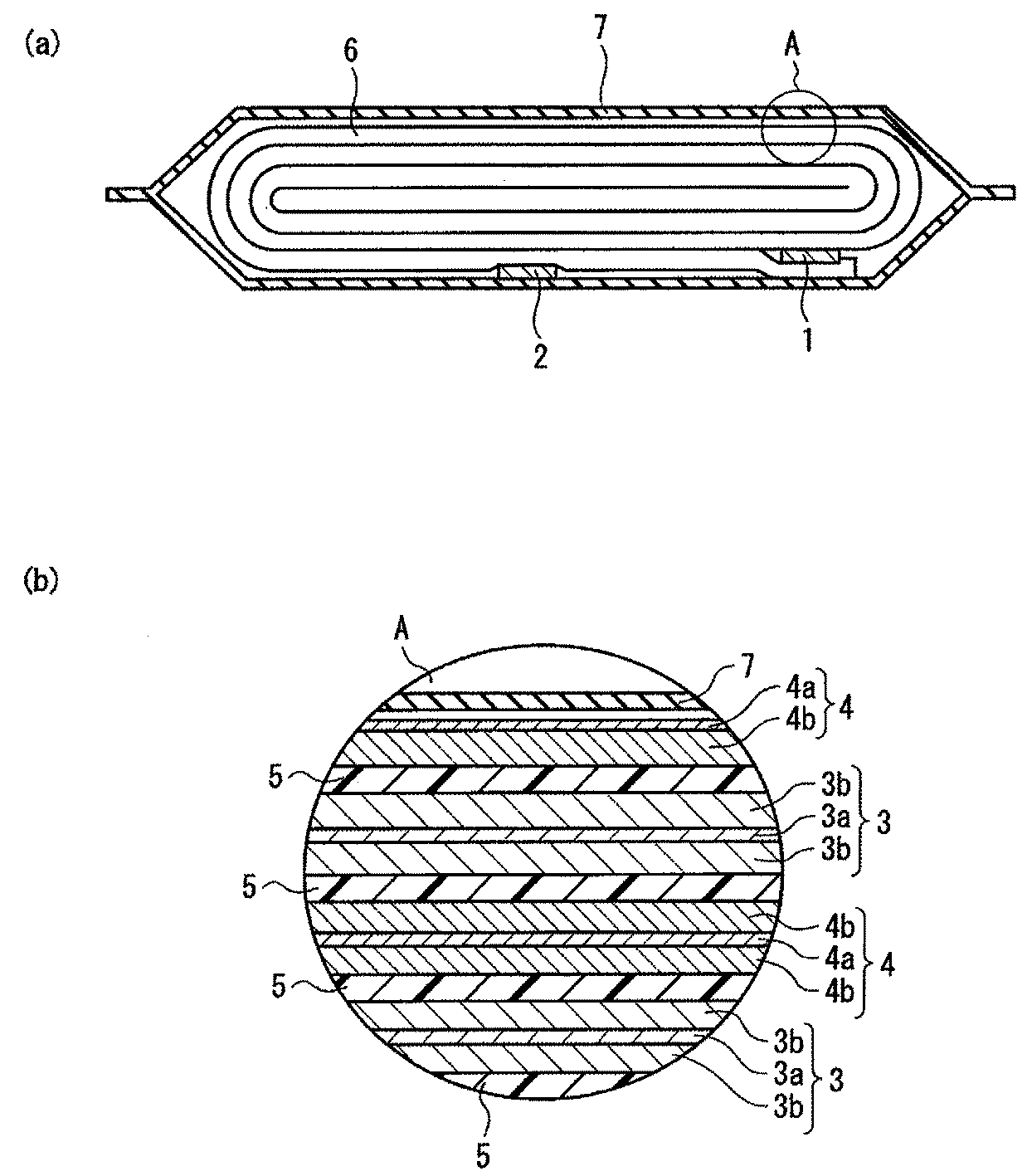
本実施の形態に係わる非水電解質二次電池の一例について、図1(a)及び(b)を参照してその構造を説明する。図1(a)に、本実施の形態に係わる扁平型非水電解質電池の断面模式図を示す。図1(b)は、図1(a)のAで示した円で囲われた部分を詳細に表す部分断面模式図を示す。 An example of the non-aqueous electrolyte secondary battery according to this embodiment will be described with reference to FIGS. 1 (a) and 1 (b). FIG. 1A shows a schematic cross-sectional view of a flat type nonaqueous electrolyte battery according to the present embodiment. FIG.1 (b) shows the partial cross-section schematic diagram showing in detail the part enclosed with the circle | round | yen shown by A of FIG. 1 (a).
正極3には正極端子1が接着し、負極4には負極端子2が接着する。正極3と負極4はセパレータ5を介して、扁平状の捲回電極6を構成している。この捲回電極6は、非水電解質が充填した外装材7に収納される。
The positive electrode terminal 1 is bonded to the
図1(a)に示すように、非水電解質が充填した外装材7に、扁平状の捲回電極6が収納されている。捲回電極6の外周端近傍において、外側には負極端子2が接着し、内側には正極端子1が接着している。図示していないが、捲回電極6は、外層から、負極4、セパレータ5、正極3、セパレータ5の順で層状に構成されている。
As shown in FIG. 1A, a flat wound electrode 6 is accommodated in an
捲回電極6の構成について、さらに詳細に説明する。図1(b)に示すように、正極3と負極4はセパレータ5を介し、層状に構成されている。最外殻の負極4は、外層から、負極集電体4a、負極層4bの順で層状に構成され、その他の負極4は、負極層4b、負極集電体4a、負極層4bの順で層状に構成されている。正極3は、正極層3b、正極集電体3a、正極層3bの順で層状に構成されている。
The configuration of the wound electrode 6 will be described in more detail. As shown in FIG. 1 (b), the
以下、正極、非水電解質、負極、セパレータ及び外装材について詳細に説明する。 Hereinafter, the positive electrode, the nonaqueous electrolyte, the negative electrode, the separator, and the exterior material will be described in detail.
1)正極
正極は、正極集電体と、正極集電体の片面若しくは両面に担持され、正極活物質、正極導電剤及び結着剤を含む正極層と、を有する。
1) Positive electrode The positive electrode includes a positive electrode current collector and a positive electrode layer that is supported on one or both surfaces of the positive electrode current collector and includes a positive electrode active material, a positive electrode conductive agent, and a binder.
正極活物質は、リチウムニッケル複合酸化物と、含有量が0.1wt%以上0.5wt%以下である水酸化リチウム(以後LiOHと記す。)もしくは酸化リチウム(以後Li2Oと記す。)と、を備えることを特徴とする。 The positive electrode active material includes a lithium nickel composite oxide and lithium hydroxide (hereinafter referred to as LiOH) or lithium oxide (hereinafter referred to as Li2O) having a content of 0.1 wt% to 0.5 wt%. It is characterized by.
リチウムニッケル複合酸化物は、次に示す組成式で表される。なお、リチウムニッケル複合酸化物には、X=0の場合、すなわちLiNiO2も含むものとする。 The lithium nickel composite oxide is represented by the following composition formula. Note that the lithium nickel composite oxide includes X = 0, that is, LiNiO2.
LiNi1-xMxO2
(MはCo,Al,Mn,Cr,Fe,Nb,Mg,BおよびFから少なくとも一つ選ばれ、Xの範囲は0≦X<1である。)
式中、Mは、Co,AlおよびMnから選ばれると好ましい。これらの置換元素については、後述する実施例にて良質な被膜の形成が確認されているためである。
LiNi 1-x M x O 2
(M is at least one selected from Co, Al, Mn, Cr, Fe, Nb, Mg, B and F, and the range of X is 0 ≦ X <1.)
In the formula, M is preferably selected from Co, Al and Mn. About these substitution elements, it is because formation of a good-quality film is confirmed in the Example mentioned later.
式中、Xの範囲は、0≦X≦0.5であると好ましい。これにより、Ni成分の影響が支配的となり、本実施の形態の効果がより顕著となるからである。 In the formula, the range of X is preferably 0 ≦ X ≦ 0.5. This is because the influence of the Ni component becomes dominant and the effect of the present embodiment becomes more remarkable.
LiOHもしくはLi2Oは、後述する被膜の形成反応を促進させる触媒効果を有し、リチウムニッケル複合酸化物を正極活物質として用いた場合においても、緻密で安定であり低抵抗の良質被膜を正極表面に形成できる。このため、高温で顕著となる非水電解質の分解反応を抑制し、非水電解質電池の高温貯蔵特性を向上できる。ただし、LiOHもしくはLi2Oは、正極活物質に対する含有量が0.1wt%より小さいと、その触媒効果を充分に発揮することが困難であり、0.5wt%より大きいと、触媒効果が過剰となり良質な被膜が形成できず非水電解質の分解を抑制できない。LiOHもしくはLi2Oのより好ましい含有量は、0.1wt%以上0.3wt%以下である。 LiOH or Li2O has a catalytic effect that promotes the film formation reaction described later. Even when lithium nickel composite oxide is used as the positive electrode active material, a dense, stable, low-resistance high-quality film is applied to the positive electrode surface. Can be formed. For this reason, the decomposition reaction of the nonaqueous electrolyte that becomes noticeable at high temperatures can be suppressed, and the high temperature storage characteristics of the nonaqueous electrolyte battery can be improved. However, if the content of LiOH or Li2O with respect to the positive electrode active material is less than 0.1 wt%, it is difficult to exert its catalytic effect sufficiently. Cannot be formed and decomposition of the non-aqueous electrolyte cannot be suppressed. A more preferable content of LiOH or Li2O is 0.1 wt% or more and 0.3 wt% or less.
正極活物質として多孔質状の粒を用いる場合、LiOHもしくはLi2Oは、その表面部と中心部とにおける濃度が実質的に同一であることが好ましい。ここで、表面部とは、粒の表面からの距離が粒径(粒が球状である場合は直径、楕球状である場合は短径とする。)の1/4未満である外殻を指し、中心部とは、粒の表面からの距離が粒径の1/4以上である内殻を指す。また、外殻に対して内殻の濃度が50%以上200%以下の範囲であるときに、その濃度ばらつきが実質的にない、すなわち、その濃度が実質的に同一であるとする。 When porous particles are used as the positive electrode active material, it is preferable that the concentration of LiOH or Li2O in the surface portion and the central portion is substantially the same. Here, the surface portion refers to an outer shell whose distance from the surface of the particle is less than 1/4 of the particle size (diameter when the particle is spherical, and short diameter when the particle is oval). The central portion refers to an inner shell whose distance from the surface of the grain is 1/4 or more of the grain size. Further, when the concentration of the inner shell is in the range of 50% or more and 200% or less with respect to the outer shell, it is assumed that there is substantially no concentration variation, that is, the concentration is substantially the same.
なお、LiOHとLi2Oとは、次に示す平衡関係が成立ち、両者は、雰囲気の水分量により互いに変化する。このため、本実施の形態においては、両者の総量に着目した。 LiOH and Li2O have the following equilibrium relationship, and both change with each other depending on the amount of moisture in the atmosphere. Therefore, in the present embodiment, attention is paid to the total amount of both.
Li2O+H2O = 2LiOH
また、正極活物質に対するLi2CO3の含有量は、0.1wt%以下であることが好ましく、0.05wt%以下であることがより好ましい。Li2CO3は、高温で顕著となる非水電解質の分解反応、さらにはそれに伴うガス発生を促進させるためである。
Li2O + H2O = 2LiOH
Further, the content of Li2CO3 with respect to the positive electrode active material is preferably 0.1 wt% or less, and more preferably 0.05 wt% or less. This is because Li2CO3 promotes the decomposition reaction of the non-aqueous electrolyte that becomes noticeable at high temperatures, and the gas generation that accompanies it.
次に、正極活物質の製造方法の一例を示す。 Next, an example of the manufacturing method of a positive electrode active material is shown.
まず、自動乳鉢などの乾式の混合法を用いて、LiOHもしくはLi2OとNiOとを混合する。ここで、LiOHもしくはLi2Oは、所望の化学量論量より1mol%以上20mol%以下増加させる。また、乾燥環境下(具体的には、湿度5%以下)で行うことが望ましい。なお、置換元素Mを含有するリチウムニッケル複合酸化物を所望する場合、ここで、Mの金属酸化物も混合する。 First, LiOH or Li2O and NiO are mixed using a dry mixing method such as an automatic mortar. Here, LiOH or Li2O is increased by 1 mol% or more and 20 mol% or less from a desired stoichiometric amount. Moreover, it is desirable to carry out in a dry environment (specifically, a humidity of 5% or less). When a lithium nickel composite oxide containing the substitution element M is desired, a metal oxide of M is also mixed here.
次に、この混合物を400℃以上800℃以下、1.05気圧以上1.5気圧以下に制御された高圧酸素雰囲気炉で4時間以上48時間以下焼成を行う。その後、乾燥環境下にて、自動乳鉢などの乾式の混合法を用いて、この混合物を、粉砕混合する。 Next, the mixture is baked for 4 hours to 48 hours in a high-pressure oxygen atmosphere furnace controlled to 400 ° C. to 800 ° C. and 1.05 atm to 1.5 atm. Thereafter, the mixture is pulverized and mixed using a dry mixing method such as an automatic mortar in a dry environment.
この焼成と粉砕混合とを数回繰り返す。この繰り返し回数は、2回以上10回以下が望ましい。2回より少ないと、LiOHもしくはLi2Oの濃度ばらつきが生じ、被膜が局所的に形成されないおそれが生じる。10回より多いと、粒が過剰に微小となり、比表面積が大きくなるため、非水電解質の分解反応が顕著となり、非水電解質電池の高温貯蔵特性を劣化させる恐れがある。 This firing and pulverization and mixing are repeated several times. The number of repetitions is preferably 2 to 10 times. If it is less than twice, the concentration variation of LiOH or Li2O occurs, and the film may not be formed locally. If it is more than 10 times, the grains become excessively fine and the specific surface area becomes large, so that the decomposition reaction of the nonaqueous electrolyte becomes prominent, and the high temperature storage characteristics of the nonaqueous electrolyte battery may be deteriorated.
上記のように作製した正極活物質は、LiOHもしくはLi2Oの含有量を0.1wt%以上0.5wt%以下とし、Li2CO3の含有量を0.1wt%以下とすることができる。また、上記のように作製した正極活物質は、LiOHもしくはLi2Oが正極活物質に留まる。このため、LiOHもしくはLi2Oが溶出することによる非水電解質の分解反応、さらにはそれに伴うガス発生を抑制する。 The positive electrode active material produced as described above can have a LiOH or Li2O content of 0.1 wt% to 0.5 wt% and a Li2CO3 content of 0.1 wt% or less. In the positive electrode active material manufactured as described above, LiOH or Li2O remains as the positive electrode active material. For this reason, the decomposition reaction of the nonaqueous electrolyte due to the elution of LiOH or Li2O, and the gas generation associated therewith are suppressed.
集電性能を高め、集電体との接触抵抗を抑えるための正極導電剤としては、例えばアセチレンブラック、カーボンブラック、黒鉛、Ni、Al等を挙げることができる。これらの正極導電剤は、粒状もしくは繊維状の形状を採る。 Examples of the positive electrode conductive agent for improving the current collecting performance and suppressing the contact resistance with the current collector include acetylene black, carbon black, graphite, Ni, and Al. These positive electrode conductive agents take a granular or fibrous shape.
正極活物質と正極導電剤を結着させるための結着剤としては、例えばポリテトラフルオロエチレン(PTFE)、ポリフッ化ビニリデン(PVdF)等、あるいは、これらの共重合体に、ヘキサフルオロプロピレン、シリコーンゴム、ブチルゴム、クロロトリフルオロエチレンゴムもしくはエチレンプロピレンゴムを混合したもの等が挙げられる。 Examples of the binder for binding the positive electrode active material and the positive electrode conductive agent include polytetrafluoroethylene (PTFE), polyvinylidene fluoride (PVdF), and copolymers thereof, hexafluoropropylene, silicone Examples include rubber, butyl rubber, chlorotrifluoroethylene rubber, or ethylene propylene rubber.
正極活物質、正極導電剤及び結着剤の配合比については、正極活物質は80重量%以上95重量%以下、正極導電剤は3重量%以上18重量%以下、結着剤は2重量%以上17重量%以下の範囲にすることが好ましい。正極導電剤については、3重量%以上であることにより上述した効果を発揮することができ、18重量%以下であることにより、高温保存下での正極導電剤表面での非水電解質の分解を低減することができる。結着剤については、2重量%以上であることにより十分な電極強度が得られ、17重量%以下であることにより、電極の絶縁体の配合量を減少させ、内部抵抗を減少できる。 Regarding the compounding ratio of the positive electrode active material, the positive electrode conductive agent and the binder, the positive electrode active material is 80% by weight to 95% by weight, the positive electrode conductive agent is 3% by weight to 18% by weight, and the binder is 2% by weight. It is preferable to be in the range of 17% by weight or less. For the positive electrode conductive agent, the effect described above can be exerted by being 3% by weight or more, and by being 18% by weight or less, decomposition of the nonaqueous electrolyte on the surface of the positive electrode conductive agent under high temperature storage can be achieved. Can be reduced. When the binder is 2% by weight or more, sufficient electrode strength can be obtained, and when it is 17% by weight or less, the blending amount of the electrode insulator can be reduced and the internal resistance can be reduced.
正極集電体は、アルミニウム箔若しくはMg、Zn、Mn、Fe、Si等の元素を含むアルミニウム合金箔が好ましい。 The positive electrode current collector is preferably an aluminum foil or an aluminum alloy foil containing elements such as Mg, Zn, Mn, Fe, and Si.
正極は、例えば、正極活物質、正極導電剤及び結着剤を適当な溶媒に懸濁し、この懸濁し作製したスラリーを、正極集電体に塗布し、乾燥し、正極層を作製した後、プレスを施すことにより作成される。その他、正極活物質、正極導電剤及び結着剤をペレット状に形成し、正極層として用いても良い。 For example, the positive electrode is obtained by suspending a positive electrode active material, a positive electrode conductive agent, and a binder in a suitable solvent, applying the slurry prepared by suspending the slurry to a positive electrode current collector, and drying to prepare a positive electrode layer. Created by pressing. In addition, the positive electrode active material, the positive electrode conductive agent, and the binder may be formed in a pellet shape and used as the positive electrode layer.
なお、正極活物質、正極導電剤及び結着剤の懸濁時においては、結着剤をN-メチルピロリジノン等の有機溶媒に分散させたものに、スラリーの粘度を下げるためのマレイン酸、蓚酸、マロン酸、ギ酸、クエン酸、酢酸、乳酸、ピルビン酸、プロピオン酸、シトラコン酸、酪酸等の有機酸またはこれらの無水物を正極活物質に対して10ppm以上10000ppm以下、より好ましくは100ppm以上5000ppm以下、さらに好ましくは500ppm以上2500ppm以下加えたものを用い、その後、正極活物質および正極導電剤を分散させると好ましい。 When suspending the positive electrode active material, the positive electrode conductive agent, and the binder, maleic acid and oxalic acid are used to reduce the viscosity of the slurry in the binder dispersed in an organic solvent such as N-methylpyrrolidinone. , Malonic acid, formic acid, citric acid, acetic acid, lactic acid, pyruvic acid, propionic acid, citraconic acid, butyric acid and other organic acids or their anhydrides with respect to the positive electrode active material from 10 ppm to 10,000 ppm, more preferably from 100 ppm to 5000 ppm Hereinafter, it is more preferable to use a material added with 500 ppm or more and 2500 ppm or less, and then disperse the positive electrode active material and the positive electrode conductive agent.
2)非水電解質
非水電解質は、電解質を非水溶媒に溶解し調製される液状非水電解質、液状非水電解質と高分子材料を複合化したゲル状非水電解質等が挙げられる。
2) Non-aqueous electrolyte Examples of the non-aqueous electrolyte include a liquid non-aqueous electrolyte prepared by dissolving an electrolyte in a non-aqueous solvent, and a gel non-aqueous electrolyte obtained by combining a liquid non-aqueous electrolyte and a polymer material.
非水電解質は、非水溶媒としてγブチロラクトン(GBL)を有することを特徴とする。 The non-aqueous electrolyte is characterized by having γ-butyrolactone (GBL) as a non-aqueous solvent.
γブチロラクトンは、LiOHもしくはLi2Oの触媒効果により開環重合反応が生じやすく、その生成物であるγブチロラクトンの開環重合体を含む被膜を形成しやすい。LiOHもしくはLi2Oの含有量が上述した範囲であることにより、γブチロラクトンの開環重合体が適度に生成され、緻密で安定であり低抵抗の良質被膜を正極表面に形成できる。 γ-Butyrolactone is likely to undergo a ring-opening polymerization reaction due to the catalytic effect of LiOH or Li 2 O, and easily forms a film containing a ring-opening polymer of γ-butyrolactone, which is the product. When the content of LiOH or Li2O is in the above-described range, a ring-opening polymer of γ-butyrolactone is appropriately generated, and a high-quality film that is dense, stable, and has low resistance can be formed on the surface of the positive electrode.
ここで、γブチロラクトンの開環反応は、エステル結合CO−Oもしくはエステル結合に隣接するO−Cの切断により生じ、その開環重合体はそれらの切断に対応した繰り返し単位を有する。この開環重合体の端部は、正極活物質の金属原子もしくは酸素原子に結合もしくは配位している。 Here, the ring-opening reaction of γ-butyrolactone occurs by cleavage of ester bond CO—O or O—C adjacent to the ester bond, and the ring-opening polymer has repeating units corresponding to those cleavages. The end of this ring-opening polymer is bonded or coordinated to the metal atom or oxygen atom of the positive electrode active material.
γブチロラクトンは、非水溶媒において10体積%以上90体積%以下であることが好ましい。さらに好ましい範囲は、15体積%以上60体積%以下である。 γ-butyrolactone is preferably 10% by volume or more and 90% by volume or less in the non-aqueous solvent. A more preferable range is 15 volume% or more and 60 volume% or less.
非水電解質は、エチレンカーボネート(EC)もしくはプロピレンカーボネート(PC)を有することが好ましい。 The non-aqueous electrolyte preferably has ethylene carbonate (EC) or propylene carbonate (PC).
エチレンカーボネートもしくはプロピレンカーボネートは、γブチロラクトンに次いで、良質な被膜を形成することが確認されているためである。また、エチレンカーボネートもしくはプロピレンカーボネートの開環重合体を含む被膜は、誘電率が高く、Liの吸蔵放出をスムーズにし、非水電解質電池の高出力放電特性に寄与するためである。 This is because it has been confirmed that ethylene carbonate or propylene carbonate forms a good-quality film after γ-butyrolactone. In addition, the coating containing a ring-opening polymer of ethylene carbonate or propylene carbonate has a high dielectric constant, smoothes the insertion and release of Li, and contributes to the high output discharge characteristics of the nonaqueous electrolyte battery.
ここで、エチレンカーボネートもしくはプロピレンカーボネートの開環反応は、エステル結合CO−Oもしくはエステル結合に隣接するO−Cの切断により生じ、その開環重合体はそれらの切断に対応した繰り返し単位を有する。この開環重合体の端部は、正極活物質の金属原子もしくは酸素原子に結合もしくは配位している。 Here, the ring-opening reaction of ethylene carbonate or propylene carbonate occurs by cleavage of ester bond CO—O or O—C adjacent to the ester bond, and the ring-opening polymer has a repeating unit corresponding to those cleavages. The end of this ring-opening polymer is bonded or coordinated to the metal atom or oxygen atom of the positive electrode active material.
エチレンカーボネートもしくはプロピレンカーボネートは、5体積%以上60体積%以下非水溶媒に含まれることが好ましい。さらに好ましい範囲は、10体積%以上50体積%以下である。 It is preferable that ethylene carbonate or propylene carbonate is contained in the nonaqueous solvent in an amount of 5% by volume to 60% by volume. A more preferable range is 10 volume% or more and 50 volume% or less.
非水電解質は、その他の非水溶媒を含んでもよい。その他の非水溶媒としては、例えば、ジエチルカーボネート(DEC)、ジメチルカーボネート(DMC)、メチルエチルカーボネート(MEC)などの鎖状カーボネートや、ジメトキシエタン(DME)、ジエトキシエタン(DEE)などの鎖状エーテルや、テトラヒドロフラン(THF)、2−メチルテトラヒドロフラン(MTHF)、ジオキソラン(DOX)などの環状エーテルや、アセトニトリル(AN)、スルホラン(SL)、プロピオン酸メチル(PAM)、プロピオン酸エチル(PAE)などを挙げることができる。 The nonaqueous electrolyte may contain other nonaqueous solvents. Examples of other non-aqueous solvents include chain carbonates such as diethyl carbonate (DEC), dimethyl carbonate (DMC), and methyl ethyl carbonate (MEC), and chains such as dimethoxyethane (DME) and diethoxyethane (DEE). Ethers, cyclic ethers such as tetrahydrofuran (THF), 2-methyltetrahydrofuran (MTHF), dioxolane (DOX), acetonitrile (AN), sulfolane (SL), methyl propionate (PAM), ethyl propionate (PAE) And so on.
電解質としては、例えば、LiBF4、LiPF6、LiCF3SO3、LiAsF6、LiClO4、LiN(CF3SO2)2、LiN(C2F5SO2)2、Li(CF3SO2)3C、LiB[(OCO)2]2などの一種以上の電解質を挙げることができる。特に、LiBF4およびLiPF6はイオン解離度、化学的安定性等の観点から好ましく、LiCF3SO3は、高温貯蔵特性向上の観点から好ましい。 Examples of the electrolyte include LiBF 4 , LiPF 6 , LiCF 3 SO 3 , LiAsF 6 , LiClO 4 , LiN (CF 3 SO 2 ) 2 , LiN (C 2 F 5 SO 2 ) 2 , Li (CF 3 SO 2 ) One or more electrolytes such as 3 C and LiB [(OCO) 2 ] 2 may be mentioned. In particular, LiBF 4 and LiPF 6 are preferable from the viewpoint of ion dissociation degree, chemical stability, and the like, and LiCF 3 SO 3 is preferable from the viewpoint of improving high-temperature storage characteristics.
液状非水電解質は、電解質を0.5 mol/l以上2mol/l以下の濃度で非水溶媒に溶解することにより、調製される。 A liquid nonaqueous electrolyte is prepared by dissolving an electrolyte in a nonaqueous solvent at a concentration of 0.5 mol / l or more and 2 mol / l or less.
ゲル状非水電解質に用いられる高分子材料としては、例えば、ポリフッ化ビニリデン(PVdF)、ポリアクリロニトリル(PAN)、ポリエチレンオキサイド(PEO)等を挙げることができる。 Examples of the polymer material used for the gel-like nonaqueous electrolyte include polyvinylidene fluoride (PVdF), polyacrylonitrile (PAN), and polyethylene oxide (PEO).
3)負極
負極は、負極集電体と、負極集電体の片面若しくは両面に担持され、負極活物質、負極導電剤および結着剤を含む負極層と、を有する。
3) Negative Electrode The negative electrode includes a negative electrode current collector and a negative electrode layer that is supported on one or both surfaces of the negative electrode current collector and includes a negative electrode active material, a negative electrode conductive agent, and a binder.
負極活物質は、リチウムイオンを吸蔵放出することを特徴する炭素質物、金属酸化物、金属硫化物、金属窒化物、金属合金などが挙げられる。 Examples of the negative electrode active material include carbonaceous materials, metal oxides, metal sulfides, metal nitrides, and metal alloys that are characterized by occlusion and release of lithium ions.
炭素質物として、例えば、コークス、炭素繊維、熱分解気相炭素物、黒鉛、樹脂焼成体、メソフェーズピッチ系炭素繊維またはメソフェーズ球状カーボンの焼成体などを挙げることができる。中でも、2500℃以上で黒鉛化したメソフェーズピッチ系炭素繊維またはメソフェーズ球状カーボンを用いると電極容量が高くなるため好ましい。 Examples of the carbonaceous material include coke, carbon fiber, pyrolytic vapor phase carbonaceous material, graphite, resin fired body, mesophase pitch-based carbon fiber, and mesophase spherical carbon fired body. Among these, it is preferable to use mesophase pitch-based carbon fiber or mesophase spherical carbon graphitized at 2500 ° C. or higher because the electrode capacity is increased.
金属酸化物として、例えば、チタン酸リチウム(Li4+xTi5O12)、タングステン酸化物(WO3)、アモルファススズ酸化物(例えばSnB0.4P0.6O3.1)、スズ珪素酸化物(SnSiO3)、酸化珪素(SiO)などが挙げられる。中でも、チタン酸リチウム(Li4+xTi5O12)は、急速充放電においても、リチウムデンドライトが生じ難いため好ましい。なお、スピネル型チタン酸リチウムについて、後述する実施例と同様の試験を行ったところ、類似した結果が得られた。 As the metal oxide, for example, lithium titanate (Li 4 + x Ti 5 O 12 ), tungsten oxide (WO 3 ), amorphous tin oxide (eg SnB 0.4 P 0.6 O 3.1 ), tin silicon oxide (SnSiO 3) ) And silicon oxide (SiO). Among these, lithium titanate (Li 4 + x Ti 5 O 12 ) is preferable because lithium dendrite hardly occurs even during rapid charge / discharge. In addition, about spinel type lithium titanate, when the test similar to the Example mentioned later was done, the similar result was obtained.
金属硫化物として、例えば、硫化鉄(FeS、FeS2、LixFeS2)、硫化リチウム(TiS2)、硫化モリブデン(MoS2)などが挙げられる。 Examples of the metal sulfide include iron sulfide (FeS, FeS 2 , Li x FeS 2 ), lithium sulfide (TiS 2 ), molybdenum sulfide (MoS 2 ), and the like.
金属窒化物として、例えば、リチウムコバルト窒化物(LixCoyN、0<x<4,0<y<0.5)などが挙げられる。 Examples of the metal nitride include lithium cobalt nitride (Li x Co y N, 0 <x <4, 0 <y <0.5).
金属合金として、例えば、アルミニウム、アルミニウム合金、マグネシウム合金、リチウム金属、リチウム合金などが挙げられる。 Examples of the metal alloy include aluminum, aluminum alloy, magnesium alloy, lithium metal, and lithium alloy.
導電剤として、炭素材料を用いることができる。例えば、アセチレンブラック、カーボンブラック、コークス、炭素繊維、黒鉛等を挙げることができる。 A carbon material can be used as the conductive agent. Examples thereof include acetylene black, carbon black, coke, carbon fiber, and graphite.
結着剤としては、例えばポリテトラフルオロエチレン(PTFE)、ポリフッ化ビニリデン(PVdF)、エチレン−プロピレン−ジエン共重合体(EPDM)、スチレン−ブタジエンゴム(SBR)、カルボキシメチルセルロース(CMC)等を用いることができる。 As the binder, for example, polytetrafluoroethylene (PTFE), polyvinylidene fluoride (PVdF), ethylene-propylene-diene copolymer (EPDM), styrene-butadiene rubber (SBR), carboxymethylcellulose (CMC), or the like is used. be able to.
負極集電体は、負極活物質の満充電時の負極電位が1.0V(vsLi)よりも卑である場合は、銅箔、ニッケル箔等が挙げられる。電気化学的な安定性及び捲回時の柔軟性の観点から、銅箔が好ましい。銅箔の場合、負極集電体の厚さは、8μm以上40μm以下が好ましい。 Examples of the negative electrode current collector include a copper foil and a nickel foil when the negative electrode potential when the negative electrode active material is fully charged is lower than 1.0 V (vsLi). From the viewpoint of electrochemical stability and flexibility during winding, copper foil is preferred. In the case of copper foil, the thickness of the negative electrode current collector is preferably 8 μm or more and 40 μm or less.
負極集電体は、負極活物質の満充電時の負極電位が1.0V(vsLi)より貴である場合は、電気化学的な安定性の観点から、アルミニウム箔若しくはMg、Ti、Zn、Mn、Fe、Cu、Si等の元素を含むアルミニウム合金箔が好ましい。アルミニウム箔もしくはアルミニウム合金箔の場合、負極集電体の厚さは、8μm以上25μm以下が好ましい。 The negative electrode current collector is an aluminum foil or Mg, Ti, Zn, Mn, from the viewpoint of electrochemical stability, when the negative electrode potential at the time of full charge of the negative electrode active material is noble from 1.0 V (vsLi). An aluminum alloy foil containing an element such as Fe, Cu or Si is preferred. In the case of aluminum foil or aluminum alloy foil, the thickness of the negative electrode current collector is preferably 8 μm or more and 25 μm or less.
負極活物質層中の、負極活物質、導電剤及び結着剤の配合比は、負極活物質80重量%以上95重量%以下、導電剤3重量%以上20重量%以下、結着剤2重量%以上7重量%以下の範囲にすることが好ましい。導電剤については、20重量%以下であることにより、高温保存下での導電剤表面での非水電解質の分解を低減することができる。結着剤については、2重量%以上であることにより十分な電極強度が得られ、7重量%以下であることにより、電極の絶縁体の割合を減少させることが出来る。 The compounding ratio of the negative electrode active material, the conductive agent and the binder in the negative electrode active material layer is 80% to 95% by weight of the negative electrode active material, 3% to 20% by weight of the conductive agent, and 2% by weight of the binder. It is preferable to be in the range of not less than 7% and not more than 7% by weight. With respect to the conductive agent, when it is 20% by weight or less, decomposition of the nonaqueous electrolyte on the surface of the conductive agent under high temperature storage can be reduced. When the binder is 2% by weight or more, sufficient electrode strength can be obtained, and when it is 7% by weight or less, the ratio of the insulator of the electrode can be reduced.
負極は、例えば、負極活物質、負極導電剤及び結着剤を汎用されている溶媒に懸濁し作製したスラリーを、負極集電体に塗布し、乾燥し、負極層を作製した後、プレスを施すことにより作製される。その他、負極活物質、負極導電剤及び結着剤をペレット状に形成し、負極層として用いても良い。 The negative electrode is prepared by, for example, applying a slurry prepared by suspending a negative electrode active material, a negative electrode conductive agent, and a binder in a commonly used solvent to a negative electrode current collector, drying the negative electrode layer, and then forming a negative electrode layer. It is produced by applying. In addition, the negative electrode active material, the negative electrode conductive agent, and the binder may be formed in a pellet shape and used as the negative electrode layer.
負極活物質、負極導電剤及び結着剤を分散させるための溶媒としては、N−メチル−2−ピロリドン(NMP)、ジメチルホルムアミド(DMF)等が使用される。 As a solvent for dispersing the negative electrode active material, the negative electrode conductive agent, and the binder, N-methyl-2-pyrrolidone (NMP), dimethylformamide (DMF), or the like is used.
4)セパレータ
セパレータとしては、例えば、ポリエチレン、ポリプロピレン、セルロース、またはポリフッ化ビニリデン(PVdF)を含む多孔質フィルム、合成樹脂製不織布等を挙げることができる。中でも、ポリエチレン又はポリプロピレンからなる多孔質フィルムは、一定温度において溶融し、電流を遮断することが可能であり、安全性向上の観点から好ましい。
4) Separator Examples of the separator include a porous film containing polyethylene, polypropylene, cellulose, or polyvinylidene fluoride (PVdF), and a synthetic resin nonwoven fabric. Among these, a porous film made of polyethylene or polypropylene is preferable from the viewpoint of improving safety because it can be melted at a constant temperature to interrupt the current.
5)外装材
外装材としては、肉厚0.2mm以下のラミネートフィルムや、肉厚0.5mm以下の金属製容器が挙げられる。肉厚0.2mm以下であるとより好ましい。
5) Exterior material Examples of the exterior material include a laminate film having a thickness of 0.2 mm or less and a metal container having a thickness of 0.5 mm or less. The wall thickness is more preferably 0.2 mm or less.
ラミネートフィルムは、金属層と金属層を被覆する樹脂層とからなる多層フィルムである。軽量化のために、金属層はアルミニウム箔若しくはアルミニウム合金箔が好ましい。樹脂層は、ポリプロピレン(PP)、ポリエチレン(PE)、ナイロン、ポリエチレンテレフタレート(PET)等の高分子を用いることができる。ラミネートフィルムは、熱融着によりシールを行うことにより成形する。 The laminate film is a multilayer film composed of a metal layer and a resin layer covering the metal layer. In order to reduce the weight, the metal layer is preferably an aluminum foil or an aluminum alloy foil. For the resin layer, polymers such as polypropylene (PP), polyethylene (PE), nylon, polyethylene terephthalate (PET) can be used. The laminate film is formed by sealing by heat sealing.
金属製容器は、アルミニウムまたはアルミニウム合金等が挙げられる。アルミニウム合金としては、マグネシウム、亜鉛、ケイ素等の元素を含む合金が好ましい。一方、鉄、銅、ニッケル、クロム等の遷移金属は100ppm以下にすることが好ましい。 Examples of the metal container include aluminum or an aluminum alloy. As the aluminum alloy, an alloy containing elements such as magnesium, zinc and silicon is preferable. On the other hand, transition metals such as iron, copper, nickel, and chromium are preferably 100 ppm or less.
形状としては、ラミネート型、角型、コイン型、ボタン型等が挙げられる。なお、無論、携帯用電子機器等に積載される小型電池の他、二輪乃至四輪の自動車等に積載される大型電池でも良い。なお、車載用の非水電解質電池は高温貯蔵特性等の高温特性を特に求められるため、本実施の形態の非水電解質電池は特にその効果を発揮できる。 Examples of the shape include a laminate type, a square type, a coin type, and a button type. Of course, in addition to a small battery mounted on a portable electronic device or the like, a large battery mounted on a two-wheel to four-wheel automobile or the like may be used. In addition, since the in-vehicle non-aqueous electrolyte battery is particularly required to have high-temperature characteristics such as high-temperature storage characteristics, the non-aqueous electrolyte battery according to the present embodiment can exert its effect particularly.
以下に実施例を説明するが、本発明の主旨を超えない限り、本発明は以下に掲載される実施例に限定されるものでない。 Examples will be described below, but the present invention is not limited to the examples described below unless the gist of the present invention is exceeded.
実施例及び比較例の非水電解質電池の作製方法を示す。 The manufacturing method of the nonaqueous electrolyte battery of an Example and a comparative example is shown.
上述した作製方法を用いて、リチウムニッケル複合酸化物を作製した。ここで、最初の混合時においては、LiOHと所望のリチウムニッケル複合酸化物に対応した金属酸化物とを混合し、焼成と粉砕混合とは、2回繰り返した。その後、リチウムニッケル複合酸化物中のLiOHもしくはLi2Oの含有量について、pH滴定を用いて測定した。 A lithium nickel composite oxide was produced using the production method described above. Here, at the time of the first mixing, LiOH and a metal oxide corresponding to a desired lithium nickel composite oxide were mixed, and firing and pulverization mixing were repeated twice. Thereafter, the content of LiOH or Li2O in the lithium nickel composite oxide was measured using pH titration.
正極活物質として表1に示す含有量のLiOHもしくはLi2Oを含む表1に示す組成のリチウムニッケル複合酸化物と、正極導電剤としてアセチレンブラックと、結着剤としてポリフッ化ビニリデンと、を重量比で100:5:3となるように配合し、N-メチルピロリジノン(NMP)に分散させ、スラリーを作製した。その後、スラリーを厚さ20μmのアルミニウム箔の片面に塗布し、乾燥、プレス工程を経て嵩密度を3g/cm3とした後、2cm×2cmに切り抜いて正極を作製した。 A lithium nickel composite oxide having a composition shown in Table 1 containing LiOH or Li2O in a content shown in Table 1 as a positive electrode active material, acetylene black as a positive electrode conductive agent, and polyvinylidene fluoride as a binder in a weight ratio. The mixture was formulated to be 100: 5: 3 and dispersed in N-methylpyrrolidinone (NMP) to prepare a slurry. Thereafter, the slurry was applied to one side of an aluminum foil having a thickness of 20 μm, dried, pressed to a bulk density of 3 g / cm 3, and then cut into 2 cm × 2 cm to produce a positive electrode.
負極活物質としてメソフェーズ球状カーボンと、負極導電剤としてアセチレンブラックと、結着剤としてポリフッ化ビニリデンと、を重量比で100:10:10となるように配合し、N-メチルピロリジノンに分散させ、スラリーを作製した。その後、スラリーを厚さ15μmの銅箔の片面に塗布し、乾燥、プレス工程を経て嵩密度を1.3g/cm3とした後、2cm×2cmに切り抜いて負極を作製した。 A mesophase spherical carbon as a negative electrode active material, acetylene black as a negative electrode conductive agent, and polyvinylidene fluoride as a binder are blended in a weight ratio of 100: 10: 10 and dispersed in N-methylpyrrolidinone. A slurry was prepared. Thereafter, the slurry was applied to one side of a 15 μm thick copper foil, dried and pressed to a bulk density of 1.3 g / cm 3, and then cut into 2 cm × 2 cm to produce a negative electrode.
表1に示す体積比の非水溶媒に、表1に示す濃度の電解質を溶解させ、非水電解質を調製した。 A nonaqueous electrolyte was prepared by dissolving an electrolyte having a concentration shown in Table 1 in a nonaqueous solvent having a volume ratio shown in Table 1.
外装材としてガラス容器を用い、ガラスフィルターからなるセパレータを挟んで対向するように、正極および負極が収納され、非水電解質に完全に浸漬させ、実施例1〜10及び比較例1〜4の非水電解質電池を作製した。 A glass container is used as the exterior material, and the positive electrode and the negative electrode are accommodated so as to face each other with a separator made of a glass filter interposed therebetween, and are completely immersed in a non-aqueous electrolyte. Examples 1 to 10 and Comparative Examples 1 to 4 A water electrolyte battery was prepared.
まず、20℃環境下にて、充放電試験を1回行い、放電容量を測定した。次に、再度充電を行い充電状態とし、80℃の恒温槽に3日間静置した。その後、20℃環境下に戻し、放電した後、充放電試験を1回行い、放電容量を測定した。なお、充放電試験は、1mA/cm2の定電流/定電圧で行い、充電は電池電圧4.3Vまで、放電は電池電圧3Vまでとした。
First, a charge / discharge test was performed once in a 20 ° C. environment, and the discharge capacity was measured. Next, it charged again, it was set as the charge state, and it left still for 3 days in an 80 degreeC thermostat. Then, after returning to a 20 degreeC environment and discharging, the charge / discharge test was done once and the discharge capacity was measured. The charge / discharge test was performed at a constant current / constant voltage of 1 mA /
恒温漕の貯蔵前後にて測定した放電容量の比較をし、算出した容量維持率を表1に併記する。
なお、表中、GBLはγブチロラクトン、ECはエチレンカーボネート、PCはプロピレンカーボネート、DMCはジメチルカーボネート、DECはジエチルカーボネート、MECはメチルエチルカーボネートを指す。 In the table, GBL is γ-butyrolactone, EC is ethylene carbonate, PC is propylene carbonate, DMC is dimethyl carbonate, DEC is diethyl carbonate, and MEC is methyl ethyl carbonate.
表1に示すように、実施例1〜10は、比較例1〜4に比して、容量維持率が高い。従って、本実施の形態の非水電解質電池は、高温貯蔵特性に優れる。 As shown in Table 1, Examples 1-10 have a higher capacity retention rate than Comparative Examples 1-4. Therefore, the nonaqueous electrolyte battery of the present embodiment is excellent in high temperature storage characteristics.
特に、実施例1〜3は、比較例1〜2に比して、容量維持率が高い。従って、正極活物質中のLiOHもしくはLi2Oの含有量が0.1wt%以上0.5wt%以下である非水電解質電池は、高温貯蔵特性に優れる。 In particular, Examples 1 to 3 have a higher capacity retention rate than Comparative Examples 1 and 2. Therefore, the nonaqueous electrolyte battery in which the content of LiOH or Li2O in the positive electrode active material is 0.1 wt% or more and 0.5 wt% or less is excellent in high temperature storage characteristics.
また、実施例2は、比較例3に比して、容量維持率が高い。従って、非水電解質としてγブチロラクトンを有する非水電解質電池は、高温貯蔵特性に優れる。 In addition, Example 2 has a higher capacity retention rate than Comparative Example 3. Therefore, the nonaqueous electrolyte battery having γ-butyrolactone as the nonaqueous electrolyte is excellent in high temperature storage characteristics.
さらに、実施例5は、実施例6に比して、容量維持率が高い。従って、非水電解質としてエチレンカーボネートもしくはプロピレンカーボネートを有する非水電解質電池は、さらに高温貯蔵特性に優れる。 Furthermore, Example 5 has a higher capacity retention rate than Example 6. Therefore, the nonaqueous electrolyte battery having ethylene carbonate or propylene carbonate as the nonaqueous electrolyte is further excellent in high temperature storage characteristics.
また、実施例8ないし10は、いずれも容量維持率が高い。従って、リチウムニッケル複合酸化物LiNi1-xMxO2におけるXが0≦X≦0.5の範囲である非水電解質電池において、特に高温貯蔵特性に優れる。Mは、Co、AlもしくはMnである場合について確認した。 In Examples 8 to 10, the capacity retention rate is high. Therefore, the non-aqueous electrolyte battery in which X in the lithium nickel composite oxide LiNi 1-x M x O 2 is in the range of 0 ≦ X ≦ 0.5 is particularly excellent in high-temperature storage characteristics. The case where M is Co, Al or Mn was confirmed.
また、実施例7は、実施例6に比して、容量維持率が高い。従って、電解質としてLiCF3SO3を用いた非水電解質電池は、さらに高温貯蔵特性に優れる。 In addition, Example 7 has a higher capacity retention rate than Example 6. Therefore, the nonaqueous electrolyte battery using LiCF 3 SO 3 as the electrolyte is further excellent in high temperature storage characteristics.
以上、本発明の実施の形態を説明したが、本発明はこれらに限られず、特許請求の範囲に記載の発明の要旨の範疇において様々に変更可能である。また、本発明は、実施段階ではその要旨を逸脱しない範囲で種々に変形することが可能である。さらに、上記実施形態に開示されている複数の構成要素を適宜組み合わせることにより種々の発明を形成できる。 As mentioned above, although embodiment of this invention was described, this invention is not restricted to these, In the category of the summary of the invention as described in a claim, it can change variously. In addition, the present invention can be variously modified without departing from the scope of the invention in the implementation stage. Furthermore, various inventions can be formed by appropriately combining a plurality of constituent elements disclosed in the embodiment.
1 正極端子
2 負極端子
3 正極
3a 正極集電体
3b 正極層
4 負極
4a 負極集電体
4b 負極層
5 セパレータ
6 捲回電極
7 外装材
DESCRIPTION OF SYMBOLS 1
Claims (5)
前記外装材内に収納され、リチウムニッケル複合酸化物と含有量が0.1wt%以上0.5wt%以下である水酸化リチウムもしくは酸化リチウムとを備える正極活物質を有する正極と、
前記正極と空間的に離れた前記外装材内に収納され、Liを吸蔵放出できる負極と、
前記正極と前記負極とに挟まれ、γブチロラクトンを有する非水電解質を含浸したセパレータと、
を具備することを特徴とする非水電解質電池。 An exterior material,
A positive electrode having a positive electrode active material housed in the exterior material and comprising a lithium nickel composite oxide and lithium hydroxide or lithium oxide having a content of 0.1 wt% or more and 0.5 wt% or less;
The negative electrode that is housed in the exterior material spatially separated from the positive electrode and can occlude and release Li,
A separator sandwiched between the positive electrode and the negative electrode and impregnated with a nonaqueous electrolyte having γ-butyrolactone;
A non-aqueous electrolyte battery comprising:
前記水酸化リチウムもしくは前記酸化リチウムの含有量が0.1wt%以上0.5wt%以下であり、
前記正極活物質の表面部と中心部とにおける、前記水酸化リチウムもしくは前記酸化リチウムの濃度が実質的に同一であることを特徴とする正極活物質。 A positive electrode active material comprising a lithium nickel composite oxide and lithium hydroxide or lithium oxide,
The lithium hydroxide or the lithium oxide content is 0.1 wt% or more and 0.5 wt% or less,
The positive electrode active material, wherein the concentration of the lithium hydroxide or the lithium oxide is substantially the same in the surface portion and the central portion of the positive electrode active material.
Priority Applications (3)
| Application Number | Priority Date | Filing Date | Title |
|---|---|---|---|
| JP2004367456A JP4213659B2 (en) | 2004-12-20 | 2004-12-20 | Nonaqueous electrolyte battery and positive electrode active material |
| US11/298,601 US20060134520A1 (en) | 2004-12-20 | 2005-12-12 | Nonaqueous electrolyte battery, battery pack and positive electrode active material |
| US12/794,091 US20100237277A1 (en) | 2004-12-20 | 2010-06-04 | Nonaqueous electrolyte battery, battery pack and positive electrode active material |
Applications Claiming Priority (1)
| Application Number | Priority Date | Filing Date | Title |
|---|---|---|---|
| JP2004367456A JP4213659B2 (en) | 2004-12-20 | 2004-12-20 | Nonaqueous electrolyte battery and positive electrode active material |
Publications (2)
| Publication Number | Publication Date |
|---|---|
| JP2006173049A JP2006173049A (en) | 2006-06-29 |
| JP4213659B2 true JP4213659B2 (en) | 2009-01-21 |
Family
ID=36596286
Family Applications (1)
| Application Number | Title | Priority Date | Filing Date |
|---|---|---|---|
| JP2004367456A Expired - Fee Related JP4213659B2 (en) | 2004-12-20 | 2004-12-20 | Nonaqueous electrolyte battery and positive electrode active material |
Country Status (2)
| Country | Link |
|---|---|
| US (2) | US20060134520A1 (en) |
| JP (1) | JP4213659B2 (en) |
Families Citing this family (50)
| Publication number | Priority date | Publication date | Assignee | Title |
|---|---|---|---|---|
| JP4159954B2 (en) * | 2003-09-24 | 2008-10-01 | 株式会社東芝 | Non-aqueous electrolyte battery |
| US7462425B2 (en) * | 2003-09-26 | 2008-12-09 | Kabushiki Kaisha Toshiba | Nonaqueous electrolyte secondary battery and battery module |
| JP4495994B2 (en) | 2004-03-29 | 2010-07-07 | 株式会社東芝 | Nonaqueous electrolyte secondary battery |
| JP4346565B2 (en) * | 2004-03-30 | 2009-10-21 | 株式会社東芝 | Nonaqueous electrolyte secondary battery |
| JP3769291B2 (en) * | 2004-03-31 | 2006-04-19 | 株式会社東芝 | Non-aqueous electrolyte battery |
| JP4245532B2 (en) * | 2004-08-30 | 2009-03-25 | 株式会社東芝 | Nonaqueous electrolyte secondary battery |
| JP4314223B2 (en) * | 2004-09-24 | 2009-08-12 | 株式会社東芝 | Regenerative power storage system, storage battery system and automobile |
| JP4213659B2 (en) * | 2004-12-20 | 2009-01-21 | 株式会社東芝 | Nonaqueous electrolyte battery and positive electrode active material |
| JP4439456B2 (en) * | 2005-03-24 | 2010-03-24 | 株式会社東芝 | Battery pack and automobile |
| JP4249727B2 (en) * | 2005-05-13 | 2009-04-08 | 株式会社東芝 | Nonaqueous electrolyte battery and lithium titanium composite oxide |
| JP4213687B2 (en) * | 2005-07-07 | 2009-01-21 | 株式会社東芝 | Nonaqueous electrolyte battery and battery pack |
| JP4208865B2 (en) * | 2005-07-07 | 2009-01-14 | 株式会社東芝 | Nonaqueous electrolyte battery and battery pack |
| JP4213688B2 (en) | 2005-07-07 | 2009-01-21 | 株式会社東芝 | Nonaqueous electrolyte battery and battery pack |
| JP2007018883A (en) * | 2005-07-07 | 2007-01-25 | Toshiba Corp | Negative electrode active material, non-aqueous electrolyte battery and battery pack |
| US7892674B2 (en) | 2005-09-09 | 2011-02-22 | Kabushiki Kaisha Toshiba | Nonaqueous electrolyte secondary battery and battery module |
| JP4445447B2 (en) * | 2005-09-15 | 2010-04-07 | 株式会社東芝 | Nonaqueous electrolyte battery and battery pack |
| JP4625744B2 (en) * | 2005-09-29 | 2011-02-02 | 株式会社東芝 | Nonaqueous electrolyte battery and battery pack |
| JP4994677B2 (en) | 2006-02-28 | 2012-08-08 | パナソニック株式会社 | Non-aqueous electrolyte secondary battery |
| JP4557920B2 (en) * | 2006-03-30 | 2010-10-06 | 株式会社東芝 | Non-aqueous electrolyte battery |
| JP4799245B2 (en) * | 2006-03-30 | 2011-10-26 | 株式会社東芝 | Non-aqueous electrolyte battery, battery pack and automobile |
| JP4421570B2 (en) * | 2006-03-30 | 2010-02-24 | 株式会社東芝 | Non-aqueous electrolyte battery, battery pack and automobile |
| JP4580949B2 (en) | 2006-06-02 | 2010-11-17 | 株式会社東芝 | Non-aqueous electrolyte battery, battery pack and rechargeable vacuum cleaner |
| JP4284341B2 (en) * | 2006-07-25 | 2009-06-24 | 株式会社東芝 | Non-aqueous electrolyte battery, automobile, assist bicycle, motorcycle, rechargeable vacuum cleaner and battery pack |
| JP4709710B2 (en) | 2006-08-04 | 2011-06-22 | 株式会社東芝 | Non-aqueous electrolyte battery, battery pack and automobile |
| JP5270852B2 (en) * | 2007-03-20 | 2013-08-21 | 株式会社東芝 | Battery pack and battery pack |
| US8415037B2 (en) * | 2007-05-02 | 2013-04-09 | University Of Southern California | Microbial fuel cells |
| US9337484B2 (en) * | 2009-05-13 | 2016-05-10 | GM Global Technology Operations LLC | Electrodes having a state of charge marker for battery systems |
| KR101117695B1 (en) * | 2009-10-30 | 2012-03-02 | 삼성에스디아이 주식회사 | Electrolytic solution for lithium battery, lithium battery employing the same and method for operating the lithium battery |
| JP5382445B2 (en) * | 2009-11-18 | 2014-01-08 | トヨタ自動車株式会社 | Lithium ion secondary battery |
| CN102714314B (en) * | 2010-04-30 | 2016-01-20 | 株式会社Lg化学 | Positive electrode active material and lithium secondary battery comprising said positive electrode active material |
| JP5601740B2 (en) * | 2010-09-17 | 2014-10-08 | エルジー・ケム・リミテッド | Cathode active material and lithium secondary battery including the same |
| US9299985B2 (en) * | 2010-10-14 | 2016-03-29 | Nec Corporation | Secondary battery and electrolyte solution for secondary battery to be used in same |
| CN102074679B (en) * | 2010-12-18 | 2013-04-17 | 中南大学 | Method for preparing spherical aluminum-doped nickel lithium carbonate for lithium ion battery positive electrode material |
| WO2012132999A1 (en) * | 2011-03-29 | 2012-10-04 | 富士フイルム株式会社 | Aluminum base for current collector, current collector, positive electrode, negative electrode, and secondary battery |
| JP5278487B2 (en) * | 2011-04-28 | 2013-09-04 | 株式会社豊田中央研究所 | Power storage system |
| JP4957932B1 (en) * | 2011-08-30 | 2012-06-20 | Jsr株式会社 | Binder composition for power storage device electrode, slurry for power storage device electrode, power storage device electrode, and power storage device |
| JP5885020B2 (en) * | 2011-12-21 | 2016-03-15 | トヨタ自動車株式会社 | Lithium ion secondary battery manufacturing method |
| JP5694208B2 (en) * | 2012-01-19 | 2015-04-01 | 株式会社東芝 | NEGATIVE ELECTRODE ACTIVE MATERIAL FOR NON-AQUEOUS ELECTROLYTE BATTERY AND METHOD FOR PRODUCING THE SAME |
| JP6045901B2 (en) * | 2012-12-18 | 2016-12-14 | オートモーティブエナジーサプライ株式会社 | Mixed electrode for non-aqueous electrolyte battery and manufacturing method thereof |
| JP2015084320A (en) * | 2013-09-17 | 2015-04-30 | 株式会社東芝 | Battery active material, electrode, non-aqueous electrolyte battery and battery pack |
| JP6223760B2 (en) * | 2013-09-18 | 2017-11-01 | 株式会社東芝 | Non-aqueous electrolyte secondary battery active material, non-aqueous electrolyte secondary battery, battery pack and vehicle |
| JP6724292B2 (en) * | 2014-05-28 | 2020-07-15 | 日亜化学工業株式会社 | Positive electrode active material for non-aqueous secondary battery |
| WO2018174269A1 (en) * | 2017-03-23 | 2018-09-27 | 株式会社 東芝 | Nonaqueous electrolyte battery, battery pack and battery system |
| EP3709398A4 (en) | 2017-11-08 | 2021-10-13 | GS Yuasa International Ltd. | POSITIVE ELECTRODE, NON-AQUEOUS ELECTROLYTE ELECTRICITY STORAGE ELEMENT, POSITIVE ELECTRODE PRODUCTION PROCESS, AND NON-AQUEOUS ELECTROLYTE ELECTRICITY STORAGE ELEMENT PRODUCTION PROCESS |
| CN109192961B (en) * | 2018-09-20 | 2020-11-06 | 昶联金属材料应用制品(广州)有限公司 | Preparation method of positive electrode material |
| WO2020090591A1 (en) * | 2018-10-30 | 2020-05-07 | パナソニックIpマネジメント株式会社 | Secondary battery |
| JP2022509073A (en) * | 2018-11-16 | 2022-01-20 | ビーエーエスエフ ソシエタス・ヨーロピア | Manufacturing method of coated oxide material |
| US20200403225A1 (en) * | 2019-06-20 | 2020-12-24 | Camx Power Llc | Materials and methods for electrode fabrication |
| CN111933938B (en) * | 2020-06-29 | 2022-08-12 | 宁波新思创机电科技股份有限公司 | A kind of preparation method of ternary cathode slurry |
| JP7633964B2 (en) * | 2022-05-26 | 2025-02-20 | プライムプラネットエナジー&ソリューションズ株式会社 | Manufacturing method of lithium-ion secondary battery |
Family Cites Families (71)
| Publication number | Priority date | Publication date | Assignee | Title |
|---|---|---|---|---|
| US4816904A (en) * | 1983-06-09 | 1989-03-28 | Control Data Corporation | Television and market research data collection system and method |
| US4592546A (en) * | 1984-04-26 | 1986-06-03 | David B. Lockton | Game of skill playable by remote participants in conjunction with a live event |
| CA1245361A (en) * | 1984-06-27 | 1988-11-22 | Kerry E. Thacher | Tournament data system |
| US5227874A (en) * | 1986-03-10 | 1993-07-13 | Kohorn H Von | Method for measuring the effectiveness of stimuli on decisions of shoppers |
| US4926255A (en) * | 1986-03-10 | 1990-05-15 | Kohorn H Von | System for evaluation of response to broadcast transmissions |
| US5213337A (en) * | 1988-07-06 | 1993-05-25 | Robert Sherman | System for communication using a broadcast audio signal |
| FR2658375B2 (en) * | 1989-05-25 | 1994-04-22 | Adventure | ELECTRONIC DEVICE FOR ALLOWING INDIVIDUAL PARTICIPATION IN A BROADCASTING PROGRAM. |
| US5083800A (en) * | 1989-06-09 | 1992-01-28 | Interactive Network, Inc. | Game of skill or chance playable by several participants remote from each other in conjunction with a common event |
| US5035422A (en) * | 1989-12-07 | 1991-07-30 | Robert Berman | Interactive game show and method for achieving interactive communication therewith |
| US5013038A (en) * | 1989-12-08 | 1991-05-07 | Interactive Network, Inc. | method of evaluating data relating to a common subject |
| US5120076A (en) * | 1989-12-08 | 1992-06-09 | Interactive Network, Inc. | Method of evaluating data relating to a common subject |
| US5264201A (en) * | 1990-07-23 | 1993-11-23 | Her Majesty The Queen In Right Of The Province Of British Columbia | Lithiated nickel dioxide and secondary cells prepared therefrom |
| JP2558957B2 (en) * | 1991-01-21 | 1996-11-27 | 松下電器産業株式会社 | Non-aqueous electrolyte secondary battery |
| US5519433A (en) * | 1991-11-20 | 1996-05-21 | Zing Systems, L.P. | Interactive television security through transaction time stamping |
| US5343239A (en) * | 1991-11-20 | 1994-08-30 | Zing Systems, L.P. | Transaction based interactive television system |
| US5462275A (en) * | 1991-12-20 | 1995-10-31 | Gordon Wilson | Player interactive live action football game |
| DE69327986T2 (en) * | 1992-06-03 | 2000-10-05 | Koninklijke Philips Electronics N.V., Eindhoven | System for automatic compensation of cable loss |
| NL9202106A (en) * | 1992-12-04 | 1994-07-01 | Nederland Ptt | Method and system for televoting. |
| EP0653797B1 (en) * | 1993-05-31 | 1999-02-24 | Hitachi Maxell, Ltd. | Lithium secondary cell containing organic electrolyte, active material for positive electrode of lithium secondary cell, and method for manufacturing the active material |
| JPH07130367A (en) * | 1993-10-29 | 1995-05-19 | Sony Corp | Method for producing positive electrode active material for lithium secondary battery |
| US5586257A (en) * | 1994-05-05 | 1996-12-17 | Perlman; Stephen G. | Network architecture to support multiple site real-time video games |
| FI100496B (en) * | 1995-04-13 | 1997-12-15 | Nokia Telecommunications Oy | Telephone voting in an intelligent network |
| US5813913A (en) * | 1995-05-30 | 1998-09-29 | Interactive Network, Inc. | Game of skill playable by remote participants in conjunction with a common game event where participants are grouped as to skill level |
| US5643088A (en) * | 1995-05-31 | 1997-07-01 | Interactive Network, Inc. | Game of skill or chance playable by remote participants in conjunction with a common game event including inserted interactive advertising |
| US5779549A (en) * | 1996-04-22 | 1998-07-14 | Walker Assest Management Limited Parnership | Database driven online distributed tournament system |
| US5970143A (en) * | 1995-11-22 | 1999-10-19 | Walker Asset Management Lp | Remote-auditing of computer generated outcomes, authenticated billing and access control, and software metering system using cryptographic and other protocols |
| US5750288A (en) * | 1995-10-03 | 1998-05-12 | Rayovac Corporation | Modified lithium nickel oxide compounds for electrochemical cathodes and cells |
| US5762552A (en) * | 1995-12-05 | 1998-06-09 | Vt Tech Corp. | Interactive real-time network gaming system |
| US5838774A (en) * | 1996-07-01 | 1998-11-17 | Bellsouth Corporation | Telephone polling method |
| JPH1083818A (en) * | 1996-09-06 | 1998-03-31 | Hitachi Ltd | Lithium secondary battery |
| JP2971403B2 (en) * | 1996-09-13 | 1999-11-08 | 株式会社東芝 | Non-aqueous solvent secondary battery |
| US5783333A (en) * | 1996-11-27 | 1998-07-21 | Polystor Corporation | Lithium nickel cobalt oxides for positive electrodes |
| JPH10289733A (en) * | 1997-02-14 | 1998-10-27 | Fuji Film Selltec Kk | Nonaqueous secondary battery and manufacture therefor |
| JP3624088B2 (en) * | 1998-01-30 | 2005-02-23 | キヤノン株式会社 | Powder material, electrode structure, manufacturing method thereof, and lithium secondary battery |
| US6182084B1 (en) * | 1998-05-26 | 2001-01-30 | Williams Communications, Inc. | Method and apparatus of data comparison for statistical information content creation |
| EP0963115A1 (en) * | 1998-06-05 | 1999-12-08 | THOMSON multimedia | Apparatus and method for selecting viewers' profile in interactive TV |
| JP2000208148A (en) * | 1999-01-13 | 2000-07-28 | Toyota Motor Corp | Lithium ion secondary battery |
| KR100289541B1 (en) * | 1999-03-31 | 2001-05-02 | 김순택 | Secondary battery |
| US6174237B1 (en) * | 1999-05-21 | 2001-01-16 | John H. Stephenson | Method for a game of skill tournament |
| JP2000353525A (en) * | 1999-06-10 | 2000-12-19 | Toyota Central Res & Dev Lab Inc | Non-aqueous electrolyte secondary battery |
| DE19933898A1 (en) * | 1999-07-22 | 2001-02-01 | Chemetall Gmbh | Tris (oxalato) phosphates, process for their preparation and their use |
| US6758754B1 (en) * | 1999-08-13 | 2004-07-06 | Actv, Inc | System and method for interactive game-play scheduled based on real-life events |
| US6604997B2 (en) * | 2000-08-17 | 2003-08-12 | Worldwinner.Com, Inc. | Minimizing the effects of chance |
| US6760595B2 (en) * | 2000-09-06 | 2004-07-06 | Eric Inselberg | Method and apparatus for interactive audience participation at a live spectator event |
| US6660432B2 (en) * | 2000-09-14 | 2003-12-09 | Ilion Technology Corporation | Lithiated oxide materials and methods of manufacture |
| US6648760B1 (en) * | 2000-09-27 | 2003-11-18 | Midway Amusement Games, Llc | Skill mapping method and apparatus |
| JP2002270152A (en) * | 2001-03-09 | 2002-09-20 | Yuasa Corp | Lithium secondary battery |
| US6824469B2 (en) * | 2001-05-03 | 2004-11-30 | Sony Pictures Entertainment, Inc. | System and method for awarding prizes |
| US7029394B2 (en) * | 2001-07-13 | 2006-04-18 | Gameaccount Limited | System and method for generating statistics for a user of a gaming application |
| JP4259885B2 (en) * | 2002-07-15 | 2009-04-30 | パナソニック株式会社 | Nonaqueous electrolyte secondary battery |
| JP2004171876A (en) * | 2002-11-19 | 2004-06-17 | Sony Corp | battery |
| US7041239B2 (en) * | 2003-04-03 | 2006-05-09 | Valence Technology, Inc. | Electrodes comprising mixed active particles |
| JP4308571B2 (en) * | 2003-05-09 | 2009-08-05 | 三菱化学株式会社 | Positive electrode active material for lithium secondary battery, production method thereof, and positive electrode for lithium secondary battery and lithium secondary battery using the same |
| JP4159954B2 (en) * | 2003-09-24 | 2008-10-01 | 株式会社東芝 | Non-aqueous electrolyte battery |
| US7462425B2 (en) * | 2003-09-26 | 2008-12-09 | Kabushiki Kaisha Toshiba | Nonaqueous electrolyte secondary battery and battery module |
| JP4495994B2 (en) * | 2004-03-29 | 2010-07-07 | 株式会社東芝 | Nonaqueous electrolyte secondary battery |
| JP4346565B2 (en) * | 2004-03-30 | 2009-10-21 | 株式会社東芝 | Nonaqueous electrolyte secondary battery |
| JP3769291B2 (en) * | 2004-03-31 | 2006-04-19 | 株式会社東芝 | Non-aqueous electrolyte battery |
| JP4245532B2 (en) * | 2004-08-30 | 2009-03-25 | 株式会社東芝 | Nonaqueous electrolyte secondary battery |
| JP4314223B2 (en) * | 2004-09-24 | 2009-08-12 | 株式会社東芝 | Regenerative power storage system, storage battery system and automobile |
| JP4213659B2 (en) * | 2004-12-20 | 2009-01-21 | 株式会社東芝 | Nonaqueous electrolyte battery and positive electrode active material |
| JP4439456B2 (en) * | 2005-03-24 | 2010-03-24 | 株式会社東芝 | Battery pack and automobile |
| JP4249727B2 (en) * | 2005-05-13 | 2009-04-08 | 株式会社東芝 | Nonaqueous electrolyte battery and lithium titanium composite oxide |
| JP4213687B2 (en) * | 2005-07-07 | 2009-01-21 | 株式会社東芝 | Nonaqueous electrolyte battery and battery pack |
| JP4208865B2 (en) * | 2005-07-07 | 2009-01-14 | 株式会社東芝 | Nonaqueous electrolyte battery and battery pack |
| JP4213688B2 (en) * | 2005-07-07 | 2009-01-21 | 株式会社東芝 | Nonaqueous electrolyte battery and battery pack |
| JP2007018883A (en) * | 2005-07-07 | 2007-01-25 | Toshiba Corp | Negative electrode active material, non-aqueous electrolyte battery and battery pack |
| US7892674B2 (en) * | 2005-09-09 | 2011-02-22 | Kabushiki Kaisha Toshiba | Nonaqueous electrolyte secondary battery and battery module |
| JP4445447B2 (en) * | 2005-09-15 | 2010-04-07 | 株式会社東芝 | Nonaqueous electrolyte battery and battery pack |
| JP4625744B2 (en) * | 2005-09-29 | 2011-02-02 | 株式会社東芝 | Nonaqueous electrolyte battery and battery pack |
| JP4284341B2 (en) * | 2006-07-25 | 2009-06-24 | 株式会社東芝 | Non-aqueous electrolyte battery, automobile, assist bicycle, motorcycle, rechargeable vacuum cleaner and battery pack |
-
2004
- 2004-12-20 JP JP2004367456A patent/JP4213659B2/en not_active Expired - Fee Related
-
2005
- 2005-12-12 US US11/298,601 patent/US20060134520A1/en not_active Abandoned
-
2010
- 2010-06-04 US US12/794,091 patent/US20100237277A1/en not_active Abandoned
Also Published As
| Publication number | Publication date |
|---|---|
| US20100237277A1 (en) | 2010-09-23 |
| US20060134520A1 (en) | 2006-06-22 |
| JP2006173049A (en) | 2006-06-29 |
Similar Documents
| Publication | Publication Date | Title |
|---|---|---|
| JP4213659B2 (en) | Nonaqueous electrolyte battery and positive electrode active material | |
| JP4245532B2 (en) | Nonaqueous electrolyte secondary battery | |
| US7553587B2 (en) | Non-aqueous electrolyte secondary battery and method of manufacturing the same | |
| KR100674011B1 (en) | Electrode additive coated with an electronic conductive material and lithium secondary battery comprising the same | |
| KR20180087162A (en) | Method for preparing lithium secondary battery having high-temperature storage properties | |
| KR102368979B1 (en) | Cathode material, cathode including the same, and lithium battery including the cathode | |
| JP5813336B2 (en) | Nonaqueous electrolyte secondary battery | |
| CN101431151A (en) | Positive electrode and lithium ion secondary battery | |
| JP2013110134A (en) | Nonaqueous electrolyte battery | |
| JP2008053216A (en) | Positive electrode mixture containing two components of conductive materials and lithium secondary battery composed of it | |
| KR20170030518A (en) | Cathode for lithium batteries | |
| KR101723993B1 (en) | Negative electrode for rechargeable lithium battery, method for preparing the same, and rechargeable lithium battery including the same | |
| JP5546009B2 (en) | Cathode active material for lithium battery, method for producing the same, and lithium battery using the same | |
| CN104425798A (en) | Electrode for rechargeable lithium battery and rechargeable lithium battery including the same | |
| KR102283794B1 (en) | Positive electrode for rechargeable lithium battery and rechargeable lithium battery including the same | |
| JP4284232B2 (en) | Nonaqueous electrolyte secondary battery | |
| US20160087261A1 (en) | Positive electrode for rechargeable lithium battery and rechargeable lithium battery including the same | |
| US8808913B2 (en) | Composite positive electrode active material, electrode for lithium secondary battery including composite positive electrode active material, and lithium secondary battery | |
| KR101084080B1 (en) | Nonaqueous Electrolyte Secondary Battery | |
| JP2024097693A (en) | Positive electrode active material, positive electrode active material slurry, positive electrode, lithium ion secondary battery, and method for producing positive electrode active material | |
| JP2013080726A (en) | Positive electrode, nonaqueous electrolyte battery, and battery pack | |
| JP2021520615A (en) | Electrodes for lithium secondary batteries containing LiOH, manufacturing methods thereof, and lithium secondary batteries containing the electrodes. | |
| KR20250066415A (en) | Method for activating lithium secondary battery | |
| CN120021063A (en) | Electrolyte for rechargeable lithium battery and rechargeable lithium battery including the same |
Legal Events
| Date | Code | Title | Description |
|---|---|---|---|
| A977 | Report on retrieval |
Free format text: JAPANESE INTERMEDIATE CODE: A971007 Effective date: 20080530 |
|
| TRDD | Decision of grant or rejection written | ||
| A01 | Written decision to grant a patent or to grant a registration (utility model) |
Free format text: JAPANESE INTERMEDIATE CODE: A01 Effective date: 20081028 |
|
| A01 | Written decision to grant a patent or to grant a registration (utility model) |
Free format text: JAPANESE INTERMEDIATE CODE: A01 |
|
| A61 | First payment of annual fees (during grant procedure) |
Free format text: JAPANESE INTERMEDIATE CODE: A61 Effective date: 20081030 |
|
| FPAY | Renewal fee payment (event date is renewal date of database) |
Free format text: PAYMENT UNTIL: 20111107 Year of fee payment: 3 |
|
| R151 | Written notification of patent or utility model registration |
Ref document number: 4213659 Country of ref document: JP Free format text: JAPANESE INTERMEDIATE CODE: R151 |
|
| FPAY | Renewal fee payment (event date is renewal date of database) |
Free format text: PAYMENT UNTIL: 20111107 Year of fee payment: 3 |
|
| FPAY | Renewal fee payment (event date is renewal date of database) |
Free format text: PAYMENT UNTIL: 20121107 Year of fee payment: 4 |
|
| FPAY | Renewal fee payment (event date is renewal date of database) |
Free format text: PAYMENT UNTIL: 20131107 Year of fee payment: 5 |
|
| LAPS | Cancellation because of no payment of annual fees |