JP2022509073A - Manufacturing method of coated oxide material - Google Patents
Manufacturing method of coated oxide material Download PDFInfo
- Publication number
- JP2022509073A JP2022509073A JP2021527046A JP2021527046A JP2022509073A JP 2022509073 A JP2022509073 A JP 2022509073A JP 2021527046 A JP2021527046 A JP 2021527046A JP 2021527046 A JP2021527046 A JP 2021527046A JP 2022509073 A JP2022509073 A JP 2022509073A
- Authority
- JP
- Japan
- Prior art keywords
- range
- electrode active
- steps
- active material
- lithium
- Prior art date
- Legal status (The legal status is an assumption and is not a legal conclusion. Google has not performed a legal analysis and makes no representation as to the accuracy of the status listed.)
- Pending
Links
- 239000000463 material Substances 0.000 title claims abstract description 28
- 238000004519 manufacturing process Methods 0.000 title claims abstract description 9
- -1 alkyl metal compound Chemical class 0.000 claims abstract description 78
- XLYOFNOQVPJJNP-UHFFFAOYSA-N water Substances O XLYOFNOQVPJJNP-UHFFFAOYSA-N 0.000 claims abstract description 58
- 238000000034 method Methods 0.000 claims abstract description 53
- 229910052751 metal Inorganic materials 0.000 claims abstract description 46
- 239000002184 metal Substances 0.000 claims abstract description 46
- 239000011236 particulate material Substances 0.000 claims abstract description 40
- 239000012736 aqueous medium Substances 0.000 claims abstract description 38
- 150000001408 amides Chemical class 0.000 claims abstract description 22
- 239000007800 oxidant agent Substances 0.000 claims abstract description 18
- 229910000625 lithium cobalt oxide Inorganic materials 0.000 claims abstract description 10
- BFZPBUKRYWOWDV-UHFFFAOYSA-N lithium;oxido(oxo)cobalt Chemical compound [Li+].[O-][Co]=O BFZPBUKRYWOWDV-UHFFFAOYSA-N 0.000 claims abstract description 10
- ACKHWUITNXEGEP-UHFFFAOYSA-N aluminum cobalt(2+) nickel(2+) oxygen(2-) Chemical compound [O-2].[Al+3].[Co+2].[Ni+2] ACKHWUITNXEGEP-UHFFFAOYSA-N 0.000 claims abstract description 8
- CXULZQWIHKYPTP-UHFFFAOYSA-N cobalt(2+) manganese(2+) nickel(2+) oxygen(2-) Chemical compound [O--].[O--].[O--].[Mn++].[Co++].[Ni++] CXULZQWIHKYPTP-UHFFFAOYSA-N 0.000 claims abstract description 8
- XEUFSQHGFWJHAP-UHFFFAOYSA-N cobalt(2+) manganese(2+) oxygen(2-) Chemical compound [O--].[O--].[Mn++].[Co++] XEUFSQHGFWJHAP-UHFFFAOYSA-N 0.000 claims abstract description 8
- 238000001035 drying Methods 0.000 claims abstract description 8
- 239000007772 electrode material Substances 0.000 claims description 67
- 229910052723 transition metal Inorganic materials 0.000 claims description 46
- 150000003624 transition metals Chemical class 0.000 claims description 42
- 239000011572 manganese Substances 0.000 claims description 33
- 229910052782 aluminium Inorganic materials 0.000 claims description 21
- WMFOQBRAJBCJND-UHFFFAOYSA-M Lithium hydroxide Chemical compound [Li+].[OH-] WMFOQBRAJBCJND-UHFFFAOYSA-M 0.000 claims description 20
- 229910052744 lithium Inorganic materials 0.000 claims description 17
- WHXSMMKQMYFTQS-UHFFFAOYSA-N Lithium Chemical compound [Li] WHXSMMKQMYFTQS-UHFFFAOYSA-N 0.000 claims description 15
- 229910052749 magnesium Inorganic materials 0.000 claims description 15
- 229910052719 titanium Inorganic materials 0.000 claims description 13
- 229910052726 zirconium Inorganic materials 0.000 claims description 13
- 150000002739 metals Chemical class 0.000 claims description 12
- 229910052750 molybdenum Inorganic materials 0.000 claims description 11
- 229910052748 manganese Inorganic materials 0.000 claims description 10
- 229910052759 nickel Inorganic materials 0.000 claims description 10
- 229910052721 tungsten Inorganic materials 0.000 claims description 9
- 229910052788 barium Inorganic materials 0.000 claims description 8
- 239000011248 coating agent Substances 0.000 claims description 7
- 238000000576 coating method Methods 0.000 claims description 7
- 238000010438 heat treatment Methods 0.000 claims description 6
- 229910052758 niobium Inorganic materials 0.000 claims description 5
- 229920001577 copolymer Polymers 0.000 description 44
- PXHVJJICTQNCMI-UHFFFAOYSA-N nickel Substances [Ni] PXHVJJICTQNCMI-UHFFFAOYSA-N 0.000 description 40
- IJGRMHOSHXDMSA-UHFFFAOYSA-N Atomic nitrogen Chemical compound N#N IJGRMHOSHXDMSA-UHFFFAOYSA-N 0.000 description 38
- HEMHJVSKTPXQMS-UHFFFAOYSA-M Sodium hydroxide Chemical compound [OH-].[Na+] HEMHJVSKTPXQMS-UHFFFAOYSA-M 0.000 description 30
- 238000001914 filtration Methods 0.000 description 26
- 239000011230 binding agent Substances 0.000 description 24
- 239000003792 electrolyte Substances 0.000 description 20
- 229910052757 nitrogen Inorganic materials 0.000 description 20
- JLTRXTDYQLMHGR-UHFFFAOYSA-N trimethylaluminium Chemical compound C[Al](C)C JLTRXTDYQLMHGR-UHFFFAOYSA-N 0.000 description 20
- 239000002245 particle Substances 0.000 description 18
- OKTJSMMVPCPJKN-UHFFFAOYSA-N Carbon Chemical compound [C] OKTJSMMVPCPJKN-UHFFFAOYSA-N 0.000 description 16
- CURLTUGMZLYLDI-UHFFFAOYSA-N Carbon dioxide Chemical compound O=C=O CURLTUGMZLYLDI-UHFFFAOYSA-N 0.000 description 16
- PPBRXRYQALVLMV-UHFFFAOYSA-N Styrene Chemical compound C=CC1=CC=CC=C1 PPBRXRYQALVLMV-UHFFFAOYSA-N 0.000 description 16
- 238000006243 chemical reaction Methods 0.000 description 16
- 239000010936 titanium Substances 0.000 description 16
- 229910052799 carbon Inorganic materials 0.000 description 14
- KAKZBPTYRLMSJV-UHFFFAOYSA-N Butadiene Chemical compound C=CC=C KAKZBPTYRLMSJV-UHFFFAOYSA-N 0.000 description 12
- CBENFWSGALASAD-UHFFFAOYSA-N Ozone Chemical compound [O-][O+]=O CBENFWSGALASAD-UHFFFAOYSA-N 0.000 description 12
- 239000004743 Polypropylene Substances 0.000 description 12
- QVGXLLKOCUKJST-UHFFFAOYSA-N atomic oxygen Chemical compound [O] QVGXLLKOCUKJST-UHFFFAOYSA-N 0.000 description 12
- 150000001875 compounds Chemical class 0.000 description 12
- 229910052760 oxygen Inorganic materials 0.000 description 12
- 239000001301 oxygen Substances 0.000 description 12
- 229920001155 polypropylene Polymers 0.000 description 12
- 239000000243 solution Substances 0.000 description 12
- 238000003756 stirring Methods 0.000 description 12
- 108010062802 CD66 antigens Proteins 0.000 description 10
- 239000004698 Polyethylene Substances 0.000 description 10
- DHKHKXVYLBGOIT-UHFFFAOYSA-N acetaldehyde Diethyl Acetal Natural products CCOC(C)OCC DHKHKXVYLBGOIT-UHFFFAOYSA-N 0.000 description 10
- 229910052791 calcium Inorganic materials 0.000 description 10
- 239000011575 calcium Substances 0.000 description 10
- 239000007788 liquid Substances 0.000 description 10
- 238000002156 mixing Methods 0.000 description 10
- 229920002239 polyacrylonitrile Polymers 0.000 description 10
- 229920001515 polyalkylene glycol Polymers 0.000 description 10
- 229920000573 polyethylene Polymers 0.000 description 10
- 150000003839 salts Chemical class 0.000 description 10
- 239000007858 starting material Substances 0.000 description 10
- AFFLGGQVNFXPEV-UHFFFAOYSA-N 1-decene Chemical compound CCCCCCCCC=C AFFLGGQVNFXPEV-UHFFFAOYSA-N 0.000 description 8
- CRSBERNSMYQZNG-UHFFFAOYSA-N 1-dodecene Chemical compound CCCCCCCCCCC=C CRSBERNSMYQZNG-UHFFFAOYSA-N 0.000 description 8
- LIKMAJRDDDTEIG-UHFFFAOYSA-N 1-hexene Chemical compound CCCCC=C LIKMAJRDDDTEIG-UHFFFAOYSA-N 0.000 description 8
- KWKAKUADMBZCLK-UHFFFAOYSA-N 1-octene Chemical compound CCCCCCC=C KWKAKUADMBZCLK-UHFFFAOYSA-N 0.000 description 8
- XKRFYHLGVUSROY-UHFFFAOYSA-N Argon Chemical compound [Ar] XKRFYHLGVUSROY-UHFFFAOYSA-N 0.000 description 8
- XTHFKEDIFFGKHM-UHFFFAOYSA-N Dimethoxyethane Chemical compound COCCOC XTHFKEDIFFGKHM-UHFFFAOYSA-N 0.000 description 8
- HBBGRARXTFLTSG-UHFFFAOYSA-N Lithium ion Chemical compound [Li+] HBBGRARXTFLTSG-UHFFFAOYSA-N 0.000 description 8
- CERQOIWHTDAKMF-UHFFFAOYSA-N Methacrylic acid Chemical compound CC(=C)C(O)=O CERQOIWHTDAKMF-UHFFFAOYSA-N 0.000 description 8
- 239000001569 carbon dioxide Substances 0.000 description 8
- 229910002092 carbon dioxide Inorganic materials 0.000 description 8
- 239000006182 cathode active material Substances 0.000 description 8
- RAURUSFBVQLAPW-DNIKMYEQSA-N clocinnamox Chemical compound N1([C@@H]2CC3=CC=C(C=4O[C@@H]5[C@](C3=4)([C@]2(CCC5=O)NC(=O)\C=C\C=2C=CC(Cl)=CC=2)CC1)O)CC1CC1 RAURUSFBVQLAPW-DNIKMYEQSA-N 0.000 description 8
- 125000004122 cyclic group Chemical group 0.000 description 8
- 238000001514 detection method Methods 0.000 description 8
- 229920001519 homopolymer Polymers 0.000 description 8
- 229910001416 lithium ion Inorganic materials 0.000 description 8
- 230000003287 optical effect Effects 0.000 description 8
- 230000001590 oxidative effect Effects 0.000 description 8
- YWAKXRMUMFPDSH-UHFFFAOYSA-N pentene Chemical compound CCCC=C YWAKXRMUMFPDSH-UHFFFAOYSA-N 0.000 description 8
- 229920001223 polyethylene glycol Polymers 0.000 description 8
- 239000002243 precursor Substances 0.000 description 8
- NLHHRLWOUZZQLW-UHFFFAOYSA-N Acrylonitrile Chemical compound C=CC#N NLHHRLWOUZZQLW-UHFFFAOYSA-N 0.000 description 6
- VGGSQFUCUMXWEO-UHFFFAOYSA-N Ethene Chemical compound C=C VGGSQFUCUMXWEO-UHFFFAOYSA-N 0.000 description 6
- 229910013870 LiPF 6 Inorganic materials 0.000 description 6
- 239000002033 PVDF binder Substances 0.000 description 6
- 239000002202 Polyethylene glycol Substances 0.000 description 6
- 239000007864 aqueous solution Substances 0.000 description 6
- 239000006227 byproduct Substances 0.000 description 6
- 239000011888 foil Substances 0.000 description 6
- 239000007789 gas Substances 0.000 description 6
- 239000001257 hydrogen Substances 0.000 description 6
- 229910052739 hydrogen Inorganic materials 0.000 description 6
- 239000011261 inert gas Substances 0.000 description 6
- XEEYBQQBJWHFJM-UHFFFAOYSA-N iron Substances [Fe] XEEYBQQBJWHFJM-UHFFFAOYSA-N 0.000 description 6
- 125000002496 methyl group Chemical group [H]C([H])([H])* 0.000 description 6
- 229920002981 polyvinylidene fluoride Polymers 0.000 description 6
- 239000002002 slurry Substances 0.000 description 6
- 125000000008 (C1-C10) alkyl group Chemical group 0.000 description 4
- SPEUIVXLLWOEMJ-UHFFFAOYSA-N 1,1-dimethoxyethane Chemical compound COC(C)OC SPEUIVXLLWOEMJ-UHFFFAOYSA-N 0.000 description 4
- MYRTYDVEIRVNKP-UHFFFAOYSA-N 1,2-Divinylbenzene Chemical compound C=CC1=CC=CC=C1C=C MYRTYDVEIRVNKP-UHFFFAOYSA-N 0.000 description 4
- QGZKDVFQNNGYKY-UHFFFAOYSA-N Ammonia Chemical compound N QGZKDVFQNNGYKY-UHFFFAOYSA-N 0.000 description 4
- SOGAXMICEFXMKE-UHFFFAOYSA-N Butylmethacrylate Chemical compound CCCCOC(=O)C(C)=C SOGAXMICEFXMKE-UHFFFAOYSA-N 0.000 description 4
- OYPRJOBELJOOCE-UHFFFAOYSA-N Calcium Chemical compound [Ca] OYPRJOBELJOOCE-UHFFFAOYSA-N 0.000 description 4
- 239000005977 Ethylene Substances 0.000 description 4
- VQTUBCCKSQIDNK-UHFFFAOYSA-N Isobutene Chemical compound CC(C)=C VQTUBCCKSQIDNK-UHFFFAOYSA-N 0.000 description 4
- 238000003109 Karl Fischer titration Methods 0.000 description 4
- 229910013063 LiBF 4 Inorganic materials 0.000 description 4
- 229910013684 LiClO 4 Inorganic materials 0.000 description 4
- BAPJBEWLBFYGME-UHFFFAOYSA-N Methyl acrylate Chemical compound COC(=O)C=C BAPJBEWLBFYGME-UHFFFAOYSA-N 0.000 description 4
- 229920003171 Poly (ethylene oxide) Polymers 0.000 description 4
- 239000005062 Polybutadiene Substances 0.000 description 4
- 239000004793 Polystyrene Substances 0.000 description 4
- 239000004372 Polyvinyl alcohol Substances 0.000 description 4
- 229920001328 Polyvinylidene chloride Polymers 0.000 description 4
- WYURNTSHIVDZCO-UHFFFAOYSA-N Tetrahydrofuran Chemical compound C1CCOC1 WYURNTSHIVDZCO-UHFFFAOYSA-N 0.000 description 4
- 239000000654 additive Substances 0.000 description 4
- 239000003125 aqueous solvent Substances 0.000 description 4
- 229910052786 argon Inorganic materials 0.000 description 4
- 238000000149 argon plasma sintering Methods 0.000 description 4
- 150000004292 cyclic ethers Chemical class 0.000 description 4
- 229940069096 dodecene Drugs 0.000 description 4
- 125000001495 ethyl group Chemical group [H]C([H])([H])C([H])([H])* 0.000 description 4
- 239000012065 filter cake Substances 0.000 description 4
- 125000001153 fluoro group Chemical group F* 0.000 description 4
- 238000011010 flushing procedure Methods 0.000 description 4
- 125000005843 halogen group Chemical group 0.000 description 4
- 150000002431 hydrogen Chemical class 0.000 description 4
- XLYOFNOQVPJJNP-UHFFFAOYSA-M hydroxide Chemical compound [OH-] XLYOFNOQVPJJNP-UHFFFAOYSA-M 0.000 description 4
- 229910052742 iron Inorganic materials 0.000 description 4
- 229910003002 lithium salt Inorganic materials 0.000 description 4
- 159000000002 lithium salts Chemical class 0.000 description 4
- VNWKTOKETHGBQD-UHFFFAOYSA-N methane Chemical compound C VNWKTOKETHGBQD-UHFFFAOYSA-N 0.000 description 4
- 239000000203 mixture Substances 0.000 description 4
- TVMXDCGIABBOFY-UHFFFAOYSA-N n-Octanol Natural products CCCCCCCC TVMXDCGIABBOFY-UHFFFAOYSA-N 0.000 description 4
- 239000004745 nonwoven fabric Substances 0.000 description 4
- TWNQGVIAIRXVLR-UHFFFAOYSA-N oxo(oxoalumanyloxy)alumane Chemical compound O=[Al]O[Al]=O TWNQGVIAIRXVLR-UHFFFAOYSA-N 0.000 description 4
- 229920002857 polybutadiene Polymers 0.000 description 4
- 229920000642 polymer Polymers 0.000 description 4
- 229920006254 polymer film Polymers 0.000 description 4
- 229920000098 polyolefin Polymers 0.000 description 4
- 229920002223 polystyrene Polymers 0.000 description 4
- 229920001343 polytetrafluoroethylene Polymers 0.000 description 4
- 239000004810 polytetrafluoroethylene Substances 0.000 description 4
- 229920002451 polyvinyl alcohol Polymers 0.000 description 4
- 229920000915 polyvinyl chloride Polymers 0.000 description 4
- 239000004800 polyvinyl chloride Substances 0.000 description 4
- 239000005033 polyvinylidene chloride Substances 0.000 description 4
- 239000011148 porous material Substances 0.000 description 4
- 239000000843 powder Substances 0.000 description 4
- 239000011164 primary particle Substances 0.000 description 4
- 238000010926 purge Methods 0.000 description 4
- 150000003254 radicals Chemical class 0.000 description 4
- 229920006395 saturated elastomer Polymers 0.000 description 4
- 239000011163 secondary particle Substances 0.000 description 4
- 229910052710 silicon Inorganic materials 0.000 description 4
- 239000010703 silicon Substances 0.000 description 4
- 239000002904 solvent Substances 0.000 description 4
- 238000004611 spectroscopical analysis Methods 0.000 description 4
- 238000003860 storage Methods 0.000 description 4
- 125000000999 tert-butyl group Chemical group [H]C([H])([H])C(*)(C([H])([H])[H])C([H])([H])[H] 0.000 description 4
- 239000010409 thin film Substances 0.000 description 4
- 239000011701 zinc Substances 0.000 description 4
- 229910052725 zinc Inorganic materials 0.000 description 4
- 239000004711 α-olefin Substances 0.000 description 4
- VAYTZRYEBVHVLE-UHFFFAOYSA-N 1,3-dioxol-2-one Chemical compound O=C1OC=CO1 VAYTZRYEBVHVLE-UHFFFAOYSA-N 0.000 description 3
- BQCIDUSAKPWEOX-UHFFFAOYSA-N 1,1-Difluoroethene Chemical compound FC(F)=C BQCIDUSAKPWEOX-UHFFFAOYSA-N 0.000 description 2
- LZDKZFUFMNSQCJ-UHFFFAOYSA-N 1,2-diethoxyethane Chemical compound CCOCCOCC LZDKZFUFMNSQCJ-UHFFFAOYSA-N 0.000 description 2
- PRJNEUBECVAVAG-UHFFFAOYSA-N 1,3-bis(ethenyl)benzene Chemical compound C=CC1=CC=CC(C=C)=C1 PRJNEUBECVAVAG-UHFFFAOYSA-N 0.000 description 2
- VDFVNEFVBPFDSB-UHFFFAOYSA-N 1,3-dioxane Chemical compound C1COCOC1 VDFVNEFVBPFDSB-UHFFFAOYSA-N 0.000 description 2
- WNXJIVFYUVYPPR-UHFFFAOYSA-N 1,3-dioxolane Chemical compound C1COCO1 WNXJIVFYUVYPPR-UHFFFAOYSA-N 0.000 description 2
- RYHBNJHYFVUHQT-UHFFFAOYSA-N 1,4-Dioxane Chemical compound C1COCCO1 RYHBNJHYFVUHQT-UHFFFAOYSA-N 0.000 description 2
- DURPTKYDGMDSBL-UHFFFAOYSA-N 1-butoxybutane Chemical compound CCCCOCCCC DURPTKYDGMDSBL-UHFFFAOYSA-N 0.000 description 2
- HIXDQWDOVZUNNA-UHFFFAOYSA-N 2-(3,4-dimethoxyphenyl)-5-hydroxy-7-methoxychromen-4-one Chemical compound C=1C(OC)=CC(O)=C(C(C=2)=O)C=1OC=2C1=CC=C(OC)C(OC)=C1 HIXDQWDOVZUNNA-UHFFFAOYSA-N 0.000 description 2
- GOXQRTZXKQZDDN-UHFFFAOYSA-N 2-Ethylhexyl acrylate Chemical compound CCCCC(CC)COC(=O)C=C GOXQRTZXKQZDDN-UHFFFAOYSA-N 0.000 description 2
- WDQMWEYDKDCEHT-UHFFFAOYSA-N 2-ethylhexyl 2-methylprop-2-enoate Chemical compound CCCCC(CC)COC(=O)C(C)=C WDQMWEYDKDCEHT-UHFFFAOYSA-N 0.000 description 2
- OFNISBHGPNMTMS-UHFFFAOYSA-N 3-methylideneoxolane-2,5-dione Chemical compound C=C1CC(=O)OC1=O OFNISBHGPNMTMS-UHFFFAOYSA-N 0.000 description 2
- NLXLAEXVIDQMFP-UHFFFAOYSA-N Ammonium chloride Substances [NH4+].[Cl-] NLXLAEXVIDQMFP-UHFFFAOYSA-N 0.000 description 2
- VHUUQVKOLVNVRT-UHFFFAOYSA-N Ammonium hydroxide Chemical compound [NH4+].[OH-] VHUUQVKOLVNVRT-UHFFFAOYSA-N 0.000 description 2
- 229920002134 Carboxymethyl cellulose Polymers 0.000 description 2
- VEXZGXHMUGYJMC-UHFFFAOYSA-M Chloride anion Chemical compound [Cl-] VEXZGXHMUGYJMC-UHFFFAOYSA-M 0.000 description 2
- 241000252203 Clupea harengus Species 0.000 description 2
- RYGMFSIKBFXOCR-UHFFFAOYSA-N Copper Chemical compound [Cu] RYGMFSIKBFXOCR-UHFFFAOYSA-N 0.000 description 2
- OIFBSDVPJOWBCH-UHFFFAOYSA-N Diethyl carbonate Chemical compound CCOC(=O)OCC OIFBSDVPJOWBCH-UHFFFAOYSA-N 0.000 description 2
- ZAFNJMIOTHYJRJ-UHFFFAOYSA-N Diisopropyl ether Chemical compound CC(C)OC(C)C ZAFNJMIOTHYJRJ-UHFFFAOYSA-N 0.000 description 2
- JIGUQPWFLRLWPJ-UHFFFAOYSA-N Ethyl acrylate Chemical compound CCOC(=O)C=C JIGUQPWFLRLWPJ-UHFFFAOYSA-N 0.000 description 2
- UFHFLCQGNIYNRP-UHFFFAOYSA-N Hydrogen Chemical compound [H][H] UFHFLCQGNIYNRP-UHFFFAOYSA-N 0.000 description 2
- DGAQECJNVWCQMB-PUAWFVPOSA-M Ilexoside XXIX Chemical compound C[C@@H]1CC[C@@]2(CC[C@@]3(C(=CC[C@H]4[C@]3(CC[C@@H]5[C@@]4(CC[C@@H](C5(C)C)OS(=O)(=O)[O-])C)C)[C@@H]2[C@]1(C)O)C)C(=O)O[C@H]6[C@@H]([C@H]([C@@H]([C@H](O6)CO)O)O)O.[Na+] DGAQECJNVWCQMB-PUAWFVPOSA-M 0.000 description 2
- 229910010238 LiAlCl 4 Inorganic materials 0.000 description 2
- 229910015015 LiAsF 6 Inorganic materials 0.000 description 2
- 229910012851 LiCoO 2 Inorganic materials 0.000 description 2
- 229910012513 LiSbF 6 Inorganic materials 0.000 description 2
- 229910000572 Lithium Nickel Cobalt Manganese Oxide (NCM) Inorganic materials 0.000 description 2
- VVQNEPGJFQJSBK-UHFFFAOYSA-N Methyl methacrylate Chemical compound COC(=O)C(C)=C VVQNEPGJFQJSBK-UHFFFAOYSA-N 0.000 description 2
- 229910016365 Ni0.33Co0.33Mn0.33 Inorganic materials 0.000 description 2
- 229910016722 Ni0.5Co0.2Mn0.3 Inorganic materials 0.000 description 2
- OAICVXFJPJFONN-UHFFFAOYSA-N Phosphorus Chemical group [P] OAICVXFJPJFONN-UHFFFAOYSA-N 0.000 description 2
- 239000004642 Polyimide Substances 0.000 description 2
- OFOBLEOULBTSOW-UHFFFAOYSA-N Propanedioic acid Natural products OC(=O)CC(O)=O OFOBLEOULBTSOW-UHFFFAOYSA-N 0.000 description 2
- XUIMIQQOPSSXEZ-UHFFFAOYSA-N Silicon Chemical compound [Si] XUIMIQQOPSSXEZ-UHFFFAOYSA-N 0.000 description 2
- NINIDFKCEFEMDL-UHFFFAOYSA-N Sulfur Chemical group [S] NINIDFKCEFEMDL-UHFFFAOYSA-N 0.000 description 2
- 229910010413 TiO 2 Inorganic materials 0.000 description 2
- ATJFFYVFTNAWJD-UHFFFAOYSA-N Tin Chemical compound [Sn] ATJFFYVFTNAWJD-UHFFFAOYSA-N 0.000 description 2
- XTXRWKRVRITETP-UHFFFAOYSA-N Vinyl acetate Chemical compound CC(=O)OC=C XTXRWKRVRITETP-UHFFFAOYSA-N 0.000 description 2
- HCHKCACWOHOZIP-UHFFFAOYSA-N Zinc Chemical compound [Zn] HCHKCACWOHOZIP-UHFFFAOYSA-N 0.000 description 2
- FBDMTTNVIIVBKI-UHFFFAOYSA-N [O-2].[Mn+2].[Co+2].[Ni+2].[Li+] Chemical compound [O-2].[Mn+2].[Co+2].[Ni+2].[Li+] FBDMTTNVIIVBKI-UHFFFAOYSA-N 0.000 description 2
- FDLZQPXZHIFURF-UHFFFAOYSA-N [O-2].[Ti+4].[Li+] Chemical compound [O-2].[Ti+4].[Li+] FDLZQPXZHIFURF-UHFFFAOYSA-N 0.000 description 2
- 125000002015 acyclic group Chemical group 0.000 description 2
- 230000000996 additive effect Effects 0.000 description 2
- 238000013019 agitation Methods 0.000 description 2
- 125000000217 alkyl group Chemical group 0.000 description 2
- XYLMUPLGERFSHI-UHFFFAOYSA-N alpha-Methylstyrene Chemical compound CC(=C)C1=CC=CC=C1 XYLMUPLGERFSHI-UHFFFAOYSA-N 0.000 description 2
- XAGFODPZIPBFFR-UHFFFAOYSA-N aluminium Chemical compound [Al] XAGFODPZIPBFFR-UHFFFAOYSA-N 0.000 description 2
- PNEYBMLMFCGWSK-UHFFFAOYSA-N aluminium oxide Inorganic materials [O-2].[O-2].[O-2].[Al+3].[Al+3] PNEYBMLMFCGWSK-UHFFFAOYSA-N 0.000 description 2
- 229910021529 ammonia Inorganic materials 0.000 description 2
- 235000011114 ammonium hydroxide Nutrition 0.000 description 2
- BFNBIHQBYMNNAN-UHFFFAOYSA-N ammonium sulfate Chemical compound N.N.OS(O)(=O)=O BFNBIHQBYMNNAN-UHFFFAOYSA-N 0.000 description 2
- 229910052921 ammonium sulfate Inorganic materials 0.000 description 2
- 235000011130 ammonium sulphate Nutrition 0.000 description 2
- 150000001450 anions Chemical class 0.000 description 2
- 239000006183 anode active material Substances 0.000 description 2
- 230000015572 biosynthetic process Effects 0.000 description 2
- CQEYYJKEWSMYFG-UHFFFAOYSA-N butyl acrylate Chemical compound CCCCOC(=O)C=C CQEYYJKEWSMYFG-UHFFFAOYSA-N 0.000 description 2
- 125000000484 butyl group Chemical group [H]C([*])([H])C([H])([H])C([H])([H])C([H])([H])[H] 0.000 description 2
- BRPQOXSCLDDYGP-UHFFFAOYSA-N calcium oxide Chemical compound [O-2].[Ca+2] BRPQOXSCLDDYGP-UHFFFAOYSA-N 0.000 description 2
- 239000000292 calcium oxide Substances 0.000 description 2
- ODINCKMPIJJUCX-UHFFFAOYSA-N calcium oxide Inorganic materials [Ca]=O ODINCKMPIJJUCX-UHFFFAOYSA-N 0.000 description 2
- 239000001768 carboxy methyl cellulose Substances 0.000 description 2
- 235000010948 carboxy methyl cellulose Nutrition 0.000 description 2
- 239000008112 carboxymethyl-cellulose Substances 0.000 description 2
- 239000012159 carrier gas Substances 0.000 description 2
- 239000003054 catalyst Substances 0.000 description 2
- 239000010406 cathode material Substances 0.000 description 2
- 239000001913 cellulose Substances 0.000 description 2
- 229920002678 cellulose Polymers 0.000 description 2
- 239000000919 ceramic Substances 0.000 description 2
- 239000007795 chemical reaction product Substances 0.000 description 2
- 238000000975 co-precipitation Methods 0.000 description 2
- 150000001868 cobalt Chemical class 0.000 description 2
- 230000000052 comparative effect Effects 0.000 description 2
- 238000001816 cooling Methods 0.000 description 2
- 239000011889 copper foil Substances 0.000 description 2
- 230000001351 cycling effect Effects 0.000 description 2
- 238000000354 decomposition reaction Methods 0.000 description 2
- 230000006837 decompression Effects 0.000 description 2
- 238000007872 degassing Methods 0.000 description 2
- 239000008367 deionised water Substances 0.000 description 2
- 229910021641 deionized water Inorganic materials 0.000 description 2
- NKDDWNXOKDWJAK-UHFFFAOYSA-N dimethoxymethane Chemical compound COCOC NKDDWNXOKDWJAK-UHFFFAOYSA-N 0.000 description 2
- IEJIGPNLZYLLBP-UHFFFAOYSA-N dimethyl carbonate Chemical compound COC(=O)OC IEJIGPNLZYLLBP-UHFFFAOYSA-N 0.000 description 2
- 238000007599 discharging Methods 0.000 description 2
- 239000012153 distilled water Substances 0.000 description 2
- 238000004134 energy conservation Methods 0.000 description 2
- UIWXSTHGICQLQT-UHFFFAOYSA-N ethenyl propanoate Chemical compound CCC(=O)OC=C UIWXSTHGICQLQT-UHFFFAOYSA-N 0.000 description 2
- RTZKZFJDLAIYFH-UHFFFAOYSA-N ether Substances CCOCC RTZKZFJDLAIYFH-UHFFFAOYSA-N 0.000 description 2
- SUPCQIBBMFXVTL-UHFFFAOYSA-N ethyl 2-methylprop-2-enoate Chemical compound CCOC(=O)C(C)=C SUPCQIBBMFXVTL-UHFFFAOYSA-N 0.000 description 2
- JBTWLSYIZRCDFO-UHFFFAOYSA-N ethyl methyl carbonate Chemical compound CCOC(=O)OC JBTWLSYIZRCDFO-UHFFFAOYSA-N 0.000 description 2
- 229920001038 ethylene copolymer Polymers 0.000 description 2
- 229920000840 ethylene tetrafluoroethylene copolymer Polymers 0.000 description 2
- 238000011156 evaluation Methods 0.000 description 2
- 230000001747 exhibiting effect Effects 0.000 description 2
- 239000000835 fiber Substances 0.000 description 2
- 239000010408 film Substances 0.000 description 2
- 229910052731 fluorine Inorganic materials 0.000 description 2
- 239000011521 glass Substances 0.000 description 2
- 239000010439 graphite Substances 0.000 description 2
- 229910002804 graphite Inorganic materials 0.000 description 2
- 230000005484 gravity Effects 0.000 description 2
- 235000019514 herring Nutrition 0.000 description 2
- 229920001903 high density polyethylene Polymers 0.000 description 2
- 239000004700 high-density polyethylene Substances 0.000 description 2
- 239000012535 impurity Substances 0.000 description 2
- 238000009616 inductively coupled plasma Methods 0.000 description 2
- 230000000977 initiatory effect Effects 0.000 description 2
- 239000010954 inorganic particle Substances 0.000 description 2
- 230000002452 interceptive effect Effects 0.000 description 2
- 125000000959 isobutyl group Chemical group [H]C([H])([H])C([H])(C([H])([H])[H])C([H])([H])* 0.000 description 2
- 125000001449 isopropyl group Chemical group [H]C([H])([H])C([H])(*)C([H])([H])[H] 0.000 description 2
- GELKBWJHTRAYNV-UHFFFAOYSA-K lithium iron phosphate Chemical compound [Li+].[Fe+2].[O-]P([O-])([O-])=O GELKBWJHTRAYNV-UHFFFAOYSA-K 0.000 description 2
- 229920001684 low density polyethylene Polymers 0.000 description 2
- 239000004702 low-density polyethylene Substances 0.000 description 2
- VZCYOOQTPOCHFL-UPHRSURJSA-N maleic acid Chemical compound OC(=O)\C=C/C(O)=O VZCYOOQTPOCHFL-UPHRSURJSA-N 0.000 description 2
- 239000011976 maleic acid Substances 0.000 description 2
- FPYJFEHAWHCUMM-UHFFFAOYSA-N maleic anhydride Chemical compound O=C1OC(=O)C=C1 FPYJFEHAWHCUMM-UHFFFAOYSA-N 0.000 description 2
- 239000002609 medium Substances 0.000 description 2
- 229910001507 metal halide Inorganic materials 0.000 description 2
- 150000005309 metal halides Chemical class 0.000 description 2
- NRQNMMBQPIGPTB-UHFFFAOYSA-N methylaluminum Chemical compound [CH3].[Al] NRQNMMBQPIGPTB-UHFFFAOYSA-N 0.000 description 2
- 239000012452 mother liquor Substances 0.000 description 2
- 125000004123 n-propyl group Chemical group [H]C([H])([H])C([H])([H])C([H])([H])* 0.000 description 2
- 150000002815 nickel Chemical class 0.000 description 2
- 150000002823 nitrates Chemical class 0.000 description 2
- 150000002829 nitrogen Chemical class 0.000 description 2
- QJGQUHMNIGDVPM-UHFFFAOYSA-N nitrogen group Chemical group [N] QJGQUHMNIGDVPM-UHFFFAOYSA-N 0.000 description 2
- 229920000620 organic polymer Polymers 0.000 description 2
- 239000013618 particulate matter Substances 0.000 description 2
- PNJWIWWMYCMZRO-UHFFFAOYSA-N pent‐4‐en‐2‐one Natural products CC(=O)CC=C PNJWIWWMYCMZRO-UHFFFAOYSA-N 0.000 description 2
- 150000002978 peroxides Chemical class 0.000 description 2
- 229910052698 phosphorus Chemical group 0.000 description 2
- 239000011574 phosphorus Chemical group 0.000 description 2
- 229920000058 polyacrylate Polymers 0.000 description 2
- 229920001721 polyimide Polymers 0.000 description 2
- 229920001195 polyisoprene Polymers 0.000 description 2
- 238000006116 polymerization reaction Methods 0.000 description 2
- 229920005606 polypropylene copolymer Polymers 0.000 description 2
- 229920005629 polypropylene homopolymer Polymers 0.000 description 2
- 229920002620 polyvinyl fluoride Polymers 0.000 description 2
- 239000002244 precipitate Substances 0.000 description 2
- 238000011085 pressure filtration Methods 0.000 description 2
- QQONPFPTGQHPMA-UHFFFAOYSA-N propylene Natural products CC=C QQONPFPTGQHPMA-UHFFFAOYSA-N 0.000 description 2
- 125000004805 propylene group Chemical group [H]C([H])([H])C([H])([*:1])C([H])([H])[*:2] 0.000 description 2
- 238000000746 purification Methods 0.000 description 2
- 125000002914 sec-butyl group Chemical group [H]C([H])([H])C([H])([H])C([H])(*)C([H])([H])[H] 0.000 description 2
- 238000000926 separation method Methods 0.000 description 2
- 238000010008 shearing Methods 0.000 description 2
- 229910052708 sodium Inorganic materials 0.000 description 2
- 239000011734 sodium Substances 0.000 description 2
- 239000007787 solid Substances 0.000 description 2
- 238000001179 sorption measurement Methods 0.000 description 2
- 239000012086 standard solution Substances 0.000 description 2
- 238000000967 suction filtration Methods 0.000 description 2
- 229910052717 sulfur Chemical group 0.000 description 2
- 239000011593 sulfur Chemical group 0.000 description 2
- 150000003467 sulfuric acid derivatives Chemical class 0.000 description 2
- 239000000725 suspension Substances 0.000 description 2
- 238000003786 synthesis reaction Methods 0.000 description 2
- YLQBMQCUIZJEEH-UHFFFAOYSA-N tetrahydrofuran Natural products C=1C=COC=1 YLQBMQCUIZJEEH-UHFFFAOYSA-N 0.000 description 2
- 125000000383 tetramethylene group Chemical group [H]C([H])([*:1])C([H])([H])C([H])([H])C([H])([H])[*:2] 0.000 description 2
- 229910052718 tin Inorganic materials 0.000 description 2
- 238000004448 titration Methods 0.000 description 2
- PJANXHGTPQOBST-UHFFFAOYSA-N trans-Stilbene Natural products C=1C=CC=CC=1C=CC1=CC=CC=C1 PJANXHGTPQOBST-UHFFFAOYSA-N 0.000 description 2
- VZCYOOQTPOCHFL-UHFFFAOYSA-N trans-butenedioic acid Natural products OC(=O)C=CC(O)=O VZCYOOQTPOCHFL-UHFFFAOYSA-N 0.000 description 2
- PJANXHGTPQOBST-VAWYXSNFSA-N trans-stilbene Chemical group C=1C=CC=CC=1/C=C/C1=CC=CC=C1 PJANXHGTPQOBST-VAWYXSNFSA-N 0.000 description 2
- 229910000385 transition metal sulfate Inorganic materials 0.000 description 2
- VOITXYVAKOUIBA-UHFFFAOYSA-N triethylaluminium Chemical compound CC[Al](CC)CC VOITXYVAKOUIBA-UHFFFAOYSA-N 0.000 description 2
- MCULRUJILOGHCJ-UHFFFAOYSA-N triisobutylaluminium Chemical compound CC(C)C[Al](CC(C)C)CC(C)C MCULRUJILOGHCJ-UHFFFAOYSA-N 0.000 description 2
- 229910052720 vanadium Inorganic materials 0.000 description 2
- 229920002554 vinyl polymer Polymers 0.000 description 2
- 238000005406 washing Methods 0.000 description 2
Classifications
-
- H—ELECTRICITY
- H01—ELECTRIC ELEMENTS
- H01M—PROCESSES OR MEANS, e.g. BATTERIES, FOR THE DIRECT CONVERSION OF CHEMICAL ENERGY INTO ELECTRICAL ENERGY
- H01M4/00—Electrodes
- H01M4/02—Electrodes composed of, or comprising, active material
- H01M4/13—Electrodes for accumulators with non-aqueous electrolyte, e.g. for lithium-accumulators; Processes of manufacture thereof
- H01M4/139—Processes of manufacture
- H01M4/1391—Processes of manufacture of electrodes based on mixed oxides or hydroxides, or on mixtures of oxides or hydroxides, e.g. LiCoOx
-
- H—ELECTRICITY
- H01—ELECTRIC ELEMENTS
- H01M—PROCESSES OR MEANS, e.g. BATTERIES, FOR THE DIRECT CONVERSION OF CHEMICAL ENERGY INTO ELECTRICAL ENERGY
- H01M10/00—Secondary cells; Manufacture thereof
- H01M10/05—Accumulators with non-aqueous electrolyte
- H01M10/052—Li-accumulators
- H01M10/0525—Rocking-chair batteries, i.e. batteries with lithium insertion or intercalation in both electrodes; Lithium-ion batteries
-
- H—ELECTRICITY
- H01—ELECTRIC ELEMENTS
- H01M—PROCESSES OR MEANS, e.g. BATTERIES, FOR THE DIRECT CONVERSION OF CHEMICAL ENERGY INTO ELECTRICAL ENERGY
- H01M4/00—Electrodes
- H01M4/02—Electrodes composed of, or comprising, active material
- H01M4/36—Selection of substances as active materials, active masses, active liquids
- H01M4/362—Composites
- H01M4/366—Composites as layered products
-
- H—ELECTRICITY
- H01—ELECTRIC ELEMENTS
- H01M—PROCESSES OR MEANS, e.g. BATTERIES, FOR THE DIRECT CONVERSION OF CHEMICAL ENERGY INTO ELECTRICAL ENERGY
- H01M4/00—Electrodes
- H01M4/02—Electrodes composed of, or comprising, active material
- H01M4/36—Selection of substances as active materials, active masses, active liquids
- H01M4/48—Selection of substances as active materials, active masses, active liquids of inorganic oxides or hydroxides
- H01M4/50—Selection of substances as active materials, active masses, active liquids of inorganic oxides or hydroxides of manganese
- H01M4/505—Selection of substances as active materials, active masses, active liquids of inorganic oxides or hydroxides of manganese of mixed oxides or hydroxides containing manganese for inserting or intercalating light metals, e.g. LiMn2O4 or LiMn2OxFy
-
- H—ELECTRICITY
- H01—ELECTRIC ELEMENTS
- H01M—PROCESSES OR MEANS, e.g. BATTERIES, FOR THE DIRECT CONVERSION OF CHEMICAL ENERGY INTO ELECTRICAL ENERGY
- H01M4/00—Electrodes
- H01M4/02—Electrodes composed of, or comprising, active material
- H01M4/36—Selection of substances as active materials, active masses, active liquids
- H01M4/48—Selection of substances as active materials, active masses, active liquids of inorganic oxides or hydroxides
- H01M4/52—Selection of substances as active materials, active masses, active liquids of inorganic oxides or hydroxides of nickel, cobalt or iron
- H01M4/525—Selection of substances as active materials, active masses, active liquids of inorganic oxides or hydroxides of nickel, cobalt or iron of mixed oxides or hydroxides containing iron, cobalt or nickel for inserting or intercalating light metals, e.g. LiNiO2, LiCoO2 or LiCoOxFy
-
- H—ELECTRICITY
- H01—ELECTRIC ELEMENTS
- H01M—PROCESSES OR MEANS, e.g. BATTERIES, FOR THE DIRECT CONVERSION OF CHEMICAL ENERGY INTO ELECTRICAL ENERGY
- H01M4/00—Electrodes
- H01M4/02—Electrodes composed of, or comprising, active material
- H01M4/62—Selection of inactive substances as ingredients for active masses, e.g. binders, fillers
-
- H—ELECTRICITY
- H01—ELECTRIC ELEMENTS
- H01M—PROCESSES OR MEANS, e.g. BATTERIES, FOR THE DIRECT CONVERSION OF CHEMICAL ENERGY INTO ELECTRICAL ENERGY
- H01M10/00—Secondary cells; Manufacture thereof
- H01M10/05—Accumulators with non-aqueous electrolyte
- H01M10/052—Li-accumulators
-
- H—ELECTRICITY
- H01—ELECTRIC ELEMENTS
- H01M—PROCESSES OR MEANS, e.g. BATTERIES, FOR THE DIRECT CONVERSION OF CHEMICAL ENERGY INTO ELECTRICAL ENERGY
- H01M4/00—Electrodes
- H01M4/02—Electrodes composed of, or comprising, active material
- H01M2004/021—Physical characteristics, e.g. porosity, surface area
-
- Y—GENERAL TAGGING OF NEW TECHNOLOGICAL DEVELOPMENTS; GENERAL TAGGING OF CROSS-SECTIONAL TECHNOLOGIES SPANNING OVER SEVERAL SECTIONS OF THE IPC; TECHNICAL SUBJECTS COVERED BY FORMER USPC CROSS-REFERENCE ART COLLECTIONS [XRACs] AND DIGESTS
- Y02—TECHNOLOGIES OR APPLICATIONS FOR MITIGATION OR ADAPTATION AGAINST CLIMATE CHANGE
- Y02E—REDUCTION OF GREENHOUSE GAS [GHG] EMISSIONS, RELATED TO ENERGY GENERATION, TRANSMISSION OR DISTRIBUTION
- Y02E60/00—Enabling technologies; Technologies with a potential or indirect contribution to GHG emissions mitigation
- Y02E60/10—Energy storage using batteries
Landscapes
- Chemical & Material Sciences (AREA)
- Chemical Kinetics & Catalysis (AREA)
- Electrochemistry (AREA)
- General Chemical & Material Sciences (AREA)
- Inorganic Chemistry (AREA)
- Composite Materials (AREA)
- Engineering & Computer Science (AREA)
- Manufacturing & Machinery (AREA)
- Materials Engineering (AREA)
- Battery Electrode And Active Subsutance (AREA)
- Inorganic Compounds Of Heavy Metals (AREA)
Abstract
被覆された酸化物材料を製造するための方法であって、以下の工程:(a)リチウム化したニッケル-コバルトアルミニウム酸化物、リチウムコバルト酸化物、リチウム化したコバルト-マンガン酸化物、及びリチウム化した層状化ニッケル-コバルト-マンガン酸化物から選ばれる粒子状材料を提供する工程、(b)前記粒子状材料を水性媒体で処理する工程、(c)前記水性媒体を除去する工程、(d)処理された前記粒子状材料を乾燥させる工程、(e)工程(d)からの前記粒子状材料を金属アミド、又はアルキル金属化合物で処理する工程、(f)工程(e)で得られた材料を、水分、又は酸化剤で処理する工程、及び任意に、工程(e)及び(f)のシーケンスを繰り返す工程を含む、方法。A method for producing a coated oxide material, the following steps: (a) Lithiumized nickel-cobalt aluminum oxide, lithium cobalt oxide, lithiumized cobalt-manganese oxide, and lithiumization. A step of providing a particulate material selected from the layered nickel-cobalt-manganese oxide, (b) a step of treating the particulate material with an aqueous medium, (c) a step of removing the aqueous medium, (d). A step of drying the treated particulate material, a step of treating the particulate material from the step (e) with a metal amide or an alkyl metal compound, and a step (f) of the material obtained in the step (e). A method comprising the steps of treating with water or an oxidizing agent, and optionally repeating the sequences of steps (e) and (f).
Description
本発明は、被覆された酸化物材料の製造方法であって、以下の工程:
(a)リチウム化(lithiated)したニッケル-コバルトアルミニウム酸化物、リチウムコバルト酸化物、リチウム化したコバルト-マンガン酸化物、及びリチウム化した層状化ニッケル-コバルト-マンガン酸化物から選ばれる粒子状材料を提供する工程、
(b)上記粒子状材料を水性媒体で処理する工程、
(c)上記水性媒体を除去する工程、
(d)処理された上記粒子状材料を乾燥させる工程、
(e)工程(d)からの上記粒子状材料を金属アミド、又はアルキル金属化合物で処理する工程、
(f)工程(e)で得られた材料を、水分、又は酸化剤で処理する工程、
及び任意に、工程(e)及び(f)のシーケンスを繰り返す工程を含む方法に関する。
The present invention is a method for producing a coated oxide material, wherein the following steps:
(A) A particulate material selected from lithiumized nickel-cobalt aluminum oxide, lithium cobalt oxide, lithiumized cobalt-manganese oxide, and lithium layered nickel-cobalt-manganese oxide. Process to provide,
(B) A step of treating the particulate material with an aqueous medium,
(C) Step of removing the aqueous medium,
(D) A step of drying the treated particulate matter,
(E) A step of treating the particulate material from the step (d) with a metal amide or an alkyl metal compound.
(F) A step of treating the material obtained in the step (e) with water or an oxidizing agent.
And optionally, the present invention relates to a method including a step of repeating the sequence of steps (e) and (f).
更に本発明は、Niリッチな電極活性材料に関する。 Further, the present invention relates to a Ni-rich electrode active material.
リチウムイオン二次電池は、エネルギー保存用の現代的な装置である。小さな装置、例えば携帯電話、及びラップトップコンピュータから、自動車バッテリー、及びe-モビリティーを通して多くの用途分野が検討されてきており、そして検討されている。電池(battery)の種々の要素、例えば電解質、電極材料及びセパレータが、電池の性能の観点から決定的な役割を有している。カソード材料について特に注意が払われる。いくつかの材料、例えばリチウム鉄ホスフェート、リチウムコバルト酸化物、及びリチウムニッケルコバルトマンガン酸化物が示唆されている。広範な研究が行われたにも拘わらず、その解決手段にはなお改良の余地が残っている。 Lithium-ion secondary batteries are modern devices for energy conservation. Many application areas have been and are being considered, from small devices such as mobile phones and laptop computers, through automotive batteries, and e-mobility. Various elements of the battery, such as electrolytes, electrode materials and separators, play a decisive role in terms of battery performance. Particular attention is paid to the cathode material. Several materials have been suggested, such as lithium iron phosphate, lithium cobalt oxide, and lithium nickel cobalt manganese oxide. Despite extensive research, there is still room for improvement in the solution.
現在、所定の興味が所謂Niリッチ電極活性材料、例えば合計TM容量に対して、75モル%以上のNiを含む電極活性材料に見出されても良い。 At present, a predetermined interest may be found in so-called Ni-rich electrode active materials, for example, electrode active materials containing 75 mol% or more of Ni with respect to the total TM capacity.
リチウムイオン電池、特にNiリッチ電極活性材料の一つの問題は、電極活性材料の表面上での望ましくない反応に起因する。このような反応は、電解質又は溶媒又は両方の分解であっても良い。従って、充電及び放電の間に、リチウム交換を阻害することのなく表面を保護することが試みられてきた。例は、電極活性材料を、例えばアルミニウム酸化物、又はカルシウム酸化物で被覆することの試みである(例えば、特許文献1:US8993051が参照される)。 One problem with lithium-ion batteries, especially Ni-rich electrode active materials, is due to undesired reactions on the surface of the electrode active materials. Such a reaction may be the decomposition of the electrolyte and / or solvent. Therefore, attempts have been made to protect the surface during charging and discharging without interfering with lithium exchange. An example is an attempt to coat the electrode active material with, for example, aluminum oxide, or calcium oxide (see, eg, Patent Document 1: US8993051).
他の理論は、望ましくない反応を表面上の遊離LiOH又はLi2CO3に関連付ける。電極活性材料を水で洗浄することによって、このような遊離LiOH又はLi2CO3を除去する試みがなされてきた(特許文献2:JP4789066B、特許文献3;JP5139024B及び特許文献4;US2015/0372300が参照される)。しかしながら、ある例では得られた電極活性材料の特性が改良されないことが観察された。 Other theories relate undesired reactions to free LiOH or Li 2 CO 3 on the surface. Attempts have been made to remove such free LiOH or Li 2 CO 3 by washing the electrode active material with water (Patent Document 2: JP4789066B, Patent Document 3; JP5139024B and Patent Document 4; US2015 / 0372300. See). However, it was observed that in some cases the properties of the obtained electrode active material were not improved.
本発明の目的は、優れた電気化学特性を有する電極活性材料を製造するための方法を提供することである。本発明の目的は特に、優れた電気化学特性を有する所謂Niリッチな電極活性材料を提供することにある。 An object of the present invention is to provide a method for producing an electrode active material having excellent electrochemical properties. An object of the present invention is particularly to provide a so-called Ni-rich electrode active material having excellent electrochemical properties.
従って、上記に定義した方法が見出され、これは以降、「本発明の方法」とも記載される。 Therefore, the method defined above has been found, which is also referred to herein as the "method of the present invention".
本発明の方法は、幾つかの工程を含むが、本発明ではこれらを工程(a)~工程(f)とも称する。工程(b)及び(c)の始まりは同時であっても良く、又は好ましくは順次のものであって良い。工程(d)は工程(c)の後に行われる。工程(e)及び(f)は、繰り返されても良い。以下に個々の工程をより詳細に記載する。 The method of the present invention includes several steps, which are also referred to as steps (a) to (f) in the present invention. The beginnings of steps (b) and (c) may be simultaneous, or preferably sequential. Step (d) is performed after step (c). Steps (e) and (f) may be repeated. The individual steps are described in more detail below.
工程(a)は、リチウム化したニッケル-コバルトアルミニウム酸化物、リチウムコバルト酸化物、リチウム化したコバルト-マンガン酸化物、及びリチウム化した層状化ニッケル-コバルト-マンガン酸化物から選ばれる粒子状材料を提供することを含む。 In step (a), a particulate material selected from lithiumized nickel-cobalt aluminum oxide, lithium cobalt oxide, lithiumized cobalt-manganese oxide, and lithium layered nickel-cobalt-manganese oxide is used. Including providing.
リチウムコバルト酸化物の式は、LiCoO2である。リチウム化した層状化コバルト-マンガン酸化物の例は、Li1+x(CoeMnfM3
d)1-xO2である。層状化ニッケル-コバルト-マンガン酸化物の例は、一般式Li1+x(NiaCobMncM3
d)1-xO2の化合物である。ここでM3は、Mg、Ca、Ba、Al、Ti、Zr、Zn、Mo、V及びFeから選ばれ、更なる変数記号は、以下のように定義される:
ゼロ≦x≦0.2
0.1≦a≦0.9、
ゼロ≦b≦0.5、
0.1≦c≦0.6、
ゼロ≦d≦0.1、及びa+b+c+d=1。
The formula for the lithium cobalt oxide is LiCoO 2 . An example of a lithium layered cobalt-manganese oxide is Li 1 + x ( Coe Mn f M 3 d ) 1-x O 2 . An example of a layered nickel-cobalt-manganese oxide is a compound of the general formula Li 1 + x (Ni a Co b Mn c M 3 d ) 1-x O 2 . Here, M 3 is selected from Mg, Ca, Ba, Al, Ti, Zr, Zn, Mo, V and Fe, and further variable symbols are defined as follows:
Zero ≤ x ≤ 0.2
0.1 ≤ a ≤ 0.9,
Zero ≤ b ≤ 0.5,
0.1 ≤ c ≤ 0.6,
Zero ≤ d ≤ 0.1 and a + b + c + d = 1.
好ましい一実施の形態では、一般式(I)
Li(1+x)[NiaCobMncM3
d](1-x)O2 (I)
に従う化合物で、
M3は、Ca、Mg、Al及びBaから選ばれ、
及び更なる変数記号は、上記に定義したものである。
In one preferred embodiment, the general formula (I)
Li (1 + x) [Ni a Co b Mn c M 3 d ] (1-x) O 2 (I)
With compounds that follow
M 3 is selected from Ca, Mg, Al and Ba.
And further variable symbols are those defined above.
特に好ましい実施の形態では、TMは、一般式(Ia)
(NiaCobMnc)1-dM1
d (Ia)
(但し、
a+b+c=1であり、及び
aが、0.75~0.95の範囲であり、
bが、0.025~0.2の範囲であり、
cが、0.025~0.2の範囲であり、
dが、ゼロ~0.1の範囲であり、及び
M1が、Al、Mg、W、Mo、Nb、Ti又はZrの少なくとも1つである)
に従う金属の組合せである。
In a particularly preferred embodiment, TM is represented by the general formula (Ia).
(Ni a Co b Mn c ) 1-d M 1 d (Ia)
(however,
a + b + c = 1 and a is in the range of 0.75 to 0.95.
b is in the range of 0.025 to 0.2.
c is in the range of 0.025 to 0.2,
d is in the range of zero to 0.1, and M 1 is at least one of Al, Mg, W, Mo, Nb, Ti or Zr).
It is a combination of metals according to.
Li(1+x)[CoeMnfM3 d]1-xO2で、eは0.2~0.8の範囲であり、fは、0.2~0.8の範囲であり、変数記号M3及びd及びxは、上記に定義したものであり、及びe+f+d=1である。 Li (1 + x) [Co e Mn f M 3 d ] 1-x O 2 , e is in the range of 0.2 to 0.8, f is in the range of 0.2 to 0.8, and is a variable. The symbols M3 and d and x are as defined above and e + f + d = 1.
リチウム化したニッケル-コバルトアルミニウム酸化物の例は、一般式Li[NihCoiAlj]O2+rの化合物である。従ってTMは、一般式(Ib)
[NihCoiAlj] (Ib)
(但し、
hが、0.8~0.95の範囲であり、
iが、0.025~0.19の範囲であり、
jが、0.01~0.05の範囲でありる)
に従う金属の組合せである。
An example of a lithium-ized nickel-cobalt aluminum oxide is a compound of the general formula Li [ Nih Coi Al j ] O 2 + r . Therefore, TM is a general formula (Ib).
[Ni h Coi Al j ] (Ib)
(however,
h is in the range of 0.8 to 0.95,
i is in the range of 0.025 to 0.19,
j is in the range of 0.01 to 0.05)
It is a combination of metals according to.
変数記号rは、ゼロ~0.4の範囲である。 The variable symbol r is in the range of zero to 0.4.
特定の例は、Li(1+x)[Ni0.33Co0.33Mn0.33](1-x)O2、Li(1+x)[Ni0.5Co0.2Mn0.3](1-x)O2、Li(1+x)[Ni0.6Co0.2Mn0.2](1-x)O2、Li(1+x)[Ni0.85Co0.1Mn0.05](1-x)O2、Li(1+x)[Ni0.7Co0.2Mn0.1](1-x)O2、及びLi(1+x)[Ni0.8Co0.1Mn0.1](1-x)O2であり、それぞれxは、上記に定義したものである。 Specific examples are Li (1 + x) [Ni 0.33 Co 0.33 Mn 0.33 ] (1-x) O 2 , Li (1 + x) [Ni 0.5 Co 0.2 Mn 0.3 ] ( 1-x) O 2 , Li (1 + x) [Ni 0.6 Co 0.2 Mn 0.2 ] (1-x) O 2 , Li (1 + x) [Ni 0.85 Co 0.1 Mn 0.05 ] (1-x) O 2 , Li (1 + x) [Ni 0.7 Co 0.2 Mn 0.1 ] (1-x) O 2 and Li (1 + x) [Ni 0.8 Co 0.1 Mn] 0.1 ] (1-x) O 2 , where x is defined above.
幾つかの元素は偏在する。本願において、少量の偏在する金属、例えばナトリウム、カルシウム、鉄、又は亜鉛は不純物として、本発明の記載には考慮されない。この点に関し、少量は、粒子状材料の合計金属含有量に対し、0.05モル%以下の量を意味すると理解される。 Some elements are unevenly distributed. In the present application, a small amount of unevenly distributed metal such as sodium, calcium, iron, or zinc is not considered as an impurity in the description of the present invention. In this regard, a small amount is understood to mean an amount of 0.05 mol% or less relative to the total metal content of the particulate material.
上記粒子状材料は好ましくは、如何なる添加剤、例えば導電性カーボン、又はバインダー無しで、しかし自由流動性粉末として提供される。特に、粒子状材料は好ましくは、導電性カーボンを有しておらず、このことは、粒子状材料の導電性カーボンの含有量が、上記粒子状材料に対して1質量%未満、好ましくは0.001~1.0質量%、又は検出レベル未満でさえあることを意味する。 The particulate material is preferably provided without any additives, such as conductive carbon, or binder, but as a free-flowing powder. In particular, the particulate material preferably does not have conductive carbon, which means that the content of the conductive carbon in the particulate material is less than 1% by mass, preferably 0, with respect to the particulate material. It means that it is 001 to 1.0% by mass, or even below the detection level.
本発明の一実施の形態では、粒子状材料は、平均粒子径(D50)が、3~20μmの範囲、好ましくは5~16μmの範囲である。平均粒子径は例えば、光散乱、又はLASER回折、又は電子音響分光法によって測定可能である。粒子は通常、一次粒子からの塊で構成され、及び上述した粒子径は二次粒子径を示している。 In one embodiment of the invention, the particulate material has an average particle size (D50) in the range of 3 to 20 μm, preferably in the range of 5 to 16 μm. The average particle size can be measured, for example, by light scattering, LASER diffraction, or electroacoustic spectroscopy. The particles are usually composed of agglomerates from the primary particles, and the particle size mentioned above indicates the secondary particle size.
本発明の一実施の形態では、粒子状材料は、比表面積(BET)(以降、「BET表面積」とも記載する)は、0.1~1.0m2/gの範囲である。BET表面積は、DINISO9277:2010に従って、試料を200℃で30分以上脱ガスした後、窒素吸着によって測定されても良い。 In one embodiment of the invention, the particulate material has a specific surface area (BET) (hereinafter also referred to as "BET surface area") in the range of 0.1 to 1.0 m 2 / g. The BET surface area may be measured by nitrogen adsorption after degassing the sample at 200 ° C. for 30 minutes or longer according to DINISO9277: 2010.
工程(b)では、上述した粒子状材料は、水性媒体で処理される。上記水性媒体は、pH値が2~14の範囲であっても良く、好ましくは少なくとも5、より好ましくは7~12.5、及びより好ましくは、8~12.5の範囲であっても良い。pH値は、工程(b)の開始時に測定される。工程(b)の過程で、pH値は、少なくとも10にまで上昇することが観察される。 In step (b), the particulate material described above is treated with an aqueous medium. The aqueous medium may have a pH value in the range of 2 to 14, preferably at least 5, more preferably 7 to 12.5, and even more preferably 8 to 12.5. .. The pH value is measured at the start of step (b). In the process of step (b), it is observed that the pH value rises to at least 10.
好ましくは、水性媒体の水の硬度、及び特に、工程(b)で使用された水の硬度、特にカルシウムは、少なくとも部分的に除去される。脱塩水の使用が好ましい。 Preferably, the hardness of the water in the aqueous medium, and in particular the hardness of the water used in step (b), in particular calcium, is at least partially removed. The use of desalinated water is preferred.
工程(b)の替わりの実施の形態では、工程(b)で使用される水性媒体は、アンモニア又は少なくとも1種の遷移金属塩、例えばニッケル塩又はコバルト塩を含んでも良い。このような遷移金属塩は、好ましくは電極活性材料にとって有害ではない対イオンを有している。硫酸塩及び硝酸塩が適している。塩化物は好ましくはない。 In an alternative embodiment of step (b), the aqueous medium used in step (b) may comprise ammonia or at least one transition metal salt such as a nickel salt or a cobalt salt. Such transition metal salts preferably have counterions that are not harmful to the electrode active material. Sulfates and nitrates are suitable. Chloride is not preferred.
工程(b)の一実施の形態では、工程(b)で使用される水性媒体は、0.001~10質量%の、Al、Mo、W、Ti又はZrの酸化物又は水酸化物、又はオキシ水酸化物を含む。工程(b)の他の実施形態では、工程(b)で使用される水性媒体は、Al、Mo、W、Ti又はZrの酸化物又は水酸化物、又はオキシ水酸化物の何れのものも測定可能な量では含まない。 In one embodiment of step (b), the aqueous medium used in step (b) is 0.001-10% by weight of an oxide or hydroxide of Al, Mo, W, Ti or Zr, or Contains oxyhydroxide. In another embodiment of step (b), the aqueous medium used in step (b) may be any oxide or hydroxide of Al, Mo, W, Ti or Zr, or an oxyhydroxide. Not included in measurable quantities.
本発明の一実施の形態では、工程(b)は、5~65℃の範囲の温度で行われ、この温度範囲は、10~35℃が好ましい。 In one embodiment of the invention, step (b) is performed at a temperature in the range of 5 to 65 ° C, preferably 10 to 35 ° C.
本発明の一実施の形態では、工程(b)は標準圧力で行われる。しかしながら、工程(b)を、圧力を上昇させて行うことが好ましく、例えば標準圧力より、10ミリバール~10バール高くして行うことが好ましく、又は吸引状態で、例えば標準圧力より50~250ミリバール低い圧力、好ましくは標準圧力より100~200ミルバール低い圧力で行うことが好ましい。 In one embodiment of the invention, step (b) is performed at standard pressure. However, step (b) is preferably carried out at an increased pressure, for example 10 millibars to 10 bar higher than the standard pressure, or in a suction state, for example 50-250 millibars lower than the standard pressure. The pressure is preferably 100-200 milbar lower than the standard pressure.
工程(b)は、例えばろ過装置上のその配置の理由で、容易に排出可能な容器内で行われても良い。このような容器は、出発材料が充填され、次いで水性媒体が導入されても良い。他の実施の形態では、このような容器は、水性媒体が装填され、次いで出発材料が導入される。他の実施の形態では、出発材料及び水性媒体が同時に導入される。 Step (b) may be performed in an easily drainable container, for example because of its placement on the filtration device. Such containers may be filled with starting material and then an aqueous medium may be introduced. In another embodiment, such a container is loaded with an aqueous medium and then the starting material is introduced. In other embodiments, the starting material and the aqueous medium are introduced simultaneously.
本発明の一実施の形態では、出発材料と工程(b)における合計水性媒体の体積比は2:1~1:5の範囲、好ましくは2:1~1:2の範囲である。工程(b)は、混合操作、例えばシェイキング、又は特に攪拌又はせん断によって補助されても良い(下記が参照される)。 In one embodiment of the invention, the volume ratio of starting material to total aqueous medium in step (b) is in the range 2: 1 to 1: 5, preferably in the range 2: 1 to 1: 2. Step (b) may be assisted by a mixing operation, such as shaking, or particularly stirring or shearing (see below).
本発明の一実施の形態では、工程(b)は、1分間~30分間の範囲、好ましくは1間から5分間未満の範囲の継続時間を有する。5分間以上の継続時間は、工程(b)及び(c)が重複して、又は同時に行われる実施形態で可能である。 In one embodiment of the invention, step (b) has a duration ranging from 1 minute to 30 minutes, preferably 1 to less than 5 minutes. A duration of 5 minutes or more is possible in embodiments where steps (b) and (c) are duplicated or performed simultaneously.
本発明の一実施の形態では、工程(b)及び(c)は連続して行われる。工程(b)に従って水性媒体で処理を行った後、水は、ろ過の任意の種類によって、例えばバンドフィルター上で、又はフィルタープレス内で除去されても良い。 In one embodiment of the invention, steps (b) and (c) are performed continuously. After treatment with an aqueous medium according to step (b), water may be removed by any type of filtration, eg, on a band filter or in a filter press.
本発明の一実施の形態では、工程(b)の開始後少なくとも3分間して、工程(c)が開始される。工程(c)は、固-液分離を使用して、例えばデカンターを使用して、又は好ましくはろ過によって、上記水性媒体を処理された粒子状材料から除去することを含む。 In one embodiment of the invention, step (c) is started at least 3 minutes after the start of step (b). Step (c) involves removing the aqueous medium from the treated particulate material using solid-liquid separation, eg, using a decanter, or preferably by filtration.
本発明の一実施の形態では、工程(b)で得られたスラリーは、好ましくは工程(b)が行われる容器の直下部に配置される遠心分離機内、例えばデカンター遠心分離機、又はろ過遠心分離機内に、又はろ過装置上に、例えば吸引フィルター、又はベルトフィルターで排出される。そしてろ過が開始される。 In one embodiment of the invention, the slurry obtained in step (b) is preferably in a centrifuge located just below the container in which step (b) is performed, such as a decanter centrifuge or a filtration centrifuge. It is discharged into the separator or on the filtration device, for example, with a suction filter or a belt filter. Then filtration is started.
本発明の特に好ましい実施形態では、工程(b)及び工程(c)は、攪拌機付のろ過装置(フィルター装置)、例えば攪拌機付の圧力フィルター又は攪拌機付の吸引フィルターで行われる。工程(b)に従い出発材料及び水性媒体が混合されて、最大で3分後の後に、又は直後に、水性媒体の除去が、ろ過を開始させることによって開始される。実験室規模では、工程(b)及び(c)は、ブフナー漏斗上で行われても良く、及び工程(b)は、手動攪拌によって補助されても良い。 In a particularly preferred embodiment of the present invention, the steps (b) and (c) are carried out by a filtration device (filter device) equipped with a stirrer, for example, a pressure filter equipped with a stirrer or a suction filter equipped with a stirrer. The starting material and the aqueous medium are mixed according to step (b) and removal of the aqueous medium is initiated by initiating filtration after, or shortly after, up to 3 minutes. On a laboratory scale, steps (b) and (c) may be performed on a Büchner funnel, and step (b) may be assisted by manual agitation.
好ましい実施形態では、工程(b)は、ろ過装置内、例えばフィルター内のスラリー又はろ過ケーキの攪拌を可能にする攪拌ろ過装置で行われる。工程(b)の開始後、最大3分後に、ろ過、例えば圧力ろ過、又は吸引ろ過を開始することにより、工程(c)が開始される。 In a preferred embodiment, step (b) is performed in a stirring and filtering device that allows stirring of the slurry or filter cake in the filtering device, eg, in the filter. Step (c) is started by starting filtration, for example pressure filtration or suction filtration, up to 3 minutes after the start of step (b).
本発明の一実施の形態では、工程(c)は1分~1時間の範囲の継続時間を有している。 In one embodiment of the invention, step (c) has a duration in the range of 1 minute to 1 hour.
本発明の一実施の形態では、工程(b)における攪拌は、1~50回/分(rpm)の速度で行われ、この速度は5~20rpmの範囲が好ましい。 In one embodiment of the invention, stirring in step (b) is performed at a rate of 1 to 50 times / minute (rpm), preferably in the range of 5 to 20 rpm.
工程(b)及び(c)を同じ温度で行うことが好ましい。 It is preferable to carry out the steps (b) and (c) at the same temperature.
工程(b)及び(c)を同じ圧力で行うことが好ましく、又は工程(b)を開始させた時に圧力を増すことが好ましい。 It is preferable to carry out the steps (b) and (c) at the same pressure, or it is preferable to increase the pressure when the step (b) is started.
本発明の一実施の形態では、工程(c)のためのろ過媒体は、セラミック、焼成ガラス、焼成金属、有機ポリマーフィルム、不織布、及びファイバーから選択されても良い。 In one embodiment of the invention, the filtration medium for step (c) may be selected from ceramics, calcined glass, calcined metals, organic polymer films, non-woven fabrics, and fibers.
本発明の一実施の形態では、工程(b)及び(c)はCO2含有量が低減された雰囲気、例えば二酸化炭素の含有量が0.01~500質量ppm、好ましくは0.1~50ppmの雰囲気下で行われる。CO2含有量は、例えば、赤外光を使用した光学的手法によって測定されても良い。工程(b)及び(c)が、例えば赤外光ベースの光学的手法を使用して、検知限界未満の二酸化炭素濃度を有する雰囲気下で行われることが更に好ましくさえある。 In one embodiment of the invention, steps (b) and (c) have an atmosphere of reduced CO 2 content, such as carbon dioxide content of 0.01-500 mass ppm, preferably 0.1-50 ppm. It is done in the atmosphere of. The CO 2 content may be measured, for example, by an optical technique using infrared light. It is even more preferred that steps (b) and (c) be performed in an atmosphere with a carbon dioxide concentration below the detection limit, for example using infrared light based optical techniques.
工程(d)では、工程(c)からの処理された材料が、例えば、40~250℃の範囲の温度、標準圧力、又は減圧した圧力、例えば1~500ミリバールの圧力で乾燥される。より低い温度、例えば40~100℃での乾燥が所望される場合、強く減圧された圧力、例えば1~20ミリバールが好ましい。 In step (d), the treated material from step (c) is dried, for example, at a temperature in the range of 40-250 ° C., a standard pressure, or a reduced pressure, eg, a pressure of 1-500 millibars. If drying at a lower temperature, eg 40-100 ° C., is desired, a strongly depressurized pressure, eg 1-20 millibars, is preferred.
本発明の一実施の形態では、工程(d)は、CO2含有量が低減された雰囲気、例えば二酸化炭素の含有量が0.01~500質量ppm、好ましくは0.1~50ppmの雰囲気下で行われる。CO2含有量は、例えば、赤外光を使用した光学的手法によって測定されても良い。工程(d)が、例えば赤外光ベースの光学的手法を使用して、検知限界未満の二酸化炭素濃度を有する雰囲気下で行われることが更に好ましくさえある。 In one embodiment of the invention, step (d) is carried out in an atmosphere where the CO 2 content is reduced, for example, in an atmosphere where the carbon dioxide content is 0.01 to 500 mass ppm, preferably 0.1 to 50 ppm. It is done in. The CO 2 content may be measured, for example, by an optical technique using infrared light. It is even more preferred that step (d) be performed in an atmosphere with a carbon dioxide concentration below the detection limit, for example using infrared light based optical techniques.
本発明の一実施の形態では、工程(d)は、1~10時間の継続時間、好ましくは、90分~6時間の継続時間を有する。 In one embodiment of the invention, step (d) has a duration of 1-10 hours, preferably 90 minutes-6 hours.
本発明の一実施の形態では、工程(b)~(d)を行うことによって、電極活性材料のリチウム含有量は、1~5質量%、好ましくは2~4質量%、低減される。上述した低減は主として、所謂残存リチウムに影響を及ぼす。 In one embodiment of the present invention, the lithium content of the electrode active material is reduced by 1 to 5% by mass, preferably 2 to 4% by mass, by performing steps (b) to (d). The above-mentioned reduction mainly affects the so-called residual lithium.
本発明の好ましい実施形態では、工程(d)で得られた材料は、残留水分含有量が、50~1000ppmの範囲、好ましくは100~400ppmの範囲、又は600~1000ppmの範囲である。残留水分含有量は、カール-フィッシャー滴定によって測定されても良い。 In a preferred embodiment of the present invention, the material obtained in step (d) has a residual water content in the range of 50 to 1000 ppm, preferably in the range of 100 to 400 ppm, or in the range of 600 to 1000 ppm. The residual water content may be measured by Karl-Fischer titration.
工程(e)で、上述した電極活性材料は、金属ハロゲン化物、又は金属アミド又はアルキル金属化合物で処理される。 In step (e), the above-mentioned electrode active material is treated with a metal halide, a metal amide, or an alkyl metal compound.
本発明の一実施の形態では、工程(e)は、15~1000℃の範囲の温度、好ましくは15~500℃、より好ましくは20~350℃、及び更に好ましくは50~200℃の範囲の温度で行われる。場合によって、工程(e)で、金属アミド、又はアルキルアミド化合物がガス相中に存在する温度を選択することが好ましい。 In one embodiment of the invention, step (e) is in the temperature range of 15-1000 ° C, preferably 15-500 ° C, more preferably 20-350 ° C, and even more preferably 50-200 ° C. It is done at temperature. In some cases, it is preferable to select the temperature at which the metal amide or the alkyl amide compound is present in the gas phase in step (e).
本発明の一実施の形態では、工程(e)は、標準圧力で行われるが、しかしながら工程(e)は、同様に、減圧下、又は上昇させた圧力下に行われても良い。例えば、工程(e)は、標準圧力より5ミリバール~1バールの範囲高い圧力で行われても良く、好ましくは標準圧力より10~150ミリバールの範囲高い圧力で行われても良い。本発明において、標準圧力は、1気圧又は1013ミリバールである。他の実施の形態では、工程(e)は、標準圧力より150ミリバールから560ミリバールの範囲高い圧力で行われても良い。 In one embodiment of the invention, step (e) is performed at standard pressure, however, step (e) may also be performed under reduced pressure or increased pressure. For example, step (e) may be carried out at a pressure in the range of 5 millibars to 1 bar higher than the standard pressure, preferably at a pressure in the range of 10 to 150 millibars higher than the standard pressure. In the present invention, the standard pressure is 1 atmosphere or 1013 millibars. In another embodiment, step (e) may be performed at a pressure in the range of 150 millibars to 560 millibars higher than the standard pressure.
本発明の好ましい一実施形態では、アルキル金属化合物又は金属アミドはそれぞれ、Al(R1)3、Al(R1)2OH、AlR1(OH)2、M2(R1)4-yHy、Al(OR2)3、M2[NR2)2]4、及びメチルアルモキサン
(但し、
R1は、同一又は異なり、及び直鎖状、又は分岐したC1~C8-アルキルから選ばれ、
R2は、同一又は異なり、及び直鎖状、又は分岐したC1~C4-アルキルから選ばれ、
M2は、Ti又はZrであり、Tiが好ましい)
から選ばれる。
In one preferred embodiment of the invention, the alkyl metal compounds or metal amides are Al (R 1 ) 3 , Al (R 1 ) 2 OH, Al R 1 (OH) 2 , M 2 (R 1 ) 4-y H, respectively. y , Al (OR 2 ) 3 , M 2 [NR 2 ) 2 ] 4 , and methylaluminum (however,
R1 is selected from the same or different, linear or branched C1 - C8 - alkyl.
R2 is selected from the same or different, linear or branched C1- C4 - alkyl.
M 2 is Ti or Zr, preferably Ti)
Is selected from.
アルミニウムアルキル化合物の例は、トリメチルアルミニウム、トリエチルアルミニウム、トリイソブチルアルミニウム、及びメチルアルモキサンである。
金属アミドは、金属イミドとも称される場合がある。金属アミドの例は、Ti[N(CH3)2]4である。
Examples of aluminum alkyl compounds are trimethylaluminum, triethylaluminum, triisobutylaluminum, and methylalmoxane.
The metal amide may also be referred to as a metal amide. An example of a metal amide is Ti [N (CH 3 ) 2 ] 4 .
特に好ましい化合物は、金属アルキル化合物から選ばれ、及びより好ましくはトリメチルアルミニウムである。 Particularly preferred compounds are selected from metallic alkyl compounds, and more preferably trimethylaluminum.
本発明の一実施の形態では、金属アミド又はアルキル金属化合物の量は、0.1~1g/(特定の材料1kg)である。 In one embodiment of the invention, the amount of metal amide or alkyl metal compound is 0.1-1 g / (1 kg of specific material).
好ましくは、金属アミド又はアルキル金属化合物の量はそれぞれ、1サイクルにつき、特定の材料上の単分子層の80~200%の量であると計算される。 Preferably, the amount of metal amide or alkyl metal compound is calculated to be 80-200% of the monomolecular layer on a particular material, respectively, per cycle.
本発明の一実施の形態では、工程(e)はロータリーキルン内で、混合ミキサー内、例えばプロウシェアミキサー内、又はフリーフォールミキサー内で、連続振動ベッド内、又は流動床ベッド内で行われる。本発明の工程(e)及び(f)は同一の容器内で行われても良く、又は異なる容器内で行われても良く、そしてその詳細については以下に記載される。 In one embodiment of the invention, step (e) is performed in a rotary kiln, in a mixing mixer, such as in a Prowshare mixer, or in a freefall mixer, in a continuous vibration bed, or in a fluidized bed. The steps (e) and (f) of the present invention may be performed in the same container or in different containers, the details of which are described below.
本発明の好ましい実施形態では、工程(e)の継続時間は、1秒~2時間の範囲、好ましくは1秒~30分の範囲である。 In a preferred embodiment of the invention, the duration of step (e) is in the range of 1 second to 2 hours, preferably 1 second to 30 minutes.
本発明では工程(f)とも称される第3の工程では、工程(e)で得られた材料は、水分で処理される。 In the third step, which is also referred to as step (f) in the present invention, the material obtained in step (e) is treated with water.
本発明の一実施の形態では、工程(f)は、50~250℃の範囲の温度で行われる。 In one embodiment of the invention, step (f) is performed at a temperature in the range of 50-250 ° C.
本発明の一実施の形態では、工程(f)はロータリーキルン内、ロータリーキルン、混合ミキサー内、例えばプロウシェアミキサー内、又はフリーフォールミキサー内で、連続振動ベッド内、又は流動床ベッド内で行われる。 In one embodiment of the invention, step (f) is performed in a rotary kiln, in a rotary kiln, in a mixing mixer, eg, in a Prowshare mixer, or in a freefall mixer, in a continuous vibration bed, or in a fluidized bed.
本発明の一実施の形態では、工程(f)は標準圧力で行われるが、しかしながら工程(f)を、減圧下に、又は圧力を上昇させて行っても良い。例えば工程(f)を、標準圧力より5ミリバール~1バール高くして行っても良く、好ましくは標準圧力より10ミリバール~250ミリバール高くして行っても良い。本発明において、標準圧力は、1気圧又は1013ミリバールである。他の実施の形態では、工程(f)は、標準圧力より150ミリバールから560ミリバールの範囲高い圧力で行われても良い。 In one embodiment of the invention, step (f) is performed at standard pressure, however, step (f) may be performed under reduced pressure or at increased pressure. For example, step (f) may be carried out at a height of 5 millibars to 1 bar higher than the standard pressure, preferably 10 millibars to 250 millibars higher than the standard pressure. In the present invention, the standard pressure is 1 atmosphere or 1013 millibars. In another embodiment, step (f) may be performed at a pressure in the range of 150 millibars to 560 millibars higher than the standard pressure.
工程(e)及び(f)は、同じ圧力で行われても良く、又は異なる圧力で行われても良く、同じ圧力であることが好ましい。 The steps (e) and (f) may be performed at the same pressure or may be performed at different pressures, preferably at the same pressure.
上述した水分は、例えば工程(e)に従って得られた材料を水分飽和不活性ガス、例えば水分飽和窒素、又は水分飽和希ガス、例えばアルゴンで処理することによって導入されても良い。飽和は標準条件、又は工程(f)の反応条件であっても良い。 The above-mentioned water content may be introduced, for example, by treating the material obtained according to step (e) with a water-saturated inert gas such as water-saturated nitrogen or a water-saturated rare gas such as argon. Saturation may be standard conditions or reaction conditions of step (f).
本発明の好ましい実施の形態では、工程(f)の継続時間は、1秒~2時間の範囲、好ましくは1秒~30分の範囲である。 In a preferred embodiment of the invention, the duration of step (f) is in the range of 1 second to 2 hours, preferably 1 second to 30 minutes.
本発明の一実施の形態では、本方法が行われる反応器は、工程(e)と(f)の間、不活性ガス、例えば乾燥窒素又は乾燥アルゴンでフラッシュ(flushing)又はパージされる。フラッシュ又はパージの適切な時間は1秒~20分である。好ましくは、不活性ガスの量は、反応器の内容物を1~15回交換する(入れ替える)のに十分な量である。このようなフラッシュ又はパージによって、副生成物、例えば金属アミド又はアルキル金属化合物の水との反応生成物の分離した粒子の精製が回避され得る。トリメチルアルミニウム及び水を連結させる場合、このような副生成物は、メタン及びアルミナ又は粒子状材料上には沈澱しないトリメチルアルミニウムであり、後者は望ましくない副生成物である。上述したフラッシュは工程(f)の後、従って他の工程(e)の前にも行われる。 In one embodiment of the invention, the reactor in which the method is performed is flushed or purged with an inert gas, such as dry nitrogen or dry argon, between steps (e) and (f). A suitable time for flushing or purging is 1 second to 20 minutes. Preferably, the amount of the inert gas is sufficient to replace (replace) the contents of the reactor 1 to 15 times. Such flushing or purging can avoid purification of separated particles of by-products, eg, reaction products of metal amides or alkyl metal compounds with water. When ligating trimethylaluminum and water, such by-products are methane and alumina or trimethylaluminum that does not precipitate on particulate material, the latter being an undesired by-product. The flash described above is performed after step (f) and therefore before other steps (e).
本発明の一実施の形態では、工程(e)及び工程(f)の間のフラッシュ工程はそれぞれ、1秒~30分間の範囲の継続時間を有する。 In one embodiment of the invention, the flash step between steps (e) and step (f) each has a duration in the range of 1 second to 30 minutes.
本発明の一実施の形態では、反応器は工程(e)及び工程(f)の間にエバキュエーションされる。上述したエバキュエーションは、工程(f)の後、従って他の工程(e)の前にも行われる。この構成に関し、エバキュエーションは如何なる減圧をも含み、例えば10~1000ミリバール(abs)、好ましくは10~500ミリバール(abs)を含む。 In one embodiment of the invention, the reactor is evacuated between steps (e) and step (f). The above-mentioned evacuation is performed after step (f) and therefore before other steps (e). For this configuration, the evacuation includes any decompression, eg 10 to 1000 millibars (abs), preferably 10 to 500 millibars (abs).
工程(e)及び工程(f)のそれぞれは、固定床反応器内、流動床反応器内、強制流反応器内、又はミキサー内、例えば強制ミキサー内、又はフリーフォールミキサー内で行われても良い。流動床反応器の例は、噴流層反応器である。強制ミキサーの例は、プロウシェアミキサー、パドルミキサー及びシャベルミキサーである。プロウシェアミキサーが好ましい。好ましいプロウシェアミキサーは、水平に導入され、ここで「水平」という用語は、その回りをミキシング要素が回転する軸についてのものである。好ましくは本発明の方法は、シャベルミキサーツール内、パドルミキサーツール内、ベッカーブレードツール内で行われ、最も好ましくは、ハーリング及びワイヤリング原理に従うプロウシェアミキサー内で行われる。フリーフォールミキサーは、ミキシング状態を達成するために重力を使用している。好ましい一実施の形態では、本発明の方法の工程(e)及び(f)は、その水平方向回りに回転するドラム又はパイプ形状の容器内で行われる。より好ましい実施形態では、本発明の工程(e)及び(f)は、バッフルを有する回転容器内で行われる。 Each of step (e) and step (f) may be performed in a fixed bed reactor, a fluidized bed reactor, a forced flow reactor, or a mixer, such as a forced mixer, or a freefall mixer. good. An example of a fluidized bed reactor is a jet bed reactor. Examples of forced mixers are Prowshare mixers, paddle mixers and shovel mixers. A Prowshare mixer is preferred. A preferred procedure mixer is introduced horizontally, where the term "horizontal" refers to an axis around which the mixing element rotates. Preferably the method of the present invention is carried out in a shovel mixer tool, a paddle mixer tool, a Becker blade tool, and most preferably in a prowshare mixer according to the herring and wiring principles. The freefall mixer uses gravity to achieve the mixing state. In a preferred embodiment, steps (e) and (f) of the method of the invention are performed in a drum or pipe-shaped container that rotates horizontally. In a more preferred embodiment, steps (e) and (f) of the present invention are performed in a rotating vessel having a baffle.
本発明の一実施の形態では、回転容器は2~100個の範囲のバッフル、好ましくは2~20個の範囲のバッフルを有する。このようなバッフルは好ましくは、容器の壁に取り付けられている。 In one embodiment of the invention, the rotating vessel has a baffle in the range of 2-100, preferably a baffle in the range of 2-20. Such baffles are preferably mounted on the wall of the container.
本発明の一実施の形態では、このようなバッフルは回転容器、ドラム又はパイプに沿って軸対称的に配置されている。上記回転容器の壁との角度は、5~45°の範囲、好ましくは10~20°の範囲である。このような配置によって、これらは被覆されたカソード活性材料を、非常に効果的に回転容器を通して輸送することが可能である。 In one embodiment of the invention, such baffles are arranged axisymmetrically along a rotating vessel, drum or pipe. The angle of the rotating container with the wall is in the range of 5 to 45 °, preferably in the range of 10 to 20 °. With such an arrangement, they are able to transport the coated cathode active material through the rotating vessel very effectively.
本発明の一実施の形態では、上述したバッフルは回転容器内に、直径に対して10~30%の範囲にまで達する。 In one embodiment of the invention, the baffle described above reaches within a rotating vessel in the range of 10-30% of the diameter.
本発明の一実施の形態では、上述したバッフルは、回転容器の全長の10~100%の範囲、好ましくは30~80%の範囲をカバーする。この点に関し、「長さ」とういう用語は、回転軸に平行なものである。 In one embodiment of the invention, the baffle described above covers a range of 10-100%, preferably 30-80% of the total length of the rotating vessel. In this regard, the term "length" is parallel to the axis of rotation.
本発明の好ましい実施の形態では、本発明の方法は、被覆された材料を容器又は複数の容器から、例えば20~100m/sの空気搬送によって除去する工程を含む。 In a preferred embodiment of the invention, the method of the invention comprises removing the coated material from a container or a plurality of containers, for example by air transport at 20-100 m / s.
本発明の一実施の形態では、排出ガスは、工程(e)及び(f)が行われる反応器内よりも1バール高い圧力、より好ましくはより高い圧力で、例えば1.010~2.1バールの範囲、好ましくは1.005から1.150バールの範囲で水で処理される。上昇された圧力は、排出ライン中の圧力損失を補償するするのに有利である。 In one embodiment of the invention, the emissions are at a pressure one bar higher, more preferably higher, eg 1.010 to 2.1, than in the reactor in which steps (e) and (f) are performed. Treated with water in the range of bar, preferably in the range of 1.005 to 1.150 bar. The increased pressure is advantageous in compensating for the pressure loss in the discharge line.
工程(e)及び(f)のシーケンスは、2~4回繰り返されても良く、工程(e)及び(f)の最後のシーケンスでは、水分が少なくとも部分的に酸化剤に置き換えられても良い。酸化剤の例は、酸素、H2O2等の過酸化物及びオゾン、及びこれらの少なくとも2種の組合せである。特に好ましい酸化剤は、オゾン及び酸素とオゾンからの混合物である。このような酸化剤は、純粋な状態で、又は水分との組合せで与えられても良い。 The sequence of steps (e) and (f) may be repeated 2-4 times, and in the final sequence of steps (e) and (f), the water may be at least partially replaced by the oxidant. .. Examples of oxidants are oxygen, peroxides such as H2O2 and ozone, and at least two combinations thereof. Particularly preferred oxidants are ozone and mixtures of oxygen and ozone. Such an oxidizing agent may be given in a pure state or in combination with water.
水分が酸化剤によって少なくとも部分的に置き換えられても良い、上述した後者の工程(f)は以降、工程(f*)とも称する。 The latter step (f) described above, wherein the water content may be at least partially replaced by the oxidant, is also referred to herein as step (f * ).
繰返し(repetition)は、各回ごとに、正確に同じ条件下で、又は変更した条件下ではあるが、なお上述した定義の範囲内で工程(e)及び(f)のシーケンスを繰り返すことを含んでも良い。例えば、各工程(e)は、正確に同じ条件下に行われても良く、又は例えば、各工程(e)は、異なる温度条件下に、又は異なる継続時間で、例えば120℃、次いで10℃及び160℃、それぞれ1秒~1時間行われても良い。 Repetition may include repeating the sequence of steps (e) and (f) each time, under exactly the same conditions or under modified conditions, but still within the definition described above. good. For example, each step (e) may be performed under exactly the same conditions, or, for example, each step (e) may be performed under different temperature conditions or for different durations, eg, 120 ° C., then 10 ° C. And 160 ° C. may be carried out for 1 second to 1 hour, respectively.
工程(f*)では、水分が酸化剤に少なくとも部分的に置き換えられる。好ましくは、工程(f*)で、湿気は与えられず、及び水分は完全に酸化剤によって置き換えらる。 In step (f * ), the water is at least partially replaced by the oxidant. Preferably, in step (f * ), no moisture is given and the moisture is completely replaced by the oxidant.
オゾンは、それ自体は公知の条件下で、酸素から生成されても良く、及び従って、工程(f*)では通常、酸素の存在下にオゾンが施される。工程(f*)でオゾンを与える間、窒素が存在しないことが好ましい。 Ozone may itself be produced from oxygen under known conditions, and therefore ozone is usually applied in the presence of oxygen in step (f * ). It is preferable that nitrogen is not present while ozone is applied in the step (f * ).
本発明の一実施の形態では、工程(f*)は、標準圧力で行われる。本発明の他の実施の形態では、工程(f*)は、標準圧力により5ミリバール~1バール高い圧力、好ましくは標準圧力より10~250ミリバール高い圧力で行われる。他の実施の形態では、工程(f*)は、標準圧力より低い圧力、例えば100~900ミリバールで、好ましくは標準圧力より100~500ミリバール低い圧力で行われる。工程(f*)は、20~300℃の温度で行われても良く、好ましくは100~300℃の温度、より好ましくは150~250℃の温度で行われても良い。 In one embodiment of the invention, step (f * ) is performed at standard pressure. In another embodiment of the invention, the step (f * ) is carried out at a pressure 5 millibars to 1 bar higher, preferably 10-250 millibars higher than the standard pressure. In another embodiment, the step (f * ) is performed at a pressure lower than the standard pressure, eg, 100-900 millibars, preferably 100-500 millibars lower than the standard pressure. The step (f * ) may be carried out at a temperature of 20 to 300 ° C., preferably 100 to 300 ° C., more preferably 150 to 250 ° C.
本発明の一実施の形態では、工程(f*)の継続時間は、1秒~2時間の範囲、好ましくは1秒~30分間の範囲である。 In one embodiment of the invention, the duration of the step (f * ) is in the range of 1 second to 2 hours, preferably 1 second to 30 minutes.
工程(f*)は、工程(f)の容器と同じタイプの容器内で行われても良い。好ましくは、工程(f)及び工程(f*)は、同じ容器内で行われる。 The step (f * ) may be carried out in the same type of container as the container of the step (f). Preferably, step (f) and step (f * ) are performed in the same container.
粒子状電極活性材料が得られる。 Particulate electrode active material is obtained.
本発明の一実施の形態では、工程(e)及び工程(f*)のシーケンスは、ただ1回のみ行われる。他の実施の形態では、工程(e)及び工程(f*)のシーケンスは、2~5回行われる。 In one embodiment of the invention, the sequence of steps (e) and (f * ) is performed only once. In another embodiment, the sequence of step (e) and step (f * ) is performed 2 to 5 times.
本発明の一実施の形態では、工程(f)又は場合によって工程(f*)の後、後処理、例えば熱後処理(g)が行われる。このような熱後処理(g)は、工程(f)又は(f*)の後に粒子状電極活性材料を、それぞれ、150~800℃、好ましくは150~400℃の範囲の温度で、例えば所定期間に亘り、180~350℃の温度で、例えば、10分間~2時間の期間に亘り行われても良い。 In one embodiment of the invention, post-treatment, such as thermal post-treatment (g), is performed after step (f) or, in some cases, step (f * ). In such a thermal post-treatment (g), after the step (f) or (f * ), the particulate electrode active material is subjected to, for example, a predetermined temperature in the range of 150 to 800 ° C., preferably 150 to 400 ° C., respectively. It may be carried out at a temperature of 180 to 350 ° C. over a period of time, for example, for a period of 10 minutes to 2 hours.
本発明の一実施の形態では、工程(d)の後に後処理、例えば熱後処理(d*)が行われる。このような熱後処理(d*)は、工程(d)の後に得られた粒子状電極活性材料を、150~800℃の範囲の温度、好ましくは150~400℃の範囲の温度で、例えば好ましくは180~350℃の範囲の温度で所定の期間に亘り、例えば10分間~2時間の期間に亘り行われても良い。 In one embodiment of the invention, post-treatment, such as thermal post-treatment (d * ), is performed after step (d). In such a thermal post-treatment (d * ), the particulate electrode active material obtained after the step (d) is subjected to, for example, a temperature in the range of 150 to 800 ° C., preferably a temperature in the range of 150 to 400 ° C. It may be preferably carried out at a temperature in the range of 180 to 350 ° C. for a predetermined period, for example, for a period of 10 minutes to 2 hours.
本発明の方法を行うことによって、卓越した電気化学的特性を示す電極活性材料が得られても良い。 By performing the method of the present invention, an electrode active material exhibiting excellent electrochemical properties may be obtained.
本発明の更なる形態は、電極活性材料に関し、これは以降、本発明の電極活性材料とも称される。本発明の電極活性材料は、一般式Li1+x1TM1-x1O2に対応し、ここでTMは、Niと、Co及びMnから選ばれる少なくとも1種の遷移金属と、任意にAl、Ba及びMgから選ばれる少なくとも1種の金属と、Ni、Co及びMn以外の少なくとも1種の遷移金属との組合せを含み、及びTMの少なくとも75%は、Niであり、及びx1は-0.01~0.1の範囲である。TMの式は、被覆の無い上記本発明の電極活性材料を表す。更に、本発明の電極活性材料は、比表面積(BET)を0.3~1.5m2/gの範囲に有し、及び100~1500ppmのAlの、少なくとも部分的な被覆を含む。ppmの量は、質量ppmを表す。 A further embodiment of the present invention relates to the electrode active material, which is hereinafter also referred to as the electrode active material of the present invention. The electrode active material of the present invention corresponds to the general formula Li 1 + x1 TM 1-x1 O 2 , where TM comprises Ni, at least one transition metal selected from Co and Mn, and optionally Al, Ba and It contains a combination of at least one metal selected from Mg and at least one transition metal other than Ni, Co and Mn, and at least 75% of TM is Ni and x1 is from -0.01 to. It is in the range of 0.1. The formula of TM represents the electrode active material of the present invention without a coating. Further, the electrode active material of the present invention has a specific surface area (BET) in the range of 0.3 to 1.5 m 2 / g and contains at least a partial coating of 100 to 1500 ppm of Al. The amount of ppm represents mass ppm.
本発明の好ましい実施形態では、本発明の電極活性材料は、LiOH及びLi2CO3の合計を、上記電極活性材料に対して0.05~0.15質量%の範囲で含む。LiOH及びLi2CO3の量は、例えば滴定法によって測定される。 In a preferred embodiment of the present invention, the electrode active material of the present invention contains the total of LiOH and Li 2 CO 3 in the range of 0.05 to 0.15% by mass with respect to the electrode active material. The amounts of LiOH and Li 2 CO 3 are measured, for example, by titration.
本発明の一実施の形態では、本発明の電極活性材料は、平均粒子径(D50)を、3~20μmの範囲、好ましくは5~16μmの範囲に有する。平均粒子径は例えば、光散乱又はレーザー回折、又は電子音響分光法によって測定可能である。粒子は通常、一次粒子からの塊から構成され、及び上記粒子径は、二次粒子径を表す。 In one embodiment of the invention, the electrode active material of the invention has an average particle size (D50) in the range of 3 to 20 μm, preferably in the range of 5 to 16 μm. The average particle size can be measured, for example, by light scattering or laser diffraction, or electroacoustic spectroscopy. The particles are usually composed of agglomerates from primary particles, and the particle size represents a secondary particle size.
好ましい実施の形態では、一般式(I)に従う化合物では、
Li(1+x1)[TM](1-x1)O2 (I)
TMが、(NiaCobMncM3
d)であり、
M3が、Ca、Mg、Al及びBaから選ばれ、
及び更なる変数記号は、上記に定義したものである。
In a preferred embodiment, for compounds according to general formula (I),
Li (1 + x1) [TM] (1-x1) O 2 (I)
TM is (Ni a Co b Mn c M 3 d ),
M 3 is selected from Ca, Mg, Al and Ba,
And further variable symbols are those defined above.
特に好ましい実施の形態では、TMは、一般式(Ia)
(NiaCobMnc)1-dM1
d (Ia)
(但し、
a+b+c=1であり、及び
aが、0.75~0.95の範囲であり、
bが、0.025~0.2の範囲であり、
cが、0.025~0.2の範囲であり、及び
dが、ゼロ~0.1の範囲であり、及び
M1が、Al、Mg、W、Mo、Nb、Ti又はZrの少なくとも1つである)
に従う金属の組合せである。
In a particularly preferred embodiment, TM is represented by the general formula (Ia).
(Ni a Co b Mn c ) 1-d M 1 d (Ia)
(however,
a + b + c = 1 and a is in the range of 0.75 to 0.95.
b is in the range of 0.025 to 0.2.
c is in the range 0.025 to 0.2, d is in the range zero to 0.1, and M 1 is at least one of Al, Mg, W, Mo, Nb, Ti or Zr. Is)
It is a combination of metals according to.
Li1+x(CoeMnfM3 d)1-xO2中、eは、0.2~0.8の範囲、fは、0.2~0.8の範囲、変数記号M3及びd及びxは、上記に定義したものであり、及びe+f+d=1である。 In Li 1 + x (Co e Mn f M 3 d ) 1-x O 2 , e is in the range of 0.2 to 0.8, f is in the range of 0.2 to 0.8, and the variable symbols M 3 and d. And x are those defined above, and e + f + d = 1.
他の実施の形態では、TMが、一般式(Ib)
[NihCoiAlj] (Ib)
(但し、
hが、0.8~0.95の範囲であり、
iが、0.025~0.19の範囲であり、及び
jが、0.01~0.05の範囲である)
に従う金属の組合せである。
本発明の更なる形態は、本発明に従う電極活性材料を少なくとも1種含む、電極である。これらはリチウムイオン電池用に特に有用である。本発明に従う少なくとも1種の電極を含むリチウムイオン電池は、良好な放電挙動を示す。本発明に従う電極活性材料を少なくとも1種含む電極は以降、本発明のカソード、又は本発明に従うカソードとも称される。
In other embodiments, TM is the general formula (Ib).
[Ni h Coi Al j ] (Ib)
(however,
h is in the range of 0.8 to 0.95,
i is in the range of 0.025 to 0.19, and j is in the range of 0.01 to 0.05).
It is a combination of metals according to.
A further embodiment of the present invention is an electrode comprising at least one electrode active material according to the present invention. These are particularly useful for lithium-ion batteries. Lithium-ion batteries containing at least one electrode according to the present invention exhibit good discharge behavior. An electrode containing at least one electrode active material according to the present invention is hereinafter also referred to as a cathode of the present invention or a cathode according to the present invention.
本発明に従うカソードは、更なる構成要素を含むことが可能である。これらは、電流コレクタ、例えばアルミニウムホイルを含むことが可能であるが、これに限定されるものではない。これらは更に、導電性カーボン及びバインダーを含むことが可能である。
適切なバインダーは好ましくは、有機(コ)ポリマーから選択される。適切な(コ)ポリマー、すなわちホモポリマー又はコポリマーは、例えばアニオン、触媒、又はフリーラジカル(共)重合によって得られる(コ)ポリマーから、特にポリエチレン、ポリアクリロニトリル、ポリブタジエン、ポリスチレンから、及びエチレン、プロピレン、スチレン、(メト)アクリロニトリル、及び1,3-ブタジエンから選ばれる少なくとも2種のコモノマーのコポリマーから選択することが可能である。ポリプロピレンも適切である。ポリイソプレン及びポリアクリレートが追加的にて適切である。特に好ましいものは、ポリアクリロニトリルである。
The cathode according to the present invention can include additional components. These can include, but are not limited to, current collectors such as aluminum foil. These can further include conductive carbon and binders.
Suitable binders are preferably selected from organic (co) polymers. Suitable (co) polymers, ie homopolymers or copolymers, are, for example, from (co) polymers obtained by anion, catalyst, or free radical (co) polymerization, especially from polyethylene, polyacrylonitrile, polybutadiene, polystyrene, and ethylene, propylene. It is possible to choose from copolymers of at least two comonomer selected from, styrene, (meth) acrylonitrile, and 1,3-butadiene. Polypropylene is also suitable. Polyisoprene and polyacrylate are additionally suitable. Particularly preferred is polyacrylonitrile.
本発明において、ポリアクリロニトリルは、ポリアクリロニトリルホモポリマーのみならず、アクリロニトリルの1,3-ブタジエン又はスチレンとのコポリマーをも意味するものと理解される。ポリアクリロニトリルホモポリマーが好ましい。 In the present invention, polyacrylonitrile is understood to mean not only a polyacrylonitrile homopolymer but also a copolymer of acrylonitrile with 1,3-butadiene or styrene. Polyacrylonitrile homopolymers are preferred.
本発明において、ポリエチレンは、ホモポリエチレンのみならず、共重合したエチレンを少なくとも50モル%含み、及び少なくとも1種の更なるコモノマーを50モル%以下で含む、エチレンのコポリマーをも意味すると理解される。上記更なるコモノマーは例えば、アルファオレフィン、例えばプロピレン、ブチレン(1-ブテン)、1-ヘキセン、1-オクテン、1-デセン、1-ドデセン、1-ペンテン、及びイソブテン、ビニル芳香族化合物、例えばスチレン、及び(メト)アクリル酸、酢酸ビニル、プロピオン酸ビニール、(メト)アクリル酸のC1~C10-アルキルエステル、特にメチルアクリレート、メチルメタクリレート、エチルアクリレート、エチルメタクリレート、n-ブチルアクリレート、2-エチルヘキシルアクリレート、n-ブチルメタクリレート、2-エチルヘキシルメタクリレート、及びマレイン酸、無水マレイン酸、及びイタコン酸無水物である。ポリエチレンは、HDPE又はLDPEであっても良い。 In the present invention, polyethylene is understood to mean not only homopolyethylene but also an ethylene copolymer containing at least 50 mol% of copolymerized ethylene and less than 50 mol% of at least one additional comonomer. .. The additional comonomers are, for example, alpha olefins such as propylene, butylene (1-butene), 1-hexene, 1-octene, 1-decene, 1-dodecene, 1-pentene, and isobutene, vinyl aromatic compounds such as styrene. , And (meth) acrylic acid, vinyl acetate, vinyl propionate, C 1 to C 10 -alkyl esters of (meth) acrylic acid, especially methyl acrylate, methyl methacrylate, ethyl acrylate, ethyl methacrylate, n-butyl acrylate, 2- Ethylhexyl acrylate, n-butyl methacrylate, 2-ethylhexyl methacrylate, and maleic acid, maleic anhydride, and itaconic acid anhydride. Polyethylene may be HDPE or LDPE.
本発明において、ポリプロピレンは、ホモポリプロピレンのみならず、共重合したプロピレンを少なくとも50モル%含み、及び少なくとも1種の更なるコモノマーを50モル%以下で含む、プロピレンのコポリマーをも意味すると理解される。当該更なるコモノマーは例えば、エチレン及びアルファオレフィン、例えばブチレン、1-ヘキセン、1-オクテン、1-デセン、1-ドデセン、及び1-ペンテンである。ポリプロピレンは、好ましくはイソタクチック、又は本質的にイソタクチックのポリプロピレンである。 In the present invention, polypropylene is understood to mean not only homopolypropylene but also a copolymer of propylene containing at least 50 mol% of copolymerized propylene and less than 50 mol% of at least one additional comonomer. .. The additional comonomer is, for example, ethylene and alpha olefins such as butylene, 1-hexene, 1-octene, 1-decene, 1-dodecene, and 1-pentene. The polypropylene is preferably isotactic, or essentially isotactic polypropylene.
本発明において、ポリスチレンはスチレンのホモポリマーを意味するのみならず、アクリロニトリル、1,3-ブタジエン、(メト)アクリル酸、(メト)アクリル酸のC1~C10-アルキルエステル、ジビニルベンゼン、特に1,3-ジビニルベンゼン、1,2-ジフェニルエチレン及びα-メチルスチレンとのコポリマーをも意味するものと理解される。 In the present invention, polystyrene not only means a homopolymer of styrene, but also acrylonitrile, 1,3-butadiene, (meth) acrylic acid, C1 to C10 - alkyl esters of (meth) acrylic acid, divinylbenzene, in particular. It is also understood to mean copolymers with 1,3-divinylbenzene, 1,2-diphenylethylene and α-methylstyrene.
他の好ましいバインダーは、ポリブタジエンである。 Another preferred binder is polybutadiene.
他の適切なバインダーは、ポリエチレンオキシド(PEO)、セルロース、カルボキシメチルセルロース、ポリイミド及びポリビニルアルコールから選ばれる。 Other suitable binders are selected from polyethylene oxide (PEO), cellulose, carboxymethyl cellulose, polyimide and polyvinyl alcohol.
本発明の一実施の形態では、バインダーは、平均分子量Mwが、50000~1000000g/mol、好ましくは500000g/molまでの、これらの(コ)ポリマーから選ばれる。 In one embodiment of the invention, the binder is selected from these (co) polymers having an average molecular weight M w of up to 50,000 to 1,000,000 g / mol, preferably 500,000 g / mol.
バインダーは架橋されていても良く、架橋されていなくても良い。 The binder may or may not be crosslinked.
特に好ましい実施の形態では、バインダーは、ハロゲン化(コ)ポリマーから、特にフッ素化(コ)ポリマーから選ばれる。ハロゲン化又はフッ素化(コ)ポリマーは、分子ごとに少なくとも一つのハロゲン原子又は少なくとも一つのフッ素原子、より好ましくは、分子ごとに少なくとも二つのハロゲン原子又は少なくとも二つのフッ素原子を有する(共)重合化された(コ)ポリマーを少なくとも1種含む(コ)ポリマーを意味するものと理解される。例は、ポリビニルクロリド、ポリビニリデンクロリド、ポリテトラフルオロエチレン、ポリビニリデンフルオリド(PVdF)、テトラフルオロエチレン-ヘキサフルオロプロピレンコポリマー、ビニリデンフルオリド-ヘキサフルオロプロピレンコポリマー(PVdF-HFP)、ビニリデンフルオリド-テトラフルオロエチレンコポリマー、ペルフルオロアルキルビニルエーテルコポリマー、エチレン-テトラフルオロエチレンコポリマー、ビニリデンフルオリド-クロロトリフルオロエチレンコポリマー及びエチレン-クロロフルオロエチレンコポリマーである。 In a particularly preferred embodiment, the binder is selected from halogenated (co) polymers, especially from fluorinated (co) polymers. A halogenated or fluorinated (co) polymer is a (co) polymer having at least one halogen atom or at least one fluorine atom per molecule, more preferably at least two halogen atoms or at least two fluorine atoms per molecule. It is understood to mean a (co) polymer containing at least one fluorinated (co) polymer. Examples are polyvinyl chloride, polyvinylidene chloride, polytetrafluoroethylene, polyvinylidene fluoride (PVdF), tetrafluoroethylene-hexafluoropropylene copolymer, vinylidene fluoride-hexafluoropropylene copolymer (PVdF-HFP), vinylidene fluoride-. Tetrafluoroethylene copolymer, perfluoroalkyl vinyl ether copolymer, ethylene-tetrafluoroethylene copolymer, vinylidene fluoride-chlorotrifluoroethylene copolymer and ethylene-chlorofluoroethylene copolymer.
適切なバインダーは特に、ポリビニルアルコール及びハロゲン化(コ)ポリマー、例えばポリビニルクロリド又はポリビニリデンクロリド、特にフッ素化(コ)ポリマー、例えばポリビニルフルオリド及び特に、ポリビニリデンフルオリド及びポリテトラフルオロエチレンである。 Suitable binders are, in particular, polyvinyl alcohol and halogenated (co) polymers such as polyvinyl chloride or polyvinylidene chloride, in particular fluorinated (co) polymers such as polyvinylfluoride and in particular polyvinylidene fluoride and polytetrafluoroethylene. ..
本発明のカソードは、電極活性材料に対して、1~15質量%のバインダー(複数種を含む)を含んでも良い。他の実施の形態では、本発明のカソードは、0.1質量%~1質量%未満のバインダー(複数種を含む)を含む。 The cathode of the present invention may contain 1 to 15% by mass of a binder (including a plurality of types) with respect to the electrode active material. In another embodiment, the cathode of the present invention comprises a binder (including a plurality of types) of 0.1% by mass to less than 1% by mass.
本発明の更なる形態は、本発明の電極活性材料、カーボン、及びバインダーを含む少なくとも1つのカソード、少なくとも1つのアノード、及び少なくとも1つの電解質を含むバッテリーである。 A further embodiment of the invention is a battery comprising at least one cathode, at least one anode, and at least one electrolyte, comprising the electrode active material of the invention, carbon, and a binder.
本発明のカソードの実施形態については、上記に詳細に記載した。 Embodiments of the cathode of the present invention have been described in detail above.
上述したアノードは、少なくとも1種のアノード活性材料、例えばカーボン(グラファイト)、TiO2、リチウムチタニウム酸化物、シリコン、又はスズを含んでも良い。上述したアノードは電流コレクタ、例えば、金属箔、たとえば銅箔を追加的に含んでも良い。 The anode described above may contain at least one anode active material such as carbon (graphite), TiO 2 , lithium titanium oxide, silicon, or tin. The anode described above may additionally include a current collector, eg, a metal foil, eg, a copper foil.
上述した電解質は、少なくとも1種の非水性溶媒、少なくとも1種の電解質塩、及び任意に添加剤を含んでも良い。 The above-mentioned electrolyte may contain at least one non-aqueous solvent, at least one electrolyte salt, and optionally an additive.
電解質用の非水性溶媒は、室温で液体又は固体であることが可能であり、及び好ましくは、ポリマー、環式又は非環式のエーテル、環式又は非環式のアセタール、及び環式又は非環式の有機カーボネートから選ばれる。 The non-aqueous solvent for the electrolyte can be liquid or solid at room temperature, and preferably a polymer, cyclic or acyclic ether, cyclic or acyclic acetal, and cyclic or non-cyclic or non-cyclic ether. Selected from cyclic organic carbonates.
適切なポリマーの例は特に、ポリアルキレングリコール、好ましくはポリ-C1~C4-アルキレングリコール及び特に、ポリエチレングリコールである。ポリエチレングリコールはここで、20mol%以下の、1種以上のC1~C4-アルキレングリコールを含むことが可能である。ポリアルキレングリコールは好ましくは、2つのメチル又はエチル末端キャップを有するポリアルキレングリコールである。 Examples of suitable polymers are in particular polyalkylene glycols, preferably poly-C1 - C4 -alkylene glycols and in particular polyethylene glycols. Polyethylene glycol can now contain 20 mol% or less of one or more C1- C4 -alkylene glycols. The polyalkylene glycol is preferably a polyalkylene glycol having two methyl or ethyl end caps.
適切なポリアルキレングリコール及び特に、適切なポリエチレングリコールの分子量Mwは、少なくとも400g/molであることが可能である。 The molecular weight M w of a suitable polyalkylene glycol and particularly a suitable polyethylene glycol can be at least 400 g / mol.
適切なポリアルキレングリコール及び特に、適切なポリエチレングリコールの分子量Mwは、5000000g/mol以下、好ましくは2000000g/mol以下であることが可能である。 The molecular weight M w of a suitable polyalkylene glycol and particularly a suitable polyethylene glycol can be 5,000,000 g / mol or less, preferably 2000000 g / mol or less.
適切な非環式エーテルの例は例えば、ジイソプロピルエーテル、ジ-n-ブチルエーテル、1,2-ジメトキシエタン、1,2-ジエトキシエタンであり、好ましいものは、1,2-ジメトキシエタンである。 Examples of suitable acyclic ethers are, for example, diisopropyl ether, di-n-butyl ether, 1,2-dimethoxyethane, 1,2-diethoxyethane, and preferred are 1,2-dimethoxyethane.
適切な環式エーテルの例は、テトラヒドロフラン及び1,4-ジオキサンである。 Examples of suitable cyclic ethers are tetrahydrofuran and 1,4-dioxane.
適切な非環式アセタールの例は例えば、ジメトキシメタン、ジエトキシエタン、1,1-ジメトキシエタン、及び1,1-ジエトキシエタンである。 Examples of suitable acyclic acetals are, for example, dimethoxymethane, diethoxyethane, 1,1-dimethoxyethane, and 1,1-diethoxyethane.
適切な環式アセタールの例は、1,3-ジオキサン及び特に、1,3-ジオキソランである。 Examples of suitable cyclic acetals are 1,3-dioxane and, in particular, 1,3-dioxolane.
適切な非環式の有機カーボネートの例は、ジメチルカーボネート、エチルメチルカーボネート及びジエチルカーボネートである。 Examples of suitable acyclic organic carbonates are dimethyl carbonate, ethylmethyl carbonate and diethyl carbonate.
適切な環式の有機カーボネートの例は、一般式(II)及び(III)に従う化合物である。 Examples of suitable cyclic organic carbonates are compounds according to general formulas (II) and (III).
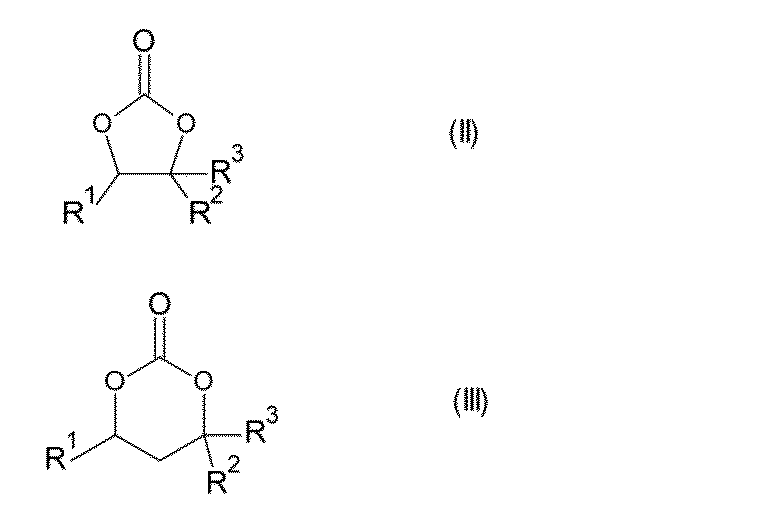
ここで、R1、R2及びR3は、同一であるか、又は異なることが可能であり、及び水素、及びC1~C4-アルキル、例えばメチル、エチル、n-プロピル、イソプロピル、n-ブチル、イソブチル、sec-ブチル及びtert-ブチルから選ばれ、及びR2及びR3は好ましくは、両方がtert-ブチルではない。 Here, R 1 , R 2 and R 3 can be the same or different, and hydrogen and C 1 to C 4 -alkyl, such as methyl, ethyl, n-propyl, isopropyl, n. -Choose from butyl, isobutyl, sec-butyl and tert-butyl, and R 2 and R 3 are preferably both not tert-butyl.
特に好ましい実施の形態では、R1はメチルであり、及びR2及びR3はそれぞれ、水素であるか、又はR1、R2及びR3は、それぞれが水素である。 In a particularly preferred embodiment, R 1 is methyl and R 2 and R 3 are hydrogen, respectively, or R 1 , R 2 and R 3 are hydrogen, respectively.
他の好ましい環式有機カーボネートは、式(IV)のビニレンカーボネートである。 Another preferred cyclic organic carbonate is the vinylene carbonate of formula (IV).

溶媒(1種又は複数種)は好ましくは、水の無い状態で使用され、すなわち、例えばカール-フィッシャー滴定によって測定して、水の含有量が1質量ppm~0.1質量%の範囲で使用される。 The solvent (s) is preferably used in the absence of water, i.e., with a water content in the range of 1 ppm to 0.1% by weight, as measured by, for example, Karl-Fischer titration. Will be done.
電解質(C)は更に、少なくとも1種の電解質塩を含む。適切な電解質塩は特に、リチウム塩である。適切なリチウム塩の例は、LiPF6、LiBF4、LiClO4、LiAsF6、LiCF3SO3、LiC(CnF2n+1SO2)3、リチウムイミド、例えばLiN(CnF2n+1SO2)2(但し、nは1~20の範囲の整数である)、LiN(SO2F)2、Li2SiF6、LiSbF6、LiAlCl4及び一般式(CnF2n+1SO2)tYLiの塩(但し、mは以下のように定義される:
t=1、Yが酸素及び硫黄から選ばれる場合、
t=2、Yが窒素及びリンから選ばれる場合、
t=3、Yが炭素及びシリコンから選ばれる場合)である。
The electrolyte (C) further comprises at least one electrolyte salt. Suitable electrolyte salts are, in particular, lithium salts. Examples of suitable lithium salts are LiPF 6 , LiBF 4 , LiClO 4 , LiAsF 6 , LiCF 3 SO 3 , LiC (C n F 2n + 1 SO 2 ) 3 , lithium imide, eg LiN (C n F 2n + 1 SO 2 ) 2 . (However, n is an integer in the range of 1 to 20), LiN (SO 2 F) 2 , Li 2 SiF 6 , LiSbF 6 , LiAlCl 4 , and a salt of the general formula (C n F 2n + 1 SO 2 ) t YLi (however, n is an integer in the range of 1 to 20). However, m is defined as follows:
When t = 1, Y is selected from oxygen and sulfur
When t = 2, Y is selected from nitrogen and phosphorus
When t = 3, Y is selected from carbon and silicon).
好ましい電解質塩は、LiC(CF3SO2)3、LiN(CF3SO2)2、LiPF6、LiBF4、LiClO4から選ばれ、特に好ましくはLiPF6及びLiN(CF3SO2)2である。 Preferred electrolyte salts are selected from LiC (CF 3 SO 2 ) 3 , LiN (CF 3 SO 2 ) 2 , LiPF 6 , LiBF 4 , LiClO 4 , and particularly preferably LiPF 6 and LiN (CF 3 SO 2 ) 2 . be.
本発明の実施の形態では、本発明に従うバッテリーは、電極を機械的に分離する1つ以上のセパレータを含む。適切なセパレータは、金属リチウムに対して非反応性のポリマーフィルム、特に多孔性ポリマーフィルムである。セパレータ用に特に適切な材料は、ポリオレフィン、特にフィルム形成多孔性ポリエチレン及びフィルム形成多孔性ポリプロピレンである。 In embodiments of the invention, the battery according to the invention comprises one or more separators that mechanically separate the electrodes. Suitable separators are polymer films that are non-reactive with metallic lithium, especially porous polymer films. Particularly suitable materials for separators are polyolefins, especially film-forming porous polyethylene and film-forming porous polypropylene.
ポリオレフィン、特にポリエチレン又はポリプロピレンで構成されるセパレータは、多孔性を35~45%の範囲に有することが可能である。適切な孔径は例えば、30~500nmの範囲である。 Separator made of polyolefin, especially polyethylene or polypropylene, can have porosity in the range of 35-45%. Suitable pore diameters are, for example, in the range of 30-500 nm.
本発明の他の実施の形態では、セパレータは、無機粒子が充填されたPET不織布から選択することが可能である。このようなセパレータは、40~55%の範囲内に多孔性を有することが可能である。適切な孔径は、例えば、80~750nmの範囲である。 In another embodiment of the invention, the separator can be selected from PET nonwoven fabrics filled with inorganic particles. Such separators can have porosity in the range of 40-55%. Suitable pore diameters are, for example, in the range of 80-750 nm.
本発明に従うバッテリーは更に、ハウジングを含み、該ハウジングは任意の形状、例えば立方体状、又はシリンダー状ディスク、又はシリンダー状缶の形状を有することが可能である。一変形形態では、ポーチとして構成された金属ホイルがハウジングとして使用される。 The battery according to the invention further includes a housing, which can have any shape, such as a cube, or a cylindrical disc, or a cylindrical can. In one variant, a metal foil configured as a pouch is used as the housing.
本発明に従うバッテリーは、良好な放電挙動、例えば低温(0℃以下、例えば-10℃以下)で非常に良好な放電及びサイクリング挙動を示す。 Batteries according to the invention exhibit good discharge behavior, such as very good discharge and cycling behavior at low temperatures (0 ° C or lower, eg -10 ° C or lower).
本発明に従うバッテリーは、例えば直列に接続する、又は並列に接続することができる、相互に結びついた2つ以上の電気化学セルを含むことが可能である。直列接続が好ましい。本発明に従うバッテリーでは、少なくとも1つの電気化学セルが、本発明に従う少なくとも1つのカソードを含む。好ましくは、本発明に従う電気化学セル中で電気化学セルの大部分が、本発明に従うカソードを含む。より好ましくは、本発明に従うバッテリー中で、全ての電気化学セルが本発明に従うカソードを含む。 Batteries according to the invention can include two or more interconnected electrochemical cells that can be connected in series or in parallel, for example. Series connection is preferred. In a battery according to the invention, at least one electrochemical cell comprises at least one cathode according to the invention. Preferably, among the electrochemical cells according to the present invention, the majority of the electrochemical cells include a cathode according to the present invention. More preferably, in a battery according to the invention, all electrochemical cells include a cathode according to the invention.
本発明は更に、本発明に従うバッテリーの電気器具、特にモバイルアプリケーション(mobile application)における使用方法を提供する。モバイルアプリケーションの例は、乗り物、例えば自動車、自転車、航空機又は船舶、例えばボート又は船である。モバイルアプリケーションの他の例は、マニュアルで作動するものであり、例えばコンピューター、特にラップトップ、電話、又は電動工具、例えば建築部門で使用するもの、例えばドリル、バッテリー駆動スクリュードライバー、又はバッテリー駆動ステープラーである。 The present invention further provides a method of using a battery according to the present invention in an electric appliance, particularly a mobile application. Examples of mobile applications are vehicles such as cars, bicycles, aircraft or ships such as boats or ships. Other examples of mobile applications are those that operate manually, such as computers, especially laptops, phones, or power tools, such as those used in the building sector, such as drills, battery-powered screwdrivers, or battery-powered staplers. be.
以下に本発明を、実施例を用いて説明するが、本発明はこれらには限られない。 Hereinafter, the present invention will be described with reference to examples, but the present invention is not limited thereto.
sccm:1分間あたりの標準立方センチメートルで、立方センチメートルは、標準条件:1atm及び20℃でのものである。 sccm: standard cubic centimeters per minute, cubic centimeters are at standard conditions: 1 atm and 20 ° C.
I.カソード活性材料の合成
I.1 前駆体TM-OH.1の合成
攪拌タンク反応器を脱イオン水及び水1kgあたり49gの硫酸アンモニウムで満たした。この溶液を55℃の温度にし、及び水酸化ナトリウム水溶液を加えることによってpH値を12に調節した。
I. Synthesis of cathode active materials I. 1 Precursor TM-OH. The synthetic stirring tank reactor of No. 1 was filled with deionized water and 49 g of ammonium sulfate per 1 kg of water. The pH value was adjusted to 12 by bringing this solution to a temperature of 55 ° C. and adding aqueous sodium hydroxide solution.
遷移金属硫酸塩水溶液及び水酸化ナトリウム水溶液を、1.8の流量割合、及び8時間の滞留時間(residence time)となる流量で同時に供給することによって共沈反応を開始させた。遷移金属溶液は、Ni、Co、及びMnを8.5:1.0:0.5のモル比で含み、及び合計遷移金属濃度は、1.65mol/kgであった。水酸化ナトリウム水溶液は、質量割合が6の、25質量%水酸化ナトリウム溶液及び25質量%アンモニア溶液であった。水酸化ナトリウム水溶液を別個に供給することによって、pH値を12に維持した。全ての供給の開始と一緒に開始して、母液を連続的に除去した。33時間後、全ての供給流を停止させた。得られた懸濁液をろ過し、蒸留水で洗浄し、空気中120℃で乾燥させ、及び篩にかけることによって、混合遷移金属(TM)オキシヒドロキシド前駆体TM-OH.1が得られた。 The co-precipitation reaction was started by simultaneously supplying the transition metal sulfate aqueous solution and the sodium hydroxide aqueous solution at a flow rate ratio of 1.8 and a flow rate having a residence time of 8 hours. The transition metal solution contained Ni, Co, and Mn in a molar ratio of 8.5: 1.0: 0.5, and the total transition metal concentration was 1.65 mol / kg. The sodium hydroxide aqueous solution was a 25% by mass sodium hydroxide solution and a 25% by mass ammonia solution having a mass ratio of 6. The pH value was maintained at 12 by separately supplying the aqueous sodium hydroxide solution. Starting with the start of all feeds, the mother liquor was continuously removed. After 33 hours, all supply streams were shut down. The resulting suspension was filtered, washed with distilled water, dried in air at 120 ° C., and sieved to the mixed transition metal (TM) oxyhydroxydo precursor TM-OH. 1 was obtained.
I.2 TM-OH.1のカソード活性材料への変換、及び本発明の方法に従う処理
1.2.1 比較カソード活性材料、C-CAM.1の製造、ステップ(a.1)
C-CAM.1:I.1に従って得られた混合遷移金属オキシヒドロオキシド前駆体を、LiOH一水和物と混合し、1.05のモル比のLi/(TM)を得た。この混合物を760℃まで加熱し、及び60%酸素と40%窒素(体積%)の混合物の強制流中に10時間保持した。周囲温度(大気温度)にまで冷却した後、粉末を解砕し(deagglomerate)、及び32μmメッシュを通して篩分けし、電極活性材料C-CAM1を得た。
I. 2 TM-OH. Conversion of 1 to a cathode active material and treatment according to the method of the present invention 1.2.1 Comparative cathode active material, C-CAM. Manufacturing of 1, step (a.1)
C-CAM. 1: I. The mixed transition metal oxyhydrooxide precursor obtained according to No. 1 was mixed with LiOH monohydrate to obtain Li / (TM) having a molar ratio of 1.05. The mixture was heated to 760 ° C. and kept in a forced stream of 60% oxygen and 40% nitrogen (% by volume) for 10 hours. After cooling to ambient temperature (atmospheric temperature), the powder was deagglomerate and sieved through a 32 μm mesh to give the electrode active material C-CAM1.
Malvern Instrumentsからの器具であるMastersize3000中で、レーザー回折の技術を使用して測定して、D50=9.0μmであった。250℃での残留水分は、300ppmであると測定された。 Measured using laser diffraction techniques in Mastersize 3000, an instrument from Malvern Instruments, D50 = 9.0 μm. The residual water content at 250 ° C. was measured to be 300 ppm.
1.2.2 水性媒体を使用した処理、ステップ(b.1)及び(c.1)及び(d.1)
周囲温度(大気温度)で脱塩水にC-CAM.1を1.5の質量比(CAM:水)で加えた。得られたスラリーの攪拌の2分後、ブフナー漏斗を通したろ過によって液体を除去した。このようにして得られたフィルターケーキ(ろ過塊)を薄膜ポンプによる真空状態中で2時間、65℃で乾燥させ、次いで第2乾燥ステップで、同様に薄膜ポンプによる真空状態中で10時間、180℃で乾燥させた。CAM.1-Wが得られた。
1.2.2 Treatment with aqueous medium, steps (b.1) and (c.1) and (d.1)
C-CAM. 1 was added at a mass ratio of 1.5 (CAM: water). After 2 minutes of stirring the resulting slurry, the liquid was removed by filtration through a Büchner funnel. The filter cake (filtered lump) thus obtained was dried in a vacuum state by a thin film pump for 2 hours at 65 ° C., and then in the second drying step, similarly in a vacuum state by a thin film pump for 10 hours, 180. It was dried at ° C. CAM. 1-W was obtained.
I.2.3 アルミニウム酸化物コーティング、ステップ(e.1)及び(f.1)
外部加熱ジャケットを備えた流動床反応器に100gのCAM.1-Wを導入し、及び130ミリバールの平均圧力で、C-CAM.1-Wを流動化した。流動床反応器を180℃に加熱し、そして180℃で3時間保持した。液体状態のTMAを含み、及び50℃に保持されている前駆体貯蔵容器に繋げるバルブを開けることによって、気体状態のトリメチルアルミニウム(TMA)を、フィルタープレーターを通して流動化床に導入した。TMAをキャリアガスとしての窒素で希釈した。TMA及びN2のガス流は10sccmであった。210秒の反応期間の後、未反応TMAを、窒素流を通して除去し、及び窒素を使用して30sccmの流れで反応器を15分間、パージした。
I. 2.3 Aluminum oxide coating, steps (e.1) and (f.1)
A fluidized bed reactor with an external heating jacket and 100 g of CAM. Introducing 1-W and with an average pressure of 130 millibars, C-CAM. 1-W was fluidized. The fluidized bed reactor was heated to 180 ° C. and held at 180 ° C. for 3 hours. Trimethylaluminum (TMA) in gaseous state was introduced into the fluidized bed through a filter plater by opening a valve containing TMA in liquid state and connecting to a precursor storage vessel held at 50 ° C. TMA was diluted with nitrogen as a carrier gas. The gas flow of TMA and N 2 was 10 sccm. After a reaction period of 210 seconds, unreacted TMA was removed through a stream of nitrogen and the reactor was purged with a stream of 30 sccm using nitrogen for 15 minutes.
次に、24℃に保持された液体水を含んだ貯蔵容器へのバルブを開けることによって、気体状態の水を流動床反応器に導入した(流れ:10sccm)。120秒の反応期間の後、未反応水を窒素流を通して除去し、及び反応器を窒素を使用して15分間、30sccmでパージした。上述したシーケンスを3回繰り返した。反応器を25℃に冷却し、そして材料を排出した。得られたCAM.2は、以下の特性を示した:Malvern Instrumentsからの器具であるMastersize3000中で、レーザー回折の技術を使用して測定して、D50=10.6μm。PE-Optima3300RLinstrument(典型的な検出限界は3ppm)を使用した誘導結合プラズマによって、標準溶液に対する評価法を介して測定して、Al含有量:1400ppm。250℃での残留水分は、200ppmであると測定された。 The gaseous water was then introduced into the fluidized bed reactor (flow: 10 sccm) by opening a valve to a storage vessel containing liquid water held at 24 ° C. After a reaction period of 120 seconds, unreacted water was removed through a stream of nitrogen and the reactor was purged with nitrogen for 15 minutes at 30 sccm. The above sequence was repeated 3 times. The reactor was cooled to 25 ° C. and the material was drained. The obtained CAM. 2 exhibited the following properties: measured using laser diffraction techniques in Mastersize 3000, an instrument from Malvern Instruments, D50 = 10.6 μm. Al content: 1400 ppm as measured by inductively coupled plasma using PE-Optima 3300RL instant (typical detection limit 3 ppm) via evaluation method for standard solution. The residual water content at 250 ° C. was measured to be 200 ppm.
本発明のCAM.2は、卓越した電気化学的特性を示した。 The CAM. Of the present invention. 2 showed excellent electrochemical properties.
本発明は、被覆された酸化物材料の製造方法であって、以下の工程:
(a)リチウム化(lithiated)したニッケル-コバルトアルミニウム酸化物、リチウムコバルト酸化物、リチウム化したコバルト-マンガン酸化物、及びリチウム化した層状化ニッケル-コバルト-マンガン酸化物から選ばれる粒子状材料を提供する工程、
(b)上記粒子状材料を水性媒体で処理する工程、
(c)上記水性媒体を除去する工程、
(d)処理された上記粒子状材料を乾燥させる工程、
(e)工程(d)からの上記粒子状材料を金属アミド、又はアルキル金属化合物で処理する工程、
(f)工程(e)で得られた材料を、水分、又は酸化剤で処理する工程、
及び任意に、工程(e)及び(f)のシーケンスを繰り返す工程を含む方法に関する。
The present invention is a method for producing a coated oxide material, wherein the following steps:
(A) A particulate material selected from lithiumized nickel-cobalt aluminum oxide, lithium cobalt oxide, lithiumized cobalt-manganese oxide, and lithium layered nickel-cobalt-manganese oxide. Process to provide,
(B) A step of treating the particulate material with an aqueous medium,
(C) Step of removing the aqueous medium,
(D) A step of drying the treated particulate matter,
(E) A step of treating the particulate material from the step (d) with a metal amide or an alkyl metal compound.
(F) A step of treating the material obtained in the step (e) with water or an oxidizing agent.
And optionally, the present invention relates to a method including a step of repeating the sequence of steps (e) and (f).
更に本発明は、Niリッチな電極活性材料に関する。 Further, the present invention relates to a Ni-rich electrode active material.
リチウムイオン二次電池は、エネルギー保存用の現代的な装置である。小さな装置、例えば携帯電話、及びラップトップコンピュータから、自動車バッテリー、及びe-モビリティーを通して多くの用途分野が検討されてきており、そして検討されている。電池(battery)の種々の要素、例えば電解質、電極材料及びセパレータが、電池の性能の観点から決定的な役割を有している。カソード材料について特に注意が払われる。いくつかの材料、例えばリチウム鉄ホスフェート、リチウムコバルト酸化物、及びリチウムニッケルコバルトマンガン酸化物が示唆されている。広範な研究が行われたにも拘わらず、その解決手段にはなお改良の余地が残っている。 Lithium-ion secondary batteries are modern devices for energy conservation. Many application areas have been and are being considered, from small devices such as mobile phones and laptop computers, through automotive batteries, and e-mobility. Various elements of the battery, such as electrolytes, electrode materials and separators, play a decisive role in terms of battery performance. Particular attention is paid to the cathode material. Several materials have been suggested, such as lithium iron phosphate, lithium cobalt oxide, and lithium nickel cobalt manganese oxide. Despite extensive research, there is still room for improvement in the solution.
現在、所定の興味が所謂Niリッチ電極活性材料、例えば合計TM容量に対して、75モル%以上のNiを含む電極活性材料に見出されても良い。 At present, a predetermined interest may be found in so-called Ni-rich electrode active materials, for example, electrode active materials containing 75 mol% or more of Ni with respect to the total TM capacity.
リチウムイオン電池、特にNiリッチ電極活性材料の一つの問題は、電極活性材料の表面上での望ましくない反応に起因する。このような反応は、電解質又は溶媒又は両方の分解であっても良い。従って、充電及び放電の間に、リチウム交換を阻害することのなく表面を保護することが試みられてきた。例は、電極活性材料を、例えばアルミニウム酸化物、又はカルシウム酸化物で被覆することの試みである(例えば、特許文献1:US8993051が参照される)。 One problem with lithium-ion batteries, especially Ni-rich electrode active materials, is due to undesired reactions on the surface of the electrode active materials. Such a reaction may be the decomposition of the electrolyte and / or solvent. Therefore, attempts have been made to protect the surface during charging and discharging without interfering with lithium exchange. An example is an attempt to coat the electrode active material with, for example, aluminum oxide, or calcium oxide (see, eg, Patent Document 1: US8993051).
他の理論は、望ましくない反応を表面上の遊離LiOH又はLi2CO3に関連付ける。電極活性材料を水で洗浄することによって、このような遊離LiOH又はLi2CO3を除去する試みがなされてきた(特許文献2:JP4789066B、特許文献3;JP5139024B及び特許文献4;US2015/0372300が参照される)。しかしながら、ある例では得られた電極活性材料の特性が改良されないことが観察された。 Other theories relate undesired reactions to free LiOH or Li 2 CO 3 on the surface. Attempts have been made to remove such free LiOH or Li 2 CO 3 by washing the electrode active material with water (Patent Document 2: JP4789066B, Patent Document 3; JP5139024B and Patent Document 4; US2015 / 0372300. See). However, it was observed that in some cases the properties of the obtained electrode active material were not improved.
本発明の目的は、優れた電気化学特性を有する電極活性材料を製造するための方法を提供することである。本発明の目的は特に、優れた電気化学特性を有する所謂Niリッチな電極活性材料を提供することにある。 An object of the present invention is to provide a method for producing an electrode active material having excellent electrochemical properties. An object of the present invention is particularly to provide a so-called Ni-rich electrode active material having excellent electrochemical properties.
従って、上記に定義した方法が見出され、これは以降、「本発明の方法」とも記載される。 Therefore, the method defined above has been found, which is also referred to herein as the "method of the present invention".
本発明の方法は、幾つかの工程を含むが、本発明ではこれらを工程(a)~工程(f)とも称する。工程(b)及び(c)の始まりは同時であっても良く、又は好ましくは順次のものであって良い。工程(d)は工程(c)の後に行われる。工程(e)及び(f)は、繰り返されても良い。以下に個々の工程をより詳細に記載する。 The method of the present invention includes several steps, which are also referred to as steps (a) to (f) in the present invention. The beginnings of steps (b) and (c) may be simultaneous, or preferably sequential. Step (d) is performed after step (c). Steps (e) and (f) may be repeated. The individual steps are described in more detail below.
工程(a)は、リチウム化したニッケル-コバルトアルミニウム酸化物、リチウムコバルト酸化物、リチウム化したコバルト-マンガン酸化物、及びリチウム化した層状化ニッケル-コバルト-マンガン酸化物から選ばれる粒子状材料を提供することを含む。 In step (a), a particulate material selected from lithiumized nickel-cobalt aluminum oxide, lithium cobalt oxide, lithiumized cobalt-manganese oxide, and lithium layered nickel-cobalt-manganese oxide is used. Including providing.
リチウムコバルト酸化物の式は、LiCoO2である。リチウム化した層状化コバルト-マンガン酸化物の例は、Li1+x(CoeMnfM3
d)1-xO2である。層状化ニッケル-コバルト-マンガン酸化物の例は、一般式Li1+x(NiaCobMncM3
d)1-xO2の化合物である。ここでM3は、Mg、Ca、Ba、Al、Ti、Zr、Zn、Mo、V及びFeから選ばれ、更なる変数記号は、以下のように定義される:
ゼロ≦x≦0.2
0.1≦a≦0.9、
ゼロ≦b≦0.5、
0.1≦c≦0.6、
ゼロ≦d≦0.1、及びa+b+c+d=1。
The formula for the lithium cobalt oxide is LiCoO 2 . An example of a lithium layered cobalt-manganese oxide is Li 1 + x ( Coe Mn f M 3 d ) 1-x O 2 . An example of a layered nickel-cobalt-manganese oxide is a compound of the general formula Li 1 + x (Ni a Co b Mn c M 3 d ) 1-x O 2 . Here, M 3 is selected from Mg, Ca, Ba, Al, Ti, Zr, Zn, Mo, V and Fe, and further variable symbols are defined as follows:
Zero ≤ x ≤ 0.2
0.1 ≤ a ≤ 0.9,
Zero ≤ b ≤ 0.5,
0.1 ≤ c ≤ 0.6,
Zero ≤ d ≤ 0.1 and a + b + c + d = 1.
好ましい一実施の形態では、一般式(I)
Li(1+x)[NiaCobMncM3
d](1-x)O2 (I)
に従う化合物で、
M3は、Ca、Mg、Al及びBaから選ばれ、
及び更なる変数記号は、上記に定義したものである。
In one preferred embodiment, the general formula (I)
Li (1 + x) [Ni a Co b Mn c M 3 d ] (1-x) O 2 (I)
With compounds that follow
M 3 is selected from Ca, Mg, Al and Ba.
And further variable symbols are those defined above.
特に好ましい実施の形態では、TMは、一般式(Ia)
(NiaCobMnc)1-dM1
d (Ia)
(但し、
a+b+c=1であり、及び
aが、0.75~0.95の範囲であり、
bが、0.025~0.2の範囲であり、
cが、0.025~0.2の範囲であり、
dが、ゼロ~0.1の範囲であり、及び
M1が、Al、Mg、W、Mo、Nb、Ti又はZrの少なくとも1つである)
に従う金属の組合せである。
In a particularly preferred embodiment, TM is represented by the general formula (Ia).
(Ni a Co b Mn c ) 1-d M 1 d (Ia)
(however,
a + b + c = 1 and a is in the range of 0.75 to 0.95.
b is in the range of 0.025 to 0.2.
c is in the range of 0.025 to 0.2,
d is in the range of zero to 0.1, and M 1 is at least one of Al, Mg, W, Mo, Nb, Ti or Zr).
It is a combination of metals according to.
Li(1+x)[CoeMnfM3 d]1-xO2で、eは0.2~0.8の範囲であり、fは、0.2~0.8の範囲であり、変数記号M3及びd及びxは、上記に定義したものであり、及びe+f+d=1である。 Li (1 + x) [Co e Mn f M 3 d ] 1-x O 2 , e is in the range of 0.2 to 0.8, f is in the range of 0.2 to 0.8, and is a variable. The symbols M3 and d and x are as defined above and e + f + d = 1.
リチウム化したニッケル-コバルトアルミニウム酸化物の例は、一般式Li[NihCoiAlj]O2+rの化合物である。従ってTMは、一般式(Ib)
[NihCoiAlj] (Ib)
(但し、
hが、0.8~0.95の範囲であり、
iが、0.025~0.19の範囲であり、
jが、0.01~0.05の範囲でありる)
に従う金属の組合せである。
An example of a lithium-ized nickel-cobalt aluminum oxide is a compound of the general formula Li [ Nih Coi Al j ] O 2 + r . Therefore, TM is a general formula (Ib).
[Ni h Coi Al j ] (Ib)
(however,
h is in the range of 0.8 to 0.95,
i is in the range of 0.025 to 0.19,
j is in the range of 0.01 to 0.05)
It is a combination of metals according to.
変数記号rは、ゼロ~0.4の範囲である。 The variable symbol r is in the range of zero to 0.4.
特定の例は、Li(1+x)[Ni0.33Co0.33Mn0.33](1-x)O2、Li(1+x)[Ni0.5Co0.2Mn0.3](1-x)O2、Li(1+x)[Ni0.6Co0.2Mn0.2](1-x)O2、Li(1+x)[Ni0.85Co0.1Mn0.05](1-x)O2、Li(1+x)[Ni0.7Co0.2Mn0.1](1-x)O2、及びLi(1+x)[Ni0.8Co0.1Mn0.1](1-x)O2であり、それぞれxは、上記に定義したものである。 Specific examples are Li (1 + x) [Ni 0.33 Co 0.33 Mn 0.33 ] (1-x) O 2 , Li (1 + x) [Ni 0.5 Co 0.2 Mn 0.3 ] ( 1-x) O 2 , Li (1 + x) [Ni 0.6 Co 0.2 Mn 0.2 ] (1-x) O 2 , Li (1 + x) [Ni 0.85 Co 0.1 Mn 0.05 ] (1-x) O 2 , Li (1 + x) [Ni 0.7 Co 0.2 Mn 0.1 ] (1-x) O 2 and Li (1 + x) [Ni 0.8 Co 0.1 Mn] 0.1 ] (1-x) O 2 , where x is defined above.
幾つかの元素は偏在する。本願において、少量の偏在する金属、例えばナトリウム、カルシウム、鉄、又は亜鉛は不純物として、本発明の記載には考慮されない。この点に関し、少量は、粒子状材料の合計金属含有量に対し、0.05モル%以下の量を意味すると理解される。 Some elements are unevenly distributed. In the present application, a small amount of unevenly distributed metal such as sodium, calcium, iron, or zinc is not considered as an impurity in the description of the present invention. In this regard, a small amount is understood to mean an amount of 0.05 mol% or less relative to the total metal content of the particulate material.
上記粒子状材料は好ましくは、如何なる添加剤、例えば導電性カーボン、又はバインダー無しで、しかし自由流動性粉末として提供される。特に、粒子状材料は好ましくは、導電性カーボンを有しておらず、このことは、粒子状材料の導電性カーボンの含有量が、上記粒子状材料に対して1質量%未満、好ましくは0.001~1.0質量%、又は検出レベル未満でさえあることを意味する。 The particulate material is preferably provided without any additives, such as conductive carbon, or binder, but as a free-flowing powder. In particular, the particulate material preferably does not have conductive carbon, which means that the content of the conductive carbon in the particulate material is less than 1% by mass, preferably 0, with respect to the particulate material. It means that it is 001 to 1.0% by mass, or even below the detection level.
本発明の一実施の形態では、粒子状材料は、平均粒子径(D50)が、3~20μmの範囲、好ましくは5~16μmの範囲である。平均粒子径は例えば、光散乱、又はLASER回折、又は電子音響分光法によって測定可能である。粒子は通常、一次粒子からの塊で構成され、及び上述した粒子径は二次粒子径を示している。 In one embodiment of the invention, the particulate material has an average particle size (D50) in the range of 3 to 20 μm, preferably in the range of 5 to 16 μm. The average particle size can be measured, for example, by light scattering, LASER diffraction, or electroacoustic spectroscopy. The particles are usually composed of agglomerates from the primary particles, and the particle size mentioned above indicates the secondary particle size.
本発明の一実施の形態では、粒子状材料は、比表面積(BET)(以降、「BET表面積」とも記載する)は、0.1~1.0m2/gの範囲である。BET表面積は、DIN ISO9277:2010に従って、試料を200℃で30分以上脱ガスした後、窒素吸着によって測定されても良い。 In one embodiment of the invention, the particulate material has a specific surface area (BET) (hereinafter also referred to as "BET surface area") in the range of 0.1 to 1.0 m 2 / g. The BET surface area may be measured by nitrogen adsorption after degassing the sample at 200 ° C. for 30 minutes or longer according to DIN ISO9277: 2010.
工程(b)では、上述した粒子状材料は、水性媒体で処理される。上記水性媒体は、pH値が2~14の範囲であっても良く、好ましくは少なくとも5、より好ましくは7~12.5、及びより好ましくは、8~12.5の範囲であっても良い。pH値は、工程(b)の開始時に測定される。工程(b)の過程で、pH値は、少なくとも10にまで上昇することが観察される。 In step (b), the particulate material described above is treated with an aqueous medium. The aqueous medium may have a pH value in the range of 2 to 14, preferably at least 5, more preferably 7 to 12.5, and even more preferably 8 to 12.5. .. The pH value is measured at the start of step (b). In the process of step (b), it is observed that the pH value rises to at least 10.
好ましくは、水性媒体の水の硬度、及び特に、工程(b)で使用された水の硬度、特にカルシウムは、少なくとも部分的に除去される。脱塩水の使用が好ましい。 Preferably, the hardness of the water in the aqueous medium, and in particular the hardness of the water used in step (b), in particular calcium, is at least partially removed. The use of desalinated water is preferred.
工程(b)の替わりの実施の形態では、工程(b)で使用される水性媒体は、アンモニア又は少なくとも1種の遷移金属塩、例えばニッケル塩又はコバルト塩を含んでも良い。このような遷移金属塩は、好ましくは電極活性材料にとって有害ではない対イオンを有している。硫酸塩及び硝酸塩が適している。塩化物は好ましくはない。 In an alternative embodiment of step (b), the aqueous medium used in step (b) may comprise ammonia or at least one transition metal salt such as a nickel salt or a cobalt salt. Such transition metal salts preferably have counterions that are not harmful to the electrode active material. Sulfates and nitrates are suitable. Chloride is not preferred.
工程(b)の一実施の形態では、工程(b)で使用される水性媒体は、0.001~10質量%の、Al、Mo、W、Ti又はZrの酸化物又は水酸化物、又はオキシ水酸化物を含む。工程(b)の他の実施形態では、工程(b)で使用される水性媒体は、Al、Mo、W、Ti又はZrの酸化物又は水酸化物、又はオキシ水酸化物の何れのものも測定可能な量では含まない。 In one embodiment of step (b), the aqueous medium used in step (b) is 0.001-10% by weight of an oxide or hydroxide of Al, Mo, W, Ti or Zr, or Contains oxyhydroxide. In another embodiment of step (b), the aqueous medium used in step (b) may be any oxide or hydroxide of Al, Mo, W, Ti or Zr, or an oxyhydroxide. Not included in measurable quantities.
本発明の一実施の形態では、工程(b)は、5~65℃の範囲の温度で行われ、この温度範囲は、10~35℃が好ましい。 In one embodiment of the invention, step (b) is performed at a temperature in the range of 5 to 65 ° C, preferably 10 to 35 ° C.
本発明の一実施の形態では、工程(b)は標準圧力で行われる。しかしながら、工程(b)を、圧力を上昇させて行うことが好ましく、例えば標準圧力より、10ミリバール~10バール高くして行うことが好ましく、又は吸引状態で、例えば標準圧力より50~250ミリバール低い圧力、好ましくは標準圧力より100~200ミルバール低い圧力で行うことが好ましい。 In one embodiment of the invention, step (b) is performed at standard pressure. However, step (b) is preferably carried out at an increased pressure, for example 10 millibars to 10 bar higher than the standard pressure, or in a suction state, for example 50-250 millibars lower than the standard pressure. The pressure is preferably 100-200 milbar lower than the standard pressure.
工程(b)は、例えばろ過装置上のその配置の理由で、容易に排出可能な容器内で行われても良い。このような容器は、出発材料が充填され、次いで水性媒体が導入されても良い。他の実施の形態では、このような容器は、水性媒体が装填され、次いで出発材料が導入される。他の実施の形態では、出発材料及び水性媒体が同時に導入される。 Step (b) may be performed in an easily drainable container, for example because of its placement on the filtration device. Such containers may be filled with starting material and then an aqueous medium may be introduced. In another embodiment, such a container is loaded with an aqueous medium and then the starting material is introduced. In other embodiments, the starting material and the aqueous medium are introduced simultaneously.
本発明の一実施の形態では、出発材料と工程(b)における合計水性媒体の体積比は2:1~1:5の範囲、好ましくは2:1~1:2の範囲である。工程(b)は、混合操作、例えばシェイキング、又は特に攪拌又はせん断によって補助されても良い(下記が参照される)。 In one embodiment of the invention, the volume ratio of starting material to total aqueous medium in step (b) is in the range 2: 1 to 1: 5, preferably in the range 2: 1 to 1: 2. Step (b) may be assisted by a mixing operation, such as shaking, or particularly stirring or shearing (see below).
本発明の一実施の形態では、工程(b)は、1分間~30分間の範囲、好ましくは1間から5分間未満の範囲の継続時間を有する。5分間以上の継続時間は、工程(b)及び(c)が重複して、又は同時に行われる実施形態で可能である。 In one embodiment of the invention, step (b) has a duration ranging from 1 minute to 30 minutes, preferably 1 to less than 5 minutes. A duration of 5 minutes or more is possible in embodiments where steps (b) and (c) are duplicated or performed simultaneously.
本発明の一実施の形態では、工程(b)及び(c)は連続して行われる。工程(b)に従って水性媒体で処理を行った後、水は、ろ過の任意の種類によって、例えばバンドフィルター上で、又はフィルタープレス内で除去されても良い。 In one embodiment of the invention, steps (b) and (c) are performed continuously. After treatment with an aqueous medium according to step (b), water may be removed by any type of filtration, eg, on a band filter or in a filter press.
本発明の一実施の形態では、工程(b)の開始後少なくとも3分間して、工程(c)が開始される。工程(c)は、固-液分離を使用して、例えばデカンターを使用して、又は好ましくはろ過によって、上記水性媒体を処理された粒子状材料から除去することを含む。 In one embodiment of the invention, step (c) is started at least 3 minutes after the start of step (b). Step (c) involves removing the aqueous medium from the treated particulate material using solid-liquid separation, eg, using a decanter, or preferably by filtration.
本発明の一実施の形態では、工程(b)で得られたスラリーは、好ましくは工程(b)が行われる容器の直下部に配置される遠心分離機内、例えばデカンター遠心分離機、又はろ過遠心分離機内に、又はろ過装置上に、例えば吸引フィルター、又はベルトフィルターで排出される。そしてろ過が開始される。 In one embodiment of the invention, the slurry obtained in step (b) is preferably in a centrifuge located just below the container in which step (b) is performed, such as a decanter centrifuge or a filtration centrifuge. It is discharged into the separator or on the filtration device, for example, with a suction filter or a belt filter. Then filtration is started.
本発明の特に好ましい実施形態では、工程(b)及び工程(c)は、攪拌機付のろ過装置(フィルター装置)、例えば攪拌機付の圧力フィルター又は攪拌機付の吸引フィルターで行われる。工程(b)に従い出発材料及び水性媒体が混合されて、最大で3分後の後に、又は直後に、水性媒体の除去が、ろ過を開始させることによって開始される。実験室規模では、工程(b)及び(c)は、ブフナー漏斗上で行われても良く、及び工程(b)は、手動攪拌によって補助されても良い。 In a particularly preferred embodiment of the present invention, the steps (b) and (c) are carried out by a filtration device (filter device) equipped with a stirrer, for example, a pressure filter equipped with a stirrer or a suction filter equipped with a stirrer. The starting material and the aqueous medium are mixed according to step (b) and removal of the aqueous medium is initiated by initiating filtration after, or shortly after, up to 3 minutes. On a laboratory scale, steps (b) and (c) may be performed on a Büchner funnel, and step (b) may be assisted by manual agitation.
好ましい実施形態では、工程(b)は、ろ過装置内、例えばフィルター内のスラリー又はろ過ケーキの攪拌を可能にする攪拌ろ過装置で行われる。工程(b)の開始後、最大3分後に、ろ過、例えば圧力ろ過、又は吸引ろ過を開始することにより、工程(c)が開始される。 In a preferred embodiment, step (b) is performed in a stirring and filtering device that allows stirring of the slurry or filter cake in the filtering device, eg, in the filter. Step (c) is started by starting filtration, for example pressure filtration or suction filtration, up to 3 minutes after the start of step (b).
本発明の一実施の形態では、工程(c)は1分~1時間の範囲の継続時間を有している。 In one embodiment of the invention, step (c) has a duration in the range of 1 minute to 1 hour.
本発明の一実施の形態では、工程(b)における攪拌は、1~50回/分(rpm)の速度で行われ、この速度は5~20rpmの範囲が好ましい。 In one embodiment of the invention, stirring in step (b) is performed at a rate of 1 to 50 times / minute (rpm), preferably in the range of 5 to 20 rpm.
工程(b)及び(c)を同じ温度で行うことが好ましい。 It is preferable to carry out the steps (b) and (c) at the same temperature.
工程(b)及び(c)を同じ圧力で行うことが好ましく、又は工程(b)を開始させた時に圧力を増すことが好ましい。 It is preferable to carry out the steps (b) and (c) at the same pressure, or it is preferable to increase the pressure when the step (b) is started.
本発明の一実施の形態では、工程(c)のためのろ過媒体は、セラミック、焼成ガラス、焼成金属、有機ポリマーフィルム、不織布、及びファイバーから選択されても良い。 In one embodiment of the invention, the filtration medium for step (c) may be selected from ceramics, calcined glass, calcined metals, organic polymer films, non-woven fabrics, and fibers.
本発明の一実施の形態では、工程(b)及び(c)はCO2含有量が低減された雰囲気、例えば二酸化炭素の含有量が0.01~500質量ppm、好ましくは0.1~50ppmの雰囲気下で行われる。CO2含有量は、例えば、赤外光を使用した光学的手法によって測定されても良い。工程(b)及び(c)が、例えば赤外光ベースの光学的手法を使用して、検知限界未満の二酸化炭素濃度を有する雰囲気下で行われることが更に好ましくさえある。 In one embodiment of the invention, steps (b) and (c) have an atmosphere of reduced CO 2 content, such as carbon dioxide content of 0.01-500 mass ppm, preferably 0.1-50 ppm. It is done in the atmosphere of. The CO 2 content may be measured, for example, by an optical technique using infrared light. It is even more preferred that steps (b) and (c) be performed in an atmosphere with a carbon dioxide concentration below the detection limit, for example using infrared light based optical techniques.
工程(d)では、工程(c)からの処理された材料が、例えば、40~250℃の範囲の温度、標準圧力、又は減圧した圧力、例えば1~500ミリバールの圧力で乾燥される。より低い温度、例えば40~100℃での乾燥が所望される場合、強く減圧された圧力、例えば1~20ミリバールが好ましい。 In step (d), the treated material from step (c) is dried, for example, at a temperature in the range of 40-250 ° C., a standard pressure, or a reduced pressure, eg, a pressure of 1-500 millibars. If drying at a lower temperature, eg 40-100 ° C., is desired, a strongly depressurized pressure, eg 1-20 millibars, is preferred.
本発明の一実施の形態では、工程(d)は、CO2含有量が低減された雰囲気、例えば二酸化炭素の含有量が0.01~500質量ppm、好ましくは0.1~50ppmの雰囲気下で行われる。CO2含有量は、例えば、赤外光を使用した光学的手法によって測定されても良い。工程(d)が、例えば赤外光ベースの光学的手法を使用して、検知限界未満の二酸化炭素濃度を有する雰囲気下で行われることが更に好ましくさえある。 In one embodiment of the invention, step (d) is carried out in an atmosphere where the CO 2 content is reduced, for example, in an atmosphere where the carbon dioxide content is 0.01 to 500 mass ppm, preferably 0.1 to 50 ppm. It is done in. The CO 2 content may be measured, for example, by an optical technique using infrared light. It is even more preferred that step (d) be performed in an atmosphere with a carbon dioxide concentration below the detection limit, for example using infrared light based optical techniques.
本発明の一実施の形態では、工程(d)は、1~10時間の継続時間、好ましくは、90分~6時間の継続時間を有する。 In one embodiment of the invention, step (d) has a duration of 1-10 hours, preferably 90 minutes-6 hours.
本発明の一実施の形態では、工程(b)~(d)を行うことによって、電極活性材料のリチウム含有量は、1~5質量%、好ましくは2~4質量%、低減される。上述した低減は主として、所謂残存リチウムに影響を及ぼす。 In one embodiment of the present invention, the lithium content of the electrode active material is reduced by 1 to 5% by mass, preferably 2 to 4% by mass, by performing steps (b) to (d). The above-mentioned reduction mainly affects the so-called residual lithium.
本発明の好ましい実施形態では、工程(d)で得られた材料は、残留水分含有量が、50~1000ppmの範囲、好ましくは100~400ppmの範囲、又は600~1000ppmの範囲である。残留水分含有量は、カール-フィッシャー滴定によって測定されても良い。 In a preferred embodiment of the present invention, the material obtained in step (d) has a residual water content in the range of 50 to 1000 ppm, preferably in the range of 100 to 400 ppm, or in the range of 600 to 1000 ppm. The residual water content may be measured by Karl-Fischer titration.
工程(e)で、上述した電極活性材料は、金属ハロゲン化物、又は金属アミド又はアルキル金属化合物で処理される。 In step (e), the above-mentioned electrode active material is treated with a metal halide, a metal amide, or an alkyl metal compound.
本発明の一実施の形態では、工程(e)は、15~1000℃の範囲の温度、好ましくは15~500℃、より好ましくは20~350℃、及び更に好ましくは50~200℃の範囲の温度で行われる。場合によって、工程(e)で、金属アミド、又はアルキルアミド化合物がガス相中に存在する温度を選択することが好ましい。 In one embodiment of the invention, step (e) is in the temperature range of 15-1000 ° C, preferably 15-500 ° C, more preferably 20-350 ° C, and even more preferably 50-200 ° C. It is done at temperature. In some cases, it is preferable to select the temperature at which the metal amide or the alkyl amide compound is present in the gas phase in step (e).
本発明の一実施の形態では、工程(e)は、標準圧力で行われるが、しかしながら工程(e)は、同様に、減圧下、又は上昇させた圧力下に行われても良い。例えば、工程(e)は、標準圧力より5ミリバール~1バールの範囲高い圧力で行われても良く、好ましくは標準圧力より10~150ミリバールの範囲高い圧力で行われても良い。本発明において、標準圧力は、1気圧又は1013ミリバールである。他の実施の形態では、工程(e)は、標準圧力より150ミリバールから560ミリバールの範囲高い圧力で行われても良い。 In one embodiment of the invention, step (e) is performed at standard pressure, however, step (e) may also be performed under reduced pressure or increased pressure. For example, step (e) may be carried out at a pressure in the range of 5 millibars to 1 bar higher than the standard pressure, preferably at a pressure in the range of 10 to 150 millibars higher than the standard pressure. In the present invention, the standard pressure is 1 atmosphere or 1013 millibars. In another embodiment, step (e) may be performed at a pressure in the range of 150 millibars to 560 millibars higher than the standard pressure.
本発明の好ましい一実施形態では、アルキル金属化合物又は金属アミドはそれぞれ、Al(R1)3、Al(R1)2OH、AlR1(OH)2、M
2
(R
1
)
4-y
H
y
、M
2
[NR
2
)
2
]
4 、及びメチルアルモキサン
(但し、
R1は、同一又は異なり、及び直鎖状、又は分岐したC1~C8-アルキルから選ばれ、
R2は、同一又は異なり、及び直鎖状、又は分岐したC1~C4-アルキルから選ばれ、
M2は、Ti又はZrであり、Tiが好ましい)
から選ばれる。
In one preferred embodiment of the invention, the alkyl metal compounds or metal amides are Al (R 1 ) 3 , Al (R 1 ) 2 OH, Al R 1 (OH) 2 , M 2 (R 1 ) 4-y H , respectively. y , M 2 [NR 2 ) 2 ] 4 , and methylaluminum (however,
R1 is selected from the same or different, linear or branched C1 - C8 - alkyl.
R2 is selected from the same or different, linear or branched C1- C4 - alkyl.
M 2 is Ti or Zr, preferably Ti)
Is selected from.
アルミニウムアルキル化合物の例は、トリメチルアルミニウム、トリエチルアルミニウム、トリイソブチルアルミニウム、及びメチルアルモキサンである。
金属アミドは、金属イミドとも称される場合がある。金属アミドの例は、Ti[N(CH3)2]4である。
Examples of aluminum alkyl compounds are trimethylaluminum, triethylaluminum, triisobutylaluminum, and methylalmoxane.
The metal amide may also be referred to as a metal amide. An example of a metal amide is Ti [N (CH 3 ) 2 ] 4 .
特に好ましい化合物は、金属アルキル化合物から選ばれ、及びより好ましくはトリメチルアルミニウムである。 Particularly preferred compounds are selected from metallic alkyl compounds, and more preferably trimethylaluminum.
本発明の一実施の形態では、金属アミド又はアルキル金属化合物の量は、0.1~1g/(粒子状の材料1kg)である。 In one embodiment of the invention, the amount of metal amide or alkyl metal compound is 0.1-1 g / (1 kg of particulate material).
好ましくは、金属アミド又はアルキル金属化合物の量はそれぞれ、1サイクルにつき、粒子状の材料上の単分子層の80~200%の量であると計算される。 Preferably, the amount of metal amide or alkyl metal compound is calculated to be 80-200% of the monomolecular layer on the particulate material, respectively, per cycle.
本発明の一実施の形態では、工程(e)はロータリーキルン内で、混合ミキサー内、例えばプロウシェアミキサー内、又はフリーフォールミキサー内で、連続振動ベッド内、又は流動床ベッド内で行われる。本発明の工程(e)及び(f)は同一の容器内で行われても良く、又は異なる容器内で行われても良くそしてその詳細については以下に記載される。 In one embodiment of the invention, step (e) is performed in a rotary kiln, in a mixing mixer, such as in a Prowshare mixer, or in a freefall mixer, in a continuous vibration bed, or in a fluidized bed. The steps (e) and (f) of the present invention may be performed in the same container or in different containers, and details thereof are described below.
本発明の好ましい一実施形態では、工程(e)の継続時間は、1秒~2時間の範囲、好ましくは1秒~30分の範囲である。 In a preferred embodiment of the invention, the duration of step (e) is in the range of 1 second to 2 hours, preferably 1 second to 30 minutes.
本発明では工程(f)とも称される第3の工程では、工程(e)で得られた材料は、水分で処理される。 In the third step, which is also referred to as step (f) in the present invention, the material obtained in step (e) is treated with water.
本発明の一実施の形態では、工程(f)は、50~250℃の範囲の温度で行われる。 In one embodiment of the invention, step (f) is performed at a temperature in the range of 50-250 ° C.
本発明の一実施の形態では、工程(f)はロータリーキルン内、ロータリーキルン、混合ミキサー内、例えばプロウシェアミキサー内、又はフリーフォールミキサー内で、連続振動ベッド内、又は流動床ベッド内で行われる。 In one embodiment of the invention, step (f) is performed in a rotary kiln, in a rotary kiln, in a mixing mixer, eg, in a Prowshare mixer, or in a freefall mixer, in a continuous vibration bed, or in a fluidized bed.
本発明の一実施の形態では、工程(f)は標準圧力で行われるが、しかしながら工程(f)を、減圧下に、又は圧力を上昇させて行っても良い。例えば工程(f)を、標準圧力より5ミリバール~1バール高くして行っても良く、好ましくは標準圧力より10ミリバール~250ミリバール高くして行っても良い。本発明において、標準圧力は、1気圧又は1013ミリバールである。他の実施の形態では、工程(f)は、標準圧力より150ミリバールから560ミリバールの範囲高い圧力で行われても良い。 In one embodiment of the invention, step (f) is performed at standard pressure, however, step (f) may be performed under reduced pressure or at increased pressure. For example, step (f) may be carried out at a height of 5 millibars to 1 bar higher than the standard pressure, preferably 10 millibars to 250 millibars higher than the standard pressure. In the present invention, the standard pressure is 1 atmosphere or 1013 millibars. In another embodiment, step (f) may be performed at a pressure in the range of 150 millibars to 560 millibars higher than the standard pressure.
工程(e)及び(f)は、同じ圧力で行われても良く、又は異なる圧力で行われても良く、同じ圧力であることが好ましい。 The steps (e) and (f) may be performed at the same pressure or may be performed at different pressures, preferably at the same pressure.
上述した水分は、例えば工程(e)に従って得られた材料を水分飽和不活性ガス、例えば水分飽和窒素、又は水分飽和希ガス、例えばアルゴンで処理することによって導入されても良い。飽和は標準条件、又は工程(f)の反応条件であっても良い。 The above-mentioned water content may be introduced, for example, by treating the material obtained according to step (e) with a water-saturated inert gas such as water-saturated nitrogen or a water-saturated rare gas such as argon. Saturation may be standard conditions or reaction conditions of step (f).
本発明の好ましい一実施の形態では、工程(f)の継続時間は、1秒~2時間の範囲、好ましくは1秒~30分の範囲である。 In one preferred embodiment of the invention, the duration of step (f) is in the range of 1 second to 2 hours, preferably 1 second to 30 minutes.
本発明の一実施の形態では、本方法が行われる反応器は、工程(e)と(f)の間、不活性ガス、例えば乾燥窒素又は乾燥アルゴンでフラッシュ(flushing)又はパージされる。フラッシュ又はパージの適切な時間は1秒~20分である。好ましくは、不活性ガスの量は、反応器の内容物を1~15回交換する(入れ替える)のに十分な量である。このようなフラッシュ又はパージによって、副生成物、例えば金属アミド又はアルキル金属化合物の水との反応生成物の分離した粒子の精製が回避され得る。トリメチルアルミニウム及び水を連結させる場合、このような副生成物は、メタン及びアルミナ又は粒子状材料上には沈澱しないトリメチルアルミニウムであり、後者は望ましくない副生成物である。上述したフラッシュは工程(f)の後、従って他の工程(e)の前にも行われる。 In one embodiment of the invention, the reactor in which the method is performed is flushed or purged with an inert gas, such as dry nitrogen or dry argon, between steps (e) and (f). A suitable time for flushing or purging is 1 second to 20 minutes. Preferably, the amount of the inert gas is sufficient to replace (replace) the contents of the reactor 1 to 15 times. Such flushing or purging can avoid purification of separated particles of by-products, eg, reaction products of metal amides or alkyl metal compounds with water. When ligating trimethylaluminum and water, such by-products are methane and alumina or trimethylaluminum that does not precipitate on particulate material, the latter being an undesired by-product. The flash described above is performed after step (f) and therefore before other steps (e).
本発明の一実施の形態では、工程(e)及び工程(f)の間のフラッシュ工程はそれぞれ、1秒~30分間の範囲の継続時間を有する。 In one embodiment of the invention, the flash step between steps (e) and step (f) each has a duration in the range of 1 second to 30 minutes.
本発明の一実施の形態では、反応器は工程(e)及び工程(f)の間にエバキュエーションされる。上述したエバキュエーションは、工程(f)の後、従って他の工程(e)の前にも行われる。この構成に関し、エバキュエーションは如何なる減圧をも含み、例えば10~1000ミリバール(abs)、好ましくは10~500ミリバール(abs)を含む。 In one embodiment of the invention, the reactor is evacuated between steps (e) and step (f). The above-mentioned evacuation is performed after step (f) and therefore before other steps (e). For this configuration, the evacuation includes any decompression, eg 10 to 1000 millibars (abs), preferably 10 to 500 millibars (abs).
工程(e)及び工程(f)のそれぞれは、固定床反応器内、流動床反応器内、強制流反応器内、又はミキサー内、例えば強制ミキサー内、又はフリーフォールミキサー内で行われても良い。流動床反応器の例は、噴流層反応器である。強制ミキサーの例は、プロウシェアミキサー、パドルミキサー及びシャベルミキサーである。プロウシェアミキサーが好ましい。好ましいプロウシェアミキサーは、水平に導入され、ここで「水平」という用語は、その回りをミキシング要素が回転する軸についてのものである。好ましくは本発明の方法は、シャベルミキサーツール内、パドルミキサーツール内、ベッカーブレードツール内で行われ、最も好ましくは、ハーリング及びワイヤリング原理に従うプロウシェアミキサー内で行われる。フリーフォールミキサーは、ミキシング状態を達成するために重力を使用している。好ましい一実施の形態では、本発明の方法の工程(e)及び(f)は、その水平方向回りに回転するドラム又はパイプ形状の容器内で行われる。より好ましい実施形態では、本発明の工程(e)及び(f)は、バッフルを有する回転容器内で行われる。 Each of step (e) and step (f) may be performed in a fixed bed reactor, a fluidized bed reactor, a forced flow reactor, or a mixer, such as a forced mixer, or a freefall mixer. good. An example of a fluidized bed reactor is a jet bed reactor. Examples of forced mixers are Prowshare mixers, paddle mixers and shovel mixers. A Prowshare mixer is preferred. A preferred procedure mixer is introduced horizontally, where the term "horizontal" refers to an axis around which the mixing element rotates. Preferably the method of the present invention is carried out in a shovel mixer tool, a paddle mixer tool, a Becker blade tool, and most preferably in a prowshare mixer according to the herring and wiring principles. The freefall mixer uses gravity to achieve the mixing state. In a preferred embodiment, steps (e) and (f) of the method of the invention are performed in a drum or pipe-shaped container that rotates horizontally. In a more preferred embodiment, steps (e) and (f) of the present invention are performed in a rotating vessel having a baffle.
本発明の一実施の形態では、回転容器は2~100個の範囲のバッフル、好ましくは2~20個の範囲のバッフルを有する。このようなバッフルは好ましくは、容器の壁に取り付けられている。 In one embodiment of the invention, the rotating vessel has a baffle in the range of 2-100, preferably a baffle in the range of 2-20. Such baffles are preferably mounted on the wall of the container.
本発明の一実施の形態では、このようなバッフルは回転容器、ドラム又はパイプに沿って軸対称的に配置されている。上記回転容器の壁との角度は、5~45°の範囲、好ましくは10~20°の範囲である。このような配置によって、これらは被覆されたカソード活性材料を、非常に効果的に回転容器を通して輸送することが可能である。 In one embodiment of the invention, such baffles are arranged axisymmetrically along a rotating vessel, drum or pipe. The angle of the rotating container with the wall is in the range of 5 to 45 °, preferably in the range of 10 to 20 °. With such an arrangement, they are able to transport the coated cathode active material through the rotating vessel very effectively.
本発明の一実施の形態では、上述したバッフルは回転容器内に、直径に対して10~30%の範囲にまで達する。 In one embodiment of the invention, the baffle described above reaches within a rotating vessel in the range of 10-30% of the diameter.
本発明の一実施の形態では、上述したバッフルは、回転容器の全長の10~100%の範囲、好ましくは30~80%の範囲をカバーする。この点に関し、「長さ」とういう用語は、回転軸に平行なものである。 In one embodiment of the invention, the baffle described above covers a range of 10-100%, preferably 30-80% of the total length of the rotating vessel. In this regard, the term "length" is parallel to the axis of rotation.
本発明の好ましい実施の形態では、本発明の方法は、被覆された材料を容器又は複数の容器から、例えば20~100m/sの空気搬送によって除去する工程を含む。 In a preferred embodiment of the invention, the method of the invention comprises removing the coated material from a container or a plurality of containers, for example by air transport at 20-100 m / s.
本発明の一実施の形態では、排出ガスは、工程(e)及び(f)が行われる反応器内よりも1バール高い圧力、より好ましくはより高い圧力で、例えば1.010~2.1バールの範囲、好ましくは1.005から1.150バールの範囲で水で処理される。上昇された圧力は、排出ライン中の圧力損失を補償するするのに有利である。 In one embodiment of the invention, the emissions are at a pressure one bar higher, more preferably higher, eg 1.010 to 2.1, than in the reactor in which steps (e) and (f) are performed. Treated with water in the range of bar, preferably in the range of 1.005 to 1.150 bar. The increased pressure is advantageous in compensating for the pressure loss in the discharge line.
工程(e)及び(f)のシーケンスは、2~4回繰り返されても良く、工程(e)及び(f)の最後のシーケンスでは、水分が少なくとも部分的に酸化剤に置き換えられても良い。酸化剤の例は、酸素、H2O2等の過酸化物及びオゾン、及びこれらの少なくとも2種の組合せである。特に好ましい酸化剤は、オゾン及び酸素とオゾンからの混合物である。このような酸化剤は、純粋な状態で、又は水分との組合せで与えられても良い。 The sequence of steps (e) and (f) may be repeated 2-4 times, and in the final sequence of steps (e) and (f), the water may be at least partially replaced by the oxidant. .. Examples of oxidants are oxygen, peroxides such as H2O2 and ozone, and at least two combinations thereof. Particularly preferred oxidants are ozone and mixtures of oxygen and ozone. Such an oxidizing agent may be given in a pure state or in combination with water.
水分が酸化剤によって少なくとも部分的に置き換えられても良い、上述した後者の工程(f)は以降、工程(f*)とも称する。 The latter step (f) described above, wherein the water content may be at least partially replaced by the oxidant, is also referred to herein as step (f * ).
繰返し(repetition)は、各回ごとに、正確に同じ条件下で、又は変更した条件下ではあるが、なお上述した定義の範囲内で工程(e)及び(f)のシーケンスを繰り返すことを含んでも良い。例えば、各工程(e)は、正確に同じ条件下に行われても良く、又は例えば、各工程(e)は、異なる温度条件下に、又は異なる継続時間で、例えば120℃、次いで10℃及び160℃、それぞれ1秒~1時間行われても良い。 Repetition may include repeating the sequence of steps (e) and (f) each time, under exactly the same conditions or under modified conditions, but still within the definition described above. good. For example, each step (e) may be performed under exactly the same conditions, or, for example, each step (e) may be performed under different temperature conditions or for different durations, eg, 120 ° C., then 10 ° C. And 160 ° C. may be carried out for 1 second to 1 hour, respectively.
工程(f*)では、水分が酸化剤に少なくとも部分的に置き換えられる。好ましくは、工程(f*)で、湿気は与えられず、及び水分は完全に酸化剤によって置き換えらる。 In step (f * ), the water is at least partially replaced by the oxidant. Preferably, in step (f * ), no moisture is given and the moisture is completely replaced by the oxidant.
オゾンは、それ自体は公知の条件下で、酸素から生成されても良く、及び従って、工程(f*)では通常、酸素の存在下にオゾンが施される。工程(f*)でオゾンを与える間、窒素が存在しないことが好ましい。 Ozone may itself be produced from oxygen under known conditions, and therefore ozone is usually applied in the presence of oxygen in step (f * ). It is preferable that nitrogen is not present while ozone is applied in the step (f * ).
本発明の一実施の形態では、工程(f*)は、標準圧力で行われる。本発明の他の実施の形態では、工程(f*)は、標準圧力より5ミリバール~1バール高い圧力、好ましくは標準圧力より10~250ミリバール高い圧力で行われる。他の実施の形態では、工程(f*)は、標準圧力より低い圧力、例えば100~900ミリバールで、好ましくは標準圧力より100~500ミリバール低い圧力で行われる。工程(f*)は、20~300℃の温度で行われても良く、好ましくは100~300℃の温度、より好ましくは150~250℃の温度で行われても良い。 In one embodiment of the invention, step (f * ) is performed at standard pressure. In another embodiment of the invention, the step (f * ) is performed at a pressure 5 millibars to 1 bar higher than the standard pressure, preferably 10 to 250 millibars higher than the standard pressure. In another embodiment, the step (f * ) is performed at a pressure lower than the standard pressure, eg, 100-900 millibars, preferably 100-500 millibars lower than the standard pressure. The step (f * ) may be carried out at a temperature of 20 to 300 ° C., preferably 100 to 300 ° C., more preferably 150 to 250 ° C.
本発明の一実施の形態では、工程(f*)の継続時間は、1秒~2時間の範囲、好ましくは1秒~30分間の範囲である。 In one embodiment of the invention, the duration of the step (f * ) is in the range of 1 second to 2 hours, preferably 1 second to 30 minutes.
工程(f*)は、工程(f)の容器と同じタイプの容器内で行われても良い。好ましくは、工程(f)及び工程(f*)は、同じ容器内で行われる。 The step (f * ) may be carried out in the same type of container as the container of the step (f). Preferably, step (f) and step (f * ) are performed in the same container.
粒子状電極活性材料が得られる。 Particulate electrode active material is obtained.
本発明の一実施の形態では、工程(e)及び工程(f*)のシーケンスは、ただ1回のみ行われる。他の実施の形態では、工程(e)及び工程(f*)のシーケンスは、2~5回行われる。 In one embodiment of the invention, the sequence of steps (e) and (f * ) is performed only once. In another embodiment, the sequence of step (e) and step (f * ) is performed 2 to 5 times.
本発明の一実施の形態では、工程(f)又は場合によって工程(f*)の後、後処理、例えば熱後処理(g)が行われる。このような熱後処理(g)は、工程(f)又は(f*)の後に粒子状電極活性材料を、それぞれ、150~800℃、好ましくは150~400℃の範囲の温度で、例えば所定期間に亘り、180~350℃の温度で、例えば、10分間~2時間の期間に亘り行われても良い。 In one embodiment of the invention, post-treatment, such as thermal post-treatment (g), is performed after step (f) or, in some cases, step (f * ). In such a thermal post-treatment (g), after the step (f) or (f * ), the particulate electrode active material is subjected to, for example, a predetermined temperature in the range of 150 to 800 ° C., preferably 150 to 400 ° C., respectively. It may be carried out at a temperature of 180 to 350 ° C. over a period of time, for example, for a period of 10 minutes to 2 hours.
本発明の一実施の形態では、工程(d)の後に後処理、例えば熱後処理(d*)が行われる。このような熱後処理(d*)は、工程(d)の後に得られた粒子状電極活性材料を、150~800℃の範囲の温度、好ましくは150~400℃の範囲の温度で、例えば好ましくは180~350℃の範囲の温度で所定の期間に亘り、例えば10分間~2時間の期間に亘り行われても良い。 In one embodiment of the invention, post-treatment, such as thermal post-treatment (d * ), is performed after step (d). In such a thermal post-treatment (d * ), the particulate electrode active material obtained after the step (d) is subjected to, for example, a temperature in the range of 150 to 800 ° C., preferably a temperature in the range of 150 to 400 ° C. It may be preferably carried out at a temperature in the range of 180 to 350 ° C. for a predetermined period, for example, for a period of 10 minutes to 2 hours.
本発明の方法を行うことによって、卓越した電気化学的特性を示す電極活性材料が得られても良い。 By performing the method of the present invention, an electrode active material exhibiting excellent electrochemical properties may be obtained.
本発明の更なる形態は、電極活性材料に関し、これは以降、本発明の電極活性材料とも称される。本発明の電極活性材料は、一般式Li1+x1TM1-x1O2に対応し、ここでTMは、Niと、Co及びMnから選ばれる少なくとも1種の遷移金属、任意にAl、Ba及びMgから選ばれる少なくとも1種の金属と、Ni、Co及びMn以外の少なくとも1種の遷移金属との組合せを含み、及びTMの少なくとも75%は、Niであり、及びx1は-0.01~0.1の範囲である。TMの式は、被覆の無い上記本発明の電極活性材料を表す。更に、本発明の電極活性材料は、比表面積(BET)を0.3~1.5m2/gの範囲に有し、及び100~1500ppmのAlの、少なくとも部分的な被覆を含む。ppmの量は、質量ppmを表す。 A further embodiment of the present invention relates to the electrode active material, which is hereinafter also referred to as the electrode active material of the present invention. The electrode active material of the present invention corresponds to the general formula Li 1 + x1 TM 1-x1 O 2 , where TM is at least one transition metal selected from Ni and Co and Mn, optionally Al, Ba and Mg. Contains a combination of at least one metal selected from and at least one transition metal other than Ni, Co and Mn, and at least 75% of TM is Ni and x1 is -0.01-0. It is in the range of 1. The formula of TM represents the electrode active material of the present invention without a coating. Further, the electrode active material of the present invention has a specific surface area (BET) in the range of 0.3 to 1.5 m 2 / g and contains at least a partial coating of 100 to 1500 ppm of Al. The amount of ppm represents mass ppm.
本発明の好ましい実施形態では、本発明の電極活性材料は、LiOH及びLi2CO3の合計を、上記電極活性材料に対して0.05~0.15質量%の範囲で含む。LiOH及びLi2CO3の量は、例えば滴定法によって測定される。 In a preferred embodiment of the present invention, the electrode active material of the present invention contains the total of LiOH and Li 2 CO 3 in the range of 0.05 to 0.15% by mass with respect to the electrode active material. The amounts of LiOH and Li 2 CO 3 are measured, for example, by titration.
本発明の一実施の形態では、本発明の電極活性材料は、平均粒子径(D50)を、3~20μmの範囲、好ましくは5~16μmの範囲に有する。平均粒子径は例えば、光散乱又はレーザー回折、又は電子音響分光法によって測定可能である。粒子は通常、一次粒子からの塊から構成され、及び上記粒子径は、二次粒子径を表す。 In one embodiment of the invention, the electrode active material of the invention has an average particle size (D50) in the range of 3 to 20 μm, preferably in the range of 5 to 16 μm. The average particle size can be measured, for example, by light scattering or laser diffraction, or electroacoustic spectroscopy. The particles are usually composed of agglomerates from primary particles, and the particle size represents a secondary particle size.
好ましい実施の形態では、一般式(I)に従う化合物では、
Li(1+x1)[TM](1-x1)O2 (I)
TMが、(NiaCobMncM3
d)であり、
M3が、Ca、Mg、Al及びBaから選ばれ、
及び更なる変数記号は、上記に定義したものである。
In a preferred embodiment, for compounds according to general formula (I),
Li (1 + x1) [TM] (1-x1) O 2 (I)
TM is (Ni a Co b Mn c M 3 d ),
M 3 is selected from Ca, Mg, Al and Ba,
And further variable symbols are those defined above.
特に好ましい実施の形態では、TMは、一般式(Ia)
(NiaCobMnc)1-dM1
d (Ia)
(但し、
a+b+c=1であり、及び
aが、0.75~0.95の範囲であり、
bが、0.025~0.2の範囲であり、
cが、0.025~0.2の範囲であり、及び
dが、ゼロ~0.1の範囲であり、及び
M1が、Al、Mg、W、Mo、Nb、Ti又はZrの少なくとも1つである)
に従う金属の組合せである。
In a particularly preferred embodiment, TM is represented by the general formula (Ia).
(Ni a Co b Mn c ) 1-d M 1 d (Ia)
(however,
a + b + c = 1 and a is in the range of 0.75 to 0.95.
b is in the range of 0.025 to 0.2.
c is in the range 0.025 to 0.2, d is in the range zero to 0.1, and M 1 is at least one of Al, Mg, W, Mo, Nb, Ti or Zr. Is)
It is a combination of metals according to.
Li1+x(CoeMnfM3 d)1-xO2中、eは、0.2~0.8の範囲、fは、0.2~0.8の範囲、変数記号M3及びd及びxは、上記に定義したものであり、及びe+f+d=1である。 In Li 1 + x (Co e Mn f M 3 d ) 1-x O 2 , e is in the range of 0.2 to 0.8, f is in the range of 0.2 to 0.8, and the variable symbols M 3 and d. And x are those defined above, and e + f + d = 1.
他の実施の形態では、TMが、一般式(Ib)
[NihCoiAlj] (Ib)
(但し、
hが、0.8~0.95の範囲であり、
iが、0.025~0.19の範囲であり、及び
jが、0.01~0.05の範囲である)
に従う金属の組合せである。
本発明の更なる形態は、本発明に従う電極活性材料を少なくとも1種含む、電極である。これらはリチウムイオン電池用に特に有用である。本発明に従う少なくとも1種の電極を含むリチウムイオン電池は、良好な放電挙動を示す。本発明に従う電極活性材料を少なくとも1種含む電極は以降、本発明のカソード、又は本発明に従うカソードとも称される。
In other embodiments, TM is the general formula (Ib).
[Ni h Coi Al j ] (Ib)
(however,
h is in the range of 0.8 to 0.95,
i is in the range of 0.025 to 0.19, and j is in the range of 0.01 to 0.05).
It is a combination of metals according to.
A further embodiment of the present invention is an electrode comprising at least one electrode active material according to the present invention. These are particularly useful for lithium-ion batteries. Lithium-ion batteries containing at least one electrode according to the present invention exhibit good discharge behavior. An electrode containing at least one electrode active material according to the present invention is hereinafter also referred to as a cathode of the present invention or a cathode according to the present invention.
本発明に従うカソードは、更なる構成要素を含むことが可能である。これらは、電流コレクタ、例えばアルミニウムホイルを含むことが可能であるが、これに限定されるものではない。これらは更に、導電性カーボン及びバインダーを含むことが可能である。
適切なバインダーは好ましくは、有機(コ)ポリマーから選択される。適切な(コ)ポリマー、すなわちホモポリマー又はコポリマーは、例えばアニオン、触媒、又はフリーラジカル(共)重合によって得られる(コ)ポリマーから、特にポリエチレン、ポリアクリロニトリル、ポリブタジエン、ポリスチレンから、及びエチレン、プロピレン、スチレン、(メト)アクリロニトリル、及び1,3-ブタジエンから選ばれる少なくとも2種のコモノマーのコポリマーから選択することが可能である。ポリプロピレンも適切である。ポリイソプレン及びポリアクリレートが追加的にて適切である。特に好ましいものは、ポリアクリロニトリルである。
本発明において、ポリアクリロニトリルは、ポリアクリロニトリルホモポリマーのみならず、アクリロニトリルの1,3-ブタジエン又はスチレンとのコポリマーをも意味するものと理解される。ポリアクリロニトリルホモポリマーが好ましい。
The cathode according to the present invention can include additional components. These can include, but are not limited to, current collectors such as aluminum foil. These can further include conductive carbon and binders.
Suitable binders are preferably selected from organic (co) polymers. Suitable (co) polymers, ie homopolymers or copolymers, are, for example, from (co) polymers obtained by anion, catalyst, or free radical (co) polymerization, especially from polyethylene, polyacrylonitrile, polybutadiene, polystyrene, and ethylene, propylene. It is possible to choose from copolymers of at least two comonomer selected from, styrene, (meth) acrylonitrile, and 1,3-butadiene. Polypropylene is also suitable. Polyisoprene and polyacrylate are additionally suitable. Particularly preferred is polyacrylonitrile.
In the present invention, polyacrylonitrile is understood to mean not only a polyacrylonitrile homopolymer but also a copolymer of acrylonitrile with 1,3-butadiene or styrene. Polyacrylonitrile homopolymers are preferred.
本発明において、ポリエチレンは、ホモポリエチレンのみならず、共重合したエチレンを少なくとも50モル%含み、及び少なくとも1種の更なるコモノマーを50モル%以下で含む、エチレンのコポリマーをも意味すると理解される。上記更なるコモノマーは例えば、アルファオレフィン、例えばプロピレン、ブチレン(1-ブテン)、1-ヘキセン、1-オクテン、1-デセン、1-ドデセン、1-ペンテン、及びイソブテン、ビニル芳香族化合物、例えばスチレン、及び(メト)アクリル酸、酢酸ビニル、プロピオン酸ビニール、(メト)アクリル酸のC1~C10-アルキルエステル、特にメチルアクリレート、メチルメタクリレート、エチルアクリレート、エチルメタクリレート、n-ブチルアクリレート、2-エチルヘキシルアクリレート、n-ブチルメタクリレート、2-エチルヘキシルメタクリレート、及びマレイン酸、無水マレイン酸、及びイタコン酸無水物である。ポリエチレンは、HDPE又はLDPEであっても良い。 In the present invention, polyethylene is understood to mean not only homopolyethylene but also an ethylene copolymer containing at least 50 mol% of copolymerized ethylene and less than 50 mol% of at least one additional comonomer. .. The additional comonomers are, for example, alpha olefins such as propylene, butylene (1-butene), 1-hexene, 1-octene, 1-decene, 1-dodecene, 1-pentene, and isobutene, vinyl aromatic compounds such as styrene. , And (meth) acrylic acid, vinyl acetate, vinyl propionate, C 1 to C 10 -alkyl esters of (meth) acrylic acid, especially methyl acrylate, methyl methacrylate, ethyl acrylate, ethyl methacrylate, n-butyl acrylate, 2- Ethylhexyl acrylate, n-butyl methacrylate, 2-ethylhexyl methacrylate, and maleic acid, maleic anhydride, and itaconic acid anhydride. The polyethylene may be HDPE or LDPE.
本発明において、ポリプロピレンは、ホモポリプロピレンのみならず、共重合したプロピレンを少なくとも50モル%含み、及び少なくとも1種の更なるコモノマーを50モル%以下で含む、プロピレンのコポリマーをも意味すると理解される。当該更なるコモノマーは例えば、エチレン及びアルファオレフィン、例えばブチレン、1-ヘキセン、1-オクテン、1-デセン、1-ドデセン、及び1-ペンテンである。ポリプロピレンは、好ましくはイソタクチック、又は本質的にイソタクチックのポリプロピレンである。 In the present invention, polypropylene is understood to mean not only homopolypropylene but also a copolymer of propylene containing at least 50 mol% of copolymerized propylene and less than 50 mol% of at least one additional comonomer. .. The additional comonomer is, for example, ethylene and alpha olefins such as butylene, 1-hexene, 1-octene, 1-decene, 1-dodecene, and 1-pentene. The polypropylene is preferably isotactic, or essentially isotactic polypropylene.
本発明において、ポリスチレンはスチレンのホモポリマーを意味するのみならず、アクリロニトリル、1,3-ブタジエン、(メト)アクリル酸、(メト)アクリル酸のC1~C10-アルキルエステル、ジビニルベンゼン、特に1,3-ジビニルベンゼン、1,2-ジフェニルエチレン及びα-メチルスチレンとのコポリマーをも意味するものと理解される。 In the present invention, polystyrene not only means a homopolymer of styrene, but also acrylonitrile, 1,3-butadiene, (meth) acrylic acid, C1 to C10 - alkyl esters of (meth) acrylic acid, divinylbenzene, in particular. It is also understood to mean copolymers with 1,3-divinylbenzene, 1,2-diphenylethylene and α-methylstyrene.
他の好ましいバインダーは、ポリブタジエンである。 Another preferred binder is polybutadiene.
他の適切なバインダーは、ポリエチレンオキシド(PEO)、セルロース、カルボキシメチルセルロース、ポリイミド及びポリビニルアルコールから選ばれる。 Other suitable binders are selected from polyethylene oxide (PEO), cellulose, carboxymethyl cellulose, polyimide and polyvinyl alcohol.
本発明の一実施の形態では、バインダーは、平均分子量Mwが、50000~1000000g/mol、好ましくは500000g/molまでの、これらの(コ)ポリマーから選ばれる。 In one embodiment of the invention, the binder is selected from these (co) polymers having an average molecular weight M w of up to 50,000 to 1,000,000 g / mol, preferably 500,000 g / mol.
バインダーは架橋されていても良く、架橋されていなくても良い。 The binder may or may not be crosslinked.
特に好ましい実施の形態では、バインダーは、ハロゲン化(コ)ポリマーから、特にフッ素化(コ)ポリマーから選ばれる。ハロゲン化又はフッ素化(コ)ポリマーは、分子ごとに少なくとも一つのハロゲン原子又は少なくとも一つのフッ素原子、より好ましくは、分子ごとに少なくとも二つのハロゲン原子又は少なくとも二つのフッ素原子を有する(共)重合化された(コ)ポリマーを少なくとも1種含む(コ)ポリマーを意味するものと理解される。例は、ポリビニルクロリド、ポリビニリデンクロリド、ポリテトラフルオロエチレン、ポリビニリデンフルオリド(PVdF)、テトラフルオロエチレン-ヘキサフルオロプロピレンコポリマー、ビニリデンフルオリド-ヘキサフルオロプロピレンコポリマー(PVdF-HFP)、ビニリデンフルオリド-テトラフルオロエチレンコポリマー、ペルフルオロアルキルビニルエーテルコポリマー、エチレン-テトラフルオロエチレンコポリマー、ビニリデンフルオリド-クロロトリフルオロエチレンコポリマー及びエチレン-クロロフルオロエチレンコポリマーである。 In a particularly preferred embodiment, the binder is selected from halogenated (co) polymers, especially from fluorinated (co) polymers. A halogenated or fluorinated (co) polymer is a (co) polymer having at least one halogen atom or at least one fluorine atom per molecule, more preferably at least two halogen atoms or at least two fluorine atoms per molecule. It is understood to mean a (co) polymer containing at least one fluorinated (co) polymer. Examples are polyvinyl chloride, polyvinylidene chloride, polytetrafluoroethylene, polyvinylidene fluoride (PVdF), tetrafluoroethylene-hexafluoropropylene copolymer, vinylidene fluoride-hexafluoropropylene copolymer (PVdF-HFP), vinylidene fluoride-. Tetrafluoroethylene copolymer, perfluoroalkyl vinyl ether copolymer, ethylene-tetrafluoroethylene copolymer, vinylidene fluoride-chlorotrifluoroethylene copolymer and ethylene-chlorofluoroethylene copolymer.
適切なバインダーは特に、ポリビニルアルコール及びハロゲン化(コ)ポリマー、例えばポリビニルクロリド又はポリビニリデンクロリド、特にフッ素化(コ)ポリマー、例えばポリビニルフルオリド及び特に、ポリビニリデンフルオリド及びポリテトラフルオロエチレンである。 Suitable binders are, in particular, polyvinyl alcohol and halogenated (co) polymers such as polyvinyl chloride or polyvinylidene chloride, in particular fluorinated (co) polymers such as polyvinylfluoride and in particular polyvinylidene fluoride and polytetrafluoroethylene. ..
本発明のカソードは、電極活性材料に対して、1~15質量%のバインダー(複数種を含む)を含んでも良い。他の実施の形態では、本発明のカソードは、0.1質量%~1質量%未満のバインダー(複数種を含む)を含む。 The cathode of the present invention may contain 1 to 15% by mass of a binder (including a plurality of types) with respect to the electrode active material. In another embodiment, the cathode of the present invention comprises a binder (including a plurality of types) of 0.1% by mass to less than 1% by mass.
本発明の更なる形態は、本発明の電極活性材料、カーボン、及びバインダーを含む少なくとも1つのカソード、少なくとも1つのアノード、及び少なくとも1つの電解質を含むバッテリーである。 A further embodiment of the invention is a battery comprising at least one cathode, at least one anode, and at least one electrolyte, comprising the electrode active material of the invention, carbon, and a binder.
本発明のカソードの実施形態については、上記に詳細に記載した。 Embodiments of the cathode of the present invention have been described in detail above.
上述したアノードは、少なくとも1種のアノード活性材料、例えばカーボン(グラファイト)、TiO2、リチウムチタニウム酸化物、シリコン、又はスズを含んでも良い。上述したアノードは電流コレクタ、例えば、金属箔、たとえば銅箔を追加的に含んでも良い。 The anode described above may contain at least one anode active material such as carbon (graphite), TiO 2 , lithium titanium oxide, silicon, or tin. The anode described above may additionally include a current collector, eg, a metal foil, eg, a copper foil.
上述した電解質は、少なくとも1種の非水性溶媒、少なくとも1種の電解質塩、及び任意に添加剤を含んでも良い。 The above-mentioned electrolyte may contain at least one non-aqueous solvent, at least one electrolyte salt, and optionally an additive.
電解質用の非水性溶媒は、室温で液体又は固体であることが可能であり、及び好ましくは、ポリマー、環式又は非環式のエーテル、環式又は非環式のアセタール、及び環式又は非環式の有機カーボネートから選ばれる。 The non-aqueous solvent for the electrolyte can be liquid or solid at room temperature, and preferably a polymer, cyclic or acyclic ether, cyclic or acyclic acetal, and cyclic or non-cyclic or non-cyclic ether. Selected from cyclic organic carbonates.
適切なポリマーの例は特に、ポリアルキレングリコール、好ましくはポリ-C1-C4-アルキレングリコール及び特に、ポリエチレングリコールである。ポリエチレングリコールはここで、20mol%以下の、1種以上のC1~C4-アルキレングリコールを含むことが可能である。ポリアルキレングリコールは好ましくは、2つのメチル又はエチル末端キャップを有するポリアルキレングリコールである。 Examples of suitable polymers are in particular polyalkylene glycols, preferably poly-C- 1 - C4 -alkylene glycols and in particular polyethylene glycols. Polyethylene glycol can now contain 20 mol% or less of one or more C1- C4 -alkylene glycols. The polyalkylene glycol is preferably a polyalkylene glycol having two methyl or ethyl end caps.
適切なポリアルキレングリコール及び特に、適切なポリエチレングリコールの分子量Mwは、少なくとも400g/molであることが可能である。 The molecular weight M w of a suitable polyalkylene glycol and particularly a suitable polyethylene glycol can be at least 400 g / mol.
適切なポリアルキレングリコール及び特に、適切なポリエチレングリコールの分子量Mwは、5000000g/mol以下、好ましくは2000000g/mol以下であることが可能である。 The molecular weight M w of a suitable polyalkylene glycol and particularly a suitable polyethylene glycol can be 5,000,000 g / mol or less, preferably 2000000 g / mol or less.
適切な非環式エーテルの例は例えば、ジイソプロピルエーテル、ジ-n-ブチルエーテル、1,2-ジメトキシエタン、1,2-ジエトキシエタンであり、好ましいものは、1,2-ジメトキシエタンである。 Examples of suitable acyclic ethers are, for example, diisopropyl ether, di-n-butyl ether, 1,2-dimethoxyethane, 1,2-diethoxyethane, and preferred are 1,2-dimethoxyethane.
適切な環式エーテルの例は、テトラヒドロフラン及び1,4-ジオキサンである。 Examples of suitable cyclic ethers are tetrahydrofuran and 1,4-dioxane.
適切な非環式アセタールの例は例えば、ジメトキシメタン、ジエトキシエタン、1,1-ジメトキシエタン、及び1,1-ジエトキシエタンである。 Examples of suitable acyclic acetals are, for example, dimethoxymethane, diethoxyethane, 1,1-dimethoxyethane, and 1,1-diethoxyethane.
適切な環式アセタールの例は、1,3-ジオキサン及び特に、1,3-ジオキソランである。 Examples of suitable cyclic acetals are 1,3-dioxane and, in particular, 1,3-dioxolane.
適切な非環式の有機カーボネートの例は、ジメチルカーボネート、エチルメチルカーボネート及びジエチルカーボネートである。 Examples of suitable acyclic organic carbonates are dimethyl carbonate, ethylmethyl carbonate and diethyl carbonate.
適切な環式の有機カーボネートの例は、一般式(II)及び(III)に従う化合物である。 Examples of suitable cyclic organic carbonates are compounds according to general formulas (II) and (III).
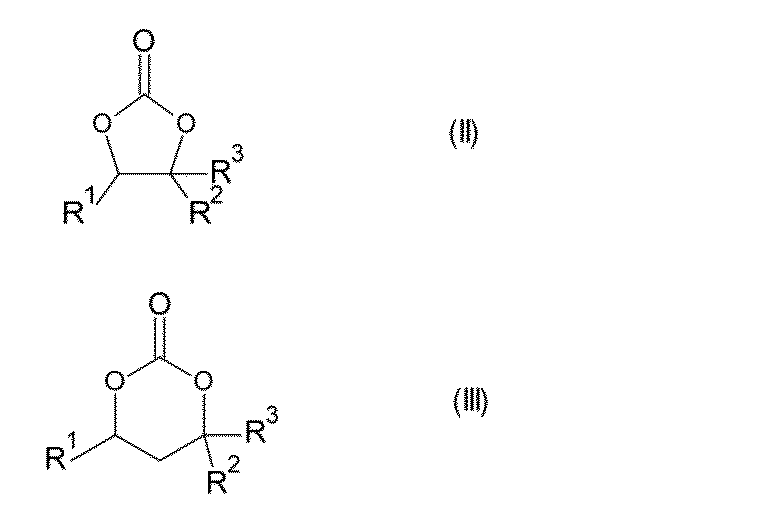
ここで、R1、R2及びR3は、同一であるか、又は異なることが可能であり、及び水素、及びC1~C4-アルキル、例えばメチル、エチル、n-プロピル、イソプロピル、n-ブチル、イソブチル、sec-ブチル及びtert-ブチルから選ばれ、及びR2及びR3は好ましくは、両方がtert-ブチルではない。 Here, R 1 , R 2 and R 3 can be the same or different, and hydrogen and C 1 to C 4 -alkyl, such as methyl, ethyl, n-propyl, isopropyl, n. -Choose from butyl, isobutyl, sec-butyl and tert-butyl, and R 2 and R 3 are preferably both not tert-butyl.
特に好ましい実施の形態では、R1はメチルであり、及びR2及びR3はそれぞれ、水素であるか、又はR1、R2及びR3は、それぞれが水素である。 In a particularly preferred embodiment, R 1 is methyl and R 2 and R 3 are hydrogen, respectively, or R 1 , R 2 and R 3 are hydrogen, respectively.
他の好ましい環式有機カーボネートは、式(IV)のビニレンカーボネートである。 Another preferred cyclic organic carbonate is the vinylene carbonate of formula (IV).

溶媒(1種又は複数種)は好ましくは、水の無い状態で使用され、すなわち、例えばカール-フィッシャー滴定によって測定して、水の含有量が1質量ppm~0.1質量%の範囲で使用される。 The solvent (s) is preferably used in the absence of water, i.e., with a water content in the range of 1 ppm to 0.1% by weight, as measured by, for example, Karl-Fischer titration. Will be done.
電解質(C)は更に、少なくとも1種の電解質塩を含む。適切な電解質塩は特に、リチウム塩である。適切なリチウム塩の例は、LiPF6、LiBF4、LiClO4、LiAsF6、LiCF3SO3、LiC(CnF2n+1SO2)3、リチウムイミド、例えばLiN(CnF2n+1SO2)2(但し、nは1~20の範囲の整数である)、LiN(SO2F)2、Li2SiF6、LiSbF6、LiAlCl4及び一般式(CnF2n+1SO2)tYLiの塩(但し、mは以下のように定義される:
t=1、Yが酸素及び硫黄から選ばれる場合、
t=2、Yが窒素及びリンから選ばれる場合、
t=3、Yが炭素及びシリコンから選ばれる場合)である。
The electrolyte (C) further comprises at least one electrolyte salt. Suitable electrolyte salts are, in particular, lithium salts. Examples of suitable lithium salts are LiPF 6 , LiBF 4 , LiClO 4 , LiAsF 6 , LiCF 3 SO 3 , LiC (C n F 2n + 1 SO 2 ) 3 , lithium imide, eg LiN (C n F 2n + 1 SO 2 ) 2 . (However, n is an integer in the range of 1 to 20), LiN (SO 2 F) 2 , Li 2 SiF 6 , LiSbF 6 , LiAlCl 4 , and a salt of the general formula (C n F 2n + 1 SO 2 ) t YLi (however, n is an integer in the range of 1 to 20). However, m is defined as follows:
When t = 1, Y is selected from oxygen and sulfur
When t = 2, Y is selected from nitrogen and phosphorus
When t = 3, Y is selected from carbon and silicon).
好ましい電解質塩は、LiC(CF3SO2)3、LiN(CF3SO2)2、LiPF6、LiBF4、LiClO4から選ばれ、特に好ましくはLiPF6及びLiN(CF3SO2)2である。 Preferred electrolyte salts are selected from LiC (CF 3 SO 2 ) 3 , LiN (CF 3 SO 2 ) 2 , LiPF 6 , LiBF 4 , LiClO 4 , and particularly preferably LiPF 6 and LiN (CF 3 SO 2 ) 2 . be.
本発明の実施の形態では、本発明に従うバッテリーは、電極を機械的に分離する1つ以上のセパレータを含む。適切なセパレータは、金属リチウムに対して非反応性のポリマーフィルム、特に多孔性ポリマーフィルムである。セパレータ用に特に適切な材料は、ポリオレフィン、特にフィルム形成多孔性ポリエチレン及びフィルム形成多孔性ポリプロピレンである。 In embodiments of the invention, the battery according to the invention comprises one or more separators that mechanically separate the electrodes. Suitable separators are polymer films that are non-reactive with metallic lithium, especially porous polymer films. Particularly suitable materials for separators are polyolefins, especially film-forming porous polyethylene and film-forming porous polypropylene.
ポリオレフィン、特にポリエチレン又はポリプロピレンで構成されるセパレータは、多孔性を35~45%の範囲に有することが可能である。適切な孔径は例えば、30~500nmの範囲である。 Separator made of polyolefin, especially polyethylene or polypropylene, can have porosity in the range of 35-45%. Suitable pore diameters are, for example, in the range of 30-500 nm.
本発明の他の実施の形態では、セパレータは、無機粒子が充填されたPET不織布から選択することが可能である。このようなセパレータは、40~55%の範囲内に多孔性を有することが可能である。適切な孔径は、例えば、80~750nmの範囲である。 In another embodiment of the invention, the separator can be selected from PET nonwoven fabrics filled with inorganic particles. Such separators can have porosity in the range of 40-55%. Suitable pore diameters are, for example, in the range of 80-750 nm.
本発明に従うバッテリーは更に、ハウジングを含み、該ハウジングは任意の形状、例えば立方体状、又はシリンダー状ディスク、又はシリンダー状缶の形状を有することが可能である。一変形形態では、ポーチとして構成された金属ホイルがハウジングとして使用される。 The battery according to the invention further includes a housing, which can have any shape, such as a cube, or a cylindrical disc, or a cylindrical can. In one variant, a metal foil configured as a pouch is used as the housing.
本発明に従うバッテリーは、良好な放電挙動、例えば低温(0℃以下、例えば-10℃以下)で非常に良好な放電及びサイクリング挙動を示す。 Batteries according to the invention exhibit good discharge behavior, such as very good discharge and cycling behavior at low temperatures (0 ° C or lower, eg -10 ° C or lower).
本発明に従うバッテリーは、例えば直列に接続する、又は並列に接続することができる、相互に結びついた2つ以上の電気化学セルを含むことが可能である。直列接続が好ましい。本発明に従うバッテリーでは、少なくとも1つの電気化学セルが、本発明に従う少なくとも1つのカソードを含む。好ましくは、本発明に従う電気化学セル中で電気化学セルの大部分が、本発明に従うカソードを含む。より好ましくは、本発明に従うバッテリー中で、全ての電気化学セルが本発明に従うカソードを含む。 Batteries according to the invention can include two or more interconnected electrochemical cells that can be connected in series or in parallel, for example. Series connection is preferred. In a battery according to the invention, at least one electrochemical cell comprises at least one cathode according to the invention. Preferably, among the electrochemical cells according to the present invention, the majority of the electrochemical cells include a cathode according to the present invention. More preferably, in a battery according to the invention, all electrochemical cells include a cathode according to the invention.
本発明は更に、本発明に従うバッテリーの電気器具、特にモバイルアプリケーション(mobile application)における使用方法を提供する。モバイルアプリケーションの例は、乗り物、例えば自動車、自転車、航空機又は船舶、例えばボート又は船である。モバイルアプリケーションの他の例は、マニュアルで作動するものであり、例えばコンピューター、特にラップトップ、電話、又は電動工具、例えば建築部門で使用するもの、例えばドリル、バッテリー駆動スクリュードライバー、又はバッテリー駆動ステープラーである。 The present invention further provides a method of using a battery according to the present invention in an electric appliance, particularly a mobile application. Examples of mobile applications are vehicles such as cars, bicycles, aircraft or ships such as boats or ships. Other examples of mobile applications are those that operate manually, such as computers, especially laptops, phones, or power tools, such as those used in the building sector, such as drills, battery-powered screwdrivers, or battery-powered staplers. be.
以下に本発明を、実施例を用いて説明するが、本発明はこれらには限られない。 Hereinafter, the present invention will be described with reference to examples, but the present invention is not limited thereto.
sccm:1分間あたりの標準立方センチメートルで、立方センチメートルは、標準条件:1atm及び20℃でのものである。 sccm: standard cubic centimeters per minute, cubic centimeters are at standard conditions: 1 atm and 20 ° C.
I.カソード活性材料の合成
I.1 前駆体TM-OH.1の合成
攪拌タンク反応器を脱イオン水及び水1kgあたり49gの硫酸アンモニウムで満たした。この溶液を55℃の温度にし、及び水酸化ナトリウム水溶液を加えることによってpH値を12に調節した。
I. Synthesis of cathode active material I. 1 Precursor TM-OH. The synthetic stirring tank reactor of No. 1 was filled with deionized water and 49 g of ammonium sulfate per 1 kg of water. The pH value was adjusted to 12 by bringing this solution to a temperature of 55 ° C. and adding aqueous sodium hydroxide solution.
遷移金属硫酸塩水溶液及び水酸化ナトリウム水溶液を、1.8の流量割合、及び8時間の滞留時間(residence time)となる流量で同時に供給することによって共沈反応を開始させた。遷移金属溶液は、Ni、Co、及びMnを8.5:1.0:0.5のモル比で含み、及び合計遷移金属濃度は、1.65mol/kgであった。水酸化ナトリウム水溶液は、質量割合が6の、25質量%水酸化ナトリウム溶液及び25質量%アンモニア溶液であった。水酸化ナトリウム水溶液を別個に供給することによって、pH値を12に維持した。全ての供給の開始と一緒に開始して、母液を連続的に除去した。33時間後、全ての供給流を停止させた。得られた懸濁液をろ過し、蒸留水で洗浄し、空気中120℃で乾燥させ、及び篩にかけることによって、混合遷移金属(TM)オキシヒドロキシド前駆体TM-OH.1が得られた。 The co-precipitation reaction was started by simultaneously supplying the transition metal sulfate aqueous solution and the sodium hydroxide aqueous solution at a flow rate ratio of 1.8 and a flow rate having a residence time of 8 hours. The transition metal solution contained Ni, Co, and Mn in a molar ratio of 8.5: 1.0: 0.5, and the total transition metal concentration was 1.65 mol / kg. The sodium hydroxide aqueous solution was a 25% by mass sodium hydroxide solution and a 25% by mass ammonia solution having a mass ratio of 6. The pH value was maintained at 12 by supplying the aqueous sodium hydroxide solution separately. Starting with the start of all feeds, the mother liquor was continuously removed. After 33 hours, all supply streams were shut down. The resulting suspension was filtered, washed with distilled water, dried in air at 120 ° C., and sieved to the mixed transition metal (TM) oxyhydroxydo precursor TM-OH. 1 was obtained.
I.2 TM-OH.1のカソード活性材料への変換、及び本発明の方法に従う処理
1.2.1 比較カソード活性材料、C-CAM.1の製造、ステップ(a.1)
C-CAM.1:I.1に従って得られた混合遷移金属オキシヒドロオキシド前駆体を、LiOH一水和物と混合し、1.05のモル比のLi/(TM)を得た。この混合物を760℃まで加熱し、及び60%酸素と40%窒素(体積%)の混合物の強制流中に10時間保持した。周囲温度(大気温度)にまで冷却した後、粉末を解砕し(deagglomerate)、及び32μmメッシュを通して篩分けし、電極活性材料C-CAM1を得た。
I. 2 TM-OH. Conversion of 1 to a cathode active material and treatment according to the method of the present invention 1.2.1 Comparative cathode active material, C-CAM. Manufacturing of 1, step (a.1)
C-CAM. 1: I. The mixed transition metal oxyhydrooxide precursor obtained according to No. 1 was mixed with LiOH monohydrate to obtain Li / (TM) having a molar ratio of 1.05. The mixture was heated to 760 ° C. and kept in a forced stream of 60% oxygen and 40% nitrogen (% by volume) for 10 hours. After cooling to ambient temperature (atmospheric temperature), the powder was deagglomerate and sieved through a 32 μm mesh to give the electrode active material C-CAM1.
Malvern Instrumentsからの器具であるMastersize3000中で、レーザー回折の技術を使用して測定して、D50=9.0μmであった。250℃での残留水分は、300ppmであると測定された。 Measured using laser diffraction techniques in Mastersize 3000, an instrument from Malvern Instruments, D50 = 9.0 μm. The residual water content at 250 ° C. was measured to be 300 ppm.
I.2.2 水性媒体を使用した処理、ステップ(b.1)及び(c.1)及び(d.1)
周囲温度(大気温度)で脱塩水にC-CAM.1を1.5の質量比(CAM:水)で加えた。得られたスラリーの攪拌の2分後、ブフナー漏斗を通したろ過によって液体を除去した。このようにして得られたフィルターケーキ(ろ過塊)を薄膜ポンプによる真空状態中で2時間、65℃で乾燥させ、次いで第2乾燥ステップで、同様に薄膜ポンプによる真空状態中で10時間、180℃で乾燥させた。CAM.1-Wが得られた。
I. 2.2 Treatment using an aqueous medium, steps (b.1) and (c.1) and (d.1)
C-CAM. 1 was added at a mass ratio of 1.5 (CAM: water). After 2 minutes of stirring the resulting slurry, the liquid was removed by filtration through a Büchner funnel. The filter cake (filtered lump) thus obtained was dried in a vacuum state by a thin film pump for 2 hours at 65 ° C., and then in the second drying step, similarly in a vacuum state by a thin film pump for 10 hours, 180. It was dried at ° C. CAM. 1-W was obtained.
I.2.3 アルミニウム酸化物コーティング、ステップ(e.1)及び(f.1)
外部加熱ジャケットを備えた流動床反応器に100gのCAM.1-Wを導入し、及び130ミリバールの平均圧力で、C-CAM.1-Wを流動化した。流動床反応器を180℃に加熱し、そして180℃で3時間保持した。液体状態のTMAを含み、及び50℃に保持されている前駆体貯蔵容器に繋げるバルブを開けることによって、気体状態のトリメチルアルミニウム(TMA)を、フィルタープレーターを通して流動化床に導入した。TMAをキャリアガスとしての窒素で希釈した。TMA及びN2のガス流は10sccmであった。210秒の反応期間の後、未反応TMAを、窒素流を通して除去し、及び窒素を使用して30sccmの流れで反応器を15分間、パージした。
I. 2.3 Aluminum oxide coating, steps (e.1) and (f.1)
A fluidized bed reactor with an external heating jacket and 100 g of CAM. Introducing 1-W and with an average pressure of 130 millibars, C-CAM. 1-W was fluidized. The fluidized bed reactor was heated to 180 ° C. and held at 180 ° C. for 3 hours. Trimethylaluminum (TMA) in gaseous state was introduced into the fluidized bed through a filter plater by opening a valve containing TMA in liquid state and connecting to a precursor storage vessel held at 50 ° C. TMA was diluted with nitrogen as a carrier gas. The gas flow of TMA and N 2 was 10 sccm. After a reaction period of 210 seconds, unreacted TMA was removed through a stream of nitrogen and the reactor was purged with a stream of 30 sccm using nitrogen for 15 minutes.
次に、24℃に保持された液体水を含んだ貯蔵容器へのバルブを開けることによって、気体状態の水を流動床反応器に導入した(流れ:10sccm)。120秒の反応期間の後、未反応水を窒素流を通して除去し、及び反応器を窒素を使用して15分間、30sccmでパージした。上述したシーケンスを3回繰り返した。反応器を25℃に冷却し、そして材料を排出した。得られたCAM.2は、以下の特性を示した:Malvern Instrumentsからの器具であるMastersize3000中で、レーザー回折の技術を使用して測定して、D50=10.6μm。PE-Optima3300RLinstrument(典型的な検出限界は3ppm)を使用した誘導結合プラズマによって、標準溶液に対する評価法を介して測定して、Al含有量:1400ppm。250℃での残留水分は、200ppmであると測定された。 The gaseous water was then introduced into the fluidized bed reactor (flow: 10 sccm) by opening a valve to a storage vessel containing liquid water held at 24 ° C. After a reaction period of 120 seconds, unreacted water was removed through a stream of nitrogen and the reactor was purged with nitrogen for 15 minutes at 30 sccm. The above sequence was repeated 3 times. The reactor was cooled to 25 ° C. and the material was drained. The obtained CAM. 2 exhibited the following properties: measured using laser diffraction techniques in Mastersize 3000, an instrument from Malvern Instruments, D50 = 10.6 μm. Al content: 1400 ppm as measured by inductively coupled plasma using PE-Optima 3300RL instant (typical detection limit 3 ppm) via evaluation method for standard solution. The residual water content at 250 ° C. was measured to be 200 ppm.
本発明のCAM.2は、卓越した電気化学的特性を示した。 The CAM. Of the present invention. 2 showed excellent electrochemical properties.
Claims (14)
(a)リチウム化したニッケル-コバルトアルミニウム酸化物、リチウムコバルト酸化物、リチウム化したコバルト-マンガン酸化物、及びリチウム化した層状化ニッケル-コバルト-マンガン酸化物から選ばれる粒子状材料を提供する工程、
(b)前記粒子状材料を水性媒体で処理する工程、
(c)前記水性媒体を除去する工程、
(d)処理された前記粒子状材料を乾燥させる工程、
(e)工程(d)からの前記粒子状材料を金属アミド、又はアルキル金属化合物で処理する工程、
(f)工程(e)で得られた材料を、水分、又は酸化剤で処理する工程、
及び任意に、工程(e)及び(f)のシーケンスを繰り返す工程を含むことを特徴とする方法。 A method for producing a coated oxide material, the following steps:
(A) A step of providing a particulate material selected from a lithium-ized nickel-cobalt aluminum oxide, a lithium cobalt oxide, a lithium-ized cobalt-manganese oxide, and a lithium layered nickel-cobalt-manganese oxide. ,
(B) A step of treating the particulate material with an aqueous medium,
(C) Step of removing the aqueous medium,
(D) A step of drying the treated particulate material,
(E) A step of treating the particulate material from the step (d) with a metal amide or an alkyl metal compound.
(F) A step of treating the material obtained in the step (e) with water or an oxidizing agent.
And optionally, a method comprising repeating the sequence of steps (e) and (f).
TMは、Niと、Co及びMnから選ばれる少なくとも1種の遷移金属と、任意にAl、B、Ba及びMgから選ばれる少なくとも1種の金属と、任意に、Ni、Co及びMn以外の少なくとも1種の遷移金属との組合せを含み、及びxは-0.05~0.2の範囲である、ことを特徴とする請求項1に記載の方法。 The particulate material has the formula Li 1 + x TM 1-x O 2 and has the formula Li 1 + x TM 1-x O 2.
The TM contains at least one transition metal selected from Ni, Co and Mn, at least one metal optionally selected from Al, B, Ba and Mg, and optionally at least one other than Ni, Co and Mn. The method of claim 1, wherein the method comprises a combination with one transition metal and x is in the range −0.05 to 0.2.
(NiaCobMnc)1-dM1 d (Ia)
(但し、
a+b+c=1であり、及び
aが、0.75~0.95の範囲であり、
bが、0.025~0.2の範囲であり、
cが、0.025~0.2の範囲であり、
dが、ゼロ~0.1の範囲であり、
M1が、Al、Mg、W、Mo、Nb、Ti又はZrの少なくとも1つである)
に従う金属の組合せであることを特徴とする請求項1~6の何れか1項に記載の方法。 TM is the general formula (Ia)
(Ni a Co b Mn c ) 1-d M 1 d (Ia)
(However,
a + b + c = 1 and a is in the range of 0.75 to 0.95.
b is in the range of 0.025 to 0.2.
c is in the range of 0.025 to 0.2,
d is in the range of zero to 0.1,
M 1 is at least one of Al, Mg, W, Mo, Nb, Ti or Zr)
The method according to any one of claims 1 to 6, which is a combination of metals according to the above.
[NihCoiAlj] (Ib)
(但し、
hが、0.8~0.95の範囲であり、
iが、0.025~0.19の範囲であり、
jが、0.01~0.05の範囲である)
に従う金属の組合せであることを特徴とする請求項1~6の何れか1項に記載の方法。 TM is the general formula (Ib)
[Ni h Coi Al j ] (Ib)
(However,
h is in the range of 0.8 to 0.95,
i is in the range of 0.025 to 0.19,
j is in the range of 0.01 to 0.05)
The method according to any one of claims 1 to 6, which is a combination of metals according to the above.
Applications Claiming Priority (3)
| Application Number | Priority Date | Filing Date | Title |
|---|---|---|---|
| EP18206660 | 2018-11-16 | ||
| EP18206660.5 | 2018-11-16 | ||
| PCT/EP2019/080834 WO2020099302A2 (en) | 2018-11-16 | 2019-11-11 | Process for making a coated oxide material |
Publications (1)
| Publication Number | Publication Date |
|---|---|
| JP2022509073A true JP2022509073A (en) | 2022-01-20 |
Family
ID=64331872
Family Applications (1)
| Application Number | Title | Priority Date | Filing Date |
|---|---|---|---|
| JP2021527046A Pending JP2022509073A (en) | 2018-11-16 | 2019-11-11 | Manufacturing method of coated oxide material |
Country Status (6)
| Country | Link |
|---|---|
| US (1) | US20210399291A1 (en) |
| EP (1) | EP3881375A2 (en) |
| JP (1) | JP2022509073A (en) |
| KR (1) | KR20210092266A (en) |
| CN (1) | CN113039668A (en) |
| WO (1) | WO2020099302A2 (en) |
Families Citing this family (1)
| Publication number | Priority date | Publication date | Assignee | Title |
|---|---|---|---|---|
| CN117581395A (en) * | 2021-06-28 | 2024-02-20 | 巴斯夫欧洲公司 | Method for preparing coated positive electrode active material and coated positive electrode active material |
Family Cites Families (12)
| Publication number | Priority date | Publication date | Assignee | Title |
|---|---|---|---|---|
| JP4213659B2 (en) * | 2004-12-20 | 2009-01-21 | 株式会社東芝 | Nonaqueous electrolyte battery and positive electrode active material |
| JP4789066B2 (en) | 2006-03-06 | 2011-10-05 | 住友金属鉱山株式会社 | Cathode active material for non-aqueous electrolyte secondary battery and method for producing the same |
| JP5139024B2 (en) | 2007-10-18 | 2013-02-06 | トヨタ自動車株式会社 | Method for producing positive electrode active material, positive electrode plate for non-aqueous secondary battery, and non-aqueous secondary battery |
| US8993051B2 (en) | 2007-12-12 | 2015-03-31 | Technische Universiteit Delft | Method for covering particles, especially a battery electrode material particles, and particles obtained with such method and a battery comprising such particle |
| US9196901B2 (en) * | 2010-06-14 | 2015-11-24 | Lee Se-Hee | Lithium battery electrodes with ultra-thin alumina coatings |
| JP5607189B2 (en) | 2013-01-28 | 2014-10-15 | 三洋電機株式会社 | Nickel composite hydroxide particles and manufacturing method thereof, positive electrode active material for non-aqueous electrolyte secondary battery, manufacturing method thereof, and non-aqueous electrolyte secondary battery |
| JP5843046B2 (en) * | 2013-07-17 | 2016-01-13 | 住友金属鉱山株式会社 | Positive electrode active material for non-aqueous electrolyte secondary battery, method for producing such positive electrode active material for non-aqueous electrolyte secondary battery, and non-aqueous electrolyte secondary battery using such positive electrode active material for non-aqueous electrolyte secondary battery |
| KR101792305B1 (en) * | 2013-10-29 | 2017-10-31 | 주식회사 엘지화학 | Cathode active material, preparation method thereof, and lithium secondary battery comprising the same |
| JP6724292B2 (en) * | 2014-05-28 | 2020-07-15 | 日亜化学工業株式会社 | Positive electrode active material for non-aqueous secondary battery |
| EP3151315B1 (en) * | 2014-05-30 | 2022-01-26 | Sumitomo Metal Mining Co., Ltd. | Coated lithium-nickel composite oxide particles, and method for manufacturing coated lithium-nickel composite oxide particles |
| WO2018026650A1 (en) * | 2016-08-02 | 2018-02-08 | Apple Inc. | Coated nickel-based cathode materials and methods of preparation |
| CN110249454B (en) * | 2017-01-23 | 2023-09-29 | 巴斯夫欧洲公司 | Method for producing cathode material and reactor suitable for carrying out said method |
-
2019
- 2019-11-11 JP JP2021527046A patent/JP2022509073A/en active Pending
- 2019-11-11 US US17/309,205 patent/US20210399291A1/en not_active Abandoned
- 2019-11-11 KR KR1020217018461A patent/KR20210092266A/en not_active Withdrawn
- 2019-11-11 EP EP19798106.1A patent/EP3881375A2/en not_active Withdrawn
- 2019-11-11 WO PCT/EP2019/080834 patent/WO2020099302A2/en not_active Ceased
- 2019-11-11 CN CN201980075197.6A patent/CN113039668A/en active Pending
Also Published As
| Publication number | Publication date |
|---|---|
| KR20210092266A (en) | 2021-07-23 |
| WO2020099302A3 (en) | 2020-08-06 |
| CN113039668A (en) | 2021-06-25 |
| US20210399291A1 (en) | 2021-12-23 |
| EP3881375A2 (en) | 2021-09-22 |
| WO2020099302A2 (en) | 2020-05-22 |
Similar Documents
| Publication | Publication Date | Title |
|---|---|---|
| EP3750205B1 (en) | Process for making an electrode active material, and electrode active material | |
| JP2024112841A (en) | Method for producing partially coated electrode active material | |
| JP7580272B2 (en) | Method for producing partially coated electrode active material, and electrode active material | |
| US12119475B2 (en) | Process for making an at least partially coated electrode active material | |
| US12283689B2 (en) | Process for making a coated electrode active material | |
| EP3902037A1 (en) | Process for making a cathode active material for lithium ion batteries, and cathode active material | |
| JP7434165B2 (en) | Method of manufacturing at least partially coated electrode active material | |
| KR20210090204A (en) | Method for preparing lithiated transition metal oxide particles, and particles prepared according to the method | |
| JP2022509073A (en) | Manufacturing method of coated oxide material | |
| JP2025509738A (en) | Method for producing coated electrode active material | |
| JP7391056B2 (en) | Method for producing electrode active material containing a lot of Ni | |
| CN114072935A (en) | Method for producing an at least partially coated electrode active material | |
| KR20250170055A (en) | Cathode active material for lithium-ion batteries and method for manufacturing same | |
| EP4056535A1 (en) | Process for making an electrode active material, and electrode active material |
Legal Events
| Date | Code | Title | Description |
|---|---|---|---|
| A529 | Written submission of copy of amendment under article 34 pct |
Free format text: JAPANESE INTERMEDIATE CODE: A529 Effective date: 20210719 |