JP2025514185A - Tricyclic pyridones and pyrimidones - Google Patents
Tricyclic pyridones and pyrimidones Download PDFInfo
- Publication number
- JP2025514185A JP2025514185A JP2024563295A JP2024563295A JP2025514185A JP 2025514185 A JP2025514185 A JP 2025514185A JP 2024563295 A JP2024563295 A JP 2024563295A JP 2024563295 A JP2024563295 A JP 2024563295A JP 2025514185 A JP2025514185 A JP 2025514185A
- Authority
- JP
- Japan
- Prior art keywords
- cancer
- trifluoromethyl
- quinazolin
- thiazepino
- ras
- Prior art date
- Legal status (The legal status is an assumption and is not a legal conclusion. Google has not performed a legal analysis and makes no representation as to the accuracy of the status listed.)
- Pending
Links
Classifications
-
- C—CHEMISTRY; METALLURGY
- C07—ORGANIC CHEMISTRY
- C07D—HETEROCYCLIC COMPOUNDS
- C07D513/00—Heterocyclic compounds containing in the condensed system at least one hetero ring having nitrogen and sulfur atoms as the only ring hetero atoms, not provided for in groups C07D463/00, C07D477/00 or C07D499/00 - C07D507/00
- C07D513/02—Heterocyclic compounds containing in the condensed system at least one hetero ring having nitrogen and sulfur atoms as the only ring hetero atoms, not provided for in groups C07D463/00, C07D477/00 or C07D499/00 - C07D507/00 in which the condensed system contains two hetero rings
- C07D513/06—Peri-condensed systems
-
- A—HUMAN NECESSITIES
- A61—MEDICAL OR VETERINARY SCIENCE; HYGIENE
- A61K—PREPARATIONS FOR MEDICAL, DENTAL OR TOILETRY PURPOSES
- A61K31/00—Medicinal preparations containing organic active ingredients
- A61K31/33—Heterocyclic compounds
- A61K31/395—Heterocyclic compounds having nitrogen as a ring hetero atom, e.g. guanethidine or rifamycins
- A61K31/55—Heterocyclic compounds having nitrogen as a ring hetero atom, e.g. guanethidine or rifamycins having seven-membered rings, e.g. azelastine, pentylenetetrazole
- A61K31/554—Heterocyclic compounds having nitrogen as a ring hetero atom, e.g. guanethidine or rifamycins having seven-membered rings, e.g. azelastine, pentylenetetrazole having at least one nitrogen and one sulfur as ring hetero atoms, e.g. clothiapine, diltiazem
-
- A—HUMAN NECESSITIES
- A61—MEDICAL OR VETERINARY SCIENCE; HYGIENE
- A61K—PREPARATIONS FOR MEDICAL, DENTAL OR TOILETRY PURPOSES
- A61K45/00—Medicinal preparations containing active ingredients not provided for in groups A61K31/00 - A61K41/00
- A61K45/06—Mixtures of active ingredients without chemical characterisation, e.g. antiphlogistics and cardiaca
-
- A—HUMAN NECESSITIES
- A61—MEDICAL OR VETERINARY SCIENCE; HYGIENE
- A61P—SPECIFIC THERAPEUTIC ACTIVITY OF CHEMICAL COMPOUNDS OR MEDICINAL PREPARATIONS
- A61P35/00—Antineoplastic agents
Landscapes
- Chemical & Material Sciences (AREA)
- Health & Medical Sciences (AREA)
- Organic Chemistry (AREA)
- Medicinal Chemistry (AREA)
- Pharmacology & Pharmacy (AREA)
- Life Sciences & Earth Sciences (AREA)
- Animal Behavior & Ethology (AREA)
- General Health & Medical Sciences (AREA)
- Public Health (AREA)
- Veterinary Medicine (AREA)
- Epidemiology (AREA)
- Chemical Kinetics & Catalysis (AREA)
- General Chemical & Material Sciences (AREA)
- Nuclear Medicine, Radiotherapy & Molecular Imaging (AREA)
- Pharmaceuticals Containing Other Organic And Inorganic Compounds (AREA)
- Nitrogen Condensed Heterocyclic Rings (AREA)
Abstract
KRAS G12C阻害活性を有する化合物、及びK-Ras G12C変異を含むがんを治療するためにそれを使用する方法が開示される。【選択図】なしDisclosed are compounds having KRAS G12C inhibitory activity and methods of using same to treat cancers containing the K-Ras G12C mutation.
Description
配列表の参照
本出願は、2023-04-24 Sequence_Listing_ST26 055745-542001WO.xmlと題され、2023年4月24日に作成されたサイズが5,290バイトの、本出願と共に提出されたASCIIテキスト形式の配列表のコンピュータ可読形式(CRF)を参照により組み込む。
REFERENCE TO SEQUENCE LISTING This application incorporates by reference the computer readable form (CRF) of the Sequence Listing in ASCII text format submitted with this application, entitled 2023-04-24 Sequence_Listing_ST26 055745-542001WO.xml, created on April 24, 2023, and having a size of 5,290 bytes.
本明細書の実施形態は、RAS媒介性疾患の治療のための化合物及び方法に関する。特に、本明細書の実施形態は、K-RASアイソフォーム発がん性変異体を標的とすることによってがん等の疾患を治療するための化合物及び方法に関する。 Embodiments herein relate to compounds and methods for the treatment of RAS-mediated diseases. In particular, embodiments herein relate to compounds and methods for treating diseases such as cancer by targeting oncogenic mutants of the K-RAS isoform.
Rasタンパク質は、活性なGTP結合構造と不活性なGDP結合構造との間を循環することによって分子スイッチとして機能する小さなグアニンヌクレオチド結合タンパク質である。Rasシグナル伝達は、グアニンヌクレオチド交換因子(GEF)による活性化(通常、セブンレスの息子(SOS)による活性化)と、ニューロフィブロミンまたはp120GAP等のGTPase活性化タンパク質(GAP)による不活化との間のバランスによって制御される。Rasタンパク質は、細胞の増殖、分化、及び生存の制御において重要な役割を果たす。Rasシグナル伝達経路の調節不全は、ほぼ例外なく疾患に関連している。Rasの過剰活性化体細胞変異は、ヒトのがんで最もよく見られる病変の1つである。これらの変異のほとんどは、GAP刺激に対するRasの感受性を低下させ、その固有のGTPase活性を低下させ、活性なGTP結合集団の増加につながることが示されている。3つのRasアイソフォーム(K-Ras、N-Ras、またはH-Ras)のいずれか1つの変異が発がん性形質転換を引き起こすことが示されているが、K-Ras変異はヒトのがんで最もよく見られる。例えば、K-Ras変異は、膵臓がん、大腸がん、及び非小細胞肺がんにしばしば関連することが知られている。同様に、H-Ras変異は、甲状腺乳頭がん、肺がん、皮膚がん等のがんでよく見られる。最後に、N-Ras変異は、肝細胞がんで頻繁に発生する。 Ras proteins are small guanine nucleotide-binding proteins that function as molecular switches by cycling between active GTP-bound and inactive GDP-bound structures. Ras signaling is controlled by a balance between activation by guanine nucleotide exchange factors (GEFs), usually by Sons of Sevenless (SOS), and inactivation by GTPase-activating proteins (GAPs), such as neurofibromin or p120GAP. Ras proteins play a key role in controlling cell proliferation, differentiation, and survival. Dysregulation of the Ras signaling pathway is almost exclusively associated with disease. Hyperactivating somatic mutations of Ras are one of the most common lesions in human cancer. Most of these mutations have been shown to reduce the sensitivity of Ras to GAP stimulation, reducing its intrinsic GTPase activity and leading to an increase in the active GTP-bound population. Mutations in any one of the three Ras isoforms (K-Ras, N-Ras, or H-Ras) have been shown to cause oncogenic transformation, with K-Ras mutations being the most common in human cancers. For example, K-Ras mutations are known to be frequently associated with pancreatic cancer, colon cancer, and non-small cell lung cancer. Similarly, H-Ras mutations are common in cancers such as papillary thyroid cancer, lung cancer, and skin cancer. Finally, N-Ras mutations occur frequently in hepatocellular carcinoma.
新たなクラスの抗がん化合物を提供し得る、効果的なRas阻害剤が必要とされている。これらの利点及び他の利点は、本明細書の実施形態及び開示に基づいて当業者には明らかになるであろう。 There is a need for effective Ras inhibitors that could provide a new class of anti-cancer compounds. These and other advantages will become apparent to those skilled in the art based on the embodiments and disclosures herein.
いくつかの態様では、本明細書に開示する実施形態は、式(I)の化合物に関する。

各R1は、独立して、メチルまたはシアノメチルであり、
nは、0~2の整数であり、
Xは、-CCF3または-C-ハロゲンであり、
Ar1は、1つ以上のアルキル、ハロゲン、ヒドロキシ、またはアミノで任意選択で置換されているアリールまたはヘテロアリールであり、
Ar2は、アルキルまたはハロゲンで任意選択で置換されているC結合アリールまたはヘテロアリールである。
In some aspects, embodiments disclosed herein relate to compounds of formula (I).
Each R1 is independently methyl or cyanomethyl;
n is an integer from 0 to 2,
X is -CCF3 or -C-halogen;
Ar 1 is aryl or heteroaryl optionally substituted with one or more alkyl, halogen, hydroxy, or amino;
Ar2 is a C-linked aryl or heteroaryl optionally substituted with alkyl or halogen.
いくつかの態様では、本明細書の実施形態は、G12C Kras変異に関連するがんを有する対象を治療する方法に関し、該方法は、薬学的に許容されるビヒクル中の本明細書に開示される化合物を対象に投与することを含む。 In some aspects, embodiments herein relate to a method of treating a subject having a cancer associated with a G12C Kras mutation, the method comprising administering to the subject a compound disclosed herein in a pharma- ceutically acceptable vehicle.
I.概略
本明細書では、RASタンパク質の発がん性変異体の阻害剤として有用であることが見出されている、強力かつ選択的な三環式キナゾリン-2-オン化合物が開示される。様々な利点の中でも、本明細書に開示される化合物は、野生型RASタンパク質と比べて、発がん性RAS変異体に対して選択的である。更に、本明細書に開示される化合物は、他の変異K-RASタンパク質、ならびにN-RAS及びH-RASアイソフォームの変異体と比べて、K-RASの発がん性変異体に対して選択性を示し得る。特に、本明細書に開示される化合物は、共通のG12C変異を有するK-RAS、N-RAS、及びH-RAS変異体に対して選択性を示し得る。同様に本明細書では、これらの化合物を含む医薬組成物、及びがん等の疾患の治療におけるそれらの応用も開示される。発がん性変異K-RAS、N-RAS、及びH-RAS活性の阻害方法、ならびに特にがんにおける、発がん性変異RAS媒介性疾患、特に発がん性変異RASのレベルの上昇を伴う疾患の治療方法も提供する。
I. Overview Disclosed herein are potent and selective tricyclic quinazolin-2-one compounds that have been found to be useful as inhibitors of oncogenic mutants of RAS proteins. Among other advantages, the compounds disclosed herein are selective for oncogenic RAS mutants over wild-type RAS proteins. Furthermore, the compounds disclosed herein may exhibit selectivity for oncogenic mutants of K-RAS over other mutant K-RAS proteins, as well as mutants of the N-RAS and H-RAS isoforms. In particular, the compounds disclosed herein may exhibit selectivity for K-RAS, N-RAS, and H-RAS mutants that share the common G12C mutation. Also disclosed herein are pharmaceutical compositions comprising these compounds, and their applications in the treatment of diseases such as cancer. Also provided are methods for inhibiting oncogenic mutant K-RAS, N-RAS, and H-RAS activity, and methods for treating oncogenic mutant RAS-mediated diseases, particularly diseases associated with elevated levels of oncogenic mutant RAS, particularly in cancer.
本明細書では、発がん性RAS媒介性障害及び状態の治療に有用な化合物のクラスが開示され、化合物のクラスは、構造式(I)によって定義され、

各R1は、独立して、メチルまたはシアノメチルであり、
nは、0~2の整数であり、
Xは、-CCF3または-C-ハロゲンであり、
Ar1は、1つ以上のアルキル、ハロゲン、ヒドロキシ、またはアミノで任意選択で置換されているアリールまたはヘテロアリールであり、
Ar2は、アルキルまたはハロゲンで任意選択で置換されているC結合アリールまたはヘテロアリールである。
Disclosed herein is a class of compounds useful for the treatment of oncogenic RAS-mediated disorders and conditions, the class of compounds being defined by structural formula (I):
Each R1 is independently methyl or cyanomethyl;
n is an integer from 0 to 2,
X is -CCF3 or -C-halogen;
Ar 1 is aryl or heteroaryl optionally substituted with one or more alkyl, halogen, hydroxy, or amino;
Ar2 is a C-linked aryl or heteroaryl optionally substituted with alkyl or halogen.
本明細書に開示される様々な実施形態による化合物は、有用な発がん性変異RAS阻害または調節活性を有し、発がん性変異RASが活発な役割を果たす疾患または状態の治療または予防に使用され得る。従って、広い態様では、本明細書に開示される実施形態はまた、本明細書に開示される1つ以上の化合物を薬学的に許容される担体と共に含む医薬組成物、ならびに該化合物及び組成物を製造及び使用する方法も提供する。本明細書に開示する実施形態は、G12C変異を有する発がん性変異体であるRASを選択的に阻害するための方法を提供する。いくつかの実施形態では、対象における発がん性変異K-RAS媒介性障害を治療するための方法であって、治療有効量の、本明細書に開示される様々な実施形態による化合物または医薬組成物を対象に投与することを含む、方法が提供される。関連実施形態は、例えば、がん及び発がん性変異K-RASのレベルの上昇を伴う他の疾患の治療における、治療剤としての本明細書に開示される化合物の使用を開示する。本明細書に開示される様々な実施形態はまた、発がん性変異K-RASの阻害によって改善される疾患または状態の治療のための医薬の製造における使用のための、本明細書に開示される化合物の使用を企図する。いくつかの実施形態では、疾患は、がんである。前述の方法はそれぞれ、G12C変異を有するN-RAS及びH-RASにおける同様の変異に等しく適用される。 The compounds according to the various embodiments disclosed herein have useful oncogenic mutant RAS inhibitory or modulating activity and can be used to treat or prevent diseases or conditions in which oncogenic mutant RAS plays an active role. Thus, in a broad aspect, the embodiments disclosed herein also provide pharmaceutical compositions comprising one or more compounds disclosed herein together with a pharma- ceutically acceptable carrier, as well as methods of making and using the compounds and compositions. The embodiments disclosed herein provide methods for selectively inhibiting oncogenic mutant RAS having a G12C mutation. In some embodiments, methods are provided for treating oncogenic mutant K-RAS-mediated disorders in a subject, comprising administering to the subject a therapeutically effective amount of a compound or pharmaceutical composition according to the various embodiments disclosed herein. Related embodiments disclose the use of the compounds disclosed herein as therapeutic agents, for example, in the treatment of cancer and other diseases associated with elevated levels of oncogenic mutant K-RAS. Various embodiments disclosed herein also contemplate the use of compounds disclosed herein for use in the manufacture of a medicament for the treatment of a disease or condition ameliorated by inhibition of oncogenic mutant K-RAS. In some embodiments, the disease is cancer. Each of the foregoing methods applies equally to similar mutations in N-RAS and H-RAS with a G12C mutation.
本明細書に開示される様々な実施形態の化合物は、様々な方法でRAS発がん性変異形態の中で選択的であり得る。例えば、本明細書に記載の化合物は、K-RAS、N-RAS、またはH-RASのG12C変異体に対して選択的であり得る。特定の実施形態では、本明細書に開示される様々な実施形態の化合物は、他のK-RAS変異体及び野生型K-RASと比べてK-RAS G12Cに対して選択的であり得る。同様に、本明細書に開示される様々な実施形態の化合物は、同じG12C変異を有するN-RAS及びH-RASに対して選択的であり得る。 The compounds of the various embodiments disclosed herein may be selective among RAS oncogenic mutant forms in various ways. For example, the compounds described herein may be selective for G12C mutants of K-RAS, N-RAS, or H-RAS. In certain embodiments, the compounds of the various embodiments disclosed herein may be selective for K-RAS G12C over other K-RAS mutants and wild-type K-RAS. Similarly, the compounds of the various embodiments disclosed herein may be selective for N-RAS and H-RAS with the same G12C mutation.
本明細書に開示される様々な実施形態はまた、発がん性変異RASを、本明細書に記載の式Iの化合物と接触させるステップを含む、少なくとも1つのRAS機能を阻害する方法に関する。細胞表現型、細胞増殖、変異RASの活性、活性変異RASによって産生される生化学的出力の変化、変異RASの発現、または変異RASの自然結合パートナーとの結合が影響を受ける可能性がある。このような方法は、疾患の治療様式、生物学的アッセイ、細胞アッセイ、または生化学的アッセイ等を包含し得る。 Various embodiments disclosed herein also relate to methods of inhibiting at least one RAS function, comprising contacting an oncogenic mutant RAS with a compound of formula I as described herein. Cell phenotype, cell proliferation, activity of the mutant RAS, changes in biochemical output produced by active mutant RAS, expression of mutant RAS, or binding of mutant RAS to natural binding partners may be affected. Such methods may include disease treatment modalities, biological assays, cellular assays, or biochemical assays, etc.
II.定義
A.一般定義
本明細書で使用される場合、以下の用語は示された意味を有する。
II. Definitions A. General Definitions As used herein, the following terms have the meanings indicated.
数値の範囲が開示されており、「n1から...n2」という表記が使用され、式中、n1及びn2が数である場合、別途明記されない限り、この表記はその数自体及びそれらの間の範囲を含むことを意図している。この範囲は、最終値の間の、最終値を含む整数または連続であり得る。例として、「2~6個の炭素」の範囲は、炭素が整数単位であるので、2、3、4、5、及び6個の炭素を含むことを意図している。例として、1μM、3μM、及びその間の全てを含むことが意図される「1~3μM(マイクロモル)」の範囲と、任意の有効桁数(例えば、1.255μM、2.1M、2.9999M等)とを比較されたい。 When a range of numerical values is disclosed and the notation "n 1 to . . . n 2 " is used, where n 1 and n 2 are numbers, this notation is intended to include the number itself and the range therebetween, unless otherwise specified. The range may be integer or continuous, between and including the end values. As an example, the range "2 to 6 carbons" is intended to include 2, 3, 4, 5, and 6 carbons, since carbon is an integer unit. As an example, compare the range "1 to 3 μM (micromolar)" which is intended to include 1 μM, 3 μM, and everything in between, with any significant digit (e.g., 1.255 μM, 2.1 M, 2.9999 M, etc.).
「約」という用語は、本明細書で使用される場合、それが修飾する数値を修飾することを意図し、許容誤差内で可変であるような値を示す。データの図表に示される平均値に対する標準偏差等の特定の許容誤差が列挙されていない場合、「約」という用語は、列挙された値及び有効数字を考慮してその数字まで切り上げまたは切り捨てによって含まれる範囲を包含する範囲を意味すると理解されるべきである。 The term "about," as used herein, is intended to modify the numerical value it modifies and indicates a value that varies within an acceptable error. In the absence of a specific acceptable error, such as a standard deviation for an average value shown in a data chart, the term "about" should be understood to mean a range that encompasses the recited value and the range that is included by rounding up or down to that number, taking into account the significant digits.
本明細書で使用される「a」、「an」、または「the」は、1つのメンバーによる態様だけでなく、複数のメンバーによる態様も含む。例えば、単数形の「a」、「an」、及び「the」は、文脈上明らかに別段の指示がない限り、複数の指示対象を含む。従って、例えば、「1つの細胞」への言及は、複数のそのような細胞を含み、「前記薬剤」への言及は、当業者に知られている1つ以上の薬剤への言及を含む、等である。 As used herein, "a," "an," or "the" includes aspects of one member as well as aspects of multiple members. For example, the singular forms "a," "an," and "the" include plural referents unless the context clearly dictates otherwise. Thus, for example, a reference to "a cell" includes a plurality of such cells, a reference to "the agent" includes a reference to one or more agents known to those of skill in the art, and so forth.
B.化学的定義
以下の化学官能基の定義は、それらの意味及び範囲を理解する際の指針を提供するために提供される。当業者であれば、これらの官能基が、化学技術の実践と一致する方法で使用されていることを認識するであろう。以下の化学官能基はいずれも、下で定義されるように任意選択で置換されていてもよく、以下の各化学官能基はそれ自体が任意選択的な置換であってもよい。
B. Chemical Definitions The following definitions of chemical functional groups are provided to provide guidance in understanding their meaning and scope. Those of ordinary skill in the art will recognize that these functional groups are used in a manner consistent with the practice of the chemical arts. Any of the following chemical functional groups may be optionally substituted as defined below, and each of the following chemical functional groups may itself be optionally substituted.
本明細書で単独でまたは組み合わせて使用される「アシル」という用語は、アルケニル、アルキル、アリール、シクロアルキル、ヘテロアリール、ヘテロシクロアルキル、またはカルボニルに結合している原子が炭素である任意の他の部分に結合しているカルボニル(C=O)を指す。アシルの一種である「アセチル」基は、(--C(=O)CH3)基を指す。「アルキルカルボニル」基または「アルカノイル」基は、カルボニル基を介して親分子部分に結合しているアルキル基を指す。かかる基の例としては、メチルカルボニル及びエチルカルボニルが挙げられるが、これらに限定されない。同様に、「アリールカルボニル」基または「アロイル」基は、カルボニル基を介して親分子部分に結合しているアリール基を指す。かかる基の例としては、ベンゾイル及びナフトイルが挙げられるが、これらに限定されない。従って、アシル基の一般例としては、アルカノイル、アロイル、ヘテロアロイル等が挙げられる。アシル基の具体的な例としては、ホルミル、アセチル、アクリロイル、ベンゾイル、トリフルオロアセチル等が挙げられるが、これらに限定されない。 The term "acyl," as used herein alone or in combination, refers to a carbonyl (C=O) bonded to an alkenyl, alkyl, aryl, cycloalkyl, heteroaryl, heterocycloalkyl, or any other moiety where the atom bonded to the carbonyl is carbon. An "acetyl" group, which is a type of acyl, refers to a (--C(=O) CH3 ) group. An "alkylcarbonyl" or "alkanoyl" group refers to an alkyl group bonded to the parent molecular moiety through a carbonyl group. Examples of such groups include, but are not limited to, methylcarbonyl and ethylcarbonyl. Similarly, an "arylcarbonyl" or "aroyl" group refers to an aryl group bonded to the parent molecular moiety through a carbonyl group. Examples of such groups include, but are not limited to, benzoyl and naphthoyl. Thus, general examples of acyl groups include alkanoyl, aroyl, heteroaroyl, and the like. Specific examples of acyl groups include, but are not limited to, formyl, acetyl, acryloyl, benzoyl, trifluoroacetyl, and the like.
本明細書で単独でまたは組み合わせて使用される「アルケニル」という用語は、1つ以上の二重結合を有し、2~20個の炭素原子を含有する直鎖または分岐鎖炭化水素基を指す。特定の実施形態では、該アルケニルは、2~6個の炭素原子、または2~4個の炭素を含み得、いずれも低級アルケニルと呼ばれ得る。「アルケニレン」という用語は、エテニレン(--CH=CH--)等の2つ以上の位置で結合している炭素-炭素二重結合系を指す。アルケニルは、任意の数の炭素、例えば、C2、C2~3、C2~4、C2~5、C2~6、C2~7、C2~8、C2~9、C2~10、C3、C3~4、C3~5、C3~6、C4、C4~5、C4~6、C5、C5~6、及びC6等、最大20個の炭素原子を含み得る。アルケニル基は、1、2、3、4、5またはそれ以上を含むが、これらに限定されない、任意の好適な数の二重結合を有することができる。アルケニル基の例は、ビニル(エテニル)、プロペニル、イソプロペニル、1-ブテニル、2-ブテニル、イソブテニル、ブタジエニル、1-ペンテニル、2-ペンテニル、イソペンテニル、1,3-ペンタジエニル、1,4-ペンタジエニル、1-ヘキセニル、2-ヘキセニル、3-ヘキセニル、1,3-ヘキサジエニル、1,4-ヘキサジエニル、1,5-ヘキサジエニル、2,4-ヘキサジエニル、または1,3,5-ヘキサトリエニルを含むが、これらに限定されない。アルケニル基は置換されても、非置換であってもよい。別途明記されない限り、「アルケニル」という用語は、「アルケニレン」基を含み得る。 The term "alkenyl," as used herein alone or in combination, refers to a straight or branched chain hydrocarbon group having one or more double bonds and containing 2 to 20 carbon atoms. In certain embodiments, the alkenyl can contain 2 to 6 carbon atoms, or 2 to 4 carbons, either of which may be referred to as a lower alkenyl. The term "alkenylene" refers to a carbon-carbon double bond system attached at two or more positions, such as ethenylene (--CH=CH--). Alkenyl can contain any number of carbons, for example, up to 20 carbon atoms, such as C2 , C2-3, C2-4 , C2-5 , C2-6, C2-7 , C2-8 , C2-9 , C2-10 , C3, C3-4 , C3-5 , C3-6 , C4 , C4-5 , C4-6 , C5 , C5-6 , and C6 . Alkenyl groups can have any suitable number of double bonds, including, but not limited to, 1, 2, 3 , 4 , 5 or more. Examples of alkenyl groups include, but are not limited to, vinyl (ethenyl), propenyl, isopropenyl, 1-butenyl, 2-butenyl, isobutenyl, butadienyl, 1-pentenyl, 2-pentenyl, isopentenyl, 1,3-pentadienyl, 1,4-pentadienyl, 1-hexenyl, 2-hexenyl, 3-hexenyl, 1,3-hexadienyl, 1,4-hexadienyl, 1,5-hexadienyl, 2,4-hexadienyl, or 1,3,5-hexatrienyl. Alkenyl groups can be substituted or unsubstituted. Unless otherwise specified, the term "alkenyl" can include "alkenylene" groups.
本明細書で単独でまたは組み合わせて使用される「アルコキシ」という用語は、アルキルエーテルラジカルを指し、アルキルという用語は以下に定義される通りである。アルコキシ基は、一般式:アルキル-O-を有し得る。アルキル基に関しては、アルコキシ基は、C1~6等の任意の好適な数の炭素原子を有することができる。アルコキシ基は、例えば、メトキシ、エトキシ、プロポキシ、イソプロポキシ、ブトキシ、2-ブトキシ、イソブトキシ、sec-ブトキシ、tert-ブトキシ、ペントキシ、ヘキソキシ等を含む。アルコキシ基は、本明細書で定義されるように更に任意選択で置換され得る。 The term "alkoxy," as used herein alone or in combination, refers to an alkyl ether radical, where the term alkyl is defined below. Alkoxy groups can have the general formula: alkyl-O-. With respect to alkyl groups, the alkoxy group can have any suitable number of carbon atoms, such as C 1-6 . Alkoxy groups include, for example, methoxy, ethoxy, propoxy, isopropoxy, butoxy, 2-butoxy, isobutoxy, sec-butoxy, tert-butoxy, pentoxy, hexoxy, and the like. Alkoxy groups can be further optionally substituted as defined herein.
本明細書で単独でまたは組み合わせて使用される「アルキル」という用語(Alkと略されることがある)は、1~20個の炭素原子を含有する直鎖または分岐鎖アルキルラジカルを指す。特定の実施形態では、アルキルは、1~10個の炭素原子を含み得る。更なる実施形態では、アルキルは、1~6個の炭素原子、または1~4個の炭素原子を含み得る。アルキルは、C1~2、C1~3、C1~4、C1~5、C1~6、C1~7、C1~8、C1~9、C1~10、C2~3、C2~4、C2~5、C2~6、C3~4、C3~5、C3~6、C4~5、C4~6、及びC5~6等の任意の数の炭素を含み得る。例えば、C1~6アルキルは、メチル、エチル、プロピル、イソプロピル、ブチル、イソブチル、sec-ブチル、tert-ブチル、ペンチル、イソペンチル、ヘキシル等を含むが、これらに限定されない。アルキルは、ヘプチル、オクチル、ノニル、デシル等の、ただし、これらに限定されない、最大20個の炭素原子を有するアルキル基を指すこともできる。アルキル基は置換されても、非置換であってもよい。本明細書で単独でまたは組み合わせて使用される「アルキレン」という用語は、メチレン(--CH2--)等、2つ以上の位置で結合している直鎖または分岐鎖の飽和炭化水素に由来する飽和脂肪族基を指す。別途明記されない限り、「アルキル」という用語は、「アルキレン」基を含み得る。アルキルがメチルである場合、それは構造的にCH3、Me、または末端基の置換なしに終端する単結合だけとして表され得る。 The term "alkyl" (sometimes abbreviated as Alk), as used herein alone or in combination, refers to a straight or branched chain alkyl radical containing 1 to 20 carbon atoms. In certain embodiments, an alkyl can contain 1 to 10 carbon atoms. In further embodiments, an alkyl can contain 1 to 6 carbon atoms, or 1 to 4 carbon atoms. An alkyl can contain any number of carbons, such as C1-2 , C1-3 , C1-4 , C1-5 , C1-6, C1-7 , C1-8 , C1-9, C1-10 , C2-3 , C2-4 , C2-5 , C2-6 , C3-4 , C3-5 , C3-6 , C4-5 , C4-6 , and C5-6 . For example, C 1-6 alkyl includes, but is not limited to, methyl, ethyl, propyl, isopropyl, butyl, isobutyl, sec-butyl, tert-butyl, pentyl, isopentyl, hexyl, and the like. Alkyl can also refer to alkyl groups having up to 20 carbon atoms, such as, but not limited to, heptyl, octyl, nonyl, decyl, and the like. The alkyl group can be substituted or unsubstituted. The term "alkylene" as used herein alone or in combination refers to a saturated aliphatic group derived from a straight or branched chain saturated hydrocarbon bonded at two or more positions, such as methylene (--CH 2 --). Unless otherwise specified, the term "alkyl" can include an "alkylene" group. When alkyl is methyl, it can be structurally represented as CH 3 , Me, or just a single bond terminating without end group substitution.
本明細書で単独でまたは組み合わせて使用される「アルキルアミノ」という用語は、アミノ基を介して親分子部分に結合しているアルキル基を指す。好適なアルキルアミノ基は、例えば、N-メチルアミノ(--NHMe)、N-エチルアミノ(--NHEt)、N,N-ジメチルアミノ(--NMe2)、N,N-エチルメチルアミノ(--NMeEt)等である。「アミノアルキル」という用語は、アミノ基が親分子部分より遠位にあるように見え、親分子部分への結合がアルキル基を介して行われる逆配向を指す。例えば、NH2(CH2)n-は、親分子部分に結合しているアルキル基の末端に末端アミンを有するアミノアルキル基を説明する。アルキルアミノ及びアミノアルキルという2つの用語を組み合わせて、「アルキルアミノアルキル」基を説明することができ、ここで、アルキル基は、MeNH(CH2)n--等の親分子部分より遠位の窒素原子上に存在する。同様の様式で、本明細書で定義されるアリール基は、同様の様式で結合して、アリールアミノアルキル基ArNH(CH2)n--を提供し得る。更なる明確さのために、窒素に結合している基が名称に「N-」を使用して示される命名法が提供され得、例えば、N-アリールアミノアルキルであり、これはアリール基がアミノアルキル基の窒素原子上の置換基であり、アルキルが親分子部分に結合していることを意味すると理解される。 The term "alkylamino" as used herein alone or in combination refers to an alkyl group that is attached to the parent molecular moiety through an amino group. Suitable alkylamino groups are, for example, N-methylamino (--NHMe), N-ethylamino (--NHEt), N,N-dimethylamino (--NMe 2 ), N,N-ethylmethylamino (--NMeEt), and the like. The term "aminoalkyl" refers to the reverse orientation in which the amino group appears distal to the parent molecular moiety and the bond to the parent molecular moiety is through the alkyl group. For example, NH 2 (CH 2 ) n- describes an aminoalkyl group that has a terminal amine at the end of the alkyl group that is attached to the parent molecular moiety. The two terms alkylamino and aminoalkyl can be combined to describe an "alkylaminoalkyl" group, where the alkyl group is on the nitrogen atom that is distal to the parent molecular moiety, such as MeNH(CH 2 ) n --. In a similar manner, aryl groups as defined herein may be attached in a similar manner to provide arylaminoalkyl groups, ArNH(CH 2 ) n --. For added clarity, a nomenclature may be provided in which groups attached to the nitrogen are indicated using "N-" in the name, for example, N-arylaminoalkyl, which is understood to mean that the aryl group is a substituent on the nitrogen atom of the aminoalkyl group and that the alkyl is attached to the parent molecular moiety.
「アルキリデン」という用語は、本明細書で単独でまたは組み合わせて使用される場合、炭素-炭素二重結合の1つの炭素原子が、アルケニル基が結合している部分に属するアルケニル基を指す。 The term "alkylidene," as used alone or in combination herein, refers to an alkenyl group in which one carbon atom of the carbon-carbon double bond belongs to the moiety to which the alkenyl group is attached.
本明細書で単独でまたは組み合わせて使用される「アルキルチオ」という用語は、アルキルチオエーテル(AlkS-)ラジカルを指し、ここでアルキルという用語は上記で定義される通りであり、硫黄は一重または二重に酸化されていてよい。好適なアルキルチオエーテルラジカルの例としては、メチルチオ、エチルチオ、n-プロピルチオ、イソプロピルチオ、n-ブチルチオ、イソ-ブチルチオ、sec-ブチルチオ、tert-ブチルチオ、メタンスルホニル、エタンスルフィニル等が挙げられる。同様に、「アリールチオ」は、アリールチオエーテル(ArS-)ラジカルを指し、ここで、アリールという用語は本明細書で定義される通りであり、硫黄は一重または二重に酸化されていてよい。 The term "alkylthio" as used herein alone or in combination refers to an alkylthioether (AlkS-) radical, where the term alkyl is as defined above, and sulfur may be singly or doubly oxidized. Examples of suitable alkylthioether radicals include methylthio, ethylthio, n-propylthio, isopropylthio, n-butylthio, iso-butylthio, sec-butylthio, tert-butylthio, methanesulfonyl, ethanesulfinyl, and the like. Similarly, "arylthio" refers to an arylthioether (ArS-) radical, where the term aryl is as defined herein, and sulfur may be singly or doubly oxidized.
本明細書で単独でまたは組み合わせて使用される「アルキニル」という用語は、1つ以上の三重結合を有し、2~20個の炭素原子を含有する直鎖または分岐鎖炭化水素基を指す。特定の実施形態では、該アルキニルは、2~6個の炭素原子を含む。更なる実施形態では、該アルキニルは、2~4個の炭素原子を含む。「アルキニレン」という用語は、エチニレン等、2つの位置で結合している炭素-炭素三重結合を指す。アルキニルは、C2、C2~3、C2~4、C2~5、C2~6、C2~7、C2~8、C2~9、C2~10、C3、C3~4、C3~5、C3~6、C4、C4~5、C4~6、C5、C5~6、及びC6等の任意の数の炭素を含み得る。アルキニル基の例は、アセチレニル、プロピニル、1-ブチニル、2-ブチニル、ブタジイニル、1-ペンチニル、2-ペンチニル、イソペンチニル、1,3-ペンタジイニル、1,4-ペンタジイニル、1-ヘキシニル、2-ヘキシニル、3-ヘキシニル、1,3-ヘキサジイニル、1,4-ヘキサジイニル、1,5-ヘキサジイニル、2,4-ヘキサジイニル、または1,3,5-ヘキサトリイニルを含むが、これらに限定されない。アルキニル基は置換されても、非置換であってもよい。別途明記されない限り、「アルキニル」という用語は、「アルキニレン」基を含み得る。 The term "alkynyl," as used herein alone or in combination, refers to a straight or branched chain hydrocarbon group having one or more triple bonds and containing 2 to 20 carbon atoms. In certain embodiments, the alkynyl contains 2 to 6 carbon atoms. In further embodiments, the alkynyl contains 2 to 4 carbon atoms. The term "alkynylene" refers to a carbon-carbon triple bond attached at two positions, such as ethynylene. Alkynyl can contain any number of carbons, such as C2 , C2-3 , C2-4 , C2-5 , C2-6 , C2-7, C2-8 , C2-9 , C2-10 , C3, C3-4 , C3-5 , C3-6 , C4 , C4-5 , C4-6 , C5, C5-6 , and C6 . Examples of alkynyl groups include, but are not limited to, acetylenyl, propynyl, 1-butynyl, 2-butynyl, butadiynyl, 1-pentynyl, 2-pentynyl, isopentynyl, 1,3-pentadiynyl, 1,4-pentadiynyl, 1-hexynyl, 2-hexynyl, 3-hexynyl, 1,3-hexadiynyl, 1,4-hexadiynyl, 1,5-hexadiynyl, 2,4-hexadiynyl, or 1,3,5-hexatriynyl. Alkynyl groups can be substituted or unsubstituted. Unless otherwise specified, the term "alkynyl" can include "alkynylene" groups.
本明細書で単独でまたは組み合わせて使用される「アミド」という用語は、カルボニル基を介して親分子部分に結合している、以下に記載されるアミノ基を指す。本明細書で単独でまたは組み合わせて使用される「C-アミド」という用語は、--C(=O)N(R)2基を指し、式中、Rは、本明細書で定義される通りである。本明細書で単独でまたは組み合わせて使用される「N-アミド」という用語は、RC(=O)N(R’)--基を指し、R及びR’は本明細書で定義される通りである。本明細書で単独でまたは組み合わせて使用される「アシルアミノ」という用語は、アミノ基を介して親部分に結合しているアシル基を包含する。「アシルアミノ」基の例は、アセチルアミノ(CH3C(O)NH-)である。 The term "amido," as used herein, alone or in combination, refers to an amino group, as described below, attached to the parent molecular moiety through a carbonyl group. The term "C-amido," as used herein, alone or in combination, refers to a --C(=O)N(R) 2 group, where R is as defined herein. The term "N-amido," as used herein, alone or in combination, refers to a RC(=O)N(R')-- group, where R and R' are as defined herein. The term "acylamino," as used herein, alone or in combination, includes an acyl group attached to the parent moiety through an amino group. An example of an "acylamino" group is acetylamino ( CH3C (O)NH--).
本明細書で単独でまたは組み合わせて使用される「アミノ」という用語は、--N(R)(R’)または-N+(R)(R’)(R’‘)を指し、式中、R、R’、及びR”は独立して、水素、アルキル、アシル、ヘテロアルキル、アリール、シクロアルキル、ヘテロアリール、及びヘテロシクロアルキルからなる群から選択され、これらのいずれもそれら自体が任意選択で置換されていてよい。 The term "amino," as used herein, alone or in combination, refers to --N(R)(R') or --N + (R)(R')(R''), where R, R', and R'' are independently selected from the group consisting of hydrogen, alkyl, acyl, heteroalkyl, aryl, cycloalkyl, heteroaryl, and heterocycloalkyl, any of which may themselves be optionally substituted.
本明細書で単独でまたは組み合わせて使用される「アミノ酸」という用語は、--NRCH(R’)C(O)OHの形態の置換基を意味し、式中、Rは通常、水素であるが、Nで環化されてもよく(例えば、アミノ酸プロリンの場合と同様である)、R’は、水素、アルキル、ヘテロアルキル、シクロアルキル、ヘテロシクロアルキル、アリール、ヘテロアリール、アミノ、アミド、シクロアルキルアルキル、ヘテロシクロアルキルアルキル、アリールアルキル、ヘテロアリールアルキル、アミノアルキル、アミドアルキル、ヒドロキシアルキル、チオール、チオアルキル、アルキルチオアルキル、及びアルキルチオからなる群から選択され、これらのいずれも置換されていてよい。「アミノ酸」という用語には、全ての天然に存在するアミノ酸、及び合成類似体が含まれる。 The term "amino acid" as used herein alone or in combination means a substituent of the form --NRCH(R')C(O)OH, where R is typically hydrogen but may be cyclized at N (e.g., as in the amino acid proline), and R' is selected from the group consisting of hydrogen, alkyl, heteroalkyl, cycloalkyl, heterocycloalkyl, aryl, heteroaryl, amino, amido, cycloalkylalkyl, heterocycloalkylalkyl, arylalkyl, heteroarylalkyl, aminoalkyl, amidoalkyl, hydroxyalkyl, thiol, thioalkyl, alkylthioalkyl, and alkylthio, any of which may be substituted. The term "amino acid" includes all naturally occurring amino acids, as well as synthetic analogues.
本明細書で単独でまたは組み合わせて使用される「アリール」という用語は、1、2、または3個の環を含有する、炭素環式芳香族系を意味し、かかる環は、ぶら下がった様態で一緒に結合してもよく、または縮合されてもよい。「アリール」という用語は、ベンジル、フェニル、ナフチル、アントラセニル、フェナントリル、インダニル、インデニル、アヌレニル、アズレニル、テトラヒドロナフチル、及びビフェニル等の芳香族ラジカルを包含する。 The term "aryl" as used herein alone or in combination means a carbocyclic aromatic system containing one, two, or three rings, which may be linked together in a pendant manner or may be fused. The term "aryl" encompasses aromatic radicals such as benzyl, phenyl, naphthyl, anthracenyl, phenanthryl, indanyl, indenyl, annulenyl, azulenyl, tetrahydronaphthyl, and biphenyl.
本明細書で単独でまたは組み合わせて使用される「アリールアルケニル」または「アラルケニル」という用語は、アルケニル基を介して親分子部分に結合しているアリール基を指す。 The term "arylalkenyl" or "aralkenyl," as used herein, alone or in combination, refers to an aryl group attached to the parent molecular moiety through an alkenyl group.
本明細書で単独でまたは組み合わせて使用される「アリールアルコキシ」または「アラルコキシ」という用語は、アルコキシ基を介して親分子部分に結合しているアリール基を指す。 The term "arylalkoxy" or "aralkoxy," as used herein, alone or in combination, refers to an aryl group attached to the parent molecular moiety through an alkoxy group.
本明細書で単独でまたは組み合わせて使用される「アリールアルキル」または「アラルキル」という用語は、アルキル基を介して親分子部分に結合しているアリール基を指す。 The term "arylalkyl" or "aralkyl," as used herein, alone or in combination, refers to an aryl group attached to the parent molecular moiety through an alkyl group.
本明細書で単独でまたは組み合わせて使用される「アリールアルキニル」または「アラルキニル」という用語は、アルキル基を介して親分子部分に結合しているアリール基を指す。 The term "arylalkynyl" or "aralkynyl," as used herein, alone or in combination, refers to an aryl group attached to the parent molecular moiety through an alkyl group.
本明細書で単独でまたは組み合わせて使用される「アリールアルカノイル」または「アラルカノイル」または「アロイル」という用語は、ベンゾイル、ナフトイル、フェニルアセチル、3-フェニルプロピオニル(ヒドロシンナモイル)、4-フェニルブチリル、(2-ナフチル)アセチル、4-クロロヒドロシンナモイル等のアリール置換アルカンカルボン酸に由来するアシルラジカルを指す。 The terms "arylalkanoyl" or "aralkanoyl" or "aroyl" as used herein alone or in combination refer to acyl radicals derived from aryl-substituted alkanecarboxylic acids, such as benzoyl, naphthoyl, phenylacetyl, 3-phenylpropionyl (hydrocinnamoyl), 4-phenylbutyryl, (2-naphthyl)acetyl, 4-chlorohydrocinnamoyl, and the like.
本明細書で単独でまたは組み合わせて使用される「アリールオキシ」という用語は、オキシ基を介して親分子部分に結合しているアリール基を指す。 The term "aryloxy," as used herein, alone or in combination, refers to an aryl group attached to the parent molecular moiety through an oxy group.
本明細書で単独でまたは組み合わせて使用される「ベンゾ」及び「ベンズ」という用語は、ベンゼンに由来する二価ラジカルC6H4-を指す。例としては、ベンゾチオフェン及びベンズイミダゾールが挙げられる。 The terms "benzo" and "benz", as used herein, alone or in combination, refer to the divalent radical C 6 H 4 -- derived from benzene. Examples include benzothiophene and benzimidazole.
本明細書で単独でまたは組み合わせて使用される「カルバメート」という用語は、窒素または酸(酸素)のいずれかの末端から親分子部分に結合し得るカルバミン酸のエステル(--NHCOO--)を指し、これは、本明細書で定義されるように任意選択で置換され得る。 The term "carbamate," as used herein alone or in combination, refers to an ester of carbamic acid (--NHCOO--), which may be attached to the parent molecular moiety through either the nitrogen or the acid (oxygen) terminus, and which may be optionally substituted as defined herein.
本明細書で単独でまたは組み合わせて使用される「O-カルバミル」という用語は、--OC(O)NRR’基を指し、R及びR’は本明細書で定義される通りである。 The term "O-carbamyl," as used alone or in combination herein, refers to the group --OC(O)NRR', where R and R' are as defined herein.
本明細書で単独でまたは組み合わせて使用される「N-カルバミル」という用語は、ROC(O)NR’--基を指し、R及びR’は本明細書で定義される通りである。 The term "N-carbamyl," as used alone or in combination herein, refers to the group ROC(O)NR'--, where R and R' are as defined herein.
本明細書で使用される「カルボニル」という用語は、単独の場合ホルミル[--C(=O)H]を含み、組み合わせた場合--C(=O)--基である。 As used herein, the term "carbonyl" includes formyl [--C(=O)H] when alone and the --C(=O)-- group when in combination.
本明細書で使用される「カルボキシル」または「カルボキシル」という用語は、--C(=O)OH、O-カルボキシ、C-カルボキシ、またはカルボン酸塩中のような対応する「カルボキシレート」アニオンを指す。「O-カルボキシ」基は、RC(=O)O--基を指し、式中、Rは本明細書で定義される通りである。「C-カルボキシ」基は、--C(=O)OR基を指し、式中、Rは本明細書で定義される通りである。 As used herein, the term "carboxyl" or "carboxyl" refers to --C(=O)OH, O-carboxy, C-carboxy, or the corresponding "carboxylate" anion, such as in a carboxylate salt. An "O-carboxy" group refers to the RC(=O)O-- group, where R is as defined herein. A "C-carboxy" group refers to the --C(=O)OR group, where R is as defined herein.
本明細書で単独でまたは組み合わせて使用される「シアノ」という用語は、--CNを指す。 The term "cyano" as used herein alone or in combination refers to --CN.
本明細書で単独でまたは組み合わせて使用される「シクロアルキル」、または代替的に「炭素環」という用語は、飽和または部分的飽和単環式、二環式、または三環式アルキルラジカルを指し、各環式部分は3~12個の炭素原子環員を含有し、任意選択で、本明細書で定義されるように任意選択で置換されるベンゾ縮合環系であり得る。いくつかの実施形態では、シクロアルキルは、3~7個の炭素原子、または5~7個の炭素原子を含み得る。そのようなシクロアルキルラジカルの例としては、シクロプロピル、シクロブチル、シクロペンチル、シクロヘキシル、シクロヘプチル、オクタヒドロナフチル、2,3-ジヒドロ-1H-インデニル、アダマンチル等が挙げられる。本明細書で使用される「二環式」及び「三環式」は、両方の縮合環系、例えば、デカヒドロナフタレン、オクタヒドロナフタレン、及び多環式(多中心)飽和型または部分的不飽和型を含むことが意図される。後者の型の異性体としては、一般に、ビシクロ[1.1.1]ペンタン、カンファー、アダマンタン、及びビシクロ[3.2.1]オクタンが例示される。 The term "cycloalkyl" or alternatively "carbocycle", as used herein alone or in combination, refers to a saturated or partially saturated monocyclic, bicyclic, or tricyclic alkyl radical, each cyclic moiety containing 3 to 12 carbon atom ring members, which may optionally be a benzo-fused ring system, optionally substituted as defined herein. In some embodiments, a cycloalkyl may contain 3 to 7 carbon atoms, or 5 to 7 carbon atoms. Examples of such cycloalkyl radicals include cyclopropyl, cyclobutyl, cyclopentyl, cyclohexyl, cycloheptyl, octahydronaphthyl, 2,3-dihydro-1H-indenyl, adamantyl, and the like. As used herein, "bicyclic" and "tricyclic" are intended to include both fused ring systems, e.g., decahydronaphthalene, octahydronaphthalene, and polycyclic (multi-center) saturated or partially unsaturated types. Common examples of the latter type of isomers include bicyclo[1.1.1]pentane, camphor, adamantane, and bicyclo[3.2.1]octane.
本明細書で使用される「求電子性部分」という用語は、その平易な通常の化学的意味に従って使用され、求電子性である化学基を指す。例示的な求電子性部分としては、限定されるものではないが、不飽和カルボニル含有化合物、例えば、アクリルアミド、アクリレート、不飽和(すなわち、ビニル)スルホンまたはホスフェート、エポキシド、及びビニルエポキシドが挙げられる。 As used herein, the term "electrophilic moiety" is used according to its plain and ordinary chemical meaning to refer to a chemical group that is electrophilic. Exemplary electrophilic moieties include, but are not limited to, unsaturated carbonyl-containing compounds, such as acrylamides, acrylates, unsaturated (i.e., vinyl) sulfones or phosphates, epoxides, and vinyl epoxides.
本明細書で単独でまたは組み合わせて使用される「エステル」という用語は、炭素原子で結合した2つの部分を架橋するカルボキシル基(--CRR’C(=O)OCRR’--)を指し、式中、各R及びR’は独立しており、本明細書で定義される。 The term "ester," as used herein alone or in combination, refers to a carboxyl group bridging two moieties joined at a carbon atom (--CRR'C(=O)OCRR'--), where each R and R' is independent and as defined herein.
本明細書で単独でまたは組み合わせて使用される「エーテル」という用語は、典型的には、炭素原子において結合した2つの部分を架橋するオキシ基を指す。「エーテル」には、例えば、--RO(CH2)2O(CH2)2O(CH2)2OR’、--RO(CH2)2O(CH2)2OR’、--RO(CH2)2OR’、及び--RO(CH2)2OH等のポリエーテルも含まれ得る。 The term "ether" as used herein alone or in combination refers to an oxy group that typically bridges two moieties attached at a carbon atom. "Ether" can also include polyethers such as, for example, --RO(CH 2 ) 2 O(CH 2 ) 2 O(CH 2 ) 2 OR', --RO(CH 2 ) 2 O(CH 2 ) 2 OR', --RO(CH 2 ) 2 OR', and --RO(CH 2 ) 2 OH.
本明細書で単独でまたは組み合わせて使用される「ハロ」または「ハロゲン」という用語は、フッ素、塩素、臭素、及びヨウ素を指す。 The terms "halo" or "halogen," as used herein alone or in combination, refer to fluorine, chlorine, bromine, and iodine.
本明細書で単独でまたは組み合わせて使用される「ハロアルコキシ」という用語は、酸素原子を介して親分子部分に結合しているハロアルキル基を指す。 The term "haloalkoxy," as used herein, alone or in combination, refers to a haloalkyl group attached to the parent molecular moiety through an oxygen atom.
本明細書で単独でまたは組み合わせて使用される「ハロアルキル」という用語は、上記に定義された意味を有するアルキルラジカルであって、1つ以上の水素がハロゲンに置き換えられているアルキルラジカルを指す。具体的には、モノハロアルキル、ジハロアルキル、トリハロアルキル、及びポリハロアルキルラジカルが包含される。例えば、モノハロアルキルラジカルは、ラジカル内にヨード、ブロモ、クロロ、またはフルオロ原子を有し得る。ジハロ及びポリハロアルキルラジカルは、2個以上の同じハロ原子、または異なるハロラジカルの組み合わせを有し得る。ハロアルキルラジカルの例としては、フルオロメチル、ジフルオロメチル、トリフルオロメチル、クロロメチル、ジクロロメチル、トリクロロメチル、ペンタフルオロエチル、ヘプタフルオロプロピル、ジフルオロクロロメチル、ジクロロフルオロメチル、ジフルオロエチル、ジフルオロプロピル、ジクロロエチル、及びジクロロプロピルが挙げられる。「ハロアルキレン」とは、2つ以上の位置で結合しているハロアルキル基を指す。例としては、フルオロメチレン(--CFH--)、ジフルオロメチレン(--CF2--)、クロロメチレン(--CHCl--)等が挙げられる。 The term "haloalkyl", as used herein alone or in combination, refers to an alkyl radical having the meaning defined above, in which one or more hydrogens are replaced by halogen. Specifically, monohaloalkyl, dihaloalkyl, trihaloalkyl, and polyhaloalkyl radicals are included. For example, monohaloalkyl radicals can have iodo, bromo, chloro, or fluoro atoms in the radical. Dihalo and polyhaloalkyl radicals can have two or more of the same halo atoms, or a combination of different halo radicals. Examples of haloalkyl radicals include fluoromethyl, difluoromethyl, trifluoromethyl, chloromethyl, dichloromethyl, trichloromethyl, pentafluoroethyl, heptafluoropropyl, difluorochloromethyl, dichlorofluoromethyl, difluoroethyl, difluoropropyl, dichloroethyl, and dichloropropyl. "Haloalkylene" refers to a haloalkyl group that is attached at two or more positions. Examples include fluoromethylene (--CFH--), difluoromethylene (--CF 2 --), chloromethylene (--CHCl--), and the like.
本明細書で単独でまたは組み合わせて使用される「ヘテロアルキル」という用語は、指定される炭素原子の数、ならびにO、N、及びSからなる群から選択される1~3個のヘテロ原子からなる、安定した直鎖もしくは分岐鎖、または環式炭化水素基、あるいはそれらの組み合わせを意味し、ここで、窒素及び硫黄原子は任意選択で酸化されてもよく、窒素ヘテロ原子は任意選択で四級化されてもよい(すなわち、4つの基に結合する)。ヘテロ原子(複数可)O、N及びSは、ヘテロアルキル基の任意の内部位置に置かれてもよい。例えば、--CH2NHOCH3のように、最大2つのヘテロ原子が連続することがある。ヘテロアルキルという用語には、エーテルが含まれ得る。 The term "heteroalkyl" as used herein alone or in combination means a stable linear or branched chain, or cyclic hydrocarbon radical, or combinations thereof, consisting of the specified number of carbon atoms and from one to three heteroatoms selected from the group consisting of O, N, and S, where the nitrogen and sulfur atoms may be optionally oxidized and the nitrogen heteroatom may be optionally quaternized (i.e., bonded to four groups). The heteroatom(s) O, N, and S may be placed at any interior position of the heteroalkyl group. Up to two heteroatoms may be consecutive, such as, for example, --CH 2 NHOCH 3. The term heteroalkyl may include ethers.
本明細書で単独でまたは組み合わせて使用される「ヘテロアリール」または「ヘテロ芳香族」という用語は、3~7員の不飽和ヘテロ単環式環または縮合多環式環を指し、これらのそれぞれは3~7員であり、縮合環の少なくとも1つは不飽和であり、式中、少なくとも1個の原子が、O、S、及びNからなる群から選択される。いくつかの実施形態では、ヘテロアリールは、5~7個の炭素原子を含んでよい。この用語はまた、複素環式ラジカルがアリールラジカルと縮合した縮合多環式基、ヘテロアリールラジカルが他のヘテロアリールラジカルと縮合した縮合多環式基、またはヘテロアリールラジカルがシクロアルキルラジカルと縮合した縮合多環式基を包含する。ヘテロアリール基の非限定的な例としては、ピロリル、ピロリニル、イミダゾリル、ピラゾリル、ピリジル、ピリミジニル、ピラジニル、ピリダジニル、トリアゾリル、ピラニル、フリル、チエニル、オキサゾリル、イソキサゾリル、オキサジアゾリル、チアゾリル、チアジアゾリル、イソチアゾリル、インドリル、イソインドリル、インドリジニル、ベンズイミダゾリル、キノリル、イソキノリル、キノキサリニル、キナゾリニル、インダゾリル、ベンゾトリアゾリル、ベンゾジオキソリル、ベンゾピラニル、ベンゾオキサゾリル、ベンゾオキサジアゾリル、ベンゾチアゾリル、ベンゾチアジアゾリル、ベンゾフリル、ベンゾチエニル、クロモニル、クマリニル、ベンゾピラニル、テトラヒドロキノリニル、テトラゾロピリダジニル、テトラヒドロイソキノリニル、チエノピリジニル、フロピリジニル、ピロロピリジニル等が挙げられる。例示的な三環式ヘテロ環式基としては、カルバゾリル、ベンジドリル、フェナントロリニル、ジベンゾフラニル、アクリジニル、フェナントリジニル、キサンテニル等が挙げられる。 The terms "heteroaryl" or "heteroaromatic," as used herein alone or in combination, refer to a 3- to 7-membered unsaturated heteromonocyclic or fused polycyclic ring, each of which is 3- to 7-membered and in which at least one of the fused rings is unsaturated, and in which at least one atom is selected from the group consisting of O, S, and N. In some embodiments, a heteroaryl may contain 5 to 7 carbon atoms. The terms also encompass fused polycyclic groups in which a heterocyclic radical is fused with an aryl radical, a heteroaryl radical is fused with another heteroaryl radical, or a heteroaryl radical is fused with a cycloalkyl radical. Non-limiting examples of heteroaryl groups include pyrrolyl, pyrrolinyl, imidazolyl, pyrazolyl, pyridyl, pyrimidinyl, pyrazinyl, pyridazinyl, triazolyl, pyranyl, furyl, thienyl, oxazolyl, isoxazolyl, oxadiazolyl, thiazolyl, thiadiazolyl, isothiazolyl, indolyl, isoindolyl, indolizinyl, benzimidazolyl, quinolyl, isoquinolyl, quinoxalinyl, quinazolinyl, indazolyl, benzotriazolyl, benzodioxolyl, benzopyranyl, benzoxazolyl, benzoxadiazolyl, benzothiazolyl, benzothiadiazolyl, benzofuryl, benzothienyl, chromonyl, coumarinyl, benzopyranyl, tetrahydroquinolinyl, tetrazolopyridazinyl, tetrahydroisoquinolinyl, thienopyridinyl, furopyridinyl, pyrrolopyridinyl, and the like. Exemplary tricyclic heterocyclic groups include carbazolyl, benzidolyl, phenanthrolinyl, dibenzofuranyl, acridinyl, phenanthridinyl, xanthenyl, and the like.
ヘテロアリールまたはヘテロ芳香族基には、任意の数の環原子、例えば、5~6、3~8、4~8、5~8、6~8、3~9、3~10、3~11、または3~12個の環員を含み得る。ヘテロアリール基は、任意の好適な数のヘテロ原子、例えば、1、2、3、4、もしくは5、または1~2、1~3、1~4、1~5、2~3、2~4、2~5、3~4、もしくは3~5個等を含み得る。ヘテロアリール基は、5~8個の環員及び1~4個のヘテロ原子、または5~8個の環員及び1~3個のヘテロ原子、または5~6個の環員及び1~4個のヘテロ原子、または5~6個の環員及び1~3個のヘテロ原子を有することができる。ヘテロアリール基は、ピロール、ピリジン、イミダゾール、ピラゾール、トリアゾール、テトラゾール、ピラジン、ピリミジン、ピリダジン、トリアジン(1,2,3-、1,2,4-、及び1,3,5-異性体)、チオフェン、フラン、チアゾール、イソチアゾール、オキサゾール、及びイソオキサゾール等の基を含み得る。ヘテロアリール基は、フェニル環等の芳香環系に縮合して、インドール及びイソインドール等のベンゾピロール、キノリン及びイソキノリン等のベンゾピリジン、ベンゾピラジン(キノキサリン)、ベンゾピリミジン(キナゾリン)、フタラジン及びシンノリン等のベンゾピリダジン、ベンゾチオフェン、ならびにベンゾフランを含むが、これらに限定されない成員を形成することもできる。他のヘテロアリール基は、ビピリジン等の結合によって結合されたヘテロアリール環を含む。ヘテロアリール基は置換されても、非置換であってもよい。 Heteroaryl or heteroaromatic groups can contain any number of ring atoms, for example, 5-6, 3-8, 4-8, 5-8, 6-8, 3-9, 3-10, 3-11, or 3-12 ring members. Heteroaryl groups can contain any suitable number of heteroatoms, for example, 1, 2, 3, 4, or 5, or 1-2, 1-3, 1-4, 1-5, 2-3, 2-4, 2-5, 3-4, or 3-5, etc. Heteroaryl groups can have 5-8 ring members and 1-4 heteroatoms, or 5-8 ring members and 1-3 heteroatoms, or 5-6 ring members and 1-4 heteroatoms, or 5-6 ring members and 1-3 heteroatoms. Heteroaryl groups may include groups such as pyrrole, pyridine, imidazole, pyrazole, triazole, tetrazole, pyrazine, pyrimidine, pyridazine, triazine (1,2,3-, 1,2,4-, and 1,3,5-isomers), thiophene, furan, thiazole, isothiazole, oxazole, and isoxazole. Heteroaryl groups may also be fused to aromatic ring systems, such as phenyl rings, to form members including, but not limited to, benzopyrroles such as indole and isoindole, benzopyridines such as quinoline and isoquinoline, benzopyrazine (quinoxaline), benzopyrimidine (quinazoline), benzopyridazines such as phthalazine and cinnoline, benzothiophene, and benzofuran. Other heteroaryl groups include heteroaryl rings joined by bonds, such as bipyridine. Heteroaryl groups may be substituted or unsubstituted.
ヘテロアリールまたはヘテロ芳香族基は、環上の任意の位置を介して結合することができる。例えば、ピロールは1-、2-及び3-ピロール、ピリジンは2-、3-及び4-ピリジン、イミダゾールは1-、2-、4-及び5-イミダゾール、ピラゾールは、1-、3-、4-及び5-ピラゾール、トリアゾールは、1-、4-及び5-トリアゾール、テトラゾールは1-及び5-テトラゾール、ピリミジンは2-、4-、5-及び6-ピリミジン、ピリダジンは、3-及び4-ピリダジン、1,2,3-トリアジンは4-及び5-トリアジン、1,2,4-トリアジンは3-、5-及び6-トリアジン、1,3,5-トリアジンは2-トリアジン、チオフェンは2-及び3-チオフェン、フランは2-及び3-フラン、チアゾールは2-、4-及び5-チアゾール、イソチアゾールは3-、4-及び5-イソチアゾール、オキサゾールは2-、4-及び5-オキサゾール、イソオキサゾールは3-、4-及び5-イソオキサゾール、インドールは1-、2-及び3-インドール、イソインドールは1-及び2-イソインドール、キノリンは2-、3-及び4-キノリン、イソキノリンは1-、3-及び4-イソキノリン、キナゾリンは2-及び4-キノアゾリン、シンノリンは3-及び4-シンノリン、ベンゾチオフェンは2-及び3-ベンゾチオフェン、ならびにベンゾフランは2-及び3-ベンゾフランを含む。 The heteroaryl or heteroaromatic group can be attached through any position on the ring. For example, pyrrole is 1-, 2-, and 3-pyrrole, pyridine is 2-, 3-, and 4-pyridine, imidazole is 1-, 2-, 4-, and 5-imidazole, pyrazole is 1-, 3-, 4-, and 5-pyrazole, triazole is 1-, 4-, and 5-triazole, tetrazole is 1- and 5-tetrazole, pyrimidine is 2-, 4-, 5-, and 6-pyrimidine, pyridazine is 3- and 4-pyridazine, 1,2,3-triazine is 4- and 5-triazine, 1,2,4-triazine is 3-, 5-, and 6-triazine, 1,3,5-triazine is 2-triazine, thiophene is 2- and 3-thiophene, furan is 2- and and 3-furan, thiazole includes 2-, 4-, and 5-thiazole, isothiazole includes 3-, 4-, and 5-isothiazole, oxazole includes 2-, 4-, and 5-oxazole, isoxazole includes 3-, 4-, and 5-isoxazole, indole includes 1-, 2-, and 3-indole, isoindole includes 1- and 2-isoindole, quinoline includes 2-, 3-, and 4-quinoline, isoquinoline includes 1-, 3-, and 4-isoquinoline, quinazoline includes 2- and 4-quinoazoline, cinnoline includes 3- and 4-cinnoline, benzothiophene includes 2- and 3-benzothiophene, and benzofuran includes 2- and 3-benzofuran.
いくつかのヘテロアリールまたはヘテロ芳香族基は、ピロール、ピリジン、イミダゾール、ピラゾール、トリアゾール、ピラジン、ピリミジン、ピリダジン、トリアジン(1,2,3-、1,2,4-及び1,3,5-異性体)、チオフェン、フラン、チアゾール、イソチアゾール、オキサゾール、イソオキサゾール、インドール、イソインドール、キノリン、イソキノリン、キノキサリン、キナゾリン、フタラジン、シンノリン、ベンゾチオフェン、及びベンゾフラン等、5~10個の環員、及びN、O、またはSを含む1~3個の環原子を有するものを含む。他のヘテロアリール基は、ピロール、ピリジン、イミダゾール、ピラゾール、トリアゾール、ピラジン、ピリミジン、ピリダジン、トリアジン(1,2,3-、1,2,4-、及び1,3,5-異性体)、チオフェン、フラン、チアゾール、イソチアゾール、オキサゾール、及びイソオキサゾール等、5~8個の環員及び1~3個のヘテロ原子を有するものを含む。他のいくつかのヘテロアリール基は、インドール、イソインドール、キノリン、イソキノリン、キノキサリン、キナゾリン、フタラジン、シンノリン、ベンゾチオフェン、ベンゾフラン、及びビピリジン等、9~12個の環員及び1~3個のヘテロ原子を有するものを含む。更に、他のヘテロアリール基は、ピロール、ピリジン、イミダゾール、ピラゾール、ピラジン、ピリミジン、ピリダジン、チオフェン、フラン、チアゾール、イソチアゾール、オキサゾール、及びイソオキサゾール等、5~6個の環員、及びN、OまたはSを含む1~2個の環原子を有するものを含む。 Some heteroaryl or heteroaromatic groups include those having 5 to 10 ring members and 1 to 3 ring atoms containing N, O, or S, such as pyrrole, pyridine, imidazole, pyrazole, triazole, pyrazine, pyrimidine, pyridazine, triazine (1,2,3-, 1,2,4-, and 1,3,5-isomers), thiophene, furan, thiazole, isothiazole, oxazole, isoxazole, indole, isoindole, quinoline, isoquinoline, quinoxaline, quinazoline, phthalazine, cinnoline, benzothiophene, and benzofuran. Other heteroaryl groups include those with 5 to 8 ring members and 1 to 3 heteroatoms, such as pyrrole, pyridine, imidazole, pyrazole, triazole, pyrazine, pyrimidine, pyridazine, triazine (1,2,3-, 1,2,4-, and 1,3,5-isomers), thiophene, furan, thiazole, isothiazole, oxazole, and isoxazole. Some other heteroaryl groups include those with 9 to 12 ring members and 1 to 3 heteroatoms, such as indole, isoindole, quinoline, isoquinoline, quinoxaline, quinazoline, phthalazine, cinnoline, benzothiophene, benzofuran, and bipyridine. Additionally, other heteroaryl groups include those having 5-6 ring members and 1-2 ring atoms containing N, O, or S, such as pyrrole, pyridine, imidazole, pyrazole, pyrazine, pyrimidine, pyridazine, thiophene, furan, thiazole, isothiazole, oxazole, and isoxazole.
本明細書で単独でまたは組み合わせて使用される「ヘテロシクロアルキル」及び互換的に「複素環」または「ヘテロシクリル」という用語は、それぞれ、環員として少なくとも1個のヘテロ原子を含有する飽和、部分不飽和、または完全不飽和単環式、二環式、または三環式複素環式ラジカルを指し、ここで、各ヘテロ原子は、独立して、窒素、酸素、及び硫黄からなる群から選択され得る。特定の実施形態では、ヘテロシクロアルキルは、環員として1~4個のヘテロ原子を含んでもよい。特定の実施形態では、ヘテロシクロアルキルは、環員として1~2個のヘテロ原子を含んでもよい。いくつかの実施形態では、ヘテロシクロアルキルは、各環に3~8個の環員を含んでもよい。特定の実施形態では、ヘテロシクロアルキルは、環員として3~7個のヘテロ原子を含んでもよい。特定の実施形態では、ヘテロシクロアルキルは、環員として5~6個のヘテロ原子を含んでもよい。「ヘテロシクロアルキル」及び「複素環」は、糖、スルホン、スルホキシド、第三級窒素環員のN-オキシド、ならびに炭素環式縮合及びベンゾ縮合環系を含むことが意図され、更に、両方の用語はまた、複素環が、本明細書で定義されるアリール基、または追加の複素環基に縮合した系も含む。ヘテロシクロアルキル基の例としては、アジリジニル、アゼチジニル、1,3-ベンゾジオキソリル、ジヒドロイソインドリル、ジヒドロイソキノリニル、ジヒドロシンノリニル、ジヒドロベンゾジオキシニル、ジヒドロ[1,3]オキサゾロ[4,5-b]ピリジニル、ベンゾチアゾリル、ジヒドロインドリル、ジヒドロピリジニル、1,3-ジオキサニル、1,4-ジオキサニル、1,3-ジオキソラニル、エポキシ、イソインドリニル、モルホリニル、ピペラジニル、ピロリジニル、テトラヒドロピリジニル、ピペリジニル、チオモルホリニル等が挙げられる。ヘテロシクロアルキル基は、特に禁止されない限り、任意選択で置換されていてよい。 The terms "heterocycloalkyl" and, interchangeably, "heterocycle" or "heterocyclyl", as used herein alone or in combination, refer to saturated, partially unsaturated, or fully unsaturated monocyclic, bicyclic, or tricyclic heterocyclic radicals containing at least one heteroatom as a ring member, where each heteroatom may be independently selected from the group consisting of nitrogen, oxygen, and sulfur. In certain embodiments, a heterocycloalkyl may contain 1 to 4 heteroatoms as ring members. In certain embodiments, a heterocycloalkyl may contain 1 to 2 heteroatoms as ring members. In some embodiments, a heterocycloalkyl may contain 3 to 8 ring members in each ring. In certain embodiments, a heterocycloalkyl may contain 3 to 7 heteroatoms as ring members. In certain embodiments, a heterocycloalkyl may contain 5 to 6 heteroatoms as ring members. "Heterocycloalkyl" and "heterocycle" are intended to include sugars, sulfones, sulfoxides, N-oxides of tertiary nitrogen ring members, and carbocyclic fused and benzofused ring systems, and both terms also include systems in which a heterocycle is fused to an aryl group, as defined herein, or an additional heterocyclic group. Examples of heterocycloalkyl groups include aziridinyl, azetidinyl, 1,3-benzodioxolyl, dihydroisoindolyl, dihydroisoquinolinyl, dihydrocinnolinyl, dihydrobenzodioxinyl, dihydro[1,3]oxazolo[4,5-b]pyridinyl, benzothiazolyl, dihydroindolyl, dihydropyridinyl, 1,3-dioxanyl, 1,4-dioxanyl, 1,3-dioxolanyl, epoxy, isoindolinyl, morpholinyl, piperazinyl, pyrrolidinyl, tetrahydropyridinyl, piperidinyl, thiomorpholinyl, and the like. Heterocycloalkyl groups may be optionally substituted unless specifically prohibited.
「ヘテロシクロアルキル」は、3~12個の環員と1~5個のN、O及びSのヘテロ原子を有する飽和環系を指す。S(O)及びS(O)2等の、ただし、これらに限定されないヘテロ原子も酸化され得る。ヘテロシクロアルキル基は、任意の数の環原子、例えば、3~6、4~6、5~6、3~8、4~8、5~8、6~8、3~9、3~10、3~11、または3~12個の環員を含み得る。1、2、3、4、もしくは5個、または1~2、1~3、1~4、1~5、2~3、2~4、2~5、3~4もしくは3~5個等の任意の好適な数のヘテロ原子がヘテロシクロアルキル基に含まれ得る。ヘテロシクロアルキル基は、C3~6、C4~6、C5~6、C3~8、C4~8、C5~8、C6~8、C3~9、C3~10、C3~11、及びC3~12等、任意の数の炭素を含み得る。ヘテロシクロアルキル基は、アジリジン、アゼチジン、ピロリジン、ピペリジン、アゼパン、ジアゼパン、アゾカン、キヌクリジン、ピラゾリジン、イミダゾリジン、ピペラジン(1,2-、1,3-及び1,4-異性体)、オキシラン、オキセタン、テトラヒドロフラン、オキサン(テトラヒドロピラン)、オキセパン、チイラン、チエタン、チオラン(テトラヒドロチオフェン)、チアン(テトラヒドロチオピラン)、オキサゾリジン、イソオキサゾリジン、チアゾリジン、イソチアゾリジン、ジオキソラン、ジチオラン、モルホリン、チオモルホリン、ジオキサン、またはジチアン等の基を含み得る。ヘテロシクロアルキル基はまた、芳香族または非芳香族環系に縮合して、インドリン、ジアザビシクロヘプタン、ジアザビシクロオクタン、ジアザスピロオクタンまたはジアザスピロノナンを含むが、これに限定されない成員を形成することもできる。ヘテロシクロアルキル基は、非置換であっても、置換されてもよい。例えば、ヘテロシクロアルキル基は、特にC1~6アルキルまたはオキソ(=O)で置換され得る。ヘテロシクロアルキル基はまた、ジヒドロピリジンまたは1,2,3,6-テトラヒドロピリジン等の、ただし、これらに限定されない二重結合または三重結合も含み得る。 "Heterocycloalkyl" refers to a saturated ring system having 3 to 12 ring members and 1 to 5 N, O, and S heteroatoms. Heteroatoms such as, but not limited to, S(O) and S(O) 2 can also be oxidized. Heterocycloalkyl groups can contain any number of ring atoms, for example, 3 to 6, 4 to 6, 5 to 6, 3 to 8, 4 to 8, 5 to 8, 6 to 8, 3 to 9, 3 to 10, 3 to 11, or 3 to 12 ring members. Any suitable number of heteroatoms can be included in a heterocycloalkyl group, such as 1, 2, 3, 4, or 5, or 1 to 2, 1 to 3, 1 to 4, 1 to 5, 2 to 3, 2 to 4, 2 to 5, 3 to 4, or 3 to 5. Heterocycloalkyl groups can contain any number of carbons, such as C3-6, C4-6 , C5-6 , C3-8 , C4-8 , C5-8 , C6-8 , C3-9 , C3-10 , C3-11 , and C3-12 . Heterocycloalkyl groups can include groups such as aziridine, azetidine, pyrrolidine, piperidine, azepane, diazepane, azocane, quinuclidine, pyrazolidine, imidazolidine, piperazine (1,2-, 1,3-, and 1,4-isomers), oxirane, oxetane, tetrahydrofuran, oxane (tetrahydropyran), oxepane, thiirane, thietane, thiolane (tetrahydrothiophene), thiane (tetrahydrothiopyran), oxazolidine, isoxazolidine, thiazolidine, isothiazolidine, dioxolane, dithiolane, morpholine, thiomorpholine, dioxane, or dithiane. Heterocycloalkyl groups can also be fused to aromatic or non-aromatic ring systems to form members including, but not limited to, indoline, diazabicycloheptane, diazabicyclooctane, diazaspirooctane, or diazaspirononane. Heterocycloalkyl groups can be unsubstituted or substituted. For example, heterocycloalkyl groups can be substituted with C1-6 alkyl or oxo (=O), among others. Heterocycloalkyl groups can also contain double or triple bonds, such as, but not limited to, dihydropyridine or 1,2,3,6-tetrahydropyridine.
ヘテロシクロアルキル基は、環上の任意の位置を介して結合することができる。例えば、アジリジンは1-または2-アジリジン、アゼチジンは1-または2-アゼチジン、ピロリジンは1-、2-または3-ピロリジン、ピペリジンは1-、2-、3-または4-ピペリジン、ピラゾリジンは1-、2-、3-または4-ピラゾリジン、イミダゾリジンは1-、2-、3-または 4-イミダゾリジン、ピペラジンは1-、2-、3-または4-ピペラジン、テトラヒドロフランは1-または2-テトラヒドロフラン、オキサゾリジンは2-、3-、4-または5-オキサゾリジン、イソオキサゾリジンは2-、3-、4-または5-イソオキサゾリジン、チアゾリジンは2-、3-、4-または5-チアゾリジン、イソチアゾリジンは2-、3-、4-または5-イソチアゾリジン、及びモルホリンは2-、3-または4-モルホリンであり得る。 The heterocycloalkyl group can be attached via any position on the ring. For example, aziridine can be 1- or 2-aziridine, azetidine can be 1- or 2-azetidine, pyrrolidine can be 1-, 2-, or 3-pyrrolidine, piperidine can be 1-, 2-, 3-, or 4-piperidine, pyrazolidine can be 1-, 2-, 3-, or 4-pyrazolidine, imidazolidine can be 1-, 2-, 3-, or 4-imidazolidine, piperazine can be 1-, 2-, 3-, or 4-piperazine, tetrahydrofuran can be 1- or 2-tetrahydrofuran, oxazolidine can be 2-, 3-, 4-, or 5-oxazolidine, isoxazolidine can be 2-, 3-, 4-, or 5-isoxazolidine, thiazolidine can be 2-, 3-, 4-, or 5-thiazolidine, isothiazolidine can be 2-, 3-, 4-, or 5-isothiazolidine, and morpholine can be 2-, 3-, or 4-morpholine.
ヘテロシクロアルキルが3~8個の環員と1~3個のヘテロ原子を含む場合、代表的なメンバーは、ピロリジン、ピペリジン、テトラヒドロフラン、オキサン、テトラヒドロチオフェン、チアン、ピラゾリジン、イミダゾリジン、ピペラジン、オキサゾリジン、イソオキゾアリジン、チアゾリジン、イソチアゾリジン、モルホリン、チオモルホリン、ジオキサン、及びジチアンを含むが、これらに限定されない。ヘテロシクロアルキルは、5~6個の環員と1~2個のヘテロ原子を有する環を形成することもでき、代表的なメンバーは、ピロリジン、ピペリジン、テトラヒドロフラン、テトラヒドロチオフェン、ピラゾリジン、イミダゾリジン、ピペラジン、オキサゾリジン、イソオキサゾリジン、チアゾリジン、イソチアゾリジン、及びモルホリンを含むが、これらに限定されない。 When the heterocycloalkyl contains 3 to 8 ring members and 1 to 3 heteroatoms, representative members include, but are not limited to, pyrrolidine, piperidine, tetrahydrofuran, oxane, tetrahydrothiophene, thiane, pyrazolidine, imidazolidine, piperazine, oxazolidine, isoxazolidine, thiazolidine, isothiazolidine, morpholine, thiomorpholine, dioxane, and dithiane. The heterocycloalkyl can also form a ring with 5 to 6 ring members and 1 to 2 heteroatoms, representative members include, but are not limited to, pyrrolidine, piperidine, tetrahydrofuran, tetrahydrothiophene, pyrazolidine, imidazolidine, piperazine, oxazolidine, isoxazolidine, thiazolidine, isothiazolidine, and morpholine.
本明細書で単独でまたは組み合わせて使用される「ヒドラジニル」という用語は、単結合によって結合された2つのアミノ基、すなわち--N--N--を指す。一般に、ヒドラジニル基は、安定性を付与するために少なくとも1つのNH水素上で任意選択的な置換を有する。 The term "hydrazinyl," as used herein alone or in combination, refers to two amino groups joined by a single bond, i.e., --N--N--. Generally, hydrazinyl groups have an optional substitution on at least one NH hydrogen to impart stability.
本明細書で使用される「ヒドロキサミド」という用語またはそのエステルは、--C(O)ON(R)O(R’)(式中、R及びR’は本明細書で定義される通りである)、または任意の対応するヒドロキサン酸塩を含む対応する「ヒドロキサメート」アニオンを指す。 As used herein, the term "hydroxamide" or ester thereof refers to the corresponding "hydroxamate" anion, including --C(O)ON(R)O(R'), where R and R' are as defined herein, or any corresponding hydroxanoate salt.
本明細書で単独でまたは組み合わせて使用される「ヒドロキシ」という用語は、OHを指す。 The term "hydroxy" as used herein alone or in combination refers to OH.
本明細書で単独でまたは組み合わせて使用される「ヒドロキシアルキル」という用語は、アルキル基を介して親分子部分に結合しているヒドロキシ基を指す。「ヒドロキシアルキル」または「アルキルヒドロキシ」は、水素原子の少なくとも1つがヒドロキシ基に置き換えられている、上で定義したアルキル基を指す。アルキル基に関しては、ヒドロキシアルキルまたはアルキルヒドロキシ基は、C1~6等の任意の好適な数の炭素原子を有することができる。例示的なC1~4ヒドロキシアルキル基は、ヒドロキシメチル、ヒドロキシエチル(ヒドロキシは1-または2-位にある)、ヒドロキシプロピル(ヒドロキシは1-、2-または3-位にある)、ヒドロキシブチル(ヒドロキシは1-、2-、3-または4-位にある)、1,2-ジヒドロキシエチル等を含むが、これらに限定されない。 The term "hydroxyalkyl," as used herein, alone or in combination, refers to a hydroxy group attached to the parent molecular moiety through an alkyl group. "Hydroxyalkyl" or "alkylhydroxy" refers to an alkyl group, as defined above, in which at least one of the hydrogen atoms has been replaced with a hydroxy group. With respect to the alkyl group, the hydroxyalkyl or alkylhydroxy group can have any suitable number of carbon atoms, such as C 1-6 . Exemplary C 1-4 hydroxyalkyl groups include, but are not limited to, hydroxymethyl, hydroxyethyl (hydroxy is in the 1- or 2-position), hydroxypropyl (hydroxy is in the 1-, 2-, or 3-position), hydroxybutyl (hydroxy is in the 1-, 2-, 3-, or 4-position), 1,2-dihydroxyethyl, and the like.
本明細書で単独でまたは組み合わせて使用される「イミノ」という用語は、C=NRを指す。 The term "imino," as used herein alone or in combination, refers to C=NR.
本明細書で単独でまたは組み合わせて使用される「イミノヒドロキシ」という用語は、C=N(OH)及びO-エーテルC=N--ORを指す。 The term "iminohydroxy" as used herein alone or in combination refers to C=N(OH) and O-ethers C=N--OR.
「イソシアナト」という用語は、--NCO基を指す。 The term "isocyanato" refers to the --NCO group.
「イソチオシアナト」という用語は、--NCS基を指す。 The term "isothiocyanato" refers to the --NCS group.
「原子の直鎖」という語句は、炭素、窒素、酸素、及び硫黄から独立して選択される原子の最長の直鎖を指す。 The phrase "linear chain of atoms" refers to the longest linear chain of atoms independently selected from carbon, nitrogen, oxygen, and sulfur.
本明細書で使用される「連結基」という用語は、本明細書に開示される化合物のピリミジンまたはピリドンコアを、本明細書で定義される求電子性部分Eにつなげる働きをする任意の含窒素有機フラグメントを指す。例示的な連結基としては、ピペラジン、アミノアルキル、アルキルベースまたはアリールベースのジアミン、アミノシクロアルキル、アミン含有スピロ環が挙げられ、これらのうちのいずれも、本明細書で定義されるように任意選択で置換されていてよい。いくつかの実施形態では、連結基は、部分構造LQ-L’-Eを含んでもよく、式中、Qは、単環式4~7員環、または二環式、架橋、もしくは縮合、もしくはスピロ6~11員環であり、これらのいずれかも、任意選択で、1つ以上の窒素原子を含み、Eは求電子基、Lは結合、C1~6アルキレン、-O-C0~5アルキレン、-S-C0~5アルキレン、または-NH-C0~5アルキレンであり、C2~6アルキレン、-O-C2~5アルキレン、-S-C2~5アルキレン、及びNH-C2~5アルキレンについて、アルキレン基のうちのいずれの1つの炭素原子は、任意選択でO、SまたはNHに置き換えることができ、L’は、QがEに結合するために窒素を含む場合、結合であり、それ以外の場合、L’はNRであり、Rは、水素またはアルキルである。 The term "linking group," as used herein, refers to any nitrogen-containing organic fragment that serves to connect the pyrimidine or pyridone core of the compounds disclosed herein to an electrophilic moiety, E, as defined herein. Exemplary linking groups include piperazines, aminoalkyls, alkyl- or aryl-based diamines, aminocycloalkyls, amine-containing spirocycles, any of which may be optionally substituted as defined herein. In some embodiments, the linking group may comprise the moiety LQ-L'-E, where Q is a monocyclic 4-7 membered ring, or a bicyclic, bridged or fused, or spiro 6-11 membered ring, any of which optionally contain one or more nitrogen atoms; E is an electrophilic group; L is a bond, C1-6 alkylene, -O- C0-5 alkylene, -S- C0-5 alkylene, or -NH- C0-5 alkylene, where for C2-6 alkylene, -O- C2-5 alkylene, -S- C2-5 alkylene, and NH- C2-5 alkylene, any one carbon atom of the alkylene group can be optionally replaced with O, S or NH; and L' is a bond when Q contains a nitrogen to attach to E, otherwise L' is NR and R is hydrogen or alkyl.
本明細書で単独でまたは組み合わせて使用される「低級」という用語は、1~6個の炭素原子、または1~4個の炭素原子を含有することを意味する。 The term "lower" as used herein alone or in combination means containing 1 to 6 carbon atoms, or 1 to 4 carbon atoms.
本明細書で単独でまたは組み合わせて使用される「メルカプチル」という用語は、RS--基を指し、式中、Rは本明細書で定義される通りである。 The term "mercaptyl," as used herein alone or in combination, refers to the group RS--, where R is as defined herein.
本明細書で単独でまたは組み合わせて使用される「ニトロ」という用語は、--NO2を指す。 The term "nitro" as used herein, alone or in combination, refers to --NO2.
本明細書で単独でまたは組み合わせて使用される「オキシ」または「オキサ」という用語は、--O--を指す。 The term "oxy" or "oxa" as used herein alone or in combination refers to --O--.
本明細書で単独でまたは組み合わせて使用される「オキソ」という用語は、=Oを指す。 The term "oxo" as used herein alone or in combination refers to =O.
「ヘルハロアルコキシ」は、水素原子の一部または全てがハロゲン原子に置き換えられているアルコキシ基を指す。 "Helhaloalkoxy" refers to an alkoxy group in which some or all of the hydrogen atoms have been replaced with halogen atoms.
本明細書で単独でまたは組み合わせて使用される「ペルハロアルキル」という用語は、全ての水素原子がハロゲン原子に置き換えられているアルキル基を指す。 The term "perhaloalkyl," as used herein alone or in combination, refers to an alkyl group in which all hydrogen atoms have been replaced with halogen atoms.
本明細書で単独でまたは組み合わせて使用される「ホスホロアミド」という用語は、リン酸基[(OH)2P(=O)O--]を指し、ヒドロキシル基のうちの1つ以上が窒素、アミノ、またはアミドに置き換えられている。 The term "phosphoroamido," as used herein alone or in combination, refers to a phosphate group [(OH) 2 P(═O)O—] in which one or more of the hydroxyl groups have been replaced with nitrogen, amino, or amide.
本明細書で単独でまたは組み合わせて使用される「ホスフェート」という用語は、ROP(OR’)(OR)O--形態の基を指し、式中、R及びR’は、水素、アルキル、アシル、ヘテロアルキル、アリール、シクロアルキル、ヘテロアリール、及びヘテロシクロアルキルからなる群から選択され、これらのいずれもそれら自体が任意選択で置換されていてよい。「ホスフェート」には、「リン酸[(OH)2P(O)O--]及び塩を形成し得る関連リン酸アニオンが含まれる。 The term "phosphate" as used herein alone or in combination refers to a group of the form ROP(OR')(OR)O--, where R and R' are selected from the group consisting of hydrogen, alkyl, acyl, heteroalkyl, aryl, cycloalkyl, heteroaryl, and heterocycloalkyl, any of which may themselves be optionally substituted. "Phosphate" includes "phosphoric acid [(OH) 2P (O)O--] and related phosphate anions which may form salts.
本明細書で単独でまたは組み合わせて使用される「スルホン酸塩」、「スルホン酸」、及び「スルホン酸」という用語は、-SO3H基及びそのアニオンを指し、スルホン酸が塩形成またはスルホン酸エステルで使用され、ここで、OHがORに置き換えられ、式中、Rは、水素ではないが、さもなければ、本明細書で定義される通りであり、典型的には、アルキルまたはアリールである。 The terms "sulfonate", "sulfonic acid", and "sulfonic acid", as used herein alone or in combination, refer to the -SO3H group and its anion, where sulfonic acid is used in salt formation or sulfonate ester formation, where OH is replaced by OR, where R is not hydrogen, but is otherwise as defined herein, and is typically alkyl or aryl.
本明細書で単独でまたは組み合わせて使用される「スルファニル」という用語は、--S--を指す。 The term "sulfanyl" as used herein alone or in combination refers to --S--.
本明細書で単独でまたは組み合わせて使用される「スルフィニル」という用語は、--S(O)--を指す。 The term "sulfinyl" as used herein alone or in combination refers to --S(O)--.
本明細書で単独でまたは組み合わせて使用される「スルホニル」という用語は、--S(O)2--を指す。 The term "sulfonyl," as used herein, alone or in combination, refers to --S(O) 2 --.
「N-スルホンアミド」という用語は、RS(=O)2NR’--基を指し、R及びR’は本明細書で定義される通りである。 The term "N-sulfonamido" refers to a RS(=O) 2 NR'-- group, with R and R' as defined herein.
「S-スルホンアミド」という用語は、--S(=O)2NRR’基を指し、R及びR’は本明細書で定義される通りである。 The term "S-sulfonamido" refers to a --S(=O) 2 NRR' group, with R and R' as defined herein.
本明細書で単独でまたは組み合わせて使用される「チア」及び「チオ」という用語は、--S--基または酸素が硫黄に置き換えられているエーテルを指す。チオ基の酸化誘導体、すなわちスルフィニル及びスルホニルは、チア及びチオの定義に含まれる。 The terms "thia" and "thio" as used herein alone or in combination refer to the --S-- group or an ether where the oxygen is replaced by sulfur. The oxidized derivatives of the thio group, namely sulfinyl and sulfonyl, are included in the definition of thia and thio.
本明細書で単独でまたは組み合わせて使用される「チオール」という用語は、--SH基を指す。 The term "thiol," as used herein alone or in combination, refers to the --SH group.
本明細書で使用される「チオカルボニル」という用語は、単独の場合チオホルミル--C(=S)Hを含み、組み合わせた場合--C(=S)--基である。 As used herein, the term "thiocarbonyl" includes thioformyl --C(=S)H when alone and --C(=S)-- when in combination.
「N-チオカルバミル」という用語は、ROC(=S)NR’--基を指し、R及びR’は本明細書で定義される通りである。 The term "N-thiocarbamyl" refers to the group ROC(=S)NR'--, where R and R' are as defined herein.
「O-チオカルバミル」という用語は、--OC(=S)NRR’-基を指し、R及びR’は本明細書で定義される通りである。 The term "O-thiocarbamyl" refers to the group --OC(=S)NRR'-, where R and R' are as defined herein.
「イソチオシアナト」という用語は、--CNS基を指す。 The term "isothiocyanato" refers to the --CNS group.
「トリハロメタンスルホンアミド」という用語は、X3CS(=O)2NR--基を指し、式中、Xは本明細書で定義されるハロゲン及びRである。 The term "trihalomethanesulfonamide" refers to a X 3 CS(═O) 2 NR— group where X is halogen and R is defined herein.
「トリハロメタンスルホニル」という用語は、X3CS(=O)2--基を指し、式中、Xはハロゲンである。 The term "trihalomethanesulfonyl" refers to a X 3 CS(═O) 2 -- group where X is a halogen.
「トリハロメトキシ」という用語は、X3CO--基を指し、式中、Xはハロゲンである。 The term "trihalomethoxy" refers to a X 3 CO-- group where X is a halogen.
本明細書で単独でまたは組み合わせて使用される「三置換シリル」という用語は、その3つの遊離価数において、置換アミノの定義下で本明細書に列挙される基で置換されているシリコーン基を指す。例としては、トリメチルシリル、tert-ブチルジメチルシリル、トリフェニルシリル等が挙げられる。 The term "trisubstituted silyl," as used herein alone or in combination, refers to a silicone group that is substituted in its three free valencies with a group listed herein under the definition of substituted amino. Examples include trimethylsilyl, tert-butyldimethylsilyl, triphenylsilyl, and the like.
本開示の実施形態では、水素を有すると理解される位置のいずれの1つも存在し得るか、または同位体的に濃縮されていると理解され得る。本開示の化合物において、特定の同位体として具体的に指定されていない任意の原子は、その原子の任意の安定同位体を表すことを意味する。ミリグラム以上の量の化合物の任意の関連部位で100%の重水素化を得ることは困難であり得る。従って、重水素原子が化学構造に具体的に示されているとしても、ある程度の割合の水素が依然として存在し得ることが理解される。従って、化学構造に「D」が含まれる場合、その構造で表される化合物は、「D」で表される部位で重水素濃縮されている。別段の記載がない限り、位置が特に「H」または「水素」として指定される場合、その位置は、その天然に存在する同位体組成で水素を有するものと理解される。また、別段の記載がない限り、位置が特に「D」または「重水素」と特に指定される場合、その位置は、重水素の天然の存在量、すなわち0.015%よりも少なくとも3340倍大きい存在量で重水素を有する(すなわち、「D」または「重水素」という用語は、少なくとも50.1%の重水素の組み込みを示す)と理解される。実施形態では、ベンゼン環は、任意選択で、-C6D5、-C6DH4、-C6D2H3、-C6D3H2、及び-C6D4Hとして存在し得る。実施形態では、シクロヘキシル基は、任意選択で-C6D11として存在し得る。 In embodiments of the present disclosure, any one of the positions understood to have hydrogen may be present or may be understood to be isotopically enriched. In the compounds of the present disclosure, any atom not specifically designated as a particular isotope is meant to represent any stable isotope of that atom. It may be difficult to obtain 100% deuteration at any relevant site of a compound in milligrams or larger quantities. Thus, even if a deuterium atom is specifically shown in a chemical structure, it is understood that some percentage of hydrogen may still be present. Thus, when a chemical structure contains "D", the compound represented by that structure is deuterium enriched at the site represented by "D". Unless otherwise stated, when a position is specifically designated as "H" or "hydrogen", the position is understood to have hydrogen at its naturally occurring isotopic composition. Also, unless otherwise noted, when a position is specifically designated as "D" or "deuterium," it is understood that the position has deuterium in an abundance at least 3340 times greater than the natural abundance of deuterium, i.e., 0.015% (i.e., the term "D" or "deuterium" indicates at least 50.1% deuterium incorporation). In embodiments, the benzene ring may optionally exist as -C6D5, -C6DH4, -C6D2H3 , -C6D3H2 , and -C6D4H . In embodiments , the cyclohexyl group may optionally exist as -C6D11 .
本明細書におけるいずれの定義も、複合構造基を説明するために任意の他の定義と組み合わせて使用され得る。慣例により、任意のそのような定義のトレーリング要素は、親部分に結合するものである。例えば、アルキルアミド複合基は、アミド基を介して親分子に結合しているアルキル基を表し、アルコキシアルキルという用語は、アルキル基を介して親分子に結合しているアルコキシ基を表す。 Any definition herein may be used in combination with any other definition to describe a composite structural group. By convention, the trailing element of any such definition is the one attached to the parent moiety. For example, an alkylamide composite group represents an alkyl group attached to the parent molecule through an amide group, and the term alkoxyalkyl represents an alkoxy group attached to the parent molecule through an alkyl group.
群が「ヌル」と定義される場合、意味することは、該群が存在しないことである。2つの他の基の間に生じる「ヌル」基はまた、隣接する基の崩壊であると理解されてもよい。例えば、-(CH2)xG1G2G3において、要素G2がヌルである場合、該群は、--(CH2)xG1G3になる。 When a group is defined as "null," what is meant is that the group is not present. A "null" group occurring between two other groups may also be understood to be a collapse of the adjacent groups. For example, in --(CH 2 ) x G 1 G 2 G 3 , if element G 2 is null, then the group becomes --(CH 2 ) x G 1 G 3 .
「任意選択で置換されている」という用語は、先行する基(複数可)が置換されても、非置換であってもよいことを意味する。任意選択的な置換を構成する基自体が、任意選択で置換されていてもよい。例えば、アルキル基が任意選択的な置換によって包含される場合、そのアルキル基自体もまた任意選択で置換されていてよい。置換されている場合、「任意選択で置換されている」基の置換基としては、限定されるものではないが、単独でまたは組み合わせて、以下の基または特定の指定された基のセットから独立して選択される1つ以上の置換基が挙げられる:アルキル、アルケニル、アルキニル、アルカノイル、ヘテロアルキル、ヘテロシクロアルキル、ハロアルキル、ハロアルケニル、ハロアルキニル、低級ペルハロアルキル、ペルハロアルコキシ、シクロアルキル、フェニル、アリール、アリールオキシ、アルコキシ、ハロアルコキシ、オキソ、アシルオキシ、カルボニル、カルボキシル、アルキルカルボニル、カルボキシエステル、カルボキサミド、シアノ、水素、ハロゲン、ヒドロキシ、アミノ、アルキルアミノ、アリールアミノ、アミド、ニトロ、チオール、アルキルチオ、ハロアルキルチオ、ペルハロアルキルチオ、アリールチオ、スルホネート、スルホン酸、三置換シリル、N3、SH、SCH3、C(O)CH3、CO2CH3、CO2H、ピリジニル、チオフェン、フラニル、カルバメート、及び尿素。任意選択的な置換の特定のサブセットとしては、限定されないが、(1)アルキル、ハロ、及びアルコキシ、(2)アルキル及びハロ、(3)アルキル及びアルコキシ、(4)アルキル、アリール、及びヘテロアリール、(5)ハロ及びアルコキシ、ならびに(6)ヒドロキシル、アルキル、ハロ、アルコキシ、及びシアノが挙げられる。任意選択的な置換がヘテロ原子-水素結合(-NH-、SH、OH)を含む場合、該ヘテロ原子水素の更なる任意選択的な置換が企図され、これには、限定されないが、アルキル、アシル、アルコキシメチル、アルコキシエチル、アリールスルホニル、アルキルスルホニルによる任意選択的な置換が含まれ、これらのいずれも更に任意選択で置換される。任意選択的な置換のこれらのサブセットは、単に例示的なものであることが意図され、上記に列挙された基のうちの2~5個、または2~10個、または2~20個(最大で上記に列挙された全ての基及びその間の任意の部分範囲まで)の任意の組み合わせが企図される。「任意選択で置換されている」には、上記に定義され、本開示全体を通じて定義されている化学官能基のいずれかが含まれ得る。2つの任意選択的な置換基が一緒に結合して、0~3個のヘテロ原子からなる縮合5員、6員、または7員の炭素環式または複素環を形成してもよく、例えば、メチレンジオキシまたはエチレンジオキシを形成してもよい。任意選択で置換される基は、非置換であってもよく(例えば、--CH2CH3)、完全に置換されていてもよく(例えば、--CF2CF3)、一置換であってもよく(例えば、--CH2CH2F)、または完全置換と一置換との間のいずれかのレベルで置換されていてもよい(例えば、--CH2CF3)。 The term "optionally substituted" means that the preceding group(s) may be substituted or unsubstituted. The group that constitutes the optional substitution may itself be optionally substituted. For example, if an alkyl group is encompassed by an optional substitution, the alkyl group itself may also be optionally substituted. When substituted, substituents on an "optionally substituted" group include, but are not limited to, one or more substituents independently selected from the following groups or a specific set of specified groups, alone or in combination: alkyl, alkenyl, alkynyl, alkanoyl, heteroalkyl, heterocycloalkyl, haloalkyl, haloalkenyl, haloalkynyl, lower perhaloalkyl, perhaloalkoxy, cycloalkyl, phenyl, aryl, aryloxy, alkoxy, haloalkoxy, oxo, acyloxy, carbonyl, carboxyl, alkylcarbonyl, carboxyester, carboxamido, cyano, hydrogen, halogen, hydroxy, amino, alkylamino, arylamino, amido, nitro, thiol, alkylthio, haloalkylthio, perhaloalkylthio, arylthio, sulfonate, sulfonic acid, trisubstituted silyl, N3 , SH, SCH3 , C(O) CH3 , CO2CH3 , CO2CH4 ... H, pyridinyl, thiophene, furanyl, carbamate, and urea. Particular subsets of optional substitutions include, but are not limited to, (1) alkyl, halo, and alkoxy, (2) alkyl and halo, (3) alkyl and alkoxy, (4) alkyl, aryl, and heteroaryl, (5) halo and alkoxy, and (6) hydroxyl, alkyl, halo, alkoxy, and cyano. When an optional substitution involves a heteroatom-hydrogen bond (-NH-, SH, OH), further optional substitution of the heteroatom hydrogen is contemplated, including, but not limited to, optional substitution with alkyl, acyl, alkoxymethyl, alkoxyethyl, arylsulfonyl, alkylsulfonyl, any of which are further optionally substituted. These subsets of optional substitutions are intended to be merely exemplary, and any combination of 2-5, or 2-10, or 2-20 of the groups listed above (up to all of the groups listed above and any subranges therebetween) is contemplated. "Optionally substituted" may include any of the chemical functional groups defined above and throughout this disclosure. Two optional substituents may be joined together to form a fused 5-, 6-, or 7-membered carbocyclic or heterocyclic ring of 0-3 heteroatoms, for example, methylenedioxy or ethylenedioxy. An optionally substituted group may be unsubstituted (e.g., --CH 2 CH 3 ), fully substituted (e.g., --CF 2 CF 3 ), monosubstituted (e.g., --CH 2 CH 2 F), or substituted at any level between fully and monosubstituted (e.g., --CH 2 CF 3 ).
様々な任意選択的な置換は同じである必要はなく、任意選択的な置換基の任意の組み合わせを組み合わせることができる。例えば、炭素鎖は、アルキル基、ハロ基、及びアルコキシ基で置換されてもよい。置換基が置換に関する修飾なしに列挙される場合、置換及び非置換の両方の形態が包含される。置換基が「置換されている」と修飾される場合、置換されている形態が具体的に意図される。更に、特定の部分に対する異なるセットの任意選択的な置換基は、必要に応じて定義されてもよく、これらの場合、任意選択的な置換は、定義されている通りであり、多くの場合、「~で任意選択で置換される」という表現の直後にある。 The various optional substitutions need not be the same, and any combination of optional substituents can be combined. For example, carbon chains can be substituted with alkyl, halo, and alkoxy groups. When substituents are listed without modification as to substitution, both substituted and unsubstituted forms are encompassed. When a substituent is modified as "substituted," the substituted form is specifically intended. Additionally, different sets of optional substituents for a particular moiety can be defined as needed, and in these cases, the optional substitutions are as defined, often immediately following the phrase "optionally substituted with."
Rという用語またはR’という用語は、それ自体で出現し、番号指定なしに、別段定義されていない限り、水素、ヒドロキシル、ハロゲン、アルキル、シクロアルキル、ヘテロアルキル、アリール、ヘテロアリール、及びヘテロシクロアルキルからなる群から選択される部分を指し、これらのうちのいずれも任意選択で置換され得る。かかるR及びR’基は各々、本明細書で定義されるように任意選択で置換されると理解されるべきである。R及びR’の各発生率は、独立していると理解されたい。R基が番号指定を有するか否かにかかわらず、R、R’及びRn(式中、nは、(1、2、3、...である)を含む全てのR基、全ての置換基、及び全ての用語は、群からの選択という点で互いに独立していると理解されるべきである。任意の変数、置換基、または用語(例えば、アリール、複素環、R等)が、式または一般構造において複数回出現する場合、各出現におけるその定義は、あらゆる他の出現における定義から独立している。当業者であれば、特定の基は、親分子に結合され得るか、または記載されるどちらかの末端からの要素の鎖における位置を占有し得ることを更に認識するであろう。従って、単なる例示として、--C(O)N(R)--等の非対称基は、炭素または窒素のいずれかで親部分に結合していてよい。 The term R or R', appearing by itself and without a number designation, unless otherwise defined, refers to a moiety selected from the group consisting of hydrogen, hydroxyl, halogen, alkyl, cycloalkyl, heteroalkyl, aryl, heteroaryl, and heterocycloalkyl, any of which may be optionally substituted. Each such R and R' group should be understood to be optionally substituted as defined herein. Each occurrence of R and R' should be understood to be independent. Whether or not an R group has a numbered designation, all R groups, including R, R' and Rn (where n is (1, 2, 3, ...), all substituents, and all terms should be understood to be independent of each other in terms of selection from a group. When any variable, substituent, or term (e.g., aryl, heterocycle, R, etc.) occurs more than once in a formula or generic structure, its definition at each occurrence is independent of its definition at every other occurrence. Those of skill in the art will further recognize that certain groups may be attached to a parent molecule or may occupy a position in the chain of elements from either end as described. Thus, by way of example only, an unsymmetrical group such as --C(O)N(R)-- may be attached to the parent moiety at either the carbon or the nitrogen.
不斉中心、軸不斉(非相互交換回転異性体)等が、本明細書に開示される様々な実施形態の化合物中に存在し得る。かかるキラリティーは、キラル炭素原子または関連する軸の周りの置換基の配置に応じて、記号「R」または「S」によって示され得る。実施形態は、ジアステレオマー、エナンチオマー、及びエピマー形態、d-異性体及びl-異性体、ならびにそれらの混合物を含む、全ての立体化学的異性体形態を包含することを理解されたい。化合物の個々の立体異性体は、キラル中心を含有する市販の出発物質から、あるいはエナンチオマー生成物の混合物の調製、それに続くジアステレオマー混合物への変換等の分離、それに続く分離もしくは再結晶、クロマトグラフィー技法、キラルクロマトグラフィーカラムによるエナンチオマーの直接分離、または当該技術分野で既知の任意の他の適切な方法によって合成的に調製することができる。特定の立体化学の出発化合物は、市販されているか、または当該技術分野で既知の技術によって作製及び分割することができる。更に、本明細書に開示される様々な実施形態の化合物は、幾何異性体として存在し得る。本明細書に開示される様々な実施形態には、全てのシス、トランス、シン、抗、エントゲゲン(E)、及びズサンメン(Z)異性体、ならびにそれらの適切な混合物が含まれる。更に、化合物は、ケト-エノール互変異性体を含む互変異性体として存在し得、本明細書に開示される実施形態には、全ての互変異性体が包含される。 Asymmetric centers, axial asymmetry (non-interchangeable rotamers), and the like may be present in the compounds of the various embodiments disclosed herein. Such chirality may be indicated by the symbols "R" or "S", depending on the arrangement of the substituents around the chiral carbon atom or related axis. It is to be understood that the embodiments encompass all stereochemical isomeric forms, including diastereomeric, enantiomeric, and epimeric forms, d- and l-isomers, and mixtures thereof. Individual stereoisomers of the compounds may be prepared synthetically from commercially available starting materials containing chiral centers, or by preparation of a mixture of enantiomeric products, followed by separation, such as conversion to a diastereomeric mixture, followed by separation or recrystallization, chromatographic techniques, direct separation of enantiomers by chiral chromatographic columns, or any other suitable method known in the art. Starting compounds of a particular stereochemistry are commercially available or can be made and resolved by techniques known in the art. Additionally, the compounds of the various embodiments disclosed herein may exist as geometric isomers. The various embodiments disclosed herein include all cis, trans, syn, anti, entogen (E), and zusanmen (Z) isomers, as well as the appropriate mixtures thereof. Additionally, compounds may exist as tautomers, including keto-enol tautomers, and all tautomers are encompassed within the embodiments disclosed herein.
更に、本明細書に開示される様々な実施形態の化合物は、非溶媒和、及び水、エタノール等の薬学的に許容される溶媒との溶媒和形態として存在し得る。一般に、溶媒和形態は、本明細書に開示される実施形態の目的に対して、非溶媒和形態と同様であると見なされる。 Additionally, the compounds of the various embodiments disclosed herein may exist in unsolvated and solvated forms with pharma- ceutically acceptable solvents, such as water, ethanol, and the like. In general, the solvated forms are considered to be the same as the unsolvated forms for the purposes of the embodiments disclosed herein.
「結合」という用語は、2つの原子の間、または結合によって結合された原子がより大きな部分構造の一部とみなされる場合は2つの部分の間の共有結合を指す。結合は、別途明記されない限り、単結合、二重結合、または三重結合であり得る。分子の図面における2つの原子間の破線は、追加の結合がその位置に存在する場合もあれば、存在しない場合もあることを示す。 The term "bond" refers to a covalent bond between two atoms, or between two moieties when the atoms joined by the bond are considered part of a larger substructure. The bond may be a single, double, or triple bond, unless otherwise specified. A dashed line between two atoms in a drawing of a molecule indicates that an additional bond may or may not be present at that position.
1.化合物の塩
本明細書に開示される化合物は、酸付加塩を含む薬学的に許容される塩として存在し得る。好適な塩としては、有機酸と無機酸の両方で形成されるものが挙げられる。そのような酸付加塩は、通常、薬学的に許容される。しかしながら、薬学的に許容されない塩の塩は、目的の化合物の調製及び精製において有用である場合がある。塩基付加塩も形成される場合があり、薬学的に許容される。塩の調製及び選択のより完全な考察については、Pharmaceutical Salts:Properties,Selection,and Use(Stahl,P.Heinrich.Wiley-VSHA,Zurich,Switzerland,2002)を参照のこと。本明細書に開示される化合物の各々、及び本明細書で示される化合物の各々の実施形態は、そのような化合物の薬学的に許容される塩を含むことを理解されたい。
1. Salts of Compounds The compounds disclosed herein may exist as pharma- ceutically acceptable salts, including acid addition salts. Suitable salts include those formed with both organic and inorganic acids. Such acid addition salts are generally pharma- ceutically acceptable. However, salts of non- pharma- ceutically acceptable salts may be useful in the preparation and purification of the desired compound. Base addition salts may also be formed, and are pharma- ceutically acceptable. For a more complete discussion of the preparation and selection of salts, see Pharmaceutical Salts: Properties, Selection, and Use (Stahl, P. Heinrich. Wiley-VSHA, Zurich, Switzerland, 2002). It is to be understood that each of the compounds disclosed herein, and each embodiment of the compounds presented herein, includes pharma- ceutically acceptable salts of such compounds.
本明細書で使用される「薬学的に許容される塩」という用語は、本明細書で定義されるように水溶性もしくは油溶性または分散性であり、薬学的に許容される、本明細書に開示される化合物の塩または双性イオン形態を表す。塩は、化合物の最終の単離及び精製の際に、または遊離塩基の形態で適切な化合物を好適な酸と反応させることによって別々に調製することができる。代表的な酸付加塩としては、酢酸塩、アジピン酸塩、アルギン酸塩、L-アスコルビン酸塩、アスパラギン酸塩、安息香酸塩、ベンゼンスルホン酸塩(ベシル酸塩)、重硫酸塩、酪酸塩、樟脳酸塩、樟脳スルホン酸塩、クエン酸塩、二グルコン酸塩、ギ酸塩、フマル酸塩、ゲンチシン酸塩、グルタル酸塩、グリセロリン酸、グリコール酸塩、半硫酸塩、ヘプタン酸塩、ヘキサン酸塩、馬尿酸塩、塩酸塩、臭化水素酸塩、ヨウ化水素酸塩、2-ヒドロキシエタンスルホン酸塩(イセチオン酸塩)、乳酸塩、マレイン酸塩、マロン酸塩、DL-マンデル酸塩、メシチレンスルホン酸塩、メタンスルホン酸塩、ナフチレンスルホン酸塩、ニコチン酸塩、2-ナフタレンスルホン酸塩、シュウ酸塩、パモ酸塩、ペクチン酸塩、過硫酸塩、3-フェニルプロピオン酸塩、ホスホネート、ピクリン酸塩、ピバル酸塩、プロピオン酸塩、ピログルタミン酸塩、コハク酸塩、スルホン酸塩、酒石酸塩、L-酒石酸塩、トリクロロ酢酸塩、トリフルオロ酢酸塩、リン酸塩、グルタミン酸塩、重炭酸塩、パラトルエンスルホン酸塩(p-トシル酸塩)、及びウンデカン酸塩が挙げられる。また、本明細書に開示される様々な実施形態の化合物は、本明細書に開示される様々な実施形態の化合物は、メチル、エチル、プロピル、ならびにブチルの塩化物、臭化物、及びヨウ化物、ジメチル、ジエチル、ジブチル、及びジアミル硫酸塩、デシル、ラウリル、ミリスチル、ならびにステリルの塩化物、臭化物、及びヨウ化物、ならびにベンジル、及びフェネチル臭化物で四級化することができる。薬学的に許容される付加塩を形成するために用いることができる酸の例としては、無機酸、例えば、塩酸、臭化水素酸、硫酸、及びリン酸、ならびに有機酸、例えば、シュウ酸、マレイン酸、コハク酸、及びクエン酸が挙げられる。塩はまた、化合物とアルカリ金属またはアルカリ土類イオンとの配位によっても形成され得る。従って、本明細書に開示される様々な実施形態は、本明細書に開示される化合物のナトリウム塩、カリウム塩、マグネシウム塩、及びカルシウム塩等を企図する。 The term "pharmaceutically acceptable salt" as used herein refers to a water- or oil-soluble or dispersible, pharma- ceutically acceptable salt or zwitterionic form of a compound disclosed herein, as defined herein. The salt may be prepared during the final isolation and purification of the compound, or separately by reacting the appropriate compound in its free base form with a suitable acid. Representative acid addition salts include acetate, adipate, alginate, L-ascorbate, aspartate, benzoate, benzenesulfonate (besylate), bisulfate, butyrate, camphorate, camphorsulfonate, citrate, digluconate, formate, fumarate, gentisate, glutarate, glycerophosphate, glycolate, hemisulfate, heptanoate, hexanoate, hippurate, hydrochloride, hydrobromide, hydroiodide, 2-hydroxyethanesulfonate (isethionate), lactate, maleate, malonate, These include DL-mandelate, mesitylenesulfonate, methanesulfonate, naphthylenesulfonate, nicotinate, 2-naphthalenesulfonate, oxalate, pamoate, pectinate, persulfate, 3-phenylpropionate, phosphonate, picrate, pivalate, propionate, pyroglutamate, succinate, sulfonate, tartrate, L-tartrate, trichloroacetate, trifluoroacetate, phosphate, glutamate, bicarbonate, paratoluenesulfonate (p-tosylate), and undecanoate. The compounds of the various embodiments disclosed herein can also be quaternized with methyl, ethyl, propyl, and butyl chlorides, bromides, and iodides, dimethyl, diethyl, dibutyl, and diamyl sulfates, decyl, lauryl, myristyl, and steryl chlorides, bromides, and iodides, and benzyl and phenethyl bromides. Examples of acids that can be used to form pharma-ceutically acceptable addition salts include inorganic acids, such as hydrochloric acid, hydrobromic acid, sulfuric acid, and phosphoric acid, and organic acids, such as oxalic acid, maleic acid, succinic acid, and citric acid. Salts can also be formed by coordination of the compounds with alkali metals or alkaline earth ions. Thus, the various embodiments disclosed herein contemplate sodium, potassium, magnesium, and calcium salts of the compounds disclosed herein, and the like.
塩基付加塩は、化合物の最終の単離及び精製の際に、カルボキシル基を好適な塩基、例えば、金属カチオンの水酸化物、炭酸塩、または重炭酸塩と、あるいはアンモニアまたは有機一級、二級、もしくは三級アミンと反応させることにより調製され得る。薬学的に許容される塩のカチオンとしては、リチウム、ナトリウム、カリウム、カルシウム、マグネシウム、及びアルミニウム、ならびに非毒性の四級アミンカチオン、例えば、アンモニウム、テトラメチルアンモニウム、テトラエチルアンモニウム、メチルアミン、ジメチルアミン、トリメチルアミン、トリエチルアミン、ジエチルアミン、エチルアミン、トリブチルアミン、ピリジン、N,N-ジメチルアニリン、N-メチルピペリジン、N-メチルモルホリン、ジシクロヘキシルアミン、プロカイン、ジベンジルアミン、N,N-ジベンジルフェネチルアミン、1-エフェナミン、及びN,N’-ジベンジルエチレンジアミンが挙げられる。塩基付加塩の形成に有用な他の代表的な有機アミンには、エチレンジアミン、エタノールアミン、ピペリジン、及びピペラジンが含まれる。 Base addition salts may be prepared during the final isolation and purification of the compound by reacting the carboxyl group with a suitable base, such as the hydroxide, carbonate, or bicarbonate of a metal cation, or with ammonia or an organic primary, secondary, or tertiary amine. Pharmaceutically acceptable salt cations include lithium, sodium, potassium, calcium, magnesium, and aluminum, as well as non-toxic quaternary amine cations such as ammonium, tetramethylammonium, tetraethylammonium, methylamine, dimethylamine, trimethylamine, triethylamine, diethylamine, ethylamine, tributylamine, pyridine, N,N-dimethylaniline, N-methylpiperidine, N-methylmorpholine, dicyclohexylamine, procaine, dibenzylamine, N,N-dibenzylphenethylamine, 1-ephenamine, and N,N'-dibenzylethylenediamine. Other representative organic amines useful for the formation of base addition salts include ethylenediamine, ethanolamine, piperidine, and piperazine.
C.治療関連の定義
本明細書で使用される「疾患」という用語は、「障害」及び「状態」という用語(医学的状態におけるような)と概して同義であり、互換的に使用されることが意図され、それらは全て身体または正常な機能を損なうその部分1つの異常な状態を反映し、典型的には徴候及び症状を区別することによって現れる。
C. Treatment-Related Definitions As used herein, the term "disease" is generally intended to be synonymous with, and used interchangeably with, the terms "disorder" and "condition" (as in medical conditions), all of which reflect an abnormal condition of the body or one of its parts that impairs normal functioning and are typically manifested by distinguishing signs and symptoms.
本明細書で使用される場合、「がん」という用語は、白血病、リンパ腫、がん腫及び肉腫を含む、哺乳動物(例えば、ヒトであるが限定されない)にみられる全ての種類のがん、新生物または悪性腫瘍を指す。本明細書で提供される化合物または方法で治療され得る例示的ながんとしては、甲状腺、内分泌系、脳、乳房、子宮頸部、結腸、頭頸部、肝臓、腎臓、肺、非小細胞肺、黒色腫、中皮腫、卵巣、肉腫、胃、子宮、髄芽腫、大腸がん、膵臓がんが挙げられる。追加の例としては、ホジキン病、非ホジキンリンパ腫、多発性骨髄腫、神経芽腫、神経膠腫、多形性膠芽腫、卵巣がん、横紋筋肉腫、原発性血小板血症、原発性マクログロブリン血症、原発性脳腫瘍、がん、悪性膵インスリノーマ、悪性カルチノイド、膀胱がん、前がん皮膚病変、睾丸がん、リンパ腫、甲状腺がん、神経芽腫、食道がん、尿生殖器管がん、悪性高カルシウム血症、子宮体がん、副腎皮質がん、膵臓内分泌部もしくは膵臓外分泌部の新生物、甲状腺髄様がん、甲状腺髄様がん、メラノーマ、大腸がん、甲状腺乳頭がん、肝細胞がん、または前立腺がんが挙げられる。 As used herein, the term "cancer" refers to all types of cancer, neoplasms, or malignant tumors found in mammals (e.g., but not limited to, humans), including leukemia, lymphoma, carcinoma, and sarcoma. Exemplary cancers that may be treated with the compounds or methods provided herein include thyroid, endocrine, brain, breast, cervix, colon, head and neck, liver, kidney, lung, non-small cell lung, melanoma, mesothelioma, ovarian, sarcoma, stomach, uterine, medulloblastoma, colon cancer, and pancreatic cancer. Additional examples include Hodgkin's disease, non-Hodgkin's lymphoma, multiple myeloma, neuroblastoma, glioma, glioblastoma multiforme, ovarian cancer, rhabdomyosarcoma, primary thrombocythemia, primary macroglobulinemia, primary brain tumors, cancer, malignant pancreatic insulinoma, malignant carcinoid, bladder cancer, precancerous skin lesions, testicular cancer, lymphoma, thyroid cancer, neuroblastoma, esophageal cancer, genitourinary tract cancer, malignant hypercalcemia, uterine cancer, adrenal cortical carcinoma, neoplasms of the endocrine or exocrine pancreas, medullary thyroid carcinoma, melanoma, colorectal cancer, papillary thyroid carcinoma, hepatocellular carcinoma, or prostate cancer.
「白血病」という用語は、造血器官の進行性悪性疾患を広く指し、一般に、血液中及び骨髄中で白血球及びその前駆体が異常に増殖及び発達することを特徴とする。白血病は、一般に、(1)疾患の期間及び特徴:急性または慢性、(2)関係する細胞の種類:骨髄(骨髄性)、リンパ(リンパ性)、または単球性、ならびに(3)血液中の異常細胞数の増加または非増加:白血病性または非白血病性(亜白血病性)に基づいて、臨床的に分類される。本明細書で提供される化合物または方法で治療され得る例示的な白血病としては、例えば、急性非リンパ球性白血病、慢性リンパ球性白血病、急性顆粒球性白血病、慢性顆粒球性白血病、急性前骨髄球性白血病、成人T細胞白血病、非白血病性白血病、白血球性白血病、好塩基球性白血病、芽球性白血病、ウシ白血病、慢性骨髄性白血病、皮膚白血病、胚白血病、好酸球性白血病、グロス白血病、ヘアリー細胞白血病、赤芽球性白血病、血液芽球性白血病、組織球性白血病、幹細胞白血病、急性単球性白血病、白血球減少性白血病、リンパ性白血病、リンパ芽球性白血病、リンパ球性白血病、リンパ行性白血病、リンパ性白血病、リンパ肉腫細胞白血病、マスト細胞白血病、巨核球性白血病、小骨髄芽球性白血病、単球性白血病、骨髄芽球性白血病、骨髄性白血病、骨髄顆粒球性白血病、骨髄単球性白血病、ネーゲリ白血病、形質細胞性白血病、多発性骨髄腫、形質細胞性白血病、前骨髄球性白血病、リーダー細胞性白血病、シリング白血病、幹細胞白血病、亜白血病性白血病、または未分化細胞性白血病が挙げられる。 The term "leukemia" refers broadly to progressive malignant diseases of the blood-forming organs and is generally characterized by the abnormal proliferation and development of white blood cells and their precursors in the blood and bone marrow. Leukemias are generally classified clinically based on (1) the duration and character of the disease: acute or chronic, (2) the type of cells involved: bone marrow (myeloid), lymph (lymphoid), or monocytic, and (3) the increase or absence of an increase in the number of abnormal cells in the blood: leukemic or non-leukemic (subleukemic). Exemplary leukemias that may be treated with the compounds or methods provided herein include, for example, acute nonlymphocytic leukemia, chronic lymphocytic leukemia, acute granulocytic leukemia, chronic granulocytic leukemia, acute promyelocytic leukemia, adult T-cell leukemia, non-leukemic leukemia, leukemic leukemia, basophilic leukemia, blastic leukemia, bovine leukemia, chronic myeloid leukemia, leukemia cutis, embryonic leukemia, eosinophilic leukemia, Gross leukemia, hairy cell leukemia, erythroblastic leukemia, hematoblastic leukemia, histiocytic leukemia, stem cell leukemia, acute monocytic leukemia, These include leukopenic leukemia, lymphocytic leukemia, lymphoblastic leukemia, lymphocytic leukemia, lymphoblastic leukemia, lymphoid leukemia, lymphosarcoma cell leukemia, mast cell leukemia, megakaryocytic leukemia, small myeloblastic leukemia, monocytic leukemia, myeloblastic leukemia, myelogenous leukemia, myelogranulocytic leukemia, myelomonocytic leukemia, Naegeli leukemia, plasma cell leukemia, multiple myeloma, plasma cell leukemia, promyelocytic leukemia, Rieder cell leukemia, Schilling leukemia, stem cell leukemia, subleukemic leukemia, or anaplastic cell leukemia.
本明細書で使用される場合、「リンパ腫」という用語は、造血組織及びリンパ組織を冒すがんの一群を指す。リンパ腫は、主に、リンパ節、脾臓、胸腺、及び骨髄に存在する血液細胞であるリンパ球で始まる。リンパ腫には、非ホジキンリンパ腫とホジキン病の主な2種類がある。ホジキン病は、リンパ腫の全診断のおよそ15%を占める。これは、リード・シュテルンベルク悪性Bリンパ球に関連するがんである。非ホジキンリンパ腫(NHL)は、がんが増殖する速度及び関与する細胞の種類に基づいて分類することができる。NHLには、アグレッシブ(高悪性度)とインドレント(低悪性度)の種類がある。関与する細胞の種類に基づいて、B細胞性NHLとT細胞性NHLがある。本明細書で提供される化合物または方法で治療され得る例示的なB細胞リンパ腫としては、小リンパ球性リンパ腫、マントル細胞リンパ腫、濾胞性リンパ腫、辺縁帯リンパ腫、節外性(MALT)リンパ腫、節性(単球様B細胞)リンパ腫、脾臓リンパ腫、びまん性大細胞Bリンパ腫、バーキットリンパ腫、リンパ芽球性リンパ腫、免疫芽球性大細胞リンパ腫、または前駆Bリンパ芽球性リンパ腫が挙げられるが、これらに限定されない。本明細書で提供される化合物または方法で治療され得る例示的なT細胞リンパ腫としては、皮膚T細胞リンパ腫、末梢性T細胞リンパ腫、未分化大細胞リンパ腫、菌状息肉症、及び前駆Tリンパ芽球性リンパ腫が挙げられるが、これらに限定されない。 As used herein, the term "lymphoma" refers to a group of cancers that affect the hematopoietic and lymphatic tissues. Lymphomas begin in lymphocytes, which are blood cells found primarily in lymph nodes, spleen, thymus, and bone marrow. There are two main types of lymphoma: non-Hodgkin's lymphoma and Hodgkin's disease. Hodgkin's disease accounts for approximately 15% of all lymphoma diagnoses. It is a Reed-Sternberg malignant B-lymphocyte-associated cancer. Non-Hodgkin's lymphoma (NHL) can be classified based on the rate at which the cancer grows and the type of cells involved. There are aggressive and indolent types of NHL. Based on the type of cells involved, there are B-cell NHL and T-cell NHL. Exemplary B cell lymphomas that may be treated with the compounds or methods provided herein include, but are not limited to, small lymphocytic lymphoma, mantle cell lymphoma, follicular lymphoma, marginal zone lymphoma, extranodal (MALT) lymphoma, nodal (monocytoid B cell) lymphoma, splenic lymphoma, diffuse large cell B lymphoma, Burkitt's lymphoma, lymphoblastic lymphoma, immunoblastic large cell lymphoma, or precursor B lymphoblastic lymphoma. Exemplary T cell lymphomas that may be treated with the compounds or methods provided herein include, but are not limited to, cutaneous T cell lymphoma, peripheral T cell lymphoma, anaplastic large cell lymphoma, mycosis fungoides, and precursor T lymphoblastic lymphoma.
「肉腫」という用語は、一般に、胚性結合組織のような物質からなる腫瘍を指し、一般に、線維状または均質な物質に埋め込まれた密集した細胞で構成される。本明細書で提供される化合物または方法で治療され得る肉腫には、軟骨肉腫、線維肉腫、リンパ肉腫、黒色肉腫、粘液肉腫、骨肉腫、アバーネシー肉腫、脂肪性肉腫、脂肪肉腫、胞巣状軟部肉腫、エナメル上皮肉腫、ブドウ状肉腫、緑色肉腫、絨毛がん、胎芽性肉腫、ウィルムス腫瘍肉腫、子宮内膜肉腫、間質肉腫、ユーイング肉腫、筋膜肉腫、線維芽細胞肉腫、巨細胞肉腫、顆粒球肉腫、ホジキン肉腫、特発性多発性色素沈着性出血性肉腫、B細胞の免疫芽球性肉腫、リンパ腫、T細胞の免疫芽球性肉腫、イエンセン肉腫、カポジ肉腫、クッパー細胞肉腫、血管肉腫、白血肉腫、悪性間葉肉腫、傍骨肉腫、細網肉腫、ラウス肉腫、漿液嚢胞性肉腫、滑膜肉腫、または毛細血管拡張性肉腫が含まれる。 The term "sarcoma" generally refers to tumors composed of embryonic connective tissue-like material and generally consists of closely packed cells embedded in a fibrous or homogeneous substance. Sarcomas that may be treated with the compounds or methods provided herein include chondrosarcoma, fibrosarcoma, lymphosarcoma, melanosarcoma, myxosarcoma, osteosarcoma, Abernethy sarcoma, liposarcoma, liposarcoma, alveolar soft part sarcoma, ameloblastoma, botryoid sarcoma, chlorosarcoma, choriocarcinoma, embryonal sarcoma, Wilms' tumor sarcoma, endometrial sarcoma, stromal sarcoma, Ewing's sarcoma, fascial sarcoma, fibrosarcoma, and sarcoma. These include blastic cell sarcoma, giant cell sarcoma, granulocytic sarcoma, Hodgkin's sarcoma, idiopathic multifocal pigmented hemorrhagic sarcoma, immunoblastic sarcoma of B cells, lymphoma, immunoblastic sarcoma of T cells, Jensen's sarcoma, Kaposi's sarcoma, Kupffer cell sarcoma, angiosarcoma, leukemia sarcoma, malignant mesenchymal sarcoma, parosteal sarcoma, reticulum cell sarcoma, Rous sarcoma, serous cystic sarcoma, synovial sarcoma, and telangiectatic sarcoma.
「黒色腫」という用語は、皮膚及び他の臓器のメラノサイト系から生じる腫瘍を意味すると解釈される。本明細書で提供される化合物または方法で治療され得る黒色腫には、例えば、無刺激性黒色腫、黒色黒色腫、良性若年性黒色腫、クラウドマン黒色腫、S91黒色腫、ハーディング・パッセイ黒色腫、若年性黒色腫、レンチゴ悪性黒色腫、悪性黒色腫が挙げられる。結節性黒色腫、舌下黒色腫、または表在性拡大黒色腫が含まれる。 The term "melanoma" is intended to mean a tumor arising from the melanocytic system of the skin and other organs. Melanomas that may be treated with the compounds or methods provided herein include, for example, atopic melanoma, black melanoma, benign juvenile melanoma, Cloudman melanoma, S91 melanoma, Harding-Passey melanoma, juvenile melanoma, lentigo malignant melanoma, malignant melanoma, nodular melanoma, sublingual melanoma, or superficial spreading melanoma.
「がん腫」という用語は、周囲の組織に浸潤し、転移を起こす傾向のある上皮細胞からなる悪性の新生物を指す。本明細書で提供される化合物または方法で治療され得る例示的ながん腫としては、例えば、甲状腺髄様がん、家族性甲状腺髄様がん、細葉細胞がん、小葉がん、腺嚢がん、腺様嚢胞がん、腺腫様がん、副腎皮質がん、胞巣状がん、肺胞上皮細胞がん、基底細胞がん、基底細胞がん、類基底細胞がん、基底扁平細胞がん、細気管支肺胞上皮がん、細気管支がん、気管支原性がん、脳様がん、胆管細胞がん、絨毛腫瘍、膠様がん、面皰がん、子宮体がん、篩状がん、鎧状がん、皮膚がん、円柱形がん、円柱細胞がん、管がん、硬性がん、胎児性がん、脳様がん、類上皮がん、腺上皮がん、外方発育がん、潰瘍がん、線維がん、ゼラチン状がん、粘液性がん、巨細胞がん、巨大細胞がん、腺がん、顆粒膜細胞がん、毛母組織がん、血様がん、肝細胞がん、ヒュルトレ細胞がん、硝子状がん、副腎様がん、乳児胎児性がん、上皮内がん(carcinoma in situ)、表皮内がん、上皮内がん(intraepithelial carcinoma)、クロムペッヘルがん、クルチッキー細胞がん、大細胞がん、レンズ状がん(lenticular carcinoma、carcinoma lenticulare)、脂肪腫様がん、リンパ上皮性がん、髄様がん(carcinoma medullare、medullary carcinoma)、黒色がん、軟性がん、粘液性がん、粘液分泌がん、粘液細胞がん、粘膜表皮がん、粘液がん、粘膜がん、粘液腫様がん、鼻咽腔がん、燕麦細胞がん、骨化性がん、類骨がん、乳頭状がん、門脈周囲がん、前浸潤がん、有棘細胞がん、軟性がん、腎細胞がん、予備細胞がん、肉腫様がん、シュナイダーがん、硬性がん、陰嚢がん、印環細胞がん、単純がん、小細胞がん、ソラノイドがん、スフェロイド細胞がん、紡錘細胞がん、海綿様がん、扁平上皮がん、扁平上皮細胞がん、数珠様がん、血管拡張性がん、毛細管拡張性がん、移行上皮がん、結節がん、結節性がん、疣状がん、または絨毛がんが挙げられる。 The term "carcinoma" refers to a malignant new growth composed of epithelial cells that tend to invade surrounding tissues and give rise to metastases. Exemplary carcinomas that may be treated with the compounds or methods provided herein include, for example, medullary thyroid carcinoma, familial medullary thyroid carcinoma, lobular carcinoma, adenoid cystic carcinoma, adenomatous carcinoma, adrenal cortical carcinoma, alveolar cell carcinoma, basal cell carcinoma, basaloid cell carcinoma, basal squamous cell carcinoma, bronchioloalveolar carcinoma, bronchiolocarcinoma, bronchogenic carcinoma, encephalomyeloma, cholangiocarcinoma, trophoblastic tumor, and colloid carcinoma. , comedocarcinoma, uterine cancer, cribriform carcinoma, armor carcinoma, skin cancer, columnar carcinoma, columnar cell carcinoma, ductal carcinoma, scirrhous carcinoma, embryonal carcinoma, brain-like carcinoma, epithelioid carcinoma, glandular epithelial carcinoma, exophytic carcinoma, ulcerative carcinoma, fibrocarcinoma, gelatinous carcinoma, mucinous carcinoma, giant cell carcinoma, giant cell carcinoma, adenocarcinoma, granulosa cell carcinoma, hair matrix carcinoma, hematoid carcinoma, hepatocellular carcinoma, Hürthle cell carcinoma, hyaline carcinoma, adrenal-like carcinoma, infantile embryonal carcinoma, intraepithelial carcinoma (carcinoma in situ) in situ), intraepidermal carcinoma, intraepithelial carcinoma, Chromophele carcinoma, Kruczyk cell carcinoma, large cell carcinoma, lenticular carcinoma, carcinoma lenticular, lipomatous carcinoma, lymphoepithelial carcinoma, medullary carcinoma carcinoma), melanoma, soft carcinoma, mucinous carcinoma, mucus-secreting carcinoma, mucous cell carcinoma, mucoepidermoid carcinoma, mucosal carcinoma, myxomatous carcinoma, nasopharyngeal carcinoma, oat cell carcinoma, ossifying carcinoma, osteoid carcinoma, papillary carcinoma, periportal carcinoma, preinvasive carcinoma, squamous cell carcinoma, soft carcinoma, renal cell carcinoma, reserve cell carcinoma, sarcomatoid carcinoma, Schneiderian carcinoma, scirrhous carcinoma, scrotal carcinoma, signet ring cell carcinoma, simplex carcinoma, small cell carcinoma, solanoid carcinoma, spheroid cell carcinoma, spindle cell carcinoma, cavernous carcinoma, squamous cell carcinoma, beaded carcinoma, vascular ectatic carcinoma, telangiectatic carcinoma, transitional cell carcinoma, nodular carcinoma, nodular carcinoma, verrucous carcinoma, or choriocarcinoma.
「Ras関連(associated)がん」(本明細書では「Ras関連(related)がん」とも呼ばれる)は、異常なRas活性またはシグナル伝達によって引き起こされるがんを指す。「異常なK-Ras活性に関連するがん」(本明細書では「K-Ras関連がん」とも呼ばれる)は、異常なK-Ras活性またはシグナル伝達(例えば、変異K-Ras)によって引き起こされるがんである。K-Ras関連がんとしては、肺がん、非小細胞肺がん、乳がん、白血病、膵臓がん、結腸がん、結腸直腸がんが挙げられ得る。Ras、K-Ras、H-Ras、N-Ras、変異K-Ras(K-Ras G12C、K-Ras G12V、K-Ras G13C、K-Ras G12D、K-Ras G13D変異体を含む)、変異N-Ras、及び変異H-Rasのうちの1つ以上の異常活性に関連する他のがんは、当該技術分野で周知であり、N-Ras及びH-Rasの両方においてG12Cを含むこと、及びかかるがんを決定することは当業者の技能の範囲内である。 "Ras associated cancer" (also referred to herein as "Ras related cancer") refers to cancer caused by aberrant Ras activity or signaling. "Cancer associated with aberrant K-Ras activity" (also referred to herein as "K-Ras associated cancer") is cancer caused by aberrant K-Ras activity or signaling (e.g., mutant K-Ras). K-Ras associated cancers may include lung cancer, non-small cell lung cancer, breast cancer, leukemia, pancreatic cancer, colon cancer, and colorectal cancer. Other cancers associated with abnormal activity of one or more of Ras, K-Ras, H-Ras, N-Ras, mutant K-Ras (including K-Ras G12C, K-Ras G12V, K-Ras G13C, K-Ras G12D, K-Ras G13D mutants), mutant N-Ras, and mutant H-Ras are well known in the art, and it is within the skill of one of ordinary skill in the art to determine such cancers, including G12C in both N-Ras and H-Ras.
「Ras阻害剤を投与する(または投与すること)」という用語は、1つ以上のRasタンパク質の活性またはレベル(例えば、量)またはのシグナル伝達経路のレベルを阻害する化合物(例えば、Ras阻害剤、K-Ras阻害剤、N-Ras阻害剤、H-Ras阻害剤、変異K-Ras阻害剤、K-Ras G12C阻害剤、K-Ras G12V阻害剤、K-Ras G13C阻害剤、K-Ras G12D阻害剤、K-Ras G13D阻害剤)を対象に投与することを意味する。投与は、メカニズムによって限定されないが、Ras阻害剤が1つ以上のRasタンパク質の活性を低下させるのに十分な、またはRas阻害剤が疾患(例えば、がん)の1つ以上の症状を軽減するのに十分な時間を与えることを含み得、ここで、Ras阻害剤は、細胞周期を停止させる、細胞周期を減速させる、DNA複製を低減させる、細胞複製を低減させる、細胞増殖を低減させる、転移を低減させる、または細胞死を引き起こす。「K-Ras阻害剤を投与する(または投与すること)」という用語は、1つ以上のK-Rasタンパク質(K-Ras、変異K-Ras、Ras、K-Ras G12C、K-Ras G12V、K-Ras G12D、K-Ras G13C、K-Ras G13D)の活性またはレベル(例えば、量)またはのシグナル伝達経路のレベルを阻害する化合物を投与することを意味する。実施形態では、投与は、列挙される活性剤以外の任意の活性剤の投与を含まない。 The term "administering (or administering) a Ras inhibitor" means administering to a subject a compound (e.g., a Ras inhibitor, a K-Ras inhibitor, an N-Ras inhibitor, an H-Ras inhibitor, a mutant K-Ras inhibitor, a K-Ras G12C inhibitor, a K-Ras G12V inhibitor, a K-Ras G13C inhibitor, a K-Ras G12D inhibitor, a K-Ras G13D inhibitor) that inhibits the activity or level (e.g., amount) of one or more Ras proteins or the level of a signaling pathway. Administration can include, but is not limited by mechanism, allowing a sufficient time for the Ras inhibitor to reduce the activity of one or more Ras proteins or for the Ras inhibitor to alleviate one or more symptoms of a disease (e.g., cancer), where the Ras inhibitor stops the cell cycle, slows the cell cycle, reduces DNA replication, reduces cell replication, reduces cell proliferation, reduces metastasis, or causes cell death. The term "administering (or administering) a K-Ras inhibitor" means administering a compound that inhibits the activity or level (e.g., amount) of one or more K-Ras proteins (K-Ras, mutant K-Ras, Ras, K-Ras G12C, K-Ras G12V, K-Ras G12D, K-Ras G13C, K-Ras G13D) or the level of a signaling pathway. In embodiments, administration does not include administration of any active agent other than the listed active agents.
疾患(例えば、Ras(例えば、ヒトK-RasまたはヒトH-Ras)活性、タンパク質関連疾患、異常なRas活性に関連するがん、K-Ras関連がん、変異K-Ras関連がん、活性化K-Ras関連がん、K-RasG12C関連がん、K-Ras G12V関連がん、K-Ras G13C関連がん、K-Ras G12D関連がん、K-Ras G13D関連がん)に関連する物質または物質の活性もしくは機能の文脈における「関連」または「に関連する」という用語は、物質または物質の活性もしくは機能によって、疾患(例えば、がん)が(全体的または部分的に)引き起こされること、または疾患の症状が(全体的または部分的に)引き起こされることを意味する。例えば、異常なRas活性または機能に関連するがんは、異常なRas活性もしくは機能(例えば、酵素活性、タンパク質-タンパク質結合、シグナル伝達経路)から(全体的または部分的に)生じるがん、または疾患の特定の症状が異常なRas活性もしくは機能によって(全体的または部分的に)引き起こされるがんであり得る。本明細書で使用されるとき、疾患に関連するものとして説明されるものは、原因物質である場合、疾患の治療のための標的であることができる。例えば、Rasの活性もしくは機能の異常に関連するがん、またはRas関連がんは、Rasの活性または機能(例えば、シグナル伝達経路活性)の増加ががんを引き起こす場合には、RasモジュレーターまたはRas阻害剤で治療され得る。例えば、K-Ras G12Cに関連するがんは、K-Ras G12Cを有する対象が、K-Ras G12Cを有さない対象と比較して発症するリスクが高いがんであり得る。例えば、K-Ras G12Vに関連するがんは、K-Ras G12Vを有する対象が、K-Ras G12Vを有さない対象と比較して発症するリスクが高いがんであり得る。 The term "associated" or "related to" in the context of a substance or the activity or function of a substance associated with a disease (e.g., Ras (e.g., human K-Ras or human H-Ras) activity, a protein-associated disease, a cancer associated with aberrant Ras activity, K-Ras-associated cancer, mutant K-Ras-associated cancer, activated K-Ras-associated cancer, K-RasG12C-associated cancer, K-Ras G12V-associated cancer, K-Ras G13C-associated cancer, K-Ras G12D-associated cancer, K-Ras G13D-associated cancer) means that the disease (e.g., cancer) is caused (in whole or in part) or a symptom of the disease is caused (in whole or in part) by the substance or the activity or function of the substance. For example, a cancer associated with aberrant Ras activity or function can be a cancer that results (in whole or in part) from aberrant Ras activity or function (e.g., enzymatic activity, protein-protein binding, signaling pathways), or a cancer in which a particular symptom of a disease is caused (in whole or in part) by aberrant Ras activity or function. As used herein, something described as associated with a disease can be a target for treatment of the disease if it is a causative agent. For example, a cancer associated with aberrant Ras activity or function, or a Ras-associated cancer, can be treated with a Ras modulator or Ras inhibitor if increased Ras activity or function (e.g., signaling pathway activity) causes the cancer. For example, a cancer associated with K-Ras G12C can be a cancer that subjects with K-Ras G12C have an increased risk of developing compared to subjects without K-Ras G12C. For example, a cancer associated with K-Ras G12V may be a cancer that subjects with K-Ras G12V have a higher risk of developing compared to subjects without K-Ras G12V.
「Ras」という用語は、ヒトRas GTPアーゼタンパク質のファミリーの1つ以上を指す(例えば、K-Ras、H-Ras、N-Ras)。「K-Ras」という用語は、ヒトK-Ras4A(NP_203524.1)、ヒトK-Ras4B(NP_004976.2)、またはK-Ras4AとK-Ras4Bの両方のヌクレオチド配列またはタンパク質を指す。「K-Ras」という用語は、ヌクレオチド配列またはタンパク質の野生型と、その任意の変異体の両方を含む。いくつかの実施形態では、「K-Ras」は、野生型K-Rasである。いくつかの実施形態では、「K-Ras」は、1つ以上の変異型である。「K-Ras」XYZという用語は、変異K-Rasのヌクレオチド配列またはタンパク質を指し、野生型においてXアミノ酸を有するK-RasのY番号のアミノ酸が、代わりに変異体においてZアミノ酸を有する(例えば、K-Ras G12Cは、野生型タンパク質ではGを有するが、K-Ras G12C変異タンパク質ではCを有する)。いくつか実施形態では、K-Rasは、K-Ras4A及びK-Ras4Bを指す。いくつかの実施形態では、K-Rasは、K-Ras4Aを指す。いくつかの実施形態では、K-Rasは、K-Ras4B(例えば、NM_004985.4またはNP_004976.2)を指す。いくつかの実施形態では、K-Rasは、以下のアミノ酸配列を含む(例えば、からなる)タンパク質、または1つ以上の変異(例えば、G12C、G12V、またはG13C)を含む以下の配列を含むタンパク質を指す。 The term "Ras" refers to one or more of the family of human Ras GTPase proteins (e.g., K-Ras, H-Ras, N-Ras). The term "K-Ras" refers to the nucleotide sequence or protein of human K-Ras4A (NP_203524.1), human K-Ras4B (NP_004976.2), or both K-Ras4A and K-Ras4B. The term "K-Ras" includes both the wild type of the nucleotide sequence or protein and any mutants thereof. In some embodiments, "K-Ras" is wild type K-Ras. In some embodiments, "K-Ras" is one or more mutant forms. The term "K-Ras" XYZ refers to a mutant K-Ras nucleotide sequence or protein, where the Y-numbered amino acid of K-Ras that has an X amino acid in the wild type has instead a Z amino acid in the mutant (e.g., K-Ras G12C has a G in the wild type protein but a C in the K-Ras G12C mutant protein). In some embodiments, K-Ras refers to K-Ras4A and K-Ras4B. In some embodiments, K-Ras refers to K-Ras4A. In some embodiments, K-Ras refers to K-Ras4B (e.g., NM_004985.4 or NP_004976.2). In some embodiments, K-Ras refers to a protein that comprises (e.g., consists of) the following amino acid sequence, or that includes one or more mutations (e.g., G12C, G12V, or G13C):
MTEYKLVVVGAGGVGKSALTIQLIQNHFVDEYDPTIEDSYRKQVVIDGETCLLDILDTAGQEEYSAMRDQYMRTGEGFLCVFAINNTKSFEDIHHYREQIKRVKDSEDVPMVLVGNKCDLPSRTVDTKQAQDLARSYGIPFIETSAKTRQGVDDAFYTLVREIRKHKEK(配列番号1) MTEYKLVVVGAGGVGKSALTIQLIQNHFVDEYDPTIEDSYRKQVVIDGETCLLDILDTAGQEEYSAMRDQYMRTGEGFLCVFAINNTKSFEDIHHYREQIKRVKDSEDVPMVLVGNKCDLPSRTVDTKQAQDLARSYGIPFIETSAKTRQGVDDAFYTLVREIRKHKEK (SEQ ID NO: 1)
いくつかの実施形態では、K-Rasは、以下のアミノ酸配列を含む(例えば、からなる)タンパク質、または1つ以上の変異(例えば、G12C、G12V、またはG13C)を含む(例えば、からなる)以下の配列を含むタンパク質を指す。 In some embodiments, K-Ras refers to a protein that includes (e.g., consists of) the following amino acid sequence, or a protein that includes (e.g., consists of) the following sequence with one or more mutations (e.g., G12C, G12V, or G13C):
MTEYKLVVVGAGGVGKSALTIQLIQNHFVDEYDPTIEDSYRKQVVIDGETCLLDILDTAGQEEYSAMRDQYMRTGEGFLCVFAINNTKSFEDIHHYREQIKRVKDSEDVPMVLVGNKCDLPSRTVDTKQAQDLARSYGIPFIETSAKTRQGVDDAFYTLVREIRKHKEKMSKDGKKKKKKSKTKCVIM(配列番号2) MTEYKLVVVGAGGVGKSALTIQLIQNHFVDEYDPTIEDSYRKQVVIDGETCLLDILDTAGQEEYSAMRDQYMRTGEGFLCVFAINNTKSFEDIHHYREQIKRVKDSEDVPMVLVGNKCDLPSRTVDTKQAQDLARSYGIPFIETSAKTRQGVDDAFYTLVREIRKHKEKMSKDGKKKKKKSKTKCVIM (SEQ ID NO: 2)
1 mteyklvvvg aggvgksalt iqliqnhfvd eydptiedsy rkqvvidget clldildtag 61 qeeysamrdq ymrtgegflc vfainntksf edihhyreqi krvkdsedvp mvlvgnkcdl 121 psrtvdtkqa qdlarsygip fietsaktrq gvddafytlv reirkhkekm skdgkkkkkk 181 sktkcvim(配列番号3) 1 mteyklvvvg aggvgksalt iqliqnhfvd eydptiedsy rkqvvidget clldildtag 61 qeeysamrdq ymrtgegflc vfainntksf edihhyreqi krvkdsedvp mvlvgnkcdl 121 psrtvdtkqa qdlarsygip fitsaktrq gvddafytlv reirkhkekm skdgkkkkk 181 sktkcvim (SEQ ID NO:3)
「併用療法」という用語は、本開示に記載される治療状態または障害を治療するための2つ以上の治療剤の投与を意味する。そのような投与は、実質的に同時に、例えば、固定比の活性成分を有する単一のカプセル、または活性成分ごとに複数の別個のカプセルで、これらの治療剤を同時投与することを包含する。更に、そのような投与はまた、各タイプの治療剤を連続的に使用することも包含する。いずれの場合も、治療計画は、本明細書に記載の状態または障害を治療する際の薬物組み合わせの有益な効果を提供する。 The term "combination therapy" refers to the administration of two or more therapeutic agents to treat a therapeutic condition or disorder described in this disclosure. Such administration encompasses co-administration of these therapeutic agents substantially simultaneously, e.g., in a single capsule having a fixed ratio of active ingredients, or in multiple separate capsules for each active ingredient. Moreover, such administration also encompasses sequential use of each type of therapeutic agent. In either case, the treatment regimen provides the beneficial effects of the drug combination in treating the condition or disorder described herein.
「K-RAS阻害剤」は、以下に概要が記載されるK-RASアッセイで測定して、K-RAS活性に関して約100mM以下、より典型的には約50mM以下のIC50を示す化合物を指すために本明細書で使用される。「IC50」は、酵素(例えば、K-RAS)の活性を最大半量のレベルまで低減する阻害剤の濃度である。本明細書に開示される様々な実施形態の化合物は、発がん性変異K-RASアイソフォームに対して阻害を示すことが見出された。いくつかの実施形態では、本明細書に記載のK-RASアッセイで測定して、化合物は、発がん性変異K-RASに関して約10mM以下のIC50を示し、更なる実施形態では、化合物は、K-RASに関して約5mM以下のIC50を示し、また更なる実施形態では、化合物は、K-RASに関して約1mM以下のIC50を示す。また更なる実施形態では、化合物は、K-RASに関して約200nM以下のIC50を示す。理論に束縛されるものではないが、いくつかの実施形態では、K-RAS阻害剤は、G12C変異部位でのシステインへの共有結合形成を介した不可逆的阻害剤である。 A "K-RAS inhibitor" is used herein to refer to a compound that exhibits an IC 50 of about 100 mM or less, more typically about 50 mM or less, with respect to K-RAS activity, as measured in the K-RAS assay outlined below. "IC 50 " is the concentration of an inhibitor that reduces the activity of an enzyme (e.g., K-RAS) to half-maximal levels. Compounds of various embodiments disclosed herein have been found to exhibit inhibition against oncogenic mutant K-RAS isoforms. In some embodiments, the compounds exhibit an IC 50 of about 10 mM or less with respect to oncogenic mutant K-RAS, in further embodiments, the compounds exhibit an IC 50 of about 5 mM or less with respect to K-RAS, and in still further embodiments, the compounds exhibit an IC 50 of about 1 mM or less with respect to K-RAS, as measured in the K-RAS assay described herein. In still further embodiments, the compounds exhibit an IC 50 of about 200 nM or less with respect to K-RAS. Without wishing to be bound by theory, in some embodiments, the K-RAS inhibitor is an irreversible inhibitor via covalent bond formation to the cysteine at the G12C mutation site.
「治療上有効な」という語句は、疾患または障害の治療に使用される活性成分の量を修飾することを意図している。この量は、疾患または障害を軽減または消失させるという目標を達成する。 The phrase "therapeutically effective" is intended to modify the amount of active ingredient used to treat a disease or disorder. This amount achieves the goal of reducing or eliminating the disease or disorder.
本明細書で使用される、対象の「治療」への言及は、予防を含むことを意図している。「対象」という用語は、ヒトを含む全ての哺乳動物を意味する。対象の例としては、ヒト、ウシ、イヌ、ネコ、ヤギ、ヒツジ、ブタ、及びウサギが挙げられる。いくつかの実施形態では、対象はヒトである。 As used herein, reference to "treatment" of a subject is intended to include prevention. The term "subject" means all mammals, including humans. Examples of subjects include humans, cows, dogs, cats, goats, sheep, pigs, and rabbits. In some embodiments, the subject is a human.
「プロドラッグ」という用語は、インビボでの化学反応によりインビボで活性化され、それにより活性化合物を放出する化合物を指す。本明細書に開示される化合物は、Hydrolysis in Drug and Prodrug Metabolism:Chemistry,Biochemistry,and Enzymology(Testa,Bernard and Mayer,Joachim M.Wiley-VHCA,Zurich,Switzerland2003)に記載されているように、プロドラッグとして存在するように修飾することができる。本明細書に記載の化合物のプロドラッグは、生理的条件下で容易に化学的変化を受けて活性化合物を提供する化合物の構造的に修飾された形態である。更に、プロドラッグは、エクスビボ環境において化学的または生化学的方法によって活性化合物に変換され得る。例えば、プロドラッグは、好適な酵素または化学試薬と共に経皮パッチリザーバに定置されると、化合物にゆっくり変換され得る。プロドラッグは、状況によっては活性化合物または親薬物よりも投与が容易であり得るため、有用であることが多い。例えば、プロドラッグは、親薬物が経口投与によって生物学的に利用可能でない場合であっても、経口投与によって生物学的に利用可能であり得る。プロドラッグはまた、医薬組成物中の溶解度が親薬物より向上していてもよい。プロドラッグの加水分解開裂または酸化活性化に依存するもの等、多種多様なプロドラッグ誘導体が当該技術分野で公知である。限定されないが、プロドラッグの例は、エステル(「プロドラッグ」)として投与され、次いでこれが活性実体としてのカルボン酸へと代謝的に加水分解される化合物である。追加の例としては、化合物のペプチジル誘導体が挙げられる。「薬学的に許容されるプロドラッグ」という用語は、過度の毒性、刺激、及びアレルギー応答なく対象の組織との接触における使用に適しており、合理的な利益/リスク比に見合い、意図された使用に対して効果的である、プロドラッグまたは双性イオンを指す。 The term "prodrug" refers to a compound that is activated in vivo by a chemical reaction in vivo, thereby releasing an active compound. The compounds disclosed herein can be modified to exist as prodrugs, as described in Hydrolysis in Drug and Prodrug Metabolism: Chemistry, Biochemistry, and Enzymology (Testa, Bernard and Mayer, Joachim M. Wiley-VHCA, Zurich, Switzerland 2003). Prodrugs of the compounds described herein are structurally modified forms of the compounds that readily undergo chemical changes under physiological conditions to provide the active compound. Additionally, prodrugs can be converted to the active compound by chemical or biochemical methods in an ex vivo environment. For example, a prodrug may be slowly converted to a compound when placed in a transdermal patch reservoir with a suitable enzyme or chemical reagent. Prodrugs are often useful because in some situations they may be easier to administer than the active compound or parent drug. For example, a prodrug may be bioavailable by oral administration even if the parent drug is not. A prodrug may also have improved solubility in pharmaceutical compositions over the parent drug. A wide variety of prodrug derivatives are known in the art, including those that rely on hydrolytic cleavage or oxidative activation of the prodrug. A non-limiting example of a prodrug is a compound that is administered as an ester (the "prodrug"), which is then metabolically hydrolyzed to a carboxylic acid as the active entity. Additional examples include peptidyl derivatives of a compound. The term "pharmaceutical acceptable prodrug" refers to a prodrug or zwitterion that is suitable for use in contact with the tissues of a subject without undue toxicity, irritation, and allergic response, and that is effective for its intended use, commensurate with a reasonable benefit/risk ratio.
III.化合物の実施形態
A.属I-一般
いくつかの実施形態では、提供されるのは、式Iの化合物:

各R1は、独立して、メチルまたはシアノメチルであり、
nは、0~2の整数であり、
Xは、-CCF3または-C-ハロゲンであり、
Ar1は、1つ以上のアルキル、ハロゲン、ヒドロキシ、またはアミノで任意選択で置換されているアリールまたはヘテロアリールであり、
Ar2は、アルキルまたはハロゲンで任意選択で置換されているC結合アリールまたはヘテロアリールである。
III. Compound Embodiments A. Genus I - General In some embodiments, provided are compounds of formula I:
Each R1 is independently methyl or cyanomethyl;
n is an integer from 0 to 2,
X is -CCF3 or -C-halogen;
Ar 1 is aryl or heteroaryl optionally substituted with one or more alkyl, halogen, hydroxy, or amino;
Ar2 is a C-linked aryl or heteroaryl optionally substituted with alkyl or halogen.
いくつかの実施形態では、Ar1は、1つ以上のハロゲンで任意選択で置換されているフェニルである。 In some embodiments, Ar 1 is phenyl optionally substituted with one or more halogens.
先行実施形態のうちの1つ以上では、Xは、-CClまたは-CCF3である。 In one or more of the preceding embodiments, X is -CCl or -CCF3 .
先行実施形態のうちの1つ以上では、Ar1は、1つ以上のハロゲンで置換されているフェニルである。 In one or more of the preceding embodiments, Ar 1 is phenyl substituted with one or more halogens.
先行実施形態の1つ以上では、nは2であり、各R1はメチルである。 In one or more of the preceding embodiments, n is 2 and each R 1 is methyl.
先行実施形態のうちの1つ以上では、Ar2は、以下から選択され:

実施形態では、更なる化合物:


IV.化合物を調製するための一般的合成法
以下のスキームは、本明細書に開示される様々な実施形態を実施するために使用することができる。これらのスキームは単なる例示であり、それらは可変機能性を有するコア構造への容易なアクセスを提供することが理解されよう。
IV. General Synthetic Methods for Preparing Compounds The following schemes can be used to carry out the various embodiments disclosed herein. It will be understood that these schemes are merely illustrative and that they provide easy access to core structures with variable functionality.
V.投与様式
本明細書に開示される化合物は、生の化学物質として投与されることは可能であり得るが、それらを医薬組成物として(すなわち、製剤として)提示することも可能である。従って、本明細書では、1つ以上の本明細書に開示される化合物、または1つ以上のその薬学的に許容される塩、エステル、プロドラッグ、アミド、もしくは溶媒和物を、1つ以上の薬学的に許容される担体及び任意選択で1つ以上の他の治療成分と共に含む医薬組成物が提供される。担体(複数可)は、製剤の他の成分と適合し、かつレシピエントに有害でないという意味において「許容可能」でなければならない。適切な製剤は、選択された投与経路に依存する。周知の技法、担体、及び賦形剤のいずれも、当該技術分野、例えば、Remington’s Pharmaceutical Sciencesで理解されているように、好適に使用され得る。本明細書に開示される医薬組成物は、従来の混合、溶解、造粒、糖衣錠製造、研和、乳化、カプセル化、封入、または圧縮プロセス等の当該技術分野で公知の様式で製造することができる。
V. Modes of Administration Although the compounds disclosed herein may be administered as raw chemicals, they can also be presented as pharmaceutical compositions (i.e., as formulations). Thus, provided herein are pharmaceutical compositions that include one or more compounds disclosed herein, or one or more pharma- ceutically acceptable salts, esters, prodrugs, amides, or solvates thereof, together with one or more pharma- ceutically acceptable carriers and, optionally, one or more other therapeutic ingredients. The carrier(s) must be "acceptable" in the sense of being compatible with the other ingredients of the formulation and not deleterious to the recipient. Appropriate formulations will depend on the route of administration selected. Any of the well-known techniques, carriers, and excipients may be suitably used as understood in the art, e.g., Remington's Pharmaceutical Sciences. The pharmaceutical compositions disclosed herein can be prepared in a manner known in the art, such as by conventional mixing, dissolving, granulating, dragee-making, levigating, emulsifying, encapsulating, entrapping, or compressing processes.
医薬組成物は、経口、非経口(皮下、皮内、筋肉内、静脈内、関節内、及び髄内を含む)、腹腔内、経粘膜、経皮、直腸及び局所(皮膚、頬側、舌下、及び眼内を含む)投与に適したものを含み得るが、最も好適な経路は、例えば、レシピエントの状態及び障害に依存し得る。医薬組成物は、好都合にも単位剤形で提供することができ、薬学の分野で公知の方法のいずれかによって調製することができる。典型的には、これらの方法は、本明細書に開示される化合物、またはその薬学的に許容される塩、エステル、アミド、プロドラッグ、もしくは溶媒和物(「活性成分」)を、1つ以上の補助成分を構成する担体と会合させるステップを含む。一般に、製剤は、活性成分を液体担体もしくは微粉化固体担体またはその両方と均一かつ密接に会合させ、次いで、必要に応じて、産物を所望の製剤に成形することによって調製される。 Pharmaceutical compositions may include those suitable for oral, parenteral (including subcutaneous, intradermal, intramuscular, intravenous, intraarticular, and intramedullary), intraperitoneal, transmucosal, transdermal, rectal, and topical (including cutaneous, buccal, sublingual, and ocular) administration, although the most suitable route may depend, for example, on the condition and disorder of the recipient. Pharmaceutical compositions may conveniently be presented in unit dosage form and may be prepared by any of the methods known in the art of pharmacy. Typically, these methods include the step of bringing into association a compound disclosed herein, or a pharma-ceutically acceptable salt, ester, amide, prodrug, or solvate thereof (the "active ingredient"), with the carrier which constitutes one or more accessory ingredients. In general, formulations are prepared by uniformly and intimately bringing the active ingredient into association with liquid carriers or finely divided solid carriers, or both, and then, if necessary, shaping the product into the desired formulation.
本明細書に開示される様々な実施形態の医薬組成物は、それぞれが所定の量の活性成分を含むカプセル、カシェ剤、もしくは錠剤等の分離した単位として、粉末もしくは顆粒として、水性液体もしくは非水性液体中の溶液もしくは懸濁液として、または水中油型乳剤もしくは油中水型乳剤として提示されてもよい。活性成分はまた、ボーラス、エレクチュアリー、またはペーストとしても提示され得る。 The pharmaceutical compositions of various embodiments disclosed herein may be presented as discrete units such as capsules, cachets, or tablets, each containing a predetermined amount of the active ingredient, as a powder or granules, as a solution or suspension in an aqueous liquid or a non-aqueous liquid, or as an oil-in-water or water-in-oil emulsion. The active ingredient may also be presented as a bolus, electuary, or paste.
経口で使用することができる医薬組成物としては、錠剤が挙げられる。錠剤は、任意選択で1つ以上の副成分と共に、圧縮または型成形によって作られ得る。圧縮された錠剤は、好適な機械内で、任意選択で、結合剤、不活性希釈剤、または潤滑剤、表面活性剤、または分散剤等と混合された、粉末または顆粒としての自由流動形態の活性成分を圧縮することより調製され得る。型成形錠剤は、不活性液体希釈剤で湿らせた粉末の化合物の混合物を好適な機械で型成形することによって作製され得る。錠剤は、任意選択で、コーティングされるか、または溝を入れられてもよく、その中の活性成分の緩徐化された、または制御された放出を提供するように製剤化され得る。経口投与用の全ての製剤は、かかる投与に適した投与量でなければならない。 Pharmaceutical compositions that can be used orally include tablets. Tablets may be made by compression or molding, optionally with one or more accessory ingredients. Compressed tablets may be prepared by compressing in a suitable machine the active ingredient in a free-flowing form as a powder or granules, optionally mixed with a binder, inert diluent, or lubricant, surface active agent, or dispersing agent, etc. Molded tablets may be made by molding in a suitable machine a mixture of the powdered compound moistened with an inert liquid diluent. Tablets may optionally be coated or grooved and may be formulated to provide a slow or controlled release of the active ingredient therein. All formulations for oral administration should be in dosages suitable for such administration.
本明細書に開示される化合物は、注射、例えば、ボーラス注射または持続注入による非経口投与のために製剤化され得る。注射用製剤は、防腐剤を添加した単位剤形、例えばアンプルまたは複数回用量容器で提供することができる。組成物は、油性または水性ビヒクル中の懸濁液、溶液、またはエマルション等の形態をとることができ、また、懸濁剤、安定剤、及び/または分散剤等の調合剤を含有できる。製剤は、単位用量または複数回用量容器、例えば、密封アンプル及びバイアルに提示されてもよく、粉末形態、または使用直前に、例えば、生理食塩水またはパイロジェンフリー水等の滅菌液体担体を添加するだけでよいフリーズドライ(凍結乾燥)状態で保管されてもよい。即席の注射溶液及び懸濁液を、前述の種類の滅菌粉末、顆粒及び錠剤から調製する。 The compounds disclosed herein may be formulated for parenteral administration by injection, e.g., bolus injection or continuous infusion. Injectable formulations may be presented in unit dosage form, e.g., in ampoules or in multi-dose containers, with an added preservative. The compositions may take such forms as suspensions, solutions, or emulsions in oily or aqueous vehicles and may contain formulatory agents such as suspending, stabilizing, and/or dispersing agents. The formulations may be presented in unit-dose or multi-dose containers, e.g., sealed ampoules and vials, and may be stored in powder form or in a freeze-dried (lyophilized) condition requiring only the addition of a sterile liquid carrier, e.g., saline or pyrogen-free water, immediately prior to use. Extemporaneous injection solutions and suspensions are prepared from sterile powders, granules, and tablets of the kind previously described.
非経口投与用の製剤には、抗酸化剤、緩衝剤、静菌剤、及び製剤を対象とするレシピエントの血液と等張にする溶質を含有し得る、活性化合物の水性及び非水性(油性)の等張滅菌注射溶液、ならびに懸濁化剤及び増粘剤を含み得る水性及び非水性の滅菌懸濁液が含まれる。好適な親油性溶媒またはビヒクルには、ゴマ油等の脂肪油、またはオレイン酸エチルもしくはトリグリセリド等の合成脂肪酸エステル、またはリポソームが含まれる。水性注射懸濁液は、カルボキシルメチルセルロースナトリウム、ソルビトール、またはデキストラン等の懸濁液の粘度を増加させる物質を含有し得る。任意選択で、懸濁液は、好適な安定剤または高度に濃縮された溶液の調製を可能にする化合物の溶解度を増加させる薬剤も含有し得る。
投与量
Preparations for parenteral administration include aqueous and non-aqueous (oily) isotonic sterile injection solutions of active compounds, which may contain antioxidants, buffers, bacteriostatic agents, and solutes that make the formulation isotonic with the blood of the intended recipient, as well as aqueous and non-aqueous sterile suspensions, which may contain suspending agents and thickening agents. Suitable lipophilic solvents or vehicles include fatty oils, such as sesame oil, or synthetic fatty acid esters, such as ethyl oleate or triglycerides, or liposomes. Aqueous injection suspensions may contain substances that increase the viscosity of the suspension, such as sodium carboxymethylcellulose, sorbitol, or dextran. Optionally, the suspension may also contain suitable stabilizers or agents that increase the solubility of the compound, allowing the preparation of highly concentrated solutions.
Dosage
本明細書に開示される化合物は、1日あたり0.1~500mg/kgの用量で経口または注射により投与され得る。成人ヒトの一般的な用量範囲は、一般に5mg~2g/日である。個別の単位で提供される錠剤または他の提供形態は、好都合に、そのような投与量またはその倍数で有効な量の1つ以上の化合物を含有し得、例えば、単位は5mg~500mg、通常は約10mg~約200mgを含有する。 The compounds disclosed herein may be administered orally or by injection at doses of 0.1 to 500 mg/kg per day. Typical dose ranges for adult humans are generally 5 mg to 2 g/day. Tablets or other presentation forms provided in discrete units may conveniently contain an effective amount of one or more compounds at such dosage amounts or multiples thereof, e.g., units containing 5 mg to 500 mg, usually about 10 mg to about 200 mg.
単一剤形を作製するために担体材料と組み合わせることができる活性成分の量は、治療される宿主及び特定の投与方法に応じて変わり得る。 The amount of active ingredient that can be combined with the carrier materials to produce a single dosage form can vary depending upon the host treated and the particular mode of administration.
本明細書に開示される化合物は、種々の方法で、例えば、経口で、局所的に、または注射により投与することができる。対象に投与する化合物の正確な量は、主治医が責任を負う。任意の特定の患者に対する特定の用量レベルは、用いられる特定の化合物の活性、患者の年齢、体重、一般的健康状態、性別、食事、投与時間、投与経路、排泄速度、薬物の組み合わせ、治療されている正確な障害、及び治療されている適応症または状態の重症度を含む様々な要因に依存する。また、投与経路は、状態及びその重症度によって異なり得る。 The compounds disclosed herein can be administered in a variety of ways, for example, orally, topically, or by injection. The exact amount of compound administered to a subject is the responsibility of the attending physician. The specific dose level for any particular patient will depend on a variety of factors, including the activity of the particular compound used, the patient's age, weight, general health, sex, diet, time of administration, route of administration, rate of excretion, drug combination, the exact disorder being treated, and the severity of the indication or condition being treated. The route of administration may also vary depending on the condition and its severity.
特定の事例では、本明細書に記載の化合物(またはその薬学的に許容される塩、エステル、もしくはプロドラッグ)のうちの少なくとも1つを、別の治療剤と併用して投与することが適切であり得る。単なる例として、本明細書の化合物のうちの1つを投与された際に患者が経験する副作用の1つが高血圧症である場合、投与することが適切であり得る。いずれの場合も、治療される疾患、障害または状態に関係なく、患者が経験する全体的な利益は、単に2つの治療剤の相加的である場合もあれば、患者が相乗的な利益を経験する場合もある。 In certain cases, it may be appropriate to administer at least one of the compounds described herein (or a pharma- ceutically acceptable salt, ester, or prodrug thereof) in combination with another therapeutic agent. By way of example only, it may be appropriate to administer when hypertension is one of the side effects experienced by a patient when administered one of the compounds herein. In either case, regardless of the disease, disorder, or condition being treated, the overall benefit experienced by the patient may simply be additive of the two therapeutic agents, or the patient may experience a synergistic benefit.
いずれの場合も、複数の治療剤(そのうちの少なくとも1つは本明細書に開示される様々な実施形態の化合物である)は、任意の順序で、または更には同時に投与され得る。同時の場合、複数の治療剤は、単一の統合された形態で、または複数の形態(単なる例示として、単一の丸剤または2つの別個の丸剤のいずれか)で提供されてもよい。治療剤の一方を複数回用量で与えてもよく、または両方を複数回用量として与えてもよい。同時ではない場合、複数回用量の間のタイミングは、数分~4週間の範囲の任意の期間であり得る。 In either case, the multiple therapeutic agents (at least one of which is a compound of various embodiments disclosed herein) may be administered in any order, or even simultaneously. If simultaneously, the multiple therapeutic agents may be provided in a single, combined form, or in multiple forms (by way of example only, either a single pill or two separate pills). One of the therapeutic agents may be given in multiple doses, or both may be given as multiple doses. If not simultaneously, the timing between the multiple doses may be any period ranging from a few minutes to four weeks.
VI.治療方法
一態様では、本明細書の実施形態は、がんを有する対象を治療する方法であって、対象に、ある量の本明細書に開示される様々な実施形態の化合物、またはその薬学的に許容される塩を投与することを含む、方法を提供する。複数の実施形態では、がんは、K-Ras G12変異を含む。複数の実施形態では、G12変異は、G12Cである。実施形態では、がんは、膵臓がん、肺がん、及び結腸直腸がんのうちの1つ以上である。他の実施形態では、膵臓がんは、膵管腺がん(PDAC)である。更なる実施形態では、がんは、CNSがんである。実施形態では、CNSがんは、原発性がんである。実施形態では、原発性がんは、神経膠腫、髄膜腫、髄芽細胞腫、神経節膠腫、シュワン細胞腫、及び頭蓋咽頭腫のうちの1つ以上を含む。実施形態では、神経膠腫は、星状細胞腫、神経膠芽腫、乏突起細胞腫、及び上衣腫のうちの1つ以上を含む。実施形態では、CNSがんは、転移性または二次性がんを含む。更なる実施形態では、CNSがんは、黒色腫、乳がん、結腸がん、腎臓がん、鼻咽頭がん、白血病、リンパ腫、骨髄腫、及び未知の原発部位の他のがんのうちの1つ以上から転移したがんを含む。
VI. Methods of Treatment In one aspect, embodiments herein provide a method of treating a subject having cancer, comprising administering to the subject an amount of a compound of various embodiments disclosed herein, or a pharma- ceutically acceptable salt thereof. In embodiments, the cancer comprises a K-Ras G12 mutation. In embodiments, the G12 mutation is G12C. In embodiments, the cancer is one or more of pancreatic cancer, lung cancer, and colorectal cancer. In other embodiments, the pancreatic cancer is pancreatic ductal adenocarcinoma (PDAC). In further embodiments, the cancer is a CNS cancer. In embodiments, the CNS cancer is a primary cancer. In embodiments, the primary cancer comprises one or more of glioma, meningioma, medulloblastoma, ganglioglioma, schwannoma, and craniopharyngioma. In embodiments, the glioma comprises one or more of astrocytoma, glioblastoma, oligodendroglioma, and ependymoma. In embodiments, CNS cancer includes metastatic or secondary cancers, hi further embodiments, CNS cancer includes cancers that have metastasized from one or more of melanoma, breast cancer, colon cancer, renal cancer, nasopharyngeal cancer, leukemia, lymphoma, myeloma, and other cancers of unknown primary site.
別の態様では、本明細書の実施形態は、K-RAS媒介性障害の治療を、かかる治療を必要とするヒトまたは動物対象において行うための方法であって、対象における当該障害を軽減または予防するのに有効な量の本明細書に開示される様々な実施形態の化合物を、当該技術分野で公知の当該障害の治療のための少なくとも1つの追加の薬剤と任意選択で併用して、当該対象に投与することを含む方法を提供する。関連する態様では、本明細書に開示される様々な実施形態は、K-RAS媒介性障害の治療のための1つ以上の追加の薬剤と併用して、本明細書に開示される様々な実施形態の少なくとも1つの化合物を含む治療用組成物を提供する。いくつかのかかる実施形態では、K-RAS媒介性疾患は、がんであり、K-RASは、発がん性変異形態で存在する。 In another aspect, embodiments herein provide a method for treating a K-RAS mediated disorder in a human or animal subject in need of such treatment, comprising administering to the subject an amount of a compound of various embodiments disclosed herein, optionally in combination with at least one additional agent known in the art for treating the disorder, effective to reduce or prevent the disorder in the subject. In a related aspect, various embodiments disclosed herein provide a therapeutic composition comprising at least one compound of various embodiments disclosed herein in combination with one or more additional agents for treating a K-RAS mediated disorder. In some such embodiments, the K-RAS mediated disease is cancer and K-RAS is present in an oncogenic mutated form.
本明細書に開示される化合物は、K-RAS媒介性の疾患、障害、及び状態の治療に有用であり得る。いくつかの実施形態では、本明細書に開示される化合物は、上記で開示されたように、がんの治療に使用され得る。いくつかのそのような実施形態では、がんのタイプは、K-RASの特定のタイプの発がん性変異の提示に依存し得る。例えば、いくつかの実施形態では、発がん性K-RAS変異は、膵臓、肺、及び/または結腸のヒトがんに関連し得る。 The compounds disclosed herein may be useful in the treatment of K-RAS-mediated diseases, disorders, and conditions. In some embodiments, the compounds disclosed herein may be used in the treatment of cancer, as disclosed above. In some such embodiments, the type of cancer may depend on the presentation of a particular type of oncogenic mutation in K-RAS. For example, in some embodiments, oncogenic K-RAS mutations may be associated with human cancers of the pancreas, lung, and/or colon.
1.併用療法
本明細書に開示される化合物は、併用療法において使用されてもよい。例えば、本明細書に開示される化合物は、ラパマイシンの哺乳動物標的(mTOR)、インスリン成長因子1受容体(IGF1R)、及びそれらの組み合わせの阻害剤と組み合わせて使用され得る。かかる併用療法は、肺がん等の特定のがんのタイプに特に適し得る。stm.sciencemag.org/content/11/510/eaaw7999でMolinas-Arcas et al.Sci.Trans.Med.18 Sep.2019 11:510 eaaw7999を参照のこと。本明細書に開示される化合物は、オートファジーを調節するタンパク質のULKファミリーの調節因子と組み合わせることができる。併用療法における関心対象の他の化合物としては、SHP2の阻害剤が挙げられる。他のSHP2阻害剤としては、WO2016/203404、WO2018/136264、WO2018/057884、WO2019/067843、WO2019/183367、WO2016/203405、WO2019/051084、WO2018/081091、WO2019/165073、WO2017/216706、WO2018/218133、WO2019/183364、WO2020061103、及びWO2020061101に記載されているものが挙げられる。本明細書に開示される組成物、使用方法、及び化合物の作製方法を含む全ての参考文献及び特許出願は、参照によりそれらの全体が本明細書に組み込まれる。
1. Combination Therapy The compounds disclosed herein may be used in combination therapy. For example, the compounds disclosed herein may be used in combination with inhibitors of the mammalian target of rapamycin (mTOR), insulin growth factor 1 receptor (IGF1R), and combinations thereof. Such combination therapy may be particularly suitable for certain cancer types, such as lung cancer. See Molinas-Arcas et al. Sci. Trans. Med. 18 Sep. 2019 11:510 eaaw7999 at stm. sciencemag. org/content/11/510/eaaw7999. The compounds disclosed herein may be combined with regulators of the ULK family of proteins that regulate autophagy. Other compounds of interest in combination therapy include inhibitors of SHP2. Other SHP2 inhibitors include those described in WO2016/203404, WO2018/136264, WO2018/057884, WO2019/067843, WO2019/183367, WO2016/203405, WO2019/051084, WO2018/081091, WO2019/165073, WO2017/216706, WO2018/218133, WO2019/183364, WO2020061103, and WO2020061101. All references and patent applications, including those relating to the compositions, methods of use, and methods of making the compounds disclosed herein, are hereby incorporated by reference in their entirety.
実施形態では、本明細書に開示される化合物は、EGFR阻害剤と組み合わせることができる。実施形態では、EGFR阻害剤は、C797X、L718Q、G724S、S768I、G719X、L792X、G796X、T263P、A289D/V、G598V、及びEGFRvIII高発現を含むがこれらに限定されない変異EGFRに対して選択的である。実施形態では、変異及び適応症によって追跡されたEGFR薬剤との併用療法を以下の表CT-1に示す。

EGFR阻害剤には、米国特許第5,747,498号、第8,946,235号、及び第9,732,058号、WO2002030926、US20040048880、US20050165035、及びWO2019067543に記載されているものが含まれる。本明細書に開示される組成物、使用方法、及び化合物の作製方法を含む全ての特許及び出願は、参照によりそれらの全体が本明細書に組み込まれる。 EGFR inhibitors include those described in U.S. Patent Nos. 5,747,498, 8,946,235, and 9,732,058, WO2002030926, US20040048880, US20050165035, and WO2019067543. All patents and applications containing compositions, methods of use, and methods of making the compounds disclosed herein are hereby incorporated by reference in their entirety.
標的バイオマーカーに基づく他の併用療法を以下の表CT-2に示す。
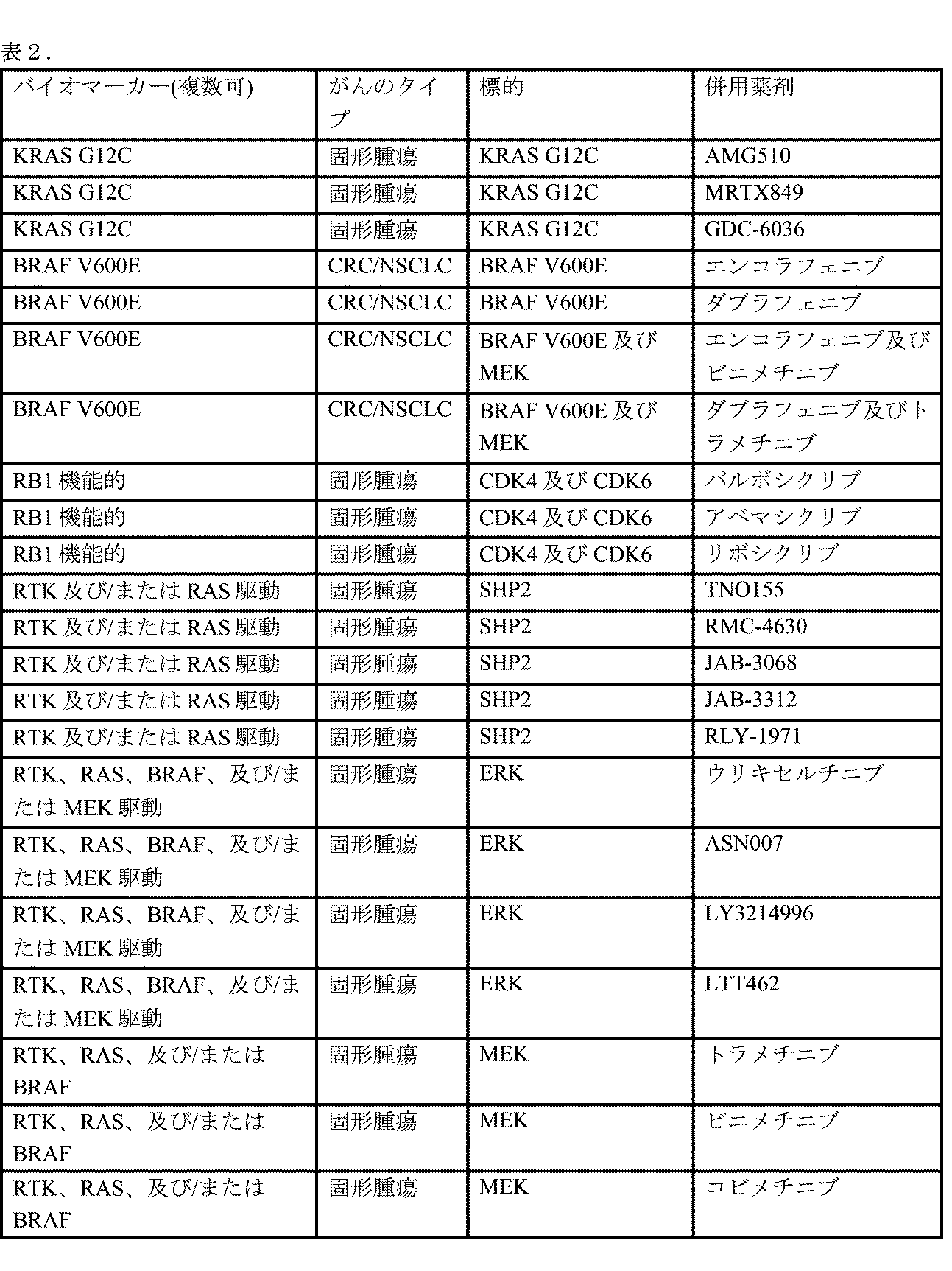

医薬併用製剤または投与計画の第2薬剤は、相互に悪影響を及ぼさないように、本明細書に開示される化合物に対して相補的な活性を有し得る。化合物は、単一の医薬組成物として一緒に投与しても、別々に投与してもよい。一実施形態では、化合物または薬学的に許容される塩は、増殖性疾患及びがんを治療するために細胞傷害性薬剤と共投与することができる。 The second agent of the pharmaceutical combination formulation or dosing regimen may have complementary activity to the compounds disclosed herein such that they do not adversely affect each other. The compounds may be administered together in a single pharmaceutical composition or separately. In one embodiment, the compound or a pharma- ceutical acceptable salt may be co-administered with a cytotoxic agent to treat proliferative diseases and cancer.
「共投与」という用語は、本明細書に開示される化合物またはその塩と、細胞傷害性薬剤及び放射線治療を含む更なる活性医薬成分(複数可)との同時投与、または任意の方法での別々の連続投与を指す。投与が同時でない場合、化合物は相互に非常に近い時間で投与される。更に、化合物が同じ剤形で投与されるかどうかは問題ではなく、例えば、ある化合物は局所的に投与され、別の化合物は経口投与され得る。 The term "co-administration" refers to simultaneous administration, or separate sequential administration in any manner, of a compound disclosed herein or a salt thereof with additional active pharmaceutical ingredient(s), including cytotoxic agents and radiation therapy. When administration is not simultaneous, the compounds are administered in close time proximity to each other. Furthermore, it does not matter if the compounds are administered in the same dosage form; for example, one compound may be administered topically and another compound may be administered orally.
これらの追加の薬剤は、複数回投与計画の一部として、本発明の化合物含有組成物とは別に投与され得る。代替的に、これらの薬剤は、単一の組成物中で本開示の化合物と混合された単一の剤形の一部であり得る。複数回投与計画の一部として投与される場合、2つの活性薬剤は同時に、連続して、または通常相互に5時間以内の一定期間内に投与され得る。 These additional agents may be administered separately from the compound-containing compositions of the present invention as part of a multiple dose regimen. Alternatively, these agents may be part of a single dosage form mixed with the compounds of the present disclosure in a single composition. When administered as part of a multiple dose regimen, the two active agents may be administered simultaneously, sequentially, or within a period of time, usually within 5 hours of each other.
本明細書で使用される場合、「併用」、「併用された」という用語、及び関連用語は、本開示による治療剤の同時または連続投与を指す。例えば、本明細書に開示される化合物は、別の治療剤と同時に、または別々の単位剤形で連続的に、または単一の単位剤形で一緒に投与され得る。従って、本実施形態は、式Iの化合物、追加の治療剤、及び薬学的に許容される担体、アジュバント、またはビヒクルを含む単一の単位剤形を提供する。 As used herein, the terms "combination," "combined," and related terms refer to simultaneous or sequential administration of a therapeutic agent according to the present disclosure. For example, a compound disclosed herein may be administered simultaneously with another therapeutic agent, or sequentially in separate unit dosage forms, or together in a single unit dosage form. Thus, the present embodiments provide a single unit dosage form that includes a compound of Formula I, an additional therapeutic agent, and a pharma- ceutically acceptable carrier, adjuvant, or vehicle.
単一剤形を生成するために担体物質と併用することができる化合物及び追加の治療剤両方の量は(上記のような追加の治療剤を含む組成物において)、治療される宿主及び特定の投与様式に応じて変化し得る。特定の実施形態では、本開示の組成物は、0.01~100mg/kg体重/日の本発明の用量が投与され得るように製剤化される。 The amount of both the compound and additional therapeutic agent that can be combined with the carrier material to produce a single dosage form (in compositions containing additional therapeutic agents as described above) can vary depending on the host treated and the particular mode of administration. In certain embodiments, the compositions of the present disclosure are formulated so that a dose of 0.01-100 mg/kg body weight/day of the present invention can be administered.
典型的には、治療されている疾患または症状に対して活性を有する任意の薬剤は、共投与することができる。このような薬剤の例は、V.T.Devita and S.Hellman(編集),6th edition(February 15,2001),Lippincott Williams & Wilkins PublishersによるCancer Principles and Practice of Oncologyに記載される。当業者であれば、薬物の特定の特徴及び関与する疾患に基づいて、どの薬剤の組み合わせが有用であるかを識別できる。 Typically, any drug that is active against the disease or condition being treated can be co-administered. Examples of such drugs are described in Cancer Principles and Practice of Oncology, edited by V. T. Devita and S. Hellman, 6th edition (February 15, 2001), Lippincott Williams & Wilkins Publishers. Those skilled in the art can identify which drug combinations are useful based on the specific characteristics of the drugs and the disease involved.
一実施形態では、治療方法は、本明細書に開示される化合物、またはその薬学的に許容される塩と少なくとも1つの細胞傷害性薬剤との共投与を含む。本明細書で使用される「細胞傷害性薬剤」という用語は、細胞機能を阻害するもしくは阻止する、及び/または細胞死もしくは破壊を引き起こす、物質を指す。細胞傷害性薬剤は、放射性同位体(例えば、At211、I131、I125、Y90、Re186、Re188、Sm153、Bi212、P32、Pb212、及びLuの放射性同位体)、化学療法剤、成長阻害剤、核酸分解酵素等の酵素及びそれらの断片、ならびに細菌、真菌、植物、または動物起源の小分子毒素または酵素活性毒素(それらの断片及び/または変異型を含む)等の毒素を含むが、これらに限定されない。 In one embodiment, the method of treatment includes co-administration of a compound disclosed herein, or a pharma- ceutically acceptable salt thereof, with at least one cytotoxic agent. The term "cytotoxic agent" as used herein refers to a substance that inhibits or blocks cell function and/or causes cell death or destruction. Cytotoxic agents include, but are not limited to, radioisotopes (e.g., At211 , I131 , I125 , Y90 , Re186 , Re188 , Sm153 , Bi212 , P32, Pb212 , and radioisotopes of Lu), chemotherapeutic agents, growth inhibitors, enzymes such as nucleases and fragments thereof, and small molecule toxins or enzymatically active toxins of bacterial, fungal, plant, or animal origin (including fragments and/or mutants thereof).
例示的な細胞傷害性薬剤は、抗微小管剤、白金配位錯体、アルキル化剤、抗生物質、トポイソメラーゼII阻害剤、代謝拮抗薬、トポイソメラーゼI阻害剤、ホルモン及びホルモン類似体、シグナル伝達経路阻害剤、非受容体チロシンキナーゼ血管新生阻害剤、免疫療法薬、アポトーシス促進薬、LDH-A阻害剤、脂肪酸生合成阻害剤、細胞周期シグナル阻害剤、HDAC阻害剤、プロテアソーム阻害剤、及びがん代謝阻害剤から選択され得る。 Exemplary cytotoxic agents may be selected from anti-microtubule agents, platinum coordination complexes, alkylating agents, antibiotics, topoisomerase II inhibitors, antimetabolites, topoisomerase I inhibitors, hormones and hormone analogs, signal transduction pathway inhibitors, non-receptor tyrosine kinase angiogenesis inhibitors, immunotherapeutics, pro-apoptotic agents, LDH-A inhibitors, fatty acid biosynthesis inhibitors, cell cycle signal inhibitors, HDAC inhibitors, proteasome inhibitors, and cancer metabolism inhibitors.
「化学療法剤」は、がんの治療に有用な化学化合物を含む。化学療法剤の例は、エルロチニブ(TARCEVA(登録商標)、Genentech/OSI Pharm.)、ボルテゾミブ(VELCADE(登録商標)、Millennium Pharm.)、ジスルフィラム、没食子酸エピガロカテキン、サリノスポラミドA、カーフィルゾミブ、17-AAG(ゲルダナマイシン)、ラディシコール、乳酸デヒドロゲナーゼA(LDH-A)、フルベストラント(FASLODEX(登録商標)、AstraZeneca)、スニチブ(SUTENT(登録商標)、Pfizer/Sugen)、レトロゾール(FEMARA(登録商標)、Novartis)、メシル酸イマチニブ(GLEEVEC(登録商標)、Novartis)、フィナスネート(VATALANIB(登録商標)、Novartis)、オキサリプラチン(ELOXATIN(登録商標)、Sanofi)、5-FU(5-フルオロウラシル)、ロイコボリン、ラパマイシン(シロリムス、RAPAMUNE(登録商標)、Wyeth)、ラパチニブ(TYKERB(登録商標)、GSK572016、Glaxo Smith Kline)、ロナファミブ(SCH 66336)、ソラフェニブ(NEXAVAR(登録商標)、Bayer Labs)、ゲフィチニブ(IRESSA(登録商標)、AstraZeneca)、AG1478、アルキル化剤、例えば、チオテパ及びCYTOXAN(登録商標)シクロホスファミド、アルキルスルホネート、例えば、ブスルファン、インプロスルファン、及びピポスルファン、アジリジン、例えば、ベンゾドーパ、カルボコン、メツレドーパ、及びウレドーパ、エチレンイミン及びメチラメラミン(アルトレタミン、トリエチレンメラミン、トリエチレンホスホラミド、トリエチレンチオホスホルアミド、及びトリメチロメラミンを含む)、アセトゲニン(特に、ブラタシン及びブラタシノン)、カンプトテシン(トポテカン及びイリノテカンを含む)、ブリオスタチン、カリスタチン、CC-1065(そのアゾゼレシン、カルゼレシン、及びビゼレシン合成類似体を含む)、クリプトフィシン(特に、クリプトフィシン1及びクリプトフィシン8)、副腎皮質ステロイド(プレドニゾン及びプレドニゾロンを含む)、酢酸シプロテロン、5α-還元酵素(フィナステリド及びデュタステリドを含む)、ボリノスタット、ロミデプシン、パノビノスタット、バルプロ酸、モセチノスタットドラスタチン、アルデスロイキン、タルクデュオカルマイシン(合成類似体KW-2189及びCB1-TM1を含む)、エロイテロビン、パンクラチスタチン、サルコジクチイン、スポンジスタチン、ナイトロジェンマスタード、例えば、クロラムブシル、クロマファジン、クロロホスファミド、エストラムスチン、イホスファミド、メクロレタミン、メクロレタミンオキシド塩酸塩、メルファラン、ノベムビシン、フェネステリン、プレドニムスチン、トロホスファミド、ウラシルマスタード、ニトロソ尿素、例えば、カルムスチン、クロロゾトシン、フォテムスチン、ロムスチン、ニムスチン、及びラニムスチン、抗生物質、例えば、エンジイン抗生物質(例えば、カリケアマイシン、特にカリケアマイシンγ1I及びカリケアマイシンω1I(Angew Chem.Intl.Ed.Engl.1994 33:183-186)、ダイネミシンAを含むダイネミシン、クロドロネートなどのビスホスホネート、エスペラミシン、ならびにネオカルジノスタチンクロモフォア及び関連色素タンパク質エネジイン抗生物質発色団)などの抗生物質、アクラシノマイシン、アクチノマイシン、オースラマイシン、アザセリン、ブレオマイシン、カクチノマイシン、カラビシン、カミノマイシン、カルジノフィリン、クロモマイシニス、ダクチノマイシン、ダウノルビシン、デトルビシン、6-ジアゾ-5-オキソ-L-ノルロイシン、ADRIAMYCIN(登録商標)(ドキソルビシン)、モルホリノ-ドキソルビシン、シアノモルホリノ-ドキソルビシン、2-ピロリノ-ドキソルビシン、及びデオキシドキソルビシン)、エピルビシン、エソルビシン、イダルビシン、マルセロマイシン、マイトマイシンCなどのマイトマイシン、ミコフェノール酸、ノガラマイシン、オリボマイシン、ペプロマイシン、ポトフィロマイシン、ピューロマイシン、ケラマイシン、ロドルビシン、ストレプトニグリン、ストレプトゾシン、ツベルシジン、ウベニメックス、ジノスタチン、ゾルビシン、メトトレキサート及び5-フルオロウラシル(5-FU)などの抗代謝物、デノプテリン、メトトレキサート、プテロプテリン、トリメトレキサートなどの葉酸類似体、フルダラビン、6-メルカプトプリン、チアミプリン、チオグアニンなどのプリン類似体、アンシタビン、アザシチジン、6-アザウリジン、カルモフール、シタラビン、ジデオキシウリジン、ドキシフルリジン、エノシタビン、フロキシウリジンなどのピリミジン類似体、カルステロン、プロピオン酸ドロモスタノロン、エピチオスタノール、メピチオスタン、テストラクトンなどのアンドロゲン、アミノグルテチミド、ミトタン、トリロスタンなどの抗副腎剤、フロリン酸などの葉酸補液、アセグラトン、アルドホスファミドグリコシド、アミノレブリン酸、エニルウラシル、アムサクリン、ベストラブシル、ビサントレン、エダトレキサート、デフォファミン、デメコルシン、ジアジクオン、エルホミチン、酢酸エリプチニウム、エポチロン、エトグルシド、硝酸ガリウム、ヒドロキシウレア、レンチナン、ロニダイニン、マイタンシン及びアンサミトシンなどのマイタンシノイド、ミトグアゾン、ミトキサントロン、モピダンノール、ニトラエリン、ペントスタチン、フェナメト、ピラルビシン、ロソキサントロン、ポドフィリン酸、2-エチルヒドラジド、プロカルバジン、PSK(登録商標)多糖複合体(JHS Natural Products,Eugene,Oreg.)、ラゾキサン、リゾキシン、シゾフィラン、スピロゲルマニウム、テヌアゾン酸、トリアジコン、2,2’,2’’-トリクロロトリエチルアミン、トリコテセン(特にT-2毒素、ベラキュリンA、ロリジンA、及びアングイジン)、ウレタン、ビンデシン、ダカルバジン、マンノムスチン、ミトブロニトール、ミトラクトール、ピポブロマン、ガシトシン、アラビノシド(「Ara-C」)、シクロホスファミド、チオテパ、タキソイド、例えば、TAXOL(パクリタキセル、Bristol-Myers Squibb Oncology,Princeton,N.J.)、ABRAXANE(登録商標)(発色団不含)、パクリタキセルのアルブミン操作ナノ粒子製剤(American Pharmaceutical Partners,Schaumberg,Ill.)、及びTAXOTERE(登録商標)(ドセタキセル、ドキセタキセル、Sanofi-Aventis)、クロランブシル、GEMZAR(登録商標)(ゲムシタビン)、6-チオグアニン、メルカプトプリン、メトトレキサート、シスプラチン及びカルボプラチンなどの白金類似体、ビンブラスチン、エトポシド(VP-16)、イホスファミド、ミトキサントロン、ビンクリスチン、NAVELBINE(登録商標)(ビノレルビン)、ノバントロン、テニポシド、エダトレキサート、ダウノマイシン、アミノプテリン、カペシタビン(XELODA(登録商標))、イバンドロネート、CPT-11、トポイソメラーゼ阻害剤RFS 2000、ジフルオロメチルオルニチン(DMFO)、レチノイン酸などのレチノイド、ならびに上記のうちのいずれかの薬学的に許容される塩、酸、及び誘導体を含む。 "Chemotherapeutic agents" include chemical compounds useful in the treatment of cancer. Examples of chemotherapeutic agents include erlotinib (TARCEVA®, Genentech/OSI Pharm.), bortezomib (VELCADE®, Millennium Pharm.), disulfiram, epigallocatechin gallate, salinosporamide A, carfilzomib, 17-AAG (geldanamycin), radicicol, lactate dehydrogenase A (LDH-A), fulvestrant (FASLODEX®, AstraZeneca), sunitib (SUTENT®, Pfizer/Sugen), letrozole (FEMARA®, Novartis), mefetal bovine serum albumin (MEGA ... Imatinib silate (GLEEVEC®, Novartis), finasunate (VATALANIB®, Novartis), oxaliplatin (ELOXATIN®, Sanofi), 5-FU (5-fluorouracil), leucovorin, rapamycin (sirolimus, RAPAMUNE®, Wyeth), lapatinib (TYKERB®, GSK572016, Glaxo Smith Kline), lonafamib (SCH 66336), sorafenib (NEXAVAR®, Bayer Labs), gefitinib (IRESSA®, AstraZeneca), AG1478, alkylating agents such as thiotepa and CYTOXAN® cyclophosphamide, alkylsulfonates such as busulfan, improsulfan, and piposulfan, aziridines such as benzodopa, carboquone, meturedopa, and uredopa, ethylenimines and methylamelamines (altretamine, triethylenemelamine, triethylenephosphamide, suforamide, triethylenethiophosphoramide, and trimethylmelamine), acetogenins (especially bullatacin and bullatacinone), camptothecins (including topotecan and irinotecan), bryostatin, kallistatin, CC-1065 (including its azozelesin, carzelesin, and bizelesin synthetic analogs), cryptophycins (especially cryptophycin 1 and cryptophycin 8), corticosteroids (including prednisone and prednisolone), Cyproterone acetate, 5α-reductase (including finasteride and dutasteride), vorinostat, romidepsin, panobinostat, valproic acid, mocetinostat dolastatins, aldesleukin, talc duocarmycins (including synthetic analogs KW-2189 and CB1-TM1), eleutherobin, pancratistatin, sarcodictiin, spongiostatins, nitrogen mustards, such as chlorambucil, chromafazine, chlorophosphamide , estramustine, ifosfamide, mechlorethamine, mechlorethamine oxide hydrochloride, melphalan, novembicine, phenesterine, prednimustine, trofosfamide, uracil mustard, nitrosoureas such as carmustine, chlorozotocin, fotemustine, lomustine, nimustine, and ranimustine, antibiotics such as enediyne antibiotics (e.g., calicheamicin, particularly calicheamicin γ1I and calicheamicin ω1I (Angew Chem. Intl. Ed. Engl. 1994) 33:183-186), dynemicins including dynemicin A, bisphosphonates such as clodronate, esperamicins, and neocarzinostatin chromophore and related chromoprotein enediyne antibiotic chromophores), antibiotics such as aclacinomycin, actinomycin, ausramycin, azaserine, bleomycin, cactinomycin, carabicin, caminomycin, carzinophilin, chromomycinis, dactinomycin, daunorubicin, detorubicin, 6-diazo-5-oxo-L-norleucine, ADRIAMYCIN® (doxorubicin), morpholinosidase, ... nodoxorubicin, cyanomorpholino-doxorubicin, 2-pyrrolino-doxorubicin, and deoxydoxorubicin), epirubicin, esorubicin, idarubicin, marcelomycin, mitomycins such as mitomycin C, mycophenolic acid, nogalamycin, olivomycin, peplomycin, potofilomycin, puromycin, keramycin, rodorubicin, streptonigrin, streptozocin, tubercidin, ubenimex, zinostatin, zorubicin, antimetabolites such as methotrexate and 5-fluorouracil (5-FU), denopterin, methotrexate folic acid analogues such as folate, pteropterin, trimetrexate, purine analogues such as fludarabine, 6-mercaptopurine, thiamiprine, thioguanine, pyrimidine analogues such as ancitabine, azacitidine, 6-azauridine, carmofur, cytarabine, dideoxyuridine, doxifluridine, enocitabine, floxuridine, and other pyrimidine analogues, calsterone, dromostanolone propionate, epithiostanol, mepitiostane, testolactone, and other androgens, adrenal antidrugs such as aminoglutethimide, mitotane, trilostane, and other folic acid replacement fluids, aceglatone, aldophosphamide, and other Licoside, aminolevulinic acid, eniluracil, amsacrine, bestravcil, bisantrene, edatrexate, defofamine, demecolcine, diaziquone, elfomitin, elliptinium acetate, epothilone, etoglucide, gallium nitrate, hydroxyurea, lentinan, lonidynin, maytansinoids such as maytansine and ansamitocin, mitoguazone, mitoxantrone, mopidanol, nitraelin, pentostatin, fenameth, pirarubicin, losoxantrone, podophyllic acid, 2-ethylhydrazide, procarbazine, PSK® polysaccharide complex (JHS Natural Products, Eugene, Oreg. ), razoxane, rhizoxin, schizofiran, spirogermanium, tenuazonic acid, triazicon, 2,2',2"-trichlorotriethylamine, trichothecenes (especially T-2 toxin, veraculin A, roridin A, and anguidine), urethanes, vindesine, dacarbazine, mannomustine, mitobronitol, mitolactol, pipobroman, gacytosine, arabinoside ("Ara-C"), cyclophosphamide, thiotepa, taxoids such as TAXOL (paclitaxel, Bristol-Myers Squibb Oncology, Princeton, N.J.), ABRAXANE® (chromophore free), albumin engineered nanoparticle formulations of paclitaxel (American Pharmaceutical Partners, Schaumberg, Ill.), and TAXOTERE® (docetaxel, Sanofi-Aventis), chlorambucil, GEMZAR® (gemcitabine), 6-thioguanine, mercaptopurine, methotrexate, platinum analogs such as cisplatin and carboplatin, vinblastine, etoposide (VP-16), ifosfamide, mitoxantrone, vincristine, NAVELBINE® (vinorelbine), novantrone, teniposide, edatrexate, daunomycin, aminopterin, capecitabine (XELODA®), ibandronate, CPT-11, the topoisomerase inhibitor RFS 2000, difluoromethylornithine (DMFO), retinoids such as retinoic acid, and pharma- ceutically acceptable salts, acids, and derivatives of any of the above.
化学療法剤は、(i)抗エストロゲン剤及び選択的エストロゲン受容体調節剤(SERM)等の、腫瘍に対してホルモン作用を制御または阻害するように作用する抗ホルモン剤、例えば、タモキシフェン(NOLVADEX(登録商標)、クエン酸タモキシフェンを含む)、ラロキシフェン、ドロロキシフェン、ヨードキシフェン、4-ヒドロキシタモキシフェン、トリオキシフェン、ケオキシフェン、LY117018、オナプリストン、及びFARESTON(登録商標)(クエン酸トレミファインを含む)、(ii)副腎におけるエストロゲン産生を制御するアロマターゼ酵素を阻害する、アロマターゼ阻害剤、例えば、4(5)-イミダゾール、アミノグルテチミド、MEGASE(登録商標)(酢酸メゲストロール)、AROMASIN(登録商標)(エキセメスタン、Pfizer)、フォルメスタニー、ファドロゾール、RIVISOR(登録商標)(ボロゾール)、FEMARA(登録商標)(レトロゾール、Novartis)、及びARIMIDEX(登録商標)(アナストロゾール、AstraZeneca)等、(iii)抗アンドロゲン剤、例えば、フルタミド、ニルタミド、ビカルタミド、ロイプロリド、及びゴセレリン等、ブセレリン、トリプテレリン、酢酸メドロキシプロゲステロン、ジエチルスチルベストロール、プレマリン、フルオキシメステロン、全てのトランスレチオニン酸、フェンレチニド、ならびにトロキサシタビン(1,3-ジオキソランヌクレオシドシトシン類似体)、(iv)タンパク質キナーゼ阻害剤、(v)脂質キナーゼ阻害剤、(vi)アンチセンスオリゴヌクレオチド、特に、異常な細胞増殖に関与するシグナル伝達経路における遺伝子の発現を阻害するもの、例えば、PKC-アルファ、Ralf、及びH-Ras、(vii)リボザイム、例えば、VEGF発現阻害剤(例えば、ANGIOZYME(登録商標))及びHER2発現阻害剤、(viii)遺伝子療法ワクチン等のワクチン、例えば、ALLOVECTIN(登録商標)、LEUVECTIN(登録商標)、及びVAXID(登録商標)、PROLEUKIN(登録商標)、rIL-2、トポイソメラーゼ1阻害剤、例えば、LURTOTECAN(登録商標)等、ABARELIX(登録商標)rmRH、ならびに(ix)上記のいずれかの薬学的に許容される塩、酸、及び誘導体も含む。 Chemotherapeutic agents include (i) anti-hormonal agents that act to control or inhibit hormone action on tumors, such as antiestrogens and selective estrogen receptor modulators (SERMs), e.g., tamoxifen (including NOLVADEX®, tamoxifen citrate), raloxifene, droloxifene, iodoxyfene, 4-hydroxytamoxifen, trioxyfene, ketoxifene, LY117018, onapristone, and FARESTON® (including toremifine citrate); (ii) agents that inhibit estrogen production in the adrenal glands; Aromatase inhibitors, which inhibit the aromatase enzyme they regulate, such as 4(5)-imidazole, aminoglutethimide, MEGASE® (megestrol acetate), AROMASIN® (exemestane, Pfizer), formestany, fadrozole, RIVISOR® (vorozole), FEMARA® (letrozole, Novartis), and ARIMIDEX® (anastrozole, AstraZeneca), (iii) antiandrogens, such as flutamide, nilutamide, bicalcitabine, (iv) protein kinase inhibitors; (v) lipid kinase inhibitors; (vi) antisense oligonucleotides, particularly those that inhibit the expression of genes in signal transduction pathways involved in abnormal cell proliferation, e.g., PKC-alpha, Ralf, and Goserelin; buserelin, tripterelin, medroxyprogesterone acetate, diethylstilbestrol, premarin, fluoxymesterone, all-trans retinal acid, fenretinide, and troxacitabine (a 1,3-dioxolane nucleoside cytosine analog); (vi) acetylcholinesterase inhibitors; ... and H-Ras, (vii) ribozymes, such as VEGF expression inhibitors (e.g., ANGIOZYME®) and HER2 expression inhibitors, (viii) vaccines, such as gene therapy vaccines, e.g., ALLOVECINTIN®, LEUVECTIN®, and VAXID®, PROLEUKIN®, rIL-2, topoisomerase 1 inhibitors, such as LURTOTECAN®, ABARELIX® rmRH, and (ix) pharmaceutically acceptable salts, acids, and derivatives of any of the above.
化学療法剤にはまた、抗体、例えば、アレムツズマブ(Campath)、ベバシズマブ(AVASTIN(登録商標)、Genentech)、セツキシマブ(ERBITUX(登録商標)、Imclone)、パニツムマブ(VECTIBIX(登録商標)、Amgen)、リツキシマブ(RITUXAN(登録商標)、Genentech/Biogen Idec)、ペルツズマブ(OMNITARG(登録商標)、2C4、Genentech)、トラスツズマブ(HERCEPTIN(登録商標)、Genentech)、トシツモマブ(Bexxar、Corixia)、及び抗体薬物複合体、ゲムツズマブオゾガマイシン(MYLOTARG(登録商標)、Wyeth)も含まれる。本開示の化合物と併用して薬剤としての治療可能性を有する追加のヒト化モノクローナル抗体は、アポリズマブ、アセリズマブ、アトリズマブ、バピネオズマブ、ビバツズマブメルタンシン、カンツズマブメルタンシン、セデリズマブ、セルトリズマブペゴール、シドフシツズマブ、シドツズマブ、ダクリズマブ、エクリズマブ、エファリズマブ、エプラツズマブ、エルリズマブ、フェルビズマブ、フォントリズマブ、ゲムツズマブオゾガマイシン、イノツズマブオゾガマイシン、イピリムマブ、ラベツズマブ、リンツズマブ、マツズマブ、メポリズマブ、モタビズマブ、モトビズマブ、ナタリズマブ、ニモツズマブ、ノロビズマブ、ヌマビズマブ、オクレリズマブ、オマリズマブ、パリビズマブ、パスコリズマブ、ペクフシツズマブ、ペクツズマブ、パキセリズマブ、ラリビズマブ、ラニビズマブ、レスリビズマブ、レスリズマブ、レシビズマブ、ロベリズマブ、ルプリズマブ、シブロツズマブ、シプリズマブ、ソンツズマブ、タカツズマブテトラキセタン、タドシズマブ、タリズマブ、テフィバズマブ、トシリズマブ、トラリズマブ、ツコツズマブセルモロイキン、ツクシツズマブ、ウマビズマブ、ウルトキサズマブ、ウステキヌマブ、ビジリズマブ、及びインターロイキン-12 p40タンパク質を認識するように遺伝子修飾された排他的にヒト配列の組換え完全長IgG1λ抗体である、抗インターロイキン-12(ABT-874/J695、Wyeth Research and Abbott Laboratories)を含む。 Chemotherapeutic agents also include antibodies, such as alemtuzumab (Campath), bevacizumab (AVASTIN®, Genentech), cetuximab (ERBITUX®, Imclone), panitumumab (VECTIBIX®, Amgen), rituximab (RITUXAN®, Genentech/Biogen Idec), pertuzumab (OMNITARG®, 2C4, Genentech), trastuzumab (HERCEPTIN®, Genentech), tositumomab (Bexxar, Corixia), and the antibody-drug conjugate, gemtuzumab ozogamicin (MYLOTARG®, Wyeth). Additional humanized monoclonal antibodies that have therapeutic potential as drugs in combination with the compounds of the disclosure include apolizumab, acelizumab, atlizumab, bapineuzumab, bivatuzumab mertansine, cantuzumab mertansine, cedelizumab, certolizumab pegol, cidofusituzumab, cidtuzumab, daclizumab, eculizumab, efalizumab, epratuzumab, erlizumab, felvizumab, fontolizumab, gemtuzumab ozogamicin, inotuzumab ozogamicin, ipilimumab, labetuzumab, lintuzumab, matuzumab, mepolizumab, motavizumab, natavizumab, and the like. tuzumab, nimotuzumab, norobizumab, numavizumab, ocrelizumab, omalizumab, palivizumab, pascolizumab, pecfusituzumab, pectuzumab, pexelizumab, ralivizumab, ranibizumab, reslivizumab, reslizumab, resivizumab, rovelizumab, ruplizumab, sibrotuzumab, siplizumab, sontuzumab, tacatuzumab tetraxetan, tadocizumab, talizumab, tefibazumab, tocilizumab, toralizumab, tucotuzumab celmoleukin, tucotuzumab, umavizumab, urtoxazumab, ustekinumab, visilizumab, and interleukin-12 and anti-interleukin-12 (ABT-874/J695, Wyeth Research and Abbott Laboratories), an exclusively human sequence recombinant full-length IgG 1 lambda antibody genetically modified to recognize the p40 protein.
化学療法剤はまた、「EGFR阻害剤」も含み、EGFRに結合し、またはそうでなければEGFRと直接相互作用し、そのシグナル伝達活性を妨げるまたは低減する化合物を指し、代替的に「EGFRアンタゴニスト」とも称される。かかる薬剤の例は、EGFRに結合する抗体及び小分子を含む。EGFRに結合する抗体の例は、MAb 579(ATCC CRL HB 8506)、MAb 455(ATCC CRL HB8507)、MAb 225(ATCC CRL 8508)、MAb 528(ATCC CRL 8509)(米国特許第4,943,533号(Mendelsohn et al.)を参照のこと)、ならびにそれらの変異型、例えば、キメラ化225(C225またはセツキシマブ、ERBUTIX(登録商標))及び再成形ヒト225(H225)(WO96/40210(Imclone Systems Inc.)を参照のこと)、IMC-11F8、完全ヒトEGFR標的抗体(Imclone)、II型変異体EGFRに結合する抗体(米国特許第5,212,290号)、米国特許第5,891,996号に記載されるようにEGFRに結合するヒト化抗体及びキメラ抗体、ならびにEGFRに結合するヒト抗体、例えば、ABX-EGFまたはパニツムマブ(WO98/50433(Abgenix/Amgen)を参照のこと)、EMD 55900(Stragliotto et al.Eur.J.Cancer 32A:636-640(1996))、EGFR結合においてEGF及びTGF-アルファの両方と競合するEGFRに対して指向されたヒト化EGFR抗体EMD7200(マツズマブ)(EMD/Merck)、ヒトEGFR抗体HuMax-EGFR(GenMab)、E1.1、E2.4、E2.5、E6.2、E6.4、E2.11、E6.3、及びE7.6.3として知られ、US6,235,883に記載される完全ヒト抗体、MDX-447(Medarex Inc)、ならびにmAb 806またはヒト化mAb 806(Johns et al.,J.Biol.Chem.279(29):30375-30384(2004))を含む。抗EGFR抗体は、細胞傷害性薬剤に共役され、それによって免疫抱合体を生成し得る(例えば、欧州特許第659,439号A2,Merck Patent GmbHを参照のこと)。EGFRアンタゴニストは、米国特許第5,616,582号、同第5,457,105号、同第5,475,001号、同第5,654,307号、同第5,679,683号、同第6,084,095号、同第6,265,410号、同第6,455,534号、同第6,521,620号、同第6,596,726号、同第6,713,484号、同第5,770,599号、同第6,140,332号、同第5,866,572号、同第6,399,602号、同第6,344,459号、同第6,602,863号、同第6,391,874号、同第6,344,455号、同第5,760,041号、同第6,002,008号、及び同第5,747,498号、ならびにWO98/14451、WO98/50038、WO99/09016、及びWO99/24037等のPCT公報に記載される化合物等の小分子を含む。特定の小分子EGFRアンタゴニストは、OSI-774(CP-358774、エルロチニブ、TARCEVA(登録商標)Genentech/OSI Pharmaceuticals)、PD 183805(CI 1033、2-プロペンアミド、N-[4-[(3-クロロ-4-フルオロフェニル)アミノ]-7-[3-(4-モルホリニル)プロポキシ]-6-キナゾリニル]-、ジヒドロクロリド、Pfizer Inc.)、ZD1839、ゲフィチニブ(IRESSA(登録商標))4-(3’-クロロ-4’-フルオロアニリノ)-7-メトキシ-6-(3-モルホリノプロポキシ)キナゾリン、AstraZeneca)、ZM105180((6-アミノ-4-(3-メチルフェニル-アミノ)-キナゾリン、Zeneca)、BIBX-1382(N8-(3-クロロ-4-フルオロ-フェニル)-N2-(1-メチル-ピペリジン-4-イル)-ピリミド[5,4-d]ピリミジン-2,8-ジアミン、Boehringer Ingelheim)、PKI-166((R)-4-[4-[(1-フェニルエチル)アミノ]-1H-ピロロ[2,3-d]ピリミジン-6-イル]-フェノール)、(R)-6-(4-ヒドロキシフェニル)-4-[(1-フェニルエチル)アミノ]-7H-ピロロ[2,3-d]ピリミジン)、CL-387785(N-[4-[(3-ブロモフェニル)アミノ]-6-キナゾリニル]-2-ブチンアミド)、EKB-569(N-[4-[(3-クロロ-4-フルオロフェニル)アミノ]-3-シアノ-7-エトキシ-6-キナゾリニル]-4-(ジメチルアミノ)-2-ブチンアミド)(Wyeth)、AG1478(Pfizer)、AG1571(SU 5271、Pfizer)、二重EGFR/HER2チロシンキナーゼ阻害剤、例えば、ラパチニブ(TYKERB(登録商標)、GSK572016またはN-[3-クロロ-4-[(3-フルオロフェニル)メトキシ]フェニル]-6[5[[[2メチルスルホニル)エチル]アミノ]メチル]-2-フラニル]-4-キナゾリンアミン)を含む。 Chemotherapeutic agents also include "EGFR inhibitors," which refer to compounds that bind to or otherwise directly interact with EGFR and prevent or reduce its signaling activity, alternatively referred to as "EGFR antagonists." Examples of such agents include antibodies and small molecules that bind to EGFR. Examples of antibodies that bind EGFR include MAb 579 (ATCC CRL HB 8506), MAb 455 (ATCC CRL HB8507), MAb 225 (ATCC CRL 8508), MAb 528 (ATCC CRL 8509) (see U.S. Pat. No. 4,943,533 (Mendelsohn et al.)), as well as variants thereof, such as chimeric 225 (C225 or cetuximab, ERBUTIX®) and reshaped human 225 (H225) (see WO 96/40210 (Imclone Systems)). Inc.), IMC-11F8, fully human EGFR targeting antibody (Imclone), antibodies that bind to type II mutant EGFR (U.S. Pat. No. 5,212,290), humanized and chimeric antibodies that bind to EGFR as described in U.S. Pat. No. 5,891,996, and human antibodies that bind to EGFR, such as ABX-EGF or panitumumab (see WO 98/50433 (Abgenix/Amgen)), EMD 55900 (Stragliotto et al. Eur. J. Cancer 2007, 14, 1111-112, and others). 32A:636-640 (1996)), the humanized EGFR antibody EMD7200 (matuzumab) directed against EGFR which competes with both EGF and TGF-alpha for EGFR binding (EMD/Merck), the human EGFR antibody HuMax-EGFR (GenMab), the fully human antibodies known as E1.1, E2.4, E2.5, E6.2, E6.4, E2.11, E6.3, and E7.6.3 and described in U.S. Pat. No. 6,235,883, MDX-447 (Medarex Inc), and mAb 806 or humanized mAb 806 (Johns et al., J. Biol. Chem. 279(29):30375-30384 (2004)). Anti-EGFR antibodies may be conjugated to a cytotoxic agent, thereby producing an immunoconjugate (see, for example, European Patent No. 659,439 A2, Merck Patent GmbH). EGFR antagonists are disclosed in U.S. Patents Nos. 5,616,582, 5,457,105, 5,475,001, 5,654,307, 5,679,683, 6,084,095, 6,265,410, 6,455,534, 6,521,620, 6,596,726, 6,713,484, 5,770,599, 6,140,332, 5, Nos. 866,572, 6,399,602, 6,344,459, 6,602,863, 6,391,874, 6,344,455, 5,760,041, 6,002,008, and 5,747,498, and small molecules such as those described in PCT publications such as WO 98/14451, WO 98/50038, WO 99/09016, and WO 99/24037. Specific small molecule EGFR antagonists include OSI-774 (CP-358774, erlotinib, TARCEVA® Genentech/OSI Pharmaceuticals), PD 183805 (CI 1033, 2-propenamide, N-[4-[(3-chloro-4-fluorophenyl)amino]-7-[3-(4-morpholinyl)propoxy]-6-quinazolinyl]-, dihydrochloride, Pfizer). Inc.), ZD1839, gefitinib (IRESSA®) 4-(3'-chloro-4'-fluoroanilino)-7-methoxy-6-(3-morpholinopropoxy)quinazoline, AstraZeneca), ZM105180 ((6-amino-4-(3-methylphenyl-amino)-quinazoline, Zeneca), BIBX-1382 (N8-(3-chloro-4-fluoro-phenyl)-N2-(1-methyl-piperidin-4-yl)-pyrimido[5,4-d]pyrimidine-2,8-diamine, Boehringer Ingelheim), PKI-166 ((R)-4-[4-[(1-phenylethyl)amino]-1H-pyrrolo[2,3-d]pyrimidin-6-yl]-phenol), (R)-6-(4-hydroxyphenyl)-4-[(1-phenylethyl)amino]-7H-pyrrolo[2,3-d]pyrimidine), CL-387785 (N-[4-[(3-bromophenyl)amino]-6-quinazolinyl]-2-butynamide), EKB-569 (N-[4-[(3-chloro-4-fluorophenyl)amino]-3-cyano-7-ethoxy-6-quinazolinyl]-4-(dimethylamino)-2-butynamide) (Wyeth), AG1478 (Pfizer), AG1571 (SU 5271, Pfizer), dual EGFR/HER2 tyrosine kinase inhibitors, such as lapatinib (TYKERB®, GSK572016 or N-[3-chloro-4-[(3-fluorophenyl)methoxy]phenyl]-6[5[[[2-methylsulfonyl)ethyl]amino]methyl]-2-furanyl]-4-quinazolinamine).
化学療法剤は、前段落に記載のEGFR標的薬物、小分子HER2チロシンキナーゼ阻害剤、例えば、Takedaから入手可能なTAK165等、CP-724,714(ErbB2受容体チロシンキナーゼの経口選択的阻害剤)(Pfizer及びOSI)、二重HER阻害剤、例えば、EGFRと優先的に結合するが、HER2及びEGFR過剰発現細胞の両方を阻害するEKB-569(Wyethから入手可能)等、ラパチニブ(GSK572016、Glaxo-SmithKlineから入手可能)、経口HER2及びEGFRチロシンキナーゼ阻害剤、PKI-166(Novartisから入手可能)、pan-HER阻害剤、例えば、カネルチニブ(CI-1033、Pharmacia)等、Raf-1阻害剤、例えば、Raf-1シグナル伝達を阻害するISIS Pharmaceuticalsから入手可能なアンチセンス薬剤ISIS-5132等、非HER標的TK阻害剤、例えば、メシル酸イマチニブ(GLEEVEC(登録商標)、Glaxo SmithKlineから入手可能)等、多標的チロシンキナーゼ阻害剤、例えば、スニチニブ(SUTENT(登録商標)、Pfizerから入手可能)等、VEGF受容体チロシンキナーゼ阻害剤、例えば、バタラニブ(PTK787/ZK222584、Novartis/Schering AGから入手可能)等、MAPK細胞外制御キナーゼI阻害剤CI-1040(Pharmaciaから入手可能)、キナゾリン、例えば、PD 153035,4-(3-クロロアニリノ)キナゾリン等、ピリドピリミジン、ピリミドピリミジン、ピロロピリミジン、例えば、CGP 59326、CGP 60261、及びCGP 62706等、ピラゾロピリミジン、4-(フェニルアミノ)-7H-ピロロ[2,3-d]ピリミジン、クルクミン(ジフェルロイルメタン、4,5-ビス(4-フルオロアニリノ)フタルイミド)、ニトロチオフェン部分を含有するチルホスチン、PD-0183805(Warner-Lamber)、アンチセンス分子(例えば、HERコード核酸に結合するもの)、キノキサリン(米国特許第 5,804,396号)、トリホスチン(米国特許第5,804,396号)、ZD6474(Astra Zeneca)、PTK-787(Novartis/Schering AG)、CI-1033(Pfizer)等のpan-HER阻害剤、Affinitac(ISIS 3521、Isis/Lilly)、メシル酸イマチニブ(GLEEVEC(登録商標))、PKI 166(Novartis)、GW2016(Glaxo SmithKline)、CI-1033(Pfizer)、EKB-569(Wyeth)、Semaxinib(Pfizer)、ZD6474(AstraZeneca)、PTK-787(Novartis/Schering AG)、INC-1C11(Imclone)、ラパマイシン(シロリムス、RAPAMUNE(登録商標))、または米国特許第5,804,396号、WO1999/09016(American Cyanamid)、WO1998/43960(American Cyanamid)、WO1997/38983(Warner Lambert)、WO1999/06378(Warner Lambert)、WO1999/06396(Warner Lambert)、WO1996/30347(Pfizer,Inc)、WO1996/33978(Zeneca)、WO1996/3397(Zeneca)、及びWO1996/33980(Zeneca)等の特許公報のいずれかに記載のものを含む「チロシンキナーゼ阻害剤」を含む。 Chemotherapeutic agents include EGFR-targeted drugs as described in the previous paragraph, small molecule HER2 tyrosine kinase inhibitors, such as TAK165 available from Takeda, CP-724,714 (an oral selective inhibitor of ErbB2 receptor tyrosine kinase) (Pfizer and OSI), dual HER inhibitors, such as EKB-569, which preferentially binds to EGFR but inhibits both HER2 and EGFR overexpressing cells. (available from Wyeth), lapatinib (GSK572016, available from Glaxo-SmithKline), an oral HER2 and EGFR tyrosine kinase inhibitor, PKI-166 (available from Novartis), pan-HER inhibitors such as canertinib (CI-1033, Pharmacia), Raf-1 inhibitors such as ISIS, which inhibits Raf-1 signaling. antisense drug ISIS-5132 available from Pharmaceuticals; non-HER targeted TK inhibitors such as imatinib mesylate (GLEEVEC® available from Glaxo SmithKline); multi-targeted tyrosine kinase inhibitors such as sunitinib (SUTENT® available from Pfizer); VEGF receptor tyrosine kinase inhibitors such as vatalanib (PTK787/ZK222584 available from Novartis/Schering AG); MAPK extracellular regulated kinase I inhibitors CI-1040 (available from Pharmacia); quinazolines such as PD 153035, 4-(3-chloroanilino)quinazolines, etc., pyridopyrimidines, pyrimidopyrimidines, pyrrolopyrimidines, such as CGP 59326, CGP 60261, and CGP 62706, pyrazolopyrimidines, 4-(phenylamino)-7H-pyrrolo[2,3-d]pyrimidines, curcumin (diferuloylmethane, 4,5-bis(4-fluoroanilino)phthalimide), tyrphostins containing a nitrothiophene moiety, PD-0183805 (Warner-Lambert), antisense molecules (e.g., those that bind to HER-encoding nucleic acids), quinoxalines (U.S. Pat. No. 5,804,396), tryphostins (U.S. Pat. No. 5,804,396), ZD6474 (Astra pan-HER inhibitors such as Affinitac (ISIS 3521, Isis/Lilly), imatinib mesylate (GLEEVEC®), PKI 166 (Novartis), GW2016 (Glaxo SmithKline), CI-1033 (Pfizer), EKB-569 (Wyeth), semaxinib (Pfizer), ZD6474 (AstraZeneca), PTK-787 (Novartis/Schering AG), and CI-1033 (Pfizer); AG), INC-1C11 (Imclone), rapamycin (sirolimus, RAPAMUNE®), or any of the compounds described in U.S. Pat. No. 5,804,396, WO 1999/09016 (American Cyanamid), WO 1998/43960 (American Cyanamid), WO 1997/38983 (Warner Lambert), WO 1999/06378 (Warner Lambert), WO 1999/06396 (Warner "Tyrosine kinase inhibitors" include those described in any of the patent publications, such as WO1996/30347 (Pfizer, Inc.), WO1996/33978 (Zeneca), WO1996/3397 (Zeneca), and WO1996/33980 (Zeneca).
化学療法剤としては、デキサメタゾン、インターフェロン、コルヒチン、メトプリン、シクロスポリン、アンホテリシン、メトロニダゾール、アレムツズマブ、アリトレチノイン、アロプリノール、アミホスチン、三酸化ヒ素、アスパラギナーゼ、BCG生、ベバクジマブ(bevacuzimab)、ベキサロテン、クラドリビン、クロファラビン、ダルベポエチンアルファ、デニロイキン、デクスラゾキサン、エポエチンアルファ、エロチニブ(elotinib)、フィルグラスチム、酢酸ヒストレリン、イブリツモマブ、インターフェロンアルファ-2a、インターフェロンアルファ-2b、レナリドミド、レバミゾール、メスナ、メトキサレン、ナンドロロン、ネララビン、ノフェツモマブ、オプレルベキン、パリフェルミン、パミドロネート、ペガデマーゼ、ペグアスパラガーゼ、ペグフィルグラスチム、ペメトレキセド二ナトリウム、プリカマイシン、ポルフィマーナトリウム、キナクリン、ラスブリカーゼ、サルグラモスチム、テモゾロミド、VM-26、6-TG、トレミフェン、トレチノイン、ATRA、バルルビシン、ゾレドロネート、及びゾレドロン酸、ならびにこれらの薬学的に許容される塩も挙げられる。 Chemotherapeutic agents include dexamethasone, interferon, colchicine, metoprine, cyclosporine, amphotericin, metronidazole, alemtuzumab, alitretinoin, allopurinol, amifostine, arsenic trioxide, asparaginase, live BCG, bevacuzimab, bexarotene, cladribine, clofarabine, darbepoetin alfa, denileukin, dexrazoxane, epoetin alfa, elotinib, filgrastim, histrelin acetate, ibritumomab, interferon alfa-2a, and ibuprofen. Also included are interferon alfa-2b, lenalidomide, levamisole, mesna, methoxsalen, nandrolone, nelarabine, nofetumomab, oprelvekin, palifermin, pamidronate, pegademase, pegaspargase, pegfilgrastim, pemetrexed disodium, plicamycin, porfimer sodium, quinacrine, rasburicase, sargramostim, temozolomide, VM-26, 6-TG, toremifene, tretinoin, ATRA, valrubicin, zoledronate, and zoledronic acid, and pharma- ceutically acceptable salts thereof.
化学療法剤は、ヒドロコルチゾン、酢酸ヒドロコルチゾン、酢酸コルチゾン、ピバリン酸チクソコルトール、トリアムシノロンアセトニド、トリアムシノロンアルコール、モメタゾン、アムシノニド、ブデソニド、デソニド、フルオシノニド、フルオシノロンアセトニド、ベタメタゾン、リン酸ベタメタゾンナトリウム、デキサメタゾン、リン酸デキサメタゾンナトリウム、フルオコルトロン、ヒドロコルチゾン-17-ブチレート、ヒドロコルチゾン-17-バレレート、プロピオン酸アクロメタゾン、吉草酸ベタメタゾン、ジプロピオン酸ベタメタゾン、プレドニカルベート、クロベタゾン-17-ブチレート、クロベタゾ-ル-17-プロピオネート、カプロン酸フルオコルトロン、ピバリン酸フルオコルトロン及び酢酸フルプレドニデン、免疫選択的抗炎症ペプチド(ImSAID)(例えば、フェニルアラニン-グルタミン-グリシン(FEG)及びそのD異性体形態(feG)(IMULAN BioTherapeutics、LLC))、抗リウマチ薬(例えば、アザチオプリン、シクロスポリン(シクロスポリンA)、D-ペニシラミン、金塩、ヒドロキシクロロキン、レフルノミドミノシクリン、スルファサラジン、腫瘍壊死因子アルファ(TNFα)遮断剤(例えば、エタネルセプト(Enbrel)、インフリキシマブ(Remicade)、アダリムマブ(Humira)、セルトリズマブペゴール(Cimzia)、ゴリムマブ(Simponi))、インターロイキン1(IL-1)遮断剤(例えば、アナキンラ(Kineret))、T細胞共刺激遮断剤(例えば、アバタセプト(Orencia))、インターロイキン6(IL-6)遮断剤(例えば、トシリズマブ(ACTEMERA(登録商標)))、インターロイキン13(IL-13)遮断剤(例えば、レブリキズマブ)、インターフェロンアルファ(IFN)遮断剤(例えば、ロンタリズマブ)、ベータ7インテグリン遮断剤(例えば、rhuMAb Beta7)、IgE経路遮断剤(例えば、抗M1プライム)、分泌ホモ三量体LTa3及び膜結合ヘテロ三量体LTa1/β2遮断剤(例えば、抗リンホトキシンアルファ(LTa))、放射性同位体(例えば、At211、I131、I125、Y90、Re186、Re188、Sm153、Bi212、P32、Pb212及びLuの放射性同位体)、種々の治験薬(例えば、チオプラチン、PS-341、フェニルブチレート、ET-18-OCH3、またはファルネシルトランスフェラーゼ阻害剤(L-739749、L-744832))、ポリフェノール(例えば、ケルセチン、レスベラトロール、ピセアタンノール、没食子酸エピガロカテキン、テアフラビン、フラバノール、プロシアニジン、ベツリン酸及びその誘導体)、オートファジー阻害剤(例えば、クロロキン)、デルタ-9-テトラヒドロカンナビノール(ドロナビノール、MARINOL(登録商標))、ベータ-ラパコン、ラパコール、コルヒチン、ベツリン酸、アセチルカンプトテシン、スコポレクチン、及び9-アミノカンプトテシン)、ポドフィロトキシン、テガフール(UFTORAL(登録商標))、ベキサロテン(TARGRETIN(登録商標))、ビスホスホネート(例えばクロドロネート(例えば、BONEFOS(登録商標)またはOSTAC(登録商標))、エチドロネート(DIDROCAL(登録商標))、NE-58095、ゾレドロン酸/ゾレドロネート(ZOMETA(登録商標))、アレンドロネート(FOSAMAX(登録商標))、パミドロネート(AREDIA(登録商標))、チルドロネート(SKELID(登録商標))、またはリセドロネート(ACTONEL(登録商標)))、ならびに上皮成長因子受容体(EGF-R)、ワクチン(例えば、THERATOPE(登録商標)ワクチン)、ペリフォシン、COX-2阻害剤(例えば、セレコキシブまたはエトリコキシブ)、プロテオソーム阻害剤(例えば、PS341)、CCI-779、チピファルニブ(R11577)、オラフェニブ、ABT510、Bcl-2阻害剤、例えばオブリメルセンナトリウム(GENASENSE(登録商標))、ピキサントロン、ファルネシルトランスフェラーゼ阻害剤、例えば、ロナファルニブ(SCH 6636、SARASAR(商標))、及び上記のうちのいずれかの薬学的に許容される塩、酸、または誘導体、ならびに上記のうちの2つ以上の組み合わせ、例えば、CHOP(シクロホスファミド、ドキソルビシン、ビンクリスチン、及びプレドニゾロンの併用療法の省略形)、及びFOLFOX(5-FU及びロイコボリンと併用したオキサリプラチン(ELOXATIN(商標))を用いる治療レジメンの省略形)を含む。 Chemotherapeutic agents include hydrocortisone, hydrocortisone acetate, cortisone acetate, tixocortol pivalate, triamcinolone acetonide, triamcinolone alcohol, mometasone, amcinonide, budesonide, desonide, fluocinonide, fluocinolone acetonide, betamethasone, betamethasone sodium phosphate, dexamethasone, dexamethasone sodium phosphate, fluocortolone, hydrocortisone-17-butyrate, hydrocortisone 17-valerate, aclomethasone propionate, betamethasone valerate, betamethasone dipropionate, prednicarbate, clobetasone-17-butyrate, clobetasone-17-propionate, fluocortolone caproate, fluocortolone pivalate, and fluprednidene acetate, immunoselective anti-inflammatory peptides (ImSAIDs) such as phenylalanine-glutamine-glycine (FEG) and its D-isomer form (feG) (IMULAN Antirheumatic drugs (e.g., azathioprine, cyclosporine (cyclosporine A), D-penicillamine, gold salts, hydroxychloroquine, leflunomide, minocycline, sulfasalazine, tumor necrosis factor alpha (TNFα) blockers (e.g., etanercept (Enbrel), infliximab (Remicade), adalimumab (Humira), certolizumab pegol (Cimzia), golimumab (Simponi )), interleukin 1 (IL-1) blockers (e.g., anakinra (Kineret)), T cell costimulation blockers (e.g., abatacept (Orencia)), interleukin 6 (IL-6) blockers (e.g., tocilizumab (ACTEMERA®)), interleukin 13 (IL-13) blockers (e.g., lebrikizumab), interferon alpha (IFN) blockers (e.g., rontalizumab), beta 7 integrin blockers (e.g., rhuMAb Beta7), IgE pathway blockers (e.g., anti-M1 prime), secreted homotrimeric LTa3 and membrane-bound heterotrimeric LTa1/β2 blockers (e.g., anti-lymphotoxin alpha (LTa)), radioisotopes (e.g., At 211 , I 131 , I 125 , Y 90 , Re 186 , Re 188 , Sm 153 , Bi 212 , P 32 , Pb 212 and radioisotopes of Lu), various investigational drugs (e.g., thioplatin, PS-341, phenylbutyrate, ET-18-OCH 3 , or farnesyltransferase inhibitors (L-739749, L-744832)), polyphenols (e.g., quercetin, resveratrol, piceatannol, epigallocatechin gallate, theaflavins, flavanols, procyanidins, betulinic acid and its derivatives), autophagy inhibitors (e.g., chloroquine), delta-9-tetrahydrocannabinol (dronabinol, MARINOL®), beta-lapachone, lapachol, colchicine, betulinic acid, acetylcamptothecin, scopolectin, and 9-aminocamptothecin), podophyllotoxin, tegafur (UFTORAL®), bexarotene (TARGRETIN®), bisphosphonates (e.g., clodronate (e.g., BONEFOS® or OSTAC®), etidronate (DIDRO®), CAL®), NE-58095, zoledronic acid/zoledronate (ZOMETA®), alendronate (FOSAMAX®), pamidronate (AREDIA®), tiludronate (SKELID®), or risedronate (ACTONEL®)), as well as epidermal growth factor receptor (EGF-R), vaccines (e.g., THERATOPE®), ) vaccines), perifosine, COX-2 inhibitors (e.g., celecoxib or etoricoxib), proteosome inhibitors (e.g., PS341), CCI-779, tipifarnib (R11577), orafenib, ABT510, Bcl-2 inhibitors such as oblimersen sodium (GENASENSE®), pixantrone, farnesyltransferase inhibitors such as lonafarnib (SCH 6636, SARASAR™), and pharma- ceutically acceptable salts, acids, or derivatives of any of the above, as well as combinations of two or more of the above, such as CHOP (short for combination therapy of cyclophosphamide, doxorubicin, vincristine, and prednisolone), and FOLFOX (short for a treatment regimen using oxaliplatin (ELOXATIN™) in combination with 5-FU and leucovorin).
化学療法剤としてはまた、鎮痛効果、解熱効果、及び抗炎症効果を有する非ステロイド抗炎症薬が挙げられ得る。NSAIDは、酵素シクロオキシゲナーゼの非選択的阻害剤を含む。NSAIDの特定の例は、アスピリン、プロピオン酸誘導体、例えば、イブプロフェン、フェノプロフェン、ケトプロフェン、フルルビプロフェン、オキサプロジン、及びナプロキセン、酢酸誘導体、例えば、インドメタシン、スリンダク、エトドラク、ジクロフェナク、エノール酸誘導体、例えば、ピロキシカム、メロキシカム、テノキシカム、ドロキシカム、ロルノキシカム、及びイソキシカム、フェナム酸誘導体、例えば、メフェナム酸、メクロフェナム酸、フルフェナム酸、トルフェナム酸、ならびにCOX-2阻害剤、例えば、セレコキシブ、エトリコキシブ、ルミラコキシブ、パレコキシブ、ロフェコキシブ、ロフェコキシブ、及びバルデコキシブを含む。NSAIDは、リウマチ性関節炎、変形性関節炎、炎症性関節症、強直性脊椎炎、乾癬性関節炎、ライター症候群、急性痛風、月経困難症、転移性骨痛、頭痛及び片頭痛、術後疼痛、炎症及び組織損傷に起因する軽度~中程度の疼痛、発熱、腸閉塞症、ならびに腎疝痛等の状態の症状軽減に適応され得る。 Chemotherapeutic agents may also include nonsteroidal anti-inflammatory drugs that have analgesic, antipyretic, and anti-inflammatory effects. NSAIDs include nonselective inhibitors of the enzyme cyclooxygenase. Specific examples of NSAIDs include aspirin, propionic acid derivatives such as ibuprofen, fenoprofen, ketoprofen, flurbiprofen, oxaprozin, and naproxen, acetic acid derivatives such as indomethacin, sulindac, etodolac, diclofenac, enolic acid derivatives such as piroxicam, meloxicam, tenoxicam, droxicam, lornoxicam, and isoxicam, fenamic acid derivatives such as mefenamic acid, meclofenamic acid, flufenamic acid, tolfenamic acid, and COX-2 inhibitors such as celecoxib, etoricoxib, lumiracoxib, parecoxib, rofecoxib, rofecoxib, and valdecoxib. NSAIDs may be indicated for the symptomatic relief of conditions such as rheumatoid arthritis, osteoarthritis, inflammatory arthropathy, ankylosing spondylitis, psoriatic arthritis, Reiter's syndrome, acute gout, dysmenorrhea, metastatic bone pain, headaches and migraines, post-operative pain, mild to moderate pain due to inflammation and tissue injury, fever, ileus, and renal colic.
特定の実施形態では、化学療法剤は、特にドキソルビシン、デキサメタゾン、ビンクリスチン、シクロホスファミド、フルオロウラシル、トポテカン、インターフェロン、白金誘導体、タキサン(例えば、パクリタキセル、ドセタキセル)、ビンカアルカロイド(例えば、ビンブラスチン)、アントラサイクリン系(例えば、ドキソルビシン)、エピポドフィロトキシン(例えば、エトポシド)、シスプラチン、mTOR阻害剤(例えば、ラパマイシン)、メトトレキサート、アクチノマイシンD、ドラスタチン10、コルヒチン、トリメトレキサート、メトプリン、シクロスポリン、ダウノルビシン、テニポシド、アムホテリシン、アルキル化剤(例えば、クロラムブシル)、5-フルオロウラシル、カンプトテシン、シスプラチン、メトロニダゾール、及びメシル酸イマチニブを含むが、これらに限定されない。別の実施形態では、本明細書に開示される化合物は、ベバシズマブまたはパニツムマブ等の生物剤と併用して投与される。 In certain embodiments, chemotherapeutic agents include, but are not limited to, doxorubicin, dexamethasone, vincristine, cyclophosphamide, fluorouracil, topotecan, interferons, platinum derivatives, taxanes (e.g., paclitaxel, docetaxel), vinca alkaloids (e.g., vinblastine), anthracyclines (e.g., doxorubicin), epipodophyllotoxins (e.g., etoposide), cisplatin, mTOR inhibitors (e.g., rapamycin), methotrexate, actinomycin D, dolastatin 10, colchicine, trimetrexate, metoprine, cyclosporine, daunorubicin, teniposide, amphotericin, alkylating agents (e.g., chlorambucil), 5-fluorouracil, camptothecin, cisplatin, metronidazole, and imatinib mesylate, among others. In another embodiment, the compounds disclosed herein are administered in combination with a biologic agent, such as bevacizumab or panitumumab.
特定の実施形態では、本明細書に開示される化合物またはその薬学的に許容される組成物は、アバレリクス、アルデスロイキン、アレムツズマブ、アリトレチノイン、アロプリノール、アルトレタミン、アミホスチン、アナストロゾール、三酸化ヒ素、アスパラギナーゼ、アザシチジン、BCG生、ベバクジマブ、フルオロウラシル、ベキサロテン、ブレオマイシン、ボルテゾミブ、ブスルファン、カルステロン、カペシタビン、カンプトテシン、カルボプラチン、カルムスチン、セツキシマブ、クロラムブシル、クラドリビン、クロファラビン、シクロホスファミド、シタラビン、ダクチノマイシン、ダルベポエチンアルファ、ダウノルビシン、デニロイキン、デクスラゾキサン、ドセタキセル、ドキソルビシン(中性)、塩酸ドキソルビシン、プロピオン酸ドロモスタノロン、エピルビシン、エポエチンアルファ、エロチニブ、エストラムスチン、リン酸エトポシド、エトポシド、エキセメスタン、フィルグラスチム、フロクスウリジン、フルダラビン、フルベストラント、ゲフィチニブ、ゲムシタビン、ゲムツズマブ、酢酸ゴセレリン、酢酸ヒトレリン、ヒドロキシ尿素、イブリツモマブ、イダルビシン、イホスファミド、メシル酸イマチニブ、インターフェロンアルファ-2a、インターフェロンアルファ-2b、イリノテカン、レナリドミド、レトロゾール、ロイコボリン、酢酸ロイプロリド、レバミゾール、ロムスチン、酢酸メゲストロール、メルファラン、メルカプトプリン、6-MP、メスナ、メトトレキサート、メトキサレン、マイトマイシンC、ミトタン、ミトキサントロン、ナンドロロン、ネララビン、ノフェツモマブ、オプレルベキン、オキサリプラチン、パクリタキセル、パリフェルミン、パミドロネート、ペガデマーゼ、ペガスパルガーゼ、ペグフィルグラスチム、ペメトレキセド二ナトリウム、ペントスタチン、ピポブロマン、プリカマイシン、ポルフィマーナトリウム、プロカルバジン、キナクリン、ラスブリカーゼ、リツキシマブ、サルグラモスチム、ソラフェニブ、ストレプトゾシン、マレイン酸スニチニブ、タルク、タモキシフェン、テモゾロミド、テニポシド、VM-26、テストラクトン、チオグアニン、6-TG、チオテパ、トポテカン、トレミフェン、トシツモマブ、トラスツズマブ、トレチノイン、ATRA、ウラシルマスタード、バルルビシン、ビンブラスチン、ビンクリスチン、ビノレルビン、ゾレドロン酸、またはゾレドロン酸のうちのいずれか1つ以上から選択される抗増殖剤または化学療法剤と併用して投与される。 In certain embodiments, the compounds disclosed herein or pharma- ceutically acceptable compositions thereof are selected from the group consisting of abarelix, aldesleukin, alemtuzumab, alitretinoin, allopurinol, altretamine, amifostine, anastrozole, arsenic trioxide, asparaginase, azacitidine, BCG live, bevacizumab, fluorouracil, bexarotene, bleomycin, bortezomib, busulfan, calsterone, capecitabine, camptothecin, carboplatin, carmustine, cetuximab, chlorambucil, cladribine, clofarabine, cyclophosphamide, cytarabine, dactinoma, and the like. Ishin, darbepoetin alfa, daunorubicin, denileukin, dexrazoxane, docetaxel, doxorubicin (neutral), doxorubicin hydrochloride, dromostanolone propionate, epirubicin, epoetin alfa, erotinib, estramustine, etoposide phosphate, etoposide, exemestane, filgrastim, floxuridine, fludarabine, fulvestrant, gefitinib, gemcitabine, gemtuzumab, goserelin acetate, hitrelin acetate, hydroxyurea, ibritumomab, idarubicin, ifosfamide, imatinib mesylate, interferon alpha-2a, interferon alfa-2a, Interferon alfa-2b, irinotecan, lenalidomide, letrozole, leucovorin, leuprolide acetate, levamisole, lomustine, megestrol acetate, melphalan, mercaptopurine, 6-MP, mesna, methotrexate, methoxsalen, mitomycin C, mitotane, mitoxantrone, nandrolone, nelarabine, nofetumomab, oprelvekin, oxaliplatin, paclitaxel, palifermin, pamidronate, pegademase, pegaspargase, pegfilgrastim, pemetrexed disodium, pentostatin, pipobroman, plicamycin, porf It is administered in combination with an antiproliferative or chemotherapeutic agent selected from any one or more of the following: dimer sodium, procarbazine, quinacrine, rasburicase, rituximab, sargramostim, sorafenib, streptozocin, sunitinib maleate, talc, tamoxifen, temozolomide, teniposide, VM-26, testolactone, thioguanine, 6-TG, thiotepa, topotecan, toremifene, tositumomab, trastuzumab, tretinoin, ATRA, uracil mustard, valrubicin, vinblastine, vincristine, vinorelbine, zoledronic acid, or zoledronic acid.
化学療法剤はまた、塩酸ドネペジル及びリバスチグミン等のアルツハイマー病の治療薬、L-ドーパ/カルビドーパ、エンタカポン、ロピンロール、プラミペキソール、ブロモクリプチン、ペルゴリド、トリヘキセフェンジル、及びアマンタジン等のパーキンソン病の治療薬、βインターフェロン(例えば、Avonex(登録商標)及びRebif(登録商標))、酢酸グラチラマー、及びミトキサントロン等の多発性硬化症(MS)治療薬、アルブテロール及びモンテルカストナトリウム等の喘息の治療薬、ジプレキサ、リスパダール、セロクエル、及びハロペリドール等の統合失調症治療薬、コルチコステロイド、TNF阻害剤、IL-1 RA、アザチオプリン、シクロホスファミド、及びスルファサラジン等の抗炎症薬、シクロスポリン、タクロリムス、ラパマイシン、ミコフェノール酸モフェチル、インターフェロン、コルチコステロイド、シクロホファミド、アザチオプリン、及びスルファサラジン等の免疫調節剤及び免疫抑制剤、アセチルコリンエステラーゼ阻害剤、MAO阻害剤、インターフェロン、抗けいれん薬、イオンチャネル遮断剤、リルゾール、及び抗パーキンソン病薬等の神経栄養因子、β遮断剤、ACE阻害薬、利尿薬、硝酸塩、カルシウムチャネル遮断剤、スタチン等の心血管疾患治療薬、コルチコステロイド、コレスチラミン、インターフェロン、及び抗ウイルス薬等の肝疾患治療薬、コルチコステロイド、抗白血病薬、及び成長因子等の血液疾患治療薬、ならびにガンマグロブリン等の免疫不全疾患治療薬も含む。 Chemotherapeutic agents also include drugs for treating Alzheimer's disease, such as donepezil hydrochloride and rivastigmine; drugs for treating Parkinson's disease, such as L-dopa/carbidopa, entacapone, lopinrol, pramipexole, bromocriptine, pergolide, trihexefendyl, and amantadine; drugs for treating multiple sclerosis (MS), such as beta interferons (e.g., Avonex® and Rebif®), glatiramer acetate, and mitoxantrone; drugs for treating asthma, such as albuterol and montelukast sodium; drugs for treating schizophrenia, such as Zyprexa, Risperdal, Seroquel, and Haloperidol; corticosteroids, TNF inhibitors, IL-1 Also included are anti-inflammatory drugs such as RA, azathioprine, cyclophosphamide, and sulfasalazine; immunomodulators and immunosuppressants such as cyclosporine, tacrolimus, rapamycin, mycophenolate mofetil, interferon, corticosteroids, cyclophosphamide, azathioprine, and sulfasalazine; neurotrophic factors such as acetylcholinesterase inhibitors, MAO inhibitors, interferons, anticonvulsants, ion channel blockers, riluzole, and anti-Parkinson's drugs; drugs for treating cardiovascular disease such as beta-blockers, ACE inhibitors, diuretics, nitrates, calcium channel blockers, and statins; drugs for treating liver disease such as corticosteroids, cholestyramine, interferons, and antivirals; drugs for treating blood disorders such as corticosteroids, anti-leukemia drugs, and growth factors; and drugs for treating immune deficiency disorders such as gamma globulin.
更に、化学療法剤は、本明細書に記載の化学療法剤のいずれかの薬学的に許容される塩、酸または誘導体、ならびにそれらの2つ以上の組み合わせを含む。 Furthermore, the chemotherapeutic agents include pharma- ceutically acceptable salts, acids, or derivatives of any of the chemotherapeutic agents described herein, as well as combinations of two or more thereof.
IV.実施例
以下の実施例は、本明細書に開示される化合物の例示的な実施形態及びそれらの調製を説明するために提供される。
IV. Examples The following examples are provided to illustrate exemplary embodiments of the compounds disclosed herein and their preparation.
様々な出発物質は、Aldrich Chemical Company等の商業的供給業者から購入し、別途指示がない限り、更に精製することなく使用した。化合物は、本明細書で提供される例示的な手順及び当業者に既知のその修正方法に従って調製される。以下の略号が、実施例全体を通して使用される:「Ac」はアセチルを意味し、「AcO」または「OAc」はアセトキシを意味し、「ACN」はアセトニトリルを意味し、「aq」は水性を意味し、「atm」は雰囲気(複数可)を意味し、「BOC」は「Boc」または「boc」はN-tert-ブトキシカルボニルを意味し、「Bn」はベンジルを意味し、「Bu」はブチルを意味し、「nBu」はノルマルブチルを意味し、「tBu」はtert-ブチルを意味し、「Cbz」はベンジルオキシカルボニルを意味し、「DBU」は1,8-ジアザビシクロ[5.4.0]ウンデカ-7-エンを意味し、「DCM」(CH2Cl2)は塩化メチレン/ジクロロメタンを意味し、「de」はジアステレオマー過剰を意味し、「DEA」はジエチルアミンを意味し、「DIPEA」はジイソプロピルエチルアミンを意味し、「DMA」はN,N-ジメチルアセトアミドを意味し、「DMAP」は4-ジメチルアミノピリジンを意味し、「DMF」はN,N-ジメチルホルムアミドを意味し、「DMSO」はジメチルスルホキシドを意味し、「DPPP」は1,3-ビス(ジフェニルホスフィノ)プロパンを意味し、「ee」はエナンチオマー過剰を意味し、「Et」はエチルを意味し、「EtOAc」は酢酸エチルを意味し、「EtOH」はエタノールを意味し、「HATU」は1-[ビス(ジメチルアミノ)メチレン]-1H-1,2,3-トリアゾロ[4,5-b]ピリジニウム3-オキシドヘキサフルオロリン酸を意味し、「HOAc」または「AcOH」は酢酸を意味し、「i-Pr」はイソプロピルを意味し、「IPA」はイソプロピルアルコールを意味し、「LDA」はリチウムジイソプロピルアミドを意味し、「LiHMDS」または「LHMDS」はリチウムヘキサメチルジシラジドを意味し、「Me」はメチルを意味し、「MeOH」はメタノールを意味し、「MgSO4」は硫酸マグネシウムを意味し、「MS」は質量分析を意味し、「MTBE」はメチルtert-ブチルエーテルを意味し、「Na2SO4」は硫酸ナトリウムを意味し、「NMP」は1-メチル2-ピロリジノンを意味し、「Ph」はフェニルを意味し、「sat.」は飽和を意味し、「SFC」は超臨界流体クロマトグラフィーを意味し、「TBME」または「MTBE」はtert-ブチルメチルエーテルを意味し、「TEA」はトリエチルアミンを意味し、「TFA」はトリフルオロ酢酸を意味し、「THF」はテトラヒドロフランを意味し、「TLC」は薄層クロマトグラフィーを意味し、「Rf」は保持率を意味し、「約」はおよそを意味し、「rt」は保持時間を意味し、「RT」は室温を意味し、「h」は時間を意味し、「min」は分を意味し、「N」は標準を意味し、「M」はモル濃度を意味し、「mL」はミリリットルを意味し、「mmol」はミリモルを意味し、「μmol」はマイクロモルを意味し、「eq.」は当量を意味し、「oC」は摂氏度を意味し、「Pa」はパスカルを意味する。1H-NMRスペクトルはppm単位で報告し、CDCl3溶液(7.25ppm)、DMSO-D6溶液(2.50ppm)、またはCD3OD溶液(3.4ppm及び4.8ppm)として得、いずれも、適切な場合、内部標準としてテトラメチルシラン(0.00ppm)を使用し得た。必要に応じて他のNMR溶媒を使用した。ピーク多重度が報告される場合、次の略語が使用される:s(一重項)、d(二重項)、t(三重項)、m(多重項、br(ブロード)、dd(二重の二重項)、dt(二重の三重項)。与えられる場合、結合定数は、ヘルツ(Hz)で報告される。

2.化合物2の調製
DMF(27mL)中の2-アミノ-4-ブロモ-5-クロロ-3-フルオロ安息香酸(2.68g、10mmol、1.0当量)の溶液に、DIPEA(6.45g、50mmol、10当量)、NH4Cl(3.20g、60mmol、6当量)及びHATU(7.6g、20mmol、2当量)を、N2雰囲気下、室温で加えた。次いで、反応混合物を2時間撹拌し、MTBE(100mL)で希釈し、0.5NのHCl水溶液(50mL)、ブライン(50mL)で洗浄し、Na2SO4で乾燥させた。有機層を真空中で濃縮した。得られた残渣をクロマトグラフィー(0~50%のEtOAc/石油エーテル)によって精製して、生成物2を黄色の固体(2.3g、収率:86%)として得た。LC-MS: [M+H]+ = 267
2. Preparation of Compound 2 To a solution of 2-amino-4-bromo-5-chloro-3-fluorobenzoic acid (2.68 g, 10 mmol, 1.0 equiv.) in DMF (27 mL), DIPEA (6.45 g, 50 mmol, 10 equiv.), NH 4 Cl (3.20 g, 60 mmol, 6 equiv.) and HATU (7.6 g, 20 mmol, 2 equiv.) were added at room temperature under N 2 atmosphere. The reaction mixture was then stirred for 2 h, diluted with MTBE (100 mL), washed with 0.5 N aqueous HCl (50 mL), brine (50 mL) and dried over Na 2 SO 4. The organic layer was concentrated in vacuo. The resulting residue was purified by chromatography (0-50% EtOAc/petroleum ether) to give product 2 as a yellow solid (2.3 g, yield: 86%). LC-MS: [M+H] + = 267
3.化合物3の調製
CF3COOH(27mL)中の2-アミノ-4-ブロモ-5-クロロ-3-フルオロベンズアミド(2.67g、10mmol、1.0当量)の溶液に、過酸化水素(5.7g、50mmol、5当量)を加えた。反応物を50℃で0.5時間撹拌した。次いで、MTBE(150mL)で希釈し、水(100mL)、ブライン(100mL)で洗浄し、次いで、Na2SO4で乾燥させた。有機層を真空中で濃縮し、得られた残渣をクロマトグラフィー(0~100%のEtOAc/石油エーテル)によって精製して、生成物3を黄色の固体(1.8g、収率:60%)として得た。LC-MS: [M+H]+ = 297
3. Preparation of Compound 3 To a solution of 2-amino-4-bromo-5-chloro-3-fluorobenzamide (2.67 g, 10 mmol, 1.0 equiv.) in CF 3 COOH (27 mL) was added hydrogen peroxide (5.7 g, 50 mmol, 5 equiv.). The reaction was stirred at 50° C. for 0.5 h. It was then diluted with MTBE (150 mL), washed with water (100 mL), brine (100 mL), and then dried over Na 2 SO 4. The organic layer was concentrated in vacuo and the resulting residue was purified by chromatography (0-100% EtOAc/petroleum ether) to give the product 3 as a yellow solid (1.8 g, yield: 60%). LC-MS: [M+H] + = 297
4.化合物5の調製
EtOH(30ml)及び水(6mL)中の4-ブロモ-5-クロロ-3-フルオロ-2-ニトロベンズアミド(3.0g、10mmol、1.0当量)の溶液に、2-((tert-ブチルジフェニルシリル)オキシ)エタン-1-チオール(3.2g、10mmol、1.0当量)、炭酸カリウム(4.2g、30mmol、3.0当量)を加えた。次いで、反応混合物を、50℃で2時間撹拌した。溶媒を除去して、粗生成物6.5gを得て、これを更に精製することなく次のステップで使用した。LC-MS: [M+H]+ = 593
4. Preparation of Compound 5 To a solution of 4-bromo-5-chloro-3-fluoro-2-nitrobenzamide (3.0 g, 10 mmol, 1.0 equiv.) in EtOH (30 ml) and water (6 mL), 2-((tert-butyldiphenylsilyl)oxy)ethane-1-thiol (3.2 g, 10 mmol, 1.0 equiv.), potassium carbonate (4.2 g, 30 mmol, 3.0 equiv.) were added. The reaction mixture was then stirred at 50° C. for 2 hours. The solvent was removed to give 6.5 g of crude product, which was used in the next step without further purification. LC-MS: [M+H] + = 593
5.化合物6の調製
CH3COOH(120mL)中の化合物5(6.5g粗製、10mmol、1.0当量)の溶液に、鉄粉末(2.8g、50mmol、5当量)を加えた。反応混合物を、50℃で2時間撹拌した。濾過後、収集した固体をEtOAc(500mL)で洗浄した。有機相を水300mL、ブライン300mLで洗浄し、真空中で濃縮した。得られた残渣をクロマトグラフィー(0~100%のEtOAc/石油エーテル)によって精製して、生成物6を黄色の固体(2.8g、収率:50%)として得た。LC-MS: [M+H]+ = 563
5. Preparation of Compound 6 To a solution of compound 5 (6.5 g crude, 10 mmol, 1.0 equiv.) in CH 3 COOH (120 mL) was added iron powder (2.8 g, 50 mmol, 5 equiv.). The reaction mixture was stirred at 50° C. for 2 h. After filtration, the collected solid was washed with EtOAc (500 mL). The organic phase was washed with 300 mL water, 300 mL brine, and concentrated in vacuo. The resulting residue was purified by chromatography (0-100% EtOAc/petroleum ether) to give the product 6 as a yellow solid (2.8 g, yield: 50%). LC-MS: [M+H] + = 563
6.化合物7の調製
DCM(110mL)中の化合物6(5.6g、10mmol、1.0当量)の溶液に、DIPEA(2.6g、20mmol、2当量)CDI(4.9g、30mmol、3.0当量)を室温で加えた。反応混合物を16時間撹拌した。濾過後、濾過ケーキを石油エーテル(50mL)で洗浄し、乾燥させて、生成物7をオフホワイトの固体(4.7g、収率:80%)として得た。LC-MS: [M+H]+ = 589
6. Preparation of Compound 7 To a solution of compound 6 (5.6 g, 10 mmol, 1.0 equiv.) in DCM (110 mL), DIPEA (2.6 g, 20 mmol, 2 equiv.) CDI (4.9 g, 30 mmol, 3.0 equiv.) was added at room temperature. The reaction mixture was stirred for 16 h. After filtration, the filter cake was washed with petroleum ether (50 mL) and dried to give product 7 as an off-white solid (4.7 g, yield: 80%). LC-MS: [M+H] + = 589
7.化合物8の調製
THF(60mL)中の化合物7(5.9g、10mmol、1.0当量)の溶液に、テトラブチルアンモニウムフッ化物(10mL、10mmol、1.0当量)を加えた。反応混合物を3時間撹拌した。EtOAc(150mL)で希釈した後、H2O(50mL)及びブライン(50mL)で洗浄した。有機層をNa2SO4で乾燥させ、真空中で濃縮して、粗生成物8をオフホワイトの固体(3.16g、収率:90%)として得た。
7. Preparation of Compound 8 To a solution of compound 7 (5.9 g, 10 mmol, 1.0 equiv.) in THF (60 mL) was added tetrabutylammonium fluoride (10 mL, 10 mmol, 1.0 equiv.). The reaction mixture was stirred for 3 h. After dilution with EtOAc (150 mL), it was washed with H 2 O (50 mL) and brine (50 mL). The organic layer was dried over Na 2 SO 4 and concentrated in vacuo to give the crude product 8 as an off-white solid (3.16 g, yield: 90%).
8.化合物9の調製
THF(100mL)中の7-ブロモ-6-クロロ-8-((2-ヒドロキシエチル)チオ)キナゾリン-2,4-ジオール(3.5g、10mmol、1.0当量)の溶液に、PPh3(4.5g、17mmol、1.7当量)、次いでDEAD(3.0g、17mmol、1.7当量)を-10~0℃で加えた。反応混合物を1時間撹拌した。EtOAc(100mL)で希釈した後、水(100mL)、ブライン(100mL)で洗浄した。有機層をNa2SO4で乾燥させ、真空中で濃縮した。得られた残渣をDCM(100mL)で希釈し、2時間撹拌した。濾過後、濾過ケーキをDCM(50mL)で洗浄し、乾燥させて、生成物9をオフホワイトの固体(1.5g、収率:45%)として得た。LC-MS: [M+H]+ = 333.
8. Preparation of Compound 9 To a solution of 7-bromo-6-chloro-8-((2-hydroxyethyl)thio)quinazoline-2,4-diol (3.5 g, 10 mmol, 1.0 equiv.) in THF (100 mL), PPh 3 (4.5 g, 17 mmol, 1.7 equiv.) was added followed by DEAD (3.0 g, 17 mmol, 1.7 equiv.) at −10 to 0° C. The reaction mixture was stirred for 1 h. After dilution with EtOAc (100 mL), it was washed with water (100 mL), brine (100 mL). The organic layer was dried over Na 2 SO 4 and concentrated in vacuo. The resulting residue was diluted with DCM (100 mL) and stirred for 2 h. After filtration, the filter cake was washed with DCM (50 mL) and dried to give the product 9 as an off-white solid (1.5 g, yield: 45%). LC-MS: [M+H]+ = 333.
置換されている縮合7員環を有する本開示の化合物は、同様の方法で調製することができる。 Compounds of the present disclosure having substituted fused seven-membered rings can be prepared in a similar manner.
実施例
実施例100a及び100b:(3S,11S)-8-((3S,5R)-4-アクリロイル-3,5-ジメチルピペラジン-1-イル)-11-(5-クロロ-2,4-ジフルオロフェニル)-3-(ピリジン-4-イル)-10-(トリフルオロメチル)-3,4-ジヒドロ-2H,6H-[1,4]チアゼピノ[2,3,4-ij]キナゾリン-6-オン(実施例100a)及び(3S)-8-((3S,5R)-4-アクリロイル-3,5-ジメチルピペラジン-1-イル)-11-(5-クロロ-2,4-ジフルオロフェニル)-3-(ピリジン-4-イル)-10-(トリフルオロメチル)-3,4-ジヒドロ-2H,6H-[1,4]チアゼピノ[2,3,4-ij]キナゾリン-6-オン(実施例100b)
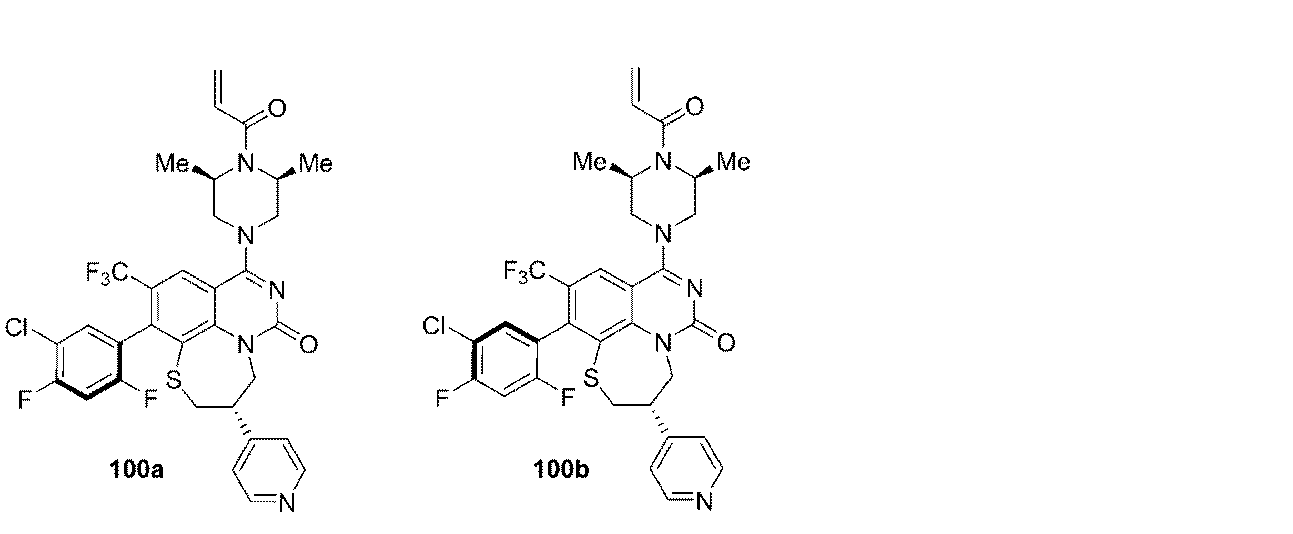
ステップ1:2,4,7-トリクロロ-8-ヨード-6-(トリフルオロメチル)キナゾリン

N,N-ジイソプロピルエチルアミン(17.9mmol)中の7-クロロ-8-ヨード-6-(トリフルオロメチル)キナゾリン-2,4(1H,3H)-ジオン(5.1mmol)の混合物に、三塩化ホスホリル(12mL)を加えた。混合物を110℃で12時間撹拌し、反応混合物を減圧下で濃縮して残渣を得て、これを冷水に溶解し、酢酸エチルで3回抽出した。組み合わせた有機層をブラインで洗浄し、無水硫酸ナトリウムで乾燥させ、濾過し、減圧下で濃縮した。得られた粗物質をシリカゲルクロマトグラフィー(石油エーテル中の0~15%酢酸エチル)によって精製して、表題化合物を収率44%で白色の固体として得た。MS (ESI) m/z: 427.0 [M+1]+. To a mixture of 7-chloro-8-iodo-6-(trifluoromethyl)quinazoline-2,4(1H,3H)-dione (5.1 mmol) in N,N-diisopropylethylamine (17.9 mmol) was added phosphoryl trichloride (12 mL). The mixture was stirred at 110° C. for 12 hours, and the reaction mixture was concentrated under reduced pressure to give a residue that was dissolved in cold water and extracted three times with ethyl acetate. The combined organic layers were washed with brine, dried over anhydrous sodium sulfate, filtered, and concentrated under reduced pressure. The resulting crude material was purified by silica gel chromatography (0-15% ethyl acetate in petroleum ether) to give the title compound as a white solid in 44% yield. MS (ESI) m/z: 427.0 [M+1]+.
ステップ2:tert-ブチル(2S,6R)-4-(2,7-ジクロロ-8-ヨード-6-(トリフルオロメチル)キナゾリン-4-イル)-2,6-ジメチルピペラジン-1-カルボキシラート

ジクロロメタン(10mL)中の2,4,7-トリクロロ-8-ヨード-6-(トリフルオロメチル)キナゾリン(2.04mmol)及びトリエチルアミン(6.11mmol)の溶液に、tert-ブチル(2S,6R)-2,6-ジメチルピペラジン-1-カルボキシラート(1.83mmol)を0℃で加えた。混合物を室温で1時間撹拌し、揮発性物質を減圧下で除去した。残渣をシリカゲルカラムクロマトグラフィー(ヘキサン中の5~15%酢酸エチル)によって精製して、表題化合物を収率82%で白色の固体として得た。MS (ESI) m/z: 605.2 [M+1]+. To a solution of 2,4,7-trichloro-8-iodo-6-(trifluoromethyl)quinazoline (2.04 mmol) and triethylamine (6.11 mmol) in dichloromethane (10 mL) was added tert-butyl (2S,6R)-2,6-dimethylpiperazine-1-carboxylate (1.83 mmol) at 0°C. The mixture was stirred at room temperature for 1 h and the volatiles were removed under reduced pressure. The residue was purified by silica gel column chromatography (5-15% ethyl acetate in hexanes) to give the title compound as a white solid in 82% yield. MS (ESI) m/z: 605.2 [M+1]+.
ステップ3:tert-ブチル(2S,6R)-4-(7-クロロ-8-ヨード-2-オキソ-6-(トリフルオロメチル)-1,2-ジヒドロキナゾリン-4-イル)-2,6-ジメチルピペラジン-1-カルボキシラート
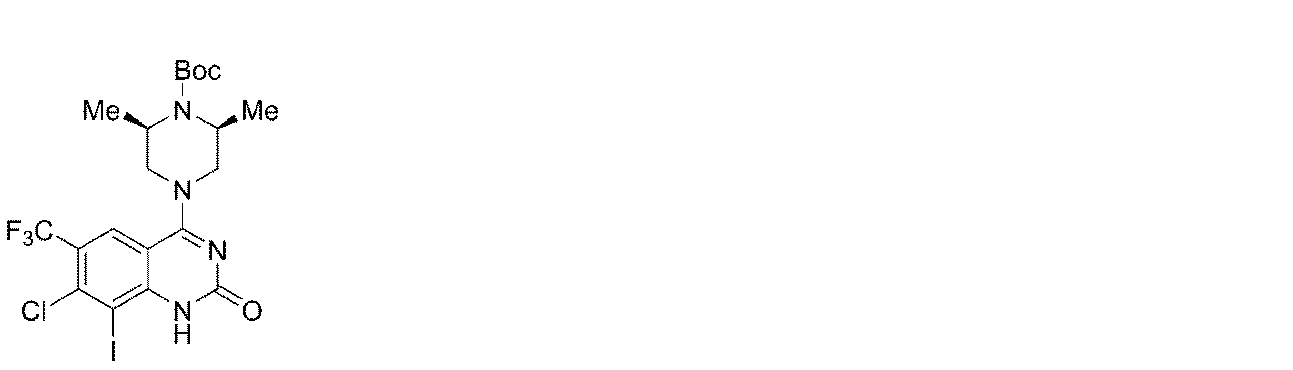
アセトニトリル(50mL)中のtert-ブチル(2S,6R)-4-(2,7-ジクロロ-8-ヨード-6-(トリフルオロメチル)キナゾリン-4-イル)-2,6-ジメチルピペラジン-1-カルボキシラート(1.73mmol)の溶液に、2-(メチルスルホニル)エタン-1-オール(3.47mmol)、炭酸セシウム(3.47mmol)及び1,4-ジアザビシクロ[2.2.2]オクタン(0.17mmol)を加えた。混合物を80℃で2時間撹拌し、揮発性物質を減圧下で除去して固体を得て、これをジクロロメタンに再溶解し、水で洗浄し、硫酸ナトリウムで乾燥させ、濾過し、減圧下で濃縮した。得られた残渣を、tert-ブチルメチルエーテルと酢酸エチル(60mL)の10:1混合物でトリチュレートした。黄色の固体を濾過し、真空下で乾燥して、標題化合物を収率88%で得た。MS (ESI) m/z: 587.2 [M+1]+. To a solution of tert-butyl (2S,6R)-4-(2,7-dichloro-8-iodo-6-(trifluoromethyl)quinazolin-4-yl)-2,6-dimethylpiperazine-1-carboxylate (1.73 mmol) in acetonitrile (50 mL) was added 2-(methylsulfonyl)ethan-1-ol (3.47 mmol), cesium carbonate (3.47 mmol) and 1,4-diazabicyclo[2.2.2]octane (0.17 mmol). The mixture was stirred at 80°C for 2 hours and the volatiles were removed under reduced pressure to give a solid which was redissolved in dichloromethane, washed with water, dried over sodium sulfate, filtered and concentrated under reduced pressure. The resulting residue was triturated with a 10:1 mixture of tert-butyl methyl ether and ethyl acetate (60 mL). The yellow solid was filtered and dried under vacuum to give the title compound in 88% yield. MS (ESI) m/z: 587.2 [M+1]+.
ステップ4:2-(ピリジン-4-イル)プロパン-1,3-ジオール

37%ホルムアルデヒド(1.72mol)中の4-メチルピリジン(430mmol)の混合物を100℃で12時間撹拌した。反応混合物を減圧下で濃縮して残渣を得て、これをシリカゲルクロマトグラフィー(酢酸エチル中の1~10%メタノール)によって精製した。表題化合物を収率88%で無色の油として単離した。1H NMR (400 MHz, メタノール-d4) δ ppm 2.99 (q, J = 6.4 Hz, 1H) 3.77-3.91 (m, 4 H) 7.29-7.47 (m, 2 H) 8.33-8.54 (m, 2 H). A mixture of 4-methylpyridine (430 mmol) in 37% formaldehyde (1.72 mol) was stirred at 100 °C for 12 h. The reaction mixture was concentrated under reduced pressure to give a residue that was purified by silica gel chromatography (1-10% methanol in ethyl acetate). The title compound was isolated in 88% yield as a colorless oil. 1H NMR (400 MHz, methanol-d4) δ ppm 2.99 (q, J = 6.4 Hz, 1H) 3.77-3.91 (m, 4 H) 7.29-7.47 (m, 2 H) 8.33-8.54 (m, 2 H).
ステップ5:3-ヒドロキシ-2-(ピリジン-4-イル)プロピル-4-メチルベンゼンスルホネート

ジクロロメタン(100mL)中の2-(ピリジン-4-イル)プロパン-1,3-ジオール(65.3mmol)の0℃の溶液に、p-トルエンスルホニルクロリド(65.3mmol)、N,N’-ジメチルアミノピリジン(6.53mmol)及びピリジン(65.3mmol)を加えた。混合物を25℃で3時間撹拌し、水でクエンチし、酢酸エチルで3回抽出した。有機層を組み合わせ、無水硫酸ナトリウムで乾燥させ、濾過し、減圧下で濃縮して残渣を得て、これを更に精製することなく以下のステップで使用した。 To a solution of 2-(pyridin-4-yl)propane-1,3-diol (65.3 mmol) in dichloromethane (100 mL) at 0°C, p-toluenesulfonyl chloride (65.3 mmol), N,N'-dimethylaminopyridine (6.53 mmol) and pyridine (65.3 mmol) were added. The mixture was stirred at 25°C for 3 h, quenched with water and extracted three times with ethyl acetate. The organic layers were combined, dried over anhydrous sodium sulfate, filtered and concentrated under reduced pressure to give a residue which was used in the following step without further purification.
ステップ6:S-(3-ヒドロキシ-2-(ピリジン-4-イル)プロピル)エタンチオエート
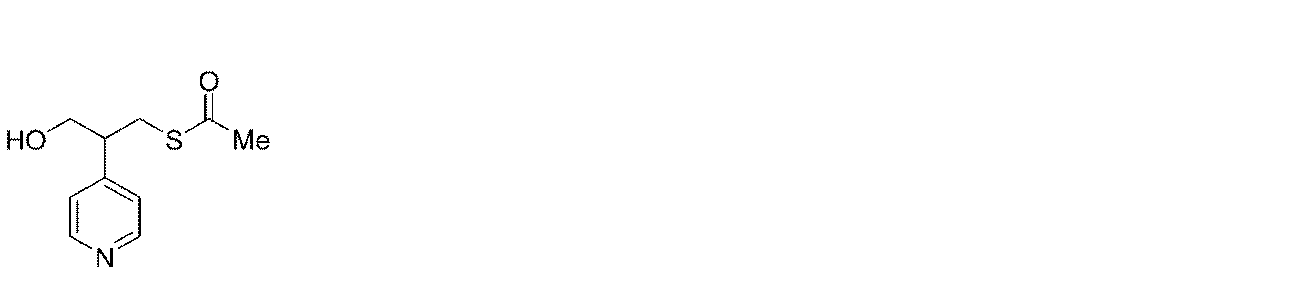
ジメチルホルムアミド(150mL)中の3-ヒドロキシ-2-(ピリジン-4-イル)プロピル-4-メチルベンゼンスルホネート(55.3mmol)の溶液に、チオ酢酸カリウム(81.9mmol)を加えた。混合物を50℃で2時間撹拌し、水でクエンチし、酢酸エチルで3回抽出した。組み合わせた有機層を無水硫酸ナトリウムで乾燥させ、濾過し、減圧下で濃縮して残渣を得て、これをシリカゲルクロマトグラフィー(石油エーテル中の50~100%酢酸エチル)によって精製した。表題化合物を黄色の油として収率15%で単離した。1H NMR (400 MHz, CDCl3) δ ppm 2.35 (s, 3 H) 2.99 (五重線, J= 6.4 Hz, 1 H) 3.15-3.24 (m, 1 H), 3.37 (dd, J= 14.0, 7.2 Hz, 1H) 3.79-3.90 (m, 2 H) 7.14-7.24 (m, 2 H), 8.48-8.59 (m, 2H). To a solution of 3-hydroxy-2-(pyridin-4-yl)propyl-4-methylbenzenesulfonate (55.3 mmol) in dimethylformamide (150 mL) was added potassium thioacetate (81.9 mmol). The mixture was stirred at 50°C for 2 h, quenched with water, and extracted three times with ethyl acetate. The combined organic layers were dried over anhydrous sodium sulfate, filtered, and concentrated under reduced pressure to give a residue that was purified by silica gel chromatography (50-100% ethyl acetate in petroleum ether). The title compound was isolated as a yellow oil in 15% yield. 1H NMR (400 MHz, CDCl3) δ ppm 2.35 (s, 3 H) 2.99 (quintet, J= 6.4 Hz, 1 H) 3.15-3.24 (m, 1 H), 3.37 (dd, J= 14.0, 7.2 Hz, 1H) 3.79-3.90 (m, 2H) 7.14-7.24 (m, 2H), 8.48-8.59 (m, 2H).
ステップ7:tert-ブチル(2S,6R)-4-(7-クロロ-8-((3-ヒドロキシ-2-(ピリジン-4-イル)プロピル)チオ)-2-オキソ-6-(トリフルオロメチル)-1,2-ジヒドロキナゾリン-4-イル)-2,6-ジメチルピペラジン-1-カルボキシレート

1,2-エタンジオール(2mL)及びイソプロパノール(2mL)中のS-(3-ヒドロキシ-2-(ピリジン-4-イル)プロピル)エタンチオエート(0.95mmol)及びtert-ブチル(2S,6R)-4-(7-クロロ-8-ヨード-2-オキソ-6-(トリフルオロメチル)-1,2-ジヒドロキナゾリン-4-イル)-2,6-ジメチルピペラジン-1-カルボキシラート(1.42mmol)の溶液に、炭酸カリウム(2.84mmol)及びヨウ化第一銅(0.47mmol)を加えた。混合物を85℃で2時間撹拌し、水でクエンチし、酢酸エチルで3回抽出した。組み合わせた有機層を無水硫酸ナトリウムで乾燥させ、濾過し、減圧下で濃縮して残渣を得て、これを分取TLCによって精製した。表題化合物を収率65%で黄色の固体として単離した。MS (ESI) m/z: 627.9 [M+1]+. To a solution of S-(3-hydroxy-2-(pyridin-4-yl)propyl)ethanethioate (0.95 mmol) and tert-butyl (2S,6R)-4-(7-chloro-8-iodo-2-oxo-6-(trifluoromethyl)-1,2-dihydroquinazolin-4-yl)-2,6-dimethylpiperazine-1-carboxylate (1.42 mmol) in 1,2-ethanediol (2 mL) and isopropanol (2 mL), potassium carbonate (2.84 mmol) and cuprous iodide (0.47 mmol) were added. The mixture was stirred at 85°C for 2 hours, quenched with water, and extracted three times with ethyl acetate. The combined organic layers were dried over anhydrous sodium sulfate, filtered, and concentrated under reduced pressure to give a residue that was purified by preparative TLC. The title compound was isolated as a yellow solid in 65% yield. MS (ESI) m/z: 627.9 [M+1]+.
ステップ8:tert-ブチル(2S,6R)-4-((R)-11-クロロ-6-オキソ-3-(ピリジン-4-イル)-10-(トリフルオロメチル)-3,4-ジヒドロ-2H,6H-[1,4]チアゼピノ[2,3,4-ij]キナゾリン-8-イル)-2,6-ジメチルピペラジン-1-カルボキシレート(Int-1a)及びtert-ブチル(2S,6R)-4-((S)-11-クロロ-6-オキソ-3-(ピリジン-4-イル)-10-(トリフルオロメチル)-3,4-ジヒドロ-2H,6H-[1,4]チアゼピノ[2,3,4-ij]キナゾリン-8-イル)-2,6-ジメチルピペラジン-1-カルボキシレート(Int-1b)

テトラヒドロフラン(100mL)中のtert-ブチル(2S,6R)-4-(7-クロロ-8-((3-ヒドロキシ-2-(ピリジン-4-イル)プロピル)チオ)-2-オキソ-6-(トリフルオロメチル)-1,2-ジヒドロキナゾリン-4-イル)-2,6-ジメチルピペラジン-1-カルボキシラート(2.11mmol)の0℃の溶液に、トリフェニルホスフィン(10.6mmol)を加えた。混合物を0℃で30分間撹拌し、アゾジカルボン酸ジエチル(10.6mmol)を加えた。12時間後、揮発性物質を減圧下で除去して残渣を得て、これをシリカゲルクロマトグラフィー(酢酸エチル中の0~10%メタノール)によって精製した。化合物Int-1a及びInt-1bを、ジアステレオマーの1:1混合物として収率65%で単離した。純粋なジアステレオマーInt-1a及びInt-1bを、SFC(Dacel Chiralcel OD 250mm×30mm、10um、CO2中の50%メタノールを移動相として使用)による前述の混合物の精製によって得、SFC(Chiracel OD-3、50×4.6mm、3um、CO2中の40%メタノール(0.05%ジエチルアミンを含有)を移動相として3mL/分で使用)によって特性評価した。 To a 0°C solution of tert-butyl (2S,6R)-4-(7-chloro-8-((3-hydroxy-2-(pyridin-4-yl)propyl)thio)-2-oxo-6-(trifluoromethyl)-1,2-dihydroquinazolin-4-yl)-2,6-dimethylpiperazine-1-carboxylate (2.11 mmol) in tetrahydrofuran (100 mL) was added triphenylphosphine (10.6 mmol). The mixture was stirred at 0°C for 30 minutes and diethyl azodicarboxylate (10.6 mmol) was added. After 12 hours, the volatiles were removed under reduced pressure to give a residue which was purified by silica gel chromatography (0-10% methanol in ethyl acetate). Compounds Int-1a and Int-1b were isolated in 65% yield as a 1:1 mixture of diastereomers. The pure diastereomers Int-1a and Int-1b were obtained by purification of the aforementioned mixture by SFC (Dacel Chiralcel OD 250 mm x 30 mm, 10 um, using 50% methanol in CO2 as the mobile phase) and characterized by SFC (Chiracel OD-3, 50 x 4.6 mm, 3 um, using 40% methanol in CO2 (containing 0.05% diethylamine) as the mobile phase at 3 mL/min).
Int-1a:SFC Rt=1.03 分;MS (ESI) m/z: 609.9 [M+1]+ Int-1a: SFC Rt=1.03 min; MS (ESI) m/z: 609.9 [M+1] +
Int-1b:SFC Rt=1.40 分;MS (ESI) m/z: 609.9 [M+1]+ Int-1b: SFC Rt=1.40 min; MS (ESI) m/z: 609.9 [M+1] +
ステップ9:tert-ブチル(2S,6R)-4-((3S)-11-(5-クロロ-2,4-ジフルオロフェニル)-6-オキソ-3-(ピリジン-4-イル)-10-(トリフルオロメチル)-3,4-ジヒドロ-2H,6H-[1,4]チアゼピノ[2,3,4-ij]キナゾリン-8-イル)-2,6-ジメチルピペラジン-1-カルボキシレート
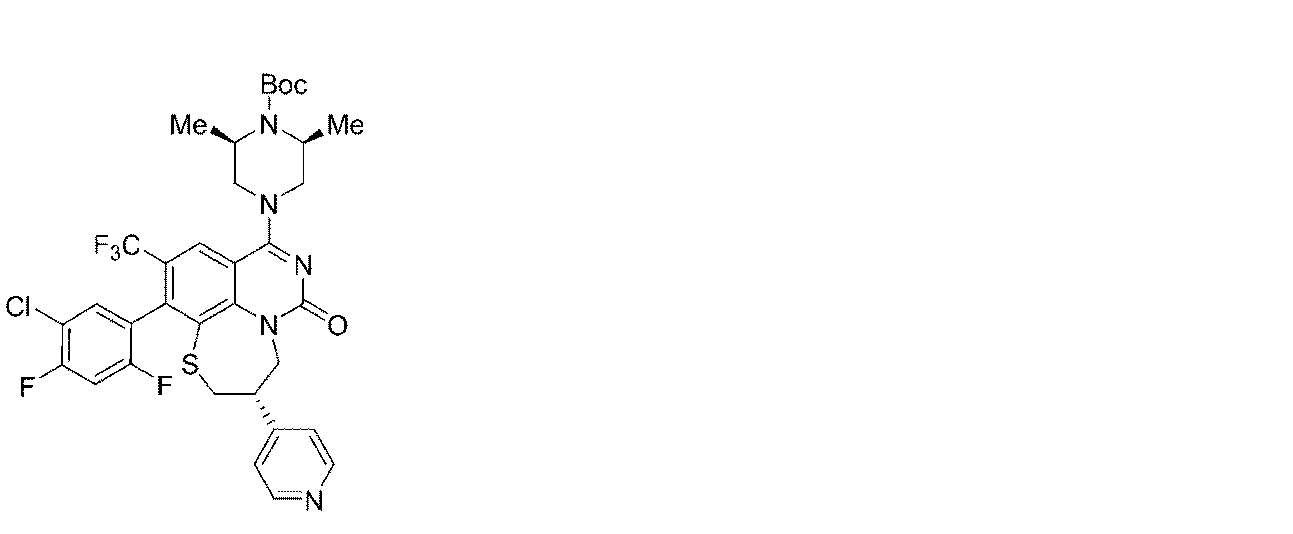
ジオキサン(5mL)及び水(0.1mL)中のtert-ブチル(2S,6R)-4-((S)-11-クロロ-6-オキソ-3-(ピリジン-4-イル)-10-(トリフルオロメチル)-3,4-ジヒドロ-2H,6H-[1,4]チアゼピノ[2,3,4-ij]キナゾリン-8-イル)-2,6-ジメチルピペラジン-1-カルボキシレート(0.46mmol)及び(5-クロロ-2,4-ジフルオロ-フェニル)ボロン酸(1.84mmol)の溶液に、リン酸カリウム(1.38mmol)及びRuphos Pd G4(0.05mmol)を加えた。混合物を80℃で30分間撹拌し、反応混合物を濾過し、減圧下で濃縮して残渣を得、これを分取TLC及びセミ分取逆相HPLCによって精製した。表題化合物を収率33%で黄色の固体として単離した。MS (ESI) m/z: 722.1 [M+1]+. To a solution of tert-butyl (2S,6R)-4-((S)-11-chloro-6-oxo-3-(pyridin-4-yl)-10-(trifluoromethyl)-3,4-dihydro-2H,6H-[1,4]thiazepino[2,3,4-ij]quinazolin-8-yl)-2,6-dimethylpiperazine-1-carboxylate (0.46 mmol) and (5-chloro-2,4-difluoro-phenyl)boronic acid (1.84 mmol) in dioxane (5 mL) and water (0.1 mL) was added potassium phosphate (1.38 mmol) and Ruphos Pd G4 (0.05 mmol). The mixture was stirred at 80°C for 30 min, the reaction mixture was filtered and concentrated under reduced pressure to give a residue that was purified by preparative TLC and semi-preparative reversed-phase HPLC. The title compound was isolated as a yellow solid in 33% yield. MS (ESI) m/z: 722.1 [M+1]+.
ステップ10:(3S)-11-(5-クロロ-2,4-ジフルオロフェニル)-8-((3S,5R)-3,5-ジメチルピペラジン-1-イル)-3-(ピリジン-4-イル)-10-(トリフルオロメチル)-3,4-ジヒドロ-2H,6H-[1,4]チアゼピノ[2,3,4-ij]キナゾリン-6-オン

ジクロロメタン(3mL)中のtert-ブチル(2S,6R)-4-((3S)-11-(5-クロロ-2,4-ジフルオロフェニル)-6-オキソ-3-(ピリジン-4-イル)-10-(トリフルオロメチル)-3,4-ジヒドロ-2H,6H-[1,4]チアゼピノ[2,3,4-ij]キナゾリン-8-イル)-2,6-ジメチルピペラジン-1-カルボキシレート(0.17mmol)の溶液に、トリフルオロ酢酸(1mL)を0℃で加えた。混合物を0℃で30分間撹拌し、続いて減圧下で揮発性物質を蒸発させた。表題化合物を収率87%で黄色の油として単離し、更に精製することなく次のステップで使用した。MS (ESI) m/z: 622.0 [M+1]+. To a solution of tert-butyl (2S,6R)-4-((3S)-11-(5-chloro-2,4-difluorophenyl)-6-oxo-3-(pyridin-4-yl)-10-(trifluoromethyl)-3,4-dihydro-2H,6H-[1,4]thiazepino[2,3,4-ij]quinazolin-8-yl)-2,6-dimethylpiperazine-1-carboxylate (0.17 mmol) in dichloromethane (3 mL) was added trifluoroacetic acid (1 mL) at 0°C. The mixture was stirred at 0°C for 30 min followed by evaporation of volatiles under reduced pressure. The title compound was isolated as a yellow oil in 87% yield and used in the next step without further purification. MS (ESI) m/z: 622.0 [M+1]+.
ステップ13:(3S,11S)-8-((3S,5R)-4-アクリロイル-3,5-ジメチルピペラジン-1-イル)-11-(4-クロロチオフェン-2-イル)-3-(ピリミジン-2-イル)-10-(トリフルオロメチル)-3,4-ジヒドロ-2H,6H-[1,4]チアゼピノ[2,3,4-ij]キナゾリン-6-オン(実施例100a)及び(3S)-8-((3S,5R)-4-アクリロイル-3,5-ジメチルピペラジン-1-イル)-11-(4-クロロチオフェン-2-イル)-3-(ピリミジン-2-イル)-10-(トリフルオロメチル)-3,4-ジヒドロ-2H,6H-[1,4]チアゼピノ[2,3,4-ij]キナゾリン-6-オン(実施例100b)

ジクロロメタン(3mL)中の(3S)-11-(5-クロロ-2,4-ジフルオロフェニル)-8-((3S,5R)-3,5-ジメチルピペラジン-1-イル)-3-(ピリジン-4-イル)-10-(トリフルオロメチル)-3,4-ジヒドロ-2H,6H-[1,4]チアゼピノ[2,3,4-ij]キナゾリン-6-オン(0.16mmol)の0℃の溶液に、トリエチルアミン(0.05mmol)及びプロパ-2-エノイルクロリド(0.32mmol)を加えた。混合物を80℃で30分間撹拌し、揮発性物質を減圧下で除去して残渣を得て、これを分取TLCによって精製した。化合物1a及び1bを、ジアステレオマーの1:1混合物として収率54%で単離した。純粋なジアステレオマー1a及び1bを、SFC(Daicel Chiralpak AD 250mm×30mm、10um、CO2中の50%イソプロパノールを移動相として使用)による前述の混合物の精製によって得、SFC(Chiralpak AD-3、50×4.6mm、3um)によって特性評価した。移動相として使用:CO2中の5~40%イソプロパノール(0.05%ジエチルアミンを含有)を3mL/分で使用。 To a 0°C solution of (3S)-11-(5-chloro-2,4-difluorophenyl)-8-((3S,5R)-3,5-dimethylpiperazin-1-yl)-3-(pyridin-4-yl)-10-(trifluoromethyl)-3,4-dihydro-2H,6H-[1,4]thiazepino[2,3,4-ij]quinazolin-6-one (0.16 mmol) in dichloromethane (3 mL) was added triethylamine (0.05 mmol) and prop-2-enoyl chloride (0.32 mmol). The mixture was stirred at 80°C for 30 min and the volatiles were removed under reduced pressure to give a residue which was purified by preparative TLC. Compounds 1a and 1b were isolated in 54% yield as a 1:1 mixture of diastereomers. Pure diastereomers 1a and 1b were obtained by purification of the above mixture by SFC (Daicel Chiralpak AD 250mm x 30mm, 10um, 50% isopropanol in CO2 used as mobile phase) and characterized by SFC (Chiralpak AD-3, 50 x 4.6mm, 3um). Mobile phase used: 5-40% isopropanol in CO2 (containing 0.05% diethylamine) at 3mL/min.
化合物100a:SFC Rt=1.79分;MS (ESI) m/z: 676.0 [M+1]+. 1H NMR (400 MHz,CDCl3) δ ppm 1.51 - 1.59 (m,6 H) 3.15 (br d, J =13.6 Hz,1 H) 3.41 (td, J = 12.8,4.8 Hz,2 H) 3.70 - 3.87 (m, 2 H) 4.12 - 4.27 (m, 2 H) 4.53 - 4.91 (m, 4 H) 5.80 (dd, J = 10.4, 2.0 Hz, 1 H) 6.43 (dd, J = 16.8, 2.0 Hz, 1 H) 6.64 (dd, J = 16.4, 10.4 Hz, 1 H) 7.06 (t, J = 8.8 Hz, 1 H) 7.28 - 7.34 (m, 3 H) 8.14 (s, 1 H) 8.49 - 8.67 (m, 2H)。 Compound 100a: SFC Rt=1.79 min; MS (ESI) m/z: 676.0 [M+1]+. 1 H NMR (400 MHz, CDCl3) δ ppm 1.51 - 1.59 (m, 6 H) 3.15 (br d, J = 13.6 Hz, 1 H) 3.41 (td, J = 12.8, 4.8 Hz, 2 H) 3.70 - 3.87 (m, 2 H) 4.12 - 4.27 (m, 2 H) 4.53 - 4.91 (m, 4 H) 5.80 (dd, J = 10.4, 2.0 Hz, 1 H) 6.43 (dd, J = 16.8, 2.0 Hz, 1 H) 6.64 (dd, J = 16.4, 10.4 Hz, 1 H) 7.06 (t, J = 8.8 Hz, 1 H) 7.28 - 7.34 (m, 3 H) 8.14 (s, 1 H) 8.49 - 8.67 (m, 2 H).
化合物100b: SFC Rt=3.30分;MS (ESI) m/z: 676.0 [M+1]+. 1H NMR (400 MHz, CDCl3) δ ppm 1.53 (br d, J = 6.8Hz, 6 H) 3.06 - 3.27 (m, 1 H) 3.41 (ddd, J = 17.6, 13.2, 4.4 Hz, 2 H) 3.61 - 3.83 (m, 2 H) 4.14 - 4.23 (m, 2 H) 4.53 - 4.90 (m, 4 H) 5.80 (dd, J = 10.4, 2.0 Hz, 1 H) 6.43 (dd, J = 16.8, 1.6 Hz, 1 H) 6.64 (dd, J = 16.8, 10.4 Hz, 1 H) 7.10 (t, J = 8.8 Hz, 1 H) 7.23 - 7.27 (m, 1 H) 7.30 (br d, J = 5.2 Hz, 2 H) 8.15 (s, 1 H) 8.59 (d, J = 6.0 Hz, 2 H). Compound 100b: SFC Rt=3.30 min; MS (ESI) m/z: 676.0 [M+1]+. 1H NMR (400 MHz, CDCl3) δ ppm 1.53 (br d, J = 6.8 Hz, 6 H) 3.06 - 3.27 (m, 1 H) 3.41 (ddd, J = 17.6, 13.2, 4.4 Hz, 2 H) 3.61 - 3.83 (m, 2 H) 4.14 - 4.23 (m, 2 H) 4.53 - 4.90 (m, 4 H) 5.80 (dd, J = 10.4, 2.0 Hz, 1 H) 6.43 (dd, J = 16.8, 1.6Hz, 1H) 6.64 (dd, J = 16.8, 10.4 Hz, 1 H) 7.10 (t, J = 8.8 Hz, 1 H) 7.23 - 7.27 (m, 1 H) 7.30 (br d, J = 5.2 Hz, 2 H) 8.15 (s, 1 H) 8.59 (d, J = 6.0 Hz, 2 H).
実施例101a及び101b:(3R)-8-((3S,5R)-4-アクリロイル-3,5-ジメチルピペラジン-1-イル)-11-(5-クロロ-2,4-ジフルオロフェニル)-3-(ピリジン-4-イル)-10-(トリフルオロメチル)-3,4-ジヒドロ-2H,6H-[1,4]チアゼピノ[2,3,4-ij]キナゾリン-6-オン(101a)及び(3R,11S)-8-((3S,5R)-4-アクリロイル-3,5-ジメチルピペラジン-1-イル)-11-(5-クロロ-2,4-ジフルオロフェニル)-3-((S)-3,4-ジヒドロピリジン-4-イル)-10-(トリフルオロメチル)-3,4-ジヒドロ-2H,6H-[1,4]チアゼピノ[2,3,4-ij]キナゾリン-6-1(101b)

ステップ10:tert-ブチル(2S,6R)-4-((3R)-11-(5-クロロ-2,4-ジフルオロフェニル)-6-オキソ-3-(ピリジン-4-イル)-10-(トリフルオロメチル)-3、4-ジヒドロ-2H,6H-[1,4]チアゼピノ[2,3,4-ij]キナゾリン-8-イル)-2,6-ジメチルピペラジン-1-カルボキシレート

ジオキサン(5mL)及び水(0.1mL)中のtert-ブチル(2S,6R)-4-((R)-11-クロロ-6-オキソ-3-(ピリジン-4-イル)-10-(トリフルオロメチル)-3,4-ジヒドロ-2H,6H-[1,4]チアゼピノ[2,3,4-ij]キナゾリン-8-イル)-2,6-ジメチルピペラジン-1-カルボキシレート(0.39mmol)及び(5-クロロ-2,4-ジフルオロフェニル)ボロン酸(1.57mmol)の溶液に、リン酸カリウム(1.18mmol)及びRuphos Pd G4(0.04mmol)を加えた。混合物を80℃で30分間撹拌し、室温まで冷却し、不溶性物質を濾過した。減圧下での揮発性物質の蒸発により残渣を得、これを分取TLCにより精製した。表題化合物を収率61%で黄色の固体として単離した。MS (ESI) m/z: 722.1 [M+1]+. To a solution of tert-butyl (2S,6R)-4-((R)-11-chloro-6-oxo-3-(pyridin-4-yl)-10-(trifluoromethyl)-3,4-dihydro-2H,6H-[1,4]thiazepino[2,3,4-ij]quinazolin-8-yl)-2,6-dimethylpiperazine-1-carboxylate (0.39 mmol) and (5-chloro-2,4-difluorophenyl)boronic acid (1.57 mmol) in dioxane (5 mL) and water (0.1 mL) was added potassium phosphate (1.18 mmol) and Ruphos Pd G4 (0.04 mmol). The mixture was stirred at 80°C for 30 min, cooled to room temperature and the insoluble material was filtered. Evaporation of the volatiles under reduced pressure gave a residue which was purified by preparative TLC. The title compound was isolated as a yellow solid in 61% yield. MS (ESI) m/z: 722.1 [M+1]+.
ステップ2:(3R)-11-(5-クロロ-2,4-ジフルオロフェニル)-8-((3S,5R)-3,5-ジメチルピペラジン-1-イル)-3-(ピリジン-4-イル)-10-(トリフルオロメチル)-3,4-ジヒドロ-2H,6H-[1,4]チアゼピノ[2,3,4-ij]キナゾリン-6-オン
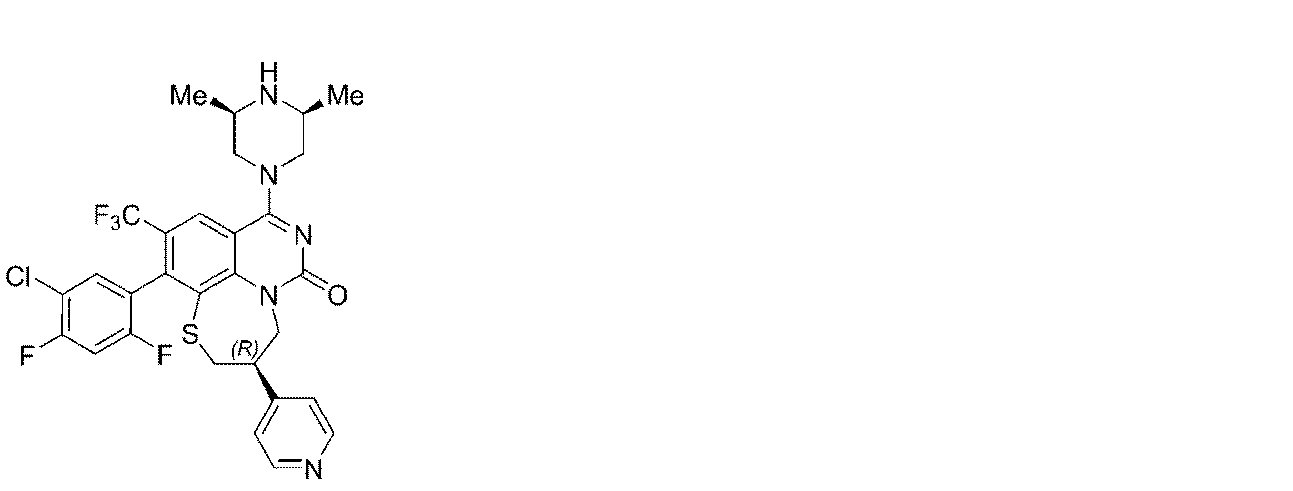
ジクロロメタン(3mL)中のtert-ブチル(2S,6R)-4-((3R)-11-(5-クロロ-2,4-ジフルオロフェニル)-6-オキソ-3-(ピリジン-4-イル)-10-(トリフルオロメチル)-3,4-ジヒドロ-2H,6H-[1,4]チアゼピノ[2,3,4-ij]キナゾリン-8-イル)-2,6-ジメチルピペラジン-1-カルボキシレート(0.25mmol)の溶液に、トリフルオロ酢酸(2mL)を0℃で加えた。反応物を0℃で30分間撹拌し、揮発性物質を減圧下で除去して、表題化合物を収率99%で黄色の油として得た。MS (ESI) m/z: 622.0 [M+1]+. To a solution of tert-butyl (2S,6R)-4-((3R)-11-(5-chloro-2,4-difluorophenyl)-6-oxo-3-(pyridin-4-yl)-10-(trifluoromethyl)-3,4-dihydro-2H,6H-[1,4]thiazepino[2,3,4-ij]quinazolin-8-yl)-2,6-dimethylpiperazine-1-carboxylate (0.25 mmol) in dichloromethane (3 mL) was added trifluoroacetic acid (2 mL) at 0°C. The reaction was stirred at 0°C for 30 min and the volatiles were removed under reduced pressure to give the title compound in 99% yield as a yellow oil. MS (ESI) m/z: 622.0 [M+1]+.
ステップ3:(3R)-8-((3S,5R)-4-アクリロイル-3,5-ジメチルピペラジン-1-イル)-11-(5-クロロ-2,4-ジフルオロフェニル)-3-(ピリジン-4-イル)-10-(トリフルオロメチル)-3,4-ジヒドロ-2H,6H-[1,4]チアゼピノ[2,3,4-ij]キナゾリン-6-オン(101a)及び(3R,11S)-8-((3S,5R)-4-アクリロイル-3,5-ジメチルピペラジン-1-イル)-11-(5-クロロ-2,4-ジフルオロフェニル)-3-((S)-3,4-ジヒドロピリジン-4-イル)-10-(トリフルオロメチル)-3,4-ジヒドロ-2H,6H-[1,4]チアゼピノ[2,3,4-ij]キナゾリン-6-1(101b)
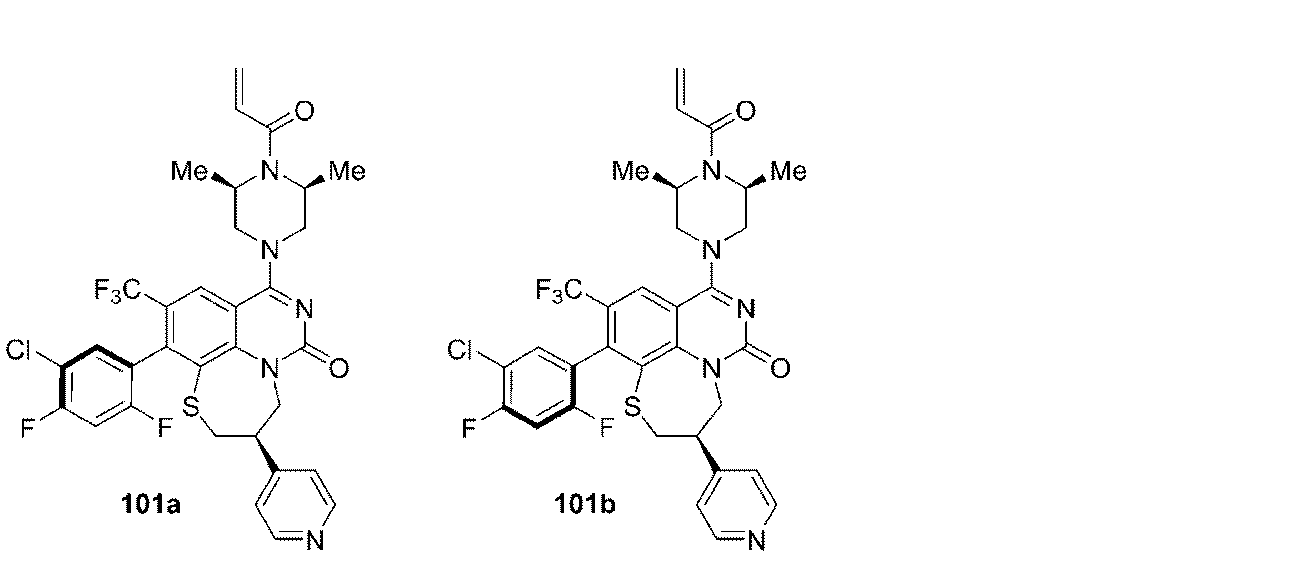
ジクロロメタン(3mL)中の(3R)-11-(5-クロロ-2,4-ジフルオロフェニル)-8-((3S,5R)-3,5-ジメチルピペラジン-1-イル)-3-(ピリジン-4-イル)-10-(トリフルオロメチル)-3,4-ジヒドロ-2H,6H-[1,4]チアゼピノ[2,3,4-ij]キナゾリン-6-オン(0.16mmol)の0℃の溶液に、トリエチルアミン(0.05mmol)及びプロパ-2-エノイルクロリド(0.32mmol)を加えた。混合物を80℃で30分間撹拌し、揮発性物質を減圧下で除去して残渣を得て、これを分取TLCによって精製した。化合物101a及び101bを、ジアステレオマーの1:1混合物として収率94%で単離した。 To a 0°C solution of (3R)-11-(5-chloro-2,4-difluorophenyl)-8-((3S,5R)-3,5-dimethylpiperazin-1-yl)-3-(pyridin-4-yl)-10-(trifluoromethyl)-3,4-dihydro-2H,6H-[1,4]thiazepino[2,3,4-ij]quinazolin-6-one (0.16 mmol) in dichloromethane (3 mL) was added triethylamine (0.05 mmol) and prop-2-enoyl chloride (0.32 mmol). The mixture was stirred at 80°C for 30 min and the volatiles were removed under reduced pressure to give a residue which was purified by preparative TLC. Compounds 101a and 101b were isolated in 94% yield as a 1:1 mixture of diastereomers.
純粋なジアステレオマー101a及び101bを、SFC(カラム:Dacel Chiralpak IG 250mm×30mm、10um、CO2中の55%イソプロパノール/アセトニトリル(4:1)を移動相として使用)による前述の混合物の精製によって得た。各々の個々のジアステレオマーをSFC(Chiralpak AD-3、50×4.6mm、3um、CO2の中40%イソプロパノール(0.05%ジエチルアミンを含有)を移動相として3mL/分で使用)によって分析した。 Pure diastereomers 101a and 101b were obtained by purification of the aforementioned mixture by SFC (column: Dacel Chiralpak IG 250 mm x 30 mm, 10 um, using 55% isopropanol/acetonitrile (4:1) in CO2 as mobile phase). Each individual diastereomer was analyzed by SFC (Chiralpak AD-3, 50 x 4.6 mm, 3 um, using 40% isopropanol (containing 0.05% diethylamine) in CO2 as mobile phase at 3 mL/min).
化合物101a:SFC Rt= 1.25分;MS (ESI) m/z: 676.0 [M+1]+. 1H NMR (400 MHz, CDCl3) δ ppm= 1.50 - 1.61 (m, 6 H) 3.16 (br d, J = 12.8 Hz, 1 H) 3.41 (td, J = 12.4, 4.8 Hz, 2 H) 3.67 - 3.95 (m, 2 H) 4.12 - 4.25 (m, 2 H) 4.42 - 5.05 (m, 4 H) 5.72 - 5.90 (m, 1 H) 6.43 (dd, J = 16.8, 1.6 Hz, 1 H) 6.56 - 6.72 (m, 1 H) 7.06 (t, J = 8.8 Hz, 1 H) 7.31 (t, J = 7.6 Hz, 1 H) 7.38 (d, J = 6.0 Hz, 2 H) 8.14 (s, 1 H) 8.62 (d, J = 6.0 Hz, 2 H). Compound 101a: SFC Rt=1.25 min; MS (ESI) m/z: 676.0 [M+1]+. 1H NMR (400 MHz, CDCl3) δ ppm= 1.50 - 1.61 (m, 6 H) 3.16 (br d, J = 12.8 Hz, 1 H) 3.41 (td, J = 12.4, 4.8 Hz, 2 H) 3.67 - 3.95 (m, 2 H) 4.12 - 4.25 (m, 2 H) 4.42 - 5.05 (m, 4 H) 5.72 - 5.90 (m, 1 H) 6.43 (dd, J = 16.8, 1.6 Hz, 1 H) 6.56 - 6.72 (m, 1 H) 7.06 (t, J = 8.8 Hz, 1 H) 7.31 (t, J = 7.6 Hz, 1 H) 7.38 (d, J = 6.0 Hz, 2 H) 8.14 (s, 1 H) 8.62 (d, J = 6.0 Hz, 2H).
化合物101b:SFC Rt=2.23分;MS (ESI) m/z: 676.0 [M+1]+. 1H NMR (400 MHz, CDCl3) δ ppm= 1.48 - 1.61 (m, 6 H) 2.99 - 3.24 (m, 1 H) 3.41 (ddd, J = 17.6, 13.2, 4.6 Hz, 2 H) 3.57 - 3.89 (m, 2 H) 4.19 (br dd, J = 13.2, 5.6 Hz, 2 H) 4.46 - 5.00 (m, 4 H) 5.80 (dd, J = 10.4, 1.6 Hz, 1 H) 6.43 (dd, J = 16.8, 1.6 Hz, 1 H) 6.64 (dd, J = 16.8, 10.4 Hz, 1 H) 7.10 (t, J = 8.8 Hz, 1 H) 7.25 (s, 1 H) 7.31 (br d, J = 5.6 Hz, 2 H) 8.15 (s, 1 H) 8.52 - 8.67 (m, 2 H). Compound 101b: SFC Rt=2.23 min; MS (ESI) m/z: 676.0 [M+1]+. 1H NMR (400 MHz, CDCl3) δ ppm= 1.48 - 1.61 (m, 6 H) 2.99 - 3.24 (m, 1 H) 3.41 (ddd, J = 17.6, 13.2, 4.6 Hz, 2 H) 3.57 - 3.89 (m, 2 H) 4.19 (br dd, J = 13.2, 5.6 Hz, 2 H) 4.46 - 5.00 (m, 4 H) 5.80 (dd, J = 10.4, 1.6 Hz, 1 H) 6.43 (dd, J = 16.8, 1.6 Hz, 1 H) 6.64 (dd, J = 16.8, 10.4 Hz, 1 H) 7.10 (t, J = 8.8 Hz, 1 H) 7.25 (s, 1 H) 7.31 (br d, J = 5.6 Hz, 2 H) 8.15 (s, 1 H) 8.52 - 8.67 (m, 2 H).
実施例102:(3S)-8-((3S,5R)-4-アクリロイル-3,5-ジメチルピペラジン-1-イル)-11-(5-ブロモ-2,4-ジフルオロフェニル)-3-(ピリジン-4-イル)-10-(トリフルオロメチル)-3,4-ジヒドロ-2H,6H-[1,4]チアゼピノ[2,3,4-ij]キナゾリン-6-オン

ステップ1:tert-ブチル(2S,6R)-4-((3S)-11-(5-アミノ-2,4-ジフルオロフェニル)-6-オキソ-3-(ピリジン-4-イル)-10-(トリフルオロメチル)-3、4-ジヒドロ-2H,6H-[1,4]チアゼピノ[2,3,4-ij]キナゾリン-8-イル)-2,6-ジメチルピペラジン-1-カルボキシレート

(5-クロロ-2,4-ジフルオロ-フェニル)ボロン酸を2,4-ジフルオロ-5-(4,4,5,5-テトラメチル-1,3,2-ジオキサボロラン-2-イル)アニリンに置き換えて、表題化合物を実施例100のステップ9と同様に調製した。表題化合物を収率78%で黄色の固体として単離した。MS (ESI) m/z: 703.2 [M+1]+. The title compound was prepared similarly to step 9 of Example 100, substituting 2,4-difluoro-5-(4,4,5,5-tetramethyl-1,3,2-dioxaborolan-2-yl)aniline for (5-chloro-2,4-difluoro-phenyl)boronic acid. The title compound was isolated in 78% yield as a yellow solid. MS (ESI) m/z: 703.2 [M+1]+.
ステップ2:tert-ブチル(2S,6R)-4-((3S)-11-(5-アミノ-2,4-ジフルオロフェニル)-6-オキソ-3-(ピリジン-4-イル)-10-(トリフルオロメチル)-3、4-ジヒドロ-2H,6H-[1,4]チアゼピノ[2,3,4-ij]キナゾリン-8-イル)-2,6-ジメチルピペラジン-1-カルボキシレート

アセトニトリル(1mL)中の臭化銅(0.14mmol)及び亜硝酸tert-ブチル(0.17mmol)の溶液に、アセトニトリル(1mL)中のtert-ブチル(2R,6S)-4-[(12S)-8-(5-アミノ-2,4-ジフルオロ-フェニル)-2-オキソ-12-(4-ピリジル)-7-(トリフルオロメチル)-10-チア-1,3-ジアザトリシクロ[7.4.1.05,14]テトラデカ-3,5,7,9(14)-テトラエン-4-イル]-2,6-ジメチル-ピペラジン-1-カルボキシレート(0.11mmol)の溶液を加え、60℃で30分間撹拌した。反応混合物を濾過し、減圧下で濃縮して残渣を得、これを分取TLCと、続いてセミ分取逆相HPLCによって精製した。表題化合物を収率40%で黄色の固体として単離した。MS (ESI) m/z: 768.2 [M+1]+. To a solution of copper bromide (0.14 mmol) and tert-butyl nitrite (0.17 mmol) in acetonitrile (1 mL) was added a solution of tert-butyl (2R,6S)-4-[(12S)-8-(5-amino-2,4-difluoro-phenyl)-2-oxo-12-(4-pyridyl)-7-(trifluoromethyl)-10-thia-1,3-diazatricyclo[7.4.1.05,14]tetradeca-3,5,7,9(14)-tetraen-4-yl]-2,6-dimethyl-piperazine-1-carboxylate (0.11 mmol) in acetonitrile (1 mL) and stirred at 60°C for 30 min. The reaction mixture was filtered and concentrated under reduced pressure to give a residue that was purified by preparative TLC followed by semi-preparative reversed-phase HPLC. The title compound was isolated as a yellow solid in 40% yield. MS (ESI) m/z: 768.2 [M+1]+.
ステップ3:(3S)-11-(5-ブロモ-2,4-ジフルオロフェニル)-8-((3S,5R)-3,5-ジメチルピペラジン-1-イル)-3-(ピリジン-4-イル)-10-(トリフルオロメチル)-3,4-ジヒドロ-2H,6H-[1,4]チアゼピノ[2,3,4-ij]キナゾリン-6-オン

tert-ブチル(2S,6R)-4-((3S)-11-(5-クロロ-2,4-ジフルオロフェニル)-6-オキソ-3-(ピリジン-4-イル)-10-(トリフルオロメチル)-3,4-ジヒドロ-2H,6H-[1,4]チアゼピノ[2,3,4-ij]キナゾリン-8-イル)-2,6-ジメチルピペラジン-1-カルボキシレートをtert-ブチル(2S,6R)-4-((3S)-11-(5-ブロモ-2,4-ジフルオロフェニル)-6-オキソ-3-(ピリジン-4-イル)-10-(トリフルオロメチル)-3,4-ジヒドロ-2H,6H-[1,4]チアゼピノ[2,3,4-ij]キナゾリン-8-イル)-2,6-ジメチルピペラジン-1-カルボキシレートに置き換えて、表題化合物を実施例100のステップ10と同様に調製した。表題化合物を収率99%で黄色の油として単離した。MS (ESI) m/z: 668.1 [M+1]+. tert-Butyl (2S,6R)-4-((3S)-11-(5-chloro-2,4-difluorophenyl)-6-oxo-3-(pyridin-4-yl)-10-(trifluoromethyl)-3,4-dihydro-2H,6H-[1,4]thiazepino[2,3,4-ij]quinazolin-8-yl)-2,6-dimethylpiperazine-1-carboxylate was synthesized by the synthesis of tert-butyl (2S,6R)-4 The title compound was prepared similarly to step 10 of Example 100, substituting -((3S)-11-(5-bromo-2,4-difluorophenyl)-6-oxo-3-(pyridin-4-yl)-10-(trifluoromethyl)-3,4-dihydro-2H,6H-[1,4]thiazepino[2,3,4-ij]quinazolin-8-yl)-2,6-dimethylpiperazine-1-carboxylate. The title compound was isolated in 99% yield as a yellow oil. MS (ESI) m/z: 668.1 [M+1]+.
ステップ4:(3S)-8-((3S,5R)-4-アクリロイル-3,5-ジメチルピペラジン-1-イル)-11-(5-ブロモ-2,4-ジフルオロフェニル)-3-(ピリジン-4-イル)-10-(トリフルオロメチル)-3,4-ジヒドロ-2H,6H-[1,4]チアゼピノ[2,3,4-ij]キナゾリン-6-オン

(3S)-11-(5-クロロ-2,4-ジフルオロフェニル)-8-((3S,5R)-3,5-ジメチルピペラジン-1-イル)-3-(ピリジン-4-イル)-10-(トリフルオロメチル)-3,4-ジヒドロ-2H,6H-[1,4]チアゼピノ[2,3,4-ij]キナゾリン-6-オンを(3S)-11-(5-ブロモ-2,4-ジフルオロフェニル)-8-((3S,5R)-3,5-ジメチルピペラジン-1-イル)-3-(ピリジン-4-イル)-10-(トリフルオロメチル)-3,4-ジヒドロ-2H,6H-[1,4]チアゼピノ[2,3,4-ij]キナゾリン-6-オンに置き換えて、表題化合物を実施例100のステップ11と同様に調製した。表題化合物を収率97%で黄色の油として単離した。MS (ESI) m/z: 722.1 [M+1]+. 1H NMR (400 MHz, CDCl3) δ ppm 1.54 (br d, J = 6.8 Hz, 6 H) 3.04 - 3.25 (m, 1 H) 3.34 - 3.46 (m, 2 H) 3.57 - 3.89 (m, 2 H) 4.19 (br dd, J = 13.6, 6.8 Hz, 2 H) 4.50 - 4.93 (m, 4 H) 5.80 (dd, J = 10.4, 1.6 Hz, 1 H) 6.38 - 6.49 (m, 1 H) 6.56 - 6.71 (m, 1 H) 6.99 - 7.15 (m, 1 H) 7.31 (br dd, J = 4.4, 2.0 Hz, 2 H) 7.43 (dt, J = 14.4, 7.2 Hz, 1 H) 8.14 (d, J = 3.6 Hz, 1 H) 8.51 - 8.68 (m, 2 H). The title compound was prepared similarly to step 11 of Example 100, replacing (3S)-11-(5-chloro-2,4-difluorophenyl)-8-((3S,5R)-3,5-dimethylpiperazin-1-yl)-3-(pyridin-4-yl)-10-(trifluoromethyl)-3,4-dihydro-2H,6H-[1,4]thiazepino[2,3,4-ij]quinazolin-6-one with (3S)-11-(5-bromo-2,4-difluorophenyl)-8-((3S,5R)-3,5-dimethylpiperazin-1-yl)-3-(pyridin-4-yl)-10-(trifluoromethyl)-3,4-dihydro-2H,6H-[1,4]thiazepino[2,3,4-ij]quinazolin-6-one. The title compound was isolated as a yellow oil in 97% yield. MS (ESI) m/z: 722.1 [M+1]+. 1H NMR (400 MHz, CDCl3) δ ppm 1.54 (br d, J = 6.8 Hz, 6 H) 3.04 - 3.25 (m, 1 H) 3.34 - 3.46 (m, 2 H) 3.57 - 3.89 (m, 2 H) 4.19 (br dd, J = 13.6, 6.8 Hz, 2 H) 4.50 - 4.93 (m, 4 H) 5.80 (dd, J = 10.4, 1.6 Hz, 1 H) 6.38 - 6.49 (m, 1 H) 6.56 - 6.71 (m, 1 H) 6.99 - 7.15 (m, 1 H) 7.31 (br dd, J = 4.4, 2.0 Hz, 2 H) 7.43 (dt, J = 14.4, 7.2 Hz, 1 H) 8.14 (d, J = 3.6 Hz, 1 H) 8.51 - 8.68 (m, 2 H).
実施例104a及び104b:(3S,11R)-8-((3S,5R)-4-アクリロイル-3,5-ジメチルピペラジン-1-イル)-11-(5-クロロ-2,4-ジフルオロフェニル)-3-(ピリジン-3-イル)-10-(トリフルオロメチル)-3,4-ジヒドロ-2H,6H-[1,4]チアゼピノ[2,3,4-ij]キナゾリン-6-オン(実施例104a)及び(3S,11S)-8-((3S,5R)-4-アクリロイル-3,5-ジメチルピペラジン-1-イル)-11-(5-クロロ-2,4-ジフルオロフェニル)-3-(ピリジン-3-イル)-10-(トリフルオロメチル)-3,4-ジヒドロ-2H,6H-[1,4]チアゼピノ[2,3,4-ij]キナゾリン-6-オン(実施例104b)

ステップ1:2-(ピリジン-3-イル)プロパ-2-エン-1-オール

THF(50mL)及び水(50mL)中のピリジン-3-イルボロン酸(41mmol)、2-ブロモプロプ-2-エン-1-オール(49mmol)、リン酸カリウム(122mmol)及びXPhosPd G2(1.0mmol)の混合物を60℃で12時間撹拌した。反応混合物を水で希釈し、酢酸エチルで3回抽出し、組み合わせた有機層を無水硫酸ナトリウムで乾燥させ、濾過し、減圧下で濃縮して残渣を得て、これをシリカゲルクロマトグラフィー(ヘキサン中の35~80%酢酸エチル)によって精製した。表題化合物を収率53%で無色の油として単離した。MS (ESI) m/z: 136.1 [M+H]+. A mixture of pyridin-3-ylboronic acid (41 mmol), 2-bromoprop-2-en-1-ol (49 mmol), potassium phosphate (122 mmol) and XPhosPd G2 (1.0 mmol) in THF (50 mL) and water (50 mL) was stirred at 60° C. for 12 h. The reaction mixture was diluted with water, extracted three times with ethyl acetate, and the combined organic layers were dried over anhydrous sodium sulfate, filtered and concentrated under reduced pressure to give a residue that was purified by silica gel chromatography (35-80% ethyl acetate in hexanes). The title compound was isolated as a colorless oil in 53% yield. MS (ESI) m/z: 136.1 [M+H]+.
ステップ2:2-(ピリジン-3-イル)プロパン-1,3-ジオール

ボランジメチルスルフィド錯体(8.6mL)の10MのTHF溶液を、THF(30mL)中の2-(ピリジン-3-イル)プロパ-2-エン-1-オール(22mmol)の0℃の溶液に加えた。5分後、1MのNaOH水溶液(6.5mL)を滴加し、続いて35%過酸化水素水溶液(86mmol)を滴加した。2時間後、メタノール(50mL)を加え、得られた反応物を70℃で12時間撹拌した。反応混合物を水で希釈し、酢酸エチルで3回抽出し、組み合わせた有機層を無水硫酸ナトリウムで乾燥させ、濾過し、減圧下で濃縮して残渣を得て、これをシリカゲルクロマトグラフィー(酢酸エチル中の0~20%メタノール)によって精製した。表題化合物を収率73%で無色の油として単離した。1H NMR(400MHz、CDCl3)δ8.58-8.48(m、2H)、7.68-7.59(m、1H)、7.32-7.28(m、1H)、4.10-3.96(m、4H)、3.16-3.07(m、1H)。 A 10 M THF solution of borane dimethylsulfide complex (8.6 mL) was added to a 0 °C solution of 2-(pyridin-3-yl)prop-2-en-1-ol (22 mmol) in THF (30 mL). After 5 min, 1 M aqueous NaOH (6.5 mL) was added dropwise, followed by 35% aqueous hydrogen peroxide (86 mmol). After 2 h, methanol (50 mL) was added and the resulting reaction was stirred at 70 °C for 12 h. The reaction mixture was diluted with water and extracted three times with ethyl acetate, and the combined organic layers were dried over anhydrous sodium sulfate, filtered, and concentrated under reduced pressure to give a residue that was purified by silica gel chromatography (0-20% methanol in ethyl acetate). The title compound was isolated as a colorless oil in 73% yield. 1H NMR (400MHz, CDCl3) δ 8.58-8.48 (m, 2H), 7.68-7.59 (m, 1H), 7.32-7.28 (m, 1H), 4.10-3.96 (m, 4H), 3.16-3.07 (m, 1H).
ステップ3:3-((tert-ブチルジフェニルシリル)オキシ)-2-(ピリジン-3-イル)プロパン-1-オール

2-(ピリジン-3-イル)プロパン-1,3-ジオール(13.0mmol)を、THF(20mL)中のNaH(13.1mmol)の0℃の懸濁液に加えた。反応物を室温で30分間撹拌し、0℃に冷却し、THF(20mL)中のTBDPSCl(10.4mmol)の溶液を加えた。30分後、塩化アンモニウムの飽和水溶液を加えて反応を停止し、酢酸エチルで抽出し、ブラインで洗浄し、硫酸ナトリウムで乾燥させ、濾過し、減圧下で濃縮して残渣を得、これをシリカゲルクロマトグラフィー(ヘキサン中の20~50%酢酸エチル)によって精製した。表題化合物を収率47%で無色の油として単離した。1H NMR (400 MHz, CDCl3) δ 8.49 (d, J = 4.4 Hz, 1H), 8.45 (s, 1H), 7.61 (dd, J = 7.6, 11.2 Hz, 4H), 7.54 (d, J = 8.0 Hz, 1H), 7.49 - 7.33 (m, 6H), 7.21 (dd, J = 4.8, 7.6 Hz, 1H), 4.11 - 4.05 (m, 1H), 3.99 - 3.89 (m, 3H), 3.08 (五重線, J = 6.0 Hz, 1H), 2.14 (s, 1H), 1.05 (s, 9H). 2-(Pyridin-3-yl)propane-1,3-diol (13.0 mmol) was added to a 0 °C suspension of NaH (13.1 mmol) in THF (20 mL). The reaction was stirred at room temperature for 30 min, cooled to 0 °C, and a solution of TBDPSCl (10.4 mmol) in THF (20 mL) was added. After 30 min, the reaction was quenched with a saturated aqueous solution of ammonium chloride, extracted with ethyl acetate, washed with brine, dried over sodium sulfate, filtered, and concentrated under reduced pressure to give a residue that was purified by silica gel chromatography (20-50% ethyl acetate in hexanes). The title compound was isolated as a colorless oil in 47% yield. 1H NMR (400 MHz, CDCl3) δ 8.49 (d, J = 4.4 Hz, 1H), 8.45 (s, 1H), 7.61 (dd, J = 7.6, 11.2 Hz, 4H), 7.54 (d, J = 8.0 Hz, 1H), 7.49 - 7.33 (m, 6H), 7.21 (dd, J = 4.8, 7.6 Hz, 1H), 4.11 - 4.05 (m, 1H), 3.99 - 3.89 (m, 3H), 3.08 (quintet, J = 6.0 Hz, 1H), 2.14 (s, 1H), 1.05 (s, 9H).
ステップ4:S-(3-((tert-ブチルジフェニルシリル)オキシ)-2-(ピリジン-3-イル)プロピル)エタンチオエート

THF(50mL)中のトリフェニルホスフィン(8.20mmol)及びDIAD(8.17mmol)の溶液を0℃で30分間撹拌した。3-((tert-ブチルジフェニルシリル)オキシ)-2-(ピリジン-3-イル)プロパン-1-オール(4.09mmol)及びエタンチオ酸S-酸(9.81mmol)を加え、混合物を室温で1時間撹拌した。揮発性物質を減圧下で蒸発させて残渣を得、これをシリカゲルクロマトグラフィー(ヘキサン中の10~25%酢酸エチル)によって精製した。表題化合物を収率98%で無色の油として単離した。MS (ESI) m/z: 450.1 [M+H]+. A solution of triphenylphosphine (8.20 mmol) and DIAD (8.17 mmol) in THF (50 mL) was stirred at 0°C for 30 min. 3-((tert-butyldiphenylsilyl)oxy)-2-(pyridin-3-yl)propan-1-ol (4.09 mmol) and ethanethioic S-acid (9.81 mmol) were added and the mixture was stirred at room temperature for 1 h. Volatiles were evaporated under reduced pressure to give a residue which was purified by silica gel chromatography (10-25% ethyl acetate in hexanes). The title compound was isolated as a colorless oil in 98% yield. MS (ESI) m/z: 450.1 [M+H]+.
ステップ5:tert-ブチル(2S,6R)-4-(8-((3-((tert-ブチルジフェニルシリル)オキシ)-2-(ピリジン-3-イル)プロピル)チオ)-7-クロロ-2-オキソ-6-(トリフルオロメチル)-1,2-ジヒドロキナゾリン-4-イル)-2,6-ジメチルピペラジン-1-カルボキシレート

S-(3-ヒドロキシ-2-(ピリジン-4-イル)プロピル)エタンチオエートをS-(3-((tert-ブチルジフェニルシリル)オキシ)-2-(ピリジン-3-イル)プロピル)エタンチオエートに置き換えて、表題化合物を実施例100のステップ7と同様に調製した。表題化合物を収率97%で茶色の固体として単離した。MS (ESI) m/z: 866.3 [M+H]+. The title compound was prepared similarly to step 7 of Example 100, substituting S-(3-hydroxy-2-(pyridin-4-yl)propyl)ethanethioate with S-(3-((tert-butyldiphenylsilyl)oxy)-2-(pyridin-3-yl)propyl)ethanethioate. The title compound was isolated in 97% yield as a brown solid. MS (ESI) m/z: 866.3 [M+H]+.
ステップ6:tert-ブチル(2S,6R)-4-(7-クロロ-8-((3-ヒドロキシ-2-(ピリジン-3-イル)プロピル)チオ)-2-オキソ-6-(トリフルオロメチル)-1,2-ジヒドロキナゾリン-4-イル)-2,6-ジメチルピペラジン-1-カルボキシレート

THF(50mL)中のtert-ブチル(2S,6R)-4-(8-((3-((tert-ブチルジフェニルシリル)オキシ)-2-(ピリジン-3-イル)プロピル)チオ)-7-クロロ-2-オキソ-6-(トリフルオロメチル)-1,2-ジヒドロキナゾリン-4-イル)-2,6-ジメチルピペラジン-1-カルボキシレート(3.69mmol)の溶液に、THF(4.4mL)中のTBAFの1Mの溶液を加えた。3時間後、反応混合物を水で希釈し、酢酸エチルで3回抽出し、組み合わせた有機層を無水硫酸ナトリウムで乾燥させ、濾過し、減圧下で濃縮して残渣を得て、これをシリカゲルクロマトグラフィー(酢酸エチル中の20%メタノール)によって精製した。表題化合物を収率80%で茶色の固体として単離した。MS (ESI) m/z: 628.2 [M+H]+. To a solution of tert-butyl (2S,6R)-4-(8-((3-((tert-butyldiphenylsilyl)oxy)-2-(pyridin-3-yl)propyl)thio)-7-chloro-2-oxo-6-(trifluoromethyl)-1,2-dihydroquinazolin-4-yl)-2,6-dimethylpiperazine-1-carboxylate (3.69 mmol) in THF (50 mL) was added a 1 M solution of TBAF in THF (4.4 mL). After 3 h, the reaction mixture was diluted with water, extracted three times with ethyl acetate, and the combined organic layers were dried over anhydrous sodium sulfate, filtered, and concentrated under reduced pressure to give a residue that was purified by silica gel chromatography (20% methanol in ethyl acetate). The title compound was isolated as a brown solid in 80% yield. MS (ESI) m/z: 628.2 [M+H]+.
ステップ7:tert-ブチル(2S,6R)-4-((S)-11-クロロ-6-オキソ-3-(ピリジン-3-イル)-10-(トリフルオロメチル)-3,4-ジヒドロ-2H,6H-[1,4]チアゼピノ[2,3,4-ij]キナゾリン-8-イル)-2,6-ジメチルピペラジン-1-カルボキシレート及びtert-ブチル(2S,6R)-4-((R)-11-クロロ-6-オキソ-3-(ピリジン-3-イル)-10-(トリフルオロメチル)-3,4-ジヒドロ-2H,6H-[1,4]チアゼピノ[2,3,4-ij]キナゾリン-8-イル)-2,6-ジメチルピペラジン-1-カルボキシレート

tert-ブチル(2S,6R)-4-(7-クロロ-8-((3-ヒドロキシ-2-(ピリジン-4-イル)プロピル)チオ)-2-オキソ-6-(トリフルオロメチル)-1,2-ジヒドロキナゾリン-4-イル)-2,6-ジメチルピペラジン-1-カルボキシレートをtert-ブチル(2S,6R)-4-(7-クロロ-8-((3-ヒドロキシ-2-(ピリジン-3-イル)プロピル)チオ)-2-オキソ-6-(トリフルオロメチル)-1,2-ジヒドロキナゾリン-4-イル)-2,6-ジメチルピペラジン-1-カルボキシレートに置き換えて、表題化合物を実施例100のステップ8と同様に調製した。表題化合物を収率98%でジアステレオマーの1:1混合物として単離した。各々の個々のジアステレオマーを、SFC(ChiracelChiralpakAD250×30mm、10um、CO2中の40%メタノールを移動相として使用)による前述の混合物の精製によって単離した。各々の個々のジアステレオマーを、分析SFC(Chiralpak AD-3、50×4.6mm、3um、CO2中の5~40%エタノール(ジエチルアミン0.05%を含む)を移動相として3mL/分で使用)によって特性評価した。 The title compound was prepared similarly to step 8 of Example 100, substituting tert-butyl (2S,6R)-4-(7-chloro-8-((3-hydroxy-2-(pyridin-4-yl)propyl)thio)-2-oxo-6-(trifluoromethyl)-1,2-dihydroquinazolin-4-yl)-2,6-dimethylpiperazine-1-carboxylate for tert-butyl (2S,6R)-4-(7-chloro-8-((3-hydroxy-2-(pyridin-3-yl)propyl)thio)-2-oxo-6-(trifluoromethyl)-1,2-dihydroquinazolin-4-yl)-2,6-dimethylpiperazine-1-carboxylate. The title compound was isolated as a 1:1 mixture of diastereomers in 98% yield. Each individual diastereomer was isolated by purification of the above mixture by SFC (Chiracel Chiralpak AD2 50 x 30 mm, 10 um, using 40% methanol in CO2 as the mobile phase). Each individual diastereomer was characterized by analytical SFC (Chiralpak AD-3, 50 x 4.6 mm, 3 um, using 5-40% ethanol in CO2 (with diethylamine 0.05%) as the mobile phase at 3 mL/min).
tert-ブチル(2S,6R)-4-((S)-11-クロロ-6-オキソ-3-(ピリジン-3-イル)-10-(トリフルオロメチル)-3,4-ジヒドロ-2H,6H-[1,4]チアゼピノ[2,3,4-ij]キナゾリン-8-イル)-2,6-ジメチルピペラジン-1-カルボキシレート:Rt=1.94分. MS (ESI) m/z: 610.1 [M+H]+. 1H NMR (400 MHz, DMSO-d6) δ 9.38 - 8.16 (m, 2H), 8.01 (s, 1H), 7.86 (s, 1H), 7.63 - 7.25 (m, 1H), 4.85 - 4.40 (m, 2H), 4.32 - 4.16 (m, 2H), 4.04 - 3.95 (m, 3H), 3.68 (br s, 2H), 3.17 (dt, J = 4.0, 12.4 Hz, 2H), 1.44 (s, 9H), 1.42 - 1.26 (m, 6H). tert-Butyl (2S,6R)-4-((S)-11-chloro-6-oxo-3-(pyridin-3-yl)-10-(trifluoromethyl)-3,4-dihydro-2H,6H-[1,4]thiazepino[2,3,4-ij]quinazolin-8-yl)-2,6-dimethylpiperazine-1-carboxylate: Rt = 1.94 min. MS (ESI) m/z: 610.1 [M+H]+. 1H NMR (400 MHz, DMSO-d6) δ 9.38 - 8.16 (m, 2H), 8.01 (s, 1H), 7.86 (s, 1H), 7.63 - 7.25 (m, 1H), 4.85 - 4.40 (m, 2H), 4.32 - 4.16 (m, 2H), 4.04 - 3.95 (m, 3H), 3.68 (br s, 2H), 3.17 (dt, J = 4.0, 12.4 Hz, 2H), 1.44 (s, 9H), 1.42 - 1.26 (m, 6H).
tert-ブチル(2S,6R)-4-((R)-11-クロロ-6-オキソ-3-(ピリジン-3-イル)-10-(トリフルオロメチル)-3,4-ジヒドロ-2H,6H-[1,4]チアゼピノ[2,3,4-ij]キナゾリン-8-イル)-2,6-ジメチルピペラジン-1-カルボキシレート:Rt= 2.42分. MS (ESI) m/z: 610.1 [M+H]+. 1H NMR (400 MHz, DMSO-d6) δ 8.63 (d, J = 7.6 Hz, 1H), 8.01 (s, 1H), 7.87 (d, J = 3.2 Hz, 1H), 7.64 - 7.29 (m, 1H), 5.01 - 4.42 (m, 2H), 4.29 - 4.16 (m, 2H), 4.05 - 3.99 (m, 3H), 3.94 - 3.59 (m, 2H), 3.17 (dt, J = 4.0, 12.4 Hz, 2H), 1.44 (s, 9H), 1.41 - 1.26 (m, 6H). tert-Butyl (2S,6R)-4-((R)-11-chloro-6-oxo-3-(pyridin-3-yl)-10-(trifluoromethyl)-3,4-dihydro-2H,6H-[1,4]thiazepino[2,3,4-ij]quinazolin-8-yl)-2,6-dimethylpiperazine-1-carboxylate: Rt = 2.42 min. MS (ESI) m/z: 610.1 [M+H]+. 1H NMR (400 MHz, DMSO-d6) δ 8.63 (d, J = 7.6 Hz, 1H), 8.01 (s, 1H), 7.87 (d, J = 3.2 Hz, 1H), 7.64 - 7.29 (m, 1H), 5.01 - 4.42 (m, 2H), 4.29 - 4.16 (m, 2H), 4.05 - 3.99 (m, 3H), 3.94 - 3.59 (m, 2H), 3.17 (dt, J = 4.0, 12.4 Hz, 2H), 1.44 (s, 9H), 1.41 - 1.26 (m, 6H).
ステップ8:tert-ブチル(2S,6R)-4-((3S)-11-(5-クロロ-2,4-ジフルオロフェニル)-6-オキソ-3-(ピリジン-3-イル)-10-(トリフルオロメチル)-3,4-ジヒドロ-2H,6H-[1,4]チアゼピノ[2,3,4-ij]キナゾリン-8-イル)-2,6-ジメチルピペラジン-1-カルボキシレート

tert-ブチル(2S,6R)-4-((S)-11-クロロ-6-オキソ-3-(ピリジン-4-イル)-10-(トリフルオロメチル)-3,4-ジヒドロ-2H,6H-[1,4]チアゼピノ[2,3,4-ij]キナゾリン-8-イル)-2,6-ジメチルピペラジン-1-カルボキシレートをtert-ブチル(2S,6R)-4-((S)-11-クロロ-6-オキソ-3-(ピリジン-3-イル)-10-(トリフルオロメチル)-3,4-ジヒドロ-2H,6H-[1,4]チアゼピノ[2,3,4-ij]キナゾリン-8-イル)-2,6-ジメチルピペラジン-1-カルボキシレートに置き換えて、表題化合物を実施例100のステップ9と同様に調製した。表題化合物を収率52%で白色の固体として単離した。MS (ESI) m/z: 722.1 [M+H]+. The title compound was prepared similarly to step 9 of Example 100, replacing tert-butyl (2S,6R)-4-((S)-11-chloro-6-oxo-3-(pyridin-4-yl)-10-(trifluoromethyl)-3,4-dihydro-2H,6H-[1,4]thiazepino[2,3,4-ij]quinazolin-8-yl)-2,6-dimethylpiperazine-1-carboxylate with tert-butyl (2S,6R)-4-((S)-11-chloro-6-oxo-3-(pyridin-3-yl)-10-(trifluoromethyl)-3,4-dihydro-2H,6H-[1,4]thiazepino[2,3,4-ij]quinazolin-8-yl)-2,6-dimethylpiperazine-1-carboxylate. The title compound was isolated as a white solid in 52% yield. MS (ESI) m/z: 722.1 [M+H]+.
ステップ4:(3S)-11-(5-クロロ-2,4-ジフルオロフェニル)-8-((3S,5R)-3,5-ジメチルピペラジン-1-イル)-3-(ピリジン-3-イル)-10-(トリフルオロメチル)-3,4-ジヒドロ-2H,6H-[1,4]チアゼピノ[2,3,4-ij]キナゾリン-6-オン

tert-ブチル(2S,6R)-4-((3S)-11-(5-クロロ-2,4-ジフルオロフェニル)-6-オキソ-3-(ピリジン-4-イル)-10-(トリフルオロメチル)-3,4-ジヒドロ-2H,6H-[1,4]チアゼピノ[2,3,4-ij]キナゾリン-8-イル)-2,6-ジメチルピペラジン-1-カルボキシレートをtert-ブチル(2S,6R)-4-((3S)-11-(5-クロロ-2,4-ジフルオロフェニル)-6-オキソ-3-(ピリジン-3-イル)-10-(トリフルオロメチル)-3,4-ジヒドロ-2H,6H-[1,4]チアゼピノ[2,3,4-ij]キナゾリン-8-イル)-2,6-ジメチルピペラジン-1-カルボキシレートに置き換えて、表題化合物を実施例100のステップ10と同様に調製した。表題化合物を収率99%で黄色の油として単離した。MS (ESI) m/z: 622.1 [M+H]+. tert-Butyl (2S,6R)-4-((3S)-11-(5-chloro-2,4-difluorophenyl)-6-oxo-3-(pyridin-4-yl)-10-(trifluoromethyl)-3,4-dihydro-2H,6H-[1,4]thiazepino[2,3,4-ij]quinazolin-8-yl)-2,6-dimethylpiperazine-1-carboxylate was synthesized by the synthesis of tert-butyl (2S,6R)-4 The title compound was prepared similarly to step 10 of Example 100, substituting -((3S)-11-(5-chloro-2,4-difluorophenyl)-6-oxo-3-(pyridin-3-yl)-10-(trifluoromethyl)-3,4-dihydro-2H,6H-[1,4]thiazepino[2,3,4-ij]quinazolin-8-yl)-2,6-dimethylpiperazine-1-carboxylate. The title compound was isolated in 99% yield as a yellow oil. MS (ESI) m/z: 622.1 [M+H]+.
ステップ10:(3S,11R)-8-((3S,5R)-4-アクリロイル-3,5-ジメチルピペラジン-1-イル)-11-(5-クロロ-2,4-ジフルオロフェニル)-3-(ピリジン-3-イル)-10-(トリフルオロメチル)-3,4-ジヒドロ-2H,6H-[1,4]チアゼピノ[2,3,4-ij]キナゾリン-6-オン(実施例104a)及び(3S,11S)-8-((3S,5R)-4-アクリロイル-3,5-ジメチルピペラジン-1-イル)-11-(5-クロロ-2,4-ジフルオロフェニル)-3-(ピリジン-3-イル)-10-(トリフルオロメチル)-3,4-ジヒドロ-2H,6H-[1,4]チアゼピノ[2,3,4-ij]キナゾリン-6-オン(実施例104b)

(3S)-11-(5-クロロ-2,4-ジフルオロフェニル)-8-((3S,5R)-3,5-ジメチルピペラジン-1-イル)-3-(ピリジン-4-イル)-10-(トリフルオロメチル)-3,4-ジヒドロ-2H,6H-[1,4]チアゼピノ[2,3,4-ij]キナゾリン-6-オンを(3S)-11-(5-クロロ-2,4-ジフルオロフェニル)-8-((3S,5R)-3,5-ジメチルピペラジン-1-イル)-3-(ピリジン-3-イル)-10-(トリフルオロメチル)-3,4-ジヒドロ-2H,6H-[1,4]チアゼピノ[2,3,4-ij]キナゾリン-6-オンに置き換えて、表題化合物を実施100のステップ11と同様に調製した。表題化合物を収率68%で白色の固体として、及びジアステレオマーの1:1混合物として単離した。各々の個々のジアステレオマーを、SFC(Chiracel Chiralpak IC 250×30mm、10um、CO2中の65%メタノールを移動相として使用)による前述の混合物の精製によって得た。各々の個々のジアステレオマーを、分析SFC(Chiralpak IC-3、50×4.6mm、3um、CO2中の60%エタノール(ジエチルアミン0.05%を含む)を移動相として3mL/分で使用)によって特性評価した。 The title compound was prepared similarly to step 11 of Example 100, replacing (3S)-11-(5-chloro-2,4-difluorophenyl)-8-((3S,5R)-3,5-dimethylpiperazin-1-yl)-3-(pyridin-4-yl)-10-(trifluoromethyl)-3,4-dihydro-2H,6H-[1,4]thiazepino[2,3,4-ij]quinazolin-6-one with (3S)-11-(5-chloro-2,4-difluorophenyl)-8-((3S,5R)-3,5-dimethylpiperazin-1-yl)-3-(pyridin-3-yl)-10-(trifluoromethyl)-3,4-dihydro-2H,6H-[1,4]thiazepino[2,3,4-ij]quinazolin-6-one. The title compound was isolated in 68% yield as a white solid and as a 1:1 mixture of diastereomers. Each individual diastereomer was obtained by purification of the aforementioned mixture by SFC (Chiracel Chiralpak IC 250x30mm, 10um, using 65% methanol in CO2 as the mobile phase). Each individual diastereomer was characterized by analytical SFC (Chiralpak IC-3, 50x4.6mm, 3um, using 60% ethanol in CO2 (with 0.05% diethylamine) as the mobile phase at 3mL/min).
(3S,11R)-8-((3S,5R)-4-アクリロイル-3,5-ジメチルピペラジン-1-イル)-11-(5-クロロ-2,4-ジフルオロフェニル)-3-(ピリジン-3-イル)-10-(トリフルオロメチル)-3,4-ジヒドロ-2H,6H-[1,4]チアゼピノ[2,3,4-ij]キナゾリン-6-オン(実施例104a):Rt=2.98分. MS (ESI) m/z: 676.0 [M+H]+. 1H NMR (400 MHz, CDCl3) δ 8.87 - 8.39 (m, 2H), 8.15 (s, 1H), 7.74 (d, J = 6.8 Hz, 1H), 7.40 - 7.28 (m, 2H), 7.10 (t, J = 8.8 Hz, 1H), 6.64 (dd, J = 10.4, 16.4 Hz, 1H), 6.43 (dd, J = 2.0, 16.4 Hz, 1H), 5.83 - 5.76 (m, 1H), 5.11 - 4.48 (m, 4H), 4.19 (d, J = 13.2 Hz, 2H), 3.89 - 3.58 (m, 2H), 3.46 - 3.36 (m, 2H), 3.27 - 3.00 (m, 1H), 1.61 - 1.53 (m, 6H). (3S,11R)-8-((3S,5R)-4-Acryloyl-3,5-dimethylpiperazin-1-yl)-11-(5-chloro-2,4-difluorophenyl)-3-(pyridin-3-yl)-10-(trifluoromethyl)-3,4-dihydro-2H,6H-[1,4]thiazepino[2,3,4-ij]quinazolin-6-one (Example 104a): Rt = 2.98 min. MS (ESI) m/z: 676.0 [M+H]+. 1H NMR (400 MHz, CDCl3) δ 8.87 - 8.39 (m, 2H), 8.15 (s, 1H), 7.74 (d, J = 6.8 Hz, 1H), 7.40 - 7.28 (m, 2H), 7.10 (t, J = 8.8 Hz, 1H), 6.64 (dd, J = 10.4, 16.4 Hz, 1H), 6.43 (dd, J = 2.0, 16.4 Hz, 1H), 5.83 - 5.76 (m, 1H), 5.11 - 4.48 (m, 4H), 4.19 (d, J = 13.2 Hz, 2H), 3.89 - 3.58 (m, 2H), 3.46 - 3.36 (m, 2H), 3.27 - 3.00 (m, 1H), 1.61 - 1.53 (m, 6H).
(3S,11S)-8-((3S,5R)-4-アクリロイル-3,5-ジメチルピペラジン-1-イル)-11-(5-クロロ-2,4-ジフルオロフェニル)-3-(ピリジン-3-イル)-10-(トリフルオロメチル)-3,4-ジヒドロ-2H,6H-[1,4]チアゼピノ[2,3,4-ij]キナゾリン-6-オン(実施例104b):Rt=3.62分. MS (ESI) m/z: 676.0 [M+H]+. 1H NMR (400 MHz, CDCl3) δ 8.91 - 8.30 (m, 2H), 8.14 (s, 1H), 7.75 (d, J = 7.6 Hz, 1H), 7.32 (t, J = 7.6 Hz, 2H), 7.10 - 7.02 (m, 1H), 6.70 - 6.58 (m, 1H), 6.47 - 6.39 (m, 1H), 5.83 - 5.76 (m, 1H), 4.91 - 4.54 (m, 4H), 4.23 - 4.15 (m, 2H), 3.91 - 3.72 (m, 2H), 3.40 (dt, J = 4.4, 13.2 Hz, 2H), 3.22 - 3.03 (m, 1H), 1.60 (d, J = 6.8 Hz, 3H), 1.54 (d, J = 6.8 Hz, 3H). (3S,11S)-8-((3S,5R)-4-Acryloyl-3,5-dimethylpiperazin-1-yl)-11-(5-chloro-2,4-difluorophenyl)-3-(pyridin-3-yl)-10-(trifluoromethyl)-3,4-dihydro-2H,6H-[1,4]thiazepino[2,3,4-ij]quinazolin-6-one (Example 104b): Rt = 3.62 min. MS (ESI) m/z: 676.0 [M+H]+. 1H NMR (400 MHz, CDCl3) δ 8.91 - 8.30 (m, 2H), 8.14 (s, 1H), 7.75 (d, J = 7.6 Hz, 1H), 7.32 (t, J = 7.6 Hz, 2H), 7.10 - 7.02 (m, 1H), 6.70 - 6.58 (m, 1H), 6.47 - 6.39 (m, 1H), 5.83 - 5.76 (m, 1H), 4.91 - 4.54 (m, 4H), 4.23 - 4.15 (m, 2H), 3.91 - 3.72 (m, 2H), 3.40 (dt, J = 4.4, 13.2 Hz, 2H), 3.22 - 3.03 (m, 1H), 1.60 (d, J = 6.8 Hz, 3H), 1.54 (d, J = 6.8 Hz, 3H).
実施例106:(R)-8-((3S,5R)-4-アクリロイル-3,5-ジメチルピペラジン-1-イル)-11-(4-フルオロフェニル)-3-(ピリジン-2-イル)-10-(トリフルオロメチル)-3,4-ジヒドロ-2H,6H-[1,4]チアゼピノ[2,3,4-ij]キナゾリン-6-オン

ステップ1:tert-ブチル(2S,6R)-4-((S)-11-クロロ-6-オキソ-3-(ピリジン-2-イル)-10-(トリフルオロメチル)-3,4-ジヒドロ-2H,6H-[1,4]チアゼピノ[2,3,4-ij]キナゾリン-8-イル)-2,6-ジメチルピペラジン-1-カルボキシレート及びtert-ブチル(2S,6R)-4-((R)-11-クロロ-6-オキソ-3-(ピリジン-2-イル)-10-(トリフルオロメチル)-3,4-ジヒドロ-2H,6H-[1,4]チアゼピノ[2,3,4-ij]キナゾリン-8-イル)-2,6-ジメチルピペラジン-1-カルボキシレート

ステップ4において4-メチルピリジンを2-メチルピリジンに置き換えて、表題化合物を実施例100と同様に調製した。表題化合物をジアステレオマーの1:1混合物として単離した。各々の個々のジアステレオマーを、SFC(Chiracel Chiralpak AS、250×50mm、10um、CO2中の40%メタノールを移動相として使用)による前述の混合物の精製によって得、分析SFC(Chiralpak IC-3、50×4.6mm、3um、CO2中の5~40%メタノール(0.05%ジエチルアミンを含有)を移動相として3mL/分で使用)によって特性評価した。 The title compound was prepared similarly to Example 100, substituting 2-methylpyridine for 4-methylpyridine in step 4. The title compound was isolated as a 1:1 mixture of diastereomers. Each individual diastereomer was obtained by purification of the aforementioned mixture by SFC (Chiracel Chiralpak AS, 250 x 50 mm, 10 um, using 40% methanol in CO2 as the mobile phase) and characterized by analytical SFC (Chiralpak IC-3, 50 x 4.6 mm, 3 um, using 5-40% methanol in CO2 (containing 0.05% diethylamine) as the mobile phase at 3 mL/min).
tert-ブチル(2S,6R)-4-((S)-11-クロロ-6-オキソ-3-(ピリジン-2-イル)-10-(トリフルオロメチル)-3,4-ジヒドロ-2H,6H-[1,4]チアゼピノ[2,3,4-ij]キナゾリン-8-イル)-2,6-ジメチルピペラジン-1-カルボキシレート:Rt=1.12分. MS (ESI) m/z: 610.2 [M+H]+. tert-Butyl (2S,6R)-4-((S)-11-chloro-6-oxo-3-(pyridin-2-yl)-10-(trifluoromethyl)-3,4-dihydro-2H,6H-[1,4]thiazepino[2,3,4-ij]quinazolin-8-yl)-2,6-dimethylpiperazine-1-carboxylate: Rt = 1.12 min. MS (ESI) m/z: 610.2 [M+H]+.
tert-ブチル(2S,6R)-4-((R)-11-クロロ-6-オキソ-3-(ピリジン-2-イル)-10-(トリフルオロメチル)-3,4-ジヒドロ-2H,6H-[1,4]チアゼピノ[2,3,4-ij]キナゾリン-8-イル)-2,6-ジメチルピペラジン-1-カルボキシレート:Rt=1.39分. MS (ESI) m/z: 610.2 [M+H]+. tert-Butyl (2S,6R)-4-((R)-11-chloro-6-oxo-3-(pyridin-2-yl)-10-(trifluoromethyl)-3,4-dihydro-2H,6H-[1,4]thiazepino[2,3,4-ij]quinazolin-8-yl)-2,6-dimethylpiperazine-1-carboxylate: Rt = 1.39 min. MS (ESI) m/z: 610.2 [M+H]+.
ステップ2:tert-ブチル(2S,6R)-4-((R)-11-(4-フルオロフェニル)-6-オキソ-3-(ピリジン-2-イル)-10-(トリフルオロメチル)-3、4-ジヒドロ-2H,6H-[1,4]チアゼピノ[2,3,4-ij]キナゾリン-8-イル)-2,6-ジメチルピペラジン-1-カルボキシレート

tert-ブチル(2S,6R)-4-((S)-11-クロロ-6-オキソ-3-(ピリジン-4-イル)-10-(トリフルオロメチル)-3,4-ジヒドロ-2H,6H-[1,4]チアゼピノ[2,3,4-ij]キナゾリン-8-イル)-2,6-ジメチルピペラジン-1-カルボキシレートをtert-ブチル(2S,6R)-4-((R)-11-クロロ-6-オキソ-3-(ピリジン-2-イル)-10-(トリフルオロメチル)-3,4-ジヒドロ-2H,6H-[1,4]チアゼピノ[2,3,4-ij]キナゾリン-8-イル)-2,6-ジメチルピペラジン-1-カルボキシレートに置き換えて、表題化合物を実施例100のステップ9と同様に調製した。表題化合物を収率91%で黄色の固体として単離した。MS (ESI) m/z: 670.2 [M+H]+. The title compound was prepared similarly to step 9 of Example 100, replacing tert-butyl (2S,6R)-4-((S)-11-chloro-6-oxo-3-(pyridin-4-yl)-10-(trifluoromethyl)-3,4-dihydro-2H,6H-[1,4]thiazepino[2,3,4-ij]quinazolin-8-yl)-2,6-dimethylpiperazine-1-carboxylate with tert-butyl (2S,6R)-4-((R)-11-chloro-6-oxo-3-(pyridin-2-yl)-10-(trifluoromethyl)-3,4-dihydro-2H,6H-[1,4]thiazepino[2,3,4-ij]quinazolin-8-yl)-2,6-dimethylpiperazine-1-carboxylate. The title compound was isolated in 91% yield as a yellow solid. MS (ESI) m/z: 670.2 [M+H]+.
ステップ3:(R)-8-((3S,5R)-3,5-ジメチルピペラジン-1-イル)-11-(4-フルオロフェニル)-3-(ピリジン-2-イル)-10-(トリフルオロメチル)-3,4-ジヒドロ-2H,6H-[1,4]チアゼピノ[2,3,4-ij]キナゾリン-6-オン

tert-ブチル(2S,6R)-4-((3S)-11-(5-クロロ-2,4-ジフルオロフェニル)-6-オキソ-3-(ピリジン-4-イル)-10-(トリフルオロメチル)-3,4-ジヒドロ-2H,6H-[1,4]チアゼピノ[2,3,4-ij]キナゾリン-8-イル)-2,6-ジメチルピペラジン-1-カルボキシレートをtert-ブチル(2S,6R)-4-((R)-11-(4-フルオロフェニル)-6-オキソ-3-(ピリジン-2-イル)-10-(トリフルオロメチル)-3,4-ジヒドロ-2H,6H-[1,4]チアゼピノ[2,3,4-ij]キナゾリン-8-イル)-2,6-ジメチルピペラジン-1-カルボキシレートに置き換えて、表題化合物を実施例100のステップ10と同様に調製した。表題化合物を収率95%で黄色の固体として単離した。MS (ESI) m/z 570.2 [M+H]+. tert-Butyl (2S,6R)-4-((3S)-11-(5-chloro-2,4-difluorophenyl)-6-oxo-3-(pyridin-4-yl)-10-(trifluoromethyl)-3,4-dihydro-2H,6H-[1,4]thiazepino[2,3,4-ij]quinazolin-8-yl)-2,6-dimethylpiperazine-1-carboxylate was reacted with tert-butyl (2S, The title compound was prepared similarly to step 10 of Example 100, substituting 6R)-4-((R)-11-(4-fluorophenyl)-6-oxo-3-(pyridin-2-yl)-10-(trifluoromethyl)-3,4-dihydro-2H,6H-[1,4]thiazepino[2,3,4-ij]quinazolin-8-yl)-2,6-dimethylpiperazine-1-carboxylate. The title compound was isolated in 95% yield as a yellow solid. MS (ESI) m/z 570.2 [M+H]+.
ステップ4:(R)-8-((3S,5R)-4-アクリロイル-3,5-ジメチルピペラジン-1-イル)-11-(4-クロロチオフェン-2-イル)-3-(ピリジン-2-イル)-10-(トリフルオロメチル)-3,4-ジヒドロ-2H,6H-[1,4]チアゼピノ[2,3,4-ij]キナゾリン-6-オン
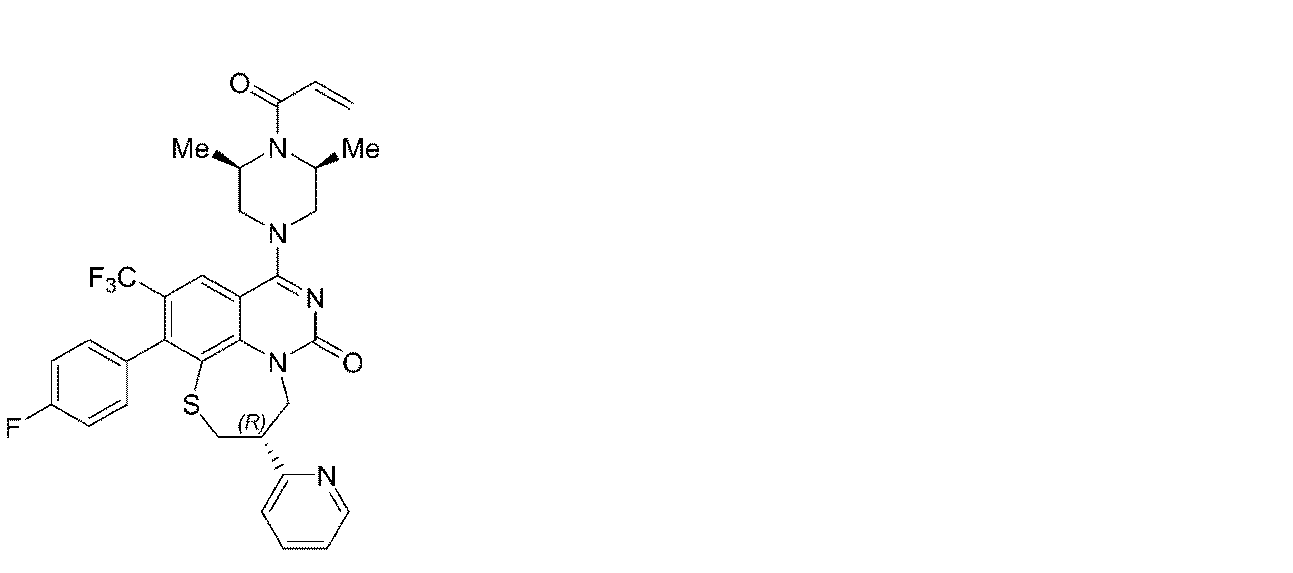
tert-ブチル(2S,6R)-4-((3S)-11-(5-クロロ-2,4-ジフルオロフェニル)-6-オキソ-3-(ピリジン-4-イル)-10-(トリフルオロメチル)-3,4-ジヒドロ-2H,6H-[1,4]チアゼピノ[2,3,4-ij]キナゾリン-8-イル)-2,6-ジメチルピペラジン-1-カルボキシレートを(R)-8-((3S,5R)-3,5-ジメチルピペラジン-1-イル)-11-(4-フルオロフェニル)-3-(ピリジン-2-イル)-10-(トリフルオロメチル)-3,4-ジヒドロ-2H,6H-[1,4]チアゼピノ[2,3,4-ij]キナゾリン-6-オンに置き換えて、表題化合物を実施例100のステップ11と同様に調製した。表題化合物を収率33%で黄色の固体として単離した。MS (ESI) m/z: 624.3 [M+H]+.1H NMR (400 MHz, CDCl3-d) δ, 8.46 (br d, J = 4.4 Hz, 1H), 8.03 (s, 1H), 7.59 (dt, J = 1.6, 7.6 Hz, 1H), 7.23 (d, J = 7.6 Hz, 1H), 7.17 - 7.06 (m, 5H), 6.57 (dd, J = 10.4, 16.8 Hz, 1H), 6.35 (dd, J = 1.6, 16.8 Hz, 1H), 5.76 - 5.65 (m, 1H), 4.92 (br d, J = 4.4 Hz, 2H), 4.76 - 4.39 (m, 2H), 4.15 - 4.07 (m, 2H), 3.92 - 3.75 (m, 1H), 3.59 - 3.40 (m, 2H), 3.32 - 3.23 (m, 2H), 1.46 (br d, J = 6.8 Hz, 6H). The title compound was prepared similarly to step 11 of Example 100, replacing tert-butyl (2S,6R)-4-((3S)-11-(5-chloro-2,4-difluorophenyl)-6-oxo-3-(pyridin-4-yl)-10-(trifluoromethyl)-3,4-dihydro-2H,6H-[1,4]thiazepino[2,3,4-ij]quinazolin-8-yl)-2,6-dimethylpiperazine-1-carboxylate with (R)-8-((3S,5R)-3,5-dimethylpiperazin-1-yl)-11-(4-fluorophenyl)-3-(pyridin-2-yl)-10-(trifluoromethyl)-3,4-dihydro-2H,6H-[1,4]thiazepino[2,3,4-ij]quinazolin-6-one. The title compound was isolated in 33% yield as a yellow solid. MS (ESI) m/z: 624.3 [M+H]+. 1H NMR (400 MHz, CDCl3-d) δ, 8.46 (br d, J = 4.4 Hz, 1H), 8.03 (s, 1H), 7.59 (dt, J = 1.6, 7.6 Hz, 1H), 7.23 (d, J = 7.6 Hz, 1H), 7.17 - 7.06 (m, 5H), 6.57 (dd, J = 10.4, 16.8 Hz, 1H), 6.35 (dd, J = 1.6, 16.8 Hz, 1H), 5.76 - 5.65 (m, 1H), 4.92 (br d, J = 4.4 Hz, 2H), 4.76 - 4.39 (m, 2H), 4.15 - 4.07 (m, 2H), 3.92 - 3.75 (m, 1H), 3.59 - 3.40 (m, 2H), 3.32 - 3.23 (m, 2H), 1.46 (br d, J = 6.8 Hz, 6H).
実施例107a及び実施例107b:(3R,11S)-8-((3S,5R)-4-アクリロイル-3,5-ジメチルピペラジン-1-イル)-11-(5-ブロモ-2,4-ジフルオロフェニル)-3-(ピリジン-2-イル)-10-(トリフルオロメチル)-3,4-ジヒドロ-2H,6H-[1,4]チアゼピノ[2,3,4-ij]キナゾリン-6-オン及び(3R,11R)-8-((3S,5R)-4-アクリロイル-3,5-ジメチルピペラジン-1-イル)-11-(5-ブロモ-2,4-ジフルオロフェニル)-3-(ピリジン-2-イル)-10-(トリフルオロメチル)-3,4-ジヒドロ-2H,6H-[1,4]チアゼピノ[2,3,4-ij]キナゾリン-6-オン
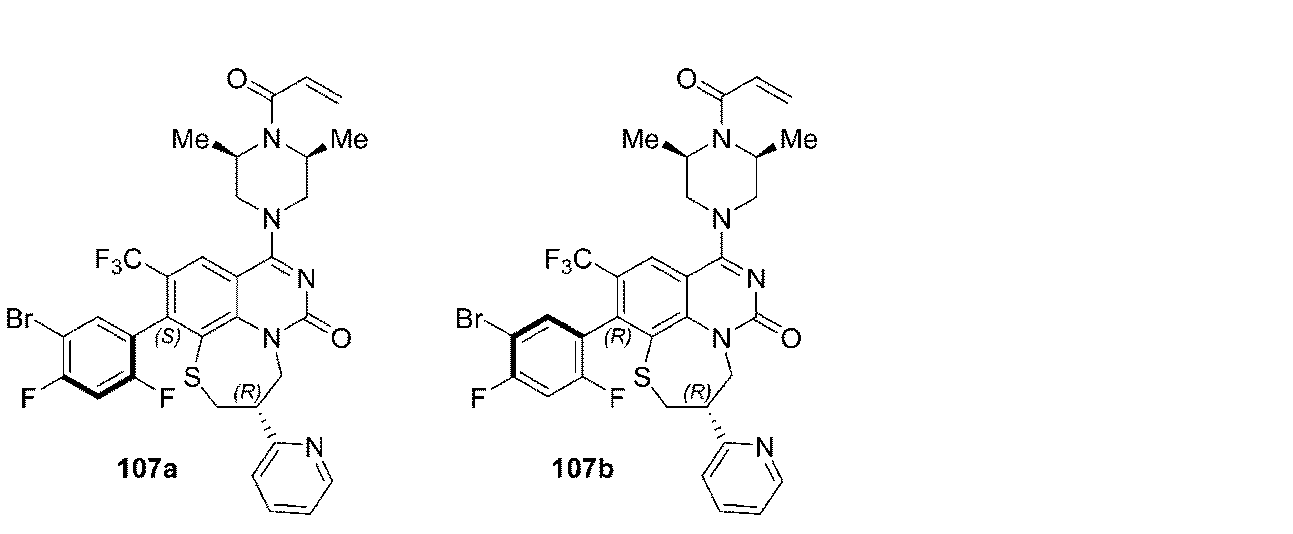
tert-ブチル(2S,6R)-4-((S)-11-クロロ-6-オキソ-3-(ピリジン-4-イル)-10-(トリフルオロメチル)-3,4-ジヒドロ-2H,6H-[1,4]チアゼピノ[2,3,4-ij]キナゾリン-8-イル)-2,6-ジメチルピペラジン-1-カルボキシレートをtert-ブチル(2S,6R)-4-((R)-11-クロロ-6-オキソ-3-(ピリジン-2-イル)-10-(トリフルオロメチル)-3,4-ジヒドロ-2H,6H-[1,4]チアゼピノ[2,3,4-ij]キナゾリン-8-イル)-2,6-ジメチルピペラジン-1-カルボキシレートに置き換えて、表題化合物を実施例102と同様に調製した。表題化合物をジアステレオマーの1:1混合物として得た。各々の個々のジアステレオマーを、SFC(Chiracel Chiralpak AD、250×30mm、10um、CO2中の45%イソプロパノール(0.1%水酸化アンモニウムを含有)を移動相として使用)による前述の混合物の精製によって得、分析SFC(Chiralpak AD、50×4.6mm、3um、CO2中の40%イソプロパノール(0.05%ジエチルアミンを含有)を移動相として3mL/分で使用)によって特性評価した。 The title compound was prepared in the same manner as in Example 102, except that tert-butyl (2S,6R)-4-((S)-11-chloro-6-oxo-3-(pyridin-4-yl)-10-(trifluoromethyl)-3,4-dihydro-2H,6H-[1,4]thiazepino[2,3,4-ij]quinazolin-8-yl)-2,6-dimethylpiperazine-1-carboxylate was substituted with tert-butyl (2S,6R)-4-((R)-11-chloro-6-oxo-3-(pyridin-2-yl)-10-(trifluoromethyl)-3,4-dihydro-2H,6H-[1,4]thiazepino[2,3,4-ij]quinazolin-8-yl)-2,6-dimethylpiperazine-1-carboxylate. The title compound was obtained as a 1:1 mixture of diastereomers. Each individual diastereomer was obtained by purification of the aforementioned mixture by SFC (Chiracel Chiralpak AD, 250 x 30 mm, 10 um, using 45% isopropanol in CO2 (containing 0.1% ammonium hydroxide) as the mobile phase) and characterized by analytical SFC (Chiralpak AD, 50 x 4.6 mm, 3 um, using 40% isopropanol in CO2 (containing 0.05% diethylamine) as the mobile phase at 3 mL/min).
実施例107a:Rt=0.46分. MS (ESI) m/z: 721.9 [M+H]+. 1H NMR 1H NMR (400 MHz, CDCl3-d) δ, 8.57 (br d, J = 4.4 Hz, 1H), 8.12 (s, 1H), 7.73 - 7.64 (m, 1H), 7.42 (t, J = 7.2 Hz, 1H), 7.36 - 7.30 (m, 1H), 7.23 - 7.16 (m, 1H), 7.06 - 6.97 (m, 1H), 6.64 (dd, J = 10.4, 16.8 Hz, 1H), 6.43 (dd, J = 2.0, 16.8 Hz, 1H), 5.79 (dd, J = 2.0, 10.4 Hz, 1H), 5.08 - 4.93 (m, 2H), 4.84 - 4.49 (m, 2H), 4.22 - 4.13 (m, 2H), 4.01 - 3.91 (m, 1H), 3.71 - 3.52 (m, 2H), 3.41 - 3.32 (m, 2H), 1.55 (br d, J = 7.2 Hz, 6H). Example 107a: Rt=0.46 min. MS (ESI) m/z: 721.9 [M+H]+. 1 H NMR 1 H NMR (400 MHz, CDCl 3 -d) δ, 8.57 (br d, J = 4.4 Hz, 1H), 8.12 (s, 1H), 7.73 - 7.64 (m, 1H), 7.42 (t, J = 7.2 Hz, 1H), 7.36 - 7.30 (m, 1H), 7.23 - 7.16 (m, 1H), 7.06 - 6.97 (m, 1H), 6.64 (dd, J = 10.4, 16.8 Hz, 1H), 6.43 (dd, J = 2.0, 16.8 Hz, 1H), 5.79 (dd, J = 2.0, 10.4 Hz, 1H), 5.08 - 4.93 (m, 2H), 4.84 - 4.49 (m, 2H), 4.22 - 4.13 (m, 2H), 4.01 - 3.91 (m, 1H), 3.71 - 3.52 (m, 2H), 3.41 - 3.32 (m, 2H), 1.55 (br d, J = 7.2 Hz, 6H).
実施例107b:Rt=0.83分. MS (ESI) m/z: 721.9 [M+H]+. 1H NMR (400 MHz, CDCl3-d) δ, 8.47 (br s, 1H), 8.11 - 8.01 (m, 1H), 7.67 - 7.55 (m, 1H), 7.35 (br t, J = 7.2 Hz, 1H), 7.26 (br d, J = 7.2 Hz, 1H), 7.15 - 7.10 (m, 1H), 6.95 (t, J = 8.8 Hz, 1H), 6.56 (dd, J = 10.4, 16.8 Hz, 1H), 6.35 (dd, J = 2.0, 16.8 Hz, 1H), 5.74 - 5.68 (m, 1H), 4.92 (br d, J = 4.4 Hz, 2H), 4.74 - 4.23 (m, 2H), 4.09 (br d, J = 12.8 Hz, 2H), 3.95 - 3.76 (m, 1H), 3.70 - 3.35 (m, 2H), 3.34 - 3.21 (m, 2H), 1.49 (br s, 6H). Example 107b: Rt=0.83 min. MS (ESI) m/z: 721.9 [M+H]+. 1H NMR (400 MHz, CDCl3-d) δ, 8.47 (br s, 1H), 8.11 - 8.01 (m, 1H), 7.67 - 7.55 (m, 1H), 7.35 (br t, J = 7.2 Hz, 1H), 7.26 (br d, J = 7.2 Hz, 1H), 7.15 - 7.10 (m, 1H), 6.95 (t, J = 8.8 Hz, 1H), 6.56 (dd, J = 10.4, 16.8 Hz, 1H), 6.35 (dd, J = 2.0, 16.8 Hz, 1H), 5.74 - 5.68 (m, 1H), 4.92 (br d, J = 4.4 Hz, 2H), 4.74 - 4.23 (m, 2H), 4.09 (br d, J = 12.8 Hz, 2H), 3.95 - 3.76 (m, 1H), 3.70 - 3.35 (m, 2H), 3.34 - 3.21 (m, 2H), 1.49 (br s, 6H).
実施例108a及び実施例108b:(3S,11R)-8-((3S,5R)-4-アクリロイル-3,5-ジメチルピペラジン-1-イル)-11-(5-ブロモ-2,4-ジフルオロフェニル)-3-(ピリジン-3-イル)-10-(トリフルオロメチル)-3,4-ジヒドロ-2H,6H-[1,4]チアゼピノ[2,3,4-ij]キナゾリン-6-オン及び(3S,11S)-8-((3S,5R)-4-アクリロイル-3,5-ジメチルピペラジン-1-イル)-11-(5-ブロモ-2,4-ジフルオロフェニル)-3-(ピリジン-3-イル)-10-(トリフルオロメチル)-3,4-ジヒドロ-2H,6H-[1,4]チアゼピノ[2,3,4-ij]キナゾリン-6-オン
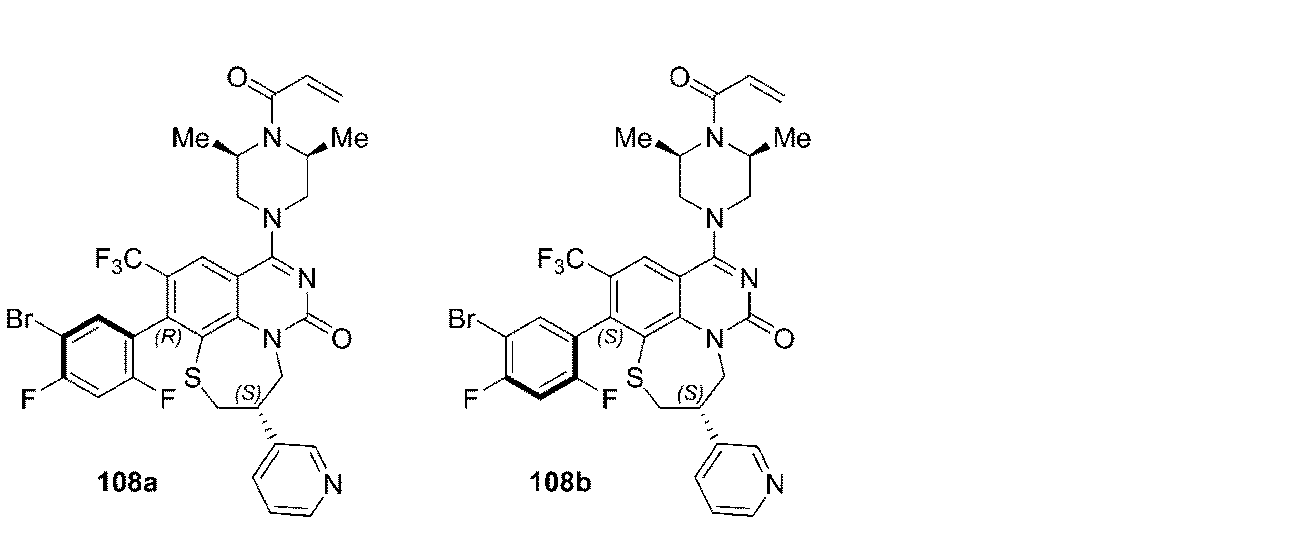
tert-ブチル(2S,6R)-4-((S)-11-クロロ-6-オキソ-3-(ピリジン-4-イル)-10-(トリフルオロメチル)-3,4-ジヒドロ-2H,6H-[1,4]チアゼピノ[2,3,4-ij]キナゾリン-8-イル)-2,6-ジメチルピペラジン-1-カルボキシレートをtert-ブチル(2S,6R)-4-((S)-11-クロロ-6-オキソ-3-(ピリジン-3-イル)-10-(トリフルオロメチル)-3,4-ジヒドロ-2H,6H-[1,4]チアゼピノ[2,3,4-ij]キナゾリン-8-イル)-2,6-ジメチルピペラジン-1-カルボキシレートに置き換えて、表題化合物を実施例102と同様に調製した。表題化合物をジアステレオマーの1:1混合物として得た。各々の個々のジアステレオマーを、SFC(Phenomenex cellulose-2、250×30mm、10um、CO2中の70%メタノールを移動相として使用)による前述の混合物の精製によって得、分析SFC(Unichiral OZ-5H、50×4.6mm、3um、CO2中の60%メタノール(0.05%ジエチルアミンを含有)を移動相として3mL/分で使用)によって特性評価した。 The title compound was prepared in the same manner as in Example 102, except that tert-butyl (2S,6R)-4-((S)-11-chloro-6-oxo-3-(pyridin-4-yl)-10-(trifluoromethyl)-3,4-dihydro-2H,6H-[1,4]thiazepino[2,3,4-ij]quinazolin-8-yl)-2,6-dimethylpiperazine-1-carboxylate was substituted with tert-butyl (2S,6R)-4-((S)-11-chloro-6-oxo-3-(pyridin-3-yl)-10-(trifluoromethyl)-3,4-dihydro-2H,6H-[1,4]thiazepino[2,3,4-ij]quinazolin-8-yl)-2,6-dimethylpiperazine-1-carboxylate. The title compound was obtained as a 1:1 mixture of diastereomers. Each individual diastereomer was obtained by purification of the aforementioned mixture by SFC (Phenomenex cellulose-2, 250 x 30 mm, 10 um, using 70% methanol in CO2 as the mobile phase) and characterized by analytical SFC (Unichiral OZ-5H, 50 x 4.6 mm, 3 um, using 60% methanol in CO2 (containing 0.05% diethylamine) as the mobile phase at 3 mL/min).
実施例108a:Rt=1.89分. MS (ESI) m/z: 720.0 [M+H]+. 1H NMR (400 MHz, CDCl3) δ 9.15 - 8.23 (m, 1H), 8.15 (s, 1H), 7.75 (d, J = 6.8 Hz, 1H), 7.42 (t, J = 7.2 Hz, 1H), 7.37 - 7.27 (m, 2H), 7.08 (t, J = 8.4 Hz, 1H), 6.70 - 6.58 (m, 1H), 6.43 (dd, J = 2.0, 16.4 Hz, 1H), 5.80 (dd, J = 2.0, 10.4 Hz, 1H), 5.09 - 4.31 (m, 4H), 4.19 (d, J = 12.8 Hz, 2H), 3.97 - 3.54 (m, 2H), 3.46 - 3.34 (m, 2H), 3.29 - 2.97 (m, 1H), 1.60 (d, J = 6.8 Hz, 3H), 1.53 (d, J = 6.8 Hz, 3H). Example 108a: Rt=1.89 min. MS (ESI) m/z: 720.0 [M+H]+. 1H NMR (400 MHz, CDCl3) δ 9.15 - 8.23 (m, 1H), 8.15 (s, 1H), 7.75 (d, J = 6.8 Hz, 1H), 7.42 (t, J = 7.2 Hz, 1H), 7.37 - 7.27 (m, 2H), 7.08 (t, J = 8.4 Hz, 1H), 6.70 - 6.58 (m, 1H), 6.43 (dd, J = 2.0, 16.4 Hz, 1H), 5.80 (dd, J = 2.0, 10.4 Hz, 1H), 5.09 - 4.31 (m, 4H), 4.19 (d, J = 12.8 Hz, 2H), 3.97 - 3.54 (m, 2H), 3.46 - 3.34 (m, 2H), 3.29 - 2.97 (m, 1H), 1.60 (d, J = 6.8 Hz, 3H), 1.53 (d, J = 6.8 Hz, 3H).
実施例108b:Rt=3.03分. MS (ESI) m/z: 720.0 [M+H]+. 1H NMR (400 MHz, CDCl3) δ 9.10 - 8.29 (m, 1H), 8.14 (s, 1H), 7.84 - 7.73 (m, 1H), 7.46 (t, J = 7.0 Hz, 1H), 7.38 - 7.27 (m, 2H), 7.04 (t, J = 8.4 Hz, 1H), 6.64 (dd, J = 10.4, 16.4 Hz, 1H), 6.48 - 6.38 (m, 1H), 5.80 (dd, J = 1.6, 10.4 Hz, 1H), 5.07 - 4.42 (m, 4H), 4.19 (dd, J = 5.2, 13.6 Hz, 2H), 3.98 - 3.71 (m, 2H), 3.45 - 3.36 (m, 2H), 3.17 - 3.09 (m, 1H), 1.59 (d, J = 6.8 Hz, 3H), 1.54 (d, J = 6.8 Hz, 3H). Example 108b: Rt=3.03 minutes. MS (ESI) m/z: 720.0 [M+H]+. 1H NMR (400 MHz, CDCl 3 ) δ 9.10 - 8.29 (m, 1H), 8.14 (s, 1H), 7.84 - 7.73 (m, 1H), 7.46 (t, J = 7.0 Hz, 1H), 7.38 - 7.27 (m, 2H), 7.04 (t, J = 8.4 Hz, 1H), 6.64 (dd, J = 10.4, 16.4 Hz, 1H), 6.48 - 6.38 (m, 1H), 5.80 (dd, J = 1.6, 10.4 Hz, 1H), 5.07 - 4.42 (m, 4H), 4.19 (dd, J = 5.2, 13.6 Hz, 2H), 3.98 - 3.71 (m, 2H), 3.45 - 3.36 (m, 2H), 3.17 - 3.09 (m, 1H), 1.59 (d, J = 6.8 Hz, 3H), 1.54 (d, J = 6.8 Hz, 3H).
実施例102:(3S)-8-((3S,5R)-4-アクリロイル-3,5-ジメチルピペラジン-1-イル)-11-(5-クロロ-2,4-ジフルオロフェニル)-3-(5-フルオロピリジン-3-イル)-10-(トリフルオロメチル)-3,4-ジヒドロ-2H,6H-[1,4]チアゼピノ[2,3,4-ij]キナゾリン-6-オン
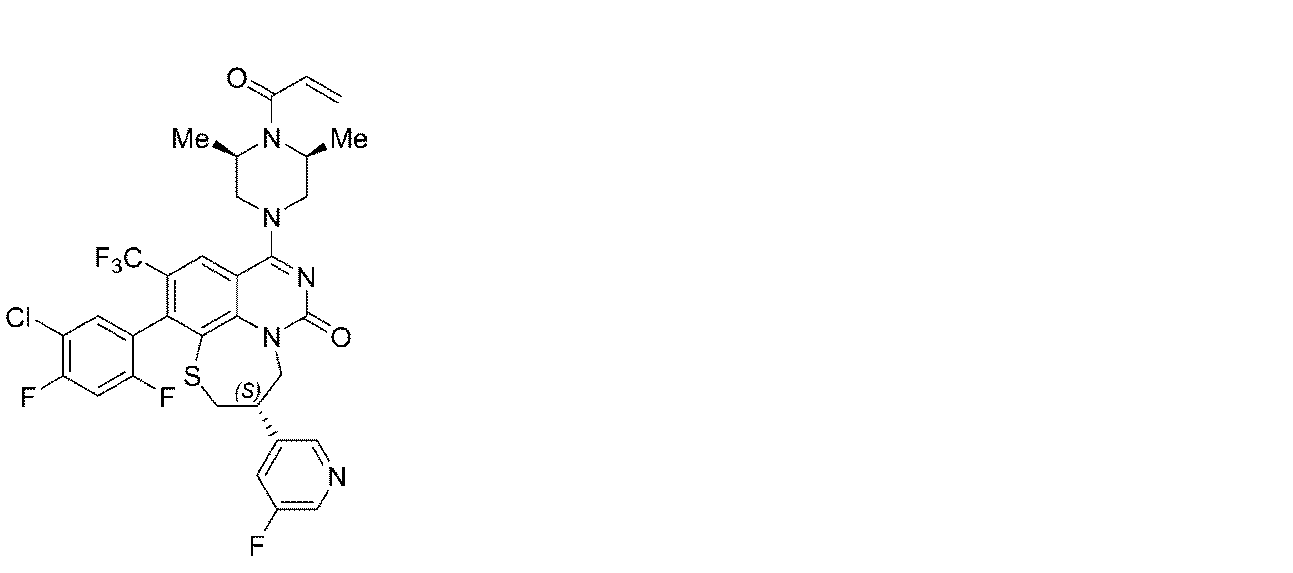
ステップ1:tert-ブチル(2S,6R)-4-((R)-11-クロロ-3-(5-フルオロピリジン-3-イル)-6-オキソ-10-(トリフルオロメチル)-3,4-ジヒドロ-2H,6H-[1,4]チアゼピノ[2,3,4-ij]キナゾリン-8-イル)-2,6-ジメチルピペラジン-1-カルボキシレート及びtert-ブチル(2S,6R)-4-((S)-11-クロロ-3-(5-フルオロピリジン-3-イル)-6-オキソ-10-(トリフルオロメチル)-3,4-ジヒドロ-2H,6H-[1,4]チアゼピノ[2,3,4-ij]キナゾリン-8-イル)-2,6-ジメチルピペラジン-1-カルボキシレート

ステップ1においてピリジン-3-イルボロン酸を(5-フルオロピリジン-3-イル)ボロン酸に置き換えて、表題化合物を実施例104a及び104bと同様に調製した。表題化合物をジアステレオマーの1:1混合物として得、各々の個々のジアステレオマーをSFC(Chiracel Chiralpak IC 250×30mm、10um、CO2中の65%エタノールを移動相として使用)による前述の混合物の精製によって単離し、分析SFC(Chiralpak IC-3、50×4.6mm、3um、CO2中の60%エタノール(0.05%ジエチルアミンを含有)を移動相として3mL/分で使用)によって特性評価した。 The title compound was prepared similarly to Examples 104a and 104b, substituting (5-fluoropyridin-3-yl)boronic acid for pyridin-3-ylboronic acid in step 1. The title compound was obtained as a 1:1 mixture of diastereomers, and each individual diastereomer was isolated by purification of the aforementioned mixture by SFC (Chiracel Chiralpak IC 250x30mm, 10um, using 65% ethanol in CO2 as the mobile phase) and characterized by analytical SFC (Chiralpak IC-3, 50x4.6mm, 3um, using 60% ethanol in CO2 (containing 0.05% diethylamine) as the mobile phase at 3mL/min).
tert-ブチル(2S,6R)-4-((R)-11-クロロ-3-(5-フルオロピリジン-3-イル)-6-オキソ-10-(トリフルオロメチル)-3,4-ジヒドロ-2H,6H-[1,4]チアゼピノ[2,3,4-ij]キナゾリン-8-イル)-2,6-ジメチルピペラジン-1-カルボキシレート:Rt=1.58分. MS (ESI) m/z: 628.1 [M+H]+. tert-Butyl (2S,6R)-4-((R)-11-chloro-3-(5-fluoropyridin-3-yl)-6-oxo-10-(trifluoromethyl)-3,4-dihydro-2H,6H-[1,4]thiazepino[2,3,4-ij]quinazolin-8-yl)-2,6-dimethylpiperazine-1-carboxylate: Rt = 1.58 min. MS (ESI) m/z: 628.1 [M+H]+.
tert-ブチル(2S,6R)-4-((S)-11-クロロ-3-(5-フルオロピリジン-3-イル)-6-オキソ-10-(トリフルオロメチル)-3,4-ジヒドロ-2H,6H-[1,4]チアゼピノ[2,3,4-ij]キナゾリン-8-イル)-2,6-ジメチルピペラジン-1-カルボキシレート:Rt=2.87分. MS (ESI) m/z: 628.1 [M+H]+. tert-Butyl (2S,6R)-4-((S)-11-chloro-3-(5-fluoropyridin-3-yl)-6-oxo-10-(trifluoromethyl)-3,4-dihydro-2H,6H-[1,4]thiazepino[2,3,4-ij]quinazolin-8-yl)-2,6-dimethylpiperazine-1-carboxylate: Rt = 2.87 min. MS (ESI) m/z: 628.1 [M+H]+.
ステップ2:tert-ブチル(2S,6R)-4-((3S)-11-(5-クロロ-2,4-ジフルオロフェニル)-3-(5-フルオロピリジン-3-イル)-6-オキソ-10-(トリフルオロメチル)-3,4-ジヒドロ-2H,6H-[1,4]チアゼピノ[2,3,4-ij]キナゾリン-8-イル)-2,6-ジメチルピペラジン-1-カルボキシレート
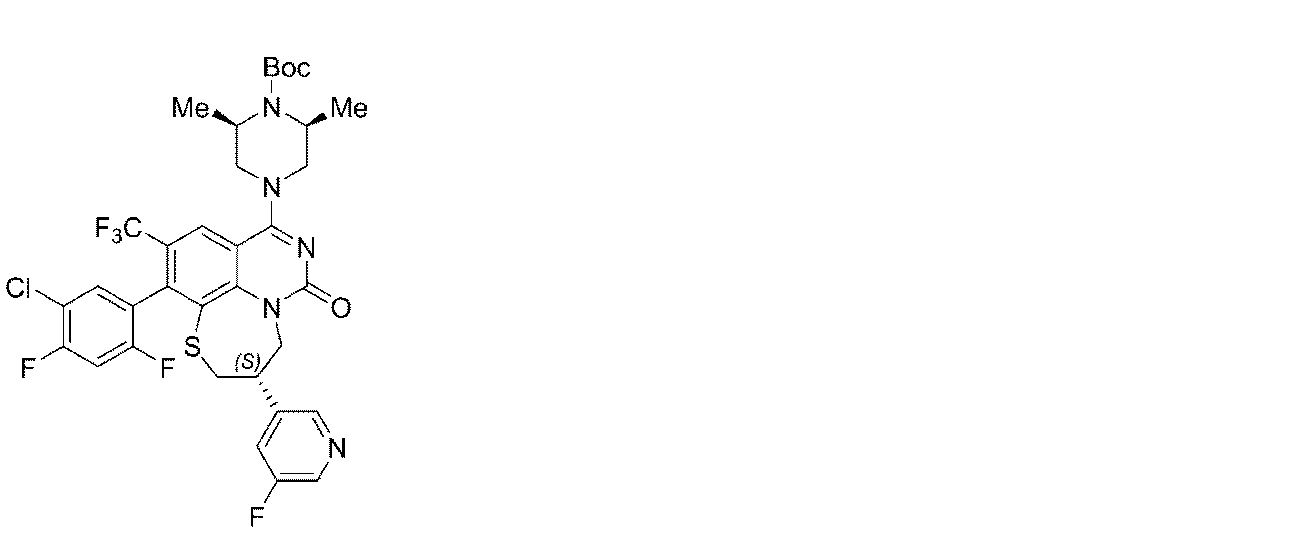
tert-ブチル(2S,6R)-4-((S)-11-クロロ-6-オキソ-3-(ピリジン-4-イル)-10-(トリフルオロメチル)-3,4-ジヒドロ-2H,6H-[1,4]チアゼピノ[2,3,4-ij]キナゾリン-8-イル)-2,6-ジメチルピペラジン-1-カルボキシレートをtert-ブチル(2S,6R)-4-((S)-11-クロロ-3-(5-フルオロピリジン-3-イル)-6-オキソ-10-(トリフルオロメチル)-3,4-ジヒドロ-2H,6H-[1,4]チアゼピノ[2,3,4-ij]キナゾリン-8-イル)-2,6-ジメチルピペラジン-1-カルボキシレートに置き換えて、表題化合物を実施例100のステップ9と同様に調製した。表題化合物を収率85%で黄色の固体として単離した。MS (ESI) m/z: 740.0 [M+H]+. The title compound was prepared similarly to step 9 of Example 100, replacing tert-butyl (2S,6R)-4-((S)-11-chloro-6-oxo-3-(pyridin-4-yl)-10-(trifluoromethyl)-3,4-dihydro-2H,6H-[1,4]thiazepino[2,3,4-ij]quinazolin-8-yl)-2,6-dimethylpiperazine-1-carboxylate with tert-butyl (2S,6R)-4-((S)-11-chloro-3-(5-fluoropyridin-3-yl)-6-oxo-10-(trifluoromethyl)-3,4-dihydro-2H,6H-[1,4]thiazepino[2,3,4-ij]quinazolin-8-yl)-2,6-dimethylpiperazine-1-carboxylate. The title compound was isolated as a yellow solid in 85% yield. MS (ESI) m/z: 740.0 [M+H]+.
ステップ3:(3S)-11-(5-クロロ-2,4-ジフルオロフェニル)-8-((3S,5R)-3,5-ジメチルピペラジン-1-イル)-3-(5-フルオロピリジン-3-イル)-10-(トリフルオロメチル)-3,4-ジヒドロ-2H,6H-[1,4]チアゼピノ[2,3,4-ij]キナゾリン-6-オン

tert-ブチル(2S,6R)-4-((3S)-11-(5-クロロ-2,4-ジフルオロフェニル)-6-オキソ-3-(ピリジン-4-イル)-10-(トリフルオロメチル)-3,4-ジヒドロ-2H,6H-[1,4]チアゼピノ[2,3,4-ij]キナゾリン-8-イル)-2,6-ジメチルピペラジン-1-カルボキシレートをtert-ブチル(2S,6R)-4-((3S)-11-(5-クロロ-2,4-ジフルオロフェニル)-3-(5-フルオロピリジン-3-イル)-6-オキソ-10-(トリフルオロメチル)-3,4-ジヒドロ-2H,6H-[1,4]チアゼピノ[2,3,4-ij]キナゾリン-8-イル)-2,6-ジメチルピペラジン-1-カルボキシレートに置き換えて、表題化合物を実施例100のステップ10と同様に調製した。表題化合物を収率99%で黄色の固体として単離した。MS (ESI) m/z: 640.0 [M+H]+. tert-Butyl (2S,6R)-4-((3S)-11-(5-chloro-2,4-difluorophenyl)-6-oxo-3-(pyridin-4-yl)-10-(trifluoromethyl)-3,4-dihydro-2H,6H-[1,4]thiazepino[2,3,4-ij]quinazolin-8-yl)-2,6-dimethylpiperazine-1-carboxylate was reacted with tert-butyl (2S,6R)-4-(( The title compound was prepared similarly to step 10 of Example 100, substituting 3S)-11-(5-chloro-2,4-difluorophenyl)-3-(5-fluoropyridin-3-yl)-6-oxo-10-(trifluoromethyl)-3,4-dihydro-2H,6H-[1,4]thiazepino[2,3,4-ij]quinazolin-8-yl)-2,6-dimethylpiperazine-1-carboxylate. The title compound was isolated in 99% yield as a yellow solid. MS (ESI) m/z: 640.0 [M+H]+.
ステップ4:(3S)-8-((3S,5R)-4-アクリロイル-3,5-ジメチルピペラジン-1-イル)-11-(5-クロロ-2,4-ジフルオロフェニル)-3-(5-フルオロピリジン-3-イル)-10-(トリフルオロメチル)-3,4-ジヒドロ-2H,6H-[1,4]チアゼピノ[2,3,4-ij]キナゾリン-6-オン

(3S)-11-(5-クロロ-2,4-ジフルオロフェニル)-8-((3S,5R)-3,5-ジメチルピペラジン-1-イル)-3-(ピリジン-4-イル)-10-(トリフルオロメチル)-3,4-ジヒドロ-2H,6H-[1,4]チアゼピノ[2,3,4-ij]キナゾリン-6-オンを(3S)-11-(5-クロロ-2,4-ジフルオロフェニル)-8-((3S,5R)-3,5-ジメチルピペラジン-1-イル)-3-(5-フルオロピリジン-3-イル)-10-(トリフルオロメチル)-3,4-ジヒドロ-2H,6H-[1,4]チアゼピノ[2,3,4-ij]キナゾリン-6-オンに置き換えて、表題化合物を実施例100のステップ9と同様に調製した。表題化合物を収率21%で白色の固体として単離した。MS (ESI) m/z: 694.4 [M+H]+. 1H NMR (400 MHz, CDCl3) δ 8.48 (s, 1H), 8.43 (d, J = 2.4 Hz, 1H), 8.14 (s, 1H), 7.48 (d, J = 9.2 Hz, 1H), 7.36 - 7.27 (m, 1H), 7.14 - 7.03 (m, 1H), 6.68 - 6.60 (m, 1H), 6.47 - 6.40 (m, 1H), 5.80 (d, J = 11.6 Hz, 1H), 4.97 - 4.54 (m, 4H), 4.19 (dd, J = 5.2, 12.0 Hz, 2H), 3.96 - 3.67 (m, 2H), 3.41 (t, J = 4.4, 12.4 Hz, 2H), 3.20 - 3.04 (m, 1H), 1.59 (d, J = 6.8 Hz, 3H), 1.54 (d, J = 6.8 Hz, 3H). The title compound was prepared similarly to step 9 of Example 100, replacing (3S)-11-(5-chloro-2,4-difluorophenyl)-8-((3S,5R)-3,5-dimethylpiperazin-1-yl)-3-(pyridin-4-yl)-10-(trifluoromethyl)-3,4-dihydro-2H,6H-[1,4]thiazepino[2,3,4-ij]quinazolin-6-one with (3S)-11-(5-chloro-2,4-difluorophenyl)-8-((3S,5R)-3,5-dimethylpiperazin-1-yl)-3-(5-fluoropyridin-3-yl)-10-(trifluoromethyl)-3,4-dihydro-2H,6H-[1,4]thiazepino[2,3,4-ij]quinazolin-6-one. The title compound was isolated as a white solid in 21% yield. MS (ESI) m/z: 694.4 [M+H]+. 1H NMR (400 MHz, CDCl3) δ 8.48 (s, 1H), 8.43 (d, J = 2.4 Hz, 1H), 8.14 (s, 1H), 7.48 (d, J = 9.2 Hz, 1H), 7.36 - 7.27 (m, 1H), 7.14 - 7.03 (m, 1H), 6.68 - 6.60 (m, 1H), 6.47 - 6.40 (m, 1H), 5.80 (d, J = 11.6 Hz, 1H), 4.97 - 4.54 (m, 4H), 4.19 (dd, J = 5.2, 12.0 Hz, 2H), 3.96 - 3.67 (m, 2H), 3.41 (t, J = 4.4, 12.4 Hz, 2H), 3.20 - 3.04 (m, 1H), 1.59 (d, J = 6.8 Hz, 3H), 1.54 (d, J = 6.8 Hz, 3H).
実施例112a及び実施例112b:(3S,11S)-8-((3S,5R)-4-アクリロイル-3,5-ジメチルピペラジン-1-イル)-11-(5-クロロ-2,4-ジフルオロフェニル)-3-(3-フルオロピリジン-4-イル)-10-(トリフルオロメチル)-3,4-ジヒドロ-2H,6H-[1,4]チアゼピノ[2,3,4-ij]キナゾリン-6-オン(112a)及び(3S,11R)-8-((3S,5R)-4-アクリロイル-3,5-ジメチルピペラジン-1-イル)-11-(5-クロロ-2,4-ジフルオロフェニル)-3-(3-フルオロピリジン-4-イル)-10-(トリフルオロメチル)-3,4-ジヒドロ-2H,6H-[1,4]チアゼピノ[2,3,4-ij]キナゾリン-6-オン(112b)
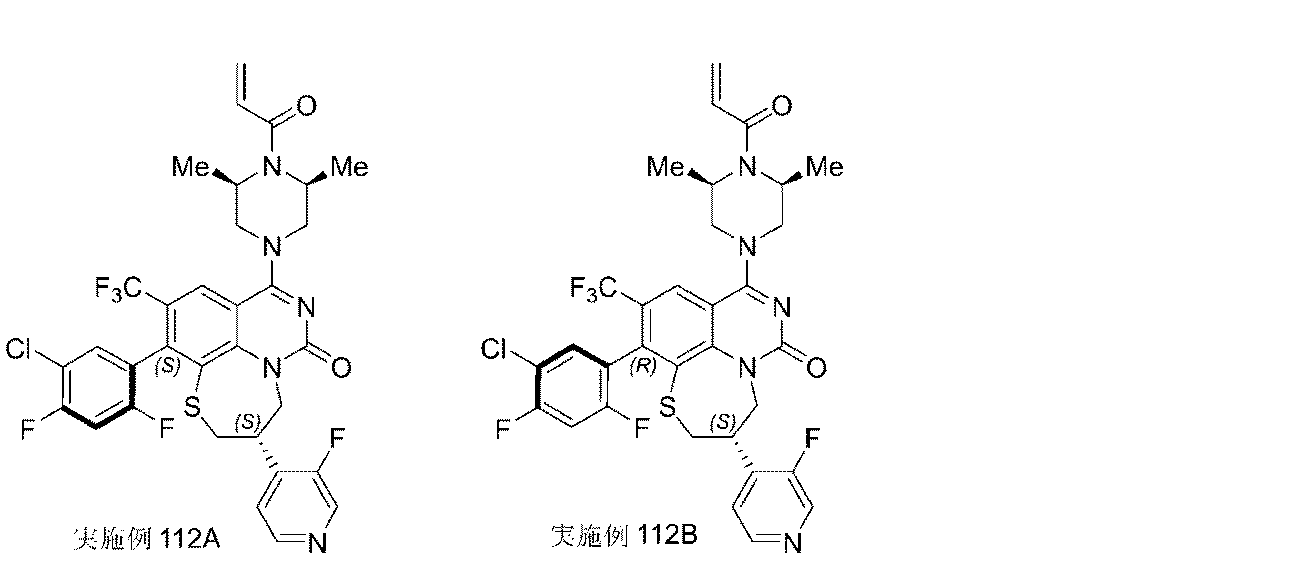
ステップ1:tert-ブチル(2S,6R)-4-((S)-11-クロロ-3-(3-フルオロピリジン-4-イル)-6-オキソ-10-(トリフルオロメチル)-3,4-ジヒドロ-2H,6H-[1,4]チアゼピノ[2,3,4-ij]キナゾリン-8-イル)-2,6-ジメチルピペラジン-1-カルボキシレート及びtert-ブチル(2S,6R)-4-((R)-11-クロロ-3-(3-フルオロピリジン-4-イル)-6-オキソ-10-(トリフルオロメチル)-3,4-ジヒドロ-2H,6H-[1,4]チアゼピノ[2,3,4-ij]キナゾリン-8-イル)-2,6-ジメチルピペラジン-1-カルボキシレート

ステップ4において4-メチルピリジンを3-フルオロ-4-メチルピリジンに置き換えて、表題化合物を実施例100と同様に調製した。これら2つの化合物をジアステレオマーの1:1混合物として得た。各々の個々のジアステレオマーを、SFC(Chiracel Chiralpak IC 250×30mm、10um、CO2中の60%メタノール(0.1%水酸化アンモニウムを含有)を移動相として使用)による前述の混合物の精製によって得、分析SFC((S,S)Whelk-O1、50×4.6mm、1.8um、CO2中の50%メタノール/アセトニトリル(4:1)(0.05%ジエチルアミンを含有)を移動相として3mL/分)によって特性評価した。 The title compound was prepared similarly to Example 100, substituting 3-fluoro-4-methylpyridine for 4-methylpyridine in step 4. The two compounds were obtained as a 1:1 mixture of diastereomers. Each individual diastereomer was obtained by purification of the aforementioned mixture by SFC (Chiracel Chiralpak IC 250x30mm, 10um, 60% methanol in CO2 (containing 0.1% ammonium hydroxide) as the mobile phase) and characterized by analytical SFC ((S,S)Whelk-O1, 50x4.6mm, 1.8um, 50% methanol/acetonitrile (4:1) in CO2 (containing 0.05% diethylamine) as the mobile phase, 3mL/min).
tert-ブチル(2S,6R)-4-((S)-11-クロロ-3-(3-フルオロピリジン-4-イル)-6-オキソ-10-(トリフルオロメチル)-3,4-ジヒドロ-2H,6H-[1,4]チアゼピノ[2,3,4-ij]キナゾリン-8-イル)-2,6-ジメチルピペラジン-1-カルボキシレート:Rt=1.41分. MS (ESI) m/z 628.4 [M+H]+. tert-Butyl (2S,6R)-4-((S)-11-chloro-3-(3-fluoropyridin-4-yl)-6-oxo-10-(trifluoromethyl)-3,4-dihydro-2H,6H-[1,4]thiazepino[2,3,4-ij]quinazolin-8-yl)-2,6-dimethylpiperazine-1-carboxylate: Rt = 1.41 min. MS (ESI) m/z 628.4 [M+H]+.
tert-ブチル(2S,6R)-4-((R)-11-クロロ-3-(3-フルオロピリジン-4-イル)-6-オキソ-10-(トリフルオロメチル)-3,4-ジヒドロ-2H,6H-[1,4]チアゼピノ[2,3,4-ij]キナゾリン-8-イル)-2,6-ジメチルピペラジン-1-カルボキシレート:Rt=1.81分.MS (ESI) m/z: 628.4 [M+H]+ tert-Butyl (2S,6R)-4-((R)-11-chloro-3-(3-fluoropyridin-4-yl)-6-oxo-10-(trifluoromethyl)-3,4-dihydro-2H,6H-[1,4]thiazepino[2,3,4-ij]quinazolin-8-yl)-2,6-dimethylpiperazine-1-carboxylate: Rt = 1.81 min. MS (ESI) m/z: 628.4 [M+H]+
ステップ2:tert-ブチル(2S,6R)-4-((3S)-11-(5-クロロ-2,4-ジフルオロフェニル)-3-(3-フルオロピリジン-4-イル)-6-オキソ-10-(トリフルオロメチル)-3,4-ジヒドロ-2H,6H-[1,4]チアゼピノ[2,3,4-ij]キナゾリン-8-イル)-2,6-ジメチルピペラジン-1-カルボキシレート

tert-ブチル(2S,6R)-4-((S)-11-クロロ-6-オキソ-3-(ピリジン-4-イル)-10-(トリフルオロメチル)-3,4-ジヒドロ-2H,6H-[1,4]チアゼピノ[2,3,4-ij]キナゾリン-8-イル)-2,6-ジメチルピペラジン-1-カルボキシレートをtert-ブチル(2S,6R)-4-((S)-11-クロロ-3-(3-フルオロピリジン-4-イル)-6-オキソ-10-(トリフルオロメチル)-3,4-ジヒドロ-2H,6H-[1,4]チアゼピノ[2,3,4-ij]キナゾリン-8-イル)-2,6-ジメチルピペラジン-1-カルボキシレートに置き換えて、表題化合物を実施例100のステップ9と同様に調製した。表題化合物を収率44%で黄色の固体として単離した。MS (ESI) m/z: 740.5 [M+H]+. The title compound was prepared similarly to step 9 of Example 100, replacing tert-butyl (2S,6R)-4-((S)-11-chloro-6-oxo-3-(pyridin-4-yl)-10-(trifluoromethyl)-3,4-dihydro-2H,6H-[1,4]thiazepino[2,3,4-ij]quinazolin-8-yl)-2,6-dimethylpiperazine-1-carboxylate with tert-butyl (2S,6R)-4-((S)-11-chloro-3-(3-fluoropyridin-4-yl)-6-oxo-10-(trifluoromethyl)-3,4-dihydro-2H,6H-[1,4]thiazepino[2,3,4-ij]quinazolin-8-yl)-2,6-dimethylpiperazine-1-carboxylate. The title compound was isolated as a yellow solid in 44% yield. MS (ESI) m/z: 740.5 [M+H]+.
ステップ2:(3S)-11-(5-クロロ-2,4-ジフルオロフェニル)-8-((3S,5R)-3,5-ジメチルピペラジン-1-イル)-3-(3-フルオロピリジン-4-イル)-10-(トリフルオロメチル)-3,4-ジヒドロ-2H,6H-[1,4]チアゼピノ[2,3,4-ij]キナゾリン-6-オン

tert-ブチル(2S,6R)-4-((3S)-11-(5-クロロ-2,4-ジフルオロフェニル)-6-オキソ-3-(ピリジン-4-イル)-10-(トリフルオロメチル)-3,4-ジヒドロ-2H,6H-[1,4]チアゼピノ[2,3,4-ij]キナゾリン-8-イル)-2,6-ジメチルピペラジン-1-カルボキシレートをtert-ブチル(2S,6R)-4-((3S)-11-(5-クロロ-2,4-ジフルオロフェニル)-3-(3-フルオロピリジン-4-イル)-6-オキソ-10-(トリフルオロメチル)-3,4-ジヒドロ-2H,6H-[1,4]チアゼピノ[2,3,4-ij]キナゾリン-8-イル)-2,6-ジメチルピペラジン-1-カルボキシレートに置き換えて、表題化合物を実施例100のステップ10と同様に調製した。表題化合物を収率98%で黄色の固体として単離した。MS (ESI) m/z: 640.5 [M+H]+. tert-Butyl (2S,6R)-4-((3S)-11-(5-chloro-2,4-difluorophenyl)-6-oxo-3-(pyridin-4-yl)-10-(trifluoromethyl)-3,4-dihydro-2H,6H-[1,4]thiazepino[2,3,4-ij]quinazolin-8-yl)-2,6-dimethylpiperazine-1-carboxylate was reacted with tert-butyl (2S,6R)-4-(( The title compound was prepared similarly to step 10 of Example 100, substituting 3S)-11-(5-chloro-2,4-difluorophenyl)-3-(3-fluoropyridin-4-yl)-6-oxo-10-(trifluoromethyl)-3,4-dihydro-2H,6H-[1,4]thiazepino[2,3,4-ij]quinazolin-8-yl)-2,6-dimethylpiperazine-1-carboxylate. The title compound was isolated in 98% yield as a yellow solid. MS (ESI) m/z: 640.5 [M+H]+.
ステップ3:(3S,11S)-8-((3S,5R)-4-アクリロイル-3,5-ジメチルピペラジン-1-イル)-11-(5-クロロ-2,4-ジフルオロフェニル)-3-(3-フルオロピリジン-4-イル)-10-(トリフルオロメチル)-3,4-ジヒドロ-2H,6H-[1,4]チアゼピノ[2,3,4-ij]キナゾリン-6-オン(実施例112a)及び(3S,11R)-8-((3S,5R)-4-アクリロイル-3,5-ジメチルピペラジン-1-イル)-11-(5-クロロ-2,4-ジフルオロフェニル)-3-(3-フルオロピリジン-4-イル)-10-(トリフルオロメチル)-3,4-ジヒドロ-2H,6H-[1,4]チアゼピノ[2,3,4-ij]キナゾリン-6-オン(実施例112b)

(3S)-11-(5-クロロ-2,4-ジフルオロフェニル)-8-((3S,5R)-3,5-ジメチルピペラジン-1-イル)-3-(ピリジン-4-イル)-10-(トリフルオロメチル)-3,4-ジヒドロ-2H,6H-[1,4]チアゼピノ[2,3,4-ij]キナゾリン-6-オンを(3S)-11-(5-クロロ-2,4-ジフルオロフェニル)-8-((3S,5R)-3,5-ジメチルピペラジン-1-イル)-3-(3-フルオロピリジン-4-イル)-10-(トリフルオロメチル)-3,4-ジヒドロ-2H,6H-[1,4]チアゼピノ[2,3,4-ij]キナゾリン-6-オンに置き換えて、表題化合物を実施100のステップ11と同様に調製した。これら2つの化合物を収率51%でジアステレオマーの1:1混合物として単離した。各々の個々のジアステレオマーを、SFC(Chiracel OD 250×30mm、10um、CO2中の50%メタノールを移動相として使用)による混合物の精製によって単離し、分析SFC(Chiralpak IC-3、50×4.6mm、3um、CO2中の60%メタノール/アセトニトリル(0.05%ジエチルアミンを含有)を移動相として3mL/分で使用)によって特性評価した。 The title compound was prepared similarly to step 11 of Example 100, replacing (3S)-11-(5-chloro-2,4-difluorophenyl)-8-((3S,5R)-3,5-dimethylpiperazin-1-yl)-3-(pyridin-4-yl)-10-(trifluoromethyl)-3,4-dihydro-2H,6H-[1,4]thiazepino[2,3,4-ij]quinazolin-6-one with (3S)-11-(5-chloro-2,4-difluorophenyl)-8-((3S,5R)-3,5-dimethylpiperazin-1-yl)-3-(3-fluoropyridin-4-yl)-10-(trifluoromethyl)-3,4-dihydro-2H,6H-[1,4]thiazepino[2,3,4-ij]quinazolin-6-one. The two compounds were isolated as a 1:1 mixture of diastereomers in 51% yield. Each individual diastereomer was isolated by purification of the mixture by SFC (Chiracel OD 250 x 30 mm, 10 um, using 50% methanol in CO2 as the mobile phase) and characterized by analytical SFC (Chiralpak IC-3, 50 x 4.6 mm, 3 um, using 60% methanol/acetonitrile (containing 0.05% diethylamine) in CO2 as the mobile phase at 3 mL/min).
(3S,11S)-8-((3S,5R)-4-アクリロイル-3,5-ジメチルピペラジン-1-イル)-11-(5-クロロ-2,4-ジフルオロフェニル)-3-(3-フルオロピリジン-4-イル)-10-(トリフルオロメチル)-3,4-ジヒドロ-2H,6H-[1,4]チアゼピノ[2,3,4-ij]キナゾリン-6-オン(実施例112a):Rt=0.92分. MS (ESI) m/z: 694.1 [M+H]+. 1H NMR (400 MHz, CDCl3) δ ppm 1.54 (d, J = 6.8 Hz, 3 H) 1.59 (d, J = 6.8 Hz, 3 H) 3.02 - 3.23 (m, 1 H) 3.42 (td, J = 12.4, 4.4 Hz, 2 H) 3.65 - 3.86 (m, 1 H) 4.11 - 4.24 (m, 3 H) 4.54 - 5.01 (m, 4 H) 5.74 - 5.84 (m, 1 H) 6.38 - 6.48 (m, 1 H) 6.58 - 6.70 (m, 1 H) 7.05 (t, J = 8.8 Hz, 1 H) 7.30 (t, J = 7.6 Hz, 2 H) 8.14 (s, 1 H) 8.32 - 8.61 (m, 2 H). (3S,11S)-8-((3S,5R)-4-Acryloyl-3,5-dimethylpiperazin-1-yl)-11-(5-chloro-2,4-difluorophenyl)-3-(3-fluoropyridin-4-yl)-10-(trifluoromethyl)-3,4-dihydro-2H,6H-[1,4]thiazepino[2,3,4-ij]quinazolin-6-one (Example 112a): Rt = 0.92 min. MS (ESI) m/z: 694.1 [M+H]+. 1H NMR (400 MHz, CDCl3) δ ppm 1.54 (d, J = 6.8 Hz, 3 H) 1.59 (d, J = 6.8 Hz, 3 H) 3.02 - 3.23 (m, 1 H) 3.42 (td, J = 12.4, 4.4 Hz, 2 H) 3.65 - 3.86 (m, 1 H) 4.11 - 4.24 (m, 3 H) 4.54 - 5.01 (m, 4 H) 5.74 - 5.84 (m, 1 H) 6.38 - 6.48 (m, 1 H) 6.58 - 6.70 (m, 1 H) 7.05 (t, J = 8.8 Hz, 1 H) 7.30 (t, J = 7.6 Hz, 2 H) 8.14 (s, 1 H) 8.32 - 8.61 (m, 2 H).
(3S,11R)-8-((3S,5R)-4-アクリロイル-3,5-ジメチルピペラジン-1-イル)-11-(5-クロロ-2,4-ジフルオロフェニル)-3-(3-フルオロピリジン-4-イル)-10-(トリフルオロメチル)-3,4-ジヒドロ-2H,6H-[1,4]チアゼピノ[2,3,4-ij]キナゾリン-6-オン(実施例112b):Rt=1.37分. MS (ESI) m/z: 694.1 [M+H]+. 1H NMR (400 MHz, CDCl3) δ ppm 1.53 (d, J = 6.4 Hz, 3 H) 1.59 (br s, 3 H) 2.97 - 3.27 (m, 1 H) 3.36 - 3.46 (m, 2 H) 3.54 - 3.83 (m, 1 H) 4.05 - 4.26 (m, 3 H) 4.49 - 5.05 (m, 4 H) 5.80 (dd, J = 10.4, 2.0 Hz, 1 H) 6.43 (dd, J = 16.8, 2.0 Hz, 1 H) 6.64 (dd, J = 16.8, 10.4 Hz, 1 H) 7.09 (t, J = 8.8 Hz, 1 H) 7.25 (br s, 1 H) 7.29 (br s, 1 H) 8.14 (s, 1 H), 8.44 (d, 4.8 Hz), 8.47 (s, 1H). (3S,11R)-8-((3S,5R)-4-Acryloyl-3,5-dimethylpiperazin-1-yl)-11-(5-chloro-2,4-difluorophenyl)-3-(3-fluoropyridin-4-yl)-10-(trifluoromethyl)-3,4-dihydro-2H,6H-[1,4]thiazepino[2,3,4-ij]quinazolin-6-one (Example 112b): Rt = 1.37 min. MS (ESI) m/z: 694.1 [M+H]+. 1H NMR (400 MHz, CDCl3) δ ppm 1.53 (d, J = 6.4 Hz, 3 H) 1.59 (br s, 3 H) 2.97 - 3.27 (m, 1 H) 3.36 - 3.46 (m, 2 H) 3.54 - 3.83 (m, 1 H) 4.05 - 4.26 (m, 3 H) 4.49 - 5.05 (m, 4 H) 5.80 (dd, J = 10.4, 2.0 Hz, 1 H) 6.43 (dd, J = 16.8, 2.0 Hz, 1 H) 6.64 (dd, J = 16.8, 10.4 Hz, 1 H) 7.09 (t, J = 8.8 Hz, 1 H) 7.25 (br s, 1 H) 7.29 (br s, 1 H) 8.14 (s, 1 H), 8.44 (d, 4.8 Hz), 8.47 (s, 1H).
実施例113:(R)-8-((3S,5R)-4-アクリロイル-3,5-ジメチルピペラジン-1-イル)-11-(4-フルオロフェニル)-3-(ピリジン-2-イル)-10-(トリフルオロメチル)-3,4-ジヒドロ-2H,6H-[1,4]チアゼピノ[2,3,4-ij]キナゾリン-6-オン

ステップ1:tert-ブチル(2S,6R)-4-((S)-11-(4-フルオロフェニル)-6-オキソ-3-(ピリジン-4-イル)-10-(トリフルオロメチル)-3,4-ジヒドロ-2H,6H-[1,4]チアゼピノ[2,3,4-ij]キナゾリン-8-イル)-2,6-ジメチルピペラジン-1-カルボキシレート
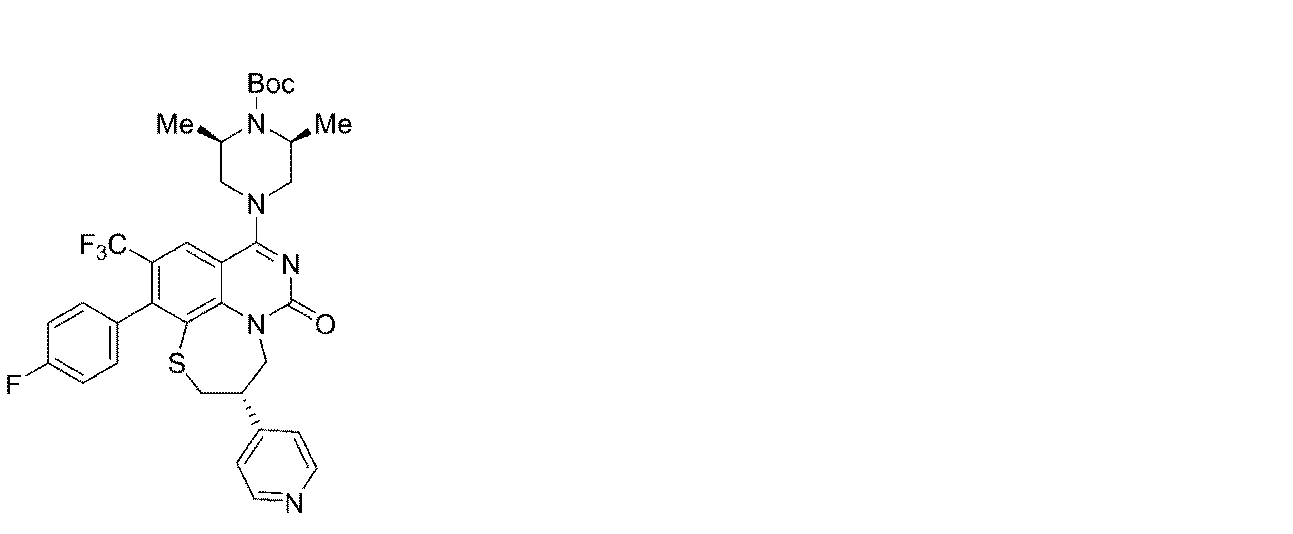
表題化合物は、(5-クロロ-2,4-ジフルオロ-フェニル)ボロン酸を(4-フルオロフェニル)ボロン酸に置き換えて、実施例100のステップ9と同様に調製した。表題化合物を収率73%で黄色の固体として単離した。MS (ESI) m/z: 670.2 [M+1]+. The title compound was prepared similarly to step 9 of Example 100, substituting (4-fluorophenyl)boronic acid for (5-chloro-2,4-difluoro-phenyl)boronic acid. The title compound was isolated in 73% yield as a yellow solid. MS (ESI) m/z: 670.2 [M+1]+.
ステップ2:(S)-8-((3S,5R)-3,5-ジメチルピペラジン-1-イル)-11-(4-フルオロフェニル)-3-(ピリジン-4-イル)-10-(トリフルオロメチル)-3,4-ジヒドロ-2H,6H-[1,4]チアゼピノ[2,3,4-ij]キナゾリン-6-オン

tert-ブチル(2S,6R)-4-((3S)-11-(5-クロロ-2,4-ジフルオロフェニル)-6-オキソ-3-(ピリジン-4-イル)-10-(トリフルオロメチル)-3,4-ジヒドロ-2H,6H-[1,4]チアゼピノ[2,3,4-ij]キナゾリン-8-イル)-2,6-ジメチルピペラジン-1-カルボキシレートをtert-ブチル(2S,6R)-4-((S)-11-(4-フルオロフェニル)-6-オキソ-3-(ピリジン-4-イル)-10-(トリフルオロメチル)-3,4-ジヒドロ-2H,6H-[1,4]チアゼピノ[2,3,4-ij]キナゾリン-8-イル)-2,6-ジメチルピペラジン-1-カルボキシレートに置き換えて、表題化合物を実施例100のステップ10と同様に調製した。表題化合物を収率99%で黄色の固体として単離した。MS (ESI) m/z: 570.1 [M+1]+ tert-Butyl (2S,6R)-4-((3S)-11-(5-chloro-2,4-difluorophenyl)-6-oxo-3-(pyridin-4-yl)-10-(trifluoromethyl)-3,4-dihydro-2H,6H-[1,4]thiazepino[2,3,4-ij]quinazolin-8-yl)-2,6-dimethylpiperazine-1-carboxylate was reacted with tert-butyl (2S, The title compound was prepared similarly to step 10 of Example 100, substituting 6R)-4-((S)-11-(4-fluorophenyl)-6-oxo-3-(pyridin-4-yl)-10-(trifluoromethyl)-3,4-dihydro-2H,6H-[1,4]thiazepino[2,3,4-ij]quinazolin-8-yl)-2,6-dimethylpiperazine-1-carboxylate. The title compound was isolated in 99% yield as a yellow solid. MS (ESI) m/z: 570.1 [M+1]+
ステップ3:(R)-8-((3S,5R)-4-アクリロイル-3,5-ジメチルピペラジン-1-イル)-11-(4-フルオロフェニル)-3-(ピリジン-4-イル)-10-(トリフルオロメチル)-3,4-ジヒドロ-2H,6H-[1,4]チアゼピノ[2,3,4-ij]キナゾリン-6-オン
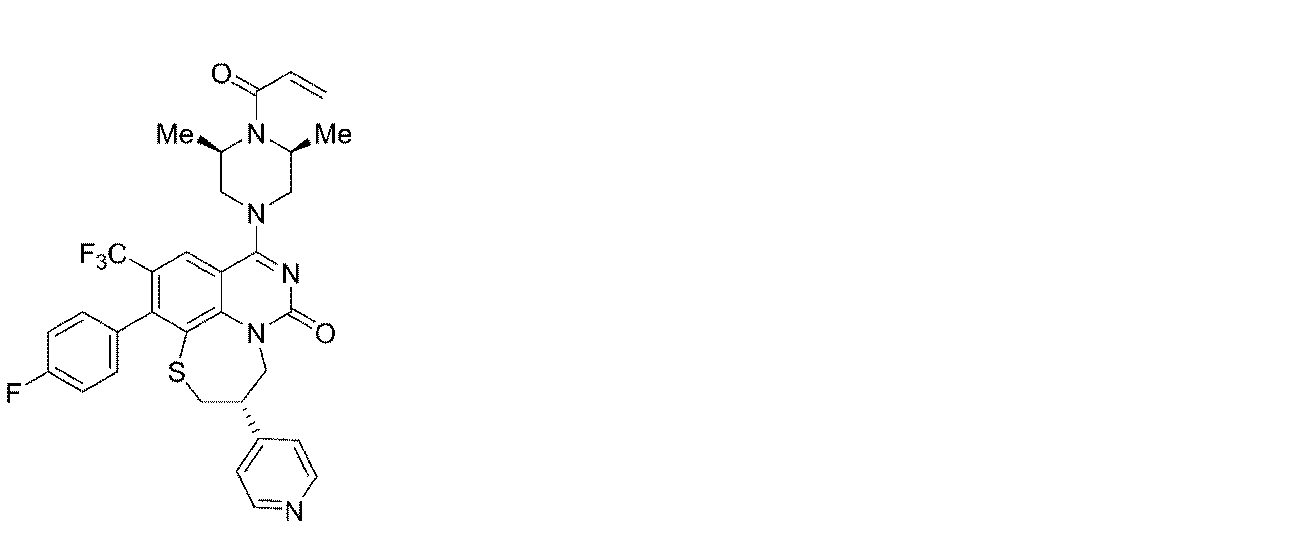
(3S)-11-(5-クロロ-2,4-ジフルオロフェニル)-8-((3S,5R)-3,5-ジメチルピペラジン-1-イル)-3-(ピリジン-4-イル)-10-(トリフルオロメチル)-3,4-ジヒドロ-2H,6H-[1,4]チアゼピノ[2,3,4-ij]キナゾリン-6-オンを(S)-8-((3S,5R)-3,5-ジメチルピペラジン-1-イル)-11-(4-フルオロフェニル)-3-(ピリジン-4-イル)-10-(トリフルオロメチル)-3,4-ジヒドロ-2H,6H-[1,4]チアゼピノ[2,3,4-ij]キナゾリン-6-オンに置き換えて、表題化合物を実施例100のステップ11と同様に調製した。表題化合物を収率91%で黄色の固体として単離した。MS (ESI) m/z: 624.2 [M+1]+. 1H NMR (400 MHz, CDCl3) δ ppm 1.53 (d, J = 7.2 Hz, 3 H) 1.61 (d, J = 6.8 Hz, 3 H) 3.01 - 3.18 (m, 1 H) 3.41 (ddd, J = 17.2, 13.2, 4.0 Hz, 2 H) 3.60 - 3.83 (m, 2 H) 4.20 (dd, J = 12.8, 6.4 Hz, 2 H) 4.56 - 4.95 (m, 4 H) 5.74 - 5.85 (m, 1 H) 6.43 (dd, J = 16.8, 2.0 Hz, 1 H) 6.59 - 6.71 (m, 1 H) 7.17 - 7.26 (m, 4 H) 7.29 - 7.38 (m, 2 H) 8.13 (s, 1 H) 8.49 - 8.71 (m, 2 H). The title compound was prepared analogously to step 11 of example 100, substituting (S)-8-((3S,5R)-3,5-dimethylpiperazin-1-yl)-11-(4-fluorophenyl)-3-(pyridin-4-yl)-10-(trifluoromethyl)-3,4-dihydro-2H,6H-[1,4]thiazepino[2,3,4-ij]quinazolin-6-one for (3S)-11-(5-chloro-2,4-difluorophenyl)-8-((3S,5R)-3,5-dimethylpiperazin-1-yl)-3-(pyridin-4-yl)-10-(trifluoromethyl)-3,4-dihydro-2H,6H-[1,4]thiazepino[2,3,4-ij]quinazolin-6-one. The title compound was isolated in 91% yield as a yellow solid. MS (ESI) m/z: 624.2 [M+1]+. 1H NMR (400 MHz, CDCl 3 ) δ ppm 1.53 (d, J = 7.2 Hz, 3 H) 1.61 (d, J = 6.8 Hz, 3 H) 3.01 - 3.18 (m, 1 H) 3.41 (ddd, J = 17.2, 13.2, 4.0 Hz, 2 H) 3.60 - 3.83 (m, 2 H) 4.20 (dd, J = 12.8, 6.4 Hz, 2 H) 4.56 - 4.95 (m, 4 H) 5.74 - 5.85 (m, 1 H) 6.43 (dd, J = 16.8, 2.0 Hz, 1 H) 6.59 - 6.71 (m, 1 H) 7.17 - 7.26 (m, 4 H) 7.29 - 7.38 (m, 2 H) 8.13 (s, 1 H) 8.49 - 8.71 (m, 2 H).
実施例114:(R)-8-((3S,5R)-4-アクリロイル-3,5-ジメチルピペラジン-1-イル)-11-(4-フルオロフェニル)-3-(3-フルオロピリジン-4-イル)-10-(トリフルオロメチル)-3,4-ジヒドロ-2H,6H-[1,4]チアゼピノ[2,3,4-ij]キナゾリン-6-オン

ステップ1:tert-ブチル(2S,6R)-4-((S)-11-(4-フルオロフェニル)-3-(3-フルオロピリジン-4-イル)-6-オキソ-10-(トリフルオロメチル)-3,4-ジヒドロ-2H,6H-[1,4]チアゼピノ[2,3,4-ij]キナゾリン-8-イル)-2,6-ジメチルピペラジン-1-カルボキシレート

tert-ブチル(2S,6R)-4-((S)-11-クロロ-6-オキソ-3-(ピリジン-4-イル)-10-(トリフルオロメチル)-3,4-ジヒドロ-2H,6H-[1,4]チアゼピノ[2,3,4-ij]キナゾリン-8-イル)-2,6-ジメチルピペラジン-1-カルボキシレート及び(5-クロロ-2,4-ジフルオロ-フェニル)ボロン酸をtert-ブチル(2S,6R)-4-((S)-11-クロロ-3-(3-フルオロピリジン-4-イル)-6-オキソ-10-(トリフルオロメチル)-3,4-ジヒドロ-2H,6H-[1,4]チアゼピノ[2,3,4-ij]キナゾリン-8-イル)-2,6-ジメチルピペラジン-1-カルボキシレート及び(4-フルオロフェニル)ボロン酸に置き換えて、表題化合物を実施例100のステップ9と同様に調製した。表題化合物を黄色の固体として単離した。MS (ESI) m/z: 688.2 [M+1]+. tert-Butyl (2S,6R)-4-((S)-11-chloro-6-oxo-3-(pyridin-4-yl)-10-(trifluoromethyl)-3,4-dihydro-2H,6H-[1,4]thiazepino[2,3,4-ij]quinazolin-8-yl)-2,6-dimethylpiperazine-1-carboxylate and (5-chloro-2,4-difluoro-phenyl)boronic acid were reacted with tert-butyl (2S,6R The title compound was prepared similarly to step 9 of Example 100, substituting 4-((S)-11-chloro-3-(3-fluoropyridin-4-yl)-6-oxo-10-(trifluoromethyl)-3,4-dihydro-2H,6H-[1,4]thiazepino[2,3,4-ij]quinazolin-8-yl)-2,6-dimethylpiperazine-1-carboxylate and (4-fluorophenyl)boronic acid. The title compound was isolated as a yellow solid. MS (ESI) m/z: 688.2 [M+1]+.
ステップ2:(S)-8-((3S,5R)-3,5-ジメチルピペラジン-1-イル)-11-(4-フルオロフェニル)-3-(3-フルオロピリジン-4-イル)-10-(トリフルオロメチル)-3,4-ジヒドロ-2H,6H-[1,4]チアゼピノ[2,3,4-ij]キナゾリン-6-オン

tert-ブチル(2S,6R)-4-((3S)-11-(5-クロロ-2,4-ジフルオロフェニル)-6-オキソ-3-(ピリジン-4-イル)-10-(トリフルオロメチル)-3,4-ジヒドロ-2H,6H-[1,4]チアゼピノ[2,3,4-ij]キナゾリン-8-イル)-2,6-ジメチルピペラジン-1-カルボキシレートをtert-ブチル(2S,6R)-4-((S)-11-(4-フルオロフェニル)-3-(3-フルオロピリジン-4-イル)-6-オキソ-10-(トリフルオロメチル)-3,4-ジヒドロ-2H,6H-[1,4]チアゼピノ[2,3,4-ij]キナゾリン-8-イル)-2,6-ジメチルピペラジン-1-カルボキシレートに置き換えて、表題化合物を実施例100のステップ10と同様に調製した。表題化合物を収率99%で黄色の固体として単離した。MS (ESI) m/z: 588.2 [M+1]+. tert-Butyl (2S,6R)-4-((3S)-11-(5-chloro-2,4-difluorophenyl)-6-oxo-3-(pyridin-4-yl)-10-(trifluoromethyl)-3,4-dihydro-2H,6H-[1,4]thiazepino[2,3,4-ij]quinazolin-8-yl)-2,6-dimethylpiperazine-1-carboxylate was synthesized using tert-butyl (2S,6R) The title compound was prepared similarly to step 10 of Example 100, substituting -4-((S)-11-(4-fluorophenyl)-3-(3-fluoropyridin-4-yl)-6-oxo-10-(trifluoromethyl)-3,4-dihydro-2H,6H-[1,4]thiazepino[2,3,4-ij]quinazolin-8-yl)-2,6-dimethylpiperazine-1-carboxylate. The title compound was isolated in 99% yield as a yellow solid. MS (ESI) m/z: 588.2 [M+1]+.
ステップ3:(R)-8-((3S,5R)-4-アクリロイル-3,5-ジメチルピペラジン-1-イル)-11-(4-フルオロフェニル)-3-(3-フルオロピリジン-4-イル)-10-(トリフルオロメチル)-3,4-ジヒドロ-2H,6H-[1,4]チアゼピノ[2,3,4-ij]キナゾリン-6-オン
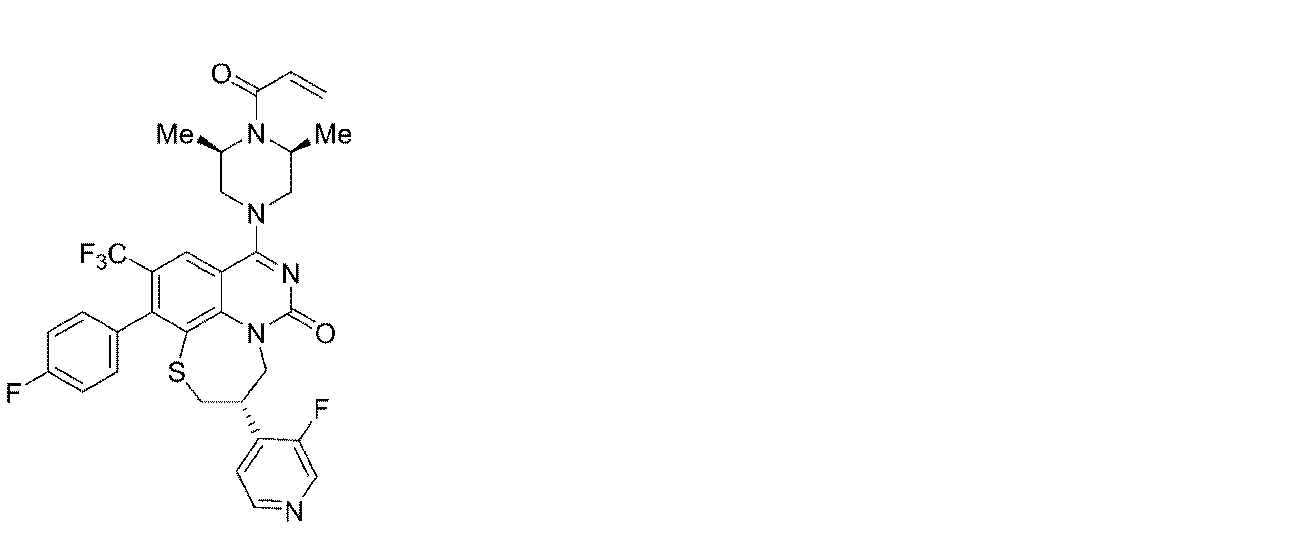
(3S)-11-(5-クロロ-2,4-ジフルオロフェニル)-8-((3S,5R)-3,5-ジメチルピペラジン-1-イル)-3-(ピリジン-4-イル)-10-(トリフルオロメチル)-3,4-ジヒドロ-2H,6H-[1,4]チアゼピノ[2,3,4-ij]キナゾリン-6-オンを(S)-8-((3S,5R)-3,5-ジメチルピペラジン-1-イル)-11-(4-フルオロフェニル)-3-(3-フルオロピリジン-4-イル)-10-(トリフルオロメチル)-3,4-ジヒドロ-2H,6H-[1,4]チアゼピノ[2,3,4-ij]キナゾリン-6-オンに置き換えて、表題化合物を実施例100のステップ11と同様に調製した。表題化合物を収率61%で黄色の固体として単離した。MS (ESI) m/z: 642.2 [M+1]+. 1H NMR (400 MHz, CDCl3) δ ppm 1.53 (d, J = 6.8 Hz, 3 H) 1.60 (d, J = 6.0 Hz, 3 H) 2.91 - 3.20 (m, 1 H) 3.34 - 3.48 (m, 2 H) 3.53 - 3.81 (m, 1 H) 3.97 - 4.26 (m, 3 H) 4.45 - 5.07 (m, 4 H) 5.73 - 5.85 (m, 1 H) 6.43 (dd, J = 16.8, 2.0 Hz, 1 H) 6.58 - 6.69 (m, 1 H) 7.14 - 7.23 (m, 3 H) 7.25 (br s, 1 H) 7.30 (br s, 1 H) 8.12 (s, 1 H) 8.29 - 8.57 (m, 2 H). The title compound was prepared analogously to step 11 of example 100, substituting (3S)-11-(5-chloro-2,4-difluorophenyl)-8-((3S,5R)-3,5-dimethylpiperazin-1-yl)-3-(pyridin-4-yl)-10-(trifluoromethyl)-3,4-dihydro-2H,6H-[1,4]thiazepino[2,3,4-ij]quinazolin-6-one for (S)-8-((3S,5R)-3,5-dimethylpiperazin-1-yl)-11-(4-fluorophenyl)-3-(3-fluoropyridin-4-yl)-10-(trifluoromethyl)-3,4-dihydro-2H,6H-[1,4]thiazepino[2,3,4-ij]quinazolin-6-one. The title compound was isolated in 61% yield as a yellow solid. MS (ESI) m/z: 642.2 [M+1]+. 1 H NMR (400 MHz, CDCl 3 ) δ ppm 1.53 (d, J = 6.8 Hz, 3 H) 1.60 (d, J = 6.0 Hz, 3 H) 2.91 - 3.20 (m, 1 H) 3.34 - 3.48 (m, 2 H) 3.53 - 3.81 (m, 1 H) 3.97 - 4.26 (m, 3 H) 4.45 - 5.07 (m, 4 H) 5.73 - 5.85 (m, 1 H) 6.43 (dd, J = 16.8, 2.0 Hz, 1 H) 6.58 - 6.69 (m, 1 H) 7.14 - 7.23 (m, 3 H) 7.25 (br s, 1 H) 7.30 (br s, 1 H) 8.12 (s, 1 H) 8.29 - 8.57 (m, 2 H).
実施例115:8-((3S,5R)-4-アクリロイル-3,5-ジメチルピペラジン-1-イル)-3,11-ビス(4-フルオロフェニル)-10-(トリフルオロメチル)-3,4-ジヒドロ-2H,6H-[1,4]チアゼピノ[2,3,4-ij]キナゾリン-6-オン

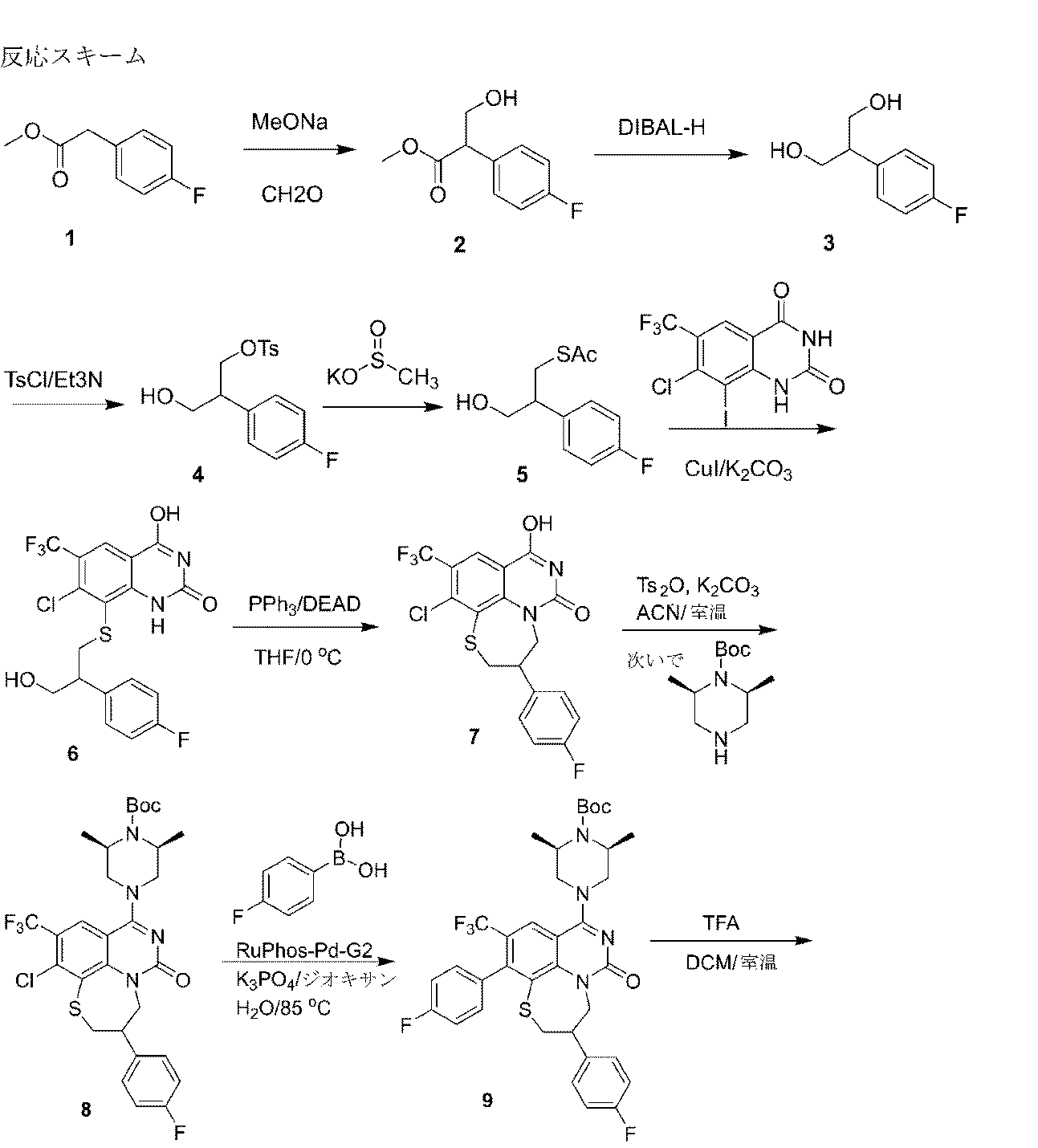

2-(4-フルオロフェニル)-3-ヒドロキシプロパン酸メチル(2) 2-(4-fluorophenyl)-3-hydroxypropanoic acid methyl (2)
DMSO(10mL)中の2-(4-フルオロフェニル)酢酸メチル(5g、29.76mmol)及びメタノール酸ナトリウム(0.08031g、1.49mmol)の混合物に、ポリホルムアルデヒド(0.93g、31.25mmol)を20℃で16時間かけて加えた。混合物を水でクエンチし、2Nの塩酸で中和し、酢酸エチル(100mL×3)で抽出した。組み合わせた有機相をブライン(50mL)で洗浄し、無水硫酸ナトリウムで乾燥させた。濾過及び濃縮後、残渣を石油エーテル/酢酸エチル=5%~40%のシリカゲルカラムによって精製して、2-(4-フルオロフェニル)-3-ヒドロキシプロパン酸メチル2(4.5g、収率76%)を白色の固体として得た。 To a mixture of methyl 2-(4-fluorophenyl)acetate (5 g, 29.76 mmol) and sodium methanolate (0.08031 g, 1.49 mmol) in DMSO (10 mL) was added polyformaldehyde (0.93 g, 31.25 mmol) at 20 °C for 16 h. The mixture was quenched with water, neutralized with 2N hydrochloric acid, and extracted with ethyl acetate (100 mL x 3). The combined organic phase was washed with brine (50 mL) and dried over anhydrous sodium sulfate. After filtration and concentration, the residue was purified by silica gel column with petroleum ether/ethyl acetate = 5%-40% to give methyl 2-(4-fluorophenyl)-3-hydroxypropanoate 2 (4.5 g, 76% yield) as a white solid.
2-(4-フルオロフェニル)プロパン-1,3-ジオール(3) 2-(4-fluorophenyl)propane-1,3-diol (3)
THF(100mL)中の2-(4-フルオロフェニル)-3-ヒドロキシプロパン酸メチル(11g、55.56mmol)の溶液に、1.0MのDIBAL-H(166.68mmol、166.68mL)をN2雰囲気下、-78℃で加えた。混合物を窒素雰囲気下、-78℃で3時間撹拌した。完了後、混合物を硫酸ナトリウム十水和物でクエンチし、濾過した。溶液を濃縮し、残渣をシリカゲルカラム(PE/EA=10%~100%)によって精製して、2-(4-フルオロフェニル)プロパン-1,3-ジオール3(5.05g、収率53%)を黄色の油として得た。 To a solution of methyl 2-(4-fluorophenyl)-3-hydroxypropanoate (11 g, 55.56 mmol) in THF (100 mL) was added 1.0 M DIBAL-H (166.68 mmol, 166.68 mL) under N2 atmosphere at -78 °C. The mixture was stirred under nitrogen atmosphere at -78 °C for 3 h. After completion, the mixture was quenched with sodium sulfate decahydrate and filtered. The solution was concentrated and the residue was purified by silica gel column (PE/EA = 10%-100%) to give 2-(4-fluorophenyl)propane-1,3-diol 3 (5.05 g, 53% yield) as a yellow oil.
2-(4-フルオロフェニル)-3-ヒドロキシプロピル4-メチルベンゼンスルホネート(4) 2-(4-fluorophenyl)-3-hydroxypropyl 4-methylbenzenesulfonate (4)
DCM(50mL)中の2-(4-フルオロフェニル)プロパン-1,3-ジオール(5.0g、29.4mmol)及びTEA(5.94g、58.82mmol)の混合物に、塩化トシル(3.35g、17.6mmol)を0℃で加えた。混合物を20℃で12時間撹拌した。完了後、混合物を減圧下で濃縮し、残渣をシリカゲルカラム(PE/EA=0~2:1)によって精製して、2-(4-フルオロフェニル)-3-ヒドロキシプロピル4-メチルベンゼンスルホネート4(3.58g、収率38%)を白色の固体として得た。 To a mixture of 2-(4-fluorophenyl)propane-1,3-diol (5.0 g, 29.4 mmol) and TEA (5.94 g, 58.82 mmol) in DCM (50 mL) was added tosyl chloride (3.35 g, 17.6 mmol) at 0 °C. The mixture was stirred at 20 °C for 12 h. After completion, the mixture was concentrated under reduced pressure and the residue was purified by silica gel column (PE/EA = 0-2:1) to give 2-(4-fluorophenyl)-3-hydroxypropyl 4-methylbenzenesulfonate 4 (3.58 g, 38% yield) as a white solid.
S-(2-(4-フルオロフェニル)-3-ヒドロキシプロピル)エタンチオエート(5) S-(2-(4-fluorophenyl)-3-hydroxypropyl)ethanethioate (5)
アセトン(10mL)中の2-(4-フルオロフェニル)-3-ヒドロキシプロピル4-メチルベンゼンスルホネート(3.6g、11.11mmol)の混合物に、メタンスルフィン酸カリウム(2.53g、22.2mmol)を20℃で加えた。混合物を50℃で1時間撹拌した。完了後、混合物を減圧下で濃縮し、残渣をシリカゲルカラム(DCM/MeOH=0~20:1)によって精製して、S-(2-(4-フルオロフェニル)-3-ヒドロキシプロピル)エタンチオエート5(1.7g、収率67%)を黄色の油として得た。 To a mixture of 2-(4-fluorophenyl)-3-hydroxypropyl 4-methylbenzenesulfonate (3.6 g, 11.11 mmol) in acetone (10 mL) was added potassium methanesulfinate (2.53 g, 22.2 mmol) at 20 °C. The mixture was stirred at 50 °C for 1 h. After completion, the mixture was concentrated under reduced pressure and the residue was purified by silica gel column (DCM/MeOH = 0-20:1) to obtain S-(2-(4-fluorophenyl)-3-hydroxypropyl)ethanethioate 5 (1.7 g, 67% yield) as a yellow oil.
7-クロロ-8-((2-(4-フルオロフェニル)-3-ヒドロキシプロピル)チオ)-4-ヒドロキシ-6-(トリフルオロメチル)キナゾリン-2(1H)-オン(6) 7-Chloro-8-((2-(4-fluorophenyl)-3-hydroxypropyl)thio)-4-hydroxy-6-(trifluoromethyl)quinazolin-2(1H)-one (6)
エチレングリオール(10mL)及びイソプロパノール(10mL)中のS-(2-(4-フルオロフェニル)-3-ヒドロキシプロピル)エタンチオエート(1.65g、7.24mmol)及び7-クロロ-8-ヨード-6-(トリフルオロメチル)キナゾリン-2,4(1H,3H)-ジオン(2.82g、7.24mmol)の混合物に、CuI(551mg、2.90mmol)及びK2CO3(3g、21.72mmol)をN2雰囲気下、20℃で加えた。混合物を85℃で3時間撹拌した。完了後、混合物を酢酸エチル(100mL×3)で抽出した。組み合わせた有機相をブライン(50mL)で洗浄し、無水硫酸ナトリウムで乾燥させた。有機物を減圧下で濃縮し、残渣をDCM/MeOH=0%~20%のシリカゲルカラムによって精製して、7-クロロ-8-((2-(4-フルオロフェニル)-3-ヒドロキシプロピル)チオ)-4-ヒドロキシ-6-(トリフルオロメチル)キナゾリン-2(1H)-オン6(160mg)を黄色の油として得た。 To a mixture of S-(2-(4-fluorophenyl)-3-hydroxypropyl)ethanethioate (1.65 g, 7.24 mmol) and 7-chloro-8-iodo-6-(trifluoromethyl)quinazoline-2,4(1H,3H)-dione (2.82 g, 7.24 mmol) in ethylene glycol (10 mL) and isopropanol (10 mL), CuI (551 mg, 2.90 mmol) and K2CO3 (3 g, 21.72 mmol) were added under N2 atmosphere at 20°C. The mixture was stirred at 85°C for 3 hours. After completion, the mixture was extracted with ethyl acetate (100 mL x 3). The combined organic phase was washed with brine (50 mL) and dried over anhydrous sodium sulfate. The organics were concentrated under reduced pressure, and the residue was purified by silica gel column with DCM/MeOH = 0% to 20% to give 7-chloro-8-((2-(4-fluorophenyl)-3-hydroxypropyl)thio)-4-hydroxy-6-(trifluoromethyl)quinazolin-2(1H)-one 6 (160 mg) as a yellow oil.
11-クロロ-3-(4-フルオロフェニル)-8-ヒドロキシ-10-(トリフルオロメチル)-3,4-ジヒドロ-2H,6H-[1,4]チアゼピノ[2,3,4-ij]キナゾリン-6-オン(7) 11-Chloro-3-(4-fluorophenyl)-8-hydroxy-10-(trifluoromethyl)-3,4-dihydro-2H,6H-[1,4]thiazepino[2,3,4-ij]quinazolin-6-one (7)
テトラヒドロフラン(20mL)中の7-クロロ-8-((2-(4-フルオロフェニル)-3-ヒドロキシプロピル)チオ)-4-ヒドロキシ-6-(トリフルオロメチル)キナゾリン-2(1H)-オン(160mg、0.36mmol)及びトリフェニルホスフィン(189mg、0.72mmol)の混合物に、アゾジカルボン酸ジエチル(125mg、0.72mmol)をN2雰囲気下、0℃で加えた。混合物を20℃で1時間撹拌した。完了後、混合物を減圧下で濃縮し、残渣を逆フラッシュによって精製して、11-クロロ-3-(4-フルオロフェニル)-8-ヒドロキシ-10-(トリフルオロメチル)-3,4-ジヒドロ-[1,4]チアゼピノ[2,3,4-ij]キナゾリン-6(2H)-オン7(100mg、収率73%)を黄色の固体として得た。 To a mixture of 7-chloro-8-((2-(4-fluorophenyl)-3-hydroxypropyl)thio)-4-hydroxy-6-(trifluoromethyl)quinazolin-2(1H)-one (160 mg, 0.36 mmol) and triphenylphosphine (189 mg, 0.72 mmol) in tetrahydrofuran (20 mL) was added diethyl azodicarboxylate (125 mg, 0.72 mmol) under N2 atmosphere at 0°C. The mixture was stirred at 20°C for 1 h. After completion, the mixture was concentrated under reduced pressure and the residue was purified by back-flash to give 11-chloro-3-(4-fluorophenyl)-8-hydroxy-10-(trifluoromethyl)-3,4-dihydro-[1,4]thiazepino[2,3,4-ij]quinazolin-6(2H)-one 7 (100 mg, 73% yield) as a yellow solid.
tert-ブチル(2S,6R)-4-(11-クロロ-3-(4-フルオロフェニル)-6-オキソ-10-(トリフルオロメチル)-3,4-ジヒドロ-2H,6H-[1,4]チアゼピノ[2,3,4-ij]キナゾリン-8-イル)-2,6-ジメチルピペラジン-1-カルボキシレート(8) tert-Butyl (2S,6R)-4-(11-chloro-3-(4-fluorophenyl)-6-oxo-10-(trifluoromethyl)-3,4-dihydro-2H,6H-[1,4]thiazepino[2,3,4-ij]quinazolin-8-yl)-2,6-dimethylpiperazine-1-carboxylate (8)
アセトニトリル(10mL)中の11-クロロ-3-(4-フルオロフェニル)-8-ヒドロキシ-10-(トリフルオロメチル)-3,4-ジヒドロ-[1,4]チアゼピノ[2,3,4-ij]キナゾリン-6(2H)-オン7(100mg、0.23mmol)及び炭酸カリウム(254mg、1.84mmol)の混合物に、4-メチルベンゼンスルホン酸無水物(112mg、0.345mmol)を0℃で加えた。混合物を30℃で4時間撹拌した。次いで、(2S,6R)-tert-ブチル2,6-ジメチルピペラジン-1-カルボキシレート(98mg、0.46mmol)を反応溶液に加えた。反応混合物を30℃で更に2時間撹拌した。完了後、混合物を減圧下で濃縮し、残渣をシリカゲルカラムクロマトグラフィー(PE/EA=0%~100%)によって精製して、tert-ブチル(2S,6R)-4-(11-クロロ-3-(4-フルオロフェニル)-6-オキソ-10-(トリフルオロメチル)-3,4-ジヒドロ-2H,6H-[1,4]チアゼピノ[2,3,4-ij]キナゾリン-8-イル)-2,6-ジメチルピペラジン-1-カルボキシレート8(50mg、収率35%)を黄色の固体として得た。 To a mixture of 11-chloro-3-(4-fluorophenyl)-8-hydroxy-10-(trifluoromethyl)-3,4-dihydro-[1,4]thiazepino[2,3,4-ij]quinazolin-6(2H)-one 7 (100 mg, 0.23 mmol) and potassium carbonate (254 mg, 1.84 mmol) in acetonitrile (10 mL), 4-methylbenzenesulfonic anhydride (112 mg, 0.345 mmol) was added at 0°C. The mixture was stirred at 30°C for 4 hours. Then, (2S,6R)-tert-butyl 2,6-dimethylpiperazine-1-carboxylate (98 mg, 0.46 mmol) was added to the reaction solution. The reaction mixture was stirred at 30°C for another 2 hours. After completion, the mixture was concentrated under reduced pressure and the residue was purified by silica gel column chromatography (PE/EA=0%-100%) to obtain tert-butyl (2S,6R)-4-(11-chloro-3-(4-fluorophenyl)-6-oxo-10-(trifluoromethyl)-3,4-dihydro-2H,6H-[1,4]thiazepino[2,3,4-ij]quinazolin-8-yl)-2,6-dimethylpiperazine-1-carboxylate 8 (50 mg, 35% yield) as a yellow solid.
tert-ブチル(2S,6R)-4-(3,11-ビス(4-フルオロフェニル)-6-オキソ-10-(トリフルオロメチル)-3,4-ジヒドロ-2H,6H-[1,4]チアゼピノ[2,3,4-ij]キナゾリン-8-イル)-2,6-ジメチルピペラジン-1-カルボキシレート(9) tert-Butyl (2S,6R)-4-(3,11-bis(4-fluorophenyl)-6-oxo-10-(trifluoromethyl)-3,4-dihydro-2H,6H-[1,4]thiazepino[2,3,4-ij]quinazolin-8-yl)-2,6-dimethylpiperazine-1-carboxylate (9)
1,4-ジオキサン(4mL)及び水(1mL)中のtert-ブチル(2S,6R)-4-(11-クロロ-3-(4-フルオロフェニル)-6-オキソ-10-(トリフルオロメチル)-3,4-ジヒドロ-2H,6H-[1,4]チアゼピノ[2,3,4-ij]キナゾリン-8-イル)-2,6-ジメチルピペラジン-1-カルボキシレート8(50mg、0.08mmol)、(4-フルオロフェニル)ボロン酸(90mg、0.64mmol)、及びリン酸三カリウム(64mg、0.24mmol)の溶液に、クロロ(2-ジシクロヘキシルホスフィノ-2’,6’-ジイソプロポキシ-1,1’-ビフェニル)[2-(2’-アミノ-1,1’-ビフェニル)]パラジウム(II)(12mg、0.016mmol)をN2雰囲気下、20℃で加えた。混合物を窒素雰囲気下、80℃で2時間撹拌した。完了後、混合物を減圧下で濃縮し、残渣をシリカゲルカラムクロマトグラフィー(DCM/MeOH=0%~20%)によって精製して、tert-ブチル(2S,6R)-4-(3,11-ビス(4-フルオロフェニル)-6-オキソ-10-(トリフルオロメチル)-3,4-ジヒドロ-2H,6H-[1,4]チアゼピノ[2,3,4-ij]キナゾリン-8-イル)-2,6-ジメチルピペラジン-1-カルボキシレート9(40mg、収率73%)を黄色の固体として得た。 tert-Butyl (2S,6R)-4-(11-chloro-3-(4-fluorophenyl)-6-oxo-10-(trifluoromethyl)-3,4-dihydro-2H,6H-[1,4]thiazepino[2,3,4-ij]quinazolin-8-yl)-2,6-dimethylpiperazine-1-carboxylate 8 (50 mg, 0.08 mmol) in 1,4-dioxane (4 mL) and water (1 mL). To a solution of 1,4-fluorophenyl)boronic acid (90 mg, 0.64 mmol), and tripotassium phosphate (64 mg, 0.24 mmol) was added chloro(2-dicyclohexylphosphino-2',6'-diisopropoxy-1,1'-biphenyl)[2-(2'-amino-1,1'-biphenyl)]palladium(II) (12 mg, 0.016 mmol) under a N2 atmosphere at 20° C. The mixture was stirred at 80° C. for 2 hours under a nitrogen atmosphere. After completion, the mixture was concentrated under reduced pressure and the residue was purified by silica gel column chromatography (DCM/MeOH=0%-20%) to obtain tert-butyl (2S,6R)-4-(3,11-bis(4-fluorophenyl)-6-oxo-10-(trifluoromethyl)-3,4-dihydro-2H,6H-[1,4]thiazepino[2,3,4-ij]quinazolin-8-yl)-2,6-dimethylpiperazine-1-carboxylate 9 (40 mg, 73% yield) as a yellow solid.
8-((3S,5R)-3,5-ジメチルピペラジン-1-イル)-3,11-ビス(4-フルオロフェニル)-10-(トリフルオロメチル)-3,4-ジヒドロ-2H,6H-[1,4]チアゼピノ[2,3,4-ij]キナゾリン-6-オン(10) 8-((3S,5R)-3,5-dimethylpiperazin-1-yl)-3,11-bis(4-fluorophenyl)-10-(trifluoromethyl)-3,4-dihydro-2H,6H-[1,4]thiazepino[2,3,4-ij]quinazolin-6-one (10)
ジクロロメタン(5ml)中のtert-ブチル(2S,6R)-4-(3,11-ビス(4-フルオロフェニル)-6-オキソ-10-(トリフルオロメチル)-3,4-ジヒドロ-2H,6H-[1,4]チアゼピノ[2,3,4-ij]キナゾリン-8-イル)-2,6-ジメチルピペラジン-1-カルボキシレート9(40mg、0.058mmol)の溶液に、トリフルオロ酢酸(5mL)を0℃で加えた。反応溶液を室温で1時間撹拌した。完了後、混合物を濃縮し、残渣をシリカゲルカラム(ジクロロメタン/メタノール=0%~20%)によって精製して、生成物10(20mg、収率:59%)を黄色の固体として得た。 To a solution of tert-butyl (2S,6R)-4-(3,11-bis(4-fluorophenyl)-6-oxo-10-(trifluoromethyl)-3,4-dihydro-2H,6H-[1,4]thiazepino[2,3,4-ij]quinazolin-8-yl)-2,6-dimethylpiperazine-1-carboxylate 9 (40 mg, 0.058 mmol) in dichloromethane (5 ml), trifluoroacetic acid (5 mL) was added at 0°C. The reaction solution was stirred at room temperature for 1 hour. After completion, the mixture was concentrated and the residue was purified by silica gel column (dichloromethane/methanol = 0% to 20%) to give product 10 (20 mg, yield: 59%) as a yellow solid.
8-((3S,5R)-4-アクリロイル-3,5-ジメチルピペラジン-1-イル)-3,11-ビス(4-フルオロフェニル)-10-(トリフルオロメチル)-3,4-ジヒドロ-2H,6H-[1,4]チアゼピノ[2,3,4-ij]キナゾリン-6-オン(11) 8-((3S,5R)-4-acryloyl-3,5-dimethylpiperazin-1-yl)-3,11-bis(4-fluorophenyl)-10-(trifluoromethyl)-3,4-dihydro-2H,6H-[1,4]thiazepino[2,3,4-ij]quinazolin-6-one (11)
ジクロロメタン(5ml)中の8-((3S,5R)-3,5-ジメチルピペラジン-1-イル)-3,11-ビス(4-フルオロフェニル)-10-(トリフルオロメチル)-3,4-ジヒドロ-[1,4]チアゼピノ[2,3,4-ij]キナゾリン-6(2H)-オン10(20mg、0.034mmol)及びトリエチルアミン(10mg、0.102mmol)の混合物に、アクリル酸無水物(9mg、0.068mmol)を0℃で加えた。混合物を0℃で1時間撹拌した。完了後、混合物を濃縮し、残渣を分取HPLCによって精製して、8-((3S,5R)-4-アクリロイル-3,5-ジメチルピペラジン-1-イル)-3,11-ビス(4-フルオロフェニル)-10-(トリフルオロメチル)-3,4-ジヒドロ-[1,4]チアゼピノ[2,3,4-ij]キナゾリン-6(2H)-オン11(7mg、収率:32%)を白色の固体として得た。1H NMR (400 MHz, CDCl3) δ 8.11 (s, 1H), 7.35-7.29 (m, 3H), 7.25-7.16 (m, 3H), 7.04-6.99 (m, 2H), 6.67-6.60 (m, 1H), 6.42 (dd, J = 16.8 Hz, 2.0 Hz, 1H), 5.78 (dd, J = 10.8 Hz, 2.4 Hz, 1H), 4.78-4.63 (m, 4H), 4.21-4.15 (m, 2H), 3.75-3.63 (m, 2H), 3.42-3.33 (m, 2H), 3.06-3.03 (m, 1H), 1.60 (d, J = 6.8 Hz, 3H), 1.51 (d, J = 6.8 Hz, 3H). To a mixture of 8-((3S,5R)-3,5-dimethylpiperazin-1-yl)-3,11-bis(4-fluorophenyl)-10-(trifluoromethyl)-3,4-dihydro-[1,4]thiazepino[2,3,4-ij]quinazolin-6(2H)-one 10 (20 mg, 0.034 mmol) and triethylamine (10 mg, 0.102 mmol) in dichloromethane (5 ml) was added acrylic anhydride (9 mg, 0.068 mmol) at 0° C. The mixture was stirred at 0° C. for 1 h. After completion, the mixture was concentrated and the residue was purified by preparative HPLC to give 8-((3S,5R)-4-acryloyl-3,5-dimethylpiperazin-1-yl)-3,11-bis(4-fluorophenyl)-10-(trifluoromethyl)-3,4-dihydro-[1,4]thiazepino[2,3,4-ij]quinazolin-6(2H)-one 11 (7 mg, yield: 32%) as a white solid. 1 H NMR (400 MHz, CDCl 3 ) δ 8.11 (s, 1H), 7.35-7.29 (m, 3H), 7.25-7.16 (m, 3H), 7.04-6.99 (m, 2H), 6.67-6.60 (m, 1H), 6.42 (dd, J = 16.8 Hz, 2.0 Hz, 1H), 5.78 (dd, J = 10.8 Hz, 2.4 Hz, 1H), 4.78-4.63 (m, 4H), 4.21-4.15 (m, 2H), 3.75-3.63 (m, 2H), 3.42-3.33 (m, 2H), 3.06-3.03 (m, 1H), 1.60 (d, J = 6.8 Hz, 3H), 1.51 (d, J = 6.8 Hz, 3H).
実施例122:(R)-8-((3S,5R)-4-アクリロイル-3,5-ジメチルピペラジン-1-イル)-11-(4-フルオロフェニル)-3-(チオフェン-3-イル)-10-(トリフルオロメチル)-3,4-ジヒドロ-[1,4]チアゼピノ[2,3,4-ij]キナゾリン-6(2H)-オン(P1)及び実施例123:(S)-8-((3S,5R)-4-アクリロイル-3,5-ジメチルピペラジン-1-イル)-11-(4-フルオロフェニル)-3-(チオフェン-3-イル)-10-(トリフルオロメチル)-3,4-ジヒドロ-[1,4]チアゼピノ[2,3,4-ij]キナゾリン-6(2H)-オン(P2)
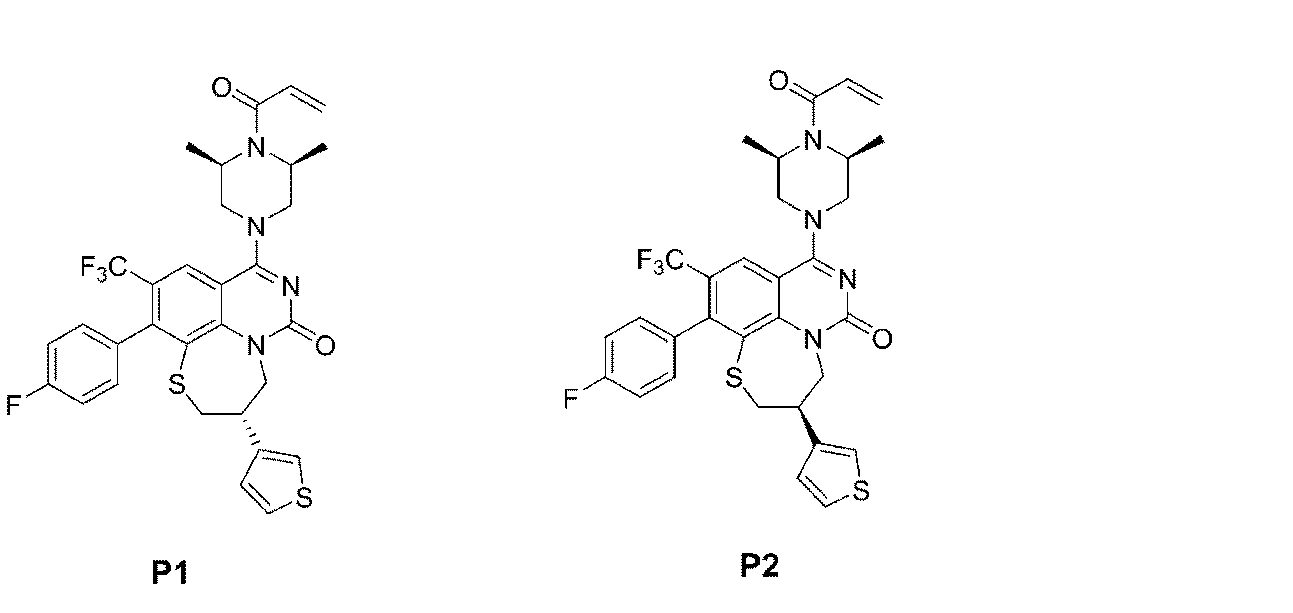
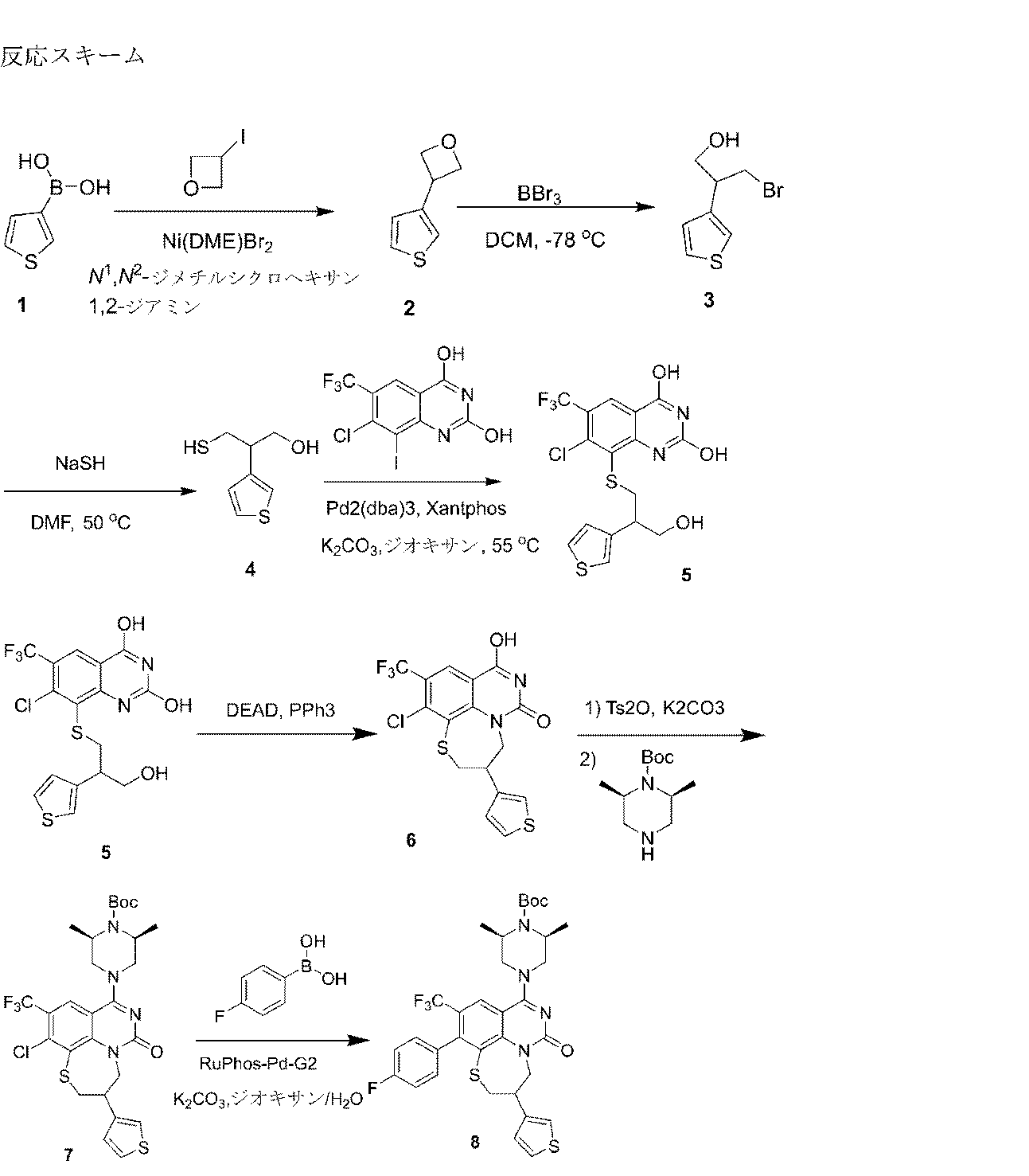
3-(チオフェン-3-イル)オキセタン(2) 3-(Thiophen-3-yl)oxetane (2)
1,4-ジオキサン(350mL)中のチオフェン-3-イルボロン酸(20g、101mmol)、臭化ニッケル(II)エチレングリコールジメチルエーテル錯体(3.12g、10.1mol)、(1S,2S)-N1,N2-ジメチルシクロヘキサン-1,2-ジアミン(2.15g、15.15mmol)及びカリウムtert-ブトキシド(22.62g、202mmol)の混合物に、3-ヨードオキセタン(27.88g、151.5mmol)を窒素雰囲気下、0℃で加えた。混合物を60℃で18時間撹拌した。完了後、混合物を氷水(300mL)に注ぎ、酢酸エチル(150mL×3)で抽出した。濃縮後、残渣を石油エーテル/酢酸エチル=20/1のシリカゲルカラムによって精製して、3-(チオフェン-3-イル)オキセタン(2)(1.38g、収率10%)を無色の油として得た。1H NMR (400 MHz, CDCl3) δ 7.35-7.33 (m, 1H), 7.20-7.18 (m, 1H), 7.12-7.11 (m,1H), 5.04-5.00 (m, 2H), 4.77-4.74 (m, 2H), 4.35-4.27 (m, 1H). To a mixture of thiophen-3-ylboronic acid (20 g, 101 mmol), nickel(II) bromide ethylene glycol dimethyl ether complex (3.12 g, 10.1 mol), (1S,2S)-N 1 ,N 2 -dimethylcyclohexane-1,2-diamine (2.15 g, 15.15 mmol) and potassium tert-butoxide (22.62 g, 202 mmol) in 1,4-dioxane (350 mL) was added 3-iodooxetane (27.88 g, 151.5 mmol) under nitrogen atmosphere at 0° C. The mixture was stirred at 60° C. for 18 hours. After completion, the mixture was poured into ice water (300 mL) and extracted with ethyl acetate (150 mL×3). After concentration, the residue was purified by silica gel column with petroleum ether/ethyl acetate=20/1 to give 3-(thiophen-3-yl)oxetane (2) (1.38 g, 10% yield) as a colorless oil. 1 H NMR (400 MHz, CDCl 3 ) δ 7.35-7.33 (m, 1H), 7.20-7.18 (m, 1H), 7.12-7.11 (m,1H), 5.04-5.00 (m, 2H), 4.77-4.74 (m, 2H), 4.35-4.27 (m, 1H).
3-ブロモ-2-(チオフェン-3-イル)プロパン-1-オール(3) 3-Bromo-2-(thiophene-3-yl)propan-1-ol (3)
ジクロロメタン(30mL)中の3-(チオフェン-3-イル)オキセタン(2)(1.38g、9.86mmol)の溶液に、三臭化ホウ素(10mL、9.86mmol、ジクロロメタン中1M)を窒素雰囲気下、-78℃で加えた。混合物を0℃で1時間撹拌した。完了後、混合物を氷水(50mL)に注ぎ、酢酸エチル(50mL×3)で抽出し、混合物を濃縮して、生成物3-ブロモ-2-(チオフェン-3-イル)プロパン-1-オール(3)(2.1g、粗製)を無色の油として得た。1H NMR (400 MHz, CDCl3) δ 7.26-7.24 (m, 1H), 7.07 (d, J = 2.0 Hz, 1H), 6.94 (d, J = 4.8 Hz, 1H), 3.88-3.81 (m, 2H), 3.68-3.55 (m, 2H), 3.27-3.21 (m, 1H). To a solution of 3-(thiophen-3-yl)oxetane (2) (1.38 g, 9.86 mmol) in dichloromethane (30 mL) was added boron tribromide (10 mL, 9.86 mmol, 1M in dichloromethane) under nitrogen atmosphere at −78° C. The mixture was stirred at 0° C. for 1 h. After completion, the mixture was poured into ice water (50 mL) and extracted with ethyl acetate (50 mL×3), and the mixture was concentrated to give the product 3-bromo-2-(thiophen-3-yl)propan-1-ol (3) (2.1 g, crude) as a colorless oil. 1H NMR (400 MHz, CDCl3 ) δ 7.26-7.24 (m, 1H), 7.07 (d, J = 2.0 Hz, 1H), 6.94 (d, J = 4.8 Hz, 1H), 3.88-3.81 (m, 2H), 3.68-3.55 (m, 2H), 3.27-3.21 (m, 1H).
3-メルカプト-2-(チオフェン-3-イル)プロパン-1-オール(4) 3-Mercapto-2-(thiophen-3-yl)propan-1-ol (4)
N,N-ジメチルホルムアミド(30mL)中の3-ブロモ-2-(チオフェン-3-イル)プロパン-1-オール(3)(2.1g、9.54mmol)の溶液に、硫化水素ナトリウム(1.6g、28.62mmol)を加えた。混合物を室温で2時間撹拌した。完了後、混合物を氷水(50mL)に注ぎ、酢酸エチル(50mL×3)で抽出した。濃縮後、残渣をジクロロメタン/メタノール=30/1のシリカゲルカラムによって精製して、3-メルカプト-2-(チオフェン-3-イル)プロパン-1-オール(4)(1.42g、収率85%)を得た。1H NMR (400 MHz, CDCl3) δ 7.35-7.33 (m, 1H), 7.11 (d, J = 2.0 Hz, 1H), 7.00 (d, J = 5.2 Hz, 1H), 3.87 (d, J = 6.0 Hz, 2H), 3.16-3.12 (m, 1H), 2.91-2.83 (m, 2H). To a solution of 3-bromo-2-(thiophen-3-yl)propan-1-ol (3) (2.1 g, 9.54 mmol) in N,N-dimethylformamide (30 mL) was added sodium hydrogen sulfide (1.6 g, 28.62 mmol). The mixture was stirred at room temperature for 2 hours. After completion, the mixture was poured into ice water (50 mL) and extracted with ethyl acetate (50 mL x 3). After concentration, the residue was purified by silica gel column with dichloromethane/methanol = 30/1 to give 3-mercapto-2-(thiophen-3-yl)propan-1-ol (4) (1.42 g, 85% yield). 1H NMR (400 MHz, CDCl3 ) δ 7.35-7.33 (m, 1H), 7.11 (d, J = 2.0 Hz, 1H), 7.00 (d, J = 5.2 Hz, 1H), 3.87 (d, J = 6.0 Hz, 2H), 3.16-3.12 (m, 1H), 2.91-2.83 (m, 2H).
7-クロロ-8-((3-ヒドロキシ-2-(チオフェン-3-イル)プロピル)チオ)-6-(トリフルオロメチル)キナゾリン-2,4-ジオール(5) 7-Chloro-8-((3-hydroxy-2-(thiophen-3-yl)propyl)thio)-6-(trifluoromethyl)quinazoline-2,4-diol (5)
1,4-ジオキサン(70mL)中の7-クロロ-8-ヨード-6-(トリフルオロメチル)キナゾリン-2,4-ジオール(2.12g、5.44mmol)の溶液に、炭酸カリウム(1.5g、10.88mmol)、3-メルカプト-2-(チオフェン-3-イル)プロパン-1-オール(4)(1.42g、8.16mmol)、4,5-ビス(ジフェニル-ホスフィノ)-9,9-ジメチルキサンテン(472mg、0.816mmol)及びトリス(ジベンジリデンアセトン)ジパラジウム(498mg、0.544mmol)を加えた。混合物を窒素雰囲気下、60℃で18時間撹拌した。完了後、混合物を減圧下で濃縮し、残渣をシリカゲルカラムクロマトグラフィー(ジクロロメタン/酢酸エチル=4/1)によって精製して、7-クロロ-8-((3-ヒドロキシ-2-(チオフェン-3-イル)プロピル)チオ)-6-(トリフルオロメチル)キナゾリン-2,4-ジオール(5)(1.0g、収率42%)を淡黄色の固体として得た。MS (ESI) m/z 435.1 [MH]+. To a solution of 7-chloro-8-iodo-6-(trifluoromethyl)quinazoline-2,4-diol (2.12 g, 5.44 mmol) in 1,4-dioxane (70 mL) was added potassium carbonate (1.5 g, 10.88 mmol), 3-mercapto-2-(thiophen-3-yl)propan-1-ol (4) (1.42 g, 8.16 mmol), 4,5-bis(diphenyl-phosphino)-9,9-dimethylxanthene (472 mg, 0.816 mmol) and tris(dibenzylideneacetone)dipalladium (498 mg, 0.544 mmol). The mixture was stirred at 60° C. under nitrogen atmosphere for 18 h. After completion, the mixture was concentrated under reduced pressure and the residue was purified by silica gel column chromatography (dichloromethane/ethyl acetate=4/1) to give 7-chloro-8-((3-hydroxy-2-(thiophen-3-yl)propyl)thio)-6-(trifluoromethyl)quinazoline-2,4-diol (5) (1.0 g, 42% yield) as a pale yellow solid. MS (ESI) m/z 435.1 [MH] + .
11-クロロ-8-ヒドロキシ-3-(チオフェン-3-イル)-10-(トリフルオロメチル)-3,4-ジヒドロ-[1,4]チアゼピノ[2,3,4-ij]キナゾリン-6(2H)-オン(6) 11-Chloro-8-hydroxy-3-(thiophen-3-yl)-10-(trifluoromethyl)-3,4-dihydro-[1,4]thiazepino[2,3,4-ij]quinazolin-6(2H)-one (6)
テトラヒドロフラン(40mL)中の7-クロロ-8-((3-ヒドロキシ-2-(チオフェン-3-イル)プロピル)チオ)-6-(トリフルオロメチル)キナゾリン-2,4-ジオール(5)(1.0g、2.29mmol)及びトリフェニルホスフィン(1.2g、4.58mmol)の混合物に、アゾジカルボン酸ジエチル(797mg、4.58mmol)を0℃で加えた。混合物を0℃で45分間撹拌した。完了後、混合物を氷水(50mL)に注ぎ、酢酸エチル(50mL×3)で抽出した。濃縮して残渣を水中の30~95%アセトニトリルのC18によって精製して、11-クロロ-8-ヒドロキシ-3-(チオフェン-3-イル)-10-(トリフルオロメチル)-3,4-ジヒドロ-[1,4]チアゼピノ[2,3,4-ij]キナゾリン-6(2H)-オン(6)(610mg、収率64%)を黄色の固体として得た。MS (ESI) m/z 417.1 [MH]+. To a mixture of 7-chloro-8-((3-hydroxy-2-(thiophen-3-yl)propyl)thio)-6-(trifluoromethyl)quinazoline-2,4-diol (5) (1.0 g, 2.29 mmol) and triphenylphosphine (1.2 g, 4.58 mmol) in tetrahydrofuran (40 mL) was added diethyl azodicarboxylate (797 mg, 4.58 mmol) at 0° C. The mixture was stirred at 0° C. for 45 minutes. After completion, the mixture was poured into ice water (50 mL) and extracted with ethyl acetate (50 mL×3). Upon concentration, the residue was purified by C18 30-95% acetonitrile in water to give 11-chloro-8-hydroxy-3-(thiophen-3-yl)-10-(trifluoromethyl)-3,4-dihydro-[1,4]thiazepino[2,3,4-ij]quinazolin-6(2H)-one (6) (610 mg, 64% yield) as a yellow solid. MS (ESI) m/z 417.1 [MH] + .
(2S,6R)-tert-ブチル4-(11-クロロ-6-オキソ-3-(チオフェン-3-イル)-10-(トリフルオロメチル)-2,3,4,6-テトラヒドロ-[1,4]チアゼピノ[2,3,4-ij]キナゾリン-8-イル)-2,6-ジメチルピペラジン-1-カルボキシレート(7) (2S,6R)-tert-butyl 4-(11-chloro-6-oxo-3-(thiophen-3-yl)-10-(trifluoromethyl)-2,3,4,6-tetrahydro-[1,4]thiazepino[2,3,4-ij]quinazolin-8-yl)-2,6-dimethylpiperazine-1-carboxylate (7)
アセトニトリル(50mL)中の11-クロロ-8-ヒドロキシ-3-(チオフェン-3-イル)-10-(トリフルオロメチル)-3,4-ジヒドロ-[1,4]チアゼピノ[2,3,4-ij]キナゾリン-6(2H)-オン(6)(610mg、1.46mmol)及び炭酸カリウム(2.01g、14.6mmol)の混合物に、2,4,6-トリス(プロパ-2-イル)ベンゼンスルホニルクロリド(675mg、2.19mmol)を加えた。混合物を35℃で4時間撹拌した。完了後、(2S,6R)-tert-ブチル2,6-ジメチルピペラジン-1-カルボキシレート(625mg、2.92mmol)を反応溶液に加えた。反応混合物を35℃で1時間撹拌した。完了後、混合物を氷水(50mL)に注ぎ、酢酸エチル(50mL×3)で抽出した。濃縮して残渣を水中の20~95%アセトニトリルのC18カラムによって精製して、(2S,6R)-tert-ブチル4-(11-クロロ-6-オキソ-3-(チオフェン-3-イル)-10-(トリフルオロメチル)-2,3,4,6-テトラヒドロ-[1,4]チアゼピノ[2,3,4-ij]キナゾリン-8-イル)-2,6-ジメチルピペラジン-1-カルボキシレート(7)(630mg、収率70%)を淡黄色の固体として得た。MS (ESI) m/z 615.2[M+H]+. To a mixture of 11-chloro-8-hydroxy-3-(thiophen-3-yl)-10-(trifluoromethyl)-3,4-dihydro-[1,4]thiazepino[2,3,4-ij]quinazolin-6(2H)-one (6) (610 mg, 1.46 mmol) and potassium carbonate (2.01 g, 14.6 mmol) in acetonitrile (50 mL) was added 2,4,6-tris(prop-2-yl)benzenesulfonyl chloride (675 mg, 2.19 mmol). The mixture was stirred at 35° C. for 4 hours. After completion, (2S,6R)-tert-butyl 2,6-dimethylpiperazine-1-carboxylate (625 mg, 2.92 mmol) was added to the reaction solution. The reaction mixture was stirred at 35° C. for 1 hour. After completion, the mixture was poured into ice water (50 mL) and extracted with ethyl acetate (50 mL×3). Upon concentration, the residue was purified by C18 column with 20-95% acetonitrile in water to give (2S,6R)-tert-butyl 4-(11-chloro-6-oxo-3-(thiophen-3-yl)-10-(trifluoromethyl)-2,3,4,6-tetrahydro-[1,4]thiazepino[2,3,4-ij]quinazolin-8-yl)-2,6-dimethylpiperazine-1-carboxylate (7) (630 mg, 70% yield) as a pale yellow solid. MS (ESI) m/z 615.2 [M+H] + .
(2S,6R)-tert-ブチル4-(11-(4-フルオロフェニル)-6-オキソ-3-(チオフェン-3-イル)-10-(トリフルオロメチル)-2,3,4,6-テトラヒドロ-[1,4]チアゼピノ[2,3,4-ij]キナゾリン-8-イル)-2,6-ジメチルピペラジン-1-カルボキシレート(8) (2S,6R)-tert-butyl 4-(11-(4-fluorophenyl)-6-oxo-3-(thiophen-3-yl)-10-(trifluoromethyl)-2,3,4,6-tetrahydro-[1,4]thiazepino[2,3,4-ij]quinazolin-8-yl)-2,6-dimethylpiperazine-1-carboxylate (8)
1,4-ジオキサン(3mL)及び水(0.5mL)中の(2S,6R)-tert-ブチル4-(11-クロロ-6-オキソ-3-(チオフェン-3-イル)-10-(トリフルオロメチル)-2,3,4,6-テトラヒドロ-[1,4]チアゼピノ[2,3,4-ij]キナゾリン-8-イル)-2,6-ジメチルピペラジン-1-カルボキシレート(7)(180mg、0.29mmol)の溶液に、リン酸三カリウム(120mg、0.87mmol)、(4-フルオロフェニル)ボロン酸(162mg、1.16mmol)、クロロ(2-ジシクロヘキシルホスフィノ-2’,6’-ジイソプロポキシ-1,1’-ビフェニル)[2-(2’-アミノ-1,1’-ビフェニル)]パラジウム(II)(23mg、0.03mmol)を加えた。混合物を窒素雰囲気下、80℃で2時間撹拌した。完了後、混合物を減圧下で濃縮し、残渣をシリカゲルカラムクロマトグラフィー(ジクロロメタン/メタノール=50/1)によって精製して、(2S,6R)-tert-ブチル4-(11-(4-フルオロフェニル)-6-オキソ-3-(チオフェン-3-イル)-10-(トリフルオロメチル)-2,3,4,6-テトラヒドロ-[1,4]チアゼピノ[2,3,4-ij]キナゾリン-8-イル)-2,6-ジメチルピペラジン-1-カルボキシレート(8)(210mg、粗製)を黄色の固体として得た。MS (ESI) m/z: 675.1 [M+H]+. To a solution of (2S,6R)-tert-butyl 4-(11-chloro-6-oxo-3-(thiophen-3-yl)-10-(trifluoromethyl)-2,3,4,6-tetrahydro-[1,4]thiazepino[2,3,4-ij]quinazolin-8-yl)-2,6-dimethylpiperazine-1-carboxylate (7) (180 mg, 0.29 mmol) in 1,4-dioxane (3 mL) and water (0.5 mL) was added tripotassium phosphate (120 mg, 0.87 mmol), (4-fluorophenyl)boronic acid (162 mg, 1.16 mmol), chloro(2-dicyclohexylphosphino-2',6'-diisopropoxy-1,1'-biphenyl)[2-(2'-amino-1,1'-biphenyl)]palladium(II) (23 mg, 0.03 mmol). The mixture was stirred at 80° C. for 2 hours under nitrogen atmosphere. After completion, the mixture was concentrated under reduced pressure and the residue was purified by silica gel column chromatography (dichloromethane/methanol=50/1) to give (2S,6R)-tert-butyl 4-(11-(4-fluorophenyl)-6-oxo-3-(thiophen-3-yl)-10-(trifluoromethyl)-2,3,4,6-tetrahydro-[1,4]thiazepino[2,3,4-ij]quinazolin-8-yl)-2,6-dimethylpiperazine-1-carboxylate (8) (210 mg, crude) as a yellow solid. MS (ESI) m/z: 675.1 [M+H] + .
8-((3S,5R)-3,5-ジメチルピペラジン-1-イル)-11-(4-フルオロフェニル)-3-(チオフェン-3-イル)-10-(トリフルオロメチル)-3,4-ジヒドロ-[1,4]チアゼピノ[2,3,4-ij]キナゾリン-6(2H)-オン(9) 8-((3S,5R)-3,5-dimethylpiperazin-1-yl)-11-(4-fluorophenyl)-3-(thiophen-3-yl)-10-(trifluoromethyl)-3,4-dihydro-[1,4]thiazepino[2,3,4-ij]quinazolin-6(2H)-one (9)
ジクロロメタン(2mL)中の(2S,6R)-tert-ブチル4-(11-(4-フルオロフェニル)-6-オキソ-3-(チオフェン-3-イル)-10-(トリフルオロメチル)-2,3,4,6-テトラヒドロ-[1,4]チアゼピノ[2,3,4-ij]キナゾリン-8-イル)-2,6-ジメチルピペラジン-1-カルボキシレート(8)(210mg、粗製)の混合物に、トリフルオロ酢酸(2mL)を0℃で加えた。反応溶液を室温で1時間撹拌した。完了後、混合物を濃縮し、残渣をシリカゲルカラムクロマトグラフィー(ジクロロメタン/メタノール=15/1)によって精製して、8-((3S,5R)-3,5-ジメチルピペラジン-1-イル)-11-(4-フルオロフェニル)-3-(チオフェン-3-イル)-10-(トリフルオロメチル)-3,4-ジヒドロ-[1,4]チアゼピノ[2,3,4-ij]キナゾリン-6(2H)-オン(9)(160mg、粗製)を淡黄色の固体として得た。MS (ESI) m/z 575.1[M+H]+. To a mixture of (2S,6R)-tert-butyl 4-(11-(4-fluorophenyl)-6-oxo-3-(thiophen-3-yl)-10-(trifluoromethyl)-2,3,4,6-tetrahydro-[1,4]thiazepino[2,3,4-ij]quinazolin-8-yl)-2,6-dimethylpiperazine-1-carboxylate (8) (210 mg, crude) in dichloromethane (2 mL) was added trifluoroacetic acid (2 mL) at 0° C. The reaction solution was stirred at room temperature for 1 h. After completion, the mixture was concentrated and the residue was purified by silica gel column chromatography (dichloromethane/methanol=15/1) to give 8-((3S,5R)-3,5-dimethylpiperazin-1-yl)-11-(4-fluorophenyl)-3-(thiophen-3-yl)-10-(trifluoromethyl)-3,4-dihydro-[1,4]thiazepino[2,3,4-ij]quinazolin-6(2H)-one (9) (160 mg, crude) as a pale yellow solid. MS (ESI) m/z 575.1 [M+H] + .
8-((3S,5R)-4-アクリロイル-3,5-ジメチルピペラジン-1-イル)-11-(4-フルオロフェニル)-3-(チオフェン-3-イル)-10-(トリフルオロメチル)-3,4-ジヒドロ-[1,4]チアゼピノ[2,3,4-ij]キナゾリン-6(2H)-オン(10) 8-((3S,5R)-4-Acryloyl-3,5-dimethylpiperazin-1-yl)-11-(4-fluorophenyl)-3-(thiophen-3-yl)-10-(trifluoromethyl)-3,4-dihydro-[1,4]thiazepino[2,3,4-ij]quinazolin-6(2H)-one (10)
ジクロロメタン(4ml)中の8-((3S,5R)-3,5-ジメチルピペラジン-1-イル)-11-(4-フルオロフェニル)-3-(チオフェン-3-イル)-10-(トリフルオロメチル)-3,4-ジヒドロ-[1,4]チアゼピノ[2,3,4-ij]キナゾリン-6(2H)-オン(9)(160mg、0.28mmol)及びトリエチルアミン(57mg、0.56mmol)の混合物に、アクリル酸無水物(53mg、0.42mmol)を0℃で加えた。混合物を0℃で1時間撹拌した。完了後、混合物を氷水(10mL)に注ぎ、ジクロロメタン(10mL×3)で抽出した。濃縮して残渣を分取高速液体クロマトグラフィー(水中の20%~95%アセトニトリル)によって精製して、8-((3S,5R)-4-アクリロイル-3,5-ジメチルピペラジン-1-イル)-11-(4-フルオロフェニル)-3-(チオフェン-3-イル)-10-(トリフルオロメチル)-3,4-ジヒドロ-[1,4]チアゼピノ[2,3,4-ij]キナゾリン-6(2H)-オン(10)(70mg、収率40%)を白色の固体として得た。MS (ESI) m/z: 629.2 [M+H]+. To a mixture of 8-((3S,5R)-3,5-dimethylpiperazin-1-yl)-11-(4-fluorophenyl)-3-(thiophen-3-yl)-10-(trifluoromethyl)-3,4-dihydro-[1,4]thiazepino[2,3,4-ij]quinazolin-6(2H)-one (9) (160 mg, 0.28 mmol) and triethylamine (57 mg, 0.56 mmol) in dichloromethane (4 ml) was added acrylic anhydride (53 mg, 0.42 mmol) at 0° C. The mixture was stirred at 0° C. for 1 h. After completion, the mixture was poured into ice water (10 mL) and extracted with dichloromethane (10 mL×3). Upon concentration, the residue was purified by preparative high performance liquid chromatography (20% to 95% acetonitrile in water) to give 8-((3S,5R)-4-acryloyl-3,5-dimethylpiperazin-1-yl)-11-(4-fluorophenyl)-3-(thiophen-3-yl)-10-(trifluoromethyl)-3,4-dihydro-[1,4]thiazepino[2,3,4-ij]quinazolin-6(2H)-one (10) (70 mg, 40% yield) as a white solid. MS (ESI) m/z: 629.2 [M+H] + .
上記のラセミ化合物(70mg)をエタノール(5mL)に溶解させ、キラル超臨界流体クロマトグラフィー(分離条件:カラム:IF 5μm 20×250mm;移動相:25mL/分でMeOH/DCM=90/10;温度:30℃;波長:254nm)によって分離して、表題化合物P1(20mg、収率:29%、100%ee)及びP2(22mg、収率:31%、99.6%ee)を得た;キラルHPLC分析:IF上5μm 4.6×250mmカラムを使用、移動相:1mL/分でMeOH/DCM=90/10;温度:30℃;波長:254nm)。 The above racemic compound (70 mg) was dissolved in ethanol (5 mL) and separated by chiral supercritical fluid chromatography (separation conditions: column: IF 5 μm 20 × 250 mm; mobile phase: MeOH/DCM = 90/10 at 25 mL/min; temperature: 30 °C; wavelength: 254 nm) to obtain the title compounds P1 (20 mg, yield: 29%, 100% ee) and P2 (22 mg, yield: 31%, 99.6% ee); chiral HPLC analysis: using a 5 μm 4.6 × 250 mm column on IF, mobile phase: MeOH/DCM = 90/10 at 1 mL/min; temperature: 30 °C; wavelength: 254 nm).
(R)-8-((3S,5R)-4-アクリロイル-3,5-ジメチルピペラジン-1-イル)-11-(4-フルオロフェニル)-3-(チオフェン-3-イル)-10-(トリフルオロメチル)-3,4-ジヒドロ-[1,4]チアゼピノ[2,3,4-ij]キナゾリン-6(2H)-オン(P1) (R)-8-((3S,5R)-4-acryloyl-3,5-dimethylpiperazin-1-yl)-11-(4-fluorophenyl)-3-(thiophen-3-yl)-10-(trifluoromethyl)-3,4-dihydro-[1,4]thiazepino[2,3,4-ij]quinazolin-6(2H)-one (P1)
1H NMR (400 MHz, CDCl3) δ 8.10 (s, 1H), 7.31-7.29 (m, 1H), 7.24 (s, 1H), 7.20-7.15 (m, 4H), 7.10 (d, J = 4.8 Hz, 1H), 6.63 (dd, J = 16.4 Hz, 10.8 Hz, 1H), 6.42 (dd, J = 16.8 Hz, 1.6 Hz, 1H), 5.78 (dd, J = 10.4 Hz, 1.6 Hz, 1H), 4.87-4.60 (m, 4H), 4.17 (t, J = 12.0 Hz, 2H), 3.89-3.85 (m, 1H), 3.62 (d, J = 10.4 Hz, 1H), 3.41-3.32 (m, 2H), 3.07 (d, J = 14.8 Hz, 1H), 1.60 (d, J = 7.2 Hz, 3H), 1.51 (d, J = 6.8 Hz, 3H);キラルHPLC画分1:ee=100%、Rt=7.610分. 1 H NMR (400 MHz, CDCl 3 ) δ 8.10 (s, 1H), 7.31-7.29 (m, 1H), 7.24 (s, 1H), 7.20-7.15 (m, 4H), 7.10 (d, J = 4.8 Hz, 1H), 6.63 (dd, J = 16.4 Hz, 10.8 Hz, 1H), 6.42 (dd, J = 16.8 Hz, 1.6 Hz, 1H), 5.78 (dd, J = 10.4 Hz, 1.6 Hz, 1H), 4.87-4.60 (m, 4H), 4.17 (t, J = 12.0 Hz, 2H), 3.89-3.85 (m, 1H), 3.62 (d, J = 10.4 Hz, 1H), 3.41-3.32 (m, 2H), 3.07 (d, J = 14.8 Hz, 1H), 1.60 (d, J = 7.2 Hz, 3H), 1.51 (d, J = 6.8 Hz, 3H); Chiral HPLC fraction 1: ee = 100%, Rt = 7.610 min.
(S)-8-((3S,5R)-4-アクリロイル-3,5-ジメチルピペラジン-1-イル)-11-(4-フルオロフェニル)-3-(チオフェン-3-イル)-10-(トリフルオロメチル)-3,4-ジヒドロ-[1,4]チアゼピノ[2,3,4-ij]キナゾリン-6(2H)-オン(P2) (S)-8-((3S,5R)-4-acryloyl-3,5-dimethylpiperazin-1-yl)-11-(4-fluorophenyl)-3-(thiophen-3-yl)-10-(trifluoromethyl)-3,4-dihydro-[1,4]thiazepino[2,3,4-ij]quinazolin-6(2H)-one (P2)
1H NMR (400 MHz, CDCl3) δ 8.10 (s, 1H), 7.31-7.29 (m, 1H), 7.24 (s, 1H), 7.20-7.15 (m, 4H), 7.10 (d, J = 4.0 Hz, 1H), 6.63 (dd, J = 16.0 Hz, 10.0 Hz, 1H), 6.42 (dd, J = 16.4 Hz, 1.6 Hz, 1H), 5.78 (dd, J = 10.4 Hz, 1.6 Hz, 1H), 4.85-4.60 (m, 4H), 4.18 (t, J = 11.6 Hz, 2H), 3.88-3.84 (m, 1H), 3.62 (d, J = 8.8 Hz, 1H), 3.41-3.32 (m, 2H), 3.07 (d, J = 16.4 Hz, 1H), 1.60 (d, J = 7.2 Hz, 3H), 1.51 (d, J = 6.8 Hz, 3H);キラルHPLC画分1:e.e.=99.6%、Rt=9.489分. 1 H NMR (400 MHz, CDCl 3 ) δ 8.10 (s, 1H), 7.31-7.29 (m, 1H), 7.24 (s, 1H), 7.20-7.15 (m, 4H), 7.10 (d, J = 4.0 Hz, 1H), 6.63 (dd, J = 16.0 Hz, 10.0 Hz, 1H), 6.42 (dd, J = 16.4 Hz, 1.6 Hz, 1H), 5.78 (dd, J = 10.4 Hz, 1.6 Hz, 1H), 4.85-4.60 (m, 4H), 4.18 (t, J = 11.6 Hz, 2H), 3.88-3.84 (m, 1H), 3.62 (d, J = 8.8 Hz, 1H), 3.41-3.32 (m, 2H), 3.07 (d, J = 16.4 Hz, 1H), 1.60 (d, J = 7.2 Hz, 3H), 1.51 (d, J = 6.8 Hz, 3H); Chiral HPLC fraction 1: e. e. =99.6%, Rt=9.489 minutes.
実施例124:(R)-8-((3S,5R)-4-アクリロイル-3,5-ジメチルピペラジン-1-イル)-11-(4-フルオロフェニル)-3-(チオフェン-2-イル)-10-(トリフルオロメチル)-3,4-ジヒドロ-2H,6H-[1,4]チアゼピノ[2,3,4-ij]キナゾリン-6-オン(P1) Example 124: (R)-8-((3S,5R)-4-acryloyl-3,5-dimethylpiperazin-1-yl)-11-(4-fluorophenyl)-3-(thiophen-2-yl)-10-(trifluoromethyl)-3,4-dihydro-2H,6H-[1,4]thiazepino[2,3,4-ij]quinazolin-6-one (P1)
実施例125:(S)-8-((3S,5R)-4-アクリロイル-3,5-ジメチルピペラジン-1-イル)-11-(4-フルオロフェニル)-3-(チオフェン-2-イル)-10-(トリフルオロメチル)-3,4-ジヒドロ-2H,6H-[1,4]チアゼピノ[2,3,4-ij]キナゾリン-6-オン(P2)
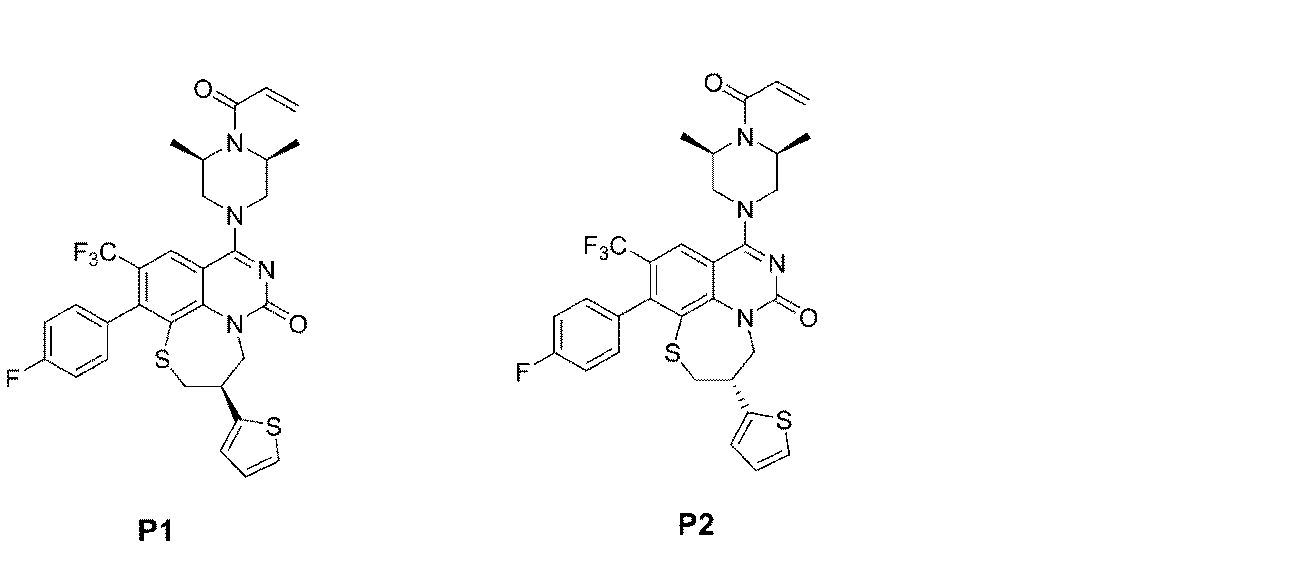

3-(チオフェン-2-イル)オキセタン-3-オール(2) 3-(thiophene-2-yl)oxetan-3-ol (2)
テトラヒドロフラン(205mL)中の2-ブロモチオフェン(10g、61.35mmol)の溶液に、塩化イソプロピルマグネシウムリチウム溶液(49.6mL、64.42mmol、1.3Mのテトラヒドロフラン)を窒素雰囲気下、-78℃で加えた。混合物を-78℃で1時間撹拌した。次いで、オキセタン-3-オン(5.3g、73.62mmol)をゆっくりと加えた。混合物をゆっくりと室温まで温め、2時間撹拌した。飽和塩化アンモニウム水溶液(200mL)をゆっくり加え、酢酸エチル(300mL×3)で抽出した。濃縮後、残渣をシリカゲルカラム(石油エーテル/酢酸エチル=3/1)によって精製して、3-(チオフェン-2-イル)オキセタン-3-オール(2)(6.9g、収率72%)を淡黄色の油として得た。1H NMR (400 MHz, CDCl3) δ 7.31-7.30 (m, 1H), 7.19-7.18 (m, 1H), 7.05-7.04 (m, 1H), 4.93-2.89 (m, 4H). To a solution of 2-bromothiophene (10 g, 61.35 mmol) in tetrahydrofuran (205 mL) was added lithium isopropylmagnesium chloride solution (49.6 mL, 64.42 mmol, 1.3 M tetrahydrofuran) under nitrogen atmosphere at −78° C. The mixture was stirred at −78° C. for 1 h. Then oxetan-3-one (5.3 g, 73.62 mmol) was added slowly. The mixture was slowly warmed to room temperature and stirred for 2 h. Saturated aqueous ammonium chloride solution (200 mL) was added slowly and extracted with ethyl acetate (300 mL×3). After concentration, the residue was purified by silica gel column (petroleum ether/ethyl acetate=3/1) to give 3-(thiophen-2-yl)oxetan-3-ol (2) (6.9 g, 72% yield) as a pale yellow oil. 1H NMR (400 MHz, CDCl3 ) δ 7.31-7.30 (m, 1H), 7.19-7.18 (m, 1H), 7.05-7.04 (m, 1H), 4.93-2.89 (m, 4H).
3-(チオフェン-2-イル)オキセタン(3) 3-(thiophene-2-yl)oxetane (3)
ジクロロメタン(75mL)中の3-(チオフェン-2-イル)オキセタン-3-オール(2)(6.9g、44.17mmol)及びトリフルオロ酢酸(15.4mL、200.85mmol)の混合物に、トリエチルシラン(32.1mL、200.85mmol)を0℃で加えた。混合物を30℃で3時間撹拌した。完了後、混合物を氷水(150mL)に注ぎ、ジクロロメタン(150mL×3)で抽出した。濃縮後、残渣をシリカゲルカラム(石油エーテル/酢酸エチル=10/1)によって精製して、3-(チオフェン-2-イル)オキセタン (3) (5.8g、収率94%)を無色の油として得た。1H NMR (400 MHz, CDCl3) δ 7.23-7.21 (m, 1H), 7.00-6.96 (m, 2H), 5.06-5.02 (m, 2H), 4.82-2.79 (m, 2H), 4.56-4.48 (m, 1H). To a mixture of 3-(thiophen-2-yl)oxetan-3-ol (2) (6.9 g, 44.17 mmol) and trifluoroacetic acid (15.4 mL, 200.85 mmol) in dichloromethane (75 mL) was added triethylsilane (32.1 mL, 200.85 mmol) at 0° C. The mixture was stirred at 30° C. for 3 h. After completion, the mixture was poured into ice water (150 mL) and extracted with dichloromethane (150 mL×3). After concentration, the residue was purified by silica gel column (petroleum ether/ethyl acetate=10/1) to give 3-(thiophen-2-yl)oxetane (3) (5.8 g, 94% yield) as a colorless oil. 1 H NMR (400 MHz, CDCl 3 ) δ 7.23-7.21 (m, 1H), 7.00-6.96 (m, 2H), 5.06-5.02 (m, 2H), 4.82-2.79 (m, 2H), 4.56-4.48 (m, 1H).
3-ブロモ-2-(チオフェン-2-イル)プロパン-1-オール(4) 3-Bromo-2-(thiophen-2-yl)propan-1-ol (4)
ジクロロメタン(140mL)中の3-(チオフェン-2-イル)オキセタン(3)(5.8g、41.37mmol)の溶液に、三臭化ホウ素(41.4mL、41.4mmol、ジクロロメタン中1.0M)を窒素雰囲気下、-78℃でゆっくりと加えた。混合物を-78℃で2時間撹拌した。完了後、混合物を氷水(150mL)に注ぎ、ジクロロメタン(150mL×3)で抽出した。濃縮後、残渣をシリカゲルカラム(石油エーテル/酢酸エチル=2/1)によって精製して、3-ブロモ-2-(チオフェン-2-イル)プロパン-1-オール(4)(5.3g、収率58%)を得た。1H NMR (400 MHz, CDCl3) δ 7.25-7.23 (m, 1H), 7.01-6.99 (m, 1H), 6.97-6.96 (m, 1H), 3.97-3.96 (m, 2H), 3.74-3.64 (m, 2H), 3.51-3.48 (m, 1H). To a solution of 3-(thiophen-2-yl)oxetane (3) (5.8 g, 41.37 mmol) in dichloromethane (140 mL) was slowly added boron tribromide (41.4 mL, 41.4 mmol, 1.0 M in dichloromethane) under nitrogen atmosphere at −78° C. The mixture was stirred at −78° C. for 2 h. After completion, the mixture was poured into ice water (150 mL) and extracted with dichloromethane (150 mL×3). After concentration, the residue was purified by silica gel column (petroleum ether/ethyl acetate=2/1) to give 3-bromo-2-(thiophen-2-yl)propan-1-ol (4) (5.3 g, 58% yield). 1 H NMR (400 MHz, CDCl 3 ) δ 7.25-7.23 (m, 1H), 7.01-6.99 (m, 1H), 6.97-6.96 (m, 1H), 3.97-3.96 (m, 2H), 3.74-3.64 (m, 2H), 3.51-3.48 (m, 1H).
3-メルカプト-2-(チオフェン-2-イル)プロパン-1-オール(5) 3-Mercapto-2-(thiophen-2-yl)propan-1-ol (5)
N,N-ジメチルホルムアミド(48mL)中の3-ブロモ-2-(チオフェン-2-イル)プロパン-1-オール(4)(5.3g、23.97mmol)の溶液に、二硫化ナトリウム(5.76g、71.91 mmol、70%)を0℃で加えた。混合物を窒素雰囲気下、30℃で4時間撹拌した。完了後、混合物を氷水(200mL)に注ぎ、酢酸エチル(200mL×3)で抽出した。濃縮後、残渣をシリカゲルカラム(石油エーテル/酢酸エチル=2/1)によって精製して、3-メルカプト-2-(チオフェン-2-イル)プロパン-1-オール(5)(2.5g、収率60%)を淡黄色の油として得た。1H NMR (400 MHz, CDCl3) δ 7.23-7.22 (m, 1H), 7.00-6.98 (m, 1H), 6.93-6.92 (m, 1H), 3.89-3.87 (m, 2H), 3.32-3.26 (m, 1H), 2.95-2.82 (m, 2H), 1.44-1.40 (m, 1H). To a solution of 3-bromo-2-(thiophen-2-yl)propan-1-ol (4) (5.3 g, 23.97 mmol) in N,N-dimethylformamide (48 mL) was added sodium disulfide (5.76 g, 71.91 mmol, 70%) at 0° C. The mixture was stirred at 30° C. for 4 hours under nitrogen atmosphere. After completion, the mixture was poured into ice water (200 mL) and extracted with ethyl acetate (200 mL×3). After concentration, the residue was purified by silica gel column (petroleum ether/ethyl acetate=2/1) to give 3-mercapto-2-(thiophen-2-yl)propan-1-ol (5) (2.5 g, 60% yield) as a pale yellow oil. 1 H NMR (400 MHz, CDCl 3 ) δ 7.23-7.22 (m, 1H), 7.00-6.98 (m, 1H), 6.93-6.92 (m, 1H), 3.89-3.87 (m, 2H), 3.32-3.26 (m, 1H), 2.95-2.82 (m, 2H), 1.44-1.40 (m, 1H).
7-クロロ-8-((3-ヒドロキシ-2-(チオフェン-3-イル)プロピル)チオ)-6-(トリフルオロメチル)キナゾリン-2,4-ジオール(6) 7-Chloro-8-((3-hydroxy-2-(thiophen-3-yl)propyl)thio)-6-(trifluoromethyl)quinazoline-2,4-diol (6)
1,4-ジオキサン(60mL)中の7-クロロ-8-ヨード-6-(トリフルオロメチル)キナゾリン-2,4-ジオール(2.24g、5.74mmol)の溶液に、炭酸カリウム(2.38g、17.22mmol)、3-メルカプト-2-(チオフェン-2-イル)プロパン-1-オール(5)(2.5g、14.34mmol)、4,5-ビス(ジフェニルホスフィノ)-9,9-ジメチルキサンテン(498mg、0.86mmol)及びトリス(ジベンジリデンアセトン)ジパラジウム(522mg、0.57mmol)を加えた。混合物を窒素雰囲気下、60℃で18時間撹拌した。完了後、混合物を減圧下で濃縮し、残渣をシリカゲルカラムクロマトグラフィー(ジクロロメタン/メタノール=30/1)によって精製して、7-クロロ-8-((3-ヒドロキシ-2-(チオフェン-3-イル)プロピル)チオ)-6-(トリフルオロメチル)キナゾリン-2,4-ジオール(6)(2.2g、粗製)を淡黄色の固体として得た。MS (ESI) m/z 435.0 [MH]-. To a solution of 7-chloro-8-iodo-6-(trifluoromethyl)quinazoline-2,4-diol (2.24 g, 5.74 mmol) in 1,4-dioxane (60 mL) was added potassium carbonate (2.38 g, 17.22 mmol), 3-mercapto-2-(thiophen-2-yl)propan-1-ol (5) (2.5 g, 14.34 mmol), 4,5-bis(diphenylphosphino)-9,9-dimethylxanthene (498 mg, 0.86 mmol) and tris(dibenzylideneacetone)dipalladium (522 mg, 0.57 mmol). The mixture was stirred at 60° C. under nitrogen atmosphere for 18 hours. After completion, the mixture was concentrated under reduced pressure and the residue was purified by silica gel column chromatography (dichloromethane/methanol=30/1) to give 7-chloro-8-((3-hydroxy-2-(thiophen-3-yl)propyl)thio)-6-(trifluoromethyl)quinazoline-2,4-diol (6) (2.2 g, crude) as a pale yellow solid. MS (ESI) m/z 435.0 [MH] − .
11-クロロ-8-ヒドロキシ-3-(チオフェン-2-イル)-10-(トリフルオロメチル)-3,4-ジヒドロ-2H,6H-[1,4]チアゼピノ[2,3,4-ij]キナゾリン-6-オン(7) 11-Chloro-8-hydroxy-3-(thiophen-2-yl)-10-(trifluoromethyl)-3,4-dihydro-2H,6H-[1,4]thiazepino[2,3,4-ij]quinazolin-6-one (7)
テトラヒドロフラン(100mL)中の7-クロロ-8-((3-ヒドロキシ-2-(チオフェン-3-イル)プロピル)チオ)-6-(トリフルオロメチル)キナゾリン-2,4-ジオール(6)(2.2g、5.04mmol)及びトリフェニルホスフィン(2.64g、10.08mmol)の混合物に、アゾジカルボン酸ジエチル(1.76g、10.08mmol)を窒素雰囲気下、0℃で加えた。混合物を室温で3時間撹拌した。完了後、混合物を氷水(100mL)に注ぎ、酢酸エチル(100mL×3)で抽出した。有機相を濃縮し、残渣を水中の30~95%アセトニトリルのC18によって精製して、11-クロロ-8-ヒドロキシ-3-(チオフェン-2-イル)-10-(トリフルオロメチル)-3,4-ジヒドロ-2H,6H-[1,4]チアゼピノ[2,3,4-ij]キナゾリン-6-オン(7)(665mg、2つのステップでの収率28%)を黄色の固体として得た。MS (ESI) m/z: 419.2 [M+H]+. To a mixture of 7-chloro-8-((3-hydroxy-2-(thiophen-3-yl)propyl)thio)-6-(trifluoromethyl)quinazoline-2,4-diol (6) (2.2 g, 5.04 mmol) and triphenylphosphine (2.64 g, 10.08 mmol) in tetrahydrofuran (100 mL) was added diethyl azodicarboxylate (1.76 g, 10.08 mmol) under nitrogen atmosphere at 0° C. The mixture was stirred at room temperature for 3 hours. After completion, the mixture was poured into ice water (100 mL) and extracted with ethyl acetate (100 mL×3). The organic phase was concentrated and the residue was purified by C18 30-95% acetonitrile in water to give 11-chloro-8-hydroxy-3-(thiophen-2-yl)-10-(trifluoromethyl)-3,4-dihydro-2H,6H-[1,4]thiazepino[2,3,4-ij]quinazolin-6-one (7) (665 mg, 28% yield for two steps) as a yellow solid. MS (ESI) m/z: 419.2 [M+H] + .
tert-ブチル(2S,6R)-4-(11-クロロ-6-オキソ-3-(チオフェン-2-イル)-10-(トリフルオロメチル)-3,4-ジヒドロ-2H,6H-[1,4]チアゼピノ[2,3,4-ij]キナゾリン-8-イル)-2,6-ジメチルピペラジン-1-カルボキシレート(8) tert-Butyl (2S,6R)-4-(11-chloro-6-oxo-3-(thiophen-2-yl)-10-(trifluoromethyl)-3,4-dihydro-2H,6H-[1,4]thiazepino[2,3,4-ij]quinazolin-8-yl)-2,6-dimethylpiperazine-1-carboxylate (8)
アセトニトリル(60mL)中の11-クロロ-8-ヒドロキシ-3-(チオフェン-2-イル)-10-(トリフルオロメチル)-3,4-ジヒドロ-2H,6H-[1,4]チアゼピノ[2,3,4-ij]キナゾリン-6-オン(7)(665mg、1.59mmol)及び炭酸カリウム(1.10g、7.95mmol)の混合物に、4-メチルベンゼンスルホン酸無水物(1.30g、3.98mmol)を加えた。混合物を35℃で8時間撹拌した。完了後、(2S,6R)-tert-ブチル2,6-ジメチルピペラジン-1-カルボキシレート(1.02g、4.77mmol)を反応溶液に加えた。反応混合物を、35℃で一晩撹拌した。完了後、混合物を氷水(200mL)に注ぎ、酢酸エチル(100mL×3)で抽出した。濃縮して残渣を水中の20~95%アセトニトリルのC18カラムによって精製して、(2S,6R)-4-(11-クロロ-6-オキソ-3-(チオフェン-2-イル)-10-(トリフルオロメチル)-3,4-ジヒドロ-2H,6H-[1,4]チアゼピノ[2,3,4-ij]キナゾリン-8-イル)-2,6-ジメチルピペラジン-1-カルボキシレート(8)(720mg、収率74%)を淡黄色の固体として得た。MS (ESI) m/z: 615.2 [M+H]+. To a mixture of 11-chloro-8-hydroxy-3-(thiophen-2-yl)-10-(trifluoromethyl)-3,4-dihydro-2H,6H-[1,4]thiazepino[2,3,4-ij]quinazolin-6-one (7) (665 mg, 1.59 mmol) and potassium carbonate (1.10 g, 7.95 mmol) in acetonitrile (60 mL) was added 4-methylbenzenesulfonic anhydride (1.30 g, 3.98 mmol). The mixture was stirred at 35° C. for 8 hours. After completion, (2S,6R)-tert-butyl 2,6-dimethylpiperazine-1-carboxylate (1.02 g, 4.77 mmol) was added to the reaction solution. The reaction mixture was stirred at 35° C. overnight. After completion, the mixture was poured into ice water (200 mL) and extracted with ethyl acetate (100 mL×3). Upon concentration, the residue was purified by C18 column with 20-95% acetonitrile in water to give (2S,6R)-4-(11-chloro-6-oxo-3-(thiophen-2-yl)-10-(trifluoromethyl)-3,4-dihydro-2H,6H-[1,4]thiazepino[2,3,4-ij]quinazolin-8-yl)-2,6-dimethylpiperazine-1-carboxylate (8) (720 mg, 74% yield) as a pale yellow solid. MS (ESI) m/z: 615.2 [M+H] + .
tert-ブチル(2S,6R)-4-(11-(4-フルオロフェニル)-6-オキソ-3-(チオフェン-2-イル)-10-(トリフルオロメチル)-3,4-ジヒドロ-2H,6H-[1,4]チアゼピノ[2,3,4-ij]キナゾリン-8-イル)-2,6-ジメチルピペラジン-1-カルボキシレート(9) tert-Butyl (2S,6R)-4-(11-(4-fluorophenyl)-6-oxo-3-(thiophen-2-yl)-10-(trifluoromethyl)-3,4-dihydro-2H,6H-[1,4]thiazepino[2,3,4-ij]quinazolin-8-yl)-2,6-dimethylpiperazine-1-carboxylate (9)
1,4-ジオキサン及び水中の(2S,6R)-4-(11-クロロ-6-オキソ-3-(チオフェン-2-イル)-10-(トリフルオロメチル)-3,4-ジヒドロ-2H,6H-[1,4]チアゼピノ[2,3,4-ij]キナゾリン-8-イル)-2,6-ジメチルピペラジン-1-カルボキシレート(8)(150mg、0.24mmol)の混合物に、[2’-(アミノ)[1,1’-ビフェニル]-2-イル][[2’,6’-ビス(1-メチルエトキシ)[1,1’-ビフェニル]-2-イル]ジシクロヘキシルホスフィン]クロロパラジウム(38mg、0.048mmol)、リン酸カリウム三水和物(320mg、1.2mmol)及び(4-フルオロフェニル)ボロン酸(101mg、0.72mmol)を25℃で加えた。混合物を80℃で2時間撹拌した。完了後、混合物を濃縮し、残渣をシリカゲルカラムクロマトグラフィー(ジクロロメタン/メタノール=50/1)によって精製して、tert-ブチル(2S,6R)-4-(11-(4-フルオロフェニル)-6-オキソ-3-(チオフェン-2-イル)-10-(トリフルオロメチル)-3,4-ジヒドロ-2H,6H-[1,4]チアゼピノ[2,3,4-ij]キナゾリン-8-イル)-2,6-ジメチルピペラジン-1-カルボキシレート(9)(220mg、粗製)を黄色の固体として得た。MS (ESI) m/z: 675.2 [M+H]+. To a mixture of (2S,6R)-4-(11-chloro-6-oxo-3-(thiophen-2-yl)-10-(trifluoromethyl)-3,4-dihydro-2H,6H-[1,4]thiazepino[2,3,4-ij]quinazolin-8-yl)-2,6-dimethylpiperazine-1-carboxylate (8) (150 mg, 0.24 mmol) in 1,4-dioxane and water was added [2'-( (amino)[1,1'-biphenyl]-2-yl][[2',6'-bis(1-methylethoxy)[1,1'-biphenyl]-2-yl]dicyclohexylphosphine]chloropalladium (38 mg, 0.048 mmol), potassium phosphate trihydrate (320 mg, 1.2 mmol) and (4-fluorophenyl)boronic acid (101 mg, 0.72 mmol) were added at 25° C. The mixture was stirred at 80° C. for 2 hours. After completion, the mixture was concentrated and the residue was purified by silica gel column chromatography (dichloromethane/methanol=50/1) to give tert-butyl (2S,6R)-4-(11-(4-fluorophenyl)-6-oxo-3-(thiophen-2-yl)-10-(trifluoromethyl)-3,4-dihydro-2H,6H-[1,4]thiazepino[2,3,4-ij]quinazolin-8-yl)-2,6-dimethylpiperazine-1-carboxylate (9) (220 mg, crude) as a yellow solid. MS (ESI) m/z: 675.2 [M+H] + .
8-((3S,5R)-3,5-ジメチルピペラジン-1-イル)-11-(4-フルオロフェニル)-3-(チオフェン-2-イル)-10-(トリフルオロメチル)-3,4-ジヒドロ-2H,6H-[1,4]チアゼピノ[2,3,4-ij]キナゾリン-6-オン(10) 8-((3S,5R)-3,5-dimethylpiperazin-1-yl)-11-(4-fluorophenyl)-3-(thiophen-2-yl)-10-(trifluoromethyl)-3,4-dihydro-2H,6H-[1,4]thiazepino[2,3,4-ij]quinazolin-6-one (10)
ジクロロメタン(4mL)中のtert-ブチル(2S,6R)-4-(11-(4-フルオロフェニル)-6-オキソ-3-(チオフェン-2-イル)-10-(トリフルオロメチル)-3,4-ジヒドロ-2H,6H-[1,4]チアゼピノ[2,3,4-ij]キナゾリン-8-イル)-2,6-ジメチルピペラジン-1-カルボキシレート(9)(220mg、粗製)の混合物に、トリフルオロ酢酸(2mL)を25℃で加えた。混合物を25℃で1時間撹拌した。完了後、混合物を濃縮し、0℃でメタノール中のアンモニアを用いてPHを8に調整した。混合物を濃縮し、シリカゲルカラムクロマトグラフィー(ジクロロメタン/メタノール=20/1)によって精製して、8-((3S,5R)-3,5-ジメチルピペラジン-1-イル)-11-(4-フルオロフェニル)-3-(チオフェン-2-イル)-10-(トリフルオロメチル)-3,4-ジヒドロ-2H,6H-[1,4]チアゼピノ[2,3,4-ij]キナゾリン-6-オン(10)(130mg、粗製)を黄色の固体として得た。MS (ESI) m/z: 575.2 [M+H]+. To a mixture of tert-butyl (2S,6R)-4-(11-(4-fluorophenyl)-6-oxo-3-(thiophen-2-yl)-10-(trifluoromethyl)-3,4-dihydro-2H,6H-[1,4]thiazepino[2,3,4-ij]quinazolin-8-yl)-2,6-dimethylpiperazine-1-carboxylate (9) (220 mg, crude) in dichloromethane (4 mL) was added trifluoroacetic acid (2 mL) at 25° C. The mixture was stirred at 25° C. for 1 h. After completion, the mixture was concentrated and the pH was adjusted to 8 with ammonia in methanol at 0° C. The mixture was concentrated and purified by silica gel column chromatography (dichloromethane/methanol=20/1) to give 8-((3S,5R)-3,5-dimethylpiperazin-1-yl)-11-(4-fluorophenyl)-3-(thiophen-2-yl)-10-(trifluoromethyl)-3,4-dihydro-2H,6H-[1,4]thiazepino[2,3,4-ij]quinazolin-6-one (10) (130 mg, crude) as a yellow solid. MS (ESI) m/z: 575.2 [M+H] + .
8-((3S,5R)-4-アクリロイル-3,5-ジメチルピペラジン-1-イル)-11-(4-フルオロフェニル)-3-(チオフェン-2-イル)-10-(トリフルオロメチル)-3,4-ジヒドロ-2H,6H-[1,4]チアゼピノ[2,3,4-ij]キナゾリン-6-オン(11) 8-((3S,5R)-4-acryloyl-3,5-dimethylpiperazin-1-yl)-11-(4-fluorophenyl)-3-(thiophen-2-yl)-10-(trifluoromethyl)-3,4-dihydro-2H,6H-[1,4]thiazepino[2,3,4-ij]quinazolin-6-one (11)
ジクロロメタン(6ml)中の8-((3S,5R)-3,5-ジメチルピペラジン-1-イル)-11-(4-フルオロフェニル)-3-(チオフェン-2-イル)-10-(トリフルオロメチル)-3,4-ジヒドロ-2H,6H-[1,4]チアゼピノ[2,3,4-ij]キナゾリン-6-オン(10)(130mg、0.23mmol)の混合物に、トリエチルアミン(46mg、0.46mmol)及びアクリル酸無水物(44mg、0.35mmol)を0℃で加えた。混合物を25℃で1時間撹拌した。完了後、混合物に25℃でメタノールを加え、濃縮した。混合物を分取高速液体クロマトグラフィー(水中の20%~95%アセトニトリル)によって精製して、8-((3S,5R)-4-アクリロイル-3,5-ジメチルピペラジン-1-イル)-11-(4-フルオロフェニル)-3-(チオフェン-2-イル)-10-(トリフルオロメチル)-3,4-ジヒドロ-2H,6H-[1,4]チアゼピノ[2,3,4-ij]キナゾリン-6-オン(11)(50mg、3つのステップでの収率33%)を淡黄色の粉末として得た。MS (ESI) m/z: 629.0 [M+H]+. To a mixture of 8-((3S,5R)-3,5-dimethylpiperazin-1-yl)-11-(4-fluorophenyl)-3-(thiophen-2-yl)-10-(trifluoromethyl)-3,4-dihydro-2H,6H-[1,4]thiazepino[2,3,4-ij]quinazolin-6-one (10) (130 mg, 0.23 mmol) in dichloromethane (6 ml) was added triethylamine (46 mg, 0.46 mmol) and acrylic anhydride (44 mg, 0.35 mmol) at 0° C. The mixture was stirred at 25° C. for 1 hour. After completion, the mixture was added methanol at 25° C. and concentrated. The mixture was purified by preparative high performance liquid chromatography (20% to 95% acetonitrile in water) to give 8-((3S,5R)-4-acryloyl-3,5-dimethylpiperazin-1-yl)-11-(4-fluorophenyl)-3-(thiophen-2-yl)-10-(trifluoromethyl)-3,4-dihydro-2H,6H-[1,4]thiazepino[2,3,4-ij]quinazolin-6-one (11) (50 mg, 33% yield for three steps) as a pale yellow powder. MS (ESI) m/z: 629.0 [M+H] + .
上記のラセミ化合物(50mg)をエタノール(5mL)に溶解させ、キラル超臨界流体クロマトグラフィー(分離条件:カラム:IC 5μm 20×250mm;移動相:20mL/分でMeOH/DCM=90/10;温度:30℃;波長:254nm)によって分離して、表題化合物CA-5578-F1(18mg、収率:36%、100%ee)及びCA-5578-F2(16mg、収率:32%、99.8%ee)を得た;キラルHPLC分析:IC上5μm 4.6×250mmカラムを使用、移動相:1mL/分でMeOH/DCM=90/10;温度:30℃;波長:254nm)。 The above racemic compound (50 mg) was dissolved in ethanol (5 mL) and separated by chiral supercritical fluid chromatography (separation conditions: column: IC 5 μm 20 × 250 mm; mobile phase: MeOH/DCM = 90/10 at 20 mL/min; temperature: 30 °C; wavelength: 254 nm) to obtain the title compounds CA-5578-F1 (18 mg, yield: 36%, 100% ee) and CA-5578-F2 (16 mg, yield: 32%, 99.8% ee); chiral HPLC analysis: using a 5 μm 4.6 × 250 mm column on IC, mobile phase: MeOH/DCM = 90/10 at 1 mL/min; temperature: 30 °C; wavelength: 254 nm).
(R)-8-((3S,5R)-4-アクリロイル-3,5-ジメチルピペラジン-1-イル)-11-(4-フルオロフェニル)-3-(チオフェン-2-イル)-10-(トリフルオロメチル)-3,4-ジヒドロ-2H,6H-[1,4]チアゼピノ[2,3,4-ij]キナゾリン-6-オン(P1) (R)-8-((3S,5R)-4-acryloyl-3,5-dimethylpiperazin-1-yl)-11-(4-fluorophenyl)-3-(thiophen-2-yl)-10-(trifluoromethyl)-3,4-dihydro-2H,6H-[1,4]thiazepino[2,3,4-ij]quinazolin-6-one (P1)
1H NMR (400 MHz, CDCl3) δ 8.09 (s, 1H), 7.28-7.27 (m, 1H), 7.21-7.15 (m, 4H), 7.00-6.99 (m, 1H), 6.97-6.95 (m, 1H), 6.63 (dd, J = 16.4 Hz, 10.4 Hz, 1H), 6.41 (dd, J = 16.8 Hz, 2.0 Hz, 1H), 5.78 (dd, J = 10.4 Hz, 2.0 Hz, 1H), 4.87-4.84 (m, 1H), 4.76-4.53 (m, 3H), 4.21-4.15 (m, 2H), 4.11-4.03 (m, 1H), 3.71-3.61 (m, 1H), 3.41-3.32 (m, 2H), 3.13-3.02 (m, 1H), 1.60 (d, J = 7.2 Hz, 3H), 1.52 (d, J = 6.8 Hz, 3H);キラルHPLC画分1:e.e.=100%、Rt=10.566分. 1 H NMR (400 MHz, CDCl 3 ) δ 8.09 (s, 1H), 7.28-7.27 (m, 1H), 7.21-7.15 (m, 4H), 7.00-6.99 (m, 1H), 6.97-6.95 (m, 1H), 6.63 (dd, J = 16.4 Hz, 10.4 Hz, 1H), 6.41 (dd, J = 16.8 Hz, 2.0 Hz, 1H), 5.78 (dd, J = 10.4 Hz, 2.0 Hz, 1H), 4.87-4.84 (m, 1H), 4.76-4.53 (m, 3H), 4.21-4.15 (m, 2H), 4.11-4.03 (m, 1H), 3.71-3.61 (m, 1H), 3.41-3.32 (m, 2H), 3.13-3.02 (m, 1H), 1.60 (d, J=7.2 Hz, 3H), 1.52 (d, J=6.8 Hz, 3H); Chiral HPLC fraction 1: e. e. =100%, Rt=10.566 minutes.
(S)-8-((3S,5R)-4-アクリロイル-3,5-ジメチルピペラジン-1-イル)-11-(4-フルオロフェニル)-3-(チオフェン-2-イル)-10-(トリフルオロメチル)-3,4-ジヒドロ-2H,6H-[1,4]チアゼピノ[2,3,4-ij]キナゾリン-6-オン(P2) (S)-8-((3S,5R)-4-acryloyl-3,5-dimethylpiperazin-1-yl)-11-(4-fluorophenyl)-3-(thiophen-2-yl)-10-(trifluoromethyl)-3,4-dihydro-2H,6H-[1,4]thiazepino[2,3,4-ij]quinazolin-6-one (P2)
1H NMR (400 MHz, CDCl3) δ 8.09 (s, 1H), 7.31-7.29 (m, 1H), 7.20-7.17 (m, 4H), 7.00-6.99 (m, 1H), 6.97-6.95 (m, 1H), 6.63 (dd, J = 16.8 Hz, 10.4 Hz, 1H), 6.41 (dd, J = 16.8 Hz, 2.0 Hz, 1H), 5.78 (dd, J = 10.4 Hz, 1.6 Hz, 1H), 4.94-4.83 (m, 1H), 4.78-4.54 (m, 3H), 4.21-4.15 (m, 2H), 4.11-4.02 (m, 1H), 3.72-3.60 (m, 1H), 3.41-3.33 (m, 2H), 3.10-3.03 (m, 1H), 1.60-1.57 (m, 3H), 1.52 (d, J = 6.8 Hz, 3H);キラルHPLC画分2:e.e.=99.8%、Rt=12.223分. 1 H NMR (400 MHz, CDCl 3 ) δ 8.09 (s, 1H), 7.31-7.29 (m, 1H), 7.20-7.17 (m, 4H), 7.00-6.99 (m, 1H), 6.97-6.95 (m, 1H), 6.63 (dd, J = 16.8 Hz, 10.4 Hz, 1H), 6.41 (dd, J = 16.8 Hz, 2.0 Hz, 1H), 5.78 (dd, J = 10.4 Hz, 1.6 Hz, 1H), 4.94-4.83 (m, 1H), 4.78-4.54 (m, 3H), 4.21-4.15 (m, 2H), 4.11-4.02 (m, 1H), 3.72-3.60 (m, 1H), 3.41-3.33 (m, 2H), 3.10-3.03 (m, 1H), 1.60-1.57 (m, 3H), 1.52 (d, J = 6.8 Hz, 3H); Chiral HPLC fraction 2: e. e. =99.8%, Rt=12.223 minutes.
実施例126:(R)-8-((3S,5R)-4-アクリロイル-3,5-ジメチルピペラジン-1-イル)-11-(4-フルオロフェニル)-3-(5-フルオロピリジン-3-イル)-10-(トリフルオロメチル)-3,4-ジヒドロ-2H,6H-[1,4]チアゼピノ[2,3,4-ij]キナゾリン-6-オン

ステップ1:tert-ブチル(2S,6R)-4-((R)-11-クロロ-3-(5-フルオロピリジン-3-イル)-6-オキソ-10-(トリフルオロメチル)-3,4-ジヒドロ-2H,6H-[1,4]チアゼピノ[2,3,4-ij]キナゾリン-8-イル)-2,6-ジメチルピペラジン-1-カルボキシレート及びtert-ブチル(2S,6R)-4-((S)-11-クロロ-3-(5-フルオロピリジン-3-イル)-6-オキソ-10-(トリフルオロメチル)-3,4-ジヒドロ-2H,6H-[1,4]チアゼピノ[2,3,4-ij]キナゾリン-8-イル)-2,6-ジメチルピペラジン-1-カルボキシレート
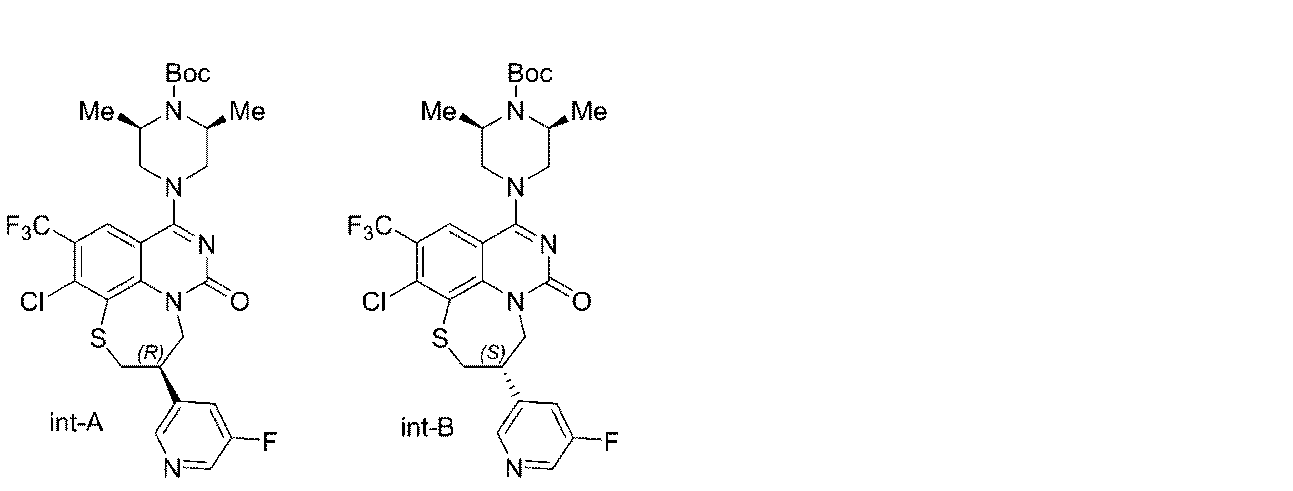
表題化合物は、ステップ1においてピリジン-3-イルボロン酸を(5-フルオロピリジン-3-イル)ボロン酸に置き換えて、実施例104と同様に調製した。表題化合物をジアステレオマーの1:1混合物として単離した。tert-ブチル(2S,6R)-4-((R)-11-クロロ-3-(5-フルオロピリジン-3-イル)-6-オキソ-10-(トリフルオロメチル)-3,4-ジヒドロ-2H,6H-[1,4]チアゼピノ[2,3,4-ij]キナゾリン-8-イル)-2,6-ジメチルピペラジン-1-カルボキシレート及びtert-ブチル(2S,6R)-4-((S)-11-クロロ-3-(5-フルオロピリジン-3-イル)-6-オキソ-10-(トリフルオロメチル)-3,4-ジヒドロ-2H,6H-[1,4]チアゼピノ[2,3,4-ij]キナゾリン-8-イル)-2,6-ジメチルピペラジン-1-カルボキシレートを、SFC(カラム=Daicel Chiralpak IC 250mm×30mm、10um;相A:エタノール、相B:CO2;勾配:65% A/B、7.45分間ランタイム)による混合物の精製によって単一のジアステレオマーとして得、SFC (カラム:Chiralpak IC-3、50×4.6mm、I.D.=3um、背圧100barで35℃で安定化)によって特性評価した。移動相:CO2中の0.05%ジエチルアミンを含有する60%エタノール、流速=3mL/分、検出器:フォトダイオードアレイ)。Int-a:SFC Rt=1.58分;MS (ESI) m/z: 628.2 [M+H]+. Int-b:SFC Rt=2.87分;MS (ESI) m/z: 628.2 [M+H]+. The title compound was prepared similarly to Example 104, substituting (5-fluoropyridin-3-yl)boronic acid for pyridin-3-ylboronic acid in step 1. The title compound was isolated as a 1:1 mixture of diastereomers. tert-Butyl (2S,6R)-4-((R)-11-chloro-3-(5-fluoropyridin-3-yl)-6-oxo-10-(trifluoromethyl)-3,4-dihydro-2H,6H-[1,4]thiazepino[2,3,4-ij]quinazolin-8-yl)-2,6-dimethylpiperazine-1-carboxylate and tert-butyl (2S,6R)-4-((S)-11-chloro-3-(5-fluoropyridin-3-yl)-6-oxo-10-(trifluoromethyl)-3,4-dihydro-2H,6H-[1,4]thiazepino[2,3,4-ij]quinazolin-8-yl)-2,6-dimethylpiperazine-1-carboxylate were purified by SFC (column: Daicel Chiralpak IC Purification of the mixture by column chromatography (250 mm x 30 mm, 10 um; phase A: ethanol, phase B: CO2; gradient: 65% A/B, 7.45 min runtime) afforded a single diastereomer and characterized by SFC (column: Chiralpak IC-3, 50 x 4.6 mm, I.D. = 3 um, stabilized at 35°C with 100 bar back pressure). Mobile phase: 60% ethanol containing 0.05% diethylamine in CO2, flow rate = 3 mL/min, detector: photodiode array). Int-a: SFC Rt = 1.58 min; MS (ESI) m/z: 628.2 [M+H]+. Int-b: SFC Rt = 2.87 min; MS (ESI) m/z: 628.2 [M+H]+.
ステップ2:tert-ブチル(2S,6R)-4-((S)-11-(4-フルオロフェニル)-3-(5-フルオロピリジン-3-イル)-6-オキソ-10-(トリフルオロメチル)-3,4-ジヒドロ-2H,6H-[1,4]チアゼピノ[2,3,4-ij]キナゾリン-8-イル)-2,6-ジメチルピペラジン-1-カルボキシレート

tert-ブチル(2S,6R)-4-((S)-11-クロロ-6-オキソ-3-(ピリジン-4-イル)-10-(トリフルオロメチル)-3,4-ジヒドロ-2H,6H-[1,4]チアゼピノ[2,3,4-ij]キナゾリン-8-イル)-2,6-ジメチルピペラジン-1-カルボキシレートをtert-ブチル(2S,6R)-4-((S)-11-クロロ-3-(5-フルオロピリジン-3-イル)-6-オキソ-10-(トリフルオロメチル)-3,4-ジヒドロ-2H,6H-[1,4]チアゼピノ[2,3,4-ij]キナゾリン-8-イル)-2,6-ジメチルピペラジン-1-カルボキシレートに置き換えて、表題化合物を実施例100のステップ9と同様に調製した。表題化合物を収率36%で黄色の固体として単離した。MS (ESI) m/z: 688.2 [M+H]+. The title compound was prepared similarly to step 9 of Example 100, replacing tert-butyl (2S,6R)-4-((S)-11-chloro-6-oxo-3-(pyridin-4-yl)-10-(trifluoromethyl)-3,4-dihydro-2H,6H-[1,4]thiazepino[2,3,4-ij]quinazolin-8-yl)-2,6-dimethylpiperazine-1-carboxylate with tert-butyl (2S,6R)-4-((S)-11-chloro-3-(5-fluoropyridin-3-yl)-6-oxo-10-(trifluoromethyl)-3,4-dihydro-2H,6H-[1,4]thiazepino[2,3,4-ij]quinazolin-8-yl)-2,6-dimethylpiperazine-1-carboxylate. The title compound was isolated as a yellow solid in 36% yield. MS (ESI) m/z: 688.2 [M+H]+.
ステップ3:(S)-8-((3S,5R)-3,5-ジメチルピペラジン-1-イル)-11-(4-フルオロフェニル)-3-(5-フルオロピリジン-3-イル)-10-(トリフルオロメチル)-3,4-ジヒドロ-2H,6H-[1,4]チアゼピノ[2,3,4-ij]キナゾリン-6-オン
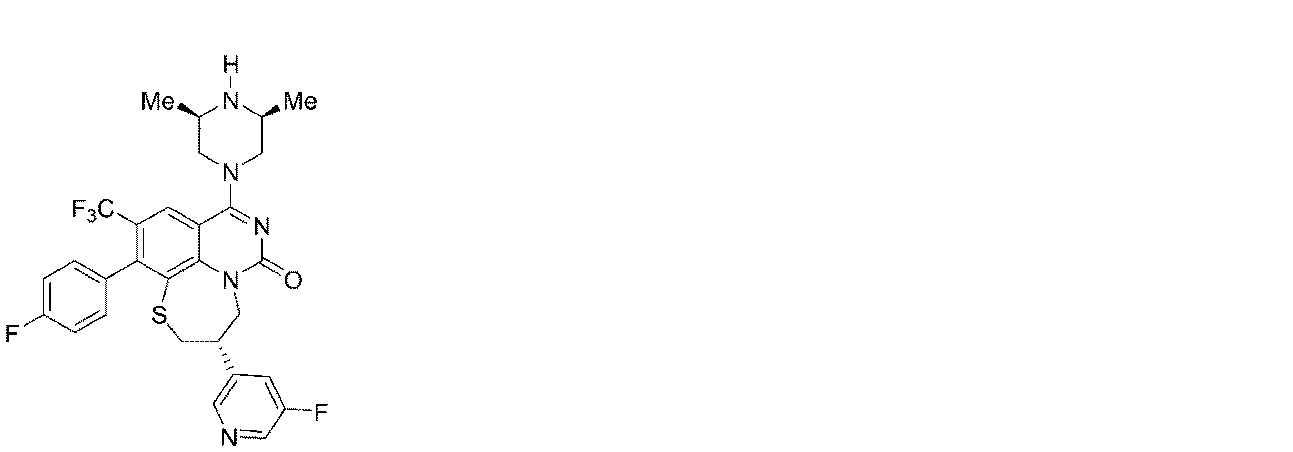
tert-ブチル(2S,6R)-4-((3S)-11-(5-クロロ-2,4-ジフルオロフェニル)-6-オキソ-3-(ピリジン-4-イル)-10-(トリフルオロメチル)-3,4-ジヒドロ-2H,6H-[1,4]チアゼピノ[2,3,4-ij]キナゾリン-8-イル)-2,6-ジメチルピペラジン-1-カルボキシレートをtert-ブチル(2S,6R)-4-((S)-11-(4-フルオロフェニル)-3-(5-フルオロピリジン-3-イル)-6-オキソ-10-(トリフルオロメチル)-3,4-ジヒドロ-2H,6H-[1,4]チアゼピノ[2,3,4-ij]キナゾリン-8-イル)-2,6-ジメチルピペラジン-1-カルボキシレートに置き換えて、表題化合物を実施例100のステップ10と同様に調製した。表題化合物を収率99%で黄色の固体として単離した。MS (ESI) m/z: 588.2 [M+H]+. tert-Butyl (2S,6R)-4-((3S)-11-(5-chloro-2,4-difluorophenyl)-6-oxo-3-(pyridin-4-yl)-10-(trifluoromethyl)-3,4-dihydro-2H,6H-[1,4]thiazepino[2,3,4-ij]quinazolin-8-yl)-2,6-dimethylpiperazine-1-carboxylate was synthesized using tert-butyl (2S,6R) The title compound was prepared similarly to step 10 of Example 100, substituting -4-((S)-11-(4-fluorophenyl)-3-(5-fluoropyridin-3-yl)-6-oxo-10-(trifluoromethyl)-3,4-dihydro-2H,6H-[1,4]thiazepino[2,3,4-ij]quinazolin-8-yl)-2,6-dimethylpiperazine-1-carboxylate. The title compound was isolated in 99% yield as a yellow solid. MS (ESI) m/z: 588.2 [M+H]+.
ステップ4:(R)-8-((3S,5R)-4-アクリロイル-3,5-ジメチルピペラジン-1-イル)-11-(4-フルオロフェニル)-3-(5-フルオロピリジン-3-イル)-10-(トリフルオロメチル)-3,4-ジヒドロ-2H,6H-[1,4]チアゼピノ[2,3,4-ij]キナゾリン-6-オン
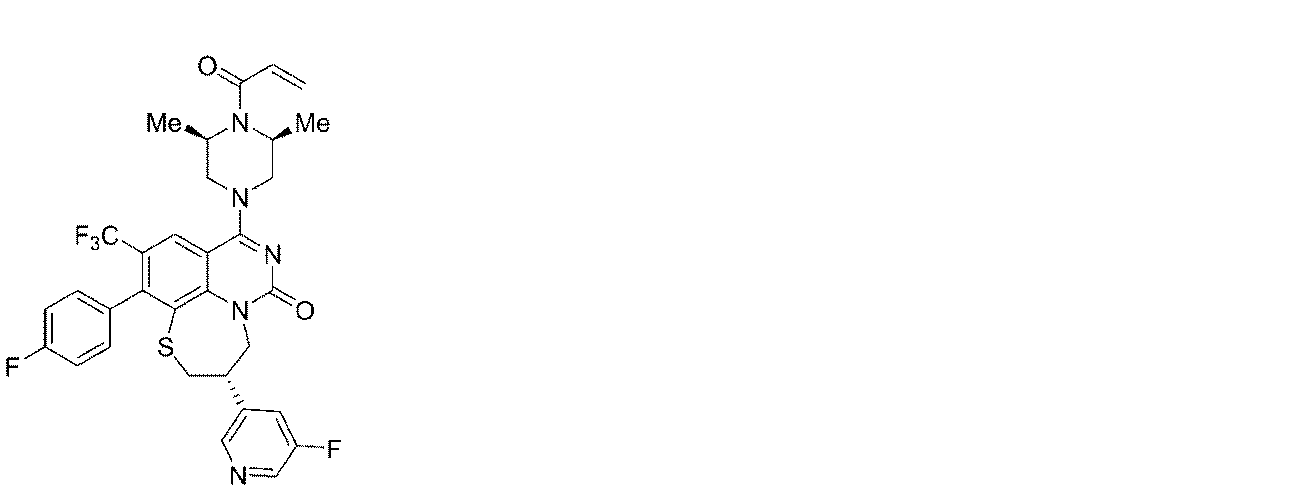
(3S)-11-(5-クロロ-2,4-ジフルオロフェニル)-8-((3S,5R)-3,5-ジメチルピペラジン-1-イル)-3-(ピリジン-4-イル)-10-(トリフルオロメチル)-3,4-ジヒドロ-2H,6H-[1,4]チアゼピノ[2,3,4-ij]キナゾリン-6-オンを(S)-8-((3S,5R)-3,5-ジメチルピペラジン-1-イル)-11-(4-フルオロフェニル)-3-(5-フルオロピリジン-3-イル)-10-(トリフルオロメチル)-3,4-ジヒドロ-2H,6H-[1,4]チアゼピノ[2,3,4-ij]キナゾリン-6-オンに置き換えて、表題化合物を実施例100のステップ11と同様に調製した。表題化合物を収率84%で黄色の固体として単離した。MS (ESI) m/z: 642.2 [M+1]+. The title compound was prepared similarly to step 11 of Example 100, replacing (3S)-11-(5-chloro-2,4-difluorophenyl)-8-((3S,5R)-3,5-dimethylpiperazin-1-yl)-3-(pyridin-4-yl)-10-(trifluoromethyl)-3,4-dihydro-2H,6H-[1,4]thiazepino[2,3,4-ij]quinazolin-6-one with (S)-8-((3S,5R)-3,5-dimethylpiperazin-1-yl)-11-(4-fluorophenyl)-3-(5-fluoropyridin-3-yl)-10-(trifluoromethyl)-3,4-dihydro-2H,6H-[1,4]thiazepino[2,3,4-ij]quinazolin-6-one. The title compound was isolated in 84% yield as a yellow solid. MS (ESI) m/z: 642.2 [M+1]+.
1H-NMR (400 MHz, CDCl3)= 8.47 (s, 1H), 8.42 (s, 1H), 8.13 (S, 1H), 7.46 (m, 1H), 7.25-7.19 (m, 4 H), 6.61 (dd, J= 16 Hz, J= 6 Hz, 1H), 6.44 (d, J= 16 Hz, 1H), 5.80 (d, J= 6 Hz, 1H), 4.80 (m, 4H), 4.21 (m, 2H), 3.75 (m, 2H), 3.40 (m, 2H), 3.06 (m, 1H), 1.57 (m, 6H). 1H-NMR (400 MHz, CDCl3) = 8.47 (s, 1H), 8.42 (s, 1H), 8.13 (S, 1H), 7.46 (m, 1H), 7.25-7.19 (m, 4H), 6.61 (dd, J = 16 Hz, J= 6 Hz, 1H), 6.44 (d, J= 16 Hz, 1H), 5.80 (d, J= 6 Hz, 1H), 4.80 (m, 4H), 4.21 (m, 2H), 3.75 (m, 2H), 3.40 (m, 2H), 3.06 (m, 1H), 1.57 (m, 6H).
上記の化合物がキラル中心だけでなく、潜在的軸不斉、すなわち、アトロプ異性体を有することは、当業者には理解されよう。化合物の各々は、ジアステレオマーの混合物として、または任意のジアステレオマー的に純粋な形態で提供され得る。 It will be appreciated by those skilled in the art that the above compounds have chiral centers as well as potential axial asymmetry, i.e., atropisomers. Each of the compounds may be provided as a mixture of diastereomers or in any diastereomerically pure form.
追加の実施形態は、以下のように本明細書で提供される:


式(I)の化合物によるKRAS G12Cの阻害がホスホERK1/2の阻害を媒介する Inhibition of KRAS G12C by compounds of formula (I) mediates inhibition of phospho-ERK1/2.
本実施例は、本開示の様々な化合物が、KRAS G12Cを阻害し、それによってホスホERK1/2の下流阻害を媒介することを示す。 This example shows that various compounds of the present disclosure inhibit KRAS G12C, thereby mediating downstream inhibition of phospho-ERK1/2.
KRAS G12C変異細胞株、NCI H358(ATCC、CRL-5807)、及びRas Initiative(RI)KRAS G12Cを、公開されているプロトコルに従って培養し、5%のCO2、37℃で維持した。ホスホERK HTRFアッセイは、プロバイダーのプロトコル(CisBio#64AERPEH)に従って行われた。NCI-H358細胞またはRI KRAS G12C細胞を、96ウェルプレート(Corning#3903)の各培地(NCI-H358の場合、RPMI+10% FBS+1%のPen/Strep、及びRI KRAS G12Cの場合、DMEM+10% FBS+1%のPen/Strep+4ug/mlのブラストサイジン)に1ウェルあたり50,000細胞の密度で播種し、5%のCO2、37℃で維持した。細胞を一晩接着させ、翌日、Tecan D300eデジタルディスペンサー(Tecan Group Ltd.,Switzerland)を用いて、2,500nMの例示的な化合物で開始し、その後、4時間または16時間連続して1:3希釈する11点用量反応を使用して処理した。化合物処理後、細胞を氷冷したPBSで1回洗浄した。1xPierce Haltプロテアーゼ及びホスファターゼ阻害剤を補充した溶解緩衝液(1x)50μlを加えて細胞を溶解し、振盪しながら4℃で30分間インキュベートした。溶解後、96ウェル細胞培養プレートから16μLの細胞溶解物を384ウェルプレート(Perkin Elmer#6007290)に移した。予混合抗体溶液は、アドバンスドホスホ-ERK1/2 d2抗体とアドバンスドホスホ-ERK1/2Euクリプテート抗体を混合(体積/体積)することによって調製された。予混合抗体溶液(4μL)を、細胞溶解物を含有する検出プレートに加えた。検出プレートを4℃で一晩インキュベートし、翌日、Spectramax M5またはSpectramax i3マイクロプレートリーダー(Molecular Devices、San Jose、CA、USA)を使用してHTRFシグナルを読み取り、メーカーのプロトコルに従ってデータを処理した。 KRAS G12C mutant cell lines, NCI H358 (ATCC, CRL-5807) and Ras Initiative (RI) KRAS G12C, were cultured according to published protocols and maintained at 37° C. with 5% CO. Phospho-ERK HTRF assays were performed according to the provider's protocol (CisBio #64AERPEH). NCI-H358 or RI KRAS G12C cells were seeded at a density of 50,000 cells per well in respective media (RPMI+10% FBS+1% Pen/Strep for NCI-H358 and DMEM+10% FBS+1% Pen/Strep+4ug/ml Blasticidin for RI KRAS G12C) in 96-well plates (Corning #3903) and maintained at 37°C with 5% CO2 . Cells were allowed to adhere overnight and treated the next day using an 11-point dose response starting with 2,500 nM of exemplary compound followed by serial 1:3 dilutions for 4 or 16 hours using a Tecan D300e digital dispenser (Tecan Group Ltd., Switzerland). After compound treatment, cells were washed once with ice-cold PBS. Cells were lysed by adding 50 μl of lysis buffer (1×) supplemented with 1× Pierce Halt protease and phosphatase inhibitors and incubated at 4° C. for 30 minutes with shaking. After lysis, 16 μL of cell lysate was transferred from the 96-well cell culture plate to a 384-well plate (Perkin Elmer #6007290). A premixed antibody solution was prepared by mixing (volume/volume) Advanced Phospho-ERK1/2 d2 antibody and Advanced Phospho-ERK1/2 Eu Cryptate antibody. The premixed antibody solution (4 μL) was added to the detection plate containing the cell lysate. The detection plate was incubated overnight at 4 °C, and the HTRF signal was read the next day using a Spectramax M5 or Spectramax i3 microplate reader (Molecular Devices, San Jose, CA, USA), and the data were processed according to the manufacturer's protocol.
先行手順に従って調製され、本明細書に提供するプロトコルによるp-ERKの阻害を特徴とする化合物を表3に要約する:


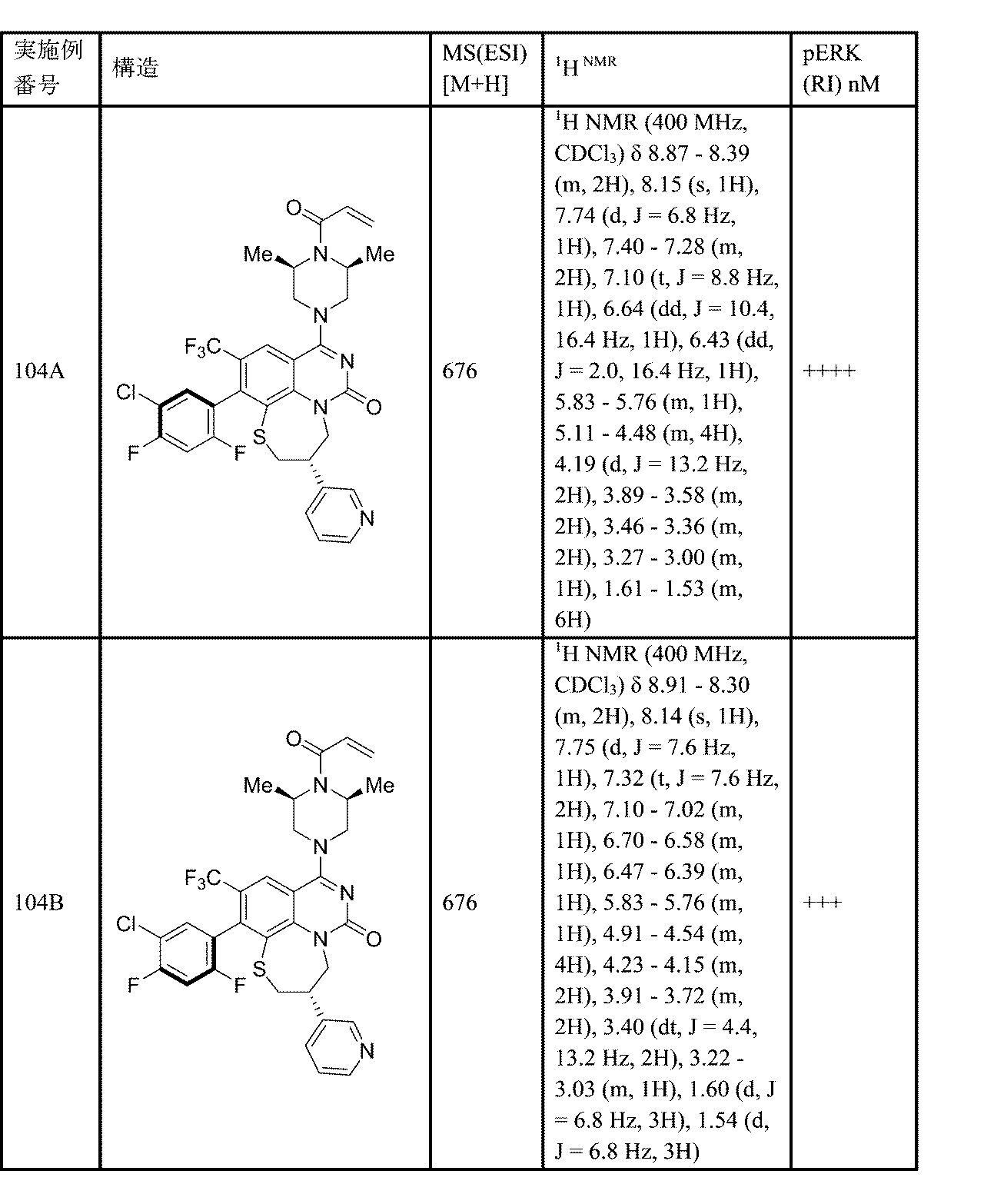


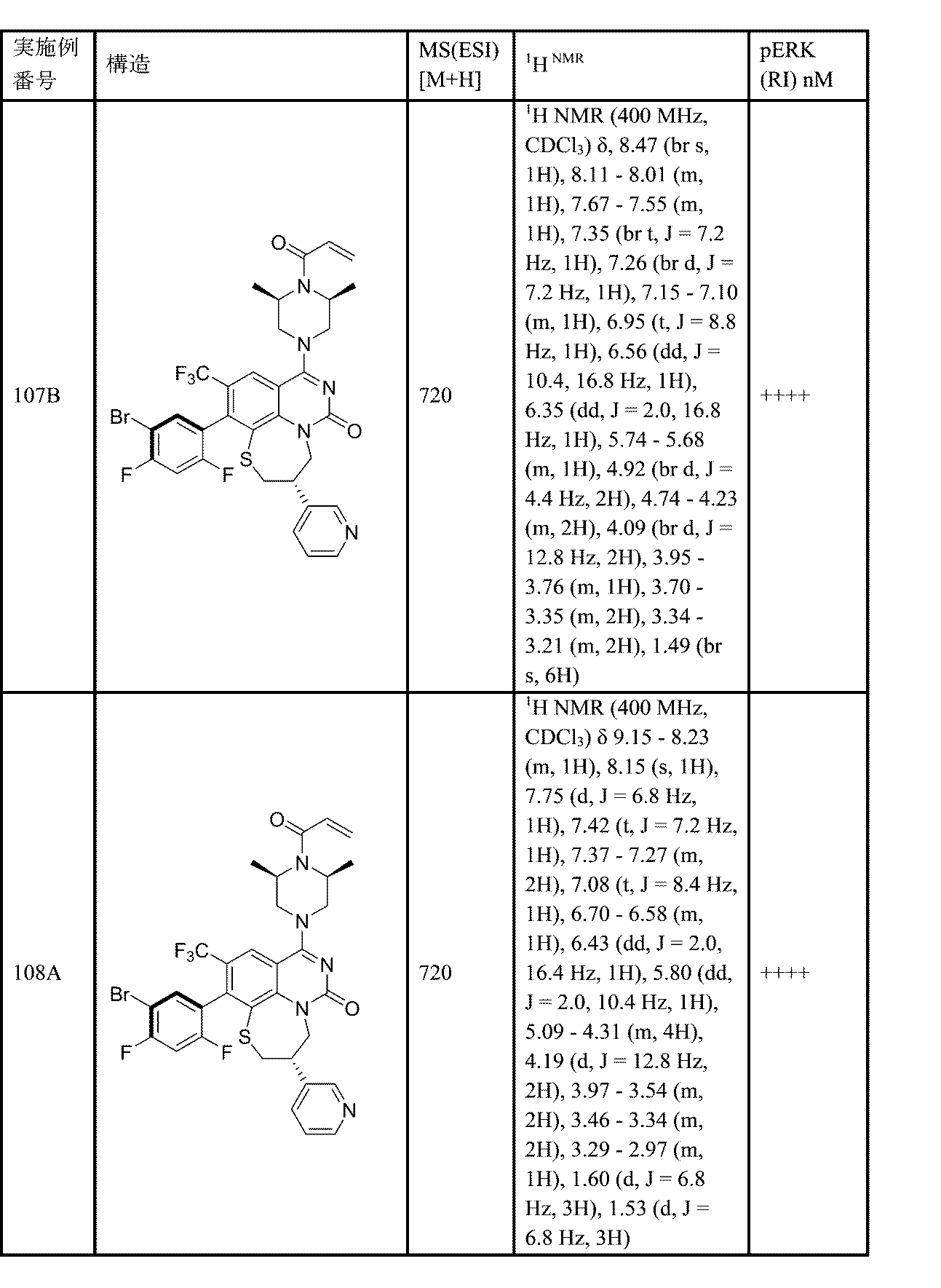


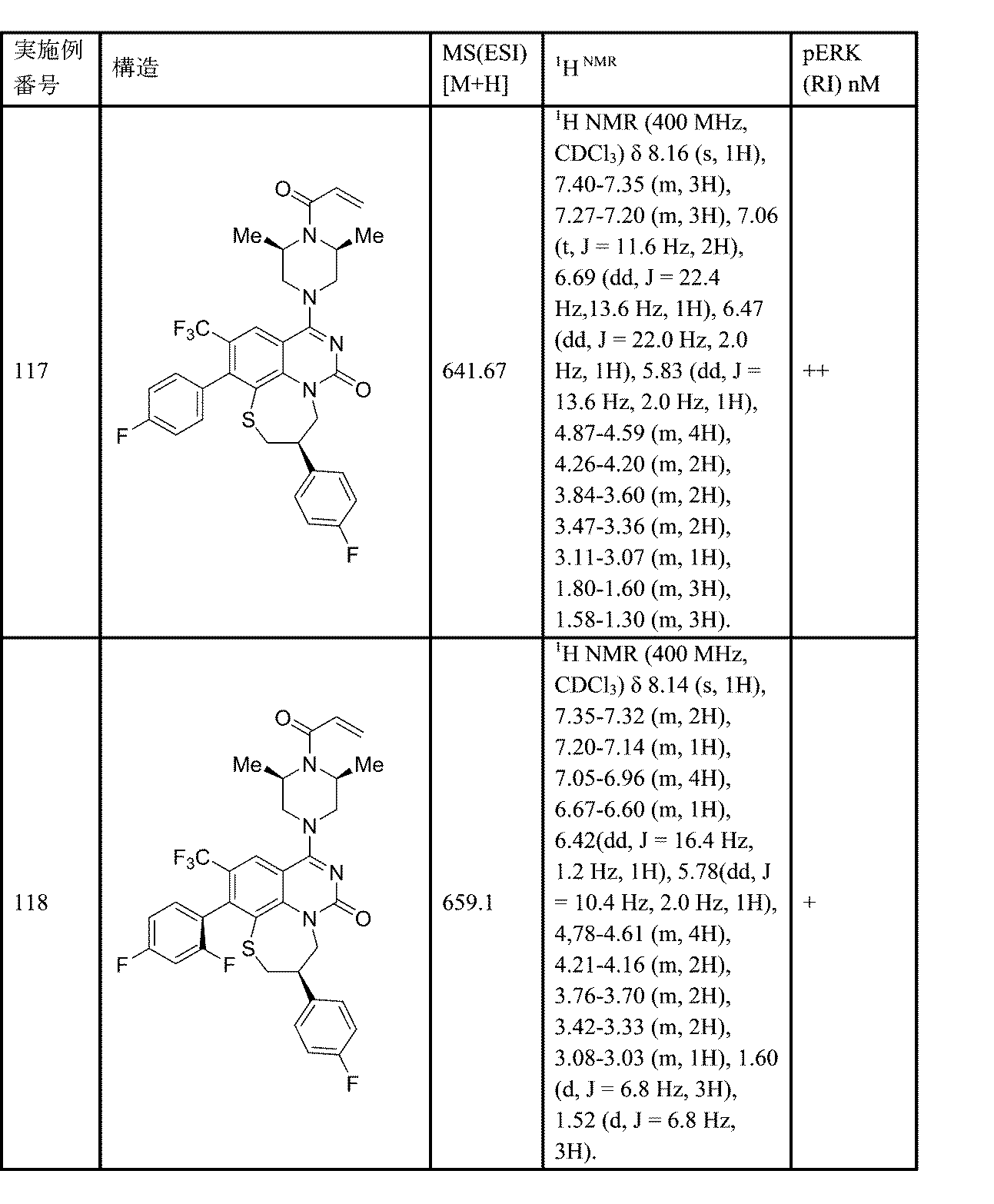
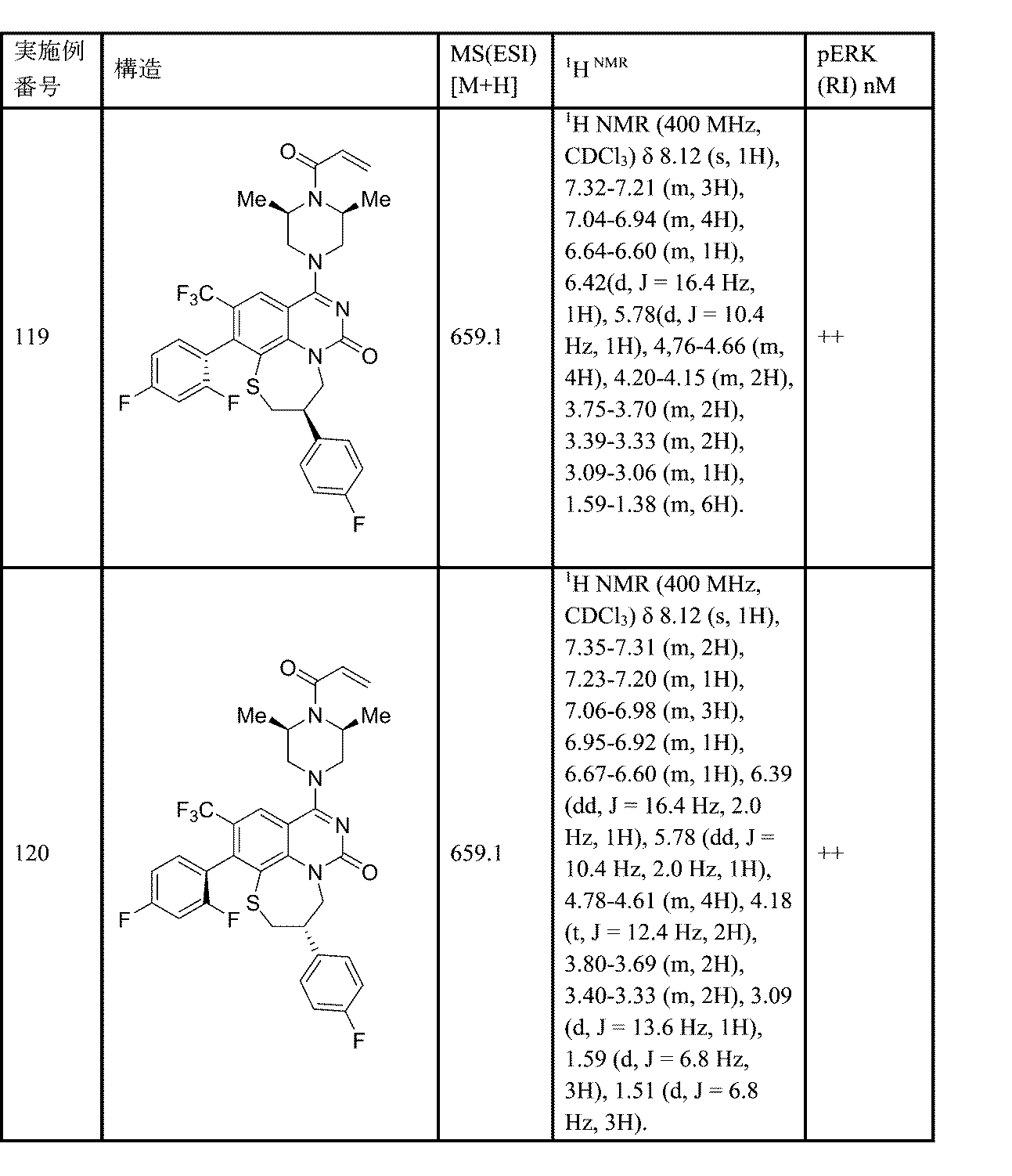

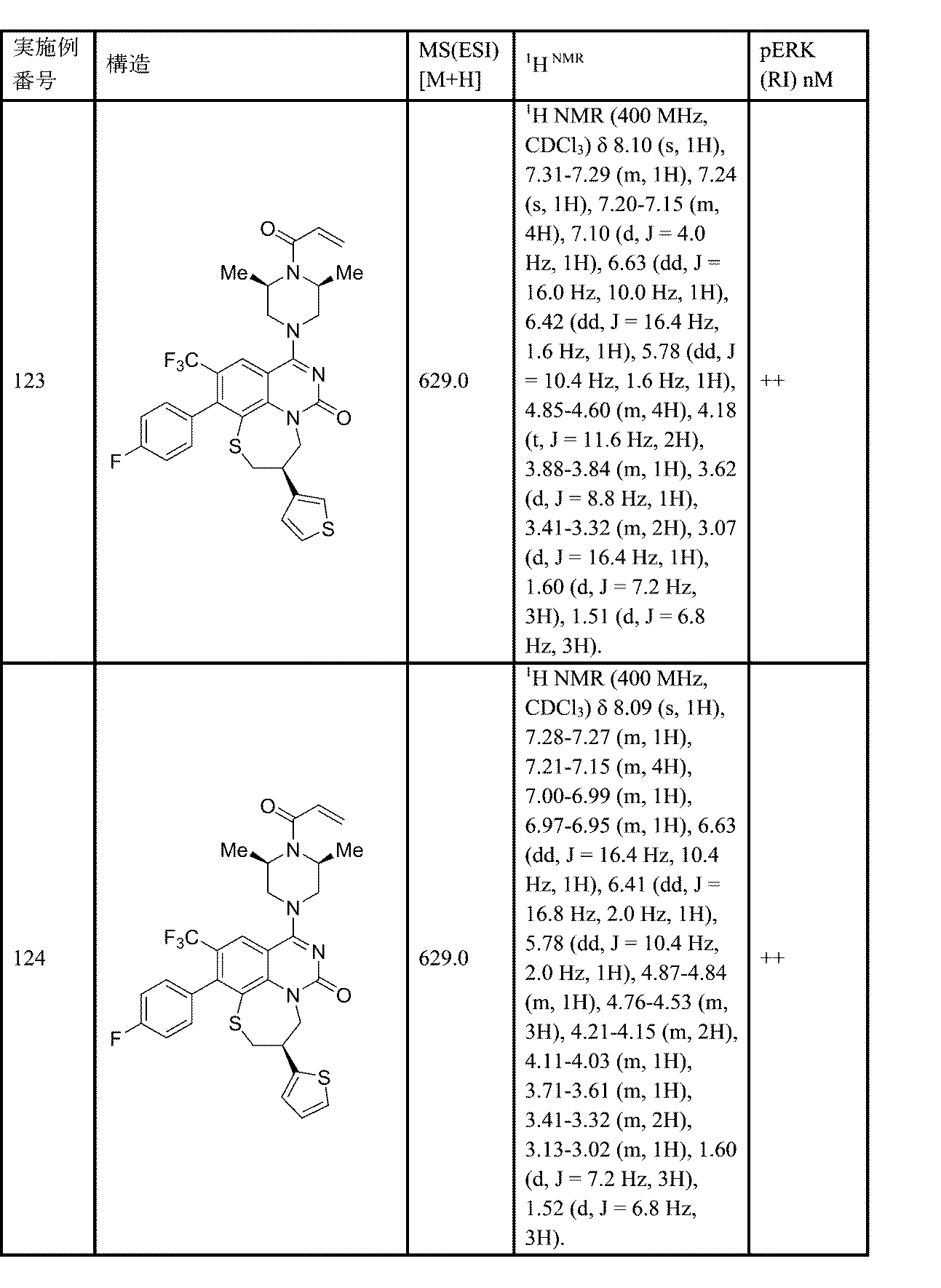
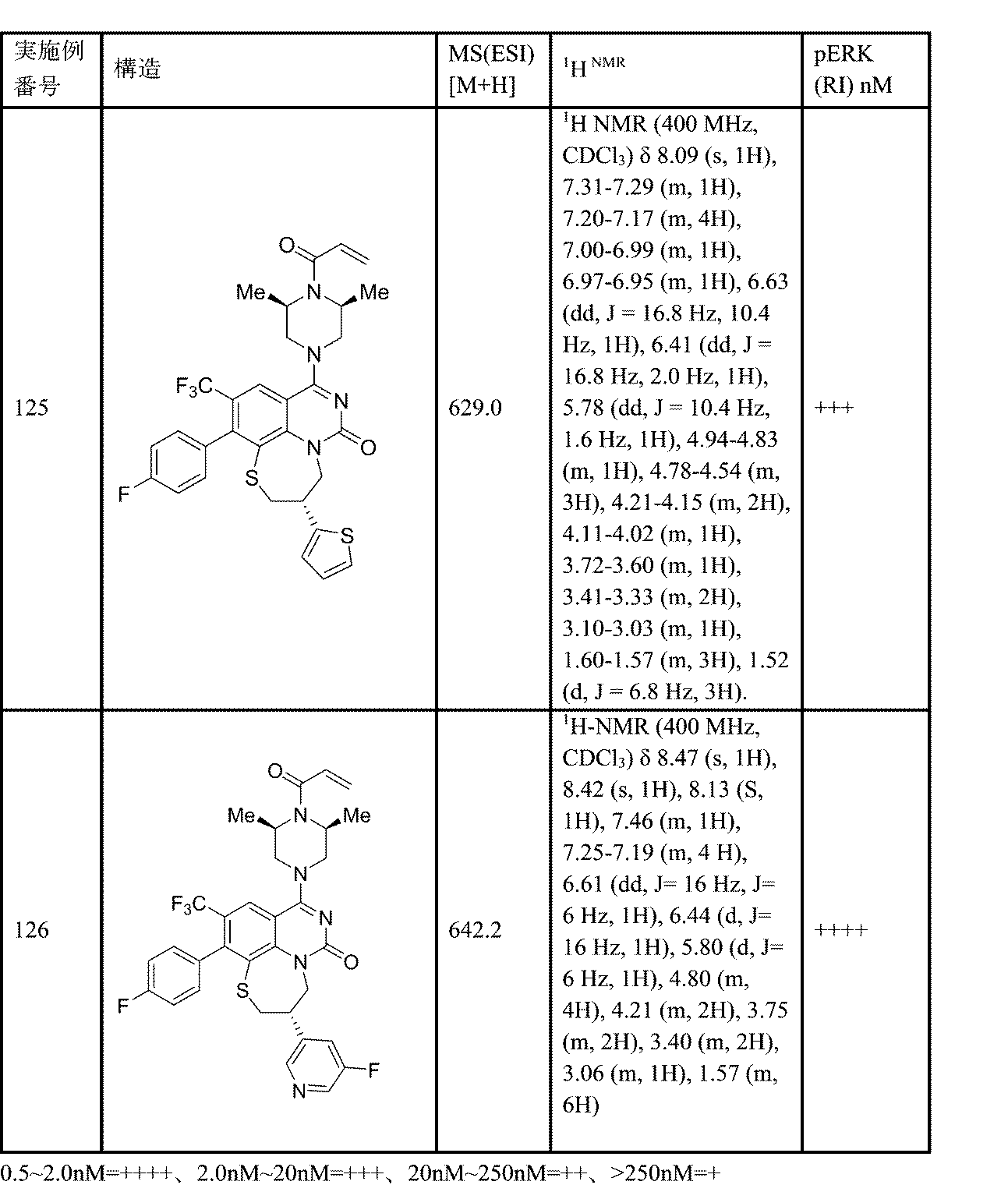
前述の実施形態は、理解の明確化を目的として、例示及び実施例を介してある程度詳細に記載されているが、当業者は、添付の特許請求の範囲内で特定の変更及び修正が実施され得ることを理解するであろう。更に、本明細書に提供される各参考文献は、あたかも各参考文献が個別に参照により組み込まれるのと同じ程度に、その全体が参照により組み込まれる。本願と本明細書に提供される参考文献との間に矛盾が存在する場合、本願が優先するものとする。 The foregoing embodiments have been described in some detail by way of illustration and example for purposes of clarity of understanding, but those skilled in the art will appreciate that certain changes and modifications may be practiced within the scope of the appended claims. Furthermore, each reference provided herein is incorporated by reference in its entirety to the same extent as if each reference was individually incorporated by reference. In the event of a conflict between this application and a reference provided herein, this application shall control.
Claims (30)

各R1は、独立して、メチルまたはシアノメチルであり、
nは、0~2の整数であり、
Xは、-CCF3または-C-ハロゲンであり、
Ar1は、1つ以上のアルキル、ハロゲン、ヒドロキシ、またはアミノで任意選択で置換されているアリールまたはヘテロアリールであり、
Ar2は、アルキルまたはハロゲンで任意選択で置換されているC結合アリールまたはヘテロアリールである)。 A compound of formula (I), or a pharma- ceutically acceptable salt thereof:
Each R1 is independently methyl or cyanomethyl;
n is an integer from 0 to 2,
X is -CCF3 or -C-halogen;
Ar 1 is aryl or heteroaryl optionally substituted with one or more alkyl, halogen, hydroxy, or amino;
Ar2 is a C-linked aryl or heteroaryl optionally substituted with alkyl or halogen.


Applications Claiming Priority (5)
| Application Number | Priority Date | Filing Date | Title |
|---|---|---|---|
| US202263363624P | 2022-04-26 | 2022-04-26 | |
| US63/363,624 | 2022-04-26 | ||
| US202263364027P | 2022-05-02 | 2022-05-02 | |
| US63/364,027 | 2022-05-02 | ||
| PCT/US2023/066170 WO2023212548A1 (en) | 2022-04-26 | 2023-04-25 | Tricyclic pyridones and pyrimidones |
Publications (1)
| Publication Number | Publication Date |
|---|---|
| JP2025514185A true JP2025514185A (en) | 2025-05-02 |
Family
ID=88519800
Family Applications (1)
| Application Number | Title | Priority Date | Filing Date |
|---|---|---|---|
| JP2024563295A Pending JP2025514185A (en) | 2022-04-26 | 2023-04-25 | Tricyclic pyridones and pyrimidones |
Country Status (6)
| Country | Link |
|---|---|
| US (1) | US20250313577A1 (en) |
| EP (1) | EP4514809A1 (en) |
| JP (1) | JP2025514185A (en) |
| CN (1) | CN119365466A (en) |
| TW (1) | TW202400609A (en) |
| WO (1) | WO2023212548A1 (en) |
Families Citing this family (13)
| Publication number | Priority date | Publication date | Assignee | Title |
|---|---|---|---|---|
| KR20250164828A (en) | 2023-03-30 | 2025-11-25 | 레볼루션 메디슨즈, 인크. | Composition for inducing RAS GTP hydrolysis and use thereof |
| TW202508595A (en) | 2023-05-04 | 2025-03-01 | 美商銳新醫藥公司 | Combination therapy for a ras related disease or disorder |
| US20250049810A1 (en) | 2023-08-07 | 2025-02-13 | Revolution Medicines, Inc. | Methods of treating a ras protein-related disease or disorder |
| WO2025080946A2 (en) | 2023-10-12 | 2025-04-17 | Revolution Medicines, Inc. | Ras inhibitors |
| WO2025171296A1 (en) | 2024-02-09 | 2025-08-14 | Revolution Medicines, Inc. | Ras inhibitors |
| WO2025240847A1 (en) | 2024-05-17 | 2025-11-20 | Revolution Medicines, Inc. | Ras inhibitors |
| WO2025255438A1 (en) | 2024-06-07 | 2025-12-11 | Revolution Medicines, Inc. | Methods of treating a ras protein-related disease or disorder |
| WO2025265060A1 (en) | 2024-06-21 | 2025-12-26 | Revolution Medicines, Inc. | Therapeutic compositions and methods for managing treatment-related effects |
| WO2026006747A1 (en) | 2024-06-28 | 2026-01-02 | Revolution Medicines, Inc. | Ras inhibitors |
| WO2026015801A1 (en) | 2024-07-12 | 2026-01-15 | Revolution Medicines, Inc. | Methods of treating a ras related disease or disorder |
| WO2026015796A1 (en) | 2024-07-12 | 2026-01-15 | Revolution Medicines, Inc. | Methods of treating a ras related disease or disorder |
| WO2026015790A1 (en) | 2024-07-12 | 2026-01-15 | Revolution Medicines, Inc. | Methods of treating a ras related disease or disorder |
| WO2026015825A1 (en) | 2024-07-12 | 2026-01-15 | Revolution Medicines, Inc. | Use of ras inhibitor for treating pancreatic cancer |
Family Cites Families (4)
| Publication number | Priority date | Publication date | Assignee | Title |
|---|---|---|---|---|
| EP3788038B1 (en) * | 2018-05-04 | 2023-10-11 | Amgen Inc. | Kras g12c inhibitors and methods of using the same |
| WO2020239123A1 (en) * | 2019-05-31 | 2020-12-03 | 上海翰森生物医药科技有限公司 | Aromatic heterocyclic derivative modulator and preparation method therefor and use thereof |
| AU2020337938B2 (en) * | 2019-08-29 | 2025-09-25 | Array Biopharma Inc. | KRas G12D inhibitors |
| EP4217071A1 (en) * | 2020-09-23 | 2023-08-02 | Erasca, Inc. | Tricyclic pyridones and pyrimidones |
-
2023
- 2023-04-25 EP EP23797479.5A patent/EP4514809A1/en active Pending
- 2023-04-25 US US18/860,263 patent/US20250313577A1/en active Pending
- 2023-04-25 CN CN202380046730.2A patent/CN119365466A/en active Pending
- 2023-04-25 TW TW112115352A patent/TW202400609A/en unknown
- 2023-04-25 JP JP2024563295A patent/JP2025514185A/en active Pending
- 2023-04-25 WO PCT/US2023/066170 patent/WO2023212548A1/en not_active Ceased
Also Published As
| Publication number | Publication date |
|---|---|
| WO2023212548A1 (en) | 2023-11-02 |
| EP4514809A1 (en) | 2025-03-05 |
| TW202400609A (en) | 2024-01-01 |
| US20250313577A1 (en) | 2025-10-09 |
| WO2023212548A8 (en) | 2024-11-14 |
| CN119365466A (en) | 2025-01-24 |
Similar Documents
| Publication | Publication Date | Title |
|---|---|---|
| US11845761B2 (en) | Tricyclic pyridones and pyrimidones | |
| JP2025514185A (en) | Tricyclic pyridones and pyrimidones | |
| US12162893B2 (en) | Tricyclic pyridones and pyrimidones | |
| WO2022266069A1 (en) | Tricyclic kras g12d inhibitors | |
| WO2022271658A1 (en) | Tricyclic kras inhibitors | |
| US20240293558A1 (en) | Kras inhibitor conjugates | |
| WO2023183755A1 (en) | Tricyclic pyrimidones | |
| WO2021173923A1 (en) | Pyrrolidine-fused heterocycles | |
| KR20240026948A (en) | Sulfur-containing heteroaromatic tricyclic KRAS inhibitor | |
| EP2970307B1 (en) | Pyrazolo compounds and uses thereof | |
| US20230203063A1 (en) | Tricyclic pyridones and pyrimidones | |
| WO2024040080A1 (en) | Kras inhibitor conjugates | |
| TW202321261A (en) | Selective kras inhibitors | |
| WO2022266167A1 (en) | Amide and urea-containing tricyclic kras inhibitors | |
| WO2024173842A1 (en) | Kras inhibitors | |
| CN116615428A (en) | Tricyclic pyridones and pyrimidinones | |
| WO2023212549A1 (en) | Tricyclic pyridones and pyrimidones | |
| CN118076612A (en) | Sulfur-containing heteroaromatic tricyclic KRAS inhibitors | |
| HK40098767A (en) | Tricyclic pyridones and pyrimidones |