JP2025003984A - Preparation and storage of therapeutic liposomal RNA formulations - Google Patents
Preparation and storage of therapeutic liposomal RNA formulations Download PDFInfo
- Publication number
- JP2025003984A JP2025003984A JP2024157985A JP2024157985A JP2025003984A JP 2025003984 A JP2025003984 A JP 2025003984A JP 2024157985 A JP2024157985 A JP 2024157985A JP 2024157985 A JP2024157985 A JP 2024157985A JP 2025003984 A JP2025003984 A JP 2025003984A
- Authority
- JP
- Japan
- Prior art keywords
- rna
- composition
- concentration
- lipid
- rna lipoplex
- Prior art date
- Legal status (The legal status is an assumption and is not a legal conclusion. Google has not performed a legal analysis and makes no representation as to the accuracy of the status listed.)
- Pending
Links
Images




Classifications
-
- A—HUMAN NECESSITIES
- A61—MEDICAL OR VETERINARY SCIENCE; HYGIENE
- A61K—PREPARATIONS FOR MEDICAL, DENTAL OR TOILETRY PURPOSES
- A61K9/00—Medicinal preparations characterised by special physical form
- A61K9/10—Dispersions; Emulsions
- A61K9/127—Synthetic bilayered vehicles, e.g. liposomes or liposomes with cholesterol as the only non-phosphatidyl surfactant
- A61K9/1271—Non-conventional liposomes, e.g. PEGylated liposomes or liposomes coated or grafted with polymers
- A61K9/1272—Non-conventional liposomes, e.g. PEGylated liposomes or liposomes coated or grafted with polymers comprising non-phosphatidyl surfactants as bilayer-forming substances, e.g. cationic lipids or non-phosphatidyl liposomes coated or grafted with polymers
-
- A—HUMAN NECESSITIES
- A61—MEDICAL OR VETERINARY SCIENCE; HYGIENE
- A61K—PREPARATIONS FOR MEDICAL, DENTAL OR TOILETRY PURPOSES
- A61K31/00—Medicinal preparations containing organic active ingredients
- A61K31/70—Carbohydrates; Sugars; Derivatives thereof
- A61K31/7088—Compounds having three or more nucleosides or nucleotides
- A61K31/713—Double-stranded nucleic acids or oligonucleotides
-
- A—HUMAN NECESSITIES
- A61—MEDICAL OR VETERINARY SCIENCE; HYGIENE
- A61K—PREPARATIONS FOR MEDICAL, DENTAL OR TOILETRY PURPOSES
- A61K45/00—Medicinal preparations containing active ingredients not provided for in groups A61K31/00 - A61K41/00
- A61K45/06—Mixtures of active ingredients without chemical characterisation, e.g. antiphlogistics and cardiaca
-
- A—HUMAN NECESSITIES
- A61—MEDICAL OR VETERINARY SCIENCE; HYGIENE
- A61K—PREPARATIONS FOR MEDICAL, DENTAL OR TOILETRY PURPOSES
- A61K47/00—Medicinal preparations characterised by the non-active ingredients used, e.g. carriers or inert additives; Targeting or modifying agents chemically bound to the active ingredient
- A61K47/06—Organic compounds, e.g. natural or synthetic hydrocarbons, polyolefins, mineral oil, petrolatum or ozokerite
- A61K47/16—Organic compounds, e.g. natural or synthetic hydrocarbons, polyolefins, mineral oil, petrolatum or ozokerite containing nitrogen, e.g. nitro-, nitroso-, azo-compounds, nitriles, cyanates
-
- A—HUMAN NECESSITIES
- A61—MEDICAL OR VETERINARY SCIENCE; HYGIENE
- A61K—PREPARATIONS FOR MEDICAL, DENTAL OR TOILETRY PURPOSES
- A61K47/00—Medicinal preparations characterised by the non-active ingredients used, e.g. carriers or inert additives; Targeting or modifying agents chemically bound to the active ingredient
- A61K47/06—Organic compounds, e.g. natural or synthetic hydrocarbons, polyolefins, mineral oil, petrolatum or ozokerite
- A61K47/24—Organic compounds, e.g. natural or synthetic hydrocarbons, polyolefins, mineral oil, petrolatum or ozokerite containing atoms other than carbon, hydrogen, oxygen, halogen, nitrogen or sulfur, e.g. cyclomethicone or phospholipids
-
- A—HUMAN NECESSITIES
- A61—MEDICAL OR VETERINARY SCIENCE; HYGIENE
- A61K—PREPARATIONS FOR MEDICAL, DENTAL OR TOILETRY PURPOSES
- A61K47/00—Medicinal preparations characterised by the non-active ingredients used, e.g. carriers or inert additives; Targeting or modifying agents chemically bound to the active ingredient
- A61K47/06—Organic compounds, e.g. natural or synthetic hydrocarbons, polyolefins, mineral oil, petrolatum or ozokerite
- A61K47/26—Carbohydrates, e.g. sugar alcohols, amino sugars, nucleic acids, mono-, di- or oligo-saccharides; Derivatives thereof, e.g. polysorbates, sorbitan fatty acid esters or glycyrrhizin
-
- A—HUMAN NECESSITIES
- A61—MEDICAL OR VETERINARY SCIENCE; HYGIENE
- A61K—PREPARATIONS FOR MEDICAL, DENTAL OR TOILETRY PURPOSES
- A61K47/00—Medicinal preparations characterised by the non-active ingredients used, e.g. carriers or inert additives; Targeting or modifying agents chemically bound to the active ingredient
- A61K47/06—Organic compounds, e.g. natural or synthetic hydrocarbons, polyolefins, mineral oil, petrolatum or ozokerite
- A61K47/28—Steroids, e.g. cholesterol, bile acids or glycyrrhetinic acid
-
- A—HUMAN NECESSITIES
- A61—MEDICAL OR VETERINARY SCIENCE; HYGIENE
- A61K—PREPARATIONS FOR MEDICAL, DENTAL OR TOILETRY PURPOSES
- A61K48/00—Medicinal preparations containing genetic material which is inserted into cells of the living body to treat genetic diseases; Gene therapy
- A61K48/0008—Medicinal preparations containing genetic material which is inserted into cells of the living body to treat genetic diseases; Gene therapy characterised by an aspect of the 'non-active' part of the composition delivered, e.g. wherein such 'non-active' part is not delivered simultaneously with the 'active' part of the composition
-
- A—HUMAN NECESSITIES
- A61—MEDICAL OR VETERINARY SCIENCE; HYGIENE
- A61K—PREPARATIONS FOR MEDICAL, DENTAL OR TOILETRY PURPOSES
- A61K48/00—Medicinal preparations containing genetic material which is inserted into cells of the living body to treat genetic diseases; Gene therapy
- A61K48/0075—Medicinal preparations containing genetic material which is inserted into cells of the living body to treat genetic diseases; Gene therapy characterised by an aspect of the delivery route, e.g. oral, subcutaneous
-
- A—HUMAN NECESSITIES
- A61—MEDICAL OR VETERINARY SCIENCE; HYGIENE
- A61K—PREPARATIONS FOR MEDICAL, DENTAL OR TOILETRY PURPOSES
- A61K9/00—Medicinal preparations characterised by special physical form
- A61K9/0012—Galenical forms characterised by the site of application
- A61K9/0019—Injectable compositions; Intramuscular, intravenous, arterial, subcutaneous administration; Compositions to be administered through the skin in an invasive manner
-
- A—HUMAN NECESSITIES
- A61—MEDICAL OR VETERINARY SCIENCE; HYGIENE
- A61K—PREPARATIONS FOR MEDICAL, DENTAL OR TOILETRY PURPOSES
- A61K9/00—Medicinal preparations characterised by special physical form
- A61K9/08—Solutions
-
- A—HUMAN NECESSITIES
- A61—MEDICAL OR VETERINARY SCIENCE; HYGIENE
- A61K—PREPARATIONS FOR MEDICAL, DENTAL OR TOILETRY PURPOSES
- A61K9/00—Medicinal preparations characterised by special physical form
- A61K9/10—Dispersions; Emulsions
- A61K9/127—Synthetic bilayered vehicles, e.g. liposomes or liposomes with cholesterol as the only non-phosphatidyl surfactant
- A61K9/1277—Preparation processes; Proliposomes
-
- A—HUMAN NECESSITIES
- A61—MEDICAL OR VETERINARY SCIENCE; HYGIENE
- A61K—PREPARATIONS FOR MEDICAL, DENTAL OR TOILETRY PURPOSES
- A61K9/00—Medicinal preparations characterised by special physical form
- A61K9/14—Particulate form, e.g. powders, Processes for size reducing of pure drugs or the resulting products, Pure drug nanoparticles
- A61K9/19—Particulate form, e.g. powders, Processes for size reducing of pure drugs or the resulting products, Pure drug nanoparticles lyophilised, i.e. freeze-dried, solutions or dispersions
-
- A—HUMAN NECESSITIES
- A61—MEDICAL OR VETERINARY SCIENCE; HYGIENE
- A61K—PREPARATIONS FOR MEDICAL, DENTAL OR TOILETRY PURPOSES
- A61K48/00—Medicinal preparations containing genetic material which is inserted into cells of the living body to treat genetic diseases; Gene therapy
-
- B—PERFORMING OPERATIONS; TRANSPORTING
- B82—NANOTECHNOLOGY
- B82Y—SPECIFIC USES OR APPLICATIONS OF NANOSTRUCTURES; MEASUREMENT OR ANALYSIS OF NANOSTRUCTURES; MANUFACTURE OR TREATMENT OF NANOSTRUCTURES
- B82Y5/00—Nanobiotechnology or nanomedicine, e.g. protein engineering or drug delivery
Landscapes
- Health & Medical Sciences (AREA)
- Life Sciences & Earth Sciences (AREA)
- Chemical & Material Sciences (AREA)
- Public Health (AREA)
- Veterinary Medicine (AREA)
- Medicinal Chemistry (AREA)
- Pharmacology & Pharmacy (AREA)
- Epidemiology (AREA)
- Animal Behavior & Ethology (AREA)
- General Health & Medical Sciences (AREA)
- Molecular Biology (AREA)
- Engineering & Computer Science (AREA)
- Biochemistry (AREA)
- Dispersion Chemistry (AREA)
- Biophysics (AREA)
- Chemical Kinetics & Catalysis (AREA)
- General Chemical & Material Sciences (AREA)
- Oil, Petroleum & Natural Gas (AREA)
- Biotechnology (AREA)
- Genetics & Genomics (AREA)
- Dermatology (AREA)
- Bioinformatics & Cheminformatics (AREA)
- Medicinal Preparation (AREA)
- Pharmaceuticals Containing Other Organic And Inorganic Compounds (AREA)
- Medicines That Contain Protein Lipid Enzymes And Other Medicines (AREA)
- Medicines Containing Antibodies Or Antigens For Use As Internal Diagnostic Agents (AREA)
Abstract
Description
本開示は、非経口投与の後、特に、静脈内投与の後における、RNAの、標的組織への送達のためのRNAリポプレックス粒子を調製するための方法と、このようなRNAリポプレックス粒子を含む組成物とに関する。本開示はまた、産業的なGMPに準拠する形で、RNAリポプレックス粒子を調製することを可能とする方法にも関する。さらに、本開示は、製品の品質の実質的な喪失を伴わずに、特に、RNA活性の実質的な喪失を伴わずに、RNAリポプレックス粒子を保管するための方法および組成物に関する。本明細書で記載されるRNAリポプレックス粒子製剤は、液体の保管と比較して、製品の貯蔵寿命の延長を得ることを可能とする、凍結乾燥、噴霧乾燥、または関連する方法により凍結または脱水させることができる。一実施態様では、RNAリポプレックス粒子は、薬学的に活性のペプチドまたはタンパク質など、目的のペプチドまたはタンパク質をコードするmRNAなどの一本鎖RNAを含む。RNAは、標的組織の細胞により取り込まれ、RNAは、その生理的活性を呈示しうる、コードされたペプチドまたはタンパク質へと翻訳される。目的のペプチドまたはタンパク質は、1つまたは複数のエピトープに対して方向付けられた免疫応答を誘導または増強するための、1つまたは複数のエピトープを含む、ペプチドまたはタンパク質でありうる。本明細書で記載される方法および組成物は、医薬品についての要件に準拠する、より具体的には、GMPに則った製造についての要件、および非経口適用のための、医薬品の品質についての要件に準拠する形での使用に適する。 The present disclosure relates to methods for preparing RNA lipoplex particles for delivery of RNA to a target tissue after parenteral administration, particularly after intravenous administration, and compositions comprising such RNA lipoplex particles. The present disclosure also relates to methods that allow for preparing RNA lipoplex particles in an industrial GMP-compliant manner. Furthermore, the present disclosure relates to methods and compositions for storing RNA lipoplex particles without substantial loss of product quality, particularly without substantial loss of RNA activity. The RNA lipoplex particle formulations described herein can be frozen or dehydrated by lyophilization, spray drying, or related methods, which allows for an extended shelf life of the product compared to liquid storage. In one embodiment, the RNA lipoplex particles comprise a single-stranded RNA, such as an mRNA, that encodes a peptide or protein of interest, such as a pharma- ceutical active peptide or protein. The RNA is taken up by cells of the target tissue, and the RNA is translated into the encoded peptide or protein, which can exhibit its physiological activity. The peptide or protein of interest may be a peptide or protein that includes one or more epitopes for inducing or enhancing an immune response directed against the epitope or epitopes. The methods and compositions described herein are suitable for use in compliance with pharmaceutical requirements, more particularly, with GMP manufacturing requirements and pharmaceutical quality requirements for parenteral application.
外来の遺伝情報の、標的細胞への送達のための、RNAの使用は、DNAに対する、魅力的な代替物を提供する。RNAを使用することの利点は、一過性発現および非形質転換的性格を含む。RNAは、発現させるために、核に侵入し、さらに、宿主ゲノムに組み込まれる必要がなく、これにより、発がん性の危険性がなくなる。 The use of RNA for the delivery of foreign genetic information to target cells offers an attractive alternative to DNA. Advantages of using RNA include transient expression and its non-transforming nature. RNA does not need to enter the nucleus and be integrated into the host genome in order to be expressed, thus eliminating the risk of carcinogenicity.
RNAは、RNAを、カチオン性脂質と、ヘルパー脂質との混合物から構成される、リポソームへと結合させて、注射用ナノ粒子製剤を形成する、いわゆるリポプレックス製剤により送達することができる。しかし、製剤を保管した後であってもなお、生物学的に活性のRNAを、標的組織へと送達するための製剤を開発する必要は、満たされていない。加えて、貯蔵寿命が長い、GMPに準拠する注射用RNAリポプレックス粒子製剤を製造するための方法を開発する必要も、満たされていない。 RNA can be delivered in so-called lipoplex formulations, in which the RNA is coupled to liposomes, composed of a mixture of cationic lipids and helper lipids, to form injectable nanoparticle formulations. However, there is an unmet need to develop formulations for delivering biologically active RNA to target tissues, even after the formulation has been stored. In addition, there is an unmet need to develop methods for producing injectable RNA lipoplex particle formulations that have a long shelf life and are GMP compliant.
したがって、生物学的に活性のRNAを、標的組織へと送達するための製剤であって、送達されたRNAが、それがコードするペプチドまたはタンパク質へと、効率的に翻訳される製剤を提供することが必要とされている。さらに、製品の品質の実質的な喪失を伴わずに、特に、RNAの生物活性の実質的な喪失を伴わずに常温保存可能な製剤を提供することが必要とされている。 Therefore, there is a need to provide a formulation for delivery of biologically active RNA to a target tissue, where the delivered RNA is efficiently translated into its encoded peptide or protein. Furthermore, there is a need to provide a formulation that is shelf stable without substantial loss of product quality, and in particular without substantial loss of the biological activity of the RNA.
本発明者らは、驚くべきことに、本明細書で記載されるRNAリポプレックス粒子製剤が、上記で言及された要件を満たすことを見出した。 The inventors have surprisingly found that the RNA lipoplex particle formulations described herein meet the requirements mentioned above.
I.RNAリポプレックス粒子を調製するための方法、RNAリポプレックス粒子、およびRNAリポプレックス粒子を含む組成物
第1の態様では、本開示は、生物活性が改善されたRNAリポプレックス粒子を調製するための方法、本開示に従い調製されたRNAリポプレックス粒子、およびこのようなRNAリポプレックス粒子を含む組成物に関する。RNAリポプレックス粒子、およびRNAリポプレックス粒子を含む組成物は、非経口投与の後、特に、静脈内投与の後における、RNAの、標的組織への送達に有用である。RNAリポプレックス粒子は、エタノール中の脂質の濃度が高濃度の溶液を、水または適切な水性相へと注入することにより得られるリポソームを使用して調製される。一実施態様では、RNAリポプレックス製品は、約1nm-1における単一のブラッグピークが観察され、ピーク幅が0.2nm-1より小さい、x線散乱における特異的パターンにより特徴づけられる。
I. Methods for preparing RNA lipoplex particles, RNA lipoplex particles, and compositions comprising RNA lipoplex particles In a first aspect, the present disclosure relates to methods for preparing RNA lipoplex particles with improved biological activity, RNA lipoplex particles prepared according to the present disclosure, and compositions comprising such RNA lipoplex particles. The RNA lipoplex particles and compositions comprising RNA lipoplex particles are useful for delivery of RNA to target tissues after parenteral administration, in particular after intravenous administration. The RNA lipoplex particles are prepared using liposomes obtained by injecting a solution of high concentration of lipids in ethanol into water or a suitable aqueous phase. In one embodiment, the RNA lipoplex product is characterized by a specific pattern in x-ray scattering, where a single Bragg peak is observed at about 1 nm -1 with a peak width smaller than 0.2 nm -1 .
一実施態様では、リポソームおよびRNAリポプレックス粒子は、1,2-ジ-O-オクタデセニル-3-トリメチルアンモニウムプロパン(DOTMA)、および1,2-ジ-(9Z-オクタデセノイル)-sn-グリセロ-3-ホスホエタノールアミン(DOPE)を含む。脂質混合物中のDOPEの濃度は、エタノール単独中のDOPEの平衡溶解度より高い。室温では、DOPE単独は、約50mMの溶解度を有するが、DOTMAと併せると、100mMまたはこれを超える溶解度を有する。そこから高活性のリポプレックスを得る、リポソームを形成するための脂質溶液は、270mMまたはこれを上回る総脂質濃度(例えば、90mMまたはこれを上回る濃度のDOPE)を有しうる。温度を上昇させることにより、エタノール中の濃度がなおより高い溶液を得ることができる。DOPEの濃度が、平衡溶解度を上回る脂質溶液から得られるリポソームは、DOPEの濃度が、平衡溶解度以下である脂質溶液に由来するリポソームより、著明に大型である。リポソームサイズは、エタノール中の濃度と共に、単調に増大する。 In one embodiment, the liposomes and RNA lipoplex particles include 1,2-di-O-octadecenyl-3-trimethylammonium propane (DOTMA) and 1,2-di-(9Z-octadecenoyl)-sn-glycero-3-phosphoethanolamine (DOPE). The concentration of DOPE in the lipid mixture is higher than the equilibrium solubility of DOPE in ethanol alone. At room temperature, DOPE alone has a solubility of about 50 mM, but together with DOTMA, it has a solubility of 100 mM or more. Lipid solutions for forming liposomes from which highly active lipoplexes are obtained can have a total lipid concentration of 270 mM or more (e.g., 90 mM or more DOPE). Even higher concentration solutions in ethanol can be obtained by increasing the temperature. Liposomes obtained from lipid solutions in which the concentration of DOPE is above the equilibrium solubility are significantly larger than liposomes derived from lipid solutions in which the concentration of DOPE is below the equilibrium solubility. Liposome size increases monotonically with concentration in ethanol.
本開示に従い調製されるリポソームは、リポソームを、RNAと混合することにより、RNAリポプレックス粒子を調製するために使用することができる。一実施態様では、RNAを、リポプレックスの活性を増大させるために要求される、ある特定のイオン強度を調整するために、混合の前に、NaClと共にインキュベートする。これらの大型のリポソームから形成されるリポプレックスは、インビトロおよびインビボにおける実験により裏付けられる通り、著明に高度の生物活性を有する。これらの高活性のリポプレックスは、明らかに、ある特定の物理化学的パラメータ、例えば、(i)ブラッグピークの低ピーク幅、および(ii)場流動分画のような、サイズ測定のための分散的解析法における、異なる分離プロファイルにより、低活性のリポプレックスから弁別することができる。低活性のリポプレックスは、平均して、小型である。加えて、低活性のリポプレックスはまた、分子コンフォメーション、形状、およびバルク相との相互作用のようなパラメータと、おそらく関連する、異なる溶出プロファイルも有する。 Liposomes prepared according to the present disclosure can be used to prepare RNA lipoplex particles by mixing the liposomes with RNA. In one embodiment, the RNA is incubated with NaCl before mixing to adjust a certain ionic strength required to increase the activity of the lipoplex. The lipoplexes formed from these large liposomes have a significantly higher biological activity, as supported by in vitro and in vivo experiments. These high activity lipoplexes can be clearly distinguished from low activity lipoplexes by certain physicochemical parameters, such as (i) a lower peak width of the Bragg peak, and (ii) a different separation profile in dispersive analysis methods for size measurement, such as field flow fractionation. The low activity lipoplexes are, on average, smaller. In addition, the low activity lipoplexes also have a different elution profile, which is probably related to parameters such as molecular conformation, shape, and interaction with the bulk phase.
したがって、この態様では、本開示は、リポソームコロイドを作製する方法であって、エタノール中の脂質溶液を、水性相へと注入して、リポソームコロイドを作製することを含み、脂質溶液中の脂質のうちの少なくとも1つの濃度が、エタノール中の少なくとも1つの脂質の平衡溶解度に対応するか、またはこれより高い方法に関する。 Accordingly, in this aspect, the disclosure relates to a method of making a liposomal colloid, comprising injecting a lipid solution in ethanol into an aqueous phase to make a liposomal colloid, wherein the concentration of at least one of the lipids in the lipid solution corresponds to or is higher than the equilibrium solubility of the at least one lipid in ethanol.
一実施態様では、方法は、脂質溶液を加熱して、脂質溶液中の、脂質の濃度を上昇させることを含む。一実施態様では、脂質溶液を、少なくとも約40℃、または少なくとも約60℃の温度へと加熱する。 In one embodiment, the method includes heating the lipid solution to increase the concentration of lipid in the lipid solution. In one embodiment, the lipid solution is heated to a temperature of at least about 40° C., or at least about 60° C.
一実施態様では、脂質溶液は、2つまたはこれを超える、異なる脂質の混合物の溶液である。 In one embodiment, the lipid solution is a solution of a mixture of two or more different lipids.
一実施態様では、脂質溶液中の1つの脂質の濃度は、エタノール中の脂質の平衡溶解度に対応するか、またはこれより高い。 In one embodiment, the concentration of one lipid in the lipid solution corresponds to or is higher than the equilibrium solubility of the lipid in ethanol.
一実施態様では、脂質溶液中の総脂質濃度は、約180mM~約600mM、約300mM~約600mM、または約330mMである。 In one embodiment, the total lipid concentration in the lipid solution is about 180 mM to about 600 mM, about 300 mM to about 600 mM, or about 330 mM.
一実施態様では、脂質溶液は、少なくとも1つのカチオン性脂質と、少なくとも1つのさらなる脂質とを含む。 In one embodiment, the lipid solution comprises at least one cationic lipid and at least one additional lipid.
一実施態様では、脂質溶液中のさらなる脂質の濃度は、エタノール中のさらなる脂質の平衡溶解度に対応するか、またはこれより高い。 In one embodiment, the concentration of the additional lipid in the lipid solution corresponds to or is greater than the equilibrium solubility of the additional lipid in ethanol.
一実施態様では、少なくとも1つのカチオン性脂質は、1,2-ジ-O-オクタデセニル-3-トリメチルアンモニウムプロパン(DOTMA)、および/または1,2-ジオレオイル-3-トリメチルアンモニウムプロパン(DOTAP)を含む。 In one embodiment, at least one cationic lipid comprises 1,2-di-O-octadecenyl-3-trimethylammonium propane (DOTMA) and/or 1,2-dioleoyl-3-trimethylammonium propane (DOTAP).
一実施態様では、少なくとも1つのさらなる脂質は、1,2-ジ-(9Z-オクタデセノイル)-sn-グリセロ-3-ホスホエタノールアミン(DOPE)、コレステロール(Chol)、および/または1,2-ジオレオイル-sn-グリセロ-3-ホスホコリン(DOPC)を含む。 In one embodiment, the at least one additional lipid comprises 1,2-di-(9Z-octadecenoyl)-sn-glycero-3-phosphoethanolamine (DOPE), cholesterol (Chol), and/or 1,2-dioleoyl-sn-glycero-3-phosphocholine (DOPC).
一実施態様では、少なくとも1つのカチオン性脂質は、1,2-ジ-O-オクタデセニル-3-トリメチルアンモニウムプロパン(DOTMA)を含み、少なくとも1つのさらなる脂質は、1,2-ジ-(9Z-オクタデセノイル)-sn-グリセロ-3-ホスホエタノールアミン(DOPE)を含む。 In one embodiment, at least one cationic lipid comprises 1,2-di-O-octadecenyl-3-trimethylammonium propane (DOTMA) and at least one additional lipid comprises 1,2-di-(9Z-octadecenoyl)-sn-glycero-3-phosphoethanolamine (DOPE).
一実施態様では、少なくとも1つのカチオン性脂質の、少なくとも1つのさらなる脂質に対するモル比は、約10:0~約1:9、約4:1~約1:2、約3:1~約1:1、または約2:1である。 In one embodiment, the molar ratio of the at least one cationic lipid to the at least one additional lipid is about 10:0 to about 1:9, about 4:1 to about 1:2, about 3:1 to about 1:1, or about 2:1.
一実施態様では、脂質溶液は、DOTMAと、DOPEとを、約10:0~約1:9、約4:1~約1:2、約3:1~約1:1、または約2:1のモル比で含む。 In one embodiment, the lipid solution comprises DOTMA and DOPE in a molar ratio of about 10:0 to about 1:9, about 4:1 to about 1:2, about 3:1 to about 1:1, or about 2:1.
一実施態様では、脂質溶液中のDOPEの濃度は、少なくとも約60mM、または少なくとも約90mMである。 In one embodiment, the concentration of DOPE in the lipid solution is at least about 60 mM, or at least about 90 mM.
一実施態様では、脂質溶液は、約50rpm~約150rpmの、水性相の攪拌速度で、水性相へと注入される。 In one embodiment, the lipid solution is injected into the aqueous phase at an agitation speed of the aqueous phase of about 50 rpm to about 150 rpm.
一実施態様では、水性相は、水である。 In one embodiment, the aqueous phase is water.
一実施態様では、水性相は、酸性のpHを有する。一実施態様では、水性相は、例えば、約5mMの量の酢酸を含む。 In one embodiment, the aqueous phase has an acidic pH. In one embodiment, the aqueous phase contains acetic acid in an amount of, for example, about 5 mM.
一実施態様では、方法は、リポソームコロイドを攪拌することをさらに含む。 In one embodiment, the method further comprises agitating the liposome colloid.
一実施態様では、リポソームコロイドは、約15分間~約60分間、または約30分間攪拌される。 In one embodiment, the liposome colloid is stirred for about 15 minutes to about 60 minutes, or for about 30 minutes.
本開示は、リポソームコロイドを作製する方法であって、DOTMAと、DOPEとを、エタノール中に、約2:1のモル比で含む脂質溶液を、約150rpmの攪拌速度で攪拌される水へと注入して、リポソームコロイドを作製することを含み、脂質溶液中のDOTMAおよびDOPEの濃度が、約330mMである方法にさらに関する。 The present disclosure further relates to a method of making a liposome colloid, comprising injecting a lipid solution containing DOTMA and DOPE in ethanol in a molar ratio of about 2:1 into water stirred at a stirring speed of about 150 rpm to make a liposome colloid, wherein the concentration of DOTMA and DOPE in the lipid solution is about 330 mM.
一実施態様では、リポソームを作製する方法は、リポソームを押し出す工程を含まない。 In one embodiment, the method for making liposomes does not include a step of extruding the liposomes.
本開示は、リポソームを作製する方法により得られるリポソームコロイドにさらに関する。 The present disclosure further relates to a liposome colloid obtained by the method for producing liposomes.
一実施態様では、リポソームは、少なくとも約250nmの平均直径を有する。 In one embodiment, the liposomes have an average diameter of at least about 250 nm.
一実施態様では、リポソームは、約250nm~約800nmの範囲の平均直径を有する。 In one embodiment, the liposomes have an average diameter ranging from about 250 nm to about 800 nm.
一実施態様では、リポソームは、約0.5より小さいか、約0.4より小さいか、または約0.3より小さい多分散指数を有する。 In one embodiment, the liposomes have a polydispersity index of less than about 0.5, less than about 0.4, or less than about 0.3.
一実施態様では、リポソームは、カチオン性リポソームである。 In one embodiment, the liposomes are cationic liposomes.
一実施態様では、リポソームは、少なくとも1つのカチオン性脂質と、少なくとも1つのさらなる脂質とを含む。 In one embodiment, the liposome comprises at least one cationic lipid and at least one additional lipid.
一実施態様では、少なくとも1つのカチオン性脂質は、1,2-ジ-O-オクタデセニル-3-トリメチルアンモニウムプロパン(DOTMA)、および/または1,2-ジオレオイル-3-トリメチルアンモニウムプロパン(DOTAP)を含む。 In one embodiment, at least one cationic lipid comprises 1,2-di-O-octadecenyl-3-trimethylammonium propane (DOTMA) and/or 1,2-dioleoyl-3-trimethylammonium propane (DOTAP).
一実施態様では、少なくとも1つのさらなる脂質は、1,2-ジ-(9Z-オクタデセノイル)-sn-グリセロ-3-ホスホエタノールアミン(DOPE)、コレステロール(Chol)、および/または1,2-ジオレオイル-sn-グリセロ-3-ホスホコリン(DOPC)を含む。 In one embodiment, the at least one additional lipid comprises 1,2-di-(9Z-octadecenoyl)-sn-glycero-3-phosphoethanolamine (DOPE), cholesterol (Chol), and/or 1,2-dioleoyl-sn-glycero-3-phosphocholine (DOPC).
一実施態様では、少なくとも1つのカチオン性脂質は、1,2-ジ-O-オクタデセニル-3-トリメチルアンモニウムプロパン(DOTMA)を含み、少なくとも1つのさらなる脂質は、1,2-ジ-(9Z-オクタデセノイル)-sn-グリセロ-3-ホスホエタノールアミン(DOPE)を含む。 In one embodiment, at least one cationic lipid comprises 1,2-di-O-octadecenyl-3-trimethylammonium propane (DOTMA) and at least one additional lipid comprises 1,2-di-(9Z-octadecenoyl)-sn-glycero-3-phosphoethanolamine (DOPE).
一実施態様では、少なくとも1つのカチオン性脂質の、少なくとも1つのさらなる脂質に対するモル比は、約10:0~約1:9、約4:1~約1:2、約3:1~約1:1、または約2:1である。 In one embodiment, the molar ratio of the at least one cationic lipid to the at least one additional lipid is about 10:0 to about 1:9, about 4:1 to about 1:2, about 3:1 to about 1:1, or about 2:1.
一実施態様では、リポソームは、DOTMAと、DOPEとを、約10:0~約1:9、約4:1~約1:2、約3:1~約1:1、または約2:1のモル比で含む。 In one embodiment, the liposomes contain DOTMA and DOPE in a molar ratio of about 10:0 to about 1:9, about 4:1 to about 1:2, about 3:1 to about 1:1, or about 2:1.
本開示は、RNAリポプレックス粒子を調製する方法であって、上記のリポソームコロイドを、RNAを含む溶液へと添加することを含む方法にさらに関する。 The present disclosure further relates to a method for preparing RNA lipoplex particles, the method comprising adding the above-described liposome colloid to a solution containing RNA.
一実施態様では、X線散乱パターンにおいて、RNAリポプレックスは、約1nm-1における単一のブラッグピークにより特徴づけられ、ここで、ピーク幅は、0.2nm-1より小さい。 In one embodiment, in the X-ray scattering pattern, the RNA lipoplexes are characterized by a single Bragg peak at about 1 nm −1 , where the peak width is less than 0.2 nm −1 .
一実施態様では、RNAリポプレックス粒子は、約200~約800nm、約250~約700nm、約400~約600nm、約300nm~約500nm、または約350nm~約400nmの範囲の平均直径を有する。 In one embodiment, the RNA lipoplex particles have an average diameter in the range of about 200 to about 800 nm, about 250 to about 700 nm, about 400 to about 600 nm, about 300 nm to about 500 nm, or about 350 nm to about 400 nm.
本開示は、上記で記載した通りに得られる、RNAリポプレックス粒子を含む組成物にさらに関する。 The present disclosure further relates to a composition comprising RNA lipoplex particles obtained as described above.
一実施態様では、RNAリポプレックス粒子は、少なくとも1つのカチオン性脂質と、少なくとも1つのさらなる脂質とを含む。 In one embodiment, the RNA lipoplex particles comprise at least one cationic lipid and at least one further lipid.
一実施態様では、RNAは、少なくとも1つのエピトープを含む、ペプチドまたはタンパク質をコードし、RNAリポプレックス粒子内の、正の電荷の、負の電荷に対する比は、約1:2~約1.9:2、または約1.3:2.0である。 In one embodiment, the RNA encodes a peptide or protein that contains at least one epitope, and the ratio of positive to negative charges within the RNA lipoplex particles is about 1:2 to about 1.9:2, or about 1.3:2.0.
本開示は、
少なくとも1つのエピトープを含む、ペプチドまたはタンパク質をコードするRNAと、
少なくとも1つのカチオン性脂質と、少なくとも1つのさらなる脂質と
を含み、
RNAリポプレックス粒子内の、正の電荷の、負の電荷に対する比が、約1:2~約1.9:2、または約1.3:2.0であり、
約1nm-1における単一のブラッグピークにより特徴づけられ、ここで、ピーク幅が、0.2nm-1より小さい、RNAリポプレックス粒子
を含む組成物にさらに関する。
The present disclosure relates to
RNA encoding a peptide or protein comprising at least one epitope;
at least one cationic lipid and at least one further lipid,
the ratio of positive charges to negative charges within the RNA lipoplex particles is from about 1:2 to about 1.9:2, or about 1.3:2.0;
The present invention further relates to a composition comprising RNA lipoplex particles characterized by a single Bragg peak at about 1 nm −1 , where the peak width is less than 0.2 nm −1 .
一実施態様では、組成物は、約10mM~約300mM、約45mM~約300mM、約10mM~約50mM、または約80mM~約150mMの濃度の塩化ナトリウムを、さらに含む。 In one embodiment, the composition further comprises sodium chloride at a concentration of about 10 mM to about 300 mM, about 45 mM to about 300 mM, about 10 mM to about 50 mM, or about 80 mM to about 150 mM.
一実施態様では、組成物は、バッファーをさらに含む。 In one embodiment, the composition further comprises a buffer.
一実施態様では、組成物は、キレート剤をさらに含む。 In one embodiment, the composition further comprises a chelating agent.
一実施態様では、この態様のI.の下に記載されるRNAリポプレックス粒子は、約200~約800nm、約250~約700nm、約400~約600nm、約300nm~約500nm、または約350nm~約400nmの範囲の平均直径を有する。 In one embodiment, the RNA lipoplex particles described under I. of this aspect have an average diameter in the range of about 200 to about 800 nm, about 250 to about 700 nm, about 400 to about 600 nm, about 300 nm to about 500 nm, or about 350 nm to about 400 nm.
一実施態様では、RNAリポプレックス粒子は、約0.5より小さいか、約0.4より小さいか、または約0.3より小さい多分散指数を有する。 In one embodiment, the RNA lipoplex particles have a polydispersity index less than about 0.5, less than about 0.4, or less than about 0.3.
一実施態様では、少なくとも1つのカチオン性脂質は、1,2-ジ-O-オクタデセニル-3-トリメチルアンモニウムプロパン(DOTMA)、および/または1,2-ジオレオイル-3-トリメチルアンモニウムプロパン(DOTAP)を含む。 In one embodiment, at least one cationic lipid comprises 1,2-di-O-octadecenyl-3-trimethylammonium propane (DOTMA) and/or 1,2-dioleoyl-3-trimethylammonium propane (DOTAP).
一実施態様では、少なくとも1つのさらなる脂質は、1,2-ジ-(9Z-オクタデセノイル)-sn-グリセロ-3-ホスホエタノールアミン(DOPE)、コレステロール(Chol)、および/または1,2-ジオレオイル-sn-グリセロ-3-ホスホコリン(DOPC)を含む。 In one embodiment, the at least one additional lipid comprises 1,2-di-(9Z-octadecenoyl)-sn-glycero-3-phosphoethanolamine (DOPE), cholesterol (Chol), and/or 1,2-dioleoyl-sn-glycero-3-phosphocholine (DOPC).
一実施態様では、少なくとも1つのカチオン性脂質は、1,2-ジ-O-オクタデセニル-3-トリメチルアンモニウムプロパン(DOTMA)を含み、少なくとも1つのさらなる脂質は、1,2-ジ-(9Z-オクタデセノイル)-sn-グリセロ-3-ホスホエタノールアミン(DOPE)を含む。 In one embodiment, at least one cationic lipid comprises 1,2-di-O-octadecenyl-3-trimethylammonium propane (DOTMA) and at least one additional lipid comprises 1,2-di-(9Z-octadecenoyl)-sn-glycero-3-phosphoethanolamine (DOPE).
一実施態様では、少なくとも1つのカチオン性脂質の、少なくとも1つのさらなる脂質に対するモル比は、約10:0~約1:9、約4:1~約1:2、約3:1~約1:1、または約2:1である。 In one embodiment, the molar ratio of the at least one cationic lipid to the at least one additional lipid is about 10:0 to about 1:9, about 4:1 to about 1:2, about 3:1 to about 1:1, or about 2:1.
一実施態様では、RNAリポプレックス粒子が、DOTMAおよびDOPEを、約10:0~1:9、約4:1~1:2、約3:1~約1:1、または約2:1のモル比で含み、DOTMA内の正の電荷の、RNA内の負の電荷に対する電荷比は、約1:2~1.9:2である。 In one embodiment, the RNA lipoplex particles comprise DOTMA and DOPE in a molar ratio of about 10:0 to 1:9, about 4:1 to 1:2, about 3:1 to about 1:1, or about 2:1, and the charge ratio of positive charges in the DOTMA to negative charges in the RNA is about 1:2 to 1.9:2.
一実施態様では、キレート剤は、エチレンジアミン四酢酸(EDTA)である。 In one embodiment, the chelating agent is ethylenediaminetetraacetic acid (EDTA).
一実施態様では、EDTAは、約0.25mM~約5mM、または約2.5mMの濃度である。 In one embodiment, EDTA is at a concentration of about 0.25 mM to about 5 mM, or about 2.5 mM.
一実施態様では、組成物は、アジュバントをさらに含む。 In one embodiment, the composition further comprises an adjuvant.
一実施態様では、組成物は、全身投与のために製剤化される。 In one embodiment, the composition is formulated for systemic administration.
一実施態様では、全身投与は、静脈内投与による。 In one embodiment, systemic administration is by intravenous administration.
本開示は、治療的使用のために記載される組成物にさらに関する。 The present disclosure further relates to the compositions described for therapeutic use.
II.産業的なGMPに準拠する形で、RNAリポプレックス粒子を調製するための方法
第2の態様では、本開示は、産業的なGMPに準拠する形で、RNAリポプレックス粒子を調製することを可能とする方法に関する。
II. Method for Preparing RNA Lipoplex Particles in an Industrial GMP-Compliant Manner In a second aspect, the present disclosure relates to a method that allows for the preparation of RNA lipoplex particles in an industrial GMP-compliant manner.
本開示の一実施態様では、生成物の品質に重要な、RNAの、リポソームに対する混合比の正確な制御を可能とする流路システムを、医薬用RNAリポプレックス粒子生成物のGMPに則った製造のために使用する。一実施態様では、流路は、リポソーム溶液と、RNA溶液とを、1対1(体積/体積)の形で混合することを含み、この場合、成分の濃度は、目的の電荷比を正確に維持するために選択される。一実施態様では、RNAを、リポプレックスの活性に要求される、ある特定のイオン強度を調整するために、混合の前に、NaClと共にインキュベートする。一実施態様では、単一の使用材料に完全に基づく、Y字型混合の設定を実現する。粒子特性を維持し、目詰まりを回避するように、流体力学を最適化する。これに対し、市販のマイクロ流体デバイスを使用する場合、ある程度の時間の後に、目詰まりが生じ、GMPに向けた適用が不可能となる。 In one embodiment of the present disclosure, a flow path system that allows precise control of the RNA to liposome mixing ratio, which is critical for product quality, is used for GMP-compliant production of pharmaceutical RNA lipoplex particle products. In one embodiment, the flow path includes a 1:1 (volume/volume) mix of liposome and RNA solutions, where the concentrations of the components are selected to precisely maintain the desired charge ratio. In one embodiment, the RNA is incubated with NaCl prior to mixing to adjust the specific ionic strength required for lipoplex activity. In one embodiment, a Y-shaped mixing setup is realized that is entirely based on a single material used. Fluid dynamics are optimized to maintain particle properties and avoid clogging. In contrast, when using commercially available microfluidic devices, clogging occurs after a certain time, making GMP applications impossible.
一実施態様では、リポプレックスは、RNAを、カチオン性リポソームと共にインキュベートすることにより製造され、この場合、混合比および混合条件は、1つがリポソームを含み、1つがRNAを含む、2つのシリンジが、シリンジポンプ内の、同じポンプへと、優先的に、並列に挿入されるシリンジポンプ(灌流ポンプ)を使用することにより、正確に制御される。両方の(poth)ポンプのピストンは、同じ駆動器により、前方に動かされるので、混合される相対体積が、正確に制御される。選択される処理条件では、同一なシリンジを、両方の溶液に使用するので、正確な1対1(v/v)の混合条件が可能となる。次いで、混合の前に、2つの溶液の濃度を調整することにより、RNAと、リポソーム(カチオン性脂質)との比を、正確に制御する。 In one embodiment, lipoplexes are produced by incubating RNA with cationic liposomes, where the mixing ratio and conditions are precisely controlled by using a syringe pump (perfusion pump) in which two syringes, one containing liposomes and one containing RNA, are inserted in parallel, preferentially into the same pump in the syringe pump. The pistons of both pumps are driven forward by the same driver, so the relative volumes mixed are precisely controlled. At the selected process conditions, identical syringes are used for both solutions, allowing precise 1:1 (v/v) mixing conditions. The ratio of RNA to liposomes (cationic lipids) is then precisely controlled by adjusting the concentrations of the two solutions prior to mixing.
したがって、この態様では、本開示は、RNAリポプレックス粒子の連続フロー製造のための方法であって、RNAを含む溶液と、カチオン性リポソームを含む溶液とを、RNAおよびカチオン性リポソームの制御された混合条件下で混合することを含む方法に関する。 Thus, in this aspect, the disclosure relates to a method for continuous flow production of RNA lipoplex particles, comprising mixing a solution containing RNA with a solution containing cationic liposomes under controlled mixing conditions for the RNA and cationic liposomes.
一実施態様では、カチオン性リポソームを含む溶液は、上記で記載したリポソームコロイドである。 In one embodiment, the solution containing the cationic liposomes is a liposome colloid as described above.
一実施態様では、RNAを含む溶液およびカチオン性リポソームを含む溶液は、水溶液である。 In one embodiment, the solution containing the RNA and the solution containing the cationic liposomes are aqueous solutions.
一実施態様では、RNAを含む溶液と、カチオン性リポソームを含む溶液との混合を可能とする流速が使用される。 In one embodiment, a flow rate is used that allows mixing of the solution containing the RNA with the solution containing the cationic liposomes.
一実施態様では、流動は、300を超えるか、または約500~約2100のレイノルズ数により特徴づけられる。 In one embodiment, the flow is characterized by a Reynolds number greater than 300, or from about 500 to about 2100.
一実施態様では、制御された混合条件は、RNAを含む溶液と、カチオン性リポソームを含む溶液との混合比を制御することを含む。 In one embodiment, the controlled mixing conditions include controlling the mixing ratio of a solution containing RNA to a solution containing cationic liposomes.
一実施態様では、制御された混合条件は、混合される、RNAを含む溶液と、カチオン性リポソームを含む溶液との相対体積を制御することを含む。 In one embodiment, the controlled mixing conditions include controlling the relative volumes of the RNA-containing solution and the cationic liposome-containing solution that are mixed.
一実施態様では、RNAと、カチオン性リポソームとの混合比は、RNAを含む溶液およびカチオン性リポソームを含む溶液の同一の混合体積(v/v)を使用し、それぞれの溶液中のRNAおよびカチオン性リポソームの濃度を調整することにより制御される。 In one embodiment, the mixing ratio of RNA to cationic liposomes is controlled by using the same mixing volume (v/v) of a solution containing RNA and a solution containing cationic liposomes and adjusting the concentration of RNA and cationic liposomes in each solution.
一実施態様では、制御された混合条件は、目詰まりを回避しながら、RNAリポプレックス粒子の特性を維持するように選択される。 In one embodiment, the controlled mixing conditions are selected to maintain the properties of the RNA lipoplex particles while avoiding clogging.
一実施態様では、方法は、Y字型混合要素またはT字型混合要素を使用することを含む。 In one embodiment, the method includes using a Y-shaped mixing element or a T-shaped mixing element.
一実施態様では、Y字型混合要素またはT字型混合要素は、約1.2mm~約50mmの直径を有する。 In one embodiment, the Y-shaped or T-shaped mixing element has a diameter of about 1.2 mm to about 50 mm.
一実施態様では、方法は、例えば、Y字型混合要素またはT字型混合要素、2本のチューブまたはホースからの流体が合流し、例えば、分岐および再混合、互い違いのヘリングボーン型チャネル、ジグザグ型チャネル、もしくはツイスト型チャネル、または三次元蛇行路としての内的静態的混合要素は、存在しない混合要素を使用することを含む。混合要素は、1.2~50.0mmの間の直径を有しうる。 In one embodiment, the method includes using a mixing element where there is no internal static mixing element, such as a Y-shaped or T-shaped mixing element, where fluids from two tubes or hoses meet and there is no internal static mixing element, such as branching and remixing, alternating herringbone, zigzag, or twisted channels, or a three-dimensional serpentine path. The mixing element may have a diameter between 1.2 and 50.0 mm.
一実施態様では、方法は、1つがカチオン性リポソームを含む溶液を含み、1つがRNAを含む溶液を含む、2つのシリンジが、同じホルダーまたは2つのホルダーへと、並列に挿入され、デバイスのピストンが、1つまたは2つの精密アクチュエーターにより引き出されるデバイスを使用することを含む。一実施態様では、方法は、1つがカチオン性リポソームを含む溶液を含み、1つがRNAを含む溶液を含む、2つのシリンジが、同じポンプへと、並列に挿入されたシリンジポンプを使用することを含む。 In one embodiment, the method includes using a device in which two syringes, one containing a solution containing cationic liposomes and one containing a solution containing RNA, are inserted in parallel into the same holder or into two holders, and the piston of the device is pulled by one or two precision actuators. In one embodiment, the method includes using a syringe pump in which two syringes, one containing a solution containing cationic liposomes and one containing a solution containing RNA, are inserted in parallel into the same pump.
一実施態様では、方法は、加圧容器、膜ポンプ、ギアポンプ、磁気浮揚ポンプ、蠕動ポンプ、HPLC/FPLCポンプ、または他の任意のピストンポンプを、任意選択で、流速のオンライン制御およびリアルタイム調整のためのフィードバックループを伴う流速センサーと、任意選択で組み合わせて使用することを含む。 In one embodiment, the method includes using a pressurized vessel, a membrane pump, a gear pump, a magnetic levitation pump, a peristaltic pump, an HPLC/FPLC pump, or any other piston pump, optionally in combination with a flow rate sensor with a feedback loop for online control and real-time adjustment of the flow rate.
一実施態様では、RNAを含む溶液と、リポソームを含む溶液との混合物は、約45mM~約300mMの濃度の塩化ナトリウムを含むか、または約45mM~約300mMの濃度の塩化ナトリウムに対応するイオン強度を含む。 In one embodiment, the mixture of the solution containing RNA and the solution containing liposomes contains a sodium chloride concentration of about 45 mM to about 300 mM or an ionic strength corresponding to a sodium chloride concentration of about 45 mM to about 300 mM.
一実施態様では、RNA溶液は、約90mM~約600mMの濃度の塩化ナトリウムを含むか、または約90mM~約600mMの濃度の塩化ナトリウムに対応するイオン強度を含む。 In one embodiment, the RNA solution comprises a sodium chloride concentration of about 90 mM to about 600 mM, or an ionic strength corresponding to a sodium chloride concentration of about 90 mM to about 600 mM.
一実施態様では、RNAを含む溶液と、リポソームを含む溶液との混合物は、少なくとも約50mMのイオン強度を有する。 In one embodiment, the mixture of the solution containing RNA and the solution containing liposomes has an ionic strength of at least about 50 mM.
一実施態様では、X線散乱パターンにおいて、RNAリポプレックスは、約1nm-1における単一のブラッグピークにより特徴づけられ、ここで、ピーク幅は、0.2nm-1より小さい。 In one embodiment, in the X-ray scattering pattern, the RNA lipoplexes are characterized by a single Bragg peak at about 1 nm −1 , where the peak width is less than 0.2 nm −1 .
一実施態様では、RNAリポプレックス粒子は、約200~約800nm、約250~約700nm、約400~約600nm、約300nm~約500nm、または約350nm~約400nmの範囲の平均直径を有する。 In one embodiment, the RNA lipoplex particles have an average diameter in the range of about 200 to about 800 nm, about 250 to about 700 nm, about 400 to about 600 nm, about 300 nm to about 500 nm, or about 350 nm to about 400 nm.
本開示は、上記で記載した通りに得られる、RNAリポプレックス粒子を含む組成物にさらに関する。 The present disclosure further relates to a composition comprising RNA lipoplex particles obtained as described above.
一実施態様では、RNAリポプレックス粒子は、少なくとも1つのカチオン性脂質と、少なくとも1つのさらなる脂質とを含む。 In one embodiment, the RNA lipoplex particles comprise at least one cationic lipid and at least one further lipid.
一実施態様では、RNAは、少なくとも1つのエピトープを含む、ペプチドまたはタンパク質をコードし、RNAリポプレックス粒子内の、正の電荷の、負の電荷に対する比は、約1:2~約1.9:2、または約1.3:2.0である。 In one embodiment, the RNA encodes a peptide or protein that contains at least one epitope, and the ratio of positive to negative charges within the RNA lipoplex particles is about 1:2 to about 1.9:2, or about 1.3:2.0.
本開示は、
少なくとも1つのエピトープを含む、ペプチドまたはタンパク質をコードするRNAと、
少なくとも1つのカチオン性脂質と、少なくとも1つのさらなる脂質と
を含み、
RNAリポプレックス粒子内の、正の電荷の、負の電荷に対する比が、約1:2~約1.9:2、または約1.3:2.0であり、
約1nm-1における単一のブラッグピークにより特徴づけられ、ここで、ピーク幅が、0.2nm-1より小さい、RNAリポプレックス粒子
を含む組成物にさらに関する。
The present disclosure relates to
RNA encoding a peptide or protein comprising at least one epitope;
at least one cationic lipid and at least one further lipid,
the ratio of positive charges to negative charges within the RNA lipoplex particles is from about 1:2 to about 1.9:2, or about 1.3:2.0;
The present invention further relates to a composition comprising RNA lipoplex particles characterized by a single Bragg peak at about 1 nm −1 , where the peak width is less than 0.2 nm −1 .
一実施態様では、組成物は、約10~約300mM、約45mM~約300mM、約10mM~約50mM、または約80mM~約150mMの濃度の塩化ナトリウムを、さらに含む。 In one embodiment, the composition further comprises sodium chloride at a concentration of about 10 to about 300 mM, about 45 mM to about 300 mM, about 10 mM to about 50 mM, or about 80 mM to about 150 mM.
一実施態様では、組成物は、バッファーをさらに含む。 In one embodiment, the composition further comprises a buffer.
一実施態様では、組成物は、キレート剤をさらに含む。 In one embodiment, the composition further comprises a chelating agent.
一実施態様では、この態様のII.の下に記載されるRNAリポプレックス粒子は、約200~約800nm、約250~約700nm、約400~約600nm、約300nm~約500nm、または約350nm~約400nmの範囲の平均直径を有する。 In one embodiment, the RNA lipoplex particles described under II. of this aspect have an average diameter in the range of about 200 to about 800 nm, about 250 to about 700 nm, about 400 to about 600 nm, about 300 nm to about 500 nm, or about 350 nm to about 400 nm.
一実施態様では、RNAリポプレックス粒子は、約0.5より小さいか、約0.4より小さいか、または約0.3より小さい多分散指数を有する。 In one embodiment, the RNA lipoplex particles have a polydispersity index less than about 0.5, less than about 0.4, or less than about 0.3.
一実施態様では、少なくとも1つのカチオン性脂質は、1,2-ジ-O-オクタデセニル-3-トリメチルアンモニウムプロパン(DOTMA)、および/または1,2-ジオレオイル-3-トリメチルアンモニウムプロパン(DOTAP)を含む。 In one embodiment, at least one cationic lipid comprises 1,2-di-O-octadecenyl-3-trimethylammonium propane (DOTMA) and/or 1,2-dioleoyl-3-trimethylammonium propane (DOTAP).
一実施態様では、少なくとも1つのさらなる脂質は、1,2-ジ-(9Z-オクタデセノイル)-sn-グリセロ-3-ホスホエタノールアミン(DOPE)、コレステロール(Chol)、および/または1,2-ジオレオイル-sn-グリセロ-3-ホスホコリン(DOPC)を含む。 In one embodiment, the at least one additional lipid comprises 1,2-di-(9Z-octadecenoyl)-sn-glycero-3-phosphoethanolamine (DOPE), cholesterol (Chol), and/or 1,2-dioleoyl-sn-glycero-3-phosphocholine (DOPC).
一実施態様では、少なくとも1つのカチオン性脂質は、1,2-ジ-O-オクタデセニル-3-トリメチルアンモニウムプロパン(DOTMA)を含み、少なくとも1つのさらなる脂質は、1,2-ジ-(9Z-オクタデセノイル)-sn-グリセロ-3-ホスホエタノールアミン(DOPE)を含む。 In one embodiment, at least one cationic lipid comprises 1,2-di-O-octadecenyl-3-trimethylammonium propane (DOTMA) and at least one additional lipid comprises 1,2-di-(9Z-octadecenoyl)-sn-glycero-3-phosphoethanolamine (DOPE).
一実施態様では、少なくとも1つのカチオン性脂質の、少なくとも1つのさらなる脂質に対するモル比は、約10:0~約1:9、約4:1~約1:2、約3:1~約1:1、または約2:1である。 In one embodiment, the molar ratio of the at least one cationic lipid to the at least one additional lipid is about 10:0 to about 1:9, about 4:1 to about 1:2, about 3:1 to about 1:1, or about 2:1.
一実施態様では、RNAリポプレックス粒子が、DOTMAおよびDOPEを、約10:0~1:9、約4:1~1:2、約3:1~約1:1、または約2:1のモル比で含み、DOTMA内の正の電荷の、RNA内の負の電荷に対する電荷比は、約1:2~1.9:2である。 In one embodiment, the RNA lipoplex particles comprise DOTMA and DOPE in a molar ratio of about 10:0 to 1:9, about 4:1 to 1:2, about 3:1 to about 1:1, or about 2:1, and the charge ratio of positive charges in the DOTMA to negative charges in the RNA is about 1:2 to 1.9:2.
一実施態様では、キレート剤は、エチレンジアミン四酢酸(EDTA)である。 In one embodiment, the chelating agent is ethylenediaminetetraacetic acid (EDTA).
一実施態様では、EDTAは、約0.25mM~約5mM、または約2.5mMの濃度である。 In one embodiment, EDTA is at a concentration of about 0.25 mM to about 5 mM, or about 2.5 mM.
一実施態様では、組成物は、アジュバントをさらに含む。 In one embodiment, the composition further comprises an adjuvant.
一実施態様では、組成物は、全身投与のために製剤化される。 In one embodiment, the composition is formulated for systemic administration.
一実施態様では、全身投与は、静脈内投与による。 In one embodiment, systemic administration is by intravenous administration.
本開示は、治療的使用のために記載される組成物にさらに関する。 The present disclosure further relates to the compositions described for therapeutic use.
III.RNAリポプレックス粒子を保管するための方法および組成物
第3の態様では、本開示は、製品の品質の実質的な喪失を伴わずに、特に、RNA活性の実質的な喪失を伴わずに、RNAリポプレックス粒子を保管するための方法および組成物に関する。特に、本開示は、RNAリポプレックス粒子の品質の実質的な喪失を伴わずに、特に、RNA活性の実質的な喪失を伴わずに、RNAリポプレックス粒子の凍結、凍結乾燥、または噴霧乾燥を可能とする製剤に関する。
III. Methods and Compositions for Storing RNA Lipoplex Particles In a third aspect, the present disclosure relates to methods and compositions for storing RNA lipoplex particles without substantial loss of product quality, and in particular without substantial loss of RNA activity. In particular, the present disclosure relates to formulations that allow freezing, lyophilization, or spray drying of RNA lipoplex particles without substantial loss of product quality, and in particular without substantial loss of RNA activity.
本明細書で記載されるRNAリポプレックス粒子製剤は、液体の保管と比較して、製品の貯蔵寿命の延長を得ることを可能とする、凍結乾燥、噴霧乾燥、または関連する方法により凍結または脱水させることができる。 The RNA lipoplex particle formulations described herein can be frozen or dehydrated by lyophilization, spray drying, or related methods, allowing for an extended shelf life of the product compared to liquid storage.
凍結を可能とするために、安定剤(低温保護剤)を添加する。一実施態様では、製造の後で、リポプレックスを、安定剤(低温保護剤)で希釈し、これにより、イオン強度を調整し、優先的には、イオン強度を低減することを可能とし、安定剤の適切な濃度を調整する。生成物を凍結させるためには、安定剤の濃度は、生理的オスモル濃度を得るための値より高い場合がある。この場合、投与のためには、所望のオスモル濃度およびイオン強度を調整するために、製品を、適切な水性相(例えば、注射用水、生理食塩水)で希釈する。安定剤として、グルコース、ショ糖、またはトレハロースのような糖類を使用しうるが、また、デキストランのような、他の化合物も使用しうる。 To allow freezing, a stabilizer (cryoprotectant) is added. In one embodiment, after production, the lipoplexes are diluted with a stabilizer (cryoprotectant), which allows the ionic strength to be adjusted, preferentially reducing the ionic strength, and the appropriate concentration of the stabilizer to be adjusted. To freeze the product, the concentration of the stabilizer may be higher than the value to obtain a physiological osmolality. In this case, for administration, the product is diluted with a suitable aqueous phase (e.g. water for injection, saline) to adjust the desired osmolality and ionic strength. As stabilizers, sugars such as glucose, sucrose or trehalose may be used, but also other compounds such as dextran.
驚くべきことに、本開示に従い、本明細書で記載される、安定剤を含むRNAリポプレックス製剤はまた、凍結乾燥させることもできることが見出されている。凍結乾燥のために、要求される安定剤(凍結乾燥保護剤)の濃度は、凍結させるより低い可能性があり、許容されるNaCl濃度(イオン強度)も、凍結させるより高い可能性がある。大スケールにおける、費用節減的脱水が要求される場合、生成物はまた、噴霧乾燥させることもできる。 Surprisingly, it has been found that, in accordance with the present disclosure, the stabilizer-containing RNA lipoplex formulations described herein can also be lyophilized. For lyophilization, the required stabilizer (lyoprotectant) concentration can be lower than for freezing, and the tolerated NaCl concentration (ionic strength) can also be higher than for freezing. If cost-saving dehydration on a large scale is required, the product can also be spray dried.
RNAリポプレックス製剤のうちの一部のpHは、通例の生理的範囲およびバルク相におけるRNA保管のための、通常のpHの最適値より低い値に調整する。最適値のpHは、約6.2であり、適切な範囲は、約5.7~約6.7の間である。他の製剤では、理想的なpHは、なお低い場合がある。RNAリポプレックス内部の局所pHは、カチオン性脂質の正電荷に起因して、バルク相pHより高いことが仮定される。 The pH of some RNA lipoplex formulations is adjusted to a value lower than the usual pH optimum for typical physiological range and RNA storage in bulk phase. The pH optimum is about 6.2, with a suitable range between about 5.7 and about 6.7. In other formulations, the ideal pH may be even lower. It is hypothesized that the local pH inside the RNA lipoplex is higher than the bulk phase pH due to the positive charge of the cationic lipids.
RNAリポプレックス組成物を、保管のために凍結させる、本開示の実施態様では、組成物を、融解させることができ、任意選択で、水性液体を添加することにより、組成物の、オスモル濃度、イオン強度、および/またはpHを、調整することができる。結果として得られる組成物は、対象へと投与されうる。 In embodiments of the present disclosure in which the RNA lipoplex composition is frozen for storage, the composition can be thawed and, optionally, the osmolality, ionic strength, and/or pH of the composition can be adjusted by adding an aqueous liquid. The resulting composition can be administered to a subject.
RNAリポプレックス組成物を、保管のために凍結乾燥(lyophilizedまたはfreeze-dried)させる、本開示の実施態様では、水性液体を添加することにより、組成物を、再構成することができ、任意選択で、水性液体を添加することにより、組成物の、オスモル濃度、イオン強度、および/またはpHを、調整することができる。結果として得られる組成物は、対象へと投与されうる。 In embodiments of the present disclosure in which the RNA lipoplex composition is lyophilized or freeze-dried for storage, the composition can be reconstituted by adding an aqueous liquid, and optionally the osmolality, ionic strength, and/or pH of the composition can be adjusted by adding an aqueous liquid. The resulting composition can be administered to a subject.
したがって、この態様では、本開示は、RNAリポプレックス粒子を含む凍結組成物を調製する方法であって、(i)RNAリポプレックス粒子と、安定剤とを含む水性組成物を用意することと、(ii)組成物を凍結させることとを含む方法に関する。 Thus, in this aspect, the disclosure relates to a method of preparing a frozen composition comprising RNA lipoplex particles, the method comprising: (i) providing an aqueous composition comprising RNA lipoplex particles and a stabilizer; and (ii) freezing the composition.
一実施態様では、凍結させることは、約-15℃~約-40℃、または約-30℃の温度である。 In one embodiment, the freezing is at a temperature of about -15°C to about -40°C, or about -30°C.
一実施態様では、組成物は、例えば、約-15℃~約-40℃、または約-20℃の保管温度で保管される。 In one embodiment, the composition is stored at a storage temperature of, for example, about -15°C to about -40°C, or about -20°C.
一実施態様では、安定剤は、単糖、二糖類、三糖類、糖アルコール、オリゴ糖またはその対応する糖アルコール、および直鎖ポリアルコールから選択される炭水化物である。 In one embodiment, the stabilizer is a carbohydrate selected from monosaccharides, disaccharides, trisaccharides, sugar alcohols, oligosaccharides or their corresponding sugar alcohols, and linear polyalcohols.
一実施態様では、RNAリポプレックス粒子と、安定剤とを含む水性組成物を用意することは、RNAリポプレックス粒子を含む水性組成物を用意することと、安定剤を、RNAリポプレックス粒子を含む水性組成物へと添加することとを含む。したがって、凍結させるための組成物を調製する方法は、RNAリポプレックス粒子を含む水性組成物を用意することと、安定剤を、RNAリポプレックス粒子を含む水性組成物へと添加することとを含む。 In one embodiment, providing an aqueous composition comprising RNA lipoplex particles and a stabilizing agent comprises providing an aqueous composition comprising RNA lipoplex particles and adding a stabilizing agent to the aqueous composition comprising RNA lipoplex particles. Thus, a method of preparing a composition for freezing comprises providing an aqueous composition comprising RNA lipoplex particles and adding a stabilizing agent to the aqueous composition comprising RNA lipoplex particles.
一実施態様では、安定剤を、RNAリポプレックス粒子を含む水性組成物へと添加することは、RNAリポプレックス粒子を含む水性組成物のイオン強度を低減する。 In one embodiment, adding a stabilizer to an aqueous composition containing RNA lipoplex particles reduces the ionic strength of the aqueous composition containing RNA lipoplex particles.
一実施態様では、RNAリポプレックス粒子と、安定剤とを含む水性組成物中の、安定剤の濃度は、生理的オスモル濃度に要求される値より高い。 In one embodiment, the concentration of the stabilizer in the aqueous composition comprising the RNA lipoplex particles and the stabilizer is higher than that required for physiological osmolality.
一実施態様では、RNAリポプレックスと、安定剤とを含む水性組成物中の、安定剤の濃度は、RNAリポプレックス粒子の品質を維持し、特に、約-15℃~約-40℃の温度で、少なくとも1カ月間、少なくとも6カ月間、少なくとも12カ月間、少なくとも24カ月間、または少なくとも36カ月間、組成物の保管の後で、RNA活性の実質的な喪失を回避するのに十分である。 In one embodiment, the concentration of the stabilizer in the aqueous composition comprising the RNA lipoplex and the stabilizer is sufficient to maintain the quality of the RNA lipoplex particles and to avoid substantial loss of RNA activity, particularly after storage of the composition at a temperature of about -15°C to about -40°C for at least 1 month, at least 6 months, at least 12 months, at least 24 months, or at least 36 months.
一実施態様では、RNAリポプレックスと、安定剤とを含む水性組成物中の、安定剤の濃度は、約5%~約35.0%(w/v)、約10%~約30.0%(w/v)、約12.5%~約25.0%(w/v)、または約22.0%(w/v)である。 In one embodiment, the concentration of the stabilizer in the aqueous composition comprising the RNA lipoplex and the stabilizer is about 5% to about 35.0% (w/v), about 10% to about 30.0% (w/v), about 12.5% to about 25.0% (w/v), or about 22.0% (w/v).
一実施態様では、RNAリポプレックスと、安定剤とを含む水性組成物中のpHは、RNAを保管するための、通常のpH最適値より低い。 In one embodiment, the pH of the aqueous composition comprising the RNA lipoplex and the stabilizer is lower than the normal pH optimum for storing the RNA.
一実施態様では、RNAリポプレックスと、安定剤とを含む水性組成物は、約10mM~約50mMの濃度の塩化ナトリウムを含むか、または、約10mM~約50mMの濃度の塩化ナトリウムに対応するイオン強度を含む。 In one embodiment, the aqueous composition comprising the RNA lipoplex and the stabilizer comprises a sodium chloride concentration of about 10 mM to about 50 mM or an ionic strength corresponding to a sodium chloride concentration of about 10 mM to about 50 mM.
一実施態様では、RNAリポプレックスと、安定剤とを含む水性組成物は、約20mMの濃度の塩化ナトリウムに対応するイオン強度を有する。 In one embodiment, the aqueous composition comprising the RNA lipoplex and the stabilizer has an ionic strength corresponding to a concentration of about 20 mM sodium chloride.
一実施態様では、RNAリポプレックス粒子は、上記のI.およびII.の下に記載した方法により得られる。 In one embodiment, the RNA lipoplex particles are obtained by the methods described under I. and II. above.
一実施態様では、凍結組成物を調製する方法は、RNAリポプレックス粒子を含む凍結組成物を保管することをさらに含む。組成物は、凍結温度に対応するか、またはこれに本質的に対応する温度で保管することもでき、凍結温度より高温または低温で保管することもできる。一般に、組成物は、約-15℃~約-40℃、例えば、約-20℃の温度で保管される。 In one embodiment, the method of preparing a frozen composition further comprises storing the frozen composition comprising the RNA lipoplex particles. The composition can be stored at a temperature that corresponds to or essentially corresponds to the freezing temperature, or can be stored above or below the freezing temperature. Generally, the composition is stored at a temperature of about -15°C to about -40°C, e.g., about -20°C.
本開示は、上記の凍結組成物を調製する方法により得られるRNAリポプレックス粒子を含む組成物にさらに関する。本開示はまた、凍結させるための組成物を調製する、上記の方法により得られるRNAリポプレックス粒子を含む組成物にも関する。 The present disclosure further relates to a composition comprising RNA lipoplex particles obtained by the above-described method for preparing a frozen composition. The present disclosure also relates to a composition comprising RNA lipoplex particles obtained by the above-described method for preparing a composition for freezing.
一実施態様では、RNAリポプレックス粒子は、少なくとも1つのカチオン性脂質と、少なくとも1つのさらなる脂質とを含む。 In one embodiment, the RNA lipoplex particles comprise at least one cationic lipid and at least one further lipid.
一実施態様では、RNAは、少なくとも1つのエピトープを含む、ペプチドまたはタンパク質をコードし、RNAリポプレックス粒子内の、正の電荷の、負の電荷に対する比は、約1:2~約1.9:2、または約1.3:2.0である。 In one embodiment, the RNA encodes a peptide or protein that contains at least one epitope, and the ratio of positive to negative charges within the RNA lipoplex particles is about 1:2 to about 1.9:2, or about 1.3:2.0.
一実施態様では、組成物は、約10mM~約50mMの濃度の塩化ナトリウムをさらに含む。 In one embodiment, the composition further comprises sodium chloride at a concentration of about 10 mM to about 50 mM.
本開示は、
少なくとも1つのエピトープを含む、ペプチドまたはタンパク質をコードするRNAと、
少なくとも1つのカチオン性脂質と、少なくとも1つのさらなる脂質と、
を含み、
RNAリポプレックス粒子内の、正の電荷の、負の電荷に対する比が、約1:2~約1.9:2、または約1.3:2.0である、RNAリポプレックス粒子と、
0mM~約40mMの濃度の塩化ナトリウムと、
安定剤と
を含む組成物にさらに関する。
The present disclosure relates to
RNA encoding a peptide or protein comprising at least one epitope;
at least one cationic lipid and at least one additional lipid;
Including,
RNA lipoplex particles, wherein the ratio of positive charges to negative charges within the RNA lipoplex particles is from about 1:2 to about 1.9:2, or about 1.3:2.0;
Sodium chloride at a concentration of 0 mM to about 40 mM;
and a stabilizer.
一実施態様では、組成物は、バッファーをさらに含む。 In one embodiment, the composition further comprises a buffer.
一実施態様では、組成物中のRNAの量は、約0.01mg/mL~約1mg/mL、約0.05mg/mL~約0.5mg/mL、または約0.05mg/mLである。 In one embodiment, the amount of RNA in the composition is about 0.01 mg/mL to about 1 mg/mL, about 0.05 mg/mL to about 0.5 mg/mL, or about 0.05 mg/mL.
一実施態様では、塩化ナトリウムは、約20mM~約30mMの濃度である。 In one embodiment, the sodium chloride is at a concentration of about 20 mM to about 30 mM.
一実施態様では、塩化ナトリウムは、約20mMの濃度である。 In one embodiment, the sodium chloride is at a concentration of about 20 mM.
一実施態様では、塩化ナトリウムは、約30mMの濃度である。 In one embodiment, the sodium chloride is at a concentration of about 30 mM.
一実施態様では、組成物中の安定剤の濃度は、生理的オスモル濃度に要求される値より高い。 In one embodiment, the concentration of the stabilizer in the composition is greater than that required for physiological osmolality.
一実施態様では、組成物中の安定剤の濃度は、約5~約35重量/体積パーセント(%w/v)、または約12.5~約25重量/体積パーセント(%w/v)である。 In one embodiment, the concentration of the stabilizer in the composition is about 5 to about 35 weight/volume percent (% w/v), or about 12.5 to about 25 weight/volume percent (% w/v).
一実施態様では、安定剤は、単糖、二糖類、三糖類、糖アルコール、オリゴ糖またはその対応する糖アルコール、および直鎖ポリアルコールから選択される炭水化物である。 In one embodiment, the stabilizer is a carbohydrate selected from monosaccharides, disaccharides, trisaccharides, sugar alcohols, oligosaccharides or their corresponding sugar alcohols, and linear polyalcohols.
一実施態様では、安定剤は、約5~約25重量/体積パーセント(%w/v)の濃度のショ糖である。 In one embodiment, the stabilizer is sucrose at a concentration of about 5 to about 25 percent weight/volume (% w/v).
一実施態様では、ショ糖は、約15%(w/v)~約25%(w/v)の濃度である。 In one embodiment, the sucrose is at a concentration of about 15% (w/v) to about 25% (w/v).
一実施態様では、ショ糖は、約20%(w/v)~約25%(w/v)の濃度である。 In one embodiment, the sucrose is at a concentration of about 20% (w/v) to about 25% (w/v).
一実施態様では、ショ糖は、約22%(w/v)の濃度である。 In one embodiment, the sucrose is at a concentration of about 22% (w/v).
一実施態様では、ショ糖は、約20%(w/v)の濃度である。 In one embodiment, the sucrose is at a concentration of about 20% (w/v).
一実施態様では、組成物は、RNAを保管するための、通常のpH最適値より低いpHを有する。 In one embodiment, the composition has a pH that is lower than the normal pH optimum for storing RNA.
一実施態様では、組成物は、約5.7~約6.7、または約6.2のpHを有する。 In one embodiment, the composition has a pH of about 5.7 to about 6.7, or about 6.2.
一実施態様では、バッファーは、2-[4-(2-ヒドロキシエチル)ピペラジン-1-イル]エタンスルホン酸(HEPES)である。 In one embodiment, the buffer is 2-[4-(2-hydroxyethyl)piperazin-1-yl]ethanesulfonic acid (HEPES).
一実施態様では、HEPESは、約2.5mM~約10mM、または約7.5mMの濃度である。 In one embodiment, HEPES is at a concentration of about 2.5 mM to about 10 mM, or about 7.5 mM.
一実施態様では、組成物は、キレート剤をさらに含む。 In one embodiment, the composition further comprises a chelating agent.
本開示は、
約0.05mg/mLの濃度の、少なくとも1つのエピトープを含む、ペプチドまたはタンパク質をコードするRNAと、
約2:1のモル比の、DOTMAおよびDOPEと
を含み、
RNAリポプレックス粒子内の、正の電荷の、負の電荷に対する比が、約1.3:2.0である、RNAリポプレックス粒子と、
約20mMの濃度の塩化ナトリウムと、
約22%(w/v)の濃度のショ糖と、
pHが約6.2である、約7.5mMの濃度のHEPESと、
約2.5mMの濃度のEDTAと
を含む組成物にさらに関する。
The present disclosure relates to
an RNA encoding a peptide or protein comprising at least one epitope, at a concentration of about 0.05 mg/mL;
DOTMA and DOPE in a molar ratio of about 2:1;
RNA lipoplex particles, wherein the ratio of positive charges to negative charges within the RNA lipoplex particles is about 1.3:2.0;
Sodium chloride at a concentration of about 20 mM;
Sucrose at a concentration of about 22% (w/v);
HEPES at a concentration of about 7.5 mM, having a pH of about 6.2;
and EDTA at a concentration of about 2.5 mM.
一実施態様では、組成物は、液体状態または凍結状態である。 In one embodiment, the composition is in a liquid or frozen state.
一実施態様では、凍結組成物は、約-15℃~約-40℃の温度で、少なくとも1カ月間安定、少なくとも6カ月間、少なくとも12カ月間、少なくとも24カ月間、または少なくとも36カ月間である。 In one embodiment, the frozen composition is stable at temperatures of about -15°C to about -40°C for at least 1 month, at least 6 months, at least 12 months, at least 24 months, or at least 36 months.
一実施態様では、凍結組成物は、約-15℃の温度で、少なくとも1カ月間安定、少なくとも6カ月間、少なくとも12カ月間、少なくとも24カ月間、または少なくとも36カ月間である。 In one embodiment, the frozen composition is stable at a temperature of about -15°C for at least 1 month, at least 6 months, at least 12 months, at least 24 months, or at least 36 months.
一実施態様では、凍結組成物は、約-15℃の温度で、少なくとも2カ月間安定である。 In one embodiment, the frozen composition is stable at a temperature of about -15°C for at least two months.
一実施態様では、凍結組成物は、約-20℃の温度で、少なくとも1カ月間安定、少なくとも6カ月間、少なくとも12カ月間、少なくとも24カ月間、または少なくとも36カ月間である。 In one embodiment, the frozen composition is stable at a temperature of about -20°C for at least 1 month, at least 6 months, at least 12 months, at least 24 months, or at least 36 months.
一実施態様では、凍結組成物は、約-20℃の温度で、少なくとも2カ月間安定である。 In one embodiment, the frozen composition is stable at a temperature of about -20°C for at least two months.
一実施態様では、凍結組成物は、約-30℃の温度で、少なくとも1カ月間安定、少なくとも6カ月間、少なくとも12カ月間、少なくとも24カ月間、または少なくとも36カ月間である。 In one embodiment, the frozen composition is stable at a temperature of about -30°C for at least 1 month, at least 6 months, at least 12 months, at least 24 months, or at least 36 months.
一実施態様では、凍結組成物は、約-30℃の温度で、少なくとも2カ月間安定である。 In one embodiment, the frozen composition is stable at a temperature of about -30°C for at least two months.
本開示は、上記の凍結組成物を融解させ、任意選択で、水性液体を添加することにより、オスモル濃度およびイオン強度を調整することにより得られる、RNAリポプレックス粒子を含む水性組成物にさらに関する。 The present disclosure further relates to an aqueous composition comprising RNA lipoplex particles obtained by thawing the above-mentioned frozen composition and, optionally, adjusting the osmolality and ionic strength by adding an aqueous liquid.
一実施態様では、組成物のオスモル濃度は、約200ミリオスモル~約450ミリオスモルである。 In one embodiment, the osmolality of the composition is from about 200 mOsm to about 450 mOsm.
一実施態様では、組成物は、約80mM~約150mMの濃度の塩化ナトリウムを含む。 In one embodiment, the composition comprises sodium chloride at a concentration of about 80 mM to about 150 mM.
一実施態様では、RNAリポプレックス粒子は、上記のI.およびII.の下に記載した方法により得られる。 In one embodiment, the RNA lipoplex particles are obtained by the methods described under I. and II. above.
本開示は、脱水、例えば、凍結乾燥または噴霧乾燥させた、RNAリポプレックス粒子を含む組成物を調製する方法であって、(i)RNAリポプレックス粒子と、安定剤とを含む水性組成物を用意することと、(ii)組成物を脱水すること、例えば、凍結乾燥または噴霧乾燥することとを含む方法にさらに関する。 The present disclosure further relates to a method of preparing a dehydrated, e.g., lyophilized or spray dried, composition comprising RNA lipoplex particles, the method comprising: (i) providing an aqueous composition comprising RNA lipoplex particles and a stabilizer; and (ii) dehydrating, e.g., lyophilizing or spray drying, the composition.
一実施態様では、安定剤は、単糖、二糖類、三糖類、糖アルコール、オリゴ糖またはその対応する糖アルコール、および直鎖ポリアルコールから選択される炭水化物である。 In one embodiment, the stabilizer is a carbohydrate selected from monosaccharides, disaccharides, trisaccharides, sugar alcohols, oligosaccharides or their corresponding sugar alcohols, and linear polyalcohols.
一実施態様では、RNAリポプレックス粒子と、安定剤とを含む水性組成物を用意することは、RNAリポプレックス粒子を含む水性組成物を用意することと、安定剤を、RNAリポプレックス粒子を含む水性組成物へと添加することとを含む。したがって、脱水、例えば、凍結乾燥または噴霧乾燥のための組成物を調製する方法は、RNAリポプレックス粒子を含む水性組成物を用意することと、安定剤を、RNAリポプレックス粒子を含む水性組成物へと添加することとを含む。 In one embodiment, providing an aqueous composition comprising RNA lipoplex particles and a stabilizer comprises providing an aqueous composition comprising RNA lipoplex particles and adding a stabilizer to the aqueous composition comprising RNA lipoplex particles. Thus, a method of preparing a composition for dehydration, e.g., lyophilization or spray drying, comprises providing an aqueous composition comprising RNA lipoplex particles and adding a stabilizer to the aqueous composition comprising RNA lipoplex particles.
一実施態様では、安定剤を、RNAリポプレックス粒子を含む水性組成物へと添加することは、RNAリポプレックス粒子を含む水性組成物のイオン強度を低減する。 In one embodiment, adding a stabilizer to an aqueous composition containing RNA lipoplex particles reduces the ionic strength of the aqueous composition containing RNA lipoplex particles.
一実施態様では、RNAリポプレックス粒子と、安定剤とを含む水性組成物中の、安定剤の濃度は、生理的オスモル濃度に要求される値より高い。 In one embodiment, the concentration of the stabilizer in the aqueous composition comprising the RNA lipoplex particles and the stabilizer is higher than that required for physiological osmolality.
一実施態様では、RNAリポプレックスと、安定剤とを含む水性組成物中の、安定剤の濃度は、RNAリポプレックス粒子の品質を維持し、特に、少なくとも1カ月間、少なくとも6カ月間、少なくとも12カ月間、少なくとも24カ月間、または少なくとも36カ月間、組成物の保管の後で、RNA活性の実質的な喪失を回避するのに十分である。 In one embodiment, the concentration of the stabilizer in the aqueous composition comprising the RNA lipoplex and the stabilizer is sufficient to maintain the quality of the RNA lipoplex particles and to avoid substantial loss of RNA activity, particularly after storage of the composition for at least 1 month, at least 6 months, at least 12 months, at least 24 months, or at least 36 months.
一実施態様では、RNAリポプレックスと、安定剤とを含む水性組成物中の、安定剤の濃度は、約5%~約35.0%(w/v)、約10%~約30.0%(w/v)、約12.5%~約25.0%(w/v)、または約22.0%(w/v)である。 In one embodiment, the concentration of the stabilizer in the aqueous composition comprising the RNA lipoplex and the stabilizer is about 5% to about 35.0% (w/v), about 10% to about 30.0% (w/v), about 12.5% to about 25.0% (w/v), or about 22.0% (w/v).
一実施態様では、RNAリポプレックスと、安定剤とを含む水性組成物中のpHは、RNAを保管するための、通常のpH最適値より低い。 In one embodiment, the pH of the aqueous composition comprising the RNA lipoplex and the stabilizer is lower than the normal pH optimum for storing the RNA.
一実施態様では、RNAリポプレックスと、安定剤とを含む水性組成物は、約10mM~約80mMもしくは約10mM~約50mMの濃度の塩化ナトリウムを含むか、または約10mM~約80mMもしくは約10mM~約50mMの濃度の塩化ナトリウムに対応するイオン強度を含む。 In one embodiment, the aqueous composition comprising the RNA lipoplex and the stabilizer comprises a sodium chloride concentration of about 10 mM to about 80 mM or about 10 mM to about 50 mM, or an ionic strength corresponding to a sodium chloride concentration of about 10 mM to about 80 mM or about 10 mM to about 50 mM.
一実施態様では、RNAリポプレックスと、安定剤とを含む水性組成物は、約20mM、約40mM、約60mM、または約80mMの濃度の塩化ナトリウムに対応するイオン強度を有する。 In one embodiment, the aqueous composition comprising the RNA lipoplex and the stabilizer has an ionic strength corresponding to a concentration of about 20 mM, about 40 mM, about 60 mM, or about 80 mM sodium chloride.
一実施態様では、RNAリポプレックス粒子は、上記のI.およびII.の下に記載した方法により得られる。 In one embodiment, the RNA lipoplex particles are obtained by the methods described under I. and II. above.
一実施態様では、脱水組成物、例えば、凍結乾燥組成物または噴霧乾燥組成物を調製する方法は、凍結乾燥または噴霧乾燥させたRNAリポプレックス粒子を含む組成物を保管することをさらに含む。一般に、組成物は、約-15℃~約-40℃、例えば、約-20℃の温度で保管される。ある特定の実施態様では、組成物は、0℃より高温で、例えば、約25℃もしくは約4℃で、または、例えば、室温で保管される。 In one embodiment, the method of preparing a dehydrated composition, e.g., a lyophilized or spray-dried composition, further comprises storing the composition comprising the lyophilized or spray-dried RNA lipoplex particles. Generally, the composition is stored at a temperature of about -15°C to about -40°C, e.g., about -20°C. In certain embodiments, the composition is stored at a temperature above 0°C, e.g., about 25°C or about 4°C, or, e.g., at room temperature.
本開示は、上記の脱水組成物、例えば、凍結乾燥組成物または噴霧乾燥組成物を調製する方法により得られる、RNAリポプレックス粒子を含む組成物にさらに関する。本開示はまた、脱水、例えば、凍結乾燥または噴霧乾燥のための組成物を調製する、上記の方法により得られる、RNAリポプレックス粒子を含む組成物にも関する。 The present disclosure further relates to a composition comprising RNA lipoplex particles, obtained by the above-described method of preparing a dehydrated composition, e.g., a freeze-dried composition or a spray-dried composition. The present disclosure also relates to a composition comprising RNA lipoplex particles, obtained by the above-described method of preparing a composition for dehydration, e.g., freeze-drying or spray-drying.
一実施態様では、RNAリポプレックス粒子は、少なくとも1つのカチオン性脂質と、少なくとも1つのさらなる脂質とを含む。 In one embodiment, the RNA lipoplex particles comprise at least one cationic lipid and at least one further lipid.
一実施態様では、RNAは、少なくとも1つのエピトープを含む、ペプチドまたはタンパク質をコードし、RNAリポプレックス粒子内の、正の電荷の、負の電荷に対する比は、約1:2~約1.9:2、または約1.3:2.0である。 In one embodiment, the RNA encodes a peptide or protein that contains at least one epitope, and the ratio of positive to negative charges within the RNA lipoplex particles is about 1:2 to about 1.9:2, or about 1.3:2.0.
一実施態様では、組成物は、約10mM~約80mMまたは約10mM~約50mMの濃度の塩化ナトリウムを、さらに含む。 In one embodiment, the composition further comprises sodium chloride at a concentration of about 10 mM to about 80 mM or about 10 mM to about 50 mM.
本開示は、
少なくとも1つのエピトープを含む、ペプチドまたはタンパク質をコードするRNAと、
少なくとも1つのカチオン性脂質と、少なくとも1つのさらなる脂質と
を含み、
RNAリポプレックス粒子内の、正の電荷の、負の電荷に対する比が、約1:2~約1.9:2、または約1.3:2.0である、RNAリポプレックス粒子と、
10mM~約80mMの濃度の塩化ナトリウムと、
安定剤と
を含む組成物にさらに関する。
The present disclosure relates to
RNA encoding a peptide or protein comprising at least one epitope;
at least one cationic lipid and at least one further lipid,
RNA lipoplex particles, wherein the ratio of positive charges to negative charges within the RNA lipoplex particles is from about 1:2 to about 1.9:2, or about 1.3:2.0;
Sodium chloride at a concentration of 10 mM to about 80 mM;
and a stabilizer.
一実施態様では、組成物は、バッファーをさらに含む。 In one embodiment, the composition further comprises a buffer.
一実施態様では、組成物中のRNAの量は、約0.01mg/mL~約1mg/mL、約0.05mg/mL~約0.5mg/mL、または約0.05mg/mLである。 In one embodiment, the amount of RNA in the composition is about 0.01 mg/mL to about 1 mg/mL, about 0.05 mg/mL to about 0.5 mg/mL, or about 0.05 mg/mL.
一実施態様では、塩化ナトリウムは、約20mM~約30mMの濃度である。 In one embodiment, the sodium chloride is at a concentration of about 20 mM to about 30 mM.
一実施態様では、塩化ナトリウムは、約20mMの濃度である。 In one embodiment, the sodium chloride is at a concentration of about 20 mM.
一実施態様では、塩化ナトリウムは、約30mMの濃度である。 In one embodiment, the sodium chloride is at a concentration of about 30 mM.
一実施態様では、組成物中の安定剤の濃度は、生理的オスモル濃度に要求される値より高い。 In one embodiment, the concentration of the stabilizer in the composition is greater than that required for physiological osmolality.
一実施態様では、組成物中の安定剤の濃度は、約5~約35重量/体積パーセント(%w/v)、または約10~約25重量/体積パーセント(%w/v)である。 In one embodiment, the concentration of the stabilizer in the composition is about 5 to about 35 weight/volume percent (% w/v), or about 10 to about 25 weight/volume percent (% w/v).
一実施態様では、安定剤は、単糖、二糖類、三糖類、糖アルコール、オリゴ糖またはその対応する糖アルコール、および直鎖ポリアルコールから選択される炭水化物である。 In one embodiment, the stabilizer is a carbohydrate selected from monosaccharides, disaccharides, trisaccharides, sugar alcohols, oligosaccharides or their corresponding sugar alcohols, and linear polyalcohols.
一実施態様では、安定剤は、約5~約35重量/体積パーセント(%w/v)の濃度のトレハロースである。 In one embodiment, the stabilizer is trehalose at a concentration of about 5 to about 35 weight/volume percent (% w/v).
一実施態様では、トレハロースは、約5%(w/v)~約25%(w/v)の濃度である。 In one embodiment, the trehalose is at a concentration of about 5% (w/v) to about 25% (w/v).
一実施態様では、トレハロースは、約10%(w/v)~約25%(w/v)の濃度である。 In one embodiment, the trehalose is at a concentration of about 10% (w/v) to about 25% (w/v).
一実施態様では、トレハロースは、約10%(w/v)の濃度である。 In one embodiment, the trehalose is at a concentration of about 10% (w/v).
一実施態様では、トレハロースは、約15%(w/v)の濃度である。 In one embodiment, the trehalose is at a concentration of about 15% (w/v).
一実施態様では、組成物は、RNAを保管するための、通常のpH最適値より低いpHを有する。 In one embodiment, the composition has a pH that is lower than the normal pH optimum for storing RNA.
一実施態様では、組成物は、約5.7~約6.7、または約6.2のpHを有する。 In one embodiment, the composition has a pH of about 5.7 to about 6.7, or about 6.2.
一実施態様では、バッファーは、2-[4-(2-ヒドロキシエチル)ピペラジン-1-イル]エタンスルホン酸(HEPES)である。 In one embodiment, the buffer is 2-[4-(2-hydroxyethyl)piperazin-1-yl]ethanesulfonic acid (HEPES).
一実施態様では、HEPESは、約2.5mM~約10mM、または約7.5mMの濃度である。 In one embodiment, HEPES is at a concentration of about 2.5 mM to about 10 mM, or about 7.5 mM.
一実施態様では、組成物は、キレート剤をさらに含む。 In one embodiment, the composition further comprises a chelating agent.
本開示は、
約0.05mg/mLの濃度の、少なくとも1つのエピトープを含む、ペプチドまたはタンパク質をコードするRNAと、
約2:1のモル比の、DOTMAおよびDOPEと
を含み、
RNAリポプレックス粒子内の、正の電荷の、負の電荷に対する比が、約1.3:2.0である、RNAリポプレックス粒子と、
約20mMの濃度の塩化ナトリウムと、
約10%(w/v)の濃度のトレハロースと、
pHが約6.2である、約7.5mMの濃度のHEPESと、
約2.5mMの濃度のEDTAと
を含む組成物にさらに関する。
The present disclosure relates to
an RNA encoding a peptide or protein comprising at least one epitope, at a concentration of about 0.05 mg/mL;
DOTMA and DOPE in a molar ratio of about 2:1;
RNA lipoplex particles, wherein the ratio of positive charges to negative charges within the RNA lipoplex particles is about 1.3:2.0;
Sodium chloride at a concentration of about 20 mM;
Trehalose at a concentration of about 10% (w/v);
HEPES at a concentration of about 7.5 mM, having a pH of about 6.2;
and EDTA at a concentration of about 2.5 mM.
一実施態様では、組成物は、液体状態、または脱水状態、例えば、凍結乾燥(lyophilizedまたはfreeze-dried)状態である。 In one embodiment, the composition is in a liquid state or in a dehydrated state, e.g., lyophilized or freeze-dried state.
一実施態様では、脱水組成物、例えば、凍結乾燥(lyophilizedまたはfreeze-dried)組成物は、少なくとも1カ月間、少なくとも6カ月間、少なくとも12カ月間、少なくとも24カ月間、または少なくとも36カ月間安定である。一実施態様では、組成物は、0℃より高温で、例えば、約25℃もしくは約4℃で、または、例えば、室温で保管される。 In one embodiment, the dehydrated composition, e.g., lyophilized or freeze-dried, is stable for at least 1 month, at least 6 months, at least 12 months, at least 24 months, or at least 36 months. In one embodiment, the composition is stored above 0°C, e.g., at about 25°C or about 4°C, or, e.g., at room temperature.
一実施態様では、脱水組成物、例えば、凍結乾燥(lyophilizedまたはfreeze-dried)組成物は、少なくとも1カ月間安定である。 In one embodiment, the dehydrated composition, e.g., a lyophilized or freeze-dried composition, is stable for at least one month.
一実施態様では、脱水組成物、例えば、凍結乾燥(lyophilizedまたはfreeze-dried)組成物は、少なくとも2カ月間安定である。 In one embodiment, the dehydrated composition, e.g., the lyophilized or freeze-dried composition, is stable for at least two months.
本開示は、上記の脱水組成物、例えば、凍結乾燥(lyophilizedまたはfreeze-dried)組成物を再構成し、任意選択で、水性液体を添加することにより、オスモル濃度およびイオン強度を調整することにより得られる、RNAリポプレックス粒子を含む水性組成物にさらに関する。 The present disclosure further relates to an aqueous composition comprising RNA lipoplex particles obtained by reconstituting the above-mentioned dehydrated composition, e.g., lyophilized or freeze-dried composition, and optionally adjusting the osmolality and ionic strength by adding an aqueous liquid.
一実施態様では、組成物のオスモル濃度は、約150ミリオスモル~約450ミリオスモルである。 In one embodiment, the osmolality of the composition is from about 150 mOsm to about 450 mOsm.
一実施態様では、組成物は、約80mM~約150mMの濃度の塩化ナトリウムを含む。 In one embodiment, the composition comprises sodium chloride at a concentration of about 80 mM to about 150 mM.
一実施態様では、RNAリポプレックス粒子は、上記のI.およびII.の下に記載した方法により得られる。 In one embodiment, the RNA lipoplex particles are obtained by the methods described under I. and II. above.
一実施態様では、この態様のIII.の下で記載されるRNAリポプレックス粒子は、約1nm-1における単一のブラッグピークにより特徴づけられ、ここで、ピーク幅は、0.2nm-1より小さい。 In one embodiment, the RNA lipoplex particles described under III. of this aspect are characterized by a single Bragg peak at about 1 nm −1 , where the peak width is less than 0.2 nm −1 .
一実施態様では、この態様のIII.の下で記載されるRNAリポプレックス粒子は、約200~約800nm、約250~約700nm、約400~約600nm、約300nm~約500nm、または約350nm~約400nmの範囲の平均直径を有する。 In one embodiment, the RNA lipoplex particles described under III. of this aspect have an average diameter in the range of about 200 to about 800 nm, about 250 to about 700 nm, about 400 to about 600 nm, about 300 nm to about 500 nm, or about 350 nm to about 400 nm.
一実施態様では、RNAリポプレックス粒子は、約0.5より小さいか、約0.4より小さいか、または約0.3より小さい多分散指数を有する。 In one embodiment, the RNA lipoplex particles have a polydispersity index less than about 0.5, less than about 0.4, or less than about 0.3.
一実施態様では、少なくとも1つのカチオン性脂質は、1,2-ジ-O-オクタデセニル-3-トリメチルアンモニウムプロパン(DOTMA)、および/または1,2-ジオレオイル-3-トリメチルアンモニウムプロパン(DOTAP)を含む。 In one embodiment, at least one cationic lipid comprises 1,2-di-O-octadecenyl-3-trimethylammonium propane (DOTMA) and/or 1,2-dioleoyl-3-trimethylammonium propane (DOTAP).
一実施態様では、少なくとも1つのさらなる脂質は、1,2-ジ-(9Z-オクタデセノイル)-sn-グリセロ-3-ホスホエタノールアミン(DOPE)、コレステロール(Chol)、および/または1,2-ジオレオイル-sn-グリセロ-3-ホスホコリン(DOPC)を含む。 In one embodiment, the at least one additional lipid comprises 1,2-di-(9Z-octadecenoyl)-sn-glycero-3-phosphoethanolamine (DOPE), cholesterol (Chol), and/or 1,2-dioleoyl-sn-glycero-3-phosphocholine (DOPC).
一実施態様では、少なくとも1つのカチオン性脂質は、1,2-ジ-O-オクタデセニル-3-トリメチルアンモニウムプロパン(DOTMA)を含み、少なくとも1つのさらなる脂質は、1,2-ジ-(9Z-オクタデセノイル)-sn-グリセロ-3-ホスホエタノールアミン(DOPE)を含む。 In one embodiment, at least one cationic lipid comprises 1,2-di-O-octadecenyl-3-trimethylammonium propane (DOTMA) and at least one additional lipid comprises 1,2-di-(9Z-octadecenoyl)-sn-glycero-3-phosphoethanolamine (DOPE).
一実施態様では、少なくとも1つのカチオン性脂質の、少なくとも1つのさらなる脂質に対するモル比は、約10:0~約1:9、約4:1~約1:2、約3:1~約1:1、または約2:1である。 In one embodiment, the molar ratio of the at least one cationic lipid to the at least one additional lipid is about 10:0 to about 1:9, about 4:1 to about 1:2, about 3:1 to about 1:1, or about 2:1.
一実施態様では、RNAリポプレックス粒子が、DOTMAおよびDOPEを、約10:0~1:9、約4:1~1:2、約3:1~約1:1、または約2:1のモル比で含み、DOTMA内の正の電荷の、RNA内の負の電荷に対する電荷比は、約1:2~1.9:2である。 In one embodiment, the RNA lipoplex particles comprise DOTMA and DOPE in a molar ratio of about 10:0 to 1:9, about 4:1 to 1:2, about 3:1 to about 1:1, or about 2:1, and the charge ratio of positive charges in the DOTMA to negative charges in the RNA is about 1:2 to 1.9:2.
一実施態様では、キレート剤は、エチレンジアミン四酢酸(EDTA)である。 In one embodiment, the chelating agent is ethylenediaminetetraacetic acid (EDTA).
一実施態様では、EDTAは、約0.25mM~約5mM、または約2.5mMの濃度である。 In one embodiment, EDTA is at a concentration of about 0.25 mM to about 5 mM, or about 2.5 mM.
一実施態様では、組成物は、アジュバントをさらに含む。 In one embodiment, the composition further comprises an adjuvant.
一実施態様では、組成物は、全身投与のために製剤化される。 In one embodiment, the composition is formulated for systemic administration.
一実施態様では、全身投与は、静脈内投与による。 In one embodiment, systemic administration is by intravenous administration.
本開示は、治療的使用のために記載される組成物にさらに関する。 The present disclosure further relates to the compositions described for therapeutic use.
本開示は、RNAリポプレックス粒子を含む水性組成物を調製する方法であって、上記で記載した凍結組成物を融解させるか、または上記で記載した凍結乾燥組成物もしくは噴霧乾燥組成物を再構成することと、任意選択で、水性液体を添加することにより、オスモル濃度およびイオン強度を調整することとを含む方法にさらに関する。 The present disclosure further relates to a method of preparing an aqueous composition comprising RNA lipoplex particles, comprising thawing a frozen composition as described above or reconstituting a freeze-dried or spray-dried composition as described above, and optionally adjusting the osmolality and ionic strength by adding an aqueous liquid.
一実施態様では、水性液体を添加して、約200ミリオスモル~約450ミリオスモルのオスモル濃度の組成物を得る。 In one embodiment, an aqueous liquid is added to obtain a composition with an osmolality of about 200 mOsm to about 450 mOsm.
一実施態様では、水性液体を添加して、約80mM~約150mMの濃度の塩化ナトリウムを得る。 In one embodiment, an aqueous liquid is added to obtain a concentration of sodium chloride of about 80 mM to about 150 mM.
本開示について、下記で詳細に記載するが、本開示は、それらは、変動しうるので、本明細書で記載される、特定の方法、プロトコール、および試薬に限定されないことを理解されたい。また、本明細書で使用される用語法は、特定の実施態様について記載することだけを目的とするものであり、付属の特許請求の範囲だけにより限定される、本開示の範囲を限定することを意図するものではないことも理解されたい。別途規定がない限り、本明細書で使用される、全ての技術用語および科学用語は、当業者により一般に理解される意味と同じ意味を有する。 Although the present disclosure is described in detail below, it should be understood that the present disclosure is not limited to the particular methods, protocols, and reagents described herein, as these may vary. It should also be understood that the terminology used herein is for the purpose of describing particular embodiments only, and is not intended to limit the scope of the present disclosure, which is limited only by the appended claims. Unless otherwise defined, all technical and scientific terms used herein have the same meaning as commonly understood by one of ordinary skill in the art.
好ましくは、本明細書で使用される用語は、「A multilingual glossary of biotechnological terms(IUPAC Recommendations)」、H.G.W.Leuenberger、B.Nagel、およびH.Kolbl編、Helvetica Chimica Acta、CH-4010 Basel、Switzerland(1995)において記載されている通りに規定される。 Preferably, the terms used herein are defined as set forth in "A multilingual glossary of biotechnical terms (IUPAC Recommendations)," edited by H. G. W. Leuenberger, B. Nagel, and H. Kollbl, Helvetica Chimica Acta, CH-4010 Basel, Switzerland (1995).
本開示の実施では、別途指示がない限り、化学、生化学、細胞生物学、免疫学、および組換えDNA法の従来の方法が援用され、これらについては、当技術分野の文献において説明されている(例えば、Molecular Cloning:A Laboratory Manual、2版、J.Sambrookら編、Cold Spring Harbor Laboratory Press、Cold Spring Harbor、1989を参照されたい)。 The practice of this disclosure employs, unless otherwise indicated, conventional methods of chemistry, biochemistry, cell biology, immunology, and recombinant DNA techniques, which are described in the art (see, e.g., Molecular Cloning: A Laboratory Manual, 2nd Edition, edited by J. Sambrook et al., Cold Spring Harbor Laboratory Press, Cold Spring Harbor, 1989).
以下では、本開示の要素について記載する。これらの要素を、具体的な実施態様と共に列挙するが、それらを、任意の形および任意の数で組み合わせて、さらなる実施態様を創出しうることを理解されたい。様々に記載される例および実施態様は、本開示を、明示的に記載された実施態様だけに限定するようには解釈されないものとする。この記載は、明示的に記載された実施態様を、任意の数の、開示された要素と組み合わせる実施態様を開示し、包摂するように理解されるものとする。さらに、記載される全ての要素の、任意の順列および組合せは、文脈により別途指示がない限り、この記載により開示されると考えられるものとする。 Below, elements of the disclosure are described. These elements are listed with specific embodiments, but it is understood that they may be combined in any manner and in any number to create additional embodiments. The various described examples and embodiments are not to be construed as limiting the disclosure to only those embodiments expressly described. The description is to be understood to disclose and encompass embodiments combining the explicitly described embodiments with any number of the disclosed elements. Furthermore, any permutation and combination of all described elements is to be considered disclosed by this description, unless otherwise indicated by context.
「約」という用語は、「およそ」または「ほぼ」を意味し、本明細書で明示される数値または範囲の文脈における、一実施態様では、列挙されるかまたは主張される数値または範囲の±20%、±10%、±5%、または±3%を意味する。 The term "about" means "approximately" or "nearly," and in the context of a numerical value or range explicitly stated herein, in one embodiment, ±20%, ±10%, ±5%, or ±3% of the recited or claimed numerical value or range.
「ある(a)」および「ある(an)」および「その」という用語、ならびに本開示について記載する文脈で(とりわけ、特許請求の範囲の文脈で)使用される類似の言及は、本明細書で別途指示がないか、または文脈により明確に否定されない限り、単数および複数の両方を対象とするように解釈されるものとする。本明細書における値の範囲の列挙は、範囲内に収まる各個別の値に、個々に言及することの縮約法として用いられることだけを意図するものである。本明細書で別途指示がない限り、各個別の値は、本明細書で個別に列挙された場合と同様に、本明細書へと組み込まれる。本明細書で別途指示がないか、または文脈により明確に否定されない限り、本明細書で記載される全ての方法は、任意の適切な順序で実施することができる。本明細書で提示される、任意の例および全ての例、または例示のための表現(例えば、「など」)の使用は、本開示をよりよく例示することだけを意図するものであり、特許請求の範囲に、限定を施すものではない。本明細書におけるいかなる表現も、本開示の実施に不可欠な、任意の、特許請求されていない要素を指し示すとは解釈されないものとする。 The terms "a" and "an" and "the" and similar references used in the context of describing this disclosure (especially in the context of the claims) shall be construed to cover both the singular and the plural, unless otherwise indicated herein or clearly contradicted by context. The recitation of ranges of values herein is intended only to be used as a shorthand method of referring individually to each separate value falling within the range. Unless otherwise indicated herein, each separate value is incorporated into this specification as if it were individually recited herein. All methods described herein can be performed in any suitable order, unless otherwise indicated herein or clearly contradicted by context. The use of any and all examples or illustrative language (e.g., "etc.") presented herein is intended only to better illustrate the disclosure and is not intended to impose limitations on the claims. No language herein shall be construed to indicate any non-claimed element essential to the practice of the disclosure.
別途明示的な指示がない限り、「~を含むこと」という用語は、本文献の文脈では、「~を含むこと」により導入されるリストのメンバーに加えて、さらなるメンバーも、任意選択で存在しうることを指し示すのに使用される。しかし、本開示の具体的実施態様として、「~を含むこと」という用語が、さらなるメンバーが存在しない可能性も包摂することも想定される、すなわち、この実施態様の目的では、「~を含むこと」とは、「~からなること」の意味を有すると理解されるものとする。 Unless expressly indicated otherwise, the term "comprising" is used in the context of this document to indicate that in addition to the members of the list introduced by "comprising", further members may optionally be present. However, as a specific embodiment of the present disclosure, it is also envisioned that the term "comprising" also encompasses the possibility that no further members are present, i.e., for the purposes of this embodiment, "comprising" shall be understood to have the meaning of "consisting of".
いくつかの文献は、本明細書の本文を通して引用される。本明細書で引用される文献の各々(全ての特許、特許出願、学術刊行物、製造元の仕様、指示書などを含む)は、上記の引用であれ、下記の引用であれ、参照によりそれらの全体において組み込まれる。本明細書におけるいかなる事柄も、本開示が、このような開示に先行する権利が与えられていないことの容認として解釈されないものとする。 Several documents are cited throughout the text of this specification. Each of the documents cited herein (including all patents, patent applications, journal publications, manufacturer's specifications, instructions, etc.), whether cited above or below, is incorporated by reference in its entirety. Nothing herein shall be construed as an admission that the present disclosure is not entitled to antedate such disclosure.
定義
以下では、本開示の全ての態様に当てはまる定義を提示する。別途指示がない限り、以下の用語は、以下の意味を有する。任意の、規定されていない用語は、当該技術分野で認知された、それらの意味を有する。
DEFINITIONS The following provide definitions applicable to all aspects of this disclosure. Unless otherwise indicated, the following terms have the following meanings: Any undefined terms have their art-recognized meanings.
本明細書で使用される「~を低減する」または「~を阻害する」などの用語は、例えば、約5%もしくはこれを超える、約10%もしくはこれを超える、約20%もしくはこれを超える、約50%もしくはこれを超える、または約75%もしくはこれを超えるレベルの全体的な低下を引き起こす能力を意味する。「~を阻害する」という用語または同様の語句は、完全または本質的に完全な阻害、すなわち、ゼロまたは本質的にゼロへの低減を含む。 As used herein, terms such as "reduce" or "inhibit" refer to the ability to cause an overall reduction in, for example, a level of about 5% or more, about 10% or more, about 20% or more, about 50% or more, or about 75% or more. The term "inhibit" or similar phrases includes complete or essentially complete inhibition, i.e., reduction to zero or essentially zero.
一実施態様では、「~を増大させる」または「~を増強する」などの用語は、少なくとも約10%、少なくとも約20%、少なくとも約30%、少なくとも約40%、少なくとも約50%、少なくとも約80%、または少なくとも約100%の増大または増強に関する。 In one embodiment, terms such as "increase" or "enhance" refer to an increase or enhancement of at least about 10%, at least about 20%, at least about 30%, at least about 40%, at least about 50%, at least about 80%, or at least about 100%.
本明細書で使用される「生理的pH」とは、約7.5のpHを指す。 As used herein, "physiological pH" refers to a pH of about 7.5.
本開示で使用される「%w/v」とは、ミリリットル(mL)単位の溶液の総体積に対するパーセントとして表される、グラム(g)単位の溶質の量を測定する、濃度の単位である、重量/体積パーセントを指す。 As used in this disclosure, "% w/v" refers to weight/volume percent, a unit of concentration that measures the amount of solute in grams (g) expressed as a percentage of the total volume of a solution in milliliters (mL).
「イオン強度」という用語は、異なる種類のイオン性分子種の数の間の数学的関係、特に、溶液と、それらのそれぞれの電荷との数学的関係を指す。したがって、イオン強度Iは、式

一実施態様では、本開示に従う、「イオン強度」という用語は、一価イオンの存在に関する。一実施態様では、二価イオン、特に、二価カチオンの存在に関して、キレート剤の存在のために、それらの濃度または有効濃度(遊離イオンの存在)は、RNAの分解を防止するのに、十分に低い。一実施態様では、二価イオンの濃度または有効濃度は、RNAヌクレオチドの間の、ホスホジエステル結合の、加水分解のための触媒レベルを下回る。一実施態様では、遊離二価イオンの濃度は、20μMまたはこれ未満である。一実施態様では、遊離二価イオンが存在しないか、または本質的に存在しない。 In one embodiment, the term "ionic strength" according to the present disclosure relates to the presence of monovalent ions. In one embodiment, with respect to the presence of divalent ions, particularly divalent cations, their concentration or effective concentration (presence of free ions) is sufficiently low to prevent degradation of RNA due to the presence of chelating agents. In one embodiment, the concentration or effective concentration of divalent ions is below the catalytic level for hydrolysis of phosphodiester bonds between RNA nucleotides. In one embodiment, the concentration of free divalent ions is 20 μM or less. In one embodiment, free divalent ions are absent or essentially absent.
「オスモル濃度」とは、溶媒1キログラム当たりの溶質のオスモル数として表される、特定の溶質の濃度を指す。 "Osmolality" refers to the concentration of a particular solute expressed as the number of osmoles of solute per kilogram of solvent.
レイノルズ数とは、以下の形式:

「~を凍結させること」という用語は、通例、熱の除去による、液体の固体化に関する。 The term "freezing" usually refers to the solidification of a liquid by the removal of heat.
「~を凍結乾燥すること」または「凍結乾燥」という用語は、物質を凍結させ、次いで、周囲の圧力を低減して、凍結させた物質中の媒体が、固体相から、気体相へと、直接昇華することを可能とすることによる、物質の凍結乾燥を指す。 The term "freeze-drying" or "lyophilization" refers to the lyophilization of a substance by freezing the substance and then reducing the surrounding pressure to allow the medium in the frozen substance to sublime directly from the solid phase to the gas phase.
「噴霧乾燥」という用語は、(加熱された)気体を、容器(噴霧乾燥器)内で微粒子化された(噴霧された)流体と混合し、ここで、形成された液滴から、溶媒がエバポレートし、乾燥粉末をもたらすことにより噴霧乾燥された物質を指す。 The term "spray drying" refers to materials that are spray dried by mixing a (heated) gas with an atomized (atomized) fluid in a vessel (spray dryer) where the solvent evaporates from the droplets that form, resulting in a dry powder.
「低温保護剤」という用語は、凍結段階において、有効成分を保護するために、製剤へと添加される物質に関する。 The term "cryoprotectant" refers to a substance added to a formulation to protect the active ingredient during the freezing step.
「凍結乾燥保護剤」という用語は、乾燥段階において、有効成分を保護するために、製剤へと添加される物質に関する。 The term "lyoprotectant" refers to a substance added to a formulation to protect the active ingredient during the drying stage.
「~を再構成する」という用語は、水などの溶媒を、乾燥生成物へと添加して、その元の液体状態など、液体状態へと戻すことに関する。 The term "reconstitute" refers to the addition of a solvent, such as water, to a dried product to return it to a liquid state, such as its original liquid state.
本開示の文脈における、「組換え」という用語は、「遺伝子操作を介して作られた」を意味する。一実施態様では、本開示の文脈における「組換え対象物」は、天然に存在しない。 In the context of this disclosure, the term "recombinant" means "created through genetic engineering." In one embodiment, a "recombinant subject" in the context of this disclosure does not exist in nature.
本明細書で使用される「天然に存在する」という用語は、対象物を、天然で見出しうるという事実を指す。例えば、生物体(ウイルスを含む)に存在し、天然の供給源から単離することが可能であり、実験室内で、人為により、意図的に修飾されたペプチドまたは核酸は、天然に存在する。「天然で見出される」という用語は、「天然に存在する」を意味し、公知の対象物のほか、天然から発見および/または単離されていないが、将来において、天然の供給源から発見および/または単離されうる対象物を含む。 The term "naturally occurring" as used herein refers to the fact that an object can be found in nature. For example, a peptide or nucleic acid that is present in an organism (including viruses) and can be isolated from a natural source and that has been intentionally modified by man in a laboratory is naturally occurring. The term "found in nature" means "occurring in nature" and includes known objects as well as objects that have not been discovered and/or isolated from nature, but may be discovered and/or isolated from a natural source in the future.
「平衡溶解度」という用語は、溶質が溶解する速度と、溶質が溶液から沈着する速度とが同じである、溶質の濃度を指す。一実施態様では、用語は、室温における、それぞれの濃度に関する。 The term "equilibrium solubility" refers to the concentration of a solute at which the rate at which the solute dissolves is the same as the rate at which the solute precipitates from solution. In one embodiment, the terms refer to the respective concentrations at room temperature.
本明細書で使用される「室温」という用語は、4℃を超える温度、好ましくは、約15℃~約40℃、約15℃~約30℃、約15℃~約24℃、または約16℃~約21℃の温度を指す。このような温度は、14℃、15℃、16℃、17℃、18℃、19℃、20℃、21℃、および22℃を含むであろう。 As used herein, the term "room temperature" refers to a temperature above 4°C, preferably from about 15°C to about 40°C, from about 15°C to about 30°C, from about 15°C to about 24°C, or from about 16°C to about 21°C. Such temperatures would include 14°C, 15°C, 16°C, 17°C, 18°C, 19°C, 20°C, 21°C, and 22°C.
本開示の文脈では、「粒子」という用語は、分子または分子複合体により形成された構造化実体に関する。一実施態様では、「粒子」という用語は、ミクロンサイズまたはナノサイズの稠密構造など、ミクロンサイズまたはナノサイズの構造に関する。 In the context of the present disclosure, the term "particle" refers to a structured entity formed by molecules or molecular complexes. In one embodiment, the term "particle" refers to a micron-sized or nano-sized structure, such as a micron-sized or nano-sized dense structure.
本開示の文脈では、「RNAリポプレックス粒子」という用語は、脂質、特に、カチオン性脂質、およびRNAを含有する粒子に関する。正に帯電したリポソームと、負に帯電したRNAとの静電相互作用は、複合体化およびRNAリポプレックス粒子の自発的形成を結果としてもたらす。正に帯電したリポソームは、一般に、DOTMAなどのカチオン性脂質、およびDOPEなどのさらなる脂質を使用して合成することができる。一実施態様では、RNAリポプレックス粒子は、ナノ粒子である。 In the context of the present disclosure, the term "RNA lipoplex particle" refers to a particle containing lipids, in particular cationic lipids, and RNA. Electrostatic interactions between positively charged liposomes and negatively charged RNA result in complexation and spontaneous formation of RNA lipoplex particles. Positively charged liposomes can generally be synthesized using a cationic lipid, such as DOTMA, and an additional lipid, such as DOPE. In one embodiment, the RNA lipoplex particle is a nanoparticle.
本開示で使用される「ナノ粒子」とは、RNAと、少なくとも1つのカチオン性脂質とを含み、静脈内投与に適する平均直径を有する粒子を指す。 As used in this disclosure, "nanoparticle" refers to a particle that contains RNA and at least one cationic lipid and has an average diameter suitable for intravenous administration.
「平均直径」という用語は、長さの次元を伴う、いわゆるZaverageと、無次元である多分散指数(PI)とを結果として提示する、いわゆるキュムラントアルゴリズムを使用するデータ解析を伴う、動的光散乱(DLS)により測定される、粒子の平均値流体力学的直径(Koppel,D.、J.Chem.Phys.、57、1972、4814~4820頁、ISO 13321)を指す。ここで、粒子の「平均直径」、「直径」、または「サイズ」は、Zaverageによるこの値と同義に使用される。 The term "average diameter" refers to the average hydrodynamic diameter of the particles as measured by dynamic light scattering (DLS) with data analysis using the so-called cumulants algorithm, which results in the so-called Z average , which has the dimension of length, and the polydispersity index (PI), which is dimensionless (Koppel, D., J. Chem. Phys., 57, 1972, pp. 4814-4820, ISO 13321). Herein, the "average diameter", "diameter", or "size" of a particle is used synonymously with this value in terms of Z average .
本明細書では、「多分散指数」という用語は、粒子、例えば、ナノ粒子の集合についての、サイズ分布の尺度として使用される。多分散指数は、いわゆるキュムラント解析により、動的光散乱測定に基づき計算される。 The term "polydispersity index" is used herein as a measure of the size distribution for a population of particles, e.g., nanoparticles. The polydispersity index is calculated based on dynamic light scattering measurements by the so-called cumulant analysis.
本明細書で使用される「目視できない粒子」とは、100マイクロメートル(μm)未満の平均直径を有する粒子を指す。目視できない粒子の数は、本開示におけるRNAリポプレックス粒子の凝集の程度を指し示す、光掩蔽を使用して測定することができる。一部の実施態様では、10μm以上の平均直径を有する、目視できない粒子の数を測定する。他の実施態様では、25μm以上の平均直径を有する、目視できない粒子の数を測定する。 As used herein, "sub-visible particles" refers to particles having an average diameter of less than 100 micrometers (μm). The number of sub-visible particles can be measured using light obscuration, which indicates the degree of aggregation of the RNA lipoplex particles of the present disclosure. In some embodiments, the number of sub-visible particles having an average diameter of 10 μm or more is measured. In other embodiments, the number of sub-visible particles having an average diameter of 25 μm or more is measured.
「エタノール注入法」という用語は、注射針を介して、脂質を含むエタノール溶液を、水溶液へと、急速に注入する方法を指す。この方法は、脂質を、溶液全体に分散させ、脂質構造形成、例えば、リポソーム形成などの脂質ベシクル形成を促進する。一般に、本明細書で記載されるRNAリポプレックス粒子は、RNAを、コロイド状リポソーム分散体へと添加することにより得られる。一実施態様では、エタノール注入法を使用して、このようなコロイド状リポソーム分散体を、以下の通りに:DOTMAのようなカチオン性脂質などの脂質を含むエタノール溶液と、さらなる脂質とを、攪拌下で、水溶液へと注入して形成する。一実施態様では、本明細書で記載されるRNAリポプレックス粒子は、押出し工程を伴わずに得られる。 The term "ethanol injection method" refers to a method of rapidly injecting an ethanol solution containing lipids into an aqueous solution through a needle. This method disperses the lipids throughout the solution and promotes lipid structure formation, e.g., lipid vesicle formation, such as liposome formation. In general, the RNA lipoplex particles described herein are obtained by adding RNA to a colloidal liposome dispersion. In one embodiment, such a colloidal liposome dispersion is formed using the ethanol injection method as follows: an ethanol solution containing a lipid, such as a cationic lipid like DOTMA, and additional lipid, is injected into an aqueous solution under stirring. In one embodiment, the RNA lipoplex particles described herein are obtained without an extrusion step.
「~を押し出す」または「押出し」という用語は、一定の断面プロファイルを有する粒子の創出を指す。特に、「~を押し出す」または「押出し」という用語は、粒子を、規定された小孔を伴うフィルターを通るように強いる、粒子の小型化を指す。 The term "extrude" or "extrusion" refers to the creation of particles having a defined cross-sectional profile. In particular, the term "extrude" or "extrusion" refers to the reduction in size of particles by forcing the particles through a filter with defined pores.
RNAリポプレックス粒子の直径
本明細書で記載されるRNAリポプレックス粒子は、一実施態様では、約200nm~約1000nm、約200nm~約800nm、約250~約700nm、約400~約600nm、約300nm~約500nm、または約350nm~約400nmの範囲の平均直径を有する。具体的な実施態様では、RNAリポプレックス粒子は、約200nm、約225nm、約250nm、約275nm、約300nm、約325nm、約350nm、約375nm、約400nm、約425nm、約450nm、約475nm、約500nm、約525nm、約550nm、約575nm、約600nm、約625nm、約650nm、約700nm、約725nm、約750nm、約775nm、約800nm、約825nm、約850nm、約875nm、約900nm、約925nm、約950nm、約975nm、または約1000nmの平均直径を有する。ある実施態様では、RNAリポプレックス粒子は、約250nm~約700nmの範囲の平均直径を有する。別の実施態様では、RNAリポプレックス粒子は、約300nm~約500nmの範囲の平均直径を有する。例示的実施態様では、RNAリポプレックス粒子は、約400nmの平均直径を有する。
Diameter of RNA Lipoplex Particles The RNA lipoplex particles described herein, in one embodiment, have an average diameter in the range of about 200 nm to about 1000 nm, about 200 nm to about 800 nm, about 250 to about 700 nm, about 400 to about 600 nm, about 300 nm to about 500 nm, or about 350 nm to about 400 nm. In specific embodiments, the RNA lipoplex particles have an average diameter of about 200 nm, about 225 nm, about 250 nm, about 275 nm, about 300 nm, about 325 nm, about 350 nm, about 375 nm, about 400 nm, about 425 nm, about 450 nm, about 475 nm, about 500 nm, about 525 nm, about 550 nm, about 575 nm, about 600 nm, about 625 nm, about 650 nm, about 700 nm, about 725 nm, about 750 nm, about 775 nm, about 800 nm, about 825 nm, about 850 nm, about 875 nm, about 900 nm, about 925 nm, about 950 nm, about 975 nm, or about 1000 nm. In some embodiments, the RNA lipoplex particles have an average diameter in the range of about 250 nm to about 700 nm. In another embodiment, the RNA lipoplex particles have an average diameter ranging from about 300 nm to about 500 nm. In an exemplary embodiment, the RNA lipoplex particles have an average diameter of about 400 nm.
本明細書で記載されるRNAリポプレックス粒子、例えば、本明細書で記載される方法により作出されるRNAリポプレックス粒子は、約0.5未満、約0.4未満、または約0.3未満の多分散指数を呈示する。例として、RNAリポプレックス粒子は、約0.1~約0.3の範囲内の多分散指数を呈示しうる。 The RNA lipoplex particles described herein, e.g., RNA lipoplex particles produced by the methods described herein, exhibit a polydispersity index of less than about 0.5, less than about 0.4, or less than about 0.3. By way of example, the RNA lipoplex particles may exhibit a polydispersity index in the range of about 0.1 to about 0.3.
脂質
一実施態様では、脂質溶液、リポソームおよび本明細書で記載されるRNAリポプレックス粒子は、カチオン性脂質を含む。本明細書で使用される「カチオン性脂質」は、正味の正の電荷を有する脂質を指す。カチオン性脂質は、脂質マトリックスとの静電相互作用により、負に帯電したRNAに結合する。一般に、カチオン性脂質は、ステロール、アシル鎖またはジアシル鎖、および正の電荷を保有することが典型的な、脂質のヘッド基などの親油性部分を有する。カチオン性脂質の例は、1,2-ジ-O-オクタデセニル-3-トリメチルアンモニウムプロパン(DOTMA)、ジメチルジオクタデシルアンモニウム(DDAB);1,2-ジオレオイル-3-トリメチルアンモニウムプロパン(DOTAP);1,2-ジオレオイル-3-ジメチルアンモニウムプロパン(DODAP);1,2-ジアシルオキシ-3-ジメチルアンモニウムプロパン;1,2-ジアルキルオキシ-3-ジメチルアンモニウムプロパン;ジオクタデシルジメチル塩化アンモニウム(DODAC)、2,3-ジ(テトラデコキシ)プロピル-(2-ヒドロキシエチル)-ジメチルアザニウム(DMRIE)、1,2-ジミリストイル-sn-グリセロ-3-エチルホスホコリン(DMEPC)、1(l),2-ジミリストイル-3-トリメチルアンモニウムプロパン(DMTAP)、1,2-ジオレイルオキシプロピル-3-ジメチル-ヒドロキシエチルアンモニウム臭化物(DORIE)、および2,3-ジオレオイルオキシ-N-[2(スペルミンカルボキサミド)エチル]-N,N-ジメチル-1(l)-プロパナミウムトリフルオロ酢酸(DOSPA)を含むがこれらに限定されない。DOTMA、DOTAP、DODAC、およびDOSPAが好ましい。具体的な実施態様では、少なくとも1つのカチオン性脂質は、DOTMAおよび/またはDOTAPである。
Lipids In one embodiment, the lipid solutions, liposomes and RNA lipoplex particles described herein comprise cationic lipids. As used herein, "cationic lipid" refers to lipids that have a net positive charge. Cationic lipids bind to negatively charged RNA through electrostatic interactions with the lipid matrix. Generally, cationic lipids have a lipophilic moiety, such as a sterol, an acyl or diacyl chain, and a lipid head group that typically carries a positive charge. Examples of cationic lipids include 1,2-di-O-octadecenyl-3-trimethylammonium propane (DOTMA), dimethyldioctadecylammonium (DDAB); 1,2-dioleoyl-3-trimethylammonium propane (DOTAP); 1,2-dioleoyl-3-dimethylammonium propane (DODAP); 1,2-diacyloxy-3-dimethylammonium propane; 1,2-dialkyloxy-3-dimethylammonium propane; dioctadecyldimethylammonium chloride (DODAC), 2,3-di(tetradecoxy)propionate. Cationic lipids include, but are not limited to, 1,2-dimyristoyl-sn-glycero-3-ethylphosphocholine (DMEPC), 1(l),2-dimyristoyl-3-trimethylammonium propane (DMTAP), 1,2-dioleyloxypropyl-3-dimethyl-hydroxyethylammonium bromide (DORIE), and 2,3-dioleoyloxy-N-[2(sperminecarboxamido)ethyl]-N,N-dimethyl-1(l)-propanamium trifluoroacetate (DOSPA). DOTMA, DOTAP, DODAC, and DOSPA are preferred. In a specific embodiment, the at least one cationic lipid is DOTMA and/or DOTAP.
さらなる脂質を組み込んで、全体的な正電荷の、負電荷に対する比と、物理的なRNAリポプレックス粒子の安定性とを調整することができる。ある特定の実施態様では、さらなる脂質は、中性脂質である。本明細書で使用される「中性脂質」は、正味の電荷がゼロである脂質を指す。中性脂質の例は、1,2-ジ-(9Z-オクタデセノイル)-sn-グリセロ-3-ホスホエタノールアミン(DOPE)、1,2-ジオレオイル-sn-グリセロ-3-ホスホコリン(DOPC)、ジアシルホスファチジルコリン、ジアシルホスファチジルエタノールアミン、セラミド、スフィンゴミエリン、セファリン、コレステロール、およびセレブロシドを含むがこれらに限定されない。具体的な実施態様では、第2の脂質は、DOPE、コレステロール、および/またはDOPCである。 Additional lipids can be incorporated to adjust the overall positive to negative charge ratio and the stability of the physical RNA lipoplex particle. In certain embodiments, the additional lipid is a neutral lipid. As used herein, "neutral lipid" refers to a lipid with a net charge of zero. Examples of neutral lipids include, but are not limited to, 1,2-di-(9Z-octadecenoyl)-sn-glycero-3-phosphoethanolamine (DOPE), 1,2-dioleoyl-sn-glycero-3-phosphocholine (DOPC), diacylphosphatidylcholine, diacylphosphatidylethanolamine, ceramide, sphingomyelin, cephalin, cholesterol, and cerebroside. In specific embodiments, the second lipid is DOPE, cholesterol, and/or DOPC.
ある特定の実施態様では、RNAリポプレックス粒子は、カチオン性脂質およびさらなる脂質の両方を含む。例示的実施態様では、カチオン性脂質は、DOTMAであり、さらなる脂質は、DOPEである。理論に束縛されることを望まないが、少なくとも1つのさらなる脂質の量と比較した、少なくとも1つのカチオン性脂質の量は、電荷、粒子サイズ、安定性、組織選択性、およびRNAの生物活性など、重要なRNAリポプレックス粒子特性に影響を及ぼしうる。したがって、一部の実施態様では、少なくとも1つのカチオン性脂質の、少なくとも1つのさらなる脂質に対するモル比は、約10:0~約1:9、約4:1~約1:2、または約3:1~約1:1である。具体的な実施態様では、モル比は、約3:1、約2.75:1、約2.5:1、約2.25:1、約2:1、約1.75:1、約1.5:1、約1.25:1、または約1:1でありうる。例示的実施態様では、少なくとも1つのカチオン性脂質の、少なくとも1つのさらなる脂質に対するモル比は、約2:1である。 In certain embodiments, the RNA lipoplex particles include both a cationic lipid and an additional lipid. In an exemplary embodiment, the cationic lipid is DOTMA and the additional lipid is DOPE. Without wishing to be bound by theory, the amount of the at least one cationic lipid compared to the amount of the at least one additional lipid can affect important RNA lipoplex particle properties, such as charge, particle size, stability, tissue selectivity, and RNA bioactivity. Thus, in some embodiments, the molar ratio of the at least one cationic lipid to the at least one additional lipid is about 10:0 to about 1:9, about 4:1 to about 1:2, or about 3:1 to about 1:1. In specific embodiments, the molar ratio can be about 3:1, about 2.75:1, about 2.5:1, about 2.25:1, about 2:1, about 1.75:1, about 1.5:1, about 1.25:1, or about 1:1. In an exemplary embodiment, the molar ratio of the at least one cationic lipid to the at least one additional lipid is about 2:1.
RNA
本開示では、「RNA」という用語は、リボヌクレオチド残基を含む核酸分子に関する。好ましい実施態様では、RNAは、リボヌクレオチド残基の全てまたは大部分を含有する。本明細書で使用される「リボヌクレオチド」は、β-D-リボフラノシル基の2’位において、ヒドロキシル基を伴うヌクレオチドを指す。RNAは、限定せずに述べると、二本鎖RNA、一本鎖RNA、単離RNAなど、部分精製RNA、本質的に純粋なRNA、合成RNA、組換え作製RNAのほか、1つまたは複数のヌクレオチドの、付加、欠失、置換、および/または変更により、天然に存在するRNAと異なる、修飾RNAを包摂する。このような変更は、非ヌクレオチド素材の、内部RNAヌクレオチドまたはRNAの末端への付加を指す場合がある。本明細書ではまた、RNA内のヌクレオチドが、化学合成されたヌクレオチドまたはデオキシヌクレオチドなど、非標準ヌクレオチドでありうることも想定される。本開示のために、これらの変更されたRNAは、天然に存在するRNAのアナログであると考えられる。
RNA
In the present disclosure, the term "RNA" refers to a nucleic acid molecule that comprises ribonucleotide residues. In a preferred embodiment, the RNA contains all or a majority of ribonucleotide residues. As used herein, "ribonucleotide" refers to a nucleotide with a hydroxyl group at the 2' position of a β-D-ribofuranosyl group. RNA encompasses, without limitation, double-stranded RNA, single-stranded RNA, partially purified RNA such as isolated RNA, essentially pure RNA, synthetic RNA, recombinantly produced RNA, as well as modified RNA that differs from naturally occurring RNA by the addition, deletion, substitution, and/or alteration of one or more nucleotides. Such alterations may refer to the addition of non-nucleotide material to internal RNA nucleotides or to the ends of the RNA. It is also contemplated herein that nucleotides within the RNA may be non-standard nucleotides, such as chemically synthesized nucleotides or deoxynucleotides. For the purposes of this disclosure, these modified RNAs are considered to be analogs of naturally occurring RNA.
本開示の、ある特定の実施態様では、RNAは、ペプチドまたはタンパク質をコードするRNA転写物に関する、メッセンジャーRNA(mRNA)である。当該技術分野で確立されている通り、mRNAは、一般に、5’非翻訳領域(5’-UTR)、ペプチドコード化領域、および3’非翻訳領域(3’-UTR)を含有する。一部の実施態様では、RNAを、インビトロ転写または化学合成により作製する。一実施態様では、mRNAを、DNAが、デオキシリボヌクレオチドを含有する核酸を指す、DNA鋳型を使用する、インビトロ転写により作製する。 In certain embodiments of the present disclosure, the RNA is messenger RNA (mRNA), which refers to an RNA transcript that codes for a peptide or protein. As established in the art, mRNA generally contains a 5' untranslated region (5'-UTR), a peptide coding region, and a 3' untranslated region (3'-UTR). In some embodiments, the RNA is produced by in vitro transcription or chemical synthesis. In one embodiment, the mRNA is produced by in vitro transcription using a DNA template, where DNA refers to a nucleic acid that contains deoxyribonucleotides.
一実施態様では、RNAは、インビトロ転写RNA(IVT-RNA)であり、適切なDNA鋳型のインビトロ転写により得ることができる。転写を制御するためのプロモーターは、任意のRNAポリメラーゼのための、任意のプロモーターでありうる。インビトロ転写のためのDNA鋳型は、核酸、特に、cDNAをクローニングし、これを、インビトロ転写に適切なベクターへと導入することにより得ることができる。cDNAは、RNAの逆転写により得ることができる。 In one embodiment, the RNA is in vitro transcribed RNA (IVT-RNA) and can be obtained by in vitro transcription of a suitable DNA template. The promoter for controlling the transcription can be any promoter for any RNA polymerase. The DNA template for in vitro transcription can be obtained by cloning a nucleic acid, in particular a cDNA, and introducing this into a suitable vector for in vitro transcription. The cDNA can be obtained by reverse transcription of the RNA.
本開示の、ある特定の実施態様では、本明細書で記載されるRNAリポプレックス組成物中のRNAは、約0.01mg/mL~約1mg/mL、または約0.05mg/mL~約0.5mg/mLの濃度である。具体的な実施態様では、RNAは、約0.05mg/mL、約0.06mg/mL、約0.07mg/mL、約0.08mg/mL、約0.09mg/mL、約0.10mg/mL、約0.11mg/mL、約0.12mg/mL、約0.13mg/mL、約0.14mg/mL、約0.15mg/mL、約0.16mg/mL、約0.17mg/mL、約0.18mg/mL、約0.19mg/mL、約0.20mg/mL、約0.21mg/mL、約0.22mg/mL、約0.23mg/mL、約0.24mg/mL、約0.25mg/mL、約0.26mg/mL、約0.27mg/mL、約0.28mg/mL、約0.29mg/mL、約0.30mg/mL、約0.31mg/mL、約0.32mg/mL、約0.33mg/mL、約0.34mg/mL、約0.35mg/mL、約0.36mg/mL、約0.37mg/mL、約0.38mg/mL、約0.39mg/mL、約0.40mg/mL、約0.41mg/mL、約0.42mg/mL、約0.43mg/mL、約0.44mg/mL、約0.45mg/mL、約0.46mg/mL、約0.47mg/mL、約0.48mg/mL、約0.49mg/mL、または約0.50mg/mLの濃度である。例示的実施態様では、RNAは、0.05mg/mLの濃度である。 In certain embodiments of the present disclosure, the RNA in the RNA lipoplex compositions described herein is at a concentration of about 0.01 mg/mL to about 1 mg/mL, or about 0.05 mg/mL to about 0.5 mg/mL. In specific embodiments, the RNA is at about 0.05 mg/mL, about 0.06 mg/mL, about 0.07 mg/mL, about 0.08 mg/mL, about 0.09 mg/mL, about 0.10 mg/mL, about 0.11 mg/mL, about 0.12 mg/mL, about 0.13 mg/mL, about 0.14 mg/mL, about 0.15 mg/mL, about 0.16 mg/mL, about 0.17 mg/mL, about 0.18 mg/mL, about 0.19 mg/mL, about 0.20 mg/mL, about 0.21 mg/mL, about 0.22 mg/mL, about 0.23 mg/mL, about 0.24 mg/mL, about 0.25 mg/mL, about 0.26 mg/mL, about 0.27 mg/mL, about 0.28 mg/mL, about 0.29 mg/mL, about 0.30 mg/mL, about 0.31 mg/mL, about 0.32 mg/mL, about 0.33 mg/mL, about 0.34 mg/mL, about 0.35 mg/mL, about 0.36 mg/mL, about 0.37 mg/mL, about 0.38 mg/mL, about 0.39 mg/mL, about 10 mg/mL, about 10 mg/mL, about 11 mg/mL, about 12 mg/mL, about 13 mg/mL, about 14 mg/mL, about 15 mg/mL, about 16 mg/mL, about 17 mg/mL, about 18 mg/mL, about 19 mg/mL, about 20 mg/mL, about 21 mg/mL, about 22 mg/mL, about 23 mg/mL, about 24 mg/mL, about 25 mg/mL, about 26 mg/mL, about 27 mg/mL, about /mL, about 0.28 mg/mL, about 0.29 mg/mL, about 0.30 mg/mL, about 0.31 mg/mL, about 0.32 mg/mL, about 0.33 mg/mL, about 0.34 mg/mL, about 0.35 mg/mL, about 0.36 mg/mL, about 0.37 mg/mL, about 0.38 mg/mL, about 0.39 mg/mL, about 0.40 mg/mL, about 0.41 mg/mL, about 0.42 mg/mL, about 0.43 mg/mL, about 0.44 mg/mL, about 0.45 mg/mL, about 0.46 mg/mL, about 0.47 mg/mL, about 0.48 mg/mL, about 0.49 mg/mL, or about 0.50 mg/mL. In an exemplary embodiment, the RNA is at a concentration of 0.05 mg/mL.
一実施態様では、RNAは、修飾リボヌクレオチドを有しうる。修飾リボヌクレオチドの例は、限定せずに述べると、5-メチルシチジンおよびシュードウリジンを含む。 In one embodiment, the RNA may have modified ribonucleotides. Examples of modified ribonucleotides include, but are not limited to, 5-methylcytidine and pseudouridine.
一部の実施態様では、本開示に従うRNAは、5’キャップを含む。一実施態様では、本開示のRNAは、キャッピングされていない5’三リン酸を有さない。一実施態様では、RNAは、5’キャップアナログにより修飾することができる。「5’キャップ」という用語は、mRNA分子の5’末端において見出される構造を指し、一般に、5’から5’への三リン酸連結を介して、RNAへと接続されたグアノシンヌクレオチドからなる。一実施態様では、このグアノシンを、7位においてメチル化する。RNAに、5’キャップまたは5’キャップアナログを施すことは、インビトロ転写により達成することができ、この場合、5’キャップを、共転写により、RNA鎖へと発現させることもでき、キャッピング酵素を使用して、転写後において、RNAへと接合させることもできる。
In some embodiments, the RNA according to the present disclosure includes a 5' cap. In one embodiment, the RNA of the present disclosure does not have an uncapped 5' triphosphate. In one embodiment, the RNA can be modified with a 5' cap analog. The term "5' cap" refers to the structure found at the 5' end of an mRNA molecule, and generally consists of a guanosine nucleotide connected to the RNA via a 5' to 5' triphosphate linkage. In one embodiment, the guanosine is methylated at
一部の実施態様では、本開示に従うRNAは、5’-UTRおよび/または3’-UTRを含む。「非翻訳領域」または「UTR」という用語は、アミノ酸配列、またはmRNA分子など、RNA分子内の対応する領域へと、転写はされるが、翻訳はされない、DNA分子内の領域に関する。非翻訳領域(UTR)は、オープンの読み枠の5’側(上流)(5’-UTR)、および/またはオープンの読み枠の3’側(下流)(3’-UTR)存在しうる。5‘-UTRは、存在する場合、タンパク質コード化領域の開始コドンの上流である、5’末端に位置する。5’-UTRは、5’キャップ(存在する場合)の下流であり、例えば、5’キャップと直接隣接する。3‘-UTRは、存在する場合、タンパク質コード化領域の終結コドンの下流である、3’末端に位置するが、「3’-UTR」という用語は、好ましくは、ポリ(A)テールを含まない。したがって、5’-UTRは、ポリ(A)配列(存在する場合)の上流であり、例えば、ポリ(A)配列と直接隣接する。 In some embodiments, the RNA according to the present disclosure comprises a 5'-UTR and/or a 3'-UTR. The term "untranslated region" or "UTR" refers to a region in a DNA molecule that is transcribed but not translated into an amino acid sequence or a corresponding region in an RNA molecule, such as an mRNA molecule. An untranslated region (UTR) can be present 5' (upstream) of an open reading frame (5'-UTR) and/or 3' (downstream) of an open reading frame (3'-UTR). A 5'-UTR, if present, is located at the 5' end, upstream of the start codon of a protein coding region. A 5'-UTR is downstream of a 5' cap (if present), e.g., directly adjacent to the 5' cap. A 3'-UTR, if present, is located at the 3' end, downstream of the stop codon of a protein coding region, although the term "3'-UTR" preferably does not include a poly(A) tail. Thus, the 5'-UTR is upstream of the poly(A) sequence (if present), e.g., directly adjacent to the poly(A) sequence.
一部の実施態様では、本開示に従うRNAは、3’-ポリ(A)配列を含む。「ポリ(A)配列」という用語は、典型的に、RNA分子の3’末端に位置する、アデニル(A)残基の配列に関する。本開示に従い、一実施態様では、ポリ(A)配列は、少なくとも約20、少なくとも約40、少なくとも約80、または少なくとも約100のAヌクレオチドを含み、最大で約500、最大で約400、最大で約300、最大で約200、または最大で約150のAヌクレオチドを含み、特に、約120のAヌクレオチドを含む。 In some embodiments, the RNA according to the present disclosure comprises a 3'-poly(A) sequence. The term "poly(A) sequence" refers to a sequence of adenyl (A) residues, typically located at the 3' end of an RNA molecule. In accordance with the present disclosure, in one embodiment, the poly(A) sequence comprises at least about 20, at least about 40, at least about 80, or at least about 100 A nucleotides, and up to about 500, up to about 400, up to about 300, up to about 200, or up to about 150 A nucleotides, and in particular, up to about 120 A nucleotides.
本開示の文脈では、「転写」という用語は、DNA配列内の遺伝子コードが、RNAへと転写される過程に関する。その後、RNAは、ペプチドまたはタンパク質へと翻訳されうる。 In the context of this disclosure, the term "transcription" refers to the process by which the genetic code in a DNA sequence is transcribed into RNA. The RNA can then be translated into a peptide or protein.
RNAに関して、「発現」または「翻訳」という用語は、mRNAの鎖が、アミノ酸の配列のアセンブリーを、ペプチドまたはタンパク質をもたらすように方向付ける、細胞のリボソーム内の過程に関する。 With respect to RNA, the terms "expression" or "translation" refer to the process in a cell's ribosomes by which a chain of mRNA directs the assembly of a sequence of amino acids resulting in a peptide or protein.
一実施態様では、本明細書で記載されるRNAリポプレックス粒子を投与した後で、RNAのうちの、少なくとも一部は、標的細胞へと送達される。一実施態様では、RNAのうちの、少なくとも一部は、標的細胞のサイトゾルへと送達される。一実施態様では、RNAは、ペプチドまたはタンパク質をコードするRNAであり、RNAは、標的細胞により翻訳されて、ペプチドまたはタンパク質をもたらす。一実施態様では、標的細胞は、脾臓細胞である。一実施態様では、標的細胞は、脾臓内の、プロフェッショナルの抗原提示細胞などの抗原提示細胞である。一実施態様では、標的細胞は、脾臓内の樹状細胞である。したがって、本明細書で記載されるRNAリポプレックス粒子は、RNAを、このような標的細胞へと送達するために使用することができる。したがって、本開示はまた、RNAを、対象における標的細胞へと送達するための方法であって、を含む方法。本明細書で記載されるRNAリポプレックス粒子の、対象への投与にも関する。一実施態様では、RNAは、標的細胞のサイトゾルへと送達される。一実施態様では、RNAは、ペプチドまたはタンパク質をコードするRNAであり、RNAは、標的細胞により翻訳されて、ペプチドまたはタンパク質をもたらす。 In one embodiment, after administration of the RNA lipoplex particles described herein, at least a portion of the RNA is delivered to the target cell. In one embodiment, at least a portion of the RNA is delivered to the cytosol of the target cell. In one embodiment, the RNA is RNA encoding a peptide or protein, and the RNA is translated by the target cell to provide the peptide or protein. In one embodiment, the target cell is a spleen cell. In one embodiment, the target cell is an antigen presenting cell, such as a professional antigen presenting cell, in the spleen. In one embodiment, the target cell is a dendritic cell in the spleen. Thus, the RNA lipoplex particles described herein can be used to deliver RNA to such target cells. Thus, the present disclosure also relates to a method for delivering RNA to a target cell in a subject, the method comprising: administering the RNA lipoplex particles described herein to the subject. In one embodiment, the RNA is delivered to the cytosol of the target cell. In one embodiment, the RNA is RNA encoding a peptide or protein, and the RNA is translated by the target cell to provide the peptide or protein.
ある実施態様では、RNAは、薬学的に活性のペプチドまたはタンパク質をコードする。 In some embodiments, the RNA encodes a pharma- ceutical active peptide or protein.
本開示に従う、「RNAは、~をコードする」という用語は、RNAが、標的組織の細胞内など、適切な環境内に存在する場合、翻訳過程において、それがコードするペプチドまたはタンパク質を産生するように、アミノ酸のアセンブリーを方向付けうることを意味する。一実施態様では、RNAは、ペプチドまたはタンパク質の翻訳を可能とする、細胞内翻訳機構と相互作用することが可能である。細胞は、コードされるペプチドまたはタンパク質を、細胞内において(例えば、細胞質中および/または核内において)産生する場合もあり、コードされるペプチドまたはタンパク質を、分泌する場合もあり、表面へと産生する場合もある。 According to the present disclosure, the term "RNA encodes" means that the RNA, when present in the appropriate environment, such as within the cells of a target tissue, can direct the assembly of amino acids to produce the peptide or protein it encodes, during the translation process. In one embodiment, the RNA is capable of interacting with the intracellular translation machinery to allow translation of the peptide or protein. The cell may produce the encoded peptide or protein intracellularly (e.g., in the cytoplasm and/or in the nucleus), or may secrete or produce the encoded peptide or protein on its surface.
本開示に従う、「ペプチド」という用語は、オリゴペプチドおよびポリペプチドを含み、ペプチド結合を介して、互いへと連結された、約2つまたはこれを超え、約3つまたはこれを超え、約4つまたはこれを超え、約6つまたはこれを超え、約8つまたはこれを超え、約10またはこれを超え、約13またはこれを超え、約16またはこれを超え、約20またはこれを超え、かつ、最大で約50、約100、または約150の連続アミノ酸を含む物質を指す。「タンパク質」という用語は、大型のペプチド、特に、少なくとも約151アミノ酸を有するペプチドを指すが、本明細書では、「ペプチド」および「タンパク質」という用語は、通例、同義語として使用される。 In accordance with the present disclosure, the term "peptide" includes oligopeptides and polypeptides and refers to a substance that contains about 2 or more, about 3 or more, about 4 or more, about 6 or more, about 8 or more, about 10 or more, about 13 or more, about 16 or more, about 20 or more, and up to about 50, about 100, or about 150 consecutive amino acids linked to each other via peptide bonds. The term "protein" refers to large peptides, particularly peptides having at least about 151 amino acids, although the terms "peptide" and "protein" are typically used synonymously herein.
「薬学的に活性のペプチドまたはタンパク質」は、対象へと、治療有効量で施される場合に、対象の状態または病状に対して、適正な効果または有利な効果を及ぼす。一実施態様では、薬学的に活性のペプチドまたはタンパク質は、治癒的特性または緩和的特性を有し、疾患または障害の、1つまたは複数の症候を、改善するか、軽減するか、和らげるか、抑制するか、これらの発症を遅延させるか、またはこれらの重症度を軽減するように投与される。薬学的に活性のペプチドまたはタンパク質は、予防的特性を有することが可能であり、疾患の発症を遅延させるか、またはこのような疾患もしくは病理学的状態の重症度を軽減するのに使用することができる。「薬学的に活性のペプチドまたはタンパク質」という用語は、全タンパク質または全ポリペプチドを含み、また、これらの薬学的に活性の断片も指す。「薬学的に活性のペプチドまたはタンパク質」という用語はまた、ペプチドまたはタンパク質の、薬学的に活性のアナログも含みうる。 A "pharmacologically active peptide or protein" when administered to a subject in a therapeutically effective amount exerts a meritorious or beneficial effect on the subject's condition or disease state. In one embodiment, the pharma- ceutical active peptide or protein has curative or palliative properties and is administered to ameliorate, alleviate, relieve, inhibit, delay the onset of, or reduce the severity of one or more symptoms of a disease or disorder. A pharma- ceutical active peptide or protein can have prophylactic properties and can be used to delay the onset of a disease or reduce the severity of such a disease or pathological condition. The term "pharma- ceutical active peptide or protein" includes whole proteins or polypeptides, and also refers to pharma- ceutical active fragments thereof. The term "pharma- ceutical active peptide or protein" can also include pharma- ceutical active analogs of the peptide or protein.
薬学的に活性のタンパク質の例は、免疫学的に活性の化合物(例えば、インターロイキン、コロニー刺激因子(CSF)、顆粒球コロニー刺激因子(G-CSF)、顆粒球マクロファージコロニー刺激因子(GM-CSF)、エリスロポエチン、腫瘍壊死因子(TNF)、インターフェロン、インテグリン、アドレッシン、セレチン、ホーミング受容体、T細胞受容体、免疫グロブリン、可溶型主要組織複合抗原、細菌抗原、寄生虫抗原、またはウイルス抗原、アレルゲン、自己抗原、自己抗体など、免疫学的に活性の抗原)、ホルモン(インスリン、甲状腺ホルモン、カテコールアミン、ゴナドトロフィン、栄養ホルモン、プロラクチン、オキシトシン、ドーパミン、ウシソマトトロフィン、レプチンなど)、成長ホルモン(例えば、ヒト成長(grown)ホルモン)、増殖因子(例えば、上皮増殖因子、神経成長因子、インスリン様成長因子など)、増殖因子受容体、酵素(組織プラスミノーゲン活性化因子、ストレプトキナーゼ、コレステロール生合成酵素またはコレステロール分解酵素、ステロイド産生酵素、キナーゼ、ホスホジエステラーゼ、メチラーゼ、デメチラーゼ、デヒドロゲナーゼ、セルラーゼ、プロテアーゼ、リパーゼ、ホスホリパーゼ、アロマターゼ、チトクローム、アデニル酸シクラーゼまたはグアニル酸シクラーゼ、ノイラミニダーゼなど)、受容体(ステロイドホルモン受容体、ペプチド受容体)、結合性タンパク質(成長ホルモンまたは増殖因子結合性タンパク質など)、転写因子および翻訳因子、腫瘍増殖抑制性タンパク質(例えば、血管新生を阻害するタンパク質)、構造タンパク質(コラーゲン、フィブロイン、フィブリノーゲン、エラスチン、チューブリン、アクチン、およびミオシンなど)、血液タンパク質(トロンビン、血清アルブミン、第VII因子、第VIII因子、インスリン、第IX因子、第X因子、組織プラスミノーゲン活性化因子、プロテインC、フォンウィレンブラント因子、アンチトロンビンIII、グルコセレブロシダーゼ、エリスロポエチン、顆粒球コロニー刺激因子(GCSF)、または修飾第VIII因子、抗凝固剤など、サイトカインおよび免疫系タンパク質を含むがこれらに限定されない。 Examples of pharma- ceutically active proteins include immunologically active compounds (e.g., interleukins, colony-stimulating factors (CSFs), granulocyte colony-stimulating factors (G-CSFs), granulocyte-macrophage colony-stimulating factors (GM-CSFs), erythropoietin, tumor necrosis factors (TNFs), interferons, integrins, addressins, serotin, homing receptors, T-cell receptors, immunoglobulins, soluble major tissue complex antigens, bacterial antigens, parasitic antigens, or viral antigens, allergens, autoantigens, autoantibodies, and the like). antigens), hormones (insulin, thyroid hormones, catecholamines, gonadotrophins, trophic hormones, prolactin, oxytocin, dopamine, bovine somatotrophin, leptin, etc.), growth hormones (e.g. human grown hormone), growth factors (e.g. epidermal growth factor, nerve growth factor, insulin-like growth factor, etc.), growth factor receptors, enzymes (tissue plasminogen activator, streptokinase, cholesterol biosynthetic or cholesterol degrading enzymes, steroidogenic enzymes, kinases, phosphodiesterases, methylases, demethylases, dehydrogenases, cellulases, proteases, lipases, phospholipases, aromatase, cytochromes, adenylate or guanylate cyclase, neuraminidase, etc.), receptors (steroid hormone receptors, peptide receptors), binding proteins (growth hormone or growth factor binding proteins, etc.), transcription and translation factors, tumor growth inhibitory proteins (e.g. proteins that inhibit angiogenesis), structural proteins (collagen, fibroin, blood proteins (such as fibrinogen, elastin, tubulin, actin, and myosin), blood proteins (such as thrombin, serum albumin, factor VII, factor VIII, insulin, factor IX, factor X, tissue plasminogen activator, protein C, von Willenbrand factor, antithrombin III, glucocerebrosidase, erythropoietin, granulocyte colony stimulating factor (GCSF), or modified factor VIII, anticoagulants, cytokines, and immune system proteins, including, but not limited to,
「免疫学的に活性の化合物」という用語は、例えば、免疫細胞の成熟を誘導および/もしくは抑制し、サイトカイン生合成を誘導および/もしくは抑制することにより、免疫応答を変更し、かつ/またはB細胞による抗体の産生を刺激することにより、体液性免疫を変更する、任意の化合物に関する。免疫学的に活性の化合物抗ウイルス活性および抗腫瘍活性を含むがこれらに限定されない、強力な免疫刺激活性を有し、免疫応答の他の側面もまた下方調節しうる、例えば、免疫応答を、広範なTH2媒介性疾患を処置するために有用なTH2免疫応答からシフトさせうる。免疫学的に活性の化合物は、ワクチンアジュバントとして有用でありうる。 The term "immunologically active compound" relates to any compound that modifies the immune response, for example by inducing and/or inhibiting immune cell maturation, inducing and/or inhibiting cytokine biosynthesis, and/or modifies humoral immunity, for example by stimulating the production of antibodies by B cells. Immunologically active compounds have potent immunostimulatory activity, including but not limited to antiviral and antitumor activity, and may also downregulate other aspects of the immune response, for example shifting the immune response away from a TH2 immune response, which is useful for treating a wide range of TH2-mediated diseases. Immunologically active compounds may be useful as vaccine adjuvants.
一実施態様では、薬学的に活性のペプチドまたはタンパク質は、1つもしくは複数の抗原、または1つもしくは複数のエピトープを含む、すなわち、ペプチドまたはタンパク質の、対象への投与は、対象における、1つもしくは複数の抗原、または1つもしくは複数のエピトープに対する免疫応答であって、治療的であるか、または部分的に、もしくは完全に防御的である免疫応答を誘発する。 In one embodiment, the pharma- ceutically active peptide or protein comprises one or more antigens or one or more epitopes, i.e., administration of the peptide or protein to a subject induces an immune response in the subject against the one or more antigens or one or more epitopes, which is therapeutic or partially or fully protective.
「抗原」という用語は、それに対する免疫応答を発生させうるエピトープを含む作用物質に関する。「抗原」という用語は、特に、タンパク質およびペプチドを含む。一実施態様では、抗原は、樹状細胞またはマクロファージのような抗原提示細胞など、免疫系の細胞により提示される。一実施態様では、抗原またはT細胞エピトープなど、このプロセシング産物には、T細胞受容体もしくはB細胞受容体、または抗体などの免疫グロブリン分子が結合する。したがって、抗原またはこのプロセシング産物は、抗体またはTリンパ球(T細胞)と、特異的に反応しうる。一実施態様では、抗原は、腫瘍抗原、ウイルス抗原、または細菌抗原などの疾患関連抗原であり、エピトープは、このような抗原に由来する。 The term "antigen" relates to an agent that comprises an epitope against which an immune response can be generated. The term "antigen" includes, inter alia, proteins and peptides. In one embodiment, the antigen is presented by a cell of the immune system, such as an antigen-presenting cell, such as a dendritic cell or a macrophage. In one embodiment, the antigen or its processing product, such as a T-cell epitope, is bound by an immunoglobulin molecule, such as a T-cell receptor or a B-cell receptor, or an antibody. Thus, the antigen or its processing product can specifically react with an antibody or a T-lymphocyte (T-cell). In one embodiment, the antigen is a disease-associated antigen, such as a tumor antigen, a viral antigen, or a bacterial antigen, and the epitope is derived from such an antigen.
「疾患関連抗原」という用語は、疾患と関連する、任意の抗原を指すように、その最広義において使用される。疾患関連抗原は、疾患に対して、抗原特異的な、細胞性免疫応答および/または体液性抗体応答をもたらすように、宿主の免疫系を刺激するエピトープを含有する分子である。したがって、疾患関連抗原またはこのエピトープは、治療目的で使用することができる。疾患関連抗原は、微生物、典型的に、微生物性抗原による感染と関連する場合もあり、がん、典型的に、腫瘍と関連する場合もある。 The term "disease-associated antigen" is used in its broadest sense to refer to any antigen that is associated with a disease. A disease-associated antigen is a molecule that contains an epitope that stimulates the host's immune system to produce an antigen-specific, cellular immune response and/or humoral antibody response against the disease. Thus, the disease-associated antigen or its epitope can be used for therapeutic purposes. Disease-associated antigens may be associated with infection by a microorganism, typically a microbial antigen, or may be associated with cancer, typically a tumor.
「腫瘍抗原」という用語は、細胞質、細胞表面、および細胞核に由来しうる、がん細胞の構成要素を指す。特に、「腫瘍抗原」は、細胞内で、または腫瘍細胞上の表面抗原として産生される抗原を指す。 The term "tumor antigen" refers to components of cancer cells that can originate from the cytoplasm, cell surface, and cell nucleus. In particular, "tumor antigen" refers to antigens that are produced intracellularly or as surface antigens on tumor cells.
「ウイルス抗原」という用語は、抗原特性を有する、すなわち、個体において、免疫応答を惹起することが可能な、任意のウイルス成分を指す。ウイルス抗原は、ウイルスリボ核タンパク質またはウイルスエンベロープタンパク質でありうる。 The term "viral antigen" refers to any viral component that has antigenic properties, i.e., is capable of eliciting an immune response in an individual. A viral antigen can be a viral ribonucleoprotein or a viral envelope protein.
「細菌抗原」という用語は、抗原特性を有する、すなわち、個体において、免疫応答を惹起することが可能な、任意の細菌の構成要素を指す。細菌抗原は、細菌の細胞壁または細胞膜に由来しうる。 The term "bacterial antigen" refers to any component of a bacterium that has antigenic properties, i.e., is capable of eliciting an immune response in an individual. Bacterial antigens can be derived from the bacterial cell wall or cell membrane.
「エピトープ」という用語は、免疫系により認識される抗原など、分子の部分または断片を指す。例えば、エピトープは、T細胞、B細胞、または抗体により認識されうる。抗原のエピトープは、抗原の連続部分または不連続部分を含むことが可能であり、約5~約100アミノ酸の間の長さでありうる。一実施態様では、エピトープは、約10~約25アミノ酸の間の長さである。「エピトープ」という用語は、T細胞エピトープを含む。 The term "epitope" refers to a portion or fragment of a molecule, such as an antigen, that is recognized by the immune system. For example, an epitope may be recognized by a T cell, a B cell, or an antibody. An epitope of an antigen can include continuous or discontinuous portions of the antigen and can be between about 5 and about 100 amino acids in length. In one embodiment, an epitope is between about 10 and about 25 amino acids in length. The term "epitope" includes T cell epitopes.
「T細胞エピトープ」という用語は、MHC分子の文脈で提示される場合に、T細胞により認識される、タンパク質の部分または断片を指す。「主要組織適合性複合体」という用語および「MHC」という略号は、MHCクラスI分子およびMHCクラスII分子を含み、全ての脊椎動物において存在する、遺伝子の複合体に関する。MHCタンパク質またはMHC分子は、免疫反応における、リンパ球と、抗原提示細胞または罹患細胞とのシグナル伝達に重要であり、この場合、MHCタンパク質またはMHC分子は、ペプチドエピトープに結合し、それらを、T細胞上のT細胞受容体による認識のために提示する。MHCによりコードされるタンパク質は、細胞の表面上に発現し、自己抗原(細胞自体に由来するペプチド断片)および非自己抗原(例えば、侵入する微生物の断片)の両方を、T細胞へと提示する。クラスI MHC/ペプチド複合体の場合、結合性ペプチドは、典型的に、約8~約10アミノ酸の長さであるが、これより長いペプチドまたは短いペプチドも、有効でありうる。クラスII MHC/ペプチド複合体の場合、結合性ペプチドは、典型的に、約10~約25アミノ酸の長さであり、特に、約13~約18アミノ酸の長さであるが、これより長いペプチドおよび短いペプチドも有効でありうる。 The term "T cell epitope" refers to a portion or fragment of a protein that is recognized by a T cell when presented in the context of an MHC molecule. The term "major histocompatibility complex" and the abbreviation "MHC" refer to a complex of genes that includes MHC class I and MHC class II molecules and is present in all vertebrates. MHC proteins or molecules are important in signaling between lymphocytes and antigen-presenting or diseased cells in an immune response, where they bind peptide epitopes and present them for recognition by the T cell receptor on a T cell. Proteins encoded by MHC are expressed on the surface of cells and present both self antigens (peptide fragments from the cell itself) and non-self antigens (e.g., fragments of invading microorganisms) to T cells. In the case of class I MHC/peptide complexes, the binding peptides are typically about 8 to about 10 amino acids in length, although longer or shorter peptides may also be effective. For class II MHC/peptide complexes, the binding peptides are typically about 10 to about 25 amino acids in length, particularly about 13 to about 18 amino acids in length, although longer and shorter peptides may also be effective.
本開示の、ある特定の実施態様では、RNAは、少なくとも1つのエピトープをコードする。ある特定の実施態様では、エピトープは、腫瘍抗原に由来する。腫瘍抗原は、多様ながんにおいて発現することが一般に公知である、「標準的」抗原でありうる。腫瘍抗原はまた、個体の腫瘍に特異的であり、いまだ、免疫系により認識されていない、「ネオ抗原」でもありうる。ネオ抗原またはネオエピトープは、アミノ酸変化を結果としてもたらす、がん細胞のゲノム内の、1つまたは複数のがん特異的突然変異から生じうる。腫瘍抗原の例は、限定せずに述べると、p53、ART-4、BAGE、ベータ-カテニン/m、Bcr-abLCAMEL、CAP-1、CASP-8、CDC27/m、CDK4/m、CEA、CLAUDIΝ(CLAUD ΓΝ)-6、CLAUDIN-18.2、およびCLAUDIN-12など、claudinファミリーの細胞表面タンパク質、c-MYC、CT、Cyp-B、DAM、ELF2M、ETV6-AML1、G250、GAGE、GnT-V、Gap100、HAGE、HER-2/neu、HPV-E7、HPV-E6、HAST-2、hTERT(orhTRT)、LAGE、LDLR/FUT、MAGE-A、好ましくは、MAGE-A1、MAGE-A2、MAGE-A3、MAGE-A4、MAGE-A5、MAGE-A6、MAGE-A7、MAGE-A8、MAGE-A9、MAGE-A10、MAGE-A11、またはMAGE-A12、MAGE-B、MAGE-C、MART-1/Melan-A、MC1R、ミオシン/m、MUC1、MUM-1、MUM-2、MUM-3、NA88-A、NF1、NY-ESO-1、NY-BR-1、pl90 minor BCR-abL、Pml/RARa、PRAME、プロテイナーゼ3、PSA、PSM、RAGE、RU1またはRU2、SAGE、SART-1またはSART-3、SCGB3A2、SCP1、SCP2、SCP3、SSX、SURVIVIN、TEL/AML1、TPI/m、TRP-1、TRP-2、TRP-2/INT2、TPTE、WT、およびWT-1を含む。 In certain embodiments of the present disclosure, the RNA encodes at least one epitope. In certain embodiments, the epitope is derived from a tumor antigen. Tumor antigens can be "canonical" antigens that are generally known to be expressed in a variety of cancers. Tumor antigens can also be "neo-antigens" that are specific to an individual's tumor and have not yet been recognized by the immune system. Neo-antigens or neo-epitopes can result from one or more cancer-specific mutations in the genome of a cancer cell that result in amino acid changes. Examples of tumor antigens include, but are not limited to, p53, ART-4, BAGE, beta-catenin/m, Bcr-abLCAMEL, CAP-1, CASP-8, CDC27/m, CDK4/m, CEA, CLAUDIN (CLAUDI). cell surface proteins of the claudin family, such as ΓΝ)-6, CLAUDIN-18.2, and CLAUDIN-12, c-MYC, CT, Cyp-B, DAM, ELF2M, ETV6-AML1, G250, GAGE, GnT-V, Gap100, HAGE, HER-2/neu, HPV-E7, HPV-E6, HAST-2, hTERT (orhTRT), LAGE, LDLR/FUT, MAGE-A, preferably MA GE-A1, MAGE-A2, MAGE-A3, MAGE-A4, MAGE-A5, MAGE-A6, MAGE-A7, MAGE-A8, MAGE-A9, MAGE-A10, MAGE-A11, or MAGE-A1 2, MAGE-B, MAGE-C, MART-1/Melan-A, MC1R, myosin/m, MUC1, MUM-1, MUM-2, MUM-3, NA88-A, NF1, NY-ESO-1, NY-BR-1, pl90 Minor includes BCR-abL, Pml/RARa, PRAME, proteinase 3, PSA, PSM, RAGE, RU1 or RU2, SAGE, SART-1 or SART-3, SCGB3A2, SCP1, SCP2, SCP3, SSX, SURVIVIN, TEL/AML1, TPI/m, TRP-1, TRP-2, TRP-2/INT2, TPTE, WT, and WT-1.
がん突然変異は、各個体と共に変動する。したがって、新規のエピトープ(ネオエピトープ)をコードするがん突然変異は、ワクチン組成物および免疫療法の開発において、魅力的な標的を表す。腫瘍免疫療法の有効性は、宿主内で、強力な免疫応答を誘導することが可能な、がん特異的な抗原およびエピトープの選択に依拠する。RNAを使用して、患者特異的腫瘍エピトープを、患者へと送達することができる。脾臓内にある樹状細胞(DC)は、腫瘍エピトープなど、免疫原性エピトープまたは抗原のRNAを発現させるために、特に、目的となる抗原提示細胞を表す。複数のエピトープの使用は、腫瘍ワクチン組成物中で、治療有効性を促進することが示されている。腫瘍ミュータノームの迅速なシーケンシングは、本明細書で、例えば、単一のポリペプチドとして記載されるRNAによりコードされうる、個別化ワクチンのための、複数のエピトープであって、任意選択で、リンカーにより隔てられたエピトープを提示しうる。本開示の、ある特定の実施態様では、RNAは、少なくとも1つのエピトープ、少なくとも2つのエピトープ、少なくとも3つのエピトープ、少なくとも4つのエピトープ、少なくとも5つのエピトープ、少なくとも6つのエピトープ、少なくとも7つのエピトープ、少なくとも8つのエピトープ、少なくとも9つのエピトープ、または少なくとも10のエピトープをコードする。例示的実施態様は、少なくとも5つのエピトープをコードするRNA(「ペンタトープ」と称する)と、少なくとも10のエピトープをコードするRNA(「デカトープ」と称する)とを含む。 Cancer mutations vary with each individual. Thus, cancer mutations encoding novel epitopes (neoepitopes) represent attractive targets for the development of vaccine compositions and immunotherapies. The efficacy of tumor immunotherapy relies on the selection of cancer-specific antigens and epitopes capable of inducing a strong immune response in the host. RNA can be used to deliver patient-specific tumor epitopes to patients. Dendritic cells (DCs) in the spleen represent antigen-presenting cells of particular interest for expressing RNA of immunogenic epitopes or antigens, such as tumor epitopes. The use of multiple epitopes has been shown to promote therapeutic efficacy in tumor vaccine compositions. Rapid sequencing of tumor mutagenesis can present multiple epitopes, optionally separated by linkers, for personalized vaccines, which can be encoded by the RNA described herein, for example, as a single polypeptide. In certain embodiments of the present disclosure, the RNA encodes at least one epitope, at least two epitopes, at least three epitopes, at least four epitopes, at least five epitopes, at least six epitopes, at least seven epitopes, at least eight epitopes, at least nine epitopes, or at least ten epitopes. Exemplary embodiments include RNA encoding at least five epitopes (referred to as "pentatopes") and RNA encoding at least ten epitopes (referred to as "decatopes").
電荷比
本開示のRNAリポプレックス粒子の電荷は、少なくとも1つのカチオン性脂質内に存在する電荷と、RNA内に存在する電荷との総和である。電荷比は、少なくとも1つのカチオン性脂質内に存在する正の電荷の、RNA内に存在する負の電荷に対する比である。少なくとも1つのカチオン性脂質内に存在する正の電荷の、RNA内に存在する負の電荷に対する電荷比は、以下の式:電荷比=[(カチオン性脂質濃度(モル))×(カチオン性脂質内の、正の電荷の総数)]/[(RNA濃度(モル))×(RNA内の、負の電荷の総数)]により計算される。RNAの濃度、および少なくとも1つのカチオン性脂質量は、当業者が、常套的方法を使用して決定することができる。
Charge ratio The charge of the RNA lipoplex particles of the present disclosure is the sum of the charge present in at least one cationic lipid and the charge present in the RNA. The charge ratio is the ratio of the positive charge present in at least one cationic lipid to the negative charge present in the RNA. The charge ratio of the positive charge present in at least one cationic lipid to the negative charge present in the RNA is calculated by the following formula: Charge ratio = [(cationic lipid concentration (molar)) x (total number of positive charges in cationic lipid)] / [(RNA concentration (molar)) x (total number of negative charges in RNA)]. The concentration of RNA and the amount of at least one cationic lipid can be determined by a person skilled in the art using routine methods.
第1の実施態様では、生理的pHでは、RNAリポプレックス粒子内の、正の電荷の、負の電荷に対する電荷比は、約1.9:2~約1:2である。具体的な実施態様では、生理的pHにおける、RNAリポプレックス粒子内の、正の電荷の、負の電荷に対する電荷比は、約1.9:2.0、約1.8:2.0、約1.7:2.0、約1.6:2.0、約1.5:2.0、約1.4:2.0、約1.3:2.0、約1.2:2.0、約1.1:2.0、または約1:2.0である。一実施態様では、生理的pHにおける、RNAリポプレックス粒子内の、正の電荷の、負の電荷に対する電荷比は、1.3:2.0である。別の実施態様では、本明細書で記載されるRNAリポプレックス粒子は、生理的pHで、等数の正の電荷と負の電荷とを有することから、正味の中性電荷比を伴うRNAリポプレックス粒子をもたらしうる。 In a first embodiment, at physiological pH, the charge ratio of positive to negative charges in the RNA lipoplex particles is about 1.9:2 to about 1:2. In specific embodiments, at physiological pH, the charge ratio of positive to negative charges in the RNA lipoplex particles is about 1.9:2.0, about 1.8:2.0, about 1.7:2.0, about 1.6:2.0, about 1.5:2.0, about 1.4:2.0, about 1.3:2.0, about 1.2:2.0, about 1.1:2.0, or about 1:2.0. In one embodiment, at physiological pH, the charge ratio of positive to negative charges in the RNA lipoplex particles is 1.3:2.0. In another embodiment, the RNA lipoplex particles described herein can have an equal number of positive and negative charges at physiological pH, resulting in RNA lipoplex particles with a net neutral charge ratio.
第2の実施態様では、生理的pHでは、RNAリポプレックス粒子内の、正の電荷の、負の電荷に対する電荷比は、約6:1~約1.5:1である。具体的な実施態様では、生理的pHにおける、RNAリポプレックス粒子内の、正の電荷の、負の電荷に対する電荷比は、約6.0:1.0、約5.9:1.0、約5.8:1.0、約5.7:1.0、約5.6:1.0、約5.5:1.0、約5.4:1.0、約5.3:1.0、約5.2:1.0、約5.1:1.0、約5.0:1.0、約4.9:1.0、約4.8:1.0、約4.7:1.0、約4.6:1.0、約4.5:1.0、約4.4:1.0、約4.3:1.0、約4.2:1.0、約4.1:1.0、約4.0:1.0、約3.9:1.0、約3.8:1.0、約3.7:1.0、約3.6:1.0、約3.5:1.0、約3.4:1.0、約3.3:1.0、約3.2:1.0、約3.1:1.0、約3.0:1.0、約2.9:1.0、約2.8:1.0、約2.7:1.0、約2.6:1.0、約2.5:1.0、約2.4:1.0、約2.3:1.0、約2.2:1.0、約2.1:1.0、約2.0:1.0、約1.9:1.0、約1.8:1.0、約1.7:1.0、約1.6:1.0、または約1.5:1.0である。 In a second embodiment, at physiological pH, the charge ratio of positive to negative charges within the RNA lipoplex particles is from about 6:1 to about 1.5:1. In specific embodiments, the charge ratio of positive to negative charges in the RNA lipoplex particles at physiological pH is about 6.0:1.0, about 5.9:1.0, about 5.8:1.0, about 5.7:1.0, about 5.6:1.0, about 5.5:1.0, about 5.4:1.0, about 5.3:1.0, about 5.2:1.0, about 5.1:1.0, about 5.0:1.0, about 4.9:1.0, about 4.8:1.0, about 4.7:1.0, about 4.6:1.0, about 4.5:1.0, about 4.4:1.0, about 4.3:1.0, about 4.2:1.0, about 4.1:1.0, about 4. 0:1.0, about 3.9:1.0, about 3.8:1.0, about 3.7:1.0, about 3.6:1.0, about 3.5:1.0, about 3.4:1.0, about 3.3:1.0, about 3.2:1.0, about 3.1:1.0, about 3.0:1.0, about 2.9:1.0, about 2.8:1.0, about 2.7:1.0, about 2.6:1.0, about 2.5:1.0, about 2.4:1.0, about 2.3:1.0, about 2.2:1.0, about 2.1:1.0, about 2.0:1.0, about 1.9:1.0, about 1.8:1.0, about 1.7:1.0, about 1.6:1.0, or about 1.5:1.0.
RNAベースの免疫療法のために、脾臓など、正確な臓器のターゲティングは、他の臓器内の自己免疫応答および潜在的な毒性を回避するのに必要である。本開示に従い、RNAは、異なる細胞、組織、または臓器へとターゲティングすることができる。 For RNA-based immunotherapy, precise organ targeting, such as the spleen, is necessary to avoid autoimmune responses and potential toxicity in other organs. In accordance with the present disclosure, RNA can be targeted to different cells, tissues, or organs.
第1の実施態様に従う電荷比を有するRNAリポプレックス粒子を使用して、抗原提示細胞、特に、樹状細胞など、脾臓組織または脾臓細胞を、優先的にターゲティングしうることが見出されている。したがって、一実施態様では、RNAリポプレックス粒子の投与の後において、脾臓内のRNAの蓄積および/またはRNAの発現が生じる。したがって、本開示のRNAリポプレックス粒子は、脾臓内で、RNAを発現させるために使用することができる。ある実施態様では、RNAリポプレックス粒子の投与の後において、肺内および/または肝臓内のRNAの蓄積および/またはRNAの発現が生じない。一実施態様では、RNAリポプレックス粒子の投与の後において、脾臓内の、プロフェッショナルの抗原提示細胞内など、抗原提示細胞内のRNAの蓄積および/またはRNAの発現が生じる。したがって、本開示のRNAリポプレックス粒子は、このような抗原提示細胞内で、RNAを発現させるために使用することができる。一実施態様では、抗原提示細胞は、樹状細胞および/またはマクロファージである。 It has been found that the RNA lipoplex particles having a charge ratio according to the first embodiment can be used to preferentially target spleen tissue or cells, such as antigen presenting cells, in particular dendritic cells. Thus, in one embodiment, following administration of the RNA lipoplex particles, accumulation of RNA and/or expression of RNA occurs in the spleen. Thus, the RNA lipoplex particles of the present disclosure can be used to express RNA in the spleen. In an embodiment, following administration of the RNA lipoplex particles, accumulation of RNA and/or expression of RNA does not occur in the lung and/or liver. In one embodiment, following administration of the RNA lipoplex particles, accumulation of RNA and/or expression of RNA occurs in antigen presenting cells, such as professional antigen presenting cells, in the spleen. Thus, the RNA lipoplex particles of the present disclosure can be used to express RNA in such antigen presenting cells. In one embodiment, the antigen presenting cells are dendritic cells and/or macrophages.
第2の実施態様に従う電荷比を有するRNAリポプレックス粒子を使用して、肺組織または肺細胞を、優先的にターゲティングしうることが見出されている。したがって、一実施態様では、RNAリポプレックス粒子の投与の後において、肺内のRNAの蓄積および/またはRNAの発現が生じる。したがって、本開示のRNAリポプレックス粒子は、肺内で、RNAを発現させるために使用することができる。したがって、第1の実施態様に従う電荷比、例えば、約1:2~約1.9:2の電荷比と関連する、本明細書で記載される実施態様において、脾臓以外の組織内のRNAの発現が所望である場合は、第1の実施態様に従う電荷比の代わりに、第2の実施態様に従う電荷比、例えば、約6:1~約1.5:1の電荷比を使用することができる。これらの実施態様および他の実施態様では、本明細書では、少なくとも1つのエピトープを含む、ペプチドまたはタンパク質をコードするRNA以外のRNAが記載される、例えば、本明細書で記載される、薬学的に活性のペプチドまたはタンパク質をコードするRNAを使用することができる。一実施態様では、薬学的に活性のペプチドまたはタンパク質が、サイトカインであり、かつ/または肺がんの処置が目的である。 It has been found that RNA lipoplex particles having a charge ratio according to the second embodiment can be used to preferentially target lung tissue or lung cells. Thus, in one embodiment, administration of the RNA lipoplex particles is followed by accumulation of RNA in the lung and/or expression of RNA. Thus, the RNA lipoplex particles of the present disclosure can be used to express RNA in the lung. Thus, in the embodiments described herein in conjunction with a charge ratio according to the first embodiment, e.g., a charge ratio of about 1:2 to about 1.9:2, if expression of RNA in tissues other than the spleen is desired, a charge ratio according to the second embodiment, e.g., a charge ratio of about 6:1 to about 1.5:1, can be used instead of the charge ratio according to the first embodiment. In these and other embodiments, RNA other than RNA encoding a peptide or protein comprising at least one epitope is described herein, e.g., RNA encoding a pharma- ceutically active peptide or protein as described herein can be used. In one embodiment, the pharma- ceutical active peptide or protein is a cytokine and/or is intended for the treatment of lung cancer.
RNAリポプレックス粒子を含む組成物
A.塩強度およびイオン強度
本開示に従い、本明細書で記載される組成物は、塩化ナトリウムなどの塩を含みうる。理論に束縛されることを望まないが、塩化ナトリウムは、少なくとも1つのカチオン性脂質と混合する前に、RNAを前処理するためのイオン性オスモル濃度剤として機能する。ある特定の実施態様は、本開示における塩化ナトリウムに対する、代替的な有機塩または無機塩を想定する。代替的な塩は、限定せずに述べると、塩化カリウム、リン酸二カリウム、リン酸一カリウム、酢酸カリウム、重炭酸カリウム、硫酸カリウム、酢酸カリウム、リン酸二ナトリウム、リン酸一ナトリウム、酢酸ナトリウム、重炭酸ナトリウム、硫酸ナトリウム、酢酸ナトリウム、塩化リチウム、塩化マグネシウム、リン酸マグネシウム、塩化カルシウム、およびエチレンジアミン四酢酸(EDTA)のナトリウム塩を含む。
Compositions Comprising RNA Lipoplex Particles A. Salt Strength and Ionic Strength In accordance with the present disclosure, the compositions described herein may include salts such as sodium chloride. Without wishing to be bound by theory, sodium chloride serves as an ionic osmolality agent to pretreat the RNA prior to mixing with at least one cationic lipid. Certain embodiments contemplate alternative organic or inorganic salts to the sodium chloride of the present disclosure. Alternative salts include, but are not limited to, potassium chloride, dipotassium phosphate, monopotassium phosphate, potassium acetate, potassium bicarbonate, potassium sulfate, potassium acetate, disodium phosphate, monosodium phosphate, sodium acetate, sodium bicarbonate, sodium sulfate, sodium acetate, lithium chloride, magnesium chloride, magnesium phosphate, calcium chloride, and the sodium salt of ethylenediaminetetraacetic acid (EDTA).
一般に、本明細書で記載されるRNAリポプレックス粒子を含む組成物は、好ましくは、0mM~約500mM、約5mM~約400mM、または約10mM~約300mMの範囲の濃度の塩化ナトリウムを含む。一実施態様では、RNAリポプレックス粒子を含む組成物は、このような塩化ナトリウム濃度に対応するイオン強度を含む。 In general, compositions comprising the RNA lipoplex particles described herein preferably comprise a sodium chloride concentration ranging from 0 mM to about 500 mM, from about 5 mM to about 400 mM, or from about 10 mM to about 300 mM. In one embodiment, the compositions comprising the RNA lipoplex particles comprise an ionic strength corresponding to such a sodium chloride concentration.
一般に、RNAおよびリポソームから、RNAリポプレックス粒子を形成するための組成物、およびこれから得られる組成物であって、本明細書で記載される組成物などの組成物は、高塩化ナトリウム濃度を含むか、または、高イオン強度を含む。一実施態様では、塩化ナトリウムは、少なくとも45mMの濃度である。一実施態様では、塩化ナトリウムは、約45mM~約300mM、または約50mM~約150mMの濃度である。一実施態様では、組成物は、このような塩化ナトリウム濃度に対応するイオン強度を含む。 In general, compositions for forming RNA lipoplex particles from RNA and liposomes, and compositions resulting therefrom, such as those described herein, comprise a high sodium chloride concentration or comprise a high ionic strength. In one embodiment, the sodium chloride is at a concentration of at least 45 mM. In one embodiment, the sodium chloride is at a concentration of about 45 mM to about 300 mM, or about 50 mM to about 150 mM. In one embodiment, the composition comprises an ionic strength corresponding to such a sodium chloride concentration.
一般に、RNAリポプレックス粒子を凍結するための組成物など、RNAリポプレックス粒子を保管するための組成物であって、本明細書で記載される組成物などの組成物は、低塩化ナトリウム濃度を含むか、または、低イオン強度を含む。一実施態様では、塩化ナトリウムは、0mM~約50mM、0mM~約40mM、または約10mM~約50mMの濃度である。具体的な実施態様では、塩化ナトリウムは、約1mM、約2mM、約3mM、約4mM、約5mM、約6mM、約7mM、約8mM、約9mM、約10mM、約11mM、約12mM、約13mM、約14mM、約15mM、約16mM、約17mM、約18mM、約19mM、約20mM、約21mM、約22mM、約23mM、約24mM、約25mM、約26mM、約27mM、約28mM、約29mM、約30mM、約31mM、約32mM、約33mM、約34mM、約35mM、約36mM、約37mM、約38mM、約39mM、約40mM、約41mM、約42mM、約43mM、約44mM、約45mM、約46mM、約47mM、約48mM、約49mM、または約50mMの濃度である。好ましい実施態様では、塩化ナトリウムは、約20mM、約30mM、または約40mMの濃度である。例示的な一実施態様では、塩化ナトリウムは、20mMの濃度である。別の例示的実施態様では、塩化ナトリウムは、30mMの濃度である。一実施態様では、組成物は、このような塩化ナトリウム濃度に対応するイオン強度を含む。 In general, compositions for storing RNA lipoplex particles, such as compositions for freezing RNA lipoplex particles, such as those described herein, comprise a low sodium chloride concentration or comprise a low ionic strength. In one embodiment, the sodium chloride is at a concentration of 0 mM to about 50 mM, 0 mM to about 40 mM, or about 10 mM to about 50 mM. In specific embodiments, the sodium chloride is at a concentration of about 1 mM, about 2 mM, about 3 mM, about 4 mM, about 5 mM, about 6 mM, about 7 mM, about 8 mM, about 9 mM, about 10 mM, about 11 mM, about 12 mM, about 13 mM, about 14 mM, about 15 mM, about 16 mM, about 17 mM, about 18 mM, about 19 mM, about 20 mM, about 21 mM, about 22 mM, about 23 mM, about 24 mM, about 25 mM, or about 26 mM. , about 26 mM, about 27 mM, about 28 mM, about 29 mM, about 30 mM, about 31 mM, about 32 mM, about 33 mM, about 34 mM, about 35 mM, about 36 mM, about 37 mM, about 38 mM, about 39 mM, about 40 mM, about 41 mM, about 42 mM, about 43 mM, about 44 mM, about 45 mM, about 46 mM, about 47 mM, about 48 mM, about 49 mM, or about 50 mM. In a preferred embodiment, the sodium chloride is at a concentration of about 20 mM, about 30 mM, or about 40 mM. In one exemplary embodiment, the sodium chloride is at a concentration of 20 mM. In another exemplary embodiment, the sodium chloride is at a concentration of 30 mM. In one embodiment, the composition comprises an ionic strength corresponding to such a sodium chloride concentration.
一般に、凍結させた、RNAリポプレックス粒子組成物を融解させることと、任意選択で、水性液体を添加することにより、オスモル濃度およびイオン強度を調整することとから得られる組成物は、高塩化ナトリウム濃度を含むか、または、高イオン強度を含む。一実施態様では、塩化ナトリウムは、約50mM~約300mM、または約80mM~約150mMの濃度である。一実施態様では、組成物は、このような塩化ナトリウム濃度に対応するイオン強度を含む。 In general, the composition resulting from thawing a frozen RNA lipoplex particle composition and, optionally, adjusting the osmolality and ionic strength by adding an aqueous liquid, comprises a high sodium chloride concentration or comprises a high ionic strength. In one embodiment, the sodium chloride is at a concentration of about 50 mM to about 300 mM, or about 80 mM to about 150 mM. In one embodiment, the composition comprises an ionic strength corresponding to such a sodium chloride concentration.
B.安定剤
本明細書で記載される組成物は、凍結組成物、凍結乾燥組成物、または噴霧乾燥組成物の、凍結、凍結乾燥、または噴霧乾燥、および保管時における、製品の品質の実質的な喪失を回避し、特に、RNA活性の実質的な喪失を回避するための安定剤を含みうる。本明細書では、このような組成物はまた、安定とも称する。典型的に、安定剤は、凍結工程、凍結乾燥工程、または噴霧乾燥工程の前に存在し、結果として得られる凍結調製物中、凍結乾燥(lyophilizedまたはfreeze-dried)調製物中に存続する。本明細書で記載される組成物を使用して、凍結調製物、凍結乾燥(lyophilizedまたはfreeze-dried)調製物の、凍結、凍結乾燥、または噴霧乾燥、および保管時に、RNAリポプレックス粒子を保護する、例えば、凝集、粒子崩壊、RNA分解、および/または他の種類の損傷を低減または防止することができる。
B. Stabilizing Agents The compositions described herein may include stabilizers to avoid substantial loss of product quality, and in particular substantial loss of RNA activity, during freezing, lyophilization, or spray drying, and storage of the frozen, lyophilized, or spray-dried compositions. Such compositions are also referred to herein as stable. Typically, the stabilizer is present prior to the freezing, lyophilization, or spray drying step and persists in the resulting frozen, lyophilized, or freeze-dried preparation. The compositions described herein can be used to protect RNA lipoplex particles, e.g., reduce or prevent aggregation, particle collapse, RNA degradation, and/or other types of damage, during freezing, lyophilized, or spray drying, and storage of the frozen, lyophilized, or freeze-dried preparation.
ある実施態様では、安定剤は、炭水化物である。本明細書で使用される「炭水化物」という用語は、単糖類、二糖類、三糖類、オリゴ糖、および多糖類を指し、これらを包摂する。 In one embodiment, the stabilizer is a carbohydrate. As used herein, the term "carbohydrate" refers to and includes monosaccharides, disaccharides, trisaccharides, oligosaccharides, and polysaccharides.
ある実施態様では、安定剤は、単糖である。本明細書で使用される「単糖」という用語は、より単純な炭水化物単位へと、加水分解されえない、単一の炭水化物単位(例えば、単糖)を指す。例示的な、単糖による安定剤は、グルコース、果糖、ガラクトース、キシロース、リボースなどを含む。 In some embodiments, the stabilizer is a monosaccharide. As used herein, the term "monosaccharide" refers to a single carbohydrate unit (e.g., a monosaccharide) that cannot be hydrolyzed into simpler carbohydrate units. Exemplary monosaccharide stabilizers include glucose, fructose, galactose, xylose, ribose, and the like.
ある実施態様では、安定剤は、二糖類である。本明細書で使用される「二糖類」という用語は、グリコシド連結を介して、例えば、1-4連結または1-6連結を介して、一体に結合した、2つの単糖単位により形成される、化合物または化学的部分を指す。二糖類は、2つの単糖類へと加水分解することができる。例示的な、二糖類による安定剤は、ショ糖、トレハロース、ラクトース、マルトースなどを含む。 In certain embodiments, the stabilizer is a disaccharide. As used herein, the term "disaccharide" refers to a compound or chemical moiety formed by two monosaccharide units joined together via a glycosidic linkage, e.g., via a 1-4 linkage or a 1-6 linkage. A disaccharide can be hydrolyzed into two monosaccharides. Exemplary disaccharide stabilizers include sucrose, trehalose, lactose, maltose, and the like.
「三糖類」という用語は、1つの分子を形成するように、一体に連結された、3つの糖類を意味する。三糖類の例は、ラフィノースおよびメレジトースを含む。 The term "trisaccharide" means three sugars linked together to form one molecule. Examples of trisaccharides include raffinose and melezitose.
ある実施態様では、安定剤は、オリゴ糖である。本明細書で使用される「オリゴ糖」という用語は、グリコシド連結を介して、例えば、1-4連結または1-6連結を介して、直鎖状構造、分枝状構造、または環状構造を形成するように、一体に結合した、3つ~約15、好ましくは、3つ~約10の単糖単位により形成される、化合物または化学的部分を指す。例示的な、オリゴ糖による安定剤は、シクロデキストリン、ラフィノース、メレジトース、マルトトリオース、スタキオース、アカルボースなどを含む。オリゴ糖は、酸化することもでき、還元することもできる。 In one embodiment, the stabilizer is an oligosaccharide. The term "oligosaccharide" as used herein refers to a compound or chemical moiety formed by 3 to about 15, preferably 3 to about 10, monosaccharide units linked together via glycosidic linkages, e.g., 1-4 or 1-6 linkages, to form a linear, branched, or cyclic structure. Exemplary oligosaccharide stabilizers include cyclodextrin, raffinose, melezitose, maltotriose, stachyose, acarbose, and the like. Oligosaccharides can be oxidized or reduced.
ある実施態様では、安定剤は、環状オリゴ糖である。本明細書で使用される「環状オリゴ糖」という用語は、グリコシド連結を介して、例えば、1-4連結または1-6連結を介して、環状構造を形成するように、一体に結合した、3つ~約15、好ましくは、6つ、7つ、8つ、9つ、または10の単糖単位により形成される、化合物または化学的部分を指す。例示的な、環状オリゴ糖による安定剤は、αシクロデキストリン、βシクロデキストリン、またはγシクロデキストリンなど、個別の化合物である、環状オリゴ糖を含む。 In some embodiments, the stabilizer is a cyclic oligosaccharide. As used herein, the term "cyclic oligosaccharide" refers to a compound or chemical moiety formed by three to about fifteen, preferably six, seven, eight, nine, or ten, monosaccharide units linked together to form a ring structure via glycosidic linkages, e.g., via 1-4 or 1-6 linkages. Exemplary cyclic oligosaccharide stabilizers include cyclic oligosaccharides, which are individual compounds such as alpha cyclodextrin, beta cyclodextrin, or gamma cyclodextrin.
他の例示的な、環状オリゴ糖による安定剤は、環状オリゴ糖部分を含有するポリマーなど、大型の分子構造内に、シクロデキストリン部分を含む化合物を含む。環状オリゴ糖は、酸化することもでき、還元することもでき、例えば、ジカルボニル形態へと酸化することができる。本明細書で使用される「シクロデキストリン部分」という用語は、ポリマーなど、大型の分子構造に組み込まれるか、またはこの部分である、シクロデキストリン(例えば、αシクロデキストリン、βシクロデキストリン、またはγシクロデキストリン)基を指す。シクロデキストリン部分は、1つまたは複数の他の部分へと、直接結合させることもでき、任意選択のリンカーを介して結合させることもできる。シクロデキストリン部分は、酸化することもでき、還元することもでき、例えば、ジカルボニル形態へと酸化することができる。 Other exemplary cyclic oligosaccharide stabilizers include compounds that include a cyclodextrin moiety within a larger molecular structure, such as a polymer containing a cyclic oligosaccharide moiety. The cyclic oligosaccharide can be oxidized or reduced, e.g., oxidized to a dicarbonyl form. As used herein, the term "cyclodextrin moiety" refers to a cyclodextrin (e.g., alpha cyclodextrin, beta cyclodextrin, or gamma cyclodextrin) group that is incorporated into or is part of a larger molecular structure, such as a polymer. The cyclodextrin moiety can be directly attached or attached via an optional linker to one or more other moieties. The cyclodextrin moiety can be oxidized or reduced, e.g., oxidized to a dicarbonyl form.
炭水化物による安定剤、例えば、環状オリゴ糖による安定剤は、誘導体化炭水化物でありうる。例えば、ある実施態様では、安定剤は、誘導体化環状オリゴ糖、例えば、誘導体化シクロデキストリン、例えば、2-ヒドロキシプロピル-β-シクロデキストリン、例えば、部分エーテル化シクロデキストリン(例えば、部分エーテル化βシクロデキストリン)である。 The carbohydrate stabilizer, e.g., a cyclic oligosaccharide stabilizer, can be a derivatized carbohydrate. For example, in some embodiments, the stabilizer is a derivatized cyclic oligosaccharide, e.g., a derivatized cyclodextrin, e.g., 2-hydroxypropyl-β-cyclodextrin, e.g., a partially etherified cyclodextrin (e.g., a partially etherified β-cyclodextrin).
例示的安定剤は、多糖である。本明細書で使用される「多糖」という用語は、グリコシド連結を介して、例えば、1-4連結または1-6連結を介して、直鎖状構造、分枝状構造、または環状構造を形成するように、一体に結合した、少なくとも16の単糖単位により形成される、化合物または化学的部分を指し、それらの骨格構造の部分として、多糖類を含むポリマーを含む。骨格内で、多糖は、直鎖状の場合もあり、環状の場合もある。例示的な、多糖による安定剤は、グリコーゲン、アミラーゼ、セルロース、デキストラン、マルトデキストリンなどを含む。 An exemplary stabilizer is a polysaccharide. As used herein, the term "polysaccharide" refers to a compound or chemical moiety formed by at least 16 monosaccharide units linked together through glycosidic linkages, e.g., 1-4 or 1-6 linkages, to form a linear, branched, or cyclic structure, including polymers that contain polysaccharides as part of their backbone structure. Within the backbone, the polysaccharides may be linear or cyclic. Exemplary polysaccharide stabilizers include glycogen, amylase, cellulose, dextran, maltodextrin, and the like.
ある実施態様では、安定剤は、糖アルコールである。本明細書で使用される「糖アルコール」という用語は、「糖類」の還元生成物を指し、単糖アルコール分子内の、全ての酸素原子が、ヒドロキシル基の形態で存在することを指し示す糖アルコールは、「ポリオール」である。この用語は、3つまたはこれを超えるヒドロキシル基を含有する化合物を指し、別の一般的な用語である、多価アルコールと同義である。糖アルコールの例は、ソルビトール、マンニトール、マルチトール、ラクチトール、エリトリトール、グリセリン、キシリトール、またはイノシトールを含むがこれらに限定されない。 In one embodiment, the stabilizer is a sugar alcohol. As used herein, the term "sugar alcohol" refers to the reduction products of "sugars," and indicates that all oxygen atoms in the monosaccharide alcohol molecule are present in the form of hydroxyl groups; sugar alcohols are "polyols." This term refers to compounds that contain three or more hydroxyl groups and is synonymous with another general term, polyhydric alcohol. Examples of sugar alcohols include, but are not limited to, sorbitol, mannitol, maltitol, lactitol, erythritol, glycerin, xylitol, or inositol.
本開示に従い、ショ糖を、安定剤として含む薬学的組成物が提示される。理論に束縛されることを望まないが、ショ糖は、組成物の低温保護を促進するように機能し、これにより、RNAリポプレックス粒子の凝集を防止し、組成物の化学的安定性および物理的安定性を維持する。ある特定の実施態様は、本開示における、ショ糖に対する代替的安定剤を想定する。代替的安定剤は、限定せずに述べると、トレハロース、グルコース、果糖、アルギニン、グリセリン、マンニトール、プロリン、ソルビトール、グリシンベタイン、およびデキストランを含む。具体的な実施態様では、ショ糖に対する代替的安定剤は、トレハロースである。 In accordance with the present disclosure, a pharmaceutical composition is provided that includes sucrose as a stabilizer. Without wishing to be bound by theory, sucrose functions to promote cryoprotection of the composition, thereby preventing aggregation of the RNA lipoplex particles and maintaining the chemical and physical stability of the composition. Certain embodiments contemplate alternative stabilizers to sucrose in the present disclosure. Alternative stabilizers include, without limitation, trehalose, glucose, fructose, arginine, glycerin, mannitol, proline, sorbitol, glycine betaine, and dextran. In a specific embodiment, the alternative stabilizer to sucrose is trehalose.
一実施態様では、安定剤は、約5%(w/v)~約35%(w/v)、または約10%(w/v)~約25%(w/v)の濃度である。具体的な実施態様では、安定剤は、約10%(w/v)、約11%(w/v)、約12%(w/v)、約13%(w/v)、約14%(w/v)、約15%(w/v)、約16%(w/v)、約17%(w/v)、約18%(w/v)、約19%(w/v)、約20%(w/v)、約21%(w/v)、約22%(w/v)、約23%(w/v)、約24%(w/v)、または約25%(w/v)の濃度である。好ましい一実施態様では、安定剤は、約15%(w/v)~約25%(w/v)の濃度である。別の好ましい実施態様では、安定剤は、約20%(w/v)~約25%(w/v)の濃度である。例示的な一実施態様では、安定剤は、約25%(w/v)の濃度である。別の例示的実施態様では、安定剤は、約22%(w/v)の濃度である。本開示の、ある実施態様では、安定剤は、ショ糖またはトレハロースである。本開示の、ある実施態様では、安定剤は、ショ糖である。本開示の、ある実施態様では、安定剤は、トレハロースである。 In one embodiment, the stabilizer is at a concentration of about 5% (w/v) to about 35% (w/v), or about 10% (w/v) to about 25% (w/v). In a specific embodiment, the stabilizer is at a concentration of about 10% (w/v), about 11% (w/v), about 12% (w/v), about 13% (w/v), about 14% (w/v), about 15% (w/v), about 16% (w/v), about 17% (w/v), about 18% (w/v), about 19% (w/v), about 20% (w/v), about 21% (w/v), about 22% (w/v), about 23% (w/v), about 24% (w/v), or about 25% (w/v). In a preferred embodiment, the stabilizer is at a concentration of about 15% (w/v) to about 25% (w/v). In another preferred embodiment, the stabilizer is at a concentration of about 20% (w/v) to about 25% (w/v). In one exemplary embodiment, the stabilizer is at a concentration of about 25% (w/v). In another exemplary embodiment, the stabilizer is at a concentration of about 22% (w/v). In some embodiments of the present disclosure, the stabilizer is sucrose or trehalose. In some embodiments of the present disclosure, the stabilizer is sucrose. In some embodiments of the present disclosure, the stabilizer is trehalose.
本開示に従い、本明細書で記載されるRNAリポプレックス粒子組成物は、組成物の安定性に適する安定剤濃度、特に、RNAリポプレックス粒子の安定性に適し、RNAの安定性に適する安定剤濃度を有する。 In accordance with the present disclosure, the RNA lipoplex particle compositions described herein have a stabilizer concentration suitable for the stability of the composition, in particular, a stabilizer concentration suitable for the stability of the RNA lipoplex particles and suitable for the stability of the RNA.
C.pHおよびバッファー
本開示に従い、本明細書で記載されるRNAリポプレックス粒子組成物は、RNAリポプレックス粒子の安定性に適し、特に、RNAの安定性に適するpHを有する。一実施態様では、本明細書で記載されるRNAリポプレックス粒子組成物は、約5.7~約6.7のpHを有する。具体的な実施態様では、組成物は、約5.7、約5.8、約5.9、約6.0、約6.1、約6.2、約6.3、約6.4、約6.5、約6.6、または約6.7のpHを有する。
C. pH and Buffers In accordance with the present disclosure, the RNA lipoplex particle compositions described herein have a pH suitable for the stability of the RNA lipoplex particles, and in particular, for the stability of the RNA. In one embodiment, the RNA lipoplex particle compositions described herein have a pH of about 5.7 to about 6.7. In specific embodiments, the compositions have a pH of about 5.7, about 5.8, about 5.9, about 6.0, about 6.1, about 6.2, about 6.3, about 6.4, about 6.5, about 6.6, or about 6.7.
本開示に従い、バッファーを含む組成物が提示される。理論に束縛されることを望まないが、バッファーの使用は、組成物の製造時、保管時、および使用時において、組成物のpHを維持する。本開示の、ある特定の実施態様では、バッファーは、重炭酸ナトリウム、リン酸一ナトリウム、リン酸二ナトリウム、リン酸一カリウム、リン酸二カリウム、[トリス(ヒドロキシメチル)メチルアミノ]プロパンスルホン酸(TAPS)、2-(ビス(2-ヒドロキシエチル)アミノ)酢酸(ビシン)、2-アミノ-2-(ヒドロキシメチル)プロパン-1,3-ジオール(トリス)、N-(2-ヒドロキシ-1,1-ビス(ヒドロキシメチル)エチル)グリシン(トリシン)、3-[[1,3-ジヒドロキシ-2-(ヒドロキシメチル)プロパン-2-イル]アミノ]-2-ヒドロキシプロパン-1-スルホン酸(TAPSO)、2-[4-(2-ヒドロキシエチル)ピペラジン-1-イル]エタンスルホン酸(HEPES)、2-[[1,3-ジヒドロキシ-2-(ヒドロキシメチル)プロパン-2-イル]アミノ]エタンスルホン酸(TES)、1,4-ピペラジンジエタンスルホン酸(PIPES)、ジメチルヒ酸(arsinic acid)、2-モルホリン-4-イルエタンスルホン酸(MES)、3-モルホリノ-2-ヒドロキシプロパンスルホン酸(MOPSO)、またはリン酸緩衝生理食塩水(PBS)でありうる。他の適切なバッファーは、塩中の酢酸、塩中のクエン酸、塩中のホウ酸、および塩中のリン酸でありうる。 In accordance with the present disclosure, a composition comprising a buffer is provided. Without wishing to be bound by theory, the use of a buffer maintains the pH of the composition during manufacture, storage, and use of the composition. In certain embodiments of the present disclosure, the buffer is selected from the group consisting of sodium bicarbonate, monosodium phosphate, disodium phosphate, monopotassium phosphate, dipotassium phosphate, [tris(hydroxymethyl)methylamino]propanesulfonic acid (TAPS), 2-(bis(2-hydroxyethyl)amino)acetic acid (bicine), 2-amino-2-(hydroxymethyl)propane-1,3-diol (tris), N-(2-hydroxy-1,1-bis(hydroxymethyl)ethyl)glycine (tris), and the like. arsenic acid), 3-[[1,3-dihydroxy-2-(hydroxymethyl)propan-2-yl]amino]-2-hydroxypropane-1-sulfonic acid (TAPSO), 2-[4-(2-hydroxyethyl)piperazin-1-yl]ethanesulfonic acid (HEPES), 2-[[1,3-dihydroxy-2-(hydroxymethyl)propan-2-yl]amino]ethanesulfonic acid (TES), 1,4-piperazinediethanesulfonic acid (PIPES), dimethylarsenic acid (arsinic acid), 2-morpholin-4-ylethanesulfonic acid (MES), 3-morpholino-2-hydroxypropanesulfonic acid (MOPSO), or phosphate buffered saline (PBS). Other suitable buffers can be acetic acid in salt, citric acid in salt, boric acid in salt, and phosphoric acid in salt.
一部の実施態様では、バッファーは、約5.7~約6.7のpHを有する。具体的な実施態様では、バッファーは、約5.7、約5.8、約5.9、約6.0、約6.1、約6.2、約6.3、約6.4、約6.5、約6.6、または約6.7のpHを有する。一実施態様では、バッファーは、HEPESである。好ましい実施態様では、HEPESは、約5.7~約6.7のpHを有する。具体的な実施態様では、HEPESは、約5.7、約5.8、約5.9、約6.0、約6.1、約6.2、約6.3、約6.4、約6.5、約6.6、または約6.7のpHを有する。例示的実施態様では、HEPESは、約6.2のpHを有する。 In some embodiments, the buffer has a pH of about 5.7 to about 6.7. In specific embodiments, the buffer has a pH of about 5.7, about 5.8, about 5.9, about 6.0, about 6.1, about 6.2, about 6.3, about 6.4, about 6.5, about 6.6, or about 6.7. In one embodiment, the buffer is HEPES. In a preferred embodiment, the HEPES has a pH of about 5.7 to about 6.7. In specific embodiments, the HEPES has a pH of about 5.7, about 5.8, about 5.9, about 6.0, about 6.1, about 6.2, about 6.3, about 6.4, about 6.5, about 6.6, or about 6.7. In an exemplary embodiment, the HEPES has a pH of about 6.2.
さらに別の実施態様では、バッファーは、約2.5mM~約10mMの濃度を有する。HEPESがバッファーである、具体的な実施態様では、HEPESの濃度は、約2.5mM、約2.75mM、3.0mM、約3.25mM、約3.5mM、約3.75mM、約4.0mM、約4.25mM、約4.5mM、約4.75mM、約5.0mM、約5.25mM、約5.5mM、約5.75mM、約6.0mM、約6.25mM、約6.5mM、約6.75mM、約7.0mM、約7.25mM、約7.5mM、約7.75mM、約8.0mM、約8.25mM、約8.5mM、約8.75mM、約9.0mM、約9.25mM、約9.5mM、約9.75mM、または約10.0mMである。好ましい実施態様では、HEPESは、約7.5mMの濃度である。 In yet another embodiment, the buffer has a concentration of about 2.5 mM to about 10 mM. In specific embodiments where HEPES is the buffer, the concentration of HEPES is about 2.5 mM, about 2.75 mM, 3.0 mM, about 3.25 mM, about 3.5 mM, about 3.75 mM, about 4.0 mM, about 4.25 mM, about 4.5 mM, about 4.75 mM, about 5.0 mM, about 5.25 mM, about 5.5 mM, about 5.75 mM, about 5.8 ... mM, about 6.0 mM, about 6.25 mM, about 6.5 mM, about 6.75 mM, about 7.0 mM, about 7.25 mM, about 7.5 mM, about 7.75 mM, about 8.0 mM, about 8.25 mM, about 8.5 mM, about 8.75 mM, about 9.0 mM, about 9.25 mM, about 9.5 mM, about 9.75 mM, or about 10.0 mM. In a preferred embodiment, HEPES is at a concentration of about 7.5 mM.
D.キレート剤
本開示のある特定の実施態様は、キレート剤の使用を想定する。キレート剤とは、金属イオンとの、少なくとも2つの配位共有結合を形成し、これにより、安定的な、水溶性の複合体を発生させることが可能な化合物を指す。理論に束縛されることを望まないが、キレート剤は、そうしなければ、本開示における、加速RNA分解を誘導しうる、遊離二価イオンの濃度を低減する。適切なキレート剤の例は、限定せずに述べると、エチレンジアミン四酢酸(EDTA)、EDTAの塩、デスフェリオキサミンB、デフェロキサミン、ジチオカルブナトリウム、ペニシラミン、ペントテト酸カルシウム、ペンテト酸のナトリウム塩、スクシマー、トリエンチン、ニトリロ三酢酸、trans-ジアミノシクロヘキサンテトラ酢酸(DCTA)、ジエチレントリアミン五酢酸(DTPA)、ビス(アミノエチル)グリコールエーテル-N,N,N’,N’-テトラ酢酸、イミノ二酢酸、クエン酸、酒石酸、フマル酸、またはこれらの塩を含む。ある特定の実施態様では、キレート剤は、EDTAまたはEDTAの塩である。例示的実施態様では、キレート剤は、EDTA二ナトリウム二水和物である。
D. Chelating Agents Certain embodiments of the present disclosure contemplate the use of chelating agents. A chelating agent refers to a compound that can form at least two coordinate covalent bonds with a metal ion, thereby generating a stable, water-soluble complex. Without wishing to be bound by theory, chelating agents reduce the concentration of free divalent ions that may otherwise induce accelerated RNA degradation in the present disclosure. Examples of suitable chelating agents include, but are not limited to, ethylenediaminetetraacetic acid (EDTA), salts of EDTA, desferrioxamine B, deferoxamine, dithiocarb sodium, penicillamine, calcium pentotetate, sodium salt of pentetic acid, succimer, trientine, nitrilotriacetic acid, trans-diaminocyclohexanetetraacetic acid (DCTA), diethylenetriaminepentaacetic acid (DTPA), bis(aminoethyl)glycolether-N,N,N',N'-tetraacetic acid, iminodiacetic acid, citric acid, tartaric acid, fumaric acid, or salts thereof. In certain embodiments, the chelating agent is EDTA or a salt of EDTA. In an exemplary embodiment, the chelating agent is disodium EDTA dihydrate.
一部の実施態様では、EDTAは、約0.25mM~約5mMの濃度である。具体的な実施態様では、EDTAは、約0.25mM、約0.3mM、約0.4mM、約0.5mM、約0.6mM、約0.7mM、約0.8mM、約0.9mM、約1.0mM、約1.1mM、約1.2mM、約1.3mM、約1.4mM、約1.5mM、約1.6mM、約1.7mM、約1.8mM、約1.9mM、約2.0mM、約2.1mM、約2.2mM、約2.3mM、約2.4mM、約2.5mM、約2.6mM、約2.7mM、約2.8mM、約2.9mM、約3.0mM、約3.1mM、約3.2mM、約3.3mM、約3.4mM、約3.5mM、約3.6mM、約3.7mM、約3.8mM、約3.9mM、約4.0mM、約4.1mM、約4.2mM、約4.3mM、約4.4mM、約4.5mM、約4.6mM、約4.7mM、約4.8mM、約4.9mM、または約5.0mMの濃度である。好ましい実施態様では、EDTAは、約2.5mMの濃度である。 In some embodiments, EDTA is at a concentration of about 0.25 mM to about 5 mM. In specific embodiments, EDTA is at a concentration of about 0.25 mM, about 0.3 mM, about 0.4 mM, about 0.5 mM, about 0.6 mM, about 0.7 mM, about 0.8 mM, about 0.9 mM, about 1.0 mM, about 1.1 mM, about 1.2 mM, about 1.3 mM, about 1.4 mM, about 1.5 mM, about 1.6 mM, about 1.7 mM, about 1.8 mM, about 1.9 mM, about 2.0 mM, about 2.1 mM, about 2.2 mM, about 2.3 mM, about 2.4 mM, about 2.5 mM, , about 2.6 mM, about 2.7 mM, about 2.8 mM, about 2.9 mM, about 3.0 mM, about 3.1 mM, about 3.2 mM, about 3.3 mM, about 3.4 mM, about 3.5 mM, about 3.6 mM, about 3.7 mM, about 3.8 mM, about 3.9 mM, about 4.0 mM, about 4.1 mM, about 4.2 mM, about 4.3 mM, about 4.4 mM, about 4.5 mM, about 4.6 mM, about 4.7 mM, about 4.8 mM, about 4.9 mM, or about 5.0 mM. In a preferred embodiment, EDTA is at a concentration of about 2.5 mM.
E.本開示の例示的組成物
例示的な一実施態様では、RNAリポプレックス粒子の組成物は、約2:1~約1:1のモル比の、DOTMAおよびDOPEと、少なくとも1つのエピトープをコードする、約0.05mg/mLの濃度のRNAとを含み、この場合、生理的pHにおいて、RNAリポプレックス粒子内の、正の電荷の、負の電荷に対する電荷比が、約1.3:2.0であり;約20mMの濃度の塩化ナトリウムと;約22%(w/v)の濃度のショ糖と;pHが約6.2である、約7.5mMの濃度のHEPESと;約2.5mMの濃度のEDTAとを含む。さらなる具体的実施態様では、RNAは、5つのエピトープまたは10のエピトープをコードする。
E. Exemplary Compositions of the Present Disclosure In one exemplary embodiment, the composition of the RNA lipoplex particles comprises DOTMA and DOPE in a molar ratio of about 2:1 to about 1:1, RNA encoding at least one epitope at a concentration of about 0.05 mg/mL, where the charge ratio of positive to negative charges in the RNA lipoplex particles is about 1.3:2.0 at physiological pH, sodium chloride at a concentration of about 20 mM, sucrose at a concentration of about 22% (w/v), HEPES at a concentration of about 7.5 mM, with a pH of about 6.2, and EDTA at a concentration of about 2.5 mM. In a further specific embodiment, the RNA encodes 5 epitopes or 10 epitopes.
別の例示的実施態様では、RNAリポプレックス粒子の組成物は、約2:1~約1:1のモル比の、DOTMAおよびDOPEと、少なくとも1つのエピトープをコードする、約0.05mg/mLの濃度のRNAとを含み、この場合、生理的pHにおいて、RNAリポプレックス粒子内の、正の電荷の、負の電荷に対する電荷比が、約1.3:2.0であり;約30mMの濃度の塩化ナトリウムと;約20%(w/v)の濃度のショ糖と;pHが約6.2である、約7.5mMの濃度のHEPESと;約2.5mMの濃度のEDTAとを含む。さらなる具体的実施態様では、RNAは、5つのエピトープまたは10のエピトープをコードする。 In another exemplary embodiment, the composition of the RNA lipoplex particles comprises DOTMA and DOPE in a molar ratio of about 2:1 to about 1:1; RNA at a concentration of about 0.05 mg/mL encoding at least one epitope, where the charge ratio of positive to negative charges in the RNA lipoplex particles is about 1.3:2.0 at physiological pH; sodium chloride at a concentration of about 30 mM; sucrose at a concentration of about 20% (w/v); HEPES at a concentration of about 7.5 mM, with a pH of about 6.2; and EDTA at a concentration of about 2.5 mM. In a further specific embodiment, the RNA encodes 5 epitopes or 10 epitopes.
F.本開示の組成物の安定性
本明細書で使用される「安定な」とは、多様な生理化学的パラメータについての測定値が、規定された範囲内にある組成物を指す。一実施態様では、多様なパラメータに従い、安定性について評価するように、組成物を解析する。本開示に従い、安定性パラメータは、限定せずに述べると、RNAリポプレックス粒子の平均直径、多分散指数、RNAの完全性、RNA含有量、pH、オスモル濃度、および目視できない粒子の数を含む。当業者は、常套的な実験室法および測定器を使用して、このようなパラメータを測定することが可能であろう。例えば、安定性パラメータは、動的光散乱(DLS)、光掩蔽、分光光度法法、アガロースゲル電気泳動、バイオアナライザー、または他の任意の適切な技法を使用して評価することができる。一実施態様では、バイオアナライザーは、RNAの完全性およびRNAの含有量の両方を測定することが可能な、Agilent 2100 Bioanalyzer(Agilent Technologies)である。一実施態様では、バイオアナライザーは、Advanced Analytical製の、Fragment Analyzerである。
F. Stability of the compositions of the present disclosure As used herein, "stable" refers to a composition in which the measurements for various physiochemical parameters are within a defined range. In one embodiment, the composition is analyzed to assess stability according to various parameters. According to the present disclosure, stability parameters include, but are not limited to, the average diameter of the RNA lipoplex particles, polydispersity index, RNA integrity, RNA content, pH, osmolality, and the number of subvisible particles. Those skilled in the art will be able to measure such parameters using routine laboratory methods and instruments. For example, stability parameters can be assessed using dynamic light scattering (DLS), light obscuration, spectrophotometry, agarose gel electrophoresis, bioanalyzer, or any other suitable technique. In one embodiment, the bioanalyzer is an Agilent 2100 Bioanalyzer (Agilent Technologies), which is capable of measuring both RNA integrity and RNA content. In one embodiment, the bioanalyzer is a Fragment Analyzer manufactured by Advanced Analytical.
理論に束縛されることを望まないが、DLS測定は、本開示のRNAリポプレックス粒子と関連するパラメータを解析するために有用である。一実施態様では、DLSを使用して、Z平均(平均粒子サイズについての尺度)との関係で表される、RNAリポプレックス粒子の平均直径を決定することができる。別の実施態様では、DLSを使用して、RNAリポプレックス粒子のサイズ分布および重量分布を指し示す、RNAリポプレックス粒子の多分散指数を決定することができる。 Without wishing to be bound by theory, DLS measurements are useful for analyzing parameters associated with the RNA lipoplex particles of the present disclosure. In one embodiment, DLS can be used to determine the average diameter of the RNA lipoplex particles, expressed in relation to the Z-average (a measure for the average particle size). In another embodiment, DLS can be used to determine the polydispersity index of the RNA lipoplex particles, which indicates the size and weight distribution of the RNA lipoplex particles.
ある特定の実施態様では、組成物は、安定性パラメータについての尺度が、規定された範囲内にある場合に安定である。安定な組成物についての、一実施態様では、RNAリポプレックス粒子は、保管の後で、例えば、約-15℃~約-40℃の温度における保管の後で、元の平均直径(すなわち、凍結、凍結乾燥、または噴霧乾燥させ、融解または再構成させる前における平均直径)と、±20%、±10%、±5%、または±3%以下異なる平均直径を有する。安定な組成物についての一実施態様では、RNAリポプレックス粒子は、保管の後で、例えば、約-15℃~約-40℃の温度における保管の後で、元の平均直径(すなわち、凍結、凍結乾燥、または噴霧乾燥させ、融解または再構成させる前における平均直径)と比較して、20%、10%、5%、または3%を超えない平均直径を有する。安定な組成物についての、別の実施態様では、RNAリポプレックス粒子は、保管の後で、例えば、約-15℃~約-40℃の温度における保管の後で、元の多分散指数(すなわち、凍結、凍結乾燥、または噴霧乾燥させ、融解または再構成させる前における多分散指数)と、±20%、±10%、±5%、または±3%以下異なる多分散指数を有する。一実施態様では、安定な組成物は、保管の後で、例えば、約-15℃~約-40℃の温度における保管の後で、直径が10μm以上である、6,000以下の、目視できない粒子を有する。一実施態様では、安定な組成物は、保管の後で、例えば、約-15℃~約-40℃の温度における保管の後で、直径が25μm以上である、600以下の、目視できない粒子を有する。 In certain embodiments, a composition is stable when a measure for a stability parameter is within a specified range. In one embodiment of a stable composition, the RNA lipoplex particles have an average diameter after storage, e.g., after storage at a temperature of about -15°C to about -40°C, that differs by no more than ±20%, ±10%, ±5%, or ±3% from the original average diameter (i.e., the average diameter before freezing, lyophilization, or spray drying and melting or reconstitution). In one embodiment of a stable composition, the RNA lipoplex particles have an average diameter after storage, e.g., after storage at a temperature of about -15°C to about -40°C, that differs by no more than 20%, 10%, 5%, or 3% from the original average diameter (i.e., the average diameter before freezing, lyophilization, or spray drying and melting or reconstitution). In another embodiment of the stable composition, the RNA lipoplex particles have a polydispersity index that differs from the original polydispersity index (i.e., the polydispersity index before freezing, lyophilization, or spray drying and melting or reconstitution) by no more than ±20%, ±10%, ±5%, or ±3% after storage, e.g., at a temperature of about -15°C to about -40°C. In one embodiment, the stable composition has no more than 6,000 non-visible particles that are 10 μm or larger in diameter after storage, e.g., at a temperature of about -15°C to about -40°C. In one embodiment, the stable composition has no more than 600 non-visible particles that are 25 μm or larger in diameter after storage, e.g., at a temperature of about -15°C to about -40°C.
安定な組成物についての一実施態様では、RNAの完全性は、保管の後で、例えば、約-15℃~約-40℃の温度における保管の後で、少なくとも80パーセントである。 In one embodiment of the stable composition, the RNA integrity is at least 80 percent after storage, e.g., after storage at a temperature of about -15°C to about -40°C.
一実施態様では、組成物は、約-15℃~約-40℃の保管温度で安定である。具体的な実施態様では、組成物は、約-15℃、約-16℃、約-17℃、約-18℃、約-19℃、約-20℃、約-21℃、約-22℃、約-23℃、約-24℃、約-25℃、約-26℃、約-27℃、約-28℃、約-29℃、約-30℃、約-31℃、約-32℃、約-33℃、約-34℃、約-35℃、約-36℃、約-37℃、約-38℃、約-39℃、または約-40℃の温度で安定である。好ましい実施態様では、組成物は、約-15℃、約-20℃、約-30℃、または約-40℃の温度で安定である。 In one embodiment, the composition is stable at a storage temperature of about -15°C to about -40°C. In a specific embodiment, the composition is stable at a temperature of about -15°C, about -16°C, about -17°C, about -18°C, about -19°C, about -20°C, about -21°C, about -22°C, about -23°C, about -24°C, about -25°C, about -26°C, about -27°C, about -28°C, about -29°C, about -30°C, about -31°C, about -32°C, about -33°C, about -34°C, about -35°C, about -36°C, about -37°C, about -38°C, about -39°C, or about -40°C. In a preferred embodiment, the composition is stable at a temperature of about -15°C, about -20°C, about -30°C, or about -40°C.
一実施態様では、薬学的組成物を、光から保護する場合に、組成物は、約-15℃~約-40℃の温度で安定である。好ましい実施態様では、組成物を、光から保護する場合に、組成物は、約-15℃~約-25℃の温度で安定である。 In one embodiment, when the pharmaceutical composition is protected from light, the composition is stable at a temperature of about -15°C to about -40°C. In a preferred embodiment, when the pharmaceutical composition is protected from light, the composition is stable at a temperature of about -15°C to about -25°C.
一実施態様では、組成物は、約-15℃~約-40℃の温度で、約24カ月後までの、少なくとも1カ月間安定である。具体的な実施態様では、組成物は、約-15℃~約-40℃の温度で、少なくとも1カ月間、少なくとも2カ月間、少なくとも3カ月間、少なくとも4カ月間、少なくとも5カ月間、少なくとも6カ月間、少なくとも7カ月間、少なくとも8カ月間、少なくとも9カ月間、少なくとも10カ月間、少なくとも11カ月間、少なくとも12カ月間、少なくとも13カ月間、少なくとも14カ月間、少なくとも15カ月間、少なくとも16カ月間、少なくとも17カ月間、少なくとも18カ月間、少なくとも19カ月間、少なくとも20カ月間、少なくとも21カ月間、少なくとも22カ月間、少なくとも23カ月間、少なくとも24カ月間、少なくとも25カ月間、少なくとも26カ月間、少なくとも27カ月間、少なくとも28カ月間、少なくとも29カ月間、少なくとも30カ月間、少なくとも31カ月間、少なくとも32カ月間、少なくとも33カ月間、少なくとも34カ月間、少なくとも35カ月間、または少なくとも36カ月間安定である。 In one embodiment, the composition is stable at temperatures of about -15°C to about -40°C for at least one month, up to about 24 months. In specific embodiments, the composition is stable at a temperature of about -15°C to about -40°C for at least 1 month, at least 2 months, at least 3 months, at least 4 months, at least 5 months, at least 6 months, at least 7 months, at least 8 months, at least 9 months, at least 10 months, at least 11 months, at least 12 months, at least 13 months, at least 14 months, at least 15 months, at least 16 months, at least 17 months, at least 18 months, at least 19 months, at least 20 months, at least 21 months, at least 22 months, at least 23 months, at least 24 months, at least 25 months, at least 26 months, at least 27 months, at least 28 months, at least 29 months, at least 30 months, at least 31 months, at least 32 months, at least 33 months, at least 34 months, at least 35 months, or at least 36 months.
好ましい実施態様では、組成物は、約-15℃の温度で、少なくとも1カ月間、少なくとも2カ月間、少なくとも3カ月間、少なくとも4カ月間、少なくとも5カ月間、または少なくとも6カ月間安定である。 In preferred embodiments, the composition is stable at a temperature of about -15°C for at least 1 month, at least 2 months, at least 3 months, at least 4 months, at least 5 months, or at least 6 months.
別の好ましい実施態様では、組成物は、約-20℃の温度で、少なくとも1カ月間、少なくとも2カ月間、少なくとも3カ月間、少なくとも4カ月間、少なくとも5カ月間、または少なくとも6カ月間安定である。 In another preferred embodiment, the composition is stable at a temperature of about -20°C for at least 1 month, at least 2 months, at least 3 months, at least 4 months, at least 5 months, or at least 6 months.
さらに別の好ましい実施態様では、組成物は、約-30℃の温度で、少なくとも1カ月間、少なくとも2カ月間、少なくとも3カ月間、少なくとも4カ月間、少なくとも5カ月間、または少なくとも6カ月間安定である。 In yet another preferred embodiment, the composition is stable at a temperature of about -30°C for at least 1 month, at least 2 months, at least 3 months, at least 4 months, at least 5 months, or at least 6 months.
一実施態様では、組成物は、約-15℃~約-40℃の温度で凍結させ、約4℃~約25℃の温度(常温)へと融解させた後で、安定である。別の実施態様では、組成物は、複数の凍結融解サイクル内で、約-15℃~約-40℃の温度で凍結させ、約4℃~約25℃の温度(常温)へと融解させた後で、安定である。 In one embodiment, the composition is stable after being frozen at a temperature of about -15°C to about -40°C and thawed to a temperature of about 4°C to about 25°C (ambient temperature). In another embodiment, the composition is stable after being frozen at a temperature of about -15°C to about -40°C and thawed to a temperature of about 4°C to about 25°C (ambient temperature) within multiple freeze-thaw cycles.
G.本開示の組成物の物理的状態
ある実施態様では、本開示の組成物は、液体または固体である。非限定的な固体の例は、凍結形態または凍結乾燥形態を含む。好ましい実施態様では、組成物は、液体である。
G. Physical State of the Compositions of the Disclosure In some embodiments, the compositions of the disclosure are liquid or solid. Non-limiting examples of solids include frozen or lyophilized forms. In preferred embodiments, the compositions are liquid.
本開示の薬学的組成物
本明細書で記載されるRNAリポプレックス粒子を含む組成物は、治療処置または予防処置のための、薬学的組成物または医薬として有用であるか、またはこれらを調製するために有用である。
Pharmaceutical Compositions of the Present Disclosure Compositions comprising the RNA lipoplex particles described herein are useful as, or for the preparation of, pharmaceutical compositions or medicaments for therapeutic or prophylactic treatments.
本開示の粒子は、任意の適切な薬学的組成物の形態で投与されうる。 The particles of the present disclosure may be administered in the form of any suitable pharmaceutical composition.
「薬学的組成物」という用語は、治療的に有効な薬剤を、好ましくは、薬学的に許容される担体、希釈剤、および/または賦形剤と併せて含む製剤に関する。前記薬学的組成物は、前記薬学的組成物の、対象への投与により、疾患または障害を、処置、防止、またはこれらの重症度を軽減するために有用である。当該技術分野ではまた、薬学的組成物は、薬学的製剤としても公知である。本開示の文脈では、薬学的組成物は、本明細書で記載される、RNAリポプレックス粒子を含む。 The term "pharmaceutical composition" refers to a formulation comprising a therapeutically effective agent, preferably in combination with a pharma- ceutically acceptable carrier, diluent, and/or excipient. The pharmaceutical composition is useful for treating, preventing, or reducing the severity of a disease or disorder by administration of the pharmaceutical composition to a subject. In the art, a pharmaceutical composition is also known as a pharmaceutical formulation. In the context of the present disclosure, a pharmaceutical composition comprises an RNA lipoplex particle as described herein.
本開示の薬学的組成物は、好ましくは、1つもしくは複数のアジュバントを含むか、または、1つまたは複数のアジュバントと共に投与される。「アジュバント」という用語は、免疫応答を延長するか、増強するか、またはこれを加速化させる化合物に関する。アジュバントは、油性エマルジョン(例えば、フロイントのアジュバント)、鉱物性化合物(ミョウバンなど)、細菌生成物(百日咳菌(Bordetella pertussis)毒素など)、または免疫刺激性複合体など、異質な化合物群を含む。アジュバントの例は、限定せずに述べると、LPS、GP96、CpGオリゴデオキシヌクレオチド、増殖因子、およびモノカイン、リンホカイン、インターロイキン、ケモカインなどのサイトカインを含む。ケモカインは、IL-1、IL-2、IL-3、IL-4、IL-5、IL-6、IL-7、IL-8、IL-9、IL-10、IL-12、INFa、INF-γ、GM-CSF、LT-aでありうる。さらなる公知のアジュバントは、水酸化アルミニウム、フロイントのアジュバント、またはMontanide(登録商標)ISA51などの油である。本開示における使用に適する、他のアジュバントは、Pam3Cysなどのリポペプチドを含む。 The pharmaceutical compositions of the present disclosure preferably include or are administered with one or more adjuvants. The term "adjuvant" refers to a compound that prolongs, enhances, or accelerates an immune response. Adjuvants include a heterogeneous group of compounds, such as oil emulsions (e.g., Freund's adjuvant), mineral compounds (such as alum), bacterial products (such as Bordetella pertussis toxin), or immune stimulating complexes. Examples of adjuvants include, but are not limited to, LPS, GP96, CpG oligodeoxynucleotides, growth factors, and cytokines, such as monokines, lymphokines, interleukins, and chemokines. The chemokines can be IL-1, IL-2, IL-3, IL-4, IL-5, IL-6, IL-7, IL-8, IL-9, IL-10, IL-12, INFa, INF-γ, GM-CSF, LT-a. Additional known adjuvants are aluminum hydroxide, Freund's adjuvant, or oils such as Montanide® ISA51. Other adjuvants suitable for use in the present disclosure include lipopeptides such as Pam3Cys.
本開示に従う薬学的組成物は、一般に、「薬学的に許容される調製物」中に、「薬学的有効量」で適用される。 Pharmaceutical compositions according to the present disclosure are generally applied in "pharmaceutical effective amounts" in "pharmaceutical acceptable preparations."
「薬学的に許容される」という用語は、薬学的組成物の活性成分と相互作用しない、材料の非毒性を指す。 The term "pharmaceutical acceptable" refers to the non-toxicity of a material that does not interact with the active ingredients of a pharmaceutical composition.
「薬学的有効量」という用語は、単独で、またはさらなる用量と併せて、所望の反応または所望の効果を達成する量を指す。特定の疾患の処置の場合、所望の反応は、好ましくは、疾患の経過の阻害に関する。これは、疾患の進行の緩徐化、特に、疾患の進行の中断または抑制を含む。疾患の処置における所望の反応はまた、前記疾患もしくは前記状態の発症の遅延、またはこれらの発症の防止でもありうる。本明細書で記載される粒子または組成物の有効量は、処置される状態、疾患の重症度、年齢、生理的状態、身長および体重、処置の持続期間、併用治療(存在する場合)の種類、特異的投与経路および類似の因子を含む、患者の個別のパラメータに依存するであろう。したがって、本明細書で記載される粒子または組成物の、投与される用量は、このような諸パラメータに依存しうる。万一、初期用量では、患者における反応が不十分である場合、高用量(または異なる、より局所的な投与経路により達成される、有効な高用量)を使用することができる。 The term "pharmaceutical effective amount" refers to an amount that achieves the desired response or the desired effect, either alone or in combination with further doses. In the case of the treatment of a particular disease, the desired response preferably relates to the inhibition of the course of the disease. This includes slowing the progression of the disease, in particular halting or inhibiting the progression of the disease. The desired response in the treatment of a disease can also be a delay in the onset of the disease or condition, or prevention of their onset. The effective amount of the particles or compositions described herein will depend on the individual parameters of the patient, including the condition to be treated, the severity of the disease, age, physiological state, height and weight, duration of treatment, type of concomitant treatment (if any), specific route of administration and similar factors. Thus, the dose of the particles or compositions described herein to be administered can depend on such parameters. Should the initial dose result in an insufficient response in the patient, a higher dose (or an effective higher dose achieved by a different, more localized route of administration) can be used.
本開示の薬学的組成物は、塩と、バッファーと、防腐剤と、任意選択で、他の治療剤とを含有しうる。一実施態様では、本開示の薬学的組成物は、1つまたは複数の、薬学的に許容される担体、希釈剤、および/または賦形剤を含む。 The pharmaceutical compositions of the present disclosure may contain salts, buffers, preservatives, and optionally other therapeutic agents. In one embodiment, the pharmaceutical compositions of the present disclosure include one or more pharma- ceutically acceptable carriers, diluents, and/or excipients.
本開示の薬学的組成物における使用に適する防腐剤は、限定せずに述べると、ベンザルコニウムクロライド、クロロブタノール、パラベン、およびチメロサールを含む。 Preservatives suitable for use in the pharmaceutical compositions of the present disclosure include, without limitation, benzalkonium chloride, chlorobutanol, parabens, and thimerosal.
本明細書で使用される「賦形剤」という用語は、本開示の薬学的組成物中に存在しうるが、有効成分ではない物質を指す。賦形剤の例は、限定せずに述べると、担体、結合剤、希釈剤、滑沢剤、増粘剤、界面活性剤、防腐剤、安定剤、乳化剤、緩衝剤、香味剤、または着色剤を含む。 As used herein, the term "excipient" refers to a substance that may be present in a pharmaceutical composition of the present disclosure, but that is not an active ingredient. Examples of excipients include, without limitation, a carrier, binder, diluent, lubricant, thickener, surfactant, preservative, stabilizer, emulsifier, buffer, flavoring agent, or coloring agent.
「希釈剤(diluent)」という用語は、希釈(dilutingおよび/またはthinning)剤に関する。さらに、「希釈剤」という用語は、流体、液体、もしくは固体の懸濁液、および/または混合媒体のうちの、任意の1または複数を含む。適切な希釈剤の例は、エタノール、グリセロール、および水を含む。 The term "diluent" refers to a diluting and/or thinning agent. Furthermore, the term "diluent" includes any one or more of a fluid, liquid, or solid suspension, and/or mixed medium. Examples of suitable diluents include ethanol, glycerol, and water.
「担体」という用語は、薬学的組成物の投与を容易とするか、増強するか、またはこれを可能とするために、その中で活性成分を混合する、天然、合成、有機、無機でありうる成分を指す。本明細書で使用される担体は、対象への投与に適する、1つまたは複数の、適合性の、固体または液体の、充填剤、希釈剤、または封入物質でありうる。適切な担体は、限定せずに述べると、滅菌水、リンゲル液、乳酸化リンゲル液、滅菌塩化ナトリウム溶液、等張性生理食塩水、ポリアルキレングリコール、水素化ナフタレン、および、特に、生体適合性ラクチドポリマー、ラクチド/グリコリド共重合体、またはポリオキシエチレン/ポリオキシプロピレン共重合体を含む。一実施態様では、本開示の薬学的組成物は、等張性生理食塩水を含む。 The term "carrier" refers to a component, which may be natural, synthetic, organic, or inorganic, in which an active ingredient is mixed to facilitate, enhance, or enable administration of a pharmaceutical composition. A carrier as used herein may be one or more compatible solid or liquid fillers, diluents, or encapsulating substances suitable for administration to a subject. Suitable carriers include, but are not limited to, sterile water, Ringer's solution, lactated Ringer's solution, sterile sodium chloride solution, isotonic saline, polyalkylene glycols, hydrogenated naphthalenes, and biocompatible lactide polymers, lactide/glycolide copolymers, or polyoxyethylene/polyoxypropylene copolymers, among others. In one embodiment, the pharmaceutical composition of the present disclosure comprises isotonic saline.
医薬技術分野では、治療使用のための、薬学的に許容される担体、賦形剤、または希釈剤が周知であり、例えば、「Remington’s Pharmaceutical Sciences」、Mack Publishing Co.(A.R Gennaro編、1985)において記載されている。 Pharmaceutically acceptable carriers, excipients, or diluents for therapeutic use are well known in the pharmaceutical arts and are described, for example, in "Remington's Pharmaceutical Sciences," Mack Publishing Co. (ed. A.R. Gennaro, 1985).
医薬用の、担体、賦形剤、または希釈剤は、目的の投与経路および標準的な薬学的実践に照らして選択することができる。 Pharmaceutical carriers, excipients, or diluents can be selected in accordance with the intended route of administration and standard pharmaceutical practice.
本開示の薬学的組成物の投与経路
一実施態様では、本明細書で記載される薬学的組成物は、静脈内投与、動脈内投与、皮下投与、皮内投与、または筋肉内投与される。ある特定の実施態様では、薬学的組成物は、局所投与または全身投与のために製剤化される。全身投与は、消化管を介する吸収を伴う経腸投与、または非経口投与を含みうる。本明細書で使用される「非経口投与」は、静脈内注射など、消化管を介する投与以外の、任意の形の投与を指す。好ましい実施態様では、薬学的組成物は、全身投与のために製剤化される。別の好ましい実施態様では、全身投与は、静脈内投与による。
Routes of Administration of Pharmaceutical Compositions of the Disclosure In one embodiment, the pharmaceutical compositions described herein are administered intravenously, intraarterially, subcutaneously, intradermally, or intramuscularly. In certain embodiments, the pharmaceutical compositions are formulated for local or systemic administration. Systemic administration may include enteral administration with absorption via the digestive tract, or parenteral administration. As used herein, "parenteral administration" refers to any form of administration other than administration via the digestive tract, such as intravenous injection. In a preferred embodiment, the pharmaceutical compositions are formulated for systemic administration. In another preferred embodiment, systemic administration is by intravenous administration.
製品
一態様では、本明細書で記載されるRNAリポプレックス粒子は、薬学的組成物中に存在する。別の態様では、本明細書で記載される組成物は、薬学的組成物である。
Article of Manufacture In one embodiment, the RNA lipoplex particles described herein are present in a pharmaceutical composition. In another embodiment, the composition described herein is a pharmaceutical composition.
一態様では、本開示は、本明細書で記載される薬学的組成物を含有するバイアルに関する。別の態様では、本開示は、本明細書で記載される薬学的組成物を含有するシリンジに関する。 In one aspect, the present disclosure relates to a vial containing the pharmaceutical composition described herein. In another aspect, the present disclosure relates to a syringe containing the pharmaceutical composition described herein.
本開示の薬学的組成物の使用
本明細書で記載されるRNAリポプレックス粒子は、多様な疾患、特に、ペプチドまたはタンパク質の、対象への提供が、治療効果または予防効果を結果としてもたらす疾患の、治療処置または予防処置において使用することができる。例えば、ウイルスに由来する抗原またはエピトープの提供は、前記ウイルスにより引き起こされるウイルス性疾患の処置において有用でありうる。腫瘍抗原またはエピトープの提供は、がん細胞が、前記腫瘍抗原を発現させるがん疾患の処置において有用でありうる。
Uses of the Pharmaceutical Compositions of the Disclosure The RNA lipoplex particles described herein can be used in the therapeutic or prophylactic treatment of a variety of diseases, particularly diseases where the provision of peptides or proteins to a subject results in a therapeutic or prophylactic effect. For example, the provision of antigens or epitopes derived from viruses can be useful in the treatment of viral diseases caused by said viruses. The provision of tumor antigens or epitopes can be useful in the treatment of cancer diseases where cancer cells express said tumor antigens.
「疾患」という用語は、個体の身体に影響を及ぼす、異常な状態を指す。疾患は、特異的な症候および徴候と関連する医学的状態として解釈されることが多い。疾患感染性疾患など、元来、外部の疾患源に由来する因子により引き起こされる場合もあり、自己免疫疾患など、内的機能不全により引き起こされる場合もある。ヒトでは、「疾患」は、より広範に、罹患個体へと、疼痛、機能不全、苦痛、社会的問題、または死を引き起こすか、または罹患個体と接触する個体に、同様の問題を引き起こす、任意の状態を指すように使用されることが多い。このより広義において、「疾患」は、場合によって、傷害、身体機能障害、障害、症候群、感染、孤発性症候、逸脱性挙動、ならびに構造および機能の非典型的な変動を含むが、他の文脈において、他の目的では、「疾患」は、識別可能な類別であると考えられる。多くの疾患に罹患し、これらと共に生きることは、人生の見方を変更する場合があり、性格を変更しうるので、疾患は、通例、個体に、物理的影響を及ぼすだけでなく、また、情緒的影響も及ぼす。 The term "disease" refers to an abnormal condition that affects an individual's body. A disease is often interpreted as a medical condition associated with specific symptoms and signs. The disease may be caused by factors that are originally from an external source, such as infectious diseases, or may be caused by an internal malfunction, such as autoimmune diseases. In humans, "disease" is often used more broadly to refer to any condition that causes pain, dysfunction, suffering, social problems, or death to the affected individual, or that causes similar problems to individuals who come into contact with the affected individual. In this broader sense, "disease" may include injuries, physical dysfunctions, disorders, syndromes, infections, isolated symptoms, deviant behavior, and atypical variations in structure and function, although in other contexts and for other purposes, "disease" is considered to be a identifiable classification. Diseases typically affect individuals not only physically, but also emotionally, as suffering from and living with many diseases may change the way one looks at life and may alter one's personality.
本文脈では、「処置」、「~を処置すること」、または「治療介入」という用語は、疾患または障害などの状態に対抗することを目的とする、対象の管理およびケアに関する。用語は、対象が患う、所与の状態のための、全スペクトルにわたる処置であって、症候もしくは合併症を緩和し、疾患、障害、もしくは状態の進行を遅延させ、症候および合併症を緩和するか、もしくは和らげ、かつ/または疾患、障害、もしくは状態を治癒もしくは消失させるほか、状態を防止するのに、治療的に有効な化合物の投与などであり、防止が、疾患、状態、または障害に対抗することを目的とする、個体の管理およびケアであることが理解され、症候または合併症の発症を防止する、活性化合物の投与を含む処置を含むことを意図する。 In this context, the terms "treatment", "treating" or "therapeutic intervention" refer to the management and care of a subject with the goal of combating a condition, such as a disease or disorder. The terms refer to a full spectrum of treatments for a given condition suffered by a subject, including the administration of therapeutically effective compounds to alleviate symptoms or complications, delay the progression of a disease, disorder or condition, relieve or mitigate symptoms and complications, and/or cure or eliminate a disease, disorder or condition, as well as to prevent a condition, with the understanding that prevention is the management and care of an individual with the goal of combating a disease, condition or disorder, and is intended to include treatments that include the administration of active compounds that prevent the onset of symptoms or complications.
「治療処置」という用語は、個体の健康状態を改善し、かつ/または個体の寿命を延長する(増大させる)、任意の処置に関する。前記処置は、個体における疾患を消失させる場合もあり、個体における疾患の発生を停止もしくは緩徐化させる場合もあり、個体における疾患の発生を阻害するか、もしくは緩徐化させる場合もあり、個体における症候の頻度もしくは重症度を減殺する場合もあり、かつ/または現在のところ疾患を有するか、もしくはかつてこれを有したことがある個体における再発を減殺する場合もある。 The term "therapeutic treatment" refers to any treatment that improves the health status and/or extends (increases) the life span of an individual. The treatment may eliminate the disease in an individual, may stop or slow the onset of the disease in an individual, may inhibit or slow the onset of the disease in an individual, may reduce the frequency or severity of symptoms in an individual, and/or may reduce recurrence in an individual who currently has or has previously had the disease.
「予防処置」または「防止処置」という用語は、個体において疾患が生じることを防止することを意図する、任意の処置に関する。本明細書では、「予防処置」または「防止処置」という用語は、互換的に使用される。 The term "prophylactic treatment" or "preventive treatment" refers to any treatment intended to prevent a disease from occurring in an individual. In this specification, the terms "prophylactic treatment" or "preventive treatment" are used interchangeably.
本明細書では、「個体」および「対象」という用語は、互換的に使用される。「個体」および「対象」という用語は、疾患または障害(例えば、がん)に罹患しうるか、またはこれらに対する感受性があるが、疾患または障害を有する場合もあり、これらを有さない場合もある、ヒトまたは別の哺乳動物(例えば、マウス、ラット、ウサギ、イヌ、ネコ、ウシ、ブタ、ヒツジ、ウマ、または霊長類)を指す。多くの実施態様では、個体は、ヒトである。別途指定のない限り、「個体」および「対象」という用語は、特定の年齢を表示せず、したがって、成人、老齢者、小児、および新生児を包摂する。本開示の、ある実施態様では、「個体」または「対象」とは、「患者」である。 As used herein, the terms "individual" and "subject" are used interchangeably. The terms "individual" and "subject" refer to a human or another mammal (e.g., a mouse, rat, rabbit, dog, cat, cow, pig, sheep, horse, or primate) that may be affected by or susceptible to a disease or disorder (e.g., cancer), but may or may not have the disease or disorder. In many embodiments, the individual is a human. Unless otherwise specified, the terms "individual" and "subject" do not denote a particular age, and thus encompass adults, geriatrics, children, and newborns. In certain embodiments of the present disclosure, an "individual" or "subject" is a "patient."
「患者」という用語は、処置のための個体または対象、特に、罹患個体または罹患対象を意味する。 The term "patient" refers to an individual or subject for treatment, in particular an affected individual or subject.
本開示の一実施態様では、目的は、腫瘍抗原を発現させるがん細胞など、抗原を発現させる罹患細胞に対する免疫応答をもたらし、腫瘍抗原などの抗原を発現させる細胞に関与するがん疾患などの疾患を処置することである。 In one embodiment of the present disclosure, the objective is to generate an immune response against diseased cells that express an antigen, such as cancer cells that express a tumor antigen, to treat a disease, such as a cancer disease, involving cells that express an antigen, such as a tumor antigen.
1つもしくは複数の抗原、または1つもしくは複数のエピトープを含む、RNAをコードすることペプチドまたはタンパク質を含む、本明細書で記載されるRNAリポプレックス粒子を含む薬学的組成物は、対象へと投与されて、対象における、1つもしくは複数の抗原、または1つもしくは複数のエピトープに対する免疫応答であって、治療的であるか、または部分的に、もしくは完全に防御的である免疫応答を誘発する。当業者には、免疫療法およびワクチン接種の原理が、対象を、処置される疾患に関して、免疫学的に関与性である、抗原またはエピトープで免疫化することにより、疾患に対する免疫防御反応がもたらされるという事実に基づくことが公知であろう。したがって、本明細書で記載される薬学的組成物は、免疫応答の誘導または増強に適用可能である。したがって、本明細書で記載される薬学的組成物は、抗原またはエピトープに関与する疾患の予防処置および/または治療処置において有用である。 A pharmaceutical composition comprising the RNA lipoplex particles described herein, comprising RNA encoding peptides or proteins comprising one or more antigens or one or more epitopes, is administered to a subject to induce an immune response in the subject against the one or more antigens or one or more epitopes, which is therapeutic or partially or completely protective. Those skilled in the art will know that the principle of immunotherapy and vaccination is based on the fact that immunizing a subject with an antigen or epitope that is immunologically relevant for the disease to be treated results in an immune protective response against the disease. Thus, the pharmaceutical compositions described herein are applicable to the induction or enhancement of immune responses. Thus, the pharmaceutical compositions described herein are useful in the prophylactic and/or therapeutic treatment of diseases involving antigens or epitopes.
本明細書で使用される「免疫応答」は、抗原または抗原を発現させる細胞に対する、統合された身体応答を指し、細胞性免疫応答および/または体液性免疫応答を指す。細胞性免疫応答は、限定せずに述べると、抗原を発現させる細胞へと方向付けられ、クラスI MHC分子またはクラスII MHC分子を伴う抗原の提示により特徴づけられている、細胞性応答を含む。細胞性応答は、免疫応答を調節することにより、中心的な役割を果たす、ヘルパーT細胞(また、CD4+ T細胞とも称する)、または感染細胞もしくはがん細胞におけるアポトーシスを誘導する、キラー細胞(また、細胞傷害性T細胞、CD8+ T細胞、またはCTLとも称する)として分類されうる、Tリンパ球に関する。一実施態様では、本開示の薬学的組成物を投与することは、1つまたは複数の腫瘍抗原を発現させるがん細胞に対する、抗腫瘍CD8+ T細胞応答の刺激を伴う。具体的な実施態様では、腫瘍抗原は、クラスI MHC分子により提示される。 As used herein, "immune response" refers to the integrated body response against an antigen or a cell expressing an antigen, and refers to a cellular immune response and/or a humoral immune response. Cellular immune responses include, but are not limited to, cellular responses that are directed toward cells expressing the antigen and are characterized by the presentation of the antigen with class I or class II MHC molecules. Cellular responses involve T lymphocytes, which can be classified as helper T cells (also referred to as CD4+ T cells), which play a central role by regulating the immune response, or killer cells (also referred to as cytotoxic T cells, CD8+ T cells, or CTLs), which induce apoptosis in infected or cancer cells. In one embodiment, administering a pharmaceutical composition of the present disclosure involves the stimulation of an anti-tumor CD8+ T cell response against cancer cells expressing one or more tumor antigens. In a specific embodiment, the tumor antigen is presented by class I MHC molecules.
本開示は、防御的な場合もあり、防止的な場合もあり、予防的な場合もあり、かつ/または治療的な場合もある免疫応答を想定する。本明細書で使用される「免疫応答を誘導する[または免疫応答を誘導すること]」とは、誘導の前に、特定の抗原に対する免疫応答が存在しなかったことを指し示す場合もあり、誘導の前にも、特定の抗原に対する、基礎レベルの免疫応答が見られたが、誘導の後で増強されたことを指し示す場合もある。したがって、「免疫応答を誘導する[または免疫応答を誘導すること]」は、「免疫応答を増強する[または免疫応答を増強すること]」を含む。 The present disclosure contemplates an immune response that may be protective, preventative, prophylactic, and/or therapeutic. As used herein, "inducing an immune response" may refer to the absence of an immune response to a particular antigen prior to induction, or to a basal level of immune response to a particular antigen prior to induction that is enhanced following induction. Thus, "inducing an immune response" includes "enhancing an immune response."
「免疫療法」という用語は、免疫応答を誘導または増強することによる、疾患または状態の処置に関する。「免疫療法」という用語は、抗原による免疫化、または抗原によるワクチン接種を含む。 The term "immunotherapy" relates to the treatment of a disease or condition by inducing or enhancing an immune response. The term "immunotherapy" includes immunization with an antigen or vaccination with an antigen.
「免疫化」または「ワクチン接種」という用語は、例えば、治療的理由または予防的理由で、免疫応答を誘導することを目的として、抗原を、個体へと投与する方法について記載する。 The terms "immunization" or "vaccination" describe the method of administering an antigen to an individual with the goal of inducing an immune response, for example for therapeutic or prophylactic reasons.
一実施態様では、本開示は、脾臓組織をターゲティングする、本明細書で記載される、RNAリポプレックス粒子を投与する実施態様を想定する。RNAは、例えば、本明細書で記載される、抗原またはエピトープを含む、ペプチドまたはタンパク質をコードする。RNAは、樹状細胞など、脾臓内の抗原提示細胞により取り込まれて、ペプチドまたはタンパク質を発現させる。抗原提示細胞による、任意選択のプロセシングおよび提示の後、抗原またはエピトープに対する免疫応答が発生する結果として、抗原またはエピトープに関与する疾患の、予防処置および/または治療処置がもたらされうる。一実施態様では、本明細書で記載されるRNAリポプレックス粒子により誘導される免疫応答は、樹状細胞および/またはマクロファージなどの抗原提示細胞による、抗原またはエピトープなど、この断片の提示と、この提示に起因する、細胞傷害性T細胞の活性化とを含む。例えば、RNAまたはこのプロセッション(procession)産物によりコードされる、ペプチドまたはタンパク質は、抗原提示細胞上に発現する、主要組織適合性複合体(MHC)タンパク質により提示されうる。次いで、MHCペプチド複合体は、T細胞またはB細胞などの免疫細胞により認識され、それらの活性化をもたらしうる。 In one embodiment, the present disclosure contemplates an embodiment of administering RNA lipoplex particles as described herein that targets splenic tissue. The RNA encodes a peptide or protein, including, for example, an antigen or epitope as described herein. The RNA is taken up by antigen-presenting cells in the spleen, such as dendritic cells, to express the peptide or protein. After optional processing and presentation by the antigen-presenting cells, an immune response against the antigen or epitope is generated, which may result in prophylactic and/or therapeutic treatment of a disease associated with the antigen or epitope. In one embodiment, the immune response induced by the RNA lipoplex particles as described herein includes presentation of the antigen or fragment thereof, such as an epitope, by antigen-presenting cells, such as dendritic cells and/or macrophages, and activation of cytotoxic T cells resulting from this presentation. For example, peptides or proteins encoded by the RNA or its process products can be presented by major histocompatibility complex (MHC) proteins expressed on antigen-presenting cells. The MHC-peptide complexes can then be recognized by immune cells, such as T cells or B cells, leading to their activation.
したがって、一実施態様では、本明細書で記載されるRNAリポプレックス粒子内のRNAは、投与の後、脾臓へと送達され、かつ/または脾臓内で発現する。一実施態様では、脾臓の抗原提示細胞を活性化させるために、RNAリポプレックス粒子を、脾臓へと送達する。したがって、一実施態様では、RNAリポプレックス粒子を投与した後で、抗原提示細胞内の、RNAの送達および/またはRNAの発現が生じる。抗原提示細胞は、プロフェッショナルの抗原提示細胞の場合もあり、非プロフェッショナルの抗原提示細胞の場合もある。プロフェッショナルの抗原提示細胞は、樹状細胞および/またはマクロファージであることが可能であり、なおより好ましくは、脾臓樹状細胞および/または脾臓マクロファージでありうる。 Thus, in one embodiment, the RNA in the RNA lipoplex particles described herein is delivered to and/or expressed in the spleen following administration. In one embodiment, the RNA lipoplex particles are delivered to the spleen to activate splenic antigen presenting cells. Thus, in one embodiment, delivery of the RNA and/or expression of the RNA in the antigen presenting cells occurs following administration of the RNA lipoplex particles. The antigen presenting cells may be professional or non-professional antigen presenting cells. The professional antigen presenting cells may be dendritic cells and/or macrophages, and even more preferably, splenic dendritic cells and/or splenic macrophages.
したがって、本開示は、免疫応答、好ましくは、がんに対する免疫応答を誘導または増強するための、本明細書で記載されるRNAリポプレックス粒子、またはRNAリポプレックス粒子を含む薬学的組成物に関する。 The present disclosure thus relates to an RNA lipoplex particle, or a pharmaceutical composition comprising the RNA lipoplex particle, described herein for inducing or enhancing an immune response, preferably an immune response against cancer.
さらなる実施態様では、本開示は、抗原、好ましくは、がん疾患に関与する疾患の、予防処置および/または治療処置における使用のための、本明細書で記載されるRNAリポプレックス粒子、またはRNAリポプレックス粒子を含む薬学的組成物に関する。 In a further embodiment, the present disclosure relates to an RNA lipoplex particle as described herein, or a pharmaceutical composition comprising the RNA lipoplex particle, for use in the prophylactic and/or therapeutic treatment of a disease involving an antigen, preferably a cancer disease.
さらなる実施態様では、本開示は、抗原もしくは抗原のエピトープを、脾臓内の、プロフェッショナルの抗原提示細胞などの抗原提示細胞へと送達するか、または脾臓内の、プロフェッショナルの抗原提示細胞などの抗原提示細胞内で、抗原もしくは抗原のエピトープを発現させるための方法であって、を含む方法。対象へと、本明細書で記載されるRNAリポプレックス粒子、またはRNAリポプレックス粒子を含む薬学的組成物を投与することに関する。一実施態様では、抗原は、腫瘍抗原である。この態様では、抗原または抗原のエピトープは、好ましくは、RNAリポプレックス粒子内のRNAによりコードされる。 In a further embodiment, the disclosure relates to a method for delivering an antigen or an epitope of an antigen to or expressing an antigen or an epitope of an antigen in an antigen presenting cell, such as a professional antigen presenting cell, in the spleen, comprising administering to a subject an RNA lipoplex particle, or a pharmaceutical composition comprising an RNA lipoplex particle, as described herein. In one embodiment, the antigen is a tumor antigen. In this aspect, the antigen or epitope of the antigen is preferably encoded by the RNA in the RNA lipoplex particle.
一実施態様では、本明細書で記載されるRNAリポプレックス粒子、またはRNAリポプレックス粒子を含む薬学的組成物を全身投与することは、脾臓内であり、肺内および/または肝臓内ではない、RNAリポプレックス粒子またはRNAのターゲティングおよび/または蓄積を結果としてもたらす。一実施態様では、RNAリポプレックス粒子は、脾臓内にRNAを放出し、かつ/または脾臓内の細胞に侵入する。一実施態様では、本明細書で記載されるRNAリポプレックス粒子、またはRNAリポプレックス粒子を含む薬学的組成物を全身投与することは、RNAを、脾臓内の抗原提示細胞へと送達する。具体的な実施態様では、脾臓内の抗原提示細胞は、樹状細胞またはマクロファージである。 In one embodiment, systemic administration of the RNA lipoplex particles described herein, or pharmaceutical compositions comprising the RNA lipoplex particles, results in targeting and/or accumulation of the RNA lipoplex particles or RNA in the spleen and not in the lung and/or liver. In one embodiment, the RNA lipoplex particles release the RNA in the spleen and/or enter cells in the spleen. In one embodiment, systemic administration of the RNA lipoplex particles described herein, or pharmaceutical compositions comprising the RNA lipoplex particles, delivers the RNA to antigen presenting cells in the spleen. In a specific embodiment, the antigen presenting cells in the spleen are dendritic cells or macrophages.
さらなる実施態様では、本開示は、対象における免疫応答を誘導または増強するための方法であって、対象へと、本明細書で記載されるRNAリポプレックス粒子、またはRNAリポプレックス粒子を含む薬学的組成物を投与することを含む方法に関する。例示的実施態様では、免疫応答は、がんに対する。 In a further embodiment, the present disclosure relates to a method for inducing or enhancing an immune response in a subject, the method comprising administering to the subject an RNA lipoplex particle described herein, or a pharmaceutical composition comprising the RNA lipoplex particle. In an exemplary embodiment, the immune response is against a cancer.
「マクロファージ」という用語は、単球の分化によりもたらされる、食作用性細胞の亜群を指す。炎症、免疫サイトカイン、または微生物生成物により活性化するマクロファージは、病原体の分解を結果としてもたらす、加水分解攻撃および酸化攻撃により、マクロファージ内の、外来の病原体を、非特異的に飲み込み、死滅させる。分解されたタンパク質に由来するペプチドは、マクロファージ細胞表面上に表示され、ここで、T細胞により認識され、B細胞表面上の抗体と、直接相互作用する結果として、T細胞およびB細胞の活性化、ならびに免疫応答のさらなる刺激をもたらすことができる。マクロファージは、抗原提示細胞のクラスに属する。一実施態様では、マクロファージは、脾臓マクロファージである。 The term "macrophage" refers to a subgroup of phagocytic cells resulting from differentiation of monocytes. Macrophages activated by inflammation, immune cytokines, or microbial products non-specifically engulf and kill foreign pathogens within the macrophage by hydrolytic and oxidative attack resulting in degradation of the pathogen. Peptides derived from degraded proteins are displayed on the macrophage cell surface where they can be recognized by T cells and directly interact with antibodies on the B cell surface resulting in activation of T and B cells and further stimulation of the immune response. Macrophages belong to a class of antigen-presenting cells. In one embodiment, the macrophages are splenic macrophages.
「樹状細胞」(DC)という用語は、抗原提示細胞のクラスに属する、食作用性細胞の、別の亜型を指す。一実施態様では、樹状細胞は、骨髄造血前駆細胞に由来する。これらの前駆細胞はまず、未成熟樹状細胞へと形質転換する。これらの未成熟細胞は、高食作用活性および低T細胞活性化の潜在的可能性により特徴づけられる。未成熟樹状細胞は、周囲の環境を、ウイルスおよび細菌などの病原体について、恒常的にサンプリングする。未成熟樹状細胞は、提示しうる抗原と接触すると、成熟樹状細胞へと活性化するようになり、脾臓またはリンパ節へと遊走し始める。未成熟樹状細胞は、病原体を貪食し、それらのタンパク質を、小片へと分解し、成熟すると、MHC分子を使用して、これらの断片を、それらの細胞表面へと提示する。同時に、DCは、CD80、CD86、およびCD40など、T細胞の活性化において、共受容体として作用する、細胞表面受容体を上方調節し、T細胞を活性化させるそれらの能力を、大幅に増強する。DCはまた、樹状細胞が、血流を介して、脾臓へと移動するか、またはリンパ系を介して、リンパ節へと移動するように誘導する走化性受容体である、CCR7も上方調節する。DCは、抗原提示細胞として作用し、それらに、非抗原特異的な共刺激シグナルと共に、抗原を提示することにより、ヘルパーT細胞およびキラーT細胞のほか、B細胞も活性化させる。したがって、樹状細胞は、T細胞関連免疫応答またはB細胞関連免疫応答を、能動的に誘導しうる。一実施態様では、樹状細胞は、脾臓樹状細胞である。 The term "dendritic cells" (DC) refers to another subtype of phagocytic cells that belong to the class of antigen-presenting cells. In one embodiment, dendritic cells are derived from bone marrow hematopoietic progenitors. These progenitors are first transformed into immature dendritic cells. These immature cells are characterized by high phagocytic activity and low T cell activation potential. Immature dendritic cells constantly sample the surrounding environment for pathogens such as viruses and bacteria. When immature dendritic cells come into contact with antigens that they can present, they become activated into mature dendritic cells and begin to migrate to the spleen or lymph nodes. Immature dendritic cells phagocytose pathogens, break down their proteins into small pieces, and upon maturation, present these fragments on their cell surface using MHC molecules. At the same time, DCs upregulate cell surface receptors that act as co-receptors in T cell activation, such as CD80, CD86, and CD40, greatly enhancing their ability to activate T cells. DCs also upregulate CCR7, a chemotactic receptor that induces dendritic cells to migrate via the bloodstream to the spleen or via the lymphatic system to lymph nodes. DCs act as antigen-presenting cells, activating helper and killer T cells as well as B cells by presenting them with antigens along with non-antigen-specific costimulatory signals. Thus, dendritic cells can actively induce T-cell or B-cell-related immune responses. In one embodiment, the dendritic cells are splenic dendritic cells.
「抗原提示細胞」(APC)という用語は、少なくとも1つの抗原または抗原性断片を、その細胞表面上に(または、細胞表面において)表示し、取り込み、かつ/または提示することが可能な、様々な細胞のうちの1つの細胞である。抗原提示細胞は、プロフェッショナルの抗原提示細胞と、非プロフェッショナルの抗原提示細胞とに識別することができる。 The term "antigen-presenting cell" (APC) is one of a variety of cells capable of displaying, ingesting, and/or presenting at least one antigen or antigenic fragment on (or at) its cell surface. Antigen-presenting cells can be distinguished into professional and non-professional antigen-presenting cells.
「プロフェッショナルの抗原提示細胞」という用語は、ナイーブT細胞との相互作用に要求される、主要組織適合性複合体クラスII(MHCクラスII)分子を、構成的に発現させる、抗原提示細胞に関する。T細胞が、抗原提示細胞の膜上の、MHCクラスII分子複合体と相互作用すると、抗原提示細胞は、T細胞の活性化を誘導する、共刺激分子を産生する。プロフェッショナルの抗原提示細胞は、樹状細胞およびマクロファージを含む。 The term "professional antigen-presenting cells" refers to antigen-presenting cells that constitutively express major histocompatibility complex class II (MHC class II) molecules, which are required for interaction with naive T cells. When a T cell interacts with the MHC class II molecule complex on the membrane of the antigen-presenting cell, the antigen-presenting cell produces costimulatory molecules that induce T cell activation. Professional antigen-presenting cells include dendritic cells and macrophages.
「非プロフェッショナルの抗原提示細胞」という用語は、MHCクラスII分子を、構成的には発現させないが、インターフェロンガンマなど、ある特定のサイトカインにより刺激されると、これを発現させる、抗原提示細胞に関する。例示的な、非プロフェッショナルの抗原提示細胞は、線維芽細胞、胸腺上皮細胞、甲状腺上皮細胞、グリア細胞、膵臓ベータ細胞、または血管内皮細胞を含む。 The term "non-professional antigen-presenting cells" refers to antigen-presenting cells that do not constitutively express MHC class II molecules, but do so upon stimulation with certain cytokines, such as interferon gamma. Exemplary non-professional antigen-presenting cells include fibroblasts, thymic epithelial cells, thyroid epithelial cells, glial cells, pancreatic beta cells, or vascular endothelial cells.
「抗原のプロセシング」とは、抗原の、前記抗原の断片である、プロセッション(procession)産物への分解(例えば、タンパク質の、ペプチドへの分解)と、抗原提示細胞などの細胞による、特異的T細胞への提示のための、これらの断片のうちの1つまたは複数の、MHC分子との会合(例えば、結合を介する)とを指す。 "Antigen processing" refers to the breakdown of an antigen into processing products that are fragments of the antigen (e.g., breakdown of proteins into peptides) and the association (e.g., via binding) of one or more of these fragments with MHC molecules for presentation to specific T cells by cells, such as antigen-presenting cells.
「疾患に関与する抗原」または「疾患に関与するエピトープ」という用語は、抗原またはエピトープに関与する任意の疾患、例えば、抗原またはエピトープの存在により特徴づけられる疾患を指す。抗原またはエピトープに関与する疾患は、感染性疾患の場合もあり、がん疾患の場合もあり、単に、がんの場合もある。上記で言及した通り、抗原は、腫瘍関連抗原、ウイルス抗原、または細菌抗原など、疾患関連抗原であることが可能であり、エピトープは、このような抗原に由来しうる。 The term "disease-associated antigen" or "disease-associated epitope" refers to any disease associated with an antigen or epitope, e.g., a disease characterized by the presence of an antigen or epitope. The disease associated with an antigen or epitope may be an infectious disease, a cancer disease, or simply a cancer. As mentioned above, the antigen can be a disease-associated antigen, such as a tumor-associated antigen, a viral antigen, or a bacterial antigen, and the epitope can be derived from such an antigen.
「感染性疾患」という用語は、個体から個体へと伝染される場合もあり、生物体から生物体へと伝染される場合もあり、微生物性作用物質(例えば、一般的な風邪)により引き起こされる、任意の疾患を指す。当該技術分野では、感染性疾患が公知であり、例えば、ウイルス、細菌、および寄生虫のそれぞれにより引き起こされる、ウイルス疾患、細菌性疾患、または寄生虫病を含む。この点で、感染性疾患は、例えば、肝炎、性感染症(例えば、クラミジアまたは淋病)、結核、HIV/後天性免疫不全症候群(AIDS)、ジフテリア、B型肝炎、C字型肝炎、コレラ、重症急性呼吸器症候群(SARS)、トリインフルエンザ、およびインフルエンザでありうる。 The term "infectious disease" refers to any disease that may be transmitted from individual to individual or organism to organism and that is caused by a microbial agent (e.g., the common cold). Infectious diseases are known in the art and include, for example, viral, bacterial, or parasitic diseases caused by viruses, bacteria, and parasites, respectively. In this regard, infectious diseases may be, for example, hepatitis, sexually transmitted diseases (e.g., chlamydia or gonorrhea), tuberculosis, HIV/Acquired Immune Deficiency Syndrome (AIDS), diphtheria, Hepatitis B, Hepatitis C, cholera, Severe Acute Respiratory Syndrome (SARS), avian influenza, and influenza.
「がん疾患」または「がん」という用語は、典型的に、調節不能の細胞増殖により特徴づけられる、個体における生理的状態を指すか、またはこれについて記載する。がんの例は、癌、リンパ腫、芽細胞腫、肉腫、および白血病を含むがこれらに限定されない。より特定すると、このようながんの例は、骨がん、血液がん、肺がん、肝臓がん、膵臓がん、皮膚がん、頭頸部がん、皮膚黒色腫または眼内黒色腫、子宮がん、卵巣がん、直腸がん、肛門領域のがん、胃がん、結腸がん、乳がん、前立腺がん、子宮がん、性生殖器の癌、ホジキン病、食道がん、小腸がん、内分泌システムのがん、甲状腺がん、副甲状腺がん、副腎がん、軟部組織肉腫、膀胱がん、腎がん、腎細胞癌、腎盂癌、中枢神経系(CNS)の腫瘍、神経外胚葉がん、脊椎腫瘍、神経膠腫、髄膜腫、および下垂体腺腫を含む。本開示に従う「がん」という用語はまた、がん転移も含む。 The term "cancer disease" or "cancer" refers to or describes a physiological condition in an individual that is typically characterized by unregulated cell proliferation. Examples of cancer include, but are not limited to, carcinoma, lymphoma, blastoma, sarcoma, and leukemia. More specifically, examples of such cancer include bone cancer, blood cancer, lung cancer, liver cancer, pancreatic cancer, skin cancer, head and neck cancer, cutaneous or intraocular melanoma, uterine cancer, ovarian cancer, rectal cancer, cancer of the anal region, stomach cancer, colon cancer, breast cancer, prostate cancer, uterine cancer, cancer of the reproductive organs, Hodgkin's disease, esophageal cancer, small intestine cancer, cancer of the endocrine system, thyroid cancer, parathyroid cancer, adrenal cancer, soft tissue sarcoma, bladder cancer, kidney cancer, renal cell carcinoma, renal pelvis cancer, tumors of the central nervous system (CNS), neuroectodermal cancer, spinal tumors, gliomas, meningiomas, and pituitary adenomas. The term "cancer" according to this disclosure also includes cancer metastasis.
がん処置における組合せ戦略は、単剤療法の効果より、大幅に強力でありうる、結果として得られる相乗効果に起因して、所望でありうる。一実施態様では、薬学的組成物を、免疫療法剤と共に投与する。本明細書で使用される「免疫療法剤」は、特異的な免疫応答および/または免疫エフェクター機能の活性化に関与しうる、任意の薬剤に関する。本開示は、免疫療法剤としての抗体の使用を想定する。理論に束縛されることを望まないが、抗体は、アポトーシスを誘導するか、シグナル伝達経路の構成要素をブロックするか、または腫瘍細胞の増殖を阻害することを含む、多様な機構を介して、がん細胞に対して治療効果を達成することが可能である。ある特定の実施態様では、抗体は、モノクローナル抗体である。モノクローナル抗体は、抗体依存性細胞媒介性細胞傷害(ADCC)を介して、細胞死を誘導しうるか、または、補体タンパク質に結合し、補体依存性細胞傷害(CDC)として公知の、直接的な細胞傷害性をもたらす。本開示と組み合わせて使用されうる、抗がん抗体および潜在的な抗体標的(カッコ内)の非限定的な例は、アバゴボマブ(CA-125)、アブシキシマブ(CD41)、アデカツムマブ(EpCAM)、アフツズマブ(CD20)、アラシズマブペゴル(VEGFR2)、ペンテト酸アルツモマブ(CEA)、アマツキシマブ(MORAb-009)、アナツモマブマフェナトクス(TAG-72)、アポリズマブ(HLA-DR)、アルシツモマブ(CEA)、アテゾリズマブ(PD-L1)、バビツキシマブ(ホスファチジルセリン)、ベクツモマブ(CD22)、ベリムマブ(BAFF)、ベバシズマブ(VEGF-A)、ビバツズマブメルタンシン(CD44v6)、ブリナツモマブ(CD19)、ブレンツキシマブベドチン(CD30であるTNFRSF8)、カンツズマブメルタンシン(ムチンCanAg)、カンツズマブラバタンシン(MUC1)、カプロマブペンデチド(前立腺癌細胞)、カルルマブ(CNT0888)、カツマキソマブ(EpCAM、CD3)、セツキシマブ(EGFR)、シタツズマブボガトクス(EpCAM)、シクスツムマブ(IGF-1受容体)、クラウジキシマブ(Claudin)、クリバツズマブテトラキセタン(MUC1)、コナツムマブ(TRAIL-R2)、ダセツズマブ(CD40)、ダロツズマブ(インスリン様成長因子I受容体)、デノスマブ(RANKL)、デツモマブ(B細胞リンパ腫細胞)、ドロジツマブ(DR5)、エクロメキシマブ(GD3ガングリオシド)、エドレコロマブ(EpCAM)、エロツズマブ(SLAMF7)、エナバツズマブ(PDL192)、エンシツキシマブ(NPC-1C)、エプラツズマブ(CD22)、エルツマキソマブ(HER2/neu、CD3)、エタラシズマブ(インテグリンανβ3)、ファレツズマブ(葉酸受容体1)、FBTA05(CD20)、フィクラツズマブ(SCH900105)、フィギツムマブ(IGF-1受容体)、フランボツマブ(糖タンパク質75)、フレソリムマブ(TGF-β)、ガリキシマブ(CD80)、ガニツマブ(IGF-I)、ゲムツズマブオゾガミシン(CD33)、ゲボキズマブ(IL-Ιβ)、ギレンツキシマブ(炭酸脱水酵素9(CA-IX))、グレムバツムマブベドチン(GPNMB)、イブリツモマブチウキセタン(CD20)、イクルクマブ(VEGFR-1)、イゴボマブ(Igoboma)(CA-125)、インダツキシマブラブタンシン(SDC1)、インテツムマブ(CD51)、イノツズマブオゾガマイシン(CD22)、イピリムマブ(CD152)、イラツムマブ(CD30)、ラベツズマブ(CEA)、レキサツムマブ(TRAIL-R2)、リビビルマブ(B型肝炎表面抗原)、リンツズマブ(CD33)、ロルボツズマブメルタンシン(CD56)、ルカツムマブ(CD40)、ルミリキシマブ(CD23)、マパツムマブ(TRAIL-R1)、マツズマブ(EGFR)、メポリズマブ(IL-5)、ミラツズマブ(CD74)、ミツモマブ(GD3ガングリオシド)、モガムリズマブ(CCR4)、モキセツモマブパスドトクス(CD22)、ナコロマブタフェナトクス(C242抗原)、ナプツモマブエスタフェナトクス(5T4)、ナマツマブ(RON)、ネシツムマブ(EGFR)、ニモツズマブ(EGFR)、ニボルマブ(IgG4)、オファツムマブ(CD20)、オララツマブ(PDGF-Ra)、オナルツズマブ(ヒト散乱因子受容体キナーゼ)、オポルツズマブモナトクス(EpCAM)、オレゴボマブ(CA-125)、オキセルマブ(OX-40)、パニツムマブ(EGFR)、パトリツマブ(HER3)、ペムツモマブ(MUC1)、ペルツズマブ(HER2/neu)、ピンツモマブ(腺癌抗原)、プリツムマブ(ビメンチン)、ラコツモマブ(N-グリコリルノイラミン酸)、ラドレツマブ(フィブロネクチン細胞外ドメインB)、ラフィビルマブ(狂犬病ウイルス糖タンパク質)、ラムシルマブ(VEGFR2)、リロツムマブ(HGF)、リツキシマブ(CD20)、ロバツムマブ(IGF-1受容体)、サマリズマブ(CD200)、シブロツズマブ(FAP)、シリツキシマブ(IL-6)、タバルマブ(BAFF)、タカツズマブテトラキセタン(アルファ-フェトプロテイン)、タプリツモマブパプトクス(CD19)、テナツモマブ(テネイシンC)、テプロツムマブ(CD221)、チシリムマブ(CTLA-4)、チガツズマブ(TRAIL-R2)、TNX-650(IL-13)、トシツモマブ(CD20)、トラスツズマブ(HER2/neu)、TRBS07(GD2)、トレメリムマブ(CTLA-4)、ツコツズマブセルモロイキン(EpCAM)、ユビリツキシマブ(MS4A1)、ウレルマブ(4-1BB)、ボロシキシマブ(インテグリンα5β1)、ボツムマブ(腫瘍抗原CTAA16.88)、ザルツムマブ(EGFR)、およびザノリムマブ(CD4)を含む。 Combination strategies in cancer treatment may be desirable due to the resulting synergistic effects that may be significantly more potent than the effects of monotherapy. In one embodiment, the pharmaceutical composition is administered with an immunotherapeutic agent. As used herein, "immunotherapeutic agent" refers to any agent that may be involved in the activation of a specific immune response and/or immune effector function. The present disclosure contemplates the use of antibodies as immunotherapeutic agents. Without wishing to be bound by theory, antibodies can achieve a therapeutic effect on cancer cells through a variety of mechanisms, including inducing apoptosis, blocking components of signaling pathways, or inhibiting tumor cell proliferation. In certain embodiments, the antibody is a monoclonal antibody. Monoclonal antibodies can induce cell death through antibody-dependent cell-mediated cytotoxicity (ADCC) or bind to complement proteins, resulting in direct cytotoxicity, known as complement-dependent cytotoxicity (CDC). Non-limiting examples of anti-cancer antibodies and potential antibody targets (in brackets) that may be used in combination with the present disclosure include abagovomab (CA-125), abciximab (CD41), adecatumumab (EpCAM), afutuzumab (CD20), alacizumab pegol (VEGFR2), altumomab pentetate (CEA), amatuximab (MORAb-009), anatumomab mafenatox (TAG-72), apolizumab (HLA-DR), arcitumomab (CEA), atezolizumab (PD-L1), bavituximab (phosphatidylserine), bectumomab (CD22), belimumab (CD23), belimumab (CD24), belimumab (CD25), belimumab (CD26), belimumab (CD27), belimumab (CD28), belimumab (CD29), belimumab (CD30), belimumab (CD31), belimumab (CD32), belimumab (CD33), belimumab (CD34), belimumab (CD35), belimumab (CD36), belimumab (CD37), belimumab (CD38), belimumab (CD39 ... (BAFF), bevacizumab (VEGF-A), bivatuzumab mertansine (CD44v6), blinatumomab (CD19), brentuximab vedotin (TNFRSF8, which is CD30), cantuzumab mertansine (mucin CanAg), cantuzumab mertansine (MUC1), capromab pendetide (prostate cancer cells), carlumab (CNT0888), catumaxomab (EpCAM, CD3), cetuximab (EGFR), sitatuzumab bogatox (EpCAM), cixutumumab (IGF-1 receptor), claudiximab (Claudin), clivatuzumab tetracycline Setan (MUC1), conatumumab (TRAIL-R2), dacetuzumab (CD40), dalotuzumab (insulin-like growth factor I receptor), denosumab (RANKL), detumomab (B-cell lymphoma cells), drozitumab (DR5), ecromeximab (GD3 ganglioside), edrecolomab (EpCAM), elotuzumab (SLAMF7), enavatuzumab (PDL192), ensituximab (NPC-1C), epratuzumab (CD22), ertumaxomab (HER2/neu, CD3), etaracizumab (integrin ανβ3), faretuzumab (folate receptor 1) , FBTA05 (CD20), ficlatuzumab (SCH900105), figitumumab (IGF-1 receptor), framvotumab (glycoprotein 75), fresolimumab (TGF-β), galiximab (CD80), ganitumab (IGF-I), gemtuzumab ozogamicin (CD33), gevokizumab (IL-Ιβ), girentuximab (carbonic anhydrase 9 (CA-IX)), grembatumumab vedotin (GPNMB), ibritumomab tiuxetan (CD20), icrucumab (VEGFR-1), igobomab (CA-125), indatuximab riboflavin (IL-1), and ibrituximab riboflavin (IL-2). (SDC1), intetumumab (CD51), inotuzumab ozogamicin (CD22), ipilimumab (CD152), iratumumab (CD30), labetuzumab (CEA), lexatumumab (TRAIL-R2), ribivirumab (hepatitis B surface antigen), lintuzumab (CD33), lorvotuzumab mertansine (CD56), lucatumumab (CD40), rumiliximab (CD23), mapatumumab (TRAIL-R1), matuzumab (EGFR), mepolizumab (IL-5), milatuzumab (CD74), mitumomab (GD3 ganglioside), mogamulizumab (CCR4) , moxetumomab pasudotox (CD22), nacoloma butafenatox (C242 antigen), naptumomab estafenatox (5T4), namatumumab (RON), necitumumab (EGFR), nimotuzumab (EGFR), nivolumab (IgG4), ofatumumab (CD20), olaratumab (PDGF-Ra), onartuzumab (human scatter factor receptor kinase), oportuzumab monatox (EpCAM), oregovomab (CA-125), oxelumab (OX-40), panitumumab (EGFR), patritumab (HER3), pemtumomab (MUC1), pertuzumab (H ER2/neu), pintumomab (adenocarcinoma antigen), pritumumab (vimentin), racotumomab (N-glycolylneuraminic acid), radletumab (fibronectin extracellular domain B), rafivirumab (rabies virus glycoprotein), ramucirumab (VEGFR2), rilotumumab (HGF), rituximab (CD20), lobatumumab (IGF-1 receptor), samaryzumab (CD200), sibrotuzumab (FAP), silituximab (IL-6), tabalumab (BAFF), tacatuzumab tetraxetan (alpha-fetoprotein), tapritumomab paptox (CD1 9), tenatumomab (tenascin-C), teprotumumab (CD221), ticilimumab (CTLA-4), tigatuzumab (TRAIL-R2), TNX-650 (IL-13), tositumomab (CD20), trastuzumab (HER2/neu), TRBS07 (GD2), tremelimumab (CTLA-4), tucotuzumab-cell moleukin (EpCAM), ubirituximab (MS4A1), urelumab (4-1BB), volociximab (integrin α5β1), votumumab (tumor antigen CTAA16.88), zalutumumab (EGFR), and zanolimumab (CD4).
一実施態様では、免疫療法剤は、PD-1軸結合性アンタゴニストである。PD-1軸結合性アンタゴニストは、PD-1結合性アンタゴニスト、PD-L1結合性アンタゴニスト、およびPD-L2結合性アンタゴニストを含むがこれらに限定されない。「PD-1」の別称は、CD279およびSLEB2を含む。「PD-L1」の別称は、B7-H1、B7-4、CD274、およびB7-Hを含む。「PD-L2」の別称は、B7-DC、Btdc、およびCD273を含む。一部の実施態様では、PD-1結合性アンタゴニストは、PD-1の、そのリガンドの結合パートナーへの結合を阻害する分子である。具体的態様では、PD-1リガンドの結合パートナーは、PD-L1(PD-Ll)、および/またはPD-L2である。別の実施態様では、PD-L1(PD-Ll)結合性アンタゴニストは、PD-L1(PD-Ll)の、その結合パートナーへの結合を阻害する分子である。具体的な実施態様では、PD-L1(PD-Ll)の結合パートナーは、PD-1および/またはB7-1である。別の実施態様では、PD-L2結合性アンタゴニストは、PD-L2の、その結合パートナーへの結合を阻害する分子である。具体的な実施態様では、PD-L2の結合パートナーは、PD-1である。PD-1結合性アンタゴニストは、抗体、この抗原結合性断片であるイムノアドヘシン、融合タンパク質、またはオリゴペプチドでありうる。一部の実施態様では、PD-1結合性アンタゴニストは、抗PD-1抗体(例えば、ヒト抗体、ヒト化抗体、またはキメラ抗体)である。抗PD-1抗体の例は、限定せずに述べると、MDX-1106(ニボルマブ、OPDIVO)、Merck3475(MK-3475、ペムブロリズマブ、KEYTRUDA)、MEDI-0680(AMP-514)、PDR001、REGN2810、BGB-108、およびBGB-A317を含む。 In one embodiment, the immunotherapeutic agent is a PD-1 axis binding antagonist. PD-1 axis binding antagonists include, but are not limited to, PD-1 binding antagonists, PD-L1 binding antagonists, and PD-L2 binding antagonists. Alternative names for "PD-1" include CD279 and SLEB2. Alternative names for "PD-L1" include B7-H1, B7-4, CD274, and B7-H. Alternative names for "PD-L2" include B7-DC, Btdc, and CD273. In some embodiments, the PD-1 binding antagonist is a molecule that inhibits the binding of PD-1 to its ligand binding partner. In a specific aspect, the binding partner of the PD-1 ligand is PD-L1 (PD-L1) and/or PD-L2. In another embodiment, the PD-L1 (PD-Ll) binding antagonist is a molecule that inhibits the binding of PD-L1 (PD-Ll) to its binding partner. In a specific embodiment, the binding partner of PD-L1 (PD-Ll) is PD-1 and/or B7-1. In another embodiment, the PD-L2 binding antagonist is a molecule that inhibits the binding of PD-L2 to its binding partner. In a specific embodiment, the binding partner of PD-L2 is PD-1. The PD-1 binding antagonist can be an antibody, an immunoadhesin that is an antigen-binding fragment thereof, a fusion protein, or an oligopeptide. In some embodiments, the PD-1 binding antagonist is an anti-PD-1 antibody (e.g., a human antibody, a humanized antibody, or a chimeric antibody). Examples of anti-PD-1 antibodies include, but are not limited to, MDX-1106 (nivolumab, OPDIVO), Merck3475 (MK-3475, pembrolizumab, KEYTRUDA), MEDI-0680 (AMP-514), PDR001, REGN2810, BGB-108, and BGB-A317.
一実施態様では、PD-1結合性アンタゴニストは、定常領域へと融合させた、PD-L1またはPD-L2の、細胞外部分またはPD-1結合性部分を含む、イムノアドヘシンである。一実施態様では、PD-1結合性アンタゴニストは、WO2010/027827およびWO2011/066342において記載された、融合可溶型受容体である、AMP-224(また、B7-DC Igとしても公知であり、PD-L2-Fcである)である。 In one embodiment, the PD-1 binding antagonist is an immunoadhesin that includes the extracellular or PD-1 binding portion of PD-L1 or PD-L2 fused to a constant region. In one embodiment, the PD-1 binding antagonist is AMP-224 (also known as B7-DC Ig, PD-L2-Fc), a fused soluble receptor described in WO2010/027827 and WO2011/066342.
一実施態様では、PD-1結合性アンタゴニストは、限定せずに述べると、YW243.55.S70、MPDL3280A(アテゾリズマブ)、MEDI4736(ヅルバルマブ)、MDX-1105、およびMSB0010718C(アベルマブ)を含む、抗PD-L1(PD-Ll)抗体である。 In one embodiment, the PD-1 binding antagonist is an anti-PD-L1 (PD-L1) antibody, including, but not limited to, YW243.55.S70, MPDL3280A (atezolizumab), MEDI4736 (durvalumab), MDX-1105, and MSB0010718C (avelumab).
一実施態様では、免疫療法剤は、PD-1結合性アンタゴニストである。別の実施態様では、PD-1結合性アンタゴニストは、抗PD-L1抗体である。例示的実施態様では、抗PD-L1抗体は、アテゾリズマブである。 In one embodiment, the immunotherapeutic agent is a PD-1 binding antagonist. In another embodiment, the PD-1 binding antagonist is an anti-PD-L1 antibody. In an exemplary embodiment, the anti-PD-L1 antibody is atezolizumab.
本明細書で参照される文献および研究の引用は、前述のうちのいずれかが、関連の先行技術であることの容認としては意図されない。これらの文献の内容についての、全ての言明は、本出願者らに入手可能な情報に基づくものであり、これらの文献の内容の正確さについての、いかなる容認も構成しない。 Citation of documents and works referenced herein is not intended as an admission that any of the foregoing is pertinent prior art. All statements as to the contents of these documents are based on the information available to the applicants and do not constitute any admission as to the accuracy of the contents of these documents.
以下の記載は、当業者が、多様な実施態様を行い、使用することを可能とするように提示される。具体的なデバイス、技法、および適用についての記載は、例だけとして提示される。当業者には、本明細書で記載される例に対する、多様な改変が、容易に明らかとなり、本明細書で規定される、一般的原理は、多様な実施態様の精神および範囲から逸脱しない限り、他の例および適用へも適用することができる。したがって、多様な実施態様は、本明細書で記載され、示される例に限定されることを意図するものではなく、特許請求の範囲と符合する範囲を与えられるものとする。 The following description is presented to enable one of ordinary skill in the art to make and use the various embodiments. Descriptions of specific devices, techniques, and applications are presented as examples only. Various modifications to the examples described herein will be readily apparent to those of ordinary skill in the art, and the general principles defined herein may be applied to other examples and applications without departing from the spirit and scope of the various embodiments. Thus, the various embodiments are not intended to be limited to the examples described and shown herein, but are to be accorded the scope consistent with the appended claims.
実施例1
材料
本明細書の後出で記載される実験のために使用される、重要な材料は、

Materials The key materials used for the experiments described hereinafter were:
実施例2
脂質混合物の調製
DOTMA/DOPE脂質混合物を、それぞれ、脂質モル比を2:1として、異なる、エタノール中の脂質の濃度で調製する。溶液を、以下の通りに調製する:
・DOPE脂質を秤量する。
・DOTMA/DOPEの、%によるモル比を、2:1に保つ、DOTMAの量を計算する。
・DOTMA脂質を秤量する。
・脂質を溶解させるのに必要な無水エタノールの量を計算する。
・無水エタノールを秤量する。
・37℃の水浴(bad)を用いて、脂質を、エタノール中に溶解させる。
Example 2
Preparation of lipid mixtures DOTMA/DOPE lipid mixtures are prepared at different lipid concentrations in ethanol, with a lipid molar ratio of 2:1, respectively. Solutions are prepared as follows:
-Weight out the DOPE lipid.
Calculate the amount of DOTMA to keep the molar ratio of DOTMA/DOPE, in %, at 2:1.
-Weight out the DOTMA lipid.
- Calculate the amount of absolute ethanol needed to dissolve the lipids.
-Weigh out the absolute ethanol.
- Using a 37°C water bath, dissolve the lipids in ethanol.
DOPEおよびDOPE/DOTMAの、エタノール中の溶解度は、エタノール中に300mMのDOPE溶液、または330mMのDOPE/DOTMA(66:33)溶液を調製することにより探索した。脂質は、脂質溶液を、37℃で、20分間インキュベートすることにより溶解させた。DOPE溶液を、17000Gで、1時間遠心分離し、DOPE濃度は、上清中で、HPLCにより測定した。DOTMA/DOPE溶液は、0.22μmのPESシリンジフィルターを通して濾過し、脂質濃度は、濾液中で、HPLCにより測定した。 The solubility of DOPE and DOPE/DOTMA in ethanol was explored by preparing a 300 mM DOPE solution or a 330 mM DOPE/DOTMA (66:33) solution in ethanol. The lipids were dissolved by incubating the lipid solution at 37°C for 20 min. The DOPE solution was centrifuged at 17000G for 1 h and the DOPE concentration was measured in the supernatant by HPLC. The DOTMA/DOPE solution was filtered through a 0.22 μm PES syringe filter and the lipid concentration was measured in the filtrate by HPLC.
他の脂質を、出発物質として使用し、かつ/または他のモル比を計算することを条件として、本実施例で記載される基礎工程に従うことにより、さらなる脂質混合物もまた調製することができる。 Additional lipid mixtures can also be prepared by following the basic steps described in this example, provided that other lipids are used as starting materials and/or other molar ratios are calculated.
実施例3
リポソームの調製
リポソームは、以下の通りに、エタノール注入により調製した:0.9×40mmの注射針を装備した、1mLのシリンジを用いて、エタノール中に0.2mLのDOTM/DOPE(または他の脂質溶液)を、120rpmの攪拌下で、9.8mLの水へと注入した。リポソームコロイドを、30分間攪拌した。リポソームは、0.45もしくは1.2もしくは5μmのCAシリンジフィルターを介するか、またはこれらを介さずに濾過した。リポソームコロイドは、4~8℃で保管した。DOTMA/DOPE脂質溶液は、50mMずつの中間段階を伴う、100~400mMにわたる、異なる総脂質濃度の、66:33の%によるモル比で調製した。
Example 3
Liposome preparation Liposomes were prepared by ethanol injection as follows: 0.2 mL of DOTM/DOPE (or other lipid solution) in ethanol was injected into 9.8 mL of water under stirring at 120 rpm using a 1 mL syringe equipped with a 0.9×40 mm needle. The liposome colloids were stirred for 30 min. Liposomes were filtered through or without 0.45, 1.2, or 5 μm CA syringe filters. The liposome colloids were stored at 4-8° C. DOTMA/DOPE lipid solutions were prepared at different total lipid concentrations ranging from 100 to 400 mM with intermediate steps of 50 mM, with a molar ratio of 66:33%.
実施例4
RNAリポプレックスの調製
RNAリポプレックス製剤は、以下の通り、まず、RNA溶液(例えば、luc-RNA溶液)を、NaCl溶液と混合し、luc-RNAをあらかじめ濃縮することにより調製した。この後で、リポソームコロイドと、luc-RNA-NaCl溶液とを混合して、RNAリポプレックスを形成した。RNAリポプレックス製剤は、室温で、10分間インキュベートし、4~8℃で保管した。異なるRNAリポプレックス製剤を、例えば、0.65のN/P比で調製した。RNAの、これらの異なるRNAリポプレックス製剤中の濃度は、0.1mg/mLであり、NaCl濃度は、50mMであった。RNAリポプレックスを調製するために、異なるリポソーム前駆体(異なるサイズ)を使用した。
Example 4
Preparation of RNA lipoplexes RNA lipoplex formulations were prepared by first mixing an RNA solution (e.g., luc-RNA solution) with a NaCl solution to pre-concentrate luc-RNA, as follows. After this, the liposome colloids and the luc-RNA-NaCl solution were mixed to form RNA lipoplexes. The RNA lipoplex formulations were incubated at room temperature for 10 minutes and stored at 4-8°C. Different RNA lipoplex formulations were prepared, for example, with an N/P ratio of 0.65. The concentration of RNA in these different RNA lipoplex formulations was 0.1 mg/mL, and the NaCl concentration was 50 mM. Different liposome precursors (different sizes) were used to prepare the RNA lipoplexes.
実施例5
動的光散乱
リポソームサイズおよびRNAリポプレックスサイズは、Nicomp測定器(PSS、Santa Barbara、USA)を使用する、公知の動的光散乱(DLS)法により測定した。リポソーム試料は、水により、1mMの全脂質濃度へと希釈した。RNAリポプレックス試料は、0.9%のNaCl溶液により、1対5に希釈した。試料は、5×50mmの培養チューブ(Kimble、USA)内で測定した。
Example 5
Dynamic Light Scattering Liposome size and RNA lipoplex size were measured by the known dynamic light scattering (DLS) method using a Nicomp instrument (PSS, Santa Barbara, USA). Liposome samples were diluted to a total lipid concentration of 1 mM with water. RNA lipoplex samples were diluted 1:5 with 0.9% NaCl solution. Samples were measured in 5 x 50 mm culture tubes (Kimble, USA).
実施例6
光掩蔽:動的光散乱
0.5~5μmの間のサイズ範囲内の、異なるリポソーム製剤およびRNAリポプレックス製剤についての、粒子の計数/測定は、Accusizer A7000測定器(PSS、Santa Barbara、USA)を使用して実施した。5mLの体積(2.5μLの試料/20mLの遊離粒子水)について、3回の測定を実施した。得られた結果は、3回の測定による粒子の量の平均値を表した。
Example 6
Light Obscuration: Dynamic Light Scattering Particle counting/measurement for different liposome and RNA lipoplex formulations in the size range between 0.5 and 5 μm was performed using an Accusizer A7000 instrument (PSS, Santa Barbara, USA). Triplicate measurements were performed for a volume of 5 mL (2.5 μL sample/20 mL free particle water). The results obtained represented the average value of the amount of particles from the triplicate measurements.
実施例7
小角度X線散乱
異なるリポソーム前駆体により調製される、異なるRNAリポプレックス製剤の内部構造パラメータは、小角度X線散乱(SAXS)により測定した。SAXSとは、材料を通過する場合の、X線の弾性散乱挙動を解析し、それらの小角度の散乱を記録することにより、試料中のナノスケールの密度差を定量しうる技法である。あらゆる被験RNA製剤について、長さパラメータと、d間隔パラメータとの相関を計算した。RNAリポプレックス製剤は、0.65のN/P比、0.1mg/mLのRNA、および112mMのNaClにより調製した。
Example 7
Small angle X-ray scattering The internal structural parameters of different RNA lipoplex formulations prepared with different liposome precursors were measured by small angle X-ray scattering (SAXS). SAXS is a technique that can quantify nanoscale density differences in a sample by analyzing the elastic scattering behavior of X-rays as they pass through a material and recording their small angle scattering. The correlation between length and d-spacing parameters was calculated for every tested RNA formulation. RNA lipoplex formulations were prepared with an N/P ratio of 0.65, 0.1 mg/mL RNA, and 112 mM NaCl.
実施例8
アガロースゲル電気泳動
遊離RNAの、異なるRNAリポプレックス試料中の量は、ゲル電気泳動により測定した。次亜塩素酸ナトリウムを含有する、1%のアガロースゲルを使用して、測定を実施した。RNAリポプレックス試料は、DNAローディングダイにより、1:6に希釈した。12μLの、希釈RNAリポプレックス試料を、アガロースゲルへと、注意深くロードした。電気泳動を、80V、40分間の試行時間で実施した。
Example 8
Agarose gel electrophoresis The amount of free RNA in the different RNA lipoplex samples was measured by gel electrophoresis. Measurements were performed using a 1% agarose gel containing sodium hypochlorite. The RNA lipoplex samples were diluted 1:6 with DNA loading dye. 12 μL of the diluted RNA lipoplex samples were carefully loaded onto the agarose gel. Electrophoresis was performed at 80 V with a run time of 40 min.
実施例9
HPLC
異なるリポソーム製剤中の脂質濃度は、Sunfire C18 2.5μm 4.6×75mmカラム(Waters、Massachusetts、USA)と、205nmの波長とを使用する、HPLC(Agilent technologies、Santa Clara、USA)により測定した。移動相Aは、70%のメタノール/30%のイソプロパノール/0.1%のTFAの混合物であり、移動相Bは、55%のメタノール/15%のイソプロパノール/30%の水/0.1%のTFAの混合物であった。リポソーム試料は、水により、3mMの全脂質濃度へと希釈するか、または希釈しないでおいた。
Example 9
HPLC
The lipid concentration in the different liposome formulations was measured by HPLC (Agilent technologies, Santa Clara, USA) using a Sunfire C18 2.5 μm 4.6×75 mm column (Waters, Massachusetts, USA) and a wavelength of 205 nm. Mobile phase A was a mixture of 70% methanol/30% isopropanol/0.1% TFA, and mobile phase B was a mixture of 55% methanol/15% isopropanol/30% water/0.1% TFA. Liposome samples were diluted with water to a total lipid concentration of 3 mM or left undiluted.
実施例10
細胞培養物:インビトロにおける、樹状細胞内のRNAトランスフェクション
RNAリポプレックス製剤は、異なるリポソーム前駆体およびluc-RNAにより調製した。RNAリポプレックスは、細胞培養実験のために、0.9%のNaCl溶液により、0.01mg/mLのRNAへと希釈した。異なるRNAリポプレックス製剤の、RNAトランスフェクション効率は、培地中または全血中に播種された、ヒト樹状細胞内で探索した。
Example 10
Cell Culture: In Vitro RNA Transfection in Dendritic Cells RNA lipoplex formulations were prepared with different liposome precursors and luc-RNA. RNA lipoplexes were diluted with 0.9% NaCl solution to 0.01 mg/mL RNA for cell culture experiments. The RNA transfection efficiency of different RNA lipoplex formulations was explored in human dendritic cells seeded in culture medium or whole blood.
実施例11
動物モデル:脾臓のターゲティングおよび樹状細胞内のRNAトランスフェクション
異なるRNAリポプレックス製剤のトランスフェクション効率は、BALB/cマウスにおいて探索した。20μgの製剤化RNAリポプレックスを、眼窩後注射し、樹状細胞(脾臓標的)内のルシフェラーゼ発現を、6時間後に測定した。RNAリポプレックスは、luc-RNAおよび異なるリポソーム前駆体、生コロイドから得られた、小型または大型のリポソーム、ならびに0.45μmの濾過の後における小型および大型のリポソーム、0.65のN/P比、ならびに112mMのNaClにより調製した。
Example 11
Animal model: splenic targeting and RNA transfection in dendritic cells The transfection efficiency of different RNA lipoplex formulations was explored in BALB/c mice. 20 μg of formulated RNA lipoplexes were injected retro-orbitally and luciferase expression in dendritic cells (splenic target) was measured 6 hours later. RNA lipoplexes were prepared with luc-RNA and different liposome precursors, small or large liposomes obtained from biocolloids, and small and large liposomes after 0.45 μm filtration, N/P ratio of 0.65, and NaCl of 112 mM.
実施例12
溶解度試験
高濃度(過飽和状態)のDOPE含有溶液を調製し、リポソームを製造するためのエタノール注入(次節)に使用しうるのかどうかを調べた。この溶解度試験シリーズにおいて得られる結果を、表1および2に示す。


Solubility Tests Highly concentrated (supersaturated) DOPE-containing solutions were prepared to determine whether they could be used for ethanol injection (next section) to produce liposomes. The results obtained in this series of solubility tests are shown in Tables 1 and 2.
これらの結果に従い、異なる供給元から購入されたDOPEは、約50~60mM(室温)の、エタノール中の平衡溶解度を有する。しかし、カチオン性脂質であるDOTMAとの共溶液を調製する場合、平衡溶解度は、著明に、例えば、モル比を66:33とするDOTMA/DOPE共溶液を使用する場合、約90~100mMへと増大する。 In accordance with these results, DOPE purchased from different sources has an equilibrium solubility in ethanol of about 50-60 mM (room temperature). However, when preparing a co-solution with the cationic lipid DOTMA, the equilibrium solubility increases significantly, for example to about 90-100 mM when using a DOTMA/DOPE co-solution with a molar ratio of 66:33.
実施例13
異なるサイズのリポソームの製造
リポソームは、実施例3で記載したプロトコールを使用する、エタノール注入により製造した。エタノール注入後に、濾過法は実施しなかった。他の全てのパラメータを固定したまま、エタノール中の脂質の濃度を変動させた。リポソームサイズおよびは、実施例5および6に記載した、動的光散乱(DLS)により測定した。
Example 13
Liposomes were prepared by ethanol injection using the protocol described in Example 3. No filtration was performed after ethanol injection. The concentration of lipid in ethanol was varied while all other parameters were kept fixed. Liposome size and were measured by dynamic light scattering (DLS) as described in Examples 5 and 6.
例として、%によるモル比を66:33とするDOTMA/DOPE混合物から得られた、リポソームに関する結果を、表3(下記)ならびに図1および2に示す。

見られる通り、得られたリポソームのサイズ(Z平均)は、エタノール注入に使用されるエタノール溶液中の脂質濃度と共に増大する。したがって、エタノール中の脂質の濃度は、リポソームのサイズを制御するために、効率的に使用することができる。興味深いことに、サイズの変化は、DOPE濃度が、エタノール単独中のDOPEの平衡溶解度を下回る場合、およびこれを上回る場合に最も顕著であった。DOPE濃度が、50mM(150mMの全脂質濃度)を上回った場合、得られるリポソームサイズは、<50nmから、500nmを超えるサイズへと、大幅に増大した(図1)。しかし、溶解度限界を上回ってもまた、リポソームサイズは、脂質濃度の増大と共に、さらに単調に増大した。 As can be seen, the size of the resulting liposomes (Z-average) increases with the lipid concentration in the ethanol solution used for ethanol injection. Thus, the concentration of lipid in ethanol can be effectively used to control the size of the liposomes. Interestingly, the change in size was most pronounced when the DOPE concentration was below and above the equilibrium solubility of DOPE in ethanol alone. When the DOPE concentration was above 50 mM (total lipid concentration of 150 mM), the resulting liposome size increased significantly from <50 nm to over 500 nm (Figure 1). However, even above the solubility limit, the liposome size also increased monotonically with increasing lipid concentration.
全てのリポソーム製剤中には、0.5μmのリポソーム画分が存在し、このリポソーム画分は、300mMの脂質溶液により調製されたリポソーム内では増大し、低脂質濃度および高脂質濃度で調製されたリポソーム内では減少した。さらに、高脂質濃度で調製されたリポソーム製剤中では、0.6μmおよび0.7μmのリポソーム画分も測定された(図2)。高濃度の脂質溶液へのエタノール注入後には、大型のリポソームが形成された。形成されたリポソームの総量は、脂質溶液中の低脂質濃度で調製されたリポソーム製剤と比較して低量であった。得られた結果は、3回の測定による粒子の量の平均値を表した。 A liposome fraction of 0.5 μm was present in all liposome formulations, which increased in liposomes prepared with 300 mM lipid solution and decreased in liposomes prepared with low and high lipid concentrations. In addition, liposome fractions of 0.6 μm and 0.7 μm were also measured in liposome formulations prepared with high lipid concentrations (Figure 2). Larger liposomes were formed after injection of ethanol into the high lipid concentration solutions. The total amount of liposomes formed was lower compared to liposome formulations prepared with low lipid concentrations in the lipid solutions. The results presented represent the average amount of particles from triplicate measurements.
実施例14
異なるサイズのリポソームからの、RNAリポプレックスの製造
RNAリポプレックスは、他の全てのパラメータを固定したまま、それらの形成のためのリポソームのサイズを変動させる、異なるリポソーム前駆体を使用して、実施例4に記載される通りに製造した。リポソームサイズ(z平均)および多分散指数(PDI)は、実施例5および6に記載される、動的光散乱(DLS)実験の経過において決定した。
Example 14
Preparation of RNA lipoplexes from liposomes of different sizes RNA lipoplexes were prepared as described in Example 4 using different liposome precursors that varied the size of the liposomes for their formation while keeping all other parameters fixed. Liposome size (z-average) and polydispersity index (PDI) were determined in the course of dynamic light scattering (DLS) experiments as described in Examples 5 and 6.
リポソーム調製物についての、脂質濃度の、RNAリポプレックスサイズ(Z平均)に対する影響(および、したがって、リポソーム前駆体サイズに対する影響)に関する結果を、表4(下記)、ならびに対応する図3および4に示す。
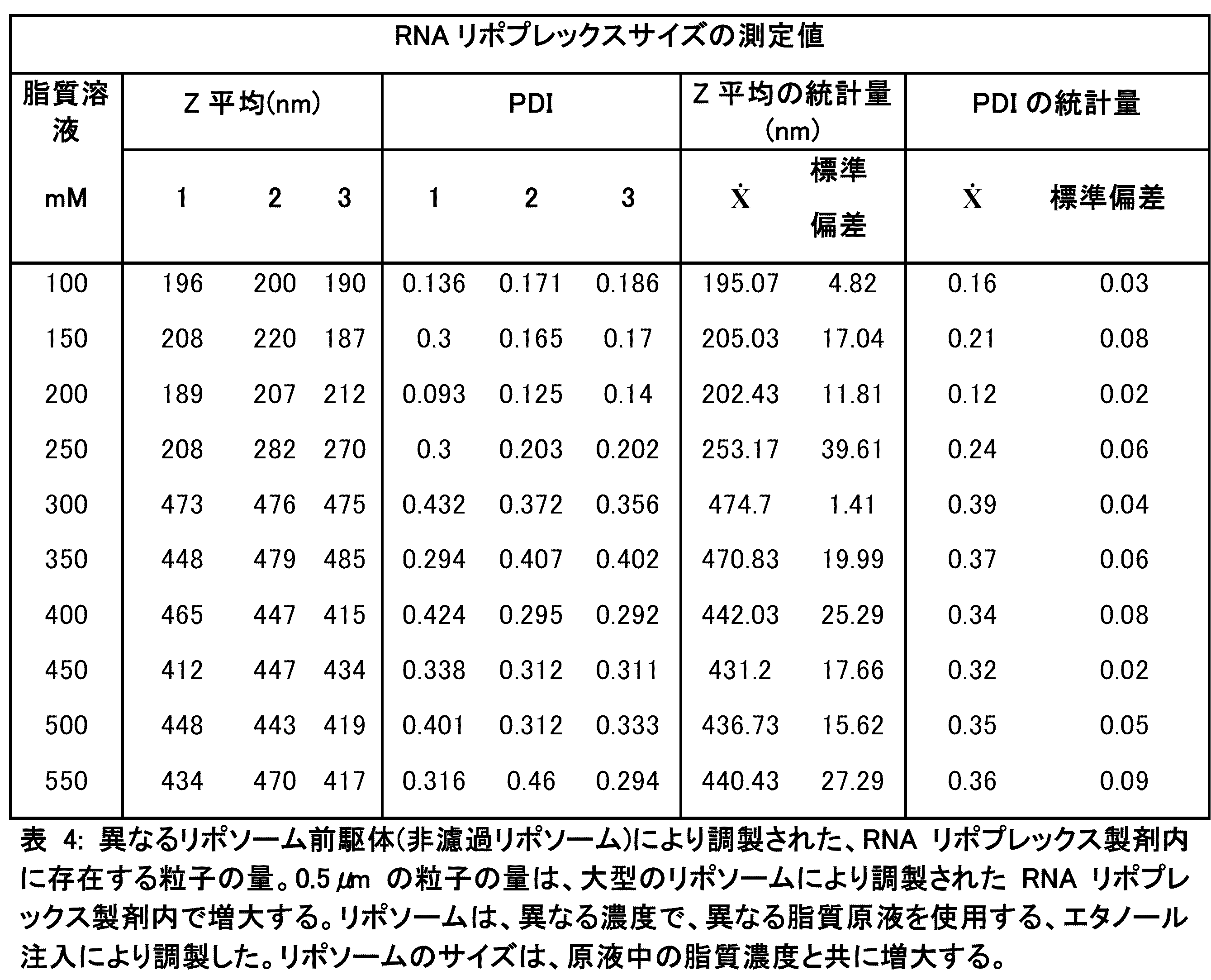
この試験シリーズに従い、小型のリポソームから得られたRNAリポプレックスは、大型のリポソームに由来するRNAリポプレックスより小型であった。300mMおよびこれを上回る溶液により製造したリポソームから得られたRNAリポプレックスは、150mMの原液から得られたリポソームに由来するRNAリポプレックスの約2倍であった。大型のリポソームにより調製された、全てのRNAリポプレックス内で、リポソームサイズと、RNAリポプレックスサイズとの相関は見出されなかった(図3)。 According to this test series, the RNA lipoplexes obtained from small liposomes were smaller than those derived from large liposomes. The RNA lipoplexes obtained from liposomes prepared with 300 mM and above solutions were approximately twice as large as those derived from liposomes obtained from 150 mM stock solutions. No correlation was found between liposome size and RNA lipoplex size in all RNA lipoplexes prepared with large liposomes (Figure 3).
得られたRNAリポプレックスの量は、それらの形成のために使用されるリポソームのサイズと共に増大した。大型のリポソームにより調製された製剤中では、高量の大型RNAリポプレックス粒子が測定されることから、動的光散乱測定から得られたデータが確認される(図4)。得られた結果は、3回の測定による粒子の量の平均値を表した。 The amount of RNA lipoplexes obtained increased with the size of the liposomes used for their formation. In the formulations prepared with larger liposomes, a high amount of large RNA lipoplex particles was measured, confirming the data obtained from the dynamic light scattering measurements (Figure 4). The results obtained represented the average amount of particles from triplicate measurements.
実施例15
異なるリポプレックスによる小角度X線散乱(SAXS)
小角度のX線散乱実験は、異なる濃度の原液に由来するリポソームから得られたRNAリポプレックスにより、記載される通りに実施した。例えば、RNAリポプレックスは、DOTMA/DOPEを、2/1(モル/モル)とするリポソーム、および電荷比を1.3対2とするRNAから形成した。リポソームは、エタノール中の脂質の濃度を、100mM、300mM、および400mMとして、記載される通りに、エタノール注入により製造した。
Example 15
Small angle X-ray scattering (SAXS) from different lipoplexes
Small angle X-ray scattering experiments were performed as described with RNA lipoplexes obtained from liposomes derived from different concentrations of stock solutions. For example, RNA lipoplexes were formed from liposomes with DOTMA/
4/1の電荷比(上)、および1.3/2の電荷比で調製されたリポソームにより形成されたRNAリポプレックスによる小角度X線散乱測定から得られた回折曲線であって、リポプレックス形成のためのリポソームが、エタノール中に、400mM、300mM、および100mMの脂質原液により得られた場合の回折曲線を、図5に示す。 Diffraction curves obtained from small angle X-ray scattering measurements of RNA lipoplexes formed with liposomes prepared at a charge ratio of 4/1 (top) and 1.3/2 are shown in Figure 5, where the liposomes for lipoplex formation were obtained with lipid stock solutions of 400 mM, 300 mM, and 100 mM in ethanol.
散乱パターンは、約1nm-1の、単一のブラッグピークを含む。これは、過剰量の(負に帯電した)RNAを、リポプレックス形成のために使用した、脾臓ターゲティングリポプレックスについての、典型的な回折パターンである。リポプレックスが、負に帯電していない場合、散乱プロファイルは、完全に異なる。例として、電荷比を±4/1とするRNAリポプレックスを測定したところ、はるかに曖昧なピークが見出された。同様に、二次ピークも識別可能である(低強度であるが)。実際、リポプレックスのx線散乱プロファイルの一般的特徴は、相状態に応じて、等距離の場合もあり、他の間隔を有する場合もある、いくつかのピークが存在することである。ここでは、これに対して、単一のピークだけが決定される。さらに、ピーク幅も、元来、リポソームを製造するために使用された、原液の濃度に応じて変化する。エタノール中の濃度が高い場合、ピーク幅は、小さかった。ブラッグピークは、リポプレックスが、規則的に配置されており、ここで、反復距離(d間隔)は、


としてのピーク位置から与えられることを指し示す。ブラッグピークに由来しうるd間隔は、6.5nmのオーダーである。
The scattering pattern contains a single Bragg peak of about 1 nm -1 . This is a typical diffraction pattern for spleen-targeting lipoplexes, where an excess of (negatively charged) RNA was used for lipoplex formation. If the lipoplexes are not negatively charged, the scattering profile is completely different. As an example, RNA lipoplexes with a charge ratio of ±4/1 were measured, and much more fuzzy peaks were found. Likewise, secondary peaks are also discernible (albeit of lower intensity). Indeed, a general feature of the x-ray scattering profile of lipoplexes is the presence of several peaks, which may be equidistant or have other spacings, depending on the phase state. Here, in contrast, only a single peak is determined. Furthermore, the peak width also varies depending on the concentration of the stock solution originally used to prepare the liposomes. At higher concentrations in ethanol, the peak width was smaller. The Bragg peaks indicate that the lipoplexes are regularly arranged, where the repeat distance (d-spacing) is
The d-spacing that can be attributed to the Bragg peak is on the order of 6.5 nm.
ピーク幅であるΔqは、スタック内の反復単位の数の増大と共に減少する。液晶アレイについて、相関長は、

実施例16
ヒト樹状細胞内の、RNAリポプレックスのトランスフェクション効率
luc-RNAリポプレックスは、他の全てのパラメータを固定したまま、それらの形成のためのリポソームのサイズを変動させる(それらの形成のための出発脂質濃度を変動させることにより)、異なるリポソーム前駆体を使用して、記載される通りに製造した。その後、異なるRNAリポプレックス製剤の、RNAトランスフェクション効率は、培地中または全血中に播種された、ヒト樹状細胞内で探索した。
Example 16
Transfection Efficiency of RNA Lipoplexes in Human Dendritic Cells The luc-RNA lipoplexes were prepared as described using different liposome precursors varying the size of the liposomes for their formation (by varying the starting lipid concentration for their formation) while keeping all other parameters fixed. The RNA transfection efficiency of the different RNA lipoplex formulations was then explored in human dendritic cells seeded in culture medium or in whole blood.
ルシフェラーゼの発現と、異なるリポソーム前駆体により調製される、異なるRNAリポプレックスの、対応する生物活性とを測定することにより決定される、インビトロ(ヒト樹状細胞)におけるトランスフェクション効率を例示する結果を、図6に示す。 Results illustrating the transfection efficiency in vitro (human dendritic cells) determined by measuring the luciferase expression and corresponding biological activity of different RNA lipoplexes prepared with different liposome precursors are shown in Figure 6.
生物活性(インビトロにおけるRNAトランスフェクション)は、RNAリポプレックスの相関長と共に、単調に増大する。大きな相関長は、RNAリポプレックス内の脂質二重層の、より均一な集団を指し示す。 Biological activity (in vitro RNA transfection) increases monotonically with the correlation length of the RNA lipoplexes. A larger correlation length indicates a more homogenous population of lipid bilayers within the RNA lipoplexes.
実施例17
異なるリポプレックスの、非対称流動場流動分画
懸濁液中の粒子を、分画および分離するための、今日の、一般的かつ最新の方法である、非対称流動場流動分画(AF4)を使用して、RNAリポプレックスの、さらなる差違を決定した。AF4理論に従えば、同様の特性および同等のサイズを伴う粒子は、同時に溶出するとされる。
Example 17
Asymmetric flow field fractionation of different lipoplexes Further differences of RNA lipoplexes were determined using asymmetric flow field fractionation (AF4), which is a common and current method today for fractionating and separating particles in suspension. According to AF4 theory, particles with similar properties and comparable size are expected to elute together.
エタノール中に150mMの原液、またはエタノール中に400mMの原液から製造された、2つの異なる種類のリポソームに由来するリポプレックスの、AF4測定に関する一部の結果を、図7に示す。 Some results of AF4 measurements of lipoplexes derived from two different types of liposomes, prepared from a 150 mM stock solution in ethanol or a 400 mM stock solution in ethanol, are shown in Figure 7.
まとめると、場流動分画の測定は、エタノール中に150mMの脂質濃度によるリポソームに由来するリポプレックスが、400mMの脂質濃度によるリポプレックスと、定性的、かつ、定量的に異なることを裏付ける。150mMに由来するリポプレックスは、小型であるが、直感に反し、後で溶出するので、2つの部分の間には、定性的差違(形状、培地との相互作用、電荷)が見られるはずである。150mMのエタノールによるRNAリポプレックスは、後で溶出するが、サイズは小さい。これは、エタノール中に150mMの脂質溶液を使用したリポソームから製造された、リポソームに由来するRNAリポプレックスは、平均で、エタノール中に400mMの脂質に由来するRNAリポプレックスより小型であることを指し示す。同じサイズであってもなお、150mmに由来するリポプレックスは、400mMに由来するリポプレックスと異なる物理化学的特性を有する。これらの、サイズおよび物理化学的特性の差違は、400mMに由来するRNAリポプレックスの高生物活性と相関する。 In summary, the field flow fractionation measurements confirm that lipoplexes derived from liposomes with 150 mM lipid concentration in ethanol are qualitatively and quantitatively different from lipoplexes with 400 mM lipid concentration. The lipoplexes derived from 150 mM are smaller, but counterintuitively elute later, so there should be qualitative differences (shape, interaction with medium, charge) between the two parts. The RNA lipoplexes from 150 mM ethanol elute later, but are smaller in size. This indicates that the RNA lipoplexes derived from liposomes produced from liposomes using 150 mM lipid solution in ethanol are, on average, smaller than the RNA lipoplexes derived from 400 mM lipid in ethanol. Even with the same size, the lipoplexes derived from 150 mM have different physicochemical properties than the lipoplexes derived from 400 mM lipid. These differences in size and physicochemical properties correlate with the high biological activity of RNA lipoplexes derived from 400 mM.
実施例18
インビトロにおけるRNAリポプレックスの生物活性
記載される通りに、リポソーム、異なる脂質原液、および/または異なる脂質濃度から調製された、異なるサイズの、ルシフェラーゼをコードするRNAリポプレックスの、細胞培養物へのトランスフェクション実験(樹状細胞)により決定される通り、ルシフェラーゼシグナルは、したがって、生物活性は、脂質の出発濃度と共に、単調に増大し、したがって、RNAリポプレックス形成のために使用されたリポソームサイズと共に、単調に増大する。対応する結果を、図6、8、および9に示す。
Example 18
Bioactivity of RNA lipoplexes in vitro As determined by transfection experiments in cell cultures (dendritic cells) of different sized luciferase-encoding RNA lipoplexes prepared from liposomes, different lipid stock solutions, and/or different lipid concentrations as described, the luciferase signal, and therefore the bioactivity, increases monotonically with the starting concentration of lipid and therefore with the liposome size used for RNA lipoplex formation. The corresponding results are shown in Figures 6, 8, and 9.
まとめると、リポソーム製造のために、高脂質濃度から作出されたRNAリポプレックスは、インビトロにおいて、著明な高活性を呈示する。 In summary, RNA lipoplexes produced from high lipid concentrations for liposome production exhibit significantly higher activity in vitro.
実施例19
インビボにおけるRNAリポプレックスの生物活性
異なるサイズのリポソームから調製された、ルシフェラーゼをコードするRNAリポプレックスの、細胞培養物へのトランスフェクション実験(樹状細胞)により決定される通り、大型のリポソームにより調製されたRNAリポプレックスは、著明な高ルシフェラーゼの発現と、対応する生物活性とを結果としてもたらす。
Example 19
Biological activity of RNA lipoplexes in vivo As determined by transfection experiments in cell cultures (dendritic cells) of luciferase-encoding RNA lipoplexes prepared from liposomes of different sizes, RNA lipoplexes prepared from large liposomes result in significantly higher luciferase expression and corresponding biological activity.
この試験シリーズの非限定的な例を、図10および11に示す。360mMの生コロイドに由来する、大型のリポソームにより調製されたRNAリポプレックスは、200mMの生コロイドに由来する小型のRNAリポプレックスより著明な、インビボにおける発現シグナルをもたらす。 A non-limiting example of this test series is shown in Figures 10 and 11. RNA lipoplexes prepared with larger liposomes derived from 360 mM biocolloids provide a more pronounced in vivo expression signal than smaller RNA lipoplexes derived from 200 mM biocolloids.
実施例20
RNAリポプレックスの自動式製造
RNAリポプレックスの自動式バッチ製造のために、図12に示される、一般に適用可能な手順を開発した。全ての工程は、材料の、安全な無菌操作を可能とする、あらかじめ滅菌した、単回使用の流路を使用して実施する。まず、RNAの濃度を、リポソーム濃度に照らして調整し、RNAを濃縮するために、NaClを添加する。これにより、RNA溶液を、RNA濃度に照らして調整することから、同一体積のRNAと、リポソームとの混合を可能とする。RNAおよびリポソーム溶液の両方を、大容量シリンジへと移し、両方のシリンジを、単一のシリンジポンプへと取り付け、シリンジの2つのピストンを、同時に駆動する。RNAリポプレックス形成の後、低温保護剤溶液を添加し、薬物生成物の最終濃度を調整する。薬物生成物を、ガラス製のボトルへと充填した後で、薬物生成物を、長期保管のための濃縮物として凍結させる。
Example 20
Automated Production of RNA Lipoplexes For automated batch production of RNA lipoplexes, a generally applicable procedure was developed, shown in FIG. 12. All steps are performed using pre-sterilized, single-use flow paths that allow safe aseptic handling of materials. First, the concentration of RNA is adjusted according to the liposome concentration, and NaCl is added to concentrate the RNA. This allows mixing of the same volume of RNA and liposomes, since the RNA solution is adjusted according to the RNA concentration. Both RNA and liposome solutions are transferred into a large-volume syringe, and both syringes are attached to a single syringe pump, and the two pistons of the syringes are driven simultaneously. After RNA lipoplex formation, a cryoprotectant solution is added and the final concentration of the drug product is adjusted. After filling the drug product into glass bottles, the drug product is frozen as a concentrate for long-term storage.
RNAリポプレックスの、極めて重要な品質属性は、RNAとリポソームとの混合比により調整される電荷比である。混合比の効率的な制御を可能とする、RNAリポプレックスのための、自動式でスケーリング可能な産業的製造法を開発した。小スケール(≦10リットル)の製造のための方法では、RNAまたはリポソームを充填した、2つの大容量シリンジを、同時に駆動する、単一の灌流ポンプを使用することにより、リポソームおよびRNAを含有する、同一な体積の、2つの水溶液の混合の制御を達成する。大容量(≧10リットル)の、等積駆出のためには、加圧容器、膜ポンプ、ギアポンプ、磁気浮揚ポンプ、または蠕動ポンプとしてのポンピングシステムを、流速のオンライン制御およびリアルタイム調整のためのフィードバックループを伴う流速センサーと組み合わせて使用する。 A crucial quality attribute of RNA lipoplexes is the charge ratio, which is regulated by the mixing ratio of RNA and liposomes. We have developed an automated and scalable industrial manufacturing method for RNA lipoplexes that allows efficient control of the mixing ratio. In the method for small-scale (≦10 liter) manufacturing, controlled mixing of two aqueous solutions of identical volumes containing liposomes and RNA is achieved by using a single perfusion pump that simultaneously drives two large-volume syringes filled with RNA or liposomes. For large-volume (≧10 liter) isovolumic ejection, a pumping system as a pressurized vessel, membrane pump, gear pump, magnetic levitation pump, or peristaltic pump is used in combination with a flow rate sensor with a feedback loop for online control and real-time adjustment of the flow rate.
自動式のRNAリポプレックス製造のためには、RNAおよびリポソームを含有する水溶液の効率的な混合を確保する、静的混合要素が要求される。混合を増強するための、蛇行路および埋込み構造を含有する、市販のマイクロ流体型混合要素のほか、同等なアーキテクチャーを伴う試作の混合要素は、製造時に閉塞することが見出された。したがって、これらの混合要素は、RNAリポプレックスの自動式製造に適さない。直径を1.2~50.0mmの間とする、Y字型混合要素およびT字型混合要素は、RNAリポプレックスの自動式製造に適することが見出された。 For automated RNA lipoplex production, static mixing elements are required to ensure efficient mixing of aqueous solutions containing RNA and liposomes. Commercially available microfluidic mixing elements containing serpentine paths and embedded structures to enhance mixing, as well as prototype mixing elements with equivalent architectures, were found to clog during production. Thus, these mixing elements are not suitable for automated production of RNA lipoplexes. Y-shaped and T-shaped mixing elements with diameters between 1.2 and 50.0 mm were found to be suitable for automated production of RNA lipoplexes.
方法:RNAリポプレックスは、異なる混合要素(表1)を使用することにより調製した。リポプレックスの製造時に、作業者が、混合要素を観察し、材料の沈着または目詰まりを記録した。 Methods: RNA lipoplexes were prepared by using different mixing components (Table 1). During the preparation of lipoplexes, the mixing components were observed by the operator and any deposition or clogging of material was recorded.
結果:市販のマイクロ流体チップ(NanoAssemblr(商標)、Precision Nanosystem、Vancouver、Canada)では、3mLのRNAリポプレックスを調製した後で目詰まりが観察された。さらなる、試作のマイクロ流体混合要素(表5)についての試験時にも、同様の観察がなされた。市販の混合要素と同等なアーキテクチャーを含む、全ての(マイクロ)流体型混合要素について、沈着、特に、要素の閉塞を観察しえたのに対し、Y字型混合要素またはT字型混合要素を使用する場合には、観察がなされなかった。直径を2.4mmとする、記載されるy字型混合要素のほか、大直径の混合要素についても調べた。Y字型混合要素の直径には、制限が見出されなかったので、記載される方法は、y字型混合要素の、最大で50mmの直径で、RNAリポプレックスの調製に適すると考えられる。
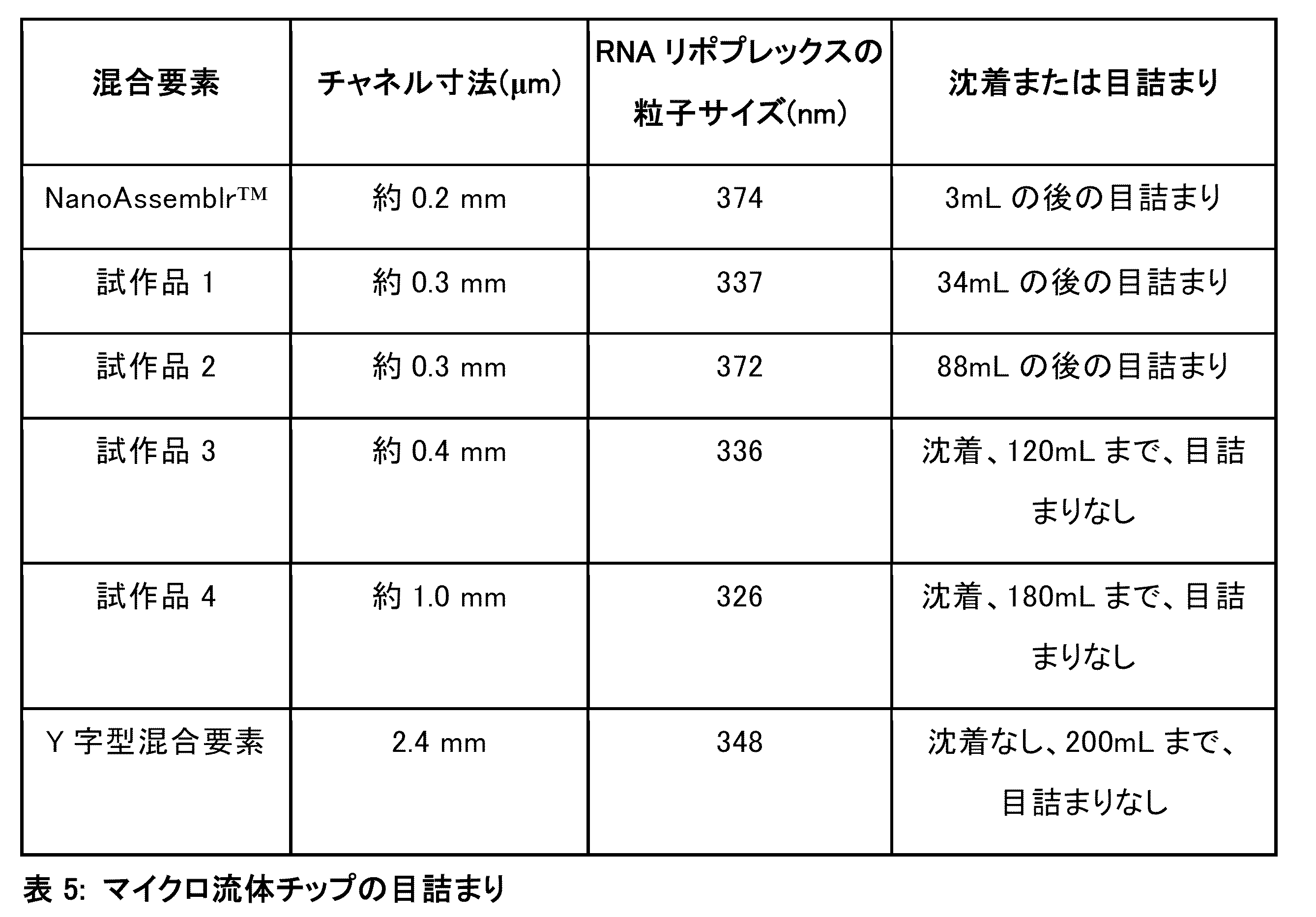
Y字型混合要素またはT字型混合要素を使用する場合、十分な混合を達成するために、最小限の流速が要求される。RNAリポプレックスの調製は、内径を1.6~50mmとする、Y字型混合要素またはT字型混合要素を使用することから、RNAおよびリポソームを含有する、2つの水溶液を混合することにより実施することができる。効率的な混合を確保するために、混合のための流速から得られるレイノルズ数は、約300より低値とするべきではない。効率的な混合を確保するために、流速の、混合要素の直径に対する比は、約150より低値とするべきではない。約2100までのレイノルズ数について実験し、自動式製造に適することを見出した。データは、高流速もまた実施可能であることを裏付ける。これは、レイノルズ数を2100とするとき、条件は、既に、乱流モードであり、したがって、高流速であってもなお、同様の混合条件であることが予測される事実に由来する。 When using Y-shaped or T-shaped mixing elements, a minimum flow rate is required to achieve sufficient mixing. Preparation of RNA lipoplexes can be performed by mixing two aqueous solutions containing RNA and liposomes using Y-shaped or T-shaped mixing elements with an internal diameter of 1.6 to 50 mm. To ensure efficient mixing, the Reynolds number resulting from the flow rate for mixing should not be lower than about 300. To ensure efficient mixing, the ratio of the flow rate to the diameter of the mixing element should not be lower than about 150. Reynolds numbers up to about 2100 have been experimented with and found to be suitable for automated production. Data confirm that higher flow rates are also feasible. This comes from the fact that at a Reynolds number of 2100, the conditions are already in the turbulent mode, and therefore similar mixing conditions are expected even at higher flow rates.
方法:RNAリポプレックスは、単一の灌流ポンプを使用して、RNA溶液およびリポソーム溶液を駆出することにより調製した。RNAリポプレックスの形成は、2.4および3.2mmの内径を含む、代表的なY字型混合要素により実施した。RNAリポプレックスの粒子サイズおよび多分散性は、光子相関分光(PCS)測定により解析した。流速と混合要素の直径との組合せの探索から得られるレイノルズ数は、式を使用して、理論的に計算した(図13)。流速の、混合要素の直径に対する比は、流速(cm3/分)を、混合要素の直径(cm)で除することにより計算した。因数は、無次元数として与えられる。 Methods: RNA lipoplexes were prepared by pumping RNA and liposome solutions using a single perfusion pump. RNA lipoplex formation was performed with representative Y-shaped mixing elements, including inner diameters of 2.4 and 3.2 mm. Particle size and polydispersity of RNA lipoplexes were analyzed by photon correlation spectroscopy (PCS) measurements. The Reynolds number resulting from exploring combinations of flow rate and diameter of mixing element was theoretically calculated using the formula (Figure 13). The ratio of flow rate to diameter of mixing element was calculated by dividing flow rate ( cm3 /min) by diameter of mixing element (cm). Factors are given as dimensionless numbers.
結果:約300を下回るレイノルズ数の理論計算値を結果としてもたらす、流速と混合要素との組合せにより、RNAリポプレックスを製造する場合に、粒子サイズおよび多分散性を増大させたRNAリポプレックスが形成される(図13および表6)。理論的に、所望の粒子特性を伴うRNAリポプレックスの、再現可能な形成を確保するためには、レイノルズ数は、約300の最小値(図13および14および表6)であるべきであり、流速の、混合要素の直径に対する比は、約150の最小値であるべきである。2.4mmの混合要素が、広範な流速(60~240mL/分)において、RNAおよびリポソームの、効率的、かつ、再現可能な混合を可能とすることが見出された。これらの研究では、上限が見出されなかったので、レイノルズ数または流速の、混合要素の直径に対する比の上限は予測されない。

実施例21
RNA濃度の影響
RNAリポプレックスは、代表的な寸法(2.4mm)を伴う、y字型混合要素により調製した。現行の設定で、RNAリポプレックスを調製しうる濃度範囲を同定するために、RNA濃度を、0.05mg/mL~0.5mg/mLにおいて、体系的に変動させた。形成されたリポプレックスの安定性を探索するために、最終的な製剤を、0.05mg/mLのRNA、22%のショ糖、および20mMのNaClへと調整し、製剤を、3回にわたり凍結させた。
Example 21
Effect of RNA concentration RNA lipoplexes were prepared by a y-shaped mixing element with typical dimensions (2.4 mm). To identify the concentration range in which RNA lipoplexes can be prepared with the current settings, the RNA concentration was systematically varied from 0.05 mg/mL to 0.5 mg/mL. To explore the stability of the formed lipoplexes, the final formulation was adjusted to 0.05 mg/mL RNA, 22% sucrose, and 20 mM NaCl, and the formulation was frozen three times.
RNAリポプレックス形成時におけるRNA濃度を、0.1~0.5mg/mLの間とする、RNAリポプレックスの形成は、同等な粒子特性(図15)を結果としてもたらす。このような粒子の粒子特性はまた、3時間にわたる凍結時にも保存されたことから、RNA濃度の変動に関して、極めて頑健な製造法が指し示される(図16)。RNAリポプレックスの調製時におけるRNA濃度の限界については、示唆がなされていないので、記載される設定は、RNA濃度を、最大で5mg/mLとするときの、RNAリポプレックスの調製に適すると考えられる。 The formation of RNA lipoplexes with RNA concentrations between 0.1 and 0.5 mg/mL results in comparable particle properties (Figure 15). The particle properties of such particles were also preserved upon freezing for 3 hours, indicating a very robust preparation method with respect to variations in RNA concentration (Figure 16). No limit on the RNA concentration during the preparation of RNA lipoplexes is suggested, so the described settings are considered suitable for the preparation of RNA lipoplexes with RNA concentrations up to 5 mg/mL.
RNAリポプレックスの自動式製造のための、記載される方法は、異なる電荷比を伴う、安定的なRNAリポプレックスの、再現可能な調製を可能とする。 The described method for the automated production of RNA lipoplexes allows the reproducible preparation of stable RNA lipoplexes with different charge ratios.
方法:RNAリポプレックスの半自動式調製の、電荷比(ration)に関する頑健性を実証するために、このパラメータを、1.0:2.0~2.1:2.0および2.0:1.0~5.0:1:0において、体系的に変動させた。RNAリポプレックスの粒子サイズおよび多分散性は、光子相関分光(PCS)測定により解析した。 Methods: To demonstrate the robustness of the semi-automated preparation of RNA lipoplexes with respect to the charge ratio, this parameter was systematically varied from 1.0:2.0 to 2.1:2.0 and from 2.0:1.0 to 5.0:1:0. The particle size and polydispersity of the RNA lipoplexes were analyzed by photon correlation spectroscopy (PCS) measurements.
結果:1.0:2.0~2.1:2.0の間の電荷比では、電荷比の変動の、RNAリポプレックスのサイズおよび多分散性に対する影響は、見出されなかった(図17)。したがって、1.0:2.0~2.1:2.0の間の範囲は、品質が同等な、RNAリポプレックス調製物を結果としてもたらすと考えられる。加えて、サイズおよび多分散性が規定された、安定的な粒子は、3.0:1.0~5.0:1.0の間の電荷比でも形成された(図18)。 Results: No effect of charge ratio variation on size and polydispersity of RNA lipoplexes was found between charge ratios of 1.0:2.0 and 2.1:2.0 (Figure 17). Thus, the range between 1.0:2.0 and 2.1:2.0 appears to result in RNA lipoplex preparations of comparable quality. In addition, stable particles of defined size and polydispersity were also formed at charge ratios between 3.0:1.0 and 5.0:1.0 (Figure 18).
実施例22
RNAリポプレックス形成時における塩濃度
高生物活性を含むRNAリポプレックスの自動式製造のためには、RNAリポプレックス形成時における、イオン条件の制御が要求される。生物活性を確保するために、RNAリポプレックスの形成は、45~300mMのNaClの存在下で実施しなければならない。他のイオン性化合物、例えば、EDTA、HEPESなどは、イオン強度に寄与し、要求される、NaClの最小濃度を低減しうる。
Example 22
Salt Concentration during RNA Lipoplex Formation Automated production of RNA lipoplexes with high biological activity requires control of ionic conditions during RNA lipoplex formation. To ensure biological activity, RNA lipoplex formation must be carried out in the presence of 45-300 mM NaCl. Other ionic compounds, such as EDTA, HEPES, etc., contribute to the ionic strength and may reduce the minimum required concentration of NaCl.
方法:RNAリポプレックスは、RNAリポプレックス形成時の、異なるNaCl濃度で、自動調製した。RNAリポプレックスの粒子サイズおよび多分散性は、光子相関分光(PCS)測定により解析した。加えて、リポプレックスの生物活性は、インビトロにおいて、ルシフェラーゼシグナルを測定することにより探索した。 Methods: RNA lipoplexes were prepared automatically with different NaCl concentrations during RNA lipoplex formation. The particle size and polydispersity of the RNA lipoplexes were analyzed by photon correlation spectroscopy (PCS) measurements. In addition, the biological activity of the lipoplexes was explored by measuring the luciferase signal in vitro.
結果:粒子特性は、イオン強度を調整することにより制御することができた。製造時における塩濃度の上昇は、粒子サイズのわずかな増大を誘導した(図19)。塩濃度は、生物活性に対して影響を及ぼすことが見出された。製造時における塩濃度の上昇は、生物活性の増大を誘導した(図20)。したがって、RNAリポプレックス形成時におけるNaCl濃度は、45mMのNaClより低くすべきではない。 Results: Particle properties could be controlled by adjusting the ionic strength. Increasing the salt concentration during preparation induced a slight increase in particle size (Figure 19). Salt concentration was found to have an effect on biological activity. Increasing the salt concentration during preparation induced an increase in biological activity (Figure 20). Therefore, the NaCl concentration during RNA lipoplex formation should not be lower than 45 mM NaCl.
実施例23
RNAリポプレックスの安定化
低温保護剤の存在下および非存在下の両方における、RNAリポプレックス内のRNAを安定化させるために、リポプレックス内のRNAを、pH5.5~6.7のpH範囲内に安定化させるための、HEPES、酢酸/酢酸ナトリウム、およびリン酸ナトリウムとしてのバッファーシステムを使用することができる。炭酸ナトリウムシステムは、同等な安定化の有効性を結果としてもたらさないことが見出された。
Example 23
Stabilization of RNA Lipoplexes To stabilize the RNA in RNA lipoplexes, both in the presence and absence of cryoprotectants, buffer systems such as HEPES, acetic acid/sodium acetate, and sodium phosphate can be used to stabilize the RNA in the lipoplexes within a pH range of 5.5 to 6.7. It was found that the sodium carbonate system did not result in comparable stabilization effectiveness.
方法:最適のpH範囲について探索し、異なるpH範囲(HEPES:pH6.8~8.2、酢酸/酢酸ナトリウム:pH3.7~5.6、リン酸ナトリウム:pH5.8~8.0、および炭酸ナトリウム:pH6.2~8.6)を対象とする、異なるバッファリング薬剤について調べるため、まず、RNAリポプレックスを、低温保護剤の非存在下の、ストレス条件(40℃)下でインキュベートする。RNAの完全性は、21日間、キャピラリー電気泳動により解析した。例示的低温保護剤の存在下で、最適のpH範囲を探索するために、RNAリポプレックスを、HEPESおよびショ糖の存在下、40℃でインキュベートし、RNAの完全性を、21日間解析した。 Methods: To explore the optimal pH range and to investigate different buffering agents covering different pH ranges (HEPES: pH 6.8-8.2, acetic acid/sodium acetate: pH 3.7-5.6, sodium phosphate: pH 5.8-8.0, and sodium carbonate: pH 6.2-8.6), RNA lipoplexes are first incubated under stress conditions (40°C) in the absence of cryoprotectants. RNA integrity was analyzed by capillary electrophoresis for 21 days. To explore the optimal pH range in the presence of exemplary cryoprotectants, RNA lipoplexes were incubated at 40°C in the presence of HEPES and sucrose and RNA integrity was analyzed for 21 days.
結果:バッファリングシステムである、HEPES、酢酸/酢酸ナトリウム、およびリン酸ナトリウムについては、同等な結果が得られたのに対し、炭酸塩システムは、RNAの同等な安定化を結果としてもたらさなかった(図21)。RNAの完全性は、製剤のpH値に依存する。最適のpH範囲は、pH5.5~7.4の間の範囲にあることが同定された。例示的な低温保護剤であるショ糖の存在下で、RNAの、最良の安定化を結果としてもたらす、pH5.5~8.0のpH範囲が同定された(図22)。 Results: Comparable results were obtained for the buffering systems HEPES, acetic acid/sodium acetate, and sodium phosphate, whereas the carbonate system did not result in comparable stabilization of the RNA (Figure 21). RNA integrity is dependent on the pH value of the formulation. The optimal pH range was identified to be in the range between pH 5.5-7.4. In the presence of the exemplary cryoprotectant sucrose, a pH range of pH 5.5-8.0 was identified resulting in the best stabilization of the RNA (Figure 22).
RNA合成法から、二価の金属イオンが生じる場合があり、製剤の賦形剤またはガラス製容器および缶は、RNAの安定性に影響を及ぼしうる。EDTA二ナトリウム塩は、アルカリ土類金属および重金属イオンと共に、安定的な水溶性の複合体を形成する。EDTA二ナトリウム塩は、RNAリポプレックス形成時に存在する、イオンの濃度に寄与し、これにより、生物活性のRNAリポプレックスを調製するために要求される、NaClの濃度を低減する。EDTA(0~20mM)の存在下における、RNAリポプレックスの形成は、記載される方法により可能である。 Divalent metal ions may result from the RNA synthesis method, and formulation excipients or glass containers and cans may affect the stability of the RNA. Disodium EDTA forms stable water-soluble complexes with alkaline earth and heavy metal ions. Disodium EDTA contributes to the concentration of ions present during RNA lipoplex formation, thereby reducing the concentration of NaCl required to prepare biologically active RNA lipoplexes. Formation of RNA lipoplexes in the presence of EDTA (0-20 mM) is possible with the described method.
方法:RNAリポプレックスを、漸増濃度のEDTA(最大で18mM)存在下で形成し、希釈したら、40℃で、EDTA含有量を低減して(0.1mM~5.4mM)インキュベートした。RNAの完全性を、21日間、鍵となる物理化学的パラメータとして解析した。 Methods: RNA lipoplexes were formed in the presence of increasing concentrations of EDTA (up to 18 mM), diluted and then incubated at 40°C with decreasing EDTA content (0.1 mM to 5.4 mM). RNA integrity was analyzed as a key physicochemical parameter for 21 days.
結果:高濃度のEDTA(最大で18mM)の存在下における、RNAリポプレックスの形成は、低濃度のEDTAの存在下における調製物と同等な粒子特性を結果としてもたらすことが見出された。保管時における、0.01%(w:v)(0.1mM)~0.2%(w:v)(5.4mM)の間のEDTAを含有する、異なる群の間では、有意差が見出されなかった(図23)。EDTA二ナトリウム塩は、RNAリポプレックス形成時に存在するイオン濃度に寄与し、RNAの完全性を減殺する可能性がある、二価金属イオンのスカベンジャーとして作用しうるので、RNAリポプレックス形成時における、最大で20mMのEDTA濃度の存在は、有利であると考えられる。 Results: It was found that the formation of RNA lipoplexes in the presence of high concentrations of EDTA (up to 18 mM) results in particle characteristics comparable to preparations in the presence of low concentrations of EDTA. No significant differences were found between the different groups containing between 0.01% (w:v) (0.1 mM) and 0.2% (w:v) (5.4 mM) EDTA during storage (Figure 23). The presence of EDTA concentrations up to 20 mM during RNA lipoplex formation is considered advantageous, since EDTA disodium salt contributes to the ion concentration present during RNA lipoplex formation and may act as a scavenger of divalent metal ions that may compromise the integrity of the RNA.
実施例24
NaClおよび低温保護剤の含有量の最適化
調整されるイオン条件は、RNAリポプレックスの製造時、長期にわたる保管時、および患者への適用時に調整する必要がある(図24)。NaClの濃度は、RNAリポプレックスの形成時に、45~300mMであることが可能であり;凍結状態にあるRNAリポプレックスの、長期にわたる保管時に、10~50mMであることが可能であり;融解および生理食塩水による希釈の後において、80~150mMでありうる。
Example 24
Optimization of NaCl and cryoprotectant content Adjusted ionic conditions need to be adjusted during RNA lipoplex production, long-term storage, and patient application (Figure 24). The concentration of NaCl can be 45-300 mM during RNA lipoplex formation; 10-50 mM during long-term storage of RNA lipoplexes in frozen state; and 80-150 mM after thawing and dilution with saline.
複数回の凍結時における、粒子特性の安定化を確保するために、≦70mMの、各NaCl濃度について、これを下回るべきではない、それぞれの含有量の低温保護剤を見出した。低温保護剤として、12.5~35.0%(w:v)の間の濃度の、グルコース、ショ糖、マンニトール、トレハロース、ソルビトール、グリセリンとしてのトリオール、およびこれらの混合物など、単分子または二分子の糖類を使用することができる。ソルビトールの安定化有効性は、直前の化合物と比較して低度であり、アルギニンは、凍結時において、RNAリポプレックスを、効率的に安定化させない。


方法:適切な低温保護剤を同定するために、単糖類(グルコースおよびソルビトール)、二糖類(ショ糖およびトレハロース)、アミノ酸(アルギニン、プロリン)、トリオール(グリセリン)に代表的な、異なる化合物、ならびに異なる糖類(マンニトールおよびショ糖)の混合物を含有する低温保護システムを探索した(図25および26)。したがって、RNAリポプレックスを、濃度を増大させた、これらの化合物の存在下で凍結させた。NaClを、ある特定の濃度とするときの、低温保護剤の最小の含有量を同定するために、RNAリポプレックスを、量を増大させる、代表的な低温保護剤としての、ショ糖またはトレハロースの存在下で凍結させた(表7)。探索される低温保護剤の濃度範囲を、詳細に決定するために、まず、試料を、単回凍結させた。第3の実験において、低温保護剤であるトレハロースの存在下で、RNAリポプレックスを、最大で10回にわたり凍結させることにより、粒子サイズの安定化の有効性を吟味した(表8)。 Methods: To identify suitable cryoprotectants, cryoprotection systems containing different compounds representative of monosaccharides (glucose and sorbitol), disaccharides (sucrose and trehalose), amino acids (arginine, proline), triols (glycerol), as well as a mixture of different sugars (mannitol and sucrose) were explored (Figures 25 and 26). Therefore, RNA lipoplexes were frozen in the presence of increasing concentrations of these compounds. To identify the minimum cryoprotectant content at a certain concentration of NaCl, RNA lipoplexes were frozen in the presence of increasing amounts of representative cryoprotectants sucrose or trehalose (Table 7). To determine in detail the range of concentrations of cryoprotectants explored, samples were first frozen once. In a third experiment, the effectiveness of particle size stabilization was examined by freezing RNA lipoplexes up to 10 times in the presence of the cryoprotectant trehalose (Table 8).
結果:アルギニンが、明らかに、RNAリポプレックスを不安定化させるのに対し、他の低温保護剤は、一般に、凍結時における、RNAリポプレックスの安定化に適用可能である(図25および26)。グリセリン、マンニトール、およびショ糖(1:1、w:w)、プロリン、ならびにソルビトールは、RNAリポプレックスのための低温保護剤として使用することができる。アルギニンに加え、全てのさらなる被験安定剤は適すると考えられることから、広範にわたるアミノ酸、糖類、およびこのような化合物の混合物が、凍結時における、RNAリポプレックスの安定化に適することが指し示される。ソルビトールの安定化有効性は、直前の化合物と比較した場合、低度である。 Results: While arginine clearly destabilizes RNA lipoplexes, other cryoprotectants are generally applicable for stabilizing RNA lipoplexes upon freezing (Figures 25 and 26). Glycerol, mannitol, and sucrose (1:1, w:w), proline, and sorbitol can be used as cryoprotectants for RNA lipoplexes. In addition to arginine, all further stabilizers tested appear to be suitable, indicating that a wide range of amino acids, sugars, and mixtures of such compounds are suitable for stabilizing RNA lipoplexes upon freezing. The stabilizing effectiveness of sorbitol is low when compared to the previous compound.
各濃度のNaClで要求される低温保護剤の量を、詳細に探索したところ(表8)、単回の凍結工程の後で、NaCl濃度と、要求される低温保護剤の濃度との、直接的な相関が見出された(図27および28)。0~60mMのNaCl、20%(w:v)のショ糖またはトレハロース二水和物について、単回の凍結工程の後で、粒子サイズの、許容可能な保存が見出されたのに対し、低百分率の低温保護剤(例えば、60mMのNaClについて、≦15%;40mMのNaClについて、≦10%;20mMのNaClについて、≦5%)では、不十分な安定化が見出された。探索された範囲内の、ショ糖と、トレハロースとの間のでは、差違が見出されなかった。 A detailed exploration of the amount of cryoprotectant required for each concentration of NaCl (Table 8) found a direct correlation between NaCl concentration and the concentration of cryoprotectant required after a single freezing step (Figures 27 and 28). For 0-60 mM NaCl, 20% (w:v) sucrose or trehalose dihydrate, acceptable preservation of particle size was found after a single freezing step, whereas insufficient stabilization was found for low percentages of cryoprotectant (e.g., ≦15% for 60 mM NaCl; ≦10% for 40 mM NaCl; ≦5% for 20 mM NaCl). No differences were found between sucrose and trehalose within the explored range.
表9.3.2に示される、NaClと、トレハロースとの組合せの存在下、1、2、3、5、および10回にわたる凍結の後において、RNAリポプレックスの粒子サイズを解析したところ、以下の結果が得られた。50mMのNaClの濃度では、≧12.5%のトレハロースが、10時間にわたる凍結の後であってもなお、RNAリポプレックス粒子の特性の安定化に十分であったのに対し(図29)、70mMのNaClでは、≧12.5%が、最小限の安定化に要求され、≧22.5%が、粒子サイズの正確な保存に要求された(図30)。90mMのNaClでは、≧15.0%のトレハロースが、最小限の安定化に要求され、粒子サイズの正確な保存は、≧27.5%の最高探索濃度によってもなお、達成することができなかった(図31)。 The particle size of RNA lipoplexes was analyzed after 1, 2, 3, 5 and 10 rounds of freezing in the presence of combinations of NaCl and trehalose as shown in Table 9.3.2, with the following results: At a concentration of 50 mM NaCl, ≧12.5% trehalose was sufficient to stabilize the RNA lipoplex particle properties even after 10 hours of freezing (FIG. 29), whereas at 70 mM NaCl, ≧12.5% was required for minimal stabilization and ≧22.5% was required for accurate preservation of particle size (FIG. 30). At 90 mM NaCl, ≧15.0% trehalose was required for minimal stabilization and accurate preservation of particle size could not be achieved even with the highest concentration explored of ≧27.5% (FIG. 31).
実施例25
長期の保管のための、塩と低温保護剤との組合せ
所与の温度における、長期にわたる保管のためには、表9に列挙された、NaClと、低温保護剤との組合せを使用すべきである。
Example 25
Salt and cryoprotectant combinations for long term storage For long term storage at a given temperature, the NaCl and cryoprotectant combinations listed in Table 9 should be used.
方法:-15~-30℃、ある特定の濃度のNaClで、長期にわたる保管のための、低温保護剤の最小の含有量を探索するために、RNAリポプレックスを、NaClと、ショ糖またはトレハロースとの組合せの存在下で凍結させた。試料を、-30℃で凍結させ、次いで、長期にわたる保管のために、それぞれの温度へと移行させた(-15または-30℃)。規定された保管期間の後に、試料を解析し、PCSを使用して、粒子サイズを測定することにより、コロイドの安定性の保存について解析した。 Methods: To explore the minimum cryoprotectant content for long-term storage at -15 to -30°C and a specific concentration of NaCl, RNA lipoplexes were frozen in the presence of a combination of NaCl and sucrose or trehalose. Samples were frozen at -30°C and then transferred to the respective temperature (-15 or -30°C) for long-term storage. After the defined storage period, samples were analyzed for preservation of colloidal stability by measuring particle size using PCS.
結果:これらの実験では、最大で70mMのNaClの存在下における凍結時に、RNAリポプレックスの粒子特性を保存しうる一方で、コロイドの安定性の不安定化に寄与するさらなる影響も観察することができた。また、例えば、60mMのNaClと、20%のショ糖との組合せについて、凍結の後における、粒子特性の許容可能な安定化も確認したところ、-15℃の保管温度では、これらの製剤の粒子サイズは、時間経過にわたり、有意に増大した(図32および33)。この影響は、-30℃における保管時に低減された(図34および35)。 Results: In these experiments, while the particulate properties of RNA lipoplexes could be preserved upon freezing in the presence of up to 70 mM NaCl, additional effects could be observed that contribute to destabilization of colloidal stability. We also observed acceptable stabilization of particulate properties after freezing, e.g., for the combination of 60 mM NaCl and 20% sucrose, and at a storage temperature of -15°C, the particle size of these formulations increased significantly over time (Figures 32 and 33). This effect was reduced upon storage at -30°C (Figures 34 and 35).
所与のNaCl含有量では、RNAリポプレックスの安定性は、低温保護剤の量に依存する。必要とされる低温保護剤の量は、塩の、保管溶液中含有量の増大と共に増大する。この効果は、低温保護剤として使用される糖の種類に依存しない。-15または-30℃の凍結状態における、長期にわたる保管のための、RNAリポプレックスの組成物は、表9に列挙された含有量の低温保護剤を含有すべきである。

実施例26
異なる低温保護剤による、長期にわたる保管
22%(w:v)の、単分子または二分子の糖類の存在下における、9カ月間にわたる安定化は、10~40mMのNaClにより可能である。これらの製剤は、-15~-40℃で凍結させ、長期にわたる保管のために、それぞれの温度に保つことができる。12.6~16.8%(w:v)のデキストランの存在下では、10~30mMのNaClが使用可能である。
Example 26
Long-term storage with different cryoprotectants Stabilization for 9 months in the presence of 22% (w:v) mono- or bi-saccharides is possible with 10-40 mM NaCl. The formulations can be frozen at -15 to -40°C and kept at the respective temperatures for long-term storage. In the presence of 12.6-16.8% (w:v) dextran, 10-30 mM NaCl can be used.
方法:-20℃における、長期にわたる保管に要求される、ショ糖、トレハロース、グルコース、およびデキストランを含む混合物としての、最小含有量の、代表的な低温保護剤を探索するために、RNAリポプレックスを、変動させるNaCl濃度を、一定の低温保護剤含有量と組み合わせて凍結させた。グルコース、ショ糖、およびトレハロースとしての、モノマー分子またはダイマー分子の低温保護剤について、濃度を22%(w:v)に調整した。これらの製剤を凍結させ、-15~-40℃で保管し、規定された保管時間の後、PCSを使用して、粒子サイズを測定することにより、長期にわたる安定性を探索した。 Methods: To explore the minimum content of representative cryoprotectants as a mixture containing sucrose, trehalose, glucose, and dextran required for long-term storage at -20°C, RNA lipoplexes were frozen with varying NaCl concentrations combined with constant cryoprotectant content. The concentration was adjusted to 22% (w:v) for monomeric or dimeric cryoprotectants as glucose, sucrose, and trehalose. These formulations were frozen and stored at -15 to -40°C and the long-term stability was explored by measuring particle size using PCS after the specified storage time.
表9.5.1に列挙された、ポリマーであるデキストラン組成物の混合物を含有する製剤を調整した。試料を凍結させ、-20℃で保管した。規定された保管時間の後、試料を解析し、粒子サイズを測定することにより、コロイド安定性の保存を解析した。 Formulations were prepared containing a mixture of polymeric dextran compositions listed in Table 9.5.1. Samples were frozen and stored at -20°C. After the specified storage times, samples were analyzed to determine preservation of colloidal stability by measuring particle size.
結果:凍結状態における、長期にわたるRNAリポプレックスの安定化を確保するために、全ての、探索される、モノマー分子またはダイマー分子の低温保護剤について、これを超えるべきではない、最大のNaCl濃度を見出した。60および80mMのNaClが、リポプレックスの、急速な不安定化を結果としてもたらしたのに対し、NaCl濃度を、≦40mMとしたところ、-20℃で保管した場合、コロイド特性を、最短で9カ月間保存することができた(表10および図36~38)。ショ糖、トレハロース、およびグルコースについて、安定化有効性の差違を見出すことはできなかった。20mMのNaClを含む製剤について、試料を凍結させ、-15~-40℃で保管したところ、長期にわたる安定性の差違を見出すことはできなかった(図39)。 Results: A maximum NaCl concentration was found for all explored monomeric or dimeric cryoprotectants to ensure long-term stabilization of RNA lipoplexes in frozen conditions that should not be exceeded. NaCl concentrations of 60 and 80 mM resulted in rapid destabilization of lipoplexes, whereas NaCl concentrations of ≦40 mM allowed the preservation of colloidal properties for a minimum of 9 months when stored at −20° C. (Table 10 and Figures 36-38). No difference in stabilization effectiveness could be found for sucrose, trehalose, and glucose. For formulations containing 20 mM NaCl, no difference in long-term stability could be found when samples were frozen and stored at −15 to −40° C. (Figure 39).
低温保護剤の含有量が低量である(12.6~16.8%(w:v))、デキストランを含有する製剤について探索したところ、安定化の有効性は、単分子または二分子の糖類と比較する場合に、同等なまたは良好である(図40)。

実施例27
凍結乾燥
a)凍結融解
最も有効な低温/凍結乾燥保護剤濃度を決定するために、凍結融解研究を実施した。RNAリポプレックス製剤を、10%、15%、20%、25%、および30%のトレハロースを添加した、5mMのHEPES、80mMのNaCl、2.6mMのEDTA中で凍結融解させた。粒子サイズは、-20℃での保管の前および後において決定した。トレハロースの非存在下で凍結させた製剤中では、粒子の凝集が観察されたので、それらの粒子サイズを決定しなかった。図41に従い、低温/凍結乾燥保護剤と共に凍結させた製剤は、濃度依存性の低温保護を示し、粒子サイズは、低凍結乾燥/低温保護剤濃度で増大した。22%w/vのトレハロースでは、Sf/Siを1.04とし、1.3未満であるので、なおも許容可能であると考えられる(Sf=最終サイズ、Si=初期サイズ)、粒子サイズの、最小限の増大だけが観察された。低トレハロース濃度では、Sf/Si比が増大した。凍結融解研究から得られたSf/Si比は、凍結乾燥および再構成の後で、同じ製剤から得られたSf/Si比と相関する。
Example 27
Lyophilization a) Freeze-thaw A freeze-thaw study was performed to determine the most effective cryo/lyoprotectant concentration. RNA lipoplex formulations were freeze-thawed in 5 mM HEPES, 80 mM NaCl, 2.6 mM EDTA supplemented with 10%, 15%, 20%, 25% and 30% trehalose. Particle size was determined before and after storage at -20°C. Particle size was not determined in formulations frozen in the absence of trehalose, as particle aggregation was observed. According to Figure 41, formulations frozen with cryo/lyoprotectant showed concentration-dependent cryoprotection, with particle size increasing at low lyo/lyoprotectant concentrations. Only a minimal increase in particle size was observed with 22% w/v trehalose, giving an Sf/Si of 1.04, which is still considered acceptable since it is less than 1.3 (Sf=final size, Si=initial size). At low trehalose concentrations, the Sf/Si ratio increased. The Sf/Si ratios obtained from freeze-thaw studies correlate with those obtained from the same formulations after lyophilization and reconstitution.
b)再構成および粒子の安定性
5mMのHEPES、2.6mMのEDTA、0mM、10mM、20mM、30mM、40mM、50mM、60mM、80mMのNaCl、ならびに5%、10%、15%、および22%のトレハロース中で調製された、RNAリポプレックス製剤を凍結乾燥させた。全ての凍結乾燥試料は、良好なケーキ様外観を呈した。試料は、0.9%のNaCl溶液により、元の体積で再構成した。全ての凍結乾燥RNAリポプレックス製剤は、0.9%のNaCl溶液またはWFIによる再構成時に、速やかに溶解させた。0.9%のNaCl溶液または水による再構成の後における、22%のトレハロース中で調製された、凍結乾燥RNAリポプレックス製剤中の、粒子サイズの変化を決定した。
b) Reconstitution and Particle Stability RNA lipoplex formulations prepared in 5 mM HEPES, 2.6 mM EDTA, 0 mM, 10 mM, 20 mM, 30 mM, 40 mM, 50 mM, 60 mM, 80 mM NaCl, and 5%, 10%, 15%, and 22% trehalose were lyophilized. All lyophilized samples exhibited a good cake-like appearance. Samples were reconstituted in the original volume with 0.9% NaCl solution. All lyophilized RNA lipoplex formulations dissolved quickly upon reconstitution with 0.9% NaCl solution or WFI. The change in particle size in lyophilized RNA lipoplex formulations prepared in 22% trehalose after reconstitution with 0.9% NaCl solution or water was determined.
図42に従い、凍結乾燥および再構成の後で、粒子サイズは、トレハロースを含有する、全ての凍結乾燥RNAリポプレックス製剤中で、安定を維持した。凍結乾燥試料を、0.9%のNaClで再構成した場合、水で再構成された凍結乾燥試料と比較して、RNAリポプレックスのサイズの、わずかな減少が観察された。NaClの、トレハロースに対する比と、粒子の安定性との相関が観察された。低濃度のトレハロースおよび高NaCl濃度で調製された製剤中では、RNAリポプレックス粒子のサイズが増大した。 According to Figure 42, after lyophilization and reconstitution, particle size remained stable in all lyophilized RNA lipoplex formulations containing trehalose. When lyophilized samples were reconstituted with 0.9% NaCl, a slight decrease in RNA lipoplex size was observed compared to lyophilized samples reconstituted with water. A correlation between the ratio of NaCl to trehalose and particle stability was observed. The size of RNA lipoplex particles increased in formulations prepared with low concentrations of trehalose and high NaCl concentrations.
c)凍結乾燥RNAリポプレックス製剤による細胞培養実験
22%のトレハロース中、異なるNaCl濃度で調製された、凍結乾燥させた、ルシフェラーゼをコードするRNAリポプレックス製剤についての、インビトロにおけるトランスフェクション実験を実施した。凍結乾燥試料は、0.9%のNaCl溶液により再構成した。
c) Cell culture experiments with lyophilized RNA lipoplex formulations In vitro transfection experiments were carried out with lyophilized luciferase-encoding RNA lipoplex formulations prepared in 22% trehalose at different NaCl concentrations. The lyophilized samples were reconstituted with 0.9% NaCl solution.
図43に従い、22%のトレハロースおよび異なるNaCl濃度で調製された、凍結乾燥RNAリポプレックス製剤は、樹状細胞内で、同様のluc-RNAトランスフェクションレベルを示した。RNAリポプレックス製剤中に存在するNaCl濃度と、インビトロにおけるRNAトランスフェクションとの相関は、見出されなかった。凍結乾燥試料は、トランスフェクションされていないRNAリポプレックスコントロールと比較して、同様であるか、なおまたは良好な、luc-RNAトランスフェクションを示した。 According to Figure 43, lyophilized RNA lipoplex formulations prepared with 22% trehalose and different NaCl concentrations showed similar luc-RNA transfection levels in dendritic cells. No correlation was found between the NaCl concentration present in the RNA lipoplex formulation and RNA transfection in vitro. The lyophilized samples showed similar or even better luc-RNA transfection compared to the untransfected RNA lipoplex control.
d)安定性研究
10%のトレハロース、22%のトレハロース、ならびに0mM、20mM,40mM、60mM、および80mMのNaClを含有する、凍結乾燥RNAリポプレックス製剤を、安定性研究のために、4℃、25℃、および40℃で(1カ月間および6カ月間)探索した。0.9%のNaCl溶液による、元の体積における再構成の後、粒子サイズおよびRNAの完全性(完全長RNA%)について、試料の特徴を明らかにした。
d) Stability Studies Lyophilized RNA lipoplex formulations containing 10% trehalose, 22% trehalose, and 0, 20, 40, 60, and 80 mM NaCl were explored for stability studies at 4° C., 25° C., and 40° C. (1 month and 6 months). After reconstitution in the original volume with 0.9% NaCl solution, samples were characterized for particle size and RNA integrity (% full-length RNA).
図44および45に従い、異なるRNAリポプレックスのサイズは、時間経過にわたり、製剤または保管温度から独立に、有意には変化しなかった。興味深いことに、低量の低温保護剤(例えば、10%)が、凍結乾燥製剤中の粒子安定性を維持するのに十分であるのに対し、高量(例えば、22%)は、凍結製剤の場合に要求される。4℃で、6カ月間にわたる保管の後における、凍結乾燥試料中のRNAの完全性(完全長RNA%)は、94%~100%の間で変動し、25℃で保管されたRNA(lip)製剤では、85%~94%の間で変動した。しかし、トレハロースの、NaCl濃度に対する比、または保管時間との相関は同定されなかった。 According to Figures 44 and 45, the size of the different RNA lipoplexes did not change significantly over time, independent of the formulation or storage temperature. Interestingly, a low amount of cryoprotectant (e.g., 10%) is sufficient to maintain particle stability in lyophilized formulations, whereas a higher amount (e.g., 22%) is required for frozen formulations. After 6 months of storage at 4°C, the RNA integrity (full-length RNA%) in lyophilized samples varied between 94% and 100%, and between 85% and 94% for RNA(lip) formulations stored at 25°C. However, no correlation with the ratio of trehalose to NaCl concentration or storage time was identified.
Claims (115)
少なくとも1つのカチオン性脂質と、少なくとも1つのさらなる脂質と
を含み、
RNAリポプレックス粒子内の、正の電荷の、負の電荷に対する比が、約1:2~約1.9:2、または約1.3:2.0であり、
約1nm-1における単一のブラッグピークにより特徴づけられ、ここで、ピーク幅が、0.2nm-1より小さい、RNAリポプレックス粒子
を含む組成物。 RNA encoding a peptide or protein comprising at least one epitope;
at least one cationic lipid and at least one further lipid,
the ratio of positive charges to negative charges within the RNA lipoplex particles is from about 1:2 to about 1.9:2, or about 1.3:2.0;
A composition comprising RNA lipoplex particles characterized by a single Bragg peak at about 1 nm −1 , where the peak width is less than 0.2 nm −1 .
少なくとも1つのカチオン性脂質と、少なくとも1つのさらなる脂質と、
を含み、
RNAリポプレックス粒子内の、正の電荷の、負の電荷に対する比が、約1:2~約1.9:2、または約1.3:2.0である、RNAリポプレックス粒子と、
0mM~約40mMの濃度の塩化ナトリウムと、
安定剤と
を含む組成物。 RNA encoding a peptide or protein comprising at least one epitope;
at least one cationic lipid and at least one additional lipid;
Including,
RNA lipoplex particles, wherein the ratio of positive charges to negative charges within the RNA lipoplex particles is from about 1:2 to about 1.9:2, or about 1.3:2.0;
Sodium chloride at a concentration of 0 mM to about 40 mM;
and a stabilizer.
約2:1のモル比の、DOTMAおよびDOPEと
を含み、
RNAリポプレックス粒子内の、正の電荷の、負の電荷に対する比が、約1.3:2.0である、RNAリポプレックス粒子と、
約20mMの濃度の塩化ナトリウムと、
約22%(w/v)の濃度のショ糖と、
pHが約6.2である、約7.5mMの濃度のHEPESと、
約2.5mMの濃度のEDTAと
を含む組成物。 an RNA encoding a peptide or protein comprising at least one epitope, at a concentration of about 0.05 mg/mL;
DOTMA and DOPE in a molar ratio of about 2:1;
RNA lipoplex particles, wherein the ratio of positive charges to negative charges within the RNA lipoplex particles is about 1.3:2.0;
Sodium chloride at a concentration of about 20 mM;
Sucrose at a concentration of about 22% (w/v);
HEPES at a concentration of about 7.5 mM, having a pH of about 6.2;
and EDTA at a concentration of about 2.5 mM.
Applications Claiming Priority (5)
| Application Number | Priority Date | Filing Date | Title |
|---|---|---|---|
| US201762574965P | 2017-10-20 | 2017-10-20 | |
| US62/574,965 | 2017-10-20 | ||
| PCT/EP2018/078587 WO2019077053A1 (en) | 2017-10-20 | 2018-10-18 | Preparation and storage of liposomal rna formulations suitable for therapy |
| JP2020520738A JP2021500324A (en) | 2017-10-20 | 2018-10-18 | Preparation and storage of therapeutically suitable liposome RNA preparations |
| JP2023000105A JP2023052184A (en) | 2017-10-20 | 2023-01-04 | Preparation and storage of therapeutically suitable liposomal RNA formulations |
Related Parent Applications (1)
| Application Number | Title | Priority Date | Filing Date |
|---|---|---|---|
| JP2023000105A Division JP2023052184A (en) | 2017-10-20 | 2023-01-04 | Preparation and storage of therapeutically suitable liposomal RNA formulations |
Publications (1)
| Publication Number | Publication Date |
|---|---|
| JP2025003984A true JP2025003984A (en) | 2025-01-14 |
Family
ID=63965663
Family Applications (3)
| Application Number | Title | Priority Date | Filing Date |
|---|---|---|---|
| JP2020520738A Pending JP2021500324A (en) | 2017-10-20 | 2018-10-18 | Preparation and storage of therapeutically suitable liposome RNA preparations |
| JP2023000105A Pending JP2023052184A (en) | 2017-10-20 | 2023-01-04 | Preparation and storage of therapeutically suitable liposomal RNA formulations |
| JP2024157985A Pending JP2025003984A (en) | 2017-10-20 | 2024-09-12 | Preparation and storage of therapeutic liposomal RNA formulations |
Family Applications Before (2)
| Application Number | Title | Priority Date | Filing Date |
|---|---|---|---|
| JP2020520738A Pending JP2021500324A (en) | 2017-10-20 | 2018-10-18 | Preparation and storage of therapeutically suitable liposome RNA preparations |
| JP2023000105A Pending JP2023052184A (en) | 2017-10-20 | 2023-01-04 | Preparation and storage of therapeutically suitable liposomal RNA formulations |
Country Status (17)
| Country | Link |
|---|---|
| US (3) | US11395799B2 (en) |
| EP (2) | EP3697384A1 (en) |
| JP (3) | JP2021500324A (en) |
| KR (2) | KR102762217B1 (en) |
| CN (3) | CN114344486A (en) |
| AR (2) | AR113782A1 (en) |
| AU (2) | AU2018350846B2 (en) |
| BR (1) | BR112020007470A2 (en) |
| CA (1) | CA3078292A1 (en) |
| FI (1) | FI3858333T3 (en) |
| IL (1) | IL273852A (en) |
| MX (3) | MX2020003413A (en) |
| RU (1) | RU2022103533A (en) |
| SG (1) | SG11202002579SA (en) |
| TW (2) | TW201927288A (en) |
| WO (1) | WO2019077053A1 (en) |
| ZA (1) | ZA202001675B (en) |
Families Citing this family (33)
| Publication number | Priority date | Publication date | Assignee | Title |
|---|---|---|---|---|
| TWI472339B (en) | 2008-01-30 | 2015-02-11 | Genentech Inc | Composition comprising antibody that binds to domain ii of her2 and acidic variants thereof |
| BRPI0812682A2 (en) | 2008-06-16 | 2010-06-22 | Genentech Inc | metastatic breast cancer treatment |
| ES3023516T3 (en) | 2011-10-14 | 2025-06-02 | Hoffmann La Roche | Uses for and article of manufacture including her2 dimerization inhibitor pertuzumab |
| WO2013143555A1 (en) * | 2012-03-26 | 2013-10-03 | Biontech Ag | Rna formulation for immunotherapy |
| MY173295A (en) | 2013-04-16 | 2020-01-14 | Genentech Inc | Pertuzumab variants and evaluation thereof |
| CN114984206A (en) | 2017-03-02 | 2022-09-02 | 基因泰克公司 | Adjunctive treatment for HER2 positive breast cancer |
| CN114344486A (en) | 2017-10-20 | 2022-04-15 | 生物技术公司 | Preparation and storage of liposomal RNA formulations suitable for therapeutic use |
| EP3740241A1 (en) * | 2018-01-18 | 2020-11-25 | eTheRNA Immunotherapies NV | Lipid nanoparticles |
| WO2020200472A1 (en) * | 2019-04-05 | 2020-10-08 | Biontech Rna Pharmaceuticals Gmbh | Preparation and storage of liposomal rna formulations suitable for therapy |
| EP4210864A2 (en) | 2020-09-08 | 2023-07-19 | Genentech, Inc. | Systems and methods for producing pharmaceutical compositions using peristaltic pumps and dampeners |
| TW202228727A (en) * | 2020-10-01 | 2022-08-01 | 德商拜恩迪克公司 | Preparation and storage of liposomal rna formulations suitable for therapy |
| US12458604B2 (en) | 2020-10-14 | 2025-11-04 | The Trustees Of The University Of Pennsylvania | Methods of lipid nanoparticle manufacture and compositions derived therefrom |
| CN116669709A (en) * | 2020-11-16 | 2023-08-29 | 生物技术公司 | Pharmaceutical composition comprising particles and mRNA and methods for its preparation and storage |
| CA3209153A1 (en) * | 2021-02-23 | 2022-09-01 | Alexander Koglin | Lipid nanoparticle (lnp) encapsulation of mrna products |
| AU2022270658A1 (en) | 2021-05-04 | 2023-11-16 | BioNTech SE | Technologies for early detection of variants of interest |
| IL309952A (en) | 2021-07-29 | 2024-03-01 | BioNTech SE | Compositions and methods for treatment of melanoma |
| EP4412591A1 (en) | 2021-10-06 | 2024-08-14 | leon-nanodrugs GmbH | Method for preparing lipid nanoparticles |
| CN114601747A (en) * | 2022-03-07 | 2022-06-10 | 广州市万千粉丝化妆品有限公司 | Application of nucleoprotein telomerase with functions of promoting growth of protein and RNA, prolonging cell telomere and proliferating in cosmetics |
| IL315396A (en) * | 2022-03-08 | 2024-11-01 | Mastery Biotech Co Ltd | Pharmaceutical compositions containing retinoic acid and sugar, and uses thereof |
| US20250360199A1 (en) | 2022-07-07 | 2025-11-27 | The United States Of America, As Represented By The Secretary, Dept. Of Health And Human Services | Immunogens and methods for inducing an immune response |
| IL319427A (en) | 2022-09-15 | 2025-05-01 | BioNTech SE | Systems and compositions comprising trans-amplifying rna vectors with mirna |
| CN116083491A (en) * | 2023-01-05 | 2023-05-09 | 上海利康瑞生物工程有限公司 | Cationic transfection reagent composition and application thereof |
| WO2024213740A1 (en) | 2023-04-14 | 2024-10-17 | BioNTech SE | Vaccine mixing method, syringe and system |
| AU2024310564A1 (en) | 2023-06-29 | 2025-11-27 | BioNTech SE | Modular multiplatform system for mrna drug production |
| WO2025006385A1 (en) | 2023-06-30 | 2025-01-02 | The United States Of America, As Represented By The Secretary, Department Of Health And Human Services | Novel malaria vaccine comprising ama1 and ron2 antigens |
| WO2025040709A1 (en) | 2023-08-24 | 2025-02-27 | BioNTech SE | Systems and compositions comprising highly active trans-amplifying replicases |
| WO2025051381A1 (en) | 2023-09-08 | 2025-03-13 | BioNTech SE | Methods and compositions for localized expression of administered rna |
| WO2025064850A1 (en) | 2023-09-22 | 2025-03-27 | BioNTech SE | Rna constructs with n-terminal degrons to enhance an immune response |
| WO2025106754A1 (en) | 2023-11-15 | 2025-05-22 | BioNTech SE | Coronavirus vaccine |
| FR3155424A1 (en) | 2023-11-15 | 2025-05-23 | BioNTech SE | IMMUNOGENIC COMPOSITIONS AGAINST SARS-COV-2 |
| WO2025149492A1 (en) | 2024-01-08 | 2025-07-17 | BioNTech SE | Rna encoding an immune inhibitory il-1 family member |
| WO2025151019A1 (en) * | 2024-01-12 | 2025-07-17 | 주식회사 루카에이아이셀 | Cationic liposome and method for preparing rna lipoplex using same |
| WO2025264662A1 (en) | 2024-06-18 | 2025-12-26 | BioNTech SE | Compositions and methods for treatment of melanoma |
Family Cites Families (29)
| Publication number | Priority date | Publication date | Assignee | Title |
|---|---|---|---|---|
| CA2378430A1 (en) * | 1999-07-15 | 2001-01-25 | Inex Pharmaceuticals Corp. | Methods and apparatus for preparation of lipid vesicles |
| DE10109897A1 (en) | 2001-02-21 | 2002-11-07 | Novosom Ag | Optional cationic liposomes and their use |
| CA2469623C (en) * | 2001-12-12 | 2012-05-29 | F H Faulding & Co Limited | Composition for the preservation of viruses |
| US7008403B1 (en) | 2002-07-19 | 2006-03-07 | Cognitive Ventures Corporation | Infusion pump and method for use |
| WO2005000271A1 (en) * | 2003-06-04 | 2005-01-06 | Georgetown University | Method for improving stability and shelf-life of liposome complexes |
| EP1512393A1 (en) * | 2003-09-08 | 2005-03-09 | BOEHRINGER INGELHEIM PHARMA GMBH & CO. KG | Process for the production of homogeneous liposomes and lipoplexes |
| WO2007121947A1 (en) * | 2006-04-20 | 2007-11-01 | Silence Therapeutics Ag. | Lipoplex formulations for specific delivery to vascular endothelium |
| WO2009030254A1 (en) | 2007-09-04 | 2009-03-12 | Curevac Gmbh | Complexes of rna and cationic peptides for transfection and for immunostimulation |
| US20110165223A1 (en) * | 2008-01-02 | 2011-07-07 | The Johns Hopkins University | Antitumor Immunization by Liposomal Delivery of Vaccine to the Spleen |
| EP2328919A2 (en) | 2008-08-25 | 2011-06-08 | Amplimmune, Inc. | Pd-i antagonists and methods for treating infectious disease |
| CN102712935B (en) * | 2009-11-04 | 2017-04-26 | 不列颠哥伦比亚大学 | Nucleic acid-containing lipid particles and related methods |
| US20130017199A1 (en) | 2009-11-24 | 2013-01-17 | AMPLIMMUNE ,Inc. a corporation | Simultaneous inhibition of pd-l1/pd-l2 |
| EP2558074B1 (en) * | 2010-04-08 | 2018-06-06 | The Trustees of Princeton University | Preparation of lipid nanoparticles |
| JP6054308B2 (en) * | 2011-02-15 | 2016-12-27 | メリマック ファーマシューティカルズ, インコーポレイテッドMerrimack Pharmaceuticals, Inc. | Compositions and methods for delivering nucleic acids to cells |
| CN102144973A (en) * | 2011-03-31 | 2011-08-10 | 中国药科大学 | Prescription composition of optimized siRNA cation liposome |
| CN102727436A (en) * | 2011-04-15 | 2012-10-17 | 百奥迈科生物技术有限公司 | Nucleic acid liposome drug preparation |
| JP6133883B2 (en) * | 2011-11-04 | 2017-05-24 | 日東電工株式会社 | Method for producing lipid nanoparticles for drug delivery |
| EP3777840B1 (en) | 2012-03-26 | 2025-04-23 | BioNTech SE | Rna formulation for immunotherapy |
| WO2013143555A1 (en) * | 2012-03-26 | 2013-10-03 | Biontech Ag | Rna formulation for immunotherapy |
| CN103194489B (en) * | 2013-03-26 | 2015-09-30 | 中国科学院过程工程研究所 | New Cationic Liposome nucleic acid drug preparation, and its preparation method and application |
| AU2014310930A1 (en) * | 2013-08-21 | 2016-01-21 | Curevac Ag | Composition and vaccine for treating prostate cancer |
| JP6363179B2 (en) * | 2013-09-26 | 2018-07-25 | バイオンテック アーゲー | Particles containing RNA shells |
| WO2016045732A1 (en) * | 2014-09-25 | 2016-03-31 | Biontech Rna Pharmaceuticals Gmbh | Stable formulations of lipids and liposomes |
| EP3206400A4 (en) * | 2014-10-06 | 2018-05-16 | Sony Corporation | Image processing device and method |
| US20180043320A1 (en) * | 2015-02-24 | 2018-02-15 | The University Of British Columbia | Continuous flow microfluidic system |
| WO2016149625A1 (en) * | 2015-03-19 | 2016-09-22 | University Of Connecticut | Systems and methods for continuous manufacturing of liposomal drug formulations |
| WO2016155809A1 (en) * | 2015-03-31 | 2016-10-06 | Biontech Rna Pharmaceuticals Gmbh | Lipid particle formulations for delivery of rna and water-soluble therapeutically effective compounds to a target cell |
| AU2017357758B2 (en) * | 2016-11-10 | 2023-11-16 | Translate Bio, Inc. | Improved process of preparing mRNA-loaded lipid nanoparticles |
| CN114344486A (en) | 2017-10-20 | 2022-04-15 | 生物技术公司 | Preparation and storage of liposomal RNA formulations suitable for therapeutic use |
-
2018
- 2018-10-18 CN CN202210004497.9A patent/CN114344486A/en active Pending
- 2018-10-18 EP EP18792901.3A patent/EP3697384A1/en active Pending
- 2018-10-18 KR KR1020207014348A patent/KR102762217B1/en active Active
- 2018-10-18 TW TW107136678A patent/TW201927288A/en unknown
- 2018-10-18 TW TW110132980A patent/TW202146031A/en unknown
- 2018-10-18 EP EP21151194.4A patent/EP3858333B1/en active Active
- 2018-10-18 RU RU2022103533A patent/RU2022103533A/en unknown
- 2018-10-18 KR KR1020257002889A patent/KR20250024524A/en active Pending
- 2018-10-18 CN CN201880068224.2A patent/CN111246845A/en active Pending
- 2018-10-18 AU AU2018350846A patent/AU2018350846B2/en active Active
- 2018-10-18 CN CN202210003912.9A patent/CN114392233A/en active Pending
- 2018-10-18 MX MX2020003413A patent/MX2020003413A/en unknown
- 2018-10-18 WO PCT/EP2018/078587 patent/WO2019077053A1/en not_active Ceased
- 2018-10-18 JP JP2020520738A patent/JP2021500324A/en active Pending
- 2018-10-18 CA CA3078292A patent/CA3078292A1/en active Pending
- 2018-10-18 US US16/757,054 patent/US11395799B2/en active Active
- 2018-10-18 BR BR112020007470-5A patent/BR112020007470A2/en active IP Right Grant
- 2018-10-18 SG SG11202002579SA patent/SG11202002579SA/en unknown
- 2018-10-18 FI FIEP21151194.4T patent/FI3858333T3/en active
- 2018-10-19 AR ARP180103065A patent/AR113782A1/en not_active Application Discontinuation
-
2020
- 2020-03-17 ZA ZA2020/01675A patent/ZA202001675B/en unknown
- 2020-04-06 IL IL273852A patent/IL273852A/en unknown
- 2020-07-13 MX MX2024001218A patent/MX2024001218A/en unknown
- 2020-07-13 MX MX2024001210A patent/MX2024001210A/en unknown
-
2021
- 2021-02-08 US US17/170,826 patent/US12059498B2/en active Active
-
2022
- 2022-10-13 AR ARP220102789A patent/AR127361A2/en unknown
-
2023
- 2023-01-04 JP JP2023000105A patent/JP2023052184A/en active Pending
- 2023-02-28 AU AU2023201185A patent/AU2023201185B2/en active Active
-
2024
- 2024-07-02 US US18/762,297 patent/US20250108008A1/en active Pending
- 2024-09-12 JP JP2024157985A patent/JP2025003984A/en active Pending
Non-Patent Citations (3)
| Title |
|---|
| BIOCHEMISTRY, vol. 43:13348-13356, JPN6025051869, 2004, ISSN: 0005760524 * |
| J PHYS CHEM C, vol. 116:18440-18450, JPN6025051872, 2012, ISSN: 0005760522 * |
| MOLRCULAR THERAPY-NUCLEIC ACIDS, vol. 1:e37, JPN6025051870, 2012, ISSN: 0005760523 * |
Also Published As
Similar Documents
| Publication | Publication Date | Title |
|---|---|---|
| AU2023201185B2 (en) | Preparation and storage of liposomal RNA formulations suitable for therapy | |
| JP7692837B2 (en) | Preparation and storage of therapeutically suitable liposomal RNA formulations | |
| US20240269321A1 (en) | Preparation and storage of liposomal rna formulations suitable for therapy | |
| RU2784928C2 (en) | Preparation and storage of liposomal rna compositions suitable for therapy | |
| HK40047901A (en) | Preparation and storage of liposomal rna formulations suitable for therapy | |
| HK40059028A (en) | Preparation and storage of liposomal rna formulations suitable for therapy | |
| HK40059028B (en) | Preparation and storage of liposomal rna formulations suitable for therapy | |
| BR122024018337A2 (en) | COMPOSITIONS, METHOD FOR PREPARING AN AQUEOUS COMPOSITION AND USE OF A COMPOSITION | |
| BR122024018326A2 (en) | METHOD FOR CONTINUOUS FLOW MANUFACTURE OF RNA LIPOPLEX PARTICLES |
Legal Events
| Date | Code | Title | Description |
|---|---|---|---|
| A521 | Request for written amendment filed |
Free format text: JAPANESE INTERMEDIATE CODE: A523 Effective date: 20241015 |
|
| A621 | Written request for application examination |
Free format text: JAPANESE INTERMEDIATE CODE: A621 Effective date: 20241015 |
|
| A131 | Notification of reasons for refusal |
Free format text: JAPANESE INTERMEDIATE CODE: A131 Effective date: 20251223 |