WO2025040709A1 - Systems and compositions comprising highly active trans-amplifying replicases - Google Patents
Systems and compositions comprising highly active trans-amplifying replicases Download PDFInfo
- Publication number
- WO2025040709A1 WO2025040709A1 PCT/EP2024/073443 EP2024073443W WO2025040709A1 WO 2025040709 A1 WO2025040709 A1 WO 2025040709A1 EP 2024073443 W EP2024073443 W EP 2024073443W WO 2025040709 A1 WO2025040709 A1 WO 2025040709A1
- Authority
- WO
- WIPO (PCT)
- Prior art keywords
- rna
- nucleic acid
- sequence
- protein
- virus
- Prior art date
- Legal status (The legal status is an assumption and is not a legal conclusion. Google has not performed a legal analysis and makes no representation as to the accuracy of the status listed.)
- Pending
Links
Classifications
-
- C—CHEMISTRY; METALLURGY
- C12—BIOCHEMISTRY; BEER; SPIRITS; WINE; VINEGAR; MICROBIOLOGY; ENZYMOLOGY; MUTATION OR GENETIC ENGINEERING
- C12N—MICROORGANISMS OR ENZYMES; COMPOSITIONS THEREOF; PROPAGATING, PRESERVING, OR MAINTAINING MICROORGANISMS; MUTATION OR GENETIC ENGINEERING; CULTURE MEDIA
- C12N15/00—Mutation or genetic engineering; DNA or RNA concerning genetic engineering, vectors, e.g. plasmids, or their isolation, preparation or purification; Use of hosts therefor
- C12N15/09—Recombinant DNA-technology
- C12N15/11—DNA or RNA fragments; Modified forms thereof; Non-coding nucleic acids having a biological activity
- C12N15/52—Genes encoding for enzymes or proenzymes
-
- C—CHEMISTRY; METALLURGY
- C12—BIOCHEMISTRY; BEER; SPIRITS; WINE; VINEGAR; MICROBIOLOGY; ENZYMOLOGY; MUTATION OR GENETIC ENGINEERING
- C12N—MICROORGANISMS OR ENZYMES; COMPOSITIONS THEREOF; PROPAGATING, PRESERVING, OR MAINTAINING MICROORGANISMS; MUTATION OR GENETIC ENGINEERING; CULTURE MEDIA
- C12N15/00—Mutation or genetic engineering; DNA or RNA concerning genetic engineering, vectors, e.g. plasmids, or their isolation, preparation or purification; Use of hosts therefor
- C12N15/09—Recombinant DNA-technology
- C12N15/63—Introduction of foreign genetic material using vectors; Vectors; Use of hosts therefor; Regulation of expression
- C12N15/79—Vectors or expression systems specially adapted for eukaryotic hosts
- C12N15/85—Vectors or expression systems specially adapted for eukaryotic hosts for animal cells
-
- C—CHEMISTRY; METALLURGY
- C12—BIOCHEMISTRY; BEER; SPIRITS; WINE; VINEGAR; MICROBIOLOGY; ENZYMOLOGY; MUTATION OR GENETIC ENGINEERING
- C12N—MICROORGANISMS OR ENZYMES; COMPOSITIONS THEREOF; PROPAGATING, PRESERVING, OR MAINTAINING MICROORGANISMS; MUTATION OR GENETIC ENGINEERING; CULTURE MEDIA
- C12N9/00—Enzymes; Proenzymes; Compositions thereof; Processes for preparing, activating, inhibiting, separating or purifying enzymes
- C12N9/10—Transferases (2.)
- C12N9/12—Transferases (2.) transferring phosphorus containing groups, e.g. kinases (2.7)
- C12N9/1241—Nucleotidyltransferases (2.7.7)
- C12N9/1247—DNA-directed RNA polymerase (2.7.7.6)
-
- C—CHEMISTRY; METALLURGY
- C12—BIOCHEMISTRY; BEER; SPIRITS; WINE; VINEGAR; MICROBIOLOGY; ENZYMOLOGY; MUTATION OR GENETIC ENGINEERING
- C12N—MICROORGANISMS OR ENZYMES; COMPOSITIONS THEREOF; PROPAGATING, PRESERVING, OR MAINTAINING MICROORGANISMS; MUTATION OR GENETIC ENGINEERING; CULTURE MEDIA
- C12N9/00—Enzymes; Proenzymes; Compositions thereof; Processes for preparing, activating, inhibiting, separating or purifying enzymes
- C12N9/10—Transferases (2.)
- C12N9/12—Transferases (2.) transferring phosphorus containing groups, e.g. kinases (2.7)
- C12N9/1241—Nucleotidyltransferases (2.7.7)
- C12N9/127—RNA-directed RNA polymerase (2.7.7.48), i.e. RNA replicase
-
- C—CHEMISTRY; METALLURGY
- C12—BIOCHEMISTRY; BEER; SPIRITS; WINE; VINEGAR; MICROBIOLOGY; ENZYMOLOGY; MUTATION OR GENETIC ENGINEERING
- C12Y—ENZYMES
- C12Y207/00—Transferases transferring phosphorus-containing groups (2.7)
- C12Y207/07—Nucleotidyltransferases (2.7.7)
- C12Y207/07006—DNA-directed RNA polymerase (2.7.7.6)
-
- C—CHEMISTRY; METALLURGY
- C12—BIOCHEMISTRY; BEER; SPIRITS; WINE; VINEGAR; MICROBIOLOGY; ENZYMOLOGY; MUTATION OR GENETIC ENGINEERING
- C12Y—ENZYMES
- C12Y207/00—Transferases transferring phosphorus-containing groups (2.7)
- C12Y207/07—Nucleotidyltransferases (2.7.7)
- C12Y207/07048—RNA-directed RNA polymerase (2.7.7.48), i.e. RNA replicase
-
- A—HUMAN NECESSITIES
- A61—MEDICAL OR VETERINARY SCIENCE; HYGIENE
- A61K—PREPARATIONS FOR MEDICAL, DENTAL OR TOILETRY PURPOSES
- A61K48/00—Medicinal preparations containing genetic material which is inserted into cells of the living body to treat genetic diseases; Gene therapy
-
- C—CHEMISTRY; METALLURGY
- C12—BIOCHEMISTRY; BEER; SPIRITS; WINE; VINEGAR; MICROBIOLOGY; ENZYMOLOGY; MUTATION OR GENETIC ENGINEERING
- C12N—MICROORGANISMS OR ENZYMES; COMPOSITIONS THEREOF; PROPAGATING, PRESERVING, OR MAINTAINING MICROORGANISMS; MUTATION OR GENETIC ENGINEERING; CULTURE MEDIA
- C12N15/00—Mutation or genetic engineering; DNA or RNA concerning genetic engineering, vectors, e.g. plasmids, or their isolation, preparation or purification; Use of hosts therefor
- C12N15/09—Recombinant DNA-technology
- C12N15/63—Introduction of foreign genetic material using vectors; Vectors; Use of hosts therefor; Regulation of expression
- C12N15/79—Vectors or expression systems specially adapted for eukaryotic hosts
- C12N15/85—Vectors or expression systems specially adapted for eukaryotic hosts for animal cells
- C12N15/86—Viral vectors
-
- C—CHEMISTRY; METALLURGY
- C12—BIOCHEMISTRY; BEER; SPIRITS; WINE; VINEGAR; MICROBIOLOGY; ENZYMOLOGY; MUTATION OR GENETIC ENGINEERING
- C12N—MICROORGANISMS OR ENZYMES; COMPOSITIONS THEREOF; PROPAGATING, PRESERVING, OR MAINTAINING MICROORGANISMS; MUTATION OR GENETIC ENGINEERING; CULTURE MEDIA
- C12N15/00—Mutation or genetic engineering; DNA or RNA concerning genetic engineering, vectors, e.g. plasmids, or their isolation, preparation or purification; Use of hosts therefor
- C12N15/09—Recombinant DNA-technology
- C12N15/87—Introduction of foreign genetic material using processes not otherwise provided for, e.g. co-transformation
- C12N15/88—Introduction of foreign genetic material using processes not otherwise provided for, e.g. co-transformation using microencapsulation, e.g. using amphiphile liposome vesicle
-
- C—CHEMISTRY; METALLURGY
- C12—BIOCHEMISTRY; BEER; SPIRITS; WINE; VINEGAR; MICROBIOLOGY; ENZYMOLOGY; MUTATION OR GENETIC ENGINEERING
- C12N—MICROORGANISMS OR ENZYMES; COMPOSITIONS THEREOF; PROPAGATING, PRESERVING, OR MAINTAINING MICROORGANISMS; MUTATION OR GENETIC ENGINEERING; CULTURE MEDIA
- C12N2770/00—MICROORGANISMS OR ENZYMES; COMPOSITIONS THEREOF; PROPAGATING, PRESERVING, OR MAINTAINING MICROORGANISMS; MUTATION OR GENETIC ENGINEERING; CULTURE MEDIA ssRNA viruses positive-sense
- C12N2770/00011—Details
- C12N2770/36011—Togaviridae
- C12N2770/36111—Alphavirus, e.g. Sindbis virus, VEE, EEE, WEE, Semliki
- C12N2770/36122—New viral proteins or individual genes, new structural or functional aspects of known viral proteins or genes
-
- C—CHEMISTRY; METALLURGY
- C12—BIOCHEMISTRY; BEER; SPIRITS; WINE; VINEGAR; MICROBIOLOGY; ENZYMOLOGY; MUTATION OR GENETIC ENGINEERING
- C12N—MICROORGANISMS OR ENZYMES; COMPOSITIONS THEREOF; PROPAGATING, PRESERVING, OR MAINTAINING MICROORGANISMS; MUTATION OR GENETIC ENGINEERING; CULTURE MEDIA
- C12N2770/00—MICROORGANISMS OR ENZYMES; COMPOSITIONS THEREOF; PROPAGATING, PRESERVING, OR MAINTAINING MICROORGANISMS; MUTATION OR GENETIC ENGINEERING; CULTURE MEDIA ssRNA viruses positive-sense
- C12N2770/00011—Details
- C12N2770/36011—Togaviridae
- C12N2770/36111—Alphavirus, e.g. Sindbis virus, VEE, EEE, WEE, Semliki
- C12N2770/36141—Use of virus, viral particle or viral elements as a vector
- C12N2770/36143—Use of virus, viral particle or viral elements as a vector viral genome or elements thereof as genetic vector
-
- C—CHEMISTRY; METALLURGY
- C12—BIOCHEMISTRY; BEER; SPIRITS; WINE; VINEGAR; MICROBIOLOGY; ENZYMOLOGY; MUTATION OR GENETIC ENGINEERING
- C12N—MICROORGANISMS OR ENZYMES; COMPOSITIONS THEREOF; PROPAGATING, PRESERVING, OR MAINTAINING MICROORGANISMS; MUTATION OR GENETIC ENGINEERING; CULTURE MEDIA
- C12N2800/00—Nucleic acids vectors
- C12N2800/40—Systems of functionally co-operating vectors
Definitions
- the present invention embraces systems, kits and compositions comprising two nucleic acid molecules, e.g., RNA molecules
- the first nucleic acid molecule comprises an open reading frame encoding a modified RNA-dependent RNA polymerase (replicase) having increased trans-replicating activity with regard to the corresponding unmodified polymerase
- the second RNA molecule is a replicable RNA molecule comprising at least one functional nucleotide sequence, i.e., a nucleotide sequence that encodes an amino acid sequence, e.g., a gene of interest (GOI) or a fragment thereof, or which nucleotide sequence itself has an activity in a cell, such as miRNA, pre-miRNA, ribozyme, antisense, etc.
- a modified RNA-dependent RNA polymerase replicase
- the second RNA molecule is a replicable RNA molecule comprising at least one functional nucleotide sequence, i.e., a nu
- the present invention further embraces nucleic acid molecules encoding such modified RNA-dependent RNA polymerases, as well as the modified RNA-dependent RNA polymerase.
- the present invention further embraces methods for the treatment or prevention of cancer or an infection or other diseases and disorders with such systems and compositions as well as the use of such systems and compositions in such treatment and prevention methods.
- Alphaviruses belong to the virus family Togaviridae that are enveloped positive-stranded RNA viruses. Alphaviruses can infect insects, fish and mammals, such as domesticated animals and humans. Alphaviruses replicate in the cytoplasm of infected cells (for review of the alphaviral life cycle see Jose et al., 2009, Future Microbiol. 4:837- 856).
- the genomic RNA of alphaviruses is 5'capped, 3'polyadenylated and between 11 and 12 kilo nucleotides long (J. H. Strauss and E. G. Strauss, Microbiol. Rev., vol. 58, no. 3, pp. 491-562, 1994; J. Y.-S. Leung, M.
- ORFs open-reading frames
- the first ORF encodes a large polyprotein, nsP1234, which builds replication complexes necessary for RNA transcription, modification and replication, i.e., the RNA-dependent RNA polymerase or replicase.
- the second ORF which is under the control of the subgenomic promotor (SGP), encodes the structural proteins necessary to form the virus particle (C. M. Rice and J. H. Strauss Proc. Natl. Acad. Sci. U. S. A., vol. 78, no. 4, pp. 2062-6, Apr. 1981).
- CSE conserved sequence elements
- nsP1234 is autoproteolytically cleaved into the short-lived alphaviral polyprotein intermediate nsP123 and the non-structural protein 4 (nsP4).
- nsP123 interact with nsP4 proteins, which form the core viral RNA-dependent RNA polymerases (M. K. Pietila, K. Hellstrbm, and T. Ahola, Virus Res., 2017).
- Anti-sense RNA synthesis of the (+) genomic RNA is induced, generating at least one complementary (-) genomic copy as template for positive-strand RNA synthesis.
- nsP123 is processed sequentially into nsPl and nsP23, and the latter eventually to nsP2 and nsP3 by viral nsP2 proteases. Together with nsP4, they all form the stable replicase protein or replication complex (L. Carrasco, M. A. Sanz, and E. Gonzalez-Almela, Viruses, vol. 10, no. 2, 2018).
- sgRNAs positive-sense genomic and subgenomic RNAs
- heterologous genes of interest replace the structural genes within the genomic alphaviral RNA.
- the replicase polyprotein remains to enable augmented GOI expression resulting from very high numbers of newly synthesized saRNA copies.
- virion formation and virus spreading is barred since the structural proteins are lacking (J. H. Aberle, S. W. Aberle, R. M. Kofler, and C. W. Mandi, J. Virol., vol. 79, no. 24, pp. 15107-13, Dec. 2005).
- the RNA replication process of the saRNA is identical to the genome replication in an alphavirus infected cell.
- Trans-amplifying or taRNA is a split-vector system comprising two alphaviral sequence-based RNA molecules.
- one is a capped, replication-incompetent in vitro transcribed (IVT) mRNA encoding the replicase polyprotein.
- the GOI-encoding IVT RNA is flanked by viral 5'CSE and 3' CSE so that it is able to be replicated by the replicase protein in trans (called transreplicon (TR) and/or nano-transreplicon (NTR)) (J. O. Rayner, S. A. Dryga, and K. I. Kamrud, Reviews in Medical Virology, vol. 12, no. 5. pp. 279-296, 2002).
- TR transreplicon
- NTR nano-transreplicon
- the mRNA templated viral replicase protein recognizes the 5'CSE and 3'CSE of the cotransferred TR/NTR and amplifies it in trans.
- nucleic acid molecule encoding a modified RNA-dependent RNA polymerase (replicase), wherein the polymerase has increased trans-replication activity compared to the trans-replication activity of the corresponding unmodified polymerase.
- the nucleic acid molecule can be purified or isolated.
- the nucleic acid molecule does not encode any viral structural proteins.
- the modified polymerase can be derived from a virus.
- the modified polymerase can be derived from a positive-stranded self-replicating virus.
- the modified polymerase can be derived from an alphavirus.
- the alphavirus can be selected from the group consisting of Venezuelan equine encephalitis virus, Eastern equine encephalitis virus, Western equine encephalitis virus, Chikungunya virus, Semliki Forest virus, Sindbis virus, Barmah Forest virus, Middelburg virus and Ndumu virus.
- the modified polymerase can be derived from Venezuelan equine encephalitis virus.
- the modified polymerase can have at least 80%, 85%, 90%, 95%, 96%, 97%, 98%, 99% but not 100% amino acid sequence identity to the corresponding unmodified polymerase, preferably at least 95% sequence identity (such as at least 98% sequence identity).
- the modified polymerase can comprise at least one amino acid insertion, substitution, and/or deletion compared to the corresponding unmodified polymerase.
- the modified polymerase can comprise from 1 to 10 amino acid insertions, substitutions, and/or deletions, optionally from 2 to 5 amino acid insertions, substitutions, and/or deletions, preferably from 2 to 5 amino acid substitutions compared to the corresponding unmodified polymerase.
- the modified polymerase can comprise a substitution at the amino acid position corresponding to position 1589 of SEQ ID NO: 1, a substitution at the amino acid position corresponding to position 747 of SEQ ID NO: 1, or a substitution at the amino acid position corresponding to position 1360 of SEQ ID NO: 1.
- the modified polymerase can have a glutamine (Q) at the amino acid position corresponding to position 747 of SEQ ID NO: 1 and an arginine (R) at the amino acid position corresponding to position 1360 of SEQ ID NO: 1.
- the modified polymerase can have a glutamine (Q) at the amino acid position corresponding to position 747 of SEQ ID NO: 1, an arginine (R) at the amino acid position corresponding to position 1360 of SEQ ID NO: 1, and a serine (S) at the amino acid position corresponding to position 1589 of SEQ ID NO: 1.
- the modified polymerase can be a VEEV-derived modified polymerase comprising a substitution mutation at each of the amino acid positions corresponding to positions 747, 1360 and 1589 of SEQ ID NO: 1, for example, the substitution mutations are E747Q, G1360R and T1589S.
- the nucleic acid can be RNA, such as an mRNA.
- the nucleic acid can be a replicable RNA that can be replicated by the encoded polymerase or can be a replicable RNA that cannot be replicated by the encoded polymerase.
- the nucleic acid molecule is a non-replicable mRNA that only encodes the modified polymerase.
- the nucleic acid can be an RNA molecule comprising a 5' cap comprising a Capl and a cap proximal sequence comprising positions +1, +2, +3, +4, and +5 of the RNA molecule(s), wherein:
- the cap proximal sequence comprises N1 and N2 of the Capl, and:
- the nucleic acid can comprise a 5' replication recognition sequence, which is characterized in that at least one initiation codon is removed compared to a native 5' replication recognition sequence.
- the 5’ replication recognition sequence comprises a sequence homologous to an open reading frame of a non-structural protein or a portion thereof from a self-replicating virus, wherein the sequence homologous to an open reading frame of a non-structural protein or a portion thereof from a self-replicating virus is characterized in that it comprises the removal of at least one initiation codon compared to the native viral sequence.
- sequence homologous to an open reading frame of a non-structural protein or a portion thereof from a self-replicating virus is characterized in that it is free of initiation codons.
- sequence homologous to an open reading frame of a non- structural protein or a portion thereof further comprises at least one nucleotide change compensating for nucleotide pairing disruptions within at least one stem loop introduced by the removal of at least one initiation codon.
- the nucleic acid can comprise a 3' replication recognition sequence.
- the 5' and/or 3' replication recognition sequences can be derived from a self-replicating virus, preferably the same selfreplicating virus species.
- the nucleic acid can comprise a poly(A) sequence comprising from about 80 to about 150 A residues, or an interrupted poly(A) sequence.
- trans-replication activity is the ability to replicate an RNA molecule that is capable of being replicated by the modified polymerase and which does not encode any RNA-dependent RNA polymerase.
- the first nucleic acid molecule can further comprise a functional nucleotide sequence, for example, a nucleotide sequence encoding an amino acid sequence of interest or a nucleotide sequence comprising an miRNA or pre-miRNA sequence, or a ribozyme sequence, or an antisense sequence, disclosed in more detail below.
- a functional nucleotide sequence for example, a nucleotide sequence encoding an amino acid sequence of interest or a nucleotide sequence comprising an miRNA or pre-miRNA sequence, or a ribozyme sequence, or an antisense sequence, disclosed in more detail below.
- the first nucleic acid molecule and the second nucleic add molecule are each RNA molecules.
- the second nucleic acid can also be called a trans-replicon, since it is a replicable RNA that is replicated in trans by a replicase encoded by another nucleic acid molecule.
- a cis-replicon is replicated by its own encoded replica se.
- the functional nucleotide sequence comprised within the second nucleic acid can be a nucleotide sequence encoding an amino acid sequence of interest.
- the amino acid sequence of interest can be selected from the group consisting of an immunogenic protein, preferably an immunogenic protein derived from a bacterium, virus, fungus or parasite or a fragment thereof; an antibody or a fragment thereof; a therapeutic protein; a pluripotency factor or a differentiation factor; a Vaccinia virus immune evasion protein, preferably E3 or B18; a virus-derived factor comprising Toscana virus NSs protein or a functional variant of Toscana virus NSs protein; a influenza NS1 protein, preferably an avian influenza (AIV) NS1 protein; and a reporter protein.
- an immunogenic protein preferably an immunogenic protein derived from a bacterium, virus, fungus or parasite or a fragment thereof; an antibody or a fragment thereof; a therapeutic protein; a pluripotency factor or
- the immunogenic protein or fragment thereof can be an antigen or epitope thereof, preferably a T-cell epitope.
- An immunogenic protein or fragment can be used in vaccination.
- a therapeutic protein can provide for a missing enzymatic activity in the cell, for example, CFTR activity in lung cells or N-acetylglutamate synthase (NAGS) in liver cells.
- NGS N-acetylglutamate synthase
- the amino acid sequence of interest may be selected from the group consisting of an immunogenic protein; an antibody or a fragment thereof; a therapeutic protein; a pluripotency factor or a differentiation factor; and one or more immune evasion proteins may be co-delivered.
- the one or more immune evasion proteins may be selected from: a Vaccinia virus immune evasion protein, preferably E3 or B18; a virus-derived factor comprising Toscana virus NSs protein or a functional variant of Toscana virus NSs protein; and a influenza NS1 protein, preferably an avian influenza (AIV) NS1 protein.
- the one or more immune evasion proteins may be co-delivered on one or more further separate nucleic acid molecules (preferably an mRNA molecule).
- the one or more immune evasion proteins may be co-delivered by including a sequence encoding the one or more immune evasion proteins on the second replicable nucleic acid molecule, preferably between the 5'UTR and subgenomic promotor.
- the functional nucleotide sequence can be a nucleotide sequence comprising an miRNA or pre- miRNA sequence, or a ribozyme sequence, or an antisense sequence.
- the second nucleic acid is an RNA molecule
- the miRNA, pre-miRNA, ribozyme or antisense sequence can be excised from the second nucleic acid when present in a cell.
- the miRNA, pre-miRNA, ribozyme or antisense sequence can be capable of regulating gene expression in a cell.
- the first nucleic acid molecule can further comprise a functional nucleotide sequence, for example, a nucleotide sequence encoding an amino acid sequence of interest or a nucleotide sequence comprising an miRNA or pre-miRNA sequence, or a ribozyme sequence, or an antisense sequence.
- a functional nucleotide sequence for example, a nucleotide sequence encoding an amino acid sequence of interest or a nucleotide sequence comprising an miRNA or pre-miRNA sequence, or a ribozyme sequence, or an antisense sequence.
- the first nucleic acid molecule is a replicable RNA molecule that can be replicated by its encoded RNA-dependent RNA polymerase or is not a replicable RNA molecule that can be replicated by an RNA-dependent RNA polymerase.
- the first nucleic acid molecule can be an mRNA molecule.
- the functional nucleotide sequence can be flanked by a 5' untranslated region (UTR) and/or 3' UTR.
- UTR 5' untranslated region
- the second nucleic acid is an RNA molecule and can comprise at least one modified nucleotide or nucleobase, for example, a modified uridine.
- at least 5%, 10%, 15%, 20%, 25%, 30%, 35%, 40%, 45%, 50%, 55%, 60%, 65%, 70%, 75%, 80%, 85%, 90%, 95%, 96%, 97%, 98%, 99% or 100% of the uridines in the RNA molecule can be pseudouridine ( ⁇ ), Nl-methyl-pseudouridine (mlip), or 5-methyl-uridine (m5U), preferably Nl-methyl-pseudouridine (Im ⁇ ) ).
- the second nucleic acid can be an RNA molecule comprising a 5' cap, a 5' regulatory region, a 5' replication recognition sequence, a 3' replication recognition sequence and/or a poly(A) sequence.
- the 5' cap can be a naturally occurring 5' cap or a 5' cap analog.
- the 5' cap analog can be one of ARCA, beta-S- ARCA, beta-S-ARCA(Dl), beta-S-ARCA(D2), CleanCap, CapO, Capl or AU(Capl).
- the nucleic acid can be an RNA molecule comprising at least one modified uridine and a 5' cap having the sequence NpppNU, wherein the U in the 5' cap is an unmodified uridine.
- 5' cap can have the sequence NpppAll with A representing a modified or unmodified adenosine nucleotide.
- the second nucleic acid can be an RNA molecule comprising a 5' cap comprising a Capl and a cap proximal sequence comprising positions +1, +2, +3, +4, and +5 of the RNA molecule(s), wherein:
- the Capl comprises m7G(5')ppp(5')(2'OMeNl)pN2, wherein N1 is position +1 of the molecule, and N2 is position +2 of the molecule, and wherein N1 and N2 are each independently chosen from: A, C, G, or U; and
- the cap proximal sequence comprises N1 and N2 of the Capl, and:
- sequence homologous to an open reading frame of a non-structural protein or a portion thereof from a self-replicating virus is characterized in that it is free of initiation codons.
- the sequence homologous to an open reading frame of a non-structural protein or a portion thereof further comprises at least one nucleotide change compensating for nucleotide pairing disruptions within at least one stem loop introduced by the removal of at least one initiation codon.
- the second nucleic acid can comprise a 3' replication recognition sequence.
- the 5' and/or 3’ replication recognition sequences can be derived from a self-replicating virus, preferably the same self-replicating virus species.
- composition which comprises the nucleic acid molecule encoding the modified RNA- dependent RNA polymerase (the first nucleic acid of the system) described herein and/or comprising the second nucleic acid molecule of the system described herein; and a reagent capable of forming particles with one or both of the nucleic acid molecules.
- the nucleic acid molecules are RNA molecules.
- the reagent can be or comprise a "grafted" or "stealth” lipid, i.e., a lipid conjugated to a polymer selected from the group consisting of: polyethylene-glycol (PEG); poly(aminoethoxy ethoxy acetic acid) (pAEEA), polysarcosine (pSar), poly(2-methylaminoethoxy ethoxy acetic acid) (pmAEEA); poly(oxazoline) (POX); poly(oxazine) (POZ), poly(vinyl pyrrolidone) (PVP); poly(/V-(2-hydroxypropyl)-methacrylamide) (pHPMA); and poly(dehydroalanine) (pDha).
- the reagent can be or comprise a lipid conjugated to pAEEA or pSar. In some cases, the reagent does not comprise a lipid conjugated to PEG.
- the particles formed from the RNA molecules and the reagent can be lipid nanoparticles (LNP), lipoplexes (LPX), liposomes, or polymer-based polyplexes (PLX).
- LNP lipid nanoparticles
- LPX lipoplexes
- PLX polymer-based polyplexes
- the particle can further comprise at least one phosphatidylserine.
- the charge ratio of positive charges to negative charges in the nanoparticles is 1.4:1 or less and/or
- the zeta potential of the nanoparticles is 0 or less.
- the charge ratio of positive charges to negative charges in the nanoparticles is between 1.4:1 and 1:8, preferably between 1.2:1 and 1:4.
- the at least one cationic lipid comprises l,2-di-O-octadecenyl-3-trimethylammonium propane (DOTMA), l,2-dioleyloxy-3-dimethylaminopropane (DODMA), and/or l,2-dioleoyl-3-trimethylammonium-propane (DOTAP).
- DOTMA l,2-di-O-octadecenyl-3-trimethylammonium propane
- DODMA l,2-dioleyloxy-3-dimethylaminopropane
- DOTAP l,2-dioleoyl-3-trimethylammonium-propane
- the at least one helper lipid comprises l,2-di-(9Z-octadecenoyl)-sn-glycero-3- phosphoethanolamine (DOPE), cholesterol (Choi), l,2-dioleoyl-sn-glycero-3-phosphocholine (DOPC), and/or 1,2- distearoyl-sn-glycero-3-phosphocholine (DSPC).
- DOPE di-(9Z-octadecenoyl)-sn-glycero-3- phosphoethanolamine
- DOPC l,2-dioleoyl-sn-glycero-3-phosphocholine
- DSPC 1,2- distearoyl-sn-glycero-3-phosphocholine
- the molar ratio of the at least one cationic lipid to the at least one helper lipid is from 10:0 to 3:7, preferably 9:1 to 3:7, 4:1 to 1:2, 4:1 to 2:3, 7
- the nanoparticles are lipoplexes comprising DODMA and DOPE in a molar ratio of 10:0 to 1:9, preferably 8:2 to 3:7, and more preferably of 7:3 to 5:5 and wherein the charge ratio of positive charges in DODMA to negative charges in the RNA is 1.8:2 to 0.8:2, more preferably 1.6:2 to 1:2, even more preferably 1.4:2 to 1.1:2 and even more preferably about 1.2:2.
- the nanoparticles are lipoplexes comprising DODMA and Cholesterol in a molar ratio of 10:0 to 1:9, preferably 8:2 to 3:7, and more preferably of 7:3 to 5:5 and wherein the charge ratio of positive charges in DODMA to negative charges in the RNA is 1.8:2 to 0.8:2, more preferably 1.6:2 to 1:2, even more preferably 1.4:2 to 1.1:2 and even more preferably about 1.2:2.
- the nanoparticles are lipoplexes comprising DODMA and DSPC in a molar ratio of 10:0 to 1:9, preferably 8:2 to 3:7, and more preferably of 7:3 to 5:5 and wherein the charge ratio of positive charges in DODMA to negative charges in the RNA is 1.8:2 to 0.8:2, more preferably 1.6:2 to 1:2, even more preferably 1.4:2 to 1.1:2 and even more preferably about 1.2:2.
- the nanoparticles are lipoplexes comprising DODMA:Cholesterol:DOPE:PEGcerC16 in a molar ratio of 40:48:10:2.
- the nanoparticles are lipoplexes comprising DOTMA and DOPE in a molar ratio of 10:0 to 1:9, preferably 8:2 to 3:7, and more preferably of 7:3 to 5:5 and wherein the charge ratio of positive charges in DOTMA to negative charges in the RNA is 1.8:2 to 0.8:2, more preferably 1.6:2 to 1:2, even more preferably 1.4:2 to 1.1:2 and even more preferably about 1.2:2.
- the nanoparticles are lipoplexes comprising DOTAP and DOPE in a molar ratio of 10:0 to 1:9, preferably 8:2 to 3:7, and more preferably of 7:3 to 5:5 and wherein the charge ratio of positive charges in DOTMA to negative charges in the RNA is 1.8:2 to 0.8:2, more preferably 1.6:2 to 1:2, even more preferably 1.4:2 to 1.1:2 and even more preferably about 1.2:2.
- the reagent can comprise a lipid and the particles formed are LNPs which are complexed with and/or encapsulate the nucleic acid molecules, e.g., RNA molecules.
- the reagent can comprise a lipid and the particles formed are vesicles encapsulating the nucleic acid molecules, e.g., RNA molecules, optionally unilamellar liposomes.
- the composition comprising the nucleic acid molecule, e.g., an RNA molecule is an LNP composition, such as an RNA-LNP composition.
- the reagent capable of forming particles with the nucleic acid molecules can be or comprise a cationically ionizable lipid, a neutral (e.g., helper) lipid, a steroid (e.g., cholesterol), and a polymer conjugated lipid.
- a neutral (e.g., helper) lipid e.g., helper
- a steroid e.g., cholesterol
- the reagent can be or comprise polyalkyleneimine.
- the molar ratio of the number of nitrogen atoms (N) in the polyalkyleneimine to the number of phosphor atoms (P) in the nucleic acid molecules can be 2.0 to 15.0, preferably 6.0 to 12.0.
- the molar ratio of the number of the number of nitrogen atoms (N) in the polyalkyleneimine to the number of phosphor atoms (P) in the nucleic acid molecules, e.g., RNA molecules (N:P ratio) can be at least about 48, optionally about 48 to 300, about 60 to 200, or about 80 to 150.
- the ionic strength of the composition can be 50 mM or less, preferably wherein the concentration of monovalent cationic ions can be 25 mM or less and the concentration of divalent cationic ions can be 20 pM or less.
- the particles formed are polyplexes.
- the polyalkyleneimine comprises the following general formula (I): wherein
- R is H, an acyl group or a group comprising the following general formula (II): wherein Ri is H or a group comprising the following general formula (III): n, m, and I are independently selected from integers from 2 to 10; and p, q, and r are Integers, wherein the sum of p, q, and r is such that the average molecular weight of the polymer is 1.5-10 2 to 10 7 Da, preferably 5000 to 10 5 Da, more preferably 10000 to 40000 Da, more preferably 15000 to 30000 Da, even more preferably 20000 to 25000 Da.
- n, m, and I are independently selected from 2, 3, 4, and 5, preferably from 2 and 3.
- Ri is H.
- R is H or an acyl group.
- the polyalkyleneimine can comprise polyethylenimine and/or polypropylenimine, preferably polyethyleneimine. In an embodiment, at least 92% of the N atoms in the polyalkyleneimine are protonatable.
- the composition further can comprise one or more peptide-based adjuvants, wherein peptide- based adjuvants optionally comprise immune regulatory molecules, such as cytokines, lymphokines and/or costimulatory molecules.
- the composition further can comprise one or more additives, wherein the additives optionally are selected from the group consisting of buffering substances, saccharides, stabilizers, cryoprotectants, lyoprotectants, and chelating agents.
- the buffering substances comprise at least one selected from the group consisting of 4-(2-hydroxyethyl)-l-piperazineethanesulfonic acid (HEPES), 2-(N-morpholino)ethanesulfonic acid (MES), 3-morpholino-2-hydroxypropanesulfonic acid (MOPSO), acetic acid, acetate buffers and analogues, phosphoric acid and phosphate buffers, and citric acid and citrate buffers.
- HEPES 4-(2-hydroxyethyl)-l-piperazineethanesulfonic acid
- MES 2-(N-morpholino)ethanesulfonic acid
- MOPSO 3-morpholino-2-hydroxypropanesulfonic acid
- acetic acid acetate buffers and
- the saccharides comprise at least one selected from the group consisting of monosaccharides, disaccharides, trisaccharides, oligosaccharides, and polysaccharides preferably from glucose, trehalose, and saccharose.
- the cryoprotectants comprise at least one selected from the group consisting of glycols, such as ethylene glycol, propylene glycol, and glycerol.
- the chelating agent comprises EDTA.
- the composition further can comprise a pharmaceutically acceptable carrier.
- the composition can be formulated for intradermal, subcutaneous, and/or intramuscular administration, such as by injection.
- compositions comprising the first nucleic acid molecule and/or the second nucleic acid molecule described herein, and a pharmaceutically acceptable carrier.
- the pharmaceutical composition can be formulated for intradermal, subcutaneous, and/or intramuscular administration, such as by injection. All of the embodiments described herein for the nucleic acid molecules can apply equally to those nucleic acid molecules of the pharmaceutical composition.
- kits comprising the first nucleic acid molecule and/or the second nucleic acid molecule described herein.
- the two nucleic acid molecules can be in separate containers contained within the kit.
- the kit can further comprise instructions for its use. All of the embodiments described herein for the nucleic acid molecules can apply equally to those nucleic acid molecules comprised within the kit.
- the nucleic acid encoding the modified RNA-dependent RNA polymerase described herein, the second nucleic acid comprising a functional nucleotide sequence, the system described herein, the composition described herein, the pharmaceutical composition described herein, or the kit described herein can be used in therapy, for example, for use in a method of treating or preventing a disease, preferably wherein the subject is a mammal, more preferably wherein the mammal is a human, said method comprising administering the nucleic acid, second nucleic acid, system, composition, pharmaceutical composition, or kit, respectively, to the subject.
- administering can comprise intradermal, subcutaneous, or intramuscular administration, such as by intradermal, subcutaneous or intramuscular injection.
- administering comprises administration by intramuscular injection, preferably with a needle.
- the injection can be by use of a needle or is by use of a needleless injection device.
- the nucleic acid molecules can be administered concurrently or separately, preferably by the same route of administration.
- the disease is a bacterial, viral, parasitical or fungal infection, or cancer.
- the subject is preferably a human.
- a method for the treatment or prevention of a bacterial, viral, parasitical or fungal infection in a subject comprising administering to the subject the nucleic acid encoding the modified RNA-dependent RNA polymerase described herein, the second nucleic acid comprising a functional nucleotide sequence, the system described herein, the composition described herein, the pharmaceutical composition described herein, and/or the kit described herein.
- Also provided herein is a method for the treatment or prevention of cancer in a subject, said method comprising administering to the subject the nucleic acid encoding the modified RNA-dependent RNA polymerase described herein, the second nucleic acid comprising a functional nucleotide sequence, the system described herein, the composition described herein, the pharmaceutical composition described herein, and/or the kit described herein.
- modified RNA-dependent RNA polymerase comprising the amino acid sequence depicted in SEQ ID NO: 4.
- the modified polymerase can be purified.
- a cell comprising the first nucleic acid and the second nucleic acid described herein or comprising the modified polymerase comprising the amino acid sequence depicted in SEQ ID NO: 4.
- the cell can be isolated.
- a DNA molecule encoding the modified RNA-dependent RNA polymerase and/or a DNA molecule encoding for the first nucleic acid molecule and/or the second nucleic acid molecule which are RNA molecules. Also provided herein is a method for producing the first nucleic acid molecule and/or the second nucleic acid molecule which are RNA molecules by in vitro transcribing the appropriate DNA molecules.
- the term “comprising” is used in the context of the present document to indicate that further members may optionally be present in addition to the members of the list introduced by “comprising”. It is, however, contemplated as a specific embodiment of the present invention that the term “comprising” encompasses the possibility of no further members being present, i.e., for the purpose of this embodiment "comprising” is to be understood as having the meaning of "consisting of”.
- Indications of relative amounts of a component characterized by a generic term are meant to refer to the total amount of all specific variants or members covered by said generic term. If a certain component defined by a generic term is specified to be present in a certain relative amount, and if this component is further characterized to be a specific variant or member covered by the generic term, it is meant that no other variants or members covered by the generic term are additionally present such that the total relative amount of components covered by the generic term exceeds the specified relative amount; more preferably no other variants or members covered by the generic term are present at all.
- net charge refers to the charge on a whole object, such as a compound or particle.
- an ion having an overall net positive charge is a cation, while an ion having an overall net negative charge is an anion.
- an anion herein is an ion with more electrons than protons, giving it a net negative charge; and a cation is an ion with fewer electrons than protons, giving it a net positive charge.
- nucleic acid also comprises a chemical derivatization of a nucleic acid on a nucleotide base, on the sugar or on the phosphate, and nucleic acids containing non-natural nucleotides and nucleotide analogs.
- the nucleic acid is a deoxyribonucleic acid (DNA) or a ribonucleic acid (RNA).
- a nucleic acid molecule or a nucleic acid sequence refers to a nucleic acid which is preferably deoxyribonucleic acid (DNA) or ribonucleic acid (RNA).
- Nucleic acids comprise genomic DNA, cDNA, mRNA, viral RNA, recombinantly prepared and chemically synthesized molecules.
- a nucleic acid may be in the form of a single-stranded or double-stranded and linear or covalently closed circular molecule.
- RNA or "RNA molecule” relates to a molecule which comprises ribonucleotide residues and which is preferably entirely or substantially composed of ribonucleotide residues.
- ribonucleotide relates to a nucleotide with a hydroxyl group at the 2'-position of a p-D-ribofuranosyl group.
- RNA comprises doublestranded RNA, single stranded RNA, isolated RNA such as partially or completely purified RNA, essentially pure RNA, synthetic RNA, and recombinantly generated RNA such as modified RNA which differs from naturally occurring RNA by addition, deletion, substitution and/or alteration of one or more nucleotides.
- Such alterations can include addition of non-nucleotide material, such as to the end(s) of an RNA or internally, for example at one or more nucleotides of the RNA.
- Nucleotides in RNA molecules can also comprise non-standard nucleotides, such as non-naturally occurring nucleotides or chemically synthesized nucleotides or deoxynucleotides. These altered RNAs can be referred to as analogs, particularly analogs of naturally occurring RNAs.
- RNA may be single-stranded or double-stranded. In some embodiments, single-stranded RNA is preferred.
- the term "single-stranded RNA" generally refers to an RNA molecule to which no complementary nucleic acid molecule (typically no complementary RNA molecule) is associated. Single-stranded RNA may contain self-complementary sequences that allow parts of the RNA to fold back and to form secondary structure motifs including without limitation base pairs, stems, stem loops and bulges. Single-stranded RNA can exist as minus strand [(-) strand] or as plus strand [(+) strand]. The (+) strand is the strand that comprises or encodes genetic information.
- the genetic information may be for example a polynucleotide sequence encoding a protein.
- the (+) strand RNA encodes a protein
- the (+) strand may serve directly as template for translation (protein synthesis).
- the (-) strand is the complement of the (+) strand.
- (+) strand and (-) strand are two separate RNA molecules, and both these RNA molecules associate with each other to form a double-stranded RNA ("duplex RNA").
- duplex RNA double-stranded RNA
- RNA is indicative for the stability of said RNA.
- the half-life of RNA may influence the "duration of expression" of the RNA. It can be expected that RNA having a long half-life will be expressed for an extended time period.
- translation efficiency relates to the amount of translation product provided by an RNA molecule within a particular period of time.
- a fragment of an amino acid sequence comprises e.g. at least 1 %, at least 2 %, at least 3 %, at least 4 %, at least 5 %, at least 10 %, at least 20 %, at least 30 %, at least 40 %, at least 50 %, at least 60 %, at least 70 %, at least 80%, at least 90% of the amino acid residues from an amino acid sequence.
- variants includes degenerate nucleic acid sequences, wherein a degenerate nucleic acid is a nucleic acid that differs from a reference nucleic acid in codon sequence due to the degeneracy of the genetic code.
- a species homolog is a nucleic acid or amino acid sequence with a different species of origin from that of a given nucleic acid or amino acid sequence.
- a virus homolog is a nucleic acid or amino acid sequence with a different virus of origin from that of a given nucleic acid or amino acid sequence.
- a “nucleotide change” can refer to single or multiple nucleotide deletions, additions, mutations, substitutions and/or insertions in comparison with the reference nucleic acid.
- a “nucleotide change” is selected from the group consisting of a deletion of a single nucleotide, the addition of a single nucleotide, the mutation of a single nucleotide, the substitution of a single nucleotide and/or the insertion of a single nucleotide, in comparison with the reference nucleic acid.
- a nucleic acid variant can comprise one or more nucleotide changes in comparison with the reference nucleic acid.
- Variants of specific nucleic acid sequences preferably have at least one functional property of said specific sequences and preferably are functionally equivalent to said specific sequences, e.g., nucleic acid sequences exhibiting properties identical or similar to those of the specific nucleic acid sequences.
- nucleic acid sequences that are homologous to other nucleic acid sequences. These homologous sequences are variants of other nucleic acid sequences.
- the degree of identity between a given nucleic acid sequence and a nucleic acid sequence which is a variant of said given nucleic acid sequence or between a given amino acid sequence of a protein and an amino acid sequence which is a variant of said given amino acid sequence will be at least 70%, preferably at least 75%, preferably at least 80%, more preferably at least 85%, even more preferably at least 90% or most preferably at least 95%, 96%, 97%, 98% or 99%.
- the degree of identity is preferably given for a region of at least about 30, at least about 50, at least about 70, at least about 90, at least about 100, at least about 150, at least about 200, at least about 250, at least about 300, or at least about 400 nucleotides. In preferred embodiments, the degree of identity is given for the entire length of the reference nucleic acid sequence.
- Percentage identity is obtained by determining the number of identical positions in which the sequences to be compared correspond, dividing this number by the number of positions compared and multiplying this result by 100.
- BLAST 2 sequences which is available on the website http://www.ncbi.nlm.nih.gov/blast/bl2seq/wblast2.cgi may be used.
- a nucleic acid is “capable of hybridizing” or “hybridizes” to another nucleic acid if the two sequences are complementary with one another.
- a nucleic acid is “complementary” to another nucleic acid if the two sequences are capable of forming a stable duplex with one another.
- hybridization is preferably carried out under conditions which allow specific hybridization between polynucleotides (stringent conditions). Stringent conditions are described, for example, in Molecular Cloning: A Laboratory Manual, J. Sambrook etai., Editors, 2nd Edition, Cold Spring Harbor Laboratory press, Cold Spring Harbor, New York, 1989 or Current Protocols in Molecular Biology, F.M.
- Ausubel eta/. Editors, John Wiley & Sons, Inc., New York and refer, for example, to hybridization at 65°C in hybridization buffer (3.5 x SSC, 0.02% Ficoll, 0.02% polyvinylpyrrolidone, 0.02% bovine serum albumin, 2.5 mM NaH 2 PC>4 (pH 7), 0.5% SDS, 2 mM EDTA).
- SSC is 0.15 M sodium chloride/0.15 M sodium citrate, pH 7.
- the membrane to which the DNA has been transferred is washed, for example, in 2 x SSC at room temperature and then in 0.1-0.5 x SSC/0.1 x SDS at temperatures of up to 68°C.
- a percent complementarity indicates the percentage of contiguous residues in a nucleic acid molecule that can form hydrogen bonds (e.g., Watson-Crick base pairing) with a second nucleic acid sequence (e.g., 5, 6, 7, 8, 9, 10 out of 10 being 50%, 60%, 70%, 80%, 90%, and 100% complementary).
- Perfectly complementary or “fully complementary” means that all the contiguous residues of a nucleic acid sequence will hydrogen bond with the same number of contiguous residues in a second nucleic acid sequence.
- the degree of complementarity is at least 70%, preferably at least 75%, preferably at least 80%, more preferably at least 85%, even more preferably at least 90% or most preferably at least 95%, 96%, 97%, 98% or 99%. Most preferably, the degree of complementarity is 100%.
- derivative comprises any chemical derivatization of a nucleic acid on a nucleotide base, on the sugar or on the phosphate.
- derivative also comprises nucleic acids which contain nucleotides and nucleotide analogs not occurring naturally.
- a derivatization of a nucleic acid increases its stability.
- nucleic acid sequence which is derived from a nucleic acid sequence refers to a nucleic acid which is a variant of the nucleic acid from which it is derived.
- a sequence which is a variant with respect to a specific sequence when it replaces the specific sequence in an RNA molecule retains RNA stability and/or translational efficiency.
- nucleot is an abbreviation for nucleotide; or for nucleotides, preferably consecutive nucleotides in a nucleic acid molecule.
- codon refers to a base triplet in a coding nucleic acid that specifies which amino acid will be added next during protein synthesis at the ribosome.
- transcription and “transcribing” relate to a process during which a nucleic acid molecule with a particular nucleic acid sequence (the “nucleic acid template”) is read by an RNA polymerase so that the RNA polymerase produces a single-stranded RNA molecule.
- the genetic information in a nucleic acid template is transcribed.
- the nucleic acid template may be DNA; however, e.g.; in the case of transcription from an alphaviral nucleic acid template, the template is typically RNA. Subsequently, the transcribed RNA may be translated into protein.
- transcription can comprise "in vitro transcription", wherein the term “in vitro transcription” relates to a process wherein RNA, in particular mRNA, is in vitro synthesized in a cell-free system.
- cloning vectors are applied for the generation of transcripts. These cloning vectors are generally designated as transcription vectors and are encompassed by the term “vector”.
- the cloning vectors are preferably plasmids.
- RNA preferably is in vitro transcribed RNA (IVT-RNA) and may be obtained by in vitro transcription of an appropriate DNA template.
- the promoter for controlling transcription can be any promoter for any RNA polymerase.
- a DNA template for in vitro transcription may be obtained by cloning of a nucleic acid, in particular cDNA, and introducing it into an appropriate vector for in vitro transcription.
- the cDNA may be obtained by reverse transcription of RNA.
- the single-stranded nucleic acid molecule produced during transcription typically has a nucleic acid sequence that is the complementary sequence of the template.
- template or “nucleic acid template” or “template nucleic acid” generally refer to a nucleic acid sequence that may be replicated or transcribed.
- Nucleic acid sequence transcribed from a nucleic acid sequence refers to a nucleic acid sequence, where appropriate as part of a complete RNA molecule, which is a transcription product of a template nucleic acid sequence. Typically, the transcribed nucleic acid sequence is a single-stranded RNA molecule.
- 3' end of a nucleic acid refers to that end which has a free hydroxy group. In a diagrammatic representation of double-stranded nucleic acids, in particular DNA, the 3' end is always on the right-hand side. "5' end of a nucleic acid” refers to that end which has a free phosphate group. In a diagrammatic representation of double-strand nucleic acids, in particular DNA, the 5' end is always on the left-hand side.
- Upstream describes the relative positioning of a first element of a nucleic acid molecule with respect to a second element of that nucleic acid molecule, wherein both elements are comprised in the same nucleic acid molecule, and wherein the first element is located nearer to the 5' end of the nucleic acid molecule than the second element of that nucleic acid molecule.
- the second element is then said to be “downstream” of the first element of that nucleic acid molecule.
- An element that is located “upstream” of a second element can be synonymously referred to as being located "5"' of that second element.
- a nucleic acid is “functionally linked” if it is functionally related to another nucleic acid sequence.
- a promoter is functionally linked to a coding sequence if it influences transcription of said coding sequence.
- Functionally linked nucleic acids are typically adjacent to one another, where appropriate separated by further nucleic acid sequences, and, in particular embodiments, are transcribed by RNA polymerase to give a single RNA molecule (common transcript).
- a nucleic acid is functionally linked to expression control sequences which may be homologous or heterologous with respect to the nucleic acid.
- expression control sequence can comprise promoters, ribosome-binding sequences and other control elements which control transcription of a gene or translation of the derived RNA.
- the expression control sequences can be regulated.
- the precise structure of expression control sequences may vary depending on the species or cell type but usually includes 5'-untranscribed and 5'- and 3'-untranslated sequences involved in initiating transcription and translation, respectively. More specifically, 5'-untranscribed expression control sequences include a promoter region which encompasses a promoter sequence for transcription control of the functionally linked gene. Expression control sequences may also include enhancer sequences or upstream activator sequences.
- An expression control sequence of a DNA molecule usually includes 5'-untranscribed and 5'- and 3'- untranslated sequences such as TATA box, capping sequence, CAAT sequence and the like.
- An expression control sequence of alphaviral RNA may include a subgenomic promoter and/or one or more conserved sequence element(s).
- a specific expression control sequence can be a subgenomic promoter of an alphavirus, as described herein.
- nucleic acid sequences specified herein, in particular transcribable and coding nucleic acid sequences may be combined with any expression control sequences, in particular promoters, which may be homologous or heterologous to said nucleic acid sequences, with the term “homologous” referring to the fact that a nucleic acid sequence is also functionally linked naturally to the expression control sequence, and the term “heterologous” referring to the fact that a nucleic acid sequence is not naturally functionally linked to the expression control sequence.
- a “polymerase” generally refers to a molecular entity capable of catalyzing the synthesis of a polymeric molecule from monomeric building blocks.
- An "RNA polymerase” is a molecular entity capable of catalyzing the synthesis of an RNA molecule from ribonucleotide building blocks.
- a “DNA polymerase” is a molecular entity capable of catalyzing the synthesis of a DNA molecule from deoxy ribonucleotide building blocks.
- the molecular entity is typically a protein or an assembly or complex of multiple proteins.
- vector is used here in its most general meaning and comprises any intermediate vehicles for a nucleic acid which, for example, enable said nucleic acid to be introduced into prokaryotic and/or eukaryotic host cells and, where appropriate, to be integrated into a genome. Such vectors are preferably replicated and/or expressed in the cell. Vectors comprise plasmids, phagemids, virus genomes, and fractions thereof.
- recombinant in the present context means "made through genetic engineering”.
- a "recombinant object" such as a recombinant cell is not occurring naturally.
- RNA As used herein, the term “expression” is used in its most general meaning and comprises production of RNA and/or protein. It also comprises partial expression of nucleic acids. Furthermore, expression may be transient or stable. With respect to RNA, the term “expression” or “translation” relates to the process in the ribosomes of a cell by which a strand of coding RNA (e.g. messenger RNA) directs the assembly of a sequence of amino acids to make a peptide or protein.
- a strand of coding RNA e.g. messenger RNA
- mRNA means "messenger-RNA” and relates to a transcript which encodes an amino acid sequence, preferably a peptide or protein, and can be translated in vivo or in vitro to produce the amino acid sequence.
- mRNA may be generated, for example, by using a DNA template.
- mRNA comprises a 5'-UTR, a protein coding region, a 3'-UTR, and a poly(A) sequence.
- Replicable RNA molecules such as self-amplifying RNA (saRNA) or cis-replicons, or trans-replicons (TRs) or nano-trans-replicons (NTRs) may be understood to be a type of mRNA.
- mRNA may be generated by in vitro transcription from a DNA template.
- the in vitro transcription methodology is known to the skilled person.
- mRNA may be modified by incorporating stabilizing modifications and/or capping.
- the replicable RNA molecule comprises a non-coding nucleotide sequence, such as an miRNA or pre-miRNA sequence, or a ribozyme sequence, or an antisense sequence
- such replicable RNA molecules can also be considered to be an mRNA although no translation of the RNA molecule occurs.
- poly(A) sequence or "poly(A) tail” or “poly(A) structure” refer herein to an uninterrupted or interrupted sequence of adenylate residues which is typically located at the 3' end of an RNA molecule.
- An uninterrupted sequence is characterized by consecutive adenylate residues.
- an uninterrupted poly(A) sequence is typical. While a poly(A) sequence is normally not encoded in eukaryotic DNA, but is attached during eukaryotic transcription in the cell nucleus to the free 3' end of the RNA by a template-independent RNA polymerase after transcription, poly(A) sequences encoded by DNA are encompassed herein.
- the RNA molecules described herein comprise an uninterrupted poly(A)-sequence.
- secondary structure refers to a two-dimensional representation of a nucleic acid molecule that reflects base pairings; e.g.,' in the case of a single-stranded RNA molecule particularly Intramolecular base pairings. Although each RNA molecule has only a single polynucleotide chain, the molecule is typically characterized by regions of (intramolecular) base pairs.
- secondary structure comprises structural motifs including without limitation base pairs, stems, stem loops, bulges, loops such as interior loops and multi-branch loops.
- a "base pair” is a structural motif of a secondary structure wherein two nucleotide bases associate with each other through hydrogen bonds between donor and acceptor sites on the bases.
- the complementary bases, A:U and G:C form stable base pairs through hydrogen bonds between donor and acceptor sites on the bases; the A:U and G:C base pairs are called Watson-Crick base pairs.
- a weaker base pair (called Wobble base pair) is formed by the bases G and U (G:U).
- the base pairs A: U and G:C are called canonical base pairs.
- Other base pairs like G:U (which occurs fairly often in RNA) and other rare base-pairs ⁇ e.g. A:C; U:U) are called non-canonical base pairs.
- nucleotide pairing refers to two nucleotides that associate with each other so that their bases form a base pair (canonical or non-canonical base pair, preferably canonical base pair, most preferably Watson- Crick base pair).
- stem loop or “hairpin” or “hairpin loop”, with reference to a nucleic acid molecule, all interchangeably refer to a particular secondary structure of a nucleic acid molecule, typically a single-stranded nucleic acid molecule, such as single-stranded RNA.
- the particular secondary structure represented by the stem loop consists of a consecutive nucleic acid sequence comprising a stem and a (terminal) loop, also called hairpin loop, wherein the stem is formed by two neighbored entirely or partially complementary sequence elements; which are separated by a short sequence ⁇ e.g. 3-10 nucleotides), which forms the loop of the stem-loop structure.
- the two neighbored entirely or partially complementary sequences may be defined as, e.g., stem loop elements stem 1 and stem 2.
- the stem loop is formed when these two neighbored entirely or partially reverse complementary sequences, e.g. stem loop elements stem 1 and stem 2, form base-pairs with each other, leading to a double stranded nucleic acid sequence comprising an unpaired loop at its terminal ending formed by the short sequence located between stem loop elements stem 1 and stem 2.
- a stem loop comprises two stems (stem 1 and stem 2), which - at the level of secondary structure of the nucleic acid molecule - form base pairs with each other, and which - at the level of the primary structure of the nucleic acid molecule - are separated by a short sequence that is not part of stem 1 or stem 2.
- stem 1 and stem 2 For illustration, a two-dimensional representation of the stem loop resembles a lollipop-shaped structure.
- the formation of a stem-loop structure requires the presence of a sequence that can fold back on itself to form a paired double strand; the paired double strand is formed by stem 1 and stem 2.
- the stability of paired stem loop elements is typically determined by the length, the number of nucleotides of stem 1 that are capable of forming base pairs (preferably canonical base pairs, more preferably Watson-Crick base pairs) with nucleotides of stem 2, versus the number of nucleotides of stem 1 that are not capable of forming such base pairs with nucleotides of stem 2 (mismatches or bulges).
- the optimal loop length can be 3-10 nucleotides, more preferably 4 to 7, nucleotides, such as 4 nucleotides, 5 nucleotides, 6 nucleotides or 7 nucleotides.
- a given nucleic acid sequence is characterized by a stem loop
- the respective complementary nucleic acid sequence is typically also characterized by a stem loop.
- a stem loop is typically formed by single-stranded RNA molecules. For example, several stem loops are present in the 5' replication recognition sequence of alphaviral genomic RNA.
- "disruption" or “disrupt”, with reference to a specific secondary structure of a nucleic acid molecule means that the specific secondary structure is absent or altered.
- a secondary structure may be disrupted as a consequence of a change of at least one nucleotide that is part of the secondary structure.
- a stem loop may be disrupted by change of one or more nucleotides that form the stem, so that nucleotide pairing is not possible.
- nucleic acid sequence As used herein, “compensates for secondary structure disruption” or “compensating for secondary structure disruption” refers to one or more nucleotide changes in a nucleic acid sequence; more typically it refers to one or more second nucleotide changes in a nucleic acid sequence, which nucleic acid sequence also comprises one or more first nucleotide changes, characterized as follows: while the one or more first nucleotide changes, in the absence of the one or more second nucleotide changes, cause a disruption of the secondary structure of the nucleic acid sequence, the co-occurrence of the one or more first nucleotide changes and the one or more second nucleotide changes does not cause the secondary structure of the nucleic acid to be disrupted.
- Co-occurrence means presence of both the one or more first nucleotide changes and of the one or more second nucleotide changes.
- the one or more first nucleotide changes and the one or more second nucleotide changes are present together in the same nucleic acid molecule.
- one or more nucleotide changes that compensate for secondary structure disruption is/are one or more nucleotide changes that compensate for one or more nucleotide pairing disruptions.
- “compensating for secondary structure disruption” means “compensating for nucleotide pairing disruptions", i.e. one or more nucleotide pairing disruptions, for example one or more nucleotide pairing disruptions within one or more stem loops.
- the one or more one or more nucleotide pairing disruptions may have been introduced by the removal of at least one initiation codon.
- Each of the one or more nucleotide changes that compensates for secondary structure disruption is a nucleotide change, which can each be independently selected from a deletion, an addition, a substitution and/or an insertion of one or more nucleotides.
- a nucleotide change that compensates for nucleotide pairing disruption may be substitution of U by G, thereby enabling formation of the C:G nucleotide pairing.
- substitution of U by G thus compensates for the nucleotide pairing disruption.
- a nucleotide change that compensates for nucleotide pairing disruption may be substitution of C by A, thereby restoring formation of the original A:U nucleotide pairing.
- those nucleotide changes compensating for secondary structure disruption are preferred which do neither restore the original nucleic acid sequence nor create novel AUG triplets.
- the U to G substitution is preferred over the C to A substitution.
- tertiary structure refers to the three-dimensional structure of a nucleic acid molecule, as defined by the atomic coordinates.
- a nucleic acid such as RNA may encode a protein.
- RNA e.g., rRNA
- a transcribable nucleic acid sequence or a transcript thereof may contain an open reading frame (ORF) encoding a protein.
- ORF open reading frame
- nucleic acid encoding a protein means that the nucleic acid, if present in the appropriate environment, preferably within a cell, can direct the assembly of amino acids to produce the protein during the process of translation.
- coding RNA is able to interact with the cellular translation machinery allowing translation of the coding RNA to yield a protein.
- peptide comprises oligo- and polypeptides and refers to substances which comprise two or more, preferably 3 or more, preferably 4 or more, preferably 6 or more, preferably 8 or more, preferably 10 or more, preferably 13 or more, preferably 16 or more, preferably 20 or more, and up to preferably 50, preferably 100 or preferably 150, consecutive amino acids linked to one another via peptide bonds.
- peptide and protein are used herein usually as synonyms.
- peptide and protein can comprise substances which contain not only amino acid components but also non-amino acid components such as sugars and phosphate structures, and also comprise substances containing bonds such as ester, thioether or disulfide bonds.
- polyprotein refers to a single peptide, which comprises the amino acid sequences for at least 2, preferably at least 3, preferably at least 4, proteins, preferably as an intermediate.
- the single peptide is cleaved by proteases to produce the single proteins.
- the proteins included in the polyprotein can already function within the context of the polyprotein or can gain a function upon cleavage from the polyprotein. In addition, the function of a protein may change upon cleavage from the polyprotein.
- the proteases cleaving the polyprotein can be included in the polyprotein itself, i.e. the polyprotein has auto-proteolytic activity.
- the polyprotein is usually produced by translation of a single open reading frame of an RNA.
- initiation codon and “start codon” synonymously refer to a codon (base triplet) of an RNA molecule that is potentially the first codon that is translated by a ribosome. Such codon typically encodes the amino acid methionine in eukaryotes and a modified methionine in prokaryotes. The most common initiation codon in eukaryotes and prokaryotes is AUG. Unless specifically stated herein that an initiation codon other than AUG is meant, the terms “initiation codon” and “start codon”, with reference to an RNA molecule, refer to the codon AUG.
- initiation codon and start codon are also used to refer to a corresponding base triplet of a deoxyribonucleic acid, namely the base triplet encoding the initiation codon of an RNA. If the initiation codon of messenger RNA is AUG, the base triplet encoding the AUG is ATG.
- initiation codon and start codon preferably refer to a functional initiation codon or start codon, i.e., to an initiation codon or start codon that is used or would be used as a codon by a ribosome to start translation.
- AUG codons in an RNA molecule that are not used as codons by a ribosome to start translation, e.g., due to a short distance of the codons to the cap. These codons are not encompassed by the term functional initiation codon or start codon.
- start codon of the open reading frame or "initiation codon of the open reading frame” refer to the base triplet that serves as initiation codon for protein synthesis in a coding sequence, e.g., in the coding sequence of a nucleic acid molecule found in nature.
- start codon of the open reading frame is often preceded by a 5' untranslated region (5'-UTR), although this is not strictly required.
- native start codon of the open reading frame or “native initiation codon of the open reading frame” refer to the base triplet that serves as initiation codon for protein synthesis in a native coding sequence.
- a native coding sequence may be, e.g., the coding sequence of a nucleic acid molecule found in nature.
- variants of nucleic acid molecules found in nature which are characterized in that the native start codon (which is present in the native coding sequence) has been removed (so that it is not present in the variant nucleic acid molecule).
- first AUG means the most upstream AUG base triplet of a messenger RNA molecule, preferably the most upstream AUG base triplet of a messenger RNA molecule that is used or would be used as a codon by a ribosome to start translation.
- first ATG refers to the ATG base triplet of a coding DNA sequence that encodes the first AUG.
- the first AUG of a mRNA molecule is the start codon of an open reading frame, i.e., the codon that is used as start codon during ribosomal protein synthesis.
- a removal can consist of deletion of all or part of the certain element, of substitution of all or part of the certain element, or of alteration of the functional or structural properties of the certain element.
- the removal of a functional element of a nucleic acid sequence requires that the function is not exhibited at the position of the nucleic acid variant comprising the removal.
- an RNA variant characterized by the removal of a certain initiation codon requires that ribosomal protein synthesis is not initiated at the position of the RNA variant characterized by the removal.
- the removal of a structural element of a nucleic acid sequence requires that the structural element is not present at the position of the nucleic acid variant comprising the removal.
- RNA variant characterized by the removal of a certain AUG base triplet i.e., of a AUG base triplet at a certain position
- Suitable substitutions of one nucleotide are those that convert the AUG base triplet into a GUG, CUG or UUG base triplet, or into a AAG, ACG or AGG base triplet, or into a AUA, AUC or AUU base triplet. Suitable substitutions of more nucleotides can be selected accordingly.
- self-replicating virus includes RNA viruses capable of replicating autonomously in a host cell.
- Self-replicating viruses may have a single-stranded RNA (ssRNA) genome and include alphaviruses, flaviviruses, measles viruses (MVs) and rhabdoviruses.
- alphaviruses and flaviviruses possess a genome of positive polarity, whereas the genome of measles viruses (MVs) and rhabdoviruses is negative strand ssRNA.
- a selfreplicating virus is a virus with a (+) stranded RNA genome which can be directly translated after infection of a cell, and this translation provides an RNA-dependent RNA polymerase which then produces both antisense and sense transcripts from the infected RNA.
- alphavirus-derived vectors as an example of self-replicating virus-derived vectors.
- self-replicating virus is not limited to alphavirus-derived vectors.
- alphavirus is to be understood broadly and includes any virus particle that has characteristics of alphaviruses. Characteristics of alphavirus include the presence of a (+) stranded RNA which encodes genetic information suitable for replication in a host cell, including RNA polymerase activity. Further characteristics of many alphaviruses are described, e.g., in Strauss & Strauss, 1994, Microbiol. Rev. 58:491-562.
- the term "alphavirus” includes alphavirus found in nature, as well as any variant or derivative thereof. In some embodiments, a variant or derivative is not found in nature.
- the alphavirus is an alphavirus found in nature.
- an alphavirus found in nature is infectious to any one or more eukaryotic organisms, such as an animal (including a vertebrate such as a human, and an arthropod such as an insect).
- An alphavirus found in nature is preferably selected from the group consisting of the following: Barmah Forest virus complex (comprising Barmah Forest virus); Eastern equine encephalitis complex (comprising seven antigenic types of Eastern equine encephalitis virus); Middelburg virus complex (comprising Middelburg virus); Ndumu virus complex (comprising Ndumu virus); Semliki Forest virus complex (comprising Bebaru virus, Chikungunya virus, Mayaro virus and its subtype Una virus, O'Nyong Nyong virus, and its subtype Igbo-Ora virus, Ross River virus and its subtypes Bebaru virus, Getah virus, Sagiyama virus, Semliki Forest virus and its subtype Me Tri virus); Venezuelan equine encephalitis complex (comprising Cabassou virus, Everglades virus, Mosso das Pedras virus, Mucambo virus, Paramana virus, Pixuna virus, Rio Negro
- the alphavirus is selected from the group consisting of Semliki Forest virus complex (comprising the virus types as indicated above, including Semliki Forest virus), Western equine encephalitis complex (comprising the virus types as indicated above, including Sindbis virus), Eastern equine encephalitis virus (comprising the virus types as indicated above), Venezuelan equine encephalitis complex (comprising the virus types as indicated above, including Venezuelan equine encephalitis virus).
- Semliki Forest virus complex comprising the virus types as indicated above, including Semliki Forest virus
- Western equine encephalitis complex comprising the virus types as indicated above, including Sindbis virus
- Eastern equine encephalitis virus comprising the virus types as indicated above
- Venezuelan equine encephalitis complex comprising the virus types as indicated above, including Venezuelan equine encephalitis virus.
- the alphavirus is Semliki Forest virus. In an alternative further embodiment, the alphavirus is Sindbis virus. In an preferred embodiment, the alphavirus is Venezuelan equine encephalitis virus.
- the alphavirus is not an alphavirus found in nature.
- an alphavirus not found in nature is a variant or derivative of an alphavirus found in nature, that is distinguished from an alphavirus found in nature by at least one mutation in the nucleotide sequence, i.e., the genomic RNA.
- the mutation in the nucleotide sequence may be selected from an insertion, a substitution or a deletion of one or more nucleotides, compared to an alphavirus found in nature.
- a mutation in the nucleotide sequence may or may not be associated with a mutation in a polypeptide or protein encoded by the nucleotide sequence.
- an alphavirus not found in nature may be an attenuated alphavirus.
- An attenuated alphavirus not found in nature is an alphavirus that typically has at least one mutation in its nucleotide sequence by which it is distinguished from an alphavirus found in nature, and that is either not infectious at all, or that is infectious but has a lower disease-producing ability or no diseaseproducing ability at all.
- TC83 is an attenuated alphavirus that is distinguished from the Venezuelan equine encephalitis virus (VEEV) found in nature (McKinney eta!., 1963, Am. J. Trap. Med. Hyg. 12:597- 603).
- VEEV Venezuelan equine encephalitis virus
- alphaviruses associated primarily with encephalitis may also be classified based on their relative clinical features in humans: alphaviruses associated primarily with encephalitis, and alphaviruses associated primarily with fever, rash, and polyarthritis.
- alphaviral means found in an alphavirus, or originating from an alphavirus or derived from an alphavirus, e.g., by genetic engineering.
- SFV Semliki Forest virus.
- SIN Semliki Forest virus.
- SINV Sindbis virus.
- VEE Venezuelan equine encephalitis virus.
- an alphavirus or "derived from an alphavirus” refers to an entity of origin from an alphavirus.
- a protein of an alphavirus may refer to a protein that is found in alphavirus and/or to a protein that is encoded by alphavirus; and a nucleic acid sequence of an alphavirus may refer to a nucleic acid sequence that is found in alphavirus and/or to a nucleic acid sequence that is encoded by alphavirus.
- a nucleic acid sequence "of an alphavirus” refers to a nucleic acid sequence "of the genome of an alphavirus" and/or "of genomic RNA of an alphavirus”.
- alphaviral RNA refers to any one or more of alphaviral genomic RNA ⁇ i.e., (+) strand), complement of alphaviral genomic RNA ⁇ i.e., (-) strand), and the subgenomic transcript ⁇ i.e. (+) strand), or a fragment of any thereof.
- alphavirus genome refers to genomic (+) strand RNA of an alphavirus.
- nucleic acid sequence typically refers to a ⁇ e.g., nucleic acid sequence of a naturally occurring alphavirus (alphavirus found in nature). In some embodiments, the term “native alphavirus sequence” also includes a sequence of an attenuated alphavirus.
- the term “5' replication recognition sequence” preferably refers to a continuous nucleic acid sequence, preferably a ribonucleic acid sequence, that is identical or homologous to a 5' fragment of a genome of a self-replicating virus, such as an alphavirus genome.
- the "5' replication recognition sequence” is a nucleic acid sequence that can be recognized by a replicase such as an alphaviral replicase.
- 5' replication recognition sequence includes native 5' replication recognition sequences as well as functional equivalents thereof, such as, e.g., functional variants of a 5' replication recognition sequence of a self-replicating virus found in nature, e.g., alphavirus found in nature.
- Functional equivalents include derivatives of 5' replication recognition sequences characterized by the removal of at least one initiation codon as described herein.
- the 5' replication recognition sequence is required for synthesis of the (-) strand complement of alphavirus genomic RNA, and is required for synthesis of (+) strand viral genomic RNA based on a (-) strand template.
- a native 5' replication recognition sequence typically encodes at least the N-terminal fragment of nsPl; but does not comprise the entire open reading frame encoding nsP1234.
- a native 5' replication recognition sequence typically comprises at least one initiation codon, typically AUG.
- the 5' replication recognition sequence comprises conserved sequence element 1 of an alphavirus genome (CSE 1) or a variant thereof and conserved sequence element 2 of an alphavirus genome (CSE 2) or a variant thereof.
- the 5' replication recognition sequence is typically capable of forming four stem loops (SL), i.e. SL1, SL2, SL3, SL4. The numbering of these stem loops begins at the 5' end of the 5' replication recognition sequence.
- CSE refers to a nucleotide sequence found in alphavirus RNA. These sequence elements are termed “conserved” because orthologs are present in the genome of different alphaviruses, and orthologous CSEs of different alphaviruses preferably share a high percentage of sequence identity and/or a similar secondary or tertiary structure.
- CSE includes CSE 1, CSE 2, CSE 3 and CSE 4.
- CSE 1 or “44-nt CSE” synonymously refer to a nucleotide sequence that is required for (+) strand synthesis from a (-) strand template.
- CSE 1 refers to a sequence on the (+) strand; and the complementary sequence of CSE 1 (on the (-) strand) functions as a promoter for (+) strand synthesis.
- the term CSE 1 includes the most 5' nucleotide of the alphavirus genome.
- CSE 1 typically forms a conserved stemloop structure. Without wishing to be bound to a particular theory, it is believed that, for CSE 1, the secondary structure is more important than the primary structure, i.e., the linear sequence.
- CSE 1 In genomic RNA of the model alphavirus Sindbis virus, CSE 1 consists of a consecutive sequence of 44 nucleotides, which is formed by the most 5' 44 nucleotides of the genomic RNA (Strauss & Strauss, 1994, Microbiol. Rev. 58:491-562).
- CSE 2 or "51-nt CSE” synonymously refer to a nucleotide sequence that is required for (-) strand synthesis from a (+) strand template.
- the (+) strand template is typically alphavirus genomic RNA or an RNA replicon (note that the subgenomic RNA transcript, which does not comprise CSE 2, does not function as a template for (-) strand synthesis).
- CSE 2 is typically localized within the coding sequence for nsPl.
- genomic RNA of the model alphavirus Sindbis virus the 51-nt CSE is located at nucleotide positions 155— 205 of genomic RNA (Frolov et a/., 2001, RNA, vol.
- CSE 2 forms typically two conserved stem loop structures. These stem loop structures are designated as stem loop 3 (SL3) and stem loop 4 (SL4) because they are the third and fourth conserved stem loop, respectively, of alphavirus genomic RNA, counted from the 5' end of alphavirus genomic RNA. Without wishing to be bound to a particular theory, it is believed that, for CSE 2, the secondary structure is more important than the primary structure, i.e. the linear sequence.
- CSE 3 or "junction sequence” synonymously refer to a nucleotide sequence that is derived from alphaviral genomic RNA and that comprises the start site of the subgenomic RNA. The complement of this sequence in the (-) strand acts to promote subgenomic RNA transcription.
- CSE 3 typically overlaps with the region encoding the C-terminal fragment of nsP4 and extends to a short non-coding region located upstream of the open reading frame encoding the structural proteins.
- CSE 4" or “19-nt conserved sequence” or “19-nt CSE” synonymously refer to a nucleotide sequence from alphaviral genomic RNA, immediately upstream of the poly(A) sequence in the 3' untranslated region of the alphavirus genome.
- CSE 4 typically consists of 19 consecutive nucleotides. Without wishing to be bound to a particular theory, CSE 4 is understood to function as a core promoter for initiation of (-) strand synthesis (Jose et al., 2009, Future Microbiol.
- CSE 4 and the poly(A) tail of the alphavirus genomic RNA are understood to function together for efficient (-) strand synthesis (Hardy & Rice, 2005, J. Virol. 79:4630-4639).
- subgenomic promoter refers to a nucleic acid sequence upstream (S') of a nucleic acid sequence (e.g., coding sequence), which controls transcription of said nucleic acid sequence by providing a recognition and binding site for RNA polymerase, typically RNA-dependent RNA polymerase, in particular functional alphavirus non-structural protein.
- the SGP may include further recognition or binding sites for further factors.
- a subgenomic promoter is typically a genetic element of a positive strand RNA virus, such as an alphavirus.
- a subgenomic promoter of alphavirus is a nucleic acid sequence comprised in the viral genomic RNA.
- the subgenomic promoter is generally characterized in that it allows initiation of the transcription (RNA synthesis) in the presence of an RNA-dependent RNA polymerase, e.g., functional alphavirus non-structural protein.
- An RNA (-) strand i.e., the complement of alphaviral genomic RNA, serves as a template for synthesis of a (+) strand subgenomic transcript, and synthesis of the (+) strand subgenomic transcript is typically initiated at or near the subgenomic promoter.
- the term "subgenomic promoter" as used herein, is not confined to any particular localization in a nucleic acid comprising such subgenomic promoter.
- the SGP is identical to CSE 3 or overlaps with CSE 3 or comprises CSE 3.
- subgenomic transcript or “subgenomic RNA” synonymously refer to an RNA molecule that is obtainable as a result of transcription using a RNA molecule as template (“template RNA”), wherein the template RNA comprises a subgenomic promoter that controls transcription of the subgenomic transcript.
- template RNA RNA molecule as template
- the subgenomic transcript is obtainable in the presence of an RNA-dependent RNA polymerase, in particular functional alphavirus non-structural protein.
- the term “subgenomic transcript” may refer to the RNA transcript that is prepared in a cell infected by an alphavirus, using the (-) strand complement of alphavirus genomic RNA as template.
- subgenomic transcript is not limited thereto and also includes transcripts obtainable by using heterologous RNA as template.
- subgenomic transcripts are also obtainable by using the (-) strand complement of SGR-containing replicons as template.
- the term “subgenomic transcript” may refer to an RNA molecule that is obtainable by transcribing a fragment of alphavirus genomic RNA, as well as to an RNA molecule that is obtainable by transcribing a fragment of a replicable RNA.
- heterologous is used to describe something consisting of multiple different elements. As an example, the introduction of one individual's cell into a different individual constitutes a heterologous transplant.
- a heterologous gene is a gene derived from a source other than the subject.
- Cells that may be used in the methods for identifying sequence changes are any appropriate cell in which the RNA, with or without any nucleotide modifications, can be replicated and/or translated.
- the cell may be a mammalian cell, for example, a human cell.
- the cell may constitutively express a replicase which recognizes the sequences present in a replicable RNA for replication or may transiently express such replicase.
- the following provides specific and/or preferred variants of the individual features described herein. Also contemplated herein as particularly preferred embodiments are those embodiments, which are generated by combining two or more of the specific and/or preferred variants described for two or more of the features described herein.
- Nucleic acid encoding a modified RNA-dependent RNA polymerase (first nucleic acid molecule)
- a (first) nucleic acid molecule comprising an open reading frame encoding a modified RNA- dependent RNA polymerase (replicase), which modified polymerase has increased trans-amplifying activity compared to the corresponding unmodified polymerase.
- This nucleic acid can be used in combination (e.g., in a provided system described below) with a trans-replicon that is able to be replicated by the modified polymerase such that multiple copies of the trans-replicon are made, allowing for increased amounts of the functional nucleotide sequence to be produced, in comparison to the corresponding unmodified polymerase.
- the nucleic acid can be DNA or RNA, preferably RNA (such as mRNA).
- the first nucleic acid molecule is an RNA replicon, which can be replicated by its encoded replicase.
- the nucleic acid molecule comprises nucleotide sequences that can be recognized by the modified polymerase such that the nucleic acid (RNA) is replicated.
- the first nucleic acid molecule can further comprise other features.
- the first nucleic acid molecule is a RNA molecule that cannot be replicated by its encoded replicase, preferably cannot be replicated by any replicase from a self-replicating virus.
- the RNA molecule may lack sequences usually required for replication as described herein.
- the nucleic acid is a non-replicable RNA molecule.
- the nucleic acid molecule is a non-replicable mRNA molecule and preferably comprises further features of typical eukaryotic mRNAs, such as 5' cap or poly(A) tail, as described herein.
- the first nucleic acid molecule further comprises a functional nucleotide sequence, e.g., an open reading frame encoding a protein of interest.
- a system comprising two nucleic acid molecules refers to a combination of physical entities, wherein the entities can be realized, for example, as separate compositions or as a single composition.
- the system is a composition comprising the nucleic acid molecules and further components, such as lipids, which form particles with the nucleic acid molecules. It is also possible that the system is made by combining two different compositions, wherein the first composition comprises the first nucleic acid molecule and the second composition the second nucleic acid molecule. It is also possible in another embodiment that the two nucleic acid molecules are present in separate compositions, each composition comprising lipids or polymers for complexing the nucleic acid molecules. In this embodiment, each composition can be used separately for providing, such as by administration, the nucleic acid molecules to a subject, e.g., subsequently. In an embodiment, the system is a composition comprising the first and second nucleic acid molecules.
- the system can comprise one or more cells, wherein the two nucleic acid molecules are present in the same cell or can be present in different cells, preferably in the same. In a preferred embodiment, these cells can be in a subject or can be administered to a subject.
- RNAs RNAs
- the nucleic acid molecules described herein are preferably RNA molecules and may optionally be characterized by further features, e.g. by a 5'-cap, a 5'-UTR, a 3 -UTR, a poly(A) sequence, and/or adaptation of the codon usage for optimized translation and/or stabilization of the RNA molecule, as detailed below.
- an RNA described herein comprises a 5' cap.
- Natural eukaryotic mRNA comprises a 7-methylguanosine cap linked to the mRNA via a 5 ' to 5 '-triphosphate bridge resulting in capO structure (m7GpppN).
- capO structure m7GpppN
- further modifications can occur at the 2’-hydroxy-group (2'-OH) ⁇ e.g., the 2 -hydroxyl group may be methylated to form 2'-0-Me) of the first and subsequent nucleotides producing "capl" and "cap2" five-prime ends, respectively).
- RNA capping is well researched and is described, e.g., in Decroly et al. (2012) Nature Reviews 10: 51-65; and in Ramanathan et al., (2016) Nucleic Acids Res; 44(16): 7511-7526.
- a 5'-cap structure which may be suitable is a capO (methylation of the first nucleobase, e.g.
- capl additional methylation of the ribose of the adjacent nucleotide of m7GpppN
- cap2 additional methylation of the ribose of the 2nd nucleotide downstream of the m7GpppN
- cap3 additional methylation of the ribose of the 3rd nucleotide downstream of the m7GpppN
- cap4 additional methylation of the ribose of the 4th nucleotide downstream of the m7GpppN
- ARCA anti-reverse cap analogue
- modified ARCA e.g.
- RNA refers to a structure found on the 5'-end of an RNA, e.g., mRNA, and generally includes a guanosine nucleotide connected to an RNA, e.g., mRNA, via a 5'- to 5'-tri phosphate linkage (also referred to as Gppp or G(5')ppp(5')).
- a guanosine nucleoside included in a 5' cap may be modified, for example, by methylation at one or more positions ⁇ e.g., at the 7-position) on a base (guanine), and/or by methylation at one or more positions of a ribose.
- a guanosine nucleoside included in a 5' cap comprises a 3' O methylation at a ribose (3'OMeG). In some embodiments, a guanosine nucleoside included in a 5' cap comprises methylation at the 7-position of guanine (m7G). In some embodiments, a guanosine nucleoside included in a 5' cap comprises methylation at the 7-position of guanine and a 3' O methylation at a ribose (m7(3'OMeG)). It will be understood that the notation used in the above paragraph, e.g., "(m 2 7 - 3 ’' 0 )G" or "m7(3'OMeG)”, applies to other structures described herein.
- providing an RNA with a 5 -cap disclosed herein may be achieved by in vitro transcription, in which a 5'-cap is co-transcriptionally expressed into an RNA strand, or may be attached to an RNA post- transcriptionally using capping enzymes.
- co-transcriptional capping with a cap disclosed improves the capping efficiency of an RNA compared to co-transcriptional capping with an appropriate reference comparator.
- improving capping efficiency can increase a translation efficiency and/or translation rate of an RNA, and/or increase expression of an encoded polypeptide.
- alterations to polynucleotides generates a non-hydrolyzable cap structure which can, for example, prevent decapping and increase RNA half-life.
- T7 RNA polymerase prefers G as the initial site.
- the present disclosure provides caps (e.g., trinucleotide and tetranucleotide caps described herein) wherein the 3'end of the trinucleotide (e.g., N 2 ) or tetranucleotide cap (e.g.., N 3 ) is G.
- all compounds or structures (e.g., 5' caps) provided herein encompass the free base or salt form (e.g., an Na + salt) comprising a suitable counterion (e.g., Na + ).
- Compounds or structures (e.g., 5' caps) depicted as a salt also encompass the free base and include suitable counterions (e.g., Na + ).
- a utilized 5' cap is a capO, a capl, or cap2 structure. See, e.g., Fig. 1 of Ramanathan et al., and Fig. 1 of Decroly et al., each of which is incorporated herein by reference in its entirety. See, e.g., Fig. 1 of Ramanathan A et al., and Fig. 1 of Decroly et al.
- an RNA described herein comprises a capl structure.
- an RNA described herein comprises a cap2.
- an RNA described herein comprises a capO structure.
- a capO structure comprises a guanosine nucleoside methylated at the 7-position of guanine ((m 7 )G).
- such a capO structure is connected to an RNA via a 5 1 - to 5’-tri phosphate linkage and is also referred to herein as (m 7 )Gppp.
- a capO structure comprises a guanosine nucleoside methylated at the 2'-position of the ribose of guanosine.
- a capO structure comprises a guanosine nucleoside methylated at the 3'-position of the ribose of guanosine.
- a guanosine nucleoside included in a 5' cap comprises methylation at the 7-position of guanine and at the 2'-position of the ribose ((m 2 7 ' 2 '- °)G).
- a guanosine nucleoside included in a 5' cap comprises methylation at the 7-position of guanine and at the 2'-position of the ribose ((m 2 7 ' 3 ' °)G).
- a capl structure comprises a guanosine nucleoside methylated at the 7-position of guanine ((m 7 )G) and optionally methylated at the 2' or 3' position pf the ribose, and a 2'0 methylated first nucleotide in an RNA ((m 2 ' °)Ni).
- a capl structure comprises a guanosine nucleoside methylated at the 7- position of guanine ((m 7 )G) and the 3' position of the ribose, and a 2'0 methylated first nucleotide in an RNA ((m 2 ' ⁇ °)Ni).
- a capl structure is connected to an RNA via a 5'- to 5'-triphosphate linkage and is also referred to herein as, e.g., ((m 7 )Gppp( 2 '°)Ni) or (m 2 7 ' 3 ' 0 )Gppp( 2 ' 0 )Ni), wherein Ni is as defined and described herein.
- a capl structure comprises a second nucleotide, N 2 , which is at position 2 and is chosen from A, G, C, or U, e.g., (m 7 )Gppp( 2 ’°)NipN 2 or (m 2 7 ' 3 '-°)Gppp( 2 '’ 0 )NipN 2 , wherein each of Ni and N 2 is as defined and described herein.
- a cap2 structure comprises a guanosine nucleoside methylated at the 7-position of guanine ((m 7 )G) and optionally methylated at the 2' or 3' position of the ribose, and a 2'0 methylated first and second nucleotides in an RNA ((m 2 ' °)Nip(m 2 ''°)N 2 ).
- a cap2 structure comprises a guanosine nucleoside methylated at the 7-position of guanine ((m 7 )G) and the 3' position of the ribose, and a 2'0 methylated first and second nucleotide in an RNA.
- a cap2 structure is connected to an RNA via a 5’- to 5’-triphosphate linkage and is also referred to herein as, e.g., ((m 7 )Gppp( 2 ' 0 )Nip( 2 ' 0 )N 2 ) or (m 2 7 - 3 ' °)Gppp( 2 ' 0 )Nip( 2 ' °)N 2 ), wherein each of Ni and N 2 is as defined and described herein.
- the 5' cap is a dinucleotide cap structure. In some embodiments, the 5' cap is a dinucleotide cap structure comprising Ni, wherein Ni is as defined and described herein. In some embodiments, the 5' cap is a dinucleotide cap G*Ni, wherein Ni is as defined above and herein, and:
- G* comprises a structure of formula (I):
- each R 2 and R 3 is -OH or -OCH3;
- X is O or S.
- R 2 is -OH. In some embodiments, R 2 is -OCH3. In some embodiments, R 3 is -OH. In some embodiments, R 3 is -OCHj. In some embodiments, R 2 is -OH and R 3 is -OH. In some embodiments, R z is -OH and R 3 is -CH 3 . In some embodiments, R 2 is -CH 3 and R 3 is -OH. In some embodiments, R 2 is -CH 3 and R 3 is -CH3.
- X is O. In some embodiments, X is S.
- the 5' cap is a dinucleotide capO structure (e.g., (m 7 )GpppNi, (m2 7 - 2 '°)GpppNi, (m2 7 ' 3 '- °)GpppNi, (m 7 )GppSpNi, (m2 7 ' 2 '"°)GppSpNi, or (m2 7 ' 3 '"°)GppSpNi), wherein Ni is as defined and described herein.
- a dinucleotide capO structure e.g., (m 7 )GpppNi, (m2 7 - 2 '°)GpppNi, (m2 7 ' 3 '- °)GpppNi, wherein Ni is as defined and described herein.
- the 5' cap is a dinucleotide capO structure (e.g., (m 7 )GpppNi, (m 2 7 ' 2 '"°)GpppN 1 , (m2 7 ' 3 '" °)GpppNi, (m 7 )GppSpNi, (m 2 7 - 2 ' ⁇ 0 )GppSpNi, or (m 2 7 ' 3 '"°)GppSpNi), wherein Ni is G.
- a dinucleotide capO structure e.g., (m 7 )GpppNi, (m 2 7 ' 2 '"°)GpppN 1 , (m2 7 ' 3 '" °)GpppNi, (m 7 )GppSpNi, (m 2 7 - 2 ' ⁇ 0 )GppSpNi, or (m 2 7 ' 3 '"°)GppSpNi
- Ni is
- the 5' cap is a dinucleotide capO structure (e.g., (m 7 )GpppNi, (m 2 7 ' 2 '"°)GpppNi, (m 2 7 ' 3 '"°)GpppNi, (m 7 )GppSpNi, (m 2 7 ' 2 ' °)GppSpNi, or (m2 7 ' 3 ' °)GppSpNi), wherein Ni is A, U, or C.
- the 5' cap is a dinucleotide capl structure (e.g., (m 7 )Gppp(m ?
- Ni is as defined and described herein.
- the 5' cap is selected from the group consisting of (m 7 )GpppG ("EcapO"), (m 7 )Gppp(m 2 ''°)G (“Ecapl”), (m 2 7 - 3 '"°)GpppG ("ARCA” or “DI”), and (m2 7 ' 2 '"°)GppSpG (“beta-S-ARCA”).
- the 5' cap is (m 7 )GpppG f'EcapO"), having a structure: or a salt thereof.
- the 5' cap is (m 7 )Gppp(m z '"°)G ("Ecapl”), having a structure: or a salt thereof.
- the 5' cap is (m2 7 ' 3 ' °)GpppG ("ARCA” or "DI”), having a structure: or a salt thereof.
- the 5' cap is (m2 7 ' 2 ' °)GppSpG ("beta-S-ARCA"), having a structure: or a salt thereof.
- the 5' cap is a trinucleotide cap structure. In some embodiments, the 5' cap is a trinucleotide cap structure comprising N1PN2, wherein Ni and N 2 are as defined and described herein. In some embodiments, the 5' cap is a trinucleotide cap G*NipN2, wherein Ni and N2 are as defined above and herein, and:
- G* comprises a structure of formula (I): (I) or a salt thereof, wherein R 2 , R 3 , and X are as defined and described herein.
- the 5' cap is a trinucleotide capO structure (e.g. (m 7 )GpppNipN 2 , (m2 7 ' 2 '’°)GpppNipN2, or (m2 7 ' 3 '°)GpppNipN2), wherein N1 and N2 are as defined and described herein).
- a trinucleotide capO structure e.g. (m 7 )GpppNipN 2 , (m2 7 ' 2 '’°)GpppNipN2, or (m2 7 ' 3 '°)GpppNipN2
- the 5' cap is a trinucleotide cap2 structure ⁇ e.g., (m 7 )Gppp(m 2 ' 0 )Nip(m 2 '' 0 )N 2 , (m2 7 ' 2 ‘ 0 )Gppp(m 2 '’ 0 )Nip(m 2 '‘°)N2, (m2 7 - 3 ' °)Gppp(m 2 '’°)Nip(m 2 '' °)N2), wherein Ni and N2 are as defined and described herein.
- the 5' cap is (m 2 7 - 3 ''°)Gppp(m 2 ' °)GpG ("CleanCap GG”), having a structure: or a salt thereof.
- the 5' cap is (m 7 )Gppp(m 2 '-°)ApG, having a structure: or a salt thereof.
- the 5' cap is (m 7 )Gppp(m 2 '*°)GpG, having a structure:
- the 5' cap is (m2 7 ' 3 ' °)Gppp(m2 6 ' 2 ' °)ApG, having a structure: or a salt thereof.
- the 5' cap is (m 7 )Gppp(m 2 ' °)ApU, having a structure: or a salt thereof.
- the 5' cap is a tetranucleotide Cap2 structure (e.g., (m 7 )Gppp(m 2 '' 0 )Nip(m 2 ' °)N2pN 3 , (m 2 7 ' 2 '’ °)Gppp(m 2 ' 0 )Nip(m 2 ' ⁇ 0 )N2pN3, (m2 7 ' 3 ' 0 )Gppp(m 2 '' 0 )Nip(m 2 ' °)N2pN 3 ), wherein Ni, N 2 , and N 3 are as defined and described herein.
- tetranucleotide Cap2 structure e.g., (m 7 )Gppp(m 2 '' 0 )Nip(m 2 ' °)N2pN 3 , (m 2 7 ' 2 '’ °)Gppp(m 2 ' 0 )Nip(m 2
- the 5' cap is (m2 7 ' 3 ' 0 )Gppp(m 2 ' °)Ap(m 2 '‘°)GpG, having a structure:
- the 5' cap is (m2 7 ' 3 ' °)Gppp(m 2 '’ 0 )Gp(m 2 ' ⁇ °)GpC, having a structure: or a salt thereof.
- the 5' cap is (m 7 )Gppp(m 2 ' °)Ap(m 2 ' °)UpA, having a structure:
- the 5' cap is (m 7 )Gppp(m 2 ' 0 )Ap(m 2 ' °)GpG, having a structure: or a salt thereof.
- a particularly preferred cap is beta-S-ARCA(Dl) (m 2 7 ' 2 ''°GppSpG) or m 2 7 ' 3 '’ 0 Gppp(mi 2 ''°)ApG.
- untranslated region relates to a region in a DNA molecule which is transcribed but is not translated into an amino acid sequence, or to the corresponding region in an RNA molecule, such as an mRNA molecule.
- An untranslated region (UTR) can be present 5' (upstream) of an open reading frame (5'-UTR) and/or 3' (downstream) of an open reading frame (3 -UTR).
- a 3'-UTR if present, is located at the 3' end of a gene, downstream of the termination codon of a protein-encoding region, but the term "3'-UTR" does preferably not include the poly(A) tail.
- the 3'-UTR is upstream of the poly(A) tail (if present), e.g. directly adjacent to the poly(A) tail.
- a 5'-UTR if present, is located at the 5' end of a gene, upstream of the start codon of a protein-encoding region.
- a 5'-UTR is downstream of the 5'-cap (if present), e.g. directly adjacent to the 5'-cap.
- 5'- and/or 3'-untranslated regions may be functionally linked to an open reading frame, so as for these regions to be associated with the open reading frame in such a way that the stability and/or translation efficiency of the RNA comprising said open reading frame are increased.
- the RNA molecules comprise a 5'-UTR and/or a 3'-UTR.
- the at least one miRNA sequence as described herein is located or comprised within the 3'-UTR of the second RNA molecule.
- UTRs are implicated in stability and translation efficiency of RNA. Both can be improved, besides structural modifications concerning the 5'-cap and/or the 3' poly(A)-tail as described herein, by selecting specific 5' and/or 3' untranslated regions (UTRs). Sequence elements within the UTRs are generally understood to influence translational efficiency (mainly 5'-UTR) and RNA stability (mainly 3'-UTR). It is preferable that a 5'-UTR is present that is active in order to increase the translation efficiency and/or stability of the RNA molecules. Independently or additionally, it is preferable that a 3'-UTR is present that is active in order to increase the translation efficiency and/or stability of the RNA molecules.
- first nucleic acid sequence e.g. a UTR
- first nucleic acid sequence e.g. a UTR
- the RNA molecules comprise a 5 -UTR and/or a 3'-UTR which is heterologous or non-native to the alphavirus from which the functional alphavirus replicase is derived.
- This allows the untranslated regions to be designed according to the desired translation efficiency and RNA stability.
- heterologous or non-native UTRs allow for a high degree of flexibility, and this flexibility is advantageous compared to native alphaviral UTRs.
- the RNA molecules herein comprise a 5'-UTR and/or a 3 -UTR that is not of virus origin; particularly not of alphavirus origin.
- the RNA molecules comprise a 5'-UTR derived from a eukaryotic 5 -UTR and/or a 3 -UTR derived from a eukaryotic 3 -UTR.
- a 5 -UTR can comprise any combination of more than one nucleic acid sequence, optionally separated by a linker.
- a 3 -UTR can comprise any combination of more than one nucleic acid sequence, optionally separated by a linker.
- linker relates to a nucleic acid sequence added between two nucleic acid sequences to connect said two nucleic acid sequences. There is no particular limitation regarding the linker sequence.
- a 3 -UTR typically has a length of 200 to 2000 nucleotides, e.g. 500 to 1500 nucleotides.
- the 3'-untranslated regions of immunoglobulin mRNAs are relatively short (fewer than about 300 nucleotides), while the 3'-untranslated regions of other genes are relatively long.
- the 3’-untranslated region of tPA is about 800 nucleotides in length
- that of factor VIII is about 1800 nucleotides in length
- that of erythropoietin is about 560 nucleotides in length.
- the 3'-UTR of the second RNA molecule further comprises at least one miRNA sequence as described herein.
- Each miRNA sequence may be 10-200 nucleotides in length, optionally 10-100, 10-90, 10-80, 10- 70, 10-60, 10-50, 10-40, 10-30, 20-100, 20-90, 20-80, 20-70, 20-60, 20-50, 20-40, or 20-30 nucleotides in length, optionally 10-50, preferably 10-30 nucleotides in length.
- the 3'-untranslated regions of mammalian mRNA typically have a homology region known as the AAUAAA hexanudeotide sequence. This sequence is presumably the poly(A) attachment signal and is frequently located from 10 to 30 bases upstream of the poly(A) attachment site. 3'-untranslated regions may contain one or more inverted repeats which can fold to give stem-loop structures which act as barriers for exoribonucleases or interact with proteins known to increase RNA stability ⁇ e.g. RNA-binding proteins).
- the human beta-globin 3'-UTR particularly two consecutive identical copies of the human beta-globin 3 -UTR, contributes to high transcript stability and translational efficiency (Holtkamp et al., 2006, Blood 108:4009-4017).
- the RNA molecules comprise two consecutive identical copies of the human beta-globin 3 -UTR.
- it comprises in the 5' -> 3' direction: (a) optionally a 5'-UTR; (b) an open reading frame; (c) a 3 - UTR; said 3'-UTR comprising two consecutive identical copies of the human beta-globin 3 -UTR, a fragment thereof, or a variant of the human beta-globin 3'-UTR or fragment thereof.
- the RNA molecules comprise a 3'-UTR which is active in order to increase translation efficiency and/or stability, but which is not the human beta-globin 3'-UTR, a fragment thereof, or a variant of the human beta-globin 3 -UTR or fragment thereof.
- the RNA molecules comprise a 5 -UTR which is active in order to increase translation efficiency and/or stability.
- the RNA molecules can comprise a 3'-UTR sequence, which is a combination of two sequence elements (FI element) derived from the "amino terminal enhancer of split" (AES) mRNA (called F) and the mitochondrial encoded 12S ribosomal RNA (called I) placed between the coding sequence and the poly(A)-tail to assure higher maximum protein levels and prolonged persistence of the mRNA.
- FI element sequence elements derived from the "amino terminal enhancer of split" (AES) mRNA
- I mitochondrial encoded 12S ribosomal RNA
- the RNA molecules e.g., the first and/or second RNA molecule, comprise a poly(A) sequence.
- an RNA molecule comprises conserved sequence element 4 (CSE 4)
- the poly(A) sequence of the RNA molecule is preferably present downstream of CSE 4, most preferably directly adjacent to CSE 4.
- the poly(A) sequence is a 3 1 poly(A) sequence.
- a poly(A) sequence comprises or essentially consists of or consists of at least 20, preferably at least 26, preferably at least 40, preferably at least 80, preferably at least 100 and preferably up to 500, preferably up to 400, preferably up to 300, preferably up to 200, and in particular up to 150, A nucleotides, and in particular about 120 A nucleotides.
- nucleotide or “A” refers to adenylate.
- a 3‘ poly(A) sequence of about 120 A nucleotides has a beneficial influence on the levels of RNA in transfected eukaryotic cells, as well as on the levels of protein that is translated from an open reading frame that is present upstream (S') of the 3' poly(A) sequence (Holtkamp et al., 2006, Blood, vol. 108, pp. 4009-4017).
- a 3' poly(A) sequence of at least 11 consecutive adenylate residues, or at least 25 consecutive adenylate residues is thought to be important for efficient synthesis of the minus strand.
- a 3' poly(A) sequence of at least 25 consecutive adenylate residues is understood to function together with conserved sequence element 4 (CSE 4) to promote synthesis of the (-) strand (Hardy & Rice, 2005, J. Virol. 79:4630-4639).
- a 3' poly(A) sequence can be attached during RNA transcription, i.e. during preparation of in vitro transcribed RNA, based on a DNA template comprising repeated dT nucleotides (deoxythymidylate) in the strand complementary to the coding strand.
- the DNA sequence encoding a poly(A) sequence (coding strand) is referred to as poly(A) cassette.
- the first and/or second RNA molecule may comprise an interrupted 3' poly(A) sequence.
- the 3' poly(A) cassette present in the coding strand of DNA essentially consists of dA nucleotides, but is interrupted by a random sequence having an equal distribution of the four nucleotides (dA, dC, dG, dT).
- Such random sequence may be 5 to 50, preferably 10 to 30, more preferably 10 to 20 nucleotides in length.
- Such a cassette is disclosed in WO 2016/005004 Al. Any poly(A) cassette disclosed in WO 2016/005004 Al may be used herein.
- a poly(A) cassette that essentially consists of dA nucleotides, but is interrupted by a random sequence having an equal distribution of the four nucleotides (dA, dC, dG, dT) and having a length of, e.g., 5 to 50 nucleotides shows, on DNA level, constant propagation of plasmid DNA in E coii and is still associated, on RNA level, with the beneficial properties with respect to supporting RNA stability and translational efficiency.
- the 3' poly(A) sequence contained in an RNA molecule described herein essentially consists of A nucleotides, but is interrupted by a random sequence having an equal distribution of the four nucleotides (A, C, G, U). Such random sequence may be 5 to 50, preferably 10 to 30, more preferably 10 to 20 nucleotides in length.
- the first and/or second RNA molecule comprise an interrupted 3' poly(A) sequence which consists of A30-L-A70, wherein the linker (L) is 10 nucleotides in length.
- a poly(A) sequence comprises a stretch of at least 20 adenosine residues (including, e.g., at least 30, at least 40, at least 50, at least 60, at least 70, or more adenosine residues), followed by a linker sequence (e.g., in some embodiments comprising non-A nucleotides) and another stretch of at least 20 adenosine residues (including, e.g., at least 30, at least 40, at least 50, at least 60, at least 70, or more adenosine residues).
- a linker sequence e.g., in some embodiments comprising non-A nucleotides
- WO 2009/024567 Al describes the adaptation of a coding sequence of a nucleic acid molecule, involving the substitution of rare codons by more frequently used codons. Since the frequency of codon usage depends on the host cell or host organism, that type of adaptation is suitable to fit a nucleic acid sequence to expression in a particular host cell or host organism. Generally, speaking, more frequently used codons are typically translated more efficiently in a host cell or host organism, although adaptation of all codons of an open reading frame is not always required.
- RNA molecules with GC-rich open reading frames were reported to have the potential to reduce immune activation and to improve translation and half-life of RNA (Thess eta/., 2015, Mol. Ther. 23:1457-1465).
- Trans-amplifying activity may be measured, for example, in a simple luciferase reporter assay.
- a reporter assay may comprise cells transfected with (a) a nucleic acid molecule (e.g., an mRNA) encoding either (i) the modified replicase, or (ii) the corresponding unmodified replicase; and (b) a replicable RNA molecule encoding a luciferase protein which is capable of being replicated in trans by the modified or unmodified replicase.
- non-structural protein relates to a protein encoded by a virus but that is not part of the viral particle. This term typically includes the various enzymes and transcription factors the virus uses to replicate itself, such as RNA replicase or other template-directed polymerases.
- non-structural protein includes each and every co- or post-translationally modified form, including carbohydrate-modified (such as glycosylated) and lipid-modified forms of a non-structural protein and preferably relates to an "alphavirus non-structural protein".
- the term "functional non-structural protein” is a synonym for "functional replicase”.
- RNA-dependent RNA polymerase includes RNA-dependent RNA polymerase.
- the term “replicase” includes "alphavirus replicase”, including a RNA-dependent RNA polymerase from a naturally occurring alphavirus (alphavirus found in nature), including all strains, isolates, variants found in nature; and a RNA-dependent RNA polymerase from a variant or derivative of an alphavirus, such as from an attenuated alphavirus; and variant RNA-dependent RNA polymerases generated by mutagenesis of a natural progenitor.
- modified, functional RNA-dependent RNA polymerases which have increased transreplication activity compared to the trans-replication activity of the corresponding unmodified polymerase.
- the modified polymerase can have at least 80%, 85%, 90%, 95%, 96%, 97%, 98%, 99% but not 100% amino acid sequence identity to the corresponding unmodified polymerase.
- the modified polymerase can comprise at least one amino acid insertion, substitution, and/or deletion compared to the corresponding unmodified polymerase.
- the modified polymerase can comprise at least one amino acid insertion, substitution, and/or deletion in the nsP2 protein and/or nsP3 protein.
- the modified polymerase can comprise a substitution at the amino acid position corresponding to position 1589 of SEQ ID NO: 1, a substitution at the amino acid position corresponding to position 747 of SEQ ID NO: 1, or a substitution at the amino acid position corresponding to position 1360 of SEQ ID NO: 1.
- the amino acid position corresponding to a specified position of SEQ ID NO: 1 can be determined by aligning the sequence of interest with the sequence of SEQ ID NO: 1 (e.g., using an alignment program such as BLASTp) and selecting the position that aligns most closely to the specified position of SEQ ID NO: 1.
- the modified polymerase can have a glutamine (Q) at the amino acid position corresponding to position 747 of SEQ ID NO: 1 and an arginine (R) at the amino acid position corresponding to position 1360 of SEQ ID NO: 1.
- the modified polymerase can have a glutamine (Q) at the amino acid position corresponding to position 747 of SEQ ID NO: 1, an arginine (R) at the amino acid position corresponding to position 1360 of SEQ ID NO: 1, and a serine (S) at the amino acid position corresponding to position 1589 of SEQ ID NO: 1.
- the nucleic acid can comprise a coding sequence for the amino acid sequence depicted in SEQ ID NO: 2, SEQ ID NO: 3, or SEQ ID NO: 4. In a preferred embodiment, the nucleic acid comprises a coding sequence for the amino acid sequence depicted in SEQ ID NO: 4.
- the term “replicase” comprises all variants, in particular post- translationally modified variants, conformations, isoforms and homologs of alphavirus replicase, which are expressed by alphavirus-infected cells or which are expressed by cells that have been transfected with a nucleic acid that codes for alphavirus replicase.
- the term “replicase” comprises all forms of replicase that have been produced and can be produced by recombinant methods.
- the alphavirus replicase is additionally functionally defined by the capacity of binding to any one or more of alphavirus conserved sequence element 1 (CSE 1) or complementary sequence thereof, conserved sequence element 2 (CSE 2) or complementary sequence thereof, conserved sequence element 3 (CSE 3) or complementary sequence thereof, conserved sequence element 4 (CSE 4) or complementary sequence thereof.
- the replicase is capable of binding to CSE 2 [i.e., to the (+) strand] and/or to CSE 4 [Ze., to the (+) strand], or of binding to the complement of CSE 1 [Ze. to the (-) strand] and/or to the complement of CSE 3 [Ze., to the (-) strand].
- the origin of the alphavirus replicase is not limited to any particular alphavirus.
- the alphavirus replicase comprises non-structural protein from Semliki Forest virus, including a naturally occurring Semliki Forest virus and a variant or derivative of Semliki Forest virus, such as an attenuated Semliki Forest virus.
- the alphavirus replicase comprises non-structural protein from Sindbis virus, including a naturally occurring Sindbis virus and a variant or derivative of Sindbis virus, such as an attenuated Sindbis virus.
- the alphavirus replicase comprises non-structural protein from Venezuelan equine encephalitis virus (VEEV), including a naturally occurring VEEV and a variant or derivative of VEEV, such as an attenuated VEEV.
- VEEV Venezuelan equine encephalitis virus
- the alphavirus replicase comprises non-structural protein from chikungunya virus (CHIKV), including a naturally occurring CHIKV and a variant or derivative of CHIKV, such as an attenuated CHIKV.
- CHIKV chikungunya virus
- the same modifications can be made at the amino acid positions corresponding to those described for SEQ ID NO: 1.
- replicase can also comprise non-structural proteins from more than one virus, e.g., from more than one alphavirus.
- heterologous complexes or associations comprising alphavirus non-structural protein and having replicase function are equally comprised herein.
- replicase may comprise one or more non-structural proteins (e.g., nsPl, nsP2) from a first alphavirus, and one or more non-structural proteins (nsP3, nsP4) from a second alphavirus.
- Non-structural proteins from more than one different alphavirus may be encoded by separate open reading frames, or may be encoded by a single open reading frame as poly-protein, e.g., nsP1234.
- non-structural protein i.e., non-structural protein with replicase function
- the subgenomic promoter of the replicon is compatible with said replicase.
- the replicase is capable of recognizing the subgenomic promoter, if present. In one embodiment, this is achieved when the subgenomic promoter is native to the virus from which the replicase is derived, i.e. the natural origin of these sequences is the same virus.
- the subgenomic promoter is not native to the virus from which the virus replicase is derived, provided that the virus replicase is capable of recognizing the subgenomic promoter.
- the replicase is compatible with the subgenomic promoter (cross-virus compatibility). Examples of cross-virus compatibility concerning subgenomic promoter and replicase originating from different alphaviruses are known in the art. Any combination of subgenomic promoter and replicase is possible as long as cross-virus compatibility exists.
- Replicable RNAs (second nucleic acid molecule)
- a replicable RNA molecule or replicable RNA is an RNA that can be replicated by an RNA-dependent RNA polymerase (replicase) by virtue of comprising nucleotide sequences that can be recognized by the replicase such that the RNA is replicated.
- the replication of the rRNA yields - without DNA intermediate - one or multiple identical or essentially identical copies of the rRNA.
- "Without DNA intermediate” means that no deoxyribonucleic acid (DNA) copy or complement of the rRNA is formed in the process of forming the copies of the rRNA, and/or that no deoxyribonucleic acid (DNA) molecule is used as a template in the process of forming the copies of the rRNA, or complement thereof.
- the replicase function is typically provided by functional non-structural proteins, e.g., functional alphavirus non-structural proteins.
- RNA replicon RNA replicon
- replicon replicable RNA molecule
- replicable RNA replicable RNA
- can be replicated and “capable of being replicated” generally describe that one or more identical or essentially identical copies of a nucleic acid can be prepared.
- the terms “can be replicated” and “capable of being replicated” describe functional characteristics of a nucleic acid molecule, e.g. a RNA replicon, with respect to a replicase. These functional characteristics comprise at least one of (i) the replicase is capable of recognizing the replicon and (ii) the replicase is capable of acting as RNA-dependent RNA polymerase (RdRP).
- RdRP RNA-dependent RNA polymerase
- the expression “capable of recognizing” describes that the replicase is capable of physically associating with the replicon, and preferably, that the replicase is capable of binding to the replicon, typically non-covalently.
- binding can mean that the replicase has the capacity of binding to any one or more of a conserved sequence element 1 (CSE 1) or complementary sequence thereof (if comprised by the replicon), conserved sequence element 2 (CSE 2) or complementary sequence thereof (if comprised by the replicon), conserved sequence element 3 (CSE 3) or complementary sequence thereof (if comprised by the replicon), conserved sequence element 4 (CSE 4) or complementary sequence thereof (if comprised by the replicon).
- CSE 1 conserved sequence element 1
- CSE 2 conserved sequence element 2
- CSE 3 conserved sequence element 3
- conserved sequence element 4 conserved sequence element 4
- the replicase is capable of binding to CSE 2 [Ze., to the (+) strand] and/or to CSE 4 [Ze., to the (+) strand], or of binding to the complement of CSE 1 [Ze. to the (-) strand] and/or to the complement of CSE 3 [Ze., to the (-) strand].
- the expression "capable of acting as RdRP” can also include that the replicase is capable to catalyze the synthesis of a (+) strand subgenomic transcript wherein a (-) strand RNA has template function, and wherein synthesis of the (+) strand subgenomic transcript is typically initiated at a subgenomic promoter.
- the virus is an alphavirus.
- the normal physiological conditions are conditions in a human cell.
- the eukaryotic cell in one example human cell
- the eukaryotic cell is from the same tissue or organ to which the particular virus that provides/represents the origin of the replicase is infectious. Uncoupling of sequence elements required for replication and protein-coding regions
- the replicable RNAs described herein can comprise a modified regulatory region of a self-replicating single-stranded positive-sense virus comprising nucleotide sequence changes compared to a reference modified regulatory region, which sequence changes restore or improve the function of the rRNA molecule that comprises at least one modified nucleotide.
- the modified regulatory region is an alphavirus regulatory region, e.g., a 5' or a 3' regulatory region.
- the 5' regulatory region is the VEEV alphaviral 5' regulatory region.
- nsP1234 overlaps with the 5' replication recognition sequence of the alphavirus genome (coding sequence for nsPl) and typically also with the subgenomic promoter comprising CSE 3 (coding sequence for nsP4).
- the rRNAs described herein generally comprise sequence elements required for replication by a replicase, in particular a 5' replication recognition sequence.
- the coding sequence for one or more non- structural proteins is under the control of an IRES and thus an IRES is located upstream of the coding sequence for non-structural proteins.
- the 5' replication recognition sequence which normally overlaps with the coding sequence for the N-terminal fragment of the alphavirus non-structural protein, is located upstream of the IRES and does not overlap with the coding sequence for one or more non-structural proteins.
- coding sequences of the 5' replication recognition sequence such as nsPl coding sequences are fused in frame to a gene of interest which is located upstream from the IRES.
- the 5' replication recognition sequence does not encode any protein or fragment thereof, such as an alphavirus non-structural protein or fragment thereof.
- the sequence elements required for replication by the replicase and protein-coding regions may be uncoupled. The uncoupling may be achieved by the removal of at least one initiation codon in the 5' replication recognition sequence compared to a native virus genomic RNA, e.g., native alphavirus genomic RNA.
- the rRNAs may comprise a 5' replication recognition sequence, wherein the 5' replication recognition sequence is characterized in that it comprises the removal of at least one initiation codon compared to a native virus 5' replication recognition sequence, e.g., native alphavirus 5' replication recognition sequence.
- the 5' replication recognition sequence that is characterized in that it comprises the removal of at least one initiation codon compared to a native virus 5' replication recognition sequence can be referred to herein as "modified 5' replication recognition sequence".
- modified 5' replication recognition sequence As described herein below, the 5' replication recognition sequence may optionally be characterized by the presence of one or more additional nucleotide changes.
- the rRNA comprises a 3' replication recognition sequence.
- a 3' replication recognition sequence is a nucleic acid sequence that can be recognized by a functional replicase.
- functional replicase is capable of recognizing the 3' replication recognition sequence.
- the 3' replication recognition sequence is located at the 3' end of the replicon (if the replicon does not comprise a poly(A) tail), or immediately upstream of the poly(A) tail (if the replicon comprises a poly(A) tail).
- the rRNA comprises at least 10 A residues, preferably 15-20 A residues, at the 3' end of the replicon.
- the 3' replication recognition sequence consists of or comprises CSE 4.
- the 5' replication recognition sequence and the 3' replication recognition sequence are capable of directing replication of the rRNA in the presence of functional replicase. Thus, when present these recognition sequences direct replication of the rRNA in the presence of functional replicase.
- a functional modified replicase is provided by the first rRNA that is capable of recognizing both the 5' replication recognition sequence and the 3' replication recognition sequence of each rRNA. In one embodiment, this is achieved when the 3' replication recognition sequence is native to the alphavirus from which the functional alphavirus replicase is derived, and when the 5' replication recognition sequence is native to the alphavirus from which the functional alphavirus replicase is derived or is a variant of the 5' replication recognition sequence that is native to the alphavirus from which the functional alphavirus replicase is derived. Native means that the natural origin of these sequences is the same alphavirus.
- the 5' replication recognition sequence and/or the 3' replication recognition sequence are not native to the alphavirus from which the functional alphavirus replicase is derived, provided that the functional alphavirus replicase is capable of recognizing both the 5' replication recognition sequence and the 3' replication recognition sequence of each rRNA.
- the functional alphavirus replicase is compatible to the 5' replication recognition sequence and the 3' replication recognition sequence.
- the functional alphavirus replicase is said to be compatible (cross-virus compatibility). Any combination of (3759 replication recognition sequences and CSEs, respectively, with functional alphavirus replicase is possible as long as cross-virus compatibility exists.
- Cross-virus compatibility can readily be tested by the skilled person by incubating a functional alphavirus replicase to be tested together with an RNA, wherein the RNA has 3'- and 5' replication recognition sequences to be tested, at conditions suitable for RNA replication, e.g. in a suitable host cell. If replication occurs, the (3759 replication recognition sequences and the functional alphavirus replicase are determined to be compatible.
- nsPl* N-terminal fragment of nsPl
- the open reading frame encoding the protein of interest (“GOI 2") comprised within the functional nucleotide sequence is the most upstream open reading frame accessible to the ribosome; thus, when the rRNA is present in a cell, translation is initiated at the first AUG of the open reading frame (RNA) encoding the protein of interest comprised within the functional nucleotide sequence.
- a suitable DNA molecule encoding an rRNA i.e., characterized by the removal of an initiation codon, can be designed in siiico, and subsequently synthesized in vitro (gene synthesis); alternatively, a suitable DNA molecule may be obtained by site-directed mutagenesis of a DNA sequence encoding an rRNA. In any case, the respective DNA molecule may serve as template for in vitro transcription, thereby providing an rRNA.
- the removal of at least one initiation codon compared to a native 5' replication recognition sequence is not particularly limited and may be selected from any nucleotide modification, including substitution of one or more nucleotides (including, on DNA level, a substitution of A and/or T and/or G of the initiation codon); deletion of one or more nucleotides (including, on DNA level, a deletion of A and/orT and/or G of the initiation codon), and insertion of one or more nucleotides (including, on DNA level, an insertion of one or more nucleotides between A and T and/or between T and G of the initiation codon).
- the 5' replication recognition sequence of an rRNA that is characterized by the removal of at least one initiation codon is preferably a variant of a 5' replication recognition sequence of the genome of an alphavirus found in nature.
- the modified 5' replication recognition sequence is preferably characterized by a degree of sequence identity of 80 % or more, preferably 85 % or more, more preferably 90 % or more, even more preferably 95 % or more, to the 5' replication recognition sequence of the genome of at least one alphavirus found in nature.
- the 5' replication recognition sequence of an rRNA that may be characterized by the removal of at least one initiation codon comprises a sequence homologous to about 250 nucleotides at the 5' end of an alphavirus, Ze. at the 5' end of the alphaviral genome. In a preferred embodiment, it comprises a sequence homologous to about 250 to 500, preferably about 300 to 500 nucleotides at the 5' end of an alphavirus, Ze., at the 5' end of the alphaviral genome. "At the 5' end of the alphaviral genome” means a nucleic acid sequence beginning at, and including, the most upstream nucleotide of the alphaviral genome.
- the most upstream nucleotide of the alphaviral genome is designated nucleotide no. 1, and, e.g., "250 nucleotides at the 5' end of the alphaviral genome” means nucleotides 1 to 250 of the alphaviral genome.
- the 5' replication recognition sequence of an rRNA is characterized by a degree of sequence identity of 80 % or more, preferably 85 % or more, more preferably 90 % or more, even more preferably 95 % or more, to at least 250 nucleotides at the 5' end of the genome of at least one alphavirus found in nature.
- At least 250 nucleotides includes, e.g., 250 nucleotides, 300 nucleotides, 400 nucleotides, 500 nucleotides.
- the 5' replication recognition sequence of an alphavirus found in nature is typically characterized by at least one initiation codon and/or by conserved secondary structural motifs.
- the native 5' replication recognition sequence of Semliki Forest virus comprises five specific AUG base triplets.
- SFV Semliki Forest virus
- analysis by MFOLD revealed that the native 5' replication recognition sequence of Semliki Forest virus is predicted to form four stem loops (SL), termed stem loops 1 to 4 (SL1, SL2, SL3, SL4).
- SL1, SL2, SL3, SL4 stem loops 1 to 4
- analysis by MFOLD revealed that also the native 5' replication recognition sequence of a different alphavirus, Sindbis virus, is predicted to form four stem loops: SL1, SL2, SL3, SL4.
- the 5' end of the alphaviral genome comprises sequence elements that enable replication of the alphaviral genome by functional alphavirus replicase.
- the 5' replication recognition sequence of an rRNA comprises a sequence homologous to conserved sequence element 1 (CSE 1) and/or a sequence homologous to conserved sequence element 2 (CSE 2) of an alphavirus.
- conserved sequence element 2 (CSE 2) of alphavirus genomic RNA typically is represented by SL3 and SL4 which is preceded by SL2 comprising at least the native initiation codon that encodes the first amino acid residue of alphavirus non-structural protein nsPl.
- the conserved sequence element 2 (CSE 2) of alphavirus genomic RNA refers to a region spanning from SL2 to SL4 and comprising the native initiation codon that encodes the first amino acid residue of alphavirus non-structural protein nsPl.
- an rRNA comprises CSE 2 or a sequence homologous to CSE 2.
- an rRNA comprises a sequence homologous to CSE 2 that is preferably characterized by a degree of sequence identity of 80 % or more, preferably 85 % or more, more preferably 90 % or more, even more preferably 95 % or more, to the sequence of CSE 2 of at least one alphavirus found in nature.
- the 5' replication recognition sequence comprises a sequence that is homologous to CSE 2 of an alphavirus.
- the CSE 2 of an alphavirus may comprise a fragment of an open reading frame of a non-structural protein from an alphavirus.
- an rRNA can be characterized in that it comprises a sequence homologous to an open reading frame of a non-structural protein or a fragment thereof from an alphavirus.
- the sequence homologous to an open reading frame of a non-structural protein or a fragment thereof is typically a variant of an open reading frame of a non-structural protein or a fragment thereof of an alphavirus found in nature.
- sequence homologous to an open reading frame of a non-structural protein or a fragment thereof is preferably characterized by a degree of sequence identity of 80% or more, preferably 85% or more, more preferably 90% or more, even more preferably 95% or more, to an open reading frame of a non-structural protein or a fragment thereof of at least one alphavirus found in nature.
- sequence homologous to an open reading frame of a non-structural protein that is comprised by an rRNA does not comprise the native initiation codon of a non-structural protein, and more preferably does not comprise any initiation codon of a non-structural protein.
- sequence homologous to CSE 2 is characterized by the removal of all initiation codons compared to a native alphavirus CSE 2 sequence. Thus, the sequence homologous to CSE 2 does preferably not comprise any initiation codon.
- sequence homologous to an open reading frame does not comprise any initiation codon
- sequence homologous to an open reading frame is not itself an open reading frame since it does not serve as a template for translation.
- the 5' replication recognition sequence comprises a sequence homologous to an open reading frame of a non-structural protein or a fragment thereof from an alphavirus, wherein the sequence homologous to an open reading frame of a non-structural protein or a fragment thereof from an alphavirus is characterized in that it comprises the removal of at least one initiation codon compared to the native alphavirus sequence.
- sequence homologous to an open reading frame of a non-structural protein or a fragment thereof from an alphavirus is characterized in that it comprises the removal of at least the native start codon of the open reading frame of a non-structural protein.
- it is characterized in that it comprises the removal of at least the native start codon of the open reading frame encoding nsPl.
- the native start codon is the AUG base triplet at which translation on ribosomes in a host cell begins when an RNA is present in a host cell.
- the native start codon is the first base triplet that is translated during ribosomal protein synthesis, e.g., in a host cell that has been inoculated with RNA comprising the native start codon.
- the host cell is a cell from a eukaryotic species that is a natural host of the specific alphavirus that comprises the native alphavirus 5' replication recognition sequence.
- the host cell is a BHK21 cell from the cell line "BHK21 [C13] (ATCC® CCL10TM)", available from American Type Culture Collection, Manassas, Virginia, USA.
- the sequence homologous to an open reading frame of a non-structural protein or a fragment thereof from an alphavirus is characterized in that it comprises the removal of one or more initiation codons other than the native start codon of the open reading frame of a non-structural protein.
- said nucleic acid sequence is additionally characterized by the removal of the native start codon. For example, in addition to the removal of the native start codon, any one or two or three or four or more than four ⁇ e.g., five) initiation codons may be removed.
- an rRNA described herein is characterized by the removal of the native start codon, and optionally by the removal of one or more initiation codons other than the native start codon, of the open reading frame of a non-structural protein, the sequence homologous to an open reading frame is not itself an open reading frame since it does not serve as a template for translation.
- the one or more initiation codon other than the native start codon that is removed, preferably in addition to removal of the native start codon, is preferably selected from an AUG base triplet that has the potential to initiate translation.
- An AUG base triplet that has the potential to initiate translation may be referred to as "potential initiation codon". Whether a given AUG base triplet has the potential to initiate translation can be determined in siiico or in a cellbased in vitro assay.
- a given AUG base triplet has the potential to initiate translation: in that embodiment, the nucleotide sequence is examined, and an AUG base triplet is determined to have the potential to initiate translation if it is part of an AUGG sequence, preferably part of a Kozak sequence.
- the host cell is a cell from a eukaryotic species that is a natural host of the specific alphavirus that comprises the native alphavirus 5' replication recognition sequence.
- the host cell is a BHK21 cell from the cell line "BHK21 [C13] (ATCC® CCL10TM)", available from American Type Culture Collection, Manassas, Virginia, USA.
- the given AUG base triplet is determined to have the potential to initiate translation. Whether translation is initiated can be determined by any suitable method known in the art.
- the rRNA may encode, downstream of the given AUG base triplet and in-frame with the given AUG base triplet, a tag that facilitates detection of the translation product (if any), e.g.
- a myc-tag or a HA-tag whether or not an expression product having the encoded tag is present may be determined e.g. by Western Blot.
- the cell-based in vitro assay can be performed individually for more than one given AUG base triplet: in each case, it is preferable that no further AUG base triplet is present between the position of the removal of the native start codon and the given AUG base triplet. This can be achieved by removing all AUG base triplets (if any) between the position of the removal of the native start codon and the given AUG base triplet.
- the given AUG base triplet is the first AUG base triplet downstream of the position of the removal of the native start codon.
- the 5' replication recognition sequence of an rRNA can be characterized by the removal of all potential initiation codons.
- the 5' replication recognition sequence preferably does not comprise an open reading frame that can be translated to protein.
- the 5' replication recognition sequence of an rRNA can be characterized by a secondary structure that is equivalent to the (predicted) secondary structure of the 5' replication recognition sequence of viral genomic RNA.
- the rRNA may comprise one or more nucleotide changes compensating for nucleotide pairing disruptions within one or more stem loops introduced by the removal of at least one initiation codon.
- the 5' replication recognition sequence of an rRNA is characterized by a secondary structure that is equivalent to the secondary structure of the 5' replication recognition sequence of alphaviral genomic RNA.
- the 5' replication recognition sequence of an rRNA is characterized by a predicted secondary structure that is equivalent to the predicted secondary structure of the 5' replication recognition sequence of alphaviral genomic RNA.
- the secondary structure of an RNA molecule is preferably predicted by the web server for RNA secondary structure prediction http://rna.urmc.rochester.edu/RNAstructureWeb/Servers/Predictl/Predictl.html.
- the presence or absence of a nucleotide pairing disruption can be identified.
- at least one base pair may be absent at a given position, compared to a native alphavirus 5' replication recognition sequence, e.g. a base pair within a stem loop, in particular the stem of the stem loop.
- one or more stem loops of the 5' replication recognition sequence are not deleted or disrupted. More preferably, stem loops 3 and 4 are not deleted or disrupted. Preferably, none of the stem loops of the 5' replication recognition sequence is deleted or disrupted.
- the removal of at least one initiation codon does not disrupt the secondary structure of the 5' replication recognition sequence. In an alternative embodiment, the removal of at least one initiation codon does disrupt the secondary structure of the 5' replication recognition sequence. In this embodiment, the removal of at least one initiation codon may be causative for the absence of at least one base pair at a given position, e.g. a base pair within a stem loop, compared to a native 5' replication recognition sequence. If a base pair is absent within a stem loop, compared to a native 5' replication recognition sequence, the removal of at least one initiation codon is determined to introduce a nucleotide pairing disruption within the stem loop. A base pair within a stem loop is typically a base pair in the stem of the stem loop.
- nucleotide pairing disruption within a stem loop, compared to a native 5' replication recognition sequence, one or more nucleotide changes may be introduced which are expected to compensate for the nucleotide pairing disruption, and the secondary structure or predicted secondary structure obtained thereby may be compared to a native 5' replication recognition sequence.
- nucleotide changes can be expected by the skilled person to compensate for nucleotide pairing disruptions. For example, if a base pair is disrupted at a given position of the secondary structure or predicted secondary structure of a given 5' replication recognition sequence of an rRNA characterized by the removal of at least one initiation codon, compared to the native 5' replication recognition sequence, a nucleotide change that restores a base pair at that position, preferably without re-introducing an initiation codon, is expected to compensate for the nucleotide pairing disruption.
- the 5' replication recognition sequence of an rRNA does not overlap with, or does not comprise, a translatable nucleic acid sequence, i.e. translatable into a peptide or protein, in particular an nsP, in particular nsPl, or a fragment of any thereof.
- a nucleotide sequence to be "translatable” it requires the presence of an initiation codon; the initiation codon encodes the most N-terminal amino acid residue of the peptide or protein.
- the 5' replication recognition sequence of an rRNA does not overlap with, or does not comprise, a translatable nucleic acid sequence encoding an N-terminal fragment of nsPl.
- an rRNA comprises at least one subgenomic promoter.
- the subgenomic promoter of the rRNA does not overlap with, or does not comprise, a translatable nucleic acid sequence, i.e. translatable into a peptide or protein, in particular an nsP, in particular nsP4, or a fragment of any thereof.
- the subgenomic promoter of an rRNA does not overlap with, or does not comprise, a translatable nucleic acid sequence that encodes a C-terminal fragment of nsP4.
- An rRNA having a subgenomic promoter that does not overlap with, or does not comprise, a translatable nucleic acid sequence e.g.
- translatable into the C- terminal fragment of nsP4 may be generated by deleting part of the coding sequence for nsP4 (typically the part encoding the N-terminal part of nsP4), and/or by removing AUG base triplets in the part of the coding sequence for nsP4 that has not been deleted. If AUG base triplets in the coding sequence for nsP4 or a part thereof are removed, the AUG base triplets that are removed are preferably potential initiation codons. Alternatively, if the subgenomic promoter does not overlap with a nucleic acid sequence that encodes nsP4, the entire nucleic acid sequence encoding nsP4 may be deleted.
- an rRNA does not comprise an open reading frame encoding solely the N-terminal fragment of nsPl, and optionally does not comprise an open reading frame encoding solely the C-terminal fragment of nsP4.
- an rRNA does not comprise stem loop 2 (SL2) of the 5' terminus of the genome of an alphavirus.
- stem loop 2 is a conserved secondary structure found at the 5' terminus of the genome of an alphavirus, upstream of CSE 2, but is dispensable for replication.
- An rRNA is preferably a single stranded RNA molecule.
- An rRNA is typically a (+) stranded RNA molecule.
- an rRNA is an isolated nucleic acid molecule.
- An rRNA comprises at least one modified nucleotide, and preferably comprises one or more sequence changes, in particular those detected by the methods disclosed herein for identifying sequence changes that restore or improve the function of an rRNA comprising at least one modified nucleotide.
- an rRNA comprises a modified 5' regulatory region of a self-replicating RNA virus of SEQ ID NO: 5, which is preferably a modified version of the 5' regulatory region of VEEV Trinidad donkey strain (Accession No. L01442), and which modified regulatory region comprises a point mutation at one or more of positions 67, 244, 245, 246, 248 of the 5' regulatory region (SEQ ID NO: 5).
- the 5' regulatory region further comprises a point mutation at position 4 of the 5' regulatory region (SEQ ID NO: 5).
- the point mutation is preferably G4A, A67C, G244A, C245A, G246A, or C248A.
- the replicons are not particle-forming. This means that, following inoculation of a host cell by a replicon described herein, the host cell does not produce virus particles, such as next generation virus particles.
- an RNA replicon is completely free of genetic information encoding any virus structural protein, e.g., alphavirus structural protein, such as core nucleocapsid protein C, envelope protein P62, and/or envelope protein El.
- the replicon does not comprise a virus packaging signal, e.g., an alphavirus packaging signal.
- the alphavirus packaging signal comprised in the coding region of nsP2 of SFV (White et al., 1998, J. Virol.
- a suitable way of removing the alphavirus packaging signal includes adaptation of the codon usage of the coding region of nsP2.
- the degeneration of the genetic code may allow to delete the function of the packaging signal without affecting the amino acid sequence of the encoded nsP2.
- nucleic acid molecules preferably RNA molecules described herein can comprise a functional nucleotide sequence.
- the first nucleic acid molecule, preferably RNA molecule in addition to encoding the modified polymerase can further comprise a functional nucleotide sequence and/or the second nucleic acid molecule, preferably RNA molecule, can further comprise a functional nucleotide sequence.
- the functional nucleotide sequence can encode an amino acid sequence of interest, e.g., a gene product, protein, peptide or fragment thereof, useful in the treatment or prevention of a disease or disorder, or can comprise a sequence that itself has some biological activity, such as an miRNA or pre-miRNA sequence, or a ribozyme sequence, or an antisense sequence, and also is useful in the treatment or prevention of a disease or disorder.
- an amino acid sequence of interest e.g., a gene product, protein, peptide or fragment thereof, useful in the treatment or prevention of a disease or disorder
- a sequence that itself such as an miRNA or pre-miRNA sequence, or a ribozyme sequence, or an antisense sequence, and also is useful in the treatment or prevention of a disease or disorder.
- Amino acid sequences of interest may, e.g., be selected from the group consisting of an immunogenic protein, preferably an immunogenic protein derived from a bacterium, virus, fungus or parasite or a fragment thereof; inhibitors of intracellular interferon (IFN) signaling; an antibody or a fragment thereof; a therapeutic protein; a pluripotency factor or a differentiation factor; a Vaccinia virus immune evasion protein, preferably E3 or B18; a virus-derived factor comprising Toscana virus NSs protein or a functional variant of Toscana virus NSs protein; and a reporter protein.
- the immunogenic protein or fragment thereof can be an antigen or epitope thereof, preferably a T-cell epitope.
- a therapeutic protein can provide for a missing enzymatic activity in the cell.
- An amino acid sequence of interest preferably does not include functional non-structural proteins from a selfreplicating virus, e.g., functional alphavirus non-structural proteins.
- At least one open reading frame encoding at least one gene product of interest
- the first and/or second nucleic acid molecule preferably RNA molecule, preferably the second RNA molecule, comprises at least one functional nucleotide sequence, for example, open reading frame encoding an amino acid sequence (gene product) of interest, such as a protein of interest.
- amino acid sequence, protein, peptide, and gene product are used interchangeably.
- the amino acid sequence (protein) of interest is encoded by a heterologous nucleic acid sequence.
- the gene encoding the protein of interest is synonymously termed "gene of interest" or "transgene".
- the protein of interest is encoded by a heterologous nucleic acid sequence.
- heterologous refers preferably to the fact that a nucleic acid sequence is not naturally functionally or structurally linked to a virus nucleic acid sequence, e.g., an alphavirus nucleic acid sequence.
- the first and/or second RNA molecule may comprise more than one open reading frames encoding a protein of interest, each of which may independently be selected to be under the control of a subgenomic promoter or not.
- a poly-protein or fusion polypeptide comprises individual polypeptides separated by a 2A self-cleaving peptides ⁇ e.g. from foot-and-mouth disease virus 2A protein), or protease cleavage site or an intein.
- the first and/or second RNA comprises or consists of pharmaceutically active RNA.
- a "pharmaceutically active RNA” may be RNA that encodes a pharmaceutically active peptide or protein.
- the RNA molecule described herein encodes a pharmaceutically active peptide or protein.
- the system herein encodes a pharmaceutically active peptide or protein.
- the first RNA molecule encodes a replicase as described herein, and the second replicable RNA molecule, which is capable of being replicated in trans by the replicase encoded by the first RNA molecule, encodes a pharmaceutically active peptide or protein.
- an open reading frame encodes a pharmaceutically active peptide or protein.
- the RNA comprises an open reading frame that encodes a pharmaceutically active peptide or protein, optionally under control of the subgenomic promoter.
- a "pharmaceutically active peptide or protein” has a positive or advantageous effect on the condition or disease state of a subject when administered to the subject in a therapeutically effective amount.
- a pharmaceutically active peptide or protein has curative or palliative properties and may be administered to ameliorate, relieve, alleviate, reverse, delay onset of or lessen the severity of one or more symptoms of a disease or disorder.
- a pharmaceutically active peptide or protein or a pharmaceutically active miRNA may have prophylactic properties and may be used to delay the onset of a disease or to lessen the severity of such disease or pathological condition.
- pharmaceutically active peptide or protein includes entire proteins or polypeptides, and can also refer to pharmaceutically active fragments thereof.
- pharmaceutically active analogs of a peptide or protein can also include pharmaceutically active analogs of a peptide or protein.
- pharmaceutically active peptide or protein includes peptides and proteins that are antigens, Ze., the peptide or protein elicits an immune response in a subject which may be therapeutic or partially or fully protective.
- the pharmaceutically active peptide or protein is or comprises an immunologically active compound or an antigen or an epitope.
- immunologically active compound relates to any compound altering an immune response, preferably by inducing and/or suppressing maturation of immune cells, inducing and/or suppressing cytokine biosynthesis, and/or altering humoral immunity by stimulating antibody production by B cells.
- the immune response involves stimulation of an antibody response (usually including immunoglobulin G (IgG)).
- Immunologically active compounds possess potent immunostimulating activity including, but not limited to, antiviral and antitumor activity, and can also down-regulate other aspects of the immune response, for example shifting the immune response away from a Th2 immune response, which is useful for treating a wide range of Th2 mediated diseases.
- an antigen covers any substance that will elicit an immune response.
- an "antigen” relates to any substance that reacts specifically with antibodies or T-lymphocytes (T-cells).
- the term “antigen” comprises any molecule which comprises at least one epitope.
- an antigen herein is a molecule which, optionally after processing, induces an immune reaction, which is preferably specific for the antigen. Any suitable antigen may be used, which is a candidate for an immune reaction, wherein the immune reaction may be both a humoral as well as a cellular immune reaction.
- the antigen is preferably presented by a cell, preferably by an antigen presenting cell, in the context of MHC molecules, which results in an immune reaction against the antigen.
- An antigen is preferably a product which corresponds to or is derived from a naturally occurring antigen.
- Naturally occurring antigens may include or may be derived from allergens, viruses, bacteria, fungi, parasites and other infectious agents and pathogens or an antigen may also be a tumor antigen.
- An antigen may correspond to a naturally occurring product, for example, a viral protein, or a part thereof.
- the antigen is a surface polypeptide, i.e.
- a polypeptide naturally displayed on the surface of a cell a pathogen, a bacterium, a virus, a fungus, a parasite, an allergen, or a tumor.
- the antigen may elicit an immune response against a cell, a pathogen, a bacterium, a virus, a fungus, a parasite, an allergen, or a tumor.
- pathogen refers to pathogenic biological material capable of causing disease in an organism, preferably a vertebrate organism. Pathogens include microorganisms such as bacteria, unicellular eukaryotic organisms (protozoa), fungi, parasites as well as viruses.
- epitope e.g., to a part in or fragment of an immunologically active compound that is recognized by the immune system, for example, that is recognized by a T cell, in particular when presented in the context of MHC molecules.
- An epitope of a protein preferably comprises a continuous or discontinuous portion of said protein and is preferably between 5 and 100, preferably between 5 and 50, more preferably between 8 and 30, most preferably between 10 and 25 amino acids in length, for example, the epitope may be preferably 9, 10, 11, 12, 13, 14, 15, 16, 17, 18, 19, 20, 21, 22, 23, 24, or 25 amino acids in length.
- An epitope may bind to MHC molecules such as MHC molecules on the surface of a cell and thus, may be a "MHC binding peptide" or "antigen peptide”.
- MHC major histocompatibility complex
- MHC include MHC class I and MHC class II molecules and relate to a complex of genes which is present in all vertebrates.
- MHC proteins or molecules are important for signaling between lymphocytes and antigen presenting cells or diseased cells in immune reactions, wherein the MHC proteins or molecules bind peptides and present them for recognition by T cell receptors.
- the proteins encoded by the MHC are expressed on the surface of cells, and display both self-antigens (peptide fragments from the cell itself) and non-self-antigens (e.g., fragments of invading microorganisms) to a T cell.
- Preferred such immunogenic portions bind to an MHC class I or class II molecule.
- an immunogenic portion is said to "bind to" an MHC class I or class II molecule if such binding is detectable using any assay known in the art.
- MHC binding peptide relates to a peptide which binds to an MHC class I and/or an MHC class II molecule.
- the binding peptides are typically 8-10 amino acids long although longer or shorter peptides may be effective.
- the binding peptides are typically 10-25 amino acids long and are in particular 13-18 amino acids long, whereas longer and shorter peptides may be effective.
- the protein of interest comprises an epitope suitable for vaccination of a target organism.
- An antigen is selected from the group comprising a self-antigen and non-self-antigen.
- a non-self-antigen is preferably a bacterial antigen, a virus antigen, a fungus antigen, an allergen or a parasite antigen.
- the antigen comprises an epitope that is capable of eliciting an immune response in a target organism.
- the epitope may elicit an immune response against a bacterium, a virus, a fungus, a parasite, an allergen, or a tumor, such as a cytotoxic T cell response.
- the non-self-antigen is a bacterial antigen.
- the antigen elicits an immune response against a bacterium which infects animals, including birds, fish and mammals, including domesticated animals.
- the bacterium against which the immune response is elicited is a pathogenic bacterium.
- the non-self-antigen is a virus antigen.
- a virus antigen may for example be a peptide from a virus surface protein, e.g. a capsid polypeptide or a spike polypeptide, such as from Coronavirus.
- the antigen elicits an immune response against a virus which infects animals, including birds, fish and mammals, including domesticated animals.
- the virus against which the immune response is elicited is a pathogenic virus, such as Ebola virus.
- the non-self-antigen is a polypeptide or a protein from a fungus.
- the antigen elicits an immune response against a fungus which infects animals, including birds, fish and mammals, including domesticated animals.
- the fungus against which the immune response is elicited is a pathogenic fungus.
- the non-self-antigen is a polypeptide or protein from a unicellular eukaryotic parasite.
- the antigen elicits an immune response against a unicellular eukaryotic parasite, preferably a pathogenic unicellular eukaryotic parasite.
- Pathogenic unicellular eukaryotic parasites may be e.g. from the genus Plasmodium, e.g. P. falciparum, P. vivax, P. maiariae or P. ovale, from the genus Leishmania, or from the genus Trypanosoma, e.g. T. cruzi or T. brucei.
- Suitable pharmaceutically active proteins or peptides also may be selected from the group consisting of cytokines and immune system proteins such as immunologically active compounds ⁇ e.g., interleukins, colony stimulating factor (CSF), granulocyte colony stimulating factor (G-CSF), granulocyte-macrophage colony stimulating factor (GM-CSF), erythropoietin, tumor necrosis factor (TNF), interferons, integrins, addressins, seletins, homing receptors, T cell receptors, chimeric antigen receptors (CARs), immunoglobulins), hormones (insulin, thyroid hormone, catecholamines, gonadotrophines, trophic hormones, prolactin, oxytocin, dopamine, bovine somatotropin, leptins and the like), growth hormones ⁇ e.g., interleukins, colony stimulating factor (CSF), granulocyte colony stimulating factor (G-CSF), granul
- the pharmaceutically active protein is a cytokine which is involved in regulating lymphoid homeostasis, preferably a cytokine which is involved in and preferably induces or enhances development, priming, expansion, differentiation and/or survival of T cells.
- the cytokine is an interleukin, e.g. IL-2, IL-7, IL-12, IL-15, or IL-21.
- a further suitable protein of interest encoded by an open reading frame is an inhibitor of interferon (IFN) signaling.
- IFN interferon
- the inhibitor is an inhibitor of IFN type I signaling. Preventing engagement of IFN receptor by extracellular IFN and inhibiting intracellular IFN signaling in the cells allows stable expression of RNA in the cells.
- preventing engagement of IFN receptor by extracellular IFN and inhibiting intracellular IFN signaling enhances survival of the cells, in particular, if cells are transfected repetitively with RNA.
- intracellular IFN signaling can result in inhibition of translation and/or RNA degradation. This can be addressed by inhibiting one or more IFN-inducible antivirally active effector proteins.
- the IFN-inducible antivirally active effector protein can be selected from the group consisting of RNA-dependent protein kinase (PKR), 2',5'- oligoadenylate synthetase (OAS) and RNaseL.
- Inhibiting intracellular IFN signaling may comprise inhibiting the PKR- dependent pathway and/or the OAS-dependent pathway.
- a suitable protein of interest is a protein that is capable of inhibiting the PKR-dependent pathway and/or the OAS-dependent pathway.
- Inhibiting the PKR-dependent pathway may comprise inhibiting elF2-alpha phosphorylation.
- Inhibiting PKR may comprise treating the cell with at least one PKR inhibitor.
- the PKR inhibitor may be a viral inhibitor of PKR.
- the preferred viral inhibitor of PKR is vaccinia virus E3. If a peptide or protein (e.g. E3, K3) is to inhibit intracellular IFN signaling, intracellular expression of the peptide or protein is preferred.
- Vaccinia virus E3 is a 25 kDa dsRNA-binding protein (encoded by gene E3L) that binds and sequesters dsRNA to prevent the activation of PKR and OAS. E3 can bind directly to PKR and inhibits its activity, resulting in reduced phosphorylation of elF2-alpha.
- a further preferred viral inhibitor is Vaccinia virus B18, in particular B18R.
- Vaccinia virus B18 is a soluble inhibitor of IFN-alpha with a molecular weight of 41 kDa.
- Suitable inhibitors of IFN signaling are Herpes simplex virus ICP34.5, Toscana virus NSs, Bombyx mori nucleopolyhedrovirus PK2, and HCV NS34A.
- RNA molecules encoding Toscana virus NSs are disclosed in WO 2019/053003.
- pluripotency factors include pluripotency factors.
- pluripotency factors or "reprogramming transcription factors” relates to molecules, in particular peptides or proteins, which, when expressed in somatic cells optionally together with further agents such as further reprogramming factors, lead to reprogramming or dedifferentiation of said somatic cells to cells having stem cell characteristics, in particular pluripotency.
- reprogramming factors include OCT4, SOX2, c-MYC, KLF4, UN28, and NANOG.
- the protein of interest encoded by an RNA molecule can be a differentiation factor.
- This factor can be used for (trans)differentiation, which means that upon introduction of such a factor into a, preferably already differentiated, cell, the cell is (re)programmed into a (different) specific cell type.
- Transdifferentiation means in particular that a state of pluripotency is not occurring for reprogramming of a cell from one cell type to another.
- MYODI which can also be used as a transdifferentiation factor for reprogramming a fibroblast into a muscle cell.
- an open reading frame encodes a reporter protein, e.g., a cell-surface expressed protein such as CD90.
- the open reading frame comprises a reporter gene.
- Certain genes may be chosen as reporters because the characteristics they confer on cells or organisms expressing them may be readily identified and measured, or because they are selectable markers. Reporter genes are often used as an indication of whether a certain gene has been taken up by or expressed in the cell or organism population.
- the expression product of the reporter gene is visually detectable. Common visually detectable reporter proteins typically possess fluorescent or luminescent proteins.
- reporter genes examples include the gene that encodes jellyfish green fluorescent protein (GFP), which causes cells that express it to glow green under blue light, the enzyme luciferase (Luc), which catalyzes a reaction with luciferin to produce light, and the red fluorescent protein (RFP). Variants of any of these specific reporter genes are possible, as long as the variants possess visually detectable properties. For example, eGFP is a point mutant variant of GFP.
- the reporter protein embodiment is particularly suitable for testing expression.
- the first and/or second nucleic acid molecules are suitable for expression of one or more genes encoding a protein of interest, optionally under control of a subgenomic promoter.
- the first RNA molecule in such an embodiment must encode two gene products, the modified polymerase and the (one or more) additional protein of interest.
- One or more open reading frames, each encoding a protein of interest can be present on the first and/or second RNA, preferably the second RNA.
- the most upstream open reading frame of each RNA is referred to as "first open reading frame".
- the one or more open reading frames encoding one or more proteins of interest is located downstream of the open reading frame encoding a functional non-structural protein.
- the first open reading frame encoding a protein of interest is located downstream from the 5' replication recognition sequence and, in case of the first RNA, optionally the open reading frame encoding one or more non-structural proteins from a self-replicating virus.
- the first open reading frame encoding a protein of interest is located downstream from the 5' replication recognition sequence and, in case of the first RNA, upstream from an IRES and optionally the open reading frame encoding one or more non-structural proteins from a self-replicating virus.
- one or more further open reading frames can be present downstream of the first open reading frame.
- One or more further open reading frames downstream of the first open reading frame may be referred to as “second open reading frame", “third open reading frame” and so on, in the order (5' to S') in which they are present downstream of the first open reading frame.
- on the first RNA one or more further open reading frames encoding one or more proteins of interest are located downstream from the open reading frame encoding one or more non-structural proteins from a self-replicating virus and are preferably controlled by subgenomic promotors.
- each open reading frame encoding a protein of interest is controlled by a subgenomic promoter.
- each open reading frame comprises a start codon (base triplet), typically AUG (in the RNA molecule), corresponding to ATG (in a respective DNA molecule).
- a replicon comprises a 3' replication recognition sequence
- all open reading frames are localized upstream of the 3' replication recognition sequence.
- At least one open reading frame of the first and/or second RNA is under the control of a subgenomic promoter, preferably an alphavirus subgenomic promoter.
- the alphavirus subgenomic promoter is very efficient, and is therefore suitable for heterologous gene expression at high levels.
- the subgenomic promoter is a promoter for a subgenomic transcript in an alphavirus. This means that the subgenomic promoter is one which is native to an alphavirus and which preferably controls transcription of the open reading frame encoding one or more structural proteins in said alphavirus.
- the subgenomic promoter is a variant of a subgenomic promoter of an alphavirus; any variant which functions as promoter for subgenomic RNA transcription in a host cell is suitable. If the first and/or second RNA comprises a subgenomic promoter, it is preferred that the first and/or second RNA comprises a conserved sequence element 3 (CSE 3) or a variant thereof.
- CSE 3 conserved sequence element 3
- the at least one open reading frame under control of a subgenomic promoter is localized downstream of the subgenomic promoter.
- the subgenomic promoter controls production of subgenomic RNA comprising a transcript of the open reading frame.
- the first open reading frame is under control of a subgenomic promoter.
- the gene encoded by the first open reading frame can be expressed both from the RNA as well as from a subgenomic transcript thereof (the latter in the presence of functional alphavirus replicase).
- One or more further open reading frames, each under control of a subgenomic promoter may be present downstream of the first open reading frame that may be under control of a subgenomic promoter.
- the proteins encoded by the one or more further open reading frames e.g. by the second open reading frame, may be translated from one or more subgenomic transcripts, each under control of a subgenomic promoter.
- the first RNA may comprise a subgenomic promoter controlling production of a transcript that encodes a third protein of interest.
- the first open reading frame is not under control of a subgenomic promoter.
- the protein encoded by the first open reading frame can be expressed from the RNA.
- One or more further open reading frames, each under control of a subgenomic promoter may be present downstream of the first open reading frame.
- the proteins encoded by the one or more further open reading frames may be expressed from subgenomic transcripts.
- the second and optionally first RNA may be amplified by functional replicase.
- the first and/or second RNA comprises one or more open reading frames under control of a subgenomic promoter, one or more subgenomic transcripts are expected to be produced by functional replicase (modified polymerase described herein).
- each open reading frame encodes a different protein.
- the protein encoded by the second open reading frame encoding a protein of interest is different from the protein encoded by the first open reading frame encoding a protein of interest.
- the first nucleic acid molecule may comprise an internal ribosome entry site (IRES) and an open reading frame encoding one or more non-structural proteins from a self-replicating RNA virus, wherein the IRES controls expression of the one or more non-structural proteins, e.g., nsp!234.
- IRES internal ribosome entry site
- the first and/or second rRNA contains sequence elements allowing replication by a functional replicase.
- the self-replicating virus is an alphavirus and the sequence elements allowing replication by the functional replicase are derived from an alphavirus.
- Alphavirus replicases have a capping enzyme function, and, typically, genomic as well as subgenomic (+) stranded RNAs are capped.
- the 5'-cap serves to protect mRNA from degradation, and to direct the ribosomal subunits as well as cellular factors to the mRNA in order to form a ribonucleoprotein complex on the mRNA that then can start translation from a nearby start codon.
- This complex process is extensively described in the literature (Jackson et al., 2010, Nat Rev Mol Biol; Vol 10:113-127).
- cells Despite the very elaborated and efficient mechanism of cap dependent translation, cells have means to initiate translation fully or partially independently from the 5' cap (Thompson 2012; Trends in Microbiology 20:558-566). Thereby, in situations of cellular stress that lead to a global down regulation of cap-dependent translation, the cells may still express selected genes preferentially, often with the help of an IRES.
- Viruses also evolved different means to exploit the cells machinery for translation of the viral genes. Since a viral infection is often sensed by the cell which leads to cellular antiviral response (interferon response; stress response), many viruses also make use of cap-independent translation, especially RNA viruses. Cap independent translation ensure an advantage for the viral RNA translation upon cellular stress response giving the viruses the opportunity to fulfil their life cycle and be released from infected cells.
- Type I to III IRESs have in common that they initiate translation at AUG start codons, whereas type IV IRES initiate at non-AUG codons ⁇ e.g., GCU). Thereby Type I to III require the initiator tRNA that delivers methionine by the help of eIF2/GTP (eIF2/GTP/Met-tRNAiMet). Activation of eIF2 kinases under stress phosphorylates the alpha subunit of eIF2 which inhibits translation that initiates at AUG. Thereby translation directed by type IV IRESs are not inhibited by eIF2 phosphorylation.
- IRES internal ribosome entry site
- ORFs open reading frames
- IRESs are commonly located in the 5 -UTR of RNA viruses.
- mRNAs of viruses from dicistroviridae family possess two open reading frames (ORFs), and translation of each is directed by two distinct IRESs.
- ORFs open reading frames
- IRESs some mammalian cellular mRNAs also have IRESs. These cellular IRES elements are thought to be located in eukaryotic mRNAs encoding genes involved in stress survival, and other processes critical to survival. The location for IRES elements is often in the 5'-UTR, but can also occur elsewhere in mRNAs.
- IRESs interleukin-containing viruses
- poliovirus PV
- HCV hepatitis C virus
- foot and mouth disease virus a virus that is present in the viruses of the Picornaviridae family
- IRESs include poliovirus (PV) and encephalomyocarditis virus and pathogenic viruses, including human immunodeficiency virus, hepatitis C virus (HCV), and foot and mouth disease virus.
- IRES-transacting factors ITAFs
- the viral IRESs are classified into four types as described herein. Any of these IRES types is useful with Type IV IRESs being particularly preferred.
- Type I and Type II Two groups of viral IRESs, Type I and Type II, cannot bind to the 40S small ribosomal subunit directly. Instead, they recruit the 40S small ribosomal subunit through different ITAFs and require canonical IFs in the cap-dependent translation (Ze, eIF2, eIF3, eIF4A, eIF4B, and eIF4G).
- the major difference between Type I and Type II IRESs is the requirement of 40S ribosome scanning, with 40S ribosome scanning being unnecessary for Type II IRES.
- Type IRESs include IRESs found in poliovirus (PV) and rhinovirus.
- Type II IRESs include IRESs found in encephalomyocarditis virus (EMCV), foot-and-mouth disease virus (FMDV) and Theiler's murine encephalomyelitis viruses (TMEV).
- Type III IRESs can directly interact with 40S small ribosomal subunit with specialized RNA structure, but their activities usually require assistance of several IFs including eIF2 and eIF3 and initiator Met-tRNAi. Examples include IRESs found in hepatitis C-virus (HCV), classical swine fever virus (CSFV) and porcine teschovirus (PTV).
- HCV hepatitis C-virus
- CSFV classical swine fever virus
- PTV porcine teschovirus
- Type IV viral IRESs generally have strong activities and can initiate translation from a non-AUG start codon without additional ITAFs or even eIF2/Met-tRNAi/GTP ternary complex. These IRESs are folded to a compact structure that directly interacts with the 40S small ribosomal subunit. Examples include IRESs found in dicistroviruses such as cricket paralysis virus (CrPV), plautia stali intestine virus (PSIV), and Taura-Syndrom-Virus (TSV).
- CrPV cricket paralysis virus
- PSIV plautia stali intestine virus
- TSV Taura-Syndrom-Virus
- IRESs interleukin-1 ribosome entry site
- ITAFs that bound on the cis-elements, e.g., RNA binding motifs and N-6- methyladenosine (m6A) modification
- Type II IRESs contain a short cis-element that pairs with 18S rRNA to recruit ribosomes.
- the functional nucleotide sequence can comprise a non-coding sequence that itself has some biological activity, such as an miRNA or pre-miRNA sequence, or a ribozyme sequence, or an antisense sequence, and is useful in the treatment or prevention of a disease or disorder.
- the functional nucleotide sequence can encode/comprise at least one miRNA sequence, which miRNA sequence is capable of being excised from the RNA molecule when present in a cell, and is capable of regulating gene expression in a cell.
- the RNA molecule described herein comprises, optionally encodes, at least one non-coding RNA sequence, which non-coding RNA sequence is capable of being excised from the second replicable RNA molecule when present in a cell, and is capable of regulating gene expression in a cell.
- the cell is a eukaryotic cell, preferably a mammalian, preferably a human cell.
- the cell in which the second RNA is to be present for excision typically has to be capable of excising the miRNA sequence from the second RNA molecule, for example it has to have the required enzymes such as Drosha and Dicer.
- the cell may endogenously (i.e., naturally) express the required factors (typically enzymes), or alternatively may have been modified to express the required factors (typically enzymes), needed for excising the non-coding RNA sequence, preferably the miRNA sequence, from the second RNA molecule.
- factors typically enzymes, may be capable of excising a sequence containing the miRNA sequence from the second RNA molecule and may further processes the sequence as required to provide a functional miRNA sequence.
- the miRNA capable of being excised from the second RNA molecule inside a cell is typically flanked by flanking sequences up- and/or downstream of the miRNA. These flanking sequences serve as or comprise recognition sequences for excision of the miRNA from the second RNA molecule. Thus, the factors or enzymes as described above may target the recognition sequences in the flanking sequences to effect excision of the miRNA from the second RNA molecule.
- flanking sequences up- and/or downstream of the at least one miRNA sequence are flanking sequences that are naturally occurring flanking sequences, for example, sequences that flank naturally occurring miRNAs, such as from murine miR-155.
- the flanking sequences can be flanking sequences that also flank the miRNA sequence in nature or they can be flanking sequences that do not flank the miRNA in nature, such as flanking sequences that flank other miRNA sequences.
- the flanking sequences can be from the same or from different organisms as the miRNA sequence.
- flanking sequences up- and/or downstream of the at least one miRNA sequence are artificial flanking sequences.
- the term "capable of regulating gene expression” means that the miRNA is influencing the expression level of a certain gene product, such as a gene-encoded a protein, whereby the level of the protein is regulated.
- the regulation can be a complete stop of the expression, also known as silencing, of a gene or the attenuation of expression, which means that less of the gene is expressed, or enhancing expression.
- Preferably regulation is done by targeting an mRNA to prevent its translation.
- the target of the miRNA is not particularly limited.
- the target is of particular interest for the onset or progression of a disease or disorder and its regulation helps in treating or preventing this disease or disorder.
- the target can also be relevant for inducing pluripotency.
- targeting means binding of the miRNA to an at least partially complementary sequence, preferably of an mRNA, and regulating the expression from the mRNA.
- the origin of the miRNA sequence can be natural or artificial.
- a natural miRNA sequence originates preferably from the same organism in which the RNA molecules are to be introduced.
- the miRNA is preferably of human origin.
- An artificial pre-miRNA sequence can also comprise a naturally occurring mature miRNA sequence.
- the sequence of a naturally occurring mature miRNA is included in an artificial pre-miRNA where the flanking and loop sequences are not those naturally associated with this mature miRNA.
- An miRNA sequence also may be designed to be at least partially complementary to, for example capable of binding to, a particular mRNA of interest, i.e., a target mRNA.
- the second RNA molecule may comprise a miRNA sequence which is at least partially complementary to (Ze., targets) an mRNA of interest, optionally further comprising flanking sequences as described herein.
- mature miRNA or “functional miRNA” are used interchangeably in this application. They refer to an miRNA of about 22 nucleotides which is capable of directly regulating gene expression by binding together with proteins to its target, e.g., target mRNA.
- the miRNA sequence comprised on the second RNA molecule may be 10-200 nucleotides in length, optionally 10-100, 10-90, 10-80, 10-70, 10-60, 10-50, 10-40, 10-30, 20-100, 20-90, 20-80, 20-70, 20-60, 20-50, 20-40, or 20-30 nucleotides in length, optionally 10-50, preferably 10-30 nucleotides in length.
- the non-coding RBA is a ribozyme or an antisense sequence.
- Ribozyme sequences are known in the art; see e.g., Deng et al., 2023, Nucleic Acids Research, 51:D1, D262-D268.
- RNA molecules described herein may be obtainable by in vitro transcription.
- IVT-RNA v/fro-transcribed RNA
- IVT-RNA is of particular interest.
- IVT-RNA is obtainable by transcription from a nucleic acid molecule (particularly a DNA molecule).
- the DNA molecule(s) described herein are suitable for such purposes, particularly if comprising a promoter that can be recognized by a DNA-dependent RNA-polymerase.
- RNA described herein can be synthesized in vitro. This allows to add cap-analogs to the in vitro transcription reaction.
- the poly(A) tail is encoded by a poly-(dT) sequence on the DNA template.
- capping and poly(A) tail addition can be achieved enzymatically after transcription.
- in vitro transcription methodology is known to the skilled person.
- WO 2011/015347 Al a variety of in vitro transcription kits is commercially available.
- RNA comprising a nucleic acid sequence encoding a first and/or second RNA molecule described herein.
- the DNA is double-stranded.
- the DNA is a plasmid.
- plasmid generally relates to a construct of extrachromosomal genetic material, usually a circular DNA duplex, which can replicate independently of chromosomal DNA.
- the DNA may comprise a promoter that can be recognized by a DNA-dependent RNA-polymerase. This allows for transcription of the encoded RNA in vivo or in vitro, e.g. of the RNA described herein.
- IVT vectors may be used in a standardized manner as template for in vitro transcription. Examples of preferred promoters are promoters for SP6, T3 or T7 polymerase.
- the DNA is an isolated nucleic acid molecule.
- compositions comprising the nucleic acid molecules and further components
- nucleic acid molecules and the system described herein may be present in the form of a composition or two separate compositions, and in which the composition(s) may comprise further components.
- compositions where, for example, only one of the nucleic acid molecules, preferably RNA molecules, is present.
- a composition can further comprise a solvent such as an aqueous solvent or any solvent that makes it possible to preserve the integrity of the RNA.
- the composition is an aqueous solution comprising RNA.
- the aqueous solution may optionally comprise solutes, e.g. salts.
- the composition is in the form of a freeze-dried composition or at least two freeze-dried compositions.
- a freeze-dried composition is obtainable by freeze-drying a respective aqueous composition.
- compositions as described herein may further comprise a reagent capable of forming particles with the nucleic acid, e.g., RNA molecules.
- composition described herein may additionally comprise salts, buffers, or other components as further described below.
- a salt for use in the compositions described herein comprises sodium chloride.
- sodium chloride functions as an ionic osmolality agent for preconditioning RNA prior to mixing with lipids.
- the compositions described herein may comprise alternative organic or inorganic salts.
- Alternative salts include, without limitation, potassium chloride, dipotassium phosphate, monopotassium phosphate, potassium acetate, potassium bicarbonate, potassium sulfate, disodium phosphate, monosodium phosphate, sodium acetate, sodium bicarbonate, sodium sulfate, lithium chloride, magnesium chloride, magnesium phosphate, calcium chloride, and sodium salts of ethylenediaminetetraacetic acid (EDTA).
- potassium chloride dipotassium phosphate, monopotassium phosphate, potassium acetate, potassium bicarbonate, potassium sulfate, disodium phosphate, monosodium phosphate, sodium acetate, sodium bicarbonate, sodium sulfate, lithium chloride, magnesium chloride, magnesium phosphate, calcium chloride, and sodium salts of ethylenediaminetetraacetic acid (EDTA).
- EDTA ethylenediaminetetraacetic acid
- compositions for storing RNA particles such as for freezing RNA particles comprise low sodium chloride concentrations, or comprises a low ionic strength.
- the sodium chloride is at a concentration from 0 mM to about 50 mM, from 0 mM to about 40 mM, or from about 10 mM to about 50 mM.
- the compositions described herein have a pH suitable for the stability of the RNA particles and, in particular, for the stability of the RNA.
- a buffer system maintains the pH of the particle compositions described herein during manufacturing, storage and use of the compositions.
- the buffer system may comprise a solvent (in particular, water, such as deionized water, in particular water for injection) and a buffering substance.
- the buffering substance may be selected from 2-[4-(2-hydroxyethyl)piperazin-l-yl]ethanesulfonic acid (HEPES), 2- amino-2-(hydroxymethyl)propane-l,3-diol (Tris), acetate, and histidine.
- HEPES 2-[4-(2-hydroxyethyl)piperazin-l-yl]ethanesulfonic acid
- Tris 2- amino-2-(hydroxymethyl)propane-l,3-diol
- a preferred buffering substance is HEPES.
- compositions described herein may also comprise a cryoprotectant and/or a surfactant as stabilizer to avoid substantial loss of the product quality and, in particular, substantial loss of RNA activity during storage, freezing, spray-drying and/or lyophilization, for example to reduce or prevent aggregation, particle collapse, RNA degradation and/or other types of damage.
- a cryoprotectant and/or a surfactant as stabilizer to avoid substantial loss of the product quality and, in particular, substantial loss of RNA activity during storage, freezing, spray-drying and/or lyophilization, for example to reduce or prevent aggregation, particle collapse, RNA degradation and/or other types of damage.
- cryoprotectant is a carbohydrate.
- carbohydrate refers to and encompasses monosaccharides, disaccharides, trisaccharides, oligosaccharides and polysaccharides.
- the cryoprotectant is a monosaccharide.
- monosaccharide refers to a single carbohydrate unit (e.g., a simple sugar) that cannot be hydrolyzed to simpler carbohydrate units.
- monosaccharide cryoprotectants include glucose, fructose, galactose, xylose, ribose and the like.
- the cryoprotectant is a disaccharide.
- disaccharide refers to a compound or a chemical moiety formed by 2 monosaccharide units that are bonded together through a glycosidic linkage, for example through 1-4 linkages or 1-6 linkages. A disaccharide may be hydrolyzed into two monosaccharides.
- Exemplary disaccharide cryoprotectants include sucrose, trehalose, lactose, maltose and the like.
- trisaccharide means three sugars linked together to form one molecule. Examples of a trisaccharides include raffinose and melezitose.
- the cryoprotectant is an oligosaccharide.
- oligosaccharide refers to a compound or a chemical moiety formed by 3 to about 15, such as 3 to about 10 monosaccharide units that are bonded together through glycosidic linkages, for example through 1-4 linkages or 1-6 linkages, to form a linear, branched or cyclic structure.
- Exemplary oligosaccharide cryoprotectants include cyclodextrins, raffinose, melezitose, maltotriose, stachyose, acarbose, and the like. An oligosaccharide can be oxidized or reduced.
- the cryoprotectant is a cyclic oligosaccharide.
- cyclic oligosaccharide refers to a compound or a chemical moiety formed by 3 to about 15, such as 6, 7, 8, 9, or 10 monosaccharide units that are bonded together through glycosidic linkages, for example through 1-4 linkages or 1-6 linkages, to form a cyclic structure.
- Exemplary cyclic oligosaccharide cryoprotectants include cyclic oligosaccharides that are discrete compounds, such as o cyclodextrin, 0 cyclodextrin, or y cyclodextrin.
- exemplary cyclic oligosaccharide cryoprotectants include compounds which include a cyclodextrin moiety in a larger molecular structure, such as a polymer that contains a cyclic oligosaccharide moiety.
- a cyclic oligosaccharide can be oxidized or reduced, for example, oxidized to dicarbonyl forms.
- the term "cyclodextrin moiety", as used herein refers to cyclodextrin (e.g., an a, 0, or y cyclodextrin) radical that is incorporated into, or a part of, a larger molecular structure, such as a polymer.
- a cyclodextrin moiety can be bonded to one or more other moieties directly, or through an optional linker.
- a cyclodextrin moiety can be oxidized or reduced, for example, oxidized to dicarbonyl forms.
- Carbohydrate cryoprotectants e.g., cyclic oligosaccharide cryoprotectants
- the cryoprotectant is a derivatized cyclic oligosaccharide, e.g., a derivatized cyclodextrin, e.g., 2-hydroxypropyl-0-cyclodextrin, e.g., partially etherified cyclodextrins (e.g., partially etherified 0 cyclodextrins).
- An exemplary cryoprotectant is a polysaccharide.
- polysaccharide refers to a compound or a chemical moiety formed by at least 16 monosaccharide units that are bonded together through glycosidic linkages, for example through 1-4 linkages or 1-6 linkages, to form a linear, branched or cyclic structure, and includes polymers that comprise polysaccharides as part of their backbone structure. In backbones, the polysaccharide can be linear or cyclic.
- Exemplary polysaccharide cryoprotectants include glycogen, amylase, cellulose, dextran, maltodextrin and the like.
- compositions may include sucrose.
- sucrose functions to promote cryoprotection, thereby preventing RNA (especially rRNA) particle aggregation and maintaining chemical and physical stability of the composition.
- compositions may include alternative cryoprotectants to sucrose.
- Alternative stabilizers include, without limitation, trehalose and glucose.
- an alternative stabilizer to sucrose is trehalose or a mixture of sucrose and trehalose.
- a preferred cryoprotectant is selected from the group consisting of sucrose, trehalose, glucose, and a combination thereof, such as a combination of sucrose and trehalose.
- the cryoprotectant is sucrose.
- chelating agents refer to chemical compounds that are capable of forming at least two coordinate covalent bonds with a metal ion, thereby generating a stable, water-soluble complex. Without wishing to be bound by theory, chelating agents reduce the concentration of free divalent ions, which may otherwise induce accelerated RNA degradation in the present disclosure.
- chelating agents include, without limitation, ethylenediaminetetraacetic acid (EDTA), a salt of EDTA, desferrioxamine B, deferoxamine, dithiocarb sodium, penicillamine, pentetate calcium, a sodium salt of pentetic acid, succimer, trientine, nitrilotriacetic acid, transdiaminocyclohexanetetraacetic acid (DCTA), diethylenetriaminepentaacetic acid (DTPA), and bis(aminoethyl)glycolether-N,N,N',N'-tetraacetic acid.
- the chelating agent is EDTA or a salt of EDTA.
- the chelating agent is EDTA disodium dihydrate.
- the EDTA is at a concentration from about 0.05 mM to about 5 mM, from about 0.1 mM to about 2.5 mM or from about 0.25 mM to about 1 mM.
- compositions described herein do not comprise a chelating agent.
- stability or “desired storage stability” as used herein may refer to physicochemical stability of the product, e.g., Tris/sucrose finished product, in unopened thawed vials for up to 24 hours at 30 °C, and in syringes for up to 24 hours at 2-8 °C and 12 hours at 30 °C. Such terms may refer to shelf-life for the product of 6 months or more when stored at -90 to -60 °C.
- the composition may comprise one or more adjuvants.
- adjuvants may be added to vaccines to stimulate the immune system's response; adjuvants do not typically provide immunity themselves.
- exemplary adjuvants include without limitation the following: Inorganic compounds ⁇ e.g. alum, aluminum hydroxide, aluminum phosphate, calcium phosphate hydroxide); mineral oil ⁇ e.g. paraffin oil), cytokines ⁇ e.g. IL-1, IL-2, IL-12); immunostimulatory polynucleotide (such as RNA or DNA; e.g., CpG-containing oligonucleotides); saponins ⁇ e.g.
- RNA plant saponins from Quillaja, Soybean, Polygala senega); oil emulsions or liposomes; polyoxy ethylene ether and poly oxy ethylene ester formulations; polyphosphazene (PCPP); muramyl peptides; imidazoquinolone compounds; thiosemicarbazone compounds; the Flt3 ligand (WO 2010/066418 Al); or any other adjuvant that is known by a person skilled in the art.
- a preferred adjuvant for administration of RNA is the Flt3 ligand (WO 2010/066418 Al).
- the composition can be buffered, ⁇ e.g., with an acetate buffer, a citrate buffer, a succinate buffer, a Tris buffer, a phosphate buffer).
- compositions are provided herein.
- the composition comprises nucleic acid-containing particles, preferably RNA- containing particles.
- the nucleic acid-containing particles may be, for example, in the form of proteinaceous particles or in the form of lipid-containing particles. Suitable proteins or lipids are referred to as particle forming agents. Proteinaceous particles and lipid-containing particles have been described previously to be suitable for delivery of alphaviral RNA in particulate form ⁇ e.g. Strauss & Strauss, 1994, Microbiol. Rev. 58:491-562).
- alphavirus structural proteins are a suitable carrier for delivery of RNA in the form of proteinaceous particles.
- the system may comprise a first composition comprising the first RNA molecule, and a second composition comprising the second RNA molecule, and optionally one or more further compositions comprising any further RNA molecules ⁇ e.g., a third RNA molecule).
- the system may comprise a composition comprising the first RNA molecule and the second RNA molecule, and optionally any further RNA molecules ⁇ e.g., a third RNA molecule).
- the system may comprise a composition comprising particles comprising the first RNA molecule and particles comprising the second RNA molecule.
- the system may comprise a composition comprising particles comprising a mixture of the first RNA molecule and the second RNA molecule.
- the composition comprises nucleic acid molecules described herein in the form of nanoparticles.
- Nanoparticulate formulations can be obtained by various protocols and with various complexing compounds. Lipids, polymers, oligomers, or amphipiles are typical constituents of nanoparticulate formulations.
- nanoparticle refers to any particle having a diameter making the particle suitable for systemic, in particular parenteral, administration, of, in particular, nucleic acids, typically a diameter of 1000 nanometers (nm) or less.
- the nanoparticles have an average diameter in the range of from about 50 nm to about 1000 nm, preferably from about 50 nm to about 400 nm, preferably about 100 nm to about 300 nm such as about 150 nm to about 200 nm.
- the nanoparticles have a diameter in the range of about 200 to about 700 nm, about 200 to about 600 nm, preferably about 250 to about 550 nm, in particular about 300 to about 500 nm or about 200 to about 400 nm.
- the average diameter is between about 50 to 150 nm, preferably, about 60 to 120 nm. In one embodiment, the average diameter is less than 50 nm.
- the polydispersity index (PI) of the nanoparticles described herein, as measured by dynamic light scattering is 0.5 or less, preferably 0.4 or less or even more preferably 0.3 or less.
- the "polydispersity index" (PI) is a measurement of homogeneous or heterogeneous size distribution of the individual particles (such as liposomes) in a particle mixture and indicates the breadth of the particle distribution in a mixture.
- the PI can be determined, for example, as described in WO 2013/143555 Al.
- nanoparticulate formulation or “nanoparticulate system” or similar terms refer to any system, in particular composition, that contains at least one nanoparticle.
- a nanoparticulate system is a uniform collection of nanoparticles.
- a nanoparticulate system is a lipid-containing system, such as a liposome formulation or an emulsion.
- a composition comprises at least one lipid.
- at least one lipid is a cationic lipid.
- Said lipid-containing composition comprises one or more nucleic acid molecules described herein.
- the composition comprises RNA encapsulated in a vesicle, e.g. in a liposome.
- the composition comprises RNA in the form of an emulsion.
- the composition comprises RNA in a complex with a cationic compound, thereby forming e.g. so-called lipoplexes. Encapsulation of RNA within vesicles such as liposomes is distinct from, for instance, lipid/RNA complexes. Lipid/RNA complexes are obtainable e.g. when RNA is e.g. mixed with pre-formed liposomes.
- the composition comprises RNA encapsulated in a vesicle.
- a vesicle is a lipid bilayer rolled up into a spherical shell, enclosing a small space and separating that space from the space outside the vesicle.
- the space inside the vesicle is an aqueous space, i.e. comprises water.
- the space outside the vesicle is an aqueous space, i.e. comprises water.
- the lipid bilayer is formed by one or more lipids (vesicle-forming lipids).
- the membrane enclosing the vesicle is a lamellar phase, similar to that of the plasma membrane.
- the vesicle may be a multilamellar vesicle, a unilamellar vesicle, or a mixture thereof.
- the RNA When encapsulated in a vesicle, the RNA is typically separated from any external medium. Thus, it is present in protected form, functionally equivalent to the protected form in a natural alphavirus.
- Suitable vesicles are particles, particularly nanopaitides, as described herein.
- RNA may be encapsulated in a liposome.
- the composition is or comprises a liposome formulation.
- Encapsulation within a liposome will typically protect RNA from RNase digestion. It is possible that the liposomes include some external RNA ⁇ e.g. on their surface), but at least half of the RNA (and ideally all of it) is encapsulated within the core of the liposome.
- Liposomes are microscopic lipidic vesicles often having one or more bilayers of a vesicle-forming lipid, such as a phospholipid, and are capable of encapsulating a drug, e.g. RNA.
- a drug e.g. RNA.
- Different types of liposomes may be employed, including, without being limited thereto, multilamellar vesicles (MLV), small unilamellar vesicles (SUV), large unilamellar vesicles (LUV), sterically stabilized liposomes (SSL), multivesicular vesicles (MV), and large multivesicular vesicles (LMV) as well as other bilayered forms known in the art.
- MLV multilamellar vesicles
- SUV small unilamellar vesicles
- LUV large unilamellar vesicles
- SSL sterically stabilized liposomes
- MV
- the size and lamellarity of the liposome will depend on the manner of preparation. There are several other forms of supramolecular organization in which lipids may be present in an aqueous medium, comprising lamellar phases, hexagonal and inverse hexagonal phases, cubic phases, micelles, reverse micelles composed of monolayers. These phases may also be obtained in the combination with DNA or RNA, and the interaction with RNA and DNA may substantially affect the phase state. Such phases may be present in nanoparticulate RNA formulations.
- Liposomes may be formed using standard methods known to the skilled person. Respective methods include the reverse evaporation method, the ethanol injection method, the dehydration-rehydration method, sonication or other suitable methods. Following liposome formation, the liposomes can be sized to obtain a population of liposomes having a substantially homogeneous size range.
- the RNA is present in a liposome which includes at least one cationic lipid.
- Respective liposomes can be formed from a single lipid or from a mixture of lipids, provided that at least one cationic lipid is used.
- Preferred cationic lipids have a nitrogen atom which is capable of being protonated; preferably, such cationic lipids are lipids with a tertiary amine group.
- a particularly suitable lipid with a tertiary amine group is 1,2- dilinoleyloxy-N,N-dimethyl-3-aminopropane (DLinDMA).
- the RNA is present in a liposome formulation as described in WO 2012/006378 Al: a liposome having a lipid bilayer encapsulating an aqueous core including RNA, wherein the lipid bilayer comprises a lipid with a pKa in the range of 5.0 to 7.6, which preferably has a tertiary amine group.
- Preferred cationic lipids with a tertiary amine group include DLinDMA (pKa 5.8) and are generally described in WO 2012/031046 A2.
- liposomes comprising a respective compound are particularly suitable for encapsulation of RNA and thus liposomal delivery of RNA.
- the RNA is present in a liposome formulation, wherein the liposome includes at least one cationic lipid whose head group includes at least one nitrogen atom (N) which is capable of being protonated, wherein the liposome and the RNA have a N:P ratio of between 1:1 and 20:1.
- N:P ratio refers to the molar ratio of nitrogen atoms (N) in the cationic lipid to phosphate atoms (P) in the RNA comprised in a lipid containing particle ⁇ e.g. liposome), as described in WO 2013/006825 Al.
- the N:P ratio of between 1:1 and 20:1 is implicated in the net charge of the liposome and in efficiency of delivery of RNA to a vertebrate cell.
- the RNA is present in a liposome formulation that comprises at least one lipid which includes a polyethylene glycol (PEG) moiety, wherein RNA is encapsulated within a PEGylated liposome such that the PEG moiety is present on the liposome's exterior, as described in WO 2012/031043 Al and WO 2013/033563 Al.
- PEG polyethylene glycol
- the RNA is not present in a liposome formulation comprises at least one lipid which includes a polyethylene glycol (PEG) moiety.
- PEG polyethylene glycol
- the RNA is present in a liposome formulation, wherein the liposome has a diameter in the range of 60-180 nm, as described in WO 2012/030901 Al. In one embodiment, the RNA is present in a liposome formulation, wherein the RNA-containing liposomes have a net charge close to zero or negative, as disclosed in WO 2013/143555 Al.
- the composition comprises RNA in the format of an emulsion.
- Emulsions have been previously described to be used for delivery of nucleic acid molecules, such as RNA molecules, to cells.
- Preferred herein are oil-in-water emulsions.
- the respective emulsion particles comprise an oil core and a cationic lipid. More preferred are cationic oil-in-water emulsions in which the RNA described herein is complexed to the emulsion particles.
- the emulsion particles comprise an oil core and a cationic lipid.
- the cationic lipid can interact with the negatively charged RNA, thereby anchoring the RNA to the emulsion particles.
- emulsion particles are dispersed in an aqueous continuous phase.
- the average diameter of the emulsion particles may typically be from about 80 nm to 180 nm.
- the composition is a cationic oil-in- water emulsion, wherein the emulsion particles comprise an oil core and a cationic lipid, as described in WO 2012/006380 A2.
- the RNA may be present in the form of an emulsion comprising a cationic lipid wherein the N:P ratio of the emulsion is at least 4:1, as described in WO 2013/006834 Al.
- the RNA may be present in the form of a cationic lipid emulsion, as described in WO 2013/006837 Al.
- the composition may comprise RNA complexed with a particle of a cationic oil-in-water emulsion, wherein the ratio of oil/lipid is at least about 8:1 (mole:mole).
- the composition comprises RNA in the format of a lipoplex.
- lipoplex or "RNA lipoplex” refers to a complex of lipids and nucleic acids such as RNA. Lipoplexes can be formed of cationic (positively charged) liposomes and the anionic (negatively charged) nucleic acid. The cationic liposomes can also include a neutral "helper" lipid. In the simplest case, the lipoplexes form spontaneously by mixing the nucleic acid with the liposomes with a certain mixing protocol, however various other protocols may be applied.
- RNA lipoplex particles are close to zero or negative. It is known that electro-neutral or negatively charged lipoplexes of RNA and liposomes lead to substantial RNA expression in spleen dendritic cells (DCs) after systemic administration and are not associated with the elevated toxicity that has been reported for positively charged liposomes and lipoplexes (cf. WO 2013/143555 Al).
- DCs spleen dendritic cells
- the composition comprises RNA in the format of nanoparticles, preferably lipoplex nanoparticles, in which (i) the number of positive charges in the nanoparticles does not exceed the number of negative charges in the nanoparticles and/or (ii) the nanoparticles have a neutral or net negative charge and/or (iii) the charge ratio of positive charges to negative charges in the nanoparticles is 1.4:1 or less and/or (iv) the zeta potential of the nanoparticles is 0 or less.
- zeta potential is a scientific term for electrokinetic potential in colloidal systems.
- compositions which are nanoparticulate lipoplex formulations with a defined particle size, wherein the net charge of the particles is close to zero or negative, as disclosed in WO 2013/143555 Al, are preferred compositions.
- the lipoplexes are obtained according to a method as disclosed in WO 2019/077053 Al.
- lipoplexes can be obtained by adding liposome colloid with a solution comprising RNA.
- the liposome colloid, according to WO 2019/077053 Al can be obtained by a method comprising injecting a lipid solution in ethanol into an aqueous phase to produce the liposome colloid, wherein the concentration of at least one of the lipids in the lipid solution corresponds to or is higher than the equilibrium solubility of the at least one lipid in ethanol.
- a particularly preferred method of producing a liposome colloid comprises injecting a lipid solution comprising DOTMA and DOPE in a molar ratio of about 2:1 in ethanol into water stirred at a stirring velocity of about 150 rpm to produce the liposome colloid, wherein the concentration of DOTMA and DOPE in the lipid solution is about 330 mM.
- the lipoplexes are RNA lipoplex particles according to WO 2020/069632 Al comprising RNA, and at least one cationic lipid and at least one additional lipid, sodium chloride at a concentration of about 10 mM or less, a stabilizer at a concentration of more than about 10% weight by volume percent (% w/v) and less than about 15% weight by volume percent (% w/v), and a buffer.
- the lipoplexes are RNA lipoplex particles comprising DOTMA and DOPE in a molar ratio of about 2:1, wherein the ratio of positive charges to negative charges in the composition is about 1.3:2.0, sodium chloride at a concentration of about 8.2 mM, sucrose at a concentration of about 13% (w/v), HEPES at a concentration of about 5 mM with a pH of about 6.7, and EDTA at a concentration of about 2.5 mM, as described in WO 2020/069632 Al.
- nucleic acid such as the RNA described herein is in the form of lipid nanoparticles (LNPs).
- LNP may comprise any lipid capable of forming a particle to which the one or more nucleic acid molecules are attached, or in which the one or more nucleic acid molecules are encapsulated.
- LNPs lipid nanoparticles
- LNPs may be understood as oil-in-water emulsions in which the LNP core materials are preferably in liquid state and hence have a melting point below body temperature. LNPs thus typically comprise a central complex of mRNA and lipid embedded in a disordered, non-lamellar phase made of lipid.
- the lipids used for LNP formation typically do not form lamellar (bilayer) phases in water under physiological conditions.
- the LNPs typically do not comprise or encapsulate an aqueous core.
- the LNPs typically comprise a lipidic (or oily) core.
- the LNP comprises one or more cationic or cationically ionizable lipids, and one or more stabilizing lipids.
- Stabilizing lipids include neutral lipids and polymer conjugated lipids.
- the LNP does not comprise a pegylated lipid.
- the LNP comprises a cationic or cationically ionizable lipid, a neutral lipid, a steroid, a polymer conjugated lipid; and the RNA, encapsulated within or associated with the lipid nanoparticle.
- the LNP comprises from 40 to 55 mol percent, from 40 to 50 mol percent, from 41 to 49 mol percent, from 41 to 48 mol percent, from 42 to 48 mol percent, from 43 to 48 mol percent, from 44 to 48 mol percent, from 45 to 48 mol percent, from 46 to 48 mol percent, from 47 to 48 mol percent, or from 47.2 to 47.8 mol percent of the cationic or cationically ionizable lipid.
- the LNP comprises about 47.0, 47.1, 47.2, 47.3, 47.4, 47.5, 47.6, 47.7, 47.8, 47.9 or 48.0 mol percent of the cationic or cationically ionizable lipid.
- the neutral lipid is present in a concentration ranging from 5 to 15 mol percent, from 7 to 13 mol percent, or from 9 to 11 mol percent. In one embodiment, the neutral lipid is present in a concentration of about 9.5, 10 or 10.5 mol percent.
- the steroid is present in a concentration ranging from 30 to 50 mol percent, from 35 to 45 mol percent or from 38 to 43 mol percent. In one embodiment, the steroid is present in a concentration of about 40, 41, 42, 43, 44, 45 or 46 mol percent.
- the LNP comprises from 1 to 10 mol percent, from 1 to 5 mol percent, or from 1 to 2.5 mol percent of the polymer conjugated lipid.
- the LNP comprises from 40 to 50 mol percent a cationic lipid; from 5 to 15 mol percent of a neutral lipid; from 35 to 45 mol percent of a steroid; from 1 to 10 mol percent of a polymer conjugated lipid; and the RNA, encapsulated within or associated with the lipid nanoparticle.
- the mol percent is determined based on total mol of lipid present in the lipid nanoparticle.
- the neutral lipid is selected from the group consisting of DSPC, DPPC, DMPC, DOPC, POPC, DOPE, DOPG, DPPG, POPE, DPPE, DMPE, DSPE, and SM. In one embodiment, the neutral lipid is selected from the group consisting of DSPC, DPPC, DMPC, DOPC, POPC, DOPE and SM. In one embodiment, the neutral lipid is DSPC.
- the steroid is cholesterol
- the polymer conjugated lipid is a pegylated lipid.
- the pegylated lipid has the following structure. or a pharmaceutically acceptable salt, tautomer or stereoisomer thereof, wherein:
- R 12 and R 13 are each independently a straight or branched, saturated or unsaturated alkyl chain containing from 10 to 30 carbon atoms, wherein the alkyl chain is optionally interrupted by one or more ester bonds; and w has a mean value ranging from 30 to 60.
- R 12 and R 13 are each independently straight, saturated alkyl chains containing from 12 to 16 carbon atoms.
- w has a mean value ranging from 40 to 55.
- the average w is about 45.
- R 12 and R 13 are each independently a straight, saturated alkyl chain containing about 14 carbon atoms, and w has a mean value of about 45.
- the pegylated lipid is DMG-PEG 2000, e.g., having the following structure:
- the polymer conjugated lipid is not a pegylated lipid.
- the polymer conjugated lipid is a lipid conjugated to a polymer selected from the group consisting of: polyethylene-glycol (PEG); poly(aminoethoxy ethoxy acetic acid) (pAEEA), polysarcosine (pSar), poly(2-methylaminoethoxy ethoxy acetic acid) (pmAEEA); poly(oxazoline) (POX); poly(oxazine) (POZ), poly(vinyl pyrrolidone) (PVP); poly(A L (2-hydroxypropyl)-methacrylamide) (pHPMA); and poly(dehydroalanine) (pDha).
- PEG polyethylene-glycol
- pAEEA poly(aminoethoxy ethoxy acetic acid)
- pSar polysarcosine
- pmAEEA poly(2-methylaminoethoxy ethoxy acetic acid)
- POX poly(oxazoline)
- the polymer conjugated lipid is a lipid conjugated to pAEEA or pSar. In some embodiments, the polymer conjugated lipid is not a lipid conjugated to PEG.
- pSar-conjugated lipids are described in W02020/069718.
- pAEEA- conjugated lipids are described in US 63/370,046 and US 63/482,893, and in preferred instances the polymer pAEEA may comprise the following structure: wherein n may comprise from 1 to 100, from 5 to 50, from 5 to 25, preferably from 7 to 14.
- G 1 and G 2 are each independently unsubstituted C1-C12 alkylene or C1-C12 alkenylene;
- G 3 is C1-C24 alkylene, C1-C24 alkenylene, C 3 -C 8 cycloalkylene, C 3 -C 8 cycloalkenylene;
- R a is H or C1-C12 alkyl
- R 1 and R 2 are each independently C6-C24 alkyl or C6-C24 alkenyl
- R 4 is Ci-Ci2 alkyl
- R 5 is H or Ci-Ce alkyl; and x is 0, 1 or 2.
- the lipid has one of the following structures (IIIA) or (IIIB): wherein:
- A is a 3 to 8-membered cycloalkyl or cycloalkylene ring
- R 6 is, at each occurrence, independently H, OH or C1-C24 alkyl; n is an integer ranging from 1 to 15.
- the lipid has structure (IIIA), and in other embodiments, the lipid has structure (IIIB).
- the lipid has one of the following structures (IIIC) or (HID): wherein y and z are each independently integers ranging from 1 to 12.
- the lipid has one of the following structures (HIE) or (IIIF):
- the lipid has one of the following structures (IIIG), (IIIH), (IIII), or (IIIJ):
- n is an integer ranging from 2 to 12, for example from 2 to 8 or from 2 to 4.
- n is 3, 4, 5 or 6.
- n is 3.
- n is 4.
- n is 5.
- n is 6.
- y and z are each independently an integer ranging from 2 to 10.
- y and z are each independently an integer ranging from 4 to 9 or from 4 to 6.
- R 6 is H.
- R 6 is Ci- C24 alkyl.
- R 6 is OH.
- G 3 is unsubstituted. In other embodiments, G3 is substituted. In various different embodiments, G 3 is linear C1-C24 alkylene or linear C1-C24 alkenylene.
- R 1 or R 2 is C6-C24 alkenyl.
- R 1 and R 2 each, independently have the following structure: wherein:
- R 7a and R 7b are, at each occurrence, independently H or C1-C12 alkyl; and a is an integer from 2 to 12, wherein R 7a , R 7b and a are each selected such that R 1 and R z each independently comprise from 6 to 20 carbon atoms.
- a is an integer ranging from 5 to 9 or from 8 to 12.
- At least one occurrence of R 7a is H.
- R 7a is H at each occurrence.
- at least one occurrence of R 7b is Ci-Cg alkyl.
- Ci-Cs alkyl is methyl, ethyl, n-propyl, iso-propyl, n-butyl, iso-butyl, tert-butyl, n-hexyl or n-octyl.
- R 1 or R 2 has one of the following structures:
- R 4 is methyl or ethyl.
- the cationic lipid of Formula (III) has one of the structures set forth in the table below.
- the LNP comprises a lipid of Formula (III), RNA, a neutral lipid, a steroid and a pegylated lipid.
- the lipid of Formula (III) is compound III-3.
- the neutral lipid is DSPC.
- the steroid is cholesterol.
- the pegylated lipid is ALC-0159.
- the cationic lipid is present in the LNP in an amount from about 40 to about 50 mole percent. In one embodiment, the neutral lipid is present in the LNP in an amount from about 5 to about 15 mole percent. In one embodiment, the steroid is present in the LNP in an amount from about 35 to about 45 mole percent. In one embodiment, the pegylated lipid is present in the LNP in an amount from about 1 to about 10 mole percent.
- the LNP comprises compound III-3 in an amount from about 40 to about 50 mole percent, DSPC in an amount from about 5 to about 15 mole percent, cholesterol in an amount from about 35 to about 45 mole percent, and ALC-0159 in an amount from about 1 to about 10 mole percent.
- the LNP comprises compound III-3 in an amount of about 47.5 mole percent, DSPC in an amount of about 10 mole percent, cholesterol in an amount of about 40.7 mole percent, and ALC-0159 in an amount of about 1.8 mole percent.
- the cationic or cationically ionizable lipid has one of the structures set forth in the table below.
- the LNP comprises a cationic or cationically ionizable lipid shown in the above table, e.g., a cationic or cationically ionizable lipid of Formula (B) or Formula (D), in particular a cationic lipid of Formula (D), RNA, a neutral lipid, a steroid and a pegylated lipid.
- the neutral lipid is DSPC.
- the steroid is cholesterol.
- the pegylated lipid is DMG-PEG 2000.
- the LNP comprises a cationic or cationically ionizable lipid that is an ionizable lipid-like material (lipidoid).
- lipidoid ionizable lipid-like material
- the cationic or cationically ionizable lipid has the following structure:
- LNP described herein may have an average diameter that in one embodiment ranges from about 30 nm to about 200 nm, or from about 60 nm to about 120 nm.
- RNA disclosed herein e.g., RNA encoding vaccine antigens and/or immunostimulants.
- the disclosure involves targeting lung.
- Targeting lung is in particular preferred if the RNA administered is RNA encoding vaccine antigen or a miRNA relevant in the treatment of an infectious disease in the lungs.
- RNA may be delivered to lung, for example, by administering the RNA which may be formulated as particles as described herein, e.g., lipid particles, by inhalation.
- the disclosure involves targeting the lymphatic system, in particular secondary lymphoid organs, more specifically spleen.
- Targeting the lymphatic system, in particular secondary lymphoid organs, more specifically spleen is in particular preferred if the RNA administered is RNA encoding vaccine antigen.
- the target cell is a spleen cell.
- the target cell is an antigen presenting cell such as a professional antigen presenting cell in the spleen.
- the target cell is a dendritic cell in the spleen.
- the "lymphatic system” is part of the circulatory system and an important part of the immune system, comprising a network of lymphatic vessels that carry lymph.
- the lymphatic system consists of lymphatic organs, a conducting network of lymphatic vessels, and the circulating lymph.
- the primary or central lymphoid organs generate lymphocytes from immature progenitor cells.
- the thymus and the bone marrow constitute the primary lymphoid organs.
- Secondary or peripheral lymphoid organs which include lymph nodes and the spleen, maintain mature naive lymphocytes and initiate an adaptive immune response.
- RNA may be delivered to spleen by so-called lipoplex formulations, in which the RNA is bound to liposomes comprising a cationic lipid and optionally an additional or helper lipid to form injectable nanoparticle formulations.
- the liposomes may be obtained by injecting a solution of the lipids in ethanol into water or a suitable aqueous phase.
- RNA lipoplex particles may be prepared by mixing the liposomes with RNA. Spleen targeting RNA lipoplex particles are described in WO 2013/143683, herein incorporated by reference.
- RNA lipoplex particles having a net negative charge may be used to preferentially target spleen tissue or spleen cells such as antigen-presenting cells, in particular dendritic cells. Accordingly, following administration of the RNA lipoplex particles, RNA accumulation and/or RNA expression in the spleen occurs. Thus, RNA lipoplex particles of the disclosure may be used for expressing RNA in the spleen. In an embodiment, after administration of the RNA lipoplex particles, no or essentially no RNA accumulation and/or RNA expression in the lung and/or liver occurs.
- RNA lipoplex particles of the disclosure may be used for expressing RNA in such antigen presenting cells.
- the antigen presenting cells are dendritic cells and/or macrophages.
- the electric charge of the RNA lipoplex particles of the present disclosure is the sum of the electric charges present in the at least one cationic lipid and the electric charges present in the RNA.
- the charge ratio is the ratio of the positive charges present in the at least one cationic lipid to the negative charges present in the RNA.
- the spleen targeting RNA lipoplex particles described herein at physiological pH preferably have a net negative charge such as a charge ratio of positive charges to negative charges from about 1.9:2 to about 1:2, or about 1.6:2 to about 1:2, or about 1.6:2 to about 1.1:2.
- the charge ratio of positive charges to negative charges in the RNA lipoplex particles at physiological pH is about 1.9:2.0, about 1.8:2.0, about 1.7:2.0, about 1.6:2.0, about 1.5:2.0, about 1.4:2.0, about 1.3:2.0, about 1.2:2.0, about 1.1:2.0, or about 1:2.0.
- Immunostimulants may be provided to a subject by administering to the subject RNA encoding an immunostimulant in a formulation for preferential delivery of RNA to liver or liver tissue.
- RNA encoding an immunostimulant in a formulation for preferential delivery of RNA to liver or liver tissue.
- the delivery of RNA to such target organ or tissue is preferred, in particular, if it is desired to express large amounts of the immunostimulant and/or if systemic presence of the immunostimulant, in particular in significant amounts, is desired or required.
- RNA delivery compositions have an inherent preference to the liver. This pertains to lipid-based particles, cationic and neutral nanoparticles, in particular lipid nanoparticles such as liposomes, nanomicelles and lipophilic ligands in bioconjugates. Liver accumulation is caused by the discontinuous nature of the hepatic vasculature or the lipid metabolism (liposomes and lipid or cholesterol conjugates).
- a drug delivery system may be used to transport the RNA into the liver by preventing its degradation.
- polyplex nanomicelles consisting of a poly(ethylene glycol) (PEG)-coated surface and an mRNA-containing core is a useful system because the nanomicelles provide excellent in vivo stability of the RNA, under physiological conditions.
- the stealth property provided by the polyplex nanomicelle surface composed of dense PEG palisades, effectively evades host immune defenses.
- suitable immunostimulants for targeting liver are cytokines involved in T cell proliferation and/or maintenance.
- suitable cytokines include IL2 or IL7, fragments and variants thereof, and fusion proteins of these cytokines, fragments and variants, such as extended-PK cytokines.
- RNA encoding an immunostimulant may be administered in a formulation for preferential delivery of RNA to the lymphatic system, in particular secondary lymphoid organs, more specifically spleen.
- the delivery of an immunostimulant to such target tissue is preferred, in particular, if presence of the immunostimulant in this organ or tissue is desired (e.g., for inducing an immune response, in particular in case immunostimulants such as cytokines are required during T-cell priming or for activation of resident immune cells), while it is not desired that the immunostimulant is present systemically, in particular in significant amounts (e.g., because the immunostimulant has systemic toxicity).
- suitable immunostimulants are cytokines involved in T cell priming.
- suitable cytokines include IL12, IL15, IFN-a, or IFN-p, fragments and variants thereof, and fusion proteins of these cytokines, fragments and variants, such as extended-PK cytokines.
- the composition comprises at least one polymer, preferably a polyalkyleneimine.
- the particles formed from the RNA and the polymer are polymer-based polyplexes.
- polymers are commonly used materials for nanoparticle-based delivery.
- cationic polymers are used to electrostatically condense the negatively charged nucleic acid into nanoparticles.
- These positively charged groups often consist of amines that change their state of protonation in the pH range between 5.5 and 7.5, thought to lead to an ion imbalance that results in endosomal rupture.
- Polymers such as poly-L-lysine, polyamidoamine, protamine and polyethylenimine, as well as naturally occurring polymers such as chitosan have all been applied to nucleic acid delivery and are suitable as cationic polymers herein.
- some investigators have synthesized polymers specifically for nucleic acid delivery. Poly(0-amino esters), in particular, have gained widespread use in nucleic acid delivery owing to their ease of synthesis and biodegradability.
- Such synthetic polymers are also suitable as cationic polymers herein.
- a "polymer,” as used herein, is given its ordinary meaning, i.e., a molecular structure comprising one or more repeat units (monomers), connected by covalent bonds.
- the repeat units can all be identical, or in some cases, there can be more than one type of repeat unit present within the polymer.
- the polymer is biologically derived, i.e., a biopolymer such as a protein.
- additional moieties can also be present in the polymer, for example targeting moieties.
- the polymer is said to be a "copolymer.” It is to be understood that the polymer being employed herein can be a copolymer.
- the repeat units forming the copolymer can be arranged in any fashion. For example, the repeat units can be arranged in a random order, in an alternating order, or as a "block" copolymer, i.e., comprising one or more regions each comprising a first repeat unit (e.g., a first block), and one or more regions each comprising a second repeat unit (e.g., a second block), etc.
- Block copolymers can have two (a diblock copolymer), three (a triblock copolymer), or more numbers of distinct blocks.
- the polymer is biocompatible.
- Biocompatible polymers are polymers that typically do not result in significant cell death at moderate concentrations.
- the biocompatible polymer is biodegradable, Ze., the polymer is able to degrade, chemically and/or biologically, within a physiological environment, such as within the body.
- polymer may be protamine or polyalkyleneimine.
- protamine refers to any of various strongly basic proteins of relatively low molecular weight that are rich in arginine and are found associated especially with DNA In place of somatic histones in the sperm cells of various animals (as fish).
- protamine refers to proteins found in fish sperm that are strongly basic, are soluble in water, are not coagulated by heat, and yield chiefly arginine upon hydrolysis. In purified form, they are used in a long-acting formulation of insulin and to neutralize the anticoagulant effects of heparin.
- protamine as used herein is meant to comprise any protamine amino acid sequence obtained or derived from natural or biological sources including fragments thereof and multimeric forms of said amino acid sequence or fragment thereof as well as (synthesized) polypeptides which are artificial and specifically designed for specific purposes and cannot be isolated from native or biological sources.
- the polyalkyleneimine comprises polyethylenimine and/or polypropyleneimine, preferably polyethylenimine.
- a preferred polyalkyleneimine is polyethylenimine (PEI).
- the average molecular weight of PEI is preferably 0.75- 10 2 to 10 7 Da, preferably 1000 to 10 5 Da, more preferably 10000 to 40000 Da, more preferably 15000 to 30000 Da, even more preferably 20000 to 25000 Da.
- linear polyalkyleneimine such as linear polyethylenimine (PEI).
- Cationic polymers contemplated for use herein include any cationic polymers which are able to electrostatically bind nucleic acid.
- cationic polymers contemplated for use herein include any cationic polymers with which nucleic acid can be associated, e.g. by forming complexes with the nucleic acid or forming vesicles in which the nucleic acid is enclosed or encapsulated.
- Particles described herein may also comprise polymers other than cationic polymers, i.e., non-cationic polymers and/or anionic polymers. Collectively, anionic and neutral polymers are referred to herein as non-cationic polymers.
- the composition comprise polyalkyleneimine, and, for example, the molar ratio of the number of nitrogen atoms (N) in the polyalkyleneimine to the number of phosphor atoms (P) in the RNA molecules (N:P ratio) can be 2.0 to 15.0, preferably 6.0 to 12.0 and/or the ionic strength of the composition can be 50 mM or less, preferably wherein the concentration of monovalent cationic ions can be 25 mM or less and the concentration of divalent cationic ions can be 20 pM or less.
- the particles formed can be polyplexes.
- polyalkyleneimine can comprise the following general formula (I): wherein
- R is H, an acyl group or a group comprising the following general formula (II): wherein Ri is H or a group comprising the following general formula (III): n, m, and I are independently selected from integers from 2 to 10; and p, q, and r are integers, wherein the sum of p, q, and r is such that the average molecular weight of the polymer is 1.5-10 2 to 10 7 Da, preferably 5000 to 10 s Da, more preferably 10000 to 40000 Da, more preferably 15000 to 30000 Da, even more preferably 20000 to 25000 Da.
- n, m, and I can be independently selected from 2, 3, 4, and 5, preferably from 2 and 3 and/or Ri can be H.
- R can be H or an acyl group.
- the polyalkyleneimine can comprise polyethylenimine and/or polypropylenimine, preferably polyethylenimine. In an embodiment, at least 92% of the N atoms in the polyalkyleneimine can be protonatable.
- a composition described herein may comprise, in addition to one or more of the nucleic acid molecules described herein, a pharmaceutically acceptable diluent and/or a pharmaceutically acceptable excipient and/or a pharmaceutically acceptable carrier and/or a pharmaceutically acceptable vehicle ("a pharmaceutical composition”).
- a pharmaceutical composition a pharmaceutically acceptable carrier, vehicle, excipient or diluent is not particularly limited. Any suitable pharmaceutically acceptable carrier, vehicle, excipient or diluent known in the art may be used.
- a pharmaceutical composition can further comprise any of the other components described above in connection with the compositions.
- the pharmaceutical composition may further comprise a solvent such as an aqueous solvent or any solvent that makes it possible to preserve the integrity of the RNA.
- the pharmaceutical composition is an aqueous solution comprising RNA.
- the aqueous solution may optionally comprise solutes, e.g. salts.
- the pharmaceutical composition is in the form of a freeze-dried composition.
- a freeze-dried composition is obtainable by freeze-drying a respective aqueous composition.
- the pharmaceutical compositions are for use in the manufacture of a medicament for the treatment or prevention of a disease, preferably for a method of treatment as described herein.
- kits comprising the at least two nucleic acid molecules, preferably RNA molecules described herein.
- the constituents of the kit are present as separate entities.
- one constituent of the kit may be present in one entity, and another constituent of the kit may be present in a separate entity.
- an open or closed container is a suitable entity.
- a closed container is preferred.
- the container used should preferably be RNAse-free or essentially RNAse-free.
- the kit comprises RNA for inoculation with a cell and/or for administration to a human or animal subject.
- the kit optionally comprises a label or other form of information element, e.g. an electronic data carrier.
- the label or information element preferably comprises instructions, e.g. printed written instructions or instructions in electronic form that are optionally printable.
- the instructions may refer to at least one suitable possible use of the kit.
- each of the nucleic acid molecules may be referred to as "medicament", a “medical preparation” or the like.
- the first nucleic acid (RNA) molecule, the second nucleic acid (RNA) molecule, the composition, the kit, or the pharmaceutical composition is provided for use as a medicament.
- the medicament can be used to treat a subject.
- treat is meant to administer a compound or composition or other entity as described herein to a subject.
- the term includes methods for treatment of the human or animal body by therapy.
- the above described medicament does typically not comprise a DNA, and is thus associated with additional safety features compared to DNA based medicaments, e.g., vaccines, described in the prior art (e.g. WO 2008/119827 Al).
- the medicament may be administered to a subject in need thereof.
- the medicament can be used in prophylactic as well as in therapeutic methods of treatment of a subject.
- the medicament is administered in an effective amount.
- An "effective amount” concerns an amount that is sufficient, alone or together with other doses, to cause a reaction or a desired effect.
- the desired effect is the inhibition of disease progression. This includes the deceleration of disease progression, in particular the interruption of disease progression.
- the desired effect in the treatment of a disease or a condition can also be a delay of disease outbreak or the inhibition of disease outbreak.
- the effective amount will depend on the condition being treated, the severity of the disease, the individual parameters of the patient, including age, physiological condition, size and weight, duration of the treatment, type of accompanying therapy (if any), the specific mode of administration and other factors.
- the methods for the treatment or prevention of a bacterial, viral, parasitical or fungal infection in a subject comprising administering to the subject a pharmaceutical composition as described herein.
- the methods for the treatment or prevention of cancer in a subject comprising administering to the subject a pharmaceutical composition as described herein.
- the methods for treatment described herein are vaccinations, in particular against infectious diseases, such as by a bacterium, virus, fungus or parasite, or cancer.
- first nucleic acid molecule preferably a first RNA molecule and a second nucleic acid molecule, preferably a second RNA molecule, as described herein, for use in a method for (i) the treatment or prevention of a bacterial, viral, parasitical or fungal infection, (ii) the treatment or prevention of cancer, or (ii) vaccination, in particular against infectious diseases, such as by a bacterium, virus, fungus or parasite, or cancer, in a subject; said method comprising administering to the subject the first and the second molecule nucleic acid molecules.
- the first nucleic acid molecule is an mRNA encoding the modified polymerase described herein and the second nucleic acid molecule is a replicable RNA (replicon) encoding a protein of interest useful in the treatment or prevention of a disease or disorder.
- Also described herein is a second nucleic acid molecule, as described herein, for use in a method of treatment in a subject as described herein, said method comprising administering to the subject the second nucleic acid molecule, wherein the subject is or has been also administered a first nucleic acid molecule as described herein.
- a treatment particularly a prophylactic treatment, is or comprises preferably a treatment aiming to induce or enhance an immune response of a subject, e.g. against one or more antigens. If it is desired to induce or enhance an immune response by using the nucleic acid, in particular RNA molecules described herein, the immune response may be triggered or enhanced by the RNA.
- a prophylactic treatment is provided which is or comprises preferably the vaccination of a subject.
- the second RNA molecule (replicon) encodes a pharmaceutically active peptide or protein which is an immunologically active compound or an antigen is particularly useful for vaccination.
- RNA has been previously described for vaccination against foreign agents including pathogens or cancer (reviewed recently by Ulmer et al., 2012, Vaccine 30:4414-4418).
- the RNA molecules described herein are particularly suitable for efficient treatment or prevention, in particular vaccination, because of the ability of the replicon to be replicated by the modified functional alphavirus non-structural protein described herein.
- the treatment or prevention, in particular vaccination can be used for example for induction of an immune response to weakly immunogenic proteins.
- the protein antigen is never exposed to serum antibodies, but is produced by transfected cells themselves after translation of the RNA. Therefore, anaphylaxis should not be a problem, thus allowing for repeated immunization of a patient without risk of allergic reactions.
- the medicament described herein is administered to a subject, in particular if treating a subject having a disease involving the antigen or at risk of falling ill with the disease involving the antigen is desired.
- the protein of interest encoded by the second RNA molecule (and/or the first RNA molecule) described herein codes for example for a peptide beneficial for the treatment or prevention of a bacterial infection, a viral infection, fungal infection or cancer and optionally a bacterial antigen, against which an immune response is to be directed, or for a viral antigen, against which an immune response is to be directed, or for a cancer antigen, against which an immune response is to be directed, or for an antigen of a unicellular organism, against which an immune response is to be directed.
- the efficacy of treatment, in particular vaccination can be assessed by known standard methods such as by measurement of antigen-specific IgG antibodies from the organism.
- allergen-specific immunotherapy also known as hypo-sensitization
- Allergen-specific immunotherapy is defined as the administration of preferably increasing doses of an allergen vaccine to an organism with one or more allergies, in order to achieve a state in which the symptoms that are associated with a subsequent exposure to the causative allergen are alleviated.
- the efficacy of an allergen-specific immunotherapy can be assessed by known standard methods such as by measurement of allergen-specific IgG and IgE antibodies from the organism.
- the medicament described herein can be administered to a subject, e.g. for treatment of the subject, including vaccination of the subject.
- subject relates to vertebrates, particularly mammals.
- mammals are humans, non-human primates, domesticated mammals such as dogs, cats, sheep, cattle, goats, pigs, horses etc., laboratory animals such as mice, rats, rabbits, guinea pigs, etc. as well as animals in captivity such as animals of zoos.
- the term “subject” also relates to non-mammalian vertebrates such as birds (particularly domesticated birds such as chicken, ducks, geese, turkeys) and to fish (particularly farmed fish, e.g., salmon or catfish).
- animal as used herein also includes humans.
- the subject is preferably a human, optionally a human patient.
- a prophylactic vaccination may be suitable to vaccinate an animal population, e.g. in the farming industry, or a wild animal population.
- Other animal populations in captivity, such as pets, or animals of zoos, may be vaccinated.
- the medicament can be administered more than once. Multiple doses can be administered such that individual doses can be administered at different intervals. For example, a dose can be administered 14 to 35 days after the previous dose has been administered. In an embodiment, a dose is administered 21 days after the previous dose. In an embodiment, a dose is administered 35 days after the previous dose.
- the composition used as a medicament when administered to a subject, does preferably not comprise sequences from a type of virus, e.g., alphavirus, that is infectious to the species or genus to which the treated subject belongs.
- the replicon does not comprise any nucleotide sequence from an alphavirus that can infect the respective species or genus.
- This embodiment bears the advantage that no recombination with infectious ⁇ e.g. fully functional or wild-type) alphavirus is possible, even if the subject to which the RNA is administered is ⁇ e.g. accidentally) affected by infectious alphavirus.
- the composition used does not comprise any nucleotide sequence from an alphavirus that can infect pigs.
- compositions in particular medicament, can be applied to a subject in any suitable route.
- the medicament may be administered systemically, for example intravenously (i.v.), intramuscularly (i.m.), subcutaneously (s.c.), intradermally (i.d.) or by inhalation.
- intravenously i.v.
- intramuscularly i.m.
- subcutaneously s.c.
- intradermally i.d.
- inhalation i.v.
- the composition, in particular medicament is administered to muscle tissue, such as skeletal muscle, or skin, e.g. subcutaneously.
- muscle tissue such as skeletal muscle, or skin
- RNA transfer of RNA into the skin or muscles leads to high and sustained local expression, paralleled by a strong induction of humoral and cellular immune responses (Johansson eta/., 2012, PLoS. One. 7:e29732; Geall eta/., 2012, Proc. Natl. Acad. Sci. U.S.A 109:14604-14609).
- Intradermal and intramuscular administration are two preferred routes.
- composition, in particular medicament, described herein is administered by injection.
- injection is via a needle. Needle-free injection may be used as an alternative.
- FIG. 1 Overview of exemplary replicase variants.
- A Schematic showing the non-structural polyprotein precursor (nsP) 1-4 of VEEV replicase. Positions substituted in replicases of the used herein are indicated.
- B Table summarizing the amino acid sequence changes in replicases of the invention (EGS-replicase, QRT-replicase, QRS- replicase) as compared to the replicase of the parental VEEV TRD strain (EGT-replicase).
- the EGT-replicase is derived from the VEEV Trinidad donkey (TRD) strain and has glutamic acid (E) at position 747, glycine (G) at position 1360 and threonine (T) at position 1589.
- the EGS-replicase has a substitution of T1589 to serine (S)1589; the QRT replicase has a substitution of E747 to glutamine (Q)747 and of G1360 to arginine (R)1360; the QRS replicase has a substitution of E747Q, G1360R, and T1589S.
- C Sequence alignment of the nsPl, nsP2 and nsP3 sequences (until first stop codon) of EGT-, EGS-, QRT-, and QRS-replicases with the substitutions indicated. In the alignment indicates an identical residue.
- FIG. 1 Opposing activity of the EGT- and EGS- replicases in saRNA and taRNA systems in BHK21 cells.
- FIG. 3 Opposing activity of the EGT- and EGS- replicases in saRNA and taRNA systems in C2C12 cells.
- Figure 4 Opposing activity of the EGT- and EGS- replicases in saRNA and taRNA systems in HFF cells.
- FIG. 5 Opposing activity of the EGT- and QRT- replicases in the context of saRNA and taRNA systems.
- BHK cell (upper panels) or HFF cells (lower panels) were lipofected with (i) Left panels: saRNA encoding the indicated replicase and reporter GFP-SecNLuc (1 ⁇ g), or (ii) Right panels: taRNA consisting of an mRNA encoding the indicated replicase (250 ng) and a NTR (TC-83 + 3xMut) encoding for GFP and SecNLuc (2 ng), with mRNA encoding NS1 (500 ng). Luciferase activity was measured 24 hours after transfection.
- QRT-replicase replicates nano-transreplicons (NTRs) more efficiently than EGT-replicase.
- K- 562 cells were electroporated with taRNA consisting of 1 ⁇ g mRNA encoding the indicated replicase and either (i) upper panels: 0.05 pg NTR (TRD) encoding firefly luciferase, or (ii) lower panels: 0.05 pg NTR (TC-83 + 3xMut) encoding firefly luciferase.
- TRD 0.05 pg NTR
- TC-83 + 3xMut encoding firefly luciferase.
- Luciferase expression was assessed by luminescence detection 24 h post transfection.
- FIG. 8 Effects of replicase variants in vivo.
- Transreplicon encoding for influenza virus hemagglutinin (TR- HA) and the different replicase (REPL)-encoding nucleoside-modified mRNAs were separately formulated within LNPs and mixed at a molar ratio of 1:100 (0.4 ng TR-HA + 99.6 ng REPL) prior to application.
- Replication-deficient REPL (unmodified mRNA) with TR-HA served as negative control.
- A HA-specific IgG as marker for B cell response. Biotinylated recombinant HA protein was coated onto Streptavidin-coated plates, incubated with diluted sera (1:2700 dilution; isolated on day 49 after prime immunization) and an HRP-coupled secondary antibody. Adsorption at 460 nm and 620 nm was measured and the AOD was calculated. Individual AOD values are shown by dots; group mean values are indicated by horizontal bars.
- B ELISpot assay was performed using splenocytes isolated on day 49 after prime immunization.
- Splenocytes were stimulated with a MHC I-specific HA-peptide pool (B), or an unspecific peptide (C) as negative control. IFN-y secretion was measured to assess T-cell responses. Individual spot counts are shown by dots; group mean values are indicated by unfilled bars ( ⁇ SEM).
- FIG. 9 Replication of STR-miR is required for target knockdown and replicase activity determines the extent of knockdown.
- BHK-21 cells stably expressing firefly luciferase (BHK-luc) were electroporated with 1.1 pM of indicated shortened transreplicon (STR)-miR and co-delivered with 0.4 pM of either inactive replicase (inactive-REPL), EGT replicase of VEEV-TRD (TRD-REPL) or QRT-replicase (QRT-REPL). Control cells were electroporated without RNA (mock).
- A Target gene expression.
- FIG. 10 Enhanced STR-miR-mediated emGFP expression in cells co-transfected with QRT- replicase.
- BHK-21 cells stably expressing firefly luciferase (BHK-luc) were electroporated with 1.1 pM of indicated STR-miR and co-delivered with 0.4 pM of either inactive replicase (inactive-REPL), EGT replicase (TRD-REPL) or QRT-replicase (QRT-REPL) or without RNA (mock).
- inactive-REPL inactive replicase
- TRD-REPL EGT replicase
- QRT-REPL QRT-replicase
- 24h after transfection the rate of emGFP-positive cells and emGFP-mean fluorescence (MFI) were determined by flow cytometry. Total GFP expression was approximated by multiplying the rate of emGFP-positive cells with the MFI of emGFP-positive cells.
- NTR Nano-transreplicon
- U uridine
- mlY Nl-methyl-pseudouridine
- wt-REPL EGT replicase
- QRS-REPL QRS replicase
- A Seroconversion per group over time. Biotinylated recombinant HA protein was coated onto Streptavidin-coated plates, incubated with diluted sera and an HRP-coupled secondary antibody. Adsorption at 460 nm and 620 nm was measured and the AOD was calculated. Individual AOD values are shown by symbols; group mean values are indicated by horizontal bars ( ⁇ SEM).
- B Virus-neutralizing antibody titers over time. Serial dilutions of sera were incubated with infectious influenza virus, transferred to MDCK cells and incubated for 3 days.
- Virus-neutralization was determined via hemagglutination assay. Individual titers are shown (symbols), group mean values are indicated by horizontal bars ( ⁇ SEM).
- C ELISpot assay was performed using splenocytes isolated on day 49 after prime immunization. Splenocytes were stimulated with MHC I and MHC Il-specific HA-peptide pools, an unspecific peptide pool was used as negative control (data not shown). IFN-y secretion was measured to assess T-cell responses. Individual spot counts are shown by symbols; group mean values are indicated by horizontal bars ( ⁇ SEM). Spot counts that were too numerous to count were set to 1000.
- Nano- transreplicon containing Nl-methyl-pseudouridine
- HA influenza virus hemagglutintin
- nucleoside-modified mRNA encoding for QRS-REPL and nucleoside-modified mRNA encoding for innate immune inhibitors NS1, NSs or E3 were separately formulated within LNPs and mixed at a molar ratio of 1:100 (or 1:100:100 with inhibitors, 0.2 ng NTR + 74 ng QRS-REPL + 11 ng NS1 or 13 ng NSs or 10 ng E3).
- A Seroconversion per group over time. Biotinylated recombinant HA protein was coated onto Streptavidin-coated plates, incubated with diluted sera and an HRP-coupled secondary antibody. Adsorption at 460 nm and 620 nm was measured and the AOD was calculated. Individual AOD values are shown by symbols; group mean values are indicated by horizontal bars ( ⁇ SEM).
- B Virus-neutralizing antibody titers on day 49.
- saRNA Self-amplifying RNA
- saRNA is a promising ribonucleic acid vaccine vector candidate which is capable of achieving a significant dose reduction since the initially transferred RNA is amplified within the cytoplasm of cells.
- saRNA is engineered from alphaviral genomes by replacing alphaviral structural genes by genes of interest (transgenes).
- the saRNA encodes the alphaviral replicase which harbors all of the required enzymatic functions to transcribe novel RNA copies from in vitro transcribed saRNA.
- Trans-amplifying RNA is a novel system related to saRNA which is based on the capability of the replicase to recognize and efficiently replicate template RNA in trans.
- template RNA is flanked by promoters located in the plus- and minus-strands of virus-specific RNAs and is called trans-replicon (TR).
- TRs may be engineered from saRNA by deleting the replicase.
- NTRs nano-trans-replicons
- NTRs nano-trans-replicons
- the TRs and NTRs require a replicase that may be expressed by a co-delivered replicase- encoding mRNA that itself may or may not replicate.
- taRNA systems may be further advantageous over saRNA with regard to safety, versatility, and manufacturing.
- replicase variants will affect the transgene expression in the same manner for saRNA and taRNA.
- level of saRNA mediated transgene expression cannot be used to predict expression of the transgene encoded on taRNA, and vice versa, since specific changes in replicase protein sequence may result in opposite effects in cis or in trans.
- replicase variants that were unexpectedly found to specifically enhance expression in taRNA systems.
- Tested replicase proteins from Venezuelan Equine Encephalitis Virus differ in three amino acid positions: 747, 1360 and 1589, with respect to the N-terminal methionine of replicase.
- the initial parental replicase was identical to the replicase from VEEV TRD genome (GenBank accession number L01442.2) and has glutamic acid (E) at position 747, glycine (G) at position 1360 and threonine (T) at position 1589, abbreviated as EGT-replicase.
- EGS has a serine (S) at position 1589, and was described by Kinney et al. (Kinney RM, et al., Virology.
- the replicase variant abbreviated as QRT has a glutamine (Q) at position 747 and arginine (R) at position 1360, and was described by Michel et al. (Michel G, et al., Virology. 2007, 362(2):475-87).
- a further newly generated replicase variant abbreviated as QRS has glutamine (Q) at position 747, arginine (R) at position 1360 and serine (S) at position 1589.
- Example 2 Opposing activity of the variants EGT and EGS in the context of saRNA and taRNA.
- the saRNA and taRNA were engineered to encode either EGT or EGS replicase variant and luciferase as reporter gene.
- Baby Hamster Kidney fibroblasts (BHK) (Fig. 2)
- mouse myoblast cell line C2C12 (Fig.3)
- primary human foreskin fibroblasts (HFF) (Fig. 4) were transfected with 3 different doses of the various saRNA or taRNA.
- HFF primary human foreskin fibroblasts
- Example 3 Opposing activity of the variants EGT and QRT in the context of saRNA and taRNA.
- lymphoblast cell line K-562 was transfected with mRNA encoding either QRT or EGT replicase, and NTR bearing luciferase as reporter gene.
- NTR(TC-83 + 3xMut) as described previously in WO2023/066874A1
- NTR(TRD) as described previously in WQ2017/162460A1
- VEEV replicase was inserted into a non-replicating mRNA (nrRNA-REPL) and a VEEV-based shortened transreplicon (STR) was constructed ( Figure 10A).
- STRs comprising pre-miRNA sequences in the 3'UTR was investigated.
- STRs comprising one of two amiRNAs targeting firefly luciferase (STR- miR-lucl, STR-miR-luc2)( Figure 10A) were generated and BHK-21 cells that stably expressed luciferase (BHK-luc) were generated.
- STR replication is required for target gene knockdown
- BHK-luc were cotransfected with both STR-miR-luc constructs, along with a nrRNA encoding either the EGT-replicase (TRD-REPL), a replication-deficient mutant (inactive-REPL), or QRT-replicase (QRT-REPL).
- TRD-REPL EGT-replicase
- inactive-REPL replication-deficient mutant
- QRT-REPL QRT-replicase
- NTR nano-transreplicon
- mlY Nl-methyl-pseudouridine
- wt-REPL nucleoside-modified mRNA encoding EGT replicase
- QRS replicase QRS-REPL
- QRS-REPL resulted in comparable HA-specific IgG ( Figure 11A) and virus-neutralizing antibodies (Figure 11B) as wt-REPL with mlY- containing NTR, but elicited higher CD8 and CD4 T-cell responses ( Figure 11C) compared to wt-REPL.
- taRNA due to amplification of the NTR, taRNA has an intrinsic adjuvant activity, likely due to stimulation of pattern-recognition receptors, e.g. by double-stranded RNA intermediates during replication. It was shown previously (e.g., Beissert et al., (2017) Human Gene Therapy, 28(12): 1138-1146), that co-delivery of mRNA- encoded innate immune inhibitors can increase expression of saRNA.
- NTR-HA with QRS-REPL was immunized with separately LNP-formulated RNAs in a molar ratio of 1:100 (NTR:REPL) or 1:100:100 (NTR:REPL:inhibitor).
- Innate immune inhibitors used in this study were NS1 (Influenza A virus)(SEQ ID NO: 17), NSs (Toscana virus)(SEQ ID NO: 18), and E3 (Vaccinia virus)(SEQ ID NO: 19).
- NS1 Influenza A virus
- NSs Toscana virus
- E3 Vaccinia virus
- HA-specific T-cell responses were assessed via IFN-y EUSpot.
- Co-delivery of innate immune inhibitors NS1 and NSs resulted in higher HA-specific IgG ( Figure 12A), virus-neutralizing antibodies (Figure 12B) and HA-specific CD8 T cells ( Figure 12C) compared to NTR-HA + QRS-REPL without inhibitor.
- Co-delivery of E3 resulted in slightly enhanced HA-specific IgG on day 49, and comparable CD8 and CD4 T-cell responses as for taRNA without inhibitor.
- SEQ ID NO: 17 (NS1; Genbank ID: DQ508893.1) MDSNTVSSFQVDCFLWHVRKQVADQELGDAPFLDRLRRDQKSLKGRGSTLGLNIETATCVGKQIVERILKEESDEAFRMTMAS ALASRYLTDMTIEEMSRDWFMLMPKQKVAGPLCVRMDQAIMDKNIILKANFSVIFDRLETLTLLRAFTEEGAIVGEISPLPSLPGH TNEDVKNAIGVLIGGLEWNDNTVRVSETLQRFAWRSSNENGGPPLTPTQKRKMAGKIRSEV
- Plasmids were cloned using standard technology to encode (i) saRNA containing replicase sequence and the reporter gene cassette GFP-secNLuc (green fluorescent protein and secreted Nanoluciferase), (ii) replicase mRNA, or (iii) transreplicon (e.g., TR or NTR) mRNA.
- Viral replicase sequences were based on the parental Venezuelan Equine Encephalitis virus Trinidad donkey strain (VEEV TRD; GenBank accession no. L01442), here referred to as EGT-replicase.
- Variant replicase sequences were also used: the VEEV EGS-replicase (GenBank accession no.
- VEEV QRT-replicase J04332
- VEEV QRT-replicase GenBank accession no. L01442
- the amino acid sequences are also provided in the sequence listing.
- a plasmid-encoded poly(A) cassette consisting of 30 and 70 adenylate residues (polyA30-70), separated by a 10 nucleotide random sequence (W02016/005004A1), was added immediately downstream of the very last nucleotide of the VEEV 3'CSE.
- the plasmids of EGS-replicase and QRT- replicase were used for the cloning of QRS-replicase. Sequence details are shown in Example 1.
- Transreplicons contain promoter elements essential for replication at 5' and 3' end and may bear the sequence of the subgenomic promotor (TR in Example 1) or not (NTR in all other examples).
- NTR vectors all ATG nucleotide triplets upstream of the start codon of the reporter gene were changed by single-nucleotide exchanges to avoid premature translation under consideration of putative detrimental RNA structure alteration (see, e.g., WO2017/162460).
- NTR(TRD) and NTR(TC83) differ in one nucleotide at position 4 whereas NTR(TC83 + 3xmut) possesses three additional changes in the 5' UTR (see, e.g., WQ2023/066874).
- the nucleotide sequences are given in the sequence listing.
- the following reporter gene cassettes were used in TR and NTR vectors: GFP-secNIuc, firefly luciferase, and destabilized firefly luciferase and destabilized GFP (luc2CP-d2eGFP).
- the amino acid sequences are given in the sequence listing.
- Two lentiviral vectors containing emGFP-pre-miRNA expression cassettes were purchased (BLOCK-ITTM Lentiviral Pol II miR RNAi Expression System with emGFP Kit, Catalog no. K4925-00, Invitrogen) and used as PCR templates to clone the miRNA cassettes into STR vectors.
- the mature miRNA sequence targeting either bacterial lacZ gene or predicted to be non-targeting is flanked by loop sequences from the murine miR-155 sequence (Lagos-Quintana, et al., (2002). Identification of tissue-specific microRNAs from mouse.
- miRNA sequences were as follows: miR-lucl: AGCCCATATCGTTTCATAGCT (SEQ ID NO: 15); miR-luc2: ATACCTGGCAGATGGAACCTC (SEQ ID NO: 16).
- pre-miRNA cassettes were ordered by custom gene synthesis (Genewiz) and cloned between the transgene-coding sequence and the alphaviral 3' conserved sequence elements of the STR-plasmid.
- RNA purification For in vitro transcription the plasmids were linearized by restriction digestion downstream to the poly-A to serve as templates for T7 RNA-polymerase. RNA synthesis and purification were performed as previously described (Holtkamp et al., 2006, Blood, vol. 108, pp. 4009-4017; Kuhn et al., 2010, Gene Ther., vol. 17, pp. 961-971). When required, UTP was exchanged by N-l-methylpseudo-uridine triphosphate (ImUJ).
- ImUJ N-l-methylpseudo-uridine triphosphate
- RNA was either capped with CC413 (Trilink Biotechnologies), CCAU (Trilink Biotechnologies), beta-S-ARCA Cap (D2 CAP) (BioNTech RNA Pharmaceuticals) or ARCA Cap (BioNTech RNA Pharmaceuticals). Quality of purified RNA was assessed by spectrophotometry, and analysis on the 5200 Fragment Analyzer (Advanced Analytical).
- FCS Fetal calf serum
- HFF Human foreskin fibroblasts obtained from System Bioscience (HFF, neonatal) were cultivated in minimum essential media (MEM) containing 15% FCS, 1% non- essential amino acids, ImM sodium pyruvate.
- MEM minimum essential media
- BHK21 cells ATCC; CCL10 were grown in MEM supplemented with 10% FCS.
- K-562 cells ATCC, CCL243 were cultivated in RPMI-1640 medium with 10% FCS. All three cell lines were stored at 37°C in humidified atmosphere equilibrated to 5% CO2.
- C2C12 cells (ATCC1772, were cultivated at 37°C and 7% CO2 in Dulbecco's Modified eagle medium (DMEM) with GlutaMAXTM supplemented with 10% FBS and 1% sodium pyruvate.
- DMEM Dulbecco's Modified eagle medium
- RNA transfer into cells For electroporation, RNA was electroporated into cells at room temperature using a square-wave electroporation device (BTX ECM 830, Harvard Apparatus, Holliston, MA, USA) using the following settings: 650 V/cm, 3 pulses of 8 milliseconds (ms) in 400 ms interval). Mixtures of 1 ⁇ g replicase and 0.05 ⁇ g NTRs were prepared in RNAse-free tubes and kept on ice until transfections. For electroporation, RNA was resuspended in X-vivo serum-free medium in a final volume of 62.5 pl/mm cuvette gap size. 2 mm cuvettes were used.
- BTX ECM 830 Harvard Apparatus, Holliston, MA, USA
- RNA lipofections were performed using Lipofectamine MessengerMAX following the manufacturer's instructions (Life Technologies, Darmstadt, Germany).
- HFF Lipofectamine MessengerMAX
- C2C12 and BHK21 were seeded 5000 per well of a 96 well plate (example 2) or for BHK and HFF 100000 per well of a 12 well plate (example 3).
- K-562 cells were seeded 10000 per well of a 96 well plate.
- RNAs were mixed with 50 pL OptiMEM per 1 pg RNA and subsequently mixed with 50 pL OptiMEM containing 4 pl lipids. Transfected RNA amounts are indicated in the figure legends.
- Reporter gene activity assay Firefly luciferase expression was measured with the Bright-Glo Luciferase Assay System and Nanoluc using the Nano-Gio Luciferase assay system (both Promega, Madison, WI, USA) according to the manufacturer's instructions. Relative viability was calculated by normalizing the value of each sample to the value of cells transfected without RNA. Bioluminescence was measured using a Spark® multimode-microplate reader (Tecan Group, Mannedorf, Switzerland). qPCR: RNA isolation was performed using the RNeasy Micro Kit (Qiagen) according to the manufacturers instructions using the QiaCube (Qiagen) device.
- TR-HA hemagglutintin
- REPL replicase
- Blood samples for IgG ELISA were collected from the vena facialis. 50 pL of blood were collected in heparin-coated serum tubes (BD Microtainer) from all animals on relevant study days. In addition, blood was collected from 10% of the animals on day 0 before the first immunization.
- BD Microtainer heparin-coated serum tubes
- Influenza HA-specific IgGs were detected in serum samples using ELISA.
- Influenza A H1N1 (A/California/04/2009) recombinant protein produced in baculovirus-insect cells (Cat. No: 11055- V08B, Sino Biological) was biotinylated using the EZ-Link Sulfo-NHS-LC-Biotinylation Kit from Thermo Scientific (Cat. No.: 28005) in accordance with manufacturer's instructions to enable them to bind with high affinity to streptavidin- precoated 96 well plates (Cat. No.: 734-1284; Nunc).
- positive and negative controls have been included, that have been likewise coated with biotinilyted recombinant protein, but incubated with a specific antibody for influenza HA (Anti-Human Influenza A (H1N1, H2N2), Monoclonal (Clone C179), Cat. No. M145, TaKaRa Bio, 1:1000) together with a Goat Anti-Mouse-IgG-HRP (Cat. No.: 115-035-071; Jackson ImmunoResearch; 1:15,000 diluted). After washing and blocking of unspecific binding sites (blocking buffer from Sigma-Aldrich, Cat. No.: B6429), serum samples from immunized mice have been incubated with coated wells for 1 h at 37°C on a shaker.
- a specific antibody for influenza HA Anti-Human Influenza A (H1N1, H2N2), Monoclonal (Clone C179), Cat. No. M145, TaKaRa Bio, 1:1000
- Bound antibodies from the serum samples were detected using horseradish peroxidase (HRP) conjugated secondary antibodies (Goat anti-mouse IgG (POX); Cat. No.: 115-035-071; Jackson ImmunoResearch; 1:15,000) and enzymatic reaction for 8 min at RT using TMB one substrate (Cat. No.: 4380; Kem-En-Tec). Reaction was stopped using sulfuric acid (Cat. No.: 1.007.161.000; Merck) and extensive washing with H2O. Quantification of results was performed using an Epoch plate reader and measurement at 450-620 nm. ELISpot Analysis: Splenocytes were isolated on day 49 ELISpot analysis was performed using the Mabtech Mouse IFN-y ELISpotPLUS kit.
- HRP horseradish peroxidase
- Splenocytes were seeded to pre-coated ELISpot plates and stimulated with influenza HA- specific peptide pool overnight in a humidified incubator at 37°C. Control measurements were performed using an irrelevant peptide, medium only or Concanavalin A. Spots were visualized with a biotin-conjugated anti-IFNy antibody followed by incubation with streptavidin-alkaline phosphatase (ALP) and 5-bromo-4-chloro-3-indolyl- phosphate/nitroblue tetrazolium (BCIP/NBT) substrate. Plates were scanned using a CTL ImmunoSpot® Analyzer and analyzed by ImmunoCapture V6.3 software. All tests were performed in triplicate and spot counts were summarized as median values for each triplicate.
- ALP streptavidin-alkaline phosphatase
- BCIP/NBT 5-bromo-4-chloro-3-indolyl- phosphate/nitroblue tetrazol
- nucleic acid according to any one of embodiments 1 to 4, wherein the polymerase is derived from a virus.
- nucleic acid according to any one of embodiments 1 to 5, wherein the polymerase is derived from a positive-stranded self-replicating virus.
- nucleic acid according to any one of embodiments 1 to 5, wherein the polymerase is derived from an alphavirus.
- nucleic acid 8
- the polymerase is derived from an alphavirus selected from the group consisting of Venezuelan equine encephalitis virus, Eastern equine encephalitis virus, Western equine encephalitis virus, Chikungunya virus, Semliki Forest virus, Sindbis virus, Barmah Forest virus, Middelburg virus and Ndumu virus.
- nucleic acid according to any one of embodiments 1 to 8, wherein the polymerase is derived from Venezuelan equine encephalitis virus.
- nucleic acid according to any one of embodiments 1 to 9, wherein the modified polymerase has at least 80%, 85%, 90%, 95%, 96%, 97%, 98%, 99% but not 100% sequence identity to the corresponding unmodified polymerase.
- modified polymerase comprises at least one amino acid insertion, substitution, and/or deletion compared to the corresponding unmodified polymerase.
- nucleic acid according to any one of embodiments I to 11, wherein the modified polymerase comprises at least one amino acid insertion, substitution, and/or deletion in the nsP2 protein and/or nsP3 protein.
- nucleic acid according to any one of embodiments 1 to 12, wherein the corresponding unmodified polymerase comprises the amino acid sequence depicted in SEQ ID NO: 1.
- nucleic acid according to any one of embodiments 1 to 13, wherein the modified polymerase comprises a substitution at the amino acid position corresponding to position 1589 of SEQ ID NO: 1.
- nucleic acid according to any one of embodiments 1 to 14, wherein the modified polymerase comprises a substitution at the amino acid position corresponding to position 747 of SEQ ID NO: 1.
- nucleic acid according to any one of embodiments 1 to 15, wherein the modified polymerase comprises a substitution at the amino acid position corresponding to position 1360 of SEQ ID NO: 1.
- nucleic acid according to any one of embodiments 1 to 16, wherein the modified polymerase has a serine (S) at the amino acid position corresponding to position 1589 of SEQ ID NO: 1.
- nucleic acid according to any one of embodiments 1 to 17, wherein the modified polymerase has a glutamine (Q) at the amino acid position corresponding to position 747 of SEQ ID NO: 1.
- nucleic acid according to any one of embodiments 1 to 18, wherein the modified polymerase has an arginine (R) at the amino acid position corresponding to position 1360 of SEQ ID NO: 1.
- nucleic acid according to any one of embodiments 1 to 19, wherein the modified polymerase has a glutamine (Q) at the amino acid position corresponding to position 747 of SEQ ID NO: 1 and an arginine (R) at the amino acid position corresponding to position 1360 of SEQ ID NO: 1.
- Q glutamine
- R arginine
- nucleic acid according to any one of embodiments 1 to 20 wherein the modified polymerase has a glutamine (Q) at the amino acid position corresponding to position 747 of SEQ ID NO: 1, an arginine (R) at the amino acid position corresponding to position 1360 of SEQ ID NO: 1, and a serine (S) at the amino acid position corresponding to position 1589 of SEQ ID NO: 1.
- Q glutamine
- R arginine
- S serine
- nucleic acid according to any one of embodiments 1 to 22, wherein the nucleic acid comprises a coding sequence for the amino acid sequence depicted in SEQ ID NO: 3.
- nucleic acid according to any one of embodiments 1 to 23, wherein the nucleic acid comprises a coding sequence for the amino acid sequence depicted in SEQ ID NO: 4.
- nucleic acid according to any one of embodiments 1 to 24, wherein the modified polymerase is a VEEV-derived modified polymerase comprising a substitution mutation at each of the amino acid positions corresponding to positions 747, 1360 and 1589 of SEQ ID NO: 1.
- nucleic acid according to embodiment 25, wherein the substitution mutations comprise E747Q, G1360R and T1589S.
- nucleic acid according to any one of embodiments 1 to 29, wherein the nucleic acid comprises at least one additional open reading frame encoding an amino acid sequence of interest, preferably wherein the amino acid sequence of interest is not a viral structural protein.
- nucleic acid according to any one of embodiments 1 to 30, wherein the viral structural protein is a protein derived from a positive-stranded self-replicating virus, preferably an alphavirus.
- nucleic acid according to any one of embodiments 1 to 31, wherein the nucleic acid is RNA.
- nucleic acid according to any one of embodiments 1 to 32, wherein the nucleic acid is mRNA.
- nucleic acid according to any one of embodiments 1 to 33, wherein the nucleic acid is an RNA molecule comprising at least one modified nucleotide or nucleobase.
- nucleic acid according to embodiment 34 wherein the at least one modified nucleotide or nucleobase is a modified uridine.
- nucleic acid according to embodiment 35 wherein at least 5%, 10%, 15%, 20%, 25%, 30%, 35%, 40%, 45%, 50%, 55%, 60%, 65%, 70%, 75%, 80%, 85%, 90%, 95%, 96%, 97%, 98%, 99% or 100% of the uridines in the RNA molecule is pseudouridine (qj), Nl-methyl-pseudouridine (mlip), or 5-methyl-uridine (m5U), preferably Nl-methyl-pseudouridine (lmip).
- nucleic acid according to any one of embodiments 1 to 36, wherein the nucleic acid is an RNA molecule comprising a 5' cap, and/or a poly(A) sequence.
- nucleic acid according to embodiment 38, wherein the 5' cap analog is one of ARCA, beta-S-ARCA, beta-S-ARCA(Dl), beta-S-ARCA(D2), CleanCap, CapO, Capl or AU(Capl).
- nucleic acid according to any one of embodiments 1 to 39, wherein the nucleic acid is an RNA molecule comprising at least one modified uridine and a 5' cap having the sequence NpppNU, wherein the U in the 5' cap is an unmodified uridine.
- nucleic acid according to embodiment 40 wherein the 5' cap has the sequence NpppAU with A representing a modified or unmodified adenosine nucleotide.
- nucleic acid according to any one of embodiments 1 to 41, wherein the nucleic acid comprises a poly(A) sequence comprising from about 80 to about 150 A residues, or an interrupted poly(A) sequence.
- trans-replication activity is the ability to replicate an RNA molecule that is capable of being replicated by the modified polymerase and which does not encode any RNA-dependent RNA polymerase.
- a system comprising two nucleic acid molecules, wherein the first nucleic acid molecule is a nucleic acid molecule defined in any one of embodiments 1 to 43, and wherein the second nucleic acid molecule is a replicable RNA molecule comprising a functional nucleotide sequence and does not comprise a nucleotide sequence encoding an RNA-dependent RNA polymerase, which second nucleic acid molecule is capable of being replicated in trans by the modified polymerase encoded by the first nucleic acid molecule.
- the amino acid sequence of interest is selected from the group consisting of an immunogenic protein, preferably an immunogenic protein derived from a bacterium, virus, fungus or parasite or a fragment thereof; an antibody or a fragment thereof; a therapeutic protein; a pluripotency factor or a differentiation factor; a Vaccinia virus immune evasion protein, preferably E3 and/or B18; a virus-derived factor comprising Toscana virus NSs protein or a functional variant of Toscana virus NSs protein; and a reporter protein.
- an immunogenic protein preferably an immunogenic protein derived from a bacterium, virus, fungus or parasite or a fragment thereof; an antibody or a fragment thereof; a therapeutic protein; a pluripotency factor or a differentiation factor; a Vaccinia virus immune evasion protein, preferably E3 and/or B18; a virus-derived factor comprising Toscana virus NSs protein or a functional variant of Toscana virus NSs protein; and
- immunogenic protein or fragment thereof is an antigen or epitope thereof, preferably a T-cell epitope.
- uridines in the RNA molecules are pseudouridine (ip), Nl-methyl-pseudouridine (mlip), or 5-methyl-uridine (m5U), preferably Nl-methyl-pseudouridine (ImiP).
- the second nucleic acid molecule is an RNA molecule comprising a 5' cap, a 5' regulatory region, a 5' replication recognition sequence, a 3' replication recognition sequence and/or a poly(A) sequence.
- the second nucleic acid molecule is an RNA molecule comprising at least one modified uridine and wherein the molecule comprises a 5' cap having the sequence NpppNU, wherein the U in the 5' cap is an unmodified uridine.
- the second nucleic acid molecule is an RNA molecule comprising a 5' cap comprising a Capl and a cap proximal sequence comprising positions +1, +2, +3, +4, and +5 of the molecule, wherein:
- the Capl comprises m7G(5')ppp(5')(2'OMeNl)pN2, wherein N1 is position +1 of the molecule, and N2 is position +2 of the molecule, and wherein N1 and N2 are each independently chosen from: A, C, G, or U; and
- the cap proximal sequence comprises N1 and N2 of the Capl, and:
- RNA molecule comprises a modified 5' regulatory region of a self-replicating RNA virus, which modified regulatory region comprises a point mutation at one or more of positions 67, 244, 245, 246, 248 of the 5' regulatory region (SEQ ID NO: 5).
- the 5' replication recognition sequence comprises a sequence homologous to an open reading frame of a non-structural protein or a portion thereof from a selfreplicating virus, wherein the sequence homologous to an open reading frame of a non-structural protein or a portion thereof from a self-replicating virus is characterized in that it comprises the removal of at least one initiation codon compared to the native viral sequence.
- sequence homologous to an open reading frame of a non-structural protein or a portion thereof from a self-replicating virus is characterized in that it comprises the removal of at least the native start codon of the open reading frame of a non-structural protein from a selfreplicating virus.
- sequence homologous to an open reading frame of a non-structural protein or a portion thereof from a self-replicating virus is characterized in that it comprises the removal of at least one initiation codon other than the native start codon of the open reading frame of a non-structural protein from a self-replicating virus.
- the second nucleic acid molecule comprises at least one nucleotide change compensating for nucleotide pairing disruptions within at least one stem loop introduced by the removal of at least one initiation codon.
- the system according to any one of embodiments 44 to 73 further comprising a third or more replicable RNA molecules that can be replicated by the RNA-dependent RNA polymerase encoded by the first nucleic acid molecule.
- a composition comprising the nucleic acid molecule according to any one of embodiments 1 to 43 or comprising the first and second nucleic acid molecules of the system according to any one of embodiments 44 to 75; and a reagent capable of forming particles with the nucleic acid molecules.
- composition according to embodiment 76, wherein the nucleic acid molecules are RNA molecules.
- composition according to any one of embodiments 76 to 82, wherein the particles formed from at least one of the RNA molecules and the reagent are polymer-based polyplexes (PLX), lipid nanoparticles (LNP), lipoplexes (LPX) or liposomes.
- PLX polymer-based polyplexes
- LNP lipid nanoparticles
- LPX lipoplexes
- the nanoparticles have a neutral or net negative charge and/or
- the charge ratio of positive charges to negative charges in the nanoparticles is 1.4:1 or less
- the zeta potential of the nanoparticles is 0 or less.
- composition according to embodiment 85 wherein the charge ratio of positive charges to negative charges in the nanoparticles is between 1.4:1 and 1:8, preferably between 1.2:1 and 1:4.
- composition according to embodiment 87 wherein the positive charges are contributed by the at least one cationic lipid and the negative charges are contributed by the nucleic acid molecule, preferably RNA molecule.
- composition according to embodiment 89 wherein the helper lipid is a neutral lipid.
- composition according to any one of embodiments 87 to 90, wherein the at least one cationic lipid comprises l,2-di-O-octadecenyl-3-trimethylammonium propane (DOTMA), l,2-dioleyloxy-3-dimethylaminopropane (DODMA), and/or l,2-dioleoyl-3-trimethylammonium-propane (DOTAP).
- DOTMA l,2-di-O-octadecenyl-3-trimethylammonium propane
- DODMA l,2-dioleyloxy-3-dimethylaminopropane
- DOTAP l,2-dioleoyl-3-trimethylammonium-propane
- DOPE di-(9Z-octadecenoyl)-sn-glycero-3-phosphoethanolamine
- DOPC 1,2-dioleoyl- sn-glycero-3-phosphocholine
- DSPC l,2-distearoyl-sn-glycero-3-phosphocholine
- composition according to any one of embodiments 89 to 92, wherein the molar ratio of the at least one cationic lipid to the at least one helper lipid is from 10:0 to 3:7, preferably 9:1 to 3:7, 4:1 to 1:2, 4:1 to 2:3, 7:3 to 1:1, or 2:1 to 1:1, preferably about 1:1.
- composition according to embodiment 102 wherein (a) the molar ratio of the number of nitrogen atoms (N) in the polyalkyleneimine to the number of phosphor atoms (P) in the RNA molecules (N:P ratio) is 2.0 to 15.0, preferably 6.0 to 12.0; or (b) the molar ratio of the number of the number of nitrogen atoms (N) in the polyalkyleneimine to the number of phosphor atoms (P) in the RNA molecules (N:P ratio) is at least about 48, optionally about 48 to 300, about 60 to 200, or about 80 to 150.
- composition according to embodiment 102 or embodiment 103 wherein the ionic strength of the composition is 50 mM or less, preferably wherein the concentration of monovalent cationic ions is 25 mM or less and the concentration of divalent cationic Ions is 20 pM or less.
- composition according to any one of embodiments 103 to 106, wherein the polyalkyleneimine comprises the following general formula (I): wherein
- R is H, an acyl group or a group comprising the following general formula (II): wherein R1 is H or a group comprising the following general formula (III): n, m, and I are independently selected from integers from 2 to 10; and p, q, and r are integers, wherein the sum of p, q, and r is such that the average molecular weight of the polymer is 1.5-102 to 107 Da, preferably 5000 to 105 Da, more preferably 10000 to 40000 Da, more preferably 15000 to 30000 Da, even more preferably 20000 to 25000 Da. 108.
- the composition according to embodiment 107, wherein n, m, and I are independently selected from 2, 3, 4, and 5, preferably from 2 and 3.
- composition according to any one of embodiments 107 to 110, wherein the polyalkyleneimine comprises polyethylenimine and/or polypropylenimine, preferably polyethyleneimine.
- composition according to any one of embodiments 76 to 112 further comprising one or more peptide- based adjuvants, wherein peptide-based adjuvants optionally comprise immune regulatory molecules, such as cytokines, lymphokines and/or co-stimulatory molecules.
- peptide-based adjuvants optionally comprise immune regulatory molecules, such as cytokines, lymphokines and/or co-stimulatory molecules.
- composition according to any one of embodiments 76 to 113 further comprising one or more additives, wherein the additives optionally are selected from the group consisting of buffering substances, saccharides, stabilizers, cryoprotectants, lyoprotectants, and chelating agents.
- composition according to embodiment 114, wherein the buffering substances comprise at least one selected from the group consisting of 4-(2-hydroxyethyl)-l-piperazineethanesulfonic acid (HEPES), 2-(N- morpholinojethanesulfonic acid (MES), 3-morpholino-2-hydroxypropanesulfonic acid (MOPSO), acetic acid, acetate buffers and analogues, phosphoric acid and phosphate buffers, and citric acid and citrate buffers.
- HEPES 4-(2-hydroxyethyl)-l-piperazineethanesulfonic acid
- MES 2-(N- morpholinojethanesulfonic acid
- MOPSO 3-morpholino-2-hydroxypropanesulfonic acid
- composition according to embodiment 114 or embodiment 115, wherein the saccharides comprise at least one selected from the group consisting of monosaccharides, disaccharides, trisaccharides, oligosaccharides, and polysaccharides preferably from glucose, trehalose, and saccharose.
- composition according to any one of embodiments 114 to 116, wherein the cryoprotectants comprise at least one selected from the group consisting of glycols, such as ethylene glycol, propylene glycol, and glycerol.
- composition according to embodiment 119 which is formulated for intramuscular, intravenous, intradermal, and/or subcutaneous administration, such as by injection.
- a kit comprising the nucleic acid according to any one of embodiments 1 to 43, the system according to any one of embodiments 44 to 75, or the composition of any one of embodiments 76 to 120, optionally in combination with instructions for its use.
- kit according to embodiment 121 wherein the first nucleic acid and the second nucleic acid comprised by the system according to any one of embodiments 44 to 75 or the composition of any one of embodiments 76 to 120, are in separate containers.
- nucleic acid according to any one of one of embodiments 1 to 43, the system according to any one of embodiments 44 to 75, the composition of any one of embodiments 76 to 120, or the kit according to embodiment 121 or embodiment 122 for use in therapy.
- nucleic acid according to any one of one of embodiments 1 to 43, the system according to any one of embodiments 44 to 75, the composition of any one of embodiments 76 to 120, or the kit according to embodiment 121 or embodiment 122 for use in a method of treating or preventing a disease, preferably wherein the subject is a mammal, more preferably wherein the mammal is a human, said method comprising administering the nucleic acid, system, composition, or kit, respectively, to the subject.
- nucleic acid, system, composition, or kit for use according to embodiment 124, wherein administering the nucleic acid, system, composition, or kit, respectively, comprises intramuscular, intravenous, intradermal, or subcutaneous administration, such as by intramuscular, intravenous, intradermal, or subcutaneous injection.
- nucleic acid, system, composition, or kit for use according to embodiment 125 wherein the injection is by use of a needle or is by use of a needleless injection device.
- nucleic acid, system, composition, or kit for use according to any one of embodiments 124 to 126, wherein administering comprises administration by intramuscular injection, preferably with a needle.
- a method for the treatment or prevention of a bacterial, viral, parasitical or fungal infection in a subject comprising administering to the subject a nucleic acid according to any one of one of embodiments 1 to 43, a system according to any one of embodiments 44 to 75, a composition of any one of embodiments 76 to 120, or a kit according to embodiment 121 or embodiment 122.
- a method for the treatment or prevention of cancer in a subject comprising administering to the subject a nucleic acid according to any one of one of embodiments 1 to 43, a system according to any one of embodiments 44 to 75, a composition of any one of embodiments 76 to 120, or a kit according to embodiment 121 or embodiment 122.
- a system comprising two RNA molecules, wherein the first RNA molecule is a non-replicable mRNA molecule which encodes a modified RNA-dependent RNA polymerase (replicase) and does not encode any viral structural proteins, and wherein the polymerase has increased trans-replication activity compared to the trans-replication activity of the corresponding unmodified polymerase; and the second RNA molecule is replicable RNA molecule comprising a functional nucleotide sequence and does not comprise a nucleotide sequence encoding an RNA-dependent RNA polymerase, and which is capable of being replicated in trans by the modified polymerase encoded by the first RNA molecule.
- the first RNA molecule is a non-replicable mRNA molecule which encodes a modified RNA-dependent RNA polymerase (replicase) and does not encode any viral structural proteins, and wherein the polymerase has increased trans-replication activity compared to the trans-replication activity of the corresponding unmodified polymerase
- a nucleic acid molecule encoding an RNA-dependent RNA polymerase comprising the sequence depicted in SEQ ID NO: 4.
- a method for the treatment or prevention of a disease wherein the disease is a bacterial, viral, parasitical or fungal infection or cancer in a subject comprising administering concurrently or separately two RNA molecules to the subject, wherein the first RNA molecule is a non-replicable mRNA molecule which encodes a modified RNA-dependent RNA polymerase (replicase) and does not encode any viral structural proteins, and wherein the polymerase has increased trans-replication activity compared to the trans-replication activity of the corresponding unmodified polymerase; and the second RNA molecule is replicable RNA molecule comprising a functional nucleotide sequence and does not comprise a nucleotide sequence encoding an RNA-dependent RNA polymerase, and which is capable of being replicated in trans by the modified polymerase encoded by the first RNA molecule, wherein the functional nucleotide sequence encodes an amino acid sequence which is the basis for the treatment or prevention of the disease.
- the first RNA molecule is a non-
- a modified RNA-dependent RNA polymerase comprising the amino acid sequence depicted in SEQ ID NO: 4.
- a cell comprising the first nucleic acid and the second nucleic acid of any of the preceding embodiments or comprising the modified polymerase according to embodiment 135.
Landscapes
- Health & Medical Sciences (AREA)
- Life Sciences & Earth Sciences (AREA)
- Genetics & Genomics (AREA)
- Chemical & Material Sciences (AREA)
- Engineering & Computer Science (AREA)
- Organic Chemistry (AREA)
- Zoology (AREA)
- Bioinformatics & Cheminformatics (AREA)
- Wood Science & Technology (AREA)
- Molecular Biology (AREA)
- General Engineering & Computer Science (AREA)
- Biomedical Technology (AREA)
- Biochemistry (AREA)
- General Health & Medical Sciences (AREA)
- Biotechnology (AREA)
- Microbiology (AREA)
- Medicinal Chemistry (AREA)
- Physics & Mathematics (AREA)
- Biophysics (AREA)
- Plant Pathology (AREA)
- Pharmaceuticals Containing Other Organic And Inorganic Compounds (AREA)
- Medicines That Contain Protein Lipid Enzymes And Other Medicines (AREA)
Abstract
Described herein are replicable RNA systems using modified RNA-dependent RNA polymerases that have increased trans-amplifying activity compared to the corresponding unmodified polymerase and their use in methods for treating and preventing diseases.
Description
Systems and compositions comprising highly active trans-amplifyina reolicases
TECHNICAL FIELD
The present invention embraces systems, kits and compositions comprising two nucleic acid molecules, e.g., RNA molecules, the first nucleic acid molecule comprises an open reading frame encoding a modified RNA-dependent RNA polymerase (replicase) having increased trans-replicating activity with regard to the corresponding unmodified polymerase, and the second RNA molecule is a replicable RNA molecule comprising at least one functional nucleotide sequence, i.e., a nucleotide sequence that encodes an amino acid sequence, e.g., a gene of interest (GOI) or a fragment thereof, or which nucleotide sequence itself has an activity in a cell, such as miRNA, pre-miRNA, ribozyme, antisense, etc. The present invention further embraces nucleic acid molecules encoding such modified RNA- dependent RNA polymerases, as well as the modified RNA-dependent RNA polymerase. The present invention further embraces methods for the treatment or prevention of cancer or an infection or other diseases and disorders with such systems and compositions as well as the use of such systems and compositions in such treatment and prevention methods.
BACKGROUND
Alphaviruses belong to the virus family Togaviridae that are enveloped positive-stranded RNA viruses. Alphaviruses can infect insects, fish and mammals, such as domesticated animals and humans. Alphaviruses replicate in the cytoplasm of infected cells (for review of the alphaviral life cycle see Jose et al., 2009, Future Microbiol. 4:837- 856). The genomic RNA of alphaviruses is 5'capped, 3'polyadenylated and between 11 and 12 kilo nucleotides long (J. H. Strauss and E. G. Strauss, Microbiol. Rev., vol. 58, no. 3, pp. 491-562, 1994; J. Y.-S. Leung, M. M.-L. Ng, and J. J. H. Chu, Adv. Virol., vol. 2011, p. 249640, 2011). It possesses two open-reading frames (ORFs). The first ORF encodes a large polyprotein, nsP1234, which builds replication complexes necessary for RNA transcription, modification and replication, i.e., the RNA-dependent RNA polymerase or replicase. The second ORF, which is under the control of the subgenomic promotor (SGP), encodes the structural proteins necessary to form the virus particle (C. M. Rice and J. H. Strauss Proc. Natl. Acad. Sci. U. S. A., vol. 78, no. 4, pp. 2062-6, Apr. 1981). This bicistronic mRNA is flanked by conserved sequence elements (CSE), which form RNA structures, required for subgenomic transcription and replication (J. H. Strauss and E. G. Strauss, Microbiol. Rev., vol. 58, no. 3, pp. 491-562, 1994).
An infection with an alphavirus leads to the direct translation of the viral non-structural proteins from the genomic RNA, while the structural proteins are translatable from a subgenomic transcript (Gould eta!., Antiviral Res. 87: 111- 124, 2010). Early in infection, newly translated nsP1234 is autoproteolytically cleaved into the short-lived alphaviral polyprotein intermediate nsP123 and the non-structural protein 4 (nsP4). nsP123 interact with nsP4 proteins, which form the core viral RNA-dependent RNA polymerases (M. K. Pietila, K. Hellstrbm, and T. Ahola, Virus Res., 2017). Anti-sense RNA synthesis of the (+) genomic RNA is induced, generating at least one complementary (-) genomic copy as template for positive-strand RNA synthesis. Right after the generation of anti-sense RNA templates, nsP123 is processed sequentially into nsPl and nsP23, and the latter eventually to nsP2 and nsP3 by viral nsP2 proteases. Together with nsP4, they all form the stable replicase protein or replication complex (L. Carrasco, M. A. Sanz, and E. Gonzalez-Almela, Viruses, vol. 10, no. 2, 2018). These replication complexes are then transcribing and amplifying positive-sense genomic and subgenomic RNAs (sgRNAs). At the late phase of infection, sgRNAs for the structural proteins are transcribed only, which are necessary for encapsidation of viral RNA, final assembly and virus release.
To generate an alphaviral-based self-amplifying RNA or saRNA vector, heterologous genes of interest (GOI) replace the structural genes within the genomic alphaviral RNA. The replicase polyprotein remains to enable augmented
GOI expression resulting from very high numbers of newly synthesized saRNA copies. In this kind of system, virion formation and virus spreading is barred since the structural proteins are lacking (J. H. Aberle, S. W. Aberle, R. M. Kofler, and C. W. Mandi, J. Virol., vol. 79, no. 24, pp. 15107-13, Dec. 2005). However, the RNA replication process of the saRNA is identical to the genome replication in an alphavirus infected cell. Furthermore, transient transfection with saRNA elicits a strong immune response since double-stranded RNA (dsRNA) replication intermediates activate the innate immune system. This equals an intrinsic, self-adjuvanting activity triggering and enhancing the immune response of the host (N. P. Restifo eta!., Nat. Med., vol. 5, no. 7, pp. 823-827, Jul. 1999; Perri etai., J. Virol., vol. 77, no. 19, pp. 10394-403, Oct. 2003). This, alongside of being a vehicle to deliver antigens, makes a saRNA a suitable and attractive candidate as an RNA vaccine (A. J. Geall eta/., Proc. Natl. Acad. Sci. U. S. A., vol. 109, no. 36, pp. 14604-9, 2012; J. B. Ulmer and A. J. Geall, Curr. Opin. Immunol., vol. 41, pp. 18-22, 2016).
Trans-amplifying or taRNA is a split-vector system comprising two alphaviral sequence-based RNA molecules. For example, one is a capped, replication-incompetent in vitro transcribed (IVT) mRNA encoding the replicase polyprotein. The GOI-encoding IVT RNA is flanked by viral 5'CSE and 3' CSE so that it is able to be replicated by the replicase protein in trans (called transreplicon (TR) and/or nano-transreplicon (NTR)) (J. O. Rayner, S. A. Dryga, and K. I. Kamrud, Reviews in Medical Virology, vol. 12, no. 5. pp. 279-296, 2002). Upon delivery of both RNA constructs into a cell, the mRNA templated viral replicase protein recognizes the 5'CSE and 3'CSE of the cotransferred TR/NTR and amplifies it in trans.
There remains, however, an urgent need for improved systems and compositions providing for high copy numbers of functional RNA for providing a nucleotide sequence such as for expressing a gene of interest. The present invention fulfills such need.
SUMMARY
The present invention generally relates to modified RNA-dependent RNA polymerases that have increased transreplication activity compared to the trans-replication activity of the corresponding unmodified polymerase, and nucleic acid molecules encoding such modified polymerases, and to trans-replicating systems comprising two nucleic acid molecules, one which encodes the modified polymerase and the other which encodes a functional nucleotide sequence and is able to be replicated in trans by the modified polymerase.
Thus, provided herein is a nucleic acid molecule encoding a modified RNA-dependent RNA polymerase (replicase), wherein the polymerase has increased trans-replication activity compared to the trans-replication activity of the corresponding unmodified polymerase. In an embodiment, the nucleic acid molecule can be purified or isolated. In an embodiment, the nucleic acid molecule does not encode any viral structural proteins.
In an embodiment, the modified polymerase can have increased trans-replication activity compared to its cis- replication activity. In an embodiment, the modified polymerase can have decreased cis-replication activity compared to the cis-replication activity of the corresponding unmodified polymerase. In an embodiment, the modified polymerase can have increased trans-replication activity and decreased cis-replication activity compared to the trans- and cis-replicating activities, respectively, of the corresponding unmodified polymerase.
The modified polymerase can be derived from a virus. For example, the modified polymerase can be derived from a positive-stranded self-replicating virus. In an embodiment, the modified polymerase can be derived from an alphavirus. The alphavirus can be selected from the group consisting of Venezuelan equine encephalitis virus, Eastern equine encephalitis virus, Western equine encephalitis virus, Chikungunya virus, Semliki Forest virus,
Sindbis virus, Barmah Forest virus, Middelburg virus and Ndumu virus. In a preferred embodiment, the modified polymerase can be derived from Venezuelan equine encephalitis virus.
In an embodiment, the modified polymerase can have at least 80%, 85%, 90%, 95%, 96%, 97%, 98%, 99% but not 100% amino acid sequence identity to the corresponding unmodified polymerase, preferably at least 95% sequence identity (such as at least 98% sequence identity). The modified polymerase can comprise at least one amino acid insertion, substitution, and/or deletion compared to the corresponding unmodified polymerase. In an embodiment, the modified polymerase can comprise from 1 to 10 amino acid insertions, substitutions, and/or deletions, optionally from 2 to 5 amino acid insertions, substitutions, and/or deletions, preferably from 2 to 5 amino acid substitutions compared to the corresponding unmodified polymerase. In an embodiment, the modified polymerase can comprise the at least one amino acid insertion, substitution, and/or deletion in the nsP2 protein (e.g., in the sequence of SEQ ID NO: 8) and/or nsP3 protein (e.g., in the sequence of SEQ ID NO: 9). In an embodiment, the corresponding unmodified polymerase comprises the amino acid sequence depicted in SEQ ID NO: 1.
In certain embodiments, the modified polymerase can comprise a substitution at the amino acid position corresponding to position 1589 of SEQ ID NO: 1, a substitution at the amino acid position corresponding to position 747 of SEQ ID NO: 1, or a substitution at the amino acid position corresponding to position 1360 of SEQ ID NO: 1.
In certain embodiments, the modified polymerase can have a serine (S) at the amino acid position corresponding to position 1589 of SEQ ID NO: 1, and/or a glutamine (Q) at the amino acid position corresponding to position 747 of SEQ ID NO: 1, and/or an arginine (R) at the amino acid position corresponding to position 1360 of SEQ ID NO: 1. In an embodiment, the modified polymerase can have a serine (S) at the amino acid position corresponding to position 1589 of SEQ ID NO: 1. In an embodiment, the modified polymerase can have a glutamine (Q) at the amino acid position corresponding to position 747 of SEQ ID NO: 1 and an arginine (R) at the amino acid position corresponding to position 1360 of SEQ ID NO: 1. In an embodiment, the modified polymerase can have a glutamine (Q) at the amino acid position corresponding to position 747 of SEQ ID NO: 1, an arginine (R) at the amino acid position corresponding to position 1360 of SEQ ID NO: 1, and a serine (S) at the amino acid position corresponding to position 1589 of SEQ ID NO: 1.
In an embodiment, the nucleic acid can comprise a coding sequence for the amino acid sequence depicted in SEQ ID NO: 2, SEQ ID NO: 3, or SEQ ID NO: 4. In a preferred embodiment, the nucleic acid comprises a coding sequence for the amino acid sequence depicted in SEQ ID NO: 4.
In an embodiment, the modified polymerase can be a VEEV-derived modified polymerase comprising a substitution mutation at each of the amino acid positions corresponding to positions 747, 1360 and 1589 of SEQ ID NO: 1, for example, the substitution mutations are E747Q, G1360R and T1589S.
The modified polymerase can have increased trans-replicating activity compared to a modified polymerase comprising the amino acid sequence depicted in SEQ ID NO: 2, and/or the amino acid sequence depicted in SEQ ID NO: 3.
In an embodiment, the nucleic acid can further comprise a functional nucleotide sequence, such as at least one additional open reading frame encoding an amino acid sequence of interest, preferably wherein the amino acid
sequence of interest is not a viral structural protein. The viral structural protein can be a protein derived from a positive-stranded self-replicating virus, preferably an alphavirus.
In a preferred embodiment, the nucleic acid can be RNA, such as an mRNA. In an embodiment, the nucleic acid can be a replicable RNA that can be replicated by the encoded polymerase or can be a replicable RNA that cannot be replicated by the encoded polymerase. In a preferred embodiment, the nucleic acid molecule is a non-replicable mRNA that only encodes the modified polymerase.
In an embodiment, the nucleic acid is an RNA molecule that can comprise at least one modified nucleotide or nucleobase, for example, a modified uridine. In an embodiment, at least 5%, 10%, 15%, 20%, 25%, 30%, 35%, 40%, 45%, 50%, 55%, 60%, 65%, 70%, 75%, 80%, 85%, 90%, 95%, 96%, 97%, 98%, 99% or 100% (preferably about 100%) of the uridines in the RNA molecule can be pseudouridine (Ψ ), Nl-methyl-pseudouridine (mlip), or 5-methyl-uridine (m5U), preferably Nl-methyl-pseudouridine (ImV).
In an embodiment, the nucleic acid can be an RNA molecule comprising a 5' cap, a 5' regulatory region, a 5' replication recognition sequence, a 3' replication recognition sequence and/or a poly(A) sequence. The 5' cap can be a naturally occurring 5' cap or a 5' cap analog. For example, the 5' cap analog can be one of ARCA, beta-S- ARCA, beta-S-ARCA(Dl), beta-S-ARCA(D2), CleanCap, CapO, Capl or AU(Capl). In an embodiment, the nucleic acid can be an RNA molecule comprising at least one modified uridine and a 5' cap having the sequence NpppNU, wherein the U in the 5' cap is an unmodified uridine. In an embodiment, 5' cap can have the sequence NpppAU with A representing a modified or unmodified adenosine nucleotide.
In an embodiment, the nucleic acid can be an RNA molecule comprising a 5' cap comprising a Capl and a cap proximal sequence comprising positions +1, +2, +3, +4, and +5 of the RNA molecule(s), wherein:
(i) the Capl comprises m7G(5')ppp(5’)(2'OMeNl)pN2, wherein N1 is position +1 of the molecule, and N2 is position +2 of the molecule, and wherein N1 and N2 are each independently chosen from: A, C, G, or U; and
(ii) the cap proximal sequence comprises N1 and N2 of the Capl, and:
(a) a sequence selected from the group consisting of: A3A4X5; C3A4X5; A3C4A5 and A3U4G5; or
(b) a sequence comprising: X3Y4X5; wherein X3 or X5 is each independently chosen from A, G, C, or U; and wherein Y4 is not C.
In an embodiment, the nucleic acid can comprise a modified 5' regulatory region of a self-replicating RNA virus, which modified regulatory region comprises a point mutation at one or more of positions 67, 244, 245, 246, 248 of the 5' regulatory region (SEQ ID NO: 5). Optionally, the 5' regulatory region can further comprise a point mutation at position 4 of the 5' regulatory region (SEQ ID NO: 5). In certain embodiments, the point mutation is G4A, A67C, G244A, C245A, G246A, and/or C248A.
In an embodiment, the nucleic acid can comprise a 5' replication recognition sequence, which is characterized in that at least one initiation codon is removed compared to a native 5' replication recognition sequence. In an embodiment, the 5’ replication recognition sequence comprises a sequence homologous to an open reading frame
of a non-structural protein or a portion thereof from a self-replicating virus, wherein the sequence homologous to an open reading frame of a non-structural protein or a portion thereof from a self-replicating virus is characterized in that it comprises the removal of at least one initiation codon compared to the native viral sequence. In an embodiment, the sequence homologous to an open reading frame of a non-structural protein or a portion thereof from a self-replicating virus is characterized in that it comprises the removal of at least the native start codon of the open reading frame of a non-structural protein from a self-replicating virus. In an embodiment, the sequence homologous to an open reading frame of a non-structural protein or a portion thereof from a self-replicating virus is characterized in that it comprises the removal of at least one initiation codon other than the native start codon of the open reading frame of a non-structural protein from a self-replicating virus. In an embodiment, the sequence homologous to an open reading frame of a non-structural protein or a portion thereof from a self-replicating virus is characterized in that it is free of initiation codons. The sequence homologous to an open reading frame of a non- structural protein or a portion thereof further comprises at least one nucleotide change compensating for nucleotide pairing disruptions within at least one stem loop introduced by the removal of at least one initiation codon.
In an embodiment, the nucleic acid can comprise a 3' replication recognition sequence. In an embodiment, the 5' and/or 3' replication recognition sequences can be derived from a self-replicating virus, preferably the same selfreplicating virus species.
In an embodiment, the nucleic acid can comprise a poly(A) sequence comprising from about 80 to about 150 A residues, or an interrupted poly(A) sequence.
In an embodiment, trans-replication activity is the ability to replicate an RNA molecule that is capable of being replicated by the modified polymerase and which does not encode any RNA-dependent RNA polymerase.
In certain embodiments, the first nucleic acid molecule can further comprise a functional nucleotide sequence, for example, a nucleotide sequence encoding an amino acid sequence of interest or a nucleotide sequence comprising an miRNA or pre-miRNA sequence, or a ribozyme sequence, or an antisense sequence, disclosed in more detail below.
Also provided herein is a system comprising two nucleic acid molecules, wherein the first nucleic acid molecule is a nucleic acid molecule described above encoding the modified polymerase, and wherein the second nucleic acid molecule is a replicable RNA molecule comprising a functional nucleotide sequence and does not comprise a nucleotide sequence encoding an RNA-dependent RNA polymerase, which second nucleic acid molecule is capable of being replicated in trans by the modified polymerase encoded by the first nucleic acid molecule. In a preferred embodiment, the first nucleic acid molecule and the second nucleic add molecule are each RNA molecules. The second nucleic acid can also be called a trans-replicon, since it is a replicable RNA that is replicated in trans by a replicase encoded by another nucleic acid molecule. In contrast, a cis-replicon is replicated by its own encoded replica se.
In an embodiment, the functional nucleotide sequence comprised within the second nucleic acid can be a nucleotide sequence encoding an amino acid sequence of interest. The amino acid sequence of interest can be selected from the group consisting of an immunogenic protein, preferably an immunogenic protein derived from a bacterium, virus, fungus or parasite or a fragment thereof; an antibody or a fragment thereof; a therapeutic protein; a pluripotency factor or a differentiation factor; a Vaccinia virus immune evasion protein, preferably E3 or B18; a virus-derived factor comprising Toscana virus NSs protein or a functional variant of Toscana virus NSs protein; a
influenza NS1 protein, preferably an avian influenza (AIV) NS1 protein; and a reporter protein. In an embodiment, the immunogenic protein or fragment thereof can be an antigen or epitope thereof, preferably a T-cell epitope. An immunogenic protein or fragment can be used in vaccination. A therapeutic protein can provide for a missing enzymatic activity in the cell, for example, CFTR activity in lung cells or N-acetylglutamate synthase (NAGS) in liver cells. Chaturvedi et al., 2016, Scientifica (Cairo) 2016:9828672 discloses a number of enzyme activities that when missing are causative of human diseases, which enzymes can be encoded by and expressed from the second nucleic acid. The identity of the amino acid sequence of interest is not limited, and includes but is not limited to any amino acid sequence that can be expressed and for any reason. In certain embodiments, the amino acid sequence of interest may be selected from the group consisting of an immunogenic protein; an antibody or a fragment thereof; a therapeutic protein; a pluripotency factor or a differentiation factor; and one or more immune evasion proteins may be co-delivered. The one or more immune evasion proteins may be selected from: a Vaccinia virus immune evasion protein, preferably E3 or B18; a virus-derived factor comprising Toscana virus NSs protein or a functional variant of Toscana virus NSs protein; and a influenza NS1 protein, preferably an avian influenza (AIV) NS1 protein. The one or more immune evasion proteins may be co-delivered on one or more further separate nucleic acid molecules (preferably an mRNA molecule). The one or more immune evasion proteins may be co-delivered by including a sequence encoding the one or more immune evasion proteins on the second replicable nucleic acid molecule, preferably between the 5'UTR and subgenomic promotor.
In an embodiment, the functional nucleotide sequence can be a nucleotide sequence comprising an miRNA or pre- miRNA sequence, or a ribozyme sequence, or an antisense sequence. Where the second nucleic acid is an RNA molecule, the miRNA, pre-miRNA, ribozyme or antisense sequence can be excised from the second nucleic acid when present in a cell. In an embodiment, the miRNA, pre-miRNA, ribozyme or antisense sequence can be capable of regulating gene expression in a cell.
Similarly, in certain embodiments, the first nucleic acid molecule can further comprise a functional nucleotide sequence, for example, a nucleotide sequence encoding an amino acid sequence of interest or a nucleotide sequence comprising an miRNA or pre-miRNA sequence, or a ribozyme sequence, or an antisense sequence.
In an embodiment, the first nucleic acid molecule is a replicable RNA molecule that can be replicated by its encoded RNA-dependent RNA polymerase or is not a replicable RNA molecule that can be replicated by an RNA-dependent RNA polymerase. In an embodiment, the first nucleic acid molecule can be an mRNA molecule.
In an embodiment, the functional nucleotide sequence can be flanked by a 5' untranslated region (UTR) and/or 3' UTR.
In an embodiment, the second nucleic acid is an RNA molecule and can comprise at least one modified nucleotide or nucleobase, for example, a modified uridine. In an embodiment, at least 5%, 10%, 15%, 20%, 25%, 30%, 35%, 40%, 45%, 50%, 55%, 60%, 65%, 70%, 75%, 80%, 85%, 90%, 95%, 96%, 97%, 98%, 99% or 100% of the uridines in the RNA molecule can be pseudouridine (Ψ ), Nl-methyl-pseudouridine (mlip), or 5-methyl-uridine (m5U), preferably Nl-methyl-pseudouridine (ImΨ) ).
In an embodiment, the second nucleic acid can be an RNA molecule comprising a 5' cap, a 5' regulatory region, a 5' replication recognition sequence, a 3' replication recognition sequence and/or a poly(A) sequence. The 5' cap can be a naturally occurring 5' cap or a 5' cap analog. For example, the 5' cap analog can be one of ARCA, beta-S- ARCA, beta-S-ARCA(Dl), beta-S-ARCA(D2), CleanCap, CapO, Capl or AU(Capl). In an embodiment, the nucleic
acid can be an RNA molecule comprising at least one modified uridine and a 5' cap having the sequence NpppNU, wherein the U in the 5' cap is an unmodified uridine. In an embodiment, 5' cap can have the sequence NpppAll with A representing a modified or unmodified adenosine nucleotide.
In an embodiment, the second nucleic acid can be an RNA molecule comprising a 5' cap comprising a Capl and a cap proximal sequence comprising positions +1, +2, +3, +4, and +5 of the RNA molecule(s), wherein:
(i) the Capl comprises m7G(5')ppp(5')(2'OMeNl)pN2, wherein N1 is position +1 of the molecule, and N2 is position +2 of the molecule, and wherein N1 and N2 are each independently chosen from: A, C, G, or U; and
(ii) the cap proximal sequence comprises N1 and N2 of the Capl, and:
(a) a sequence selected from the group consisting of: A3A4X5; C3A4X5; A3C4A5 and A3U4G5; or
(b) a sequence comprising: X3Y4X5; wherein X3 or X5 is each independently chosen from A, G, C, or U; and wherein Y4 is not C.
In an embodiment, the second nucleic acid can comprise a modified 5' regulatory region of a self-replicating RNA virus, which modified regulatory region comprises a point mutation at one or more of positions 67, 244, 245, 246, 248 of the 5' regulatory region (SEQ ID NO: 5). Optionally, the 5' regulatory region can further comprise a point mutation at position 4 of the 5' regulatory region (SEQ ID NO: 5). In certain embodiments, the point mutation is G4A, A67C, G244A, C245A, G246A, and/or C248A.
In an embodiment, the second nucleic acid can comprise a 5' replication recognition sequence, which is characterized in that at least one initiation codon is removed compared to a native 5' replication recognition sequence. In an embodiment, the 5’ replication recognition sequence comprises a sequence homologous to an open reading frame of a non-structural protein or a portion thereof from a self-replicating virus, wherein the sequence homologous to an open reading frame of a non-structural protein or a portion thereof from a selfreplicating virus is characterized in that it comprises the removal of at least one initiation codon compared to the native viral sequence. In an embodiment, the sequence homologous to an open reading frame of a non-structural protein or a portion thereof from a self-replicating virus is characterized in that it comprises the removal of at least the native start codon of the open reading frame of a non-structural protein from a self-replicating virus. In an embodiment, the sequence homologous to an open reading frame of a non-structural protein or a portion thereof from a self-replicating virus is characterized in that it comprises the removal of at least one initiation codon other than the native start codon of the open reading frame of a non-structural protein from a self-replicating virus. In an embodiment, the sequence homologous to an open reading frame of a non-structural protein or a portion thereof from a self-replicating virus is characterized in that it is free of initiation codons. The sequence homologous to an open reading frame of a non-structural protein or a portion thereof further comprises at least one nucleotide change compensating for nucleotide pairing disruptions within at least one stem loop introduced by the removal of at least one initiation codon.
In an embodiment, the second nucleic acid can comprise a 3' replication recognition sequence. In an embodiment, the 5' and/or 3’ replication recognition sequences can be derived from a self-replicating virus, preferably the same self-replicating virus species.
In an embodiment, the second nucleic acid can comprise a poly(A) sequence comprising from about 80 to about 150 A residues, or an interrupted poly(A) sequence.
In an embodiment, the system can further comprise a third or more replicable RNA molecules that can be replicated by the RNA-dependent RNA polymerase encoded by the first nucleic acid molecule, optionally wherein the third or more replicable RNA molecules comprise a functional nucleotide sequence different from that comprised in the first and second nucleic acid. All embodiments described herein for the second RNA molecule also can apply to a third or further replicable RNA molecule.
Also provided herein is a composition, which comprises the nucleic acid molecule encoding the modified RNA- dependent RNA polymerase (the first nucleic acid of the system) described herein and/or comprising the second nucleic acid molecule of the system described herein; and a reagent capable of forming particles with one or both of the nucleic acid molecules. Preferably, the nucleic acid molecules are RNA molecules.
In an embodiment, the reagent can be or comprise a polyalkyleneimine or a lipid. In an embodiment, the reagent can be or comprise a lipid, preferably comprising a cationic headgroup. In an embodiment, the reagent can be or comprise a pH responsive lipid. In an embodiment, the reagent can be or comprise a PEGylated-lipid. In an embodiment, the reagent can be conjugated to polysarcosine (pSar), poly(oxazoline) (POX); poly(oxazine) (POZ), poly(vinyl pyrrolidone) (PVP); poly(/V-(2-hydroxypropyl)-methacrylamide) (pHPMA); poly(dehydroalanine) (pDha); poly(aminoethoxy ethoxy acetic acid) (pAEEA) or poly(2-methylaminoethoxy ethoxy acetic acid) (pmAEEA). Thus, the reagent can be or comprise a "grafted" or "stealth" lipid, i.e., a lipid conjugated to a polymer selected from the group consisting of: polyethylene-glycol (PEG); poly(aminoethoxy ethoxy acetic acid) (pAEEA), polysarcosine (pSar), poly(2-methylaminoethoxy ethoxy acetic acid) (pmAEEA); poly(oxazoline) (POX); poly(oxazine) (POZ), poly(vinyl pyrrolidone) (PVP); poly(/V-(2-hydroxypropyl)-methacrylamide) (pHPMA); and poly(dehydroalanine) (pDha). The reagent can be or comprise a lipid conjugated to pAEEA or pSar. In some cases, the reagent does not comprise a lipid conjugated to PEG.
In an embodiment, the particles formed from the RNA molecules and the reagent can be lipid nanoparticles (LNP), lipoplexes (LPX), liposomes, or polymer-based polyplexes (PLX).
In an embodiment, the particle can further comprise at least one phosphatidylserine.
In an embodiment, the particles can be nanoparticles, in which:
(i) the number of positive charges in the nanoparticles does not exceed the number of negative charges in the nanoparticles and/or
(ii) the nanoparticles have a neutral or net negative charge and/or
(iii) the charge ratio of positive charges to negative charges in the nanoparticles is 1.4:1 or less and/or
(iv) the zeta potential of the nanoparticles is 0 or less.
Preferably, the charge ratio of positive charges to negative charges in the nanoparticles is between 1.4:1 and 1:8, preferably between 1.2:1 and 1:4.
In an embodiment, the nanoparticles can comprise at least one lipid, preferably comprise at least one cationic lipid. In an embodiment, the positive charges are contributed by the at least one cationic lipid and the negative charges are contributed by the nucleic acid molecules, e.g., RNA molecules. In an embodiment, the nanoparticles further can comprise at least one helper lipid. Preferably the helper lipid is a neutral lipid.
In an embodiment, the at least one cationic lipid comprises l,2-di-O-octadecenyl-3-trimethylammonium propane (DOTMA), l,2-dioleyloxy-3-dimethylaminopropane (DODMA), and/or l,2-dioleoyl-3-trimethylammonium-propane (DOTAP). In an embodiment, the at least one helper lipid comprises l,2-di-(9Z-octadecenoyl)-sn-glycero-3- phosphoethanolamine (DOPE), cholesterol (Choi), l,2-dioleoyl-sn-glycero-3-phosphocholine (DOPC), and/or 1,2- distearoyl-sn-glycero-3-phosphocholine (DSPC). In an embodiment, the molar ratio of the at least one cationic lipid to the at least one helper lipid is from 10:0 to 3:7, preferably 9:1 to 3:7, 4:1 to 1:2, 4:1 to 2:3, 7:3 to 1:1, or 2:1 to 1:1, preferably about 1:1.
In an embodiment, the nanoparticles are lipoplexes comprising DODMA and DOPE in a molar ratio of 10:0 to 1:9, preferably 8:2 to 3:7, and more preferably of 7:3 to 5:5 and wherein the charge ratio of positive charges in DODMA to negative charges in the RNA is 1.8:2 to 0.8:2, more preferably 1.6:2 to 1:2, even more preferably 1.4:2 to 1.1:2 and even more preferably about 1.2:2. In an embodiment, the nanoparticles are lipoplexes comprising DODMA and Cholesterol in a molar ratio of 10:0 to 1:9, preferably 8:2 to 3:7, and more preferably of 7:3 to 5:5 and wherein the charge ratio of positive charges in DODMA to negative charges in the RNA is 1.8:2 to 0.8:2, more preferably 1.6:2 to 1:2, even more preferably 1.4:2 to 1.1:2 and even more preferably about 1.2:2. In an embodiment, the nanoparticles are lipoplexes comprising DODMA and DSPC in a molar ratio of 10:0 to 1:9, preferably 8:2 to 3:7, and more preferably of 7:3 to 5:5 and wherein the charge ratio of positive charges in DODMA to negative charges in the RNA is 1.8:2 to 0.8:2, more preferably 1.6:2 to 1:2, even more preferably 1.4:2 to 1.1:2 and even more preferably about 1.2:2. In an embodiment, the nanoparticles are lipoplexes comprising DODMA:Cholesterol:DOPE:PEGcerC16 in a molar ratio of 40:48:10:2.
In an embodiment, the nanoparticles are lipoplexes comprising DOTMA and DOPE in a molar ratio of 10:0 to 1:9, preferably 8:2 to 3:7, and more preferably of 7:3 to 5:5 and wherein the charge ratio of positive charges in DOTMA to negative charges in the RNA is 1.8:2 to 0.8:2, more preferably 1.6:2 to 1:2, even more preferably 1.4:2 to 1.1:2 and even more preferably about 1.2:2. In an embodiment, the nanoparticles are lipoplexes comprising DOTMA and Cholesterol in a molar ratio of 10:0 to 1:9, preferably 8:2 to 3:7, and more preferably of 7:3 to 5:5 and wherein the charge ratio of positive charges in DOTMA to negative charges in the RNA is 1.8:2 to 0.8:2, more preferably 1.6:2 to 1:2, even more preferably 1.4:2 to 1.1:2 and even more preferably about 1.2:2.
In an embodiment, the nanoparticles are lipoplexes comprising DOTAP and DOPE in a molar ratio of 10:0 to 1:9, preferably 8:2 to 3:7, and more preferably of 7:3 to 5:5 and wherein the charge ratio of positive charges in DOTMA to negative charges in the RNA is 1.8:2 to 0.8:2, more preferably 1.6:2 to 1:2, even more preferably 1.4:2 to 1.1:2 and even more preferably about 1.2:2.
In an embodiment, the reagent can comprise a lipid and the particles formed are LNPs which are complexed with and/or encapsulate the nucleic acid molecules, e.g., RNA molecules. In an embodiment, the reagent can comprise a lipid and the particles formed are vesicles encapsulating the nucleic acid molecules, e.g., RNA molecules, optionally
unilamellar liposomes. In an embodiment, the composition comprising the nucleic acid molecule, e.g., an RNA molecule, is an LNP composition, such as an RNA-LNP composition. The reagent capable of forming particles with the nucleic acid molecules can be or comprise a cationically ionizable lipid, a neutral (e.g., helper) lipid, a steroid (e.g., cholesterol), and a polymer conjugated lipid.
In an embodiment, the reagent can be or comprise polyalkyleneimine.
In an embodiment, the molar ratio of the number of nitrogen atoms (N) in the polyalkyleneimine to the number of phosphor atoms (P) in the nucleic acid molecules, e.g., RNA molecules (N:P ratio) can be 2.0 to 15.0, preferably 6.0 to 12.0. In an embodiment, the molar ratio of the number of the number of nitrogen atoms (N) in the polyalkyleneimine to the number of phosphor atoms (P) in the nucleic acid molecules, e.g., RNA molecules (N:P ratio) can be at least about 48, optionally about 48 to 300, about 60 to 200, or about 80 to 150.
In an embodiment, the ionic strength of the composition can be 50 mM or less, preferably wherein the concentration of monovalent cationic ions can be 25 mM or less and the concentration of divalent cationic ions can be 20 pM or less.
In an embodiment, the particles formed are polyplexes.
In an embodiment, the polyalkyleneimine comprises the following general formula (I):
 wherein
R is H, an acyl group or a group comprising the following general formula (II):
 wherein Ri is H or a group comprising the following general formula (III):
 n, m, and I are independently selected from integers from 2 to 10; and p, q, and r are Integers, wherein the sum of p, q, and r is such that the average molecular weight of the polymer is 1.5-102 to 107 Da, preferably 5000 to 105 Da, more preferably 10000 to 40000 Da, more preferably 15000 to 30000 Da, even more preferably 20000 to 25000 Da. Preferably n, m, and I are independently selected from 2, 3, 4, and 5, preferably from 2 and 3.Preferably Ri is H. Preferably R is H or an acyl group.
In an embodiment, the polyalkyleneimine can comprise polyethylenimine and/or polypropylenimine, preferably polyethyleneimine. In an embodiment, at least 92% of the N atoms in the polyalkyleneimine are protonatable.
In an embodiment, the composition further can comprise one or more peptide-based adjuvants, wherein peptide- based adjuvants optionally comprise immune regulatory molecules, such as cytokines, lymphokines and/or costimulatory molecules.
In an embodiment, the composition further can comprise one or more additives, wherein the additives optionally are selected from the group consisting of buffering substances, saccharides, stabilizers, cryoprotectants, lyoprotectants, and chelating agents. Preferably the buffering substances comprise at least one selected from the group consisting of 4-(2-hydroxyethyl)-l-piperazineethanesulfonic acid (HEPES), 2-(N-morpholino)ethanesulfonic acid (MES), 3-morpholino-2-hydroxypropanesulfonic acid (MOPSO), acetic acid, acetate buffers and analogues, phosphoric acid and phosphate buffers, and citric acid and citrate buffers. Preferably the saccharides comprise at least one selected from the group consisting of monosaccharides, disaccharides, trisaccharides, oligosaccharides, and polysaccharides preferably from glucose, trehalose, and saccharose. Preferably the cryoprotectants comprise at least one selected from the group consisting of glycols, such as ethylene glycol, propylene glycol, and glycerol. Preferably the chelating agent comprises EDTA.
In an embodiment, the composition further can comprise a pharmaceutically acceptable carrier. In an embodiment, the composition can be formulated for intradermal, subcutaneous, and/or intramuscular administration, such as by injection.
Also provided herein is a pharmaceutical composition comprising the first nucleic acid molecule and/or the second nucleic acid molecule described herein, and a pharmaceutically acceptable carrier. In an embodiment, the pharmaceutical composition can be formulated for intradermal, subcutaneous, and/or intramuscular administration, such as by injection. All of the embodiments described herein for the nucleic acid molecules can apply equally to those nucleic acid molecules of the pharmaceutical composition.
Also provided herein is a kit comprising the first nucleic acid molecule and/or the second nucleic acid molecule described herein. In an embodiment where the kit comprises both the first and the second nucleic acid molecules, the two nucleic acid molecules can be in separate containers contained within the kit. The kit can further comprise instructions for its use. All of the embodiments described herein for the nucleic acid molecules can apply equally to those nucleic acid molecules comprised within the kit.
The nucleic acid encoding the modified RNA-dependent RNA polymerase described herein, the second nucleic acid comprising a functional nucleotide sequence, the system described herein, the composition described herein, the pharmaceutical composition described herein, or the kit described herein can be used in therapy, for example, for use in a method of treating or preventing a disease, preferably wherein the subject is a mammal, more preferably wherein the mammal is a human, said method comprising administering the nucleic acid, second nucleic acid, system, composition, pharmaceutical composition, or kit, respectively, to the subject.
In an embodiment, administering can comprise intradermal, subcutaneous, or intramuscular administration, such as by intradermal, subcutaneous or intramuscular injection. In an embodiment, administering comprises administration by intramuscular injection, preferably with a needle. The injection can be by use of a needle or is by use of a needleless injection device.
In an embodiment, the nucleic acid molecules can be administered concurrently or separately, preferably by the same route of administration.
In an embodiment, the disease is a bacterial, viral, parasitical or fungal infection, or cancer. The subject is preferably a human.
Provided herein is a method for the treatment or prevention of a bacterial, viral, parasitical or fungal infection in a subject, said method comprising administering to the subject the nucleic acid encoding the modified RNA-dependent RNA polymerase described herein, the second nucleic acid comprising a functional nucleotide sequence, the system described herein, the composition described herein, the pharmaceutical composition described herein, and/or the kit described herein.
Also provided herein is a method for the treatment or prevention of cancer in a subject, said method comprising administering to the subject the nucleic acid encoding the modified RNA-dependent RNA polymerase described herein, the second nucleic acid comprising a functional nucleotide sequence, the system described herein, the composition described herein, the pharmaceutical composition described herein, and/or the kit described herein.
Also provided herein is a modified RNA-dependent RNA polymerase comprising the amino acid sequence depicted in SEQ ID NO: 4. In an embodiment, the modified polymerase can be purified.
Also provided herein is a cell comprising the first nucleic acid and the second nucleic acid described herein or comprising the modified polymerase comprising the amino acid sequence depicted in SEQ ID NO: 4. In an embodiment, the cell can be isolated.
Also provided herein is a DNA molecule encoding the modified RNA-dependent RNA polymerase and/or a DNA molecule encoding for the first nucleic acid molecule and/or the second nucleic acid molecule which are RNA molecules. Also provided herein is a method for producing the first nucleic acid molecule and/or the second nucleic acid molecule which are RNA molecules by in vitro transcribing the appropriate DNA molecules.
DETAILED DESCRIPTION
Although the present invention is described in detail below, it is to be understood that this invention is not limited to the particular methodologies, protocols and reagents described herein as these may vary. It is also to be understood that the terminology used herein is for the purpose of describing particular embodiments only, and is not intended to limit the scope of the present invention which will be limited only by the appended claims. Unless defined otherwise, all technical and scientific terms used herein have the same meanings as commonly understood by one of ordinary skill in the art.
Preferably, the terms used herein are defined as described in "A multilingual glossary of biotechnological terms: (IUPAC Recommendations)", H.G.W. Leuenberger, B. Nagel, and H. Kolbl, Eds., Helvetica Chimica Acta, CH-4010 Basel, Switzerland, (1995).
The practice of the present invention will employ, unless otherwise indicated, conventional methods of chemistry, biochemistry, cell biology, immunology, and recombinant DNA techniques which are explained in the literature in the field (cf., e.g., Molecular Cloning: A Laboratory Manual, 2nd Edition, J. Sambrook et ai. eds., Cold Spring Harbor Laboratory Press, Cold Spring Harbor 1989).
In the following, the elements of the present invention will be described. These elements are listed with specific embodiments; however, it should be understood that they may be combined in any manner and in any number to create additional embodiments. The variously described examples and preferred embodiments should not be construed to limit the present invention to only the explicitly described embodiments. This description should be understood to disclose and encompass embodiments which combine the explicitly described embodiments with any number of the disclosed and/or preferred elements. Furthermore, any permutations and combinations of all described elements in this application should be considered disclosed by this description unless the context indicates otherwise.
The term "about" means approximately or nearly, and in the context of a numerical value or range set forth herein preferably means +/- 10 % of the numerical value or range recited or claimed.
The terms "a" and "an" and "the" and similar reference used in the context of describing the invention (especially in the context of the claims) are to be construed to cover both the singular and the plural, unless otherwise indicated herein or clearly contradicted by context. Recitation of ranges of values herein is merely intended to serve as a shorthand method of referring individually to each separate value falling within the range. Unless otherwise indicated herein, each individual value is incorporated into the specification as if it was individually recited herein. All methods described herein can be performed in any suitable order unless otherwise indicated herein or otherwise clearly contradicted by context. The use of any and all examples, or exemplary language (e.g., "such as"), provided herein is intended merely to better illustrate the invention and does not pose a limitation on the scope of the invention otherwise claimed. No language in the specification should be construed as indicating any non-claimed element essential to the practice of the invention.
Unless expressly specified otherwise, the term "comprising" is used in the context of the present document to indicate that further members may optionally be present in addition to the members of the list introduced by "comprising". It is, however, contemplated as a specific embodiment of the present invention that the term "comprising" encompasses the possibility of no further members being present, i.e., for the purpose of this embodiment "comprising" is to be understood as having the meaning of "consisting of".
Indications of relative amounts of a component characterized by a generic term are meant to refer to the total amount of all specific variants or members covered by said generic term. If a certain component defined by a generic term is specified to be present in a certain relative amount, and if this component is further characterized to be a specific variant or member covered by the generic term, it is meant that no other variants or members covered by the generic term are additionally present such that the total relative amount of components covered by the generic term exceeds the specified relative amount; more preferably no other variants or members covered by the generic term are present at all.
Several documents are cited throughout the text of this specification. Each of the documents cited herein (including all patents, patent applications, scientific publications, manufacturer's specifications, instructions, etc.), whether supra or infra, are hereby incorporated by reference in their entirety. Nothing herein is to be construed as an admission that the present invention was not entitled to antedate such disclosure.
Terms such as "reduce" or "inhibit" as used herein means the ability to cause an overall decrease, preferably of 5% or greater, 10% or greater, 20% or greater, more preferably of 50% or greater, and most preferably 75% or greater, in the level. The term "inhibit" or similar phrases includes a complete or essentially complete inhibition, i.e., a reduction to zero or essentially to zero.
Terms such as "increase" or "enhance" preferably relate to an increase or enhancement by about at least 10%, preferably at least 20%, preferably at least 30%, more preferably at least 40%, more preferably at least 50%, even more preferably at least 80%, and most preferably at least 100%.
The term "net charge" refers to the charge on a whole object, such as a compound or particle.
An ion having an overall net positive charge is a cation, while an ion having an overall net negative charge is an anion. Thus, an anion herein is an ion with more electrons than protons, giving it a net negative charge; and a cation is an ion with fewer electrons than protons, giving it a net positive charge.
Terms as "charged", "net charge", "negatively charged" or "positively charged", with reference to a given compound or particle, refer to the electric net charge of the given compound or particle when dissolved or suspended in water at pH 7.0.
The term "nucleic acid" also comprises a chemical derivatization of a nucleic acid on a nucleotide base, on the sugar or on the phosphate, and nucleic acids containing non-natural nucleotides and nucleotide analogs. In some embodiments, the nucleic acid is a deoxyribonucleic acid (DNA) or a ribonucleic acid (RNA). In general, a nucleic acid molecule or a nucleic acid sequence refers to a nucleic acid which is preferably deoxyribonucleic acid (DNA) or ribonucleic acid (RNA). Nucleic acids comprise genomic DNA, cDNA, mRNA, viral RNA, recombinantly prepared and chemically synthesized molecules. A nucleic acid may be in the form of a single-stranded or double-stranded and linear or covalently closed circular molecule.
Herein "nucleic acid sequence" refers to the sequence of nucleotides in a nucleic acid, e.g:, a ribonucleic acid (RNA) or a deoxyribonucleic acid (DNA). The term may refer to an entire nucleic acid molecule (such as to the single strand of an entire nucleic acid molecule) or to a part {e.g. a fragment) thereof.
The term "RNA" or "RNA molecule" relates to a molecule which comprises ribonucleotide residues and which is preferably entirely or substantially composed of ribonucleotide residues. The term "ribonucleotide" relates to a nucleotide with a hydroxyl group at the 2'-position of a p-D-ribofuranosyl group. The term "RNA" comprises doublestranded RNA, single stranded RNA, isolated RNA such as partially or completely purified RNA, essentially pure RNA, synthetic RNA, and recombinantly generated RNA such as modified RNA which differs from naturally occurring RNA by addition, deletion, substitution and/or alteration of one or more nucleotides. Such alterations can include addition of non-nucleotide material, such as to the end(s) of an RNA or internally, for example at one or more nucleotides of the RNA. Nucleotides in RNA molecules can also comprise non-standard nucleotides, such as non-naturally occurring nucleotides or chemically synthesized nucleotides or deoxynucleotides. These altered RNAs can be referred to as analogs, particularly analogs of naturally occurring RNAs.
RNA may be single-stranded or double-stranded. In some embodiments, single-stranded RNA is preferred. The term "single-stranded RNA" generally refers to an RNA molecule to which no complementary nucleic acid molecule (typically no complementary RNA molecule) is associated. Single-stranded RNA may contain self-complementary sequences that allow parts of the RNA to fold back and to form secondary structure motifs including without limitation base pairs, stems, stem loops and bulges. Single-stranded RNA can exist as minus strand [(-) strand] or as plus strand [(+) strand]. The (+) strand is the strand that comprises or encodes genetic information. The genetic information may be for example a polynucleotide sequence encoding a protein. When the (+) strand RNA encodes a protein, the (+) strand may serve directly as template for translation (protein synthesis). The (-) strand is the complement of the (+) strand. In the case of double-stranded RNA, (+) strand and (-) strand are two separate RNA molecules, and both these RNA molecules associate with each other to form a double-stranded RNA ("duplex RNA").
The term "stability" of RNA relates to the "half-life" of RNA. "Half-life" relates to the period of time which is needed to eliminate half of the activity, amount, or number of molecules. In the present context the half-life of an RNA is indicative for the stability of said RNA. The half-life of RNA may influence the "duration of expression" of the RNA. It can be expected that RNA having a long half-life will be expressed for an extended time period.
The term "translation efficiency" relates to the amount of translation product provided by an RNA molecule within a particular period of time.
"Fragment", with reference to a nucleic acid sequence, relates to a part of a nucleic acid sequence, /.e.; a sequence which represents the nucleic acid sequence shortened at the 5'- and/or 3'-end(s). Preferably, a fragment of a nucleic acid sequence comprises at least 80%, preferably at least 90%, 95%, 96%, 97%, 98%, or 99% of the nucleotide residues from said nucleic acid sequence. Those fragments of RNA molecules are preferred which retain RNA stability and/or translational efficiency.
"Fragment", with reference to an amino acid sequence (peptide or protein), relates to a part of an amino acid sequence, i.e. a sequence which represents the amino acid sequence shortened at the N-terminus and/or C- terminus. A fragment shortened at the C-terminus (N-terminal fragment) is obtainable, e.g., by translation of a truncated open reading frame that lacks the 3'-end of the open reading frame. A fragment shortened at the N- terminus (C-terminal fragment) is obtainable, e.g., by translation of a truncated open reading frame that lacks the 5'-end of the open reading frame, as long as the truncated open reading frame comprises a start codon that serves to initiate translation. A fragment of an amino acid sequence comprises e.g. at least 1 %, at least 2 %, at least 3 %, at least 4 %, at least 5 %, at least 10 %, at least 20 %, at least 30 %, at least 40 %, at least 50 %, at least 60 %, at least 70 %, at least 80%, at least 90% of the amino acid residues from an amino acid sequence.
The term "variant" with respect to, for example, nucleic acid and amino acid sequences, includes herein any variants, in particular mutants, viral strain variants, splice variants, conformations, isoforms, allelic variants, species variants and species homologs, in particular those which are naturally present. An allelic variant relates to an alteration in the normal sequence of a gene, the significance of which is often unclear. Complete gene sequencing often identifies numerous allelic variants for a given gene. With respect to nucleic acid molecules, the term "variant" includes degenerate nucleic acid sequences, wherein a degenerate nucleic acid is a nucleic acid that differs from a reference nucleic acid in codon sequence due to the degeneracy of the genetic code. A species homolog is a nucleic acid or amino acid sequence with a different species of origin from that of a given nucleic acid or amino acid sequence. A virus homolog is a nucleic acid or amino acid sequence with a different virus of origin from that of a given nucleic acid or amino acid sequence.
Nucleic acid variants can include single or multiple nucleotide deletions, additions, mutations, substitutions and/or insertions in comparison with the reference nucleic acid. Deletions include removal of one or more nucleotides from the reference nucleic acid. Addition variants comprise 5’- and/or 3’-terminal fusions of one or more nucleotides, such as 1, 2, 3, 5, 10, 20, 30, 50, or more nucleotides. In the case of substitutions, at least one nucleotide in the sequence is removed and at least one other nucleotide is inserted in its place (such as transversions and transitions). Mutations can include abasic sites, crosslinked sites, and chemically altered or modified bases. Insertions include the addition of at least one nucleotide into the reference nucleic acid.
A "nucleotide change" can refer to single or multiple nucleotide deletions, additions, mutations, substitutions and/or insertions in comparison with the reference nucleic acid. In some embodiments, a "nucleotide change" is selected from the group consisting of a deletion of a single nucleotide, the addition of a single nucleotide, the mutation of a single nucleotide, the substitution of a single nucleotide and/or the insertion of a single nucleotide, in comparison
with the reference nucleic acid. A nucleic acid variant can comprise one or more nucleotide changes in comparison with the reference nucleic acid.
Variants of specific nucleic acid sequences preferably have at least one functional property of said specific sequences and preferably are functionally equivalent to said specific sequences, e.g., nucleic acid sequences exhibiting properties identical or similar to those of the specific nucleic acid sequences.
As described below, some embodiments are characterized, inter alia, by nucleic acid sequences that are homologous to other nucleic acid sequences. These homologous sequences are variants of other nucleic acid sequences.
Preferably the degree of identity between a given nucleic acid sequence and a nucleic acid sequence which is a variant of said given nucleic acid sequence or between a given amino acid sequence of a protein and an amino acid sequence which is a variant of said given amino acid sequence will be at least 70%, preferably at least 75%, preferably at least 80%, more preferably at least 85%, even more preferably at least 90% or most preferably at least 95%, 96%, 97%, 98% or 99%. The degree of identity is preferably given for a region of at least about 30, at least about 50, at least about 70, at least about 90, at least about 100, at least about 150, at least about 200, at least about 250, at least about 300, or at least about 400 nucleotides. In preferred embodiments, the degree of identity is given for the entire length of the reference nucleic acid sequence.
"Sequence similarity" indicates the percentage of amino acids that either are identical or that represent conservative amino acid substitutions. "Sequence identity" between two amino acid or nucleic acid sequences indicates the percentage of amino acids or nucleotides that are identical between the sequences.
The term "% identical" is intended to refer, in particular, to a percentage of amino acids or nucleotides which are identical in an optimal alignment between two sequences to be compared, with said percentage being purely statistical, and the differences between the two sequences may be randomly distributed over the entire length of the sequence and the sequence to be compared may comprise additions or deletions in comparison with the reference sequence, in order to obtain optimal alignment between two sequences. Comparisons of two sequences are usually carried out by comparing said sequences, after optimal alignment, with respect to a segment or "window of comparison", in order to identify local regions of corresponding sequences. The optimal alignment for a comparison may be carried out manually or with the aid of the local homology algorithm by Smith and Waterman, 1981, Ads App. Math. 2:482, with the aid of the local homology algorithm by Needleman and Wunsch, 1970, J. Mol. Biol. 48:443, and with the aid of the similarity search algorithm by Pearson and Lipman, 1988, Proc. Natl Acad. Sci. USA 85:2444 or with the aid of computer programs using said algorithms (GAP, BESTFIT, FASTA, BLAST P, BLAST N and TFASTA in Wisconsin Genetics Software Package, Genetics Computer Group, 575 Science Drive, Madison, Wis.).
Percentage identity is obtained by determining the number of identical positions in which the sequences to be compared correspond, dividing this number by the number of positions compared and multiplying this result by 100.
For example, the BLAST program "BLAST 2 sequences" which is available on the website http://www.ncbi.nlm.nih.gov/blast/bl2seq/wblast2.cgi may be used.
A nucleic acid is "capable of hybridizing" or "hybridizes" to another nucleic acid if the two sequences are complementary with one another. A nucleic acid is "complementary" to another nucleic acid if the two sequences are capable of forming a stable duplex with one another. As used herein, hybridization is preferably carried out under conditions which allow specific hybridization between polynucleotides (stringent conditions). Stringent conditions are described, for example, in Molecular Cloning: A Laboratory Manual, J. Sambrook etai., Editors, 2nd
Edition, Cold Spring Harbor Laboratory press, Cold Spring Harbor, New York, 1989 or Current Protocols in Molecular Biology, F.M. Ausubel eta/., Editors, John Wiley & Sons, Inc., New York and refer, for example, to hybridization at 65°C in hybridization buffer (3.5 x SSC, 0.02% Ficoll, 0.02% polyvinylpyrrolidone, 0.02% bovine serum albumin, 2.5 mM NaH2PC>4 (pH 7), 0.5% SDS, 2 mM EDTA). SSC is 0.15 M sodium chloride/0.15 M sodium citrate, pH 7. After hybridization, the membrane to which the DNA has been transferred is washed, for example, in 2 x SSC at room temperature and then in 0.1-0.5 x SSC/0.1 x SDS at temperatures of up to 68°C.
A percent complementarity indicates the percentage of contiguous residues in a nucleic acid molecule that can form hydrogen bonds (e.g., Watson-Crick base pairing) with a second nucleic acid sequence (e.g., 5, 6, 7, 8, 9, 10 out of 10 being 50%, 60%, 70%, 80%, 90%, and 100% complementary). "Perfectly complementary" or "fully complementary" means that all the contiguous residues of a nucleic acid sequence will hydrogen bond with the same number of contiguous residues in a second nucleic acid sequence. Preferably, the degree of complementarity is at least 70%, preferably at least 75%, preferably at least 80%, more preferably at least 85%, even more preferably at least 90% or most preferably at least 95%, 96%, 97%, 98% or 99%. Most preferably, the degree of complementarity is 100%.
The term "derivative" comprises any chemical derivatization of a nucleic acid on a nucleotide base, on the sugar or on the phosphate. The term "derivative" also comprises nucleic acids which contain nucleotides and nucleotide analogs not occurring naturally. Preferably, a derivatization of a nucleic acid increases its stability.
A "nucleic acid sequence which is derived from a nucleic acid sequence" refers to a nucleic acid which is a variant of the nucleic acid from which it is derived. Preferably, a sequence which is a variant with respect to a specific sequence, when it replaces the specific sequence in an RNA molecule retains RNA stability and/or translational efficiency.
"nt" is an abbreviation for nucleotide; or for nucleotides, preferably consecutive nucleotides in a nucleic acid molecule.
The term "codon" refers to a base triplet in a coding nucleic acid that specifies which amino acid will be added next during protein synthesis at the ribosome.
The terms "transcription" and "transcribing" relate to a process during which a nucleic acid molecule with a particular nucleic acid sequence (the "nucleic acid template") is read by an RNA polymerase so that the RNA polymerase produces a single-stranded RNA molecule. During transcription, the genetic information in a nucleic acid template is transcribed. The nucleic acid template may be DNA; however, e.g.; in the case of transcription from an alphaviral nucleic acid template, the template is typically RNA. Subsequently, the transcribed RNA may be translated into protein. The term "transcription" can comprise "in vitro transcription", wherein the term "in vitro transcription" relates to a process wherein RNA, in particular mRNA, is in vitro synthesized in a cell-free system. Preferably, cloning vectors are applied for the generation of transcripts. These cloning vectors are generally designated as transcription vectors and are encompassed by the term "vector". The cloning vectors are preferably plasmids. RNA preferably is in vitro transcribed RNA (IVT-RNA) and may be obtained by in vitro transcription of an appropriate DNA template. The promoter for controlling transcription can be any promoter for any RNA polymerase. A DNA template for in vitro transcription may be obtained by cloning of a nucleic acid, in particular cDNA, and introducing it into an appropriate vector for in vitro transcription. The cDNA may be obtained by reverse transcription of RNA.
The single-stranded nucleic acid molecule produced during transcription typically has a nucleic acid sequence that is the complementary sequence of the template.
The terms "template" or "nucleic acid template" or "template nucleic acid" generally refer to a nucleic acid sequence that may be replicated or transcribed.
"Nucleic acid sequence transcribed from a nucleic acid sequence" and similar terms refer to a nucleic acid sequence, where appropriate as part of a complete RNA molecule, which is a transcription product of a template nucleic acid sequence. Typically, the transcribed nucleic acid sequence is a single-stranded RNA molecule.
"3' end of a nucleic acid" refers to that end which has a free hydroxy group. In a diagrammatic representation of double-stranded nucleic acids, in particular DNA, the 3' end is always on the right-hand side. "5' end of a nucleic acid" refers to that end which has a free phosphate group. In a diagrammatic representation of double-strand nucleic acids, in particular DNA, the 5' end is always on the left-hand side.
5' end 5'-P-NNNNNNN-OH-3' 3' end
3'-HO-NNNNNNN-P— 5'
"Upstream" describes the relative positioning of a first element of a nucleic acid molecule with respect to a second element of that nucleic acid molecule, wherein both elements are comprised in the same nucleic acid molecule, and wherein the first element is located nearer to the 5' end of the nucleic acid molecule than the second element of that nucleic acid molecule. The second element is then said to be "downstream" of the first element of that nucleic acid molecule. An element that is located "upstream" of a second element can be synonymously referred to as being located "5"' of that second element. For a double-stranded nucleic acid molecule, indications like "upstream" and "downstream" are given with respect to the (+) strand.
The term "functional linkage" or "functionally linked" relates to a connection within a functional relationship. A nucleic acid is "functionally linked" if it is functionally related to another nucleic acid sequence. For example, a promoter is functionally linked to a coding sequence if it influences transcription of said coding sequence. Functionally linked nucleic acids are typically adjacent to one another, where appropriate separated by further nucleic acid sequences, and, in particular embodiments, are transcribed by RNA polymerase to give a single RNA molecule (common transcript).
In particular embodiments, a nucleic acid is functionally linked to expression control sequences which may be homologous or heterologous with respect to the nucleic acid.
The term "expression control sequence" can comprise promoters, ribosome-binding sequences and other control elements which control transcription of a gene or translation of the derived RNA. In particular embodiments, the expression control sequences can be regulated. The precise structure of expression control sequences may vary depending on the species or cell type but usually includes 5'-untranscribed and 5'- and 3'-untranslated sequences involved in initiating transcription and translation, respectively. More specifically, 5'-untranscribed expression control sequences include a promoter region which encompasses a promoter sequence for transcription control of the functionally linked gene. Expression control sequences may also include enhancer sequences or upstream activator sequences. An expression control sequence of a DNA molecule usually includes 5'-untranscribed and 5'- and 3'- untranslated sequences such as TATA box, capping sequence, CAAT sequence and the like. An expression control sequence of alphaviral RNA may include a subgenomic promoter and/or one or more conserved sequence element(s). A specific expression control sequence can be a subgenomic promoter of an alphavirus, as described herein.
The nucleic acid sequences specified herein, in particular transcribable and coding nucleic acid sequences, may be combined with any expression control sequences, in particular promoters, which may be homologous or
heterologous to said nucleic acid sequences, with the term "homologous" referring to the fact that a nucleic acid sequence is also functionally linked naturally to the expression control sequence, and the term "heterologous" referring to the fact that a nucleic acid sequence is not naturally functionally linked to the expression control sequence.
A transcribable nucleic acid sequence, in particular a nucleic acid sequence coding for a peptide or protein, and an expression control sequence are "functionally" linked to one another, if they are covalently linked to one another in such a way that transcription or expression of the transcribable and in particular coding nucleic acid sequence is under the control or under the influence of the expression control sequence. If the nucleic acid sequence is to be translated into a functional peptide or protein, induction of an expression control sequence functionally linked to the coding sequence results in transcription of said coding sequence, without causing a frame shift in the coding sequence or the coding sequence being unable to be translated into the desired peptide or protein.
The term "promoter" or "promoter region" refers to a nucleic acid sequence which controls synthesis of a transcript, e.g. a transcript comprising a coding sequence, by providing a recognition and binding site for RNA polymerase. The promoter region may include further recognition or binding sites for further factors involved in regulating transcription of said gene. A promoter may control transcription of a prokaryotic or eukaryotic gene. A promoter may be "inducible" and initiate transcription in response to an inducer, or may be "constitutive" if transcription is not controlled by an inducer. An inducible promoter is expressed only to a very small extent or not at all, if an inducer is absent. In the presence of the inducer, the gene is "switched on" or the level of transcription is increased. This is usually mediated by binding of a specific transcription factor. A specific promoter can be a subgenomic promoter, e.g., of an alphavirus, as described herein. Other specific promoters are genomic plus-strand or negativestrand promoters, e.g., of an alphavirus.
The term "core promoter" refers to a nucleic acid sequence that is comprised by the promoter. The core promoter is typically the minimal portion of the promoter required to properly initiate transcription. The core promoter typically includes the transcription start site and a binding site for RNA polymerase.
A "polymerase" generally refers to a molecular entity capable of catalyzing the synthesis of a polymeric molecule from monomeric building blocks. An "RNA polymerase" is a molecular entity capable of catalyzing the synthesis of an RNA molecule from ribonucleotide building blocks. A "DNA polymerase" is a molecular entity capable of catalyzing the synthesis of a DNA molecule from deoxy ribonucleotide building blocks. For the case of DNA polymerases and RNA polymerases, the molecular entity is typically a protein or an assembly or complex of multiple proteins. Typically, a DNA polymerase synthesizes a DNA molecule based on a template nucleic acid, which is typically a DNA molecule. Typically, an RNA polymerase synthesizes an RNA molecule based on a template nucleic acid, which is either a DNA molecule (in that case the RNA polymerase is a DNA-dependent RNA polymerase, DdRP), or is an RNA molecule (in that case the RNA polymerase is an RNA-dependent RNA polymerase, RdRP).
An "RNA-dependent RNA polymerase" or "RdRP", or "replicase" is an enzyme that catalyzes the transcription of RNA from an RNA template. In the case of alphaviral RNA-dependent RNA polymerase, sequential synthesis of (-) strand complement of genomic RNA and of (+) strand genomic RNA leads to RNA replication. RNA-dependent RNA polymerase is thus synonymously referred to as "RNA replicase" or simply "replicase". In nature, RNA-dependent RNA polymerases are typically encoded by all RNA viruses except retroviruses. Typical representatives of viruses encoding an RNA-dependent RNA polymerase are alphaviruses.
The term "modified RNA-dependent RNA polymerase" or "modified replicase" is an RNA-dependent RNA polymerase" or "RdRP", or "replicase" in which the amino acid sequence has been changed relative to the amino acid sequence of the starting (unmodified) RNA-dependent RNA polymerase.
"RNA replication" generally refers to an RNA molecule synthesized based on the nucleotide sequence of a given RNA molecule (template RNA molecule). The RNA molecule that is synthesized may be, e.g., identical or complementary to the template RNA molecule. In general, RNA replication may occur via synthesis of a DNA intermediate, or may occur directly by RNA-dependent RNA replication mediated by an RNA-dependent RNA polymerase (RdRP). In the case of alphaviruses, RNA replication does not occur via a DNA intermediate, but is mediated by a RNA-dependent RNA polymerase (RdRP): a template RNA strand (first RNA strand) - or a part thereof - serves as template for the synthesis of a second RNA strand that is complementary to the first RNA strand or to a part thereof. The second RNA strand - or a part thereof - may in turn optionally serve as a template for synthesis of a third RNA strand that is complementary to the second RNA strand or to a part thereof. Thereby, the third RNA strand is identical to the first RNA strand or to a part thereof. Thus, RNA-dependent RNA polymerase is capable of directly synthesizing a complementary RNA strand of a template, and of indirectly synthesizing an identical RNA strand (via a complementary intermediate strand).
The term "template RNA" refers to RNA that can be transcribed or replicated by an RNA-dependent RNA polymerase. The term includes "replicon" "trans-replicon", "cis-replicon", "replicable RNA", all of which can be used interchangeably. Used herein "TR" is simply an abbreviation for trans-replicon. As is known, replicons can be derived from, e.g., alphaviruses, and as such contain viral elements including the subgenomic promoter and the operably linked nucleotide sequence encoding the viral structural proteins. The nucleotide sequence encoding the viral structural proteins can be replaced, e.g., with a nucleotide sequence encoding an amino acid sequence of interest such that its translation is controlled by the operably linked subgenomic promoter. The replicon can also be one in which the nucleotide sequence encoding an amino acid sequence of interest is placed in a different position in the replicon, which allows for the deletion of not only the nucleotide sequence encoding the viral structural proteins but also the subgenomic promoter. Such a replicon in which the subgenomic promoter is deleted (along with the nucleotide sequence encoding the viral structural proteins) is referred to herein as a "nano trans-replicon" or "NTR". NTRs also may be engineered from TRs by removing all initiation codons from the 5' replication recognition sequence, as described previously in WO2017/162460A1.
The term "gene" refers to a particular nucleic acid sequence which is responsible for producing one or more cellular products and/or for achieving one or more intercellular or intracellular functions. More specifically, said term relates to a nucleic acid section (typically DNA; but RNA in the case of RNA viruses) which comprises a nucleic acid coding for a specific protein or a functional or structural RNA molecule.
An "isolated molecule" as used herein, is intended to refer to a molecule which is substantially free of other molecules such as other cellular material. The term "isolated nucleic acid" herein means that the nucleic acid has been (i) amplified in vitro, for example by polymerase chain reaction (PCR), (ii) recombinantly produced by cloning, (iii) purified, for example by cleavage and gel-electrophoretic fractionation, or (iv) synthesized, for example by chemical synthesis. An isolated nucleic acid is a nucleic acid available to manipulation by recombinant techniques.
The term "vector" is used here in its most general meaning and comprises any intermediate vehicles for a nucleic acid which, for example, enable said nucleic acid to be introduced into prokaryotic and/or eukaryotic host cells and, where appropriate, to be integrated into a genome. Such vectors are preferably replicated and/or expressed in the cell. Vectors comprise plasmids, phagemids, virus genomes, and fractions thereof.
The term "recombinant" in the present context means "made through genetic engineering". Preferably, a "recombinant object" such as a recombinant cell is not occurring naturally.
The term "naturally occurring" as used herein refers to the fact that an object can be found in nature. For example, a peptide or nucleic acid that is present in an organism (including viruses) and can be isolated from a source in nature and which has not been intentionally modified by man in the laboratory is naturally occurring. The term "found in nature" means "present in nature" and includes known objects as well as objects that have not yet been discovered and/or isolated from nature, but that may be discovered and/or isolated in the future from a natural source.
As used herein, the term "expression" is used in its most general meaning and comprises production of RNA and/or protein. It also comprises partial expression of nucleic acids. Furthermore, expression may be transient or stable. With respect to RNA, the term "expression" or "translation" relates to the process in the ribosomes of a cell by which a strand of coding RNA (e.g. messenger RNA) directs the assembly of a sequence of amino acids to make a peptide or protein.
As used herein, the term "mRNA" means "messenger-RNA" and relates to a transcript which encodes an amino acid sequence, preferably a peptide or protein, and can be translated in vivo or in vitro to produce the amino acid sequence. mRNA may be generated, for example, by using a DNA template. Typically, mRNA comprises a 5'-UTR, a protein coding region, a 3'-UTR, and a poly(A) sequence. Replicable RNA molecules, such as self-amplifying RNA (saRNA) or cis-replicons, or trans-replicons (TRs) or nano-trans-replicons (NTRs) may be understood to be a type of mRNA. mRNA may be generated by in vitro transcription from a DNA template. The in vitro transcription methodology is known to the skilled person. For example, there is a variety of in vitro transcription kits commercially available. mRNA may be modified by incorporating stabilizing modifications and/or capping. In embodiments where the replicable RNA molecule comprises a non-coding nucleotide sequence, such as an miRNA or pre-miRNA sequence, or a ribozyme sequence, or an antisense sequence, such replicable RNA molecules can also be considered to be an mRNA although no translation of the RNA molecule occurs.
The terms "poly(A) sequence" or "poly(A) tail" or "poly(A) structure" refer herein to an uninterrupted or interrupted sequence of adenylate residues which is typically located at the 3' end of an RNA molecule. An uninterrupted sequence is characterized by consecutive adenylate residues. In nature, an uninterrupted poly(A) sequence is typical. While a poly(A) sequence is normally not encoded in eukaryotic DNA, but is attached during eukaryotic transcription in the cell nucleus to the free 3' end of the RNA by a template-independent RNA polymerase after transcription, poly(A) sequences encoded by DNA are encompassed herein. In a preferred embodiment, the RNA molecules described herein comprise an uninterrupted poly(A)-sequence.
As used herein, the term "primary structure", with reference to a nucleic acid molecule, refers to the linear sequence of nucleotide monomers.
The term "secondary structure", with reference to a nucleic acid molecule, refers to a two-dimensional representation of a nucleic acid molecule that reflects base pairings; e.g.,' in the case of a single-stranded RNA molecule particularly Intramolecular base pairings. Although each RNA molecule has only a single polynucleotide chain, the molecule is typically characterized by regions of (intramolecular) base pairs. The term "secondary structure" comprises structural motifs including without limitation base pairs, stems, stem loops, bulges, loops such as interior loops and multi-branch loops. The secondary structure of a nucleic acid molecule can be represented by a two-dimensional drawing (planar graph), showing base pairings (for further details on secondary structure of RNA
molecules, see Auber eta/., 2006; J. Graph Algorithms Appl. 10:329-351). The secondary structure of certain RNA molecules can be relevant in certain embodiments.
Secondary structure of a nucleic acid molecule, particularly of a single-stranded RNA molecule, can be determined by prediction using the web server for RNA secondary structure prediction (http://rna.urmc.rochester.edu/RNAstructureWeb/Servers/Predictl/Predictl.html). Preferably, "secondary structure", with reference to a nucleic acid molecule, specifically refers to the secondary structure determined by said prediction. The prediction may also be performed or confirmed using MFOLD structure prediction (http://unafold.rna.albany.edu/?q=mfold).
As used herein, a "base pair" is a structural motif of a secondary structure wherein two nucleotide bases associate with each other through hydrogen bonds between donor and acceptor sites on the bases. The complementary bases, A:U and G:C, form stable base pairs through hydrogen bonds between donor and acceptor sites on the bases; the A:U and G:C base pairs are called Watson-Crick base pairs. A weaker base pair (called Wobble base pair) is formed by the bases G and U (G:U). The base pairs A: U and G:C are called canonical base pairs. Other base pairs like G:U (which occurs fairly often in RNA) and other rare base-pairs {e.g. A:C; U:U) are called non-canonical base pairs.
As used herein, "nucleotide pairing" refers to two nucleotides that associate with each other so that their bases form a base pair (canonical or non-canonical base pair, preferably canonical base pair, most preferably Watson- Crick base pair).
The terms "stem loop" or "hairpin" or "hairpin loop", with reference to a nucleic acid molecule, all interchangeably refer to a particular secondary structure of a nucleic acid molecule, typically a single-stranded nucleic acid molecule, such as single-stranded RNA. The particular secondary structure represented by the stem loop consists of a consecutive nucleic acid sequence comprising a stem and a (terminal) loop, also called hairpin loop, wherein the stem is formed by two neighbored entirely or partially complementary sequence elements; which are separated by a short sequence {e.g. 3-10 nucleotides), which forms the loop of the stem-loop structure. The two neighbored entirely or partially complementary sequences may be defined as, e.g., stem loop elements stem 1 and stem 2. The stem loop is formed when these two neighbored entirely or partially reverse complementary sequences, e.g. stem loop elements stem 1 and stem 2, form base-pairs with each other, leading to a double stranded nucleic acid sequence comprising an unpaired loop at its terminal ending formed by the short sequence located between stem loop elements stem 1 and stem 2. Thus, a stem loop comprises two stems (stem 1 and stem 2), which - at the level of secondary structure of the nucleic acid molecule - form base pairs with each other, and which - at the level of the primary structure of the nucleic acid molecule - are separated by a short sequence that is not part of stem 1 or stem 2. For illustration, a two-dimensional representation of the stem loop resembles a lollipop-shaped structure. The formation of a stem-loop structure requires the presence of a sequence that can fold back on itself to form a paired double strand; the paired double strand is formed by stem 1 and stem 2. The stability of paired stem loop elements is typically determined by the length, the number of nucleotides of stem 1 that are capable of forming base pairs (preferably canonical base pairs, more preferably Watson-Crick base pairs) with nucleotides of stem 2, versus the number of nucleotides of stem 1 that are not capable of forming such base pairs with nucleotides of stem 2 (mismatches or bulges). The optimal loop length can be 3-10 nucleotides, more preferably 4 to 7, nucleotides, such as 4 nucleotides, 5 nucleotides, 6 nucleotides or 7 nucleotides. If a given nucleic acid sequence is characterized by a stem loop, the respective complementary nucleic acid sequence is typically also characterized by a stem loop. A stem loop is typically formed by single-stranded RNA molecules. For example, several stem loops are present in the 5' replication recognition sequence of alphaviral genomic RNA.
As used herein, "disruption" or "disrupt", with reference to a specific secondary structure of a nucleic acid molecule (e.g., a stem loop) means that the specific secondary structure is absent or altered. Typically, a secondary structure may be disrupted as a consequence of a change of at least one nucleotide that is part of the secondary structure. For example, a stem loop may be disrupted by change of one or more nucleotides that form the stem, so that nucleotide pairing is not possible.
As used herein, "compensates for secondary structure disruption" or "compensating for secondary structure disruption" refers to one or more nucleotide changes in a nucleic acid sequence; more typically it refers to one or more second nucleotide changes in a nucleic acid sequence, which nucleic acid sequence also comprises one or more first nucleotide changes, characterized as follows: while the one or more first nucleotide changes, in the absence of the one or more second nucleotide changes, cause a disruption of the secondary structure of the nucleic acid sequence, the co-occurrence of the one or more first nucleotide changes and the one or more second nucleotide changes does not cause the secondary structure of the nucleic acid to be disrupted. Co-occurrence means presence of both the one or more first nucleotide changes and of the one or more second nucleotide changes. Typically, the one or more first nucleotide changes and the one or more second nucleotide changes are present together in the same nucleic acid molecule. In a specific embodiment, one or more nucleotide changes that compensate for secondary structure disruption is/are one or more nucleotide changes that compensate for one or more nucleotide pairing disruptions. Thus, in one embodiment, "compensating for secondary structure disruption" means "compensating for nucleotide pairing disruptions", i.e. one or more nucleotide pairing disruptions, for example one or more nucleotide pairing disruptions within one or more stem loops. The one or more one or more nucleotide pairing disruptions may have been introduced by the removal of at least one initiation codon. Each of the one or more nucleotide changes that compensates for secondary structure disruption is a nucleotide change, which can each be independently selected from a deletion, an addition, a substitution and/or an insertion of one or more nucleotides. In an illustrative example, when the nucleotide pairing A:U has been disrupted by substitution of A to C (C and U are not typically suitable to form a nucleotide pair); then a nucleotide change that compensates for nucleotide pairing disruption may be substitution of U by G, thereby enabling formation of the C:G nucleotide pairing. The substitution of U by G thus compensates for the nucleotide pairing disruption. In an alternative example, when the nucleotide pairing A:U has been disrupted by substitution of A to C; then a nucleotide change that compensates for nucleotide pairing disruption may be substitution of C by A, thereby restoring formation of the original A:U nucleotide pairing. In general, those nucleotide changes compensating for secondary structure disruption are preferred which do neither restore the original nucleic acid sequence nor create novel AUG triplets. In the above set of examples, the U to G substitution is preferred over the C to A substitution.
The term "tertiary structure", with reference to a nucleic acid molecule, refers to the three-dimensional structure of a nucleic acid molecule, as defined by the atomic coordinates.
A nucleic acid such as RNA, e.g., rRNA, may encode a protein. Accordingly, a transcribable nucleic acid sequence or a transcript thereof may contain an open reading frame (ORF) encoding a protein.
As used herein, the term "nucleic acid encoding a protein" means that the nucleic acid, if present in the appropriate environment, preferably within a cell, can direct the assembly of amino acids to produce the protein during the process of translation. Preferably, coding RNA is able to interact with the cellular translation machinery allowing translation of the coding RNA to yield a protein.
The term "peptide" comprises oligo- and polypeptides and refers to substances which comprise two or more, preferably 3 or more, preferably 4 or more, preferably 6 or more, preferably 8 or more, preferably 10 or more, preferably 13 or more, preferably 16 or more, preferably 20 or more, and up to preferably 50, preferably 100 or
preferably 150, consecutive amino acids linked to one another via peptide bonds. The terms "peptide" and "protein" are used herein usually as synonyms.
The terms "peptide" and "protein" can comprise substances which contain not only amino acid components but also non-amino acid components such as sugars and phosphate structures, and also comprise substances containing bonds such as ester, thioether or disulfide bonds.
The term "polyprotein" refers to a single peptide, which comprises the amino acid sequences for at least 2, preferably at least 3, preferably at least 4, proteins, preferably as an intermediate. The single peptide is cleaved by proteases to produce the single proteins. The proteins included in the polyprotein can already function within the context of the polyprotein or can gain a function upon cleavage from the polyprotein. In addition, the function of a protein may change upon cleavage from the polyprotein. The proteases cleaving the polyprotein can be included in the polyprotein itself, i.e. the polyprotein has auto-proteolytic activity. The polyprotein is usually produced by translation of a single open reading frame of an RNA.
As used herein, the terms "initiation codon" and "start codon" synonymously refer to a codon (base triplet) of an RNA molecule that is potentially the first codon that is translated by a ribosome. Such codon typically encodes the amino acid methionine in eukaryotes and a modified methionine in prokaryotes. The most common initiation codon in eukaryotes and prokaryotes is AUG. Unless specifically stated herein that an initiation codon other than AUG is meant, the terms "initiation codon" and "start codon", with reference to an RNA molecule, refer to the codon AUG. The terms "initiation codon" and "start codon" are also used to refer to a corresponding base triplet of a deoxyribonucleic acid, namely the base triplet encoding the initiation codon of an RNA. If the initiation codon of messenger RNA is AUG, the base triplet encoding the AUG is ATG. The terms "initiation codon" and "start codon" preferably refer to a functional initiation codon or start codon, i.e., to an initiation codon or start codon that is used or would be used as a codon by a ribosome to start translation. There may be AUG codons in an RNA molecule that are not used as codons by a ribosome to start translation, e.g., due to a short distance of the codons to the cap. These codons are not encompassed by the term functional initiation codon or start codon.
The terms "start codon of the open reading frame" or "initiation codon of the open reading frame" refer to the base triplet that serves as initiation codon for protein synthesis in a coding sequence, e.g., in the coding sequence of a nucleic acid molecule found in nature. In an RNA molecule, the start codon of the open reading frame is often preceded by a 5' untranslated region (5'-UTR), although this is not strictly required.
As used herein, the terms "native start codon of the open reading frame" or "native initiation codon of the open reading frame" refer to the base triplet that serves as initiation codon for protein synthesis in a native coding sequence. A native coding sequence may be, e.g., the coding sequence of a nucleic acid molecule found in nature. In some embodiments, variants of nucleic acid molecules found in nature, which are characterized in that the native start codon (which is present in the native coding sequence) has been removed (so that it is not present in the variant nucleic acid molecule).
As used herein, "first AUG" means the most upstream AUG base triplet of a messenger RNA molecule, preferably the most upstream AUG base triplet of a messenger RNA molecule that is used or would be used as a codon by a ribosome to start translation. Accordingly, "first ATG" refers to the ATG base triplet of a coding DNA sequence that encodes the first AUG. In some instances, the first AUG of a mRNA molecule is the start codon of an open reading frame, i.e., the codon that is used as start codon during ribosomal protein synthesis.
The terms "comprises the removal" or "characterized by the removal" and similar terms, with reference to a certain element of a nucleic acid variant, mean that said certain element is not functional or not present in the nucleic acid
variant, compared to a reference nucleic acid molecule. Without limitation, a removal can consist of deletion of all or part of the certain element, of substitution of all or part of the certain element, or of alteration of the functional or structural properties of the certain element. The removal of a functional element of a nucleic acid sequence requires that the function is not exhibited at the position of the nucleic acid variant comprising the removal. For example, an RNA variant characterized by the removal of a certain initiation codon requires that ribosomal protein synthesis is not initiated at the position of the RNA variant characterized by the removal. The removal of a structural element of a nucleic acid sequence requires that the structural element is not present at the position of the nucleic acid variant comprising the removal. For example, a RNA variant characterized by the removal of a certain AUG base triplet, i.e., of a AUG base triplet at a certain position, may be characterized, e.g., by deletion of part or all of the certain AUG base triplet {e.g., MUG), or by substitution of one or more nucleotides (A, U, G) of the certain AUG base triplet by any one or more different nucleotides, so that the resulting nucleotide sequence of the variant does not comprise said AUG base triplet. Suitable substitutions of one nucleotide are those that convert the AUG base triplet into a GUG, CUG or UUG base triplet, or into a AAG, ACG or AGG base triplet, or into a AUA, AUC or AUU base triplet. Suitable substitutions of more nucleotides can be selected accordingly.
As used herein, the term "self-replicating virus" includes RNA viruses capable of replicating autonomously in a host cell. Self-replicating viruses may have a single-stranded RNA (ssRNA) genome and include alphaviruses, flaviviruses, measles viruses (MVs) and rhabdoviruses. Alphaviruses and flaviviruses possess a genome of positive polarity, whereas the genome of measles viruses (MVs) and rhabdoviruses is negative strand ssRNA. Typically, a selfreplicating virus is a virus with a (+) stranded RNA genome which can be directly translated after infection of a cell, and this translation provides an RNA-dependent RNA polymerase which then produces both antisense and sense transcripts from the infected RNA. In the following, the invention is illustrated by referring to alphavirus-derived vectors as an example of self-replicating virus-derived vectors. However, it is to be understood that "self-replicating virus" is not limited to alphavirus-derived vectors.
As used herein, the term "alphavirus" is to be understood broadly and includes any virus particle that has characteristics of alphaviruses. Characteristics of alphavirus include the presence of a (+) stranded RNA which encodes genetic information suitable for replication in a host cell, including RNA polymerase activity. Further characteristics of many alphaviruses are described, e.g., in Strauss & Strauss, 1994, Microbiol. Rev. 58:491-562. The term "alphavirus" includes alphavirus found in nature, as well as any variant or derivative thereof. In some embodiments, a variant or derivative is not found in nature.
In one embodiment, the alphavirus is an alphavirus found in nature. Typically, an alphavirus found in nature is infectious to any one or more eukaryotic organisms, such as an animal (including a vertebrate such as a human, and an arthropod such as an insect). An alphavirus found in nature is preferably selected from the group consisting of the following: Barmah Forest virus complex (comprising Barmah Forest virus); Eastern equine encephalitis complex (comprising seven antigenic types of Eastern equine encephalitis virus); Middelburg virus complex (comprising Middelburg virus); Ndumu virus complex (comprising Ndumu virus); Semliki Forest virus complex (comprising Bebaru virus, Chikungunya virus, Mayaro virus and its subtype Una virus, O'Nyong Nyong virus, and its subtype Igbo-Ora virus, Ross River virus and its subtypes Bebaru virus, Getah virus, Sagiyama virus, Semliki Forest virus and its subtype Me Tri virus); Venezuelan equine encephalitis complex (comprising Cabassou virus, Everglades virus, Mosso das Pedras virus, Mucambo virus, Paramana virus, Pixuna virus, Rio Negro virus, Trocara virus and its subtype Bijou Bridge virus, Venezuelan equine encephalitis virus); Western equine encephalitis complex (comprising Aura virus, Babanki virus, Kyzylagach virus, Sindbis virus, Ockelbo virus, Whataroa virus, Buggy Creek virus, Fort Morgan virus, Highlands J virus, Western equine encephalitis virus); and some unclassified viruses
including Salmon pancreatic disease virus; Sleeping Disease virus; Southern elephant seal virus; Tonate virus. More preferably, the alphavirus is selected from the group consisting of Semliki Forest virus complex (comprising the virus types as indicated above, including Semliki Forest virus), Western equine encephalitis complex (comprising the virus types as indicated above, including Sindbis virus), Eastern equine encephalitis virus (comprising the virus types as indicated above), Venezuelan equine encephalitis complex (comprising the virus types as indicated above, including Venezuelan equine encephalitis virus).
In a further embodiment, the alphavirus is Semliki Forest virus. In an alternative further embodiment, the alphavirus is Sindbis virus. In an preferred embodiment, the alphavirus is Venezuelan equine encephalitis virus.
In some embodiments, the alphavirus is not an alphavirus found in nature. Typically, an alphavirus not found in nature is a variant or derivative of an alphavirus found in nature, that is distinguished from an alphavirus found in nature by at least one mutation in the nucleotide sequence, i.e., the genomic RNA. The mutation in the nucleotide sequence may be selected from an insertion, a substitution or a deletion of one or more nucleotides, compared to an alphavirus found in nature. A mutation in the nucleotide sequence may or may not be associated with a mutation in a polypeptide or protein encoded by the nucleotide sequence. For example, an alphavirus not found in nature may be an attenuated alphavirus. An attenuated alphavirus not found in nature is an alphavirus that typically has at least one mutation in its nucleotide sequence by which it is distinguished from an alphavirus found in nature, and that is either not infectious at all, or that is infectious but has a lower disease-producing ability or no diseaseproducing ability at all. As an illustrative example, TC83 is an attenuated alphavirus that is distinguished from the Venezuelan equine encephalitis virus (VEEV) found in nature (McKinney eta!., 1963, Am. J. Trap. Med. Hyg. 12:597- 603).
Members of the alphavirus genus may also be classified based on their relative clinical features in humans: alphaviruses associated primarily with encephalitis, and alphaviruses associated primarily with fever, rash, and polyarthritis.
The term "alphaviral" means found in an alphavirus, or originating from an alphavirus or derived from an alphavirus, e.g., by genetic engineering.
As used herein, "SFV" stands for Semliki Forest virus. As used herein, "SIN" or "SINV" stands for Sindbis virus. As used herein, "VEE" or "VEEV" stands for Venezuelan equine encephalitis virus.
The term "of an alphavirus" or "derived from an alphavirus" refers to an entity of origin from an alphavirus. For illustration, a protein of an alphavirus may refer to a protein that is found in alphavirus and/or to a protein that is encoded by alphavirus; and a nucleic acid sequence of an alphavirus may refer to a nucleic acid sequence that is found in alphavirus and/or to a nucleic acid sequence that is encoded by alphavirus. Preferably, a nucleic acid sequence "of an alphavirus" refers to a nucleic acid sequence "of the genome of an alphavirus" and/or "of genomic RNA of an alphavirus".
The term "alphaviral RNA" refers to any one or more of alphaviral genomic RNA {i.e., (+) strand), complement of alphaviral genomic RNA {i.e., (-) strand), and the subgenomic transcript {i.e. (+) strand), or a fragment of any thereof.
As used herein, "alphavirus genome" refers to genomic (+) strand RNA of an alphavirus.
The term "native alphavirus sequence" and similar terms typically refer to a {e.g., nucleic acid) sequence of a naturally occurring alphavirus (alphavirus found in nature). In some embodiments, the term "native alphavirus sequence" also includes a sequence of an attenuated alphavirus.
The term "5' replication recognition sequence" preferably refers to a continuous nucleic acid sequence, preferably a ribonucleic acid sequence, that is identical or homologous to a 5' fragment of a genome of a self-replicating virus, such as an alphavirus genome. The "5' replication recognition sequence" is a nucleic acid sequence that can be recognized by a replicase such as an alphaviral replicase. The term 5' replication recognition sequence includes native 5' replication recognition sequences as well as functional equivalents thereof, such as, e.g., functional variants of a 5' replication recognition sequence of a self-replicating virus found in nature, e.g., alphavirus found in nature. Functional equivalents include derivatives of 5' replication recognition sequences characterized by the removal of at least one initiation codon as described herein. The 5' replication recognition sequence is required for synthesis of the (-) strand complement of alphavirus genomic RNA, and is required for synthesis of (+) strand viral genomic RNA based on a (-) strand template. A native 5' replication recognition sequence typically encodes at least the N-terminal fragment of nsPl; but does not comprise the entire open reading frame encoding nsP1234. In view of the fact that a native 5' replication recognition sequence typically encodes at least the N-terminal fragment of nsPl, a native 5' replication recognition sequence typically comprises at least one initiation codon, typically AUG. In one embodiment, the 5' replication recognition sequence comprises conserved sequence element 1 of an alphavirus genome (CSE 1) or a variant thereof and conserved sequence element 2 of an alphavirus genome (CSE 2) or a variant thereof. The 5' replication recognition sequence is typically capable of forming four stem loops (SL), i.e. SL1, SL2, SL3, SL4. The numbering of these stem loops begins at the 5' end of the 5' replication recognition sequence.
The term "conserved sequence element" or "CSE" refers to a nucleotide sequence found in alphavirus RNA. These sequence elements are termed "conserved" because orthologs are present in the genome of different alphaviruses, and orthologous CSEs of different alphaviruses preferably share a high percentage of sequence identity and/or a similar secondary or tertiary structure. The term CSE includes CSE 1, CSE 2, CSE 3 and CSE 4.
The terms "CSE 1" or "44-nt CSE" synonymously refer to a nucleotide sequence that is required for (+) strand synthesis from a (-) strand template. The term "CSE 1" refers to a sequence on the (+) strand; and the complementary sequence of CSE 1 (on the (-) strand) functions as a promoter for (+) strand synthesis. Preferably, the term CSE 1 includes the most 5' nucleotide of the alphavirus genome. CSE 1 typically forms a conserved stemloop structure. Without wishing to be bound to a particular theory, it is believed that, for CSE 1, the secondary structure is more important than the primary structure, i.e., the linear sequence. In genomic RNA of the model alphavirus Sindbis virus, CSE 1 consists of a consecutive sequence of 44 nucleotides, which is formed by the most 5' 44 nucleotides of the genomic RNA (Strauss & Strauss, 1994, Microbiol. Rev. 58:491-562).
The terms "CSE 2" or "51-nt CSE" synonymously refer to a nucleotide sequence that is required for (-) strand synthesis from a (+) strand template. The (+) strand template is typically alphavirus genomic RNA or an RNA replicon (note that the subgenomic RNA transcript, which does not comprise CSE 2, does not function as a template for (-) strand synthesis). In alphavirus genomic RNA, CSE 2 is typically localized within the coding sequence for nsPl. In genomic RNA of the model alphavirus Sindbis virus, the 51-nt CSE is located at nucleotide positions 155— 205 of genomic RNA (Frolov et a/., 2001, RNA, vol. 7, pp. 1638-1651). CSE 2 forms typically two conserved stem loop structures. These stem loop structures are designated as stem loop 3 (SL3) and stem loop 4 (SL4) because they are the third and fourth conserved stem loop, respectively, of alphavirus genomic RNA, counted from the 5' end of alphavirus genomic RNA. Without wishing to be bound to a particular theory, it is believed that, for CSE 2, the secondary structure is more important than the primary structure, i.e. the linear sequence.
The terms "CSE 3" or "junction sequence" synonymously refer to a nucleotide sequence that is derived from alphaviral genomic RNA and that comprises the start site of the subgenomic RNA. The complement of this sequence
in the (-) strand acts to promote subgenomic RNA transcription. In alphavirus genomic RNA, CSE 3 typically overlaps with the region encoding the C-terminal fragment of nsP4 and extends to a short non-coding region located upstream of the open reading frame encoding the structural proteins.
The terms "CSE 4" or "19-nt conserved sequence" or "19-nt CSE" synonymously refer to a nucleotide sequence from alphaviral genomic RNA, immediately upstream of the poly(A) sequence in the 3' untranslated region of the alphavirus genome. CSE 4 typically consists of 19 consecutive nucleotides. Without wishing to be bound to a particular theory, CSE 4 is understood to function as a core promoter for initiation of (-) strand synthesis (Jose et al., 2009, Future Microbiol. 4:837-856); and/or CSE 4 and the poly(A) tail of the alphavirus genomic RNA are understood to function together for efficient (-) strand synthesis (Hardy & Rice, 2005, J. Virol. 79:4630-4639).
The term "subgenomic promoter" or "SGP" as used herein refers to a nucleic acid sequence upstream (S') of a nucleic acid sequence (e.g., coding sequence), which controls transcription of said nucleic acid sequence by providing a recognition and binding site for RNA polymerase, typically RNA-dependent RNA polymerase, in particular functional alphavirus non-structural protein. The SGP may include further recognition or binding sites for further factors. A subgenomic promoter is typically a genetic element of a positive strand RNA virus, such as an alphavirus. A subgenomic promoter of alphavirus is a nucleic acid sequence comprised in the viral genomic RNA. The subgenomic promoter is generally characterized in that it allows initiation of the transcription (RNA synthesis) in the presence of an RNA-dependent RNA polymerase, e.g., functional alphavirus non-structural protein. An RNA (-) strand, i.e., the complement of alphaviral genomic RNA, serves as a template for synthesis of a (+) strand subgenomic transcript, and synthesis of the (+) strand subgenomic transcript is typically initiated at or near the subgenomic promoter. The term "subgenomic promoter" as used herein, is not confined to any particular localization in a nucleic acid comprising such subgenomic promoter. In some embodiments, the SGP is identical to CSE 3 or overlaps with CSE 3 or comprises CSE 3.
The terms "subgenomic transcript" or "subgenomic RNA" synonymously refer to an RNA molecule that is obtainable as a result of transcription using a RNA molecule as template ("template RNA"), wherein the template RNA comprises a subgenomic promoter that controls transcription of the subgenomic transcript. The subgenomic transcript is obtainable in the presence of an RNA-dependent RNA polymerase, in particular functional alphavirus non-structural protein. For instance, the term "subgenomic transcript" may refer to the RNA transcript that is prepared in a cell infected by an alphavirus, using the (-) strand complement of alphavirus genomic RNA as template. However, the term "subgenomic transcript", as used herein, is not limited thereto and also includes transcripts obtainable by using heterologous RNA as template. For example, subgenomic transcripts are also obtainable by using the (-) strand complement of SGR-containing replicons as template. Thus, the term "subgenomic transcript" may refer to an RNA molecule that is obtainable by transcribing a fragment of alphavirus genomic RNA, as well as to an RNA molecule that is obtainable by transcribing a fragment of a replicable RNA.
The term "heterologous" is used to describe something consisting of multiple different elements. As an example, the introduction of one individual's cell into a different individual constitutes a heterologous transplant. A heterologous gene is a gene derived from a source other than the subject.
Cells that may be used in the methods for identifying sequence changes are any appropriate cell in which the RNA, with or without any nucleotide modifications, can be replicated and/or translated. The cell may be a mammalian cell, for example, a human cell. The cell may constitutively express a replicase which recognizes the sequences present in a replicable RNA for replication or may transiently express such replicase.
The following provides specific and/or preferred variants of the individual features described herein. Also contemplated herein as particularly preferred embodiments are those embodiments, which are generated by combining two or more of the specific and/or preferred variants described for two or more of the features described herein.
Nucleic acid encoding a modified RNA-dependent RNA polymerase (first nucleic acid molecule)
Provided herein is a (first) nucleic acid molecule comprising an open reading frame encoding a modified RNA- dependent RNA polymerase (replicase), which modified polymerase has increased trans-amplifying activity compared to the corresponding unmodified polymerase. This nucleic acid can be used in combination (e.g., in a provided system described below) with a trans-replicon that is able to be replicated by the modified polymerase such that multiple copies of the trans-replicon are made, allowing for increased amounts of the functional nucleotide sequence to be produced, in comparison to the corresponding unmodified polymerase.
The nucleic acid can be DNA or RNA, preferably RNA (such as mRNA). In an embodiment, the first nucleic acid molecule is an RNA replicon, which can be replicated by its encoded replicase. In this embodiment, the nucleic acid molecule comprises nucleotide sequences that can be recognized by the modified polymerase such that the nucleic acid (RNA) is replicated. The first nucleic acid molecule can further comprise other features.
In an embodiment, the first nucleic acid molecule is a RNA molecule that cannot be replicated by its encoded replicase, preferably cannot be replicated by any replicase from a self-replicating virus. In this embodiment, the RNA molecule may lack sequences usually required for replication as described herein.
In a preferred embodiment, the nucleic acid is a non-replicable RNA molecule. In a preferred embodiment, the nucleic acid molecule is a non-replicable mRNA molecule and preferably comprises further features of typical eukaryotic mRNAs, such as 5' cap or poly(A) tail, as described herein.
In an embodiment, the first nucleic acid molecule further comprises a functional nucleotide sequence, e.g., an open reading frame encoding a protein of interest.
System comprising two nucleic acid molecules
Provided herein is a system comprising two nucleic acid molecules refers to a combination of physical entities, wherein the entities can be realized, for example, as separate compositions or as a single composition. In a preferred embodiment, the system is a composition comprising the nucleic acid molecules and further components, such as lipids, which form particles with the nucleic acid molecules. It is also possible that the system is made by combining two different compositions, wherein the first composition comprises the first nucleic acid molecule and the second composition the second nucleic acid molecule. It is also possible in another embodiment that the two nucleic acid molecules are present in separate compositions, each composition comprising lipids or polymers for complexing the nucleic acid molecules. In this embodiment, each composition can be used separately for providing, such as by administration, the nucleic acid molecules to a subject, e.g., subsequently. In an embodiment, the system is a composition comprising the first and second nucleic acid molecules.
In a preferred embodiment the system can comprise one or more cells, wherein the two nucleic acid molecules are present in the same cell or can be present in different cells, preferably in the same. In a preferred embodiment, these cells can be in a subject or can be administered to a subject.
RNAs
The nucleic acid molecules described herein are preferably RNA molecules and may optionally be characterized by further features, e.g. by a 5'-cap, a 5'-UTR, a 3 -UTR, a poly(A) sequence, and/or adaptation of the codon usage for optimized translation and/or stabilization of the RNA molecule, as detailed below.
5' Cap
In some embodiments, an RNA described herein comprises a 5' cap.
Natural eukaryotic mRNA comprises a 7-methylguanosine cap linked to the mRNA via a 5 ' to 5 '-triphosphate bridge resulting in capO structure (m7GpppN). In most eukaryotic mRNA and some viral mRNA, further modifications can occur at the 2’-hydroxy-group (2'-OH) {e.g., the 2 -hydroxyl group may be methylated to form 2'-0-Me) of the first and subsequent nucleotides producing "capl" and "cap2" five-prime ends, respectively). Diamond et al., (2014) Cytokine & growth Factor Reviews, 25:543-550 reported that capO-mRNA cannot be translated as efficiently as capl-mRNA in which the role of 2’-O-Me in the penultimate position at the mRNA 5' end is determinant. Lack of the 2'-O-met has been shown to trigger innate immunity and activate IFN response. Daffis et al. (2010) Nature, 468:452-456; and Zust et al. (2011) Nature Immunology, 12:137-143.
RNA capping is well researched and is described, e.g., in Decroly et al. (2012) Nature Reviews 10: 51-65; and in Ramanathan et al., (2016) Nucleic Acids Res; 44(16): 7511-7526. For example, in some embodiments, a 5'-cap structure which may be suitable is a capO (methylation of the first nucleobase, e.g. m7GpppN), capl (additional methylation of the ribose of the adjacent nucleotide of m7GpppN), cap2 (additional methylation of the ribose of the 2nd nucleotide downstream of the m7GpppN), cap3 (additional methylation of the ribose of the 3rd nucleotide downstream of the m7GpppN), cap4 (additional methylation of the ribose of the 4th nucleotide downstream of the m7GpppN), ARCA ("anti-reverse cap analogue"), modified ARCA (e.g. phosphothioate modified ARCA), inosine, N1 -methyl-guanosine, 2'-fluoro-guanosine, 7-deaza-guanosine, 8-oxo-guanosine, 2-amino-guanosine, LNA- guanosine, and 2-azido-guanosine.
The term "5'-cap" as used herein refers to a structure found on the 5'-end of an RNA, e.g., mRNA, and generally includes a guanosine nucleotide connected to an RNA, e.g., mRNA, via a 5'- to 5'-tri phosphate linkage (also referred to as Gppp or G(5')ppp(5')). In some embodiments, a guanosine nucleoside included in a 5' cap may be modified, for example, by methylation at one or more positions {e.g., at the 7-position) on a base (guanine), and/or by methylation at one or more positions of a ribose. In some embodiments, a guanosine nucleoside included in a 5' cap comprises a 3' O methylation at a ribose (3'OMeG). In some embodiments, a guanosine nucleoside included in a 5' cap comprises methylation at the 7-position of guanine (m7G). In some embodiments, a guanosine nucleoside included in a 5' cap comprises methylation at the 7-position of guanine and a 3' O methylation at a ribose (m7(3'OMeG)). It will be understood that the notation used in the above paragraph, e.g., "(m2 7-3’'0)G" or "m7(3'OMeG)", applies to other structures described herein.
In some embodiments, providing an RNA with a 5 -cap disclosed herein may be achieved by in vitro transcription, in which a 5'-cap is co-transcriptionally expressed into an RNA strand, or may be attached to an RNA post- transcriptionally using capping enzymes. In some embodiments, co-transcriptional capping with a cap disclosed improves the capping efficiency of an RNA compared to co-transcriptional capping with an appropriate reference comparator. In some embodiments, improving capping efficiency can increase a translation efficiency and/or translation rate of an RNA, and/or increase expression of an encoded polypeptide. In some embodiments, alterations to polynucleotides generates a non-hydrolyzable cap structure which can, for example, prevent decapping and increase RNA half-life.
In some embodiments, T7 RNA polymerase prefers G as the initial site. Accordingly, in some such embodiments, the present disclosure provides caps (e.g., trinucleotide and tetranucleotide caps described herein) wherein the 3'end of the trinucleotide (e.g., N2) or tetranucleotide cap (e.g.., N3) is G.
In some embodiments, it will be appreciated that all compounds or structures (e.g., 5' caps) provided herein encompass the free base or salt form (e.g., an Na+ salt) comprising a suitable counterion (e.g., Na+). Compounds or structures (e.g., 5' caps) depicted as a salt also encompass the free base and include suitable counterions (e.g., Na+).
In some embodiments, a utilized 5' cap is a capO, a capl, or cap2 structure. See, e.g., Fig. 1 of Ramanathan et al., and Fig. 1 of Decroly et al., each of which is incorporated herein by reference in its entirety. See, e.g., Fig. 1 of Ramanathan A et al., and Fig. 1 of Decroly et al. In some embodiments, an RNA described herein comprises a capl structure. In some embodiments, an RNA described herein comprises a cap2.
In some embodiments, an RNA described herein comprises a capO structure. In some embodiments, a capO structure comprises a guanosine nucleoside methylated at the 7-position of guanine ((m7)G). In some embodiments, such a capO structure is connected to an RNA via a 51- to 5’-tri phosphate linkage and is also referred to herein as (m7)Gppp. In some embodiments, a capO structure comprises a guanosine nucleoside methylated at the 2'-position of the ribose of guanosine. In some embodiments, a capO structure comprises a guanosine nucleoside methylated at the 3'-position of the ribose of guanosine. In some embodiments, a guanosine nucleoside included in a 5' cap comprises methylation at the 7-position of guanine and at the 2'-position of the ribose ((m2 7'2'- °)G). In some embodiments, a guanosine nucleoside included in a 5' cap comprises methylation at the 7-position of guanine and at the 2'-position of the ribose ((m2 7'3' °)G).
In some embodiments, a capl structure comprises a guanosine nucleoside methylated at the 7-position of guanine ((m7)G) and optionally methylated at the 2' or 3' position pf the ribose, and a 2'0 methylated first nucleotide in an RNA ((m2' °)Ni). In some embodiments, a capl structure comprises a guanosine nucleoside methylated at the 7- position of guanine ((m7)G) and the 3' position of the ribose, and a 2'0 methylated first nucleotide in an RNA ((m2'~ °)Ni). In some embodiments, a capl structure is connected to an RNA via a 5'- to 5'-triphosphate linkage and is also referred to herein as, e.g., ((m7)Gppp(2'°)Ni) or (m2 7'3' 0)Gppp(2' 0)Ni), wherein Ni is as defined and described herein. In some embodiments, a capl structure comprises a second nucleotide, N2, which is at position 2 and is chosen from A, G, C, or U, e.g., (m7)Gppp(2’°)NipN2 or (m2 7'3'-°)Gppp(2'’0)NipN2 , wherein each of Ni and N2 is as defined and described herein.
In some embodiments, a cap2 structure comprises a guanosine nucleoside methylated at the 7-position of guanine ((m7)G) and optionally methylated at the 2' or 3' position of the ribose, and a 2'0 methylated first and second nucleotides in an RNA ((m2' °)Nip(m2''°)N2). In some embodiments, a cap2 structure comprises a guanosine nucleoside methylated at the 7-position of guanine ((m7)G) and the 3' position of the ribose, and a 2'0 methylated first and second nucleotide in an RNA. In some embodiments, a cap2 structure is connected to an RNA via a 5’- to 5’-triphosphate linkage and is also referred to herein as, e.g., ((m7)Gppp(2' 0)Nip(2' 0)N2) or (m2 7-3' °)Gppp(2' 0)Nip(2' °)N2), wherein each of Ni and N2 is as defined and described herein.
In some embodiments, the 5' cap is a dinucleotide cap structure. In some embodiments, the 5' cap is a dinucleotide cap structure comprising Ni, wherein Ni is as defined and described herein. In some embodiments, the 5' cap is a dinucleotide cap G*Ni, wherein Ni is as defined above and herein, and:
G* comprises a structure of formula (I):

X is O or S.
In some embodiments, R2 is -OH. In some embodiments, R2 is -OCH3. In some embodiments, R3 is -OH. In some embodiments, R3 is -OCHj. In some embodiments, R2 is -OH and R3 is -OH. In some embodiments, Rz is -OH and R3 is -CH3. In some embodiments, R2 is -CH3 and R3 is -OH. In some embodiments, R2 is -CH3 and R3 is -CH3.
In some embodiments, X is O. In some embodiments, X is S.
In some embodiments, the 5' cap is a dinucleotide capO structure (e.g., (m7)GpppNi, (m27-2'°)GpppNi, (m27'3'- °)GpppNi, (m7)GppSpNi, (m27'2'"°)GppSpNi, or (m27'3'"°)GppSpNi), wherein Ni is as defined and described herein. In some embodiments, the 5' cap is a dinucleotide capO structure (e.g., (m7)GpppNi, (m2 7'2'"°)GpppN1, (m27'3'" °)GpppNi, (m7)GppSpNi, (m2 7-2'~0)GppSpNi, or (m2 7'3'"°)GppSpNi), wherein Ni is G. In some embodiments, the 5' cap is a dinucleotide capO structure (e.g., (m7)GpppNi, (m2 7'2'"°)GpppNi, (m2 7'3'"°)GpppNi, (m7)GppSpNi, (m2 7'2' °)GppSpNi, or (m27'3' °)GppSpNi), wherein Ni is A, U, or C. In some embodiments, the 5' cap is a dinucleotide capl structure (e.g., (m7)Gppp(m? -0)Ni, (m27'2' 0)Gppp(mz'"°)Ni, (m2 7'3'"0)Gppp(m2'"°)N1/ (m7)GppSp(m2'"°)Ni, (m2 7'2'" 0)GppSp(m2' °)Ni/ or (m2 7-3'~°)GppSp(m2'"°)Ni), wherein Ni is as defined and described herein. In some embodiments, the 5' cap is selected from the group consisting of (m7)GpppG ("EcapO"), (m7)Gppp(m2''°)G ("Ecapl"), (m2 7-3'"°)GpppG ("ARCA" or "DI"), and (m27'2'"°)GppSpG ("beta-S-ARCA"). In some embodiments, the 5' cap is (m7)GpppG f'EcapO"), having a structure:
 or a salt thereof.
In some embodiments, the 5' cap is (m7)Gppp(mz'"°)G ("Ecapl"), having a structure:
 or a salt thereof.
In some embodiments, the 5' cap is (m27'3' °)GpppG ("ARCA" or "DI"), having a structure:
 or a salt thereof.
In some embodiments, the 5' cap is (m27'2' °)GppSpG ("beta-S-ARCA"), having a structure:
 or a salt thereof.
In some embodiments, the 5' cap is a trinucleotide cap structure. In some embodiments, the 5' cap is a trinucleotide cap structure comprising N1PN2, wherein Ni and N2 are as defined and described herein. In some embodiments, the 5' cap is a trinucleotide cap G*NipN2, wherein Ni and N2 are as defined above and herein, and:
G* comprises a structure of formula (I):
 (I) or a salt thereof, wherein R2, R3, and X are as defined and described herein.
In some embodiments, the 5' cap is a trinucleotide capO structure (e.g. (m7)GpppNipN2, (m27'2'’°)GpppNipN2, or (m27'3'°)GpppNipN2), wherein N1 and N2 are as defined and described herein). In some embodiments, the 5' cap is a trinucleotide capl structure (e.g., (m7)Gppp(m2' °)NipN2, (m27'2'‘0)Gppp(m2' °)NipN2, (m27'3'’°)Gppp(m2'* °)NipN2), wherein Ni and N2 are as defined and described herein. In some embodiments, the 5' cap is a trinucleotide cap2 structure {e.g., (m7)Gppp(m2' 0)Nip(m2''0)N2, (m27'2‘0)Gppp(m2'’0)Nip(m2'‘°)N2, (m27-3' °)Gppp(m2'’°)Nip(m2'' °)N2), wherein Ni and N2 are as defined and described herein. In some embodiments, the 5' cap is selected from the group consisting of (m27’3' 0)Gppp(m2''°)ApG ("CleanCap AG 3' OMe", "CC413"), (m27'3'‘°)Gppp(m2'‘°)GpG ("CleanCap GG"), (m7)Gppp(m2' °)ApG, (m7)Gppp(m2' °)GpG, (m27'3' °)Gppp(m26'2' °)ApG, and (m7)Gppp(m2' °)ApU. In some embodiments, the 5' cap is selected from the group consisting of (m27'3' °)Gppp(m2' °)ApG ("CleanCap AG",
"CC413"), (m2 7'3' 0)Gppp(m2''°)GpG ("CleanCap GG"), (m7)Gppp(m2' °)ApG, and (m2 7'3'’°)Gppp(m2 6'2' °)ApG, (m7)Gppp(m2'~°)ApU, and (m2 7'3' 0)Gppp(m2' °)CpG.
In some embodiments, the 5' cap is (m2 7'3' °)Gppp(m2' °)ApG ("CleanCap AG 3' OMe", "CC413"), having a structure:
 or a salt thereof.
In some embodiments, the 5' cap is (m2 7-3''°)Gppp(m2' °)GpG ("CleanCap GG"), having a structure:
 or a salt thereof.
In some embodiments, the 5' cap is (m7)Gppp(m2'-°)ApG, having a structure:
 or a salt thereof.
In some embodiments, the 5' cap is (m7)Gppp(m2'*°)GpG, having a structure:

In some embodiments, the 5' cap is (m27'3' °)Gppp(m26'2' °)ApG, having a structure:
 or a salt thereof.
In some embodiments, the 5' cap is (m7)Gppp(m2' °)ApU, having a structure:
 or a salt thereof.
In some embodiments, the 5' cap is (m27'3'0)Gppp(m2' °)CpG, having a structure:

In some embodiments, the 5' cap is a tetranucleotide cap structure. In some embodiments, the 5' cap is a tetranucleotide cap structure comprising N1pN2pN3, wherein Ni, N2, and N3 are as defined and described herein. In some embodiments, the 5' cap is a tetranucleotide cap G*NipN2pN3, wherein Ni, N?, and N3 are as defined above and herein, and:
G* comprises a structure of formula (I):
 or a salt thereof, wherein R2, R3, and X are as defined and described herein.
In some embodiments, the 5' cap is a tetranucleotide capO structure (e.g. (m7)GpppNipN2pN3, (m2 7'2'" °)GpppNipN2pN3, or (m27'3'‘°)GpppNiN2pN3), wherein Ni, N2, and N3 are as defined and described herein), n some embodiments, the 5' cap is a tetranucleotide Capl structure (e.g., (m7)Gppp(m2'’°)NipN2pN3, (m27'2''°)Gppp(m2'- °)NipN2pN3, (m27'3' 0)Gppp(m2' °)NipN2N3), wherein Ni, N2, and N3 are as defined and described herein. In some embodiments, the 5' cap is a tetranucleotide Cap2 structure (e.g., (m7)Gppp(m2''0)Nip(m2' °)N2pN3, (m2 7'2'’ °)Gppp(m2' 0)Nip(m2'~0)N2pN3, (m27'3' 0)Gppp(m2''0)Nip(m2' °)N2pN3), wherein Ni, N2, and N3 are as defined and described herein. In some embodiments, the 5' cap is selected from the group consisting of (m2 7’3'~°)Gppp(m2'~ °)Ap(m2' 0)GpG, (m27'3' 0)Gppp(m2'’0)Gp(m2' 0)GpC, (m7)Gppp(m2'-°)Ap(m2' °)UpA, and (m7)Gppp(m2' °)Ap(m2'' °)GpG.
In some embodiments, the 5' cap is (m27'3' 0)Gppp(m2' °)Ap(m2'‘°)GpG, having a structure:

In some embodiments, the 5' cap is (m27'3' °)Gppp(m2'’0)Gp(m2'~°)GpC, having a structure:
 or a salt thereof.
In some embodiments, the 5' cap is (m7)Gppp(m2' °)Ap(m2' °)UpA, having a structure:

In some embodiments, the 5' cap is (m7)Gppp(m2' 0)Ap(m2' °)GpG, having a structure:
 or a salt thereof.
A particularly preferred cap is beta-S-ARCA(Dl) (m2 7'2''°GppSpG) or m2 7'3'’0Gppp(mi2''°)ApG.
UTR
The term "untranslated region" or "UTR" relates to a region in a DNA molecule which is transcribed but is not translated into an amino acid sequence, or to the corresponding region in an RNA molecule, such as an mRNA molecule. An untranslated region (UTR) can be present 5' (upstream) of an open reading frame (5'-UTR) and/or 3' (downstream) of an open reading frame (3 -UTR).
A 3'-UTR, if present, is located at the 3' end of a gene, downstream of the termination codon of a protein-encoding region, but the term "3'-UTR" does preferably not include the poly(A) tail. Thus, the 3'-UTR is upstream of the poly(A) tail (if present), e.g. directly adjacent to the poly(A) tail.
A 5'-UTR, if present, is located at the 5' end of a gene, upstream of the start codon of a protein-encoding region. A 5'-UTR is downstream of the 5'-cap (if present), e.g. directly adjacent to the 5'-cap.
5'- and/or 3'-untranslated regions may be functionally linked to an open reading frame, so as for these regions to be associated with the open reading frame in such a way that the stability and/or translation efficiency of the RNA comprising said open reading frame are increased.
In some embodiments, the RNA molecules comprise a 5'-UTR and/or a 3'-UTR. In some embodiments, the at least one miRNA sequence as described herein is located or comprised within the 3'-UTR of the second RNA molecule.
UTRs are implicated in stability and translation efficiency of RNA. Both can be improved, besides structural modifications concerning the 5'-cap and/or the 3' poly(A)-tail as described herein, by selecting specific 5' and/or 3' untranslated regions (UTRs). Sequence elements within the UTRs are generally understood to influence translational efficiency (mainly 5'-UTR) and RNA stability (mainly 3'-UTR). It is preferable that a 5'-UTR is present that is active in order to increase the translation efficiency and/or stability of the RNA molecules. Independently or additionally, it is preferable that a 3'-UTR is present that is active in order to increase the translation efficiency and/or stability of the RNA molecules.
The terms "active in order to increase the translation efficiency" and/or "active in order to increase the stability", with reference to a first nucleic acid sequence (e.g. a UTR), means that the first nucleic acid sequence is capable of modifying, in a common transcript with a second nucleic acid sequence, the translation efficiency and/or stability of said second nucleic acid sequence in such a way that said translation efficiency and/or stability is increased in comparison with the translation efficiency and/or stability of said second nucleic acid sequence in the absence of said first nucleic acid sequence.
In one embodiment, the RNA molecules comprise a 5 -UTR and/or a 3'-UTR which is heterologous or non-native to the alphavirus from which the functional alphavirus replicase is derived. This allows the untranslated regions to be designed according to the desired translation efficiency and RNA stability. Thus, heterologous or non-native UTRs allow for a high degree of flexibility, and this flexibility is advantageous compared to native alphaviral UTRs.
Preferably, the RNA molecules herein comprise a 5'-UTR and/or a 3 -UTR that is not of virus origin; particularly not of alphavirus origin. In one embodiment, the RNA molecules comprise a 5'-UTR derived from a eukaryotic 5 -UTR and/or a 3 -UTR derived from a eukaryotic 3 -UTR.
A 5 -UTR can comprise any combination of more than one nucleic acid sequence, optionally separated by a linker. A 3 -UTR can comprise any combination of more than one nucleic acid sequence, optionally separated by a linker.
The term "linker" relates to a nucleic acid sequence added between two nucleic acid sequences to connect said two nucleic acid sequences. There is no particular limitation regarding the linker sequence.
A 3 -UTR typically has a length of 200 to 2000 nucleotides, e.g. 500 to 1500 nucleotides. The 3'-untranslated regions of immunoglobulin mRNAs are relatively short (fewer than about 300 nucleotides), while the 3'-untranslated regions of other genes are relatively long. For example, the 3’-untranslated region of tPA is about 800 nucleotides in length, that of factor VIII is about 1800 nucleotides in length and that of erythropoietin is about 560 nucleotides in length. In some embodiments, the 3'-UTR of the second RNA molecule further comprises at least one miRNA sequence as described herein. Each miRNA sequence may be 10-200 nucleotides in length, optionally 10-100, 10-90, 10-80, 10- 70, 10-60, 10-50, 10-40, 10-30, 20-100, 20-90, 20-80, 20-70, 20-60, 20-50, 20-40, or 20-30 nucleotides in length, optionally 10-50, preferably 10-30 nucleotides in length.
The 3'-untranslated regions of mammalian mRNA typically have a homology region known as the AAUAAA hexanudeotide sequence. This sequence is presumably the poly(A) attachment signal and is frequently located from 10 to 30 bases upstream of the poly(A) attachment site. 3'-untranslated regions may contain one or more
inverted repeats which can fold to give stem-loop structures which act as barriers for exoribonucleases or interact with proteins known to increase RNA stability {e.g. RNA-binding proteins).
The human beta-globin 3'-UTR, particularly two consecutive identical copies of the human beta-globin 3 -UTR, contributes to high transcript stability and translational efficiency (Holtkamp et al., 2006, Blood 108:4009-4017). Thus, in one embodiment, the RNA molecules comprise two consecutive identical copies of the human beta-globin 3 -UTR. Thus, it comprises in the 5' -> 3' direction: (a) optionally a 5'-UTR; (b) an open reading frame; (c) a 3 - UTR; said 3'-UTR comprising two consecutive identical copies of the human beta-globin 3 -UTR, a fragment thereof, or a variant of the human beta-globin 3'-UTR or fragment thereof.
In an embodiment, the RNA molecules comprise a 3'-UTR which is active in order to increase translation efficiency and/or stability, but which is not the human beta-globin 3'-UTR, a fragment thereof, or a variant of the human beta-globin 3 -UTR or fragment thereof.
In an embodiment, the RNA molecules comprise a 5 -UTR which is active in order to increase translation efficiency and/or stability.
In some embodiments, the RNA molecules can comprise a 3'-UTR sequence, which is a combination of two sequence elements (FI element) derived from the "amino terminal enhancer of split" (AES) mRNA (called F) and the mitochondrial encoded 12S ribosomal RNA (called I) placed between the coding sequence and the poly(A)-tail to assure higher maximum protein levels and prolonged persistence of the mRNA. These were identified by an ex vivo selection process for sequences that confer RNA stability and augment total protein expression (see WO 2017/060314, herein incorporated by reference).
Poly(A) sequence
In some embodiments, the RNA molecules, e.g., the first and/or second RNA molecule, comprise a poly(A) sequence. If an RNA molecule comprises conserved sequence element 4 (CSE 4), the poly(A) sequence of the RNA molecule is preferably present downstream of CSE 4, most preferably directly adjacent to CSE 4. In some embodiments, the poly(A) sequence is a 31 poly(A) sequence.
In one embodiment, a poly(A) sequence comprises or essentially consists of or consists of at least 20, preferably at least 26, preferably at least 40, preferably at least 80, preferably at least 100 and preferably up to 500, preferably up to 400, preferably up to 300, preferably up to 200, and in particular up to 150, A nucleotides, and in particular about 120 A nucleotides. In this context "essentially consists of" means that most nucleotides in the poly(A) sequence, typically at least 50 %, and preferably at least 75 % by number of nucleotides in the ”poly(A) sequence", are A nucleotides (adenylate), but permits that remaining nucleotides are nucleotides other than A nucleotides, such as U nucleotides (uridylate), G nucleotides (guanylate), C nucleotides (cytidylate). In this context "consists of" means that all nucleotides in the poly(A) sequence, i.e. 100 % by number of nucleotides in the poly(A) sequence, are A nucleotides. The term "A nucleotide" or "A" refers to adenylate.
Indeed, it has been demonstrated that a 3‘ poly(A) sequence of about 120 A nucleotides has a beneficial influence on the levels of RNA in transfected eukaryotic cells, as well as on the levels of protein that is translated from an open reading frame that is present upstream (S') of the 3' poly(A) sequence (Holtkamp et al., 2006, Blood, vol. 108, pp. 4009-4017).
In alphaviruses, a 3' poly(A) sequence of at least 11 consecutive adenylate residues, or at least 25 consecutive adenylate residues, is thought to be important for efficient synthesis of the minus strand. In particular, in alphaviruses, a 3' poly(A) sequence of at least 25 consecutive adenylate residues is understood to function together
with conserved sequence element 4 (CSE 4) to promote synthesis of the (-) strand (Hardy & Rice, 2005, J. Virol. 79:4630-4639).
A 3' poly(A) sequence can be attached during RNA transcription, i.e. during preparation of in vitro transcribed RNA, based on a DNA template comprising repeated dT nucleotides (deoxythymidylate) in the strand complementary to the coding strand. The DNA sequence encoding a poly(A) sequence (coding strand) is referred to as poly(A) cassette.
The first and/or second RNA molecule may comprise an interrupted 3' poly(A) sequence. In a preferred embodiment, the 3' poly(A) cassette present in the coding strand of DNA essentially consists of dA nucleotides, but is interrupted by a random sequence having an equal distribution of the four nucleotides (dA, dC, dG, dT). Such random sequence may be 5 to 50, preferably 10 to 30, more preferably 10 to 20 nucleotides in length. Such a cassette is disclosed in WO 2016/005004 Al. Any poly(A) cassette disclosed in WO 2016/005004 Al may be used herein. A poly(A) cassette that essentially consists of dA nucleotides, but is interrupted by a random sequence having an equal distribution of the four nucleotides (dA, dC, dG, dT) and having a length of, e.g., 5 to 50 nucleotides shows, on DNA level, constant propagation of plasmid DNA in E coii and is still associated, on RNA level, with the beneficial properties with respect to supporting RNA stability and translational efficiency.
Consequently, in a preferred embodiment, the 3' poly(A) sequence contained in an RNA molecule described herein essentially consists of A nucleotides, but is interrupted by a random sequence having an equal distribution of the four nucleotides (A, C, G, U). Such random sequence may be 5 to 50, preferably 10 to 30, more preferably 10 to 20 nucleotides in length. In some embodiments, the first and/or second RNA molecule comprise an interrupted 3' poly(A) sequence which consists of A30-L-A70, wherein the linker (L) is 10 nucleotides in length. In some embodiments, no nucleotides other than A nucleotides flank a poly(A) sequence at its 3’-end, i.e., the poly(A) sequence is not masked or followed at its 3 -end by a nucleotide other than A.
In some embodiments, the poly(A) sequence may comprise at least 20, at least 30, at least 40, at least 80, or at least 100 and up to 500, up to 400, up to 300, up to 200, or up to 150 nucleotides. In some embodiments, the poly(A) sequence may essentially consist of at least 20, at least 30, at least 40, at least 80, or at least 100 and up to 500, up to 400, up to 300, up to 200, or up to 150 nucleotides. In some embodiments, the poly(A) sequence may consist of at least 20, at least 30, at least 40, at least 80, or at least 100 and up to 500, up to 400, up to 300, up to 200, or up to 150 nucleotides. In some embodiments, the poly(A) sequence comprises at least 100 nucleotides. In some embodiments, the poly(A) sequence comprises about 150 nucleotides. In some embodiments, the poly(A) sequence comprises about 120 nucleotides.
In some embodiments, a poly(A) sequence included in an RNA described herein is a interrupted poly(A) sequence, e.g., as described in W02016/005324, the entire content of which is incorporated herein by reference for purposes described herein. In some embodiments, a poly(A) sequence comprises a stretch of at least 20 adenosine residues (including, e.g., at least 30, at least 40, at least 50, at least 60, at least 70, or more adenosine residues), followed by a linker sequence (e.g., in some embodiments comprising non-A nucleotides) and another stretch of at least 20 adenosine residues (including, e.g., at least 30, at least 40, at least 50, at least 60, at least 70, or more adenosine residues). In some embodiments, such a linker sequence may be 3-50 nucleotides in length, or 5-25 nucleotides in length, or 10-15 nucleotides in length. In some embodiments, a poly(A) sequence comprises a stretch of about 30 adenosine residues, followed by a linker sequence having a length of about 5-15 nucleotides (e.g., in some embodiments comprising non-A nucleotides) and another stretch of about 70 adenosine residues.
Codon usage
In general, the degeneracy of the genetic code will allow the substitution of certain codons (base triplets coding for an amino acid) that are present in an RNA sequence by other codons (base triplets), while maintaining the same coding capacity (so that the replacing codon encodes the same amino acid as the replaced codon). In some embodiments, at least one codon of an open reading frame comprised by an RNA molecule differs from the respective codon in the respective open reading frame in the species from which the open reading frame originates. In that embodiment, the coding sequence of the open reading frame is said to be "adapted" or "modified". The coding sequence of an open reading frame comprised by the first and/or second RNA may be adapted.
For example, when the coding sequence of an open reading frame is adapted, frequently used codons may be selected: WO 2009/024567 Al describes the adaptation of a coding sequence of a nucleic acid molecule, involving the substitution of rare codons by more frequently used codons. Since the frequency of codon usage depends on the host cell or host organism, that type of adaptation is suitable to fit a nucleic acid sequence to expression in a particular host cell or host organism. Generally, speaking, more frequently used codons are typically translated more efficiently in a host cell or host organism, although adaptation of all codons of an open reading frame is not always required.
For example, when the coding sequence of an open reading frame is adapted, the content of G (guanylate) residues and C (cytidylate) residues may be altered by selecting codons with the highest GC-rich content for each amino acid. RNA molecules with GC-rich open reading frames were reported to have the potential to reduce immune activation and to improve translation and half-life of RNA (Thess eta/., 2015, Mol. Ther. 23:1457-1465).
In particular, the coding sequence for non-structural protein can be adapted as desired. This freedom is possible because the open reading frame encoding non-structural protein does not overlap with the 5' replication recognition sequence of the replicon.
RNA modifications
In an embodiment where any of the nucleic acid molecules described herein are RNA molecules, such RNA molecules may have modified nucleotides/nucleosides/backbone modifications. The term "RNA modification" as used herein may refer to chemical modifications comprising backbone modifications as well as sugar modifications or base modifications.
In this context, a modified RNA molecule as defined herein may contain nucleotide analogues/modifications, e.g., backbone modifications, sugar modifications or base modifications. A backbone modification can be a modification, in which phosphates of the backbone of the nucleotides contained in an RNA molecule as defined herein are chemically modified. A sugar modification can be a chemical modification of the sugar of the nucleotides of the RNA molecule as defined herein. Furthermore, a base modification can be a chemical modification of the base moiety of the nucleotides of the RNA molecule. In this context, nucleotide analogues or modifications are preferably selected from nucleotide analogues, which are applicable for transcription and/or translation.
Sugar Modifications: The modified nucleosides and nucleotides, which may be incorporated into a modified RNA molecule as described herein, can be modified in the sugar moiety. For example, the 2' hydroxyl group (OH) can be modified or replaced with a number of different "oxy" or "deoxy" substituents. Examples of "oxy" -2' hydroxyl group modifications include, but are not limited to, alkoxy or aryloxy (-OR, e.g., R = H, alkyl, cycloalkyl, aryl, aralkyl, heteroaryl or sugar); polyethyleneglycols (PEG), -0(CH2CH2 0)nCH2CH2 OR; "locked" nucleic acids (LNA) in which the 2' hydroxyl is connected, e.g., by a methylene bridge, to the 4’ carbon of the same ribose sugar; and amino
groups (-O-amino, wherein the amino group, e.g., NRR, can be alkylamino, dialkylamino, heterocyclyl, arylamino, diarylamino, heteroarylamino, or diheteroaryl amino, ethylene diamine, polyamino) or aminoalkoxy. "Deoxy" modifications include hydrogen, amino (e.g. NH2; alkylamino, dialkylamino, heterocyclyl, arylamino, diaryl amino, heteroaryl amino, diheteroaryl amino, or amino acid); or the amino group can be attached to the sugar through a linker, wherein the linker comprises one or more of the atoms C, N, and 0. The sugar group can also contain one or more carbons that possess the opposite stereochemical configuration than that of the corresponding carbon in ribose. Thus, a modified RNA molecule can include nucleotides containing, for instance, arabinose as the sugar.
Backbone Modifications: The phosphate backbone may further be modified in the modified nucleosides and nucleotides, which may be incorporated into a modified RNA molecule as described herein. The phosphate groups of the backbone can be modified by replacing one or more of the oxygen atoms with a different substituent. Further, the modified nucleosides and nucleotides can include the full replacement of an unmodified phosphate moiety with a modified phosphate as described herein. Examples of modified phosphate groups include, but are not limited to, phosphorothioate, phosphoroselenates, borano phosphates, borano phosphate esters, hydrogen phosphonates, phosphoroamidates, alkyl or aryl phosphonates and phosphotriesters. Phosphorodithioates have both non-linking oxygens replaced by sulfur. The phosphate linker can also be modified by the replacement of a linking oxygen with nitrogen (bridged phosphoroamidates), sulfur (bridged phosphorothioates) and carbon (bridged methylene - phosphonates).
Base Modifications: The modified nucleosides and nucleotides, which may be incorporated into a modified RNA molecule as described herein can further be modified in the nucleobase moiety. Examples of nucleobases found in RNA include, but are not limited to, adenine, guanine, cytosine and uracil. For example, the nucleosides and nucleotides described herein can be chemically modified on the major groove face. In some embodiments, the major groove chemical modifications can include an amino group, a thiol group, an alkyl group, or a halo group.
In particular embodiments, the nucleotide analogues/modifications are selected from base modifications, which are preferably selected from 2-amino-6-chloropurineriboside-5'-triphosphate, 2-aminopurine-riboside-5'-triphosphate; 2-aminoadenosine-5'-triphosphate, 2'-amino-2'-deoxy- cytidine-triphosphate, 2-thiocytidine-5'-triphosphate, 2- thiouridine-5'-triphosphate, 2'-fluorothymidine-5'-triphosphate, 2'-0-methyl inosine-5'-triphosphate 4-thio-uridine- 5'-triphosphate, 5-aminoallylcytidine-5'-triphosphate, 5-aminoallyluridine-5'-triphosphate, 5-bromocytidine-5'- triphosphate, 5-bromouridine-5'-triphosphate, 5-bromo-2'-deoxycytidine-5'-triphosphate, 5-bromo-2'-deoxyuridine- 5'-triphosphate, 5-iodocytidine-5'-triphosphate, 5-iodo-2'-deoxycytidine-5'-triphosphate, 5-iodouridine-5'- triphosphate, 5-iodo-2'-deoxyuridine-5'-triphosphate, 5-methylcytidine-5'-triphosphate, 5-methyluridine-5'- triphosphate, 5-propynyl-2'-deoxycytidine-5'-tri-phosphate, 5-propynyl-2'-deoxyuridine-5'-triphosphate, 6- azacytidine-5'-triphosphate, 6-azauridine-5'-triphosphate, 6-chloropurineriboside-5'-triphosphate, 7-deaza- adenosine-5'-triphosphate, 7-deazaguanosine-5'-triphosphate, 8-azaadenosine-5'-triphosphate, 8-azidoadenosine- 5'-triphosphate, benzimidazole-riboside-5'-triphosphate, Nl-methyladenosine-5’ -triphosphate, Nl- methylguanosine-5'-triphosphate, N6-methyladenosine-5'-triphosphate, 06-methylguanosine-5'-triphosphate, N6- methylguanosine-5'-triphosphate, pseudo-uridine-5 -triphosphate, or puromycin-5'-triphosphate, xanthosine-5'- triphosphate. Particular preference may be given to nucleotides for base modifications selected from the group of base-modified nucleotides consisting of 5-methylcytidine-5'-triphosphate, 7-deazaguanosine-5'-triphosphate, 5- bromocytidine-5'-triphosphate, and pseudouridine-5'-triphosphate. In some embodiments, modified nucleosides include pyridin-4-one ribonucleoside, 5-aza-uridine, 2-thio-5-aza-uridine, 2-thiouridine, 4-thio-pseudouridine, 2- thio-pseudouridine, 5-hydroxyuridine, 3-methyluridine, 5-carboxymethyl-uridine, 1- carboxymethyl-pseudouridine, 5-propynyl-uridine, 1-propynyl-pseudouridine, 5-taurinomethyluridine, 1-taurinomethyl-pseudouridine, 5-
taurinomethyl-2-thiouridine, l-taurinomethyl-4-thio-uridine, 5-methyl-uridine, 1-methyl-pseudouridine, 4-thlo-l- methyl-pseudouridine, 2-thio- 1-methyl-pseudouridine, 1-methyl-l-deaza-pseudouridine, 2-thio-l-methyl-l-deaza- pseudouridine, dihydrouridine, dihydro-pseudouridine, 2-thio-dihydrouridine, 2-thio-dihydropseudouridine, 2- methoxy-uridine, 2-methoxy-4-thio-uridine, 4-methoxy-pseudouridine, and 4-methoxy-2-thio- pseudouridine.
In some embodiments, modified nucleosides include 5-aza-cytidine, pseudoisocytidine, 3-methyl-cytidine, N4- acetylcytidine, 5-formylcytidine, N4- methylcytidine, 5-hydroxymethylcytidine, 1-methyl-pseudoisocytidine, pyrrolo- cytidine, pyrrolo-pseudoisocytidine, 2-thio-cytidine, 2-thio-5-methyl-cytidine, 4-thio-pseudoisocytidine, 4-thio-l- methyl-pseudoisocytidine, 4-thio-l-methyl-l-deaza-pseudoisocytidine, 1-methyl-l-deaza-pseudoisocytidine, zebularine, 5-aza-zebularine, 5-methyl-zebularine, 5-aza-2-thio-zebularine, 2-thio-zebularine, 2-methoxy-cytidine, 2-methoxy-5-methyl-cytidine, 4-methoxy-pseudoisocytidine, and 4-methoxy-l-methyl-pseudoisocytidine.
In other embodiments, modified nucleosides include 2-aminopurine, 2,6-diaminopurine, 7-deaza-adenine, 7-deaza- 8-aza-adenine, 7-deaza-2-aminopurine, 7-deaza-8-aza-2-aminopurine, 7-deaza-2,6-diaminopurine, 7-deaza-8-aza- 2,6-diamino- purine, 1-methyladenosine, N6-methyladenosine, N6-isopentenyladenosine, N6-(cis- hydroxyisopentenyl)adenosine, 2-methylthio-N6-(cis-hydroxyisopentenyl)adenosine, N6- glycinylcarbamoyladenosine, N6-threonylcarbamoyladenosine, 2-methyl-thio-N6-threonylcarbamoyladenosine, N6,N6-dimethyladenosine, 7-methyladenine, 2-methylthio-adenine, and 2-methoxy-adenine. In other embodiments, modified nucleosides include inosine, 1-methyl-inosine, wyosine, wybutosine, 7-deaza-guanosine, 7- deaza-8-aza-guanosine, 6-thio- guanosine, 6-thio-7-deaza-guanosine, 6-thio-7-deaza-8-aza-guanosine, 7-methyl- guanosine, 6-thio-7-methyl-guanosine, 7-methylinosine, 6-methoxy-guanosine, 1- methylguanosine, N2- methylguanosine, N2,N2-dimethylguanosine, 8-oxo-guanosine, 7-methyl-8-oxo-guanosine, l-methyl-6-th ioguanosine, N2-methyl-6- thio-guanosine, and N2,N2-dimethyl-6-thio-guanosine.
In some embodiments, the nucleotide can be modified on the major groove face and can include replacing hydrogen on C-5 of uracil with a methyl group or a halo group. In specific embodiments, a modified nucleoside is 5'-0-(l- thiophosphate)-adenosine, 5'-0-(l-thiophosphate)-cytidine, 55''--00--((ll--tthhiioopphhoosspphhaattee))--gguuaannoossiinnee,, 5'-0-(l- thiophosphate)-uridine or 5'-0-(l-thiophosphate)-pseudouridine.
In further embodiments, a modified RNA may comprise nucleoside modifications selected from 6-aza-cytidine, 2- thio-cytidine, a-thio-cytidine, pseudo- iso-cytidine, 5-aminoallyl-uridine, 5-iodo-uridine, Nl-methyl-pseudouridine, 5,6-dihydrouridine, a-thio-uridine, 4-thio-uridine, 6-aza-uridine, 5-hydroxy-uridine, deoxy- thymidine, 5-methyl- uridine, pyrrolo-cytidine, inosine, a-thio-guanosine, 6-methyl-guanosine, 5-methyl-cytdine, 8-oxo-guanosine, 7- deaza-guanosine, Nl-methyl-adenosine, 2-amino-6-chloro-purine, N6-methyl-2-amino-purine, pseudo-iso-cytidine, 6-chloro-purine, N6-methyl-adenosine, a-thio-adenosine, 8-azido-adenosine, 7-deaza-adenosine.
In certain preferred embodiments, the RNA comprises a modified nucleoside in place of at least one <e.g., every) uridine.
The term "uracil," as used herein, describes one of the nucleobases that can occur in the nucleic acid of RNA. The structure of uracil is:
 The term "uridine," as used herein, describes one of the nucleosides that can occur in RNA. The structure of uridine is:

UTP (uridine 5'-triphosphate) has the following structure:

Pseudo-UTP (pseudouridine 5'-triphosphate) has the following structure:

"Pseudouridine" is one example of a modified nucleoside that is an isomer of uridine, where the uracil is attached to the pentose ring via a carbon-carbon bond instead of a nitrogen-carbon glycosidic bond.
Another exemplary modified nucleoside is Nl-methyl-pseudouridine (mUP), which has the structure:

Nl meth l pseudo UTP has the following structure:

Another exemplary modified nucleoside is 5-methyl-uridine (m5U), which has the structure:

In certain preferred embodiments, one or more uridine in the RNA described herein is replaced by a modified nucleoside. In some embodiments, the modified nucleoside is a modified uridine.
In certain preferred embodiments, RNA comprises a modified nucleoside in place of at least one uridine. In some embodiments, RNA comprises a modified nucleoside in place of each uridine.
In certain preferred embodiments, the modified nucleoside is independently selected from pseudouridine (141), Nl- methyl-pseudouridine (mlip), and 5-methyl-uridine (m5U). In some embodiments, the modified nucleoside comprises pseudouridine (ip). In some embodiments, the modified nucleoside comprises Nl-methyl-pseudouridine (mlip). In some embodiments, the modified nucleoside comprises 5-methyl-uridine (m5U). In some embodiments, RNA may comprise more than one type of modified nucleoside, and the modified nucleosides are independently selected from pseudouridine (ip), Nl-methyl-pseudouridine (mlip), and 5-methyl-uridine (m5U). In some embodiments, the modified nucleosides comprise pseudouridine (ip) and Nl-methyl-pseudouridine (mlip). In some embodiments, the modified nucleosides comprise pseudouridine (ip) and 5-methyl-uridine (m5U). In some embodiments, the modified nucleosides comprise Nl-methyl-pseudouridine (mlip) and 5-methyl-uridine (m5U). In some embodiments, the modified nucleosides comprise pseudouridine (ip), Nl-methyl-pseudouridine (mlip), and 5-methyl-uridine (m5U).
In certain preferred embodiments, the modified nucleoside replacing one or more, e.g., all, uridine in the RNA may be any one or more of 3-methyl-uridine (m3U), 5-methoxy-uridine (mo5U), 5-aza-uridine, 6-aza-uridine, 2-thio-5- aza-uridine, 2-thio-uridine (s2U), 4-thio-uridine (s4U), 4-thio-pseudouridine, 2-thio-pseudouridine, 5-hydroxy- uridine (ho5U), 5-aminoallyl-uridine, 5-halo-uridine {e.g., 5-iodo-uridine or 5-bromo-uridine), uridine 5-oxyacetic acid (cmo5U), uridine 5-oxyacetic acid methyl ester (mcmo5U), 5-carboxymethyl-uridine (cm5U), 1-carboxymethyl- pseudouridine, 5-carboxyhydroxymethyl-uridine (chm5U), 5-carboxyhydroxymethyl-uridine methyl ester (mchm5U), 5-methoxycarbonylmethyl-uridine (mcm5U), 5-methoxycarbonylmethyl-2-thio-uridine (mcm5s2U), 5-aminomethyl- 2-thio-uridine (nm5s2U), 5-methylaminomethyl-uridine (mnm5U), 1-ethyl-pseudouridine, 5-methylaminomethyl-2- thio-uridine (mnm5s2U), 5-methylaminomethyl-2-seleno-uridine (mnm5se2U), 5-carbamoylmethyl-uridine (ncm5U), 5-carboxymethylaminomethyl-uridine (cmnm5U), 5-carboxymethylaminomethyl-2-thio-uridine (cmnm5s2U), 5- propynyl-uridine, 1-propynyl-pseudouridine, 5-taurinomethyl-uridine (Tm5U), 1-taurinomethyl-pseudouridine, 5- taurlnomethyl-2-thio-uridine(Tm5s2U), l-taurinomethyl-4-thio-pseudouridine), 5-methyl-2-thio-uridine (m5s2U), 1- methyl-4-thio-pseudouridine (m^ip), 4-thio-l-methyl-pseudouridine, 3-methyl-pseudouridine (m3ip), 2-thio-l- methyl-pseudouridine, 1-methyl-l-deaza-pseudouridine, 2-thio-l-methyl-l-deaza-pseudouridine, dihydrouridine (D), dihydropseudouridine, 5,6-dihydrouridine, 5-methyl-dihydrouridine (m5D), 2-thio-dihydrouridine, 2-thio- dihydropseudouridine, 2-methoxy-uridine, 2-methoxy-4-thio-uridine, 4-methoxy-pseudouridine, 4-methoxy-2-thio- pseudouridine, Nl-methyl-pseudouridine, 3-(3-amino-3-carboxypropyl)uridine (acp3U), l-methyl-3-(3-amino-3- carboxypropyl)pseudouridine (acp3 ip), 5-(isopentenylaminomethyl)uridine (inm5U), 5-(isopentenylaminomethyl)-2- thio-uridine (inm5s2U), o-thio-uridine, 2'-O-methyl-uridine (Um), 5,2'-O-dimethyl-uridine (m5Um), 2'-O-methyl-
pseudouridine (ipm), 2-thio-2'-O-methyl-uridine (s2Um), 5-methoxycarbonylmethyl-2'-O-methyl-uridine (mcm5Um), 5-carbamoylmethyl-2'-O-methyl-uridine (ncm5Um), 5-carboxymethylaminomethyl-2'-0-methyl-uridine (cmnm5Um), 3,2'-O-dimethyl-uridine (m3Um), 5-(isopentenylaminomethyl)-2'-O-methyl-uridine (inm5Um), 1-thio- uridine, deoxythymidine, 2'-F-ara-uridine, 2'-F-uridine, 2'-OH-ara-uridine, 5-(2-carbomethoxyvinyl) uridine, 5-[3- (l-E-propenylamino)uridine, or any other modified uridine known in the art. In some embodiments, the first and the second RNA molecule comprise a modified nucleoside in place of at least one uridine, preferably in place of each uridine; preferably wherein the modified nucleoside is independently selected from pseudouridine (ip), Nl- methyl-pseudouridine (mlip), and 5-methyl-uridine (m5U). In some embodiments, the first RNA molecule, but not the second RNA molecule, comprises a modified nucleoside in place of at least one uridine, preferably in place of each uridine; preferably wherein the modified nucleoside is independently selected from pseudouridine (ip), Nl- methyl-pseudouridine (mlip), and 5-methyl-uridine (m5U). In some embodiments, the second RNA molecule, but not the first RNA molecule, comprises a modified nucleoside in place of at least one uridine, preferably in place of each uridine; preferably wherein the modified nucleoside is independently selected from pseudouridine (ip), Nl- methyl-pseudouridine (mlip), and 5-methyl-uridine (m5U).
In an embodiment, the RNA comprises other modified nucleosides or comprises further modified nucleosides, e.g., modified cytidine such as those described above. For example, in one embodiment, in the RNA 5-methylcytidine is substituted partially or completely, preferably completely, for cytidine. In one embodiment, the RNA comprises 5- methylcytidine and one or more selected from pseudouridine (ip), Nl-methyl-pseudouridine (mlip), and 5-methyl- uridine (m5U). In an embodiment, the RNA comprises 5-methylcytidine and Nl-methyl-pseudouridine (mlip). In some embodiments, the RNA comprises 5-methylcytidine in place of each cytidine and Nl-methyl-pseudouridine (mlip) in place of each uridine.
Modified replicase
Provided herein is a nucleic acid molecule encoding a modified RNA-dependent RNA polymerase (modified replicase), wherein the modified RNA-dependent RNA polymerase (modified replicase) has increased transreplication activity compared to the trans-replication activity of the corresponding unmodified (starting) RNA- dependent RNA polymerase (replicase). In an embodiment, the modified polymerase can have increased trans- replication activity compared to its cis-replication activity. In an embodiment, the modified polymerase can have decreased cis-replication activity compared to the cis-replication activity of the corresponding unmodified polymerase. In an embodiment, the modified polymerase can have increased trans-replication activity and decreased cis-replication activity compared to the trans- and cis-replicating activities, respectively, of the corresponding unmodified polymerase.
Trans-amplifying activity may be measured, for example, in a simple luciferase reporter assay. Such a reporter assay may comprise cells transfected with (a) a nucleic acid molecule (e.g., an mRNA) encoding either (i) the modified replicase, or (ii) the corresponding unmodified replicase; and (b) a replicable RNA molecule encoding a luciferase protein which is capable of being replicated in trans by the modified or unmodified replicase. An increased trans-amplifying activity may be identified by increased luciferase activity (e.g., higher relative luminescence, for example resulting from increased luciferase expression) for the modified replicase, as compared to the unmodified replicase.
The modified polymerase may also have decreased cis-replication activity compared to the cis-replication activity of the corresponding unmodified polymerase. This may also be measured using a similar luciferase reporter assay system. In such a case, the reporter assay may comprise cells transfected with (a) a self-amplifying RNA (saRNA) molecule (i.e., a cis-replicon) encoding both the modified replicase and a luciferase protein, or (b) a saRNA molecule
encoding both the corresponding unmodified replicase and a luciferase protein; wherein the saRNA is capable of being replicated in cis by the replicase. A decreased cis-replication activity may be identified by decreased luciferase activity (e.g., lower relative luminescence, for example resulting from decreased luciferase expression) for the modified replicase, as compared to the unmodified replicase.
Luciferase reporter assays are described in more detail in the Examples. Quantitative PCR (qPCR) assays can also be used to compare trans- or cis-replicating/amplifying activity, by directly measuring the amount of a replicable RNA molecule produced (e.g., as described in the Examples).
In an embodiment, the modified polymerase is derived from a non-structural protein encoded by a virus.
The term "non-structural protein" relates to a protein encoded by a virus but that is not part of the viral particle. This term typically includes the various enzymes and transcription factors the virus uses to replicate itself, such as RNA replicase or other template-directed polymerases. The term "non-structural protein" includes each and every co- or post-translationally modified form, including carbohydrate-modified (such as glycosylated) and lipid-modified forms of a non-structural protein and preferably relates to an "alphavirus non-structural protein".
In some embodiments, the term "alphavirus non-structural protein" refers to any one or more of individual non- structural proteins of alphavirus origin (nsPl, nsP2, nsP3, nsP4), or to a poly-protein comprising the polypeptide sequence of more than one non-structural protein of alphavirus origin. In some embodiments, "alphavirus non- structural protein" refers to nsP123 and/or to nsP4. In other embodiments, "alphavirus non-structural protein" refers to nsP1234. In one embodiment, the protein of interest encoded by an open reading frame consists of all of nsPl, nsP2, nsP3 and nsP4 as one single, optionally cleavable poly-protein: nsP1234. In one embodiment, the protein of interest encoded by an open reading frame consists of nsPl, nsP2 and nsP3 as one single, optionally cleavable polyprotein: nsP123. In that embodiment, nsP4 may be a further protein of interest and may be encoded by a further open reading frame.
In some embodiments, non-structural protein is capable of forming a complex or association, e.g., in a host cell. In some embodiments, "alphavirus non-structural protein" refers to a complex or association of nsP123 (synonymously P123) and nsP4. In some embodiments, "alphavirus non-structural protein" refers to a complex or association of nsPl, nsP2, and nsP3. In some embodiments, "alphavirus non-structural protein" refers to a complex or association of nsPl, nsP2, nsP3 and nsP4. In some embodiments, "alphavirus non-structural protein" refers to a complex or association of any one or more selected from the group consisting of nsPl, nsP2, nsP3 and nsP4. In some embodiments, the alphavirus non-structural protein comprises at least nsP4.
The terms "complex" or "association" refer to two or more same or different protein molecules that are in spatial proximity. Proteins of a complex are preferably in direct or indirect physical or physicochemical contact with each other. A complex or association can consist of multiple different proteins (heteromultimer) and/or of multiple copies of one particular protein (homomultimer). In the context of alphavirus non-structural protein, the term "complex or association" describes a multitude of at least two protein molecules, of which at least one is an alphavirus non- structural protein. The complex or association can consist of multiple copies of one particular protein (homomultimer) and/or of multiple different proteins (heteromultimer). In the context of a multimer, "multi" means more than one, such as two, three, four, five, six, seven, eight, nine, ten, or more than ten.
The term "functional non-structural protein" includes non-structural protein that has replicase function. Thus, "functional non-structural protein" includes alphavirus replicase. "Replicase function" comprises the function of an RNA-dependent RNA polymerase (RdRP), i.e., an enzyme which is capable to catalyze the synthesis of (-) strand RNA based on a (+) strand RNA template, and/or which is capable to catalyze the synthesis of (+) strand RNA
based on a (-) strand RNA template. Thus, the term "functional non-structural protein" can refer to a protein or complex that synthesizes (-) stranded RNA, using the (+) stranded (e.g. genomic) RNA as template, to a protein or complex that synthesizes new (+) stranded RNA, using the (-) stranded complement of genomic RNA as template, and/or to a protein or complex that synthesizes a subgenomic transcript, using a fragment of the (-) stranded complement of genomic RNA as template. The functional non-structural protein may additionally have one or more additional functions, such as, e.g., a protease (for auto-cleavage), helicase, terminal adenylyltransferase (for poly(A) tail addition), methyltransferase and guanylyltransferase (for providing a nucleic acid with a 5'-cap), nuclear localization sites, triphosphatase (Gould et a!., 2010, Antiviral Res. 87:111-124; Rupp eta!., 2015, J. Gen. Virol. 96:2483-500).
In some embodiments, the term "functional non-structural protein" is a synonym for "functional replicase".
The term "replicase" includes RNA-dependent RNA polymerase. The term "replicase" includes "alphavirus replicase", including a RNA-dependent RNA polymerase from a naturally occurring alphavirus (alphavirus found in nature), including all strains, isolates, variants found in nature; and a RNA-dependent RNA polymerase from a variant or derivative of an alphavirus, such as from an attenuated alphavirus; and variant RNA-dependent RNA polymerases generated by mutagenesis of a natural progenitor.
In particular, modified, functional RNA-dependent RNA polymerases are provided which have increased transreplication activity compared to the trans-replication activity of the corresponding unmodified polymerase. In an embodiment, the modified polymerase can have at least 80%, 85%, 90%, 95%, 96%, 97%, 98%, 99% but not 100% amino acid sequence identity to the corresponding unmodified polymerase. The modified polymerase can comprise at least one amino acid insertion, substitution, and/or deletion compared to the corresponding unmodified polymerase. In an embodiment, the modified polymerase can comprise at least one amino acid insertion, substitution, and/or deletion in the nsP2 protein and/or nsP3 protein. In an embodiment, the corresponding unmodified polymerase comprises the amino acid sequence depicted in SEQ ID NO: 1. The modified polymerase preferably comprises at least one amino acid substitution compared to the corresponding unmodified polymerase. For example, the modified polymerase may comprise at least one amino acid substitution (i.e., mutation) in the nsP2 and/or nsP3 protein sequence as compared to the nsP2 and/or nsP3 protein sequences of the unmodified polymerase.
In certain embodiments, the modified polymerase can comprise a substitution at the amino acid position corresponding to position 1589 of SEQ ID NO: 1, a substitution at the amino acid position corresponding to position 747 of SEQ ID NO: 1, or a substitution at the amino acid position corresponding to position 1360 of SEQ ID NO: 1. For a particular sequence of interest, the amino acid position corresponding to a specified position of SEQ ID NO: 1 can be determined by aligning the sequence of interest with the sequence of SEQ ID NO: 1 (e.g., using an alignment program such as BLASTp) and selecting the position that aligns most closely to the specified position of SEQ ID NO: 1.
In certain embodiments, the modified polymerase can have a serine (S) at the amino acid position corresponding to position 1589 of SEQ ID NO: 1, and/or a glutamine (Q) at the amino acid position corresponding to position 747 of SEQ ID NO: 1, and/or an arginine (R) at the amino acid position corresponding to position 1360 of SEQ ID NO: 1. In an embodiment, the modified polymerase can have a serine (S) at the amino acid position corresponding to position 1589 of SEQ ID NO: 1. In an embodiment, the modified polymerase can have a glutamine (Q) at the amino acid position corresponding to position 747 of SEQ ID NO: 1 and an arginine (R) at the amino acid position
corresponding to position 1360 of SEQ ID NO: 1. In an embodiment, the modified polymerase can have a glutamine (Q) at the amino acid position corresponding to position 747 of SEQ ID NO: 1, an arginine (R) at the amino acid position corresponding to position 1360 of SEQ ID NO: 1, and a serine (S) at the amino acid position corresponding to position 1589 of SEQ ID NO: 1.
In an embodiment, the nucleic acid can comprise a coding sequence for the amino acid sequence depicted in SEQ ID NO: 2, SEQ ID NO: 3, or SEQ ID NO: 4. In a preferred embodiment, the nucleic acid comprises a coding sequence for the amino acid sequence depicted in SEQ ID NO: 4.
In an embodiment, the modified polymerase can be a VEEV-derived modified polymerase comprising a substitution mutation at each of the amino acid positions corresponding to positions 747, 1360 and 1589 of SEQ ID NO: 1, for example, the substitution mutations are E747Q, G1360R and T1589S.
The modified polymerase can have increased trans-replicating activity compared to a modified polymerase comprising the amino acid sequence depicted in SEQ ID NO: 2, and/or the amino acid sequence depicted in SEQ ID NO: 3.
In addition to the modified replicase provided herein., the term "replicase" comprises all variants, in particular post- translationally modified variants, conformations, isoforms and homologs of alphavirus replicase, which are expressed by alphavirus-infected cells or which are expressed by cells that have been transfected with a nucleic acid that codes for alphavirus replicase. Moreover, the term "replicase" comprises all forms of replicase that have been produced and can be produced by recombinant methods. For example, a replicase comprising a tag that facilitates detection and/or purification of the replicase in the laboratory, e.g.,- a myc-tag, a HA-tag or an oligohistidine tag (His-tag) may be produced by recombinant methods.
Optionally, the alphavirus replicase is additionally functionally defined by the capacity of binding to any one or more of alphavirus conserved sequence element 1 (CSE 1) or complementary sequence thereof, conserved sequence element 2 (CSE 2) or complementary sequence thereof, conserved sequence element 3 (CSE 3) or complementary sequence thereof, conserved sequence element 4 (CSE 4) or complementary sequence thereof. Preferably, the replicase is capable of binding to CSE 2 [i.e., to the (+) strand] and/or to CSE 4 [Ze., to the (+) strand], or of binding to the complement of CSE 1 [Ze. to the (-) strand] and/or to the complement of CSE 3 [Ze., to the (-) strand].
The origin of the alphavirus replicase is not limited to any particular alphavirus. In a preferred embodiment, the alphavirus replicase comprises non-structural protein from Semliki Forest virus, including a naturally occurring Semliki Forest virus and a variant or derivative of Semliki Forest virus, such as an attenuated Semliki Forest virus. In an alternative preferred embodiment, the alphavirus replicase comprises non-structural protein from Sindbis virus, including a naturally occurring Sindbis virus and a variant or derivative of Sindbis virus, such as an attenuated Sindbis virus. In an alternative preferred embodiment, the alphavirus replicase comprises non-structural protein from Venezuelan equine encephalitis virus (VEEV), including a naturally occurring VEEV and a variant or derivative of VEEV, such as an attenuated VEEV. In an alternative preferred embodiment, the alphavirus replicase comprises non-structural protein from chikungunya virus (CHIKV), including a naturally occurring CHIKV and a variant or derivative of CHIKV, such as an attenuated CHIKV. In these other viruses, the same modifications can be made at the amino acid positions corresponding to those described for SEQ ID NO: 1.
A replicase can also comprise non-structural proteins from more than one virus, e.g., from more than one alphavirus. Thus, heterologous complexes or associations comprising alphavirus non-structural protein and having
replicase function are equally comprised herein. Merely for illustrative purposes, replicase may comprise one or more non-structural proteins (e.g., nsPl, nsP2) from a first alphavirus, and one or more non-structural proteins (nsP3, nsP4) from a second alphavirus. Non-structural proteins from more than one different alphavirus may be encoded by separate open reading frames, or may be encoded by a single open reading frame as poly-protein, e.g., nsP1234.
In some embodiments, functional non-structural protein is capable of forming membranous replication complexes and/or vacuoles in cells in which the functional non-structural protein is expressed.
If functional non-structural protein, i.e., non-structural protein with replicase function, is encoded by a nucleic acid molecule provided herein, it is preferable that the subgenomic promoter of the replicon, if present, is compatible with said replicase. Compatible in this context means that the replicase is capable of recognizing the subgenomic promoter, if present. In one embodiment, this is achieved when the subgenomic promoter is native to the virus from which the replicase is derived, i.e. the natural origin of these sequences is the same virus. In an alternative embodiment, the subgenomic promoter is not native to the virus from which the virus replicase is derived, provided that the virus replicase is capable of recognizing the subgenomic promoter. In other words, the replicase is compatible with the subgenomic promoter (cross-virus compatibility). Examples of cross-virus compatibility concerning subgenomic promoter and replicase originating from different alphaviruses are known in the art. Any combination of subgenomic promoter and replicase is possible as long as cross-virus compatibility exists. Crossvirus compatibility can readily be tested by the skilled person by incubating a replicase to be tested together with an RNA, wherein the RNA has a subgenomic promoter to be tested, at conditions suitable for RNA synthesis from the a subgenomic promoter. If a subgenomic transcript is prepared, the subgenomic promoter and the replicase are determined to be compatible. Various examples of cross-virus compatibility are known.
The replicon can preferably be replicated by the functional modified non-structural protein. In particular, the RNA replicon that encodes functional modified non-structural protein can be replicated by the functional modified non- structural protein encoded by the replicon or the RNA replicon not encoding a functional non-structural protein can be replicated by the functional modified non-structural protein. In a preferred embodiment, the second nucleic acid, e.g., a replicable RNA molecule comprises a functional nucleotide sequence. This embodiment is particularly suitable in some methods for producing a protein of interest.
Replicable RNAs (second nucleic acid molecule)
A replicable RNA molecule or replicable RNA (rRNA) is an RNA that can be replicated by an RNA-dependent RNA polymerase (replicase) by virtue of comprising nucleotide sequences that can be recognized by the replicase such that the RNA is replicated. The replication of the rRNA yields - without DNA intermediate - one or multiple identical or essentially identical copies of the rRNA. "Without DNA intermediate" means that no deoxyribonucleic acid (DNA) copy or complement of the rRNA is formed in the process of forming the copies of the rRNA, and/or that no deoxyribonucleic acid (DNA) molecule is used as a template in the process of forming the copies of the rRNA, or complement thereof. The replicase function is typically provided by functional non-structural proteins, e.g., functional alphavirus non-structural proteins.
Herein, at least the second nucleic acid molecule is a replicable RNA molecule. The replicable RNA molecule is preferably replicated in trans, e.g. by a replicase not encoded on the replicable RNA molecule, but by a functional replicase encoded on the first nucleic acid molecule. Preferably, the replicable RNA molecule does not comprise a functional replicase. The first nucleic acid molecule may also be a replicable RNA molecule. Preferably the first
nucleic acid molecule is a non-replicable RNA molecule. Any further nucleic acid molecules, e.g., a third RNA molecule, can be a replicable RNA molecule.
The terms "RNA replicon", "replicon", "replicable RNA molecule" and "replicable RNA" can be used interchangeably.
The terms "can be replicated" and "capable of being replicated" generally describe that one or more identical or essentially identical copies of a nucleic acid can be prepared. When used together with the term "replicase", such as in "capable of being replicated by a replicase", the terms "can be replicated" and "capable of being replicated" describe functional characteristics of a nucleic acid molecule, e.g. a RNA replicon, with respect to a replicase. These functional characteristics comprise at least one of (i) the replicase is capable of recognizing the replicon and (ii) the replicase is capable of acting as RNA-dependent RNA polymerase (RdRP). Preferably, the replicase is capable of both (i) recognizing the replicon and (ii) acting as RNA-dependent RNA polymerase. In a preferred embodiment, the term "can be replicated" means that the RNA contains sequences that can be recognized or bound by a functional modified replicase, such as any one or more of a conserved sequence element 1 (CSE 1) or complementary sequence thereof, conserved sequence element 2 (CSE 2) or complementary sequence thereof, conserved sequence element 3 (CSE 3) or complementary sequence thereof and/or conserved sequence element 4 (CSE 4) or complementary sequence thereof.
The expression "capable of recognizing" describes that the replicase is capable of physically associating with the replicon, and preferably, that the replicase is capable of binding to the replicon, typically non-covalently. The term "binding" can mean that the replicase has the capacity of binding to any one or more of a conserved sequence element 1 (CSE 1) or complementary sequence thereof (if comprised by the replicon), conserved sequence element 2 (CSE 2) or complementary sequence thereof (if comprised by the replicon), conserved sequence element 3 (CSE 3) or complementary sequence thereof (if comprised by the replicon), conserved sequence element 4 (CSE 4) or complementary sequence thereof (if comprised by the replicon). Preferably, the replicase is capable of binding to CSE 2 [Ze., to the (+) strand] and/or to CSE 4 [Ze., to the (+) strand], or of binding to the complement of CSE 1 [Ze. to the (-) strand] and/or to the complement of CSE 3 [Ze., to the (-) strand].
In one embodiment, the expression "capable of acting as RdRP" means that the replicase is capable to catalyze the synthesis of the (-) strand complement of viral genomic (+) strand RNA, wherein the (+) strand RNA has template function, and/or that the replicase is capable to catalyze the synthesis of (+) strand viral genomic RNA, wherein the (-) strand RNA has template function. In general, the expression "capable of acting as RdRP" can also include that the replicase is capable to catalyze the synthesis of a (+) strand subgenomic transcript wherein a (-) strand RNA has template function, and wherein synthesis of the (+) strand subgenomic transcript is typically initiated at a subgenomic promoter. In one embodiment, the virus is an alphavirus.
The expressions "capable of binding" and "capable of acting as RdRP" refer to the capability at normal physiological conditions. In particular, they refer to the conditions inside a cell, which expresses non-structural proteins or which has been transfected with a nucleic acid that codes for functional non-structural proteins. The cell is preferably a eukaryotic cell. The capability of binding and/or the capability of acting as RdRP can be experimentally tested, e.g. in a cell-free in vitro system or in a eukaryotic cell. Optionally, said eukaryotic cell is a cell from a species to which the particular virus that represents the origin of the replicase is infectious. For example, when the virus replicase from a particular virus is used that is infectious to humans, the normal physiological conditions are conditions in a human cell. More preferably, the eukaryotic cell (in one example human cell) is from the same tissue or organ to which the particular virus that provides/represents the origin of the replicase is infectious.
Uncoupling of sequence elements required for replication and protein-coding regions
In an embodiment, the replicable RNAs described herein (rRNAs) can comprise a modified regulatory region of a self-replicating single-stranded positive-sense virus comprising nucleotide sequence changes compared to a reference modified regulatory region, which sequence changes restore or improve the function of the rRNA molecule that comprises at least one modified nucleotide. These changes may be identified by the methods described herein for identifying such sequence changes. In an embodiment, the modified regulatory region is an alphavirus regulatory region, e.g., a 5' or a 3' regulatory region. In an embodiment, the 5' regulatory region is the VEEV alphaviral 5' regulatory region.
Versatile alphavirus-derived vectors are difficult to develop because the open reading frame encoding nsP1234 overlaps with the 5' replication recognition sequence of the alphavirus genome (coding sequence for nsPl) and typically also with the subgenomic promoter comprising CSE 3 (coding sequence for nsP4).
The rRNAs described herein generally comprise sequence elements required for replication by a replicase, in particular a 5' replication recognition sequence. In an embodiment, the coding sequence for one or more non- structural proteins is under the control of an IRES and thus an IRES is located upstream of the coding sequence for non-structural proteins. Thus, in one embodiment, the 5' replication recognition sequence which normally overlaps with the coding sequence for the N-terminal fragment of the alphavirus non-structural protein, is located upstream of the IRES and does not overlap with the coding sequence for one or more non-structural proteins.
In an embodiment, coding sequences of the 5' replication recognition sequence such as nsPl coding sequences are fused in frame to a gene of interest which is located upstream from the IRES.
In an embodiment, the 5' replication recognition sequence does not encode any protein or fragment thereof, such as an alphavirus non-structural protein or fragment thereof. Thus, in rRNAs described herein, the sequence elements required for replication by the replicase and protein-coding regions may be uncoupled. The uncoupling may be achieved by the removal of at least one initiation codon in the 5' replication recognition sequence compared to a native virus genomic RNA, e.g., native alphavirus genomic RNA.
Thus, the rRNAs may comprise a 5' replication recognition sequence, wherein the 5' replication recognition sequence is characterized in that it comprises the removal of at least one initiation codon compared to a native virus 5' replication recognition sequence, e.g., native alphavirus 5' replication recognition sequence.
The 5' replication recognition sequence that is characterized in that it comprises the removal of at least one initiation codon compared to a native virus 5' replication recognition sequence can be referred to herein as "modified 5' replication recognition sequence". As described herein below, the 5' replication recognition sequence may optionally be characterized by the presence of one or more additional nucleotide changes.
In one embodiment, the rRNA comprises a 3' replication recognition sequence. A 3' replication recognition sequence is a nucleic acid sequence that can be recognized by a functional replicase. In other words, functional replicase is capable of recognizing the 3' replication recognition sequence. Preferably, the 3' replication recognition sequence is located at the 3' end of the replicon (if the replicon does not comprise a poly(A) tail), or immediately upstream of the poly(A) tail (if the replicon comprises a poly(A) tail). Typically, the rRNA comprises at least 10 A residues, preferably 15-20 A residues, at the 3' end of the replicon. In one embodiment, the 3' replication recognition sequence consists of or comprises CSE 4.
In one embodiment, the 5' replication recognition sequence and the 3' replication recognition sequence are capable of directing replication of the rRNA in the presence of functional replicase. Thus, when present these recognition sequences direct replication of the rRNA in the presence of functional replicase.
It is preferable that a functional modified replicase is provided by the first rRNA that is capable of recognizing both the 5' replication recognition sequence and the 3' replication recognition sequence of each rRNA. In one embodiment, this is achieved when the 3' replication recognition sequence is native to the alphavirus from which the functional alphavirus replicase is derived, and when the 5' replication recognition sequence is native to the alphavirus from which the functional alphavirus replicase is derived or is a variant of the 5' replication recognition sequence that is native to the alphavirus from which the functional alphavirus replicase is derived. Native means that the natural origin of these sequences is the same alphavirus. In an alternative embodiment, the 5' replication recognition sequence and/or the 3' replication recognition sequence are not native to the alphavirus from which the functional alphavirus replicase is derived, provided that the functional alphavirus replicase is capable of recognizing both the 5' replication recognition sequence and the 3' replication recognition sequence of each rRNA. In other words, the functional alphavirus replicase is compatible to the 5' replication recognition sequence and the 3' replication recognition sequence. When a non-native functional alphavirus replicase is capable of recognizing a respective sequence or sequence element, the functional alphavirus replicase is said to be compatible (cross-virus compatibility). Any combination of (3759 replication recognition sequences and CSEs, respectively, with functional alphavirus replicase is possible as long as cross-virus compatibility exists. Cross-virus compatibility can readily be tested by the skilled person by incubating a functional alphavirus replicase to be tested together with an RNA, wherein the RNA has 3'- and 5' replication recognition sequences to be tested, at conditions suitable for RNA replication, e.g. in a suitable host cell. If replication occurs, the (3759 replication recognition sequences and the functional alphavirus replicase are determined to be compatible.
The removal of at least one initiation codon within the 5‘ replication recognition sequence provides several advantages. Absence of an initiation codon in the nucleic acid sequence encoding nsPl* (N-terminal fragment of nsPl) will typically cause that nsPl* is not translated. Further, since nsPl* is not translated, the open reading frame encoding the protein of interest ("GOI 2") comprised within the functional nucleotide sequence is the most upstream open reading frame accessible to the ribosome; thus, when the rRNA is present in a cell, translation is initiated at the first AUG of the open reading frame (RNA) encoding the protein of interest comprised within the functional nucleotide sequence.
The removal of at least one initiation codon can be achieved by any suitable method known in the art. For example, a suitable DNA molecule encoding an rRNA, i.e., characterized by the removal of an initiation codon, can be designed in siiico, and subsequently synthesized in vitro (gene synthesis); alternatively, a suitable DNA molecule may be obtained by site-directed mutagenesis of a DNA sequence encoding an rRNA. In any case, the respective DNA molecule may serve as template for in vitro transcription, thereby providing an rRNA.
The removal of at least one initiation codon compared to a native 5' replication recognition sequence is not particularly limited and may be selected from any nucleotide modification, including substitution of one or more nucleotides (including, on DNA level, a substitution of A and/or T and/or G of the initiation codon); deletion of one or more nucleotides (including, on DNA level, a deletion of A and/orT and/or G of the initiation codon), and insertion of one or more nucleotides (including, on DNA level, an insertion of one or more nucleotides between A and T and/or between T and G of the initiation codon). Irrespective of whether the nucleotide modification is a substitution, an insertion or a deletion, the nucleotide modification must not result in the formation of a new initiation codon (as an illustrative example: an insertion, at DNA level, must not be an insertion of an ATG).
The 5' replication recognition sequence of an rRNA that is characterized by the removal of at least one initiation codon (Ze. the modified 5' replication recognition sequence) is preferably a variant of a 5' replication recognition sequence of the genome of an alphavirus found in nature. In one embodiment, the modified 5' replication recognition sequence is preferably characterized by a degree of sequence identity of 80 % or more, preferably 85 % or more, more preferably 90 % or more, even more preferably 95 % or more, to the 5' replication recognition sequence of the genome of at least one alphavirus found in nature.
In one embodiment, the 5' replication recognition sequence of an rRNA that may be characterized by the removal of at least one initiation codon comprises a sequence homologous to about 250 nucleotides at the 5' end of an alphavirus, Ze. at the 5' end of the alphaviral genome. In a preferred embodiment, it comprises a sequence homologous to about 250 to 500, preferably about 300 to 500 nucleotides at the 5' end of an alphavirus, Ze., at the 5' end of the alphaviral genome. "At the 5' end of the alphaviral genome" means a nucleic acid sequence beginning at, and including, the most upstream nucleotide of the alphaviral genome. In other words, the most upstream nucleotide of the alphaviral genome is designated nucleotide no. 1, and, e.g., "250 nucleotides at the 5' end of the alphaviral genome" means nucleotides 1 to 250 of the alphaviral genome. In one embodiment, the 5' replication recognition sequence of an rRNA is characterized by a degree of sequence identity of 80 % or more, preferably 85 % or more, more preferably 90 % or more, even more preferably 95 % or more, to at least 250 nucleotides at the 5' end of the genome of at least one alphavirus found in nature. At least 250 nucleotides includes, e.g., 250 nucleotides, 300 nucleotides, 400 nucleotides, 500 nucleotides.
The 5' replication recognition sequence of an alphavirus found in nature is typically characterized by at least one initiation codon and/or by conserved secondary structural motifs. For example, the native 5' replication recognition sequence of Semliki Forest virus (SFV) comprises five specific AUG base triplets. According to Frolov et a!., 2001, RNA 7:1638-1651, analysis by MFOLD revealed that the native 5' replication recognition sequence of Semliki Forest virus is predicted to form four stem loops (SL), termed stem loops 1 to 4 (SL1, SL2, SL3, SL4). According to Frolov eta/., analysis by MFOLD revealed that also the native 5' replication recognition sequence of a different alphavirus, Sindbis virus, is predicted to form four stem loops: SL1, SL2, SL3, SL4.
It is known that the 5' end of the alphaviral genome comprises sequence elements that enable replication of the alphaviral genome by functional alphavirus replicase. In one embodiment, the 5' replication recognition sequence of an rRNA comprises a sequence homologous to conserved sequence element 1 (CSE 1) and/or a sequence homologous to conserved sequence element 2 (CSE 2) of an alphavirus.
Conserved sequence element 2 (CSE 2) of alphavirus genomic RNA typically is represented by SL3 and SL4 which is preceded by SL2 comprising at least the native initiation codon that encodes the first amino acid residue of alphavirus non-structural protein nsPl. In this description, however, in some embodiments, the conserved sequence element 2 (CSE 2) of alphavirus genomic RNA refers to a region spanning from SL2 to SL4 and comprising the native initiation codon that encodes the first amino acid residue of alphavirus non-structural protein nsPl. In a preferred embodiment, an rRNA comprises CSE 2 or a sequence homologous to CSE 2. In one embodiment, an rRNA comprises a sequence homologous to CSE 2 that is preferably characterized by a degree of sequence identity of 80 % or more, preferably 85 % or more, more preferably 90 % or more, even more preferably 95 % or more, to the sequence of CSE 2 of at least one alphavirus found in nature.
In an embodiment, the 5' replication recognition sequence comprises a sequence that is homologous to CSE 2 of an alphavirus. The CSE 2 of an alphavirus may comprise a fragment of an open reading frame of a non-structural protein from an alphavirus.
Thus, in an embodiment, an rRNA can be characterized in that it comprises a sequence homologous to an open reading frame of a non-structural protein or a fragment thereof from an alphavirus. The sequence homologous to an open reading frame of a non-structural protein or a fragment thereof is typically a variant of an open reading frame of a non-structural protein or a fragment thereof of an alphavirus found in nature. In one embodiment, the sequence homologous to an open reading frame of a non-structural protein or a fragment thereof is preferably characterized by a degree of sequence identity of 80% or more, preferably 85% or more, more preferably 90% or more, even more preferably 95% or more, to an open reading frame of a non-structural protein or a fragment thereof of at least one alphavirus found in nature.
In an embodiment, the sequence homologous to an open reading frame of a non-structural protein that is comprised by an rRNA does not comprise the native initiation codon of a non-structural protein, and more preferably does not comprise any initiation codon of a non-structural protein. In an embodiment, the sequence homologous to CSE 2 is characterized by the removal of all initiation codons compared to a native alphavirus CSE 2 sequence. Thus, the sequence homologous to CSE 2 does preferably not comprise any initiation codon.
When the sequence homologous to an open reading frame does not comprise any initiation codon, the sequence homologous to an open reading frame is not itself an open reading frame since it does not serve as a template for translation.
In one embodiment, the 5' replication recognition sequence comprises a sequence homologous to an open reading frame of a non-structural protein or a fragment thereof from an alphavirus, wherein the sequence homologous to an open reading frame of a non-structural protein or a fragment thereof from an alphavirus is characterized in that it comprises the removal of at least one initiation codon compared to the native alphavirus sequence.
In an embodiment, the sequence homologous to an open reading frame of a non-structural protein or a fragment thereof from an alphavirus is characterized in that it comprises the removal of at least the native start codon of the open reading frame of a non-structural protein. Preferably, it is characterized in that it comprises the removal of at least the native start codon of the open reading frame encoding nsPl.
The native start codon is the AUG base triplet at which translation on ribosomes in a host cell begins when an RNA is present in a host cell. In other words, the native start codon is the first base triplet that is translated during ribosomal protein synthesis, e.g., in a host cell that has been inoculated with RNA comprising the native start codon. In one embodiment, the host cell is a cell from a eukaryotic species that is a natural host of the specific alphavirus that comprises the native alphavirus 5' replication recognition sequence. In an embodiment, the host cell is a BHK21 cell from the cell line "BHK21 [C13] (ATCC® CCL10™)", available from American Type Culture Collection, Manassas, Virginia, USA.
The genomes of many alphaviruses have been fully sequenced and are publicly accessible, and the sequences of non-structural proteins encoded by these genomes are publicly accessible as well. Such sequence information allows to determine the native start codon in silico.
In an embodiment, the sequence homologous to an open reading frame of a non-structural protein or a fragment thereof from an alphavirus is characterized in that it comprises the removal of one or more initiation codons other than the native start codon of the open reading frame of a non-structural protein. In an embodiment, said nucleic acid sequence is additionally characterized by the removal of the native start codon. For example, in addition to the removal of the native start codon, any one or two or three or four or more than four {e.g., five) initiation codons may be removed.
If an rRNA described herein is characterized by the removal of the native start codon, and optionally by the removal of one or more initiation codons other than the native start codon, of the open reading frame of a non-structural protein, the sequence homologous to an open reading frame is not itself an open reading frame since it does not serve as a template for translation.
The one or more initiation codon other than the native start codon that is removed, preferably in addition to removal of the native start codon, is preferably selected from an AUG base triplet that has the potential to initiate translation. An AUG base triplet that has the potential to initiate translation may be referred to as "potential initiation codon". Whether a given AUG base triplet has the potential to initiate translation can be determined in siiico or in a cellbased in vitro assay.
In one embodiment, it is determined in siiico whether a given AUG base triplet has the potential to initiate translation: in that embodiment, the nucleotide sequence is examined, and an AUG base triplet is determined to have the potential to initiate translation if it is part of an AUGG sequence, preferably part of a Kozak sequence.
In one embodiment, it is determined in a cell-based in vitro assay whether a given AUG base triplet has the potential to initiate translation: an rRNA characterized by the removal of the native start codon and comprising the given AUG base triplet downstream of the position of the removal of the native start codon is introduced into a host cell. In one embodiment, the host cell is a cell from a eukaryotic species that is a natural host of the specific alphavirus that comprises the native alphavirus 5' replication recognition sequence. In a preferred embodiment, the host cell is a BHK21 cell from the cell line "BHK21 [C13] (ATCC® CCL10™)", available from American Type Culture Collection, Manassas, Virginia, USA. It is preferable that no further AUG base triplet is present between the position of the removal of the native start codon and the given AUG base triplet. If, following transfer of the rRNA - characterized by the removal of the native start codon and comprising the given AUG base triplet - into the host cell, translation is initiated at the given AUG base triplet, the given AUG base triplet is determined to have the potential to initiate translation. Whether translation is initiated can be determined by any suitable method known in the art. For example, the rRNA may encode, downstream of the given AUG base triplet and in-frame with the given AUG base triplet, a tag that facilitates detection of the translation product (if any), e.g. a myc-tag or a HA-tag; whether or not an expression product having the encoded tag is present may be determined e.g. by Western Blot. In this embodiment, it is preferable that no further AUG base triplet is present between the given AUG base triplet and the nucleic acid sequence encoding the tag. The cell-based in vitro assay can be performed individually for more than one given AUG base triplet: in each case, it is preferable that no further AUG base triplet is present between the position of the removal of the native start codon and the given AUG base triplet. This can be achieved by removing all AUG base triplets (if any) between the position of the removal of the native start codon and the given AUG base triplet. Thereby, the given AUG base triplet is the first AUG base triplet downstream of the position of the removal of the native start codon.
Preferably, the 5' replication recognition sequence of an rRNA can be characterized by the removal of all potential initiation codons. Thus, the 5' replication recognition sequence preferably does not comprise an open reading frame that can be translated to protein.
In an embodiment, the 5' replication recognition sequence of an rRNA can be characterized by a secondary structure that is equivalent to the (predicted) secondary structure of the 5' replication recognition sequence of viral genomic RNA. To this end, the rRNA may comprise one or more nucleotide changes compensating for nucleotide pairing disruptions within one or more stem loops introduced by the removal of at least one initiation codon.
In an embodiment, the 5' replication recognition sequence of an rRNA is characterized by a secondary structure that is equivalent to the secondary structure of the 5' replication recognition sequence of alphaviral genomic RNA. In a preferred embodiment, the 5' replication recognition sequence of an rRNA is characterized by a predicted secondary structure that is equivalent to the predicted secondary structure of the 5' replication recognition sequence of alphaviral genomic RNA. The secondary structure of an RNA molecule is preferably predicted by the web server for RNA secondary structure prediction http://rna.urmc.rochester.edu/RNAstructureWeb/Servers/Predictl/Predictl.html.
By comparing the secondary structure or predicted secondary structure of a 5' replication recognition sequence of an rRNA characterized by the removal of at least one initiation codon compared to the native alphavirus 5' replication recognition sequence, the presence or absence of a nucleotide pairing disruption can be identified. For example, at least one base pair may be absent at a given position, compared to a native alphavirus 5' replication recognition sequence, e.g. a base pair within a stem loop, in particular the stem of the stem loop.
In an embodiment, one or more stem loops of the 5' replication recognition sequence are not deleted or disrupted. More preferably, stem loops 3 and 4 are not deleted or disrupted. Preferably, none of the stem loops of the 5' replication recognition sequence is deleted or disrupted.
In one embodiment, the removal of at least one initiation codon does not disrupt the secondary structure of the 5' replication recognition sequence. In an alternative embodiment, the removal of at least one initiation codon does disrupt the secondary structure of the 5' replication recognition sequence. In this embodiment, the removal of at least one initiation codon may be causative for the absence of at least one base pair at a given position, e.g. a base pair within a stem loop, compared to a native 5' replication recognition sequence. If a base pair is absent within a stem loop, compared to a native 5' replication recognition sequence, the removal of at least one initiation codon is determined to introduce a nucleotide pairing disruption within the stem loop. A base pair within a stem loop is typically a base pair in the stem of the stem loop.
In an embodiment, an rRNA comprises one or more nucleotide changes compensating for nucleotide pairing disruptions within one or more stem loops introduced by the removal of at least one initiation codon.
If the removal of at least one initiation codon introduces a nucleotide pairing disruption within a stem loop, compared to a native 5' replication recognition sequence, one or more nucleotide changes may be introduced which are expected to compensate for the nucleotide pairing disruption, and the secondary structure or predicted secondary structure obtained thereby may be compared to a native 5' replication recognition sequence.
Based on the common general knowledge and on the disclosure herein, certain nucleotide changes can be expected by the skilled person to compensate for nucleotide pairing disruptions. For example, if a base pair is disrupted at a given position of the secondary structure or predicted secondary structure of a given 5' replication recognition sequence of an rRNA characterized by the removal of at least one initiation codon, compared to the native 5' replication recognition sequence, a nucleotide change that restores a base pair at that position, preferably without re-introducing an initiation codon, is expected to compensate for the nucleotide pairing disruption.
In an embodiment, the 5' replication recognition sequence of an rRNA does not overlap with, or does not comprise, a translatable nucleic acid sequence, i.e. translatable into a peptide or protein, in particular an nsP, in particular nsPl, or a fragment of any thereof. For a nucleotide sequence to be "translatable", it requires the presence of an initiation codon; the initiation codon encodes the most N-terminal amino acid residue of the peptide or protein. In one embodiment, the 5' replication recognition sequence of an rRNA does not overlap with, or does not comprise, a translatable nucleic acid sequence encoding an N-terminal fragment of nsPl.
In some scenarios, an rRNA comprises at least one subgenomic promoter. In a preferred embodiment, the subgenomic promoter of the rRNA does not overlap with, or does not comprise, a translatable nucleic acid sequence, i.e. translatable into a peptide or protein, in particular an nsP, in particular nsP4, or a fragment of any thereof. In one embodiment, the subgenomic promoter of an rRNA does not overlap with, or does not comprise, a translatable nucleic acid sequence that encodes a C-terminal fragment of nsP4. An rRNA having a subgenomic promoter that does not overlap with, or does not comprise, a translatable nucleic acid sequence, e.g. translatable into the C- terminal fragment of nsP4, may be generated by deleting part of the coding sequence for nsP4 (typically the part encoding the N-terminal part of nsP4), and/or by removing AUG base triplets in the part of the coding sequence for nsP4 that has not been deleted. If AUG base triplets in the coding sequence for nsP4 or a part thereof are removed, the AUG base triplets that are removed are preferably potential initiation codons. Alternatively, if the subgenomic promoter does not overlap with a nucleic acid sequence that encodes nsP4, the entire nucleic acid sequence encoding nsP4 may be deleted.
In an embodiment, an rRNA does not comprise an open reading frame encoding solely the N-terminal fragment of nsPl, and optionally does not comprise an open reading frame encoding solely the C-terminal fragment of nsP4.
In some embodiments, an rRNA does not comprise stem loop 2 (SL2) of the 5' terminus of the genome of an alphavirus. According to Frolov et al., supra, stem loop 2 is a conserved secondary structure found at the 5' terminus of the genome of an alphavirus, upstream of CSE 2, but is dispensable for replication.
An rRNA is preferably a single stranded RNA molecule. An rRNA is typically a (+) stranded RNA molecule. In one embodiment, an rRNA is an isolated nucleic acid molecule. An rRNA comprises at least one modified nucleotide, and preferably comprises one or more sequence changes, in particular those detected by the methods disclosed herein for identifying sequence changes that restore or improve the function of an rRNA comprising at least one modified nucleotide.
In an embodiment, an rRNA comprises a modified 5' regulatory region of a self-replicating RNA virus of SEQ ID NO: 5, which is preferably a modified version of the 5' regulatory region of VEEV Trinidad donkey strain (Accession No. L01442), and which modified regulatory region comprises a point mutation at one or more of positions 67, 244, 245, 246, 248 of the 5' regulatory region (SEQ ID NO: 5). Preferably the 5' regulatory region further comprises a point mutation at position 4 of the 5' regulatory region (SEQ ID NO: 5). The point mutation is preferably G4A, A67C, G244A, C245A, G246A, or C248A.
Safety features of embodiments
The following features are preferred, alone or in any suitable combination:
The replicons are not particle-forming. This means that, following inoculation of a host cell by a replicon described herein, the host cell does not produce virus particles, such as next generation virus particles. In one embodiment, an RNA replicon is completely free of genetic information encoding any virus structural protein, e.g., alphavirus structural protein, such as core nucleocapsid protein C, envelope protein P62, and/or envelope protein El. Preferably, the replicon does not comprise a virus packaging signal, e.g., an alphavirus packaging signal. For example, the alphavirus packaging signal comprised in the coding region of nsP2 of SFV (White et al., 1998, J. Virol. 72:4320-4326) may be removed, e.g. by deletion or mutation. A suitable way of removing the alphavirus packaging signal includes adaptation of the codon usage of the coding region of nsP2. The degeneration of the genetic code may allow to delete the function of the packaging signal without affecting the amino acid sequence of the encoded nsP2.
Functional nucleotide sequence
One or both of the nucleic acid molecules, preferably RNA molecules described herein can comprise a functional nucleotide sequence. For example, the first nucleic acid molecule, preferably RNA molecule, in addition to encoding the modified polymerase can further comprise a functional nucleotide sequence and/or the second nucleic acid molecule, preferably RNA molecule, can further comprise a functional nucleotide sequence. The functional nucleotide sequence, for example, can encode an amino acid sequence of interest, e.g., a gene product, protein, peptide or fragment thereof, useful in the treatment or prevention of a disease or disorder, or can comprise a sequence that itself has some biological activity, such as an miRNA or pre-miRNA sequence, or a ribozyme sequence, or an antisense sequence, and also is useful in the treatment or prevention of a disease or disorder.
Amino Acid Sequence of interest
Amino acid sequences of interest may, e.g., be selected from the group consisting of an immunogenic protein, preferably an immunogenic protein derived from a bacterium, virus, fungus or parasite or a fragment thereof; inhibitors of intracellular interferon (IFN) signaling; an antibody or a fragment thereof; a therapeutic protein; a pluripotency factor or a differentiation factor; a Vaccinia virus immune evasion protein, preferably E3 or B18; a virus-derived factor comprising Toscana virus NSs protein or a functional variant of Toscana virus NSs protein; and a reporter protein. In an embodiment, the immunogenic protein or fragment thereof can be an antigen or epitope thereof, preferably a T-cell epitope. A therapeutic protein can provide for a missing enzymatic activity in the cell. An amino acid sequence of interest preferably does not include functional non-structural proteins from a selfreplicating virus, e.g., functional alphavirus non-structural proteins.
At least one open reading frame encoding at least one gene product of interest
In one embodiment, the first and/or second nucleic acid molecule, preferably RNA molecule, preferably the second RNA molecule, comprises at least one functional nucleotide sequence, for example, open reading frame encoding an amino acid sequence (gene product) of interest, such as a protein of interest. As used herein, amino acid sequence, protein, peptide, and gene product are used interchangeably. Preferably, the amino acid sequence (protein) of interest is encoded by a heterologous nucleic acid sequence. The gene encoding the protein of interest is synonymously termed "gene of interest" or "transgene". In various embodiments, the protein of interest is encoded by a heterologous nucleic acid sequence. As used herein, the term "heterologous" refers preferably to the fact that a nucleic acid sequence is not naturally functionally or structurally linked to a virus nucleic acid sequence, e.g., an alphavirus nucleic acid sequence.
In some embodiments, the first and/or second RNA molecule may comprise more than one open reading frames encoding a protein of interest, each of which may independently be selected to be under the control of a subgenomic promoter or not. Alternatively, a poly-protein or fusion polypeptide comprises individual polypeptides separated by a 2A self-cleaving peptides {e.g. from foot-and-mouth disease virus 2A protein), or protease cleavage site or an intein.
In one embodiment, the first and/or second RNA comprises or consists of pharmaceutically active RNA. A "pharmaceutically active RNA" may be RNA that encodes a pharmaceutically active peptide or protein. Preferably, the RNA molecule described herein encodes a pharmaceutically active peptide or protein. In some embodiments, the system herein encodes a pharmaceutically active peptide or protein. Preferably the first RNA molecule encodes a replicase as described herein, and the second replicable RNA molecule, which is capable of being replicated in trans by the replicase encoded by the first RNA molecule, encodes a pharmaceutically active peptide or protein. Preferably, an open reading frame encodes a pharmaceutically active peptide or protein. Preferably, the RNA
comprises an open reading frame that encodes a pharmaceutically active peptide or protein, optionally under control of the subgenomic promoter.
A "pharmaceutically active peptide or protein" has a positive or advantageous effect on the condition or disease state of a subject when administered to the subject in a therapeutically effective amount. Preferably, a pharmaceutically active peptide or protein has curative or palliative properties and may be administered to ameliorate, relieve, alleviate, reverse, delay onset of or lessen the severity of one or more symptoms of a disease or disorder. A pharmaceutically active peptide or protein or a pharmaceutically active miRNA may have prophylactic properties and may be used to delay the onset of a disease or to lessen the severity of such disease or pathological condition. The term "pharmaceutically active peptide or protein" includes entire proteins or polypeptides, and can also refer to pharmaceutically active fragments thereof. It can also include pharmaceutically active analogs of a peptide or protein. The term "pharmaceutically active peptide or protein" includes peptides and proteins that are antigens, Ze., the peptide or protein elicits an immune response in a subject which may be therapeutic or partially or fully protective.
In one embodiment, the pharmaceutically active peptide or protein is or comprises an immunologically active compound or an antigen or an epitope.
The term "immunologically active compound" relates to any compound altering an immune response, preferably by inducing and/or suppressing maturation of immune cells, inducing and/or suppressing cytokine biosynthesis, and/or altering humoral immunity by stimulating antibody production by B cells. In one embodiment, the immune response involves stimulation of an antibody response (usually including immunoglobulin G (IgG)). Immunologically active compounds possess potent immunostimulating activity including, but not limited to, antiviral and antitumor activity, and can also down-regulate other aspects of the immune response, for example shifting the immune response away from a Th2 immune response, which is useful for treating a wide range of Th2 mediated diseases.
The term "antigen" or "immunogen" covers any substance that will elicit an immune response. In particular, an "antigen" relates to any substance that reacts specifically with antibodies or T-lymphocytes (T-cells). The term "antigen" comprises any molecule which comprises at least one epitope. Preferably, an antigen herein is a molecule which, optionally after processing, induces an immune reaction, which is preferably specific for the antigen. Any suitable antigen may be used, which is a candidate for an immune reaction, wherein the immune reaction may be both a humoral as well as a cellular immune reaction. In the context of the embodiments herein, the antigen is preferably presented by a cell, preferably by an antigen presenting cell, in the context of MHC molecules, which results in an immune reaction against the antigen. An antigen is preferably a product which corresponds to or is derived from a naturally occurring antigen. Such naturally occurring antigens may include or may be derived from allergens, viruses, bacteria, fungi, parasites and other infectious agents and pathogens or an antigen may also be a tumor antigen. An antigen may correspond to a naturally occurring product, for example, a viral protein, or a part thereof. In preferred embodiments, the antigen is a surface polypeptide, i.e. a polypeptide naturally displayed on the surface of a cell, a pathogen, a bacterium, a virus, a fungus, a parasite, an allergen, or a tumor. The antigen may elicit an immune response against a cell, a pathogen, a bacterium, a virus, a fungus, a parasite, an allergen, or a tumor.
The term "pathogen" refers to pathogenic biological material capable of causing disease in an organism, preferably a vertebrate organism. Pathogens include microorganisms such as bacteria, unicellular eukaryotic organisms (protozoa), fungi, parasites as well as viruses.
The terms "epitope", "antigen peptide", "antigen epitope", "immunogenic peptide" and "MHC binding peptide" are used interchangeably herein and refer to an antigenic determinant in a molecule such as an antigen, i.e., to a part in or fragment of an immunologically active compound that is recognized by the immune system, for example, that is recognized by a T cell, in particular when presented in the context of MHC molecules. An epitope of a protein preferably comprises a continuous or discontinuous portion of said protein and is preferably between 5 and 100, preferably between 5 and 50, more preferably between 8 and 30, most preferably between 10 and 25 amino acids in length, for example, the epitope may be preferably 9, 10, 11, 12, 13, 14, 15, 16, 17, 18, 19, 20, 21, 22, 23, 24, or 25 amino acids in length. An epitope may bind to MHC molecules such as MHC molecules on the surface of a cell and thus, may be a "MHC binding peptide" or "antigen peptide". The term "major histocompatibility complex" and the abbreviation "MHC" include MHC class I and MHC class II molecules and relate to a complex of genes which is present in all vertebrates. MHC proteins or molecules are important for signaling between lymphocytes and antigen presenting cells or diseased cells in immune reactions, wherein the MHC proteins or molecules bind peptides and present them for recognition by T cell receptors. The proteins encoded by the MHC are expressed on the surface of cells, and display both self-antigens (peptide fragments from the cell itself) and non-self-antigens (e.g., fragments of invading microorganisms) to a T cell. Preferred such immunogenic portions bind to an MHC class I or class II molecule. As used herein, an immunogenic portion is said to "bind to" an MHC class I or class II molecule if such binding is detectable using any assay known in the art. The term "MHC binding peptide" relates to a peptide which binds to an MHC class I and/or an MHC class II molecule. In the case of class I MHC/peptide complexes, the binding peptides are typically 8-10 amino acids long although longer or shorter peptides may be effective. In the case of class II MHC/peptide complexes, the binding peptides are typically 10-25 amino acids long and are in particular 13-18 amino acids long, whereas longer and shorter peptides may be effective.
In an embodiment, the protein of interest comprises an epitope suitable for vaccination of a target organism. A person skilled in the art will know that one of the principles of immunobiology and vaccination is based on the fact that an immunoprotective reaction to a disease is produced by immunizing an organism with an antigen, which is immunologically relevant with respect to the disease to be treated. An antigen is selected from the group comprising a self-antigen and non-self-antigen. A non-self-antigen is preferably a bacterial antigen, a virus antigen, a fungus antigen, an allergen or a parasite antigen. It is preferred that the antigen comprises an epitope that is capable of eliciting an immune response in a target organism. For example, the epitope may elicit an immune response against a bacterium, a virus, a fungus, a parasite, an allergen, or a tumor, such as a cytotoxic T cell response.
In some embodiments the non-self-antigen is a bacterial antigen. In some embodiments, the antigen elicits an immune response against a bacterium which infects animals, including birds, fish and mammals, including domesticated animals. Preferably, the bacterium against which the immune response is elicited is a pathogenic bacterium.
In some embodiments the non-self-antigen is a virus antigen. A virus antigen may for example be a peptide from a virus surface protein, e.g. a capsid polypeptide or a spike polypeptide, such as from Coronavirus. In some embodiments, the antigen elicits an immune response against a virus which infects animals, including birds, fish and mammals, including domesticated animals. Preferably, the virus against which the immune response is elicited is a pathogenic virus, such as Ebola virus.
In some embodiments the non-self-antigen is a polypeptide or a protein from a fungus. In some embodiments, the antigen elicits an immune response against a fungus which infects animals, including birds, fish and mammals, including domesticated animals. Preferably, the fungus against which the immune response is elicited is a pathogenic fungus.
In some embodiments the non-self-antigen is a polypeptide or protein from a unicellular eukaryotic parasite. In some embodiments, the antigen elicits an immune response against a unicellular eukaryotic parasite, preferably a pathogenic unicellular eukaryotic parasite. Pathogenic unicellular eukaryotic parasites may be e.g. from the genus Plasmodium, e.g. P. falciparum, P. vivax, P. maiariae or P. ovale, from the genus Leishmania, or from the genus Trypanosoma, e.g. T. cruzi or T. brucei.
In some embodiments, it is not required that the pharmaceutically active peptide or protein is an antigen that elicits an immune response. Suitable pharmaceutically active proteins or peptides also may be selected from the group consisting of cytokines and immune system proteins such as immunologically active compounds {e.g., interleukins, colony stimulating factor (CSF), granulocyte colony stimulating factor (G-CSF), granulocyte-macrophage colony stimulating factor (GM-CSF), erythropoietin, tumor necrosis factor (TNF), interferons, integrins, addressins, seletins, homing receptors, T cell receptors, chimeric antigen receptors (CARs), immunoglobulins), hormones (insulin, thyroid hormone, catecholamines, gonadotrophines, trophic hormones, prolactin, oxytocin, dopamine, bovine somatotropin, leptins and the like), growth hormones {e.g., human grown hormone), growth factors {e.g., epidermal growth factor, nerve growth factor, insulin-like growth factor and the like), growth factor receptors, enzymes (tissue plasminogen activator, streptokinase, cholesterol biosynthetic or degradative, steriodogenic enzymes, kinases, phosphodiesterases, methylases, de-methylases, dehydrogenases, cellulases, proteases, lipases, phospholipases, aromatases, cytochromes, adenylate or guanylaste cyclases, neuramidases and the like), receptors (steroid hormone receptors, peptide receptors), binding proteins (growth hormone or growth factor binding proteins and the like), transcription and translation factors, tumor growth suppressing proteins {e.g., proteins which inhibit angiogenesis), structural proteins (such as collagen, fibroin, fibrinogen, elastin, tubulin, actin, and myosin), blood proteins (thrombin, serum albumin, Factor VII, Factor VIII, insulin, Factor IX, Factor X, tissue plasminogen activator, protein C, von Willebrand factor, antithrombin III, glucocerebrosidase, erythropoietin granulocyte colony stimulating factor (GCSF) or modified Factor VIII, anticoagulants and the like. In one embodiment, the pharmaceutically active protein is a cytokine which is involved in regulating lymphoid homeostasis, preferably a cytokine which is involved in and preferably induces or enhances development, priming, expansion, differentiation and/or survival of T cells. In one embodiment, the cytokine is an interleukin, e.g. IL-2, IL-7, IL-12, IL-15, or IL-21.
A further suitable protein of interest encoded by an open reading frame is an inhibitor of interferon (IFN) signaling. While it has been reported that viability of cells in which RNA has been introduced for expression can be reduced, in particular, if cells are transfected multiple times with RNA, IFN inhibiting agents were found to enhance the viability of cells in which RNA is to be expressed (WO 2014/071963 Al). Preferably, the inhibitor is an inhibitor of IFN type I signaling. Preventing engagement of IFN receptor by extracellular IFN and inhibiting intracellular IFN signaling in the cells allows stable expression of RNA in the cells. Alternatively or additionally, preventing engagement of IFN receptor by extracellular IFN and inhibiting intracellular IFN signaling enhances survival of the cells, in particular, if cells are transfected repetitively with RNA. Without wishing to be bound by theory, it is envisaged that intracellular IFN signaling can result in inhibition of translation and/or RNA degradation. This can be addressed by inhibiting one or more IFN-inducible antivirally active effector proteins. The IFN-inducible antivirally active effector protein can be selected from the group consisting of RNA-dependent protein kinase (PKR), 2',5'- oligoadenylate synthetase (OAS) and RNaseL. Inhibiting intracellular IFN signaling may comprise inhibiting the PKR- dependent pathway and/or the OAS-dependent pathway.
Also, a suitable protein of interest is a protein that is capable of inhibiting the PKR-dependent pathway and/or the OAS-dependent pathway. Inhibiting the PKR-dependent pathway may comprise inhibiting elF2-alpha phosphorylation. Inhibiting PKR may comprise treating the cell with at least one PKR inhibitor. The PKR inhibitor
may be a viral inhibitor of PKR. The preferred viral inhibitor of PKR is vaccinia virus E3. If a peptide or protein (e.g. E3, K3) is to inhibit intracellular IFN signaling, intracellular expression of the peptide or protein is preferred. Vaccinia virus E3 is a 25 kDa dsRNA-binding protein (encoded by gene E3L) that binds and sequesters dsRNA to prevent the activation of PKR and OAS. E3 can bind directly to PKR and inhibits its activity, resulting in reduced phosphorylation of elF2-alpha. A further preferred viral inhibitor is Vaccinia virus B18, in particular B18R. Vaccinia virus B18 is a soluble inhibitor of IFN-alpha with a molecular weight of 41 kDa. Other suitable inhibitors of IFN signaling are Herpes simplex virus ICP34.5, Toscana virus NSs, Bombyx mori nucleopolyhedrovirus PK2, and HCV NS34A. RNA molecules encoding Toscana virus NSs are disclosed in WO 2019/053003.
Other suitable proteins of interest include pluripotency factors. The term " pluripotency factors" or "reprogramming transcription factors" relates to molecules, in particular peptides or proteins, which, when expressed in somatic cells optionally together with further agents such as further reprogramming factors, lead to reprogramming or dedifferentiation of said somatic cells to cells having stem cell characteristics, in particular pluripotency. Particular examples of reprogramming factors include OCT4, SOX2, c-MYC, KLF4, UN28, and NANOG.
The protein of interest encoded by an RNA molecule can be a differentiation factor. This factor can be used for (trans)differentiation, which means that upon introduction of such a factor into a, preferably already differentiated, cell, the cell is (re)programmed into a (different) specific cell type. Transdifferentiation means in particular that a state of pluripotency is not occurring for reprogramming of a cell from one cell type to another. Examples of such a protein of interest is MYODI, which can also be used as a transdifferentiation factor for reprogramming a fibroblast into a muscle cell.
In one embodiment, an open reading frame encodes a reporter protein, e.g., a cell-surface expressed protein such as CD90. In that embodiment, the open reading frame comprises a reporter gene. Certain genes may be chosen as reporters because the characteristics they confer on cells or organisms expressing them may be readily identified and measured, or because they are selectable markers. Reporter genes are often used as an indication of whether a certain gene has been taken up by or expressed in the cell or organism population. Preferably, the expression product of the reporter gene is visually detectable. Common visually detectable reporter proteins typically possess fluorescent or luminescent proteins. Examples of specific reporter genes include the gene that encodes jellyfish green fluorescent protein (GFP), which causes cells that express it to glow green under blue light, the enzyme luciferase (Luc), which catalyzes a reaction with luciferin to produce light, and the red fluorescent protein (RFP). Variants of any of these specific reporter genes are possible, as long as the variants possess visually detectable properties. For example, eGFP is a point mutant variant of GFP. The reporter protein embodiment is particularly suitable for testing expression.
Position of the at least one open reading frame encoding a protein of interest
The first and/or second nucleic acid molecules, preferably RNA molecules, are suitable for expression of one or more genes encoding a protein of interest, optionally under control of a subgenomic promoter. For example, the first RNA molecule in such an embodiment must encode two gene products, the modified polymerase and the (one or more) additional protein of interest. Various embodiments are possible. One or more open reading frames, each encoding a protein of interest, can be present on the first and/or second RNA, preferably the second RNA. The most upstream open reading frame of each RNA is referred to as "first open reading frame". In one embodiment, on the first RNA, the one or more open reading frames encoding one or more proteins of interest is located downstream of the open reading frame encoding a functional non-structural protein. In one embodiment, the first open reading frame encoding a protein of interest is located downstream from the 5' replication recognition sequence and, in case of the first RNA, optionally the open reading frame encoding one or more non-structural
proteins from a self-replicating virus. In one embodiment, the first open reading frame encoding a protein of interest is located downstream from the 5' replication recognition sequence and, in case of the first RNA, upstream from an IRES and optionally the open reading frame encoding one or more non-structural proteins from a self-replicating virus. In some embodiments, one or more further open reading frames can be present downstream of the first open reading frame. One or more further open reading frames downstream of the first open reading frame may be referred to as "second open reading frame", "third open reading frame" and so on, in the order (5' to S') in which they are present downstream of the first open reading frame. In one embodiment, on the first RNA one or more further open reading frames encoding one or more proteins of interest are located downstream from the open reading frame encoding one or more non-structural proteins from a self-replicating virus and are preferably controlled by subgenomic promotors. Preferably each open reading frame encoding a protein of interest is controlled by a subgenomic promoter. Preferably, each open reading frame comprises a start codon (base triplet), typically AUG (in the RNA molecule), corresponding to ATG (in a respective DNA molecule).
If a replicon comprises a 3' replication recognition sequence, it is preferred that all open reading frames are localized upstream of the 3' replication recognition sequence.
In some embodiments, at least one open reading frame of the first and/or second RNA is under the control of a subgenomic promoter, preferably an alphavirus subgenomic promoter. The alphavirus subgenomic promoter is very efficient, and is therefore suitable for heterologous gene expression at high levels. Preferably, the subgenomic promoter is a promoter for a subgenomic transcript in an alphavirus. This means that the subgenomic promoter is one which is native to an alphavirus and which preferably controls transcription of the open reading frame encoding one or more structural proteins in said alphavirus. Alternatively, the subgenomic promoter is a variant of a subgenomic promoter of an alphavirus; any variant which functions as promoter for subgenomic RNA transcription in a host cell is suitable. If the first and/or second RNA comprises a subgenomic promoter, it is preferred that the first and/or second RNA comprises a conserved sequence element 3 (CSE 3) or a variant thereof.
Preferably, the at least one open reading frame under control of a subgenomic promoter is localized downstream of the subgenomic promoter. Preferably, the subgenomic promoter controls production of subgenomic RNA comprising a transcript of the open reading frame.
In some embodiments the first open reading frame is under control of a subgenomic promoter. In one embodiment, when the first open reading frame is under control of the subgenomic promoter, the gene encoded by the first open reading frame can be expressed both from the RNA as well as from a subgenomic transcript thereof (the latter in the presence of functional alphavirus replicase). One or more further open reading frames, each under control of a subgenomic promoter, may be present downstream of the first open reading frame that may be under control of a subgenomic promoter. The proteins encoded by the one or more further open reading frames, e.g. by the second open reading frame, may be translated from one or more subgenomic transcripts, each under control of a subgenomic promoter. For example, the first RNA may comprise a subgenomic promoter controlling production of a transcript that encodes a third protein of interest.
In other embodiments the first open reading frame is not under control of a subgenomic promoter. In one embodiment, when the first open reading frame is not under control of a subgenomic promoter, the protein encoded by the first open reading frame can be expressed from the RNA. One or more further open reading frames, each under control of a subgenomic promoter, may be present downstream of the first open reading frame. The proteins encoded by the one or more further open reading frames may be expressed from subgenomic transcripts.
In a cell which comprises the first and second RNA molecules described herein, the second and optionally first RNA may be amplified by functional replicase. Additionally, if the first and/or second RNA comprises one or more open reading frames under control of a subgenomic promoter, one or more subgenomic transcripts are expected to be produced by functional replicase (modified polymerase described herein).
If a first and/or second RNA comprises more than one open reading frame encoding a protein of interest, it is preferable that each open reading frame encodes a different protein. For example, the protein encoded by the second open reading frame encoding a protein of interest is different from the protein encoded by the first open reading frame encoding a protein of interest.
IRES
In an embodiment, the first nucleic acid molecule, preferably first RNA molecule, may comprise an internal ribosome entry site (IRES) and an open reading frame encoding one or more non-structural proteins from a self-replicating RNA virus, wherein the IRES controls expression of the one or more non-structural proteins, e.g., nsp!234. Preferably, the first and/or second rRNA contains sequence elements allowing replication by a functional replicase. In one embodiment, the self-replicating virus is an alphavirus and the sequence elements allowing replication by the functional replicase are derived from an alphavirus.
Alphavirus replicases have a capping enzyme function, and, typically, genomic as well as subgenomic (+) stranded RNAs are capped. The 5'-cap serves to protect mRNA from degradation, and to direct the ribosomal subunits as well as cellular factors to the mRNA in order to form a ribonucleoprotein complex on the mRNA that then can start translation from a nearby start codon. This complex process is extensively described in the literature (Jackson et al., 2010, Nat Rev Mol Biol; Vol 10:113-127). Despite the very elaborated and efficient mechanism of cap dependent translation, cells have means to initiate translation fully or partially independently from the 5' cap (Thompson 2012; Trends in Microbiology 20:558-566). Thereby, in situations of cellular stress that lead to a global down regulation of cap-dependent translation, the cells may still express selected genes preferentially, often with the help of an IRES.
Viruses also evolved different means to exploit the cells machinery for translation of the viral genes. Since a viral infection is often sensed by the cell which leads to cellular antiviral response (interferon response; stress response), many viruses also make use of cap-independent translation, especially RNA viruses. Cap independent translation ensure an advantage for the viral RNA translation upon cellular stress response giving the viruses the opportunity to fulfil their life cycle and be released from infected cells.
Internal ribosomal entry sites (IRESs) are RNA sequences forming appropriate secondary structures that attract the pre-initiation complex near to a translational start codon, AUG or others. Four classes of IRESs are described in literature that share common features. Prototypic IRESs are the poliovirus IRES (Type I), the encephalomyocarditis virus (EMCV) IRES (Type II), the hepatitis C virus (HCV) IRES (Type III) and the IRES found in the intergenic regions of dicistroviruses (Type IV) (Thompson, 2012; Trends in Microbiology 20:558-566; Lozano et al., 2018; Open Biology 8:180155).
Type I to III IRESs have in common that they initiate translation at AUG start codons, whereas type IV IRES initiate at non-AUG codons {e.g., GCU). Thereby Type I to III require the initiator tRNA that delivers methionine by the help of eIF2/GTP (eIF2/GTP/Met-tRNAiMet). Activation of eIF2 kinases under stress phosphorylates the alpha subunit of eIF2 which inhibits translation that initiates at AUG. Thereby translation directed by type IV IRESs are not inhibited by eIF2 phosphorylation.
The term "internal ribosome entry site", abbreviated "IRES", relates to an RNA element that recruits ribosomes to the internal region of mRNAs to initiate translation in a cap-independent manner. IRESs are commonly located in the 5 -UTR of RNA viruses. However, mRNAs of viruses from dicistroviridae family possess two open reading frames (ORFs), and translation of each is directed by two distinct IRESs. It has also been suggested that some mammalian cellular mRNAs also have IRESs. These cellular IRES elements are thought to be located in eukaryotic mRNAs encoding genes involved in stress survival, and other processes critical to survival. The location for IRES elements is often in the 5'-UTR, but can also occur elsewhere in mRNAs.
The term "internal ribosome entry site" includes IRESs that are present in the viruses of the Picornaviridae family such as poliovirus (PV) and encephalomyocarditis virus and pathogenic viruses, including human immunodeficiency virus, hepatitis C virus (HCV), and foot and mouth disease virus. Although these viral IRESs contain diverse sequences, many of them have similar secondary structures and initiate translation through similar mechanisms. In addition, the activities of IRESs often require assistance from other factors known as IRES-transacting factors (ITAFs). Based on the structures and the requirement of translation initiation factors (IFs) and ITAFs, the viral IRESs are classified into four types as described herein. Any of these IRES types is useful with Type IV IRESs being particularly preferred.
Two groups of viral IRESs, Type I and Type II, cannot bind to the 40S small ribosomal subunit directly. Instead, they recruit the 40S small ribosomal subunit through different ITAFs and require canonical IFs in the cap-dependent translation (Ze, eIF2, eIF3, eIF4A, eIF4B, and eIF4G). The major difference between Type I and Type II IRESs is the requirement of 40S ribosome scanning, with 40S ribosome scanning being unnecessary for Type II IRES. Examples of Type I IRESs include IRESs found in poliovirus (PV) and rhinovirus. Examples of Type II IRESs include IRESs found in encephalomyocarditis virus (EMCV), foot-and-mouth disease virus (FMDV) and Theiler's murine encephalomyelitis viruses (TMEV).
Type III IRESs can directly interact with 40S small ribosomal subunit with specialized RNA structure, but their activities usually require assistance of several IFs including eIF2 and eIF3 and initiator Met-tRNAi. Examples include IRESs found in hepatitis C-virus (HCV), classical swine fever virus (CSFV) and porcine teschovirus (PTV).
Type IV viral IRESs generally have strong activities and can initiate translation from a non-AUG start codon without additional ITAFs or even eIF2/Met-tRNAi/GTP ternary complex. These IRESs are folded to a compact structure that directly interacts with the 40S small ribosomal subunit. Examples include IRESs found in dicistroviruses such as cricket paralysis virus (CrPV), plautia stali intestine virus (PSIV), and Taura-Syndrom-Virus (TSV).
The term "internal ribosome entry site" also includes IRESs found in cellular mRNAs, many of which encode proteins required in stress response, e.g. in conditions of apoptosis, mitosis, hypoxia, and nutrient limitation. The cellular IRESs can be roughly classified into two types based on the mechanisms of ribosome recruitment: Type I IRESs interact with ribosomes through ITAFs that bound on the cis-elements, e.g., RNA binding motifs and N-6- methyladenosine (m6A) modification, whereas Type II IRESs contain a short cis-element that pairs with 18S rRNA to recruit ribosomes.
Non-Coding RNA Sequence
In an embodiment, the functional nucleotide sequence can comprise a non-coding sequence that itself has some biological activity, such as an miRNA or pre-miRNA sequence, or a ribozyme sequence, or an antisense sequence, and is useful in the treatment or prevention of a disease or disorder.
The functional nucleotide sequence can encode/comprise at least one miRNA sequence, which miRNA sequence is capable of being excised from the RNA molecule when present in a cell, and is capable of regulating gene expression in a cell. The RNA molecule described herein comprises, optionally encodes, at least one non-coding RNA sequence, which non-coding RNA sequence is capable of being excised from the second replicable RNA molecule when present in a cell, and is capable of regulating gene expression in a cell. Preferably the cell is a eukaryotic cell, preferably a mammalian, preferably a human cell. The cell in which the second RNA is to be present for excision typically has to be capable of excising the miRNA sequence from the second RNA molecule, for example it has to have the required enzymes such as Drosha and Dicer. The cell may endogenously (i.e., naturally) express the required factors (typically enzymes), or alternatively may have been modified to express the required factors (typically enzymes), needed for excising the non-coding RNA sequence, preferably the miRNA sequence, from the second RNA molecule. Such factors, typically enzymes, may be capable of excising a sequence containing the miRNA sequence from the second RNA molecule and may further processes the sequence as required to provide a functional miRNA sequence.
The miRNA capable of being excised from the second RNA molecule inside a cell is typically flanked by flanking sequences up- and/or downstream of the miRNA. These flanking sequences serve as or comprise recognition sequences for excision of the miRNA from the second RNA molecule. Thus, the factors or enzymes as described above may target the recognition sequences in the flanking sequences to effect excision of the miRNA from the second RNA molecule.
In an embodiment, the flanking sequences up- and/or downstream of the at least one miRNA sequence are flanking sequences that are naturally occurring flanking sequences, for example, sequences that flank naturally occurring miRNAs, such as from murine miR-155. In case the miRNA is a naturally occurring miRNA, the flanking sequences can be flanking sequences that also flank the miRNA sequence in nature or they can be flanking sequences that do not flank the miRNA in nature, such as flanking sequences that flank other miRNA sequences. The flanking sequences can be from the same or from different organisms as the miRNA sequence.
In an embodiment, the flanking sequences up- and/or downstream of the at least one miRNA sequence are artificial flanking sequences.
The term "capable of regulating gene expression" means that the miRNA is influencing the expression level of a certain gene product, such as a gene-encoded a protein, whereby the level of the protein is regulated. The regulation can be a complete stop of the expression, also known as silencing, of a gene or the attenuation of expression, which means that less of the gene is expressed, or enhancing expression. Preferably regulation is done by targeting an mRNA to prevent its translation.
The target of the miRNA is not particularly limited. Preferably the target is of particular interest for the onset or progression of a disease or disorder and its regulation helps in treating or preventing this disease or disorder. The target can also be relevant for inducing pluripotency.
The term "targeting" means binding of the miRNA to an at least partially complementary sequence, preferably of an mRNA, and regulating the expression from the mRNA.
The origin of the miRNA sequence can be natural or artificial. A natural miRNA sequence originates preferably from the same organism in which the RNA molecules are to be introduced. For example, when it is foreseen to introduce the system described herein into a human cell, the miRNA is preferably of human origin.
An artificial pre-miRNA sequence can also comprise a naturally occurring mature miRNA sequence. In this embodiment, for example, the sequence of a naturally occurring mature miRNA is included in an artificial pre-miRNA where the flanking and loop sequences are not those naturally associated with this mature miRNA.
An miRNA sequence also may be designed to be at least partially complementary to, for example capable of binding to, a particular mRNA of interest, i.e., a target mRNA. Thus, the second RNA molecule may comprise a miRNA sequence which is at least partially complementary to (Ze., targets) an mRNA of interest, optionally further comprising flanking sequences as described herein.
The term "mature miRNA" or "functional miRNA" are used interchangeably in this application. They refer to an miRNA of about 22 nucleotides which is capable of directly regulating gene expression by binding together with proteins to its target, e.g., target mRNA.
In some embodiments, the miRNA sequence comprised on the second RNA molecule may be 10-200 nucleotides in length, optionally 10-100, 10-90, 10-80, 10-70, 10-60, 10-50, 10-40, 10-30, 20-100, 20-90, 20-80, 20-70, 20-60, 20-50, 20-40, or 20-30 nucleotides in length, optionally 10-50, preferably 10-30 nucleotides in length.
In other embodiments, the non-coding RBA is a ribozyme or an antisense sequence. Ribozyme sequences are known in the art; see e.g., Deng et al., 2023, Nucleic Acids Research, 51:D1, D262-D268.
Methods of preparing RNA
The nucleic acid molecules described herein, in particular the RNA molecules may be obtainable by in vitro transcription. In v/fro-transcribed RNA (IVT-RNA) is of particular interest. IVT-RNA is obtainable by transcription from a nucleic acid molecule (particularly a DNA molecule). The DNA molecule(s) described herein are suitable for such purposes, particularly if comprising a promoter that can be recognized by a DNA-dependent RNA-polymerase.
RNA described herein can be synthesized in vitro. This allows to add cap-analogs to the in vitro transcription reaction. Typically, the poly(A) tail is encoded by a poly-(dT) sequence on the DNA template. Alternatively, capping and poly(A) tail addition can be achieved enzymatically after transcription.
The in vitro transcription methodology is known to the skilled person. For example, as mentioned in WO 2011/015347 Al, a variety of in vitro transcription kits is commercially available.
DNA
Also provided herein is a DNA comprising a nucleic acid sequence encoding a first and/or second RNA molecule described herein.
Preferably, the DNA is double-stranded.
In a preferred embodiment, the DNA is a plasmid. The term "plasmid", as used herein, generally relates to a construct of extrachromosomal genetic material, usually a circular DNA duplex, which can replicate independently of chromosomal DNA.
The DNA may comprise a promoter that can be recognized by a DNA-dependent RNA-polymerase. This allows for transcription of the encoded RNA in vivo or in vitro, e.g. of the RNA described herein. IVT vectors may be used in a standardized manner as template for in vitro transcription. Examples of preferred promoters are promoters for SP6, T3 or T7 polymerase.
In one embodiment, the DNA is an isolated nucleic acid molecule.
Compositions comprising the nucleic acid molecules and further components
The nucleic acid molecules and the system described herein may be present in the form of a composition or two separate compositions, and in which the composition(s) may comprise further components. The following
embodiments relate to compositions where, for example, only one of the nucleic acid molecules, preferably RNA molecules, is present.
In one embodiment, a composition can further comprise a solvent such as an aqueous solvent or any solvent that makes it possible to preserve the integrity of the RNA. In a preferred embodiment, the composition is an aqueous solution comprising RNA. The aqueous solution may optionally comprise solutes, e.g. salts.
In one embodiment, the composition is in the form of a freeze-dried composition or at least two freeze-dried compositions. A freeze-dried composition is obtainable by freeze-drying a respective aqueous composition.
In some embodiments, the compositions as described herein may further comprise a reagent capable of forming particles with the nucleic acid, e.g., RNA molecules.
A composition described herein may additionally comprise salts, buffers, or other components as further described below.
In some embodiments, a salt for use in the compositions described herein comprises sodium chloride. Without wishing to be bound by theory, sodium chloride functions as an ionic osmolality agent for preconditioning RNA prior to mixing with lipids. In some embodiments, the compositions described herein may comprise alternative organic or inorganic salts. Alternative salts include, without limitation, potassium chloride, dipotassium phosphate, monopotassium phosphate, potassium acetate, potassium bicarbonate, potassium sulfate, disodium phosphate, monosodium phosphate, sodium acetate, sodium bicarbonate, sodium sulfate, lithium chloride, magnesium chloride, magnesium phosphate, calcium chloride, and sodium salts of ethylenediaminetetraacetic acid (EDTA).
Generally, compositions for storing RNA particles such as for freezing RNA particles comprise low sodium chloride concentrations, or comprises a low ionic strength. In some embodiments, the sodium chloride is at a concentration from 0 mM to about 50 mM, from 0 mM to about 40 mM, or from about 10 mM to about 50 mM.
According to the present disclosure, the compositions described herein have a pH suitable for the stability of the RNA particles and, in particular, for the stability of the RNA. Without wishing to be bound by theory, the use of a buffer system maintains the pH of the particle compositions described herein during manufacturing, storage and use of the compositions. In some embodiments of the present disclosure, the buffer system may comprise a solvent (in particular, water, such as deionized water, in particular water for injection) and a buffering substance. The buffering substance may be selected from 2-[4-(2-hydroxyethyl)piperazin-l-yl]ethanesulfonic acid (HEPES), 2- amino-2-(hydroxymethyl)propane-l,3-diol (Tris), acetate, and histidine. A preferred buffering substance is HEPES.
Compositions described herein may also comprise a cryoprotectant and/or a surfactant as stabilizer to avoid substantial loss of the product quality and, in particular, substantial loss of RNA activity during storage, freezing, spray-drying and/or lyophilization, for example to reduce or prevent aggregation, particle collapse, RNA degradation and/or other types of damage.
In an embodiment, the cryoprotectant is a carbohydrate. The term "carbohydrate", as used herein, refers to and encompasses monosaccharides, disaccharides, trisaccharides, oligosaccharides and polysaccharides.
In an embodiment, the cryoprotectant is a monosaccharide. The term "monosaccharide", as used herein refers to a single carbohydrate unit (e.g., a simple sugar) that cannot be hydrolyzed to simpler carbohydrate units. Exemplary monosaccharide cryoprotectants include glucose, fructose, galactose, xylose, ribose and the like.
In an embodiment, the cryoprotectant is a disaccharide. The term "disaccharide", as used herein refers to a compound or a chemical moiety formed by 2 monosaccharide units that are bonded together through a glycosidic
linkage, for example through 1-4 linkages or 1-6 linkages. A disaccharide may be hydrolyzed into two monosaccharides. Exemplary disaccharide cryoprotectants include sucrose, trehalose, lactose, maltose and the like.
The term "trisaccharide" means three sugars linked together to form one molecule. Examples of a trisaccharides include raffinose and melezitose.
In an embodiment, the cryoprotectant is an oligosaccharide. The term "oligosaccharide", as used herein refers to a compound or a chemical moiety formed by 3 to about 15, such as 3 to about 10 monosaccharide units that are bonded together through glycosidic linkages, for example through 1-4 linkages or 1-6 linkages, to form a linear, branched or cyclic structure. Exemplary oligosaccharide cryoprotectants include cyclodextrins, raffinose, melezitose, maltotriose, stachyose, acarbose, and the like. An oligosaccharide can be oxidized or reduced.
In an embodiment, the cryoprotectant is a cyclic oligosaccharide. The term "cyclic oligosaccharide", as used herein refers to a compound or a chemical moiety formed by 3 to about 15, such as 6, 7, 8, 9, or 10 monosaccharide units that are bonded together through glycosidic linkages, for example through 1-4 linkages or 1-6 linkages, to form a cyclic structure. Exemplary cyclic oligosaccharide cryoprotectants include cyclic oligosaccharides that are discrete compounds, such as o cyclodextrin, 0 cyclodextrin, or y cyclodextrin.
Other exemplary cyclic oligosaccharide cryoprotectants include compounds which include a cyclodextrin moiety in a larger molecular structure, such as a polymer that contains a cyclic oligosaccharide moiety. A cyclic oligosaccharide can be oxidized or reduced, for example, oxidized to dicarbonyl forms. The term "cyclodextrin moiety", as used herein refers to cyclodextrin (e.g., an a, 0, or y cyclodextrin) radical that is incorporated into, or a part of, a larger molecular structure, such as a polymer. A cyclodextrin moiety can be bonded to one or more other moieties directly, or through an optional linker. A cyclodextrin moiety can be oxidized or reduced, for example, oxidized to dicarbonyl forms.
Carbohydrate cryoprotectants, e.g., cyclic oligosaccharide cryoprotectants, can be derivatized carbohydrates. For example, in an embodiment, the cryoprotectant is a derivatized cyclic oligosaccharide, e.g., a derivatized cyclodextrin, e.g., 2-hydroxypropyl-0-cyclodextrin, e.g., partially etherified cyclodextrins (e.g., partially etherified 0 cyclodextrins).
An exemplary cryoprotectant is a polysaccharide. The term "polysaccharide", as used herein refers to a compound or a chemical moiety formed by at least 16 monosaccharide units that are bonded together through glycosidic linkages, for example through 1-4 linkages or 1-6 linkages, to form a linear, branched or cyclic structure, and includes polymers that comprise polysaccharides as part of their backbone structure. In backbones, the polysaccharide can be linear or cyclic. Exemplary polysaccharide cryoprotectants include glycogen, amylase, cellulose, dextran, maltodextrin and the like.
In some embodiments, compositions may include sucrose. Without wishing to be bound by theory, sucrose functions to promote cryoprotection, thereby preventing RNA (especially rRNA) particle aggregation and maintaining chemical and physical stability of the composition. In some embodiments, compositions may include alternative cryoprotectants to sucrose. Alternative stabilizers include, without limitation, trehalose and glucose. In a specific embodiment, an alternative stabilizer to sucrose is trehalose or a mixture of sucrose and trehalose.
A preferred cryoprotectant is selected from the group consisting of sucrose, trehalose, glucose, and a combination thereof, such as a combination of sucrose and trehalose. In a preferred embodiment, the cryoprotectant is sucrose.
Some embodiments of the present disclosure contemplate the use of a chelating agent in a composition described herein. Chelating agents refer to chemical compounds that are capable of forming at least two coordinate covalent
bonds with a metal ion, thereby generating a stable, water-soluble complex. Without wishing to be bound by theory, chelating agents reduce the concentration of free divalent ions, which may otherwise induce accelerated RNA degradation in the present disclosure. Examples of suitable chelating agents include, without limitation, ethylenediaminetetraacetic acid (EDTA), a salt of EDTA, desferrioxamine B, deferoxamine, dithiocarb sodium, penicillamine, pentetate calcium, a sodium salt of pentetic acid, succimer, trientine, nitrilotriacetic acid, transdiaminocyclohexanetetraacetic acid (DCTA), diethylenetriaminepentaacetic acid (DTPA), and bis(aminoethyl)glycolether-N,N,N',N'-tetraacetic acid. In some embodiments, the chelating agent is EDTA or a salt of EDTA. In an exemplary embodiment, the chelating agent is EDTA disodium dihydrate. In some embodiments, the EDTA is at a concentration from about 0.05 mM to about 5 mM, from about 0.1 mM to about 2.5 mM or from about 0.25 mM to about 1 mM.
In an alternative embodiment, the compositions described herein do not comprise a chelating agent.
Terms such as "stability" or "desired storage stability" as used herein may refer to physicochemical stability of the product, e.g., Tris/sucrose finished product, in unopened thawed vials for up to 24 hours at 30 °C, and in syringes for up to 24 hours at 2-8 °C and 12 hours at 30 °C. Such terms may refer to shelf-life for the product of 6 months or more when stored at -90 to -60 °C.
In some embodiments, the composition may comprise one or more adjuvants. Adjuvants may be added to vaccines to stimulate the immune system's response; adjuvants do not typically provide immunity themselves. Exemplary adjuvants include without limitation the following: Inorganic compounds {e.g. alum, aluminum hydroxide, aluminum phosphate, calcium phosphate hydroxide); mineral oil {e.g. paraffin oil), cytokines {e.g. IL-1, IL-2, IL-12); immunostimulatory polynucleotide (such as RNA or DNA; e.g., CpG-containing oligonucleotides); saponins {e.g. plant saponins from Quillaja, Soybean, Polygala senega); oil emulsions or liposomes; polyoxy ethylene ether and poly oxy ethylene ester formulations; polyphosphazene (PCPP); muramyl peptides; imidazoquinolone compounds; thiosemicarbazone compounds; the Flt3 ligand (WO 2010/066418 Al); or any other adjuvant that is known by a person skilled in the art. A preferred adjuvant for administration of RNA is the Flt3 ligand (WO 2010/066418 Al). When Flt3 ligand is administered together with RNA that codes for an antigen, a strong increase in antigen-specific CD8+ T cells may be observed.
The composition can be buffered, {e.g., with an acetate buffer, a citrate buffer, a succinate buffer, a Tris buffer, a phosphate buffer).
RNA-containing particles
In some embodiments, owing to the instability of non-protected RNA, it is advantageous to provide the RNA molecules described herein in complexed or encapsulated form. Respective compositions are provided herein. In particular, in some embodiments, the composition comprises nucleic acid-containing particles, preferably RNA- containing particles. The nucleic acid-containing particles may be, for example, in the form of proteinaceous particles or in the form of lipid-containing particles. Suitable proteins or lipids are referred to as particle forming agents. Proteinaceous particles and lipid-containing particles have been described previously to be suitable for delivery of alphaviral RNA in particulate form {e.g. Strauss & Strauss, 1994, Microbiol. Rev. 58:491-562). In particular, alphavirus structural proteins (provided e.g. by a helper virus) are a suitable carrier for delivery of RNA in the form of proteinaceous particles. The system may comprise a first composition comprising the first RNA molecule, and a second composition comprising the second RNA molecule, and optionally one or more further compositions comprising any further RNA molecules {e.g., a third RNA molecule). The system may comprise a composition comprising the first RNA molecule and the second RNA molecule, and optionally any further RNA
molecules {e.g., a third RNA molecule). The system may comprise a composition comprising particles comprising the first RNA molecule and particles comprising the second RNA molecule. The system may comprise a composition comprising particles comprising a mixture of the first RNA molecule and the second RNA molecule.
In one embodiment, the composition comprises nucleic acid molecules described herein in the form of nanoparticles. Nanoparticulate formulations can be obtained by various protocols and with various complexing compounds. Lipids, polymers, oligomers, or amphipiles are typical constituents of nanoparticulate formulations.
As used herein, the term "nanoparticle" refers to any particle having a diameter making the particle suitable for systemic, in particular parenteral, administration, of, in particular, nucleic acids, typically a diameter of 1000 nanometers (nm) or less. In one embodiment, the nanoparticles have an average diameter in the range of from about 50 nm to about 1000 nm, preferably from about 50 nm to about 400 nm, preferably about 100 nm to about 300 nm such as about 150 nm to about 200 nm. In one embodiment, the nanoparticles have a diameter in the range of about 200 to about 700 nm, about 200 to about 600 nm, preferably about 250 to about 550 nm, in particular about 300 to about 500 nm or about 200 to about 400 nm. In one embodiment, the average diameter is between about 50 to 150 nm, preferably, about 60 to 120 nm. In one embodiment, the average diameter is less than 50 nm.
In one embodiment, the polydispersity index (PI) of the nanoparticles described herein, as measured by dynamic light scattering, is 0.5 or less, preferably 0.4 or less or even more preferably 0.3 or less. The "polydispersity index" (PI) is a measurement of homogeneous or heterogeneous size distribution of the individual particles (such as liposomes) in a particle mixture and indicates the breadth of the particle distribution in a mixture. The PI can be determined, for example, as described in WO 2013/143555 Al.
As used herein, the term "nanoparticulate formulation" or "nanoparticulate system" or similar terms refer to any system, in particular composition, that contains at least one nanoparticle. In some embodiments, a nanoparticulate system is a uniform collection of nanoparticles. In some embodiments, a nanoparticulate system is a lipid-containing system, such as a liposome formulation or an emulsion.
Lipid-containing compositions
In one embodiment, a composition comprises at least one lipid. Preferably, at least one lipid is a cationic lipid. Said lipid-containing composition comprises one or more nucleic acid molecules described herein. In one embodiment, the composition comprises RNA encapsulated in a vesicle, e.g. in a liposome. In one embodiment, the composition comprises RNA in the form of an emulsion. In one embodiment, the composition comprises RNA in a complex with a cationic compound, thereby forming e.g. so-called lipoplexes. Encapsulation of RNA within vesicles such as liposomes is distinct from, for instance, lipid/RNA complexes. Lipid/RNA complexes are obtainable e.g. when RNA is e.g. mixed with pre-formed liposomes.
In one embodiment, the composition comprises RNA encapsulated in a vesicle. Such formulation is a particular composition herein. A vesicle is a lipid bilayer rolled up into a spherical shell, enclosing a small space and separating that space from the space outside the vesicle. Typically, the space inside the vesicle is an aqueous space, i.e. comprises water. Typically, the space outside the vesicle is an aqueous space, i.e. comprises water. The lipid bilayer is formed by one or more lipids (vesicle-forming lipids). The membrane enclosing the vesicle is a lamellar phase, similar to that of the plasma membrane. The vesicle may be a multilamellar vesicle, a unilamellar vesicle, or a mixture thereof. When encapsulated in a vesicle, the RNA is typically separated from any external medium. Thus, it is present in protected form, functionally equivalent to the protected form in a natural alphavirus. Suitable vesicles are particles, particularly nanopaitides, as described herein.
For example, RNA may be encapsulated in a liposome. In that embodiment, the composition is or comprises a liposome formulation. Encapsulation within a liposome will typically protect RNA from RNase digestion. It is possible that the liposomes include some external RNA {e.g. on their surface), but at least half of the RNA (and ideally all of it) is encapsulated within the core of the liposome.
Liposomes are microscopic lipidic vesicles often having one or more bilayers of a vesicle-forming lipid, such as a phospholipid, and are capable of encapsulating a drug, e.g. RNA. Different types of liposomes may be employed, including, without being limited thereto, multilamellar vesicles (MLV), small unilamellar vesicles (SUV), large unilamellar vesicles (LUV), sterically stabilized liposomes (SSL), multivesicular vesicles (MV), and large multivesicular vesicles (LMV) as well as other bilayered forms known in the art. The size and lamellarity of the liposome will depend on the manner of preparation. There are several other forms of supramolecular organization in which lipids may be present in an aqueous medium, comprising lamellar phases, hexagonal and inverse hexagonal phases, cubic phases, micelles, reverse micelles composed of monolayers. These phases may also be obtained in the combination with DNA or RNA, and the interaction with RNA and DNA may substantially affect the phase state. Such phases may be present in nanoparticulate RNA formulations.
Liposomes may be formed using standard methods known to the skilled person. Respective methods include the reverse evaporation method, the ethanol injection method, the dehydration-rehydration method, sonication or other suitable methods. Following liposome formation, the liposomes can be sized to obtain a population of liposomes having a substantially homogeneous size range.
In a preferred embodiment, the RNA is present in a liposome which includes at least one cationic lipid. Respective liposomes can be formed from a single lipid or from a mixture of lipids, provided that at least one cationic lipid is used. Preferred cationic lipids have a nitrogen atom which is capable of being protonated; preferably, such cationic lipids are lipids with a tertiary amine group. A particularly suitable lipid with a tertiary amine group is 1,2- dilinoleyloxy-N,N-dimethyl-3-aminopropane (DLinDMA). In one embodiment, the RNA is present in a liposome formulation as described in WO 2012/006378 Al: a liposome having a lipid bilayer encapsulating an aqueous core including RNA, wherein the lipid bilayer comprises a lipid with a pKa in the range of 5.0 to 7.6, which preferably has a tertiary amine group. Preferred cationic lipids with a tertiary amine group include DLinDMA (pKa 5.8) and are generally described in WO 2012/031046 A2. According to WO 2012/031046 A2, liposomes comprising a respective compound are particularly suitable for encapsulation of RNA and thus liposomal delivery of RNA. In one embodiment, the RNA is present in a liposome formulation, wherein the liposome includes at least one cationic lipid whose head group includes at least one nitrogen atom (N) which is capable of being protonated, wherein the liposome and the RNA have a N:P ratio of between 1:1 and 20:1. "N:P ratio" refers to the molar ratio of nitrogen atoms (N) in the cationic lipid to phosphate atoms (P) in the RNA comprised in a lipid containing particle {e.g. liposome), as described in WO 2013/006825 Al. The N:P ratio of between 1:1 and 20:1 is implicated in the net charge of the liposome and in efficiency of delivery of RNA to a vertebrate cell.
In one embodiment, the RNA is present in a liposome formulation that comprises at least one lipid which includes a polyethylene glycol (PEG) moiety, wherein RNA is encapsulated within a PEGylated liposome such that the PEG moiety is present on the liposome's exterior, as described in WO 2012/031043 Al and WO 2013/033563 Al.
In one embodiment, the RNA is not present in a liposome formulation comprises at least one lipid which includes a polyethylene glycol (PEG) moiety.
In one embodiment, the RNA is present in a liposome formulation, wherein the liposome has a diameter in the range of 60-180 nm, as described in WO 2012/030901 Al.
In one embodiment, the RNA is present in a liposome formulation, wherein the RNA-containing liposomes have a net charge close to zero or negative, as disclosed in WO 2013/143555 Al.
In other embodiments, the composition comprises RNA in the format of an emulsion. Emulsions have been previously described to be used for delivery of nucleic acid molecules, such as RNA molecules, to cells. Preferred herein are oil-in-water emulsions. The respective emulsion particles comprise an oil core and a cationic lipid. More preferred are cationic oil-in-water emulsions in which the RNA described herein is complexed to the emulsion particles. The emulsion particles comprise an oil core and a cationic lipid. The cationic lipid can interact with the negatively charged RNA, thereby anchoring the RNA to the emulsion particles. In an oil-in-water emulsion, emulsion particles are dispersed in an aqueous continuous phase. For example, the average diameter of the emulsion particles may typically be from about 80 nm to 180 nm. In one embodiment, the composition is a cationic oil-in- water emulsion, wherein the emulsion particles comprise an oil core and a cationic lipid, as described in WO 2012/006380 A2. The RNA may be present in the form of an emulsion comprising a cationic lipid wherein the N:P ratio of the emulsion is at least 4:1, as described in WO 2013/006834 Al. The RNA may be present in the form of a cationic lipid emulsion, as described in WO 2013/006837 Al. In particular, the composition may comprise RNA complexed with a particle of a cationic oil-in-water emulsion, wherein the ratio of oil/lipid is at least about 8:1 (mole:mole).
In other embodiments, the composition comprises RNA in the format of a lipoplex. The term, "lipoplex" or "RNA lipoplex" refers to a complex of lipids and nucleic acids such as RNA. Lipoplexes can be formed of cationic (positively charged) liposomes and the anionic (negatively charged) nucleic acid. The cationic liposomes can also include a neutral "helper" lipid. In the simplest case, the lipoplexes form spontaneously by mixing the nucleic acid with the liposomes with a certain mixing protocol, however various other protocols may be applied. It is understood that electrostatic interactions between positively charged liposomes and negatively charged nucleic acid are the driving force for the lipoplex formation (WO 2013/143555 Al). In one embodiment, the net charge of the RNA lipoplex particles is close to zero or negative. It is known that electro-neutral or negatively charged lipoplexes of RNA and liposomes lead to substantial RNA expression in spleen dendritic cells (DCs) after systemic administration and are not associated with the elevated toxicity that has been reported for positively charged liposomes and lipoplexes (cf. WO 2013/143555 Al). Therefore, in one embodiment, the composition comprises RNA in the format of nanoparticles, preferably lipoplex nanoparticles, in which (i) the number of positive charges in the nanoparticles does not exceed the number of negative charges in the nanoparticles and/or (ii) the nanoparticles have a neutral or net negative charge and/or (iii) the charge ratio of positive charges to negative charges in the nanoparticles is 1.4:1 or less and/or (iv) the zeta potential of the nanoparticles is 0 or less. As described in WO 2013/143555 Al, zeta potential is a scientific term for electrokinetic potential in colloidal systems. Herein, (a) the zeta potential and (b) the charge ratio of the cationic lipid to the RNA in the nanoparticles can both be calculated as disclosed in WO 2013/143555 Al. In summary, compositions which are nanoparticulate lipoplex formulations with a defined particle size, wherein the net charge of the particles is close to zero or negative, as disclosed in WO 2013/143555 Al, are preferred compositions.
In other embodiments, the lipoplexes are obtained according to a method as disclosed in WO 2019/077053 Al. According to WO 2019/077053 Al, lipoplexes can be obtained by adding liposome colloid with a solution comprising RNA. The liposome colloid, according to WO 2019/077053 Al, can be obtained by a method comprising injecting a lipid solution in ethanol into an aqueous phase to produce the liposome colloid, wherein the concentration of at least one of the lipids in the lipid solution corresponds to or is higher than the equilibrium solubility of the at least one lipid in ethanol. A particularly preferred method of producing a liposome colloid comprises injecting a lipid
solution comprising DOTMA and DOPE in a molar ratio of about 2:1 in ethanol into water stirred at a stirring velocity of about 150 rpm to produce the liposome colloid, wherein the concentration of DOTMA and DOPE in the lipid solution is about 330 mM.
In other embodiments, the lipoplexes are RNA lipoplex particles according to WO 2020/069632 Al comprising RNA, and at least one cationic lipid and at least one additional lipid, sodium chloride at a concentration of about 10 mM or less, a stabilizer at a concentration of more than about 10% weight by volume percent (% w/v) and less than about 15% weight by volume percent (% w/v), and a buffer. Preferably the lipoplexes are RNA lipoplex particles comprising DOTMA and DOPE in a molar ratio of about 2:1, wherein the ratio of positive charges to negative charges in the composition is about 1.3:2.0, sodium chloride at a concentration of about 8.2 mM, sucrose at a concentration of about 13% (w/v), HEPES at a concentration of about 5 mM with a pH of about 6.7, and EDTA at a concentration of about 2.5 mM, as described in WO 2020/069632 Al.
In one embodiment, nucleic acid such as the RNA described herein is in the form of lipid nanoparticles (LNPs). The LNP may comprise any lipid capable of forming a particle to which the one or more nucleic acid molecules are attached, or in which the one or more nucleic acid molecules are encapsulated. In the present disclosure, LNPs (lipid nanoparticles) may be understood as oil-in-water emulsions in which the LNP core materials are preferably in liquid state and hence have a melting point below body temperature. LNPs thus typically comprise a central complex of mRNA and lipid embedded in a disordered, non-lamellar phase made of lipid. The lipids used for LNP formation typically do not form lamellar (bilayer) phases in water under physiological conditions. The LNPs typically do not comprise or encapsulate an aqueous core. The LNPs typically comprise a lipidic (or oily) core.
In one embodiment, the LNP comprises one or more cationic or cationically ionizable lipids, and one or more stabilizing lipids. Stabilizing lipids include neutral lipids and polymer conjugated lipids.
In one embodiment, the LNP does not comprise a pegylated lipid.
In one embodiment, the LNP comprises a cationic or cationically ionizable lipid, a neutral lipid, a steroid, a polymer conjugated lipid; and the RNA, encapsulated within or associated with the lipid nanoparticle.
In one embodiment, the LNP comprises from 40 to 55 mol percent, from 40 to 50 mol percent, from 41 to 49 mol percent, from 41 to 48 mol percent, from 42 to 48 mol percent, from 43 to 48 mol percent, from 44 to 48 mol percent, from 45 to 48 mol percent, from 46 to 48 mol percent, from 47 to 48 mol percent, or from 47.2 to 47.8 mol percent of the cationic or cationically ionizable lipid. In one embodiment, the LNP comprises about 47.0, 47.1, 47.2, 47.3, 47.4, 47.5, 47.6, 47.7, 47.8, 47.9 or 48.0 mol percent of the cationic or cationically ionizable lipid.
In one embodiment, the neutral lipid is present in a concentration ranging from 5 to 15 mol percent, from 7 to 13 mol percent, or from 9 to 11 mol percent. In one embodiment, the neutral lipid is present in a concentration of about 9.5, 10 or 10.5 mol percent.
In one embodiment, the steroid is present in a concentration ranging from 30 to 50 mol percent, from 35 to 45 mol percent or from 38 to 43 mol percent. In one embodiment, the steroid is present in a concentration of about 40, 41, 42, 43, 44, 45 or 46 mol percent.
In one embodiment, the LNP comprises from 1 to 10 mol percent, from 1 to 5 mol percent, or from 1 to 2.5 mol percent of the polymer conjugated lipid.
In one embodiment, the LNP comprises from 40 to 50 mol percent a cationic lipid; from 5 to 15 mol percent of a neutral lipid; from 35 to 45 mol percent of a steroid; from 1 to 10 mol percent of a polymer conjugated lipid; and the RNA, encapsulated within or associated with the lipid nanoparticle.
In one embodiment, the mol percent is determined based on total mol of lipid present in the lipid nanoparticle.
In one embodiment, the neutral lipid is selected from the group consisting of DSPC, DPPC, DMPC, DOPC, POPC, DOPE, DOPG, DPPG, POPE, DPPE, DMPE, DSPE, and SM. In one embodiment, the neutral lipid is selected from the group consisting of DSPC, DPPC, DMPC, DOPC, POPC, DOPE and SM. In one embodiment, the neutral lipid is DSPC.
In one embodiment, the steroid is cholesterol.
In one embodiment, the polymer conjugated lipid is a pegylated lipid. In one embodiment, the pegylated lipid has the following structure.
 or a pharmaceutically acceptable salt, tautomer or stereoisomer thereof, wherein:
R12 and R13 are each independently a straight or branched, saturated or unsaturated alkyl chain containing from 10 to 30 carbon atoms, wherein the alkyl chain is optionally interrupted by one or more ester bonds; and w has a mean value ranging from 30 to 60. In one embodiment, R12 and R13 are each independently straight, saturated alkyl chains containing from 12 to 16 carbon atoms. In one embodiment, w has a mean value ranging from 40 to 55. In one embodiment, the average w is about 45. In one embodiment, R12 and R13 are each independently a straight, saturated alkyl chain containing about 14 carbon atoms, and w has a mean value of about 45.
In one embodiment, the pegylated lipid is DMG-PEG 2000, e.g., having the following structure:
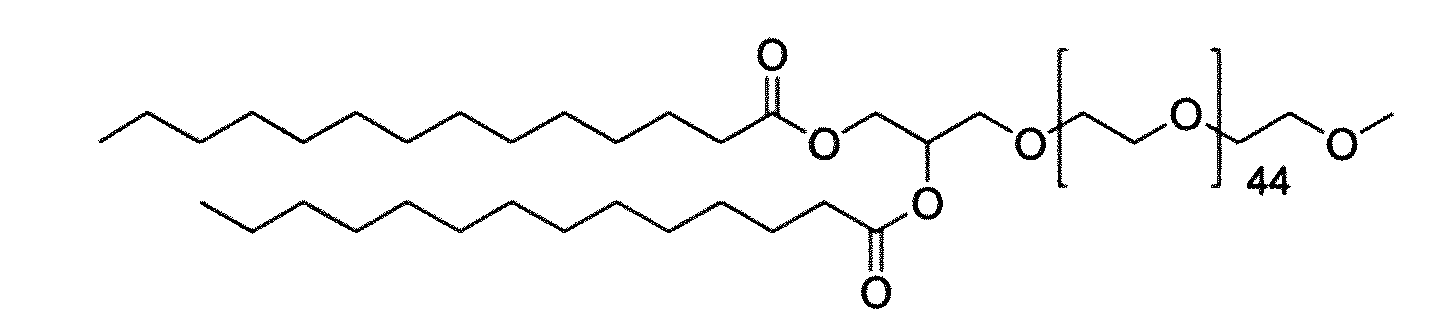
In some embodiments, the polymer conjugated lipid is not a pegylated lipid.
In an embodiment, the polymer conjugated lipid is a lipid conjugated to a polymer selected from the group consisting of: polyethylene-glycol (PEG); poly(aminoethoxy ethoxy acetic acid) (pAEEA), polysarcosine (pSar), poly(2-methylaminoethoxy ethoxy acetic acid) (pmAEEA); poly(oxazoline) (POX); poly(oxazine) (POZ), poly(vinyl pyrrolidone) (PVP); poly(AL(2-hydroxypropyl)-methacrylamide) (pHPMA); and poly(dehydroalanine) (pDha). Preferably, the polymer conjugated lipid is a lipid conjugated to pAEEA or pSar. In some embodiments, the polymer conjugated lipid is not a lipid conjugated to PEG. pSar-conjugated lipids are described in W02020/069718. pAEEA- conjugated lipids are described in US 63/370,046 and US 63/482,893, and in preferred instances the polymer pAEEA may comprise the following structure: wherein n may comprise from 1 to 100, from 5 to 50, from 5 to 25, preferably
 from 7 to 14.
In some embodiments, the cationic or cationically ionizable lipid component of the LN Rs has the structure of Formula (HI):
from 7 to 14.
In some embodiments, the cationic or cationically ionizable lipid component of the LN Rs has the structure of Formula (HI):
 or a pharmaceutically acceptable salt, tautomer, prodrug or stereoisomer thereof, wherein: one of L1 or L2 is -0(C=O)-, -(C=O)O-, -C(=O)-, -O-, -S(O)X-, -S-S-, -C(=O)S-, SC(=O)-, -NRaC(=O)-, -C(=O)NRa- , NRaC(=O)NRa-, -OC(=O)NRa- or -NRaC(=O)O-, and the other of L1 or L2 is -O(C=O)~, (C=O)O-, -C(=O)-, -O-, - S(O)x-, -S-S-, -C(=O)S-, SC(=O)-, -NRaC(=O)-, -C(=O)NRa-, NRaC(=O)NRa-, -OC(=O)NRa- or -NRaC(=O)O- or a direct bond;
G1 and G2 are each independently unsubstituted C1-C12 alkylene or C1-C12 alkenylene;
G3 is C1-C24 alkylene, C1-C24 alkenylene, C3-C8 cycloalkylene, C3-C8 cycloalkenylene;
Ra is H or C1-C12 alkyl;
R1 and R2 are each independently C6-C24 alkyl or C6-C24 alkenyl;
R3 is H, OR5, CN, -C(=O)OR4, -OC(=O)R4 or -NR5C(=O)R4;
R4 is Ci-Ci2 alkyl;
R5 is H or Ci-Ce alkyl; and x is 0, 1 or 2.
In some of the foregoing embodiments of Formula (III), the lipid has one of the following structures (IIIA) or (IIIB):
 wherein:
A is a 3 to 8-membered cycloalkyl or cycloalkylene ring;
R6 is, at each occurrence, independently H, OH or C1-C24 alkyl; n is an integer ranging from 1 to 15.
In some of the foregoing embodiments of Formula (III), the lipid has structure (IIIA), and in other embodiments, the lipid has structure (IIIB).
In other embodiments of Formula (III), the lipid has one of the following structures (IIIC) or (HID):
 wherein y and z are each independently integers ranging from 1 to 12.
In any of the foregoing embodiments of Formula (III), one of L1 or L2 is -O(C=O)-. For example, in some embodiments each of L1 and L2 are -O(C=O)-. In some different embodiments of any of the foregoing, L1 and L2 are each independently -(C=O)O- or -O(C=O)-. For example, in some embodiments each of L1 and L2 is -(C=O)O-.
In some different embodiments of Formula (III), the lipid has one of the following structures (HIE) or (IIIF):

In some of the foregoing embodiments of Formula (III), the lipid has one of the following structures (IIIG), (IIIH), (IIII), or (IIIJ):

(IIII) (IIIJ)
In some of the foregoing embodiments of Formula (III), n is an integer ranging from 2 to 12, for example from 2 to 8 or from 2 to 4. For example, in some embodiments, n is 3, 4, 5 or 6. In some embodiments, n is 3. In some embodiments, n is 4. In some embodiments, n is 5. In some embodiments, n is 6.
In some other of the foregoing embodiments of Formula (III), y and z are each independently an integer ranging from 2 to 10. For example, in some embodiments, y and z are each independently an integer ranging from 4 to 9 or from 4 to 6.
In some of the foregoing embodiments of Formula (III), R6 is H. In other of the foregoing embodiments, R6 is Ci- C24 alkyl. In other embodiments, R6 is OH.
In some embodiments of Formula (III), G3 is unsubstituted. In other embodiments, G3 is substituted. In various different embodiments, G3 is linear C1-C24 alkylene or linear C1-C24 alkenylene.
In some other foregoing embodiments of Formula (III), R1 or R2, or both, is C6-C24 alkenyl. For example, in some embodiments, R1 and R2 each, independently have the following structure:
 wherein:
R7a and R7b are, at each occurrence, independently H or C1-C12 alkyl; and a is an integer from 2 to 12, wherein R7a, R7b and a are each selected such that R1 and Rz each independently comprise from 6 to 20 carbon atoms. For example, in some embodiments a is an integer ranging from 5 to 9 or from 8 to 12.
In some of the foregoing embodiments of Formula (III), at least one occurrence of R7a is H. For example, in some embodiments, R7a is H at each occurrence. In other different embodiments of the foregoing, at least one occurrence of R7b is Ci-Cg alkyl. For example, in some embodiments, Ci-Cs alkyl is methyl, ethyl, n-propyl, iso-propyl, n-butyl, iso-butyl, tert-butyl, n-hexyl or n-octyl.
In different embodiments of Formula (III), R1 or R2, or both, has one of the following structures:

In some of the foregoing embodiments of Formula (III), R3 is OH, CN, -C(=O)OR4, -OC(=O)R4 or -NHC(=O)R4. In some embodiments, R4 is methyl or ethyl.
In various different embodiments, the cationic lipid of Formula (III) has one of the structures set forth in the table below.
Representative Compounds of Formula (III).


85
In some embodiments, the LNP comprises a lipid of Formula (III), RNA, a neutral lipid, a steroid and a pegylated lipid. In some embodiments, the lipid of Formula (III) is compound III-3. In some embodiments, the neutral lipid is DSPC. In some embodiments, the steroid is cholesterol. In some embodiments, the pegylated lipid is ALC-0159.
In some embodiments, the cationic lipid is present in the LNP in an amount from about 40 to about 50 mole percent. In one embodiment, the neutral lipid is present in the LNP in an amount from about 5 to about 15 mole percent. In one embodiment, the steroid is present in the LNP in an amount from about 35 to about 45 mole percent. In one embodiment, the pegylated lipid is present in the LNP in an amount from about 1 to about 10 mole percent.
In some embodiments, the LNP comprises compound III-3 in an amount from about 40 to about 50 mole percent, DSPC in an amount from about 5 to about 15 mole percent, cholesterol in an amount from about 35 to about 45 mole percent, and ALC-0159 in an amount from about 1 to about 10 mole percent.
In some embodiments, the LNP comprises compound III-3 in an amount of about 47.5 mole percent, DSPC in an amount of about 10 mole percent, cholesterol in an amount of about 40.7 mole percent, and ALC-0159 in an amount of about 1.8 mole percent.
In various different embodiments, the cationic or cationically ionizable lipid has one of the structures set forth in the table below.


In some embodiments, the LNP comprises a cationic or cationically ionizable lipid shown in the above table, e.g., a cationic or cationically ionizable lipid of Formula (B) or Formula (D), in particular a cationic lipid of Formula (D), RNA, a neutral lipid, a steroid and a pegylated lipid. In some embodiments, the neutral lipid is DSPC. In some embodiments, the steroid is cholesterol. In some embodiments, the pegylated lipid is DMG-PEG 2000.
In one embodiment, the LNP comprises a cationic or cationically ionizable lipid that is an ionizable lipid-like material (lipidoid). In one embodiment, the cationic or cationically ionizable lipid has the following structure:

The N/P value Is preferably at least about 4. In some embodiments, the N/P value ranges from 4 to 20, 4 to 12, 4 to 10, 4 to 8, or 5 to 7. In one embodiment, the N/P value is about 6.
LNP described herein may have an average diameter that in one embodiment ranges from about 30 nm to about 200 nm, or from about 60 nm to about 120 nm.
RNA Targeting
Some aspects of the disclosure involve the targeted delivery of the RNA disclosed herein (e.g., RNA encoding vaccine antigens and/or immunostimulants).
In one embodiment, the disclosure involves targeting lung. Targeting lung is in particular preferred if the RNA administered is RNA encoding vaccine antigen or a miRNA relevant in the treatment of an infectious disease in the lungs. RNA may be delivered to lung, for example, by administering the RNA which may be formulated as particles as described herein, e.g., lipid particles, by inhalation.
In one embodiment, the disclosure involves targeting the lymphatic system, in particular secondary lymphoid organs, more specifically spleen. Targeting the lymphatic system, in particular secondary lymphoid organs, more specifically spleen is in particular preferred if the RNA administered is RNA encoding vaccine antigen.
In one embodiment, the target cell is a spleen cell. In one embodiment, the target cell is an antigen presenting cell such as a professional antigen presenting cell in the spleen. In one embodiment, the target cell is a dendritic cell in the spleen.
The "lymphatic system" is part of the circulatory system and an important part of the immune system, comprising a network of lymphatic vessels that carry lymph. The lymphatic system consists of lymphatic organs, a conducting network of lymphatic vessels, and the circulating lymph. The primary or central lymphoid organs generate lymphocytes from immature progenitor cells. The thymus and the bone marrow constitute the primary lymphoid
organs. Secondary or peripheral lymphoid organs, which include lymph nodes and the spleen, maintain mature naive lymphocytes and initiate an adaptive immune response.
RNA may be delivered to spleen by so-called lipoplex formulations, in which the RNA is bound to liposomes comprising a cationic lipid and optionally an additional or helper lipid to form injectable nanoparticle formulations. The liposomes may be obtained by injecting a solution of the lipids in ethanol into water or a suitable aqueous phase. RNA lipoplex particles may be prepared by mixing the liposomes with RNA. Spleen targeting RNA lipoplex particles are described in WO 2013/143683, herein incorporated by reference. It has been found that RNA lipoplex particles having a net negative charge may be used to preferentially target spleen tissue or spleen cells such as antigen-presenting cells, in particular dendritic cells. Accordingly, following administration of the RNA lipoplex particles, RNA accumulation and/or RNA expression in the spleen occurs. Thus, RNA lipoplex particles of the disclosure may be used for expressing RNA in the spleen. In an embodiment, after administration of the RNA lipoplex particles, no or essentially no RNA accumulation and/or RNA expression in the lung and/or liver occurs. In one embodiment, after administration of the RNA lipoplex particles, RNA accumulation and/or RNA expression in antigen presenting cells, such as professional antigen presenting cells in the spleen occurs. Thus, RNA lipoplex particles of the disclosure may be used for expressing RNA in such antigen presenting cells. In one embodiment, the antigen presenting cells are dendritic cells and/or macrophages.
The electric charge of the RNA lipoplex particles of the present disclosure is the sum of the electric charges present in the at least one cationic lipid and the electric charges present in the RNA. The charge ratio is the ratio of the positive charges present in the at least one cationic lipid to the negative charges present in the RNA. The charge ratio of the positive charges present in the at least one cationic lipid to the negative charges present in the RNA is calculated by the following equation: charge ratio=[(cationic lipid concentration (mol)) * (the total number of positive charges in the cationic lipid)] / [(RNA concentration (mol)) * (the total number of negative charges in RNA)].
The spleen targeting RNA lipoplex particles described herein at physiological pH preferably have a net negative charge such as a charge ratio of positive charges to negative charges from about 1.9:2 to about 1:2, or about 1.6:2 to about 1:2, or about 1.6:2 to about 1.1:2. In specific embodiments, the charge ratio of positive charges to negative charges in the RNA lipoplex particles at physiological pH is about 1.9:2.0, about 1.8:2.0, about 1.7:2.0, about 1.6:2.0, about 1.5:2.0, about 1.4:2.0, about 1.3:2.0, about 1.2:2.0, about 1.1:2.0, or about 1:2.0.
Immunostimulants may be provided to a subject by administering to the subject RNA encoding an immunostimulant in a formulation for preferential delivery of RNA to liver or liver tissue. The delivery of RNA to such target organ or tissue is preferred, in particular, if it is desired to express large amounts of the immunostimulant and/or if systemic presence of the immunostimulant, in particular in significant amounts, is desired or required.
RNA delivery compositions have an inherent preference to the liver. This pertains to lipid-based particles, cationic and neutral nanoparticles, in particular lipid nanoparticles such as liposomes, nanomicelles and lipophilic ligands in bioconjugates. Liver accumulation is caused by the discontinuous nature of the hepatic vasculature or the lipid metabolism (liposomes and lipid or cholesterol conjugates).
For in vivo delivery of RNA to the liver, a drug delivery system may be used to transport the RNA into the liver by preventing its degradation. For example, polyplex nanomicelles consisting of a poly(ethylene glycol) (PEG)-coated surface and an mRNA-containing core is a useful system because the nanomicelles provide excellent in vivo stability of the RNA, under physiological conditions. Furthermore, the stealth property provided by the polyplex nanomicelle surface, composed of dense PEG palisades, effectively evades host immune defenses.
Examples of suitable immunostimulants for targeting liver are cytokines involved in T cell proliferation and/or maintenance. Examples of suitable cytokines include IL2 or IL7, fragments and variants thereof, and fusion proteins of these cytokines, fragments and variants, such as extended-PK cytokines.
In another embodiment, RNA encoding an immunostimulant may be administered in a formulation for preferential delivery of RNA to the lymphatic system, in particular secondary lymphoid organs, more specifically spleen. The delivery of an immunostimulant to such target tissue is preferred, in particular, if presence of the immunostimulant in this organ or tissue is desired (e.g., for inducing an immune response, in particular in case immunostimulants such as cytokines are required during T-cell priming or for activation of resident immune cells), while it is not desired that the immunostimulant is present systemically, in particular in significant amounts (e.g., because the immunostimulant has systemic toxicity).
Examples of suitable immunostimulants are cytokines involved in T cell priming. Examples of suitable cytokines include IL12, IL15, IFN-a, or IFN-p, fragments and variants thereof, and fusion proteins of these cytokines, fragments and variants, such as extended-PK cytokines.
Polymer-based compositions
In one embodiment, the composition comprises at least one polymer, preferably a polyalkyleneimine.
In some embodiments, the particles formed from the RNA and the polymer, preferably polyaklyeneimine, are polymer-based polyplexes.
Given their high degree of chemical flexibility, polymers are commonly used materials for nanoparticle-based delivery. Typically, cationic polymers are used to electrostatically condense the negatively charged nucleic acid into nanoparticles. These positively charged groups often consist of amines that change their state of protonation in the pH range between 5.5 and 7.5, thought to lead to an ion imbalance that results in endosomal rupture. Polymers such as poly-L-lysine, polyamidoamine, protamine and polyethylenimine, as well as naturally occurring polymers such as chitosan have all been applied to nucleic acid delivery and are suitable as cationic polymers herein. In addition, some investigators have synthesized polymers specifically for nucleic acid delivery. Poly(0-amino esters), in particular, have gained widespread use in nucleic acid delivery owing to their ease of synthesis and biodegradability. Such synthetic polymers are also suitable as cationic polymers herein.
A "polymer," as used herein, is given its ordinary meaning, i.e., a molecular structure comprising one or more repeat units (monomers), connected by covalent bonds. The repeat units can all be identical, or in some cases, there can be more than one type of repeat unit present within the polymer. In some cases, the polymer is biologically derived, i.e., a biopolymer such as a protein. In some cases, additional moieties can also be present in the polymer, for example targeting moieties.
If more than one type of repeat unit is present within the polymer, then the polymer is said to be a "copolymer." It is to be understood that the polymer being employed herein can be a copolymer. The repeat units forming the copolymer can be arranged in any fashion. For example, the repeat units can be arranged in a random order, in an alternating order, or as a "block" copolymer, i.e., comprising one or more regions each comprising a first repeat unit (e.g., a first block), and one or more regions each comprising a second repeat unit (e.g., a second block), etc. Block copolymers can have two (a diblock copolymer), three (a triblock copolymer), or more numbers of distinct blocks.
In certain embodiments, the polymer is biocompatible. Biocompatible polymers are polymers that typically do not result in significant cell death at moderate concentrations. In certain embodiments, the biocompatible polymer is
biodegradable, Ze., the polymer is able to degrade, chemically and/or biologically, within a physiological environment, such as within the body.
In certain embodiments, polymer may be protamine or polyalkyleneimine.
The term "protamine" refers to any of various strongly basic proteins of relatively low molecular weight that are rich in arginine and are found associated especially with DNA In place of somatic histones in the sperm cells of various animals (as fish). In particular, the term "protamine" refers to proteins found in fish sperm that are strongly basic, are soluble in water, are not coagulated by heat, and yield chiefly arginine upon hydrolysis. In purified form, they are used in a long-acting formulation of insulin and to neutralize the anticoagulant effects of heparin.
According to the disclosure, the term "protamine" as used herein is meant to comprise any protamine amino acid sequence obtained or derived from natural or biological sources including fragments thereof and multimeric forms of said amino acid sequence or fragment thereof as well as (synthesized) polypeptides which are artificial and specifically designed for specific purposes and cannot be isolated from native or biological sources.
In one embodiment, the polyalkyleneimine comprises polyethylenimine and/or polypropyleneimine, preferably polyethylenimine. A preferred polyalkyleneimine is polyethylenimine (PEI). The average molecular weight of PEI is preferably 0.75- 102 to 107 Da, preferably 1000 to 105 Da, more preferably 10000 to 40000 Da, more preferably 15000 to 30000 Da, even more preferably 20000 to 25000 Da.
Preferred according to the disclosure is linear polyalkyleneimine such as linear polyethylenimine (PEI).
Cationic polymers (including polycationic polymers) contemplated for use herein include any cationic polymers which are able to electrostatically bind nucleic acid. In one embodiment, cationic polymers contemplated for use herein include any cationic polymers with which nucleic acid can be associated, e.g. by forming complexes with the nucleic acid or forming vesicles in which the nucleic acid is enclosed or encapsulated.
Particles described herein may also comprise polymers other than cationic polymers, i.e., non-cationic polymers and/or anionic polymers. Collectively, anionic and neutral polymers are referred to herein as non-cationic polymers.
In an embodiment, the composition comprise polyalkyleneimine, and, for example, the molar ratio of the number of nitrogen atoms (N) in the polyalkyleneimine to the number of phosphor atoms (P) in the RNA molecules (N:P ratio) can be 2.0 to 15.0, preferably 6.0 to 12.0 and/or the ionic strength of the composition can be 50 mM or less, preferably wherein the concentration of monovalent cationic ions can be 25 mM or less and the concentration of divalent cationic ions can be 20 pM or less.
In an embodiment, the particles formed can be polyplexes.
In an embodiment, the polyalkyleneimine can comprise the following general formula (I):
 wherein
R is H, an acyl group or a group comprising the following general formula (II):
 wherein Ri is H or a group comprising the following general formula (III):
 n, m, and I are independently selected from integers from 2 to 10; and p, q, and r are integers, wherein the sum of p, q, and r is such that the average molecular weight of the polymer is 1.5-102 to 107 Da, preferably 5000 to 10s Da, more preferably 10000 to 40000 Da, more preferably 15000 to 30000 Da, even more preferably 20000 to 25000 Da. In an embodiment, n, m, and I can be independently selected from 2, 3, 4, and 5, preferably from 2 and 3 and/or Ri can be H. In an embodiment, R can be H or an acyl group.
In an embodiment, the polyalkyleneimine can comprise polyethylenimine and/or polypropylenimine, preferably polyethylenimine. In an embodiment, at least 92% of the N atoms in the polyalkyleneimine can be protonatable.
Pharmaceutical composition
A composition described herein may comprise, in addition to one or more of the nucleic acid molecules described herein, a pharmaceutically acceptable diluent and/or a pharmaceutically acceptable excipient and/or a pharmaceutically acceptable carrier and/or a pharmaceutically acceptable vehicle ("a pharmaceutical composition”). The choice of pharmaceutically acceptable carrier, vehicle, excipient or diluent is not particularly limited. Any suitable pharmaceutically acceptable carrier, vehicle, excipient or diluent known in the art may be used.
In one embodiment, a pharmaceutical composition can further comprise any of the other components described above in connection with the compositions. In an embodiment, the pharmaceutical composition may further comprise a solvent such as an aqueous solvent or any solvent that makes it possible to preserve the integrity of the RNA. In a preferred embodiment, the pharmaceutical composition is an aqueous solution comprising RNA. The aqueous solution may optionally comprise solutes, e.g. salts.
In one embodiment, the pharmaceutical composition is in the form of a freeze-dried composition. A freeze-dried composition is obtainable by freeze-drying a respective aqueous composition.
In some embodiments, the pharmaceutical compositions are for use in the manufacture of a medicament for the treatment or prevention of a disease, preferably for a method of treatment as described herein.
Kit
Also provided herein is a kit comprising the at least two nucleic acid molecules, preferably RNA molecules described herein.
In one embodiment, the constituents of the kit are present as separate entities. For example, one constituent of the kit may be present in one entity, and another constituent of the kit may be present in a separate entity. For example, an open or closed container is a suitable entity. A closed container is preferred. The container used should preferably be RNAse-free or essentially RNAse-free.
In one embodiment, the kit comprises RNA for inoculation with a cell and/or for administration to a human or animal subject.
The kit optionally comprises a label or other form of information element, e.g. an electronic data carrier. The label or information element preferably comprises instructions, e.g. printed written instructions or instructions in
electronic form that are optionally printable. The instructions may refer to at least one suitable possible use of the kit.
Medicaments
In view of the capacity to be administered to a subject, each of the nucleic acid molecules, preferably RNA molecules described herein, the composition described herein, the pharmaceutical composition described herein, or the kit described herein, may be referred to as "medicament", a "medical preparation" or the like. The first nucleic acid (RNA) molecule, the second nucleic acid (RNA) molecule, the composition, the kit, or the pharmaceutical composition is provided for use as a medicament. The medicament can be used to treat a subject. By "treat" is meant to administer a compound or composition or other entity as described herein to a subject. The term includes methods for treatment of the human or animal body by therapy.
The above described medicament does typically not comprise a DNA, and is thus associated with additional safety features compared to DNA based medicaments, e.g., vaccines, described in the prior art (e.g. WO 2008/119827 Al).
The medicament may be administered to a subject in need thereof. The medicament can be used in prophylactic as well as in therapeutic methods of treatment of a subject.
The medicament is administered in an effective amount. An "effective amount" concerns an amount that is sufficient, alone or together with other doses, to cause a reaction or a desired effect. In the case of treatment of a certain disease or a certain condition in a subject, the desired effect is the inhibition of disease progression. This includes the deceleration of disease progression, in particular the interruption of disease progression. The desired effect in the treatment of a disease or a condition can also be a delay of disease outbreak or the inhibition of disease outbreak.
The effective amount will depend on the condition being treated, the severity of the disease, the individual parameters of the patient, including age, physiological condition, size and weight, duration of the treatment, type of accompanying therapy (if any), the specific mode of administration and other factors.
Methods of treatment
In an embodiment, the methods for the treatment or prevention of a bacterial, viral, parasitical or fungal infection in a subject, said method comprising administering to the subject a pharmaceutical composition as described herein.
In an embodiment, the methods for the treatment or prevention of cancer in a subject, said method comprising administering to the subject a pharmaceutical composition as described herein.
In an embodiment, the methods for treatment described herein are vaccinations, in particular against infectious diseases, such as by a bacterium, virus, fungus or parasite, or cancer.
Also described herein is a first nucleic acid molecule, preferably a first RNA molecule and a second nucleic acid molecule, preferably a second RNA molecule, as described herein, for use in a method for (i) the treatment or prevention of a bacterial, viral, parasitical or fungal infection, (ii) the treatment or prevention of cancer, or (ii) vaccination, in particular against infectious diseases, such as by a bacterium, virus, fungus or parasite, or cancer, in a subject; said method comprising administering to the subject the first and the second molecule nucleic acid molecules. For example, the first nucleic acid molecule is an mRNA encoding the modified polymerase described herein and the second nucleic acid molecule is a replicable RNA (replicon) encoding a protein of interest useful in the treatment or prevention of a disease or disorder. Also described herein is a first nucleic acid molecule, as
described herein, for use in a method of treatment in a subject as described herein, said method comprising administering to the subject the first nucleic acid molecule, wherein the subject is or has been also administered a second nucleic acid molecule as described herein. Also described herein is a second nucleic acid molecule, as described herein, for use in a method of treatment in a subject as described herein, said method comprising administering to the subject the second nucleic acid molecule, wherein the subject is or has been also administered a first nucleic acid molecule as described herein.
The term "immunization" or "vaccination" generally refers to a process of treating a subject for therapeutic or prophylactic reasons. A treatment, particularly a prophylactic treatment, is or comprises preferably a treatment aiming to induce or enhance an immune response of a subject, e.g. against one or more antigens. If it is desired to induce or enhance an immune response by using the nucleic acid, in particular RNA molecules described herein, the immune response may be triggered or enhanced by the RNA. In one embodiment, a prophylactic treatment is provided which is or comprises preferably the vaccination of a subject. An embodiment where the second RNA molecule (replicon) encodes a pharmaceutically active peptide or protein which is an immunologically active compound or an antigen is particularly useful for vaccination.
RNA has been previously described for vaccination against foreign agents including pathogens or cancer (reviewed recently by Ulmer et al., 2012, Vaccine 30:4414-4418). In contrast to common approaches in the prior art, the RNA molecules described herein are particularly suitable for efficient treatment or prevention, in particular vaccination, because of the ability of the replicon to be replicated by the modified functional alphavirus non-structural protein described herein. The treatment or prevention, in particular vaccination, can be used for example for induction of an immune response to weakly immunogenic proteins. In the case of RNA-based vaccines, the protein antigen is never exposed to serum antibodies, but is produced by transfected cells themselves after translation of the RNA. Therefore, anaphylaxis should not be a problem, thus allowing for repeated immunization of a patient without risk of allergic reactions.
In methods involving treatment or prevention, in particular vaccination, the medicament described herein is administered to a subject, in particular if treating a subject having a disease involving the antigen or at risk of falling ill with the disease involving the antigen is desired.
In methods involving treatment or prevention, the protein of interest encoded by the second RNA molecule (and/or the first RNA molecule) described herein codes for example for a peptide beneficial for the treatment or prevention of a bacterial infection, a viral infection, fungal infection or cancer and optionally a bacterial antigen, against which an immune response is to be directed, or for a viral antigen, against which an immune response is to be directed, or for a cancer antigen, against which an immune response is to be directed, or for an antigen of a unicellular organism, against which an immune response is to be directed. The efficacy of treatment, in particular vaccination, can be assessed by known standard methods such as by measurement of antigen-specific IgG antibodies from the organism. In methods involving allergen-specific immunotherapy, the protein of interest encoded by the second RNA molecule described herein codes for an antigen relevant to an allergy. Allergen-specific immunotherapy (also known as hypo-sensitization) is defined as the administration of preferably increasing doses of an allergen vaccine to an organism with one or more allergies, in order to achieve a state in which the symptoms that are associated with a subsequent exposure to the causative allergen are alleviated. The efficacy of an allergen-specific immunotherapy can be assessed by known standard methods such as by measurement of allergen-specific IgG and IgE antibodies from the organism.
The medicament described herein can be administered to a subject, e.g. for treatment of the subject, including vaccination of the subject.
The term "subject" relates to vertebrates, particularly mammals. For example, mammals are humans, non-human primates, domesticated mammals such as dogs, cats, sheep, cattle, goats, pigs, horses etc., laboratory animals such as mice, rats, rabbits, guinea pigs, etc. as well as animals in captivity such as animals of zoos. The term "subject" also relates to non-mammalian vertebrates such as birds (particularly domesticated birds such as chicken, ducks, geese, turkeys) and to fish (particularly farmed fish, e.g., salmon or catfish). The term "animal" as used herein also includes humans. The subject is preferably a human, optionally a human patient.
The administration to domesticated animals such as dogs, cats, rabbits, guinea pigs, hamsters, sheep, cattle, goats, pigs, horses, chicken, ducks, geese, turkeys, or wild animals, e.g., foxes, is preferred in some embodiments. For example, a prophylactic vaccination may be suitable to vaccinate an animal population, e.g. in the farming industry, or a wild animal population. Other animal populations in captivity, such as pets, or animals of zoos, may be vaccinated.
In an embodiment, the medicament can be administered more than once. Multiple doses can be administered such that individual doses can be administered at different intervals. For example, a dose can be administered 14 to 35 days after the previous dose has been administered. In an embodiment, a dose is administered 21 days after the previous dose. In an embodiment, a dose is administered 35 days after the previous dose.
In an embodiment, when administered to a subject, the composition used as a medicament does preferably not comprise sequences from a type of virus, e.g., alphavirus, that is infectious to the species or genus to which the treated subject belongs. Preferably, in that case, the replicon does not comprise any nucleotide sequence from an alphavirus that can infect the respective species or genus. This embodiment bears the advantage that no recombination with infectious {e.g. fully functional or wild-type) alphavirus is possible, even if the subject to which the RNA is administered is {e.g. accidentally) affected by infectious alphavirus. As an illustrative example, for treatment of pigs, the composition used does not comprise any nucleotide sequence from an alphavirus that can infect pigs.
Mode of administration
The pharmaceutical compositions, in particular medicament, can be applied to a subject in any suitable route.
For example, the medicament may be administered systemically, for example intravenously (i.v.), intramuscularly (i.m.), subcutaneously (s.c.), intradermally (i.d.) or by inhalation.
In one embodiment, the composition, in particular medicament, is administered to muscle tissue, such as skeletal muscle, or skin, e.g. subcutaneously. It is generally understood that transfer of RNA into the skin or muscles leads to high and sustained local expression, paralleled by a strong induction of humoral and cellular immune responses (Johansson eta/., 2012, PLoS. One. 7:e29732; Geall eta/., 2012, Proc. Natl. Acad. Sci. U.S.A 109:14604-14609).
Alternatives to administration to muscle tissue or skin include, but are not limited to: intradermal, intranasal, intraocular, intraperitoneal, intravenous, interstitial, buccal, transdermal, or sublingual administration. Intradermal and intramuscular administration are two preferred routes.
Administration can be achieved in various ways. In one embodiment, the composition, in particular medicament, described herein is administered by injection. In a preferred embodiment, injection is via a needle. Needle-free injection may be used as an alternative.
The present invention is described in detail and is illustrated by the figures and examples, which are used only for illustration purposes and are not meant to be limiting. Owing to the description and the examples, further embodiments which are likewise included in the invention are accessible to the skilled worker.
DESCRIPTION OF THE FIGURES
Figure 1. Overview of exemplary replicase variants. (A) Schematic showing the non-structural polyprotein precursor (nsP) 1-4 of VEEV replicase. Positions substituted in replicases of the used herein are indicated. (B) Table summarizing the amino acid sequence changes in replicases of the invention (EGS-replicase, QRT-replicase, QRS- replicase) as compared to the replicase of the parental VEEV TRD strain (EGT-replicase). The EGT-replicase is derived from the VEEV Trinidad donkey (TRD) strain and has glutamic acid (E) at position 747, glycine (G) at position 1360 and threonine (T) at position 1589. The EGS-replicase has a substitution of T1589 to serine (S)1589; the QRT replicase has a substitution of E747 to glutamine (Q)747 and of G1360 to arginine (R)1360; the QRS replicase has a substitution of E747Q, G1360R, and T1589S. (C) Sequence alignment of the nsPl, nsP2 and nsP3 sequences (until first stop codon) of EGT-, EGS-, QRT-, and QRS-replicases with the substitutions indicated. In the alignment indicates an identical residue.
Figure 2. Opposing activity of the EGT- and EGS- replicases in saRNA and taRNA systems in BHK21 cells. saRNA encoding the indicated replicase and secreted Nanoluciferase (upper panels) or taRNA consisting of mRNA encoding the indicated replicase and a transreplicon (TR) encoding secreted Nanoluciferase (lower panels) were lipofected at three different doses (100, 20 and 4 ng) into BHK21 cells. Luciferase activity was measured over 72 hours (h) at the indicated time points. a.u.= arbitrary unit.
Figure 3. Opposing activity of the EGT- and EGS- replicases in saRNA and taRNA systems in C2C12 cells. saRNA encoding the indicated replicase and secreted Nanoluciferase (upper panels) or taRNA consisting of mRNA encoding the indicated replicase and a TR encoding secreted Nanoluciferase (lower panels) were lipofected at three different doses (100, 20 and 4 ng) into C2C12 cells. Luciferase activity was measured over 72 hours (h) at the indicated time points. a.u.= arbitrary unit.
Figure 4. Opposing activity of the EGT- and EGS- replicases in saRNA and taRNA systems in HFF cells. saRNA encoding the indicated replicase and secreted Nanoluciferase (upper panels) or taRNA consisting of mRNA encoding the indicated replicase and a TR encoding secreted Nanoluciferase (lower panels) were lipofected at three different doses (100, 20 and 4 ng) into HFF cells. Luciferase activity was measured for 72 hours (h) at the indicated time points. a.u.= arbitrary unit.
Figure 5. Opposing activity of the EGT- and QRT- replicases in the context of saRNA and taRNA systems. BHK cell (upper panels) or HFF cells (lower panels) were lipofected with (i) Left panels: saRNA encoding the indicated replicase and reporter GFP-SecNLuc (1 μg), or (ii) Right panels: taRNA consisting of an mRNA encoding the indicated replicase (250 ng) and a NTR (TC-83 + 3xMut) encoding for GFP and SecNLuc (2 ng), with mRNA encoding NS1 (500 ng). Luciferase activity was measured 24 hours after transfection.
Figure 6. QRT-replicase replicates nano-transreplicons (NTRs) more efficiently than EGT-replicase. K- 562 cells were electroporated with taRNA consisting of 1 μg mRNA encoding the indicated replicase and either (i) upper panels: 0.05 pg NTR (TRD) encoding firefly luciferase, or (ii) lower panels: 0.05 pg NTR (TC-83 + 3xMut) encoding firefly luciferase. (A) Luciferase expression was assessed by luminescence detection 24 h post transfection. (B) Over an 8-hour time course experiment, luciferase levels were assessed by luminescence detection at the indicated time points after transfection. (C) Over a 6-hour time course experiment, luciferase levels were assessed by qPCR analysis at indicated time points after transfection.
Figure 7. Novel QRS replicase is more potent than EGS or QRT replicases. K-562 cells were lipofected with 80 ng mRNA of the indicated replicases in combination with NTR encoding firefly luciferase. Luciferase activity was measured 24 h post transfection. (A) 0.2 ng of NTR(TC-83 + 3xMut) was used, (B) 0.2 ng of NTR(TRD) was used, (C) 0.02 ng of NTR(TC-83 + 3xMut) was used, (D) 0.02 ng of NTR(TRD) was used.
Figure 8. Effects of replicase variants in vivo. Transreplicon encoding for influenza virus hemagglutinin (TR- HA) and the different replicase (REPL)-encoding nucleoside-modified mRNAs were separately formulated within LNPs and mixed at a molar ratio of 1:100 (0.4 ng TR-HA + 99.6 ng REPL) prior to application. BALB/c mice (n = 5 per group) were intramuscularly injected with formulated RNAs on days 0 and 28. Replication-deficient REPL (unmodified mRNA) with TR-HA served as negative control. Serum samples were collected before immunization (day 0) and on days 14 and 28 after prime immunization and after boost immunization (day 49). (A) HA-specific IgG as marker for B cell response. Biotinylated recombinant HA protein was coated onto Streptavidin-coated plates, incubated with diluted sera (1:2700 dilution; isolated on day 49 after prime immunization) and an HRP-coupled secondary antibody. Adsorption at 460 nm and 620 nm was measured and the AOD was calculated. Individual AOD values are shown by dots; group mean values are indicated by horizontal bars. (B) (C) ELISpot assay was performed using splenocytes isolated on day 49 after prime immunization. Splenocytes were stimulated with a MHC I-specific HA-peptide pool (B), or an unspecific peptide (C) as negative control. IFN-y secretion was measured to assess T-cell responses. Individual spot counts are shown by dots; group mean values are indicated by unfilled bars (±SEM).
Figure 9. Replication of STR-miR is required for target knockdown and replicase activity determines the extent of knockdown. BHK-21 cells stably expressing firefly luciferase (BHK-luc) were electroporated with 1.1 pM of indicated shortened transreplicon (STR)-miR and co-delivered with 0.4 pM of either inactive replicase (inactive-REPL), EGT replicase of VEEV-TRD (TRD-REPL) or QRT-replicase (QRT-REPL). Control cells were electroporated without RNA (mock). (A) Target gene expression. Luciferase expression was measured at indicated time points and normalized to that of mock electroporated BHK-Luc cells (mean (SD) of n = 3). Statistical significances were tested by two-way ANOVA; *, P < 0.1,' **, P < 0.01,' ***, P < 0.001; ****, p < 0.0001, and ns, not significant corresponding to mock. (B) Cell viability and proliferation. Viability of BHK-luc cells was determined at indicated time points after transfection (mean (SD) of n = 3). luc, luciferase; RLU, relative light units; VEEV, Venezuelan equine encephalitis virus; TRD, Trinidad donkey strain.
Figure 10. Enhanced STR-miR-mediated emGFP expression in cells co-transfected with QRT- replicase. BHK-21 cells stably expressing firefly luciferase (BHK-luc) were electroporated with 1.1 pM of indicated STR-miR and co-delivered with 0.4 pM of either inactive replicase (inactive-REPL), EGT replicase (TRD-REPL) or QRT-replicase (QRT-REPL) or without RNA (mock). 24h after transfection the rate of emGFP-positive cells and emGFP-mean fluorescence (MFI) were determined by flow cytometry. Total GFP expression was approximated by multiplying the rate of emGFP-positive cells with the MFI of emGFP-positive cells.
Figure 11. Immunogenicity of (nano-)transreplicons with QRS-REPL. Nano-transreplicon (NTR) containing uridine (U) or Nl-methyl-pseudouridine (mlY) encoding for influenza virus hemagglutintin (HA), and the different nucleoside-modified mRNA encoding EGT replicase (wt-REPL) or QRS replicase (QRS-REPL), were separately formulated within LNPs, and mixed at a molar ratio of 1:1 (22 ng NTR-HA + 78 ng REPL). BALB/c mice (n = 5 per
group) were intramuscularly injected with formulated RNAs on days 0 and 28. Serum samples were collected before immunization (day 0) and on days 14 and 28 after prime immunization and after boost immunization (day 49). (A) Seroconversion per group over time. Biotinylated recombinant HA protein was coated onto Streptavidin-coated plates, incubated with diluted sera and an HRP-coupled secondary antibody. Adsorption at 460 nm and 620 nm was measured and the AOD was calculated. Individual AOD values are shown by symbols; group mean values are indicated by horizontal bars (±SEM). (B) Virus-neutralizing antibody titers over time. Serial dilutions of sera were incubated with infectious influenza virus, transferred to MDCK cells and incubated for 3 days. Virus-neutralization was determined via hemagglutination assay. Individual titers are shown (symbols), group mean values are indicated by horizontal bars (±SEM). (C) ELISpot assay was performed using splenocytes isolated on day 49 after prime immunization. Splenocytes were stimulated with MHC I and MHC Il-specific HA-peptide pools, an unspecific peptide pool was used as negative control (data not shown). IFN-y secretion was measured to assess T-cell responses. Individual spot counts are shown by symbols; group mean values are indicated by horizontal bars (±SEM). Spot counts that were too numerous to count were set to 1000.
Figure 12. Immunogenicity of taRNA with QRS-REPL in presence of innate immune inhibitors. Nano- transreplicon (NTR, containing Nl-methyl-pseudouridine) encoding for influenza virus hemagglutintin (HA), nucleoside-modified mRNA encoding for QRS-REPL and nucleoside-modified mRNA encoding for innate immune inhibitors NS1, NSs or E3 were separately formulated within LNPs and mixed at a molar ratio of 1:100 (or 1:100:100 with inhibitors, 0.2 ng NTR + 74 ng QRS-REPL + 11 ng NS1 or 13 ng NSs or 10 ng E3). BALB/c mice (n = 5 per group) were intramuscularly injected with formulated RNAs on days 0 and 28. Serum samples were collected before immunization (day 0) and on days 14 and 28 after prime immunization and after boost immunization (day 49). (A) Seroconversion per group over time. Biotinylated recombinant HA protein was coated onto Streptavidin-coated plates, incubated with diluted sera and an HRP-coupled secondary antibody. Adsorption at 460 nm and 620 nm was measured and the AOD was calculated. Individual AOD values are shown by symbols; group mean values are indicated by horizontal bars (±SEM). (B) Virus-neutralizing antibody titers on day 49. Serial dilutions of sera were incubated with infectious influenza virus, transferred to MDCK cells and incubated for 3 days. Virus-neutralization was determined via hemagglutination assay. Individual titers are shown (symbols), group mean values are indicated by horizontal bars (±SEM). (C) ELISpot assay was performed using splenocytes isolated on day 49 after prime immunization. Splenocytes were stimulated with MHC I and MHC Il-specific HA-peptide pools, an unspecific peptide pool was used as negative control (data not shown). IFN-y secretion was measured to assess T-cell responses. Individual spot counts are shown by symbols; group mean values are indicated by horizontal bars (±SEM). An inactive replicase (REPLmut) was used as a control.
EXAMPLES
Self-amplifying RNA (saRNA) is a promising ribonucleic acid vaccine vector candidate which is capable of achieving a significant dose reduction since the initially transferred RNA is amplified within the cytoplasm of cells. saRNA is engineered from alphaviral genomes by replacing alphaviral structural genes by genes of interest (transgenes). The saRNA encodes the alphaviral replicase which harbors all of the required enzymatic functions to transcribe novel RNA copies from in vitro transcribed saRNA.
Trans-amplifying RNA (taRNA) is a novel system related to saRNA which is based on the capability of the replicase to recognize and efficiently replicate template RNA in trans. Typically, such template RNA is flanked by promoters located in the plus- and minus-strands of virus-specific RNAs and is called trans-replicon (TR). TRs may be
engineered from saRNA by deleting the replicase. Additionally, further improved nano-trans-replicons (NTRs) may be engineered from TRs by removing all initiation codons from the 51 replication recognition sequence, as described previously in WO2017/162460A1. A particular NTR (TC83 + 3xMut) used herein is described in WO 2023/066874 Al. For amplification, the TRs and NTRs require a replicase that may be expressed by a co-delivered replicase- encoding mRNA that itself may or may not replicate. taRNA systems may be further advantageous over saRNA with regard to safety, versatility, and manufacturing.
Based on the mechanism of alphaviral RNA genome replication a skilled person in the field would assume that variants of replicase will affect the transgene expression in the same manner for saRNA and taRNA. However, it is surprisingly shown here that in fact the level of saRNA mediated transgene expression cannot be used to predict expression of the transgene encoded on taRNA, and vice versa, since specific changes in replicase protein sequence may result in opposite effects in cis or in trans. Described herein are replicase variants that were unexpectedly found to specifically enhance expression in taRNA systems.
Example 1. Sequences of used replicases.
Tested replicase proteins from Venezuelan Equine Encephalitis Virus (VEEV) differ in three amino acid positions: 747, 1360 and 1589, with respect to the N-terminal methionine of replicase. The initial parental replicase was identical to the replicase from VEEV TRD genome (GenBank accession number L01442.2) and has glutamic acid (E) at position 747, glycine (G) at position 1360 and threonine (T) at position 1589, abbreviated as EGT-replicase. The replicase variant abbreviated as EGS has a serine (S) at position 1589, and was described by Kinney et al. (Kinney RM, et al., Virology. 1989, 170(1): 19-30, Kinney RM, et al., J Virol. 1993, 67(3): 1269-77). The replicase variant abbreviated as QRT has a glutamine (Q) at position 747 and arginine (R) at position 1360, and was described by Michel et al. (Michel G, et al., Virology. 2007, 362(2):475-87). A further newly generated replicase variant abbreviated as QRS has glutamine (Q) at position 747, arginine (R) at position 1360 and serine (S) at position 1589.
Example 2. Opposing activity of the variants EGT and EGS in the context of saRNA and taRNA.
The saRNA and taRNA were engineered to encode either EGT or EGS replicase variant and luciferase as reporter gene. Baby Hamster Kidney fibroblasts (BHK) (Fig. 2), mouse myoblast cell line C2C12 (Fig.3) and primary human foreskin fibroblasts (HFF) (Fig. 4) were transfected with 3 different doses of the various saRNA or taRNA. To monitor the transgene expression 6h, 24h, 48h and 72h after transfections the activity of luciferase was quantified by luminescence. The results of these experiments are shown in Figures 2-4. In all tested cells with all tested doses, the saRNA encoding EGT replicase provided higher transgene expression. Surprisingly the opposite was observed when taRNA was used. In the taRNA context, in all of the three different cell types tested, EGS replicase led to higher luciferase levels than the EGT replicase. These data show that the exchange of threonine for serine at replicase position 1589 impairs the performance of saRNA, but improves the performance of taRNA.
Example 3. Opposing activity of the variants EGT and QRT in the context of saRNA and taRNA.
To address the question of whether another replicase variant described in the scientific literature might also have opposing activity on saRNA and taRNA, the saRNA and taRNA encoding either EGT or QRT replicase and luciferase as reporter gene were compared. BHK cells and HFF were transfected and luciferase activity was assessed. The results of these experiments are shown in Figure 5. The use of QRT replicase instead of EGT replicase reduced the saRNA activity in both tested cell types. Again, a contrary effect was observed when taRNA was tested. QRT replicase exhibited much higher in trans activity compared to EGT replicase, as shown by expression of luciferase
encoded on transreplicon NTR(TC83 + 3xMut) (NTR(TC83 + 3xMut) is described in WO2023/066874A1). These data provide a second example where a replicase variant is beneficial for taRNA, but disadvantageous for saRNA.
Example 4. QRT variant replicates the NTR more efficiently.
Further experiments were conducted to exclude the possibility that observed results from Example 3 were specific only for NTR(TC-83 + 3xMut) as replicase substrate, and also to exclude that QRT outperforms EGT replicase in taRNA only in fibroblasts. Therefore, lymphoblast cell line K-562 was transfected with mRNA encoding either QRT or EGT replicase, and NTR bearing luciferase as reporter gene. In this experiment two different NTRs, NTR(TC-83 + 3xMut) (as described previously in WO2023/066874A1) and NTR(TRD) (as described previously in WQ2017/162460A1), were used as replicase substrate. These data are shown in Figure 6A. Again, in both taRNA systems, in the lymphoblast cell line, after 24 h the luciferase activity was higher in samples treated with QRT replicase, as compared to EGT replicase.
Without being bound by theory, a possible explanation for higher luciferase activity is higher TR replication by QRT replicase. To confirm whether the QRT variant is a more active RNA replicase, in the same taRNA systems, NTR levels were analyzed by quantitative RT-PCR (see Figure 6C), in parallel to measurements of luciferase activity by luminescence (see, Figure 6B). The data show that QRT replicase, as a component of a taRNA system, amplified NTR more efficiently than EGT replicase and that this resulted in higher values of luciferase activity.
Example 5. Development of an even more active replicase.
Both EGS and QRT were able to improve taRNA. Next, it was investigated whether exchange of threonine to serine at position 1589 in QRT resulting in a new variant, QRS, would further increase the transgene expression in context of taRNA. To address this question, K-562 cells were transfected with a fixed amount of mRNA encoding either parental EGT, EGS, QRT, or QRS replicase, and 0.2 ng or 0.02 ng of either NTR(TRD) or NTR(TC-83 + 3xMut) with luciferase as reporter gene. The results are shown in Figure 7. The data confirm the observation from Example 2, now in K-562 cells, that EGS is more active than EGT in a taRNA system. The data also confirm higher activity of QRT compared to EGS in a taRNA system. However, the new variant QRS was the most active in a taRNA system. These data demonstrate that with the new QRS variant of VEEV replicase, an extremely potent component of a taRNA vector system has been developed.
Example 6. Trans-replication with different replicase variants in vivo.
To compare transreplicon (TR)-encoded immunogenicty with different replicase (REPL) variants, BALB/c mice were immunized with LNP-formulated influenza virus hemagglutinin (HA)-encoding TR and LNP-formulated nucleoside- modified mRNA encoding one of the replicase variants (EGT-REPL, QRT-REPL, EGS-REPL or QRS-REPL) in a molar ratio of 1:100. HA-specific IgG antibodies were determined using protein-specific ELISA from serum samples. HA- specific T cell responses were assessed via IFN-y ELISpot. By day 49, both QRT- and EGS-REPL resulted in slightly higher HA-specific IgG compared to EGT-REPL, and highest IgG titers were observed with QRS-REPL (Figure 8A). HA-specific T cell responses were increased with all replicase variants as compared to EGT-REPL, with again QRS- REPL showing the highest responses (Figure 8B).
Example 7. Replication of STR-miR is required for target knockdown and replicase activity determines the extent of knockdown
The VEEV replicase was inserted into a non-replicating mRNA (nrRNA-REPL) and a VEEV-based shortened transreplicon (STR) was constructed (Figure 10A). The effectual miRNA delivery using STRs comprising pre-miRNA sequences in the 3'UTR was investigated. STRs comprising one of two amiRNAs targeting firefly luciferase (STR- miR-lucl, STR-miR-luc2)(Figure 10A) were generated and BHK-21 cells that stably expressed luciferase (BHK-luc) were generated. To investigate whether STR replication is required for target gene knockdown, BHK-luc were cotransfected with both STR-miR-luc constructs, along with a nrRNA encoding either the EGT-replicase (TRD-REPL), a replication-deficient mutant (inactive-REPL), or QRT-replicase (QRT-REPL). The day after transfection, it was observed that the emGFP expression level of the cells reflected the type of replicase used (Figure 10B). Specifically, with the inactive replicase, the capped STR-miR translated to a basal GFP expression, which was amplified more than 50 times by the EGT replicase (TRD-REPL), and further increased about 10-fold by the QRT-REPL (Figure 10B). Regarding luciferase expression, no significant silencing was found when co-transfecting STR-miR-luc and inactive-REPL (Figure 9A, left). Co-transfecting the EGT-replicase (TRD-REPL) reduced luciferase expression by 50 - 60 % (Figure 9A, middle), whereas co-transfecting QRT-REPL culminated in 80 % silencing (Figure 9A, right). Cell viability remained unaffected regardless of the replicase variant used (Figure 9B). Thus, producing more STR- miR transcripts by enhancing trans-replication with QRT-replicase led to a stronger target knockdown.
Example 8. Immunogenicity of fnano-Hransreplicons with ORS-Replicase
To compare immunogenicity of nano-transreplicon (NTR) containing U or Nl-methyl-pseudouridine (mlY) with nucleoside-modified mRNA encoding EGT replicase (wt-REPL) or QRS replicase (QRS-REPL), BALB/c mice were immunized with separately LNP-formulated RNAs in a molar ratio of 1:1. HA-specific IgG and influenza virusneutralizing antibodies were determined using protein-specific ELISA and virus-neutralization test, respectively, from serum samples. HA-specific T-cell responses were assessed via IFN-y EUSpot. QRS-REPL resulted in comparable HA-specific IgG (Figure 11A) and virus-neutralizing antibodies (Figure 11B) as wt-REPL with mlY- containing NTR, but elicited higher CD8 and CD4 T-cell responses (Figure 11C) compared to wt-REPL.
Example 9. Immunogenicity of taRNA with QRS-REPL in presence of innate immune inhibitors
It has been observed that due to amplification of the NTR, taRNA has an intrinsic adjuvant activity, likely due to stimulation of pattern-recognition receptors, e.g. by double-stranded RNA intermediates during replication. It was shown previously (e.g., Beissert et al., (2017) Human Gene Therapy, 28(12): 1138-1146), that co-delivery of mRNA- encoded innate immune inhibitors can increase expression of saRNA. To evaluate immunogenicity of NTR-HA with QRS-REPL in presence of nucleoside-modified mRNA encoded innate immune inhibitors, BALB/c mice were immunized with separately LNP-formulated RNAs in a molar ratio of 1:100 (NTR:REPL) or 1:100:100 (NTR:REPL:inhibitor). Innate immune inhibitors used in this study were NS1 (Influenza A virus)(SEQ ID NO: 17), NSs (Toscana virus)(SEQ ID NO: 18), and E3 (Vaccinia virus)(SEQ ID NO: 19). HA-specific IgG and influenza virusneutralizing antibodies were determined using protein-specific ELISA and virus-neutralization test, respectively, from serum samples. HA-specific T-cell responses were assessed via IFN-y EUSpot. Co-delivery of innate immune inhibitors NS1 and NSs resulted in higher HA-specific IgG (Figure 12A), virus-neutralizing antibodies (Figure 12B) and HA-specific CD8 T cells (Figure 12C) compared to NTR-HA + QRS-REPL without inhibitor. Co-delivery of E3 resulted in slightly enhanced HA-specific IgG on day 49, and comparable CD8 and CD4 T-cell responses as for taRNA without inhibitor.
SEQ ID NO: 17 (NS1; Genbank ID: DQ508893.1) MDSNTVSSFQVDCFLWHVRKQVADQELGDAPFLDRLRRDQKSLKGRGSTLGLNIETATCVGKQIVERILKEESDEAFRMTMAS ALASRYLTDMTIEEMSRDWFMLMPKQKVAGPLCVRMDQAIMDKNIILKANFSVIFDRLETLTLLRAFTEEGAIVGEISPLPSLPGH TNEDVKNAIGVLIGGLEWNDNTVRVSETLQRFAWRSSNENGGPPLTPTQKRKMAGKIRSEV
SEQ ID NO: 18 (NSs; Genbank ID: AIQ84578.1)
MQSRAVILKHRSGSGHKRSLPRFYIDCDLDTFDFEKGCSLIENEFPIYINNYEWYKSKPTLSHFLIEKEFPAVLGPGMISAVRTRL YEPTMRELYQESIHQLKRNNKKYLLSALRWPTGIPTLEFIDYYFEELLFLSEFDPGSIQRYLKLLVKASGLYNSTIEEQLVEIHRRVL IEGKKHGLTAFDLPGNDILGDICWQAARVTRLVAKTFSKMTRDTHLMIYFSISPVELVLNKLDKKEDKRAKAKGLMSMCAARSY DYFMRTDLGFRETALSTFWAKDWPTLQETILSDKRCLKEDMRVTKWLPSPPHYPPL
SEQ ID NO: 19 (E3; Genbank ID: YP_232941.1)
MSKIYIDERSNAEIVCEAIKTIGIEGATAAQLTRQLNMEKREVNKALYDLQRSAMVYSSDDIPPRWFMTTEADKPDADAMADVII DDVSREKSMREDHKSFDDVIPAKKIIDWKGANPVTVINEYCQITRRDWSFRIESVGPSNSPTFYACVDIDGRVFDKADGKSKRD AKNNAAKLAVDKLLGYVIIRF
Example 10. Material and Methods:
The following materials and methods were used in the examples.
Vectors and Cloning of plasmids: Plasmids were cloned using standard technology to encode (i) saRNA containing replicase sequence and the reporter gene cassette GFP-secNLuc (green fluorescent protein and secreted Nanoluciferase), (ii) replicase mRNA, or (iii) transreplicon (e.g., TR or NTR) mRNA. Viral replicase sequences were based on the parental Venezuelan Equine Encephalitis virus Trinidad donkey strain (VEEV TRD; GenBank accession no. L01442), here referred to as EGT-replicase. Variant replicase sequences were also used: the VEEV EGS-replicase (GenBank accession no. J04332) and the VEEV QRT-replicase (GenBank accession no. L01442). The amino acid sequences are also provided in the sequence listing. A plasmid-encoded poly(A) cassette consisting of 30 and 70 adenylate residues (polyA30-70), separated by a 10 nucleotide random sequence (W02016/005004A1), was added immediately downstream of the very last nucleotide of the VEEV 3'CSE. The plasmids of EGS-replicase and QRT- replicase were used for the cloning of QRS-replicase. Sequence details are shown in Example 1. Transreplicons contain promoter elements essential for replication at 5' and 3' end and may bear the sequence of the subgenomic promotor (TR in Example 1) or not (NTR in all other examples). In NTR vectors all ATG nucleotide triplets upstream of the start codon of the reporter gene were changed by single-nucleotide exchanges to avoid premature translation under consideration of putative detrimental RNA structure alteration (see, e.g., WO2017/162460). NTR(TRD) and NTR(TC83) differ in one nucleotide at position 4 whereas NTR(TC83 + 3xmut) possesses three additional changes in the 5' UTR (see, e.g., WQ2023/066874). The nucleotide sequences are given in the sequence listing. The following reporter gene cassettes were used in TR and NTR vectors: GFP-secNIuc, firefly luciferase, and destabilized firefly luciferase and destabilized GFP (luc2CP-d2eGFP). The amino acid sequences are given in the sequence listing.
Two lentiviral vectors containing emGFP-pre-miRNA expression cassettes were purchased (BLOCK-IT™ Lentiviral Pol II miR RNAi Expression System with emGFP Kit, Catalog no. K4925-00, Invitrogen) and used as PCR templates to clone the miRNA cassettes into STR vectors. The mature miRNA sequence targeting either bacterial lacZ gene or predicted to be non-targeting is flanked by loop sequences from the murine miR-155 sequence (Lagos-Quintana, et al., (2002). Identification of tissue-specific microRNAs from mouse. Current biology CB 12, 735-739), which
directs the excision of the engineered miRNA from a longer Pol II transcript (pri-miRNA). All other artificial miRNA sequences made for the insertion into the miR-155 backbone were designed using the BLOCK-iT RNAi designer, a companion online tool (https://rnaidesigner.thermofisher.com/rnaiexpress/). Mature miRNA sequences were as follows: miR-lucl: AGCCCATATCGTTTCATAGCT (SEQ ID NO: 15); miR-luc2: ATACCTGGCAGATGGAACCTC (SEQ ID NO: 16). In silico designed pre-miRNA cassettes were ordered by custom gene synthesis (Genewiz) and cloned between the transgene-coding sequence and the alphaviral 3' conserved sequence elements of the STR-plasmid.
In vitro transcription, RNA purification: For in vitro transcription the plasmids were linearized by restriction digestion downstream to the poly-A to serve as templates for T7 RNA-polymerase. RNA synthesis and purification were performed as previously described (Holtkamp et al., 2006, Blood, vol. 108, pp. 4009-4017; Kuhn et al., 2010, Gene Ther., vol. 17, pp. 961-971). When required, UTP was exchanged by N-l-methylpseudo-uridine triphosphate (ImUJ). RNA was either capped with CC413 (Trilink Biotechnologies), CCAU (Trilink Biotechnologies), beta-S-ARCA Cap (D2 CAP) (BioNTech RNA Pharmaceuticals) or ARCA Cap (BioNTech RNA Pharmaceuticals). Quality of purified RNA was assessed by spectrophotometry, and analysis on the 5200 Fragment Analyzer (Advanced Analytical).
Cell culture: All growth media and other supplements were supplied by HiMedia, except when stated otherwise. Fetal calf serum (FCS) was purchased from Sigma-Aldrich. Human foreskin fibroblasts obtained from System Bioscience (HFF, neonatal) were cultivated in minimum essential media (MEM) containing 15% FCS, 1% non- essential amino acids, ImM sodium pyruvate. BHK21 cells (ATCC; CCL10) were grown in MEM supplemented with 10% FCS. K-562 cells (ATCC, CCL243) were cultivated in RPMI-1640 medium with 10% FCS. All three cell lines were stored at 37°C in humidified atmosphere equilibrated to 5% CO2. C2C12 cells (ATCC1772, were cultivated at 37°C and 7% CO2 in Dulbecco's Modified eagle medium (DMEM) with GlutaMAX™ supplemented with 10% FBS and 1% sodium pyruvate.
RNA transfer into cells: For electroporation, RNA was electroporated into cells at room temperature using a square-wave electroporation device (BTX ECM 830, Harvard Apparatus, Holliston, MA, USA) using the following settings: 650 V/cm, 3 pulses of 8 milliseconds (ms) in 400 ms interval). Mixtures of 1 μg replicase and 0.05 μg NTRs were prepared in RNAse-free tubes and kept on ice until transfections. For electroporation, RNA was resuspended in X-vivo serum-free medium in a final volume of 62.5 pl/mm cuvette gap size. 2 mm cuvettes were used.
RNA lipofections were performed using Lipofectamine MessengerMAX following the manufacturer's instructions (Life Technologies, Darmstadt, Germany). One day before lipofection HFF, C2C12 and BHK21 were seeded 5000 per well of a 96 well plate (example 2) or for BHK and HFF 100000 per well of a 12 well plate (example 3). K-562 cells were seeded 10000 per well of a 96 well plate. RNAs were mixed with 50 pL OptiMEM per 1 pg RNA and subsequently mixed with 50 pL OptiMEM containing 4 pl lipids. Transfected RNA amounts are indicated in the figure legends.
Reporter gene activity assay: Firefly luciferase expression was measured with the Bright-Glo Luciferase Assay System and Nanoluc using the Nano-Gio Luciferase assay system (both Promega, Madison, WI, USA) according to the manufacturer's instructions. Relative viability was calculated by normalizing the value of each sample to the value of cells transfected without RNA. Bioluminescence was measured using a Spark® multimode-microplate reader (Tecan Group, Mannedorf, Switzerland).
qPCR: RNA isolation was performed using the RNeasy Micro Kit (Qiagen) according to the manufacturers instructions using the QiaCube (Qiagen) device.
Superscript™ IV reverse transcriptase Kit (Thermo Fisher) was used for cDNA synthesis as described in the manufacturer's instructions. RNaseOUT was replaced by H20 and random primers (RT Primer Mix, PrimerScriptKit from TaKaRa) were used. Reaction mixture was incubated at 50°C for 20 min.
For qPCR Quanti Tect SYBR Green PCR Kit (Qiagen) was used according to the manufacturers instructions. For detection of firefly luciferase RNA I2m2_pair3_for 5'CCCATCTTCGGCAACCAGAT3' (SEQ ID NO: 11) and I2m2_pair3_rev 5'GTACATGAGCACGACCCGAA3' (SEQ ID NO: 12) were used. The housekeeping gene HPRT was detected with HPRT1 as 5TGACACTGGCAAAACAATGCA3' (SEQ ID NO: 13) and HPRT1 as 5'GGTCc I l l i CACCAGCAAGCT3' (SEQ ID NO: 14). Fluorescence was detected by the 7300 Real Time PCR System (Applied Biosystems) system. For evaluation of RT-qPCR data the 7300 system vl.4.0 software was utilized. Cycle threshold (CT) values of the target gene luciferase were normalized with the house-keeping gene to eliminate variations caused by unequal cell numbers in the different samples (ACT). Then the difference to the values detected after 0.5h were calculated (AACT = ACT transfected cells - ACT 0.5h after transfection). To assess the fold induction of luciferase expression compared to 0.5h after transfection 2 to the Hpower of negative AACT was calculated (2 aaCT).
In vivo experiments:
Animal care: All experiments and protocols were approved by the local authorities (local welfare committee), conducted according to the FELASA recommendations and in compliance with the German animal welfare act and Directive 2010/63/EU.
Intramuscular injections: Trans-replicon encoding for influenza virus hemagglutintin (TR-HA) and the different replicase (REPL)-encoding nucleoside-modified mRNAs were separately formulated within LNPs and mixed at a molar ratio of 1:100 (0.4 ng TR-HA + 99.6 ng REPL) prior to application. Mice were anesthetized by inhalation anaesthesia (isoflurane 2.5%) (Abbott, Ludwigshafen, Germany). BALB/c mice (n = 5 per group) were intramuscularly injected with 20 pL formulated RNAs on days 0 and 28 in a prime-boost regimen.
Blood Sampling: Blood samples for IgG ELISA were collected from the vena facialis. 50 pL of blood were collected in heparin-coated serum tubes (BD Microtainer) from all animals on relevant study days. In addition, blood was collected from 10% of the animals on day 0 before the first immunization.
Influenza HA-specific IgG ELISA: Influenza HA-specific IgGs were detected in serum samples using ELISA. Influenza A H1N1 (A/California/04/2009) recombinant protein produced in baculovirus-insect cells (Cat. No: 11055- V08B, Sino Biological) was biotinylated using the EZ-Link Sulfo-NHS-LC-Biotinylation Kit from Thermo Scientific (Cat. No.: 28005) in accordance with manufacturer's instructions to enable them to bind with high affinity to streptavidin- precoated 96 well plates (Cat. No.: 734-1284; Nunc). Successful biotinylation of the recombinant proteins was assessed using a HABA/Avidin assay (Biotin Quantitation Kit Thermo Scientific) directly after biotinylation of the protein stock. Streptavidin-pre-coated plates have been incubated overnight at 4°C with 100 ng/100 pl (1 pg/ml) biotinylated recombinant protein or a mouse IgG isotype with known concentration (Mouse IgG-BIOT; Cone.: 0.5 mg/ml; Cat. No.: 0107-08; Southern Biotech) in serial dilution from 1:100 to 1:3200. In addition, positive and negative controls have been included, that have been likewise coated with biotinilyted recombinant protein, but incubated with a specific antibody for influenza HA (Anti-Human Influenza A (H1N1, H2N2), Monoclonal (Clone
C179), Cat. No. M145, TaKaRa Bio, 1:1000) together with a Goat Anti-Mouse-IgG-HRP (Cat. No.: 115-035-071; Jackson ImmunoResearch; 1:15,000 diluted). After washing and blocking of unspecific binding sites (blocking buffer from Sigma-Aldrich, Cat. No.: B6429), serum samples from immunized mice have been incubated with coated wells for 1 h at 37°C on a shaker. Bound antibodies from the serum samples were detected using horseradish peroxidase (HRP) conjugated secondary antibodies (Goat anti-mouse IgG (POX); Cat. No.: 115-035-071; Jackson ImmunoResearch; 1:15,000) and enzymatic reaction for 8 min at RT using TMB one substrate (Cat. No.: 4380; Kem-En-Tec). Reaction was stopped using sulfuric acid (Cat. No.: 1.007.161.000; Merck) and extensive washing with H2O. Quantification of results was performed using an Epoch plate reader and measurement at 450-620 nm. ELISpot Analysis: Splenocytes were isolated on day 49 ELISpot analysis was performed using the Mabtech Mouse IFN-y ELISpotPLUS kit. Splenocytes were seeded to pre-coated ELISpot plates and stimulated with influenza HA- specific peptide pool overnight in a humidified incubator at 37°C. Control measurements were performed using an irrelevant peptide, medium only or Concanavalin A. Spots were visualized with a biotin-conjugated anti-IFNy antibody followed by incubation with streptavidin-alkaline phosphatase (ALP) and 5-bromo-4-chloro-3-indolyl- phosphate/nitroblue tetrazolium (BCIP/NBT) substrate. Plates were scanned using a CTL ImmunoSpot® Analyzer and analyzed by ImmunoCapture V6.3 software. All tests were performed in triplicate and spot counts were summarized as median values for each triplicate.
LIST OF EMBODIMENTS
1. A nucleic acid molecule encoding a modified RNA-dependent RAIA polymerase (replicase), wherein the polymerase has increased trans-replication activity compared to the trans-replication activity of the corresponding unmodified polymerase.
2. The nucleic acid according to embodiment 1, wherein the nucleic acid molecule does not encode any viral structural proteins.
3. The nucleic acid according to embodiment 1 or embodiment 2, wherein the modified polymerase has increased trans-replication activity compared to its cis-replication activity.
4. The nucleic acid according to any one of embodiments 1 to 3, wherein the modified polymerase has decreased cis-replication activity compared to the cis-replication activity of the corresponding unmodified polymerase.
5. The nucleic acid according to any one of embodiments 1 to 4, wherein the polymerase is derived from a virus.
6. The nucleic acid according to any one of embodiments 1 to 5, wherein the polymerase is derived from a positive-stranded self-replicating virus.
7. The nucleic acid according to any one of embodiments 1 to 5, wherein the polymerase is derived from an alphavirus.
8. The nucleic acid according to any one of embodiments 1 to 7, wherein the polymerase is derived from an alphavirus selected from the group consisting of Venezuelan equine encephalitis virus, Eastern equine encephalitis virus, Western equine encephalitis virus, Chikungunya virus, Semliki Forest virus, Sindbis virus, Barmah Forest virus, Middelburg virus and Ndumu virus.
9. The nucleic acid according to any one of embodiments 1 to 8, wherein the polymerase is derived from Venezuelan equine encephalitis virus.
10. The nucleic acid according to any one of embodiments 1 to 9, wherein the modified polymerase has at least 80%, 85%, 90%, 95%, 96%, 97%, 98%, 99% but not 100% sequence identity to the corresponding unmodified polymerase.
11. The nucleic acid according to any one of embodiments 1 to 10, wherein the modified polymerase comprises at least one amino acid insertion, substitution, and/or deletion compared to the corresponding unmodified polymerase.
12. The nucleic acid according to any one of embodiments I to 11, wherein the modified polymerase comprises at least one amino acid insertion, substitution, and/or deletion in the nsP2 protein and/or nsP3 protein.
13. The nucleic acid according to any one of embodiments 1 to 12, wherein the corresponding unmodified polymerase comprises the amino acid sequence depicted in SEQ ID NO: 1.
14. The nucleic acid according to any one of embodiments 1 to 13, wherein the modified polymerase comprises a substitution at the amino acid position corresponding to position 1589 of SEQ ID NO: 1.
15. The nucleic acid according to any one of embodiments 1 to 14, wherein the modified polymerase comprises a substitution at the amino acid position corresponding to position 747 of SEQ ID NO: 1.
16. The nucleic acid according to any one of embodiments 1 to 15, wherein the modified polymerase comprises a substitution at the amino acid position corresponding to position 1360 of SEQ ID NO: 1.
17. The nucleic acid according to any one of embodiments 1 to 16, wherein the modified polymerase has a serine (S) at the amino acid position corresponding to position 1589 of SEQ ID NO: 1.
18. The nucleic acid according to any one of embodiments 1 to 17, wherein the modified polymerase has a glutamine (Q) at the amino acid position corresponding to position 747 of SEQ ID NO: 1.
19. The nucleic acid according to any one of embodiments 1 to 18, wherein the modified polymerase has an arginine (R) at the amino acid position corresponding to position 1360 of SEQ ID NO: 1.
20. The nucleic acid according to any one of embodiments 1 to 19, wherein the modified polymerase has a glutamine (Q) at the amino acid position corresponding to position 747 of SEQ ID NO: 1 and an arginine (R) at the amino acid position corresponding to position 1360 of SEQ ID NO: 1.
21. The nucleic acid according to any one of embodiments 1 to 20, wherein the modified polymerase has a glutamine (Q) at the amino acid position corresponding to position 747 of SEQ ID NO: 1, an arginine (R) at the amino acid position corresponding to position 1360 of SEQ ID NO: 1, and a serine (S) at the amino acid position corresponding to position 1589 of SEQ ID NO: 1.
22. The nucleic acid according to any one of embodiments 1 to 21, wherein the nucleic acid comprises a coding sequence for the amino acid sequence depicted in SEQ ID NO: 2.
23. The nucleic acid according to any one of embodiments 1 to 22, wherein the nucleic acid comprises a coding sequence for the amino acid sequence depicted in SEQ ID NO: 3.
24. The nucleic acid according to any one of embodiments 1 to 23, wherein the nucleic acid comprises a coding sequence for the amino acid sequence depicted in SEQ ID NO: 4.
25. The nucleic acid according to any one of embodiments 1 to 24, wherein the modified polymerase is a VEEV-derived modified polymerase comprising a substitution mutation at each of the amino acid positions corresponding to positions 747, 1360 and 1589 of SEQ ID NO: 1.
26. The nucleic acid according to embodiment 25, wherein the substitution mutations comprise E747Q, G1360R and T1589S.
27. The nucleic acid according to any one of embodiments 1 to 26, wherein the modified polymerase has increased trans-replicating activity compared to a modified polymerase comprising the amino acid sequence depicted in SEQ ID NO: 2.
28. The nucleic acid according to any one of embodiments 1 to 27, wherein the modified polymerase has increased trans-replicating activity compared to a modified polymerase comprising the amino acid sequence depicted in SEQ ID NO: 3.
29. The nucleic acid according to any one of embodiments 1 to 28, wherein the modified polymerase has increased trans-replicating activity compared to a modified polymerase comprising the amino acid sequence depicted in SEQ ID NO: 4.
30. The nucleic acid according to any one of embodiments 1 to 29, wherein the nucleic acid comprises at least one additional open reading frame encoding an amino acid sequence of interest, preferably wherein the amino acid sequence of interest is not a viral structural protein.
31. The nucleic acid according to any one of embodiments 1 to 30, wherein the viral structural protein is a protein derived from a positive-stranded self-replicating virus, preferably an alphavirus.
32. The nucleic acid according to any one of embodiments 1 to 31, wherein the nucleic acid is RNA.
33. The nucleic acid according to any one of embodiments 1 to 32, wherein the nucleic acid is mRNA.
34. The nucleic acid according to any one of embodiments 1 to 33, wherein the nucleic acid is an RNA molecule comprising at least one modified nucleotide or nucleobase.
35. The nucleic acid according to embodiment 34, wherein the at least one modified nucleotide or nucleobase is a modified uridine.
36. The nucleic acid according to embodiment 35, wherein at least 5%, 10%, 15%, 20%, 25%, 30%, 35%, 40%, 45%, 50%, 55%, 60%, 65%, 70%, 75%, 80%, 85%, 90%, 95%, 96%, 97%, 98%, 99% or 100% of the uridines in the RNA molecule is pseudouridine (qj), Nl-methyl-pseudouridine (mlip), or 5-methyl-uridine (m5U), preferably Nl-methyl-pseudouridine (lmip).
37. The nucleic acid according to any one of embodiments 1 to 36, wherein the nucleic acid is an RNA molecule comprising a 5' cap, and/or a poly(A) sequence.
38. The nucleic acid according to embodiment 37, wherein the 5' cap is a naturally occurring 5' cap or a 5' cap analog.
39. The nucleic acid according to embodiment 38, wherein the 5' cap analog is one of ARCA, beta-S-ARCA, beta-S-ARCA(Dl), beta-S-ARCA(D2), CleanCap, CapO, Capl or AU(Capl).
40. The nucleic acid according to any one of embodiments 1 to 39, wherein the nucleic acid is an RNA molecule comprising at least one modified uridine and a 5' cap having the sequence NpppNU, wherein the U in the 5' cap is an unmodified uridine.
41. The nucleic acid according to embodiment 40, wherein the 5' cap has the sequence NpppAU with A representing a modified or unmodified adenosine nucleotide.
42. The nucleic acid according to any one of embodiments 1 to 41, wherein the nucleic acid comprises a poly(A) sequence comprising from about 80 to about 150 A residues, or an interrupted poly(A) sequence.
43. The nucleic acid according to any one of embodiments 1 to 42, wherein trans-replication activity is the ability to replicate an RNA molecule that is capable of being replicated by the modified polymerase and which does not encode any RNA-dependent RNA polymerase.
44. A system comprising
two nucleic acid molecules, wherein the first nucleic acid molecule is a nucleic acid molecule defined in any one of embodiments 1 to 43, and wherein the second nucleic acid molecule is a replicable RNA molecule comprising a functional nucleotide sequence and does not comprise a nucleotide sequence encoding an RNA-dependent RNA polymerase, which second nucleic acid molecule is capable of being replicated in trans by the modified polymerase encoded by the first nucleic acid molecule.
45. The system according to embodiment 44, wherein the first nucleic acid molecule and the second nucleic acid molecule are each RNA molecules.
46. The system according to embodiment 44 or embodiment 45, wherein the functional nucleotide sequence is a nucleotide sequence encoding an amino acid sequence of interest.
47. The system according to embodiment 46, wherein the amino acid sequence of interest is selected from the group consisting of an immunogenic protein, preferably an immunogenic protein derived from a bacterium, virus, fungus or parasite or a fragment thereof; an antibody or a fragment thereof; a therapeutic protein; a pluripotency factor or a differentiation factor; a Vaccinia virus immune evasion protein, preferably E3 and/or B18; a virus-derived factor comprising Toscana virus NSs protein or a functional variant of Toscana virus NSs protein; and a reporter protein.
48. The system according to embodiment 47, wherein the immunogenic protein or fragment thereof is an antigen or epitope thereof, preferably a T-cell epitope.
49. The system according to any one of embodiments 44 to 48, wherein the first nucleic acid molecule further comprises a functional nucleotide sequence.
50. The system according to any one of embodiments 44 to 49, wherein the first nucleic acid molecule is an mRNA.
51. The system according to any one of embodiments 44 to 50, wherein the functional nucleotide sequence is flanked by a 5' untranslated region (UTR) and/or 3' UTR.
52. The system according to any one of embodiments 44 to 51, wherein the second nucleic acid molecule is an RNA molecule comprising at least one modified nucleotide or nucleobase.
53. The system according to embodiment 52, wherein the at least one modified nucleotide or nucleobase is a modified uridine.
54. The system according to embodiment 53, wherein at least 5%, 10%, 15%, 20%, 25%, 30%, 35%, 40%, 45%, 50%, 55%, 60%, 65%, 70%, 75%, 80%, 85%, 90%, 95%, 96%, 97%, 98%, 99% or 100% of the uridines in the RNA molecules are pseudouridine (ip), Nl-methyl-pseudouridine (mlip), or 5-methyl-uridine (m5U), preferably Nl-methyl-pseudouridine (ImiP).
55. The system according to any one of embodiments 44 to 54, wherein the second nucleic acid molecule is an RNA molecule comprising a 5' cap, a 5' regulatory region, a 5' replication recognition sequence, a 3' replication recognition sequence and/or a poly(A) sequence.
56. The system according to any one of embodiments 44 to 55, wherein the second nucleic acid molecule is an RNA molecule comprising a 5' cap, which is a naturally occurring 5' cap or a 5' cap analog.
57. The system according to embodiment 56, wherein the 5' cap analog is one of ARCA, beta-S-ARCA, beta- S-ARCA(Dl), beta-S-ARCA(D2), CleanCap, CapO, Capl or AU(Capl).
58. The system according to any one of embodiments 44 to 57, wherein the second nucleic acid molecule is an RNA molecule comprising at least one modified uridine and wherein the molecule comprises a 5' cap having the sequence NpppNU, wherein the U in the 5' cap is an unmodified uridine.
59. The system according to embodiment 58, wherein the 5' cap has the sequence NpppAU with A representing a modified or unmodified adenosine nucleotide.
60. The system according to any one of embodiments 44 to 59, wherein the second nucleic acid molecule is an RNA molecule comprising a 5' cap comprising a Capl and a cap proximal sequence comprising positions +1, +2, +3, +4, and +5 of the molecule, wherein:
(i) the Capl comprises m7G(5')ppp(5')(2'OMeNl)pN2, wherein N1 is position +1 of the molecule, and N2 is position +2 of the molecule, and wherein N1 and N2 are each independently chosen from: A, C, G, or U; and
(ii) the cap proximal sequence comprises N1 and N2 of the Capl, and:
(a) a sequence selected from the group consisting of: A3A4X5; C3A4X5; A3C4A5 and A3U4G5; or
(b) a sequence comprising: X3Y4X5; wherein X3 or X5 is each independently chosen from A, G, C, or U; and wherein Y4 is not C.
61. The system according to any one of embodiments 44 to 60, wherein the second RNA molecule comprises a modified 5' regulatory region of a self-replicating RNA virus, which modified regulatory region comprises a point mutation at one or more of positions 67, 244, 245, 246, 248 of the 5' regulatory region (SEQ ID NO: 5).
62. The system according to embodiment 61, wherein the self-replicating RNA virus is an alphavirus.
63. The system according to embodiment 61 or 62, wherein the 5' regulatory region further comprises a point mutation at position 4 of the 5' regulatory region (SEQ ID NO: 5).
64. The system according to any one of embodiments 61 to 63, wherein the point mutation is G4A, A67C, G244A, C245A, G246A, or C248A.
65. The system according to any one of embodiments 44 to 64, wherein the second nucleic acid molecule comprises a 5' replication recognition sequence, which is characterized in that at least one initiation codon is removed compared to a native 5' replication recognition sequence.
66. The system according to embodiment 65, wherein the 5' replication recognition sequence comprises a sequence homologous to an open reading frame of a non-structural protein or a portion thereof from a selfreplicating virus, wherein the sequence homologous to an open reading frame of a non-structural protein or a portion thereof from a self-replicating virus is characterized in that it comprises the removal of at least one initiation codon compared to the native viral sequence.
67. The system according to embodiment 66, wherein the sequence homologous to an open reading frame of a non-structural protein or a portion thereof from a self-replicating virus is characterized in that it comprises the removal of at least the native start codon of the open reading frame of a non-structural protein from a selfreplicating virus.
68. The system according to embodiment 66 or embodiment 67, wherein the sequence homologous to an open reading frame of a non-structural protein or a portion thereof from a self-replicating virus is characterized in that it comprises the removal of at least one initiation codon other than the native start codon of the open reading frame of a non-structural protein from a self-replicating virus.
69. The system according to any one of embodiments 66 to 68, wherein the sequence homologous to an open reading frame of a non-structural protein or a portion thereof from a self-replicating virus is characterized in that it is free of initiation codons.
70. The system according to any one of embodiments 66 to 69, wherein the second nucleic acid molecule comprises at least one nucleotide change compensating for nucleotide pairing disruptions within at least one stem loop introduced by the removal of at least one initiation codon.
71. The system according to any one of embodiments 44 to 70, wherein the second nucleic acid molecule comprises a 3' replication recognition sequence.
72. The system according to any one of embodiments 44 to 71, wherein the 5' and/or 3' replication recognition sequences are derived from a self-replicating virus, preferably the same self-replicating virus species.
73. The system according to any one of embodiments 44 to 72, wherein the second nucleic acid molecule comprises a poly(A) sequence comprising from about 80 to about 150 A residues, or an interrupted poly(A) sequence.
74. The system according to any one of embodiments 44 to 73 further comprising a third or more replicable RNA molecules that can be replicated by the RNA-dependent RNA polymerase encoded by the first nucleic acid molecule.
75. The system according to embodiment 74, wherein the third or more replicable RNA molecules comprise a functional nucleotide sequence different from that comprised in the second nucleic acid.
76. A composition comprising the nucleic acid molecule according to any one of embodiments 1 to 43 or comprising the first and second nucleic acid molecules of the system according to any one of embodiments 44 to 75; and a reagent capable of forming particles with the nucleic acid molecules.
77. The composition according to embodiment 76, wherein the nucleic acid molecules are RNA molecules.
78. The composition according to embodiment 76 or embodiment 77, wherein the reagent is or comprises a polyalkyleneimine or a lipid.
79. The composition according to any one of embodiments 76 to 78, wherein the reagent is or comprises a lipid, preferably comprising a cationic headgroup.
80. The composition according to any one of embodiments 76 to 79, wherein the reagent is or comprises a pH responsive lipid.
81. The composition according to any one of embodiments 76 to 80, wherein the reagent is or comprises a PEGylated-lipid.
82. The composition according to any one of embodiments 76 to 81, wherein the reagent is conjugated to polysarcosine, optionally wherein the reagent comprises a lipid conjugated to polysarcosine.
83. The composition according to any one of embodiments 76 to 82, wherein the particles formed from at least one of the RNA molecules and the reagent are polymer-based polyplexes (PLX), lipid nanoparticles (LNP), lipoplexes (LPX) or liposomes.
84. The composition according to any one of embodiments 76 to 83, wherein the particle further comprises at least one phosphatidylserine.
85. The composition according to any one of embodiments 76 to 84, wherein the particles are nanoparticles, in which:
(i) the number of positive charges in the nanoparticles does not exceed the number of negative charges in the nanoparticles and/or
(ii) the nanoparticles have a neutral or net negative charge and/or
(iii) the charge ratio of positive charges to negative charges in the nanoparticles is 1.4:1 or less, and/or
(iv) the zeta potential of the nanoparticles is 0 or less.
86. The composition according to embodiment 85, wherein the charge ratio of positive charges to negative charges in the nanoparticles is between 1.4:1 and 1:8, preferably between 1.2:1 and 1:4.
87. The composition according to embodiment 85 or embodiment 86, wherein the nanoparticles comprise at least one lipid, preferably comprise at least one cationic lipid.
88. The composition according to embodiment 87, wherein the positive charges are contributed by the at least one cationic lipid and the negative charges are contributed by the nucleic acid molecule, preferably RNA molecule.
89. The composition according to embodiment 87 or embodiment 88, wherein the nanoparticles further comprise at least one helper lipid.
90. The composition according to embodiment 89, wherein the helper lipid is a neutral lipid.
91. The composition according to any one of embodiments 87 to 90, wherein the at least one cationic lipid comprises l,2-di-O-octadecenyl-3-trimethylammonium propane (DOTMA), l,2-dioleyloxy-3-dimethylaminopropane (DODMA), and/or l,2-dioleoyl-3-trimethylammonium-propane (DOTAP).
92. The composition according to any one of embodiments 89 to 91, wherein the at least one helper lipid comprises l,2-di-(9Z-octadecenoyl)-sn-glycero-3-phosphoethanolamine (DOPE), cholesterol (Choi), 1,2-dioleoyl- sn-glycero-3-phosphocholine (DOPC), and/or l,2-distearoyl-sn-glycero-3-phosphocholine (DSPC).
93. The composition according to any one of embodiments 89 to 92, wherein the molar ratio of the at least one cationic lipid to the at least one helper lipid is from 10:0 to 3:7, preferably 9:1 to 3:7, 4:1 to 1:2, 4:1 to 2:3, 7:3 to 1:1, or 2:1 to 1:1, preferably about 1:1.
94. The composition according to any one of embodiments 85 to 93, wherein the nanoparticles are lipoplexes comprising DODMA and DOPE in a molar ratio of 10:0 to 1:9, preferably 8:2 to 3:7, and more preferably of 7:3 to 5:5 and wherein the charge ratio of positive charges in DODMA to negative charges in the RNA is 1.8:2 to 0.8:2, more preferably 1.6:2 to 1:2, even more preferably 1.4:2 to 1.1:2 and even more preferably about 1.2:2.
95. The composition according to any one of embodiments 85 to 93, wherein the nanoparticles are lipoplexes comprising DODMA and Cholesterol in a molar ratio of 10:0 to 1:9, preferably 8:2 to 3:7, and more preferably of 7:3 to 5:5 and wherein the charge ratio of positive charges in DODMA to negative charges in the RNA is 1.8:2 to 0.8:2, more preferably 1.6:2 to 1:2, even more preferably 1.4:2 to 1.1:2 and even more preferably about 1.2:2.
96. The composition according to any one of embodiments 85 to 93, wherein the nanoparticles are lipoplexes comprising DODMA and DSPC in a molar ratio of 10:0 to 1:9, preferably 8:2 to 3:7, and more preferably of 7:3 to 5:5 and wherein the charge ratio of positive charges in DODMA to negative charges in the RNA is 1.8:2 to 0.8:2, more preferably 1.6:2 to 1:2, even more preferably 1.4:2 to 1.1:2 and even more preferably about 1.2:2.
97. The composition according to any one of embodiments 85 to 93, wherein the nanoparticles are lipoplexes comprising DODMA:Cholesterol:DOPE:PEGcerC16 in a molar ratio of 40:48:10:2.
98. The composition according to any one of embodiments 85 to 93, wherein the nanoparticles are lipoplexes comprising DOTMA and DOPE in a molar ratio of 10:0 to 1:9, preferably 8:2 to 3:7, and more preferably of 7:3 to
5:5 and wherein the charge ratio of positive charges in DOTMA to negative charges in the RNA is 1.8:2 to 0.8:2, more preferably 1.6:2 to 1:2, even more preferably 1.4:2 to 1.1:2 and even more preferably about 1.2:2.
99. The composition according to any one of embodiments 85 to 93, wherein the nanoparticles are lipoplexes comprising DOTMA and Cholesterol in a molar ratio of 10:0 to 1:9, preferably 8:2 to 3:7, and more preferably of 7:3 to 5:5 and wherein the charge ratio of positive charges in DOTMA to negative charges in the RNA is 1.8:2 to 0.8:2, more preferably 1.6:2 to 1:2, even more preferably 1.4:2 to 1.1:2 and even more preferably about 1.2:2.
100. The composition according to any one of embodiments 85 to 93, wherein the nanoparticles are lipoplexes comprising DOTAP and DOPE in a molar ratio of 10:0 to 1:9, preferably 8:2 to 3:7, and more preferably of 7:3 to 5:5 and wherein the charge ratio of positive charges in DOTMA to negative charges in the RNA is 1.8:2 to 0.8:2, more preferably 1.6:2 to 1:2, even more preferably 1.4:2 to 1.1:2 and even more preferably about 1.2:2.
101. The composition according to any one of embodiments 76 to 100, wherein the reagent comprises a lipid and the particles formed are LNPs which are complexed with and/or encapsulate the nucleic acid molecules, preferably RNA molecules.
102. The composition according to any one of embodiments 76 to 101, wherein the reagent comprises a lipid and the particles formed are vesicles, preferably unilamellar liposomes, encapsulating the nucleic acid molecules, preferably RNA molecules.
103. The composition according to any one of embodiments 76 to 78, wherein the reagent is or comprises polyalkyleneimine.
104. The composition according to embodiment 102, wherein (a) the molar ratio of the number of nitrogen atoms (N) in the polyalkyleneimine to the number of phosphor atoms (P) in the RNA molecules (N:P ratio) is 2.0 to 15.0, preferably 6.0 to 12.0; or (b) the molar ratio of the number of the number of nitrogen atoms (N) in the polyalkyleneimine to the number of phosphor atoms (P) in the RNA molecules (N:P ratio) is at least about 48, optionally about 48 to 300, about 60 to 200, or about 80 to 150.
105. The composition according to embodiment 102 or embodiment 103, wherein the ionic strength of the composition is 50 mM or less, preferably wherein the concentration of monovalent cationic ions is 25 mM or less and the concentration of divalent cationic Ions is 20 pM or less.
106. The composition according to any one of embodiments 103 to 105, wherein the particles formed are polyplexes.
107. The composition according to any one of embodiments 103 to 106, wherein the polyalkyleneimine comprises the following general formula (I):
 wherein
R is H, an acyl group or a group comprising the following general formula (II):
 wherein R1 is H or a group comprising the following general formula (III):
 n, m, and I are independently selected from integers from 2 to 10; and p, q, and r are integers, wherein the sum of p, q, and r is such that the average molecular weight of the polymer is 1.5-102 to 107 Da, preferably 5000 to 105 Da, more preferably 10000 to 40000 Da, more preferably 15000 to 30000 Da, even more preferably 20000 to 25000 Da.
108. The composition according to embodiment 107, wherein n, m, and I are independently selected from 2, 3, 4, and 5, preferably from 2 and 3.
n, m, and I are independently selected from integers from 2 to 10; and p, q, and r are integers, wherein the sum of p, q, and r is such that the average molecular weight of the polymer is 1.5-102 to 107 Da, preferably 5000 to 105 Da, more preferably 10000 to 40000 Da, more preferably 15000 to 30000 Da, even more preferably 20000 to 25000 Da.
108. The composition according to embodiment 107, wherein n, m, and I are independently selected from 2, 3, 4, and 5, preferably from 2 and 3.
109. The composition according to embodiment 107 or embodiment 108, wherein R1 is H.
110. The composition according to any one of embodiments 107 to 109, wherein R is H or an acyl group.
111. The composition according to any one of embodiments 107 to 110, wherein the polyalkyleneimine comprises polyethylenimine and/or polypropylenimine, preferably polyethyleneimine.
112. The composition according to embodiment 110 or embodiment 111, wherein at least 92% of the N atoms in the polyalkyleneimine are protonatable.
113. The composition according to any one of embodiments 76 to 112 further comprising one or more peptide- based adjuvants, wherein peptide-based adjuvants optionally comprise immune regulatory molecules, such as cytokines, lymphokines and/or co-stimulatory molecules.
114. The composition according to any one of embodiments 76 to 113 further comprising one or more additives, wherein the additives optionally are selected from the group consisting of buffering substances, saccharides, stabilizers, cryoprotectants, lyoprotectants, and chelating agents.
115. The composition according to embodiment 114, wherein the buffering substances comprise at least one selected from the group consisting of 4-(2-hydroxyethyl)-l-piperazineethanesulfonic acid (HEPES), 2-(N- morpholinojethanesulfonic acid (MES), 3-morpholino-2-hydroxypropanesulfonic acid (MOPSO), acetic acid, acetate buffers and analogues, phosphoric acid and phosphate buffers, and citric acid and citrate buffers.
116. The composition according to embodiment 114 or embodiment 115, wherein the saccharides comprise at least one selected from the group consisting of monosaccharides, disaccharides, trisaccharides, oligosaccharides, and polysaccharides preferably from glucose, trehalose, and saccharose.
117. The composition according to any one of embodiments 114 to 116, wherein the cryoprotectants comprise at least one selected from the group consisting of glycols, such as ethylene glycol, propylene glycol, and glycerol.
118. The composition according to any one of embodiments 114 to 117, wherein the chelating agent comprises EDTA.
119. The composition according to any one of embodiments 76 to 118, further comprising a pharmaceutically acceptable carrier.
120. The composition according to embodiment 119, which is formulated for intramuscular, intravenous, intradermal, and/or subcutaneous administration, such as by injection.
121. A kit comprising the nucleic acid according to any one of embodiments 1 to 43, the system according to any one of embodiments 44 to 75, or the composition of any one of embodiments 76 to 120, optionally in combination with instructions for its use.
122. The kit according to embodiment 121, wherein the first nucleic acid and the second nucleic acid comprised by the system according to any one of embodiments 44 to 75 or the composition of any one of embodiments 76 to 120, are in separate containers.
123. The nucleic acid according to any one of one of embodiments 1 to 43, the system according to any one of embodiments 44 to 75, the composition of any one of embodiments 76 to 120, or the kit according to embodiment 121 or embodiment 122 for use in therapy.
124. The nucleic acid according to any one of one of embodiments 1 to 43, the system according to any one of embodiments 44 to 75, the composition of any one of embodiments 76 to 120, or the kit according to embodiment 121 or embodiment 122 for use in a method of treating or preventing a disease, preferably wherein the subject is a mammal, more preferably wherein the mammal is a human, said method comprising administering the nucleic acid, system, composition, or kit, respectively, to the subject.
125. The nucleic acid, system, composition, or kit for use according to embodiment 124, wherein administering the nucleic acid, system, composition, or kit, respectively, comprises intramuscular, intravenous, intradermal, or subcutaneous administration, such as by intramuscular, intravenous, intradermal, or subcutaneous injection.
126. The nucleic acid, system, composition, or kit for use according to embodiment 125, wherein the injection is by use of a needle or is by use of a needleless injection device.
127. The nucleic acid, system, composition, or kit for use according to any one of embodiments 124 to 126, wherein administering comprises administration by intramuscular injection, preferably with a needle.
128. The nucleic acid, system, composition, or kit for use according to any one of embodiments 124 to 127, wherein the nucleic acid molecules are administered separately, preferably by the same route of administration.
Ill
129. The nucleic acid, system, composition, or kit for use according to any one of embodiments 124 to 128, wherein the disease is a bacterial, viral, parasitical or fungal infection, a cardiovascular disease, or cancer in a subject.
130. A method for the treatment or prevention of a bacterial, viral, parasitical or fungal infection in a subject, said method comprising administering to the subject a nucleic acid according to any one of one of embodiments 1 to 43, a system according to any one of embodiments 44 to 75, a composition of any one of embodiments 76 to 120, or a kit according to embodiment 121 or embodiment 122.
131. A method for the treatment or prevention of cancer in a subject, said method comprising administering to the subject a nucleic acid according to any one of one of embodiments 1 to 43, a system according to any one of embodiments 44 to 75, a composition of any one of embodiments 76 to 120, or a kit according to embodiment 121 or embodiment 122.
132. A system comprising two RNA molecules, wherein the first RNA molecule is a non-replicable mRNA molecule which encodes a modified RNA-dependent RNA polymerase (replicase) and does not encode any viral structural proteins, and wherein the polymerase has increased trans-replication activity compared to the trans-replication activity of the corresponding unmodified polymerase; and the second RNA molecule is replicable RNA molecule comprising a functional nucleotide sequence and does not comprise a nucleotide sequence encoding an RNA-dependent RNA polymerase, and which is capable of being replicated in trans by the modified polymerase encoded by the first RNA molecule.
133. A nucleic acid molecule encoding an RNA-dependent RNA polymerase comprising the sequence depicted in SEQ ID NO: 4.
134. A method for the treatment or prevention of a disease, wherein the disease is a bacterial, viral, parasitical or fungal infection or cancer in a subject comprising administering concurrently or separately two RNA molecules to the subject, wherein the first RNA molecule is a non-replicable mRNA molecule which encodes a modified RNA-dependent RNA polymerase (replicase) and does not encode any viral structural proteins, and wherein the polymerase has increased trans-replication activity compared to the trans-replication activity of the corresponding unmodified polymerase; and the second RNA molecule is replicable RNA molecule comprising a functional nucleotide sequence and does not comprise a nucleotide sequence encoding an RNA-dependent RNA polymerase, and which is capable of being replicated in trans by the modified polymerase encoded by the first RNA molecule, wherein the functional nucleotide sequence encodes an amino acid sequence which is the basis for the treatment or prevention of the disease.
135. A modified RNA-dependent RNA polymerase comprising the amino acid sequence depicted in SEQ ID NO: 4.
136. The modified polymerase according to embodiment 135, which is purified.
137. A cell comprising the first nucleic acid and the second nucleic acid of any of the preceding embodiments or comprising the modified polymerase according to embodiment 135.
138. The cell according to embodiment 137, which is isolated.
Claims
1. A nucleic acid molecule encoding a modified RNA-dependent RNA polymerase (replicase), wherein the polymerase has increased trans-replication activity compared to the trans-replication activity of the corresponding unmodified polymerase, wherein the corresponding unmodified polymerase comprises the amino acid sequence depicted in SEQ ID NO: 1, and wherein the modified polymerase comprises substitutions at the amino acid positions corresponding to positions 747, 1589 and 1360 of SEQ ID NO: 1.
2. The nucleic acid according to claim 1, wherein the nucleic acid molecule does not encode any viral structural proteins.
3. The nucleic acid according to claim 1 or claim 2, wherein the modified polymerase has:
(a) increased trans-replication activity compared to its cis-replication activity; and/or
(b) decreased cis-replication activity compared to the cis-replication activity of the corresponding unmodified polymerase.
4. The nucleic acid according to any one of claims 1 to 3, wherein the polymerase is derived from an alphavirus, optionally wherein the alphavirus is selected from the group consisting of Venezuelan equine encephalitis virus, Eastern equine encephalitis virus, Western equine encephalitis virus, Chikungunya virus, Semliki Forest virus, Sindbis virus, Barmah Forest virus, Middelburg virus and Ndumu virus.
5. The nucleic acid according to any one of claims 1 to 4, wherein the modified polymerase has at least 90% but not 100% sequence identity to the corresponding unmodified polymerase.
6. The nucleic acid according to any one of claims 1 to 5, wherein the modified polymerase has:
(a) a serine (S) at position 1589 of SEQ ID NO: 1;
(b) a glutamine (Q) at position 747 of SEQ ID NO: 1;
(c) an arginine (R) at position 1360 of SEQ ID NO: 1;
(d) a glutamine (Q) at position 747 of SEQ ID NO: 1 and an arginine (R) at position 1360 of SEQ ID
NO: 1; and/or
(e) a glutamine (Q) at position 747 of SEQ ID NO: 1, an arginine (R) at position 1360 of SEQ ID NO: 1, and a serine (S) at position 1589 of SEQ ID NO: 1.
7. The nucleic acid according to any one of claims 1 to 6, wherein the nucleic acid comprises a coding sequence for the amino acid sequence depicted in SEQ ID NO: 2, SEQ ID NO: 3 or SEQ ID NO: 4.
8. The nucleic acid according to any one of claims 1 to 7, wherein the modified polymerase is a VEEV-derived modified polymerase comprising a substitution mutation at each of the amino acid positions corresponding to positions 747, 1360 and 1589 of SEQ ID NO: 1; optionally wherein the substitution mutations comprise E747Q, G1360R and T1589S.
9. The nucleic acid according to any one of claims 1 to 8, wherein the modified polymerase has increased trans-replicating activity compared to a modified polymerase comprising the amino acid sequence depicted in SEQ ID NO: 2 and/or SEQ ID NO: 3.
10. The nucleic acid according to any one of claims 1 to 9, wherein the nucleic acid is RNA, optionally mRNA.
11. The nucleic acid according to any one of claims 1 to 10, wherein trans-replication activity is the ability to replicate an RNA molecule that is capable of being replicated by the modified polymerase and which does not encode any RNA-dependent RNA polymerase.
12. A system comprising two nucleic acid molecules, wherein the first nucleic acid molecule is a nucleic acid molecule defined in any one of claims 1 to 11, and wherein the second nucleic acid molecule is a replicable RNA molecule comprising a functional nucleotide sequence and does not comprise a nucleotide sequence encoding an RNA-dependent RNA polymerase, which second nucleic acid molecule is capable of being replicated in trans by the modified polymerase encoded by the first nucleic acid molecule.
13. The system according to claim 12, wherein the first nucleic acid molecule and the second nucleic acid molecule are each RNA molecules.
14. The system according to claim 12 or claim 13, wherein the functional nucleotide sequence is a nucleotide sequence encoding an amino acid sequence of interest;
optionally wherein the amino acid sequence of interest is selected from the group consisting of an immunogenic protein, preferably an immunogenic protein derived from a bacterium, virus, fungus or parasite or a fragment thereof; an antibody or a fragment thereof; a therapeutic protein; a pluripotency factor or a differentiation factor; and a reporter protein; optionally wherein the immunogenic protein or fragment thereof is an antigen or epitope thereof, preferably a T-cell epitope.
15. The system according to any one of claims 12 to 14, wherein the first nucleic acid molecule is an mRNA.
16. The system according to any one of claims 12 to 15, wherein the functional nucleotide sequence is flanked by a 5' untranslated region (UTR) and/or 3' UTR.
17. The system according to any one of claims 12 to 16, wherein the second nucleic acid molecule:
(a) is an RNA molecule comprising a 5' cap, a 5' regulatory region, a 5' replication recognition sequence, a 3' replication recognition sequence and/or a poly(A) sequence;
(b) comprises a 5' replication recognition sequence, which is characterized in that at least one initiation codon is removed compared to a native 5' replication recognition sequence; and/or
(c) comprises a 3’ replication recognition sequence.
18. The system according to any one of claims 12 to 17, wherein the 5' and/or 3' replication recognition sequences are derived from a self-replicating virus, preferably the same self-replicating virus species.
19. The system according to any one of claims 12 to 18, further comprising a third or more replicable RNA molecules that can be replicated by the RNA-dependent RNA polymerase encoded by the first nucleic acid molecule; optionally wherein the third or more replicable RNA molecules comprise a functional nucleotide sequence different from that comprised in the second nucleic acid.
20. The system according to any one of claims 12 to 19, further comprising a third nucleic acid molecule encoding an immune evasion protein, optionally wherein the immune evasion protein is selected from the group consisting of: a Vaccinia virus immune evasion protein, preferably E3 or B18; a virus-derived factor comprising Toscana virus NSs protein or a functional variant of Toscana virus NSs protein; and an influenza NS1 protein, preferably an avian influenza (AIV) NS1 protein.
21. The system according to claim 20, wherein the third nucleic acid molecule is an mRNA.
22. The system according to claim 20 or 21, wherein the third nucleic acid molecule encodes an immune evasion protein comprising a sequence selected from SEQ ID NO: 17 (NS1 protein) or SEQ ID NO: 18 (NSs protein).
23. A composition comprising the nucleic acid molecule according to any one of claims 1 to 11 or comprising the system according to any one of claims 12 to 22; and a reagent capable of forming particles with the nucleic acid molecules.
24. The composition according to claim 23, wherein the nucleic acid molecules are RNA molecules.
25. The composition according to claim 23 or claim 24, wherein the reagent is or comprises a cationic or cationically ionizable lipid or a cationic polymer, such as a polyalkyleneimine.
26. The composition according to any one of claims 23 to 25, wherein the particles formed from at least one of the RNA molecules and the reagent are lipid nanoparticles (LNP), lipoplexes (LPX), liposomes, or polymer-based polyplexes (PLX).
27. The nucleic acid according to any one of one of claims 1 to 11, the system according to any one of claims 12 to 22, or the composition of any one of claims 23 to 26, for use in a method of treating or preventing a disease, said method comprising administering the nucleic acid, system, or composition, respectively, to a subject; optionally wherein the disease is a bacterial, viral, parasitical or fungal infection, a cardiovascular disease, or cancer.
Applications Claiming Priority (2)
| Application Number | Priority Date | Filing Date | Title |
|---|---|---|---|
| EP2023073258 | 2023-08-24 | ||
| EPPCT/EP2023/073258 | 2023-08-24 |
Publications (1)
| Publication Number | Publication Date |
|---|---|
| WO2025040709A1 true WO2025040709A1 (en) | 2025-02-27 |
Family
ID=87929304
Family Applications (1)
| Application Number | Title | Priority Date | Filing Date |
|---|---|---|---|
| PCT/EP2024/073443 Pending WO2025040709A1 (en) | 2023-08-24 | 2024-08-21 | Systems and compositions comprising highly active trans-amplifying replicases |
Country Status (2)
| Country | Link |
|---|---|
| TW (1) | TW202526021A (en) |
| WO (1) | WO2025040709A1 (en) |
Citations (24)
| Publication number | Priority date | Publication date | Assignee | Title |
|---|---|---|---|---|
| WO2008119827A1 (en) | 2007-04-02 | 2008-10-09 | Fit Biotech Oy | Transreplicase constructs |
| WO2009024567A1 (en) | 2007-08-20 | 2009-02-26 | Glaxo Group Limited | Production method |
| WO2010066418A1 (en) | 2008-12-10 | 2010-06-17 | Biontech Ag | Use of flt3 ligand for strengthening immune responses in rna immunization |
| WO2011015347A1 (en) | 2009-08-05 | 2011-02-10 | Biontech Ag | Vaccine composition comprising 5'-cap modified rna |
| WO2012006378A1 (en) | 2010-07-06 | 2012-01-12 | Novartis Ag | Liposomes with lipids having an advantageous pka- value for rna delivery |
| WO2012006380A2 (en) | 2010-07-06 | 2012-01-12 | Novartis Ag | Cationic oil-in-water emulsions |
| WO2012030901A1 (en) | 2010-08-31 | 2012-03-08 | Novartis Ag | Small liposomes for delivery of immunogen-encoding rna |
| WO2012031043A1 (en) | 2010-08-31 | 2012-03-08 | Novartis Ag | Pegylated liposomes for delivery of immunogen-encoding rna |
| WO2012031046A2 (en) | 2010-08-31 | 2012-03-08 | Novartis Ag | Lipids suitable for liposomal delivery of protein-coding rna |
| WO2013006825A1 (en) | 2011-07-06 | 2013-01-10 | Novartis Ag | Liposomes having useful n:p ratio for delivery of rna molecules |
| WO2013006837A1 (en) | 2011-07-06 | 2013-01-10 | Novartis Ag | Cationic oil-in-water emulsions |
| WO2013006834A1 (en) | 2011-07-06 | 2013-01-10 | Novartis Ag | Oil-in-water emulsions that contain nucleic acids |
| WO2013033563A1 (en) | 2011-08-31 | 2013-03-07 | Novartis Ag | Pegylated liposomes for delivery of immunogen-encoding rna |
| WO2013143555A1 (en) | 2012-03-26 | 2013-10-03 | Biontech Ag | Rna formulation for immunotherapy |
| WO2014071963A1 (en) | 2012-11-09 | 2014-05-15 | Biontech Ag | Method for cellular rna expression |
| WO2016005004A1 (en) | 2014-07-11 | 2016-01-14 | Biontech Rna Pharmaceuticals Gmbh | Stabilization of poly(a) sequence encoding dna sequences |
| WO2017060314A2 (en) | 2015-10-07 | 2017-04-13 | Biontech Rna Pharmaceuticals Gmbh | 3' utr sequences for stabilization of rna |
| WO2017162460A1 (en) | 2016-03-21 | 2017-09-28 | Biontech Rna Pharmaceuticals Gmbh | Rna replicon for versatile and efficient gene expression |
| WO2019053003A1 (en) | 2017-09-13 | 2019-03-21 | Biontech Rna Pharmaceuticals Gmbh | Method of enhancing rna expression in a cell |
| WO2019077053A1 (en) | 2017-10-20 | 2019-04-25 | Biontech Rna Pharmaceuticals Gmbh | Preparation and storage of liposomal rna formulations suitable for therapy |
| WO2020069718A1 (en) | 2018-10-01 | 2020-04-09 | Johannes Gutenberg-Universität Mainz | Rna particles comprising polysarcosine |
| WO2020069632A1 (en) | 2018-10-01 | 2020-04-09 | Huawei Technologies Co., Ltd. | A video encoder, a video decoder and corresponding methods |
| US20220313815A1 (en) * | 2019-06-20 | 2022-10-06 | Janssen Sciences Ireland Unlimited Company | Self-replicating rna molecules for hepatitis b virus (hbv) vaccines and uses thereof |
| WO2023066874A1 (en) | 2021-10-18 | 2023-04-27 | BioNTech SE | Methods for determining mutations for increasing modified replicable rna function and related compositions and their use |
-
2024
- 2024-08-21 WO PCT/EP2024/073443 patent/WO2025040709A1/en active Pending
- 2024-08-23 TW TW113131764A patent/TW202526021A/en unknown
Patent Citations (26)
| Publication number | Priority date | Publication date | Assignee | Title |
|---|---|---|---|---|
| WO2008119827A1 (en) | 2007-04-02 | 2008-10-09 | Fit Biotech Oy | Transreplicase constructs |
| WO2009024567A1 (en) | 2007-08-20 | 2009-02-26 | Glaxo Group Limited | Production method |
| WO2010066418A1 (en) | 2008-12-10 | 2010-06-17 | Biontech Ag | Use of flt3 ligand for strengthening immune responses in rna immunization |
| WO2011015347A1 (en) | 2009-08-05 | 2011-02-10 | Biontech Ag | Vaccine composition comprising 5'-cap modified rna |
| WO2012006378A1 (en) | 2010-07-06 | 2012-01-12 | Novartis Ag | Liposomes with lipids having an advantageous pka- value for rna delivery |
| WO2012006380A2 (en) | 2010-07-06 | 2012-01-12 | Novartis Ag | Cationic oil-in-water emulsions |
| WO2012030901A1 (en) | 2010-08-31 | 2012-03-08 | Novartis Ag | Small liposomes for delivery of immunogen-encoding rna |
| WO2012031043A1 (en) | 2010-08-31 | 2012-03-08 | Novartis Ag | Pegylated liposomes for delivery of immunogen-encoding rna |
| WO2012031046A2 (en) | 2010-08-31 | 2012-03-08 | Novartis Ag | Lipids suitable for liposomal delivery of protein-coding rna |
| WO2013006825A1 (en) | 2011-07-06 | 2013-01-10 | Novartis Ag | Liposomes having useful n:p ratio for delivery of rna molecules |
| WO2013006837A1 (en) | 2011-07-06 | 2013-01-10 | Novartis Ag | Cationic oil-in-water emulsions |
| WO2013006834A1 (en) | 2011-07-06 | 2013-01-10 | Novartis Ag | Oil-in-water emulsions that contain nucleic acids |
| WO2013033563A1 (en) | 2011-08-31 | 2013-03-07 | Novartis Ag | Pegylated liposomes for delivery of immunogen-encoding rna |
| WO2013143555A1 (en) | 2012-03-26 | 2013-10-03 | Biontech Ag | Rna formulation for immunotherapy |
| WO2013143683A1 (en) | 2012-03-26 | 2013-10-03 | Biontech Ag | Rna formulation for immunotherapy |
| WO2014071963A1 (en) | 2012-11-09 | 2014-05-15 | Biontech Ag | Method for cellular rna expression |
| WO2016005004A1 (en) | 2014-07-11 | 2016-01-14 | Biontech Rna Pharmaceuticals Gmbh | Stabilization of poly(a) sequence encoding dna sequences |
| WO2016005324A1 (en) | 2014-07-11 | 2016-01-14 | Biontech Rna Pharmaceuticals Gmbh | Stabilization of poly(a) sequence encoding dna sequences |
| WO2017060314A2 (en) | 2015-10-07 | 2017-04-13 | Biontech Rna Pharmaceuticals Gmbh | 3' utr sequences for stabilization of rna |
| WO2017162460A1 (en) | 2016-03-21 | 2017-09-28 | Biontech Rna Pharmaceuticals Gmbh | Rna replicon for versatile and efficient gene expression |
| WO2019053003A1 (en) | 2017-09-13 | 2019-03-21 | Biontech Rna Pharmaceuticals Gmbh | Method of enhancing rna expression in a cell |
| WO2019077053A1 (en) | 2017-10-20 | 2019-04-25 | Biontech Rna Pharmaceuticals Gmbh | Preparation and storage of liposomal rna formulations suitable for therapy |
| WO2020069718A1 (en) | 2018-10-01 | 2020-04-09 | Johannes Gutenberg-Universität Mainz | Rna particles comprising polysarcosine |
| WO2020069632A1 (en) | 2018-10-01 | 2020-04-09 | Huawei Technologies Co., Ltd. | A video encoder, a video decoder and corresponding methods |
| US20220313815A1 (en) * | 2019-06-20 | 2022-10-06 | Janssen Sciences Ireland Unlimited Company | Self-replicating rna molecules for hepatitis b virus (hbv) vaccines and uses thereof |
| WO2023066874A1 (en) | 2021-10-18 | 2023-04-27 | BioNTech SE | Methods for determining mutations for increasing modified replicable rna function and related compositions and their use |
Non-Patent Citations (49)
| Title |
|---|
| "GenBank", Database accession no. L01442.2 |
| "Helvetica Chimica Acta", 1995 |
| A. J. GEALL ET AL., PROC. NATL. ACAD. SCI. U. S. A., vol. 109, 2012, pages 14604 - 9 |
| AUBER ET AL., J. GRAPH ALGORITHMS APPL., vol. 10, 2006, pages 329 - 351 |
| BEISSERT ET AL., HUMAN GENE THERAPY, vol. 28, no. 12, 2017, pages 1138 - 1146 |
| C. M. RICEJ. H. STRAUSS, PROC. NATL. ACAD. SCI. U. S. A., vol. 78, April 1981 (1981-04-01), pages 2062 - 6 |
| CHATURVEDI ET AL., SCIENTIFICA, 2016, pages 9828672 |
| DAFFIS ET AL., NATURE, vol. 468, 2010, pages 452 - 456 |
| DATABASE UniProt [online] "RecName: Full=Polyprotein P1234 {ECO:0000256|ARBA:ARBA00015868}; AltName: Full=Non-structural polyprotein {ECO:0000256|ARBA:ARBA00029613};", XP002811171, retrieved from EBI accession no. UNIPROT:M1KA95 Database accession no. M1KA95 * |
| DATABASE UniProt [online] "RecName: Full=Polyprotein P1234 {ECO:0000256|ARBA:ARBA00015868}; AltName: Full=Non-structural polyprotein {ECO:0000256|ARBA:ARBA00029613};", XP002811172, retrieved from EBI accession no. UNIPROT:W8RHV4 Database accession no. W8RHV4 * |
| DATABASE UniProt [online] "RecName: Full=Polyprotein P1234; Short=P1234; AltName: Full=Non-structural polyprotein; Contains: RecName: Full=Polyprotein P123'; Short=P123'; Contains:", XP002811173, retrieved from EBI accession no. UNIPROT:Q4QXJ8 Database accession no. Q4QXJ8 * |
| DECROLY ET AL., NATURE REVIEWS, vol. 10, 2012, pages 51 - 65 |
| DENG ET AL., NUCLEIC ACIDS RESEARCH, vol. 51, 2023, pages 262 - 268 |
| DIAMOND ET AL., CYTOKINE & GROWTH FACTOR REVIEWS, vol. 25, 2014, pages 543 - 550 |
| FROLOV ET AL., RNA, vol. 7, 2001, pages 1638 - 1651 |
| GEALL ET AL., PROC. NATL. ACAD. SCI. U.S.A, vol. 109, 2012, pages 14604 - 14609 |
| GOULD ET AL., ANTIVIRAL RES., vol. 87, 2010, pages 111 - 124 |
| HARDYRICE, J. VIROL., vol. 79, 2005, pages 4630 - 4639 |
| HOLTKAMP ET AL., BLOOD, vol. 108, 2006, pages 4009 - 4017 |
| J. B. ULMERA. J. GEALL, CURR. OPIN. IMMUNOL., vol. 41, 2016, pages 18 - 22 |
| J. H. ABERLES. W. ABERLER. M. KOFLERC. W. MANDL, J. VIROL., vol. 79, December 2005 (2005-12-01), pages 15107 - 13 |
| J. H. STRAUSSE. G. STRAUSS, MICROBIOL. REV., vol. 58, no. 3, 1994, pages 491 - 562 |
| J. O. RAYNERS. A. DRYGAK. I. KAMRUD, REVIEWS IN MEDICAL VIROLOGY, vol. 12, 2002, pages 279 - 296 |
| J. Y.-S. LEUNGM. M.-L. NGJ. J. H. CHU, ADV. VIROL., vol. 2011, 2011, pages 249640 |
| JACKSON ET AL., NAT REV MOL BIOL, vol. 10, 2010, pages 113 - 127 |
| JOHANSSON ET AL., PLOS. ONE, vol. 7, 2012, pages 29732 |
| JOSE ET AL., FUTURE MICROBIOL., vol. 4, 2009, pages 837 - 856 |
| KINNEY R M ET AL: "ATTENUATION OF VENEZUELAN EQUINE ENCEPHALITIS VIRUS STRAIN TC-83 IS ENCODED BY THE 5'-NONCODING REGION AND THE E2 ENVELOPE GLYCOPROTEIN", JOURNAL OF VIROLOGY, THE AMERICAN SOCIETY FOR MICROBIOLOGY, US, vol. 67, no. 3, 1 March 1993 (1993-03-01), pages 1269 - 1277, XP002041259, ISSN: 0022-538X * |
| KINNEY R M ET AL: "The full-length nucleotide sequences of the virulent Trinidad donkey strain of Venezuelan equine encephalitis virus and its attenuated vaccine derivative, strain TC-83", VIROLOGY, ELSEVIER, AMSTERDAM, NL, vol. 170, no. 1, 1 May 1989 (1989-05-01), pages 19 - 30, XP026424684, ISSN: 0042-6822, [retrieved on 19890501] * |
| KINNEY RM ET AL., J VIROL., vol. 67, no. 3, 1993, pages 1269 - 77 |
| KINNEY RM ET AL., VIROLOGY., vol. 170, no. 1, 1989, pages 19 - 30 |
| KUHN ET AL., GENE THER., vol. 17, 2010, pages 961 - 971 |
| L. CARRASCOM. A. SANZE. GONZÁLEZ-ALMELA, VIRUSES, vol. 10, 2018 |
| LAGOS-QUINTANA ET AL.: "Identification of tissue-specific microRNAs from mouse", CURRENT BIOLOGY CB, vol. 12, 2002, pages 735 - 739, XP026073748, DOI: 10.1016/S0960-9822(02)00809-6 |
| LOZANO ET AL., OPEN BIOLOGY, vol. 8, 2018, pages 180155 |
| MCKINNEY ET AL., AM. J. TROP. MED. HYG., vol. 12, 1963, pages 597 - 603 |
| MICHEL ET AL: "Adaptation of Venezuelan equine encephalitis virus lacking 51-nt conserved sequence element to replication in mammalian and mosquito cells", VIROLOGY, ELSEVIER, AMSTERDAM, NL, vol. 362, no. 2, 5 May 2007 (2007-05-05), pages 475 - 487, XP022065080, ISSN: 0042-6822, DOI: 10.1016/J.VIROL.2007.01.009 * |
| MICHEL G ET AL., VIROLOGY, vol. 362, no. 2, 2007, pages 475 - 87 |
| N. P. RESTIFO ET AL., NAT. MED., vol. 5, July 1999 (1999-07-01), pages 823 - 827 |
| NEEDLEMANWUNSCH, J. MOL. BIOL., vol. 48, 1970, pages 443 |
| PEARSONLIPMAN, PROC. NATL ACAD. SCI. USA, vol. 85, 1988, pages 2444 |
| PERRI ET AL., J. VIROL., vol. 77, October 2003 (2003-10-01), pages 10394 - 403 |
| RAMANATHAN ET AL., NUCLEIC ACIDS RES, vol. 44, no. 16, 2016, pages 7511 - 7526 |
| RUPP ET AL., J. GEN. VIROL., vol. 96, 2015, pages 2483 - 500 |
| THESS ET AL., MOL. THER., vol. 23, 2015, pages 1457 - 1465 |
| THOMPSON, TRENDS IN MICROBIOLOGY, vol. 20, 2012, pages 558 - 566 |
| ULMER ET AL., VACCINE, vol. 30, 2012, pages 4414 - 4418 |
| WHITE, VIROL., vol. 72, 1998, pages 4320 - 4326 |
| ZÜST ET AL., NATURE IMMUNOLOGY, vol. 12, 2011, pages 137 - 143 |
Also Published As
| Publication number | Publication date |
|---|---|
| TW202526021A (en) | 2025-07-01 |
Similar Documents
| Publication | Publication Date | Title |
|---|---|---|
| EP3433368B1 (en) | Trans-replicating rna | |
| RU2748892C2 (en) | Rna replicon for universal and effective gene expression | |
| EP4289956A1 (en) | Cis-replicon construct | |
| JP7769644B2 (en) | RNA replicons for versatile and efficient gene expression | |
| US20250250626A1 (en) | Methods for determining mutations for increasing modified replicable rna function and related compositions and their use | |
| WO2025040709A1 (en) | Systems and compositions comprising highly active trans-amplifying replicases | |
| US20250281602A1 (en) | Replicon Compositions and Methods of Using Same for the Treatment of Diseases | |
| WO2024056856A1 (en) | Systems and compositions comprising trans-amplifying rna vectors with mirna | |
| US20250236883A1 (en) | Modified replicable rna and related compositions and their use | |
| HK40094277A (en) | Rna replicon for versatile and efficient gene expression | |
| NZ785741A (en) | Trans-replicating RNA |
Legal Events
| Date | Code | Title | Description |
|---|---|---|---|
| 121 | Ep: the epo has been informed by wipo that ep was designated in this application |
Ref document number: 24758822 Country of ref document: EP Kind code of ref document: A1 |