JP2024543982A - Fused 2-amino-3-cyanothiophenes and derivatives for the treatment of cancer - Patents.com - Google Patents
Fused 2-amino-3-cyanothiophenes and derivatives for the treatment of cancer - Patents.com Download PDFInfo
- Publication number
- JP2024543982A JP2024543982A JP2024532554A JP2024532554A JP2024543982A JP 2024543982 A JP2024543982 A JP 2024543982A JP 2024532554 A JP2024532554 A JP 2024532554A JP 2024532554 A JP2024532554 A JP 2024532554A JP 2024543982 A JP2024543982 A JP 2024543982A
- Authority
- JP
- Japan
- Prior art keywords
- alkyl
- kras
- compound
- cancer
- group
- Prior art date
- Legal status (The legal status is an assumption and is not a legal conclusion. Google has not performed a legal analysis and makes no representation as to the accuracy of the status listed.)
- Pending
Links
Classifications
-
- C—CHEMISTRY; METALLURGY
- C07—ORGANIC CHEMISTRY
- C07D—HETEROCYCLIC COMPOUNDS
- C07D498/00—Heterocyclic compounds containing in the condensed system at least one hetero ring having nitrogen and oxygen atoms as the only ring hetero atoms
- C07D498/02—Heterocyclic compounds containing in the condensed system at least one hetero ring having nitrogen and oxygen atoms as the only ring hetero atoms in which the condensed system contains two hetero rings
- C07D498/10—Spiro-condensed systems
-
- A—HUMAN NECESSITIES
- A61—MEDICAL OR VETERINARY SCIENCE; HYGIENE
- A61K—PREPARATIONS FOR MEDICAL, DENTAL OR TOILETRY PURPOSES
- A61K31/00—Medicinal preparations containing organic active ingredients
- A61K31/33—Heterocyclic compounds
- A61K31/395—Heterocyclic compounds having nitrogen as a ring hetero atom, e.g. guanethidine or rifamycins
- A61K31/495—Heterocyclic compounds having nitrogen as a ring hetero atom, e.g. guanethidine or rifamycins having six-membered rings with two or more nitrogen atoms as the only ring heteroatoms, e.g. piperazine or tetrazines
- A61K31/505—Pyrimidines; Hydrogenated pyrimidines, e.g. trimethoprim
- A61K31/506—Pyrimidines; Hydrogenated pyrimidines, e.g. trimethoprim not condensed and containing further heterocyclic rings
-
- A—HUMAN NECESSITIES
- A61—MEDICAL OR VETERINARY SCIENCE; HYGIENE
- A61K—PREPARATIONS FOR MEDICAL, DENTAL OR TOILETRY PURPOSES
- A61K31/00—Medicinal preparations containing organic active ingredients
- A61K31/33—Heterocyclic compounds
- A61K31/395—Heterocyclic compounds having nitrogen as a ring hetero atom, e.g. guanethidine or rifamycins
- A61K31/55—Heterocyclic compounds having nitrogen as a ring hetero atom, e.g. guanethidine or rifamycins having seven-membered rings, e.g. azelastine, pentylenetetrazole
- A61K31/551—Heterocyclic compounds having nitrogen as a ring hetero atom, e.g. guanethidine or rifamycins having seven-membered rings, e.g. azelastine, pentylenetetrazole having two nitrogen atoms, e.g. dilazep
-
- A—HUMAN NECESSITIES
- A61—MEDICAL OR VETERINARY SCIENCE; HYGIENE
- A61P—SPECIFIC THERAPEUTIC ACTIVITY OF CHEMICAL COMPOUNDS OR MEDICINAL PREPARATIONS
- A61P35/00—Antineoplastic agents
Landscapes
- Health & Medical Sciences (AREA)
- Chemical & Material Sciences (AREA)
- Organic Chemistry (AREA)
- Medicinal Chemistry (AREA)
- Pharmacology & Pharmacy (AREA)
- Life Sciences & Earth Sciences (AREA)
- Animal Behavior & Ethology (AREA)
- General Health & Medical Sciences (AREA)
- Public Health (AREA)
- Veterinary Medicine (AREA)
- Epidemiology (AREA)
- General Chemical & Material Sciences (AREA)
- Nuclear Medicine, Radiotherapy & Molecular Imaging (AREA)
- Chemical Kinetics & Catalysis (AREA)
- Pharmaceuticals Containing Other Organic And Inorganic Compounds (AREA)
- Medicines That Contain Protein Lipid Enzymes And Other Medicines (AREA)
- Plural Heterocyclic Compounds (AREA)
Abstract
本発明は、式(I)[式中、R1a、R1b、R2a、R2b、Z、R3~R5、A、p、L、U、V及びWは、特許請求の範囲及び明細書に与えられる意味を有する]で示される化合物、変異体Rasファミリータンパク質の阻害剤としてのそれらの使用、そのような化合物を含有する医薬組成物及び調製物、並びに、医薬/医学的使用としての、とりわけ、腫瘍性疾患の治療及び/又は予防のための薬剤としてのそれらの使用を包含する。The present invention encompasses compounds of formula (I) wherein R1a, R1b, R2a, R2b, Z, R3-R5, A, p, L, U, V and W have the meanings given in the claims and the specification, their use as inhibitors of mutant Ras family proteins, pharmaceutical compositions and preparations containing such compounds, and their use as medicinal/medical uses, especially as agents for the treatment and/or prevention of neoplastic diseases.
Description
発明の分野
本発明は、式(I):

[式中、R1a、R1b、R2a、R2b、Z、R3~R5、A、p、L、U、V及びWは、特許請求の範囲及び明細書に与えられる意味を有する]
で示される縮環2-アミノ-3-シアノチオフェン及び誘導体、KRASの阻害剤としてのそれらの使用、そのような化合物を含有する医薬組成物及び調製物、並びに、医薬/医学的使用としての、とりわけ、腫瘍性疾患、例えば、がんの治療及び/又は予防のための薬剤としてのそれらの使用に関する。
FIELD OF THEINVENTION The present invention relates to a compound of formula (I):
wherein R 1a , R 1b , R 2a , R 2b , Z, R 3 to R 5 , A, p, L, U, V and W have the meanings given in the claims and the specification.
The present invention relates to ring-fused 2-amino-3-cyanothiophenes and derivatives of the formula:
発明の背景
V-Ki-ras2カーステン・ラット肉腫ウイルスがん遺伝子ホモログ(KRAS)は、GTP結合状態又はGDP結合状態のいずれかで細胞中に存在するRasファミリータンパク質の小型GTPaseである(McCormick et al., J. Mol. Med. (Berl)., 2016, 94(3):253-8;Nimnual et al., Sci. STKE., 2002, 2002(145):pe36)。NF1などのGTPase活性化タンパク質(GAP)の結合は、Rasファミリータンパク質のGTPase活性を増加させる。SOS1(Son of Sevenless 1)などのグアニンヌクレオチド交換因子(GEF)の結合は、Rasファミリータンパク質からのGDPの放出を促進し、GTP結合を可能にする(Chardin et al., Science, 1993, 260(5112):1338-43)。GTP結合状態にあるとき、Rasファミリータンパク質は、活性であり、C-RAF及びホスホイノシチド3-キナーゼ(PI3K)を含むエフェクタータンパク質を係合して、RAF/分裂促進因子又は細胞外シグナル制御キナーゼ(MEK/ERK)経路、PI3K/AKT/哺乳動物ラパマイシン標的タンパク質(mTOR)経路及びRalGDS(Ralグアニンヌクレオチド解離刺激因子)経路を促進する(McCormick et al., J. Mol. Med. (Berl)., 2016, 94(3):253-8;Rodriguez-Viciana et al., Cancer Cell. 2005, 7(3):205-6)。これらの経路は、増殖、生存、代謝、運動性、血管新生、免疫及び成長などの多様な細胞プロセスに影響を及ぼす(Young et al., Adv. Cancer Res., 2009, 102:1-17;Rodriguez-Viciana et al., Cancer Cell. 2005, 7(3):205-6)。
BACKGROUND OF THEINVENTION V-Ki-ras2 Kirsten rat sarcoma viral oncogene homolog (KRAS) is a small GTPase of the Ras family of proteins that exists in cells in either a GTP-bound or a GDP-bound state (McCormick et al., J. Mol. Med. (Berl)., 2016, 94(3):253-8; Nimnual et al., Sci. STKE., 2002, 2002(145):pe36). Binding of GTPase-activating proteins (GAPs) such as NF1 increases the GTPase activity of Ras family proteins. Binding of guanine nucleotide exchange factors (GEFs) such as SOS1 (Son of Sevenless 1) promotes the release of GDP from Ras family proteins, allowing GTP binding (Chardin et al., Science, 1993, 260(5112):1338-43). When in the GTP-bound state, Ras family proteins are active and engage effector proteins, including C-RAF and phosphoinositide 3-kinase (PI3K), to promote the RAF/mitogen- or extracellular signal-regulated kinase (MEK/ERK) pathway, the PI3K/AKT/mammalian target of rapamycin (mTOR) pathway, and the RalGDS (Ral guanine nucleotide dissociation stimulator) pathway (McCormick et al., J. Mol. Med. (Berl)., 2016, 94(3):253-8; Rodriguez-Viciana et al., Cancer Cell. 2005, 7(3):205-6). These pathways affect diverse cellular processes such as proliferation, survival, metabolism, motility, angiogenesis, immunity and growth (Young et al., Adv. Cancer Res., 2009, 102:1-17; Rodriguez-Viciana et al., Cancer Cell. 2005, 7(3):205-6).
Rasファミリータンパク質におけるがん関連突然変異は、それらの内因性でGAP誘導性のGTPase活性を抑制し、GTP結合/活性変異体Rasファミリータンパク質の集団の増加をもたらす(McCormick et al., Expert Opin. Ther. Targets., 2015, 19(4):451-4;Hunter et al., Mol. Cancer Res., 2015, 13(9):1325-35)。これは、次に、変異体Rasファミリータンパク質の下流のエフェクター経路(例えば、RAF/MEK/ERK、PI3K/AKT/mTOR、RalGDS経路)の持続的な活性化をもたらす。KRAS突然変異(例えば、アミノ酸G12、G13、Q61、A146)は、肺がん、大腸がん及び膵臓がんを含む多種多様なヒトがんにおいて見られる(Cox et al., Nat. Rev. Drug Discov., 2014, 13(11):828-51)。また、Rasファミリータンパク質/Ras遺伝子における変異(例えば、突然変異、過剰発現、遺伝子増幅)は、EGFR抗体であるセツキシマブ及びパニツムマブ(Leto et al., J. Mol. Med. (Berl). 2014 Jul;92(7):709-22)並びにEGFRチロシンキナーゼ阻害剤であるオシメルチニブ/AZD9291(Ortiz-Cuaran et al., Clin. Cancer Res., 2016, 22(19):4837-47;Eberlein et al., Cancer Res., 2015, 7 5(12):2489-500)などのがん治療薬に対する耐性機構として記載されている。 Cancer-associated mutations in Ras family proteins suppress their intrinsic and GAP-induced GTPase activity, leading to an increased population of GTP-bound/active mutant Ras family proteins (McCormick et al., Expert Opin. Ther. Targets., 2015, 19(4):451-4; Hunter et al., Mol. Cancer Res., 2015, 13(9):1325-35). This in turn leads to sustained activation of effector pathways downstream of mutant Ras family proteins (e.g., RAF/MEK/ERK, PI3K/AKT/mTOR, RalGDS pathways). KRAS mutations (e.g., amino acids G12, G13, Q61, A146) are found in a wide variety of human cancers, including lung, colon, and pancreatic cancers (Cox et al., Nat. Rev. Drug Discov., 2014, 13(11):828-51). Additionally, alterations (e.g., mutations, overexpression, gene amplification) in Ras family proteins/Ras genes have been described as a resistance mechanism to cancer therapeutics such as the EGFR antibodies cetuximab and panitumumab (Leto et al., J. Mol. Med. (Berl). 2014 Jul;92(7):709-22) and the EGFR tyrosine kinase inhibitor osimertinib/AZD9291 (Ortiz-Cuaran et al., Clin. Cancer Res., 2016, 22(19):4837-47; Eberlein et al., Cancer Res., 2015, 7 5(12):2489-500).
胃がん、食道胃接合部がん及び食道がんなどの腫瘍適応症の一部では、野生型(WT)KRASがん原遺伝子の突出した増幅が、駆動変異として作用し、それにより、この遺伝子型を持つ腫瘍モデルは、インビトロ及びインビボでKRASに依存性である(Wong et al. Nat Med., 2018, 24(7):968-977)。これに対して、増幅していないKRAS WT細胞株は、これらがKRASの活性化を間接的に引き起こす遺伝子の二次的変異を保有しない限り、KRAS非依存性である(Meyers et al., Nat Genet., 2017, 49:1779-1784)。これらのデータに基づき、KRAS WT標的活性を有するKRAS標的化剤について、有効治療域が期待される。 In some oncology indications, such as gastric, gastroesophageal and esophageal cancer, prominent amplification of the wild-type (WT) KRAS proto-oncogene acts as a driver mutation such that tumor models with this genotype are KRAS-dependent in vitro and in vivo (Wong et al. Nat Med., 2018, 24(7):968-977). In contrast, non-amplified KRAS WT cell lines are KRAS-independent unless they harbor secondary mutations in genes that indirectly cause KRAS activation (Meyers et al., Nat Genet., 2017, 49:1779-1784). Based on these data, an effective therapeutic window is expected for KRAS-targeting agents with KRAS WT targeting activity.
例えばKRASのコドン12に影響を及ぼす遺伝子変異は、この位置に天然に存在するグリシン残基を、異なるアミノ酸、例えば、中でも、アスパラギン酸(G12D突然変異又はKRAS G12D)、システイン(G12C突然変異又はKRAS G12C)、バリン(G12V突然変異又はKRAS G12V)に置換する。同じく、KRASのコドン13、61及び146内の突然変異も、KRAS遺伝子によく見られる。総じて、KRAS突然変異は、肺がんの35%、大腸がんの45%、膵臓がんの最大90%で検出可能である(Herdeis et al., Curr Opin Struct Biol., 2021, 71:136-147)。 For example, genetic mutations affecting codon 12 of KRAS replace the naturally occurring glycine residue at this position with a different amino acid, such as aspartic acid (G12D mutation or KRAS G12D), cysteine (G12C mutation or KRAS G12C), or valine (G12V mutation or KRAS G12V), among others. Similarly, mutations within codons 13, 61, and 146 of KRAS are also commonly found in the KRAS gene. Overall, KRAS mutations are detectable in 35% of lung cancers, 45% of colorectal cancers, and up to 90% of pancreatic cancers (Herdeis et al., Curr Opin Struct Biol., 2021, 71:136-147).
概して、野生型又は突然変異したKRAS(例えば、G12D、G12V及びG12C)の結合剤/阻害剤は、抗がん効果を発揮すると期待される。 In general, binders/inhibitors of wild-type or mutated KRAS (e.g., G12D, G12V and G12C) are expected to exert anti-cancer effects.
したがって、KRAS、とりわけ12若しくは13位が突然変異したKRASによって媒介されるがん及び/又は野生型の増幅したKRAS媒介性がんの処置において有効であり、また代謝安定性、血漿タンパク質結合、溶解性及び透過性を含むがそれらに限定されない望ましい薬理学的特性も有する、新たな化合物を開発する必要性がある。 Therefore, there is a need to develop new compounds that are effective in treating cancers mediated by KRAS, particularly KRAS mutated at position 12 or 13, and/or wild-type amplified KRAS-mediated cancers, and that also have desirable pharmacological properties, including, but not limited to, metabolic stability, plasma protein binding, solubility, and permeability.
発明の詳細な説明
今般、驚くべきことに、式(I):

[式中、R1a、R1b、R2a、R2b、Z、R3~R5、A、p、L、U、V及びWは、本明細書下記に与えられる意味を有する]
で示される化合物は、KRASの阻害剤として作用し、細胞増殖の制御に関与することが見出された。したがって、本発明に係る化合物は、例えば、過度の又は異常な細胞増殖を特徴とする疾患の処置に使用され得る。
Detailed Description of the Invention Surprisingly, a compound of formula (I):
wherein R 1a , R 1b , R 2a , R 2b , Z, R 3 to R 5 , A, p, L, U, V and W have the meanings given herein below.
It has been found that the compound represented by the formula (I) acts as an inhibitor of KRAS and is involved in the control of cell proliferation. Thus, the compounds according to the present invention can be used, for example, in the treatment of diseases characterized by excessive or abnormal cell proliferation.
驚くべきことに、本明細書に記載される化合物は、抗腫瘍活性を有し、悪性疾患に起因する制御不能な細胞増殖を制御することに有用であることが見出された。この抗腫瘍活性は、特に、12若しくは13位が突然変異したKRAS、好ましくはG12D、G12V若しくはG12S変異体KRASの阻害、又はWT KRAS、とりわけ増幅したKRAS WTの阻害に由来するものと考えられる。有利なことに、本化合物は、ある特定のKRAS変異体、好ましくはKRAS G12Dに選択的であることができ、又は増幅したKRAS野生型を含むKRAS変異体集団に対して有効であることができる。 Surprisingly, it has been found that the compounds described herein have antitumor activity and are useful in controlling uncontrolled cell proliferation resulting from malignant diseases. This antitumor activity is believed to result in particular from the inhibition of KRAS mutated at position 12 or 13, preferably G12D, G12V or G12S mutant KRAS, or from the inhibition of WT KRAS, especially amplified KRAS WT. Advantageously, the compounds can be selective for certain KRAS mutants, preferably KRAS G12D, or can be effective against a population of KRAS mutants, including amplified KRAS wild type.
加えて、本発明の化合物は、有利なことに、代謝安定性、血漿タンパク質結合、溶解性及び透過性を含むがそれらに限定されない望ましい薬理学的特性を有する。 In addition, the compounds of the present invention advantageously have desirable pharmacological properties, including, but not limited to, metabolic stability, plasma protein binding, solubility and permeability.
したがって、第一の態様では、本発明は、式(I):
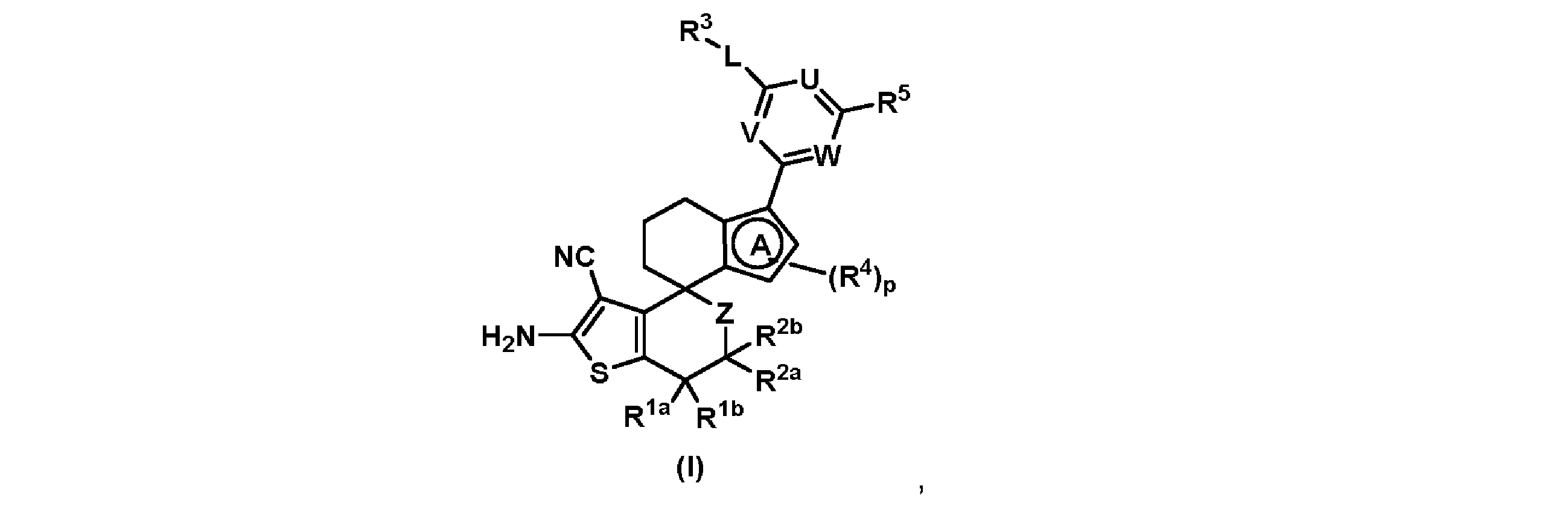
[式中、
R1a及びR1bは、共に独立して、水素、C1-4アルキル、C1-4ハロアルキル、C1-4アルコキシ、C1-4ハロアルコキシ、ハロゲン、-NH2、-NH(C1-4アルキル)、-N(C1-4アルキル)2、C3-5シクロアルキル及び3~5員ヘテロシクリルからなる群より選択され;
R2a及びR2bは、共に独立して、水素、C1-4アルキル、C1-4ハロアルキル、C1-4アルコキシ、C1-4ハロアルコキシ、ハロゲン、-NH2、-NH(C1-4アルキル)、-N(C1-4アルキル)2、C3-5シクロアルキル及び3~5員ヘテロシクリルからなる群より選択され;
かつ/又は、場合により、R1a又はR1bの一方とR2a又はR2bの一方は、これらが結合している炭素原子と一緒になって、シクロプロパン環を形成し;
Zは、-(CR6aR6b)n-であり;
各R6a及びR6bは、独立して、水素、C1-4アルキル、C1-4ハロアルキル、C1-4アルコキシ、C1-4ハロアルコキシ、ハロゲン、-NH2、-NH(C1-4アルキル)、-N(C1-4アルキル)2、C3-5シクロアルキル及び3~5員ヘテロシクリルからなる群より選択されるか;
又は、R6a及びR6bは、これらが結合している炭素原子と一緒になって、シクロプロパン環を形成し;
nは、0、1及び2からなる群より選択され;
Lは、-O-、-S-及び-N(R7)-(式中、R7は、水素又はC1-6アルキルである)から選択され;
R3は、C1-6アルキル、C1-6アルコキシ、5~10員ヘテロアリール及び3~11員ヘテロシクリルからなる群より選択され、ここで、C1-6アルキル、5~10員ヘテロアリール、C1-6アルコキシ及び3~11員ヘテロシクリルはすべて、場合によりかつ独立して、1つ又は複数の同一又は異なる、ハロゲン、C1-6アルキル、C1-6アルコキシ、-OH、-NH2、-NH(C1-4アルキル)、-N(C1-4アルキル)2、-C(O)O-C1-6アルキル、C3-5シクロアルキル、又は-N(C1-4アルキル)2で場合により置換されている3~11員ヘテロシクリルで置換されており;
Wは、窒素(-N=)又は-CH=であり;
Vは、窒素(-N=)又は-CH=であり;
Uは、窒素(-N=)又は-C(R11)=であり;
R11は、水素、ハロゲン及びC1-4アルコキシから選択され;
環Aは、ピロール、フラン、チオフェン、イミダゾール、ピラゾール、オキサゾール、イソオキサゾール、チアゾール、イソチアゾール及びトリアゾールからなる群より選択される環であり;
各R4は、存在する場合、独立して、C1-6アルキル、C1-6ハロアルキル、C1-6アルコキシ、C1-6ハロアルコキシ、シアノ-C1-6アルキル、ハロゲン、-OH、-NH2、-NH(C1-4アルキル)、-N(C1-4アルキル)2、-CN、C3-5シクロアルキル及び3~5員ヘテロシクリルからなる群より選択され;
pは、0、1、2及び3からなる群より選択され;
R5は、1つ又は複数の同一又は異なる、C1-6アルキル、C1-6アルコキシ又は5~6員ヘテロシクリルで場合により置換されている、3~11員ヘテロシクリルであり、ここで、C1-6アルキルは、シクロプロピルで場合により置換されており;
又は、R5は、3~11員ヘテロシクリルで置換されている-O-C1-6アルキルであり、ここで、3~11員ヘテロシクリルは、1つ又は複数の同一又は異なるR12で場合により置換されており、
各R12は、C1-6アルキル、C1-6アルコキシ、ハロゲン及び3~11員ヘテロシクリルからなる群より選択される]
で示される化合物又はその塩に関する。
Thus, in a first aspect, the present invention provides a compound of formula (I):
[Wherein,
R 1a and R 1b are both independently selected from the group consisting of hydrogen, C 1-4 alkyl, C 1-4 haloalkyl, C 1-4 alkoxy, C 1-4 haloalkoxy, halogen, -NH 2 , -NH(C 1-4 alkyl), -N(C 1-4 alkyl) 2 , C 3-5 cycloalkyl, and 3- to 5-membered heterocyclyl;
R 2a and R 2b are both independently selected from the group consisting of hydrogen, C 1-4 alkyl, C 1-4 haloalkyl, C 1-4 alkoxy, C 1-4 haloalkoxy, halogen, -NH 2 , -NH(C 1-4 alkyl), -N(C 1-4 alkyl) 2 , C 3-5 cycloalkyl, and 3- to 5-membered heterocyclyl;
and/or optionally, one of R 1a or R 1b and one of R 2a or R 2b together with the carbon atom to which they are attached form a cyclopropane ring;
Z is -(CR 6a R 6b ) n -;
each R 6a and R 6b is independently selected from the group consisting of hydrogen, C 1-4 alkyl, C 1-4 haloalkyl, C 1-4 alkoxy, C 1-4 haloalkoxy, halogen, -NH 2 , -NH(C 1-4 alkyl), -N(C 1-4 alkyl) 2 , C 3-5 cycloalkyl, and 3- to 5-membered heterocyclyl;
or R 6a and R 6b together with the carbon atom to which they are attached form a cyclopropane ring;
n is selected from the group consisting of 0, 1 and 2;
L is selected from -O-, -S-, and -N(R 7 )-, where R 7 is hydrogen or C 1-6 alkyl;
R 3 is selected from the group consisting of C 1-6 alkyl, C 1-6 alkoxy, 5-10 membered heteroaryl, and 3-11 membered heterocyclyl, wherein C 1-6 alkyl, 5-10 membered heteroaryl, C 1-6 alkoxy, and 3-11 membered heterocyclyl are all optionally and independently substituted with one or more of the same or different halogen, C 1-6 alkyl, C 1-6 alkoxy, -OH, -NH 2 , -NH(C 1-4 alkyl), -N(C 1-4 alkyl) 2 , -C(O)O-C 1-6 alkyl, C 3-5 cycloalkyl, or -N(C 1-4 alkyl) 2 ;
W is nitrogen (-N=) or -CH=;
V is nitrogen (-N=) or -CH=;
U is nitrogen (-N=) or -C(R 11 )=;
R 11 is selected from hydrogen, halogen and C 1-4 alkoxy;
Ring A is a ring selected from the group consisting of pyrrole, furan, thiophene, imidazole, pyrazole, oxazole, isoxazole, thiazole, isothiazole, and triazole;
each R 4 , if present, is independently selected from the group consisting of C 1-6 alkyl, C 1-6 haloalkyl, C 1-6 alkoxy, C 1-6 haloalkoxy, cyano-C 1-6 alkyl, halogen, -OH, -NH 2 , -NH(C 1-4 alkyl), -N(C 1-4 alkyl) 2 , -CN, C 3-5 cycloalkyl, and 3- to 5-membered heterocyclyl;
p is selected from the group consisting of 0, 1, 2 and 3;
R 5 is a 3-11 membered heterocyclyl optionally substituted with one or more of the same or different C 1-6 alkyl, C 1-6 alkoxy, or 5-6 membered heterocyclyl, where C 1-6 alkyl is optionally substituted with cyclopropyl;
or R 5 is -O-C 1-6 alkyl substituted with 3- to 11-membered heterocyclyl, wherein the 3- to 11-membered heterocyclyl is optionally substituted with one or more of the same or different R 12 ;
Each R 12 is selected from the group consisting of C 1-6 alkyl, C 1-6 alkoxy, halogen, and 3- to 11-membered heterocyclyl.
or a salt thereof.
別の態様では、本発明は、R1a及びR1bが、共に独立して、水素及びC1-4アルキルからなる群より選択される、式(I)で示される化合物、又はその塩に関する。 In another embodiment, the present invention relates to a compound of formula (I), or a salt thereof, wherein R 1a and R 1b are both independently selected from the group consisting of hydrogen and C 1-4 alkyl.
別の態様では、本発明は、R2a及びR2bが、共に独立して、水素及びハロゲンからなる群より選択される、式(I)で示される化合物、又はその塩に関する。 In another embodiment, the present invention relates to a compound of formula (I) or a salt thereof, wherein R 2a and R 2b are both independently selected from the group consisting of hydrogen and halogen.
別の態様では、本発明は、R1a及びR1bが、共に独立して、水素及びメチルからなる群より選択される、式(I)で示される化合物、又はその塩に関する。 In another embodiment, the present invention relates to a compound of formula (I) or a salt thereof, wherein R 1a and R 1b are both independently selected from the group consisting of hydrogen and methyl.
別の態様では、本発明は、R2a及びR2bが、共に独立して、水素及びフッ素からなる群より選択される、式(I)で示される化合物、又はその塩に関する。 In another embodiment, the present invention relates to a compound of formula (I) or a salt thereof, wherein R 2a and R 2b are both independently selected from the group consisting of hydrogen and fluorine.
別の態様では、本発明は、R1a、R1b、R2a及びR2bが水素である、式(I)で示される化合物、又はその塩に関する。 In another embodiment, the present invention relates to a compound of formula (I) or a salt thereof, wherein R 1a , R 1b , R 2a and R 2b are hydrogen.
別の態様では、本発明は、nが0である、式(I)で示される化合物、又はその塩に関する。 In another aspect, the present invention relates to a compound of formula (I) or a salt thereof, wherein n is 0.
別の態様では、本発明は、
nが1であり;
各R6a及びR6bが、独立して、水素、C1-4アルキル、C1-4ハロアルキル、C1-4アルコキシ、C1-4ハロアルコキシ、ハロゲン、-NH2、-NH(C1-4アルキル)、-N(C1-4アルキル)2、C3-5シクロアルキル及び3~5員ヘテロシクリルからなる群より選択される、式(I)で示される化合物、又はその塩に関する。
In another aspect, the present invention provides a method for producing a composition comprising:
n is 1;
The present invention relates to a compound of formula (I), or a salt thereof, wherein each R 6a and R 6b is independently selected from the group consisting of hydrogen, C 1-4 alkyl, C 1-4 haloalkyl, C 1-4 alkoxy, C 1-4 haloalkoxy, halogen, -NH 2 , -NH(C 1-4 alkyl), -N(C 1-4 alkyl) 2 , C 3-5 cycloalkyl and 3- to 5-membered heterocyclyl.
別の態様では、本発明は、Zが-CH2-である、式(I)で示される化合物、又はその塩に関する。 In another embodiment, the present invention relates to a compound of formula (I) or a salt thereof, wherein Z is -CH 2 -.
別の態様では、本発明は、
nが2であり;
各R6a及びR6bが、独立して、水素、C1-4アルキル、C1-4ハロアルキル、C1-4アルコキシ、C1-4ハロアルコキシ、ハロゲン、-NH2、-NH(C1-4アルキル)、-N(C1-4アルキル)2、C3-5シクロアルキル及び3~5員ヘテロシクリルからなる群より選択される、式(I)で示される化合物、又はその塩に関する。
In another aspect, the present invention provides a method for producing a composition comprising:
n is 2;
The present invention relates to a compound of formula (I), or a salt thereof, wherein each R 6a and R 6b is independently selected from the group consisting of hydrogen, C 1-4 alkyl, C 1-4 haloalkyl, C 1-4 alkoxy, C 1-4 haloalkoxy, halogen, -NH 2 , -NH(C 1-4 alkyl), -N(C 1-4 alkyl) 2 , C 3-5 cycloalkyl and 3- to 5-membered heterocyclyl.
別の態様では、本発明は、pが0である、式(I)で示される化合物、又はその塩に関する。 In another aspect, the present invention relates to a compound of formula (I) or a salt thereof, wherein p is 0.
別の態様では、本発明は、式(I*)で示される化合物又はその塩に関する。

[式中、R1a、R1b、R2a、R2b、R3、R4、R5、Z、L、U、V、W、環A及びpは、本明細書上記又は下記に定義されるとおりである]
In another embodiment, the present invention relates to a compound of formula (I * ) or a salt thereof.
wherein R 1a , R 1b , R 2a , R 2b , R 3 , R 4 , R 5 , Z, L, U, V, W, ring A and p are as defined herein above or below.
別の態様では、本発明は、式(Ia)で示される化合物又はその塩に関する。

[式中、A、V、U、W、L、R3及びR5は、本明細書に定義されるとおりである]
In another aspect, the present invention relates to a compound of formula (Ia) or a salt thereof.
wherein A, V, U, W, L, R3 and R5 are as defined herein.
別の態様では、本発明は、式(Ib)で示される化合物又はその塩に関する。

[式中、A、V、U、W、L、R3及びR5は、本明細書に定義されるとおりである]
In another aspect, the present invention relates to a compound of formula (Ib) or a salt thereof.
wherein A, V, U, W, L, R3 and R5 are as defined herein.
別の態様では、本発明は、環Aが、ピロール、フラン、チオフェン、イミダゾール、ピラゾール、イソオキサゾール、イソチアゾール及びトリアゾールからなる群より選択される環である、本発明の化合物、又はその塩に関する。 In another aspect, the present invention relates to a compound of the present invention, or a salt thereof, in which ring A is a ring selected from the group consisting of pyrrole, furan, thiophene, imidazole, pyrazole, isoxazole, isothiazole, and triazole.
別の態様では、本発明は、環Aが、

からなる群より選択される、本発明の化合物、又はその塩に関する。
In another aspect, the present invention relates to a compound wherein ring A is
The present invention relates to a compound of the present invention, or a salt thereof, selected from the group consisting of:
別の態様では、本発明は、環Aが、イソオキサゾール又はイソチアゾールである、本発明の化合物、又はその塩に関する。 In another aspect, the present invention relates to a compound of the present invention, or a salt thereof, wherein ring A is an isoxazole or an isothiazole.
別の態様では、本発明は、環Aが、

から選択される、本発明の化合物、又はその塩に関する。
In another aspect, the present invention relates to a compound wherein ring A is
The present invention relates to a compound of the present invention, or a salt thereof, selected from the following:
別の態様では、本発明は、式(Ic)で示される化合物、又はその塩に関する。

[式中、V、U、W、L、R3及びR5は、本明細書に定義されるとおりである]
In another aspect, the present invention relates to a compound of formula (Ic), or a salt thereof:
wherein V, U, W, L, R3 and R5 are as defined herein.
別の態様では、本発明は、式(Id)で示される化合物、又はその塩に関する。

[式中、V、U、W、L、R3及びR5は、本明細書に定義されるとおりである]
In another aspect, the present invention relates to a compound of formula (Id), or a salt thereof:
wherein V, U, W, L, R3 and R5 are as defined herein.
別の態様では、本発明は、式(Ie)で示される化合物、又はその塩に関する。

[式中、V、U、W、L、R3及びR5は、本明細書に定義されるとおりである]
In another aspect, the present invention relates to a compound of formula (Ie), or a salt thereof.
wherein V, U, W, L, R3 and R5 are as defined herein.
別の態様では、本発明は、式(If)で示される化合物、又はその塩に関する。

[式中、V、U、W、L、R3及びR5は、本明細書に定義されるとおりである]
In another aspect, the present invention relates to a compound of formula (If), or a salt thereof:
wherein V, U, W, L, R3 and R5 are as defined herein.
別の態様では、本発明は、W、V及びUのうち少なくとも1つが窒素である、式(I)、(I*)、(Ia)、(Ib)、(Ic)、(Id)、(Ie)若しくは(If)で示される化合物、又はその塩に関する。 In another aspect, the present invention relates to a compound of formula (I), (I * ), (Ia), (Ib), (Ic), (Id), (Ie) or (If), or a salt thereof, wherein at least one of W, V and U is nitrogen.
別の態様では、本発明は、
Wが、窒素(-N=)であり;
Vが、窒素(-N=)であり;
Uが、=C(R11)-であり;
R11が、水素、ハロゲン及びC1-4アルコキシから選択される、式(I)、(I*)、(Ia)、(Ib)、(Ic)、(Id)、(Ie)若しくは(If)で示される化合物、又はその塩に関する。
In another aspect, the present invention provides a method for producing a composition comprising:
W is nitrogen (-N=);
V is nitrogen (-N=);
U is ═C(R 11 )—;
The present invention relates to a compound of formula ( I ), (I * ), (Ia), (Ib), (Ic), (Id), (Ie) or (If), or a salt thereof, wherein R 11 is selected from hydrogen, halogen and C 1-4 alkoxy.
別の態様では、本発明は、
Wが、-CH=であり;
Vが、窒素(-N=)であり;
Uが、=C(R11)-であり;
R11が、水素、ハロゲン及びC1-4アルコキシから選択される、式(I)、(I*)、(Ia)、(Ib)、(Ic)、(Id)、(Ie)若しくは(If)で示される化合物、又はその塩に関する。
In another aspect, the present invention provides a method for producing a composition comprising:
W is -CH=;
V is nitrogen (-N=);
U is ═C(R 11 )—;
The present invention relates to a compound of formula ( I ), (I * ), (Ia), (Ib), (Ic), (Id), (Ie) or (If), or a salt thereof, wherein R 11 is selected from hydrogen, halogen and C 1-4 alkoxy.
別の態様では、本発明は、
Vが、-CH=であり;
Wが、窒素(-N=)であり;
Uが、=C(R11)-であり;
R11が、水素、ハロゲン及びC1-4アルコキシから選択される、式(I)、(I*)、(Ia)、(Ib)、(Ic)、(Id)、(Ie)若しくは(If)で示される化合物、又はその塩に関する。
In another aspect, the present invention provides a method for producing a composition comprising:
V is -CH=;
W is nitrogen (-N=);
U is ═C(R 11 )—;
The present invention relates to a compound of formula ( I ), (I * ), (Ia), (Ib), (Ic), (Id), (Ie) or (If), or a salt thereof, wherein R 11 is selected from hydrogen, halogen and C 1-4 alkoxy.
別の態様では、本発明は、
R11が、水素、フッ素、塩素及び-O-CH3から選択される、式(I)、(I*)、(Ia)、(Ib)、(Ic)、(Id)、(Ie)若しくは(If)で示される化合物、又はその塩に関する。
In another aspect, the present invention provides a method for producing a composition comprising:
The present invention relates to a compound of formula (I), (I * ), (Ia), (Ib), (Ic), (Id), (Ie) or (If), or a salt thereof, wherein R 11 is selected from hydrogen, fluorine, chlorine and —O—CH 3.
別の態様では、本発明は、
Vが、窒素(-N=)であり;
Wが、-CH=であり;
Uが、窒素(-N=)である、式(I)、(I*)、(Ia)、(Ib)、(Ic)、(Id)、(Ie)若しくは(If)で示される化合物、又はその塩に関する。
In another aspect, the present invention provides a method for producing a composition comprising:
V is nitrogen (-N=);
W is -CH=;
The present invention relates to a compound of formula (I), (I * ), (Ia), (Ib), (Ic), (Id), (Ie) or (If), or a salt thereof, wherein U is nitrogen (-N=).
別の態様では、本発明は、
Wが、窒素(-N=)であり;
Vが、-CH=であり;
Uが、窒素(-N=)である、式(I)、(I*)、(Ia)、(Ib)、(Ic)、(Id)、(Ie)若しくは(If)で示される化合物、又はその塩に関する。
In another aspect, the present invention provides a method for producing a composition comprising:
W is nitrogen (-N=);
V is -CH=;
The present invention relates to a compound of formula (I), (I * ), (Ia), (Ib), (Ic), (Id), (Ie) or (If), or a salt thereof, wherein U is nitrogen (-N=).
別の態様では、本発明は、
Wが、-CH=であり;
Vが、-CH=であり;
Uが、窒素(-N=)である、式(I)、(I*)、(Ia)、(Ib)、(Ic)、(Id)、(Ie)若しくは(If)で示される化合物、又はその塩に関する。
In another aspect, the present invention provides a method for producing a composition comprising:
W is -CH=;
V is -CH=;
The present invention relates to a compound of formula (I), (I * ), (Ia), (Ib), (Ic), (Id), (Ie) or (If), or a salt thereof, wherein U is nitrogen (-N=).
別の態様では、本発明は、
Wが、窒素(-N=)であり;
Vが、窒素(-N=)であり;
Uが、窒素(-N=)である、式(I)、(I*)、(Ia)、(Ib)、(Ic)、(Id)、(Ie)若しくは(If)で示される化合物又はその塩に関する。
In another aspect, the present invention provides a method for producing a composition comprising:
W is nitrogen (-N=);
V is nitrogen (-N=);
The present invention relates to a compound of formula (I), (I * ), (Ia), (Ib), (Ic), (Id), (Ie) or (If) or a salt thereof, wherein U is nitrogen (-N=).
別の態様では、本発明は、
R5が、1つ又は複数の同一又は異なる、C1-6アルキル、C1-6アルコキシ又は5~6員ヘテロシクリルで場合により置換されている6~11員ヘテロシクリルであり、ここで、C1-6アルキルが、シクロプロピルで場合により置換されている、式(I)、(I*)、(Ia)、(Ib)、(Ic)、(Id)、(Ie)若しくは(If)で示される化合物、又はその塩に関する。
In another aspect, the present invention provides a method for producing a composition comprising:
The present invention relates to a compound represented by formula (I), ( I* ), (Ia), ( Ib ), (Ic), ( Id ), (Ie) or (If), or a salt thereof, wherein R 5 is one or more of the same or different, 6 to 11 membered heterocyclyl optionally substituted with C 1-6 alkyl, C 1-6 alkoxy or 5 to 6 membered heterocyclyl, wherein C 1-6 alkyl is optionally substituted with cyclopropyl.
別の態様では、本発明は、
R5が、1つ又は複数の同一又は異なる、C1-4アルキルで場合により置換されている7員ヘテロシクリルである、式(I)、(I*)、(Ia)、(Ib)、(Ic)、(Id)、(Ie)若しくは(If)で示される化合物、又はその塩に関する。
In another aspect, the present invention provides a method for producing a composition comprising:
The present invention relates to a compound of formula (I), (I * ), (Ia), (Ib), (Ic), (Id), (Ie) or (If), or a salt thereof, wherein R 5 is one or more of the same or different 7-membered heterocyclyl optionally substituted with C 1-4 alkyl.
別の態様では、本発明は、
R5が、5~8員ヘテロシクリルで置換されている-O-C1-6アルキルであり、ここで、5~8員ヘテロシクリルが、1つ又は複数の同一又は異なるR12で場合により置換されており、
各R12が、C1-6アルキル、C1-6アルコキシ、ハロゲン及び5員ヘテロシクリルからなる群より選択される、式(I)、(I*)、(Ia)、(Ib)、(Ic)、(Id)、(Ie)若しくは(If)で示される化合物、又はその塩に関する。
In another aspect, the present invention provides a method for producing a composition comprising:
R 5 is -O-C 1-6 alkyl substituted with 5- to 8-membered heterocyclyl, where the 5- to 8-membered heterocyclyl is optionally substituted with one or more identical or different R 12 ;
The present invention relates to a compound represented by formula ( I ), (I * ), (Ia), ( Ib ), (Ic), (Id), (Ie) or (If), or a salt thereof, wherein each R 12 is selected from the group consisting of C 1-6 alkyl, C 1-6 alkoxy, halogen and 5-membered heterocyclyl.
別の態様では、本発明は、
R5が、

からなる群より選択される、式(I)、(I*)、(Ia)、(Ib)、(Ic)、(Id)、(Ie)若しくは(If)で示される化合物、又はその塩に関する。
In another aspect, the present invention provides a method for producing a composition comprising:
R5 is
The present invention relates to a compound represented by formula (I), (I * ), (Ia), (Ib), (Ic), (Id), (Ie) or (If), or a salt thereof, selected from the group consisting of:
別の態様では、本発明は、
R5が、

からなる群より選択される、式(I)、(I*)、(Ia)、(Ib)、(Ic)、(Id)、(Ie)若しくは(If)で示される化合物、又はその塩に関する。
In another aspect, the present invention provides a method for producing a composition comprising:
R5 is
The present invention relates to a compound represented by formula (I), (I * ), (Ia), (Ib), (Ic), (Id), (Ie) or (If), or a salt thereof, selected from the group consisting of:
別の態様では、本発明は、
R5が、

からなる群より選択される、式(I)、(I*)、(Ia)、(Ib)、(Ic)、(Id)、(Ie)若しくは(If)で示される化合物、又はその塩に関する。
In another aspect, the present invention provides a method for producing a composition comprising:
R5 is
The present invention relates to a compound represented by formula (I), (I * ), (Ia), (Ib), (Ic), (Id), (Ie) or (If), or a salt thereof, selected from the group consisting of:
別の態様では、本発明は、
R5が、

からなる群より選択される、式(I)、(I*)、(Ia)、(Ib)、(Ic)、(Id)、(Ie)若しくは(If)で示される化合物、又はその塩に関する。
In another aspect, the present invention provides a method for producing a composition comprising:
R5 is
The present invention relates to a compound represented by formula (I), (I * ), (Ia), (Ib), (Ic), (Id), (Ie) or (If), or a salt thereof, selected from the group consisting of:
別の態様では、本発明は、
R5が、

からなる群より選択される、式(I)、(I*)、(Ia)、(Ib)、(Ic)、(Id)、(Ie)若しくは(If)で示される化合物、又はその塩に関する。
In another aspect, the present invention provides a method for producing a composition comprising:
R5 is
The present invention relates to a compound represented by formula (I), (I * ), (Ia), (Ib), (Ic), (Id), (Ie) or (If), or a salt thereof, selected from the group consisting of:
別の態様では、本発明は、R5が、

からなる群より選択される、式(I)、(I*)、(Ia)、(Ib)、(Ic)、(Id)、(Ie)若しくは(If)で示される化合物、又はその塩に関する。
In another aspect, the present invention relates to a compound in which R 5 is
The present invention relates to a compound represented by formula (I), (I * ), (Ia), (Ib), (Ic), (Id), (Ie) or (If), or a salt thereof, selected from the group consisting of:
別の態様では、本発明は、
R3が、C1-6アルキル、C1-6アルコキシ、5~10員ヘテロアリール及び3~11員ヘテロシクリルからなる群より選択され、ここで、C1-6アルキル、5~10員ヘテロアリール、C1-6アルコキシ及び3~11員ヘテロシクリルがすべて、場合によりかつ独立して、1つ又は複数の同一又は異なる、ハロゲン、C1-6アルキル、-OH、-NH2、-NH(C1-4アルキル)、-N(C1-4アルキル)2、C3-5シクロアルキル又は3~11員ヘテロシクリルで置換されている、式(I)、(I*)、(Ia)、(Ib)、(Ic)、(Id)、(Ie)若しくは(If)で示される化合物又はその塩に関する。
In another aspect, the present invention provides a method for producing a composition comprising:
The present invention relates to a compound of formula (I), ( I * ), (Ia), (Ib), (Ic), (Id), (Ie) or (If) or a salt thereof, wherein R 3 is selected from the group consisting of C 1-6 alkyl, C 1-6 alkoxy, 5-10 membered heteroaryl and 3-11 membered heterocyclyl, wherein C 1-6 alkyl, 5-10 membered heteroaryl, C 1-6 alkoxy and 3-11 membered heterocyclyl are all optionally and independently substituted with one or more of the same or different halogen, C 1-6 alkyl, -OH, -NH 2 , -NH(C 1-4 alkyl), -N(C 1-4 alkyl) 2 , C 3-5 cycloalkyl or 3-11 membered heterocyclyl.
別の態様では、本発明は、
R3が、C1-6アルキル、C1-6アルコキシ、5~6員ヘテロアリール及び4~5員ヘテロシクリルからなる群より選択され、ここで、C1-6アルキル、5~6員ヘテロアリール、C1-6アルコキシ及び4~5員ヘテロシクリルがすべて、場合によりかつ独立して、1つ又は複数の同一又は異なる、ハロゲン、C1-6アルキル、C1-6アルコキシ、-OH、-NH2、-NH(C1-4アルキル)、-N(C1-4アルキル)2、-C(O)O-C1-6アルキル、C3-5シクロアルキル、又は-N(C1-4アルキル)2で場合により置換されている3~11員ヘテロシクリルで置換されている、式(I)、(I*)、(Ia)、(Ib)、(Ic)、(Id)、(Ie)若しくは(If)で示される化合物又はその塩に関する。
In another aspect, the present invention provides a method for producing a composition comprising:
The present invention relates to a compound of formula (I), ( I * ), (Ia), (Ib), (Ic), (Id), (Ie) or (If) or a salt thereof, wherein R 3 is selected from the group consisting of C 1-6 alkyl, C 1-6 alkoxy, 5- to 6-membered heteroaryl and 4- to 5-membered heterocyclyl, wherein C 1-6 alkyl, 5- to 6-membered heteroaryl, C 1-6 alkoxy and 4- to 5 -membered heterocyclyl are all optionally and independently substituted by one or more of the same or different halogen, C 1-6 alkyl, C 1-6 alkoxy, —OH, —NH 2 , —NH(C 1-4 alkyl), —N(C 1-4 alkyl) 2 , —C(O)O—C 1-6 alkyl, C 3-5 cycloalkyl, or —N(C 1-4 alkyl) 2 .
別の態様では、本発明は、
R3が、C1-6アルキル、C1-6アルコキシ、5~6員ヘテロアリール及び4~5員ヘテロシクリルからなる群より選択され、ここで、C1-6アルキル、5~6員ヘテロアリール、C1-6アルコキシ及び4~5員ヘテロシクリルがすべて、場合によりかつ独立して、1つ又は複数の同一又は異なる、ハロゲン、C1-6アルキル、-OH、-NH2、-NH(C1-4アルキル)、-N(C1-4アルキル)2、C3-5シクロアルキル又は3~11員ヘテロシクリルで置換されている、式(I)、(I*)、(Ia)、(Ib)、(Ic)、(Id)、(Ie)若しくは(If)で示される化合物又はその塩に関する。
In another aspect, the present invention provides a method for producing a composition comprising:
The present invention relates to a compound of formula (I), ( I * ), (Ia), (Ib), (Ic), (Id), (Ie) or (If) or a salt thereof, wherein R 3 is selected from the group consisting of C 1-6 alkyl, C 1-6 alkoxy, 5- to 6-membered heteroaryl and 4- to 5-membered heterocyclyl, wherein C 1-6 alkyl, 5- to 6-membered heteroaryl, C 1-6 alkoxy and 4- to 5 -membered heterocyclyl are all optionally and independently substituted with one or more of the same or different halogen, C 1-6 alkyl , -OH, -NH 2 , -NH(C 1-4 alkyl), -N(C 1-4 alkyl) 2 , C 3-5 cycloalkyl or 3- to 11-membered heterocyclyl.
別の態様では、本発明は、
R3が、C1-6アルキル、C1-6アルコキシ、5~6員ヘテロアリール及び4~5員ヘテロシクリルからなる群より選択され、その各々が、独立して、1個若しくは2個の窒素又は1個の酸素ヘテロ原子を含み、ここで、C1-6アルキル、5~6員ヘテロアリール、C1-6アルコキシ及び4~5員ヘテロシクリルがすべて、場合によりかつ独立して、1つ又は複数の同一又は異なる、ハロゲン、C1-6アルキル、C1-6アルコキシ、-OH、-NH2、-NH(C1-4アルキル)、-N(C1-4アルキル)2、-C(O)O-C1-6アルキル、C3-5シクロアルキル、又は-N(C1-4アルキル)2で場合により置換されている3~11員ヘテロシクリルで置換されている、式(I)、(Ia)、(I*)、(Ib)、(Ic)、(Id)、(Ie)若しくは(If)で示される化合物又はその塩に関する。
In another aspect, the present invention provides a method for producing a composition comprising:
Formula (I), (Ia), (I*) and R 3 are selected from the group consisting of C 1-6 alkyl, C 1-6 alkoxy, 5- to 6-membered heteroaryl and 4- to 5-membered heterocyclyl, each of which independently contains 1 or 2 nitrogen or 1 oxygen heteroatoms, and wherein the C 1-6 alkyl, 5- to 6-membered heteroaryl, C 1-6 alkoxy and 4- to 5-membered heterocyclyl are all optionally and independently substituted with one or more of the same or different halogen, C 1-6 alkyl, C 1-6 alkoxy, -OH, -NH 2 , -NH(C 1-4 alkyl), -N(C 1-4 alkyl) 2 , -C(O ) O-C 1-6 alkyl, C 3-5 cycloalkyl, or -N(C 1-4 alkyl) 2 . ), (Ib), (Ic), (Id), (Ie) or (If) or a salt thereof.
別の態様では、本発明は、
R3が、C1-6アルキル、C1-6アルコキシ、5~6員ヘテロアリール及び4~5員ヘテロシクリルからなる群より選択され、その各々が、独立して、1個若しくは2個の窒素又は1個の酸素ヘテロ原子を含み、ここで、C1-6アルキル、5~6員ヘテロアリール、C1-6アルコキシ及び4~5員ヘテロシクリルがすべて、場合によりかつ独立して、1つ又は複数の同一又は異なる、ハロゲン、C1-6アルキル、-OH、-NH2、-NH(C1-4アルキル)、-N(C1-4アルキル)2、C3-5シクロアルキル又は3~11員ヘテロシクリルで置換されている、式(I)、(Ia)、(I*)、(Ib)、(Ic)、(Id)、(Ie)若しくは(If)で示される化合物又はその塩に関する。
In another aspect, the present invention provides a method for producing a composition comprising:
The present invention relates to a compound of formula (I), ( Ia ), ( I* ), (Ib), (Ic), (Id), (Ie) or (If) or a salt thereof, wherein R 3 is selected from the group consisting of C 1-6 alkyl, C 1-6 alkoxy, 5- to 6-membered heteroaryl and 4- to 5-membered heterocyclyl, each of which independently contains 1 or 2 nitrogen or 1 oxygen heteroatoms, and wherein the C 1-6 alkyl, 5- to 6-membered heteroaryl, C 1-6 alkoxy and 4- to 5-membered heterocyclyl are all optionally and independently substituted with one or more of the same or different halogen, C 1-6 alkyl , -OH , -NH 2 , -NH(C 1-4 alkyl), -N ( C 1-4 alkyl) 2 , C 3-5 cycloalkyl or 3- to 11-membered heterocyclyl.
別の態様では、本発明は、
R3が、4~7員ヘテロシクリル又はC3-5シクロアルキルで置換されているC1-4アルキルであり、ここで、4~7員ヘテロシクリルが、-N(C1-4アルキル)2で場合により更に置換されている、式(I)、(Ia)、(I*)、(Ib)、(Ic)、(Id)、(Ie)若しくは(If)で示される化合物、又はその塩に関する。
In another aspect, the present invention provides a method for producing a composition comprising:
The present invention relates to a compound of formula (I), (Ia), ( I* ) , (Ib), (Ic), (Id), ( Ie ) or (If), or a salt thereof, wherein R3 is a 4- to 7-membered heterocyclyl or a C 1-4 alkyl substituted with a C 3-5 cycloalkyl, wherein the 4- to 7-membered heterocyclyl is optionally further substituted with -N(C 1-4 alkyl) 2.
別の態様では、本発明は、
R3が、C1-6アルキル、-CH(CH3)CH2-O-CH3、-(CH2)2-O-CH3、-(CH2)2-OH及び-(CH2)2-N-(CH3)2からなる群より選択されるか、又は
R3が、

からなる群より選択される環であり、
ここで、これらの環の各々が、場合によりかつ独立して、1つ又は複数の同一又は異なる、ハロゲン、C1-6アルキル、-OH、-NH2、-NH(C1-4アルキル)、-N(C1-4アルキル)2、C3-5シクロアルキル又は3~11員ヘテロシクリルで置換されている、式(I)、(I*)、(Ia)、(Ib)、(Ic)、(Id)、(Ie)若しくは(If)で示される化合物、又はその塩に関する。
In another aspect, the present invention provides a method for producing a composition comprising:
R 3 is selected from the group consisting of C 1-6 alkyl, -CH(CH 3 )CH 2 -O-CH 3 , -(CH 2 ) 2 -O-CH 3 , -(CH 2 ) 2 -OH and -(CH 2 ) 2 -N-(CH 3 ) 2 ; or
is a ring selected from the group consisting of
The present invention relates to a compound of formula (I), (I *), (Ia), (Ib), (Ic), (Id), (Ie) or (If), or a salt thereof, wherein each of these rings is optionally and independently substituted with one or more of the same or different halogen, C 1-6 alkyl , -OH , -NH 2 , -NH(C 1-4 alkyl), -N ( C 1-4 alkyl) 2 , C 3-5 cycloalkyl or 3- to 11-membered heterocyclyl.
別の態様では、本発明は、
R3が、C1-6アルキル、-CH(CH3)CH2-O-CH3、-(CH2)2-O-CH3、-(CH2)2-OH、-(CH2)2-N-(CH3)2、

からなる群より選択される、式(I)、(I*)、(Ia)、(Ib)、(Ic)、(Id)、(Ie)若しくは(If)で示される化合物、又はその塩に関する。
In another aspect, the present invention provides a method for producing a composition comprising:
R 3 is C 1-6 alkyl, -CH(CH 3 )CH 2 -O-CH 3 , -(CH 2 ) 2 -O-CH 3 , -(CH 2 ) 2 -OH, -(CH 2 ) 2 -N-(CH 3 ) 2 ,
The present invention relates to a compound represented by formula (I), (I * ), (Ia), (Ib), (Ic), (Id), (Ie) or (If), or a salt thereof, selected from the group consisting of:
別の態様では、本発明は、
-L-が、-O-であり;
R3が、1個又は2個の窒素ヘテロ原子を含有する4~5員ヘテロシクリルであり、ここで、4~5員ヘテロシクリルが、1つ又は複数の同一又は異なる、ハロゲン、C1-6アルキル、-OH、-NH2、-NH(C1-4アルキル)、-N(C1-4アルキル)2、C3-5シクロアルキル又は3~11員ヘテロシクリルで場合により置換されており、
Wが、窒素(-N=)であり;
Vが、窒素(-N=)であり;
Uが、-CH=であり;
R5が、5~8員ヘテロシクリルで置換されている-O-C1-6アルキルであり、ここで、5~8員ヘテロシクリルが、1つ又は複数の同一又は異なるR12で場合により置換されており、
各R12が、C1-6アルキル、C1-6アルコキシ、ハロゲン及び5員ヘテロシクリルからなる群より選択される、式(Ic)、(Id)、(Ie)又は(If)で示される化合物、又はその塩に関する。
In another aspect, the present invention provides a method for producing a composition comprising:
-L- is -O-;
R 3 is a 4-5 membered heterocyclyl containing 1 or 2 nitrogen heteroatoms, wherein the 4-5 membered heterocyclyl is optionally substituted by one or more of the same or different halogen, C 1-6 alkyl, -OH, -NH 2 , -NH(C 1-4 alkyl), -N(C 1-4 alkyl) 2 , C 3-5 cycloalkyl or 3-11 membered heterocyclyl;
W is nitrogen (-N=);
V is nitrogen (-N=);
U is -CH=;
R 5 is -O-C 1-6 alkyl substituted with 5- to 8-membered heterocyclyl, where the 5- to 8-membered heterocyclyl is optionally substituted with one or more identical or different R 12 ;
The present invention relates to a compound of formula (Ic), (Id), (Ie) or (If), or a salt thereof, wherein each R 12 is selected from the group consisting of C 1-6 alkyl, C 1-6 alkoxy, halogen and 5-membered heterocyclyl.
本発明に係る式(I)で示される化合物の好ましい実施態様は、例示化合物I-1~I-7及びII-1~II-31並びにそれらの任意のサブセットである。 Preferred embodiments of the compound represented by formula (I) according to the present invention are exemplified compounds I-1 to I-7 and II-1 to II-31, and any subset thereof.
式(I)又はその部分式の任意の2つ以上の態様及び/又は好ましい実施態様は、式(I)又はその部分式の更なる態様及び/又は好ましい実施態様を得るために、任意の方法で組み合わせて、化学的に安定な構造をもたらすことができるものと理解されるべきである。 It should be understood that any two or more aspects and/or preferred embodiments of formula (I) or subformulas thereof may be combined in any manner resulting in a chemically stable structure to obtain further aspects and/or preferred embodiments of formula (I) or subformulas thereof.
本発明は更に、式(I)、(I*)、(Ia)、(Ib)、(Ic)、(Id)、(Ie)又は(If)で示される化合物(そのすべての実施態様を含む)の水和物、溶媒和物、多形、代謝産物、誘導体、立体異性体及びプロドラッグに関する。 The present invention further relates to hydrates, solvates, polymorphs, metabolites, derivatives, stereoisomers and prodrugs of compounds of formula (I), (I * ), (Ia), (Ib), (Ic), (Id), (Ie) or (If) (including all embodiments thereof).
本発明は更に、式(I)、(I*)、(Ia)、(Ib)、(Ic)、(Id)、(Ie)又は(If)で示される化合物(そのすべての実施態様を含む)の水和物に関する。 The present invention further relates to hydrates of compounds of formula (I), (I * ), (Ia), (Ib), (Ic), (Id), (Ie) or (If) (including all embodiments thereof).
本発明は更に、式(I)、(I*)、(Ia)、(Ib)、(Ic)、(Id)、(Ie)又は(If)で示される化合物(そのすべての実施態様を含む)の溶媒和物に関する。 The present invention further relates to solvates of compounds of formula (I), (I * ), (Ia), (Ib), (Ic), (Id), (Ie) or (If) (including all embodiments thereof).
例えばエステル基を有する式(I)、(I*)、(Ia)、(Ib)、(Ic)、(Id)、(Ie)又は(If)で示される化合物(そのすべての実施態様を含む)は、エステルが生理学的条件下で切断される潜在的なプロドラッグであり、これもまた、本発明の一部である。 For example, compounds of formula (I), (I * ), (Ia), (Ib), (Ic), (Id), (Ie) or (If) (including all embodiments thereof) bearing an ester group are potential prodrugs, the ester being cleaved under physiological conditions, and are also part of the present invention.
本発明は更に、式(I)、(I*)、(Ia)、(Ib)、(Ic)、(Id)、(Ie)又は(If)で示される化合物(そのすべての実施態様を含む)の薬学的に許容される塩に関する。 The present invention further relates to pharma- ceutically acceptable salts of compounds of formula (I), (I * ), (Ia), (Ib), (Ic), (Id), (Ie) or (If) (including all embodiments thereof).
本発明は更に、無機又は有機酸又は塩基との式(I)、(I*)、(Ia)、(Ib)、(Ic)、(Id)、(Ie)又は(If)で示される化合物(そのすべての実施態様を含む)の薬学的に許容される塩に関する。 The present invention further relates to pharma- ceutically acceptable salts of the compounds of formula (I), (I * ), (Ia), (Ib), (Ic), (Id), (Ie) or (If) (including all embodiments thereof) with inorganic or organic acids or bases.
医薬組成物
本発明の更なる目的は、式(I)、(I*)、(Ia)、(Ib)、(Ic)、(Id)、(Ie)若しくは(If)で示される化合物又はその薬学的に許容される塩と、1つ又は複数の薬学的に許容される賦形剤とを含む、医薬組成物である。
Pharmaceutical Compositions A further object of the present invention is a pharmaceutical composition comprising a compound of formula (I), (I * ), (Ia), (Ib), (Ic), (Id), (Ie) or (If) or a pharma- ceutically acceptable salt thereof and one or more pharma- ceutically acceptable excipients.
一態様では、前記医薬組成物は、場合により、1つ又は複数の他の薬理学的に活性な物質を含む。前記1つ又は複数の他の薬理学的に活性な物質は、本明細書に定義されるような薬理学的に活性な物質又は組み合わせパートナーであり得る。 In one aspect, the pharmaceutical composition optionally comprises one or more other pharmacologically active substances. The one or more other pharmacologically active substances may be pharmacologically active substances or combination partners as defined herein.
本発明に係る式(I)、(I*)、(Ia)、(Ib)、(Ic)、(Id)、(Ie)又は(If)で示される化合物を投与するための好適な医薬組成物は、当業者にとって明らかであり、例えば、錠剤、丸剤、カプセル剤、坐剤、ロゼンジ剤、トローチ剤、液剤、懸濁剤、特に、注射(s.c.、i.v.、i.m.)及び注入(注射剤)用の液剤、懸濁剤又は他の混合物、エリキシル剤、シロップ剤、サシェ剤、乳剤、吸入剤又は分散性散剤が含まれる。化合物(I)、(I*)、(Ia)、(Ib)、(Ic)、(Id)、(Ie)又は(If)の含有量は、組成物全体の0.1~90質量%、好ましくは、0.5~50質量%の範囲、すなわち、以下に指定される投与量範囲を実現するのに十分な量であるべきである。指定される用量は、必要に応じて、1日数回与えられてよい。 Suitable pharmaceutical compositions for administering the compounds of formula (I), (I * ), (Ia), (Ib), (Ic), (Id), (Ie) or (If) according to the present invention are clear to the skilled person and include, for example, tablets, pills, capsules, suppositories, lozenges, troches, liquids, suspensions, in particular solutions, suspensions or other mixtures for injection (sc, iv, im) and infusion (injections), elixirs, syrups, sachets, emulsions, inhalants or dispersible powders. The content of compound (I), (I * ), (Ia), (Ib), (Ic), (Id), (Ie) or (If) should be in the range of 0.1 to 90% by weight, preferably 0.5 to 50% by weight, of the total composition, i.e., an amount sufficient to achieve the dosage ranges specified below. The doses specified may be given several times a day, if necessary.
好適な錠剤は、例えば、式(I)、(I*)、(Ia)、(Ib)、(Ic)、(Id)、(Ie)又は(If)で示される化合物を、公知の薬学的に許容される賦形剤、例えば、不活性な希釈剤、担体、崩壊剤、アジュバント、界面活性剤、結合剤及び/又は滑沢剤と混合することによって得ることができる。錠剤はまた、いくつかの層を含んでもよい。 Suitable tablets can be obtained, for example, by mixing a compound of formula (I), (I * ), (Ia), (Ib), (Ic), (Id), (Ie) or (If) with known pharma- ceutically acceptable excipients, such as inert diluents, carriers, disintegrants, adjuvants, surfactants, binders and/or lubricants. Tablets may also comprise several layers.
コーティング錠は、適宜、錠剤と同様にして生成された核を、錠剤被膜に通常使用される賦形剤、例えばコリドン(collidone)若しくはセラック、アラビアゴム、タルク、二酸化チタン又は糖で被覆することによって調製され得る。遅延放出を実現する又は配合禁忌を防止するために、核は、多数の層からなっていてもよい。同じく、錠剤被膜も、錠剤に関して上述した賦形剤を場合により使用して、遅延放出を実現するために多数の層からなっていてよい。 Coated tablets can be prepared by coating cores, produced similarly to tablets, with excipients typically used in tablet coatings, such as collidone or shellac, gum arabic, talc, titanium dioxide or sugar, if appropriate. The cores may consist of multiple layers to achieve delayed release or to prevent incompatibilities. Similarly, tablet coatings may consist of multiple layers to achieve delayed release, optionally using the excipients mentioned above for tablets.
1つ若しくは複数の(I)、(I*)、(Ia)、(Ib)、(Ic)、(Id)、(Ie)若しくは(If)又は1つ若しくは複数の他の薬学的に活性な物質との組み合わせを含有するシロップ剤又はエリキシル剤は、追加で、サッカリン、シクラマート、グリセロール又は糖などの甘味料、及び香味増強剤、例えば、バニリン又はオレンジ抽出物などの香味料のような賦形剤を含有してよい。これらはまた、懸濁アジュバント若しくは増粘剤、例えばカルボキシメチルセルロースナトリウム、湿潤剤、例えば脂肪族アルコールとエチレンオキシドとの縮合生成物など、又はp-ヒドロキシベンゾアートなどの保存料のような賦形剤を含有してもよい。 Syrups or elixirs containing one or more of (I), (I * ), (Ia), (Ib), (Ic), (Id), (Ie) or (If) or a combination with one or more other pharma- ceutically active substances may additionally contain excipients such as sweeteners, such as saccharin, cyclamate, glycerol or sugar, and flavour enhancers, for example flavourings such as vanillin or orange extract. They may also contain excipients such as suspension adjuvants or thickeners, for example sodium carboxymethylcellulose, wetting agents, for example condensation products of fatty alcohols with ethylene oxide, or preservatives, such as p-hydroxybenzoates.
注射及び注入用の液剤は、通常の方法で、例えば、等張剤、p-ヒドロキシベンゾアートなどの保存料、又はエチレンジアミン四酢酸のアルカリ金属塩などの安定剤のような賦形剤を添加し、任意で乳化剤及び/又は分散剤を使用して調製されるが、水が希釈剤として使用される場合、例えば、有機溶媒を、任意で溶媒和剤又は溶解助剤として使用し、注射用バイアル若しくはアンプル又は注入用ボトルに移してもよい。 Solutions for injection and infusion are prepared in the usual manner, for example with the addition of excipients such as isotonic agents, preservatives such as p-hydroxybenzoates, or stabilizers such as alkali metal salts of ethylenediaminetetraacetic acid, and optionally with the use of emulsifiers and/or dispersants, but when water is used as a diluent, for example with the optional use of organic solvents as solvating or dissolving agents, and may be transferred into injection vials or ampoules or infusion bottles.
1つ又は複数の式(I)、(I*)、(Ia)、(Ib)、(Ic)、(Id)、(Ie)若しくは(If)で示される化合物又は1つ若しくは複数の他の薬学的に活性な物質との組み合わせを含有するカプセル剤は、例えば、化合物/活性物質をラクトース又はソルビトールなどの不活性な賦形剤と混合し、それらをゼラチンカプセルに充填することによって調製され得る。 Capsules containing one or more compounds of formula (I), (I * ), (Ia), (Ib), (Ic), (Id), (Ie) or (If) or a combination with one or more other pharma- ceutically active substances can be prepared, for example, by mixing the compounds/active substances with inert excipients such as lactose or sorbitol and filling them into gelatin capsules.
好適な坐剤は、例えば、中性脂肪又はポリエチレングリコール若しくはその誘導体などの、この目的のために提供される賦形剤と混合することによって製造され得る。 Suitable suppositories can be prepared by mixing with excipients provided for this purpose, such as, for example, neutral fats or polyethylene glycol or its derivatives.
使用され得る賦形剤には、例えば、水、薬学的に許容される有機溶媒、例えばパラフィン類(例えば、石油留分)、植物油(例えば、ラッカセイ油又はゴマ油)、単官能又は多官能アルコール(例えば、エタノール又はグリセロール)、担体、例えば天然鉱物粉末(例えば、カオリン、粘土、タルク、チョーク)、合成鉱物粉末(例えば、高分散性ケイ酸及びケイ酸塩)、糖類(例えば、甘蔗糖、ラクトース及びグルコース)、乳化剤(例えば、リグニン、亜硫酸パルプ廃液、メチルセルロース、デンプン及びポリビニルピロリドン)及び滑沢剤(例えば、ステアリン酸マグネシウム、タルク、ステアリン酸及びラウリル硫酸ナトリウム)が含まれる。 Excipients that may be used include, for example, water, pharma- ceutically acceptable organic solvents, such as paraffins (e.g., petroleum fractions), vegetable oils (e.g., peanut oil or sesame oil), monofunctional or polyfunctional alcohols (e.g., ethanol or glycerol), carriers, such as natural mineral powders (e.g., kaolin, clay, talc, chalk), synthetic mineral powders (e.g., highly disperse silicic acid and silicates), sugars (e.g., sucrose, lactose and glucose), emulsifiers (e.g., lignin, spent sulfite liquor, methylcellulose, starch and polyvinylpyrrolidone) and lubricants (e.g., magnesium stearate, talc, stearic acid and sodium lauryl sulfate).
医薬組成物は、通常の方法によって、好ましくは、経口又は経皮経路によって、最も好ましくは、経口経路によって投与される。経口投与のために、錠剤は、当然ながら、上述した賦形剤とは別に、クエン酸ナトリウム、炭酸カルシウム及びリン酸二カルシウムなどの追加の賦形剤を、デンプン、好ましくはジャガイモデンプン、ゼラチンなどの様々な賦形剤と一緒に含有し得る。更に、ステアリン酸マグネシウム、ラウリル硫酸ナトリウム及びタルクなどの滑沢剤が、打錠プロセスに同時に使用されてもよい。水性懸濁剤の場合、活性物質は、上述した賦形剤に加えて、様々な香味増強剤又は着色剤と組み合わせられ得る。 The pharmaceutical compositions are administered by the usual methods, preferably by oral or transdermal routes, most preferably by oral routes. For oral administration, the tablets may of course contain, apart from the above-mentioned excipients, additional excipients such as sodium citrate, calcium carbonate and dicalcium phosphate, together with various excipients such as starch, preferably potato starch, gelatin. Furthermore, lubricants such as magnesium stearate, sodium lauryl sulfate and talc may be used simultaneously in the tableting process. In the case of aqueous suspensions, the active substance may be combined with various flavor enhancers or colorants in addition to the above-mentioned excipients.
非経口使用のために、活性物質と好適な液体賦形剤との液剤が使用され得る。 For parenteral use, a solution of the active substance and a suitable liquid excipient may be used.
式(I)、(I*)、(Ia)、(Ib)、(Ic)、(Id)、(Ie)又は(If)で示される化合物の1日当たり適用可能な投与量範囲は、通常、1mg~2000mg、好ましくは、250~1250mgである。 The applicable daily dosage range of the compounds of formula (I), (I * ), (Ia), (Ib), (Ic), (Id), (Ie) or (If) is usually 1 mg to 2000 mg, preferably 250 to 1250 mg.
しかしながら、投与量は、時として、体重、年齢、投与の経路、疾患の重症度、薬物に対する個々の反応、その製剤の性質及び薬物が投与される時間又は間隔(1日当たり1回又は複数回の投与による継続的又は断続的な処置)に応じて、指定された量から外れることが必要な場合もある。したがって、いくつかの場合では、上に与えられた最少用量よりも少ない投与量の使用で十分である一方、他の場合では、その上限を超えなければならない場合もある。大量を投与するときは、これらを1日数回のより少ない用量に分割することが望ましい場合がある。 However, the dosage may occasionally have to deviate from the amount specified, depending on the body weight, age, route of administration, severity of the disease, individual response to the drug, the nature of its formulation and the time or interval at which the drug is administered (continuous or intermittent treatment with one or several doses per day). Thus, in some cases it may be sufficient to use a dosage lower than the minimum dose given above, whereas in other cases the upper limit may have to be exceeded. When administering larger amounts, it may be advisable to divide these into several smaller doses to be administered throughout the day.
したがって、更なる態様では、本発明は、少なくとも1つ(好ましくは1つ)の式(I)、(I*)、(Ia)、(Ib)、(Ic)、(Id)、(Ie)若しくは(If)で示される化合物又はその薬学的に許容される塩と、1つ又は複数の薬学的に許容される賦形剤とを含む、医薬組成物に関する。 Thus, in a further aspect, the present invention relates to a pharmaceutical composition comprising at least one (preferably one) compound of formula (I), (I * ), (Ia), (Ib), (Ic), (Id), (Ie) or (If) or a pharma- ceutically acceptable salt thereof and one or more pharma- ceutically acceptable excipients.
式(I)、(I*)、(Ia)、(Ib)、(Ic)、(Id)、(Ie)若しくは(If)で示される化合物又はその薬学的に許容される塩、並びにそのような化合物及び塩を含む医薬組成物はまた、他の薬理学的に活性な物質、例えば、他の抗新生物化合物(例えば、化学療法)と同時投与されても、すなわち、併用されてもよい(更に以下の併用処置を参照のこと)。 The compounds of formula (I), (I * ), (Ia), (Ib), (Ic), (Id), (Ie) or (If) or pharma- ceutically acceptable salts thereof, and pharmaceutical compositions containing such compounds and salts, may also be co-administered, i.e., used in combination, with other pharmacologically active substances, such as other anti-neoplastic compounds (e.g. chemotherapy) (see further below under Combination Treatment).
そのような組み合わせの要素は、当業者にとって慣用でかつ単剤療法で使用されるような方法、例えば、経口、経腸、非経口(例えば、筋肉内、腹腔内、静脈内、経皮若しくは皮下注射、又はインプラント)、経鼻、経膣、直腸又は局所の投与経路によって(従属的に又は独立的に)投与することができ、単独で又は一緒に、各投与経路に適切な従来の非毒性で薬学的に許容される賦形剤を含有する好適な投与単位製剤で製剤化することができる。 The elements of such combinations can be administered (subordinately or independently) in a manner conventional to those skilled in the art and as used in monotherapy, for example, by oral, enteral, parenteral (e.g., intramuscular, intraperitoneal, intravenous, transdermal or subcutaneous injection, or implant), nasal, vaginal, rectal or topical routes of administration, and can be formulated, alone or together, in suitable dosage unit formulations containing conventional non-toxic pharmaceutically acceptable excipients appropriate for each route of administration.
組み合わせは、治療上有効な単回又は分割1日用量で投与され得る。組み合わせの活性な構成要素は、単剤療法において治療上有効なそのような用量で、又は単剤療法において使用される用量よりも少ないが組み合わせた際に所望の(統合した)治療上有効な量をもたらすそのような用量で投与され得る。 The combination may be administered in a therapeutically effective single or divided daily dose. The active components of the combination may be administered in such doses that are therapeutically effective in monotherapy or in such doses that are less than the doses used in monotherapy but which, when combined, provide the desired (combined) therapeutically effective amount.
しかしながら、2つ以上の活性物質又は成分の併用が相乗効果をもたらす場合、所望の治療作用を実現しながら、投与される物質若しくは成分のうちの1つ、複数又はすべての量を減らすことも可能である。このことは、例えば、所望の薬理学的効果又は治療効果を確保しながら、物質又は成分がそれらの通常の量で使用された際のその1つ又は複数の使用に関連する任意の望ましくない副作用を回避、制限又は軽減するのに有用であり得る。 However, when the combination of two or more active substances or ingredients produces a synergistic effect, it may also be possible to reduce the amount of one, more or all of the substances or ingredients administered while still achieving the desired therapeutic effect. This may be useful, for example, to avoid, limit or reduce any undesirable side effects associated with the use of one or more of the substances or ingredients when used in their normal amounts, while still ensuring the desired pharmacological or therapeutic effect.
したがって、更なる態様では、本発明はまた、式(I)、(I*)、(Ia)、(Ib)、(Ic)、(Id)、(Ie)若しくは(If)で示される化合物又はその薬学的に許容される塩と、1つ又は複数(好ましくは、1つ又は2つ、最も好ましくは1つ)の他の薬理学的に活性な物質とを含む、医薬組成物に関する。 Therefore, in a further aspect, the present invention also relates to a pharmaceutical composition comprising a compound of formula (I), (I * ), (Ia), (Ib), (Ic), (Id), (Ie) or (If) or a pharma- ceutically acceptable salt thereof and one or more (preferably one or two, most preferably one) other pharmacologically active substances.
更なる態様では、本発明はまた、式(I)、(I*)、(Ia)、(Ib)、(Ic)、(Id)、(Ie)若しくは(If)で示される化合物又はその薬学的に許容される塩と、1つ又は複数(好ましくは、1つ又は2つ、最も好ましくは1つ)の他の薬理学的に活性な物質とを含む、医薬調製物に関する。 In a further aspect, the present invention also relates to a pharmaceutical preparation comprising a compound of formula (I), (I * ), (Ia), (Ib), (Ic), (Id), (Ie) or (If) or a pharma- ceutically acceptable salt thereof and one or more (preferably one or two, most preferably one) other pharmacologically active substances.
同時投与又は併用される医薬組成物は、キットの形態で提供することもできる。 Pharmaceutical compositions to be administered simultaneously or in combination can also be provided in the form of a kit.
したがって、更なる態様では、本発明はまた、
・式(I)、(I*)、(Ia)、(Ib)、(Ic)、(Id)、(Ie)又は(If)で示される化合物と任意で1つ又は複数の薬学的に許容される賦形剤とを含む第一の医薬組成物又は剤形、及び
・別の薬理学的に活性な物質と任意で1つ又は複数の薬学的に許容される賦形剤とを含む第二の医薬組成物又は剤形
を含むキットに関する。
Thus, in a further aspect, the present invention also provides a method for producing a method for treating a pulmonary arthritis, comprising:
The present invention relates to a kit comprising: a first pharmaceutical composition or dosage form comprising a compound of formula (I), (I * ), (Ia), (Ib), (Ic), (Id), (Ie) or (If) and optionally one or more pharma- ceutically acceptable excipients; and a second pharmaceutical composition or dosage form comprising another pharmacologically active substance and optionally one or more pharma- ceutically acceptable excipients.
一態様では、そのようなキットは、更に別の薬理学的に活性な物質と任意で1つ又は複数の薬学的に許容される賦形剤とを含む第三の医薬組成物又は剤形を含む。 In one aspect, such a kit further comprises a third pharmaceutical composition or dosage form comprising another pharmacologically active substance and, optionally, one or more pharma- ceutically acceptable excipients.
医学的使用-処置の方法
適応-患者集団
本発明は、KRAS、好ましくは、残基12が突然変異したKRASを阻害する化合物、例えば、KRAS G12C、KRAS G12D、KRAS G12V、KRAS G12A及びKRAS G12Rの阻害剤、好ましくは、KRAS G12C及び/若しくはKRAS G12Dの阻害剤、又はKRAS G12Dに選択的な阻害剤、並びに、KRAS野生型、好ましくは、増幅したもの、残基13が突然変異したKRAS、例えばKRAS G13D、又は残基61が突然変異したKRAS、例えばKRAS Q61Hを阻害する化合物を対象とする。特に、式(I)、(I*)、(Ia)、(Ib)、(Ic)、(Id)、(Ie)又は(If)で示される化合物(そのすべての実施態様を含む)は、KRASによって、好ましくは、残基12が突然変異したKRAS、例えばKRAS G12C、KRAS G12D、KRAS G12V、より好ましくはG12Dによって、又はKRAS野生型の増幅によって、又は残基13が突然変異したKRAS、例えばKRAS G13Dによって、又は残基61が突然変異したKRAS、例えばKRAS Q61Hによって媒介される疾患及び/又は状態の治療及び/又は予防において潜在的に有用である。
Medical Use – Methods of Treatment
Indications – Patient population
The present invention is directed to compounds which inhibit KRAS, preferably KRAS mutated at residue 12, e.g., inhibitors of KRAS G12C, KRAS G12D, KRAS G12V, KRAS G12A and KRAS G12R, preferably inhibitors of KRAS G12C and/or KRAS G12D, or inhibitors selective for KRAS G12D, as well as compounds which inhibit KRAS wild-type, preferably amplified, KRAS mutated at residue 13, e.g., KRAS G13D, or KRAS mutated at residue 61, e.g., KRAS Q61H. In particular, the compounds of formula (I), (I * ), (Ia), (Ib), (Ic), (Id), (Ie) or (If) (including all embodiments thereof) are potentially useful in the treatment and/or prevention of diseases and/or conditions mediated by KRAS, preferably by KRAS mutated at residue 12, such as KRAS G12C, KRAS G12D, KRAS G12V, more preferably G12D, or by amplification of KRAS wild type, or by KRAS mutated at residue 13, such as KRAS G13D, or by KRAS mutated at residue 61, such as KRAS Q61H.
したがって、更なる態様では、本発明は、医薬として使用するための、式(I)、(I*)、(Ia)、(Ib)、(Ic)、(Id)、(Ie)若しくは(If)で示される化合物又はその薬学的に許容される塩に関する。 Therefore, in a further aspect, the present invention relates to a compound of formula (I), (I * ), (Ia), (Ib), (Ic), (Id), (Ie) or (If) or a pharma- ceutically acceptable salt thereof for use as a medicament.
更なる態様では、本発明は、ヒト又は動物の身体の処置の方法において使用するための、式(I)、(I*)、(Ia)、(Ib)、(Ic)、(Id)、(Ie)若しくは(If)で示される化合物又はその薬学的に許容される塩に関する。 In a further aspect, the present invention relates to a compound of formula (I), (I * ), (Ia), (Ib), (Ic), (Id), (Ie) or (If) or a pharma- ceutically acceptable salt thereof for use in a method of treatment of the human or animal body.
更なる態様では、本発明は、KRASによって、好ましくは、残基12が突然変異したKRAS、例えばKRAS G12C、KRAS G12D、KRAS G12V、より好ましくはG12Dによって、又はKRAS野生型の増幅によって、又は残基13が突然変異したKRAS、例えばKRAS G13Dによって媒介される疾患及び/又は状態の治療及び/又は予防において使用するための、式(I)、(I*)、(Ia)、(Ib)、(Ic)、(Id)、(Ie)若しくは(If)で示される化合物又はその薬学的に許容される塩に関する。 In a further aspect, the present invention relates to a compound of formula (I), (I*), (Ia), (Ib), (Ic), (Id), (Ie) or ( If) or a pharma- ceutically acceptable salt thereof for use in the treatment and/or prevention of diseases and/or conditions mediated by KRAS, preferably by KRAS mutated at residue 12, e.g. KRAS G12C, KRAS G12D, KRAS G12V, more preferably G12D, or by amplification of KRAS wild type, or by KRAS mutated at residue 13, e.g. KRAS G13D.
更なる態様では、本発明は、KRASによって、好ましくは、残基12が突然変異したKRAS、例えばKRAS G12C、KRAS G12D、KRAS G12V、より好ましくはG12Dによって、又はKRAS野生型の増幅によって、又は残基13が突然変異したKRAS、例えばKRAS G13Dによって媒介される疾患及び/又は状態の治療及び/又は予防のための医薬の製造における、式(I)、(I*)、(Ia)、(Ib)、(Ic)、(Id)、(Ie)若しくは(If)で示される化合物又はその薬学的に許容される塩の使用に関する。 In a further aspect, the present invention relates to the use of a compound of formula (I), (I*), (Ia), (Ib), (Ic), (Id), (Ie) or (If) or a pharma- ceutically acceptable salt thereof in the manufacture of a medicament for the treatment and/or prevention of diseases and/or conditions mediated by KRAS, preferably by KRAS mutated at residue 12, e.g. KRAS G12C, KRAS G12D, KRAS G12V, more preferably G12D, or by amplification of KRAS wild type, or by KRAS mutated at residue 13, e.g. KRAS G13D.
更なる態様では、本発明は、治療上有効な量の式(I)、(I*)、(Ia)、(Ib)、(Ic)、(Id)、(Ie)若しくは(If)で示される化合物又はその薬学的に許容される塩をヒトに投与することを含む、KRASによって、好ましくは、残基12が突然変異したKRAS、例えばKRAS G12C、KRAS G12D、KRAS G12V、より好ましくはG12Dによって、又はKRAS野生型の増幅によって、又は残基13が突然変異したKRAS、例えばKRAS G13Dによって媒介される疾患及び/又は状態の治療及び/又は予防のための方法に関する。 In a further aspect, the present invention relates to a method for the treatment and/or prevention of a disease and/or condition mediated by KRAS, preferably by KRAS mutated at residue 12 , such as KRAS G12C, KRAS G12D, KRAS G12V, more preferably G12D, or by amplification of KRAS wild type, or by KRAS mutated at residue 13, such as KRAS G13D, comprising administering to a human a therapeutically effective amount of a compound of formula (I), (I*), (Ia), (Ib), (Ic), (Id), (Ie) or (If) or a pharma- ceutically acceptable salt thereof.
更なる態様では、本発明は、がんの治療及び/又は予防において使用するための、式(I)、(I*)、(Ia)、(Ib)、(Ic)、(Id)、(Ie)若しくは(If)で示される化合物又はその薬学的に許容される塩に関する。 In a further aspect, the present invention relates to a compound of formula (I), (I * ), (Ia), (Ib), (Ic), (Id), (Ie) or (If) or a pharma- ceutically acceptable salt thereof for use in the treatment and/or prevention of cancer.
更なる態様では、本発明は、ヒト又は動物の身体におけるがんの治療及び/又は予防の方法において使用するための、式(I)、(I*)、(Ia)、(Ib)、(Ic)、(Id)、(Ie)若しくは(If)で示される化合物又はその薬学的に許容される塩に関する。 In a further aspect, the present invention relates to a compound of formula (I), (I * ), (Ia), (Ib), (Ic), (Id), (Ie) or (If) or a pharma- ceutically acceptable salt thereof for use in a method for the treatment and/or prevention of cancer in the human or animal body.
更なる態様では、本発明は、がんの治療及び/又は予防のための医薬の製造における、式(I)、(I*)、(Ia)、(Ib)、(Ic)、(Id)、(Ie)若しくは(If)で示される化合物又はその薬学的に許容される塩の使用に関する。 In a further aspect, the present invention relates to the use of a compound of formula (I), (I * ), (Ia), (Ib), (Ic), (Id), (Ie) or (If) or a pharma- ceutically acceptable salt thereof in the manufacture of a medicament for the treatment and/or prevention of cancer.
更なる態様では、本発明は、治療上有効な量の式(I)、(I*)、(Ia)、(Ib)、(Ic)、(Id)、(Ie)若しくは(If)で示される化合物又はその薬学的に許容される塩をヒトに投与することを含む、がんの治療及び/又は予防のための方法に関する。 In a further aspect, the present invention relates to a method for the treatment and/or prevention of cancer comprising administering to a human a therapeutically effective amount of a compound of formula (I), (I * ), (Ia), (Ib), (Ic), (Id), (Ie) or (If) or a pharma- ceutically acceptable salt thereof.
好ましくは、本明細書(上記又は下記)に定義されるとおりのがんは、KRAS突然変異を含む。特に、KRAS突然変異は、例えば、KRAS遺伝子及びKRASタンパク質の突然変異、例えば、過剰発現したKRAS、増幅したKRAS又はKRAS、残基12が突然変異したKRAS、残基13が突然変異したKRAS、残基61が突然変異したKRAS、残基146が突然変異したKRAS、特に、KRAS G12A、KRAS G12C、KRAS G12D、KRAS G12V、KRAS G12S、KRAS G13C、KRAS G13D、KRAS G13V、KRAS Q61H、KRAS Q61E、KRAS Q61P、KRAS A146P、KRAS A146T、KRAS A146Vを含む。KRASは、これらの突然変異/変異のうちの1つ又は複数を提示し得る。 Preferably, the cancer as defined herein (above or below) comprises a KRAS mutation. In particular, KRAS mutations include, for example, mutations in the KRAS gene and KRAS protein, such as overexpressed KRAS, amplified KRAS or KRAS, KRAS mutated at residue 12, KRAS mutated at residue 13, KRAS mutated at residue 61, KRAS mutated at residue 146, in particular KRAS G12A, KRAS G12C, KRAS G12D, KRAS G12V, KRAS G12S, KRAS G13C, KRAS G13D, KRAS G13V, KRAS Q61H, KRAS Q61E, KRAS Q61P, KRAS A146P, KRAS A146T, KRAS A146V. KRAS may exhibit one or more of these mutations/mutations.
好ましくは、本明細書(上記又は下記)に定義されるとおりのがんは、KRAS突然変異に加えて又はその代わりにBRAF突然変異を含む。前記BRAF突然変異は、特に、クラスIIIのBRAF突然変異、例えば、Z. Yao, Nature, 2017, 548, 234-238に定義されるとおりのBRAF突然変異である。 Preferably, the cancer as defined herein (above or below) comprises a BRAF mutation in addition to or instead of a KRAS mutation. The BRAF mutation is in particular a class III BRAF mutation, e.g. a BRAF mutation as defined in Z. Yao, Nature, 2017, 548, 234-238.
好ましくは、本明細書(上記又は下記)に定義されるとおりのがんは、KRAS突然変異に加えて又はその代わりに、EGFR、MET及びERBB2突然変異を含む受容体型チロシンキナーゼ(RTK)における突然変異を含む。 Preferably, the cancer as defined herein (above or below) comprises, in addition to or instead of a KRAS mutation, a mutation in a receptor tyrosine kinase (RTK), including an EGFR, MET and ERBB2 mutation.
更なる態様では、本発明は、がんの治療及び/又は予防において使用するための、式(I)、(I*)、(Ia)、(Ib)、(Ic)、(Id)、(Ie)若しくは(If)で示される化合物又はその薬学的に許容される塩であって、がんが、KRAS突然変異を含み、前記KRAS突然変異が、好ましくは、KRAS G12C、KRAS G12D、KRAS G12V、KRAS G13D;又はKRAS野生型の増幅、KRAS遺伝子の増幅又はKRASの過剰発現からなる群より選択される、化合物又はその薬学的に許容される塩に関する。 In a further aspect, the present invention relates to a compound of formula (I), (I * ), (Ia), (Ib), (Ic), (Id), (Ie) or (If) or a pharma- ceutically acceptable salt thereof for use in the treatment and/or prevention of cancer, wherein the cancer comprises a KRAS mutation, said KRAS mutation being preferably selected from the group consisting of KRAS G12C, KRAS G12D, KRAS G12V, KRAS G13D; or amplification of KRAS wild type, amplification of the KRAS gene or overexpression of KRAS.
更なる態様では、本発明は、がんの治療及び/又は予防のための医薬の製造における、式(I)、(I*)、(Ia)、(Ib)、(Ic)、(Id)、(Ie)若しくは(If)で示される化合物又はその薬学的に許容される塩の使用であって、がんが、KRAS突然変異を含み、前記KRAS突然変異が、好ましくは、KRAS G12C、KRAS G12D、KRAS G12V、KRAS G13D;又はKRAS野生型の増幅、KRAS遺伝子の増幅又はKRASの過剰発現からなる群より選択される、使用に関する。 In a further aspect, the present invention relates to the use of a compound of formula (I), (I * ), (Ia), (Ib), (Ic), (Id), (Ie) or (If) or a pharma- ceutically acceptable salt thereof in the manufacture of a medicament for the treatment and/or prevention of cancer, wherein the cancer comprises a KRAS mutation, said KRAS mutation being preferably selected from the group consisting of KRAS G12C, KRAS G12D, KRAS G12V, KRAS G13D; or amplification of KRAS wild type, amplification of the KRAS gene or overexpression of KRAS.
更なる態様では、本発明は、治療上有効な量の式(I)、(I*)、(Ia)、(Ib)、(Ic)、(Id)、(Ie)若しくは(If)で示される化合物又はその薬学的に許容される塩をヒトに投与することを含む、がんの治療及び/又は予防のための方法であって、がんが、KRAS突然変異を含み、前記KRAS突然変異が、好ましくは、KRAS G12C、KRAS G12D、KRAS G12V、KRAS G13D;又はKRAS野生型の増幅、KRAS遺伝子の増幅又はKRASの過剰発現からなる群より選択される、方法に関する。 In a further aspect, the present invention relates to a method for the treatment and/or prevention of cancer comprising administering to a human a therapeutically effective amount of a compound of formula (I), (I * ), (Ia), (Ib), (Ic), (Id), (Ie) or (If) or a pharma- ceutically acceptable salt thereof, wherein the cancer comprises a KRAS mutation, said KRAS mutation is preferably selected from the group consisting of KRAS G12C, KRAS G12D, KRAS G12V, KRAS G13D; or amplification of KRAS wild type, amplification of the KRAS gene or overexpression of KRAS.
更なる態様では、本発明は、がんの治療及び/又は予防において使用するための、式(I)、(I*)、(Ia)、(Ib)、(Ic)、(Id)、(Ie)若しくは(If)で示される化合物又はその薬学的に許容される塩であって、がんが、KRAS G12D突然変異を含む、化合物又はその薬学的に許容される塩に関する。 In a further aspect, the present invention relates to a compound of formula (I), (I * ), (Ia), (Ib), (Ic), (Id), (Ie) or (If) or a pharma- ceutically acceptable salt thereof for use in the treatment and/or prevention of cancer, wherein the cancer comprises a KRAS G12D mutation.
更なる態様では、本発明は、がんの治療及び/又は予防において使用するための、式(I)、(I*)、(Ia)、(Ib)、(Ic)、(Id)、(Ie)若しくは(If)で示される化合物又はその薬学的に許容される塩であって、がんが、KRAS G12V突然変異を含む、化合物又はその薬学的に許容される塩に関する。 In a further aspect, the present invention relates to a compound of formula (I), (I * ), (Ia), (Ib), (Ic), (Id), (Ie) or (If) or a pharma- ceutically acceptable salt thereof for use in the treatment and/or prevention of cancer, wherein the cancer comprises a KRAS G12V mutation.
更なる態様では、本発明は、がんの治療及び/又は予防において使用するための、式(I)、(I*)、(Ia)、(Ib)、(Ic)、(Id)、(Ie)若しくは(If)で示される化合物又はその薬学的に許容される塩であって、がんが、KRAS G13D突然変異を含む、化合物又はその薬学的に許容される塩に関する。 In a further aspect, the present invention relates to a compound of formula (I), (I * ), (Ia), (Ib), (Ic), (Id), (Ie) or (If) or a pharma- ceutically acceptable salt thereof for use in the treatment and/or prevention of cancer, wherein the cancer comprises a KRAS G13D mutation.
更なる態様では、本発明は、がんの治療及び/又は予防において使用するための、式(I)、(I*)、(Ia)、(Ib)、(Ic)、(Id)、(Ie)若しくは(If)で示される化合物又はその薬学的に許容される塩であって、がんが、野生型の増幅したKRASを含む、化合物又はその薬学的に許容される塩に関する。 In a further aspect, the present invention relates to a compound of formula (I), (I * ), (Ia), (Ib), (Ic), (Id), (Ie) or (If) or a pharma- ceutically acceptable salt thereof for use in the treatment and/or prevention of cancer, wherein the cancer contains wild-type amplified KRAS.
別の態様は、患者のKRASの状態と式(I)、(I*)、(Ia)、(Ib)、(Ic)、(Id)、(Ie)又は(If)で示される化合物を用いた処置への潜在的感受性との間の関係性を特定することに基づく。KRAS阻害剤、例えば、式(I)、(I*)、(Ia)、(Ib)、(Ic)、(Id)、(Ie)又は(If)で示される化合物は、その後、有利なことに、他の療法に抵抗性であり得るKRAS依存性の疾患を有する患者を処置するために使用され得る。それゆえ、このことは、式(I)、(I*)、(Ia)、(Ib)、(Ic)、(Id)、(Ie)又は(If)で示される化合物を用いた処置の対象となる患者、特にがん患者を選択するための機会、方法及びツールを提供する。この選択は、処置される腫瘍細胞が、野生型、好ましくは増幅したKRAS、又は残基12が突然変異したKRAS、好ましくはG12C、G12D若しくはG12V遺伝子、又は残基13が突然変異したKRAS、好ましくはG13D遺伝子を有するかに基づく。KRAS遺伝子の状態は、それゆえ、式(I)、(I*)、(Ia)、(Ib)、(Ic)、(Id)、(Ie)又は(If)で示される化合物を用いた処置を選択することが有利となり得ることを示すバイオマーカーとして使用することができる。 Another aspect is based on identifying a relationship between the KRAS status of a patient and its potential susceptibility to treatment with a compound of formula (I), (I * ), (Ia), (Ib), (Ic), (Id), (Ie) or (If). KRAS inhibitors, such as compounds of formula (I), (I * ), (Ia), (Ib), (Ic), (Id), (Ie) or (If), can then be advantageously used to treat patients with KRAS-dependent diseases that may be resistant to other therapies. This therefore provides opportunities, methods and tools for selecting patients, particularly cancer patients, for treatment with a compound of formula (I), (I * ), (Ia), (Ib), (Ic), (Id), (Ie) or (If). The selection is based on whether the tumor cells to be treated have a wild type, preferably amplified, KRAS, or a KRAS gene mutated at residue 12, preferably G12C, G12D or G12V, or a KRAS gene mutated at residue 13, preferably G13D. The status of the KRAS gene can therefore be used as a biomarker to indicate that selecting treatment with a compound of formula (I), (I * ), (Ia), (Ib), (Ic), (Id), (Ie) or (If) may be advantageous.
一態様によれば、式(I)、(I*)、(Ia)、(Ib)、(Ic)、(Id)、(Ie)又は(If)で示される化合物を用いた処置の対象となる患者を選択するための方法であって、
・患者から腫瘍細胞を含有する試料を準備すること;
・患者の腫瘍細胞を含有する試料中のKRAS遺伝子が、野生型(12位にグリシン)KRASタンパク質をコードするか、変異体(12位にシステイン、アスパラギン酸、バリン、アラニン又はアルギニン(aginine)、13位にアスパラギン酸、増幅及び/又は過剰発現)KRASタンパク質をコードするかを判定すること;並びに
・それに基づいて、式(I)、(I*)、(Ia)、(Ib)、(Ic)、(Id)、(Ie)又は(If)で示される化合物を用いた処置の対象となる患者を選択すること
を含む方法が提供される。
According to one embodiment, there is provided a method for selecting a patient for treatment with a compound of formula (I), (I * ), (Ia), (Ib), (Ic), (Id), (Ie) or (If), comprising:
- Providing a sample containing tumor cells from a patient;
The present invention provides a method comprising: determining whether the KRAS gene in a sample containing the patient's tumor cells encodes a wild-type (glycine at position 12) or mutant (cysteine, aspartic acid, valine, alanine or aginine at position 12, aspartic acid at position 13, amplified and/or overexpressed) KRAS protein; and based thereon, selecting a patient for treatment with a compound of formula (I), (I * ), (Ia), (Ib), (Ic), (Id), (Ie) or (If).
本方法は、実際の患者試料の単離工程を含んでもよく、除外してもよい。 The method may or may not include the step of isolating the actual patient sample.
別の態様によれば、KRAS突然変異又はKRAS野生型の増幅を保有する腫瘍細胞を有するがんを処置する際に使用するための、式(I)、(I*)、(Ia)、(Ib)、(Ic)、(Id)、(Ie)若しくは(If)で示される化合物又はその薬学的に許容される塩が提供される。 According to another aspect, there is provided a compound of formula (I), (I * ), (Ia), (Ib), (Ic), (Id), (Ie) or (If) or a pharma- ceutically acceptable salt thereof for use in treating cancer having tumor cells harboring a KRAS mutation or an amplification of KRAS wild type.
別の態様によれば、G12C変異体、G12D変異体、G12V変異体、G12A変異体、G13D変異体若しくはG12R変異体KRAS遺伝子又はKRAS野生型の増幅を保有する腫瘍細胞を有するがんを処置する際に使用するための、式(I)、(I*)、(Ia)、(Ib)、(Ic)、(Id)、(Ie)若しくは(If)で示される化合物又はその薬学的に許容される塩が提供される。 According to another aspect, there is provided a compound of formula (I), (I*), (Ia), (Ib), ( Ic ), (Id), (Ie) or (If) or a pharma- ceutically acceptable salt thereof for use in treating a cancer having tumor cells carrying an amplification of a G12C, G12D, G12V, G12A, G13D or G12R mutant KRAS gene or a wild-type KRAS gene.
別の態様によれば、G12C変異体、G12D変異体、G12V変異体若しくはG13D変異体KRAS遺伝子又はKRAS野生型の増幅を保有する腫瘍細胞を有するがんを処置する際に使用するための、式(I)、(I*)、(Ia)、(Ib)、(Ic)、(Id)、(Ie)若しくは(If)で示される化合物又はその薬学的に許容される塩が提供される。 According to another aspect, there is provided a compound of formula (I), (I*), (Ia), (Ib), (Ic), (Id), (Ie) or (If) or a pharma- ceutically acceptable salt thereof for use in treating a cancer having tumor cells carrying an amplification of a G12C mutant, a G12D mutant, a G12V mutant or a G13D mutant KRAS gene or a wild-type KRAS gene.
別の態様によれば、G12D変異体KRAS遺伝子を保有する腫瘍細胞を有するがんを処置する際に使用するための、式(I)、(I*)、(Ia)、(Ib)、(Ic)、(Id)、(Ie)若しくは(If)で示される化合物又はその薬学的に許容される塩が提供される。 According to another aspect, there is provided a compound of formula (I), (I * ), (Ia), (Ib), (Ic), (Id), (Ie) or (If) or a pharma- ceutically acceptable salt thereof for use in treating a cancer having tumor cells carrying a G12D mutant KRAS gene.
別の態様によれば、G12V変異体KRAS遺伝子を保有する腫瘍細胞を有するがんを処置する際に使用するための、式(I)、(I*)、(Ia)、(Ib)、(Ic)、(Id)、(Ie)若しくは(If)で示される化合物又はその薬学的に許容される塩が提供される。 According to another aspect, there is provided a compound of formula (I), (I * ), (Ia), (Ib), (Ic), (Id), (Ie) or (If) or a pharma- ceutically acceptable salt thereof for use in treating a cancer having tumor cells harboring a G12V mutant KRAS gene.
別の態様によれば、G13D変異体KRAS遺伝子を保有する腫瘍細胞を有するがんを処置する際に使用するための、式(I)、(I*)、(Ia)、(Ib)、(Ic)、(Id)、(Ie)若しくは(If)で示される化合物又はその薬学的に許容される塩が提供される。 According to another aspect, there is provided a compound of formula (I), (I * ), (Ia), (Ib), (Ic), (Id), (Ie) or (If) or a pharma- ceutically acceptable salt thereof for use in treating a cancer having tumor cells carrying a G13D mutant KRAS gene.
別の態様によれば、野生型の増幅したKRAS又は過剰発現したKRASを保有する腫瘍細胞を有するがんを処置する際に使用するための、式(I)、(I*)、(Ia)、(Ib)、(Ic)、(Id)、(Ie)若しくは(If)で示される化合物又はその薬学的に許容される塩が提供される。 According to another aspect, there is provided a compound of formula (I), (I * ), (Ia), (Ib), (Ic), (Id), (Ie) or (If) or a pharma- ceutically acceptable salt thereof for use in treating cancer having tumor cells harboring wild-type amplified or overexpressed KRAS.
別の態様によれば、有効量の式(I)、(I*)、(Ia)、(Ib)、(Ic)、(Id)、(Ie)若しくは(If)で示される化合物又はその薬学的に許容される塩をヒトに投与することを含む、G12C変異体、G12D変異体、G12V変異体、G12A変異体、G13D変異体若しくはG12R変異体KRAS遺伝子又はKRAS野生型遺伝子の増幅を保有する腫瘍細胞を有するがんを処置する方法が提供される。 According to another aspect, there is provided a method of treating cancer having tumor cells carrying an amplification of a G12C, G12D, G12V, G12A, G13D or G12R mutant KRAS gene or a wild-type KRAS gene, comprising administering to a human an effective amount of a compound represented by formula (I), (I*), (Ia), (Ib), (Ic), (Id), (Ie) or (If) or a pharma- ceutically acceptable salt thereof.
別の態様によれば、有効量の式(I)、(I*)、(Ia)、(Ib)、(Ic)、(Id)、(Ie)若しくは(If)で示される化合物又はその薬学的に許容される塩を投与することを含む、G12C変異体、G12D変異体、G12V変異体、G12A変異体若しくはG12R変異体KRAS遺伝子又はKRAS野生型遺伝子の増幅を保有する腫瘍細胞を有するがんを処置する方法が提供される。 According to another aspect, there is provided a method for treating a cancer having tumor cells carrying an amplification of a G12C mutant, a G12D mutant, a G12V mutant, a G12A mutant or a G12R mutant KRAS gene, or a wild-type KRAS gene, comprising administering an effective amount of a compound represented by formula (I), (I*), (Ia), (Ib), (Ic), (Id), (Ie) or (If) or a pharma- ceutically acceptable salt thereof.
腫瘍又はがんがG12C KRAS突然変異を含むかどうかを判定することは、KRASタンパク質をコードするヌクレオチド配列を評価することによって、KRASタンパク質のアミノ酸配列を評価することによって、又は推定上のKRAS変異体タンパク質の特徴を評価することによって行うことができる。野生型ヒトKRASの配列は、当技術分野において公知である。KRASヌクレオチド配列における突然変異を検出するための方法は、当業者に公知である。これらの方法には、ポリメラーゼ連鎖反応-制限断片長多型(PCR-RFLP)アッセイ、ポリメラーゼ連鎖反応-一本鎖高次構造多型(PCR-SSCP)アッセイ、リアルタイムPCRアッセイ、PCRシーケンシング、変異体アレル特異的PCR増幅(MASA)アッセイ、ダイレクトシーケンシング、プライマー伸長反応、電気泳動、オリゴヌクレオチドライゲーションアッセイ、ハイブリダイゼーションアッセイ、TaqManアッセイ、SNPジェノタイピングアッセイ、高解像度融解アッセイ及びマイクロアレイ解析が含まれるが、それらに限定されない。いくつかの実施態様では、試料は、リアルタイムPCRによってG12C KRAS突然変異について評価される。リアルタイムPCRでは、KRAS G12C突然変異に特異的な蛍光プローブが使用される。突然変異が存在すると、プローブが結合し、蛍光が検出される。いくつかの実施態様では、KRAS G12C突然変異は、KRAS遺伝子中の特定の領域(例えば、エクソン2及び/又はエクソン3)のダイレクトシーケンシング法を用いて同定される。この技法は、シーケンシングされた領域中のすべての可能な突然変異を同定する。KRASタンパク質における突然変異を検出するための方法は、当業者に公知である。これらの方法には、変異体タンパク質に特異的な結合物質(例えば、抗体)を使用したKRAS変異体の検出、タンパク質電気泳動、ウェスタンブロッティング及びダイレクトペプチドシーケンシングが含まれるが、それらに限定されない。 Determining whether a tumor or cancer contains a G12C KRAS mutation can be performed by evaluating the nucleotide sequence encoding the KRAS protein, by evaluating the amino acid sequence of the KRAS protein, or by evaluating the characteristics of a putative KRAS mutant protein. The sequence of wild-type human KRAS is known in the art. Methods for detecting mutations in KRAS nucleotide sequences are known to those of skill in the art. These methods include, but are not limited to, polymerase chain reaction-restriction fragment length polymorphism (PCR-RFLP) assays, polymerase chain reaction-single strand conformation polymorphism (PCR-SSCP) assays, real-time PCR assays, PCR sequencing, mutant allele-specific PCR amplification (MASA) assays, direct sequencing, primer extension reactions, electrophoresis, oligonucleotide ligation assays, hybridization assays, TaqMan assays, SNP genotyping assays, high resolution melting assays, and microarray analysis. In some embodiments, samples are evaluated for G12C KRAS mutations by real-time PCR. In real-time PCR, a fluorescent probe specific for the KRAS G12C mutation is used. If the mutation is present, the probe binds and fluorescence is detected. In some embodiments, the KRAS G12C mutation is identified using direct sequencing of a specific region in the KRAS gene (e.g., exon 2 and/or exon 3). This technique identifies all possible mutations in the sequenced region. Methods for detecting mutations in the KRAS protein are known to those of skill in the art. These methods include, but are not limited to, detection of KRAS mutants using binding agents (e.g., antibodies) specific for the mutant protein, protein electrophoresis, Western blotting, and direct peptide sequencing.
腫瘍又はがんがG12C KRAS突然変異を含むかどうかを判定するための方法は、多種多様な試料を使用することができる。いくつかの実施態様では、試料は、腫瘍又はがんを有する対象から採取される。いくつかの実施態様では、試料は、新鮮な腫瘍/がん試料である。いくつかの実施態様では、試料は、凍結された腫瘍/がん試料である。いくつかの実施態様では、試料は、ホルマリン固定パラフィン包埋試料である。いくつかの実施態様では、試料は、細胞溶解物へと処理される。いくつかの実施態様では、試料は、DNA又はRNAへと処理される。いくつかの実施態様では、試料は、液体生検であり、血中を循環している腫瘍由来のがん細胞又は血中にある腫瘍細胞由来のDNAの断片を探し出すために血液試料に対して試験が行われる。 The methods for determining whether a tumor or cancer contains a G12C KRAS mutation can use a wide variety of samples. In some embodiments, the sample is taken from a subject with a tumor or cancer. In some embodiments, the sample is a fresh tumor/cancer sample. In some embodiments, the sample is a frozen tumor/cancer sample. In some embodiments, the sample is a formalin-fixed paraffin-embedded sample. In some embodiments, the sample is processed into a cell lysate. In some embodiments, the sample is processed into DNA or RNA. In some embodiments, the sample is a liquid biopsy and tests are performed on a blood sample to look for tumor-derived cancer cells circulating in the blood or fragments of DNA from tumor cells in the blood.
同様に、腫瘍又はがんが、KRAS G12D、KRAS G12V、KRAS G12A、KRAS G13D及びKRAS G12R突然変異を含むかどうか、又はKRAS野生型、好ましくは増幅したものであるかどうかも判定することができる。 Similarly, it can be determined whether a tumor or cancer contains KRAS G12D, KRAS G12V, KRAS G12A, KRAS G13D and KRAS G12R mutations, or whether KRAS is wild-type, preferably amplified.
好ましくは、式(I)、(I*)、(Ia)、(Ib)、(Ic)、(Id)、(Ie)若しくは(If)で示される化合物又はその薬学的に許容される塩を用いて本明細書(上記及び下記)に定義かつ開示されるとおりの方法及び使用に従って治療/予防される疾患/状態/がん/腫瘍/がん細胞は、膵臓がん、肺がん、大腸がん、胆管細胞がん、虫垂がん、多発性骨髄腫、黒色腫、子宮がん、子宮内膜がん、甲状腺がん、急性骨髄性白血病、膀胱がん、尿路上皮がん、胃がん、子宮頸がん、頭頸部扁平上皮がん、びまん性大細胞型B細胞リンパ腫、食道がん、胃食道がん、慢性リンパ性白血病、肝細胞がん、乳がん、卵巣がん、前立腺がん、膠芽腫、腎臓がん及び肉腫からなる群より選択される。 Preferably, the disease/condition/cancer/tumor/cancer cell to be treated/prevented according to the methods and uses as defined and disclosed herein (above and below) with a compound of formula (I), (I * ), (Ia), (Ib), (Ic), (Id), (Ie) or (If) or a pharma- ceutically acceptable salt thereof is selected from the group consisting of pancreatic cancer, lung cancer, colon cancer, cholangiocarcinoma, appendix cancer, multiple myeloma, melanoma, uterine cancer, endometrial cancer, thyroid cancer, acute myeloid leukemia, bladder cancer, urothelial cancer, gastric cancer, cervical cancer, squamous cell carcinoma of the head and neck, diffuse large B-cell lymphoma, esophageal cancer, gastroesophageal cancer, chronic lymphocytic leukemia, hepatocellular carcinoma, breast cancer, ovarian cancer, prostate cancer, glioblastoma, renal cancer and sarcoma.
好ましくは、式(I)、(I*)、(Ia)、(Ib)、(Ic)、(Id)、(Ie)若しくは(If)で示される化合物又はその薬学的に許容される塩を用いて本明細書(上記及び下記)に定義かつ開示されるとおりの方法及び使用に従って治療/予防される疾患/状態/がん/腫瘍/がん細胞は、膵臓がん、肺がん、卵巣がん、大腸がん(CRC)、胃がん、食道胃接合部がん(GEJC)及び食道がんからなる群より選択される。 Preferably, the disease/condition/cancer/tumor/cancer cell to be treated/prevented according to the methods and uses as defined and disclosed herein (above and below) using a compound of formula (I), (I * ), (Ia), (Ib), (Ic), (Id), (Ie) or (If) or a pharma- ceutically acceptable salt thereof is selected from the group consisting of pancreatic cancer, lung cancer, ovarian cancer, colorectal cancer (CRC), gastric cancer, gastroesophageal junction cancer (GEJC) and esophageal cancer.
別の態様では、式(I)、(I*)、(Ia)、(Ib)、(Ic)、(Id)、(Ie)若しくは(If)で示される化合物又はその薬学的に許容される塩を用いて本明細書(上記及び下記)に定義かつ開示されるとおりの方法及び使用に従って治療/予防される疾患/状態/がん/腫瘍/がん細胞は、膵臓がん(好ましくは、膵管腺がん(PDAC))、肺がん(好ましくは、非小細胞肺がん(NSCLC))、胃がん、胆管細胞がん及び大腸がん(好ましくは、大腸腺がん)からなる群より選択される。好ましくは、前記膵臓がん、肺がん、胆管細胞がん、大腸がん(CRC)、膵管腺がん(PDAC)、非小細胞肺がん(NSCLC)又は大腸腺がんは、KRAS突然変異、特に、KRAS G12D又はKRAS G12V突然変異を含む。好ましくは(代わりに又は以前の好ましい実施態様と組み合わせて)、前記非小細胞肺がん(NSCLC)は、NF1遺伝子における突然変異(特に、機能喪失型突然変異)を含む。 In another aspect, the disease/condition/cancer/tumor/cancer cell to be treated/prevented according to the methods and uses as defined and disclosed herein (above and below) with a compound of formula (I), (I * ), (Ia), (Ib), (Ic), (Id), (Ie) or (If) or a pharma- ceutically acceptable salt thereof is selected from the group consisting of pancreatic cancer (preferably pancreatic ductal adenocarcinoma (PDAC)), lung cancer (preferably non-small cell lung cancer (NSCLC)), gastric cancer, cholangiocarcinoma and colon cancer (preferably colon adenocarcinoma). Preferably, said pancreatic cancer, lung cancer, cholangiocarcinoma, colon cancer (CRC), pancreatic ductal adenocarcinoma (PDAC), non-small cell lung cancer (NSCLC) or colon adenocarcinoma comprises a KRAS mutation, in particular a KRAS G12D or KRAS G12V mutation. Preferably (alternatively or in combination with the previous preferred embodiments), said non-small cell lung cancer (NSCLC) comprises a mutation (in particular a loss-of-function mutation) in the NF1 gene.
別の態様では、式(I)、(I*)、(Ia)、(Ib)、(Ic)、(Id)、(Ie)若しくは(If)で示される化合物又はその薬学的に許容される塩を用いて本明細書(上記及び下記)に定義かつ開示されるとおりの方法及び使用に従って治療/予防される疾患/状態/がん/腫瘍/がん細胞は、胃がん、卵巣がん又は食道がんであり、前記胃がん又は食道がんは、好ましくは、胃腺がん(GAC)、食道腺がん(EAC)及び食道胃接合部がん(GEJC)からなる群より選択される。好ましくは、前記胃がん、卵巣がん、食道がん、胃腺がん(GAC)、食道腺がん(EAC)又は食道胃接合部がん(GEJC)は、KRAS突然変異又は野生型の増幅したKRASを含む。 In another aspect, the disease/condition/cancer/tumor/cancer cell to be treated/prevented according to the method and use as defined and disclosed herein (above and below) with a compound of formula (I), (I * ), (Ia), (Ib), (Ic), (Id), (Ie) or (If) or a pharma- ceutically acceptable salt thereof is gastric cancer, ovarian cancer or esophageal cancer, said gastric cancer or esophageal cancer being preferably selected from the group consisting of gastric adenocarcinoma (GAC), esophageal adenocarcinoma (EAC) and esophagogastric junction cancer (GEJC). Preferably, said gastric cancer, ovarian cancer, esophageal cancer, gastric adenocarcinoma (GAC), esophageal adenocarcinoma (EAC) or esophagogastric junction cancer (GEJC) comprises a KRAS mutation or a wild-type amplified KRAS.
特に好ましくは、式(I)、(I*)、(Ia)、(Ib)、(Ic)、(Id)、(Ie)若しくは(If)で示される化合物又はその薬学的に許容される塩を用いて本明細書(上記及び下記)に定義かつ開示されるとおりの方法及び使用に従って治療/予防されるがんは、以下からなる群より選択される:
・12位にKRAS突然変異(好ましくは、G12C、G12D、G12V、G12A、G12R突然変異)、13位にKRAS突然変異(好ましくは、G13D)又はKRAS野生型の増幅を保有する、肺腺がん(好ましくは、非小細胞肺がん(NSCLC));
・12位にKRAS突然変異(好ましくは、G12C、G12D、G12V、G12A、G12R突然変異)、13位にKRAS突然変異(好ましくは、G13D)又はKRAS野生型の増幅を保有する、大腸腺がん;
・12位にRAS突然変異(好ましくは、KRAS、好ましくは、G12C、G12D、G12V、G12A、G12R突然変異)、13位にRAS突然変異(好ましくは、G13D)又はKRAS野生型の増幅を保有する、膵臓腺がん(好ましくは、膵管腺がん(PDAC))。
Particularly preferably, the cancer to be treated/prevented according to the methods and uses as defined and disclosed herein (above and below) with a compound of formula (I), (I * ), (Ia), (Ib), (Ic), (Id), (Ie) or (If) or a pharma- ceutically acceptable salt thereof is selected from the group consisting of:
- lung adenocarcinoma (preferably non-small cell lung cancer (NSCLC)) carrying a KRAS mutation at position 12 (preferably G12C, G12D, G12V, G12A, G12R mutation), a KRAS mutation at position 13 (preferably G13D) or an amplification of KRAS wild type;
- colon adenocarcinoma carrying a KRAS mutation at position 12 (preferably G12C, G12D, G12V, G12A, G12R mutation), a KRAS mutation at position 13 (preferably G13D) or an amplification of KRAS wild type;
- Pancreatic adenocarcinoma (preferably pancreatic ductal adenocarcinoma (PDAC)) carrying a RAS mutation at position 12 (preferably KRAS, preferably G12C, G12D, G12V, G12A, G12R mutation), a RAS mutation at position 13 (preferably G13D) or an amplification of KRAS wild type.
好ましくは、「がん」は、本明細書(上記又は下記)において使用される場合、薬物耐性がん、及び1つ又は複数の抗がん剤による一次、二次又はそれ以上の単剤療法又は併用療法が無効であったがんを含む。特に、「がん」(及びその任意の実施態様)は、KRAS G12C阻害剤を用いた処置に耐性の任意のがん(とりわけ、本明細書上記及び本明細書下記に定義されるがん種)のことを指す。 Preferably, "cancer" as used herein (above or below) includes drug-resistant cancers and cancers that have failed first-line, second-line or more monotherapy or combination therapy with one or more anti-cancer drugs. In particular, "cancer" (and any embodiment thereof) refers to any cancer (especially the cancer types defined herein above and below) that is resistant to treatment with a KRAS G12C inhibitor.
種々の耐性機構がすでに報告されている。例えば、以下の論文は、KRAS G12C阻害剤で処置した後の患者の耐性を記載している:(i)Awad MM, Liu S, Rybkin, II, Arbour KC, Dilly J, Zhu VW, et al. Acquired resistance to KRAS(G12C) inhibition in cancer. N Engl J Med 2021;384:2382-93、及び(ii)Tanaka N, Lin JJ, Li C, Ryan MB, Zhang J, Kiedrowski Et al. Clinical acquired resistance to KRAS(G12C) inhibition through a novel KRAS switch-II pocket mutation and polyclonal alterations converging on RAS-MAPK reactivation. Cancer Discov 2021;11:1913-22。 Various resistance mechanisms have already been reported. For example, the following papers describe resistance in patients after treatment with KRAS G12C inhibitors: (i) Awad MM, Liu S, Rybkin, II, Arbour KC, Dilly J, Zhu VW, et al. Acquired resistance to KRAS(G12C) inhibition in cancer. N Engl J Med 2021;384:2382-93, and (ii) Tanaka N, Lin JJ, Li C, Ryan MB, Zhang J, Kiedrowski Et al. Clinical acquired resistance to KRAS(G12C) inhibition through a novel KRAS switch-II pocket mutation and polyclonal alterations converging on RAS-MAPK reactivation. Cancer Discov 2021;11:1913-22.
別の態様では、式(I)、(I*)、(Ia)、(Ib)、(Ic)、(Id)、(Ie)若しくは(If)で示される化合物又はその薬学的に許容される塩を用いて本明細書(上記及び下記)に定義かつ開示されるとおりの方法及び使用に従って治療/予防される疾患/状態/がん/腫瘍/がん細胞は、RAS病であり、好ましくは、神経線維腫症1型(NF1)、ヌーナン症候群(NS)、多発性黒子を伴うヌーナン症候群(NSML)(LEOPARD症候群とも呼ばれる)、毛細血管奇形-動静脈奇形症候群(CM-AVM)、コステロ症候群(CS)、心臓-顔-皮膚症候群(CFC)、レジウス症候群(NF1様症候群としても公知)及び遺伝性歯肉線維腫症からなる群より選択される。 In another aspect, the disease/condition/cancer/tumor/cancer cell to be treated/prevented according to the methods and uses as defined and disclosed herein (above and below) with a compound of formula (I), (I * ), (Ia), (Ib), (Ic), (Id), (Ie) or (If) or a pharma- ceutically acceptable salt thereof is a RAS disease, preferably selected from the group consisting of Neurofibromatosis type 1 (NF1), Noonan syndrome (NS), Noonan syndrome with multiple lentigines (NSML) (also called LEOPARD syndrome), Capillary malformation-arteriovenous malformation syndrome (CM-AVM), Costello syndrome (CS), Cardio-facio-cutaneous syndrome (CFC), Regius syndrome (also known as NF1-like syndrome) and Hereditary Gingival Fibromatosis.
更に加えて、以下のがん、腫瘍及び他の増殖性疾患が、式(I)、(I*)、(Ia)、(Ib)、(Ic)、(Id)、(Ie)若しくは(If)で示される化合物又はその薬学的に許容される塩で処置され得るが、それらに制限されるものではない。好ましくは、本明細書(上記及び下記)に開示されるとおりの処置の方法、方法、使用、使用の対象となる化合物及び使用の対象となる医薬組成物は、12位にKRAS突然変異(好ましくは、G12C、G12D、G12V、G12A、G12R突然変異)又はKRAS野生型の増幅を保有する、あるいは、本明細書に記載及び/又は参照されるとおりの12位にKRAS突然変異(好ましくは、G12C、G12D、G12V、G12A、G12R突然変異)又はKRAS野生型の増幅を保有すると同定されている、疾患/状態/がん/腫瘍(すなわち、それぞれの細胞)の処置において適用される:
頭頸部のがん/腫瘍/がん腫:例えば、鼻腔、副鼻腔、鼻咽頭、口腔(唇、歯茎、歯槽堤、臼後三角、口腔底、舌、硬口蓋、頬粘膜を含む)、中咽頭(舌底、扁桃、扁桃柱、軟口蓋、扁桃窩、咽頭壁を含む)、中耳、喉頭(声門上、声門、声門下、声帯を含む)、下咽頭、唾液腺(小唾液腺を含む)の腫瘍/がん腫/がん;
肺のがん/腫瘍/がん腫:例えば、非小細胞肺がん(NSCLC)(扁平上皮がん、紡錘細胞がん、腺がん、大細胞がん、明細胞がん、気管支肺胞上皮がん)、小細胞肺がん(SCLC)(燕麦細胞がん、中間細胞がん、混合型燕麦細胞がん);
縦隔の新生物:例えば、神経原性腫瘍(神経線維腫、神経鞘腫、悪性シュワン腫、神経肉腫、神経節芽細胞腫、神経節細胞腫、神経芽腫、褐色細胞腫、傍神経節腫を含む)、胚細胞性腫瘍(セミノーマ、奇形種、非セミノーマを含む)、胸腺腫瘍(胸腺腫、胸腺脂肪腫、胸腺がん、胸腺カルチノイドを含む)、間葉腫瘍(線維腫、線維肉腫、脂肪腫、脂肪肉腫、粘液腫、中皮腫、平滑筋腫、平滑筋肉腫、横紋筋肉腫、黄色肉芽腫、間葉腫、血管腫、血管内皮腫、血管外皮腫、リンパ管腫、リンパ管周囲細胞腫(lymphangiopericytoma)、リンパ管筋腫を含む);
胃腸(GI)管のがん/腫瘍/がん腫:例えば、以下の腫瘍/がん腫/がん、食道、胃(胃がん)、食道胃接合部がん、膵臓、肝臓及び胆管系(肝細胞がん(HCC)、例えば小児HCC、線維層板型HCC、混合型HCC、紡錘細胞HCC、明細胞HCC、巨細胞HCC、がん肉腫HCC、硬化性HCC;肝芽腫;胆管細胞がん;胆管細胞がん;肝嚢胞腺がん;脈管肉腫、血管内皮腫、平滑筋肉腫、悪性シュワン腫、線維肉腫、クラツキン腫瘍を含む)、胆嚢、肝外胆管、小腸(十二指腸、空腸、回腸を含む)、大腸(盲腸、結腸、直腸、肛門を含む;大腸がん、消化管間質腫瘍(GIST))、尿生殖器系(腎臓、例えば腎盂を含む、腎細胞がん(RCC)、腎芽細胞腫(ウィルムス腫瘍)、副腎腫、グラビッツ腫瘍;尿管;膀胱、例えば尿膜管がん、尿路上皮がん;尿道、例えば遠位性、球膜性(bulbomembranous)、前立腺性;前立腺(アンドロゲン依存性、アンドロゲン非依存性、去勢抵抗性、ホルモン非依存性、ホルモン不応性)、陰茎)、胃がん;
精巣のがん/腫瘍/がん腫:例えば、セミノーマ、非セミノーマ、
婦人科がん/腫瘍/がん腫:例えば、卵巣、卵管、腹膜、子宮頸部、外陰部、膣、子宮体(子宮内膜、基底部を含む)の腫瘍/がん腫/がん;
乳房のがん/腫瘍/がん腫:例えば、乳がん(浸潤性乳管、コロイド性、小葉浸潤性、管状、腺様嚢胞、乳頭、髄様、粘液性)、ホルモン受容体陽性乳がん(エストロゲン受容体陽性乳がん、プロゲステロン受容体陽性乳がん)、Her2陽性乳がん、三種陰性乳がん、乳房のパジェット病;
内分泌系のがん/腫瘍/がん腫:例えば、以下の腫瘍/がん腫/がん、内分泌腺、甲状腺(甲状腺がん腫/腫瘍;乳頭、濾胞性、未分化、髄様)、副甲状腺(副甲状腺がん/腫瘍)、副腎皮質(副腎皮質がん/腫瘍)、下垂体(プロラクチノーマ、頭蓋咽頭腫を含む)、胸腺、副腎、松果腺、頸動脈小体、膵島細胞腫瘍、傍神経節、膵内分泌腫瘍(PET;非機能性PET、PPoma、ガストリノーマ、インスリノーマ、VIPoma、グルカゴノーマ、ソマトスタチノーマ、GRFoma、ACTHoma)、カルチノイド腫瘍;
軟組織の肉腫:例えば、線維肉腫、線維性組織球腫、脂肪肉腫、平滑筋肉腫、横紋筋肉腫、脈管肉腫、リンパ管肉腫、カポジ肉腫、グロムス腫瘍、血管外皮腫、滑膜肉腫、腱鞘の巨細胞腫瘍、胸膜及び腹膜の孤立性線維性腫瘍、びまん性中皮腫、悪性末梢神経鞘腫瘍(MPNST)、顆粒細胞腫瘍、明細胞肉腫、色素細胞性シュワン腫、神経叢肉腫(plexosarcoma)、神経芽腫、神経節芽細胞腫、神経上皮腫、骨外性ユーイング肉腫、傍神経節腫、骨外性軟骨肉腫、骨外性骨肉腫、間葉腫、胞巣状軟部肉腫、類上皮肉腫、腎外性ラブドイド腫瘍、線維形成性小細胞腫瘍;
骨の肉腫:例えば、骨髄腫、細網肉腫、軟骨肉腫(中枢性、末梢性、明細胞、間葉軟骨肉腫を含む)、骨肉腫(傍骨性、骨膜性、表在性高悪性、小細胞、放射線誘発骨肉腫、パジェット肉腫を含む)、ユーイング腫瘍、悪性巨細胞腫瘍、アダマンチノーマ、(線維性)組織球腫、線維肉腫、脊索腫、小円形細胞肉腫、血管内皮腫、血管外皮腫、骨軟骨腫、類骨骨腫、骨芽細胞腫、好酸球性肉芽腫、軟骨芽細胞腫;
中皮腫:例えば、胸膜中皮腫、腹膜中皮腫;
皮膚のがん:例えば、基底細胞がん、扁平上皮がん、メルケル細胞がん、黒色腫(皮膚、表在拡大型、悪性黒子型、末端黒子型、結節性、眼内黒色腫を含む)、日光角化症、眼瞼がん;
中枢神経系及び脳の新生物:例えば、星細胞腫(大脳、小脳、びまん性、原線維性、未分化、毛様細胞性、原形質性、肥胖型(gemistocytary))、膠芽腫、神経膠腫、乏突起神経膠腫、乏突起星細胞腫、上衣腫、上衣芽細胞腫(ependymoblastomas)、脈絡叢腫瘍、髄芽腫、髄膜腫、シュワン腫、血管芽腫、血管腫、血管外皮腫、神経腫、神経節細胞腫、神経芽腫、網膜芽細胞腫、神経鞘腫(例えば、聴覚)、脊髄軸腫瘍;
リンパ腫及び白血病:例えば、B細胞非ホジキンリンパ腫(NHL)(小リンパ球性リンパ腫(SLL)、リンパ形質細胞性リンパ腫(LPL)、マントル細胞リンパ腫(MCL)、濾胞性リンパ腫(FL)、びまん性大細胞リンパ腫(DLCL)、バーキットリンパ腫(BL)を含む)、T細胞非ホジキンリンパ腫(未分化大細胞リンパ腫(ALCL)、成人T細胞白血病/リンパ腫(ATLL)、皮膚T細胞リンパ腫(CTCL)、末梢性T細胞リンパ腫(PTCL)を含む)、リンパ芽球性T細胞リンパ腫(T-LBL)、成人T細胞リンパ腫、リンパ芽球性B細胞リンパ腫(B-LBL)、免疫細胞腫、慢性B細胞リンパ性白血病(B-CLL)、慢性T細胞リンパ性白血病(T-CLL)、B細胞小リンパ球性リンパ腫(B-SLL)、皮膚T細胞リンパ腫(CTLC)、原発性中枢神経系リンパ腫(PCNSL)、免疫芽細胞腫、ホジキン病(HD)(結節性リンパ球優位型HD(NLPHD)、結節性硬化性HD(NSHD)、混合細胞型HD(MCHD)、リンパ球豊富型古典的HD、リンパ球減少型HD(LDHD)を含む)、大型顆粒リンパ球性白血病(LGL)、慢性骨髄性白血病(CML)、急性骨髄性/骨髄白血病(AML)、急性リンパ性/リンパ芽球性白血病(ALL)、急性前骨髄球性白血病(APL)、慢性リンパ球性/リンパ性白血病(CLL)、前リンパ性白血病(PLL)、ヘアリー細胞白血病、慢性骨髄性/骨髄白血病(CML)、骨髄腫、形質細胞腫、多発性骨髄腫(MM)、形質細胞腫、骨髄異形成症候群(MDS)、慢性骨髄単球性白血病(CMML);
原発部位不明のがん(CUP);
In addition, the following cancers, tumors and other proliferative diseases may be treated with a compound of formula (I), (I * ), (Ia), (Ib), (Ic), (Id), (Ie) or (If) or a pharma- ceutically acceptable salt thereof, but are not limited thereto. Preferably, the methods of treatment, methods, uses, compounds to be used and pharmaceutical compositions to be used as disclosed herein (above and below) are applied in the treatment of diseases/conditions/cancers/tumors (i.e., the respective cells) that carry a KRAS mutation at position 12 (preferably G12C, G12D, G12V, G12A, G12R mutation) or an amplification of KRAS wild type, or that have been identified as carrying a KRAS mutation at position 12 (preferably G12C, G12D, G12V, G12A, G12R mutation) or an amplification of KRAS wild type, as described and/or referenced herein:
Cancer/tumor/carcinoma of the head and neck: e.g. tumor/carcinoma/cancer of the nasal cavity, paranasal sinuses, nasopharynx, oral cavity (including lips, gums, alveolar ridge, retromolar triangle, floor of mouth, tongue, hard palate, buccal mucosa), oropharynx (including base of tongue, tonsils, tonsillar pillars, soft palate, tonsillar fossa, pharyngeal wall), middle ear, larynx (including supraglottis, glottis, subglottis, vocal cords), hypopharynx, salivary glands (including minor salivary glands);
Lung cancer/tumor/carcinoma: e.g. non-small cell lung cancer (NSCLC) (squamous cell carcinoma, spindle cell carcinoma, adenocarcinoma, large cell carcinoma, clear cell carcinoma, bronchoalveolar carcinoma), small cell lung cancer (SCLC) (oat cell carcinoma, intermediate cell carcinoma, mixed oat cell carcinoma);
Neoplasms of the mediastinum: for example, neurogenic tumors (including neurofibroma, schwannoma, malignant schwannoma, neurosarcoma, ganglioneuroblastoma, ganglioneuroma, neuroblastoma, pheochromocytoma, paraganglioma), germ cell tumors (including seminoma, teratoma, nonseminoma), thymic tumors (including thymoma, thymolipoma, thymic carcinoma, thymic carcinoid), mesenchymal tumors (including fibroma, fibrosarcoma, lipoma, liposarcoma, myxoma, mesothelioma, leiomyoma, leiomyosarcoma, rhabdomyosarcoma, xanthogranuloma, mesenchymoma, hemangioma, hemangioendothelioma, hemangiopericytoma, lymphangiomoma, lymphangioleiomyoma);
Cancers/tumors/carcinomas of the gastrointestinal (GI) tract: e.g., tumors/carcinomas/cancers of the following: esophagus, stomach (gastric cancer), esophagogastric junction cancer, pancreas, liver and biliary system (including hepatocellular carcinoma (HCC), e.g., pediatric HCC, fibrolamellar HCC, mixed HCC, spindle cell HCC, clear cell HCC, giant cell HCC, carcinosarcoma HCC, sclerosing HCC; hepatoblastoma; cholangiocarcinoma; cholangiocarcinoma; hepatic cystadenocarcinoma; angiosarcoma, hemangioendothelioma, leiomyosarcoma, malignant schwannoma, fibrosarcoma, Klatskin tumor), gallbladder, extrahepatic bile duct, small intestine (duodenal , jejunum, ileum), large intestine (including cecum, colon, rectum, anus; colorectal cancer, gastrointestinal stromal tumors (GIST)), genitourinary system (kidneys, e.g., including renal pelvis, renal cell carcinoma (RCC), nephroblastoma (Wilms' tumor), adrenal gland, Grabitz tumor; ureters; bladder, e.g., urachal carcinoma, urothelial carcinoma; urethra, e.g., distal, bulbomembranous, prostatic; prostate (androgen-dependent, androgen-independent, castration-resistant, hormone-independent, hormone-refractory), penis), stomach cancer;
Cancer/tumor/carcinoma of the testis: e.g. seminoma, non-seminoma,
Gynecologic cancer/tumor/carcinoma: e.g., tumor/carcinoma/cancer of the ovary, fallopian tube, peritoneum, cervix, vulva, vagina, uterine corpus (including endometrium, fundus);
Cancers/Tumors/Carcinomas of the Breast: e.g., Breast Cancer (Infiltrating Ductal, Colloid, Lobular Infiltrating, Tubular, Adenoid Cystic, Papillary, Medullary, Mucinous), Hormone Receptor Positive Breast Cancer (Estrogen Receptor Positive Breast Cancer, Progesterone Receptor Positive Breast Cancer), Her2 Positive Breast Cancer, Triple Negative Breast Cancer, Paget's Disease of the Breast;
Cancers/tumors/carcinomas of the endocrine system: for example, the following tumors/tumors/cancers, endocrine glands, thyroid (thyroid carcinoma/tumor; papillary, follicular, anaplastic, medullary), parathyroid (parathyroid carcinoma/tumor), adrenal cortex (adrenal cortical carcinoma/tumor), pituitary (including prolactinoma, craniopharyngioma), thymus, adrenal gland, pineal gland, carotid body, islet cell tumor, paraganglia, pancreatic endocrine tumors (PET; non-functioning PET, PPoma, gastrinoma, insulinoma, VIPOMA, glucagonoma, somatostatinoma, GRFoma, ACTHoma), carcinoid tumors;
Sarcomas of the soft tissue: for example, fibrosarcoma, fibrous histiocytoma, liposarcoma, leiomyosarcoma, rhabdomyosarcoma, angiosarcoma, lymphangiosarcoma, Kaposi's sarcoma, glomus tumor, hemangiopericytoma, synovial sarcoma, giant cell tumor of the tendon sheath, solitary fibrous tumor of the pleura and peritoneum, diffuse mesothelioma, malignant peripheral nerve sheath tumor (MPNST), granular cell tumor, clear cell sarcoma, melanocytic schwannoma, plexosarcoma, neuroblastoma, ganglioneuroblastoma, neuroepithelioma, extraskeletal Ewing's sarcoma, paraganglioma, extraskeletal chondrosarcoma, extraskeletal osteosarcoma, mesenchymoma, alveolar soft part sarcoma, epithelioid sarcoma, extrarenal rhabdoid tumor, desmoplastic small cell tumor;
Sarcomas of bone: e.g., myeloma, reticulum cell sarcoma, chondrosarcoma (including central, peripheral, clear cell, mesenchymal chondrosarcoma), osteosarcoma (including parosteal, periosteal, superficial high-grade, small cell, radiation-induced osteosarcoma, Paget's sarcoma), Ewing's tumor, malignant giant cell tumor, adamantinoma, (fibrous) histiocytoma, fibrosarcoma, chordoma, small round cell sarcoma, hemangioendothelioma, hemangiopericytoma, osteochondroma, osteoid osteoma, osteoblastoma, eosinophilic granuloma, chondroblastoma;
Mesothelioma: e.g., pleural mesothelioma, peritoneal mesothelioma;
Cancers of the skin: e.g. basal cell carcinoma, squamous cell carcinoma, Merkel cell carcinoma, melanoma (including cutaneous, superficial spreading, lentigo maligna, acral lentigo, nodular, and intraocular melanoma), actinic keratosis, and eyelid cancer;
Neoplasms of the central nervous system and brain: e.g., astrocytomas (cerebral, cerebellar, diffuse, fibrillary, anaplastic, pilocytic, protoplasmic, gemistocytary), glioblastomas, gliomas, oligodendrogliomas, oligoastrocytomas, ependymoblastomas, choroid plexus tumors, medulloblastomas, meningiomas, schwannomas, hemangioblastomas, hemangiomas, hemangiopericytomas, neuromas, ganglioneuromas, neuroblastomas, retinoblastomas, schwannomas (e.g., auditory), spinal axis tumors;
Lymphomas and leukemias: for example, B-cell non-Hodgkin's lymphoma (NHL) (including small lymphocytic lymphoma (SLL), lymphoplasmacytic lymphoma (LPL), mantle cell lymphoma (MCL), follicular lymphoma (FL), diffuse large cell lymphoma (DLCL), Burkitt's lymphoma (BL)), T-cell non-Hodgkin's lymphoma (including anaplastic large cell lymphoma (ALCL), adult T-cell leukemia/ lymphoma (ATLL), cutaneous T-cell lymphoma (CTCL), peripheral T-cell lymphoma (PTCL)), lymphoblastic T-cell lymphoma (T-LBL), adult T-cell lymphoma, lymphoblastic B-cell lymphoma (B-LBL), immunocytoma, chronic B-cell lymphocytic leukemia (B-CLL), chronic T-cell lymphocytic leukemia (T-CLL), B-cell small lymphocytic lymphoma (B-SLL), cutaneous T Cellular lymphoma (CTLC), primary central nervous system lymphoma (PCNSL), immunoblastoma, Hodgkin's disease (HD) (including nodular lymphocyte predominant HD (NLPHD), nodular sclerosing HD (NSHD), mixed cellularity HD (MCHD), lymphocyte-rich classical HD, lymphopenic HD (LDHD)), large granular lymphocytic leukemia (LGL), chronic myeloid leukemia (CML), acute myeloid leukemia (ACML), /myelocytic leukemia (AML), acute lymphocytic/lymphoblastic leukemia (ALL), acute promyelocytic leukemia (APL), chronic lymphocytic/lymphocytic leukemia (CLL), prolymphocytic leukemia (PLL), hairy cell leukemia, chronic myelogenous/myeloid leukemia (CML), myeloma, plasmacytoma, multiple myeloma (MM), plasmacytoma, myelodysplastic syndrome (MDS), chronic myelomonocytic leukemia (CMML);
carcinoma of unknown primary site (CUP);
体内のそれらの特異的位置/起源を特徴とする上述したすべてのがん/腫瘍/がん腫は、原発性腫瘍とそれに由来する転移性腫瘍の両方を含むことを意味する。 All the above mentioned cancers/tumors/carcinomas characterized by their specific location/origin within the body are meant to include both the primary tumor and the metastatic tumors derived therefrom.
上述したすべてのがん/腫瘍/がん腫は、それらの組織病理学的分類によって更に区別され得る:
上皮がん、例えば、扁平上皮がん(SCC)(上皮内がん、表層浸潤性、疣贅性がん、偽肉腫、未分化、移行細胞、リンパ上皮)、腺がん(AC)(高分化型、粘液性、乳頭、多形性巨細胞、管状、小細胞、印環細胞、紡錘細胞、明細胞、燕麦細胞、コロイド性、腺扁平上皮、粘表皮、腺様嚢胞)、粘液性嚢胞腺がん、腺房細胞がん、大細胞がん、小細胞がん、神経内分泌腫瘍(小細胞がん、傍神経節腫、カルチノイド);オンコサイトがん;
非上皮がん、例えば、肉腫(線維肉腫、軟骨肉腫、横紋筋肉腫、平滑筋肉腫、血管肉腫、巨細胞肉腫、リンパ肉腫、線維性組織球腫、脂肪肉腫、脈管肉腫、リンパ管肉腫、神経線維肉腫)、リンパ腫、黒色腫、胚細胞性腫瘍、造血器腫瘍、混合及び未分化がん腫;
All the above mentioned cancers/tumors/carcinomas can be further differentiated by their histopathological classification:
Epithelial carcinomas, e.g., squamous cell carcinoma (SCC) (carcinoma in situ, superficial invasive, verrucous carcinoma, pseudosarcoma, undifferentiated, transitional cell, lymphoepithelial), adenocarcinoma (AC) (well-differentiated, mucinous, papillary, pleomorphic giant cell, tubular, small cell, signet ring cell, spindle cell, clear cell, oat cell, colloid, adenosquamous, mucoepidermoid, adenoid cystic), mucinous cystadenocarcinoma, acinic cell carcinoma, large cell carcinoma, small cell carcinoma, neuroendocrine tumors (small cell carcinoma, paraganglioma, carcinoid); oncocytic carcinoma;
Non-epithelial carcinomas, for example, sarcomas (fibrosarcoma, chondrosarcoma, rhabdomyosarcoma, leiomyosarcoma, angiosarcoma, giant cell sarcoma, lymphosarcoma, fibrous histiocytoma, liposarcoma, angiosarcoma, lymphangiosarcoma, neurofibrosarcoma), lymphoma, melanoma, germ cell tumors, hematopoietic tumors, mixed and undifferentiated carcinomas;
本発明の化合物は、第一選択治療、第二選択治療、又は任意の更なる選択治療の状況下の治療計画において使用され得る。 The compounds of the present invention may be used in treatment regimens in the first line, second line, or any further line of treatment setting.
本発明の化合物は、上述した疾患/状態/がん/腫瘍の予防、短期又は長期治療のために、任意でまた放射線治療及び/又は外科手術と組み合わせて使用され得る。 The compounds of the present invention may be used for the prevention, short-term or long-term treatment of the above mentioned diseases/conditions/cancers/tumors, optionally in combination with radiation therapy and/or surgery.
本明細書(上記及び下記)に開示されるとおりの処置の方法、方法、使用及び使用の対象となる化合物は、本明細書に開示又は定義されるとおりの式(I)、(I*)、(Ia)、(Ib)、(Ic)、(Id)、(Ie)若しくは(If)で示される任意の化合物又はその薬学的に許容される塩、及び式(I)、(I*)、(Ia)、(Ib)、(Ic)、(Id)、(Ie)若しくは(If)で示される化合物又はその薬学的に許容される塩(それぞれ、式(I)、(I*)、(Ia)、(Ib)、(Ic)、(Id)、(Ie)又は(If)で示される化合物のすべての個々の実施態様又は包括的サブセットを含む)を含む任意の医薬組成物又はキットを用いて実施することができる。 The methods of treatment, methods, uses and compounds of use as disclosed herein (above and below) may be carried out using any compound of formula (I), (I * ), (Ia), (Ib), (Ic), (Id), (Ie) or (If) or a pharma- ceutically acceptable salt thereof, as well as any pharmaceutical composition or kit comprising a compound of formula (I), (I * ), (Ia), (Ib), (Ic), (Id), (Ie) or (If) or a pharma- ceutically acceptable salt thereof (including any individual embodiment or comprehensive subset of the compounds of formula (I), (I * ), (Ia), (Ib), (Ic), (Id), (Ie) or (If), respectively).
併用処置
式(I)、(I*)、(Ia)、(Ib)、(Ic)、(Id)、(Ie)若しくは(If)で示される化合物又はその薬学的に許容される塩、及びそのような化合物又は塩を含む医薬組成物はまた、他の薬理学的に活性な物質、例えば他の抗新生物化合物(例えば、化学療法)と同時投与されてもよく、外科手術の前又は手術後にアジュバントとして、他の処置、例えば、放射線又は外科的介入と併用されてもよい。好ましくは、同時投与の対象となる薬理学的に活性な物質は、抗新生物化合物である。
The compound of formula (I), (I * ), (Ia), (Ib), (Ic), (Id), (Ie) or (If) or its pharma- ceutically acceptable salt, and pharmaceutical compositions containing such compounds or salts, may also be co-administered with other pharmacologically active substances, such as other anti-neoplastic compounds (e.g. chemotherapy), or may be co-administered with other treatments, such as radiation or surgical intervention, as an adjuvant before or after surgery.Preferably, the co-administered pharmacologically active substance is an anti-neoplastic compound.
したがって、更なる態様では、本発明は、本明細書前記に定義したとおりの使用の対象となる式(I)、(I*)、(Ia)、(Ib)、(Ic)、(Id)、(Ie)若しくは(If)で示される化合物又はその薬学的に許容される塩であって、1つ又は複数の他の薬理学的に活性な物質の前、後又は一緒に投与される、前記化合物又はその薬学的に許容される塩に関する。 Therefore, in a further aspect, the present invention relates to a compound of formula (I), (I * ), (Ia), (Ib), (Ic), (Id), (Ie) or (If) or a pharma- ceutically acceptable salt thereof, for use as defined hereinbefore, when administered before, after or together with one or more other pharmacologically active substances.
更なる態様では、本発明は、本明細書前記に定義したとおりの使用の対象となる式(I)、(I*)、(Ia)、(Ib)、(Ic)、(Id)、(Ie)若しくは(If)で示される化合物又はその薬学的に許容される塩であって、1つ又は複数の他の薬理学的に活性な物質と組み合わせて投与される、前記化合物又はその薬学的に許容される塩に関する。 In a further aspect, the present invention relates to a compound of formula (I), (I * ), (Ia), (Ib), (Ic), (Id), (Ie) or (If) or a pharma- ceutically acceptable salt thereof, for use as defined hereinbefore, when administered in combination with one or more other pharmacologically active substances.
更なる態様では、本発明は、本明細書前記に定義したとおりの式(I)、(I*)、(Ia)、(Ib)、(Ic)、(Id)、(Ie)若しくは(If)で示される化合物又はその薬学的に許容される塩の使用であって、前記化合物が1つ又は複数の他の薬理学的に活性な物質の前、後又は一緒に投与されるものとする、使用に関する。 In a further aspect, the present invention relates to the use of a compound of formula (I), (I * ), (Ia), (Ib), (Ic), (Id), (Ie) or (If) or a pharma- ceutically acceptable salt thereof as hereinbefore defined, wherein said compound is administered before, after or together with one or more other pharmacologically active substances.
更なる態様では、本発明は、本明細書前記に定義したとおりの方法(例えば、治療及び/又は予防のための方法)であって、式(I)、(I*)、(Ia)、(Ib)、(Ic)、(Id)、(Ie)若しくは(If)で示される化合物又はその薬学的に許容される塩が、治療上有効な量の1つ又は複数の他の薬理学的に活性な物質の前、後又は一緒に投与される、方法に関する。 In a further aspect, the present invention relates to a method as defined herein above (e.g. a method for treatment and/or prevention), wherein a compound of formula (I), (I * ), (Ia), (Ib), (Ic), (Id), (Ie) or (If) or a pharma- ceutically acceptable salt thereof is administered before, after or together with a therapeutically effective amount of one or more other pharmacologically active substances.
更なる態様では、本発明は、本明細書前記に定義したとおりの方法(例えば、治療及び/又は予防のための方法)であって、式(I)、(I*)、(Ia)、(Ib)、(Ic)、(Id)、(Ie)若しくは(If)で示される化合物又はその薬学的に許容される塩が、治療上有効な量の1つ又は複数の他の薬理学的に活性な物質と組み合わせて投与される、方法に関する。 In a further aspect, the present invention relates to a method as defined herein above (e.g. a method for treatment and/or prevention), wherein a compound of formula (I), (I * ), (Ia), (Ib), (Ic), (Id), (Ie) or (If) or a pharma- ceutically acceptable salt thereof is administered in combination with a therapeutically effective amount of one or more other pharmacologically active substances.
更なる態様では、本発明は、それを必要とする患者に治療上有効な量の式(I)、(I*)、(Ia)、(Ib)、(Ic)、(Id)、(Ie)若しくは(If)で示される化合物又はその薬学的に許容される塩と治療上有効な量の1つ又は複数の他の薬理学的に活性な物質を投与することを含む、がんの治療及び/又は予防のための方法であって、式(I)、(I*)、(Ia)、(Ib)、(Ic)、(Id)、(Ie)若しくは(If)で示される化合物又はその薬学的に許容される塩が、1つ又は複数の他の薬理学的に活性な物質と同時に、並行して、逐次的に、連続的に、交互に又は別々に投与される、方法に関する。 In a further aspect, the present invention relates to a method for the treatment and/or prevention of cancer comprising administering to a patient in need thereof a therapeutically effective amount of a compound of formula (I), (I * ), (Ia), (Ib), (Ic), (Id), (Ie) or (If) or a pharma- ceutically acceptable salt thereof and a therapeutically effective amount of one or more other pharmacologically active substances, wherein the compound of formula (I), (I * ), (Ia), (Ib), (Ic), (Id), (Ie) or (If) or a pharma- ceutically acceptable salt thereof is administered simultaneously, in parallel, sequentially, consecutively, alternatingly or separately from the one or more other pharmacologically active substances.
更なる態様では、本発明は、それを必要とする患者に治療上有効な量の残基12若しくは13が突然変異したKRASの阻害剤、例えば、KRAS G12C、KRAS G12D、KRAS G12V、KRAS G12A、KRAS G13D及び/若しくはKRAS G12Rの阻害剤、好ましくは、KRAS G12C、KRAS G12D若しくは選択的KRAS G12D阻害剤又はその薬学的に許容される塩と治療上有効な量の1つ又は複数の他の薬理学的に活性な物質を投与することを含む、がんの治療及び/又は予防のための方法であって、阻害剤又はその薬学的に許容される塩が、1つ又は複数の他の薬理学的に活性な物質と組み合わせて投与される、方法に関する。 In a further aspect, the present invention relates to a method for the treatment and/or prevention of cancer comprising administering to a patient in need thereof a therapeutically effective amount of an inhibitor of KRAS mutated at residues 12 or 13, e.g., an inhibitor of KRAS G12C, KRAS G12D, KRAS G12V, KRAS G12A, KRAS G13D and/or KRAS G12R, preferably a KRAS G12C, KRAS G12D or selective KRAS G12D inhibitor or a pharma- ceutically acceptable salt thereof, and a therapeutically effective amount of one or more other pharmacologically active substances, wherein the inhibitor or a pharma- ceutically acceptable salt thereof is administered in combination with one or more other pharmacologically active substances.
更なる態様では、本発明は、それを必要とする患者に治療上有効な量の増幅若しくは過剰発現したKRAS野生型の阻害剤又はその薬学的に許容される塩と治療上有効な量の1つ又は複数の他の薬理学的に活性な物質を投与することを含む、がんの治療及び/又は予防のための方法であって、阻害剤又はその薬学的に許容される塩が、1つ又は複数の他の薬理学的に活性な物質と組み合わせて投与される、方法に関する。 In a further aspect, the present invention relates to a method for the treatment and/or prevention of cancer comprising administering to a patient in need thereof a therapeutically effective amount of an inhibitor of amplified or overexpressed wild type KRAS or a pharma- ceutically acceptable salt thereof and a therapeutically effective amount of one or more other pharmacologically active substances, wherein the inhibitor or a pharma- ceutically acceptable salt thereof is administered in combination with one or more other pharmacologically active substances.
更なる態様では、本発明は、がんの治療及び/又は予防において使用するための式(I)、(I*)、(Ia)、(Ib)、(Ic)、(Id)、(Ie)若しくは(If)で示される化合物又はその薬学的に許容される塩であって、1つ又は複数の他の薬理学的に活性な物質と同時に、並行して、逐次的に、連続的に、交互に又は別々に投与される、式(I)、(I*)、(Ia)、(Ib)、(Ic)、(Id)、(Ie)若しくは(If)で示される化合物又はその薬学的に許容される塩に関する。 In a further aspect, the present invention relates to a compound of formula (I), (I * ), (Ia), (Ib), (Ic), (Id), (Ie) or (If) or a pharma- ceutically acceptable salt thereof for use in the treatment and/or prevention of cancer, wherein the compound of formula (I), (I * ), (Ia), (Ib), (Ic), (Id), (Ie) or (If) or a pharma- ceutically acceptable salt thereof is administered simultaneously, in parallel, sequentially, consecutively, alternatingly or separately with one or more other pharmacologically active substances.
更なる態様では、本発明は、がんの治療及び/又は予防において使用するための残基12若しくは13が突然変異したKRASの阻害剤、例えば、KRAS G12C、KRAS G12D、KRAS G12V、KRAS G12A、KRAS G13D及び/若しくはKRAS G12Rの阻害剤、好ましくは、KRAS G12C、KRAS G12D若しくは選択的KRAS G12D阻害剤又はその薬学的に許容される塩であって、1つ又は複数の他の薬理学的に活性な物質と組み合わせて投与される阻害剤又はその薬学的に許容される塩に関する。 In a further aspect, the present invention relates to an inhibitor of KRAS mutated at residues 12 or 13, e.g. an inhibitor of KRAS G12C, KRAS G12D, KRAS G12V, KRAS G12A, KRAS G13D and/or KRAS G12R, preferably a KRAS G12C, KRAS G12D or selective KRAS G12D inhibitor or a pharma- ceutically acceptable salt thereof, for use in the treatment and/or prevention of cancer, which is administered in combination with one or more other pharmacologically active substances.
更なる態様では、本発明は、がんの治療及び/又は予防において使用するための増幅若しくは過剰発現したKRAS野生型の阻害剤又はその薬学的に許容される塩であって、1つ又は複数の他の薬理学的に活性な物質と組み合わせて投与される阻害剤又はその薬学的に許容される塩に関する。 In a further aspect, the present invention relates to an inhibitor of amplified or overexpressed wild type KRAS, or a pharma- ceutically acceptable salt thereof, for use in the treatment and/or prevention of cancer, the inhibitor or a pharma- ceutically acceptable salt thereof being administered in combination with one or more other pharmacologically active substances.
更なる態様では、本発明は、
・式(I)、(I*)、(Ia)、(Ib)、(Ic)、(Id)、(Ie)若しくは(If)で示される化合物又はその薬学的に許容される塩と任意で1つ又は複数の薬学的に許容される賦形剤とを含む第一の医薬組成物又は剤形、及び
・別の薬理学的に活性な物質と任意で1つ又は複数の薬学的に許容される賦形剤とを含む第二の医薬組成物又は剤形
を含む、がんの治療及び/又は予防において使用するための、キットであって
第一の医薬組成物が、第二及び/又は追加の医薬組成物又は剤形と同時に、並行して、逐次的に、連続的に、交互に又は別々に投与されるものとする、キットに関する。
In a further aspect, the present invention provides a method for producing a composition comprising the steps of:
A kit for use in the treatment and/or prevention of cancer comprising a first pharmaceutical composition or dosage form comprising a compound of formula (I), (I * ), (Ia), (Ib), (Ic), (Id), (Ie) or (If) or a pharma- ceutically acceptable salt thereof and optionally one or more pharma- ceutically acceptable excipients, and a second pharmaceutical composition or dosage form comprising another pharmacologically active substance and optionally one or more pharma- ceutically acceptable excipients, wherein the first pharmaceutical composition is to be administered simultaneously, in parallel, sequentially, consecutively, alternatingly or separately from the second and/or further pharmaceutical compositions or dosage forms.
一態様では、前記使用の対象となるそのようなキットは、第三の医薬組成物又は剤形を含み、第三の医薬組成物又は剤形は、更に別の薬理学的に活性な物質と任意で1つ又は複数の薬学的に許容される賦形剤を含む。 In one aspect, such a kit for such use includes a third pharmaceutical composition or dosage form, the third pharmaceutical composition or dosage form further including another pharmacologically active substance and optionally one or more pharma- ceutically acceptable excipients.
本発明の更なる実施態様では、本発明に係る組み合わせ、キット、使用、方法及び使用の対象となる化合物(すべての実施態様を含む)の構成要素(すなわち、組み合わせパートナー)は、同時に投与される。 In a further embodiment of the invention, the components (i.e. combination partners) of the combinations, kits, uses, methods and compounds of use according to the invention (including all embodiments) are administered simultaneously.
本発明の更なる実施態様では、本発明に係る組み合わせ、キット、使用、方法及び使用の対象となる化合物(すべての実施態様を含む)の構成要素(すなわち、組み合わせパートナー)は、並行して投与される。 In a further embodiment of the invention, the components (i.e. combination partners) of the combinations, kits, uses, methods and compounds of use according to the invention (including all embodiments) are administered in parallel.
本発明の更なる実施態様では、本発明に係る組み合わせ、キット、使用、方法及び使用の対象となる化合物(すべての実施態様を含む)の構成要素(すなわち、組み合わせパートナー)は、逐次的に投与される。 In a further embodiment of the invention, the components (i.e. combination partners) of the combinations, kits, uses, methods and compounds of use according to the invention (including all embodiments) are administered sequentially.
本発明の更なる実施態様では、本発明に係る組み合わせ、キット、使用、方法及び使用の対象となる化合物(すべての実施態様を含む)の構成要素(すなわち、組み合わせパートナー)は、連続的に投与される。 In a further embodiment of the invention, the components (i.e. combination partners) of the combinations, kits, uses, methods and compounds of use according to the invention (including all embodiments) are administered sequentially.
本発明の更なる実施態様では、本発明に係る組み合わせ、キット、使用、方法及び使用の対象となる化合物(すべての実施態様を含む)の構成要素(すなわち、組み合わせパートナー)は、交互に投与される。 In a further embodiment of the invention, the components (i.e. combination partners) of the combinations, kits, uses, methods and compounds of use according to the invention (including all embodiments) are administered alternately.
本発明の更なる実施態様では、本発明に係る組み合わせ、キット、使用、方法及び使用の対象となる化合物(すべての実施態様を含む)の構成要素(すなわち、組み合わせパートナー)は、別々に投与される。 In a further embodiment of the invention, the components (i.e. combination partners) of the combinations, kits, uses, methods and compounds of use according to the invention (including all embodiments) are administered separately.
式(I)、(I*)、(Ia)、(Ib)、(Ic)、(Id)、(Ie)若しくは(If)で示される化合物又はその薬学的に許容される塩(化合物のすべての個々の実施態様又は包括的サブセットを含む)と一緒に/組み合わせて、又は、医学的使用、本明細書(上記及び下記)に定義されるとおりの使用、治療及び/若しくは予防の方法、医薬組成物において使用される、薬理学的に活性な物質は、以下のいずれか1つ又は複数から選択することができる(好ましくは、これらのすべての実施態様において使用される1つ又は2つの追加の薬理学的に活性な物質がある): The pharmacologically active substances used together/in combination with the compounds of formula (I), (I * ), (Ia), (Ib), (Ic), (Id), (Ie) or (If) or pharma- ceutically acceptable salts thereof (including all individual embodiments or inclusive subsets of the compounds), or in the medical uses, uses as defined herein (above and below), methods of treatment and/or prophylaxis, pharmaceutical compositions, may be selected from any one or more of the following (preferably there are one or two additional pharmacologically active substances used in all these embodiments):
1.EGFR及び/若しくはErbB2(HER2)及び/若しくはErbB3(HER3)及び/若しくはErbB4(HER4)又はその任意の変異体の阻害剤
a.不可逆的阻害剤:例えば、アファチニブ、ダコミチニブ、カネルチニブ、ネラチニブ、アビチニブ、ポジオチニブ、AV 412、PF-6274484、HKI 357、オルムチニブ、オシメルチニブ、アルモネルチニブ、ナザルチニブ、ラゼルチニブ、ペリチニブ;
b.可逆的阻害剤:例えば、エルロチニブ、ゲフィチニブ、イコチニブ、サピチニブ、ラパチニブ、バルリチニブ、バンデタニブ、TAK-285、AEE788、BMS599626/AC-480、GW 583340;
c.抗EGFR抗体:例えば、ネシツムマブ、パニツムマブ、セツキシマブ、アミバンタマブ;
d.抗HER2抗体:例えば、ペルツズマブ、トラスツズマブ、トラスツズマブ・エムタンシン;
e.変異体EGFRの阻害剤;
f.エクソン20突然変異を有するHER2の阻害剤;
g.好ましい不可逆的阻害剤は、アファチニブである;
h.好ましい抗EGFR抗体は、セツキシマブである。
1. Inhibitors of EGFR and/or ErbB2 (HER2) and/or ErbB3 (HER3) and/or ErbB4 (HER4) or any mutants thereof a. Irreversible inhibitors: for example afatinib, dacomitinib, canertinib, neratinib, avitinib, poziotinib, AV 412, PF-6274484, HKI 357, olmutinib, osimertinib, almonertinib, nazartinib, lazertinib, pelitinib;
b. Reversible inhibitors: e.g., erlotinib, gefitinib, icotinib, sapitinib, lapatinib, varlitinib, vandetanib, TAK-285, AEE788, BMS599626/AC-480, GW 583340;
c. Anti-EGFR antibodies: e.g., necitumumab, panitumumab, cetuximab, amivantamab;
d. Anti-HER2 antibodies: e.g., pertuzumab, trastuzumab, trastuzumab emtansine;
e. inhibitors of mutant EGFR;
f. Inhibitors of HER2 with exon 20 mutations;
g. A preferred irreversible inhibitor is afatinib;
h. A preferred anti-EGFR antibody is cetuximab.
2.MEK及び/又はその変異体の阻害剤
a.例えば、トラメチニブ、コビメチニブ、ビニメチニブ、セルメチニブ、レファメチニブ;
b.好ましいのは、トラメチニブである
c.国際公開第2013/136249号に開示されているようなMEK阻害剤;
d.国際公開第2013/136254号に開示されているようなMEK阻害剤。
2. Inhibitors of MEK and/or its mutants a. For example, trametinib, cobimetinib, binimetinib, selumetinib, refametinib;
b. Preferred is trametinib c. MEK inhibitors as disclosed in WO 2013/136249;
d. MEK inhibitors as disclosed in WO 2013/136254.
3.SOS1及び/又はその任意の変異体の阻害剤(すなわち、SOS1のGEF機能を、例えば、SOS1に結合し、SOS1と(変異体)Rasタンパク質、例えばKRASとの間のタンパク質-タンパク質相互作用を阻止することによって、モジュレート/阻害する化合物)
a.例えば、BAY-293;
b.国際公開第2018/115380号に開示されているようなSOS1阻害剤;
c.国際公開第2019/122129号に開示されているようなSOS1阻害剤;
d.国際公開第2020/180768号、国際公開第2020/180770号、国際公開第2018/172250号及び国際公開第2019/201848号に開示されているようなSOS1阻害剤。
3. Inhibitors of SOS1 and/or any mutants thereof (i.e. compounds that modulate/inhibit the GEF function of SOS1, for example by binding to SOS1 and blocking the protein-protein interaction between SOS1 and (mutant) Ras proteins, for example KRAS).
For example, BAY-293;
b. SOS1 inhibitors as disclosed in WO 2018/115380;
c. SOS1 inhibitors as disclosed in WO 2019/122129;
d. SOS1 inhibitors as disclosed in WO 2020/180768, WO 2020/180770, WO 2018/172250 and WO 2019/201848.
4.腫瘍溶解性ウイルス 4. Oncolytic viruses
5.RASワクチン
a.例えば、TG02(Targovax)
5. RAS Vaccines a. For example, TG02 (Targovax)
6.細胞周期阻害剤
a.例えば、CDK4/6及び/又はその任意の変異体の阻害剤
i.例えば、パルボシクリブ、リボシクリブ、アベマシクリブ、トリラシクリブ、PF-06873600;
ii.好ましいのは、パルボシクリブ及びアベマシクリブである;
iii.最も好ましいのは、アベマシクリブである。
b.例えば、ビンカアルカロイド
i.例えば、ビノレルビン
c.例えば、オーロラキナーゼ及び/又はその任意の変異体の阻害剤
i.例えば、アリセルチブ、バラセルチブ。
6. Cell cycle inhibitors a. For example, inhibitors of CDK4/6 and/or any mutants thereof i. For example, palbociclib, ribociclib, abemaciclib, trilaciclib, PF-06873600;
ii. Preferred are palbociclib and abemaciclib;
iii. Most preferred is abemaciclib.
b. For example, Vinca alkaloids i. For example, Vinorelbine c. For example, inhibitors of Aurora kinase and/or any mutants thereof i. For example, Alisertib, Barasertib.
7.PTK2(=FAK)及び/又はその任意の変異体の阻害剤
a.例えば、TAE226、BI 853520。
7. Inhibitors of PTK2 (=FAK) and/or any mutants thereof a. For example, TAE226, BI 853520.
8.SHP2及び/又はその任意の変異体の阻害剤
a.例えば、SHP099、TNO155、RMC-4550、RMC-4630、IACS-13909。
8. Inhibitors of SHP2 and/or any mutants thereof a. For example, SHP099, TNO155, RMC-4550, RMC-4630, IACS-13909.
9.PI3キナーゼ(=PI3K)及び/又はその任意の変異体の阻害剤
a.例えば、PI3Kα及び/又はその任意の変異体の阻害剤
i.例えば、アルペリシブ、セラベリシブ、GDC-0077、HH-CYH33、AMG 511、ブパルリシブ、ダクトリシブ、ピクチリシブ、タセリシブ。
9. Inhibitors of PI3 kinase (=PI3K) and/or any mutants thereof a. For example, inhibitors of PI3Kα and/or any mutants thereof i. For example, alpelisib, ceravelisib, GDC-0077, HH-CYH33, AMG 511, buparlisib, dactolisib, pictilisib, taselisib.
10.FGFR1及び/若しくはFGFR2及び/若しくはFGFR3並びに/又はその任意の変異体の阻害剤
a.例えば、ポナチニブ、インフィグラチニブ、ニンテダニブ。
10. Inhibitors of FGFR1 and/or FGFR2 and/or FGFR3 and/or any mutants thereof a. For example, ponatinib, infigratinib, nintedanib.
11.AXL及び/又はその任意の変異体の阻害剤 11. Inhibitors of AXL and/or any of its mutants
12.タキサン
a.例えば、パクリタキセル、nab-パクリタキセル、ドセタキセル;
b.好ましいのは、パクリタキセルである。
12. Taxanes a. For example, paclitaxel, nab-paclitaxel, docetaxel;
b. Preferred is paclitaxel.
13.白金含有化合物
a.例えば、シスプラチン、カルボプラチン、オキサリプラチン
b.好ましいのは、オキサリプラチンである。
13. Platinum-containing compounds a. For example, cisplatin, carboplatin, oxaliplatin b. Preferred is oxaliplatin.
14.代謝拮抗薬
a.例えば、5-フルオロウラシル、カペシタビン、フロクスウリジン、シタラビン、ゲムシタビン、ペメトレキセド、トリフルリジンとチピラシルの組み合わせ(=TAS102);
b.好ましいのは、5-フルオロウラシルである。
14. Antimetabolites a. For example, 5-fluorouracil, capecitabine, floxuridine, cytarabine, gemcitabine, pemetrexed, trifluridine and tipiracil combination (=TAS102);
b. Preferred is 5-fluorouracil.
15.免疫療法薬
a.例えば、免疫チェックポイント阻害剤
i.例えば、抗CTLA4 mAb、抗PD1 mAb、抗PD-L1 mAb、抗PD-L2 mAb、抗LAG3 mAb、抗TIM3 mAb;
ii.好ましいのは、抗PD1 mAbである;
iii.例えば、イピリムマブ、ニボルマブ、ペムブロリズマブ、チスレリズマブ、アテゾリズマブ、アベルマブ、デュルバルマブ、ピジリズマブ、PDR-001(=スパルタリズマブ)、AMG-404、エザベンリマブ;
iv.好ましいのは、ニボルマブ、ペムブロリズマブ、エザベンリマブ及びPDR-001(=スパルタリズマブ)である;
v.最も好ましいのは、エザベンリマブ、ペムブロリズマブ及びニボルマブである。
15. Immunotherapeutic agents a. For example, immune checkpoint inhibitors i. For example, anti-CTLA4 mAb, anti-PD1 mAb, anti-PD-L1 mAb, anti-PD-L2 mAb, anti-LAG3 mAb, anti-TIM3 mAb;
ii. Preferred is an anti-PD1 mAb;
iii. For example, ipilimumab, nivolumab, pembrolizumab, tislelizumab, atezolizumab, avelumab, durvalumab, pidilizumab, PDR-001 (= spartalizumab), AMG-404, ezabenlimab;
iv. Preferred are nivolumab, pembrolizumab, ezabenlimab and PDR-001 (= spartalizumab);
v. Most preferred are ezabenlimab, pembrolizumab and nivolumab.
16.トポイソメラーゼ阻害剤
a.例えば、イリノテカン、リポソーム型イリノテカン(nal-IRI)、トポテカン、エトポシド;
b.最も好ましいのは、イリノテカン及びリポソーム型イリノテカン(nal-IRI)である。
16. Topoisomerase inhibitors a. For example, irinotecan, liposomal irinotecan (nal-IRI), topotecan, etoposide;
b. Most preferred are irinotecan and liposomal irinotecan (nal-IRI).
17.A-Raf及び/若しくはB-Raf及び/若しくはC-Raf並びに/又はその任意の変異体の阻害剤
a.例えば、エンコラフェニブ、ダブラフェニブ、ベムラフェニブ、PLX-8394、RAF-709(=国際公開第2014/151616号における実施例131)、LXH254、ソラフェニブ、LY-3009120(=国際公開第2013/134243号における実施例1)、リフィラフェニブ、TAK-632、アゲラフェニブ、CCT196969、RO5126766、RAF265。
17. Inhibitors of A-Raf and/or B-Raf and/or C-Raf and/or any mutants thereof a. For example, encorafenib, dabrafenib, vemurafenib, PLX-8394, RAF-709 (= Example 131 in WO 2014/151616), LXH254, sorafenib, LY-3009120 (= Example 1 in WO 2013/134243), lifirafenib, TAK-632, agerafenib, CCT196969, RO5126766, RAF265.
18.mTORの阻害剤
a.例えば、ラパマイシン、テムシロリムス、エベロリムス、リダホロリムス、ゾタロリムス、サパニセルチブ、Torin 1、ダクトリシブ、GDC-0349、VS-5584、ビスツセルチブ、AZD8055。
18. mTOR inhibitors a. For example, rapamycin, temsirolimus, everolimus, ridaforolimus, zotarolimus, sapanisertib, Torin 1, dactolisib, GDC-0349, VS-5584, bistusertib, AZD8055.
19.エピジェネティック調節剤
a.例えば、BET阻害剤
i.例えば、JQ-1、GSK 525762、OTX-015、CPI-0610、TEN-010、OTX-015、PLX51107、ABBV-075、ABBV-744、BMS986158、TGI-1601、CC-90010、AZD5153、I-BET151、BI 894999;
19. Epigenetic regulators a. For example, BET inhibitors i. For example, JQ-1, GSK 525762, OTX-015, CPI-0610, TEN-010, OTX-015, PLX51107, ABBV-075, ABBV-744, BMS986158, TGI-1601, CC-90010, AZD5153, I-BET151, BI 894999;
20.IGF1/2及び/若しくはIGF1-R並びに/又はその任意の変異体の阻害剤
a.例えば、キセンツズマブ(国際公開第2010/066868号における抗体60833)、MEDI-573(=ドゥシギツマブ)、リンシチニブ。
20. Inhibitors of IGF1/2 and/or IGF1-R and/or any mutants thereof a. For example, xentuzumab (antibody 60833 in WO 2010/066868), MEDI-573 (=ducigitumab), linsitinib.
21.Srcファミリーキナーゼ及び/又はその任意の変異体の阻害剤
a.例えば、SrcAサブファミリーのキナーゼ及び/又はその任意の変異体の阻害剤、すなわち、Src、Yes、Fyn、Fgr及び/又はその任意の変異体の阻害剤;
b.例えば、SrcBサブファミリーのキナーゼ及び/又はその任意の変異体の阻害剤、すなわち、Lck、Hck、Blk、Lyn及び/又はその任意の変異体の阻害剤;
c.例えば、Frkサブファミリーのキナーゼ及び/又はその任意の変異体の阻害剤、すなわち、Frk及び/又はその任意の変異体の阻害剤;
d.例えば、ダサチニブ、ポナチニブ、ボスチニブ、バンデタニブ、KX-01、サラカチニブ、KX2-391、SU 6656、WH-4-023。
21. Inhibitors of Src family kinases and/or any mutants thereof a. For example, inhibitors of kinases of the SrcA subfamily and/or any mutants thereof, i.e. inhibitors of Src, Yes, Fyn, Fgr and/or any mutants thereof;
b. For example, inhibitors of kinases of the SrcB subfamily and/or any mutants thereof, i.e. inhibitors of Lck, Hck, Blk, Lyn and/or any mutants thereof;
c. For example, inhibitors of kinases of the Frk subfamily and/or any mutants thereof, i.e. inhibitors of Frk and/or any mutants thereof;
d. For example, dasatinib, ponatinib, bosutinib, vandetanib, KX-01, saracatinib, KX2-391, SU 6656, WH-4-023.
22.アポトース調節剤
a.例えば、MDM2阻害剤、例えば、p53(好ましくは、機能的p53、最も好ましくは、wt p53)とMDM2及び/又はその任意の変異体との間の相互作用の阻害剤;
i.例えば、HDM-201、NVP-CGM097、RG-7112、MK-8242、RG-7388、SAR405838、AMG-232、DS-3032、RG-7775、APG-115;
ii.好ましいのは、HDM-201、RG-7388及びAMG-232である;
iii.国際公開第2015/155332号に開示されているようなMDM2阻害剤;
iv.国際公開第2016/001376号に開示されているようなMDM2阻害剤;
v.国際公開第2016/026937号に開示されているようなMDM2阻害剤;
vi.国際公開第2017/060431号に開示されているようなMDM2阻害剤;
b.例えば、PARP阻害剤;
c.例えば、MCL-1阻害剤;
i.例えば、AZD-5991、AMG-176、AMG-397、S64315、S63845、A-1210477。
22. Apoptosis Regulating Agents a. For example, MDM2 inhibitors, such as inhibitors of the interaction between p53 (preferably functional p53, most preferably wt p53) and MDM2 and/or any mutant thereof;
For example, HDM-201, NVP-CGM097, RG-7112, MK-8242, RG-7388, SAR405838, AMG-232, DS-3032, RG-7775, APG-115;
ii. Preferred are HDM-201, RG-7388 and AMG-232;
iii. MDM2 inhibitors as disclosed in WO 2015/155332;
iv. MDM2 inhibitors as disclosed in WO 2016/001376;
v. MDM2 inhibitors as disclosed in WO 2016/026937;
vi. MDM2 inhibitors as disclosed in WO 2017/060431;
b. For example, a PARP inhibitor;
c. For example, MCL-1 inhibitors;
i. For example, AZD-5991, AMG-176, AMG-397, S64315, S63845, A-1210477.
23.c-MET及び/又はその任意の変異体の阻害剤
a.例えば、サボリチニブ、カボザンチニブ、フォレチニブ;
b.MET抗体、例えば、エミベツズマブ、アミバンタマブ;
23. Inhibitors of c-MET and/or any mutants thereof a. For example, savolitinib, cabozantinib, foretinib;
b. MET antibodies, e.g., emibetuzumab, amivantamab;
24.ERK及び/又はその任意の変異体の阻害剤
a.例えば、ウリキセルチニブ、LTT462;
24. Inhibitors of ERK and/or any mutant thereof a. For example, ulixertinib, LTT462;
25.ファルネシルトランスフェラーゼ及び/又はその任意の変異体の阻害剤
a.例えば、チピファルニブ;
25. Inhibitors of farnesyltransferase and/or any variants thereof a. For example, tipifarnib;
26.YAP1、WWTR1、TEAD1、TEAD2、TEAD3及び/又はTEAD4の阻害剤
a.TEAD転写因子の可逆的阻害剤(例えば、国際公開第2018/204532号に開示されている);
b.TEAD転写因子の不可逆的阻害剤(例えば、国際公開第2020/243423号に開示されている);
c.YAP/TAZ::TEAD相互作用のタンパク質-タンパク質相互作用阻害剤(例えば、国際公開第2021/186324号に開示されている);
d.TEADパルミトイル化の阻害剤。
26. Inhibitors of YAP1, WWTR1, TEAD1, TEAD2, TEAD3 and/or TEAD4 a. Reversible inhibitors of TEAD transcription factors (e.g., as disclosed in WO 2018/204532);
b. Irreversible inhibitors of TEAD transcription factors (e.g., as disclosed in WO 2020/243423);
c. Protein-protein interaction inhibitors of the YAP/TAZ::TEAD interaction (e.g., as disclosed in WO 2021/186324);
d. Inhibitors of TEAD palmitoylation.
本明細書に上述したとおりの(併用)使用及び方法(例えば、治療及び/又は予防のための方法)の更なる実施態様では、他の1つの薬理学的に活性な物質が、式(I)、(I*)、(Ia)、(Ib)、(Ic)、(Id)、(Ie)若しくは(If)で示される化合物又はその薬学的に許容される塩の前、後又は一緒に投与されるものとし、ここで、前記他の1つの薬理学的に活性な物質は、以下である:
・SOS1阻害剤;又は
・MEK阻害剤;又は
・トラメチニブ、又は
・抗PD-1抗体;又は
・エザベンリマブ;又は
・セツキシマブ;又は
・アファチニブ;又は
・所与の適応における標準治療(SoC);又は
・PI3キナーゼ阻害剤;又は
・TEADパルミトイル化の阻害剤;又は
・YAP/TAZ::TEAD阻害剤。
In a further embodiment of the (combination) uses and methods (e.g. methods for treatment and/or prevention) as described herein above, another pharmacologically active substance is administered before, after or together with a compound of formula (I), (I * ), (Ia), (Ib), (Ic), (Id), (Ie) or (If) or a pharma- ceutically acceptable salt thereof, wherein said another pharmacologically active substance is:
- an SOS1 inhibitor; or - a MEK inhibitor; or - trametinib; or - an anti-PD-1 antibody; or - ezabenlimab; or - cetuximab; or - afatinib; or - standard of care (SoC) for a given indication; or - a PI3 kinase inhibitor; or - an inhibitor of TEAD palmitoylation; or - a YAP/TAZ::TEAD inhibitor.
本明細書に上述したとおりの(併用)使用及び方法(例えば、治療及び/又は予防のための方法)の更なる実施態様では、他の1つの薬理学的に活性な物質が、式(I)、(I*)、(Ia)、(Ib)、(Ic)、(Id)、(Ie)若しくは(If)で示される化合物又はその薬学的に許容される塩と組み合わせて投与されるものとし、ここで、前記他の1つの薬理学的に活性な物質は、以下である:
・SOS1阻害剤;又は
・MEK阻害剤;又は
・トラメチニブ;又は
・抗PD-1抗体;又は
・エザベンリマブ;又は
・セツキシマブ;又は
・アファチニブ;又は
・所与の適応における標準治療(SoC);又は
・PI3キナーゼ阻害剤;又は
・TEADパルミトイル化の阻害剤;又は
・YAP/TAZ::TEAD阻害剤。
In a further embodiment of the (combination) uses and methods (e.g. methods for treatment and/or prevention) as described herein above, one other pharmacologically active substance is administered in combination with a compound of formula (I), (I * ), (Ia), (Ib), (Ic), (Id), (Ie) or (If) or a pharma- ceutically acceptable salt thereof, wherein said one other pharmacologically active substance is:
- SOS1 inhibitors; or - MEK inhibitors; or - trametinib; or - anti-PD-1 antibodies; or - ezabenlimab; or - cetuximab; or - afatinib; or - standard of care (SoC) for a given indication; or - PI3 kinase inhibitors; or - inhibitors of TEAD palmitoylation; or - YAP/TAZ::TEAD inhibitors.
本明細書に上述したとおりの(併用)使用及び方法(例えば、治療及び/又は予防のための方法)の更なる態様では、他の2つの薬理学的に活性な物質が、式(I)、(I*)、(Ia)、(Ib)、(Ic)、(Id)、(Ie)若しくは(If)で示される化合物又はその薬学的に許容される塩の前、後又は一緒に投与されるものとし、ここで、前記他の2つの薬理学的に活性な物質は、以下である:
・MEK阻害剤とSOS1阻害剤;又は
・トラメチニブとSOS1阻害剤;又は
・抗PD-1抗体(好ましくは、エザベンリマブ)と抗LAG-3抗体;又は
・抗PD-1抗体(好ましくは、エザベンリマブ)とSOS1阻害剤;又は
・MEK阻害剤と、EGFR阻害剤及び/若しくはErbB2(HER2)阻害剤並びに/又はその任意の変異体の阻害剤からなる群より選択される阻害剤;又は
・SOS1阻害剤と、EGFR阻害剤及び/若しくはErbB2(HER2)阻害剤並びに/又はその任意の変異体の阻害剤からなる群より選択される阻害剤;又は
・MEK阻害剤とアファチニブ;又は
・MEK阻害剤とセツキシマブ;又は
・トラメチニブとアファチニブ;又は
・トラメチニブとセツキシマブ;又は
・SOS1阻害剤とアファチニブ;又は
・SOS1阻害剤とセツキシマブ;又は
・SOS1阻害剤とTEADパルミトイル化の阻害剤;又は
・SOS1阻害剤とYAP/TAZ::TEAD阻害剤。
In a further embodiment of the (combination) uses and methods (e.g. methods for treatment and/or prevention) as described herein above, two other pharmacologically active substances are administered before, after or together with a compound of formula (I), (I * ), (Ia), (Ib), (Ic), (Id), (Ie) or (If) or a pharma- ceutically acceptable salt thereof, wherein said two other pharmacologically active substances are:
- a MEK inhibitor and an SOS1 inhibitor; or - trametinib and an SOS1 inhibitor; or - an anti-PD-1 antibody (preferably ezabenlimab) and an anti-LAG-3 antibody; or - an anti-PD-1 antibody (preferably ezabenlimab) and an SOS1 inhibitor; or - a MEK inhibitor and an inhibitor selected from the group consisting of an EGFR inhibitor and/or an ErbB2 (HER2) inhibitor and/or an inhibitor of any mutant thereof; or - a SOS1 inhibitor and an EGFR inhibitor and/or an ErbB2 (HER2) inhibitor. an inhibitor selected from the group consisting of bB2 (HER2) inhibitors and/or inhibitors of any mutants thereof; or - a MEK inhibitor and afatinib; or - a MEK inhibitor and cetuximab; or - trametinib and afatinib; or - trametinib and cetuximab; or - a SOS1 inhibitor and afatinib; or - a SOS1 inhibitor and cetuximab; or - a SOS1 inhibitor and an inhibitor of TEAD palmitoylation; or - a SOS1 inhibitor and a YAP/TAZ::TEAD inhibitor.
本明細書に上述したとおりの(併用)使用及び方法(例えば、治療及び/又は予防のための方法)の更なる態様では、他の2つの薬理学的に活性な物質が、式(I)、(I*)、(Ia)、(Ib)、(Ic)、(Id)、(Ie)若しくは(If)で示される化合物又はその薬学的に許容される塩と組み合わせて投与されるものし、ここで、前記他の2つの薬理学的に活性な物質は、以下である:
・MEK阻害剤とSOS1阻害剤;又は
・トラメチニブとSOS1阻害剤;又は
・抗PD-1抗体(好ましくは、エザベンリマブ)と抗LAG-3抗体;又は
・抗PD-1抗体(好ましくは、エザベンリマブ)とSOS1阻害剤;又は
・MEK阻害剤と、EGFR阻害剤及び/若しくはErbB2(HER2)阻害剤並びに/又はその任意の変異体の阻害剤からなる群より選択される阻害剤;又は
・SOS1阻害剤と、EGFR阻害剤及び/若しくはErbB2(HER2)阻害剤並びに/又はその任意の変異体の阻害剤からなる群より選択される阻害剤;又は
・MEK阻害剤とアファチニブ;又は
・MEK阻害剤とセツキシマブ;又は
・トラメチニブとアファチニブ;又は
・トラメチニブとセツキシマブ;又は
・SOS1阻害剤とアファチニブ;又は
・SOS1阻害剤とセツキシマブ;又は
・SOS1阻害剤とTEADパルミトイル化の阻害剤;又は
・SOS1阻害剤とYAP/TAZ::TEAD阻害剤。
In a further embodiment of the (combination) uses and methods (e.g. methods for treatment and/or prevention) as described herein above, two other pharmacologically active substances are administered in combination with a compound of formula (I), (I * ), (Ia), (Ib), (Ic), (Id), (Ie) or (If) or a pharma- ceutically acceptable salt thereof, wherein said two other pharmacologically active substances are:
- a MEK inhibitor and an SOS1 inhibitor; or - trametinib and an SOS1 inhibitor; or - an anti-PD-1 antibody (preferably ezabenlimab) and an anti-LAG-3 antibody; or - an anti-PD-1 antibody (preferably ezabenlimab) and an SOS1 inhibitor; or - a MEK inhibitor and an inhibitor selected from the group consisting of an EGFR inhibitor and/or an ErbB2 (HER2) inhibitor and/or an inhibitor of any mutant thereof; or - a SOS1 inhibitor and an EGFR inhibitor and/or an ErbB2 (HER2) inhibitor. an inhibitor selected from the group consisting of bB2 (HER2) inhibitors and/or inhibitors of any mutants thereof; or - a MEK inhibitor and afatinib; or - a MEK inhibitor and cetuximab; or - trametinib and afatinib; or - trametinib and cetuximab; or - a SOS1 inhibitor and afatinib; or - a SOS1 inhibitor and cetuximab; or - a SOS1 inhibitor and an inhibitor of TEAD palmitoylation; or - a SOS1 inhibitor and a YAP/TAZ::TEAD inhibitor.
式(I)、(I*)、(Ia)、(Ib)、(Ic)、(Id)、(Ie)若しくは(If)で示される化合物又はその薬学的に許容される塩(式(I)、(I*)、(Ia)、(Ib)、(Ic)、(Id)、(Ie)又は(If)で示される化合物のすべての個々の実施態様又は包括的サブセットを含む)と一緒に/組み合わせて、又は、医学的使用、本明細書(上記及び下記)に定義されるとおりの使用、治療及び/若しくは予防の方法、医薬組成物、キットにおいてまた使用することができる、追加の薬理学的に活性な物質は、ホルモン、ホルモン類似体及び抗ホルモン(例えば、タモキシフェン、トレミフェン、ラロキシフェン、フルベストラント、メゲストロール酢酸塩、フルタミド、ニルタミド、ビカルタミド、アミノグルテチミド、シプロテロン酢酸塩、フィナステリド、ブセレリン酢酸塩、フルドロコルチゾン、フルオキシメステロン、メドロキシプロゲステロン、オクトレオチド)、アロマターゼ阻害剤(例えば、アナストロゾール、レトロゾール、リアロゾール、ボロゾール、エキセメスタン、アタメスタン)、LHRHアゴニスト及びアンタゴニスト(例えば、ゴセレリン酢酸塩、リュープロリド(luprolide))、成長因子及び/又はそれらの対応する受容体(成長因子、例えば、血小板由来成長因子(PDGF)、線維芽細胞成長因子(FGF)、血管内皮成長因子(VEGF)、上皮成長因子(EGF)、インスリン様成長因子(IGF)、ヒト上皮成長因子(HER、例えば、HER2、HER3、HER4)及び肝細胞成長因子(HGF)並びに/又はそれらの対応する受容体など)の阻害剤を含むが、それらに制限されるものではなく、阻害剤は、例えば、(抗)成長因子抗体、(抗)成長因子受容体抗体及びチロシンキナーゼ阻害剤、例えば、セツキシマブ、ゲフィチニブ、アファチニブ、ニンテダニブ、イマチニブ、ラパチニブ、ボスチニブ、ベバシズマブ及びトラスツズマブなど);代謝拮抗薬(例えば、葉酸拮抗薬、例えばメトトレキサート、ラルチトレキセド、ピリミジン類似体、例えば5-フルオロウラシル(5-FU)、リボヌクレオシド及びデオキシリボヌクレオシド類似体、カペシタビン及びゲムシタビン、プリン及びアデノシン類似体、例えばメルカプトプリン、チオグアニン、クラドリビン及びペントスタチン、シタラビン(ara C)、フルダラビン);抗腫瘍抗生物質(例えば、アントラサイクリン、例えばドキソルビシン、ドキシル(ペグ化リポソームドキソルビシン塩酸塩、マイオセット(myocet)(非ペグ化リポソームドキソルビシン)、ダウノルビシン、エピルビシン及びイダルビシン、マイトマイシン-C、ブレオマイシン、ダクチノマイシン、プリカマイシン、ストレプトゾシン);白金誘導体(例えば、シスプラチン、オキサリプラチン、カルボプラチン);アルキル化剤(例えば、エストラムスチン、メクロレタミン、メルファラン、クロラムブシル、ブスルファン、ダカルバジン、シクロホスファミド、イホスファミド、テモゾロミド、ニトロソウレア、例えば、カルムスチン及びロムスチンなど、チオテパ);抗有糸分裂剤(例えば、ビンカアルカロイド、例えば、ビンブラスチン、ビンデシン、ビノレルビン及びビンクリスチンなど;並びにタキサン、例えばパクリタキセル、ドセタキセル);血管新生阻害剤(例えば、タスキニモド)、チューブリン阻害剤;DNA合成阻害剤、PARP阻害剤、トポイソメラーゼ阻害剤(例えば、エピポドフィロトキシン、例えば、エトポシド及びエトポホスなど、テニポシド、アムサクリン、トポテカン、イリノテカン、ミトキサントロン)、セリン/トレオニンキナーゼ阻害剤(例えば、PDK 1阻害剤、Raf阻害剤、A-Raf阻害剤、B-Raf阻害剤、C-Raf阻害剤、mTOR阻害剤、mTORC1/2阻害剤、PI3K阻害剤、PI3Kα阻害剤、二重mTOR/PI3K阻害剤、STK 33阻害剤、AKT阻害剤、PLK 1阻害剤、CDKの阻害剤、オーロラキナーゼ阻害剤)、チロシンキナーゼ阻害剤(例えば、PTK2/FAK阻害剤)、タンパク質-タンパク質相互作用阻害剤(例えば、IAP阻害剤/SMAC模倣剤、Mcl-1、MDM2/MDMX)、MEK阻害剤、ERK阻害剤、FLT3阻害剤、BRD4阻害剤、IGF-1R阻害剤、TRAILR2アゴニスト、Bcl-xL阻害剤、Bcl-2阻害剤(例えば、ベネトクラクス)、Bcl-2/Bcl-xL阻害剤、ErbB受容体阻害剤、BCR-ABL阻害剤、ABL阻害剤、Src阻害剤、ラパマイシン類似体(例えば、エベロリムス、テムシロリムス、リダホロリムス、シロリムス)、アンドロゲン合成阻害剤、アンドロゲン受容体阻害剤、DNMT阻害剤、HDAC阻害剤、ANG1/2阻害剤、CYP17阻害剤、放射性医薬品、プロテアソーム阻害剤(例えば、カルフィルゾミブ)、免疫療法薬、例えば、免疫チェックポイント阻害剤(例えば、CTLA4、PD1、PD-L1、PD-L2、LAG3、及びTIM3結合分子/免疫グロブリン、例えば、イピリムマブ、ニボルマブ、ペムブロリズマブなど)、ADCC(抗体依存性細胞媒介細胞傷害)増強剤(例えば、抗CD33抗体、抗CD37抗体、抗CD20抗体)、t細胞エンゲージャー(例えば、二重特異性T細胞エンゲージャー(BiTEs(登録商標))、例えば、CD3×BCMA、CD3×CD33、CD3×CD19)、PSMA×CD3のような)、腫瘍ワクチン、免疫調節剤、例えば、STINGアゴニスト、並びにアミフォスチン、アナグレリド、クロドロナト、フィルグラスチン(filgrastin)、インターフェロン、インターフェロンアルファ、ロイコボリン、プロカルバジン、レバミソール、メスナ、ミトタン、パミドロナート及びポルフィマーなどの様々な化学療法剤である。 Additional pharmacologically active substances which may also be used together/in combination with the compounds of formula (I), (I * ), (Ia), (Ib), (Ic), (Id), (Ie) or (If) or pharma- ceutically acceptable salts thereof (including all individual embodiments or inclusive subsets of the compounds of formula (I), (I * ), (Ia), (Ib), (Ic), (Id), (Ie) or (If)) or in the medical uses, uses as defined herein (above and below), methods of treatment and/or prevention, pharmaceutical compositions, kits, include hormones, hormone analogs and antihormones (e.g. tamoxifen, toremifene, raloxifene, fulvestrant, megestrol, serotonin ... acetate, flutamide, nilutamide, bicalutamide, aminoglutethimide, cyproterone acetate, finasteride, buserelin acetate, fludrocortisone, fluoxymesterone, medroxyprogesterone, octreotide), aromatase inhibitors (e.g., anastrozole, letrozole, liarozole, vorozole, exemestane, atamestane), LHRH agonists and antagonists (e.g., goserelin acetate, luprolide), growth factors and/or their counterparts These include, but are not limited to, inhibitors of the corresponding receptors (such as growth factors, e.g., platelet derived growth factor (PDGF), fibroblast growth factor (FGF), vascular endothelial growth factor (VEGF), epidermal growth factor (EGF), insulin-like growth factor (IGF), human epidermal growth factor (HER, e.g., HER2, HER3, HER4) and hepatocyte growth factor (HGF) and/or their corresponding receptors), such as, for example, (anti) growth factor antibodies, (anti) growth factor receptor antibodies and tyrosine kinase inhibitors, e.g., cetuximab, gefitinib, afatinib, nintedanib, imatinib, lapatinib, bosutinib, bevacizumab and trastuzumab; antimetabolites (e.g. folate antagonists, e.g. methotrexate, raltitrexed, pyrimidine analogues, e.g. 5-fluorouracil (5-FU), ribonucleoside and deoxyribonucleoside analogues, capecitabine and gemcitabine, purine and adenosine analogues, e.g. mercaptopurine, thioguanine, cladribine and pentostatin, cytarabine (arabinose, C), fludarabine); antitumor antibiotics (e.g. anthracyclines such as doxorubicin, doxil (pegylated liposomal doxorubicin hydrochloride, myocet (non-pegylated liposomal doxorubicin), daunorubicin, epirubicin and idarubicin, mitomycin-C, bleomycin, dactinomycin, plicamycin, streptozocin); platinum derivatives (e.g. cisplatin, oxaliplatin, carboplatin); alkylating agents (e.g. estramustine, mechlorethamine, melphalan, chlorambucil, busulfan, dacarbazine, cyclophosphamide, ifosfamide, temozolomide, nitrosoureas, such as carmustine and lomustine, thiotepa); antimitotic agents (e.g., vinca alkaloids, such as vinblastine, vindesine, vinorelbine and vincristine; and taxanes, such as paclitaxel, docetaxel); angiogenesis inhibitors (e.g., tasquinimod), tubulin inhibitors; DNA synthesis inhibitors, PARP inhibitors, topoisomerase inhibitors (e.g., epipodophyllotoxins, such as etoposide and etopophos, teniposide, amsacrine, topotecan, irinotecan, mitoxantrone), serine/threonine kinase inhibitors (e.g., PDK 1 inhibitors, Raf inhibitors, A-Raf inhibitors, B-Raf inhibitors, C-Raf inhibitors, mTOR inhibitors, mTORC1/2 inhibitors, PI3K inhibitors, PI3Kα inhibitors, dual mTOR/PI3K inhibitors, STK 33 inhibitors, AKT inhibitors, PLK 1 inhibitors, inhibitors of CDKs, Aurora kinase inhibitors), tyrosine kinase inhibitors (e.g., PTK2/FAK inhibitors), protein-protein interaction inhibitors (e.g., IAP inhibitors/SMAC mimetics, Mcl-1, MDM2/MDMX), MEK inhibitors, ERK inhibitors, FLT3 inhibitors, BRD4 inhibitors, IGF-1R inhibitors, TRAILR2 agonists, Bcl-xL inhibitors, Bcl-2 inhibitors (e.g., venetoclax), B cl-2/Bcl-xL inhibitors, ErbB receptor inhibitors, BCR-ABL inhibitors, ABL inhibitors, Src inhibitors, rapamycin analogues (e.g., everolimus, temsirolimus, ridaforolimus, sirolimus), androgen synthesis inhibitors, androgen receptor inhibitors, DNMT inhibitors, HDAC inhibitors, ANG1/2 inhibitors, CYP17 inhibitors, radiopharmaceuticals, proteasome inhibitors (e.g., carfilzomib), immunotherapeutic agents, e.g. , immune checkpoint inhibitors (e.g., CTLA4, PD1, PD-L1, PD-L2, LAG3, and TIM3 binding molecules/immunoglobulins, such as ipilimumab, nivolumab, pembrolizumab, etc.), ADCC (antibody-dependent cell-mediated cytotoxicity) enhancers (e.g., anti-CD33 antibodies, anti-CD37 antibodies, anti-CD20 antibodies), t-cell engagers (e.g., bispecific T-cell engagers (BiTEs®), such as CD3xBCMA, CD3xCD33, CD3xCD19, PSMAxCD3), tumor vaccines, immunomodulators, such as STING agonists, and various chemotherapeutic agents, such as amifostine, anagrelide, clodronate, filgrastin, interferon, interferon alpha, leucovorin, procarbazine, levamisole, mesna, mitotane, pamidronate, and porfimer.
本発明に係る組み合わせ、組成物、キット、方法、使用、使用の対象となる医薬組成物又は化合物は、活性成分又は構成要素の同時、並行、逐次、連続、交互又は別々の投与を想定している場合があると理解されるべきである。式(I)、(I*)、(Ia)、(Ib)、(Ic)、(Id)、(Ie)若しくは(If)で示される化合物又はその薬学的に許容される塩と1つ又は複数の他の薬理学的に活性な物質は、従属的に又は独立的に処方されて投与することができ、例えば、式(I)、(I*)、(Ia)、(Ib)、(Ic)、(Id)、(Ie)若しくは(If)で示される化合物又はその薬学的に許容される塩と1つ又は複数の他の薬理学的に活性な物質は、同じ医薬組成物/剤形の一部として投与されてよく、あるいは、好ましくは、別々の医薬組成物/剤形で投与されてよいことが認められるであろう。 It should be understood that the combinations, compositions, kits, methods, uses, pharmaceutical compositions or compounds of use according to the present invention may envisage simultaneous, parallel, sequential, consecutive, alternating or separate administration of the active ingredients or components.It will be appreciated that the compound of formula (I), (I * ), (Ia), (Ib), (Ic), (Id), (Ie) or (If) or its pharmaceutically acceptable salt and one or more other pharmacologically active substances may be administered in a dependent or independent formulation, for example, the compound of formula (I), (I * ), (Ia), (Ib), (Ic), (Id), (Ie) or (If) or its pharmaceutically acceptable salt and one or more other pharmacologically active substances may be administered as part of the same pharmaceutical composition/dosage form, or preferably, in separate pharmaceutical compositions/dosage forms.
本文脈において、「組み合わせ」又は「組み合わされた」は、本発明の意味の範囲内で、2つ以上の活性成分を混合又は組み合わせることから生じる生成物を含むが、限定されず、固定された及び固定されていない(例えば、自由な)両方の組み合わせ(キットを含む)及び使用、例えば、構成要素又は成分の同時、並行、逐次、連続、交互又は別々の使用などを含む。「固定された組み合わせ」という用語は、活性成分が、患者に、単一のエンティティ又は投与量の形態で同時に投与されることを意味する。「固定されていない組み合わせ」という用語は、活性成分が、患者に、別々のエンティティとして、同時に、並行して又は具体的な時間制限なしに逐次的に投与されことを意味し、このような投与は、患者の体内で治療上有効なレベルの化合物を提供する。 In this context, "combination" or "combined" includes, within the meaning of the present invention, products resulting from mixing or combining two or more active ingredients, but is not limited to them, and includes both fixed and non-fixed (e.g., free) combinations (including kits) and uses, such as simultaneous, parallel, sequential, consecutive, alternating or separate use of components or ingredients. The term "fixed combination" means that the active ingredients are administered to a patient simultaneously in the form of a single entity or dosage. The term "non-fixed combination" means that the active ingredients are administered to a patient as separate entities simultaneously, in parallel or sequentially without specific time limitations, such administration providing a therapeutically effective level of the compound in the patient's body.
式(I)、(I*)、(Ia)、(Ib)、(Ic)、(Id)、(Ie)若しくは(If)で示される化合物又はその薬学的に許容される塩と1つ又は複数の他の薬理学的に活性な物質の投与は、活性な構成要素又は成分を同時投与することによって、例えば、それらを、1つの単一又は2つ以上の別々の製剤又は剤形で、同時に又は並行して投与するなどして行われ得る。あるいは、式(I)、(I*)、(Ia)、(Ib)、(Ic)、(Id)、(Ie)若しくは(If)で示される化合物又はその薬学的に許容される塩と1つ又は複数の他の薬理学的に活性な物質の投与は、活性な構成要素又は成分を、例えば、2つ以上の別々の製剤又は剤形などで、逐次的に又は交互に投与することによって行われ得る。 The administration of the compound of formula (I), (I * ), (Ia), (Ib), (Ic), (Id), (Ie) or (If) or a pharmaceutically acceptable salt thereof and one or more other pharmacologically active substances can be carried out by co-administration of the active components or ingredients, such as by administering them simultaneously or in parallel in one single or two or more separate formulations or dosage forms. Alternatively, the administration of the compound of formula (I), (I * ), (Ia), (Ib), (Ic), (Id), (Ie) or (If) or a pharmaceutically acceptable salt thereof and one or more other pharmacologically active substances can be carried out by administering the active components or ingredients sequentially or alternatingly, such as by administering them in two or more separate formulations or dosage forms.
例えば、同時投与は、実質的に同じ時間での投与を含む。この投与形態はまた、「併用」投与と呼ばれる場合もある。並行投与は、活性剤を同じ一般的な期間内、例えば同じ日に投与することを含むが、必ずしも同じ時間である必要はない。交互投与は、1つの薬剤をある期間中に、例えば数日又は1週間にわたって投与し、続いて、他の薬剤をその後の期間中に、例えば数日又は1週間にわたって投与し、次いで、このパターンを1サイクル又は複数サイクル繰り返すことを含む。逐次又は連続投与は、1つの薬剤を第一の期間中に(例えば、数日又は1週間にわたって)1用量又は複数用量を用いて投与し、続いて、他の薬剤を第二及び/又は更なる期間中に(例えば、数日又は1週間にわたって)1用量又は複数用量を用いて投与することを含む。また、重複するスケジュールを用いてもよく、これは、処置期間にわたって異なる日に活性剤を投与することを含むが、必ずしも規則的な順番に従う必要はない。また、これらの一般的なガイドラインの変形を、例えば、使用される薬剤及び対象の状態に応じて用いてもよい。 For example, simultaneous administration includes administration at substantially the same time. This form of administration may also be referred to as "conjugated" administration. Concurrent administration includes administration of the active agents within the same general time period, e.g., on the same day, but not necessarily at the same time. Alternating administration includes administration of one agent during one period, e.g., over several days or a week, followed by administration of the other agent during a subsequent period, e.g., over several days or a week, and then repeating this pattern for one or more cycles. Sequential or consecutive administration includes administration of one agent with one or more doses during a first period (e.g., over several days or a week), followed by administration of the other agent with one or more doses during a second and/or further period (e.g., over several days or a week). Overlapping schedules may also be used, including administration of the active agents on different days over the treatment period, but not necessarily following a regular order. Variations of these general guidelines may also be used, depending, for example, on the agents used and the condition of the subject.
定義
本明細書に具体的に定義されていない用語には、本開示及び文脈に照らして当業者によりそれらに与えられる意味が与えられるべきである。しかしながら、本明細書において使用される場合、反対のことが明記されない限り、以下の用語は、示されている意味を有し、以下の慣習が順守される:
Definitions Terms not specifically defined herein should be given the meaning that would be given to them by one of ordinary skill in the art in light of this disclosure and context. However, as used herein, unless expressly stated to the contrary, the following terms have the meanings indicated and the following conventions are observed:
接頭語Cx-y[式中、x及びyは各々、正の整数(x<y)を表す]の使用は、直接的に関連付けて明記及び言及されている鎖若しくは環構造又は鎖と環構造の組み合わせ全体が、yの最大値及びxの最小値の炭素原子からなり得ることを示す。 The use of the prefix C xy , where x and y each represent a positive integer (x<y), indicates that the entire chain or ring structure or combination of chain and ring structures that is being directly associated and stated and referenced may consist of a maximum of y and a minimum of x carbon atoms.
1つ又は複数のヘテロ原子を含有する基(例えば、ヘテロアリール、ヘテロアリールアルキル、ヘテロシクリル、ヘテロシクリルアルキル)中の員数の表示は、すべての環員の原子の総数又はすべての環員及び炭素鎖部分の総数に関する。 The indication of the number of members in groups containing one or more heteroatoms (e.g., heteroaryl, heteroarylalkyl, heterocyclyl, heterocyclylalkyl) refers to the total number of atoms of all ring members or the total number of all ring members and carbon chain moieties.
炭素鎖と炭素環構造の組み合わせからなる基(例えば、シクロアルキルアルキル、アリールアルキル)中の炭素原子数の表示は、すべての炭素環員及び炭素鎖部分の炭素原子の総数に関する。当然ながら、環構造は、少なくとも3つの員を有する。 The indication of the number of carbon atoms in groups consisting of a combination of carbon chain and carbon ring structures (e.g., cycloalkylalkyl, arylalkyl) refers to the total number of carbon atoms in all carbon ring members and the carbon chain portion. Of course, the ring structure has at least three members.
一般に、2つ以上の部分基を含む基(例えば、ヘテロアリールアルキル、ヘテロシクリルアルキル、シクロアルキルアルキル、アリールアルキル)について、最後の名称の部分基は、基の結合点であり、例えば、置換基アリール-C1-6アルキルは、C1-6アルキル基に結合しているアリール基を意味しており、C1-6アルキル基は、核又は置換基が結合している基に結合している。 In general, for groups containing two or more subgroups (e.g. heteroarylalkyl, heterocyclylalkyl, cycloalkylalkyl, arylalkyl), the last named subgroup is the point of attachment of the group, e.g. the substituent aryl-C 1-6 alkyl means an aryl group attached to a C 1-6 alkyl group which is attached to the nucleus or group to which the substituent is attached.
HO、H2N、(O)S、(O)2S、NC(シアノ)、HOOC、F3Cなどのような基では、当業者は、基それ自体の自由原子価から、分子に対する基の結合点が分かる。 For groups such as HO, H2N , (O)S, (O) 2S , NC (cyano), HOOC, F3C , etc., one skilled in the art will recognize the point of attachment of the group to the molecule from the free valence of the group itself.
表現「本発明の化合物」及びその文法的に正しい変形は、式(I)、(I*)、(Ia)、(Ib)、(Ic)、(Id)、(Ie)及び(If)で示される化合物を含み、本明細書に定義されるようなそのすべての塩、態様及び好ましい実施態様を含む。本発明の化合物又は式(I)、(I*)、(Ia)、(Ib)、(Ic)、(Id)、(Ie)及び(If)で示される化合物への任意の言及は、それぞれの(部分)態様及び実施態様への言及を含むことを意図している。 The expression "compounds of the invention" and grammatical variations thereof include compounds of formula (I), (I * ), (Ia), (Ib), (Ic), (Id), (Ie) and (If), including all salts, aspects and preferred embodiments thereof as defined herein. Any reference to a compound of the invention or to a compound of formula (I), (I * ), (Ia), (Ib), (Ic), (Id), (Ie) and (If) is intended to include a reference to each (partial) aspect and embodiment.
アルキルは、直鎖(非分岐鎖)と分岐鎖の両形態で存在し得る一価の飽和炭化水素鎖を表す。アルキルが置換されている場合、置換は、各場合に単置換又は多置換によって、すべての水素担持炭素原子上で、互いに独立して行われ得る。 Alkyl denotes a monovalent saturated hydrocarbon chain which may exist both in linear (unbranched) and branched form. If alkyl is substituted, the substitutions may take place independently of one another, by mono- or polysubstitutions in each case, on all the hydrogen-carrying carbon atoms.
「C1-5アルキル」という用語は、例えば、H3C-、H3C-CH2-、H3C-CH2-CH2-、H3C-CH(CH3)-、H3C-CH2-CH2-CH2-、H3C-CH2-CH(CH3)-、H3C-CH(CH3)-CH2-、H3C-C(CH3)2-、H3C-CH2-CH2-CH2-CH2-、H3C-CH2-CH2-CH(CH3)-、H3C-CH2-CH(CH3)-CH2-、H3C-CH(CH3)-CH2-CH2-、H3C-CH2-C(CH3)2-、H3C-C(CH3)2-CH2-、H3C-CH(CH3)-CH(CH3)-及びH3C-CH2-CH(CH2CH3)-を含む。 The term "C 1-5 alkyl" includes, for example, H 3 C-, H 3 C-CH 2 -, H 3 C-CH 2 -CH 2 -, H 3 C-CH(CH 3 )-, H 3 C-CH 2 -CH 2 -CH 2 -, H 3 C-CH 2 -CH(CH 3 )-, H 3 C-CH(CH 3 )-CH 2 -, H 3 C-C(CH 3 ) 2 -, H 3 C-CH 2 -CH 2 -CH 2 -CH 2 - , H 3 C - CH 2 -CH 2 -CH( CH 3 )-, H 3 C-CH 2 -CH (CH 3 )-CH 2 -, H These include H3C - CH2 -C( CH3 ) 2- , H3C -C( CH3 ) 2 - CH2-, H3C -CH( CH3 )-CH( CH3 )- and H3C - CH2 - CH( CH2CH3 )-.
アルキルの更なる例は、メチル(Me;-CH3)、エチル(Et;-CH2CH3)、1-プロピル(n-プロピル;n-Pr;-CH2CH2CH3)、2-プロピル(i-Pr;イソ-プロピル;-CH(CH3)2)、1-ブチル(n-ブチル;n-Bu;-CH2CH2CH2CH3)、2-メチル-1-プロピル(イソ-ブチル;i-Bu;-CH2CH(CH3)2)、2-ブチル(sec-ブチル;sec-Bu;-CH(CH3)CH2CH3)、2-メチル-2-プロピル(tert-ブチル;t-Bu;-C(CH3)3)、1-ペンチル(n-ペンチル;-CH2CH2CH2CH2CH3)、2-ペンチル(-CH(CH3)CH2CH2CH3)、3-ペンチル(-CH(CH2CH3)2)、3-メチル-1-ブチル(イソ-ペンチル;-CH2CH2CH(CH3)2)、2-メチル-2-ブチル(-C(CH3)2CH2CH3)、3-メチル-2-ブチル(-CH(CH3)CH(CH3)2)、2,2-ジメチル-1-プロピル(ネオ-ペンチル;-CH2C(CH3)3)、2-メチル-1-ブチル(-CH2CH(CH3)CH2CH3)、1-ヘキシル(n-ヘキシル;-CH2CH2CH2CH2CH2CH3)、2-ヘキシル(-CH(CH3)CH2CH2CH2CH3)、3-ヘキシル(-CH(CH2CH3)(CH2CH2CH3))、2-メチル-2-ペンチル(-C(CH3)2CH2CH2CH3)、3-メチル-2-ペンチル(-CH(CH3)CH(CH3)CH2CH3)、4-メチル-2-ペンチル(-CH(CH3)CH2CH(CH3)2)、3-メチル-3-ペンチル(-C(CH3)(CH2CH3)2)、2-メチル-3-ペンチル(-CH(CH2CH3)CH(CH3)2)、2,3-ジメチル-2-ブチル(-C(CH3)2CH(CH3)2)、3,3-ジメチル-2-ブチル(-CH(CH3)C(CH3)3)、2,3-ジメチル-1-ブチル(-CH2CH(CH3)CH(CH3)CH3)、2,2-ジメチル-1-ブチル(-CH2C(CH3)2CH2CH3)、3,3-ジメチル-1-ブチル(-CH2CH2C(CH3)3)、2-メチル-1-ペンチル(-CH2CH(CH3)CH2CH2CH3)、3-メチル-1-ペンチル(-CH2CH2CH(CH3)CH2CH3)、1-ヘプチル(n-ヘプチル)、2-メチル-1-ヘキシル、3-メチル-1-ヘキシル、2,2-ジメチル-1-ペンチル、2,3-ジメチル-1-ペンチル、2,4-ジメチル-1-ペンチル、3,3-ジメチル-1-ペンチル、2,2,3-トリメチル-1-ブチル、3-エチル-1-ペンチル、1-オクチル(n-オクチル)、1-ノニル(n-ノニル);1-デシル(n-デシル)などである。 Further examples of alkyl are methyl (Me; -CH 3 ), ethyl (Et; -CH 2 CH 3 ), 1-propyl (n-propyl; n-Pr; -CH 2 CH 2 CH 3 ), 2-propyl (i-Pr; iso-propyl; -CH(CH 3 ) 2 ), 1-butyl (n-butyl; n-Bu; -CH 2 CH 2 CH 2 CH 3 ), 2-methyl-1-propyl (iso-butyl; i-Bu; -CH 2 CH(CH 3 ) 2 ), 2-butyl (sec-butyl; sec-Bu; -CH(CH 3 )CH 2 CH 3 ), 2-methyl-2-propyl (tert-butyl; t-Bu; -C(CH 3 ) 3 ), 1-pentyl (n-pentyl; -CH 2 CH 2 CH 2 CH 2 CH 3 ), ), 2-pentyl (-CH(CH 3 )CH 2 CH 2 CH 3 ), 3-pentyl (-CH(CH 2 CH 3 ) 2 ), 3-methyl-1-butyl (iso-pentyl; -CH 2 CH 2 CH(CH 3 ) 2 ), 2-methyl-2-butyl (-C(CH 3 ) 2 CH 2 CH 3 ), 3-methyl-2-butyl (-CH(CH 3 )CH(CH 3 ) 2 ), 2,2-dimethyl-1-propyl (neo-pentyl; -CH 2 C(CH 3 ) 3 ), 2-methyl-1-butyl (-CH 2 CH(CH 3 )CH 2 CH 3 ), 1-hexyl (n-hexyl; -CH 2 CH 2 CH 2 CH 2 CH 2 CH 3 ), 2-hexyl (-CH(CH 3 )CH 2 CH 2 CH 2 CH 3 ), 3-hexyl (-CH(CH 2 CH 3 )(CH 2 CH 2 CH 3 )), 2-methyl-2-pentyl (-C(CH 3 ) 2 CH 2 CH 2 CH 3 ), 3-methyl-2-pentyl (-CH(CH 3 )CH(CH 3 )CH 2 CH 3 ), 4-methyl-2-pentyl (-CH(CH 3 )CH 2 CH(CH 3 ) 2 ), 3-methyl-3-pentyl (-C(CH 3 )(CH 2 CH 3 ) 2 ), 2-methyl-3-pentyl (-CH(CH 2 CH 3 )CH(CH 3 ) 2 ), 2,3-dimethyl-2-butyl (-C(CH 3 ) 2 CH(CH 3 ) 2 ), 3,3-dimethyl-2-butyl (-CH(CH 3 )C(CH 3 ) 3 ), 2,3-dimethyl-1-butyl (-CH 2 CH(CH 3 )CH(CH 3 )CH 3 ), 2,2-dimethyl-1-butyl (-CH 2 C(CH 3 ) 2 CH 2 CH 3 ), 3,3-dimethyl-1-butyl (-CH 2 CH 2 C(CH 3 ) 3 ), 2-methyl-1-pentyl (-CH 2 CH(CH 3 )CH 2 CH 2 CH 3 ), 3-methyl-1-pentyl (-CH 2 CH 2 CH(CH 3 )CH 2 CH 3 ), 1-heptyl (n-heptyl), 2-methyl-1-hexyl, 3-methyl-1-hexyl, 2,2-dimethyl-1-pentyl, 2,3-dimethyl-1-pentyl, 2,4-dimethyl-1-pentyl, 3,3-dimethyl-1-pentyl, 2,2,3-trimethyl-1-butyl, 3-ethyl-1-pentyl, 1-octyl (n-octyl), 1-nonyl (n-nonyl); 1-decyl (n-decyl), and the like.
プロピル、ブチル、ペンチル、ヘキシル、ヘプチル、オクチル、ノニル、デシルなどの用語は、何らかの更なる定義がない限り、対応する数の炭素原子を有する飽和炭化水素基を意味しており、すべての異性体型が含まれる。 Terms such as propyl, butyl, pentyl, hexyl, heptyl, octyl, nonyl, decyl, etc., unless otherwise further defined, refer to saturated hydrocarbon radicals having the corresponding number of carbon atoms and include all isomeric forms.
アルキルについての上記定義はまた、アルキルが、例えば、Cx-yアルキルアミノ又はCx-yアルキルオキシなど、別の(組み合わされた)基の一部である場合にも適用される。 The above definition for alkyl also applies if alkyl is part of another (combined) group, such as, for example, C xy alkylamino or C xy alkyloxy.
アルキレンという用語がまた、アルキルから誘導され得る。アルキレンは、アルキルとは異なり、二価であり、2つの結合パートナーを必要とする。形式的には、第二の原子価は、アルキル中の水素原子を除去することによって生じる。対応する基は、例えば、-CH3及び-CH2-、-CH2CH3及び-CH2CH2-又は>CHCH3などである。 The term alkylene can also be derived from alkyl. Alkylene, unlike alkyl, is divalent and requires two binding partners. Formally, the second valency is created by removing a hydrogen atom in an alkyl. Corresponding groups are, for example, -CH3 and -CH2- , -CH2CH3 and -CH2CH2- or > CHCH3 .
「C1-4アルキレン」という用語は、例えば、-(CH2)-、-(CH2-CH2)-、-(CH(CH3))-、-(CH2-CH2-CH2)-、-(C(CH3)2)-、-(CH(CH2CH3))-、-(CH(CH3)-CH2)-、-(CH2-CH(CH3))-、-(CH2-CH2-CH2-CH2)-、-(CH2-CH2-CH(CH3))-、-(CH(CH3)-CH2-CH2)-、-(CH2-CH(CH3)-CH2)-、-(CH2-C(CH3)2)-、-(C(CH3)2-CH2)-、-(CH(CH3)-CH(CH3))-、-(CH2-CH(CH2CH3))-、-(CH(CH2CH3)-CH2)-、-(CH(CH2CH2CH3))-、-(CH(CH(CH3))2)-及び-C(CH3)(CH2CH3)-を含む。 The term "C 1-4 alkylene" includes, for example, -(CH 2 )-, -(CH 2 -CH 2 )-, -(CH(CH 3 ))-, -(CH 2 -CH 2 -CH 2 )-, -(C(CH 3 ) 2 )-, -(CH(CH 2 CH 3 ))-, -(CH(CH 3 )-CH 2 )-, -(CH 2 -CH(CH 3 ))-, -(CH 2 -CH 2 -CH 2 -CH 2 )-, -(CH 2 -CH 2 -CH(CH 3 ))-, -(CH(CH 3 )-CH 2 -CH 2 )-, -(CH 2 -CH(CH 3 )-CH 2 -CH 2 )-, -(CH 2 -CH(CH 3 )-CH 2 -CH 2 )-, -(CH 2 -CH(CH 3 )-CH 2 -C(CH 3 ) 2 )-, -(C(CH 3 ) 2 -CH 2 )-, -(CH(CH 3 )-CH(CH 3 ))-, -(CH 2 -CH(CH 2 CH 3 ))-, -(CH(CH 2 CH 3 )-CH 2 )-, -(CH(CH 2 CH 2 CH 3 ))-, -(CH(CH(CH 3 )) 2 )- and -C(CH 3 )(CH 2 CH 3 )-.
アルキレンの他の例は、メチレン、エチレン、プロピレン、1-メチルエチレン、ブチレン、1-メチルプロピレン、1,1-ジメチルエチレン、1,2-ジメチルエチレン、ペンチレン、1,1-ジメチルプロピレン、2,2-ジメチルプロピレン、1,2-ジメチルプロピレン、1,3-ジメチルプロピレン、ヘキシレンなどである。 Other examples of alkylenes are methylene, ethylene, propylene, 1-methylethylene, butylene, 1-methylpropylene, 1,1-dimethylethylene, 1,2-dimethylethylene, pentylene, 1,1-dimethylpropylene, 2,2-dimethylpropylene, 1,2-dimethylpropylene, 1,3-dimethylpropylene, hexylene, etc.
総称プロピレン、ブチレン、ペンチレン、ヘキシレンなどは、何らかの更なる定義がない限り、対応する数の炭素原子を有するすべての想定される異性体型を意味しており、すなわち、プロピレンは、1-メチルエチレンを含み、ブチレンは、1-メチルプロピレン、2-メチルプロピレン、1,1-ジメチルエチレン及び1,2-ジメチルエチレンを含む。 The generic terms propylene, butylene, pentylene, hexylene, etc., unless otherwise further defined, refer to all possible isomeric forms with the corresponding number of carbon atoms, i.e. propylene includes 1-methylethylene, butylene includes 1-methylpropylene, 2-methylpropylene, 1,1-dimethylethylene and 1,2-dimethylethylene.
アルキレンについての上記定義はまた、アルキレンが、例えば、HO-Cx-yアルキレンアミノ又はH2N-Cx-yアルキレンオキシなど、別の(組み合わされた)基の一部である場合にも適用される。 The above definition for alkylene also applies if alkylene is part of another (combined) group, such as, for example, HO-C xy alkyleneamino or H 2 N -C xy alkyleneoxy.
アルキルとは異なり、アルケニルは、少なくとも2個の炭素原子からなり、ここで、少なくとも2個の隣接する炭素原子は、C-C二重結合により一緒に接続されており、炭素原子は、1つのC-C二重結合の一部であることしかできない。少なくとも2個の炭素原子を有する本明細書前記に定義したとおりのアルキルにおいて、隣接する炭素原子上の2個の水素原子が形式的に除去され、自由原子価が飽和して第2の結合を形成すると、対応するアルケニルが形成される。 Unlike alkyl, alkenyl consists of at least two carbon atoms, where at least two adjacent carbon atoms are connected together by a C-C double bond, and a carbon atom can only be part of one C-C double bond. In an alkyl as defined herein above having at least two carbon atoms, when two hydrogen atoms on adjacent carbon atoms are formally removed and the free valences are saturated to form a second bond, the corresponding alkenyl is formed.
アルケニルの例は、ビニル(エテニル)、プロパ-1-エニル、アリル(プロパ-2-エニル)、イソプロペニル、ブタ-1-エニル、ブタ-2-エニル、ブタ-3-エニル、2-メチル-プロパ-2-エニル、2-メチル-プロパ-1-エニル、1-メチル-プロパ-2-エニル、1-メチル-プロパ-1-エニル、1-メチリデンプロピル、ペンタ-1-エニル、ペンタ-2-エニル、ペンタ-3-エニル、ペンタ-4-エニル、3-メチル-ブタ-3-エニル、3-メチル-ブタ-2-エニル、3-メチル-ブタ-1-エニル、ヘキサ-1-エニル、ヘキサ-2-エニル、ヘキサ-3-エニル、ヘキサ-4-エニル、ヘキサ-5-エニル、2,3-ジメチル-ブタ-3-エニル、2,3-ジメチル-ブタ-2-エニル、2-メチリデン-3-メチルブチル、2,3-ジメチル-ブタ-1-エニル、ヘキサ-1,3-ジエニル、ヘキサ-1,4-ジエニル、ペンタ-1,4-ジエニル、ペンタ-1,3-ジエニル、ブタ-1,3-ジエニル、2,3-ジメチルブタ-1,3-ジエンなどである。 Examples of alkenyl are vinyl (ethenyl), prop-1-enyl, allyl (prop-2-enyl), isopropenyl, but-1-enyl, but-2-enyl, but-3-enyl, 2-methyl-prop-2-enyl, 2-methyl-prop-1-enyl, 1-methyl-prop-2-enyl, 1-methyl-prop-1-enyl, 1-methylidenepropyl, pent-1-enyl, pent-2-enyl, pent-3-enyl, pent-4-enyl, 3-methyl-but-3-enyl, 3-methyl-but-2-enyl, 3-methyl-but-1-enyl, hex-1-enyl, hex-2-enyl, hex-3-enyl, hex-4-enyl, hex-5-enyl, 2,3-dimethyl-but-3-enyl, 2,3-dimethyl-but-2-enyl, 2-methylidene-3-methylbutyl, 2,3-dimethyl-but-1-enyl, hexa-1,3-dienyl, hexa-1,4-dienyl, penta-1,4-dienyl, penta-1,3-dienyl, buta-1,3-dienyl, 2,3-dimethylbuta-1,3-diene, etc.
総称プロペニル、ブテニル、ペンテニル、ヘキセニル、ブタジエニル、ペンタジエニル、ヘキサジエニル、ヘプタジエニル、オクタジエニル、ノナジエニル、デカジエニルなどは、何らかの更なる定義がない限り、対応する数の炭素原子を有するすべての想定される異性体型を意味しており、すなわち、プロペニルは、プロパ-1-エニル及びプロパ-2-エニルを含み、ブテニルは、ブタ-1-エニル、ブタ-2-エニル、ブタ-3-エニル、1-メチル-プロパ-1-エニル、1-メチル-プロパ-2-エニルなどを含む。 The generic terms propenyl, butenyl, pentenyl, hexenyl, butadienyl, pentadienyl, hexadienyl, heptadienyl, octadienyl, nonadienyl, decadienyl, etc., unless any further definition is intended to mean all possible isomeric forms with the corresponding number of carbon atoms, i.e. propenyl includes prop-1-enyl and prop-2-enyl, butenyl includes but-1-enyl, but-2-enyl, but-3-enyl, 1-methyl-prop-1-enyl, 1-methyl-prop-2-enyl, etc.
アルケニルは、場合により、二重結合に対してcis若しくはtrans又はE若しくはZ配置で存在し得る。 The alkenyl may optionally be in the cis or trans or E or Z configuration about the double bond.
アルケニルについての上記定義はまた、アルケニルが、例えば、Cx-yアルケニルアミノ又はCx-yアルケニルオキシなど、別の(組み合わされた)基の一部である場合にも適用される。 The above definition for alkenyl also applies if alkenyl is part of another (combined) group, such as, for example, C xy alkenylamino or C xy alkenyloxy.
アルキレンとは異なり、アルケニレンは、少なくとも2個の炭素原子からなり、ここで、少なくとも2個の隣接する炭素原子は、C-C二重結合により一緒に接続されており、炭素原子は、1つのC-C二重結合の一部であることしかできない。少なくとも2個の炭素原子を有する本明細書前記に定義したとおりのアルキレンにおいて、隣接する炭素原子上の2個の水素原子が形式的に除去され、自由原子価が飽和して第2の結合を形成すると、対応するアルケニレンが形成される。 Unlike alkylene, alkenylene consists of at least two carbon atoms, where at least two adjacent carbon atoms are connected together by a C-C double bond, and a carbon atom can only be part of one C-C double bond. In an alkylene as defined herein above having at least two carbon atoms, when two hydrogen atoms on adjacent carbon atoms are formally removed and the free valences are saturated to form a second bond, the corresponding alkenylene is formed.
アルケニレンの例は、エテニレン、プロペニレン、1-メチルエテニレン、ブテニレン、1-メチルプロペニレン、1,1-ジメチルエテニレン、1,2-ジメチルエテニレン、ペンテニレン、1,1-ジメチルプロペニレン、2,2-ジメチルプロペニレン、1,2-ジメチルプロペニレン、1,3-ジメチルプロペニレン、ヘキセニレンなどである。 Examples of alkenylene include ethenylene, propenylene, 1-methylethenylene, butenylene, 1-methylpropenylene, 1,1-dimethylethenylene, 1,2-dimethylethenylene, pentenylene, 1,1-dimethylpropenylene, 2,2-dimethylpropenylene, 1,2-dimethylpropenylene, 1,3-dimethylpropenylene, and hexenylene.
総称プロペニレン、ブテニレン、ペンテニレン、ヘキセニレンなどは、何らかの更なる定義がない限り、対応する数の炭素原子を有するすべての想定される異性体型を意味しており、すなわち、プロペニレンは、1-メチルエテニレンを含み、ブテニレンは、1-メチルプロペニレン、2-メチルプロペニレン、1,1-ジメチルエテニレン及び1,2-ジメチルエテニレンを含む。 The generic terms propenylene, butenylene, pentenylene, hexenylene, etc., unless any further definition is provided, refer to all possible isomeric forms with the corresponding number of carbon atoms, i.e. propenylene includes 1-methylethenylene, butenylene includes 1-methylpropenylene, 2-methylpropenylene, 1,1-dimethylethenylene and 1,2-dimethylethenylene.
アルケニレンは、場合により、二重結合に対してcis若しくはtrans又はE若しくはZ配置で存在し得る。 The alkenylene may optionally be in the cis or trans or E or Z configuration about the double bond.
アルケニレンについての上記定義はまた、アルケニレンが、例えば、HO-Cx-yアルケニレンアミノ又はH2N-Cx-yアルケニレンオキシなど、別の(組み合わされた)基の一部である場合にも適用される。 The above definition for alkenylene also applies if alkenylene is part of another (combined) group, such as, for example, HO-C xy alkenyleneamino or H 2 N-C xy alkenyleneoxy.
アルキルとは異なり、アルキニルは、少なくとも2個の炭素原子からなり、ここで、少なくとも2個の隣接する炭素原子は、C-C三重結合により一緒に接続されている。少なくとも2個の炭素原子を有する本明細書前記に定義したとおりのアルキルにおいて、いずれも隣接する炭素原子の2個の水素原子が形式的に除去され、自由原子価が飽和して2つの更なる結合を形成すると、対応するアルキニルが形成される。 Unlike alkyl, alkynyl consists of at least two carbon atoms, where at least two adjacent carbon atoms are connected together by a C-C triple bond. In an alkyl as defined herein above having at least two carbon atoms, two hydrogen atoms from either adjacent carbon atom are formally removed to saturate the free valences to form two additional bonds, forming the corresponding alkynyl.
アルキニルの例は、エチニル、プロパ-1-イニル、プロパ-2-イニル、ブタ-1-イニル、ブタ-2-イニル、ブタ-3-イニル、1-メチル-プロパ-2-イニル、ペンタ-1-イニル、ペンタ-2-イニル、ペンタ-3-イニル、ペンタ-4-イニル、3-メチル-ブタ-1-イニル、ヘキサ-1-イニル、ヘキサ-2-イニル、ヘキサ-3-イニル、ヘキサ-4-イニル、ヘキサ-5-イニルなどである。 Examples of alkynyl include ethynyl, prop-1-ynyl, prop-2-ynyl, but-1-ynyl, but-2-ynyl, but-3-ynyl, 1-methyl-prop-2-ynyl, pent-1-ynyl, pent-2-ynyl, pent-3-ynyl, pent-4-ynyl, 3-methyl-but-1-ynyl, hex-1-ynyl, hex-2-ynyl, hex-3-ynyl, hex-4-ynyl, hex-5-ynyl, and the like.
総称プロピニル、ブチニル、ペンチニル、ヘキシニル、ヘプチニル、オクチニル、ノニニル、デシニルなどは、何らかの更なる定義がない限り、対応する数の炭素原子を有するすべての想定される異性体型を意味しており、すなわち、プロピニルは、プロパ-1-イニル及びプロパ-2-イニルを含み、ブチニルは、ブタ-1-イニル、ブタ-2-イニル、ブタ-3-イニル、1-メチル-プロパ-1-イニル、1-メチル-プロパ-2-イニルなどを含む。 The generic terms propynyl, butynyl, pentynyl, hexynyl, heptynyl, octynyl, nonynyl, decynyl, etc., unless any further definition is provided, refer to all possible isomeric forms with the corresponding number of carbon atoms, i.e. propynyl includes prop-1-ynyl and prop-2-ynyl, butynyl includes but-1-ynyl, but-2-ynyl, but-3-ynyl, 1-methyl-prop-1-ynyl, 1-methyl-prop-2-ynyl, etc.
炭化水素鎖が少なくとも1つの二重結合と少なくとも1つの三重結合も担持する場合、定義上、この炭化水素鎖は、アルキニル部分基に属する。 If the hydrocarbon chain also carries at least one double bond and at least one triple bond, then by definition this hydrocarbon chain belongs to an alkynyl subgroup.
アルキニルについての上記定義はまた、アルキニルが、例えば、Cx-yアルキニルアミノ又はCx-yアルキニルオキシなど、別の(組み合わされた)基の一部である場合にも適用される。 The above definition for alkynyl also applies if alkynyl is part of another (combined) group, such as, for example, C xy alkynylamino or C xy alkynyloxy.
アルキレンとは異なり、アルキニレンは、少なくとも2個の炭素原子からなり、ここで、少なくとも2個の隣接する炭素原子は、C-C三重結合により一緒に接続されている。少なくとも2個の炭素原子を有する本明細書前記に定義したとおりのアルキレンにおいて、いずれも隣接する炭素原子の2個の水素原子が形式的に除去され、自由原子価が飽和して2つの更なる結合を形成すると、対応するアルキニレンが形成される。 Unlike alkylene, alkynylene consists of at least two carbon atoms, where at least two adjacent carbon atoms are connected together by a C-C triple bond. In an alkylene as defined herein above having at least two carbon atoms, two hydrogen atoms from either adjacent carbon atom are formally removed to saturate the free valences to form two additional bonds, forming the corresponding alkynylene.
アルキニレンの例は、エチニレン、プロピニレン、1-メチルエチニレン、ブチニレン、1-メチルプロピニレン、1,1-ジメチルエチニレン、1,2-ジメチルエチニレン、ペンチニレン、1,1-ジメチルプロピニレン、2,2-ジメチルプロピニレン、1,2-ジメチルプロピニレン、1,3-ジメチルプロピニレン、ヘキシニレンなどである。 Examples of alkynylene include ethynylene, propynylene, 1-methylethynylene, butynylene, 1-methylpropynylene, 1,1-dimethylethynylene, 1,2-dimethylethynylene, pentynylene, 1,1-dimethylpropynylene, 2,2-dimethylpropynylene, 1,2-dimethylpropynylene, 1,3-dimethylpropynylene, and hexynylene.
総称プロピニレン、ブチニレン、ペンチニレン、ヘキシニレンなどは、何らかの更なる定義がない限り、対応する数の炭素原子を有するすべての想定される異性体型を意味しており、すなわち、プロピニレンは、1-メチルエチニレンを含み、ブチニレンは、1-メチルプロピニレン、2-メチルプロピニレン、1,1-ジメチルエチニレン及び1,2-ジメチルエチニレンを含む。 The generic terms propynylene, butynylene, pentynylene, hexynylene, etc., unless otherwise specified further, refer to all possible isomeric forms with the corresponding number of carbon atoms, i.e. propynylene includes 1-methylethynylene, butynylene includes 1-methylpropynylene, 2-methylpropynylene, 1,1-dimethylethynylene and 1,2-dimethylethynylene.
アルキニレンについての上記定義はまた、アルキニレンが、例えば、HO-Cx-yアルキニレンアミノ又はH2N-Cx-yアルキニレンオキシなど、別の(組み合わされた)基の一部である場合にも適用される。 The above definition for alkynylene also applies if alkynylene is part of another (combined) group, such as, for example, HO-C xy alkynyleneamino or H 2 N-C xy alkynyleneoxy.
ヘテロ原子とは、酸素、窒素及び硫黄原子のことを意味する。 Heteroatoms means oxygen, nitrogen and sulfur atoms.
ハロアルキル(ハロアルケニル、ハロアルキニル)は、先に定義したアルキル(アルケニル、アルキニル)から、炭化水素鎖の1つ又は複数の水素原子が、互いに独立して、同一であっても異なっていてもよいハロゲン原子により置き換えられることによって誘導される。ハロアルキル(ハロアルケニル、ハロアルキニル)が更に置換される場合、置換は、各場合に単置換又は多置換の形態で、すべての水素担持炭素原子上で、互いに独立して行われ得る。 Haloalkyl(alkenyl, haloalkynyl) is derived from the alkyl(alkenyl, alkynyl) defined above by the replacement of one or more hydrogen atoms of the hydrocarbon chain, independently of one another, by halogen atoms which may be identical or different. If haloalkyl(alkenyl, haloalkynyl) is further substituted, the substitutions may take place independently of one another, in the form of mono- or polysubstitutions in each case, on all hydrogen-carrying carbon atoms.
ハロアルキル(ハロアルケニル、ハロアルキニル)の例は、-CF3、-CHF2、-CH2F、-CF2CF3、-CHFCF3、-CH2CF3、-CF2CH3、-CHFCH3、-CF2CF2CF3、-CF2CH2CH3、-CF=CF2、-CCl=CH2、-CBr=CH2、-C≡C-CF3、-CHFCH2CH3、-CHFCH2CF3などである。 Examples of haloalkyl (haloalkenyl, haloalkynyl) include -CF3 , -CHF2, -CH2F , -CF2CF3 , -CHFCF3, -CH2CF3 , -CF2CH3 , -CHFCH3 , -CF2CF2CF3 , -CF2CH2CH3 , -CF = CF2 , -CCl = CH2 , -CBr= CH2 , -C≡C -CF3 , -CHFCH2CH3 , -CHFCH2CF3 , and the like .
先に定義したハロアルキル(ハロアルケニル、ハロアルキニル)から、ハロアルキレン(ハロアルケニレン、ハロアルキニレン)という用語がまた誘導される。ハロアルキレン(ハロアルケニレン、ハロアルキニレン)は、ハロアルキル(ハロアルケニル、ハロアルキニル)とは異なり、二価であり、2つの結合パートナーを必要とする。形式的には、第二の原子価は、ハロアルキル(ハロアルケニル、ハロアルキニル)から水素原子を除去することによって形成される。 From the haloalkyl (haloalkenyl, haloalkynyl) defined above, the term haloalkylene (haloalkenylene, haloalkynylene) is also derived. Haloalkylene (haloalkenylene, haloalkynylene), unlike haloalkyl (haloalkenyl, haloalkynyl), is bivalent and requires two binding partners. Formally, the second valency is formed by removing a hydrogen atom from the haloalkyl (haloalkenyl, haloalkynyl).
対応する基は、例えば、-CH2F及び-CHF-、-CHFCH2F及び-CHFCHF-又は>CFCH2Fなどである。 Corresponding groups are, for example, -CH 2 F and -CHF-, -CHFCH 2 F and -CHFCHF- or >CFCH 2 F.
上記定義はまた、対応するハロゲン含有基が別の(組み合わされた)基の一部である場合にも適用される。 The above definitions also apply when the corresponding halogen-containing group is part of another (combined) group.
ハロゲンは、フッ素、塩素、臭素及び/又はヨウ素原子を表す。 Halogen represents fluorine, chlorine, bromine and/or iodine atoms.
シクロアルキルは、部分基の単環式シクロアルキル、二環式シクロアルキル及びスピロ-シクロアルキルから構成される。この環系は、飽和しており、連結された炭素原子によって形成される。二環式シクロアルキルでは、2つの環が少なくとも2個の炭素原子を共有するように一緒に接続されている。スピロ-シクロアルキルでは、1個の炭素原子(スピロ原子)が一緒に2つの環に属する。 Cycloalkyl is composed of the subgroups monocyclic cycloalkyl, bicyclic cycloalkyl and spiro-cycloalkyl. The ring systems are saturated and are formed by linked carbon atoms. In bicyclic cycloalkyl, two rings are connected together in such a way that they share at least two carbon atoms. In spiro-cycloalkyl, one carbon atom (spiro atom) belongs to both rings together.
シクロアルキルが置換される場合、置換は、各場合に単置換又は多置換の形態で、すべての水素担持炭素原子上で、互いに独立して行われ得る。シクロアルキルそれ自体が、置換基として、環系のあらゆる適切な位置を介して分子に連結されていてよい。 If a cycloalkyl is substituted, the substitutions may take place independently of one another, in the form of mono- or polysubstitutions in each case, on all hydrogen-carrying carbon atoms. Cycloalkyl itself may be linked to the molecule as a substituent via any suitable position of the ring system.
シクロアルキルの例は、シクロプロピル、シクロブチル、シクロペンチル、シクロヘキシル、シクロヘプチル、ビシクロ[2.2.0]ヘキシル、ビシクロ[3.2.0]ヘプチル、ビシクロ[3.2.1]オクチル、ビシクロ[2.2.2]オクチル、ビシクロ[4.3.0]ノニル(オクタヒドロインデニル)、ビシクロ[4.4.0]デシル(デカヒドロナフチル)、ビシクロ[2.2.1]ヘプチル(ノルボルニル)、ビシクロ[4.1.0]ヘプチル(ノルカラニル)、ビシクロ[3.1.1]ヘプチル(ピナニル)、スピロ[2.5]オクチル、スピロ[3.3]ヘプチルなどである。 Examples of cycloalkyl include cyclopropyl, cyclobutyl, cyclopentyl, cyclohexyl, cycloheptyl, bicyclo[2.2.0]hexyl, bicyclo[3.2.0]heptyl, bicyclo[3.2.1]octyl, bicyclo[2.2.2]octyl, bicyclo[4.3.0]nonyl (octahydroindenyl), bicyclo[4.4.0]decyl (decahydronaphthyl), bicyclo[2.2.1]heptyl (norbornyl), bicyclo[4.1.0]heptyl (norcaranyl), bicyclo[3.1.1]heptyl (pinanyl), spiro[2.5]octyl, and spiro[3.3]heptyl.
シクロアルキルについての上記定義はまた、シクロアルキルが、例えば、Cx-yシクロアルキルアミノ、Cx-yシクロアルキルオキシ又はCx-yシクロアルキルアルキルなど、別の(組み合わされた)基の一部である場合にも適用される。 The above definition for cycloalkyl also applies if cycloalkyl is part of another (combined) group, such as, for example, C xy cycloalkylamino, C xy cycloalkyloxy or C xy cycloalkylalkyl.
シクロアルキルの自由原子価が飽和している場合、脂環式環(alicycle)が得られる。 If the free valence of a cycloalkyl is saturated, an alicycle is obtained.
シクロアルキレンという用語は、したがって、先に定義したシクロアルキルから誘導され得る。シクロアルキレンは、シクロアルキルとは異なり、二価であり、2つの結合パートナーを必要とする。形式的には、第二の原子価は、シクロアルキルから水素原子を除去することによって得られる。対応する基は、例えば、以下である:
シクロヘキシル及び

Cyclohexyl and
シクロアルキレンについての上記定義はまた、シクロアルキレンが、例えば、HO-Cx-yシクロアルキレンアミノ又はH2N-Cx-yシクロアルキレンオキシなど、別の(組み合わされた)基の一部である場合にも適用される。 The above definition for cycloalkylene also applies if cycloalkylene is part of another (combined) group, such as, for example, HO-C xy cycloalkyleneamino or H 2 N-C xy cycloalkyleneoxy.
シクロアルケニルは、部分基の単環式シクロアルケニル、二環式シクロアルケニル及びスピロ-シクロアルケニルから構成される。しかしながら、この系は、不飽和であり、すなわち、少なくとも1つのC-C二重結合があるが、芳香族系はない。本明細書前記に定義したとおりのシクロアルキルにおいて、隣接する環式炭素原子の2個の水素原子が形式的に除去され、自由原子価が飽和して第2の結合を形成すると、対応するシクロアルケニルが得られる。 Cycloalkenyl is comprised of the subgroups monocyclic cycloalkenyl, bicyclic cycloalkenyl and spiro-cycloalkenyl. However, this system is unsaturated, i.e., there is at least one C-C double bond, but no aromatic system. In a cycloalkyl as defined hereinbefore, two hydrogen atoms from adjacent cyclic carbon atoms are formally removed and the free valences are saturated to form a second bond, resulting in the corresponding cycloalkenyl.
シクロアルケニルが置換される場合、置換は、各場合に単置換又は多置換の形態で、すべての水素担持炭素原子上で、互いに独立して行われ得る。シクロアルケニルそれ自体が、置換基として、環系のあらゆる適切な位置を介して分子に連結されていてよい。 If a cycloalkenyl is substituted, the substitutions may take place independently of one another, in the form of mono- or polysubstitutions in each case, on all hydrogen-carrying carbon atoms. Cycloalkenyl itself may be linked to the molecule as a substituent via any suitable position of the ring system.
シクロアルケニルの例は、シクロプロパ-1-エニル、シクロプロパ-2-エニル、シクロブタ-1-エニル、シクロブタ-2-エニル、シクロペンタ-1-エニル、シクロペンタ-2-エニル、シクロペンタ-3-エニル、シクロヘキサ-1-エニル、シクロヘキサ-2-エニル、シクロヘキサ-3-エニル、シクロヘプタ-1-エニル、シクロヘプタ-2-エニル、シクロヘプタ-3-エニル、シクロヘプタ-4-エニル、シクロブタ-1,3-ジエニル、シクロペンタ-1,4-ジエニル、シクロペンタ-1,3-ジエニル、シクロペンタ-2,4-ジエニル、シクロヘキサ-1,3-ジエニル、シクロヘキサ-1,5-ジエニル、シクロヘキサ-2,4-ジエニル、シクロヘキサ-1,4-ジエニル、シクロヘキサ-2,5-ジエニル、ビシクロ[2.2.1]ヘプタ-2,5-ジエニル(ノルボルナ-2,5-ジエニル)、ビシクロ[2.2.1]ヘプタ-2-エニル(ノルボルネニル)、スピロ[4,5]デカ-2-エニルなどである。 Examples of cycloalkenyl are cycloprop-1-enyl, cycloprop-2-enyl, cyclobut-1-enyl, cyclobut-2-enyl, cyclopent-1-enyl, cyclopent-2-enyl, cyclopent-3-enyl, cyclohex-1-enyl, cyclohex-2-enyl, cyclohex-3-enyl, cyclohept-1-enyl, cyclohept-2-enyl, cyclohept-3-enyl, cyclohept-4-enyl, cyclobuta-1,3-dienyl, cyclopenta- 1,4-dienyl, cyclopenta-1,3-dienyl, cyclopenta-2,4-dienyl, cyclohexa-1,3-dienyl, cyclohexa-1,5-dienyl, cyclohexa-2,4-dienyl, cyclohexa-1,4-dienyl, cyclohexa-2,5-dienyl, bicyclo[2.2.1]hepta-2,5-dienyl (norborna-2,5-dienyl), bicyclo[2.2.1]hepta-2-enyl (norbornenyl), spiro[4,5]deca-2-enyl, etc.
シクロアルケニルについての上記定義はまた、シクロアルケニルが、例えば、Cx-yシクロアルケニルアミノ、Cx-yシクロアルケニルオキシ又はCx-yシクロアルケニルアルキルなど、別の(組み合わされた)基の一部である場合にも適用される。 The above definition for cycloalkenyl also applies if cycloalkenyl is part of another (combined) group, such as, for example, C xy cycloalkenylamino, C xy cycloalkenyloxy or C xy cycloalkenylalkyl.
シクロアルケニルの自由原子価が飽和している場合、不飽和脂環式環(alicycle)が得られる。 If the free valence of a cycloalkenyl is saturated, an unsaturated alicycle is obtained.
シクロアルケニレンという用語は、したがって、先に定義したシクロアルケニルから誘導され得る。シクロアルケニレンは、シクロアルケニルとは異なり、二価であり、2つの結合パートナーを必要とする。形式的には、第二の原子価は、シクロアルケニルから水素原子を除去することによって得られる。対応する基は、例えば、以下である:
シクロペンテニル及び

Cyclopentenyl and
シクロアルケニレンについての上記定義はまた、シクロアルケニレンが、例えば、HO-Cx-yシクロアルケニレンアミノ又はH2N-Cx-yシクロアルケニレンオキシなど、別の(組み合わされた)基の一部である場合にも適用される。 The above definition for cycloalkenylene also applies if cycloalkenylene is part of another (combined) group, such as, for example, HO-C xy cycloalkenyleneamino or H 2 N-C xy cycloalkenyleneoxy.
アリールは、少なくとも1つの芳香族炭素環を有する単環式、二環式又は三環式炭素環を表す。好ましくは、アリールは、6個の炭素原子を有する単環式基(フェニル)又は9個若しくは10個の炭素原子を有する二環式基(2つの6員環又は1つの6員環と5員環)を表し、ここで、第二の環は、芳香族であってもよいが、部分的に飽和していてもよい。 Aryl represents a monocyclic, bicyclic or tricyclic carbocycle having at least one aromatic carbocycle. Preferably, aryl represents a monocyclic group having 6 carbon atoms (phenyl) or a bicyclic group having 9 or 10 carbon atoms (two 6-membered rings or one 6-membered and one 5-membered ring), where the second ring may be aromatic but may also be partially saturated.
アリールが置換される場合、置換は、各場合に単置換又は多置換の形態で、すべての水素担持炭素原子上で、互いに独立して行われ得る。アリールそれ自体が、置換基として、環系のあらゆる適切な位置を介して分子に連結されていてよい。 If an aryl is substituted, the substitutions may take place independently of one another, in the form of mono- or polysubstitutions in each case, on all hydrogen-carrying carbon atoms. The aryl itself, as a substituent, may be linked to the molecule via any suitable position of the ring system.
アリールの例は、フェニル、ナフチル、インダニル(2,3-ジヒドロインデニル)、インデニル、アントラセニル、フェナントレニル、テトラヒドロナフチル(1,2,3,4-テトラヒドロナフチル、テトラリニル)、ジヒドロナフチル(1,2-ジヒドロナフチル)、フルオレニルなどである。最も好ましいのは、フェニルである。 Examples of aryl include phenyl, naphthyl, indanyl (2,3-dihydroindenyl), indenyl, anthracenyl, phenanthrenyl, tetrahydronaphthyl (1,2,3,4-tetrahydronaphthyl, tetralinyl), dihydronaphthyl (1,2-dihydronaphthyl), fluorenyl, etc. Most preferred is phenyl.
アリールの上記定義はまた、アリールが、例えば、アリールアミノ、アリールオキシ又はアリールアルキルなど、別の(組み合わされた)基の一部である場合にも適用される。 The above definition of aryl also applies when aryl is part of another (combined) group, such as, for example, arylamino, aryloxy or arylalkyl.
アリールの自由原子価が飽和している場合、芳香族基が得られる。 If the free valence of an aryl is saturated, an aromatic group is obtained.
アリーレンという用語がまた、先に定義したアリールから誘導され得る。アリーレンは、アリールとは異なり、二価であり、2つの結合パートナーを必要とする。形式的には、第二の原子価は、アリールから水素原子を除去することによって形成される。対応する基は、例えば、以下である:
フェニル及び

ナフチル及び

Phenyl and
Naphthyl and
アリーレンについての上記定義はまた、アリーレンが、例えば、HO-アリーレンアミノ又はH2N-アリーレンオキシなど、別の(組み合わされた)基の一部である場合にも適用される。 The above definition for arylene also applies if arylene is part of another (combined) group, such as, for example, HO-aryleneamino or H 2 N-aryleneoxy.
ヘテロシクリルは、先に定義したシクロアルキル、シクロアルケニル及びアリールから、基-CH2-の1つ若しくは複数が炭化水素環中で互いに独立して基-O-、-S-若しくは-NH-により置き換えられることによって、又は基=CH-の1つ若しくは複数が基=N-により置き換えられることによって誘導される環系を表し、ここで、合わせて5個以下のヘテロ原子が存在してよく、少なくとも1個の炭素原子が2個の酸素原子間及び2個の硫黄原子間又は酸素原子と硫黄原子間に存在しなければならず、環は全体として、化学的安定性を有していなければならない。ヘテロ原子は、場合により、あらゆる可能な酸化段階(硫黄→スルホキシド-SO-、スルホン-SO2-;窒素→N-オキシド)で存在してよい。ヘテロシクリルでは、ヘテロ芳香族環がなく、すなわちヘテロ原子が芳香族系の一部でない。 Heterocyclyl represents a ring system derived from cycloalkyl, cycloalkenyl and aryl as defined above, by the replacement of one or more of the radicals -CH 2 -, independently of one another in the hydrocarbon ring, by the radicals -O-, -S- or -NH-, or by the replacement of one or more of the radicals =CH- by the radical =N-, in which up to 5 heteroatoms may be present in total, at least one carbon atom must be present between the two oxygen atoms and the two sulfur atoms or between an oxygen atom and a sulfur atom, and the ring as a whole must have chemical stability. The heteroatoms may optionally be present in all possible oxidation stages (sulfur → sulfoxide-SO-, sulfone-SO 2 -; nitrogen → N-oxide). In a heterocyclyl, there is no heteroaromatic ring, i.e. the heteroatoms are not part of an aromatic system.
シクロアルキル、シクロアルケニル及びアリールからの誘導の直接的な結果は、ヘテロシクリルが、飽和又は不飽和の形態で存在し得る部分基の単環式ヘテロシクリル、二環式ヘテロシクリル、三環式ヘテロシクリル及びスピロ-ヘテロシクリルから構成されることである。 A direct consequence of the derivation from cycloalkyl, cycloalkenyl and aryl is that heterocyclyl consists of the subgroups monocyclic heterocyclyl, bicyclic heterocyclyl, tricyclic heterocyclyl and spiro-heterocyclyl, which may exist in saturated or unsaturated form.
不飽和とは、当該環系中に少なくとも1つの二重結合があるが、ヘテロ芳香族系が形成されないことを意味する。二環式ヘテロシクリルでは、2つの環が少なくとも2個の(ヘテロ)原子を共有するように一緒に連結されている。スピロ-ヘテロシクリルでは、1個の炭素原子(スピロ原子)が一緒に2つの環に属する。 Unsaturated means that there is at least one double bond in the ring system, but no heteroaromatic system is formed. In a bicyclic heterocyclyl, two rings are linked together in such a way that they share at least two (hetero)atoms. In a spiro-heterocyclyl, one carbon atom (spiro atom) belongs to both rings together.
ヘテロシクリルが置換されている場合、置換は、各場合に単置換又は多置換の形態で、すべての水素担持炭素及び/又は窒素原子上で、互いに独立して行われ得る。ヘテロシクリルそれ自体が、置換基として、環系のあらゆる適切な位置を介して分子に連結されていてよい。ヘテロシクリル上の置換基にとって、ヘテロシクリルの員数は重要でない。 If a heterocyclyl is substituted, the substitutions may take place independently of one another, in the form of mono- or polysubstitutions in each case, on all hydrogen-carrying carbon and/or nitrogen atoms. The heterocyclyl itself may be linked to the molecule as a substituent via any suitable position of the ring system. For the substituents on a heterocyclyl, the number of members of the heterocyclyl is not critical.
ヘテロシクリルの例は、テトラヒドロフリル、ピロリジニル、ピロリニル、イミダゾリジニル、チアゾリジニル、イミダゾリニル、ピラゾリジニル、ピラゾリニル、ピペリジニル、ピペラジニル、オキシラニル、アジリジニル、アゼチジニル、1,4-ジオキサニル、アゼパニル、ジアゼパニル、モルホリニル、チオモルホリニル、ホモモルホリニル、ホモピペリジニル、ホモピペラジニル、ホモチオモルホリニル、チオモルホリニル-S-オキシド、チオモルホリニル-S,S-ジオキシド、1,3-ジオキソラニル、テトラヒドロピラニル、テトラヒドロチオピラニル、[1,4]-オキサゼパニル、テトラヒドロチエニル、ホモチオモルホリニル-S,S-ジオキシド、オキサゾリジノニル、ジヒドロピラゾリル、ジヒドロピロリル、ジヒドロピラジニル、ジヒドロピリジル、ジヒドロ-ピリミジニル、ジヒドロフリル、ジヒドロピラニル、テトラヒドロチエニル-S-オキシド、テトラヒドロチエニル-S,S-ジオキシド、ホモチオモルホリニル-S-オキシド、2,3-ジヒドロアゼト、2H-ピロリル、4H-ピラニル、1,4-ジヒドロピリジニル、8-アザ-ビシクロ[3.2.1]オクチル、8-アザ-ビシクロ[5.1.0]オクチル、2-オキサ-5-アザビシクロ[2.2.1]ヘプチル、8-オキサ-3-アザ-ビシクロ[3.2.1]オクチル、3,8-ジアザ-ビシクロ[3.2.1]オクチル、2,5-ジアザ-ビシクロ[2.2.1]ヘプチル、1-アザ-ビシクロ[2.2.2]オクチル、3,8-ジアザ-ビシクロ[3.2.1]オクチル、3,9-ジアザ-ビシクロ[4.2.1]ノニル、2,6-ジアザ-ビシクロ[3.2.2]ノニル、1,4-ジオキサ-スピロ[4.5]デシル、1-オキサ-3,8-ジアザ-スピロ[4.5]デシル、2,6-ジアザ-スピロ[3.3]ヘプチル、2,7-ジアザ-スピロ[4.4]ノニル、2,6-ジアザ-スピロ[3.4]オクチル、3,9-ジアザ-スピロ[5.5]ウンデシル、2.8-ジアザ-スピロ[4,5]デシルなどである。 Examples of heterocyclyl are tetrahydrofuryl, pyrrolidinyl, pyrrolinyl, imidazolidinyl, thiazolidinyl, imidazolinyl, pyrazolidinyl, pyrazolinyl, piperidinyl, piperazinyl, oxiranyl, aziridinyl, azetidinyl, 1,4-dioxanyl, azepanyl, diazepanyl, morpholinyl, thiomorpholinyl, homomorpholinyl, homopiperidinyl, homopiperazinyl, homothiomorpholinyl, thiomorpholinyl-S-oxide, thiomorpholinyl-S,S-di. oxide, 1,3-dioxolanyl, tetrahydropyranyl, tetrahydrothiopyranyl, [1,4]-oxazepanyl, tetrahydrothienyl, homothiomorpholinyl-S,S-dioxide, oxazolidinonyl, dihydropyrazolyl, dihydropyrrolyl, dihydropyrazinyl, dihydropyridyl, dihydro-pyrimidinyl, dihydrofuryl, dihydropyranyl, tetrahydrothienyl-S-oxide, tetrahydrothienyl-S,S-dioxide, homothiomorpholinyl-S-oxide cido, 2,3-dihydroazeto, 2H-pyrrolyl, 4H-pyranyl, 1,4-dihydropyridinyl, 8-aza-bicyclo[3.2.1]octyl, 8-aza-bicyclo[5.1.0]octyl, 2-oxa-5-azabicyclo[2.2.1]heptyl, 8-oxa-3-aza-bicyclo[3.2.1]octyl, 3,8-diaza-bicyclo[3.2.1]octyl, 2,5-diaza-bicyclo[2.2.1]heptyl, 1-aza-bicyclo[2.2.2]octyl, 3,8-diaza-bicyclo[3.2.1]octyl, Cyclo[3.2.1]octyl, 3,9-diaza-bicyclo[4.2.1]nonyl, 2,6-diaza-bicyclo[3.2.2]nonyl, 1,4-dioxa-spiro[4.5]decyl, 1-oxa-3,8-diaza-spiro[4.5]decyl, 2,6-diaza-spiro[3.3]heptyl, 2,7-diaza-spiro[4.4]nonyl, 2,6-diaza-spiro[3.4]octyl, 3,9-diaza-spiro[5.5]undecyl, 2.8-diaza-spiro[4.5]decyl, etc.
更なる例は、以下に図示している構造であり、これらは、各水素担持原子を介して結合(水素と交換)され得る:


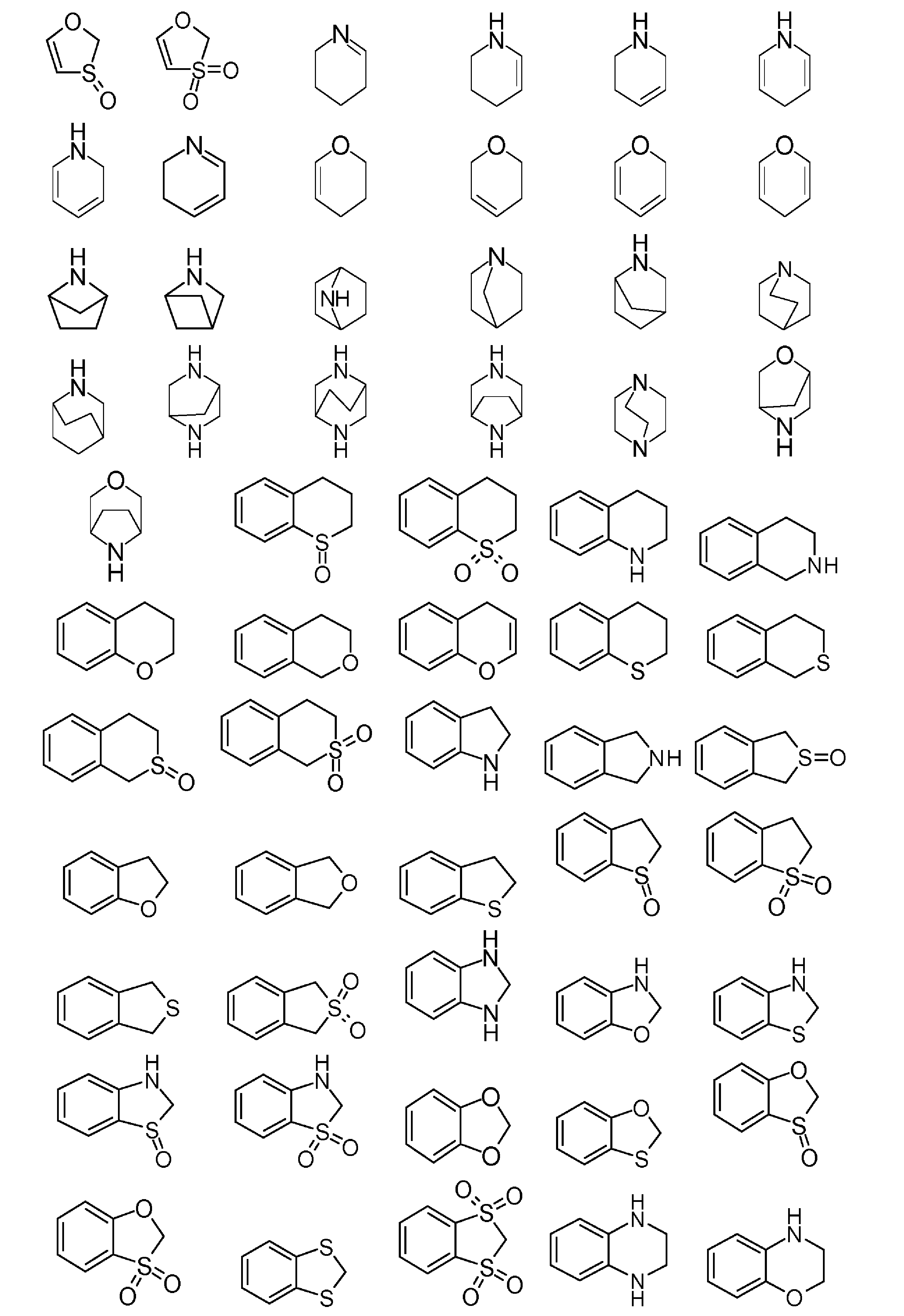

好ましい単環式ヘテロシクリルは、4~7員であり、酸素、窒素及び硫黄から独立して選択される1個又は2個のヘテロ原子を有する。 Preferred monocyclic heterocyclyls are 4-7 membered and have 1 or 2 heteroatoms independently selected from oxygen, nitrogen and sulfur.
好ましい単環式ヘテロシクリルは、ピペラジニル、ピペリジニル、モルホリニル、ピロリジニル、及びアゼチジニルである。 Preferred monocyclic heterocyclyls are piperazinyl, piperidinyl, morpholinyl, pyrrolidinyl, and azetidinyl.
好ましい二環式ヘテロシクリルは、6~10員であり、酸素、窒素及び硫黄から独立して選択される1個又は2個のヘテロ原子を有する。 Preferred bicyclic heterocyclyls are 6-10 membered and have 1 or 2 heteroatoms independently selected from oxygen, nitrogen and sulfur.
好ましい三環式ヘテロシクリルは、9員であり、酸素、窒素及び硫黄から独立して選択される1個又は2個のヘテロ原子を有する。 Preferred tricyclic heterocyclyls are 9-membered and have 1 or 2 heteroatoms independently selected from oxygen, nitrogen, and sulfur.
好ましいスピロ-ヘテロシクリルは、7~11員であり、酸素、窒素及び硫黄から独立して選択される1個又は2個のヘテロ原子を有する。 Preferred spiro-heterocyclyls are 7-11 membered and have 1 or 2 heteroatoms independently selected from oxygen, nitrogen and sulfur.
ヘテロシクリルの上記定義はまた、ヘテロシクリルが、例えば、ヘテロシクリルアミノ、ヘテロシクリルオキシ又はヘテロシクリルアルキルなど、別の(組み合わされた)基の一部である場合にも適用される。 The above definition of heterocyclyl also applies if heterocyclyl is part of another (combined) group, such as, for example, heterocyclylamino, heterocyclyloxy or heterocyclylalkyl.
ヘテロシクリルの自由原子価が飽和している場合、複素環が得られる。 If the free valence of a heterocyclyl is saturated, a heterocyclic ring is obtained.
ヘテロシクリレンという用語がまた、先に定義したヘテロシクリルから誘導される。ヘテロシクリレンは、ヘテロシクリルとは異なり、二価であり、2つの結合パートナーを必要とする。形式的には、第二の原子価は、ヘテロシクリルから水素原子を除去することによって得られる。対応する基は、例えば、以下である:
ピペリジニル及び

2,3-ジヒドロ-1H-ピロリル及び

Piperidinyl and
2,3-Dihydro-1H-pyrrolyl and
ヘテロシクリレンの上記定義はまた、ヘテロシクリレンが、例えば、HO-ヘテロシクリレンアミノ又はH2N-ヘテロシクリレンオキシなど、別の(組み合わされた)基の一部である場合にも適用される。 The above definition of heterocyclylene also applies if heterocyclylene is part of another (combined) group, such as, for example, HO-heterocyclyleneamino or H 2 N-heterocyclyleneoxy.
ヘテロアリールは、対応するアリール又はシクロアルキル(シクロアルケニル)と比較して、1つ又は複数の炭素原子の代わりに、窒素、硫黄及び酸素の中から互いに独立して選択される1つ又は複数の同一又は異なるヘテロ原子を含有する、単環式ヘテロ芳香族環又は少なくとも1つのヘテロ芳香族環を有する多環式環を表し、ここで、結果として生じる基は、化学的に安定でなければならない。ヘテロアリールの存在の必要条件は、ヘテロ原子及びヘテロ芳香族系である。 Heteroaryl represents a monocyclic heteroaromatic ring or a polycyclic ring having at least one heteroaromatic ring, which contains, in place of one or more carbon atoms, one or more identical or different heteroatoms selected from among nitrogen, sulfur and oxygen, in comparison with the corresponding aryl or cycloalkyl(alkenyl), where the resulting group must be chemically stable. The prerequisite for the presence of heteroaryl is the heteroatom and the heteroaromatic system.
ヘテロアリールが置換される場合、置換は、各場合に単置換又は多置換の形態で、すべての水素担持炭素及び/又は窒素原子上で、互いに独立して行われ得る。ヘテロアリールそれ自体が、置換基として、環系のあらゆる適切な位置、すなわち炭素及び窒素の両方を介して分子に連結されていてよい。ヘテロアリール上の置換基にとって、ヘテロアリールの員数は重要でない。 If a heteroaryl is substituted, the substitutions may take place independently of one another, in the form of mono- or polysubstitutions in each case, on all hydrogen-carrying carbon and/or nitrogen atoms. The heteroaryl itself may be linked to the molecule as a substituent at any suitable position of the ring system, i.e. both via carbon and nitrogen. For the substituents on a heteroaryl, the number of members of the heteroaryl is not critical.
ヘテロアリールの例は、フリル、チエニル、ピロリル、オキサゾリル、チアゾリル、イソオキサゾリル、イソチアゾリル、ピラゾリル、イミダゾリル、トリアゾリル、テトラゾリル、オキサジアゾリル、チアジアゾリル、ピリジル、ピリミジル、ピリダジニル、ピラジニル、トリアジニル、ピリジル-N-オキシド、ピロリル-N-オキシド、ピリミジニル-N-オキシド、ピリダジニル-N-オキシド、ピラジニル-N-オキシド、イミダゾリル-N-オキシド、イソオキサゾリル-N-オキシド、オキサゾリル-N-オキシド、チアゾリル-N-オキシド、オキサジアゾリル-N-オキシド、チアジアゾリル-N-オキシド、トリアゾリル-N-オキシド、テトラゾリル-N-オキシド、インドリル、イソインドリル、ベンゾフリル、ベンゾチエニル、ベンズオキサゾリル、ベンゾチアゾリル、ベンズイソオキサゾリル、ベンズイソチアゾリル、ベンズイミダゾリル、インダゾリル、イソキノリニル、キノリニル、キノキサリニル、シンノリニル、フタラジニル、キナゾリニル、ベンゾトリアジニル、インドリジニル、オキサゾロピリジル、イミダゾピリジル、ナフチリジニル、ベンズオキサゾリル、ピリドピリジル、ピリミドピリジル、プリニル、プテリジニル、ベンゾチアゾリル、イミダゾピリジル、イミダゾチアゾリル、キノリニル-N-オキシド、インドリル-N-オキシド、イソキノリル-N-オキシド、キナゾリニル-N-オキシド、キノキサリニル-N-オキシド、フタラジニル-N-オキシド、インドリジニル-N-オキシド、インダゾリル-N-オキシド、ベンゾチアゾリル-N-オキシド、ベンズイミダゾリル-N-オキシドなどである。 Examples of heteroaryl are furyl, thienyl, pyrrolyl, oxazolyl, thiazolyl, isoxazolyl, isothiazolyl, pyrazolyl, imidazolyl, triazolyl, tetrazolyl, oxadiazolyl, thiadiazolyl, pyridyl, pyrimidyl, pyridazinyl, pyrazinyl, triazinyl, pyridyl-N-oxide, pyrrolyl-N-oxide, pyrimidinyl-N-oxide, pyridazinyl-N-oxide, pyrazinyl-N-oxide, imidazolyl-N-oxide, isoxazolyl-N-oxide, oxazolyl-N-oxide, thiazolyl-N-oxide, oxadiazolyl-N-oxide, thiadiazolyl-N-oxide, triazolyl-N-oxide, tetrazolyl-N-oxide, indolyl, isoindolyl, benzofuryl, benzothienyl, benzoxazolyl, benzo zothiazolyl, benzisoxazolyl, benzisothiazolyl, benzimidazolyl, indazolyl, isoquinolinyl, quinolinyl, quinoxalinyl, cinnolinyl, phthalazinyl, quinazolinyl, benzotriazinyl, indolizinyl, oxazolopyridyl, imidazopyridyl, naphthyridinyl, benzoxazolyl, pyridopyridyl, pyrimidopyridyl, purinyl, pteridinyl, ben These include zothiazolyl, imidazopyridyl, imidazothiazolyl, quinolinyl N-oxide, indolyl N-oxide, isoquinolyl N-oxide, quinazolinyl N-oxide, quinoxalinyl N-oxide, phthalazinyl N-oxide, indolizinyl N-oxide, indazolyl N-oxide, benzothiazolyl N-oxide, and benzimidazolyl N-oxide.
更なる例は、以下に図示している構造であり、これらは、各水素担持原子を介して結合(水素と交換)され得る:
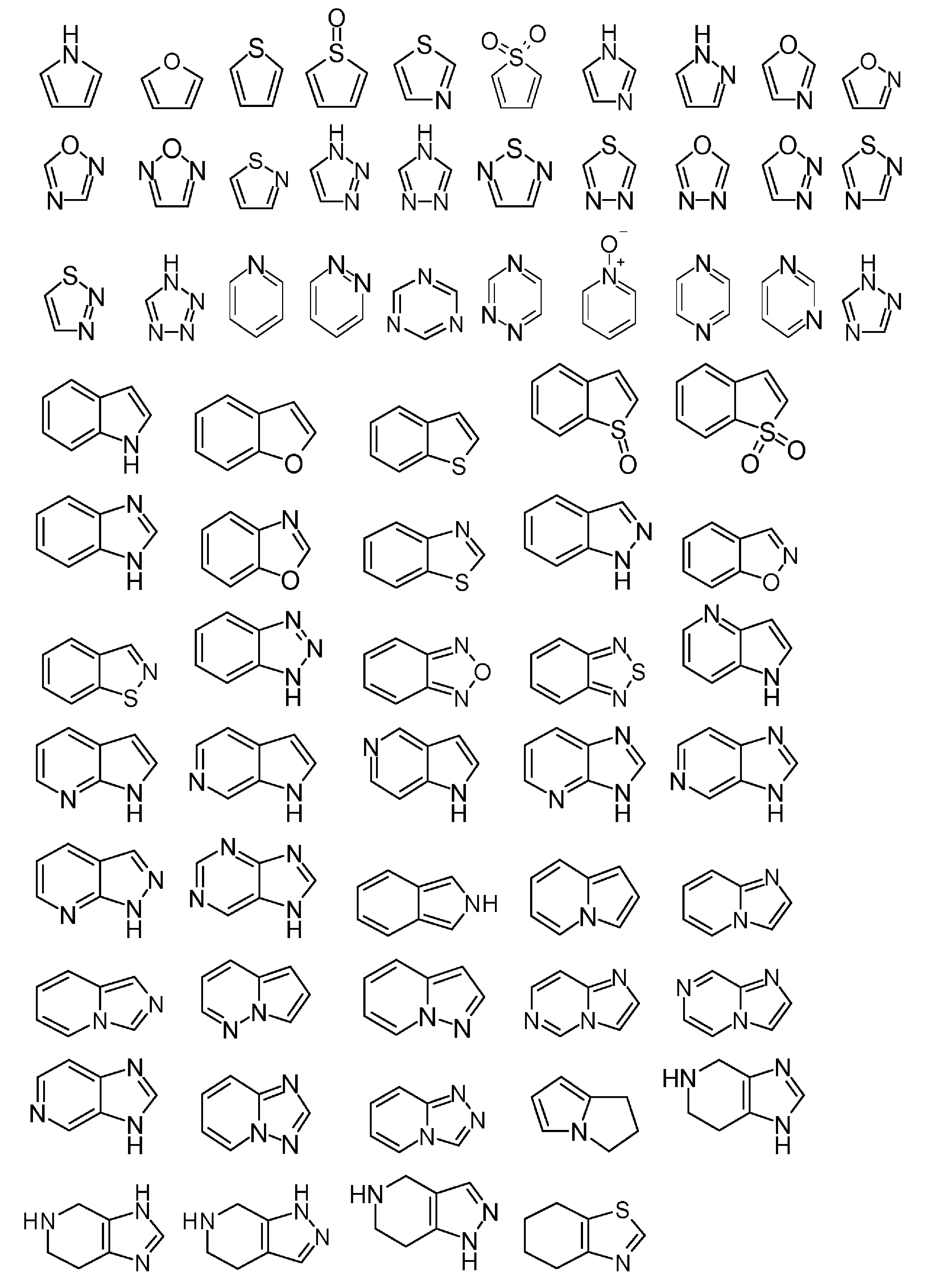
好ましくは、ヘテロアリールは、酸素、窒素及び硫黄から独立して選択される1~4個のヘテロ原子をそれぞれ有する5~6員単環式又は9~10員二環式である。 Preferably, the heteroaryl is a 5- to 6-membered monocyclic or 9- to 10-membered bicyclic ring, each having 1 to 4 heteroatoms independently selected from oxygen, nitrogen, and sulfur.
ヘテロアリールの上記定義はまた、ヘテロアリールが、例えば、ヘテロアリールアミノ、ヘテロアリールオキシ又はヘテロアリールアルキルなど、別の(組み合わされた)基の一部である場合にも適用される。 The above definition of heteroaryl also applies if heteroaryl is part of another (combined) group, such as, for example, heteroarylamino, heteroaryloxy or heteroarylalkyl.
ヘテロアリールの自由原子価が飽和している場合、ヘテロ芳香族基が得られる。 If the free valence of a heteroaryl is saturated, a heteroaromatic group is obtained.
ヘテロアリーレンという用語がまた、先に定義したヘテロアリールから誘導される。ヘテロアリーレンは、ヘテロアリールとは異なり、二価であり、2つの結合パートナーを必要とする。形式的には、第二の原子価は、ヘテロアリールから水素原子を除去することによって得られる。対応する基は、例えば、以下である:
ピロリル及び

Pyrrolyl and
ヘテロアリーレンの上記定義はまた、ヘテロアリーレンが、例えば、HO-ヘテロアリーレンアミノ又はH2N-ヘテロアリーレンオキシなど、別の(組み合わされた)基の一部である場合にも適用される。 The above definition of heteroarylene also applies if heteroarylene is part of another (combined) group, such as, for example, HO-heteroaryleneamino or H 2 N-heteroaryleneoxy.
置換されているとは、検討中の原子に直接結合している水素原子が、別の原子又は別の原子の基(置換基)により置き換えられていることを意味する。出発条件(水素原子の数)に応じて、1個の原子上で単置換又は多置換が行われ得る。特定の置換基による置換は、置換基の許容される原子価と置換される原子の許容される原子価とが互いに対応し、かつ置換が安定な化合物(すなわち、例えば転位、環化又は脱離によって、自発的に変換されない化合物)をもたらす場合にのみ可能である。 Substituted means that the hydrogen atom directly bonded to the atom under consideration is replaced by another atom or a group of another atom (substituent). Depending on the starting conditions (number of hydrogen atoms), mono- or polysubstitutions can be made on an atom. Substitution with a specific substituent is only possible if the allowed valences of the substituent and the allowed valences of the atom to be substituted correspond to each other and the substitution results in a stable compound (i.e., a compound that is not spontaneously transformed, for example, by rearrangement, cyclization or elimination).
=S、=NR、=NOR、=NNRR、=NN(R)C(O)NRR、=N2などのような二価の置換基は、炭素原子上の置換基としてのみ可能であるが、二価の置換基=O及び=NRは、硫黄上の置換基であることも可能である。一般的に、置換は、二価の置換基により環系でのみ行われてよく、2個のジェミナルな水素原子、すなわち、置換前に飽和している同じ炭素原子に結合している水素原子の置き換えを必要とする。それゆえ、二価の置換基による置換は、環系の基-CH2-又は硫黄原子(=O基若しくは=NR基のみ、1個若しくは2個の=O基が可能、又は、例えば、1つの=O基及び1つの=NR基、各基は、自由電子対と置き換わる)でのみ可能である。 Divalent substituents such as =S, =NR, =NOR, =NNRR, =NN(R)C(O)NRR, = N2 etc. are only possible as substituents on carbon atoms, but the divalent substituents =O and =NR can also be substituents on sulfur. In general, substitutions may only take place on ring systems by divalent substituents and require the replacement of two geminal hydrogen atoms, i.e. hydrogen atoms attached to the same carbon atom which is saturated before the substitution. Substitution by divalent substituents is therefore only possible on the group -CH 2 - or on the sulfur atom of the ring system (only =O or =NR groups, one or two =O groups possible, or for example one =O and one =NR group, each group replacing a free electron pair).
同位体:本発明の原子又は化合物のすべての開示は、すべての適切な同位体変化を含むものと理解されるべきである。特に、水素への言及はまた、重水素も含む。 Isotopes: Any disclosure of atoms or compounds of the invention is to be understood to include all suitable isotopic variations. Specifically, reference to hydrogen also includes deuterium.
立体化学/溶媒和物/水和物:具体的に示されない限り、本明細書及び添付の特許請求の範囲の全体を通して、所与の化学式又は化学名は、互変異性体と、すべての立体、光学及び幾何異性体(例えば、エナンチオマー、ジアステレオマー、E/Z異性体など)と、それらのラセミ体、並びに異なる割合の別個のエナンチオマーの混合物、ジアステレオマーの混合物、又はそのような異性体及びエナンチオマーが存在する場合は前述の形態のいずれかの混合物、並びにそれらの薬学的に許容される塩を含めた塩、並びにそれらの溶媒和物、例えば、遊離化合物の溶媒和物及び水和物又はその化合物の塩の溶媒和物及び水和物を含めた水和物などを包含するものとする。 Stereochemistry/Solvates/Hydrates: Unless specifically indicated, throughout this specification and the appended claims, a given chemical formula or name is intended to encompass tautomers and all stereo, optical and geometric isomers (e.g., enantiomers, diastereomers, E/Z isomers, etc.) thereof, as well as racemates, as well as mixtures of the separate enantiomers in differing proportions, mixtures of diastereomers, or mixtures of any of the foregoing forms, where such isomers and enantiomers exist, as well as salts, including pharmaceutically acceptable salts, thereof, and solvates thereof, such as solvates and hydrates of the free compounds or of a salt of the compounds.
一般に、実質的に純粋な立体異性体は、当業者に公知の合成原理に従って、例えば、対応する混合物の分離、立体化学的に純粋な出発物質の使用及び/又は立体選択的合成によって得ることができる。光学活性体を、例えば、ラセミ体の分割によって又は合成によって、例えば、光学活性な出発物質から出発する及び/又はキラル試薬を使用することによって調製する方法は、当技術分野において公知である。 In general, substantially pure stereoisomers can be obtained according to synthetic principles known to those skilled in the art, for example, by separation of the corresponding mixtures, by use of stereochemically pure starting materials and/or by stereoselective synthesis. Methods for preparing optically active forms, for example, by resolution of racemates or by synthesis, for example, starting from optically active starting materials and/or using chiral reagents, are known in the art.
本発明の鏡像異性的に純粋な化合物又は中間体は、不斉合成を介して、例えば、公知の方法(例えば、クロマトグラフ分離若しくは結晶化)により分離できる適切なジアステレオマー化合物若しくは中間体の調製とその後の分離によって、及び/又は、キラル試薬、例えばキラル出発物質、キラル触媒若しくはキラル助剤を使用することによって調製され得る。 The enantiomerically pure compounds or intermediates of the invention may be prepared via asymmetric synthesis, for example by preparation and subsequent separation of suitable diastereomeric compounds or intermediates which can be separated by known methods (e.g., chromatographic separation or crystallization), and/or by using chiral reagents, such as chiral starting materials, chiral catalysts or chiral auxiliaries.
更に、対応するラセミ混合物から、例えば、キラル固定相上での対応するラセミ混合物のクロマトグラフ分離よって、又は適切な分割剤を使用したラセミ混合物の分割、例えば、ラセミ化合物と光学活性な酸若しくは塩基とのジアステレオマー塩の形成とその後の塩の分割及び塩からの所望の化合物の遊離によって、又は光学活性なキラル補助試薬による対応するラセミ化合物の誘導体化とその後のジアステレオマー分離及びキラル補助基の除去によって、又はラセミ体の速度論的分割(例えば、酵素的分割)よって;適切な条件下での鏡像異性結晶の集合体からのエナンチオ選択的結晶化よって、又は光学活性なキラル助剤の存在下での適切な溶媒からの(分別)結晶化よって、鏡像異性的に純粋な化合物を調製する方法も当業者に公知である。 Furthermore, methods for preparing enantiomerically pure compounds from the corresponding racemic mixtures are also known to the skilled artisan, for example by chromatographic separation of the corresponding racemic mixtures on chiral stationary phases or by resolution of the racemic mixtures using suitable resolving agents, for example by formation of diastereomeric salts of the racemates with optically active acids or bases followed by resolution of the salts and liberation of the desired compound from the salts, or by derivatization of the corresponding racemates with optically active chiral auxiliary reagents followed by diastereomeric separation and removal of the chiral auxiliary, or by kinetic resolution of the racemates (for example enzymatic resolution); by enantioselective crystallization from a conglomerate of enantiomeric crystals under suitable conditions or by (fractional) crystallization from a suitable solvent in the presence of an optically active chiral auxiliary.
塩:「薬学的に許容される」という語句は、本明細書において、適切な医学的判断の範囲内で、過度の毒性、刺激、アレルギー反応又は他の問題若しくは合併症がなく、ヒト及び動物の組織と接触させる使用に適しており、かつ妥当な利益/リスク比に見合う、化合物、材料、組成物及び/又は剤形のことを指すために用いられる。 Salts: The phrase "pharmacologically acceptable" is used herein to refer to compounds, materials, compositions and/or dosage forms that are, within the scope of sound medical judgment, suitable for use in contact with the tissues of human beings and animals without undue toxicity, irritation, allergic response, or other problem or complication, and are commensurate with a reasonable benefit/risk ratio.
本明細書において使用される場合、「薬学的に許容される塩」は、親化合物がその酸性又は塩性の塩を作製することにより修飾されている開示化合物の誘導体のことを指す。薬学的に許容される塩の例には、アミンなどの塩基性残基の無機酸塩又は有機酸塩;カルボン酸などの酸性残基のアルカリ塩又は有機塩などが含まれるが、それらに限定されない。 As used herein, "pharmaceutically acceptable salts" refers to derivatives of the disclosed compounds in which the parent compound is modified by making an acid or base salt thereof. Examples of pharmaceutically acceptable salts include, but are not limited to, inorganic or organic acid salts of basic residues such as amines; alkali or organic salts of acidic residues such as carboxylic acids; and the like.
例えば、そのような塩には、ベンゼンスルホン酸、安息香酸、クエン酸、エタンスルホン酸、フマル酸、ゲンチジン酸、臭化水素酸、塩酸、マレイン酸、リンゴ酸、マロン酸、マンデル酸、メタンスルホン酸、4-メチル-ベンゼンスルホン酸、リン酸、サリチル酸、コハク酸、硫酸及び酒石酸からの塩が含まれる。 For example, such salts include salts from benzenesulfonic acid, benzoic acid, citric acid, ethanesulfonic acid, fumaric acid, gentisic acid, hydrobromic acid, hydrochloric acid, maleic acid, malic acid, malonic acid, mandelic acid, methanesulfonic acid, 4-methyl-benzenesulfonic acid, phosphoric acid, salicylic acid, succinic acid, sulfuric acid and tartaric acid.
更なる薬学的に許容される塩は、アンモニア、L-アルギニン、カルシウム、2,2’-イミノビスエタノール、L-リシン、マグネシウム、N-メチル-D-グルカミン、カリウム、ナトリウム及びトリス(ヒドロキシメチル)-アミノメタンからのカチオンと形成することができる。 Further pharma- ceutically acceptable salts can be formed with cations from ammonia, L-arginine, calcium, 2,2'-iminobisethanol, L-lysine, magnesium, N-methyl-D-glucamine, potassium, sodium and tris(hydroxymethyl)-aminomethane.
本発明の薬学的に許容される塩は、塩基性又は酸性部分を含有する親化合物から、従来の化学的方法によって合成することができる。一般的に、そのような塩は、水中で、あるいはエーテル、酢酸エチル、エタノール、イソプロパノール若しくはアセトニトリル又はそれらの混合物のような有機希釈剤中で、遊離酸又は遊離塩基の形態のこれらの化合物を十分な量の適切な塩基又は酸と反応させることによって調製することができる。 The pharma- ceutically acceptable salts of the present invention can be synthesized from a parent compound that contains a basic or acidic moiety by conventional chemical methods. Generally, such salts can be prepared by reacting the free acid or free base form of these compounds with a sufficient amount of the appropriate base or acid in water or an organic diluent such as ether, ethyl acetate, ethanol, isopropanol, or acetonitrile, or a mixture thereof.
例えば、本発明の化合物の精製又は単離に有用な上述したもの以外の酸の塩(例えば、トリフルオロ酢酸塩)も本発明の一部を構成する。 For example, salts of acids other than those mentioned above that are useful for purifying or isolating the compounds of the invention (e.g., trifluoroacetate salts) also form part of the invention.
例えば、

などの描写において、文字Aは、より簡単にするために、例えば、他の環に対する当該環の結合を示すために、環を指定する機能を有する。
for example,
In depictions such as these, the letter A serves the function of designating a ring for easier reference, e.g., to indicate the attachment of that ring to another ring.
二価基では、どの隣接基と結合するか、どの原子価を有するかを決定することが非常に重要であり、以下の描写のように、対応する結合パートナーが、必要に応じて、明確化のために括弧内に示される:

又は
(R2)-C(=O)NH-又は(R2)-NHC(=O)-。
For divalent groups, it is very important to determine which adjacent group it is bonded to and with what valency, and the corresponding bond partner is shown in parentheses for clarity, where necessary, as in the following depiction:
or (R 2 )-C(=O)NH- or (R 2 )-NHC(=O)-.
そのような明確化が見られない場合、二価基は、両方向で結合することができ、すなわち、例えば、-C(=O)NH-はまた、-NHC(=O)-も含む(逆もまた同様)。 If no such clarification is given, divalent groups can be attached in both directions, i.e., for example, -C(=O)NH- also includes -NHC(=O)- (and vice versa).
基又は置換基は、たびたび、対応する基が指定された多数の代替の基/置換基(例えば、Ra、Rbなど)の中から選択される。本発明に係る化合物を定義するためにそのような基が分子の異なる部分で繰り返し使用される場合、その様々な使用は、互いに完全に独立していると見なされるべきであることが示唆される。 Groups or substituents are often selected from among a number of alternative groups/substituents for which the corresponding group is designated (e.g., R a , R b, etc.). When such a group is used repeatedly in different parts of the molecule to define a compound according to the invention, it is implied that the various uses are to be considered completely independent of each other.
本発明の目的としての治療上有効な量とは、病気の症状を取り除くかこれらの症状を予防若しくは緩和することが可能である、又は処置された患者の生存を延長する、物質の量のことを意味する。 For purposes of this invention, a therapeutically effective amount means an amount of a substance that is capable of eliminating symptoms of a disease or preventing or alleviating these symptoms, or prolonging the survival of the treated patient.
略称の列記

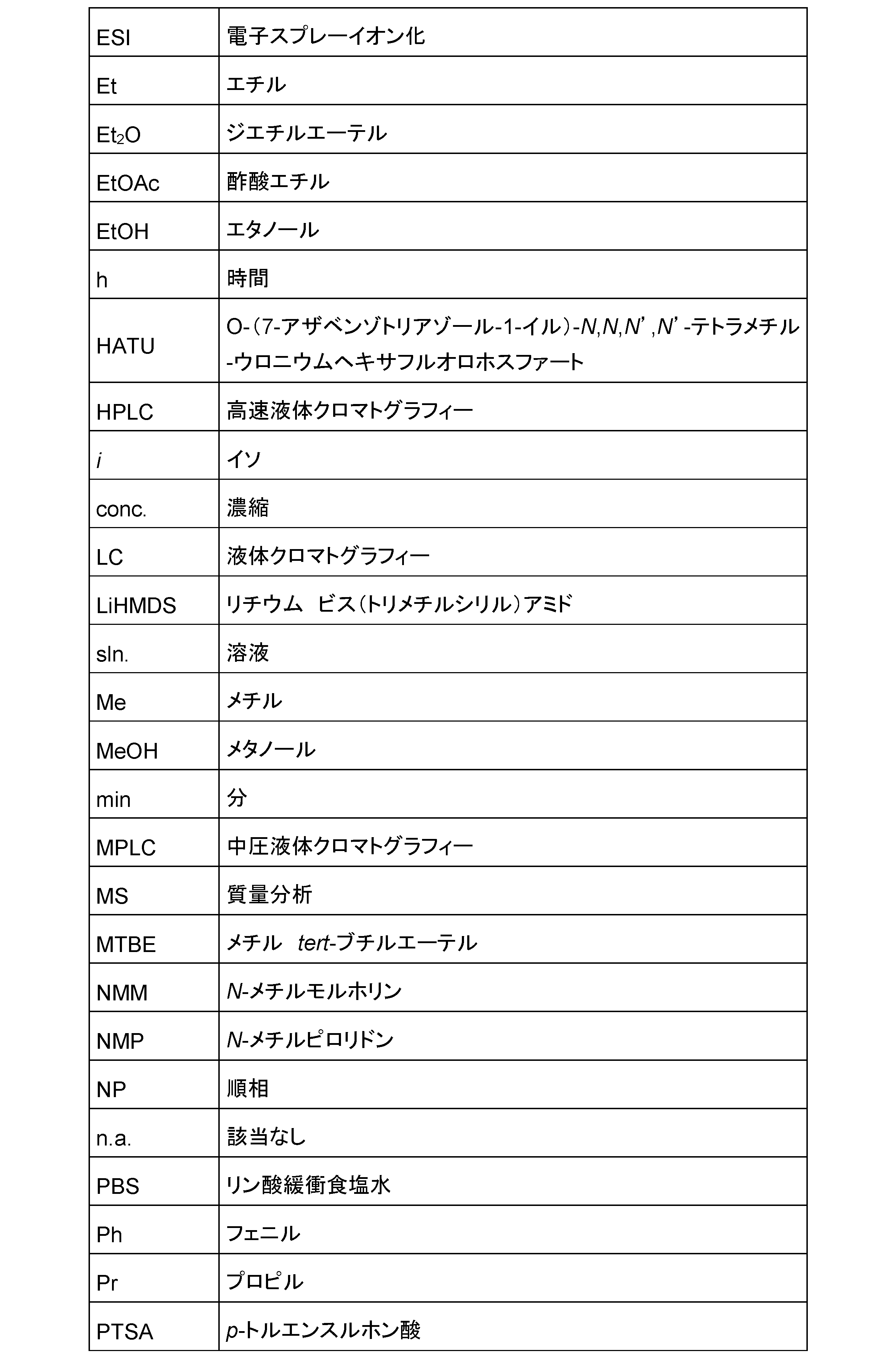

本発明の特徴及び利点は、範囲を限定せずに例として本発明の原理を説明する、以下の詳細な例から明らかとなるだろう: Features and advantages of the present invention will become apparent from the following detailed examples, which illustrate, by way of example and not by way of limiting the scope, the principles of the invention:
本発明に係る化合物の調製
概要
特に定めのない限り、反応はすべて、市販の装置内で、化学実験室で一般に使用される方法を使用して実施される。空気及び/又は水分に敏感な出発物質は、保護ガス下で保管され、それに対応する反応及び操作は、保護ガス(窒素又はアルゴン)下で実施される。
Preparation of the compounds according to the invention Overview Unless otherwise specified, all reactions are carried out in commercially available equipment using methods commonly used in chemical laboratories. Starting materials that are sensitive to air and/or moisture are stored under protective gas and the corresponding reactions and manipulations are carried out under protective gas (nitrogen or argon).
化合物が構造式とその命名法の両方によって表される場合、矛盾する場合には、構造式が決め手となる。 When a compound is represented by both a structural formula and its nomenclature, in case of conflict, the structural formula is decisive.
マイクロ波反応は、Biotage社製の合成装置/反応器で、又はCEM社製のExplorerで、又はAnton Paar社製のSynthos 3000若しくはMonowave 3000で、密閉容器(好ましくは、2、5又は20mL)中にて、好ましくは撹拌しながら実施される。 Microwave reactions are carried out in a Biotage synthesizer/reactor, or a CEM Explorer, or an Anton Paar Synthos 3000 or Monowave 3000, in a closed vessel (preferably 2, 5 or 20 mL), preferably with stirring.
クロマトグラフィー
薄層クロマトグラフィーは、Merck社の既製のシリカゲル60のTLCガラスプレート(蛍光指示薬F-254を用いて)で実施される。
Chromatography Thin layer chromatography is performed on Merck pre-made silica gel 60 TLC glass plates (with fluorescent indicator F-254).
本発明に係る例示化合物の分取高圧クロマトグラフィー(RP HPLC)は、Waters社製のカラム(名称:SunFire(商標)Prep C18, OBD(商標)10μm, 50×150mm又はSunFire(商標)Prep C18 OBD(商標)5μm, 30×50mm又はXBridge(商標)Prep C18, OBD(商標)10μm, 50×150mm又はXBridge(商標)Prep C18, OBD(商標)5μm, 30×150mm又はXBridge(商標)Prep C18, OBD(商標)5μm, 30×50mm)及びYMC社製のカラム(名称:Actus-Triart Prep C18, 5μm, 30×50mm)を用いて、Agilent又はGilsonシステムで実施される。 Preparative high pressure chromatography (RP HPLC) of the exemplary compounds according to the present invention is carried out on an Agilent or Gilson system using a Waters column (designation: SunFire™ Prep C18, OBD™ 10 μm, 50×150 mm or SunFire™ Prep C18 OBD™ 5 μm, 30×50 mm or XBridge™ Prep C18, OBD™ 10 μm, 50×150 mm or XBridge™ Prep C18, OBD™ 5 μm, 30×150 mm or XBridge™ Prep C18, OBD™ 5 μm, 30×50 mm) and a YMC column (designation: Actus-Triart Prep C18, 5 μm, 30×50 mm).
H2O/アセトニトリルの異なる勾配を使用して化合物を溶出させるが、Agilentシステムでは、5%酸性調整剤(20mL HCOOH~1L H2O/アセトニトリル(1/1))を水に加える(酸性条件)。Gilsonシステムでは、水を0.1%HCOOHに加える。 Different gradients of H2O /acetonitrile are used to elute the compounds, where in the Agilent system 5% acidity modifier (20 mL HCOOH to 1 L H2O /acetonitrile (1/1)) is added to the water (acidic conditions), and in the Gilson system water is added to 0.1% HCOOH.
Agilentシステムの塩基性条件下でのクロマトグラフィーでは、H2O/アセトニトリル勾配を同じく使用するが、5%塩基性調整剤(50g NH4HCO3+50mL NH3(H2O中25%)をH2Oで1Lにする)を加えることによって水をアルカリ性にする。Gilsonシステムでは、以下のようにして水をアルカリ性にする:5mL NH4HCO3溶液(1L H2O中158g)及び2mL NH3(H2O中28%)にH2Oを補充して1Lにする。 For chromatography under basic conditions on the Agilent system, the same H2O /acetonitrile gradient is used, but the water is made alkaline by adding a 5% basic modifier (50 g NH4HCO3 + 50 mL NH3 (25% in H2O ) to 1 L with H2O ). For the Gilson system, the water is made alkaline as follows: 5 mL NH4HCO3 solution (158 g in 1 L H2O ) and 2 mL NH3 (28% in H2O ) made up to 1 L with H2O .
本発明に係る中間体及び例示化合物の超臨界流体クロマトグラフィー(SFC)は、以下のカラムを用いてJASCO SFCシステムで実施される:Chiralcel OJ(250×20mm, 5μm)、Chiralpak AD(250×20mm, 5μm)、Chiralpak AS(250×20mm, 5μm)、Chiralpak IC(250×20mm, 5μm)、Chiralpak IA(250×20mm, 5μm)、Chiralcel OJ(250×20mm, 5μm)、Chiralcel OD(250×20mm, 5μm)、Phenomenex Lux C2(250×20mm, 5μm)。 Supercritical fluid chromatography (SFC) of the intermediates and example compounds of the present invention is performed on a JASCO SFC system using the following columns: Chiralcel OJ (250 x 20 mm, 5 μm), Chiralpak AD (250 x 20 mm, 5 μm), Chiralpak AS (250 x 20 mm, 5 μm), Chiralpak IC (250 x 20 mm, 5 μm), Chiralpak IA (250 x 20 mm, 5 μm), Chiralcel OJ (250 x 20 mm, 5 μm), Chiralcel OD (250 x 20 mm, 5 μm), Phenomenex Lux C2 (250 x 20 mm, 5 μm).
中間体及び最終化合物の分析HPLC(反応制御)は、Waters社製のカラム(名称:XBridge(商標)C18, 2.5μm, 2.1×20mm又はXBridge(商標)C18, 2.5μm, 2.1×30mm又はAquity UPLC BEH C18, 1.7μm, 2.1×50mm)及びYMC社製のカラム(名称:Triart C18, 3.0μm, 2.0×30mm)及びPhenomenex社製のカラム(名称:Luna C18, 5.0μm, 2.0×30mm)を使用して実施される。分析機器はまた、各場合に質量検出器も装備する。 Analytical HPLC (reaction control) of intermediates and final compounds is carried out using columns from Waters (designation: XBridge™ C18, 2.5 μm, 2.1×20 mm or XBridge™ C18, 2.5 μm, 2.1×30 mm or Aquity UPLC BEH C18, 1.7 μm, 2.1×50 mm) and columns from YMC (designation: Triart C18, 3.0 μm, 2.0×30 mm) and Phenomenex (designation: Luna C18, 5.0 μm, 2.0×30 mm). The analytical instruments are also equipped with a mass detector in each case.
HPLC質量分析/UV分光分析
本発明に係る例示化合物を特徴付けるための保持時間/MS-ESI+は、HPLC-MS装置(質量検出器を備えた高速液体クロマトグラフィー)を使用して生成される。注入ピークで溶出する化合物を保持時間tRet.=0.00とする。
HPLC-Mass Spectrometry/UV Spectroscopy Retention times/MS-ESI + for characterizing the exemplary compounds according to the present invention are generated using an HPLC-MS instrument (High Performance Liquid Chromatography with Mass Detector). Compounds eluting with the injected peak are assigned a retention time tRet. = 0.00.
方法A
HPLC Agilent 1100システム
MS 1200Series LC/MSD(API-ES+/-3000V, Quadrupol, G6140)
MSDシグナル設定 スキャンポジティブ/ネガティブ 120~900m/z
検出シグナル 315nm(帯域幅170nm、リファレンスオフ)
スペクトル範囲 230~400nm
ピーク幅 <0.01分
カラム Waters, Xbridge C18, 2.5μm, 2.1×20mmカラム
カラム温度 60℃
溶媒 A:20mM NH4HCO3/NH3(H2O中)pH 9
B:ACN HPLC等級
流量 1.00mL/分
勾配 0.00~1.50分 10%~95% B
1.50~2.00分 95% B
2.00~2.10分 95%~10% B
Method A
HPLC Agilent 1100 System MS 1200 Series LC/MSD (API-ES+/-3000V, Quadrupol, G6140)
MSD signal settings: Scan positive/negative 120-900 m/z
Detection signal: 315 nm (bandwidth 170 nm, reference off)
Spectral range: 230-400 nm
Peak width <0.01 min Column Waters, Xbridge C18, 2.5 μm, 2.1 x 20 mm column Column temperature 60°C
Solvent A: 20mM NH4HCO3 / NH3 (in H2O ) pH 9
B: ACN HPLC grade Flow rate 1.00mL/min Gradient 0.00-1.50 min 10%-95% B
1.50-2.00 minutes 95% B
2.00~2.10 minutes 95%~10% B
方法B
HPLC Agilent 1260システム
MS 1200 Series LC/MSD(MM-ES+APCI+/-3000V, Quadrupol, G6130)
検出 UV:254nm(帯域幅8、リファレンスオフ)
UV:230nm(帯域幅8、リファレンスオフ)
UVスペクトル範囲:190~400nm;ステップ:4nm
MS:ポジティブ及びネガティブモード
質量範囲 100~800m/z
カラム Waters;Part. No. 186003389;XBridge BEH C18, 2,5μm, 30×2.1mm
カラム温度 45℃
溶媒 A:5mM NH4HCO3/19mM NH3(H2O中);B:ACN(HPLC等級)
流量 1.40mL/分
勾配 0.00~1.00分:5% B~100% B
1.00~1.37分:100% B
1.37~1.40分:100% B~5% B
Method B
HPLC Agilent 1260 System MS 1200 Series LC/MSD (MM-ES+APCI+/-3000V, Quadrupol, G6130)
Detection UV: 254 nm (bandwidth 8, reference off)
UV: 230 nm (bandwidth 8, reference off)
UV spectrum range: 190-400 nm; step: 4 nm
MS: Positive and negative mode Mass range 100-800 m/z
Column: Waters; Part. No. 186003389; XBridge BEH C18, 2.5 μm, 30 × 2.1 mm
Column temperature: 45°C
Solvent A: 5mM NH4HCO3 /19mM NH3 (in H2O ); B : ACN (HPLC grade)
Flow rate: 1.40 mL/min Gradient: 0.00-1.00 min: 5% B to 100% B
1.00-1.37 minutes: 100% B
1.37 to 1.40 minutes: 100% B to 5% B
方法C
HPLC Agilent 1260 Series
MS Agilent LC/MSD Quadrupole
検出 MS:ポジティブ及びネガティブモード
質量範囲 100~750m/z
カラム Waters X-Bridge BEH C18, 2.5μm, 2.1×30mm XP
カラム温度 45℃
溶媒 A:20mM NH4HCO3/30mM NH3(H2O中);B:ACN(HPLC等級)
流量 1.40mL/分
勾配 0.00~1.00分:15% B~95% B
1.00~1.30分:95% B
Method C
HPLC Agilent 1260 Series
MS Agilent LC/MSD Quadrupole
Detection MS: Positive and negative mode Mass range 100-750 m/z
Column: Waters X-Bridge BEH C18, 2.5 μm, 2.1 x 30 mm XP
Column temperature: 45°C
Solvent A: 20mM NH4HCO3 / 30mM NH3 (in H2O ); B: ACN (HPLC grade)
Flow rate: 1.40 mL/min Gradient: 0.00-1.00 min: 15% B to 95% B
1.00-1.30 minutes: 95% B
方法D
HPLC Agilent 1100/1200システム
MS 1200 Series LC/MSD(MM-ES+APCI+/-3000V, Quadrupol, G6130B)
MSDシグナル設定 スキャンポジティブ 150~750
検出シグナル UV 254nm、230nm、214nm(帯域幅8、リファレンスオフ)
スペクトル範囲:190~400nm;スリット:4nm
ピーク幅 >0.0031分(0.063s応答時間、80Hz)
カラム Waters, Part.No. 186003389、XBridge BEH C18, 2.5μm, 2.1×30mm)カラム
カラム温度 45℃
溶媒 A:5mM NH4HCO3/18mM NH3(H2O中)(pH=9.2)
B:ACN(HPLC等級)
流量 1.4mL/分
勾配 0.0~1.0分 15%~95% B
1.0~1.1分 95% B
停止時間:1.3分
Method D
HPLC Agilent 1100/1200 System MS 1200 Series LC/MSD (MM-ES+APCI+/-3000V, Quadrupol, G6130B)
MSD Signal Settings Scan Positive 150-750
Detection signal UV 254 nm, 230 nm, 214 nm (bandwidth 8, reference off)
Spectral range: 190-400 nm; slit: 4 nm
Peak width >0.0031 min (0.063 s response time, 80 Hz)
Column: Waters, Part. No. 186003389, XBridge BEH C18, 2.5 μm, 2.1 × 30 mm) Column temperature: 45 °C
Solvent A: 5 mM NH4HCO3 /18 mM NH3 in H2O (pH=9.2)
B: ACN (HPLC grade)
Flow rate: 1.4 mL/min Gradient: 0.0-1.0 min 15%-95% B
1.0-1.1 minutes 95% B
Downtime: 1.3 minutes
方法E
HPLC Agilent 1100/1200システム
MS 1200 Series LC/MSD(MM-ES+APCI+/-3000V, Quadrupol, G6130B)
MSDシグナル設定 スキャンポジティブ/ネガティブ 150~750
検出シグナル UV 254nm、230nm、214nm(帯域幅8、リファレンスオフ)
スペクトル範囲:190~400nm;スリット:4nm
ピーク幅 >0.0031分(0.063s応答時間、80Hz)
カラム Waters, Part.No. 186003389、XBridge BEH C18, 2.5μm, 2.1×30mm)カラム
カラム温度 45℃
溶媒 A:5mM NH4HCO3/18mM NH3(H2O中)(pH=9.2)
B:ACN(HPLC等級)
流量 1.4mL/分
勾配 0.0~1.0分 15%~95% B
1.0~1.1分 95% B
停止時間:1.3分
Method E
HPLC Agilent 1100/1200 System MS 1200 Series LC/MSD (MM-ES+APCI+/-3000V, Quadrupol, G6130B)
MSD Signal Settings Scan Positive/Negative 150-750
Detection signal UV 254 nm, 230 nm, 214 nm (bandwidth 8, reference off)
Spectral range: 190-400 nm; slit: 4 nm
Peak width >0.0031 min (0.063 s response time, 80 Hz)
Column: Waters, Part. No. 186003389, XBridge BEH C18, 2.5 μm, 2.1 × 30 mm) Column temperature: 45 °C
Solvent A: 5 mM NH4HCO3 /18 mM NH3 in H2O (pH=9.2)
B: ACN (HPLC grade)
Flow rate: 1.4 mL/min Gradient: 0.0-1.0 min 15%-95% B
1.0-1.1 minutes 95% B
Downtime: 1.3 minutes
方法F
HPLC Agilent 1100/1200システム
MS 1200 Series LC/MSD(API-ES+/-3000/3500V, Quadrupol, G6140A)
MSDシグナル設定 スキャンポジティブ/ネガティブ 150~750
検出シグナル UV 254nm、230nm、214nm(帯域幅10、リファレンスオフ)
スペクトル範囲:190~400nm;スリット:4nm
ピーク幅 >0.0031分(0.063s応答時間、80Hz)
カラム YMC;Part. No. TA12S03-0302WT;Triart C18, 3μm, 12nm;30×2.0mmカラム
カラム温度 45℃
溶媒 A:H2O+0,11%ギ酸
B:ACN+0,1%ギ酸(HPLC等級)
流量 1.4mL/分
勾配 0.0~1.0分 15%~95% B
1.0~1.1分 95% B
停止時間:1.23分
Method F
HPLC Agilent 1100/1200 System MS 1200 Series LC/MSD (API-ES+/-3000/3500V, Quadrupol, G6140A)
MSD Signal Settings Scan Positive/Negative 150-750
Detection signal UV 254 nm, 230 nm, 214 nm (bandwidth 10, reference off)
Spectral range: 190-400 nm; slit: 4 nm
Peak width >0.0031 min (0.063 s response time, 80 Hz)
Column: YMC; Part. No. TA12S03-0302WT; Triart C18, 3 μm, 12 nm; 30 × 2.0 mm column; Column temperature: 45 °C
Solvents A: H2O + 0.11% formic acid B: ACN + 0.1% formic acid (HPLC grade)
Flow rate: 1.4 mL/min Gradient: 0.0-1.0 min 15%-95% B
1.0-1.1 minutes 95% B
Downtime: 1.23 minutes
方法G
UPLC-MS Waters Acquity-UPLC-SQ Detector-2
MSDシグナル設定 スキャンポジティブ&ネガティブ 100~1500、ソース電圧:キャピラリー電圧(kV)-3.50、コーン(V):50、ソース温度:脱溶媒温度(℃):350、原料ガス流量:脱溶媒(L/時間):750、コーン(L/時間):50
検出シグナル Diode Array
スペクトル範囲:200~400nm;解像度:1.2nm
サンプリング速度 10点/秒
カラム AQUITY UPLC BEH C18 1.7μm, 2.1×50mm
カラム温度 35℃
溶媒 A:0.07%ギ酸(ACN中)
B:0.07%ギ酸(水中)
流量 0.6mL/分
勾配 0.0~0.30分 97% B
0.30~2.20分 97%~2% B
2.20~3.30分 2% B
3.30~4.50分 2%~97% B
4.50~4.51分 97% B
Method G
UPLC-MS Waters Acquity-UPLC-SQ Detector-2
MSD signal settings: Scan positive & negative 100-1500, source voltage: capillary voltage (kV) -3.50, cone (V): 50, source temperature: desolvation temperature (°C): 350, raw gas flow rate: desolvation (L/hour): 750, cone (L/hour): 50
Detection signal Diode Array
Spectral range: 200-400 nm; resolution: 1.2 nm
Sampling speed: 10 points/sec. Column: AQUITY UPLC BEH C18 1.7 μm, 2.1 x 50 mm
Column temperature: 35°C
Solvent A: 0.07% formic acid in ACN
B: 0.07% formic acid (in water)
Flow rate: 0.6 mL/min Gradient: 0.0-0.30 min 97% B
0.30-2.20 minutes 97%-2% B
2.20-3.30 minutes 2% B
3.30-4.50 minutes 2%-97% B
4.50-4.51 minutes 97% B
方法H
UPLC-MS Waters Acquity-Binary Solvent Manager-UPLC-SQ Detector-2
MSDシグナル設定 スキャンポジティブ&ネガティブ 100~1500、ソース電圧:キャピラリー電圧(kV)-3.50、コーン(V):50、ソース温度:脱溶媒温度(℃):350、原料ガス流量:脱溶媒(L/時間):750、コーン(L/時間):50
検出シグナル Diode Array
スペクトル範囲:200~400nm;解像度:1.2nm
サンプリング速度 10点/秒
カラム AQUITY UPLC BEH C18 1.7μm, 2.1×50mm
カラム温度 35℃
溶媒 A:0.07%ギ酸(ACN中)
B:0.07%ギ酸(水中)
流量 0.6mL/分
勾配 0.0~0.40分 97% B
0.40~2.50分 97%~2% B
2.50~3.40分 2% B
3.40~3.50分 2%~97% B
3.50~4.0分 97% B
Method H
UPLC-MS Waters Acquity-Binary Solvent Manager-UPLC-SQ Detector-2
MSD signal settings: Scan positive & negative 100-1500, source voltage: capillary voltage (kV) -3.50, cone (V): 50, source temperature: desolvation temperature (°C): 350, raw gas flow rate: desolvation (L/hour): 750, cone (L/hour): 50
Detection signal Diode Array
Spectral range: 200-400 nm; resolution: 1.2 nm
Sampling speed: 10 points/sec. Column: AQUITY UPLC BEH C18 1.7 μm, 2.1 x 50 mm
Column temperature: 35°C
Solvent A: 0.07% formic acid in ACN
B: 0.07% formic acid (in water)
Flow rate: 0.6 mL/min Gradient: 0.0-0.40 min 97% B
0.40-2.50 minutes 97%-2% B
2.50-3.40 minutes 2% B
3.40-3.50 minutes 2%-97% B
3.50-4.0 minutes 97% B
方法I
LC-MS Waters Arc-HPLC-SQ Detector-2
MSDシグナル設定 ESI スキャンポジティブ&ネガティブ キャピラリー電圧3.50Kv コーン電圧30V 脱溶媒ガス750L/時間 脱溶媒温度350℃
カラム X-Bridge C18, 4.6×75mm, 3.5μ
カラム温度 35℃
溶媒 A:10mM 酢酸アンモニウム(水中)
B:ACN
流量 1.0mL/分
勾配 0.0~0.75分 5% B
0.75~1.50分 5%~40% B
1.50~5.0分 40%~98% B
5.0~7.0分 98% B
Method I
LC-MS Waters Arc-HPLC-SQ Detector-2
MSD signal settings: ESI scan positive and negative; Capillary voltage 3.50 Kv; Cone voltage 30 V; Desolvation gas 750 L/hour; Desolvation temperature 350°C.
Column: X-Bridge C18, 4.6 x 75 mm, 3.5 μ
Column temperature: 35°C
Solvent A: 10 mM ammonium acetate (in water)
B: ACN
Flow rate: 1.0 mL/min Gradient: 0.0-0.75 min 5% B
0.75-1.50 minutes 5%-40% B
1.50-5.0 minutes 40%-98% B
5.0-7.0 minutes 98% B
方法J
LC-MS Waters Acquity-UPLC-SQ Detector-2
MSDシグナル設定 ESI スキャンポジティブ&ネガティブ キャピラリー電圧3.50Kv コーン電圧50V 脱溶媒ガス750L/h 脱溶媒温度350℃
カラム Waters Acquity-UPLC-SQ Detector-2
カラム温度 35℃
溶媒 A:0.05%TFA(ACN中)
B:0.05% TFA(水中)
流量 0.6mL/分
勾配 0.0~0.3分 97% B
0.3~2.2分 97%~2% B
2.2~3.3分 2% B
Method J
LC-MS Waters Acquity-UPLC-SQ Detector-2
MSD signal settings: ESI scan positive and negative; Capillary voltage 3.50 Kv; Cone voltage 50 V; Desolvation gas 750 L/h; Desolvation temperature 350°C.
Column: Waters Acquity-UPLC-SQ Detector-2
Column temperature: 35°C
Solvent A: 0.05% TFA in ACN
B: 0.05% TFA (in water)
Flow rate: 0.6 mL/min Gradient: 0.0-0.3 min 97% B
0.3 to 2.2 minutes 97% to 2% B
2.2-3.3 minutes 2% B
方法K
LC-MS Waters Arc-HPLC-SQ Detector-2
MSDシグナル設定 ESI スキャンポジティブ&ネガティブ キャピラリー電圧3.50Kv コーン電圧30V 脱溶媒ガス750L/時間 脱溶媒温度350℃
カラム X-Bridge C18, 4.6×50mm, 3.5μ
カラム温度 35℃
溶媒 A:10mM 酢酸アンモニウム(水中)
B:ACN
流量 2.0mL/分
勾配 0.0~0.2分 10% B
0.2~2.50分 10%~75% B
2.50~3.0分 75%~100% B
3.0~4.8分 100% B
Method K
LC-MS Waters Arc-HPLC-SQ Detector-2
MSD signal settings: ESI scan positive and negative; Capillary voltage 3.50 Kv; Cone voltage 30 V; Desolvation gas 750 L/hour; Desolvation temperature 350°C.
Column: X-Bridge C18, 4.6 x 50 mm, 3.5 μ
Column temperature: 35°C
Solvent A: 10 mM ammonium acetate (in water)
B: ACN
Flow rate: 2.0 mL/min Gradient: 0.0-0.2 min 10% B
0.2-2.50 minutes 10%-75% B
2.50-3.0 minutes 75%-100% B
3.0-4.8 minutes 100% B
方法L
HPLC Agilent 1260 Series
MS Agilent LC/MSD Quadrupole
検出 MS:ポジティブ及びネガティブモード
質量範囲 550~1200m/z
カラム Waters X-Bridge BEH C18, 2.5μm, 2.1×30mm XP
カラム温度 45℃
溶媒 A:20mM NH4HCO3/30mM NH3(H2O中);B:ACN(HPLC等級)
流量 1.40mL/分
勾配 0.00~1.50分:50% B~95% B
1.50~2.00分:95% B
Method L
HPLC Agilent 1260 Series
MS Agilent LC/MSD Quadrupole
Detection MS: Positive and negative mode Mass range 550-1200 m/z
Column: Waters X-Bridge BEH C18, 2.5 μm, 2.1 x 30 mm XP
Column temperature: 45°C
Solvent A: 20mM NH4HCO3 / 30mM NH3 (in H2O ); B: ACN (HPLC grade)
Flow rate: 1.40 mL/min Gradient: 0.00-1.50 min: 50% B to 95% B
1.50-2.00 minutes: 95% B
方法M
HPLC Agilent 1260 Series
MS Agilent LC/MSD Quadrupole
検出 MS:ポジティブ及びネガティブモード
質量範囲 550~1200m/z
カラム Waters X-Bridge BEH C18, 2.5μm, 2.1×30mm XP
カラム温度 45℃
溶媒 A:20mM NH4HCO3/30mM NH3(H2O中);B:ACN(HPLC等級)
流量 1.40mL/分
勾配 0.00~1.00分:50% B~95% B
1.00~1.30分:95% B
Method M
HPLC Agilent 1260 Series
MS Agilent LC/MSD Quadrupole
Detection MS: Positive and negative mode Mass range 550-1200 m/z
Column: Waters X-Bridge BEH C18, 2.5 μm, 2.1 x 30 mm XP
Column temperature: 45°C
Solvent A: 20mM NH4HCO3 / 30mM NH3 (in H2O ); B: ACN (HPLC grade)
Flow rate: 1.40 mL/min Gradient: 0.00-1.00 min: 50% B to 95% B
1.00-1.30 minutes: 95% B
方法N
HPLC Agilent 1260 Series
MS Agilent LC/MSD Quadrupole
検出 MS:ポジティブ及びネガティブモード
質量範囲 100~750m/z
カラム YMC-Triart C18, 3μm, 12nm, 2.0×30mm
カラム温度:45℃
溶媒 A:H2O+0,11%ギ酸;B:ACN(HPLC等級)+0,1%ギ酸
流量:1.40mL/分
勾配:0.00~1.00分:15% B~95% B
1.00~1.30分:95% B
Method N
HPLC Agilent 1260 Series
MS Agilent LC/MSD Quadrupole
Detection MS: Positive and negative mode Mass range 100-750 m/z
Column: YMC-Triart C18, 3 μm, 12 nm, 2.0 × 30 mm
Column temperature: 45°C
Solvent A: H2O + 0.11% formic acid; B: ACN (HPLC grade) + 0.1% formic acid Flow rate: 1.40 mL/min Gradient: 0.00-1.00 min: 15% B to 95% B
1.00-1.30 minutes: 95% B
方法O
HPLC Waters - Alliance 2996
検出シグナル PDA Detector
スペクトル範囲:200~400nm;解像度:1.2nm
サンプリング速度 1点/秒
ELSDパラメーター ガス圧力:50PSI、ドリフトチューブ温度:50℃、ゲイン:500
カラム Atlantis T3(4.6×250mm)5.0μm
カラム温度 周囲温度
溶媒 A:10mM 酢酸アンモニウム(水中)
B:ACN
流量 0.7mL/分
勾配 0.0~1.20分 2% B
1.2~10.0分 2%~98% B
10.0~12.0分 98% B
12.0~14.0分 97%~2% B
14.0~16.0分 2% B
Method O
HPLC Waters - Alliance 2996
Detection signal PDA Detector
Spectral range: 200-400 nm; resolution: 1.2 nm
Sampling rate: 1 point/sec ELSD parameters: Gas pressure: 50 PSI, drift tube temperature: 50°C, gain: 500
Column: Atlantis T3 (4.6 x 250 mm) 5.0 μm
Column temperature: ambient temperature Solvent A: 10 mM ammonium acetate (in water)
B: ACN
Flow rate 0.7 mL/min Gradient 0.0-1.20 min 2% B
1.2 to 10.0 minutes 2% to 98% B
10.0-12.0 minutes 98% B
12.0-14.0 minutes 97%-2% B
14.0-16.0 minutes 2% B
方法P
UPLC-MS Waters Acquity-UPLC-SQ Detector-2
MSDシグナル設定 スキャンポジティブ&ネガティブ 100~1500、ソース電圧:キャピラリー電圧(kV)-3.50、コーン(V):50、ソース温度:脱溶媒温度(℃):350、原料ガス流量:脱溶媒(L/時間):650
検出シグナル Diode Array
スペクトル範囲:200~400nm;解像度:1.2nm
サンプリング速度 10点/秒
ELSDパラメーター:GAS:2.0 SLM、ネブライザー温度:40℃、蒸発温度:45℃
カラム AQUITY UPLC BEH C18 1.7μm, 2.1×50mm
カラム温度 50℃
溶媒 A:0.05%ギ酸(水中)
B:0.05%ギ酸(ACN中)
流量 0.6mL/分
勾配 0.0~2.20分 3%~98% B
2.20~3.20分 98% B
3.20~3.50分 98%~3% B
3.50~4.20分 2% B
Method P
UPLC-MS Waters Acquity-UPLC-SQ Detector-2
MSD signal settings: Scan positive & negative 100-1500, source voltage: capillary voltage (kV) -3.50, cone (V): 50, source temperature: desolvation temperature (°C): 350, raw gas flow rate: desolvation (L/hour): 650
Detection signal Diode Array
Spectral range: 200-400 nm; resolution: 1.2 nm
Sampling speed: 10 points/sec ELSD parameters: GAS: 2.0 SLM, nebulizer temperature: 40°C, evaporation temperature: 45°C
Column: AQUITY UPLC BEH C18 1.7 μm, 2.1 x 50 mm
Column temperature: 50°C
Solvent A: 0.05% formic acid in water
B: 0.05% formic acid in ACN
Flow rate: 0.6 mL/min Gradient: 0.0-2.20 min 3%-98% B
2.20-3.20 minutes 98% B
3.20-3.50 minutes 98%-3% B
3.50-4.20 minutes 2% B
方法Q
HPLC-MS 2998PDA Detector及びSQ Detector-2を備えたWaters Arc-HPLC
MSDシグナル設定 スキャンポジティブ&ネガティブ 100~1500、ソース電圧:キャピラリー電圧(kV)-3.50、コーン(V):30、ソース温度:脱溶媒温度(℃):350、原料ガス流量:脱溶媒(L/h):750
検出シグナル PDA Detector
スペクトル範囲:200~400nm;解像度:1.2nm
サンプリング速度 10点/秒
カラム X-Bridge C18, 4.6×50mm, 3.5μm
カラム温度 35℃
溶媒 A:10mM 酢酸アンモニウム(水中)
B:ACN
流量 1.0mL/分
勾配 0.0~0.75分 5% B
0.75~1.50分 5%~40% B
1.50~5.0分 40%~98% B
5.0~7.0分 98% B
7.0~9.0分 98%~5% B
9.0~10.01分 5% B
Method Q
HPLC-MS Waters Arc-HPLC equipped with 2998PDA Detector and SQ Detector-2
MSD signal settings: Scan positive & negative 100-1500, source voltage: capillary voltage (kV) -3.50, cone (V): 30, source temperature: desolvation temperature (°C): 350, raw gas flow rate: desolvation (L/h): 750
Detection signal PDA Detector
Spectral range: 200-400 nm; resolution: 1.2 nm
Sampling speed: 10 points/sec. Column: X-Bridge C18, 4.6×50mm, 3.5μm
Column temperature: 35°C
Solvent A: 10 mM ammonium acetate (in water)
B: ACN
Flow rate: 1.0 mL/min Gradient: 0.0-0.75 min 5% B
0.75-1.50 minutes 5%-40% B
1.50-5.0 minutes 40%-98% B
5.0-7.0 minutes 98% B
7.0-9.0 minutes 98%-5% B
9.0-10.01 minutes 5% B
方法R
HPLC Agilent 1200システム
カラム Chiralpak IE, 5.0μm, 2.1×150mmカラム
カラム温度 40℃
溶媒 EtOH/ヘプタン 1:1+0.1%ジエチルアミン(均一濃度)
流量 0.60mL/分
Method R
HPLC Agilent 1200 system Column Chiralpak IE, 5.0 μm, 2.1 × 150 mm column Column temperature 40 °C
Solvent EtOH/heptane 1:1 + 0.1% diethylamine (isocratic)
Flow rate: 0.60 mL/min
GCMS
方法U
GC 7693 Auto Sampler及び5977A MSDを備えたAgilent Technologies-7890B GCシステム
注入温度 230℃
カラム流量 2.0mL/分
溶媒遅延 1.5分
スプリット比 10:01
カラムオーブン温度プログラム 100℃/1分、20℃/分/310°/5分
総実行時間 16分
界面温度 150℃
イオンソース温度 230℃
ガス He
カラム&カラム寸法 ZB-5MS(30m×0.32mm;1μm)
MSDスキャン範囲 50~900
GCMS
Method U
Agilent Technologies-7890B GC system equipped with GC 7693 Auto Sampler and 5977A MSD. Injection temperature: 230°C.
Column flow rate: 2.0 mL/min. Solvent delay: 1.5 min. Split ratio: 10:01.
Column oven temperature program: 100°C/1 min, 20°C/min/310°/5 min Total run time: 16 min Interface temperature: 150°C
Ion source temperature: 230° C.
Gas He
Column & column dimensions: ZB-5MS (30m x 0.32mm; 1μm)
MSD scan range 50-900
方法V
GC 7693 Auto Sampler及び5977A MSDを備えたAgilent Technologies-7890B GCシステム
注入温度 230℃
カラム流量 2.0mL/分
溶媒遅延 1.5分
スプリット比 10:01
カラムオーブン温度プログラム 40℃/2分、15℃/分/200°/1分、25℃/分/310°/0分
総実行時間 18分
界面温度 150℃
イオンソース温度 230℃
ガス He
カラム&カラム寸法 ZB-5MS(30m×0.32mm;1μm)
MSD スキャン範囲50~900
Method V
Agilent Technologies-7890B GC system equipped with GC 7693 Auto Sampler and 5977A MSD. Injection temperature: 230°C.
Column flow rate: 2.0 mL/min. Solvent delay: 1.5 min. Split ratio: 10:01.
Column oven temperature program: 40°C/2 min, 15°C/min/200°/1 min, 25°C/min/310°/0 min Total run time: 18 min Interface temperature: 150°C
Ion source temperature: 230° C.
Gas He
Column & column dimensions: ZB-5MS (30m x 0.32mm; 1μm)
MSD scan range 50-900
方法W
GC 7693 Auto Sampler及び5977A MSDを備えたAgilent Technologies-7890B GCシステム
注入温度 230℃
カラム流量 2.0mL/分
溶媒遅延 1.5分
スプリット比 10:01
カラムオーブン温度プログラム 60℃/3分、20℃/分/310°/2分
総実行時間 18分
界面温度 150℃
イオンソース温度 230℃
ガス He
カラム&カラム寸法 ZB-5MS(30m×0.32mm;1μm)
Method W
Agilent Technologies-7890B GC system equipped with GC 7693 Auto Sampler and 5977A MSD. Injection temperature: 230°C.
Column flow rate: 2.0 mL/min. Solvent delay: 1.5 min. Split ratio: 10:01.
Column oven temperature program: 60°C/3 min, 20°C/min/310°/2 min Total run time: 18 min Interface temperature: 150°C
Ion source temperature: 230° C.
Gas He
Column & column dimensions ZB-5MS (30m x 0.32mm; 1μm)
方法SFC-1
製造元 Waters UPC2-MS
ソフト Empower3
MS QDa
カラム CHIRALCEL OX-3(4.6*150MM)3μm
A-溶媒 CO2
B-溶媒 ACN
総流量 3g/分
共溶媒の% 15
ABPR 500psi
カラム温度 30℃
PDA範囲 200nm~400nm
解像度 1.2nm
MSパラメーター -
QDa MSスキャン範囲 100Da~1000Da
コーン電圧
ポジティブスキャン 20V
ネガティブスキャン 15V
Method SFC-1
Manufacturer: Waters UPC 2 -MS
Software Empower3
MS QDa
Column: CHIRALCEL OX-3 (4.6 * 150 mm) 3 μm
A-solvent CO2
B - Solvent ACN
Total flow rate 3 g/min % of co-solvent 15
ABP R 500 psi
Column temperature: 30°C
PDA range: 200nm to 400nm
Resolution: 1.2 nm
MS parameters:
QDa MS scan range 100Da to 1000Da
Cone voltage positive scan 20V
Negative scan 15V
本発明に係る化合物及び中間体は、本明細書に後述する合成方法によって調製され、その中で、一般式の置換基は、本明細書上記に与えられた意味を有する。これらの方法は、本発明の例示として意図されるものであり、特許請求される化合物のその主題及び範囲は、これらの例に限定されるものではない。出発化合物の調製が記載されていない場合、これらは、商業的に入手できるか、又はそれらの合成法が先行技術に記載されているか、又は本明細書に記載される公知の先行技術の化合物若しくは方法と同様にして調製されてよく、すなわち、これらの化合物を合成することは、有機化学者の技能の範囲内である。文献に記載されている物質は、公開された合成方法に従って調製することができる。以下で、化学構造が、立体中心、例えば、非対称的に置換された炭素原子の正確な立体配置なしに描かれている場合、両方の立体配置が含まれ、そのような描写で開示されると見なされるものとする。ラセミ体における立体中心の描写は、常に、両方のエナンチオマー(他の定義された立体中心が存在しない場合)又は他のすべての潜在的なジアステレオマー及びエナンチオマー(更なる定義された又は定義されていない立体中心が存在する場合)を含み、かつ開示すると見なされるものとする。 The compounds and intermediates according to the invention are prepared by the synthetic methods described herein below, in which the substituents of the general formulae have the meanings given herein above. These methods are intended as illustrations of the invention, and the subject matter and scope of the claimed compounds are not limited to these examples. Where the preparation of starting compounds is not described, these may be commercially available or their synthesis described in the prior art or may be prepared analogously to known prior art compounds or methods described herein, i.e., it is within the skill of an organic chemist to synthesize these compounds. Substances described in the literature can be prepared according to published synthetic methods. In the following, where chemical structures are depicted without the exact configuration of a stereocenter, e.g., an asymmetrically substituted carbon atom, both configurations shall be considered to be included and disclosed in such depiction. The depiction of a stereocenter in a racemate shall always be considered to include and disclose both enantiomers (if no other defined stereocenter exists) or all other potential diastereomers and enantiomers (if further defined or undefined stereocenters exist).
スピロケトン中間体の合成A
A-2aの合成に関する実験手順

EtOH(136mL)中の5-クロロペンタンニトリル(22.9g、195mmol、1.00当量)の懸濁液に、塩化アセチル(111mL、1.56mol、8.00当量)を0℃で滴下した。反応混合物を室温まで放温し、12時間撹拌した。混合物を減圧下で濃縮し、Et2Oで洗浄し、そして粗生成物A-2aを更に精製することなく次の工程でそのままHCl塩として使用した(HPLC法:A;tret=1.03分;[M+H]+=164)。
Synthesis of Spiroketone Intermediate A
Experimental Procedure for the Synthesis of A-2a
To a suspension of 5-chloropentanenitrile (22.9 g, 195 mmol, 1.00 equiv) in EtOH (136 mL) was added acetyl chloride (111 mL, 1.56 mol, 8.00 equiv) dropwise at 0° C. The reaction mixture was allowed to warm to room temperature and stirred for 12 h. The mixture was concentrated under reduced pressure, washed with Et 2 O, and the crude product A-2a was used directly as the HCl salt in the next step without further purification (HPLC method: A; t ret =1.03 min; [M+H] + =164).
A-3aの合成に関する実験手順

粗A-2a(HCl塩)(28.0g、140mmol、1.00当量)及びエチレングリコール(7.38g、119mmol、0.90当量)を、DCM(300mL)に溶解し、室温で6日間撹拌した。得られた懸濁液を減圧下で濃縮し、Et2O(200mL)で希釈し、そして濾過した。濾液を減圧下で濃縮し、DCM(200mL)に溶解し、そしてKOH溶液(水中2M、150mL)で処理した。混合物を、無傷の相を保持して室温で一晩撹拌した。相を分離し、水相をDCMで抽出し(2×)、合わせた有機相を硫酸マグネシウムで乾燥し、濾過し、そして減圧下で濃縮した。粗オルソエステルA-3aを、更に精製することなく次の工程に使用した(HPLC法:A;tret=1.37分;[M+H]+=163)。
Experimental Procedure for the Synthesis of A-3a
Crude A-2a (HCl salt) (28.0 g, 140 mmol, 1.00 equiv) and ethylene glycol (7.38 g, 119 mmol, 0.90 equiv) were dissolved in DCM (300 mL) and stirred at room temperature for 6 days. The resulting suspension was concentrated under reduced pressure, diluted with Et 2 O (200 mL) and filtered. The filtrate was concentrated under reduced pressure, dissolved in DCM (200 mL) and treated with KOH solution (2 M in water, 150 mL). The mixture was stirred overnight at room temperature, keeping the phase intact. The phases were separated, the aqueous phase was extracted with DCM (2×) and the combined organic phases were dried over magnesium sulfate, filtered and concentrated under reduced pressure. The crude orthoester A-3a was used in the next step without further purification (HPLC method: A; t ret =1.37 min; [M+H] + =163).
A-4aの合成に関する実験手順

粗A-3a(22.3g、107mmol、1.00当量)、1-シクロヘキセニルオキシトリメチルシラン(16.4mL、82.3mmol、0.80当量)及び塩化亜鉛(10.2g、74.8mmol、0.70当量)を、DCM(120mL)に溶解し、室温で5時間撹拌した。反応混合物を、飽和炭酸水素ナトリウム溶液の添加により処理した。有機相を分離し、硫酸マグネシウムで乾燥し、濾過し、そして減圧下で濃縮した。粗生成物をNP-クロマトグラフィーにより精製して、所望の化合物A-4aを与えた(HPLC法:A;tret=1.25分;[M+Na]+=283)。
Experimental Procedure for the Synthesis of A-4a
Crude A-3a (22.3 g, 107 mmol, 1.00 equiv), 1-cyclohexenyloxytrimethylsilane (16.4 mL, 82.3 mmol, 0.80 equiv) and zinc chloride (10.2 g, 74.8 mmol, 0.70 equiv) were dissolved in DCM (120 mL) and stirred at room temperature for 5 h. The reaction mixture was treated by addition of saturated sodium bicarbonate solution. The organic phase was separated, dried over magnesium sulfate, filtered and concentrated under reduced pressure. The crude product was purified by NP-chromatography to give the desired compound A-4a (HPLC method: A; t ret =1.25 min; [M+Na] + =283).
A-8aの合成に関する実験手順

A-4a(14.9g、57.1mmol、1.0当量)及びヨウ化ナトリウム(26.0g、171mmol、3.0当量)を、アセトン(120mL)に溶解し、還流下で16時間撹拌した。反応混合物を減圧下で濃縮し、DCMで希釈し、そして飽和チオ硫酸ナトリウム溶液で洗浄した。有機相を分離し、MgSO4で乾燥し、濾過し、そして減圧下で濃縮した。粗生成物A-5aを、更に精製することなく次の工程に使用した。
Experimental Procedure for the Synthesis of A-8a
A-4a (14.9 g, 57.1 mmol, 1.0 equiv.) and sodium iodide (26.0 g, 171 mmol, 3.0 equiv.) were dissolved in acetone (120 mL) and stirred under reflux for 16 h. The reaction mixture was concentrated under reduced pressure, diluted with DCM, and washed with saturated sodium thiosulfate solution. The organic phase was separated, dried over MgSO4 , filtered, and concentrated under reduced pressure. The crude product A-5a was used in the next step without further purification.
A-5a(30g、85.0mmol、1.0当量)をTHFに溶解した。混合物をカリウムtert.-ブトキシド(28.7g、256mmol、3.0当量)を用いて0℃で処理し、室温で一晩撹拌した。反応混合物を水(2mL)の添加によりクエンチし、Et2O及び飽和炭酸水素ナトリウム溶液の添加により希釈した。有機相を分離し、MgSO4で乾燥し、濾過し、そして減圧下で濃縮した。粗生成物をNPクロマトグラフィーにより精製して、(ラセミ)化合物A-6aを与えた(反応シーケンスA-1a → A-6aは、Marko et al., THL 2003, 44, 3333-3336 及び Maulide et al., Eur. J. Org. Chem. 2004, 19:3962-3967に基づいている)。 A-5a (30 g, 85.0 mmol, 1.0 equiv.) was dissolved in THF. The mixture was treated with potassium tert.-butoxide (28.7 g, 256 mmol, 3.0 equiv.) at 0° C. and stirred at room temperature overnight. The reaction mixture was quenched by addition of water (2 mL) and diluted by addition of Et 2 O and saturated sodium bicarbonate solution. The organic phase was separated, dried over MgSO 4 , filtered and concentrated under reduced pressure. The crude product was purified by NP chromatography to give (racemic) compound A-6a (reaction sequence A-1a → A-6a is based on Marko et al., THL 2003, 44, 3333-3336 and Maulide et al., Eur. J. Org. Chem. 2004, 19:3962-3967).
次に、エナンチオマーA-6bを、以下の条件を用いたSFCによるキラル分離の後、得ることができた:カラム:Lux; Cellulose-4(250mm×30mm×5μm)、90% CO2、10% ACN、流速:90g/分、温度:30℃、エナンチオマーが溶出した後のピーク2としてのエナンチオマーA-6b(SFC法:SFC-1、tret=2.99分)。 Enantiomer A-6b could then be obtained after chiral separation by SFC using the following conditions: Column: Lux; Cellulose-4 (250 mm x 30 mm x 5 μm), 90% CO2, 10% ACN, Flow rate: 90 g/min, Temperature: 30°C, Enantiomer A-6b as peak 2 after enantiomer elution (SFC method: SFC-1, t ret = 2.99 min).
アルコール-中間体の合成B
B-2aの合成に関する実験手順

B-1a(4.92g、19.1mmol、1.00当量)、N,N-カルボニルジイミダゾール(5.14g、28.6mmol、1.50当量)及びモレキュラーシーブ(3Å、500mg)を、DCM(29.5mL)に溶解し、室温で40分間撹拌した。完全な活性化の後、N,O-ジメチルヒドロキシルアミン塩酸塩(2.79g、28.6mmol、1.50当量)を加え、反応物を室温で2時間再び撹拌した。完了したときに、水(100mL)及びDCM(150mL)を加え、相を分離し、水相をDCMで抽出した(2×)。合わせた有機相をブラインで洗浄し、減圧下で濃縮した。残留物をNPクロマトグラフィーにより精製して、生成物B-2aを与えた。
Synthesis of Alcohol-Intermediate B
Experimental Procedure for the Synthesis of B-2a
B-1a (4.92 g, 19.1 mmol, 1.00 equiv), N,N-carbonyldiimidazole (5.14 g, 28.6 mmol, 1.50 equiv) and molecular sieves (3 Å, 500 mg) were dissolved in DCM (29.5 mL) and stirred at room temperature for 40 min. After complete activation, N,O-dimethylhydroxylamine hydrochloride (2.79 g, 28.6 mmol, 1.50 equiv) was added and the reaction was stirred again at room temperature for 2 h. Upon completion, water (100 mL) and DCM (150 mL) were added, the phases were separated and the aqueous phase was extracted with DCM (2×). The combined organic phases were washed with brine and concentrated under reduced pressure. The residue was purified by NP chromatography to give the product B-2a.
以下の中間体B-2(表1)は、類似の方法で利用可能である。粗生成物は、必要に応じてクロマトグラフィーにより精製する。

B-3aの合成に関する実験手順

B-2a(4.88g、16.9mmol、1.00当量)を、THF(15mL)にアルゴン雰囲気下で溶解し、-10℃に冷却した。ブロモ(メチル)マグネシウム(MeTHF中3.4M、6.46mL、22.0mmol、1.3当量)を加え、-10℃で1時間撹拌した。完全な変換の後、反応混合物を-20℃に冷却し、ブラインの添加によりクエンチした。得られた混合物をDCMで抽出した(3×)。合わせた有機相を減圧下で濃縮して、B-3aを得た。
Experimental Procedure for the Synthesis of B-3a
B-2a (4.88 g, 16.9 mmol, 1.00 equiv) was dissolved in THF (15 mL) under argon atmosphere and cooled to −10° C. Bromo(methyl)magnesium (3.4 M in MeTHF, 6.46 mL, 22.0 mmol, 1.3 equiv) was added and stirred at −10° C. for 1 h. After complete conversion, the reaction mixture was cooled to −20° C. and quenched by addition of brine. The resulting mixture was extracted with DCM (3×). The combined organic phase was concentrated under reduced pressure to give B-3a.
以下の中間体B-3(表2)は、類似の方法で利用可能である。粗生成物は、必要に応じてクロマトグラフィーにより精製する。

B-4aの合成に関する実験手順

(R)-メチル オキサザボロリジン(0.99g、3.3mmol、0.20当量)を、THF(2mL)にアルゴン雰囲気下で溶解し、-5℃に冷却した。ボラン-ジメチルスルフィド錯体(1.0M、22mL 22mmol、1.3当量)を加えた。混合物を室温で30分間撹拌した。混合物を-5℃に冷却し、B-3a(4.1g、17mmol、1当量)をゆっくりと滴下した。反応物を室温で1時間撹拌した。出発物質の完全な変換の後、反応物を-10℃に冷却し、MeOHの添加によりクエンチした。混合物を減圧下で濃縮した。残留物を、水(150mL)及びギ酸(0.5mL)に溶解し、DCMで抽出した(3×)。合わせた有機相を減圧下で濃縮し、NPクロマトグラフィーにより精製して、生成物B-4aを与えた。
Experimental Procedure for the Synthesis of B-4a
(R)-Methyl oxazaborolidine (0.99 g, 3.3 mmol, 0.20 equiv) was dissolved in THF (2 mL) under argon atmosphere and cooled to −5° C. Borane-dimethylsulfide complex (1.0 M, 22 mL 22 mmol, 1.3 equiv) was added. The mixture was stirred at room temperature for 30 min. The mixture was cooled to −5° C. and B-3a (4.1 g, 17 mmol, 1 equiv) was added dropwise slowly. The reaction was stirred at room temperature for 1 h. After complete conversion of the starting material, the reaction was cooled to −10° C. and quenched by addition of MeOH. The mixture was concentrated under reduced pressure. The residue was dissolved in water (150 mL) and formic acid (0.5 mL) and extracted with DCM (3×). The combined organic phase was concentrated under reduced pressure and purified by NP chromatography to give product B-4a.
以下の中間体B-4(表3)は、類似の方法で利用可能である。粗生成物は、必要に応じてクロマトグラフィーにより精製する。

B-5aの合成に関する実験手順

B-4a(306mg、12.5mmol、1.00当量)を、THF(30.6mL)にアルゴン雰囲気下で溶解した。水素化アルミニウムリチウム(THF中1M、24.9mL、25.0mmol、2.00当量)をゆっくりと加えた。反応物を60℃で1時間撹拌した。完全な変換の後、反応物を室温に冷やし、Rochelle塩溶液及びKOHを加え、1時間撹拌した。既存の懸濁液をDCMで抽出し(3×)、合わせた有機相を減圧下で濃縮して、B-5aを生成した。
Experimental Procedure for the Synthesis of B-5a
B-4a (306 mg, 12.5 mmol, 1.00 equiv) was dissolved in THF (30.6 mL) under an argon atmosphere. Lithium aluminum hydride (1 M in THF, 24.9 mL, 25.0 mmol, 2.00 equiv) was added slowly. The reaction was stirred at 60° C. for 1 h. After complete conversion, the reaction was cooled to room temperature and Rochelle's salt solution and KOH were added and stirred for 1 h. The existing suspension was extracted with DCM (3×) and the combined organic phases were concentrated under reduced pressure to yield B-5a.
以下の中間体B-5(表4)は、類似の方法で利用可能である。粗生成物は、必要に応じてクロマトグラフィーにより精製する。
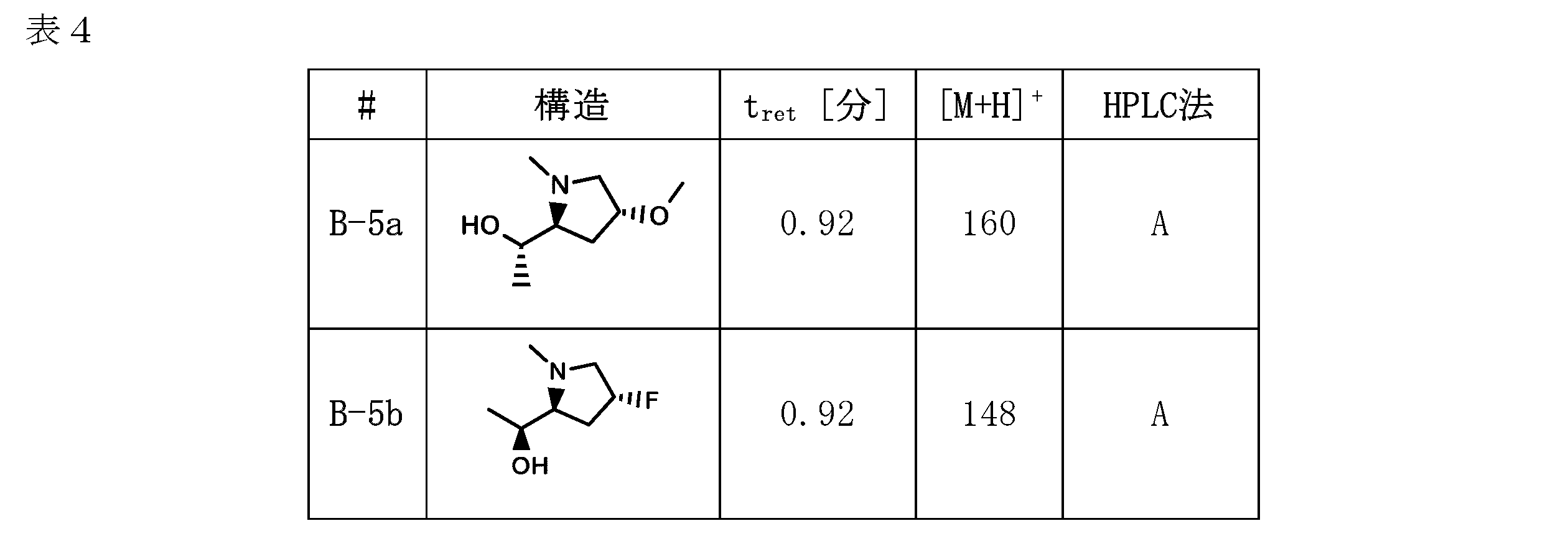
ピリミジン誘導体の合成C
C-3aの合成に関する実験手順:

MeOH(360mL)中の2-メトキシ-マロン酸ジメチルエステル(36.0g、222mmol、1.00当量)及びチオ尿素(25.4g、333mmol、1.50当量)の撹拌した溶液に、ナトリウムメトキシド(27.8g、555mmol、2.5当量)を室温で加え、混合物を80℃で24時間撹拌した。完全な変換の後、ヨードメタン(41.0g、289mmol、1.30当量)を室温でゆっくりと加え、混合物を室温で16時間撹拌した。完全な変換の後、反応混合物を濃縮し、水を加え、反応混合物を30分間撹拌した。生成物を濾過により収集し、水で洗浄し、そして真空下で乾燥した。粗生成物C-3aを、精製することなく次の工程に使用した(HPLC法:H、tret=0.89分;[M+H]+=189)。
Synthesis of pyrimidine derivatives C
Experimental procedure for the synthesis of C-3a:
To a stirred solution of 2-methoxy-malonic acid dimethyl ester (36.0 g, 222 mmol, 1.00 equiv.) and thiourea (25.4 g, 333 mmol, 1.50 equiv.) in MeOH (360 mL) was added sodium methoxide (27.8 g, 555 mmol, 2.5 equiv.) at room temperature and the mixture was stirred at 80° C. for 24 h. After complete conversion, iodomethane (41.0 g, 289 mmol, 1.30 equiv.) was added slowly at room temperature and the mixture was stirred at room temperature for 16 h. After complete conversion, the reaction mixture was concentrated, water was added and the reaction mixture was stirred for 30 min. The product was collected by filtration, washed with water and dried under vacuum. The crude product C-3a was used in the next step without purification (HPLC method: H, t ret =0.89 min; [M+H] + =189).
C-4aの合成に関する実験手順:

0℃で、C-3a(3.1g、16mmol、1.0当量)及びN,N-ジエチルアニリン(0.4mL)、POCl3(13g、81mmol、5.0当量)の撹拌した混合物にゆっくりと加え、得られた混合物を90℃で16時間撹拌した。完全な変換の後、混合物を室温に冷やし、過剰POCl3を蒸発させ、水を加え、生成物をEtOAcでの抽出により単離した。粗生成物をNPクロマトグラフィーにより精製して、C-4aを得た(HPLC法:H、tret=2.12分;[M+H]+=225)。
Experimental procedure for the synthesis of C-4a:
To a stirred mixture of C-3a (3.1 g, 16 mmol, 1.0 equiv.) and N,N-diethylaniline (0.4 mL), POCl 3 (13 g, 81 mmol, 5.0 equiv.) was slowly added at 0° C., and the resulting mixture was stirred at 90° C. for 16 h. After complete conversion, the mixture was cooled to room temperature, excess POCl 3 was evaporated, water was added, and the product was isolated by extraction with EtOAc. The crude product was purified by NP chromatography to give C-4a (HPLC method: H, t ret =2.12 min; [M+H] + =225).
C-5aの合成に関する実験手順:

0℃で、DCM(240mL)中のC-4a(24.0g、107mmol、1.00当量)の撹拌した溶液に、m-CPBA(55.0g、321mmol、3.0当量)を加え、混合物を室温にし、更に16時間撹拌した。完全な変換の後、混合物をDCMで希釈し、飽和NaHCO3で洗浄し、有機層を乾燥し、濾過し、濃縮して、C-5aを生成し、これを精製することなく次の工程に使用した(HPLC法:H、tret=1.68分;[M+H]+=257)。
Experimental procedure for the synthesis of C-5a:
To a stirred solution of C-4a (24.0 g, 107 mmol, 1.00 equiv) in DCM (240 mL) at 0° C. was added m-CPBA (55.0 g, 321 mmol, 3.0 equiv), the mixture was allowed to reach room temperature and stirred for an additional 16 h. After complete conversion, the mixture was diluted with DCM, washed with saturated NaHCO 3 and the organic layer was dried, filtered and concentrated to yield C-5a, which was used in the next step without purification (HPLC method: H, t ret =1.68 min; [M+H] + =257).
ニトリル中間体Dの合成
D-1aの合成に関する実験手順:

0℃で窒素下、ACN(216mL)及び水(24mL)中のC-5a(24.0g、93.4mmol、1.0当量)の撹拌した溶液に、NaCN(5.49g、112mmol、1.2当量)を加え、混合物を室温にし、そして更に1時間撹拌した。完全な変換の後、水及びEtOAcを加え、有機層を分離し、水で洗浄し、乾燥し、濾過し、濃縮し、粗生成物をNPクロマトグラフィーにより精製して、D-1aを生成した。
Synthesis of Nitrile Intermediate D
Experimental procedure for the synthesis of D-1a:
To a stirred solution of C-5a (24.0 g, 93.4 mmol, 1.0 equiv) in ACN (216 mL) and water (24 mL) under nitrogen at 0° C., NaCN (5.49 g, 112 mmol, 1.2 equiv) was added, the mixture was allowed to reach room temperature and stirred for an additional 1 h. After complete conversion, water and EtOAc were added, the organic layer was separated, washed with water, dried, filtered, concentrated and the crude product was purified by NP chromatography to afford D-1a.
エステル及び酸の合成E
E-2aの合成に関する実験手順:

4,6-ジクロロピリミジン-2-カルボン酸 E-1a(900mg、4.66mmol、1.0当量)を、DMSO(2mL)及びDIPEA(1.5mL、8.8mmol、2.0当量)に溶解し、(S)-tert-ブチル 3-メチル-1,4-ジアゼパン-1-カルボキシラート(1049mg、4.896mmol、1.05当量)を滴下した。次に、反応混合物を40℃で18時間撹拌した。混合物をアセトニトリルで希釈し、酸性RPクロマトグラフィーにより精製して、所望の生成物E-2aを与えた(HPLC法:A、tret=0.82分、[M+H]+=371)。
Synthesis of Esters and Acids
Experimental procedure for the synthesis of E-2a:
4,6-Dichloropyrimidine-2-carboxylic acid E-1a (900 mg, 4.66 mmol, 1.0 equiv.) was dissolved in DMSO (2 mL) and DIPEA (1.5 mL, 8.8 mmol, 2.0 equiv.) and (S)-tert-butyl 3-methyl-1,4-diazepane-1-carboxylate (1049 mg, 4.896 mmol, 1.05 equiv.) was added dropwise. The reaction mixture was then stirred at 40° C. for 18 h. The mixture was diluted with acetonitrile and purified by acidic RP chromatography to give the desired product E-2a (HPLC method: A, t ret =0.82 min, [M+H] + =371).
中間体E-3aの合成に関する実験手順:

D-1a(7.00g、34.3mmol、1.0当量)を、HCl(MeOH中4M、105mL、420mmol、12.4当量)の撹拌した溶液に0℃で加えた。混合物を室温にし、更に16時間撹拌した。完全な変換の後、反応混合物を濃縮し、粗生成物をNPクロマトグラフィーにより精製して、所望の生成物E-3aを与えた(HPLC法:H、tret=1.48分;[M+H]+=237)。
Experimental procedure for the synthesis of intermediate E-3a:
D-1a (7.00 g, 34.3 mmol, 1.0 equiv) was added to a stirred solution of HCl (4 M in MeOH, 105 mL, 420 mmol, 12.4 equiv) at 0° C. The mixture was allowed to reach room temperature and stirred for an additional 16 h. After complete conversion, the reaction mixture was concentrated and the crude product was purified by NP chromatography to give the desired product E-3a (HPLC method: H, t ret =1.48 min; [M+H] + =237).
中間体E-5の合成に関する実験手順(方法I):

メチル 4,6-ジクロロピリミジン-2-カルボキシラート E-4a(3.00g、14.5mmol、1.0当量)を、DCM(30mL)に溶解し、DIPEA(5.34mL、29.0mmol、2.0当量)及びB-5b(3.20g、21.8mmol、1.5当量)を加えた。次に、反応混合物を室温で18時間撹拌した。完全な変換の後、混合物を濃縮し、水を加え、混合物をEtOAcで抽出し、有機相をブラインで洗浄し、乾燥し、濾過し、そして濃縮した。粗生成物をNPクロマトグラフィーにより精製して、E-5aを生成した。
Experimental procedure for the synthesis of intermediate E-5 (Method I):
Methyl 4,6-dichloropyrimidine-2-carboxylate E-4a (3.00 g, 14.5 mmol, 1.0 equiv.) was dissolved in DCM (30 mL) and DIPEA (5.34 mL, 29.0 mmol, 2.0 equiv.) and B-5b (3.20 g, 21.8 mmol, 1.5 equiv.) were added. The reaction mixture was then stirred at room temperature for 18 h. After complete conversion, the mixture was concentrated, water was added, the mixture was extracted with EtOAc, the organic phase was washed with brine, dried, filtered and concentrated. The crude product was purified by NP chromatography to yield E-5a.
以下の中間体E-5(表5)は、類似の方法で利用可能である。粗生成物は、必要に応じてクロマトグラフィーにより精製する。

中間体E-5cの合成に関する実験手順(方法II):

B-5a(100mg、0.48mmol、1当量)を、THF(500μL)に溶解し、LiHMDS(591μL、0.59mmol、1.1当量)を加え、5分間撹拌した。一方、メチル 4,6-ジクロロピリミジン-2-カルボキシラート E-4a(170mg、0.81mmol、1.5当量)を、THF(500μL)に溶解した。B-5aの溶液を、メチル 4,6-ジクロロピリミジン-2-カルボキシラート溶液に5分にわたって滴下した。反応物を25分間撹拌した。完全な変換の後、反応混合物を濾過し、RPクロマトグラフィーにより精製して、E-5cを与えた(HPLC法:A、tret=1.08分、[M+H]+=330)。
Experimental procedure for the synthesis of intermediate E-5c (Method II):
B-5a (100 mg, 0.48 mmol, 1 equiv) was dissolved in THF (500 μL) and LiHMDS (591 μL, 0.59 mmol, 1.1 equiv) was added and stirred for 5 min. Meanwhile, methyl 4,6-dichloropyrimidine-2-carboxylate E-4a (170 mg, 0.81 mmol, 1.5 equiv) was dissolved in THF (500 μL). The solution of B-5a was added dropwise over 5 min to the methyl 4,6-dichloropyrimidine-2-carboxylate solution. The reaction was stirred for 25 min. After complete conversion, the reaction mixture was filtered and purified by RP chromatography to give E-5c (HPLC method: A, t ret =1.08 min, [M+H] + =330).
ジケトンの合成F
複数のHPLC保持時間が報告されたとき、異なる互変異性体が存在していることを意味する。
Synthesis of diketones F
When multiple HPLC retention times are reported, it means that different tautomers are present.
F-1aの合成に関する実験手順

4,6-ジクロロピリミジン-2-カルボン酸メチルエステル E-4a(2.00g、9.67mmol、1.00当量)を、乾燥ACN(5mL)に窒素雰囲気下で溶解した。ACN(5mL)及びDIPEA(2.67mL、14.5mmol、1.50当量)中のマグネシウムブロミド ジエチルエーテラート(2.99g、11.6mmol、1.20当量)、A-6b(2.38g、10.6mmol、1.10当量)の溶液を加え、反応混合物を50℃で20時間撹拌した。完全な変換の後、反応混合物を1M HClで注意深くクエンチし、水で希釈し、DCMで抽出し、有機相を乾燥し、濾過し、濃縮して、粗F-1aを得た。粗化合物をNPクロマトグラフィーにより精製した(HPLC法:H、tret=2.50分;[M+H]=399/401)。
Experimental Procedure for the Synthesis of F-1a
4,6-Dichloropyrimidine-2-carboxylic acid methyl ester E-4a (2.00 g, 9.67 mmol, 1.00 equiv.) was dissolved in dry ACN (5 mL) under nitrogen atmosphere. A solution of magnesium bromide diethyl etherate (2.99 g, 11.6 mmol, 1.20 equiv.), A-6b (2.38 g, 10.6 mmol, 1.10 equiv.) in ACN (5 mL) and DIPEA (2.67 mL, 14.5 mmol, 1.50 equiv.) was added and the reaction mixture was stirred at 50° C. for 20 h. After complete conversion, the reaction mixture was carefully quenched with 1 M HCl, diluted with water, extracted with DCM, the organic phase was dried, filtered and concentrated to give crude F-1a. The crude compound was purified by NP chromatography (HPLC method: H, t ret =2.50 min; [M+H]=399/401).
F-2aの合成に関する実験手順

F-1a(10.0g、19.4mmol、1.00当量)を、DMSO(10mL)に溶解し、(1S)-1-[(2S)-1-メチルピロロリジン-2-イル]エタノール(2.76g、21.4mmol、1.10当量)及びDIPEA(6.78mL、38.8mmol、2.0当量)を加え、溶液を室温で一晩撹拌した。反応混合物をDCM及び水で希釈した。有機相を分離し、蒸発させ、得られた残留物をRPクロマトグラフィーにより精製して、F-2aを与えた(HPLC法:A、tret=1.58/1.66分;[M+H]=492)。
Experimental Procedure for the Synthesis of F-2a
F-1a (10.0 g, 19.4 mmol, 1.00 equiv) was dissolved in DMSO (10 mL), (1S)-1-[(2S)-1-methylpyrrolidin-2-yl]ethanol (2.76 g, 21.4 mmol, 1.10 equiv) and DIPEA (6.78 mL, 38.8 mmol, 2.0 equiv) were added and the solution was stirred at room temperature overnight. The reaction mixture was diluted with DCM and water. The organic phase was separated and evaporated and the resulting residue was purified by RP chromatography to give F-2a (HPLC method: A, t ret =1.58/1.66 min; [M+H]=492).
F-3aの合成に関する実験手順

アルゴン雰囲気下、E-2a(1.05g、2.83mmol、1.00当量)及び1-(1H-イミダゾール-1-カルボニル)-1H-イミダゾール(918mg、5.66mmol、2.00当量)を、乾燥THF(5mL)に溶解し、室温で1時間撹拌した。酸の完全な活性化の後、A-6b(1.34g、5.98mmol、2.00当量)及びLiHMDS(THF中1.0M、5.95mL、5.95mmol、2.10当量)の溶液を、反応混合物に加え、乾燥THF(5mL)で洗浄した。得られた混合物を60℃で一晩撹拌した。完全な変換の後、反応物を飽和NaHCO3水溶液で希釈し、DCMで3回抽出した。有機相を合わせ、乾燥し、濾過し、減圧下で濃縮して、粗生成物を与えた。粗生成物をアセトニトリル及び水に溶解し、濾過し、塩基性RPクロマトグラフィーにより精製して、所望の生成物F-3aを与えた(HPLC法:C、tret=0.888/0.936/0.978分、[M+H]=557)。
Experimental Procedure for the Synthesis of F-3a
Under argon atmosphere, E-2a (1.05 g, 2.83 mmol, 1.00 equiv.) and 1-(1H-imidazole-1-carbonyl)-1H-imidazole (918 mg, 5.66 mmol, 2.00 equiv.) were dissolved in dry THF (5 mL) and stirred at room temperature for 1 h. After complete activation of the acid, a solution of A-6b (1.34 g, 5.98 mmol, 2.00 equiv.) and LiHMDS (1.0 M in THF, 5.95 mL, 5.95 mmol, 2.10 equiv.) was added to the reaction mixture and washed with dry THF (5 mL). The resulting mixture was stirred at 60 °C overnight. After complete conversion, the reaction was diluted with saturated aqueous NaHCO 3 solution and extracted three times with DCM. The organic phases were combined, dried, filtered and concentrated under reduced pressure to give the crude product. The crude product was dissolved in acetonitrile and water, filtered and purified by basic RP chromatography to give the desired product F-3a (HPLC method: C, t ret =0.888/0.936/0.978 min, [M+H]=557).
中間体F-4の合成に関する実験手順

E-5c(1.80g、0.01mol、1.00当量)を、乾燥THF(18mL)に溶解し、活性化モレキュラーシーブ(3Å)を加え(溶媒1mL当たり200mg)、アルゴン雰囲気下、50℃で20分間撹拌した。次に、マグネシウムブロミド エチルエーテラート(2.11g、0.01mol、1.5当量)を加え、更に50℃で30分間撹拌した。一方、第2の溶液をA-6b(1.47g、0.01mol、1.5当量)を用いて調製し、これも活性化モレキュラーシーブ(3Å)を用い、THF(8mL)で50℃で20分間予備乾燥した。次に、LiHMDS(THF中1M、13.7mL、0.01mol、2.5当量)を加え、15分間撹拌した。その後、第2の溶液を第1の溶液に加え、生成物への完全な変換が観察されるまで50℃で1時間撹拌した。反応混合物を水で注意深くクエンチし、THFを減圧下で除去した。残留物のpHを1M HClを用いることにより7~8に調整し、DCM中5% MeOHで抽出し、合わせた有機層をブラインで洗浄し、乾燥し、濾過し、そして濃縮した。粗化合物F-4aをNPクロマトグラフィーにより精製した。
Experimental Procedure for the Synthesis of Intermediate F-4
E-5c (1.80 g, 0.01 mol, 1.00 equiv) was dissolved in dry THF (18 mL), activated molecular sieves (3 Å) were added (200 mg per mL of solvent) and stirred at 50° C. for 20 min under argon atmosphere. Magnesium bromide ethyl etherate (2.11 g, 0.01 mol, 1.5 equiv) was then added and stirred at 50° C. for an additional 30 min. Meanwhile, a second solution was prepared with A-6b (1.47 g, 0.01 mol, 1.5 equiv), also predried with activated molecular sieves (3 Å) in THF (8 mL) for 20 min at 50° C. LiHMDS (1 M in THF, 13.7 mL, 0.01 mol, 2.5 equiv) was then added and stirred for 15 min. The second solution was then added to the first solution and stirred at 50° C. for 1 h until complete conversion to the product was observed. The reaction mixture was carefully quenched with water and THF was removed under reduced pressure. The pH of the residue was adjusted to 7-8 by using 1 M HCl and extracted with 5% MeOH in DCM, the combined organic layers were washed with brine, dried, filtered and concentrated. Crude compound F-4a was purified by NP chromatography.
以下の中間体F-4(表6)は、類似の方法で利用可能である。粗生成物は、必要に応じてクロマトグラフィーにより精製する。

イソオキサゾール中間体の合成G
中間体G3及びG4の合成に関する実験手順

F-3a(1.10g、1.91mmol、1.0当量)を、1,4-ジオキサン(3mL)に溶解し、50%ヒドロキシルアミン水溶液を加えた(140μL、2.29mmol、1.2当量)。反応混合物を室温で一晩撹拌した。出発物質の完全な変換の後、反応物を飽和NaHCO3水溶液で希釈し、DCMで3回抽出した。有機相を合わせ、乾燥し、濾過し、減圧下で濃縮して、粗生成物を与えた。G-1aとG-2aとの粗混合物(1.00g、1.68mmol、1.0当量)を、1,4-ジオキサン(6mL)に溶解し、4M HCl水溶液(2.11mL、8.44mmol、5.0当量)を加えた。反応混合物を室温で3時間撹拌した。出発物質の完全な変換が観察された後、反応物を飽和NaHCO3水溶液で希釈し、DCMで3回抽出した。有機相を合わせ、乾燥し、濾過し、減圧下で濃縮して、粗生成物を与えた。粗生成物をACN及び水に溶解し、濾過し、塩基性RPクロマトグラフィーにより精製して、対応するイソオキサゾール位置異性体G-4aとは別の所望の生成物G-3aを与えた。
Synthesis of Isoxazole Intermediate G
Experimental Procedures for the Synthesis of Intermediates G3 and G4
F-3a (1.10 g, 1.91 mmol, 1.0 equiv) was dissolved in 1,4-dioxane (3 mL) and 50% aqueous hydroxylamine was added (140 μL, 2.29 mmol, 1.2 equiv). The reaction mixture was stirred at room temperature overnight. After complete conversion of the starting material, the reaction was diluted with saturated aqueous NaHCO 3 and extracted three times with DCM. The organic phases were combined, dried, filtered and concentrated under reduced pressure to give the crude product. The crude mixture of G-1a and G-2a (1.00 g, 1.68 mmol, 1.0 equiv) was dissolved in 1,4-dioxane (6 mL) and 4 M aqueous HCl (2.11 mL, 8.44 mmol, 5.0 equiv) was added. The reaction mixture was stirred at room temperature for 3 h. After complete conversion of the starting material was observed, the reaction was diluted with saturated aqueous NaHCO 3 and extracted three times with DCM. The organic phases were combined, dried, filtered and concentrated under reduced pressure to give the crude product, which was dissolved in ACN and water, filtered and purified by basic RP chromatography to give the desired product G-3a apart from the corresponding isoxazole regioisomer G-4a.
以下の中間体G-3及びG-4(表7)は、適切な中間体Fから類似の方法で利用可能である。粗生成物は、必要に応じてクロマトグラフィーにより精製する。

G-7aの合成に関する実験手順

F-4c(1.40g、2.68mmol、1.0当量)を、ジオキサン(1mL)に溶解し、ギ酸(103μL、2.95mmol、1.10当量)及び50%ヒドロキシルアミン水溶液(水中50%、165μL、2.95mmol、1.10当量)を加え、一晩撹拌した。出発物質の完全な変換が観察された後、反応物を減圧下で濃縮し、NPクロマトグラフィーにより精製して、G-5aを与えた(HPLC法:C、tret=1.60分;[M+H]+=537)。
Experimental Procedure for the Synthesis of G-7a
F-4c (1.40 g, 2.68 mmol, 1.0 equiv) was dissolved in dioxane (1 mL) and formic acid (103 μL, 2.95 mmol, 1.10 equiv) and 50% aqueous hydroxylamine (50% in water, 165 μL, 2.95 mmol, 1.10 equiv) were added and stirred overnight. After complete conversion of the starting material was observed, the reaction was concentrated under reduced pressure and purified by NP chromatography to give G-5a (HPLC method: C, t ret =1.60 min; [M+H] + =537).
G-5a(1.60g、2.98mmol、1.0当量)を、HCl(ジオキサン中4M、2.9mL)に溶解し、室温で5分間撹拌した。次に、水中4M HCl(2.5mL)を加え、反応物を室温で30分間撹拌した。完全な変換の後、反応混合物をNaHCO3で塩基性化し、そしてDCMで抽出した。合わせた有機相を減圧下で濃縮して、生成物G-7aを与えた(HPLC法:H、tret=1.59分;[M+H]+=537)。 G-5a (1.60 g, 2.98 mmol, 1.0 equiv) was dissolved in HCl (4 M in dioxane, 2.9 mL) and stirred at room temperature for 5 min. Then, 4 M HCl in water (2.5 mL) was added and the reaction was stirred at room temperature for 30 min. After complete conversion, the reaction mixture was basified with NaHCO 3 and extracted with DCM. The combined organic phases were concentrated under reduced pressure to give the product G-7a (HPLC method: H, t ret =1.59 min; [M+H] + =537).
G-8aの合成に関する実験手順

G-3a(500mg、1.07mmol、1.0当量)を、乾燥MeOH(10mL)に溶解し、ホルムアルデヒド(403μL、5.36mmol、5.0当量)及び酢酸(27μL、0.54mmol、0.5当量)を加えた。これに続いてシアノ水素化ホウ素ナトリウム(141mg、2.14mmol、2.0当量)を加えた。溶液を室温で1時間撹拌した。出発物質の完全な消費の後、反応物を水及び飽和NaHCO3の添加によりクエンチした。水相をDCMで抽出した(3×)。合わせた有機相を濾過し、減圧下で濃縮した。残留物をアセトニトリルに溶解し、RPクロマトグラフィーにより精製して、所望の生成物G-8aを与えた(HPLC法:A、tret=1.39分;[M+H]+=444)。
Experimental Procedure for the Synthesis of G-8a
G-3a (500 mg, 1.07 mmol, 1.0 equiv) was dissolved in dry MeOH (10 mL) and formaldehyde (403 μL, 5.36 mmol, 5.0 equiv) and acetic acid (27 μL, 0.54 mmol, 0.5 equiv) were added. This was followed by sodium cyanoborohydride (141 mg, 2.14 mmol, 2.0 equiv). The solution was stirred at room temperature for 1 h. After complete consumption of the starting material, the reaction was quenched by addition of water and saturated NaHCO 3. The aqueous phase was extracted with DCM (3×). The combined organic phases were filtered and concentrated under reduced pressure. The residue was dissolved in acetonitrile and purified by RP chromatography to give the desired product G-8a (HPLC method: A, t ret =1.39 min; [M+H] + =444).
G-9の合成に関する実験手順(方法I)

G-3b(150mg、309μmol、1.0当量)、5-ヒドロキシピリミジン(44.5mg、463μmol、1.5当量)及びCs2CO3(201mg、617μmol、2.0当量)を、乾燥DMSO(2mL)に溶解し、アルゴン雰囲気下、80℃で18時間撹拌した。完全な変換の後、混合物をDCMで希釈し、水及びブラインで抽出した。合わせた有機相を減圧下で濃縮し、RPクロマトグラフィーにより精製して、所望の生成物G-9aを与えた。
Experimental Procedure for the Synthesis of G-9 (Method I)
G-3b (150 mg, 309 μmol, 1.0 equiv), 5-hydroxypyrimidine (44.5 mg, 463 μmol, 1.5 equiv) and Cs 2 CO 3 (201 mg, 617 μmol, 2.0 equiv) were dissolved in dry DMSO (2 mL) and stirred under argon atmosphere at 80° C. for 18 h. After complete conversion, the mixture was diluted with DCM and extracted with water and brine. The combined organic phase was concentrated under reduced pressure and purified by RP chromatography to give the desired product G-9a.
以下の中間体G-9(表8)は、類似の方法で利用可能である。粗生成物は、必要に応じてクロマトグラフィーにより精製する。

G-9の合成に関する実験手順(方法II)

(S)-(+)-3-ヒドロキテトラヒドロフラン(41.7mg、0.45mmol、2.0当量)を、KOtBu/THFの溶液(449μL、0.45mmol、2.0当量)に0℃で加え、5分間撹拌した。THF(1mL)に溶解したG-3b(100mg、0.22mmol、1.0当量)を加えた。反応物を室温で5分間撹拌した。完全な変換の後、反応混合物をDCM/水で抽出し、そして有機相を減圧下で濃縮した。残留物をRPクロマトグラフィーにより精製して、G-9dを与えた。
Experimental Procedure for the Synthesis of G-9 (Method II)
(S)-(+)-3-Hydroxytetrahydrofuran (41.7 mg, 0.45 mmol, 2.0 equiv) was added to a solution of KOtBu/THF (449 μL, 0.45 mmol, 2.0 equiv) at 0° C. and stirred for 5 min. G-3b (100 mg, 0.22 mmol, 1.0 equiv) dissolved in THF (1 mL) was added. The reaction was stirred at room temperature for 5 min. After complete conversion, the reaction mixture was extracted with DCM/water and the organic phase was concentrated under reduced pressure. The residue was purified by RP chromatography to give G-9d.
以下の中間体G-9(表9)は、類似の方法で利用可能である。粗生成物は、必要に応じてクロマトグラフィーにより精製する。

G-9gの合成に関する実験手順(方法III)

G-3b(250mg、272μmol、1.0当量)、2-ヒドロキシピラジン(31.3mg、326μmol、1.2当量)及びCs2CO3(177mg、543μmol、2.0当量)を、トルオール(1mL)に溶解し、アルゴン雰囲気下、110℃で18時間撹拌した。完全な変換の後、反応混合物を濾過し、そして減圧下で濃縮した。残留物をDCMに溶解し、水及びブラインで抽出した。合わせた有機相を減圧下で濃縮し、RPクロマトグラフィーにより精製して、所望の生成物G-9gを与えた(HPLC法:A;tret=1.43分;[M+H]+=505)。
Experimental Procedure for the Synthesis of G-9g (Method III)
G-3b (250 mg, 272 μmol, 1.0 equiv), 2-hydroxypyrazine (31.3 mg, 326 μmol, 1.2 equiv) and Cs 2 CO 3 (177 mg, 543 μmol, 2.0 equiv) were dissolved in toluene (1 mL) and stirred at 110° C. for 18 h under argon atmosphere. After complete conversion, the reaction mixture was filtered and concentrated under reduced pressure. The residue was dissolved in DCM and extracted with water and brine. The combined organic phases were concentrated under reduced pressure and purified by RP chromatography to give the desired product G-9g (HPLC method: A; t ret =1.43 min; [M+H] + =505).
G-9及びG-10の合成に関する実験手順(方法IV)

G-4b(150mg、0.3mmol、1.0当量)、2-ヒドロキシチアゾール(39.4mg、0.39mmol、1.30当量)及びt-BuONa(THF中2M、210μL、0.42mmol、1.4当量)を、THF(1.5mL)に溶解し、80℃で18時間撹拌した。完全な変換の後、反応混合物をDCM/H2Oで3回抽出した。合わせた有機相を減圧下で濃縮し、RPクロマトグラフィーにより精製して、所望の生成物G-10aを与えた。
Experimental Procedure for the Synthesis of G-9 and G-10 (Method IV)
G-4b (150 mg, 0.3 mmol, 1.0 equiv), 2-hydroxythiazole (39.4 mg, 0.39 mmol, 1.30 equiv) and t-BuONa (2 M in THF, 210 μL, 0.42 mmol, 1.4 equiv) were dissolved in THF (1.5 mL) and stirred at 80° C. for 18 h. After complete conversion, the reaction mixture was extracted three times with DCM/H 2 O. The combined organic phases were concentrated under reduced pressure and purified by RP chromatography to give the desired product G-10a.
以下の中間体G-9及びG-10(表10)は、G-3b及びG-4bから類似の方法で利用可能である。粗生成物は、必要に応じてクロマトグラフィーにより精製する。
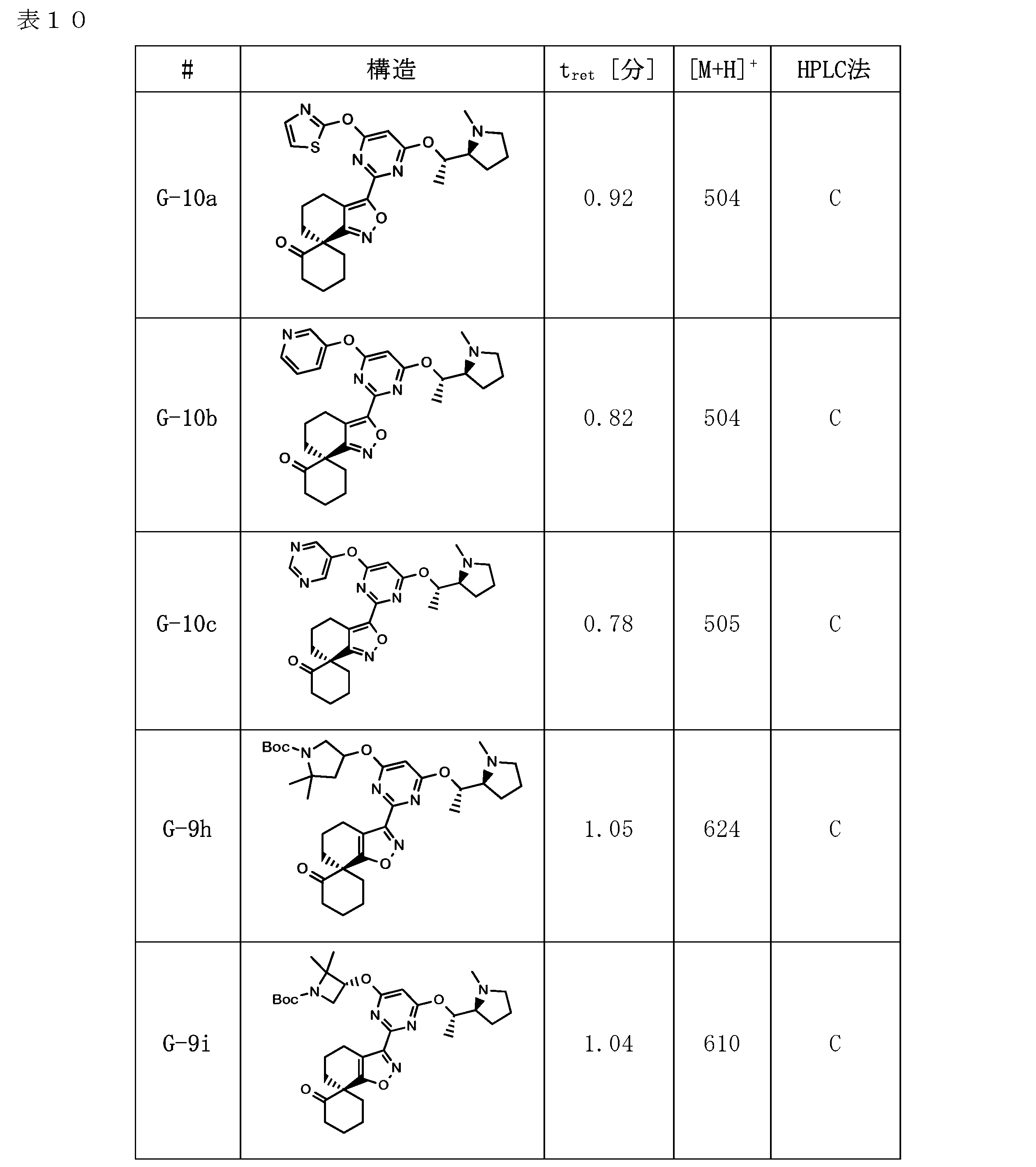
G-9及びG-10の合成に関する実験手順(方法V)

G-4b(100mg、225μmol、1.0当量)、(S)-3-アミノテトラヒドロフラン(39.0mg、448μmol、2.0当量)及びDIPEA(235μL、1.35mmol、6.0当量)を、乾燥DMSO(1.0mL)に溶解し、90℃で18時間撹拌した。反応混合物をDCMで希釈し、水で洗浄した。有機相を硫酸マグネシウムで乾燥し、蒸発させ、得られた残留物をRPクロマトグラフィーにより精製して、G-10dを与えた。
Experimental Procedure for the Synthesis of G-9 and G-10 (Method V)
G-4b (100 mg, 225 μmol, 1.0 equiv), (S)-3-aminotetrahydrofuran (39.0 mg, 448 μmol, 2.0 equiv) and DIPEA (235 μL, 1.35 mmol, 6.0 equiv) were dissolved in dry DMSO (1.0 mL) and stirred at 90° C. for 18 h. The reaction mixture was diluted with DCM and washed with water. The organic phase was dried over magnesium sulfate and evaporated, and the resulting residue was purified by RP chromatography to give G-10d.
以下の中間体G-9及びG-10(表11)は、G-3b及びG-4bから類似の方法で利用可能である。粗生成物は、必要に応じてクロマトグラフィーにより精製する。

G-9及びG-10の合成に関する実験手順(方法VI)

G-4b(120mg、0.27mmol、1.0当量)、2-アミノピリジン(31.7mg、0.76mmol、1.25当量)、Xantphos(4.68mg、0.01mmol、0.03当量)、Cs2CO3(131mg、0.40mmol、1.5当量)及びトリス(ジベンジリデンアセトン)ジパラジウム(0)(2.47mg、0.26μmol、0.01当量)を、ジオキサン(1.2mL)に溶解し、アルゴン雰囲気下、110℃で16時間撹拌した。完全な変換の後、反応物を濾過し、RPクロマトグラフィーにより精製して、所望の生成物G-10fを与えた。
Experimental Procedure for the Synthesis of G-9 and G-10 (Method VI)
G-4b (120 mg, 0.27 mmol, 1.0 equiv), 2-aminopyridine (31.7 mg, 0.76 mmol, 1.25 equiv), Xantphos (4.68 mg, 0.01 mmol, 0.03 equiv), Cs 2 CO 3 (131 mg, 0.40 mmol, 1.5 equiv) and tris(dibenzylideneacetone)dipalladium(0) (2.47 mg, 0.26 μmol, 0.01 equiv) were dissolved in dioxane (1.2 mL) and stirred under argon atmosphere at 110° C. for 16 h. After complete conversion, the reaction was filtered and purified by RP chromatography to give the desired product G-10f.
以下の中間体G-9及びG-10(表12)は、G-3b及びG-4bから類似の方法で利用可能である。粗生成物は、必要に応じてクロマトグラフィーにより精製する。

G-9の合成に関する実験手順(方法VII)

G-3b(125mg、0.28mmol、1.0当量)、アミノピラジン(66.8mg、702μmol、2.5当量)、Cs2CO3(275mg、0.84mmol、3当量)、パラジウム(II)アセタート(5mg、0.02mmol、0.08当量)、(S)-(-)-2,2-ビス(ジフェニルホスフィノ)-1-ビナフチル(14mg、0.02mmol、0.08当量)を、乾燥トルオール(5mL)に溶解し、110℃で2日間撹拌した。完全な変換の後、反応混合物を室温まで放冷し、濾過し、そして減圧下で濃縮した。反応物をRPクロマトグラフィーにより精製して、所望の生成物G-9nを与えた。
Experimental Procedure for the Synthesis of G-9 (Method VII)
G-3b (125 mg, 0.28 mmol, 1.0 equiv), aminopyrazine (66.8 mg, 702 μmol, 2.5 equiv), Cs 2 CO 3 (275 mg, 0.84 mmol, 3 equiv), palladium(II) acetate (5 mg, 0.02 mmol, 0.08 equiv), (S)-(−)-2,2-bis(diphenylphosphino)-1-binaphthyl (14 mg, 0.02 mmol, 0.08 equiv) were dissolved in dry toluene (5 mL) and stirred at 110° C. for 2 days. After complete conversion, the reaction mixture was allowed to cool to room temperature, filtered, and concentrated under reduced pressure. The reaction was purified by RP chromatography to give the desired product G-9n.
以下の中間体G-9及びG-10(表13)は、G-3b及びG-4bから類似の方法で利用可能である。粗生成物は、必要に応じてクロマトグラフィーにより精製する。

G-10gの合成に関する実験手順(方法VIII)

G-4b(250mg、272μmol、1.0当量)、2-メルカプトピリミジン(50.4mg、449μmol、2.0当量)及びCs2CO3(145mg、449μmol、2.0当量)を、乾燥DMA(0.9mL)に溶解し、アルゴン雰囲気下、100℃で3時間撹拌した。完全な変換の後、反応混合物をDCMで希釈し、水及びブラインで抽出した。合わせた有機相を減圧下で濃縮し、RPクロマトグラフィーにより精製して、所望の生成物G-10gを与えた(HPLC法:A;tret=1.53分;[M+H]+=521)。
Experimental Procedure for the Synthesis of G-10g (Method VIII)
G-4b (250 mg, 272 μmol, 1.0 equiv), 2-mercaptopyrimidine (50.4 mg, 449 μmol, 2.0 equiv) and Cs 2 CO 3 (145 mg, 449 μmol, 2.0 equiv) were dissolved in dry DMA (0.9 mL) and stirred at 100° C. for 3 h under argon atmosphere. After complete conversion, the reaction mixture was diluted with DCM and extracted with water and brine. The combined organic phases were concentrated under reduced pressure and purified by RP chromatography to give the desired product G-10g (HPLC method: A; t ret =1.53 min; [M+H] + =521).
G-9の合成に関する実験手順
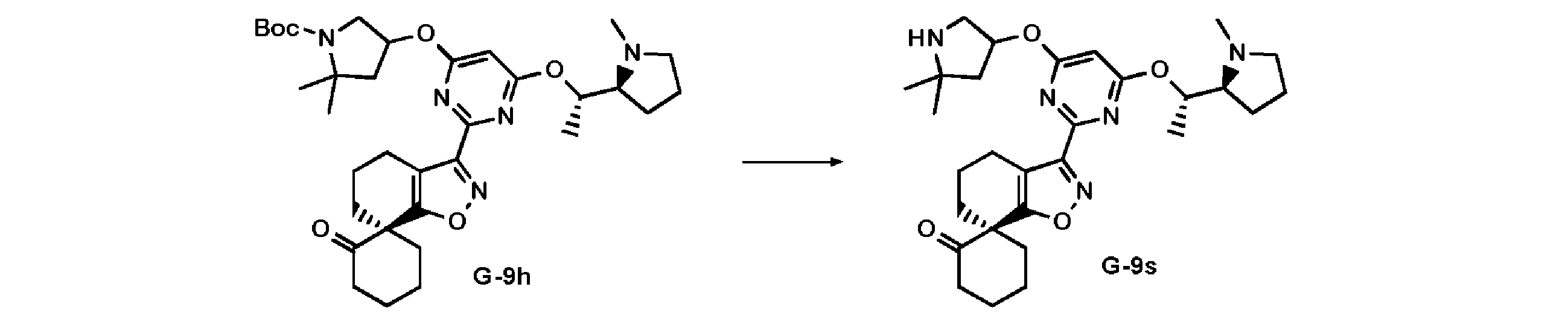
G-9h(297mg、476μmol、1.0当量)を、DCM(0.91mL)及びトリフルオロ酢酸(0.99mL、4.76mmol、10.0当量)に溶解した。反応物を室温で4時間撹拌した。完全な変換の後、溶解物を減圧下で除去した。残留物をDCMに溶解し、飽和Na2CO3水溶液で抽出した。合わせた有機相を乾燥し、濾過し、そして減圧下で濃縮した。残留物をRPクロマトグラフィーにより精製して、G-9sを与えた。
Experimental Procedure for the Synthesis of G-9
G-9h (297 mg, 476 μmol, 1.0 equiv) was dissolved in DCM (0.91 mL) and trifluoroacetic acid (0.99 mL, 4.76 mmol, 10.0 equiv). The reaction was stirred at room temperature for 4 h. After complete conversion, the solvent was removed under reduced pressure. The residue was dissolved in DCM and extracted with saturated aqueous Na2CO3 solution . The combined organic phases were dried, filtered and concentrated under reduced pressure. The residue was purified by RP chromatography to give G-9s.
以下の中間体G-9(表14)は、G-9h及びG-9iから類似の方法で利用可能である。粗生成物は、必要に応じてクロマトグラフィーにより精製する。

アミノシアノチオフェンの合成H、I、及びII
G-10~Iへの変換に関する実験手順

G-10a(52.9mg、104μmol、1.0当量)、マロノニトリル(20mg、288μmol、2.77当量)、硫黄(6.2mg、193μmol、1.86当量)、ベータ-アラニン(11.9mg、127μmol、1.22当量)及びモレキュラーシーブ(3Å)を、メタノール(1.0mL)に懸濁し、80℃で18時間撹拌した。反応混合物をDCMで希釈し、濾過し、そして飽和NaHCO3水溶液で洗浄した。有機相を分離し、残った水相をDCMで抽出した。合わせた有機相を硫酸マグネシウムで乾燥し、蒸発させ、得られた残留物をRPクロマトグラフィーにより精製して、I-1を与えた。
Synthesis of Aminocyanothiophenes H, I, and II
Experimental procedure for conversion of G-10 to I
G-10a (52.9 mg, 104 μmol, 1.0 equiv), malononitrile (20 mg, 288 μmol, 2.77 equiv), sulfur (6.2 mg, 193 μmol, 1.86 equiv), beta-alanine (11.9 mg, 127 μmol, 1.22 equiv) and molecular sieves (3 Å) were suspended in methanol (1.0 mL) and stirred at 80 °C for 18 h. The reaction mixture was diluted with DCM, filtered and washed with saturated aqueous NaHCO 3 solution. The organic phase was separated and the remaining aqueous phase was extracted with DCM. The combined organic phase was dried over magnesium sulfate and evaporated, and the resulting residue was purified by RP chromatography to give I-1.
以下の化合物I(表15)は、対応するケトンG-10から類似の方法で利用可能である。粗生成物は、必要に応じてクロマトグラフィーにより精製する。
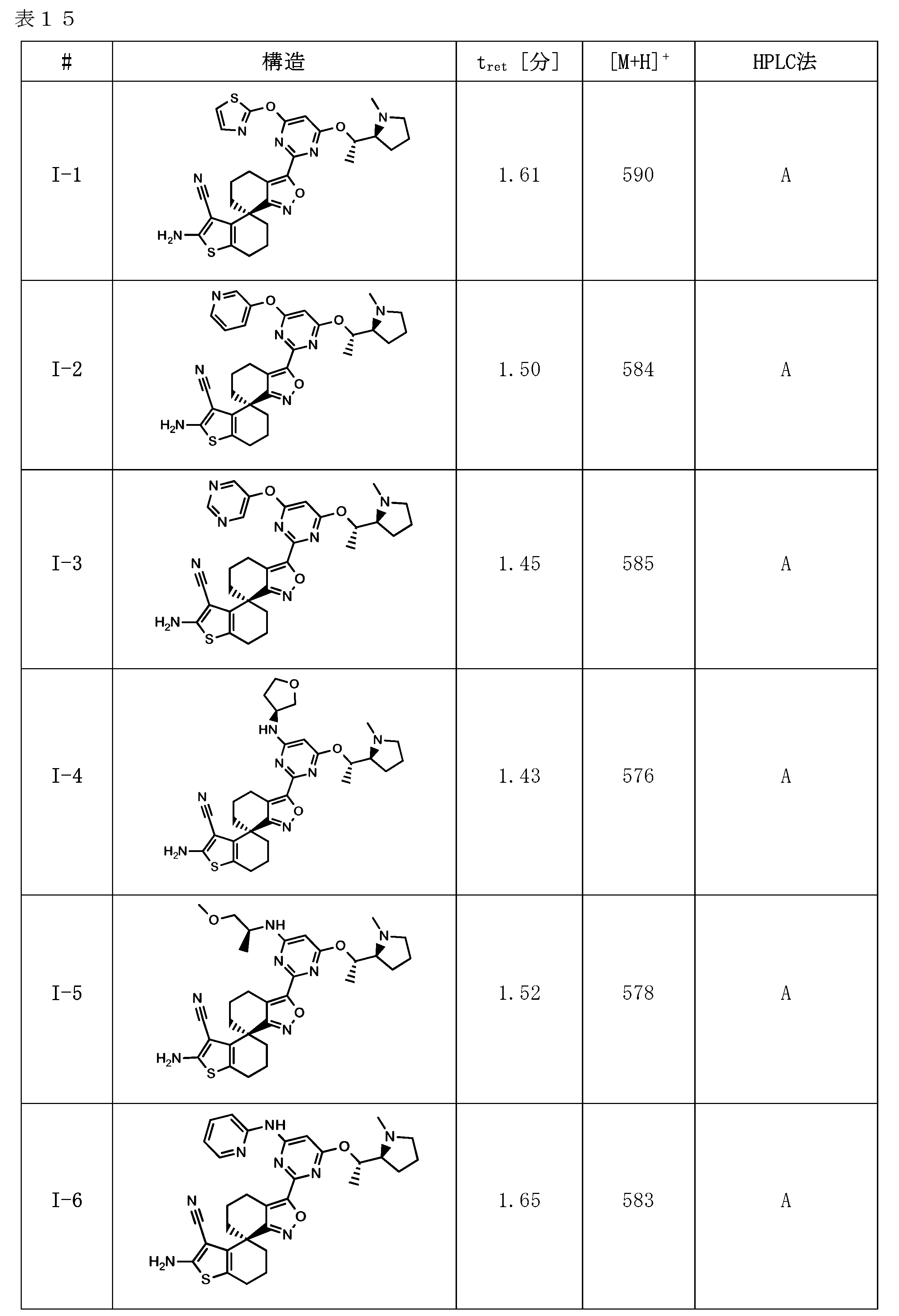
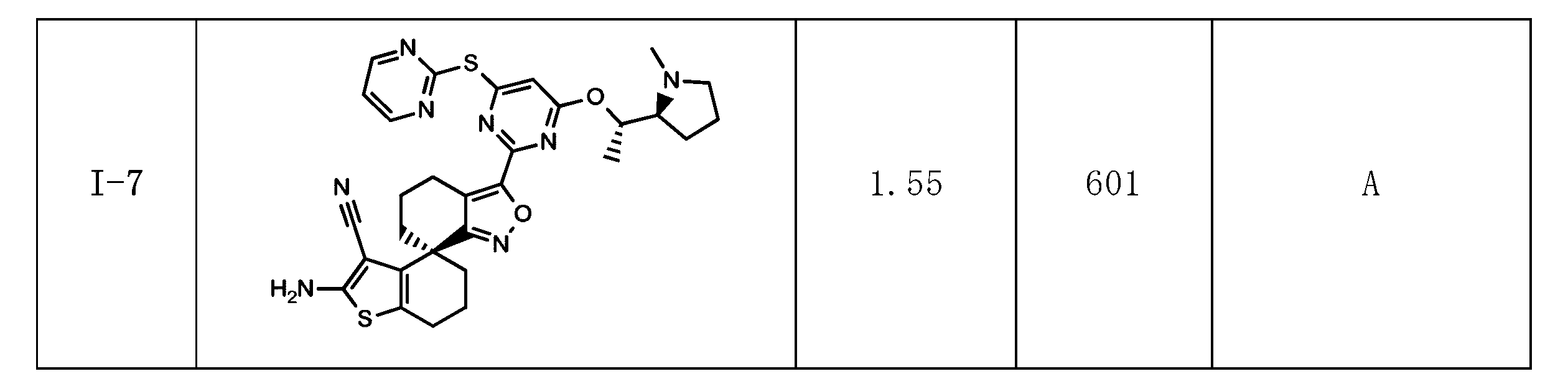
G-9~IIへの変換に関する実験手順

アルゴン雰囲気下、無水メタノール(4mL)中のG-9a(75.0mg、0.149mmol、1.0当量)及びモレキュラーシーブ(3Å)の溶液に、マロノニトリル(20.7mg、0.297mmol、2.0当量)、硫黄(7.15mg、0.223mmol、1.5当量)及びβ-アラニン(16.7mg、0.178mmol、1.2当量)を加えた。反応混合物を80℃で一晩撹拌した。完全な変換の後、混合物を室温に冷やし、濾過し、そしてDCM及び飽和NaHCO3水溶液で抽出した。有機相を合わせ、減圧下で濃縮した。残留物をアセトニトリル及び水に溶解し、塩基性RPクロマトグラフィーにより精製して、所望の生成物II-1を与えた。
Experimental procedure for conversion of G-9 to II
To a solution of G-9a (75.0 mg, 0.149 mmol, 1.0 equiv.) and molecular sieves (3 Å) in anhydrous methanol (4 mL) under argon atmosphere, malononitrile (20.7 mg, 0.297 mmol, 2.0 equiv.), sulfur (7.15 mg, 0.223 mmol, 1.5 equiv.) and β-alanine (16.7 mg, 0.178 mmol, 1.2 equiv.) were added. The reaction mixture was stirred at 80 °C overnight. After complete conversion, the mixture was cooled to room temperature, filtered and extracted with DCM and saturated aqueous NaHCO 3 solution. The organic phases were combined and concentrated under reduced pressure. The residue was dissolved in acetonitrile and water and purified by basic RP chromatography to give the desired product II-1.
以下の化合物II(表16)は、対応するケトンG-9から類似の方法で利用可能である。粗生成物は、必要に応じてクロマトグラフィーにより精製する。 The following compounds II (Table 16) are accessible in an analogous manner from the corresponding ketones G-9. The crude products are purified by chromatography if necessary.


H-1aの合成に関する実験手順

アルゴン雰囲気下、無水メタノール(2mL)中のG-4b(76.1mg、0.16mmol、1.0当量)及びモレキュラーシーブ(3Å)の溶液に、マロノニトリル(14.5mg、0.21mmol、1.33当量)、硫黄(10.1mg、0.31mmol、1.98当量)及びβ-アラニン(19.4mg、0.22mmol、1.38当量)を加えた。反応混合物を80℃で一晩撹拌した。完全な変換の後、混合物を室温に冷やし、濾過し、そしてDCM及び飽和NaHCO3水溶液で抽出した。有機相を合わせ、減圧下で濃縮した。残留物をアセトニトリル及び水に溶解し、塩基性RPクロマトグラフィーにより精製して、所望の生成物H-1aを与えた(HPLC法:A、tret=2.16分;[M+H]+=525)。
Experimental Procedure for the Synthesis of H-1a
To a solution of G-4b (76.1 mg, 0.16 mmol, 1.0 equiv.) and molecular sieves (3 Å) in anhydrous methanol (2 mL) under argon atmosphere, malononitrile (14.5 mg, 0.21 mmol, 1.33 equiv.), sulfur (10.1 mg, 0.31 mmol, 1.98 equiv.) and β-alanine (19.4 mg, 0.22 mmol, 1.38 equiv.) were added. The reaction mixture was stirred at 80 °C overnight. After complete conversion, the mixture was cooled to room temperature, filtered and extracted with DCM and saturated aqueous NaHCO 3 solution. The organic phases were combined and concentrated under reduced pressure. The residue was dissolved in acetonitrile and water and purified by basic RP chromatography to give the desired product H-1a (HPLC method: A, t ret = 2.16 min; [M+H] + = 525).
H-2の合成に関する実験手順

G-3c(1.2g、2.59mmol、1.0当量)、酢酸アンモニウム(319mg、4.15mmol、1.6当量)、及び硫黄(133mg、4.15mmol、1.6当量)を、エタノール(12mL)に溶解し、60℃で15分間撹拌した。エタノール中のマロニトリル溶液(3.77mL、4.28mmol、1.65当量)をゆっくりと滴下した(8mL/h)。反応物を80℃で5時間撹拌した。完全な変換の後、反応物を濃縮して、NPクロマトグラフィーにより精製した。生成物の画分をDCMで希釈し、飽和NaHCO3水溶液で洗浄した。有機相を乾燥し、濾過し、減圧下で濃縮して、H-2aを得た。
Experimental Procedure for the Synthesis of H-2
G-3c (1.2 g, 2.59 mmol, 1.0 equiv), ammonium acetate (319 mg, 4.15 mmol, 1.6 equiv), and sulfur (133 mg, 4.15 mmol, 1.6 equiv) were dissolved in ethanol (12 mL) and stirred at 60 °C for 15 min. A solution of malonitrile in ethanol (3.77 mL, 4.28 mmol, 1.65 equiv) was slowly added dropwise (8 mL/h). The reaction was stirred at 80 °C for 5 h. After complete conversion, the reaction was concentrated and purified by NP chromatography. The product fraction was diluted with DCM and washed with saturated aqueous NaHCO 3 solution. The organic phase was dried, filtered, and concentrated under reduced pressure to give H-2a.
以下の中間体H-2(表17)は、類似の方法で利用可能である。粗生成物は、必要に応じてクロマトグラフィーにより精製する。

II-19の合成に関する実験手順

II-8(23.0mg、0.038mmol、1.0当量)を、乾燥DCM(0.5mL)にアルゴン下で溶解し、-30℃まで冷却した。ホルムアルデヒド(水中37%、3.4μL、0.046mmol、1.2当量)を加え、続いてトリアセトキシ水素化ホウ素ナトリウム(17.0mg、0.076mmol、2.0当量)を加えた。溶液を-30℃で30分間撹拌した。出発物質の完全な消費の後、反応物を水の添加によりクエンチした。水相をDCMで抽出した(3×)。合わせた有機相を濾過し、減圧下で濃縮した。残留物をアセトニトリルに溶解し、RPクロマトグラフィーにより精製して、所望の生成物II-19を与えた(HPLC法:A、tret=1.66分;[M+H]+=618)。
Experimental Procedure for the Synthesis of II-19
II-8 (23.0 mg, 0.038 mmol, 1.0 equiv) was dissolved in dry DCM (0.5 mL) under argon and cooled to −30° C. Formaldehyde (37% in water, 3.4 μL, 0.046 mmol, 1.2 equiv) was added followed by sodium triacetoxyborohydride (17.0 mg, 0.076 mmol, 2.0 equiv). The solution was stirred at −30° C. for 30 min. After complete consumption of the starting material, the reaction was quenched by addition of water. The aqueous phase was extracted with DCM (3×). The combined organic phases were filtered and concentrated under reduced pressure. The residue was dissolved in acetonitrile and purified by RP chromatography to give the desired product II-19 (HPLC method: A, t ret =1.66 min; [M+H] + =618).
H-2c~IIへの変換に関する実験手順(方法I)

H-2c(100mg、0.19mmol、1.0当量)をエタノール(0.70mL)に懸濁した。DIPEA(49.8μL、0.29mmol、1.5当量)及びN,N,N’-トリメチルエチレンジアミン(29.5μL、0.229mmol、1.2当量)を加え、反応混合物を80℃で一晩撹拌した。完全な変換の後、反応混合物を濾過し、RPクロマトグラフィーで精製して、II-20を生成した(HPLC法:A、tret=1.49分;[M+H]+=591)。
Experimental Procedure for Conversion of H-2c to II (Method I)
H-2c (100 mg, 0.19 mmol, 1.0 equiv) was suspended in ethanol (0.70 mL). DIPEA (49.8 μL, 0.29 mmol, 1.5 equiv) and N,N,N'-trimethylethylenediamine (29.5 μL, 0.229 mmol, 1.2 equiv) were added and the reaction mixture was stirred at 80° C. overnight. After complete conversion, the reaction mixture was filtered and purified by RP chromatography to yield II-20 (HPLC method: A, t ret =1.49 min; [M+H] + =591).
H-1及びH-2~I及びIIへの変換に関する実験手順(方法II)

[1-(ジメチルアミノ)シクロプロピル]メタノール塩酸塩(34.4mg、0.227mmol、1.30当量)を、THF(2mL)に溶解し、0~5℃に冷却した。カリウムtert-ブトキシド(THF中1N、366μL、0.366mmol、2.10当量)を滴下し、反応混合物を0~5℃で30分間撹拌した。H-2c(100mg、0.174mmol、1.00当量)を、THF(1.0mL)に溶解し、0~5℃で滴下した。反応混合物を室温で1時間撹拌した。HPLCは、約50%の変換(出発物質及び副生成物)を示した。反応混合物を水でクエンチし、減圧下で濃縮した。粗生成物をRPクロマトグラフィーで精製して、II-21を生成した(HPLC法:A、tret=1.65分;[M+H]+=604)。
Experimental Procedure for Conversion of H-1 and H-2 to I and II (Method II)
[1-(Dimethylamino)cyclopropyl]methanol hydrochloride (34.4 mg, 0.227 mmol, 1.30 equiv) was dissolved in THF (2 mL) and cooled to 0-5° C. Potassium tert-butoxide (1N in THF, 366 μL, 0.366 mmol, 2.10 equiv) was added dropwise and the reaction mixture was stirred at 0-5° C. for 30 min. H-2c (100 mg, 0.174 mmol, 1.00 equiv) was dissolved in THF (1.0 mL) and added dropwise at 0-5° C. The reaction mixture was stirred at room temperature for 1 h. HPLC showed approximately 50% conversion (starting material and byproduct). The reaction mixture was quenched with water and concentrated under reduced pressure. The crude product was purified by RP chromatography to afford II-21 (HPLC method: A, tret=1.65 min; [M+H]+=604).
以下の化合物I及びII(表18)は、類似の方法で利用可能である。粗生成物は、必要に応じてクロマトグラフィーにより精製する。
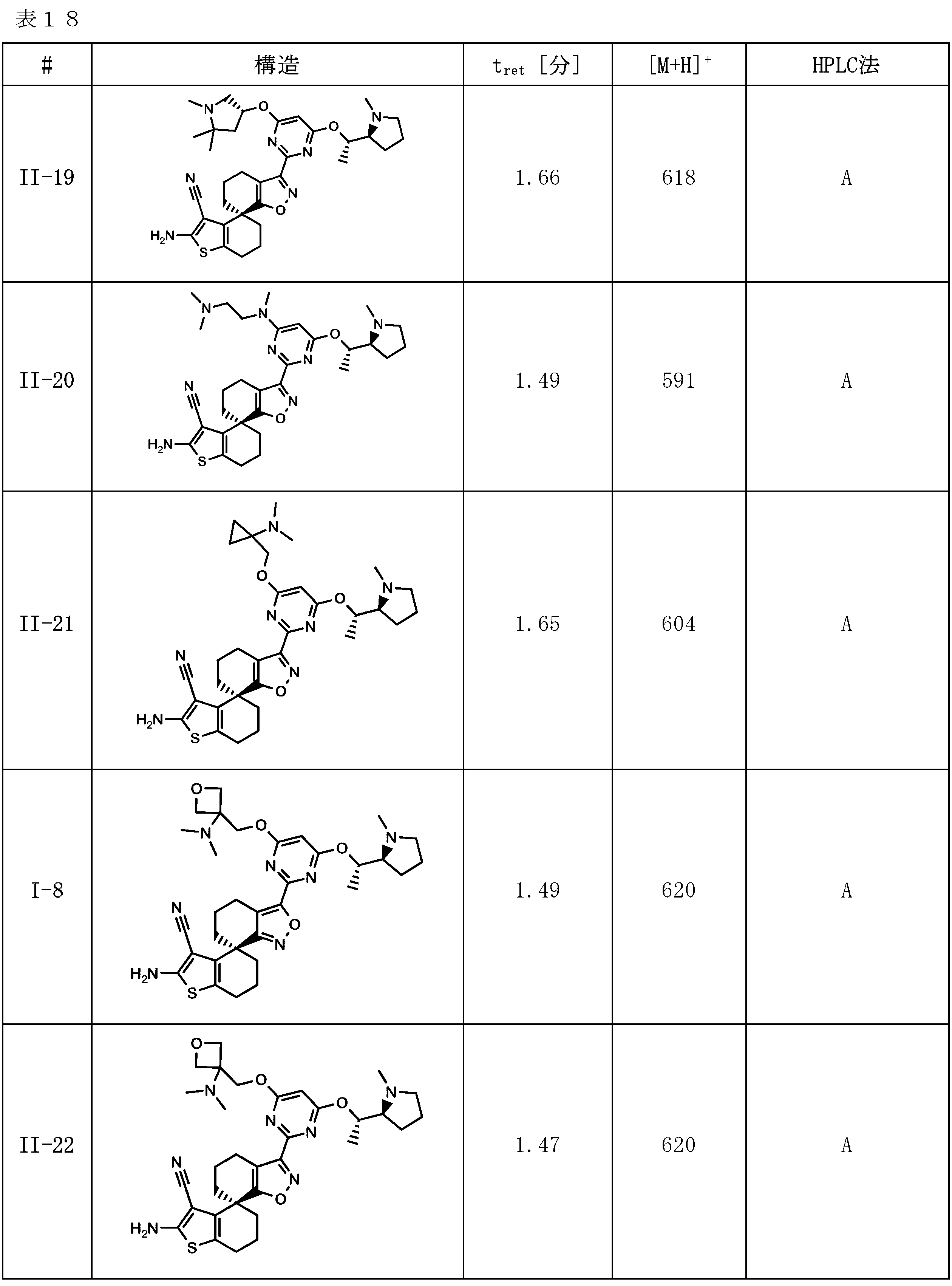

H-2~IIへの変換に関する実験手順(方法III)

Tert-ブチル-(3R)-3-ヒドロキシ-2,2-ジメチル-アゼチジン-1-カルボキシラート(98.8mg、0.476mmol、1.10当量)を、THF(3.0mL)に溶解した。NaH(鉱油中60%、36.3mg、0.909mmol、2.10当量)を加え、混合物を室温で10分間撹拌した。H-2a(235mg、0.433mmol;1.0当量)を、乾燥THF(5mL)に溶解し、混合物に加えた。混合物を室温で1時間撹拌した。反応混合物を飽和NH4Cl水溶液でクエンチし、DCMを加え、有機層を分離し、乾燥し、濾過し、そして蒸発させた。粗生成物をRPクロマトグラフィーで精製して、II-26を生成した。
Experimental Procedure for Conversion of H-2 to II (Method III)
Tert-Butyl-(3R)-3-hydroxy-2,2-dimethyl-azetidine-1-carboxylate (98.8 mg, 0.476 mmol, 1.10 equiv) was dissolved in THF (3.0 mL). NaH (60% in mineral oil, 36.3 mg, 0.909 mmol, 2.10 equiv) was added and the mixture was stirred at room temperature for 10 min. H-2a (235 mg, 0.433 mmol; 1.0 equiv) was dissolved in dry THF (5 mL) and added to the mixture. The mixture was stirred at room temperature for 1 h. The reaction mixture was quenched with saturated aqueous NH 4 Cl solution, DCM was added, the organic layer was separated, dried, filtered and evaporated. The crude product was purified by RP chromatography to yield II-26.
以下の化合物II(表19)は、類似の方法で利用可能である。粗生成物は、必要に応じてクロマトグラフィーにより精製する。
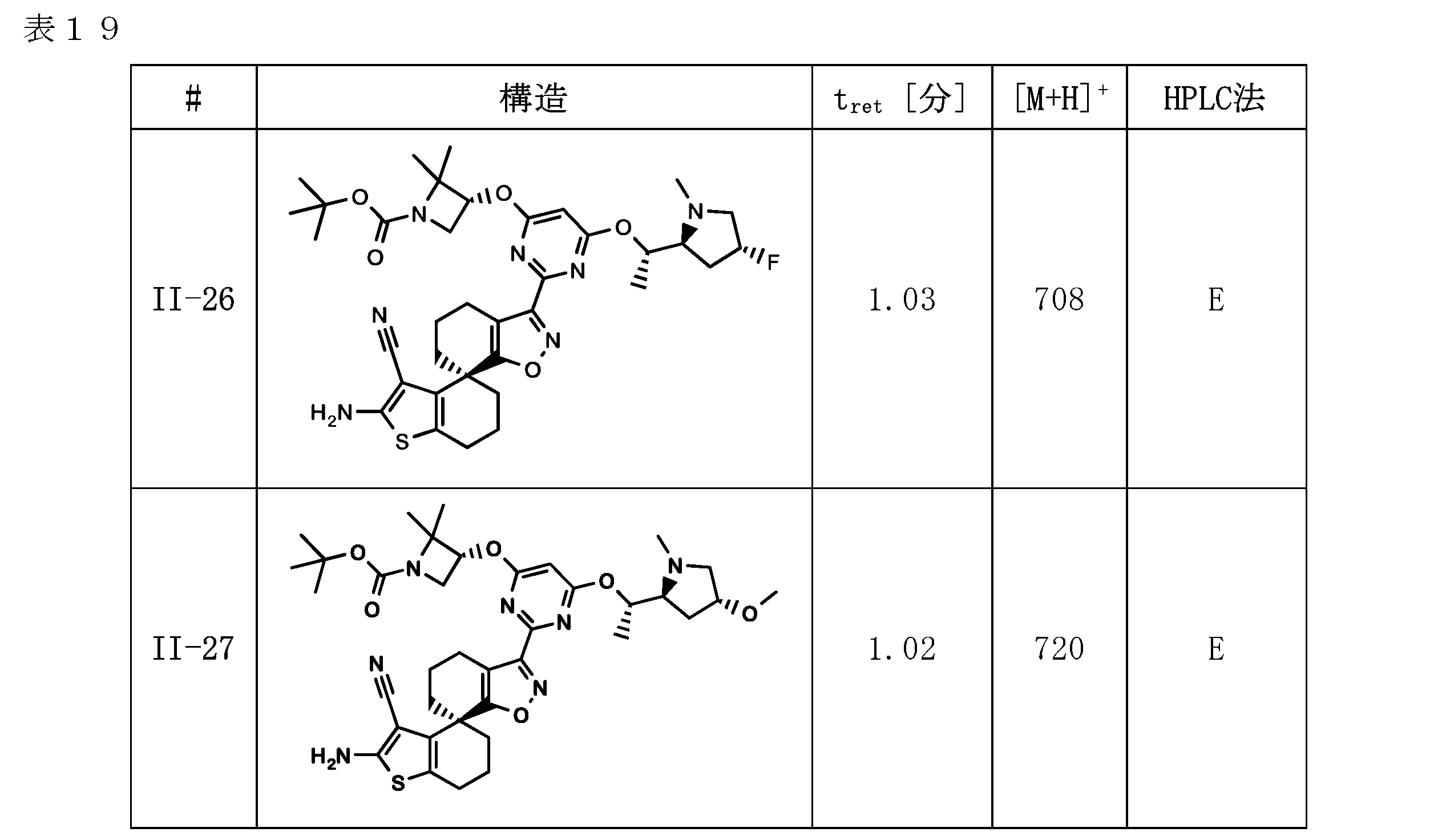
IIの合成に関する実験手順

II-23(60.0mg、0.087mmol、1.0当量)を、TFA(1mL、13.4mmol、154当量)に溶解し、反応物を室温で15分間撹拌した。完全な変換の後、反応混合物を真空下で濃縮し、残留物をDCMで希釈し、飽和NaHCO3水溶液で洗浄し、乾燥し、濾過し、そして濃縮した。粗生成物をRPクロマトグラフィーで精製した。
Experimental Procedure for the Synthesis of II
II-23 (60.0 mg, 0.087 mmol, 1.0 equiv) was dissolved in TFA (1 mL, 13.4 mmol, 154 equiv) and the reaction was stirred at room temperature for 15 min. After complete conversion, the reaction mixture was concentrated in vacuo and the residue was diluted with DCM, washed with saturated aqueous NaHCO3 , dried, filtered and concentrated. The crude product was purified by RP chromatography.
以下の化合物II(表20)は、類似の方法で利用可能である。粗生成物は、必要に応じてクロマトグラフィーにより精製する。

以下の実施例は、本発明に係る化合物の生物学的活性を説明するものであり、本発明は、これらの実施例に限定されるものではない。 The following examples are intended to illustrate the biological activity of the compounds of the present invention, but the present invention is not limited to these examples.
KRAS::SOS1 AlphaScreen結合アッセイ
このアッセイを用いて、(突然変異した)KRASに結合する本発明に係る化合物が、SOS1と(突然変異した)KRAS、例えば、KRAS WT、KRAS G12C、KRAS G12D、KRAS G12V、KRAS G13Dとの間のタンパク質-タンパク質相互作用を阻害する効力を調べることができる。これは、SOS1のGEF機能を阻害し、対応する突然変異したKRASタンパク質をその不活性なGDP結合状態に固定する。このアッセイ環境における低いIC50値は、SOS1とKRASとの間のタンパク質-タンパク質相互作用の強力な阻害の指標である:
KRAS::SOS1 AlphaScreen Binding Assay This assay can be used to determine the potency of compounds according to the invention that bind to (mutated) KRAS to inhibit the protein-protein interaction between SOS1 and (mutated) KRAS, e.g. KRAS WT, KRAS G12C, KRAS G12D, KRAS G12V, KRAS G13D. This inhibits the GEF function of SOS1 and locks the corresponding mutated KRAS protein in its inactive GDP-bound state. A low IC50 value in this assay setting is indicative of a strong inhibition of the protein-protein interaction between SOS1 and KRAS:
アッセイの説明:
これらのアッセイは、Perkin ElmerによるAlpha Screen技術を用いて、KRAS変異体のタンパク質-タンパク質相互作用に対する化合物の阻害効果を測定する。
Assay Description:
These assays use Alpha Screen technology by Perkin Elmer to measure the inhibitory effect of compounds on protein-protein interactions of mutant KRAS.
以下の(変異体)酵素型のKRAS及び相互作用タンパク質がこれらのアッセイにおいて一定濃度で使用される:
KRAS(G12D)1-169、N末端6Hisタグ、C末端aviタグ(Xtal BioStructures, Inc.);最終アッセイ濃度10nM、及びSOS1 564-1049、N末端229 GSTタグ、TEV切断部位(Viva Biotech Ltd);最終アッセイ濃度5nM;
KRAS(G12C)1-169、精製のための切断されるN末端6Hisタグ、ビオチン化されたC末端aviタグ、突然変異:C51S、C80L、C118S(自社製);最終アッセイ濃度7.5nM、及びSOS1 564-1049、N末端229 GSTタグ、TEV切断部位(Viva Biotech Ltd);最終アッセイ濃度5nM;
KRAS(G12V)1-169、精製のための切断されるN末端6Hisタグ、ビオチン化されたC末端aviタグ、TEV切断部位、突然変異:C118S、GDP負荷(自社製);最終アッセイ濃度10nM、及びSOS1 564-1049、N末端229 GSTタグ、TEV切断部位(Viva Biotech Ltd);最終アッセイ濃度10nM;
KRAS(G13D)1-169、精製のための切断されるN末端6Hisタグ、ビオチン化されたC末端aviタグ、TEV切断部位、突然変異:C118S、GDP負荷(自社製);最終アッセイ濃度10nM、及びSOS1 564-1049、N末端229 GSTタグ、TEV切断部位(Viva Biotech Ltd);最終アッセイ濃度10nM;
KRAS(WT)1-169、精製のための切断されるN末端6Hisタグ、ビオチン化されたC末端aviタグ、TEV切断部位、突然変異:C118S、GDP負荷(自社製);最終アッセイ濃度10nM、及びSOS1 564-1049、N末端229 GSTタグ、TEV切断部位(Viva Biotech Ltd);最終アッセイ濃度10nM。
The following (mutant) enzymatic forms of KRAS and interacting proteins are used at fixed concentrations in these assays:
KRAS(G12D)1-169, N-terminal 6His tag, C-terminal avi tag (Xtal BioStructures, Inc.); final assay concentration 10 nM, and SOS1 564-1049, N-terminal 229 GST tag, TEV cleavage site (Viva Biotech Ltd); final assay concentration 5 nM;
KRAS (G12C) 1-169, N-terminal 6His tag cleaved for purification, C-terminal avi tag biotinylated, mutations: C51S, C80L, C118S (in-house); final assay concentration 7.5 nM, and SOS1 564-1049, N-terminal 229 GST tag, TEV cleavage site (Viva Biotech Ltd); final assay concentration 5 nM;
KRAS(G12V)1-169, N-terminal 6His tag cleaved for purification, C-terminal avi tag biotinylated, TEV cleavage site, mutation: C118S, GDP loading (in-house); final assay concentration 10 nM, and SOS1 564-1049, N-terminal 229 GST tag, TEV cleavage site (Viva Biotech Ltd); final assay concentration 10 nM;
KRAS(G13D)1-169, N-terminal 6His tag cleaved for purification, C-terminal avi tag biotinylated, TEV cleavage site, mutation: C118S, GDP loading (in-house); final assay concentration 10 nM, and SOS1 564-1049, N-terminal 229 GST tag, TEV cleavage site (Viva Biotech Ltd); final assay concentration 10 nM;
KRAS (WT) 1-169, N-terminal 6His tag cleaved for purification, C-terminal avi tag biotinylated, TEV cleavage site, mutation: C118S, GDP loading (in-house); final assay concentration 10 nM, and SOS1 564-1049, N-terminal 229 GST tag, TEV cleavage site (Viva Biotech Ltd); final assay concentration 10 nM.
DMSOに溶解させた試験化合物を、Labcyte Echo 55xを備えたAccess Labcyte Workstationを用いてアッセイプレート(Proxiplate 384 PLUS、白色、PerkinElmer; 6008289)に分注する。選択した最高アッセイ濃度100μMのために、10mMのDMSO化合物ストック溶液から化合物溶液150nLを移す。1化合物当たり11種の一連の5倍希釈物をアッセイプレートに移し、化合物希釈物を2回反復で試験する。DMSOを再充填として総体積150nLまで加える。 Test compounds dissolved in DMSO are dispensed into assay plates (Proxiplate 384 PLUS, white, PerkinElmer; 6008289) using an Access Labcyte Workstation equipped with a Labcyte Echo 55x. Transfer 150 nL of compound solution from a 10 mM DMSO compound stock solution for the highest assay concentration chosen of 100 μM. Transfer a series of 11 5-fold dilutions per compound to the assay plate and test compound dilutions in duplicate. Add DMSO as a refill to a total volume of 150 nL.
アッセイは、100Lux以下の暗室において全自動ロボットシステムで実行する。カラム1~24中、化合物希釈物150nlに、アッセイバッファー(1×PBS、0.1%BSA、0.05% Tween 20)中のKRAS変異体タンパク質、SOS1(最終アッセイ濃度は上記参照)及びGDPヌクレオチド(Sigma G7127;最終アッセイ濃度10μM)を含む混合物10μlを加える。 The assay is performed on a fully automated robotic system in a dark room at ≤100 Lux. In columns 1-24, 150 nl of compound dilution is added with 10 μl of a mixture containing KRAS mutant protein, SOS1 (final assay concentrations see above) and GDP nucleotide (Sigma G7127; final assay concentration 10 μM) in assay buffer (1x PBS, 0.1% BSA, 0.05% Tween 20).
30分間のインキュベーション時間の後、アッセイバッファー中のAlpha Screenビーズ混合物5μlをカラム1~23に加える。ビーズ混合物は、アッセイバッファー中、各々最終アッセイ濃度10μg/mlのAlphaLISA Glutathione Acceptor Beads(PerkinElmer, Cat No AL109)及びAlphaScreen Streptavidin Donor Beads(PerkinElmer Cat No 6760002)からなる。 After the 30 minute incubation period, 5 μl of the Alpha Screen bead mixture in assay buffer is added to columns 1-23. The bead mixture consists of AlphaLISA Glutathione Acceptor Beads (PerkinElmer, Cat No AL109) and AlphaScreen Streptavidin Donor Beads (PerkinElmer Cat No 6760002) each at a final assay concentration of 10 μg/ml in assay buffer.
プレートを暗くしたインキュベーター内に室温で保持する。更に60分間のインキュベーション時間の後、PerkinElmer社製のAlphaScreen specsを用いて、PerkinElmer Envision HTS Multilabel Readerでシグナルを測定する。 The plate is kept at room temperature in a darkened incubator. After a further 60 min incubation period, the signal is measured on a PerkinElmer Envision HTS Multilabel Reader using PerkinElmer AlphaScreen specs.
各プレートは、希釈手順(プレートワイズ又は段階)に応じて、最大で陰性対照16ウェル(試験化合物の代わりにDMSO;KRAS変異体::SOS1 GDP混合物及びビーズ混合物あり;カラム23)と陽性対照16ウェル(試験化合物の代わりにDMSO;KRAS変異体::SOS1 GDP混合物あり、ビーズ混合物なし;カラム24)を含有する。 Each plate contains up to 16 negative control wells (DMSO instead of test compound; with KRAS mutant::SOS1 GDP mix and bead mix; column 23) and 16 positive control wells (DMSO instead of test compound; with KRAS mutant::SOS1 GDP mix and no bead mix; column 24) depending on the dilution procedure (platewise or stepwise).
内部対照として、KRAS変異体::SOS1相互作用の公知の阻害剤を各化合物プレートで試験することができる。 As an internal control, a known inhibitor of the KRAS mutant::SOS1 interaction can be tested on each compound plate.
IC50値は、4パラメーターロジスティックモデルを用いて、Boehringer IngelheimのMEGALAB IC50 applicationで計算及び分析する。 IC50 values are calculated and analyzed with the MEGALAB IC50 application from Boehringer Ingelheim using a four parameter logistic model.
上記アッセイを用いて決定された本明細書に開示される例示化合物のIC50値(表21を参照のこと)。 IC50 values of exemplary compounds disclosed herein determined using the above assay (see Table 21).


Ba/F3細胞モデルの生成及び増殖アッセイ
Ba/F3細胞をDSMZ(ACC300, Lot17)から取り寄せ、RPMI-1640(ATCC 30-2001)+10%FCS+10ng/mL IL-3中、5%CO2雰囲気下、37℃で成長させる。KRASG12変異体(すなわち、G12D、G12C、G12V)を含有するプラスミドをGeneScriptから入手する。KRASG12依存性Ba/F3モデルを生成するために、Ba/F3細胞に、KRASG12アイソフォームを保有するベクターを含有するレトロウイルスを形質導入する。Platinum-E細胞(Cell Biolabs)をレトロウイルスパッケージングに使用する。レトロウイルスをBa/F3細胞に加える。確実に感染が起こるように、4μg/mLのポリブレンを加え、細胞をスピンフェクトする。感染効率は、セルアナライザーを用いてGFP陽性細胞を測定することによって確認する。感染効率が10%~20%の細胞を更に培養し、1μg/mLでピューロマイシン選択を開始する。対照として、選択状態を示すために親Ba/F3細胞を使用する。親Ba/F3細胞培養物が死んだときに、選択が成功したと見なす。KRASG12突然変異の形質転換能を評価するために、成長培地にもはやIL-3を補充しない。空のベクターを保有するBa/F3細胞を対照として使用する。実験を行う約10日前に、ピューロマイシンを除去する。
Generation of Ba/F3 cell models and proliferation assays Ba/F3 cells are obtained from DSMZ (ACC300, Lot17) and grown in RPMI-1640 (ATCC 30-2001) + 10% FCS + 10 ng/mL IL-3 at 37°C in a 5% CO2 atmosphere . Plasmids containing KRASG12 mutants (i.e. G12D, G12C, G12V) are obtained from GeneScript. To generate KRASG12-dependent Ba/F3 models, Ba/F3 cells are transduced with retroviruses containing vectors carrying KRASG12 isoforms. Platinum-E cells (Cell Biolabs) are used for retrovirus packaging. Retroviruses are added to Ba/F3 cells. To ensure infection, 4 μg/mL polybrene is added and cells are spinfected. Infection efficiency is confirmed by measuring GFP positive cells using a cell analyzer. Cells with an infection efficiency of 10%-20% are further cultured and puromycin selection is initiated at 1 μg/mL. As a control, parental Ba/F3 cells are used to indicate the selection status. Selection is considered successful when the parental Ba/F3 cell culture dies. To evaluate the transforming potential of the KRASG12 mutation, the growth medium is no longer supplemented with IL-3. Ba/F3 cells carrying the empty vector are used as control. Puromycin is removed approximately 10 days before the experiment is performed.
増殖アッセイのために、Ba/F3細胞を384ウェルプレートに成長培地(RPMI-1640+10%FCS)中1.5×103個の細胞/60μLで播種する。Labcyte Echo 550又は555アコースティックディスペンサーを備えたAccess Labcyte Workstationを用いて、化合物を加える。すべての処理は、技術的2回反復で実施する。処理した細胞を、37℃、5%CO2で72時間インキュベートする。生死判定染色剤(viability stain)であるAlamarBlue(商標)(ThermoFisher)を加え、PerkinElmer Envision HTS Multilabel Readerで蛍光を測定する。生データをBoehringer Ingelheim proprietary software MegaLab(プログラムPRISMに基づき曲線の当てはめを行う、GraphPad Inc.)にインポートし、分析する。 For proliferation assays, Ba/F3 cells are seeded in 384-well plates at 1.5x10³ cells/60μL in growth medium (RPMI-1640+10% FCS). Compounds are added using an Access Labcyte Workstation equipped with a Labcyte Echo 550 or 555 acoustic dispenser. All treatments are performed in technical duplicates. Treated cells are incubated for 72 hours at 37°C, 5% CO2 . The viability stain AlamarBlue™ (ThermoFisher) is added and fluorescence is measured on a PerkinElmer Envision HTS Multilabel Reader. Raw data are imported and analyzed into Boehringer Ingelheim proprietary software MegaLab (curve fitting based on the program PRISM, GraphPad Inc.).
このアッセイで測定された本発明に係る代表化合物のIC50値を表23に提示する。 IC 50 values of representative compounds according to the invention measured in this assay are presented in Table 23.
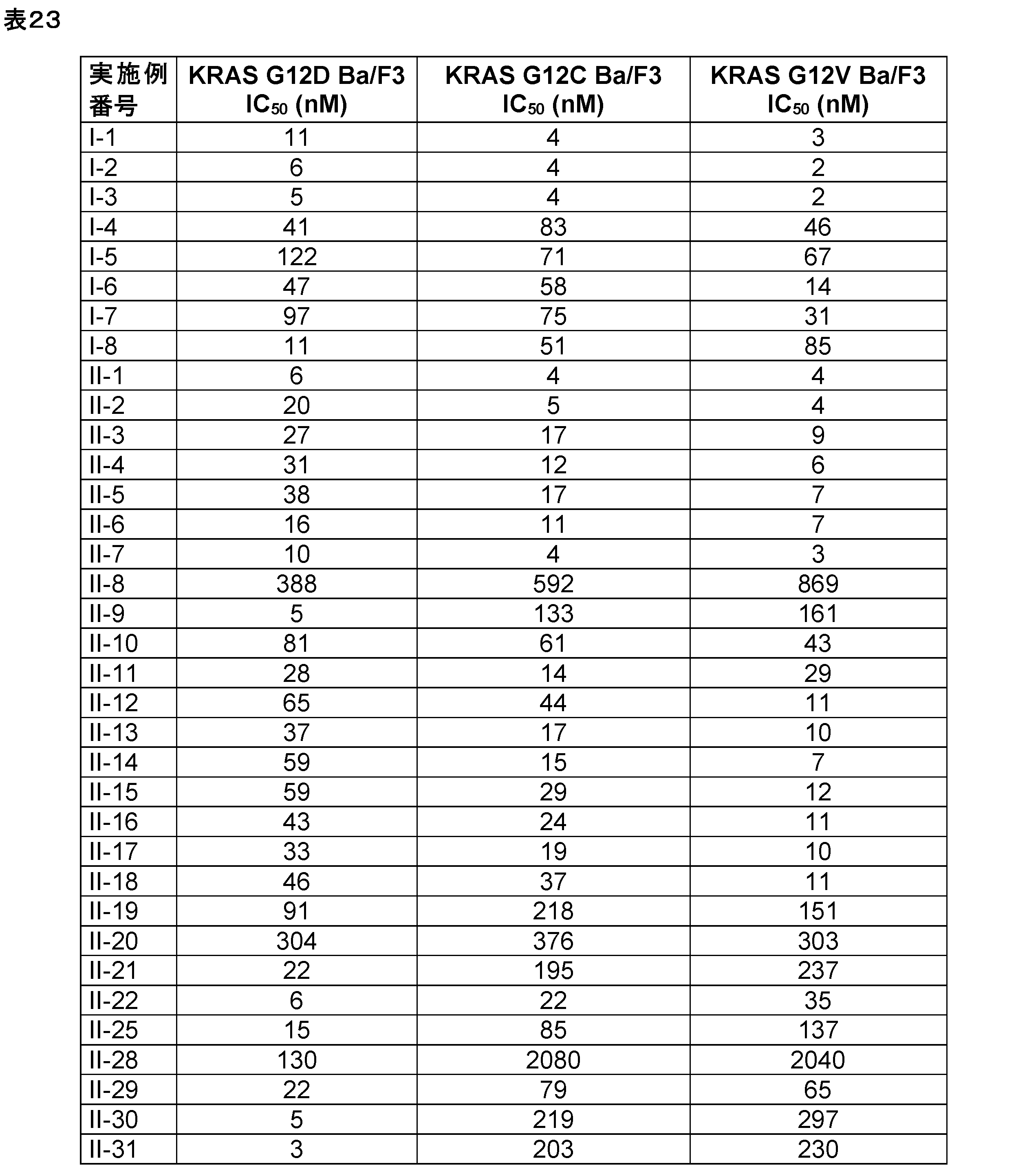
変異体がん細胞株を用いた追加の増殖アッセイ
・NCI-H358 CTG増殖アッセイ(120時間)(NSCLC、G12C)
NCI-H358細胞(ATCC No. CRL-5807)を、黒色384ウェルプレート、平底クリアボトム(Greiner, PNr. 781091)に、60μlのRPMI-1640 ATCC-Formulation(Gibco # A10491)+10%FCS(ウシ胎児血清)中200個の細胞/ウェルの密度で分注する。加湿組織培養インキュベーター内、5%CO2、37℃で細胞を一晩インキュベートする。化合物(DMSO中10mMストック)を、ECHOアコースティックリキッドハンドラーシステム(Beckman Coulter)を使用して対数用量系列で加え、添加したDMSOに対して正規化し、DMSO対照を含める。T0時点測定のために、未処理細胞を化合物添加時点に分析する。プレートを120時間インキュベートし、CellTiter-Glo発光細胞生死判定試薬(Promega product code G7570)を使用して細胞生存率を測定する。生存率(対照に対するパーセントとして規定)は、各ウェルの相対発光単位RLUをDMSO対照中の細胞のRLUで割ったものとして定義される。IC50値は、生存率測定値から、4パラメーターモデルを使用して非線形回帰により決定される。
Additional proliferation assays using mutant cancer cell lines : NCI-H358 CTG proliferation assay (120 hours) (NSCLC, G12C)
NCI-H358 cells (ATCC No. CRL-5807) are dispensed into black 384-well plates, flat clear bottom (Greiner, PNr. 781091) at a density of 200 cells/well in 60 μl of RPMI-1640 ATCC-Formulation (Gibco # A10491) + 10% FCS (fetal calf serum). Cells are incubated overnight at 37°C in a humidified tissue culture incubator with 5% CO 2 . Compounds (10 mM stock in DMSO) are added in a log dose series using an ECHO acoustic liquid handler system (Beckman Coulter) and normalized to added DMSO, and DMSO controls are included. For TO time point measurements, untreated cells are analyzed at the time of compound addition. Plates are incubated for 120 hours and cell viability is measured using CellTiter-Glo Luminescent Cell Viability Reagent (Promega product code G7570). Viability (defined as percent of control) is defined as the relative luminescence units (RLU) of each well divided by the RLU of cells in the DMSO control. IC50 values are determined from viability measurements by nonlinear regression using a four-parameter model.
・NCI-H2122 CTG増殖アッセイ(120時間)(NSCLC、G12C)
CTGアッセイは、CellTiter Glow Assay Kit(Promega G7571)を使用して、NCI-H2122細胞(ATCC CRL-5985)の増殖を定量的に測定するように設計される。細胞を、ウシ胎児血清(Life Technologies, Gibco BRL, Cat. No. 10270-106)を補充したRPMI培地(ATCC)中で成長させる。「0日目」に、200個のNCI-H2122細胞を、黒色384ウェルプレート、平底クリアボトム(Greiner, PNr. 781091)内、60μLのRPMI ATCC+10%FCS+Penstrep中に播種する。次いで、細胞を、CO2インキュベーター内で、プレート中、37℃で一晩インキュベートする。1日目に、化合物(DMSO中10mMストック)をECHOアコースティックリキッドハンドラーシステム(Beckman Coulter)で加え、DMSO対照を含める。プレートを120時間インキュベートし、CellTiter-Glo発光細胞生死判定試薬(Promega product code G7570)を使用して細胞生存率を測定する。生存率(対照に対するパーセントとして規定)は、各ウェルの相対発光単位RLUをDMSO対照中の細胞のRLUで割ったものとして定義される。IC50値は、生存率測定値から、4パラメーターモデルを使用して非線形回帰により決定される。
NCI-H2122 CTG proliferation assay (120 hours) (NSCLC, G12C)
The CTG assay is designed to quantitatively measure the proliferation of NCI-H2122 cells (ATCC CRL-5985) using the CellTiter Glow Assay Kit (Promega G7571). Cells are grown in RPMI medium (ATCC) supplemented with fetal bovine serum (Life Technologies, Gibco BRL, Cat. No. 10270-106). On "day 0", 200 NCI-H2122 cells are seeded in 60 μL of RPMI ATCC + 10% FCS + Penstrep in a black 384-well plate, flat clear bottom (Greiner, PNr. 781091). Cells are then incubated in the plate overnight at 37°C in a CO2 incubator. On day 1, compounds (10 mM stock in DMSO) are added with an ECHO acoustic liquid handler system (Beckman Coulter) and a DMSO control is included. Plates are incubated for 120 hours and cell viability is measured using the CellTiter-Glo Luminescent Cell Viability Reagent (Promega product code G7570). Viability (defined as percent of control) is defined as the relative luminescence units (RLU) of each well divided by the RLU of cells in the DMSO control. IC50 values are determined from the viability measurements by nonlinear regression using a four-parameter model.
・AsPC-1 CTG増殖アッセイ(120時間)(膵臓がん、G12D)
CTGアッセイは、CellTiter Glow Assay Kit(Promega G7571)を使用して、AsPC-1細胞(ATCC CRL-5985)の増殖を定量的に測定するように設計される。細胞を、ウシ胎児血清(Life Technologies, Gibco BRL, Cat. No. 10270-106)を補充したRPMI培地(ATCC)中で成長させる。「0日目」に、2000個のAsPC-1細胞を、384ウェルプレート、平底クリアボトム(Greiner, PNr. 781091)内、60μLのRPMI ATCC+10%FCS+Penstrep中に播種する。次いで、細胞を、CO2インキュベーター内で、プレート中、37℃で一晩インキュベートする。1日目に、化合物(DMSO中10mMストック)をECHOアコースティックリキッドハンドラーシステム(Beckman Coulter)で加え、DMSO対照を含める。プレートを120時間インキュベートし、CellTiter-Glo発光細胞生死判定試薬(Promega product code G7570)を使用して細胞生存率を測定する。生存率(対照に対するパーセントとして規定)は、各ウェルの相対発光単位RLUをDMSO対照中の細胞のRLUで割ったものとして定義される。IC50値は、生存率測定値から、4パラメーターモデルを使用して非線形回帰により決定される。
AsPC-1 CTG proliferation assay (120 hours) (pancreatic cancer, G12D)
The CTG assay is designed to quantitatively measure the proliferation of AsPC-1 cells (ATCC CRL-5985) using the CellTiter Glow Assay Kit (Promega G7571). Cells are grown in RPMI medium (ATCC) supplemented with fetal bovine serum (Life Technologies, Gibco BRL, Cat. No. 10270-106). On "day 0", 2000 AsPC-1 cells are seeded in 60 μL of RPMI ATCC + 10% FCS + Penstrep in a 384-well plate, flat clear bottom (Greiner, PNr. 781091). The cells are then incubated in the plate overnight at 37°C in a CO2 incubator. On day 1, compounds (10 mM stock in DMSO) are added with an ECHO acoustic liquid handler system (Beckman Coulter) and a DMSO control is included. Plates are incubated for 120 hours and cell viability is measured using the CellTiter-Glo Luminescent Cell Viability Reagent (Promega product code G7570). Viability (defined as percent of control) is defined as the relative luminescence units (RLU) of each well divided by the RLU of cells in the DMSO control. IC50 values are determined from the viability measurements by nonlinear regression using a four-parameter model.
・GP2D増殖アッセイ(120時間)(大腸がん、G12D)
GP2D細胞(ATCC No. CRL-5807)を、白色384ウェルプレート、平底白色ボトム(Perkin Elmer, 6007680)に、40μlのDMEM(Sigma, D6429)+1×GlutaMAX(Gibco, 35050038)+10%FCS(ウシ胎児血清)中500個の細胞/ウェルの密度で分注する。加湿組織培養インキュベーター内、5%CO2、37℃で細胞を一晩インキュベートする。化合物(DMSO中10mMストック)を、HP Digital Dispenser D300(Tecan)を使用して対数用量系列で加え、DMSO対照を含め、添加したDMSOに対して正規化する。T0時点測定のために、未処理細胞を化合物添加時点に分析する。プレートを120時間インキュベートし、CellTiter-Glo発光細胞生死判定試薬(Promega product code G7570)を使用して細胞生存率を測定する。生存率(対照に対するパーセントとして規定)は、各ウェルの相対発光単位RLUをDMSO対照中の細胞のRLUで割ったものとして定義される。IC50値は、生存率測定値から、4パラメーターモデルを使用して非線形回帰により決定される。
GP2D proliferation assay (120 hours) (colon cancer, G12D)
GP2D cells (ATCC No. CRL-5807) are dispensed into white 384-well plates, flat white bottom (Perkin Elmer, 6007680) at a density of 500 cells/well in 40 μl DMEM (Sigma, D6429) + 1×GlutaMAX (Gibco, 35050038) + 10% FCS (fetal calf serum). Cells are incubated overnight at 37° C. in a humidified tissue culture incubator with 5% CO 2 . Compounds (10 mM stock in DMSO) are added in a log dose series using a HP Digital Dispenser D300 (Tecan) and DMSO controls are included and normalized to the added DMSO. For TO time point measurements, untreated cells are analyzed at the time of compound addition. Plates are incubated for 120 hours and cell viability is measured using CellTiter-Glo Luminescent Cell Viability Reagent (Promega product code G7570). Viability (defined as percent of control) is defined as the relative luminescence units (RLU) of each well divided by the RLU of cells in the DMSO control. IC50 values are determined from viability measurements by nonlinear regression using a four-parameter model.
・SAS CTG増殖アッセイ(120時間)(HNSCC、増幅したwt)
SAS細胞(JCRB0260)を、384ウェルプレート、平底クリアボトム(Greiner, PNr. 781091)に、60μLのDMEM:F12(Gibco 31330-038)+10%ウシ胎児血清(HyClone, PNr.:SH30084.03)中300個の細胞/ウェルの密度で分注し、CO2インキュベーター内、37℃で一晩インキュベートする。翌日、化合物(DMSO中10mMストック)をECHOアコースティックリキッドハンドラーシステム(Beckman Coulter)で加え、DMSO対照を含める。プレートを120時間インキュベートし、CellTiter-Glo発光細胞生死判定試薬(Promega product code G7570)を使用して細胞生存率を測定する。生存率(対照に対するパーセントとして規定)は、各ウェルの相対発光単位RLUをDMSO対照中の細胞のRLUで割ったものとして定義される。IC50値は、生存率測定値から、4パラメーターモデルを使用して非線形回帰により決定される。
SAS CTG proliferation assay (120 hours) (HNSCC, amplified wt)
SAS cells (JCRB0260) are dispensed into 384-well plates, flat clear bottom (Greiner, PNr. 781091) at a density of 300 cells/well in 60 μL of DMEM:F12 (Gibco 31330-038) + 10% fetal bovine serum (HyClone, PNr.:SH30084.03) and incubated overnight at 37°C in a CO2 incubator. The following day, compounds (10 mM stock in DMSO) are added with an ECHO acoustic liquid handler system (Beckman Coulter) and a DMSO control is included. Plates are incubated for 120 hours and cell viability is measured using the CellTiter-Glo Luminescent Cell Viability Reagent (Promega product code G7570). Viability (defined as a percent of control) is defined as the relative luminescence units (RLU) of each well divided by the RLU of cells in the DMSO control. IC50 values are determined from the viability measurements by nonlinear regression using a four-parameter model.
・MKN1 CTG増殖アッセイ(120時間)(胃がん、増幅したwt)
MKN1細胞(JCRB0252)を、白色384ウェルプレート、平底白色ボトム(Perkin Elmer, 6007680)に、40μlのRPMI(Gibco, PNr.:21875034)+10%FCS(HyClone, PNr.:SH30084.03)中500個の細胞/ウェルの密度で(アッセイ1)、又は黒色384ウェルプレート、平底クリアボトム(Greiner, PNr. 781091)に、60μlのRPMI-1640(Gibco # A10491)+10%FCS(HyClone, PNr.:SH30084.03)+PenStrep(Gibco, PNr.15140-122)中200個の細胞/ウェルの密度で(アッセイ2)分注する。加湿組織培養インキュベーター内、5%CO2、37℃で細胞を一晩インキュベートする。化合物(DMSO中10mMストック)を、HP Digital Dispenser D300(Tecan)(アッセイ1)又はECHOアコースティックリキッドハンドラーシステム(Beckman Coulter)(アッセイ2)を使用して対数用量系列で加え、DMSO対照を含め、添加したDMSOに対して正規化する。プレートを120時間インキュベートし、CellTiter-Glo発光細胞生死判定試薬(Promega product code G7570)を使用して細胞生存率を測定する。生存率(対照に対するパーセントとして規定)は、各ウェルの相対発光単位RLUをDMSO対照中の細胞のRLUで割ったものとして定義される。IC50値は、生存率測定値から、4パラメーターモデルを使用して非線形回帰により決定される。
MKN1 CTG proliferation assay (120 hours) (gastric cancer, amplified wt)
MKN1 cells (JCRB0252) are dispensed into white 384-well plates, flat white bottom (Perkin Elmer, 6007680) at a density of 500 cells/well in 40 μl RPMI (Gibco, PNr.:21875034) + 10% FCS (HyClone, PNr.:SH30084.03) (Assay 1) or into black 384-well plates, flat clear bottom (Greiner, PNr. 781091) at a density of 200 cells/well in 60 μl RPMI-1640 (Gibco # A10491) + 10% FCS (HyClone, PNr.:SH30084.03) + PenStrep (Gibco, PNr.15140-122) (Assay 2). Cells are incubated overnight at 37° C. in a humidified tissue culture incubator with 5% CO 2 . Compounds (10 mM stock in DMSO) are added in a log dose series using an HP Digital Dispenser D300 (Tecan) (assay 1) or an ECHO acoustic liquid handler system (Beckman Coulter) (assay 2) and a DMSO control is included and normalized to added DMSO. Plates are incubated for 120 hours and cell viability is measured using CellTiter-Glo Luminescent Cell Viability Reagent (Promega product code G7570). Viability (defined as percent of control) is defined as the relative luminescence units (RLU) of each well divided by the RLU of cells in the DMSO control. IC 50 values are determined from viability measurements by nonlinear regression using a four-parameter model.
・SK-CO-1 CTG増殖アッセイ(120時間)(CRC、G12V)
SK-CO-1細胞(ATCC HTB-39)を、384ウェルプレート、平底クリアボトム(Greiner, PNr. 781091)に、60μLのEMEM(Sigma M5650)+10%ウシ胎児血清(HyClone, PNr.:SH30084.03)中500個の細胞/ウェルの密度で分注し、CO2インキュベーター内、37℃で一晩インキュベートする。翌日、化合物(DMSO中10mMストック)をECHOアコースティックリキッドハンドラーシステム(Beckman Coulter)で加え、DMSO対照を含める。プレートを120時間インキュベートし、CellTiter-Glo発光細胞生死判定試薬(Promega product code G7570)を使用して細胞生存率を測定する。生存率(対照に対するパーセントとして規定)は、各ウェルの相対発光単位RLUをDMSO対照中の細胞のRLUで割ったものとして定義される。IC50値は、生存率測定値から、4パラメーターモデルを使用して非線形回帰により決定される。
SK-CO-1 CTG proliferation assay (120 hours) (CRC, G12V)
SK-CO-1 cells (ATCC HTB-39) are dispensed into 384-well plates, flat clear bottom (Greiner, PNr. 781091) at a density of 500 cells/well in 60 μL of EMEM (Sigma M5650) + 10% fetal bovine serum (HyClone, PNr.:SH30084.03) and incubated overnight at 37°C in a CO2 incubator. The following day, compounds (10 mM stock in DMSO) are added with an ECHO acoustic liquid handler system (Beckman Coulter) and a DMSO control is included. Plates are incubated for 120 hours and cell viability is measured using CellTiter-Glo Luminescent Cell Viability Reagent (Promega product code G7570). Viability (defined as a percent of control) is defined as the relative luminescence units (RLU) of each well divided by the RLU of cells in the DMSO control. IC 50 values are determined from viability measurements by non-linear regression using a four-parameter model.
・LOVO CTG増殖アッセイ(120時間)(CRC、G13D)
LOVO細胞(ATCC CCL-229)を、384ウェルプレート、平底クリアボトム(Greiner, PNr. 781091)に、60μLのDMEM(Sigma D6429)+10%ウシ胎児血清(HyClone, PNr.:SH30084.03)中1000個の細胞/ウェルの密度で分注し、CO2インキュベーター内、37℃で一晩インキュベートする。翌日、化合物(DMSO中10mMストック)をECHOアコースティックリキッドハンドラーシステム(Beckman Coulter)で加え、DMSO対照を含める。プレートを120時間インキュベートし、CellTiter-Glo発光細胞生死判定試薬(Promega product code G7570)を使用して細胞生存率を測定する。生存率(対照に対するパーセントとして規定)は、各ウェルの相対発光単位RLUをDMSO対照中の細胞のRLUで割ったものとして定義される。IC50値は、生存率測定値から、4パラメーターモデルを使用して非線形回帰により決定される。
LOVO CTG Proliferation Assay (120 hours) (CRC, G13D)
LOVO cells (ATCC CCL-229) are dispensed into 384-well plates, flat clear bottom (Greiner, PNr. 781091) at a density of 1000 cells/well in 60 μL of DMEM (Sigma D6429) + 10% fetal bovine serum (HyClone, PNr.:SH30084.03) and incubated overnight at 37°C in a CO2 incubator. The following day, compounds (10 mM stock in DMSO) are added with an ECHO acoustic liquid handler system (Beckman Coulter) and a DMSO control is included. Plates are incubated for 120 hours and cell viability is measured using CellTiter-Glo Luminescent Cell Viability Reagent (Promega product code G7570). Viability (defined as a percentage of control) is defined as the relative luminescence units (RLU) of each well divided by the RLU of cells in the DMSO control. IC 50 values are determined from viability measurements by non-linear regression using a four-parameter model.
表示の細胞株におけるこれらのアッセイで測定された本発明に係る代表化合物のIC50値を表22及び23に提示する。 The IC50 values of representative compounds according to the invention measured in these assays in the indicated cell lines are presented in Tables 22 and 23.

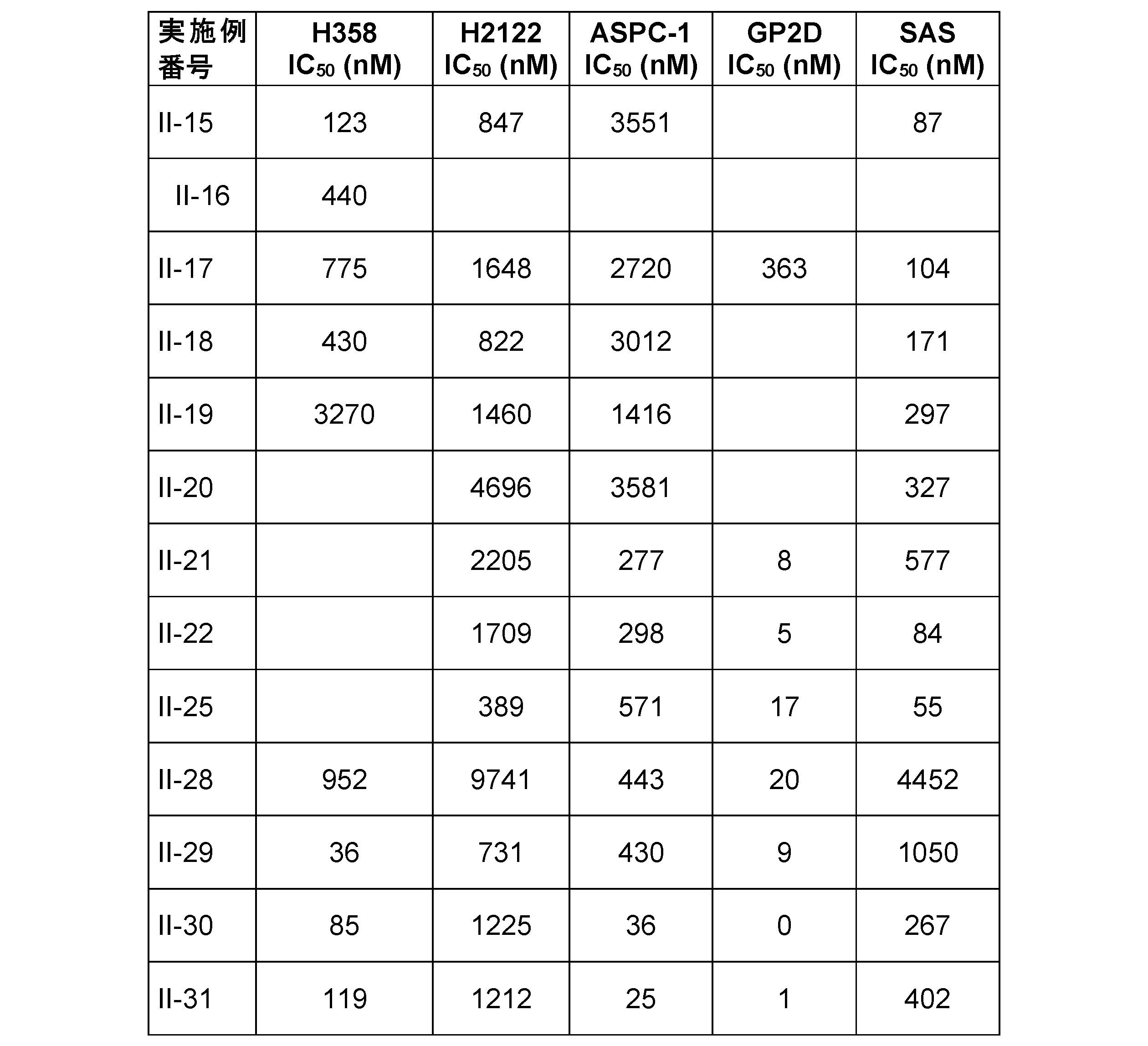
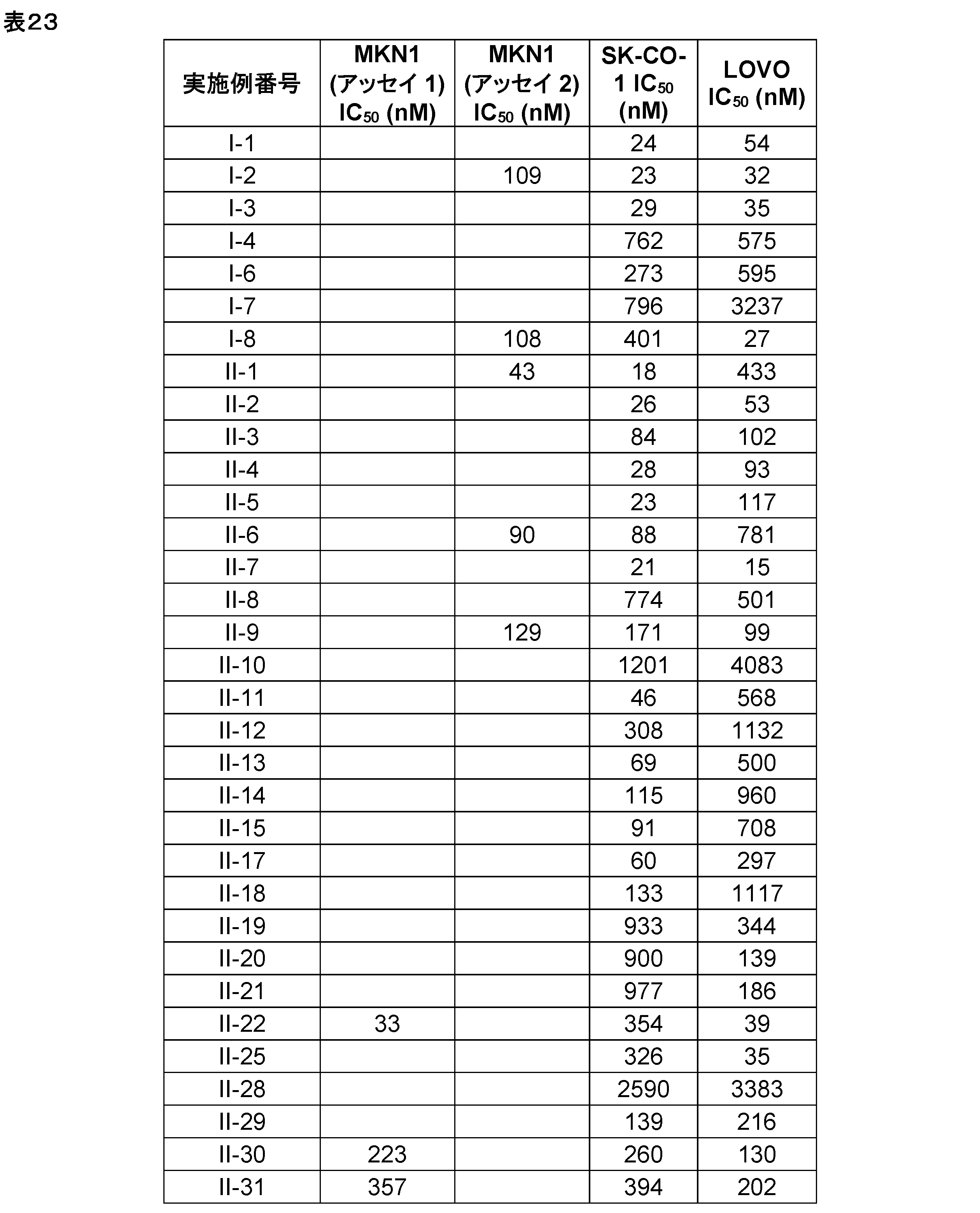
ERKリン酸化アッセイ
ERKリン酸化アッセイを使用して、本化合物が、インビトロのKRAS G12C変異体ヒトがん細胞株でKRAS G12C媒介シグナル伝達を阻害する効力を調べる。これは、RAS G12Cタンパク質シグナル伝達カスケードを妨害することによる本発明に係る化合物の分子作用機序を実証する。このアッセイ環境における低いIC50値は、本発明に係る化合物の高い効力の指標である。本発明に係る化合物が、KRAS G12C変異体ヒトがん細胞株においてERKリン酸化に対して阻害効果を実証することが観察され、これにより、RAS G12Cタンパク質シグナル伝達に対する本化合物の分子作用機序が立証される。
ERK phosphorylation assay The ERK phosphorylation assay is used to examine the efficacy of the compounds to inhibit KRAS G12C-mediated signal transduction in KRAS G12C mutant human cancer cell lines in vitro. This demonstrates the molecular mechanism of action of the compounds of the present invention by interfering with the RAS G12C protein signal transduction cascade. A low IC50 value in this assay environment is indicative of the high potency of the compounds of the present invention. It is observed that the compounds of the present invention demonstrate an inhibitory effect on ERK phosphorylation in KRAS G12C mutant human cancer cell lines, which demonstrates the molecular mechanism of action of the compounds on RAS G12C protein signal transduction.
ERKリン酸化アッセイは、以下のヒト細胞株を使用して実施される: ERK phosphorylation assays are performed using the following human cell lines:
NCI-H358(ATCC(ATCC CRL-5807):KRAS G12C突然変異を有するヒト肺がん(→アッセイ1)及びNCI-H358_Cas9_SOS2、すなわち、SOS2がノックされた同じ細胞株(→アッセイ2)。SOS2タンパク質ノックアウト用のgRNA産出のために設計されたDNA配列を含有するベクターは、Sigma-Aldrichから入手する。NCI-H358 SOS2ノックアウト細胞株を生成するために、Cas9エンドヌクレアーゼを発現するNCI-H358細胞に、XtremeGene9試薬及び対応するプラスミドをトランスフェクトする。トランスフェクション効率は、セルアナライザーを用いてGFP陽性細胞を測定することによって確認する。GFP陽性細胞を収集し、更に増大させる。これらのGFP陽性細胞プールを単一細胞希釈し、ウェスタンブロット及びゲノムDNA配列解析を介してSOS2ノックアウトクローンを同定する。 NCI-H358 (ATCC (ATCC CRL-5807): human lung cancer with KRAS G12C mutation (→ Assay 1) and NCI-H358_Cas9_SOS2, the same cell line in which SOS2 was knocked out (→ Assay 2). Vectors containing DNA sequences designed for gRNA production for SOS2 protein knockout are obtained from Sigma-Aldrich. To generate NCI-H358 SOS2 knockout cell lines, NCI-H358 cells expressing Cas9 endonuclease are transfected with XtremeGene9 reagent and the corresponding plasmid. Transfection efficiency is confirmed by measuring GFP-positive cells using a cell analyzer. GFP-positive cells are collected and further expanded. These GFP-positive cell pools are single-cell diluted and SOS2 knockout clones are identified via Western blot and genomic DNA sequence analysis.
アッセイに使用した材料:
RPMI-1640培地(ATCC(登録商標)30-2001(商標))
ウシ胎児血清(FBS)、HyClone社製(SH30071.03)
非必須アミノ酸、Thermo Fischer Scientific社製(11140035)
ピルビン酸塩、Thermo Fischer Scientific社製(11360039)
Glutamax、Thermo Fischer Scientific社製(35050061)
384プレート、Greiner Bio-One社製(781182)
Proxiplate(商標)384、PerkinElmer Inc.社製(6008280)
AlphaLISA SureFire Ultra p-ERK1/2(Thr202/Tyr204)Assay Kit(ALSU-PERK-A500)
EGF、Sigma社製(E4127)
Acceptor Mix:Protein A Acceptor Beads、PerkinElmer社製(6760137M)
Donor Mix:AlphaScreen Streptavidin-coated Donor Beads、PerkinElmer社製(6760002)
トラメチニブ
スタウロスポリン、Sigma Aldrich社製(S6942)
Materials used in the assay:
RPMI-1640 medium (ATCC® 30-2001™)
Fetal bovine serum (FBS), HyClone (SH30071.03)
Non-essential amino acids, Thermo Fischer Scientific (11140035)
Pyruvate, Thermo Fischer Scientific (11360039)
Glutamax, Thermo Fischer Scientific (35050061)
384 plate, Greiner Bio-One (781182)
Proxiplate™ 384, PerkinElmer Inc. (6008280)
AlphaLISA SureFire Ultra p-ERK1/2 (Thr202/Tyr204) Assay Kit (ALSU-PERK-A500)
EGF, manufactured by Sigma (E4127)
Acceptor Mix: Protein A Acceptor Beads, PerkinElmer (6760137M)
Donor Mix: AlphaScreen Streptavidin-coated Donor Beads, manufactured by PerkinElmer (6760002)
Trametinib staurosporine, Sigma Aldrich (S6942)
アッセイ設定:
細胞を、Greiner TC 384プレート内、10%FBS、非必須アミノ酸、ピルビン酸塩及びglutamaxを含む60μLのRPMI中に40,000個の細胞/ウェルで播種する。細胞を室温で1時間インキュベートし、次いで、インキュベーター内、37℃及び5%CO2で、加湿雰囲気下で一晩インキュベートする。次いで、Labcyte Echo 550デバイスを用いて、化合物溶液(10mM DMSOストック溶液)60nLを加える。前述のインキュベーター内で1時間インキュベーション後、遠心分離した後に培地を除去し、AlphaLISA SureFire Ultra pERK1/2(Thr202/Tyr204)Assay Kitからの1.6倍溶解バッファー20μLを加えることによって細胞を溶解し、プロテアーゼ阻害剤、100nM トラメチニブ+100nM スタウロスポリンを加える。室温で振盪させながら20分間インキュベーションした後、各溶解試料6μLを384ウェルProxiplateに移し、pERK(Thr202/Tyr204)をAlphaLISA SureFire Ultra pERK1/2(Thr202/Tyr204)Assay Kitで分析する。3μLのAcceptor Mix及び3μLのDonor Mixを薄明かりで加え、暗所にて室温で2時間インキュベートした後、PerkinElmer Envision HTS Multilabel Readerでシグナルを測定する。生データをBoehringer Ingelheim proprietary software MegaLab(プログラムPRISMに基づき曲線の当てはめを行う、GraphPad Inc.)にインポートし、分析する。
Assay setup:
Cells are seeded at 40,000 cells/well in 60 μL of RPMI containing 10% FBS, non-essential amino acids, pyruvate and glutamax in a Greiner TC 384 plate. Cells are incubated for 1 hour at room temperature and then overnight in an incubator at 37° C. and 5% CO 2 in a humidified atmosphere. Then, 60 nL of compound solution (10 mM DMSO stock solution) is added using a Labcyte Echo 550 device. After 1 hour of incubation in the aforementioned incubator, the medium is removed after centrifugation and the cells are lysed by adding 20 μL of 1.6x lysis buffer from the AlphaLISA SureFire Ultra pERK1/2 (Thr202/Tyr204) Assay Kit and adding the protease inhibitors 100 nM trametinib + 100 nM staurosporine. After 20 minutes of incubation at room temperature with shaking, 6 μL of each lysate is transferred to a 384-well Proxiplate and pERK (Thr202/Tyr204) is analyzed with the AlphaLISA SureFire Ultra pERK1/2 (Thr202/Tyr204) Assay Kit. 3 μL of Acceptor Mix and 3 μL of Donor Mix are added in dim light and incubated at room temperature in the dark for 2 hours before measuring the signal with a PerkinElmer Envision HTS Multilabel Reader. Raw data is imported and analyzed into Boehringer Ingelheim proprietary software MegaLab (GraphPad Inc., which performs curve fitting based on the program PRISM).
同様にして、記載のアッセイ(pERK還元;SureFire)を様々なKRAS突然変異又はKRAS野生型を担持する追加の細胞株で実施し、細胞バックグラウンドで様々な追加のKRASアレルに対する化合物の活性を測定及び判定することができる。 Similarly, the assays described (pERK reduction; SureFire) can be performed in additional cell lines carrying various KRAS mutations or KRAS wild type to measure and determine the activity of compounds against various additional KRAS alleles in the cell background.
代謝(ミクロソーム)安定性アッセイ
試験化合物の代謝分解は、プールした肝ミクロソーム(マウス(MLM)、ラット(RLM)又はヒト(HLM))を用いて37℃でアッセイする。1時点当たり48μLの最終インキュベーション容量は、TRISバッファー(pH 7.5;0.1M)、塩化マグネシウム(6.5mM)、ミクロソームタンパク質(マウス/ラットでは0.5mg/mL、ヒト検体では1mg/mL)及び終濃度1μMの試験化合物を含有する。37℃の短いプレインキュベーション期間に続いて、ベータ-ニコチンアミドアデニンジヌクレオチドリン酸、還元型(NADPH、10mM)12μLを加えることによって反応を開始し、種々の時点(0、5、15、30、60分)後にアリコートを溶媒に移すことによって終了する。更に加えて、NADPHなしのインキュベーションでNADPH非依存性分解をモニタリングし、最終時点にアセトニトリルを加えることによって終了する。クエンチしたインキュベーション物を遠心分離(4,000rpm、15分)によってペレットにする。上清のアリコートをLC-MS/MSによってアッセイして、個々の試料中の親化合物の濃度を定量する。
Metabolic (microsomal) stability assays. Metabolic degradation of test compounds is assayed at 37°C using pooled liver microsomes (mouse (MLM), rat (RLM) or human (HLM)). A final incubation volume of 48 μL per time point contains TRIS buffer (pH 7.5; 0.1 M), magnesium chloride (6.5 mM), microsomal protein (0.5 mg/mL for mouse/rat and 1 mg/mL for human samples) and a final concentration of 1 μM of test compound. Following a short preincubation period at 37°C, the reaction is initiated by the addition of 12 μL of beta-nicotinamide adenine dinucleotide phosphate, reduced form (NADPH, 10 mM) and terminated by transferring aliquots to solvent after various time points (0, 5, 15, 30, 60 min). Additionally, NADPH-independent degradation is monitored by incubation without NADPH and terminated by the addition of acetonitrile at the final time point. The quenched incubations are pelleted by centrifugation (4,000 rpm, 15 min.) and an aliquot of the supernatant is assayed by LC-MS/MS to quantitate the concentration of parent compound in each sample.
インビトロ内因性クリアランス(CLint、インビトロ)は、ミクロソームインキュベーション中の試験薬物の消失の経時変化から算出される。各プロットを、C(t)=C0 *exp(-ke*t)(式中、C(t)及びC0は、インキュベーション時間t及びプレインキュベーション時の未変化の試験薬物濃度であり、keは、未変化の薬物の消失速度定数である)として、一次排出速度定数に当てはめる。その後、CLint、インビトロ(μL min-1・タンパク質量)値を、インキュベーションパラメーターから、方程式CLint、インビボ=CLint、インビトロ×(インキュベーション容量(ml)/タンパク質量(mg))×(タンパク質量(mg)/肝組織g)×(肝重量/体重)に従って予測CLint,インビボ(mL min-1・kg-1)に変換する。 In vitro intrinsic clearance (CL int, in vitro ) is calculated from the time course of disappearance of the test drug during microsomal incubation. Each plot is fitted to a first order elimination rate constant as C(t)=C 0 * exp(-ke * t), where C(t) and C 0 are the unchanged test drug concentrations at incubation time t and preincubation, and ke is the elimination rate constant of the unchanged drug. CL int, in vitro (μL min −1 ·protein) values are then converted from the incubation parameters to predicted CL int, in vivo (mL min −1 ·kg −1 ) according to the equation CL int, in vivo = CL int, in vitro × (incubation volume (ml)/protein (mg)) × (protein (mg)/liver tissue (g)) × (liver weight/body weight).
より良好な種間比較のために、個々の種において予測クリアランスを肝臓血流量のパーセント[% QH](mL min-1・kg-1)として表現する。一般に、種間で高い化合物安定性(低い% QHに相当する)が望ましい。 For better interspecies comparisons, predicted clearance is expressed as a percentage of hepatic blood flow [% QH] (mL min -1 kg -1 ) in each species. In general, high compound stability (corresponding to low % QH) is desirable between species.
表24は、本発明に係る化合物(I)の選択物について、開示されたHLMでのアッセイで得られた代謝安定性データを示す。 Table 24 shows metabolic stability data obtained in the disclosed HLM assay for a selection of compounds (I) according to the present invention.
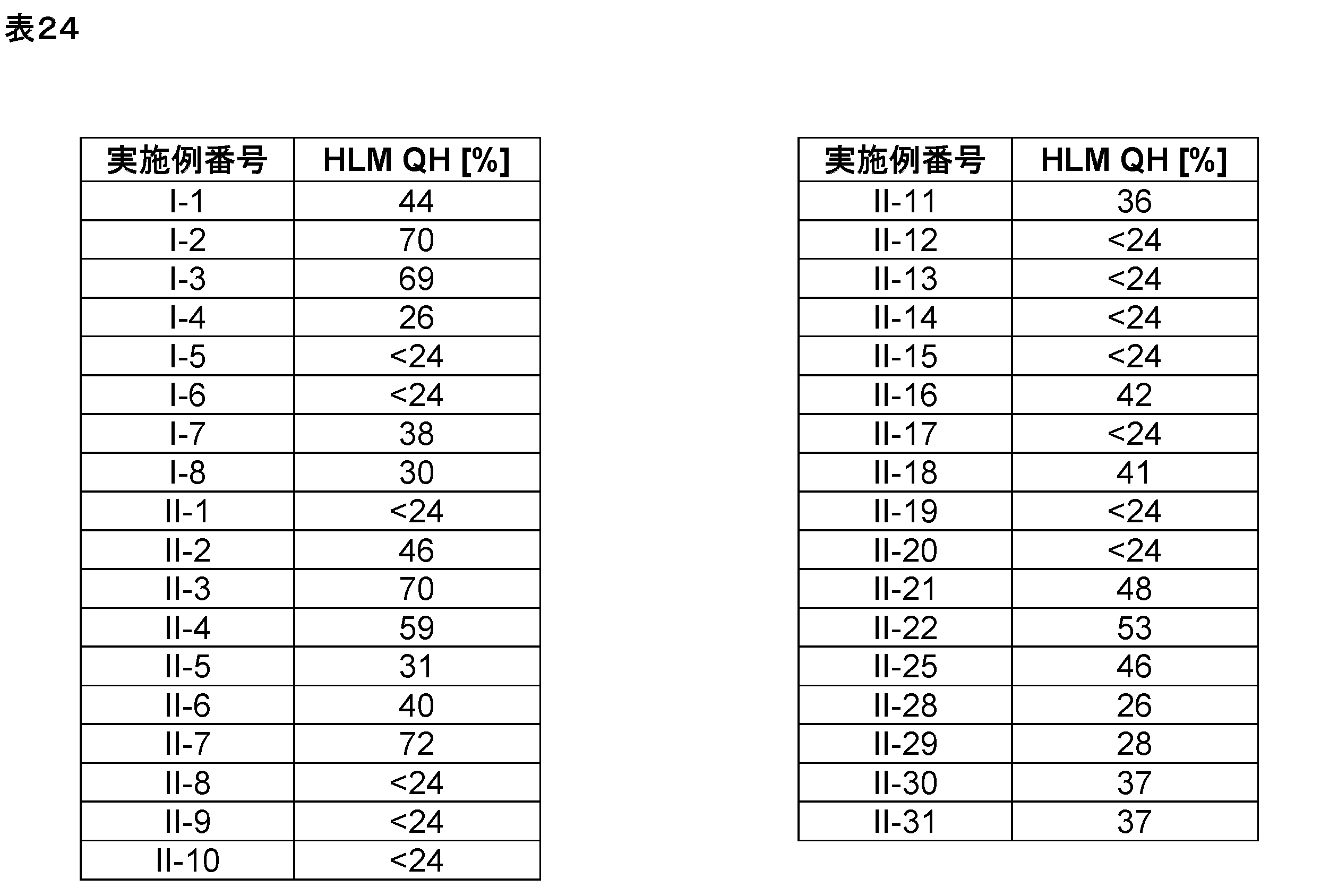
血漿タンパク質結合アッセイ(PPB)
試験化合物の血漿への結合は、平衡透析(ED)及び液体クロマトグラフィーと連動した定量質量分析(LC-MS)を用いて判定した。簡単に述べると、EDは、分画分子量5~10kg/molの半透膜によって分離された2つのチェンバーからなる透析デバイスを用いて実施した。一方のチェンバーは、1~10μmol/Lの試験化合物を含有するPBS中10%FCSで満たし、もう一方のチェンバーは、デキストランあり又はなしのリン酸緩衝食塩水(PBS)で満たした。透析チェンバーを37℃で3~5時間インキュベートした。インキュベーション後、各チェンバーのアリコートからタンパク質を沈殿させ、血漿を含有する区画(cserum)及びバッファーを含有する区画(cbuffer)の上清中の試験化合物濃度をLC-MSによって判定した。未結合試験化合物(血漿に結合していない)の分率(fu)を以下の方程式に従って算出した:

Binding of test compounds to plasma was determined using equilibrium dialysis (ED) and quantitative mass spectrometry coupled with liquid chromatography (LC-MS). Briefly, ED was performed using a dialysis device consisting of two chambers separated by a semipermeable membrane with a molecular weight cutoff of 5-10 kg/mol. One chamber was filled with 10% FCS in PBS containing 1-10 μmol/L of test compound, the other chamber was filled with phosphate buffered saline (PBS) with or without dextran. The dialysis chambers were incubated at 37° C. for 3-5 hours. After incubation, proteins were precipitated from an aliquot of each chamber and the test compound concentrations in the supernatants of the compartments containing plasma (c serum ) and buffer (c buffer ) were determined by LC-MS. The fraction of unbound test compound (not bound to plasma) (f u ) was calculated according to the following equation:
表25は、本発明に係る化合物(I)の選択物について、開示されたアッセイで得られた代謝安定性データを示す。 Table 25 shows metabolic stability data obtained in the disclosed assays for a selection of compounds (I) according to the present invention.

作用機序に基づいたCYP3A4阻害アッセイ(MBI 3A4):
CYP3A4に対する時間依存的阻害は、ヒト肝ミクロソーム(0.02mg/mL)においてミダゾラム(15μM)を基質として用いてアッセイする。試験化合物及び水対照(試験化合物なしのウェル)を、NADPH(1mM)の存在下、ヒト肝ミクロソーム(0.2mg/mL)と共に25uMの濃度で0分間及び30分間プレインキュベートする。プレインキュベーション後、インキュベート物を1:10希釈し、主要インキュベーション(15分間)に基質のミダゾラムを加える。主要インキュベーションをアセトニトリルでクエンチし、LC/MS-MSを介してヒドロキシ-ミダゾラムの形成を定量する。0分間プレインキュベーションからの形成に対する30分間プレインキュベーションからのヒドロキシ-ミダゾラムの形成を読み出しとして用いる。100%未満の値は、基質のミダゾラムが、0分間プレインキュベーションと比較して30分間プレインキュベーション時により低い程度に代謝されることを意味する。一般に、30分間プレインキュベーション時の低い効果が望ましい(100%に近い値に相当する/水対照で判定された値と差はない)。
Mechanism-Based CYP3A4 Inhibition Assay (MBI 3A4):
Time-dependent inhibition of CYP3A4 is assayed in human liver microsomes (0.02 mg/mL) using midazolam (15 μM) as substrate. Test compounds and water controls (wells without test compound) are pre-incubated with human liver microsomes (0.2 mg/mL) in the presence of NADPH (1 mM) at a concentration of 25 uM for 0 and 30 min. After pre-incubation, the incubations are diluted 1:10 and the substrate midazolam is added to the main incubation (15 min). The main incubation is quenched with acetonitrile and the formation of hydroxy-midazolam is quantified via LC/MS-MS. The formation of hydroxy-midazolam from the 30 min pre-incubation versus the 0 min pre-incubation is used as readout. Values less than 100% mean that the substrate midazolam is metabolized to a lower extent during the 30 min pre-incubation compared to the 0 min pre-incubation. Generally, a low effect upon 30 min preincubation is desirable (corresponding to values close to 100%/no difference from values determined with the water control).
表26は、本発明に係る化合物(I)の選択物について、開示されたアッセイで得られたデータを示す。 Table 26 shows data obtained in the disclosed assays for a selection of compounds (I) according to the present invention.

溶解度測定(DMSO溶液沈殿法)
試験化合物の10mM DMSOストック溶液を使用して、その水溶解度を判定する。DMSO溶液を水性媒体(McIlvaineバッファー、pH=4.5又は6.8)で終濃度250μMに希釈する。周囲温度で24時間振盪後、形成された可能性のある沈殿を濾過によって除去する。濾液中の試験化合物の濃度は、LC-UV法により、濃度が既知のアセトニトリル/水(1:1)中の試験化合物の完全溶解を用いてシグナルを参照溶液のシグナルに対して較正することによって判定する。
Solubility measurement (DMSO solution precipitation method)
A 10 mM DMSO stock solution of the test compound is used to determine its aqueous solubility. The DMSO solution is diluted in aqueous medium (McIlvaine's buffer, pH=4.5 or 6.8) to a final concentration of 250 μM. After shaking for 24 hours at ambient temperature, any precipitate that may have formed is removed by filtration. The concentration of the test compound in the filtrate is determined by the LC-UV method by calibrating the signal against that of a reference solution using complete dissolution of the test compound in acetonitrile/water (1:1) of known concentration.
表27は、本発明に係る化合物(I)の選択物について、開示されたアッセイで得られたデータを示す。 Table 27 shows data obtained in the disclosed assays for a selection of compounds (I) according to the present invention.

Caco-2アッセイ
このアッセイは、細胞膜を通過する化合物の能力、経口吸収の程度、並びに化合物が取り込み及び/又は排出輸送体によって能動的に輸送されるかどうかに関する情報を提供する。透過性フィルター支持体(Corning, catalog #3391)上で成長させた極性のコンフルエントなCaco-2細胞単層を横断する透過性測定を用いる。アッセイバッファー(128.13mM NaCl、5.36mM KCl、1mM MgSO4、1.8mM CaCl2、4.17mM NaHCO3、1.19mM Na2HPO4、0.41mM NaH2PO4、15mM 2-[4-(2-ヒドロキシエチル)ピペラジン-1-イル]エタンスルホン酸(HEPES)、20mM グルコース、pH 7.4)中10μMの試験化合物溶液を、ドナー区画とレシーバー区画との間にCaco-2細胞の単層を含有する細胞チェンバーのドナー区画に加える。レシーバー及びドナー区画は、アッセイバッファー中0.25%のウシ血清アルブミン(BSA)を含有する。単層を横断する化合物の受動拡散及び/又は能動輸送は、頂端側から側底側(a-b)と側底側から頂端側(b-a)の両方向で測定する。a-b透過性(PappAB)は、Caco-2細胞上に発現される排出及び取り込み輸送体によって媒介される受動透過と能動輸送の両機序を介する、腸から血液への薬物吸収を表し、b-a透過性(PappBA)は、血液から腸に戻る薬物分泌を表す。37℃で25~30分間のプレインキュベーション後、所定の時点(0、30、60及び90分)に、レシーバー及びドナー区画からそれぞれ試料を採取した。試料中の試験化合物の濃度をHPLC/MS/MSによって測定し、ドナー区画からの試料をアッセイバッファーで1:50(v:v)希釈し、レシーバー区画からの試料を希釈しないで測定した。
Caco-2 Assay This assay provides information on the ability of compounds to cross cell membranes, the extent of oral absorption, and whether compounds are actively transported by uptake and/or efflux transporters. It uses permeability measurements across polarized, confluent Caco-2 cell monolayers grown on permeable filter supports (Corning, catalog #3391). A 10 μM solution of test compound in assay buffer (128.13 mM NaCl, 5.36 mM KCl, 1 mM MgSO 4 , 1.8 mM CaCl 2 , 4.17 mM NaHCO 3 , 1.19 mM Na 2 HPO 4 , 0.41 mM NaH 2 PO 4 , 15 mM 2-[4-(2-hydroxyethyl)piperazin-1-yl]ethanesulfonic acid (HEPES), 20 mM glucose, pH 7.4) is added to the donor compartment of a cell chamber containing a monolayer of Caco-2 cells between the donor and receiver compartments. The receiver and donor compartments contain 0.25% bovine serum albumin (BSA) in assay buffer. Passive diffusion and/or active transport of compounds across the monolayer is measured in both apical to basolateral (a-b) and basolateral to apical (b-a) directions. The a-b permeability (PappAB) represents drug absorption from the intestine to the blood via both passive permeation and active transport mechanisms mediated by efflux and uptake transporters expressed on Caco-2 cells, whereas the b-a permeability (PappBA) represents drug secretion from the blood back to the intestine. After preincubation at 37°C for 25-30 min, samples were taken from the receiver and donor compartments, respectively, at predefined time points (0, 30, 60 and 90 min). The concentration of the test compound in the samples was measured by HPLC/MS/MS, with the samples from the donor compartment diluted 1:50 (v:v) with assay buffer and the samples from the receiver compartment measured undiluted.
a-b(PappAB)及びb-a(PappBA)の二方向における見かけの透過率を、以下の式に従って算出する:

Vrec[mL]:レシーバー区画中のバッファー容量
Cdon[μmol/mL]:t=0時のドナー区画中の試験化合物の濃度
ΔCrec:インキュベーション時間の開始と終了時のレシーバー区画中の試験化合物の濃度差
Δt:インキュベーション時間
Vrec・ΔCrec/Δt[μmol/min]:レシーバー区画に移った時間当たり化合物量
A[cm2]:フィルター表面
The apparent transmittance in the two directions a-b (PappAB) and ba (PappBA) is calculated according to the following formula:
Vrec [mL]: Buffer volume in the receiver compartment Cdon [μmol/mL]: Concentration of the test compound in the donor compartment at t=0 ΔCrec: Concentration difference of the test compound in the receiver compartment at the start and end of the incubation time Δt: Incubation time Vrec·ΔCrec/Δt [μmol/min]: Amount of compound transferred to the receiver compartment per unit time A [cm 2 ]: Filter surface
Caco-2排出比(ER)をPappBA/PappABの比として算出する。 The Caco-2 efflux ratio (ER) was calculated as the ratio of PappBA/PappAB.
表28は、本発明に係る化合物(I)の選択物について、開示されたアッセイで得られたデータを示す。 Table 28 shows data obtained in the disclosed assays for a selection of compounds (I) according to the present invention.
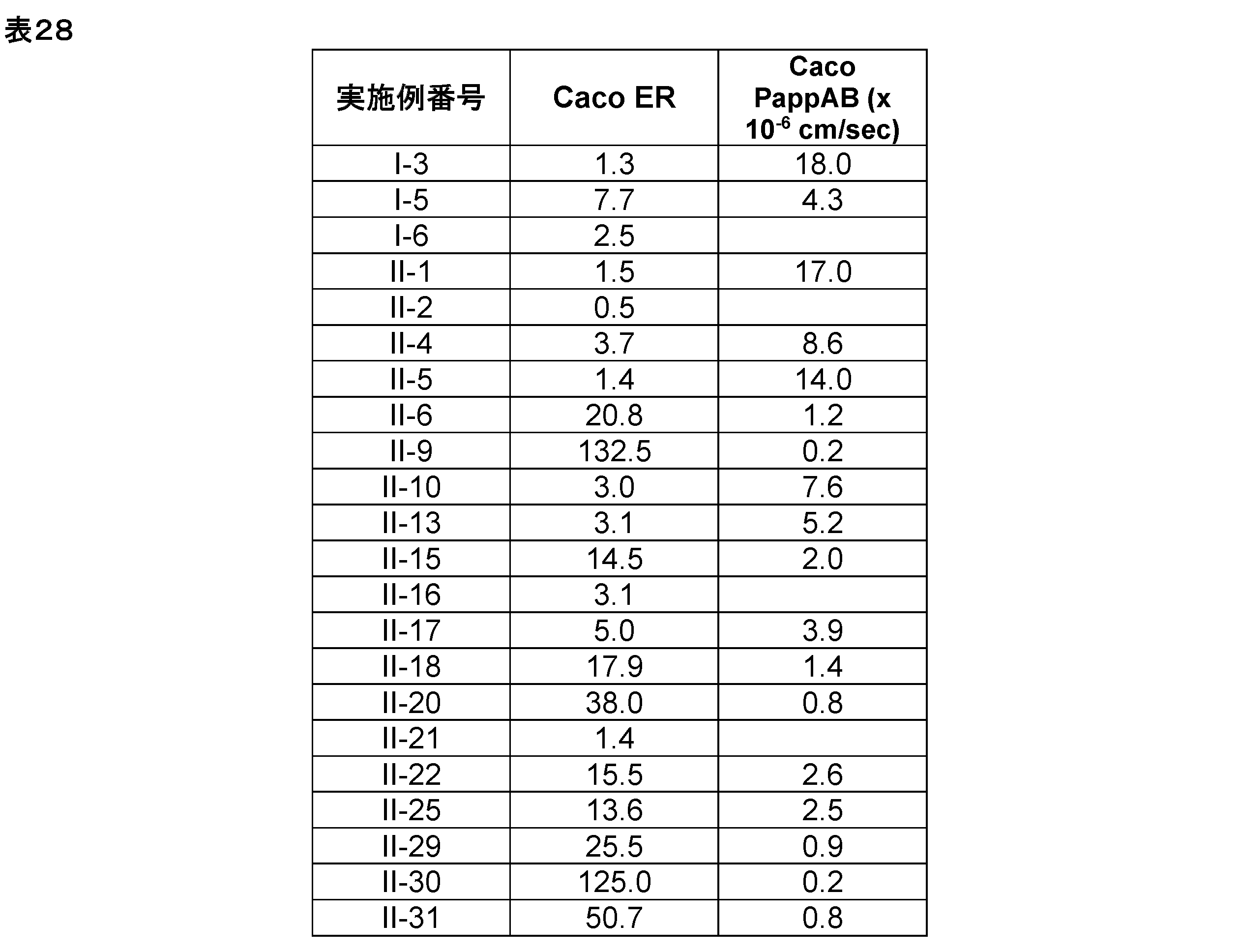
以下の処方例は、本発明を例証するものであり、その範囲を限定するものではない: The following formulation examples are illustrative of the present invention but are not intended to limit its scope:
医薬処方の例Examples of pharmaceutical prescriptions

微粉砕された活性物質、ラクトース及び一部のトウモロコシデンプンを混ぜ合わせる。混合物を篩にかけ、次いで、ポリビニルピロリドンの水溶液で湿らせ、混練し、湿式造粒し、乾燥させる。顆粒、残りのトウモロコシデンプン及びステアリン酸マグネシウムを篩にかけ、混ぜ合わせる。混合物を圧縮して、適切な形状及びサイズの錠剤を生成する。 The finely milled active substance, lactose and some of the corn starch are mixed. The mixture is screened, then moistened with a solution of polyvinylpyrrolidone in water, kneaded, wet-granulated and dried. The granules, the remaining corn starch and magnesium stearate are screened and mixed. The mixture is compressed to produce tablets of suitable shape and size.

微粉砕された活性物質、一部のトウモロコシデンプン、ラクトース、微結晶セルロース及びポリビニルピロリドンを混ぜ合わせ、混合物を篩にかけ、残りのトウモロコシデンプン及び水で処理して顆粒を生成し、これを乾燥させ、篩にかける。カルボキシメチルデンプンナトリウム及びステアリン酸マグネシウムを加え、混合し、混合物を圧縮して、適切なサイズの錠剤を生成する。 The finely ground active substance, a portion of the corn starch, lactose, microcrystalline cellulose and polyvinylpyrrolidone are mixed, the mixture is sieved and treated with the remaining corn starch and water to produce granules which are dried and sieved. Sodium carboxymethyl starch and magnesium stearate are added, mixed and the mixture is compressed to produce tablets of suitable size.

活性物質、ラクトース及びセルロースを混ぜ合わせる。混合物を篩にかけ、次いで、水で湿らせ、混練し、湿式造粒し、乾燥させるか又は乾式造粒し、又はステアリン酸マグネシウムと直接最終ブレンドし、圧縮して、適切な形状及びサイズの錠剤にする。湿式造粒する場合、追加のラクトース又はセルロース及びステアリン酸マグネシウムを加え、混合物を圧縮して、適切な形状及びサイズの錠剤を生成する。 The active substance, lactose and cellulose are mixed. The mixture is sieved, then moistened with water, kneaded, wet granulated, dried or dry granulated, or final blended directly with magnesium stearate and compressed to tablets of suitable shape and size. If wet granulated, additional lactose or cellulose and magnesium stearate are added and the mixture is compressed to produce tablets of suitable shape and size.

それ自体のpH又は任意でpH 5.5~6.5の水に活性物質を溶解させ、塩化ナトリウムを加えて、等張にする。得られた溶液を濾過してパイロジェンフリーにし、濾液を無菌条件下でアンプルに移し、次いで、これを滅菌し、溶融密封する。アンプルは、5mg、25mg及び50mgの活性物質を含有する。 The active substance is dissolved in water at its own pH or optionally at pH 5.5-6.5 and made isotonic by adding sodium chloride. The resulting solution is filtered to make it pyrogen-free and the filtrate is transferred under aseptic conditions into ampoules which are then sterilized and melt-sealed. The ampoules contain 5 mg, 25 mg and 50 mg of active substance.
Claims (15)

[式中、
R1a及びR1bは、共に独立して、水素、C1-4アルキル、C1-4ハロアルキル、C1-4アルコキシ、C1-4ハロアルコキシ、ハロゲン、-NH2、-NH(C1-4アルキル)、-N(C1-4アルキル)2、C3-5シクロアルキル及び3~5員ヘテロシクリルからなる群より選択され;
R2a及びR2bは、共に独立して、水素、C1-4アルキル、C1-4ハロアルキル、C1-4アルコキシ、C1-4ハロアルコキシ、ハロゲン、-NH2、-NH(C1-4アルキル)、-N(C1-4アルキル)2、C3-5シクロアルキル及び3~5員ヘテロシクリルからなる群より選択され;
かつ/又は、場合により、R1a又はR1bの一方とR2a又はR2bの一方は、これらが結合している炭素原子と一緒になって、シクロプロパン環を形成し;
Zは、-(CR6aR6b)n-であり;
各R6a及びR6bは、独立して、水素、C1-4アルキル、C1-4ハロアルキル、C1-4アルコキシ、C1-4ハロアルコキシ、ハロゲン、-NH2、-NH(C1-4アルキル)、-N(C1-4アルキル)2、C3-5シクロアルキル及び3~5員ヘテロシクリルからなる群より選択されるか;
又は、R6a及びR6bは、これらが結合している炭素原子と一緒になって、シクロプロパン環を形成し;
nは、0、1及び2からなる群より選択され;
Lは、-O-、-S-及び-N(R7)-(式中、R7は、水素又はC1-6アルキルである)から選択され;
R3は、C1-6アルキル、C1-6アルコキシ、5~10員ヘテロアリール及び3~11員ヘテロシクリルからなる群より選択され、ここで、C1-6アルキル、5~10員ヘテロアリール、C1-6アルコキシ及び3~11員ヘテロシクリルはすべて、場合によりかつ独立して、1つ又は複数の同一又は異なる、ハロゲン、C1-6アルキル、C1-6アルコキシ、-OH、-NH2、-NH(C1-4アルキル)、-N(C1-4アルキル)2、-C(O)O-C1-6アルキル、C3-5シクロアルキル、又は-N(C1-4アルキル)2で場合により置換されている3~11員ヘテロシクリルで置換されており;
Wは、窒素(-N=)又は-CH=であり;
Vは、窒素(-N=)又は-CH=であり;
Uは、窒素(-N=)又は-C(R11)=であり;
R11は、水素、ハロゲン及びC1-4アルコキシから選択され;
環Aは、ピロール、フラン、チオフェン、イミダゾール、ピラゾール、オキサゾール、イソオキサゾール、チアゾール、イソチアゾール及びトリアゾールからなる群より選択される環であり;
各R4は、存在する場合、独立して、C1-6アルキル、C1-6ハロアルキル、C1-6アルコキシ、C1-6ハロアルコキシ、シアノ-C1-6アルキル、ハロゲン、-OH、-NH2、-NH(C1-4アルキル)、-N(C1-4アルキル)2、-CN、C3-5シクロアルキル及び3~5員ヘテロシクリルからなる群より選択され;
pは、0、1、2及び3からなる群より選択され;
R5は、1つ又は複数の同一又は異なる、C1-6アルキル、C1-6アルコキシ又は5~6員ヘテロシクリルで場合により置換されている、3~11員ヘテロシクリルであり、ここで、C1-6アルキルは、シクロプロピルで場合により置換されており;
又は、R5は、3~11員ヘテロシクリルで置換されている-O-C1-6アルキルであり、ここで、3~11員ヘテロシクリルは、1つ又は複数の同一又は異なるR12で場合により置換されており、
各R12は、C1-6アルキル、C1-6アルコキシ、ハロゲン及び3~11員ヘテロシクリルからなる群より選択される]
で示される化合物又はその塩。 Formula (I):
[Wherein,
R 1a and R 1b are both independently selected from the group consisting of hydrogen, C 1-4 alkyl, C 1-4 haloalkyl, C 1-4 alkoxy, C 1-4 haloalkoxy, halogen, -NH 2 , -NH(C 1-4 alkyl), -N(C 1-4 alkyl) 2 , C 3-5 cycloalkyl, and 3- to 5-membered heterocyclyl;
R 2a and R 2b are both independently selected from the group consisting of hydrogen, C 1-4 alkyl, C 1-4 haloalkyl, C 1-4 alkoxy, C 1-4 haloalkoxy, halogen, -NH 2 , -NH(C 1-4 alkyl), -N(C 1-4 alkyl) 2 , C 3-5 cycloalkyl, and 3- to 5-membered heterocyclyl;
and/or optionally, one of R 1a or R 1b and one of R 2a or R 2b together with the carbon atom to which they are attached form a cyclopropane ring;
Z is -(CR 6a R 6b ) n -;
each R 6a and R 6b is independently selected from the group consisting of hydrogen, C 1-4 alkyl, C 1-4 haloalkyl, C 1-4 alkoxy, C 1-4 haloalkoxy, halogen, -NH 2 , -NH(C 1-4 alkyl), -N(C 1-4 alkyl) 2 , C 3-5 cycloalkyl, and 3- to 5-membered heterocyclyl;
or R 6a and R 6b together with the carbon atom to which they are attached form a cyclopropane ring;
n is selected from the group consisting of 0, 1 and 2;
L is selected from -O-, -S-, and -N(R 7 )-, where R 7 is hydrogen or C 1-6 alkyl;
R 3 is selected from the group consisting of C 1-6 alkyl, C 1-6 alkoxy, 5-10 membered heteroaryl, and 3-11 membered heterocyclyl, wherein C 1-6 alkyl, 5-10 membered heteroaryl, C 1-6 alkoxy, and 3-11 membered heterocyclyl are all optionally and independently substituted with one or more of the same or different halogen, C 1-6 alkyl, C 1-6 alkoxy, -OH, -NH 2 , -NH(C 1-4 alkyl), -N(C 1-4 alkyl) 2 , -C(O)O-C 1-6 alkyl, C 3-5 cycloalkyl, or -N(C 1-4 alkyl) 2 ;
W is nitrogen (-N=) or -CH=;
V is nitrogen (-N=) or -CH=;
U is nitrogen (-N=) or -C(R 11 )=;
R 11 is selected from hydrogen, halogen and C 1-4 alkoxy;
Ring A is a ring selected from the group consisting of pyrrole, furan, thiophene, imidazole, pyrazole, oxazole, isoxazole, thiazole, isothiazole, and triazole;
each R 4 , if present, is independently selected from the group consisting of C 1-6 alkyl, C 1-6 haloalkyl, C 1-6 alkoxy, C 1-6 haloalkoxy, cyano-C 1-6 alkyl, halogen, -OH, -NH 2 , -NH(C 1-4 alkyl), -N(C 1-4 alkyl) 2 , -CN, C 3-5 cycloalkyl, and 3- to 5-membered heterocyclyl;
p is selected from the group consisting of 0, 1, 2 and 3;
R 5 is a 3-11 membered heterocyclyl optionally substituted with one or more of the same or different C 1-6 alkyl, C 1-6 alkoxy, or 5-6 membered heterocyclyl, where C 1-6 alkyl is optionally substituted with cyclopropyl;
or R 5 is -O-C 1-6 alkyl substituted with 3- to 11-membered heterocyclyl, wherein the 3- to 11-membered heterocyclyl is optionally substituted with one or more of the same or different R 12 ;
Each R 12 is selected from the group consisting of C 1-6 alkyl, C 1-6 alkoxy, halogen, and 3- to 11-membered heterocyclyl.
or a salt thereof.
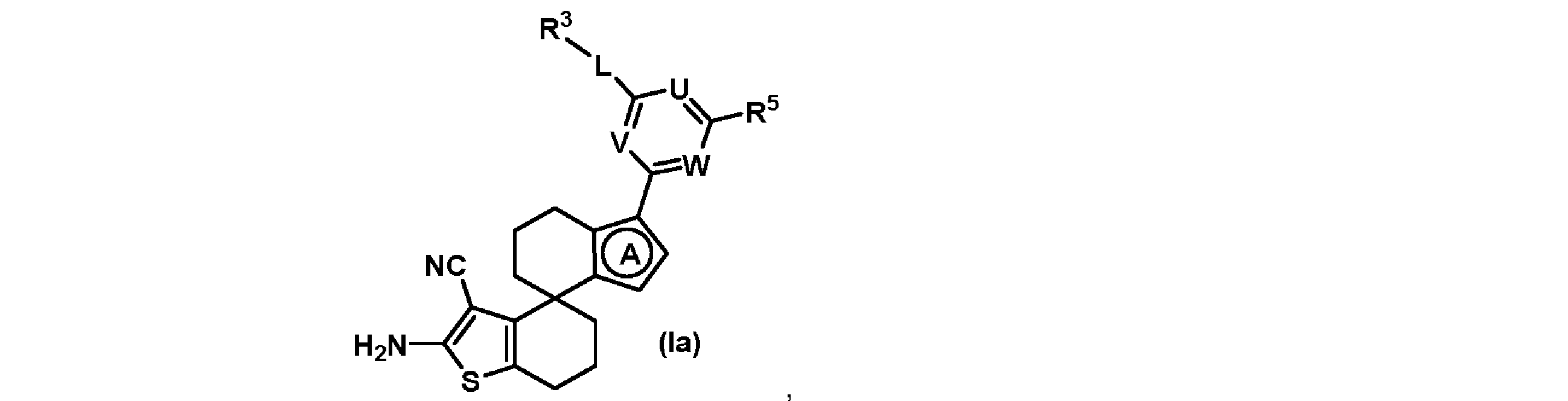
[式中、
A、V、U、W、L、R3及びR5は、請求項1のとおり定義される]
で示される化合物又はその塩。 Formula (Ia):
[Wherein,
A, V, U, W, L, R3 and R5 are defined as in claim 1.
or a salt thereof.

[式中、
A、V、U、W、L、R3及びR5は、請求項1のとおり定義される]
で示される化合物又はその塩。 Formula (Ib):
[Wherein,
A, V, U, W, L, R3 and R5 are defined as in claim 1.
or a salt thereof.

から選択される、請求項1~3のいずれか一項に記載の化合物又は塩。 Ring A is
The compound or salt according to any one of claims 1 to 3, selected from:

からなる群より選択される、請求項1~4のいずれか一項に記載の化合物又は塩。 R5 is
The compound or salt according to any one of claims 1 to 4, selected from the group consisting of:

からなる群より選択される、請求項5に記載の化合物又は塩。 R5 is
6. The compound or salt of claim 5, selected from the group consisting of:
Vが、窒素(-N=)であり;
Uが、=C(R11)-であり;
R11が、水素、ハロゲン及びC1-4アルコキシから選択される、請求項1~6のいずれか一項に記載の化合物又は塩。 W is nitrogen (-N=);
V is nitrogen (-N=);
U is ═C(R 11 )—;
A compound or salt according to any one of claims 1 to 6, wherein R 11 is selected from hydrogen, halogen and C 1-4 alkoxy.
R3が、

からなる群より選択される環であり、
ここで、これらの環の各々が、場合によりかつ独立して、1つ又は複数の同一又は異なる、ハロゲン、C1-6アルキル、-OH、-NH2、-NH(C1-4アルキル)、-N(C1-4アルキル)2、C3-5シクロアルキル又は3~11員ヘテロシクリルで置換されている、請求項1~9のいずれか一項に記載の化合物又は塩。 R 3 is selected from the group consisting of C 1-6 alkyl, -CH(CH 3 )CH 2 -O-CH 3 , -(CH 2 ) 2 -O-CH 3 , -(CH 2 ) 2 -OH and -(CH 2 ) 2 -N-(CH 3 ) 2 ; or
is a ring selected from the group consisting of
10. The compound or salt of any one of claims 1 to 9, wherein each of these rings is optionally and independently substituted with one or more of the same or different halogen, C 1-6 alkyl, -OH, -NH 2 , -NH(C 1-4 alkyl), -N(C 1-4 alkyl) 2 , C 3-5 cycloalkyl or 3- to 11-membered heterocyclyl.

からなる群より選択される、請求項1~9のいずれか一項に記載の化合物又は塩。 R 3 is C 1-6 alkyl, -CH(CH 3 )CH 2 -O-CH 3 , -(CH 2 ) 2 -O-CH 3 , -(CH 2 ) 2 -OH, -(CH 2 ) 2 -N-(CH 3 ) 2 ,
The compound or salt according to any one of claims 1 to 9, selected from the group consisting of:
Applications Claiming Priority (3)
| Application Number | Priority Date | Filing Date | Title |
|---|---|---|---|
| US202163284757P | 2021-12-01 | 2021-12-01 | |
| US63/284,757 | 2021-12-01 | ||
| PCT/EP2022/083930 WO2023099608A1 (en) | 2021-12-01 | 2022-11-30 | Annulated 2-amino-3-cyano thiophenes and derivatives for the treatment of cancer |
Publications (2)
| Publication Number | Publication Date |
|---|---|
| JP2024543982A true JP2024543982A (en) | 2024-11-26 |
| JPWO2023099608A5 JPWO2023099608A5 (en) | 2025-12-03 |
Family
ID=84537151
Family Applications (1)
| Application Number | Title | Priority Date | Filing Date |
|---|---|---|---|
| JP2024532554A Pending JP2024543982A (en) | 2021-12-01 | 2022-11-30 | Fused 2-amino-3-cyanothiophenes and derivatives for the treatment of cancer - Patents.com |
Country Status (6)
| Country | Link |
|---|---|
| US (1) | US20250129095A1 (en) |
| EP (1) | EP4441056A1 (en) |
| JP (1) | JP2024543982A (en) |
| CN (1) | CN118613485A (en) |
| TW (1) | TW202337432A (en) |
| WO (1) | WO2023099608A1 (en) |
Families Citing this family (34)
| Publication number | Priority date | Publication date | Assignee | Title |
|---|---|---|---|---|
| US12479834B2 (en) | 2019-11-29 | 2025-11-25 | Taiho Pharmaceutical Co., Ltd. | Phenol compound or salt thereof |
| KR20230019462A (en) | 2020-06-02 | 2023-02-08 | 베링거 인겔하임 인터내셔날 게엠베하 | Cyclic 2-amino-3-cyanothiophene and derivatives for cancer treatment |
| WO2022221227A1 (en) | 2021-04-13 | 2022-10-20 | Nuvalent, Inc. | Amino-substituted heterocycles for treating cancers with egfr mutations |
| KR20240128852A (en) | 2021-12-01 | 2024-08-27 | 베링거 인겔하임 인터내셔날 게엠베하 | Cyclic 2-amino-3-cyano thiophenes and derivatives for cancer therapy |
| IL314812A (en) | 2022-02-09 | 2024-10-01 | Quanta Therapeutics Inc | KRAS modulators and their uses |
| EP4532494A1 (en) | 2022-05-25 | 2025-04-09 | Quanta Therapeutics, Inc. | Pyrimidine based modulators and uses thereof |
| IL320913A (en) | 2022-11-21 | 2025-07-01 | Treeline Biosciences Inc | Spirocyclic dihydropyranopyrimidine kras inhibitors |
| AU2024212035A1 (en) | 2023-01-26 | 2025-08-14 | Arvinas Operations, Inc. | Cereblon-based kras degrading protacs ans uses related thereto |
| EP4680609A1 (en) | 2023-03-15 | 2026-01-21 | Quanta Therapeutics, Inc. | Kras modulators and uses thereof |
| KR20250164828A (en) | 2023-03-30 | 2025-11-25 | 레볼루션 메디슨즈, 인크. | Composition for inducing RAS GTP hydrolysis and use thereof |
| TW202508595A (en) | 2023-05-04 | 2025-03-01 | 美商銳新醫藥公司 | Combination therapy for a ras related disease or disorder |
| WO2024246099A1 (en) * | 2023-05-30 | 2024-12-05 | Boehringer Ingelheim International Gmbh | Spirocyclic annulated 2-amino-3-cyano thiophenes and derivatives for the treatment of cancer |
| WO2024255795A1 (en) * | 2023-06-14 | 2024-12-19 | Insilico Medicine Ip Limited | Kras inhibitors and uses thereof |
| WO2025016899A1 (en) | 2023-07-19 | 2025-01-23 | Bayer Aktiengesellschaft | Spirocyclic compounds for the treatment of cancer |
| WO2025026903A1 (en) | 2023-07-31 | 2025-02-06 | Bayer Aktiengesellschaft | Imidazo pyrimidine compounds for the treatment of cancer |
| US20250049810A1 (en) | 2023-08-07 | 2025-02-13 | Revolution Medicines, Inc. | Methods of treating a ras protein-related disease or disorder |
| TW202515570A (en) | 2023-08-17 | 2025-04-16 | 美商樹線生物科學公司 | Spirocyclic dihydropyranopyrimidine kras inhibitors |
| WO2025064848A1 (en) | 2023-09-21 | 2025-03-27 | Treeline Biosciences, Inc. | Spirocyclic dihydropyranopyridine kras inhibitors |
| WO2025080946A2 (en) | 2023-10-12 | 2025-04-17 | Revolution Medicines, Inc. | Ras inhibitors |
| TW202535891A (en) | 2023-10-20 | 2025-09-16 | 美商默沙東有限責任公司 | Small molecule inhibitors of kras proteins |
| WO2025171296A1 (en) | 2024-02-09 | 2025-08-14 | Revolution Medicines, Inc. | Ras inhibitors |
| WO2025190158A1 (en) * | 2024-03-14 | 2025-09-18 | 四川科伦博泰生物医药股份有限公司 | Spiro compound, and preparation method therefor and use thereof |
| WO2025201480A1 (en) * | 2024-03-28 | 2025-10-02 | 苏州浦合医药科技有限公司 | Spiro compound as kras mutant inhibitor |
| WO2025240847A1 (en) | 2024-05-17 | 2025-11-20 | Revolution Medicines, Inc. | Ras inhibitors |
| WO2025245127A1 (en) | 2024-05-21 | 2025-11-27 | Treeline Biosciences, Inc. | Spirocyclic dihydropyranopyrimidine kras inhibitors |
| WO2025255438A1 (en) | 2024-06-07 | 2025-12-11 | Revolution Medicines, Inc. | Methods of treating a ras protein-related disease or disorder |
| WO2025261393A1 (en) * | 2024-06-19 | 2025-12-26 | Insilico Medicine Ip Limited | Novel compounds as kras inhibitors and uses thereof |
| WO2025265060A1 (en) | 2024-06-21 | 2025-12-26 | Revolution Medicines, Inc. | Therapeutic compositions and methods for managing treatment-related effects |
| WO2026006747A1 (en) | 2024-06-28 | 2026-01-02 | Revolution Medicines, Inc. | Ras inhibitors |
| WO2026007740A1 (en) * | 2024-07-04 | 2026-01-08 | 四川科伦博泰生物医药股份有限公司 | Spiro compound, preparation method therefor and use thereof |
| WO2026015796A1 (en) | 2024-07-12 | 2026-01-15 | Revolution Medicines, Inc. | Methods of treating a ras related disease or disorder |
| WO2026015801A1 (en) | 2024-07-12 | 2026-01-15 | Revolution Medicines, Inc. | Methods of treating a ras related disease or disorder |
| WO2026015825A1 (en) | 2024-07-12 | 2026-01-15 | Revolution Medicines, Inc. | Use of ras inhibitor for treating pancreatic cancer |
| WO2026015790A1 (en) | 2024-07-12 | 2026-01-15 | Revolution Medicines, Inc. | Methods of treating a ras related disease or disorder |
Family Cites Families (24)
| Publication number | Priority date | Publication date | Assignee | Title |
|---|---|---|---|---|
| CN103396488A (en) | 2008-12-12 | 2013-11-20 | 贝林格尔.英格海姆国际有限公司 | Anti-IGF antibodies |
| AR090151A1 (en) | 2012-03-07 | 2014-10-22 | Lilly Co Eli | RAF INHIBITING COMPOUNDS |
| EA029768B1 (en) | 2012-03-14 | 2018-05-31 | Люпин Лимитед | Heterocyclyl compounds |
| US9242969B2 (en) | 2013-03-14 | 2016-01-26 | Novartis Ag | Biaryl amide compounds as kinase inhibitors |
| KR20160076519A (en) * | 2013-10-10 | 2016-06-30 | 아락세스 파마 엘엘씨 | Inhibitors of kras g12c |
| US10138251B2 (en) | 2014-04-11 | 2018-11-27 | Boehringer Ingelheim International Gmbh | Spiro[3H-indole-3,2′-pyrrolidin]-2(1H)-one compounds and derivatives as MDM2-P53 inhibitors |
| JP6503386B2 (en) | 2014-07-03 | 2019-04-17 | ベーリンガー インゲルハイム インターナショナル ゲゼルシャフト ミット ベシュレンクテル ハフツング | Novel spiro [3H-indol-3,2'-pyrrolidine] -2 (1H) -one compounds and derivatives as MDM2-p53 inhibitors |
| KR20170042779A (en) | 2014-08-21 | 2017-04-19 | 베링거 인겔하임 인터내셔날 게엠베하 | New spiro[3h-indole-3,2'-pyrrolidin]-2(1h)-one compounds and derivatives as mdm2-p53 inhibitors |
| PL3359542T3 (en) | 2015-10-09 | 2021-09-20 | Boehringer Ingelheim International Gmbh | COMPOUNDS AND DERIVATIVES SPIRO [3H-INDOLO-3,2′-PYROLIDINE] -2 (1H) -ONE AS MDM2-P53 INHIBITORS |
| US10898487B2 (en) | 2016-12-22 | 2021-01-26 | Boehringer Ingelheim International Gmbh | Benzylamino substituted quinazolines and derivatives as SOS1 inhibitors |
| US20220235013A1 (en) | 2017-03-21 | 2022-07-28 | Bayer Pharma Aktiengesellschaft | 2-methyl-quinazolines |
| JP2020518669A (en) | 2017-05-03 | 2020-06-25 | ビバーチェ セラピューティクス,インク. | Non-fused tricyclic compound |
| MY208632A (en) | 2017-12-21 | 2025-05-21 | Boehringer Ingelheim Int | Novel benzylamino substituted pyridopyrimidinones and derivatives as sos1 inhibitors |
| CA3097231A1 (en) | 2018-04-18 | 2019-10-24 | Bayer Pharma Aktiengesellschaft | 2-methyl-aza-quinazolines |
| US12134620B2 (en) * | 2018-08-01 | 2024-11-05 | Araxes Pharma Llc | Heterocyclic spiro compounds and methods of use thereof for the treatment of cancer |
| WO2020177629A1 (en) * | 2019-03-01 | 2020-09-10 | 劲方医药科技(上海)有限公司 | Spiro-substituted pyrimidine-fused cyclic compound, preparation method therefor and medical use thereof |
| EP3930845A1 (en) | 2019-03-01 | 2022-01-05 | Revolution Medicines, Inc. | Bicyclic heterocyclyl compounds and uses thereof |
| WO2020180768A1 (en) | 2019-03-01 | 2020-09-10 | Revolution Medicines, Inc. | Bicyclic heteroaryl compounds and uses thereof |
| US20220227738A1 (en) * | 2019-05-20 | 2022-07-21 | California Institute Of Technology | Kras g12c inhibitors and uses thereof |
| TW202108559A (en) | 2019-05-31 | 2021-03-01 | 美商醫肯納腫瘤學公司 | Tead inhibitors and uses thereof |
| WO2021139748A1 (en) * | 2020-01-08 | 2021-07-15 | Ascentage Pharma (Suzhou) Co., Ltd. | Spirocyclic tetrahydroquinazolines |
| WO2021150613A1 (en) * | 2020-01-20 | 2021-07-29 | Incyte Corporation | Spiro compounds as inhibitors of kras |
| UY39129A (en) | 2020-03-16 | 2021-10-29 | Novartis Ag | BIARYL DERIVATIVES AS INHIBITORS OF THE PROTEIN-PROTEIN INTERACTION OF YAP / TAZ-TEAD |
| KR20230019462A (en) * | 2020-06-02 | 2023-02-08 | 베링거 인겔하임 인터내셔날 게엠베하 | Cyclic 2-amino-3-cyanothiophene and derivatives for cancer treatment |
-
2022
- 2022-11-30 JP JP2024532554A patent/JP2024543982A/en active Pending
- 2022-11-30 EP EP22826084.0A patent/EP4441056A1/en active Pending
- 2022-11-30 CN CN202280089342.8A patent/CN118613485A/en active Pending
- 2022-11-30 TW TW111145890A patent/TW202337432A/en unknown
- 2022-11-30 US US18/715,147 patent/US20250129095A1/en active Pending
- 2022-11-30 WO PCT/EP2022/083930 patent/WO2023099608A1/en not_active Ceased
Also Published As
| Publication number | Publication date |
|---|---|
| EP4441056A1 (en) | 2024-10-09 |
| US20250129095A1 (en) | 2025-04-24 |
| WO2023099608A1 (en) | 2023-06-08 |
| TW202337432A (en) | 2023-10-01 |
| CN118613485A (en) | 2024-09-06 |
Similar Documents
| Publication | Publication Date | Title |
|---|---|---|
| JP2024543982A (en) | Fused 2-amino-3-cyanothiophenes and derivatives for the treatment of cancer - Patents.com | |
| JP7808058B2 (en) | Cyclofused 2-amino-3-cyanothiophenes and derivatives for treating cancer - Patents.com | |
| JP2024543975A (en) | Cyclized 2-amino-3-cyanothiophenes and derivatives for the treatment of cancer - Patents.com | |
| EP4441055A1 (en) | Annulated 2-amino-3-cyano thiophenes and derivatives for the treatment of cancer | |
| JP2024543983A (en) | Fused 2-amino-3-cyanothiophenes and derivatives for the treatment of cancer - Patents.com | |
| JP2024543976A (en) | Cyclized 2-amino-3-cyanothiophenes and derivatives for the treatment of cancer - Patents.com | |
| WO2024246099A1 (en) | Spirocyclic annulated 2-amino-3-cyano thiophenes and derivatives for the treatment of cancer | |
| US12545670B2 (en) | Annulated 2-amino-3-cyano thiophenes and derivatives for the treatment of cancer | |
| HK40097417A (en) | Benzylamino substituted pyridopyrimidinones and derivatives as sos1 inhibitors | |
| HK40039222B (en) | Benzylamino substituted pyridopyrimidinones and derivatives as sos1 inhibitors | |
| HK40039222A (en) | Benzylamino substituted pyridopyrimidinones and derivatives as sos1 inhibitors |
Legal Events
| Date | Code | Title | Description |
|---|---|---|---|
| A521 | Request for written amendment filed |
Free format text: JAPANESE INTERMEDIATE CODE: A523 Effective date: 20251125 |
|
| A621 | Written request for application examination |
Free format text: JAPANESE INTERMEDIATE CODE: A621 Effective date: 20251125 |