JP2024142155A - Organopolysiloxane - Google Patents
Organopolysiloxane Download PDFInfo
- Publication number
- JP2024142155A JP2024142155A JP2023054188A JP2023054188A JP2024142155A JP 2024142155 A JP2024142155 A JP 2024142155A JP 2023054188 A JP2023054188 A JP 2023054188A JP 2023054188 A JP2023054188 A JP 2023054188A JP 2024142155 A JP2024142155 A JP 2024142155A
- Authority
- JP
- Japan
- Prior art keywords
- organopolysiloxane
- phenyl
- general formula
- formula
- group
- Prior art date
- Legal status (The legal status is an assumption and is not a legal conclusion. Google has not performed a legal analysis and makes no representation as to the accuracy of the status listed.)
- Pending
Links
Images

Classifications
-
- C—CHEMISTRY; METALLURGY
- C08—ORGANIC MACROMOLECULAR COMPOUNDS; THEIR PREPARATION OR CHEMICAL WORKING-UP; COMPOSITIONS BASED THEREON
- C08G—MACROMOLECULAR COMPOUNDS OBTAINED OTHERWISE THAN BY REACTIONS ONLY INVOLVING UNSATURATED CARBON-TO-CARBON BONDS
- C08G77/00—Macromolecular compounds obtained by reactions forming a linkage containing silicon with or without sulfur, nitrogen, oxygen or carbon in the main chain of the macromolecule
- C08G77/04—Polysiloxanes
- C08G77/06—Preparatory processes
- C08G77/08—Preparatory processes characterised by the catalysts used
-
- C—CHEMISTRY; METALLURGY
- C08—ORGANIC MACROMOLECULAR COMPOUNDS; THEIR PREPARATION OR CHEMICAL WORKING-UP; COMPOSITIONS BASED THEREON
- C08G—MACROMOLECULAR COMPOUNDS OBTAINED OTHERWISE THAN BY REACTIONS ONLY INVOLVING UNSATURATED CARBON-TO-CARBON BONDS
- C08G77/00—Macromolecular compounds obtained by reactions forming a linkage containing silicon with or without sulfur, nitrogen, oxygen or carbon in the main chain of the macromolecule
- C08G77/04—Polysiloxanes
- C08G77/14—Polysiloxanes containing silicon bound to oxygen-containing groups
Landscapes
- Chemical & Material Sciences (AREA)
- Health & Medical Sciences (AREA)
- Chemical Kinetics & Catalysis (AREA)
- Medicinal Chemistry (AREA)
- Polymers & Plastics (AREA)
- Organic Chemistry (AREA)
- Silicon Polymers (AREA)
Abstract
Description
本発明は、オルガノポリシロキサンに関するものである。 The present invention relates to organopolysiloxanes.
CPUのような高集積回路等の電子部品は、使用中の発熱によりその性能が著しく低下する。この問題を解決するために発熱部と冷却部間の空気層に導入することで、熱伝達が効率的になる放熱材料が用いられる。中でも、シリコーン放熱材料は、シリコーンに由来する高い耐熱性、耐候性、電気絶縁性を有することから、幅広い分野で応用されている。
また近年、電子機器の小型化・高集積化が進んでおり、発生する熱をより効率よく冷却することが重要であるために、放熱材料の高熱伝導化が求められている。
The performance of electronic components such as highly integrated circuits, such as CPUs, is significantly degraded by heat generation during use. To solve this problem, heat dissipation materials are used that improve heat transfer efficiency when introduced into the air space between the heat generating part and the cooling part. Among them, silicone heat dissipation materials are used in a wide range of fields because of their high heat resistance, weather resistance, and electrical insulation properties derived from silicone.
Moreover, in recent years, electronic devices have become smaller and more highly integrated, making it important to more efficiently cool the heat they generate, and so there is a demand for heat dissipation materials with high thermal conductivity.
シリコーンオイルと熱伝導性充填剤を配合した材料の熱伝導率は、熱伝導性充填剤の容量分率が0.6を超えると熱伝導性充填剤自身の熱伝導率が影響する。したがって、放熱材料の熱伝導率を上げるには、いかに熱伝導性充填剤を高充填化するかが重要である。しかし、単に高充填化しようとしても、伝導性グリースの流動性が著しく低下するため、加工性が悪くなる。そこで、この問題を解決するために、熱伝導性充填剤をシランカップリング剤(ウェッター)で表面処理してベースオイルであるシリコーンに分散させ、熱伝導性グリースの流動性を保つという方法が提案されている。 The thermal conductivity of materials containing silicone oil and thermally conductive filler is affected by the thermal conductivity of the thermally conductive filler itself when the volume fraction of the thermally conductive filler exceeds 0.6. Therefore, in order to increase the thermal conductivity of heat dissipation materials, it is important to increase the loading of the thermally conductive filler. However, simply increasing the loading significantly reduces the fluidity of the conductive grease, making it difficult to process. To solve this problem, a method has been proposed in which the thermally conductive filler is surface-treated with a silane coupling agent (wetter) and dispersed in the silicone base oil to maintain the fluidity of the thermally conductive grease.
メチルシリコーンの一部をフェニル基に置き換えた構造であるフェニル変性シリコーンは、メチルシリコーンに比べ耐熱性、耐寒性、耐酸化性を有する。さらに、高いガスバリア性や高屈折率を有することから、フェニル変性シリコーンは、化粧品や発光ダイオードの封止材などへ応用されている(特許文献1,2)。したがって、フェニル変性シリコーンをベースオイルとし、放熱材料へ応用することで、メチルシリコーンでは実現できない性質が実現できると考えられる。一方で、フェニル基導入によりシリコーン骨格が剛直になるため、特に高フェニル変性シリコーンでは、粘度が著しく増加するといった問題がある(特許文献3)。 Phenyl-modified silicone, which has a structure in which some of the methyl silicone has been replaced with phenyl groups, has better heat resistance, cold resistance, and oxidation resistance than methyl silicone. Furthermore, because it has high gas barrier properties and a high refractive index, phenyl-modified silicone is used in cosmetics and sealing materials for light-emitting diodes (Patent Documents 1 and 2). Therefore, it is believed that by using phenyl-modified silicone as a base oil and applying it to heat dissipation materials, properties that cannot be achieved with methyl silicone can be achieved. On the other hand, the introduction of phenyl groups makes the silicone skeleton rigid, so there is a problem of a significant increase in viscosity, especially in high-phenyl-modified silicone (Patent Document 3).
したがって、フェニル変性シリコーンをベースオイルに、熱伝導性充填剤を充填してグリース化した場合は、熱伝導性グリースの流動性が著しく悪くなる。また、ウェッターとしてよく用いられているトリアルコキシシリル基を有するオルガノポリシロキサンは、フェニル変性シリコーンへの溶解性が悪い(特許文献4,5)。そのため、フェニル変性シリコーンに高い溶解性を示し、熱伝導性充填剤を充填した場合に、粘度上昇が抑えられるウェッターの開発が求められていた。 Therefore, when phenyl-modified silicone is used as a base oil and filled with a thermally conductive filler to make a grease, the fluidity of the thermally conductive grease is significantly impaired. In addition, organopolysiloxanes with trialkoxysilyl groups, which are often used as wetters, have poor solubility in phenyl-modified silicone (Patent Documents 4 and 5). For this reason, there has been a demand for the development of a wetter that is highly soluble in phenyl-modified silicone and that suppresses viscosity increases when filled with a thermally conductive filler.
本発明は、樹脂材料、特にフェニル変性シリコーンに高熱伝導性フィラーが高充填できるウェッターとして作用する新規オルガノポリシロキサンを提供することを目的とする。 The present invention aims to provide a new organopolysiloxane that acts as a wetter that can be highly loaded with a highly thermally conductive filler in a resin material, particularly a phenyl-modified silicone.
本発明は、上記目的を達成するために、下記新規オルガノポリシロキサンを提供する。 To achieve the above object, the present invention provides the following novel organopolysiloxane.
即ち、本発明は、下記一般式(1)
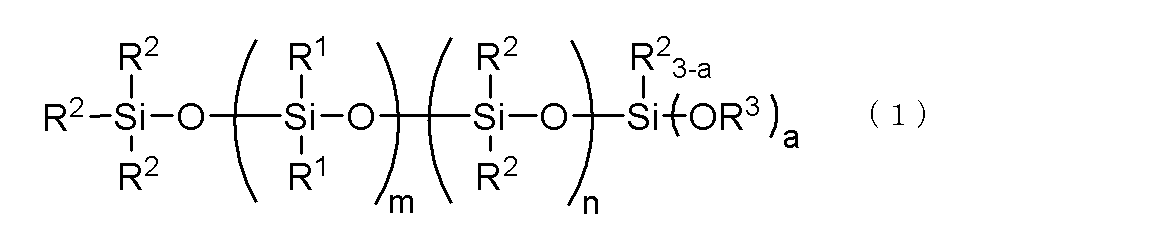
で示されるものであることを特徴とするオルガノポリシロキサンを提供する。
That is, the present invention relates to a compound represented by the following general formula (1):
The present invention provides an organopolysiloxane characterized by being represented by the following formula:
このようなオルガノポリシロキサンであれば、ウェッターとして好適なものになり、例えばフェニル変性シリコーンに高熱伝導性フィラーを高充填できるものとなる。 Such organopolysiloxanes are suitable as wetters, and for example, phenyl-modified silicones can be highly loaded with highly thermally conductive fillers.
上記オルガノポリシロキサンが、下記一般式(2)で表されるものであることが好ましい。

このようなオルガノポリシロキサンは、フェニル変性シリコーンにより高い溶解性を有するものとなる。 Such organopolysiloxanes have high solubility in phenyl-modified silicones.
上記一般式(1)及び一般式(2)に示すR1はフェニル基であり、R2はメチル基であることが好ましい。
オルガノポリシロキサンの合成の観点からこれらの基とするのが好ましい。
In the above general formulas (1) and (2), it is preferable that R 1 is a phenyl group and R 2 is a methyl group.
From the viewpoint of the synthesis of organopolysiloxane, these groups are preferred.
本発明では、上記記載のオルガノポリシロキサンからなるウェッターを提供する。
上記記載のオルガノポリシロキサンをウェッターに用いることで、フェニル変性シリコーンに熱伝導性フィラーをより分散させることができる。
The present invention provides a wetter comprising the organopolysiloxane described above.
By using the above-described organopolysiloxane as a wetter, the thermally conductive filler can be more effectively dispersed in the phenyl-modified silicone.
本発明のオルガノポリシロキサンは、フェニル変性シリコーンに対する熱伝導性フィラーの分散性を向上させるシランカップリング剤(ウェッター)として有用である。したがって、本発明のオルガノポリシロキサンを含むフェニル変性シリコーン組成物は、熱伝導性フィラーを多く含む場合でも、組成物の粘度が抑えられ、流動性が保たれる。したがって、本発明のオルガノポリシロキサンをシリコーン組成物に導入した場合、熱伝導性フィラーを高充填化させても、粘度上昇が抑制された熱伝導性シリコーン組成物を得ることができる。 The organopolysiloxane of the present invention is useful as a silane coupling agent (wetter) that improves the dispersibility of thermally conductive fillers in phenyl-modified silicones. Therefore, a phenyl-modified silicone composition containing the organopolysiloxane of the present invention has a suppressed viscosity and maintains fluidity even when it contains a large amount of thermally conductive filler. Therefore, when the organopolysiloxane of the present invention is introduced into a silicone composition, a thermally conductive silicone composition can be obtained in which the viscosity increase is suppressed even when the thermally conductive filler is highly filled.
本発明者らは、樹脂材料、特にフェニル変性シリコーンに高熱伝導性フィラーを高充填することを可能とするウェッターに好適なオルガノポリシロキサンにつき探求したところ、これには下記一般式(1)のものが有用であることを見出し、本発明を完成させた。
即ち、本発明は、下記一般式(1)

で示されるものであることを特徴とするオルガノポリシロキサンである。
特に前記オルガノポリシロキサンが、下記一般式(2)

で示されるオルガノポリシロキサンであることが好ましい。
The present inventors have searched for organopolysiloxanes suitable for wetters that enable resin materials, particularly phenyl-modified silicones, to be highly loaded with highly thermally conductive fillers, and have found that the one represented by the following general formula (1) is useful for this purpose, thus completing the present invention.
That is, the present invention relates to a compound represented by the following general formula (1):
The organopolysiloxane is characterized by being represented by the following formula:
In particular, the organopolysiloxane is represented by the following general formula (2):
It is preferable that the organopolysiloxane is represented by the following formula:
以下、本発明を詳細に説明する。 The present invention is described in detail below.
上記一般式(1)中、R1は、独立して炭素数6~10の1価芳香族炭化水素基である。R1の具体例としては、フェニル基、トリル基、キシリル基、メシチル基などのアリール基が挙げられ、中でも、合成のしやすさの観点からフェニル基が好ましい。 In the above general formula (1), R1 is independently a monovalent aromatic hydrocarbon group having 6 to 10 carbon atoms. Specific examples of R1 include aryl groups such as a phenyl group, a tolyl group, a xylyl group, and a mesityl group, and among these, a phenyl group is preferred from the viewpoint of ease of synthesis.
上記一般式(1)中、R2は、独立して炭素数1~10、好ましくは1~5、より好ましくは1~3のアルキル基である。R2の例としては、メチル基、エチル基、プロピル基、イソプロピル基、ブチル基、tert-ブチル基、ペンチル基、ヘキシル基、オクチル基、ノニル基、デシル基などが挙げられ、中でも、合成のしやすさの観点からメチル基またはエチル基が好ましい。 In the above general formula (1), R2 is independently an alkyl group having 1 to 10 carbon atoms, preferably 1 to 5, and more preferably 1 to 3. Examples of R2 include a methyl group, an ethyl group, a propyl group, an isopropyl group, a butyl group, a tert-butyl group, a pentyl group, a hexyl group, an octyl group, a nonyl group, and a decyl group. Among these, a methyl group or an ethyl group is preferred from the viewpoint of ease of synthesis.
上記一般式(1)中、R3は、独立して炭素数1~4のアルキル基であり、好ましくはメチル基またはエチル基である。R3の例としては、メチル基、エチル基、プロピル基、イソプロピル基、ブチル基、tert-ブチル基などが挙げられる。なかでも、本発明のオルガノポリシロキサン化合物の加水分解性の観点から、特にメチル基及びエチル基が好ましい。また、上記一般式(1)中、aは2または3であるが、合成のしやすさ及び経済性の観点から、aは3が好ましい。 In the above general formula (1), R 3 is independently an alkyl group having 1 to 4 carbon atoms, preferably a methyl group or an ethyl group. Examples of R 3 include a methyl group, an ethyl group, a propyl group, an isopropyl group, a butyl group, and a tert-butyl group. Of these, from the viewpoint of the hydrolysis property of the organopolysiloxane compound of the present invention, a methyl group and an ethyl group are particularly preferred. In addition, in the above general formula (1), a is 2 or 3, but from the viewpoint of ease of synthesis and economic efficiency, a is preferably 3.
上記一般式(1)中、mは、通常、1≦m≦30、好ましくは3≦m≦20、より好ましくは5≦m≦18の整数である。mが30を超えると、オルガノポリシロキサンの粘度が著しく増加するため好ましくない。また、上記一般式(1)中、nは通常、0≦n≦60、好ましくは5≦n≦50、より好ましくは10≦n≦40の整数である。上記範囲外では、フェニル変性シリコーンとの相溶性が低下するため好ましくない。また、m+nは、3≦m+n≦90であり、6≦m+n≦60が好ましい。上記範囲外だと、本化合物の合成上、生成物の取り扱い性が悪くなるため好ましくない。
また、 一般式(1)中の括弧で括られたシロキサン単位の結合はブロックであっても、ランダムであってもよい。
In the above general formula (1), m is usually an integer of 1≦m≦30, preferably 3≦m≦20, more preferably 5≦m≦18. If m exceeds 30, the viscosity of the organopolysiloxane increases significantly, which is not preferred. In addition, in the above general formula (1), n is usually an integer of 0≦n≦60, preferably 5≦n≦50, more preferably 10≦n≦40. If it is outside the above range, the compatibility with the phenyl-modified silicone decreases, which is not preferred. Also, m+n is 3≦m+n≦90, and preferably 6≦m+n≦60. If it is outside the above range, the product becomes difficult to handle in the synthesis of this compound, which is not preferred.
Furthermore, the bonds of the siloxane units enclosed in parentheses in the general formula (1) may be in blocks or random.
上記一般式(1)で表されるオルガノポリシロキサンの具体例としては、下記の化合物が挙げられるが、これらに限定されない。また、以下に示す式において、「Me」はメチル基、「Ph」はフェニル基を表す。
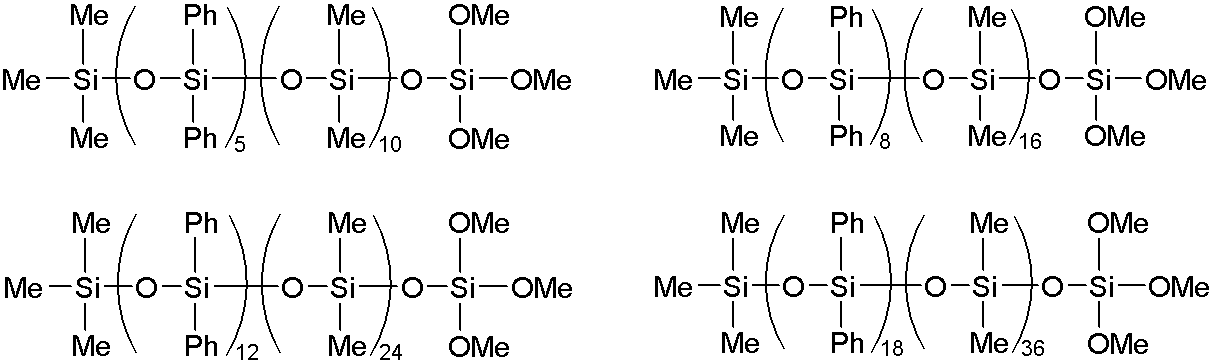
上記一般式(1)で表されるオルガノポリシロキサンは、例えば、下記反応式のように合成される。 The organopolysiloxane represented by the above general formula (1) is synthesized, for example, according to the following reaction formula:
反応式:
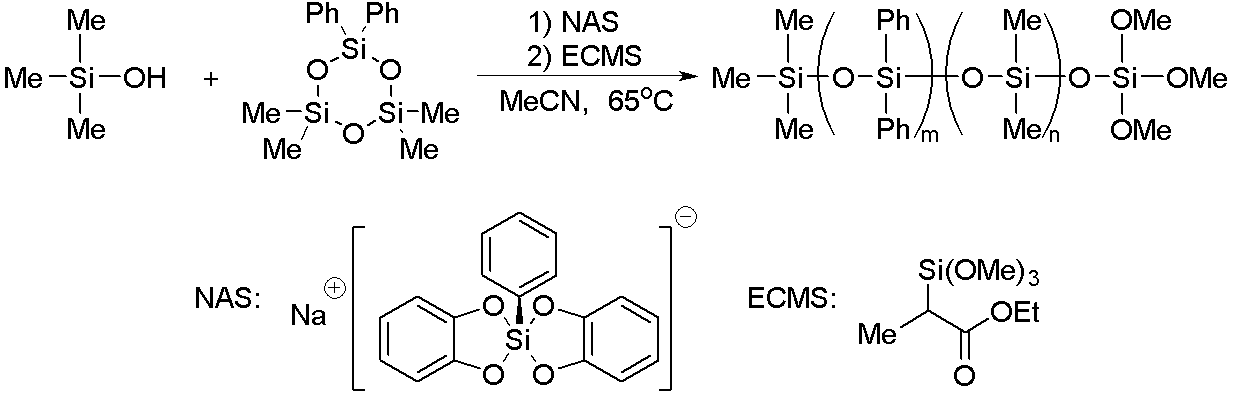
式中のm,nは29Si-NMRによって同定された。 In the formula, m and n were identified by 29 Si-NMR.
シラノールと1,1-ジフェニル-3,3,5,5-テトラメチルトリシロキサン(以下、フェニル変性環状シロキサンと書く場合がある)をビス(1,2-ベンゼンジオレート)フェニルシリケートナトリウム塩(NAS、上記式)触媒存在下、アセトニトリル溶媒中にて加熱撹拌させ、反応停止剤として2-(トリメトキシシリル)プロピオン酸エチル(ECMS、上記式)を作用させることによって上記一般式(1)に示すようなオルガノポリシロキサン化合物が合成される。この反応の溶媒は、アセトニトリル(MeCN)やN,N-ジメチルホルムアミド(DMF)などの極性溶媒が好ましい。また反応温度は、通常60~65℃であり、反応時間は各ステップ2時間程度で良い。 Silanol and 1,1-diphenyl-3,3,5,5-tetramethyltrisiloxane (hereinafter sometimes referred to as phenyl-modified cyclic siloxane) are heated and stirred in acetonitrile solvent in the presence of bis(1,2-benzenediolate)phenylsilicate sodium salt (NAS, formula above) catalyst, and 2-(trimethoxysilyl)ethyl propionate (ECMS, formula above) is added as a reaction terminator to synthesize an organopolysiloxane compound as shown in general formula (1) above. The solvent for this reaction is preferably a polar solvent such as acetonitrile (MeCN) or N,N-dimethylformamide (DMF). The reaction temperature is usually 60 to 65°C, and the reaction time is about 2 hours for each step.
シラノールに対してフェニル変性環状シロキサンの当量を変化させることで、オルガノポリシロキサン化合物の主鎖の長さ(m+n)すなわち重合度が調整される。 By changing the equivalent weight of phenyl-modified cyclic siloxane relative to silanol, the length of the main chain (m+n) of the organopolysiloxane compound, i.e., the degree of polymerization, can be adjusted.
得られたオルガノポリシロキサンは、フェニル変性シリコーンに高い溶解性を示す。 The resulting organopolysiloxane exhibits high solubility in phenyl-modified silicone.
本発明の上記オルガノポリシロキサンを含むフェニル変性シリコーン組成物は、熱伝導性フィラーの分散性を保持したまま高充填化することができるため、ウェッターとして好適に用いることができる。 The phenyl-modified silicone composition of the present invention containing the above-mentioned organopolysiloxane can be highly loaded while maintaining the dispersibility of the thermally conductive filler, and therefore can be suitably used as a wetter.
以下、実施例を挙げて本発明を具体的に説明するが、本発明はこれらに限定されない。なお、以下の実施例において、動粘度は、JIS Z8803::2011記載のキャノン-フェンスケ粘度計を用いて25℃で測定した値である。また、屈折率は、JIS K0062:1992記載のアッベ屈折計による25℃で測定したnDの値である。また、下記式において、Meはメチル基、Phはフェニル基を表す。 The present invention will be specifically described below with reference to examples, but the present invention is not limited thereto. In the following examples, the kinematic viscosity is a value measured at 25°C using a Canon-Fenske viscometer described in JIS Z8803::2011. The refractive index is a value of nD measured at 25°C using an Abbe refractometer described in JIS K0062:1992. In the following formulas, Me represents a methyl group and Ph represents a phenyl group.
[実施例1]
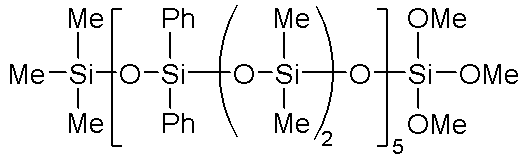
300mL丸形セパラブルフラスコに、四つ口セパラブルカバーを介して、撹拌機、温度計、蛇管冷却管を備え付けた。このセパラブルフラスコに、トリメチルシラノール(9.0g,0.1mol)、フェニル変性環状シロキサン(103.8g,0.3mol)、アセトニトリル(60.8g)を加え、65℃で加熱撹拌を行い、フェニル変性環状シロキサンを溶解させた。フェニル変性環状シロキサンを完全に溶解後、NAS(61mg,0.0178mmol)を添加し、反応溶液を65℃で2時間加熱撹拌させた。反応の進行は1H-NMRスペクトルで追跡し、フェニル変性環状シロキサンのシグナルが消失することを確認した後に、反応停止剤のECMS(29.1g,0.13mol)を加え、さらに65℃で2時間加熱撹拌させた。赤外分光法により、シラノールに対応するピークの消失を確認した後に、反応溶液にメタノールを加え、さらに65℃で1時間加熱撹拌させた。反応液を室温に戻した後、メタノールで洗浄し、オイル層を抽出した。得られたオイル層に含まれる溶媒及び低分子シロキサンを減圧下で除くことで、オルガノポリシロキサン化合物を得た。この化合物は、無色透明の液体であり、動粘度は314mm2・s―1、屈折率は1.505であった。また、29Si-NMRスペクトル分析により、以下の構造を有することがわかった(NMRチャートを図1に示す。)。
29Si-NMRスペクトル(99.37MHz、CDCl3,25℃):δ=7.9(SiMe3),-17.8~-21.1(SiMe2),-46.7~-47.8(SiPh2),-84.7~-85.0(Si(OMe)3)

A 300 mL round separable flask was equipped with a stirrer, a thermometer, and a coiled cooling tube through a four-neck separable cover. Trimethylsilanol (9.0 g, 0.1 mol), phenyl-modified cyclic siloxane (103.8 g, 0.3 mol), and acetonitrile (60.8 g) were added to the separable flask, and the mixture was heated and stirred at 65 ° C. to dissolve the phenyl-modified cyclic siloxane. After the phenyl-modified cyclic siloxane was completely dissolved, NAS (61 mg, 0.0178 mmol) was added, and the reaction solution was heated and stirred at 65 ° C. for 2 hours. The progress of the reaction was tracked by 1 H-NMR spectrum, and after confirming that the signal of the phenyl-modified cyclic siloxane disappeared, ECMS (29.1 g, 0.13 mol) as a reaction terminator was added, and the mixture was further heated and stirred at 65 ° C. for 2 hours. After confirming the disappearance of the peak corresponding to silanol by infrared spectroscopy, methanol was added to the reaction solution and the mixture was heated and stirred at 65° C. for an additional 1 hour. The reaction solution was returned to room temperature, washed with methanol, and the oil layer was extracted. The solvent and low molecular weight siloxane contained in the resulting oil layer were removed under reduced pressure to obtain an organopolysiloxane compound. This compound was a colorless, transparent liquid with a kinetic viscosity of 314 mm 2 ·s −1 and a refractive index of 1.505. Furthermore, 29 Si-NMR spectrum analysis revealed that it had the following structure (the NMR chart is shown in FIG. 1).
29Si -NMR spectrum (99.37MHz, CDCl3 , 25°C): δ = 7.9 ( SiMe3 ), -17.8 to -21.1 ( SiMe2 ), -46.7 to -47.8 ( SiPh2 ), -84.7 to -85.0 (Si(OMe) 3 )
[実施例2]
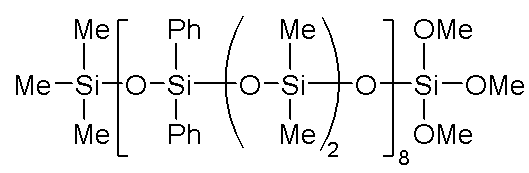
フェニル変性環状シロキサンをトリメチルシラノールに対して5当量用いた他は、上記と同様の手法でオルガノポリシロキサン化合物を得た。この化合物は、無色透明の液体であり、動粘度は、552mm2・s-1、屈折率は、1.509であった。また、29Si-NMRスペクトル分析により、以下の構造を有することがわかった。
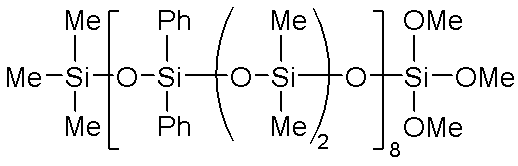
An organopolysiloxane compound was obtained in the same manner as above, except that 5 equivalents of phenyl-modified cyclic siloxane were used relative to trimethylsilanol. This compound was a colorless, transparent liquid with a dynamic viscosity of 552 mm 2 ·s -1 and a refractive index of 1.509. In addition, 29 Si-NMR spectrum analysis revealed that it had the following structure:
[実施例3]
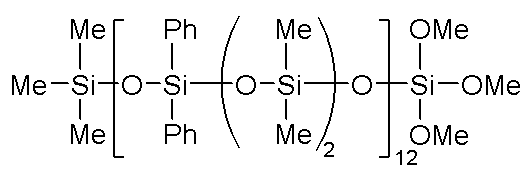
フェニル変性環状シロキサンをトリメチルシラノールに対して10当量用いた他は、上記と同様の手法でオルガノポリシロキサン化合物を得た。この化合物は、無色透明の液体であり、動粘度は1255mm2・s-1、屈折率は1.512であった。また、29Si-NMRスペクトル分析により、以下の構造を有することがわかった。
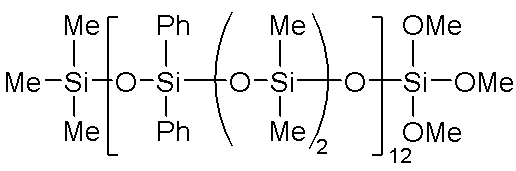
An organopolysiloxane compound was obtained in the same manner as above, except that 10 equivalents of phenyl-modified cyclic siloxane were used relative to trimethylsilanol. This compound was a colorless, transparent liquid with a dynamic viscosity of 1255 mm 2 ·s -1 and a refractive index of 1.512. In addition, 29 Si-NMR spectrum analysis revealed that it had the following structure:
[実施例4]
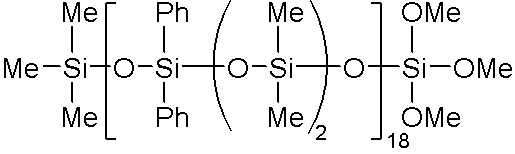
フェニル変性環状シロキサンをトリメチルシラノールに対して15当量用いた他は、上記と同様の手法でオルガノポリシロキサン化合物を得た。この化合物は、無色透明の液体であり、動粘度は2158mm2・s-1、屈折率は1.515であった。また、29Si-NMRスペクトル分析により、以下の構造を有することがわかった。

-84.7~-85.0(Si(OMe)3).
[Example 4]
An organopolysiloxane compound was obtained in the same manner as above, except that 15 equivalents of phenyl-modified cyclic siloxane were used relative to trimethylsilanol. This compound was a colorless, transparent liquid with a dynamic viscosity of 2158 mm 2 ·s -1 and a refractive index of 1.515. In addition, 29 Si-NMR spectrum analysis revealed that it had the following structure:
-84.7 to -85.0 (Si(OMe) 3 ).
[相溶性テスト]
フェニル変性シリコーンに下記オルガノシロキサン(B-6)を25%分散させた場合、白濁や層分離が起こる。一方で、上記新規オルガノシロキサンを同様の条件で分散させた場合、白濁や層分離は起こらないことから、上記新規オルガノシロキサンはフェニル変性シリコーンに対して高い相溶性を示すといえる。
[Compatibility test]
When the following organosiloxane (B-6) is dispersed in a phenyl-modified silicone at 25%, clouding and layer separation occur. On the other hand, when the novel organosiloxane is dispersed under the same conditions, clouding and layer separation do not occur, so it can be said that the novel organosiloxane exhibits high compatibility with the phenyl-modified silicone.
後述の各成分を、表1及び表2に示す組成比で(A)~(C)成分を混合して各実施例5~11及び各比較例1~4の組成物を得た。 The compositions of Examples 5 to 11 and Comparative Examples 1 to 4 were obtained by mixing components (A) to (C) in the composition ratios shown in Tables 1 and 2.
[実施例5]
(A)成分としてA-1、(B)成分としてB-1及び(C)成分を混合して熱伝導性フェニル変性シリコーン組成物を得た。混合は自転・公転方式ミキサー(商品名:あわとり練太郎、THINKY社製)に(A)~(C)成分を量り取ったプラスチック製容器を入れ、室温、2,000rpmで1分間×2回混合後、得られた混合物を室温まで冷却した後に、粘度測定を行った。
[Example 5]
A thermally conductive phenyl-modified silicone composition was obtained by mixing A-1 as component (A), B-1 as component (B), and component (C). The components (A) to (C) were weighed into a plastic container and placed in a rotation/revolution mixer (product name: Awatori Rentaro, manufactured by THINKY Corporation), and mixed at room temperature at 2,000 rpm for 1 minute twice. The mixture was then cooled to room temperature and the viscosity was measured.
[実施例6]
(B)成分をB-1からB-2に変えて実施例5と同様に熱伝導性フェニル変性シリコーン組成物を調製し、粘度測定を行った。
[Example 6]
A thermally conductive phenyl-modified silicone composition was prepared in the same manner as in Example 5, except that component (B) was changed from B-1 to B-2, and the viscosity was measured.
[実施例7]
(B)成分をB-1からB-3に変えて実施例5と同様に熱伝導性フェニル変性シリコーン組成物を調製し、粘度測定を行った。
[Example 7]
A thermally conductive phenyl-modified silicone composition was prepared in the same manner as in Example 5, except that component (B) was changed from B-1 to B-3, and the viscosity was measured.
[実施例8]
(B)成分をB-1からB-4に変えて実施例5と同様に熱伝導性フェニル変性シリコーン組成物を調製し、粘度測定を行った。
[Example 8]
A thermally conductive phenyl-modified silicone composition was prepared in the same manner as in Example 5, except that component (B) was changed from B-1 to B-4, and the viscosity was measured.
[比較例1]
(B)成分をB-1からB-5に変えて実施例5と同様にして比較例1の組成物を調製し、粘度測定を行った。
[Comparative Example 1]
A composition of Comparative Example 1 was prepared in the same manner as in Example 5, except that the component (B) was changed from B-1 to B-5, and the viscosity was measured.
[比較例2]
(B)成分をB-1からB-6に変えて実施例5と同様にして比較例2の組成物を調製し、粘度測定を行った。
[Comparative Example 2]
A composition of Comparative Example 2 was prepared in the same manner as in Example 5, except that the component (B) was changed from B-1 to B-6, and the viscosity was measured.
[実施例9]
(A)成分をA-1からA-2及び(B)成分をB-1からB-2に変えて実施例5と同様に熱伝導性フェニル変性シリコーン組成物を調製し、粘度測定を行った。
[Example 9]
A thermally conductive phenyl-modified silicone composition was prepared in the same manner as in Example 5, except that the component (A) was changed from A-1 to A-2 and the component (B) was changed from B-1 to B-2, and the viscosity was measured.
[実施例10]
(A)成分をA-1からA-3及び(B)成分をB-1からB-2に変えて実施例5と同様に熱伝導性フェニル変性シリコーン組成物を調製し、粘度測定を行った。
[Example 10]
Thermally conductive phenyl-modified silicone compositions were prepared in the same manner as in Example 5, except that the component (A) was changed from A-1 to A-3 and the component (B) was changed from B-1 to B-2, and the viscosity was measured.
[実施例11]
(B)成分をB-1からB-2及び(C)成分の組成(C-1をC-4に変更した)と含量を変えて実施例5と同様に熱伝導性フェニル変性シリコーン組成物を調製し、粘度測定を行った。
[Example 11]
Thermally conductive phenyl-modified silicone compositions were prepared in the same manner as in Example 5, except that the (B) component was changed from B-1 to B-2 and the composition and content of the (C) component (C-1 was changed to C-4), and the viscosity was measured.
[比較例3]
(A)成分としてA-1の他にA-2を加え、(B)成分を加えず、実施例5と同様に比較例3の組成物を調製し、粘度測定を行った。
[Comparative Example 3]
A composition of Comparative Example 3 was prepared in the same manner as in Example 5 except that A-2 was added as component (A) in addition to A-1, and no component (B) was added, and the viscosity was measured.
[比較例4]
(B)成分を加えず、(C)成分の含量を変えて、実施例5と同様に比較例4の組成物を調製し、粘度測定を行った。
[Comparative Example 4]
A composition of Comparative Example 4 was prepared in the same manner as in Example 5, except that the component (B) was not added and the content of the component (C) was changed, and the viscosity was measured.
(A)オルガノシロキサン
A-1:下記式で表され、動粘度が700mm2・s-1のオルガノシロキサン
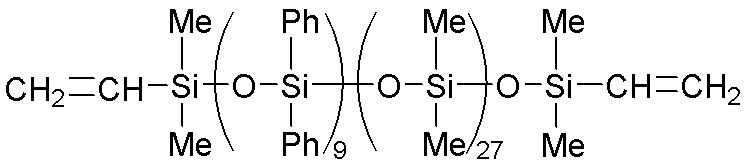
A-2:下記式で表され、動粘度が380mm2・s-1のフェニル変性オルガノシロキサン
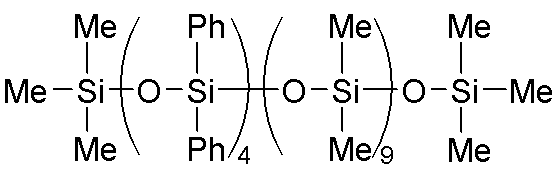
A-3:下記式で表され、動粘度が2,000mm2・s-1のフェニル変性オルガノシロキサン
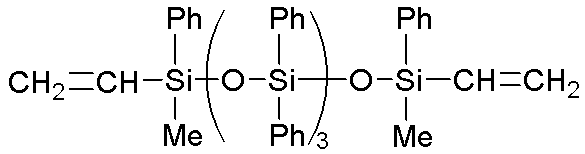
(B)ウェッター
B-1:下記式で表される実施例1で合成したオルガノシロキサン
B-2:下記式で表される実施例2で合成したオルガノシロキサン
B-3:下記式で表される実施例3で合成したオルガノシロキサン
B-4:下記式で表される実施例4で合成したオルガノシロキサン
B-5:下記式で表される比較例1のオルガノシロキサン

B-6:下記式で表されるオルガノシロキサン

(C)熱伝導性充填剤
C-1:球状アルミナ粉末(平均粒径45μm)
C-2:球状アルミナ粉末(平均粒径10μm)
C-3:不定形アルミナ粉末(平均粒径2μm)
C-4:不定形窒化アルミニウム粉末(平均粒径30μm)
(C) Thermally conductive filler C-1: spherical alumina powder (average particle size 45 μm)
C-2: Spherical alumina powder (average particle size 10 μm)
C-3: irregular alumina powder (average particle size 2 μm)
C-4: irregular aluminum nitride powder (average particle size 30 μm)
[製造方法]
(A)~(C)成分を以下の通りに混合して組成物例及び比較例の組成物を得た。表1に示す組成比(容量部)で自転・公転方式ミキサー(商品名:あわとり練太郎、THINKY社製)に(A)~(C)成分を量り取ったプラスチック製容器を入れ、室温、2,000rpmで1分間×2回混合後、得られた混合物を室温まで冷却した。
[Production method]
Components (A) to (C) were mixed as follows to obtain compositions of Composition Examples and Comparative Examples: Plastic containers containing weighed-out components (A) to (C) were placed in a rotation/revolution mixer (product name: Awatori Rentaro, manufactured by THINKY Corporation) in the composition ratios (parts by volume) shown in Table 1, and the mixture was mixed at room temperature at 2,000 rpm for 1 minute twice, and then cooled to room temperature.
[試験方法]
得られた組成物の特性を下記の試験方法で測定した。結果を下記表に併記する。
[Test Method]
The properties of the resulting composition were measured by the following test methods, and the results are shown in the following table.
[粘度測定]
得られた組成物を粘度・粘弾性測定装置(商品名:MARS40(サーモフィッシャーサイエンティフィック株式会社))を使用して回転数10s-1での粘度を該粘度計により測定した。測定条件は、23℃でパラレルプレートを使用し、ギャップは0.5mmである。
[Viscosity measurement]
The viscosity of the obtained composition was measured at a rotation speed of 10 s using a viscosity/viscoelasticity measuring device (product name: MARS40 (Thermo Fisher Scientific Co., Ltd.)). The measurement conditions were 23° C., parallel plates, and a gap of 0.5 mm.
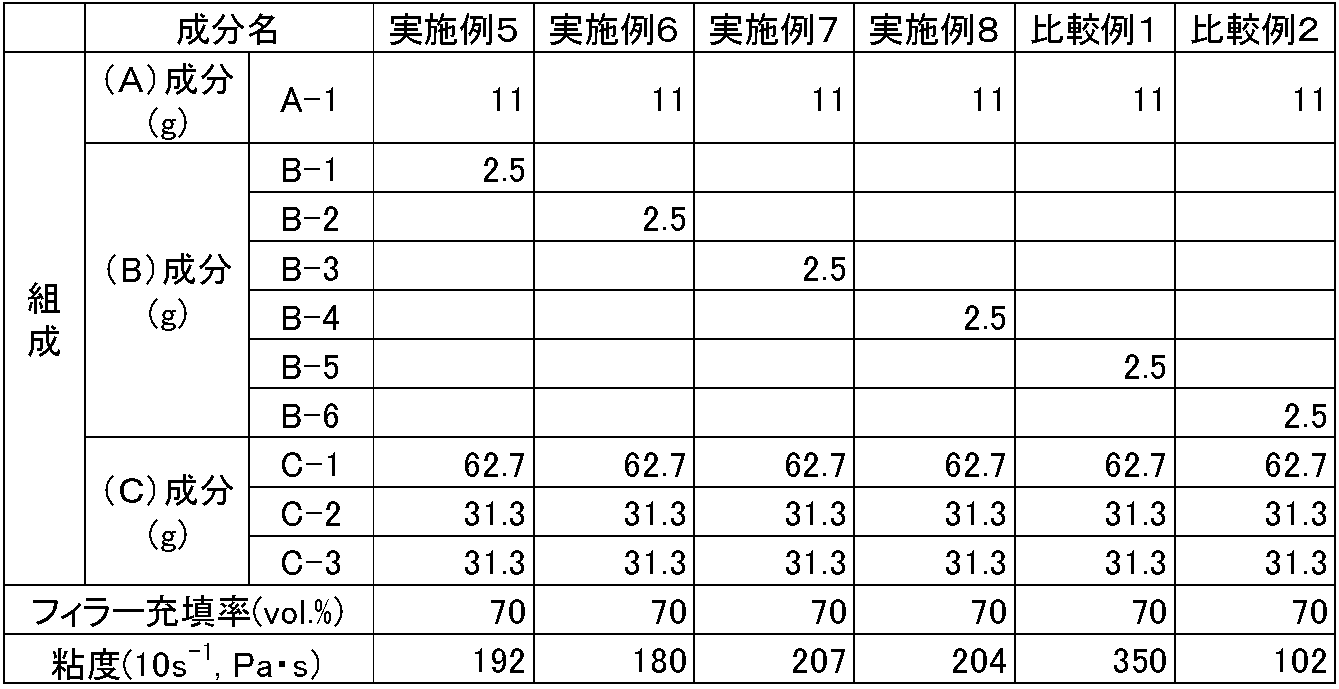
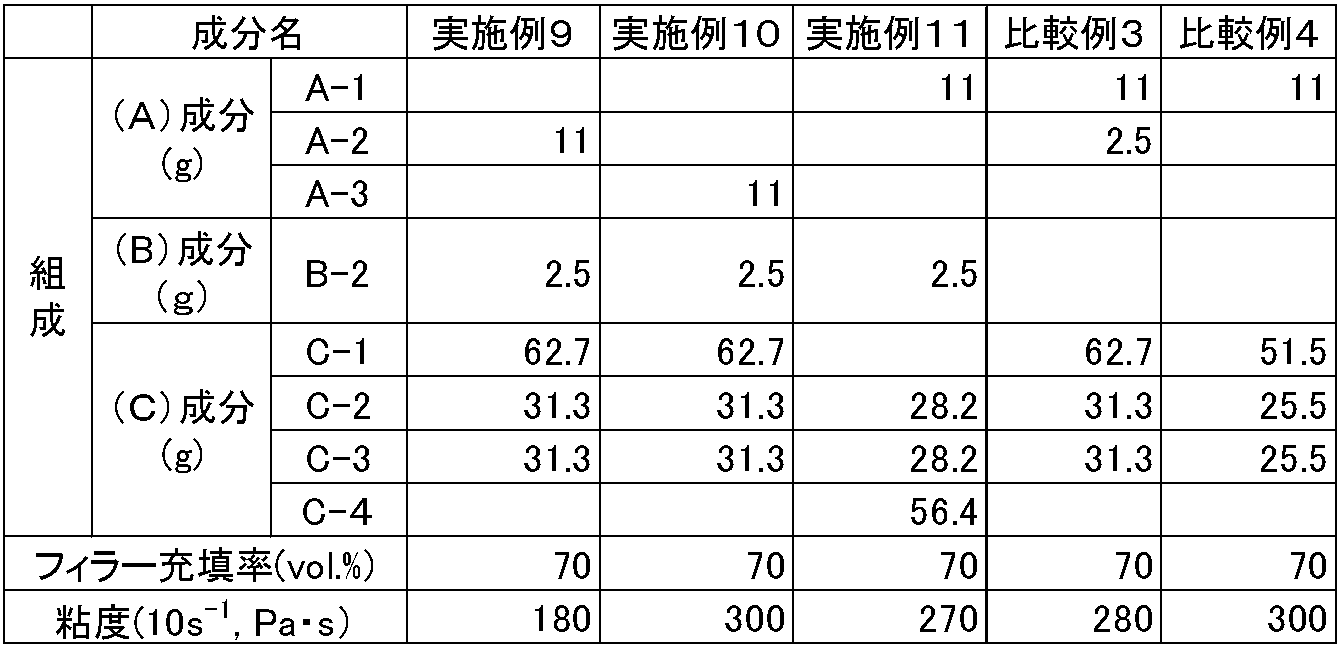
表1及び表2の結果から、本発明のオルガノポリシロキサンを含むフェニル変性シリコーン組成物では、その組成物の粘度が抑えられるため、熱伝導性フィラーを高充填化させることができることがわかった。特に実施例10ではA成分として高粘度のA―3を用いたにもかかわらず、比較例1よりも組成物の粘度を低下させることができた。
一方、一般式(2)に示される範囲に含まれないB―5を用いた場合(比較例1)及び(B)成分を含まない組成物(比較例3及び4)では、その粘度は上昇した。またフェニル基を含まないB―6を用いた場合(比較例2)では、その組成物の粘度は上昇しなかった。
The results in Tables 1 and 2 show that the phenyl-modified silicone composition containing the organopolysiloxane of the present invention has a reduced viscosity, allowing for a high loading of the thermally conductive filler. In particular, in Example 10, despite the use of A-3, which has a high viscosity, as Component A, the viscosity of the composition was able to be reduced more than in Comparative Example 1.
On the other hand, when B-5, which does not fall within the range represented by the general formula (2), was used (Comparative Example 1), and when the composition did not contain the component (B) (Comparative Examples 3 and 4), the viscosity increased. When B-6, which does not contain a phenyl group, was used (Comparative Example 2), the viscosity of the composition did not increase.
本明細書は、以下の態様を包含する。
[1]:下記一般式(1)で示されるものであることを特徴とするオルガノポリシロキサン。

[2]:前記オルガノポリシロキサンが、下記一般式(2)で示されるものであることを特徴とする[1]のオルガノポリシロキサン。

[3]:前記一般式(1)及び一般式(2)において、R1がフェニル基、R2がメチル基であることを特徴とする[1]又は[2]に記載のオルガノポリシロキサン。
[4]:前記[1]から[3]のいずれかに記載のオルガノポリシロキサンからなるウェッター。
The present specification includes the following aspects.
[1]: An organopolysiloxane characterized by being represented by the following general formula (1):
[2]: The organopolysiloxane according to [1], characterized in that the organopolysiloxane is represented by the following general formula (2):
[3]: The organopolysiloxane according to [1] or [2], characterized in that in the general formula (1) and the general formula (2), R 1 is a phenyl group and R 2 is a methyl group.
[4]: A wetter comprising the organopolysiloxane according to any one of [1] to [3] above.
なお、本発明は、上記実施形態に限定されるものではない。上記実施形態は例示であり、本発明の特許請求の範囲に記載された技術的思想と実質的に同一な構成を有し、同様な作用効果を奏するものは、いかなるものであっても本発明の技術的範囲に包含される。
The present invention is not limited to the above-described embodiment. The above-described embodiment is merely an example, and anything that has substantially the same configuration as the technical idea described in the claims of the present invention and exhibits similar effects is included in the technical scope of the present invention.
Claims (5)

で示されるものであることを特徴とするオルガノポリシロキサン。 The following general formula (1)
Organopolysiloxane, characterized by being represented by the following formula:

で示されるものであることを特徴とする請求項1に記載のオルガノポリシロキサン。 The organopolysiloxane is represented by the following general formula (2):
2. The organopolysiloxane according to claim 1, which is represented by the formula:
A wetter comprising the organopolysiloxane according to claim 3.
Priority Applications (3)
| Application Number | Priority Date | Filing Date | Title |
|---|---|---|---|
| JP2023054188A JP2024142155A (en) | 2023-03-29 | 2023-03-29 | Organopolysiloxane |
| PCT/JP2024/004936 WO2024202626A1 (en) | 2023-03-29 | 2024-02-14 | Organopolysiloxane |
| TW113105713A TW202438575A (en) | 2023-03-29 | 2024-02-19 | Organic polysiloxane |
Applications Claiming Priority (1)
| Application Number | Priority Date | Filing Date | Title |
|---|---|---|---|
| JP2023054188A JP2024142155A (en) | 2023-03-29 | 2023-03-29 | Organopolysiloxane |
Publications (1)
| Publication Number | Publication Date |
|---|---|
| JP2024142155A true JP2024142155A (en) | 2024-10-10 |
Family
ID=92904169
Family Applications (1)
| Application Number | Title | Priority Date | Filing Date |
|---|---|---|---|
| JP2023054188A Pending JP2024142155A (en) | 2023-03-29 | 2023-03-29 | Organopolysiloxane |
Country Status (3)
| Country | Link |
|---|---|
| JP (1) | JP2024142155A (en) |
| TW (1) | TW202438575A (en) |
| WO (1) | WO2024202626A1 (en) |
Family Cites Families (8)
| Publication number | Priority date | Publication date | Assignee | Title |
|---|---|---|---|---|
| JP3029680B2 (en) * | 1991-01-29 | 2000-04-04 | 東レ・ダウコーニング・シリコーン株式会社 | Organopentasiloxane and method for producing the same |
| JP4646496B2 (en) * | 2003-02-13 | 2011-03-09 | 東レ・ダウコーニング株式会社 | Thermally conductive silicone composition |
| JP5503963B2 (en) * | 2009-12-28 | 2014-05-28 | 東レ・ダウコーニング株式会社 | Curable silicone composition comprising organosilicon compound, process for producing the same, and organosilicon compound as an adhesion-imparting agent |
| JP5990909B2 (en) * | 2011-12-28 | 2016-09-14 | 信越化学工業株式会社 | One-end functional group-containing organopolysiloxane and method for producing the same |
| US9972757B2 (en) * | 2012-03-09 | 2018-05-15 | Sumitomo Osaka Cement Co., Ltd | Surface-modified-metal-oxide-particle material, composition for sealing optical semiconductor element, and optical semiconductor device |
| JP5930826B2 (en) * | 2012-04-18 | 2016-06-08 | 株式会社Adeka | Polysiloxane compound and moisture curable resin composition |
| US20200181334A1 (en) * | 2017-08-10 | 2020-06-11 | Shin-Etsu Chemical Co., Ltd. | Organic silicon compound and curable thermal conductive silicone composition |
| EP4488335A1 (en) * | 2022-02-28 | 2025-01-08 | Shin-Etsu Chemical Co., Ltd. | Thermally conductive silicone composition |
-
2023
- 2023-03-29 JP JP2023054188A patent/JP2024142155A/en active Pending
-
2024
- 2024-02-14 WO PCT/JP2024/004936 patent/WO2024202626A1/en not_active Ceased
- 2024-02-19 TW TW113105713A patent/TW202438575A/en unknown
Also Published As
| Publication number | Publication date |
|---|---|
| TW202438575A (en) | 2024-10-01 |
| WO2024202626A1 (en) | 2024-10-03 |
Similar Documents
| Publication | Publication Date | Title |
|---|---|---|
| JP5434795B2 (en) | Thermally conductive silicone grease composition | |
| JP4130091B2 (en) | Silicone grease composition for heat dissipation | |
| JP6708005B2 (en) | Thermally conductive silicone putty composition | |
| JP5283553B2 (en) | Thermally conductive silicone grease composition | |
| JP5182515B2 (en) | Thermally conductive silicone grease composition | |
| US8912132B2 (en) | Thermally conductive silicone grease composition | |
| JP5304623B2 (en) | Selection method of high thermal conductivity potting material | |
| CN1860181B (en) | Thermally Conductive Silicone Composition | |
| TWI743247B (en) | Thermally conductive silicone composition and its hardened product, and manufacturing method | |
| JP5388329B2 (en) | Silicone grease composition for heat dissipation | |
| TWI828778B (en) | Two-component curable composition group, thermally conductive cured material and electronic equipment | |
| JP4917380B2 (en) | Silicone grease composition for heat dissipation and method for producing the same | |
| KR20190032509A (en) | Thermally conductive polyorganosiloxane composition | |
| JP2010013521A (en) | Heat conductive silicone composition | |
| TW201843215A (en) | Hydrosilylation curable silicone resin | |
| CN109844031A (en) | Heat-conductive silicone composition | |
| WO2024214485A1 (en) | Organopolysiloxane compound | |
| JP6943028B2 (en) | Thermally conductive silicone composition | |
| JP2024142155A (en) | Organopolysiloxane | |
| WO2024237187A1 (en) | Thermally conductive silicone composition and cured product | |
| JP2009221311A (en) | Heat conductive grease composition | |
| JP2006188549A (en) | Addition reaction curable silicone gel composition, thermally conductive silicone composition, and heat dissipation sheet | |
| WO2024247771A1 (en) | Thermally conductive silicone composition and cured product | |
| TWI886796B (en) | Treated filler, treating method for thermally conductive filler and applications thereof | |
| WO2024077435A1 (en) | Thermally conductive silicone composition |
Legal Events
| Date | Code | Title | Description |
|---|---|---|---|
| A621 | Written request for application examination |
Free format text: JAPANESE INTERMEDIATE CODE: A621 Effective date: 20250220 |