WO2024247771A1 - Thermally conductive silicone composition and cured product - Google Patents
Thermally conductive silicone composition and cured product Download PDFInfo
- Publication number
- WO2024247771A1 WO2024247771A1 PCT/JP2024/018422 JP2024018422W WO2024247771A1 WO 2024247771 A1 WO2024247771 A1 WO 2024247771A1 JP 2024018422 W JP2024018422 W JP 2024018422W WO 2024247771 A1 WO2024247771 A1 WO 2024247771A1
- Authority
- WO
- WIPO (PCT)
- Prior art keywords
- thermally conductive
- conductive silicone
- component
- group
- silicone composition
- Prior art date
- Legal status (The legal status is an assumption and is not a legal conclusion. Google has not performed a legal analysis and makes no representation as to the accuracy of the status listed.)
- Pending
Links
Classifications
-
- C—CHEMISTRY; METALLURGY
- C08—ORGANIC MACROMOLECULAR COMPOUNDS; THEIR PREPARATION OR CHEMICAL WORKING-UP; COMPOSITIONS BASED THEREON
- C08K—Use of inorganic or non-macromolecular organic substances as compounding ingredients
- C08K3/00—Use of inorganic substances as compounding ingredients
- C08K3/01—Use of inorganic substances as compounding ingredients characterized by their specific function
- C08K3/013—Fillers, pigments or reinforcing additives
-
- C—CHEMISTRY; METALLURGY
- C08—ORGANIC MACROMOLECULAR COMPOUNDS; THEIR PREPARATION OR CHEMICAL WORKING-UP; COMPOSITIONS BASED THEREON
- C08K—Use of inorganic or non-macromolecular organic substances as compounding ingredients
- C08K5/00—Use of organic ingredients
- C08K5/04—Oxygen-containing compounds
- C08K5/05—Alcohols; Metal alcoholates
-
- C—CHEMISTRY; METALLURGY
- C08—ORGANIC MACROMOLECULAR COMPOUNDS; THEIR PREPARATION OR CHEMICAL WORKING-UP; COMPOSITIONS BASED THEREON
- C08L—COMPOSITIONS OF MACROMOLECULAR COMPOUNDS
- C08L83/00—Compositions of macromolecular compounds obtained by reactions forming in the main chain of the macromolecule a linkage containing silicon with or without sulfur, nitrogen, oxygen or carbon only; Compositions of derivatives of such polymers
- C08L83/04—Polysiloxanes
-
- C—CHEMISTRY; METALLURGY
- C08—ORGANIC MACROMOLECULAR COMPOUNDS; THEIR PREPARATION OR CHEMICAL WORKING-UP; COMPOSITIONS BASED THEREON
- C08L—COMPOSITIONS OF MACROMOLECULAR COMPOUNDS
- C08L83/00—Compositions of macromolecular compounds obtained by reactions forming in the main chain of the macromolecule a linkage containing silicon with or without sulfur, nitrogen, oxygen or carbon only; Compositions of derivatives of such polymers
- C08L83/04—Polysiloxanes
- C08L83/06—Polysiloxanes containing silicon bound to oxygen-containing groups
Definitions
- the present invention relates to a thermally conductive silicone composition and a cured product.
- heat dissipation materials are used that improve heat transfer efficiency when introduced into the air space between the heat generating part and the cooling part.
- silicone heat dissipation materials are used in a wide range of fields because of their high heat resistance, weather resistance, and electrical insulation properties derived from silicone.
- electronic devices have become smaller and more highly integrated, making it important to more efficiently cool the heat they generate, and so there is a demand for heat dissipation materials with high thermal conductivity.
- phenyl silicone Compared to dimethyl silicone, phenyl silicone has a greater affinity for aromatic solvents such as benzene and toluene, but a lower affinity for saturated hydrocarbons such as ATF. Phenyl silicone also has a thermal conductivity similar to that of dimethyl silicone. Furthermore, it is known to have higher heat resistance because it is less susceptible to oxidative degradation than dimethyl silicone (Patent Documents 4 and 5). Therefore, by incorporating phenyl silicone into a heat dissipation material, it is possible to provide a heat dissipation material that also has chemical resistance.
- the object of the present invention is to provide a thermally conductive silicone composition and cured product that have excellent heat resistance and chemical resistance.
- the present invention has been made to solve the above problems, and provides the following thermally conductive silicone composition and cured product.
- the present invention provides a thermally conductive silicone composition
- a thermally conductive silicone composition comprising the following (A) to (F): (A) a phenyl-modified organopolysiloxane having two or more alkenyl groups in one molecule and a kinetic viscosity at 25° C.
- R1 is independently a monovalent aromatic hydrocarbon group having 6 to 10 carbon atoms
- R2 is independently an alkyl group having 1 to 10 carbon atoms
- R3 is an alkyl group having 1 to 4 carbon atoms.
- a is 2 or 3
- m is an integer satisfying 1 ⁇ m ⁇ 30
- n is an integer satisfying 0 ⁇ n ⁇ 60, provided that the range of 3 ⁇ m+n ⁇ 90 is satisfied.
- the bonds of the siloxane units enclosed in parentheses in the general formula (1) may be block or random.
- D One or more thermally conductive fillers selected from the group consisting of metals, metal oxides, metal hydroxides, and metal nitrides: an amount of 10 to 97% by mass based on the total mass of the composition
- Platinum group metal catalyst 0.1 to 500 ppm by mass calculated as platinum group metal atoms based on the mass of the component (A)
- F A thermally conductive silicone composition comprising 0.05 to 5 parts by mass of a hydrosilylation reaction inhibitor.
- This type of thermally conductive silicone composition can produce a cured product with excellent heat resistance and chemical resistance.
- the component (C) is preferably represented by the following general formula (2).
- R 1 , R 2 , R 3 and a are the same as above, x is an integer of 1 ⁇ x ⁇ 30, m' is an integer of 1 ⁇ m' ⁇ 3, n' is an integer of 0 ⁇ n' ⁇ 2, with the proviso that m'+n' is 3.
- the bonds of the siloxane units enclosed in parentheses with m' and n' may be block or random, and the bonds of two types of siloxane units enclosed in parentheses with x form a block polymer.
- Such hydrolyzable organopolysiloxanes have high solubility in phenyl-modified silicones.
- R 1 is preferably a phenyl group
- R 2 is preferably a methyl group
- the thermally conductive silicone composition preferably has an absolute viscosity at 23°C of 1 to 1,000 Pa ⁇ s.
- the absolute viscosity of the thermally conductive silicone composition at 23°C is within the above range, it has excellent workability and processability.
- the present invention provides a thermally conductive silicone cured product obtained by curing the above thermally conductive silicone composition.
- thermally conductive silicone cured products have excellent heat resistance and chemical resistance.
- the thermally conductive silicone cured product is provided, which is characterized by having a thermal conductivity of 1.0 W/m ⁇ K or more.
- Thermal conductive silicone cured products have heat resistance, chemical resistance, and good thermal conductivity, and can be used as heat dissipation materials in organic solvent environments such as ATF.
- the thermally conductive silicone composition and cured product of the present invention can be made to have high thermal conductivity with excellent heat resistance and chemical resistance.
- the cured product of the thermally conductive silicone composition of the present invention can be used even in an organic solvent environment such as ATF.
- the present invention will be described in detail below, but the present invention is not limited thereto.
- the inventors have succeeded in completing a thermally conductive silicone composition and a cured product thereof, which combines heat resistance and chemical resistance by adding a hydrolyzable organopolysiloxane having a specific structure to a thermally conductive silicone composition, which acts as a dispersant (wetter) for the phenylsilicone and thermally conductive filler.
- the present invention provides a thermally conductive silicone composition
- a thermally conductive silicone composition comprising the following (A) to (F): (A) a phenyl-modified organopolysiloxane having two or more alkenyl groups in one molecule and a kinetic viscosity at 25° C.
- R1 is independently a monovalent aromatic hydrocarbon group having 6 to 10 carbon atoms
- R2 is independently an alkyl group having 1 to 10 carbon atoms
- R3 is an alkyl group having 1 to 4 carbon atoms.
- a is 2 or 3
- m is an integer satisfying 1 ⁇ m ⁇ 30
- n is an integer satisfying 0 ⁇ n ⁇ 60, provided that the range of 3 ⁇ m+n ⁇ 90 is satisfied.
- the bonds of the siloxane units enclosed in parentheses in the above general formula (1) may be block or random.
- D One or more thermally conductive fillers selected from the group consisting of metals, metal oxides, metal hydroxides, and metal nitrides: an amount of 10 to 97% by mass based on the total mass of the composition
- Platinum group metal catalyst 0.1 to 500 ppm by mass calculated as platinum group metal atoms based on the mass of the component (A)
- a thermally conductive silicone composition comprising 0.05 to 5 parts by mass of a hydrosilylation reaction inhibitor.
- the above-mentioned component (C) is a hydrolyzable organopolysiloxane represented by the following general formula (2).
- R 1 , R 2 , R 3 and a are the same as above, x is an integer of 1 ⁇ x ⁇ 30, m' is an integer of 1 ⁇ m' ⁇ 3, n' is an integer of 0 ⁇ n' ⁇ 2, with the proviso that m'+n' is 3.
- the bonds of the siloxane units enclosed in parentheses with m' and n' may be block or random, and the bonds of two types of siloxane units enclosed in parentheses with x form a block polymer.
- Component (A) is a phenyl-modified organopolysiloxane having two or more, preferably 2 to 10, and more preferably 2 to 5 alkenyl groups in the molecule and having a kinematic viscosity at 25° C. of 100 to 100,000 mm 2 /s.
- the alkenyl group is preferably an alkenyl group having 2 to 8 carbon atoms, more preferably 2 to 6 carbon atoms.
- Examples include vinyl groups, allyl groups, propenyl groups, isopropenyl groups, butenyl groups, hexenyl groups, cyclohexenyl groups, and octenyl groups. Vinyl groups are particularly preferred.
- the alkenyl group may be bonded to either a silicon atom at the end of the molecular chain, a silicon atom in the middle of the molecular chain, or both.
- the above component (A) is also characterized by having a phenyl group.
- the amount of phenyl groups in one molecule is preferably 10 to 80%, and more preferably 20 to 60%, of the number of siloxane units containing phenyl groups per total siloxane units. If the amount of phenyl groups in one molecule is 10% or more of the total siloxane units, compatibility with component (C) will not decrease significantly. If the amount of phenyl groups in one molecule is 80% or less of the total siloxane units, the viscosity of the composition will not increase more than necessary.
- the phenyl-modified organopolysiloxane of component (A) has a kinetic viscosity of 100 to 100,000 mm 2 /s at 25°C.
- the kinetic viscosity is a value measured using an Ostwald viscometer described in JIS Z8803:2011.
- the kinetic viscosity is preferably 300 to 20,000 mm 2 /s, and more preferably 500 to 10,000 mm 2 /s. If the kinetic viscosity is less than 100 mm 2 /s, the phenyl modification rate becomes too small, which is not preferred. If the kinetic viscosity exceeds 100,000 mm 2 /s, the composition becomes difficult to handle, which is not preferred.
- the phenyl-modified organopolysiloxanes may be used alone or in combination of two or more kinds.
- component (A) examples include dimethylsiloxane-diphenylsiloxane copolymers capped at both molecular chain terminals with dimethylvinylsiloxy groups and having a kinetic viscosity at 25° C. of 100 to 100,000 mm 2 /s, such as the phenyl-modified organopolysiloxane represented by the following formula:
- the molecular structure of the organohydrogenpolysiloxane is not particularly limited as long as it has the above-mentioned properties, and examples thereof include a linear structure, a branched structure, a cyclic structure, a linear structure having a partially branched or cyclic structure, etc. A linear structure or a cyclic structure is preferred.
- the organohydrogenpolysiloxane preferably has a kinetic viscosity of 1 to 1,000 mm 2 /s, and more preferably 10 to 100 mm 2 /s, at 25° C. If the kinetic viscosity is 1 mm 2 /s or more, there is no risk of the physical properties of the silicone composition being reduced, and if it is 1,000 mm 2 /s or less, there is no risk of the silicone composition having poor extensibility.
- the organic group bonded to the silicon atom of the organohydrogenpolysiloxane preferably contains a monovalent aromatic hydrocarbon group having 6 to 10 carbon atoms, and preferably does not contain a group having hydrosilylation reactivity such as an alkenyl group or an alkynyl group.
- a group having hydrosilylation reactivity such as an alkenyl group or an alkynyl group.
- an alkyl group is preferable, and an alkyl group having 1 to 12 carbon atoms, preferably 1 to 10 carbon atoms, is preferable. Examples include a methyl group, an ethyl group, a propyl group, a butyl group, a hexyl group, and a dodecyl group.
- alkyl groups in which some of the hydrogen atoms have been substituted with halogen atoms may also be used.
- a methyl group is preferable.
- the organohydrogenpolysiloxanes may be used alone or in combination of two or more kinds.
- component (B) examples include a methylhydrogensiloxane-diphenylsiloxane copolymer capped at both molecular chain terminals with trimethylsiloxy groups, such as a phenyl-modified organohydrogenpolysiloxane represented by the following formula, and a dimethylsiloxane-methylhydrogensiloxane-diphenylsiloxane copolymer capped at both molecular chain terminals with trimethylsiloxy groups.
- a methylhydrogensiloxane-diphenylsiloxane copolymer capped at both molecular chain terminals with trimethylsiloxy groups such as a phenyl-modified organohydrogenpolysiloxane represented by the following formula
- Component (C) acts as a dispersant (wetter) for the phenyl silicone and thermally conductive filler, and is a hydrolyzable organopolysiloxane represented by the following formula (1).
- R1 is independently a monovalent aromatic hydrocarbon group having 6 to 10 carbon atoms
- R2 is independently an alkyl group having 1 to 10 carbon atoms
- R3 is an alkyl group having 1 to 4 carbon atoms.
- a is 2 or 3
- m is an integer satisfying 1 ⁇ m ⁇ 30
- n is an integer satisfying 0 ⁇ n ⁇ 60, provided that the range of 3 ⁇ m+n ⁇ 90 is satisfied.
- the bonds of the siloxane units enclosed in parentheses in the above general formula (1) may be block or random.
- R1 is independently a monovalent aromatic hydrocarbon group having 6 to 10 carbon atoms.
- R1 include aryl groups such as a phenyl group, a tolyl group, a xylyl group, and a mesityl group, and among these, a phenyl group is preferable.
- R2 is independently an alkyl group having 1 to 10 carbon atoms, preferably 1 to 5, and more preferably 1 to 3.
- R2 include a methyl group, an ethyl group, a propyl group, an isopropyl group, a butyl group, a tert-butyl group, a pentyl group, a hexyl group, an octyl group, a nonyl group, and a decyl group, and among these, a methyl group is preferable.
- R 3 is independently an alkyl group having 1 to 4 carbon atoms, preferably a methyl group or an ethyl group.
- R 3 include a methyl group, an ethyl group, a propyl group, an isopropyl group, a butyl group, and a tert-butyl group.
- a methyl group is particularly preferable.
- a is 2 or 3, but from the viewpoint of ease of synthesis and economic efficiency, a is preferably 3.
- the component (C) of the present invention is preferably a hydrolyzable organopolysiloxane having a block structure represented by the following general formula (2).
- R 1 , R 2 , R 3 and a are the same as above, x is an integer of 1 ⁇ x ⁇ 30, m' is an integer of 1 ⁇ m' ⁇ 3, n' is an integer of 0 ⁇ n' ⁇ 2, with the proviso that m'+n' is 3.
- the bonds of the siloxane units enclosed in parentheses with m' and n' may be block or random, and the bonds of two types of siloxane units enclosed in parentheses with x form a block polymer.
- component (C) examples include hydrolyzable organopolysiloxanes such as a dimethylsiloxane-diphenylsiloxane copolymer terminated at one molecular chain end with a trimethoxysiloxy group, as represented by the following formula:
- the amount of component (C) is 10 to 300 parts by mass, preferably 15 to 200 parts by mass, and more preferably 20 to 100 parts by mass, per 100 parts by mass of component (A). If the amount of component (C) is less than 10, it is difficult to highly fill the thermally conductive silicone cured product with the thermally conductive filler, which is not preferred. If the amount exceeds 300 parts by mass, the viscosity of the thermally conductive silicone composition increases significantly, which is also not preferred.
- the (D) component is one or more thermally conductive fillers selected from the group consisting of metal oxides, metal hydroxides, and metal nitrides. Examples include alumina, zinc oxide, magnesium oxide, aluminum oxide, silicon dioxide, cerium oxide, iron oxide, aluminum hydroxide, cerium hydroxide, aluminum nitride, and boron nitride. These can be used alone or in appropriate combination of two or more, and a combination of particles having different average particle sizes, that is, a combination of a large particle component and a small particle component, is preferable. Any two or more types of particles having different average particle sizes can be combined, and a combination of particles having two, three, or four different average particle sizes is preferable.
- the viscosity, processability, uniformity, etc. of the obtained composition can be suitably adjusted.
- the (D) component is a combination of particles having different average particle sizes
- the portion composed of components having an average particle size of less than 10 ⁇ m will be referred to as the small particle component
- the portion composed of components having an average particle size larger than the average particle size of any of the small particle components will be referred to as the large particle component.
- the average particle size of the large particle component is 0.1 ⁇ m or more, the viscosity of the resulting composition will not increase and the processability will not decrease. Also, if it is 100 ⁇ m or less, the resulting composition will not be non-uniform and there will be no risk of oil bleeding, so it is preferable for it to be in the range of 0.1 to 100 ⁇ m, and preferably in the range of 10 to 75 ⁇ m.
- the average particle size of the small particle component (smaller than the average particle size of the large particle component) is 0.01 ⁇ m or more, the viscosity of the resulting composition will not increase and the processability will not decrease. On the other hand, if it is 10 ⁇ m or less, there is no risk of the resulting composition becoming non-uniform, so it is best to keep it in the range of 0.01 ⁇ m or more and less than 10 ⁇ m, preferably in the range of 0.1 to 4 ⁇ m.
- the ratio of the large particle component to the small particle component is not particularly limited, but when the large particle component has an average particle size of 10 ⁇ m or more (preferably 10 ⁇ m or more and 75 ⁇ m or less) and the small particle component has an average particle size of less than 10 ⁇ m (preferably 0.01 ⁇ m or more and less than 10 ⁇ m), the ratio of the large particle component to the small particle component is preferably in the range of 9:1 to 1:9 (mass ratio).
- the shapes of the large particle component and the small particle component are not particularly limited, and may be spherical, irregular, needle-like, etc.
- the large particle component is preferably spherical, and the small particle component is preferably spherical or irregular.
- the average particle size can be determined, for example, as a volume-based average value (or median diameter) in particle size distribution measurement by a laser light diffraction method, and can be determined using a commercially available laser light diffraction particle size distribution measurement device such as the particle size distribution measurement device MT3000II (manufactured by Microtrack Bell Co., Ltd.).
- the amount of component (D) is 10 to 97% by mass of the entire composition, preferably 20 to 95% by mass, more preferably 30 to 95% by mass, and even more preferably 50 to 95% by mass. If it is more than 97% by mass, the viscosity of the composition increases and processability decreases. Also, if it is less than 10% by mass, the thermal conductivity becomes poor.
- Component (E) is a platinum group metal catalyst, which functions to promote the addition reaction between components (A) and (B) described above.
- the platinum group metal catalyst may be any of the conventionally known catalysts used in addition reactions. Examples of catalysts that can be used include platinum-based, palladium-based, and rhodium-based catalysts, and among these, platinum or platinum compounds, which are relatively easy to obtain, are preferred. For example, platinum alone, platinum black, chloroplatinic acid, platinum -olefin complexes, platinum-alcohol complexes, platinum coordination compounds, etc.
- the platinum group metal catalysts may be used alone or in combination of two or more.
- the amount of component (E) to be blended is 0.1 to 500 ppm, preferably 1 to 200 ppm, by mass converted to platinum group metal atoms relative to the mass of component (A). If the amount of catalyst is less than the lower limit above, the catalytic effect may not be obtained. Furthermore, if the amount exceeds the upper limit above, the catalytic effect does not increase and it is uneconomical, so this is not preferred.
- Component (F) is a reaction inhibitor that suppresses the progress of the hydrosilylation reaction at room temperature, and is added to extend shelf life and pot life.
- the reaction inhibitor may be any known inhibitor used in addition curing silicone compositions.
- acetylene compounds such as acetylene alcohols (e.g., 3-methyl-1-tridecyne-3-ol, 1-ethynyl-1-cyclohexanol, 3,5-dimethyl-1-hexyne-3-ol), various nitrogen compounds such as tributylamine, tetramethylethylenediamine, and benzotriazole, organic phosphorus compounds such as triphenylphosphine, oxime compounds, and organic chloro compounds.
- acetylene alcohols e.g., 3-methyl-1-tridecyne-3-ol, 1-ethynyl-1-cyclohexanol, 3,5-dimethyl-1-hexyne-3-ol
- nitrogen compounds such as tributylamine, tetramethylethylenediamine, and benzotriazole
- organic phosphorus compounds such as triphenylphosphine, oxime compounds, and organic chloro compounds.
- the amount of component (F) is 0.05 to 5 parts by mass, and preferably 0.1 to 1 part by mass. If the amount of reaction inhibitor is less than 0.05 parts by mass, the desired shelf life and pot life may not be achieved, and if it is more than 5 parts by mass, the curability of the silicone composition may decrease.
- the manufacturing method of the thermally conductive silicone composition of the present invention will now be described. There are no particular limitations on the manufacturing method of the thermally conductive silicone composition of the present invention. Examples of methods include mixing the above-mentioned components (A) to (F) using a mixer such as a rotation/revolution type mixer (product name: THINKY Mixer, manufactured by THINKY Corporation), Trimix, Twinmix, or Planetary Mixer (all manufactured by Inoue Seisakusho Co., Ltd.), Ultra Mixer (Mizuho Kogyo Co., Ltd.), or Hivis Dispermix (Tokushu Kika Kogyo Co., Ltd.).
- a mixer such as a rotation/revolution type mixer (product name: THINKY Mixer, manufactured by THINKY Corporation), Trimix, Twinmix, or Planetary Mixer (all manufactured by Inoue Seisakusho Co., Ltd.), Ultra Mixer (Mizuho Kogyo Co., Ltd.), or Hivis Dispermix (Toku
- All of the components to be mixed may be mixed at once, or one or more components may be mixed in several stages. In the present invention, it is preferred to first mix the components (A), (C), and (D) at room temperature, and then mix the components (E), (B), and (F).
- the phenyl silicone composition of the present invention has an absolute viscosity measured at 23°C of preferably 1 to 1,000 Pa ⁇ s, more preferably 20 to 700 Pa ⁇ s, and even more preferably 50 to 500 Pa ⁇ s. If the absolute viscosity is 1 Pa ⁇ s or more, there is no deterioration in workability, such as difficulty in maintaining the shape. If the absolute viscosity is 1,000 Pa ⁇ s or less, there is no risk of deterioration in processability. The above viscosity can be obtained by adjusting the blending amount of each of the above-mentioned components. In the present invention, the absolute viscosity is a value measured by a viscosity/viscoelasticity measuring device.
- MARS40 manufactured by Thermo Fisher Scientific Co., Ltd.
- the absolute viscosity can be obtained by measuring at 23°C using parallel plates, a gap of 0.5 mm, and a rotation speed of 10 s -1 .
- the thermally conductive silicone composition of the present invention can be cured by heating at a temperature generally between 50 and 180°C, preferably between 80 and 150°C, and more preferably between 100 and 120°C.
- the thermally conductive silicone composition of the present invention can be molded by a desired method to obtain a cured product of any shape.
- the molding method is not particularly limited, but for example, the thermally conductive silicone composition prepared in the above-mentioned composition production process is poured into a mold, the mold opening is sandwiched between two sheets of fluorine-treated PET film, and then cured at 110°C for 10 minutes using a press molding machine to obtain a thermally conductive silicone cured product.
- Thermal Conductivity of Thermally Conductive Silicone Cured Product The thermal conductivity of the thermally conductive silicone cured product in the present invention is 1.0 W/m ⁇ K or more, preferably 2.0 W/m ⁇ K or more. The higher the thermal conductivity, the better, so no upper limit can be determined, but it can be, for example, 20 W/m ⁇ K or less.
- the thermal conductivity is a value measured by the hot disk method in accordance with ISO 22007-2. This value can be measured, for example, with a hot disk method thermal property measuring device TPS series (TPS 2500S, etc.) manufactured by Kyoto Electronics Manufacturing Co., Ltd.
- Component A-1 A phenyl-modified organopolysiloxane represented by the following formula and having a kinetic viscosity of 700 mm 2 ⁇ s -1
- A-2 Organopolysiloxane represented by the following formula and having a kinetic viscosity of 600 mm2 ⁇ s -1
- B-1 A phenyl-modified organohydrogenpolysiloxane having a kinetic viscosity of 20 mm2 ⁇ s -1 and represented by the following formula:
- B-2 A phenyl-modified organohydrogenpolysiloxane having a kinetic viscosity of 19 mm 2 ⁇ s ⁇ 1 and represented by the following formula:
- B-3 Organohydrogenpolysiloxane represented by the following formula and having a kinetic viscosity of 5 mm 2 ⁇ s -1
- C Component C-1: Hydrolyzable organosiloxane represented by the following formula:
- Component (D) The filler particle size (average particle size) of component (D) was measured using a particle size distribution measuring device MT3000II (manufactured by Microtrack Bell Co., Ltd.).
- D-1 Spherical alumina powder (median diameter: 70 ⁇ m)
- D-2 Spherical alumina powder (median diameter: 45 ⁇ m)
- D-3 Spherical alumina powder (median diameter: 10 ⁇ m)
- D-4 irregular alumina powder (median diameter: 2 ⁇ m)
- the components (A), (C), and (D) were mixed as follows to obtain compositions of the examples and comparative examples.
- the components (A), (C), and (D) were weighed into a plastic container and placed in a rotation/revolution mixer (product name: Awatori Rentaro, manufactured by THINKY) in the composition ratios (parts by mass) shown in Tables 1 and 2, and mixed at room temperature and 2,000 rpm for 1 minute x 2 times, and the resulting mixture was cooled to room temperature.
- the component (E) was added, mixed at 2,000 rpm for 30 seconds x 2 times, and the resulting mixture was cooled to room temperature.
- a mixture of the components (B) and (F) was added, mixed at 2,000 rpm for 10 seconds x 2 times, cooled to room temperature, and degassed using a vacuum pump.
- the prepared thermally conductive silicone composition was poured into a mold measuring 60 mm ⁇ 60 mm ⁇ 6 mm or 190 mm ⁇ 140 mm ⁇ 2 mm, the opening of the mold was sandwiched between two sheets of fluorine-treated PET film, and then the composition was cured for 10 minutes at 110°C using a press molding machine, yielding a cured thermally conductive silicone product.
- thermo conductivity Using two 6 mm thick sheets molded in Examples 1 to 3 and Comparative Examples 1 to 4 below, the thermal conductivity of the cured products was measured with a thermal conductivity meter (TPS 2500S, manufactured by Kyoto Electronics Manufacturing Co., Ltd.) (hot disk method in accordance with ISO 22007-2).
- the hardness of the thermally conductive silicone cured product was measured using a durometer (Type A) hardness tester specified in JIS K6253-3: 2012. For products with measured values of less than 20, the hardness was measured using a durometer (Asker C) hardness tester measured in accordance with the method described in JIS K7312: 1996, Appendix 2.
- the thermally conductive silicone cured product in which the component (C) used in Examples 1 to 3 was a phenyl-modified hydrolyzable organosiloxane corresponding to the above general formula (1) had a thermal conductivity of 2.0 W/m ⁇ K or more, and showed almost no change in hardness in a heat resistance test at 180° C. Furthermore, in Examples 2 and 3, despite the high loading of thermally conductive filler, the inclusion of the component (C) of the present invention inhibited increases in the viscosity of the composition and the hardness of the cured product, achieving high thermal conductivity.
- (C-3) and (C-4) are low molecular weight compounds and highly volatile.
- the cured product using the phenyl-modified silicone composition as in Example 1 showed a volume change of about -4% after a 250-hour ATF resistance test. This differs from the result of a cured product of a dimethylsilicone elastomer as in Comparative Example 4, which showed a 2.6% swelling under the same conditions.
- the volume change of the cured product using the phenyl-modified silicone composition after this ATF resistance test showed almost no difference due to component (C), and is therefore thought to be a property unique to the phenyl-modified silicone composition.
- thermally conductive silicone cured product of the present invention exhibits relatively high ATF resistance and also has a thermal conductivity of at least 4.0 W/m K. Therefore, the thermally conductive silicone composition and cured product of the present invention can become new heat dissipating materials with chemical resistance.
- a thermally conductive silicone composition comprising the following (A) to (F): (A) a phenyl-modified organopolysiloxane having two or more alkenyl groups in one molecule and a kinetic viscosity at 25° C.
- R1 is independently a monovalent aromatic hydrocarbon group having 6 to 10 carbon atoms
- R2 is independently an alkyl group having 1 to 10 carbon atoms
- R3 is an alkyl group having 1 to 4 carbon atoms.
- a is 2 or 3
- m is an integer satisfying 1 ⁇ m ⁇ 30
- n is an integer satisfying 0 ⁇ n ⁇ 60, provided that the range of 3 ⁇ m+n ⁇ 90 is satisfied.
- the bonds of the siloxane units enclosed in parentheses in the above general formula (1) may be block or random.
- D One or more thermally conductive fillers selected from the group consisting of metals, metal oxides, metal hydroxides, and metal nitrides: an amount of 10 to 97% by mass based on the total mass of the composition
- Platinum group metal catalyst 0.1 to 500 ppm by mass calculated as platinum group metal atoms based on the mass of the component (A)
- a thermally conductive silicone composition comprising 0.05 to 5 parts by mass of a hydrosilylation reaction inhibitor.
- the bonds of the siloxane units enclosed in parentheses with m' and n' may be block or random, and the bonds of two types of siloxane units enclosed in parentheses with x form a block polymer.)
- [5] A thermally conductive silicone cured product, characterized by being obtained by curing the thermally conductive silicone composition according to any one of [1] to [4].
- [6] The thermally conductive silicone cured product according to [5], characterized in that it has a thermal conductivity of 1.0 W/m ⁇ K or more.
- the present invention is not limited to the above-described embodiments.
- the above-described embodiments are merely examples, and anything that has substantially the same configuration as the technical idea described in the claims of the present invention and exhibits similar effects is included within the technical scope of the present invention.
Landscapes
- Chemical & Material Sciences (AREA)
- Health & Medical Sciences (AREA)
- Chemical Kinetics & Catalysis (AREA)
- Medicinal Chemistry (AREA)
- Polymers & Plastics (AREA)
- Organic Chemistry (AREA)
- Compositions Of Macromolecular Compounds (AREA)
Abstract
Description
本発明は、熱伝導性シリコーン組成物及び硬化物に関するものである。 The present invention relates to a thermally conductive silicone composition and a cured product.
CPUのような高集積回路等の電子部品は、使用中の発熱によりその性能が著しく低下する。この問題を解決するために発熱部と冷却部間の空気層に導入することで、熱伝達が効率的になる放熱材料が用いられる。中でも、シリコーン放熱材料は、シリコーンに由来する高い耐熱性、耐候性、電気絶縁性を有することから、幅広い分野で応用されている。
また近年、電子機器の小型化・高集積化が進んでおり、発生する熱をより効率よく冷却することが重要であるために、放熱材料の高熱伝導化が求められている。
Electronic components such as highly integrated circuits, such as CPUs, lose performance significantly due to heat generation during use. To solve this problem, heat dissipation materials are used that improve heat transfer efficiency when introduced into the air space between the heat generating part and the cooling part. Among them, silicone heat dissipation materials are used in a wide range of fields because of their high heat resistance, weather resistance, and electrical insulation properties derived from silicone.
Moreover, in recent years, electronic devices have become smaller and more highly integrated, making it important to more efficiently cool the heat they generate, and so there is a demand for heat dissipation materials with high thermal conductivity.
近年では、車載用放熱材料としてエンジンギアの潤滑油であるAutomatic Transmission Fluid(ATF)のように、薬品を含む油中で使用されるケースが増加している。そのため、放熱材料の耐薬品性が求められるようになっているが、汎用的なシリコーン(ジメチルシリコーン)放熱材料ではATFのような有機溶剤環境下において、膨潤や劣化が起こりやすいといった問題がある。また、ATFは加熱され高温状態となることが多く、耐ATF性だけでなく耐熱性も兼ね備える必要がある。 In recent years, there has been an increase in cases where in-vehicle heat dissipation materials are used in oils that contain chemicals, such as Automatic Transmission Fluid (ATF), the lubricant for engine gears. This has created a demand for heat dissipation materials to be resistant to chemicals, but general-purpose silicone (dimethyl silicone) heat dissipation materials have the problem of being prone to swelling and deterioration in organic solvent environments such as ATF. In addition, ATF is often heated to high temperatures, so it is necessary for them to have heat resistance as well as ATF resistance.
耐薬品性を有する放熱材料として、主鎖にパーフルオロポリエーテル構造を有し、熱伝導性フィラーの混合物であるフッ素ゴムを用いた放熱材料が提案されている(特許文献1~3)。しかし、このフッ素ゴムはジメチルシリコーンに比べ低熱伝導率であり、これを補うために熱伝導性フィラーを高充填化させようとすると、グリース状にならないか、組成物が高粘度化するため、作業性及び加工性が悪くなる。さらに、この放熱材料は比重が大きく、高価であるため、代替し得る新たな耐薬品性を有する放熱材料の開発が求められている。 As a chemical-resistant heat dissipation material, a heat dissipation material using fluororubber, which has a perfluoropolyether structure in the main chain and is a mixture of thermally conductive filler, has been proposed (Patent Documents 1 to 3). However, this fluororubber has a lower thermal conductivity than dimethyl silicone, and when an attempt is made to increase the amount of thermally conductive filler to compensate for this, the composition does not become grease-like or becomes highly viscous, resulting in poor workability and processability. Furthermore, this heat dissipation material has a high specific gravity and is expensive, so there is a demand for the development of a new alternative heat dissipation material with chemical resistance.
フェニルシリコーンは、ジメチルシリコーンに比べ、ベンゼンやトルエンなどの芳香族性溶剤に対する親和性は大きいが、ATFなどの飽和炭化水素類に対する親和性は低い。またフェニルシリコーンは、ジメチルシリコーンと同程度の熱伝導率を有する。さらにジメチルシリコーンよりも酸化劣化が起こりにくいために、より高い耐熱性を有することが知られている(特許文献4、5)。したがって、フェニルシリコーンを組み込んだ放熱材料とすることで、耐薬品性を兼ね備えた放熱材料の提供が可能である。 Compared to dimethyl silicone, phenyl silicone has a greater affinity for aromatic solvents such as benzene and toluene, but a lower affinity for saturated hydrocarbons such as ATF. Phenyl silicone also has a thermal conductivity similar to that of dimethyl silicone. Furthermore, it is known to have higher heat resistance because it is less susceptible to oxidative degradation than dimethyl silicone (Patent Documents 4 and 5). Therefore, by incorporating phenyl silicone into a heat dissipation material, it is possible to provide a heat dissipation material that also has chemical resistance.
しかしながら、フェニルシリコーンと熱伝導性充填剤の分散剤(ウェッター)が開発されておらず、フェニルシリコーンを用いた組成物及びその硬化物の検討はほとんどされていない。 However, a dispersant (wetter) for phenyl silicone and thermally conductive fillers has not yet been developed, and there has been little research into compositions using phenyl silicone and their cured products.
本発明は、耐熱性や耐薬品性に優れる熱伝導性シリコーン組成物及び硬化物を提供することを目的とする。 The object of the present invention is to provide a thermally conductive silicone composition and cured product that have excellent heat resistance and chemical resistance.
本発明は、上記課題を解決するためになされたもので、下記熱伝導性シリコーン組成物及び硬化物を提供する。 The present invention has been made to solve the above problems, and provides the following thermally conductive silicone composition and cured product.
即ち、本発明は、下記(A)~(F)を含む熱伝導性シリコーン組成物であって、
(A)1分子中に2個以上のアルケニル基を有し、25℃での動粘度が100~100,000mm2/sであるフェニル変性オルガノポリシロキサン:100質量部
(B)ヒドロシリル基を2個以上有するオルガノハイドロジェンポリシロキサン:上記(A)成分が有するアルケニル基1モルに対して(B)成分中のヒドロシリル基のモル数が0.1~3モルとなる量
(C)下記一般式(1)

で表される加水分解性オルガノポリシロキサン:10~300質量部
(D)金属、金属酸化物、金属水酸化物、及び金属窒化物からなる群より選ばれる1種以上の熱伝導性充填剤:組成物全体に対して10~97質量%となる量
(E)白金族金属触媒:上記(A)成分の質量に対し、白金族金属原子に換算した質量基準で0.1~500ppm
(F)ヒドロシリル化反応制御剤:0.05~5質量部
を含むものであることを特徴とする熱伝導性シリコーン組成物を提供する。
That is, the present invention provides a thermally conductive silicone composition comprising the following (A) to (F):
(A) a phenyl-modified organopolysiloxane having two or more alkenyl groups in one molecule and a kinetic viscosity at 25° C. of 100 to 100,000 mm 2 /s: 100 parts by mass; (B) an organohydrogenpolysiloxane having two or more hydrosilyl groups: an amount such that the number of moles of hydrosilyl groups in component (B) is 0.1 to 3 moles per mole of alkenyl groups in component (A); and (C) a compound represented by the following general formula (1):
(D) One or more thermally conductive fillers selected from the group consisting of metals, metal oxides, metal hydroxides, and metal nitrides: an amount of 10 to 97% by mass based on the total mass of the composition (E) Platinum group metal catalyst: 0.1 to 500 ppm by mass calculated as platinum group metal atoms based on the mass of the component (A)
(F) A thermally conductive silicone composition comprising 0.05 to 5 parts by mass of a hydrosilylation reaction inhibitor.
このような熱伝導性シリコーン組成物であれば、耐熱性及び耐薬品性に優れた硬化物を得ることができる。 This type of thermally conductive silicone composition can produce a cured product with excellent heat resistance and chemical resistance.
上記(C)成分が、下記一般式(2)で表されるものであることが好ましい。

このような加水分解性オルガノポリシロキサンは、フェニル変性シリコーンにより高い溶解性を有するものとなる。 Such hydrolyzable organopolysiloxanes have high solubility in phenyl-modified silicones.
上記一般式(1)に示すR1はフェニル基であり、R2はメチル基であることが好ましい。 In the above general formula (1), R 1 is preferably a phenyl group, and R 2 is preferably a methyl group.
加水分解性オルガノポリシロキサン合成の観点からこれらの基とするのが好ましい。 From the viewpoint of synthesis of hydrolyzable organopolysiloxane, these groups are preferred.
上記熱伝導性シリコーン組成物の23℃での絶対粘度が、1~1,000Pa・sであることが好ましい。 The thermally conductive silicone composition preferably has an absolute viscosity at 23°C of 1 to 1,000 Pa·s.
上記熱伝導性シリコーン組成物の23℃での絶対粘度が上記範囲内であれば、作業性及び加工性の点で優れている。 If the absolute viscosity of the thermally conductive silicone composition at 23°C is within the above range, it has excellent workability and processability.
そして本発明では、上記熱伝導性シリコーン組成物を硬化した熱伝導性シリコーン硬化物を提供する。 The present invention provides a thermally conductive silicone cured product obtained by curing the above thermally conductive silicone composition.
このような熱伝導性シリコーン硬化物は、耐熱性及び耐薬品性の点で優れている。 These thermally conductive silicone cured products have excellent heat resistance and chemical resistance.
この場合、熱伝導率が1.0W/m・K以上であることを特徴とする上記熱伝導性シリコーン硬化物を提供する。 In this case, the thermally conductive silicone cured product is provided, which is characterized by having a thermal conductivity of 1.0 W/m·K or more.
耐熱性及び耐薬品性を有し、かつ熱伝導率の良い熱伝導性シリコーン硬化物は、ATFのような有機溶剤環境下における放熱材料として提供することができる。 Thermal conductive silicone cured products have heat resistance, chemical resistance, and good thermal conductivity, and can be used as heat dissipation materials in organic solvent environments such as ATF.
本発明の熱伝導性シリコーン組成物及び硬化物は、耐熱性及び耐薬品性に優れる高熱伝導性のものとできる。特に、本発明の熱伝導性シリコーン組成物の硬化物は、ATFなどの有機溶剤環境下においても、使用することが可能となる。 The thermally conductive silicone composition and cured product of the present invention can be made to have high thermal conductivity with excellent heat resistance and chemical resistance. In particular, the cured product of the thermally conductive silicone composition of the present invention can be used even in an organic solvent environment such as ATF.
以下、本発明を詳細に説明するが、本発明はこれらに限定されるものではない。
本発明者は、上記目的を達成するため鋭意検討を重ねた結果、特定の構造を有する加水分解性オルガノポリシロキサンを熱伝導性シリコーン組成物に加えることにより、フェニルシリコーンと熱伝導性充填剤の分散剤(ウェッター)として作用し、耐熱性と耐薬品性とを兼ね備えた熱伝導性シリコーン組成物及び硬化物を完成させた。
The present invention will be described in detail below, but the present invention is not limited thereto.
As a result of extensive investigations into achieving the above-mentioned object, the inventors have succeeded in completing a thermally conductive silicone composition and a cured product thereof, which combines heat resistance and chemical resistance by adding a hydrolyzable organopolysiloxane having a specific structure to a thermally conductive silicone composition, which acts as a dispersant (wetter) for the phenylsilicone and thermally conductive filler.
即ち、本発明は、下記(A)~(F)を含む熱伝導性シリコーン組成物であって、
(A)1分子中に2個以上のアルケニル基を有し、25℃での動粘度が100~100,000mm2/sであるフェニル変性オルガノポリシロキサン:100質量部
(B)ヒドロシリル基を2個以上有するオルガノハイドロジェンポリシロキサン:上記(A)成分が有するアルケニル基1モルに対して(B)成分中のヒドロシリル基のモル数が0.1~3モルとなる量
(C)下記一般式(1)

で表される加水分解性オルガノポリシロキサン:10~300質量部
(D)金属、金属酸化物、金属水酸化物、及び金属窒化物からなる群より選ばれる1種以上の熱伝導性充填剤:組成物全体に対して10~97質量%となる量
(E)白金族金属触媒:上記(A)成分の質量に対し、白金族金属原子に換算した質量基準で0.1~500ppm
(F)ヒドロシリル化反応制御剤:0.05~5質量部
を含むものであることを特徴とする熱伝導性シリコーン組成物である。
特に上記(C)成分が、下記一般式(2)で示される加水分解性オルガノポリシロキサンであることが好ましい。

(A) a phenyl-modified organopolysiloxane having two or more alkenyl groups in one molecule and a kinetic viscosity at 25° C. of 100 to 100,000 mm 2 /s: 100 parts by mass; (B) an organohydrogenpolysiloxane having two or more hydrosilyl groups: an amount such that the number of moles of hydrosilyl groups in component (B) is 0.1 to 3 moles per mole of alkenyl groups in component (A); and (C) a compound represented by the following general formula (1):
(D) One or more thermally conductive fillers selected from the group consisting of metals, metal oxides, metal hydroxides, and metal nitrides: an amount of 10 to 97% by mass based on the total mass of the composition (E) Platinum group metal catalyst: 0.1 to 500 ppm by mass calculated as platinum group metal atoms based on the mass of the component (A)
(F) A thermally conductive silicone composition comprising 0.05 to 5 parts by mass of a hydrosilylation reaction inhibitor.
It is particularly preferred that the above-mentioned component (C) is a hydrolyzable organopolysiloxane represented by the following general formula (2).
以下、本発明を詳細に説明する。なお、以下において、数値範囲の端点による記載は、その範囲に含まれるすべての値を含むものとする。 The present invention will be described in detail below. In the following, the descriptions using the endpoints of a numerical range include all values within that range.
[(A)フェニル変性オルガノポリシロキサン]
(A)成分は、分子内に2個以上、好ましくは2~10個、より好ましくは2~5個のアルケニル基を有し、25℃での動粘度が100~100,000mm2/sであるフェニル変性オルガノポリシロキサンである。
[(A) Phenyl-modified organopolysiloxane]
Component (A) is a phenyl-modified organopolysiloxane having two or more, preferably 2 to 10, and more preferably 2 to 5 alkenyl groups in the molecule and having a kinematic viscosity at 25° C. of 100 to 100,000 mm 2 /s.
主鎖は、ジオルガノシロキサン単位で構成されたものが一般的であるが、部分的に分枝状構造をとってもよく、また環状オルガノポリシロキサンでもよいが、硬化物の物性の観点から、直鎖状のオルガノポリシロキサンが好ましい。 The main chain is generally composed of diorganosiloxane units, but may have a partially branched structure or may be a cyclic organopolysiloxane, but from the viewpoint of the physical properties of the cured product, linear organopolysiloxanes are preferred.
アルケニル基は、好ましくは、炭素数2~8、さらに好ましくは炭素数2~6のアルケニル基である。例えば、ビニル基、アリル基、プロペニル基、イソプロペニル基、ブテニル基、ヘキセニル基、シクロヘキセニル基、及びオクテニル基等が挙げられる。特に好ましくはビニル基である。アルケニル基は、分子鎖末端のケイ素原子、分子鎖途中のケイ素原子のいずれに結合していてもよく、両者に結合していてもよい。 The alkenyl group is preferably an alkenyl group having 2 to 8 carbon atoms, more preferably 2 to 6 carbon atoms. Examples include vinyl groups, allyl groups, propenyl groups, isopropenyl groups, butenyl groups, hexenyl groups, cyclohexenyl groups, and octenyl groups. Vinyl groups are particularly preferred. The alkenyl group may be bonded to either a silicon atom at the end of the molecular chain, a silicon atom in the middle of the molecular chain, or both.
また、(A)成分のフェニル変性オルガノポリシロキサンは、1分子中に0.00001~0.01mol/g、特には0.0001~0.01mol/gのアルケニル基を有することが好ましい。 Furthermore, it is preferable that the phenyl-modified organopolysiloxane of component (A) has 0.00001 to 0.01 mol/g, and particularly 0.0001 to 0.01 mol/g, of alkenyl groups per molecule.
また、上記(A)成分はフェニル基を有することが特徴である。1分子中のフェニル基の量としては、全シロキサン単位当たりのフェニル基を含むシロキサン単位数が、10~80%が好ましく、20~60%がより好ましい。1分子中のフェニル基量が全シロキサン単位に対して10%以上であれば、(C)成分との相溶性が著しく低下することはない。また1分子中のフェニル基量が全シロキサン単位に対して80%以下であれば、組成物の粘度が必要以上に増加しない。 The above component (A) is also characterized by having a phenyl group. The amount of phenyl groups in one molecule is preferably 10 to 80%, and more preferably 20 to 60%, of the number of siloxane units containing phenyl groups per total siloxane units. If the amount of phenyl groups in one molecule is 10% or more of the total siloxane units, compatibility with component (C) will not decrease significantly. If the amount of phenyl groups in one molecule is 80% or less of the total siloxane units, the viscosity of the composition will not increase more than necessary.
また粘度の観点から、上記、アルケニル基及びフェニル基以外の基としては、炭素数1~18、好ましくは炭素数1~10、さらに好ましくは炭素数1~8の、アルキル基であることが好ましい。例えば、メチル基、エチル基、プロピル基、イソプロピル基、ブチル基、イソブチル基、tert-ブチル基、ペンチル基、ネオペンチル基、ヘキシル基、シクロヘキシル基、オクチル基、ノニル基、デシル基等が挙げられる。なお、これらのアルキル基の水素原子の一部がハロゲン原子で置換されたものを用いてもよい。アルキル基としては、特にメチル基が好ましい。 In addition, from the viewpoint of viscosity, the above groups other than the alkenyl group and the phenyl group are preferably alkyl groups having 1 to 18 carbon atoms, preferably 1 to 10 carbon atoms, and more preferably 1 to 8 carbon atoms. Examples include methyl groups, ethyl groups, propyl groups, isopropyl groups, butyl groups, isobutyl groups, tert-butyl groups, pentyl groups, neopentyl groups, hexyl groups, cyclohexyl groups, octyl groups, nonyl groups, and decyl groups. Note that these alkyl groups in which some of the hydrogen atoms have been substituted with halogen atoms may also be used. As the alkyl group, a methyl group is particularly preferred.
また、(A)成分のフェニル変性オルガノポリシロキサンは、25℃での動粘度が100~100,000mm2/sであることも特徴である。本発明において、動粘度はJIS Z8803:2011記載のオストワルド粘度計によって測定した値とする。動粘度は、好ましくは300~20,000mm2/sであり、より好ましくは、500~10,000mm2/sである。動粘度が100mm2/s未満だと、フェニル変性率が小さくなりすぎるため好ましくない。また、動粘度が100,000mm2/sを超えると、組成物の取り扱いが難しくなるため好ましくない。
該フェニル変性オルガノポリシロキサンは、単独で用いても2種類以上を組み合わせて用いてもよい。
Another feature of the phenyl-modified organopolysiloxane of component (A) is that it has a kinetic viscosity of 100 to 100,000 mm 2 /s at 25°C. In the present invention, the kinetic viscosity is a value measured using an Ostwald viscometer described in JIS Z8803:2011. The kinetic viscosity is preferably 300 to 20,000 mm 2 /s, and more preferably 500 to 10,000 mm 2 /s. If the kinetic viscosity is less than 100 mm 2 /s, the phenyl modification rate becomes too small, which is not preferred. If the kinetic viscosity exceeds 100,000 mm 2 /s, the composition becomes difficult to handle, which is not preferred.
The phenyl-modified organopolysiloxanes may be used alone or in combination of two or more kinds.
このような(A)成分として、例えば、下記式で表されるフェニル変性オルガノポリシロキサンなどの、25℃での動粘度が100~100,000mm2/sである分子鎖両末端ジメチルビニルシロキシ基封鎖ジメチルシロキサン・ジフェニルシロキサン共重合体が挙げられる。

[(B)オルガノハイドロジェンポリシロキサン]
(B)成分は、1分子中にヒドロシリル基を2個以上、好ましくは、2~50個、より好ましくは、2~20個、更に好ましくは、2~10個有するオルガノハイドロジェンポリシロキサンである。
[(B) Organohydrogenpolysiloxane]
Component (B) is an organohydrogenpolysiloxane having at least 2, preferably 2 to 50, more preferably 2 to 20, and even more preferably 2 to 10 hydrosilyl groups per molecule.
上記(A)成分のアルケニル基と、後述する(E)白金族金属触媒の存在下に付加反応し、架橋構造を形成できれば使用可能である。 It can be used if it can form a crosslinked structure by addition reaction with the alkenyl group of component (A) in the presence of the platinum group metal catalyst (E) described below.
上記オルガノハイドロジェンポリシロキサンは、上記性質を有するものであればその分子構造は特に限定されず、直鎖状構造、分岐鎖状構造、環状構造、一部分岐状構造又は環状構造を有する直鎖状構造等が挙げられる。好ましくは直鎖状構造、環状構造である。
上記オルガノハイドロジェンポリシロキサンは、25℃での動粘度が、好ましくは1~1,000mm2/s、より好ましくは10~100mm2/sである。上記動粘度が1mm2/s以上であれば、シリコーン組成物の物理的特性が低下するおそれがなく、1,000mm2/s以下であれば、シリコーン組成物の伸展性が乏しいものとなるおそれがない。
The molecular structure of the organohydrogenpolysiloxane is not particularly limited as long as it has the above-mentioned properties, and examples thereof include a linear structure, a branched structure, a cyclic structure, a linear structure having a partially branched or cyclic structure, etc. A linear structure or a cyclic structure is preferred.
The organohydrogenpolysiloxane preferably has a kinetic viscosity of 1 to 1,000 mm 2 /s, and more preferably 10 to 100 mm 2 /s, at 25° C. If the kinetic viscosity is 1 mm 2 /s or more, there is no risk of the physical properties of the silicone composition being reduced, and if it is 1,000 mm 2 /s or less, there is no risk of the silicone composition having poor extensibility.
上記オルガノハイドロジェンポリシロキサンのケイ素原子に結合した有機基としては、炭素数6~10の1価芳香族炭化水素基を含むことが好ましく、アルケニル基やアルキニル基のようなヒドロシリル化反応性を有する基を含まないことが好ましい。
また、上記1価芳香族炭化水素基以外の基としては、アルキル基が好ましく、炭素数1~12、好ましくは炭素数1~10のアルキル基が好ましい。例えば、メチル基、エチル基、プロピル基、ブチル基、ヘキシル基、ドデシル基等が挙げられる。なお、これらのアルキル基の水素原子の一部がハロゲン原子で置換されたものを用いてもよい。これらの中でも、メチル基が好ましい。
該オルガノハイドロジェンポリシロキサンは、単独で用いても2種類以上を組み合わせて用いてもよい。
The organic group bonded to the silicon atom of the organohydrogenpolysiloxane preferably contains a monovalent aromatic hydrocarbon group having 6 to 10 carbon atoms, and preferably does not contain a group having hydrosilylation reactivity such as an alkenyl group or an alkynyl group.
Moreover, as the group other than the monovalent aromatic hydrocarbon group, an alkyl group is preferable, and an alkyl group having 1 to 12 carbon atoms, preferably 1 to 10 carbon atoms, is preferable. Examples include a methyl group, an ethyl group, a propyl group, a butyl group, a hexyl group, and a dodecyl group. Note that these alkyl groups in which some of the hydrogen atoms have been substituted with halogen atoms may also be used. Among these, a methyl group is preferable.
The organohydrogenpolysiloxanes may be used alone or in combination of two or more kinds.
このような(B)成分として、例えば、下記式で表されるフェニル変性オルガノハイドロジェンポリシロキサンなどの分子鎖両末端トリメチルシロキシ基封鎖メチルハイドロジェンシロキサン・ジフェニルシロキサン共重合体や、分子鎖両末端トリメチルシロキシ基封鎖ジメチルシロキサン・メチルハイドロジェンシロキサン・ジフェニルシロキサン共重合体が挙げられる。
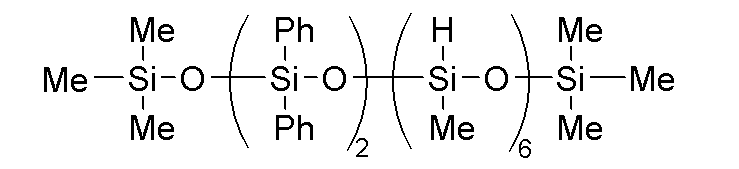

(B)成分のオルガノハイドロジェンポリシロキサンの配合量は、(A)成分中のアルケニル基の個数の合計に対する(B)成分中のヒドロシリル基の個数が0.1~3となる量、好ましくは0.7~3となる量、より好ましくは1~2となる量である。(B)成分の量が上記下限値未満では付加反応が十分に進行せず、架橋が不十分となる。また、上記上限値超では、架橋構造が不均一となったり、組成物の経時安定性が悪化したりする場合がある。 The amount of organohydrogenpolysiloxane in component (B) is such that the number of hydrosilyl groups in component (B) relative to the total number of alkenyl groups in component (A) is 0.1 to 3, preferably 0.7 to 3, and more preferably 1 to 2. If the amount of component (B) is less than the lower limit above, the addition reaction will not proceed sufficiently, resulting in insufficient crosslinking. If the amount exceeds the upper limit above, the crosslinked structure may become nonuniform and the stability of the composition over time may deteriorate.
[(C)加水分解性オルガノポリシロキサン]
(C)成分は、フェニルシリコーンと熱伝導性充填剤の分散剤(ウェッター)として作用するもので、下記式(1)で表される加水分解性オルガノポリシロキサンである。

Component (C) acts as a dispersant (wetter) for the phenyl silicone and thermally conductive filler, and is a hydrolyzable organopolysiloxane represented by the following formula (1).
上記一般式(1)中、R1は、独立して炭素数6~10の1価芳香族炭化水素基である。R1の具体例としては、フェニル基、トリル基、キシリル基、メシチル基などのアリール基が挙げられ、中でも、フェニル基が好ましい。 In the above general formula (1), R1 is independently a monovalent aromatic hydrocarbon group having 6 to 10 carbon atoms. Specific examples of R1 include aryl groups such as a phenyl group, a tolyl group, a xylyl group, and a mesityl group, and among these, a phenyl group is preferable.
上記一般式(1)中、R2は、独立して炭素数1~10、好ましくは1~5、より好ましくは1~3のアルキル基である。R2の例としては、メチル基、エチル基、プロピル基、イソプロピル基、ブチル基、tert-ブチル基、ペンチル基、ヘキシル基、オクチル基、ノニル基、デシル基などが挙げられ、中でも、メチル基が好ましい。 In the above general formula (1), R2 is independently an alkyl group having 1 to 10 carbon atoms, preferably 1 to 5, and more preferably 1 to 3. Examples of R2 include a methyl group, an ethyl group, a propyl group, an isopropyl group, a butyl group, a tert-butyl group, a pentyl group, a hexyl group, an octyl group, a nonyl group, and a decyl group, and among these, a methyl group is preferable.
上記一般式(1)中、R3は、独立して炭素数1~4のアルキル基であり、好ましくはメチル基またはエチル基である。R3の例としては、メチル基、エチル基、プロピル基、イソプロピル基、ブチル基、tert-ブチル基などが挙げられる。なかでも、本発明オルガノポリシロキサン化合物の加水分解性の観点から、特にメチル基が好ましい。また、上記一般式(1)中、aは2または3であるが、合成のしやすさ及び経済性の観点から、aは3が好ましい。 In the above general formula (1), R 3 is independently an alkyl group having 1 to 4 carbon atoms, preferably a methyl group or an ethyl group. Examples of R 3 include a methyl group, an ethyl group, a propyl group, an isopropyl group, a butyl group, and a tert-butyl group. Of these, from the viewpoint of the hydrolysis property of the organopolysiloxane compound of the present invention, a methyl group is particularly preferable. In addition, in the above general formula (1), a is 2 or 3, but from the viewpoint of ease of synthesis and economic efficiency, a is preferably 3.
上記一般式(1)中、mは、通常、1≦m≦30、好ましくは3≦m≦20、より好ましくは5≦m≦18の整数である。mが30を超えると、オルガノポリシロキサンの粘度が著しく増加するため好ましくない。また、上記一般式(1)中、nは通常、0≦n≦60、好ましくは5≦n≦50、より好ましくは10≦n≦40の整数である。上記範囲外では、フェニル変性シリコーンとの相溶性が低下するため好ましくない。また、m+nは、3≦m+n≦90であり、6≦m+n≦60が好ましい。上記範囲外だと、組成物の取り扱い性が悪くなるため好ましくない。 In the above general formula (1), m is usually an integer of 1≦m≦30, preferably 3≦m≦20, and more preferably 5≦m≦18. If m exceeds 30, the viscosity of the organopolysiloxane increases significantly, which is not preferred. In addition, in the above general formula (1), n is usually an integer of 0≦n≦60, preferably 5≦n≦50, and more preferably 10≦n≦40. If it is outside the above range, the compatibility with the phenyl-modified silicone decreases, which is not preferred. Furthermore, m+n is 3≦m+n≦90, and preferably 6≦m+n≦60. If it is outside the above range, the composition becomes difficult to handle, which is not preferred.
本発明の(C)成分としては、下記一般式(2)で示されるブロック構造を有する加水分解性オルガノポリシロキサンであることが好ましい。

このような(C)成分として、例えば、下記式で表される分子鎖片末端トリメトキシシロキシ基封鎖ジメチルシロキサン・ジフェニルシロキサン共重合体などの加水分解性オルガノポリシロキサンが挙げられる。
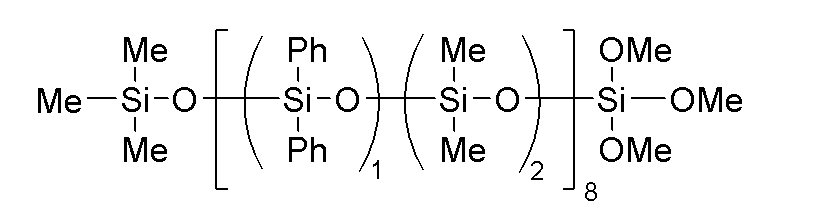
(C)成分の配合量は、(A)成分100質量部に対して10~300質量部であり、好ましくは15~200質量部であり、より好ましいのは20~100質量部である。(C)成分の量が10未満では、熱伝導性シリコーン硬化物に熱伝導性充填剤を高充填化することが難しいため好ましくはない。また、300質量部超では熱伝導性シリコーン組成物の粘度が著しく上昇するため好ましくない。 The amount of component (C) is 10 to 300 parts by mass, preferably 15 to 200 parts by mass, and more preferably 20 to 100 parts by mass, per 100 parts by mass of component (A). If the amount of component (C) is less than 10, it is difficult to highly fill the thermally conductive silicone cured product with the thermally conductive filler, which is not preferred. If the amount exceeds 300 parts by mass, the viscosity of the thermally conductive silicone composition increases significantly, which is also not preferred.
[(D)熱伝導性充填剤]
(D)成分は、金属酸化物、金属水酸化物、及び金属窒化物からなる群より選ばれる1種以上の熱伝導性充填剤である。例えば、アルミナ、酸化亜鉛、酸化マグネシウム、酸化アルミニウム、二酸化ケイ素、酸化セリウム、酸化鉄、水酸化アルミニウム、水酸化セリウム、窒化アルミニウム、窒化ホウ素等が挙げられる。これらは単独でまたは2種以上を適宜組み合わせて用いることができ、異なる平均粒径を持つ粒子の組み合わせ、即ち、大粒子成分と小粒子成分を組み合わせたものであることが好ましい。任意の2種以上の異なる平均粒径を持つ粒子を組み合わせることができ、好ましくは2、3又は4種の異なる平均粒径を持つ粒子の組み合わせである。異なる平均粒径を持つ粒子の組み合わせると、得られる組成物の粘度、加工性、均一性などを好適に調整できる。以下では、(D)成分が異なる平均粒径を持つ粒子の組み合わせである場合において、平均粒径10μm未満の成分から構成される部分を小粒子成分と呼び、いずれの小粒子成分の平均粒径よりも大きな平均粒径持つ成分から構成される部分を大粒子成分と呼ぶこととする。
[(D) Thermally conductive filler]
The (D) component is one or more thermally conductive fillers selected from the group consisting of metal oxides, metal hydroxides, and metal nitrides. Examples include alumina, zinc oxide, magnesium oxide, aluminum oxide, silicon dioxide, cerium oxide, iron oxide, aluminum hydroxide, cerium hydroxide, aluminum nitride, and boron nitride. These can be used alone or in appropriate combination of two or more, and a combination of particles having different average particle sizes, that is, a combination of a large particle component and a small particle component, is preferable. Any two or more types of particles having different average particle sizes can be combined, and a combination of particles having two, three, or four different average particle sizes is preferable. By combining particles having different average particle sizes, the viscosity, processability, uniformity, etc. of the obtained composition can be suitably adjusted. Hereinafter, when the (D) component is a combination of particles having different average particle sizes, the portion composed of components having an average particle size of less than 10 μm will be referred to as the small particle component, and the portion composed of components having an average particle size larger than the average particle size of any of the small particle components will be referred to as the large particle component.
大粒子成分の平均粒径は、0.1μm以上であれば、得られる組成物の粘度が高くなることもなく、加工性が低下することもない。また、100μm以下であれば、得られる組成物が不均一にならず、オイルブリードのおそれがないため、0.1~100μmの範囲、好ましくは10~75μmの範囲が好ましい。 If the average particle size of the large particle component is 0.1 μm or more, the viscosity of the resulting composition will not increase and the processability will not decrease. Also, if it is 100 μm or less, the resulting composition will not be non-uniform and there will be no risk of oil bleeding, so it is preferable for it to be in the range of 0.1 to 100 μm, and preferably in the range of 10 to 75 μm.
また、小粒子成分の平均粒径(大粒子成分の平均粒径より小さい)は、0.01μm以上であれば、得られる組成物の粘度が高くなることもなく、加工性が低下することもない。一方で、10μm以下であれば、得られる組成物が不均一となるおそれがないため、0.01μm以上10μm未満の範囲、好ましくは0.1~4μmの範囲がよい。 Furthermore, if the average particle size of the small particle component (smaller than the average particle size of the large particle component) is 0.01 μm or more, the viscosity of the resulting composition will not increase and the processability will not decrease. On the other hand, if it is 10 μm or less, there is no risk of the resulting composition becoming non-uniform, so it is best to keep it in the range of 0.01 μm or more and less than 10 μm, preferably in the range of 0.1 to 4 μm.
大粒子成分と小粒子成分の割合は特に限定されないが、平均粒径10μm以上(好ましくは10μm以上75μm以下)を大粒子成分とし、平均粒径10μm未満(好ましくは0.01μm以上10μm未満)を小粒子成分とした場合の大粒子成分と小粒子成分の比については、9:1~1:9(質量比)の範囲が好ましい。また、大粒子成分及び小粒子成分の形状は、球状、不定形状、針状等、特に限定されるものではない。大粒子成分は球状であることが好ましく、小粒子成分は球状又は不定形状が好ましい。小粒子成分は不定形状であっても、大粒子間の空隙を充填することができる。
なお、平均粒径は、例えば、レーザー光回折法による粒度分布測定における体積基準の平均値(又はメジアン径)として求めることができ、粒子径分布測定装置MT3000II(マイクロトラック・ベル株式会社製)など市販のレーザー光回折法粒度分布測定装置により求めることができる。
The ratio of the large particle component to the small particle component is not particularly limited, but when the large particle component has an average particle size of 10 μm or more (preferably 10 μm or more and 75 μm or less) and the small particle component has an average particle size of less than 10 μm (preferably 0.01 μm or more and less than 10 μm), the ratio of the large particle component to the small particle component is preferably in the range of 9:1 to 1:9 (mass ratio). The shapes of the large particle component and the small particle component are not particularly limited, and may be spherical, irregular, needle-like, etc. The large particle component is preferably spherical, and the small particle component is preferably spherical or irregular. Even if the small particle component has an irregular shape, it can fill the gaps between the large particles.
The average particle size can be determined, for example, as a volume-based average value (or median diameter) in particle size distribution measurement by a laser light diffraction method, and can be determined using a commercially available laser light diffraction particle size distribution measurement device such as the particle size distribution measurement device MT3000II (manufactured by Microtrack Bell Co., Ltd.).
(D)成分の配合量は、組成物全体に対し10~97質量%であり、20~95質量%が好ましく、30~95質量%がより好ましく、50~95質量%がさらに好ましい。97質量%より多いと、組成物の粘度が増加し、加工性が低下する。また、10質量%より少ないと熱伝導性が乏しくなる。 The amount of component (D) is 10 to 97% by mass of the entire composition, preferably 20 to 95% by mass, more preferably 30 to 95% by mass, and even more preferably 50 to 95% by mass. If it is more than 97% by mass, the viscosity of the composition increases and processability decreases. Also, if it is less than 10% by mass, the thermal conductivity becomes poor.
[(E)白金族金属触媒]
(E)成分は白金族金属触媒であり、上述した(A)成分と(B)成分の付加反応を促進するために機能する。白金族金属触媒は、付加反応に用いられる従来公知のものを使用することができる。例えば、白金系、パラジウム系、ロジウム系の触媒が挙げられるが、中でも比較的入手しやすい白金又は白金化合物が好ましい。例えば、白金の単体、白金黒、塩化白金酸、白金-オレフィン錯体、白金-アルコール錯体、白金配位化合物等が挙げられる。白金族金属触媒は1種単独でも2種以上を組み合わせて使用してもよい。
[(E) Platinum group metal catalyst]
Component (E) is a platinum group metal catalyst, which functions to promote the addition reaction between components (A) and (B) described above. The platinum group metal catalyst may be any of the conventionally known catalysts used in addition reactions. Examples of catalysts that can be used include platinum-based, palladium-based, and rhodium-based catalysts, and among these, platinum or platinum compounds, which are relatively easy to obtain, are preferred. For example, platinum alone, platinum black, chloroplatinic acid, platinum -olefin complexes, platinum-alcohol complexes, platinum coordination compounds, etc. The platinum group metal catalysts may be used alone or in combination of two or more.
(E)成分の配合量は、(A)成分の質量に対し、白金族金属原子に換算した質量基準で0.1~500ppm、好ましくは1~200ppmである。触媒の量が上記下限値より少ないと触媒としての効果が得られないことがある。また上記上限値を超えても触媒効果が増大することはなく不経済であるため好ましくない。 The amount of component (E) to be blended is 0.1 to 500 ppm, preferably 1 to 200 ppm, by mass converted to platinum group metal atoms relative to the mass of component (A). If the amount of catalyst is less than the lower limit above, the catalytic effect may not be obtained. Furthermore, if the amount exceeds the upper limit above, the catalytic effect does not increase and it is uneconomical, so this is not preferred.
[(F)ヒドロシリル化反応制御剤]
(F)成分は室温でのヒドロシリル化反応の進行を抑える反応制御剤であり、シェルフライフ、ポットライフを延長させるために添加する。該反応制御剤は、付加硬化型シリコーン組成物に使用される従来公知の制御剤を使用することができる。これには、例えば、アセチレンアルコール類(例えば、3-メチル-1-トリデシン-3-オール、1-エチニル-1-シクロヘキサノール、3,5-ジメチル-1-ヘキシン-3-オール)等のアセチレン化合物、トリブチルアミン、テトラメチルエチレンジアミン、ベンゾトリアゾール等の各種窒素化合物、トリフェニルホスフィン等の有機リン化合物、オキシム化合物、有機クロロ化合物等が挙げられる。
[(F) Hydrosilylation Reaction Inhibitor]
Component (F) is a reaction inhibitor that suppresses the progress of the hydrosilylation reaction at room temperature, and is added to extend shelf life and pot life. The reaction inhibitor may be any known inhibitor used in addition curing silicone compositions. Examples of such an inhibitor include acetylene compounds such as acetylene alcohols (e.g., 3-methyl-1-tridecyne-3-ol, 1-ethynyl-1-cyclohexanol, 3,5-dimethyl-1-hexyne-3-ol), various nitrogen compounds such as tributylamine, tetramethylethylenediamine, and benzotriazole, organic phosphorus compounds such as triphenylphosphine, oxime compounds, and organic chloro compounds.
(F)成分配合量は、0.05~5質量部であり、好ましくは0.1~1質量部である。反応制御剤の量が0.05質量部未満では、所望とする十分なシェルフライフ、ポットライフが得られないおそれがあり、また、5質量部より多い場合には、シリコーン組成物の硬化性が低下するおそれがある。 The amount of component (F) is 0.05 to 5 parts by mass, and preferably 0.1 to 1 part by mass. If the amount of reaction inhibitor is less than 0.05 parts by mass, the desired shelf life and pot life may not be achieved, and if it is more than 5 parts by mass, the curability of the silicone composition may decrease.
熱伝導性シリコーン組成物の製造工程
本発明における熱伝導性シリコーン組成物の製造方法について説明する。本発明における熱伝導性シリコーン組成物の製造方法は特に限定されるものではない。
上述した(A)~(F)成分を、例えば、自転・公転方式ミキサー(商品名:あわとり練太郎、THINKY社製)、トリミックス、ツウィンミックス、プラネタリーミキサー(いずれも(株)井上製作所製)、ウルトラミキサー(みずほ工業(株))、ハイビスディスパーミックス(特殊機化工業(株))等の混合機等を用いて混合する方法が挙げられる。また、配合する全成分を一度に配合してもよく、1成分または、複数成分を数段階に分けて混合してもよい。
本発明においては、予め(A)、(C)、(D)成分を室温で混合し、その後、(E)、(B)、及び(F)成分を混合することが好ましい。
Manufacturing Process of the Thermally Conductive Silicone Composition The manufacturing method of the thermally conductive silicone composition of the present invention will now be described. There are no particular limitations on the manufacturing method of the thermally conductive silicone composition of the present invention.
Examples of methods include mixing the above-mentioned components (A) to (F) using a mixer such as a rotation/revolution type mixer (product name: THINKY Mixer, manufactured by THINKY Corporation), Trimix, Twinmix, or Planetary Mixer (all manufactured by Inoue Seisakusho Co., Ltd.), Ultra Mixer (Mizuho Kogyo Co., Ltd.), or Hivis Dispermix (Tokushu Kika Kogyo Co., Ltd.). All of the components to be mixed may be mixed at once, or one or more components may be mixed in several stages.
In the present invention, it is preferred to first mix the components (A), (C), and (D) at room temperature, and then mix the components (E), (B), and (F).
本発明のフェニルシリコーン組成物は、23℃にて測定される絶対粘度が、好ましくは1~1,000Pa・s、より好ましくは20~700Pa・s、さらに好ましくは50~500Pa・sである。絶対粘度が、1Pa・s以上であれば、形状保持が困難となる等、作業性が悪くなることはない。また絶対粘度が1,000Pa・s以下であれば、加工性が悪くなるおそれはない。上記粘度は、上述した各成分の配合量を調整することにより得ることができる。なお、本発明において、絶対粘度は粘度・粘弾性測定装置により測定した値である。測定装置としては、例えば、サーモフィッシャーサイエンティフィック株式会社製のMARS40を使用することができ、測定条件としては、23℃でパラレルプレートを使用し、ギャップ0.5mm、回転数10s-1で測定することにより、絶対粘度を求めることができる。 The phenyl silicone composition of the present invention has an absolute viscosity measured at 23°C of preferably 1 to 1,000 Pa·s, more preferably 20 to 700 Pa·s, and even more preferably 50 to 500 Pa·s. If the absolute viscosity is 1 Pa·s or more, there is no deterioration in workability, such as difficulty in maintaining the shape. If the absolute viscosity is 1,000 Pa·s or less, there is no risk of deterioration in processability. The above viscosity can be obtained by adjusting the blending amount of each of the above-mentioned components. In the present invention, the absolute viscosity is a value measured by a viscosity/viscoelasticity measuring device. As a measuring device, for example, MARS40 manufactured by Thermo Fisher Scientific Co., Ltd. can be used, and the absolute viscosity can be obtained by measuring at 23°C using parallel plates, a gap of 0.5 mm, and a rotation speed of 10 s -1 .
熱伝導性シリコーン硬化物の製造工程
本発明の熱伝導性シリコーン組成物は、通常50~180℃、好ましくは80~150℃、更に好ましくは100~120℃で加熱することにより硬化物とすることができる。
本発明の熱伝導性シリコーン組成物を用いて所望の方法で成形することで任意の形状の硬化物を得ることができる。成形方法は特に限定されないが、例えば、上記組成物の製造工程で調製した熱伝導性シリコーン組成物を金型へ流し込み、金型開口部をフッ素処理PETフィルム2枚ではさんだ後、プレス成形機を用い、110℃で、10分間硬化させることで熱伝導性シリコーン硬化物を得ることができる。
Manufacturing Process for Cured Thermally Conductive Silicone Product The thermally conductive silicone composition of the present invention can be cured by heating at a temperature generally between 50 and 180°C, preferably between 80 and 150°C, and more preferably between 100 and 120°C.
The thermally conductive silicone composition of the present invention can be molded by a desired method to obtain a cured product of any shape. The molding method is not particularly limited, but for example, the thermally conductive silicone composition prepared in the above-mentioned composition production process is poured into a mold, the mold opening is sandwiched between two sheets of fluorine-treated PET film, and then cured at 110°C for 10 minutes using a press molding machine to obtain a thermally conductive silicone cured product.
熱伝導性シリコーン硬化物の熱伝導率
本発明における熱伝導性シリコーン硬化物の熱伝導率は、1.0W/m・K以上、好ましくは2.0W/m・K以上であることがよい。熱伝導率は高ければ高いほど好ましいので上限値は決められないが、例えば20W/m・K以下とすることができる。なお、本発明において、熱伝導率は、ISO 22007-2準拠のホットディスク法により測定した値である。この値は、例えば、京都電子工業(株)製のホットディスク法熱物性測定装置TPSシリーズ(TPS 2500Sなど)で測定できる。
Thermal Conductivity of Thermally Conductive Silicone Cured Product The thermal conductivity of the thermally conductive silicone cured product in the present invention is 1.0 W/m·K or more, preferably 2.0 W/m·K or more. The higher the thermal conductivity, the better, so no upper limit can be determined, but it can be, for example, 20 W/m·K or less. In the present invention, the thermal conductivity is a value measured by the hot disk method in accordance with ISO 22007-2. This value can be measured, for example, with a hot disk method thermal property measuring device TPS series (TPS 2500S, etc.) manufactured by Kyoto Electronics Manufacturing Co., Ltd.
以下、実施例及び比較例を挙げて本発明を具体的に説明するが、本発明はこれらに限定されない。 The present invention will be specifically explained below with examples and comparative examples, but the present invention is not limited to these.
熱伝導性シリコーン組成物の調製
下記実施例に用いられる(A)~(F)成分を下記に示す。なお、Meはメチル基を示し、Phはフェニル基を示す。なお、以下の式において、丸括弧で括られたシロキサン単位の結合は、それぞれブロックであってもランダムであってもよい。角括弧で括られたシロキサン単位はブロック重合体である。動粘度は、JIS Z8803:2011に記載のオストワルド粘度計によって測定した25℃での値である。
Preparation of Thermally Conductive Silicone Composition Components (A) to (F) used in the following examples are shown below. Me represents a methyl group, and Ph represents a phenyl group. In the following formulas, the bonds of the siloxane units enclosed in parentheses may be either block or random. The siloxane units enclosed in square brackets are block polymers. The kinetic viscosity is a value at 25°C measured using an Ostwald viscometer according to JIS Z8803:2011.
(A)成分
A-1:下記式で表され、動粘度が700mm2・s-1のフェニル変性オルガノポリシロキサン

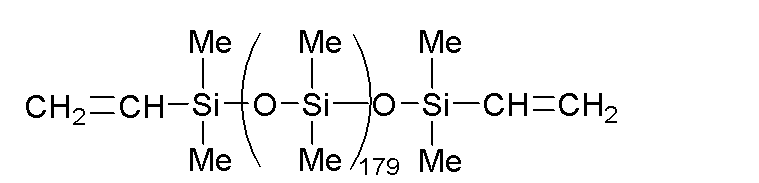
(B)成分
B-1:下記式で表される、動粘度が20mm2・s-1のフェニル変性オルガノハイドロジェンポリシロキサン
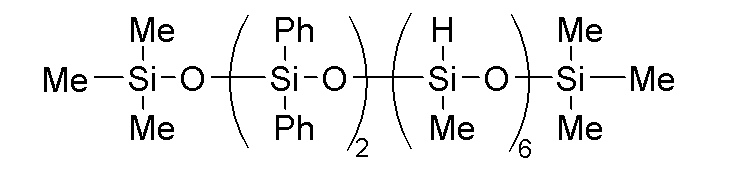

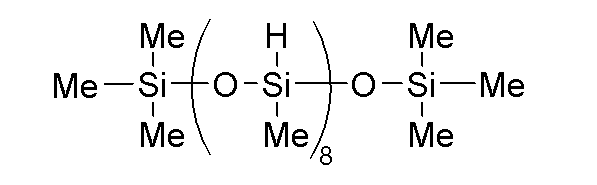
(C)成分
C-1:下記式で表される加水分解性オルガノシロキサン
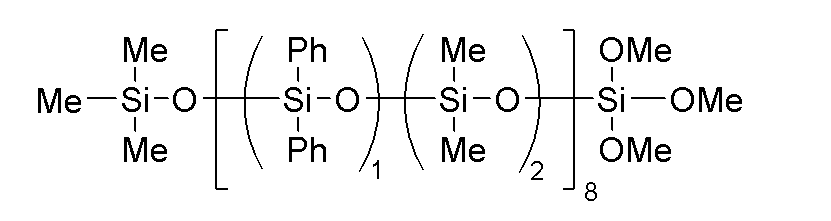
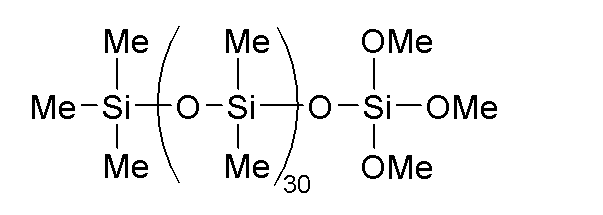


(D)成分
(D)成分のフィラー粒径(平均粒径)は、粒子径分布測定装置 MT3000II(マイクロトラック・ベル株式会社製)によって測定した。
D―1:球状アルミナ粉末(メジアン径:70μm)
D-2:球状アルミナ粉末(メジアン径:45μm)
D-3:球状アルミナ粉末(メジアン径:10μm)
D-4:不定形アルミナ粉末(メジアン径:2μm)
Component (D) The filler particle size (average particle size) of component (D) was measured using a particle size distribution measuring device MT3000II (manufactured by Microtrack Bell Co., Ltd.).
D-1: Spherical alumina powder (median diameter: 70 μm)
D-2: Spherical alumina powder (median diameter: 45 μm)
D-3: Spherical alumina powder (median diameter: 10 μm)
D-4: irregular alumina powder (median diameter: 2 μm)
(E)成分
5%塩化白金酸2-エチルヘキサノール溶液
(E) Component 5% chloroplatinic acid solution in 2-ethylhexanol
(F)成分
3-メチル-1-トリデシン-3-オール
(F) Component 3-methyl-1-tridecyl-3-ol
[製造方法]
(A)、(C)、(D)成分を以下の通りに混合して実施例及び比較例の組成物を得た。表1及び表2に示す組成比(質量部)で自転・公転方式ミキサー(商品名:あわとり練太郎、THINKY社製)に(A)、(C)、(D)成分を量り取ったプラスチック製容器を入れ、室温、2,000rpmで1分間×2回混合後、得られた混合物を室温まで冷却した。その後、(E)成分を入れ、2,000rpmで30秒間×2回混合後、得られた混合物を室温まで冷却した。さらに、(B)成分と(F)成分の混合物を入れ、2,000rpmで10秒間×2回混合後、室温まで冷却し、真空ポンプを用いて脱気処理を行った。
[Production method]
The components (A), (C), and (D) were mixed as follows to obtain compositions of the examples and comparative examples. The components (A), (C), and (D) were weighed into a plastic container and placed in a rotation/revolution mixer (product name: Awatori Rentaro, manufactured by THINKY) in the composition ratios (parts by mass) shown in Tables 1 and 2, and mixed at room temperature and 2,000 rpm for 1 minute x 2 times, and the resulting mixture was cooled to room temperature. Then, the component (E) was added, mixed at 2,000 rpm for 30 seconds x 2 times, and the resulting mixture was cooled to room temperature. Furthermore, a mixture of the components (B) and (F) was added, mixed at 2,000 rpm for 10 seconds x 2 times, cooled to room temperature, and degassed using a vacuum pump.
[成形方法]
調製した熱伝導性シリコーン組成物を60mm×60mm×6mmまたは、190mm×140mm×2mmの金型へ流し込み、金型開口部をフッ素処理PETフィルム2枚ではさんだ後、プレス成形機を用い、110℃で、10分間硬化させることで熱伝導性シリコーン硬化物を得た。
[Molding method]
The prepared thermally conductive silicone composition was poured into a mold measuring 60 mm × 60 mm × 6 mm or 190 mm × 140 mm × 2 mm, the opening of the mold was sandwiched between two sheets of fluorine-treated PET film, and then the composition was cured for 10 minutes at 110°C using a press molding machine, yielding a cured thermally conductive silicone product.
[評価方法]
[絶対粘度]
得られた組成物を粘度・粘弾性測定装置(商品名:MARS40(サーモフィッシャーサイエンティフィック株式会社))を使用して回転数10s-1での絶対粘度を測定した。測定条件は、23℃でパラレルプレートを使用し、ギャップは0.5mmである。
[Evaluation method]
[Absolute Viscosity]
The absolute viscosity of the obtained composition was measured at a rotation speed of 10 s using a viscosity/viscoelasticity measuring device (product name: MARS40 (Thermo Fisher Scientific Co., Ltd.)). The measurement conditions were 23° C., parallel plates, and a gap of 0.5 mm.
[熱伝導率]
下記実施例1~3及び比較例1~4において成形した6mm厚のシート2枚を用いて、熱伝導率計(TPS 2500S、京都電子工業株式会社製)により硬化物の熱伝導率を測定した(ISO 22007-2準拠のホットディスク法)。
[Thermal conductivity]
Using two 6 mm thick sheets molded in Examples 1 to 3 and Comparative Examples 1 to 4 below, the thermal conductivity of the cured products was measured with a thermal conductivity meter (TPS 2500S, manufactured by Kyoto Electronics Manufacturing Co., Ltd.) (hot disk method in accordance with ISO 22007-2).
[硬度]
熱伝導性シリコーン硬化物の硬度をJIS K6253-3:2012に規定されているデュロメータ(TypeA)硬度計で測定した。なお、測定値が20未満の物については、JIS K7312:1996附属書2記載の方法に準拠して測定したデュロメータ(アスカーC)硬度計で測定した。
[hardness]
The hardness of the thermally conductive silicone cured product was measured using a durometer (Type A) hardness tester specified in JIS K6253-3: 2012. For products with measured values of less than 20, the hardness was measured using a durometer (Asker C) hardness tester measured in accordance with the method described in JIS K7312: 1996, Appendix 2.
[耐熱試験]
6mm厚のシートを180℃でエージングを行った。90時間エージング後、シートを室温まで戻し、エージング前後における硬度の測定を行った。
[Heat resistance test]
A 6 mm thick sheet was aged at 180° C. After aging for 90 hours, the sheet was returned to room temperature, and the hardness before and after aging was measured.
[耐薬品試験]
2mm厚の40×40mmシートをTOYOTA純正ATF液に浸漬させ、150℃でエージングを実施した。250時間エージング後、ATF液からシートを取り出し、エージング前後における質量及び密度変化から体積変化率を導出した。
[Chemical resistance test]
A 40×40 mm sheet with a thickness of 2 mm was immersed in a genuine TOYOTA ATF liquid and aged at 150° C. After aging for 250 hours, the sheet was removed from the ATF liquid, and the volume change rate was derived from the changes in mass and density before and after aging.
評価結果を表1,2に示す。
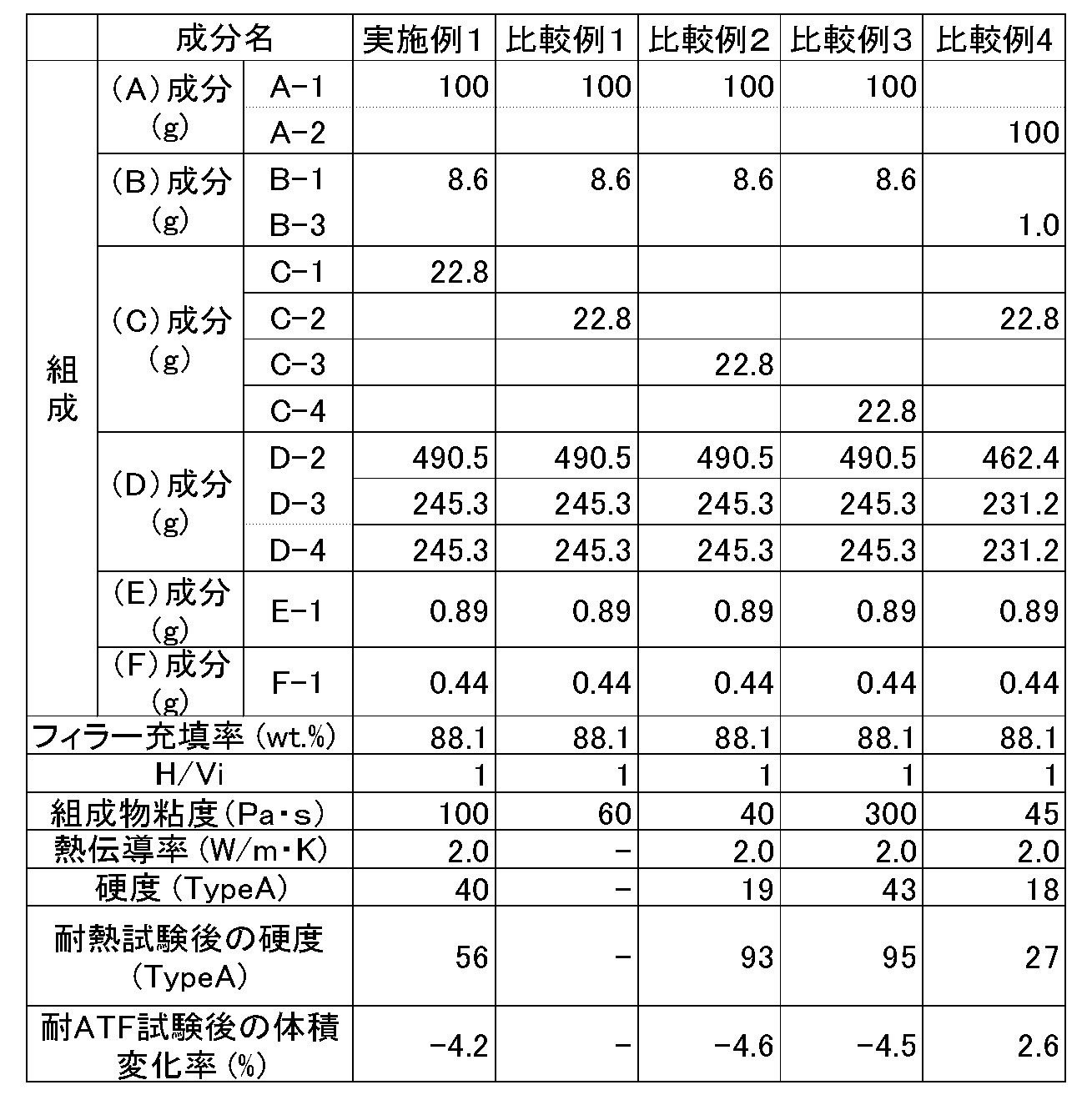
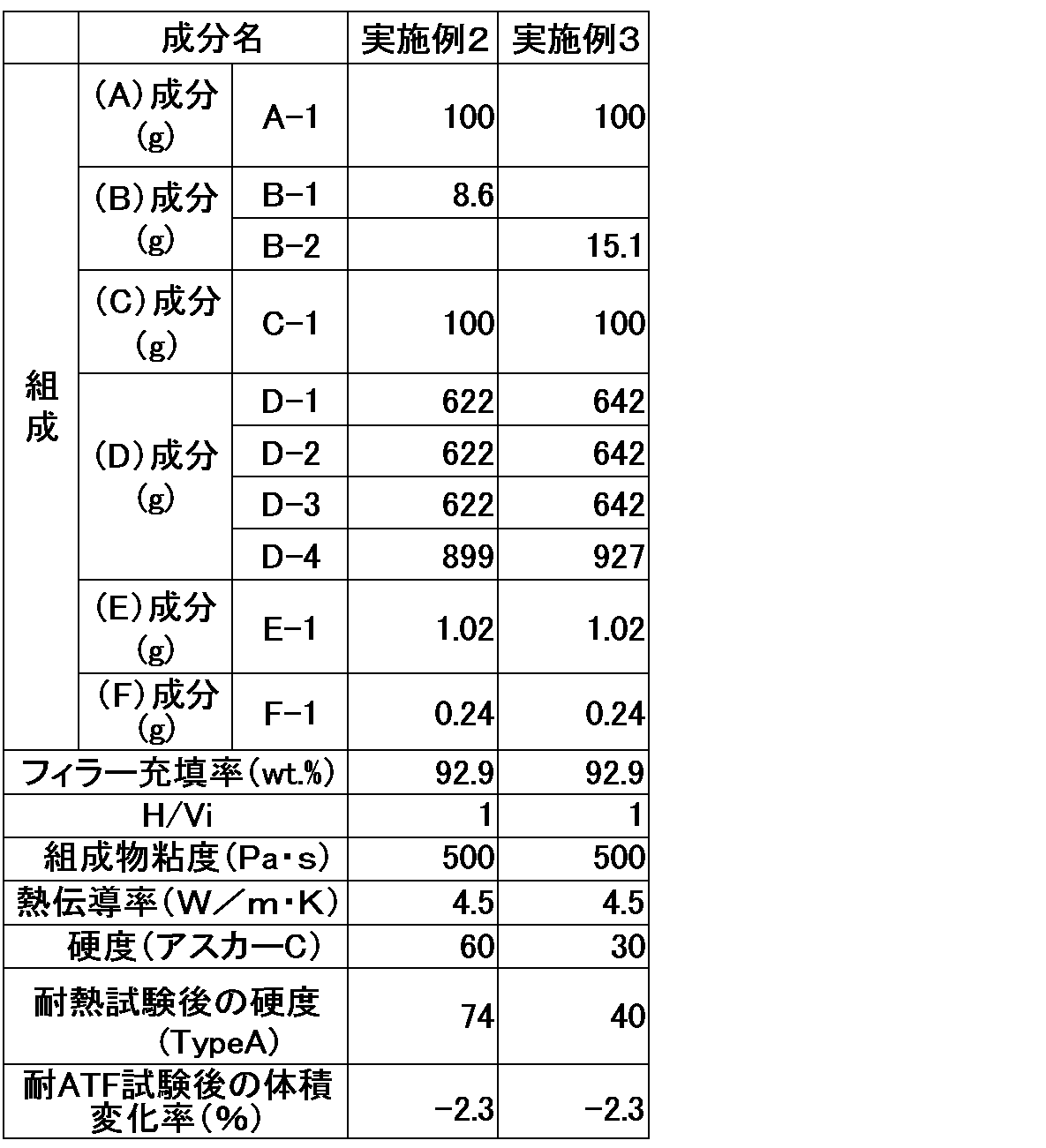
実施例1~3で用いた(C)成分に、上記一般式(1)に相当するフェニル変性された加水分解性オルガノシロキサンを用いた熱伝導性シリコーン硬化物は、熱伝導率2.0W/m・K以上を有し、180℃における耐熱試験において、硬度変化はほとんど見られなかった。また、実施例2、3では熱伝導性充填剤を高充填しているにもかかわらず、本発明の(C)成分を含有するため、組成物の粘度および硬化物の硬度の上昇が抑制され、高熱伝導率が達成されている。
一方で、比較例1のように、(C)成分に加水分解性ジメチルオルガノシロキサン(C-2)を用いた場合には、硬化物が安定的に得られないことがわかった。これは、(A)成分のフェニル変性オルガノポリシロキサンと(C-2)ジメチルオルガノシロキサンの相溶性が低いために、組成物中において(C-2)が分離するためであると考えられる。
また、比較例2、3のように(C)成分にデシルトリメトキシシラン(C-3)またはフェニルトリメトキシシラン(C-4)を用いた場合には、耐熱試験後の硬度が著しく増加する。これは、(C-3)及び(C-4)が低分子であり、揮発性が高いためであると考えられる。
さらに、実施例1のようにフェニル変性シリコーン組成物を用いた硬化物は、250時間の耐ATF試験後の体積変化が-4%程度であった。これは比較例4のようなジメチルシリコーンエラストマーの硬化物では、同条件で2.6%膨潤する結果とは異なる。また、この耐ATF試験後のフェニル変性シリコーン組成物を用いた硬化物の体積変化は、(C)成分による差はほとんどないことから、フェニル変性シリコーン組成物特有の性質であると考えられる。
以上の結果から、本発明による熱伝導性シリコーン硬化物は、比較的高い耐ATF性を示し、且つ熱伝導率も4.0W/m・K以上を有する。したがって、本発明の熱伝導性シリコーン組成物及び硬化物は、新たな耐薬品性を有する放熱材料になり得る。
The thermally conductive silicone cured product in which the component (C) used in Examples 1 to 3 was a phenyl-modified hydrolyzable organosiloxane corresponding to the above general formula (1) had a thermal conductivity of 2.0 W/m·K or more, and showed almost no change in hardness in a heat resistance test at 180° C. Furthermore, in Examples 2 and 3, despite the high loading of thermally conductive filler, the inclusion of the component (C) of the present invention inhibited increases in the viscosity of the composition and the hardness of the cured product, achieving high thermal conductivity.
On the other hand, it was found that a cured product could not be obtained stably when hydrolyzable dimethylorganosiloxane (C-2) was used as component (C) as in Comparative Example 1. This is believed to be because (C-2) separates in the composition due to low compatibility between the phenyl-modified organopolysiloxane of component (A) and the dimethylorganosiloxane (C-2).
Furthermore, when decyltrimethoxysilane (C-3) or phenyltrimethoxysilane (C-4) was used as component (C) as in Comparative Examples 2 and 3, the hardness after the heat resistance test increased significantly. This is believed to be because (C-3) and (C-4) are low molecular weight compounds and highly volatile.
Furthermore, the cured product using the phenyl-modified silicone composition as in Example 1 showed a volume change of about -4% after a 250-hour ATF resistance test. This differs from the result of a cured product of a dimethylsilicone elastomer as in Comparative Example 4, which showed a 2.6% swelling under the same conditions. Furthermore, the volume change of the cured product using the phenyl-modified silicone composition after this ATF resistance test showed almost no difference due to component (C), and is therefore thought to be a property unique to the phenyl-modified silicone composition.
The above results show that the thermally conductive silicone cured product of the present invention exhibits relatively high ATF resistance and also has a thermal conductivity of at least 4.0 W/m K. Therefore, the thermally conductive silicone composition and cured product of the present invention can become new heat dissipating materials with chemical resistance.
本明細書は、以下の態様を包含する。
[1]:下記(A)~(F)を含む熱伝導性シリコーン組成物であって、
(A)1分子中に2個以上のアルケニル基を有し、25℃での動粘度が100~100,000mm2/sであるフェニル変性オルガノポリシロキサン:100質量部
(B)ヒドロシリル基を2個以上有するオルガノハイドロジェンポリシロキサン:上記(A)成分が有するアルケニル基1モルに対して(B)成分中のヒドロシリル基のモル数が0.1~3モルとなる量
(C)下記一般式(1)

で表される加水分解性オルガノポリシロキサン:10~300質量部
(D)金属、金属酸化物、金属水酸化物、及び金属窒化物からなる群より選ばれる1種以上の熱伝導性充填剤:組成物全体に対して10~97質量%となる量
(E)白金族金属触媒:上記(A)成分の質量に対し、白金族金属原子に換算した質量基準で0.1~500ppm
(F)ヒドロシリル化反応制御剤:0.05~5質量部
を含むものであることを特徴とする熱伝導性シリコーン組成物。
[2]:上記(C)成分が、下記一般式(2)で表されるものであることを特徴とする[1]に記載の熱伝導性シリコーン組成物。
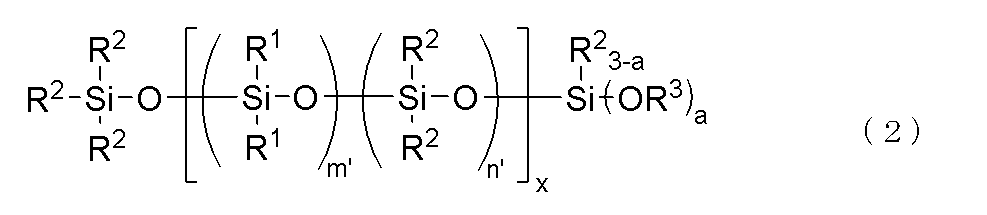
[3]:上記一般式(1)中の上記R1がフェニル基であり、上記R2がメチル基であることを特徴とする[1]又は[2]に記載の熱伝導性シリコーン組成物。
[4]:上記熱伝導性シリコーン組成物の23℃での絶対粘度が、1~1,000Pa・sであることを特徴とする[1]から[3]のいずれかに記載の熱伝導性シリコーン組成物。
[5]:[1]から[4]のいずれかに記載の熱伝導性シリコーン組成物を硬化してなるものであることを特徴とする熱伝導性シリコーン硬化物。
[6]:熱伝導率が1.0W/m・K以上であることを特徴とする[5]に記載の熱伝導性シリコーン硬化物。
The present specification includes the following aspects.
[1]: A thermally conductive silicone composition comprising the following (A) to (F):
(A) a phenyl-modified organopolysiloxane having two or more alkenyl groups in one molecule and a kinetic viscosity at 25° C. of 100 to 100,000 mm 2 /s: 100 parts by mass; (B) an organohydrogenpolysiloxane having two or more hydrosilyl groups: an amount such that the number of moles of hydrosilyl groups in component (B) is 0.1 to 3 moles per mole of alkenyl groups in component (A); and (C) a compound represented by the following general formula (1):
(D) One or more thermally conductive fillers selected from the group consisting of metals, metal oxides, metal hydroxides, and metal nitrides: an amount of 10 to 97% by mass based on the total mass of the composition (E) Platinum group metal catalyst: 0.1 to 500 ppm by mass calculated as platinum group metal atoms based on the mass of the component (A)
(F) A thermally conductive silicone composition comprising 0.05 to 5 parts by mass of a hydrosilylation reaction inhibitor.
[2]: The thermally conductive silicone composition according to [1], wherein the component (C) is represented by the following general formula (2):
[3]: The thermally conductive silicone composition according to [1] or [2], wherein R 1 in the general formula (1) is a phenyl group and R 2 is a methyl group.
[4]: The thermally conductive silicone composition according to any one of [1] to [3], wherein the thermally conductive silicone composition has an absolute viscosity at 23°C of 1 to 1,000 Pa·s.
[5]: A thermally conductive silicone cured product, characterized by being obtained by curing the thermally conductive silicone composition according to any one of [1] to [4].
[6]: The thermally conductive silicone cured product according to [5], characterized in that it has a thermal conductivity of 1.0 W/m·K or more.
なお、本発明は、上記実施形態に限定されるものではない。上記実施形態は例示であり、本発明の特許請求の範囲に記載された技術的思想と実質的に同一な構成を有し、同様な作用効果を奏するものは、いかなるものであっても本発明の技術的範囲に包含される。 The present invention is not limited to the above-described embodiments. The above-described embodiments are merely examples, and anything that has substantially the same configuration as the technical idea described in the claims of the present invention and exhibits similar effects is included within the technical scope of the present invention.
Claims (6)
(A)1分子中に2個以上のアルケニル基を有し、25℃での動粘度が100~100,000mm2/sであるフェニル変性オルガノポリシロキサン:100質量部
(B)ヒドロシリル基を2個以上有するオルガノハイドロジェンポリシロキサン:上記(A)成分が有するアルケニル基1モルに対して(B)成分中のヒドロシリル基のモル数が0.1~3モルとなる量
(C)下記一般式(1)

で表される加水分解性オルガノポリシロキサン:10~300質量部
(D)金属、金属酸化物、金属水酸化物、及び金属窒化物からなる群より選ばれる1種以上の熱伝導性充填剤:組成物全体に対して10~97質量%となる量
(E)白金族金属触媒:上記(A)成分の質量に対し、白金族金属原子に換算した質量基準で0.1~500ppm
(F)ヒドロシリル化反応制御剤:0.05~5質量部
を含むものであることを特徴とする熱伝導性シリコーン組成物。 A thermally conductive silicone composition comprising the following (A) to (F):
(A) a phenyl-modified organopolysiloxane having two or more alkenyl groups in one molecule and a kinetic viscosity at 25° C. of 100 to 100,000 mm 2 /s: 100 parts by mass; (B) an organohydrogenpolysiloxane having two or more hydrosilyl groups: an amount such that the number of moles of hydrosilyl groups in component (B) is 0.1 to 3 moles per mole of alkenyl groups in component (A); and (C) a compound represented by the following general formula (1):
(D) One or more thermally conductive fillers selected from the group consisting of metals, metal oxides, metal hydroxides, and metal nitrides: an amount of 10 to 97% by mass based on the total mass of the composition (E) Platinum group metal catalyst: 0.1 to 500 ppm by mass calculated as platinum group metal atoms based on the mass of the component (A)
(F) A thermally conductive silicone composition comprising 0.05 to 5 parts by mass of a hydrosilylation reaction inhibitor.

6. The thermally conductive silicone cured product according to claim 5, which has a thermal conductivity of at least 1.0 W/m·K.
Priority Applications (1)
| Application Number | Priority Date | Filing Date | Title |
|---|---|---|---|
| CN202480034008.1A CN121175378A (en) | 2023-05-31 | 2024-05-20 | Thermally conductive silicone composition and cured product |
Applications Claiming Priority (2)
| Application Number | Priority Date | Filing Date | Title |
|---|---|---|---|
| JP2023089772 | 2023-05-31 | ||
| JP2023-089772 | 2023-05-31 |
Publications (1)
| Publication Number | Publication Date |
|---|---|
| WO2024247771A1 true WO2024247771A1 (en) | 2024-12-05 |
Family
ID=93657382
Family Applications (1)
| Application Number | Title | Priority Date | Filing Date |
|---|---|---|---|
| PCT/JP2024/018422 Pending WO2024247771A1 (en) | 2023-05-31 | 2024-05-20 | Thermally conductive silicone composition and cured product |
Country Status (3)
| Country | Link |
|---|---|
| CN (1) | CN121175378A (en) |
| TW (1) | TW202506957A (en) |
| WO (1) | WO2024247771A1 (en) |
Citations (9)
| Publication number | Priority date | Publication date | Assignee | Title |
|---|---|---|---|---|
| JP2004262919A (en) | 2002-09-06 | 2004-09-24 | L'oreal Sa | Cosmetic composition containing hydrocarbon oil and silicone oil |
| JP2007039621A (en) | 2005-08-02 | 2007-02-15 | Nippon Handa Kk | Thermally conductive silicone oil composition, heat radiation agent and electronic device |
| JP2014077117A (en) * | 2012-09-21 | 2014-05-01 | Dow Corning Toray Co Ltd | Highly refractive surface treatment agent, and fine member and optical material surface-treated by using the same |
| JP2015067736A (en) | 2013-09-30 | 2015-04-13 | 日本バルカー工業株式会社 | Method for producing thermally conductive rubber sheet and thermally conductive rubber sheet |
| JP2015067737A (en) | 2013-09-30 | 2015-04-13 | 日本バルカー工業株式会社 | Thermoconductive resin composition and thermoconductive sheet using the same |
| JP2017082090A (en) | 2015-10-28 | 2017-05-18 | 信越化学工業株式会社 | Thermally conductive fluorine-containing curable composition, cured product thereof, and electric / electronic component |
| JP2019520469A (en) * | 2016-06-27 | 2019-07-18 | モメンティブ パフォーマンス マテリアルズ インコーポレイテッドMomentive Performance Materials Inc. | Flame retardant resin composition |
| WO2020139137A1 (en) * | 2018-12-29 | 2020-07-02 | Федеральное государственное бюджетное учреждение науки Институт элементоорганических соединений им. А.Н.Несмеянова Российской академии наук (ИНЭОС РАН) | Ethoxy-containing linear polycarbosilane siloxanes and method of producing same |
| CN116120875A (en) * | 2022-12-28 | 2023-05-16 | 烟台德邦科技股份有限公司 | A kind of high-strength and high-toughness silane-modified sealant and its preparation method |
-
2024
- 2024-05-20 CN CN202480034008.1A patent/CN121175378A/en active Pending
- 2024-05-20 WO PCT/JP2024/018422 patent/WO2024247771A1/en active Pending
- 2024-05-22 TW TW113118882A patent/TW202506957A/en unknown
Patent Citations (9)
| Publication number | Priority date | Publication date | Assignee | Title |
|---|---|---|---|---|
| JP2004262919A (en) | 2002-09-06 | 2004-09-24 | L'oreal Sa | Cosmetic composition containing hydrocarbon oil and silicone oil |
| JP2007039621A (en) | 2005-08-02 | 2007-02-15 | Nippon Handa Kk | Thermally conductive silicone oil composition, heat radiation agent and electronic device |
| JP2014077117A (en) * | 2012-09-21 | 2014-05-01 | Dow Corning Toray Co Ltd | Highly refractive surface treatment agent, and fine member and optical material surface-treated by using the same |
| JP2015067736A (en) | 2013-09-30 | 2015-04-13 | 日本バルカー工業株式会社 | Method for producing thermally conductive rubber sheet and thermally conductive rubber sheet |
| JP2015067737A (en) | 2013-09-30 | 2015-04-13 | 日本バルカー工業株式会社 | Thermoconductive resin composition and thermoconductive sheet using the same |
| JP2017082090A (en) | 2015-10-28 | 2017-05-18 | 信越化学工業株式会社 | Thermally conductive fluorine-containing curable composition, cured product thereof, and electric / electronic component |
| JP2019520469A (en) * | 2016-06-27 | 2019-07-18 | モメンティブ パフォーマンス マテリアルズ インコーポレイテッドMomentive Performance Materials Inc. | Flame retardant resin composition |
| WO2020139137A1 (en) * | 2018-12-29 | 2020-07-02 | Федеральное государственное бюджетное учреждение науки Институт элементоорганических соединений им. А.Н.Несмеянова Российской академии наук (ИНЭОС РАН) | Ethoxy-containing linear polycarbosilane siloxanes and method of producing same |
| CN116120875A (en) * | 2022-12-28 | 2023-05-16 | 烟台德邦科技股份有限公司 | A kind of high-strength and high-toughness silane-modified sealant and its preparation method |
Also Published As
| Publication number | Publication date |
|---|---|
| TW202506957A (en) | 2025-02-16 |
| CN121175378A (en) | 2025-12-19 |
Similar Documents
| Publication | Publication Date | Title |
|---|---|---|
| TWI667291B (en) | Thermally conductive fluorenone composition | |
| KR102345272B1 (en) | Thermally Conductive Silicone Composition | |
| JP2010013521A (en) | Heat conductive silicone composition | |
| TWI874648B (en) | High thermal conductivity silicon oxide composition | |
| TW201903117A (en) | Thermally conductive polyoxo composition | |
| CN114846084A (en) | Heat conductive silicone composition | |
| JP6579272B2 (en) | Thermally conductive silicone composition | |
| WO2017002489A1 (en) | Heat dissipation material | |
| JP6372293B2 (en) | Thermally conductive silicone grease composition | |
| JP2017043717A (en) | Thermally conducive silicone composition | |
| WO2024237187A1 (en) | Thermally conductive silicone composition and cured product | |
| TW201906934A (en) | Thermally conductive siloxane composition | |
| WO2017064976A1 (en) | Thermally conductive silicone grease composition | |
| WO2024247771A1 (en) | Thermally conductive silicone composition and cured product | |
| KR20260014546A (en) | Thermally conductive silicone composition and cured product | |
| KR20260009294A (en) | Thermally conductive silicone composition and cured product | |
| WO2023162636A1 (en) | Thermally conductive silicone composition | |
| JP7689935B2 (en) | Thermally conductive silicone composition and cured product thereof | |
| JP2020172408A (en) | Method for producing surface-treated alumina powder | |
| WO2024202626A1 (en) | Organopolysiloxane | |
| TW202547908A (en) | Thermally conductive polysiloxane compounds and cured products | |
| TW202530333A (en) | Thermally conductive addition-curing silicone composition and method for producing the same | |
| JP2025533606A (en) | Thermally conductive silicone composition | |
| WO2024257555A1 (en) | Thermally conductive two-component addition curing type silicone composition, cured product, and sheet | |
| WO2025154375A1 (en) | Thermally conductive addition-curable silicone composition |
Legal Events
| Date | Code | Title | Description |
|---|---|---|---|
| 121 | Ep: the epo has been informed by wipo that ep was designated in this application |
Ref document number: 24815255 Country of ref document: EP Kind code of ref document: A1 |
|
| ENP | Entry into the national phase |
Ref document number: 2025523471 Country of ref document: JP Kind code of ref document: A |
|
| NENP | Non-entry into the national phase |
Ref country code: DE |
|
| WWE | Wipo information: entry into national phase |
Ref document number: 2024815255 Country of ref document: EP |