JP2023525320A - Methods for B7-H3 Antibody Drug Conjugates Used Alone or in Combination - Google Patents
Methods for B7-H3 Antibody Drug Conjugates Used Alone or in Combination Download PDFInfo
- Publication number
- JP2023525320A JP2023525320A JP2022568560A JP2022568560A JP2023525320A JP 2023525320 A JP2023525320 A JP 2023525320A JP 2022568560 A JP2022568560 A JP 2022568560A JP 2022568560 A JP2022568560 A JP 2022568560A JP 2023525320 A JP2023525320 A JP 2023525320A
- Authority
- JP
- Japan
- Prior art keywords
- adc
- weeks
- dose
- once
- administration
- Prior art date
- Legal status (The legal status is an assumption and is not a legal conclusion. Google has not performed a legal analysis and makes no representation as to the accuracy of the status listed.)
- Pending
Links
Images


Classifications
-
- C—CHEMISTRY; METALLURGY
- C07—ORGANIC CHEMISTRY
- C07K—PEPTIDES
- C07K16/00—Immunoglobulins [IGs], e.g. monoclonal or polyclonal antibodies
- C07K16/18—Immunoglobulins [IGs], e.g. monoclonal or polyclonal antibodies against material from animals or humans
- C07K16/28—Immunoglobulins [IGs], e.g. monoclonal or polyclonal antibodies against material from animals or humans against receptors, cell surface antigens or cell surface determinants
- C07K16/2803—Immunoglobulins [IGs], e.g. monoclonal or polyclonal antibodies against material from animals or humans against receptors, cell surface antigens or cell surface determinants against the immunoglobulin superfamily
- C07K16/2827—Immunoglobulins [IGs], e.g. monoclonal or polyclonal antibodies against material from animals or humans against receptors, cell surface antigens or cell surface determinants against the immunoglobulin superfamily against B7 molecules, e.g. CD80, CD86
-
- A—HUMAN NECESSITIES
- A61—MEDICAL OR VETERINARY SCIENCE; HYGIENE
- A61K—PREPARATIONS FOR MEDICAL, DENTAL OR TOILETRY PURPOSES
- A61K39/00—Medicinal preparations containing antigens or antibodies
- A61K39/395—Antibodies; Immunoglobulins; Immune serum, e.g. antilymphocytic serum
- A61K39/39533—Antibodies; Immunoglobulins; Immune serum, e.g. antilymphocytic serum against materials from animals
- A61K39/3955—Antibodies; Immunoglobulins; Immune serum, e.g. antilymphocytic serum against materials from animals against proteinaceous materials, e.g. enzymes, hormones, lymphokines
-
- A—HUMAN NECESSITIES
- A61—MEDICAL OR VETERINARY SCIENCE; HYGIENE
- A61K—PREPARATIONS FOR MEDICAL, DENTAL OR TOILETRY PURPOSES
- A61K45/00—Medicinal preparations containing active ingredients not provided for in groups A61K31/00 - A61K41/00
- A61K45/06—Mixtures of active ingredients without chemical characterisation, e.g. antiphlogistics and cardiaca
-
- A—HUMAN NECESSITIES
- A61—MEDICAL OR VETERINARY SCIENCE; HYGIENE
- A61K—PREPARATIONS FOR MEDICAL, DENTAL OR TOILETRY PURPOSES
- A61K47/00—Medicinal preparations characterised by the non-active ingredients used, e.g. carriers or inert additives; Targeting or modifying agents chemically bound to the active ingredient
- A61K47/50—Medicinal preparations characterised by the non-active ingredients used, e.g. carriers or inert additives; Targeting or modifying agents chemically bound to the active ingredient the non-active ingredient being chemically bound to the active ingredient, e.g. polymer-drug conjugates
- A61K47/51—Medicinal preparations characterised by the non-active ingredients used, e.g. carriers or inert additives; Targeting or modifying agents chemically bound to the active ingredient the non-active ingredient being chemically bound to the active ingredient, e.g. polymer-drug conjugates the non-active ingredient being a modifying agent
- A61K47/68—Medicinal preparations characterised by the non-active ingredients used, e.g. carriers or inert additives; Targeting or modifying agents chemically bound to the active ingredient the non-active ingredient being chemically bound to the active ingredient, e.g. polymer-drug conjugates the non-active ingredient being a modifying agent the modifying agent being an antibody, an immunoglobulin or a fragment thereof, e.g. an Fc-fragment
- A61K47/6801—Drug-antibody or immunoglobulin conjugates defined by the pharmacologically or therapeutically active agent
- A61K47/6803—Drugs conjugated to an antibody or immunoglobulin, e.g. cisplatin-antibody conjugates
-
- A—HUMAN NECESSITIES
- A61—MEDICAL OR VETERINARY SCIENCE; HYGIENE
- A61K—PREPARATIONS FOR MEDICAL, DENTAL OR TOILETRY PURPOSES
- A61K47/00—Medicinal preparations characterised by the non-active ingredients used, e.g. carriers or inert additives; Targeting or modifying agents chemically bound to the active ingredient
- A61K47/50—Medicinal preparations characterised by the non-active ingredients used, e.g. carriers or inert additives; Targeting or modifying agents chemically bound to the active ingredient the non-active ingredient being chemically bound to the active ingredient, e.g. polymer-drug conjugates
- A61K47/51—Medicinal preparations characterised by the non-active ingredients used, e.g. carriers or inert additives; Targeting or modifying agents chemically bound to the active ingredient the non-active ingredient being chemically bound to the active ingredient, e.g. polymer-drug conjugates the non-active ingredient being a modifying agent
- A61K47/68—Medicinal preparations characterised by the non-active ingredients used, e.g. carriers or inert additives; Targeting or modifying agents chemically bound to the active ingredient the non-active ingredient being chemically bound to the active ingredient, e.g. polymer-drug conjugates the non-active ingredient being a modifying agent the modifying agent being an antibody, an immunoglobulin or a fragment thereof, e.g. an Fc-fragment
- A61K47/6835—Medicinal preparations characterised by the non-active ingredients used, e.g. carriers or inert additives; Targeting or modifying agents chemically bound to the active ingredient the non-active ingredient being chemically bound to the active ingredient, e.g. polymer-drug conjugates the non-active ingredient being a modifying agent the modifying agent being an antibody, an immunoglobulin or a fragment thereof, e.g. an Fc-fragment the modifying agent being an antibody or an immunoglobulin bearing at least one antigen-binding site
- A61K47/6843—Medicinal preparations characterised by the non-active ingredients used, e.g. carriers or inert additives; Targeting or modifying agents chemically bound to the active ingredient the non-active ingredient being chemically bound to the active ingredient, e.g. polymer-drug conjugates the non-active ingredient being a modifying agent the modifying agent being an antibody, an immunoglobulin or a fragment thereof, e.g. an Fc-fragment the modifying agent being an antibody or an immunoglobulin bearing at least one antigen-binding site the antibody targeting a material from animals or humans
-
- A—HUMAN NECESSITIES
- A61—MEDICAL OR VETERINARY SCIENCE; HYGIENE
- A61K—PREPARATIONS FOR MEDICAL, DENTAL OR TOILETRY PURPOSES
- A61K47/00—Medicinal preparations characterised by the non-active ingredients used, e.g. carriers or inert additives; Targeting or modifying agents chemically bound to the active ingredient
- A61K47/50—Medicinal preparations characterised by the non-active ingredients used, e.g. carriers or inert additives; Targeting or modifying agents chemically bound to the active ingredient the non-active ingredient being chemically bound to the active ingredient, e.g. polymer-drug conjugates
- A61K47/51—Medicinal preparations characterised by the non-active ingredients used, e.g. carriers or inert additives; Targeting or modifying agents chemically bound to the active ingredient the non-active ingredient being chemically bound to the active ingredient, e.g. polymer-drug conjugates the non-active ingredient being a modifying agent
- A61K47/68—Medicinal preparations characterised by the non-active ingredients used, e.g. carriers or inert additives; Targeting or modifying agents chemically bound to the active ingredient the non-active ingredient being chemically bound to the active ingredient, e.g. polymer-drug conjugates the non-active ingredient being a modifying agent the modifying agent being an antibody, an immunoglobulin or a fragment thereof, e.g. an Fc-fragment
- A61K47/6835—Medicinal preparations characterised by the non-active ingredients used, e.g. carriers or inert additives; Targeting or modifying agents chemically bound to the active ingredient the non-active ingredient being chemically bound to the active ingredient, e.g. polymer-drug conjugates the non-active ingredient being a modifying agent the modifying agent being an antibody, an immunoglobulin or a fragment thereof, e.g. an Fc-fragment the modifying agent being an antibody or an immunoglobulin bearing at least one antigen-binding site
- A61K47/6849—Medicinal preparations characterised by the non-active ingredients used, e.g. carriers or inert additives; Targeting or modifying agents chemically bound to the active ingredient the non-active ingredient being chemically bound to the active ingredient, e.g. polymer-drug conjugates the non-active ingredient being a modifying agent the modifying agent being an antibody, an immunoglobulin or a fragment thereof, e.g. an Fc-fragment the modifying agent being an antibody or an immunoglobulin bearing at least one antigen-binding site the antibody targeting a receptor, a cell surface antigen or a cell surface determinant
-
- A—HUMAN NECESSITIES
- A61—MEDICAL OR VETERINARY SCIENCE; HYGIENE
- A61K—PREPARATIONS FOR MEDICAL, DENTAL OR TOILETRY PURPOSES
- A61K47/00—Medicinal preparations characterised by the non-active ingredients used, e.g. carriers or inert additives; Targeting or modifying agents chemically bound to the active ingredient
- A61K47/50—Medicinal preparations characterised by the non-active ingredients used, e.g. carriers or inert additives; Targeting or modifying agents chemically bound to the active ingredient the non-active ingredient being chemically bound to the active ingredient, e.g. polymer-drug conjugates
- A61K47/51—Medicinal preparations characterised by the non-active ingredients used, e.g. carriers or inert additives; Targeting or modifying agents chemically bound to the active ingredient the non-active ingredient being chemically bound to the active ingredient, e.g. polymer-drug conjugates the non-active ingredient being a modifying agent
- A61K47/68—Medicinal preparations characterised by the non-active ingredients used, e.g. carriers or inert additives; Targeting or modifying agents chemically bound to the active ingredient the non-active ingredient being chemically bound to the active ingredient, e.g. polymer-drug conjugates the non-active ingredient being a modifying agent the modifying agent being an antibody, an immunoglobulin or a fragment thereof, e.g. an Fc-fragment
- A61K47/6889—Conjugates wherein the antibody being the modifying agent and wherein the linker, binder or spacer confers particular properties to the conjugates, e.g. peptidic enzyme-labile linkers or acid-labile linkers, providing for an acid-labile immuno conjugate wherein the drug may be released from its antibody conjugated part in an acidic, e.g. tumoural or environment
-
- A—HUMAN NECESSITIES
- A61—MEDICAL OR VETERINARY SCIENCE; HYGIENE
- A61P—SPECIFIC THERAPEUTIC ACTIVITY OF CHEMICAL COMPOUNDS OR MEDICINAL PREPARATIONS
- A61P1/00—Drugs for disorders of the alimentary tract or the digestive system
-
- A—HUMAN NECESSITIES
- A61—MEDICAL OR VETERINARY SCIENCE; HYGIENE
- A61P—SPECIFIC THERAPEUTIC ACTIVITY OF CHEMICAL COMPOUNDS OR MEDICINAL PREPARATIONS
- A61P35/00—Antineoplastic agents
-
- C—CHEMISTRY; METALLURGY
- C07—ORGANIC CHEMISTRY
- C07K—PEPTIDES
- C07K16/00—Immunoglobulins [IGs], e.g. monoclonal or polyclonal antibodies
- C07K16/18—Immunoglobulins [IGs], e.g. monoclonal or polyclonal antibodies against material from animals or humans
- C07K16/28—Immunoglobulins [IGs], e.g. monoclonal or polyclonal antibodies against material from animals or humans against receptors, cell surface antigens or cell surface determinants
- C07K16/2803—Immunoglobulins [IGs], e.g. monoclonal or polyclonal antibodies against material from animals or humans against receptors, cell surface antigens or cell surface determinants against the immunoglobulin superfamily
- C07K16/2818—Immunoglobulins [IGs], e.g. monoclonal or polyclonal antibodies against material from animals or humans against receptors, cell surface antigens or cell surface determinants against the immunoglobulin superfamily against CD28 or CD152
-
- A—HUMAN NECESSITIES
- A61—MEDICAL OR VETERINARY SCIENCE; HYGIENE
- A61K—PREPARATIONS FOR MEDICAL, DENTAL OR TOILETRY PURPOSES
- A61K39/00—Medicinal preparations containing antigens or antibodies
- A61K2039/505—Medicinal preparations containing antigens or antibodies comprising antibodies
- A61K2039/507—Comprising a combination of two or more separate antibodies
-
- A—HUMAN NECESSITIES
- A61—MEDICAL OR VETERINARY SCIENCE; HYGIENE
- A61K—PREPARATIONS FOR MEDICAL, DENTAL OR TOILETRY PURPOSES
- A61K39/00—Medicinal preparations containing antigens or antibodies
- A61K2039/54—Medicinal preparations containing antigens or antibodies characterised by the route of administration
-
- A—HUMAN NECESSITIES
- A61—MEDICAL OR VETERINARY SCIENCE; HYGIENE
- A61K—PREPARATIONS FOR MEDICAL, DENTAL OR TOILETRY PURPOSES
- A61K39/00—Medicinal preparations containing antigens or antibodies
- A61K2039/545—Medicinal preparations containing antigens or antibodies characterised by the dose, timing or administration schedule
-
- C—CHEMISTRY; METALLURGY
- C07—ORGANIC CHEMISTRY
- C07K—PEPTIDES
- C07K2317/00—Immunoglobulins specific features
- C07K2317/20—Immunoglobulins specific features characterized by taxonomic origin
- C07K2317/24—Immunoglobulins specific features characterized by taxonomic origin containing regions, domains or residues from different species, e.g. chimeric, humanized or veneered
-
- C—CHEMISTRY; METALLURGY
- C07—ORGANIC CHEMISTRY
- C07K—PEPTIDES
- C07K2317/00—Immunoglobulins specific features
- C07K2317/50—Immunoglobulins specific features characterized by immunoglobulin fragments
- C07K2317/52—Constant or Fc region; Isotype
-
- C—CHEMISTRY; METALLURGY
- C07—ORGANIC CHEMISTRY
- C07K—PEPTIDES
- C07K2317/00—Immunoglobulins specific features
- C07K2317/50—Immunoglobulins specific features characterized by immunoglobulin fragments
- C07K2317/56—Immunoglobulins specific features characterized by immunoglobulin fragments variable (Fv) region, i.e. VH and/or VL
- C07K2317/565—Complementarity determining region [CDR]
-
- C—CHEMISTRY; METALLURGY
- C07—ORGANIC CHEMISTRY
- C07K—PEPTIDES
- C07K2317/00—Immunoglobulins specific features
- C07K2317/70—Immunoglobulins specific features characterized by effect upon binding to a cell or to an antigen
- C07K2317/76—Antagonist effect on antigen, e.g. neutralization or inhibition of binding
-
- C—CHEMISTRY; METALLURGY
- C07—ORGANIC CHEMISTRY
- C07K—PEPTIDES
- C07K2317/00—Immunoglobulins specific features
- C07K2317/90—Immunoglobulins specific features characterized by (pharmaco)kinetic aspects or by stability of the immunoglobulin
- C07K2317/94—Stability, e.g. half-life, pH, temperature or enzyme-resistance
Landscapes
- Health & Medical Sciences (AREA)
- Chemical & Material Sciences (AREA)
- Immunology (AREA)
- Life Sciences & Earth Sciences (AREA)
- Medicinal Chemistry (AREA)
- General Health & Medical Sciences (AREA)
- Organic Chemistry (AREA)
- Engineering & Computer Science (AREA)
- Bioinformatics & Cheminformatics (AREA)
- Animal Behavior & Ethology (AREA)
- Public Health (AREA)
- Veterinary Medicine (AREA)
- Pharmacology & Pharmacy (AREA)
- Epidemiology (AREA)
- Biochemistry (AREA)
- Biophysics (AREA)
- Genetics & Genomics (AREA)
- Molecular Biology (AREA)
- Proteomics, Peptides & Aminoacids (AREA)
- Chemical Kinetics & Catalysis (AREA)
- General Chemical & Material Sciences (AREA)
- Nuclear Medicine, Radiotherapy & Molecular Imaging (AREA)
- Zoology (AREA)
- Mycology (AREA)
- Endocrinology (AREA)
- Cell Biology (AREA)
- Microbiology (AREA)
- Peptides Or Proteins (AREA)
- Medicines Containing Antibodies Or Antigens For Use As Internal Diagnostic Agents (AREA)
- Medicines That Contain Protein Lipid Enzymes And Other Medicines (AREA)
- Medicinal Preparation (AREA)
- Pharmaceuticals Containing Other Organic And Inorganic Compounds (AREA)
- Nitrogen Condensed Heterocyclic Rings (AREA)
- Saccharide Compounds (AREA)
- Acyclic And Carbocyclic Compounds In Medicinal Compositions (AREA)
- Nitrogen And Oxygen Or Sulfur-Condensed Heterocyclic Ring Systems (AREA)
- Steroid Compounds (AREA)
Abstract
本発明は、特にB7‐H3の発現に関連する癌である癌の治療のために、少なくとも1つのデュオカルマイシン部分に対して複合体化されたヒト化抗B7‐H3抗体(「B7‐H3‐ADC」)を投与するための投薬レジメンを対象とする。本発明は特に、癌の治療のための、任意にPD‐1結合分子と組み合わされた上述のようなB7‐H3‐ADCの使用に関する。本発明は特に、上述のようなB7‐H3‐ADCと、抗PD‐1抗体又はPD‐1×LAG‐3二重特異性分子との使用に関する。本発明は、上述のような分子の使用、並びに上述のような分子を含有し、かつ癌の治療における上述のような投薬レジメンの使用を容易にする、医薬組成物及び医薬キットの使用を対象とする。【選択図】図1The present invention provides a humanized anti-B7-H3 antibody conjugated to at least one duocarmycin moiety ("B7-H3 -ADC"). The invention particularly relates to the use of B7-H3-ADCs as described above, optionally in combination with PD-1 binding molecules, for the treatment of cancer. The invention particularly relates to the use of a B7-H3-ADC as described above with an anti-PD-1 antibody or a PD-1×LAG-3 bispecific molecule. The present invention is directed to the use of molecules as described above, as well as pharmaceutical compositions and kits containing such molecules and facilitating the use of such dosing regimens in the treatment of cancer. and [Selection drawing] Fig. 1
Description
関連出願の相互参照
本出願は、米国特許出願第63/023,495号(2020年5月12日出願;係属中)、及び米国特許出願第63/180,795号(2021年4月28日出願;係属中)に対する優先権を主張するものであり、上記特許出願は、参照によりその全体が本出願に援用される。
CROSS-REFERENCE TO RELATED APPLICATIONS This application is the subject of U.S. patent application Ser. No. 63/023,495 (filed May 12, 2020; application; pending), which is incorporated by reference into this application in its entirety.
配列表の参照
本出願は、連邦規則法典第37巻第1.821節以下による配列表を含み、この配列表は、ASCIIフォーマットで電子出願されており、参照によりその全体が、あらゆる目的のために本出願に援用される。2021年5月5日に作成された上記配列表のASCIIコピーは、名称がMAC‐0112‐PC_SL.txtであり、サイズが49,512バイトである。
REFERENCE TO SEQUENCE LISTING This application contains a Sequence Listing pursuant to 37 CFR Section 1.821 et seq., which has been filed electronically in ASCII format and is incorporated by reference in its entirety for all purposes. is incorporated into this application. An ASCII copy of the above Sequence Listing, dated May 5, 2021, is entitled MAC-0112-PC_SL. txt and is 49,512 bytes in size.
本発明は部分的に、特にB7‐H3の発現に関連する癌である癌の治療のために、デュオカルマイシン部分に対して複合体化されたヒト化抗B7‐H3抗体(「B7‐H3‐ADC」)を投与するための投薬レジメンを対象とする。本発明は部分的に、癌の治療のための、任意にPD‐1結合分子と組み合わされた上述のようなB7‐H3‐ADCの使用に関する。本発明は部分的に、上述のようなB7‐H3‐ADCと、抗PD‐1抗体、又はPD‐1及びLAG‐3に結合できる二重特異性分子(「PD‐1×LAG‐3二重特異性分子」)との使用に関する。本発明は部分的に、上述のような分子の使用、並びに上述のような分子を含有し、かつ癌の治療における上述のような投薬レジメンの使用を容易にする、医薬組成物及び医薬キットの使用を対象とする。 The present invention relates in part to a humanized anti-B7-H3 antibody conjugated to a duocarmycin moiety ("B7-H3 -ADC"). The present invention relates, in part, to the use of B7-H3-ADCs as described above, optionally in combination with PD-1 binding molecules, for the treatment of cancer. The present invention relates, in part, to a B7-H3-ADC as described above and an anti-PD-1 antibody, or a bispecific molecule capable of binding PD-1 and LAG-3 ("PD-1 x LAG-3 for use with bispecific molecules"). The present invention relates, in part, to the use of molecules as described above, as well as pharmaceutical compositions and kits containing such molecules and facilitating the use of such dosing regimens in the treatment of cancer. intended for use.
I.B7スーパーファミリー及びB7‐H3
B7‐H3はB7‐CD28スーパーファミリーのメンバーであり、抗原提示細胞上で発現される。B7‐H3は、主要なヒト型が2つの細胞外タンデムIgV‐IgCドメイン(即ちIgV‐IgC‐IgV‐IgC)を含有する点において独特である(非特許文献1)。4免疫グロブリン細胞外ドメイン変異体(「4Ig‐B7‐H3」)は、最初はIgドメイン(IgV‐IgC、例えばNCBI配列NP_079516を参照)を2つだけ含むと考えられていたが、上記タンパク質のより一般的なヒト型であることが同定され、発見された(非特許文献2;例えばNCBI配列NP_001019907も参照)。B7‐H3 mRNA発現は、心臓、腎臓、精巣、肺、肝臓、膵臓、前立腺、結腸及び骨芽細胞において発見されている(非特許文献1)。タンパク質レベルでは、B7‐H3はヒトの肝臓、肺、膀胱、精巣、前立腺、乳房、膵臓及びリンパ器官に見られる(非特許文献3)。
I. B7 superfamily and B7-H3
B7-H3 is a member of the B7-CD28 superfamily and is expressed on antigen presenting cells. B7-H3 is unique in that the major human form contains two extracellular tandem IgV-IgC domains (ie, IgV-IgC-IgV-IgC) (Non-Patent Document 1). 4 immunoglobulin extracellular domain variant (“4Ig-B7-H3”) was originally thought to contain only two Ig domains (IgV-IgC, see e.g. NCBI sequence NP_079516), but the protein A more common human form was identified and discovered (Non-Patent Document 2; see also eg NCBI sequence NP_001019907). B7-H3 mRNA expression has been found in heart, kidney, testis, lung, liver, pancreas, prostate, colon and osteoblasts (Non-Patent Document 1). At the protein level, B7-H3 is found in human liver, lung, bladder, testis, prostate, breast, pancreas and lymphoid organs (Non-Patent Document 3).
B7‐H3は、休止B又はT細胞、単球、又は樹状細胞上では発現されないものの、IFN‐γによって樹状細胞上に、及びGM‐CSFによって単球上に誘導される(非特許文献2)。B7‐H3の作用モードは複雑であり、このタンパク質は、T細胞共刺激及び共阻害の両方を仲介することが報告されている(非特許文献3、4)。B7‐H3は、同定されていない1つ以上の受容体に結合して、T細胞の共阻害を仲介する。更にB7‐H3は、未知の1つ以上の受容体との相互作用によって、NK細胞及び骨芽細胞に対する阻害因子となる(非特許文献3)。 B7-H3 is not expressed on resting B or T cells, monocytes, or dendritic cells, but is induced on dendritic cells by IFN-γ and on monocytes by GM-CSF (Non-patent literature 2). The mode of action of B7-H3 is complex and the protein has been reported to mediate both T cell co-stimulation and co-inhibition (3, 4). B7-H3 binds to one or more unidentified receptors to mediate co-inhibition of T cells. Furthermore, B7-H3 is an inhibitory factor for NK cells and osteoblasts by interacting with one or more unknown receptors (Non-Patent Document 3).
II.B7‐H3発現性腫瘍
B7‐H3は、多様な癌(例えば神経芽腫、胃癌、卵巣癌、非小細胞肺癌等、例えば非特許文献5を参照)及び培養された癌幹様細胞上で発現される。いくつかの独立した研究は、ヒト悪性腫瘍細胞がB7‐H3タンパク質の発現の著しい上昇を呈すること、及びこの著しい発現が、疾患の重篤度の上昇に関連すること(非特許文献6、7)を示しており、これはB7‐H3が腫瘍により、免疫回避経路として悪用されていることを示唆している(非特許文献3)。
II. B7-H3 Expressing Tumors B7-H3 is expressed on a variety of cancers (e.g. neuroblastoma, gastric cancer, ovarian cancer, non-small cell lung cancer, etc., see e.g. Non-Patent Document 5) and on cultured cancer stem-like cells. be done. Several independent studies have shown that human malignant cells exhibit markedly elevated expression of the B7-H3 protein, and that this marked expression is associated with increased disease severity [6, 7]. ), suggesting that B7-H3 is exploited by tumors as an immune escape route (Non-Patent Document 3).
免疫系の阻害におけるB7‐H3の役割、及びヒト腫瘍上でのB7‐H3の発現の増大は、この分子が癌の治療のための治療標的として機能し得ることを示唆している。抗B7‐H3抗体及びB7‐H3発現を調節する他の分子を用いて、腫瘍を治療すること、及び/又は免疫応答を上方調節することが提案されている(非特許文献8~10を参照;また、特許文献1~20を参照)。
The role of B7-H3 in inhibiting the immune system and increased expression of B7-H3 on human tumors suggest that this molecule may serve as a therapeutic target for the treatment of cancer. Anti-B7-H3 antibodies and other molecules that modulate B7-H3 expression have been proposed to treat tumors and/or upregulate immune responses (see Non-Patent Documents 8-10). see also
III.細胞仲介性免疫応答
免疫応答は、共刺激及び共阻害性リガンドと、「免疫チェックポイント」と呼ばれることが多い受容体とによって、厳密に制御される(非特許文献11、12)。これらの分子は、免疫応答を調節して感染症及び癌に対する保護を提供するポジティブ及びネガティブシグナルの平衡ネットワークを提供する。一部の癌細胞は、T細胞が持続的な抗原及び/又は炎症性シグナルにさらされるT細胞枯渇の状態を引き起こすことによって、免疫系から逃れることができる(非特許文献13)。T細胞枯渇に関与する2つの免疫チェックポイント分子、即ちプログラム細胞死‐1(Programmed Death-1:「PD‐1」)及びリンパ球活性化遺伝子3(Lymphocyte Activation Gene 3:LAG‐3)(非特許文献14)について、以下で更に詳細に説明する。
III. Cell-Mediated Immune Responses Immune responses are tightly controlled by co-stimulatory and co-inhibitory ligands and receptors often referred to as 'immune checkpoints' (11, 12). These molecules provide a balanced network of positive and negative signals that modulate immune responses and provide protection against infections and cancer. Some cancer cells can escape the immune system by inducing a state of T cell depletion in which T cells are exposed to persistent antigens and/or inflammatory signals (13). Two immune checkpoint molecules involved in T cell depletion, Programmed Death-1 (“PD-1”) and Lymphocyte Activation Gene 3 (LAG-3) (non Patent document 14) will be described in more detail below.
プログラム細胞死‐1(「PD‐1」、「CD279」としても公知)は、免疫応答を幅広く下方制御するT細胞制御因子の拡張CD28/CTLA‐4ファミリーの、およそ31kDのI型膜タンパク質メンバーである(非特許文献15)。PD‐1は、膜貫通タンパク質リガンド:プログラム細胞死‐リガンド1(「PD‐L1」、「B7‐H1」としても公知)及びプログラム細胞死‐リガンド2(「PD‐L2」、「B7‐DC」としても公知)に結合することによって、その免疫系の阻害を仲介する(非特許文献16)。 Programmed cell death-1 (also known as "PD-1", "CD279") is an approximately 31 kD type I membrane protein member of the expanded CD28/CTLA-4 family of T-cell regulators that broadly downregulate immune responses. (Non-Patent Document 15). PD-1 is a transmembrane protein ligand: programmed cell death-ligand 1 (“PD-L1”, also known as “B7-H1”) and programmed cell death-ligand 2 (“PD-L2”, “B7-DC”). ), mediating inhibition of the immune system (16).
T細胞活性化及び増殖の阻害におけるPD‐1リガンドの相互作用の役割は、これらの生体分子が、炎症及び癌の治療のための治療標的として機能し得ることを示唆している。腫瘍の治療及び適応免疫応答の上方調節のための、抗PD‐1抗体の使用が提案されており、PD‐1に特異的に結合できる抗体が報告されている(例えば非特許文献17、特許文献21~43を参照)。 The role of PD-1 ligand interactions in inhibiting T cell activation and proliferation suggests that these biomolecules may serve as therapeutic targets for the treatment of inflammation and cancer. The use of anti-PD-1 antibodies has been proposed for tumor therapy and upregulation of adaptive immune responses, and antibodies capable of specifically binding to PD-1 have been reported (e.g. See References 21-43).
リンパ球活性化遺伝子3(「LAG‐3」、「CD223」としても公知)は、活性化されたCD4+及びCD8+T細胞並びにNK細胞が発現する細胞表面受容体タンパク質であり、形質細胞様樹状細胞によって恒常的に発現される。LAG‐3はB細胞、単球又は試験された他のいずれの細胞タイプによって発現されない(非特許文献18)。 Lymphocyte activation gene 3 (also known as "LAG-3", "CD223") is a cell surface receptor protein expressed by activated CD4 + and CD8 + T cells and NK cells and is a plasmacytoid Constitutively expressed by dendritic cells. LAG-3 is not expressed by B cells, monocytes or any other cell type tested (18).
研究により、LAG‐3は、T細胞増殖、機能及びホメオスタシスの下方制御、並びにT細胞枯渇において、重要な役割を果たすことが示されており(例えば非特許文献19を参照)、また抗体遮断によるLAG‐3機能の阻害は、LAG‐3仲介性免疫系阻害を逆転でき、エフェクタ機能を部分的に復元できることが示唆されている(非特許文献20)。LAG‐3に特異的に結合できる抗体が報告されている(例えば特許文献44~50を参照)。 Studies have shown that LAG-3 plays an important role in down-regulating T-cell proliferation, function and homeostasis, and T-cell depletion (see, e.g., Antibody blockade). It has been suggested that inhibition of LAG-3 function can reverse LAG-3-mediated immune system inhibition and partially restore effector function (20). Antibodies that can specifically bind to LAG-3 have been reported (see, eg, US Pat.
PD‐1及びLAG‐3の両方に結合する二重特異性分子(「PD‐1×LAG‐3二重特異性分子」)は、様々な用途における設計及び操作に高い柔軟性をもたらすことができ、多量体抗原への強化された結合活性、異なる複数の抗原の架橋、及び両標的抗原の存在に依存する特定の細胞タイプに対する指向性標的化が提供される。癌の治療に使用するためのPD‐1×LAG‐3二重特異性分子は、特許文献51~56に記載されている。特に、新規のPD‐1及びLAG‐3結合ドメインを有するPD‐1×LAG‐3二重特異性ダイアボディ、並びに例示的な活性は、特許文献57に記載されている。 Bispecific molecules that bind both PD-1 and LAG-3 (“PD-1 x LAG-3 bispecific molecules”) can offer great flexibility in design and manipulation in various applications. can provide enhanced avidity to multimeric antigens, cross-linking of different antigens, and directed targeting to specific cell types dependent on the presence of both target antigens. PD-1×LAG-3 bispecific molecules for use in treating cancer are described in US Pat. In particular, a novel PD-1×LAG-3 bispecific diabodies with PD-1 and LAG-3 binding domains and exemplary activities are described in US Pat.
本発明は特定の態様において、特にB7‐H3の発現に関連する癌である癌の治療のために、B7‐H3‐ADCを投与するための投薬レジメンを対象とする。本発明は特定の態様において、癌の治療のための、任意にPD‐1結合分子と組み合わされた上述のようなB7‐H3‐ADCの使用に関する。特定のB7‐H3‐ADC及び癌の治療におけるこれらの使用は、例えば国際公開第2017/180813号に記載されている。本発明は特定の態様において、上述のようなB7‐H3‐ADCと、抗PD‐1抗体、又はPD‐1×LAG‐3二重特異性結合分子との使用に関する。癌の治療のためにB7‐H3‐ADCを、又は癌の治療のためにPD‐1結合分子と組み合わされたB7‐H3‐ADCを投与するための投薬レジメンは、規則的な投薬間隔又は断続的な投薬間隔での投与を含むことができる。B7‐H3‐ADCをPD‐1結合分子と組み合わせて投与する投薬レジメンでは、これらの投与は同時であっても、又はいずれの順序で順次行われてもよい。本発明は特定の態様において、上述のような分子の使用、並びに上述のような分子を含有し、かつ癌の治療における上述のような投薬レジメンの使用を容易にする、医薬組成物及び医薬キットの使用を対象とする。 The present invention, in certain aspects, is directed to dosing regimens for administering B7-H3-ADCs for the treatment of cancer, particularly those cancers associated with expression of B7-H3. The invention relates in a particular aspect to the use of B7-H3-ADC as described above, optionally in combination with a PD-1 binding molecule, for the treatment of cancer. Certain B7-H3-ADCs and their use in treating cancer are described, for example, in WO2017/180813. In a particular aspect, the invention relates to the use of a B7-H3-ADC as described above and an anti-PD-1 antibody or PD-1×LAG-3 bispecific binding molecule. A dosing regimen for administering B7-H3-ADC for the treatment of cancer or B7-H3-ADC in combination with a PD-1 binding molecule for the treatment of cancer may include regular dosing intervals or intermittent administration at regular dosing intervals. In dosing regimens in which B7-H3-ADC is administered in combination with a PD-1 binding molecule, these administrations can be simultaneous or sequential in any order. The invention provides in certain aspects the use of molecules as described above, as well as pharmaceutical compositions and kits containing molecules as described above and facilitating the use of dosing regimens as described above in the treatment of cancer. intended for the use of
詳細には、本発明は、それを必要とする被験者にB7‐H3‐ADCを投与するステップを含む、癌を治療する方法であって、上記方法は、B7‐H3‐ADCを被験者に、約0.5mg/kg~約5mg/kgの用量で約3週間に1回投与するステップを含む、方法を提供する。 Specifically, the present invention is a method of treating cancer comprising administering B7-H3-ADC to a subject in need thereof, said method comprising administering B7-H3-ADC to the subject to about A method is provided comprising administering at a dose of 0.5 mg/kg to about 5 mg/kg about once every three weeks.
本発明は更に、それを必要とする被験者にB7‐H3‐ADCを投与するステップを含む、癌を治療する方法であって、上記方法は、B7‐H3‐ADCを被験者に、約3mg/kg~約5mg/kgの用量で約3週間に1回投与するステップを含む、方法を提供する。 The invention further provides a method of treating cancer comprising administering B7-H3-ADC to a subject in need thereof, said method comprising administering B7-H3-ADC to the subject at about 3 mg/kg A method is provided comprising administering at a dose of to about 5 mg/kg about once every three weeks.
本発明は更に、それを必要とする被験者にB7‐H3‐ADCを投与するステップを含む、癌を治療する方法であって、上記方法は、B7‐H3‐ADCを被験者に、3mg/kg~約4mg/kgの用量で約3週間に1回投与するステップを含む、方法を提供する。 The present invention further provides a method of treating cancer comprising administering B7-H3-ADC to a subject in need thereof, said method comprising administering B7-H3-ADC to the subject at 3 mg/kg to A method is provided comprising administering at a dose of about 4 mg/kg about once every three weeks.
本発明は更に、それを必要とする被験者にB7‐H3‐ADCを投与するステップを含む、癌を治療する方法であって、上記方法は、B7‐H3‐ADCを被験者に、約4mg/kg~約5mg/kgの用量で約3週間に1回投与するステップを含む、方法を提供する。 The invention further provides a method of treating cancer comprising administering B7-H3-ADC to a subject in need thereof, said method comprising administering B7-H3-ADC to the subject at about 4 mg/kg A method is provided comprising administering at a dose of to about 5 mg/kg about once every three weeks.
本発明は更に、それを必要とする被験者にB7‐H3‐ADCを投与するステップを含む、上述のような方法の実施形態(「上述のような方法の実施形態(the embodiment of such method)」は、本明細書に記載の適用可能な方法の、ある実施形態を意味する)であって、上記方法は、B7‐H3‐ADCを被験者に、約0.5mg/kg~約5mg/kgの用量で約4週間に1回投与するステップを含む、実施形態を提供する。 The invention further provides an embodiment of the method as described above ("the embodiment of such method") comprising administering B7-H3-ADC to a subject in need thereof. refers to certain embodiments of the applicable methods described herein), wherein the method comprises administering B7-H3-ADC to a subject at a dose of about 0.5 mg/kg to about 5 mg/kg Embodiments are provided comprising administering doses about once every four weeks.
本発明は更に、それを必要とする被験者にB7‐H3‐ADCを投与するステップを含む、癌を治療する方法であって、上記方法は、B7‐H3‐ADCを被験者に、約3mg/kg~約5mg/kgの用量で約4週間に1回投与するステップを含む、方法を提供する。 The invention further provides a method of treating cancer comprising administering B7-H3-ADC to a subject in need thereof, said method comprising administering B7-H3-ADC to the subject at about 3 mg/kg A method is provided comprising administering at a dose of to about 5 mg/kg about once every four weeks.
本発明は更に、それを必要とする被験者にB7‐H3‐ADCを投与するステップを含む、癌を治療する方法であって、上記方法は、B7‐H3‐ADCを被験者に、3mg/kg~約4mg/kgの用量で約4週間に1回投与するステップを含む、方法を提供する。 The present invention further provides a method of treating cancer comprising administering B7-H3-ADC to a subject in need thereof, said method comprising administering B7-H3-ADC to the subject at 3 mg/kg to A method is provided comprising administering at a dose of about 4 mg/kg about once every four weeks.
本発明は更に、それを必要とする被験者にB7‐H3‐ADCを投与するステップを含む、癌を治療する方法であって、上記方法は、B7‐H3‐ADCを被験者に、約4mg/kg~約5mg/kgの用量で約4週間に1回投与するステップを含む、方法を提供する。 The invention further provides a method of treating cancer comprising administering B7-H3-ADC to a subject in need thereof, said method comprising administering B7-H3-ADC to the subject at about 4 mg/kg A method is provided comprising administering at a dose of to about 5 mg/kg about once every four weeks.
本発明は更に、それを必要とする被験者にB7‐H3‐ADCを投与するステップを含む、上述のような方法の実施形態であって、上記方法は、B7‐H3‐ADCを被験者に、約0.5mg/kg、約1mg/kg、約1.5mg/kg、約2mg/kg、約2.25mg/kg、約2.5mg/kg、約2.75mg/kg、約3mg/kg、約3.25mg/kg、約3.5mg/kg、約3.75mg/kg、約4mg/kg、約4.25mg/kg、約4.5mg/kg、約4.75mg/kg、又は約5mg/kgの用量で投与するステップを含む、実施形態を提供する。 The present invention further comprises a method embodiment as described above, comprising administering B7-H3-ADC to a subject in need thereof, wherein the method comprises administering B7-H3-ADC to the subject to about 0.5 mg/kg, about 1 mg/kg, about 1.5 mg/kg, about 2 mg/kg, about 2.25 mg/kg, about 2.5 mg/kg, about 2.75 mg/kg, about 3 mg/kg, about 3.25 mg/kg, about 3.5 mg/kg, about 3.75 mg/kg, about 4 mg/kg, about 4.25 mg/kg, about 4.5 mg/kg, about 4.75 mg/kg, or about 5 mg/kg Embodiments are provided comprising administering a dose of kg.
本発明は更に、それを必要とする被験者に:
(A)B7‐H3‐ADC;及び
(B)PD‐1結合分子
を投与するステップを含む、上述のような方法の実施形態であって、上記方法は、B7‐H3‐ADCを上記被験者に、約0.5mg/kg~約5mg/kgの用量で3週間に1回投与するステップを含む、実施形態を提供する。
The present invention further provides a subject in need thereof:
(A) B7-H3-ADC; and (B) administering a PD-1 binding molecule, wherein said method comprises administering B7-H3-ADC to said subject; , administering once every three weeks at a dose of about 0.5 mg/kg to about 5 mg/kg.
本発明は更に、それを必要とする被験者に:
(A)B7‐H3‐ADC;及び
(B)PD‐1結合分子
を投与するステップを含む、上述のような方法の実施形態であって、上記方法は、B7‐H3‐ADCを上記被験者に、約0.5mg/kg~約5mg/kgの用量で4週間に1回投与するステップを含む、実施形態を提供する。
The present invention further provides a subject in need thereof:
(A) B7-H3-ADC; and (B) administering a PD-1 binding molecule, wherein said method comprises administering B7-H3-ADC to said subject; , administering once every four weeks at a dose of about 0.5 mg/kg to about 5 mg/kg.
本発明は更に、B7‐H3‐ADCが以下の式:
Ab‐(LM)m‐(D)n
で表される、上述のような方法の実施形態を提供し、ここで:
Abは、B7‐H3に結合し、かつ:
(i)その可変軽鎖(VL)ドメイン中に、CDRL1配列RASESIYSYLA(配列番号39)、CDRL2配列NTKTLPE(配列番号40)、及びCDRL3配列QHHYGTPPWT(配列番号41);並びに
(ii)その可変重鎖(VH)ドメイン中に、CDRH1配列SYGMS(配列番号42)、CDRH2配列TINSGGSNTYY PDSLKG(配列番号43)、及びCDRH3配列HDGGAMDY(配列番号44)
を含む、ヒト化B7‐H3抗体又はそのB7‐H3結合断片であり;
Dは、細胞傷害性デュオカルマイシン部分であり;
LMは、Ab及びDを共有結合させる少なくとも1つの結合又はリンカー分子(Linker Molecule)を含み;
mは0~nの整数であって、上記B7‐H3‐ADCの結合又はリンカー分子の数を表すが、LMが1つの結合である場合を除いてmは0ではなく;
nは1~10の整数であって、上記B7‐H3‐ADCに共有結合した上記細胞傷害性デュオカルマイシン部分の数を表す。
The present invention further provides that B7-H3-ADC has the formula:
Ab-(LM) m- (D) n
We provide an embodiment of the method as described above, represented by where:
The Ab binds to B7-H3 and:
(i) in its variable light chain (VL) domain, the CDRL1 sequence RASESIYSYLA (SEQ ID NO:39), the CDRL2 sequence NTKTLPE (SEQ ID NO:40), and the CDRL3 sequence QHHYGTPPWT (SEQ ID NO:41); and (ii) its variable heavy chain (VH) domain contains the CDRH1 sequence SYGMS (SEQ ID NO: 42), the CDRH2 sequence TINSGGSNTYY PDSLKG (SEQ ID NO: 43), and the CDRH3 sequence HDGGAMDY (SEQ ID NO: 44).
A humanized B7-H3 antibody or B7-H3 binding fragment thereof comprising
D is a cytotoxic duocarmycin moiety;
LM contains at least one bond or Linker Molecule that covalently joins Ab and D;
m is an integer from 0 to n and represents the number of linkages or linker molecules of the B7-H3-ADC, but m is not 0, except when LM is one linkage;
n is an integer from 1 to 10 representing the number of the cytotoxic duocarmycin moieties covalently attached to the B7-H3-ADC.
本発明は更に、上記リンカー分子が不在であり、かつLMが少なくとも1つの結合である(即ちm≧1である)上述のようなB7‐H3‐ADC、並びに2つ以上の上記リンカー分子LMを有し(即ちmが2~nの整数であり)、各上記リンカー分子LMが、上述のようなB7‐H3‐ADCの細胞傷害性デュオカルマイシン薬物部分D及び上記Abを共有結合させる、B7‐H3‐ADCを提供する。本発明は更に、Abが2つ以上のリンカー分子LMと共有結合し、上記リンカー分子が全て同一である、上述のようなB7‐H3‐ADCを提供する。上述のようなB7‐H3‐ADCの上記Abと共有結合する上記細胞傷害性デュオカルマイシン薬物部分Dは、全て同一であってよく、又は2つ、3つ、4つ若しくは5つ以上の同一でない上記細胞傷害性デュオカルマイシン薬物部分Dを含んでよい。本発明は更に、Abが2つ以上のリンカー分子LMと共有結合し、上記リンカー分子が全て同一でない、上述のようなB7‐H3‐ADCを提供する。上述のようなB7‐H3‐ADCの上記Abと共有結合する上記細胞傷害性デュオカルマイシン薬物部分Dは、全て同一であってよく、又は2つ、3つ、4つ若しくは5つ以上の同一でない上記細胞傷害性デュオカルマイシン薬物部分Dを含んでよい。 The present invention further provides a B7-H3-ADC as described above wherein said linker molecule is absent and LM is at least one bond (i.e. m≧1), and two or more of said linker molecules LM (ie m is an integer from 2 to n), and each said linker molecule LM covalently links the cytotoxic duocarmycin drug moiety D of B7-H3-ADC as described above and said Ab. -H3-ADC. The invention further provides a B7-H3-ADC as described above, wherein the Ab is covalently linked to two or more linker molecules LM, wherein said linker molecules are all identical. The cytotoxic duocarmycin drug moieties D covalently attached to the Ab of B7-H3-ADC as described above may all be the same, or 2, 3, 4 or 5 or more of the same the cytotoxic duocarmycin drug moiety D that is not The invention further provides a B7-H3-ADC as described above, wherein the Ab is covalently linked to two or more linker molecules LM, wherein said linker molecules are not all identical. The cytotoxic duocarmycin drug moieties D covalently attached to the Ab of B7-H3-ADC as described above may all be the same, or 2, 3, 4 or 5 or more of the same the cytotoxic duocarmycin drug moiety D that is not
本発明は更に、上記B7‐H3‐ADCが:
(I)配列番号17のアミノ酸配列を含むヒト化VLドメイン、及び
(II)配列番号18のアミノ酸配列を含むヒト化VHドメイン
を含む、上述のような方法の実施形態を提供する。
The present invention further provides that the above B7-H3-ADC:
Embodiments of the methods as described above are provided, comprising (I) a humanized VL domain comprising the amino acid sequence of SEQ ID NO:17, and (II) a humanized VH domain comprising the amino acid sequence of SEQ ID NO:18.
本発明は更に、上記Abが抗体である、上述のような方法の実施形態を提供する。 The invention further provides embodiments of the method as described above, wherein said Ab is an antibody.
本発明は更に、上記AbがヒトIgG1のFcドメインを更に含む、上述のような方法の実施形態を提供する。 The invention further provides an embodiment of the method as described above, wherein said Ab further comprises a human IgG1 Fc domain.
本発明は更に、上記B7‐H3‐ADCが、配列番号19のアミノ酸配列を含む軽鎖、及び配列番号20のアミノ酸配列を含む重鎖を含む、上述のような方法の実施形態を提供する。 The invention further provides an embodiment of the method as described above, wherein said B7-H3-ADC comprises a light chain comprising the amino acid sequence of SEQ ID NO:19 and a heavy chain comprising the amino acid sequence of SEQ ID NO:20.
本発明は更に、上記LMのうちの少なくとも1つがリンカー分子であり、特に上記LMリンカー分子がペプチドリンカー及び/又は切断可能なリンカーである、上述のような方法の実施形態を提供する。 The invention further provides an embodiment of the method as described above, wherein at least one of said LMs is a linker molecule, in particular said LM linker molecule is a peptide linker and/or a cleavable linker.
本発明は更に、上記ペプチドリンカーがバリン‐シトルリンジペプチドリンカーである、上述のような方法の実施形態を提供する。 The invention further provides an embodiment of the method as above, wherein said peptide linker is a valine-citrulline dipeptide linker.
本発明は更に、上記LMリンカー分子が、上記切断可能なリンカーとDとの間に自己消去性スペーサを更に含む、上述のような方法の実施形態を提供する。 The present invention further provides embodiments of methods as described above, wherein said LM linker molecule further comprises a self-erasing spacer between said cleavable linker and D.
本発明は更に、上記自己消去性スペーサがパラ‐アミノベンジルオキシカルボニル部分を含む、上述のような方法の実施形態を提供する。 The present invention further provides embodiments of the method as described above, wherein said self-erasing spacer comprises a para-aminobenzyloxycarbonyl moiety.
本発明は更に、上記LMが、上記切断可能なリンカーとAbとの間にマレイミドリンカー部分を更に含む、上述のような方法の実施形態を提供する。 The present invention further provides embodiments of methods as described above, wherein said LM further comprises a maleimide linker moiety between said cleavable linker and Ab.
本発明は更に、LMが以下の式:
[V‐(W)k‐(X)1‐A]
で表され、従って上記B7‐H3‐ADCが以下の式:
Ab‐[V‐(W)k‐(X)1‐A]‐D
で表され、ここで:
Vは切断可能なリンカーであり;
(W)k‐(X)1‐Aは、l,(4+2n)消去によって自己消去する、細長い自己消去性スペーサ系であり;
W及びXはそれぞれl,(4+2n)電子カスケードスペーサであり、同一であるか又は異なっており;
Aは、式(Y)m(ここでYはl,(4+2n)電子カスケードスペーサである)のスペーサ基、又は式Uの基であり、環化除去スペーサであり;
k、1及びmは独立して、0~5(両端を含む)の整数であり;
nは0~10(両端を含む)の整数であり;
ただし:
Aが(Y)mである場合、k+l+m≧1であり;
k+l+m=lである場合、n>lであり;
AがUである場合、k+1≧1であり、
W、X及びYは独立して、以下の式:


Qは‐R5C=CR6‐、S、O、NR5、‐R5C=N‐又は‐N=CR5‐であり;
PはNR7、O又はSであり;
a、b及びcは独立して、0~5(両端を含む)の整数であり;
I、F及びGは独立して、式:

R1、R2、R3、R4、R5、R6、R7、R8及びR9は独立して、H、C1‐6アルキル、C3‐20ヘテロシクリル、C5‐20アリール、C1‐6アルコキシ、ヒドロキシ(OH)、アミノ(NH2)、モノ置換アミノ(NRxH)、ジ置換アミノ(NRx
1Rx
2)、ニトロ(NO2)、ハロゲン、CF3、CN、CONH2、SO2Me、CONHMe、環式C1‐5アルキルアミノ、イミダゾリル、C1‐6アルキルピペラジニル、モルホリノ、チオール(SH)、チオエーテル(SRx)、テトラゾール、カルボキシ(COOH)、カルボン酸塩(COORx)、スルホキシ(S(=O)2OH)、スルホン酸塩(S(=O)2ORx)、スルホニル(S(=O)2Rx)、スルフィキシ(S(=O)OH)、スルフィン酸塩(S(=O)ORx)、スルフィニル(S(=O)Rx)、ホスホノオキシ(OP(=O)(OH)2)及びリン酸塩(OP(=O)(ORx)2)を表し、ここで:
Rx、Rx
1及びRx
2は独立して、C1‐6アルキル基、C3‐20ヘテロシクリル基又はC5‐20アリール基から選択され;
上記置換基R1、R2、R3、R4、R5、R6、R7、R8又はR9のうちの2つ以上は任意に、互いに接続されて1つ以上の脂肪族又は芳香族環式構造を形成し;
Uは、式:

a、b及びcは独立して、0又は1の整数となるよう選択され;
ただしa+b+c=2又は3であり;
R1及び/又はR2は独立して、H、C1‐6アルキルを表し、上記アルキルは任意に、以下の基:ヒドロキシ(OH)、エーテル(ORx)、アミノ(NH2)、モノ置換アミノ(NRxH)、ジ置換アミノ(NRx
1Rx
2)、ニトロ(NO2)、ハロゲン、CF3、CN、CONH2、SO2Me、CONHMe、環式C1‐5アルキルアミノ、イミダゾリル、C1‐6アルキルピペラジニル、モルホリノ、チオール(SH)、チオエーテル(SRx)、テトラゾール、カルボキシ(COOH)、カルボン酸塩(COORx)、スルホキシ(S(=O)2OH)、スルホン酸塩(S(=O)2ORx)、スルホニル(S(=O)2Rx)、スルフィキシ(S(=O)OH)、スルフィン酸塩(S(=O)ORx)、スルフィニル(S(=O)Rx)、ホスホノオキシ(OP(=O)(OH)2)、及びリン酸塩(OP(=O)(ORx)2)のうちの1つ以上によって置換され、ここでRx、Rx
1及びRx
2は、C1‐6アルキル基、C3‐20ヘテロシクリル基又はC5‐20アリール基から選択され;
R3、R4、R5、R6、R7及びR8は独立して、H、C1‐6アルキル、C3‐20ヘテロシクリル、C5‐20アリール、C1‐6アルコキシ、ヒドロキシ(OH)、アミノ(NH2)、モノ置換アミノ(NRxH)、ジ置換アミノ(NRx
1Rx
2)、ニトロ(NO2)、ハロゲン、CF3、CN、CONH2、SO2Me、CONHMe、環式C1‐5アルキルアミノ、イミダゾリル、C1‐6アルキルピペラジニル、モルホリノ、チオール(SH)、チオエーテル(SRx)、テトラゾール、カルボキシ(COOH)、カルボン酸塩(COORx)、スルホキシ(S(=O)2OH)、スルホン酸塩(S(=O)2ORx)、スルホニル(S(=O)2Rx)、スルフィキシ(S(=O)OH)、スルフィン酸塩(S(=O)ORx)、スルフィニル(S(=O)Rx)、ホスホノオキシ(OP(=O)(OH)2)、及びリン酸塩(OP(=O)(ORx)2)を表し、ここでRx、Rx
1及びRx
2は、C1‐6アルキル基、C3‐20ヘテロシクリル基又はC5‐20アリール基から選択され、上記置換基R1、R2、R3、R4、R5、R6、R7、又はR8のうちの2つ以上は任意に、互いに接続されて1つ以上の脂肪族又は芳香族環式構造を形成する、上述のような方法の実施形態を提供する。
The present invention further provides that LM has the following formula:
[V-(W) k- (X) 1 -A]
and thus the above B7-H3-ADC is represented by the following formula:
Ab-[V-(W) k- (X) 1 -A]-D
, where:
V is a cleavable linker;
(W) k -(X) 1 -A is an elongated self-erasing spacer system that self-erases by l,(4+2n) erasure;
W and X are each l,(4+2n)-electron cascade spacers and are the same or different;
A is a spacer group of formula (Y) m where Y is a l,(4+2n) electron cascade spacer, or a group of formula U and is a cyclization elimination spacer;
k, 1 and m are independently integers from 0 to 5, inclusive;
n is an integer from 0 to 10 (inclusive);
however:
if A is (Y) m then k+l+m≧1;
if k+l+m=l, then n>l;
if A is U, then k+1≧1, and
W, X and Y are independently of the formula:
Q is -R5C = CR6- , S, O, NR5 , -R5C =N- or -N= CR5- ;
P is NR7 , O or S;
a, b and c are independently integers from 0 to 5, inclusive;
I, F and G are independently of the formula:
R 1 , R 2 , R 3 , R 4 , R 5 , R 6 , R 7 , R 8 and R 9 are independently H, C 1-6 alkyl, C 3-20 heterocyclyl, C 5-20 aryl , C 1-6 alkoxy, hydroxy (OH), amino (NH 2 ), monosubstituted amino (NR x H), disubstituted amino (NR x 1 R x 2 ), nitro (NO 2 ), halogen, CF 3 , CN, CONH2 , SO2Me , CONHMe, cyclic C1-5 alkylamino, imidazolyl, C1-6 alkylpiperazinyl, morpholino, thiol (SH), thioether ( SRx ), tetrazole, carboxy (COOH) , carboxylate (COOR x ), sulfoxy (S(=O) 2 OH), sulfonate (S(=O) 2 OR x ), sulfonyl (S(=O) 2 R x ), sulfoxy (S( =O)OH), sulfinate (S( = O)ORx), sulfinyl (S(=O) Rx ), phosphonoxy (OP(=O)(OH) 2 ) and phosphate (OP(= O) represents (OR x ) 2 ), where:
R x , R x 1 and R x 2 are independently selected from C 1-6 alkyl groups, C 3-20 heterocyclyl groups or C 5-20 aryl groups;
Two or more of the substituents R 1 , R 2 , R 3 , R 4 , R 5 , R 6 , R 7 , R 8 or R 9 are optionally connected together to form one or more aliphatic or forming an aromatic cyclic structure;
U has the formula:
a, b and c are independently selected to be an integer of 0 or 1;
provided that a+b+c=2 or 3;
R 1 and/or R 2 independently represent H, C 1-6 alkyl, optionally the following groups: hydroxy (OH), ether (OR x ), amino (NH 2 ), mono substituted amino (NR x H), disubstituted amino (NR x 1 R x 2 ), nitro (NO 2 ), halogen, CF 3 , CN, CONH 2 , SO 2 Me, CONHMe, cyclic C 1-5 alkylamino , imidazolyl, C 1-6 alkylpiperazinyl, morpholino, thiol (SH), thioether (SR x ), tetrazole, carboxy (COOH), carboxylate (COOR x ), sulfoxy (S(=O) 2 OH) , sulfonate (S(=O) 2ORx ), sulfonyl (S(=O) 2Rx ) , sulfoxy (S(=O)OH), sulfinate (S(=O) ORx ), substituted by one or more of sulfinyl (S(=O)R x ), phosphonooxy (OP(=O)(OH) 2 ), and phosphate (OP(=O)(OR x ) 2 ); wherein R x , R x 1 and R x 2 are selected from C 1-6 alkyl groups, C 3-20 heterocyclyl groups or C 5-20 aryl groups;
R 3 , R 4 , R 5 , R 6 , R 7 and R 8 are independently H, C 1-6 alkyl, C 3-20 heterocyclyl, C 5-20 aryl, C 1-6 alkoxy, hydroxy ( OH), amino ( NH2 ), monosubstituted amino ( NRxH ), disubstituted amino ( NRx1Rx2 ), nitro ( NO2 ), halogen , CF3 , CN, CONH2 , SO2Me , CONHMe, cyclic C 1-5 alkylamino, imidazolyl, C 1-6 alkylpiperazinyl, morpholino, thiol (SH), thioether (SR x ), tetrazole, carboxy (COOH), carboxylate (COOR x ), sulfoxy (S(=O) 2OH ), sulfonate (S(=O) 2ORx ), sulfonyl (S(= O ) 2Rx ), sulfoxy (S(=O)OH), sulfinate (S(=O)OR x ), sulfinyl (S(=O)R x ), phosphonoxy (OP(=O)(OH) 2 ), and phosphate (OP(=O)(OR x ) 2 ) wherein R x , R x 1 and R x 2 are selected from C 1-6 alkyl groups, C 3-20 heterocyclyl groups or C 5-20 aryl groups, and the above substituents R 1 , R 2 , Two or more of R 3 , R 4 , R 5 , R 6 , R 7 , or R 8 are optionally connected together to form one or more aliphatic or aromatic cyclic structures, as described above. Embodiments of such methods are provided.
本発明は更に、上記LMリンカー分子が:
(1)p‐アミノベンジルオキシカルボニル‐p‐アミノベンジルオキシカルボニル;
(2)p‐アミノベンジルオキシカルボニル‐p‐アミノベンジルオキシカルボニル‐p‐アミノベンジルオキシカルボニル;
(3)p‐アミノシンナミルオキシカルボニル;
(4)p‐アミノシンナミルオキシカルボニル‐p‐アミノベンジルオキシカルボニル;
(5)p‐アミノベンジルオキシカルボニル‐p‐アミノシンナミルオキシカルボニル;
(6)p‐アミノシンナミルオキシカルボニル‐p‐アミノシンナミルオキシカルボニル;
(7)p‐アミノフェニルペンタジエニルオキシカルボニル;
(8)p‐アミノフェニルペンタジエニルオキシカルボニル‐p‐アミノシンナミルオキシカルボニル;
(9)p‐アミノフェニルペンタジエニルオキシカルボニル‐p‐アミノベンジルオキシカルボニル;
(10)p‐アミノフェニルペンタジエニルオキシカルボニル‐p‐アミノフェニルペンタジエニルオキシカルボニル;
(11)p‐アミノベンジルオキシカルボニル(メチルアミノ)エチル(メチルアミノ)カルボニル;
(12)p‐アミノシンナミルオキシカルボニル(メチルアミノ)エチル(メチルアミノ)カルボニル;
(13)p‐アミノベンジルオキシカルボニル‐p‐アミノベンジルオキシカルボニル(メチルアミノ)エチル(メチルアミノ)カルボニル;
(14)p‐アミノシンナミルオキシカルボニル‐p‐アミノベンジルオキシカルボニル(メチルアミノ)エチル(メチルアミノ)カルボニル;
(15)p‐アミノベンジルオキシカルボニル‐p‐アミノシンナミルオキシカルボニル(メチルアミノ)エチル(メチルアミノ)‐カルボニル;
(16)p‐アミノシンナミルオキシカルボニル‐p‐アミノシンナミルオキシカルボニル(メチルアミノ)エチル(メチルアミノ)カルボニル;
(17)p‐アミノベンジルオキシカルボニル‐p‐アミノベンジル;
(18)p‐アミノベンジルオキシカルボニル‐p‐アミノベンジルオキシカルボニル‐p‐アミノベンジル;
(19)p‐アミノシンナミル;
(20)p‐アミノシンナミルオキシカルボニル‐p‐アミノベンジル;
(21)p‐アミノベンジルオキシカルボニル‐p‐アミノシンナミル;
(22)p‐アミノシンナミルオキシカルボニル‐p‐アミノシンナミル;
(23)p‐アミノフェニルペンタジエニル;
(24)p‐アミノフェニルペンタジエニルオキシカルボニル‐p‐アミノシンナミル;
(25)p‐アミノフェニルペンタジエニルオキシカルボニル‐p‐アミノベンジル;又は
(26)p‐アミノフェニルペンタジエニルオキシカルボニル‐p‐アミノフェニルペンタジエニルを含む、上述のような方法の実施形態を提供する。
The present invention further provides that the LM linker molecule is:
(1) p-aminobenzyloxycarbonyl-p-aminobenzyloxycarbonyl;
(2) p-aminobenzyloxycarbonyl-p-aminobenzyloxycarbonyl-p-aminobenzyloxycarbonyl;
(3) p-aminocinnamyloxycarbonyl;
(4) p-aminocinnamyloxycarbonyl-p-aminobenzyloxycarbonyl;
(5) p-aminobenzyloxycarbonyl-p-aminocinnamyloxycarbonyl;
(6) p-aminocinnamyloxycarbonyl-p-aminocinnamyloxycarbonyl;
(7) p-aminophenylpentadienyloxycarbonyl;
(8) p-aminophenylpentadienyloxycarbonyl-p-aminocinnamyloxycarbonyl;
(9) p-aminophenylpentadienyloxycarbonyl-p-aminobenzyloxycarbonyl;
(10) p-aminophenylpentadienyloxycarbonyl-p-aminophenylpentadienyloxycarbonyl;
(11) p-aminobenzyloxycarbonyl(methylamino)ethyl(methylamino)carbonyl;
(12) p-aminocinnamyloxycarbonyl(methylamino)ethyl(methylamino)carbonyl;
(13) p-aminobenzyloxycarbonyl-p-aminobenzyloxycarbonyl(methylamino)ethyl(methylamino)carbonyl;
(14) p-aminocinnamyloxycarbonyl-p-aminobenzyloxycarbonyl(methylamino)ethyl(methylamino)carbonyl;
(15) p-aminobenzyloxycarbonyl-p-aminocinnamyloxycarbonyl(methylamino)ethyl(methylamino)-carbonyl;
(16) p-aminocinnamyloxycarbonyl-p-aminocinnamyloxycarbonyl(methylamino)ethyl(methylamino)carbonyl;
(17) p-aminobenzyloxycarbonyl-p-aminobenzyl;
(18) p-aminobenzyloxycarbonyl-p-aminobenzyloxycarbonyl-p-aminobenzyl;
(19) p-aminocinnamyl;
(20) p-aminocinnamyloxycarbonyl-p-aminobenzyl;
(21) p-aminobenzyloxycarbonyl-p-aminocinnamyl;
(22) p-aminocinnamyloxycarbonyl-p-aminocinnamyl;
(23) p-aminophenylpentadienyl;
(24) p-aminophenylpentadienyloxycarbonyl-p-aminocinnamyl;
(25) p-aminophenylpentadienyloxycarbonyl-p-aminobenzyl; or (26) p-aminophenylpentadienyloxycarbonyl-p-aminophenylpentadienyl. I will provide a.
本発明は更に、上記LMリンカー分子がAbのポリペプチド鎖のアミノ酸の側鎖に対して複合体化されて、上記Abを上記細胞傷害性デュオカルマイシン部分Dの分子に結合させる、上述のような方法の実施形態を提供する。 The invention further provides that the LM linker molecule is conjugated to the side chains of the amino acids of the polypeptide chain of the Ab to link the Ab to the cytotoxic duocarmycin moiety D molecule, as described above. method embodiments are provided.
本発明は更に、上記細胞傷害性デュオカルマイシン部分Dが、デュオカルマイシンA、デュオカルマイシンB1、デュオカルマイシンB2、デュオカルマイシンC1、デュオカルマイシンC2、デュオカルマイシンD、デュオカルマイシンSA、CC‐1065、アドゼレシン、ビゼレシン、カルゼルシン(U‐80244)及びスピロ‐デュオカルマイシン(DUBA)からなる群から選択されるデュオカルマイシン細胞毒素を含む、上述のような方法の実施形態を提供する。 The present invention further provides that the cytotoxic duocarmycin moiety D is duocarmycin A, duocarmycin B1, duocarmycin B2, duocarmycin C1, duocarmycin C2, duocarmycin D, duocarmycin SA , CC-1065, adzelesin, vizelesin, carzelesin (U-80244) and spiro-duocarmycin cytotoxin (DUBA). .
本発明は更に、上記細胞傷害性デュオカルマイシン部分Dがセコ‐デュオカルマイシンを含む、上述のような方法の実施形態を提供する。 The present invention further provides an embodiment of the method as described above, wherein said cytotoxic duocarmycin moiety D comprises secco-duocarmycin.
本発明は更に、上記LMリンカー分子が、還元型鎖間ジスルフィドを介して上記Abと共有結合する、上述のような方法の実施形態を提供する。 The invention further provides embodiments of methods as described above, wherein said LM linker molecule is covalently linked to said Ab via a reduced interchain disulfide.
本発明は更に、B7‐H3‐ADCが約2mg/kgの用量で投与される、上述のような方法の実施形態を提供する。 The invention further provides embodiments of methods as described above, wherein the B7-H3-ADC is administered at a dose of about 2 mg/kg.
本発明は更に、B7‐H3‐ADCが約2.25mg/kgの用量で投与される、上述のような方法の実施形態を提供する。 The invention further provides embodiments of methods as described above, wherein the B7-H3-ADC is administered at a dose of about 2.25 mg/kg.
本発明は更に、B7‐H3‐ADCが約2.5mg/kgの用量で投与される、上述のような方法の実施形態を提供する。 The invention further provides embodiments of methods as described above, wherein the B7-H3-ADC is administered at a dose of about 2.5 mg/kg.
本発明は更に、B7‐H3‐ADCが約2.75mg/kgの用量で投与される、上述のような方法の実施形態を提供する。 The invention further provides embodiments of methods as described above, wherein the B7-H3-ADC is administered at a dose of about 2.75 mg/kg.
本発明は更に、B7‐H3‐ADCが約3mg/kgの用量で投与される、上述のような方法の実施形態を提供する。 The invention further provides embodiments of methods as described above, wherein the B7-H3-ADC is administered at a dose of about 3 mg/kg.
本発明は更に、B7‐H3‐ADCが約3.25mg/kgの用量で投与される、上述のような方法の実施形態を提供する。 The invention further provides embodiments of methods as described above, wherein the B7-H3-ADC is administered at a dose of about 3.25 mg/kg.
本発明は更に、B7‐H3‐ADCが約3.5mg/kgの用量で投与される、上述のような方法の実施形態を提供する。 The invention further provides embodiments of methods as described above, wherein the B7-H3-ADC is administered at a dose of about 3.5 mg/kg.
本発明は更に、B7‐H3‐ADCが約3.75mg/kgの用量で投与される、上述のような方法の実施形態を提供する。 The invention further provides embodiments of methods as described above, wherein the B7-H3-ADC is administered at a dose of about 3.75 mg/kg.
本発明は更に、B7‐H3‐ADCが約4mg/kgの用量で投与される、上述のような方法の実施形態を提供する。 The invention further provides embodiments of methods as described above, wherein the B7-H3-ADC is administered at a dose of about 4 mg/kg.
本発明は更に、B7‐H3‐ADCが約4.25mg/kgの用量で投与される、上述のような方法の実施形態を提供する。 The invention further provides embodiments of methods as described above, wherein the B7-H3-ADC is administered at a dose of about 4.25 mg/kg.
本発明は更に、B7‐H3‐ADCが約4.5mg/kgの用量で投与される、上述のような方法の実施形態を提供する。 The invention further provides embodiments of methods as described above, wherein the B7-H3-ADC is administered at a dose of about 4.5 mg/kg.
本発明は更に、B7‐H3‐ADCが約4.75mg/kgの用量で投与される、上述のような方法の実施形態を提供する。 The invention further provides embodiments of methods as described above, wherein the B7-H3-ADC is administered at a dose of about 4.75 mg/kg.
本発明は更に、B7‐H3‐ADCが約5mg/kgの用量で投与される、上述のような方法の実施形態を提供する。 The invention further provides embodiments of methods as described above, wherein the B7-H3-ADC is administered at a dose of about 5 mg/kg.
本発明は更に、B7‐H3‐ADCが約60分の期間にわたる静脈内(IV)注入によって投与される、上述のような方法の実施形態を提供する。 The present invention further provides embodiments of methods as described above, wherein the B7-H3-ADC is administered by intravenous (IV) infusion over a period of about 60 minutes.
本発明は更に、B7‐H3‐ADCが、治療上有効な用量のPD‐1結合分子と組み合わせて投与される、上述のような方法の実施形態を提供する。 The invention further provides embodiments of methods as described above, wherein the B7-H3-ADC is administered in combination with a therapeutically effective dose of a PD-1 binding molecule.
本発明は更に、上記PD‐1結合分子が、抗体、一本鎖抗体、Fab断片、F(ab’)2断片、Fab’断片、Fsc断片、Fv断片、scFv、sc(Fv)2、及びダイアボディからなる群から選択される、上述のような方法の実施形態を提供する。 The present invention further provides that the PD-1-binding molecule is an antibody, single-chain antibody, Fab fragment, F(ab')2 fragment, Fab' fragment, Fsc fragment, Fv fragment, scFv, sc(Fv)2, and An embodiment of the method as described above is provided which is selected from the group consisting of diabodies.
本発明は更に、上記PD‐1結合分子が、hPD‐1 mAb‐A、ペムブロリズマブ、ニボルマブ、及びPD‐1×LAG‐3 BDからなる群から選択される、上述のような方法の実施形態を提供する。 The present invention further provides embodiments of methods as described above, wherein said PD-1 binding molecule is selected from the group consisting of hPD-1 mAb-A, pembrolizumab, nivolumab, and PD-1×LAG-3 BD. offer.
本発明は更に、上記PD‐1結合分子がhPD‐1 mAb‐A又はPD‐1×LAG‐3 BDである、上述のような方法の実施形態を提供する。 The present invention further provides embodiments of methods as described above, wherein said PD-1 binding molecule is hPD-1 mAb-A or PD-1×LAG-3 BD.
本発明は更に、上記PD‐1結合分子が、VH相補性決定領域(CDR)1、VH CDR2、及びVH CDR3を含む可変重鎖(VH)ドメインを含み:
上記VH CDR1はアミノ酸配列SYWMN(配列番号23)を含み;
上記VH CDR2はアミノ酸配列VIHPSDSETWLDQKFKD(配列番号24)を含み;
上記VH CDR3はアミノ酸配列EHYGTSPFAY(配列番号25)を含み、
上記抗体が、VL CDR1、VL CDR2、及びVL CDR3を含む可変軽鎖(VL)ドメインを含み:
上記VL CDR1はアミノ酸配列RASESVDNYGMSFMNW(配列番号26)を含み;
上記VL CDR2はアミノ酸配列AASNQGS(配列番号27)を含み;
上記VL CDR3はアミノ酸配列QQSKEVPYT(配列番号28)を含む、上述のような方法の実施形態を提供する。
The invention further comprises that said PD-1 binding molecule comprises a variable heavy chain (VH) domain comprising VH Complementarity Determining Region (CDR) 1, VH CDR2 and VH CDR3:
the VH CDR1 comprises the amino acid sequence SYWMN (SEQ ID NO: 23);
said VH CDR2 comprises the amino acid sequence VIHPSDSETWLDQKFKD (SEQ ID NO: 24);
the VH CDR3 comprises the amino acid sequence EHYGTSPFAY (SEQ ID NO: 25);
The antibody comprises a variable light chain (VL) domain comprising VL CDR1, VL CDR2, and VL CDR3:
the VL CDR1 comprises the amino acid sequence RASESVDNYGMSFMNW (SEQ ID NO: 26);
the VL CDR2 comprises the amino acid sequence AASNQGS (SEQ ID NO: 27);
An embodiment of the method as described above is provided, wherein said VL CDR3 comprises the amino acid sequence QQSKEVPYT (SEQ ID NO:28).
本発明は更に、上記PD‐1結合分子の上記VHドメインが、配列番号32に記載のアミノ酸配列を含み、上記VLドメインが、配列番号31に記載のアミノ酸配列を含む、上述のような方法の実施形態を提供する。 The present invention further provides the method as described above, wherein said VH domain of said PD-1-binding molecule comprises the amino acid sequence set forth in SEQ ID NO:32, and said VL domain comprises the amino acid sequence set forth in SEQ ID NO:31. Embodiments are provided.
本発明は更に、上記PD‐1結合分子がhPD‐1 mAb‐Aである、上述のような方法の実施形態を提供する。 The invention further provides an embodiment of the method as described above, wherein said PD-1 binding molecule is hPD-1 mAb-A.
本発明は更に、上記方法が、hPD‐1 mAb‐Aを約3週間に1回、約375mg、約500mg、及び約750mgからなる群から選択される一律用量で投与するステップを含む、上述のような方法の実施形態を提供する。 The present invention further comprises administering hPD-1 mAb-A at a flat dose selected from the group consisting of about 375 mg, about 500 mg, and about 750 mg about once every three weeks. Embodiments of such methods are provided.
本発明は更に、上記方法が、hPD‐1 mAb‐Aを約4週間に1回、約375mg、約500mg、及び約750mgからなる群から選択される一律用量で投与するステップを含む、上述のような方法の実施形態を提供する。 The present invention further comprises administering hPD-1 mAb-A at a flat dose selected from the group consisting of about 375 mg, about 500 mg, and about 750 mg about once every four weeks. Embodiments of such methods are provided.
本発明は更に、hPD‐1 mAb‐Aが約3週間に1回、約375mgの一律用量で投与される、上述のような方法の実施形態を提供する。 The present invention further provides embodiments of methods as described above, wherein hPD-1 mAb-A is administered at a flat dose of about 375 mg about once every three weeks.
本発明は更に、hPD‐1 mAb‐Aが約3週間に1回、約500mgの一律用量で投与される、上述のような方法の実施形態を提供する。 The present invention further provides embodiments of methods as described above, wherein hPD-1 mAb-A is administered at a flat dose of about 500 mg about once every three weeks.
本発明は更に、3週間に1回、B7‐H3‐ADCが約3mg/kgの用量で投与され、hPD‐1 mAb‐Aが約375mgの一律用量で投与される、上述のような方法の実施形態を提供する。 The present invention further provides a method as described above wherein B7-H3-ADC is administered at a dose of about 3 mg/kg and hPD-1 mAb-A is administered at a flat dose of about 375 mg once every three weeks. Embodiments are provided.
本発明は更に、3週間に1回、B7‐H3‐ADCが約3.25mg/kgの用量で投与され、hPD‐1 mAb‐Aが約375mgの一律用量で投与される、上述のような方法の実施形態を提供する。 The present invention further provides that the B7-H3-ADC is administered at a dose of about 3.25 mg/kg and the hPD-1 mAb-A is administered at a flat dose of about 375 mg once every three weeks. A method embodiment is provided.
本発明は更に、3週間に1回、B7‐H3‐ADCが約3.5mg/kgの用量で投与され、hPD‐1 mAb‐Aが約375mgの一律用量で投与される、上述のような方法の実施形態を提供する。 The present invention further provides that the B7-H3-ADC is administered at a dose of about 3.5 mg/kg and the hPD-1 mAb-A is administered at a flat dose of about 375 mg once every three weeks. A method embodiment is provided.
本発明は更に、3週間に1回、B7‐H3‐ADCが約3.75mg/kgの用量で投与され、hPD‐1 mAb‐Aが約375mgの一律用量で投与される、上述のような方法の実施形態を提供する。 The present invention further provides, as described above, wherein B7-H3-ADC is administered at a dose of about 3.75 mg/kg and hPD-1 mAb-A is administered at a flat dose of about 375 mg once every three weeks. A method embodiment is provided.
本発明は更に、3週間に1回、B7‐H3‐ADCが約4mg/kgの用量で投与され、hPD‐1 mAb‐Aが約375mgの一律用量で投与される、上述のような方法の実施形態を提供する。 The present invention further provides a method as described above wherein B7-H3-ADC is administered at a dose of about 4 mg/kg and hPD-1 mAb-A is administered at a flat dose of about 375 mg once every three weeks. Embodiments are provided.
本発明は更に、3週間に1回、B7‐H3‐ADCが約4.25mg/kgの用量で投与され、hPD‐1 mAb‐Aが約375mgの一律用量で投与される、上述のような方法の実施形態を提供する。 The present invention further provides, as described above, wherein B7-H3-ADC is administered at a dose of about 4.25 mg/kg and hPD-1 mAb-A is administered at a flat dose of about 375 mg once every three weeks. A method embodiment is provided.
本発明は更に、3週間に1回、B7‐H3‐ADCが約4.5mg/kgの用量で投与され、hPD‐1 mAb‐Aが約375mgの一律用量で投与される、上述のような方法の実施形態を提供する。 The present invention further provides, as described above, wherein B7-H3-ADC is administered at a dose of about 4.5 mg/kg and hPD-1 mAb-A is administered at a flat dose of about 375 mg once every three weeks. A method embodiment is provided.
本発明は更に、3週間に1回、B7‐H3‐ADCが約4.75mg/kgの用量で投与され、hPD‐1 mAb‐Aが約375mgの一律用量で投与される、上述のような方法の実施形態を提供する。 The present invention further provides, as described above, wherein B7-H3-ADC is administered at a dose of about 4.75 mg/kg and hPD-1 mAb-A is administered at a flat dose of about 375 mg once every three weeks. A method embodiment is provided.
本発明は更に、3週間に1回、B7‐H3‐ADCが約5mg/kgの用量で投与され、hPD‐1 mAb‐Aが約375mgの一律用量で投与される、上述のような方法の実施形態を提供する。 The present invention further provides a method as described above wherein B7-H3-ADC is administered at a dose of about 5 mg/kg and hPD-1 mAb-A is administered at a flat dose of about 375 mg once every three weeks. Embodiments are provided.
本発明は更に、4週間に1回、B7‐H3‐ADCが約3mg/kgの用量で投与され、hPD‐1 mAb‐Aが約375mgの一律用量で投与される、上述のような方法の実施形態を提供する。 The present invention further provides a method as described above wherein B7-H3-ADC is administered at a dose of about 3 mg/kg and hPD-1 mAb-A is administered at a flat dose of about 375 mg once every four weeks. Embodiments are provided.
本発明は更に、4週間に1回、B7‐H3‐ADCが約3.25mg/kgの用量で投与され、hPD‐1 mAb‐Aが約375mgの一律用量で投与される、上述のような方法の実施形態を提供する。 The present invention further provides, as described above, wherein B7-H3-ADC is administered at a dose of about 3.25 mg/kg and hPD-1 mAb-A is administered at a flat dose of about 375 mg once every four weeks. A method embodiment is provided.
本発明は更に、4週間に1回、B7‐H3‐ADCが約3.5mg/kgの用量で投与され、hPD‐1 mAb‐Aが約375mgの一律用量で投与される、上述のような方法の実施形態を提供する。 The present invention further provides, as described above, wherein B7-H3-ADC is administered at a dose of about 3.5 mg/kg and hPD-1 mAb-A is administered at a flat dose of about 375 mg once every four weeks. A method embodiment is provided.
本発明は更に、4週間に1回、B7‐H3‐ADCが約3.75mg/kgの用量で投与され、hPD‐1 mAb‐Aが約375mgの一律用量で投与される、上述のような方法の実施形態を提供する。 The present invention further provides, as described above, wherein B7-H3-ADC is administered at a dose of about 3.75 mg/kg and hPD-1 mAb-A is administered at a flat dose of about 375 mg once every four weeks. A method embodiment is provided.
本発明は更に、4週間に1回、B7‐H3‐ADCが約4mg/kgの用量で投与され、hPD‐1 mAb‐Aが約375mgの一律用量で投与される、上述のような方法の実施形態を提供する。 The invention further provides a method as described above wherein B7-H3-ADC is administered at a dose of about 4 mg/kg and hPD-1 mAb-A is administered at a flat dose of about 375 mg once every four weeks. Embodiments are provided.
本発明は更に、4週間に1回、B7‐H3‐ADCが約4.25mg/kgの用量で投与され、hPD‐1 mAb‐Aが約375mgの一律用量で投与される、上述のような方法の実施形態を提供する。 The present invention further provides, as described above, wherein B7-H3-ADC is administered at a dose of about 4.25 mg/kg and hPD-1 mAb-A is administered at a flat dose of about 375 mg once every four weeks. A method embodiment is provided.
本発明は更に、4週間に1回、B7‐H3‐ADCが約4.5mg/kgの用量で投与され、hPD‐1 mAb‐Aが約375mgの一律用量で投与される、上述のような方法の実施形態を提供する。 The present invention further provides, as described above, wherein B7-H3-ADC is administered at a dose of about 4.5 mg/kg and hPD-1 mAb-A is administered at a flat dose of about 375 mg once every four weeks. A method embodiment is provided.
本発明は更に、4週間に1回、B7‐H3‐ADCが約4.75mg/kgの用量で投与され、hPD‐1 mAb‐Aが約375mgの一律用量で投与される、上述のような方法の実施形態を提供する。 The present invention further provides, as described above, wherein B7-H3-ADC is administered at a dose of about 4.75 mg/kg and hPD-1 mAb-A is administered at a flat dose of about 375 mg once every four weeks. A method embodiment is provided.
本発明は更に、4週間に1回、B7‐H3‐ADCが約5mg/kgの用量で投与され、hPD‐1 mAb‐Aが約375mgの一律用量で投与される、上述のような方法の実施形態を提供する。 The present invention further provides a method as described above wherein B7-H3-ADC is administered at a dose of about 5 mg/kg and hPD-1 mAb-A is administered at a flat dose of about 375 mg once every four weeks. Embodiments are provided.
本発明は更に、hPD‐1 mAb‐Aが約60分の期間にわたるIV注入によって投与される、上述のような方法の実施形態を提供する。 The present invention further provides embodiments of methods as described above, wherein hPD-1 mAb-A is administered by IV infusion over a period of about 60 minutes.
本発明は更に、ヒトPD‐1に結合する上記抗体がペムブロリズマブである、上述のような方法の実施形態を提供する。 The invention further provides an embodiment of the method as above, wherein said antibody that binds to human PD-1 is pembrolizumab.
本発明は更に、ペムブロリズマブが約3週間に1回、約200mgの一律用量で投与される、上述のような方法の実施形態を提供する。 The present invention further provides embodiments of methods as described above, wherein pembrolizumab is administered at a flat dose of about 200 mg about once every three weeks.
本発明は更に、ペムブロリズマブが約30分の期間にわたるIV注入によって投与される、上述のような方法の実施形態を提供する。 The present invention further provides embodiments of methods as described above, wherein pembrolizumab is administered by IV infusion over a period of about 30 minutes.
本発明は更に、上記PD‐1結合分子がニボルマブである、上述のような方法の実施形態を提供する。 The present invention further provides embodiments of the methods as described above, wherein said PD-1 binding molecule is nivolumab.
本発明は更に、ニボルマブが約2週間に1回、約240mgの一律用量で投与される、上述のような方法の実施形態を提供する。 The invention further provides embodiments of the methods as described above, wherein nivolumab is administered at a flat dose of about 240 mg about once every two weeks.
本発明は更に、ニボルマブが約4週間に1回、約480mgの一律用量で投与される、上述のような方法の実施形態を提供する。 The present invention further provides embodiments of methods as described above, wherein nivolumab is administered at a flat dose of about 480 mg about once every four weeks.
本発明は更に、ニボルマブが約30分の期間にわたるIV注入によって投与される、上述のような方法の実施形態を提供する。 The present invention further provides embodiments of methods as described above, wherein nivolumab is administered by IV infusion over a period of about 30 minutes.
本発明は更に、上記PD‐1結合分子がPD‐1×LAG‐3 BDである、上述のような方法の実施形態を提供する。 The present invention further provides embodiments of methods as described above, wherein said PD-1 binding molecule is PD-1×LAG-3 BD.
本発明は更に、PD‐1×LAG‐3 BDが、配列番号37のアミノ酸配列を含む2つのポリペプチド鎖と、配列番号38のアミノ酸配列を含む2つのポリペプチド鎖とを含む、上述のような方法の実施形態を提供する。 The present invention further provides that the PD-1×LAG-3 BD comprises two polypeptide chains comprising the amino acid sequence of SEQ ID NO:37 and two polypeptide chains comprising the amino acid sequence of SEQ ID NO:38, as described above. method embodiments are provided.
本発明は更に、PD‐1×LAG‐3 BDが、約300mgの一律用量で2週間に1回投与される、上述のような方法の実施形態を提供する。 The present invention further provides embodiments of methods as described above, wherein PD-1×LAG-3 BD is administered at a flat dose of about 300 mg once every two weeks.
本発明は更に、PD‐1×LAG‐3 BDが、約300mgの一律用量で3週間に1回投与される、上述のような方法の実施形態を提供する。 The present invention further provides embodiments of methods as described above, wherein PD-1×LAG-3 BD is administered at a flat dose of about 300 mg once every three weeks.
本発明は更に、PD‐1×LAG‐3 BDが、約600mgの一律用量で2週間に1回投与される、上述のような方法の実施形態を提供する。 The present invention further provides embodiments of methods as described above, wherein PD-1×LAG-3 BD is administered at a flat dose of about 600 mg once every two weeks.
本発明は更に、PD‐1×LAG‐3 BDが、約600mgの一律用量で3週間に1回投与される、上述のような方法の実施形態を提供する。 The present invention further provides embodiments of methods as described above, wherein PD-1×LAG-3 BD is administered at a flat dose of about 600 mg once every three weeks.
本発明は更に、PD‐1×LAG‐3 BDが、30~240分の期間にわたるIV注入によって投与される、上述のような方法の実施形態を提供する。 The present invention further provides embodiments of methods as described above, wherein the PD-1×LAG-3 BD is administered by IV infusion over a period of 30-240 minutes.
本発明は更に、PD‐1×LAG‐3 BDが、約30~90分の期間にわたるIV注入によって投与される、上述のような方法の実施形態を提供する。 The invention further provides embodiments of methods as described above, wherein the PD-1×LAG-3 BD is administered by IV infusion over a period of about 30-90 minutes.
本発明は更に、B7‐H3‐ADC及びhPD‐1 mAb‐Aが、別個の医薬組成物で被験者に順次投与される、上述のような方法の実施形態を提供する。 The present invention further provides embodiments of methods as described above, wherein B7-H3-ADC and hPD-1 mAb-A are administered to the subject sequentially in separate pharmaceutical compositions.
本発明は更に、hPD‐1 mAb‐Aを含む上記医薬組成物が、B7‐H3‐ADCを含む上記医薬組成物の投与の前に投与される、上述のような方法の実施形態を提供する。 The present invention further provides embodiments of methods as described above, wherein said pharmaceutical composition comprising hPD-1 mAb-A is administered prior to administration of said pharmaceutical composition comprising B7-H3-ADC. .
本発明は更に、B7‐H3‐ADC及びペムブロリズマブが、別個の医薬組成物で被験者に順次投与される、上述のような方法の実施形態を提供する。 The invention further provides embodiments of methods as described above, wherein B7-H3-ADC and pembrolizumab are administered to the subject sequentially in separate pharmaceutical compositions.
本発明は更に、B7‐H3‐ADC及びニボルマブが、別個の医薬組成物で被験者に順次投与される、上述のような方法の実施形態を提供する。 The present invention further provides embodiments of methods as described above, wherein B7-H3-ADC and nivolumab are administered to the subject sequentially in separate pharmaceutical compositions.
本発明は更に、B7‐H3‐ADC及びPD‐1×LAG‐3 BDが、別個の医薬組成物で被験者に順次投与される、上述のような方法の実施形態を提供する。 The invention further provides embodiments of methods as described above, wherein B7-H3-ADC and PD-1×LAG-3 BD are administered to the subject sequentially in separate pharmaceutical compositions.
本発明は更に、B7‐H3‐ADCが:
(A)約0.5mg/ml~約5mg/mlのB7‐H3‐ADCを含む医薬組成物;及び
(B)説明資料
を含む医薬キットで提供され、上記説明資料は、B7‐H3‐ADCを含む上記医薬組成物を、PD‐1結合分子を含む医薬組成物と任意に組み合わせて投与することを指示する、上述のような方法の実施形態を提供する。
The invention further provides that B7-H3-ADC:
(A) a pharmaceutical composition comprising from about 0.5 mg/ml to about 5 mg/ml of B7-H3-ADC; and (B) provided in a pharmaceutical kit comprising an instructional material, said instructional material comprising: Embodiments of the method as described above are provided, wherein the pharmaceutical composition comprising is administered, optionally in combination, with a pharmaceutical composition comprising a PD-1 binding molecule.
本発明は更に、上記PD‐1結合分子が、hPD‐1 mAb‐A、ペムブロリズマブ、ニボルマブ、又はPD‐1×LAG‐3 BDである、上述のような方法の実施形態を提供する。 The present invention further provides embodiments of methods as described above, wherein said PD-1 binding molecule is hPD-1 mAb-A, pembrolizumab, nivolumab, or PD-1×LAG-3 BD.
本発明は更に、B7‐H3‐ADCが医薬キットで提供され、上記B7‐H3‐ADCは:
(I)配列番号17のアミノ酸配列を含むヒト化VLドメイン;及び
(II)配列番号18のアミノ酸配列を含むヒト化VHドメイン
を含む、上述のような方法の実施形態を提供する。
The invention further provides a B7-H3-ADC in a pharmaceutical kit, said B7-H3-ADC comprising:
(I) a humanized VL domain comprising the amino acid sequence of SEQ ID NO:17; and (II) a humanized VH domain comprising the amino acid sequence of SEQ ID NO:18.
本発明は更に、上述のような医薬キットのマニュアルが、B7‐H3‐ADCを、約0.5mg/kg、約1mg/kg、約1.5mg/kg、約2mg/kg、約2.25mg/kg、約2.5mg/kg、約2.75mg/kg、約3mg/kg、約3.25mg/kg、約3.5mg/kg、約3.75mg/kg、約4mg/kg、約4.25mg/kg、約4.5mg/kg、約4.75mg/kg、又は約5mg/kgの用量で投与することを指示する、上述のような方法の実施形態を提供する。 The present invention further provides that the pharmaceutical kit manual, as described above, contains B7-H3-ADC at about 0.5 mg/kg, about 1 mg/kg, about 1.5 mg/kg, about 2 mg/kg, about 2.25 mg. /kg, about 2.5 mg/kg, about 2.75 mg/kg, about 3 mg/kg, about 3.25 mg/kg, about 3.5 mg/kg, about 3.75 mg/kg, about 4 mg/kg, about 4 Embodiments of the method as described above are provided, wherein a dose of .25 mg/kg, about 4.5 mg/kg, about 4.75 mg/kg, or about 5 mg/kg is indicated.
本発明は更に、上述のような医薬キットの上記マニュアルが、hPD‐1 mAb‐Aを約375mg又は約500mgの一律用量で3週間に1回投与することを指示する、上述のような方法の実施形態を提供する。 The present invention further provides a method as described above, wherein the manual of the pharmaceutical kit as described above instructs administration of hPD-1 mAb-A at a flat dose of about 375 mg or about 500 mg once every three weeks. Embodiments are provided.
本発明は更に、上述のような医薬キットの上記マニュアルが、ペムブロリズマブを約200mgの一律用量で3週間に1回投与することを指示する、上述のような方法の実施形態を提供する。 The present invention further provides an embodiment of the method as described above, wherein the manual of the pharmaceutical kit as described above directs administration of pembrolizumab at a flat dose of about 200 mg once every three weeks.
本発明は更に、上述のような医薬キットの上記マニュアルが、PD‐1×LAG‐3 BDを約300mg又は約600mgの一律用量で2週間に1回又は3週間に1回投与することを指示する、上述のような方法の実施形態を提供する。 The present invention further provides that the above manual of the pharmaceutical kit as above indicates that PD-1×LAG-3 BD be administered at a flat dose of about 300 mg or about 600 mg once every two weeks or once every three weeks. provides an embodiment of the method as described above.
本発明は更に、上述のような医薬キットの上記マニュアルが、B7‐H3‐ADC及びhPD‐1 mAb‐Aを約60分の期間にわたるIV注入によって投与することを指示する、上述のような方法の実施形態を提供する。 The present invention further provides a method as described above, wherein said manual of a pharmaceutical kit as described above instructs that B7-H3-ADC and hPD-1 mAb-A be administered by IV infusion over a period of about 60 minutes. provides an embodiment of
本発明は更に、上述のような医薬キットの上記マニュアルが、B7‐H3‐ADCを約60分の期間にわたるIV注入によって投与し、PD‐1×LAG‐3 BDを約30~90分の期間にわたるIV注入によって投与することを指示する、上述のような方法の実施形態を提供する。 The present invention further provides that the above manual of the pharmaceutical kit as described above administers B7-H3-ADC by IV infusion over a period of about 60 minutes and PD-1×LAG-3 BD over a period of about 30-90 minutes. An embodiment of the method as described above is provided that directs administration by IV infusion over a period of time.
本発明は更に、上述のような医薬キットの上記マニュアルが、B7‐H3‐ADCを約60分の期間にわたるIV注入によって投与し、PD‐1×LAG‐3 BDを約30~240分の期間にわたるIV注入によって投与することを指示する、上述のような方法の実施形態を提供する。 The present invention further provides that the above manual of the pharmaceutical kit as described above administers B7-H3-ADC by IV infusion over a period of about 60 minutes and PD-1×LAG-3 BD over a period of about 30-240 minutes. An embodiment of the method as described above is provided that directs administration by IV infusion over a period of time.
本発明は更に、B7‐H3を発現する癌の治療のために、B7‐H3‐ADCが上記PD‐1結合分子と組み合わせて投与される、上述のような方法の実施形態を提供する。 The present invention further provides embodiments of methods as described above, wherein a B7-H3-ADC is administered in combination with the PD-1 binding molecule for the treatment of a B7-H3-expressing cancer.
本発明は更に、上記癌が:副腎癌;AIDS関連癌;胞巣状軟部肉腫;星細胞腫瘍;肛門癌(例えば肛門管の扁平上皮癌(squamous cell carcinoma of the anal canal(SCAC));膀胱癌;骨癌;脳及び脊髄癌;転移性脳腫瘍;B細胞癌;乳癌(例えばHER2+乳癌又はトリプルネガティブ乳癌(triple negative breast cancer:TNBC));頸動脈球腫瘍;子宮頸癌;軟骨肉腫;脊索腫;嫌色素性腎細胞癌;明細胞癌;大腸癌;結腸直腸癌;皮膚良性線維性組織球腫;線維形成性小円形細胞腫瘍;上衣腫;ユーイング腫瘍;骨外性粘液型軟骨肉腫;骨性線維形成不全症;線維性骨異形成症;胆嚢又は胆管癌;消化器癌;妊娠性絨毛性疾患;胚細胞腫瘍;頭頸部癌;神経膠芽腫;血液悪性腫瘍;肝細胞癌;膵島細胞腫;カポジ肉腫;腎臓癌;白血病(例えば急性骨髄性白血病);脂肪肉腫/悪性リポソーム腫瘍;肝臓癌;リンパ腫;肺癌(例えば非小細胞肺癌(non‐small‐cell lung cancer:NSCLC));髄芽腫;黒色腫;髄膜腫;中皮腫咽頭癌;多発性内分泌腫瘍;多発性骨髄腫;骨髄異形成症候群;神経芽細胞腫;神経内分泌腫瘍;卵巣癌;膵臓癌;乳頭状甲状腺癌;副甲状腺腫瘍;小児癌;末梢神経鞘腫瘍;褐色細胞腫;下垂体腫瘍;前立腺癌(例えば転移性去勢抵抗性前立腺癌(metastatic castration resistant prostate cancer:mCRPC));後部ブドウ膜黒色腫;腎転移性癌;ラブドイド腫瘍;横紋筋肉腫;肉腫;皮膚癌;小児期の小円形青色細胞腫瘍(例えば神経芽細胞腫又は横紋筋肉腫);軟組織肉腫;扁平上皮細胞癌(例えば頭頸部の扁平上皮細胞癌(squamous cell cancer of the head and neck:SCCHN));胃癌;滑膜肉腫;精巣癌;胸腺癌;胸腺腫;甲状腺癌(例えば甲状腺転移性癌);及び子宮癌からなる群から選択される、上述のような方法の実施形態を提供する。 AIDS-related cancer; alveolar soft part sarcoma; stellate cell tumor; anal cancer (e.g. squamous cell carcinoma of the anal canal (SCAC)); Brain and spinal cord cancer; metastatic brain tumors; B-cell cancer; breast cancer (eg HER2+ breast cancer or triple negative breast cancer (TNBC)); carotid bulbar tumor; cervical cancer; chromophobe renal cell carcinoma; clear cell carcinoma; colorectal cancer; colorectal cancer; benign fibrous histiocytoma of the skin; Dysplasia fibrosis; gallbladder or cholangiocarcinoma; gastrointestinal cancer; gestational trophoblastic disease; germ cell tumor; head and neck cancer; Leukemia (e.g. acute myeloid leukemia); Liposarcoma/malignant liposomal tumors; Liver cancer; Lymphoma; Lung cancer (e.g. non-small-cell lung cancer (NSCLC)) melanoma; melanoma; mesothelioma; pharyngeal carcinoma; multiple endocrine tumors; multiple myeloma; myelodysplastic syndrome; neuroblastoma; thyroid cancer; parathyroid tumor; childhood cancer; peripheral nerve sheath tumor; pheochromocytoma; rhabdoid tumor; rhabdomyosarcoma; sarcoma; skin cancer; squamous cell cancer of the head and neck (SCCHN); gastric cancer; synovial sarcoma; testicular cancer; thymic carcinoma; An embodiment of the method as described above is provided selected from the group.
本発明は更に、上記癌が前立腺癌、肛門癌、扁平上皮細胞癌、乳癌、黒色腫、又は肺癌である、上述のような方法の実施形態を提供する。 The present invention further provides embodiments of methods as described above, wherein said cancer is prostate cancer, anal cancer, squamous cell carcinoma, breast cancer, melanoma, or lung cancer.
本発明は更に、上記癌がmCRPC、SCAC、SCCHN、TNBC、ブドウ膜黒色腫、又はNSCLCである、上述のような方法の実施形態を提供する。 The invention further provides embodiments of methods as described above, wherein said cancer is mCRPC, SCAC, SCCHN, TNBC, uveal melanoma, or NSCLC.
本発明は更に、治療又は予防有効量の、1つ以上の追加の治療剤又は化学療法剤を投与するステップを更に含む、上述のような方法の実施形態を提供する。 The present invention further provides embodiments of methods as described above, further comprising administering a therapeutically or prophylactically effective amount of one or more additional therapeutic or chemotherapeutic agents.
本発明は更に、上記化学療法剤が白金系化学療法剤である、上述のような方法の実施形態を提供する。 The present invention further provides an embodiment of the method as described above, wherein said chemotherapeutic agent is a platinum-based chemotherapeutic agent.
本発明は更に、上記化学療法剤がタキサンである、上述のような方法の実施形態を提供する。 The present invention further provides embodiments of the method as described above, wherein said chemotherapeutic agent is a taxane.
本発明は更に、それを必要とする上記被験者はヒトである、上述のような方法の実施形態を提供する。 The present invention further provides an embodiment of the method as described above, wherein said subject in need thereof is human.
本発明は、特にB7‐H3の発現に関連する癌である癌の治療のために、B7‐H3‐ADCを投与するための投薬レジメンを対象とする。特定のB7‐H3‐ADC及び癌の治療におけるこれらの使用は、例えば参照により本出願に明示的に援用される国際公開第2017/180813号に記載されている。本発明は特に、癌の治療のための、任意にPD‐1結合分子と組み合わされた上述のようなB7‐H3‐ADCの使用に関する。本発明は特に、B7‐H3‐ADCと、抗PD‐1抗体、又はPD‐1×LAG‐3二重特異性分子との使用に関する。癌の治療のためにB7‐H3‐ADCを、又は癌の治療のためにPD‐1結合分子と組み合わされたB7‐H3‐ADCを投与するための投薬レジメンは、規則的な投薬間隔又は断続的な投薬間隔での投与を含むことができる。B7‐H3‐ADCをPD‐1結合分子と組み合わせて投与する投薬レジメンでは、これらの投与は同時であっても、又はいずれの順序で順次行われてもよい。本発明は、上述のような分子の使用、並びに上述のような分子を含有し、かつ癌の治療における上述のような投薬レジメンの使用を容易にする、医薬組成物及び医薬キットの使用を対象とする。 The present invention is directed to dosing regimens for administering B7-H3-ADCs for the treatment of cancer, particularly those cancers associated with expression of B7-H3. Certain B7-H3-ADCs and their use in treating cancer are described, for example, in WO2017/180813, which is expressly incorporated by reference into this application. The invention particularly relates to the use of B7-H3-ADCs as described above, optionally in combination with PD-1 binding molecules, for the treatment of cancer. The invention particularly relates to the use of B7-H3-ADC with anti-PD-1 antibodies or PD-1×LAG-3 bispecific molecules. A dosing regimen for administering B7-H3-ADC for the treatment of cancer or B7-H3-ADC in combination with a PD-1 binding molecule for the treatment of cancer may include regular dosing intervals or intermittent administration at regular dosing intervals. In dosing regimens in which B7-H3-ADC is administered in combination with a PD-1 binding molecule, these administrations can be simultaneous or sequential in any order. The present invention is directed to the use of molecules as described above, as well as pharmaceutical compositions and kits containing such molecules and facilitating the use of such dosing regimens in the treatment of cancer. and
I.抗体及びその結合ドメイン
本発明の抗体は、当該免疫グロブリン分子の可変ドメインに位置する少なくとも1つの抗原認識部位によって、炭水化物、ポリヌクレオチド、脂質、ポリペプチド等の標的に特異的に結合できる、免疫グロブリン分子である。従って本発明のB7‐H3‐ADCは、B7‐H3に結合する抗体を含む。本明細書において使用される場合、用語「抗体(antibody及びantibodies)」は、モノクローナル抗体、多重特異性抗体、ヒト抗体、ヒト化抗体、合成抗体、キメラ抗体、ポリクローナル抗体、ラクダ化抗体、一本鎖Fv(scFv)、一本鎖抗体、Fab断片、F(ab’)断片、ジスルフィド結合二重特異性Fv(sdFv)、細胞内抗体、及び以上のうちのいずれかのエピトープ結合断片を包含する。特に、用語「抗体」は、免疫グロブリン分子及び免疫グロブリン分子の免疫学的に活性の断片、即ちエピトープ結合部位を含有する分子を含む。免疫グロブリン分子は、いずれのタイプ(例えばIgG、IgE、IgM、IgD、IgA及びIgY)、クラス(例えばIgG1、IgG2、IgG3、IgG4、IgA1及びIgA2)又はサブクラスのものとすることができる。抗体は、ポリペプチド又はタンパク質又は非タンパク質分子に「免疫特異的に結合(immunospecifically binding)」(又はこれらの分子に「免疫特異的な様式(immunospecific manner)」で結合)できる。というのは、このような分子上に特定のドメイン又は部分又は形態(「エピトープ(epitope)」)が存在するためである。エピトープ含有分子は、免疫学的活性を有することができ、これにより、動物における抗体産生応答を誘発する。このような分子を「抗原(antigen)」と呼ぶ。
I. Antibodies and Binding Domains Thereof Antibodies of the present invention are immunoglobulins capable of specifically binding targets such as carbohydrates, polynucleotides, lipids, polypeptides, etc. by means of at least one antigen recognition site located in the variable domain of the immunoglobulin molecule. is a molecule. Accordingly, the B7-H3-ADCs of the invention include antibodies that bind to B7-H3. As used herein, the term "antibody and antibodies" includes monoclonal antibodies, multispecific antibodies, human antibodies, humanized antibodies, synthetic antibodies, chimeric antibodies, polyclonal antibodies, camelized antibodies, single Chain Fvs (scFv), single chain antibodies, Fab fragments, F(ab') fragments, disulfide bond bispecific Fvs (sdFv), intrabodies, and epitope binding fragments of any of the above. . In particular, the term "antibody" includes immunoglobulin molecules and immunologically active fragments of immunoglobulin molecules, ie molecules that contain an epitope binding site. The immunoglobulin molecule may be of any type (e.g. IgG, IgE, IgM, IgD, IgA and IgY), class (e.g. IgG1 , IgG2 , IgG3 , IgG4 , IgA1 and IgA2 ) or subclass. be able to. An antibody can "immunospecifically bind" (or bind in an "immunospecific manner") to a polypeptide or protein or non-protein molecule. This is due to the presence of specific domains or portions or forms (“epitopes”) on such molecules. Epitope-containing molecules can have immunological activity, thereby eliciting an antibody-producing response in an animal. Such molecules are called "antigens".
本明細書において使用される場合、抗体、ダイアボディ又は他のエピトープ結合分子は、別の分子のある領域(即ちエピトープ)に対して、他のエピトープに比べてより頻繁に、より迅速に、より長期間、及び/又はより高い親和性で反応又は連結する場合、該エピトープに対して「免疫特異的に(immunospecifically)」結合する、と言い表される。例えば、あるウイルスエピトープに免疫特異的に結合する抗体は、他のウイルスエピトープ又は非ウイルスエピトープに免疫特異的に結合するよりもより高い親和性で、より高い結合活性で、より容易に、及び/又はより長い期間、該ウイルスエピトープに結合する抗体である。この定義を読めば、例えば第1の標的に免疫特異的に結合する抗体(又は部分若しくはエピトープ)は、第2の標的に特異的又は優先的に結合してもしなくてもよいことも理解される。従って「免疫特異的結合(immunospecific binding)」は、排他的結合を必ずしも必要としない(ただし含むことはできる)。一般に、ただし必ずしもそうではないが、結合に関する言及は「免疫特異的」結合を意味する。2つの分子が「生理学的に特異的な(physiospecific)」様式で互いに結合できると言い表されるのは、このような結合が、受容体がこれらの分子それぞれのリガンドに結合する際に特異性を示す場合である。 As used herein, an antibody, diabody, or other epitope-binding molecule binds to a region (ie, an epitope) of another molecule more frequently, more rapidly, or more frequently than to other epitopes. It is said to bind "immunospecifically" to the epitope if it reacts or ligates for a long period of time and/or with higher affinity. For example, an antibody that immunospecifically binds to one viral epitope may be immunospecifically bound with higher affinity, higher avidity, more readily and/or to other viral epitopes or non-viral epitopes. or an antibody that binds to the viral epitope for a longer period of time. It is also understood that, upon reading this definition, for example, an antibody (or portion or epitope) that immunospecifically binds to a first target may or may not specifically or preferentially bind to a second target. be. Thus, "immunospecific binding" does not necessarily require (although it can include) exclusive binding. Generally, but not necessarily, reference to binding means "immunospecific" binding. Two molecules are said to be capable of binding to each other in a "physiospecific" manner because such binding is characterized by specificity in the binding of the receptors to their respective ligands. This is the case where
用語「モノクローナル抗体(monoclonal antibody)」は均質な抗体の集団を指し、上記モノクローナル抗体は、抗原の選択的結合に関わる(自然に発生する、又は自然に発生しない)アミノ酸から構成される。モノクローナル抗体は特異性が高く、単一のエピトープ(又は抗原部位)に対する指向性を有する。用語「モノクローナル抗体」は、完全なモノクローナル抗体及び全長モノクローナル抗体だけでなく、これらの断片(Fab、Fab'、F(ab')2、Fv等)、一本鎖(scFv)結合分子、その変異体、抗体部分を含む融合タンパク質、ヒト化モノクローナル抗体、キメラモノクローナル抗体、並びに必要な特異性及び抗原への結合能力を有する抗原認識部位を含む免疫グロブリン分子の他のいずれの修飾構成を包含する。抗原のソース又は(例えばハイブリドーマ、ファージ選択、組み換え発現、遺伝子導入動物等によって)抗原を作製する方法に関して、限定は意図されていない。この用語は、免疫グロブリン全体、及び「抗体」の定義において上述した断片等を含む。モノクローナル抗体の作製方法は当該技術分野において公知である。採用してよい1つの方法は、Kohler, G. et al. (1975) “Continuous Cultures Of Fused Cells Secreting Antibody Of Predefined Specificity,” Nature 256:495-497の方法又はその修正例である。典型的には、モノクローナル抗体はマウス、ラット又はウサギにおいて発現する。上記抗体は、動物を、所望のエピトープを含有する免疫原性量の細胞、細胞抽出物又はタンパク製剤で免疫化することによって生成される。免疫原は、一次細胞、培養された細胞株、癌細胞、タンパク質、ペプチド、核酸又は組織とすることができるが、これらに限定されない。あるいは、所望の病原性エピトープに対して免疫特異的である既存のモノクローナル抗体及び他の同等の抗体を、当該技術分野で公知のいずれの手段によって、組み換え配列及び生成できる。一実施形態では、このような抗体を配列し、続いてポリヌクレオチド配列を、発現又は繁殖のためのベクターにクローン化する。関心対象の抗体をコードする配列は、宿主細胞中のベクター中に保持され、続いて上記宿主細胞を、将来使用するために膨張させて冷凍できる。このような抗体のポリヌクレオチド配列を遺伝子操作のために使用して、本発明の単一特異性又は多重特異性(例えば二重特異性、三重特異性及び四重特異性)分子、並びに親和性最適化済みのキメラ抗体、ヒト化抗体及び/又はイヌ化抗体を生成することによって、抗体の親和性又は他の特徴を改善する。抗体をヒト化する際の一般原理は、抗体の抗原結合部分の塩基配列を保持しながら、抗体の非ヒト残部をヒト抗体配列と交換するステップを伴う。 The term "monoclonal antibody" refers to a homogeneous antibody population, said monoclonal antibody being composed of amino acids (naturally occurring or non-naturally occurring) involved in selective binding of an antigen. Monoclonal antibodies are highly specific, being directed against a single epitope (or antigenic site). The term "monoclonal antibody" includes intact and full-length monoclonal antibodies, as well as fragments thereof (Fab, Fab', F(ab') 2 , Fv, etc.), single chain (scFv) binding molecules, variants thereof. antibodies, fusion proteins containing antibody portions, humanized monoclonal antibodies, chimeric monoclonal antibodies, and any other modified constructs of immunoglobulin molecules that contain an antigen recognition site with the requisite specificity and antigen-binding ability. No limitation is intended as to the source of the antigen or method of producing the antigen (eg, by hybridoma, phage selection, recombinant expression, transgenic animals, etc.). The term includes whole immunoglobulins, as well as fragments such as those described above in the definition of "antibody." Methods for making monoclonal antibodies are known in the art. One method that may be employed is that of Kohler, G. et al. (1975) "Continuous Cultures Of Fused Cells Secreting Antibody Of Predefined Specificity," Nature 256:495-497, or a modification thereof. Monoclonal antibodies are typically expressed in mice, rats or rabbits. The antibodies are generated by immunizing an animal with an immunogenic amount of cells, cell extracts or protein preparations containing the desired epitope. Immunogens can be, but are not limited to, primary cells, cultured cell lines, cancer cells, proteins, peptides, nucleic acids or tissues. Alternatively, pre-existing monoclonal antibodies and other equivalent antibodies that are immunospecific for the desired pathogenic epitopes can be recombinantly sequenced and generated by any means known in the art. In one embodiment, such antibodies are sequenced and the polynucleotide sequences are subsequently cloned into a vector for expression or propagation. The sequences encoding the antibody of interest are retained in the vector in host cells, which can then be expanded and frozen for future use. Polynucleotide sequences of such antibodies can be used for genetic engineering, monospecific or multispecific (eg, bispecific, trispecific and tetraspecific) molecules of the invention, as well as affinity Antibody affinity or other characteristics are improved by generating optimized chimeric, humanized and/or caninized antibodies. The general principle in humanizing an antibody involves retaining the base sequence of the antigen-binding portion of the antibody, while exchanging the non-human remainder of the antibody with human antibody sequences.
天然抗体(IgG抗体等)は、2つの「重鎖(heavy chain)」と複合体化した2つの「軽鎖(light chain)」からなる。各軽鎖は、可変ドメイン(「VL」)及び定常ドメイン(「CL」)を含有する。各重鎖は、可変ドメイン(「VH」)、3つの定常ドメイン(「CH1」、「CH2」及び「CH3」)、並びにCH1ドメインとCH2ドメインとの間に位置する「ヒンジ」領域(「H」)を含有する。従って、自然に発生する免疫グロブリン(例えばIgG)の基本構造単位は、通常は約150,000Daの糖タンパク質として発現される、2つの軽鎖及び2つの重鎖を有する三量体である。各鎖のアミノ末端(「N末端」)部分は、抗原認識に主要な役割を果たす約100~110個の可変ドメインを含む。各鎖のカルボキシ末端(「C末端」)部分は定常領域を画定し、軽鎖は単一の定常ドメインを有し、重鎖は通常3つの定常ドメイン及び1つのヒンジドメインを有する。従って、IgG分子の軽鎖の構造はn‐VL‐CL‐cであり、IgG重鎖の構造はn‐VH‐CH1‐H‐CH2‐CH3‐cである(ここでn及びcはそれぞれ、ポリペプチドのN末端及びC末端を表す)。 A native antibody (such as an IgG antibody) consists of two "light chains" conjugated to two "heavy chains". Each light chain contains a variable domain (“VL”) and a constant domain (“CL”). Each heavy chain consists of a variable domain (“VH”), three constant domains (“CH1”, “CH2” and “CH3”), and a “hinge” region (“H ”). Thus, the basic structural unit of naturally occurring immunoglobulins (eg, IgG) is a trimer with two light and two heavy chains, normally expressed as a glycoprotein of about 150,000 Da. The amino-terminal (“N-terminal”) portion of each chain contains about 100-110 variable domains that play a major role in antigen recognition. The carboxy-terminal (“C-terminal”) portion of each chain defines a constant region, with light chains having a single constant domain and heavy chains usually having three constant domains and a hinge domain. Thus, the structure of the light chain of an IgG molecule is n-VL-CL-c and the structure of the IgG heavy chain is n-VH-CH1-H-CH2-CH3-c, where n and c are respectively represents the N-terminus and C-terminus of the polypeptide).
A.抗体可変ドメインの特性決定
IgG分子の可変ドメインは、エピトープと接触した残基を含有する複数の相補性決定領域(「CDR」)、及びフレームワークセグメント(「FR」)と呼ばれる非CDRセグメントからなり、上記フレームワークセグメントは一般に、CDRループの構造を維持してCDRの位置を決定することにより、このような接触を可能とする(ただし特定のフレームワーク残基も抗原に接触し得る)。従って、VL及びVHドメインは、構造n‐FR1‐CDR1‐FR2‐CDR2‐FR3‐CDR3‐FR4‐cを有する。CDRのアミノ酸配列は、ある抗体がある特定のエピトープに結合できるかどうかを決定する。抗体軽鎖と抗体重鎖との相互作用、及び特にこれらのVLドメインとVHドメインとの相互作用は、該抗体のエピトープ結合部位を形成する。
A. Characterization of Antibody Variable Domains The variable domains of IgG molecules consist of multiple complementarity determining regions (“CDRs”) containing residues that contact the epitope, and non-CDR segments called framework segments (“FRs”). , the framework segments generally maintain the structure of the CDR loops to position the CDRs to allow such contacts (although certain framework residues may also contact the antigen). The VL and VH domains thus have the structure n-FR1-CDR1-FR2-CDR2-FR3-CDR3-FR4-c. The amino acid sequences of CDRs determine whether an antibody can bind to a particular epitope. The interactions of antibody light and heavy chains, and in particular of these VL and VH domains, form the epitope binding sites of the antibody.
免疫グロブリンの成熟重鎖及び軽鎖の可変ドメインからのアミノ酸は、鎖内のアミノ酸の位置によって指定される。Kabat(Sequences of Proteins of Immunological Interest, 5th Ed. Public Health Service, NH1, MD (1991))は、抗体に関する多数のアミノ酸配列を記載し、各サブグループに関するアミノ酸コンセンサス配列を識別し、また各アミノ酸に残基番号を割り当てており、CDR及びFRはKabatによって定義されているようにして識別される(Chothia, C. & Lesk, A. M. ((1987) “Canonical structures for the hypervariable regions of immunoglobulins,” J. Mol. Biol. 196:901-917)によって定義されるCDRH1は、5残基前から始まることを理解されたい)。Kabatの番号付与スキームは、保存されたアミノ酸を参照して、問題となる抗体を、Kabat中のコンセンサス配列のうちの1つと整列させることによって、Kabatの概要に含まれていない抗体にまで拡張可能である。残基番号を割り当てるための上記方法は、当該技術分野において標準的なものとなっており、キメラ又はヒト化多様体を含む異なる抗体中の同等の位置のアミノ酸を容易に識別する。例えば、ヒト抗体軽鎖の50位のアミノ酸は、マウス抗体軽鎖の50位のアミノ酸と同等の位置を占有する。従って、VL及びVHドメイン内におけるこれらのCDRの開始及び終了位置は、十分に定義されており、VL及びVHドメインの配列の検査によって確認できる(例えばMartin, C.R. (2010) “Protein Sequence and Structure Analysis of Antibody Variable Domains,” In: Antibody Engineering Vol. 2 (Kontermann, R. and Dubel, S. (eds.), Springer-Verlag Berlin Heidelberg, Chapter 3 (pages 33-51)を参照)。
Amino acids from the variable domains of the mature heavy and light chains of immunoglobulins are designated by the position of the amino acid within the chain. Kabat (Sequences of Proteins of Immunological Interest, 5th Ed. Public Health Service, NH1, MD (1991)) describes numerous amino acid sequences for antibodies, identifies amino acid consensus sequences for each subgroup, and assigns Residue numbers have been assigned and CDRs and FRs are identified as defined by Kabat (Chothia, C. & Lesk, AM ((1987) "Canonical structures for the hypervariable regions of immunoglobulins," J. Mol. Biol. 196: 901-917 ) begins 5 residues earlier). The Kabat numbering scheme is extendable to antibodies not included in the Kabat synopsis by aligning the antibody in question with one of the consensus sequences in Kabat, referring to conserved amino acids. is. The above methods for assigning residue numbers have become standard in the art and readily distinguish amino acids at equivalent positions in different antibodies, including chimeric or humanized variants. For example,
抗体の軽鎖の第1、第2及び第3のCDRである(又は第1、第2及び第3のCDRとして機能し得る)ポリペプチドは、本明細書ではそれぞれCDRL1ドメイン、CDRL2ドメイン及びCDRL3ドメインと呼ばれる。同様に、抗体の重鎖の第1、第2及び第3のCDRである(又は第1、第2及び第3のCDRとして機能し得る)ポリペプチドは、本明細書ではそれぞれCDRH1ドメイン、CDRH2ドメイン及びCDRH3ドメインと呼ばれる。よって、CDRL1ドメイン、CDRL2ドメイン、CDRL3ドメイン、CDRH1ドメイン、CDRH2ドメイン、及びCDRH3ドメインという用語は、あるタンパク質に組み込まれた場合に、該タンパク質が、軽鎖及び重鎖若しくはダイアボディ若しくは一本鎖結合分子(例えばscFv、BiTe等)を有する抗体であるか、又は別のタイプのタンパク質であるかにかかわらず、該タンパク質を、特定のエピトープに結合できるようにする、ポリペプチドを対象としている。従って本明細書中で使用される場合、用語「エピトープ結合断片(epitope‐binding fragment)」は、あるエピトープに免疫特異的に結合できる分子の断片を指す。エピトープ結合断片は、抗体の1、2、3、4若しくは5個のCDRドメインを含有してよく、又は抗体の6個全てのCDRドメインを含有してよく、このようなエピトープに免疫特異的に結合できるものの、このような抗体のエピトープとは異なるエピトープに対する免疫特異性、親和性又は選択性を呈してもよい。しかしながら好ましくは、エピトープ結合断片は、このような抗体のCDRドメインのうちの6個全てを含有することになる。ある抗体のエピトープ結合断片は、単一のポリペプチド鎖(例えばscFv)であってよく、又はそれぞれがアミノ末端及びカルボキシ末端を有する2つ以上のポリペプチド鎖(例えばダイアボディ、Fab断片、Fab’2断片等)を含んでよい。明記されていない場合、本明細書に記載のタンパク質分子のドメインの順序は、「N末端からC末端への(N‐terminal to C‐Terminal)」方向である。
Polypeptides that are (or may function as) the first, second and third CDRs of the light chain of an antibody are herein referred to as
本発明は特に、本発明のヒト化抗B7‐H3‐VL及び/又はVHドメインを含む一本鎖可変ドメイン断片(「scFv」)を包含する。一本鎖可変ドメイン断片は、短い「リンカー(linker)」ペプチドを用いて一体に連結されたVL及びVHドメインを含む。このようなリンカーを修飾することにより、薬剤の付着を可能とする、又は堅牢な支持体への付着を可能とする等といった、更なる機能を提供できる。一本鎖多様体は、組み換え又は合成によって生成できる。scFvの合成生成のために、自動合成器を使用できる。scFvの組み換え生成のためには、scFvをコードするポリヌクレオチドを含有する好適なプラスミドを、酵母、植物、昆虫又は哺乳類細胞等の真核細胞又は大腸菌等の原核細胞といった、好適な宿主細胞に導入できる。関心対象のscFvをコードするポリヌクレオチドは、ポリヌクレオチドのライゲーションといった慣用の操作によって作製できる。得られたscFvは、当該技術分野において公知の標準的なタンパク質精製技法を用いて単離できる。 The invention specifically includes single chain variable domain fragments (“scFv”) comprising the humanized anti-B7-H3-VL and/or VH domains of the invention. Single-chain variable domain fragments comprise VL and VH domains linked together using a short "linker" peptide. Such linkers can be modified to provide additional functionality, such as allowing attachment of drugs or allowing attachment to rigid supports. Single-stranded variants can be produced recombinantly or synthetically. For synthetic production of scFv, an automated synthesizer can be used. For recombinant production of scFv, a suitable plasmid containing a polynucleotide encoding the scFv is introduced into a suitable host cell, such as eukaryotic cells such as yeast, plant, insect or mammalian cells or prokaryotic cells such as E. coli. can. Polynucleotides encoding the scFv of interest can be made by routine manipulations such as ligation of polynucleotides. The resulting scFv can be isolated using standard protein purification techniques known in the art.
本発明は、ヒト化抗体のVL及び/又はVHドメインを含む結合分子(抗体及びダイアボディを含む)を特に包含する。用語「ヒト化(humanized)」抗体は、キメラ分子であって、一般に組み換え技術を用いて調製され、非ヒト種からの免疫グロブリンのエピトープ結合部位と、残りの、ヒト免疫グロブリンの構造及び/又は配列に基づく分子の免疫グロブリン構造とを有する、キメラ分子を指す。このような抗体の可変ドメインのポリヌクレオチド配列は、上記誘導体を生成するため及び上記抗体の親和性又は他の特徴を改善するための、遺伝子操作に使用できる。重鎖及び軽鎖両方の可変ドメインは、問題となる抗原に応答して変化して結合能力を決定する、4つのフレームワーク領域(FR)が隣接する3つの相補性決定領域(CDR)を内包することが知られており、上記フレームワーク領域は、ある所与の種において相対的に保存され、またCDRのための足場を提供するものと推定される。ある特定の抗原に対して非ヒト抗体を調製する際、可変ドメインを「再成形」又は「ヒト化」できる。抗体をヒト化する際の一般原理は、抗体のエピトープ結合部分の塩基配列を保持しながら、抗体の非ヒト残部をヒト抗体配列と交換するステップを伴う。モノクローナル抗体をヒト化するためには、4つの一般的なステップが存在する。上記ステップは以下の通りである:(1)開始抗体の軽鎖及び重鎖可変ドメインの、ヌクレオチド及び予測されるアミノ酸配列を決定するステップ;(2)ヒト化抗体又はイヌ化抗体を設計するステップ、即ちヒト化又はイヌ化プロセス中に使用する抗体フレームワーク領域を決定するステップ;(3)実際のヒト化又はイヌ化法/技術;並びに(4)ヒト化抗体のトランスフェクション及び発現。例えば米国特許第4,816,567号;米国特許第5,807,715号;米国特許第5,866,692号;及び米国特許第6,331,415号を参照。 The present invention specifically encompasses binding molecules (including antibodies and diabodies) comprising the VL and/or VH domains of humanized antibodies. The term "humanized" antibody is a chimeric molecule, generally prepared using recombinant technology, which combines epitope binding sites of an immunoglobulin from a non-human species and the remainder of the structure and/or structure of a human immunoglobulin. It refers to a chimeric molecule that has the sequence-based immunoglobulin structure of the molecule. The polynucleotide sequences of the variable domains of such antibodies can be used for genetic engineering to produce such derivatives and to improve the affinity or other characteristics of the antibodies. The variable domains of both heavy and light chains contain three complementarity determining regions (CDRs) flanked by four framework regions (FRs) that change to determine binding capacity in response to the antigen of interest. The framework regions are relatively conserved in a given species and are presumed to provide scaffolding for the CDRs. In preparing non-human antibodies against a particular antigen, the variable domains can be "reshaped" or "humanized." The general principle in humanizing an antibody involves retaining the base sequence of the epitope-binding portion of the antibody while exchanging the non-human remainder of the antibody with human antibody sequences. There are four general steps to humanize a monoclonal antibody. The above steps are: (1) determining the nucleotide and predicted amino acid sequences of the light and heavy chain variable domains of the starting antibody; (2) designing a humanized or caninized antibody. (3) the actual humanization or caninization method/technique; and (4) transfection and expression of the humanized antibody. See, eg, U.S. Patent No. 4,816,567; U.S. Patent No. 5,807,715; U.S. Patent No. 5,866,692;
非ヒト免疫グロブリン由来のエピトープ結合部位を含む多数の「ヒト化(humanized)」抗体分子が説明されており、これらは、げっ歯類又は修飾げっ歯類可変ドメインと、これらに関連する、ヒト定常ドメインに融合した相補性決定領域(CDR)とを有する、キメラ抗体を含む(例えばLobuglio et al. (1989) “Mouse/Human Chimeric Monoclonal Antibody In Man: Kinetics And Immune Response,” Proc. Natl. Acad. Sci. (U.S.A.) 86:4220‐4224 (1989)を参照)。他の参照文献は、適切なヒト抗体定常ドメインと融合する前にヒト支持性フレームワーク領域(FR)にグラフティングされた、げっ歯類CDRについて説明している(例えば、Riechmann, L. et al. (1988) “Reshaping Human Antibodies for Therapy,” Nature 332:323‐327;及びJones et al. (1986) “Replacing The Complementarity‐Determining Regions In A Human Antibody With Those From A Mouse,” Nature 321:522‐525を参照)。別の参照文献は、組み換えによってベニアリングされたげっ歯類フレームワーク領域によって支持された、げっ歯類CDRについて説明している。例えば欧州公開特許第519,596号を参照。これらの「ヒト化」分子は、ヒトレシピエントのこれらの部分の治療的応用の期間及び効果を制限する、げっ歯類抗ヒト抗体分子に対する望ましくない免疫学的応答を最小化するよう設計される。抗体をヒト化するために利用してよい他の方法は、Daugherty et al. (1991) “Polymerase Chain Reaction Facilitates The Cloning, CDR‐Grafting, And Rapid Expression Of A Murine Monoclonal Antibody Directed Against The CD18 Component Of Leukocyte Integrins,” Nucl. Acids Res. 19:2471‐2476並びに米国特許第6,180,377号;米国特許第6,054,297号;米国特許第5,997,867号;及び米国特許第5,866,692号によって開示されている。いくつかの実施形態では、ヒト化抗体は全てのCDR配列を保存する(例えば、マウス抗体からの6つのCDR全てを含有するヒト化マウス抗体)。他の実施形態では、ヒト化抗体は、オリジナルの抗体に対して配列が異なる改変された1つ以上のCDR(1つ、2つ、3つ、4つ、5つ又は6つ)を有する。 A number of "humanized" antibody molecules have been described that contain epitope binding sites derived from non-human immunoglobulins, which are rodent or modified rodent variable domains and their associated human constants. Chimeric antibodies that have complementarity determining regions (CDRs) fused to the domains (see, for example, Lobuglio et al. (1989) "Mouse/Human Chimeric Monoclonal Antibody In Man: Kinetics And Immune Response," Proc. Natl. Acad. Sci. (U.S.A.) 86:4220-4224 (1989)). Other references describe rodent CDRs grafted onto human supporting framework regions (FRs) prior to fusion with appropriate human antibody constant domains (e.g. Riechmann, L. et al. (1988) "Reshaping Human Antibodies for Therapy," Nature 332:323-327; and Jones et al. (1986) "Replacing The Complementarity-Determining Regions In A Human Antibody With Those From A Mouse," Nature 321:522-. 525). Another reference describes rodent CDRs supported by recombinantly veneered rodent framework regions. See, for example, EP-A-519,596. These "humanized" molecules are designed to minimize unwanted immunological responses to rodent anti-human antibody molecules, which limits the duration and efficacy of therapeutic applications of these moieties in human recipients. . Other methods that may be used to humanize antibodies are described by Daugherty et al. (1991) "Polymerase Chain Reaction Facilitates The Cloning, CDR-Grafting, And Rapid Expression Of A Murine Monoclonal Antibody Directed Against The CD18 Component Of Leukocyte Integrins," Nucl. Acids Res. 19:2471-2476 and U.S. Pat. No. 6,180,377; U.S. Pat. No. 6,054,297; U.S. Pat. 866,692. In some embodiments, a humanized antibody preserves all CDR sequences (eg, a humanized murine antibody containing all 6 CDRs from a murine antibody). In other embodiments, the humanized antibody has one or more CDRs (1, 2, 3, 4, 5 or 6) that are altered in sequence relative to the original antibody.
B.抗体定常ドメインの特性決定
1.軽鎖の定常ドメイン
上述のように、抗体の各軽鎖は、可変ドメイン(「VL」)と定常ドメイン(「CL」)とを含有する。
B. Characterization of
本明細書中で使用される場合、用語「例示的な(exemplary)」は、「1つ以上の非限定的な例(non-limiting example(s))」を意味する。例示的なCLドメインは、ヒトIgG CLκドメインである。例示的なヒトCLκドメインのアミノ酸配列は、(配列番号1):
RTVAAPSVFI FPPSDEQLKS GTASVVCLLN NFYPREAKVQ WKVDNALQSG
NSQESVTEQD SKDSTYSLSS TLTLSKADYE KHKVYACEVT HQGLSSPVTK
SFNRGEC
である。
As used herein, the term "exemplary" means "one or more non-limiting example(s)." An exemplary CL domain is the human IgG CLK domain. The amino acid sequence of an exemplary human CLK domain is (SEQ ID NO: 1):
RTVAAPSVFI FPPSDEQLKS GTASVVCLLN NFYPREAKVQ WKVDNALQSG
NSQESVTEQD SKDSTYSLSS TLTLSKADYE KHKVYACEVT HQGLSSPVTK
SFNRGEC
is.
あるいは、例示的なCLドメインはヒトIgG CLλドメインである。例示的なヒトCLλドメインのアミノ酸配列は、(配列番号2):
QPKAAPSVTL FPPSSEELQA NKATLVCLIS DFYPGAVTVA WKADSSPVKA
GVETTPSKQS NNKYAASSYL SLTPEQWKSH RSYSCQVTHE GSTVEKTVAP
TECS
である。
Alternatively, an exemplary CL domain is a human IgG CLλ domain. The amino acid sequence of an exemplary human CLλ domain is (SEQ ID NO: 2):
QPKAAPSVTL FPPSSEELQA NKATLVCLIS DFYPGAVTVA WKADSSPVKA
GVETTPSKQS NNKYAASSYL SLTPEQWKSH RSYSCQVTHE GSTVEKTVAP
TECS
is.
2.重鎖の定常ドメイン
上述のように、抗体の重鎖は、CH1、ヒンジドメイン、CH2及びCH3定常ドメインを含み得る。抗体の2つの重鎖のCH1ドメインは、抗体の軽鎖のCL定常ドメインと複合体化し、介在ヒンジドメインを介して重鎖CH2ドメインに付着する。
2. Heavy Chain Constant Domains As described above, the heavy chain of an antibody may comprise a CH1, hinge domain, CH2 and CH3 constant domains. The CH1 domains of the two heavy chains of the antibody are complexed with the CL constant domain of the light chain of the antibody and attached via an intervening hinge domain to the heavy chain CH2 domain.
例示的なCH1ドメインは、ヒトIgG1 CH1ドメインである。例示的なヒトIgG1 CH1ドメインのアミノ酸配列は、(配列番号3):
ASTKGPSVFP LAPSSKSTSG GTAALGCLVK DYFPEPVTVS WNSGALTSGV
HTFPAVLQSS GLYSLSSVVT VPSSSLGTQT YICNVNHKPS NTKVDKRV
である。
An exemplary CH1 domain is a human IgG1 CH1 domain. The amino acid sequence of an exemplary human IgG1 CH1 domain is (SEQ ID NO:3):
ASTKGPSVFPLAPSSKSTSG GTAALGCLVK DYFPEPVTVS WNSGALTSGV
HTFPAVLQSS GLYSLSSVVT VPSSSLGTQT YICNVNHKPS NTKVDKRV
is.
例示的なCH1ドメインは、ヒトIgG4 CH1ドメインである。例示的なヒトIgG4 CH1ドメインのアミノ酸配列は、(配列番号4):
ASTKGPSVFP LAPCSRSTSE STAALGCLVK DYFPEPVTVS WNSGALTSGV
HTFPAVLQSS GLYSLSSVVT VPSSSLGTKT YTCNVDHKPS NTKVDKRV
である。
An exemplary CH1 domain is a human IgG4 CH1 domain. The amino acid sequence of an exemplary human IgG4 CH1 domain is (SEQ ID NO: 4):
ASTKGPSVFPLAPCSRSTSE STAALGCLVK DYFPEPVTVS WNSGALTSGV
HTFPAVLQSS GLYSLSSVVT VPSSSLGTKT YTCNVDHKPS NTKVDKRV
is.
例示的なヒンジドメインは、ヒトIgG1ヒンジドメインである。例示的なヒトIgG1ヒンジドメインのアミノ酸配列は、(配列番号5):EPKSCDKTHTCPPCPである。 An exemplary hinge domain is a human IgG1 hinge domain. An exemplary human IgG1 hinge domain amino acid sequence is (SEQ ID NO:5):EPKSCDKTHTCPPCP.
別の例示的なヒンジドメインは、ヒトIgG4ヒンジドメインである。例示的なヒトIgG4ヒンジドメインのアミノ酸配列は、(配列番号6):ESKYGPPCPSCPである。IgG4ヒンジドメインは、S228P置換等の安定化性の変異を含んでよい。例示的なS228P安定化ヒトIgG4ヒンジドメインのアミノ酸配列は、(配列番号7):ESKYGPPCPPCPである。 Another exemplary hinge domain is a human IgG4 hinge domain. An exemplary human IgG4 hinge domain amino acid sequence is (SEQ ID NO: 6): ESKYGPPCPSCP. The IgG4 hinge domain may contain stabilizing mutations such as the S228P substitution. The amino acid sequence of an exemplary S228P stabilized human IgG4 hinge domain is (SEQ ID NO:7): ESKYGPPCPPCP.
抗体の2つの重鎖のCH2及びCH3ドメインは相互作用して「Fcドメイン(Fc Domain)」を形成し、このFcドメインは、Fcγ受容体(FcγR)を含むがこれに限定されない細胞Fc受容体によって認識されるドメインである。本明細書において使用される場合、用語「Fcドメイン」は、IgG重鎖のC末端領域を定義するために使用される。Fcドメインは、そのアミノ酸配列が、他のIgGアイソタイプに比べてある特定のIgGアイソタイプと最も一致する場合に、該IgGアイソタイプ、クラス又はサブクラスのFcドメインと呼ばれる。抗体は、診断学におけるその公知の使用法に加えて、治療剤として有用であることが示されている。 The CH2 and CH3 domains of the two heavy chains of an antibody interact to form an "Fc Domain", which is a cellular Fc receptor including but not limited to Fcγ receptors (FcγR) domain recognized by As used herein, the term "Fc domain" is used to define the C-terminal region of an IgG heavy chain. An Fc domain is referred to as an IgG isotype, class or subclass Fc domain when its amino acid sequence most closely matches a particular IgG isotype over other IgG isotypes. Antibodies have been shown to be useful as therapeutic agents, in addition to their known uses in diagnostics.
例示的なヒトIgG1のCH2‐CH3ドメインのアミノ酸配列は、(配列番号8):
231 240 250 260 270 280
APELLGGPSV FLFPPKPKDT LMISRTPEVT CVVVDVSHED PEVKFNWYVD
290 300 310 320 330
GVEVHNAKTK PREEQYNSTY RVVSVLTVLH QDWLNGKEYK CKVSNKALPA
340 350 360 370 380
PIEKTISKAK GQPREPQVYT LPPSREEMTK NQVSLTCLVK GFYPSDIAVE
390 400 410 420 430
WESNGQPENN YKTTPPVLDS DGSFFLYSKL TVDKSRWQQG NVFSCSVMHE
440 447
ALHNHYTQKS LSLSPGX
であり、これはKabatに記載のEUインデックスによって番号付与されており、Xはリシン(K)であるか、又は不在である。
The amino acid sequence of an exemplary human IgG1 CH2-CH3 domain is (SEQ ID NO: 8):
231 240 250 260 270 280
APELLGGPSV FLFPPKPKDT LMISRTPEVT CVVVDVSHED PEVKFNWYVD
290 300 310 320 330
GVEVHNAKTK PREEQYNSTY RVVSVLTVLH QDWLNGKEYK CKVSNKALPA
340 350 360 370 380
PIEKTISKAK GQPREPQVYT LPPSREEMTK NQVSLTCLVK GFYPSDIAVE
390 400 410 420 430
WESNGQPENN YKTTPPVLDS DGSFFLYSKL TVDKSRWQQG NVFSCSVMHE
440 447
ALHNHYTQKS LSLSPG X
, which are numbered by the EU index according to Kabat, where X is lysine (K) or absent.
例示的なヒトIgG4のCH2‐CH3ドメインのアミノ酸配列は、(配列番号9):
231 240 250 260 270 280
APEFLGGPSV FLFPPKPKDT LMISRTPEVT CVVVDVSQED PEVQFNWYVD
290 300 310 320 330
GVEVHNAKTK PREEQFNSTY RVVSVLTVLH QDWLNGKEYK CKVSNKGLPS
340 350 360 370 380
SIEKTISKAK GQPREPQVYT LPPSQEEMTK NQVSLTCLVK GFYPSDIAVE
390 400 410 420 430
WESNGQPENN YKTTPPVLDS DGSFFLYSRL TVDKSRWQEG NVFSCSVMHE
440 447
ALHNHYTQKS LSLSLGX
であり、これはKabatに記載のEUインデックスによって番号付与されており、Xはリシン(K)であるか、又は不在である。
The amino acid sequence of an exemplary human IgG4 CH2-CH3 domain is (SEQ ID NO: 9):
231 240 250 260 270 280
APEFLGGPSV FLFPPKPKDT LMISRTPEVT CVVVDVSQED PEVQFNWYVD
290 300 310 320 330
GVEVHNAKTK PREEQFNSTY RVVSVLTVLH QDWLNGKEYK CKVSNKGLPS
340 350 360 370 380
SIEKTISKAK GQPREPQVYT LPPSQEEMTK NQVSLTCLVK GFYPSDIAVE
390 400 410 420 430
WESNGQPENN YKTTPPVLDS DGSFFLYSRL TVDKSRWQEG NVFSCSVMHE
440 447
ALHNHYTQKS LSLSLG X
, which are numbered by the EU index according to Kabat, where X is lysine (K) or absent.
本明細書全体を通して、IgG重鎖の定常領域の残基の番号付与は、参照により明示的に本明細書に援用されるKabat et al., Sequences of Proteins of Immunological Interest、5th Ed. Public Health Service、NH1、MD (1991)によるEUインデックスの番号付与である。用語「Kabatに記載のEUインデックス(EU index as in Kabat)」は、ヒトIgG1 EU抗体の定常ドメインの番号付与を指す。 Throughout the specification, residue numbering of the constant region of IgG heavy chains is from Kabat et al., Sequences of Proteins of Immunological Interest, 5th Ed. Public Health, expressly incorporated herein by reference. Service, NH1, MD (1991) EU index numbering. The term "EU index as in Kabat" refers to the numbering of the constant domains of the human IgG1 EU antibody.
多型は、抗体定常領域内の多数の異なる位置(例えばKabatに記載のEUインデックスによる番号付与で270位、272位、312位、315位、356位及び358位を含むがこれらに限定されないFc位置)において観察されており、従ってここで提示される配列と従来技術の配列との間にはわずかな差異が存在し得る。ヒト免疫グロブリンの多型形態は、十分に特性決定されている。現在、18個のGmアロタイプが公知である:G1m(1,2,3,17)又はG1m(a,x,f,z)、G2m(23)又はG2m(n)、G3m(5,6,10,11,13,14,15,16,21,24,26,27,28)又はG3m(b1,c3,b3,b0,b3,b4,s,t,g1,c5,u,v,g5)(Lefranc, et al., The human IgG subclasses: molecular analysis of structure, function and regulation. Pergamon, Oxford, pp. 43‐78 (1990); Lefranc, G. et al., 1979, Hum. Genet.: 50, 199‐211)。特に、本発明の抗体が、いずれの免疫グロブリン遺伝子のいずれのアロタイプ、アイソアロタイプ又はハプロタイプを組み込むことができ、本明細書中で提示される配列のアロタイプ、アイソアロタイプ又はハプロタイプに限定されないと考えられる。更に、発現系によっては、CH3ドメインのC末端アミノ酸残基(上記太字)は、翻訳後に除去できる。従ってCH3ドメインのC末端残基は、任意のアミノ酸残基である。本発明によって具体的に包含されるのは、CH3ドメインのC末端残基が欠けたB7‐H3‐ADCである。また本発明によって具体的に包含されるのは、CH3ドメインのC末端リシン残基を含む構造である。 Polymorphisms can occur at a number of different positions within the antibody constant region, including but not limited to positions 270, 272, 312, 315, 356 and 358 numbered according to the EU index as set in Kabat. position), so there may be slight differences between the sequences presented here and those of the prior art. Polymorphic forms of human immunoglobulins are well characterized. Currently, 18 Gm allotypes are known: G1m(1,2,3,17) or G1m(a,x,f,z), G2m(23) or G2m(n), G3m(5,6, 10, 11, 13, 14, 15, 16, 21, 24, 26, 27, 28) or G3m (b1, c3, b3, b0, b3, b4, s, t, g1, c5, u, v, g5 ) (Lefranc, et al., The human IgG subclasses: molecular analysis of structure, function and regulation. Pergamon, Oxford, pp. 43-78 (1990); Lefranc, G. et al., 1979, Hum. Genet.: 50, 199-211). In particular, it is believed that the antibodies of the invention can incorporate any allotype, isoallotype or haplotype of any immunoglobulin gene and are not limited to the allotypes, isoallotypes or haplotypes of the sequences presented herein. . Furthermore, depending on the expression system, the C-terminal amino acid residues of the CH3 domain (in bold above) can be removed post-translationally. The C-terminal residue of the CH3 domain is therefore any amino acid residue. Specifically encompassed by the present invention are B7-H3-ADCs lacking the C-terminal residue of the CH3 domain. Also specifically encompassed by the invention are structures comprising the C-terminal lysine residue of the CH3 domain.
本発明は特に、ヒトB7‐H3ポリペプチドのエピトープに免疫特異的に結合する抗B7‐H3可変ドメイン(即ちVL及び/又はVHドメイン)を含む、B7‐H3‐ADCを包含する。このようなB7‐H3‐ADCは、ヒトB7‐H3に免疫特異的に結合できる。本明細書中で使用される場合、上記B7‐H3可変ドメインは、「抗B7‐H3‐VL」及び「抗B7‐H3‐VH」のそれぞれを指す。 The invention specifically encompasses B7-H3-ADCs comprising anti-B7-H3 variable domains (ie, VL and/or VH domains) that immunospecifically bind to epitopes of human B7-H3 polypeptides. Such B7-H3-ADCs can immunospecifically bind to human B7-H3. As used herein, the B7-H3 variable domains refer to "anti-B7-H3-VL" and "anti-B7-H3-VH" respectively.
II.抗B7‐H3抗体mAb‐A
「mAb‐A」と称される例示的な抗B7‐H3抗体を、ヒトB7‐H3を発現する細胞、そのB7‐H3ポリペプチド又はペプチドエピトープを用いた免疫化によって生成されたハイブリドーマ細胞から単離した。抗体mAb‐Aはヒト化された。
II. Anti-B7-H3 antibody mAb-A
Exemplary anti-B7-H3 antibodies, termed "mAb-A," are isolated from cells expressing human B7-H3, hybridoma cells generated by immunization with a B7-H3 polypeptide or peptide epitope thereof. released. Antibody mAb-A was humanized.
抗体mAb‐Aは、カニクイザルのB7‐H3に対して交差反応性であることが分かった。mAb‐AのVL及びVHドメインのアミノ酸配列を以下に提供する。本発明の好ましいB7‐H3‐ADCは、ヒト化モノクローナル抗体 mAb‐A(「hmAb‐A」)のVHドメインの3つ全てのCDRH、VLドメインの3つ全てのCDRL、並びに任意にVH及びVLドメイン全体を有する。 Antibody mAb-A was found to be cross-reactive to cynomolgus monkey B7-H3. The amino acid sequences of the VL and VH domains of mAb-A are provided below. A preferred B7-H3-ADC of the present invention comprises all three CDR H of the VH domain of humanized monoclonal antibody mAb-A (“hmAb-A”), all three CDR L of the VL domain, and optionally VH and the entire VL domain.
A.マウス抗B7‐H3抗体mAb‐A
マウス抗B7‐H3抗体mAb‐AのVLドメインのアミノ酸配列(配列番号15)を以下に示す(CDRL残基は下線を付して示されている):
DIQMTQSPAS LSVSVGETVT ITCRASESIY
SYLAWYQQKQ GKSPQLLVYN
TKTLPEGVPS RFSGSGSGTQ FSLKINSLQP EDFGRYYCQH
HYGTPPWTFG
GGTNLEIK
A. Mouse anti-B7-H3 antibody mAb-A
The amino acid sequence of the VL domain of mouse anti-B7-H3 antibody mAb-A (SEQ ID NO: 15) is shown below (CDR L residues are underlined):
DIQMTQSPAS LSVSVGETVT ITC RASESIY SYLA WYQQKQ GKSPQLLVY N
TKTLPE GVPS RFSGSGSGTQ FSLKINSLQP EDFGRYYC QH HYGTPPWT FG
GGTNLEIK
抗B7‐H3 mAb‐AのVHドメインのアミノ酸配列(配列番号16)を以下に示す(CDRH残基は下線を付して示されている):
EVQQVESGGD LVKPGGSLKL SCAASGFTFS SYGMSWVRQT PDKRLEWVAT
INSGGSNTYY
PDSLKGRFTI SRDNAKNTLY LQMRSLKSED TAMYYCARHD
GGAMDYWGQG TSVTVSS
The amino acid sequence (SEQ ID NO: 16) of the VH domain of anti-B7-H3 mAb-A is shown below (CDR H residues are underlined):
EVQQVESGGD LVKPGGSLKL SCAASGFTFS SYGMS WVRQT PDKRLEWVA T
INSGGSNTYY PDSLKG RFTI SRDNAKNTLY LQMRSLKSED TAMYYCAR HD
GGAMDY WGQG TSVTVSS
B.ヒト化抗B7‐H3抗体hmAb‐A
抗B7‐H3抗体mAb‐Aの可変ドメインをヒト化して、ヒト化mAb‐A(「hmAb‐A」)を生成した。いくつかの例では、結合活性を最適化するため、及び/又は抗原性エピトープを除去するため、及び/又は潜在的に不安定なアミノ酸残基を除去するために、代替的なヒト化可変ドメインを生成してよい。
B. Humanized anti-B7-H3 antibody hmAb-A
The variable domain of anti-B7-H3 antibody mAb-A was humanized to generate humanized mAb-A (“hmAb-A”). In some instances, alternative humanized variable domains are used to optimize binding activity and/or to remove antigenic epitopes and/or to remove potentially labile amino acid residues. can be generated.
hmAb‐AのVLドメインのアミノ酸配列(配列番号17)を以下に示す(CDRL残基は下線を付して示されている):
DIQMTQSPSS LSASVGDRVT ITCRASESIY
SYLAWYQQKP GKAPKLLVYN
TKTLPEGVPS RFSGSGSGTD FTLTISSLQP EDFATYYCQH
HYGTPPWTFG
QGTRLEIK
The amino acid sequence of the VL domain of hmAb-A (SEQ ID NO: 17) is shown below (CDR L residues are underlined):
DIQMTQSPSS LSASVGDRVT ITC RASESIY SYLA WYQQKP GKAPKLLVYN
TKTLPE GVPS RFSGSGSGTD FTLTISSLQP EDFATYYC QH HYGTPPWT FG
QGTRLEIK
hmAb‐AのVLドメイン及びCLκドメインを含む、hmAb‐Aの軽鎖のアミノ酸配列(配列番号19)を以下に示す:
DIQMTQSPSS LSASVGDRVT ITCRASESIY SYLAWYQQKP GKAPKLLVYN
TKTLPEGVPS RFSGSGSGTD FTLTISSLQP EDFATYYCQH HYGTPPWTFG
QGTRLEIKRT VAAPSVFIFP PSDEQLKSGT ASVVCLLNNF YPREAKVQWK
VDNALQSGNS QESVTEQDSK DSTYSLSSTL TLSKADYEKH KVYACEVTHQ
GLSSPVTKSF NRGEC
The amino acid sequence of the light chain of hmAb-A (SEQ ID NO: 19), including the VL and CLK domains of hmAb-A, is shown below:
DIQMTQSPSS LSASVGDRVT ITCRASESIY SYLAWYQQKP GKAPKLLVYN
TKTLPEGVPS RFSGSGSGTD FTLTISSLQP EDFATYYCQH HYGTPPWTFG
QGTRLEIKRT VAAPSVFIFP PSDEQLKSGT ASVVCLLNNF YPREAKVQWK
VDNALQSGNS QESVTEQDSK DSTYSLSSTL TLSKADYEKH KVYACEVTHQ
GLSS PVTKSF NRGEC
配列番号19では、アミノ酸残基1~108はhmAb‐AのVLドメインに対応し(配列番号17)、アミノ酸残基109~215は軽鎖κ定常領域(配列番号1)に対応する。 In SEQ ID NO: 19, amino acid residues 1-108 correspond to the VL domain of hmAb-A (SEQ ID NO: 17) and amino acid residues 109-215 correspond to the light chain kappa constant region (SEQ ID NO: 1).
hmAb‐AのVHドメインのアミノ酸配列(配列番号18)を以下に示す(CDRH残基は下線を付して示されている):
EVQLVESGGG LVKPGGSLRL SCAASGFTFS SYGMSWVRQA PGKGLEWVAT
INSGGSNTYY
PDSLKGRFTI SRDNAKNSLY LQMNSLRAED TAVYYCARHD
GGAMDYWGQG TTVTVSS
The amino acid sequence of the VH domain of hmAb-A (SEQ ID NO: 18) is shown below (CDR H residues are underlined):
EVQLVESGGG LVKPGGSLRL SCAASGFTFS SYGMS WVRQA PGKGLEWVA T
INSGGSNTYY PDSLKG RFTI SRDNAKNSLY LQMNSLRAED TAVYYCAR HD
GGAMDY WGQG TTVTVSS
hmAb‐AのVHドメイン及びIgG1 CH1‐H‐CH2‐CH3ドメインを含む、重鎖のアミノ酸配列(配列番号20)を以下に示す:
EVQLVESGGG LVKPGGSLRL SCAASGFTFS SYGMSWVRQA PGKGLEWVAT
INSGGSNTYY PDSLKGRFTI SRDNAKNSLY LQMNSLRAED TAVYYCARHD
GGAMDYWGQG TTVTVSSAST KGPSVFPLAP SSKSTSGGTA ALGCLVKDYF
PEPVTVSWNS GALTSGVHTF PAVLQSSGLY SLSSVVTVPS SSLGTQTYIC
NVNHKPSNTK VDKRVEPKSC DKTHTCPPCP APELLGGPSV FLFPPKPKDT
LMISRTPEVT CVVVDVSHED PEVKFNWYVD GVEVHNAKTK PREEQYNSTY
RVVSVLTVLH QDWLNGKEYK CKVSNKALPA PIEKTISKAK GQPREPQVYT
LPPSREEMTK NQVSLTCLVK GFYPSDIAVE WESNGQPENN YKTTPPVLDS
DGSFFLYSKL TVDKSRWQQG NVFSCSVMHE ALHNHYTQKS LSLSPGK
The amino acid sequence of the heavy chain (SEQ ID NO: 20), including the VH domain of hmAb-A and the IgG1 CH1-H-CH2-CH3 domains, is shown below:
EVQLVESGGG LVKPGGSLRL SCAASGFTFS SYGMSWVRQA PGKGLEWVAT
INSGGSNTYY PDSLKGRFTI SRDNAKNSLY LQMNSLRAED TAVYYCARHD
GGAMDYWGQG TTVTVSSAST KGPSVFPLAP SSKSTSGGTA ALGCLVKDYF
PEPVTVSWNS GALTSGVHTF PAVLQSSGLY SLSSVVTVPS SSLGTQTYIC
NVNHKPSNTK VDKRVEPKSC DKTHTCPPCP APELLGGPSV FLFPPKPKDT
LMISRTPEVT CVVVDVSHED PEVKFNWYVD GVEVHNAKTK PREEQY N STY
RVVSVLTVLH QDWLNGKEYK CKVSNKALPA PIEKTISKAK GQPREPQVYT
LPPSREEMTK NQVSLTCLVK GFYPSDIAVE WESNGQPENN YKTTPPVLDS
DGSFFLYSKL TVDKSRWQQG NVFSCSVMHE ALHNHYTQKS LSLSPGK
配列番号20では、アミノ酸1~117はhmAb‐AのVHドメイン(配列番号18)に対応し、アミノ酸残基118~215はIgG1 CH1ドメイン(配列番号3)に対応し、アミノ酸残基216~230はIgG1ヒンジドメイン(配列番号5)に対応し、アミノ酸残基231~447はIgG1 CH2‐CH3ドメイン(配列番号8)に対応する。N‐結合型グリコシル化部位は、Kabatの296位に存在する(下線を付して示されている)。 In SEQ ID NO:20, amino acids 1-117 correspond to the VH domain of hmAb-A (SEQ ID NO:18), amino acid residues 118-215 correspond to the IgG1 CH1 domain (SEQ ID NO:3), and amino acid residues 216-230. corresponds to the IgG1 hinge domain (SEQ ID NO:5) and amino acid residues 231-447 correspond to the IgG1 CH2-CH3 domain (SEQ ID NO:8). An N-linked glycosylation site is present at Kabat position 296 (shown underlined).
III.Fcドメインの修飾
本発明のFcドメイン含有分子(例えば抗体及びダイアボディ)のFcドメインは、完全なFcドメイン(例えば完全IgG Fcドメイン)、又は単にFcドメインの断片であってよい。任意に、本発明のFcドメイン含有分子のFcドメインは、C末端リシンアミノ酸残基を含まない。
III. Fc Domain Modifications The Fc domain of the Fc domain-containing molecules (eg antibodies and diabodies) of the invention may be a complete Fc domain (eg a complete IgG Fc domain) or simply a fragment of an Fc domain. Optionally, the Fc domains of Fc domain-containing molecules of the invention do not contain a C-terminal lysine amino acid residue.
従来の免疫機能では、抗体‐抗原複合体と免疫系の細胞との相互作用は、抗体依存性細胞傷害性、肥満細胞の脱顆粒化及び食作用といったエフェクタ機能から、リンパ球増殖及び抗体分泌の調節といった免疫調節シグナルまでの、幅広い応答をもたらす。これらの全ての相互作用は、複数のタイプの免疫系細胞(例えばBリンパ球、濾胞性樹状細胞、ナチュラルキラー細胞、マクロファージ、好中球、好酸球、好塩基球及び肥満細胞)の表面上に見られる特別な細胞表面受容体(単独では「Fcγ受容体(Fc gamma receptor)」、「FcγR」、まとめて「FcγRs」と呼ばれる)に結合することによって開始される。抗体及び免疫複合体によってトリガされる細胞応答の多様性は、3つのFc受容体:FcγRI(CD64)、FcγRII(CD32)及びFcγRIII(CD16)の構造不均質性によって得られる。FcγRI(CD64)、FcγRIIA(CD32A)及びFcγRIII(CD16)は活性化(即ち免疫系増強)受容体であり;FcγRIIB(CD32B)は阻害性(即ち免疫系減衰)受容体である。更に、新生児Fc受容体(FcRn)との相互作用は、エンドソームから細胞表面へのIgG分子の再循環及び血中への放出を仲介する。例示的な野生型IgG1(配列番号8)及びIgG4(配列番号9)のアミノ酸配列は、既に提示されている。 In conventional immune function, the interaction of antibody-antigen complexes with cells of the immune system ranges from effector functions such as antibody-dependent cytotoxicity, mast cell degranulation and phagocytosis, to lymphocyte proliferation and antibody secretion. It provides a wide range of responses to immunoregulatory signals such as regulation. All these interactions affect the surface of multiple types of immune system cells (e.g. B lymphocytes, follicular dendritic cells, natural killer cells, macrophages, neutrophils, eosinophils, basophils and mast cells). It is initiated by binding to specific cell surface receptors found above (individually called “Fc gamma receptors”, “FcγRs”, collectively “FcγRs”). The diversity of cellular responses triggered by antibodies and immune complexes is provided by the structural heterogeneity of three Fc receptors: FcγRI (CD64), FcγRII (CD32) and FcγRIII (CD16). FcγRI (CD64), FcγRIIA (CD32A) and FcγRIII (CD16) are activating (ie immune system enhancing) receptors; FcγRIIB (CD32B) is an inhibitory (ie immune system dampening) receptor. Furthermore, interaction with neonatal Fc receptors (FcRn) mediates recycling of IgG molecules from endosomes to the cell surface and release into the blood. The amino acid sequences of exemplary wild-type IgG1 (SEQ ID NO:8) and IgG4 (SEQ ID NO:9) have already been provided.
Fcドメインの修飾は、表現型の変化、例えば血清半減期の変化、安定性の変化、細胞酵素に対する感受性の変化、又はエフェクタ機能の変化につながり得る。従って特定の実施形態では、本発明のFcドメイン含有分子のFcドメインは、操作された可変Fcドメインであってよい。本発明のFcドメイン含有分子のFcドメインは、1つ以上のFc受容体(例えば1つ以上のFcγR)に結合できる能力を有してよいが、特に上記変異型Fcドメインは、(野生型Fcドメインが呈する結合に対して)FcγRIA(CD64)、FcγRIIA(CD32A)、FcγRIIB(CD32B)、FcγRIIIA(CD16a)若しくはFcγRIIIB(CD16b)への結合が変化しており、例えばある活性化受容体への結合が増強されており、及び/又は1つ以上の阻害性受容体に結合する能力が低下しているか若しくは上記能力を有しない。従って、本発明の二重特異性Fcドメイン含有分子のFcドメインは、完全FcドメインのCH2ドメインのうちのある程度若しくは全体及び/若しくはCH3ドメインのうちのある程度若しくは全体を含んでよく、又は(例えば完全FcドメインのCH2若しくはCH3ドメインに対する1つ以上の挿入及び/若しくは1つ以上の欠失を含んでよい)変異型CH2及び/若しくは変異型CH3配列を含んでよい。このようなFcドメインは、非Fcポリペプチド部分を含んでよく、又は自然に発生しない完全Fcドメインの部分を含んでよく、又はCH2及び/若しくはCH3ドメインの自然に発生しない配向を含んでよい(例えば2つのCH2ドメイン若しくは2つのCH3領域、若しくはN末端からC末端への方向において、CH3ドメインと、これが連結したCH2ドメイン、等)。 Modifications of the Fc domain can lead to phenotypic changes, such as altered serum half-life, altered stability, altered sensitivity to cellular enzymes, or altered effector function. Thus, in certain embodiments, the Fc domain of an Fc domain-containing molecule of the invention may be an engineered variable Fc domain. The Fc domain of the Fc domain-containing molecules of the invention may have the ability to bind to one or more Fc receptors (e.g. one or more FcγRs), but in particular the variant Fc domains are (wild-type Fc altered binding to FcγRIA (CD64), FcγRIIA (CD32A), FcγRIIB (CD32B), FcγRIIIA (CD16a) or FcγRIIIB (CD16b) relative to the binding exhibited by the domain, e.g., binding to certain activating receptors and/or reduced or no ability to bind to one or more inhibitory receptors. Thus, the Fc domain of a bispecific Fc domain-containing molecule of the invention may comprise some or all of the CH2 domain and/or some or all of the CH3 domain of a complete Fc domain, or (e.g., complete variant CH2 and/or variant CH3 sequences, which may comprise one or more insertions and/or one or more deletions relative to the CH2 or CH3 domain of the Fc domain. Such Fc domains may comprise non-Fc polypeptide portions, or may comprise portions of complete Fc domains that do not occur naturally, or may comprise non-naturally occurring orientations of the CH2 and/or CH3 domains ( For example, two CH2 domains or two CH3 regions, or a CH3 domain linked to a CH2 domain in the N-terminal to C-terminal direction, etc.).
特定の実施形態では、本発明の結合分子のFcドメインは、(野生型IgG1 Fcドメイン(配列番号8)が呈する結合に対して)FcγRIA(CD64)、FcγRIIA(CD32A)、FcγRIIB(CD32B)、FcγRIIIA(CD16a)又はFcγRIIIB(CD16b)への結合が低下している(又はこれらに略結合しない)。特定の実施形態では、本発明の結合分子は、ADCCエフェクタ機能が低下したIgG Fcドメインを含む。このような実施形態では、結合分子のCH2‐CH3ドメインは、以下の置換:L234A、L235A、D265A、N297Q、及びN297Gのうちのいずれの1つ、2つ、3つ、又は4つを含む。別の実施形態では、CH2‐CH3ドメインは、N297Q置換、N297G置換、L234A及びL235A置換又はD265A置換を含有するが、それはこれらの変異がFcR結合を消失させるためである。あるいは、(野生型IgG1 Fcドメイン(配列番号8)が呈する結合及びエフェクタ機能に対して)FcγRIIIA(CD16a)に対する結合が元来低い(又は略結合しない)、及び/又はエフェクタ機能が元来低い、天然のFcドメインのCH2‐CH3ドメインを利用する。ある具体的実施形態では、本発明の結合分子は、IgG4 Fcドメイン(配列番号9)を含む。IgG4 Fcドメインを利用する場合、本発明は、本明細書中に記載のヒンジドメインS228P置換(例えば配列番号7を参照)等の安定化変異の導入も包含する。 In certain embodiments, the Fc domain of a binding molecule of the invention is (for binding exhibited by a wild-type IgG1 Fc domain (SEQ ID NO: 8)) FcγRIA (CD64), FcγRIIA (CD32A), FcγRIIB (CD32B), FcγRIIIA (CD16a) or FcγRIIIB (CD16b) binding (or substantially no binding). In certain embodiments, a binding molecule of the invention comprises an IgG Fc domain with reduced ADCC effector function. In such embodiments, the CH2-CH3 domain of the binding molecule comprises any one, two, three or four of the following substitutions: L234A, L235A, D265A, N297Q and N297G. In another embodiment, the CH2-CH3 domain contains the N297Q, N297G, L234A and L235A or D265A substitutions, as these mutations abolish FcR binding. Alternatively, inherently low binding (or substantially no binding) to FcγRIIIA (CD16a) and/or inherently low effector function (relative to the binding and effector function exhibited by the wild-type IgG1 Fc domain (SEQ ID NO: 8)); It utilizes the CH2-CH3 domains of the native Fc domain. In a specific embodiment, a binding molecule of the invention comprises an IgG4 Fc domain (SEQ ID NO:9). When utilizing an IgG4 Fc domain, the invention also encompasses the introduction of stabilizing mutations such as the hinge domain S228P substitution described herein (see, eg, SEQ ID NO:7).
Fcドメインを含むタンパク質の血清半減期は、FcRnに関するFcドメインの結合親和性を増大させることによって増大させることができる。本明細書において使用される場合、用語「半減期(half-life)」は、投与後の分子の平均生存時間の尺度となる、分子の薬物動態特性を意味する。半減期は、血清中で測定した場合(即ち循環半減期)又は他の組織中で測定した場合に、分子の既知の量の50パーセント(50%)が被検体の身体(例えばヒト患者若しくは他の哺乳類)又はその特定の体腔から排除されるために必要な時間として表すことができる。一般に、半減期の増大は、投与される分子の循環における平均滞留時間(MRT)の増大につながる。Fcドメイン含有分子の半減期を増大させることができる修飾が当該技術分野において公知であり、例えばM252Y、S254T、T256E、及びこれらの組み合わせが挙げられる。例えば米国特許第6,277,375号、米国特許第7,083,784号、米国特許第7,217,797号、米国特許第8,088,376号;米国公開特許第2002/0147311号、米国公開特許第2007/0148164号、米国公開特許第2011/0081347号に記載の修飾を参照。 The serum half-life of Fc domain-containing proteins can be increased by increasing the binding affinity of the Fc domain for FcRn. As used herein, the term "half-life" refers to a pharmacokinetic property of a molecule that measures the average survival time of the molecule following administration. Half-life is the amount of fifty percent (50%) of the known amount of a molecule when measured in serum (i.e., circulating half-life) or in other tissues. mammals) or as the time required to be cleared from that particular body cavity. In general, increased half-life leads to increased mean residence time (MRT) in the circulation of an administered molecule. Modifications that can increase the half-life of Fc domain-containing molecules are known in the art and include, for example, M252Y, S254T, T256E, and combinations thereof. For example, US Pat. No. 6,277,375, US Pat. No. 7,083,784, US Pat. No. 7,217,797, US Pat. No. 8,088,376; See modifications described in US2007/0148164, US2011/0081347.
一実施形態では、本発明のPD‐1×LAG‐3結合分子は変異型Fc領域を含み、このような変異型Fc領域は、252位におけるチロシンによる置換、254位におけるトレオニンによる置換、及び256位におけるグルタミン酸による置換(252Y、254T及び256E)を含み、これらの番号付与はKabatに記載のEUインデックスのものである。ある具体的実施形態では、本発明のPD‐1×LAG‐3結合分子は変異型IgG4 Fc領域を含み、このような変異型IgG4 Fc領域は、252位におけるチロシンによる置換、254位におけるトレオニンによる置換、及び256位におけるグルタミン酸による置換(252Y、254T及び256E)を含み、これらの番号付与はKabatに記載のEUインデックスのものである。 In one embodiment, a PD-1×LAG-3 binding molecule of the invention comprises a variant Fc region, wherein such variant Fc region has a substitution at position 252 with a tyrosine, a substitution at position 254 with a threonine, and a substitution at position 256 with a tyrosine including substitutions with glutamic acid at positions (252Y, 254T and 256E), the numbering of which is that of the EU index as in Kabat. In a specific embodiment, a PD-1×LAG-3 binding molecule of the invention comprises a variant IgG4 Fc region, such variant IgG4 Fc region having a substitution at position 252 with a tyrosine, a substitution at position 254 with a threonine and substitutions with glutamic acid at position 256 (252Y, 254T and 256E), the numbering of which is that of the EU index as set forth in Kabat.
M252Y/S254T/T256E置換を含むCH2及びCH3ドメインに関する例示的な変異型IgG4配列は、(配列番号14):
APEFLGGPSV FLFPPKPKDT LYITREPEVT CVVVDVSQED PEVQFNWYVD
GVEVHNAKTK PREEQFNSTY RVVSVLTVLH QDWLNGKEYK CKVSNKGLPS
SIEKTISKAK GQPREPQVYT LPPSQEEMTK NQVSLTCLVK GFYPSDIAVE
WESNGQPENN YKTTPPVLDS DGSFFLYSRL TVDKSRWQEG NVFSCSVMHE
ALHNHYTQKS LSLSLGX
であり、Xはリシン(K)であるか、又は不在である。
An exemplary variant IgG4 sequence for the CH2 and CH3 domains containing the M252Y/S254T/T256E substitutions is (SEQ ID NO: 14):
APEFLGGPSV FLFPPKPKDT L Y I T R E PEVT CVVVDVSQED PEVQFNWYVD
GVEVHNAKTK PREEQFNSTY RVVSVLTVLH QDWLNGKEYK CKVSNKGLPS
SIEKTISKAK GQPREPQVYT LPPSQEEMTK NQVSLTCLVK GFYPSDIAVE
WESNGQPENN YKTTPPVLDS DGSFFLYSRL TVDKSRWQEG NVFSCSVMHE
ALHNHYTQKS LSLSLG X
and X is lysine (K) or absent.
IV.B7‐H3‐ADC
本発明は、細胞傷害性薬物B7‐H3‐ADCに対して複合体化された上述の抗B7‐H3抗体hmAb‐Aに関する。上述のようなB7‐H3‐ADCは、特に癌の治療における抗B7‐H3療法の細胞傷害性を増強する。上述のように、本発明のB7‐H3‐ADCは、以下の式:
Ab‐(LM)m‐(D)n
で表され:
Abは、ヒト化可変重鎖(VH)ドメイン及びヒト化可変軽鎖(VL)ドメインを含むB7‐H3に結合する抗体、又はそのB7‐H3結合断片であり;
Dは、細胞傷害性デュオカルマイシン部分であり;
LMは、Ab及びDを共有結合させる結合又はリンカー分子であり;
mは0~nの整数であって、上記B7‐H3‐ADCの結合又はリンカー分子の数を表すが、LMが1つの結合である場合を除いてmは0ではなく;
nは1~10の整数であって、上記B7‐H3‐ADCに共有結合した上記細胞傷害性デュオカルマイシン部分の数を表す。
IV. B7-H3-ADC
The present invention relates to the aforementioned anti-B7-H3 antibody hmAb-A conjugated to the cytotoxic drug B7-H3-ADC. A B7-H3-ADC as described above enhances the cytotoxicity of anti-B7-H3 therapy, particularly in the treatment of cancer. As noted above, the B7-H3-ADC of the present invention has the formula:
Ab-(LM) m- (D) n
is represented by:
Ab is an antibody, or B7-H3 binding fragment thereof, that binds to B7-H3 comprising a humanized variable heavy chain (VH) domain and a humanized variable light chain (VL) domain;
D is a cytotoxic duocarmycin moiety;
LM is a bond or linker molecule that covalently joins Ab and D;
m is an integer from 0 to n and represents the number of linkages or linker molecules of the B7-H3-ADC, but m is not 0, except when LM is one linkage;
n is an integer from 1 to 10 representing the number of the cytotoxic duocarmycin moieties covalently attached to the B7-H3-ADC.
特定の実施形態では、本発明のB7‐H3‐ADCは、IgG1アイソタイプの、自然に発生するFcドメインを含む。このようなFcドメインは、CH3ドメインのC末端リシン残基を含まない。具体的実施形態では、B7‐H3‐ADCは、B7‐H3を発現する腫瘍細胞に結合して、受容体仲介型エンドサイトーシスによって上記細胞内に内在化される。B7‐H3‐ADCはリソソーム内に入ると、好ましくは崩壊して、上記細胞内で細胞傷害性デュオカルマイシン部分の放出を引き起こし、細胞死をもたらす。理解されるように、この細胞死の作用の機序は、使用される細胞傷害性薬物のクラス(例えばメイタンシン及びオーリスタチンといったチューブリン重合阻害剤による細胞質分裂の中断、カリケアミシン及びデュオカルマイシンといったDNA相互作用剤によるDNA損傷)等に基づいて変化し得る。バイスタンダー効果(bystander effect)として公知のプロセスにおいて、遊離薬物が死細胞によって腫瘍環境に放出されると、隣接する癌細胞も死滅し得る(Panowski, S. et al. (2014) “Site‐Specific Antibody Drug Conjugates For Cancer Therapy,” mAbs 6(1):34‐45; Kovtun, Y.V. et al. (2006) “Antibody‐Drug Conjugates Designed To Eradicate Tumors With Homogeneous And Heterogeneous Expression Of The Target Antigen,” Cancer Res. 66:3214‐3221)。 In certain embodiments, B7-H3-ADCs of the invention comprise a naturally occurring Fc domain of the IgG1 isotype. Such Fc domains do not include the C-terminal lysine residue of the CH3 domain. In a specific embodiment, B7-H3-ADC binds to B7-H3-expressing tumor cells and is internalized within said cells by receptor-mediated endocytosis. Once inside the lysosome, the B7-H3-ADC preferably disintegrates, causing release of the cytotoxic duocarmycin moiety within the cell, resulting in cell death. As will be appreciated, the mechanism of action for this cell death depends on the class of cytotoxic drugs used (e.g. disruption of cytokinesis by tubulin polymerization inhibitors such as maytansines and auristatins, DNA DNA damage by interacting agents) and the like. Adjacent cancer cells can also die when free drug is released by dead cells into the tumor environment in a process known as the bystander effect (Panowski, S. et al. (2014) “Site-Specific Antibody Drug Conjugates For Cancer Therapy,” mAbs 6(1):34-45; Kovtun, Y.V. et al. (2006) “Antibody-Drug Conjugates Designed To Eradicate Tumors With Homogeneous And Heterogeneous Expression Of The Target Antigen,” Cancer Res. 66:3214-3221).
A.例示的な本発明のリンカー分子
よって本発明は特に、LMがリンカー分子であり、かつ不在である(即ちm=0である)上述のようなB7‐H3‐ADCと、に2つ以上のリンカー分子LMを有し(即ちmが2~nの整数であり、nが2~10の整数であり)、各リンカー分子LMがB7‐H3‐ADCの細胞傷害性デュオカルマイシン部分D及びAbを共有結合させる、B7‐H3‐ADCとについて考察する。
A. Exemplary Linker Molecules of the Invention The invention thus specifically provides a B7-H3-ADC as described above, wherein LM is the linker molecule and is absent (i.e. m=0), and two or more linkers molecules LM (ie m is an integer from 2 to n and n is an integer from 2 to 10), each linker molecule LM linking the cytotoxic duocarmycin moieties D and Ab of B7-H3-ADC; Consider covalently attached B7-H3-ADC.
本発明は更に、Abが2つ以上のリンカー分子LMと共有結合し、上述のようなリンカー分子が全て同一である、B7‐H3‐ADCを提供する。上述のようなB7‐H3‐ADCのAbと共有結合する細胞傷害性デュオカルマイシン部分Dは、全て同一であってよく、又は2つ、3つ、4つ若しくは5つ以上の、個々に異なる細胞傷害性デュオカルマイシン部分Dを含んでよい。 The invention further provides B7-H3-ADCs wherein the Ab is covalently linked to two or more linker molecules LM, wherein the linker molecules as described above are all identical. The cytotoxic duocarmycin moieties D covalently attached to the Ab of B7-H3-ADC as described above may all be the same, or two, three, four or five or more, individually different A cytotoxic duocarmycin moiety D may be included.
本発明は更に、Abが2つ以上のリンカー分子LMと共有結合し、上述のようなリンカー分子が個々に異なってよい、上述のようなB7‐H3‐ADCを提供する。上述のようなB7‐H3‐ADCのAbと共有結合する細胞傷害性デュオカルマイシン部分Dは、全て同一であってよく、又は2つ、3つ、4つ若しくは5つ以上の、個々に異なる細胞傷害性デュオカルマイシン部分Dを含んでよい。 The present invention further provides a B7-H3-ADC as described above, wherein the Ab is covalently linked to two or more linker molecules LM, wherein each linker molecule as described above may be different. The cytotoxic duocarmycin moieties D covalently attached to the Ab of B7-H3-ADC as described above may all be the same, or two, three, four or five or more, individually different A cytotoxic duocarmycin moiety D may be included.
ヒトB7‐H3に結合する抗体の例示的なヒト化VH及びVLドメイン、並びにB7‐H3‐ADCに含まれ得る例示的なヒト抗体定常ドメインは、既に提示されている。上述のように、B7‐H3‐ADCは更に、少なくとも1つの細胞傷害性デュオカルマイシン部分を含み、これは、上述のようなVHドメイン若しくはVLドメイン及び/又は定常ドメインのアミノ酸残基の側鎖の原子と、直接、又は側鎖原子とデュオカルマイシン部分との間に挿入されたリンカー分子を介して、共有結合する。このリンカー分子は、非ペプチド分子、又は非ペプチド部分及びペプチド部分を含む分子であってよく、又はリンカー分子は、アミノ酸残基のみからなる分子であってよい。いずれのこのようなリンカー分子のアミノ酸残基は、天然発生アミノ酸残基のDバージョン、p‐アセチルフェニルアラニン、セレノシステイン等を含む、天然発生の又は天然発生でないアミノ酸残基を含有してよい。任意に、又は更に、所望の側鎖(例えば‐CH2‐SH側鎖、‐CH2‐OH側鎖、‐CH(CH2)‐SH側鎖、‐CH2‐CH2‐S‐CH3側鎖、‐CH2‐C(O)‐NH2側鎖、‐CH2‐CH2‐C(O)‐NH2側鎖、‐CH2‐C(O)OH‐側鎖、CH2‐CH2‐C(O)OH‐側鎖、‐CH2‐CH2‐CH2‐CH2‐NH2側鎖、‐CH2‐CH2‐CH2‐NH‐C(NH2)2側鎖、イミダゾール側鎖、ベンジル側鎖、フェノール側鎖、インドール側鎖等)を有する特定の残基を、B7‐H3‐ADCに組み込んでよい。 Exemplary humanized VH and VL domains of antibodies that bind human B7-H3, as well as exemplary human antibody constant domains that can be included in B7-H3-ADCs have already been presented. As mentioned above, the B7-H3-ADC further comprises at least one cytotoxic duocarmycin moiety, which is the side chain of the amino acid residues of the VH or VL domain and/or the constant domain as described above. directly or through a linker molecule interposed between the side chain atom and the duocarmycin moiety. The linker molecule may be a non-peptide molecule, or a molecule comprising non-peptide and peptide portions, or the linker molecule may be a molecule consisting only of amino acid residues. The amino acid residues of any such linker molecule may contain naturally occurring or non-naturally occurring amino acid residues, including D-versions of naturally occurring amino acid residues, p-acetylphenylalanine, selenocysteine, and the like. Optionally or additionally, a desired side chain (e.g. -CH2 -SH side chain, -CH2 -OH side chain, -CH( CH2 )-SH side chain, -CH2 - CH2 -S- CH3 side chain, -CH2 -C(O) -NH2 side chain, -CH2 -CH2 - C(O) -NH2 side chain, -CH2 - C(O)OH- side chain, CH2- CH2 -C(O)OH- side chain, -CH2 -CH2 - CH2 - CH2- NH2 side chain, -CH2 - CH2- CH2 - NH -C( NH2 ) 2 side chain , imidazole side chains, benzyl side chains, phenol side chains, indole side chains, etc.) may be incorporated into the B7-H3-ADC.
リンカー分子LMは、生理学的条件下で切断不可能であってよく、例えば、チオエーテルリンカー又はヒンダードジスルフィドリンカーを例とする加水分解安定性部分からなってよい。加水分解安定性リンカーは、水中で略安定であり、長期間にわたる生理学的条件下を含むがこれに限定されない、有用なpH値の水と反応しない。対照的に、加水分解不安定性又は崩壊性リンカーは、水中、又は例えば血液を含む水溶液中で崩壊する。 The linker molecule LM may be non-cleavable under physiological conditions and may consist, for example, of hydrolytically stable moieties such as thioether linkers or hindered disulfide linkers. Hydrolytically stable linkers are generally stable in water and do not react with water at useful pH values, including but not limited to physiological conditions over time. In contrast, hydrolytically unstable or degradable linkers disintegrate in water or aqueous solutions, including blood for example.
あるいはリンカー分子LMは切断可能であってよく、又は切断可能部分を含有してよい。このような切断可能部分の例としては、酸不安定性リンカー(例えばヒドラジン結合を形成する4‐(4’‐アセチルフェノキシ)ブタン酸リンカー)、切断可能ジスルフィドリンカー(還元性細胞内環境で切断される)、及びプロテアーゼ切断可能なリンカーが挙げられる。酸不安定性リンカーは、血中で遭遇するpHレベルにおいて安定であるものの、リソソーム中の低いpH環境に遭遇すると不安定となり崩壊することを意味する。またプロテアーゼ切断可能なリンカーは、血液/血漿中で安定であるものの、リソソーム酵素による切断時に癌細胞中のリソソーム内において遊離薬物を迅速に放出することを意味する(Panowski, S. et al. (2014) “Site‐Specific Antibody Drug Conjugates For Cancer Therapy,” mAbs 6(1):34‐45)。あるいは、リンカー分子は、切断可能ペプチド(例えばリソソーム酵素によって選択的に切断されるバリン‐シトルリンジペプチドパラアミノベンジルアルコールリンカー(cAC10‐mc‐vc‐PABA))のような、酵素切断可能基質であってよく、又は酵素切断可能基質を含有してよい。好適な切断可能なリンカーは当該技術分野で公知であり、例えばde Groot, Franciscus M.H., et al. (2002) “Design, Synthesis, and Biological Evaluation of a Dual Tumor‐Specific Motive Containing Integrin‐Targeted Plasmin‐Cleavable Doxorubicin Prodrug,” Molecular Cancer Therapeutics, 1: 901‐911; Dubowchik et al., (2002) “Doxorubicin Immunoconjugates Containing Bivalent, Lysosomally‐Cleavable Dipeptide Linkages.” Bioorganic & Medicinal Chemistry Letters12:1529‐1532;米国特許第5547667号;米国特許第6,214,345号;米国特許第7,585,491号;米国特許第7,754,681号;米国特許第8,080,250号;米国特許第8,461,117号;及び国際公開第02/083180号を参照されたい。 Alternatively, the linker molecule LM may be cleavable or contain a cleavable moiety. Examples of such cleavable moieties include acid-labile linkers (e.g. 4-(4'-acetylphenoxy)butanoic acid linkers that form hydrazine bonds), cleavable disulfide linkers (cleavable in a reducing intracellular environment). ), and protease cleavable linkers. Acid-labile linkers are meant to be stable at the pH levels encountered in the blood, but destabilize and collapse upon encountering the low pH environment in lysosomes. Protease cleavable linkers are also stable in blood/plasma, but are implied to release free drug rapidly within lysosomes in cancer cells upon cleavage by lysosomal enzymes (Panowski, S. et al. 2014) "Site-Specific Antibody Drug Conjugates For Cancer Therapy," mAbs 6(1):34-45). Alternatively, the linker molecule may be an enzyme-cleavable substrate such as a cleavable peptide (e.g., a valine-citrulline dipeptide para-aminobenzylalcohol linker (cAC10-mc-vc-PABA) that is selectively cleaved by lysosomal enzymes). , or may contain an enzyme-cleavable substrate. Suitable cleavable linkers are known in the art, see, for example, de Groot, Franciscus M.H., et al. (2002) "Design, Synthesis, and Biological Evaluation of a Dual Tumor-Specific Motive Containing Integrin-Targeted Plasmin-Cleavable Doxorubicin Prodrug," Molecular Cancer Therapeutics, 1: 901-911; Dubowchik et al., (2002) "Doxorubicin Immunoconjugates Containing Bivalent, Lysosomally-Cleavable Dipeptide Linkages." Bioorganic & Medicinal Chemistry Letters 12:1529-1532; US Patent No. 6,214,345; US Patent No. 7,585,491; US Patent No. 7,754,681; US Patent No. 8,080,250; and WO 02/083180.
酵素不安定性又は崩壊性リンカーを採用できる。このようなリンカーは、1つ以上の酵素によって崩壊する。単なる例として、PEG及び関連するポリマーは、ポリマー骨格内又はポリマー骨格とポリマー分子の末端官能基のうちの1つ若しくは複数との間のリンカー基内に、1つ以上の崩壊性リンカー分子を含むことができる。このような1つ以上の崩壊性リンカー分子としては、限定するものではないが、PEGカルボン酸又は活性化されたPEGカルボン酸と生物活性剤上のアルコール基との反応によって形成されるエステル結合が挙げられ、このようなエステル基は一般に、生理学的条件下において加水分解して、生物活性剤を放出する。他の加水分解崩壊性リンカー分子としては、限定するものではないが:炭酸塩結合;アミンとアルデヒドとの反応から生じるイミン結合;アルコールとリン酸塩基との反応によって形成されるリン酸エステル結合:ヒドラジンとアルデヒドとの反応産物であるヒドラゾン結合;アルデヒドとアルコールとの反応産物であるアセタール結合;ギ酸とアルコールとの反応産物であるオルトエステル結合;PEG等のポリマーの末端のものを含むがこれに限定されないアミン基、及びペプチドのカルボキシル基によって形成される、ペプチド結合;並びにポリマーの末端のものを含むがこれに限定されないホスホラミダイト基、及びオリゴヌクレオチドの5’ヒドロキシル基によって形成される、オリゴヌクレオチド結合が挙げられる。 Enzyme-labile or degradable linkers can be employed. Such linkers are broken down by one or more enzymes. By way of example only, PEG and related polymers include one or more degradable linker molecules within the polymer backbone or within the linker group between the polymer backbone and one or more of the terminal functional groups of the polymer molecule. be able to. Such one or more degradable linker molecules include, but are not limited to, an ester bond formed by reaction of a PEG carboxylic acid or an activated PEG carboxylic acid with an alcohol group on the bioactive agent. and such ester groups generally hydrolyze under physiological conditions to release the bioactive agent. Other hydrolytically degradable linker molecules include, but are not limited to: carbonate linkages; imine linkages resulting from the reaction of amines with aldehydes; phosphate ester linkages formed by the reaction of alcohols with phosphate groups; Hydrazone bond, which is the reaction product of hydrazine and aldehyde; Acetal bond, which is the reaction product of aldehyde and alcohol; Orthoester bond, which is the reaction product of formic acid and alcohol; Peptide bonds, formed by amine groups and carboxyl groups of peptides, without limitation; and oligonucleotide bonds, formed by phosphoramidite groups, including but not limited to those at the ends of polymers, and 5' hydroxyl groups of oligonucleotides. are mentioned.
一実施形態では、本発明のリンカー分子は、国際公開第02/083180号で開示されているような切断可能なリンカー分子であるV‐(W)k‐(X)1‐Aであってよく、又はこれを含んでよく、これは、以下の式:
Ab‐[V‐(W)k‐(X)1‐A]‐D
を有するB7‐H3‐ADCをもたらし、ここで:
Vは任意の切断可能部分であり;
(W)k‐(X)1‐Aは、l,(4+2n)消去によって自己消去する、細長い自己消去性スペーサ系であり;
W及びXはそれぞれl,(4+2n)電子カスケードスペーサであり、同一であるか又は異なっており;
Aは、式(Y)m(ここでYはl,(4+2n)電子カスケードスペーサである)のスペーサ基、又は式Uの基であり、環化除去スペーサであり;
k、1及びmは独立して、0~5(両端を含む)の整数であり;
nは0~10(両端を含む)の整数であり;
ただし:
Aが(Y)mである場合、k+l+m≧1であり;
k+l+m=lである場合、n>lであり;
AがUである場合、k+1≧1であり、
W、X及びYは独立して、以下の式:


Qは‐R5C=CR6‐、S、O、NR5、‐R5C=N‐又は‐N=CR5‐であり;
PはNR7、O又はSであり;
a、b及びcは独立して、0~5(両端を含む)の整数であり;
I、F及びGは独立して、式:

R1、R2、R3、R4、R5、R6、R7、R8及びR9は独立して、H、C1‐6アルキル、C3‐20ヘテロシクリル、C5‐20アリール、C1‐6アルコキシ、ヒドロキシ(OH)、アミノ(NH2)、モノ置換アミノ(NRxH)、ジ置換アミノ(NRx
1Rx
2)、ニトロ(NO2)、ハロゲン、CF3、CN、CONH2、SO2Me、CONHMe、環式C1‐5アルキルアミノ、イミダゾリル、C1‐6アルキルピペラジニル、モルホリノ、チオール(SH)、チオエーテル(SRx)、テトラゾール、カルボキシ(COOH)、カルボン酸塩(COORx)、スルホキシ(S(=O)2OH)、スルホン酸塩(S(=O)2ORx)、スルホニル(S(=O)2Rx)、スルフィキシ(S(=O)OH)、スルフィン酸塩(S(=O)ORx)、スルフィニル(S(=O)Rx)、ホスホノオキシ(OP(=O)(OH)2)及びリン酸塩(OP(=O)(ORx)2)を表し、ここで:
Rx、Rx
1及びRx
2は独立して、C1‐6アルキル基、C3‐20ヘテロシクリル基又はC5‐20アリール基から選択され;
上記置換基R1、R2、R3、R4、R5、R6、R7、R8又はR9のうちの2つ以上は任意に、互いに接続されて1つ以上の脂肪族又は芳香族環式構造を形成し;
Uは、式:

a、b及びcは独立して、0又は1の整数となるよう選択され;
ただしa+b+c=2又は3であり;
R1及び/又はR2は独立して、H、C1‐6アルキルを表し、上記アルキルは任意に、以下の基:ヒドロキシ(OH)、エーテル(ORx)、アミノ(NH2)、モノ置換アミノ(NRxH)、ジ置換アミノ(NRx
1Rx
2)、ニトロ(NO2)、ハロゲン、CF3、CN、CONH2、SO2Me、CONHMe、環式C1‐5アルキルアミノ、イミダゾリル、C1‐6アルキルピペラジニル、モルホリノ、チオール(SH)、チオエーテル(SRx)、テトラゾール、カルボキシ(COOH)、カルボン酸塩(COORx)、スルホキシ(S(=O)2OH)、スルホン酸塩(S(=O)2ORx)、スルホニル(S(=O)2Rx)、スルフィキシ(S(=O)OH)、スルフィン酸塩(S(=O)ORx)、スルフィニル(S(=O)Rx)、ホスホノオキシ(OP(=O)(OH)2)、及びリン酸塩(OP(=O)(ORx)2)のうちの1つ以上によって置換され、ここでRx、Rx
1及びRx
2は、C1‐6アルキル基、C3‐20ヘテロシクリル基又はC5‐20アリール基から選択され;
R3、R4、R5、R6、R7及びR8は独立して、H、C1‐6アルキル、C3‐20ヘテロシクリル、C5‐20アリール、C1‐6アルコキシ、ヒドロキシ(OH)、アミノ(NH2)、モノ置換アミノ(NRxH)、ジ置換アミノ(NRx
1Rx
2)、ニトロ(NO2)、ハロゲン、CF3、CN、CONH2、SO2Me、CONHMe、環式C1‐5アルキルアミノ、イミダゾリル、C1‐6アルキルピペラジニル、モルホリノ、チオール(SH)、チオエーテル(SRx)、テトラゾール、カルボキシ(COOH)、カルボン酸塩(COORx)、スルホキシ(S(=O)2OH)、スルホン酸塩(S(=O)2ORx)、スルホニル(S(=O)2Rx)、スルフィキシ(S(=O)OH)、スルフィン酸塩(S(=O)ORx)、スルフィニル(S(=O)Rx)、ホスホノオキシ(OP(=O)(OH)2)、及びリン酸塩(OP(=O)(ORx)2)を表し、ここでRx、Rx
1及びRx
2は、C1‐6アルキル基、C3‐20ヘテロシクリル基又はC5‐20アリール基から選択され、上記置換基R1、R2、R3、R4、R5、R6、R7、又はR8のうちの2つ以上は任意に、互いに接続されて1つ以上の脂肪族又は芳香族環式構造を形成する。
In one embodiment, the linker molecule of the present invention may be V-(W) k -(X) 1 -A, a cleavable linker molecule as disclosed in WO 02/083180. , or may include this, which is expressed by the following formula:
Ab-[V-(W) k- (X) 1 -A]-D
resulting in B7-H3-ADC with
V is any cleavable moiety;
(W) k -(X) 1 -A is an elongated self-erasing spacer system that self-erases by l,(4+2n) erasure;
W and X are each l,(4+2n)-electron cascade spacers and are the same or different;
A is a spacer group of formula (Y) m where Y is a l,(4+2n) electron cascade spacer, or a group of formula U and is a cyclization elimination spacer;
k, 1 and m are independently integers from 0 to 5, inclusive;
n is an integer from 0 to 10 (inclusive);
however:
if A is (Y) m then k+l+m≧1;
if k+l+m=l, then n>l;
if A is U, then k+1≧1, and
W, X and Y are independently of the formula:
Q is -R5C = CR6- , S, O, NR5 , -R5C =N- or -N= CR5- ;
P is NR7 , O or S;
a, b and c are independently integers from 0 to 5, inclusive;
I, F and G are independently of the formula:
R 1 , R 2 , R 3 , R 4 , R 5 , R 6 , R 7 , R 8 and R 9 are independently H, C 1-6 alkyl, C 3-20 heterocyclyl, C 5-20 aryl , C 1-6 alkoxy, hydroxy (OH), amino (NH 2 ), monosubstituted amino (NR x H), disubstituted amino (NR x 1 R x 2 ), nitro (NO 2 ), halogen, CF 3 , CN, CONH2 , SO2Me , CONHMe, cyclic C1-5 alkylamino, imidazolyl, C1-6 alkylpiperazinyl, morpholino, thiol (SH), thioether ( SRx ), tetrazole, carboxy (COOH) , carboxylate (COOR x ), sulfoxy (S(=O) 2 OH), sulfonate (S(=O) 2 OR x ), sulfonyl (S(=O) 2 R x ), sulfoxy (S( =O)OH), sulfinate (S( = O)ORx), sulfinyl (S(=O) Rx ), phosphonoxy (OP(=O)(OH) 2 ) and phosphate (OP(= O) represents (OR x ) 2 ), where:
R x , R x 1 and R x 2 are independently selected from C 1-6 alkyl groups, C 3-20 heterocyclyl groups or C 5-20 aryl groups;
Two or more of the substituents R 1 , R 2 , R 3 , R 4 , R 5 , R 6 , R 7 , R 8 or R 9 are optionally connected together to form one or more aliphatic or forming an aromatic cyclic structure;
U has the formula:
a, b and c are independently selected to be an integer of 0 or 1;
provided that a+b+c=2 or 3;
R 1 and/or R 2 independently represent H, C 1-6 alkyl, optionally the following groups: hydroxy (OH), ether (OR x ), amino (NH 2 ), mono substituted amino (NR x H), disubstituted amino (NR x 1 R x 2 ), nitro (NO 2 ), halogen, CF 3 , CN, CONH 2 , SO 2 Me, CONHMe, cyclic C 1-5 alkylamino , imidazolyl, C 1-6 alkylpiperazinyl, morpholino, thiol (SH), thioether (SR x ), tetrazole, carboxy (COOH), carboxylate (COOR x ), sulfoxy (S(=O) 2 OH) , sulfonate (S(=O) 2ORx ) , sulfonyl (S(=O) 2Rx ), sulfoxy (S(=O) OH ), sulfinate (S(=O)ORx), sulfinyl (S(=O)R x ), phosphonooxy (OP(=O)(OH) 2 ), and phosphate (OP(=O)(OR x ) 2 ), wherein and R x , R x 1 and R x 2 are selected from C 1-6 alkyl groups, C 3-20 heterocyclyl groups or C 5-20 aryl groups;
R 3 , R 4 , R 5 , R 6 , R 7 and R 8 are independently H, C 1-6 alkyl, C 3-20 heterocyclyl, C 5-20 aryl, C 1-6 alkoxy, hydroxy ( OH), amino ( NH2 ) , monosubstituted amino ( NRxH ), disubstituted amino ( NRx1Rx2 ), nitro ( NO2 ), halogen, CF3 , CN, CONH2 , SO2Me , CONHMe, cyclic C 1-5 alkylamino, imidazolyl, C 1-6 alkylpiperazinyl, morpholino, thiol (SH), thioether (SR x ), tetrazole, carboxy (COOH), carboxylate (COOR x ), sulfoxy (S(=O) 2OH ), sulfonate (S(=O) 2ORx ), sulfonyl (S(= O ) 2Rx ), sulfoxy (S(=O)OH), sulfinate (S(=O)OR x ), sulfinyl (S(=O)R x ), phosphonoxy (OP(=O)(OH) 2 ), and phosphate (OP(=O)(OR x ) 2 ) wherein R x , R x 1 and R x 2 are selected from C 1-6 alkyl groups, C 3-20 heterocyclyl groups or C 5-20 aryl groups, and the above substituents R 1 , R 2 , Two or more of R 3 , R 4 , R 5 , R 6 , R 7 , or R 8 are optionally connected together to form one or more aliphatic or aromatic cyclic structures.
例示的な分子としては:
p‐アミノベンジルオキシカルボニル‐p‐アミノベンジルオキシカルボニル;
p‐アミノベンジルオキシカルボニル‐p‐アミノベンジルオキシカルボニル‐p‐アミノベンジルオキシカルボニル;
p‐アミノシンナミルオキシカルボニル;
p‐アミノシンナミルオキシカルボニル‐p‐アミノベンジルオキシカルボニル;
p‐アミノ‐ベンジルオキシカルボニル‐p‐アミノシンナミルオキシカルボニル;
p‐アミノシンナミルオキシカルボニル‐p‐アミノシンナミルオキシカルボニル;
p‐アミノフェニルペンタジエニルオキシカルボニル;
p‐アミノフェニルペンタジエニルオキシカルボニル‐p‐アミノシンナミルオキシカルボニル;
p‐アミノフェニルペンタジエニルオキシカルボニル‐pアミノベンジルオキシカルボニル;
p‐アミノフェニルペンタジエニルオキシカルボニル‐p‐アミノフェニルペンタジエニルオキシカルボニル;
p‐アミノベンジルオキシカルボニル(メチルアミノ)エチル(メチルアミノ)カルボニル;
p‐アミノシンナミルオキシカルボニル(メチルアミノ)エチル(メチルアミノ)カルボニル;
p‐アミノベンジルオキシカルボニル‐p‐アミノベンジルオキシカルボニル(メチルアミノ)エチル(メチルアミノ)カルボニル;
p‐アミノシンナミルオキシカルボニル‐p‐アミノベンジルオキシカルボニル(メチルアミノ)エチル(メチルアミノ)カルボニル;
p‐アミノベンジルオキシカルボニル‐p‐アミノシンナミルオキシカルボニル(メチルアミノ)エチル(メチルアミノ)‐カルボニル;
p‐アミノシンナミルオキシカルボニル‐p‐アミノシンナミルオキシカルボニル(メチルアミノ)エチル(メチルアミノ)カルボニル;
p‐アミノベンジルオキシカルボニル‐p‐アミノベンジル;
p‐アミノベンジルオキシカルボニル‐p‐アミノベンジルオキシカルボニル‐p‐アミノベンジル;
p‐アミノシンナミル;
p‐アミノシンナミルオキシカルボニル‐p‐アミノベンジル;
p‐アミノベンジルオキシカルボニル‐p‐アミノシンナミル;
p‐アミノ‐シンナミルオキシカルボニル‐p‐アミノシンナミル;
p‐アミノフェニルペンタジエニル;
p‐アミノフェニルペンタジエニルオキシカルボニル‐p‐アミノシンナミル;
p‐アミノフェニルペンタジエニルオキシカルボニル‐p‐アミノベンジル;及び
p‐アミノフェニルペンタジエニルオキシカルボニル‐p‐アミノフェニルペンタジエニルが挙げられる。
Exemplary molecules are:
p-aminobenzyloxycarbonyl-p-aminobenzyloxycarbonyl;
p-aminobenzyloxycarbonyl-p-aminobenzyloxycarbonyl-p-aminobenzyloxycarbonyl;
p-aminocinnamyloxycarbonyl;
p-aminocinnamyloxycarbonyl-p-aminobenzyloxycarbonyl;
p-amino-benzyloxycarbonyl-p-aminocinnamyloxycarbonyl;
p-aminocinnamyloxycarbonyl-p-aminocinnamyloxycarbonyl;
p-aminophenylpentadienyloxycarbonyl;
p-aminophenylpentadienyloxycarbonyl-p-aminocinnamyloxycarbonyl;
p-aminophenylpentadienyloxycarbonyl-p-aminobenzyloxycarbonyl;
p-aminophenylpentadienyloxycarbonyl-p-aminophenylpentadienyloxycarbonyl;
p-aminobenzyloxycarbonyl(methylamino)ethyl(methylamino)carbonyl;
p-aminocinnamyloxycarbonyl(methylamino)ethyl(methylamino)carbonyl;
p-aminobenzyloxycarbonyl-p-aminobenzyloxycarbonyl(methylamino)ethyl(methylamino)carbonyl;
p-aminocinnamyloxycarbonyl-p-aminobenzyloxycarbonyl(methylamino)ethyl(methylamino)carbonyl;
p-aminobenzyloxycarbonyl-p-aminocinnamyloxycarbonyl(methylamino)ethyl(methylamino)-carbonyl;
p-aminocinnamyloxycarbonyl-p-aminocinnamyloxycarbonyl(methylamino)ethyl(methylamino)carbonyl;
p-aminobenzyloxycarbonyl-p-aminobenzyl;
p-aminobenzyloxycarbonyl-p-aminobenzyloxycarbonyl-p-aminobenzyl;
p-aminocinnamyl;
p-aminocinnamyloxycarbonyl-p-aminobenzyl;
p-aminobenzyloxycarbonyl-p-aminocinnamyl;
p-amino-cinnamyloxycarbonyl-p-aminocinnamyl;
p-aminophenylpentadienyl;
p-aminophenylpentadienyloxycarbonyl-p-aminocinnamyl;
p-aminophenylpentadienyloxycarbonyl-p-aminobenzyl; and p-aminophenylpentadienyloxycarbonyl-p-aminophenylpentadienyl.
いくつかの実施形態では、B7‐H3‐ADCは、2個、3個、4個、5個、6個、7個、8個、9個又は10個の細胞傷害性デュオカルマイシン部分を含み、これらは同一であってよく、又は個々に、このB7‐H3‐ADCの別の細胞傷害性デュオカルマイシン部分と同一であってよく、若しくは異なっていてよい。一実施形態では、このような細胞傷害性デュオカルマイシン部分はそれぞれ、別個のリンカー分子を介して、B7‐H3‐ADCのAbに対して複合体化される。あるいは2つ以上の細胞傷害性デュオカルマイシン部分が、同一のリンカー分子を介して、B7‐H3‐ADCのAbに付着してよい。 In some embodiments, the B7-H3-ADC comprises 2, 3, 4, 5, 6, 7, 8, 9 or 10 cytotoxic duocarmycin moieties , they may be the same, or individually the same as or different from another cytotoxic duocarmycin portion of this B7-H3-ADC. In one embodiment, each such cytotoxic duocarmycin moiety is conjugated to the B7-H3-ADC Ab via a separate linker molecule. Alternatively, two or more cytotoxic duocarmycin moieties may be attached to the B7-H3-ADC Ab via the same linker molecule.
細胞傷害性デュオカルマイシン部分は、当該技術分野で公知の手段によって、B7‐H3‐ADCのAbに対して複合体化されてよい(例えばYao, H. et al. (2016) “Methods to Design and Synthesize Antibody‐Drug Conjugates (ADC),” Intl. J. Molec. Sci. 17(194):1‐16); Behrens, C. R. et al. (2014) “Methods For Site‐Specific Drug Conjugation To Antibodies,” mAbs 6(1):46‐53; Bouchard, H. et al. (2014) “Antibody‐Drug Conjugates - A New Wave Of Cancer Drugs,” Bioorganic & Medicinal Chem. Lett 24:5357‐5363を参照)。システインのチオール基、リシン、グルタミン若しくはアルギニンのアミノ側基、又はグルタミン酸若しくはアスパラギン酸のカルボキシル基を用いて、リンカー分子‐細胞傷害性デュオカルマイシン部分(LM‐D)をB7‐H3‐ADCのAbに対して複合体化できる。ネイティブの抗体は、多数のリシン複合体化部位を含有し、従って抗体1つあたり複数の被複合体化分子に連結できる。実際には、コンジュゲーションが、およそ20個の異なるリシン残基において、重鎖及び軽鎖の両方に発生する(mAbひとつあたり40個のリシン)、ペプチドマッピングが決定されている。従って、100万を超える異なるADC種を生成できる。システインコンジュゲーションは、1~4つの鎖間ジスルフィド結合の還元後に発生するため、このコンジュゲーションは、ネイティブVL及びVHドメインにおいて、8つの露出されたスルフヒドリル基に限定される。しかしながら、望ましい場合には、更なる反応性(例えばリシン、システイン、セレノシステイン等)残基を、抗体に(例えばVLドメイン及び/若しくはVHドメイン並びに/又は定常ドメイン内に)組み込んでよい。例えば1つ以上のネイティブアミノ酸残基を、システイン残基で置換してよい。アンバー終止コドン抑制因子tRNA/aaRSペアを用いて、非天然アミノ酸(例えばp‐アセチルフェニルアラニン)を抗体に遺伝子的に組み込んでよい(例えばBehrens CR, and Liu B. (2014) “Methods For Site‐Specific Drug Conjugation To Antibodies,” mAbs 6(1):46‐53. doi:10.4161/mabs.26632; Panowksi, S., et al. (2014) “Site‐Specific Antibody Drug Conjugates For Cancer Therapy,” mAbs, 6(1), 34-45, doi:10.4161/mabs.27022;及び国際公開第2008/070593号を参照)。あるいは、又は更に、酵素(例えばグリコトランスフェラーゼ)を用いて、リンカー分子‐細胞傷害性デュオカルマイシン部分(LM‐D)をB7‐H3‐ADCのAbに対して複合体化してよい。グリコトランスフェラーゼプラットフォームは、糖部分を抗体上のグリコシル化部位(例えばヒトIgG抗体のFcドメインのN297位置)に付着させ、これは、本発明のリンカー分子として機能して、細胞傷害性デュオカルマイシン部分(D)をB7‐H3‐ADCのAbに対して複合体化できる。あるいは、トランスグルタミナーゼを用いて、遊離アミノ基とグルタミン側鎖との間の共有結合の形成を触媒してよい。 Cytotoxic duocarmycin moieties may be conjugated to Abs of B7-H3-ADC by means known in the art (e.g. Yao, H. et al. (2016) “Methods to Design and Synthesize Antibody-Drug Conjugates (ADC),” Intl. J. Molec. Sci. 17(194):1-16); Behrens, C. R. et al. (2014) “Methods For Site-Specific Drug Conjugation To Antibodies,” mAbs 6(1):46-53; Bouchard, H. et al. (2014) "Antibody-Drug Conjugates - A New Wave Of Cancer Drugs," Bioorganic & Medicinal Chem. Lett 24:5357-5363). The linker molecule-cytotoxic duocarmycin moiety (LM-D) was attached to the B7-H3-ADC Ab using the thiol group of cysteine, the amino side group of lysine, glutamine or arginine, or the carboxyl group of glutamic acid or aspartic acid. can be complexed against Native antibodies contain multiple ricin conjugation sites and can therefore be linked to multiple conjugation molecules per antibody. Indeed, peptide mapping has been determined in which conjugation occurs on both heavy and light chains at approximately 20 different lysine residues (40 lysines per mAb). Thus, over one million different ADC species can be generated. Since cysteine conjugation occurs after reduction of one to four interchain disulfide bonds, this conjugation is limited to the eight exposed sulfhydryl groups in native VL and VH domains. However, if desired, additional reactive (eg lysine, cysteine, selenocysteine etc.) residues may be incorporated into the antibody (eg within the VL and/or VH and/or constant domains). For example, one or more native amino acid residues may be replaced with cysteine residues. Unnatural amino acids (e.g., p-acetylphenylalanine) may be genetically engineered into antibodies using an amber stop codon suppressor tRNA/aaRS pair (e.g., Behrens CR, and Liu B. (2014) "Methods For Site-Specific Drug Conjugation To Antibodies,” mAbs 6(1):46-53. doi:10.4161/mabs.26632; Panowksi, S., et al. (2014) “Site-Specific Antibody Drug Conjugates For Cancer Therapy,” mAbs, 6 (1), 34-45, doi:10.4161/mabs.27022; and WO2008/070593). Alternatively, or in addition, an enzyme (eg, a glycotransferase) may be used to conjugate the linker molecule-cytotoxic duocarmycin moiety (LM-D) to the B7-H3-ADC Ab. The glycotransferase platform attaches the sugar moiety to the glycosylation site on the antibody (eg, the N297 position of the Fc domain of a human IgG antibody), which functions as the linker molecule of the invention to form the cytotoxic duocarmycin moiety. (D) can be conjugated to the B7-H3-ADC Ab. Alternatively, transglutaminase may be used to catalyze the formation of covalent bonds between free amino groups and glutamine side chains.
例示的なトランスグルタミナーゼは、Streptoverticillium mobaraense由来の市販のトランスグルタミナーゼ(mTG)である(Pasternack, R. et al. (1998) “Bacterial Pro‐Transglutaminase From Streptoverticillium mobaraense - Purification, Characterisation And Sequence Of The Zymogen,” Eur. J. Biochem. 257(3):570‐576; Yokoyama, K. et al. (2004) “Properties And Applications Of Microbial Transglutaminase,” Appl. Microbiol. Biotechnol. 64:447‐454)。この酵素は、グリコシル化抗体のFcドメイン中の天然発生グルタミン残基をいずれも認識しないが、VLドメイン及び/若しくはVHドメイン並びに/又は定常ドメインに組み込むことができるテトラペプチドLLQL(配列番号21)を認識する(Jeger, S. et al. (2010) “Site‐Specific And Stoichiometric Modification Of Antibodies By Bacterial Transglutaminase,” Angew Chem. Int. Ed. Engl. 49:9995‐9997)。このような考察は、Panowski, S. et al. (2014) “Site‐Specific Antibody Drug Conjugates For Cancer Therapy,” mAbs 6(1):34‐45によって吟味されている。 An exemplary transglutaminase is the commercially available transglutaminase (mTG) from Streptoverticillium mobaraense (Pasternack, R. et al. (1998) "Bacterial Pro-Transglutaminase From Streptoverticillium mobaraense - Purification, Characterization And Sequence Of The Zymogen," Eur. J. Biochem. 257(3):570-576; Yokoyama, K. et al. (2004) "Properties And Applications Of Microbial Transglutaminase," Appl. Microbiol. Biotechnol. 64:447-454). This enzyme does not recognize any naturally occurring glutamine residues in the Fc domain of glycosylated antibodies, but uses the tetrapeptide LLQL (SEQ ID NO: 21) that can be incorporated into the VL and/or VH domains and/or constant domains. (Jeger, S. et al. (2010) "Site-Specific And Stoichiometric Modification Of Antibodies By Bacterial Transglutaminase," Angew Chem. Int. Ed. Engl. 49:9995-9997). Such considerations are reviewed by Panowski, S. et al. (2014) "Site-Specific Antibody Drug Conjugates For Cancer Therapy," mAbs 6(1):34-45.
B.本発明の例示的なデュオカルマイシン部分
デュオカルマイシンは、初めはストレプトマイセス属の微生物から単離された一連の関連天然産物のメンバーであり、強力な抗腫瘍抗生物質である(Dokter, W. et al. (2014) “Preclinical Profile of the HER2‐Targeting ADC SYD983/SYD985: Introduction of a New Duocarmycin‐Based Linker‐Drug Platform,” Mol. Cancer Ther. 13(11):2618‐2629; Boger, D.L. et al. (1991). “Duocarmycins ‐ A New Class Of Sequence Selective DNA Minor Groove Alkylating Agents,” Chemtracts: Organic Chemistry 4 (5): 329‐349 (1991); Tercel et al. (2013) “The Cytotoxicity Of Duocarmycin Analogues Is Mediated Through Alkylation Of DNA, Not Aldehyde Dehydrogenase 1: A Comment,” Chem. Int. Ed. Engl. 52(21):5442‐5446; Boger, D.L. et al. (1995) “CC‐1065 And The Duocarmycins: Unraveling The Keys To A New Class Of Naturally Derived DNA Alkylating Agents,” Proc. Natl. Acad. Sci. (U.S.A.) 92(9):3642‐3649; Cacciari, B. et al. (2000) “CC‐1065 And The Duocarmycins: Recent Developments,” Expert Opinion on Therapeutic Patents 10(12):1853‐1871を参照)。
B. Exemplary Duocarmycin Moieties of the Invention Duocarmycins are members of a series of related natural products originally isolated from microorganisms of the genus Streptomyces and are potent anti-tumor antibiotics (Dokter, W. et al. (2014) "Preclinical Profile of the HER2-Targeting ADC SYD983/SYD985: Introduction of a New Duocarmycin-Based Linker-Drug Platform," Mol. Cancer Ther. 13(11):2618-2629; Boger, DL et al. (1991). "Duocarmycins - A New Class Of Sequence Selective DNA Minor Groove Alkylating Agents," Chemtracts: Organic Chemistry 4 (5): 329-349 (1991); Tercel et al. (2013) "The Cytotoxicity Of Duocarmycin Analogues Is Mediated Through Alkylation Of DNA, Not Aldehyde Dehydrogenase 1: A Comment,” Chem. Int. Ed. Engl. 52(21):5442-5446; Boger, DL et al. Duocarmycins: Unraveling The Keys To A New Class Of Naturally Derived DNA Alkylating Agents,” Proc. Natl. Acad. Sci. (USA) 92(9):3642-3649; Cacciari, B. et al. 1065 And The Duocarmycins: Recent Developments,” Expert Opinion on Therapeutic Patents 10(12):1853-1871).
天然のデュオカルマイシンとしては、デュオカルマイシンA、デュオカルマイシンB1、デュオカルマイシンB2、デュオカルマイシンC1、デュオカルマイシンC2、デュオカルマイシンD、デュオカルマイシンSA、及びCC‐1065が挙げられる(国際公開第2010/062171号;Martin, D.G. et al. (1980) “Structure Of CC‐1065 (NSC 298223), A New Antitumor Antibiotic,” J. Antibiotics 33:902‐903; Boger, D.L. et al. (1995) “CC‐1065 And The Duocarmycins: Unraveling The Keys To A New Class Of Naturally Derived DNA Alkylating Agents,” Proc. Natl. Acad. Sci. (U.S.A.) 92:3642‐3649)。

好適な合成デュオカルマイシン類似体としては、アドゼレシン、ビゼレシン、カルゼルシン(U‐80244)及びスピロデュオカルマイシン(DUBA)が挙げられる(Dokter, W. et al. (2014) “Preclinical Profile of the HER2‐Targeting ADC SYD983/SYD985: Introduction of a New Duocarmycin‐Based Linker‐Drug Platform,” Mol. Cancer Ther. 13(11):2618‐2629; Elgersma, R.C. et al. (2014) “Design, Synthesis, and Evaluation of Linker‐Duocarmycin Payloads: Toward Selection of HER2‐Targeting Antibody?Drug Conjugate SYD985,” Mol. Pharmaceut. 12:1813‐1835):
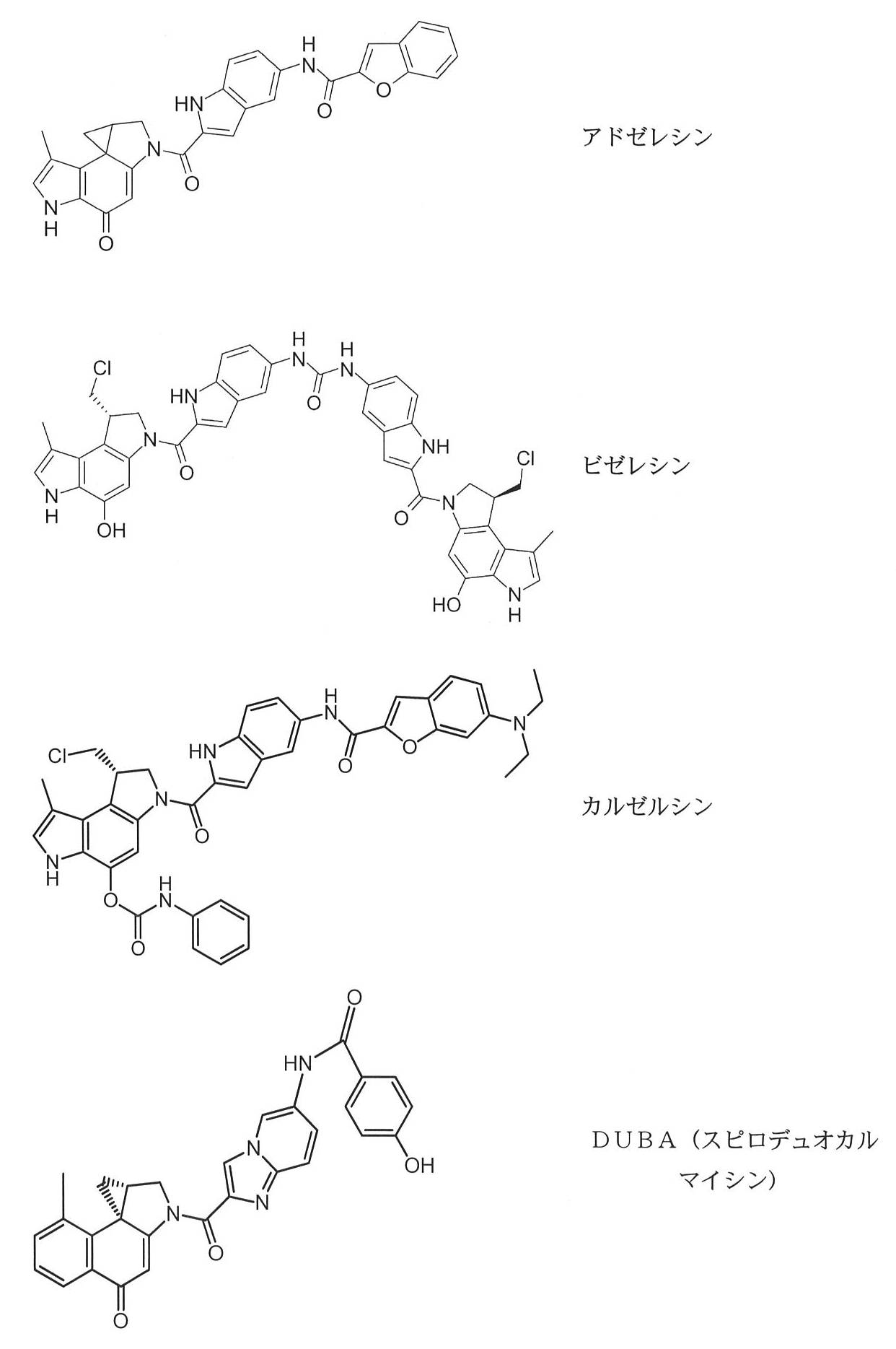
更なる合成デュオカルマイシン類似体としては、国際公開第2010/062171号に開示されているもの、及び特に式:


Rは脱離基であり;
R2、R2'、R3、R3'、R4、R4'、R12及びR19は独立して、H、OH、SH、NH2、N3、NO2、NO、CF3、CN、C(O)NH2、C(O)H、C(O)OH、ハロゲン、Ra、SRa、S(O)Ra、S(O)2Ra、S(O)ORa、S(O)2ORa、OS(O)Ra、OS(O)2Ra、OS(O)ORa、OS(O)2ORa、ORa、NHRa、N(Ra)Rb、+N(Ra)(Rb)Rc、P(O)(ORa)(ORb)、OP(O)(ORa)(ORb)、SiRaRbRc、C(O)Ra、C(O)ORa、C(O)N(Ra)Rb、OC(O)Ra、OC(O)ORa、OC(O)N(Ra)Rb、N(Ra)C(O)Rb、N(Ra)C(O)ORb及びN(Ra)C(O)N(Rb)Rcから選択され、ここでRa、Rb及びRcは独立して、H及び任意に置換されたC1‐3アルキル若しくはC1‐3ヘテロアルキルから選択され、又はR3+R3'及び/若しくはR4+R4'は独立して、=O、=S、=NOR18、=C(R18)R18'及び=NR18から選択され、R18及びR18'は独立して、H及び任意に置換されたC1‐3アルキルから選択され、R2、R2'、R3、R3'、R4、R4'及びR12のうちの2つ以上は、1つ以上の結合によって連結されて、1つ以上の任意に置換された炭素環及び/又は複素環を形成し;
X2はO、C(R14)(R14')及びNR14'から選択され、ここでR14及びR14'は、R7に関して定義されたものと同一の意味を有し、かつ独立して選択され、又はR14'及びR7'は不在であり、これによってR7'及びR14'を担持するよう指定された原子間に二重結合がもたらされ;
R5、R5'、R6、R6'、R7及びR7'は独立して、H、OH、SH、NH2、N3、NO2、NO、CF3、CN、C(O)NH2、C(O)H、C(O)OH、ハロゲン、Re、SRe、S(O)Re、S(O)2Re、S(O)ORe、S(O)2ORe、OS(O)Re、OS(O)2Re、OS(O)ORe、OS(O)2ORe、ORe、NHRe、N(Re)Rf、+N(Re)(Rf)Rg、P(O)(ORe)(ORf)、OP(O)(ORe)(ORf)、SiReRfRg、C(O)Re、C(O)ORe、C(O)N(Re)Rf、OC(O)Re、OC(O)ORe、OC(O)N(Re)Rf、N(Re)C(O)Rf、N(Re)C(O)ORf、N(Re)C(O)N(Rf)Rg及び水溶性基から選択され、ここで
Re、Rf及びRgは独立して、H及び任意に置換された(CH2CH2O)eeCH2CH2X13Re1、C1‐15アルキル、C1‐15ヘテロアルキル、C3‐15シクロアルキル、C1‐15ヘテロシクロアルキル、C5‐15アリール又はC1‐15ヘテロアリールから選択され、ここでeeは1~1000から選択され、X13はO、S及びNRf1から選択され、またRf1及びRe1は独立して、H及びC1‐3アルキルから選択され、Re、Rf、及び/又はRgの任意の置換基のうちの1つ以上は、任意に水溶性基であり、Re、Rf及びRgのうちの2つ以上は任意に、1つ以上の結合によって連結されて1つ以上の任意に置換された炭素環及び/又は複素環を形成し;
あるいはR5+R5'及び/若しくはR6+R6'及び/若しくはR7+R7'は独立して、=O、=S、=NORe3、=C(Re3)Re4及び=NRe3、Re3から選択され、またRe4は独立して、H及び任意に置換されたC1‐3アルキルから選択されるか、又はR5'+R6'及び/若しくはR6'+R7'及び/若しくはR7'+R14'は不在であり、これによってR5'+R6'及び/若しくはR6'+R7'及び/若しくはR7'+R14'それぞれを担持するよう指定された原子間に二重結合がもたらされ、R5、R5'、R6、R6'、R7、R7'、R14及びR14'のうちの2つ以上は任意に、1つ以上の結合によって連結されて1つ以上の任意に置換された炭素環及び/又は複素環を形成し;
X1はO、S及びNRから選択され、ここでRは、H及び任意に置換されたC1‐8アルキル又はC1‐8ヘテロアルキルから選択され、他のいずれの置換基と連結されず;
X3は、O、S、C(R15)R15'、‐C(R15)(R15')‐C(R15'')(R15''')‐、‐N(R15)‐N(R15')‐、‐C(R15)(R15')‐N(R15")‐、‐N(R15")‐C(R15)(R15')‐、‐C(R15)(R15')‐O‐、‐O‐C(R15)(R15')‐、‐C(R15)(R15')‐S‐、‐S‐C(R15)(R15')‐、‐C(R15)=C(R15')‐、=C(R15)‐C(R15')=、‐N=C(R15')‐、=N‐C(R15')=、‐C(R15)=N‐、=C(R15)‐N=、‐N=N‐、=N‐N=、CR15、N、NR15から選択され、又はDB1及びDB2では、‐X3‐は‐X3a及びX3b‐を表し、ここでX3aはX34に接続され、X34とX4との間には二重結合が存在し、またX3bはX11に接続され、ここでX3aは独立して、H及び任意に置換された(CH2CH2O)eeCH2CH2X13Re1、C1‐8アルキル又はC1‐8ヘテロアルキルから選択され、他のいずれの置換基と連結されず;
X4は、O、S、C(R16)R16'、NR16、N及びCR16から選択され;
X5は、O、S、C(R17)R17'、NOR17及びNR17から選択され、ここでR17及びR17'は独立して、H及び任意に置換されたC1‐8アルキル又はC1‐8ヘテロアルキルから選択され、他のいずれの置換基と連結されず;
X6は、CR11、CR11(R11')、N、NR11、O及びSから選択され;
X7は、CR8、CR8(R8')、N、NR8、O及びSから選択され;
X8は、CR9、CR9(R9')、N、NR9、O及びSから選択され;
X9は、CR10、CR10(R10')、N、NR10、O及びSから選択され;
X10は、CR20、CR20(R20')、N、NR20、O及びSから選択され;
X11は、C、CR21及びNから選択され、又はX11‐X3bは、CR21、CR21(R21')、N、NR21、O及びSから選択され;
X12は、C、CR22及びNから選択され;
X6*、X7*、X8*、X9*、X10*及びX11*は、それぞれX6、X7、X8、X9、X10及びX11に関して定義されたものと同一の意味を有し、また独立して選択され;
X34は、C、CR23及びNから選択され;
DB6及びDB7のX11*の環B原子は、環Aの環式原子に接続され、これによりDB6及びDB7の環A及び環Bは単一結合によって直接接続され;
ダッシュで描かれた二重結合は、指示されている結合が単一結合又は
任意に非局在化された非累積二重結合であってよいことを意味しており;
R8、R8'、R9、R9'、R10、R10'、R11、R11'、R15、R15'、R15"、R15"、R16、R16'、R20、R20'、R21、R21'、R22及びR23はそれぞれ独立して、H、OH、SH、NH2、N3、NO2、NO、CF3、CN、C(O)NH2、C(O)H、C(O)OH、ハロゲン、Rh、SRh、S(O)Rh、S(O)2Rh、S(O)ORh、S(O)2ORh、OS(O)Rh、OS(O)2Rh、OS(O)ORh、OS(O)2ORh、ORh、NHRh、N(Rh)Ri、+N(Rh)(Ri)Rj、P(O)(ORh)(ORi)、OP(O)(ORh)(ORi)、SiRhRiRj、C(O)Rh、C(O)ORh、C(O)N(Rh)Ri、OC(O)Rh、OC(O)ORh、OC(O)N(Rh)Ri、N(Rh)C(O)Ri、N(Rh)C(O)ORi、N(Rh)C(O)N(Ri)Rj及び水溶性基から選択され;ここで
Rh、Ri及びRjは独立して、H及び任意に置換された(CH2CH2O)eeCH2CH2X13Re1、C1‐15アルキル、C1‐15ヘテロアルキル、C3‐15シクロアルキル、C1‐15ヘテロシクロアルキル、C5‐15アリール、又はC1‐15ヘテロアリールから選択され、Rh、Ri及び/又はRjの任意の置換基のうちの1つ以上は任意に、水溶性基であり、Rh、Ri及びRjのうちの2つ以上は任意に、1つ以上の結合によって連結されて1つ以上の任意に置換された炭素環及び/又は複素環を形成し;
あるいは、R8+R8'及び/又はR9+R9'及び/又はR10+R10'及び/又はR11+R11'及び/又はR15+R15'及び/又はR15"+R15'"及び/又はR16+R16'及び/又はR20+R20'及び/又はR21+R21'は独立して、=O、=S、=NORh1、=C(Rhl)Rh2及び=NRhlから選択され、Rhl及びRh2は独立して、H及び及び任意に置換されたC1‐3アルキルから選択され、R8、R8'、R9、R9'、R10、R10'、R11、R11'、R15、R15'、R15"、R15'"、R16、R20、R20'、R21、R21'、R22及びR23のうちの2つ以上は任意に、1つ以上の結合によって連結されて1つ以上の任意に置換された炭素環及び/又は複素環を形成し;
R8b及びR9bは独立して選択され、またこれらが他のいずれの置換基と連結し得ないことを除いて、R8と同一の意味を有し;
R4及びR4'のうちの一方と、R16及びR16'のうちの一方とは任意に、1つ以上の結合によって連結されて1つ以上の任意に置換された炭素環及び/又は複素環を形成してよく;
R4及びR4'のうちの一方と、R16及びR16'のうちの一方とは任意に連結してよく;
R2、R2'、R3及びR3'のうちの1つと、R5及びR5'のうちの一方とは任意に、1つ以上の結合によって連結されて1つ以上の任意に置換された炭素環及び/又は複素環を形成してよく;
a及びbは独立して0~1から選択され;
DB部分は、DAI、DA2、DAI’又はDA2'部分を含まず;
DB1の環Bは複素環であり;
DB1のX3が‐X3a及びX3b‐を表し、かつ環Bが芳香族である場合、上記環B上の2つの近接した置換基は連結して、上記環Bに融合した、任意に置換された炭素環又は複素環を形成し;
DB2のX3が‐X3a及びX3b‐を表し、かつ環Bが芳香族である場合、上記環B上の2つの近接した置換基は連結して:上記環Bに融合した、任意に置換された複素環;上記環Bに融合した、任意に置換された非芳香族炭素環;又は上記環Bに融合し、かつヒドロキシ基、一次アミノ基又は二次アミノ基を含有する少なくとも1つの置換基が付着した、置換された芳香族炭素環を形成し、上記一次又は二次アミンは芳香環系中の環式原子でも、アミドの一部でもなく;
DB2の環Aが6員芳香環である場合、環B上の置換基は、環Bに融合した環を形成するように連結せず;
DB8の環A上の2つの近接した置換基は連結して、任意に置換された炭素環又は複素環を形成し、これは上記環Aに融合して二環式部分を形成し、これに環がこれ以上融合せず;
DB9の環Aは、上記環Aに融合したいずれの環と共に、少なくとも2つのヘテロ原子を含有する。
Further synthetic duocarmycin analogs include those disclosed in WO 2010/062171 and in particular the formula:
R is a leaving group;
R2 , R2 ' , R3 , R3 ' , R4 , R4 ' , R12 and R19 are independently H, OH, SH, NH2 , N3 , NO2 , NO, CF3 , CN, C(O) NH2 , C(O)H, C(O)OH, halogen, Ra, SRa , S(O) Ra , S(O) 2Ra , S(O) ORa , S(O ) 2ORa , OS(O) Ra , OS (O) 2Ra , OS(O) ORa , OS(O ) 2ORa, ORa , NHRa , N(Ra ) R b , +N (R a ) (R b ) R c , P (O) (OR a ) (OR b ), OP (O) (OR a ) (OR b ), SiR a R b R c , C (O )R a , C(O)OR a , C(O)N(R a )R b , OC(O)R a , OC(O)OR a , OC(O)N(R a )R b , N (R a )C(O)R b , N(R a )C(O)OR b and N(R a )C(O)N(R b )R c , wherein R a , R b and R c are independently selected from H and optionally substituted C 1-3 alkyl or C 1-3 heteroalkyl, or R 3 +R 3′ and/or R 4 +R 4′ are independently =O, =S, = NOR18 , =C( R18 )R18 ' and = NR18 , wherein R18 and R18' are independently H and optionally substituted C1-3alkyl and two or more of R 2 , R 2′ , R 3 , R 3′ , R 4 , R 4′ and R 12 are linked by one or more bonds to one or more optional forming a carbocyclic and/or heterocyclic ring substituted with
X2 is selected from O, C( R14 )(R14 ' ) and NR14 ' , wherein R14 and R14' have the same meaning as defined for R7 and independently or R 14' and R 7' are absent, resulting in a double bond between the atoms designated to carry R 7' and R 14' ;
R5 , R5 ' , R6 , R6 ' , R7 and R7 ' are independently H, OH, SH, NH2 , N3 , NO2 , NO, CF3 , CN, C(O ) NH2 , C(O)H, C(O) OH, halogen, Re, SRe, S(O)Re, S(O)2Re , S ( O ) ORe , S(O) 2OR e , OS(O) Re , OS(O) 2R e , OS(O)OR e , OS(O) 2OR e , OR e , NHR e , N(R e )R f , + N (R e ) (R f ) R g , P (O) (OR e ) (OR f ), OP (O) (OR e ) (OR f ), SiR e R f R g , C (O) R e , C(O)OR e , C(O)N(R e )R f , OC(O)R e , OC(O)OR e , OC(O)N(R e )R f , N(R e )C(O)R f , N(R e )C(O)OR f , N(R e )C(O)N(R f )R g and water-soluble groups, wherein R e , R f and R g are independently H and optionally substituted (CH 2 CH 2 O) ee CH 2 CH 2 X 13 R e1 , C 1-15 alkyl, C 1-15 heteroalkyl, C 3-15 selected from cycloalkyl, C 1-15 heterocycloalkyl, C 5-15 aryl or C 1-15 heteroaryl, wherein ee is selected from 1 to 1000 and X 13 is selected from O, S and NR f1 , and R f1 and R e1 are independently selected from H and C 1-3 alkyl, and one or more of the optional substituents of R e , R f , and/or R g are optionally water-soluble and two or more of R e , R f and R g are optionally linked by one or more bonds to form one or more optionally substituted carbocyclic and/or heterocyclic rings death;
or R 5 +R 5' and/or R 6 +R 6' and/or R 7 +R 7' are independently =O, =S, =NOR e3 , =C(R e3 )R e4 and =NR e3 , is selected from R e3 and R e4 is independently selected from H and optionally substituted C 1-3 alkyl, or R 5′ +R 6′ and/or R 6′ +R 7′ and/or or R 7' + R 14' are absent, whereby there are two atoms between the atoms designated to carry R 5' + R 6' and/or R 6' + R 7' and/or R 7' + R 14' respectively. A double bond is provided and two or more of R 5 , R 5′ , R 6 , R 6′ , R 7 , R 7′ , R 14 and R 14′ are optionally linked to form one or more optionally substituted carbocyclic and/or heterocyclic rings;
X 1 is selected from O, S and NR, wherein R is selected from H and optionally substituted C 1-8 alkyl or C 1-8 heteroalkyl and not linked to any other substituents ;
X3 is O, S, C( R15 ) R15' , -C( R15 )( R15' )-C(R15 '' )( R15''' )-, -N( R15 )-N(R15 ' )-, -C( R15 )(R15 ' )-N(R15 " )-, -N(R15 " )-C( R15 )( R15' )-, -C( R15 )(R15 ' )-O-, -OC( R15 )( R15' )-, -C( R15 )( R15' )-S-, -SC( R15 )(R15 ' )-, -C( R15 )=C(R15 ' )-, =C( R15 )-C(R15 ' )=, -N=C( R15' )- , =NC(R15 ' )=, -C( R15 )=N-, =C( R15 )-N=, -N=N-, =N-N=, CR15 , N, NR 15 or in DB1 and DB2 -X3- represents -X3a and X3b- , wherein X3a is connected to X34 and there is a double bond between X34 and X4 is present and X 3b is connected to X 11 where X 3a is independently H and optionally substituted (CH 2 CH 2 O) ee CH 2 CH 2 X 13 R e1 , C 1-8 selected from alkyl or C 1-8 heteroalkyl and not linked to any other substituent;
X4 is selected from O, S, C( R16 )R16 ' , NR16 , N and CR16 ;
X5 is selected from O, S, C( R17 )R17 ' , NOR17 and NR17 , wherein R17 and R17' are independently H and optionally substituted C1-8 selected from alkyl or C 1-8 heteroalkyl and not linked to any other substituent;
X 6 is selected from CR 11 , CR 11 (R 11′ ), N, NR 11 , O and S;
X7 is selected from CR8 , CR8 (R8 ' ), N, NR8 , O and S;
X8 is selected from CR9 , CR9 (R9 ' ), N, NR9 , O and S;
X9 is selected from CR10 , CR10 (R10 ' ), N, NR10 , O and S;
X 10 is selected from CR 20 , CR 20 (R 20′ ), N, NR 20 , O and S;
X 11 is selected from C, CR 21 and N, or X 11 -X 3b are selected from CR 21 , CR 21 (R 21′ ), N, NR 21 , O and S;
X 12 is selected from C, CR 22 and N;
X6* , X7* , X8 * , X9 * , X10 * and X11 * are the same as defined for X6 , X7 , X8 , X9 , X10 and X11 respectively and independently selected;
X34 is selected from C, CR23 and N;
the ring B atom of X 11 * of DB6 and DB7 is connected to the ring atom of ring A, whereby ring A and ring B of DB6 and DB7 are directly connected by a single bond;
dashed double bonds mean that the indicated bond may be a single bond or optionally a delocalized non-cumulative double bond;
R8 , R8' , R9, R9 ', R10, R10 ' , R11 , R11 ' , R15 , R15 ' , R15 " , R15" , R16 , R16' , R 20 , R 20′ , R 21 , R 21′ , R 22 and R 23 are each independently H, OH, SH, NH 2 , N 3 , NO 2 , NO, CF 3 , CN, C(O ) NH2 , C(O)H, C(O)OH, halogen , Rh, SRh, S(O)Rh, S(O)2Rh , S ( O ) ORh, S(O) 2ORh , OS(O) Rh , OS(O) 2Rh , OS(O) ORh , OS(O) 2ORh , ORh , NHRh , N( Rh ) Ri , + N ( Rh )( Ri ) Rj , P(O)( ORh )( ORi ), OP(O)( ORh )( ORi ) , SiRhRiRj , C(O) Rh , C(O) ORh , C(O)N( Rh ) Ri , OC(O)Rh, OC(O) ORh , OC(O)N( Rh ) Ri , N( Rh )C(O)R i , N ( R h )C(O)OR i , N(R h )C(O)N(R i )R j and water-soluble groups; i and Rj are independently H and optionally substituted ( CH2CH2O ) ee CH2CH2X13R e1 , C1-15 alkyl, C1-15 heteroalkyl , C3-15 one or more of the optional substituents of R h , R i and/or R j are selected from cycloalkyl, C 1-15 heterocycloalkyl, C 5-15 aryl, or C 1-15 heteroaryl optionally a water-soluble group and two or more of R h , R i and R j are optionally linked by one or more bonds to one or more optionally substituted carbocyclic rings and/or forming a heterocyclic ring;
Alternatively, R 8 +R 8′ and/or R 9 +R 9′ and/or R 10 +R 10′ and/or R 11 +R 11′ and / or R 15 +R 15′ and/or R 15″ +R 15′″ and /or R 16 +R 16' and/or R 20 +R 20' and/or R 21 +R 21' are independently =O, =S, =NOR h1 , =C(R hl )R h2 and =NR hl wherein R hl and R h2 are independently selected from H and and optionally substituted C 1-3 alkyl, R 8 , R 8′ , R 9 , R 9′ , R 10 , R 10 ' , R 11 , R 11' , R 15 , R 15' , R 15" , R 15'" , R 16 , R 20 , R 20' , R 21 , R 21' , R 22 and R 23 two or more are optionally linked by one or more bonds to form one or more optionally substituted carbocyclic and/or heterocyclic rings;
R 8b and R 9b are independently selected and have the same meaning as R 8 except that they cannot be linked to any other substituent;
One of R 4 and R 4′ and one of R 16 and R 16′ are optionally linked by one or more bonds to one or more optionally substituted carbocycles and/or may form a heterocyclic ring;
one of R 4 and R 4' and one of R 16 and R 16' may optionally be linked;
one of R 2 , R 2′ , R 3 and R 3′ and one of R 5 and R 5′ optionally linked by one or more bonds to one or more optionally substituted may form a carbocyclic and/or heterocyclic ring;
a and b are independently selected from 0 to 1;
DB moieties do not include DAI, DA2, DAI' or DA2'moieties;
Ring B of DB1 is a heterocycle;
When X 3 of DB1 represents -X 3a and X 3b - and ring B is aromatic, the two adjacent substituents on said ring B are linked and fused to said ring B, optionally forming a substituted carbocyclic or heterocyclic ring;
When X 3 of DB2 represents -X 3a and X 3b - and ring B is aromatic, the two adjacent substituents on said ring B are linked: fused to said ring B, optionally a substituted heterocyclic ring; an optionally substituted non-aromatic carbocyclic ring fused to said ring B; or at least one fused to said ring B and containing a hydroxy group, a primary amino group or a secondary amino group forming a substituted aromatic carbocycle to which a substituent is attached, said primary or secondary amine being neither a ring atom in the aromatic ring system nor part of an amide;
When Ring A of DB2 is a 6-membered aromatic ring, the substituents on Ring B are not linked to form a fused ring on Ring B;
Two adjacent substituents on ring A of DB8 are joined to form an optionally substituted carbocyclic or heterocyclic ring, which is fused to said ring A to form a bicyclic moiety, to which the rings are no longer fused;
Ring A of DB9 contains at least two heteroatoms along with any rings fused to Ring A above.
上述のリンカー分子は、上で示したように、チオール‐マレイミドの化学的作用を用いて、システインチオール基に対して複合体化できる。いくつかの実施形態では、細胞傷害性デュオカルマイシン部分は、プロドラッグである。例えば、プロドラッグであるvc‐seco‐DUBAを、切断可能ペプチド部分を介してマレイミドリンカー部分に結合した自己消去性部分に対して複合体化できる。
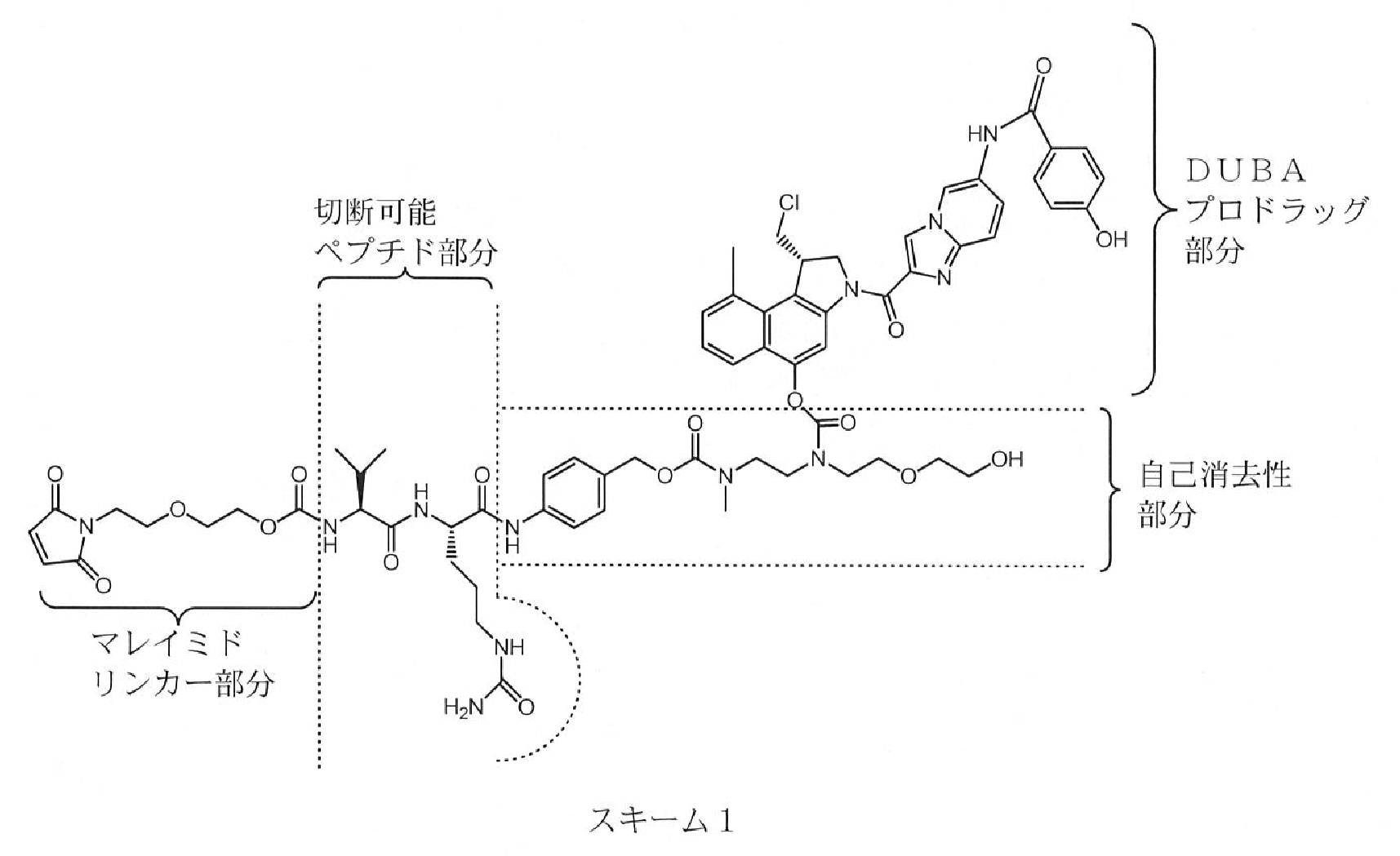
この分子のマレイミドリンカー部分は、B7‐H3‐ADCのAb部分のVLドメイン及び/若しくはVHドメイン並びに/又は定常ドメインのシステイン残基のチオール基に対して複合体化できる。これに続く、切断可能ペプチド部分のタンパク質分解切断の後、自己消去性部分の自発的な消去が発生し、これはseco‐DUBAの放出につながり、これは自然に転位して、活性薬物DUBAを形成する:

B7‐H3‐デュオカルマイシン薬物部分複合体の生産のための例示的な方法では、Elgersma, R.C. et al. (2014) “Design, Synthesis, and Evaluation of Linker‐Duocarmycin Payloads: Toward Selection of HER2‐Targeting Antibody?Drug Conjugate SYD985,” Mol. Pharmaceut. 12:1813‐1835による方法、又は国際公開第2011/133039号の方法が採用される。従って、抗B7‐H3抗体又は抗体断片のVL又はVH鎖のチオール含有基は、マレイミドリンカー部分‐切断可能ペプチド部分‐自己消去性部分によって、seco‐DUBA又は他のプロドラッグに対して複合体化される(スキーム3A):

本発明はDUBAプロドラッグに関して例示されているが、代わりにスキーム3Bに示すように、他のプロドラッグ、例えばCC‐1065を採用してもよい。
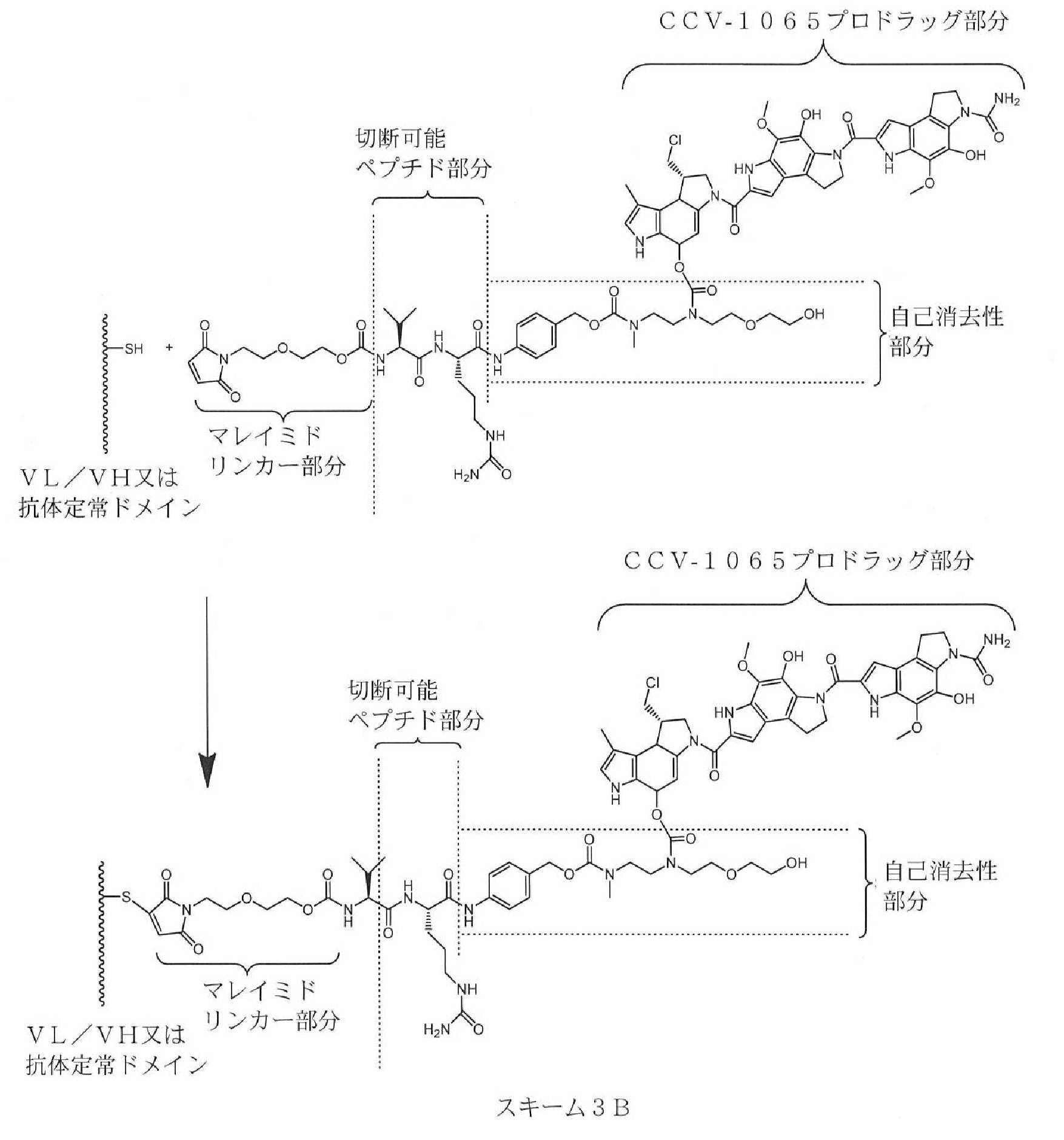
切断可能ペプチド部分の切断及び自己消去性部分の消去後、プロドラッグ部分は、Winsteinスピロ環化を経て活性薬物を(例えばスキーム3Cに示すように、seco‐DUBAからDUBAを)もたらすと考えられる。

seco‐DUBAは、対応するDNAアルキル化及びDNA結合部分(例えばElgersma, R.C. et al. (2014) “Design, Synthesis, and Evaluation of Linker‐Duocarmycin Payloads: Toward Selection of HER2‐Targeting Antibody?Drug Conjugate SYD985,” Mol. Pharmaceut. 12:1813‐1835に記載されているような1,2,9,9a‐テトラヒドロシクロプロパ‐[c]ベンゾ[e]インドール‐4‐オン骨格)から調製される(Boger, D.L. et al. (1989) “Total Synthesis and Evaluation of (±)‐N‐(tert‐Butoxycarbonyl)‐CBI, (±)‐CBI‐CDPI1, and (±)‐CBI‐CDPI2: CC‐1065 Functional Agents Incorporating the Equivalent 1,2,9,9a‐Tetrahydrocyclopropa[1,2‐c]benz[1,2‐e]indol‐4‐one (CBI) Left‐Hand Subunit,” J. Am. Chem. Soc. 111:6461‐6463; Boger, D.L. et al. (1992) “DNA Alkylation Properties of Enhanced Functional Analogs of CC‐1065 Incorporating the 1,2,9,9a‐Tetrahydrocyclopropa[1,2‐c]benz[1,2‐e]indol‐4‐one (CBI) Alkylation Subunit,” J. Am. Chem. Soc. 114:5487‐5496を参照)。
seco-DUBA has corresponding DNA alkylating and DNA binding moieties (e.g. Elgersma, R.C. et al. (2014) “Design, Synthesis, and Evaluation of Linker-Duocarmycin Payloads: Toward Selection of HER2-Targeting Antibody? Drug Conjugate SYD985, "Mol. Pharmaceut. 12:1813-1835 (Boger, D.L. et al. (1989) “Total Synthesis and Evaluation of (±)-N-(tert-Butoxycarbonyl)-CBI, (±)-CBI-CDPI1, and (±)-CBI-CDPI2: CC-1065 Functional Agents Incorporating the
スキーム3Dは、DUBAのためのDNA‐アルキル化部分の合成を示すことによって、本発明を例示する。o‐トルアルデヒド(1)とコハク酸ジメチル(2)とを反応させて、ストッべ縮合によって酸(3a/3b)の混合物を生成する。この酸の混合物の環の閉鎖は、トリフルオロ酢酸無水物を用いて達成でき、これによりアルコール(4)が得られ、次にこれを塩化ベンジルで保護してベンジルエーテル(5)を得る。メチルエステル基を確実に加水分解することにより、カルボン酸(6)が得られ、これをトルエン及びtert‐ブチルアルコールの混合物中でクルチウス転位させて、カルバメート(7)を得る。N‐ブロモスクシンイミドでの臭素化により、臭化物(8)を得る。臭化物(8)をカリウムtert‐ブトキシドの存在下において(S)‐グリシジルノシレートでアルキル化して、エポキシド(9)を得る。n‐ブチルリチウムとの反応は、所望の化合物(10)と、脱臭素化され転位された誘導体(11)とをもたらす。溶媒としてテトラヒドロフランを用い、反応温度を-25~-20℃に維持した場合、所望の化合物(10)の収率は比較的高くなる。これらの条件下において、所望の化合物(10)と、脱臭素化され転位された誘導体(11)とは、およそ1:1の比率で得ることができる。p‐トルエンスルホン酸での後処理により、脱臭素化され転位された誘導体(11)が(7)へと変換され、これにより所望の化合物(10)の回収が支援される。(10)中のヒドロキシル基のメシル化と、これに続く塩化リチウムを用いた塩化物置換とにより、重要な中間体(12)が得られる。

スキーム3Eは、DUBAのためのDNA結合部分の合成を示すことによって、本発明を例示する。従ってチチバビン環化反応を、ブロモピルビン酸エチル(13)と5‐ニトロピリジン‐2‐アミン(14)との間で進行させることができ、これによりニトロ化合物(15)が得られる。酸性条件下での亜鉛を用いたニトロ基の還元により、アミン(16)を得る。クロロメチルメチルエーテルとの反応及びこれに続くエステル加水分解(国際公開第2004/080979号を参照)によってメチル4‐ヒドロキシベンゾエートから調製された、メトキシメチル(MOM)被保護4‐ヒドロキシ安息香酸(17)との結合によって、エチルエステル(18)が得られ、これを水性1,4‐ジオキサン中において水酸化ナトリウムで加水分解することによって、酸(19)を得ることができる。

次に、seco‐DUBAを、DNA‐アルキル化単位(12)及びDNA結合部分(19)から合成する。tert‐ブトキシドカルボニル(Boc)保護基を酸性条件下で(12)から除去して、アミン(20)を形成する。アミン(20)と化合物(19)とのEDC仲介型結合により、被保護化合物(21)が得られ、次にこれを2つの連続したステップ((22)を得るための、Pd/C、NH4HCO2、MeOH/THFを用いた、3時間、90%のステップ、及びこれに続く、seco‐DUBA(23)をHCl塩として提供するための、HCl、1,4‐ジオキサン/水を用いた、1時間、95%のステップ)で完全に脱保護する(スキーム3F)。

他の薬物のプロドラッグ、例えばCC‐1065は、例えば国際公開第2010/062171号に記載されているように合成できる。 Prodrugs of other drugs, such as CC-1065, can be synthesized, for example, as described in WO2010/062171.
プロドラッグ部分は、スキーム3Gに従って、ADCの他の部分に連結できる。(24)と2‐(2‐アミノエトキシ)エタノール(25)との縮合反応によってアルコール(26)を得ることから始め、これを次に、4‐ニトロフェニルクロロホルメートとの反応によって反応性炭酸塩(27)に変換することによって、マレイミドリンカー構成ブロックを合成した。Dubowchik, G.M. et al. (2002) “Cathepsin B-Labile Dipeptide Linkers For Lysosomal Release Of Doxorubicin From Internalizing Immunoconjugates: Model Studies Of Enzymatic Drug Release And Antigen-Specific In Vitro Anticancer Activity,” Bioconjugate Chem. 13:855-869に従って調製されたH‐バリン‐シトルリン‐PABA(28)に(27)を結合させることにより、リンカー(29)が形成され、これを炭酸ビス(4‐ニトロフェニル)で処理することによって、活性化されたリンカー(30)を得た。
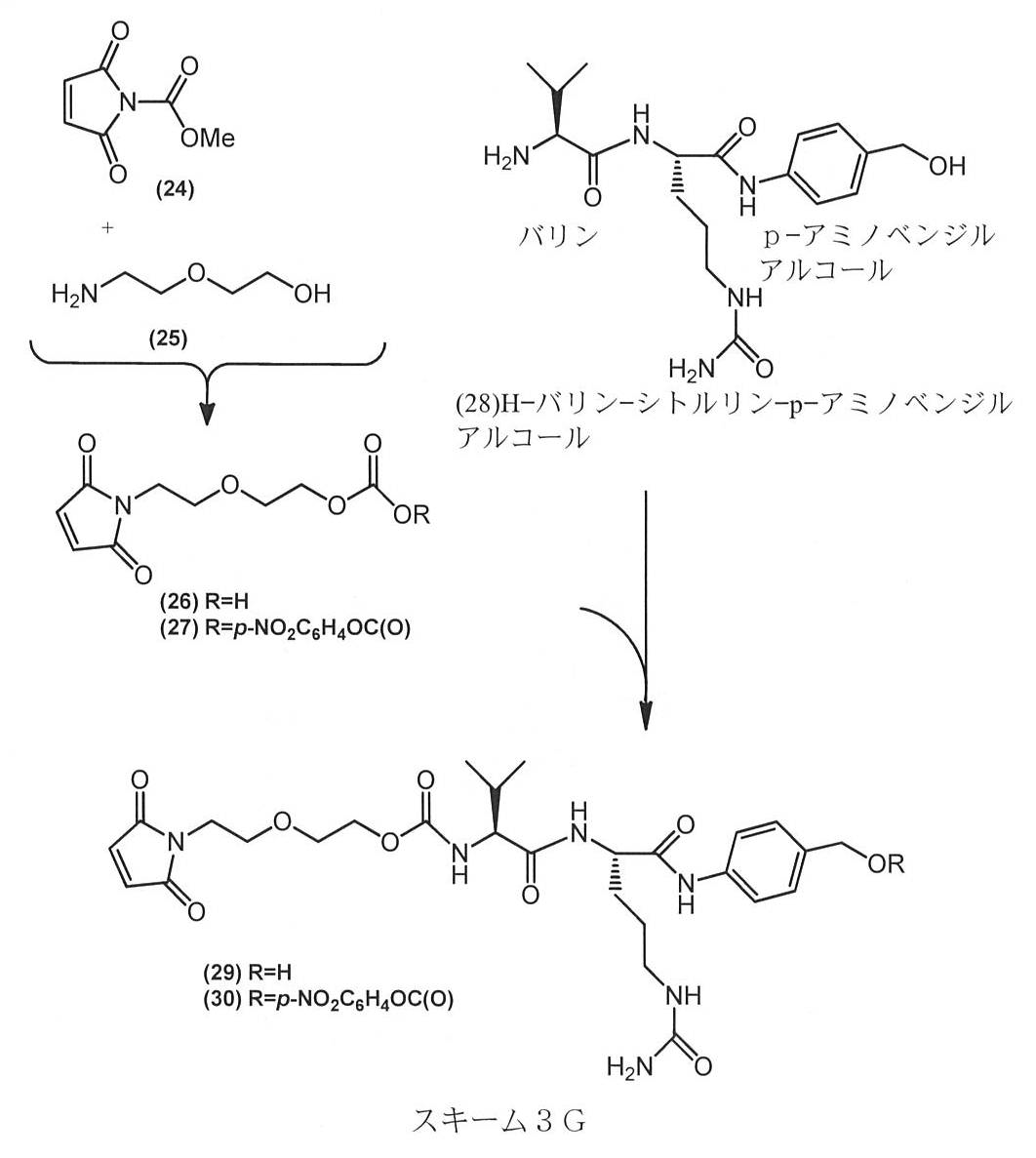
スキーム3Hに示すように、seco‐DUBA‐MOM(22)を、2ステップでのコンジュゲーションのために修飾した。4‐ニトロフェニルクロロホルメート及びtert‐ブチルメチル(2‐(メチルアミノ)エチル)カルバメート(31)による(22)の連続処理により、化合物(32)を得る。(32)中のBoc及びMOM保護基を除去することによって、(33)がTFA塩として得られた。

わずかに塩基性の条件下での、活性化されたリンカー(30)と環化スペーサ‐デュオカルマイシン構造体(33)との反応によって、ADCを合成した。これらの条件下では、環化スペーサの自己消去及びその結果としての3aの形成は抑制された(スキーム3I)。

このプロセスは平均して、mAb1つあたり2つの遊離チオール基を生成し、これは、平均薬物対抗体比(drug-to-antibody-ratio:DAR)が約2であり、かつ高分子量種及び残留した複合体化していないデュオカルマイシン部分の量が少ないB7‐H3‐ADCの統計的分布をもたらす。 This process produces on average 2 free thiol groups per mAb, which has an average drug-to-antibody-ratio (DAR) of approximately 2, and high molecular weight species and residual results in a statistical distribution of B7-H3-ADCs with low amounts of unconjugated duocarmycin moieties.
合成の複数のステップの順序は所望に応じて変更してよい。上述のように、使用する方法をスキーム3A~3Iのものとすることを具体的に企図する。 The order of the steps of synthesis may be changed as desired. As noted above, it is specifically contemplated that the methods used are those of Schemes 3A-3I.
V.例示的なPD‐1結合分子
本発明のPD‐1結合分子は、二重特異性分子(例えば二重特異性抗体、二重特異性ダイアボディ等)、キメラ又はヒト化抗体、及び変異型Fc領域を有するこのような結合分子を含む。このようなPD‐1結合分子は、ヒトPD‐1(CD279)の連続した又は不連続の(例えば立体配座の)部分に結合する能力を示す。本発明のPD‐1結合分子は好ましくは、1つ以上の非ヒト種、特に霊長類種(及び特にカニクイザル等の霊長類種)のPD‐1分子への結合能力も示す。20アミノ酸残基シグナル配列及び268アミノ酸残基成熟タンパク質を含む、代表的なヒトPD‐1ポリペプチドは、NCBI配列NP_005009.2(配列番号22)によって提供されている。
V. Exemplary PD-1 Binding Molecules PD-1 binding molecules of the invention include bispecific molecules (e.g., bispecific antibodies, bispecific diabodies, etc.), chimeric or humanized antibodies, and variant Fc It includes such binding molecules with regions. Such PD-1 binding molecules exhibit the ability to bind contiguous or discontinuous (eg conformational) portions of human PD-1 (CD279). The PD-1 binding molecules of the invention preferably also exhibit the ability to bind to PD-1 molecules of one or more non-human species, especially primate species (and especially primate species such as cynomolgus monkeys). A representative human PD-1 polypeptide, including a 20 amino acid residue signal sequence and a 268 amino acid residue mature protein, is provided by NCBI sequence NP_005009.2 (SEQ ID NO:22).
PD‐1に対して特異的な抗体は公知である(例えば特許文献21~29、31、特許文献34~43を参照)。更なる望ましい抗体は、PD‐1又はそのペプチド断片を用いて誘発される、抗体分泌ハイブリドーマの単離によって作製できる。好適な抗体としては、ニボルマブ((CAS登録番号946414‐94‐4、5C4、BMS‐936558、ONO‐4538、MDX1106としても公知、Bristol‐Myers SquibbがOPDIVO(登録商標)として市販);(ニボルマブのアミノ酸配列は、WHO Drug Information, 2013, Recommended INN: List 69, 27(1):68-69で提供されている))、及びペムブロリズマブ((旧称ラムブロリズマブ)、CAS登録番号1374853‐91‐4、MK‐3475、SCH‐900475としても公知、MerckがKEYTRUDA(登録商標)として市販);(ペムブロリズマブのアミノ酸配列は、WHO Drug Information, 2014, Recommended INN: List 75, 28(3):407で提供されている))が挙げられる。これらの抗体のVH及びVLドメインのアミノ酸配列を以下に提供する。 Antibodies specific for PD-1 are known (see, eg, US Pat. Nos. 21-29, 31, 34-43). Additional desirable antibodies can be produced by isolation of antibody-secreting hybridomas induced with PD-1 or peptide fragments thereof. Suitable antibodies include nivolumab ((CAS Registry Number 946414-94-4, 5C4, BMS-936558, ONO-4538, also known as MDX1106, marketed as OPDIVO® by Bristol-Myers Squibb); Amino acid sequences are provided in WHO Drug Information, 2013, Recommended INN: List 69, 27(1):68-69)), and pembrolizumab ((formerly lambrolizumab), CAS registry number 1374853-91-4, MK -3475, also known as SCH-900475, marketed as KEYTRUDA® by Merck; (the amino acid sequence of pembrolizumab is provided in WHO Drug Information, 2014, Recommended INN: List 75, 28(3):407) There is)). The amino acid sequences of the VH and VL domains of these antibodies are provided below.
本発明のPD‐1結合分子は、IgG4重鎖定常領域、又はADCCエフェクタ機能を低減する1つ以上の置換を含む(例えば上述の置換:L234A、L235A、D265A、N297Q、及びN297Gのうちのいずれか1つ、2つ、3つ、若しくは4つを含む)変異型IgG1重鎖定常領域を、野生型IgG1重鎖定常領域の代わりに含んでよい。このような変異型重鎖定常領域は、抗体のFcドメインの、FcγRIIIA(CD16a)細胞受容体に結合する能力を低減又は消去するために有用である。従って、IgG4重鎖定常領域又はこのような変異型IgG1重鎖定常領域の使用により、野生型IgG1 Fcドメインを有する抗体の使用に関連する抗体依存性細胞傷害(antibody-dependent cell-mediated cytotoxicity:ADCC)エフェクタ機能が、低減又は消去される。例示的なヒトIgG4のCH2‐CH3ドメインのアミノ酸配列は、既に提供されている(配列番号9)。 The PD-1 binding molecules of the invention comprise an IgG4 heavy chain constant region or one or more substitutions that reduce ADCC effector function (e.g., any of the above substitutions: L234A, L235A, D265A, N297Q, and N297G). (including one, two, three, or four) mutant IgG1 heavy chain constant regions may be included in place of the wild-type IgG1 heavy chain constant regions. Such variant heavy chain constant regions are useful to reduce or eliminate the ability of the Fc domain of an antibody to bind to the FcγRIIIA (CD16a) cell receptor. Thus, the use of IgG4 heavy chain constant regions or such mutated IgG1 heavy chain constant regions reduces the antibody-dependent cell-mediated cytotoxicity (ADCC) associated with the use of antibodies with wild-type IgG1 Fc domains. ) effector functions are reduced or eliminated. The amino acid sequence of an exemplary human IgG4 CH2-CH3 domain has already been provided (SEQ ID NO: 9).
本発明のPD‐1結合分子がIgG4重鎖定常領域を含む場合、IgG4 CH1ドメイン(配列番号6)、及びIgG4ヒンジドメイン、特にKabat S228P置換を含む修飾されたIgG4ヒンジドメイン(ESKYGPPCPPCP(配列番号7))も採用することが好ましい。というのは、上記修飾がIgG4ヒンジドメインを安定化するためである。 Where the PD-1-binding molecule of the invention comprises an IgG4 heavy chain constant region, an IgG4 CH1 domain (SEQ ID NO: 6) and a modified IgG4 hinge domain (ESKYGPPCP P CP (sequence Number 7)) is also preferably employed. This is because the modifications stabilize the IgG4 hinge domain.
A.ニボルマブ
ニボルマブのVHドメインのアミノ酸配列は、アミノ酸配列(配列番号36)(CDRH残基は下線を付して示されている):
QVQLVESGGG VVQPGRSLRL DCKASGITFS NSGMHWVRQA PGKGLEWVAV
IWYDGSKRYY
ADSVKGRFTI SRDNSKNTLF LQMNSLRAED TAVYYCATND
DYWGQGTLVT VSS
を有する。
A. Nivolumab The amino acid sequence of the VH domain of nivolumab is the amino acid sequence (SEQ ID NO: 36) (CDR H residues are shown underlined):
QVQLVESGGG VVQPGRSLRL DCKASGITFS NSGMH WVRQA PGKGLEWVA V
IWYDGSKRYY ADSVKG RFTI SRDNSKNTLF LQMNSLRAED TAVYYCAT ND
DYWGQGTLVT VSS
have
ニボルマブのVLドメインのアミノ酸配列は、アミノ酸配列(配列番号35)(CDRL残基は下線を付して示されている):
EIVLTQSPAT LSLSPGERAT LSCRASQSVS
SYLAWYQQKP GQAPRLLIYD
ASNRATGIPA RFSGSGSGTD FTLTISSLEP EDFAVYYCQQ
SSNWPRTFGQ
GTKVEIK
を有する。
The amino acid sequence of the VL domain of nivolumab is the amino acid sequence (SEQ ID NO:35) (CDR L residues are shown underlined):
EIVLTQSPAT LSLSPGERAT LSC RASQSVS SYLA WYQQKP GQAPRLLIYD
ASNRAT GIPA RFSGSGSGTD FTLTISSLEP EDFAVYYC QQ SSNWPRT FGQ
GTKVEIK
have
B.ペムブロリズマブ
ペムブロリズマブのVHドメインのアミノ酸配列は、アミノ酸配列(配列番号34)(CDRH残基は下線を付して示されている):
QVQLVQSGVE VKKPGASVKV SCKASGYTFT NYYMYWVRQA PGQGLEWMGG
INPSNGGTNF
NEKFKNRVTL TTDSSTTTAY MELKSLQFDD TAVYYCARRD
YRFDMGFDYW GQGTTVTVSS
を有する。
B. Pembrolizumab The amino acid sequence of the VH domain of pembrolizumab is the amino acid sequence (SEQ ID NO: 34) (CDR H residues are shown underlined):
QVQLVQSGVE VKKPGASVKV SCKASGYTFT NYYMY WVRQA PGQGLEWMG G
INPSNGGTNF NEKFKN RVTL TTDSSTTTAY MELKSLQFDD TAVYYCAR RD
YRFDMGFDYWGQGTTVTVSS
have
ペムブロリズマブのVLドメインのアミノ酸配列は、アミノ酸配列(配列番号33)(CDRL残基は下線を付して示されている):
EIVLTQSPAT LSLSPGERAT LSCRASKGVS
TSGYSYLHWY QQKPGQAPRL
LIYLASYLES GVPARFSGSG SGTDFTLTIS SLEPEDFAVY YCQHSRDLPL
TFGGGTKVEIK
を有する。
The amino acid sequence of the VL domain of pembrolizumab has the amino acid sequence (SEQ ID NO: 33) (CDR L residues are shown underlined):
EIVLTQSPAT LSLSPGERAT LSC RASKGVS TSGYSYLH WY QQKPGQAPRL
LIY LASYLES GVPARFSGSG SGTDFTLTIS SLEPEDFAVY YC QHSRDLPL
T FGGGTKVEIK
have
C.hPD‐1 mAb‐A
特定の実施形態では、PD‐1結合分子は、hPD‐1 mAb‐AのVH及びVLドメインを含む。hPD‐1 mAb‐Aのアミノ酸配列は以下で提供されており、これはまた特許文献31、国際公開第2017/062619号、特許文献57、特許文献43でも開示されている。hPD‐1 mAb‐Aは、レチファンリマブ、MGA012、及びINCMGA‐00012(CAS登録番号2079108‐44‐2、IncyteとMacroGenics, Inc.との共同開発)としても公知である。hPD‐1 mAb‐Aのアミノ酸配列は以下に示されており、またWHO Drug Information 2019, Recommended INN: List 82, 33(1):611‐612で提供されている。
C. hPD-1 mAb-A
In certain embodiments, the PD-1 binding molecule comprises the VH and VL domains of hPD-1 mAb-A. The amino acid sequence of hPD-1 mAb-A is provided below and is also disclosed in US Pat. hPD-1 mAb-A is also known as retifanlimab, MGA012, and INCMGA-00012 (CAS registry number 2079108-44-2, jointly developed by Incyte and MacroGenics, Inc.). The amino acid sequence of hPD-1 mAb-A is shown below and is provided in WHO Drug Information 2019, Recommended INN: List 82, 33(1):611-612.
hPD‐1 mAb‐AのVHドメインのアミノ酸配列(配列番号32)を以下に示す(CDRH残基は下線を付して示されている):

hPD‐1 mAb‐AのVLドメインと、IgG4 CH1安定化H‐CH2‐CH3ドメインとを含む、ヒト化抗体hPD‐1 mAb‐Aの重鎖のアミノ酸配列(配列番号30)を以下に示す:

配列番号30では、アミノ酸残基1~119はhPD‐1 mAb‐AのVHドメイン(配列番号32)に対応し、アミノ酸残基120~217はIgG4 CH1ドメイン(配列番号4)に対応し、アミノ酸残基218~229は、Kabat S228P置換(下線部)を含む安定化されたIgG4ヒンジドメイン(配列番号7)に対応し、アミノ酸残基230~445はIgG4 CH2‐CH3ドメイン(配列番号9)に対応するものの、C末端リシン残基を含まない。重鎖のN末端グルタミンは、環化してピログルタミン酸を形成できる。N‐結合型グリコシル化部位は、Kabatの296位に存在する(二重下線部)。 In SEQ ID NO:30, amino acid residues 1-119 correspond to the VH domain of hPD-1 mAb-A (SEQ ID NO:32), amino acid residues 120-217 correspond to the IgG4 CH1 domain (SEQ ID NO:4), and amino acid Residues 218-229 correspond to the stabilized IgG4 hinge domain (SEQ ID NO:7) containing the Kabat S228P substitution (underlined), amino acid residues 230-445 to the IgG4 CH2-CH3 domain (SEQ ID NO:9). Although corresponding, it does not contain the C-terminal lysine residue. The heavy chain N-terminal glutamine can be cyclized to form pyroglutamic acid. An N-linked glycosylation site is present at Kabat position 296 (double underlined).
hPD‐1 mAb‐AのVLドメインのアミノ酸配列(配列番号31)を以下に示す(CDRH残基は下線を付して示されている):
EIVLTQSPAT LSLSPGERAT LSCRASESVD
NYGMSFMNWF QQKPGQPPKL
LIHAASNQGS GVPSRFSGSG SGTDFTLTIS SLEPEDFAVY FCQQSKEVPY
TFGGGTKVEI K
The amino acid sequence of the VL domain of hPD-1 mAb-A (SEQ ID NO:31) is shown below (CDR H residues are underlined):
EIVLTQSPAT LSLSPGERAT LSC RASESVD NYGMSFMN WF QQKPGQPPKL
LIH AASNQGS GVPSRFSGSG SGTDFLTTIS SLEPEDFAVY FC QQSKEVPY
TFGGGTKVEI K
hPD‐1 mAb‐AのVLドメイン及びCLκドメインを含むヒト化抗体hPD‐1 mAb‐Aの軽鎖のアミノ酸配列(配列番号29)を以下に示す:
EIVLTQSPAT LSLSPGERAT LSCRASESVD NYGMSFMNWF QQKPGQPPKL
LIHAASNQGS GVPSRFSGSG SGTDFTLTIS SLEPEDFAVY FCQQSKEVPY
TFGGGTKVEI KRTVAAPSVF IFPPSDEQLK SGTASVVCLL NNFYPREAKV
QWKVDNALQS GNSQESVTEQ DSKDSTYSLS STLTLSKADY EKHKVYACEV
THQGLSSPVT KSFNRGEC
The amino acid sequence of the light chain of the humanized antibody hPD-1 mAb-A, which includes the VL and CLK domains of hPD-1 mAb-A (SEQ ID NO:29), is shown below:
EIVLTQSPAT LSLSPGERAT LSCRA S ESVD NYGMSFMNWF QQKPGQPPKL
LIHAASNQGS GVPSRFSGSG SGTDFTLTIS SLEPEDFAVY FCQQSKEVPY
TFGGGTKVEI KRTVAAPSVF IFPPSDEQLK SGTASVVCLL NNFYPREAKV
QWKVDNALQS GNSQESVTEQ DSKDSTYSLS STLTLSKADY EKHKVYACEV
THQGLSSPVTKSFNRGEC
配列番号29では、アミノ酸残基1~111はhPD‐1 mAb‐AのVLドメイン(配列番号31)に対応し、アミノ酸残基112~218は軽鎖κ定常領域(配列番号1)に対応する。 In SEQ ID NO:29, amino acid residues 1-111 correspond to the VL domain of hPD-1 mAb-A (SEQ ID NO:31) and amino acid residues 112-218 correspond to the light chain kappa constant region (SEQ ID NO:1). .
D.PD‐1×LAG‐3二重特異性分子
特定の実施形態では、PD‐1結合分子は、PD‐1及びLAG‐3に結合する二重特異性分子である。癌及び/又は病原体に関連する疾患の治療に使用するためのPD‐1×LAG‐3二重特異性分子は、特許文献51~56に記載されている。特定の実施形態では、二重特異性分子はPD‐1×LAG‐3二重特異性ダイアボディである。新規のPD‐1及びLAG‐3結合ドメインを有するPD‐1×LAG‐3二重特異性ダイアボディ、並びに例示的な活性は、特許文献57に記載されている。ある具体的実施形態では、上記ダイアボディは「PD‐1×LAG‐3 BD」である。PD‐1×LAG‐3 BDは、PD‐1に対して特異的な2つの結合部位、LAG‐3に対して特異的な2つの結合部位、Fc領域、及びシステイン含有E/Kコイルヘテロ二量体促進ドメインを有する、4鎖のFc領域含有ダイアボディである。PD‐1×LAG‐3 BDの一般的な構造が図1で提供されている。PD‐1×LAG‐3 BDは、PD‐1に結合するヒト化抗体のVL及びVHドメインと、LAG‐3に結合するヒト化抗体のVL及びVHドメインとを含む。よってPD‐1×LAG‐3 BDは、PD‐1のエピトープ及びLAG‐3のエピトープに特異的に結合できる。
D. PD-1 x LAG-3 Bispecific Molecules In certain embodiments, the PD-1 binding molecule is a bispecific molecule that binds PD-1 and LAG-3. PD-1×LAG-3 bispecific molecules for use in treating cancer and/or pathogen-related diseases are described in US Pat. In certain embodiments, the bispecific molecule is a PD-1×LAG-3 bispecific diabody. A novel PD-1×LAG-3 bispecific diabodies with PD-1 and LAG-3 binding domains and exemplary activities are described in US Pat. In one specific embodiment, the diabody is "PD-1 x LAG-3 BD." The PD-1×LAG-3 BD has two binding sites specific for PD-1, two binding sites specific for LAG-3, an Fc region, and a cysteine-containing E/K coil heterodivision. A four-chain Fc region-containing diabodies with mer-promoting domains. A general structure of a PD-1×LAG-3 BD is provided in FIG. A PD-1×LAG-3 BD contains the VL and VH domains of a humanized antibody that binds PD-1 and the VL and VH domains of a humanized antibody that binds LAG-3. Thus, PD-1×LAG-3 BDs can specifically bind to epitopes of PD-1 and epitopes of LAG-3.
PD‐1×LAG‐3 BDは4つのポリペプチド鎖を含む。PD‐1×LAG‐3 BDの第1及び第3のポリペプチド鎖は、N末端からC末端への方向に:N末端;LAG‐3に結合できるモノクローナル抗体のVLドメイン(配列番号45;以下の配列番号37の太字下線部);介在リンカーペプチド(リンカー1:GGGSGGGG(配列番号10));PD‐1に結合できるモノクローナル抗体のVHドメイン(配列番号32;以下の配列番号37の太字二重下線部);システイン含有介在リンカーペプチド(リンカー2:GGCGGG(配列番号11));システイン含有ヘテロ二量体促進(Eコイル)ドメイン(EVAACEK‐EVAALEK‐EVAALEK‐EVAALEK(配列番号12));安定化IgG4ヒンジ領域を含む介在リンカーペプチド(リンカー3)(配列番号7);置換M252Y/S254T/T256Eを含み、かつC末端残基を含まない、変異型IgG4 CH2‐CH3ドメイン(配列番号14);及びC末端を含む。 PD-1×LAG-3 BD contains four polypeptide chains. The first and third polypeptide chains of the PD-1×LAG-3 BD, in the N-terminal to C-terminal direction: N-terminal; VL domain of a monoclonal antibody capable of binding to LAG-3 (SEQ ID NO: 45; below intervening linker peptide (linker 1: GGGSGGGG (SEQ ID NO: 10)); the VH domain of a monoclonal antibody capable of binding to PD-1 (SEQ ID NO: 32; double bold of SEQ ID NO: 37 below); underlined); cysteine-containing intervening linker peptide (linker 2: GGCGGG (SEQ ID NO: 11)); cysteine-containing heterodimer promoting (E-coil) domain (EVAACEK-EVAALEK-EVAALEK-EVAALEK (SEQ ID NO: 12)); stabilization an intervening linker peptide (linker 3) comprising the IgG4 hinge region (SEQ ID NO: 7); a mutant IgG4 CH2-CH3 domain containing the substitutions M252Y/S254T/T256E and no C-terminal residue (SEQ ID NO: 14); and Contains the C-terminus.
PD‐1×LAG‐3 BDの第1及び第3のポリペプチド鎖のアミノ酸配列は、(配列番号37):

PD‐1×LAG‐3 BDの第2及び第4のポリペプチド鎖は、N末端からC末端への方向に:N末端;PD‐1に結合できるモノクローナル抗体のVLドメイン(配列番号31;以下の配列番号38の太字下線部);介在リンカーペプチド(リンカー1:GGGSGGGG(配列番号10));LAG‐3に結合できるモノクローナル抗体のVHドメイン(配列番号46;以下の配列番号38の太字二重下線部);システイン含有介在リンカーペプチド(リンカー2:GGCGGG(配列番号11));システイン含有ヘテロ二量体促進(Kコイル)ドメイン(KVAACKE‐KVAALKE‐KVAALKE‐KVAALKE(配列番号13));及びC末端を含む。 The second and fourth polypeptide chains of the PD-1×LAG-3 BD, in the N-terminal to C-terminal direction: N-terminal; the VL domain of a monoclonal antibody capable of binding to PD-1 (SEQ ID NO:31; below the intervening linker peptide (linker 1: GGGSGGGG (SEQ ID NO: 10)); the VH domain of a monoclonal antibody that can bind to LAG-3 (SEQ ID NO: 46; the bold double letters of SEQ ID NO: 38 below); underlined); a cysteine-containing intervening linker peptide (linker 2: GGCGGG (SEQ ID NO: 11)); a cysteine-containing heterodimer promoting (K-coil) domain (KVAACKE-KVAALKE-KVAALKE-KVAALKE (SEQ ID NO: 13)); including ends.
PD‐1×LAG‐3 BDの第2及び第4のポリペプチド鎖のアミノ酸配列は、(配列番号38):

VI.製造方法
本発明の結合分子(例えばB7‐H3‐ADC、hPD‐1 mAb A、及びPD‐1×LAG‐3 BD)は、組み換えによって作成でき、また組み換えタンパク質の製造に関して当該技術分野で公知のいずれの方法を用いて発現させることができる。例えば、このような結合分子のポリペプチド鎖をコードする核酸を構築し、発現ベクターに導入して、好適な宿主細胞で発現させることができる。上記結合分子は、細菌細胞(例えばE.coli細胞)又は真核細胞(例えばCHO、293E、COS、NS0細胞)中で組み換えによって製造してよい。更に上記結合分子は、Pichia又はSaccharomyces等の酵母細胞中で発現させることができる。
VI. Methods of Manufacture Binding molecules of the invention (e.g., B7-H3-ADC, hPD-1 mAb A, and PD-1xLAG-3 BD) can be made recombinantly and can be produced using methods known in the art for the production of recombinant proteins. Any method can be used for expression. For example, nucleic acids encoding the polypeptide chains of such binding molecules can be constructed and introduced into expression vectors for expression in a suitable host cell. The binding molecules may be produced recombinantly in bacterial cells (eg E. coli cells) or eukaryotic cells (eg CHO, 293E, COS, NSO cells). Additionally, the binding molecules can be expressed in yeast cells such as Pichia or Saccharomyces.
本発明の結合分子(例えばB7‐H3‐ADC、hPD‐1 mAb A、及びPD‐1×LAG‐3 BD)を製造するために、上記分子をコードする1つ以上のポリヌクレオチドを構築し、発現ベクターに導入して、好適な宿主細胞で発現させてよい。標準的な分子生物学の技法を用いて、組み換え発現ベクターを調製し、宿主細胞をトランスフェクトし、形質転換体を選択し、宿主細胞を培養して、上記分子を回収する(例えばGreen, M.R. et al., (2012), Molecular Cloning, A Laboratory Manual, 4th Ed., Cold Spring Harbor Laboratory, Cold Spring Harbor, NY及びAusubel et al. eds., 1998, Current Protocols in Molecular Biology, John Wiley & Sons, NY)。1つ以上の発現ベクターは、宿主細胞内での該ベクターの複製を可能とする特徴を有していなければならない。上記ベクターはまた、宿主細胞内での発現に必要なプロモータ及びシグナル配列を有していなければならない。このような配列は当該技術分野で公知である。このような結合分子をコードする1つ以上の核酸配列に加えて、組み換え発現ベクターは、宿主細胞内でのベクターの複製を調節する配列(例えば複製の起点)、及び選択マーカー遺伝子といった、追加の配列を有してよい。植物(例えばタバコ)又はトランスジェニック動物中で組み換えによって上記結合分子を発現させるために使用できる好適な方法は、既に開示されている(例えばPeeters et al. (2001) “Production Of Antibodies And Antibody Fragments In Plants,” Vaccine 19:2756;米国特許第5,849,992号;及び Pollock et al. (1999) “Transgenic Milk As A Method For The Production Of Recombinant Antibodies,” J. Immunol Methods 231:147-157を参照)。 To produce a binding molecule of the invention (e.g., B7-H3-ADC, hPD-1 mAb A, and PD-1xLAG-3 BD), constructing one or more polynucleotides encoding said molecule, It may be introduced into an expression vector and expressed in a suitable host cell. Standard molecular biology techniques are used to prepare recombinant expression vectors, transfect host cells, select for transformants, culture host cells, and recover the molecule (e.g., Green, M.R. et al., (2012), Molecular Cloning, A Laboratory Manual, 4th Ed., Cold Spring Harbor Laboratory, Cold Spring Harbor, NY and Ausubel et al. eds., 1998, Current Protocols in Molecular Biology, John Wiley & Sons, NY). Expression vector(s) must have characteristics that allow it to replicate in the host cell. The vector must also have the necessary promoter and signal sequences for expression in the host cell. Such sequences are known in the art. In addition to one or more nucleic acid sequences encoding such binding molecules, recombinant expression vectors may contain additional sequences, such as sequences that regulate replication of the vector in a host cell (eg, origins of replication), and selectable marker genes. may have an array. Suitable methods that can be used to recombinantly express the binding molecules in plants (e.g. tobacco) or transgenic animals have been previously disclosed (e.g. Peeters et al. (2001) "Production Of Antibodies And Antibody Fragments In Plants," Vaccine 19:2756; U.S. Patent No. 5,849,992; and Pollock et al. (1999) "Transgenic Milk As A Method For The Production Of Recombinant Antibodies," J. Immunol Methods 231:147-157. reference).
結合分子を組み換えによって発現させた後、これを宿主細胞の中又は外から(例えば培養培地から)、ポリペプチド又はポリプロテインの精製に関して当該技術分野で公知のいずれの方法によって精製してよい。抗体精製に一般的に使用される、単離及び精製のための方法(例えば抗原選択性をベースとした抗体精製スキーム)を、上記分子の単離及び精製に使用してよく、またこれはいずれの特定の方法にも限定されない。例えばカラムクロマトグラフィ、濾過、限外濾過、塩析、溶媒沈殿、溶媒抽出、蒸留、免疫沈降、SDS‐ポリアクリルアミドゲル電気泳動、等電点電気泳動、透析、及び再結晶などによる。クロマトグラフィとしては例えば、イオン交換クロマトグラフィ、(任意に、タンパク質Aの選択後(ここでPD‐1×LAG‐3 BDはFc領域を含む)の)特に特定の抗原に対する親和性によるアフィニティクロマトグラフィ、サイジングカラムクロマトグラフィ、疎水クロマトグラフィ、ゲル濾過クロマトグラフィ、逆相クロマトグラフィ、及び吸着クロマトグラフィが挙げられる(Marshak et al. (1996) Strategies for Protein Purification and Characterization: A Laboratory Course Manual. (Eds.), Cold Spring Harbor Laboratory Press, Cold Spring Harbor, NY)。 After recombinantly expressing the binding molecule, it may be purified either in or outside the host cell (eg, from the culture medium) by any method known in the art for the purification of polypeptides or polyproteins. Methods for isolation and purification commonly used for antibody purification (e.g., antigen-selectivity-based antibody purification schemes) may be used to isolate and purify the molecule and may be is not limited to any particular method of For example, by column chromatography, filtration, ultrafiltration, salting out, solvent precipitation, solvent extraction, distillation, immunoprecipitation, SDS-polyacrylamide gel electrophoresis, isoelectric focusing, dialysis, and recrystallization. Chromatography, e.g. ion-exchange chromatography, affinity chromatography (optionally after selection of protein A (where PD-1×LAG-3 BD comprises the Fc region), especially by affinity to a specific antigen), sizing columns chromatography, hydrophobic chromatography, gel filtration chromatography, reversed-phase chromatography, and adsorption chromatography (Marshak et al. (1996) Strategies for Protein Purification and Characterization: A Laboratory Course Manual. (Eds.), Cold Spring Harbor Laboratory Press, Cold Spring Harbor, NY).
VII.医薬組成物
本発明のB7‐H3‐ADC及びPD‐1結合分子(例えばhPD‐1 mAb‐A及び/又はPD‐1×LAG‐3 BD)は、組成物として処方できる。本発明の組成物は、医薬組成物の製造に使用できるバルク薬物組成物(例えば純粋でない又は滅菌されていない組成物)、及び単位剤形の調製に使用できる医薬組成物(即ち被験者又は患者への投与に公的な組成物)を含む。このような組成物は、予防又は治療有効量の本発明のB7‐H3‐ADC、1つ以上のPD‐1結合分子、又はこれらの組み合わせと、1つ以上の薬学的に許容可能なキャリアとを含み、任意に1つ以上の追加の治療剤を更に含んでよい。上記医薬組成物は例えば、水溶液、又は薬学的に許容可能なキャリアを用いた再構成に特に適合された、若しくはこのようなキャリアを用いて再構成される、凍結乾燥粉末若しくは水非含有濃縮物として供給できる。
VII. Pharmaceutical Compositions B7-H3-ADC and PD-1 binding molecules (eg, hPD-1 mAb-A and/or PD-1×LAG-3 BD) of the invention can be formulated as compositions. Compositions of the present invention include bulk drug compositions (e.g., non-pure or non-sterile compositions) that can be used in the manufacture of pharmaceutical compositions, and pharmaceutical compositions that can be used in the preparation of unit dosage forms (i.e., dosages for subjects or patients). (compositions suitable for the administration of Such compositions comprise a prophylactically or therapeutically effective amount of a B7-H3-ADC of the invention, one or more PD-1 binding molecules, or a combination thereof, and one or more pharmaceutically acceptable carriers. and optionally further comprising one or more additional therapeutic agents. The pharmaceutical composition is, for example, an aqueous solution, or a lyophilized powder or water-free concentrate specially adapted for reconstitution with a pharmaceutically acceptable carrier or reconstituted with such a carrier. can be supplied as
本明細書中で使用される場合、用語「薬学的に許容可能なキャリア(pharmaceutically acceptable carrier)」は、動物、より詳細にはヒトへの投与に好適であるものとして、連邦政府若しくは州政府の規制機関によって承認されている、又は米国薬局方若しくはその他の一般的に認められている薬局方に記載されている、希釈剤、溶媒、分散媒、抗菌剤及び抗真菌剤、賦形剤、又はビヒクルを意味する。このような薬学的キャリアは、石油、動物油脂、植物油、又は合成由来のものを含む、水及び油等の滅菌液体とすることができる。生理食塩水、並びにデキストロース及びグリセロールの水溶液も、特に注射液のための液体キャリアとして採用できる。組成物は必要に応じて、微量の湿潤剤若しくは乳化剤、又はpH緩衝剤を含有することもできる。これらの組成物は、溶液、懸濁液、乳液、錠剤、丸剤、カプセル、粉末、徐放性製剤等の形態を取ることができる。 As used herein, the term "pharmaceutically acceptable carrier" refers to a federal or state governmental carrier suitable for administration to animals, more particularly humans. diluents, solvents, dispersion media, antibacterial and antifungal agents, excipients, or means vehicle. Such pharmaceutical carriers can be sterile liquids, such as water and oils, including those of petroleum, animal, vegetable, or synthetic origin. Saline solutions and aqueous dextrose and glycerol solutions can also be employed as liquid carriers, particularly for injectable solutions. The composition, if desired, can also contain minor amounts of wetting or emulsifying agents, or pH buffering agents. These compositions can take the form of solutions, suspensions, emulsions, tablets, pills, capsules, powders, sustained release formulations and the like.
一般に、組成物の成分は、凍結乾燥粉末若しくは水非含有濃縮物として、又は活性剤の量が記されたバイアル、アンプル、若しくはサシェ等の気密コンテナ中の水溶液として、別個に、又は投与形態に混合された状態で、供給される。組成物が注入によって投与されるものである場合、組成物は、滅菌された医薬グレードの水又は生理食塩水を内包する輸液ボトルを用いて調合できる。組成物が注射によって投与される場合、注射用滅菌水、生理食塩水、又は他の希釈剤のアンプルを提供でき、これによって成分を投与前に混合できる。 Generally, the components of the composition are provided separately or in a dosage form, either as a lyophilized powder or water-free concentrate, or as an aqueous solution in an airtight container such as a vial, ampoule, or sachet marked with the amount of active agent. Supplied in a mixed state. Where the composition is to be administered by infusion, the composition can be dispensed with an infusion bottle containing sterile pharmaceutical grade water or saline. Where the composition is administered by injection, an ampoule of sterile water for injection, saline, or other diluent can be provided so that the ingredients may be mixed prior to administration.
VIII.医薬キット
本発明はまた、1つ以上の医薬組成物と説明資料(例えば注意、添付文書、説明書等)とを内包する1つ以上のコンテナを含む、医薬パック又はキットを提供する。更に、疾患の治療に有用な1つ以上の他の予防又は治療剤も、医薬キットに含めることができる。このような医薬キットのコンテナは、1つ以上の気密バイアル、アンプル、サシェ等を含んでよく、これらには、これらが内包する活性剤の量が記されている。組成物が注入によって投与されるものである場合、コンテナは、滅菌された医薬グレードの溶液(例えば水、生理食塩水、緩衝液等)を内包した輸液ボトル、バッグであってよい。組成物が注射によって投与されるものである場合、医薬キットは、被験者(例えばヒト患者又は他の哺乳類)への投与のための医薬キットの構成要素の混合を容易にするために、注射用の滅菌水、生理食塩水、又は他の希釈剤のアンプルを内包してよい。特定の実施形態では、医薬パック又はキットは、B7‐H3‐ADC医薬組成物及び説明資料を含む。他の実施形態では、医薬パック又はキットは、B7‐H3‐ADC医薬組成物と、PD‐1結合分子組成物と、説明資料とを含む。
VIII. Pharmaceutical Kits The present invention also provides pharmaceutical packs or kits comprising one or more containers containing one or more pharmaceutical compositions and instructional materials (eg, notices, package inserts, instructions, etc.). In addition, one or more other prophylactic or therapeutic agents useful in treating disease can also be included in the pharmaceutical kit. Such pharmaceutical kit containers may comprise one or more airtight vials, ampoules, sachets, etc., which are labeled with the amount of active agent they contain. Where the composition is to be administered by infusion, the container can be an infusion bottle, bag containing a sterile pharmaceutical grade solution (eg, water, saline, buffers, etc.). If the composition is to be administered by injection, the pharmaceutical kit includes an injection kit to facilitate mixing of the components of the pharmaceutical kit for administration to a subject (e.g., a human patient or other mammal). An ampoule of sterile water, saline, or other diluent may be included. In certain embodiments, a pharmaceutical pack or kit comprises a B7-H3-ADC pharmaceutical composition and an instructional material. In other embodiments, a pharmaceutical pack or kit comprises a B7-H3-ADC pharmaceutical composition, a PD-1 binding molecule composition, and an instructional material.
一実施形態では、このようなキットのB7‐H3‐ADC並びに/又はPD‐1結合分子(例えばhPD‐1 mAb‐A及び/若しくはPD‐1×LAG‐3 BD)は、気密コンテナ内の凍結乾燥滅菌粉末又は水非含有濃縮物として供給され、例えば水、生理食塩水、又は他の希釈剤を用いて、被験者への投与に適した濃度へと再構成できる。別の実施形態では、このようなキットのB7‐H3‐ADC並びに/又はPD‐1結合分子(例えばhPD‐1 mAb‐A及び/若しくはPD‐1×LAG‐3 BD)は、気密コンテナ内の水溶液として供給され、例えば水、生理食塩水、又は他の希釈剤を用いて、被験者への投与に適した濃度へと希釈できる。上記キットは更に、1つ以上のコンテナ内に、癌の治療に使用できる1つ以上の他の予防及び/若しくは治療剤を含むことができ;並びに/又は上記キットは更に、癌に関連する1つ以上の癌抗原に結合する1つ以上の細胞傷害性抗体を含むことができる。特定の実施形態では、上記他の予防又は治療剤は化学療法剤である。他の実施形態では、上記予防又は治療剤は生物療法剤又はホルモン療法剤である。 In one embodiment, the B7-H3-ADC and/or PD-1 binding molecules (e.g., hPD-1 mAb-A and/or PD-1×LAG-3 BD) of such kits are frozen in an airtight container. Supplied as dry sterile powders or water-free concentrates, which can be reconstituted, eg, with water, saline, or other diluents, to a concentration suitable for administration to a subject. In another embodiment, the B7-H3-ADC and/or PD-1 binding molecules (e.g., hPD-1 mAb-A and/or PD-1×LAG-3 BD) of such kits are in an airtight container. Supplied as an aqueous solution, it can be diluted with, for example, water, saline, or other diluents to a concentration suitable for administration to a subject. The kit can further comprise, in one or more containers, one or more other prophylactic and/or therapeutic agents that can be used to treat cancer; It can contain one or more cytotoxic antibodies that bind to one or more cancer antigens. In certain embodiments, the other prophylactic or therapeutic agent is a chemotherapeutic agent. In other embodiments, the prophylactic or therapeutic agent is a biotherapeutic agent or hormonal therapeutic agent.
医薬キットに含まれる説明資料は例えば、医薬品又は生物学的製品の製造、使用、又は販売を規制する政府機関によって規定された内容及びフォーマットのものであってよく、ヒトへの投与及び/又はヒトの治療のための上記医薬組成物の製造、販売、又は使用の、上記機関による承認を示すものであってよい。上記説明資料は例えば、医薬組成物の含有用量、投与できる様式等に関する情報等を提供できる。このような説明書は更に、このキットでは提供されない1つ以上の医薬組成物の用量及び投与に関連する情報を提供してもよい。 The instructional material included in the pharmaceutical kit can be, for example, of content and format prescribed by a governmental agency regulating the manufacture, use, or sale of pharmaceuticals or biological products, and can be administered and/or administered to humans. approval by the agency of the manufacture, sale, or use of the pharmaceutical composition for the treatment of The explanatory material can provide, for example, information regarding the dosages contained in the pharmaceutical composition, the manner in which it can be administered, and the like. Such instructions may further provide information relating to dosage and administration of one or more pharmaceutical compositions not provided in this kit.
よって例えば、医薬キットに含まれる説明資料は、提供される医薬組成物を、同一の医薬キットで又は別個の医薬キットで提供され得る追加の作用剤と組み合わせて投与するように指示する場合がある。このような説明資料は、提供されるB7‐H3‐ADC医薬組成物が、約0.5mg/kg~約2mg/kg、約2mg/kg~約3mg/kg、約2mg/kg~約2.25mg/kg、約2.25mg/kg~約2.5mg/kg、約2.5mg/kg~約2.75mg/kg、約2.75mg/kg~約3mg/kg、約3mg/kg~約4mg/kg、約3mg/kg~約3.25mg/kg、約3.25mg/kg~約3.5mg/kg、約3.5mg/kg~約3.75mg/kg、約3.75mg/kg~約4mg/kg、約4mg/kg~約5mg/kg、約4mg/kg~約4.25mg/kg、約4.25mg/kg~約4.5mg/kg、約4.5mg/kg~約4.75mg/kg、若しくは約5mg/kgの用量を含むか、又は上記用量を投与するために再構成されるものとなるように、指示する場合がある。このような説明資料は、提供されるB7‐H3‐ADC医薬組成物が、約0.5mg/kg、約1mg/kg、約1.5mg/kg、約2mg/kg、約2.25mg/kg、約2.5mg/kg、約2.75mg/kg、約3mg/kg、約3.25mg/kg、約3.5mg/kg、約3.75mg/kg、約4mg/kg、約4.25mg/kg、約4.5mg/kg、約4.75mg/kg、若しくは約5mg/kgの用量を含むか、又は上記用量を投与するために再構成されるものとなるように、指示する場合がある。このような説明資料は、提供されるB7‐H3‐ADC医薬組成物を、約2週間に1回、約3週間に1回、約4週間に1回、又はこれより多い若しくは少ない頻度で投与するように指示する場合がある。このような説明資料は、PD‐1結合分子医薬組成物も投与することを指示する場合がある。このような説明資料は、上記PD‐1結合分子医薬組成物が、約120mg~約800mgの一律用量を含むか、又は上記一律用量を投与するために再構成されるものとなるように、指示する場合がある。このような説明資料は、上記PD‐1結合分子医薬組成物が、約120mg、約200mg、約240mg、約300mg、約375mg、約400mg、約480mg、約500mg、約600mg、若しくは約800mgの一律用量を含むか、又は上記一律用量を投与するために再構成されるものとなるように、指示する場合がある。このような説明資料は、上記PD‐1結合分子医薬組成物が、約1mg/kg~約10mg/kg、約1mg/kg~約5mg/kg、若しくは約5mg/kg~約10mg/kgの用量を含むか、又は上記用量を投与するために再構成されるものとなるように、指示する場合がある。このような説明資料は、上記PD‐1結合分子医薬組成物が、約1mg/kg、約2mg/kg、約3mg/kg、約4mg/kg、約5mg/kg、約6mg/kg、約7mg/kg、約8mg/kg、約9mg/kg、若しくは約10mg/kgの用量を含むか、又は上記用量を投与するために再構成されるものとなるように、指示する場合がある。このような説明資料は、提供される医薬組成物が、単一の用量、若しくは2回以上の用量(例えば2用量、4用量、6用量、12用量、24用量等)を含む、又は上記用量を含むように再構成されるものとなるように、指示する場合がある。このような説明資料は、上記PD‐1結合分子医薬組成物を約2週間に1回、約3週間に1回、約4週間に1回、又はこれより多い若しくは少ない頻度で投与するように指示する場合がある。上記医薬キットに含まれる説明資料は、以上の情報のいずれのセットを組み合わせることができる(例えば上記説明資料は、提供されるB7‐H3‐ADC含有医薬組成物が、約3mg/mlの用量を含み、若しくはこのような用量を含むように再構成されるものとなり、かつこのような用量が約3週間に1回投与されるように、指示する場合があり;上記説明資料は、提供される医薬組成物が、約3.5mg/kgの用量を含み、若しくはこのような用量を含むように再構成されるものとなり、かつこのような用量が約3週間に1回投与されるように、指示する場合があり;及び/又は上記説明資料は、PD‐1×LAG‐3 BD含有医薬組成物が、約375mgの一律用量を含み、かつこのような用量が約3週間に1回投与されるように、指示する場合があり;及び/又は上記説明資料は、PD‐1×LAG‐3 BD含有医薬組成物が、約300mg又は約600mgの一律用量を含み、若しくはこのような用量を含むように再構成されるものとなり、かつこのような用量が約2週間に1回、若しくは約3週間に1回投与されるように、指示する場合がある)。このような説明資料は、含まれる医薬組成物の投与の様式に関して、例えば上記医薬組成物を静脈内(IV)注入によって投与するように指示する場合がある。医薬キットに含まれる説明資料は、上記投与の持続時間又はタイミングに関して、例えば含まれる医薬組成物を、約60分の期間、約30~240分の期間、30~90分の期間等にわたる静脈内(IV)注入によって投与するように指示する場合がある。 Thus, for example, the instructional material included in a pharmaceutical kit may direct administration of provided pharmaceutical compositions in combination with additional agents, which may be provided in the same pharmaceutical kit or in separate pharmaceutical kits. . Such explanatory material provides that the provided B7-H3-ADC pharmaceutical composition contains from about 0.5 mg/kg to about 2 mg/kg, from about 2 mg/kg to about 3 mg/kg, from about 2 mg/kg to about 2 mg/kg. 25 mg/kg, about 2.25 mg/kg to about 2.5 mg/kg, about 2.5 mg/kg to about 2.75 mg/kg, about 2.75 mg/kg to about 3 mg/kg, about 3 mg/kg to about 4 mg/kg, about 3 mg/kg to about 3.25 mg/kg, about 3.25 mg/kg to about 3.5 mg/kg, about 3.5 mg/kg to about 3.75 mg/kg, about 3.75 mg/kg to about 4 mg/kg, about 4 mg/kg to about 5 mg/kg, about 4 mg/kg to about 4.25 mg/kg, about 4.25 mg/kg to about 4.5 mg/kg, about 4.5 mg/kg to about It may be indicated to include or be reconstituted to administer a dose of 4.75 mg/kg, or about 5 mg/kg. Such explanatory material indicates that the provided B7-H3-ADC pharmaceutical composition contains about 0.5 mg/kg, about 1 mg/kg, about 1.5 mg/kg, about 2 mg/kg, about 2.25 mg/kg. , about 2.5 mg/kg, about 2.75 mg/kg, about 3 mg/kg, about 3.25 mg/kg, about 3.5 mg/kg, about 3.75 mg/kg, about 4 mg/kg, about 4.25 mg /kg, about 4.5 mg/kg, about 4.75 mg/kg, or about 5 mg/kg, or to be reconstituted to administer such doses. be. Such instructional material indicates that a provided B7-H3-ADC pharmaceutical composition may be administered about once every two weeks, about once every three weeks, about once every four weeks, or more or less frequently. You may be instructed to do so. Such instructional material may indicate that the PD-1 binding molecule pharmaceutical composition is also administered. Such instructional material indicates that the PD-1-binding molecule pharmaceutical composition comprises a flat dose of about 120 mg to about 800 mg, or is reconstituted to administer the flat dose. sometimes. Such explanatory material states that the PD-1 binding molecule pharmaceutical composition is uniformly about 120 mg, about 200 mg, about 240 mg, about 300 mg, about 375 mg, about 400 mg, about 480 mg, about 500 mg, about 600 mg, or about 800 mg. It may be instructed to include doses or to be reconstituted to administer the above flat doses. Such explanatory material indicates that the PD-1 binding molecule pharmaceutical composition is administered at a dose of about 1 mg/kg to about 10 mg/kg, about 1 mg/kg to about 5 mg/kg, or about 5 mg/kg to about 10 mg/kg. or to be reconstituted to administer the above doses. Such explanatory material indicates that the PD-1 binding molecule pharmaceutical composition contains about 1 mg/kg, about 2 mg/kg, about 3 mg/kg, about 4 mg/kg, about 5 mg/kg, about 6 mg/kg, about 7 mg. /kg, about 8 mg/kg, about 9 mg/kg, or about 10 mg/kg, or to be reconstituted to administer such doses. Such instructional material indicates that the provided pharmaceutical composition comprises a single dose, or two or more doses (e.g., 2 doses, 4 doses, 6 doses, 12 doses, 24 doses, etc.), or may be instructed to be reconfigured to include Such instructional material may be directed to administer the PD-1 binding molecule pharmaceutical composition about once every two weeks, about once every three weeks, about once every four weeks, or more or less frequently. may give instructions. The instructional material included in the pharmaceutical kit can combine any of the above sets of information (e.g., the instructional material indicates that the provided B7-H3-ADC-containing pharmaceutical composition provides a dose of about 3 mg/ml). or may be reconstituted to include such doses and instruct such doses to be administered about once every three weeks; such that the pharmaceutical composition contains, or is reconstituted to contain, a dose of about 3.5 mg/kg, and such dose is administered about once every three weeks; and/or the explanatory material indicates that the PD-1×LAG-3 BD-containing pharmaceutical composition comprises a flat dose of about 375 mg, and such dose is administered about once every three weeks. and/or the instructional material indicates that the PD-1×LAG-3 BD-containing pharmaceutical composition comprises or comprises a flat dose of about 300 mg or about 600 mg and that such doses be administered about once every two weeks, or about once every three weeks). Such instructional material may direct the mode of administration of the pharmaceutical composition contained, for example, to administer the pharmaceutical composition by intravenous (IV) infusion. The instructional material included in the pharmaceutical kit may refer to the duration or timing of such administration, for example, administering the included pharmaceutical composition intravenously over a period of about 60 minutes, over a period of about 30-240 minutes, over a period of 30-90 minutes, etc. (IV) May be instructed to administer by infusion.
上記医薬キットに含まれる説明資料は、含まれる医薬組成物の適切な又は望ましい用途に関して、例えば上記医薬組成物を、B7‐H3を発現する癌の治療のために投与するように、指示する場合がある。このような癌は、副腎癌;AIDS関連癌;胞巣状軟部肉腫;星細胞腫瘍;肛門癌(例えばSCAC);膀胱癌;骨癌;脳及び脊髄癌;転移性脳腫瘍;B細胞癌;乳癌(例えばHER2+乳癌又はTNBC);頸動脈球腫瘍;子宮頸癌;軟骨肉腫;脊索腫;嫌色素性腎細胞癌;明細胞癌;大腸癌;結腸直腸癌;皮膚良性線維性組織球腫;線維形成性小円形細胞腫瘍;上衣腫;ユーイング腫瘍;骨外性粘液型軟骨肉腫;骨性線維形成不全症;線維性骨異形成症;胆嚢又は胆管癌;消化器癌;妊娠性絨毛性疾患;胚細胞腫瘍;頭頸部癌;神経膠芽腫;血液悪性腫瘍;肝細胞癌;膵島細胞腫;カポジ肉腫;腎臓癌;白血病(例えば急性骨髄性白血病);脂肪肉腫/悪性リポソーム腫瘍;肝臓癌;リンパ腫;肺癌(例えばNSCLC);髄芽腫;黒色腫;髄膜腫;中皮腫咽頭癌;多発性内分泌腫瘍;多発性骨髄腫;骨髄異形成症候群;神経芽細胞腫;神経内分泌腫瘍;卵巣癌;膵臓癌;乳頭状甲状腺癌;副甲状腺腫瘍;小児癌;末梢神経鞘腫瘍;褐色細胞腫;下垂体腫瘍;前立腺癌(例えばmCRPC);後部ブドウ膜黒色腫;腎転移性癌;ラブドイド腫瘍;横紋筋肉腫;肉腫;皮膚癌;小児期の小円形青色細胞腫瘍(神経芽細胞腫及び横紋筋肉腫を含む);軟組織肉腫;扁平上皮細胞癌(例えばSCCHN);胃癌;滑膜肉腫;精巣癌;胸腺癌;胸腺腫;甲状腺癌(例えば甲状腺転移性癌);及び子宮癌であってよい。 If the instructional material included in the pharmaceutical kit indicates the proper or desired use of the included pharmaceutical composition, e.g., administering the pharmaceutical composition for the treatment of cancer expressing B7-H3. There is AIDS-related cancers; alveolar soft tissue sarcoma; astrocytic tumors; anal cancer (e.g. SCAC); bladder cancer; (e.g. HER2+ breast cancer or TNBC); carotid bulbar tumor; cervical cancer; chondrosarcoma; chordoma; chromophobe renal cell carcinoma; clear cell carcinoma; Ewing tumor; extraosseous myxoid chondrosarcoma; fibroplasia osteosarcoma; bone dysplasia fibrosis; gallbladder or cholangiocarcinoma; gastrointestinal cancer; Glioblastoma; hematological malignancies; hepatocellular carcinoma; islet cell tumor; Kaposi's sarcoma; kidney cancer; Lymphoma; lung cancer (e.g. NSCLC); medulloblastoma; melanoma; meningioma; Cancer; pancreatic cancer; papillary thyroid cancer; parathyroid tumor; childhood cancer; peripheral nerve sheath tumor; pheochromocytoma; Rhabdomyosarcoma; Sarcoma; Skin cancer; Small round blue cell tumors of childhood (including neuroblastoma and rhabdomyosarcoma); Soft tissue sarcoma; thymoma; thyroid cancer (eg, metastatic thyroid cancer); and uterine cancer.
IX.本発明のB7‐H3‐ADCの使用
本発明のB7‐H3‐ADCは、任意に本発明のPD‐1結合分子と組み合わせて、特にB7‐H3を発現する癌である癌を含む様々な障害の治療又は予防に使用できる。従って本発明は、癌を治療する方法を提供し、上記方法は、本発明のB7‐H3‐ADCを、任意に本発明のPD‐1結合分子と組み合わせて、それを必要とする被験者に投与するステップを含む。本明細書中で使用される場合、用語「被験者(subject)」は、ヒト(即ちヒト患者)又は他の哺乳類を指す。それを必要とする被験者にこのような療法を投与するための例示的な投薬レジメンが、本明細書において提供される。
IX. Uses of the B7-H3-ADCs of the Invention The B7-H3-ADCs of the invention, optionally in combination with the PD-1 binding molecules of the invention, can be used in a variety of disorders, including cancers, particularly cancers that express B7-H3. can be used for the treatment or prevention of Accordingly, the invention provides a method of treating cancer, comprising administering a B7-H3-ADC of the invention, optionally in combination with a PD-1 binding molecule of the invention, to a subject in need thereof. including the step of As used herein, the term "subject" refers to a human (ie, human patient) or other mammal. Exemplary dosing regimens for administering such therapy to a subject in need thereof are provided herein.
B7‐H3‐ADCのみを用いて、又はB7‐H3‐ADCと本発明のPD‐1結合分子との組み合わせによって治療できる癌としては:副腎癌;AIDS関連癌;胞巣状軟部肉腫;星細胞腫瘍;肛門癌(例えばSCAC);膀胱癌;骨癌;脳及び脊髄癌;転移性脳腫瘍;B細胞癌;乳癌(例えばHER2+乳癌又はTNBC);頸動脈球腫瘍;子宮頸癌;軟骨肉腫;脊索腫;嫌色素性腎細胞癌;明細胞癌;大腸癌;結腸直腸癌;皮膚良性線維性組織球腫;線維形成性小円形細胞腫瘍;上衣腫;ユーイング腫瘍;骨外性粘液型軟骨肉腫;骨性線維形成不全症;線維性骨異形成症;胆嚢又は胆管癌;消化器癌;妊娠性絨毛性疾患;胚細胞腫瘍;頭頸部癌;神経膠芽腫;血液悪性腫瘍;肝細胞癌;膵島細胞腫;カポジ肉腫;腎臓癌;白血病(例えば急性骨髄性白血病);脂肪肉腫/悪性リポソーム腫瘍;肝臓癌;リンパ腫;肺癌(例えばNSCLC);髄芽腫;黒色腫;髄膜腫;中皮腫咽頭癌;多発性内分泌腫瘍;多発性骨髄腫;骨髄異形成症候群;神経芽細胞腫;神経内分泌腫瘍;卵巣癌;膵臓癌;乳頭状甲状腺癌;副甲状腺腫瘍;小児癌;末梢神経鞘腫瘍;褐色細胞腫;下垂体腫瘍;前立腺癌(例えばmCRPC);後部ブドウ膜黒色腫;腎転移性癌;ラブドイド腫瘍;横紋筋肉腫;肉腫;皮膚癌;小児期の小円形青色細胞腫瘍(神経芽細胞腫及び横紋筋肉腫を含む);軟組織肉腫;扁平上皮細胞癌(例えばSCCHN);胃癌;滑膜肉腫;精巣癌;胸腺癌;胸腺腫;甲状腺癌(例えば甲状腺転移性癌);及び子宮癌が挙げられる。 Cancers that can be treated with B7-H3-ADC alone or with a combination of B7-H3-ADC and a PD-1 binding molecule of the invention include: adrenal cancer; AIDS-related cancers; alveolar soft tissue sarcoma; Bone cancer; Brain and spinal cord cancer; Metastatic brain tumor; B-cell cancer; Breast cancer (eg HER2+ breast cancer or TNBC); chromophobe renal cell carcinoma; clear cell carcinoma; colorectal cancer; colorectal cancer; benign fibrous histiocytoma of the skin; Dysplasia fibrosis; gallbladder or cholangiocarcinoma; gastrointestinal cancer; gestational trophoblastic disease; germ cell tumor; head and neck cancer; Leukemia (e.g. acute myeloid leukemia); Liposarcoma/malignant liposomal tumors; Liver cancer; Lymphoma; Lung cancer (e.g. NSCLC); pharyngeal carcinoma; multiple endocrine tumors; multiple myeloma; myelodysplastic syndromes; neuroblastoma; neuroendocrine tumors; ovarian cancer; pancreatic cancer; pheochromocytoma; pituitary tumor; prostate cancer (e.g. mCRPC); posterior uveal melanoma; renal metastatic carcinoma; squamous cell carcinoma (e.g. SCCHN); gastric cancer; synovial sarcoma; testicular cancer; thymic carcinoma; Uterine cancer is mentioned.
特に本発明のB7‐H3‐ADCは、任意に本発明のPD‐1結合分子と組み合わせて:前立腺癌(mCRPCを含む)、肛門癌(SCACを含む)、乳癌(HER2+乳癌及び/又はTNBCを含む)、頭頸部癌(SCCHNを含む)、並びに肺癌(NSCLCを含む)の治療に使用できる。 In particular, B7-H3-ADCs of the invention, optionally in combination with PD-1 binding molecules of the invention: prostate cancer (including mCRPC), anal cancer (including SCAC), breast cancer (HER2+ breast cancer and/or TNBC). including), head and neck cancer (including SCCHN), and lung cancer (including NSCLC).
特定の実施形態では、本発明のB7‐H3‐ADCは、任意に本発明のPD‐1結合分子と組み合わせて、癌の治療のための第一選択療法として投与される。他の実施形態では、本発明のB7‐H3‐ADCは、任意に本発明のPD‐1結合分子と組み合わせて、1つ以上の過去の療法のラインの後に投与される。更に他の実施形態では、本発明のB7‐H3‐ADCは、任意に本発明のPD‐1結合分子と組み合わせて、転移の発生を遅らせる、抑制する、又は予防するために、腫瘍の外科的除去時又は後のアジュバント療法として採用できる。本発明のB7‐H3‐ADCはまた、任意に本発明のPD‐1結合分子と組み合わせて、腫瘍のサイズを縮小して、手術を可能にする若しくは単純化するため、手術中に組織を節約するため、及び/又は結果として生じるいずれの外見的な損傷を低減するために、手術の前に(例えばネオアジュバント療法として)投与できる。 In certain embodiments, B7-H3-ADCs of the invention, optionally in combination with PD-1 binding molecules of the invention, are administered as first line therapy for the treatment of cancer. In other embodiments, a B7-H3-ADC of the invention, optionally in combination with a PD-1 binding molecule of the invention, is administered after one or more previous lines of therapy. In still other embodiments, B7-H3-ADCs of the invention, optionally in combination with PD-1 binding molecules of the invention, are used to surgically administer tumors to delay, inhibit, or prevent the development of metastasis. It can be employed as an adjuvant therapy at or after removal. B7-H3-ADCs of the invention may also optionally be combined with PD-1 binding molecules of the invention to reduce tumor size and save tissue during surgery to enable or simplify surgery. and/or to reduce any resulting cosmetic damage, prior to surgery (eg, as a neoadjuvant therapy).
本発明は特に、任意にPD‐1結合分子と組み合わされたB7‐H3‐ADCを、現行の標準的及び実験的な化学療法、ホルモン療法、生物療法、免疫療法、放射線療法、又は手術を含むがこれらに限定されない、癌の治療又は予防に関して当業者に公知の1つ以上の他の療法と更に組み合わせて投与することを包含する。いくつかの実施形態では、任意にPD‐1結合分子と組み合わされたB7‐H3‐ADCを、癌、特にB7‐H3発現性癌の治療及び/又は予防に関して当業者に公知の、治療又は予防有効量の1つ以上の治療剤又は化学療法剤と組み合わせて投与してよい。B7‐H3発現性癌の治療に一般的に使用されている治療剤及び化学療法剤としては、限定するものではないが、白金系化学療法剤(特にカルボプラチン、オキサリプラチン及びカルボプラチン)、タキサン(特にドセタキセル及びパクリタキセル)、ホルモン療法剤(特にアビラテロン及びエンザルタミド)、アントラサイクリン(特にダウノルビシン、ドキソルビシン及びエピルビシン)、カペシタビン、カルボプラチン、シクロホスファミド、ロイコボリン、メトトレキサート、ラジウム223、シプリューセル‐T、5‐フルオロウラシル(5‐FU)が挙げられる。 The invention specifically includes B7-H3-ADC, optionally in combination with a PD-1 binding molecule, in combination with current standard and experimental chemotherapy, hormonal therapy, biological therapy, immunotherapy, radiotherapy, or surgery. administration in further combination with one or more other therapies known to those of skill in the art for the treatment or prevention of cancer, including but not limited to. In some embodiments, B7-H3-ADC, optionally in combination with a PD-1 binding molecule, is used for the treatment or prevention of cancers, particularly B7-H3-expressing cancers, as known to those skilled in the art for the treatment and/or prevention of B7-H3-expressing cancers. It may be administered in combination with effective amounts of one or more therapeutic or chemotherapeutic agents. Therapeutic and chemotherapeutic agents commonly used to treat B7-H3-expressing cancers include, but are not limited to, platinum-based chemotherapeutic agents (particularly carboplatin, oxaliplatin and carboplatin), taxanes (particularly docetaxel and paclitaxel), hormone therapy agents (especially abiraterone and enzalutamide), anthracyclines (especially daunorubicin, doxorubicin and epirubicin), capecitabine, carboplatin, cyclophosphamide, leucovorin, methotrexate, radium-223, sipuleucel-T, 5-fluorouracil ( 5-FU).
本明細書中で使用される場合、用語「組み合わせ(combination)」は、2つ以上の治療剤の使用を指す。用語「組み合わせ」の使用は、治療剤を、障害を有する被験者(例えばヒト患者又は他の哺乳類)に投与するべき順序を制限するものではなく、またこれらの作用剤を同時に投与することを意味するものでもない。用語「組み合わせ」は、B7‐H3‐ADC、本発明のPD‐1結合分子、及び他のいずれの作用剤を、B7‐H3‐ADCとPD‐1結合分子と他の作用剤との組み合わせが他の方法で投与された場合よりも高い利益を提供するように、ヒト患者又は他の哺乳類に、ある時間間隔内で順番に投与することを意味している。例えば、各治療剤(例えば化学療法剤、放射線療法剤、ホルモン療法剤又は生物療法剤)は、同時に、又は異なる時点においていかなる順序で順次投与してよいが、同時に投与されない場合、これらは、所望の治療又は予防効果を提供できるよう、十分に近接した時点において投与する必要がある。各療法剤は、いずれの適切な形態で、またいずれの好適な経路で、別個に投与でき、例えば1つを経口経路で、また1つを非経口経路等で投与できる。PD‐1結合分子と組み合わされたB7‐H3‐ADCを、それを必要とする被験者に投与するための、例示的な投薬レジメンが、本明細書において提供される。 As used herein, the term "combination" refers to the use of two or more therapeutic agents. The use of the term "combination" does not limit the order in which the therapeutic agents should be administered to a subject with a disorder (e.g., a human patient or other mammal), nor does it mean that the agents are administered at the same time. It's nothing. The term "combination" includes a B7-H3-ADC, a PD-1 binding molecule of the invention, and any other agent, wherein the combination of B7-H3-ADC and a PD-1 binding molecule with another agent is Means sequentially administering to a human patient or other mammal within a time interval so as to provide a greater benefit than if administered otherwise. For example, each therapeutic agent (e.g., a chemotherapeutic agent, a radiotherapeutic agent, a hormonal therapeutic agent, or a biotherapeutic agent) may be administered sequentially at the same time or at different times in any order, although if not administered at the same time, they may be administered as desired. should be administered sufficiently close in time so as to provide the therapeutic or prophylactic effect of Each therapeutic agent can be administered separately in any suitable form and by any suitable route, for example one by the oral route and one by the parenteral route, and the like. Exemplary dosing regimens for administering B7-H3-ADC in combination with a PD-1 binding molecule to a subject in need thereof are provided herein.
X.投与の方法及び用量
本発明の分子(例えばB7‐H3‐ADC及び/又はPD‐1結合分子)は、多様な方法で、被験者、例えばそれを必要とする被験者、例えばヒト患者に投与できる。多くの用途に関して、投与の経路は:静脈内注射又は注入(IV)、皮下注射(SC)、腹腔内(IP)、又は筋肉内注射のうちの1つである。関節内送達の使用も可能である。他の様式の非経口投与の使用も可能である。このような様式の例としては:動脈内、髄腔内、嚢内、眼窩内、心臓内、皮内、経気管、表皮下、関節内、被膜下、くも膜下、脊髄内、並びに硬膜外及び胸骨内注射が挙げられる。
X. Methods and Dosages of Administration A molecule of the invention (eg, B7-H3-ADC and/or PD-1 binding molecule) can be administered to a subject, eg, a subject in need thereof, eg, a human patient, in a variety of ways. For many uses, the route of administration is one of: intravenous injection or infusion (IV), subcutaneous injection (SC), intraperitoneal (IP), or intramuscular injection. The use of intra-articular delivery is also possible. Other modes of parenteral administration can also be used. Examples of such modalities include: intraarterial, intrathecal, intracapsular, intraorbital, intracardiac, intradermal, transtracheal, subepidermal, intraarticular, subcapsular, subarachnoid, intraspinal, and epidural and Intrasternal injection is included.
上記分子(例えばB7‐H3‐ADC、及び/又はPD‐1結合分子)は、一律用量(例えば375mg)として、又は体重ベースの用量(例えば3.5mg/kg)として、投与できる。用量は、投与される分子に対する抗体の産生を低減又は回避するように選択することもできる。投薬レジメンは、所望の応答、例えば治療応答又は組み合わせ治療効果を提供するように調整される。一般に、バイオアベイラブルな量の作用剤を被験者に提供するために、複数用量のB7‐H3‐ADC及びPD‐1結合分子(並びに任意に更なる作用剤)を使用できる。本明細書中で使用される場合、用語「用量(dose)」は、1回で行われる薬物治療の指定された量を指す。用語「投薬(dosage)」は、指定された期間にわたる、特定の量、回数、及び頻度の用量の投与を指し、従って用語「投薬」は、持続時間及び周期性といった時系列的特徴を含む。 The molecule (eg, B7-H3-ADC and/or PD-1 binding molecule) can be administered as a flat dose (eg, 375 mg) or as a weight-based dose (eg, 3.5 mg/kg). Dosages can also be selected to reduce or avoid the production of antibodies to the administered molecule. Dosage regimens are adjusted to provide the desired response, eg, a therapeutic response or a combinatorial therapeutic effect. Generally, multiple doses of B7-H3-ADC and PD-1 binding molecule (and optionally additional agents) can be used to provide a subject with a bioavailable amount of the agent. As used herein, the term "dose" refers to a specified amount of drug treatment given at one time. The term "dosage" refers to the administration of doses in specified amounts, times and frequencies over a specified period of time, and thus the term "dosage" includes chronological characteristics such as duration and periodicity.
本明細書中で使用される場合、用語「一律用量(flat dose)」は、患者の体重に依存しない用量を指し、治療対象の被験者に対する1回の用量として好適な、分子(例えばB7‐H3‐ADC又はPD‐1結合分子)の、物理的に個別の単位を含み、各単位は、薬学的キャリアと関連付けられた、また任意に更なる作用剤と関連付けられた、(所望の治療効果を生むように計算された)所定量のB7‐H3‐ADC、及び/又はPD‐1結合分子を含有する。単一又は複数の一律用量が投与され得る。本明細書中で使用される場合、用語「体重ベースの用量(weight-based dose)」は、患者の体重の単位あたりの、投与される分子の個別量、例えば被験者の体重1キログラムあたりの薬剤のミリグラム数(mg/kg体重;本明細書では「mg/kg」と略される)を指す。計算された用量は、ベースライン時の被験者の体重に基づいて投与される。典型的には、ベースライン又は確立されたプラトー体重からの、体重の有意な(10%以上の)変化により、一般に、用量の再計算が促されることになる。単一又は複数の投薬量が投与され得る。B7‐H3‐ADC及び/又はPD‐1結合分子を含む組成物は、それを必要とする被験者に、注入によって投与され得る。 As used herein, the term "flat dose" refers to a dose that is independent of the patient's body weight and is suitable as a single dose for the subject to be treated, for molecules such as B7-H3 - ADC or PD-1 binding molecule), each unit associated with a pharmaceutical carrier and optionally with a further agent (having the desired therapeutic effect). containing a predetermined amount of B7-H3-ADC and/or PD-1 binding molecule (calculated to yield). Single or multiple flat doses may be administered. As used herein, the term "weight-based dose" refers to the discrete amount of molecule administered per unit of patient weight, e.g. drug per kilogram of subject's weight. (mg/kg body weight; abbreviated herein as "mg/kg"). The calculated dose will be administered based on the subject's body weight at baseline. Typically, a significant (>10%) change in body weight from baseline or established plateau body weight will generally prompt dose recalculation. Single or multiple doses may be administered. A composition comprising a B7-H3-ADC and/or PD-1 binding molecule can be administered to a subject in need thereof by infusion.
特定の実施形態では、B7‐H3‐ADCは、それを必要とする被験者に、約0.5mg/kg~約2mg/kg、約2mg/kg~約3mg/kg、約2mg/kg~約2.25mg/kg、約2.25mg/kg~約2.5mg/kg、約2.5mg/kg~約2.75mg/kg、約2.75mg/kg~約3mg/kg、約3mg/kg~約4mg/kg、約3mg/kg~約3.25mg/kg、約3.25mg/kg~約3.5mg/kg、約3.5mg/kg~約3.75mg/kg、約3.75mg/kg~約4mg/kg、約4mg/kg~約5mg/kg、約4mg/kg~約4.25mg/kg、約4.25mg/kg~約4.5mg/kg、約4.5mg/kg~約4.75mg/kg、又は約5mg/kgという、体重ベースの用量で投与される。具体的実施形態では、B7‐H3‐ADCは、それを必要とする被験者に、約0.5mg/kg、約1mg/kg、約1.5mg/kg、約2mg/kg、約2.25mg/kg、約2.5mg/kg、約2.75mg/kg、約3mg/kg、約3.25mg/kg、約3.5mg/kg、約3.75mg/kg、約4mg/kg、約4.25mg/kg、約4.5mg/kg、約4.75mg/kg、又は約5mg/kgという、体重ベースの用量で投与される。特定の実施形態では、B7‐H3‐ADCは、約2週間に1回、約3週間に1回、約4週間に1回、又はこれより多い若しくは少ない頻度で投与され得る。 In certain embodiments, B7-H3-ADC is administered to a subject in need thereof from about 0.5 mg/kg to about 2 mg/kg, from about 2 mg/kg to about 3 mg/kg, from about 2 mg/kg to about 2 mg/kg. .25 mg/kg, from about 2.25 mg/kg to about 2.5 mg/kg, from about 2.5 mg/kg to about 2.75 mg/kg, from about 2.75 mg/kg to about 3 mg/kg, from about 3 mg/kg about 4 mg/kg, about 3 mg/kg to about 3.25 mg/kg, about 3.25 mg/kg to about 3.5 mg/kg, about 3.5 mg/kg to about 3.75 mg/kg, about 3.75 mg/kg kg to about 4 mg/kg, about 4 mg/kg to about 5 mg/kg, about 4 mg/kg to about 4.25 mg/kg, about 4.25 mg/kg to about 4.5 mg/kg, about 4.5 mg/kg to Administered at a weight-based dose of about 4.75 mg/kg, or about 5 mg/kg. In specific embodiments, B7-H3-ADC is administered to a subject in need thereof at about 0.5 mg/kg, about 1 mg/kg, about 1.5 mg/kg, about 2 mg/kg, about 2.25 mg/kg. kg, about 2.5 mg/kg, about 2.75 mg/kg, about 3 mg/kg, about 3.25 mg/kg, about 3.5 mg/kg, about 3.75 mg/kg, about 4 mg/kg, about 4 mg/kg. A body weight-based dose of 25 mg/kg, about 4.5 mg/kg, about 4.75 mg/kg, or about 5 mg/kg is administered. In certain embodiments, the B7-H3-ADC can be administered about once every two weeks, about once every three weeks, about once every four weeks, or more or less frequently.
特定の実施形態では、PD‐1結合分子はhPD‐1 mAb‐Aであり、それを必要とする被験者に、約200mg~約800mgの一律用量で投与される。具体的実施形態では、hPD‐1 mAb‐Aはそれを必要とする被験者に、約200mg、約200mg、約275mg、約300mg、約350mg、約375mg、約400mg、約450mg、約475mg、約500mg、約550mg、約575mg、約600mg、約650mg、約675mg、約700mg、約750mg、約775mg、又は約800mgの一律用量で投与される。具体的実施形態では、hPD‐1 mAb‐Aはそれを必要とする被験者に、約1mg/kg~約10mg/kgの体重ベースの用量で投与される。具体的実施形態では、hPD‐1 mAb‐Aはそれを必要とする被験者に、約1mg/kg、約2mg/kg、約3mg/kg、約4mg/kg、約5mg/kg、約6mg/kg、約7mg/kg、約8mg/kg、約9mg/kg、又は約10mg/kgの体重ベースの用量で投与される。特定の実施形態では、hPD‐1 mAb‐Aは、約2週間に1回、約3週間に1回、約4週間に1回、又はこれより多い若しくは少ない頻度で投与され得る。 In certain embodiments, the PD-1 binding molecule is hPD-1 mAb-A and is administered to a subject in need thereof at a flat dose of about 200 mg to about 800 mg. In specific embodiments, hPD-1 mAb-A is administered to a subject in need thereof at about 200 mg, about 200 mg, about 275 mg, about 300 mg, about 350 mg, about 375 mg, about 400 mg, about 450 mg, about 475 mg, about 500 mg. , about 550 mg, about 575 mg, about 600 mg, about 650 mg, about 675 mg, about 700 mg, about 750 mg, about 775 mg, or about 800 mg. In a specific embodiment, hPD-1 mAb-A is administered to a subject in need thereof at a dose based on body weight of about 1 mg/kg to about 10 mg/kg. In specific embodiments, hPD-1 mAb-A is administered to a subject in need thereof at about 1 mg/kg, about 2 mg/kg, about 3 mg/kg, about 4 mg/kg, about 5 mg/kg, about 6 mg/kg. , about 7 mg/kg, about 8 mg/kg, about 9 mg/kg, or about 10 mg/kg body weight-based dose. In certain embodiments, hPD-1 mAb-A can be administered about once every two weeks, about once every three weeks, about once every four weeks, or more or less frequently.
特定の実施形態では、PD‐1結合分子はペムブロリズマブであり、それを必要とする被験者に約200mgの一律用量で投与される。特定の実施形態では、ニボルマブはそれを必要とする被験者に、約240mg又は約480mgの一律用量で投与される。特定の実施形態では、ニボルマブはそれを必要とする被験者に、約3mg/kgの体重ベースの用量で投与される。特定の実施形態では、ペムブロリズマブ又はニボルマブは、約2週間に1回、約3週間に1回、約4週間に1回、又はこれより多い若しくは少ない頻度で投与され得る。 In a specific embodiment, the PD-1 binding molecule is pembrolizumab and is administered to a subject in need thereof at a flat dose of about 200 mg. In certain embodiments, nivolumab is administered to a subject in need thereof at a flat dose of about 240 mg or about 480 mg. In certain embodiments, nivolumab is administered to a subject in need thereof at a body weight-based dose of about 3 mg/kg. In certain embodiments, pembrolizumab or nivolumab may be administered about once every two weeks, about once every three weeks, about once every four weeks, or more or less frequently.
具体的実施形態では、PD‐1結合分子はPD‐1×LAG‐3 BDであり、それを必要とする被験者に約120mg~約800mgの一律用量で投与される。特定の実施形態では、PD‐1×LAG‐3 BDはそれを必要とする被験者に、約120mg、約300mg、約400mg、約600mg、又は約800mgの一律用量で投与される。具体的実施形態では、PD‐1×LAG‐3 BDはそれを必要とする被験者に、約300mgの一律用量で投与される。別の具体的実施形態では、PD‐1×LAG‐3 BDはそれを必要とする被験者に、約600mgの一律用量で投与される。別の具体的実施形態では、PD‐1×LAG‐3 BDはそれを必要とする被験者に、約800mgの一律用量で投与される。特定の実施形態では、PD‐1×LAG‐3 BDは、約2週間に1回、約3週間に1回、約4週間に1回、又はこれより多い若しくは少ない頻度で投与され得る。 In a specific embodiment, the PD-1 binding molecule is PD-1×LAG-3 BD and is administered to a subject in need thereof at a flat dose of about 120 mg to about 800 mg. In certain embodiments, PD-1×LAG-3 BD is administered to a subject in need thereof at a flat dose of about 120 mg, about 300 mg, about 400 mg, about 600 mg, or about 800 mg. In a specific embodiment, PD-1×LAG-3 BD is administered to a subject in need thereof at a flat dose of about 300 mg. In another specific embodiment, PD-1×LAG-3 BD is administered to a subject in need thereof at a flat dose of about 600 mg. In another specific embodiment, PD-1×LAG-3 BD is administered to a subject in need thereof at a flat dose of about 800 mg. In certain embodiments, PD-1×LAG-3 BD can be administered about once every two weeks, about once every three weeks, about once every four weeks, or more or less frequently.
一律用量又は一律投薬量に関して、用語「約」は、記載されている用量の±10%の範囲を指すことが意図されているため、例えば約600mgの用量は540mg~660mgとなる。体重ベースの用量に関して、用語「約」は、記載されている用量の±10%の範囲を指すことが意図されているため、例えば約10mg/kgの用量は、0.9mg/kg~10.1mg/kgとなる。 With respect to a flat dose or flat dosage, the term "about" is intended to refer to a range of ±10% of the stated dose, so for example a dose of about 600 mg becomes 540 mg to 660 mg. With respect to doses based on body weight, the term "about" is intended to refer to a range of ±10% of the stated dose, thus, for example, a dose of about 10 mg/kg would be between 0.9 mg/kg and 10.0 mg/kg. 1 mg/kg.
本明細書中で使用される場合、用語「投薬間隔(dosing interval、dosing intervals)」は、投薬と投薬の間の時間間隔を指し、これは規則的であっても断続的であってもよい。ある分子の投薬量(例えばB7‐H3‐ADCの用量、及び/又はPD‐1結合分子の用量)を、少なくとも2用量、少なくとも4用量、少なくとも6用量、少なくとも12用量、又は少なくとも24用量を包含するために十分な期間(治療経過)にわたって、周期的な投薬間隔で投与できる。例えばある投薬量を、例えば1日1回若しくは2回、又は1週間に約1~4回、あるいは特に1週間に1回(「Q1W」)、2週間に1回(「Q2W」)、3週間に1回(「Q3W」)、4週間に1回(「Q4W」)等で投与してよい。このような周期的な投与を、ある期間にわたって、例えば約1~52週間又は52週間超にわたって継続してよい。このような治療経過は、例えば2~8週間、約3~7週間、特に約4週間、又は約6週間、又は約8週間の、本明細書ではそれぞれ「サイクル(cycle)」と呼ばれる複数の増分に分割でき、その間に、設定された数の用量が投与される。投与の用量及び/又は頻度は、各サイクル中において同一であっても異なっていてもよい。被験者の効果的な治療に必要な投薬及びタイミングに影響し得る因子としては、例えば被験者の疾患若しくは障害の重篤度、処方、送達経路、過去の治療、総合的な健康状態、及び/又は年齢、並びに被験者の体内の他の疾患の存在が挙げられる。更に、治療有効量の化合物を用いた被験者の治療は、単一の治療、又は一連の複数の治療を含むことができる。 As used herein, the term "dosing interval, dosing intervals" refers to the time interval between dosings, which may be regular or intermittent . A dose of a molecule (e.g., a dose of B7-H3-ADC and/or a dose of a PD-1 binding molecule), including at least 2 doses, at least 4 doses, at least 6 doses, at least 12 doses, or at least 24 doses can be administered at periodic dosing intervals for a period of time (course of treatment) sufficient to For example, a dosage such as once or twice a day, or about 1-4 times a week, or especially once a week (“Q1W”), once every two weeks (“Q2W”), 3 It may be administered once a week (“Q3W”), once every four weeks (“Q4W”), and the like. Such periodic administration may continue for a period of time, such as from about 1 to 52 weeks or over 52 weeks. Such a course of treatment may comprise a plurality of treatments, each termed herein as a "cycle", for example from 2 to 8 weeks, from about 3 to 7 weeks, especially from about 4 weeks, or from about 6 weeks, or from about 8 weeks. It can be divided into increments, during which a set number of doses are administered. The dose and/or frequency of administration may be the same or different during each cycle. Factors that can influence the dosing and timing required for effective treatment of a subject include, for example, the severity of the subject's disease or disorder, prescription, route of delivery, previous treatments, general health, and/or age. , as well as the presence of other diseases in the subject's body. Furthermore, treatment of a subject with a therapeutically effective amount of a compound can comprise a single treatment or a series of multiple treatments.
「投薬レジメン(dosing regimen)」は、患者に1つ以上の所定の周期性で、所定の頻度(又は複数のこのような頻度のセット)で、所定の用量(又は複数のこのような用量のセット)が投与される、投薬量の投与である。例示的な投薬レジメンは、約0.5mg/kg~約5mg/kgの体重ベースの用量で3週間に1回の、本発明のB7‐H3‐ADCの投与を含む。別の例示的な投薬レジメンは、約3mg/kg~約5mg/kgの体重ベースの用量で3週間に1回のB7‐H3‐ADCの投与を含む。別の例示的な投薬レジメンは、約3mg/kg~約4mg/kgの体重ベースの用量で3週間に1回のB7‐H3‐ADCの投与を含む。別の例示的な投薬レジメンは、約4mg/kg~約5mg/kgの体重ベースの用量で3週間に1回のB7‐H3‐ADCの投与を含む。別の例示的な投薬レジメンは、約1mg/kgの体重ベースの用量で3週間に1回のB7‐H3‐ADCの投与を含む。別の例示的な投薬レジメンは、約2mg/kgの体重ベースの用量で3週間に1回のB7‐H3‐ADCの投与を含む。別の例示的な投薬レジメンは、約3mg/kgの体重ベースの用量で3週間に1回のB7‐H3‐ADCの投与を含む。別の例示的な投薬レジメンは、約3.25mg/kgの体重ベースの用量で3週間に1回のB7‐H3‐ADCの投与を含む。別の例示的な投薬レジメンは、約3.5mg/kgの体重ベースの用量で3週間に1回のB7‐H3‐ADCの投与を含む。別の例示的な投薬レジメンは、約3.75mg/kgの体重ベースの用量で3週間に1回のB7‐H3‐ADCの投与を含む。別の例示的な投薬レジメンは、約4mg/kgの体重ベースの用量で3週間に1回のB7‐H3‐ADCの投与を含む。別の例示的な投薬レジメンは、約4.25mg/kgの体重ベースの用量で3週間に1回のB7‐H3‐ADCの投与を含む。別の例示的な投薬レジメンは、約4.5mg/kgの体重ベースの用量で3週間に1回のB7‐H3‐ADCの投与を含む。別の例示的な投薬レジメンは、約4.75mg/kgの体重ベースの用量で3週間に1回のB7‐H3‐ADCの投与を含む。別の例示的な投薬レジメンは、約5mg/kgの体重ベースの用量で3週間に1回のB7‐H3‐ADCの投与を含む。 A "dosing regimen" involves administering a predetermined dose (or a plurality of such doses) at a predetermined frequency (or a set of a plurality of such frequencies) to a patient at one or more predetermined periodicities. set) is administered. An exemplary dosing regimen comprises administration of the B7-H3-ADC of the present invention at a dose based on body weight of about 0.5 mg/kg to about 5 mg/kg once every three weeks. Another exemplary dosing regimen comprises administration of B7-H3-ADC at a body weight-based dose of about 3 mg/kg to about 5 mg/kg once every three weeks. Another exemplary dosing regimen comprises administration of B7-H3-ADC at a body weight-based dose of about 3 mg/kg to about 4 mg/kg once every three weeks. Another exemplary dosing regimen comprises administration of B7-H3-ADC at a body weight-based dose of about 4 mg/kg to about 5 mg/kg once every three weeks. Another exemplary dosing regimen comprises administration of B7-H3-ADC at a weight-based dose of about 1 mg/kg once every three weeks. Another exemplary dosing regimen comprises administration of B7-H3-ADC at a weight-based dose of about 2 mg/kg once every three weeks. Another exemplary dosing regimen comprises administration of B7-H3-ADC at a weight-based dose of about 3 mg/kg once every three weeks. Another exemplary dosing regimen comprises administration of B7-H3-ADC at a weight-based dose of about 3.25 mg/kg once every three weeks. Another exemplary dosing regimen comprises administration of B7-H3-ADC at a weight-based dose of about 3.5 mg/kg once every three weeks. Another exemplary dosing regimen comprises administration of B7-H3-ADC at a weight-based dose of about 3.75 mg/kg once every three weeks. Another exemplary dosing regimen comprises administration of B7-H3-ADC at a weight-based dose of about 4 mg/kg once every three weeks. Another exemplary dosing regimen comprises administration of B7-H3-ADC at a weight-based dose of about 4.25 mg/kg once every three weeks. Another exemplary dosing regimen comprises administration of B7-H3-ADC at a weight-based dose of about 4.5 mg/kg once every three weeks. Another exemplary dosing regimen comprises administration of B7-H3-ADC at a weight-based dose of about 4.75 mg/kg once every three weeks. Another exemplary dosing regimen comprises administration of B7-H3-ADC at a weight-based dose of about 5 mg/kg once every three weeks.
別の例示的な投薬レジメンは、約0.5mg/kg~約5mg/kgの体重ベースの用量で4週間に1回の、本発明のB7‐H3‐ADCの投与を含む。別の例示的な投薬レジメンは、約3mg/kg~約5mg/kgの体重ベースの用量で4週間に1回のB7‐H3‐ADCの投与を含む。別の例示的な投薬レジメンは、約3mg/kg~約4mg/kgの体重ベースの用量で4週間に1回のB7‐H3‐ADCの投与を含む。別の例示的な投薬レジメンは、約4mg/kg~約5mg/kgの体重ベースの用量で4週間に1回のB7‐H3‐ADCの投与を含む。別の例示的な投薬レジメンは、約1mg/kgの体重ベースの用量で4週間に1回のB7‐H3‐ADCの投与を含む。別の例示的な投薬レジメンは、約2mg/kgの体重ベースの用量で4週間に1回のB7‐H3‐ADCの投与を含む。別の例示的な投薬レジメンは、約3mg/kgの体重ベースの用量で4週間に1回のB7‐H3‐ADCの投与を含む。別の例示的な投薬レジメンは、約3.25mg/kgの体重ベースの用量で4週間に1回のB7‐H3‐ADCの投与を含む。別の例示的な投薬レジメンは、約3.5mg/kgの体重ベースの用量で4週間に1回のB7‐H3‐ADCの投与を含む。別の例示的な投薬レジメンは、約3.75mg/kgの体重ベースの用量で4週間に1回のB7‐H3‐ADCの投与を含む。別の例示的な投薬レジメンは、約4mg/kgの体重ベースの用量で4週間に1回のB7‐H3‐ADCの投与を含む。別の例示的な投薬レジメンは、約4.25mg/kgの体重ベースの用量で4週間に1回のB7‐H3‐ADCの投与を含む。別の例示的な投薬レジメンは、約4.5mg/kgの体重ベースの用量で4週間に1回のB7‐H3‐ADCの投与を含む。別の例示的な投薬レジメンは、約4.75mg/kgの体重ベースの用量で4週間に1回のB7‐H3‐ADCの投与を含む。別の例示的な投薬レジメンは、約5mg/kgの体重ベースの用量で4週間に1回のB7‐H3‐ADCの投与を含む。 Another exemplary dosing regimen comprises administration of a B7-H3-ADC of the present invention at a body weight-based dose of about 0.5 mg/kg to about 5 mg/kg once every four weeks. Another exemplary dosing regimen comprises administration of B7-H3-ADC at a body weight-based dose of about 3 mg/kg to about 5 mg/kg once every four weeks. Another exemplary dosing regimen comprises administration of B7-H3-ADC at a body weight-based dose of about 3 mg/kg to about 4 mg/kg once every four weeks. Another exemplary dosing regimen comprises administration of B7-H3-ADC at a body weight-based dose of about 4 mg/kg to about 5 mg/kg once every four weeks. Another exemplary dosing regimen comprises administration of B7-H3-ADC at a weight-based dose of about 1 mg/kg once every four weeks. Another exemplary dosing regimen comprises administration of B7-H3-ADC at a weight-based dose of about 2 mg/kg once every four weeks. Another exemplary dosing regimen comprises administration of B7-H3-ADC at a weight-based dose of about 3 mg/kg once every four weeks. Another exemplary dosing regimen comprises administration of B7-H3-ADC at a weight-based dose of about 3.25 mg/kg once every four weeks. Another exemplary dosing regimen comprises administration of B7-H3-ADC at a weight-based dose of about 3.5 mg/kg once every four weeks. Another exemplary dosing regimen comprises administration of B7-H3-ADC at a weight-based dose of about 3.75 mg/kg once every four weeks. Another exemplary dosing regimen comprises administration of B7-H3-ADC at a weight-based dose of about 4 mg/kg once every four weeks. Another exemplary dosing regimen comprises administration of B7-H3-ADC at a weight-based dose of about 4.25 mg/kg once every four weeks. Another exemplary dosing regimen comprises administration of B7-H3-ADC at a weight-based dose of about 4.5 mg/kg once every four weeks. Another exemplary dosing regimen comprises administration of B7-H3-ADC at a weight-based dose of about 4.75 mg/kg once every four weeks. Another exemplary dosing regimen comprises administration of B7-H3-ADC at a weight-based dose of about 5 mg/kg once every four weeks.
別の例示的な投薬レジメンは、約0.5mg/kg~約5mg/kgの体重ベースの用量で3週間に1回の、本発明のB7‐H3‐ADCの投与と、約120mg~約800mgの一律用量で2週間に1回、3週間に1回、又は4週間に1回投与される、本発明のPD‐1結合分子とを含む。別の例示的な投薬レジメンは、約0.5mg/kg~約5mg/kgの体重ベースの用量で3週間に1回のB7‐H3‐ADCの投与と、約375mg~約500mgの一律用量で3週間に1回のhPD‐1 mAb‐Aの投与とを含む。別の例示的な投薬レジメンは、約3mg/kg~約5mg/kgの体重ベースの用量で3週間に1回のB7‐H3‐ADCの投与と、約375mg~約500mgの一律用量で3週間に1回のhPD‐1 mAb‐Aの投与とを含む。別の例示的な投薬レジメンは、約3mg/kg~約4mg/kgの体重ベースの用量で3週間に1回のB7‐H3‐ADCの投与と、約375mg~約500mgの一律用量で3週間に1回のhPD‐1 mAb‐Aの投与とを含む。別の例示的な投薬レジメンは、約4mg/kg~約5mg/kgの体重ベースの用量で3週間に1回のB7‐H3‐ADCの投与と、約375mg~約500mgの一律用量で3週間に1回のhPD‐1 mAb‐Aの投与とを含む。 Another exemplary dosing regimen is administration of a B7-H3-ADC of the present invention at a body weight-based dose of about 0.5 mg/kg to about 5 mg/kg once every three weeks with about 120 mg to about 800 mg and a PD-1 binding molecule of the invention administered once every two weeks, once every three weeks, or once every four weeks at a flat dose of Another exemplary dosing regimen is administration of B7-H3-ADC at a weight-based dose of about 0.5 mg/kg to about 5 mg/kg once every three weeks, and a flat dose of about 375 mg to about 500 mg. administration of hPD-1 mAb-A once every 3 weeks. Another exemplary dosing regimen is administration of B7-H3-ADC at a weight-based dose of about 3 mg/kg to about 5 mg/kg once every three weeks, and a flat dose of about 375 mg to about 500 mg for three weeks. and one dose of hPD-1 mAb-A on . Another exemplary dosing regimen is administration of B7-H3-ADC at a weight-based dose of about 3 mg/kg to about 4 mg/kg once every three weeks, and a flat dose of about 375 mg to about 500 mg for three weeks. and one dose of hPD-1 mAb-A on . Another exemplary dosing regimen is administration of B7-H3-ADC at a body weight-based dose of about 4 mg/kg to about 5 mg/kg once every three weeks and a flat dose of about 375 mg to about 500 mg for three weeks. and one dose of hPD-1 mAb-A on .
別の例示的な投薬レジメンは、約3mg/kg~約4mg/kgの体重ベースの用量で3週間に1回のB7‐H3‐ADCの投与と、約375mgの一律用量で3週間に1回のhPD‐1 mAb‐Aの投与とを含む。別の例示的な投薬レジメンは、約4mg/kg~約5mg/kgの体重ベースの用量で3週間に1回のB7‐H3‐ADCの投与と、約375mgの一律用量で3週間に1回のhPD‐1 mAb‐Aの投与とを含む。別の例示的な投薬レジメンは、約2mg/kgの体重ベースの用量で3週間に1回のB7‐H3‐ADCの投与と、約375mgの一律用量で3週間ごとのhPD‐1 mAb‐Aの投与とを含む。別の例示的な投薬レジメンは、約3mg/kgの体重ベースの用量で3週間に1回のB7‐H3‐ADCの投与と、約375mgの一律用量で3週間ごとのhPD‐1 mAb‐Aの投与とを含む。別の例示的な投薬レジメンは、約3.25mg/kgの体重ベースの用量で3週間に1回のB7‐H3‐ADCの投与と、約375mgの一律用量で3週間ごとのhPD‐1 mAb‐Aの投与とを含む。別の例示的な投薬レジメンは、約3.5mg/kgの体重ベースの用量で3週間に1回のB7‐H3‐ADCの投与と、約375mgの一律用量で3週間ごとのhPD‐1 mAb‐Aの投与とを含む。別の例示的な投薬レジメンは、約3.75mg/kgの体重ベースの用量で3週間に1回のB7‐H3‐ADCの投与と、約375mgの一律用量で3週間ごとのhPD‐1 mAb‐Aの投与とを含む。別の例示的な投薬レジメンは、約4mg/kgの体重ベースの用量で3週間に1回のB7‐H3‐ADCの投与と、約375mgの一律用量で3週間ごとのhPD‐1 mAb‐Aの投与とを含む。別の例示的な投薬レジメンは、約4.25mg/kgの体重ベースの用量で3週間に1回のB7‐H3‐ADCの投与と、約375mgの一律用量で3週間ごとのhPD‐1 mAb‐Aの投与とを含む。別の例示的な投薬レジメンは、約4.5mg/kgの体重ベースの用量で3週間に1回のB7‐H3‐ADCの投与と、約375mgの一律用量で3週間ごとのhPD‐1 mAb‐Aの投与とを含む。別の例示的な投薬レジメンは、約4.75mg/kgの体重ベースの用量で3週間に1回のB7‐H3‐ADCの投与と、約375mgの一律用量で3週間ごとのhPD‐1 mAb‐Aの投与とを含む。別の例示的な投薬レジメンは、約5mg/kgの体重ベースの用量で3週間に1回のB7‐H3‐ADCの投与と、約375mgの一律用量で3週間ごとのhPD‐1 mAb‐Aの投与とを含む。 Another exemplary dosing regimen is administration of B7-H3-ADC at a weight-based dose of about 3 mg/kg to about 4 mg/kg once every three weeks and a flat dose of about 375 mg once every three weeks. of hPD-1 mAb-A. Another exemplary dosing regimen is administration of B7-H3-ADC at a weight-based dose of about 4 mg/kg to about 5 mg/kg once every three weeks and a flat dose of about 375 mg once every three weeks. of hPD-1 mAb-A. Another exemplary dosing regimen is administration of B7-H3-ADC at a weight-based dose of about 2 mg/kg once every three weeks and hPD-1 mAb-A at a flat dose of about 375 mg every three weeks. administration of Another exemplary dosing regimen is administration of B7-H3-ADC at a weight-based dose of about 3 mg/kg once every three weeks and hPD-1 mAb-A at a flat dose of about 375 mg every three weeks. administration of Another exemplary dosing regimen is administration of B7-H3-ADC at a weight-based dose of about 3.25 mg/kg once every three weeks and hPD-1 mAb at a flat dose of about 375 mg every three weeks. - administration of A. Another exemplary dosing regimen is administration of B7-H3-ADC at a weight-based dose of about 3.5 mg/kg once every three weeks and hPD-1 mAb at a flat dose of about 375 mg every three weeks. - administration of A. Another exemplary dosing regimen is administration of B7-H3-ADC at a weight-based dose of about 3.75 mg/kg once every three weeks and hPD-1 mAb at a flat dose of about 375 mg every three weeks. - administration of A. Another exemplary dosing regimen is administration of B7-H3-ADC at a weight-based dose of about 4 mg/kg once every three weeks and hPD-1 mAb-A at a flat dose of about 375 mg every three weeks. administration of Another exemplary dosing regimen is administration of B7-H3-ADC at a weight-based dose of about 4.25 mg/kg once every three weeks and hPD-1 mAb at a flat dose of about 375 mg every three weeks. - administration of A. Another exemplary dosing regimen is administration of B7-H3-ADC at a weight-based dose of about 4.5 mg/kg once every three weeks and hPD-1 mAb at a flat dose of about 375 mg every three weeks. - administration of A. Another exemplary dosing regimen is administration of B7-H3-ADC at a weight-based dose of about 4.75 mg/kg once every three weeks and hPD-1 mAb at a flat dose of about 375 mg every three weeks. - administration of A. Another exemplary dosing regimen is administration of B7-H3-ADC at a weight-based dose of about 5 mg/kg once every three weeks and hPD-1 mAb-A at a flat dose of about 375 mg every three weeks. administration of
別の例示的な投薬レジメンは、約3mg/kg~約4mg/kgの体重ベースの用量で3週間に1回のB7‐H3‐ADCの投与と、約500mgの一律用量で3週間に1回のhPD‐1 mAb‐Aの投与とを含む。別の例示的な投薬レジメンは、約4mg/kg~約5mg/kgの体重ベースの用量で3週間に1回のB7‐H3‐ADCの投与と、約500mgの一律用量で3週間に1回のhPD‐1 mAb‐Aの投与とを含む。別の例示的な投薬レジメンは、約2mg/kgの体重ベースの用量で3週間に1回のB7‐H3‐ADCの投与と、約500mgの一律用量で3週間ごとのhPD‐1 mAb‐Aの投与とを含む。別の例示的な投薬レジメンは、約3mg/kgの体重ベースの用量で3週間に1回のB7‐H3‐ADCの投与と、約500mgの一律用量で3週間ごとのhPD‐1 mAb‐Aの投与とを含む。別の例示的な投薬レジメンは、約3.25mg/kgの体重ベースの用量で3週間に1回のB7‐H3‐ADCの投与と、約500mgの一律用量で3週間ごとのhPD‐1 mAb‐Aの投与とを含む。別の例示的な投薬レジメンは、約3.5mg/kgの体重ベースの用量で3週間に1回のB7‐H3‐ADCの投与と、約500mgの一律用量で3週間ごとのhPD‐1 mAb‐Aの投与とを含む。別の例示的な投薬レジメンは、約3.75mg/kgの体重ベースの用量で3週間に1回のB7‐H3‐ADCの投与と、約500mgの一律用量で3週間ごとのhPD‐1 mAb‐Aの投与とを含む。別の例示的な投薬レジメンは、約4mg/kgの体重ベースの用量で3週間に1回のB7‐H3‐ADCの投与と、約500mgの一律用量で3週間ごとのhPD‐1 mAb‐Aの投与とを含む。別の例示的な投薬レジメンは、約4.25mg/kgの体重ベースの用量で3週間に1回のB7‐H3‐ADCの投与と、約500mgの一律用量で3週間ごとのhPD‐1 mAb‐Aの投与とを含む。別の例示的な投薬レジメンは、約4.5mg/kgの体重ベースの用量で3週間に1回のB7‐H3‐ADCの投与と、約500mgの一律用量で3週間ごとのhPD‐1 mAb‐Aの投与とを含む。別の例示的な投薬レジメンは、約4.75mg/kgの体重ベースの用量で3週間に1回のB7‐H3‐ADCの投与と、約500mgの一律用量で3週間ごとのhPD‐1 mAb‐Aの投与とを含む。別の例示的な投薬レジメンは、約5mg/kgの体重ベースの用量で3週間に1回のB7‐H3‐ADCの投与と、約500mgの一律用量で3週間ごとのhPD‐1 mAb‐Aの投与とを含む。 Another exemplary dosing regimen is administration of B7-H3-ADC at a weight-based dose of about 3 mg/kg to about 4 mg/kg once every three weeks and a flat dose of about 500 mg once every three weeks. of hPD-1 mAb-A. Another exemplary dosing regimen is administration of B7-H3-ADC at a weight-based dose of about 4 mg/kg to about 5 mg/kg once every three weeks, and a flat dose of about 500 mg once every three weeks. of hPD-1 mAb-A. Another exemplary dosing regimen is administration of B7-H3-ADC at a weight-based dose of about 2 mg/kg once every three weeks and hPD-1 mAb-A at a flat dose of about 500 mg every three weeks. administration of Another exemplary dosing regimen is administration of B7-H3-ADC at a weight-based dose of about 3 mg/kg once every three weeks and hPD-1 mAb-A at a flat dose of about 500 mg every three weeks. administration of Another exemplary dosing regimen is administration of B7-H3-ADC at a weight-based dose of about 3.25 mg/kg once every three weeks and hPD-1 mAb at a flat dose of about 500 mg every three weeks. - administration of A. Another exemplary dosing regimen is administration of B7-H3-ADC at a weight-based dose of about 3.5 mg/kg once every three weeks and hPD-1 mAb at a flat dose of about 500 mg every three weeks. - administration of A. Another exemplary dosing regimen is administration of B7-H3-ADC at a weight-based dose of about 3.75 mg/kg once every three weeks and hPD-1 mAb at a flat dose of about 500 mg every three weeks. - administration of A. Another exemplary dosing regimen is administration of B7-H3-ADC at a weight-based dose of about 4 mg/kg once every three weeks and hPD-1 mAb-A at a flat dose of about 500 mg every three weeks. administration of Another exemplary dosing regimen is administration of B7-H3-ADC at a weight-based dose of about 4.25 mg/kg once every three weeks and hPD-1 mAb at a flat dose of about 500 mg every three weeks. - administration of A. Another exemplary dosing regimen is administration of B7-H3-ADC at a weight-based dose of about 4.5 mg/kg once every three weeks and hPD-1 mAb at a flat dose of about 500 mg every three weeks. - administration of A. Another exemplary dosing regimen is administration of B7-H3-ADC at a weight-based dose of about 4.75 mg/kg once every three weeks and hPD-1 mAb at a flat dose of about 500 mg every three weeks. - administration of A. Another exemplary dosing regimen is administration of B7-H3-ADC at a weight-based dose of about 5 mg/kg once every three weeks and hPD-1 mAb-A at a flat dose of about 500 mg every three weeks. administration of
別の例示的な投薬レジメンは、約0.5mg/kg~約5mg/kgの体重ベースの用量で3週間に1回のB7‐H3‐ADCの投与と、約375mg~約500mgの一律用量で4週間に1回のhPD‐1 mAb‐Aの投与とを含む。別の例示的な投薬レジメンは、約3mg/kg~約4mg/kgの体重ベースの用量で3週間に1回のB7‐H3‐ADCの投与と、約375mg~約500mgの一律用量で4週間に1回のhPD‐1 mAb‐Aの投与とを含む。別の例示的な投薬レジメンは、約4mg/kg~約5mg/kgの体重ベースの用量で3週間に1回のB7‐H3‐ADCの投与と、約375mg~約500mgの一律用量で4週間に1回のhPD‐1 mAb‐Aの投与とを含む。 Another exemplary dosing regimen is administration of B7-H3-ADC at a weight-based dose of about 0.5 mg/kg to about 5 mg/kg once every three weeks, and a flat dose of about 375 mg to about 500 mg. administration of hPD-1 mAb-A once every 4 weeks. Another exemplary dosing regimen is administration of B7-H3-ADC at a body weight-based dose of about 3 mg/kg to about 4 mg/kg once every three weeks and a flat dose of about 375 mg to about 500 mg for four weeks. and one dose of hPD-1 mAb-A on . Another exemplary dosing regimen is administration of B7-H3-ADC at a weight-based dose of about 4 mg/kg to about 5 mg/kg once every three weeks and a flat dose of about 375 mg to about 500 mg for four weeks. and one dose of hPD-1 mAb-A on .
別の例示的な投薬レジメンは、約3mg/kg~約4mg/kgの体重ベースの用量で3週間に1回のB7‐H3‐ADCの投与と、約375mgの一律用量で4週間に1回のhPD‐1 mAb‐Aの投与とを含む。別の例示的な投薬レジメンは、約4mg/kg~約5mg/kgの体重ベースの用量で3週間に1回のB7‐H3‐ADCの投与と、約375mgの一律用量で4週間に1回のhPD‐1 mAb‐Aの投与とを含む。別の例示的な投薬レジメンは、約2mg/kgの体重ベースの用量で3週間に1回のB7‐H3‐ADCの投与と、約375mgの一律用量で4週間ごとのhPD‐1 mAb‐Aの投与とを含む。別の例示的な投薬レジメンは、約3mg/kgの体重ベースの用量で3週間に1回のB7‐H3‐ADCの投与と、約375mgの一律用量で4週間ごとのhPD‐1 mAb‐Aの投与とを含む。別の例示的な投薬レジメンは、約3.25mg/kgの体重ベースの用量で3週間に1回のB7‐H3‐ADCの投与と、約375mgの一律用量で4週間ごとのhPD‐1 mAb‐Aの投与とを含む。別の例示的な投薬レジメンは、約3.5mg/kgの体重ベースの用量で3週間に1回のB7‐H3‐ADCの投与と、約375mgの一律用量で4週間ごとのhPD‐1 mAb‐Aの投与とを含む。別の例示的な投薬レジメンは、約3.75mg/kgの体重ベースの用量で3週間に1回のB7‐H3‐ADCの投与と、約375mgの一律用量で4週間ごとのhPD‐1 mAb‐Aの投与とを含む。別の例示的な投薬レジメンは、約4mg/kgの体重ベースの用量で3週間に1回のB7‐H3‐ADCの投与と、約375mgの一律用量で4週間ごとのhPD‐1 mAb‐Aの投与とを含む。別の例示的な投薬レジメンは、約4.25mg/kgの体重ベースの用量で3週間に1回のB7‐H3‐ADCの投与と、約375mgの一律用量で4週間ごとのhPD‐1 mAb‐Aの投与とを含む。別の例示的な投薬レジメンは、約4.5mg/kgの体重ベースの用量で3週間に1回のB7‐H3‐ADCの投与と、約375mgの一律用量で4週間ごとのhPD‐1 mAb‐Aの投与とを含む。別の例示的な投薬レジメンは、約4.75mg/kgの体重ベースの用量で3週間に1回のB7‐H3‐ADCの投与と、約375mgの一律用量で4週間ごとのhPD‐1 mAb‐Aの投与とを含む。別の例示的な投薬レジメンは、約5mg/kgの体重ベースの用量で3週間に1回のB7‐H3‐ADCの投与と、約375mgの一律用量で4週間ごとのhPD‐1 mAb‐Aの投与とを含む。 Another exemplary dosing regimen is administration of B7-H3-ADC at a weight-based dose of about 3 mg/kg to about 4 mg/kg once every three weeks and a flat dose of about 375 mg once every four weeks. of hPD-1 mAb-A. Another exemplary dosing regimen is administration of B7-H3-ADC at a weight-based dose of about 4 mg/kg to about 5 mg/kg once every three weeks and a flat dose of about 375 mg once every four weeks. of hPD-1 mAb-A. Another exemplary dosing regimen is administration of B7-H3-ADC at a weight-based dose of about 2 mg/kg once every three weeks and hPD-1 mAb-A at a flat dose of about 375 mg every four weeks. administration of Another exemplary dosing regimen is administration of B7-H3-ADC at a weight-based dose of about 3 mg/kg once every three weeks and hPD-1 mAb-A at a flat dose of about 375 mg every four weeks. administration of Another exemplary dosing regimen is administration of B7-H3-ADC at a weight-based dose of about 3.25 mg/kg once every three weeks and hPD-1 mAb at a flat dose of about 375 mg every four weeks. - administration of A. Another exemplary dosing regimen is administration of B7-H3-ADC at a weight-based dose of about 3.5 mg/kg once every three weeks and hPD-1 mAb at a flat dose of about 375 mg every four weeks. - administration of A. Another exemplary dosing regimen is administration of B7-H3-ADC at a weight-based dose of about 3.75 mg/kg once every three weeks and hPD-1 mAb at a flat dose of about 375 mg every four weeks. - administration of A. Another exemplary dosing regimen is administration of B7-H3-ADC at a weight-based dose of about 4 mg/kg once every three weeks and hPD-1 mAb-A at a flat dose of about 375 mg every four weeks. administration of Another exemplary dosing regimen is administration of B7-H3-ADC at a weight-based dose of about 4.25 mg/kg once every three weeks and hPD-1 mAb at a flat dose of about 375 mg every four weeks. - administration of A. Another exemplary dosing regimen is administration of B7-H3-ADC at a weight-based dose of about 4.5 mg/kg once every three weeks and hPD-1 mAb at a flat dose of about 375 mg every four weeks. - administration of A. Another exemplary dosing regimen is administration of B7-H3-ADC at a weight-based dose of about 4.75 mg/kg once every three weeks and hPD-1 mAb at a flat dose of about 375 mg every four weeks. - administration of A. Another exemplary dosing regimen is administration of B7-H3-ADC at a weight-based dose of about 5 mg/kg once every three weeks and hPD-1 mAb-A at a flat dose of about 375 mg every four weeks. administration of
別の例示的な投薬レジメンは、約3mg/kg~約4mg/kgの体重ベースの用量で3週間に1回のB7‐H3‐ADCの投与と、約500mgの一律用量で4週間に1回のhPD‐1 mAb‐Aの投与とを含む。別の例示的な投薬レジメンは、約4mg/kg~約5mg/kgの体重ベースの用量で3週間に1回のB7‐H3‐ADCの投与と、約500mgの一律用量で4週間に1回のhPD‐1 mAb‐Aの投与とを含む。別の例示的な投薬レジメンは、約2mg/kgの体重ベースの用量で3週間に1回のB7‐H3‐ADCの投与と、約500mgの一律用量で4週間ごとのhPD‐1 mAb‐Aの投与とを含む。別の例示的な投薬レジメンは、約3mg/kgの体重ベースの用量で3週間に1回のB7‐H3‐ADCの投与と、約500mgの一律用量で4週間ごとのhPD‐1 mAb‐Aの投与とを含む。別の例示的な投薬レジメンは、約3.25mg/kgの体重ベースの用量で3週間に1回のB7‐H3‐ADCの投与と、約500mgの一律用量で4週間ごとのhPD‐1 mAb‐Aの投与とを含む。別の例示的な投薬レジメンは、約3.5mg/kgの体重ベースの用量で3週間に1回のB7‐H3‐ADCの投与と、約500mgの一律用量で4週間ごとのhPD‐1 mAb‐Aの投与とを含む。別の例示的な投薬レジメンは、約3.75mg/kgの体重ベースの用量で3週間に1回のB7‐H3‐ADCの投与と、約500mgの一律用量で4週間ごとのhPD‐1 mAb‐Aの投与とを含む。別の例示的な投薬レジメンは、約4mg/kgの体重ベースの用量で3週間に1回のB7‐H3‐ADCの投与と、約500mgの一律用量で4週間ごとのhPD‐1 mAb‐Aの投与とを含む。別の例示的な投薬レジメンは、約4.25mg/kgの体重ベースの用量で3週間に1回のB7‐H3‐ADCの投与と、約500mgの一律用量で4週間ごとのhPD‐1 mAb‐Aの投与とを含む。別の例示的な投薬レジメンは、約4.5mg/kgの体重ベースの用量で3週間に1回のB7‐H3‐ADCの投与と、約500mgの一律用量で4週間ごとのhPD‐1 mAb‐Aの投与とを含む。別の例示的な投薬レジメンは、約4.75mg/kgの体重ベースの用量で3週間に1回のB7‐H3‐ADCの投与と、約500mgの一律用量で4週間ごとのhPD‐1 mAb‐Aの投与とを含む。別の例示的な投薬レジメンは、約5mg/kgの体重ベースの用量で3週間に1回のB7‐H3‐ADCの投与と、約500mgの一律用量で4週間ごとのhPD‐1 mAb‐Aの投与とを含む。 Another exemplary dosing regimen is administration of B7-H3-ADC at a weight-based dose of about 3 mg/kg to about 4 mg/kg once every three weeks and a flat dose of about 500 mg once every four weeks. of hPD-1 mAb-A. Another exemplary dosing regimen is administration of B7-H3-ADC at a weight-based dose of about 4 mg/kg to about 5 mg/kg once every three weeks and a flat dose of about 500 mg once every four weeks. of hPD-1 mAb-A. Another exemplary dosing regimen is administration of B7-H3-ADC at a weight-based dose of about 2 mg/kg once every three weeks and hPD-1 mAb-A at a flat dose of about 500 mg every four weeks. administration of Another exemplary dosing regimen is administration of B7-H3-ADC at a weight-based dose of about 3 mg/kg once every three weeks and hPD-1 mAb-A at a flat dose of about 500 mg every four weeks. administration of Another exemplary dosing regimen is administration of B7-H3-ADC at a weight-based dose of about 3.25 mg/kg once every three weeks and hPD-1 mAb at a flat dose of about 500 mg every four weeks. - administration of A. Another exemplary dosing regimen is administration of B7-H3-ADC at a weight-based dose of about 3.5 mg/kg once every three weeks and hPD-1 mAb at a flat dose of about 500 mg every four weeks. - administration of A. Another exemplary dosing regimen is administration of B7-H3-ADC at a weight-based dose of about 3.75 mg/kg once every three weeks and hPD-1 mAb at a flat dose of about 500 mg every four weeks. - administration of A. Another exemplary dosing regimen is administration of B7-H3-ADC at a weight-based dose of about 4 mg/kg once every three weeks and hPD-1 mAb-A at a flat dose of about 500 mg every four weeks. administration of Another exemplary dosing regimen is administration of B7-H3-ADC at a weight-based dose of about 4.25 mg/kg once every three weeks and hPD-1 mAb at a flat dose of about 500 mg every four weeks. - administration of A. Another exemplary dosing regimen is administration of B7-H3-ADC at a weight-based dose of about 4.5 mg/kg once every three weeks and hPD-1 mAb at a flat dose of about 500 mg every four weeks. - administration of A. Another exemplary dosing regimen is administration of B7-H3-ADC at a weight-based dose of about 4.75 mg/kg once every three weeks and hPD-1 mAb at a flat dose of about 500 mg every four weeks. - administration of A. Another exemplary dosing regimen is administration of B7-H3-ADC at a weight-based dose of about 5 mg/kg once every three weeks and hPD-1 mAb-A at a flat dose of about 500 mg every four weeks. administration of
別の例示的な投薬レジメンは、約0.5mg/kg~約5mg/kgの体重ベースの用量で4週間に1回のB7‐H3‐ADCの投与と、約375mg~約500mgの一律用量で3週間に1回のhPD‐1 mAb‐Aの投与とを含む。別の例示的な投薬レジメンは、約3mg/kg~約5mg/kgの体重ベースの用量で4週間に1回のB7‐H3‐ADCの投与と、約375mg~約500mgの一律用量で3週間に1回のhPD‐1 mAb‐Aの投与とを含む。別の例示的な投薬レジメンは、約3mg/kg~約4mg/kgの体重ベースの用量で4週間に1回のB7‐H3‐ADCの投与と、約375mg~約500mgの一律用量で3週間に1回のhPD‐1 mAb‐Aの投与とを含む。別の例示的な投薬レジメンは、約4mg/kg~約5mg/kgの体重ベースの用量で4週間に1回のB7‐H3‐ADCの投与と、約375mg~約500mgの一律用量で3週間に1回のhPD‐1 mAb‐Aの投与とを含む。 Another exemplary dosing regimen is administration of B7-H3-ADC at a weight-based dose of about 0.5 mg/kg to about 5 mg/kg once every four weeks, and a flat dose of about 375 mg to about 500 mg. administration of hPD-1 mAb-A once every 3 weeks. Another exemplary dosing regimen is administration of B7-H3-ADC at a weight-based dose of about 3 mg/kg to about 5 mg/kg once every 4 weeks and a flat dose of about 375 mg to about 500 mg for 3 weeks. and one dose of hPD-1 mAb-A on . Another exemplary dosing regimen is administration of B7-H3-ADC at a weight-based dose of about 3 mg/kg to about 4 mg/kg once every 4 weeks and a flat dose of about 375 mg to about 500 mg for 3 weeks. and one dose of hPD-1 mAb-A on . Another exemplary dosing regimen is administration of B7-H3-ADC at a weight-based dose of about 4 mg/kg to about 5 mg/kg once every 4 weeks and a flat dose of about 375 mg to about 500 mg for 3 weeks. and one dose of hPD-1 mAb-A on .
別の例示的な投薬レジメンは、約3mg/kg~約4mg/kgの体重ベースの用量で4週間に1回のB7‐H3‐ADCの投与と、約375mgの一律用量で3週間に1回のhPD‐1 mAb‐Aの投与とを含む。別の例示的な投薬レジメンは、約4mg/kg~約5mg/kgの体重ベースの用量で4週間に1回のB7‐H3‐ADCの投与と、約375mgの一律用量で3週間に1回のhPD‐1 mAb‐Aの投与とを含む。別の例示的な投薬レジメンは、約2mg/kgの体重ベースの用量で4週間に1回のB7‐H3‐ADCの投与と、約375mgの一律用量で3週間ごとのhPD‐1 mAb‐Aの投与とを含む。別の例示的な投薬レジメンは、約3mg/kgの体重ベースの用量で4週間に1回のB7‐H3‐ADCの投与と、約375mgの一律用量で3週間ごとのhPD‐1 mAb‐Aの投与とを含む。別の例示的な投薬レジメンは、約3.25mg/kgの体重ベースの用量で4週間に1回のB7‐H3‐ADCの投与と、約375mgの一律用量で3週間ごとのhPD‐1 mAb‐Aの投与とを含む。別の例示的な投薬レジメンは、約3.5mg/kgの体重ベースの用量で4週間に1回のB7‐H3‐ADCの投与と、約375mgの一律用量で3週間ごとのhPD‐1 mAb‐Aの投与とを含む。別の例示的な投薬レジメンは、約3.75mg/kgの体重ベースの用量で4週間に1回のB7‐H3‐ADCの投与と、約375mgの一律用量で3週間ごとのhPD‐1 mAb‐Aの投与とを含む。別の例示的な投薬レジメンは、約4mg/kgの体重ベースの用量で3週間に1回のB7‐H3‐ADCの投与と、約375mgの一律用量で3週間ごとのhPD‐1 mAb‐Aの投与とを含む。別の例示的な投薬レジメンは、約4.25mg/kgの体重ベースの用量で4週間に1回のB7‐H3‐ADCの投与と、約375mgの一律用量で3週間ごとのhPD‐1 mAb‐Aの投与とを含む。別の例示的な投薬レジメンは、約4.5mg/kgの体重ベースの用量で4週間に1回のB7‐H3‐ADCの投与と、約375mgの一律用量で3週間ごとのhPD‐1 mAb‐Aの投与とを含む。別の例示的な投薬レジメンは、約4.75mg/kgの体重ベースの用量で4週間に1回のB7‐H3‐ADCの投与と、約375mgの一律用量で3週間ごとのhPD‐1 mAb‐Aの投与とを含む。別の例示的な投薬レジメンは、約5mg/kgの体重ベースの用量で4週間に1回のB7‐H3‐ADCの投与と、約375mgの一律用量で3週間ごとのhPD‐1 mAb‐Aの投与とを含む。 Another exemplary dosing regimen is administration of B7-H3-ADC at a weight-based dose of about 3 mg/kg to about 4 mg/kg once every four weeks and a flat dose of about 375 mg once every three weeks. of hPD-1 mAb-A. Another exemplary dosing regimen is administration of B7-H3-ADC at a weight-based dose of about 4 mg/kg to about 5 mg/kg once every four weeks and a flat dose of about 375 mg once every three weeks. of hPD-1 mAb-A. Another exemplary dosing regimen is administration of B7-H3-ADC at a weight-based dose of about 2 mg/kg once every 4 weeks and hPD-1 mAb-A at a flat dose of about 375 mg every 3 weeks. administration of Another exemplary dosing regimen is administration of B7-H3-ADC at a weight-based dose of about 3 mg/kg once every 4 weeks and hPD-1 mAb-A at a flat dose of about 375 mg every 3 weeks. administration of Another exemplary dosing regimen is administration of B7-H3-ADC at a weight-based dose of about 3.25 mg/kg once every 4 weeks and hPD-1 mAb at a flat dose of about 375 mg every 3 weeks. - administration of A. Another exemplary dosing regimen is administration of B7-H3-ADC at a weight-based dose of about 3.5 mg/kg once every 4 weeks and hPD-1 mAb at a flat dose of about 375 mg every 3 weeks. - administration of A. Another exemplary dosing regimen is administration of B7-H3-ADC at a weight-based dose of about 3.75 mg/kg once every 4 weeks and hPD-1 mAb at a flat dose of about 375 mg every 3 weeks. - administration of A. Another exemplary dosing regimen is administration of B7-H3-ADC at a weight-based dose of about 4 mg/kg once every three weeks and hPD-1 mAb-A at a flat dose of about 375 mg every three weeks. administration of Another exemplary dosing regimen is administration of B7-H3-ADC at a weight-based dose of about 4.25 mg/kg once every 4 weeks and hPD-1 mAb at a flat dose of about 375 mg every 3 weeks. - administration of A. Another exemplary dosing regimen is administration of B7-H3-ADC at a weight-based dose of about 4.5 mg/kg once every 4 weeks and hPD-1 mAb at a flat dose of about 375 mg every 3 weeks. - administration of A. Another exemplary dosing regimen is administration of B7-H3-ADC at a weight-based dose of about 4.75 mg/kg once every 4 weeks and hPD-1 mAb at a flat dose of about 375 mg every 3 weeks. - administration of A. Another exemplary dosing regimen is administration of B7-H3-ADC at a weight-based dose of about 5 mg/kg once every 4 weeks and hPD-1 mAb-A at a flat dose of about 375 mg every 3 weeks. administration of
別の例示的な投薬レジメンは、約3mg/kg~約4mg/kgの体重ベースの用量で4週間に1回のB7‐H3‐ADCの投与と、約500mgの一律用量で3週間に1回のhPD‐1 mAb‐Aの投与とを含む。別の例示的な投薬レジメンは、約4mg/kg~約5mg/kgの体重ベースの用量で4週間に1回のB7‐H3‐ADCの投与と、約500mgの一律用量で3週間に1回のhPD‐1 mAb‐Aの投与とを含む。別の例示的な投薬レジメンは、約2mg/kgの体重ベースの用量で4週間に1回のB7‐H3‐ADCの投与と、約500mgの一律用量で3週間ごとのhPD‐1 mAb‐Aの投与とを含む。別の例示的な投薬レジメンは、約3mg/kgの体重ベースの用量で4週間に1回のB7‐H3‐ADCの投与と、約500mgの一律用量で3週間ごとのhPD‐1 mAb‐Aの投与とを含む。別の例示的な投薬レジメンは、約3.25mg/kgの体重ベースの用量で4週間に1回のB7‐H3‐ADCの投与と、約500mgの一律用量で3週間ごとのhPD‐1 mAb‐Aの投与とを含む。別の例示的な投薬レジメンは、約3.5mg/kgの体重ベースの用量で4週間に1回のB7‐H3‐ADCの投与と、約500mgの一律用量で3週間ごとのhPD‐1 mAb‐Aの投与とを含む。別の例示的な投薬レジメンは、約3.75mg/kgの体重ベースの用量で4週間に1回のB7‐H3‐ADCの投与と、約500mgの一律用量で3週間ごとのhPD‐1 mAb‐Aの投与とを含む。別の例示的な投薬レジメンは、約4mg/kgの体重ベースの用量で4週間に1回のB7‐H3‐ADCの投与と、約500mgの一律用量で3週間ごとのhPD‐1 mAb‐Aの投与とを含む。別の例示的な投薬レジメンは、約4.25mg/kgの体重ベースの用量で4週間に1回のB7‐H3‐ADCの投与と、約500mgの一律用量で3週間ごとのhPD‐1 mAb‐Aの投与とを含む。別の例示的な投薬レジメンは、約4.5mg/kgの体重ベースの用量で4週間に1回のB7‐H3‐ADCの投与と、約500mgの一律用量で3週間ごとのhPD‐1 mAb‐Aの投与とを含む。別の例示的な投薬レジメンは、約4.75mg/kgの体重ベースの用量で4週間に1回のB7‐H3‐ADCの投与と、約500mgの一律用量で3週間ごとのhPD‐1 mAb‐Aの投与とを含む。別の例示的な投薬レジメンは、約5mg/kgの体重ベースの用量で4週間に1回のB7‐H3‐ADCの投与と、約500mgの一律用量で3週間ごとのhPD‐1 mAb‐Aの投与とを含む。 Another exemplary dosing regimen is administration of B7-H3-ADC at a weight-based dose of about 3 mg/kg to about 4 mg/kg once every four weeks and a flat dose of about 500 mg once every three weeks. of hPD-1 mAb-A. Another exemplary dosing regimen is administration of B7-H3-ADC at a weight-based dose of about 4 mg/kg to about 5 mg/kg once every four weeks and a flat dose of about 500 mg once every three weeks. of hPD-1 mAb-A. Another exemplary dosing regimen is administration of B7-H3-ADC at a weight-based dose of about 2 mg/kg once every 4 weeks and hPD-1 mAb-A at a flat dose of about 500 mg every 3 weeks. administration of Another exemplary dosing regimen is administration of B7-H3-ADC at a weight-based dose of about 3 mg/kg once every 4 weeks and hPD-1 mAb-A at a flat dose of about 500 mg every 3 weeks. administration of Another exemplary dosing regimen is administration of B7-H3-ADC at a weight-based dose of about 3.25 mg/kg once every 4 weeks and hPD-1 mAb at a flat dose of about 500 mg every 3 weeks. - administration of A. Another exemplary dosing regimen is administration of B7-H3-ADC at a weight-based dose of about 3.5 mg/kg once every 4 weeks and hPD-1 mAb at a flat dose of about 500 mg every 3 weeks. - administration of A. Another exemplary dosing regimen is administration of B7-H3-ADC at a weight-based dose of about 3.75 mg/kg once every 4 weeks and hPD-1 mAb at a flat dose of about 500 mg every 3 weeks. - administration of A. Another exemplary dosing regimen is administration of B7-H3-ADC at a weight-based dose of about 4 mg/kg once every 4 weeks and hPD-1 mAb-A at a flat dose of about 500 mg every 3 weeks. administration of Another exemplary dosing regimen is administration of B7-H3-ADC at a weight-based dose of about 4.25 mg/kg once every 4 weeks and hPD-1 mAb at a flat dose of about 500 mg every 3 weeks. - administration of A. Another exemplary dosing regimen is administration of B7-H3-ADC at a weight-based dose of about 4.5 mg/kg once every 4 weeks and hPD-1 mAb at a flat dose of about 500 mg every 3 weeks. - administration of A. Another exemplary dosing regimen is administration of B7-H3-ADC at a weight-based dose of about 4.75 mg/kg once every 4 weeks and hPD-1 mAb at a flat dose of about 500 mg every 3 weeks. - administration of A. Another exemplary dosing regimen is administration of B7-H3-ADC at a weight-based dose of about 5 mg/kg once every 4 weeks and hPD-1 mAb-A at a flat dose of about 500 mg every 3 weeks. administration of
別の例示的な投薬レジメンは、約0.5mg/kg~約5mg/kgの体重ベースの用量で3週間に1回の、本発明のB7‐H3‐ADCの投与と、約1mg/kg~約10mg/kgの体重ベースの用量で2週間に1回、3週間に1回、又は4週間に1回投与される、本発明のhPD‐1 mAb‐Aとを含む。別の例示的な投薬レジメンは、約0.5mg/kg~約5mg/kgの体重ベースの用量で3週間に1回のB7‐H3‐ADCの投与と、約1mg/kg~約10mg/kgの体重ベースの用量で2週間に1回のhPD‐1 mAb‐Aの投与とを含む。別の例示的な投薬レジメンは、約3mg/kg~約4mg/kgの体重ベースの用量で3週間に1回のB7‐H3‐ADCの投与と、約1mg/kg~約10mg/kgの体重ベースの用量で2週間に1回のhPD‐1 mAb‐Aの投与とを含む。別の例示的な投薬レジメンは、約4mg/kg~約5mg/kgの体重ベースの用量で3週間に1回のB7‐H3‐ADCの投与と、約1mg/kg~約10mg/kgの体重ベースの用量で2週間に1回のhPD‐1 mAb‐Aの投与とを含む。別の例示的な投薬レジメンは、約0.5mg/kg~約5mg/kgの体重ベースの用量で3週間に1回のB7‐H3‐ADCの投与と、約1mg/kgの用量で2週間に1回のhPD‐1 mAb‐Aの投与とを含む。別の例示的な投薬レジメンは、約0.5mg/kg~約5mg/kgの体重ベースの用量で3週間に1回のB7‐H3‐ADCの投与と、約3mg/kgの用量で2週間に1回のhPD‐1 mAb‐Aの投与とを含む。別の例示的な投薬レジメンは、約0.5mg/kg~約5mg/kgの体重ベースの用量で3週間に1回のB7‐H3‐ADCの投与と、約10mg/kgの体重ベースの用量で2週間に1回のhPD‐1 mAb‐Aの投与とを含む。別の例示的な投薬レジメンは、約3mg/kg~約4mg/kgの体重ベースの用量で3週間に1回のB7‐H3‐ADCの投与と、約1mg/kgの用量で2週間に1回のhPD‐1 mAb‐Aの投与とを含む。別の例示的な投薬レジメンは、約3mg/kg~約4mg/kgの体重ベースの用量で3週間に1回のB7‐H3‐ADCの投与と、約3mg/kgの用量で2週間に1回のhPD‐1 mAb‐Aの投与とを含む。別の例示的な投薬レジメンは、約3mg/kg~約4mg/kgの体重ベースの用量で3週間に1回のB7‐H3‐ADCの投与と、約10mg/kgの用量で2週間に1回のhPD‐1 mAb‐Aの投与とを含む。別の例示的な投薬レジメンは、約4mg/kg~約5mg/kgの体重ベースの用量で3週間に1回のB7‐H3‐ADCの投与と、約1mg/kgの用量で2週間に1回のhPD‐1 mAb‐Aの投与とを含む。別の例示的な投薬レジメンは、約4mg/kg~約5mg/kgの体重ベースの用量で3週間に1回のB7‐H3‐ADCの投与と、約3mg/kgの用量で2週間に1回のhPD‐1 mAb‐Aの投与とを含む。別の例示的な投薬レジメンは、約4mg/kg~約5mg/kgの体重ベースの用量で3週間に1回のB7‐H3‐ADCの投与と、約10mg/kgの用量で2週間に1回のhPD‐1 mAb‐Aの投与とを含む。 Another exemplary dosing regimen is administration of a B7-H3-ADC of the present invention at a body weight-based dose of about 0.5 mg/kg to about 5 mg/kg once every three weeks, and administration of about 1 mg/kg to and hPD-1 mAb-A of the present invention administered once every two weeks, once every three weeks, or once every four weeks at a dose based on body weight of about 10 mg/kg. Another exemplary dosing regimen is administration of B7-H3-ADC at a body weight-based dose of about 0.5 mg/kg to about 5 mg/kg once every three weeks and about 1 mg/kg to about 10 mg/kg. administration of hPD-1 mAb-A once every two weeks at a weight-based dose of . Another exemplary dosing regimen is administration of B7-H3-ADC at a body weight-based dose of about 3 mg/kg to about 4 mg/kg once every three weeks and about 1 mg/kg to about 10 mg/kg body weight. administration of hPD-1 mAb-A at the basal dose once every two weeks. Another exemplary dosing regimen is administration of B7-H3-ADC at a body weight-based dose of about 4 mg/kg to about 5 mg/kg once every three weeks and about 1 mg/kg to about 10 mg/kg body weight. administration of hPD-1 mAb-A at the basal dose once every two weeks. Another exemplary dosing regimen is administration of B7-H3-ADC at a weight-based dose of about 0.5 mg/kg to about 5 mg/kg once every three weeks and a dose of about 1 mg/kg for two weeks. and one dose of hPD-1 mAb-A on . Another exemplary dosing regimen is administration of B7-H3-ADC at a weight-based dose of about 0.5 mg/kg to about 5 mg/kg once every three weeks and a dose of about 3 mg/kg for two weeks. and one dose of hPD-1 mAb-A on . Another exemplary dosing regimen is administration of B7-H3-ADC at a weight-based dose of about 0.5 mg/kg to about 5 mg/kg once every three weeks and a weight-based dose of about 10 mg/kg. administration of hPD-1 mAb-A once every two weeks at . Another exemplary dosing regimen is administration of B7-H3-ADC at a dose based on body weight of about 3 mg/kg to about 4 mg/kg once every three weeks and a dose of about 1 mg/kg every two weeks. administration of hPD-1 mAb-A. Another exemplary dosing regimen is administration of B7-H3-ADC at a dose based on body weight of about 3 mg/kg to about 4 mg/kg once every three weeks and a dose of about 3 mg/kg every two weeks. administration of hPD-1 mAb-A. Another exemplary dosing regimen is administration of B7-H3-ADC at a dose based on body weight of about 3 mg/kg to about 4 mg/kg once every three weeks and a dose of about 10 mg/kg every two weeks. administration of hPD-1 mAb-A. Another exemplary dosing regimen is administration of B7-H3-ADC at a dose based on body weight of about 4 mg/kg to about 5 mg/kg once every three weeks and a dose of about 1 mg/kg every two weeks. administration of hPD-1 mAb-A. Another exemplary dosing regimen is administration of B7-H3-ADC at a dose based on body weight of about 4 mg/kg to about 5 mg/kg once every 3 weeks and administration of B7-H3-ADC at a dose of about 3 mg/kg every 2 weeks. administration of hPD-1 mAb-A. Another exemplary dosing regimen is administration of B7-H3-ADC at a dose based on body weight of about 4 mg/kg to about 5 mg/kg once every three weeks and a dose of about 10 mg/kg every two weeks. administration of hPD-1 mAb-A.
別の例示的な投薬レジメンは、約0.5mg/kg~約5mg/kgの体重ベースの用量で3週間に1回のB7‐H3‐ADCの投与と、約1mg/kg~約10mg/kgの体重ベースの用量で3週間に1回のhPD‐1 mAb‐Aの投与とを含む。別の例示的な投薬レジメンは、約3mg/kg~約4mg/kgの体重ベースの用量で3週間に1回のB7‐H3‐ADCの投与と、約1mg/kg~約10mg/kgの体重ベースの用量で3週間に1回のhPD‐1 mAb‐Aの投与とを含む。別の例示的な投薬レジメンは、約4mg/kg~約5mg/kgの体重ベースの用量で3週間に1回のB7‐H3‐ADCの投与と、約1mg/kg~約10mg/kgの体重ベースの用量で3週間に1回のhPD‐1 mAb‐Aの投与とを含む。別の例示的な投薬レジメンは、約0.5mg/kg~約5mg/kgの体重ベースの用量で3週間に1回のB7‐H3‐ADCの投与と、約3mg/kg~約10mg/kgの用量で3週間に1回のhPD‐1 mAb‐Aの投与とを含む。別の例示的な投薬レジメンは、約3mg/kg~約4mg/kgの体重ベースの用量で3週間に1回のB7‐H3‐ADCの投与と、約3mg/kgの用量で3週間に1回のhPD‐1 mAb‐Aの投与とを含む。別の例示的な投薬レジメンは、約4mg/kg~約5mg/kgの体重ベースの用量で3週間に1回のB7‐H3‐ADCの投与と、約3mg/kgの用量で3週間に1回のhPD‐1 mAb‐Aの投与とを含む。 Another exemplary dosing regimen is administration of B7-H3-ADC at a body weight-based dose of about 0.5 mg/kg to about 5 mg/kg once every three weeks and about 1 mg/kg to about 10 mg/kg. and administration of hPD-1 mAb-A once every three weeks at a weight-based dose of . Another exemplary dosing regimen is administration of B7-H3-ADC at a body weight-based dose of about 3 mg/kg to about 4 mg/kg once every three weeks and about 1 mg/kg to about 10 mg/kg body weight. administration of hPD-1 mAb-A at a basal dose once every three weeks. Another exemplary dosing regimen is administration of B7-H3-ADC at a body weight-based dose of about 4 mg/kg to about 5 mg/kg once every three weeks and about 1 mg/kg to about 10 mg/kg body weight. administration of hPD-1 mAb-A at a basal dose once every three weeks. Another exemplary dosing regimen is administration of B7-H3-ADC at a body weight-based dose of about 0.5 mg/kg to about 5 mg/kg once every three weeks and about 3 mg/kg to about 10 mg/kg. and administration of hPD-1 mAb-A once every three weeks at a dose of . Another exemplary dosing regimen is administration of B7-H3-ADC at a dose based on body weight of about 3 mg/kg to about 4 mg/kg once every three weeks and administration of B7-H3-ADC at a dose of about 3 mg/kg every three weeks. administration of hPD-1 mAb-A. Another exemplary dosing regimen is administration of B7-H3-ADC at a dose based on body weight of about 4 mg/kg to about 5 mg/kg once every 3 weeks and administration of B7-H3-ADC at a dose of about 3 mg/kg every 3 weeks. administration of hPD-1 mAb-A.
別の例示的な投薬レジメンは、約0.5mg/kg~約5mg/kgの体重ベースの用量で3週間に1回のB7‐H3‐ADCの投与と、約1mg/kg~約10mg/kgの体重ベースの用量で4週間に1回のhPD‐1 mAb‐Aの投与とを含む。別の例示的な投薬レジメンは、約3mg/kg~約4mg/kgの体重ベースの用量で3週間に1回のB7‐H3‐ADCの投与と、約1mg/kg~約10mg/kgの体重ベースの用量で4週間に1回のhPD‐1 mAb‐Aの投与とを含む。別の例示的な投薬レジメンは、約4mg/kg~約5mg/kgの体重ベースの用量で3週間に1回のB7‐H3‐ADCの投与と、約1mg/kg~約10mg/kgの体重ベースの用量で4週間に1回のhPD‐1 mAb‐Aの投与とを含む。別の例示的な投薬レジメンは、約0.5mg/kg~約5mg/kgの体重ベースの用量で3週間に1回のB7‐H3‐ADCの投与と、約3mg/kgの体重ベースの用量で4週間に1回のhPD‐1 mAb‐Aの投与とを含む。別の例示的な投薬レジメンは、約3mg/kg~約4mg/kgの体重ベースの用量で3週間に1回のB7‐H3‐ADCの投与と、約3mg/kgの体重ベースの用量で4週間に1回のhPD‐1 mAb‐Aの投与とを含む。別の例示的な投薬レジメンは、約4mg/kg~約5mg/kgの体重ベースの用量で3週間に1回のB7‐H3‐ADCの投与と、約3mg/kgの体重ベースの用量で4週間に1回のhPD‐1 mAb‐Aの投与とを含む。別の例示的な投薬レジメンは、約0.5mg/kg~約5mg/kgの体重ベースの用量で3週間に1回のB7‐H3‐ADCの投与と、約10mg/kgの体重ベースの用量で4週間に1回のhPD‐1 mAb‐Aの投与とを含む。別の例示的な投薬レジメンは、約3mg/kg~約4mg/kgの体重ベースの用量で3週間に1回のB7‐H3‐ADCの投与と、約10mg/kgの用量で4週間に1回のhPD‐1 mAb‐Aの投与とを含む。別の例示的な投薬レジメンは、約4mg/kg~約5mg/kgの体重ベースの用量で3週間に1回のB7‐H3‐ADCの投与と、約10mg/kgの用量で4週間に1回のhPD‐1 mAb‐Aの投与とを含む。 Another exemplary dosing regimen is administration of B7-H3-ADC at a body weight-based dose of about 0.5 mg/kg to about 5 mg/kg once every three weeks and about 1 mg/kg to about 10 mg/kg. and administration of hPD-1 mAb-A once every 4 weeks at a weight-based dose of . Another exemplary dosing regimen is administration of B7-H3-ADC at a body weight-based dose of about 3 mg/kg to about 4 mg/kg once every three weeks and about 1 mg/kg to about 10 mg/kg body weight. administration of hPD-1 mAb-A at the base dose once every 4 weeks. Another exemplary dosing regimen is administration of B7-H3-ADC at a body weight-based dose of about 4 mg/kg to about 5 mg/kg once every three weeks and about 1 mg/kg to about 10 mg/kg body weight. administration of hPD-1 mAb-A at the base dose once every 4 weeks. Another exemplary dosing regimen is administration of B7-H3-ADC at a weight-based dose of about 0.5 mg/kg to about 5 mg/kg once every three weeks and a weight-based dose of about 3 mg/kg. administration of hPD-1 mAb-A once every 4 weeks at . Another exemplary dosing regimen is administration of B7-H3-ADC at a weight-based dose of about 3 mg/kg to about 4 mg/kg once every 3 weeks and administration of B7-H3-ADC at a weight-based dose of about 3 mg/kg every 4 weeks. administration of hPD-1 mAb-A once a week. Another exemplary dosing regimen is administration of B7-H3-ADC at a weight-based dose of about 4 mg/kg to about 5 mg/kg once every 3 weeks, followed by administration of B7-H3-ADC at a weight-based dose of about 3 mg/kg every 4 weeks. administration of hPD-1 mAb-A once a week. Another exemplary dosing regimen is administration of B7-H3-ADC at a weight-based dose of about 0.5 mg/kg to about 5 mg/kg once every three weeks and a weight-based dose of about 10 mg/kg. administration of hPD-1 mAb-A once every 4 weeks at . Another exemplary dosing regimen is administration of B7-H3-ADC at a dose based on body weight of about 3 mg/kg to about 4 mg/kg once every three weeks and a dose of about 10 mg/kg every four weeks. administration of hPD-1 mAb-A. Another exemplary dosing regimen is administration of B7-H3-ADC at a dose based on body weight of about 4 mg/kg to about 5 mg/kg once every three weeks and a dose of about 10 mg/kg every four weeks. administration of hPD-1 mAb-A.
ある例示的な投薬レジメンは、約0.5mg/kg~約5mg/kgの体重ベースの用量で3週間に1回の、本発明のB7‐H3‐ADCの投与と、約200mgの一律用量で3週間に1回のペムブロリズマブの投与とを含む。別の例示的な投薬レジメンは、約3mg/kg~約5mg/kgの体重ベースの用量で3週間に1回のB7‐H3‐ADCの投与と、約200mgの一律用量で3週間に1回のペムブロリズマブの投与とを含む。別の例示的な投薬レジメンは、約3mg/kg~約4mg/kgの体重ベースの用量で3週間に1回のB7‐H3‐ADCの投与と、約200mgの一律用量で3週間に1回のペムブロリズマブの投与とを含む。別の例示的な投薬レジメンは、約4mg/kg~約5mg/kgの体重ベースの用量で3週間に1回のB7‐H3‐ADCの投与と、約200mgの一律用量で3週間に1回のペムブロリズマブの投与とを含む。別の例示的な投薬レジメンは、約2mg/kgの体重ベースの用量で3週間に1回のB7‐H3‐ADCの投与と、約200mgの一律用量で3週間に1回のペムブロリズマブの投与とを含む。別の例示的な投薬レジメンは、約3mg/kgの体重ベースの用量で3週間に1回のB7‐H3‐ADCの投与と、約200mgの一律用量で3週間に1回のペムブロリズマブの投与とを含む。別の例示的な投薬レジメンは、約3.25mg/kgの体重ベースの用量で3週間に1回のB7‐H3‐ADCの投与と、約200mgの一律用量で3週間に1回のペムブロリズマブの投与とを含む。別の例示的な投薬レジメンは、約3.5mg/kgの体重ベースの用量で3週間に1回のB7‐H3‐ADCの投与と、約200mgの一律用量で3週間に1回のペムブロリズマブの投与とを含む。別の例示的な投薬レジメンは、約3.75mg/kgの体重ベースの用量で3週間に1回のB7‐H3‐ADCの投与と、約200mgの一律用量で3週間に1回のペムブロリズマブの投与とを含む。別の例示的な投薬レジメンは、約4mg/kgの体重ベースの用量で3週間に1回のB7‐H3‐ADCの投与と、約200mgの一律用量で3週間に1回のペムブロリズマブの投与とを含む。別の例示的な投薬レジメンは、約4.25mg/kgの体重ベースの用量で3週間に1回のB7‐H3‐ADCの投与と、約200mgの一律用量で3週間に1回のペムブロリズマブの投与とを含む。別の例示的な投薬レジメンは、約4.5mg/kgの体重ベースの用量で3週間に1回のB7‐H3‐ADCの投与と、約200mgの一律用量で3週間に1回のペムブロリズマブの投与とを含む。別の例示的な投薬レジメンは、約4.75mg/kgの体重ベースの用量で3週間に1回のB7‐H3‐ADCの投与と、約200mgの一律用量で3週間に1回のペムブロリズマブの投与とを含む。別の例示的な投薬レジメンは、約5mg/kgの体重ベースの用量で3週間に1回のB7‐H3‐ADCの投与と、約200mgの一律用量で3週間に1回のペムブロリズマブの投与とを含む。 One exemplary dosing regimen is administration of a B7-H3-ADC of the present invention at a weight-based dose of about 0.5 mg/kg to about 5 mg/kg once every three weeks, and a flat dose of about 200 mg. administration of pembrolizumab once every 3 weeks. Another exemplary dosing regimen is administration of B7-H3-ADC at a weight-based dose of about 3 mg/kg to about 5 mg/kg once every three weeks and a flat dose of about 200 mg once every three weeks. administration of pembrolizumab. Another exemplary dosing regimen is administration of B7-H3-ADC at a weight-based dose of about 3 mg/kg to about 4 mg/kg once every three weeks and a flat dose of about 200 mg once every three weeks. administration of pembrolizumab. Another exemplary dosing regimen is administration of B7-H3-ADC at a weight-based dose of about 4 mg/kg to about 5 mg/kg once every three weeks, and a flat dose of about 200 mg once every three weeks. administration of pembrolizumab. Another exemplary dosing regimen is administration of B7-H3-ADC at a weight-based dose of about 2 mg/kg once every three weeks and pembrolizumab at a flat dose of about 200 mg once every three weeks. including. Another exemplary dosing regimen is administration of B7-H3-ADC at a weight-based dose of about 3 mg/kg once every three weeks and pembrolizumab at a flat dose of about 200 mg once every three weeks. including. Another exemplary dosing regimen is administration of B7-H3-ADC at a weight-based dose of about 3.25 mg/kg once every three weeks and pembrolizumab at a flat dose of about 200 mg once every three weeks. administration. Another exemplary dosing regimen is administration of B7-H3-ADC at a weight-based dose of about 3.5 mg/kg once every three weeks and pembrolizumab at a flat dose of about 200 mg once every three weeks. administration. Another exemplary dosing regimen is administration of B7-H3-ADC at a weight-based dose of about 3.75 mg/kg once every three weeks and pembrolizumab at a flat dose of about 200 mg once every three weeks. administration. Another exemplary dosing regimen is administration of B7-H3-ADC at a weight-based dose of about 4 mg/kg once every three weeks and pembrolizumab at a flat dose of about 200 mg once every three weeks. including. Another exemplary dosing regimen is administration of B7-H3-ADC at a weight-based dose of about 4.25 mg/kg once every three weeks and pembrolizumab at a flat dose of about 200 mg once every three weeks. administration. Another exemplary dosing regimen is administration of B7-H3-ADC at a weight-based dose of about 4.5 mg/kg once every three weeks and pembrolizumab at a flat dose of about 200 mg once every three weeks. administration. Another exemplary dosing regimen is administration of B7-H3-ADC at a weight-based dose of about 4.75 mg/kg once every three weeks and pembrolizumab at a flat dose of about 200 mg once every three weeks. administration. Another exemplary dosing regimen is administration of B7-H3-ADC at a weight-based dose of about 5 mg/kg once every three weeks and pembrolizumab at a flat dose of about 200 mg once every three weeks. including.
ある例示的な投薬レジメンは、約0.5mg/kg~約5mg/kgの体重ベースの用量で3週間に1回の、本発明のB7‐H3‐ADCの投与と、約240mgの一律用量で2週間に1回のニボルマブの投与とを含む。別の例示的な投薬レジメンは、約3mg/kg~約5mg/kgの体重ベースの用量で3週間に1回のB7‐H3‐ADCの投与と、約240mgの一律用量で2週間に1回のニボルマブの投与とを含む。別の例示的な投薬レジメンは、約3mg/kg~約4mg/kgの体重ベースの用量で3週間に1回のB7‐H3‐ADCの投与と、約240mgの一律用量で2週間に1回のニボルマブの投与とを含む。別の例示的な投薬レジメンは、約4mg/kg~約5mg/kgの体重ベースの用量で3週間に1回のB7‐H3‐ADCの投与と、約240mgの一律用量で2週間に1回のニボルマブの投与とを含む。別の例示的な投薬レジメンは、約2mg/kgの体重ベースの用量で3週間に1回のB7‐H3‐ADCの投与と、約240mgの一律用量で2週間に1回のニボルマブの投与とを含む。別の例示的な投薬レジメンは、約3mg/kgの体重ベースの用量で3週間に1回のB7‐H3‐ADCの投与と、約240mgの一律用量で2週間に1回のニボルマブの投与とを含む。別の例示的な投薬レジメンは、約3.25mg/kgの体重ベースの用量で3週間に1回のB7‐H3‐ADCの投与と、約240mgの一律用量で2週間に1回のニボルマブの投与とを含む。別の例示的な投薬レジメンは、約3.5mg/kgの体重ベースの用量で3週間に1回のB7‐H3‐ADCの投与と、約240mgの一律用量で2週間に1回のニボルマブの投与とを含む。別の例示的な投薬レジメンは、約3.75mg/kgの体重ベースの用量で3週間に1回のB7‐H3‐ADCの投与と、約240mgの一律用量で2週間に1回のニボルマブの投与とを含む。別の例示的な投薬レジメンは、約4mg/kgの体重ベースの用量で3週間に1回のB7‐H3‐ADCの投与と、約240mgの一律用量で2週間に1回のニボルマブの投与とを含む。別の例示的な投薬レジメンは、約4.25mg/kgの体重ベースの用量で3週間に1回のB7‐H3‐ADCの投与と、約240mgの一律用量で2週間に1回のニボルマブの投与とを含む。別の例示的な投薬レジメンは、約4.5mg/kgの体重ベースの用量で3週間に1回のB7‐H3‐ADCの投与と、約240mgの一律用量で2週間に1回のニボルマブの投与とを含む。別の例示的な投薬レジメンは、約4.75mg/kgの体重ベースの用量で3週間に1回のB7‐H3‐ADCの投与と、約240mgの一律用量で2週間に1回のニボルマブの投与とを含む。別の例示的な投薬レジメンは、約5mg/kgの体重ベースの用量で3週間に1回のB7‐H3‐ADCの投与と、約240mgの一律用量で2週間に1回のニボルマブの投与とを含む。 One exemplary dosing regimen is administration of a B7-H3-ADC of the present invention at a weight-based dose of about 0.5 mg/kg to about 5 mg/kg once every three weeks, and a flat dose of about 240 mg. administration of nivolumab once every two weeks. Another exemplary dosing regimen is administration of B7-H3-ADC at a weight-based dose of about 3 mg/kg to about 5 mg/kg once every three weeks and a flat dose of about 240 mg once every two weeks. administration of nivolumab. Another exemplary dosing regimen is administration of B7-H3-ADC at a weight-based dose of about 3 mg/kg to about 4 mg/kg once every three weeks and a flat dose of about 240 mg once every two weeks. administration of nivolumab. Another exemplary dosing regimen is administration of B7-H3-ADC at a weight-based dose of about 4 mg/kg to about 5 mg/kg once every three weeks and a flat dose of about 240 mg once every two weeks. administration of nivolumab. Another exemplary dosing regimen is administration of B7-H3-ADC at a weight-based dose of about 2 mg/kg once every three weeks and nivolumab at a flat dose of about 240 mg once every two weeks. including. Another exemplary dosing regimen is administration of B7-H3-ADC at a weight-based dose of about 3 mg/kg once every three weeks and nivolumab at a flat dose of about 240 mg once every two weeks. including. Another exemplary dosing regimen is administration of B7-H3-ADC at a weight-based dose of about 3.25 mg/kg once every three weeks and nivolumab at a flat dose of about 240 mg once every two weeks. administration. Another exemplary dosing regimen is administration of B7-H3-ADC at a weight-based dose of about 3.5 mg/kg once every three weeks and nivolumab at a flat dose of about 240 mg once every two weeks. administration. Another exemplary dosing regimen is administration of B7-H3-ADC at a weight-based dose of about 3.75 mg/kg once every three weeks and nivolumab at a flat dose of about 240 mg once every two weeks. administration. Another exemplary dosing regimen is administration of B7-H3-ADC at a weight-based dose of about 4 mg/kg once every three weeks and nivolumab at a flat dose of about 240 mg once every two weeks. including. Another exemplary dosing regimen is administration of B7-H3-ADC at a weight-based dose of about 4.25 mg/kg once every three weeks and nivolumab at a flat dose of about 240 mg once every two weeks. administration. Another exemplary dosing regimen is administration of B7-H3-ADC at a weight-based dose of about 4.5 mg/kg once every three weeks and nivolumab at a flat dose of about 240 mg once every two weeks. administration. Another exemplary dosing regimen is administration of B7-H3-ADC at a weight-based dose of about 4.75 mg/kg once every three weeks and nivolumab at a flat dose of about 240 mg once every two weeks. administration. Another exemplary dosing regimen is administration of B7-H3-ADC at a weight-based dose of about 5 mg/kg once every three weeks and nivolumab at a flat dose of about 240 mg once every two weeks. including.
別の例示的な投薬レジメンは、約0.5mg/kg~約5mg/kgの体重ベースの用量で3週間に1回のB7‐H3‐ADCの投与と、約480mgの一律用量で4週間に1回のニボルマブの投与とを含む。別の例示的な投薬レジメンは、約3mg/kg~約5mg/kgの体重ベースの用量で3週間に1回のB7‐H3‐ADCの投与と、約480mgの一律用量で4週間に1回のニボルマブの投与とを含む。別の例示的な投薬レジメンは、約3mg/kg~約4mg/kgの体重ベースの用量で3週間に1回のB7‐H3‐ADCの投与と、約480mgの一律用量で4週間に1回のニボルマブの投与とを含む。別の例示的な投薬レジメンは、約4mg/kg~約5mg/kgの体重ベースの用量で3週間に1回のB7‐H3‐ADCの投与と、約480mgの一律用量で4週間に1回のニボルマブの投与とを含む。別の例示的な投薬レジメンは、約2mg/kgの体重ベースの用量で3週間に1回のB7‐H3‐ADCの投与と、約480mgの一律用量で4週間に1回のニボルマブの投与とを含む。別の例示的な投薬レジメンは、約3mg/kgの体重ベースの用量で3週間に1回のB7‐H3‐ADCの投与と、約480mgの一律用量で4週間に1回のニボルマブの投与とを含む。別の例示的な投薬レジメンは、約3.25mg/kgの体重ベースの用量で3週間に1回のB7‐H3‐ADCの投与と、約480mgの一律用量で4週間に1回のニボルマブの投与とを含む。別の例示的な投薬レジメンは、約3.5mg/kgの体重ベースの用量で3週間に1回のB7‐H3‐ADCの投与と、約480mgの一律用量で4週間に1回のニボルマブの投与とを含む。別の例示的な投薬レジメンは、約3.75mg/kgの体重ベースの用量で3週間に1回のB7‐H3‐ADCの投与と、約480mgの一律用量で4週間に1回のニボルマブの投与とを含む。別の例示的な投薬レジメンは、約4mg/kgの体重ベースの用量で3週間に1回のB7‐H3‐ADCの投与と、約480mgの一律用量で4週間に1回のニボルマブの投与とを含む。別の例示的な投薬レジメンは、約4.25mg/kgの体重ベースの用量で3週間に1回のB7‐H3‐ADCの投与と、約480mgの一律用量で4週間に1回のニボルマブの投与とを含む。別の例示的な投薬レジメンは、約4.5mg/kgの体重ベースの用量で3週間に1回のB7‐H3‐ADCの投与と、約480mgの一律用量で4週間に1回のニボルマブの投与とを含む。別の例示的な投薬レジメンは、約4.75mg/kgの体重ベースの用量で3週間に1回のB7‐H3‐ADCの投与と、約480mgの一律用量で4週間に1回のニボルマブの投与とを含む。別の例示的な投薬レジメンは、約5mg/kgの体重ベースの用量で3週間に1回のB7‐H3‐ADCの投与と、約480mgの一律用量で4週間に1回のニボルマブの投与とを含む。 Another exemplary dosing regimen is administration of B7-H3-ADC at a weight-based dose of about 0.5 mg/kg to about 5 mg/kg once every three weeks and a flat dose of about 480 mg every four weeks. and one dose of nivolumab. Another exemplary dosing regimen is administration of B7-H3-ADC at a weight-based dose of about 3 mg/kg to about 5 mg/kg once every three weeks and a flat dose of about 480 mg once every four weeks. administration of nivolumab. Another exemplary dosing regimen is administration of B7-H3-ADC at a weight-based dose of about 3 mg/kg to about 4 mg/kg once every three weeks and a flat dose of about 480 mg once every four weeks. administration of nivolumab. Another exemplary dosing regimen is administration of B7-H3-ADC at a weight-based dose of about 4 mg/kg to about 5 mg/kg once every three weeks and a flat dose of about 480 mg once every four weeks. administration of nivolumab. Another exemplary dosing regimen is administration of B7-H3-ADC at a weight-based dose of about 2 mg/kg once every three weeks and nivolumab at a flat dose of about 480 mg once every four weeks. including. Another exemplary dosing regimen is administration of B7-H3-ADC at a weight-based dose of about 3 mg/kg once every three weeks and nivolumab at a flat dose of about 480 mg once every four weeks. including. Another exemplary dosing regimen is administration of B7-H3-ADC at a weight-based dose of about 3.25 mg/kg once every three weeks and nivolumab at a flat dose of about 480 mg once every four weeks. administration. Another exemplary dosing regimen is administration of B7-H3-ADC at a weight-based dose of about 3.5 mg/kg once every three weeks and nivolumab at a flat dose of about 480 mg once every four weeks. administration. Another exemplary dosing regimen is administration of B7-H3-ADC at a weight-based dose of about 3.75 mg/kg once every three weeks and nivolumab at a flat dose of about 480 mg once every four weeks. administration. Another exemplary dosing regimen is administration of B7-H3-ADC at a weight-based dose of about 4 mg/kg once every three weeks and nivolumab at a flat dose of about 480 mg once every four weeks. including. Another exemplary dosing regimen is administration of B7-H3-ADC at a weight-based dose of about 4.25 mg/kg once every three weeks and nivolumab at a flat dose of about 480 mg once every four weeks. administration. Another exemplary dosing regimen is administration of B7-H3-ADC at a weight-based dose of about 4.5 mg/kg once every three weeks and nivolumab at a flat dose of about 480 mg once every four weeks. administration. Another exemplary dosing regimen is administration of B7-H3-ADC at a weight-based dose of about 4.75 mg/kg once every three weeks and nivolumab at a flat dose of about 480 mg once every four weeks. administration. Another exemplary dosing regimen is administration of B7-H3-ADC at a weight-based dose of about 5 mg/kg once every three weeks and nivolumab at a flat dose of about 480 mg once every four weeks. including.
別の例示的な投薬レジメンは、約0.5mg/kg~約5mg/kgの体重ベースの用量で3週間に1回のB7‐H3‐ADCの投与と、約3mg/kgの体重ベースの用量で3週間に1回のニボルマブの投与とを含む。別の例示的な投薬レジメンは、約3mg/kg~約5mg/kgの体重ベースの用量で3週間に1回のB7‐H3‐ADCの投与と、約3mg/kgの体重ベースの用量で3週間に1回のニボルマブの投与とを含む。別の例示的な投薬レジメンは、約3mg/kg~約4mg/kgの体重ベースの用量で3週間に1回のB7‐H3‐ADCの投与と、約3mg/kgの体重ベースの用量で3週間に1回のニボルマブの投与とを含む。別の例示的な投薬レジメンは、約4mg/kg~約5mg/kgの体重ベースの用量で3週間に1回のB7‐H3‐ADCの投与と、約3mg/kgの体重ベースの用量で3週間に1回のニボルマブの投与とを含む。別の例示的な投薬レジメンは、約2mg/kgの体重ベースの用量で3週間に1回のB7‐H3‐ADCの投与と、約3mg/kgの体重ベースの用量で3週間に1回のニボルマブの投与とを含む。別の例示的な投薬レジメンは、約3mg/kgの体重ベースの用量で3週間に1回のB7‐H3‐ADCの投与と、約3mg/kgの体重ベースの用量で3週間に1回のニボルマブの投与とを含む。別の例示的な投薬レジメンは、約3.25mg/kgの体重ベースの用量で3週間に1回のB7‐H3‐ADCの投与と、約3mg/kgの体重ベースの用量で3週間に1回のニボルマブの投与とを含む。別の例示的な投薬レジメンは、約3.5mg/kgの体重ベースの用量で3週間に1回のB7‐H3‐ADCの投与と、約3mg/kgの体重ベースの用量で3週間に1回のニボルマブの投与とを含む。別の例示的な投薬レジメンは、約3.75mg/kgの体重ベースの用量で3週間に1回のB7‐H3‐ADCの投与と、約3mg/kgの体重ベースの用量で3週間に1回のニボルマブの投与とを含む。別の例示的な投薬レジメンは、約4mg/kgの体重ベースの用量で3週間に1回のB7‐H3‐ADCの投与と、約3mg/kgの体重ベースの用量で3週間に1回のニボルマブの投与とを含む。別の例示的な投薬レジメンは、約4.25mg/kgの体重ベースの用量で3週間に1回のB7‐H3‐ADCの投与と、約3mg/kgの体重ベースの用量で3週間に1回のニボルマブの投与とを含む。別の例示的な投薬レジメンは、約4.5mg/kgの体重ベースの用量で3週間に1回のB7‐H3‐ADCの投与と、約3mg/kgの体重ベースの用量で3週間に1回のニボルマブの投与とを含む。別の例示的な投薬レジメンは、約4.75mg/kgの体重ベースの用量で3週間に1回のB7‐H3‐ADCの投与と、約3mg/kgの体重ベースの用量で3週間に1回のニボルマブの投与とを含む。別の例示的な投薬レジメンは、約5mg/kgの体重ベースの用量で3週間に1回のB7‐H3‐ADCの投与と、約3mg/kgの体重ベースの用量で3週間に1回のニボルマブの投与とを含む。 Another exemplary dosing regimen is administration of B7-H3-ADC at a weight-based dose of about 0.5 mg/kg to about 5 mg/kg once every three weeks and a weight-based dose of about 3 mg/kg. and administration of nivolumab once every 3 weeks. Another exemplary dosing regimen is administration of B7-H3-ADC at a weight-based dose of about 3 mg/kg to about 5 mg/kg once every three weeks, followed by administration of B7-H3-ADC at a weight-based dose of about 3 mg/kg three times a week. and weekly administration of nivolumab. Another exemplary dosing regimen is administration of B7-H3-ADC at a weight-based dose of about 3 mg/kg to about 4 mg/kg once every 3 weeks, followed by administration of B7-H3-ADC at a weight-based dose of about 3 mg/kg for 3 weeks. and weekly administration of nivolumab. Another exemplary dosing regimen is administration of B7-H3-ADC at a weight-based dose of about 4 mg/kg to about 5 mg/kg once every three weeks, followed by administration of B7-H3-ADC at a weight-based dose of about 3 mg/kg three times a week. and weekly administration of nivolumab. Another exemplary dosing regimen is administration of B7-H3-ADC at a weight-based dose of about 2 mg/kg once every three weeks and administration of B7-H3-ADC at a weight-based dose of about 3 mg/kg once every three weeks administration of nivolumab. Another exemplary dosing regimen is administration of B7-H3-ADC at a weight-based dose of about 3 mg/kg once every three weeks and administration of nivolumab. Another exemplary dosing regimen is administration of B7-H3-ADC at a weight-based dose of about 3.25 mg/kg once every three weeks and administration of B7-H3-ADC at a weight-based dose of about 3 mg/kg every three weeks. administration of nivolumab. Another exemplary dosing regimen is administration of B7-H3-ADC at a weight-based dose of about 3.5 mg/kg once every three weeks and administration of B7-H3-ADC at a weight-based dose of about 3 mg/kg every three weeks. administration of nivolumab. Another exemplary dosing regimen is administration of B7-H3-ADC at a weight-based dose of about 3.75 mg/kg once every three weeks and administration of B7-H3-ADC at a weight-based dose of about 3 mg/kg every three weeks. administration of nivolumab. Another exemplary dosing regimen is administration of B7-H3-ADC at a weight-based dose of about 4 mg/kg once every three weeks and administration of B7-H3-ADC at a weight-based dose of about 3 mg/kg once every three weeks administration of nivolumab. Another exemplary dosing regimen is administration of B7-H3-ADC at a weight-based dose of about 4.25 mg/kg once every three weeks and administration of B7-H3-ADC at a weight-based dose of about 3 mg/kg every three weeks. administration of nivolumab. Another exemplary dosing regimen is administration of B7-H3-ADC at a weight-based dose of about 4.5 mg/kg once every three weeks and administration of B7-H3-ADC at a weight-based dose of about 3 mg/kg every three weeks. administration of nivolumab. Another exemplary dosing regimen is administration of B7-H3-ADC at a weight-based dose of about 4.75 mg/kg once every three weeks and administration of B7-H3-ADC at a weight-based dose of about 3 mg/kg every three weeks. administration of nivolumab. Another exemplary dosing regimen is administration of B7-H3-ADC at a weight-based dose of about 5 mg/kg once every three weeks and administration of B7-H3-ADC at a weight-based dose of about 3 mg/kg once every three weeks administration of nivolumab.
ある例示的な投薬レジメンは、約0.5mg/kg~約5mg/kgの体重ベースの用量で3週間に1回の、本発明のB7‐H3‐ADCの投与と、約120mg~約800mgの一律用量で2週間に1回のPD‐1×LAG‐3 BDの投与とを含む。別の例示的な投薬レジメンは、約3mg/kg~約5mg/kgの体重ベースの用量で3週間に1回のB7‐H3‐ADCの投与と、約120mg~約800mgの一律用量で2週間に1回のPD‐1×LAG‐3 BDの投与とを含む。別の例示的な投薬レジメンは、約3mg/kg~約4mg/kgの体重ベースの用量で3週間に1回のB7‐H3‐ADCの投与と、約120mg~約800mgの一律用量で2週間に1回のPD‐1×LAG‐3 BDの投与とを含む。別の例示的な投薬レジメンは、約4mg/kg~約5mg/kgの体重ベースの用量で3週間に1回のB7‐H3‐ADCの投与と、約120mg~約800mgの一律用量で2週間に1回のPD‐1×LAG‐3 BDの投与とを含む。別の例示的な投薬レジメンは、約2mg/kgの体重ベースの用量で3週間に1回のB7‐H3‐ADCの投与と、約120mg~約800mgの一律用量で2週間に1回のPD‐1×LAG‐3 BDの投与とを含む。別の例示的な投薬レジメンは、約3mg/kgの体重ベースの用量で3週間に1回のB7‐H3‐ADCの投与と、約120mg~約800mgの一律用量で2週間に1回のPD‐1×LAG‐3 BDの投与とを含む。別の例示的な投薬レジメンは、約3.25mg/kgの体重ベースの用量で3週間に1回のB7‐H3‐ADCの投与と、約120mg~約800mgの一律用量で2週間に1回のPD‐1×LAG‐3 BDの投与とを含む。別の例示的な投薬レジメンは、約3.5mg/kgの体重ベースの用量で3週間に1回のB7‐H3‐ADCの投与と、約120mg~約800mgの一律用量で2週間に1回のPD‐1×LAG‐3 BDの投与とを含む。別の例示的な投薬レジメンは、約3.75mg/kgの体重ベースの用量で3週間に1回のB7‐H3‐ADCの投与と、約120mg~約800mgの一律用量で2週間に1回のPD‐1×LAG‐3 BDの投与とを含む。別の例示的な投薬レジメンは、約4mg/kgの体重ベースの用量で3週間に1回のB7‐H3‐ADCの投与と、約120mg~約800mgの一律用量で2週間に1回のPD‐1×LAG‐3 BDの投与とを含む。別の例示的な投薬レジメンは、約4.25mg/kgの体重ベースの用量で3週間に1回のB7‐H3‐ADCの投与と、約120mg~約800mgの一律用量で2週間に1回のPD‐1×LAG‐3 BDの投与とを含む。別の例示的な投薬レジメンは、約4.5mg/kgの体重ベースの用量で3週間に1回のB7‐H3‐ADCの投与と、約120mg~約800mgの一律用量で2週間に1回のPD‐1×LAG‐3 BDの投与とを含む。別の例示的な投薬レジメンは、約4.75mg/kgの体重ベースの用量で3週間に1回のB7‐H3‐ADCの投与と、約120mg~約800mgの一律用量で2週間に1回のPD‐1×LAG‐3 BDの投与とを含む。別の例示的な投薬レジメンは、約5mg/kgの体重ベースの用量で3週間に1回のB7‐H3‐ADCの投与と、約120mg~約800mgの一律用量で2週間に1回のPD‐1×LAG‐3 BDの投与とを含む。 One exemplary dosing regimen is administration of a B7-H3-ADC of the present invention at a body weight-based dose of about 0.5 mg/kg to about 5 mg/kg once every three weeks, and a dose of about 120 mg to about 800 mg. administration of PD-1×LAG-3 BD at a flat dose once every two weeks. Another exemplary dosing regimen is administration of B7-H3-ADC at a body weight-based dose of about 3 mg/kg to about 5 mg/kg once every three weeks and a flat dose of about 120 mg to about 800 mg for two weeks. 1 dose of PD-1×LAG-3 BD in 1. Another exemplary dosing regimen is administration of B7-H3-ADC at a dose based on body weight of about 3 mg/kg to about 4 mg/kg once every three weeks and a flat dose of about 120 mg to about 800 mg for two weeks. 1 dose of PD-1×LAG-3 BD in 1. Another exemplary dosing regimen is administration of B7-H3-ADC at a body weight-based dose of about 4 mg/kg to about 5 mg/kg once every three weeks and a flat dose of about 120 mg to about 800 mg for two weeks. 1 dose of PD-1×LAG-3 BD in 1. Another exemplary dosing regimen is administration of B7-H3-ADC at a weight-based dose of about 2 mg/kg once every three weeks and a flat dose of about 120 mg to about 800 mg once every two weeks for PD. - administration of 1 x LAG-3 BD. Another exemplary dosing regimen is administration of B7-H3-ADC at a weight-based dose of about 3 mg/kg once every three weeks and PD at a flat dose of about 120 mg to about 800 mg once every two weeks. - administration of 1 x LAG-3 BD. Another exemplary dosing regimen is administration of B7-H3-ADC at a weight-based dose of about 3.25 mg/kg once every three weeks and a flat dose of about 120 mg to about 800 mg once every two weeks. of PD-1×LAG-3 BD. Another exemplary dosing regimen is administration of B7-H3-ADC at a weight-based dose of about 3.5 mg/kg once every three weeks and a flat dose of about 120 mg to about 800 mg once every two weeks. of PD-1×LAG-3 BD. Another exemplary dosing regimen is administration of B7-H3-ADC at a weight-based dose of about 3.75 mg/kg once every three weeks and a flat dose of about 120 mg to about 800 mg once every two weeks. of PD-1×LAG-3 BD. Another exemplary dosing regimen is administration of B7-H3-ADC at a weight-based dose of about 4 mg/kg once every 3 weeks and PD at a flat dose of about 120 mg to about 800 mg once every 2 weeks. - administration of 1 x LAG-3 BD. Another exemplary dosing regimen is administration of B7-H3-ADC at a weight-based dose of about 4.25 mg/kg once every three weeks and a flat dose of about 120 mg to about 800 mg once every two weeks. of PD-1×LAG-3 BD. Another exemplary dosing regimen is administration of B7-H3-ADC at a weight-based dose of about 4.5 mg/kg once every three weeks and a flat dose of about 120 mg to about 800 mg once every two weeks. of PD-1×LAG-3 BD. Another exemplary dosing regimen is administration of B7-H3-ADC at a weight-based dose of about 4.75 mg/kg once every three weeks and a flat dose of about 120 mg to about 800 mg once every two weeks. of PD-1×LAG-3 BD. Another exemplary dosing regimen is administration of B7-H3-ADC at a weight-based dose of about 5 mg/kg once every 3 weeks and PD at a flat dose of about 120 mg to about 800 mg once every 2 weeks. - administration of 1 x LAG-3 BD.
別の例示的な投薬レジメンは、約3mg/kg~約4mg/kgの体重ベースの用量で3週間に1回のB7‐H3‐ADCの投与と、約300mgの一律用量で2週間に1回のPD‐1×LAG‐3 BDの投与とを含む。別の例示的な投薬レジメンは、約4mg/kg~約5mg/kgの体重ベースの用量で3週間に1回のB7‐H3‐ADCの投与と、約300mgの一律用量で2週間に1回のPD‐1×LAG‐3 BDの投与とを含む。別の例示的な投薬レジメンは、約2mg/kgの体重ベースの用量で3週間に1回のB7‐H3‐ADCの投与と、約300mgの一律用量で2週間に1回のPD‐1×LAG‐3 BDの投与とを含む。別の例示的な投薬レジメンは、約3mg/kgの体重ベースの用量で3週間に1回のB7‐H3‐ADCの投与と、約300mgの一律用量で2週間に1回のPD‐1×LAG‐3 BDの投与とを含む。別の例示的な投薬レジメンは、約3.25mg/kgの体重ベースの用量で3週間に1回のB7‐H3‐ADCの投与と、約300mgの一律用量で2週間に1回のPD‐1×LAG‐3 BDの投与とを含む。別の例示的な投薬レジメンは、約3.5mg/kgの体重ベースの用量で3週間に1回のB7‐H3‐ADCの投与と、約300mgの一律用量で2週間に1回のPD‐1×LAG‐3 BDの投与とを含む。別の例示的な投薬レジメンは、約3.75mg/kgの体重ベースの用量で3週間に1回のB7‐H3‐ADCの投与と、約300mgの一律用量で2週間に1回のPD‐1×LAG‐3 BDの投与とを含む。別の例示的な投薬レジメンは、約4mg/kgの体重ベースの用量で3週間に1回のB7‐H3‐ADCの投与と、約300mgの一律用量で2週間に1回のPD‐1×LAG‐3 BDの投与とを含む。別の例示的な投薬レジメンは、約4.25mg/kgの体重ベースの用量で3週間に1回のB7‐H3‐ADCの投与と、約300mgの一律用量で2週間に1回のPD‐1×LAG‐3 BDの投与とを含む。別の例示的な投薬レジメンは、約4.5mg/kgの体重ベースの用量で3週間に1回のB7‐H3‐ADCの投与と、約300mgの一律用量で2週間に1回のPD‐1×LAG‐3 BDの投与とを含む。別の例示的な投薬レジメンは、約4.75mg/kgの体重ベースの用量で3週間に1回のB7‐H3‐ADCの投与と、約300mgの一律用量で2週間に1回のPD‐1×LAG‐3 BDの投与とを含む。別の例示的な投薬レジメンは、約5mg/kgの体重ベースの用量で3週間に1回のB7‐H3‐ADCの投与と、約300mgの一律用量で2週間に1回のPD‐1×LAG‐3 BDの投与とを含む。 Another exemplary dosing regimen is administration of B7-H3-ADC at a weight-based dose of about 3 mg/kg to about 4 mg/kg once every three weeks and a flat dose of about 300 mg once every two weeks. of PD-1×LAG-3 BD. Another exemplary dosing regimen is administration of B7-H3-ADC at a weight-based dose of about 4 mg/kg to about 5 mg/kg once every three weeks and a flat dose of about 300 mg once every two weeks. of PD-1×LAG-3 BD. Another exemplary dosing regimen is administration of B7-H3-ADC at a weight-based dose of about 2 mg/kg once every three weeks and PD-1x at a flat dose of about 300 mg once every two weeks. administration of LAG-3 BD. Another exemplary dosing regimen is administration of B7-H3-ADC at a weight-based dose of about 3 mg/kg once every three weeks and PD-1x at a flat dose of about 300 mg once every two weeks. administration of LAG-3 BD. Another exemplary dosing regimen is administration of B7-H3-ADC at a weight-based dose of about 3.25 mg/kg once every three weeks and PD-H3-ADC at a flat dose of about 300 mg once every two weeks. administration of 1×LAG-3 BD. Another exemplary dosing regimen is administration of B7-H3-ADC at a weight-based dose of about 3.5 mg/kg once every three weeks and PD-H3-ADC at a flat dose of about 300 mg once every two weeks. administration of 1×LAG-3 BD. Another exemplary dosing regimen is administration of B7-H3-ADC at a weight-based dose of about 3.75 mg/kg once every three weeks and PD-H3-ADC at a flat dose of about 300 mg once every two weeks. administration of 1×LAG-3 BD. Another exemplary dosing regimen is administration of B7-H3-ADC at a weight-based dose of about 4 mg/kg once every three weeks and PD-1x at a flat dose of about 300 mg once every two weeks. administration of LAG-3 BD. Another exemplary dosing regimen is administration of B7-H3-ADC at a weight-based dose of about 4.25 mg/kg once every three weeks and PD-H3-ADC at a flat dose of about 300 mg once every two weeks. administration of 1×LAG-3 BD. Another exemplary dosing regimen is administration of B7-H3-ADC at a weight-based dose of about 4.5 mg/kg once every three weeks and PD-H3-ADC at a flat dose of about 300 mg once every two weeks. administration of 1×LAG-3 BD. Another exemplary dosing regimen is administration of B7-H3-ADC at a weight-based dose of about 4.75 mg/kg once every three weeks and PD-H3-ADC at a flat dose of about 300 mg once every two weeks. administration of 1×LAG-3 BD. Another exemplary dosing regimen is administration of B7-H3-ADC at a weight-based dose of about 5 mg/kg once every three weeks and PD-1x at a flat dose of about 300 mg once every two weeks. administration of LAG-3 BD.
別の例示的な投薬レジメンは、約3mg/kg~約4mg/kgの体重ベースの用量で3週間に1回のB7‐H3‐ADCの投与と、約600mgの一律用量で2週間に1回のPD‐1×LAG‐3 BDの投与とを含む。別の例示的な投薬レジメンは、約4mg/kg~約5mg/kgの体重ベースの用量で3週間に1回のB7‐H3‐ADCの投与と、約600mgの一律用量で2週間に1回のPD‐1×LAG‐3 BDの投与とを含む。別の例示的な投薬レジメンは、約2mg/kgの体重ベースの用量で3週間に1回のB7‐H3‐ADCの投与と、約600mgの一律用量で2週間に1回のPD‐1×LAG‐3 BDの投与とを含む。別の例示的な投薬レジメンは、約3mg/kgの体重ベースの用量で3週間に1回のB7‐H3‐ADCの投与と、約600mgの一律用量で2週間に1回のPD‐1×LAG‐3 BDの投与とを含む。別の例示的な投薬レジメンは、約3.25mg/kgの体重ベースの用量で3週間に1回のB7‐H3‐ADCの投与と、約600mgの一律用量で2週間に1回のPD‐1×LAG‐3 BDの投与とを含む。別の例示的な投薬レジメンは、約3.75mg/kgの体重ベースの用量で3週間に1回のB7‐H3‐ADCの投与と、約600mgの一律用量で2週間に1回のPD‐1×LAG‐3 BDの投与とを含む。別の例示的な投薬レジメンは、約4mg/kgの体重ベースの用量で3週間に1回のB7‐H3‐ADCの投与と、約600mgの一律用量で2週間に1回のPD‐1×LAG‐3 BDの投与とを含む。別の例示的な投薬レジメンは、約4.25mg/kgの体重ベースの用量で3週間に1回のB7‐H3‐ADCの投与と、約600mgの一律用量で2週間に1回のPD‐1×LAG‐3 BDの投与とを含む。別の例示的な投薬レジメンは、約4.5mg/kgの体重ベースの用量で3週間に1回のB7‐H3‐ADCの投与と、約600mgの一律用量で2週間に1回のPD‐1×LAG‐3 BDの投与とを含む。別の例示的な投薬レジメンは、約4.75mg/kgの体重ベースの用量で3週間に1回のB7‐H3‐ADCの投与と、約600mgの一律用量で2週間に1回のPD‐1×LAG‐3 BDの投与とを含む。別の例示的な投薬レジメンは、約5mg/kgの体重ベースの用量で3週間に1回のB7‐H3‐ADCの投与と、約600mgの一律用量で2週間に1回のPD‐1×LAG‐3 BDの投与とを含む。 Another exemplary dosing regimen is administration of B7-H3-ADC at a weight-based dose of about 3 mg/kg to about 4 mg/kg once every three weeks and a flat dose of about 600 mg once every two weeks. of PD-1×LAG-3 BD. Another exemplary dosing regimen is administration of B7-H3-ADC at a weight-based dose of about 4 mg/kg to about 5 mg/kg once every three weeks and a flat dose of about 600 mg once every two weeks. of PD-1×LAG-3 BD. Another exemplary dosing regimen is administration of B7-H3-ADC at a weight-based dose of about 2 mg/kg once every three weeks and PD-1x at a flat dose of about 600 mg once every two weeks. administration of LAG-3 BD. Another exemplary dosing regimen is administration of B7-H3-ADC at a weight-based dose of about 3 mg/kg once every three weeks and PD-1x at a flat dose of about 600 mg once every two weeks. administration of LAG-3 BD. Another exemplary dosing regimen is administration of B7-H3-ADC at a weight-based dose of about 3.25 mg/kg once every three weeks and PD-H3-ADC at a flat dose of about 600 mg once every two weeks. administration of 1×LAG-3 BD. Another exemplary dosing regimen is administration of B7-H3-ADC at a weight-based dose of about 3.75 mg/kg once every three weeks and PD-H3-ADC at a flat dose of about 600 mg once every two weeks. administration of 1×LAG-3 BD. Another exemplary dosing regimen is administration of B7-H3-ADC at a weight-based dose of about 4 mg/kg once every three weeks and PD-1x at a flat dose of about 600 mg once every two weeks. administration of LAG-3 BD. Another exemplary dosing regimen is administration of B7-H3-ADC at a weight-based dose of about 4.25 mg/kg once every three weeks and PD-H3-ADC at a flat dose of about 600 mg once every two weeks. administration of 1×LAG-3 BD. Another exemplary dosing regimen is administration of B7-H3-ADC at a weight-based dose of about 4.5 mg/kg once every three weeks and PD-H3-ADC at a flat dose of about 600 mg once every two weeks. administration of 1×LAG-3 BD. Another exemplary dosing regimen is administration of B7-H3-ADC at a weight-based dose of about 4.75 mg/kg once every three weeks and PD-H3-ADC at a flat dose of about 600 mg once every two weeks. administration of 1×LAG-3 BD. Another exemplary dosing regimen is administration of B7-H3-ADC at a weight-based dose of about 5 mg/kg once every three weeks and PD-1x at a flat dose of about 600 mg once every two weeks. administration of LAG-3 BD.
別の例示的な投薬レジメンは、約0.5mg/kg~約5mg/kgの体重ベースの用量で3週間に1回のB7‐H3‐ADCの投与と、約120mg~約800mgの一律用量で3週間に1回のPD‐1×LAG‐3 BDの投与とを含む。別の例示的な投薬レジメンは、約3mg/kg~約5mg/kgの体重ベースの用量で3週間に1回のB7‐H3‐ADCの投与と、約120mg~約800mgの一律用量で3週間に1回のPD‐1×LAG‐3 BDの投与とを含む。別の例示的な投薬レジメンは、約3mg/kg~約4mg/kgの体重ベースの用量で3週間に1回のB7‐H3‐ADCの投与と、約120mg~約800mgの一律用量で3週間に1回のPD‐1×LAG‐3 BDの投与とを含む。別の例示的な投薬レジメンは、約4mg/kg~約5mg/kgの体重ベースの用量で3週間に1回のB7‐H3‐ADCの投与と、約120mg~約800mgの一律用量で3週間に1回のPD‐1×LAG‐3 BDの投与とを含む。別の例示的な投薬レジメンは、約2mg/kgの体重ベースの用量で3週間に1回のB7‐H3‐ADCの投与と、約120mg~約800mgの一律用量で3週間に1回のPD‐1×LAG‐3 BDの投与とを含む。別の例示的な投薬レジメンは、約3mg/kgの体重ベースの用量で3週間に1回のB7‐H3‐ADCの投与と、約120mg~約800mgの一律用量で3週間に1回のPD‐1×LAG‐3 BDの投与とを含む。別の例示的な投薬レジメンは、約3.25mg/kgの体重ベースの用量で3週間に1回のB7‐H3‐ADCの投与と、約120mg~約800mgの一律用量で3週間に1回のPD‐1×LAG‐3 BDの投与とを含む。別の例示的な投薬レジメンは、約3.5mg/kgの体重ベースの用量で3週間に1回のB7‐H3‐ADCの投与と、約120mg~約800mgの一律用量で3週間に1回のPD‐1×LAG‐3 BDの投与とを含む。別の例示的な投薬レジメンは、約3.75mg/kgの体重ベースの用量で3週間に1回のB7‐H3‐ADCの投与と、約120mg~約800mgの一律用量で3週間に1回のPD‐1×LAG‐3 BDの投与とを含む。別の例示的な投薬レジメンは、約4mg/kgの体重ベースの用量で3週間に1回のB7‐H3‐ADCの投与と、約120mg~約800mgの一律用量で3週間に1回のPD‐1×LAG‐3 BDの投与とを含む。別の例示的な投薬レジメンは、約4.25mg/kgの体重ベースの用量で3週間に1回のB7‐H3‐ADCの投与と、約120mg~約800mgの一律用量で3週間に1回のPD‐1×LAG‐3 BDの投与とを含む。別の例示的な投薬レジメンは、約4.5mg/kgの体重ベースの用量で3週間に1回のB7‐H3‐ADCの投与と、約120mg~約800mgの一律用量で3週間に1回のPD‐1×LAG‐3 BDの投与とを含む。別の例示的な投薬レジメンは、約4.75mg/kgの体重ベースの用量で3週間に1回のB7‐H3‐ADCの投与と、約120mg~約800mgの一律用量で3週間に1回のPD‐1×LAG‐3 BDの投与とを含む。別の例示的な投薬レジメンは、約5mg/kgの体重ベースの用量で3週間に1回のB7‐H3‐ADCの投与と、約120mg~約800mgの一律用量で3週間に1回のPD‐1×LAG‐3 BDの投与とを含む。 Another exemplary dosing regimen is administration of B7-H3-ADC at a weight-based dose of about 0.5 mg/kg to about 5 mg/kg once every three weeks, and a flat dose of about 120 mg to about 800 mg. administration of PD-1×LAG-3 BD once every 3 weeks. Another exemplary dosing regimen is administration of B7-H3-ADC at a body weight-based dose of about 3 mg/kg to about 5 mg/kg once every three weeks and a flat dose of about 120 mg to about 800 mg for three weeks. 1 dose of PD-1×LAG-3 BD in 1. Another exemplary dosing regimen is administration of B7-H3-ADC at a weight-based dose of about 3 mg/kg to about 4 mg/kg once every three weeks, and a flat dose of about 120 mg to about 800 mg for three weeks. 1 dose of PD-1×LAG-3 BD in 1. Another exemplary dosing regimen is administration of B7-H3-ADC at a weight-based dose of about 4 mg/kg to about 5 mg/kg once every three weeks and a flat dose of about 120 mg to about 800 mg for three weeks. 1 dose of PD-1×LAG-3 BD in 1. Another exemplary dosing regimen is administration of B7-H3-ADC at a weight-based dose of about 2 mg/kg once every 3 weeks and PD at a flat dose of about 120 mg to about 800 mg once every 3 weeks. - administration of 1 x LAG-3 BD. Another exemplary dosing regimen is administration of B7-H3-ADC at a weight-based dose of about 3 mg/kg once every 3 weeks and PD at a flat dose of about 120 mg to about 800 mg once every 3 weeks. - administration of 1 x LAG-3 BD. Another exemplary dosing regimen is administration of B7-H3-ADC at a weight-based dose of about 3.25 mg/kg once every three weeks and a flat dose of about 120 mg to about 800 mg once every three weeks. of PD-1×LAG-3 BD. Another exemplary dosing regimen is administration of B7-H3-ADC at a weight-based dose of about 3.5 mg/kg once every three weeks and a flat dose of about 120 mg to about 800 mg once every three weeks. of PD-1×LAG-3 BD. Another exemplary dosing regimen is administration of B7-H3-ADC at a weight-based dose of about 3.75 mg/kg once every three weeks and a flat dose of about 120 mg to about 800 mg once every three weeks. of PD-1×LAG-3 BD. Another exemplary dosing regimen is administration of B7-H3-ADC at a weight-based dose of about 4 mg/kg once every 3 weeks and PD at a flat dose of about 120 mg to about 800 mg once every 3 weeks. - administration of 1 x LAG-3 BD. Another exemplary dosing regimen is administration of B7-H3-ADC at a weight-based dose of about 4.25 mg/kg once every three weeks and a flat dose of about 120 mg to about 800 mg once every three weeks. of PD-1×LAG-3 BD. Another exemplary dosing regimen is administration of B7-H3-ADC at a weight-based dose of about 4.5 mg/kg once every three weeks and a flat dose of about 120 mg to about 800 mg once every three weeks. of PD-1×LAG-3 BD. Another exemplary dosing regimen is administration of B7-H3-ADC at a weight-based dose of about 4.75 mg/kg once every three weeks and a flat dose of about 120 mg to about 800 mg once every three weeks. of PD-1×LAG-3 BD. Another exemplary dosing regimen is administration of B7-H3-ADC at a weight-based dose of about 5 mg/kg once every 3 weeks and PD at a flat dose of about 120 mg to about 800 mg once every 3 weeks. - administration of 1 x LAG-3 BD.
別の例示的な投薬レジメンは、約3mg/kg~約4mg/kgの体重ベースの用量で3週間に1回のB7‐H3‐ADCの投与と、約300mgの一律用量で3週間に1回のPD‐1×LAG‐3 BDの投与とを含む。別の例示的な投薬レジメンは、約4mg/kg~約5mg/kgの体重ベースの用量で3週間に1回のB7‐H3‐ADCの投与と、約300mgの一律用量で3週間に1回のPD‐1×LAG‐3 BDの投与とを含む。別の例示的な投薬レジメンは、約2mg/kgの体重ベースの用量で3週間に1回のB7‐H3‐ADCの投与と、約300mgの一律用量で3週間に1回のPD‐1×LAG‐3 BDの投与とを含む。別の例示的な投薬レジメンは、約3mg/kgの体重ベースの用量で3週間に1回のB7‐H3‐ADCの投与と、約300mgの一律用量で3週間に1回のPD‐1×LAG‐3 BDの投与とを含む。別の例示的な投薬レジメンは、約3.25mg/kgの体重ベースの用量で3週間に1回のB7‐H3‐ADCの投与と、約300mgの一律用量で3週間に1回のPD‐1×LAG‐3 BDの投与とを含む。別の例示的な投薬レジメンは、約3.5mg/kgの体重ベースの用量で3週間に1回のB7‐H3‐ADCの投与と、約300mgの一律用量で3週間に1回のPD‐1×LAG‐3 BDの投与とを含む。別の例示的な投薬レジメンは、約3.75mg/kgの体重ベースの用量で3週間に1回のB7‐H3‐ADCの投与と、約300mgの一律用量で3週間に1回のPD‐1×LAG‐3 BDの投与とを含む。別の例示的な投薬レジメンは、約4mg/kgの体重ベースの用量で3週間に1回のB7‐H3‐ADCの投与と、約300mgの一律用量で3週間に1回のPD‐1×LAG‐3 BDの投与とを含む。別の例示的な投薬レジメンは、約4.25mg/kgの体重ベースの用量で3週間に1回のB7‐H3‐ADCの投与と、約300mgの一律用量で3週間に1回のPD‐1×LAG‐3 BDの投与とを含む。別の例示的な投薬レジメンは、約4.5mg/kgの体重ベースの用量で3週間に1回のB7‐H3‐ADCの投与と、約300mgの一律用量で3週間に1回のPD‐1×LAG‐3 BDの投与とを含む。別の例示的な投薬レジメンは、約4.75mg/kgの体重ベースの用量で3週間に1回のB7‐H3‐ADCの投与と、約300mgの一律用量で3週間に1回のPD‐1×LAG‐3 BDの投与とを含む。別の例示的な投薬レジメンは、約5mg/kgの体重ベースの用量で3週間に1回のB7‐H3‐ADCの投与と、約300mgの一律用量で3週間に1回のPD‐1×LAG‐3 BDの投与とを含む。 Another exemplary dosing regimen is administration of B7-H3-ADC at a weight-based dose of about 3 mg/kg to about 4 mg/kg once every three weeks and a flat dose of about 300 mg once every three weeks. of PD-1×LAG-3 BD. Another exemplary dosing regimen is administration of B7-H3-ADC at a weight-based dose of about 4 mg/kg to about 5 mg/kg once every three weeks and a flat dose of about 300 mg once every three weeks. of PD-1×LAG-3 BD. Another exemplary dosing regimen is administration of B7-H3-ADC at a weight-based dose of about 2 mg/kg once every three weeks and PD-1x at a flat dose of about 300 mg once every three weeks. administration of LAG-3 BD. Another exemplary dosing regimen is administration of B7-H3-ADC at a weight-based dose of about 3 mg/kg once every three weeks and PD-1x at a flat dose of about 300 mg once every three weeks. administration of LAG-3 BD. Another exemplary dosing regimen is administration of B7-H3-ADC at a weight-based dose of about 3.25 mg/kg once every three weeks and PD-H3-ADC at a flat dose of about 300 mg once every three weeks. administration of 1×LAG-3 BD. Another exemplary dosing regimen is administration of B7-H3-ADC at a weight-based dose of about 3.5 mg/kg once every three weeks and PD-H3-ADC at a flat dose of about 300 mg once every three weeks. administration of 1×LAG-3 BD. Another exemplary dosing regimen is administration of B7-H3-ADC at a weight-based dose of about 3.75 mg/kg once every three weeks and PD-H3-ADC at a flat dose of about 300 mg once every three weeks. administration of 1×LAG-3 BD. Another exemplary dosing regimen is administration of B7-H3-ADC at a weight-based dose of about 4 mg/kg once every three weeks and PD-1x at a flat dose of about 300 mg once every three weeks. administration of LAG-3 BD. Another exemplary dosing regimen is administration of B7-H3-ADC at a weight-based dose of about 4.25 mg/kg once every three weeks and PD-H3-ADC at a flat dose of about 300 mg once every three weeks. administration of 1×LAG-3 BD. Another exemplary dosing regimen is administration of B7-H3-ADC at a weight-based dose of about 4.5 mg/kg once every three weeks and PD-H3-ADC at a flat dose of about 300 mg once every three weeks. administration of 1×LAG-3 BD. Another exemplary dosing regimen is administration of B7-H3-ADC at a weight-based dose of about 4.75 mg/kg once every three weeks and PD-H3-ADC at a flat dose of about 300 mg once every three weeks. administration of 1×LAG-3 BD. Another exemplary dosing regimen is administration of B7-H3-ADC at a weight-based dose of about 5 mg/kg once every three weeks and PD-1x at a flat dose of about 300 mg once every three weeks. administration of LAG-3 BD.
別の例示的な投薬レジメンは、約3mg/kg~約4mg/kgの体重ベースの用量で3週間に1回のB7‐H3‐ADCの投与と、約600mgの一律用量で3週間に1回のPD‐1×LAG‐3 BDの投与とを含む。別の例示的な投薬レジメンは、約4mg/kg~約5mg/kgの体重ベースの用量で3週間に1回のB7‐H3‐ADCの投与と、約600mgの一律用量で3週間に1回のPD‐1×LAG‐3 BDの投与とを含む。別の例示的な投薬レジメンは、約2mg/kgの体重ベースの用量で3週間に1回のB7‐H3‐ADCの投与と、約600mgの一律用量で3週間に1回のPD‐1×LAG‐3 BDの投与とを含む。別の例示的な投薬レジメンは、約3mg/kgの体重ベースの用量で3週間に1回のB7‐H3‐ADCの投与と、約600mgの一律用量で3週間に1回のPD‐1×LAG‐3 BDの投与とを含む。別の例示的な投薬レジメンは、約3.25mg/kgの体重ベースの用量で3週間に1回のB7‐H3‐ADCの投与と、約600mgの一律用量で3週間に1回のPD‐1×LAG‐3 BDの投与とを含む。別の例示的な投薬レジメンは、約3.5mg/kgの体重ベースの用量で3週間に1回のB7‐H3‐ADCの投与と、約600mgの一律用量で3週間に1回のPD‐1×LAG‐3 BDの投与とを含む。別の例示的な投薬レジメンは、約3.75mg/kgの体重ベースの用量で3週間に1回のB7‐H3‐ADCの投与と、約600mgの一律用量で3週間に1回のPD‐1×LAG‐3 BDの投与とを含む。別の例示的な投薬レジメンは、約4mg/kgの体重ベースの用量で3週間に1回のB7‐H3‐ADCの投与と、約600mgの一律用量で3週間に1回のPD‐1×LAG‐3 BDの投与とを含む。別の例示的な投薬レジメンは、約4.25mg/kgの体重ベースの用量で3週間に1回のB7‐H3‐ADCの投与と、約600mgの一律用量で3週間に1回のPD‐1×LAG‐3 BDの投与とを含む。別の例示的な投薬レジメンは、約4.5mg/kgの体重ベースの用量で3週間に1回のB7‐H3‐ADCの投与と、約600mgの一律用量で3週間に1回のPD‐1×LAG‐3 BDの投与とを含む。別の例示的な投薬レジメンは、約4.75mg/kgの体重ベースの用量で3週間に1回のB7‐H3‐ADCの投与と、約600mgの一律用量で3週間に1回のPD‐1×LAG‐3 BDの投与とを含む。別の例示的な投薬レジメンは、約5mg/kgの体重ベースの用量で3週間に1回のB7‐H3‐ADCの投与と、約600mgの一律用量で3週間に1回のPD‐1×LAG‐3 BDの投与とを含む。 Another exemplary dosing regimen is administration of B7-H3-ADC at a weight-based dose of about 3 mg/kg to about 4 mg/kg once every three weeks and a flat dose of about 600 mg once every three weeks. of PD-1×LAG-3 BD. Another exemplary dosing regimen is administration of B7-H3-ADC at a weight-based dose of about 4 mg/kg to about 5 mg/kg once every three weeks, and a flat dose of about 600 mg once every three weeks. of PD-1×LAG-3 BD. Another exemplary dosing regimen is administration of B7-H3-ADC at a weight-based dose of about 2 mg/kg once every three weeks and PD-1x at a flat dose of about 600 mg once every three weeks. administration of LAG-3 BD. Another exemplary dosing regimen is administration of B7-H3-ADC at a weight-based dose of about 3 mg/kg once every three weeks and PD-1x at a flat dose of about 600 mg once every three weeks. administration of LAG-3 BD. Another exemplary dosing regimen is administration of B7-H3-ADC at a weight-based dose of about 3.25 mg/kg once every three weeks and PD-H3-ADC at a flat dose of about 600 mg once every three weeks. administration of 1×LAG-3 BD. Another exemplary dosing regimen is administration of B7-H3-ADC at a weight-based dose of about 3.5 mg/kg once every three weeks and PD-H3-ADC at a flat dose of about 600 mg once every three weeks. administration of 1×LAG-3 BD. Another exemplary dosing regimen is administration of B7-H3-ADC at a weight-based dose of about 3.75 mg/kg once every three weeks and PD-H3-ADC at a flat dose of about 600 mg once every three weeks. administration of 1×LAG-3 BD. Another exemplary dosing regimen is administration of B7-H3-ADC at a weight-based dose of about 4 mg/kg once every three weeks and PD-1x at a flat dose of about 600 mg once every three weeks. administration of LAG-3 BD. Another exemplary dosing regimen is administration of B7-H3-ADC at a weight-based dose of about 4.25 mg/kg once every three weeks and PD-H3-ADC at a flat dose of about 600 mg once every three weeks. administration of 1×LAG-3 BD. Another exemplary dosing regimen is administration of B7-H3-ADC at a weight-based dose of about 4.5 mg/kg once every three weeks and PD-H3-ADC at a flat dose of about 600 mg once every three weeks. administration of 1×LAG-3 BD. Another exemplary dosing regimen is administration of B7-H3-ADC at a weight-based dose of about 4.75 mg/kg once every three weeks and PD-H3-ADC at a flat dose of about 600 mg once every three weeks. administration of 1×LAG-3 BD. Another exemplary dosing regimen is administration of B7-H3-ADC at a weight-based dose of about 5 mg/kg once every three weeks and PD-1x at a flat dose of about 600 mg once every three weeks. administration of LAG-3 BD.
上述の実施形態において、投与を、所定の頻度又は周期性で、又は予定された投薬の1~3日前、1~3日後、若しくは当日に投与が行われるように、予定された投薬間隔の1~3日以内に、例えば3週間(±3日)ごとに1回、行うことが、特に企図される。具体的には、上述の実施形態において、B7‐H3‐ADC及びPD‐1結合分子を、24時間の期間内にIV注入で投与することが企図される。特定の実施形態では、B7‐H3‐ADC及びPD‐1結合分子は、少なくとも1か月以上、少なくとも3か月以上、又は少なくとも6か月以上、又は少なくとも12か月以上の持続時間(即ち治療経過)にわたって、上述の投薬レジメンのうちのいずれかに従って、IV注入で投与される。少なくとも6か月以上の、又は少なくとも12か月以上にわたる、又は疾患若しくは管理不可能な毒性の寛解が観察されるまでの、治療持続時間が、特に企図される。特定の実施形態では、治療は疾患の寛解後、ある期間にわたって継続される。 In the above embodiments, administration is at a predetermined frequency or periodicity, or at one of the scheduled dosing intervals, such that administration occurs 1-3 days before, 1-3 days after, or on the day of the scheduled dose. It is specifically contemplated to do so within ˜3 days, eg once every 3 weeks (±3 days). Specifically, in the embodiments described above, it is contemplated that the B7-H3-ADC and PD-1 binding molecule are administered by IV infusion within a 24 hour period. In certain embodiments, the B7-H3-ADC and PD-1 binding molecules are administered for a duration of at least 1 month or more, at least 3 months or more, or at least 6 months or more, or at least 12 months or more course) according to any of the dosing regimens described above by IV infusion. Treatment durations of at least 6 months or longer, or at least 12 months or longer, or until remission of disease or unmanageable toxicity is observed, are specifically contemplated. In certain embodiments, treatment is continued for a period of time after disease remission.
特定の実施形態では、B7‐H3‐ADC及びPD‐1結合分子は、IV注入で投与される。従って上記分子は、好適な希釈剤、例えば0.9%塩化ナトリウムを含む輸液バッグ内で(別個に又は一緒に)希釈される。輸液反応又はアレルギー反応が発生する可能性があるため、このような輸液反応を防止するための事前薬物治療が推奨され、また抗体投与中にはアナフィラキシーの予防措置を遵守する必要がある。特定の実施形態では、IV注入は約30分~約24時間の期間にわたって被験者に投与できる。特定の実施形態では、IV注入は、被験者が有害な注入反応の兆候又は症状を示さない場合、約30~240分、約30~180分、約30~120分、若しくは約30~90分の期間にわたって、又は約60~90分の期間にわたって、又は約60~75分の期間にわたって、又はより短い期間にわたって、送達される。一実施形態では、B7‐H3‐ADCが約60分の期間にわたるIV注入によって投与される。別の実施形態では、hPD‐1 mAb‐Aが約60分の期間にわたるIV注入によって投与される。更なる実施形態では、ペムブロリズマブが約30分の期間にわたるIV注入によって投与される。更なる実施形態では、ニボルマブが約30分の期間にわたるIV注入によって投与される。更なる実施形態では、PD‐1×LAG‐3 BDが、約30~240分、又は約30~90分の期間にわたるIV注入によって投与される。 In certain embodiments, the B7-H3-ADC and PD-1 binding molecules are administered by IV infusion. The molecules are then diluted (separately or together) in an infusion bag containing a suitable diluent, eg 0.9% sodium chloride. Because fluid or allergic reactions may occur, prior medical treatment to prevent such fluid reactions is recommended, and anaphylaxis precautions should be observed during antibody administration. In certain embodiments, an IV infusion can be administered to a subject over a period of about 30 minutes to about 24 hours. In certain embodiments, the IV infusion is about 30-240 minutes, about 30-180 minutes, about 30-120 minutes, or about 30-90 minutes if the subject does not show signs or symptoms of an adverse infusion reaction. delivered over a period of time, or over a period of about 60-90 minutes, or over a period of about 60-75 minutes, or less. In one embodiment, B7-H3-ADC is administered by IV infusion over a period of about 60 minutes. In another embodiment, hPD-1 mAb-A is administered by IV infusion over a period of about 60 minutes. In a further embodiment, pembrolizumab is administered by IV infusion over a period of about 30 minutes. In a further embodiment, nivolumab is administered by IV infusion over a period of about 30 minutes. In further embodiments, PD-1×LAG-3 BD is administered by IV infusion over a period of about 30-240 minutes, or about 30-90 minutes.
上述のように、本発明に従って、それを必要とする被験者に、B7‐H3‐ADCのみ、又はB7‐H3‐ADCとPD‐1結合分子との組み合わせを提供するために、様々な投薬及び投与経路を採用してよいものの、このような治療での使用のための特定の組み合わせ、投薬及び投与経路を特に以下に記載する。 As described above, in accordance with the present invention, various dosages and administrations may be used to provide a subject in need thereof with B7-H3-ADC alone, or a combination of B7-H3-ADC and a PD-1 binding molecule. Although any route may be employed, specific combinations, dosages and routes of administration for use in such treatments are specifically described below.
従って、特定の投薬レジメンは、約300~700mgの一律用量、又は約1mg/kg~約10mg/kgの体重ベースの用量のPD‐1結合分子と任意に組み合わされた、約0.5mg/kg~約5mg/kgの体重ベースの用量でのB7‐H3‐ADCの投与を含み、上述のような分子は3週間(±3日)に1回投与される。特定の実施形態では、B7‐H3‐ADCは、約0.5mg/kg、約1mg/kg、約2mg/kg、約2.25mg/kg、約2.5mg/kg、約2.75mg/kg、約3mg/kg、約3.25mg/kg約3.5mg/kg、約3.75mg/kg、約4mg/kg、約4.25mg/kg、約4.5mg/kg、約4.75mg/kg、又は約5mg/kgの体重ベースの用量で投与され、PD‐1結合分子は、約300mg、約375mg、約400mg、約500mg、約600mg、若しくは約700mgの一律用量で、又は約1mg/kg、約3mg/kg、約5mg/kg、若しくは約10mg/kgの体重ベースの用量で投与される。 Accordingly, a particular dosing regimen is about 0.5 mg/kg, optionally in combination with a flat dose of about 300-700 mg, or about 1 mg/kg to about 10 mg/kg body weight-based dose of PD-1 binding molecule. The administration of B7-H3-ADC at a body weight-based dose of ˜5 mg/kg, wherein the molecule as described above is administered once every 3 weeks (±3 days). In certain embodiments, B7-H3-ADC is about 0.5 mg/kg, about 1 mg/kg, about 2 mg/kg, about 2.25 mg/kg, about 2.5 mg/kg, about 2.75 mg/kg , about 3 mg/kg, about 3.25 mg/kg, about 3.5 mg/kg, about 3.75 mg/kg, about 4 mg/kg, about 4.25 mg/kg, about 4.5 mg/kg, about 4.75 mg/kg kg, or about 5 mg/kg body weight, and the PD-1-binding molecule is administered at a flat dose of about 300 mg, about 375 mg, about 400 mg, about 500 mg, about 600 mg, or about 700 mg, or about 1 mg/kg. kg, about 3 mg/kg, about 5 mg/kg, or about 10 mg/kg body weight based dose.
(A)特定の実施形態では、B7‐H3‐ADCは、約3mg/kgの体重ベースの用量で投与される。このような実施形態では、投与されることになるPD‐1結合分子がhPD‐1 mAb‐Aである場合、このhPD‐1 mAb‐Aは約375mg又は約500mgの一律用量で投与される。あるいはこのような実施形態において、投与されるPD‐1結合分子がペムブロリズマブである場合、このペムブロリズマブは約200mgの一律用量で投与される。あるいはこのような実施形態において、投与されるPD‐1結合分子がニボルマブである場合、このニボルマブは、240mg若しくは480mgの一律用量、又は3mg/kgの体重ベースの用量で投与される。あるいはこのような実施形態において、投与されるPD‐1結合分子がPD‐1×LAG‐3 BDである場合、このPD‐1×LAG‐3 BDは300mg又は約600mgの用量で投与される。 (A) In certain embodiments, B7-H3-ADC is administered at a body weight-based dose of about 3 mg/kg. In such embodiments, when the PD-1 binding molecule to be administered is hPD-1 mAb-A, the hPD-1 mAb-A is administered at a flat dose of about 375 mg or about 500 mg. Alternatively, in such embodiments, when the administered PD-1 binding molecule is pembrolizumab, the pembrolizumab is administered at a flat dose of about 200 mg. Alternatively, in such embodiments, when the PD-1 binding molecule administered is nivolumab, the nivolumab is administered at a flat dose of 240 mg or 480 mg, or a body weight-based dose of 3 mg/kg. Alternatively, in such embodiments, if the PD-1 binding molecule administered is PD-1×LAG-3 BD, the PD-1×LAG-3 BD is administered at a dose of 300 mg or about 600 mg.
(B)特定の実施形態では、B7‐H3‐ADCは、約3.25mg/kgの体重ベースの用量で投与される。このような実施形態では、投与されることになるPD‐1結合分子がhPD‐1 mAb‐Aである場合、このhPD‐1 mAb‐Aは約375mg又は約500mgの一律用量で投与される。あるいはこのような実施形態において、投与されるPD‐1結合分子がペムブロリズマブである場合、このペムブロリズマブは約200mgの一律用量で投与される。あるいはこのような実施形態において、投与されるPD‐1結合分子がニボルマブである場合、このニボルマブは、240mg若しくは480mgの一律用量、又は3mg/kgの体重ベースの用量で投与される。あるいはこのような実施形態において、投与されるPD‐1結合分子がPD‐1×LAG‐3 BDである場合、このPD‐1×LAG‐3 BDは300mg又は約600mgの用量で投与される。 (B) In certain embodiments, B7-H3-ADC is administered at a body weight-based dose of about 3.25 mg/kg. In such embodiments, when the PD-1 binding molecule to be administered is hPD-1 mAb-A, the hPD-1 mAb-A is administered at a flat dose of about 375 mg or about 500 mg. Alternatively, in such embodiments, when the administered PD-1 binding molecule is pembrolizumab, the pembrolizumab is administered at a flat dose of about 200 mg. Alternatively, in such embodiments, when the PD-1 binding molecule administered is nivolumab, the nivolumab is administered at a flat dose of 240 mg or 480 mg, or a body weight-based dose of 3 mg/kg. Alternatively, in such embodiments, if the PD-1 binding molecule administered is PD-1×LAG-3 BD, the PD-1×LAG-3 BD is administered at a dose of 300 mg or about 600 mg.
(C)特定の実施形態では、B7‐H3‐ADCは、約3.5mg/kgの体重ベースの用量で投与される。このような実施形態では、投与されることになるPD‐1結合分子がhPD‐1 mAb‐Aである場合、このhPD‐1 mAb‐Aは約375mg又は約500mgの一律用量で投与される。あるいはこのような実施形態において、投与されるPD‐1結合分子がペムブロリズマブである場合、このペムブロリズマブは約200mgの一律用量で投与される。あるいはこのような実施形態において、投与されるPD‐1結合分子がニボルマブである場合、このニボルマブは、240mg若しくは480mgの一律用量、又は3mg/kgの体重ベースの用量で投与される。あるいはこのような実施形態において、投与されるPD‐1結合分子がPD‐1×LAG‐3 BDである場合、このPD‐1×LAG‐3 BDは300mg又は約600mgの用量で投与される。 (C) In certain embodiments, the B7-H3-ADC is administered at a body weight-based dose of about 3.5 mg/kg. In such embodiments, when the PD-1 binding molecule to be administered is hPD-1 mAb-A, the hPD-1 mAb-A is administered at a flat dose of about 375 mg or about 500 mg. Alternatively, in such embodiments, when the administered PD-1 binding molecule is pembrolizumab, the pembrolizumab is administered at a flat dose of about 200 mg. Alternatively, in such embodiments, when the PD-1 binding molecule administered is nivolumab, the nivolumab is administered at a flat dose of 240 mg or 480 mg, or a body weight-based dose of 3 mg/kg. Alternatively, in such embodiments, if the PD-1 binding molecule administered is PD-1×LAG-3 BD, the PD-1×LAG-3 BD is administered at a dose of 300 mg or about 600 mg.
(D)特定の実施形態では、B7‐H3‐ADCは、約3.75mg/kgの体重ベースの用量で投与される。このような実施形態では、投与されることになるPD‐1結合分子がhPD‐1 mAb‐Aである場合、このhPD‐1 mAb‐Aは約375mg又は約500mgの一律用量で投与される。あるいはこのような実施形態において、投与されるPD‐1結合分子がペムブロリズマブである場合、このペムブロリズマブは約200mgの一律用量で投与される。あるいはこのような実施形態において、投与されるPD‐1結合分子がニボルマブである場合、このニボルマブは、240mg若しくは480mgの一律用量、又は3mg/kgの体重ベースの用量で投与される。あるいはこのような実施形態において、投与されるPD‐1結合分子がPD‐1×LAG‐3 BDである場合、このPD‐1×LAG‐3 BDは300mg又は約600mgの用量で投与される。 (D) In certain embodiments, B7-H3-ADC is administered at a body weight-based dose of about 3.75 mg/kg. In such embodiments, when the PD-1 binding molecule to be administered is hPD-1 mAb-A, the hPD-1 mAb-A is administered at a flat dose of about 375 mg or about 500 mg. Alternatively, in such embodiments, when the administered PD-1 binding molecule is pembrolizumab, the pembrolizumab is administered at a flat dose of about 200 mg. Alternatively, in such embodiments, when the PD-1 binding molecule administered is nivolumab, the nivolumab is administered at a flat dose of 240 mg or 480 mg, or a body weight-based dose of 3 mg/kg. Alternatively, in such embodiments, if the PD-1 binding molecule administered is PD-1×LAG-3 BD, the PD-1×LAG-3 BD is administered at a dose of 300 mg or about 600 mg.
(E)特定の実施形態では、B7‐H3‐ADCは、約4mg/kgの体重ベースの用量で投与される。このような実施形態では、投与されることになるPD‐1結合分子がhPD‐1 mAb‐Aである場合、このhPD‐1 mAb‐Aは約375mg又は約500mgの一律用量で投与される。あるいはこのような実施形態において、投与されるPD‐1結合分子がペムブロリズマブである場合、このペムブロリズマブは約200mgの一律用量で投与される。あるいはこのような実施形態において、投与されるPD‐1結合分子がニボルマブである場合、このニボルマブは、240mg若しくは480mgの一律用量、又は3mg/kgの体重ベースの用量で投与される。あるいはこのような実施形態において、投与されるPD‐1結合分子がPD‐1×LAG‐3 BDである場合、このPD‐1×LAG‐3 BDは300mg又は約600mgの用量で投与される。 (E) In certain embodiments, the B7-H3-ADC is administered at a body weight-based dose of about 4 mg/kg. In such embodiments, when the PD-1 binding molecule to be administered is hPD-1 mAb-A, the hPD-1 mAb-A is administered at a flat dose of about 375 mg or about 500 mg. Alternatively, in such embodiments, when the administered PD-1 binding molecule is pembrolizumab, the pembrolizumab is administered at a flat dose of about 200 mg. Alternatively, in such embodiments, when the PD-1 binding molecule administered is nivolumab, the nivolumab is administered at a flat dose of 240 mg or 480 mg, or a body weight-based dose of 3 mg/kg. Alternatively, in such embodiments, if the PD-1 binding molecule administered is PD-1×LAG-3 BD, the PD-1×LAG-3 BD is administered at a dose of 300 mg or about 600 mg.
(F)特定の実施形態では、B7‐H3‐ADCは、約5mg/kgの体重ベースの用量で投与される。このような実施形態では、投与されることになるPD‐1結合分子がhPD‐1 mAb‐Aである場合、このhPD‐1 mAb‐Aは約375mg又は約500mgの一律用量で投与される。あるいはこのような実施形態において、投与されるPD‐1結合分子がペムブロリズマブである場合、このペムブロリズマブは約200mgの一律用量で投与される。あるいはこのような実施形態において、投与されるPD‐1結合分子がニボルマブである場合、このニボルマブは、240mg若しくは480mgの一律用量、又は3mg/kgの体重ベースの用量で投与される。あるいはこのような実施形態において、投与されるPD‐1結合分子がPD‐1×LAG‐3 BDである場合、このPD‐1×LAG‐3 BDは300mg又は約600mgの用量で投与される。 (F) In certain embodiments, the B7-H3-ADC is administered at a weight-based dose of about 5 mg/kg. In such embodiments, when the PD-1 binding molecule to be administered is hPD-1 mAb-A, the hPD-1 mAb-A is administered at a flat dose of about 375 mg or about 500 mg. Alternatively, in such embodiments, when the administered PD-1 binding molecule is pembrolizumab, the pembrolizumab is administered at a flat dose of about 200 mg. Alternatively, in such embodiments, when the PD-1 binding molecule administered is nivolumab, the nivolumab is administered at a flat dose of 240 mg or 480 mg, or a body weight-based dose of 3 mg/kg. Alternatively, in such embodiments, if the PD-1 binding molecule administered is PD-1×LAG-3 BD, the PD-1×LAG-3 BD is administered at a dose of 300 mg or about 600 mg.
以上の実施形態のいずれにおいて、B7‐H3‐ADC及びPD‐1結合分子は、24時間の期間内にIV注入によって、並行して、順次、交互に、又は異なる時点において投与される。以上の実施形態のいずれにおいて、PD‐1結合分子はhPD‐1 mAb‐A又はPD‐1×LAG‐3 BDである。 In any of the above embodiments, the B7-H3-ADC and PD-1 binding molecule are administered concurrently, sequentially, alternately, or at different time points by IV infusion within a 24 hour period. In any of the above embodiments, the PD-1 binding molecule is hPD-1 mAb-A or PD-1×LAG-3 BD.
XI.本発明の実施形態
本発明は部分的に、以下の非限定的な実施形態(E1~E119)に関する。
XI. Embodiments of the Invention The invention relates, in part, to the following non-limiting embodiments (E1-E119).
E1.それを必要とする被験者にB7‐H3‐ADCを投与するステップを含む、癌を治療する方法であって、上記方法は、上記B7‐H3‐ADCを上記被験者に、約0.5mg/kg~約5mg/kgの用量で約3週間に1回投与するステップを含む、方法。 E1. A method of treating cancer comprising administering a B7-H3-ADC to a subject in need thereof, said method comprising administering said B7-H3-ADC to said subject from about 0.5 mg/kg to administering at a dose of about 5 mg/kg about once every three weeks.
E2.上記方法が、上記B7‐H3‐ADCを上記被験者に、約3mg/kg~約5mg/kgの用量で約3週間に1回投与するステップを含む、E1に記載の方法。 E2. The method of E1, wherein said method comprises administering said B7-H3-ADC to said subject at a dose of about 3 mg/kg to about 5 mg/kg about once every three weeks.
E3.上記方法が、上記B7‐H3‐ADCを上記被験者に、3mg/kg~約4mg/kgの用量で約3週間に1回投与するステップを含む、E1又はE2に記載の方法。 E3. The method of E1 or E2, wherein said method comprises administering said B7-H3-ADC to said subject at a dose of 3 mg/kg to about 4 mg/kg about once every three weeks.
E4.上記方法が、上記B7‐H3‐ADCを上記被験者に、約4mg/kg~約5mg/kgの用量で約3週間に1回投与するステップを含む、E1又はE2に記載の方法。 E4. The method of E1 or E2, wherein said method comprises administering said B7-H3-ADC to said subject at a dose of about 4 mg/kg to about 5 mg/kg about once every three weeks.
E5.それを必要とする被験者にB7‐H3‐ADCを投与するステップを含む、癌を治療する方法であって、上記方法は、上記B7‐H3‐ADCを上記被験者に、約0.5mg/kg~約5mg/kgの用量で約4週間に1回投与するステップを含む、方法。 E5. A method of treating cancer comprising administering a B7-H3-ADC to a subject in need thereof, said method comprising administering said B7-H3-ADC to said subject from about 0.5 mg/kg to administering at a dose of about 5 mg/kg about once every four weeks.
E6.上記方法が、上記B7‐H3‐ADCを上記被験者に、約3mg/kg~約5mg/kgの用量で約4週間に1回投与するステップを含む、E5に記載の方法。 E6. The method of E5, wherein said method comprises administering said B7-H3-ADC to said subject at a dose of about 3 mg/kg to about 5 mg/kg about once every four weeks.
E7.上記方法が、上記B7‐H3‐ADCを上記被験者に、3mg/kg~約4mg/kgの用量で約4週間に1回投与するステップを含む、E5又はE6に記載の方法。 E7. The method of E5 or E6, wherein said method comprises administering said B7-H3-ADC to said subject at a dose of 3 mg/kg to about 4 mg/kg about once every four weeks.
E8.上記方法が、上記B7‐H3‐ADCを上記被験者に、約4mg/kg~約5mg/kgの用量で約4週間に1回投与するステップを含む、E5又はE6に記載の方法。 E8. The method of E5 or E6, wherein said method comprises administering said B7-H3-ADC to said subject at a dose of about 4 mg/kg to about 5 mg/kg about once every four weeks.
E9.上記方法が、上記B7‐H3‐ADCを上記被験者に、約0.5mg/kg、約1mg/kg、約1.5mg/kg、約2mg/kg、約2.25mg/kg、約2.5mg/kg、約2.75mg/kg、約3mg/kg、約3.25mg/kg、約3.5mg/kg、約3.75mg/kg、約4mg/kg、約4.25mg/kg、約4.5mg/kg、約4.75mg/kg、又は約5mg/kgの用量で投与するステップを含む、E1~E8のいずれか1つに記載の方法。 E9. The method comprises administering the B7-H3-ADC to the subject at about 0.5 mg/kg, about 1 mg/kg, about 1.5 mg/kg, about 2 mg/kg, about 2.25 mg/kg, about 2.5 mg /kg, about 2.75 mg/kg, about 3 mg/kg, about 3.25 mg/kg, about 3.5 mg/kg, about 3.75 mg/kg, about 4 mg/kg, about 4.25 mg/kg, about 4 The method of any one of E1-E8, comprising administering at a dose of .5 mg/kg, about 4.75 mg/kg, or about 5 mg/kg.
E10.それを必要とする被験者に:
(A)B7‐H3‐ADC;及び
(B)PD‐1結合分子
を投与するステップを含む、癌を治療する方法であって、
上記方法は、上記B7‐H3‐ADCを上記被験者に、約0.5mg/kg~約5mg/kgの用量で3週間に1回投与するステップを含む、方法。
E10. For subjects who need it:
(A) B7-H3-ADC; and (B) a PD-1 binding molecule, comprising:
The method comprises administering the B7-H3-ADC to the subject at a dose of about 0.5 mg/kg to about 5 mg/kg once every three weeks.
E11.それを必要とする被験者に:
(A)B7‐H3‐ADC;及び
(B)PD‐1結合分子
を投与するステップを含む、癌を治療する方法であって、
上記方法は、上記B7‐H3‐ADCを上記被験者に、約0.5mg/kg~約5mg/kgの用量で4週間に1回投与するステップを含む、方法、
E11. For subjects who need it:
(A) B7-H3-ADC; and (B) a PD-1 binding molecule, comprising:
said method comprising administering said B7-H3-ADC to said subject at a dose of about 0.5 mg/kg to about 5 mg/kg once every four weeks;
E12.上記B7‐H3‐ADCが以下の式:
Ab‐(LM)m‐(D)n
で表され、ここで:
Abは、B7‐H3に結合し、かつ:
(i)その可変軽鎖(VL)ドメイン中に、CDRL1配列RASESIYSYLA(配列番号39)、CDRL2配列NTKTLPE(配列番号40)、及びCDRL3配列QHHYGTPPWT(配列番号41);並びに
(ii)その可変重鎖(VH)ドメイン中に、CDRH1配列SYGMS(配列番号42)、CDRH2配列TINSGGSNTYY PDSLKG(配列番号43)、及びCDRH3配列HDGGAMDY(配列番号44)
を含む、ヒト化B7‐H3抗体又はそのB7‐H3結合断片であり;
LMは、Ab及びDを共有結合させる少なくとも1つの結合又はリンカー分子(Linker Molecule)を含み;
mは0~nの整数であって、上記B7‐H3‐ADCの結合又はリンカー分子の数を表すが、LMが1つの結合である場合を除いてmは0ではなく;
nは1~10の整数であって、上記B7‐H3‐ADCに共有結合した上記細胞傷害性デュオカルマイシン部分の数を表す、E1~11のいずれか1つに記載の方法。
E12. The above B7-H3-ADC has the following formula:
Ab-(LM) m- (D) n
, where:
The Ab binds to B7-H3 and:
(i) in its variable light chain (VL) domain, the CDRL1 sequence RASESIYSYLA (SEQ ID NO:39), the CDRL2 sequence NTKTLPE (SEQ ID NO:40), and the CDRL3 sequence QHHYGTPPWT (SEQ ID NO:41); and (ii) its variable heavy chain (VH) domain contains the CDRH1 sequence SYGMS (SEQ ID NO: 42), the CDRH2 sequence TINSGGSNTYY PDSLKG (SEQ ID NO: 43), and the CDRH3 sequence HDGGAMDY (SEQ ID NO: 44).
A humanized B7-H3 antibody or B7-H3 binding fragment thereof comprising
LM comprises at least one bond or Linker Molecule that covalently joins Ab and D;
m is an integer from 0 to n and represents the number of linkages or linker molecules of the B7-H3-ADC, but m is not 0, except when LM is one linkage;
The method of any one of E1-11, wherein n is an integer from 1-10 and represents the number of said cytotoxic duocarmycin moieties covalently attached to said B7-H3-ADC.
E13.上記B7‐H3‐ADCが:
(I)配列番号17のアミノ酸配列を含むヒト化VLドメイン、及び
(II)配列番号18のアミノ酸配列を含むヒト化VHドメイン
を含む、E1~12のいずれか1つに記載の方法。
E13. The above B7-H3-ADC is:
(I) the humanized VL domain comprising the amino acid sequence of SEQ ID NO:17; and (II) the humanized VH domain comprising the amino acid sequence of SEQ ID NO:18.
E14.上記Abが抗体である、E12又はE13に記載の方法。 E14. The method of E12 or E13, wherein said Ab is an antibody.
E15.上記AbがヒトIgG1のFcドメインを更に含む、E12~E14のいずれか1つに記載の方法。 E15. The method of any one of E12-E14, wherein said Ab further comprises a human IgG1 Fc domain.
E15.1.上記ABが、配列番号19のアミノ酸配列を含む軽鎖、及び配列番号20のアミノ酸配列を含む重鎖を含む、E12~E15のいずれか1つに記載の方法。 E15.1. The method of any one of E12-E15, wherein said AB comprises a light chain comprising the amino acid sequence of SEQ ID NO:19 and a heavy chain comprising the amino acid sequence of SEQ ID NO:20.
E16.上記LMのうちの少なくとも1つがリンカー分子であり、特に上記LMリンカー分子がペプチドリンカー及び/又は切断可能なリンカーである、E12~E15.1のいずれか1つに記載の方法。 E16. A method according to any one of E12-E15.1, wherein at least one of said LMs is a linker molecule, in particular said LM linker molecule is a peptide linker and/or a cleavable linker.
E17.上記ペプチドリンカーがバリン‐シトルリンジペプチドリンカーである、E16に記載の方法。 E17. The method of E16, wherein said peptide linker is a valine-citrulline dipeptide linker.
E18.上記LMリンカー分子が、上記切断可能なリンカーとDとの間に自己消去性スペーサを更に含む、E12~E17のいずれか1つに記載の方法。 E18. The method of any one of E12-E17, wherein said LM linker molecule further comprises a self-erasing spacer between said cleavable linker and D.
E19.上記自己消去性スペーサがパラ‐アミノベンジルオキシカルボニル部分を含む、E12~E17のいずれか1つに記載の方法。 E19. The method of any one of E12-E17, wherein the self-erasing spacer comprises a para-aminobenzyloxycarbonyl moiety.
E20.上記LMが、上記切断可能なリンカーとAbとの間にマレイミドリンカー部分を更に含む、E12~E19のいずれか1つに記載の方法。 E20. The method of any one of E12-E19, wherein said LM further comprises a maleimide linker moiety between said cleavable linker and Ab.
E21.LMが以下の式:
[V‐(W)k‐(X)1‐A]
で表され、従って上記B7‐H3‐ADCが以下の式:
Ab‐[V‐(W)k‐(X)1‐A]‐D
で表され、ここで:
Vは切断可能なリンカーであり;
(W)k‐(X)1‐Aは、l,(4+2n)消去によって自己消去する、細長い自己消去性スペーサ系であり;
W及びXはそれぞれl,(4+2n)電子カスケードスペーサであり、同一であるか又は異なっており;
Aは、式(Y)m(ここでYはl,(4+2n)電子カスケードスペーサである)のスペーサ基、又は式Uの基であり、環化除去スペーサであり;
k、1及びmは独立して、0~5(両端を含む)の整数であり;
nは0~10(両端を含む)の整数であり;
ただし:
Aが(Y)mである場合、k+l+m≧1であり;
k+l+m=lである場合、n>lであり;
AがUである場合、k+1≧1であり、
W、X及びYは独立して、以下の式:


Qは‐R5C=CR6‐、S、O、NR5、‐R5C=N‐又は‐N=CR5‐であり;
PはNR7、O又はSであり;
a、b及びcは独立して、0~5(両端を含む)の整数であり;
I、F及びGは独立して、式:

R1、R2、R3、R4、R5、R6、R7、R8及びR9は独立して、H、C1‐6アルキル、C3‐20ヘテロシクリル、C5‐20アリール、C1‐6アルコキシ、ヒドロキシ(OH)、アミノ(NH2)、モノ置換アミノ(NRxH)、ジ置換アミノ(NRx
1Rx
2)、ニトロ(NO2)、ハロゲン、CF3、CN、CONH2、SO2Me、CONHMe、環式C1‐5アルキルアミノ、イミダゾリル、C1‐6アルキルピペラジニル、モルホリノ、チオール(SH)、チオエーテル(SRx)、テトラゾール、カルボキシ(COOH)、カルボン酸塩(COORx)、スルホキシ(S(=O)2OH)、スルホン酸塩(S(=O)2ORx)、スルホニル(S(=O)2Rx)、スルフィキシ(S(=O)OH)、スルフィン酸塩(S(=O)ORx)、スルフィニル(S(=O)Rx)、ホスホノオキシ(OP(=O)(OH)2)及びリン酸塩(OP(=O)(ORx)2)を表し、ここで:
Rx、Rx
1及びRx
2は独立して、C1‐6アルキル基、C3‐20ヘテロシクリル基又はC5‐20アリール基から選択され;
上記置換基R1、R2、R3、R4、R5、R6、R7、R8又はR9のうちの2つ以上は任意に、互いに接続されて1つ以上の脂肪族又は芳香族環式構造を形成し;
Uは、式:
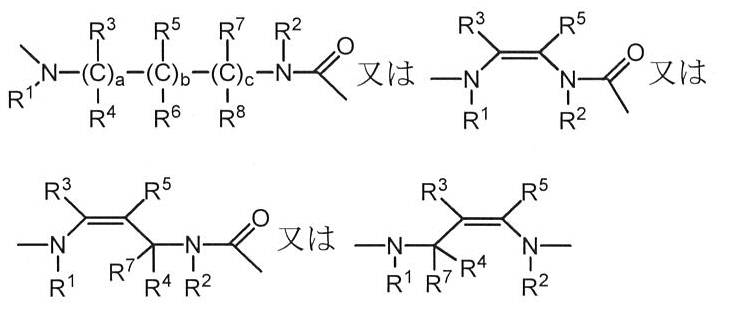
a、b及びcは独立して、0又は1の整数となるよう選択され;
ただしa+b+c=2又は3であり;
R1及び/又はR2は独立して、H、C1‐6アルキルを表し、上記アルキルは任意に、以下の基:ヒドロキシ(OH)、エーテル(ORx)、アミノ(NH2)、モノ置換アミノ(NRxH)、ジ置換アミノ(NRx
1Rx
2)、ニトロ(NO2)、ハロゲン、CF3、CN、CONH2、SO2Me、CONHMe、環式C1‐5アルキルアミノ、イミダゾリル、C1‐6アルキルピペラジニル、モルホリノ、チオール(SH)、チオエーテル(SRx)、テトラゾール、カルボキシ(COOH)、カルボン酸塩(COORx)、スルホキシ(S(=O)2OH)、スルホン酸塩(S(=O)2ORx)、スルホニル(S(=O)2Rx)、スルフィキシ(S(=O)OH)、スルフィン酸塩(S(=O)ORx)、スルフィニル(S(=O)Rx)、ホスホノオキシ(OP(=O)(OH)2)、及びリン酸塩(OP(=O)(ORx)2)のうちの1つ以上によって置換され、ここでRx、Rx
1及びRx
2は、C1‐6アルキル基、C3‐20ヘテロシクリル基又はC5‐20アリール基から選択され;
R3、R4、R5、R6、R7及びR8は独立して、H、C1‐6アルキル、C3‐20ヘテロシクリル、C5‐20アリール、C1‐6アルコキシ、ヒドロキシ(OH)、アミノ(NH2)、モノ置換アミノ(NRxH)、ジ置換アミノ(NRx
1Rx
2)、ニトロ(NO2)、ハロゲン、CF3、CN、CONH2、SO2Me、CONHMe、環式C1‐5アルキルアミノ、イミダゾリル、C1‐6アルキルピペラジニル、モルホリノ、チオール(SH)、チオエーテル(SRx)、テトラゾール、カルボキシ(COOH)、カルボン酸塩(COORx)、スルホキシ(S(=O)2OH)、スルホン酸塩(S(=O)2ORx)、スルホニル(S(=O)2Rx)、スルフィキシ(S(=O)OH)、スルフィン酸塩(S(=O)ORx)、スルフィニル(S(=O)Rx)、ホスホノオキシ(OP(=O)(OH)2)、及びリン酸塩(OP(=O)(ORx)2)を表し、ここでRx、Rx
1及びRx
2は、C1‐6アルキル基、C3‐20ヘテロシクリル基又はC5‐20アリール基から選択され、上記置換基R1、R2、R3、R4、R5、R6、R7、又はR8のうちの2つ以上は任意に、互いに接続されて1つ以上の脂肪族又は芳香族環式構造を形成する、E12~E20のいずれか1つに記載の方法。
E21. LM is the following formula:
[V-(W) k- (X) 1 -A]
and thus the above B7-H3-ADC is represented by the following formula:
Ab-[V-(W) k- (X) 1 -A]-D
, where:
V is a cleavable linker;
(W) k -(X) 1 -A is an elongated self-erasing spacer system that self-erases by l,(4+2n) erasure;
W and X are each l,(4+2n)-electron cascade spacers and are the same or different;
A is a spacer group of formula (Y) m where Y is a l,(4+2n) electron cascade spacer, or a group of formula U and is a cyclization elimination spacer;
k, 1 and m are independently integers from 0 to 5, inclusive;
n is an integer from 0 to 10 (inclusive);
however:
if A is (Y) m then k+l+m≧1;
if k+l+m=l, then n>l;
if A is U, then k+1≧1, and
W, X and Y are independently of the formula:
Q is -R5C = CR6- , S, O, NR5 , -R5C =N- or -N= CR5- ;
P is NR7 , O or S;
a, b and c are independently integers from 0 to 5, inclusive;
I, F and G are independently of the formula:
R 1 , R 2 , R 3 , R 4 , R 5 , R 6 , R 7 , R 8 and R 9 are independently H, C 1-6 alkyl, C 3-20 heterocyclyl, C 5-20 aryl , C 1-6 alkoxy, hydroxy (OH), amino (NH 2 ), monosubstituted amino (NR x H), disubstituted amino (NR x 1 R x 2 ), nitro (NO 2 ), halogen, CF 3 , CN, CONH2 , SO2Me , CONHMe, cyclic C1-5 alkylamino, imidazolyl, C1-6 alkylpiperazinyl, morpholino, thiol (SH), thioether ( SRx ), tetrazole, carboxy (COOH) , carboxylate (COOR x ), sulfoxy (S(=O) 2 OH), sulfonate (S(=O) 2 OR x ), sulfonyl (S(=O) 2 R x ), sulfoxy (S( =O)OH), sulfinate (S( = O)ORx), sulfinyl (S(=O) Rx ), phosphonoxy (OP(=O)(OH) 2 ) and phosphate (OP(= O) represents (OR x ) 2 ), where:
R x , R x 1 and R x 2 are independently selected from C 1-6 alkyl groups, C 3-20 heterocyclyl groups or C 5-20 aryl groups;
Two or more of the substituents R 1 , R 2 , R 3 , R 4 , R 5 , R 6 , R 7 , R 8 or R 9 are optionally connected together to form one or more aliphatic or forming an aromatic cyclic structure;
U has the formula:
a, b and c are independently selected to be an integer of 0 or 1;
provided that a+b+c=2 or 3;
R 1 and/or R 2 independently represent H, C 1-6 alkyl, optionally the following groups: hydroxy (OH), ether (OR x ), amino (NH 2 ), mono substituted amino (NR x H), disubstituted amino (NR x 1 R x 2 ), nitro (NO 2 ), halogen, CF 3 , CN, CONH 2 , SO 2 Me, CONHMe, cyclic C 1-5 alkylamino , imidazolyl, C 1-6 alkylpiperazinyl, morpholino, thiol (SH), thioether (SR x ), tetrazole, carboxy (COOH), carboxylate (COOR x ), sulfoxy (S(=O) 2 OH) , sulfonate (S(=O) 2ORx ), sulfonyl (S(=O) 2Rx ) , sulfoxy ( S (=O)OH), sulfinate (S(=O) ORx ), substituted by one or more of sulfinyl (S(=O)R x ), phosphonooxy (OP(=O)(OH) 2 ), and phosphate (OP(=O)(OR x ) 2 ); wherein R x , R x 1 and R x 2 are selected from C 1-6 alkyl groups, C 3-20 heterocyclyl groups or C 5-20 aryl groups;
R 3 , R 4 , R 5 , R 6 , R 7 and R 8 are independently H, C 1-6 alkyl, C 3-20 heterocyclyl, C 5-20 aryl, C 1-6 alkoxy, hydroxy ( OH), amino ( NH2 ) , monosubstituted amino ( NRxH ), disubstituted amino ( NRx1Rx2 ), nitro ( NO2 ), halogen, CF3 , CN, CONH2 , SO2Me , CONHMe, cyclic C 1-5 alkylamino, imidazolyl, C 1-6 alkylpiperazinyl, morpholino, thiol (SH), thioether (SR x ), tetrazole, carboxy (COOH), carboxylate (COOR x ), sulfoxy (S(=O) 2OH ), sulfonate (S(=O) 2ORx ), sulfonyl (S(= O ) 2Rx ), sulfoxy (S(=O)OH), sulfinate (S(=O)OR x ), sulfinyl (S(=O)R x ), phosphonoxy (OP(=O)(OH) 2 ), and phosphate (OP(=O)(OR x ) 2 ) wherein R x , R x 1 and R x 2 are selected from C 1-6 alkyl groups, C 3-20 heterocyclyl groups or C 5-20 aryl groups, and the above substituents R 1 , R 2 , Two or more of R 3 , R 4 , R 5 , R 6 , R 7 , or R 8 are optionally connected together to form one or more aliphatic or aromatic cyclic structures, E12- The method of any one of E20.
E22.上記LMリンカー分子が:
(1)p‐アミノベンジルオキシカルボニル‐p‐アミノベンジルオキシカルボニル;
(2)p‐アミノベンジルオキシカルボニル‐p‐アミノベンジルオキシカルボニル‐p‐アミノベンジルオキシカルボニル;
(3)p‐アミノシンナミルオキシカルボニル;
(4)p‐アミノシンナミルオキシカルボニル‐p‐アミノベンジルオキシカルボニル;
(5)p‐アミノベンジルオキシカルボニル‐p‐アミノシンナミルオキシカルボニル;
(6)p‐アミノシンナミルオキシカルボニル‐p‐アミノシンナミルオキシカルボニル;
(7)p‐アミノフェニルペンタジエニルオキシカルボニル;
(8)p‐アミノフェニルペンタジエニルオキシカルボニル‐p‐アミノシンナミルオキシカルボニル;
(9)p‐アミノフェニルペンタジエニルオキシカルボニル‐p‐アミノベンジルオキシカルボニル;
(10)p‐アミノフェニルペンタジエニルオキシカルボニル‐p‐アミノフェニルペンタジエニルオキシカルボニル;
(11)p‐アミノベンジルオキシカルボニル(メチルアミノ)エチル(メチルアミノ)カルボニル;
(12)p‐アミノシンナミルオキシカルボニル(メチルアミノ)エチル(メチルアミノ)カルボニル;
(13)p‐アミノベンジルオキシカルボニル‐p‐アミノベンジルオキシカルボニル(メチルアミノ)エチル(メチルアミノ)カルボニル;
(14)p‐アミノシンナミルオキシカルボニル‐p‐アミノベンジルオキシカルボニル(メチルアミノ)エチル(メチルアミノ)カルボニル;
(15)p‐アミノベンジルオキシカルボニル‐p‐アミノシンナミルオキシカルボニル(メチルアミノ)エチル(メチルアミノ)‐カルボニル;
(16)p‐アミノシンナミルオキシカルボニル‐p‐アミノシンナミルオキシカルボニル(メチルアミノ)エチル(メチルアミノ)カルボニル;
(17)p‐アミノベンジルオキシカルボニル‐p‐アミノベンジル;
(18)p‐アミノベンジルオキシカルボニル‐p‐アミノベンジルオキシカルボニル‐p‐アミノベンジル;
(19)p‐アミノシンナミル;
(20)p‐アミノシンナミルオキシカルボニル‐p‐アミノベンジル;
(21)p‐アミノベンジルオキシカルボニル‐p‐アミノシンナミル;
(22)p‐アミノシンナミルオキシカルボニル‐p‐アミノシンナミル;
(23)p‐アミノフェニルペンタジエニル;
(24)p‐アミノフェニルペンタジエニルオキシカルボニル‐p‐アミノシンナミル;
(25)p‐アミノフェニルペンタジエニルオキシカルボニル‐p‐アミノベンジル;又は
(26)p‐アミノフェニルペンタジエニルオキシカルボニル‐p‐アミノフェニルペンタジエニルを含む、E12~E21のいずれか1つに記載の方法。
E22. The LM linker molecule is:
(1) p-aminobenzyloxycarbonyl-p-aminobenzyloxycarbonyl;
(2) p-aminobenzyloxycarbonyl-p-aminobenzyloxycarbonyl-p-aminobenzyloxycarbonyl;
(3) p-aminocinnamyloxycarbonyl;
(4) p-aminocinnamyloxycarbonyl-p-aminobenzyloxycarbonyl;
(5) p-aminobenzyloxycarbonyl-p-aminocinnamyloxycarbonyl;
(6) p-aminocinnamyloxycarbonyl-p-aminocinnamyloxycarbonyl;
(7) p-aminophenylpentadienyloxycarbonyl;
(8) p-aminophenylpentadienyloxycarbonyl-p-aminocinnamyloxycarbonyl;
(9) p-aminophenylpentadienyloxycarbonyl-p-aminobenzyloxycarbonyl;
(10) p-aminophenylpentadienyloxycarbonyl-p-aminophenylpentadienyloxycarbonyl;
(11) p-aminobenzyloxycarbonyl(methylamino)ethyl(methylamino)carbonyl;
(12) p-aminocinnamyloxycarbonyl(methylamino)ethyl(methylamino)carbonyl;
(13) p-aminobenzyloxycarbonyl-p-aminobenzyloxycarbonyl(methylamino)ethyl(methylamino)carbonyl;
(14) p-aminocinnamyloxycarbonyl-p-aminobenzyloxycarbonyl(methylamino)ethyl(methylamino)carbonyl;
(15) p-aminobenzyloxycarbonyl-p-aminocinnamyloxycarbonyl(methylamino)ethyl(methylamino)-carbonyl;
(16) p-aminocinnamyloxycarbonyl-p-aminocinnamyloxycarbonyl(methylamino)ethyl(methylamino)carbonyl;
(17) p-aminobenzyloxycarbonyl-p-aminobenzyl;
(18) p-aminobenzyloxycarbonyl-p-aminobenzyloxycarbonyl-p-aminobenzyl;
(19) p-aminocinnamyl;
(20) p-aminocinnamyloxycarbonyl-p-aminobenzyl;
(21) p-aminobenzyloxycarbonyl-p-aminocinnamyl;
(22) p-aminocinnamyloxycarbonyl-p-aminocinnamyl;
(23) p-aminophenylpentadienyl;
(24) p-aminophenylpentadienyloxycarbonyl-p-aminocinnamyl;
(25) p-aminophenylpentadienyloxycarbonyl-p-aminobenzyl; or (26) p-aminophenylpentadienyloxycarbonyl-p-aminophenylpentadienyl. The method described in .
E23.上記LMリンカー分子がAbのポリペプチド鎖のアミノ酸の側鎖に対して複合体化されて、上記Abを上記細胞傷害性デュオカルマイシン部分Dの分子に結合させる、E12~E22のいずれか1つに記載の方法。 E23. any one of E12-E22, wherein the LM linker molecule is conjugated to an amino acid side chain of the Ab's polypeptide chain to link the Ab to the cytotoxic duocarmycin moiety D molecule; The method described in .
E24.上記細胞傷害性デュオカルマイシン部分Dが、デュオカルマイシンA、デュオカルマイシンB1、デュオカルマイシンB2、デュオカルマイシンC1、デュオカルマイシンC2、デュオカルマイシンD、デュオカルマイシンSA、CC‐1065、アドゼレシン、ビゼレシン、カルゼルシン(U‐80244)及びスピロ‐デュオカルマイシン(DUBA)からなる群から選択されるデュオカルマイシン細胞毒素を含む、E12~E23のいずれか1つに記載の方法。 E24. the cytotoxic duocarmycin moiety D is duocarmycin A, duocarmycin B1, duocarmycin B2, duocarmycin C1, duocarmycin C2, duocarmycin D, duocarmycin SA, CC-1065; The method of any one of E12-E23, comprising a duocarmycin cytotoxin selected from the group consisting of adzelesin, vizelesin, carzelesin (U-80244) and spiro-duocarmycin (DUBA).
E25.上記細胞傷害性デュオカルマイシン部分Dがセコ‐デュオカルマイシンを含む、E12~E24のいずれか1つに記載の方法。 E25. The method of any one of E12-E24, wherein said cytotoxic duocarmycin moiety D comprises secco-duocarmycin.
E26.上記LMリンカー分子が、還元型鎖間ジスルフィドを介して上記Abと共有結合する、E12~E25のいずれか1つに記載の方法。 E26. The method of any one of E12-E25, wherein said LM linker molecule is covalently linked to said Ab via a reduced interchain disulfide.
E27.上記B7‐H3‐ADCが約2mg/kgの用量で投与される、E1、E5、及びE9~E26のいずれか1つに記載の方法。 E27. The method of any one of E1, E5, and E9-E26, wherein said B7-H3-ADC is administered at a dose of about 2 mg/kg.
E28.上記B7‐H3‐ADCが約2.25mg/kgの用量で投与される、E1、E5、及びE9~E26のいずれか1つに記載の方法。 E28. The method of any one of E1, E5, and E9-E26, wherein said B7-H3-ADC is administered at a dose of about 2.25 mg/kg.
E29.上記B7‐H3‐ADCが約2.5mg/kgの用量で投与される、E1、E5、及びE9~E26のいずれか1つに記載の方法。 E29. The method of any one of E1, E5, and E9-E26, wherein said B7-H3-ADC is administered at a dose of about 2.5 mg/kg.
E30.上記B7‐H3‐ADCが約2.75mg/kgの用量で投与される、E1、E5、及びE9~E26のいずれか1つに記載の方法。 E30. The method of any one of E1, E5, and E9-E26, wherein said B7-H3-ADC is administered at a dose of about 2.75 mg/kg.
E31.上記B7‐H3‐ADCが約3mg/kgの用量で投与される、E1~E3、E5~E7、及びE9~E26のいずれか1つに記載の方法。 E31. The method of any one of E1-E3, E5-E7, and E9-E26, wherein said B7-H3-ADC is administered at a dose of about 3 mg/kg.
E32.上記B7‐H3‐ADCが約3.25mg/kgの用量で投与される、E1~E3、E5~E7、及びE9~E26のいずれか1つに記載の方法。 E32. The method of any one of E1-E3, E5-E7, and E9-E26, wherein said B7-H3-ADC is administered at a dose of about 3.25 mg/kg.
E33.上記B7‐H3‐ADCが約3.5mg/kgの用量で投与される、E1~E3、E5~E7、及びE9~E26のいずれか1つに記載の方法。 E33. The method of any one of E1-E3, E5-E7, and E9-E26, wherein said B7-H3-ADC is administered at a dose of about 3.5 mg/kg.
E34.上記B7‐H3‐ADCが約3.75mg/kgの用量で投与される、E1~E3、E5~E7、及びE9~E26のいずれか1つに記載の方法。 E34. The method of any one of E1-E3, E5-E7, and E9-E26, wherein said B7-H3-ADC is administered at a dose of about 3.75 mg/kg.
E35.上記B7‐H3‐ADCが約4mg/kgの用量で投与される、E1~E26のいずれか1つに記載の方法。 E35. The method of any one of E1-E26, wherein said B7-H3-ADC is administered at a dose of about 4 mg/kg.
E36.上記B7‐H3‐ADCが約4.25mg/kgの用量で投与される、E1~E26のいずれか1つに記載の方法。 E36. The method of any one of E1-E26, wherein said B7-H3-ADC is administered at a dose of about 4.25 mg/kg.
E37.上記B7‐H3‐ADCが約4.5mg/kgの用量で投与される、E1~E26のいずれか1つに記載の方法。 E37. The method of any one of E1-E26, wherein said B7-H3-ADC is administered at a dose of about 4.5 mg/kg.
E38.上記B7‐H3‐ADCが約4.75mg/kgの用量で投与される、E1~E26のいずれか1つに記載の方法。 E38. The method of any one of E1-E26, wherein said B7-H3-ADC is administered at a dose of about 4.75 mg/kg.
E39.上記B7‐H3‐ADCが約5mg/kgの用量で投与される、E1、E2、E4~E6、及びE8~E26のいずれか1つに記載の方法。 E39. The method of any one of E1, E2, E4-E6, and E8-E26, wherein said B7-H3-ADC is administered at a dose of about 5 mg/kg.
E40.上記B7‐H3‐ADCが約60分の期間にわたる静脈内(IV)注入によって投与される、E1~E39のいずれか1つに記載の方法。 E40. The method of any one of E1-E39, wherein said B7-H3-ADC is administered by intravenous (IV) infusion over a period of about 60 minutes.
E41.上記B7‐H3‐ADCが、治療上有効な用量のPD‐1結合分子と組み合わせて投与される、E1~E39のいずれか1つに記載の方法。 E41. The method of any one of E1-E39, wherein said B7-H3-ADC is administered in combination with a therapeutically effective dose of a PD-1 binding molecule.
E42.上記PD‐1結合分子が、抗体、一本鎖抗体、Fab断片、F(ab’)2断片、Fab’断片、Fsc断片、Fv断片、scFv、sc(Fv)2、及びダイアボディからなる群から選択される、E10、E11、及びE41のいずれか1つに記載の方法。 E42. The PD-1-binding molecule is a group consisting of antibody, single-chain antibody, Fab fragment, F(ab')2 fragment, Fab' fragment, Fsc fragment, Fv fragment, scFv, sc(Fv)2, and diabodies The method of any one of E10, E11, and E41, which is selected from
E43.上記PD‐1結合分子が、hPD‐1 mAb‐A、ペムブロリズマブ、ニボルマブ、及びPD‐1×LAG‐3 BDからなる群から選択される、E10、E11、E41、及びE42のいずれか1つに記載の方法。 E43. any one of E10, E11, E41, and E42, wherein the PD-1 binding molecule is selected from the group consisting of hPD-1 mAb-A, pembrolizumab, nivolumab, and PD-1×LAG-3 BD; described method.
E44.上記PD‐1結合分子がhPD‐1 mAb‐A又はPD‐1×LAG‐3 BDである、E10、E11、及びE41~E43のいずれか1つに記載の方法。 E44. The method of any one of E10, E11, and E41-E43, wherein said PD-1 binding molecule is hPD-1 mAb-A or PD-1×LAG-3 BD.
E45.上記PD‐1結合分子が、VH相補性決定領域(CDR)1、VH CDR2、及びVH CDR3を含む可変重鎖(VH)ドメインを含み:
上記VH CDR1はアミノ酸配列SYWMN(配列番号23)を含み;
上記VH CDR2はアミノ酸配列VIHPSDSETWLDQKFKD(配列番号24)を含み;
上記VH CDR3はアミノ酸配列EHYGTSPFAY(配列番号25)を含み、
上記抗体が、VL CDR1、VL CDR2、及びVL CDR3を含む可変軽鎖(VL)ドメインを含み:
上記VL CDR1はアミノ酸配列RASESVDNYGMSFMNW(配列番号26)を含み;
上記VL CDR2はアミノ酸配列AASNQGS(配列番号27)を含み;
上記VL CDR3はアミノ酸配列QQSKEVPYT(配列番号28)を含む、E10、E11、及びE41~E44のいずれか1つに記載の方法。
E45. The PD-1 binding molecule comprises a variable heavy chain (VH) domain comprising VH complementarity determining region (CDR) 1, VH CDR2, and VH CDR3:
the VH CDR1 comprises the amino acid sequence SYWMN (SEQ ID NO: 23);
said VH CDR2 comprises the amino acid sequence VIHPSDSETWLDQKFKD (SEQ ID NO: 24);
the VH CDR3 comprises the amino acid sequence EHYGTSPFAY (SEQ ID NO: 25);
The antibody comprises a variable light chain (VL) domain comprising VL CDR1, VL CDR2, and VL CDR3:
the VL CDR1 comprises the amino acid sequence RASESVDNYGMSFMNW (SEQ ID NO: 26);
the VL CDR2 comprises the amino acid sequence AASNQGS (SEQ ID NO: 27);
The method of any one of E10, E11, and E41-E44, wherein said VL CDR3 comprises the amino acid sequence QQSKEVPYT (SEQ ID NO:28).
E46.上記PD‐1結合分子の上記VHドメインが、配列番号32に記載のアミノ酸配列を含み、上記VLドメインが、配列番号31に記載のアミノ酸配列を含む、E45に記載の方法。 E46. The method of E45, wherein said VH domain of said PD-1 binding molecule comprises the amino acid sequence set forth in SEQ ID NO:32 and said VL domain comprises the amino acid sequence set forth in SEQ ID NO:31.
E47.上記PD‐1結合分子がhPD‐1 mAb‐Aである、E10、E11、及びE41~E46のいずれか1つに記載の方法。 E47. The method of any one of E10, E11, and E41-E46, wherein said PD-1 binding molecule is hPD-1 mAb-A.
E48.上記方法が、hPD‐1 mAb‐Aを約3週間に1回、約375mg、約500mg、及び約750mgからなる群から選択される一律用量で投与するステップを含む、E10、E11、及びE41~E47のいずれか1つに記載の方法。 E48. E10, E11, and E41-, wherein the method comprises administering hPD-1 mAb-A about once every three weeks at a flat dose selected from the group consisting of about 375 mg, about 500 mg, and about 750 mg. E47.A method according to any one of E47.
E49.上記方法が、hPD‐1 mAb‐Aを約4週間に1回、約375mg、約500mg、及び約750mgからなる群から選択される一律用量で投与するステップを含む、E10、E11、及びE41~E47のいずれか1つに記載の方法。 E49. E10, E11, and E41-, wherein the method comprises administering hPD-1 mAb-A at a flat dose selected from the group consisting of about 375 mg, about 500 mg, and about 750 mg about once every four weeks. E47.A method according to any one of E47.
E50.上記hPD‐1 mAb‐Aが約3週間に1回、約375mgの一律用量で投与される、E10、E11、及びE41~E47のいずれか1つに記載の方法。 E50. The method of any one of E10, E11, and E41-E47, wherein said hPD-1 mAb-A is administered at a flat dose of about 375 mg about once every three weeks.
E51.上記hPD‐1 mAb‐Aが約3週間に1回、約500mgの一律用量で投与される、E10、E11、及びE41~E47のいずれか1つに記載の方法。 E51. The method of any one of E10, E11, and E41-E47, wherein said hPD-1 mAb-A is administered at a flat dose of about 500 mg about once every three weeks.
E52.3週間に1回、上記B7‐H3‐ADCが約3mg/kgの用量で投与され、上記hPD‐1 mAb‐Aが約375mgの一律用量で投与される、E10、E11、E41、E47、E48、及びE50のいずれか1つに記載の方法。 E52. The B7-H3-ADC is administered at a dose of about 3 mg/kg and the hPD-1 mAb-A is administered at a flat dose of about 375 mg once every 3 weeks E10, E11, E41, E47 , E48, and E50.
E53.3週間に1回、上記B7‐H3‐ADCが約3.25mg/kgの用量で投与され、上記hPD‐1 mAb‐Aが約375mgの一律用量で投与される、E10、E11、E41、E47、E48、及びE50のいずれか1つに記載の方法。 E53. E10, E11, E41, wherein the B7-H3-ADC is administered at a dose of about 3.25 mg/kg and the hPD-1 mAb-A is administered at a flat dose of about 375 mg once every 3 weeks , E47, E48, and E50.
E54.3週間に1回、上記B7‐H3‐ADCが約3.5mg/kgの用量で投与され、上記hPD‐1 mAb‐Aが約375mgの一律用量で投与される、E10、E11、E41、E47、E48、及びE50のいずれか1つに記載の方法。 E54. E10, E11, E41, wherein the B7-H3-ADC is administered at a dose of about 3.5 mg/kg and the hPD-1 mAb-A is administered at a flat dose of about 375 mg once every 3 weeks , E47, E48, and E50.
E55.3週間に1回、上記B7‐H3‐ADCが約3.75mg/kgの用量で投与され、上記hPD‐1 mAb‐Aが約375mgの一律用量で投与される、E10、E11、E41、E47、E48、及びE50のいずれか1つに記載の方法。 E55. The B7-H3-ADC is administered at a dose of about 3.75 mg/kg and the hPD-1 mAb-A is administered at a flat dose of about 375 mg once every 3 weeks E10, E11, E41 , E47, E48, and E50.
E56.3週間に1回、上記B7‐H3‐ADCが約4mg/kgの用量で投与され、上記hPD‐1 mAb‐Aが約375mgの一律用量で投与される、E10、E11、E41、E47、E48、及びE50のいずれか1つに記載の方法。 E56. The B7-H3-ADC is administered at a dose of about 4 mg/kg and the hPD-1 mAb-A is administered at a flat dose of about 375 mg once every 3 weeks E10, E11, E41, E47 , E48, and E50.
E57.3週間に1回、上記B7‐H3‐ADCが約4.25mg/kgの用量で投与され、上記hPD‐1 mAb‐Aが約375mgの一律用量で投与される、E10、E11、E41、E47、E48、及びE50のいずれか1つに記載の方法。 E57.E10, E11, E41, where the B7-H3-ADC is administered at a dose of about 4.25 mg/kg and the hPD-1 mAb-A is administered at a flat dose of about 375 mg once every 3 weeks , E47, E48, and E50.
E58.3週間に1回、上記B7‐H3‐ADCが約4.5mg/kgの用量で投与され、上記hPD‐1 mAb‐Aが約375mgの一律用量で投与される、E10、E11、E41、E47、E48、及びE50のいずれか1つに記載の方法。 E58. The B7-H3-ADC is administered at a dose of about 4.5 mg/kg and the hPD-1 mAb-A is administered at a flat dose of about 375 mg once every 3 weeks E10, E11, E41 , E47, E48, and E50.
E59.3週間に1回、上記B7‐H3‐ADCが約4.75mg/kgの用量で投与され、上記hPD‐1 mAb‐Aが約375mgの一律用量で投与される、E10、E11、E41、E47、E48、及びE50のいずれか1つに記載の方法。 E59. The B7-H3-ADC is administered at a dose of about 4.75 mg/kg and the hPD-1 mAb-A is administered at a flat dose of about 375 mg once every 3 weeks E10, E11, E41 , E47, E48, and E50.
E60.3週間に1回、上記B7‐H3‐ADCが約5mg/kgの用量で投与され、上記hPD‐1 mAb‐Aが約375mgの一律用量で投与される、E10、E11、E41、E47、E48、及びE50のいずれか1つに記載の方法。 E60. The B7-H3-ADC is administered at a dose of about 5 mg/kg and the hPD-1 mAb-A is administered at a flat dose of about 375 mg once every 3 weeks E10, E11, E41, E47 , E48, and E50.
E61.4週間に1回、上記B7‐H3‐ADCが約3mg/kgの用量で投与され、上記hPD‐1 mAb‐Aが約375mgの一律用量で投与される、E10、E11、E41、E47、及びE49のいずれか1つに記載の方法。 E61. The B7-H3-ADC is administered at a dose of about 3 mg/kg and the hPD-1 mAb-A is administered at a flat dose of about 375 mg once every 4 weeks E10, E11, E41, E47 , and E49.
E62.4週間に1回、上記B7‐H3‐ADCが約3.25mg/kgの用量で投与され、上記hPD‐1 mAb‐Aが約375mgの一律用量で投与される、E10、E11、E41、E47、及びE49のいずれか1つに記載の方法。 E62.E10, E11, E41, wherein the B7-H3-ADC is administered at a dose of about 3.25 mg/kg and the hPD-1 mAb-A is administered at a flat dose of about 375 mg once every 4 weeks , E47, and E49.
E63.4週間に1回、上記B7‐H3‐ADCが約3.5mg/kgの用量で投与され、上記hPD‐1 mAb‐Aが約375mgの一律用量で投与される、E10、E11、E41、E47、及びE49のいずれか1つに記載の方法。 E63. E10, E11, E41, wherein the B7-H3-ADC is administered at a dose of about 3.5 mg/kg and the hPD-1 mAb-A is administered at a flat dose of about 375 mg once every 4 weeks , E47, and E49.
E64.4週間に1回、上記B7‐H3‐ADCが約3.75mg/kgの用量で投与され、上記hPD‐1 mAb‐Aが約375mgの一律用量で投与される、E10、E11、E41、E47、及びE49のいずれか1つに記載の方法。 E64. E10, E11, E41, wherein the B7-H3-ADC is administered at a dose of about 3.75 mg/kg and the hPD-1 mAb-A is administered at a flat dose of about 375 mg once every 4 weeks , E47, and E49.
E65.4週間に1回、上記B7‐H3‐ADCが約4mg/kgの用量で投与され、上記hPD‐1 mAb‐Aが約375mgの一律用量で投与される、E10、E11、E41、E47、及びE49のいずれか1つに記載の方法。 E65. The B7-H3-ADC is administered at a dose of about 4 mg/kg and the hPD-1 mAb-A is administered at a flat dose of about 375 mg once every 4 weeks E10, E11, E41, E47 , and E49.
E66.4週間に1回、上記B7‐H3‐ADCが約4.25mg/kgの用量で投与され、上記hPD‐1 mAb‐Aが約375mgの一律用量で投与される、E10、E11、E41、E47、及びE49のいずれか1つに記載の方法。 E66. Once every 4 weeks, the B7-H3-ADC is administered at a dose of about 4.25 mg/kg and the hPD-1 mAb-A is administered at a flat dose of about 375 mg E10, E11, E41 , E47, and E49.
E67.4週間に1回、上記B7‐H3‐ADCが約4.5mg/kgの用量で投与され、上記hPD‐1 mAb‐Aが約375mgの一律用量で投与される、E10、E11、E41、E47、及びE49のいずれか1つに記載の方法。 E67. E10, E11, E41, wherein the B7-H3-ADC is administered at a dose of about 4.5 mg/kg and the hPD-1 mAb-A is administered at a flat dose of about 375 mg once every 4 weeks , E47, and E49.
E68.4週間に1回、上記B7‐H3‐ADCが約4.75mg/kgの用量で投与され、上記hPD‐1 mAb‐Aが約375mgの一律用量で投与される、E10、E11、E41、E47、及びE49のいずれか1つに記載の方法。 E68. Once every 4 weeks, the B7-H3-ADC is administered at a dose of about 4.75 mg/kg and the hPD-1 mAb-A is administered at a flat dose of about 375 mg E10, E11, E41 , E47, and E49.
E69.4週間に1回、上記B7‐H3‐ADCが約5mg/kgの用量で投与され、上記hPD‐1 mAb‐Aが約375mgの一律用量で投与される、E10、E11、E41、E47、及びE49のいずれか1つに記載の方法。 E69. The B7-H3-ADC is administered at a dose of about 5 mg/kg and the hPD-1 mAb-A is administered at a flat dose of about 375 mg once every 4 weeks E10, E11, E41, E47 , and E49.
E70.上記hPD‐1 mAb‐Aが約60分の期間にわたるIV注入によって投与される、E10、E11、E41~E69のいずれか1つに記載の方法。 E70. The method of any one of E10, E11, E41-E69, wherein said hPD-1 mAb-A is administered by IV infusion over a period of about 60 minutes.
E71.ヒトPD‐1に結合する上記抗体がペムブロリズマブである、E10、E11、及びE41~E43のいずれか1つに記載の方法。 E71. The method of any one of E10, E11, and E41-E43, wherein said antibody that binds to human PD-1 is pembrolizumab.
E72.上記ペムブロリズマブが約3週間に1回、約200mgの一律用量で投与される、E41~E43、及びE71のいずれか1つに記載の方法。 E72. The method of any one of E41-E43, and E71, wherein said pembrolizumab is administered at a flat dose of about 200 mg about once every three weeks.
E73.上記ペムブロリズマブが約30分の期間にわたるIV注入によって投与される、E41~E43、E71、及びE72のいずれか1つに記載の方法。 E73. The method of any one of E41-E43, E71, and E72, wherein said pembrolizumab is administered by IV infusion over a period of about 30 minutes.
E74.上記PD‐1結合分子がニボルマブである、E10、E11、及びE41~E43のいずれか1つに記載の方法。 E74. The method of any one of E10, E11, and E41-E43, wherein said PD-1 binding molecule is nivolumab.
E75.上記ニボルマブが約2週間に1回、約240mgの一律用量で投与される、E41~E43、及びE74のいずれか1つに記載の方法。 E75. The method of any one of E41-E43 and E74, wherein said nivolumab is administered at a flat dose of about 240 mg about once every two weeks.
E76.上記ニボルマブが約4週間に1回、約480mgの一律用量で投与される、E41~E43、及びE74のいずれか1つに記載の方法。 E76. The method of any one of E41-E43 and E74, wherein said nivolumab is administered at a flat dose of about 480 mg about once every 4 weeks.
E77.上記ニボルマブが約30分の期間にわたるIV注入によって投与される、E41~E43、及びE74~E76のいずれか1つに記載の方法。 E77. The method of any one of E41-E43 and E74-E76, wherein said nivolumab is administered by IV infusion over a period of about 30 minutes.
E78.上記PD‐1結合分子がPD‐1×LAG‐3 BDである、E10、E11、E41~E44のいずれか1つに記載の方法。 E78. The method of any one of E10, E11, E41-E44, wherein said PD-1 binding molecule is PD-1×LAG-3 BD.
E78.1.上記PD‐1結合分子が、配列番号32に記載のVHドメイン、配列番号31に記載のVLドメイン、配列番号46に記載のVHドメイン、及び配列番号45に記載のVLドメインを含む、PD‐1×LAG‐3 BDである、E10、E11、E41~E44のいずれか1つに記載の方法。 E78.1. PD-1, wherein said PD-1-binding molecule comprises a VH domain as set forth in SEQ ID NO:32, a VL domain as set forth in SEQ ID NO:31, a VH domain as set forth in SEQ ID NO:46, and a VL domain as set forth in SEQ ID NO:45 The method of any one of E10, E11, E41-E44, which is xLAG-3 BD.
E79.上記PD‐1×LAG‐3 BDが、配列番号37のアミノ酸配列を含む2つのポリペプチド鎖と、配列番号38のアミノ酸配列を含む2つのポリペプチド鎖とを含む、E43、E44、E78、及びE78.1のいずれか1つに記載の方法。 E79. E43, E44, E78, and wherein the PD-1×LAG-3 BD comprises two polypeptide chains comprising the amino acid sequence of SEQ ID NO:37 and two polypeptide chains comprising the amino acid sequence of SEQ ID NO:38; The method of any one of E78.1.
E80.上記PD‐1×LAG‐3 BDが、約300mgの一律用量で2週間に1回投与される、E43、E44、E78、及びE79のいずれか1つに記載の方法。 E80. The method of any one of E43, E44, E78, and E79, wherein said PD-1×LAG-3 BD is administered at a flat dose of about 300 mg once every two weeks.
E81.上記PD‐1×LAG‐3 BDが、約300mgの一律用量で3週間に1回投与される、E43、E44、E78、及びE79のいずれか1つに記載の方法。 E81. The method of any one of E43, E44, E78, and E79, wherein said PD-1×LAG-3 BD is administered at a flat dose of about 300 mg once every three weeks.
E82.上記PD‐1×LAG‐3 BDが、約600mgの一律用量で2週間に1回投与される、E43、E44、E78、及びE79のいずれか1つに記載の方法。 E82. The method of any one of E43, E44, E78, and E79, wherein said PD-1×LAG-3 BD is administered at a flat dose of about 600 mg once every two weeks.
E83.上記PD‐1×LAG‐3 BDが、約600mgの一律用量で3週間に1回投与される、E43、E44、E78、及びE79のいずれか1つに記載の方法。 E83. The method of any one of E43, E44, E78, and E79, wherein said PD-1×LAG-3 BD is administered at a flat dose of about 600 mg once every three weeks.
E84.上記PD‐1×LAG‐3 BDが、30~240分の期間にわたるIV注入によって投与される、E43、E44、及びE78~E83のいずれか1つに記載の方法。 E84. The method of any one of E43, E44, and E78-E83, wherein said PD-1×LAG-3 BD is administered by IV infusion over a period of 30-240 minutes.
E85.上記PD‐1×LAG‐3 BDが、約30~90分の期間にわたるIV注入によって投与される、E43、E44、及びE78~E83のいずれか1つに記載の方法。 E85. The method of any one of E43, E44, and E78-E83, wherein said PD-1×LAG-3 BD is administered by IV infusion over a period of about 30-90 minutes.
E86.上記B7‐H3‐ADC及び上記hPD‐1 mAb‐Aが、別個の医薬組成物で被験者に順次投与される、E43~E70のいずれか1つに記載の方法。 E86. The method of any one of E43-E70, wherein said B7-H3-ADC and said hPD-1 mAb-A are administered to the subject sequentially in separate pharmaceutical compositions.
E87.上記hPD‐1 mAb‐Aを含む上記医薬組成物が、上記B7‐H3‐ADCを含む上記医薬組成物の投与の前に投与される、E43~E71のいずれか1つに記載の方法。 E87. The method of any one of E43-E71, wherein said pharmaceutical composition comprising said hPD-1 mAb-A is administered prior to administration of said pharmaceutical composition comprising said B7-H3-ADC.
E88.上記B7‐H3‐ADC及び上記ペムブロリズマブが、別個の医薬組成物で被験者に順次投与される、E71~E73のいずれか1つに記載の方法。 E88. The method of any one of E71-E73, wherein said B7-H3-ADC and said pembrolizumab are administered to the subject sequentially in separate pharmaceutical compositions.
E89.上記B7‐H3‐ADC及び上記ニボルマブが、別個の医薬組成物で被験者に順次投与される、E74~E77のいずれか1つに記載の方法。 E89. The method of any one of E74-E77, wherein said B7-H3-ADC and said nivolumab are administered to the subject sequentially in separate pharmaceutical compositions.
E90.上記B7‐H3‐ADC及び上記PD‐1×LAG‐3 BDが、別個の医薬組成物で被験者に順次投与される、E78~E85のいずれか1つに記載の方法。 E90. The method of any one of E78-E85, wherein said B7-H3-ADC and said PD-1×LAG-3 BD are administered to the subject sequentially in separate pharmaceutical compositions.
E91.上記B7‐H3‐ADCが:
(A)約0.5mg/ml~約5mg/mlの上記B7‐H3‐ADCを含む医薬組成物;及び
(B)説明資料
を含む医薬キットで提供され、上記説明資料は、上記B7‐H3‐ADCを含む上記医薬組成物を、PD‐1結合分子を含む医薬組成物と任意に組み合わせて投与することを指示する、E1~E90のいずれか1つに記載の方法。
E91. The above B7-H3-ADC is:
(A) a pharmaceutical composition comprising from about 0.5 mg/ml to about 5 mg/ml of said B7-H3-ADC; and (B) provided in a pharmaceutical kit comprising an instructional material, said instructional material comprising said B7-H3 - the method of any one of E1-E90, wherein said pharmaceutical composition comprising an ADC is administered, optionally in combination with a pharmaceutical composition comprising a PD-1 binding molecule.
E92.上記PD‐1結合分子が、hPD‐1 mAb‐A、ペムブロリズマブ、ニボルマブ、又はPD‐1×LAG‐3 BDである、E91に記載の方法。 E92. The method of E91, wherein said PD-1 binding molecule is hPD-1 mAb-A, pembrolizumab, nivolumab, or PD-1×LAG-3 BD.
E93.上記医薬キット中において、上記B7‐H3‐ADCは:
(I)配列番号17のアミノ酸配列を含むヒト化VLドメイン;及び
(II)配列番号18のアミノ酸配列を含むヒト化VHドメイン
を含む、E91又はE92に記載の方法。
E93. In the pharmaceutical kit, the B7-H3-ADC is:
(I) a humanized VL domain comprising the amino acid sequence of SEQ ID NO:17; and (II) a humanized VH domain comprising the amino acid sequence of SEQ ID NO:18.
E94.上記医薬キットの上記マニュアルが、上記B7‐H3‐ADCを、約0.5mg/kg、約1mg/kg、約1.5mg/kg、約2mg/kg、約2.25mg/kg、約2.5mg/kg、約2.75mg/kg、約3mg/kg、約3.25mg/kg、約3.5mg/kg、約3.75mg/kg、約4mg/kg、約4.25mg/kg、約4.5mg/kg、約4.75mg/kg、又は約5mg/kgの用量で投与することを指示する、E91~E93のいずれか1つに記載の方法。 E94. The manual of the pharmaceutical kit indicates that the B7-H3-ADC is about 0.5 mg/kg, about 1 mg/kg, about 1.5 mg/kg, about 2 mg/kg, about 2.25 mg/kg, about 2. 5 mg/kg, about 2.75 mg/kg, about 3 mg/kg, about 3.25 mg/kg, about 3.5 mg/kg, about 3.75 mg/kg, about 4 mg/kg, about 4.25 mg/kg, about The method of any one of E91-E93, wherein administering at a dose of 4.5 mg/kg, about 4.75 mg/kg, or about 5 mg/kg.
E95.上記医薬キットの上記マニュアルが、上記hPD‐1 mAb‐Aを約375mg又は約500mgの一律用量で3週間に1回投与することを指示する、E91~E94のいずれか1つに記載の方法。 E95. The method of any one of E91-E94, wherein the manual of the pharmaceutical kit instructs to administer the hPD-1 mAb-A at a flat dose of about 375 mg or about 500 mg once every three weeks.
E96.上記医薬キットの上記マニュアルが、上記ペムブロリズマブを約200mgの一律用量で3週間に1回投与することを指示する、E91~E94のいずれか1つに記載の方法。 E96. The method of any one of E91-E94, wherein the manual of the pharmaceutical kit indicates that the pembrolizumab is administered at a flat dose of about 200 mg once every three weeks.
E97.上記医薬キットの上記マニュアルが、上記PD‐1×LAG‐3 BDを約300mg又は約600mgの一律用量で2週間に1回又は3週間に1回投与することを指示する、E91~E94のいずれか1つに記載の方法。
E97. Any of E91-E94, wherein the manual of the pharmaceutical kit instructs to administer the PD-1×LAG-3 BD at a flat dose of about 300 mg or about 600 mg once every two weeks or once every three weeks. or the method of
E98.上記医薬キットの上記マニュアルが、上記B7‐H3‐ADC及び上記hPD‐1 mAb‐Aを約60分の期間にわたるIV注入によって投与することを指示する、E91~E95のいずれか1つに記載の方法。 E98. of any one of E91-E95, wherein the manual of the pharmaceutical kit instructs the B7-H3-ADC and the hPD-1 mAb-A to be administered by IV infusion over a period of about 60 minutes. Method.
E99.上記医薬キットの上記マニュアルが、上記B7‐H3‐ADCを約60分の期間にわたるIV注入によって投与し、上記PD‐1×LAG‐3 BDを約30~90分の期間にわたるIV注入によって投与することを指示する、E91~E94、及びE97のいずれか1つに記載の方法。 E99. The manual of the pharmaceutical kit administers the B7-H3-ADC by IV infusion over a period of about 60 minutes and the PD-1×LAG-3 BD by IV infusion over a period of about 30-90 minutes. The method of any one of E91-E94 and E97, wherein the method of
E100.上記医薬キットの上記マニュアルが、上記B7‐H3‐ADCを約60分の期間にわたるIV注入によって投与し、上記PD‐1×LAG‐3 BDを約30~240分の期間にわたるIV注入によって投与することを指示する、E91~E94、及びE97のいずれか1つに記載の方法。 E100. The manual of the pharmaceutical kit administers the B7-H3-ADC by IV infusion over a period of about 60 minutes and the PD-1×LAG-3 BD by IV infusion over a period of about 30-240 minutes. The method of any one of E91-E94 and E97, wherein the method of
E101.B7‐H3を発現する癌の治療のために、上記B7‐H3‐ADCが任意に上記PD‐1結合分子と組み合わせて投与される、E1~E100のいずれか1つに記載の方法。 E101. The method of any one of E1-E100, wherein said B7-H3-ADC is optionally administered in combination with said PD-1 binding molecule for the treatment of a B7-H3-expressing cancer.
E102.上記癌が:副腎癌;AIDS関連癌;胞巣状軟部肉腫;星細胞腫瘍;肛門癌(例えば肛門管の扁平上皮癌(SCAC));膀胱癌;骨癌;脳及び脊髄癌;転移性脳腫瘍;B細胞癌;乳癌(例えばHER2+乳癌又はトリプルネガティブ乳癌(TNBC));頸動脈球腫瘍;子宮頸癌;軟骨肉腫;脊索腫;嫌色素性腎細胞癌;明細胞癌;大腸癌;結腸直腸癌;皮膚良性線維性組織球腫;線維形成性小円形細胞腫瘍;上衣腫;ユーイング腫瘍;骨外性粘液型軟骨肉腫;骨性線維形成不全症;線維性骨異形成症;胆嚢又は胆管癌;消化器癌;妊娠性絨毛性疾患;胚細胞腫瘍;頭頸部癌;神経膠芽腫;血液悪性腫瘍;肝細胞癌;膵島細胞腫;カポジ肉腫;腎臓癌;白血病(例えば急性骨髄性白血病);脂肪肉腫/悪性リポソーム腫瘍;肝臓癌;リンパ腫;肺癌(例えば非小細胞肺癌(NSCLC));髄芽腫;黒色腫;髄膜腫;中皮腫咽頭癌;多発性内分泌腫瘍;多発性骨髄腫;骨髄異形成症候群;神経芽細胞腫;神経内分泌腫瘍;卵巣癌;膵臓癌;乳頭状甲状腺癌;副甲状腺腫瘍;小児癌;末梢神経鞘腫瘍;褐色細胞腫;下垂体腫瘍;前立腺癌(例えば転移性去勢抵抗性前立腺癌(mCRPC));後部ブドウ膜黒色腫;腎転移性癌;ラブドイド腫瘍;横紋筋肉腫;肉腫;皮膚癌;小児期の小円形青色細胞腫瘍(例えば神経芽細胞腫又は横紋筋肉腫);軟組織肉腫;扁平上皮細胞癌(例えば頭頸部の扁平上皮細胞癌(SCCHN));胃癌;滑膜肉腫;精巣癌;胸腺癌;胸腺腫;甲状腺癌(例えば甲状腺転移性癌);及び子宮癌からなる群から選択される、E1~E101のいずれか1つに記載の方法。 E102. AIDS-related cancers; alveolar soft tissue sarcoma; astrocytic tumors; anal cancer (e.g., squamous cell carcinoma of the anal canal (SCAC)); bladder cancer; B cell carcinoma; breast cancer (e.g. HER2+ breast cancer or triple negative breast cancer (TNBC)); carotid bulbar tumor; cervical cancer; chondrosarcoma; chordoma; chromophobe renal cell carcinoma; Carcinoma; cutaneous benign fibrous histiocytoma; desmoplastic small round cell tumor; ependymoma; Ewing tumor; extraosseous myxoid chondrosarcoma; Gastrointestinal cancer; gestational trophoblastic disease; germ cell tumors; head and neck cancer; liposarcoma/malignant liposomal tumors; liver cancer; lymphoma; lung cancer (e.g., non-small cell lung cancer (NSCLC)); medulloblastoma; neuroendocrine tumors; ovarian cancer; pancreatic cancer; papillary thyroid cancer; parathyroid tumor; childhood cancer; peripheral nerve sheath tumor; metastatic castration-resistant prostate cancer (mCRPC); posterior uveal melanoma; renal metastatic carcinoma; rhabdoid tumor; rhabdomyosarcoma; squamous cell carcinoma (e.g. squamous cell carcinoma of the head and neck (SCCHN)); gastric cancer; synovial sarcoma; testicular cancer; thymic carcinoma; and uterine cancer).
E103.上記癌が前立腺癌、肛門癌、扁平上皮細胞癌、乳癌、黒色腫、又は肺癌である、E102に記載の方法。 E103. The method of E102, wherein the cancer is prostate cancer, anal cancer, squamous cell carcinoma, breast cancer, melanoma, or lung cancer.
E104.上記癌が前立腺癌である、E102又はE103に記載の方法。 E104. The method of E102 or E103, wherein said cancer is prostate cancer.
E105.上記前立腺癌がmCRPCである、E102~E104のいずれか1つに記載の方法。 E105. The method of any one of E102-E104, wherein said prostate cancer is mCRPC.
E106.上記癌が肛門癌である、E102又はE103に記載の方法。 E106. The method of E102 or E103, wherein said cancer is anal cancer.
E107.上記肛門癌がSCACである、E102又はE106に記載の方法。 E107. The method of E102 or E106, wherein said anal cancer is SCAC.
E108.上記癌が扁平上皮細胞癌である、E102又はE103に記載の方法。 E108. The method of E102 or E103, wherein said cancer is squamous cell carcinoma.
E109.上記扁平上皮細胞癌がSCCHNである、E102、E103、及びE108のいずれか1つに記載の方法。 E109. The method of any one of E102, E103, and E108, wherein said squamous cell carcinoma is SCCHN.
E110.上記癌が乳癌である、E102又はE103に記載の方法。 E110. The method of E102 or E103, wherein said cancer is breast cancer.
E111.前記乳癌がTNBCである、E102、E103、及びE110のいずれか1つに記載の方法。 E111. The method of any one of E102, E103, and E110, wherein said breast cancer is TNBC.
E112.上記癌が黒色腫である、E102又はE103に記載の方法。 E112. The method of E102 or E103, wherein said cancer is melanoma.
E113.上記黒色腫がブドウ膜黒色腫である、E102、E103、及びE112のいずれか1つに記載の方法。 E113. The method of any one of E102, E103, and E112, wherein said melanoma is uveal melanoma.
E114.上記癌が肺癌である、E102又はE103に記載の方法。 E114. The method of E102 or E103, wherein said cancer is lung cancer.
E115.上記肺癌がNSCLCである、E102、E103、及びE114のいずれか1つに記載の方法。 E115. The method of any one of E102, E103, and E114, wherein said lung cancer is NSCLC.
E116.治療又は予防有効量の、1つ以上の追加の治療剤又は化学療法剤を投与するステップを更に含む、E1~E115のいずれか1つに記載の方法。 E116. The method of any one of E1-E115, further comprising administering a therapeutically or prophylactically effective amount of one or more additional therapeutic or chemotherapeutic agents.
E117.上記化学療法剤が白金系化学療法剤である、E116に記載の方法。 E117. The method of E116, wherein said chemotherapeutic agent is a platinum-based chemotherapeutic agent.
E118.上記化学療法剤がタキサンである、E116に記載の方法。 E118. The method of E116, wherein said chemotherapeutic agent is a taxane.
E119.上記B7‐H3‐ADCの投与を必要とする上記被験者がヒトである、E1~E118のいずれか1つに記載の方法。 E119. The method of any one of E1-E118, wherein said subject in need of administration of said B7-H3-ADC is human.
以上に本発明を概説したが、以下の例を参照することにより、本発明はより容易に理解される。以下の実施例は、本発明の診断又は治療方法における、組成物に関する様々な方法を示す。これらの実施例は本発明の範囲を説明することを意図したものであり、本発明の範囲を限定することは全く意図されていない。 Having outlined the invention above, it will be more readily understood by reference to the following examples. The following examples demonstrate various methods for compositions in the diagnostic or therapeutic methods of the invention. These examples are intended to illustrate the scope of the invention and are not intended to limit the scope of the invention in any way.
実施例1
PD‐1結合分子と組み合わされたB7‐H3‐ADCは、C57BL/6マウスにおいてインビボ抗腫瘍活性を示す
PD‐1結合分子と組み合わされた本発明のB7‐H3‐ADCの抗腫瘍活性を更に実証するために、任意に抗PD‐1抗体(RMP1‐14;BioXCell、米国ニューハンプシャー州レバノン)と組み合わされたB7‐H3‐ADCを、ヒトB7‐H3でトランスフェクトされたマウスMC38結腸直腸腫瘍細胞株(「MC38/hB7‐H3」)を用いて、C57BL/6同系マウスモデルにおいてインビボ毒性に関して評価した。簡潔に述べると、約5×105個の腫瘍細胞(1:1培地及びMATRIGEL(登録商標)中に懸濁)を、一群のC57BL/6マウス(Charles River Laboratories)に皮下移植した。15日目に腫瘍の体積がおよそ40~200mm3に達した時にマウスをランダム化し、B7‐H3‐ADC、抗PD‐1抗体、又は対照ビヒクルを腹腔内に投与した。これらの研究では、1用量のB7‐H3‐ADC(5mg/kg若しくは10mg/kg)又は対照ビヒクルを15日目に投与した。抗PD‐1抗体を、15、18、21、23、25、28、30、32、35、及び37日目に20mg/kg投与した。電子キャリパーを用いた直交測定によって、腫瘍を1週間に2回測定し、腫瘍体積を(長さ×幅×高さ)/2として算出した。(対照に対する)腫瘍体積を決定した(「T/C」)。処置済みの動物の腫瘍体積が研究期間中に≦5mm3まで減少するという発見は、完全奏功(Complete Response:「CR」)を意味するものと考えられた。部分奏功(Partial Response:「PR」)は、腫瘍が、研究中のいずれの時点において投薬日から50%以上減少している場合として定義された。抗腫瘍活性は、以下の米国立癌研究所(National Cancer Institute:NCI)の基準に従って評価された:T/C≦42%が抗腫瘍活性の最低レベルであり、>42%のT/C値は不活性である。T/C<10%は高活性とみなされる。
Example 1
B7-H3-ADC Combined with PD-1 Binding Molecules Show In Vivo Anti-Tumor Activity in C57BL/6 Mice To demonstrate, B7-H3-ADC, optionally in combination with an anti-PD-1 antibody (RMP1-14; BioXCell, Lebanon, NH, USA), was applied to murine MC38 colorectal tumor cells transfected with human B7-H3. A strain (“MC38/hB7-H3”) was used to evaluate for in vivo toxicity in a C57BL/6 syngeneic mouse model. Briefly, approximately 5×10 5 tumor cells (suspended in 1:1 medium and MATRIGEL®) were implanted subcutaneously into groups of C57BL/6 mice (Charles River Laboratories). Mice were randomized on day 15 when tumor volumes reached approximately 40-200 mm 3 and were administered B7-H3-ADC, anti-PD-1 antibody, or control vehicle intraperitoneally. In these studies, one dose of B7-H3-ADC (5 mg/kg or 10 mg/kg) or control vehicle was administered on day 15. Anti-PD-1 antibodies were administered at 20 mg/kg on
MC38/hB7‐H3腫瘍細胞に対するインビボ活性
皮下移植されたMC38/hB7‐H3結腸直腸癌腫瘍細胞に対するこの研究の結果を表1及び図2に提示する。
In Vivo Activity Against MC38/hB7-H3 Tumor Cells The results of this study against subcutaneously implanted MC38/hB7-H3 colorectal cancer tumor cells are presented in Table 1 and FIG.

この研究の結果は、B7‐H3‐ADCが、結腸直腸癌のマウス異種移植片モデルにおけるB7‐H3陽性腫瘍に対して、用量依存性インビボ抗腫瘍活性を示したことを実証している。5mg/kgのB7‐H3‐ADCで治療した動物では0/6で完全奏効が観察され、一方10mg/kgのB7‐H3‐ADCで治療した動物では2/6で完全奏効が観察された。B7‐H3‐ADCと抗PD‐1抗体との組み合わせは、B7‐H3‐ADCの抗腫瘍活性を強化した。5mg/kgのB7‐H3‐ADC+20mg/kgの抗PD‐1抗体で治療した動物では3/6で完全奏効が観察され、10mg/kgのB7‐H3‐ADC+20mg/kgの抗PD‐1抗体で治療した動物では5/6で完全奏効が観察された。 The results of this study demonstrate that B7-H3-ADC exhibited dose-dependent in vivo anti-tumor activity against B7-H3-positive tumors in a mouse xenograft model of colorectal cancer. Complete responses were observed in 0/6 animals treated with 5 mg/kg B7-H3-ADC, while complete responses were observed in 2/6 animals treated with 10 mg/kg B7-H3-ADC. Combination of B7-H3-ADC with anti-PD-1 antibody enhanced the anti-tumor activity of B7-H3-ADC. A complete response was observed in 3/6 animals treated with 5 mg/kg B7-H3-ADC + 20 mg/kg anti-PD-1 antibody, and 10 mg/kg B7-H3-ADC + 20 mg/kg anti-PD-1 antibody. Complete responses were observed in 5/6 treated animals.
実施例2
PD‐1結合分子と組み合わされたB7‐H3‐ADCは、BALB/cマウスにおいてインビボ抗腫瘍活性を示す
PD‐1結合分子と組み合わされた本発明のB7‐H3‐ADCの抗腫瘍活性を更に実証するために、任意に抗PD‐1抗体(RMP1‐14;BioXCell、米国ニューハンプシャー州レバノン)と組み合わされたB7‐H3‐ADCを、ヒトB7‐H3でトランスフェクトされたマウスCT26結腸直腸腫瘍細胞株(「CT26/hB7‐H3」)を用いて、BALB/c同系マウスモデルにおいてインビボ毒性に関して評価した。簡潔に述べると、約5×105個の腫瘍細胞(1:1培地及びMATRIGEL(登録商標)中に懸濁)を、一群のBALB/cマウス(Charles River Laboratories)に皮下移植した。13日目に腫瘍の体積がおよそ40~100mm3に達した時にマウスをランダム化し、B7‐H3‐ADC、抗PD‐1抗体、又は対照ビヒクルを腹腔内に投与した。これらの研究では、1用量のB7‐H3‐ADC(10mg/kg)又は対照ビヒクルを13日目に投与した。抗PD‐1抗体を、13、16、19、22、26、29、33、及び36日目に20mg/kg投与した。電子キャリパーを用いた直交測定によって、腫瘍を1週間に2回測定し、腫瘍体積を(長さ×幅×高さ)/2として算出した。(対照に対する)腫瘍体積を決定した(「T/C」)。処置済みの動物の腫瘍体積が研究期間中に≦5mm3まで減少するという発見は、完全奏功(Complete Response:「CR」)を意味するものと考えられた。部分奏功(Partial Response:「PR」)は、腫瘍が、研究中のいずれの時点において投薬日から50%以上減少している場合として定義された。抗腫瘍活性は、以下の米国立癌研究所(National Cancer Institute:NCI)の基準に従って評価された:T/C≦42%が抗腫瘍活性の最低レベルであり、>42%のT/C値は不活性である。T/C<10%は高活性とみなされる。
Example 2
B7-H3-ADC Combined with PD-1 Binding Molecules Show In Vivo Anti-Tumor Activity in BALB/c Mice To demonstrate, B7-H3-ADC, optionally in combination with an anti-PD-1 antibody (RMP1-14; BioXCell, Lebanon, NH, USA), was applied to mouse CT26 colorectal tumor cells transfected with human B7-H3. A strain (“CT26/hB7-H3”) was used to evaluate for in vivo toxicity in a BALB/c syngeneic mouse model. Briefly, approximately 5×10 5 tumor cells (suspended in 1:1 medium and MATRIGEL®) were implanted subcutaneously into a group of BALB/c mice (Charles River Laboratories). Mice were randomized on day 13 when tumor volumes reached approximately 40-100 mm 3 and were administered B7-H3-ADC, anti-PD-1 antibody, or control vehicle intraperitoneally. In these studies, one dose of B7-H3-ADC (10 mg/kg) or control vehicle was administered on day 13. Anti-PD-1 antibodies were administered at 20 mg/kg on days 13, 16, 19, 22, 26, 29, 33, and 36. Tumors were measured twice a week by orthogonal measurement using electronic calipers and tumor volume was calculated as (length x width x height)/2. Tumor volume (relative to control) was determined (“T/C”). The finding that the tumor volume of treated animals decreased to ≤5 mm 3 during the study period was considered to signify a Complete Response (“CR”). A Partial Response (“PR”) was defined as tumor reduction of 50% or more from the day of dosing at any time during the study. Anti-tumor activity was assessed according to the following National Cancer Institute (NCI) criteria: T/C < 42% is the lowest level of anti-tumor activity, and T/C values >42% is inactive. A T/C<10% is considered high activity.
CT26/hB7‐H3腫瘍細胞に対するインビボ活性
皮下移植されたCT26/hB7‐H3結腸直腸癌腫瘍細胞に対するこの研究の結果を表2及び図3に提示する。
In Vivo Activity Against CT26/hB7-H3 Tumor Cells The results of this study against subcutaneously implanted CT26/hB7-H3 colorectal cancer tumor cells are presented in Table 2 and FIG.

この研究の結果は、B7‐H3‐ADCが、第2の結腸直腸癌のマウス異種移植片モデルにおけるB7‐H3陽性腫瘍に対して、インビボ抗腫瘍活性を示したことを実証している。10mg/kgのB7‐H3‐ADCで治療した動物では2/7で完全奏効が観察された。B7‐H3‐ADCと抗PD‐1抗体との組み合わせは、B7‐H3‐ADCの抗腫瘍活性を強化した。10mg/kgのB7‐H3‐ADC+20mg/kgの抗PD‐1抗体で治療した動物では7/7で完全奏効が観察された。 The results of this study demonstrate that B7-H3-ADC exhibited in vivo anti-tumor activity against B7-H3-positive tumors in a second mouse xenograft model of colorectal cancer. A complete response was observed in 2/7 animals treated with 10 mg/kg B7-H3-ADC. Combination of B7-H3-ADC with anti-PD-1 antibody enhanced the anti-tumor activity of B7-H3-ADC. A complete response was observed in 7/7 animals treated with 10 mg/kg B7-H3-ADC + 20 mg/kg anti-PD-1 antibody.
実施例3
第I相試験
B7‐H3‐ADCに対する患者の忍容性を判断するために、第I相臨床研究を実施することになる。この研究は、用量漸増段階及びコホート拡大段階を含む。この研究は、各臨床施設の治験審査委員会によって承認され、全ての患者が書面によるインフォームドコンセントに署名する。
Example 3
Phase I Study A Phase I clinical study will be conducted to determine patient tolerance to B7-H3-ADC. This study includes a dose escalation phase and a cohort expansion phase. The study is approved by the Institutional Review Board of each clinical site and all patients sign written informed consent.
初期用量漸増及び用量拡大コホートについては、B7‐H3‐ADCを3週間に1回(Q3W)投与する。この研究の目的のために、6週間(42日±3日)のサイクルを使用し、ここではB7‐H3‐ADCを、全ての42日サイクルの1日目及び22日目から始めてQ3Wで投与する。患者は、この研究の治療に対する忍容性及び応答に応じて、最高で合計18回の42日サイクル(即ちおよそ2年)にわたる、複数回の6週間Q3W治療サイクルを受けてよい。
For initial dose escalation and dose expansion cohorts, B7-H3-ADC will be administered once every three weeks (Q3W). For the purposes of this study, 6-week (42 days ± 3 days) cycles were used, where B7-H3-ADC was administered Q3W starting on
更なる用量漸増及び用量拡大コホートでは、B7‐H3‐ADCと、抗PD‐1抗体hPD‐1 mAb‐Aとを、両方とも3週間に1回(Q3W)投与する。この研究の目的のために、3週間のサイクル(それぞれ21日)を使用し、ここではB7‐H3‐ADCを、最初のサイクルの1日目及び22日目、並びにこれに続く各サイクルの1日目及び22日目に投与し、hPD‐1 mAb‐Aを、最初のサイクルの22日目、並びにこれに続く全てのサイクルの1日目及び22日目に投与する。患者は、この研究の治療に対する忍容性及び応答に応じて、最高で合計18回の42日サイクル(即ちおよそ2年)にわたる、複数回の3週間Q3W治療サイクルを受けてよい。
In additional dose escalation and dose expansion cohorts, B7-H3-ADC and anti-PD-1 antibody hPD-1 mAb-A are both administered once every three weeks (Q3W). For the purposes of this study, 3-week cycles (21 days each) were used in which B7-H3-ADC was administered on
これらの研究では、B7‐H3‐ADCの用量は、滅菌された0.9%生理食塩水中で希釈された後、60分にわたって、市販のシリンジ又は輸液ポンプを用いた静脈内(IV)注入によって投与される。シリンジポンプによる投与のためには、B7‐H3‐ADCは0.1mg/ml~6.0mg/mlの濃度範囲まで希釈される。注入ポンプによる投与のためには、B7‐H3‐ADCは0.5mg/ml~2.9mg/mlの濃度範囲まで希釈される。 In these studies, doses of B7-H3-ADC were diluted in sterile 0.9% saline followed by intravenous (IV) infusion over 60 minutes using a commercially available syringe or infusion pump. administered. For administration by syringe pump, B7-H3-ADC is diluted to a concentration range of 0.1 mg/ml to 6.0 mg/ml. For administration by infusion pump, B7-H3-ADC is diluted to a concentration range of 0.5 mg/ml to 2.9 mg/ml.
これらの研究では、hPD‐1 mAb‐Aの用量は、滅菌された0.9%生理食塩水中で0.3mg/ml~12.0mg/mlの濃度範囲まで希釈された後、60分にわたって、市販のシリンジ又は輸液ポンプを用いた静脈内(IV)注入によって投与される。 In these studies, doses of hPD-1 mAb-A were diluted in sterile 0.9% saline to concentrations ranging from 0.3 mg/ml to 12.0 mg/ml over 60 minutes. It is administered by intravenous (IV) infusion using a commercially available syringe or infusion pump.
用量漸増段階及び用量拡大段階の両方について、腫瘍の評価は、最初の4サイクル、及びそれ以降の他の全てのサイクルに関して、各サイクルの42日目(±3日)に実施される。抗腫瘍活性は:従来の「固形腫瘍における反応評価基準(Response Evaluation Criteria in Solid Tumors:RECIST)」、バージョン1.1(Eisenhauer, E.A., et al. (2009) “New Response Evaluation Criteria In Solid Tumours: Revised RECIST Guideline (Version 1.1)”, Eur. J. Cancer. 45(2):228-247);「免疫関連固形腫瘍における反応評価基準(immune-related Response Evaluation Criteria in Solid Tumors:irRECIST)」(Wolchok, J.D., et al. (2009) “Guidelines For The Evaluation Of Immune Therapy Activity In Solid Tumors: Immune-Related Response Criteria.” Clin. Cancer Res, 15:7412-7420);又は該当する場合は応答評価のための改訂版国際ワーキンググループ基準(Revised International Working Group criteria)(即ちLugano分類;Cheson, B.D. et al. (2014) “Recommendations For Initial Evaluation, Staging, And Response Assessment Of Hodgkin And Non-Hodgkin Lymphoma: The Lugano Classification.” J. Clin. Oncol, 32:3059-3068)を用いて、評価される。 For both dose escalation and dose expansion phases, tumor assessments are performed on Day 42 (±3 days) of each cycle for the first 4 cycles and all other cycles thereafter. Anti-tumor activity was measured according to the conventional Response Evaluation Criteria in Solid Tumors (RECIST), version 1.1 (Eisenhauer, E.A., et al. (2009) "New Response Evaluation Criteria In Solid Tumors: Revised RECIST Guideline (Version 1.1)", Eur. J. Cancer. 45(2):228-247); "immune-related Response Evaluation Criteria in Solid Tumors: irRECIST" (Wolchok (2009) "Guidelines For The Evaluation Of Immune Therapy Activity In Solid Tumors: Immune-Related Response Criteria." Clin. Cancer Res, 15:7412-7420); (i.e., Lugano Classification; Cheson, B.D. et al. (2014) “Recommendations For Initial Evaluation, Staging, And Response Assessment Of Hodgkin And Non-Hodgkin Lymphoma: The Lugano Classification .” J. Clin. Oncol, 32:3059-3068).
用量漸増段階では、0.3mgから最大5mgまで順次漸増する用量を、従来の3+3+3デザインに従って投与し:3~9人の患者の連続したコホートをそれぞれ評価する(表3)。様々な用量レベルにおいて、用量漸増の目的で評価できないと評価された患者を差し替える。追加の患者を、関心対象の複数の用量レベルに登録して、追加の臨床的経験を得る。用量漸増段階では、組織学的特徴を問わず、切除不能、再発性又は難治性の、局所進行性又は転移性固形腫瘍を有する患者が登録される。 In the dose escalation phase, escalating doses from 0.3 mg up to 5 mg are administered according to a conventional 3+3+3 design: consecutive cohorts of 3-9 patients are each evaluated (Table 3). At various dose levels, replace patients who are assessed as non-evaluable for purposes of dose escalation. Additional patients will be enrolled at multiple dose levels of interest to gain additional clinical experience. The dose escalation phase enrolls patients with unresectable, recurrent or refractory, locally advanced or metastatic solid tumors of any histologic character.

観察された臨床活性、末梢受容体占有率、及び薬物動態(pharmacokinetics:PK)を含むがこれらに限定されない、単剤療法(B7‐H3‐ADC単独)用量漸増段階からの臨床データ全体に基づいて、Q3Wで投与される最大耐用量(maximum tolerated dose:MTD)を、単剤コホート拡大段階において、及びB7‐H3‐ADCとhPD‐1 mAb‐Aとの併用用量漸増研究において評価される投薬レジメンとして選択する。 Based on overall clinical data from the monotherapy (B7-H3-ADC alone) dose escalation phase, including but not limited to observed clinical activity, peripheral receptor occupancy, and pharmacokinetics (PK) , the maximum tolerated dose (MTD) given in Q3W, in a single agent cohort expansion phase and in a combined dose escalation study of B7-H3-ADC and hPD-1 mAb-A. Select as
B7‐H3‐ADCとhPD‐1 mAb‐Aとの併用研究の用量漸増段階では、375mgの一律用量のhPD‐1 mAb‐Aを、従来の3+3+3デザインに従って投与し:3~9人の患者の連続したコホートに、表4に概説されている用量のB7‐H3‐ADCを投与する。様々な用量レベルにおいて、用量漸増の目的で評価できないと評価された患者を差し替える。追加の患者を、関心対象の複数の用量レベルに登録して、追加の臨床的経験を得る。用量漸増段階では、組織学的特徴を問わず、切除不能、再発性又は難治性の、局所進行性又は転移性固形腫瘍を有する患者が登録される。観察されたいずれの毒性の性質及びタイミングに応じて、B7‐H3‐ADCの用量をMTD‐3へと漸減させてよく、またhPD‐1 mAb‐Aを250MGの一律用量へと減少させてよく、又は両方の薬物を、研究者が適切と考えるような、コホート1の用量レベル以下の他のレベルに調整してよい。
In the dose escalation phase of the B7-H3-ADC and hPD-1 mAb-A combination study, a flat dose of 375 mg hPD-1 mAb-A was administered according to a conventional 3+3+3 design: Consecutive cohorts will be administered B7-H3-ADC at doses outlined in Table 4. At various dose levels, replace patients who are assessed as non-evaluable for purposes of dose escalation. Additional patients will be enrolled at multiple dose levels of interest to gain additional clinical experience. The dose escalation phase enrolls patients with unresectable, recurrent or refractory, locally advanced or metastatic solid tumors of any histologic character. Depending on the nature and timing of any toxicity observed, the dose of B7-H3-ADC may be tapered to MTD-3 and hPD-1 mAb-A may be decreased to a flat dose of 250 MG. or both drugs may be adjusted to other levels below the

コホート拡大段階では、再発性/難治性で切除不能の局所進行性又は転移性SCCHN、mCRPC、TNBC、及びブドウ膜黒色腫を伴う患者は、MTDのB7‐H3‐ADCのみを投与される。同様に、切除不能な局所進行性又は転移性SCCHN又はmCRPCを伴う患者のコホートを、上述の併用用量漸増研究に基づいて、この研究の用量漸増段階からの安全性、PK、及び抗腫瘍活性に基づくMTD用量のhPD‐1 mAb‐Aと組み合わされたB7‐H3‐ADCで治療する。 In the cohort expansion phase, patients with relapsed/refractory, unresectable, locally advanced or metastatic SCCHN, mCRPC, TNBC, and uveal melanoma receive MTD B7-H3-ADC only. Similarly, a cohort of patients with unresectable locally advanced or metastatic SCCHN or mCRPC will be evaluated for safety, PK, and antitumor activity from the dose escalation phase of this study based on the combination dose escalation study described above. Treat with B7-H3-ADC in combination with hPD-1 mAb-A at the base MTD dose.
初期の所見の概要
治療関連有害事象
Q3W用量漸増での23人の患者の治療後の所見を提供する。表6に示されているように、治療関連有害事象(treatment-related adverse event:TRAE)は22/23(91.7%)の患者で発生し、最も一般的なのは好中球減少症(n=6)、リンパ球減少症(n=3)、手掌・足底発赤知覚不全症候群(n=5)、及び斑状丘疹状皮疹(n=3)であった。グレード3以上のTRAEの割合は58.3%であった。3つの治療関連の重篤な有害事象が3人の患者で発生した:1)細菌性肺炎を併発した患者における肺臓炎;2)非感染性胃腸炎;及び3)慢性静脈不全患者におけるうっ血性皮膚炎。ベースラインまで回復したグレード4の好中球減少症の、1つの用量規定毒性(dose-limiting toxicity:「DLT」)が報告された。発熱性好中球減少症は観察されなかった。
Summary of Initial Findings Treatment-Related Adverse Events Post-treatment findings for 23 patients on Q3W dose escalation are provided. As shown in Table 6, treatment-related adverse events (TRAEs) occurred in 22/23 (91.7%) patients, the most common being neutropenia (n =6), lymphopenia (n=3), palmar-plantar erythematous paresthesia syndrome (n=5), and maculopapular rash (n=3). The rate of TRAEs of grade 3 or higher was 58.3%. Three treatment-related serious adverse events occurred in 3 patients: 1) pneumonitis in patients complicated with bacterial pneumonia; 2) non-infectious gastroenteritis; and 3) congestive in patients with chronic venous insufficiency. dermatitis. One dose-limiting toxicity (“DLT”) of grade 4 neutropenia that resolved to baseline was reported. No febrile neutropenia was observed.

用量漸増段階の結果に基づいて、3mg/kgの用量を、拡大コホートの治療用量として選択した。 Based on the results of the dose escalation phase, a dose of 3 mg/kg was selected as the therapeutic dose for the expansion cohort.
72人の患者を、3mg/kgのB7‐H3‐ADCで治療した(用量漸増及び用量拡大コホートを含む)。グレード3以上のTRAEは患者の45.8%で発生し、好中球減少症(16.7%)、リンパ球減少症(6.9%)、貧血(4.2%)、及び手掌・足底発赤知覚不全症候群(4.2%)を含んでいた。 Seventy-two patients were treated with 3 mg/kg B7-H3-ADC (including dose escalation and dose expansion cohorts). Grade 3 or higher TRAEs occurred in 45.8% of patients, including neutropenia (16.7%), lymphopenia (6.9%), anemia (4.2%), and palmar included plantar erythematous paresthesia syndrome (4.2%).
標的病変の縮小
図4は、0.5mg/kg、1mg/kg、2mg/kg、3mg/kg、又は4mg/kgでQ3WのB7‐H3‐ADC単剤療法を受けた、26人の応答評価可能な用量漸増及びコホート拡大患者間での、標的病変の縮小の割合を実証する、ウォーターフォールプロットを示す。患者は、用量漸増においては治療後6週間ごとに、コホート拡大においては治療後9週間ごとに撮像された。B7‐H3‐ADCを少なくとも1用量投与され、少なくとも1回のベースライン後腫瘍評価を受けた患者からのデータを示す。用量漸増コホートの患者は、非小細胞肺癌(NSCLC)、ブドウ膜黒色腫、黒色腫、前立腺癌、転移性去勢抵抗性前立腺癌(mCRPC)、小細胞肺癌(SCLC)、結腸直腸癌(CRC)、卵巣癌、腎細胞癌(RCC)、膵臓癌、肉腫、及び食道癌の患者を含んでいた。1人の転移性去勢抵抗性前立腺癌(mCRPC)患者は、B7‐H3‐ADCを5回投与され;最初の4回は2mg/kg投与され、5回目は1mg/kg投与された。このmCRPC患者では、標的病変がベースラインに比べておよそ30%縮小した。1人のNSCLC患者は、2mg/kgのB7‐H3‐ADCを6回投与され、標的病変がベースラインに比べて24%縮小した。図5は、Q3Wでの、2mg/kgのB7‐H3‐ADCの2回の投薬後の、この患者のコンピュータ断層撮影(CT)による肺の画像スキャンを示す。臨床研究者が指摘するように、前後方向の切片の(矢印で示されている)肺の病変は、およそ24%の縮小を示した。図4はまた、3mg/kgのB7‐H3‐ADCを投与された7人の応答評価可能なコホート拡大患者間での、標的病変の縮小の割合も示す。患者のうち2人はNSCLCに罹患しており、患者のうち4人はmCRPCに罹患している。患者はB7‐H3‐ADCを少なくとも1用量投与され、少なくとも1回のベースライン後腫瘍評価を受けた。この研究は進行中であり、データはまだ十分でない。
Reduction of Target Lesions FIG. 4 depicts response assessment in 26 individuals who received Q3W B7-H3-ADC monotherapy at 0.5 mg/kg, 1 mg/kg, 2 mg/kg, 3 mg/kg, or 4 mg/kg. A waterfall plot demonstrating the percentage reduction of target lesions among patients with possible dose escalation and cohort expansion is shown. Patients were imaged every 6 weeks post-treatment for dose escalation and every 9 weeks post-treatment for cohort expansion. Data from patients who received at least one dose of B7-H3-ADC and had at least one post-baseline tumor assessment are shown. Patients in the dose escalation cohort had non-small cell lung cancer (NSCLC), uveal melanoma, melanoma, prostate cancer, metastatic castration-resistant prostate cancer (mCRPC), small cell lung cancer (SCLC), colorectal cancer (CRC) , ovarian cancer, renal cell carcinoma (RCC), pancreatic cancer, sarcoma, and esophageal cancer. A patient with metastatic castration-resistant prostate cancer (mCRPC) received five doses of B7-H3-ADC; the first four doses were 2 mg/kg and the fifth dose was 1 mg/kg. Target lesions shrank by approximately 30% compared to baseline in this mCRPC patient. One NSCLC patient received 6 doses of 2 mg/kg B7-H3-ADC with a 24% reduction in target lesion compared to baseline. FIG. 5 shows a computed tomography (CT) lung image scan of this patient after two doses of 2 mg/kg B7-H3-ADC Q3W. As noted by the clinical investigator, lung lesions in anterior-posterior sections (indicated by arrows) showed approximately 24% reduction. FIG. 4 also shows the percent reduction of target lesions among the 7 response-evaluable expansion cohort patients who received 3 mg/kg B7-H3-ADC. Two of the patients have NSCLC and four of the patients have mCRPC. Patients received at least one dose of B7-H3-ADC and had at least one post-baseline tumor assessment. This research is ongoing and the data are not yet complete.
前立腺特異抗原(PSA)の評価
9人のmCRPC患者を、1mg/kg、2mg/kg、3mg/kg、又は4mg/kgのB7‐H3‐ADCを用いて、用量漸増のQ3Wで治療した。ベースライン、並びに6週目、12週目、及び19週目に血液試料を患者から採取し、PSAのレベルを試験した。PSAレベルは、通常の試験を用いて臨床現場で測定された。5人の患者(71%)で、PSAレベルはベースラインから50~95%の範囲で大幅に低下し、骨疾患が実質的に退縮した1人の患者が含まれていた。mCRPC患者、臨床応答、及びPSAの結果の概要を表7に示す。
Evaluation of Prostate-Specific Antigen (PSA) Nine mCRPC patients were treated with escalating doses of Q3W with B7-H3-ADC at 1 mg/kg, 2 mg/kg, 3 mg/kg, or 4 mg/kg. Blood samples were taken from the patients at baseline and at weeks 6, 12, and 19 to test levels of PSA. PSA levels were measured at the clinical site using routine tests. In 5 patients (71%), PSA levels decreased significantly from baseline, ranging from 50-95%, including 1 patient with substantial regression of bone disease. A summary of mCRPC patients, clinical responses, and PSA results is shown in Table 7.

9人のmCRPC患者を、2mg/kg、3.0mg/kg、又は4mg/kgのB7‐H3‐ADCを用いて、用量漸増のQ3Wで治療し、16人のmCRPC患者を、3.0mg/kgのB7‐H3‐ADCを用いて、コホート拡大のQ3Wで治療した。図6に示されているように、11人の患者(46%)で、PSAレベルはベースラインから50~95%の範囲で低下した。この研究は進行中であり、データはまだ十分でない。 Nine mCRPC patients were treated with 2 mg/kg, 3.0 mg/kg, or 4 mg/kg B7-H3-ADC in escalating doses Q3W, and 16 mCRPC patients were treated with 3.0 mg/kg. Cohort expansion Q3W treatment with kg B7-H3-ADC. As shown in Figure 6, in 11 patients (46%), PSA levels decreased from baseline ranging from 50-95%. This research is ongoing and the data are not yet complete.
これらのデータは、本発明のB7‐H3‐ADCが許容可能な安全性プロファイルを示し、また複数の腫瘍タイプにおいて抗腫瘍活性の有望なエビデンスを示したことを示している。これらのデータはまた、B7‐H3‐ADCで治療されたmCRPC患者におけるPSAレベルの大幅な低下により、mCRPCが、研究のコホート拡大段階で更に分析するための、生存状態の癌適応症となることを示す。 These data demonstrate that the B7-H3-ADCs of the present invention exhibited an acceptable safety profile and also showed encouraging evidence of anti-tumor activity in multiple tumor types. These data also suggest that the significant reduction in PSA levels in mCRPC patients treated with B7-H3-ADC makes mCRPC a viable cancer indication for further analysis during the cohort expansion phase of the study. indicates
B7‐H3発現の免疫組織化学(Immunohistochemistry:IHC)分析
免疫組織化学(IHC)を用いて、患者の前立腺腫瘍及び他の固形腫瘍からの生検でm,B7‐H3の発現を分析した。18人の患者が、B7‐H3発現に関して評価可能な組織試料を有していた。使用した具体的なアッセイは、Ventana Medical Systems, Inc.(「Ventana」;アリゾナ州ツーソン)のB7‐H3(SP206)IHCアッセイであった。腫瘍内の細胞の細胞膜、及び血管系における、B7‐H3の発現は、強度0~3+のHスコアで表される。各染色強度レベルの細胞の割合を算出し、以下の式を用いてHスコアを割り当てる:
Hスコア=[1×(%細胞1+)+2×(%細胞2+)+3×(%細胞3+)]
B7‐H3発現に関するHスコアの範囲は、腫瘍において82~279であり、スコア中央値は200であった。血管系におけるB7‐H3発現の範囲はゼロ~2+であり、スコア中央値は2+であった。
Immunohistochemistry (IHC) Analysis of B7-H3 Expression Immunohistochemistry (IHC) was used to analyze the expression of m,B7-H3 in biopsies from patient prostate and other solid tumors. Eighteen patients had tissue samples evaluable for B7-H3 expression. The specific assay used is from Ventana Medical Systems, Inc. (“Ventana”; Tucson, AZ) B7-H3 (SP206) IHC assay. Expression of B7-H3 in the plasma membrane of cells within tumors and in the vasculature is represented by an H-score of intensity 0-3+. Calculate the percentage of cells with each staining intensity level and assign an H-score using the following formula:
H-score = [1 x (
The range of H-scores for B7-H3 expression was 82-279 in tumors, with a median score of 200. B7-H3 expression in the vasculature ranged from zero to 2+ with a median score of 2+.
本明細書中で言及されている全ての刊行物及び特許は、これらの個々の刊行物又は特許出願がそれぞれ、その全体が参照により援用されることが具体的かつ個別に指示されているかのように、参照により本出願に援用される。本発明について、その具体的な実施形態に関連して説明したが:更なる修正が可能であること;並びに本出願が、本発明の原理に基本的に従い、かつ発明が属する技術分野内での公知の又は慣例的な慣行の範囲内であるような、及びこれ以前に記載されている本質的な特徴に適合し得るような、本開示からの発展を含む、本発明のいずれの変更、使用又は改変を包含することを意図したものであることが、理解されるだろう。 All publications and patents mentioned in this specification are referred to as if each individual publication or patent application was specifically and individually indicated to be incorporated by reference in its entirety. are incorporated into the present application by reference. Although the invention has been described in relation to specific embodiments thereof: that further modifications are possible; Any modification, use, or use of this invention, including departures from this disclosure, as come within known or customary practice, and as may conform to the essential features previously described. or modifications are intended to be understood.
Claims (44)
前記方法は、前記B7‐H3‐ADCを前記被験者に、約0.5mg/kg~約5mg/kgの用量で3週間に1回投与するステップを含む、方法。 1. A method of treating cancer comprising administering an anti-B7-H3 antibody-drug conjugate (B7-H3-ADC) to a subject in need thereof, comprising:
said method comprising administering said B7-H3-ADC to said subject at a dose of about 0.5 mg/kg to about 5 mg/kg once every three weeks.
Ab‐(LM)m‐(D)n
で表され、ここで:
Abは、B7‐H3に結合し、かつ:
(i)その可変軽鎖(VL)ドメイン中に、CDRL1配列RASESIYSYLA(配列番号39)、CDRL2配列NTKTLPE(配列番号40)、及びCDRL3配列QHHYGTPPWT(配列番号41);並びに
(ii)その可変重鎖(VH)ドメイン中に、CDRH1配列SYGMS(配列番号42)、CDRH2配列TINSGGSNTYY PDSLKG(配列番号43)、及びCDRH3配列HDGGAMDY(配列番号44)
を含む、ヒト化B7‐H3抗体又はそのB7‐H3結合断片であり;
Dは、細胞傷害性デュオカルマイシン部分であり;
LMは、Ab及びDを共有結合させる少なくとも1つの結合又はリンカー分子を含み;
mは0~nの整数であって、前記B7‐H3‐ADCの結合又はリンカー分子の数を表すが、LMが1つの結合である場合を除いてmは0ではなく;
nは1~10の整数であって、前記B7‐H3‐ADC分子に共有結合した前記細胞傷害性デュオカルマイシン部分の数を表す、請求項1に記載の方法。 The B7-H3-ADC has the formula:
Ab-(LM) m- (D) n
, where:
The Ab binds to B7-H3 and:
(i) in its variable light chain (VL) domain, the CDRL1 sequence RASESIYSYLA (SEQ ID NO:39), the CDRL2 sequence NTKTLPE (SEQ ID NO:40), and the CDRL3 sequence QHHYGTPPWT (SEQ ID NO:41); and (ii) its variable heavy chain (VH) domain contains the CDRH1 sequence SYGMS (SEQ ID NO:42), the CDRH2 sequence TINSGGSNTYY PDSLKG (SEQ ID NO:43), and the CDRH3 sequence HDGGAMDY (SEQ ID NO:44).
A humanized B7-H3 antibody or B7-H3 binding fragment thereof comprising
D is a cytotoxic duocarmycin moiety;
LM comprises at least one bond or linker molecule that covalently joins Ab and D;
m is an integer from 0 to n and represents the number of linkages or linker molecules of said B7-H3-ADC, but m is not 0, except when LM is one linkage;
2. The method of claim 1, wherein n is an integer from 1 to 10 and represents the number of said cytotoxic duocarmycin moieties covalently attached to said B7-H3-ADC molecule.
(i)配列番号17のアミノ酸配列を含むヒト化可変軽鎖(VL)ドメイン、及び
(ii)配列番号18のアミノ酸配列を含むヒト化可変重鎖(VH)ドメイン
を含む、請求項2に記載の方法。 Said Ab is:
(i) a humanized variable light (VL) domain comprising the amino acid sequence of SEQ ID NO: 17; and (ii) a humanized variable heavy (VH) domain comprising the amino acid sequence of SEQ ID NO: 18. the method of.
(a)FcγRに対する前記変異型Fcドメインの親和性を低減する1つ以上のアミノ酸修飾;及び/又は
(b)前記変異型Fcドメインの血清半減期を増大させる1つ以上のアミノ酸修飾
を含む、請求項4又は5に記載の方法。 Said Fc domain is a variant Fc domain, said variant Fc domain comprising:
(a) one or more amino acid modifications that reduce the affinity of said variant Fc domain for FcγRs; and/or (b) one or more amino acid modifications that increase the serum half-life of said variant Fc domain, 6. A method according to claim 4 or 5.
[V‐(W)k‐(X)1‐A]
で表され、従って前記B7‐H3‐ADCは以下の式:
Ab‐[V‐(W)k‐(X)1‐A]‐D
で表され、ここで:
Vは切断可能なリンカーであり;
(W)k‐(X)1‐Aは、l,(4+2n)消去によって自己消去する、細長い自己消去性スペーサ系であり;
W及びXはそれぞれl,(4+2n)電子カスケードスペーサであり、同一であるか又は異なっており;
Aは、式(Y)m(ここでYはl,(4+2n)電子カスケードスペーサである)のスペーサ基、又は式Uの基であり、環化除去スペーサであり;
k、1及びmは独立して、0~5(両端を含む)の整数であり;
nは0~10(両端を含む)の整数であり;
ただし:
Aが(Y)mである場合、k+l+m≧1であり;
k+l+m=lである場合、n>lであり;
AがUである場合、k+1≧1であり、
W、X及びYは独立して、以下の式:
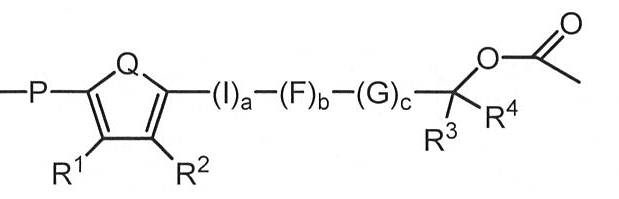

Qは‐R5C=CR6‐、S、O、NR5、‐R5C=N‐又は‐N=CR5‐であり;
PはNR7、O又はSであり;
a、b及びcは独立して、0~5(両端を含む)の整数であり;
I、F及びGは独立して、式:
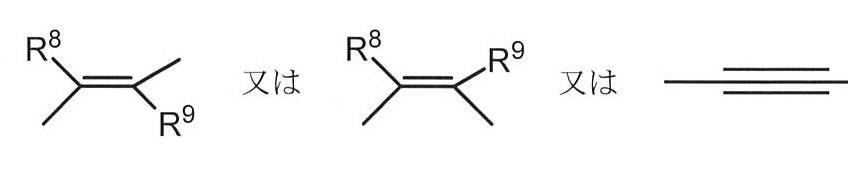
R1、R2、R3、R4、R5、R6、R7、R8及びR9は独立して、H、C1‐6アルキル、C3‐20ヘテロシクリル、C5‐20アリール、C1‐6アルコキシ、ヒドロキシ(OH)、アミノ(NH2)、モノ置換アミノ(NRxH)、ジ置換アミノ(NRx 1Rx 2)、ニトロ(NO2)、ハロゲン、CF3、CN、CONH2、SO2Me、CONHMe、環式C1‐5アルキルアミノ、イミダゾリル、C1‐6アルキルピペラジニル、モルホリノ、チオール(SH)、チオエーテル(SRx)、テトラゾール、カルボキシ(COOH)、カルボン酸塩(COORx)、スルホキシ(S(=O)2OH)、スルホン酸塩(S(=O)2ORx)、スルホニル(S(=O)2Rx)、スルフィキシ(S(=O)OH)、スルフィン酸塩(S(=O)ORx)、スルフィニル(S(=O)Rx)、ホスホノオキシ(OP(=O)(OH)2)及びリン酸塩(OP(=O)(ORx)2)を表し、ここで:
Rx、Rx 1及びRx 2は独立して、C1‐6アルキル基、C3‐20ヘテロシクリル基又はC5‐20アリール基から選択され;
前記置換基R1、R2、R3、R4、R5、R6、R7、R8又はR9のうちの2つ以上は任意に、互いに接続されて1つ以上の脂肪族又は芳香族環式構造を形成し;
Uは、式:
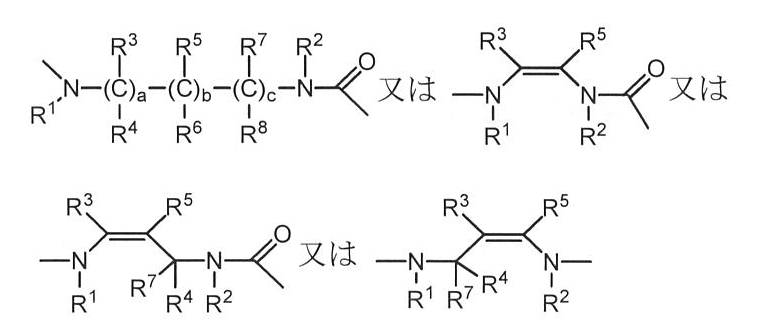
a、b及びcは独立して、0又は1の整数となるよう選択され;
ただしa+b+c=2又は3であり;
R1及び/又はR2は独立して、H、C1‐6アルキルを表し、前記アルキルは任意に、以下の基:ヒドロキシ(OH)、エーテル(ORx)、アミノ(NH2)、モノ置換アミノ(NRxH)、ジ置換アミノ(NRx 1Rx 2)、ニトロ(NO2)、ハロゲン、CF3、CN、CONH2、SO2Me、CONHMe、環式C1‐5アルキルアミノ、イミダゾリル、C1‐6アルキルピペラジニル、モルホリノ、チオール(SH)、チオエーテル(SRx)、テトラゾール、カルボキシ(COOH)、カルボン酸塩(COORx)、スルホキシ(S(=O)2OH)、スルホン酸塩(S(=O)2ORx)、スルホニル(S(=O)2Rx)、スルフィキシ(S(=O)OH)、スルフィン酸塩(S(=O)ORx)、スルフィニル(S(=O)Rx)、ホスホノオキシ(OP(=O)(OH)2)、及びリン酸塩(OP(=O)(ORx)2)のうちの1つ以上によって置換され、ここでRx、Rx 1及びRx 2は、C1‐6アルキル基、C3‐20ヘテロシクリル基又はC5‐20アリール基から選択され;
R3、R4、R5、R6、R7及びR8は独立して、H、C1‐6アルキル、C3‐20ヘテロシクリル、C5‐20アリール、C1‐6アルコキシ、ヒドロキシ(OH)、アミノ(NH2)、モノ置換アミノ(NRxH)、ジ置換アミノ(NRx 1Rx 2)、ニトロ(NO2)、ハロゲン、CF3、CN、CONH2、SO2Me、CONHMe、環式C1‐5アルキルアミノ、イミダゾリル、C1‐6アルキルピペラジニル、モルホリノ、チオール(SH)、チオエーテル(SRx)、テトラゾール、カルボキシ(COOH)、カルボン酸塩(COORx)、スルホキシ(S(=O)2OH)、スルホン酸塩(S(=O)2ORx)、スルホニル(S(=O)2Rx)、スルフィキシ(S(=O)OH)、スルフィン酸塩(S(=O)ORx)、スルフィニル(S(=O)Rx)、ホスホノオキシ(OP(=O)(OH)2)、及びリン酸塩(OP(=O)(ORx)2)を表し、ここでRx、Rx 1及びRx 2は、C1‐6アルキル基、C3‐20ヘテロシクリル基又はC5‐20アリール基から選択され、前記置換基R1、R2、R3、R4、R5、R6、R7、又はR8のうちの2つ以上は任意に、互いに接続されて1つ以上の脂肪族又は芳香族環式構造を形成する、請求項1~14のいずれか1項に記載の方法。 LM has the following formula:
[V-(W) k- (X) 1 -A]
and thus the B7-H3-ADC has the following formula:
Ab-[V-(W) k- (X) 1 -A]-D
, where:
V is a cleavable linker;
(W) k -(X) 1 -A is an elongated self-erasing spacer system that self-erases by l,(4+2n) erasure;
W and X are each l,(4+2n)-electron cascade spacers and are the same or different;
A is a spacer group of formula (Y) m where Y is a l,(4+2n) electron cascade spacer, or a group of formula U and is a cyclization elimination spacer;
k, 1 and m are independently integers from 0 to 5, inclusive;
n is an integer from 0 to 10 (inclusive);
however:
if A is (Y) m then k+l+m≧1;
if k+l+m=l, then n>l;
if A is U, then k+1≧1, and
W, X and Y are independently of the formula:
Q is -R5C = CR6- , S, O, NR5 , -R5C =N- or -N= CR5- ;
P is NR7 , O or S;
a, b and c are independently integers from 0 to 5, inclusive;
I, F and G are independently of the formula:
R 1 , R 2 , R 3 , R 4 , R 5 , R 6 , R 7 , R 8 and R 9 are independently H, C 1-6 alkyl, C 3-20 heterocyclyl, C 5-20 aryl , C 1-6 alkoxy, hydroxy (OH), amino (NH 2 ), monosubstituted amino (NR x H), disubstituted amino (NR x 1 R x 2 ), nitro (NO 2 ), halogen, CF 3 , CN, CONH2 , SO2Me , CONHMe, cyclic C1-5 alkylamino, imidazolyl, C1-6 alkylpiperazinyl, morpholino, thiol (SH), thioether ( SRx ), tetrazole, carboxy (COOH) , carboxylate (COOR x ), sulfoxy (S(=O) 2 OH), sulfonate (S(=O) 2 OR x ), sulfonyl (S(=O) 2 R x ), sulfoxy (S( =O)OH), sulfinate (S( = O)ORx), sulfinyl (S(=O) Rx ), phosphonoxy (OP(=O)(OH) 2 ) and phosphate (OP(= O) represents (OR x ) 2 ), where:
R x , R x 1 and R x 2 are independently selected from C 1-6 alkyl groups, C 3-20 heterocyclyl groups or C 5-20 aryl groups;
Two or more of said substituents R 1 , R 2 , R 3 , R 4 , R 5 , R 6 , R 7 , R 8 or R 9 are optionally connected together to form one or more aliphatic or forming an aromatic cyclic structure;
U has the formula:
a, b and c are independently selected to be an integer of 0 or 1;
provided that a+b+c=2 or 3;
R 1 and/or R 2 independently represent H, C 1-6 alkyl, said alkyl optionally being the following groups: hydroxy (OH), ether (OR x ), amino (NH 2 ), mono substituted amino (NR x H), disubstituted amino (NR x 1 R x 2 ), nitro (NO 2 ), halogen, CF 3 , CN, CONH 2 , SO 2 Me, CONHMe, cyclic C 1-5 alkylamino , imidazolyl, C 1-6 alkylpiperazinyl, morpholino, thiol (SH), thioether (SR x ), tetrazole, carboxy (COOH), carboxylate (COOR x ), sulfoxy (S(=O) 2 OH) , sulfonate (S(=O) 2ORx ), sulfonyl (S(=O) 2Rx ) , sulfoxy (S(=O)OH), sulfinate (S(=O) ORx ), substituted by one or more of sulfinyl (S(=O)R x ), phosphonooxy (OP(=O)(OH) 2 ), and phosphate (OP(=O)(OR x ) 2 ); wherein R x , R x 1 and R x 2 are selected from C 1-6 alkyl groups, C 3-20 heterocyclyl groups or C 5-20 aryl groups;
R 3 , R 4 , R 5 , R 6 , R 7 and R 8 are independently H, C 1-6 alkyl, C 3-20 heterocyclyl, C 5-20 aryl, C 1-6 alkoxy, hydroxy ( OH), amino ( NH2 ), monosubstituted amino ( NRxH ), disubstituted amino ( NRx1Rx2 ), nitro ( NO2 ), halogen , CF3 , CN, CONH2 , SO2Me , CONHMe, cyclic C 1-5 alkylamino, imidazolyl, C 1-6 alkylpiperazinyl, morpholino, thiol (SH), thioether (SR x ), tetrazole, carboxy (COOH), carboxylate (COOR x ), sulfoxy (S(=O) 2OH ), sulfonate (S(=O) 2ORx ), sulfonyl (S(= O ) 2Rx ), sulfoxy (S(=O)OH), sulfinate (S(=O)OR x ), sulfinyl (S(=O)R x ), phosphonoxy (OP(=O)(OH) 2 ), and phosphate (OP(=O)(OR x ) 2 ) wherein R x , R x 1 and R x 2 are selected from C 1-6 alkyl groups, C 3-20 heterocyclyl groups or C 5-20 aryl groups, and the substituents R 1 , R 2 , The claim wherein two or more of R3 , R4 , R5 , R6 , R7 , or R8 are optionally connected together to form one or more aliphatic or aromatic cyclic structures. 15. The method according to any one of 1 to 14.
(1)p‐アミノベンジルオキシカルボニル‐p‐アミノベンジルオキシカルボニル;
(2)p‐アミノベンジルオキシカルボニル‐p‐アミノベンジルオキシカルボニル‐p‐アミノベンジルオキシカルボニル;
(3)p‐アミノシンナミルオキシカルボニル;
(4)p‐アミノシンナミルオキシカルボニル‐p‐アミノベンジルオキシカルボニル;
(5)p‐アミノベンジルオキシカルボニル‐p‐アミノシンナミルオキシカルボニル;
(6)p‐アミノシンナミルオキシカルボニル‐p‐アミノシンナミルオキシカルボニル;
(7)p‐アミノフェニルペンタジエニルオキシカルボニル;
(8)p‐アミノフェニルペンタジエニルオキシカルボニル‐p‐アミノシンナミルオキシカルボニル;
(9)p‐アミノフェニルペンタジエニルオキシカルボニル‐p‐アミノベンジルオキシカルボニル;
(10)p‐アミノフェニルペンタジエニルオキシカルボニル‐p‐アミノフェニルペンタジエニルオキシカルボニル;
(11)p‐アミノベンジルオキシカルボニル(メチルアミノ)エチル(メチルアミノ)カルボニル;
(12)p‐アミノシンナミルオキシカルボニル(メチルアミノ)エチル(メチルアミノ)カルボニル;
(13)p‐アミノベンジルオキシカルボニル‐p‐アミノベンジルオキシカルボニル(メチルアミノ)エチル(メチルアミノ)カルボニル;
(14)p‐アミノシンナミルオキシカルボニル‐p‐アミノベンジルオキシカルボニル(メチルアミノ)エチル(メチルアミノ)カルボニル;
(15)p‐アミノベンジルオキシカルボニル‐p‐アミノシンナミルオキシカルボニル(メチルアミノ)エチル(メチルアミノ)‐カルボニル;
(16)p‐アミノシンナミルオキシカルボニル‐p‐アミノシンナミルオキシカルボニル(メチルアミノ)エチル(メチルアミノ)カルボニル;
(17)p‐アミノベンジルオキシカルボニル‐p‐アミノベンジル;
(18)p‐アミノベンジルオキシカルボニル‐p‐アミノベンジルオキシカルボニル‐p‐アミノベンジル;
(19)p‐アミノシンナミル;
(20)p‐アミノシンナミルオキシカルボニル‐p‐アミノベンジル;
(21)p‐アミノベンジルオキシカルボニル‐p‐アミノシンナミル;
(22)p‐アミノシンナミルオキシカルボニル‐p‐アミノシンナミル;
(23)p‐アミノフェニルペンタジエニル;
(24)p‐アミノフェニルペンタジエニルオキシカルボニル‐p‐アミノシンナミル;
(25)p‐アミノフェニルペンタジエニルオキシカルボニル‐p‐アミノベンジル;又は
(26)p‐アミノフェニルペンタジエニルオキシカルボニル‐p‐アミノフェニルペンタジエニルを含む、請求項15に記載の方法。 The LM linker molecule is:
(1) p-aminobenzyloxycarbonyl-p-aminobenzyloxycarbonyl;
(2) p-aminobenzyloxycarbonyl-p-aminobenzyloxycarbonyl-p-aminobenzyloxycarbonyl;
(3) p-aminocinnamyloxycarbonyl;
(4) p-aminocinnamyloxycarbonyl-p-aminobenzyloxycarbonyl;
(5) p-aminobenzyloxycarbonyl-p-aminocinnamyloxycarbonyl;
(6) p-aminocinnamyloxycarbonyl-p-aminocinnamyloxycarbonyl;
(7) p-aminophenylpentadienyloxycarbonyl;
(8) p-aminophenylpentadienyloxycarbonyl-p-aminocinnamyloxycarbonyl;
(9) p-aminophenylpentadienyloxycarbonyl-p-aminobenzyloxycarbonyl;
(10) p-aminophenylpentadienyloxycarbonyl-p-aminophenylpentadienyloxycarbonyl;
(11) p-aminobenzyloxycarbonyl(methylamino)ethyl(methylamino)carbonyl;
(12) p-aminocinnamyloxycarbonyl(methylamino)ethyl(methylamino)carbonyl;
(13) p-aminobenzyloxycarbonyl-p-aminobenzyloxycarbonyl(methylamino)ethyl(methylamino)carbonyl;
(14) p-aminocinnamyloxycarbonyl-p-aminobenzyloxycarbonyl(methylamino)ethyl(methylamino)carbonyl;
(15) p-aminobenzyloxycarbonyl-p-aminocinnamyloxycarbonyl(methylamino)ethyl(methylamino)-carbonyl;
(16) p-aminocinnamyloxycarbonyl-p-aminocinnamyloxycarbonyl(methylamino)ethyl(methylamino)carbonyl;
(17) p-aminobenzyloxycarbonyl-p-aminobenzyl;
(18) p-aminobenzyloxycarbonyl-p-aminobenzyloxycarbonyl-p-aminobenzyl;
(19) p-aminocinnamyl;
(20) p-aminocinnamyloxycarbonyl-p-aminobenzyl;
(21) p-aminobenzyloxycarbonyl-p-aminocinnamyl;
(22) p-aminocinnamyloxycarbonyl-p-aminocinnamyl;
(23) p-aminophenylpentadienyl;
(24) p-aminophenylpentadienyloxycarbonyl-p-aminocinnamyl;
(25) p-aminophenylpentadienyloxycarbonyl-p-aminobenzyl; or (26) p-aminophenylpentadienyloxycarbonyl-p-aminophenylpentadienyl.
Applications Claiming Priority (5)
| Application Number | Priority Date | Filing Date | Title |
|---|---|---|---|
| US202063023495P | 2020-05-12 | 2020-05-12 | |
| US63/023,495 | 2020-05-12 | ||
| US202163180795P | 2021-04-28 | 2021-04-28 | |
| US63/180,795 | 2021-04-28 | ||
| PCT/US2021/031598 WO2021231309A1 (en) | 2020-05-12 | 2021-05-10 | Methods for the use of a b7-h3 antibody-drug conjugate alone or in combination |
Publications (2)
| Publication Number | Publication Date |
|---|---|
| JP2023525320A true JP2023525320A (en) | 2023-06-15 |
| JPWO2021231309A5 JPWO2021231309A5 (en) | 2024-05-20 |
Family
ID=78524901
Family Applications (1)
| Application Number | Title | Priority Date | Filing Date |
|---|---|---|---|
| JP2022568560A Pending JP2023525320A (en) | 2020-05-12 | 2021-05-10 | Methods for B7-H3 Antibody Drug Conjugates Used Alone or in Combination |
Country Status (13)
| Country | Link |
|---|---|
| US (1) | US20230226206A1 (en) |
| EP (1) | EP4149549A4 (en) |
| JP (1) | JP2023525320A (en) |
| KR (1) | KR20230009397A (en) |
| CN (1) | CN115484982A (en) |
| AU (1) | AU2021273467A1 (en) |
| BR (1) | BR112022022900A2 (en) |
| CA (1) | CA3181535A1 (en) |
| IL (1) | IL298105A (en) |
| MX (1) | MX2022014068A (en) |
| TW (1) | TW202207991A (en) |
| WO (1) | WO2021231309A1 (en) |
| ZA (1) | ZA202211455B (en) |
Families Citing this family (3)
| Publication number | Priority date | Publication date | Assignee | Title |
|---|---|---|---|---|
| JP7564958B2 (en) * | 2020-12-18 | 2024-10-09 | シャンハイ フダン-チャンジャン バイオ-ファーマシューティカル カンパニー リミテッド | Antibody-drug conjugates targeting B7-H3, methods of manufacture and uses thereof - Patents.com |
| TW202515621A (en) * | 2023-08-25 | 2025-04-16 | 美商宏觀基因有限公司 | B7-h3 antibody-drug conjugates |
| WO2025167922A1 (en) * | 2024-02-07 | 2025-08-14 | 上海翰森生物医药科技有限公司 | Combined use of antibody-drug conjugate and anti-egfr antibody |
Citations (1)
| Publication number | Priority date | Publication date | Assignee | Title |
|---|---|---|---|---|
| JP2019520308A (en) * | 2016-04-15 | 2019-07-18 | マクロジェニクス,インコーポレーテッド | Novel B7-H3 binding molecules, antibody drug conjugates thereof and methods of use thereof |
Family Cites Families (3)
| Publication number | Priority date | Publication date | Assignee | Title |
|---|---|---|---|---|
| SG10201604336VA (en) * | 2010-03-04 | 2016-07-28 | Macrogenics Inc | Antibodies Reactive With B7-H3, Immunologically Active Fragments Thereof And Uses Thereof |
| CN110305213B (en) * | 2018-11-09 | 2023-03-10 | 泰州复旦张江药业有限公司 | anti-B7-H3 antibody, preparation method thereof, conjugate thereof and application thereof |
| KR20210063070A (en) * | 2019-11-22 | 2021-06-01 | 주식회사 레고켐 바이오사이언스 | Antibody-drug conjugate comprising anti-B7-H3 antibody and its use |
-
2021
- 2021-05-10 JP JP2022568560A patent/JP2023525320A/en active Pending
- 2021-05-10 KR KR1020227040047A patent/KR20230009397A/en active Pending
- 2021-05-10 CN CN202180031984.8A patent/CN115484982A/en active Pending
- 2021-05-10 EP EP21805196.9A patent/EP4149549A4/en active Pending
- 2021-05-10 US US17/998,455 patent/US20230226206A1/en active Pending
- 2021-05-10 BR BR112022022900A patent/BR112022022900A2/en unknown
- 2021-05-10 WO PCT/US2021/031598 patent/WO2021231309A1/en not_active Ceased
- 2021-05-10 MX MX2022014068A patent/MX2022014068A/en unknown
- 2021-05-10 IL IL298105A patent/IL298105A/en unknown
- 2021-05-10 AU AU2021273467A patent/AU2021273467A1/en active Pending
- 2021-05-10 CA CA3181535A patent/CA3181535A1/en active Pending
- 2021-05-11 TW TW110117006A patent/TW202207991A/en unknown
-
2022
- 2022-10-19 ZA ZA2022/11455A patent/ZA202211455B/en unknown
Patent Citations (1)
| Publication number | Priority date | Publication date | Assignee | Title |
|---|---|---|---|---|
| JP2019520308A (en) * | 2016-04-15 | 2019-07-18 | マクロジェニクス,インコーポレーテッド | Novel B7-H3 binding molecules, antibody drug conjugates thereof and methods of use thereof |
Non-Patent Citations (2)
| Title |
|---|
| CANCER RESEARCH, vol. Vol.78, Suppl.13, JPN6025026599, 2018, pages 820, ISSN: 0005628895 * |
| MOLECULAR CANCER THERAPEUTICS, vol. 19, no. 11, JPN6025026600, 2020, pages 2235 - 2244, ISSN: 0005628896 * |
Also Published As
| Publication number | Publication date |
|---|---|
| CA3181535A1 (en) | 2021-11-18 |
| ZA202211455B (en) | 2023-11-29 |
| TW202207991A (en) | 2022-03-01 |
| BR112022022900A2 (en) | 2022-12-20 |
| EP4149549A1 (en) | 2023-03-22 |
| MX2022014068A (en) | 2022-12-07 |
| EP4149549A4 (en) | 2024-07-03 |
| CN115484982A (en) | 2022-12-16 |
| IL298105A (en) | 2023-01-01 |
| AU2021273467A1 (en) | 2022-11-24 |
| US20230226206A1 (en) | 2023-07-20 |
| KR20230009397A (en) | 2023-01-17 |
| WO2021231309A1 (en) | 2021-11-18 |
Similar Documents
| Publication | Publication Date | Title |
|---|---|---|
| US12331132B2 (en) | Multispecific polypeptide constructs having constrained CD3 binding and related methods and uses | |
| US20230272084A1 (en) | B7-h3 directed antibody drug conjugates | |
| US20240101704A1 (en) | Multispecific polypeptide constructs having constrained cd3 binding and methods of using the same | |
| JP7745113B2 (en) | Multispecific antibodies and uses thereof | |
| JP2023525320A (en) | Methods for B7-H3 Antibody Drug Conjugates Used Alone or in Combination | |
| US20250135022A1 (en) | Methods for the use of a b7-h3 antibody-drug conjugate in combination with a pd-1 x ctla-4 bispecific molecule | |
| CN118804928A (en) | Methods for using B7-H3 antibody-drug conjugates in combination with PD-1 x CTLA-4 bispecific molecules | |
| AU2019251488B2 (en) | Multispecific polypeptide constructs having constrained CD3 binding and related methods and uses | |
| CN118215680A (en) | Multispecific antibodies for use in the treatment of disease | |
| EA042568B1 (en) | NEW B7-H3 BINDING MOLECULES CONTAINING THEIR ANTIBODY-DRUG CONJUGATES AND METHODS FOR THEIR APPLICATION |
Legal Events
| Date | Code | Title | Description |
|---|---|---|---|
| A521 | Request for written amendment filed |
Free format text: JAPANESE INTERMEDIATE CODE: A523 Effective date: 20240508 |
|
| A621 | Written request for application examination |
Free format text: JAPANESE INTERMEDIATE CODE: A621 Effective date: 20240508 |
|
| A131 | Notification of reasons for refusal |
Free format text: JAPANESE INTERMEDIATE CODE: A131 Effective date: 20250627 |
|
| A601 | Written request for extension of time |
Free format text: JAPANESE INTERMEDIATE CODE: A601 Effective date: 20250924 |
|
| A521 | Request for written amendment filed |
Free format text: JAPANESE INTERMEDIATE CODE: A523 Effective date: 20251127 |