KR20210063070A - Antibody-drug conjugate comprising anti-B7-H3 antibody and its use - Google Patents
Antibody-drug conjugate comprising anti-B7-H3 antibody and its use Download PDFInfo
- Publication number
- KR20210063070A KR20210063070A KR1020190151539A KR20190151539A KR20210063070A KR 20210063070 A KR20210063070 A KR 20210063070A KR 1020190151539 A KR1020190151539 A KR 1020190151539A KR 20190151539 A KR20190151539 A KR 20190151539A KR 20210063070 A KR20210063070 A KR 20210063070A
- Authority
- KR
- South Korea
- Prior art keywords
- pharmaceutically acceptable
- antibody
- acceptable salt
- solvate
- antibody conjugate
- Prior art date
- Legal status (The legal status is an assumption and is not a legal conclusion. Google has not performed a legal analysis and makes no representation as to the accuracy of the status listed.)
- Withdrawn
Links
Images



Classifications
-
- A—HUMAN NECESSITIES
- A61—MEDICAL OR VETERINARY SCIENCE; HYGIENE
- A61K—PREPARATIONS FOR MEDICAL, DENTAL OR TOILETRY PURPOSES
- A61K47/00—Medicinal preparations characterised by the non-active ingredients used, e.g. carriers or inert additives; Targeting or modifying agents chemically bound to the active ingredient
- A61K47/50—Medicinal preparations characterised by the non-active ingredients used, e.g. carriers or inert additives; Targeting or modifying agents chemically bound to the active ingredient the non-active ingredient being chemically bound to the active ingredient, e.g. polymer-drug conjugates
- A61K47/51—Medicinal preparations characterised by the non-active ingredients used, e.g. carriers or inert additives; Targeting or modifying agents chemically bound to the active ingredient the non-active ingredient being chemically bound to the active ingredient, e.g. polymer-drug conjugates the non-active ingredient being a modifying agent
- A61K47/68—Medicinal preparations characterised by the non-active ingredients used, e.g. carriers or inert additives; Targeting or modifying agents chemically bound to the active ingredient the non-active ingredient being chemically bound to the active ingredient, e.g. polymer-drug conjugates the non-active ingredient being a modifying agent the modifying agent being an antibody, an immunoglobulin or a fragment thereof, e.g. an Fc-fragment
- A61K47/6835—Medicinal preparations characterised by the non-active ingredients used, e.g. carriers or inert additives; Targeting or modifying agents chemically bound to the active ingredient the non-active ingredient being chemically bound to the active ingredient, e.g. polymer-drug conjugates the non-active ingredient being a modifying agent the modifying agent being an antibody, an immunoglobulin or a fragment thereof, e.g. an Fc-fragment the modifying agent being an antibody or an immunoglobulin bearing at least one antigen-binding site
- A61K47/6849—Medicinal preparations characterised by the non-active ingredients used, e.g. carriers or inert additives; Targeting or modifying agents chemically bound to the active ingredient the non-active ingredient being chemically bound to the active ingredient, e.g. polymer-drug conjugates the non-active ingredient being a modifying agent the modifying agent being an antibody, an immunoglobulin or a fragment thereof, e.g. an Fc-fragment the modifying agent being an antibody or an immunoglobulin bearing at least one antigen-binding site the antibody targeting a receptor, a cell surface antigen or a cell surface determinant
-
- A—HUMAN NECESSITIES
- A61—MEDICAL OR VETERINARY SCIENCE; HYGIENE
- A61K—PREPARATIONS FOR MEDICAL, DENTAL OR TOILETRY PURPOSES
- A61K31/00—Medicinal preparations containing organic active ingredients
- A61K31/33—Heterocyclic compounds
- A61K31/395—Heterocyclic compounds having nitrogen as a ring hetero atom, e.g. guanethidine or rifamycins
- A61K31/55—Heterocyclic compounds having nitrogen as a ring hetero atom, e.g. guanethidine or rifamycins having seven-membered rings, e.g. azelastine, pentylenetetrazole
- A61K31/551—Heterocyclic compounds having nitrogen as a ring hetero atom, e.g. guanethidine or rifamycins having seven-membered rings, e.g. azelastine, pentylenetetrazole having two nitrogen atoms, e.g. dilazep
- A61K31/5513—1,4-Benzodiazepines, e.g. diazepam or clozapine
- A61K31/5517—1,4-Benzodiazepines, e.g. diazepam or clozapine condensed with five-membered rings having nitrogen as a ring hetero atom, e.g. imidazobenzodiazepines, triazolam
-
- A—HUMAN NECESSITIES
- A61—MEDICAL OR VETERINARY SCIENCE; HYGIENE
- A61K—PREPARATIONS FOR MEDICAL, DENTAL OR TOILETRY PURPOSES
- A61K45/00—Medicinal preparations containing active ingredients not provided for in groups A61K31/00 - A61K41/00
- A61K45/06—Mixtures of active ingredients without chemical characterisation, e.g. antiphlogistics and cardiaca
-
- A—HUMAN NECESSITIES
- A61—MEDICAL OR VETERINARY SCIENCE; HYGIENE
- A61K—PREPARATIONS FOR MEDICAL, DENTAL OR TOILETRY PURPOSES
- A61K47/00—Medicinal preparations characterised by the non-active ingredients used, e.g. carriers or inert additives; Targeting or modifying agents chemically bound to the active ingredient
- A61K47/50—Medicinal preparations characterised by the non-active ingredients used, e.g. carriers or inert additives; Targeting or modifying agents chemically bound to the active ingredient the non-active ingredient being chemically bound to the active ingredient, e.g. polymer-drug conjugates
- A61K47/51—Medicinal preparations characterised by the non-active ingredients used, e.g. carriers or inert additives; Targeting or modifying agents chemically bound to the active ingredient the non-active ingredient being chemically bound to the active ingredient, e.g. polymer-drug conjugates the non-active ingredient being a modifying agent
- A61K47/68—Medicinal preparations characterised by the non-active ingredients used, e.g. carriers or inert additives; Targeting or modifying agents chemically bound to the active ingredient the non-active ingredient being chemically bound to the active ingredient, e.g. polymer-drug conjugates the non-active ingredient being a modifying agent the modifying agent being an antibody, an immunoglobulin or a fragment thereof, e.g. an Fc-fragment
- A61K47/6889—Conjugates wherein the antibody being the modifying agent and wherein the linker, binder or spacer confers particular properties to the conjugates, e.g. peptidic enzyme-labile linkers or acid-labile linkers, providing for an acid-labile immuno conjugate wherein the drug may be released from its antibody conjugated part in an acidic, e.g. tumoural or environment
-
- A—HUMAN NECESSITIES
- A61—MEDICAL OR VETERINARY SCIENCE; HYGIENE
- A61P—SPECIFIC THERAPEUTIC ACTIVITY OF CHEMICAL COMPOUNDS OR MEDICINAL PREPARATIONS
- A61P35/00—Antineoplastic agents
-
- C—CHEMISTRY; METALLURGY
- C07—ORGANIC CHEMISTRY
- C07K—PEPTIDES
- C07K16/00—Immunoglobulins [IGs], e.g. monoclonal or polyclonal antibodies
- C07K16/18—Immunoglobulins [IGs], e.g. monoclonal or polyclonal antibodies against material from animals or humans
- C07K16/28—Immunoglobulins [IGs], e.g. monoclonal or polyclonal antibodies against material from animals or humans against receptors, cell surface antigens or cell surface determinants
- C07K16/2803—Immunoglobulins [IGs], e.g. monoclonal or polyclonal antibodies against material from animals or humans against receptors, cell surface antigens or cell surface determinants against the immunoglobulin superfamily
- C07K16/2827—Immunoglobulins [IGs], e.g. monoclonal or polyclonal antibodies against material from animals or humans against receptors, cell surface antigens or cell surface determinants against the immunoglobulin superfamily against B7 molecules, e.g. CD80, CD86
-
- A—HUMAN NECESSITIES
- A61—MEDICAL OR VETERINARY SCIENCE; HYGIENE
- A61K—PREPARATIONS FOR MEDICAL, DENTAL OR TOILETRY PURPOSES
- A61K39/00—Medicinal preparations containing antigens or antibodies
- A61K2039/505—Medicinal preparations containing antigens or antibodies comprising antibodies
-
- A—HUMAN NECESSITIES
- A61—MEDICAL OR VETERINARY SCIENCE; HYGIENE
- A61K—PREPARATIONS FOR MEDICAL, DENTAL OR TOILETRY PURPOSES
- A61K2300/00—Mixtures or combinations of active ingredients, wherein at least one active ingredient is fully defined in groups A61K31/00 - A61K41/00
-
- C—CHEMISTRY; METALLURGY
- C07—ORGANIC CHEMISTRY
- C07K—PEPTIDES
- C07K2317/00—Immunoglobulins specific features
- C07K2317/30—Immunoglobulins specific features characterized by aspects of specificity or valency
- C07K2317/33—Crossreactivity, e.g. for species or epitope, or lack of said crossreactivity
-
- Y—GENERAL TAGGING OF NEW TECHNOLOGICAL DEVELOPMENTS; GENERAL TAGGING OF CROSS-SECTIONAL TECHNOLOGIES SPANNING OVER SEVERAL SECTIONS OF THE IPC; TECHNICAL SUBJECTS COVERED BY FORMER USPC CROSS-REFERENCE ART COLLECTIONS [XRACs] AND DIGESTS
- Y02—TECHNOLOGIES OR APPLICATIONS FOR MITIGATION OR ADAPTATION AGAINST CLIMATE CHANGE
- Y02P—CLIMATE CHANGE MITIGATION TECHNOLOGIES IN THE PRODUCTION OR PROCESSING OF GOODS
- Y02P20/00—Technologies relating to chemical industry
- Y02P20/50—Improvements relating to the production of bulk chemicals
- Y02P20/55—Design of synthesis routes, e.g. reducing the use of auxiliary or protecting groups
Landscapes
- Health & Medical Sciences (AREA)
- Chemical & Material Sciences (AREA)
- Life Sciences & Earth Sciences (AREA)
- Immunology (AREA)
- General Health & Medical Sciences (AREA)
- Medicinal Chemistry (AREA)
- Public Health (AREA)
- Pharmacology & Pharmacy (AREA)
- Animal Behavior & Ethology (AREA)
- Veterinary Medicine (AREA)
- Epidemiology (AREA)
- Bioinformatics & Cheminformatics (AREA)
- Engineering & Computer Science (AREA)
- Organic Chemistry (AREA)
- General Chemical & Material Sciences (AREA)
- Chemical Kinetics & Catalysis (AREA)
- Nuclear Medicine, Radiotherapy & Molecular Imaging (AREA)
- Cell Biology (AREA)
- Biochemistry (AREA)
- Biophysics (AREA)
- Genetics & Genomics (AREA)
- Molecular Biology (AREA)
- Proteomics, Peptides & Aminoacids (AREA)
- Peptides Or Proteins (AREA)
- Medicinal Preparation (AREA)
Abstract
본 발명은 B7-H3를 타겟팅하는 신규한 항체-약물 접합체(antibody-drug conjugate, ADC), 이들 ADC의 활성 대사물, 이들 ADC의 제조방법, 병의 치료 및/또는 예방을 위한 이들 ADC의 용도, 및 또한 병, 더 상세하게는 B7-H3의 과발현과 관련된 질환 예컨대, 암 질환의 치료 및/또는 예방을 위한 약제를 생산하기 위한 이들 ADC의 용도에 관한 것이며, 보다 구체적으로, B7-H3에 결합하는 항체 또는 이의 항원 결합 단편을 포함하는 항체-약물 접합체 및 이를 포함하는 약학 조성물에 관한 것이다.The present invention relates to novel antibody-drug conjugates (ADCs) targeting B7-H3, active metabolites of these ADCs, methods for preparing these ADCs, and uses of these ADCs for the treatment and/or prevention of diseases , and also to the use of these ADCs for the production of medicaments for the treatment and/or prophylaxis of diseases, more particularly diseases associated with overexpression of B7-H3, such as cancer diseases, and more particularly to B7-H3 It relates to an antibody-drug conjugate comprising an antibody or antigen-binding fragment thereof that binds, and a pharmaceutical composition comprising the same.
Description
본 발명은 B7-H3을 타겟팅하는 신규한 항체-약물 접합체(antibody-drug conjugate, ADC), 이들 ADC의 활성 대사물, 이들 ADC의 제조방법, 병의 치료 및/또는 예방을 위한 이들 ADC의 용도, 및 또한 병, 더 상세하게는 B7-H3의 과발현과 관련된 질환 예컨대, 암 질환의 치료 및/또는 예방을 위한 약제를 생산하기 위한 이들 ADC의 용도에 관한 것이며, 보다 구체적으로, B7-H3에 결합하는 항체 또는 이의 항원 결합 단편을 포함하는 항체-약물 접합체 및 이를 포함하는 약학 조성물에 관한 것이다.The present invention provides novel antibody-drug conjugates (ADC) targeting B7-H3, active metabolites of these ADCs, methods for preparing these ADCs, and uses of these ADCs for the treatment and/or prevention of diseases , and also to the use of these ADCs for the production of medicaments for the treatment and/or prophylaxis of diseases, more particularly diseases associated with overexpression of B7-H3, such as cancer diseases, and more particularly to B7-H3 It relates to an antibody-drug conjugate comprising an antibody or antigen-binding fragment thereof that binds, and a pharmaceutical composition comprising the same.
암(cancer)은 신체 조직의 자율적인 과잉 성장에 의해 비정상적으로 자라난 덩어리로 인한 질환을 말하며, 다양한 조직에서 조절되지 않는 세포 성장의 결과이다. 초기 단계 종양은 수술 및 방사선치료 조치에 의해 제거될 수 있으며, 전이된 종양의 경우 일반적으로 화학요법제에 의해 완화치료를 하게 된다.Cancer refers to a disease caused by an abnormally grown mass caused by the autonomous overgrowth of body tissues, and is the result of uncontrolled cell growth in various tissues. Early stage tumors can be removed by surgery and radiation therapy, and metastases are usually treated with chemotherapy for palliative care.
비경구로 투여되는 대다수 화학요법제는 전신 투여의 결과로서 원치 않는 부작용 및 심지어 독성이라는 심각한 효과를 유도할 수 있으며, 따라서 종양 세포 또는 바로 인접한 조직에서 이들 화학요법제의 개선되었으면서도 선택적인 적용을 통해 약효 증가 및 독성/부작용의 최소화를 동시에 이루기 위한 신규한 화학 요법제의 개발에 초점이 맞추어져 왔다.The majority of parenterally administered chemotherapeutic agents can induce serious effects of unwanted side effects and even toxicity as a result of systemic administration, thus enabling improved and selective application of these chemotherapeutic agents in tumor cells or immediately adjacent tissues. The focus has been on the development of novel chemotherapeutic agents to simultaneously achieve increased efficacy and minimized toxicity/side effects.
항체-약물 접합체(ADC, antibody-drug conjugate)는 항원과 결합하는 항체에 독소 또는 약물을 결합시킨 후 세포 내부에서 독성물질을 방출하면서 암세포 등을 사멸에 이르게 하는 표적지향성 신기술이다. 건강한 세포에는 최소한으로 영향을 주면서 약물을 타겟 암세포에 정확하게 전달하고, 특정한 조건하에서만 방출되도록 해주기 때문에 항체 치료제 자체보다 효능이 우수하고 기존의 항암제들에 비해 부작용의 위험성을 크게 낮출 수 있는 기술이다.Antibody-drug conjugate (ADC) is a target-directed new technology that binds a toxin or drug to an antigen-binding antibody and then releases a toxic substance from the inside of the cell and leads to death of cancer cells. It is a technology that delivers drugs accurately to target cancer cells with minimal impact on healthy cells and releases them only under specific conditions, so it is more effective than the antibody treatment itself and can significantly lower the risk of side effects compared to existing anticancer drugs.
이러한 항체-약물 접합체의 기본 구조는 "항체-링커-저분자 약물(독소)"로 구성되어 있다. 여기서 링커는 단순히 항체와 약물을 연결시켜 주는 기능적인 역할뿐 아니라, 체내 순환시 안정하게 타겟 세포까지 도달 후 항체-약물 접합체가 세포 내로 들어가 항체-약물간 해리현상(예, 효소에 의한 가수분해에 의한 결과)에 의해 약물이 잘 떨어지면서 타겟 암세포에 약효를 나타내도록 해야 한다. 즉 링커의 안정성에 따라 항체-약물 접합체의 효능 및 전신독성(systemic toxicity) 등의 안전성 면에서 링커는 매우 중요한 역할을 한다(Discovery Medicine 2010, 10(53): 329-39) 85-8 2018-08-14).The basic structure of such an antibody-drug conjugate is composed of "antibody-linker-small molecule drug (toxin)". Here, the linker not only serves a functional role of simply linking the antibody and drug, but also stably reaches the target cell when circulating in the body, and then the antibody-drug conjugate enters the cell and dissociates between the antibody and the drug (e.g., in hydrolysis by enzymes). result), the drug should fall well and show the drug effect on the target cancer cells. That is, depending on the stability of the linker, the linker plays a very important role in terms of safety such as efficacy and systemic toxicity of the antibody-drug conjugate (Discovery Medicine 2010, 10(53): 329-39) 85-8 2018- 08-14).
본 발명의 발명자는 혈장 내에서 보다 안정하고 체내 순환시에도 안정적이며 약물이 암세포 내에서 쉽게 방출되어 약효를 나타낼 수 있는 효과적인 자가-희생 기(self-immolative group)을 포함하는 링커를 개발하여 이에 대해 특허를 확보한바 있다(한국등록특허 제1,628,872호 등). 한편 암 치료를 위한 단일클론 항체의 사용은 상당한 성공을 거두고 있다. 단일클론 항체는 종양 조직 및 종양 세포의 표적-지향된 어드레싱(addressing)에 적당하다. 항체-약물 접합체들은 림프종과 고형암 치료를 위해 강력하고 새로운 치료의 옵션이 되었으며, 최근 들어 면역 조절 항체들도 임상에서 상당한 성공을 거두고 있다. 치료 항체들의 개발은 암 혈청학, 단백질 엔지니어링 기술과 그 작용, 저항성의 기작들 및 면역 시스템과 암세포들 간의 상호 작용에 대한 깊은 이해를 바탕으로 한다.The inventors of the present invention have developed a linker containing an effective self-immolative group that is more stable in plasma, stable even when circulating in the body, and that the drug can be easily released in cancer cells to exhibit drug efficacy. Patents have been secured (Korea Patent No. 1,628,872, etc.). On the other hand, the use of monoclonal antibodies for the treatment of cancer has achieved considerable success. Monoclonal antibodies are suitable for target-directed addressing of tumor tissues and tumor cells. Antibody-drug conjugates have become a powerful new therapeutic option for the treatment of lymphoma and solid cancers, and immunomodulatory antibodies have recently achieved considerable clinical success. The development of therapeutic antibodies is based on a deep understanding of cancer serology, protein engineering techniques and their actions, mechanisms of resistance, and interactions between the immune system and cancer cells.
이와 관련하여, B7-H3을 항원으로 삼는 항체에 대한 연구가 진행되고 있다.In this regard, studies on antibodies using B7-H3 as an antigen are being conducted.
B7-H3(CD276)는 B7 패밀리의 일원으로 세포외영역, 막통과영역 및 세포내영 역을 포함하는 막관통 단백질이다. B7-H3는 2개의 세포외영역은 엑손 중복으로 인해 면역글로불린 가변 도메인과 면역글로불린 불변 도메인의 단일쌍(2Ig B7-H3)또는 2개의 동일한 쌍(4Ig B7-H3)로 구성된다. 이 두 가지의 형태의 기능적 차이는 확인되지 않았다. B7-H3의 세포 내 도메인은 짧으며 알려진 모티브는 없다(Chapoval AI, Ni J, Lau JS, Wilcox RA, Flies DB, Liu D, et al. Natlmmunol 2001;2:269-74.).B7-H3 (CD276) is a member of the B7 family and is a transmembrane protein comprising an extracellular domain, a transmembrane domain and an intracellular domain. B7-H3 consists of a single pair (2Ig B7-H3) or two identical pairs (4Ig B7-H3) of an immunoglobulin variable domain and an immunoglobulin constant domain due to exon duplication in the two extracellular regions. There was no functional difference between these two forms. The intracellular domain of B7-H3 is short and has no known motif (Chapoval AI, Ni J, Lau JS, Wilcox RA, Flies DB, Liu D, et al. Natlmmunol 2001;2:269-74.).
B7-H3 단백질은 정상조직에서 T 세포, 자연 살해 세포 (NK cell, natural killer cell) 및 항원제시세포(APC, antigen presenting cell)에서 항상 발현하는 것은 아니지만 그 발현이 유도될 수 있다. B7-H1 과 B7-H2의 발현이 주로 항원제시세포와 같은 면역세포에만 국한되어 있음에도 불구하고 B7-H3 단백질은 골아 세포, 섬유아세포, 섬유 모세포 유사 활막 세포 및 상피 세포뿐만 아니라 사람의 간, 폐, 방광, 고환, 전립선, 유방, 태반 및 림프관 기관 등에서도 발현된다. 이 넓은 발현 양상은 특히 말초 조직에서 B7-H3의 보다 다양한 면역학적 및 비-면역 기능을 암시한다.B7-H3 protein is not always expressed in T cells, natural killer cells (NK cells) and antigen presenting cells (APCs) in normal tissues, but its expression can be induced. Although the expression of B7-H1 and B7-H2 is mainly restricted to immune cells such as antigen presenting cells, B7-H3 protein is expressed in osteoblasts, fibroblasts, fibroblast-like synovial cells and epithelial cells, as well as in human liver and lung. , bladder, testis, prostate, breast, placenta and lymphatic organs. This broad expression pattern suggests a more diverse immunological and non-immune function of B7-H3, particularly in peripheral tissues.
최근 B7-H3 발현은 비소세포폐암, 신장 세포암, 신경 모세포종, 대장암, 췌장암, 위암, 폐암, 전립선암, 자궁내막암, 간세포암, 유방암, 자궁경부암, 골육종, 구강암, 방광암, 신경교종, 흑색종 등 다양한 고형암에서 확인되며, 급성 백혈병 다발성 골수종, 여러 종류의 림프종과 같은 혈액암에서도 발현되는 것으로 보고 되어 있다(Zhimeng Yea, Zhuojun Zhengb et al, Cell Physiol Biochem(2016), Elodie Picarda,Kim C. Ohaegbulam and Xingxing Zang, clinical cancer research(2016), Wei Zhang, Yanfang Wang, Jing Wang et al, international journal of oncology(2015)).Recently, B7-H3 expression has been significantly reduced in non-small cell lung cancer, renal cell cancer, neuroblastoma, colorectal cancer, pancreatic cancer, gastric cancer, lung cancer, prostate cancer, endometrial cancer, hepatocellular carcinoma, breast cancer, cervical cancer, osteosarcoma, oral cancer, bladder cancer, glioma, It is identified in various solid cancers such as melanoma, and it is also reported to be expressed in blood cancers such as acute leukemia, multiple myeloma, and several types of lymphoma (Zhimeng Yea, Zhuojun Zhengb et al, Cell Physiol Biochem (2016), Elodie Picarda, Kim C Ohaegbulam and Xingxing Zang, clinical cancer research (2016), Wei Zhang, Yanfang Wang, Jing Wang et al, international journal of oncology (2015)).
B7-H3는 다양한 암종에서 과발현하지만 정상조직에서의 발현은 매우 낮다. 많은 연구에서 대다수의 암 유형에서 B7-H3의 비정상적인 발현이 나타나며, 세포질 또는 암세포의 핵 내에서뿐만 아니라 종양 관련 혈관계에서도 발견되는 것으로 나타났다. 종양의 크기, 전이, 암 병기, 생존율 및 재발률 등 다양한 임상 병리학적 지표를 평가했을 때, B7-H3의 과발현은 나쁜 예후 및 나쁜 임상 결과와 상관관계가 있다. 전립선암 환자를 대상으로 한 연구에 따르면 B7-H3 발현이 강한 종양세포 환자는 수술 당시의 질병 전파 위험, 임상 암 재발 및 암 관련 사망 위험이 유의하게 높았다. 폐암에 대한 B7-H3의 발현은 종양 침윤 림프구(tumor infiltrating lymphocytes, TILs)의 감소와 림프절 전이와 관련이 있으며 면역 회피 및 종양 형성에 B7-H3의 역할을 암시한다(Elodie Picarda,Kim C. Ohaegbulam and Xingxing Zang, Clin Cancer Res, 2017 Jul 12;22).B7-H3 is overexpressed in various carcinomas, but its expression in normal tissues is very low. Many studies have shown that aberrant expression of B7-H3 is seen in the majority of cancer types, found in the cytoplasm or nucleus of cancer cells as well as in tumor-associated vasculature. When various clinicopathological indicators such as tumor size, metastasis, cancer stage, survival rate and recurrence rate were evaluated, overexpression of B7-H3 was correlated with poor prognosis and poor clinical outcome. According to a study in prostate cancer patients, tumor cell patients with strong B7-H3 expression had a significantly higher risk of disease transmission, clinical cancer recurrence, and cancer-related death at the time of surgery. Expression of B7-H3 in lung cancer is associated with a decrease in tumor infiltrating lymphocytes (TILs) and lymph node metastasis, suggesting a role for B7-H3 in immune evasion and tumorigenesis (Elodie Picarda, Kim C. Ohaegbulam). and Xingxing Zang, Clin Cancer Res, 2017 Jul 12;22).
B7-H3는 종양 면역을 조절하는 역할 외에도 종양 공격성을 조절하는 비 면역 기능을 가지고 있다. 그것은 Jak2/Stat3/MMP-9 신호 전달 경로를 통해 다양한 암세포의 피브로넥틴으로 이동, 침입 및 부탁을 조절하는 것으로 나타났다(Elodie Picarda, Kim C. Ohaegbulam and Xingxing Zang, Clin Cancer Res, 2017 Jul 12;22). 종양 관련 항원인 B7-H3는 siRNA에 의한 B7-H3 하향조절을 통해 파이브로넥틴에 대한 세포 부착을 감소시키고 흑색종과 유방암 세포에서 이동과 침윤을 70% 이상 감소시켰다(Chen YW, Tekle C, Fodstad O, Curr Cancer Drug Targets 2008;8). 이런 결과들은 B7-H3가 암치료에 유용한 표적이 될 수 있음을 시사한다.In addition to its role in regulating tumor immunity, B7-H3 also has non-immune functions regulating tumor aggression. It has been shown to regulate migration, invasion and favor of fibronectin in various cancer cells via the Jak2/Stat3/MMP-9 signaling pathway (Elodie Picarda, Kim C. Ohaegbulam and Xingxing Zang, Clin Cancer Res, 2017 Jul 12;22). . B7-H3, a tumor-associated antigen, reduced cell adhesion to fibronectin through downregulation of B7-H3 by siRNA, and reduced migration and invasion by more than 70% in melanoma and breast cancer cells (Chen YW, Tekle C, Fodstad O, Curr Cancer Drug Targets 2008;8). These results suggest that B7-H3 may be a useful target for cancer treatment.
B7-H3는 면역관문 리간드에 속하는 단백질이다. 면역관문 단백질은 인체 내의 면역세포들이 잘못된 이상 행동을 하지 못하게 조절하는 역할을 한다. 면역관문 단백질이 암세포에 과발현하는 경우 면역세포는 암세포가 보내는 비정상 신호를 정상신호로 받아들여 암세포를 건강한 세포로 인지하게 된다. 면역관문억제제는 이런 암세포의 비정상신호를 차단하여 환자 자신의 면역 기능으로 암을 치료하게 하는 면역 항암 치료제이다. 면역관문억제제는 기존의 항암 치료제에 비하여 부작용이 적고 뛰어난 항암효과로 각광받고 있다. 면역관문 리간드 중 하나인 B7-H3는 T 세포 표면의 B7-H3 수용체와 결합하여 T 세포의 면역반응 억제를 유도하나 아직까지 B7-H3가 결합하는 수용체가 무엇인지는 밝혀지지 않았다.B7-H3 is a protein belonging to the immune checkpoint ligand. Immune checkpoint proteins play a role in regulating immune cells in the body to prevent them from acting abnormally. When immune checkpoint protein is overexpressed in cancer cells, immune cells accept abnormal signals from cancer cells as normal signals and recognize cancer cells as healthy cells. Immune checkpoint inhibitors are immune anticancer drugs that block these abnormal signals from cancer cells and allow the patient to treat cancer with his or her own immune function. Immune checkpoint inhibitors are attracting attention as they have fewer side effects and excellent anticancer effects compared to existing anticancer drugs. B7-H3, one of the immune checkpoint ligands, binds to the B7-H3 receptor on the surface of T cells and induces suppression of the immune response of T cells. However, the receptor to which B7-H3 binds is still unknown.
이러한 면역관문 리간드를 차단할 수 있는 항체는 면역관문 리간드와 면역 관문 수용체 상호작용을 부분적으로 또는 완전히 중화시켜 면역 관문을 억제시킴으로써 저하되어 있던 면역세포의 활성을 재활성화시켜 면역 항암 치료 효과를 나타낸다. B7-H3와 결합하는 수용체가 아직 밝혀지지 않았지만, B7-H3와 결합하는 항 B7-H3 항체는 면역관문 수용체와 B7-H3 간의 결합을 차단함으로써 이러한 면역관문을 억제시킴으로써 저하되어 있던 면역세포의 활성을 재활성화시켜 면역 항암치료 효과를 나타낼 수 있다. 즉, B7-H3 수용체와의 결합을 차단하는 항 B7-H3 단클론 항체는 항암 치료 효과를 기대할 수 있다(Elodie Picarda, Kim C. Ohaegbulam and Xingxing Zang, Clin Cancer Res, 2017 Jul 12;22). 미국특허 8,802,091 및 9,371,395는 B7-H3에 대한 항체를 개시한다.Antibodies capable of blocking these immune checkpoint ligands partially or completely neutralize the immune checkpoint ligand and immune checkpoint receptor interaction, thereby inhibiting immune checkpoint, thereby reactivating the activity of immune cells, which has been lowered, thereby exhibiting an immunocancer therapeutic effect. Although the receptor that binds to B7-H3 has not yet been identified, the anti-B7-H3 antibody that binds to B7-H3 blocks the binding between the immune checkpoint receptor and B7-H3, thereby inhibiting the immune checkpoint, thereby lowering the activity of immune cells. can be reactivated to show the effect of immunotherapy. That is, an anti-B7-H3 monoclonal antibody that blocks binding to the B7-H3 receptor can have an anticancer therapeutic effect (Elodie Picarda, Kim C. Ohaegbulam and Xingxing Zang, Clin Cancer Res, 2017 Jul 12; 22). U.S. Patents 8,802,091 and 9,371,395 disclose antibodies to B7-H3.
동일한 B7-H3 항원에 대한 항체라도 각 항체의 특성 또는 용도에 따라 다양한 항암항체로 개발이 가능하므로, 이러한 B7-H3의 암특이적 발현, 다양한 암에서의 발현 및 면역관문 리간드로써의 기능을 고려하면, 기존의 항체를 보완 또는 대체할 수 있는 다양한 항체의 개발이 필요하다.Even if it is an antibody against the same B7-H3 antigen, it is possible to develop various anticancer antibodies according to the characteristics or use of each antibody, so consider the cancer-specific expression of B7-H3, expression in various cancers, and function as an immune checkpoint ligand. Therefore, it is necessary to develop various antibodies that can complement or replace existing antibodies.
이러한 기술적 배경하에서, 본 발명의 발명자는 B7-H3에 특이적으로 결합하는 항체를 개발하기 위하여 노력한 결과 B7-H3에 우수한 결합력을 나타내는 항-B7-H3 항체를 개발하였으며, 항체의 효과를 더욱 강화하기 위하여 혈장 내에서 보다 안정하고 체내 순환시에도 안정적이며 약물이 암세포 내에서 쉽게 방출되어 약효를 나타낼 수 있는 효과적인 자가-희생기(self-immolative group)을 포함하는 링커를 상기 항-B7-H3 항체에 적용하여, 암 질환의 치료 및/또는 예방에 효과적인 B7-H3을 타겟팅하는 신규한 항체-약물 접합체(ADC)를 제공할 수 있음을 확인하고, 본 발명을 완성하게 되었다.Under this technical background, the inventors of the present invention made an effort to develop an antibody that specifically binds to B7-H3, and as a result, developed an anti-B7-H3 antibody that exhibits excellent binding ability to B7-H3, further enhancing the effect of the antibody In order to do this, a linker containing an effective self-immolative group that is more stable in plasma, stable even when circulating in the body, and that the drug can be easily released in cancer cells to exhibit drug efficacy, was developed with the anti-B7-H3 antibody. It was confirmed that a novel antibody-drug conjugate (ADC) targeting B7-H3 effective for the treatment and/or prevention of cancer diseases can be provided, and the present invention has been completed.
본 발명은 B7-H3을 타겟팅하는 신규한 항체-약물 접합체 또는 이의 염, 용매화물을 제공하고자 한다. An object of the present invention is to provide a novel antibody-drug conjugate targeting B7-H3 or a salt or solvate thereof.
본 발명은 B7-H3에 특이적으로 결합하는 항체 및 이에 결합하는 약물을 포함하는 항체-약물 접합체 및 이를 포함하는 조성물을 제공하고자 한다.An object of the present invention is to provide an antibody-drug conjugate comprising an antibody specifically binding to B7-H3 and a drug binding thereto, and a composition comprising the same.
본 발명은 또한 혈장 내에서 보다 안정하고 체내 순환시에도 안정적이며, 약물이 암세포 내에서 쉽게 방출되어 약효를 극대화할 수 있는 자가-희생기를 포함하는 링커 기술을 접목시켜, 약물 및/또는 톡신이 표적 세포에 안정적으로 도달하여 약효를 효과적으로 발휘하면서도 독성을 크게 낮출 수 있는, 항체-링커-약물(톡신) 시스템을 제공하고자 한다.The present invention is also more stable in plasma and stable even when circulating in the body, and the drug and/or toxin are targeted by grafting a linker technology including a self-immolative group that can be easily released within cancer cells to maximize drug efficacy. An object of the present invention is to provide an antibody-linker-drug (toxin) system that can stably reach cells and effectively exhibit drug effects while significantly lowering toxicity.
본 발명의 일 양태에서 본 발명은 일반식 I의 항체 접합체 또는 이의 약학적으로 허용되는 염 또는 이의 용매화물을 제공한다.In one aspect of the present invention, the present invention provides an antibody conjugate of Formula I or a pharmaceutically acceptable salt or solvate thereof.
[일반식 I][General Formula I]
Ab - (X)yAb - (X)y
상기 식에서,In the above formula,
Ab는 B7-H3를 특이적으로 인식하는 분리된 항체 또는 그 항원결합 단편이고, 상기 항체 또는 항원결합 단편은 (i) CDRH1, CDRH2 및 CDRH3의 상보성 결정부위; 및 (ii) CDRL1, CDRL2 및 CDRL3의 상보성 결정부위를 포함하며,Ab is an isolated antibody or antigen-binding fragment thereof that specifically recognizes B7-H3, wherein the antibody or antigen-binding fragment comprises (i) a complementarity determining region of CDRH1, CDRH2 and CDRH3; and (ii) a complementarity determining region of CDRL1, CDRL2 and CDRL3;
상기 CDRH1은 서열번호 1 내지 4로부터 선택되는 어느 하나이고; 상기 CDRH2는 서열번호 5 내지 9로부터 선택되는 어느 하나이고; 상기 CDRH3은 서열번호 10 내지 14로부터 선택되는 어느 하나이고, wherein CDRH1 is any one selected from SEQ ID NOs: 1 to 4; wherein CDRH2 is any one selected from SEQ ID NOs: 5 to 9; The CDRH3 is any one selected from SEQ ID NOs: 10 to 14,
상기 CDRL1은 서열번호 15 내지 19로부터 선택되는 어느 하나이고; 상기 CDRL2는 서열번호 20 내지 24로부터 선택되는 어느 하나이고; 상기 CDRL3은 서열번호 25 내지 29로부터 선택되는 어느 하나이며,wherein CDRL1 is any one selected from SEQ ID NOs: 15 to 19; wherein CDRL2 is any one selected from SEQ ID NOs: 20 to 24; The CDRL3 is any one selected from SEQ ID NOs: 25 to 29,
상기 X는 독립적으로 하나 이상의 활성제 및 링커를 포함하는 화학적 잔기이며, 및 X is independently a chemical moiety comprising one or more active agents and a linker, and
상기 링커는 항체와 활성제를 연결하고,The linker connects the antibody and the active agent,
상기 y는 1 내지 20의 정수이다.Said y is an integer of 1-20.
본 발명의 일 양태에서 본 발명에 따른 항체는 세포외영역을 특이적으로 인식한다. 특히, 본 발명에 따른 항체는 인간 B7-H3를 특이적으로 인식하며, 원숭이 및 마우스 B7-H3에 대한 교차 반응성을 나타낸다.In one embodiment of the present invention, the antibody according to the present invention specifically recognizes the extracellular region. In particular, the antibody according to the present invention specifically recognizes human B7-H3 and exhibits cross-reactivity to monkey and mouse B7-H3.
본 발명의 범위에는 B7-H3에 특이적으로 결합하는 완전한 항체 형태뿐 아니라, 상기 항체 분자의 항원 결합 단편도 포함된다.The scope of the present invention includes not only complete antibody forms that specifically bind to B7-H3, but also antigen-binding fragments of such antibody molecules.
일 구현예에서 본 발명에 따른 항체 또는 항원결합 단편은 (i) CDRH1, CDRH2 및 CDRH3의 상보성 결정부위 및/또는 (ii) CDRL1, CDRL2 및 CDRL3의 상보성 결정부위를 포함하는 폴리펩타이드로, 상기 CDRH1은 서열번호 1 내지 4로부터 선택되는 어느 하나이고; 상기 CDRH2는 서열번호 5 내지 9로부터 선택되는 어느 하나이고; 상기 CDRH3은 서열번호 10 내지 14로부터 선택되는 어느 하나이고, 상기 CDRL1은 서열번호 15 내지 19로부터 선택되는 어느 하나이고; 상기 CDRL2는 서열번호 20 내지 24로부터 선택되는 어느 하나이고; 상기 CDRL3은 서열번호 25 내지 29로부터 선택된다. CDRH는 중쇄 가변영역에 포함된 CDR을 나타내고, CDRL은 경쇄 가변영역에 포함된 CDR을 나타낸다.In one embodiment, the antibody or antigen-binding fragment according to the present invention is a polypeptide comprising (i) a complementarity determining region of CDRH1, CDRH2 and CDRH3 and/or (ii) a complementarity determining region of CDRL1, CDRL2 and CDRL3, wherein the CDRH1 is any one selected from SEQ ID NOs: 1 to 4; wherein CDRH2 is any one selected from SEQ ID NOs: 5 to 9; the CDRH3 is any one selected from SEQ ID NOs: 10 to 14, and the CDRL1 is any one selected from SEQ ID NOs: 15 to 19; wherein CDRL2 is any one selected from SEQ ID NOs: 20 to 24; The CDRL3 is selected from SEQ ID NOs: 25-29. CDRH represents the CDRs contained in the heavy chain variable region, and CDRL represents the CDRs contained in the light chain variable region.
이런 관점에서, 다른 구현예에서 본 발명에 따른 항체 또는 항원결합 단편은 (i) CDRH1, CDRH2 및 CDRH3의 상보성 결정부위를 포함하는 중쇄 가변영역 및/또는 (ii) CDRL1, CDRL2 및 CDRL3의 상보성 결정부위를 포함하는 경쇄 가변영역을 포함하며, 상기 CDRH1은 서열번호 1 내지 4로부터 선택되는 어느 하나이고; 상기 CDRH2는 서열번호 5 내지 9로부터 선택되는 어느 하나이고; 상기 CDRH3은 서열번호 10 내지 14로부터 선택되는 어느 하나이고, 상기 CDRL1은 서열번호 15 내지 19로부터 선택되는 어느 하나이고; 상기 CDRL2는 서열번호 20 내지 24로부터 선택되는 어느 하나이고; 상기 CDRL3은 서열번호 25 내지 29로부터 선택된다.In this regard, in another embodiment, the antibody or antigen-binding fragment according to the present invention comprises (i) a heavy chain variable region comprising the complementarity determining regions of CDRH1, CDRH2 and CDRH3 and/or (ii) determining the complementarity of CDRL1, CDRL2 and CDRL3. a light chain variable region comprising a region, wherein CDRH1 is any one selected from SEQ ID NOs: 1 to 4; wherein CDRH2 is any one selected from SEQ ID NOs: 5 to 9; the CDRH3 is any one selected from SEQ ID NOs: 10 to 14, and the CDRL1 is any one selected from SEQ ID NOs: 15 to 19; wherein CDRL2 is any one selected from SEQ ID NOs: 20 to 24; The CDRL3 is selected from SEQ ID NOs: 25-29.
다른 구현예에서 상기 CDRH1, CDRH2 및 CDRH3은 하기로부터 선택되는 하나의 조합이다: 각각 서열번호 1, 5, 및 10; 서열번호 2, 6, 및 11; 서열번호 3, 7, 및 12; 서열번호 1, 8, 및 13; 또는 서열번호 4, 9, 및 14.In another embodiment said CDRH1, CDRH2 and CDRH3 are a combination selected from: SEQ ID NOs: 1, 5, and 10, respectively; SEQ ID NOs: 2, 6, and 11; SEQ ID NOs: 3, 7, and 12; SEQ ID NOs: 1, 8, and 13; or SEQ ID NOs: 4, 9, and 14.
다른 구현예에서 상기 CDRL1, CDRL2 및 CDRL3은 하기로부터 선택되는 하나의 조합이다: 각각 서열번호 15, 20 및 25; 서열번호 16, 21 및 26; 서열번호 17, 22 및 27; 서열번호 18, 23 및 28; 또는 서열번호 19, 24 및 29.In another embodiment said CDRL1, CDRL2 and CDRL3 are a combination selected from: SEQ ID NOs: 15, 20 and 25, respectively; SEQ ID NOs: 16, 21 and 26; SEQ ID NOs: 17, 22 and 27; SEQ ID NOs: 18, 23 and 28; or SEQ ID NOs: 19, 24 and 29.
다른 구현예에서 본 발명에 따른 항체 또는 항원결합 단편은 (i) CDRH1, CDRH2 및 CDRH3의 상보성 결정부위 및/또는 (ii) CDRL1, CDRL2 및 CDRL3의 상보성 결정부위를 포함하는 폴리펩타이드로, 상기 CDRH1, CDRH2 및 CDRH3은 다음 중 어 느 하나의 조합: (a) 각각 서열번호 1, 5, 및 10; (b) 각각 서열번호 2, 6, 및 11; (c) 각각 서열번호 3, 7, 및 12; (d) 각각 서열번호 1, 8, 및 13, 또는 (e) 각각 서열번호 4, 9, 및 14; 이고, 상기 CDRL1, CDRL2 및 CDRL3은 다음 중 어느 하나의 조합:In another embodiment, the antibody or antigen-binding fragment according to the present invention is a polypeptide comprising (i) a complementarity determining region of CDRH1, CDRH2 and CDRH3 and/or (ii) a complementarity determining region of CDRL1, CDRL2 and CDRL3, wherein the CDRH1 , CDRH2 and CDRH3 are any combination of: (a) SEQ ID NOs: 1, 5, and 10, respectively; (b) SEQ ID NOs: 2, 6, and 11, respectively; (c) SEQ ID NOs: 3, 7, and 12, respectively; (d) SEQ ID NOs: 1, 8, and 13, respectively, or (e) SEQ ID NOs: 4, 9, and 14, respectively; and wherein CDRL1, CDRL2 and CDRL3 are a combination of any one of the following:
(f) 각각 서열번호 15, 20 및 25; (g) 각각 서열번호 16, 21 및 26; (h) 각각 서열번호 17, 22 및 27; (i) 각각 서열번호 18, 23 및 28; 또는 (j) 각각 서열번호 19, 24 및 29이다. 상기 중쇄 가변영역 유래의 CDR의 어느 하나의 조합과 상기 경쇄 가변영역의 CDR의 어느 하나의 조합은 서로 자유롭게 조합될 수 있다.(f) SEQ ID NOs: 15, 20 and 25, respectively; (g) SEQ ID NOs: 16, 21 and 26, respectively; (h) SEQ ID NOs: 17, 22 and 27, respectively; (i) SEQ ID NOs: 18, 23 and 28, respectively; or (j) SEQ ID NOs: 19, 24 and 29, respectively. Any combination of CDRs derived from the heavy chain variable region and any combination of CDRs of the light chain variable region may be freely combined with each other.
다른 구현예에서, 상기 CDRH1, CDRH2 및 CDRH3; 및 상기 CDRL1, CDRL2 및 CDRL3의 서열은 다음 중 어느 하나의 조합이다:In another embodiment, the CDRH1, CDRH2 and CDRH3; and the sequences of CDRL1, CDRL2 and CDRL3 are a combination of any one of the following:
(a) CDRH1, CDRH2 및 CDRH3은 각각 서열번호 1, 5, 및 10, 그리고 상기 CDRL1, CDRL2, 및 CDRL3은 각각 서열번호 15, 20 및 25;(a) CDRH1, CDRH2 and CDRH3 are SEQ ID NOs: 1, 5, and 10, respectively, and CDRL1, CDRL2, and CDRL3 are SEQ ID NOs: 15, 20 and 25, respectively;
(b) CDRH1, CDRH2 및 CDRH3은 각각 서열번호 2, 6, 및 11, 그리고 상기 CDRL1, CDRL2, 및 CDRL3은 각각 서열번호 16, 21 및 26;(b) CDRH1, CDRH2 and CDRH3 are SEQ ID NOs: 2, 6, and 11, respectively, and CDRL1, CDRL2, and CDRL3 are SEQ ID NOs: 16, 21 and 26, respectively;
(c) CDRH1, CDRH2 및 CDRH3은 각각 서열번호 3, 7, 및 12, 그리고 상기 CDRL1, CDRL2, 및 CDRL3은 각각 서열번호 17, 22 및 27;(c) CDRH1, CDRH2 and CDRH3 are SEQ ID NOs: 3, 7, and 12, respectively, and CDRL1, CDRL2, and CDRL3 are SEQ ID NOs: 17, 22 and 27, respectively;
(d) CDRH1, CDRH2 및 CDRH3은 각각 서열번호 1, 8, 및 13, 그리고 상기 CDRL1, CDRL2, 및 CDRL3은 각각 서열번호 18, 23 및 28; 또는(d) CDRH1, CDRH2 and CDRH3 are SEQ ID NOs: 1, 8, and 13, respectively, and CDRL1, CDRL2, and CDRL3 are SEQ ID NOs: 18, 23 and 28, respectively; or
(e) CDRH1, CDRH2 및 CDRH3은 각각 서열번호 4, 9, 및 14, 그리고 상기 CDRL1, CDRL2, 및 CDRL3은 각각 서열번호 19, 24 및 29.(e) CDRH1, CDRH2 and CDRH3 are SEQ ID NOs: 4, 9, and 14, respectively, and CDRL1, CDRL2, and CDRL3 are SEQ ID NOs: 19, 24 and 29, respectively.
다른 구현예에서 본 발명에 따른 항체 또는 항원결합 단편은 하기 서열로 표시되는 중쇄 가변영역을 포함한다: 서열번호 30 내지 34로부터 선택되는 어느 하나의 아미노산 서열; 상기 서열번호 30 내지 34로부터 선택되는 어느 하나의 아미노산 서열과 적어도 90% 이상의 상동성을 갖는 아미노산 서열; 또는 상기 서열번호 30 내지 34로부터 선택되는 어느 하나의 아미노산 서열과 적어도 95% 이상의 상동성을 갖는 아미노산 서열.In another embodiment, the antibody or antigen-binding fragment according to the present invention comprises a heavy chain variable region represented by the following sequence: any one amino acid sequence selected from SEQ ID NOs: 30 to 34; an amino acid sequence having at least 90% homology with any one amino acid sequence selected from SEQ ID NOs: 30 to 34; Or an amino acid sequence having at least 95% homology with any one amino acid sequence selected from SEQ ID NOs: 30 to 34.
다른 구현예에서 본 발명에 따른 항체 또는 항원결합 단편은 하기 서열로 표시되는 경쇄 가변영역을 포함한다: 서열번호 35 내지 39로부터 선택되는 어느 하나의 아미노산 서열; 상기 서열번호 35 내지 39로부터 선택되는 어느 하나의 아미노산 서열과 적어도 90% 이상의 상동성을 갖는 아미노산 서열; 또는 상기 서열번호 35 내지 39로부터 선택되는 어느 하나의 아미노산 서열과 적어도 95% 이상의 상동성을 갖는 아미노산 서열.In another embodiment, the antibody or antigen-binding fragment according to the present invention comprises a light chain variable region represented by the following sequence: any one amino acid sequence selected from SEQ ID NOs: 35 to 39; an amino acid sequence having at least 90% homology with any one amino acid sequence selected from SEQ ID NOs: 35 to 39; Or an amino acid sequence having at least 95% homology with any one amino acid sequence selected from SEQ ID NOs: 35 to 39.
상기 각 중쇄 가변영역과 경쇄 가변영역은 서로 조합될 수 있다.Each of the heavy chain variable region and the light chain variable region may be combined with each other.
일 구현예에서 본 발명에 따른 항체 또는 항원결합 단편은 하기 서열로 표시되는 중쇄 및 경쇄 가변영역 조합을 포함한다: 서열번호 30 및 35; 서열번호 31 및 36; 서열번호 32 및 37; 서열번호 33 및 38; 또는 서열번호 34 및 39 또는 상기 어느 하나의 아미노산 서열과 적어도 90% 이상; 또는 상기 각 서열은 상기 어느 하나의 아미노산 서열과 적어도 95% 이상의 상동성을 갖는 서열을 포함하며, 이러한 상동성을 갖는 서열을 갖는 중쇄 가변영역 및 경쇄 가변영역의 조합을 포함한다.In one embodiment, the antibody or antigen-binding fragment according to the present invention comprises a combination of heavy and light chain variable regions represented by the following sequences: SEQ ID NOs: 30 and 35; SEQ ID NOs: 31 and 36; SEQ ID NOs: 32 and 37; SEQ ID NOs: 33 and 38; or SEQ ID NOs: 34 and 39 or at least 90% or more of the amino acid sequence of any one of the foregoing; Alternatively, each of the sequences includes a sequence having at least 95% or more homology with any one of the amino acid sequences, and includes a combination of a heavy chain variable region and a light chain variable region having a sequence having such homology.
다른 구현예에서 본 발명에 따른 항체는 IgGl, IgG2, IgG3 또는 IgG4 형이다.In another embodiment the antibody according to the invention is of type IgGl, IgG2, IgG3 or IgG4.
다른 구현예에서 본 발명에 따른 항체 또는 항원결합 단편은 서열번호 60으로 표시되는 인간 IgG 중쇄 불변영역 및/또는 서열번호 64로 표시되는 인간 람다 경쇄 불변영역을 제공한다. 예를 들면 서열번호 60의 중쇄 불변영역을 포함하는 중쇄는 서열번호 40 내지 44로 표시된다. 예를 들면 서열번호 64의 경쇄 불변영역을 포함하는 경쇄는 서열번호 45 내지 49로 표시 된다.In another embodiment, the antibody or antigen-binding fragment according to the present invention provides a human IgG heavy chain constant region represented by SEQ ID NO: 60 and/or a human lambda light chain constant region represented by SEQ ID NO: 64. For example, the heavy chain comprising the heavy chain constant region of SEQ ID NO: 60 is represented by SEQ ID NOs: 40 to 44. For example, a light chain comprising the light chain constant region of SEQ ID NO: 64 is represented by SEQ ID NOs: 45 to 49.
다른 구현예에서 본 발명에 따른 항체 또는 항원결합 단편은 하기 서열의 중쇄 및 경쇄 조합을 포함한다: 서열번호 40 및 45; 서열번호 41 및 46; 서열번호 42 및 47; 서열번호 43 및 48; 또는 서열번호 44 및 49; 또는 상기 각 서열은 상기 어느 하나의 아미노산 서열과 적어도 95% 이상의 상동성을 갖는 서열을 포함하며, 이러한 상동성을 갖는 서열을 갖는 중쇄 및 경쇄의 조합을 포함한다.In another embodiment the antibody or antigen-binding fragment according to the invention comprises a combination of heavy and light chains of the following sequences: SEQ ID NOs: 40 and 45; SEQ ID NOs: 41 and 46; SEQ ID NOs: 42 and 47; SEQ ID NOs: 43 and 48; or SEQ ID NOs: 44 and 49; Alternatively, each of the sequences includes a sequence having at least 95% or more homology with the amino acid sequence of any one of the above, and includes a combination of a heavy chain and a light chain having a sequence having such homology.
다른 구현예에서 본 발명에 따른 항체 또는 항원결합 단편은 인간 항체, 완전 인간 항체 또는 항원결합 단편이고, 원숭이 및 마우스 B7-H3에 교차반응성을 가진다.In another embodiment the antibody or antigen-binding fragment according to the present invention is a human antibody, fully human antibody or antigen-binding fragment and has cross-reactivity to monkey and mouse B7-H3.
다른 구현예에서 본 발명에 따른 항체는 모노클로날 항체, 특히 인간 모노클로날 항체이고, 원숭이 및 마우스 B7-H3에 교차반응성을 가진다.In another embodiment the antibody according to the invention is a monoclonal antibody, in particular a human monoclonal antibody and has cross-reactivity to monkey and mouse B7-H3.
다른 구현예에서 본 발명에 따른 항체 또는 항원결합 단편을 인간, 원숭이 및 마우스 B7-H3를 특이적으로 인식한다.In another embodiment, the antibody or antigen-binding fragment according to the present invention specifically recognizes human, monkey and mouse B7-H3.
다른 구현예에서 본 발명에 따른 항체 또는 항원결합 단편은 Fab, Fab', F(ab')2, scFab, Fv, dsFv, scFV, scFV-Fc, 미니바디, 다이아바디, scAb, dAb 또는 이가항체를 포함하나 이로 제한하는 것은 아니다.In another embodiment, the antibody or antigen-binding fragment according to the present invention is a Fab, Fab', F(ab')2, scFab, Fv, dsFv, scFV, scFV-Fc, minibody, diabody, scAb, dAb or biantibody including, but not limited to.
다른 구현예에서 본 발명에 따른 항체 또는 항원결합 단편은 상기 B7-H3 항원에 부가하여 하나 이상의 항원에 대한 특이성을 갖는다. 일 구현예에서 하나 이상의 항원은 B7-H3와 동일하거나 상이할 수 있으며, 예를 들면 암 항원을 포함하며, 항원이 상이한 경우 항체는 이중특이성을 가질 수 있다. 당업자라면 이중특이항체의 구체적 목적에 따라 본원 명세서에 기재된 사항을 참조하여 적절한 암 항원을 선택할 수 있을 것이다.In another embodiment, the antibody or antigen-binding fragment according to the present invention has specificity for one or more antigens in addition to the B7-H3 antigen. In one embodiment one or more antigens may be the same as or different from B7-H3, including for example a cancer antigen, wherein the antibody may have bispecificity if the antigens are different. A person skilled in the art will be able to select an appropriate cancer antigen with reference to the matters described herein according to the specific purpose of the bispecific antibody.
다른 구현예에서 본 발명에 따른 항체 또는 항원결합 단편은 B7-H3 면역관문을 억제 또는 차단하여, B7-H3 면역관문에 의해 활성이 저하 또는 억제된 T 세포를 다시 활성화시킬 수 있다. 따라서 본 발명에 따른 항체 또는 항원결합 단편은 이와 같은 B7-H3 면역관문 억제를 통해, B7-H3 면역관문에 의해 억제된 T 세포 재활성화 및 상기 재활성화가 필요한 다양한 질환의 치료에 유용하게 사용될 수 있다.In another embodiment, the antibody or antigen-binding fragment according to the present invention can inhibit or block B7-H3 immune checkpoint, thereby reactivating T cells whose activity is reduced or suppressed by B7-H3 immune checkpoint. Therefore, the antibody or antigen-binding fragment according to the present invention can be usefully used for the re-activation of T cells suppressed by the B7-H3 immune checkpoint and the treatment of various diseases requiring the reactivation through such inhibition of the B7-H3 immune checkpoint. have.
다른 양태에서 본 발명은 또한 본 발명에 따른 항체 또는 항원결합 단편을 코딩하는 분리된 폴리뉴클레오타이드를 제공한다.In another aspect the invention also provides an isolated polynucleotide encoding an antibody or antigen-binding fragment according to the invention.
일 구현예에서 본 발명에 따른 폴리뉴클레오타이드는 본 발명에 개시된 CDR를 코딩하는 폴리뉴클레오타이드이다.In one embodiment the polynucleotide according to the present invention is a polynucleotide encoding a CDR disclosed in the present invention.
다른 구현예에서 본 발명에 따른 폴리뉴클레오타이드는 본 발명에 개시된 중쇄 또는 경쇄 가변영역을 코딩하는 폴리뉴클레오타이드이다.In another embodiment, the polynucleotide according to the present invention is a polynucleotide encoding a heavy chain or light chain variable region disclosed in the present invention.
또 다른 구현예에서 본 발명에 따른 폴리뉴클레오타이드는 본 발명에 개시된 중쇄 또는 경쇄를 코딩하는 폴리뉴클레오타이드이다.In another embodiment the polynucleotide according to the present invention is a polynucleotide encoding a heavy or light chain disclosed in the present invention.
일 구현예에서 본 발명에 따른 폴리뉴클레오타이드는 본 발명에 개시된 전장 중쇄를 코딩하는 서열번호 50 내지 54 중 어느 하나로 표시된다.In one embodiment, the polynucleotide according to the present invention is represented by any one of SEQ ID NOs: 50 to 54 encoding the full-length heavy chain disclosed in the present invention.
다른 구현예에서 본 발명에 따른 폴리뉴클레오타이드는 본 발명에 개시된 전장 경쇄를 코딩하는 서열번호 55 내지 59 중 어느 하나로 표시 된다.In another embodiment, the polynucleotide according to the present invention is represented by any one of SEQ ID NOs: 55 to 59 encoding the full-length light chain disclosed in the present invention.
본 발명에 따른 CDR 및 가변영역을 코딩하는 폴리뉴클레오타이드는 상기 전장 중쇄 및 경쇄를 코딩하는 핵산서열로부터, 본 발명에 개시된 CDR 및 가변영역의 아미노산 서열을 기초로 용이하게 결정할 수 있을 것이다.The polynucleotide encoding the CDRs and variable regions according to the present invention can be easily determined based on the amino acid sequences of the CDRs and variable regions disclosed in the present invention from the nucleic acid sequences encoding the full-length heavy and light chains.
예를 들면 본 발명에서 일 구현예에서 본 발명에 따른 폴리뉴클레오타이드는 중쇄 가변영역을 코딩하는 서열번호 50의 1번 내지 348번 염기, 서열번호 51의 1번 내지 348번 염기, 서열번호 52의 1번 내지 348번 염기, 서열번호 53의 1번 내지 363번 염기, 또는 서열번호 54의 1번 내지 348번 염기이다.For example, in one embodiment of the present invention, the polynucleotide according to the present invention is
예를 들면 본 발명에서 다른 구현예에서 본 발명에 따른 폴리뉴클레오타이드는 경쇄 가변영역을 코딩하는 서열번호 55의 1번 내지 333번 염기, 서열번호 56의 1번 내지 333번 염기, 서열번호 57의 1번 내지 333번 염기, 서열번호 58의 1번 내지 333번 염기, 서열번호 59의 1번 내지 333번 염기이다.For example, in another embodiment of the present invention, the polynucleotide according to the present invention is
다른 양태에서는 본 발명에 따른 폴리뉴클레오타이드를 포함하는 벡터를 제공한다. 일 구현예에서 본 발명에 따른 벡터는 항체 생산을 위한 발현 벡터 또는 CAR-T 세포(Chimeric Antigen receptor redirected T cells) 또는 CAR-NK(Natural Killer) 세포용 벡터를 포함한다.In another aspect, there is provided a vector comprising the polynucleotide according to the present invention. In one embodiment, the vector according to the present invention includes an expression vector for antibody production or a vector for CAR-T cells (Chimeric Antigen receptor redirected T cells) or CAR-NK (Natural Killer) cells.
다른 양태에서 본 발명에 따른 벡터로 형질전환된 세포주를 제공한다.In another aspect, there is provided a cell line transformed with the vector according to the present invention.
또 다른 양태에서 본 발명은 본 발명에 따른 상기 세포주로부터 항체 또는 그 항원결합 단편을 분리하는 단계를 포함하는, B7-H3에 특이적으로 결합하는 분리된 항체 또는 그 항원결합 단편의 제조 방법을 제공한다.In another aspect, the present invention provides a method for producing an isolated antibody or antigen-binding fragment thereof that specifically binds to B7-H3, comprising the step of isolating the antibody or antigen-binding fragment thereof from the cell line according to the present invention do.
본 발명의 일 양태에서, Linker는 하기 화학식 (IIa)의 구조를 갖는다:In one aspect of the invention, Linker has the structure of formula (IIa):
[화학식 (IIa)][Formula (IIa)]

상기 식에서,In the above formula,
G는 당(sugar), 당산(sugar acid), 또는 당 유도체(sugar derivatives)이고,G is a sugar, sugar acid, or sugar derivatives;
W는 -C(O)-, -C(O)NR'-, -C(O)O-, -S(O)2NR'-, -P(O)R''NR'-, -S(O)NR'-, 또는 -PO2NR'-이고,W is -C(O)-, -C(O)NR'-, -C(O)O-, -S(O) 2 NR'-, -P(O)R''NR'-, -S (O)NR'-, or -PO 2 NR'-,
C(O), S, 또는 P가 페닐환과 바로 연결되는 경우, R' 및 R''은 각각 독립적으로 수소, (C1-C8)알킬, (C3-C8)사이클로알킬, (C1-C8)알콕시, (C1-C8)알킬티오, 모노- 또는 디-(C1-C8)알킬아미노, (C3-C20)헤테로아릴, 또는 (C6-C20)아릴이며,When C(O), S, or P is directly connected to the phenyl ring, R' and R'' are each independently hydrogen, (C 1 -C 8 )alkyl, (C 3 -C 8 )cycloalkyl, (C 1 -C 8 )alkoxy, (C 1 -C 8 )alkylthio, mono- or di-(C 1 -C 8 )alkylamino, (C 3 -C 20 )heteroaryl, or (C 6 -C 20 ) aryl,
각 Z는 각각 독립적으로 수소, (C1-C8)알킬, 할로겐, 시아노 또는 나이트로이고,each Z is independently hydrogen, (C 1 -C 8 )alkyl, halogen, cyano or nitro;
n은 1 내지 3의 정수이며,n is an integer from 1 to 3,
m은 0 또는 1이고,m is 0 or 1,
L은 부존재하거나, 또는L is absent, or
최소 하나의 브랜칭 유닛(branching unit, BR) 및 최소 하나의 커넥션 유닛(connection unit)을 함유하며,contains at least one branching unit (BR) and at least one connection unit;
R1 및 R2는 각각 독립적으로 수소, (C1-C8)알킬 또는 (C3-C8)사이클로알킬이거나, 또는 R1 및 R2는 이들이 부착된 탄소 원자와 함께 (C3-C8)사이클로알킬 환을 형성하며,R 1 and R 2 are each independently hydrogen, (C 1 -C 8 )alkyl or (C 3 -C 8 )cycloalkyl, or R 1 and R 2 together with the carbon atom to which they are attached (C 3 -C 8 ) to form a cycloalkyl ring,
상기 식에서 물결표시는 항체 또는 이의 항원결합 단편과 연결되는 부위, * 표시는 약물 또는 톡신과 연결되는 부위를 나타낸다.In the above formula, the tilde indicates a site connected to an antibody or antigen-binding fragment thereof, and * indicates a site connected to a drug or toxin.
본 발명의 일 양태에서, 상기 당 또는 당산은 모노사카라이드이다.In one aspect of the present invention, the sugar or sugar acid is a monosaccharide.
본 발명의 일 양태에서, G는 하기 화학식 (IIIa) 구조의 화합물이다:In one aspect of the invention, G is a compound of the structure (IIIa):
[화학식 (IIIa)][Formula (IIIa)]
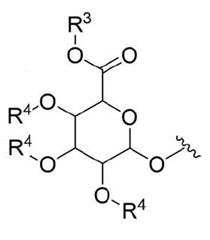
여기에서,From here,
R3는 수소 또는 카르복실 보호기이고,R 3 is hydrogen or a carboxyl protecting group,
각 R4는 각각 독립적으로 수소 또는 하이드록실 보호기이다.each R 4 is each independently hydrogen or a hydroxyl protecting group.
본 발명의 일 양태에서, R3는 수소이고, 각 R4는 수소이다.In one aspect of the invention, R 3 is hydrogen and each R 4 is hydrogen.
본 발명의 일 양태에서, W는 -C(O)NR'-이고, 여기에서 C(O)가 페닐환과 연결되며, NR'은 L과 연결된다.In one embodiment of the present invention, W is -C(O)NR'-, wherein C(O) is linked to a phenyl ring and NR' is linked to L.
본 발명의 일 양태에서, Z는 수소이고, n은 3이다.In one aspect of the invention, Z is hydrogen and n is 3.
본 발명의 일 양태에서, R1 및 R2는 각각 수소이다.In one aspect of the invention, R 1 and R 2 are each hydrogen.
본 발명의 일 양태에서, G는 하기 화학식 (IIIa) 구조의 화합물이고:In one aspect of the invention, G is a compound of the structure (IIIa):
[화학식 (IIIa)][Formula (IIIa)]

여기에서,From here,
R3는 수소 또는 카르복실 보호기이고,R 3 is hydrogen or a carboxyl protecting group,
각 R4는 각각 독립적으로 수소 또는 하이드록실 보호기이며,each R 4 is each independently hydrogen or a hydroxyl protecting group,
W는 -C(O)NR'-이고, 여기에서 C(O)가 페닐환과 연결되며 NR'은 L과 연결되고, 각 Z는 수소이며, n은 3이고, m은 1이며, R1 및 R2는 각각 수소이다.W is -C(O)NR'-, wherein C(O) is linked to a phenyl ring and NR' is linked to L, each Z is hydrogen, n is 3, m is 1, R 1 and R 2 is each hydrogen.
본 발명의 일 양태에서, 최소 하나의 브랜칭 유닛은 1 내지 100개의 탄소 원자를 갖는 알킬렌이고, 여기에서 알킬렌의 탄소 원자는, N, O 및 S로 이루어진 그룹으로부터 선택되는 하나 또는 그 이상의 헤테로원자로 치환될 수 있으며, 알킬렌은 1 내지 20개의 탄소원자를 갖는 하나 이상의 알킬로 더 치환될 수 있다.In one aspect of the invention, the at least one Branching Unit is an alkylene having from 1 to 100 carbon atoms, wherein the carbon atoms of the alkylene are one or more heteros selected from the group consisting of N, O and S. atom may be substituted, and the alkylene may be further substituted with one or more alkyl having 1 to 20 carbon atoms.
본 발명의 일 양태에서, 최소 하나의 브랜칭 유닛은 친수성 아미노산(hydrophilic amino acid)이다.In one aspect of the invention, at least one Branching Unit is a hydrophilic amino acid.
본 발명의 일 양태에서, 친수성 아미노산은 아르기닌, 아스파테이트, 아스파라긴, 글루타메이트, 글루타민, 히스티딘, 리신, 오르니틴, 프롤린, 세린, 또는 트레오닌일 수 있다.In one aspect of the present invention, the hydrophilic amino acid may be arginine, aspartate, asparagine, glutamate, glutamine, histidine, lysine, ornithine, proline, serine, or threonine.
본 발명의 일 양태에서, 친수성 아미노산은 수용액에서 중성 pH에서 전하를 갖는 잔기를 갖는 측쇄를 포함하는 아미노산일 수 있다.In one aspect of the present invention, the hydrophilic amino acid may be an amino acid comprising a side chain having a residue having a charge at neutral pH in aqueous solution.
본 발명의 일 양태에서, 친수성 아미노산은 아스파테이트 또는 글루타메이트이다.In one aspect of the invention, the hydrophilic amino acid is aspartate or glutamate.
본 발명의 일 양태에서, 친수성 아미노산은 오르니틴 또는 리신이다.In one aspect of the invention, the hydrophilic amino acid is ornithine or lysine.
본 발명의 일 양태에서, 친수성 아미노산은 아르기닌이다.In one aspect of the invention, the hydrophilic amino acid is arginine.
본 발명의 일 양태에서, 최소 하나의 브랜칭 유닛은 -C(O)-, -C(O)NR'-, -C(O)O-, -S(O)2NR'-, -P(O)R''NR'-, -S(O)NR'-, 또는 -PO2NR'-이고, R' 및 R''은 각각 독립적으로 수소, (C1-C8)알킬, (C3-C8)사이클로알킬, (C1-C8)알콕시, (C1-C8)알킬티오, 모노- 또는 디-(C1-C8)알킬아미노, (C3-C20)헤테로아릴, 또는 (C6-C20)아릴이다.In one aspect of the invention, at least one Branching Unit is -C(O)-, -C(O)NR'-, -C(O)O-, -S(O) 2 NR'-, -P( O)R''NR'-, -S(O)NR'-, or -PO 2 NR'-, wherein R' and R'' are each independently hydrogen, (C 1 -C 8 )alkyl, (C 3 -C 8 )cycloalkyl, (C 1 -C 8 )alkoxy, (C 1 -C 8 )alkylthio, mono- or di-(C 1 -C 8 )alkylamino, (C 3 -C 20 )hetero aryl, or (C 6 -C 20 )aryl.
본 발명의 일 양태에서, 최소 하나의 브랜칭 유닛은 -C(O)NR'-이고, R'은 수소이다.In one aspect of the invention, at least one Branching Unit is -C(O)NR'- and R' is hydrogen.
본 발명의 일 양태에서, 최소 하나의 커넥션 유닛은 -(CH2)r(V(CH2)p)q- 이고, 여기에서 r은 0 내지 10의 정수이며, p은 0 내지 12의 정수이고, q는 1 내지 20의 정수이며, V는 단일결합, -O- 또는 -S-이다.In one aspect of the invention, at least one Connection Unit is -(CH 2 ) r (V(CH 2 ) p ) q - , wherein r is an integer from 0 to 10, p is an integer from 0 to 12, and , q is an integer from 1 to 20, and V is a single bond, -O- or -S-.
본 발명의 일 양태에서, r은 2이다.In one aspect of the invention, r is 2.
본 발명의 일 양태에서, p은 2이다.In one aspect of the invention, p is 2.
본 발명의 일 양태에서, q는 6 내지 20의 정수이다.In one aspect of the invention, q is an integer from 6 to 20.
본 발명의 일 양태에서, r은 2이고, p은 2이며, q는 2, 4, 5 또는 11이고, V는 -O-이다.In one aspect of the invention, r is 2, p is 2, q is 2, 4, 5 or 11, and V is -O-.
본 발명의 일 양태에서, 최소 하나의 커넥션 유닛은 최소 하나의 폴리에틸렌 글리콜 유닛이고, 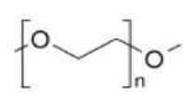

본 발명의 일 양태에서, 최소 하나의 커넥션 유닛은 1 내지 12 -OCH2CH2-유닛, 또는 5 내지 12 -OCH2CH2-유닛, 또는 6 내지 12 -OCH2CH2-유닛이다.In one aspect of the invention, the at least one Connection Unit is 1 to 12 -OCH 2 CH 2 -units, or 5 to 12 -OCH 2 CH 2 -units, or 6 to 12 -OCH 2 CH 2 -units.
본 발명의 일 양태에서, 최소 하나의 커넥션 유닛은 -(CH2CH2X)w-이고,In one aspect of the invention, at least one Connection Unit is -(CH 2 CH 2 X) w -,
여기에서 X는 단일 결합, -O-, (C1-C8)알킬렌, 또는 -NR21-이고;wherein X is a single bond, —O—, (C 1 -C 8 )alkylene, or —NR 21 —;
R21은 수소, (C1-C6)알킬, (C1-C6)알킬(C6-C20)아릴, 또는 (C1-C6)알킬 (C3-C20)헤테로아릴이며,R 21 is hydrogen, (C 1 -C 6 )alkyl, (C 1 -C 6 )alkyl(C 6 -C 20 )aryl, or (C 1 -C 6 )alkyl (C 3 -C 20 )heteroaryl; ,
w는 1 내지 20의 정수이고, 구체적으로는 1, 3, 6, 또는 12이다.w is an integer of 1 to 20, specifically 1, 3, 6, or 12.
본 발명의 일 양태에서 X는 -O-이고, w는 6 내지 20의 정수이다.In one embodiment of the present invention, X is -O-, and w is an integer from 6 to 20.
본 발명의 일 양태에서, Linker는 1,3-dipolar cycloaddition 반응, hetero-Diels-Alder 반응, 친핵성 치환(nucleophilic substitution) 반응, 비-알돌형 카르보닐 반응, 탄소-탄소 다중 결합 첨가(addition to carbon-carbon multiple bond), 산화 반응 또는 클릭 반응에 의해 형성된 바인딩 유닛을 추가로 포함한다.In one aspect of the present invention, Linker is 1,3-dipolar cycloaddition reaction, hetero-Diels-Alder reaction, nucleophilic substitution reaction, non-aldol-type carbonyl reaction, carbon-carbon multiple bond addition (addition to carbon-carbon multiple bond), and a binding unit formed by an oxidation reaction or a click reaction.
본 발명의 일 양태에서, 바인딩 유닛은 아세틸렌 및 아자이드 사이의 반응, 또는 알데하이드 또는 케톤기 및 하이드라진 또는 알콕시아민 사이의 반응에 의해 형성된다.In one aspect of the invention, the binding unit is formed by a reaction between an acetylene and an azide, or between an aldehyde or ketone group and a hydrazine or alkoxyamine.
본 발명의 일 양태에서, 바인딩 유닛은,In one aspect of the present invention, the binding unit comprises:

이고,ego,
여기에서,From here,
L1은 단일 결합 또는 1 내지 30개의 탄소원자를 갖는 알킬렌이고,L 1 is a single bond or alkylene having 1 to 30 carbon atoms,
R11은 수소 또는 1 내지 10개의 탄소원자를 갖는 알킬이며, 구체적으로 메틸이고,R 11 is hydrogen or alkyl having 1 to 10 carbon atoms, specifically methyl;
L2는 1 내지 30개의 탄소원자를 갖는 알킬렌이다.L 2 is alkylene having 1 to 30 carbon atoms.
본 발명의 일 양태에서, Linker는 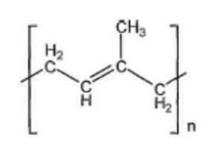
본 발명의 일 양태에서, 최소 하나의 이소프레닐 유닛은 이소프레노이드 트랜스퍼라제의 기질 또는 이소프레노이드 트랜스퍼라제의 생성물이다.In one aspect of the invention, the at least one isoprenyl unit is a substrate of an isoprenoid transferase or a product of an isoprenoid transferase.
본 발명의 일 양태에서, Linker의 이소프레닐 유닛은 티오에테르 결합에 의해 항체와 공유결합하며, 티오에테르 결합은 항체의 시스테인의 황원자를 포함한다.In one embodiment of the present invention, the isoprenyl unit of Linker is covalently bound to the antibody by a thioether bond, the thioether bond comprising the sulfur atom of the cysteine of the antibody.
본 발명의 일 양태에서, 항체는 이소프레노이드 트랜스퍼라제에 의해 인식되는 아미노산 모티프를 포함하고, 티오에테르 결합은 아미노산 모티프의 시스테인의 황원자를 포함한다.In one embodiment of the invention, the antibody comprises an amino acid motif recognized by isoprenoid transferase, and the thioether bond comprises a sulfur atom of a cysteine of the amino acid motif.
본 발명의 일 양태에서, B7-H3에 결합하는 항체 또는 이의 항원 결합 단편은 이소프레노이드 트랜스퍼라제에 의해 인식되는 아미노산 모티프를 포함하고, 티오에테르 결합은 아미노산 모티프의 시스테인의 황원자를 포함한다.In one embodiment of the present invention, the antibody or antigen-binding fragment thereof that binds to B7-H3 comprises an amino acid motif recognized by isoprenoid transferase, and the thioether bond comprises a sulfur atom of a cysteine of the amino acid motif.
본 발명의 일 양태에서, 아미노산 모티프는 CXX, CXC, XCXC, XXCC, 및 CYYX로 이루어진 그룹으로부터 선택되는 서열이고, 여기에서 C는 시스테인을 나타내며; Y는 각 경우 독립적으로 지방족 아미노산을 나타내고; X는 각 경우 독립적으로 글루타민, 글루타메이트, 세린, 시스테인, 메티오닌, 알라닌, 또는 루신을 나타내고; 티오에테르 결합은 아미노산 모티프의 시스테인의 황원자를 포함한다.In one aspect of the invention, the amino acid motif is a sequence selected from the group consisting of CXX, CXC, XCXC, XXCC, and CYYX, wherein C represents cysteine; Y at each occurrence independently represents an aliphatic amino acid; X independently for each occurrence represents glutamine, glutamate, serine, cysteine, methionine, alanine, or leucine; The thioether linkage contains the sulfur atom of the cysteine of the amino acid motif.
본 발명의 일 양태에서, 아미노산 모티프는 CYYX 서열이고, Y는 각 경우 독립적으로 알라닌, 이소루신, 루신, 메티오닌 또는 발린이다.In one aspect of the present invention, the amino acid motif is the sequence CYYX, and Y for each occurrence is independently alanine, isoleucine, leucine, methionine or valine.
본 발명의 일 양태에서, 아미노산 모티프는 CVIM 또는 CVLL 서열이다.In one aspect of the invention, the amino acid motif is a CVIM or CVLL sequence.
본 발명의 일 양태에서, 아미노산 모티프에 선행하는 1 내지 20개의 아미노산 중 적어도 하나는 글리신이다.In one aspect of the invention, at least one of the 1 to 20 amino acids preceding the amino acid motif is glycine.
본 발명의 일 양태에서, 아미노산 모티프에 선행하는 1 내지 20개의 아미노산 중 1개 이상이 글리신, 아르기닌, 아스파르트산 및 세린으로부터 각각 독립적으로 선택될 수 있다.In one aspect of the invention, one or more of the 1 to 20 amino acids preceding the amino acid motif may each be independently selected from glycine, arginine, aspartic acid and serine.
본 발명의 일 양태에서, 아미노산 모티프에 선행하는 1 내지 20개의 아미노산이 글리신, 구체적으로는 아미노산 모티프에 선행하는 최소 1, 2, 3, 4, 5, 6, 7, 8, 9, 10, 11, 12, 13, 14, 15, 16, 17, 18, 19 또는 20개의 아미노산은 글리신이다.In one aspect of the invention, 1 to 20 amino acids preceding the amino acid motif are glycine, in particular at least 1, 2, 3, 4, 5, 6, 7, 8, 9, 10, 11 , 12, 13, 14, 15, 16, 17, 18, 19 or 20 amino acids are glycine.
본 발명의 일 양태에서, 항체는 GGGGGGGCVIM의 아미노산 서열을 포함할 수 있다.In one aspect of the present invention, the antibody may comprise the amino acid sequence of GGGGGGGCVIM.
본 발명의 또 다른 일 양태에서, Linker는,In another aspect of the present invention, Linker,
(a) 하나 이상의 브랜칭 유닛; (b) 하나 이상의 커넥션 유닛; (c)하나 이상의 바인딩 유닛(binding unit, BU); 및 (d) 하나 이상의 트리거 유닛(trigger unit, TU)을 함유하는 것일 수 있다.(a) one or more branching units; (b) one or more connection units; (c) one or more binding units (BUs); and (d) one or more trigger units (TUs).
여기에서 커넥션 유닛은 트리거 유닛과 바인딩 유닛, 트리거 유닛과 브랜칭 유닛 또는 브랜칭 유닛과 바인딩 유닛을 연결하고,Here, the connection unit connects the trigger unit and the binding unit, the trigger unit and the branching unit, or the branching unit and the binding unit,
여기에서 하나 이상의 트리거 유닛은 하나 이상의 약물 또는 톡신을 방출할 수 있으며,wherein the one or more trigger units are capable of releasing one or more drugs or toxins,
여기에서 브랜칭 유닛은 커넥션 유닛과 트리거 유닛, 또는 커넥션 유닛을 또 다른 커넥션 유닛과 연결하는 것이다.Here, the branching unit connects a connection unit and a trigger unit, or a connection unit to another connection unit.
본 발명의 일 양태에서, 트리거 유닛은 다음 화학식 (IIb)의 구조를 갖는다:In one aspect of the invention, the trigger unit has the structure of formula (IIb):
[화학식 (IIb)][Formula (IIb)]

상기 식에서,In the above formula,
G는 당(sugar), 당산(sugar acid), 또는 당 유도체(sugar derivatives)이고,G is a sugar, sugar acid, or sugar derivatives;
W는 -C(O)-, -C(O)NR'-, -C(O)O-, -S(O)2NR'-, -P(O)R''NR'-, -S(O)NR'-, 또는 -PO2NR'-이고,W is -C(O)-, -C(O)NR'-, -C(O)O-, -S(O) 2 NR'-, -P(O)R''NR'-, -S (O)NR'-, or -PO 2 NR'-,
C(O), S, 또는 P가 페닐환과 바로 연결되는 경우, R' 및 R''은 각각 독립적으로 수소, (C1-C8)알킬, (C3-C8)사이클로알킬, (C1-C8)알콕시, (C1-C8)알킬티오, 모노- 또는 디-(C1-C8)알킬아미노, (C3-C20)헤테로아릴, 또는 (C6-C20)아릴이며, W는 커넥션 유닛 또는 브랜칭 유닛과 연결되고,When C(O), S, or P is directly connected to the phenyl ring, R' and R'' are each independently hydrogen, (C 1 -C 8 )alkyl, (C 3 -C 8 )cycloalkyl, (C 1 -C 8 )alkoxy, (C 1 -C 8 )alkylthio, mono- or di-(C 1 -C 8 )alkylamino, (C 3 -C 20 )heteroaryl, or (C 6 -C 20 ) aryl, W is connected to a connection unit or a branching unit,
각 Z는 각각 독립적으로 수소, (C1-C8)알킬, 할로겐, 시아노 또는 나이트로이고,each Z is independently hydrogen, (C 1 -C 8 )alkyl, halogen, cyano or nitro;
n은 1 내지 3의 정수이며,n is an integer from 1 to 3,
m은 0 또는 1이고,m is 0 or 1,
R1 및 R2는 각각 독립적으로 수소, (C1-C8)알킬 또는 (C3-C8)사이클로알킬이거나, 또는 R1 및 R2는 이들이 부착된 탄소 원자와 함께 (C3-C8)사이클로알킬 환을 형성한다.R 1 and R 2 are each independently hydrogen, (C 1 -C 8 )alkyl or (C 3 -C 8 )cycloalkyl, or R 1 and R 2 together with the carbon atom to which they are attached (C 3 -C 8 ) to form a cycloalkyl ring.
본 발명의 일 양태에서, 상기 당 또는 당산은 모노사카라이드이다.In one aspect of the present invention, the sugar or sugar acid is a monosaccharide.
본 발명의 일 양태에서, G는 하기 화학식 (IIIa) 구조의 화합물이다:In one aspect of the invention, G is a compound of the structure (IIIa):
[화학식 (IIIa)][Formula (IIIa)]

여기에서,From here,
R3는 수소 또는 카르복실 보호기이고,R 3 is hydrogen or a carboxyl protecting group,
각 R4는 각각 독립적으로 수소 또는 하이드록실 보호기이다.each R 4 is each independently hydrogen or a hydroxyl protecting group.
본 발명의 일 양태에서, R3는 수소이고, 각 R4는 수소이다.In one aspect of the invention, R 3 is hydrogen and each R 4 is hydrogen.
본 발명의 일 양태에서, W는 -C(O)NR'-이고, 여기에서 C(O)가 페닐환과 연결되며, NR'은 커넥션 유닛과 연결된다.In one embodiment of the present invention, W is -C(O)NR'-, wherein C(O) is connected to a phenyl ring and NR' is connected to a connection unit.
본 발명의 일 양태에서, Z는 수소이다.In one aspect of the invention, Z is hydrogen.
본 발명의 일 양태에서, R1 및 R2는 각각 수소이다.In one aspect of the invention, R 1 and R 2 are each hydrogen.
본 발명의 일 양태에서, 커넥션 유닛은 -(CH2)r(V(CH2)p)q-, -((CH2)pV)q-, -(CH2)r(V(CH2)p)qY-, -((CH2)pV)q(CH2)r-, -Y((CH2)pV)q- 또는 -(CH2)r(V(CH2)p)qYCH2-로 나타내지며,In one aspect of the invention, the Connection Unit is -(CH 2 ) r (V(CH 2 ) p ) q -, -((CH 2 ) p V) q -, -(CH 2 ) r (V(CH 2 ) ) p ) q Y-, -((CH 2 ) p V) q (CH 2 ) r -, -Y((CH 2 ) p V) q - or -(CH 2 ) r (V(CH 2 ) p ) represented by q YCH 2 -,
여기에서,From here,
r은 0 내지 10의 정수이고;r is an integer from 0 to 10;
p는 1 내지 10의 정수이며;p is an integer from 1 to 10;
q는 1 내지 20의 정수이고,q is an integer from 1 to 20,
V 및 Y는 각각 독립적으로 단일결합, -O-, -S-, -NR21-, -C(O)NR22-, -NR23C(O)-, -NR24SO2-, 또는 -SO2NR25-이고,V and Y are each independently a single bond, -O-, -S-, -NR 21 -, -C(O)NR 22 -, -NR 23 C(O)-, -NR 24 SO 2 -, or - SO 2 NR 25 -,
R21 내지 R25는 각각 독립적으로 수소, (C1-C6)알킬, (C1-C6)알킬(C6-C20)아릴 또는 (C1-C6)알킬(C3-C20)헤테로아릴이다.R 21 to R 25 are each independently hydrogen, (C 1 -C 6 )alkyl, (C 1 -C 6 )alkyl(C 6 -C 20 )aryl or (C 1 -C 6 )alkyl(C 3 -C 20 ) Heteroaryl.
본 발명의 일 양태에서, r은 2이다.In one aspect of the invention, r is 2.
본 발명의 일 양태에서, p는 2이다.In one aspect of the invention, p is 2.
본 발명의 일 양태에서, q는 6 내지 20의 정수이다.In one aspect of the invention, q is an integer from 6 to 20.
본 발명의 일 양태에서, q는 2, 5, 또는 11이다.In one aspect of the invention, q is 2, 5, or 11.
본 발명의 일 양태에서, V 및 Y는 각각 독립적으로 -O-이다.In one aspect of the invention, V and Y are each independently -O-.
본 발명의 일 양태에서, 브랜칭 유닛은,In one aspect of the present invention, the branching unit comprises:

이고,ego,
여기에서,From here,
L1, L2, 및 L3는 각각 독립적으로 직접 결합(direct bond) 또는 -CnH2n- 이고,L 1 , L 2 , and L 3 are each independently a direct bond or —C n H 2n —,
여기에서 n은 1 내지 30의 정수이며,where n is an integer from 1 to 30,
여기에서, G1, G2, G3는 각각 독립적으로 직접 결합, 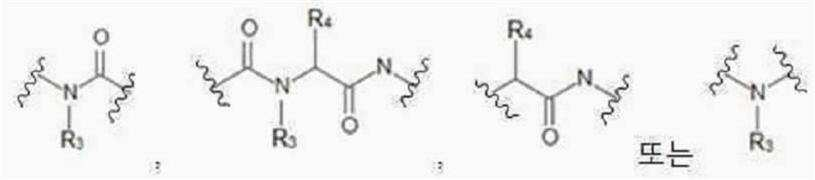
여기에서 R3는 수소 또는 C1-C30알킬이며,wherein R 3 is hydrogen or C 1 -C 30 alkyl,
여기에서 R4는 수소 또는 -L4-COOR5이고, 여기에서 L4는 직접 결합 또는 -CnH2n- 이고 여기에서 n은 1 내지 10의 정수이며, R5는 수소 또는 C1-C30 알킬이다.wherein R 4 is hydrogen or -L 4 -COOR 5 , wherein L 4 is a direct bond or -C n H 2n - wherein n is an integer from 1 to 10, and R 5 is hydrogen or C 1 -C 30 alkyl.
본 발명의 일 양태에서, 브랜칭 유닛은 
여기에서 L1은 직접 결합 또는 1 내지 30개의 탄소원자를 갖는 알킬렌이고,wherein L 1 is a direct bond or alkylene having 1 to 30 carbon atoms,
R11은 수소 또는 1 내지 10개의 탄소원자를 갖는 알킬이며, 구체적으로 메틸이고,R 11 is hydrogen or alkyl having 1 to 10 carbon atoms, specifically methyl;
L2는 1 내지 30개의 탄소원자를 갖는 알킬렌이고,L 2 is alkylene having 1 to 30 carbon atoms,
여기에서 브랜칭 유닛은 커넥션 유닛과 항체를 연결한다.Here, the branching unit connects the connection unit and the antibody.
본 발명의 일 양태에서, L1은 12개의 탄소원자를 갖는 알킬렌이다.In one aspect of the invention, L 1 is alkylene having 12 carbon atoms.
본 발명의 일 양태에서, R11은 메틸이다.In one aspect of the invention, R 11 is methyl.
본 발명의 일 양태에서, L2는 11개의 탄소원자를 갖는 알킬렌이다.In one aspect of the invention, L 2 is alkylene having 11 carbon atoms.
본 발명의 일 양태에서, 바인딩 유닛은 티오에테르 결합에 의해 항체와 공유결합하며, 티오에테르 결합은 항체의 시스테인의 황원자를 포함한다.In one embodiment of the present invention, the Binding Unit is covalently bound to the antibody by a thioether bond, the thioether bond comprising the sulfur atom of a cysteine of the antibody.
본 발명의 일 양태에서, 항체는 이소프레노이드 트랜스퍼라제에 의해 인식되는 아미노산 모티프를 포함하고, 티오에테르 결합은 아미노산 모티프의 시스테인의 황원자를 포함한다.In one embodiment of the invention, the antibody comprises an amino acid motif recognized by isoprenoid transferase, and the thioether bond comprises a sulfur atom of a cysteine of the amino acid motif.
본 발명의 일 양태에서, 아미노산 모티프는 CXX, CXC, XCXC, XXCC, 및 CYYX로 이루어진 그룹으로부터 선택되는 서열이고, 여기에서 C는 시스테인을 나타내며; Y는 각 경우 독립적으로 지방족 아미노산을 나타내고; X는 각 경우 독립적으로 글루타민, 글루타메이트, 세린, 시스테인, 메티오닌, 알라닌, 또는 루신을 나타내고; 티오에테르 결합은 아미노산 모티프의 시스테인의 황원자를 포함한다.In one aspect of the invention, the amino acid motif is a sequence selected from the group consisting of CXX, CXC, XCXC, XXCC, and CYYX, wherein C represents cysteine; Y at each occurrence independently represents an aliphatic amino acid; X independently for each occurrence represents glutamine, glutamate, serine, cysteine, methionine, alanine, or leucine; The thioether linkage contains the sulfur atom of the cysteine of the amino acid motif.
본 발명의 일 양태에서, 아미노산 모티프는 CYYX 서열이고, Y는 각 경우 독립적으로 알라닌, 이소루신, 루신, 메티오닌 또는 발린이다.In one aspect of the present invention, the amino acid motif is the sequence CYYX, and Y for each occurrence is independently alanine, isoleucine, leucine, methionine or valine.
본 발명의 일 양태에서, 아미노산 모티프는 CVIM 또는 CVLL 서열이다.In one aspect of the invention, the amino acid motif is a CVIM or CVLL sequence.
본 발명의 일 양태에서, 아미노산 모티프에 선행하는 1 내지 20개의 아미노산 중 적어도 하나는 글리신이다.In one aspect of the invention, at least one of the 1 to 20 amino acids preceding the amino acid motif is glycine.
본 발명의 일 양태에서, 아미노산 모티프에 선행하는 1 내지 20개의 아미노산 중 1개 이상이 글리신, 아르기닌, 아스파르트산 및 세린으로부터 각각 독립적으로 선택될 수 있다.In one aspect of the invention, one or more of the 1 to 20 amino acids preceding the amino acid motif may each be independently selected from glycine, arginine, aspartic acid and serine.
본 발명의 일 양태에서, 아미노산 모티프에 선행하는 1 내지 20개의 아미노산이 글리신, 구체적으로는 아미노산 모티프에 선행하는 최소 1, 2, 3, 4, 5, 6, 7, 8, 9, 10, 11, 12, 13, 14, 15, 16, 17, 18, 19 또는 20개의 아미노산은 글리신이다.In one aspect of the invention, 1 to 20 amino acids preceding the amino acid motif are glycine, in particular at least 1, 2, 3, 4, 5, 6, 7, 8, 9, 10, 11 , 12, 13, 14, 15, 16, 17, 18, 19 or 20 amino acids are glycine.
본 발명의 일 양태에서, 항체는 GGGGGGGCVIM의 아미노산 서열을 포함할 수 있다.In one aspect of the present invention, the antibody may comprise the amino acid sequence of GGGGGGGCVIM.
또한, 본 발명의 일 양태에서, 활성제는 화학요법제 또는 톡신일 수 있다.Also, in one aspect of the present invention, the active agent may be a chemotherapeutic agent or a toxin.
또한, 활성제는 면역 조절 화합물, 항암제, 항바이러스제, 항균제, 항진균제, 항기생충제 또는 이들의 조합일 수 있고, 하기 나열된 활성제 중 선택적으로 사용할 수 있다:In addition, the active agent may be an immunomodulatory compound, an anticancer agent, an antiviral agent, an antibacterial agent, an antifungal agent, an antiparasitic agent, or a combination thereof, and may optionally be used among the active agents listed below:
(a) 엘로티닙(erlotinib), 보르테조밉(bortezomib), 풀베스트란트(fulvestrant), 수텐트(sutent), 레트로졸(letrozole), 이마티닙 메실레이트(imatinib mesylate), PTK787/ZK 222584, 옥살리플라틴(oxaliplatin), 5-플루오로우라실(5-fluorouracil), 루코보린(leucovorin), 라파마이신(rapamycin), 라파티닙(lapatinib), 로나파르닙(lonafarnib), 소라페닙(sorafenib), 제피티닙(gefitinib), AG1478, AG1571, 티오테파(thiotepa), 사이클로포스파마이드(cyclophosphamide), 부술판(busulfan), 임프로술판(improsulfan), 피포술판(piposulfan), 벤조도파(benzodopa), 카르보콘(carboquone), 메츄도파(meturedopa), 유레도파(uredopa), 에틸렌이민(ethylenimine), 알트레타민(altretamine), 트리에틸렌멜라민(triethylenemelamine), 트리에틸렌포스포라미드(trietylenephosphoramide), 트리에틸렌티오포스포라미드(triethiylenethiophosphoramide), 트리메틸롤로멜라민(trimethylolomelamine), 불라타신(bullatacin), 불라타시논(bullatacinone), 캄토테신(camptothecin), 토포테칸(topotecan), 브리오스타틴(bryostatin), 칼리스타틴(callystatin), CC-1065, 아도젤레신(adozelesin), 카르젤레신(carzelesin), 비젤레신(bizelesin), 크립토피신 1(cryptophycin 1), 크립토피신 8(cryptophycin 8), 돌라스타틴(dolastatin), 듀오카마이신(duocarmycin), KW-2189, CB1-TM1, 엘루테로빈(eleutherobin), 판크라티스타틴(pancratistatin), 사르코딕티인(sarcodictyin), 스폰지스타틴(spongistatin), 클로람부실(chlorambucil), 클로르나파진(chlornaphazine), 클로로포스파미드(cholophosphamide), 에스트라무스틴(estramustine), 이포스파미드(ifosfamide), 메클로르에타민(mechlorethamine), 멜팔란(melphalan), 노벰비킨(novembichin), 페네스테린(phenesterine), 프레드니무스틴(prednimustine), 트로포스파미드(trofosfamide), 우라실 머스타드(uracil mustard), 카르무스틴(carmustine), 클로로코토신(chlorozotocin), 포테쿠스틴(fotemustine), 로무스틴(lomustine), 니무스틴(nimustine), 라니무스틴(ranimnustine), 칼리키아미신(calicheamicin), 칼리키아미신 감마 1(calicheamicin gamma 1), 칼리키아미신 오메가 1(calicheamicin omega 1), 디네미신(dynemicin), 디네미신 A(dynemicin A), 클로드로네이트(clodronate), 에스페르아미신(esperamicin), 네오카르지노스타틴크로모포어(neocarzinostatin chromophore), 아클라시노마이신(aclacinomysins), 악티노마이신(actinomycin), 안트르마이신(antrmycin), 아자세린(azaserine), 블레오마이신(bleomycins), 칵티노마이신(cactinomycin), 카라비신(carabicin), 카르니노마이신(carninomycin), 카르지노필린(carzinophilin), 크로모마이신(chromomycins), 닥티노마이신(dactinomycin), 다우노루비신(daunorubicin), 데토루부신(detorubucin), 6-디아조-5-옥소-L-노르루신(6-diazo-5-oxo-L-norleucine), 독소루비신(doxorubicin), 모르폴리노-독소루비신(morpholino-doxorubicin), 시아노모르폴리노-독소루비신(cyanomorpholino-doxorubicin), 2-피롤리노-독소루비신(2-pyrrolino-doxorubucin), 리포소말 독소루비신(liposomal doxorubicin), 데옥시독소루비신(deoxydoxorubicin), 에피루비신(epirubicin), 에소루비신(esorubicin), 마르셀로마이신(marcellomycin), 미토마이신 C(mitomycin C), 미코페놀산(mycophenolic acid), 노갈라마이신(nogalamycin), 올리보마이신(olivomycins), 페플로마이신(peplomycin), 포트피로마이신(potfiromycin), 퓨로마이신(puromycin), 쿠엘라마이신(quelamycin), 로도루비신(rodorubicin), 스트렙토미그린(streptomigrin), 스트렙토조신(streptozocin), 투베르시딘(tubercidin), 우베니멕스(ubenimex), 지노스타틴(zinostatin), 조루비신(zorubicin), 5-플루오로우라신(5-fluorouracil), 데노프테린(denopterin), 메토트렉세이트(methotrexate), 프테로프테린(pteropterin), 트리메트렉세이트(trimetrexate), 플루다라빈(fludarabine), 6-머캅토퓨린(6-mercaptopurine), 티아미프린(thiamiprine), 티구아닌(thiguanine), 안시타빈(ancitabine), 아자시티딘(azacitidine), 6-아자유리딘(6-azauridine), 카르모푸르(carmofur), 시타라빈(cytarabine), 디데옥시유리딘(dideoxyuridine), 독시플루리딘(doxifluridine), 에노시타빈(enocitabine), 플록수리딘(floxuridine), 칼루스테론(calusterone), 드로모스타놀론(dromostanolone), 프로피오네이트(propionate), 에피티오스타놀(epitiostanol), 메피티오스테인(mepitiostane), 테스토락톤(testolactone), 아미노글루테티미드(aminoglutethimide), 미토테인(mitotane), 트릴로스테인(trilostane), 폴린산(folinic acid), 아세글라톤(aceglatone), 알도포스파미드 글리코사이드(aldophosphamide glycoside), 아미노레불린산(aminolevulinic acid), 에닐우라실(eniluracil), 암사크린(amsacrine), 베스트라부실(bestrabucil), 비산트렌(bisantrene), 에다트락세이트(edatraxate), 데포파민(defofamine), 데메콜신(demecolcine), 디아지콘(diaziquone), 엘포르니틴(elfornithine), 엘립티니움 아세테이트(elliptinium acetate), 에토글루시드(etoglucid), 갈리움 나이트레이트(gallium nitrate), 하이드록시우레아(hydroxyurea), 렌티난(lentinan), 로니다이닌(lonidainine), 메이탄신(maytansine), 안사미토신(ansamitocins), 미토구아존(mitoguazone), 미토잔트론(mitoxantrone), 모피단몰(mopidanmol), 니트라에린(nitraerine), 펜토스타틴(pentostatin), 페나메트(phenamet), 피라루비신(pirarubicin), 로소잔트론(losoxantrone), 2-에틸하이드라지드(2-ethylhydrazide), 프로카르바진(procarbazine), 폴리사카라이드-k(polysaccharidek), 라족세인(razoxane), 리조신(rhizoxin), 시조피란(sizofiran), 스피로게르마늄(spirogermanium), 테누아존산(tenuazonic acid), 트리아지콘(triaziquone), 2,2',2''-트리클로로트리에틸아민(2,2',2''-trichlorotriethylamine), T-2 톡신, 베라큐린 A(verracurin A), 로리딘 A(roridin A), 안구이딘(anguidine), 우레탄(urethane), 빈데신(vindesine), 다카르바진(dacarbazine), 만노무스틴(mannomustine), 미토브로니톨(mitobronitol), 미토락톨(mitolactol), 피포브로만(pipobroman), 가시토신(gacytosine), 아라비노사이드(arabinoside), 사이클로포스파미드(cyclophosphamide), 티오테파(thiotepa), 파클리탁셀(paclitaxel), 파클리탁셀, 파클리탁셀의 알부민-엔지니어드 나노파티클(albumin-engineered nanoparticle formulation of paclitaxel), 도세탁셀, 클로람부실, 젬시타빈, 6-티오구아닌, 머캅토퓨린, 시스플라틴, 카보플라틴(carboplatin), 빈블라스틴(vinblastine), 플래티늄(platinum), 에토포사이드(etoposide), 이포스파미드(ifosfamide), 미톡산트론(mitoxantrone), 빈크리스틴, 비노렐빈(vinorelbine), 노반트론(novantrone), 테니포사이드(teniposide), 에다트렉세이트(edatrexate), 다우노마이신(daunomycin), 아미노프테린(aminopterin), 젤로다(xeloda), 이반드로네이트(ibandronate), CPT-11, 토포이소머라아제 저해제 RFS 2000, 디플루오로메틸오르니틴(difluoromethylornithine), 레티노산(retinoic acid), 카페시타빈(capecitabine), 또는 이의 약학적으로 허용되는 염, 용매화물 또는 산;(a) erlotinib, bortezomib, fulvestrant, sutent, letrozole, imatinib mesylate, PTK787/ZK 222584, oxaliplatin ( oxaliplatin), 5-fluorouracil, leucovorin, rapamycin, lapatinib, lonafarnib, sorafenib, gefitinib , AG1478, AG1571, thiotepa, cyclophosphamide, busulfan, improsulfan, piposulfan, benzodopa, carboquone, Meturedopa, uredopa, ethylenimine, altretamine, triethylenemelamine, triethylenephosphoramide, triethylenethiophosphoramide , trimethylolomelamine, bullatacin, bullatacinone, camptothecin, topotecan, bryostatin, callistatin, CC-1065, ado Zelesin (adozelesin), carzelesin (carzelesin), bizelesin (bizelesin), cryptophycin 1 (cryptophycin 1), cryptophycin 8 (cryptophycin 8), dolastatin (dolastatin), duocarmycin (duocarmycin), KW- 2189, CB1-TM1, eleutherobin, pancratistatin, sarcodictyin, spongistatin, chlorambucil, chlornaphazine, cholophosphamide, estramustine, ifosfamide, meth Chlorethamine, melphalan, novembichin, phenesterine, prednimustine, trofosfamide, uracil mustard, carmustine (carmustine), chlorozotocin, fotemustine, lomustine, nimustine, ranimnustine, calicheamicin, calicheamicin gamma 1 ( calicheamicin gamma 1), calicheamicin omega 1, dynemicin, dynemicin A, clodronate, esperamicin, neocarzinostatin Neocarzinostatin chromophore, alacinomysins, actinomycin, anthrmycin, azaserine, bleomycins, cactinomycin, carabicin (carabicin), carninomycin, carzinophilin, chromomycins, dactinomycin, daunorubicin, detorubucin, 6-diazo -5-oxo-L-norleucine (6-diazo-5-oxo-L-norleucine), doxorubicin, morphol Rhino-doxorubicin, cyanomorpholino-doxorubicin, 2-pyrrolino-doxorubicin, liposomal doxorubicin, deoxydoxorubicin ), epirubicin, esorubicin, marcellomycin, mitomycin C, mycophenolic acid, nogalamycin, olivomycins , peplomycin, potfiromycin, puromycin, quelamycin, rodorubicin, streptomigrin, streptozocin, tuber Cidin, ubenimex, zinostatin, zorubicin, 5-fluorouracil, denopterin, methotrexate, pterop Terine (pteropterin), trimetrexate (trimetrexate), fludarabine (fludarabine), 6-mercaptopurine (6-mercaptopurine), thiamiprine (thiamiprine), thiguanine (thiguanine), ancitabine (ancitabine), Azacitidine, 6-azauridine, carmofur, cytarabine, dideoxyuridine, doxifluridine, enocitabine (enocitabine), floxuridine, calusterone, dromostanolone, propionate, Epithiostanol, mepitiostane, testolactone, aminoglutethimide, mitotane, trilostane, folinic acid, acegla aceglatone, aldophosphamide glycoside, aminolevulinic acid, eniluracil, amsacrine, bestrabucil, bisantrene, edatraxate, defofamine, demecolcine, diaziquone, elfornithine, elliptinium acetate, etoglucid, gallium nitrate, hydroxyurea, lentinan, lonidainine, maytansine, ansamitocins, mitoguazone, mitoxantrone (mitoxantrone), mopidanmol, nitraerine, pentostatin, phenamet, pirarubicin, losoxantrone, 2-ethylhydrazide (2) -ethylhydrazide), procarbazine, polysaccharide-k (polysaccharidek), razoxane, rhizoxin, sizofiran, spirogermanium, tenuazonic acid ), triaziquone, 2,2',2''-trichlorotriethylamine (2,2',2''-trichlorotriethylamine ), T-2 toxin, verracurin A, roridin A, anguidine, urethane, vindesine, dacarbazine, mannomustine ( mannomustine), mitobronitol, mitolactol, pipobroman, gacytosine, arabinoside, cyclophosphamide, thiotepa, Paclitaxel, paclitaxel, albumin-engineered nanoparticle formulation of paclitaxel, docetaxel, chlorambucil, gemcitabine, 6-thioguanine, mercaptopurine, cisplatin, carboplatin , vinblastine, platinum, etoposide, ifosfamide, mitoxantrone, vincristine, vinorelbine, novantrone, teniposide (teniposide), edatrexate, daunomycin, aminopterin, xeloda, ibandronate, CPT-11, topoisomerase inhibitor RFS 2000, difluoromethylornithine, retinoic acid, capecitabine, or a pharmaceutically acceptable salt, solvate or acid thereof;
(b) 모노카인(monokine), 림포카인(lympokine), 폴리펩타이드 호르몬(traditional polypeptide hormone), 부갑상선 호르몬(parathyroid hormone), 티록신(thyroxine), 릴렉신(relaxin), 프로릴렉신(prorelaxin), 당단백 호르몬(glycoprotein hormone), 여포자극호르몬(follicle stimulating hormone), 갑상샘자극호르몬(thyroid stimulating hormone), 황체형성호르몬(luteinizing hormone), 간 성장인자 섬유모세포성장인자(hepatic growth factor fibroblast growth factor), 프롤락틴(prolactin), 태반성 락토젠(placental lactogen), 종양괴사인자 (tumor necrosis factor), 종양괴사인자-α, 종양괴사인자-β, 뮐러관 억제물질(mullerian inhibiting substance), 마우스 고나도트로핀-연관 펩타이드(mouse gonadotropin associated peptide), 인히빈(inhibin), 액티빈(activin), 혈관내피증식인자(vascular endothelial growth factor), 트롬보포이에틴(thrombopoietin), 에리스로포이에틴(erythropoietin), 골유도 인자(osteoinductive factor), 인터페론, 인터페론-α, 인터페론-β, 인터페론-γ, 콜로니자극인자(colony stimulating factor, CSF), 마크로파지-CSF, 과립구-마크로파지-CSF(granulocyte-macrophage-CSF), 과립구-CSF, 인터루킨(IL), IL-1, IL-1α, IL-2, IL-3, IL-4, IL-5, IL-6, IL-7, IL-8, IL-9, IL-10, IL-11, IL-12, 종양괴사인자(tumor necrosis factor), 폴리펩타이드 인자, LIF, 키트 리간드(kit ligand), 또는 이들의 배합물;(b) monokine, lymphokine, traditional polypeptide hormone, parathyroid hormone, thyroxine, relaxin, prorelaxin, glycoprotein hormone, follicle stimulating hormone, thyroid stimulating hormone, luteinizing hormone, hepatic growth factor fibroblast growth factor, prolactin (prolactin), placental lactogen, tumor necrosis factor, tumor necrosis factor-α, tumor necrosis factor-β, mullerian inhibiting substance, mouse gonadotropin- mouse gonadotropin associated peptide, inhibin, activin, vascular endothelial growth factor, thrombopoietin, erythropoietin, osteoinductive factor), interferon, interferon-α, interferon-β, interferon-γ, colony stimulating factor (CSF), macrophage-CSF, granulocyte-macrophage-CSF (granulocyte-macrophage-CSF), granulocyte-CSF, interleukin (IL), IL-1, IL-1α, IL-2, IL-3, IL-4, IL-5, IL-6, IL-7, IL-8, IL-9, IL-10, IL- 11, IL-12, tumor necrosis factor, polypeptide factor, LIF, kit ligand a kit ligand, or a combination thereof;
(c) 디프테리아 톡신, 보툴리눔 톡신, 테타누스 톡신, 디센터리 톡신, 콜레라 톡신, 아마니틴, α-아마니틴, 피롤로벤조디아제핀, 피롤로벤조디아제핀 유도체, 인돌리노벤조디아제핀, 피리디노벤조디아제핀, 테트로도톡신, 브레베톡신(brevetoxin), 시구아톡신(ciguatoxin), 리신(ricin), AM 톡신, 오리스타틴(auristatin), 투불리신(tubulysin), 겔다나마이신(geldanamycin), 메이탄시노이드(maytansinoid), 칼리케아마이신(calicheamycin), 다우노마이신(daunomycin), 독소루비신(doxorubicin), 메토트렉세이트(methotrexate), 빈데신(vindesine), SG2285, 돌라스타틴(dolastatin), 돌라스타틴 유사체(dolastatin analog), 오리스타틴(auristatin), 크립토피신(cryptophycin), 캄토테신(camptothecin), 리족신(rhizoxin), 리족신 유도체(rhizoxin derivatives), CC-1065, CC-1065, 유사체 또는 유도체, 듀오카마이신(duocarmycin), 에네다인 항생제(enediyne antibiotic), 에스페라마이신(esperamicin), 에포틸론(epothilone), 톡소이드(toxoid), 또는 이들의 배합물;(c) diphtheria toxin, botulinum toxin, tetanus toxin, dicenritoxin, cholera toxin, amanitin, α-amanitine, pyrrolobenzodiazepine, pyrrolobenzodiazepine derivative, indolinobenzodiazepine, pyridinobenzodiazepine, tetrodotoxin, breve Toxin (brevetoxin), ciguatoxin (ciguatoxin), ricin (ricin), AM toxin, auristatin (auristatin), tubulysin (tubulysin), geldanamycin (geldanamycin), maytansinoid (maytansinoid), calichea mycin (calicheamycin), daunomycin (daunomycin), doxorubicin (doxorubicin), methotrexate (methotrexate), vindesine (vindesine), SG2285, dolastatin (dolastatin), dolastatin analog (dolastatin analog), auristatin, Cryptophycin, camptothecin, rhizoxin, rhizoxin derivatives, CC-1065, CC-1065, analogs or derivatives, duocarmycin, enediyne antibiotic), esperamicin, epothilone, toxoid, or a combination thereof;
(d) 친화성 리간드(affinity ligand), 여기에서 친화성 리간드는 기질, 저해제, 활성화제, 신경전달물질, 방사성 동위원소, 또는 이들의 배합물;(d) an affinity ligand, wherein the affinity ligand is a substrate, an inhibitor, an activator, a neurotransmitter, a radioactive isotope, or a combination thereof;
(e) 방사능표지(radioactive label), 32P, 35S, 형광다이, 전자밀도 반응제(electron dense reagent), 효소, 비오틴, 스트렙타비딘(streptavidin), 디옥시제닌(dioxigenin), 햅텐(hapten), 면역성 단백질(immunogenic protein), 타겟에 컴플러멘터리한 서열을 갖는 핵산 분자(nucleic acid molecule with a sequence complementary to a target) 또는 이들의 배합물;(e) radioactive label, 32P, 35S, fluorescent die, electron dense reagent, enzyme, biotin, streptavidin, dioxigenin, hapten, an immunogenic protein, a nucleic acid molecule with a sequence complementary to a target, or a combination thereof;
(f) 면역조절 화합물(immunomodulatory compound), 항-암제(anticancer agent), 항-바이러스제(anti-viral agent), 항-박테리아제(anti-bacterial agent), 항-곰팡이제(anti-fungal agent), 및 항-기생충제(anti-parasitic agent), 또는 이들의 배합물;(f) immunomodulatory compounds, anticancer agents, anti-viral agents, anti-bacterial agents, anti-fungal agents , and an anti-parasitic agent, or a combination thereof;
(g) 타목시펜(tamoxifen), 랄록시펜(raloxifene), 드롤록시펜(droloxifene), 4-하이드록시타목시펜(4-hydroxytamoxifen), 트리옥시펜(trioxifene), 케옥시펜(keoxifene), LY117018, 오나프리스톤(onapristone) 또는 토레미펜(toremifene);(g) tamoxifen, raloxifene, droloxifene, 4-hydroxytamoxifen, trioxifene, keoxifene, LY117018, onapristone ( onapristone) or toremifene;
(h) 4(5)-이미다졸, 아미노글루테티미드(aminoglutethimide), 메제스톨 아세테이트(megestrol acetate), 엑스메스탄(exemestane), 레트로졸(letrozole)Ehsms 아나스트로졸(anastrozole)(h) 4(5)-imidazole, aminoglutethimide, megestrol acetate, exemestane, letrozole Ehsms anastrozole
(i) 플루타미드(flutamide), 닐루타미드(nilutamide), 비칼루타미드(bicalutamide), 리우프롤라이드(leuprolide), 고세렐린(goserelin), 또는 트록사시타빈(troxacitabine);(i) flutamide, nilutamide, bicalutamide, leuprolide, goserelin, or troxacitabine;
(j) 아로마타아제 저해제;(j) aromatase inhibitors;
(k) 단백질 키나아제 저해제;(k) protein kinase inhibitors;
(l) 리피드 키나아제 저해제;(l) lipid kinase inhibitors;
(m) 안티센스 올리고뉴클레오티드;(m) antisense oligonucleotides;
(n) 리보자임;(n) ribozymes;
(o) 백신; 및(o) vaccines; And
(p) 항-맥관형성제(anti-angiogenic agent)(p) anti-angiogenic agents
다른 일 양태에서 본 발명은 다음 일반식 Ia의 항체-약물 접합체를 제공한다:In another aspect the present invention provides an antibody-drug conjugate of formula la:
[일반식 Ia][General formula Ia]
Ab-(Linker-D)n Ab-(Linker-D) n
상기 식에서,In the above formula,
Ab는 항-B7-H3 항체이고,Ab is an anti-B7-H3 antibody,
Linker는 링커이며,Linker is a linker,
D는 활성제로 피롤로벤조디아제핀 이량체이고,D is a pyrrolobenzodiazepine dimer as an active agent,
상기 피롤로벤조디아제핀 이량체의 N10 또는 N10' 위치를 통해 링커와 항체가 연결된다.The linker and the antibody are connected through the N10 or N10' position of the pyrrolobenzodiazepine dimer.
피롤로벤조디아제핀 이량체의 N10 및 N10' 위치에 각각 독립적으로 -C(O)O-*, -S(O)O-*, -C(O)-*, -C(O)NR-*, -S(O)2NR-*, -(P(O)R')NR-*, -S(O)NR-*, 및 -PO2NR-*기로 이루어진 그룹으로부터 선택되는 어느 하나가 부착되며,-C(O)O-*, -S(O)O-*, -C(O)-*, -C(O)NR-*, each independently at the N10 and N10' positions of the pyrrolobenzodiazepine dimer; any one selected from the group consisting of -S(O) 2 NR-*, -(P(O)R')NR-*, -S(O)NR-*, and -PO 2 NR-* groups is attached; ,
RX 및 RX'는 독립적으로 H, OH, N3, CN, NO2, SH, NH2, ONH2, NHNH2, 할로, C1-8 알킬, C3-8 사이클로알킬, C1-8 알콕시, C1-8 알킬티오, C3-20 헤테로아릴, C5-20 아릴 또는 모노- 또는 디(di)-C1-8 알킬아미노로부터 선택되며;R X and R X ' are independently H, OH, N 3 , CN, NO 2 , SH, NH 2 , ONH 2 , NHNH 2 , halo, C 1-8 alkyl, C 3-8 cycloalkyl, C 1 - 8 alkoxy, C 1-8 alkylthio, C 3-20 heteroaryl, C 5-20 aryl or mono- or di(di)-C 1-8 alkylamino;
여기에서 *은 링커가 부착되는 부분이고,where * is the part to which the linker is attached,
여기에서, R 및 R'은 각각 독립적으로 H, OH, N3, CN, NO2, SH, NH2, ONH2, NHNH2, 할로, 치환되거나 비치환된 C1-8알킬, 치환되거나 비치환된 C3-8사이클로알킬, 치환되거나 비치환된 C1-8알콕시, 치환되거나 비치환된 C1-8알킬티오, 치환되거나 비치환된 C3-20헤테로아릴, 치환되거나 비치환된 C5-20아릴 또는 모노- 또는 다이-C1-8알킬아미노이고,wherein R and R' are each independently H, OH, N 3 , CN, NO 2 , SH, NH 2 , ONH 2 , NHNH 2 , halo, substituted or unsubstituted C 1-8 alkyl, substituted or unsubstituted substituted C 3-8 cycloalkyl, substituted or unsubstituted C 1-8 alkoxy, substituted or unsubstituted C 1-8 alkylthio, substituted or unsubstituted C 3-20 heteroaryl, substituted or unsubstituted C 5-20 aryl or mono- or di-C 1-8 alkylamino;
여기에서 C1-8알킬, C3-8사이클로알킬, C1-8알콕시, C1-8알킬티오, C3-20헤테로아릴, C5-20아릴이 치환되는 경우, H, OH, N3, CN, NO2, SH, NH2, ONH2, NNH2, 할로, C1-6알킬, C1-6알콕시 및 C6-12아릴로 이루어진 그룹으로부터 선택되는 치환기로 치환되는,H, OH, N when C 1-8 alkyl, C 3-8 cycloalkyl, C 1-8 alkoxy, C 1-8 alkylthio, C 3-20 heteroaryl, C 5-20 aryl are substituted substituted with a substituent selected from the group consisting of 3 , CN, NO 2 , SH, NH 2 , ONH 2 , NNH 2 , halo, C 1-6 alkyl, C 1-6 alkoxy and C 6-12 aryl;
피롤로벤조디아제핀 이량체 전구체(pyrrolobenzodiazepine dimer prodrug), 이의 약학적으로 허용되는 염 또는 용매화물은 활성제로 사용할 수 있다.A pyrrolobenzodiazepine dimer prodrug, a pharmaceutically acceptable salt or solvate thereof may be used as the active agent.
보다 구체적으로, 피롤로벤조디아제핀 이량체의 N10 위치에서 X 또는 N10' 위치에서 X'로 치환되고, 여기서 X 또는 X'는 피롤로벤조디아제핀 다이머를 링커에 연결하며;More specifically, the N10 position of the pyrrolobenzodiazepine dimer is substituted with X at the N10' position or X' at the N10' position, wherein X or X' connects the pyrrolobenzodiazepine dimer to the linker;
X 및 X'는 각각 독립적으로 -C(O)O*, -S(O)O-*, -C(O)-*, -C(O)NRX-*, -S(O)2NRX-*, -P(O)R'NRX-*, -S(O)NRX-*, 또는 -PO2NRX-*로부터 선택되고;X and X' are each independently -C(O)O*, -S(O)O-*, -C(O)-*, -C(O)NR X -*, -S(O) 2 NR X -*, -P(O)R'NR X -*, -S(O)NR X -*, or -PO 2 NR X -*;
RX 및 RX'는 독립적으로 H, OH, N3, CN, NO2, SH, NH2, ONH2, NHNH2, 할로, C1-8 알킬, C3-8 사이클로알킬, C1-8 알콕시, C1-8 알킬티오, C3-20 헤테로아릴, C5-20 아릴 또는 모노- 또는 디(di)-C1-8 알킬아미노로부터 선택된다.R X and R X ' are independently H, OH, N 3 , CN, NO 2 , SH, NH 2 , ONH 2 , NHNH 2 , halo, C 1-8 alkyl, C 3-8 cycloalkyl, C 1 - 8 alkoxy, C 1-8 alkylthio, C 3-20 heteroaryl, C 5-20 aryl or mono- or di(di)-C 1-8 alkylamino.
본 발명의 일 양태에서, 피롤로벤조디아제핀 이량체 전구체가 제공된다. 본 발명에 따른 전구체 형태로 투여하는 경우, 혈중 노출 시 추가적인 반응에 의해 유효한 약물로 전환되어야 할 필요가 있기 때문에 예상치 못한 링커의 분해 시에 생길 수 있는 부작용의 발생가능성을 미연에 방지할 수 있고, 정상세포에 대한 독성이 감소하며, 약물이 보다 안정적이라는 점에서 기존 PBD 약물에 비해 유리한 점이 있다.In one aspect of the present invention, a pyrrolobenzodiazepine dimer precursor is provided. When administered in the form of a precursor according to the present invention, since it is necessary to be converted into an effective drug by an additional reaction upon exposure to blood, it is possible to prevent in advance the possibility of side effects that may occur during unexpected decomposition of the linker, It has advantages over existing PBD drugs in that the toxicity to normal cells is reduced and the drug is more stable.
또한 항체-약물 접합체 제조 시, 기존 방법으로 제조한 항체-약물 접합체의 경우 불순물의 함량이 높고 노출된 이민 그룹이 뉴클레오필(nucleophile)의 공격을 받아 원치 않는 구조의 약물이 생성될 우려가 있는 반면, 본 발명에 따른 방법으로 제조된 항체-약물 접합체는 순도가 높아 분리가 용이하다는 장점이 있고, 기존 PBD 또는 PBD 이량체에 비하여 물성이 보다 향상되는 것으로 나타났다.In addition, when preparing antibody-drug conjugates, in the case of antibody-drug conjugates prepared by the conventional method, there is a risk that the content of impurities is high and the exposed imine group is attacked by nucleophiles and a drug having an unwanted structure may be generated. On the other hand, the antibody-drug conjugate prepared by the method according to the present invention has the advantage that it is easy to separate due to high purity, and it has been shown that the physical properties are more improved compared to the existing PBD or PBD dimer.
본 발명의 일 양태에서, 피롤로벤조디아제핀 이량체 전구체는 하기 일반식 X 또는 일반식 XI 구조를 갖는 것을 특징으로 하는, 피롤로벤조디아제핀 이량체 전구체, 이의 약학적으로 허용되는 염 또는 용매화물이다:In one aspect of the present invention, the pyrrolobenzodiazepine dimer precursor is a pyrrolobenzodiazepine dimer precursor, a pharmaceutically acceptable salt or solvate thereof, characterized in that it has the structure of Formula X or Formula XI:
[일반식 X][General Formula X]
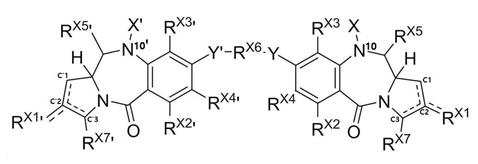
[일반식 XI][General Formula XI]
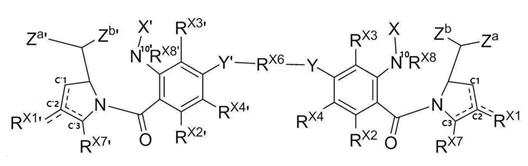
상기 식에서,In the above formula,
상기 점선은 C1과 C2 사이, C2와 C3 사이, C'1과 C'2 사이, 또는 C'2과 C'3 사이의 이중 결합의 선택적 존재를 나타내며;the dotted line indicates the optional presence of a double bond between C1 and C2, between C2 and C3, between C'1 and C'2, or between C'2 and C'3;
RX1 및 RX1'는 독립적으로 H, OH, =O, =CH2, CN, Rm, ORm, =CH-Rm'R X1 and R X1 ' are independently H, OH, =O, =CH 2 , CN, R m , OR m , =CH-R m '
=C(Rm')2, O-SO2-Rm, CO2Rm, CORm, 할로 및 디할로로부터 선택되고;=C(R m ′) 2 , O—SO 2 —R m , CO 2 R m , COR m , halo and dihalo;
Rm'는 Rm, CO2Rm, CORm, CHO, CO2H, 및 할로로부터 선택되며,R m ′ is selected from R m , CO 2 R m , COR m , CHO, CO 2 H, and halo;
각각의 Rm는 독립적으로 C1-12 알킬, C2-12 알케닐, C2-12 알키닐, C5-20 아릴, C5-20 헤테로아릴, C3-6 사이클로알킬, 3 내지 7-원 헤테로사이클릴, 3 내지 7-원 헤테로사이클로알킬, 및 5 내지 7-원 헤테로아릴로 이루어진 군으로부터 선택되고;each R m is independently C 1-12 alkyl, C 2-12 alkenyl, C 2-12 alkynyl, C 5-20 aryl, C 5-20 heteroaryl, C 3-6 cycloalkyl, 3-7 - selected from the group consisting of -membered heterocyclyl, 3 to 7-membered heterocycloalkyl, and 5 to 7-membered heteroaryl;
RX2, RX2' RX3, RX3', RX5, 및 RX5'는 독립적으로 H, Rm, OH, ORm, SH, SRm, NH2, NHRm, NRm 2, NO2, Me3Sn 및 할로로부터 선택되며;R X2 , R X2 ' R X3 , R X3 ', R X5 , and R X5 ' are independently H, R m , OH, OR m , SH, SR m , NH 2 , NHR m , NR m 2 , NO 2 , Me 3 Sn and halo;
RX4 및 RX4'는 독립적으로 H, Rm, OH, ORm, SH, SRm, NH2, NHRm, NRm 2, NO2, Me3Sn, 할로, C1-6 알킬 C1-6 알콕시, C2-6 알케닐, C2-6 알키닐, C3-6 사이클로알킬, 3 내지 7-원 헤테로사이클로알킬, C5-12 아릴, 5 내지 7-원 헤테로아릴, -CN, -NCO, -ORn, -OC(O)Rn, -OC(O)NRnRn', -OS(O)Rn, -OS(O)2Rn, -SRn, -S(O)Rn, -S(O)2Rn, -S(O)NRnRn', -S(O)2NRnRn', -OS(O)NRnRn', -OS(O)2NRnRn', -NRnRn', -NRnC(O)Ro, -NRnC(O)ORo, -NRnC(O)NRoRo', -NRnS(O)Ro, -NRnS(O)2Ro, -NRnS(O)NRoRo', -NRnS(O)2NRoRo', -C(O)Rn, -C(O)ORn 및 -C(O)NRnRn'로 부터 선택되고;R X4 and R X4 ' are independently H, R m , OH, OR m , SH, SR m , NH 2 , NHR m , NR m 2 , NO 2 , Me 3 Sn, halo, C 1-6 alkyl C 1 -6 alkoxy, C 2-6 alkenyl, C 2-6 alkynyl, C 3-6 cycloalkyl, 3-7 membered heterocycloalkyl, C 5-12 aryl, 5-7 membered heteroaryl, -CN , -NCO, -OR n , -OC(O)R n , -OC(O)NR n R n ', -OS(O)R n , -OS(O) 2 R n , -SR n , -S (O)R n , -S(O) 2 R n , -S(O)NR n R n ', -S(O) 2 NR n R n ', -OS(O)NR n R n ', - OS(O) 2 NR n R n ', -NR n R n ', -NR n C(O)R o , -NR n C(O)OR o , -NR n C(O)NR o R o ' , -NR n S(O)R o , -NR n S(O) 2 R o , -NR n S(O)NR o R o ', -NR n S(O) 2 NR o R o ', - C(O)R n , -C(O)OR n and -C(O)NR n R n ';
X 및 X'는 독립적으로 -C(O)O*, -S(O)O-*, -C(O)-*, -C(O)NRX-*, -S(O)2NRX-*, -P(O)R'NRX-*, -S(O)NRX-*, 또는 -PO2NRX-*로부터 선택되며;X and X' are independently -C(O)O*, -S(O)O-*, -C(O)-*, -C(O)NR X -*, -S(O) 2 NR X -*, -P(O)R'NR X -*, -S(O)NR X -*, or -PO 2 NR X -*;
RX 및 RX'는 독립적으로 H, OH, N3, CN, NO2, SH, NH2, ONH2, NHNH2, 할로, C1-8 알킬, C3-8 사이클로알킬, C1-8 알콕시, C1-8 알킬티오, C3-20 헤테로아릴, C5-20 아릴 또는 모노- 또는 디(di)-C1-8 알킬아미노로 부터 선택되며;R X and R X ' are independently H, OH, N 3 , CN, NO 2 , SH, NH 2 , ONH 2 , NHNH 2 , halo, C 1-8 alkyl, C 3-8 cycloalkyl, C 1 - 8 alkoxy, C 1-8 alkylthio, C 3-20 heteroaryl, C 5-20 aryl or mono- or di(di)-C 1-8 alkylamino;
Y 및 Y'는 독립적으로 O, S, 및 N(H)으로 부터 선택되고;Y and Y' are independently selected from O, S, and N(H);
RX6는 독립적으로 C3-12 알킬렌, C3-12 알케닐렌, 또는 C3-12 헤테로알킬렌으로 부터 선택되며;R X6 is independently selected from C 3-12 alkylene, C 3-12 alkenylene, or C 3-12 heteroalkylene;
RX7 및 RX7' 는 독립적으로 H, C1-6 알킬, C2-6 알케닐, C2-6 알키닐, C3-6 사이클로 알킬, 3 내지 7-원 헤테로사이클로알킬, C6-10 아릴, 5 내지 7-원 헤테로아릴, -ORr, -OC(O)Rr, -OC(O)NRrRr', -OS(O)Rr, -OS(O)2Rr, -SRr, -S(O)Rr, -S(O)2Rr, -S(O)NRrRr', -S(O)2NRrRr', -OS(O)NRrRr', -OS(O)2NRrRr', -NRrRr', -NRrC(O)Rs, -NRrC(O)ORs, -NRrC(O)NRsRs', -NRrS(O)Rs, -NRrS(O)2Rs, -NRrS(O)NRsRs', -NRrS(O)2NRsRs, -C(O)Rr, -C(O)ORs 또는 -C(O)NRrRr'으로 부터 선택되고;R X7 and R X7 ′ are independently H, C 1-6 alkyl, C 2-6 alkenyl, C 2-6 alkynyl, C 3-6 cycloalkyl, 3-7 membered heterocycloalkyl, C 6- 10 aryl, 5-7 membered heteroaryl, -OR r , -OC(O)R r , -OC(O)NR r R r ', -OS(O)R r , -OS(O) 2 R r , -SR r , -S(O)R r , -S(O) 2 R r , -S(O)NR r R r ', -S(O) 2 NR r R r ', -OS(O) NR r R r ', -OS(O) 2 NR r R r ', -NR r R r ', -NR r C(O)R s , -NR r C(O)OR s , -NR r C( O)NR s R s ', -NRr S (O)R s , -NRr S (O) 2 R s , -NRr S (O)NR s R s ', -NRr S (O) 2 NR s R s , -C(O)R r , -C(O)OR s or -C(O)NR r R r ';
각각의 Rr, Rr', Rs, 및 Rs' 은 독립적으로 H, C1-7 알킬, C2-7 알케닐, C2-7 알키닐, C3-13 사이클로알킬, 3 내지 7-원 헤테로사이클로알킬, C5-10 아릴, 및 5 내지 7-원 헤테로아릴로 부터 선택되며;each R r , R r ', R s , and R s ' is independently H, C 1-7 alkyl, C 2-7 alkenyl, C 2-7 alkynyl, C 3-13 cycloalkyl, 3 to 7-membered heterocycloalkyl, C 5-10 aryl, and 5 to 7-membered heteroaryl;
각 RX8 및 RX8'는 독립적으로 H, C1-6 알킬, C2-6 알케닐, C2-6 알키닐, C3-6 헤테로알킬, 3 내지 7-원 헤테로사이클로알킬, C5-10 아릴, 5 내지 7-원 헤테로아릴, -S(O)Rm, -S(O)2Rm, -S(O)NRmRm', -S(O)2NRmRm', -NRmRm', -NRmC(O)Rm, -NRmC(O)ORn, -NRmC(O)NRnRn', -NRmS(O)Rn, -NRmS(O)2Rn, -NRmS(O)NRnRn', -NRmS(O)2NRnRn', -C(O)Rm, -C(O)ORm 및 -C(O)NRmRm'로 부터 선택되고;each R X8 and R X8 ′ is independently H, C 1-6 alkyl, C 2-6 alkenyl, C 2-6 alkynyl, C 3-6 heteroalkyl, 3-7 membered heterocycloalkyl, C 5 -10 aryl, 5-7 membered heteroaryl, -S(O)R m , -S(O) 2 R m , -S(O)NR m R m ', -S(O) 2 NR m R m ', -NR m R m ', -NR m C(O)R m , -NR m C(O)OR n , -NR m C(O)NR n R n ', -NR m S(O)R n , -NR m S(O) 2 R n , -NR m S(O)NR n R n ', -NR m S(O) 2 NR n R n ', -C(O)R m , -C (O)OR m and -C(O)NR m R m ';
Za 는 ORX12a, NRX12aRX12a, 또는 SRX12a로 부터 선택되며;Z a is selected from OR X12a , NR X12a R X12a , or SR X12a ;
Zb 는 ORX13a, NRX13aRX13a, 또는 SRX13a로 부터 선택되고;Z b is selected from OR X13a , NR X13a R X13a , or SR X13a ;
Za'는 ORX12a, NRX12aRX12a, 또는 SRX12a로 부터 선택되며;Z a ′ is selected from OR X12a , NR X12a R X12a , or SR X12a ;
Zb'는 ORX13a', NRX13'RX13a' 또는 SRX13a'로 부터 선택되고;Z b 'is selected from OR X13a ', NR X13 'R X13a ' or SR X13a ';
각 RX12a, RX12a', RX13a' 및 RX13a'는 독립적으로 H, C1-6 알킬, C2-6 알케닐, C2-6 알키닐, C3-6 사이클로알킬, 3 내지 7-원 헤테로사이클로알킬, C5-10 아릴, 5 내지 7-원 헤테로아릴, -C(O)RX15a, -C(O)ORX15a 및 -C(O)NRX15aRX15a'로 부터 선택되고; 및each R X12a , R X12a ', R X13a ' and R X13a ' is independently H, C 1-6 alkyl, C 2-6 alkenyl, C 2-6 alkynyl, C 3-6 cycloalkyl, 3-7 - membered heterocycloalkyl, C 5-10 aryl, 5-7 membered heteroaryl, -C(O)R X15a , -C(O)OR X15a and -C(O)NR X15a R X15a '; and
각각의 RX15a 및 RX15a' 는 독립적으로 C1-12 알킬, C2-12 알케닐, C2-12 알키닐, C5-20 아릴, C5-20 헤테로아릴, C3-6 사이클로알킬, 3 내지 7-원 헤테로사이클릴, 3 내지 7-원 헤테로사이클로알킬, 및 5 내지 7-원 헤테로아릴로부터 선택되며;each R X15a and R X15a ′ is independently C 1-12 alkyl, C 2-12 alkenyl, C 2-12 alkynyl, C 5-20 aryl, C 5-20 heteroaryl, C 3-6 cycloalkyl , 3 to 7-membered heterocyclyl, 3 to 7-membered heterocycloalkyl, and 5 to 7-membered heteroaryl;
상기 RX13a 및 RX14a 는 이들이 부착된 원자와 함께 임의적으로 결합하여 3 내지 7-원 헤테로사이클릴, 3 내지 7-원 헤테로사이클로알킬, 또는 3 내지 7-원 헤테로아릴을 형성하고, 및 RX13a' 및 RX14a'이들이 부착된 원자와 함께 임의적으로 결합하여 3 내지 7-원 헤테로사이클릴, 3 내지 7-원 헤테로사이클로알킬, 또는 3 내지 7-원 헤테로 아릴을 형성하며; 및wherein R X13a and R X14a are optionally taken together with the atoms to which they are attached to form a 3 to 7-membered heterocyclyl, 3 to 7-membered heterocycloalkyl, or 3 to 7-membered heteroaryl, and R X13a ' and R X14a ' taken together optionally with the atom to which they are attached form a 3 to 7-membered heterocyclyl, 3 to 7-membered heterocycloalkyl, or 3 to 7-membered heteroaryl; and
상기 각각의 Rn, Rn', Ro, Ro', Rp, 및 Rp' 는 독립적으로 H, C1-7 알킬, C2-7 알케닐, C2-7 알키닐, C3-13 사이클로알킬, 3 내지 7-원 헤테로사이클로알킬, C5-10 아릴, 및 5 내지 7-원 헤테로아릴로부터 선택된다.each of R n , R n ', R o , R o ', R p , and R p ' is independently H, C 1-7 alkyl, C 2-7 alkenyl, C 2-7 alkynyl, C 3-13 cycloalkyl, 3 to 7-membered heterocycloalkyl, C 5-10 aryl, and 5 to 7-membered heteroaryl.
또한, 상기 Rm는 독립적으로 C1-12 알킬, C2-12 알케닐, C2-12 알키닐, C5-20 아릴, C5-20 헤테로아릴, C3-6 사이클로알킬, 3 내지 7-원 헤테로사이클릴, 3 내지 7-원 헤테로사이클로알킬, 및 5 내지 7-원 헤테로아릴로 이루어진 군으로부터 선택되고,In addition, R m is independently C 1-12 alkyl, C 2-12 alkenyl, C 2-12 alkynyl, C 5-20 aryl, C 5-20 heteroaryl, C 3-6 cycloalkyl, 3 to 7-membered heterocyclyl, 3 to 7-membered heterocycloalkyl, and 5 to 7-membered heteroaryl;
상기 Rm는 추가적으로 C1-12 알킬, C2-12 알케닐, C2-12 알키닐, C5-20 아릴, C5-20 헤테로아릴, C3-6 사이클로알킬, 3 내지 7-원 헤테로사이클릴, 3 내지 7-원 헤테로사이클로알킬, 또는 5 내지 7-원 헤테로아릴로 치환된다.wherein R m is additionally C 1-12 alkyl, C 2-12 alkenyl, C 2-12 alkynyl, C 5-20 aryl, C 5-20 heteroaryl, C 3-6 cycloalkyl, 3 to 7-membered substituted with heterocyclyl, 3-7 membered heterocycloalkyl, or 5-7 membered heteroaryl.
또한, 상기 RX4 및 RX4'는 독립적으로 H, Rm, OH, ORm, SH, SRm, NH2, NHRm, NRmRm', NO2, Me3Sn, 할로, C1-6 알킬 C1-6 알콕시, C2-6 알케닐, C2-6 알키닐, C3-6 사이클로알킬, 3 내지 7-원 헤테로사이클로알킬, C5-12 아릴, 5 내지 7-원 헤테로아릴, -CN, -NCO, -ORn, -OC(O)Rn, -OC(O)NRnRn', -OS(O)Rn, -OS(O)2Rn, -SRn, -S(O)Rn, -S(O)2Rn, -S(O)NRnRn', -S(O)2NRnRn', -OS(O)NRnRn', -OS(O)2NRnRn', -NRnRn', -NRnC(O)Ro, -NRnC(O)ORo, -NRnC(O)NRoRo', -NRnS(O)Ro, -NRnS(O)2Ro, -NRnS(O)NRoRo', -NRnS(O)2NRoRo', -C(O)Rn, -C(O)ORn 및 -C(O)NRnRn'로 부터 선택되고,In addition, R X4 and R X4 ' are independently H, R m , OH, OR m , SH, SR m , NH 2 , NHR m , NR m R m ', NO 2 , Me 3 Sn, halo, C 1 -6 alkyl C 1-6 alkoxy, C 2-6 alkenyl, C 2-6 alkynyl, C 3-6 cycloalkyl, 3-7 membered heterocycloalkyl, C 5-12 aryl, 5-7 membered Heteroaryl, -CN, -NCO, -OR n , -OC(O)R n , -OC(O)NR n R n ', -OS(O)R n , -OS(O) 2 R n , - SR n , -S(O)R n , -S(O) 2 R n , -S(O)NR n R n ', -S(O) 2 NR n R n ', -OS(O)NR n R n ', -OS(O) 2 NR n R n ', -NR n R n ', -NR n C(O)Ro, -NR n C(O)ORo, -NR n C(O)NR o R o ', -NR n S(O)R o , -NR n S(O) 2 R o , -NR n S(O)NR o R o ', -NR n S(O) 2 NR o R o ', -C(O)R n , -C(O)OR n and -C(O)NR n R n ',
상기 RX4 또는 RX4'는 C1-6 알킬, C1-6 알콕시, C2-6 알케닐, C2-6 알키닐, C3-6 사이클로알킬, 3 내지 7-원 헤테로사이클로알킬, C5-12 아릴 또는 5 내지 7-원 헤테로아릴이고, 추가적으로 하나 이상의 C1-6 알킬, C1-6 알콕시, C2-6 알케닐, C2-6 알키닐, C3-6 사이클로알킬, 3 내지 7-원 헤테로사이클로알킬, C5-10 아릴, 5 내지 7-원 헤테로아릴, -ORp, -OC(O)Rp, -OC(O)NRpRp', -OS(O)Rp, -OS(O)2Rp, -SRp, -S(O)Rp, -S(O)2Rp, -S(O)NRpRp', -S(O)2NRpRp', -OS(O)NRpRp', -OS(O)2NRpRp', -NRpRp', -NRpC(O)Rq, -NRpC(O)ORq, -NRpC(O)NRqRq', -NRpS(O)Rq, -NRpS(O)2Rq, -NRpS(O)NRqRq', -NRpS(O)2NRqRq', -C(O)Rp, -C(O)ORp 또는 -C(O)NRpRp로 치환된다.wherein R X4 or R X4 ' is C 1-6 alkyl, C 1-6 alkoxy, C 2-6 alkenyl, C 2-6 alkynyl, C 3-6 cycloalkyl, 3-7 membered heterocycloalkyl, C 5-12 aryl or 5-7 membered heteroaryl, additionally one or more C 1-6 alkyl, C 1-6 alkoxy, C 2-6 alkenyl, C 2-6 alkynyl, C 3-6 cycloalkyl , 3-7 membered heterocycloalkyl, C 5-10 aryl, 5-7 membered heteroaryl, -OR p , -OC(O)R p , -OC(O)NR p R p ', -OS( O)R p , -OS(O) 2 R p , -SR p , -S(O)R p , -S(O) 2 R p , -S(O)NR p R p ', -S(O) ) 2 NR p R p ', -OS(O)NR p R p ', -OS(O) 2 NR p R p ', -NR p R p ', -NR p C(O)R q , -NR p C(O)OR q , -NR p C(O)NR q R q ', -NR p S(O)R q , -NR p S(O) 2 R q , -NR p S(O)NR q R q ', -NR p S(O) 2 NR q R q ', -C(O)R p , -C(O)OR p or -C(O)NR p R p .
또한, 상기 RX7 및 RX7' 는 독립적으로 H, C1-6 알킬, C2-6 알케닐, C2-6알키닐, C3-6 사이클로알킬, 3 내지 7-원 헤테로사이클로알킬, C6-10 아릴, 5 내지 7-원 헤테로아릴, -ORr, -OC(O)Rr, -OC(O)NRrRr', -OS(O)Rr, -OS(O)2Rr, -SRr, -S(O)Rr, -S(O)2Rr, -S(O)NRrRr', -S(O)2NRrRr', -OS(O)NRrRr', -OS(O)2NRrRr', -NRrRr', -NRrC(O)Rs, -NRrC(O)ORs, -NRrC(O)NRsRs', -NRrS(O)Rs, -NRrS(O)2Rs, -NRrS(O)NRsRs', -NRrS(O)2NRsRs, -C(O)Rr, -C(O)ORs 또는 -C(O)NRrRr'으로부터 선택되고,In addition, R X7 and R X7 ' are independently H, C 1-6 alkyl, C 2-6 alkenyl, C 2-6 alkynyl, C 3-6 cycloalkyl, 3 to 7-membered heterocycloalkyl, C 6-10 aryl, 5-7 membered heteroaryl, -OR r , -OC(O)R r , -OC(O)NR r R r ', -OS(O)R r , -OS(O) 2 R r , -SR r , -S(O)R r , -S(O) 2 R r , -S(O)NR r R r ', -S(O) 2 NR r R r ', -OS (O)NR r R r ', -OS(O) 2 NR r R r ', -NR r R r ', -NR r C(O)R s , -NR r C(O)OR s , -NR r C(O)NR s R s ', -NR r S(O)R s , -NR r S(O) 2 R s , -NR r S(O)NR s R s ', -NR r S( O) 2 NR s R s , -C(O)R r , -C(O)OR s or -C(O)NR r R r ';
상기 RX7 또는 RX7' 는 C1-6 알킬, C2-6 알케닐, C2-6 알키닐, C3-6 사이클로알킬, 3 내지 7-원 헤테로사이클로알킬, C6-10 아릴, 5 내지 7-원 헤테로아릴이고, 추가적으로 C1-6 알킬, C2-6 알케닐, C2-6 알키닐, C3-6 사이클로알킬, 3 내지 7-원 헤테로사이클로알킬, C6-10 아릴, 5 내지 7-원 헤테로아릴, -ORt, -OC(O)Rt, -OC(O)NRtRt', -OS(O)Rt, -OS(O)2Rt, -SRt, -S(O)Rt, -S(O)2Rt, -S(O)NRtRt', -S(O)2NRtRt', -OS(O)NRtRt', -OS(O)2NRtRt', -NRtRt', -NRtC(O)Ru, -NRtC(O)ORu, -NRtC(O)NRuRu', -NRtS(O)Ru, -NRtS(O)2Ru, -NRtS(O)NRuRu', -NRtS(O)2NRuRu', -C(O)Rt, -C(O)ORt 또는 -C(O)NRtRt'로 치환되며,wherein R X7 or R X7 ' is C 1-6 alkyl, C 2-6 alkenyl, C 2-6 alkynyl, C 3-6 cycloalkyl, 3 to 7-membered heterocycloalkyl, C 6-10 aryl, 5 to 7-membered heteroaryl, additionally C 1-6 alkyl, C 2-6 alkenyl, C 2-6 alkynyl, C 3-6 cycloalkyl, 3 to 7-membered heterocycloalkyl, C 6-10 aryl, 5-7 membered heteroaryl, -OR t , -OC(O)R t , -OC(O)NR t R t ', -OS(O)R t , -OS(O) 2 R t , -SR t , -S(O)R t , -S(O) 2 R t , -S(O)NR t R t ', -S(O) 2 NR t R t ', -OS(O)NR t R t ', -OS(O) 2 NR t R t ', -NR t R t ', -NR t C(O)R u , -NR t C(O)OR u , -NR t C(O) )NR u R u ', -NR t S(O)R u , -NR t S(O) 2 R u , -NR t S(O)NR u R u ', -NR t S(O) 2 NR u R u ', -C(O)R t , -C(O)OR t or -C(O)NR t R t ';
상기 Rr, Rr', Rs, Rs', Rt, Rt', Ru 및 Ru'는 독립적으로 H, C1-7 알킬, C2-7 알케닐, C2-7 알키닐, C3-13 사이클로알킬, 3 내지 7-원 헤테로사이클로알킬, C5-10 아릴, 및 5 내지 7-원 헤테로아릴로부터 선택된다.wherein R r , R r ', R s , R s ', R t , R t ', R u and R u ' are independently H, C 1-7 alkyl, C 2-7 alkenyl, C 2-7 alkynyl, C 3-13 cycloalkyl, 3-7 membered heterocycloalkyl, C 5-10 aryl, and 5-7 membered heteroaryl.
또한, 상기 RX1 및 RX1' 는 독립적으로 Rm 으로부터 선택되고; 및Further, R X1 and R X1 ' are independently selected from R m ; and
Rm은 C1-6 알킬, C2-6 알케닐, C5-7 아릴 및 C3-6 헤테로아릴로부터 선택된다.R m is selected from C 1-6 alkyl, C 2-6 alkenyl, C 5-7 aryl and C 3-6 heteroaryl.
또한, 상기 RX2 , RX2', RX3, RX3', RX5, 및 RX5'은 독립적으로 H 또는 OH로부터 선택된다.Further, R X2 , R X2 ', R X3 , R X3 ', R X5 , and R X5 ' are independently selected from H or OH.
또한, RX4 및 RX4' 는 독립적으로 Rm으로부터 선택되고; 및Also, R X4 and R X4 ′ are independently selected from R m ; and
Rm 은 C1-6 알콕시이다.R m is C 1-6 alkoxy.
또한, 상기 RX4 및 RX4' 는 독립적으로 메톡시, 에톡시 및 부톡시로 이루어진 군으로부터 선택되는 어느 하나이다.In addition, R X4 and R X4 ' are independently any one selected from the group consisting of methoxy, ethoxy and butoxy.
또한, 상기 Y 및 Y'는 O이다.In addition, Y and Y' are O.
또한, 상기 RX6 는 C3-12 알킬렌, C3-12 알케닐렌 또는 C3-12 헤테로알킬렌이고, 상기 RX6은 -NH2, -NHRm, -NHC(O)Rm, -NHC(O)CH2-[OCH2CH2]n-RXX, 또는 -[CH2CH2O]n-RXX치환되고;In addition, R X6 is C 3-12 alkylene, C 3-12 alkenylene or C 3-12 heteroalkylene, and R X6 is -NH 2 , -NHR m , -NHC(O)R m , - NHC(O)CH 2 -[OCH 2 CH 2 ] n -R XX , or -[CH 2 CH 2 O] n -R XX substituted;
상기 RXX는 H, OH, N3, CN, NO2, SH, NH2, ONH2, NHNH2, 할로, C1-8 알킬, C3-8 사이클로알킬, C1-8 알콕시, C1-8 알킬티오, C3-20 헤테로아릴, C5-20 아릴 또는 모노- 또는 디-C1-8 알킬 아미노; 및wherein R XX is H, OH, N 3 , CN, NO 2 , SH, NH 2 , ONH 2 , NHNH 2 , halo, C 1-8 alkyl, C 3-8 cycloalkyl, C 1-8 alkoxy, C 1 -8 alkylthio, C 3-20 heteroaryl, C 5-20 aryl or mono- or di-C 1-8 alkyl amino; and
n은 1 내지 6의 정수이다.n is an integer from 1 to 6.
또한, 본 발명의 일 양태에서, 상기 활성제는 일반식 XII 또는 일반식 XIII로 기재되는 피롤로벤조디아제핀 이량체이다:Also, in one embodiment of the present invention, the active agent is a pyrrolobenzodiazepine dimer represented by the general formula XII or XIII:
[일반식 XII][General Formula XII]

[일반식 XIII][General Formula XIII]
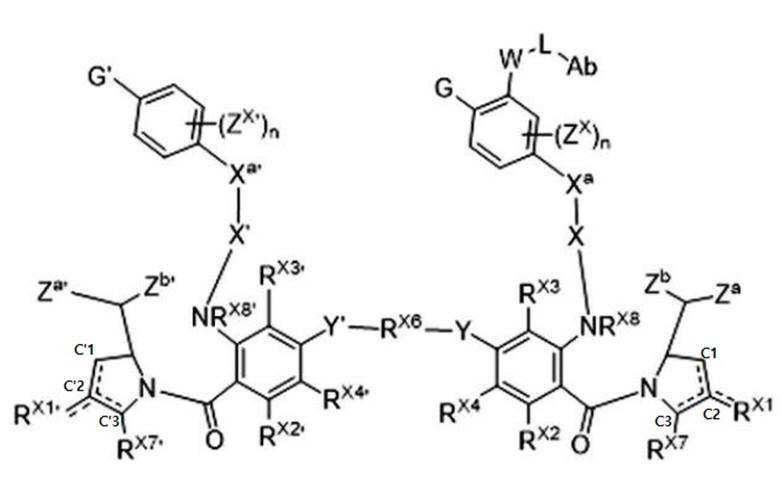
상기 Xa 및 Xa'는 독립적으로 결합 또는 C1-6 알킬렌으로부터 선택되고;wherein X a and X a ′ are independently selected from a bond or C 1-6 alkylene;
ZX' 및 ZX 는 독립적으로 수소, C1-8 알킬, 할로겐, 시아노, 나이트로, 

각각의 R80, R90 및 R100 는 수소, C1-8 알킬, C2-6 알케닐, 및 C1-6 알콕시로부터 선택되고; 및each of R 80 , R 90 and R 100 is selected from hydrogen, C 1-8 alkyl, C 2-6 alkenyl, and C 1-6 alkoxy; and
m은 0 내지 12의 정수임.m is an integer from 0 to 12;
상기 ZX' 및 ZX 는 독립적으로 수소, 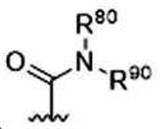
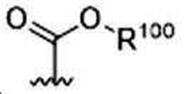
상기 각각의 R80, R90 및 R100 는 수소, C1-3 알킬 및 C1-3 알콕시로 이루어진 군으로부터 선택되는 어느 하나이며,Each of R 80 , R 90 and R 100 is any one selected from the group consisting of hydrogen, C 1-3 alkyl and C 1-3 alkoxy,
m은 1 내지 6의 정수이고,m is an integer from 1 to 6,
상기 활성제는The activator is

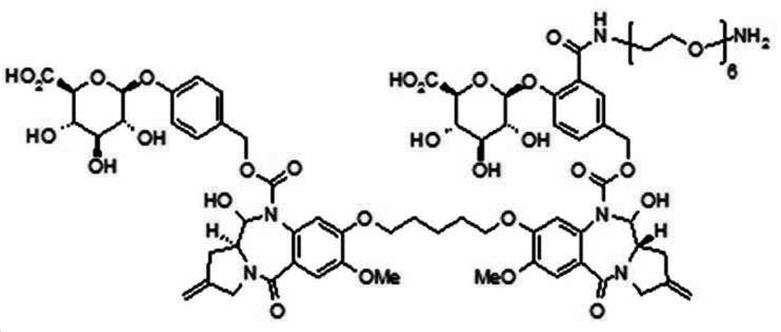


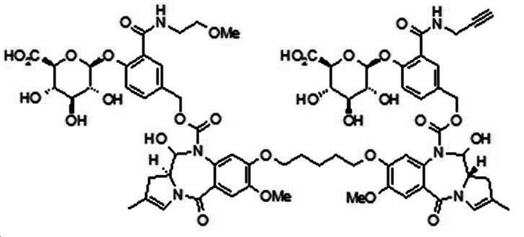

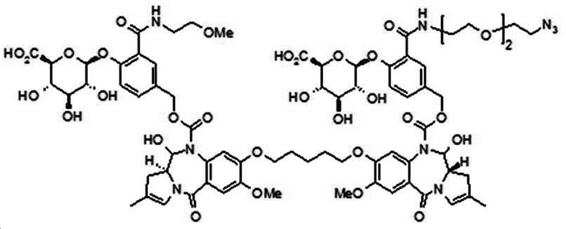
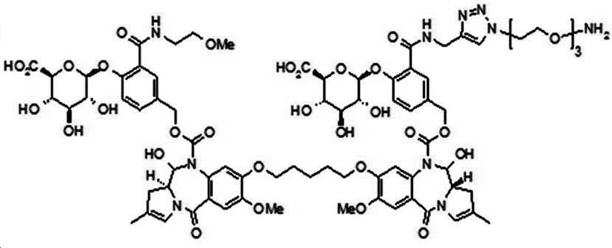


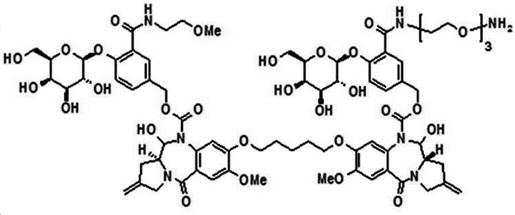
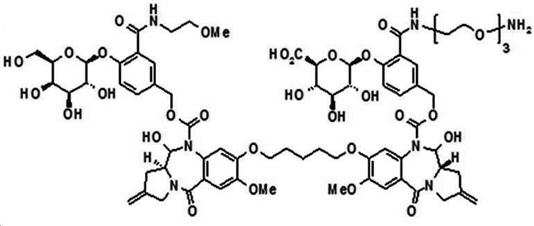
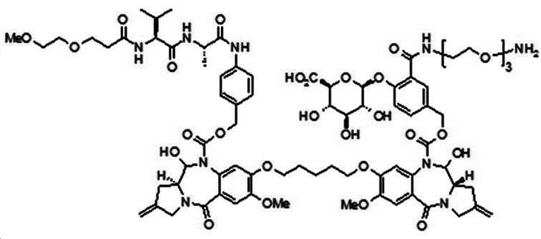
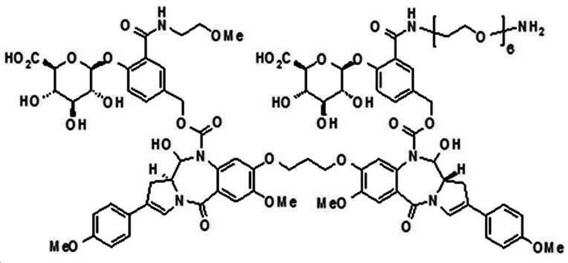
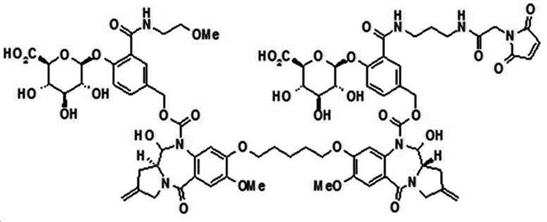
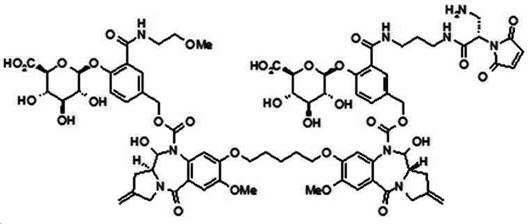
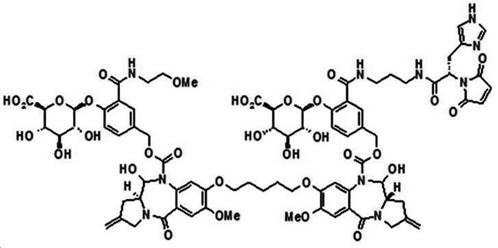


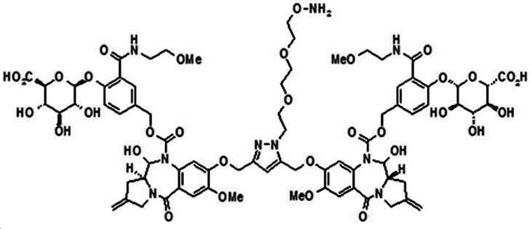
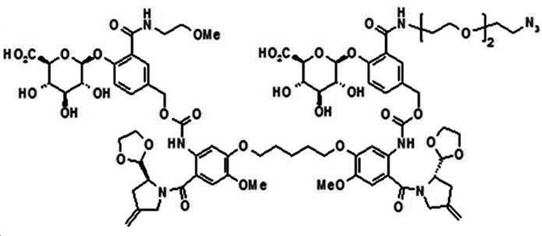


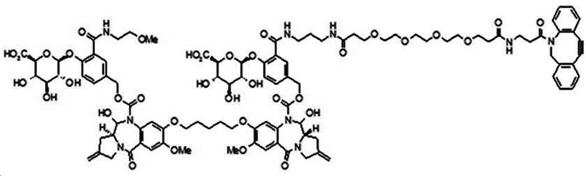
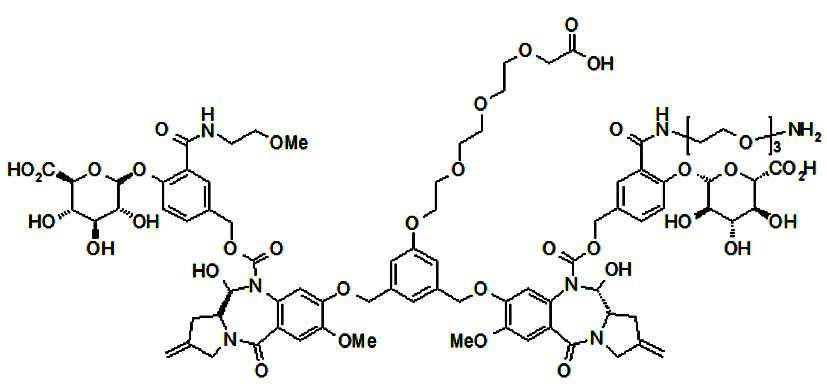
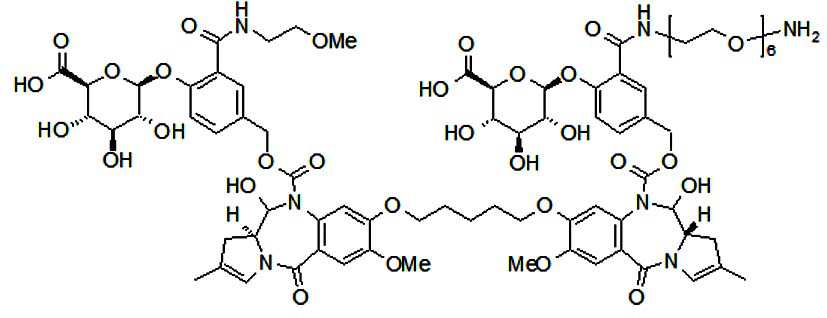
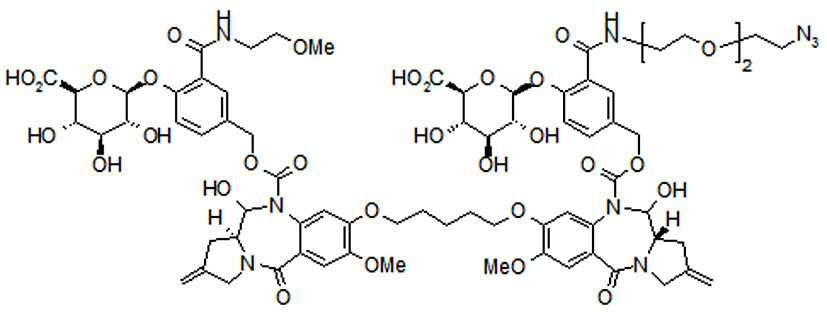
다른 양태에서 본 발명은 또한 B7-H3의 과발현과 관련된 질환의 예방 또는 치료를 위한 약제의 제조에 있어서, 본 발명에 따른 항체-약물 접합체 또는 이의 약학적으로 허용되는 염 또는 용매화물, 및 이를 포함하는 조성물의 용도를 제공한다.In another aspect, the present invention also provides an antibody-drug conjugate or a pharmaceutically acceptable salt or solvate thereof according to the present invention in the preparation of a medicament for the prevention or treatment of a disease associated with overexpression of B7-H3, and including the same It provides the use of the composition.
여기서 B7-H3의 과발현과 관련된 질환은 암을 들 수 있고, 암의 예로는 유방암, 갑상선암, 전립선암, 신장암, 신경 모세포종, 간세포암, 자궁경부암, 골육종, 구강암, 방광암, 신경교종, 비소세포폐암, 췌장암, 위암, 난소암, 대장암, 방광암, 흑생종, 자궁내막암, 두경부암, 요로상피암 또는 구상피 세포암을 포함하는 고형암; 또는 급성 백혈병 또는 다발성 골수종을 포함하는 혈액암을 들 수 있으나, 이로 제한하는 것은 아니다.Here, the disease associated with the overexpression of B7-H3 includes cancer, and examples of the cancer include breast cancer, thyroid cancer, prostate cancer, kidney cancer, neuroblastoma, hepatocellular carcinoma, cervical cancer, osteosarcoma, oral cancer, bladder cancer, glioma, and non-small cell cancer. solid cancers including lung cancer, pancreatic cancer, gastric cancer, ovarian cancer, colorectal cancer, bladder cancer, melanoma, endometrial cancer, head and neck cancer, urothelial cancer or spheroid cell cancer; or hematologic cancers including, but not limited to, acute leukemia or multiple myeloma.
본 발명의 다른 양태에서 본 발명은 본 발명에 따른 항체 접합체 또는 이의 약학적으로 허용되는 염 또는 이의 용매화물을 포함하는 조성물을 제공한다.In another aspect of the present invention, the present invention provides a composition comprising the antibody conjugate according to the present invention or a pharmaceutically acceptable salt or solvate thereof.
본 발명의 일 양태에서 상기 조성물은 B7-H3의 과발현과 관련된 질환의 예방 또는 치료용 약학 조성물로 이용된다.In one embodiment of the present invention, the composition is used as a pharmaceutical composition for preventing or treating diseases related to overexpression of B7-H3.
또한, 본 발명의 일 앙태에서 약학적으로 유효한 양의 화학 치료제(chemotherapeutic agent), 예를 들어 1종 이상의 치료적 공동-작용제(therapeutic co-agent); 및 약학적으로 허용되는 부형제를 추가적으로 포함할 수 있다.In addition, in one embodiment of the present invention, a pharmaceutically effective amount of a chemotherapeutic agent, for example, one or more therapeutic co-agents; and pharmaceutically acceptable excipients.
본 발명의 일 양태에서, 상기 치료적 공동-작용제는 B7-H3의 과발현과 관련된 질환에 대한 예방, 개선 또는 치료효과를 나타내는 작용제, 또는 B7-H3의 과발현과 관련된 질환 치료제 투약 시 나타나는 부작용의 발현을 감소시킬 수 있는 작용제, 또는 면역력 증진 효과를 나타내는 작용제 등일 수 있으나 이로 제한되는 것은 아니고, 예를 들어 피롤로벤조디아제핀과 함께 배합제의 형태로 적용하였을 때 치료적으로 유용한 효과를 나타내고/거나, 피롤로벤조디아제핀의 안정성을 보다 향상시키고/거나, 피롤로벤조디아제핀 투여 시 나타날 수 있는 부작용을 감소시키고/거나, 면역력의 증진을 통해 치료효과를 극대화할 수 있는 효과를 나타내는 제제라면 어떤 것이든 배합하여 적용할 수 있음을 의미한다.In one embodiment of the present invention, the therapeutic co-agent is an agent that has a preventive, ameliorated or therapeutic effect on a disease associated with overexpression of B7-H3, or an agent that exhibits a therapeutic effect for a disease associated with overexpression of B7-H3 Expression of side effects when administered It may be an agent that can reduce the effect, or an agent that exhibits an immune enhancing effect, but is not limited thereto, and for example, exhibits a therapeutically useful effect when applied in the form of a combination with pyrrolobenzodiazepine, and / or Any formulation that has the effect of further improving the stability of rolobenzodiazepine, reducing the side effects that may occur during administration of pyrrolobenzodiazepine, and/or maximizing the therapeutic effect by enhancing immunity, may be combined and applied. means you can
또한, 본 발명의 일 앙태에서 PD-1(Programmed cell death protein 1), PD-L1(Programmed Death Ligand 1), CTLA-4(cytotoxic T-lymphocyte-associated protein 4), LAG-3(Lymphocyte Activation Gene-3), CD28(Cluster of Differentiation 28), CD122, 4-1BB(또는 CD137), TIM3(T-cell Immunoglobulin domain and Mucin domain 3), OX-40(또는 CD 134), OX40L(또는 CD252)), CD40, CD40L(또는 CD 154), LIGHT(또는 tumor necrosis factor superfamily member 14 (TNFSF14)), ICOS(Inducible T-cell costimulator 또는 CD278), ICOSL(또는 CD275), GITR(glucocorticoid-induced TNFR-related protein), GITRL(또는 Tumor necrosis factor ligand superfamily member 18), TIGIT(T-cell immunoreceptor with Ig and ITIM domains), CD27, VISTA(V-domain Ig suppressor of T cell activation), B7-H3(또는 CD276), B7-H4(또는 V-set domain-containing T-cell activation inhibitor 1), HEVM(Herpes Virus Entry Mediator)또는 BTLA(B and T Lymphocyte Attenuator), CD47(또는 integrin associated protein (IAP)) 또는 CD73(또는 5'-nucleotidase (5'-NT)) 에 특이적으로 결합하여 항암 면역 반응을 나타내는 하나 이상의 항체를 추가적으로 포함할 수 있다.In addition, in one aspect of the present invention, PD-1 (Programmed cell death protein 1), PD-L1 (Programmed Death Ligand 1), CTLA-4 (cytotoxic T-lymphocyte-associated protein 4), LAG-3 (Lymphocyte Activation Gene) -3), CD28 (Cluster of Differentiation 28), CD122, 4-1BB (or CD137), TIM3 (T-cell Immunoglobulin domain and Mucin domain 3), OX-40 (or CD 134), OX40L (or CD252)) , CD40, CD40L (or CD 154), LIGHT (or tumor necrosis factor superfamily member 14 (TNFSF14)), ICOS (Inducible T-cell costimulator or CD278), ICOSL (or CD275), GITR (glucocorticoid-induced TNFR-related protein) ), GITRL (or Tumor necrosis factor ligand superfamily member 18), TIGIT (T-cell immunoreceptor with Ig and ITIM domains), CD27, VISTA (V-domain Ig suppressor of T cell activation), B7-H3 (or CD276), B7-H4 (or V-set domain-containing T-cell activation inhibitor 1), Herpes Virus Entry Mediator (HEVM) or B and T Lymphocyte Attenuator (BTLA), CD47 (or integrin associated protein (IAP)) or CD73 (or It may further include one or more antibodies that specifically bind to 5'-nucleotidase (5'-NT)) and exhibit an anticancer immune response.
본 발명의 다른 양태에서 본 발명은 B7-H3의 과발현과 관련된 질환의 치료 방법으로, 본 발명에 따른 항체 접합체 또는 이의 약학적으로 허용되는 염 또는 이의 용매화물, 또는 이를 포함하는 조성물의 치료적 유효량을 상기 질환의 치료가 필요한 대상체에게 투여하는 단계를 포함하는 B7-H3의 과발현과 관련된 질환의 치료 방법을 제공한다.In another aspect of the present invention, the present invention provides a method for treating a disease related to overexpression of B7-H3, wherein the antibody conjugate according to the present invention, or a pharmaceutically acceptable salt or solvate thereof, or a composition comprising the same is administered in a therapeutically effective amount It provides a method of treating a disease associated with overexpression of B7-H3, comprising administering to a subject in need of treatment for the disease.
본 발명의 일 양태에서, 상기 약학적 조성물을 환자에 투여하는 단계를 포함하는, 암 치료방법이 제공된다.In one aspect of the present invention, there is provided a method for treating cancer, comprising administering the pharmaceutical composition to a patient.
본 발명에 따른 접합체는 대상체의 목표 위치에 활성제, 보다 구체적으로 피롤로벤조디아제핀을 제공하는데 사용하기에 적합하다. 본 발명에 따른 접합체는 링커 부분을 전혀 보유하지 않는 활성 피롤로벤조디아제핀을 방출시키며, 피롤로벤조디아제핀 화합물의 반응성에 영향을 줄 수 있는 것은 존재하지 않는다.Conjugates according to the present invention are suitable for use in providing an active agent, more specifically a pyrrolobenzodiazepine, to a target location in a subject. Conjugates according to the present invention release active pyrrolobenzodiazepines that do not have any linker moieties, and nothing that can affect the reactivity of the pyrrolobenzodiazepine compounds is present.
본 발명에 따른 항체-약물 접합체는 본 발명에 따른 항체를 포함함으로써, B7-H3 발현 세포에 약물을 효과적이면서도 특이적 및 선택적으로 전달할 수 있고, 항체에 약물이 안정적으로 결합되어 생체내 안정성을 유지하면서 목적하는 세포독성을 나타낼 수 있도록 하며, 특히 혈장 내에서 보다 안정하고 체내 순환시에도 안정적이며, 약물이 암세포 내에서 쉽게 방출되어 약효를 극대화할 수 있는 자가-희생기를 포함하는 링커 기술을 접목시킴으로써, 약물 및/또는 톡신이 표적 세포에 안정적으로 도달하여 약효를 효과적으로 발휘하면서도 독성을 크게 낮출 수 있는, 약물-링커-리간드 시스템을 제공하는 효과를 나타낸다.The antibody-drug conjugate according to the present invention includes the antibody according to the present invention, and thus can effectively and specifically and selectively deliver a drug to B7-H3-expressing cells, and the drug is stably bound to the antibody to maintain in vivo stability By grafting linker technology that includes a self-immolative group that can exhibit the desired cytotoxicity while being more stable in plasma, more stable even when circulating in the body, and the drug is easily released in cancer cells to maximize drug efficacy. , the drug and/or toxin stably reach the target cell to effectively exert the drug effect while significantly lowering the toxicity, showing the effect of providing a drug-linker-ligand system.
도 1은 본 발명의 일 구현예에 따라 제조된 항 B7-H3 항체의 B7-H3 단백질의 세포외영역(ECD, Extra Cellular Domain)에 대한 결합능 분석(ELISA) 결과이다.
도 2는 본 발명의 일 구현예에 따라 제조된 항 B7-H3 항체의 B7 패밀리에 속하는 다른 단백질들의 ECD에 대한 결합능 분석(ELISA) 결과이다.
도 3은 본 발명의 일 구현예에 따라 제조된 항 B7-H3 항체의 종간 교차 반응성을 ELISA로 분석한 결과이다.
도 4는 본 발명의 일 구현예에 따라 제조된 다양한 항 B7-H3 항체의 마우스 B7-H3 단백질에 대한 결합력 정도를 ELISA로 비교한 결과이다.
도 5는 본 발명의 일 구현예에 따라 제조된 항 B7-H3 항체의 세포 표면 발현 B7-H3 항원에 대한 결합능 측정(FACS) 결과로, MCF-7 세포주는 B7-H3를 과발현하는 세포주이고, Jurkat은 B7-H3를 발현하지 않는 세포주이다.
도 6은 본 발명의 일 구현예에 따라 제조된 항 B7-H3 항체의 세포 표면 발현 B7-H3 항원에 대한 결합능을 항체 농도별로 측정한(FACS) 결과이다.
도 7은 본 발명에 따른 항 B7-H3 항체의 마우스 유래 암세포주(CT26, B16F10, 및 TC-1)에 대한 결합능을 측정한(FACS) 결과이다.
도 8은 본 발명의 일 구현예에 따라 제조된 항 B7-H3 항체의 항체 의존성 세포독성(ADCC) 유도능 측정 결과이다.
도 9a는 B7-H3 단백질에 의한 T 세포 활성 억제 및 이로 인한 인터페론 감마의 생성 억제 효과를 측정한 결과이다.
도 9b는 본 발명의 일 구현예에 따라 제조된 항 B7-H3 항체가 B7-H3 면역관문을 억제 또는 차단하여, 도 9a에서와 같은 B7-H3 면역관문에 의해 활성이 억제된 T 세포를 재활성화시킬 수 있음을 인터페론 감마의 생성능으로 측정한 결과이다.
도 10은 본 발명의 일 구현예에 따라 제조된 항 B7-H3 항체를 항암 면역항체의 한 종류로 면역관문억제제인 항 PD-1 항체 또는 항 PD-L1 항체 또는 면역보조자극 분자의 활성화제로 작용할 수 있는 항 4-1BB 항체와 함께 사용하였을 때 T 세포 활성화에 대한 영향을 인터페론 감마 생성량으로 측정한 결과이다.
도 11은 본 발명의 일 구현예에 따라 제조된 항 B7-H3 항체를 마우스 B7-H3 양성 암세포주인 CT26를 이식한 동계종양이식모델에서 항암 면역항체의 한 종류로, 면역관문 억제를 통해 작용하는 항 PD-1 항체와 병용투여 시 종양 성장이 억제되고, 생존률이 향상됨을 확인한 결과이다.
도 12는 본 발명의 일 구현예에 따라 제조된 항 B7-H3 항체를 마우스 B7-H3 양성 암세포주인 CT26를 이식한 동계종양이식모델에서의 항암 면역항체인 항 PD-1 항체와 병용투여 시 종양으로 유입된 종양 침윤 림프구를 분석한 결과이다.
도 13a는 본 발명의 일 구현예에 따라 제조된 항-B7-H3 항체-PBD 컨쥬게이트(B5-CaaX-PBD, B5-CaaX-PBD2) 또는 항-B7-H3 항체-MMAE 컨쥬게이트(B5-CaaX-MMAE)의 Calu-3 폐암 세포주 이식 마우스 모델에서의 체중 변화를 분석한 결과이고, 도 13b는 상기 마우스 모델에서의 암억제 효능을 분석한 결과이다. 1 is a binding capacity analysis (ELISA) result for the extracellular domain (ECD, Extra Cellular Domain) of the B7-H3 protein of the anti-B7-H3 antibody prepared according to an embodiment of the present invention.
2 is a result of an ECD binding capacity analysis (ELISA) of other proteins belonging to the B7 family of the anti-B7-H3 antibody prepared according to an embodiment of the present invention.
3 is a result of analyzing cross-species cross-reactivity of an anti-B7-H3 antibody prepared according to an embodiment of the present invention by ELISA.
4 is a result of comparing the degree of binding affinity to mouse B7-H3 protein of various anti-B7-H3 antibodies prepared according to an embodiment of the present invention by ELISA.
5 is a measurement (FACS) result of the binding capacity (FACS) of the anti-B7-H3 antibody prepared according to one embodiment of the present invention to the cell surface-expressing B7-H3 antigen, the MCF-7 cell line is a cell line overexpressing B7-H3, Jurkat is a cell line that does not express B7-H3.
6 is a result of measuring the binding ability of the anti-B7-H3 antibody prepared according to an embodiment of the present invention to the cell surface-expressed B7-H3 antigen for each antibody concentration (FACS).
7 is a result of measuring (FACS) the binding ability of the anti-B7-H3 antibody according to the present invention to mouse-derived cancer cell lines (CT26, B16F10, and TC-1).
8 is a measurement result of the antibody-dependent cytotoxicity (ADCC) inducing ability of the anti-B7-H3 antibody prepared according to an embodiment of the present invention.
9a is a result of measuring the inhibition of T cell activity by the B7-H3 protein and the inhibition of interferon-gamma production.
Figure 9b shows that the anti-B7-H3 antibody prepared according to an embodiment of the present invention inhibits or blocks the B7-H3 immune checkpoint, thereby regenerating the T cells whose activity is inhibited by the B7-H3 immune checkpoint as in Figure 9a. It is the result of measuring the ability to activate the interferon gamma production ability.
Figure 10 shows that the anti-B7-H3 antibody prepared according to an embodiment of the present invention is one kind of anti-cancer immune antibody, which acts as an anti-PD-1 antibody or anti-PD-L1 antibody, which is an immune checkpoint inhibitor, or an activator of an immune costimulatory molecule. This is a result of measuring the amount of interferon gamma production on the effect on T cell activation when used together with an anti- 4-1BB antibody.
11 is a type of anti-cancer immune antibody in a syngeneic tumor transplantation model in which an anti-B7-H3 antibody prepared according to an embodiment of the present invention is transplanted with a mouse B7-H3-positive cancer cell line CT26, which acts through immune checkpoint inhibition. This is the result confirming that tumor growth is inhibited and survival rate is improved when co-administered with an anti-PD-1 antibody.
12 is a tumor when an anti-B7-H3 antibody prepared according to an embodiment of the present invention is co-administered with an anti-PD-1 antibody, which is an anti-cancer immune antibody, in a syngeneic tumor transplantation model in which a mouse B7-H3-positive cancer cell line, CT26, is transplanted. This is the result of analyzing the tumor-infiltrating lymphocytes introduced into the
13A shows an anti-B7-H3 antibody-PBD conjugate (B5-CaaX-PBD, B5-CaaX-PBD2) or an anti-B7-H3 antibody-MMAE conjugate (B5- CaaX-MMAE) is the result of analyzing the change in body weight in the Calu-3 lung cancer cell line transplanted mouse model, and FIG. 13b is the result of analyzing the cancer suppression efficacy in the mouse model.
본 발명은 B7-H3에 특이적으로 결합할 수 있는 항체의 개발을 근거로 한 것이다.The present invention is based on the development of an antibody capable of specifically binding to B7-H3.
본 항목에서 사용된 제목은 명세서 기재의 편리성을 위한 것일 뿐, 본 발명을 이로 제한하는 것은 아니다.The titles used in this section are only for convenience of description of the specification, and do not limit the present invention thereto.
본 발명에서 달리 정의하지 않는 한, 본 발명에서 사용된 과학 및 기술적 용어는 본 기술분야의 당업자가 통상적으로 이해하는 대로의 의미를 가진다. 나아가 문맥상 특별히 요구되지 않는다면, 단수는 복수를 포함하고, 복수는 단수를 포함한다.Unless defined otherwise herein, scientific and technical terms used herein have the meanings commonly understood by one of ordinary skill in the art. Furthermore, unless the context specifically requires otherwise, the singular includes the plural and the plural includes the singular.
[정의][Justice]
본 명세서에서 하기 정의가 적용된다:The following definitions apply herein:
본 발명에서 "접합체(conjugates)"는 세포독성 화합물의 하나 이상의 분자에 공유결합되는 세포 결합제를 말한다. 여기서, "세포 결합제"는 생물학적 타깃에 대한 친화도를 갖는 분자로서, 예를 들어 리간드, 단백질, 항체, 구체적으로 모노클로날 항체, 단백질 또는 항체 단편, 펩타이드, 올리고뉴클레오티드, 올리고사카라이드일 수 있으며, 결합제는 생물학적 활성 화합물을 생물학적 타깃으로 유도하는 기능을 한다. 본 발명의 일 양태에서, 접합체는 세포 표면 항원을 통해 종양 세포를 표적화하도록 설계될 수 있다. 항원은 비정상적인 세포 타입에서 과다발현되거나 또는 발현되는 세포 표면 항원일 수 있다. 구체적으로, 표적 항원은 증식성 세포(예컨대 종양 세포) 상에서만 발현되는 것일 수 있다. 표적 항원은 통상 증식성 조직 및 정상 조직 사이의 상이한 발현에 기초하여 선택될 수 있다. 본 발명에서 리간드는 링커에 결합된다.As used herein, "conjugates" refer to cell binding agents that are covalently bound to one or more molecules of a cytotoxic compound. Here, the "cell binding agent" is a molecule having affinity for a biological target, and may be, for example, a ligand, a protein, an antibody, specifically a monoclonal antibody, a protein or antibody fragment, a peptide, an oligonucleotide, an oligosaccharide, , the binding agent functions to direct the biologically active compound to the biological target. In one aspect of the invention, the conjugate may be designed to target tumor cells via cell surface antigens. The antigen may be a cell surface antigen that is overexpressed or expressed in an abnormal cell type. Specifically, the target antigen may be expressed only on proliferative cells (eg, tumor cells). Target antigens can usually be selected based on different expression between proliferative and normal tissues. In the present invention, the ligand is bound to a linker.
본 발명에서 "분리된 폴리펩타이드, 항체 또는 단백질"은 이들과 통상적으로 함께 발견될 수 있는 다른 단백질이 존재하지 않으며, 자연적으로 이들과 결합되어 있는 지질, 탄수화물, 폴리뉴클레오타이드의 적어도 약 50% 이상이 제거된 것이다. 전형적으로 분리된 단백질, 폴리펩타이드 또는 항체는 소정의 조성물에서, 적어도 약 5%, 적어도 약 10%, 적어도 약 25%, 또는 적어도 약 50%를 구성한다. 이러한 폴리펩타이드는 합성 기원의 게놈 DNA, cDNA, mRNA 또는 기타 RNA, 또는 이들의 임의의 조합에 의해 코딩될 수 있다. 특히, 분리된 단백질 폴리펩타이드 또는 항체는 이의 치료적, 진단적, 예방적 연구 또는 기타 용도로의 적용을 방해하는 다른 단백질 또는 다른 폴리펩타이드의 오염물질이 실질적으로 존재하지 않는다.In the present invention, "isolated polypeptide, antibody or protein" does not exist with other proteins that can be normally found together with them, and at least about 50% or more of lipids, carbohydrates, and polynucleotides naturally associated with them it has been removed An isolated protein, polypeptide or antibody typically constitutes at least about 5%, at least about 10%, at least about 25%, or at least about 50% of a given composition. Such polypeptides may be encoded by genomic DNA, cDNA, mRNA or other RNA of synthetic origin, or any combination thereof. In particular, the isolated protein polypeptide or antibody is substantially free of other proteins or contaminants of other polypeptides that would interfere with its application in therapeutic, diagnostic, prophylactic research or other uses.
본 발명에서 예를 들면 항원 결합 단편, 단백질, 또는 항체와 같은 폴리펩타이드의 "변이체"는 다른 폴리펩타이드 서열과 비교하여 하나 이상의 아미노산 잔기에 삽입, 결실, 부가 및/또는 치환이 발생한 폴리펩타이드이며, 융합 폴리펩타이드를 포함한다. 또한 단백질 변이체는 단백질 효소 절단, 인산화 또는 기타 후번역 변형에 의해 변형되었으나, 본 발명에 개시된 항체의 생물학적 활성 예를 들면 B7-H3에 결합 및 특이성을 유지하는 것을 포함한다. 변이체는 본 발명에 개시된 항체 또는 그 항원 결합단편의 서열과 약 99%, 98%, 97%, 96%, 95%, 94%, 93%, 92%, 91%, 90%, 89%, 88%, 87%, 86%, 85%, 84%, 83%, 82%, 81%, 또는 80% 동일한 것일 수 있다. 퍼센트 동일성(%) 또는 상동성은 후술하는 바를 참조하여 계산할 수 있다. In the present invention, for example, a "variant" of a polypeptide, such as an antigen-binding fragment, protein, or antibody, is a polypeptide in which insertions, deletions, additions and/or substitutions have occurred at one or more amino acid residues compared to other polypeptide sequences, fusion polypeptides. Protein variants also include those that have been modified by proteolytic cleavage, phosphorylation or other post-translational modifications, but retain the biological activity of the antibodies disclosed herein, such as binding and specificity to B7-H3. The variant is about 99%, 98%, 97%, 96%, 95%, 94%, 93%, 92%, 91%, 90%, 89%, 88 with the sequence of the antibody or antigen-binding fragment thereof disclosed in the present invention. %, 87%, 86%, 85%, 84%, 83%, 82%, 81%, or 80% identical. Percent identity (%) or homology can be calculated with reference to the description below.
일 구현예에서 퍼센트 상동성 또는 동일성은 100Х[(동일한 위치)/min(TGA, TGB)]으로 계산될 수 있으며, 상기 식에서 TGA, TGB 는 비교되는 서열 A 및 B의 잔기의 수 및 내부갭 위치의 합이다 (Russell et al., J. Mol Biol., 244: 332-350 (1994).In one embodiment the percent homology or identity can be calculated as 100Х[(same position)/min(TG A , TG B )], wherein TG A , TG B are the number of residues in sequences A and B being compared and intergap positions (Russell et al., J. Mol Biol., 244: 332-350 (1994).
본 발명에서 보존적 아미노산 치환은 폴리펩타이드의 활성 또는 항원선을 실질적으로 영향을 미치지 않는 치환을 의미한다. 폴리펩타이드는 하나 이상의 보존적 치환을 포함할 수 있다. 비제한적 예는 하기 표 3에 개시되어 있다. In the present invention, a conservative amino acid substitution means a substitution that does not substantially affect the activity or antigenic line of a polypeptide. A polypeptide may contain one or more conservative substitutions. Non-limiting examples are set forth in Table 3 below.
본 발명에서 폴리펩타이드의 "유도체"는, 삽입, 결실, 부가 또는 치환 변이체와는 상이한, 다른 화학적 모이어티와의 컨쥬게에션을 통해 하나 이상의 잔기에서 화학적으로 변형된 폴리펩타이드를 의미한다. A "derivative" of a polypeptide as used herein refers to a polypeptide that has been chemically modified at one or more residues through conjugation with another chemical moiety, different from an insertion, deletion, addition or substitution variant.
본 발명에서 폴리펩타이드, 핵산, 숙주 세포 등과 관련하여 사용된 용어 "자연에서 발견되는"은 자연적으로 존재하는 물질을 의미한다. The term "found in nature" as used in the present invention in relation to polypeptides, nucleic acids, host cells, etc. refers to substances that exist in nature.
본 발명에 따른 항체가 인식하는 B7-H3(B7 Homolog 3, CD276)는 면역글로불린(Ig) 슈퍼 패밀리에 속하는 B7 패밀리의 막관통 단백질로 세포외영역, 막관통영 역 및 세포내영역을 포함한다. 본 발명에 따른 항체가 인식하는 B7-H3은 세포막에 존재하거나 또는 세포막에 존재하지 않은 상태의 세포외영역이다. B7-H3의 인간 단백질은 534개의 아미노산으로 구성되어 있으며, NCBI Reference Sequence: NP_001019907.1 로 개시되어 있다. 본 발명에서 사용된 문맥으로부터 명백하지 않는 한, B7-H3는 인간 B7-H3를 지칭하나, 본 발명에 따른 항체는 원숭이 및 마우스 B7-H3도 특이적으로 결합능을 가진다. 원숭이 B7-H3 단백질은 534개의 아미노산으로 구성되어 있으며 NCBI Reference Sequence: XP_005560056.1 로 개시되어 있다. 마우스 B7-H3는 316개의 아미노산으로 구성되어 있으며 NCBI Reference Sequence: NP_598744.1 로 개시되어 있다.B7-H3 (
본 발명에서 "동일성"은 두 개 이상의 폴리펩타이드 또는 두 개 이상의 폴리뉴클레오타이드 서열을 정렬하고 비교하여 결정되는, 두 개 이상 폴리펩타이드 또는 두 개 이상 폴리뉴클레오타이드의 서열 유사성을 의미한다. 이러한 서열간 동일성은 일반적으로 "동일성 퍼센트"로 표시되며, 이는 비교되는 분자 간의 동일한 아미노산 또는 뉴클레오타이드 비율을 의미하며, 비교되는 분자 중, 가장 작은 크기의 분자를 기초로 계산된다. 핵산 또는 폴리펩타이드를 정렬하여 다 분자간의 동일성을 계산하는데 사용될 수 있는 방법은 당업자에게 공지되어 있다.In the present invention, "identity" refers to the sequence similarity of two or more polypeptides or two or more polynucleotides, which is determined by aligning and comparing two or more polypeptides or two or more polynucleotide sequences. Such identities between sequences are generally expressed as "percent identity", which refers to the ratio of identical amino acids or nucleotides between the molecules being compared, calculated based on the smallest sized molecule among the molecules being compared. Methods that can be used to align nucleic acids or polypeptides to calculate multi-molecular identity are known to those of skill in the art.
본 발명에서 "친화성" 또는 "친화도"는 항체 또는 그 항원 결합단편과 항원 사이의 상호작용의 강도이며, 항원의 크기, 모양 및/또는 전하와 같은 항원의 특징 및 항체 또는 항원결합 단편의 CDR 서열에 의해 결정된다. 이러한 친화도를 결정하는 방법은 당업계에 공지되어 있으며, 또한 하기를 참조할 수 있다. In the present invention, "affinity" or "affinity" is the strength of the interaction between the antibody or antigen-binding fragment thereof and the antigen, and characteristics of the antigen such as the size, shape and/or charge of the antigen, and that of the antibody or antigen-binding fragment. It is determined by the CDR sequence. Methods for determining such affinity are known in the art and may also be referred to below.
항체 또는 이의 항원 결합 단편은 해리 상수(dissociation constant, KD)가 ≤10-6 M일 때, 항원과 같은 이의 표적에 "특이적으로 결합한다"라고 일컬어진다. 항체는 KD가 ≤1x 10⁻⁸ M일 때, "높은 친화성"으로 표적에 특이적으로 결합한다.An antibody or antigen-binding fragment thereof is said to "specifically bind" to its target, such as an antigen, when the dissociation constant (K D ) is <10 -6 M. The antibody specifically binds to the target with "high affinity" when the K D is <
본 발명에 사용된, 항체 또는 면역글로불린의 사슬(중쇄 또는 경쇄)의 "항원 결합 단편"은 전장 사슬과 비교하여 일부 아미노산이 결여되었지만, 항원에 특이적으로 결합할 수 있는 항체의 일부를 포함하는 것이다. 이러한 단편은 표적 항원에 특이적으로 결합할 수 있고, 또는 다른 항체 또는 항원 결합 단편과 특정 에피토프에 결합하기 위해 경쟁할 수 있다는 측면에서 생물학적으로 활성이 있다고 할 수 있다. 한 양태에서, 이러한 단편은 전장 경쇄 또는 중쇄 내에 존재하는 적어도 하나의 CDR을 포함하고, 일부 구현예에서, 단쇄 중쇄 및/또는 경쇄, 또는 이의 일부를 포함한다. 이러한 생물학적 활성 단편은 재조합 DNA 기술에 의해 생산되거나, 또는 예를 들면 온전한 항체를 효소적 또는 화학적 절단하여 생산될 수 있다. 면역학적으로 기능적인 면역글로불린 단편에는 이로 제한하는 것은 아니나, Fab, Fab', F(ab')2, scFab, dsFv, Fv, scFV, scFV-Fc, 다이아바디, 미니바디, scAb, 및 dAb를 포함하나 이로 제한하는 것은 아니나, 인간, 마우스, 랫트, 카멜리드 또는 토끼를 포함하는 임의의 포유동물에서 유래될 수 있다. 본 발명에 개시된 하나 이상의 CDR과 같은 항체의 기능적인 부분은 제2의 단백질 또는 저분자 화합물과 공유결합으로 연결되어 특정 표적에 대한 표적 치료제로서 사용될 수 있다. As used herein, an "antigen-binding fragment" of a chain (heavy or light chain) of an antibody or immunoglobulin comprises a portion of an antibody that lacks some amino acids compared to the full-length chain, but is capable of specifically binding to an antigen. will be. Such fragments can be said to be biologically active in the sense that they can specifically bind to a target antigen, or compete with other antibodies or antigen-binding fragments for binding to a specific epitope. In one embodiment, such fragments comprise at least one CDR present in a full length light or heavy chain, and in some embodiments comprise a single heavy and/or light chain, or a portion thereof. Such biologically active fragments may be produced by recombinant DNA techniques, or may be produced, for example, by enzymatic or chemical cleavage of intact antibodies. Immunologically functional immunoglobulin fragments include, but are not limited to, Fab, Fab', F(ab')2, scFab, dsFv, Fv, scFV, scFV-Fc, diabody, minibody, scAb, and dAb. It may be derived from any mammal including, but not limited to, humans, mice, rats, camelids or rabbits. Functional portions of an antibody, such as one or more CDRs, disclosed herein may be covalently linked to a second protein or small molecule compound to be used as a targeted therapeutic for a specific target.
본 발명에서 "Fc" 영역은 항체의 CH2 및 CH3 도메인을 포함하는 2개의 중쇄 단편을 포함한다. 이들 2개의 중쇄 단편은 2개 이상의 디설파이드 결합 및 CH3 도메인의 소수성 상호작용에 의해 서로 결합되어 있다. The "Fc" region in the present invention comprises two heavy chain fragments comprising the CH2 and CH3 domains of an antibody. These two heavy chain fragments are bound to each other by two or more disulfide bonds and hydrophobic interactions of the CH3 domain.
본 발명에서 "Fab 단편"은 1개의 경쇄와 가변영역 및 CH1만을 포함하는 1개 중쇄로 구성된다. Fab 분자의 중쇄는 다른 중쇄 분자와 디설파이드 결합을 형성할 수 없다. scFab은 두 분자의 Fab이 유연한 링커에 의해 연결된 것이다. In the present invention, "Fab fragment" consists of one light chain, one heavy chain including only a variable region and CH1. The heavy chain of the Fab molecule cannot form disulfide bonds with other heavy chain molecules. scFab is a Fab of two molecules linked by a flexible linker.
본 발명에서 "Fab' 단편"은 Fab 단편에 추가적으로 중쇄의 CH1과 CH2 도메인 사이의 영역을 포함하여, 두 분자의 Fab' 단편의 두 개의 중쇄사이에서 사슬간 다이설파이드 결합이 형성되어, F(ab')2 분자를 형성할 수 있다. In the present invention, the "Fab'fragment" includes a region between the CH1 and CH2 domains of the heavy chain in addition to the Fab fragment, so that an interchain disulfide bond is formed between the two heavy chains of the Fab' fragment of two molecules, so that F (ab ') can form 2 molecules.
본 발명에서 "F(ab')2 단편"은 앞서 기술한 바와 같이, 2개의 경쇄, 및 가변영역, CH1 및 CH1과 CH2 도메인 사이에 불변영역의 일부를 포함하는 2개의 중쇄를 포함하여, 2개의 중쇄 사이에서 사슬간 다이설파이드 결합이 형성된다. 따라서, F(ab')2 단편은 2개의 Fab' 단편으로 구성되며, 상기 두 개의 Fab' 단편은 이들 간의 다이설파이드 결합에 의해 서로 회합되어 있다. In the present invention, "F(ab') 2 fragment" includes two light chains and two heavy chains including a variable region, a portion of the constant region between the CH1 and CH1 and CH2 domains, as described above, Interchain disulfide bonds are formed between the two heavy chains. Thus, the F(ab') 2 fragment consists of two Fab' fragments, which are associated with each other by a disulfide bond between them.
본 발명에서 "Fv 영역"은 중쇄 및 경쇄의 각 가변영역을 포함하지만 불변영역은 포함하지 않는 항체의 단편이다. scFV는 중쇄 및 경쇄가 이황화결합에 의해 연결된 것이다. scFv는 Fv가 유연한 링커에 의해 연결된 것이다. scFv-Fc는 scFV에 Fc가 연결된 것이다. 미니바디는 scFV에 CH3가 연결된 것이다. 다이아바디는 두분자의 scFV를 포함한다.In the present invention, "Fv region" is a fragment of an antibody that includes each variable region of a heavy chain and a light chain, but does not include a constant region. scFV is one in which the heavy and light chains are linked by disulfide bonds. scFvs are Fvs linked by a flexible linker. scFv-Fc is Fc linked to scFV. The minibody has CH 3 connected to the scFV. The diabody contains two molecules of scFV.
본 발명에서 "단일쇄 Fv" 또는 "scFv" 항체 단편은 항체의 VH 및 VL 도메인을 포함하는데, 이들 도메인은 단일 폴리펩티드 쇄 내에 존재한다. Fv 폴리펩티드는 scFv가 항원 결합을 위해 목적하는 구조를 형성할 수 있도록 하는 VH 도메인과 VL 도메인 사이에 폴리펩티드 링커를 추가로 포함할 수 있다.A "single chain Fv" or "scFv" antibody fragment in the present invention comprises the VH and VL domains of an antibody, which domains are present in a single polypeptide chain. The Fv polypeptide may further comprise a polypeptide linker between the VH and VL domains that enables the scFv to form the desired structure for antigen binding.
본 발명에서 "단쇄항체"(scAb)는 중쇄 및 경쇄 가변영역이 유연한 링커에 의해 연결된 중쇄의 하나의 불변영역 또는 경쇄 불변영역을 포함하는 단일 폴리펩타이드 사슬이다. 단쇄 항체는 예를 들면 미국 특허 제5,260,203호를 참조할 수 있으며, 이는 참조에 의해 본 발명에 개시된다. In the present invention, "single-chain antibody" (scAb) is a single polypeptide chain comprising one constant region or a light chain constant region of a heavy chain in which the heavy and light chain variable regions are linked by a flexible linker. For single chain antibodies, see, for example, US Pat. No. 5,260,203, which is disclosed herein by reference.
본 발명에서 "도메인 항체"(dAb)는 중쇄의 가변영역 또는 경쇄의 가변영역만을 포함하는 면역학적으로 기능적인 면역글로불린 단편이다. 일 구현예에서는 2개 이상의 VH 영역이 펩타이드 링커에 의한 공유결합으로 연결되어, 2가(bivalent)의 도메인 항체를 형성한다. 이러한 2가 도메인 항체의 2개의 VH 영역은 동일 또는 상이한 항원을 표적으로 할 수 있다.In the present invention, "domain antibody" (dAb) is an immunologically functional immunoglobulin fragment comprising only the variable region of a heavy chain or a variable region of a light chain. In one embodiment, two or more VH regions are covalently linked by a peptide linker to form a bivalent domain antibody. The two VH regions of such a bivalent domain antibody may target the same or different antigens.
본 발명에서 "상보성 결정 영역" (CDR; 즉, CDR1, CDR2, 및 CDR3)은 항원 결합을 위해 필요한 존재인 항체 가변 도메인의 아미노산 잔기를 지칭한다. 각 가변 도메인은 전형적으로 CDR1, CDR2 및 CDR3으로서 확인된 3개의 CDR 영역을 갖는다.In the present invention, "complementarity determining region" (CDR; ie, CDR1, CDR2, and CDR3) refers to the amino acid residues of an antibody variable domain that are necessary for antigen binding. Each variable domain typically has three CDR regions identified as CDR1, CDR2 and CDR3.
본 발명에서 "골격 영역" (FR)은 CDR 잔기 이외의 가변 도메인 잔기이다. 각 가변 도메인은 전형적으로, FR1, FR2, FR3 및 FR4로서 확인된 4개의 FR을 가진다.In the present invention, a "framework region" (FR) is a variable domain residue other than a CDR residue. Each variable domain typically has four FRs identified as FR1, FR2, FR3 and FR4.
본 발명에서 "2가의 항원 결합 단백질" 또는 "2가 항체"는 2개의 항원 결합 부위를 포함한다. 이러한 2가 항체에 포함된 2개의 항원 결합 부위는 동일한 항원 특이성을 갖거나, 또는 각각 상이한 항원에 결합하는 이중특이적 항체일 수 있다. In the present invention, "bivalent antigen binding protein" or "bivalent antibody" comprises two antigen binding sites. The two antigen binding sites included in such a bivalent antibody may have the same antigen specificity, or may be bispecific antibodies that each bind to different antigens.
본 발명에서 "다중 특이적 항원 결합 단백질" 또는 "다중 특이적 항체"는 두 개 이상의 항원 또는 에피토프를 표적으로 하는 것이다.In the present invention, "multi-specific antigen binding protein" or "multi-specific antibody" is one that targets two or more antigens or epitopes.
본 발명에서 "링커"는 세포독성 화합물을 리간드에 공유결합시키는 화합물을 말한다. 본 발명의 일 양태에서, 링커로는 PCT/US2016/063564호 및 PCT/US2016/063595호에 개시된 링커를 사용할 수 있다.In the present invention, "linker" refers to a compound that covalently binds a cytotoxic compound to a ligand. In one aspect of the present invention, the linker disclosed in PCT/US2016/063564 and PCT/US2016/063595 may be used as the linker.
본 발명에서 "비치환되거나 치환된"은 비치환될 수 있거나 또는 치환될 수 있는 모기(parent group)를, "치환된"은 1 이상의 치환기를 갖는 모기(parent group)를, 치환기는 모기(parent group)에 공유결합되거나 모기(parent group)에 융합된 화학적 부분을 의미한다.In the present invention, "unsubstituted or substituted" refers to a parent group that may be unsubstituted or substituted, "substituted" refers to a parent group having one or more substituents, and a substituent is a parent group. group) or a chemical moiety fused to a parent group.
본 발명에서 "할로"는 플루오린, 클로라인, 브로마인, 요오드 등을 말한다.In the present invention, "halo" refers to fluorine, chlorine, bromine, iodine, and the like.
본 발명에서 "알킬"은 지방족 또는 지환족, 포화 또는 불포화(불포화, 완전 불포화) 탄화수소 화합물의 탄소 원자로부터 수소 원자를 제거하여 얻어진 1가 부분으로서, 포화 알킬의 예로는 메틸, 에틸, 프로필, 부틸, 펜틸, 헥실, 헵틸 등을, 포화 직쇄형 알킬의 예로는 메틸, 에틸, n-프로필, n-부틸, n-펜틸(아밀), n-헥실, n-헵틸 등, 포화 분지쇄형 알킬의 예로는 이소프로필, 이소부틸, sec-부틸, tert-부틸, 이소펜틸, 네오펜틸 등을 들 수 있다.In the present invention, "alkyl" is a monovalent moiety obtained by removing a hydrogen atom from a carbon atom of an aliphatic or alicyclic, saturated or unsaturated (unsaturated, fully unsaturated) hydrocarbon compound, and examples of saturated alkyl include methyl, ethyl, propyl, butyl. , pentyl, hexyl, heptyl, etc., examples of saturated straight-chain alkyl include methyl, ethyl, n-propyl, n-butyl, n-pentyl (amyl), n-hexyl, n-heptyl, etc., as examples of saturated branched-chain alkyl isopropyl, isobutyl, sec-butyl, tert-butyl, isopentyl, neopentyl, and the like.
본 발명에서 "알콕시"는 -OR[여기서, R은 알킬기]을 의미하며, 예로는 메톡시, 에톡시, n-프로폭시, 이소프로폭시, n-부톡시, sec-부톡시, 이소부톡시, tert-부톡시 등을 들 수 있다.In the present invention, "alkoxy" means -OR [wherein R is an alkyl group], examples of which include methoxy, ethoxy, n-propoxy, isopropoxy, n-butoxy, sec-butoxy, isobutoxy, tert-butoxy and the like.
본 발명에서 "아릴"은 고리 원자를 갖는 방향족 화합물의 방향족 고리 원자로부터 수소 원자를 제거하여 얻어진 1가 부분을 의미한다.In the present invention, "aryl" means a monovalent moiety obtained by removing a hydrogen atom from an aromatic ring atom of an aromatic compound having a ring atom.
본 발명에서 "알케닐"은 1 이상의 탄소-탄소 이중 결합을 갖는 알킬로서, 불포화 알케닐기의 예로는 에테닐(비닐, -CH=CH2), 1-프로페닐(-CH=CHCH3), 2-프로페닐, 이소프로페닐, 부테닐, 펜테닐, 헥세닐 등을 들 수 있다.In the present invention, "alkenyl" is an alkyl having at least one carbon-carbon double bond, and examples of unsaturated alkenyl groups include ethenyl (vinyl, -CH=CH 2 ), 1-propenyl (-CH=CHCH 3 ), 2-propenyl, isopropenyl, butenyl, pentenyl, hexenyl, and the like.
본 발명에서 "알키닐"은 1 이상의 탄소-탄소 삼중 결합을 갖는 알킬기로서, 불포화 알키닐기의 예는 에티닐 및 2-프로피닐 등을 들 수 있다.In the present invention, "alkynyl" is an alkyl group having at least one carbon-carbon triple bond, and examples of the unsaturated alkynyl group include ethynyl and 2-propynyl.
본 발명에서 "카르복시"는 -C(=O)OH를 말한다.In the present invention, "carboxy" refers to -C(=O)OH.
본 발명에서 "포르밀"은 -C(=O)H를 말한다.In the present invention, "formyl" refers to -C(=O)H.
본 발명에서 "아릴"은 방향족 화합물의 방향족 고리 원자로부터 수소 원자를 제거하여 얻어진 1가 모이어티에 관한 것이다. 예를 들어 "C5-7아릴"은 모이어티가 5 내지 7 개의 고리 원자를 갖는 것으로서, 방향족 화합물의 방향족 고리 원자로부터 수소 원자를 제거함으로써 수득되는 1 가 모이어티를 의미하고,"C5-10 아릴"은 모이어티가 5 내지 10 개의 고리 원자를 갖는 것으로서, 방향족 화합물의 방향족 고리 원자로부터 수소 원자를 제거함으로써 수득되는 1 가 모이어티를 의미한다. 여기에서 접두사(C5-7, C5-10 등)는 탄소 원자 또는 헤테로 원자인지 여부와 상관없이 고리원자의 수 또는 고리 원자의 수의 범위를 지칭한다. 예를 들어 "C5-6아릴"은 5 또는 6개의 고리 원자를 갖는 아릴기에 관한 것이다. 여기에서, 고리 원자는 "카르보아릴기"에서와 같이 모두 탄소 원자일 수 있다. 카르보아릴기의 예는 벤젠, 나프탈렌, 아줄렌, 안트라센, 페난트렌, 나프타센 및 피렌으로부터 유도된 것들을 포함하나, 이로 제한되지 않는다. 적어도 하나가 방향족 고리인 융합 고리를 포함하는 아릴기의 예는 인단, 인덴, 이소인덴, 테트랄린, 아세나프텐, 플루오렌, 페날렌, 아세페난트렌 및 아세안트렌으로부터 유도된 기를 포함하나, 이로 제한되지 않는다. 또는, 고리 원자는 "헤테로아릴기"에서와 같이 하나 이상의 헤테로 원자를 포함할 수 있다."Aryl" in the present invention relates to a monovalent moiety obtained by removing a hydrogen atom from an aromatic ring atom of an aromatic compound. For example, "C 5-7 aryl" means a monovalent moiety in which the moiety has 5 to 7 ring atoms, obtained by removing a hydrogen atom from an aromatic ring atom of an aromatic compound, and "C 5 - "10 aryl" means a monovalent moiety obtained by removing a hydrogen atom from an aromatic ring atom of an aromatic compound, wherein the moiety has 5 to 10 ring atoms. A prefix (C 5-7 , C 5-10, etc.) herein refers to a number of ring atoms or a range of number of ring atoms, whether carbon atoms or heteroatoms. For example, “C 5-6 aryl” relates to an aryl group having 5 or 6 ring atoms. Here, the ring atoms may all be carbon atoms as in "carboaryl group". Examples of carboaryl groups include, but are not limited to, those derived from benzene, naphthalene, azulene, anthracene, phenanthrene, naphthacene, and pyrene. Examples of aryl groups comprising a fused ring wherein at least one is an aromatic ring include groups derived from indane, indene, isoindene, tetralin, acenaphthene, fluorene, phenalene, acephenanthrene and aceanthrene, but with not limited Alternatively, the ring atom may contain one or more heteroatoms as in "heteroaryl group".
본 발명에서 "헤테로아릴"은 1 이상의 헤테로 원자를 포함하는 아릴로서, 예로는 피리딘, 피리미딘, 벤조티오펜, 푸릴, 디옥살라닐, 피롤릴, 옥사졸릴, 피리딜, 피리다지닐, 피리미디닐 등, 보다 구체적으로 벤조푸란, 이소벤조푸란, 인돌, 이소인돌, 인돌리진, 인돌린, 이소인돌린, 푸린(아데닌 또는 구아닌), 벤즈이미다졸, 인다졸, 벤즈옥사졸, 벤즈이속사졸, 벤조디옥솔, 벤조푸란, 벤조트리아졸, 벤조티오푸란, 벤조티아졸, 벤조티아디아졸로부터 유도된 2개의 융합고리를 갖는 C9, 크로멘, 이소크로멘, 크로만, 이소크로만, 벤조디옥산, 퀴놀린, 이소퀴놀린, 퀴놀리진, 벤족사진, 벤조디아진, 피리도피리딘, 퀴녹살린, 퀴나졸린, 신놀린, 프탈라진, 나프티리딘, 프테리딘으로부터 유도된 2개의 융합고리를 갖는 C10, 벤조디아제핀으로부터 유도된 2개의 융합고리를 갖는 C11, 카르바졸, 디벤조푸란, 디벤조티오펜, 카르볼린, 페리미딘, 피리도인돌로부터 유도된 3개의 융합고리를 갖는 C13, 아크리딘, 크산텐, 티오크산텐, 옥산트렌, 페녹사티인, 페나진, 페녹사진, 페노티아진, 티안트렌, 페난트리딘, 페난트롤린, 페나진으로부터 유도된 3개의 융합고리를 갖는 C14를 들 수 있다.In the present invention, "heteroaryl" is an aryl containing one or more hetero atoms, for example, pyridine, pyrimidine, benzothiophene, furyl, dioxalanyl, pyrrolyl, oxazolyl, pyridyl, pyridazinyl, pyrimidi Neil et al., more specifically benzofuran, isobenzofuran, indole, isoindole, indolizine, indoline, isoindoline, purine (adenine or guanine), benzimidazole, indazole, benzoxazole, benzisoxazole, C 9 having two fused rings derived from benzodioxol, benzofuran, benzotriazole, benzothiofuran, benzothiazole, and benzothiadiazole, chromene, isochromene, chromen, isochroman, benzo Two fused rings derived from dioxane, quinoline, isoquinoline, quinolizine, benzoxazine, benzodiazine, pyridopyridine, quinoxaline, quinazoline, cinnoline, phthalazine, naphthyridine, and pteridine C 10 having two fused rings derived from benzodiazepine, C 11 having two fused rings derived from carbazole, dibenzofuran, dibenzothiophene, carboline, perimidine, and C 13 having three fused rings derived from pyridoindole, three fused rings derived from acridine, xanthene, thioxanthene, oxantrene, phenoxatiin, phenazine, phenoxazine, phenothiazine, thiantrene, phenanthridine, phenanthroline, and phenazine; and C 14 having
본 발명에서 "사이클로알킬"은 시클릴기인 알킬기이고, 고리(cyclic) 탄화수소 화합물의 지환족 고리 원자로부터 수소 원자를 제거하여 얻어진 1가 부분에 관한 것이다. 사이클로알킬기의 예는 하기로부터 유도된 것들을 포함하나, 이로 제한되지 않는다:In the present invention, "cycloalkyl" is an alkyl group that is a cyclyl group, and relates to a monovalent moiety obtained by removing a hydrogen atom from an alicyclic ring atom of a cyclic hydrocarbon compound. Examples of cycloalkyl groups include, but are not limited to, those derived from:
포화 단일고리 탄화수소 화합물: 사이클로프로판, 사이클로부탄, 사이클로펜탄, 사이클로헥산, 사이클로헵탄, 메틸사이클로프로판, 디메틸사이클로프로판, 메틸사이클로부탄, 디메틸사이클로부탄, 메틸사이클로펜탄, 디메틸사이클로펜탄 및 메틸사이클로헥산;saturated monocyclic hydrocarbon compounds: cyclopropane, cyclobutane, cyclopentane, cyclohexane, cycloheptane, methylcyclopropane, dimethylcyclopropane, methylcyclobutane, dimethylcyclobutane, methylcyclopentane, dimethylcyclopentane and methylcyclohexane;
불포화 단일고리 탄화수소 화합물: 사이클로프로펜, 사이클로부텐, 사이클로펜텐, 사이클로헥센, 메틸사이클로프로펜, 디메틸사이클로프로펜, 메틸사이클로부텐, 디메틸사이클로부텐, 메틸사이클로펜텐, 디메틸사이클로펜텐 및 메틸사이클로헥센; 및 포화 헤테로사이클릭 탄화수소 화합물: 노르카란, 노르피난, 노르보르난.unsaturated monocyclic hydrocarbon compounds: cyclopropene, cyclobutene, cyclopentene, cyclohexene, methylcyclopropene, dimethylcyclopropene, methylcyclobutene, dimethylcyclobutene, methylcyclopentene, dimethylcyclopentene and methylcyclohexene; and saturated heterocyclic hydrocarbon compounds: norcharan, norpinan, norbornane.
본 발명에서 "헤테로사이클릴"은 헤테로사이클릭 화합물의 고리 원자로부터 수소 원자를 제거하여 얻어진 1가 부분에 관한 것이다."Heterocyclyl" in the present invention relates to a monovalent moiety obtained by removing a hydrogen atom from a ring atom of a heterocyclic compound.
본 발명에서 접두사(예를 들어 C1-12, C3-8 등)는 탄소 원자 또는 헤테로 원자인지 여부와 상관없이 고리 원자의 수 또는 고리 원자의 수의 범위를 지칭한다. 예를 들어 본 명세서에서 사용된 용어 "C3-6헤테로사이클릴"은 3 내지 6개의 고리 원자를 갖는 헤테로사이클릴기에 관한 것이다.In the present invention, a prefix (eg, C 1-12 , C 3-8 , etc.) refers to the number of ring atoms or a range of the number of ring atoms, regardless of whether they are carbon atoms or heteroatoms. For example, the term “C 3-6 heterocyclyl” as used herein relates to a heterocyclyl group having 3 to 6 ring atoms.
단일고리 헤테로사이클릴기의 예는 하기로부터 유도된 것들을 포함하지만, 이로 제한되지 않는다:Examples of monocyclic heterocyclyl groups include, but are not limited to, those derived from:
N1: 아지리딘, 아제티딘, 피롤리딘, 피롤린, 2H- 또는 3H-피롤, 피페리딘, 디하이드로피리딘, 테트라하이드로피리딘, 아제핀;N 1 : aziridine, azetidine, pyrrolidine, pyrroline, 2H- or 3H-pyrrole, piperidine, dihydropyridine, tetrahydropyridine, azepine;
N2: 이미다졸리딘, 피라졸리딘, 이미다졸린, 피라졸린, 피페라진;N 2 : imidazolidine, pyrazolidine, imidazoline, pyrazoline, piperazine;
O1: 옥시란, 옥세탄, 옥솔란, 옥솔, 옥산, 디하이드로피란, 피란, 옥세핀;O 1 : oxirane, oxetane, oxolane, oxol, oxane, dihydropyran, pyran, oxepin;
O2: 디옥솔란, 디옥산 및 디옥세판;O 2 : dioxolane, dioxane and dioxepane;
O3: 트리옥산;O 3 : trioxane;
N1O1: 테트라하이드로옥사졸, 디하이드로옥사졸, 테트라하이드로이속사졸, 디하이드로이속사졸, 모르폴린, 테트라하이드로옥사진, 디하이드로옥사진, 옥사진N 1 O 1 : tetrahydrooxazole, dihydrooxazole, tetrahydroisoxazole, dihydroisoxazole, morpholine, tetrahydrooxazine, dihydrooxazine, oxazine
S1: 티이란, 티에탄, 티올란, 티안, 티에판;S 1 : thiirane, thietane, thiolane, thiane, thiepane;
N1S1: 티아졸린, 티아졸리딘, 티오모르폴린;N 1 S 1 : thiazoline, thiazolidine, thiomorpholine;
N2O1: 옥사디아진;N 2 O 1 : oxadiazine;
O1S1: 옥사티올, 옥사티안; 및O 1 S 1 : oxathiol, oxathian; and
N1O1S1: 옥사티아진.N 1 O 1 S 1 : Oxatiazine.
본 발명에서 "전구체(prodrug)"는 생체내 생리학적 조건 하(예를 들어 효소 산화(enzymatic oxidation), 환원(reduction) 및/또는 가수분해 등)에서 효소, 위산의 작용에 의해 피롤로벤조다이아제핀 약물로 직접적으로 또는 간접적으로 변환할 수 있는 화합물을 말한다.In the present invention, "prodrug" refers to pyrrolobenzodia by the action of an enzyme, gastric acid, under physiological conditions in vivo (eg, enzymatic oxidation, reduction and/or hydrolysis, etc.) A compound that can be converted directly or indirectly into a zepine drug.
본 발명에서 "약학적으로 허용되는 염"으로는 약학적으로 허용가능한 유리산(free acid)에 의하여 형성된 산 부가염을 사용할 수 있고, 상기 유리 산으로는 유기산 또는 무기산을 사용할 수 있다.As the "pharmaceutically acceptable salt" in the present invention, an acid addition salt formed by a pharmaceutically acceptable free acid may be used, and an organic acid or an inorganic acid may be used as the free acid.
상기 유기산은 이로 제한되는 것은 아니나, 구연산, 초산, 젖산, 주석산, 말레인산, 푸마르산, 포름산, 프로피온산, 옥살산, 트리플로오로아세트산, 벤조산, 글루콘산, 메타술폰산, 글리콜산, 숙신산, 4-톨루엔술폰산, 글루탐산 및 아스파르트산을 포함한다. 또한 상기 무기산은 이로 제한되는 것은 아니나, 염산, 브롬산, 황산 및 인산을 포함한다.The organic acid is not limited thereto, but citric acid, acetic acid, lactic acid, tartaric acid, maleic acid, fumaric acid, formic acid, propionic acid, oxalic acid, trifluoroacetic acid, benzoic acid, gluconic acid, metasulfonic acid, glycolic acid, succinic acid, 4-toluenesulfonic acid, glutamic acid and aspartic acid. In addition, the inorganic acid includes, but is not limited to, hydrochloric acid, hydrobromic acid, sulfuric acid and phosphoric acid.
예컨대, 화합물이 음이온이거나 또는 음이온일 수 있는 작용기를 갖는 경우(예컨대 -COOH는 -COO-일 수 있음), 적절한 양이온으로 염을 형성할 수 있다. 적절한 무기 양이온의 예는 알칼리 금속 이온, 예컨대 Na+ 및 K+, 알칼리 토금속 양이온, 예컨대 Ca2+ 및 Mg2+ 및 다른 양이온, 예컨대 Al3+을 포함하지만, 이에 한정되지 않는다. 적절한 유기 양이온의 예는 암모늄 이온(즉, NH4 +) 및 치환된 암모늄 이온(예컨대 NH3R+, NH2R2 +, NHR3 +, NR4 +)을 포함하지만, 이에 한정되지 않는다.For example, if a compound is an anion or has a functional group that can be anionic (eg -COOH can be -COO-), it can form a salt with the appropriate cation. Examples of suitable inorganic cations include, but are not limited to, alkali metal ions such as Na + and K + , alkaline earth metal cations such as Ca 2+ and Mg 2+ and other cations such as Al 3+ . Examples of suitable organic cations include, but are not limited to, ammonium ions (ie NH 4 + ) and substituted ammonium ions (eg NH 3 R + , NH 2 R 2 + , NHR 3 + , NR 4 + ).
일부 적절한 치환된 암모늄 이온의 예는 하기로부터 유도된 것들이다: 에틸아민, 디에틸아민, 디사이클로헥실아민, 트리에틸아민, 부틸아민, 에틸렌디아민, 에탄올아민, 디에탄올아민, 피페라진, 벤질아민, 페닐벤질아민, 콜린, 메글루민 및 트로메타민 뿐 아니라, 아미노산, 예컨대 리신 및 아르기닌. 통상적인 4급 암모늄 이온의 예는 N(CH3)4+이다.Examples of some suitable substituted ammonium ions are those derived from: ethylamine, diethylamine, dicyclohexylamine, triethylamine, butylamine, ethylenediamine, ethanolamine, diethanolamine, piperazine, benzylamine , phenylbenzylamine, choline, meglumine and tromethamine, as well as amino acids such as lysine and arginine. An example of a typical quaternary ammonium ion is N(CH 3 ) 4+ .
화합물이 양이온이거나 또는 양이온일 수 있는 작용기를 갖는 경우(예컨대 -NH2는 -NH3 +일 수 있음), 적절한 음이온으로 염을 형성할 수 있다. 적절한 무기 음이온의 예는 하기 무기 산으로부터 유도된 것들을 포함하지만, 이에 한정되지 않는다: 염산, 브롬화수소산, 요오드화수소산, 황산, 아황산, 질산, 아질산, 인산 및 아인산 등을 예로 들 수 있다.If the compound is a cation or has a functional group that can be a cation (eg -NH 2 can be -NH 3 + ), it can form a salt with an appropriate anion. Examples of suitable inorganic anions include, but are not limited to, those derived from the following inorganic acids: hydrochloric acid, hydrobromic acid, hydroiodic acid, sulfuric acid, sulfurous acid, nitric acid, nitrous acid, phosphoric acid and phosphorous acid.
적절한 유기 음이온의 예는 하기 유기산으로부터 유도된 것들을 포함하지만, 이로 한정되지 않는다: 2-아세티옥시벤조산, 아세트산, 아스코르브산, 아스파르트산, 벤조산, 캠퍼설폰산, 신남산, 시트르산, 에데트산, 에탄디설폰산, 에탄설폰산, 푸마르산, 글루쳅톤산, 글루콘산, 글루탐산, 글리콜산, 히드록시말레산, 히드록시나프탈렌 카르복실산, 이세티온산, 락트산, 락토비온산, 라우르산, 말레산, 말산, 메탄설폰산, 점액산, 올레산, 옥살산, 팔미트산, 팜산, 판토텐산, 페닐아세트산, 페닐설폰산, 프로피온산, 피루브산, 살리실산, 스테아르산, 숙신산, 설파닐산, 타르타르산, 톨루엔설폰산 및 발레르산 등을 예로 들 수 있다. 적절한 중합체 유기 음이온의 예는 하기 중합체 산으로부터 유도된 것들을 포함하지만, 이에 한정되지 않는다: 타닌산, 카르복시메틸 셀룰로오스 등을 예로 들 수 있다.Examples of suitable organic anions include, but are not limited to, those derived from the following organic acids: 2-acetyloxybenzoic acid, acetic acid, ascorbic acid, aspartic acid, benzoic acid, camphorsulfonic acid, cinnamic acid, citric acid, edetic acid, ethane Disulfonic acid, ethanesulfonic acid, fumaric acid, glutamic acid, gluconic acid, glutamic acid, glycolic acid, hydroxymaleic acid, hydroxynaphthalene carboxylic acid, isethionic acid, lactic acid, lactobionic acid, lauric acid, maleic acid, Malic acid, methanesulfonic acid, mucoic acid, oleic acid, oxalic acid, palmitic acid, palmic acid, pantothenic acid, phenylacetic acid, phenylsulfonic acid, propionic acid, pyruvic acid, salicylic acid, stearic acid, succinic acid, sulfanilic acid, tartaric acid, toluenesulfonic acid and valeric acid and the like can be cited. Examples of suitable polymeric organic anions include, but are not limited to, those derived from the following polymeric acids: tannic acid, carboxymethyl cellulose, and the like.
본 발명에서 "용매화물(solvate)"은 본 발명에 따른 화합물과 용매 분자(solvent molecules) 사이의 분자 복합체(molecular complex)를 말하며, 용매화물의 예는 물, 이소프로판올, 에탄올, 메탄올, 디메틸설폭사이드(dimethylsulfoxide), 에틸 아세테이트, 아세트산, 에탄올아민 또는 이의 혼합용매와 결합한 본 발명에 따른 화합물을 포함하나, 이로 제한되는 것은 아니다.In the present invention, "solvate" refers to a molecular complex between the compound according to the present invention and solvent molecules, and examples of the solvate include water, isopropanol, ethanol, methanol, dimethyl sulfoxide. (dimethylsulfoxide), ethyl acetate, acetic acid, ethanolamine, or a compound according to the present invention combined with a mixed solvent thereof, but is not limited thereto.
활성 화합물의 상당하는 용매화물을 제조, 정제 및/또는 취급하는 것이 편리하거나 또는 바람직할 수 있다. 용어 "용매화물"은 본 명세서에서 용질(예컨대 활성 화합물, 활성 화합물의 염) 및 용매의 착체를 지칭하기 위해 통상적인 의미로 사용된다. 용매가 물인 경우, 용매화물을 편리하게 수화물, 예컨대 일수화물, 이수화물, 삼수화물 등으로 지칭할 수 있다.It may be convenient or desirable to prepare, purify and/or handle equivalent solvates of the active compounds. The term "solvate" is used herein in its conventional sense to refer to a complex of a solute (eg, an active compound, a salt of an active compound) and a solvent. When the solvent is water, the solvate may conveniently be referred to as a hydrate, such as monohydrate, dihydrate, trihydrate, and the like.
본 발명에서 사용된 어구 "유효량" 또는 "치료 유효량"은 목적 치료결과를 달성하는데 (투여량 및 투여 기간 및 수단에 대해) 필요한 양을 지칭한다. 유효량은 적어도 대상체에게 치료 이익을 부여하는데 필요한 활성제의 최소량이며, 독성량 미만이다. 예를 들어 투여량은 환자 당 약 100 ng 내지 약 100 mg/kg 범위로, 보다 전형적으로 약 1 μg/kg 내지 약 10 mg/kg의 범위로 투여할 수 있다. 활성 화합물이 염, 에스테르, 아미드, 전구체약물(prodrug) 등인 경우에 투여양은 모화합물을 기준으로 계산되므로, 사용되는 실제 중량은 비례하여 증가된다. 본 발명에 따른 피롤로벤조디아제핀 화합물은 단위 제형(dosage form)당 활성 성분 0.1 mg 내지 3000 mg, 1 mg 내지 2000 mg, 10 mg 내지 1000 mg을 포함하도록 제형화될 수 있으나 이로 한정되지 않는다. 활성 성분은 약 0.05 μM 내지 100 μM, 1 μM 내지 50 μM, 5 μM 내지 30 μM의 활성 화합물의 피크 플라즈마 농도를 얻도록 투여될 수 있다. 예를 들어 임의로 식염수내에서 활성 성분 0.1 w/v% 내지 5 w/v% 용액의 정맥 주사에 의해 투여될 수 있다.As used herein, the phrase "effective amount" or "therapeutically effective amount" refers to the amount necessary (with respect to the dosage and duration and means of administration) to achieve the desired therapeutic result. An effective amount is at least the minimum amount of an active agent necessary to confer a therapeutic benefit to a subject and is less than a toxic amount. For example, dosages may range from about 100 ng to about 100 mg/kg per patient, more typically from about 1 μg/kg to about 10 mg/kg. When the active compound is a salt, ester, amide, prodrug, etc., the dosage is calculated on the basis of the parent compound, so the actual weight used increases proportionally. The pyrrolobenzodiazepine compound according to the present invention may be formulated to contain 0.1 mg to 3000 mg, 1 mg to 2000 mg, or 10 mg to 1000 mg of the active ingredient per dosage form, but is not limited thereto. The active ingredient may be administered to obtain a peak plasma concentration of the active compound of about 0.05 μM to 100 μM, 1 μM to 50 μM, 5 μM to 30 μM. For example, it may be administered by intravenous injection of a 0.1 w/v% to 5 w/v% solution of the active ingredient, optionally in saline.
약학 조성물에서 활성 화합물의 농도는 약물의 흡수, 불활성화 및 배출율 및 당 기술분야의 숙련자에게 알려진 다른 인자에 의해 결정될 수 있다. 투여량은 증상/질환의 심각도에 따라 달라질 수 있다. 또한 어떤 특정 환자에 대한 투여량 및 투여요법은 환자의 증상/질환의 정도, 필요성, 나이, 약물에 대한 반응성 등을 종합적으로 고려하여 투여 감독자의 직업적 판단에 따라 조정될 수 있으며, 본 발명에서 제시된 농도 범위는 단지 일 예이며 청구된 조성물의 실시양태를 이로 한정하는 것을 의도하지 않는다. 또한 활성 성분은 1회 투여될 수 있거나, 보다 적은 투여량을 수 회 나누어 투여할 수도 있다.The concentration of the active compound in a pharmaceutical composition can be determined by the absorption, inactivation and excretion rates of the drug and other factors known to those skilled in the art. The dosage may vary depending on the severity of the condition/disease. In addition, the dosage and administration regimen for a specific patient may be adjusted according to the professional judgment of the administration supervisor in consideration of the patient's symptoms/disease severity, necessity, age, responsiveness to drugs, etc., and the concentration suggested in the present invention The ranges are by way of example only and are not intended to limit the embodiments of the claimed compositions thereto. In addition, the active ingredient may be administered in a single dose, or may be administered in smaller doses divided into several doses.
항체 또는 항원 결합 단편Antibody or antigen-binding fragment
본 발명은 B7-H3 단백질의 세포외영역을 특이적으로 인식하는 항체 또는 항원 결합 단편을 개시한다. 본 발명에 따른 항체 또는 항원 결합단편은 마우스 및 원숭이 B7-H3 단백질의 세포외영역에 교차반응성을 나타낸다. The present invention discloses an antibody or antigen-binding fragment that specifically recognizes the extracellular region of the B7-H3 protein. The antibody or antigen-binding fragment according to the present invention exhibits cross-reactivity to the extracellular domain of mouse and monkey B7-H3 proteins.
본 발명 따른 항체는 본 발명에 개시된 바와 같이, 하나 이상의 상보성 결정영역 또는 부위(CDR)를 포함하는 폴리펩타이드이다.An antibody according to the present invention is a polypeptide comprising one or more complementarity determining regions or regions (CDRs) as disclosed in the present invention.
일부 구현예에서, CDR은 "프레임워크" 영역에 포함되며, 프레임워크는 이러한 CDR(들)이 적절한 항원 결합 특성을 가질 수 있도록 CDR(들)을 배향한다.In some embodiments, the CDRs are comprised in a "framework" region, and the framework orients the CDR(s) such that such CDR(s) have appropriate antigen-binding properties.
본 발명에 따른 항체는 인간, 원숭이 및 마우스 유래의 B7-H3 세포외도메 인(Extracellular domain)에 특이적으로 결합하며, 분리된 형태의 세포외도메인 또는 세포 표면에서 발현되는 B7-H3의 세포외도메인에 특이적으로 결합할 수 있다.The antibody according to the present invention specifically binds to the human, monkey, and mouse-derived B7-H3 extracellular domain, and the extracellular domain of B7-H3 expressed in an isolated form or the cell surface. It can bind specifically to main.
본 발명에 개시된 항체는 인간, 원숭이 및 마우스 B7-H3에 결합할 수 있다. 본 발명에 개시된 항체는 인간, 원숭이 및 마우스 유래의, 세포막에 존재하거나 또는 세포막에 존재하지 않은 상태의 B7-H3 세포외도메인에 특이적으로 결합할 수 있어, B7-H3을 표적으로 하는 암의 표적 치료에 유용하게 사용될 수 있다. 예를 들면 본 발명에 따른 항체 자체로, 또는 다른 항암 면역항체와 조합으로, 또는 본 발명에 따른 항체와 항암제와 같은 다른 치료제를 결합시켜, 특정 암의 치료에 사용될 수 있다. 또한 원숭이 및 마우스 B7-H3에 결합하므로 on-target tox를 마우스 실험을 통해 확인 가능하고, 마우스 B7-H3을 과발현하는 마우스 암세포주를 이용하여 syngenic model을 통한 in vivo efficacy 확인이 가능하여 B7-H3과 관련된 다양한 약물개발에 유용하게 사용될 수 있다.The antibodies disclosed herein are capable of binding to human, monkey and mouse B7-H3. The antibody disclosed in the present invention can specifically bind to the B7-H3 extracellular domain in the cell membrane or not in the cell membrane, derived from human, monkey and mouse, so that it can be used to treat cancers targeting B7-H3. It can be usefully used for targeted therapy. For example, the antibody according to the present invention by itself or in combination with other anti-cancer immune antibodies, or by combining the antibody according to the present invention with other therapeutic agents such as anti-cancer agents, can be used for the treatment of certain cancers. In addition, since it binds to monkey and mouse B7-H3, on-target tox can be confirmed through mouse experiments, and in vivo efficacy can be confirmed through a syngenic model using a mouse cancer cell line that overexpresses mouse B7-H3. It can be usefully used in the development of various drugs related to
또한 본 발명에 개시된 항체는 B7-H3 단백질에 의해 유도되는 T 세포 활성의 억제를 중화시켜 T 세포의 활성화를 유도할 수 있어, 면역 활성화를 통한 암의 치료에 유용하게 사용 될 수 있다. In addition, the antibody disclosed in the present invention can induce the activation of T cells by neutralizing the inhibition of T cell activity induced by the B7-H3 protein, and thus can be usefully used in the treatment of cancer through immune activation.
아울러 본 발명에 개시된 항체는 항체 의존적 세포독성 효과를 나타내어 세포사멸을 통한 암의 치료에 유용하게 사용될 수 있다.In addition, the antibody disclosed in the present invention exhibits an antibody-dependent cytotoxic effect, and thus can be usefully used in the treatment of cancer through apoptosis.
일 구현예에서, 항체는 모노클로날 항체, 이중특이적 항체, 이중항체, 다중특이적 항체, 다중항체, 미니바디, 도메인 항체, 항체 모방체(또는 합성 항체), 키메라 항체, 인간화 항체, 인간 항체, 항체 융합체(또는 항체 접합체), 및 이의 단편을 포함하나, 이에 국한되지 않으며 본 발명에 개시된 다양한 형태의 항체를 포함한다.In one embodiment, the antibody is a monoclonal antibody, bispecific antibody, diabody, multispecific antibody, multiantibody, minibody, domain antibody, antibody mimic (or synthetic antibody), chimeric antibody, humanized antibody, human various forms of the antibodies disclosed herein, including, but not limited to, antibodies, antibody fusions (or antibody conjugates), and fragments thereof.
일 구현예에서, 본 발명에 개시된 항체의 항체 단편은 Fab, Fab', F(ab')2, scFab, Fv, dsFv, scFV, scFV-Fc, 미니 바디, 다이아바디, scAb 또는 dAb를 포함한다.In one embodiment, an antibody fragment of an antibody disclosed herein comprises a Fab, Fab', F(ab')2, scFab, Fv, dsFv, scFV, scFV-Fc, mini body, diabody, scAb or dAb. .
또 다른 구현예에서, 본 발명에 개시된 항체는 표 2a 및 표 2b에 개시된 가변영역을 포함하는 경쇄만의 또는 중쇄만의 폴리펩타이드로 이루어질 수 있다.In another embodiment, the antibody disclosed in the present invention may consist of a light chain only or heavy chain only polypeptide comprising the variable regions disclosed in Tables 2a and 2b.
본 발명에 개시된 일 항체는 본 발명에 개시된 다른 항체와 특정 영역 또는 서열을 공유한다. 일 구현예에서는 항체 또는 항원결합단편의 불변영역을 공유할 수 있다. 다른 구현예에서는 Fc 영역을 공유할 수 있다. 또 다른 구현예에서는 가변영역의 프레임을 공유할 수 있다.One antibody disclosed herein shares a specific region or sequence with another antibody disclosed herein. In one embodiment, the constant region of the antibody or antigen-binding fragment may be shared. In other embodiments, they may share an Fc region. In another embodiment, the frame of the variable region may be shared.
일 구현예에서 본 발명에 따른 항체는 자연에서 발견되는 항체의 전형적인 구조를 가진다. 일 구현예에서, 본 발명에 따른 항체는 IgGl, IgG2a, IgG2b, IgG3 또는 IgG4 서브타입이다. 추가의 구현예에서, 본 발명의 항체는 IgGl-또는 IgG2-형이다. 추가의 구현예에서, 본 발명의 항체는 IgGl-형이다.In one embodiment, the antibody according to the invention has a structure typical of antibodies found in nature. In one embodiment, the antibody according to the invention is of subtype IgGl, IgG2a, IgG2b, IgG3 or IgG4. In a further embodiment, the antibody of the invention is of the IgGl- or IgG2-type. In a further embodiment, the antibody of the invention is of the IgGl-type.
본 발명에 따른 중쇄 가변영역 및 경쇄 가변영역은 인간 불변영역의 적어도 일부에 연결될 수 있다. 불변영역의 선택은 부분적으로 항체 의존적 세포 매개 세포독성, 항체 의존적 세포 식균작용 및/또는 보체 의존적 세포독성이 요구되는지에 의해 결정될 수 있다. 예를 들면, 인간 동종형 IgGl 및 IgG3은 보체 의존적 세포독성을 갖고, 인간 동종형 IgG2 및 IgG4는 이러한 세포독성을 갖지 않는다. 또한, 인간 IgGl 및 IgG3은 인간 IgG2 및 IgG4보다 더 강한 세포 매개 이펙터 기능을 유도한다. 경쇄 불변영역은 람다 또는 카파일 수 있다.The heavy chain variable region and the light chain variable region according to the present invention may be linked to at least a portion of a human constant region. The selection of the constant region may be determined in part by whether antibody-dependent cell-mediated cytotoxicity, antibody-dependent cellular phagocytosis and/or complement-dependent cytotoxicity is desired. For example, human isotypes IgGl and IgG3 have complement dependent cytotoxicity, and human isotypes IgG2 and IgG4 do not have such cytotoxicity. In addition, human IgGl and IgG3 induce stronger cell-mediated effector functions than human IgG2 and IgG4. The light chain constant region may be lambda or kappa.
다른 구현예에서, 본 발명에 제공된 항체는 인간 항체이고, 중쇄 불변영역은 IgGl-, IgG2- IgG3- 또는 IgG4-형일 수 있다. 추가의 구현예에서, 본 발명의 항체는 IgGl-또는 IgG2-형이다.In another embodiment, the antibody provided herein is a human antibody, and the heavy chain constant region may be of IgG1-, IgG2-, IgG3- or IgG4-type. In a further embodiment, the antibody of the invention is of the IgGl- or IgG2-type.
다른 구현예에서, 본 발명에 제공된 항체는 인간 항체이고, 마우스 및 원숭이에 대하여 교차반응성을 가진다.In another embodiment, the antibodies provided herein are human antibodies and have cross-reactivity to mice and monkeys.
전장의 경쇄 및 중쇄에서, 가변영역 및 불변영역은 약 12개 이상의 아미노산 길이인 "J" 영역에 의해 결합되고, 중쇄는 또한 약 10개 이상의 아미노산의 "D" 영역을 포함한다. 예를 들면, Fundamental Immunology, 2nd ed., Ch. 7 (Paul, W., ed.) 1989, New York: Raven Press를 참조할 수 있다. 전형적으로 항체의 경쇄/중쇄 쌍의 가변영역이 항원 결합부위를 형성한다.In full-length light and heavy chains, the variable and constant regions are joined by a “J” region that is at least about 12 amino acids in length, and the heavy chain also includes a “D” region of at least about 10 amino acids. See, for example, Fundamental Immunology, 2nd ed., Ch. 7 (Paul, W., ed.) 1989, New York: Raven Press. Typically, the variable regions of the light/heavy chain pair of an antibody form the antigen binding site.
면역글로불린 사슬의 가변영역은 일반적으로 전체적 구조가 동일하며, "상보적 결정부위 또는 영역 또는 도메인" 또는 CDR(Complementary Determining Region)로 지칭되는 3개의 초가변영역에 의해 이어지는 비교적 보존된 프레임워크 영역(FR)을 포함한다. 중쇄/경쇄 쌍을 구성하는 각 사슬 유래의 가변영역의 CDR은 전형적으로 프레임워크 영역에 의해 정렬되어 표적 단백질의 특정 에피토프와 특이적으로 결합하는 구조를 형성한다. 자연 발생 경쇄 및 중쇄 가변영역의 이러한 요소는 N-말단으로부터 C-말단까지 전형적으로 다음 순서로 포함된다: FR1, CDR1, FR2, CDR2, FR3, CDR3 및 FR4. 가변영역에서 이들 각각에 해당하는 아미노산 서열의 위치는 Kabat(Kabat et al.,(1983) U.S. Dept, of Health and Human Services, "Sequences of Proteins of Immunological Interest"), Chothia(Chothia and Lesk, J. Mol. Biol. 196:901-917(1987)) 또는 OPAL 라이브러리와 관련된 방식(Hye Young Yang et. al., 2009 Mol. Cells 27: 225)에 의해 결정될 수 있다. 상기 각 정의에 의해 결정된 CDR은 서로 비교하면, 중첩되거나 하나가 다른 하나를 포함하는 서브세트일 수 있다. 하지만 본 발명에는 상기 각 방법에 의해 정의되는 모든 CDR이 본 발명의 범위에 포함된다. 당업자라면 항체의 가변영역 서열이 주어지면, 여기에서 상기 각 정의에 의한 CDR 서열을 용이하게 선택할 수 있을 것이다.The variable regions of an immunoglobulin chain generally have the same overall structure and are relatively conserved framework regions followed by three hypervariable regions referred to as "complementary determining regions or regions or domains" or CDRs (Complementary Determining Regions) ( FR). The CDRs of the variable regions from each chain constituting the heavy/light chain pair are typically aligned by framework regions to form a structure that specifically binds to a specific epitope of the target protein. These elements of naturally occurring light and heavy chain variable regions are typically comprised from N-terminus to C-terminus in the following order: FR1, CDR1, FR2, CDR2, FR3, CDR3 and FR4. The position of the amino acid sequence corresponding to each of these in the variable region is determined by Kabat (Kabat et al., (1983) US Dept, of Health and Human Services, "Sequences of Proteins of Immunological Interest"), Chothia (Chothia and Lesk, J. Mol. Biol. 196:901-917 (1987)) or a method related to the OPAL library (Hye Young Yang et. al., 2009 Mol. Cells 27: 225). The CDRs determined by each of the above definitions may overlap or be a subset comprising the other when compared to each other. However, in the present invention, all CDRs defined by each method are included in the scope of the present invention. Given the variable region sequence of an antibody, those skilled in the art will be able to easily select CDR sequences according to each of the above definitions herein.
본 발명의 일 구현예에 따른 항체 또는 항원 결합 단편의 중쇄 및 경쇄 가변영역에 포함될 수 있는 CDR 서열은 각각 표 la 내지 표 1f에 개시된다.CDR sequences that may be included in the heavy and light chain variable regions of the antibody or antigen-binding fragment according to an embodiment of the present invention are disclosed in Tables la to 1f, respectively.
[표 la][Table la]

[표 lb][Table lb]

[표 lc][Table lc]

[표 ld][Table ld]
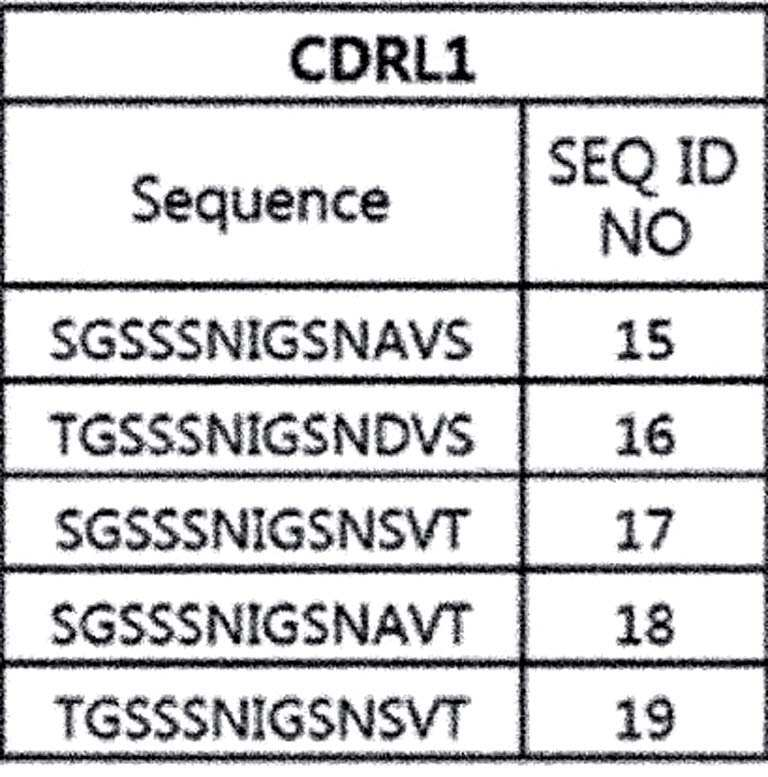
[표 le][Table le]
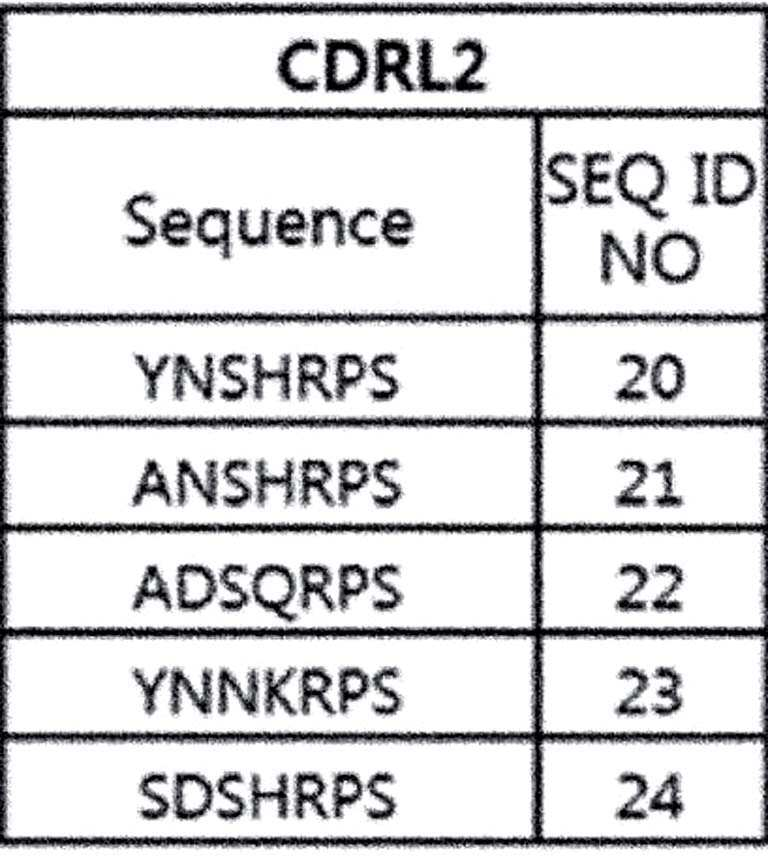
[표 lf][Table lf]
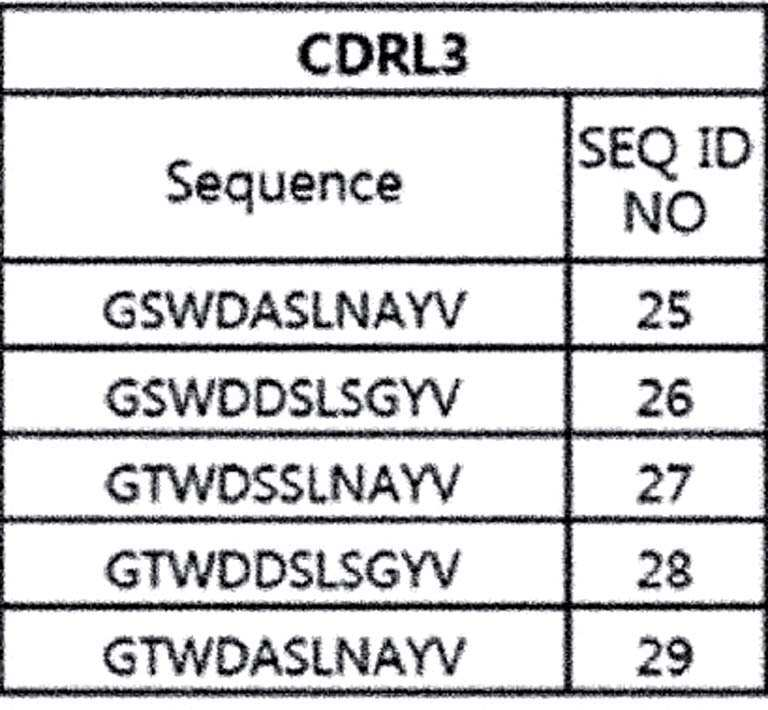
본 발명의 일 구현예에서, 상기 경쇄 및 중쇄의 CDR 서열을 포함하는 항체 또는 항원 결합 단편의 중쇄 및 경쇄 가변영역 서열을 각각 하기 표 2a 및 표 2b로 개시된다.In one embodiment of the present invention, the heavy chain and light chain variable region sequences of the antibody or antigen-binding fragment comprising the CDR sequences of the light chain and the heavy chain are shown in Tables 2a and 2b, respectively.
[표 2a][Table 2a]

[표 2b][Table 2b]
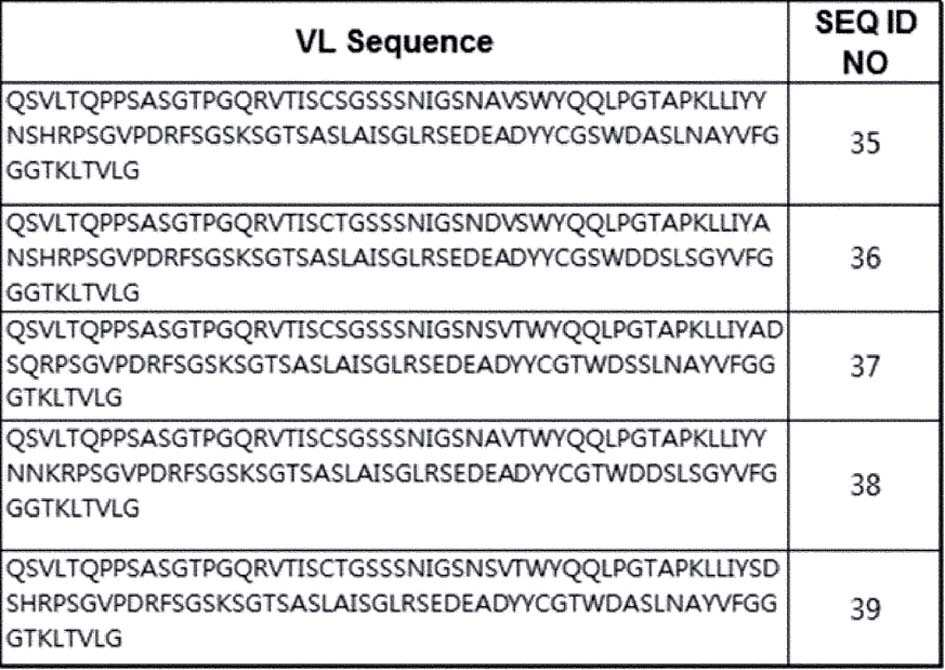
일 구현예에서 상기 표 la 내지 표 1f에 개시된 경쇄의 각 가변영역의 CDR과 중쇄의 각 가변영역의 CDR은 자유롭게 조합될 수 있다.In one embodiment, the CDRs of each variable region of the light chain and the CDRs of each variable region of the heavy chain disclosed in Tables la to 1f above can be freely combined.
다른 구현예에서 상기 표 2a 및 표 2b에 개시된 중쇄 및 경쇄의 가변영역은 다양한 형태의 항체의 제조를 위해 자유롭게 조합될 수 있으며, 예를 들면 scFV와 같은 단쇄 항체, 또는 도메인 항체를 형성할 수 있다.In another embodiment, the variable regions of the heavy and light chains disclosed in Tables 2a and 2b can be freely combined for the production of various types of antibodies, for example, single-chain antibodies such as scFV, or domain antibodies can be formed. .
본 발명에 개시된 각각의 중쇄 및 경쇄 가변영역은 온전한 항체의 각각 중쇄 및 경쇄를 형성하기 위해 목적하는 다양한 중쇄 및 경쇄 불변영역에 결합될 수 있다. 또한, 이렇게 불변영역에 결합된 각각의 중쇄 및 경쇄 서열은 또한 온전한 항체 구조를 형성하기 위해 조합될 수 있다.Each of the heavy and light chain variable regions disclosed in the present invention can be bound to various heavy and light chain constant regions of interest to form heavy and light chains, respectively, of an intact antibody. In addition, each of the heavy and light chain sequences thus bound to the constant region can also be combined to form an intact antibody structure.
본 발명에 따른 항체의 중쇄 및 경쇄의 임의의 가변영역은 불변영역의 적어도 일부에 연결될 수 있다. 불변영역은 항체 의존성 세포 매개 세포독성, 항체 의존성 세포성 포식작용 및/또는 보체 의존성 세포독성 등이 필요한지에 따라 선택될 수 있다. 예를 들어, 인간 아이소타입 IgGl 및 IgG3은 보체 의존성 세포독성을 가지며 인간 아이소타입 IgG2 및 IgG4는 세포독성을 가지지 않는다. 인간 IgGl 및 IgG3은 또한 인간 IgG2 및 IgG4보다 강한 세포 매개 효과기 기능을 유도한다. 예를 들면 중쇄 가변영역은 IgG1, lgG2, IgG2a, IgG2b, IgG3 및 IgG4를 포함하는 IgG 불변영역에, 경쇄 가변영역은 카파 또는 람다 불변영역과 결합될 수 있다. 상기 불변영역은 목적하는 바에 따라 적절한 것이 사용될 수 있으며, 예를 들면 인간 또는 마우스 유래의 것이 사용될 수 있다. 일 구현예에서는 인간 중쇄 불변영역 IgGl이 사용되며, 이는 서열번호 60의 서열로 나타낼 수 있다. 다른 구현예에서 경쇄 불변영역은 인간 람다 영역이 사용되며, 이는 서열번호 64로 나타낼 수 있다.Any variable region of the heavy chain and light chain of the antibody according to the present invention may be linked to at least a part of the constant region. The constant region may be selected depending on whether antibody-dependent cell-mediated cytotoxicity, antibody-dependent cellular phagocytosis and/or complement-dependent cytotoxicity is required. For example, human isotypes IgGl and IgG3 have complement dependent cytotoxicity and human isotypes IgG2 and IgG4 have no cytotoxicity. Human IgGl and IgG3 also induce stronger cell-mediated effector functions than human IgG2 and IgG4. For example, the heavy chain variable region may be bound to an IgG constant region including IgG1, IgG2, IgG2a, IgG2b, IgG3 and IgG4, and the light chain variable region may be bound to a kappa or lambda constant region. As the constant region, an appropriate one may be used depending on the purpose, for example, a human or mouse-derived one may be used. In one embodiment, human heavy chain constant region IgGl is used, which can be represented by the sequence of SEQ ID NO: 60. In another embodiment, the light chain constant region is a human lambda region, which can be represented by SEQ ID NO: 64.
본 발명에 개시된 임의의 가변영역은 불변영역에 결합되어 중쇄 및 경쇄 서열을 형성할 수 있다. 일 구현예에서 본 발명에 개시된 중쇄 가변영역은 인간 IgGl 불변영역에 연결될 수 있으며, 이를 포함하는 중쇄는 서열번호 40 내지 44로 나타낼 수 있다. 다른 구현예에서, 본 발명에 개시된 경쇄 가변영역은 인간 람다 불변영역에 연결될 수 있으며, 이를 포함하는 경쇄는 서열번호 45 내지 49로 나타낼 수 있다. 상기 본 발명에 따른 경쇄 및 중쇄는 다양한 조합으로 조합되어 두 개의 경쇄 및 두 개의 중쇄로 이루어진 온전한 항체를 형성할 수 있다.Any of the variable regions disclosed in the present invention may be linked to the constant regions to form heavy and light chain sequences. In one embodiment, the heavy chain variable region disclosed in the present invention may be linked to a human IgGl constant region, and a heavy chain comprising the same may be represented by SEQ ID NOs: 40 to 44. In another embodiment, the light chain variable region disclosed in the present invention may be linked to a human lambda constant region, and a light chain comprising the same may be represented by SEQ ID NOs: 45 to 49. The light and heavy chains according to the present invention may be combined in various combinations to form an intact antibody comprising two light chains and two heavy chains.
하지만 본 발명에 개시된 가변영역과 조합될 수 있는 이러한 불변영역 서열은 예시적인 것이고, 당업자라면, IgGl 중쇄 불변영역, IgG3 또는 IgG4 중쇄 불변영역, 임의의 카파 또는 람다 경쇄 불변영역, 안정성, 발현, 제조 가능성 또는 다른 목적하는 특징 등을 위해 변형된 불변영역을 포함하는 다른 불변영역이 사용될 수 있음을 알 수 있을 것이다.However, these constant region sequences that can be combined with the variable regions disclosed in the present invention are exemplary, and those skilled in the art will know that an IgGl heavy chain constant region, an IgG3 or IgG4 heavy chain constant region, any kappa or lambda light chain constant region, stability, expression, preparation It will be appreciated that other constant regions, including modified constant regions, may be used for possibilities or other desired characteristics.
본 발명은 또한 본 발명에 개시된 하나 이상의 아미노산 서열과 실질적인 서열 동일성을 갖는 하나 이상의 아미노산 서열을 포함한다. 실질적 동일성이란 본 발명은 서열변이가 존재하는 본 발명에 개시된 효과를 유지하는 것을 의미한다. 일 구현예에서 표 2a에 개시된 중쇄 가변영역과 약 90%, 95%, 또는 99% 동일성을 가진다. 다른 구현예에서 표 2b에 개시된 경쇄 가변영역과 약 90%, 95%, 또는 99% 동일성을 가진다. 예를 들면 본 발명에 개시된 항체 또는 항원 결합단편의 서열과 90%, 95%, 또는 99% 동일성을 나타내는 변이체의 경우, 임의의 변이는 CDR 보다는 가변영역의 골격에서 발생된다.The invention also encompasses one or more amino acid sequences having substantial sequence identity to one or more amino acid sequences disclosed herein. Substantial identity means that the present invention maintains the effect disclosed herein in the presence of sequence variations. In one embodiment, it has about 90%, 95%, or 99% identity to the heavy chain variable region disclosed in Table 2a. In other embodiments, it has about 90%, 95%, or 99% identity to the light chain variable region disclosed in Table 2b. For example, in the case of a mutant exhibiting 90%, 95%, or 99% identity to the sequence of the antibody or antigen-binding fragment disclosed in the present invention, any mutation occurs in the framework of the variable region rather than the CDR.
본 발명은 또한 본 발명에 개시된 항체 또는 그 부분을 코딩하는 핵산이 개시된다. 상기 핵산은 항체 각 사슬, 또는 상기 항체의 단편, 그 돌연변이, 유도체, 또는 변이체를 코딩하는 폴리뉴클레오타이드, 경쇄 또는 중쇄 가변영역 또는 단지 CDR을 코딩하는 폴리뉴클레오타이드, 혼성화 프로브로서 사용하기에 충분한 폴레뉴클레오타이드, 폴리펩타이드를 코딩하는 폴리뉴클레오타이드를 증폭, 규명, 분석 또는 돌연변이 유발에 사용되는 PCR 또는 염기서열분석 프라이머를 포함한다. 핵산은 임의의 길이일 수 있다. 이들은, 예를 들면, 길이가 5, 10, 15, 20, 25, 30, 35, 40, 45, 50, 75, 100, 125, 150, 175, 200, 250, 300, 350, 400, 450, 500, 750, 1,000, 1,500, 2000, 또는 2500개 이상의 폴리뉴클레오타이드일 수 있고/있거나, 하나 이상의 추가의 서열, 예를 들면, 조절 서열을 포함할 수 있고/있거나, 보다 큰 핵산, 예를 들면, 벡터의 일부일 수 있다. 핵산은 단일 가닥 또는 이중 가닥일 수 있고, RNA 및/또는 DNA 폴리뉴클레오타이드, 및 이의 인공 변이체(예, 펩타이드 핵산)를 포함할 수 있다.The present invention also discloses a nucleic acid encoding an antibody or portion thereof disclosed herein. The nucleic acid comprises a polynucleotide encoding each chain of an antibody, or a fragment of the antibody, a mutant, derivative, or variant thereof, a polynucleotide encoding a light or heavy chain variable region or only a CDR, a polynucleotide sufficient for use as a hybridization probe, PCR or sequencing primers used to amplify, characterize, analyze or mutagenize a polynucleotide encoding a polypeptide. Nucleic acids can be of any length. These are, for example, 5, 10, 15, 20, 25, 30, 35, 40, 45, 50, 75, 100, 125, 150, 175, 200, 250, 300, 350, 400, 450, 500, 750, 1,000, 1,500, 2000, or 2500 or more polynucleotides and/or may include one or more additional sequences, such as regulatory sequences, and/or larger nucleic acids, such as It can be part of a vector. Nucleic acids may be single-stranded or double-stranded, and may include RNA and/or DNA polynucleotides, and artificial variants thereof (eg, peptide nucleic acids).
일 구현예에서 본 발명에 개시된 항체 또는 그 단편을 코딩하는 핵산은 본 발명에 개시된 CDR, 상기 CDR을 포함하는 가변영역, 상기 가변영역 및 불변영역을 포함하는 전장 항체를 코딩하는 핵산이다. 아미노산 서열이 결정되면, 핵산서열은 공지의 역전사 프로그램 및 코돈사용빈도(codon usage) 등을 고려하여 용이하게 결정될 수 있다. 인간 IgGl을 코딩하는 중쇄 불변영역의 예시적인 핵산서열은 서열번호 61 내지 63으로 표시될 수 있다. 인간 람다를 코딩하는 경쇄 불변영역의 예시 적인 핵산서열은 서열번호 65 내지 67로 표시될 수 있다. 상기와 같은 불변영역의 핵산서열을 포함하는 전장 중쇄의 예시적인 핵산서열은 서열번호 50 내지 54(인간 IgGl 불변영역을 포함하는 중쇄), 전장 경쇄의 예시적인 핵산서열은 서열번호 55 내지 59(인간 람다 불변영역을 포함하는 경쇄)를 들 수 있다.In one embodiment, the nucleic acid encoding the antibody or fragment thereof disclosed in the present invention is a nucleic acid encoding the CDR disclosed in the present invention, a variable region comprising the CDR, and a full-length antibody comprising the variable region and the constant region. Once the amino acid sequence is determined, the nucleic acid sequence can be easily determined in consideration of a known reverse transcription program and codon usage. Exemplary nucleic acid sequences of the heavy chain constant region encoding human IgGl may be shown in SEQ ID NOs: 61 to 63. Exemplary nucleic acid sequences of the light chain constant region encoding human lambda may be represented by SEQ ID NOs: 65 to 67. An exemplary nucleic acid sequence of the full-length heavy chain comprising the nucleic acid sequence of the constant region as described above is SEQ ID NO: 50 to 54 (heavy chain comprising a human IgGl constant region), and an exemplary nucleic acid sequence of the full-length light chain is SEQ ID NO: 55 to 59 (a light chain comprising a human lambda constant region).
또한 표 la 내지 표 1f의 CDR 서열, 및 표 2a 및 표 2b 의 가변영역을 코딩하는 핵산서열이 포함된다. 이러한 핵산서열은 상기 개시된 전장 항체를 코딩하는 핵산서열에 포함되기 때문에, 별도로 기재되지 않으며, 당업자라면, 본 발명에 개시된 CDR 및 가변영역의 단백질서열을 기초로, 이를 코딩하는 핵산서열을 상기 핵산 서열번호 50 내지 59로부터 용이하게 확인할 수 있을 것이다.Also included are the nucleic acid sequences encoding the CDR sequences of Tables la to 1f, and the variable regions of Tables 2a and 2b. Since such a nucleic acid sequence is included in the nucleic acid sequence encoding the full-length antibody disclosed above, it is not described separately, and those skilled in the art can determine the nucleic acid sequence encoding the nucleic acid sequence based on the CDR and variable region protein sequences disclosed in the present invention. It will be readily identifiable from
본 발명은 또한 본 발명에 개시된 하나 이상의 핵산서열과 실질적인 서열 동일성을 갖는 하나 이상의 핵산서열을 포함한다. 실질적 동일성이란 핵산의 변이 가 아미노산 치환을 수반하지 않는 보존적 치환 또는 아미노산의 변이를 초래하는 경우라도 상기 핵산에 의해 코딩되는 항체 또는 항원결합 단편이 본 발명에 개시된 효과를 유지하는 것을 의미한다.The present invention also includes one or more nucleic acid sequences having substantial sequence identity to one or more nucleic acid sequences disclosed herein. Substantial identity means that the antibody or antigen-binding fragment encoded by the nucleic acid retains the effects disclosed in the present invention even if the mutation of the nucleic acid results in a conservative substitution or mutation of an amino acid without amino acid substitution.
항체의 항원 대한 특이성 및 친화도Antibody specificity and affinity for antigen
본 발명에 따른 항체 또는 항원 결합단편은 특히 B7-H3 항원에 대한 특이성 및 항체 치료제/진단제로서 사용되기에 적절한 친화도를 가진다. 일 구현예에서, 표 6에 따르면, 응집체에 대한 친화도는 KD < 1.0 x 10⁻⁷ M; 또 다른 구현예에서, KD ≤ 1.0 x 10⁻⁸ M이다. 이러한 친화도를 갖는 본 발명에 따른 항체 또는 항원 결합 단편은 이보다 낮은 친화도 예를 들면 친화도가 10-7 M보다 큰 항체와 비교하여 더 낮은 투여량으로 투여될 수 있는 장점이 있다. 이는 항체를 예를 들면 이로 제한하는 것은 아니나, 보다 간편한 피하주사와 같은 방식으로 투여해도 충분한 효능을 얻을 수 있기 때문에, 임상에서 큰 장점이 있다.The antibody or antigen-binding fragment according to the present invention has particularly specificity for the B7-H3 antigen and affinity suitable for use as an antibody therapeutic/diagnostic agent. In one embodiment, according to Table 6, the affinity for the aggregate is KD < 1.0 x 10 -7 M; In another embodiment, KD ≤ 1.0 x 10 -8 M. The antibody or antigen-binding fragment according to the present invention having such affinity has the advantage that it can be administered at a lower dose compared to an antibody having a lower affinity, for example, an affinity greater than 10 -7 M. This is, for example, the antibody is not limited thereto, but since sufficient efficacy can be obtained even when administered in a more convenient subcutaneous injection method, there is a great advantage in clinical practice.
항체의 가변영역antibody variable region
본 발명은 또한 상술한 바와 같이 상기 표 2a 및 표 2b에 나타낸 바와 같은 항체 경쇄 가변영역 또는 항체 중쇄 가변영역 및 이러한 경쇄 및 중쇄 가변영역의 면역학적 기능적 단편, 유도체, 돌연변이 단백질 및 변이체를 포함하는 항체(및 상응하는 핵산서열)에 관한 것이다. 본 발명에 따른 중쇄 및 경쇄의 가변영역이 다양하게 조합된 항체는 "VHx/VLy"로 나타낼 수 있으며, 여기서 "X"는 중쇄 가변영역 서열번호에 상응하고, "y"는 경쇄 가변영역의 서열번호에 상응한다. 일 구현예에서 본 발명에 따른 가변영역은 다음과 같은 조합을 포함할 수 있으나 이로 제한하는 것은 아니다: VH30/VL35, VH30/VL36, VH30/VL37, VH30/VL38, VH30/VL39, VH31/VL35, VH31/VL36, VH31/VL37, VH31/VL38, VH31/VL39, VH32/VL35, VH32/VL36, VH32/VL37, VH32/VL38, VH32/VL39, VH33/VL35, VH33/VL36, VH33/VL37, VH33/VL38, VH33/VL39, VH34/VL35, VH34/VL36, VH34/VL37, VH34/VL38, VH34/VL39.The present invention also provides an antibody comprising an antibody light chain variable region or an antibody heavy chain variable region as shown in Tables 2a and 2b above, and immunologically functional fragments, derivatives, mutant proteins and variants of these light and heavy chain variable regions as described above. (and corresponding nucleic acid sequences). The antibody in which the variable regions of the heavy chain and the light chain according to the present invention are variously combined may be expressed as "VHx/VLy", where "X" corresponds to the heavy chain variable region SEQ ID NO: and "y" is the sequence of the light chain variable region corresponds to the number. In one embodiment, the variable region according to the present invention may include, but is not limited to, the following combinations: VH30/VL35, VH30/VL36, VH30/VL37, VH30/VL38, VH30/VL39, VH31/VL35, VH31/VL36, VH31/VL37, VH31/VL38, VH31/VL39, VH32/VL35, VH32/VL36, VH32/VL37, VH32/VL38, VH32/VL39, VH33/VL35, VH33/VL36, VH33/VL37, VH33/ VL38, VH33/VL39, VH34/VL35, VH34/VL36, VH34/VL37, VH34/VL38, VH34/VL39.
앞서 언급한 바와 같은 상기 다양한 가변영역의 조합은 온전한 항체 및 scFV 등을 포함하는 다양한 형태의 항체로 사용될 수 있다.Combinations of the various variable regions as described above can be used in various forms of antibodies, including intact antibodies and scFVs.
다양한 다른 형태의 항체various different types of antibodies
본 발명에 개시된 항체는 또한 상기 본 발명에 개시된 항체의 변이체이다. 예를 들면, 항원의 일부는 상기 개시된 중쇄 또는 경쇄, 가변영역 또는 CDR 서열의 하나 이상의 잔기에서 보존적 아미노산 치환을 포함한다. 보존적 아미노산 치환은 폴리펩타이드의 활성 또는 항원성을 실질적으로 영향을 미치지 않는 치환을 의미한다. 일 구현예에서 보존적 아미노산 치환은 하기 아미노산 분류 중에서 동일한 분류에 속하는 다른 잔기로의 치환을 일컫는다. 자연-발생 아미노산은 측쇄 특성에 공통적 특징에 기초하여 다음과 같이 분류될 수 있다: 1) 소수성: 노르류신, Met, Ala, Val, Leu, Ile; 2) 중성 친수성: Cys, Ser, Thr, Asn, Gln; 3) 산성: Asp, Glu; 4) 염기성: His, Lys, Arg; 5) 사슬 방향에 영향을 주는 잔기: Gly, Pro; 및 6) 방향족: Trp, Tyr, Phe 보존적 아미노산 치환은 또한 펩타이드 모방체와 같은 비-자연-발생 아미노산 잔기를 포함할 수 있고, 이러한 잔기는 전형적으로 세포가 아닌, 화학적 합성에 의해 도입된다.The antibodies disclosed herein are also variants of the antibodies disclosed herein above. For example, a portion of an antigen comprises conservative amino acid substitutions at one or more residues of the heavy or light chain, variable region, or CDR sequences disclosed above. Conservative amino acid substitutions refer to substitutions that do not substantially affect the activity or antigenicity of a polypeptide. In one embodiment, a conservative amino acid substitution refers to a substitution with another residue belonging to the same class of amino acids below. Naturally-occurring amino acids can be classified based on features common to their side chain properties as follows: 1) hydrophobic: Norleucine, Met, Ala, Val, Leu, Ile; 2) neutral hydrophilicity: Cys, Ser, Thr, Asn, Gin; 3) acidic: Asp, Glu; 4) Basic: His, Lys, Arg; 5) residues affecting chain orientation: Gly, Pro; and 6) Aromatic: Trp, Tyr, Phe Conservative amino acid substitutions may also include non-naturally-occurring amino acid residues such as peptidomimetics, which residues are typically introduced by chemical synthesis, not by cells.
비제한적인 예시적인 보존적 아미노산 치환의 예는 표 3에 나타내나 이로 제한하는 것은 아니다.Non-limiting illustrative examples of conservative amino acid substitutions are shown in Table 3, but are not limited thereto.
[표 3] 보존적 아미노산 치환[Table 3] Conservative amino acid substitutions

비-보존적 치환은 상기 분류 중에서 다른 분류에 속하는 잔기로 치환을 포함한다. 이러한 치환은 인간 항체와 상동성인 항체의 영역 또는 비-상동성 영역 내로 도입될 수 있다.Non-conservative substitutions include substitutions with residues belonging to other classes among those classes. Such substitutions can be introduced into regions of the antibody that are homologous to the human antibody or regions of non-homologism.
항체의 제조Preparation of antibodies
본 발명에서 비-인간 항체는, 예를 들면, 임의의 항체-생성 동물, 예를 들면, 마우스, 랫트, 토끼, 염소, 당나귀, 또는 비-인간 영장류(예를 들면, 시노몰구스 또는 붉은털 원숭이와 같은 원숭이) 또는 유인원(예를 들면 침팬지))로부터 유래될 수 있다. 비인간 항체는 당해 기술 분야에 공지된 방법을 사용하여 동물을 면역화시킴으로써 생성될 수 있다. 항체는 폴리클로날, 모노클로날일 수 있거나, 또는 재조합 DNA를 발현시킴으로써 숙주 세포 내에서 합성될 수 있다. 완전 인간항체는 인간 면역글로불린 유전자 좌를 포함하는 형질전환 동물에 항원을 투여하거나, 또는 인간 항체의 레퍼토리를 발현하는 파지 디스플레이 라이브러리를 항원으로 처리하여, 목적하는 항체를 선택함으로써 제조될 수 있다.A non-human antibody in the present invention may be, for example, any antibody-producing animal, such as a mouse, rat, rabbit, goat, donkey, or non-human primate (eg, cynomolgus or rhesus monkeys such as monkeys) or apes (eg chimpanzees). Non-human antibodies can be generated by immunizing an animal using methods known in the art. Antibodies may be polyclonal, monoclonal, or synthesized in a host cell by expressing recombinant DNA. A fully human antibody can be prepared by administering an antigen to a transgenic animal containing a human immunoglobulin locus, or by treating a phage display library expressing a repertoire of human antibodies with the antigen to select the desired antibody.
모노클로날 항체(mAb)는 종래의 모노클로날 항체 방법, 예를 들면, 문헌(참조: Kohler and Milstein, 1975, Nature 256:495)의 표준 체세포 혼성화 기술을 비롯한 다양한 기술에 의해 생성될 수 있다.Monoclonal antibodies (mAbs) can be generated by a variety of techniques, including conventional monoclonal antibody methods, for example, the standard somatic cell hybridization techniques of Kohler and Milstein, 1975, Nature 256:495. .
본 발명에 개시된 단쇄 항체는 아미노산 가교(짧은 펩타이드 링커)를 이용하여, 중쇄 및 경쇄 가변 도메인(Fv 영역) 단편을 연결하여 생성될 수 있다. 본 발명에 개시된 단쇄 항체는 표 1a 내지 1f에 기재된 중쇄 및 경쇄 가변영역의 도메인 조합을 포함하는 scFv, 또는 표 1a 내지 표 1f에 개시된 CDR을 포함하는 경쇄 및 중쇄 가변 도메인의 조합이 포함되지만 이로 제한되는 것은 아니다.The single-chain antibody disclosed in the present invention can be generated by linking heavy and light chain variable domain (Fv region) fragments using amino acid cross-linking (short peptide linker). Single-chain antibodies disclosed in the present invention include, but are not limited to, scFvs comprising the domain combinations of heavy and light chain variable regions shown in Tables 1a to 1f, or combinations of light chain and heavy chain variable domains comprising the CDRs shown in Tables 1a to 1f. it's not going to be
본 발명에 개시된 항체는 또한 서브타입 스위칭을 통해, 상이한 서브타입 항체로 변경될 수 있다. 따라서 IgG 항체는, 예를 들면, IgM 항체로부터 유래될 수 있고, 그 역도 가능하다.Antibodies disclosed herein can also be changed to different subtype antibodies through subtype switching. Thus, an IgG antibody can be derived, for example, from an IgM antibody, and vice versa.
따라서, 본 발명에 개시된 항체에는, 예를 들면, 목적하는 아이소타입(예를 들면, IgA, IgG1, IgG2, IgG3, IgG4, IgE, 및 IgD)으로 스위칭된 본 발명에 개시된 가변 도메인 조합 항체가 포함된다.Thus, antibodies disclosed herein include, for example, variable domain combination antibodies disclosed herein switched to the desired isotype (eg, IgA, IgG1, IgG2, IgG3, IgG4, IgE, and IgD). do.
또한, 목적하는 바람직한 기능적 및 생화학적 특징을 갖는 B7-H3 결합 단백질을 생성하기 위하여, 표 2a 및 표 2b에 기재된 중쇄 및 경쇄 가변 영역, 또는 표 la 내지 표 1f에 기재된 CDR에 보존적 변형(및 코딩 핵산에 상응하는 변형)이 수행될 수 있다. 이러한 변형을 수행하는 방법은 상술한 바와 같다.In addition, in order to generate B7-H3 binding proteins with the desired desired functional and biochemical characteristics, conservative modifications (and corresponding modifications to the encoding nucleic acid) can be carried out. A method of performing this transformation is as described above.
질환에서 B7-H3의 역할The role of B7-H3 in disease
B7-H3는 면역관문 리간드에 속하는 단백질로 항원제시 항원제시세포(antigen presenting cells, APCs)에서 발현한다. T 세포 표면의 B7-H3 수용체와 결합하여 T 세포의 면역반응 억제를 유도한다.B7-H3 is a protein belonging to the immune checkpoint ligand and is expressed in antigen presenting cells (APCs). It binds to the B7-H3 receptor on the surface of T cells and induces suppression of the immune response of T cells.
B7-H3는 다양한 암종에서도 과발현하지만 정상조직에서의 발현은 매우 낮다. 예를 들면 유방암, 갑상선암, 전립선암, 신장암, 신경 모세포종, 간세포암, 자궁경부암, 골육종, 구강암, 방광암, 신경교종, 비소세포폐암, 췌장암, 위암, 난소암, 대장암, 방광암, 흑생종, 자궁내 막암, 두경 부암, 요로상피 암 또는 구상피 세포암 등 다양한 고형암에서 확인되며, 급성 백혈병(Acute leukemia), 다발성 골수종(multiple myeloma), 여러 종류의 림프종(lymphoma)과 같은 혈액암에서도 과발현된다. 이러한 B7-H3의 과발현은 암세포의 침윤, 전이 촉진 및 암의 신생혈관 형성에 기여하며 결과적으로 환자의 예후와 생존률 악화와 관련되어 있다.B7-H3 is overexpressed in various carcinomas, but its expression in normal tissues is very low. For example, breast cancer, thyroid cancer, prostate cancer, kidney cancer, neuroblastoma, hepatocellular carcinoma, cervical cancer, osteosarcoma, oral cancer, bladder cancer, glioma, non-small cell lung cancer, pancreatic cancer, stomach cancer, ovarian cancer, colorectal cancer, bladder cancer, melanoma, uterus It is found in various solid cancers such as endometrial cancer, head and neck cancer, urothelial cancer or spheroid cell carcinoma, and is overexpressed in blood cancers such as acute leukemia, multiple myeloma, and several types of lymphoma. Such overexpression of B7-H3 contributes to cancer cell invasion, promotion of metastasis, and neovascularization of cancer, and is consequently associated with deterioration of the patient's prognosis and survival rate.
따라서 B7-H3의 암세포 특이적 발현은 B7-H3가 효과적인 암 표적이 될 수 있어, 이를 특이적으로 인식하는 항체의 개발이 필요하다는 것을 나타낸다. 또한 면역관문 리간드인 B7-H3의 기능을 고려하면, B7-H3 수용체의 결합을 방해하는 B7-H3 중화항체는 B7-H3를 과발현하는 다양한 암의 치료 및 암의 표적화에 유용한 수단으로 사용될 수 있음을 나타낸다.Therefore, the cancer cell-specific expression of B7-H3 indicates that B7-H3 can be an effective cancer target, and it is necessary to develop an antibody that specifically recognizes it. In addition, considering the function of B7-H3, an immune checkpoint ligand, a B7-H3 neutralizing antibody that interferes with the binding of B7-H3 receptor can be used as a useful means for the treatment and targeting of various cancers overexpressing B7-H3. indicates
치료 목적을 위한 인간 B7-H3 항체 및 이를 포함하는 항체 접합체의 용도Use of human B7-H3 antibodies and antibody conjugates comprising same for therapeutic purposes
본 발명에 따른 B7-H3에 특이적으로 결합하는 항체 및 이를 포함하는 항체 접합체는 질환의 치료가 필요한 대상체의 질환의 치료에 사용될 수 있다. B7-H3은 주로 항원제시세포에서 발현하며, 다양한 종류의 암에서도 발현하지만 정상조직에서의 발현은 매우 낮다. 또한 암에서 B7-H3의 발현은 암환자의 좋지 않은 예후와 관련이 있으며, 암세포의 침윤, 전이 촉진 및 암의 신생혈관 형성에 기여하는 것으로 알려져 있다. 예를 들면 B7-H3은 위암, 폐암, 유방암 및 기타 고형암에서 과발현되고 암 혈관세포에서도 과발현되어 있어, 표적 치료제로 사용될 수 있다. 이는 B7-H3 항체가 암의 치료에 유용한 수단으로 사용될 수 있음을 나타낸다. 항암 항체 치료를 위해 예를 들면 B7-H3 항체 및 이를 포함하는 항체 접합체는 앞서 기술한 바와 같이 항체 또는 이를 포함하는 항체 접합체 단독 또는 세포독성제, 화학요법제 또는 방사선 치료제와 연결 또는 다중항체의 형태로 다른 항체와 연결 또는 세포치료제의 형태로, B7-H3을 발현하는 암 세포의 제거에 사용될 수 있다. 따라서, B7-H3에 결합하는 항체 및 이를 포함하는 항체 접합체는 항체 또는 이를 포함하는 항체 접합체 단독 또는 항암화학요법제, 세포독성제 또는 방사선 물질과 결합되어 또는 다중항체 형태로 다른 타겟에 대한 특이적 항체와 연결 또는 세포치료제에서 항암 표적에 대한 표적화의 목적으로 구현되어, 상기 항체 유래 치료제를 B7-H3을 발현하는 세포로 유도하는 표적 치료제로 사용될 수 있다.The antibody specifically binding to B7-H3 and the antibody conjugate comprising the same according to the present invention can be used for the treatment of a disease in a subject in need of such treatment. B7-H3 is mainly expressed in antigen-presenting cells, and although it is expressed in various types of cancer, its expression in normal tissues is very low. In addition, the expression of B7-H3 in cancer is associated with poor prognosis of cancer patients, and is known to contribute to cancer cell invasion, metastasis promotion, and neovascularization of cancer. For example, B7-H3 is overexpressed in gastric cancer, lung cancer, breast cancer and other solid cancers and is also overexpressed in cancer vascular cells, so it can be used as a targeted therapeutic. This indicates that the B7-H3 antibody can be used as a useful means for the treatment of cancer. For anti-cancer antibody treatment, for example, the B7-H3 antibody and the antibody conjugate comprising the same are combined with the antibody or the antibody conjugate comprising the same alone or with a cytotoxic agent, chemotherapeutic agent or radiotherapy agent or in the form of multiple antibodies as described above It can be used for the removal of cancer cells expressing B7-H3 in the form of cell therapy or linking with other antibodies. Accordingly, an antibody binding to B7-H3 and an antibody conjugate comprising the same are specific for another target in the form of an antibody or an antibody conjugate comprising the same or combined with an anticancer chemotherapeutic agent, a cytotoxic agent or a radioactive material, or in the form of a multiantibody It is implemented for the purpose of linking with an antibody or targeting an anticancer target in a cell therapy product, and can be used as a target therapeutic agent for inducing the antibody-derived therapeutic agent to cells expressing B7-H3.
또한 면역관문 리간드인 B7-H3는 T 세포 표면의 B7-H3 수용체와 결합하여 T 세포의 면역반응 억제를 유도한다. 따라서 B7-H3와 B7-H3 수용체의 결합을 방해하는 본 발명에 따른 항 B7-H3 항체 및 이를 포함하는 항체-약물 접합체는 B7-H3 면역관문억제제로 작용하여, B7-H3 면역관문에 의해 억제된 면역세포 예를 들면 T 세포의 활성화를 유도하는 면역 항암치료제로 사용될 수 있다.In addition, B7-H3, an immune checkpoint ligand, binds to the B7-H3 receptor on the surface of T cells and induces suppression of immune responses of T cells. Therefore, the anti-B7-H3 antibody according to the present invention and the antibody-drug conjugate comprising the same, which interferes with the binding of B7-H3 to the B7-H3 receptor, acts as a B7-H3 immune checkpoint inhibitor, and is inhibited by the B7-H3 immune checkpoint. It can be used as an immunotherapeutic agent that induces the activation of activated immune cells, for example, T cells.
이런 측면에서 본 발명은 또한 B7-H3 면역관문에 의해 억제된 T 세포의 활성을 재활성화시키는 방법에 관한 것으로, 상기 방법은 본 발명에 따른 항체 또는 항원결합 단편, 또는 이를 포함하는 항체-약물 접합체를 상기 치료가 필요한 대상체 또는 세포 또는 조직에 처리하는 단계를 포함한다.In this aspect, the present invention also relates to a method for reactivating the activity of T cells suppressed by the B7-H3 immune checkpoint, the method comprising the antibody or antigen-binding fragment according to the present invention, or an antibody-drug conjugate comprising the same and treating a subject or cell or tissue in need of the treatment.
또한 본 발명에 따른 항체 및 이를 포함하는 항체-약물 접합체는 항암 면역항체 예를 들면 PD-1 (Programmed Death 1), PD-L1 (Programmed Death Ligand 1), CTLA(Cytotoxic T-Lymphocyte-Associated protein)-4, LAG-3(Lymphocyte Activation Gene-3), CD28, CD122, 4-1BB, TIM3(T-cell Immunoglobulin domain and Mucin domain 3), OX-40(CD134), OX40L(CD252), CD40, CD40L, LIGHT(또는 tumor necrosis factor superfamily member 14 (TNFSF14)), ICOS(CD278), ICOSL, GITR(glucocorticoid-induced TNFR-related protein), GITRL, TIGIT(T-cell immunoreceptor with Ig and ITIM domains), CD27, VISTA(V-domain Ig suppressor of T cell activation), B7-H4, HEVM(Herpes Virus Entry Mediator) 또는 BTLA(B and T Lymphocyte Attenuator), CD47 또는 CD73에 특이적으로 결합하여 항암 면역반응을 나타내는 항체와 조합으로 사용되어 보다 효과적으로 면역세포의 활성화를 유도하여, 암의 치료에 효과적으로 사용될 수 있다.In addition, the antibody according to the present invention and the antibody-drug conjugate comprising the same are anticancer immune antibodies, such as PD-1 (Programmed Death 1), PD-L1 (Programmed Death Ligand 1), CTLA (Cytotoxic T-Lymphocyte-Associated protein) -4, LAG-3 (Lymphocyte Activation Gene-3), CD28, CD122, 4-1BB, TIM3 (T-cell Immunoglobulin domain and Mucin domain 3), OX-40 (CD134), OX40L (CD252), CD40, CD40L , LIGHT (or tumor necrosis factor superfamily member 14 (TNFSF14)), ICOS (CD278), ICOSL, GITR (glucocorticoid-induced TNFR-related protein), GITRL, T-cell immunoreceptor with Ig and ITIM domains (TIGIT), CD27, Antibodies that specifically bind to VISTA (V-domain Ig suppressor of T cell activation), B7-H4, HEVM (Herpes Virus Entry Mediator) or BTLA (B and T Lymphocyte Attenuator), CD47 or CD73 and show an anticancer immune response; It can be used in combination to more effectively induce the activation of immune cells, and thus can be effectively used in the treatment of cancer.
면역 항체는 크게 면역관문억제제와 면역보조자극분자 활성제로 나눌 수 있다. 면역관문(immune checkpoint)은 면역활성화를 조절하며 면역의 항상성 및 자가면역 예방에 중요한 기능을 한다. 특히 암에서 면역관문 기전이 억제되어 초기 암에 대한 면역반응을 억제하는 것으로 알려져 있다.이러한 이유로 면역관문억제제 가 효과적 암치료제로 작용할 수 있다(Pardoll, Nature Reviews Cancer volume 12, pages 252-264 (2012)). 면역관문의 기능을 갖는 분자는 자극성 및 억제성 면역관문 분자를 포함하며, 후자에는 예를 들면 A2AR(Adenosine A2A receptor), B7-H3, BTLA(B and T Lymphocyte Attenuator), CTLA(Cytotoxic T-Lymphocyte-Associated protein), IDO(Indoleamine 2,3-dioxygenase), KIR(Killer-cell Immunoglobulin-like Receptor), LAG3(Lymphocyte Activation Gene-3), PD-L 1 (Programmed Death 1), TIM-3(T-cell Immunoglobulin domain and Mucin domain 3), VISTA(V-domain Ig suppressor of T cell activation)가 포함된다. 면역관문억제제는 상기 억제성 면역관문 분자를 억제 또는 차단하는 물질이다.Immune antibodies can be broadly divided into immune checkpoint inhibitors and immune co-stimulatory molecule activators. The immune checkpoint regulates immune activation and plays an important role in immune homeostasis and autoimmune prevention. In particular, it is known that the immune checkpoint mechanism is suppressed in cancer to suppress the immune response to early cancer. For this reason, immune checkpoint inhibitors can act as an effective cancer treatment (Pardoll, Nature Reviews Cancer volume 12, pages 252-264 (2012) )). Molecules with immune checkpoint function include stimulatory and inhibitory immune checkpoint molecules, the latter of which include, for example, A2AR (Adenosine A2A receptor), B7-H3, BTLA (B and T Lymphocyte Attenuator), CTLA (Cytotoxic T-Lymphocyte). -Associated protein), IDO (
면역보조자극분자는 림프구의 표면에 존재하는 단백질로, 특정 리간드와 함께 항원 및 항원 수용체 결합 후의 온전한(complete) 활성화에 필요하다(The Immune Response Basic and Clinical Principles 2006, Pages 209-245 Tak W. Mak and Mary E. Saunders Elsevier Inc.).Immunostimulatory molecules are proteins present on the surface of lymphocytes and are required for complete activation after binding of antigens and antigen receptors together with specific ligands (The Immune Response Basic and Clinical Principles 2006, Pages 209-245 Tak W. Mak). and Mary E. Saunders Elsevier Inc.).
치료 방법: 약학적 제형, 투여 경로Treatment method: pharmaceutical formulation, route of administration
항체, 또는 항체 접합체 또는 이의 약학적으로 허용되는 염 또는 이의 용매화물을 사용한 치료 방법이 또한 제공된다. 일 구현예에서 항체, 또는 항체 접합체 또는 이의 약학적으로 허용되는 염 또는 이의 용매화물은 환자에 제공된다. 항체, 또는 항체 접합체 또는 이의 약학적으로 허용되는 염 또는 이의 용매화물은 일 구현예 에서 암세포 표면, 암 신생 혈관 또는 항원제시세포에 발현되는 인간 B7-H3에 결합함으로써, B7-H3 면역관문을 억제하여 T 세포를 활성화시킨다. 본 발명에 따른 항체는 암세포 표면 또는 암 신생혈관에 발현하는 인간 B7-H3에 결합함으로써 암세포의 성장을 억제한다. 일 구현예에서 본 발명에 따른 항체 접합체 또는 이의 약학적으로 허용되는 염 또는 이의 용매화물은 세포독성제와 결합한 형태로 암세포 표면에 발현되는 인간 B7-H3에 결합함으로써, 항체에 결합된 세포독성제를 암세포에 특이적으로 전달하여 암세포의 사멸을 유도한다. 일 구현예에서 항체는 같은 표적 또는 다른 표적에 특이적인 항체와 같은 이중항체 등 다중항체의 형태로 암세포 표면에 발현되는 인간 B7-H3에 결합함으로써, 다중항체의 암세포에 대한 특이성을 높이거나 암세포와 면역세포등의 다른 종류의 세포간의 연결을 유도하여 암세포의 사멸을 유도한다. 일 구현예에서 본 발명에 따른 항체, 또는 항체 접합체 또는 이의 약학적으로 허용되는 염 또는 이의 용매화물은 항암 면역항체, 특히 항 4-1BB 또는 항 PD-L1과 조합으로 사용되어 T 세포를 활성화를 통해 암을 억제할 수 있다.Also provided are methods of treatment using an antibody, or antibody conjugate, or a pharmaceutically acceptable salt or solvate thereof. In one embodiment, the antibody, or antibody conjugate, or a pharmaceutically acceptable salt or solvate thereof, is provided to a patient. The antibody, or antibody conjugate, or a pharmaceutically acceptable salt or solvate thereof, in one embodiment, inhibits the B7-H3 immune checkpoint by binding to human B7-H3 expressed on the surface of cancer cells, cancer angiogenesis or antigen-presenting cells. to activate T cells. The antibody according to the present invention inhibits the growth of cancer cells by binding to human B7-H3 expressed on the surface of cancer cells or cancer angiogenesis. In one embodiment, the antibody conjugate according to the present invention, or a pharmaceutically acceptable salt or solvate thereof, binds to human B7-H3 expressed on the surface of cancer cells in a form bound to a cytotoxic agent, thereby binding to an antibody-bound cytotoxic agent. is specifically delivered to cancer cells to induce the death of cancer cells. In one embodiment, the antibody binds to human B7-H3 expressed on the surface of cancer cells in the form of multi-antibodies such as double antibodies such as antibodies specific for the same target or different targets, thereby increasing the specificity of the multi-antibody for cancer cells or with cancer cells. It induces the connection between different types of cells, such as immune cells, to induce the death of cancer cells. In one embodiment, the antibody, antibody conjugate, or pharmaceutically acceptable salt or solvate thereof according to the present invention is used in combination with an anti-cancer immune antibody, particularly anti 4-1BB or anti-PD-L1, to activate T cells. can inhibit cancer.
항체, 또는 항체 접합체 또는 이의 약학적으로 허용되는 염 또는 이의 용매화물의 치료적 유효량, 및 약학적으로 허용가능한 희석제, 담체, 가용화제, 유화제, 방부제 및/또는 보조제를 포함하는 약학적 조성물도 또한 제공된다. 또한, 예를 들면, 이러한 약학적 조성물을 투여함으로써 암 환자를 치료하는 방법이 포함된다. 용어 "환자"는 인간 환자를 포함한다.Pharmaceutical compositions comprising a therapeutically effective amount of an antibody, or antibody conjugate, or a pharmaceutically acceptable salt or solvate thereof, and a pharmaceutically acceptable diluent, carrier, solubilizer, emulsifier, preservative and/or adjuvant are also is provided Also included are methods of treating cancer patients, eg, by administering such pharmaceutical compositions. The term “patient” includes human patients.
상기 약학적 조성물은 약학적으로 허용가능한 담체를 포함할 수 있다. 상기 담체는 부형제, 희석제 또는 보조제를 포함하는 의미로 사용된다. 상기 담체는 예를 들면, 락토스, 덱스트로스, 수크로스, 소르비톨, 만니톨, 자일리톨, 에리트리톨, 말티톨, 전분, 아카시아 고무, 알기네이트, 젤라틴, 칼슘 포스페이트, 칼슘 실리케이트, 셀룰로스, 메틸 셀룰로스, 폴리비닐 피롤리돈, 물, 생리식염수, PBS와 같은 완충액, 메틸히드록시 벤조에이트, 프로필히드록시 벤조에이트, 탈크, 마그네슘 스테아레이트, 및 미네랄 오일로 이루어진 군으로부터 선택된 것일 수 있다. 상기 조성물은 충진제, 항응집제, 윤활제, 습윤제, 풍미제, 유화제, 보존제, 또는 이들의 조합을 포함할 수 있다.The pharmaceutical composition may include a pharmaceutically acceptable carrier. The carrier is used in the sense of including excipients, diluents or adjuvants. The carrier may be, for example, lactose, dextrose, sucrose, sorbitol, mannitol, xylitol, erythritol, maltitol, starch, gum acacia, alginate, gelatin, calcium phosphate, calcium silicate, cellulose, methyl cellulose, polyvinyl pi It may be selected from the group consisting of rolidone, water, physiological saline, buffers such as PBS, methylhydroxy benzoate, propylhydroxy benzoate, talc, magnesium stearate, and mineral oil. The composition may include a filler, an anti-agglomeration agent, a lubricant, a wetting agent, a flavoring agent, an emulsifying agent, a preservative, or a combination thereof.
상기 약학적 조성물은 통상의 방법에 따라 임의의 제형으로 준비될 수 있다. 상기 조성물은 예를 들면, 경구 투여 제형(예를 들면, 분말, 정제, 캡슐, 시럽, 알약, 또는 과립), 또는 비경구 제형(예를 들면, 주사제)으로 제형화될 수 있다. 또한, 상기 조성물은 전신 제형, 또는 국부 제형으로 제조될 수 있다.The pharmaceutical composition may be prepared in any formulation according to a conventional method. The composition may be formulated, for example, as an oral dosage form (eg, a powder, tablet, capsule, syrup, pill, or granule), or a parenteral dosage form (eg, an injection). In addition, the composition may be prepared as a systemic formulation, or as a topical formulation.
상기 약학적 조성물은 상기 항체 또는 그의 항원 결합 단편, 항암제, 또는 이들의 조합을 유효한 양으로 포함할 수 있다. 용어 "유효한 양"은 예방 또는 치료를 필요로 하는 개체에게 투여되는 경우 예방 또는 치료의 효과를 나타내기에 충분한 양을 말한다. 상기 유효한 양은 당업자가 선택되는 세포 또는 개체에 따라 적절하게 선택할 수 있다. 질환의 중증도, 환자의 연령, 체중, 건강, 성별, 환자의 약물에 대한 민감도, 투여 시간, 투여 경로 및 배출 비율, 치료 기간, 사용된 조성물과 배합 또는 동시 사용되는 약물을 포함한 요소 및 기타 의학 분야에 잘 알려진 요소에 따라 결정될 수 있다. The pharmaceutical composition may include the antibody or antigen-binding fragment thereof, an anticancer agent, or a combination thereof in an effective amount. The term "effective amount" refers to an amount sufficient to exhibit the effect of prophylaxis or treatment when administered to a subject in need thereof. The effective amount can be appropriately selected by those skilled in the art depending on the cell or individual to be selected. Severity of disease, age, weight, health, sex, patient's sensitivity to drug, time of administration, route of administration and rate of excretion, duration of treatment, factors including drugs used in combination with or concomitantly with the composition used, and other medical fields can be determined according to well-known factors in
이하, 본 발명의 이해를 돕기 위하여 바람직한 실시예를 제시한다. 그러나 하기의 실시예는 본 발명을 보다 쉽게 이해하기 위하여 제공되는 것일 뿐, 하기 실시예에 의해 본 발명의 내용이 한정되는 것은 아니다.Hereinafter, a preferred embodiment is presented to aid the understanding of the present invention. However, the following examples are provided for easier understanding of the present invention, and the contents of the present invention are not limited by the following examples.
실시예 1: 항체의 제조Example 1: Preparation of Antibodies
실시예 1-1: 항원의 제조 Example 1 - 1: Preparation of antigen
항 B7-H3 항체 제조를 위한 파지 디스플레이 수행에 사용되는 항원을 구매하여 사용하였다. 인간 B7-H3 의 경우 NP_001019907.1 의 아미노산 서열 1번에서 461번을 포함하며 C 말단에 히스티딘-태그(His tag)가 결합되어 있는 재조합 B7-H3 단백질(2318-B3/CF, R&D Systems) 사용하였다.The antigen used for phage display for the production of anti-B7-H3 antibody was purchased and used. In the case of human B7-H3, the recombinant B7-H3 protein (2318-B3/CF, R&D Systems) containing
하기 실시예의 ELISA 분석, SPR 분석 또는 T 세포 활성 분석에 사용되는 항원을 다음과 같이 구매하여 사용하였다. 인간 B7-H3의 경우 NP_001019907.1 의 아미노산 서열 1번에서 461번을 포함하며 C 말단에 히스티딘-태그(His tag)가 결합되어 있는 재조합 B7-H3 단백질(Sino Biological, 11188-H08H)과 C 말단에 인간 IgGl의 Fc 부분이 결합되어 있는 단백질(Sino Biological, 11188-H02H)을 사용하였다.Antigens used for ELISA analysis, SPR analysis, or T cell activity analysis in Examples below were purchased and used as follows. In the case of human B7-H3, the recombinant B7-H3 protein (Sino Biological, 11188-H08H) containing
실시예 1-2: 파이지 라이브러리 스크리닝을 통한 항체 선별 제조Example 1-2: Preparation of antibody selection through phage library screening
라이브러리 파아지(Library phage)의 제조Preparation of library phage
다양한 항원에 대한 결합 가능성을 가지는 인간 유래 scFv(single-chain variable fragment) 라이브러리(Mol. Cells OT, 225-235, February 28, 2009) 유전자를 가진 대장균을 2X YT(Amresco, J902-500G), 암피실린(Ampicilin)이 100 ㎍/㎖, 2% 글루코스(sigma, G7021)를 포함하는 배지에 2 x 10¹⁰개를 접종하여 37℃에서 2시간에서 3시간 동안 배양하여 0D600 값이 0.5에서 0.7이 되도록 하였다. 배양한 대장균을 헬퍼 파아지(helper phage)를 감염시킨 후, 2X YT [2X YT, 암피실린(Ampicilin) 100 ㎍/㎖, 1 mM IPTG(Duchefa, I1401)] 배지에 30℃에서 16시간 동안 배양하여 파이지 패킹을 유도하였다. 이어 배양한 세포를 4℃, 4500 rpm 조건으로 20분 동안 원심분리한 후, 상등액에 4% PEG 8000(sigma, P2139)과 3% NaCl(Samchun, S2097)을 첨가하여 잘 녹인 후 얼음 위에서 1시간 동안 반응시켰다. 다시 4℃, 8000 rpm 조건으로 원심분리한 후, 상등액은 버리고 세포 펠렛에 PBS (Phosphate buffered saline, Gibco 10010-023)를 첨가하여 현탁하였다. 현탁액을 4℃, 1200 rpm 조건으로 10분간 원심분리한 후, 상등액을 새 튜브로 옮겨 사용 시까지 4℃에서 보관하였다.2X YT (Amresco, J902-500G), ampicillin with human-derived single-chain variable fragment (scFv) library (Mol. Cells OT, 225-235, February 28, 2009) gene having the potential for binding to various antigens (Ampicilin) was so that the 100 ㎍ / ㎖, 2% glucose (sigma, G7021) 2 x 10 10 dog immunization and cultured in 2 hours at 37 ℃ for 3 hours, 0.7 in yi 0D600 value 0.5 in medium containing . After infecting the cultured E. coli with helper phage, 2X YT [2X YT,
파아지 디스플레이(Phage display)를 통한 패닝(panning)Panning via phage display
인간 B7-H3 단백질과 결합하는 항체를 선별하기 위해 실시예 1의 히스티딘-태그(His tag)가 결합되어 있는 재조합 B7-H3 단백질을 이용하여 다음과 같이 패닝을 총 3회 진행하였다.In order to select an antibody that binds to human B7-H3 protein, the histidine-tag (His tag) of Example 1 was used, and panning was performed a total of three times as follows using the recombinant B7-H3 protein.
구체적으로 면역시험관(immunotube, maxisorp 444202)에 2 ㎍/㎖ 농도의 재조합 인간 B7-H3 단백질을 1 ㎖ 첨가하여 37℃, 200 rpm 조건에서 1시간 반응시켜 시험관 표면에 단백질을 흡착시켰다. 이어 상등액을 제거하고 탈지유(Skim milk)가 3% 포함된 용액을 시험관에 첨가하여 실온에서 1시간 반응시켰다. 이를 통해 재조합 인간 B7-H3 단백질이 흡착되지 않은 면역시험관 표면에 Skim milk를 흡착시켜 비특이적 결합을 차단하였다. 이어 상등액을 제거한 후, 실시예 1-2에서 준비한 파지 라이브러리의 1012 CFU를 3% Skim milk가 포함된 용액에 섞어 상기 면역시험에 넣고 37℃, 150 rpm 조건에서 1시간 반응시켜 인간 B7-H3 단백질 특이적인 파지가 항원에 결합하도록 하였다.Specifically, 1 ml of recombinant human B7-H3 protein at a concentration of 2 μg/ml was added to an immune test tube (immunotube, maxisorp 444202), and reacted at 37° C. and 200 rpm for 1 hour to adsorb the protein to the surface of the test tube. Then, the supernatant was removed, and a solution containing 3% skim milk was added to the test tube and reacted at room temperature for 1 hour. Through this, the non-specific binding was blocked by adsorbing Skim milk to the surface of the immune test tube to which the recombinant human B7-H3 protein was not adsorbed. Then, after removing the supernatant, 10 12 CFU of the phage library prepared in Example 1-2 was mixed with a solution containing 3% Skim milk, put into the above immunological test, and reacted at 37 ° C., 150 rpm for 1 hour to react with human B7-H3 Protein-specific phages were allowed to bind antigen.
이어 비특이적으로 결합한 파지를 PBS-T(Phosphate buffered saline-0.05% Tween 20) 용액으로 3회 씻어내어 제거하고, 남아있는 항원 특이적 파지 항체를 100 mM 트리에틸아민 용액을 1 ㎖ 넣어 회수하였다. 트리에틸아민 용액의 pH가 낮기 때문에 회수된 파지를 lM Tris 완충액(pH 7.4)으로 중화시킨 후, OD600에서 0.8~1로 키운 ER2537 대장균에 37℃, 120 rpm 조건에서 1시간 30분 동안 감염시켰다. 배 양액을 4℃, 4500 rpm 조건으로 15분간 원심분리하여 상층액을 제거하고 가라않은 세포를 감염된 대장균을 암피실린(Ampicilin)을 포함하는 2X YT 한천배지에 도말하여 37℃에서 16시간 이상 배양하였다. 다음날 배양된 대장균을 모두 긁어 5 ㎖의 2X YT 암피실린 배양액에 현탁하고 50% 글리세롤을 첨가하여 일부는 -80℃에 보관하고 나머지는 다음 실험을 위해 파아지를 제조하였다. 배양된 대장균 20 ㎕를 암피실린이 포함된 2X TB에 접종하여 키운 후 헬퍼 파아지 감염시키고 실시예 2-1 과 2-2을 2번 더 반복하여 인간 B7-H3 단백질 특이적인 파아지 풀(phage pool)을 증폭 및 농축하였다.Then, the non-specifically bound phage was washed three times with PBS-T (Phosphate buffered saline-0.05% Tween 20) solution and removed, and the remaining antigen-specific phage antibody was recovered by adding 1 ml of 100 mM triethylamine solution. Since the pH of the triethylamine solution was low, the recovered phages were neutralized with 1M Tris buffer (pH 7.4), and then ER2537 E. coli grown at an OD600 of 0.8 to 1 was infected at 37° C., 120 rpm for 1 hour and 30 minutes. The culture medium was centrifuged for 15 minutes at 4°C and 4500 rpm to remove the supernatant, and the infected E. coli cells were smeared on 2X YT agar medium containing ampicillin and cultured at 37°C for 16 hours or more. The next day, all of the cultured E. coli was scraped and suspended in 5 ml of 2X YT ampicillin culture, 50% glycerol was added, some were stored at -80°C, and the rest were prepared as phages for the next experiment. 20 μl of cultured E. coli was inoculated into 2X TB containing ampicillin and grown, and then infected with helper phage, and Examples 2-1 and 2-2 were repeated two more times to obtain a human B7-H3 protein-specific phage pool. amplified and concentrated.
단일클론 파아지 항체 선별(single clone screening)Monoclonal phage antibody screening (single clone screening)
상기 패닝을 통해 얻은 파아지 풀(phage pool)로부터 인간 B7-H3 단백질에 특이적으로 결합하는 단일클론항체를 선별하기 위해 다음과 같은 실험을 수행하였다.In order to select a monoclonal antibody that specifically binds to human B7-H3 protein from the phage pool obtained through the panning, the following experiment was performed.
농축된 풀로부터 단일클론을 분리하기 위해, LB-암피실린 한천배지에 상기 파아지 풀을 도말한 후 배양하여 단일 콜로니를 확보하였다. 이어 단일클론을 웰당 200 ㎕의 super broth(SB) 배지가 들어간 96 깊은 웰 플레이트에 접종하여 37℃에서 4시간 배양하여 키운 후, 일부를 다른 플레이트에 옮겨 Cell stock을 만들었다. 남아 있는 세포 배양액에 1 mM IPTG 되게 넣어 주고 30℃에서 16시간 동안 배양하여 scFv의 생산을 유도하였다. 배양한 배양액을 4℃, 6000 rpm 조건으로 20분간 원심분리한 후 상등액을 버리고 세포만을 얻은 후 TES 용액을 이용하여 세포를 용해시킨 후에 다시 원심분리하여 상등액만 얻어서 사용하였다.In order to isolate a single clone from the concentrated pool, the phage pool was plated on LB-ampicillin agar medium and then cultured to secure a single colony. Then, a single clone was inoculated into a 96 deep well plate containing 200 μl of super broth (SB) medium per well, incubated at 37° C. for 4 hours and grown, and some of the clones were transferred to another plate to make a cell stock. 1 mM IPTG was added to the remaining cell culture medium and cultured at 30° C. for 16 hours to induce scFv production. After centrifuging the cultured medium at 4°C and 6000 rpm for 20 minutes, the supernatant was discarded to obtain only the cells, the cells were lysed using a TES solution, and then centrifuged again to obtain only the supernatant.
이어 다음과 같이 ELISA 방법을 사용하여 B7-H3-His 항원(2318-B3/CF,R&D Systems)과 결합하는 단일클론 가용성 scFv를 발현하는 클론을 선택하였다(Steinberger. Rader and Barbas III. 2000. Phage display vectors. In: Phage Display Laboratory Manual, lst ed. ColdSpringHarborLaboratoryPress. NY. USA. pp.l1.9-11.12). 구체적으로 96-웰 플레이트(Nunc-Immuno Plates, NUNC, Rochester, NY, USA)에 실시예 1에서 준비한 재조합 인간 B7-H3-His 단백질을 PBS에 희석하여 웰당 100 ng 넣고, 4℃에서 밤새 흡착시켰다. 다음날 플레이트에 단백질을 PBST(Phosphate buffered saline-0.05% Tween 20)로 씻어준 후, 비특이적인 결합을 방지하기 위해 3% BSA이 포함된 PBS 완충용액을 웰당 200 ㎕을 넣고 37℃에서 약 2시간 반응시켰다. 이어 PBST로 다시 씻어준 후 미리 원심분리하여 준비한 파지가 포함된 상등액을 각 웰당 100 ㎕ 넣고 37℃에서 약 1시간 반응시켰다. 이어 PBST로 씻어준 후 인간 B7-H3에 결합된 파지를 검출하기 위해 항-HA HRP(Horseradish peroxidase) 결합 항체(Roche, 12 013 819 001)를 1% BSA가 포함된 PBS에 1:5000으로 희석하여 웰당 100 ㎕ 넣고 37℃에서 약 1시간 반응시켰다. 다시 PBST로 씻어준 후 TMB(Tetramethylbenzidine, Thermo, 34028) 100 ㎕ 넣어 발색시켰다. RT에서 5~10분간 반응시킨 후 1N H2S04를 50 ㎖ 넣어 반응을 종료하였다. 450nm에서 흡광도를 측정하여 값이 1.0 이상인 클론을 선별하였다.Then, clones expressing monoclonal soluble scFv binding to B7-H3-His antigen (2318-B3/CF, R&D Systems) were selected using an ELISA method as follows (Steinberger. Rader and Barbas III. 2000. Phage display vectors.In: Phage Display Laboratory Manual, lst ed.ColdSpringHarborLaboratoryPress.NY.USA.pp.l1.9-11.12). Specifically, 100 ng per well of the recombinant human B7-H3-His protein prepared in Example 1 was diluted in PBS in a 96-well plate (Nunc-Immuno Plates, NUNC, Rochester, NY, USA), and adsorbed overnight at 4°C. . The next day, after washing the protein on the plate with PBST (Phosphate buffered saline-0.05% Tween 20), 200 μl of PBS buffer containing 3% BSA was added per well to prevent non-specific binding, and reacted at 37°C for about 2 hours. did it Then, after washing again with PBST, 100 μl of the supernatant containing the phage prepared by centrifugation in advance was put into each well and reacted at 37° C. for about 1 hour. After washing with PBST, an anti-HA HRP (Horseradish peroxidase)-binding antibody (Roche, 12 013 819 001) was diluted 1:5000 in PBS containing 1% BSA to detect phages bound to human B7-H3. 100 μl per well was added and reacted at 37° C. for about 1 hour. After washing again with PBST, 100 μl of TMB (Tetramethylbenzidine, Thermo, 34028) was added to develop color. After reacting at RT for 5-10 minutes , 50 ml of 1N H 2 S0 4 was added to terminate the reaction. By measuring the absorbance at 450 nm, clones having a value of 1.0 or higher were selected.
이로부터 재조합 인간 B7-H3 단백질에 결합하는 5개 항체 클론(B5, C4I, D8G, F6V, 및 10F11)을 선별하였으며, 상기 각 항체의 중쇄 가변 및 경쇄 가변영역의 아미노산 서열 및 CDR 서열은 다음 표와 같다.From this, five antibody clones (B5, C4I, D8G, F6V, and 10F11) that bind to recombinant human B7-H3 protein were selected. The amino acid sequences and CDR sequences of the heavy and light chain variable regions of each antibody are shown in the table below. same as
[표 4][Table 4]
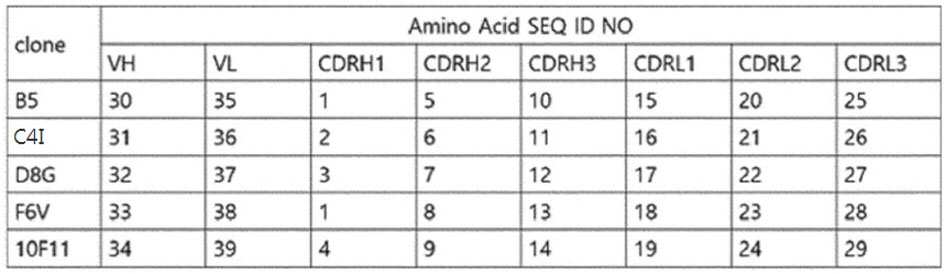
상기 가변영역 및 CDR 서열을 코딩하는 핵산서열은 B5, C4I, D8G, F6V, 및 10F11의 순서대로 하기 전장 핵산서열에 포함되어 있다: 서열번호 50(중쇄) 및 55(경쇄); 서열번호 51(중쇄) 및 56(경쇄); 서열번호 52(중쇄) 및 57(경쇄); 서열번호 53(중쇄) 및 58(경쇄); 서열번호 54(중쇄) 및 59(경쇄). 상기 핵산서열에서 불변영역을 코딩하는 핵산서열은 서열번호 61 내지 63(중쇄), 및 서열번호 65 내지 67(경쇄)이다.Nucleic acid sequences encoding the variable region and CDR sequences are included in the following full-length nucleic acid sequences in the order of B5, C4I, D8G, F6V, and 10F11: SEQ ID NOs: 50 (heavy chain) and 55 (light chain); SEQ ID NOs: 51 (heavy chain) and 56 (light chain); SEQ ID NOs: 52 (heavy chain) and 57 (light chain); SEQ ID NOs: 53 (heavy chain) and 58 (light chain); SEQ ID NOs: 54 (heavy chain) and 59 (light chain). Nucleic acid sequences encoding constant regions in the nucleic acid sequence are SEQ ID NOs: 61 to 63 (heavy chain), and SEQ ID NOs: 65 to 67 (light chain).
실시예 2: 항 B7-H3 scFv의 전체 IgG 형태로 변환 및 생산Example 2: Conversion and production of anti-B7-H3 scFv into whole IgG form
실시예 2-1: 항 B7-H3 scFv의 전체 IgG 형태로의 클로닝Example 2-1: Cloning of anti-B7-H3 scFv into whole IgG form
상기 실시예 1에서 확보한, 각 인간 B7-H3 특이적 단일클론 파아지 항체의 서열을 전체 IgG(full IgG) 형태로 변환하기 위해, 실시예 1에서 확보한 각 클론의 중쇄 및 경쇄 가변영역을 코딩하는 핵산을 합성하였다(제노텍, 대한민국). 인간 IgGl 서브타입의 중쇄와 경쇄 불변영역(각각 서열번호 60 및 64) 단백질을 코딩하는 유전자(중쇄 불변영역 서열번호 61(C4I, D8G, 10F11 clone), 62(B5 clone), 63(F6V clone) 및 경쇄 불변영역 65(C4I, D8G, 10F11 clone), 66(B5 clone) 및 67(F6V clone))를 합성하여 상기 각 중쇄와 경쇄 가변영역을 코딩하는 핵산과 연결하였다. 각 항체의 경쇄와 중쇄를 암호화하는 핵산은 각각 pcDNA3.1 기반의 발현 벡터에 클로닝하여 CHO-S 등의 포유동물세포주에서 항체 핵산을 암호화하는 벡터를 확보하였다. 또한 기존 항 B7-H3 항체인 Enoblituzumab를 비교군 항체로 사용하기 위해 항체의 가변영역 서열을 특허 (US 8,802,091)에서 확보하여 유전자를 확보하였고 상술한 방법과 동일하게 클로닝하여 84D로 명명하여 사용하였다. 또한 기존 항 B7-H3 ADC인 MGC018를 비교군 ADC로 사용하기 위해 이를 구성하고 있는 항체의 가변영역 서열을 특허출원 (WO 2017/180813)에서 확보하여 유전자를 확보하였고 상술한 방법과 동일하게 클로닝하여 사용하였다.In order to convert the sequence of each human B7-H3-specific monoclonal phage antibody obtained in Example 1 into full IgG (full IgG) form, the heavy chain and light chain variable regions of each clone obtained in Example 1 are encoded. nucleic acids were synthesized (Genotech, Korea). Genes encoding heavy and light chain constant region (SEQ ID NOs: 60 and 64, respectively) proteins of human IgGl subtype (heavy chain constant region SEQ ID NOs: 61 (C4I, D8G, 10F11 clone), 62 (B5 clone), 63 (F6V clone) and light chain constant regions 65 (C4I, D8G, 10F11 clone), 66 (B5 clone) and 67 (F6V clone)) were synthesized and linked with nucleic acids encoding the heavy and light chain variable regions. Nucleic acids encoding the light and heavy chains of each antibody were cloned into pcDNA3.1-based expression vectors, respectively, to obtain vectors encoding the antibody nucleic acids in mammalian cell lines such as CHO-S. In addition, in order to use the existing anti-B7-H3 antibody, Enoblituzumab, as a comparative antibody, the variable region sequence of the antibody was secured from the patent (US 8,802,091) to secure the gene, and it was cloned in the same manner as described above and named as 84D. In addition, in order to use the existing anti-B7-H3 ADC, MGC018, as a comparative ADC, the variable region sequence of the antibody constituting it was secured in the patent application (WO 2017/180813) to secure the gene. was used.
IgG 형태의 본 발명에 따른 항체는 B5, C4I, D8G, F6V 및 10F11의 순서대로 하기 중쇄 및 경쇄 전장 서열로 개시된다: 서열번호 50(중쇄) 및 55(경쇄); 서열번호 51(중쇄) 및 56(경쇄); 서열번호 52(중쇄) 및 57(경쇄); 서열번호 53(중쇄) 및 58(경쇄); 서열번호 54(중쇄) 및 59(경쇄).Antibodies according to the invention in the form of IgG are disclosed with the following heavy and light chain full-length sequences in the order B5, C4I, D8G, F6V and 10F11: SEQ ID NOs: 50 (heavy chain) and 55 (light chain); SEQ ID NOs: 51 (heavy chain) and 56 (light chain); SEQ ID NOs: 52 (heavy chain) and 57 (light chain); SEQ ID NOs: 53 (heavy chain) and 58 (light chain); SEQ ID NOs: 54 (heavy chain) and 59 (light chain).
실시예 2-2: 항 B7-H3 항체 의 발현Example 2-2: Expression of anti-B7-H3 antibody
항 B7-H3 항체의 발현은 Thermo사에서 개발한 ExpiCHO-S™(Thermo Fisher, A29127) 세포를 이용하였고, 항체의 발현은 제조사의 ExpiCHO™Expression System Kit(Thermo Fisher, A29133) 프로토콜에 준수하여 수행하였다.Anti-B7-H3 antibody was expressed using ExpiCHO-S™ (Thermo Fisher, A29127) cells developed by Thermo, and antibody expression was performed in accordance with the manufacturer's ExpiCHO™ Expression System Kit (Thermo Fisher, A29133) protocol. did.
제조방법을 간단히 설명하면, ExpiCHO-S 세포를 8% CO2, 37℃ 조건의 진탕배 양기(shaking incubator)에서 120 rpm 조건으로 배양하였다. 트랜스펙션(Transfection) 당일 ExpiCHO-S 세포를 6 x 10⁶ cells/㎖의 세포 농도로 ExpiCHO™ Expression Medium(Thermo Fisher, A2910001)을 첨가하여 희석하여 준비하였다.Briefly describing the preparation method, ExpiCHO-S cells were cultured at 120 rpm in a shaking incubator at 8% CO 2 , 37° C. conditions. On the day of transfection, ExpiCHO-S cells were prepared by diluting ExpiCHO™ Expression Medium (Thermo Fisher, A2910001) at a cell concentration of 6 x 10 6 cells/ml.
이어 실시예 2-1의 중쇄와 경쇄를 발현하는 각 벡터를 각각 배지 ㎖당 1 ㎍씩 OptiPRO™ SFM 배지(Thermo Fisher, 12309050)에 희석하고, ExpiCHO Expression system에 포함되어 있는 ExpiFectamine™CHO를 ㎖당 3.2 ㎕를 OptiPRO™ SFM 배지 희석하였다. 상기 벡터 및 ExpiFectamine™CHO 혼합물을 서로 섞어 상온에서 5분 동안 반응시킨 후, 준비된 세포에 혼합물을 넣어 8% CO2, 37℃, 120 rpm 조건으로 20시간 배양하였다. 20시간 후에 ExpiCHO™ Expression System Kit(Thermo Fisher, A29133)에 포함되어 있는 Enhencerl, ExpiCHO™ Feed를 각각 ㎖당 2.2 ㎕, 240 ㎕를 세포에 첨가한 후 8% CO2, 37℃, 120 rpm 조건으로 7일에서 10일 정도 배양하였다.Then, each vector expressing the heavy chain and light chain of Example 2-1 was diluted in OptiPRO™ SFM medium (Thermo Fisher, 12309050) at an amount of 1 μg per mL of medium, and ExpiFectamine™ CHO contained in the ExpiCHO Expression system was diluted per mL 3.2 μl OptiPRO™ SFM medium was diluted. The vector and ExpiFectamine™ CHO mixture were mixed and reacted at room temperature for 5 minutes, and then the mixture was put into the prepared cells and incubated for 20 hours at 8% CO 2 , 37°C, 120 rpm conditions. After 20 hours, 2.2 μl and 240 μl of Enhencerl and ExpiCHO™ Feed included in the ExpiCHO™ Expression System Kit (Thermo Fisher, A29133) were added per mL, respectively. After addition to the cells, 8% CO 2 , 37° C., and 120 rpm conditions were cultured for 7 to 10 days.
배양이 끝난 후 세포배양액을 4℃, 6000 rpm 조건으로 30분간 원심분리한 후, 상등액을 분리하여 냉장보관하였다.After the culture was completed, the cell culture medium was centrifuged at 4° C. and 6000 rpm for 30 minutes, and the supernatant was separated and stored in a refrigerator.
실시예 2-3: 항 B7-H3 항체의 분리 정제Example 2-3: Separation and purification of anti-B7-H3 antibody
평형화 완충액(50 mM Tris-HCl, pH7.5, 100 mM NaCl)을 Mab selectsure(GE healthcare, 5 ㎖)에 통과시켜 평형시킨 이후, 실시예 2-2의 배양액을 컬럼(Mab selectsure(GE healthcare, 5 ㎖))에 통과하여 발현된 항체가 컬럼에 결합하도록 하였다. 이 후, 50 mM Na-citrate(pH 3.4), 100 mM NaCl 용액으로 용출시킨 후, 1M Tris-HCl(pH 9.0)을 이용하여 중화시켜 최종 pH가 7.2가 되게 하였다. 완충액을 PBS(phosphate buffered saline, pH 7.4)로 교환하였다.After equilibration by passing the equilibration buffer (50 mM Tris-HCl, pH7.5, 100 mM NaCl) through Mab selectsure (GE healthcare, 5 ml), the culture solution of Example 2-2 was applied to a column (Mab selectsure (GE healthcare, 5 ml) 5 ml)) to allow the expressed antibody to bind to the column. Thereafter, the mixture was eluted with 50 mM Na-citrate (pH 3.4) and 100 mM NaCl solution, and then neutralized with 1M Tris-HCl (pH 9.0) to have a final pH of 7.2. The buffer was exchanged with PBS (phosphate buffered saline, pH 7.4).
실시예 3: 항 B7-H3 IgG 항체의 B7-H3에 대한 결합 특이성 분석Example 3: Binding specificity analysis of anti-B7-H3 IgG antibody to B7-H3
실시예 3-1: 항 B7-H3 IgG 항체의 재조합 B7-H3 항원에 대한 결합능 분석(ELISA)Example 3-1: Assay of binding capacity of anti-B7-H3 IgG antibody to recombinant B7-H3 antigen (ELISA)
상기 실시예 2에서 제조된, 실시예 1에서 선별된 항 B7-H3 IgG 항체의 B7-H3 항원에 대한 특이적 결합능을 확인하기 위해 ELISA 기반 용액 결합 시험을 사용하여 분석하였다.In order to confirm the specific binding ability of the anti-B7-H3 IgG antibody selected in Example 1 to the B7-H3 antigen prepared in Example 2 above, it was analyzed using an ELISA-based solution binding test.
구체적으로 96-웰 플레이트(Nunc-Immuno Plates, NUNC)에 재조합 인간 B7-H3 단백질을 l ㎍/㎖ 농도로 희석하여 웰당 100 ㎕씩 넣어준 후, 4℃에서 16시간 동안 반응하여 코팅하였다. 사용한 재조합 인간 B7-H3 단백질은 실시예 1에서 분석용으로 구매한 제품을 사용하였다.Specifically, 100 μl of recombinant human B7-H3 protein was diluted to a concentration of 1 μg/ml in 96-well plates (Nunc-Immuno Plates, NUNC), and then 100 μl per well was reacted and coated at 4° C. for 16 hours. As the recombinant human B7-H3 protein used, the product purchased for analysis in Example 1 was used.
이어 단백질을 제거하고 PBST로 씻어준 후, 1% BSA(bovine serum albumin)가 포함된 PBS 버퍼를 웰당 200 ㎕ 넣고 37℃에서 2시간 동안 반응시켜 비특이적인 결합을 차단시켰다. 이어 96-웰 플레이트상에서 실시예 2에서 준비한 항 B7-H3 항체를 10 ㎍/㎖을 기준으로 일정 비율로 희석한 후, 각 웰에 100 ㎕ 넣고 37℃에서 1시간 동안 반응시켰다. 이어 PBST로 씻어준 후 인간 B7-H3에 결합된 항체를 검출하기 위해 HRP-접합 항 인간 IgG F(ab')2 항체 (Goat anti-Human IgG F(ab')2 Cross-Adsorbed Secondary Antibody, HRP, Pierce, 31414)를 1% 우혈청 알부민(BSA)이 포함된 PBS에 1:10,000으로 희석하여 웰당 100 ㎕ 넣고 37℃에서 약 1시간 반응시켰다. 다시 PBST로 씻어준 후 TMB(Tetramethylbenzidine, Sigma, T0440) 100 ㎕ 넣어 발색시켰다. RT에서 5~10분간 반응시킨 후 1N H2S04를 50 ㎕ 넣어 반응을 종료하고 마이크로 플레이트 리더기(molecular device)를 이용하여 450nm과 650nm에서 흡광도를 측정하였다.After removing the protein and washing with PBST, 200 μl of PBS buffer containing 1% bovine serum albumin (BSA) was added per well and reacted at 37° C. for 2 hours to block non-specific binding. Then, on a 96-well plate, the anti-B7-H3 antibody prepared in Example 2 was diluted at a certain ratio based on 10 μg/ml, and then 100 μl was put into each well and reacted at 37° C. for 1 hour. After washing with PBST, HRP-conjugated anti-human IgG F(ab')2 antibody (Goat anti-Human IgG F(ab')2 Cross-Adsorbed Secondary Antibody, HRP , Pierce, 31414) was diluted 1:10,000 in PBS containing 1% bovine serum albumin (BSA), put into 100 μl per well, and reacted at 37° C. for about 1 hour. After washing again with PBST, 100 μl of TMB (Tetramethylbenzidine, Sigma, T0440) was added to develop color. After reacting at RT for 5-10 minutes , 50 μl of 1N H 2 S0 4 was added to terminate the reaction, and absorbance was measured at 450 nm and 650 nm using a microplate reader (molecular device).
결과는 도 1에 기재되어 있다. ELISA 방법을 이용한 결합능 측정 결과 항 B7-H3 항체는 인간 B7-H3의 세포외영역에 농도 의존적으로 결합함을 확인하였다.The results are shown in FIG. 1 . As a result of measuring the binding capacity using the ELISA method, it was confirmed that the anti-B7-H3 antibody binds to the extracellular region of human B7-H3 in a concentration-dependent manner.
실시예 3-2: 항 B7-H3 항체의 B7 패밀리의 다른 단백질들에 결합능 분석Example 3-2: Analysis of binding ability of anti-B7-H3 antibodies to other proteins of the B7 family
B7 패밀리 단백질은 서로 20~40%의 아미노산 동일성을 가지고 있으며 면역글로불린 도메인의 반복성과 같이 구조적 관련성을 가진다. 그래서 다른 B7 패밀리 단백질이 아닌 B7-H3 단백질에 특이적으로 결합하는지 아래와 같이 분석하였다.B7 family proteins have 20-40% amino acid identity to each other and have structural relevance, such as repeatability of immunoglobulin domains. Therefore, we analyzed whether it specifically binds to the B7-H3 protein rather than other B7 family proteins as follows.
면역 특이 결합성 확인을 위해 구조적 유사성을 가지는 B7 패밀리 구성 단백질: B7-l(Sino Biological, Cat #: 10698-H08H), B7-2(Sino Biological, Cat #: 10699-H08H), B7-DC(Sino Biological, Cat #: 10292-H08H), B7-Hl(Sino Biological, Cat #: 10084-H08H), B7-H2(Sino Biological, Cat #: 11559-H08H), B7-H4(Sino Biological, Cat#: 10738-H08H), B7-H5(Sino Biological, Cat#: 13482-H08H), B7-H6(Sino Biological, Cat #: 16140-H08H), B7-H7(Sino Biological, Cat #: 16139-H02H)은 구매하여 사용하였다.B7 family member proteins with structural similarity for immunospecific binding confirmation: B7-l (Sino Biological, Cat #: 10698-H08H), B7-2 (Sino Biological, Cat #: 10699-H08H), B7-DC ( Sino Biological, Cat #: 10292-H08H), B7-Hl (Sino Biological, Cat #: 10084-H08H), B7-H2 (Sino Biological, Cat #: 11559-H08H), B7-H4 (Sino Biological, Cat# : 10738-H08H), B7-H5 (Sino Biological, Cat #: 13482-H08H), B7-H6 (Sino Biological, Cat #: 16140-H08H), B7-H7 (Sino Biological, Cat #: 16139-H02H) was purchased and used.
구체적으로 96-웰 플레이트(Nunc-Immuno Plates, NUNC)에 재조합 인간 B7 패밀리 단백질을 l ㎍/㎖ 농도로 희석하여 웰당 100 ㎕씩 넣어준 후, 4℃에서 16시간 동안 반응하여 코팅하였다. 사용한 재조합 단백질은 실시예 1에서 분석용으로 구매 한 제품을 사용하였다.Specifically, a 96-well plate (Nunc-Immuno Plates, NUNC) was diluted with the recombinant human B7 family protein to a concentration of l ㎍ / ㎖, 100 ㎕ per well was added, followed by reaction at 4 ℃ for 16 hours to coat. As the recombinant protein used, the product purchased for analysis in Example 1 was used.
이어 단백질을 제거하고 PBST로 씻어준 후, 1% BSA(bovine serum albumin)가 포함된 PBS 버퍼를 웰당 200 ㎕ 넣고 37℃에서 2시간 동안 반응시켜 비특이적인 결합을 차단시켰다. 이어 96-웰 플레이트 상에서 실시예 2에서 준비한 항 B7-H3 항체를 10 ㎍/㎖으로 희석한 후, 각 웰에 100 ㎕ 넣고 37℃에서 1시간 동안 반응시켰다. 이어 PBST로 씻어준 후 항원에 결합된 항체를 검출하기 위해 HRP-접합 항 인간 IgG F(ab')2 항체 (Goat anti-Human IgG F(ab')2 Cross-Adsorbed Secondary Antibody, HRP, Pierce, 31414)를 1% 우혈청 알부민(BSA)이 포함된 PBS에 1:10,000으로 희석하여 웰당 100 ㎕ 넣고 37℃에서 약 1시간 반응시켰다. 다시 PBST로 씻어준 후 TMB(Tetramethylbenzidine, Sigma, T0440) 100 ㎕ 넣어 발색시켰다. RT에서 5~10분간 반응시킨 후 1N H2S04를 50 ㎕ 넣어 반응을 종료하고 마이크로 플레이트 리더기(molecular device)를 이용하여 450nm 및 650nm에서 홉광도를 측정하였다.After removing the protein and washing with PBST, 200 μl of PBS buffer containing 1% bovine serum albumin (BSA) was added per well and reacted at 37° C. for 2 hours to block non-specific binding. Then, on a 96-well plate, the anti-B7-H3 antibody prepared in Example 2 was diluted to 10 μg/ml, 100 μl was put into each well, and reacted at 37° C. for 1 hour. After washing with PBST, HRP-conjugated anti-human IgG F(ab')2 antibody (Goat anti-Human IgG F(ab')2 Cross-Adsorbed Secondary Antibody, HRP, Pierce, 31414) was diluted 1:10,000 in PBS containing 1% bovine serum albumin (BSA), put into 100 μl per well, and reacted at 37° C. for about 1 hour. After washing again with PBST, 100 μl of TMB (Tetramethylbenzidine, Sigma, T0440) was added to develop color. After reacting at RT for 5-10 minutes , 50 μl of 1N H 2 S0 4 was added to terminate the reaction, and the hop light intensity was measured at 450 nm and 650 nm using a microplate reader (molecular device).
결과는 도 2에 기재되어 있다. ELISA법을 이용한 결합능 측정 결과 항 B7-H3 항체는 B7 패밀리 단백질이 아닌 B7-H3에만 특이적으로 결합함을 확인하였다.The results are shown in FIG. 2 . As a result of measuring the binding capacity using the ELISA method, it was confirmed that the anti-B7-H3 antibody specifically binds only to B7-H3, not to the B7 family protein.
실시예 3-3: 항 B7-H3 항체의 인간, 원숭이, 및 마우스 B7-H3 항원에 대한 종간 교차 반응성 분석Example 3-3: Cross-Species Reactivity Analysis of Anti-B7-H3 Antibodies to Human, Monkey, and Mouse B7-H3 Antigens
인간에 대한 임상 진행 이전에 항 B7-H3 항체의 항체 효능 및 면역 조절기 활성을 평가하기 위해서는 설치류 또는 영장류 모델에서의 평가가 중요하다. 인간 B7-H3의 서열은 원숭이와 마우스에서 90% 이상 상동성을 공유하고 있다. 실시예 2에서 제조된 본 발명의 항 B7-H3 항체의 마우스 또는 원숭이 B7-H3에 대한 교차 반응성을 다음과 같이 ELISA 분석법을 통해 분석하였다.Evaluation in rodent or primate models is important to evaluate the antibody efficacy and immunomodulatory activity of anti-B7-H3 antibodies prior to clinical progression in humans. The sequence of human B7-H3 shares more than 90% homology between monkey and mouse. The cross-reactivity of the anti-B7-H3 antibody of the present invention prepared in Example 2 to mouse or monkey B7-H3 was analyzed by ELISA assay as follows.
종간 교차반응성을 확인하기 위해 C 말단에 히스티딘 태그(His tag)이 결합된 재조합 마우스 B7-H3 단백질(Sino Biological, Cat#: 50973-M08H)와 C 말단에 인간 IgGl의 Fc 부분이 결합되어 있는 재조합 원숭이 B7-H3 단백질(Sino Biological, Cat#: 90806-C02H) 항원을 구매하여 사용하였다.To confirm cross-species cross-reactivity, a recombinant mouse B7-H3 protein (Sino Biological, Cat#: 50973-M08H) with a histidine tag attached to the C-terminus and a recombinant human IgGl Fc portion bound to the C-terminus The monkey B7-H3 protein (Sino Biological, Cat#: 90806-C02H) antigen was purchased and used.
96-웰 플레이트(Nunc-Immuno Plates, NUNC)에 재조합 인간 B7-H3, 마우스 B7-H3, 원숭이 B7-H3 단백질을 1 ㎍/㎖ 농도로 희석하여 웰당 100 ㎕씩 넣어준 후, 4℃에서 16시간 동안 반응하여 코팅하였다. 사용한 재조합 단백질은 실시예 1에서 분석용으로 구매한 제품을 사용하였다.Recombinant human B7-H3, mouse B7-H3, and monkey B7-H3 proteins were diluted to a concentration of 1 μg/ml in a 96-well plate (Nunc-Immuno Plates, NUNC), and 100 μl per well was added thereto, followed by 16 It reacted and coated for a period of time. As the recombinant protein used, the product purchased for analysis in Example 1 was used.
이어 단백질을 제거하고 PBST로 씻어준 후, 1% BSA(bovine serum albumin)가 포함된 PBS 버퍼를 웰당 200 ㎕ 넣고 37℃에서 2시간 동안 반응시켜 비특이적인 결합을 차단시켰다. 이어 96-웰 플레이트 상에서 실시예 2에서 준비한 항 B7-H3 항체를 10 ㎍/㎖부터 일정 비율로 희석한 후, 각 웰에 100 ㎕ 넣고 37℃ 에서 1시간 동안 반응시켰다. 이어 PBST로 씻어준 후 인간 B7-H3, 원숭이 B7-H3, 마우스 B7-H3에 결합한 항체를 검출하기 위해 HRP-접합 항 인간 IgG F(ab')2 항체(Goat anti-Human IgG F(ab')2 Cross-Adsorbed Secondary Antibody, HRP, Pierce, 31414)를 1% 우혈청 알부민(BSA)이 포함된 PBS에 1:l0,000으로 희석하여 웰당 100 ㎕ 넣고 37℃에서 약 1시간 반응시켰다. 다시 PBST로 씻어준 후 TMB(Tetramethylbenzidine, Sigma, T0440) 100 ㎕ 넣어 발색시켰다. RT에서 5~10분간 반응시킨 후 1N H2S04를 50 ㎕ 넣어 반응을 종료하고 마이크로 플레이트 리더기(molecular device)를 이용하여 450nm 및 650nm에서 흡광도를 측정하였다.After removing the protein and washing with PBST, 200 μl of PBS buffer containing 1% bovine serum albumin (BSA) was added per well and reacted at 37° C. for 2 hours to block non-specific binding. Then, on a 96-well plate, the anti-B7-H3 antibody prepared in Example 2 was diluted from 10 μg/ml to a predetermined ratio, and then 100 μl was put into each well and reacted at 37° C. for 1 hour. After washing with PBST, HRP-conjugated anti-human IgG F(ab')2 antibody (Goat anti-Human IgG F(ab') )2 Cross-Adsorbed Secondary Antibody, HRP, Pierce, 31414) was diluted 1:10,000 in PBS containing 1% bovine serum albumin (BSA), 100 μl per well, and reacted at 37° C. for about 1 hour. After washing again with PBST, 100 μl of TMB (Tetramethylbenzidine, Sigma, T0440) was added to develop color. After reacting at RT for 5-10 minutes , 50 μl of 1N H 2 S0 4 was added to terminate the reaction, and absorbance was measured at 450 nm and 650 nm using a microplate reader (molecular device).
결과는 도 3과 도 4에 기재되어 있다. ELISA법을 이용한 결합능 측정 결과 항 B7-H3 항체는 인간, 원숭이 및 마우스 B7-H3에 특이적으로 결합함을 확인하였다. 본 발명의 항 B7-H3 항체는 인간과 원숭이의 B7-H3에 대한 결합 정도는 유사하게 나타났으나 마우스 B7-H3에 대한 결합 정도는 상대적으로 낮았다(도 3). 각 항체 클론별 마우스 B7-H3에 대한 결합 정도는 상이하였으며, 비교항체로 사용한 84D 항체는 마우스 B7-H3 단백질 에 결합하지 않는 것으로 관찰되었다(도 4).The results are shown in FIGS. 3 and 4 . As a result of measuring binding capacity using the ELISA method, it was confirmed that the anti-B7-H3 antibody specifically binds to human, monkey and mouse B7-H3. The anti-B7-H3 antibody of the present invention showed a similar degree of binding to B7-H3 in humans and monkeys, but the binding degree to mouse B7-H3 was relatively low (FIG. 3). The degree of binding to mouse B7-H3 for each antibody clone was different, and it was observed that the 84D antibody used as a comparative antibody did not bind to mouse B7-H3 protein (FIG. 4).
실시예 3-4: 항 B7-H3 항체의 세포 표면 발현 B7-H3 항원에 대한 결합능 측정Example 3-4: Cell surface expression of anti-B7-H3 antibody binding capacity to B7-H3 antigen
이어 FACS 분석을 통하여 실시예 2에서 제조된 본 발명의 항 B7-H3 항체가 세 포 표면에서 발현되는 인간 B7-H3에 결합하는 능력을 측정하였다. 특정 항원에 대한 항체가 치료용 항체 등 생체 내에서 사용되기 위해서는 세포 표면 발현 항원에 결합하는 것이 필수적인 요소이다. 일부 항체의 경우 정제된 항원에는 결합하지만 세포 표면 발현 항원에는 결합하지 않는다. 이런 경우 생체 내로 항체를 투여하여도 항원에 대한 결합이 불가능하므로 항원을 발현하고 있는 세포에 항체가 결합하지 못하여 치료용 항체 등 생체 내에서의 활성을 보일 수 없다. 이에 본 발명의 항 B7-H3 항체가 세포 표면 발현 B7-H3에 결합하는지 여부를 FACS 분석을 통하여 확인하였다.Then, the ability of the anti-B7-H3 antibody of the present invention prepared in Example 2 to bind to human B7-H3 expressed on the cell surface was measured through FACS analysis. In order for an antibody against a specific antigen to be used in vivo, such as a therapeutic antibody, binding to a cell surface-expressed antigen is an essential element. Some antibodies bind purified antigen but do not bind cell surface expressed antigen. In this case, even when the antibody is administered in vivo, since binding to the antigen is impossible, the antibody cannot bind to the cells expressing the antigen, so that it cannot show activity in vivo, such as a therapeutic antibody. Accordingly, it was confirmed through FACS analysis whether the anti-B7-H3 antibody of the present invention binds to the cell surface-expressed B7-H3.
실험을 위하여 인간 B7-H3를 발현하는 암세포주인 MCF-7(Human breast adenocarcinoma cell line, ATCC® HTB-22™), DLD1(colorectal adenocarcinoma cell lines, ATCC® CCL-221™), HCC1954(TNM stage IIA, grade 3, ductal carcinoma, ATCC® CRL-2338™), 및 HCT116(colon cancer cell, ATCC® CCL-247™) 및 인간 B7-H3를 발현하지 않는 암세포주인 Jurkat(acute T cell leukemia, ATCC® TIB-152™)을 이용하였다.Cancer own, MCF-7 expressing human B7-H3 to the experiment (Human breast adenocarcinoma cell line, ATCC ® HTB-22 ™), DLD1 (colorectal adenocarcinoma cell lines, ATCC ® CCL-221 ™), HCC1954 (TNM stage IIA ,
구체적으로 각 세포주를 해리시키고 PBS 버퍼로 세척한 후, 세포수를 계수하여 웰당 2 x l05 cells로 맞춰 200 ㎕ PBS 넣어 준비한다. 실시예 2의 항 B7-H3 항체 및 비교군 항체(84D) 각각을 1% BSA가 포함된 PBS에 10 ㎍/㎖ 농도 또는 10 ㎍/㎖ 농도부터 일정 비율로 희석하여 미리 준비해둔 세포와 혼합하여 4℃에서 1시간 반응시켰다. PBS 버퍼를 이용하여 2회 세척 후 FITC 표지된 항-human Fc FITC(Goat anti-human IgG FITC conjugate, Fc specific, Sigma, F9512, 농도: 2.0 mg/㎖를 1:500으로 희석하여 웰당 100 ㎕ 처리하여 4℃에서 1시간 반응시켰다. 음성대조군은 FITC 표지된 항-human Fc FITC만 처리하였다. 다시 PBS 버퍼를 이용해 2회 세척 후, FACSCalibur 기기를 이용하여 항-BCMA IgG가 결합된 정도를 측정하였다.Specifically, each cell line is dissociated and washed with PBS buffer, the number of cells is counted , adjusted to 2 x 10 5 cells per well, and 200 μl PBS is added to prepare. Each of the anti-B7-H3 antibody and the comparative antibody (84D) of Example 2 was diluted in PBS containing 1% BSA at a concentration of 10 μg/ml or from a concentration of 10 μg/ml at a certain ratio and mixed with cells prepared in advance. The reaction was carried out at 4°C for 1 hour. After washing twice with PBS buffer, FITC-labeled anti-human Fc FITC (Goat anti-human IgG FITC conjugate, Fc specific, Sigma, F9512, concentration: 2.0 mg/ml) was diluted 1:500 and treated with 100 μl per well and incubated for 1 hour at 4° C. The negative control group was treated only with FITC-labeled anti-human Fc FITC After washing twice with PBS buffer, the degree of anti-BCMA IgG binding was measured using a FACSCalibur device. .
각각의 B7-H3 단일클론항체를 처리한 실험군에서 인간 B7-H3-단일클론항체-FITC 결합에 의한 이동된 판독 결과를 음성대조군 결합과 비교하였다. 결과는 B7-H3 단일클론항체를 처리한 실험군에서 이동된 판독 결과를 음성대조군에서 이동된 판독 결과로 나눈 값(MFI)으로 표기하였으며, 도 5 및 도 6에 기재되어 있다. FACS법을 이용한 결합능 측정 결과 항 B7-H3 항체는 세포 표면에 발현하는 인간 B7-H3 에 특이적으로 그리고 농도 의존적인 양상으로 결합함을 확인하였다.In the experimental group treated with each B7-H3 monoclonal antibody, the result of the read shift by the binding of human B7-H3-monoclonal antibody-FITC was compared with the binding of the negative control group. The results are expressed as the value (MFI) obtained by dividing the readout result shifted in the experimental group treated with the B7-H3 monoclonal antibody by the readout result shifted in the negative control group, and are shown in FIGS. 5 and 6 . As a result of measuring the binding capacity using the FACS method, it was confirmed that the anti-B7-H3 antibody specifically and concentration-dependently binds to human B7-H3 expressed on the cell surface.
실시예 3-5: 항-B7-H3 IgG 항체의 다양한 암종에서의 세포 표면 발현 B7-H3 항원에 대한 결합능 측정Example 3-5: Measurement of binding capacity of anti-B7-H3 IgG antibody to cell surface expression B7-H3 antigen in various carcinomas
이어 FACS 분석 을 통하여 본 발명의 항 B7-H3 항체가 다양한 종류의 암세포주에서 세포 표면 발현 B7-H3에 결합하는지 여부를 확인하였다. B7-H3는 다양한 암세포에서 발현하는데 비소세포폐암(Non-small cell lung cancer), 신장 세포 암(Renal cell carcinoma), 신경 모세포종(Neuroblastoma), 대장암(Colorectal cancer), 췌장암(Pancreatic cancer), 위암(Gastric cancer), 폐암(Lung cancer), 전립선암(Prostate cancer), 자궁내막암(Endometrial cancer), 간세포 암(Hepatocellular carcinoma), 폐암(Lung cancer), 유방암(Breast cancer), 자궁 경부암(Cervical cancer), 골육종(Osteosarcoma), 구강암(Oral carcinoma), 방광암(Bladder cancer), 신경교종(Glioma), 흑색종(Melanoma) 등 다양한 고형암에서 확인되며 급성 백혈병(Acute leukemia), 다발성 골수종(multiple myeloma), 여러 종류의 림프종(lymphoma)와 같은 혈액종에서도 발현되는 것으로 보고 되어있다.Then, through FACS analysis, it was confirmed whether the anti-B7-H3 antibody of the present invention binds to the cell surface-expressed B7-H3 in various types of cancer cell lines. B7-H3 is expressed in various cancer cells. Non-small cell lung cancer, Renal cell carcinoma, Neuroblastoma, Colorectal cancer, Pancreatic cancer, gastric cancer Gastric cancer, lung cancer, prostate cancer, endometrial cancer, hepatocellular carcinoma, lung cancer, breast cancer, cervical cancer ), osteosarcoma, oral cancer, bladder cancer, glioma, melanoma, and other solid cancers, acute leukemia, multiple myeloma, It has also been reported to be expressed in hematomas such as several types of lymphoma.
이 실험을 위하여 다양한 종류의 암세포 A2780(human ovarian cancer, ECACC, 93112519), SKOV-3(human ovarian adenocarcinoma, ATCC® HTB-77™), OVCAR-3(human ovarian adenocarcinoma, ATCC® HTB-161™), HCT116(colon cancer cell, ThermoFIshcer Sci), HT29(olorectal adenocarcinoma, ATCC® HTB-38™), DLD-1 (colorectal adenocarcinoma cell lines, ATCC® CCL-221™), Calu-6(Non-small-cell lung carcinoma, ATCC® HTB-56™), HCC1954(TNM stage IIA, grade 3, ductal carcinoma, ATCC® CRL-2338™), HCC1187(TNM stage IIA, ATCC® CLC-2322™), 신장암 세포주 786-0(renal cell adenocarcinoma, ATCC® CRL-1932™), A498(kidney carcinoma, ATCC® HTB-44™), Pane-1 (pancreas epithelioid carcinoma, TCC® CRL-1469™), NCI-N87(gastric carcinoma, TCC® CRL-5822™), HeLa(cervix adenocarcinoma, ATCC® CCL-2™), JeKo-1 (Lymphoma, ATCC® CRL-3006™)와 FACSCalibur(BD Biosciences) 기기를 이용하여 항 B7-H3 항체와 B7-H3의 결합된 정도를 다음과 같이 측정 하였다.For this experiment, various types of cancer cells A2780 (human ovarian cancer, ECACC, 93112519), SKOV-3 (human ovarian adenocarcinoma, ATCC ® HTB-77™), OVCAR-3 (human ovarian adenocarcinoma, ATCC ® HTB-161™) , HCT116 (colon cancer cell, ThermoFIshcer Sci), HT29 (olorectal adenocarcinoma, ATCC ® HTB-38™), DLD-1 (colorectal adenocarcinoma cell lines, ATCC ® CCL-221™), Calu-6 (Non-small-cell) lung carcinoma, ATCC® HTB-56™), HCC1954 (TNM stage IIA,
구체적으로 각 세포주를 해리시키고 PBS에서 세척한 후, 세포수를 계수하여 2 x l05 cells/200 ㎕ PBS로 맞춘 뒤, 실시예 2에서 준비된 각 B7-H3 단일클론 항체를 10 ㎍/㎖으로 처리 후 4℃에서 1시간 반응하였다. 반응 후 세포를 PBS에서 세척한 뒤 FITC 표지된 불가변영역(Fc) 특이적인 항체(Goat anti-human IgG FITC conjugate, Fc specific, Sigma, F9512, 농도: 2.0 mg/㎖)를 1:500으로 희석하여 웰당 100 ㎕ 처리하여 4℃에서 1시간 반응시켰다. 반응 후 세포를 PBS에서 세척하고 FACSCalibur 기기를 이용하여 판독하였다. 음성대조군은 FITC 라벨링된 불가변영역(Fc) 특이적인 항체만 처리하였다. 각 암세포주간 B7-H3의 발현정도를 비교하기 위하여 각 B7-H3 단일클론항체를 처리한 실험군에서 이동된 판독 결과를 음성대조군에서 이동된 판독 결과로 나눈 값(MFI)을 표기하였다. 결과는 표 5에 기재되어 있다.Specifically, after dissociating each cell line and washing in PBS, the number of cells was counted and 2 x 10 5 cells/200 μl After adjusting with PBS, each B7-H3 monoclonal antibody prepared in Example 2 was treated with 10 μg/ml and reacted at 4° C. for 1 hour. After the reaction, the cells were washed in PBS, and a FITC-labeled constant region (Fc)-specific antibody (Goat anti-human IgG FITC conjugate, Fc specific, Sigma, F9512, concentration: 2.0 mg/ml) was diluted 1:500. 100 μl per well treated and reacted at 4°C for 1 hour. After the reaction, the cells were washed in PBS and read using a FACSCalibur instrument. The negative control group was treated only with the FITC-labeled constant region (Fc)-specific antibody. In order to compare the expression level of B7-H3 in each cancer cell line, the value (MFI) obtained by dividing the readout result shifted in the experimental group treated with each B7-H3 monoclonal antibody by the readout result shifted in the negative control group was indicated. The results are shown in Table 5.
[표 5][Table 5]
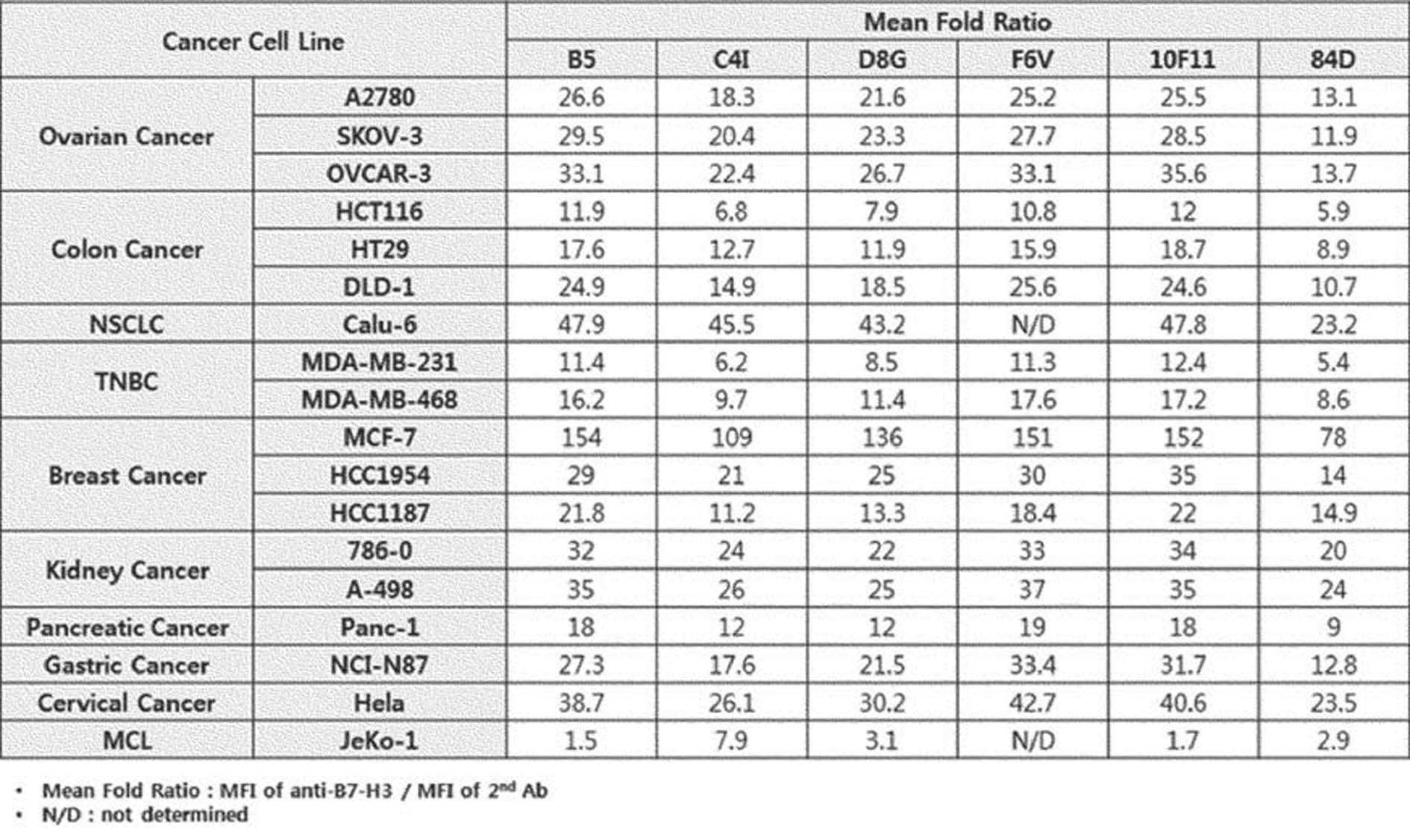
FACS법을 이용한 결합능 측정 결과 본 발명의 항 B7-H3 항체는 난소암, 대장암, 비소세포폐암, 유방암, 신장암, 췌장암, 위암, 자궁경부암, 림프종 유래의 다양한 암세포주에서 결합이 확인되었다. 또한 본 발명의 항 B7-H3 항체는 비교군으로 사용한 항체인 84D와 비교하여 동일한 농도에서 더 높은 결합력을 나타내어 세포 표면 발현 B7-H3에 대한 결합정도가 더 우수함을 확인하였다.As a result of measuring binding capacity using the FACS method, the binding of the anti-B7-H3 antibody of the present invention was confirmed in various cancer cell lines derived from ovarian cancer, colorectal cancer, non-small cell lung cancer, breast cancer, kidney cancer, pancreatic cancer, stomach cancer, cervical cancer, and lymphoma. In addition, it was confirmed that the anti-B7-H3 antibody of the present invention exhibited a higher binding force at the same concentration as compared to 84D, an antibody used as a control group, and thus had a better degree of binding to the cell surface-expressed B7-H3.
실시예 3-6: 항 B7-H3 항체의 마우스 유래 암세포의 마우스 B7-H3 항원에 대한 결합능 측정(FACS)Example 3-6: Measurement of the binding capacity of anti-B7-H3 antibody to mouse B7-H3 antigen of mouse-derived cancer cells (FACS)
이어 FACS 분석을 통하여 본 발명의 항 B7-H3 항체가 세포 표면 발현 마우스 B7-H3에 결합하는 능력을 측정하였다. 실시예 3-3에서 본 발명의 항 B7-H3 항체가 인간 B7-H3와 마우스 B7-H3 재조합 단백질에 모두 결합함을 ELISA법을 통하여 확인하였다. 본 발명의 항 B7-H3 항체가 마우스 암세포주의 세포 표면에 발현하는 마우스 B7-H3에 결합하는지 여부를 확인하기 위하여 마우스 유래 암세포주인 CT26 (Mus mesculus colon carcinoma, ATCC® CRL-2638™), B16F10(Mus musculus skin melanoma, ATCC® CRL-6475™), TC-l(Mus musulus Lung tumor, ATCC® CRL-2493™) 세포주를 사용하였다.Then, the ability of the anti-B7-H3 antibody of the present invention to bind to cell surface-expressing mouse B7-H3 was measured through FACS analysis. In Example 3-3, it was confirmed through ELISA that the anti-B7-H3 antibody of the present invention binds to both human B7-H3 and mouse B7-H3 recombinant protein. To determine whether the anti-B7-H3 antibody of the present invention binds to mouse B7-H3 expressed on the cell surface of the mouse cancer cell line, mouse-derived cancer cell lines CT26 (Mus mesculus colon carcinoma, ATCC ® CRL-2638™), B16F10 ( Mus musculus skin melanoma, ATCC ® CRL-6475™), and TC-1 (Mus musulus Lung tumor, ATCC ® CRL-2493™) cell lines were used.
구체적으로 각 세포주를 해리시키고 PBS 버퍼로 세척한 후, 세포수를 계수하여 웰당 2 x l05 cells로 맞춰 200 ㎕ PBS 넣어 준비한다. 실시예 2번의 항 B7-H3 항체 및 비교항체(84D) 각각을 1% BSA가 포함된 PBS에 10 ㎍/㎖ 농도 또는 10 ㎍/㎖ 농도로 희석하여 미리 준비해둔 세포와 혼합하여 4℃에서 1시간 반응시켰다. PBS 버퍼를 이용하여 2회 세척 후, FITC 표지된 항-human Fc FITC(Sigma, F9512)를 1:500으로 희석하여 웰당 100 ㎕ 처리하여 4℃에서 1시간 반응시켰다. 대조군은 FITC 표지된 항-human Fc FITC만 처리하였다. 다시 PBS 버퍼를 이용해 2회 세척 후, FACSCalibur 기기를 이용하여 항-B7-H3 IgG가 결합된 정도를 측정하였다.Specifically, each cell line is dissociated and washed with PBS buffer, the number of cells is counted , adjusted to 2 x 10 5 cells per well, and 200 μl PBS is added to prepare. Each of the anti-B7-H3 antibody of Example 2 and the comparative antibody (84D) was dissolved in PBS containing 1% BSA at 10 μg/ml Diluted to a concentration of 10 μg/ml or mixed with cells prepared in advance, and reacted at 4° C. for 1 hour. After washing twice with PBS buffer, FITC-labeled anti-human Fc FITC (Sigma, F9512) was diluted 1:500 and treated with 100 μl per well, followed by reaction at 4° C. for 1 hour. The control group was treated only with FITC-labeled anti-human Fc FITC. After washing twice again with PBS buffer, the degree of binding of anti-B7-H3 IgG was measured using a FACSCalibur instrument.
각각의 B7-H3 단일클론항체를 처리한 실험군에서 인간 B7-H3-단일클론항체-FITC 결합에 의한 이동된 판독 결과를 대조군 결합과 비교하였다. 결과는 도 7에 기재되어 있다. FACS법을 이용한 결합능 측정 결과 본 발명의 항 B7-H3 항체들은 세포 표면에 발현하는 마우스 B7-H3에 특이적으로 결합함을 확인하였다.In the experimental group treated with each B7-H3 monoclonal antibody, the result of the read shift by the binding of human B7-H3-monoclonal antibody-FITC was compared with that of the control group. The results are shown in FIG. 7 . As a result of measuring binding capacity using the FACS method, it was confirmed that the anti-B7-H3 antibodies of the present invention specifically bind to mouse B7-H3 expressed on the cell surface.
실시예 4: 항 B7-H3 항체의 B7-H3에 대한 친화도(Affinity) 측정Example 4: Measurement of Affinity of Anti-B7-H3 Antibody to B7-H3
항원 B7-H3와 항 B7-H3 항체와의 결합친화도를 SPR방법으로 측정하였다. 먼저 1X HBS-EP버퍼로 희석한 항 B7-H3 항체를 contact time 60초, stabilization period 60초, 유속 30 ㎕/min으로 Protein A chip(GE healthcare, Cat. No. 29127556)에 50 RU가 되도록 capture하였다. 1X HBS-EP 버퍼로 항원 B7-H3(R&D systems, 2318-B3-050/CF)을 100 nM부터 3.125 nM까지 2배씩 단계 희석하여 준비 하였다. 이 때 blank로 1X HBS-EP buffer를 추가하여 준비하였다. 항 B7-H3 항체를 capture한 chip 위에 준비한 항원 B7-H3을 유속 30 ㎕/min으로 association time 60초, dissociation time 180초간 흘려주었다. Regeneration은 10 mM Glycine-HCl pH 1.5(GE healthcare, Cat.No. BR100354)를 유속 30 ㎕/min으로 contact time 30초로 하였다. 결과는 표 6 에 기재하였다.The binding affinity between the antigen B7-H3 and the anti-B7-H3 antibody was measured by the SPR method. First, the anti-B7-H3 antibody diluted with 1X HBS-EP buffer was captured so as to be 50 RU on a Protein A chip (GE healthcare, Cat. No. 29127556) at a contact time of 60 seconds, a stabilization period of 60 seconds, and a flow rate of 30 μl/min. did. Antigen B7-H3 (R&D systems, 2318-B3-050/CF) was prepared by serially diluted 2-fold from 100 nM to 3.125 nM with 1X HBS-EP buffer. At this time, it was prepared by adding 1X HBS-EP buffer as a blank. The antigen B7-H3 prepared on the chip on which the anti-B7-H3 antibody was captured was flowed at a flow rate of 30 μl/min for an association time of 60 seconds and a dissociation time of 180 seconds. Regeneration was performed with 10 mM Glycine-HCl pH 1.5 (GE healthcare, Cat. No. BR100354) at a flow rate of 30 μl/min and a contact time of 30 seconds. The results are shown in Table 6.
[표 6] 항 B7-H3 항체의 B7-H3에 대한 친화도 측정 결과[Table 6] Affinity measurement results for anti-B7-H3 antibody to B7-H3
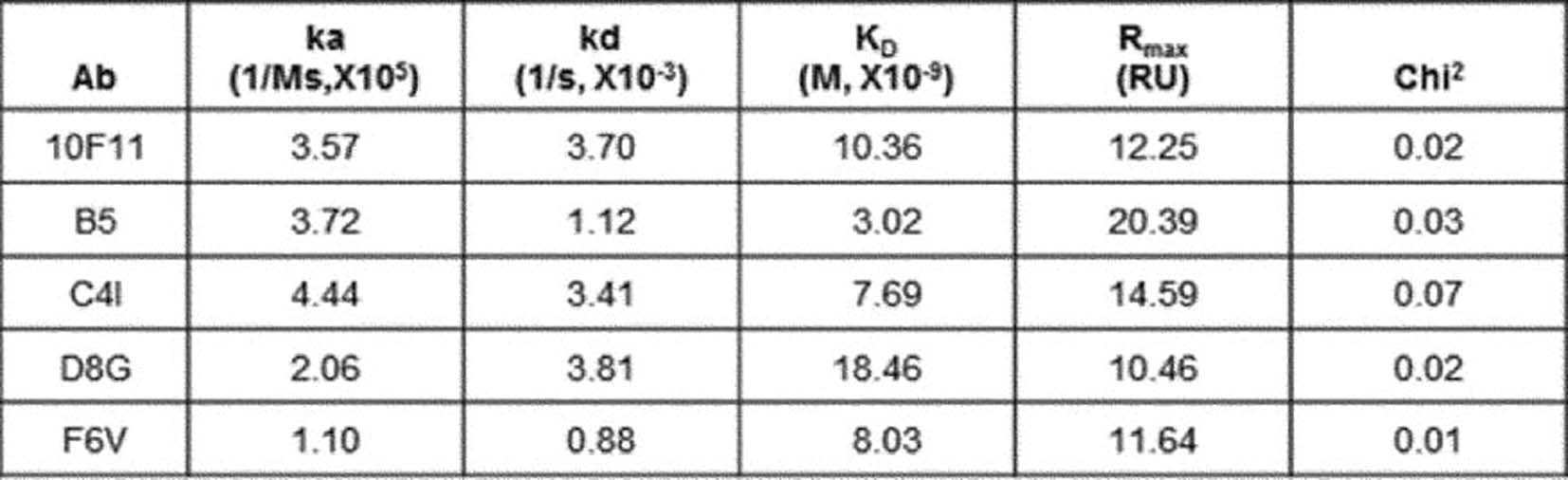
실시예 5: 항 B7-H3 항체의 항체 의존적 세포독성 측정Example 5: Determination of antibody-dependent cytotoxicity of anti-B7-H3 antibody
항체의 항암 치료 효과는 세포사멸 유도, 보체-의존적 세포독성 (Complement-dependent cytotoxicity, CDC), 항체 의존적 세포 식세포 작용(antibody-dependent cellular phagocytosis, ADCP) 및 항체 의존적 세포독성 (Antibody-dependent cell-mediated cytotoxicity, ADCC) 등의 기작을 통해 이루어 지는데, 특히 ADCC 기작은 항체의 효능을 나타내는 지표 중 하나이며 치료용 항체의 항암효과에 있어 핵심적인 기능으로 알려져 있다.Anti-cancer therapeutic effects of antibodies include apoptosis induction, complement-dependent cytotoxicity (CDC), antibody-dependent cellular phagocytosis (ADCP) and antibody-dependent cell-mediated cytotoxicity (ADCP). cytotoxicity, ADCC), etc., in particular, the ADCC mechanism is one of the indicators of antibody efficacy and is known to be a key function in the anticancer effect of therapeutic antibodies.
항체 의존적 세포독성은 자연살해세포(NK, Naturalkillercell)가 항체를 통해서 종양세포 등의 표적 세포를 살해하는 작용 활성을 의미하며 직접적으로 암세포의 증식, 전이를 억제할 수 있다. 본 발명의 항 B7-H3 항체의 항암치료제 개발을 위한 기전 분석의 하나로 항체 의존적 세포독성 능력을 분석하였다.Antibody-dependent cytotoxicity means that natural killer cells (NK) kill target cells such as tumor cells through antibodies, and can directly inhibit the proliferation and metastasis of cancer cells. Antibody-dependent cytotoxicity ability was analyzed as one of the mechanism analysis for the development of anticancer drugs of the anti-B7-H3 antibody of the present invention.
항 B7-H3 항체의 항체 의존성 세포독성 능력은 ADCC Reporter Bioassay(Promega, G7018) 키트를 이용하여 확인하였다. 실험방법은 제조사의 프로토콜에 준수하여 수행하였다.The antibody-dependent cytotoxicity of the anti-B7-H3 antibody was confirmed using the ADCC Reporter Bioassay (Promega, G7018) kit. The experimental method was performed in accordance with the manufacturer's protocol.
항체 의존성 세포독성 능력 분석을 위해 B7-H3의 발현정도가 상대적으로 높은 세포주로 MCF-7 유방암 세포주, Calu-6 폐암 세포주, DLD-1 대장암 세포주를, B7-H3의 발현정도가 상대적으로 낮은 세포주로는 Mino 외투세포림프종 세포주를 사용하였다. B7-H3 발현이 없는 음성대조군으로는 Jurkat 성인 T 세포 백혈병 세포주를 사용하였다. 구체적으로 부착배양세포주인 MCF-7, Calu-6, DLD-1 세포주는 실험 전날 해리시킨 후 4℃, 1200 rpm 조건으로 5분간 원심분리한 후, 세포를 10% 소태아혈청(FBS, Fetal bovine serum)이 포함된 RPMI 1640 배지에 혼탁하여 96 웰 플레이트에 웰당 5 x l03 또는 l x l04 세포를 접종하여 배양하였다. 실험 당일 배지를 제거하고 PBS로 씻어준 후, 세포에 LowIgG Serum(Promega, AX20A)이 4% 첨가된 RPMI 1640 배지를 25 ㎕ 첨가하여 준비하였다. 현탁배양 세포주인 Mino와 Jurkat 세포주는 4℃, 1200rpm 조건으로 5분간 원심분리한 후, RPMI 1640(4% LowIgG Serum)배지에 혼탁하여 96 웰 플레이트에 웰당 5 x l03 또는 l x l04/25 ㎕ 세포를 접종하였다.For the analysis of antibody-dependent cytotoxicity ability, MCF-7 breast cancer cell line, Calu-6 lung cancer cell line, DLD-1 colorectal cancer cell line were selected as cell lines with relatively high expression of B7-H3, and B7-H3 expression level was relatively low. As a cell line, the Mino mantle cell lymphoma cell line was used. As a negative control without B7-H3 expression, the Jurkat adult T-cell leukemia cell line was used. Specifically, the adherent cultured cell lines, MCF-7, Calu-6, and DLD-1 cell lines were dissociated the day before the experiment, centrifuged at 4°C and 1200 rpm for 5 minutes, and then the cells were treated with 10% fetal bovine serum (FBS, Fetal bovine). Serum) was turbid in RPMI 1640 medium, and 5 x 10 3 or
실시예 2에서 준비한 본 발명의 항 B7-H3 항체 및 비교군 항체(84D) 각각을 10 ㎍/㎖ 또는 15 ㎍/㎖ 또는 18 ㎍/㎖의 농도부터 일정 비율로 RPMI 1640 배지(4% Low IgG Serum)에 희석하여 준비한 후 웰당 25 ㎕씩 첨가하였다. 이어 ADCC reporter Bioassay에 포함된 Jurkat/NFAT-FcγRIIIa 세포를 37℃ 워터배스에 넣어 녹인 후, RPMI 1640 배지(4% Low IgG Serum)를 3.6 mL 첨가하여 혼합하였다. 각 웰당 Jurkat/NFAT-FcγRIIIa 세포를 25 ㎕씩 첨가한 후 37℃에서 6시간 동안 반응시킨다. 이어 Bio-Glo luciferase assay(Promega, G7941)에 들어 있는 기질을 포함된 버퍼에 녹여 웰당 75 ㎕를 첨가하여 실온에서 5분에서 10분 정도 반응시킨 후 형광을 측정하였다.10 μg/ml of each of the anti-B7-H3 antibody of the present invention and the comparative antibody (84D) prepared in Example 2 or 15 μg/ml Alternatively, after preparing by diluting in RPMI 1640 medium (4% Low IgG Serum) at a constant rate from a concentration of 18 μg/ml, 25 μl of each was added per well. Then, Jurkat/NFAT-FcγRIIIa cells included in the ADCC reporter Bioassay were dissolved in a 37°C water bath, and 3.6 mL of RPMI 1640 medium (4% Low IgG Serum) was added and mixed. 25 μl of Jurkat/NFAT-FcγRIIIa cells were added to each well, and then reacted at 37° C. for 6 hours. Then, after dissolving the substrate contained in the Bio-Glo luciferase assay (Promega, G7941) in a buffer containing 75 μl per well, reacting at room temperature for 5 to 10 minutes, and then measuring the fluorescence.
항 B7-H3 항체에 의한 항체 의존적 세포독성 효과는 도 8에 기재되어 있다. B7-H3 발현하지 않는 음성대조군인 Jurkat 세포주에서는 항체 의존적 세포독성이 관찰되지 않았으나 B7-H3가 발현하는 MCF-7, Calu-6, DLD-l, Mino 세포주에서만 항 B7-H3 항체 특이적으로 항체 의존적 세포독성 효과가 나타나는 것을 확인하였다. 이는 본 발명에 따른 항체가 B7-H3을 발현하는 암세포에만 특이적으로 결합하여 항체 의존성 세포독성을 유도하므로 암세포의 사멸에 효과적으로 사용될 수 있음을 나타낸다. 특히 본 발명의 항 B7-H3 항체는 비교항체인 84D와 비교하였을 때 반수영향농도(EC50)가 낮고 항체 의존성 세포독성 신호의 세기는 강력하므로 보다 효과적으로 암치료에 사용될 수 있음을 나타낸다.Antibody-dependent cytotoxic effects by anti-B7-H3 antibodies are described in FIG. 8 . No antibody-dependent cytotoxicity was observed in the Jurkat cell line, which is a negative control, which does not express B7-H3, but anti-B7-H3 antibody-specific antibodies were found only in MCF-7, Calu-6, DLD-1, and Mino cell lines expressing B7-H3. It was confirmed that a dependent cytotoxic effect appears. This indicates that the antibody according to the present invention can be effectively used to kill cancer cells because it binds specifically to cancer cells expressing B7-H3 and induces antibody-dependent cytotoxicity. In particular, the anti-B7-H3 antibody of the present invention has a lower half-fluid concentration (EC50) and a strong antibody-dependent cytotoxicity signal compared to the
실시예 6: 항 B7-H3 항체의 T 세포 활성화 유도능 측정Example 6: Measurement of T cell activation inducibility of anti-B7-H3 antibody
실시예 6-1. 인간 말초혈액 단핵구 세포(PBMC)에서 B7-H3 단백질에 의한 T 세포 활성 억제 효과 측정Example 6-1. Measurement of T cell activity inhibition effect by B7-H3 protein in human peripheral blood mononuclear cells (PBMC)
B7-H3는 면역관문 리간드에 속하는 단백질로 T 세포 표면의 B7-H3 수용체와 결합하여 T 세포의 면역반응 억제를 유도하는 것으로 알려져 있다. 따라서 먼저 활성화된 T 세포에 의한 사이토카인(인터페론 감마)의 분비가 B7-H3 단백질에 의해 억제되는지 여부를 알아보기 위하여 PBMC에 B7-H3 단백질을 처리한 후 인간 T 세포의 사이토카인 분비량을 측정하였다.B7-H3 is a protein belonging to the immune checkpoint ligand, and it is known to bind to the B7-H3 receptor on the surface of T cells and induce suppression of the immune response of T cells. Therefore, in order to determine whether the secretion of cytokine (interferon gamma) by activated T cells is inhibited by B7-H3 protein, PBMC was treated with B7-H3 protein and then the amount of cytokine secretion of human T cells was measured. .
구체적으로 인간 T 세포를 활성화시키기 위해 항-CD3 항체(UCHT1, Biolegend)를 5 ㎍/㎖이 되도록 PBS에 희석하여 준비하였고, B7-H3 단백질의 억제 효과를 알아보기 위해 B7-H3 단백질(Sino Biological, 11188-H08H) 또는 음성대조군인 IgGl(BioXCell, BP0297, IgGl 또는 Cont. Ab로 표기)을 5 ㎍/㎖로 희석한 항-CD3 항체에 첨가하여 40 ㎍/㎖부터 4배 연속적인 희석을 진행하여 준비하였다. 희석하여 준비한 항-CD3 항체와 B7-H3 단백질 또는 항-CD3 항체와 음성대조군은 96-웰 세포 배양 플레이트(Coming)에 50 ㎕/well로 분주하여 4℃에서 overnight 또는 37℃에서 2시간 동안 반응시킨 후 PBS로 1회 세척하였다. 구매하여 준비한 인간 말초혈액 단핵구 세포(Peripheral Blood Mononuclear Cell, CTL)는 FBS(Fetal Bovine Serum)가 10%가 되도록 첨가한 RPMI-1640 배양액에 현탁하여 항-CD3 항체와 B7-H3 단백질 또는 항-CD3 항체와 음성대조군을 처리하여 코팅한 플레이트에 1 x 10⁶ cells/well로 분주하여 배양하였다. 배양 3일 후, 배양 상층액을 사용하여 분석기 제조사의 지침에 따라 ELISA 분석기(R&D system)로 인간 T 세포의 인터페론 감마 분비량 분석 실험을 진행하였다. 결과는 도 9a에 기재되어 있다. 인간 T 세포의 인터페론 감마 분비량을 측정한 결과 B7-H3 단백질에 의해 T 세포의 활성이 억제되어 인터페론 감마 생성이 감소되는 것을 확인하였다.Specifically, to activate human T cells, an anti-CD3 antibody (UCHT1, Biolegend) was prepared by diluting it in PBS to 5 μg/ml, and in order to examine the inhibitory effect of the B7-H3 protein, the B7-H3 protein (Sino Biological) , 11188-H08H) or negative control IgGl (denoted as BioXCell, BP0297, IgGl or Cont. Ab) was added to the anti-CD3 antibody diluted to 5 µg/ml, followed by 4-fold serial dilutions from 40 µg/ml and prepared. The diluted anti-CD3 antibody and B7-H3 protein or anti-CD3 antibody and negative control group were aliquoted at 50 μl/well in a 96-well cell culture plate (Coming) and reacted at 4°C overnight or at 37°C for 2 hours. After washing, it was washed once with PBS. Purchased and prepared human peripheral blood mononuclear cells (CTLs) were suspended in RPMI-1640 culture medium supplemented with Fetal Bovine Serum (FBS) to 10%, anti-CD3 antibody and B7-H3 protein or anti-CD3 Antibody and negative control were treated and cultured by dispensing 1 x 10 6 cells/well on a coated plate. After 3 days of culture, the culture supernatant was used to analyze the amount of interferon gamma secretion of human T cells using an ELISA analyzer (R&D system) according to the manufacturer's instructions. The results are shown in Figure 9a. As a result of measuring the interferon gamma secretion amount of human T cells, it was confirmed that the T cell activity was inhibited by the B7-H3 protein, thereby reducing interferon gamma production.
실시예 6-2: 인간 말초혈액 단핵구 세포(PBMC)에서 항 B7-H3 항체에 의한 T 세포 활성화 유도능 측정Example 6-2: Measurement of T cell activation inducibility by anti-B7-H3 antibody in human peripheral blood mononuclear cells (PBMC)
이어 인간 말초혈액 단핵구 세포(PBMC)를 이용하여 B7-H3 단백질에 의해 억제된 T 세포의 활성을, 본 발명에 따른 항 B7-H3 항체가 다시 활성화시킬 수 있는지를 조사하였다. B7-H3 단백질과 T 세포 표면의 B7-H3 수용체간의 결합을 차단할 수 있는 항 B7-H3 항체는 B7-H3에 의해 억제된 T 세포의 면역반응을 재활성화시킬 수 있다. 이렇게 활성화된 T 세포는 면역 항암치료 효과를 나타낼 수 있음을 의미한다.Then, using human peripheral blood mononuclear cells (PBMC), it was investigated whether the anti-B7-H3 antibody according to the present invention can reactivate the activity of T cells inhibited by the B7-H3 protein. Anti-B7-H3 antibody capable of blocking the binding between B7-H3 protein and the B7-H3 receptor on the surface of T cells can reactivate the immune response of T cells suppressed by B7-H3. This means that activated T cells can exhibit the effect of immunotherapy.
실시예 6-1에서와 같이 활성화된 T 세포에 의한 사이토카인(인터페론 감마)의 분비가 B7-H3 단백질에 의해 억제되는 것을 본 발명에서 제조한 항 B7-H3 항체가 차단시킬 수 있는지를 B7-H3 단백질로 코팅된 플레이트에 PBMC를 넣고 본 발명의 항 B7-H3 항체를 처리한 후 인간 T 세포의 사이토카인 분비량 측정을 실시하였다. 인간 T 세포를 활성화시키기 위해 항-CD3 항체(UCHT1, Biolegend)를 5 ㎍/㎖이 되도록 PBS에 희석하여 준비하였고, B7-H3 단백질에 의한 T 세포 활성화를 억제시키기 위해 5 ㎍/㎖로 희석한 항-CD3 항체에 B7-H3 단백질을 10 ㎍/㎖이 되도록 첨가하였다. 희석하여 준비한 항-CD3 항체에 첨가하여 희석한 B7-H3 단백질은 96-웰 세포 배양 플레이트(Corning)에 50 ㎕/well로 분주하여 4℃에서 overnight 또는 37℃에서 2시간 동안 반응시킨 후 PBS로 1회 세척하여 준비하였다. 항 B7-H3 항체와 음성대조군인 IgGl(BioXCell, BP0297, IgGl 또는 Cont. Ab로 표기)은 FBS(Fetal Bovine Serum, Invitrogen)가 10%가 되도록 첨가한 RPMI-1640 배양액(Invitrogen)에 첨가하여 16 ㎍/㎖로부터 4배 연속적인 희석을 진행하여 준비하였다. 구매하여 준비한 인간 말초혈액 단핵구 세포(Peripheral Blood Mononuclear Cell, CTL)는 FBS가 10%가 되도록 첨가한 RPMI-1640 배양액에 현탁하여 항-CD3 항체와 B7-H3 단백질을 처리하여 코팅한 플레이트에 1 x 10⁶ cells/well로 분주하였다. 인간 말초혈액 단핵구 세포를 분주한 플레이트에 4배 연속적인 희석을 진행하여 준비한 한 항 B7-H3 항체와 음성대조군 IgGl을 50 ㎕/well로 분주하였다. 마지막으로 FBS가 10%가 되도록 첨가한 RPMI-1640 배양액을 100 ㎕/well로 분주하여 항체가 세포에 처리되는 최고 농도의 최종 농도가 4 ㎍/㎖ (27 nM)이 되도록 실험하였다. 항 B7-H3 항체를 단일 농도로 처리한 실험의 경우 항체의 최종 농도가 10 ㎍/㎖이 되도록 처리하였다. 배양 3일 후, 배양 상층액을 사용하여 분석기 제조사의 지침에 따라 ELISA 분석기 (R&D system)로 인간 T 세포의 인터페론 감마 분비량 분석 실험을 진행하였다.As in Example 6-1, it was tested whether the anti-B7-H3 antibody prepared in the present invention can block the secretion of cytokine (interferon gamma) by the activated T cells by the B7-H3 protein. PBMCs were placed on a plate coated with H3 protein, and after treatment with the anti-B7-H3 antibody of the present invention, the amount of cytokine secretion of human T cells was measured. To activate human T cells, anti-CD3 antibody (UCHT1, Biolegend) was prepared by diluting in PBS to 5 μg/ml, and diluted to 5 μg/ml to inhibit T cell activation by B7-H3 protein. B7-H3 protein was added to the anti-CD3 antibody at a concentration of 10 μg/ml. The diluted B7-H3 protein was added to the prepared anti-CD3 antibody and dispensed at 50 μl/well in a 96-well cell culture plate (Corning), reacted at 4°C overnight or at 37°C for 2 hours, and then washed with PBS. It was prepared by washing once. Anti-B7-H3 antibody and negative control IgGl (BioXCell, BP0297, denoted as IgGl or Cont. Ab) were added to RPMI-1640 culture medium (Invitrogen) in which FBS (Fetal Bovine Serum, Invitrogen) was added to 10%. It was prepared by performing 4-fold serial dilutions from μg/ml. Purchased and prepared human peripheral blood mononuclear cells (CTLs) were suspended in RPMI-1640 culture medium supplemented with 10% FBS, treated with anti-CD3 antibody and B7-H3 protein, and coated with 1 x It was dispensed at 10 6 cells/well. An anti-B7-H3 antibody and negative control IgGl prepared by serial dilution of 4 times were dispensed at 50 μl/well on a plate in which human peripheral blood mononuclear cells were dispensed. Finally, the RPMI-1640 culture solution added so that the FBS was 10% was dispensed at 100 μl/well, and the experiment was performed so that the final concentration of the highest antibody-treated cell was 4 μg/ml (27 nM). In the case of an experiment in which the anti-B7-H3 antibody was treated with a single concentration, the final concentration of the antibody was 10 μg/ml. After 3 days of culture, the culture supernatant was used to analyze the amount of interferon gamma secretion of human T cells using an ELISA analyzer (R&D system) according to the manufacturer's instructions.
결과는 도 9b에 기재되어 있다. 인간 T 세포의 인터페론 감마 분비량을 측정한 결과 본 발명에서 제조된 항 B7-H3 항체는 B7-H3 단백질에 의해 억제된 T 세포를 재활성화시켜 인터페론 감마의 생성이 촉진되는 것을 확인하였다. 상기 분석결과는 암의 성장을 억제할 수 있는 하나의 기전으로, 본 발명에 따른 항 B7-H3 항체가 T 세포의 활성화를 유도할 수 있음을 나타낸다. 이러한 결과는 본 발명의 항 B7-H3 항체가 면역관문억제제로 개발될 수 있음을 시사한다.The results are shown in Figure 9b. As a result of measuring the interferon-gamma secretion amount of human T cells, it was confirmed that the anti-B7-H3 antibody prepared in the present invention promotes the production of interferon-gamma by reactivating the T cells inhibited by the B7-H3 protein. The analysis results indicate that the anti-B7-H3 antibody according to the present invention can induce the activation of T cells as one mechanism capable of inhibiting the growth of cancer. These results suggest that the anti-B7-H3 antibody of the present invention can be developed as an immune checkpoint inhibitor.
대표적인 면역관문억제제인 항 PD-L1, 항 PD-1 항체는 각각 면역관문리 간드인 PD-L1 또는 T 세포 표면에서 발현되는 면역관문수용체인 PD-1에 결합함으로써 PD-L1 과 PD-1 간의 결합을 차단하는 항체이다. 항 PD-1 항체와 항 PD-L1 항체는 탁월한 항암효능으로 각광받고 있으나 모든 환자에서 효과가 있는 것은 아니다. 현재 시판되고 있는 면역관문억제제의 경우 처방 환자 가운데 20% 정도에서만 효과가 확인되고 있다. 면역 항암치료제의 항암 효과의 극대화를 위해 다양한 병용투여가 연구 개발되고 있다. B7-H3는 PD-1/PD-L1 면역관문과는 상이한 리간드 및 수용체로 인해 상이한 면역관문 기전을 통해 T 세포의 활성을 억제하므로 본 발명의 항 B7-H3 항체는 기존 면역관문억제제에 반응성이 없는 환자군에서 치료효능을 보일 수 있을 것으로 기대된다.Anti-PD-L1 and anti-PD-1 antibodies, which are representative immune checkpoint inhibitors, bind to PD-L1, an immune checkpoint ligand, or PD-1, an immune checkpoint receptor expressed on the surface of T cells, respectively. Antibodies that block binding. Anti-PD-1 antibody and anti-PD-L1 antibody are in the spotlight for their excellent anticancer efficacy, but they are not effective in all patients. In the case of immune checkpoint inhibitors currently on the market, the effectiveness is confirmed in only about 20% of prescription patients. In order to maximize the anticancer effect of immunotherapy drugs, various combinations of administration are being researched and developed. Because B7-H3 inhibits T cell activity through a different immune checkpoint mechanism due to different ligands and receptors from PD-1/PD-L1 immune checkpoint, the anti-B7-H3 antibody of the present invention is reactive with existing immune checkpoint inhibitors. It is expected to show therapeutic efficacy in patients without
실시예 6-3: 인간 말초혈액 단핵구 세포(PBMC)에서 항 B7-H3 항체와 면역 항암치료제의 병용처리 효과 분석Example 6-3: Analysis of the effect of combination treatment of anti-B7-H3 antibody and immunotherapy in human peripheral blood mononuclear cells (PBMC)
이어 인간 말초혈액 단핵구 세포(PBMC)에서 항 B7-H3 항체와 선 개발된 면역 항암치료제와의 병용처리에 의한 T 세포의 활성을 측정하였다.Then, in human peripheral blood mononuclear cells (PBMC), the T cell activity was measured by co-treatment with an anti-B7-H3 antibody and a pre-developed immunotherapy drug.
실시예 6-2에서 확인한 바와 같이 본 발명의 항 B7-H3 항체는 면역관문 억제 효능을 가지고 있다. 최근 뛰어난 임상효능으로 각광받고 있는 면역 항암치료제는 크게 면역관문억제제와 면역보조자극분자 활성화제로 나눌 수 있다.As confirmed in Example 6-2, the anti-B7-H3 antibody of the present invention has an immune checkpoint inhibitory effect. Immunochemotherapy, which has recently been spotlighted for its outstanding clinical efficacy, can be largely divided into immune checkpoint inhibitors and immune adjuvant-stimulating molecule activators.
앞서 기술한 바와 같이 본 발명의 항 B7-H3 항체는 면역관문억제제로 작용하나 대표적인 면역관문억제제인 항 PD-1 항체, 항 PD-L1 항체와는 그 작용 기작이 상이하다. 항 PD-1 항체와 항 PD-L1 항체는 탁월한 항암효능으로 각광받고 있으나 환자 반응성이 평균 20% 정도로 낮아 반응성을 높이기 위해 다양한 병용투여가 연구 개발되고 있다.As described above, the anti-B7-H3 antibody of the present invention acts as an immune checkpoint inhibitor, but the mechanism of action is different from the typical immune checkpoint inhibitor, anti-PD-1 antibody and anti-PD-L1 antibody. Anti-PD-1 antibody and anti-PD-L1 antibody are in the spotlight for their excellent anticancer efficacy, but the patient's reactivity is on average about 20%, and various co-administrations are being researched and developed to increase the reactivity.
4-1BB 항체는 면역보조자극분자인 4-1BB를 촉진시켜 면역세포의 활성화를 유도하는 항체로 면역관문억제제인 항 PD-L1 또는 항 PD-1 항체와는 그 기전이 상이하다. 항 4-1BB 항체는 면역세포의 보조자극분자인 4-1BB를 촉진시켜 면역세포의 활성화를 유도하는 항체로 항암 효과를 보일 것으로 기대되는 면역 항암치료제이다. 그러나 Urelumab의 임상시험에서 간독성을 유발하는 부작용이 나타났다. Urelumab에 의한 간독성의 문제를 해결하기 위하여 투여 용량을 낮추고, 면역관문억제제인 항 PD-1 등과 병용투여하는 임상 연구가 진행하는 중이다.The 4-1BB antibody promotes the immune co-stimulatory molecule, 4-1BB, and induces the activation of immune cells. Its mechanism is different from the immune checkpoint inhibitor anti-PD-L1 or anti-PD-1 antibody. Anti 4-1BB antibody is an antibody that induces activation of immune cells by promoting 4-1BB, a co-stimulatory molecule of immune cells, and is expected to show anticancer effects. However, side effects causing hepatotoxicity were found in clinical trials of urelumab. In order to solve the problem of hepatotoxicity caused by urelumab, a clinical study of lowering the dose and administering it in combination with anti-PD-1, an immune checkpoint inhibitor, etc. is in progress.
따라서 면역관문을 억제하는 본 발명의 항 B7-H3 항체와 또 다른 면역관문억제제인 항 PD-1 항체, 항 PD-L1 항체 또는 보조자극분자를 활성화하는 항 4-1BB 항체의 병용투여는 서로 상이한 기작으로 면역세포를 활성화시켜 더욱 우수한 면역 항암 효과를 나타낼 수 있을 것으로 기대된다.Therefore, the co-administration of the anti-B7-H3 antibody of the present invention that inhibits immune checkpoint and the anti-PD-1 antibody, anti-PD-L1 antibody, or anti- 4-1BB antibody that activates a costimulatory molecule, which is another immune checkpoint inhibitor, is different from each other. It is expected that by activating immune cells as a mechanism, it will be able to show a more excellent immune anticancer effect.
본 발명의 항 B7-H3 항체와 면역 항암 항체치료제와의 병용처리 효과를 확인하기 위해 T 세포에 의한 사이토카인(인터페론 감마)의 분비가 항 B7-H3 항체와 면역 항암치료제의 병용처리에 의해 증가하는지 여부를 조사하였다. 항 PD-1 항체는 Merck사의 Pembrolizumab을 W02008-156712에 개시된 서열을 바탕으로, 항 PD-L1 항체는 Roche사의 Atezolizumab을 WO2016-196298에 개시된 서열을 바탕으로, 항 4-1BB 항체는 BMS사에서 임상진행중인 Urelumab를 W02005-035584에 개시된 서열을 바탕으로 유전자 합성 및 생산하여 사용하였다.In order to confirm the effect of the combined treatment with the anti-B7-H3 antibody of the present invention and the immuno-cancer antibody therapeutic agent, the secretion of cytokine (interferon gamma) by T cells is increased by the combined treatment of the anti-B7-H3 antibody and the immuno-cancer therapeutic agent It was investigated whether The anti-PD-1 antibody is based on Merck's Pembrolizumab sequence disclosed in WO2008-156712, the anti-PD-L1 antibody is Roche's Atezolizumab based on the sequence disclosed in WO2016-196298, and the anti-4-1BB antibody is clinically tested by BMS. The ongoing Urelumab was used for gene synthesis and production based on the sequence disclosed in W02005-035584.
구체적으로 인간 T 세포를 활성화시키기 위해 항-CD3 항체(UCHT1, Biolegend)를 5 ㎍/㎖이 되도록 PBS에 희석하여 준비하였고, B7-H3 단백질에 의한 T 세포 활성화를 억제시키기 위해 5 ㎍/㎖로 희석한 항-CD3 항체에 B7-H3 단백질을 10 ㎍/㎖이 되도록 첨가하였다. 희석하여 준비한 항-CD3 항체에 첨가하여 희석한 B7-H3 단백질은 96-웰 세포 배양 플레이트(Corning)에 50 ㎕/well로 분주하여 4℃에서 overnight 또는 37℃에서 2시간 동안 반응시킨 후 PBS로 1회 세척하여 준비하였다. 본 발명의 항 B7-H3 항체와 음성대조군인 IgGl(BioXCell, BP0297, IgGl 또는 Cont. Ab로 표기) 그리고 상기 제조된 항 PD-1 항체, 항 PD-L1 항체 또는 항 4-1BB 항체는 FBS(Fetal Bovine Serum, Invitrogen)가 10%가 되도록 첨가한 RPMI-1640 배양액(Invitrogen)에 첨가하여 처리 농도의 4배 농도로 준비하였다. 구매하여 준비한 인간 말초혈액 단핵구 세포(Peripheral Blood Mononuclear Cell, CTL)는 FBS가 10%가 되도록 첨가한 RPMI-1640 배양액에 현탁하여 항-CD3 항체와 B7-H3 단백질을 처리하여 코팅한 플레이트에 1 x 10⁶ cells/well로 분주하였다. 인간 말초혈액 단핵구 세포를 분주한 플레이트에 4배 연속적인 희석을 진행하여 준비한 한 항 B7-H3 항체와 음성대조군 IgGl 그리고 항 4-1BB 항체를 50 ㎕/well로 분주하였다. 마지막으로 FBS가 10%가 되도록 첨가한 RPMI-1640 배양액을 100 ㎕/well로 분주하여 항체가 세포에 처리하였다. 단일 농도로 처리한 실험의 경우 항 B7-H3 항체, 항 PD-1 항체, 항 PD-L1 항체 및 항4-1BB 항체를 항체의 최종농도가 10 ㎍/mL이 되도록 처리하였다. 농도별로 처리한 실험의 경우 항 B7-H3 항체와 항 4-1BB 항체 각각의 최종농도가 최고 농도 20 nM부터 4배씩 연속적인 희석 농도로 처리하였다. 배양 3일 후, 배양 상층액을 사용하여 분석기 제조사의 지침에 따라 ELISA 분석기(R&D system)로 인간 T 세포의 인터페론 감마 분비량 분석 실험을 진행하였다.Specifically, to activate human T cells, anti-CD3 antibody (UCHT1, Biolegend) was prepared by diluting it in PBS to 5 μg/ml, and at 5 μg/ml to inhibit T cell activation by B7-H3 protein. B7-H3 protein was added to the diluted anti-CD3 antibody at a concentration of 10 μg/ml. The diluted B7-H3 protein was added to the prepared anti-CD3 antibody and dispensed at 50 μl/well in a 96-well cell culture plate (Corning), reacted at 4°C overnight or at 37°C for 2 hours, and then washed with PBS. It was prepared by washing once. The anti-B7-H3 antibody of the present invention and the negative control IgGl (BioXCell, BP0297, IgGl or Cont. Ab) and the prepared anti-PD-1 antibody, anti-PD-L1 antibody or anti-4-1BB antibody were prepared using FBS ( Fetal Bovine Serum, Invitrogen) was added to the RPMI-1640 culture solution (Invitrogen) added so that 10% was added to prepare a
결과는 도 10에 기재되어 있다. 인간 T 세포의 인터페론 감마 분비량을 측정한 결과 항 B7-H3 항체를 항 PD-1 항체 또는 항 PD-L1 항체 또는 항 4-1BB 항체와 병용처리하면 각 항체를 단독처리한 경우보다 더욱 강하게 T 세포를 활성화시켜 인터페론 감마의 생성이 더욱 촉진되는 것을 확인하였다. 상기 분석결과는 본 발명에 따른 항 B7-H3 항체와 기존 항암 면역치료제와 함께 사용되어 T 세포의 활성화를 보다 강화시켜, 항암치료제로 사용 시에 항암 효과가 극대화 될 수 있음을 나타내는 것이다.The results are shown in FIG. 10 . As a result of measuring the amount of interferon gamma secretion by human T cells, when the anti-B7-H3 antibody was co-treated with the anti-PD-1 antibody, the anti-PD-L1 antibody, or the anti- 4-1BB antibody, the T cells were stronger than when each antibody was treated alone. It was confirmed that the production of interferon gamma is further promoted by activating The above analysis results indicate that the anti-B7-H3 antibody according to the present invention and the existing anti-cancer immunotherapeutic agent are used together to further enhance the activation of T cells, indicating that the anti-cancer effect can be maximized when used as an anti-cancer agent.
실시예 7: 마우스동계종양이식모델에서 항 B7-H3 항체와 항 PD-1 항체 병용투여에 의한 항암효능 분석Example 7: Analysis of anticancer efficacy by co-administration of anti-B7-H3 antibody and anti-PD-1 antibody in mouse syngeneic tumor transplantation model
인간 면역관문단백질의 기능을 차단하는 항체의 면역관문 억제 효능을 동물 모델에서 확인하기 위해서는 마우스의 면역세포를 인간 면역세포로 교체한 인간화마우스 또는 마우스의 면역관문단백질을 인간 면역관문단백질로 치환한 형질전환마우스를 이용하여야한다. 그러나 상기 차단항체가 인간과 마우스 간에 종간 교차반응성이 있는 경우에는 마우스동계종양모델을 통해 면역관문 억제 효능을 확인할 수 있다.In order to confirm the immune checkpoint inhibitory efficacy of an antibody that blocks the function of human immune checkpoint protein in animal models, a humanized mouse in which the immune cells of the mouse are replaced with human immune cells or a trait in which the immune checkpoint protein of the mouse is replaced with a human immune checkpoint protein You must use a switch mouse. However, if the blocking antibody has cross-species reactivity between humans and mice, the immune checkpoint inhibitory efficacy can be confirmed through a mouse syngeneic tumor model.
실시예 3-3과 3-6에서 확인한 바와 같이 본 발명의 항 B7-H3 항체는 마우스 B7-H3 항원에 대한 종간 교차 반응성이 있다. 본 발명의 항 B7-H3 항체의 항암효능을 확인하기 위해 마우스동계종양모델에 항 마우스 PD-1 항체인 RMPl-14(BioXCell, BE0146)와 함께 병용처리하여 종양의 증식 억제 효능을 다음과 같이 확인하였다. CT26은 마우스(BALB/c)로부터 유래된 결장암 세포주(Colon carcinoma)로 마우스 B7-H3를 과발현하는 세포주이다. 실시예 2에서 제조된 본 발명에 따른 항 B7-H3 항체 가 CT26 마우스 암세포주 표면에 발현된 마우스 B7-H3에 결합하는 것을 실시예 3-6에서 확인하였다(도 7).As confirmed in Examples 3-3 and 3-6, the anti-B7-H3 antibody of the present invention has cross-species reactivity to the mouse B7-H3 antigen. In order to confirm the anticancer efficacy of the anti-B7-H3 antibody of the present invention, the anti-mouse PD-1 antibody RMPl-14 (BioXCell, BE0146) was co-treated in a mouse syngeneic tumor model to confirm the tumor proliferation inhibitory efficacy as follows. did. CT26 is a colon cancer cell line derived from a mouse (BALB/c) and overexpressing mouse B7-H3. It was confirmed in Examples 3-6 that the anti-B7-H3 antibody according to the present invention prepared in Example 2 binds to mouse B7-H3 expressed on the surface of the CT26 mouse cancer cell line ( FIG. 7 ).
실험방법을 구체적으로 설명하면 CT26(BALB/c origin) 세포주를 해리시키고 PBS 버퍼로 세척한 후, 세포수를 계수하여 웰당 5 x l05 cells로 맞춰 200 ㎕ PBS 넣어 준비하였다. 준비된 세포를 마우스(BALB/c, 6주령, Samtako)의 피하(subcutaneous) 경로로 주입하고 종양 크기가 50~100 mm3가 되었을 때, 각각 해당하는 항체를 한 마리에 200 ㎍씩 총 1 mg을 3일 간격으로 5회에 걸쳐 처리하였다. 대조군과 항 PD-1(RMP1-14) 항체 단독, 항 PD-1 항체 및 항 B7-H3 항체를 병용처리한 군의 종양 크기를 칼리퍼를 이용하여 종양의 가장 긴 직경(D1)과 그에 수직인 직경(D2)을 측정하여 0.5*D1*(D2)2와 같이 계산하여 부피를 구하였다(도 11).To describe the experimental method in detail, the CT26 (BALB/c origin) cell line was dissociated, washed with PBS buffer, counted, and adjusted to 5 x 10 5 cells per well, 200 μl It was prepared by putting PBS. The prepared cells were injected subcutaneously into mice (BALB/c, 6 weeks old, Samtako) and when the tumor size reached 50-100 mm 3 , 200 μg of the corresponding antibody was administered to each animal for a total of 1 mg. It was treated 5 times at 3-day intervals. The tumor size of the control group treated with anti-PD-1 (RMP1-14) antibody alone, anti-PD-1 antibody, and anti-B7-H3 antibody in combination was measured using a caliper to determine the longest diameter (D1) of the tumor and the vertical By measuring the phosphorus diameter (D2), the volume was calculated as 0.5*D1*(D2) 2 ( FIG. 11 ).
종양 관찰 중 종양의 크기가 2000 mm3보다 크거나 궤양이 생길 경우 해당 마우스의 경우 안락사하였다. 모든 항체 처리가 끝난 후 총 30일 동안 관찰하여 생존률 및 종양의 크기를 측정하였다.During tumor observation, if the size of the tumor was larger than 2000 mm 3 or if an ulcer occurred, the mouse was euthanized. After all antibody treatments were completed, the observation was performed for a total of 30 days to measure the survival rate and tumor size.
결과는 도 11에 나타내었다. 그 결과 항 PD-1(RMP1-14) 항체 단독으로 처리한 군과 비교하여 항 PD-1 과 항 B7-H3 항체를 병용투여한 군에서 종양 증식 억제 효과 및 생존률의 향상을 확인하였다. 상기 결과는 면역관문 억제 효능을 보이는 본 발명의 항 B7-H3 항체와 또 다른 면역관문억제제로 상이한 기작을 통해 면역세포를 활성화시키는 항 PD-1 항체를 병용투여하면 항암치료 효과가 강화되는 것을 의미한다. 실시예 3-3에서 확인할 수 있듯이 본 발명의 항 B7-H3 항체의 마우스 B7-H3에 대한 결합력은 인간 B7-H3 대비 상대적으로 낮은 편이다. 낮은 마우스 B7-H3에 대한 결합력에도 불구하고 본 발명의 항 B7-H3 항체는 동계종양이식모델에서 항 PD-1 항체와 병용투여에서 항 PD-1 항체의 단독투여 대비 뚜렷한 암성장 억제 효능 및 생존률의 향상이 나타났다. 본 발명의 항 B7-H3 항체는 인간 B7-H3에 보다 강력하게 결합함으로 인간 B7-H3을 차단함으로써 나타나는 면역관문 억제 효과는 마우스동계종양이식모델에서의 결과보다 강력할 것으로 기대된다.The results are shown in FIG. 11 . As a result, compared with the group treated with the anti-PD-1 (RMP1-14) antibody alone, it was confirmed that the anti-PD-1 and anti-B7-H3 antibody were co-administered, and the tumor growth inhibitory effect and survival rate were improved. The above results indicate that the anti-cancer treatment effect is enhanced when the anti-B7-H3 antibody of the present invention showing immune checkpoint inhibitory effect and the anti-PD-1 antibody that activates immune cells through a different mechanism are co-administered with another immune checkpoint inhibitor. do. As can be seen in Example 3-3, the binding ability of the anti-B7-H3 antibody of the present invention to mouse B7-H3 is relatively low compared to human B7-H3. In spite of the low binding ability to mouse B7-H3, the anti-B7-H3 antibody of the present invention has a distinct cancer growth inhibitory efficacy and survival rate compared to administration of the anti-PD-1 antibody alone in co-administration with anti-PD-1 antibody in a syngeneic tumor transplantation model. of improvement was observed. The anti-B7-H3 antibody of the present invention binds more strongly to human B7-H3 and thus the immune checkpoint inhibitory effect shown by blocking human B7-H3 is expected to be stronger than the result in the mouse syngeneic tumor transplantation model.
실시예 8: 마우스동계종양이식모델에서 항 B7-H3 항체와 항 PD-1 항체의 병용투여에 의한 종양 침윤 림프구(TIL) 변화 분석Example 8: Analysis of changes in tumor infiltrating lymphocytes (TIL) by co-administration of anti-B7-H3 antibody and anti-PD-1 antibody in a mouse syngeneic tumor transplantation model
종양 침윤 림프구(TIL, Tumor-infiltrating lymphocytes)는 혈류를 떠나 종양 쪽으로 이동한 백혈구(White blood cell)를 지칭한다. 종양 침윤 림프구는 T 세포와 B 세포를 포함하여 단핵 및 다형 핵 면역세포를 포함하며 종양 유형과 단계에 따라 다르며 질병 예후와 관련이 있다. 특히 면역 항암항체의 작용 기전은 종양 침윤 림프구의 분석을 통해 확인이 가능하다.Tumor-infiltrating lymphocytes (TIL) refer to white blood cells that have left the bloodstream and migrated toward the tumor. Tumor-infiltrating lymphocytes contain mononuclear and polymorphonuclear immune cells, including T cells and B cells, and are dependent on the tumor type and stage and are associated with disease prognosis. In particular, the mechanism of action of the immune anticancer antibody can be confirmed through the analysis of tumor-infiltrating lymphocytes.
항 B7-H3 항체(F6V)와 항 PD-1 항체(RMP-14-1)의 병용투여(combi로 기재)에 의한 항암 효과 기전을 분석하기 위하여 종양 침윤 림프구를 분석 하였다. 실험은 실시예 8번과 동일한 방법으로 진행되었으며 각 항체의 3번 투여가 완료된 후 마우스에서 종양을 분리하여 종양 침윤 림프구를 얻었다. 종양 침윤 림프구에 사이토카인 생성을 자극하는 물질인 PMA 50 ng/ml, lonomycine l μM을 처리하여 재활성화 시킨 후 면역세포의 변화를 분석하였다(도 12). 항암 면역반응 핵심 역할을 하는 대표적인 면역세포는 세포독성 T 세포(cytotoxic T cell)와 조절 T 세포(regulatory T cell)이다. 실험 결과 본 발명의 항 B7-H3 항체와 항 PD-1 항체를 병용투여한 마우스에서 분리한 종양 침윤 림프구에서 확연한 세포독성 T 세포의 활성화와 조절 T 세포(regulatory T cell)의 증식 억제가 관찰되었다.In order to analyze the mechanism of anticancer effect by co-administration of anti-B7-H3 antibody (F6V) and anti-PD-1 antibody (RMP-14-1) (described as combi), tumor-infiltrating lymphocytes were analyzed. The experiment was carried out in the same manner as in Example 8, and after the 3 times administration of each antibody was completed, the tumor was isolated from the mouse to obtain tumor-infiltrating lymphocytes. After reactivation by treating tumor-infiltrating lymphocytes with
세포독성 T 세포는 암세포 등 면역세포가 표적화한 세포의 살해를 유도하는 세포로 CD8의 발현을 특징으로 한다. 활성화된 세포독성 T 세포들은 인터페론 감마(IFNγ)와 같은 사이토카인(cytokine)과 세포 살해를 유도하는 그랜자임 B(Granzyme B)의 분비가 증가한다. 본 발명의 항 B7-H3 항체와 항 PD-1 항체를 병용투여한 마우스에서 분리한 종양 침윤 림프구에서는 CD8+ T 세포 중 IFNγ+Granzyme B+의 비율이 유의하게 증가하였으며, CD8+ T 세포 중 그랜자임 B의 분비 증가가 관찰되었다.Cytotoxic T cells are cells that induce the killing of cells targeted by immune cells, such as cancer cells, and are characterized by the expression of CD8. Activated cytotoxic T cells increase the secretion of cytokines such as interferon gamma (IFNγ) and granzyme B, which induces cell killing. In tumor-infiltrating lymphocytes isolated from mice co-administered with anti-B7-H3 antibody and anti-PD-1 antibody of the present invention, the ratio of IFNγ+Granzyme B+ among CD8+ T cells was significantly increased, and granzyme B among CD8+ T cells An increase in secretion was observed.
조절 T 세포(regulatory T cell)는 종양에서 면역세포를 억제하는데 중요한 역할을 하는 세포로 Foxp3와 CD4의 발현을 특징으로 한다. 종양 미세 환경에서 조절 T 세포가 증가되어 있는 경우, 면역세포의 활성이 낮아져 암세포의 효과적인 제거가 어렵게 된다. 따라서 면역 항암 효과를 위해서는 조절 T 세포를 억제하는 것이 중요하다. 본 발명의 항 B7-H3 항체와 항 PD-1 항체를 병용투여한 마우스에서 분리한 종양 침윤 림프구에서 조절 T 세포의 빈도와 세포수를 항 Foxp3 항체(eBioscience, FJK-16s)를 이용하여 확인하였고, 조절 T 세포의 증식능력(proliferative capacity)은 항 Ki67(BD, B56) 항체를 이용하여 확인하였다.Regulatory T cells are cells that play an important role in suppressing immune cells in tumors and are characterized by the expression of Foxp3 and CD4. When regulatory T cells are increased in the tumor microenvironment, the activity of immune cells is lowered, making it difficult to effectively remove cancer cells. Therefore, it is important to suppress regulatory T cells for immuno-cancer effect. The frequency and cell number of regulatory T cells in tumor-infiltrating lymphocytes isolated from mice co-administered with the anti-B7-H3 antibody and anti-PD-1 antibody of the present invention were confirmed using an anti-Foxp3 antibody (eBioscience, FJK-16s). , The proliferative capacity of regulatory T cells was confirmed using an anti-Ki67 (BD, B56) antibody.
결과는 도 12에 기재되어 있다. 실험 결과 항 B7-H3 항체와 항 PD-1를 병용투여한 군에서 조절 T 세포의 수가 감소했을 뿐 아니라 조절 T 세포의 증식능력을 나타내는 K167+ 빈도가 감소하였음을 확인하였다. 이러한 결과는 항 B7-H3 항체와 항 PD-1 항체의 병용투여가 세포독성 T 세포의 활성의 증가와 조절 T 세포의 억제를 동시에 유도함으로써 면역활성화를 통해 항암 효과를 나타내는 것을 의미한다.The results are shown in FIG. 12 . As a result of the experiment, it was confirmed that in the group administered with the anti-B7-H3 antibody and anti-PD-1, not only the number of regulatory T cells decreased, but also the frequency of K167+ indicating the proliferative ability of regulatory T cells was reduced. These results indicate that co-administration of anti-B7-H3 antibody and anti-PD-1 antibody simultaneously induces an increase in the activity of cytotoxic T cells and suppression of regulatory T cells, thereby exhibiting an anticancer effect through immune activation.
실시예 9: 화합물 1, 2, 3 및 4의 제조Example 9: Preparation of
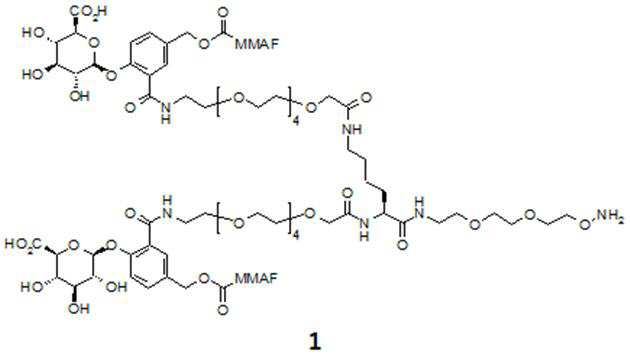
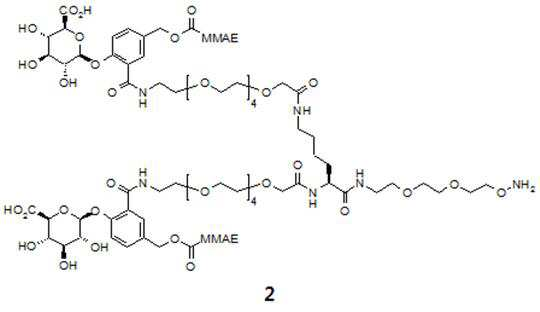
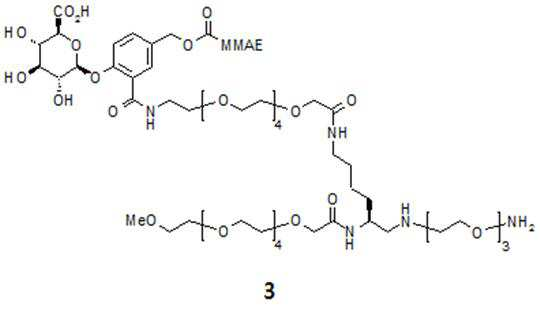
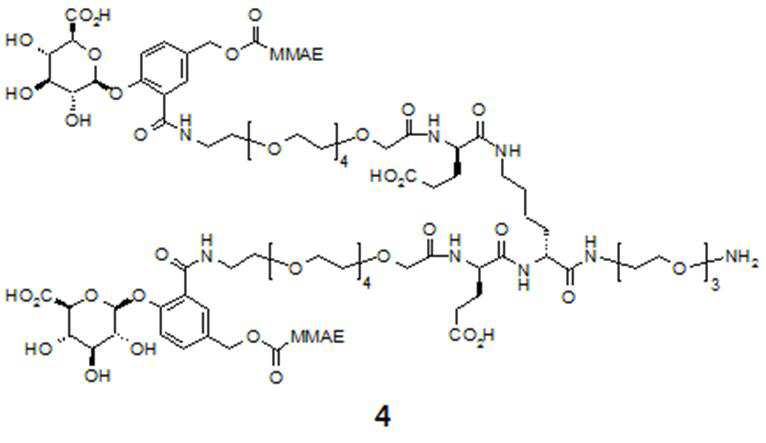
상기 화합물 1, 2, 3 및 4는 특허 WO2017-089895에 기재된 방법으로 제조하였다.The
상기 상기 화합물 1, 2, 3 및 4에서 MMAE 또는 MMAF의 구조는 다음과 같다 :The structures of MMAE or MMAF in
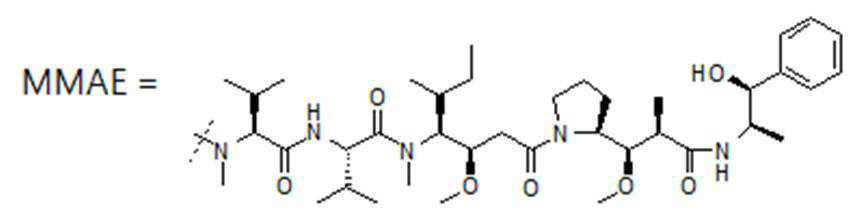
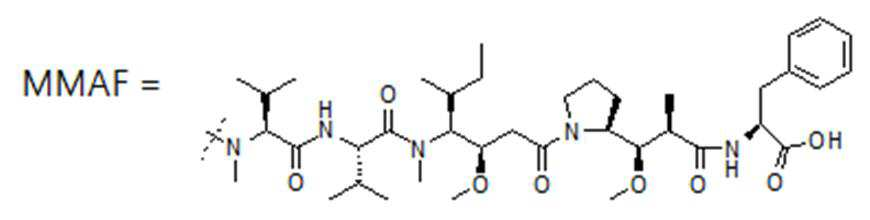
실시예 10: 화합물 5, 6, 7, 8, 9 및 10의 제조Example 10: Preparation of

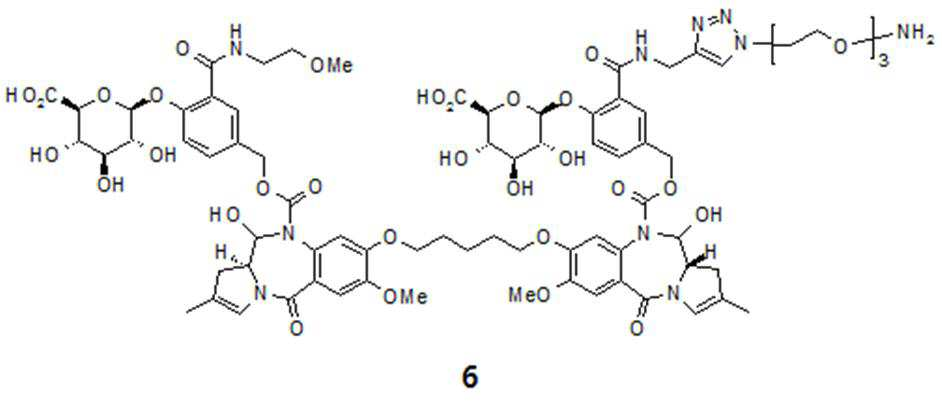


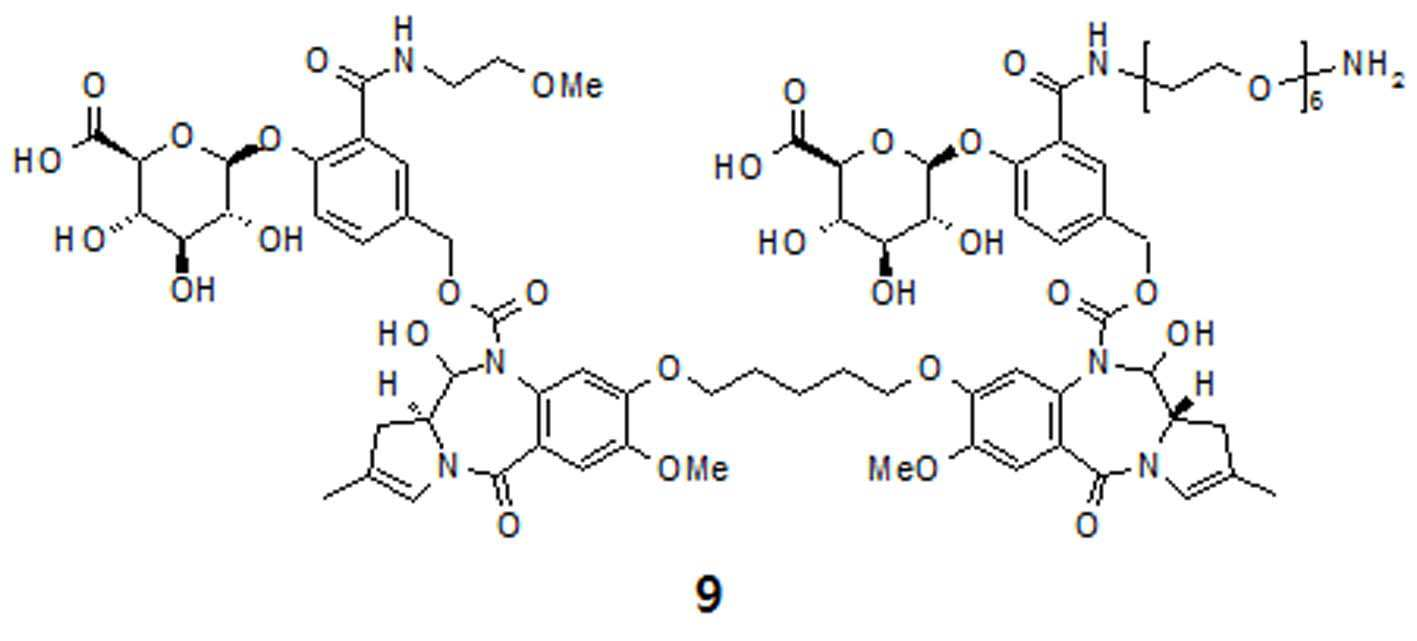
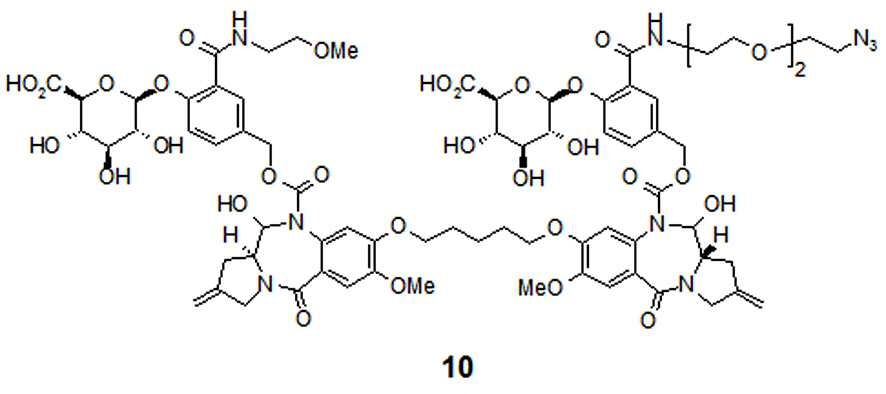
상기 화합물 5, 6, 7, 9 및 10은 대한민국 출원번호 10-2018-0036895호에 기재된 방법으로 제조하였다.The
또한, 상기 화합물 8은 대한민국 출원번호 10-2019-0000514호에 기재된 방법으로 제조하였다.In addition, the
실시예 11: ADC의 제조Example 11: Preparation of ADC
ADC의 제조는 다음의 두 단계를 거쳐 제조되었으며, 공통적으로 사용한 LCB14-0511 및 LCB14-0606은 한국공개특허 제10-2014-0035393호에 기재된 방법으로 제조하였다. LCB14-0511 및 LCB14-0606 구조식은 다음과 같다:ADC was prepared through the following two steps, and LCB14-0511 and LCB14-0606, which were commonly used, were prepared by the method described in Korean Patent Application Laid-Open No. 10-2014-0035393. The structural formulas for LCB14-0511 and LCB14-0606 are:

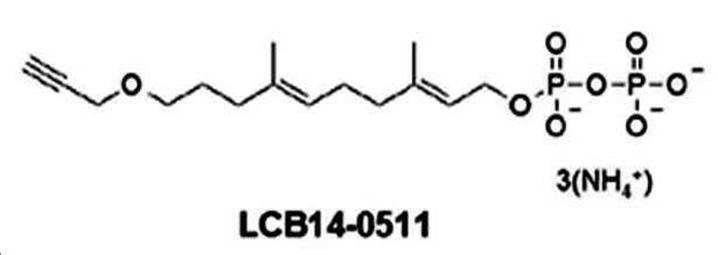
또한, ADC의 제조를 위해 본 발명의 B7-H3 단일클론항체(B5, C4I 및 D8G)에 CaaX 서열이 추가된 항체를 제작하여 사용하였다. 아울러, 비교군 ADC의 제조를 위해 비교군 항체(84D)에 CaaX 서열이 추가된 항체(MGC018)를 사용하였다.In addition, for the preparation of ADC, an antibody with CaaX sequence added to the B7-H3 monoclonal antibody (B5, C4I and D8G) of the present invention was prepared and used. In addition, the antibody (MGC018) in which the CaaX sequence was added to the comparative antibody (84D) was used for the preparation of the comparative ADC.
1단계 : prenylated antibody의 제조Step 1: Preparation of prenylated antibody
항체의 프레닐레이션 반응 혼합물을 제조하여 30℃에서 16시간 반응하였다. 반응혼합물은 24 μM 항체, 200 nM FTase (Calbiochem #344145)와 0.144 mM LCB14-0511 또는 LCB14-0606을 포함하는 완충용액 (50 mM Tris-HCl (pH 7.4), 5 mM MgCl2, 10 μM ZnCl2, 0.144 mM DTT)으로 구성하였다. 반응 종료 후 프레닐레이션된 항체는 PBS 완충용액으로 평형화된 G25 Sepharose 컬럼 (AKTA purifier, GE healthcare)으로 제염시켰다. An antibody prenylation reaction mixture was prepared and reacted at 30° C. for 16 hours. The reaction mixture was prepared in a buffer containing 24 μM antibody, 200 nM FTase (Calbiochem #344145) and 0.144 mM LCB14-0511 or LCB14-0606 (50 mM Tris-HCl (pH 7.4), 5 mM MgCl2, 10 μM ZnCl2, 0.144). mM DTT). After completion of the reaction, the prenylated antibody was decontaminated with a G25 Sepharose column (AKTA purifier, GE healthcare) equilibrated with PBS buffer.
2단계 : drug-conjugation 방법Step 2: drug-conjugation method
<옥심 결합 반응 (conjugation by oxime bond formation)><Oxime bond formation (conjugation by oxime bond formation)>
프레닐레이션된 항체와 링커-약물간의 옥심결합 생성반응 혼합물은 100 mM Na-아세테이트 완충용액 pH 5.2, 10% DMSO, 20 μM 항체와 200 μM 링커-약물(in house, 실시예 9, 10의 화합물 1, 2, 3, 4, 5, 6, 8 및 9)을 섞어 제조하였으며 30℃에서 약하게 교반하였다. 6시간 또는 24시간 반응 후에 FPLC(AKTA purifier, GE healthcare) 과정을 거쳐 사용된 과량의 저분자 화합물들을 제거하였으며 단백질 분획은 수집하여 농축하였다.The reaction mixture for generating an oxime bond between the prenylated antibody and the linker-drug is 100 mM Na-acetate buffer pH 5.2, 10% DMSO, 20 μM antibody and 200 μM linker-drug (in house, the compounds of Examples 9 and 10) 1, 2, 3, 4, 5, 6, 8, and 9) were mixed and stirred gently at 30°C. After 6 hours or 24 hours of reaction, FPLC (AKTA purifier, GE healthcare) was performed to remove excess low molecular weight compounds, and protein fractions were collected and concentrated.
<클릭 결합 반응 (conjugation by click reaction)><Conjugation by click reaction>
프레닐레이션된 항체와 링커-약물간의 클릭결합 생성반응 혼합물은 10% DMSO, 20 μM 항체와 200 μM 링커-약물(in house, 실시예 10의 화합물 7 및 10), 1 mM 카퍼(II) 설페이트 펜타하이드레이트, 2 mM (BimC4A)3 (Sigma-Aldrich 696854), 10 mM 소듐 아스코르베이트 (sodium ascorbate) 및 10 mM 아미노구아니딘 염산염을 섞어 제조하였으며 25 ℃에서 3시간 반응 후에 20 mM EDTA를 처리하여 30분 동안 반응하였다. 반응 종료 후, FPLC(AKTA purifier, GE healthcare) 과정을 거쳐 사용된 과량의 저분자 화합물들을 제거하였으며 단백질 분획은 수집하여 농축하였다.The prenylated antibody and linker-drug click-bonding reaction mixture was prepared using 10% DMSO, 20 μM antibody and 200 μM linker-drug (in house, compounds 7 and 10 of Example 10), and 1 mM copper (II) sulfate. It was prepared by mixing pentahydrate, 2 mM (BimC4A)3 (Sigma-Aldrich 696854), 10 mM sodium ascorbate and 10 mM aminoguanidine hydrochloride. reacted for a minute. After completion of the reaction, excess low molecular weight compounds were removed through FPLC (AKTA purifier, GE healthcare) process, and the protein fraction was collected and concentrated.
[표 7][Table 7]
ADC 제조목록ADC Manufacturing List
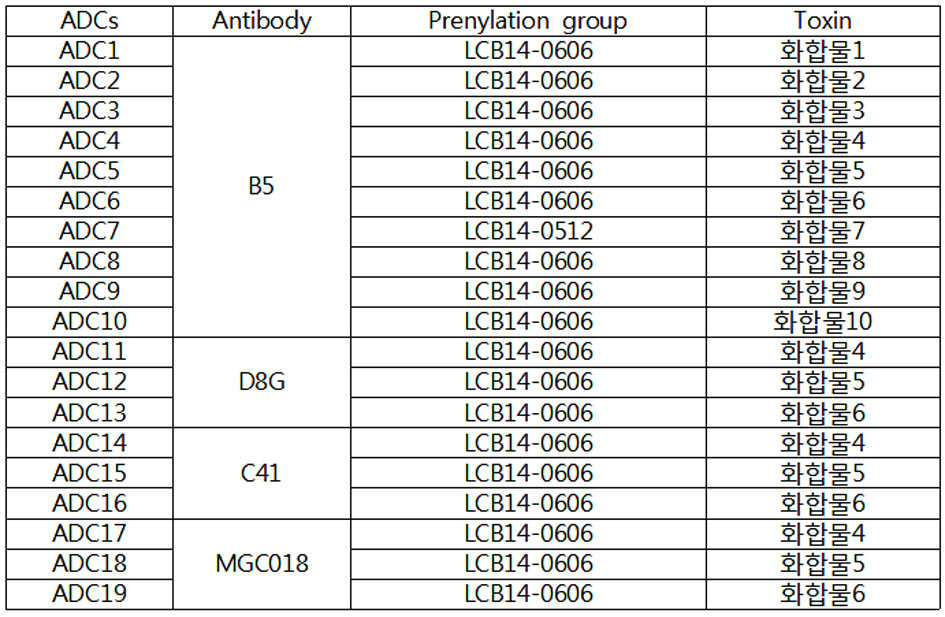
실시예 12: ADC의 특성 분석Example 12: Characterization of ADCs
실시예 11에서 제조한 ADC를 이용하여 본 발명에 따른 ADC의 특성을 분석하였다. The ADC prepared in Example 11 was used to analyze the characteristics of the ADC according to the present invention.
이를 위해 소수성 상호작용 크로마토그래피-고성능 액체 크로마토그래피(HIC-HPLC) 분석을 수행하였다. ADC를 페닐-5PW 컬럼(7.5×75 mm, 10 μm, Tosoh Bioscience, USA)으로 소수성 상호 작용 크로마토그래피-고성능 액체 크로마토그래피시켰다. 1.5M 황산암모늄을 함유하는 50 mM 인산칼륨 완충액(pH 7.0)을 완충액 A로서 사용하고, 30% 아세토나이트릴을 함유하는 50 mM 인산칼륨 완충액(pH 7.0)을 완충액 B로서 사용하였여 70% A/30% B를 초기 조건으로 안정화시켰다. 70% A/30% B 대 10% A/90% B의 선형 구배를 사용하여 그 다음 25분 동안 용출을 하고 10% A/90% B로 5분간 추가적으로 용출을 수행하였다. 유량 및 온도를 각각 1.0 ㎖/min 및 25℃로 설정하였다. 검출을 254 및 280 nm 둘 다에서 후속하였다. B7-H3 항체 및 프레닐화 B7-H3 항체를 대조군으로 사용하였다.For this purpose, hydrophobic interaction chromatography-high performance liquid chromatography (HIC-HPLC) analysis was performed. ADCs were subjected to hydrophobic interaction chromatography-high performance liquid chromatography on a phenyl-5PW column (7.5×75 mm, 10 μm, Tosoh Bioscience, USA). 50 mM potassium phosphate buffer (pH 7.0) containing 1.5 M ammonium sulfate was used as buffer A, and 50 mM potassium phosphate buffer (pH 7.0) containing 30% acetonitrile was used as buffer B 70% A /30% B was stabilized to the initial condition. A linear gradient of 70% A/30% B to 10% A/90% B was used followed by elution for 25 minutes followed by an additional elution with 10% A/90% B for 5 minutes. The flow rate and temperature were set at 1.0 ml/min and 25° C., respectively. Detection was followed at both 254 and 280 nm. B7-H3 antibody and prenylated B7-H3 antibody were used as controls.
또한, 크기 배제 크로마토그래피-고성능 액체 크로마토그래피(SEC-HPLC) 분석을 수행하였다. ADC를 SWXL(6.0×40 mm, Tosoh Bioscience, USA) 가드컬럼과 G3000SWxl 컬럼(7.8×300mm, 5μm, Tosoh Bioscience, USA)을 이용하여 크기 배제 크로마토그래피-고성능 액체 크로마토그래피시켰다. 250 mM 인산 클로라이드와 15% 이소프로필 알콜을 포함하는 200 mM 인산 칼륨 완충액(pH 7.0)을 이동상으로 하여 0.5 ㎖/min의 유속, 25℃ 조건에서 30분 동안 분석하였다. 검출을 254 및 280 nm 둘 다에서 후속하였다. SEC-HPLC 항체 및 프레닐화 SEC-HPLC 항체를 대조군으로 사용하였다(분석 결과는 나타내지 않음).In addition, size exclusion chromatography-high performance liquid chromatography (SEC-HPLC) analysis was performed. ADCs were subjected to size exclusion chromatography-high performance liquid chromatography using a SWXL (6.0×40 mm, Tosoh Bioscience, USA) guard column and a G3000SWxl column (7.8×300 mm, 5 μm, Tosoh Bioscience, USA). A 200 mM potassium phosphate buffer (pH 7.0) containing 250 mM phosphate chloride and 15% isopropyl alcohol was used as a mobile phase and analyzed at a flow rate of 0.5 ml/min at 25° C. for 30 minutes. Detection was followed at both 254 and 280 nm. SEC-HPLC antibody and prenylated SEC-HPLC antibody were used as controls (analytical results not shown).
실시예 13: Example 13: In vitroin vitro 세포독성 평가 Cytotoxicity assessment
실시예 11에서 제조한 ADC의 암세포주에 대한 세포증식억제 활성을 측정하였다. The cell proliferation inhibitory activity of the ADC prepared in Example 11 against the cancer cell line was measured.
이를 위해 시판 중인 B7-H3을 발현하는 암세포주(OVCAR3, Calu-6, Calu-3, HT29 및 HCC1187 세포주)를 사용하였다. 96-웰 플레이트에 각 암세포주를 웰(well)당 4,000~5,000개씩 접종(seeding)하여 4시간 동안 배양한 뒤에 표 7에 기재된 ADC를 0.0015~10.0 nM (3배 연속 희석) 농도로 처리하였다. 144시간 뒤에 살아있는 세포수를 WST-8 (Dojindo molecular technology inc.) 키트를 사용하여 정량하였다. For this purpose, commercially available cancer cell lines expressing B7-H3 (OVCAR3, Calu-6, Calu-3, HT29 and HCC1187 cell lines) were used. Each cancer cell line was inoculated (seeding) 4,000 to 5,000 per well in a 96-well plate and cultured for 4 hours, and then the ADCs described in Table 7 were treated at a concentration of 0.0015 to 10.0 nM (3-fold serial dilution). After 144 hours, the number of viable cells was quantified using a WST-8 (Dojindo molecular technology inc.) kit.
결과는 아래 표 8에 기재되어 있다. B7-H3이 과발현된 암세포주에서 본 발명의 항-B7-H3 단일클론항체가 접합된 ADC가 기존 항-B7-H3 항체가 접합된 ADC(ADC17, ADC18)보다 세포독성이 매우 뛰어남을 확인하였다. 또한, 피롤로벤조디아제핀 계열의 ADC는 오리스타틴 계열의 ADC에 비해 세포독성이 강하게 나타나는 것을 확인하였다. The results are shown in Table 8 below. It was confirmed that the ADC conjugated with the anti-B7-H3 monoclonal antibody of the present invention in the cancer cell line overexpressing B7-H3 had very superior cytotoxicity than the ADCs conjugated with the existing anti-B7-H3 antibody (ADC17, ADC18). . In addition, it was confirmed that the pyrrolobenzodiazepine-based ADC exhibits stronger cytotoxicity than the auristatin-based ADC.
[표 8][Table 8]
ADC 시료의 세포독성 비교Comparison of cytotoxicity of ADC samples

실시예 14: Example 14: In vivoin vivo 암 성장 억제 효능 분석 Cancer growth inhibition efficacy analysis
실시예 14-1: B7-H3 발현 폐암 세포주 이식 마우스 모델에서 ADC에 의한 암 성장 억제 효능 분석 Example 14-1: Analysis of cancer growth inhibition efficacy by ADC in a mouse model transplanted with a B7-H3-expressing lung cancer cell line
암컷 Balb/C 누드 마우스에 B7-H3을 발현하는 인간 폐암 세포주인 Calu-3 세포주를 1 x 10⁷ cells/head 이식하여 인간 암 이식 종양 마우스를 제작했다. 이식후 종양 크기가 평균 184 mm3 에 도달하였을 때 (Day 1) 군분리를 실시하고 실시예 11에서 제조한 ADC5(B5-CaaX-PBD) 0.25 mpk 또는 1.0 mpk, ADC6(B5-CaaX-PBD2) 0.25 mpk 또는 1.0 mpk, 또는 ADC4(B5-CaaX-MMAE) 2.5 mpk 또는 5.0 mpk를 1회 마우스 정맥내로 투여하였다. 대조군은 PBS 10 ml/kg을 마우스 정맥내로 투여하였다. 마우스에 이식된 종양크기 및 체중은 최초 투여(Day 1) 직전에 측정되고, 그 후 35일 동안 주기적으로 측정하였다.Human cancer-transplanted tumor mice were prepared by transplanting 1 x 10 7 cells/head of the Calu-3 cell line, a human lung cancer cell line expressing B7-H3, into female Balb/C nude mice. After transplantation, when the average tumor size reached 184 mm 3 (Day 1), group separation was performed and ADC5 (B5-CaaX-PBD) 0.25 mpk or 1.0 mpk, ADC6 (B5-CaaX-PBD2) prepared in Example 11 0.25 mpk or 1.0 mpk, or ADC4 (B5-CaaX-MMAE) 2.5 mpk or 5.0 mpk was administered intravenously to mice once. As a control group,
결과는 도 13a 및 도 13b에 기재되어 있다. B7-H3 발현 폐암 세포주 이식 마우스 모델에서 본 발명의 ADC가 암의 성장을 억제하는 것을 확인하였다. 또한, 피롤로벤조디아제핀 계열의 ADC에 의한 암의 성장 억제가 오리스타틴 계열의 ADC보다 강하게 나타나는 것을 확인하였다.The results are shown in FIGS. 13A and 13B . It was confirmed that the ADC of the present invention inhibits cancer growth in a mouse model transplanted with a B7-H3-expressing lung cancer cell line. In addition, it was confirmed that cancer growth inhibition by the pyrrolobenzodiazepine-based ADC was stronger than the auristatin-based ADC.
<110> ABL Bio Inc. LEGOCHEM BIOSCIENCES, INC. <120> Antibody-drug conjugate comprising anti-B7-H3 antibody and its use <130> PB2019-221 <160> 67 <170> KoPatentIn 3.0 <210> 1 <211> 5 <212> PRT <213> Homo sapiens <220> <221> MISC_FEATURE <222> (1)..(5) <223> CDRH1 sequence of heavy chain variable region from clone B5, F6V <400> 1 Asp Tyr Ala Met Ser 1 5 <210> 2 <211> 5 <212> PRT <213> Homo sapiens <220> <221> MISC_FEATURE <222> (1)..(5) <223> CDRH1 sequence of heavy chain variable region from clone C4I <400> 2 Gly Tyr Tyr Met Ser 1 5 <210> 3 <211> 5 <212> PRT <213> Homo sapiens <220> <221> MISC_FEATURE <222> (1)..(5) <223> CDRH1 sequence of heavy chain variable region from clone D8G <400> 3 Ser Tyr Ser Met Ser 1 5 <210> 4 <211> 5 <212> PRT <213> Homo sapiens <220> <221> MISC_FEATURE <222> (1)..(5) <223> CDRH1 sequence of heavy chain variable region from clone 10F11 <400> 4 Ser Tyr Gly Met Ser 1 5 <210> 5 <211> 17 <212> PRT <213> Homo sapiens <220> <221> MISC_FEATURE <222> (1)..(17) <223> CDRH2 sequence of heavy chain variable region from clone B5 <400> 5 Ser Ile Ser Ser Gly Ser Gly Ser Ile Tyr Tyr Ala Asp Ser Val Lys 1 5 10 15 Gly <210> 6 <211> 17 <212> PRT <213> Homo sapiens <220> <221> MISC_FEATURE <222> (1)..(17) <223> CDRH2 sequence of heavy chain variable region from clone C4I <400> 6 Leu Ile Ser Pro Ser Ser Gly Ser Ile Tyr Tyr Ala Asp Ser Val Lys 1 5 10 15 Gly <210> 7 <211> 17 <212> PRT <213> Homo sapiens <220> <221> MISC_FEATURE <222> (1)..(17) <223> CDRH2 sequence of heavy chain variable region from clone D8G <400> 7 Gly Ile Tyr Ser Asp Gly Ser Asn Thr Tyr Tyr Ala Asp Ser Val Lys 1 5 10 15 Gly <210> 8 <211> 17 <212> PRT <213> Homo sapiens <220> <221> MISC_FEATURE <222> (1)..(17) <223> CDRH2 sequence of heavy chain variable region from clone F6V <400> 8 Gly Ile Ser Pro Gly Gly Ser Asn Thr Tyr Tyr Ala Asp Ser Val Lys 1 5 10 15 Gly <210> 9 <211> 17 <212> PRT <213> Homo sapiens <220> <221> MISC_FEATURE <222> (1)..(17) <223> CDRH2 sequence of heavy chain variable region from clone 10F11 <400> 9 Gly Ile Tyr Ser Gly Gly Ser Ser Lys Tyr Tyr Ala Asp Ser Val Lys 1 5 10 15 Gly <210> 10 <211> 7 <212> PRT <213> Homo sapiens <220> <221> MISC_FEATURE <222> (1)..(7) <223> CDRH3 sequence of heavy chain variable region from clone B5 <400> 10 Asn Leu Ile Pro Leu Asp Tyr 1 5 <210> 11 <211> 7 <212> PRT <213> Homo sapiens <220> <221> MISC_FEATURE <222> (1)..(7) <223> CDRH3 sequence of heavy chain variable region from clone C4I <400> 11 Gly Leu Thr Lys Phe Asp Tyr 1 5 <210> 12 <211> 7 <212> PRT <213> Homo sapiens <220> <221> MISC_FEATURE <222> (1)..(7) <223> CDRH3 sequence of heavy chain variable region from clone D8G <400> 12 Met Leu His Arg Phe Asp Tyr 1 5 <210> 13 <211> 12 <212> PRT <213> Homo sapiens <220> <221> MISC_FEATURE <222> (1)..(12) <223> CDRH3 sequence of heavy chain variable region from clone F6V <400> 13 Asp Ala Trp Ile Ala Arg Leu Leu Leu Phe Asp Tyr 1 5 10 <210> 14 <211> 7 <212> PRT <213> Homo sapiens <220> <221> MISC_FEATURE <222> (1)..(7) <223> CDRH3 sequence of heavy chain variable region from clone 10F11 <400> 14 Asn Arg Leu Arg Phe Asp Tyr 1 5 <210> 15 <211> 13 <212> PRT <213> Homo sapiens <220> <221> MISC_FEATURE <222> (1)..(13) <223> CDRL1 sequence of light chain variable region from clone B5 <400> 15 Ser Gly Ser Ser Ser Asn Ile Gly Ser Asn Ala Val Ser 1 5 10 <210> 16 <211> 13 <212> PRT <213> Homo sapiens <220> <221> MISC_FEATURE <222> (1)..(13) <223> CDRL1 sequence of light chain variable region from clone C4I <400> 16 Thr Gly Ser Ser Ser Asn Ile Gly Ser Asn Asp Val Ser 1 5 10 <210> 17 <211> 13 <212> PRT <213> Homo sapiens <220> <221> MISC_FEATURE <222> (1)..(13) <223> CDRL1 sequence of light chain variable region from clone D8G <400> 17 Ser Gly Ser Ser Ser Asn Ile Gly Ser Asn Ser Val Thr 1 5 10 <210> 18 <211> 13 <212> PRT <213> Homo sapiens <220> <221> MISC_FEATURE <222> (1)..(13) <223> CDRL1 sequence of light chain variable region from clone F6V <400> 18 Ser Gly Ser Ser Ser Asn Ile Gly Ser Asn Ala Val Thr 1 5 10 <210> 19 <211> 13 <212> PRT <213> Homo sapiens <220> <221> MISC_FEATURE <222> (1)..(13) <223> CDRL1 sequence of light chain variable region clone 10F11 from <400> 19 Thr Gly Ser Ser Ser Asn Ile Gly Ser Asn Ser Val Thr 1 5 10 <210> 20 <211> 7 <212> PRT <213> Homo sapiens <220> <221> MISC_FEATURE <222> (1)..(7) <223> CDRL2 sequence of light chain variable region from clone B5 <400> 20 Tyr Asn Ser His Arg Pro Ser 1 5 <210> 21 <211> 7 <212> PRT <213> Homo sapiens <220> <221> MISC_FEATURE <222> (1)..(7) <223> CDRL2 sequence of light chain variable region from clone C4I <400> 21 Ala Asn Ser His Arg Pro Ser 1 5 <210> 22 <211> 7 <212> PRT <213> Homo sapiens <220> <221> MISC_FEATURE <222> (1)..(7) <223> CDRL2 sequence of light chain variable region from clone D8G <400> 22 Ala Asp Ser Gln Arg Pro Ser 1 5 <210> 23 <211> 7 <212> PRT <213> Homo sapiens <220> <221> MISC_FEATURE <222> (1)..(7) <223> CDRL2 sequence of light chain variable region from clone F6V <400> 23 Tyr Asn Asn Lys Arg Pro Ser 1 5 <210> 24 <211> 7 <212> PRT <213> Homo sapiens <220> <221> MISC_FEATURE <222> (1)..(7) <223> CDRL2 sequence of light chain variable region from clone 10F11 <400> 24 Ser Asp Ser His Arg Pro Ser 1 5 <210> 25 <211> 11 <212> PRT <213> Homo sapiens <220> <221> MISC_FEATURE <222> (1)..(11) <223> CDRL3 sequence of light chain variable region from clone B5 <400> 25 Gly Ser Trp Asp Ala Ser Leu Asn Ala Tyr Val 1 5 10 <210> 26 <211> 11 <212> PRT <213> Homo sapiens <220> <221> MISC_FEATURE <222> (1)..(11) <223> CDRL3 sequence of light chain variable region from clone C4I <400> 26 Gly Ser Trp Asp Asp Ser Leu Ser Gly Tyr Val 1 5 10 <210> 27 <211> 11 <212> PRT <213> Homo sapiens <220> <221> MISC_FEATURE <222> (1)..(11) <223> CDRL3 sequence of light chain variable region from clone D8G <400> 27 Gly Thr Trp Asp Ser Ser Leu Asn Ala Tyr Val 1 5 10 <210> 28 <211> 11 <212> PRT <213> Homo sapiens <220> <221> MISC_FEATURE <222> (1)..(11) <223> CDRL3 sequence of light chain variable region from clone F6V <400> 28 Gly Thr Trp Asp Asp Ser Leu Ser Gly Tyr Val 1 5 10 <210> 29 <211> 11 <212> PRT <213> Homo sapiens <220> <221> MISC_FEATURE <222> (1)..(11) <223> CDRL3 sequence of light chain variable region from clone 10F11 <400> 29 Gly Thr Trp Asp Ala Ser Leu Asn Ala Tyr Val 1 5 10 <210> 30 <211> 116 <212> PRT <213> Homo sapiens <220> <221> MISC_FEATURE <222> (1)..(116) <223> Heavy chain variable region sequence clone B5 <400> 30 Glu Val Gln Leu Leu Glu Ser Gly Gly Gly Leu Val Gln Pro Gly Gly 1 5 10 15 Ser Leu Arg Leu Ser Cys Ala Ala Ser Gly Phe Thr Phe Ser Asp Tyr 20 25 30 Ala Met Ser Trp Val Arg Gln Ala Pro Gly Lys Gly Leu Glu Trp Val 35 40 45 Ser Ser Ile Ser Ser Gly Ser Gly Ser Ile Tyr Tyr Ala Asp Ser Val 50 55 60 Lys Gly Arg Phe Thr Ile Ser Arg Asp Asn Ser Lys Asn Thr Leu Tyr 65 70 75 80 Leu Gln Met Asn Ser Leu Arg Ala Glu Asp Thr Ala Val Tyr Tyr Cys 85 90 95 Ala Lys Asn Leu Ile Pro Leu Asp Tyr Trp Gly Gln Gly Thr Leu Val 100 105 110 Thr Val Ser Ser 115 <210> 31 <211> 116 <212> PRT <213> Homo sapiens <220> <221> MISC_FEATURE <222> (1)..(116) <223> Heavy chain variable region sequence clone C4I <400> 31 Glu Val Gln Leu Leu Glu Ser Gly Gly Gly Leu Val Gln Pro Gly Gly 1 5 10 15 Ser Leu Arg Leu Ser Cys Ala Ala Ser Gly Phe Thr Phe Ser Gly Tyr 20 25 30 Tyr Met Ser Trp Val Arg Gln Ala Pro Gly Lys Gly Leu Glu Trp Val 35 40 45 Ser Leu Ile Ser Pro Ser Ser Gly Ser Ile Tyr Tyr Ala Asp Ser Val 50 55 60 Lys Gly Arg Phe Thr Ile Ser Arg Asp Asn Ser Lys Asn Thr Leu Tyr 65 70 75 80 Leu Gln Met Asn Ser Leu Arg Ala Glu Asp Thr Ala Val Tyr Tyr Cys 85 90 95 Ala Lys Gly Leu Thr Lys Phe Asp Tyr Trp Gly Gln Gly Thr Leu Val 100 105 110 Thr Val Ser Ser 115 <210> 32 <211> 116 <212> PRT <213> Homo sapiens <220> <221> MISC_FEATURE <222> (1)..(116) <223> Heavy chain variable region sequence clone D8G <400> 32 Glu Val Gln Leu Leu Glu Ser Gly Gly Gly Leu Val Gln Pro Gly Gly 1 5 10 15 Ser Leu Arg Leu Ser Cys Ala Ala Ser Gly Phe Thr Phe Ser Ser Tyr 20 25 30 Ser Met Ser Trp Val Arg Gln Ala Pro Gly Lys Gly Leu Glu Trp Val 35 40 45 Ser Gly Ile Tyr Ser Asp Gly Ser Asn Thr Tyr Tyr Ala Asp Ser Val 50 55 60 Lys Gly Arg Phe Thr Ile Ser Arg Asp Asn Ser Lys Asn Thr Leu Tyr 65 70 75 80 Leu Gln Met Asn Ser Leu Arg Ala Glu Asp Thr Ala Val Tyr Tyr Cys 85 90 95 Ala Lys Met Leu His Arg Phe Asp Tyr Trp Gly Gln Gly Thr Leu Val 100 105 110 Thr Val Ser Ser 115 <210> 33 <211> 121 <212> PRT <213> Homo sapiens <220> <221> MISC_FEATURE <222> (1)..(121) <223> Heavy chain variable region sequence clone F6V <400> 33 Glu Val Gln Leu Leu Glu Ser Gly Gly Gly Leu Val Gln Pro Gly Gly 1 5 10 15 Ser Leu Arg Leu Ser Cys Ala Ala Ser Gly Phe Thr Phe Ser Asp Tyr 20 25 30 Ala Met Ser Trp Val Arg Gln Ala Pro Gly Lys Gly Leu Glu Trp Val 35 40 45 Ser Gly Ile Ser Pro Gly Gly Ser Asn Thr Tyr Tyr Ala Asp Ser Val 50 55 60 Lys Gly Arg Phe Thr Ile Ser Arg Asp Asn Ser Lys Asn Thr Leu Tyr 65 70 75 80 Leu Gln Met Asn Ser Leu Arg Ala Glu Asp Thr Ala Val Tyr Tyr Cys 85 90 95 Ala Lys Asp Ala Trp Ile Ala Arg Leu Leu Leu Phe Asp Tyr Trp Gly 100 105 110 Gln Gly Thr Leu Val Thr Val Ser Ser 115 120 <210> 34 <211> 116 <212> PRT <213> Homo sapiens <220> <221> MISC_FEATURE <222> (1)..(116) <223> Heavy chain variable region sequence clone 10F11 <400> 34 Glu Val Gln Leu Leu Glu Ser Gly Gly Gly Leu Val Gln Pro Gly Gly 1 5 10 15 Ser Leu Arg Leu Ser Cys Ala Ala Ser Gly Phe Thr Phe Ser Ser Tyr 20 25 30 Gly Met Ser Trp Val Arg Gln Ala Pro Gly Lys Gly Leu Glu Trp Val 35 40 45 Ser Gly Ile Tyr Ser Gly Gly Ser Ser Lys Tyr Tyr Ala Asp Ser Val 50 55 60 Lys Gly Arg Phe Thr Ile Ser Arg Asp Asn Ser Lys Asn Thr Leu Tyr 65 70 75 80 Leu Gln Met Asn Ser Leu Arg Ala Glu Asp Thr Ala Val Tyr Tyr Cys 85 90 95 Ala Lys Asn Arg Leu Arg Phe Asp Tyr Trp Gly Gln Gly Thr Leu Val 100 105 110 Thr Val Ser Ser 115 <210> 35 <211> 111 <212> PRT <213> Homo sapiens <220> <221> MISC_FEATURE <222> (1)..(111) <223> Light chain variable region sequence clone B5 <400> 35 Gln Ser Val Leu Thr Gln Pro Pro Ser Ala Ser Gly Thr Pro Gly Gln 1 5 10 15 Arg Val Thr Ile Ser Cys Ser Gly Ser Ser Ser Asn Ile Gly Ser Asn 20 25 30 Ala Val Ser Trp Tyr Gln Gln Leu Pro Gly Thr Ala Pro Lys Leu Leu 35 40 45 Ile Tyr Tyr Asn Ser His Arg Pro Ser Gly Val Pro Asp Arg Phe Ser 50 55 60 Gly Ser Lys Ser Gly Thr Ser Ala Ser Leu Ala Ile Ser Gly Leu Arg 65 70 75 80 Ser Glu Asp Glu Ala Asp Tyr Tyr Cys Gly Ser Trp Asp Ala Ser Leu 85 90 95 Asn Ala Tyr Val Phe Gly Gly Gly Thr Lys Leu Thr Val Leu Gly 100 105 110 <210> 36 <211> 111 <212> PRT <213> Homo sapiens <220> <221> MISC_FEATURE <222> (1)..(111) <223> Light chain variable region sequence clone C4I <400> 36 Gln Ser Val Leu Thr Gln Pro Pro Ser Ala Ser Gly Thr Pro Gly Gln 1 5 10 15 Arg Val Thr Ile Ser Cys Thr Gly Ser Ser Ser Asn Ile Gly Ser Asn 20 25 30 Asp Val Ser Trp Tyr Gln Gln Leu Pro Gly Thr Ala Pro Lys Leu Leu 35 40 45 Ile Tyr Ala Asn Ser His Arg Pro Ser Gly Val Pro Asp Arg Phe Ser 50 55 60 Gly Ser Lys Ser Gly Thr Ser Ala Ser Leu Ala Ile Ser Gly Leu Arg 65 70 75 80 Ser Glu Asp Glu Ala Asp Tyr Tyr Cys Gly Ser Trp Asp Asp Ser Leu 85 90 95 Ser Gly Tyr Val Phe Gly Gly Gly Thr Lys Leu Thr Val Leu Gly 100 105 110 <210> 37 <211> 111 <212> PRT <213> Homo sapiens <220> <221> MISC_FEATURE <222> (1)..(111) <223> Light chain variable region sequence clone D8G <400> 37 Gln Ser Val Leu Thr Gln Pro Pro Ser Ala Ser Gly Thr Pro Gly Gln 1 5 10 15 Arg Val Thr Ile Ser Cys Ser Gly Ser Ser Ser Asn Ile Gly Ser Asn 20 25 30 Ser Val Thr Trp Tyr Gln Gln Leu Pro Gly Thr Ala Pro Lys Leu Leu 35 40 45 Ile Tyr Ala Asp Ser Gln Arg Pro Ser Gly Val Pro Asp Arg Phe Ser 50 55 60 Gly Ser Lys Ser Gly Thr Ser Ala Ser Leu Ala Ile Ser Gly Leu Arg 65 70 75 80 Ser Glu Asp Glu Ala Asp Tyr Tyr Cys Gly Thr Trp Asp Ser Ser Leu 85 90 95 Asn Ala Tyr Val Phe Gly Gly Gly Thr Lys Leu Thr Val Leu Gly 100 105 110 <210> 38 <211> 111 <212> PRT <213> Homo sapiens <220> <221> MISC_FEATURE <222> (1)..(111) <223> Light chain variable region sequence clone F6V <400> 38 Gln Ser Val Leu Thr Gln Pro Pro Ser Ala Ser Gly Thr Pro Gly Gln 1 5 10 15 Arg Val Thr Ile Ser Cys Ser Gly Ser Ser Ser Asn Ile Gly Ser Asn 20 25 30 Ala Val Thr Trp Tyr Gln Gln Leu Pro Gly Thr Ala Pro Lys Leu Leu 35 40 45 Ile Tyr Tyr Asn Asn Lys Arg Pro Ser Gly Val Pro Asp Arg Phe Ser 50 55 60 Gly Ser Lys Ser Gly Thr Ser Ala Ser Leu Ala Ile Ser Gly Leu Arg 65 70 75 80 Ser Glu Asp Glu Ala Asp Tyr Tyr Cys Gly Thr Trp Asp Asp Ser Leu 85 90 95 Ser Gly Tyr Val Phe Gly Gly Gly Thr Lys Leu Thr Val Leu Gly 100 105 110 <210> 39 <211> 111 <212> PRT <213> Homo sapiens <220> <221> MISC_FEATURE <222> (1)..(111) <223> Light chain variable region sequence clone 10F11 <400> 39 Gln Ser Val Leu Thr Gln Pro Pro Ser Ala Ser Gly Thr Pro Gly Gln 1 5 10 15 Arg Val Thr Ile Ser Cys Thr Gly Ser Ser Ser Asn Ile Gly Ser Asn 20 25 30 Ser Val Thr Trp Tyr Gln Gln Leu Pro Gly Thr Ala Pro Lys Leu Leu 35 40 45 Ile Tyr Ser Asp Ser His Arg Pro Ser Gly Val Pro Asp Arg Phe Ser 50 55 60 Gly Ser Lys Ser Gly Thr Ser Ala Ser Leu Ala Ile Ser Gly Leu Arg 65 70 75 80 Ser Glu Asp Glu Ala Asp Tyr Tyr Cys Gly Thr Trp Asp Ala Ser Leu 85 90 95 Asn Ala Tyr Val Phe Gly Gly Gly Thr Lys Leu Thr Val Leu Gly 100 105 110 <210> 40 <211> 446 <212> PRT <213> Homo sapiens <220> <221> MISC_FEATURE <222> (1)..(446) <223> Full length heavy chain sequence clone B5 <400> 40 Glu Val Gln Leu Leu Glu Ser Gly Gly Gly Leu Val Gln Pro Gly Gly 1 5 10 15 Ser Leu Arg Leu Ser Cys Ala Ala Ser Gly Phe Thr Phe Ser Asp Tyr 20 25 30 Ala Met Ser Trp Val Arg Gln Ala Pro Gly Lys Gly Leu Glu Trp Val 35 40 45 Ser Ser Ile Ser Ser Gly Ser Gly Ser Ile Tyr Tyr Ala Asp Ser Val 50 55 60 Lys Gly Arg Phe Thr Ile Ser Arg Asp Asn Ser Lys Asn Thr Leu Tyr 65 70 75 80 Leu Gln Met Asn Ser Leu Arg Ala Glu Asp Thr Ala Val Tyr Tyr Cys 85 90 95 Ala Lys Asn Leu Ile Pro Leu Asp Tyr Trp Gly Gln Gly Thr Leu Val 100 105 110 Thr Val Ser Ser Ala Ser Thr Lys Gly Pro Ser Val Phe Pro Leu Ala 115 120 125 Pro Ser Ser Lys Ser Thr Ser Gly Gly Thr Ala Ala Leu Gly Cys Leu 130 135 140 Val Lys Asp Tyr Phe Pro Glu Pro Val Thr Val Ser Trp Asn Ser Gly 145 150 155 160 Ala Leu Thr Ser Gly Val His Thr Phe Pro Ala Val Leu Gln Ser Ser 165 170 175 Gly Leu Tyr Ser Leu Ser Ser Val Val Thr Val Pro Ser Ser Ser Leu 180 185 190 Gly Thr Gln Thr Tyr Ile Cys Asn Val Asn His Lys Pro Ser Asn Thr 195 200 205 Lys Val Asp Lys Lys Val Glu Pro Lys Ser Cys Asp Lys Thr His Thr 210 215 220 Cys Pro Pro Cys Pro Ala Pro Glu Leu Leu Gly Gly Pro Ser Val Phe 225 230 235 240 Leu Phe Pro Pro Lys Pro Lys Asp Thr Leu Met Ile Ser Arg Thr Pro 245 250 255 Glu Val Thr Cys Val Val Val Asp Val Ser His Glu Asp Pro Glu Val 260 265 270 Lys Phe Asn Trp Tyr Val Asp Gly Val Glu Val His Asn Ala Lys Thr 275 280 285 Lys Pro Arg Glu Glu Gln Tyr Asn Ser Thr Tyr Arg Val Val Ser Val 290 295 300 Leu Thr Val Leu His Gln Asp Trp Leu Asn Gly Lys Glu Tyr Lys Cys 305 310 315 320 Lys Val Ser Asn Lys Ala Leu Pro Ala Pro Ile Glu Lys Thr Ile Ser 325 330 335 Lys Ala Lys Gly Gln Pro Arg Glu Pro Gln Val Tyr Thr Leu Pro Pro 340 345 350 Ser Arg Glu Glu Met Thr Lys Asn Gln Val Ser Leu Thr Cys Leu Val 355 360 365 Lys Gly Phe Tyr Pro Ser Asp Ile Ala Val Glu Trp Glu Ser Asn Gly 370 375 380 Gln Pro Glu Asn Asn Tyr Lys Thr Thr Pro Pro Val Leu Asp Ser Asp 385 390 395 400 Gly Ser Phe Phe Leu Tyr Ser Lys Leu Thr Val Asp Lys Ser Arg Trp 405 410 415 Gln Gln Gly Asn Val Phe Ser Cys Ser Val Met His Glu Ala Leu His 420 425 430 Asn His Tyr Thr Gln Lys Ser Leu Ser Leu Ser Pro Gly Lys 435 440 445 <210> 41 <211> 446 <212> PRT <213> Homo sapiens <220> <221> MISC_FEATURE <222> (1)..(446) <223> Full length heavy chain sequence clone C4I <400> 41 Glu Val Gln Leu Leu Glu Ser Gly Gly Gly Leu Val Gln Pro Gly Gly 1 5 10 15 Ser Leu Arg Leu Ser Cys Ala Ala Ser Gly Phe Thr Phe Ser Gly Tyr 20 25 30 Tyr Met Ser Trp Val Arg Gln Ala Pro Gly Lys Gly Leu Glu Trp Val 35 40 45 Ser Leu Ile Ser Pro Ser Ser Gly Ser Ile Tyr Tyr Ala Asp Ser Val 50 55 60 Lys Gly Arg Phe Thr Ile Ser Arg Asp Asn Ser Lys Asn Thr Leu Tyr 65 70 75 80 Leu Gln Met Asn Ser Leu Arg Ala Glu Asp Thr Ala Val Tyr Tyr Cys 85 90 95 Ala Lys Gly Leu Thr Lys Phe Asp Tyr Trp Gly Gln Gly Thr Leu Val 100 105 110 Thr Val Ser Ser Ala Ser Thr Lys Gly Pro Ser Val Phe Pro Leu Ala 115 120 125 Pro Ser Ser Lys Ser Thr Ser Gly Gly Thr Ala Ala Leu Gly Cys Leu 130 135 140 Val Lys Asp Tyr Phe Pro Glu Pro Val Thr Val Ser Trp Asn Ser Gly 145 150 155 160 Ala Leu Thr Ser Gly Val His Thr Phe Pro Ala Val Leu Gln Ser Ser 165 170 175 Gly Leu Tyr Ser Leu Ser Ser Val Val Thr Val Pro Ser Ser Ser Leu 180 185 190 Gly Thr Gln Thr Tyr Ile Cys Asn Val Asn His Lys Pro Ser Asn Thr 195 200 205 Lys Val Asp Lys Lys Val Glu Pro Lys Ser Cys Asp Lys Thr His Thr 210 215 220 Cys Pro Pro Cys Pro Ala Pro Glu Leu Leu Gly Gly Pro Ser Val Phe 225 230 235 240 Leu Phe Pro Pro Lys Pro Lys Asp Thr Leu Met Ile Ser Arg Thr Pro 245 250 255 Glu Val Thr Cys Val Val Val Asp Val Ser His Glu Asp Pro Glu Val 260 265 270 Lys Phe Asn Trp Tyr Val Asp Gly Val Glu Val His Asn Ala Lys Thr 275 280 285 Lys Pro Arg Glu Glu Gln Tyr Asn Ser Thr Tyr Arg Val Val Ser Val 290 295 300 Leu Thr Val Leu His Gln Asp Trp Leu Asn Gly Lys Glu Tyr Lys Cys 305 310 315 320 Lys Val Ser Asn Lys Ala Leu Pro Ala Pro Ile Glu Lys Thr Ile Ser 325 330 335 Lys Ala Lys Gly Gln Pro Arg Glu Pro Gln Val Tyr Thr Leu Pro Pro 340 345 350 Ser Arg Glu Glu Met Thr Lys Asn Gln Val Ser Leu Thr Cys Leu Val 355 360 365 Lys Gly Phe Tyr Pro Ser Asp Ile Ala Val Glu Trp Glu Ser Asn Gly 370 375 380 Gln Pro Glu Asn Asn Tyr Lys Thr Thr Pro Pro Val Leu Asp Ser Asp 385 390 395 400 Gly Ser Phe Phe Leu Tyr Ser Lys Leu Thr Val Asp Lys Ser Arg Trp 405 410 415 Gln Gln Gly Asn Val Phe Ser Cys Ser Val Met His Glu Ala Leu His 420 425 430 Asn His Tyr Thr Gln Lys Ser Leu Ser Leu Ser Pro Gly Lys 435 440 445 <210> 42 <211> 446 <212> PRT <213> Homo sapiens <220> <221> MISC_FEATURE <222> (1)..(446) <223> Full length heavy chain sequence clone D8G <400> 42 Glu Val Gln Leu Leu Glu Ser Gly Gly Gly Leu Val Gln Pro Gly Gly 1 5 10 15 Ser Leu Arg Leu Ser Cys Ala Ala Ser Gly Phe Thr Phe Ser Ser Tyr 20 25 30 Ser Met Ser Trp Val Arg Gln Ala Pro Gly Lys Gly Leu Glu Trp Val 35 40 45 Ser Gly Ile Tyr Ser Asp Gly Ser Asn Thr Tyr Tyr Ala Asp Ser Val 50 55 60 Lys Gly Arg Phe Thr Ile Ser Arg Asp Asn Ser Lys Asn Thr Leu Tyr 65 70 75 80 Leu Gln Met Asn Ser Leu Arg Ala Glu Asp Thr Ala Val Tyr Tyr Cys 85 90 95 Ala Lys Met Leu His Arg Phe Asp Tyr Trp Gly Gln Gly Thr Leu Val 100 105 110 Thr Val Ser Ser Ala Ser Thr Lys Gly Pro Ser Val Phe Pro Leu Ala 115 120 125 Pro Ser Ser Lys Ser Thr Ser Gly Gly Thr Ala Ala Leu Gly Cys Leu 130 135 140 Val Lys Asp Tyr Phe Pro Glu Pro Val Thr Val Ser Trp Asn Ser Gly 145 150 155 160 Ala Leu Thr Ser Gly Val His Thr Phe Pro Ala Val Leu Gln Ser Ser 165 170 175 Gly Leu Tyr Ser Leu Ser Ser Val Val Thr Val Pro Ser Ser Ser Leu 180 185 190 Gly Thr Gln Thr Tyr Ile Cys Asn Val Asn His Lys Pro Ser Asn Thr 195 200 205 Lys Val Asp Lys Lys Val Glu Pro Lys Ser Cys Asp Lys Thr His Thr 210 215 220 Cys Pro Pro Cys Pro Ala Pro Glu Leu Leu Gly Gly Pro Ser Val Phe 225 230 235 240 Leu Phe Pro Pro Lys Pro Lys Asp Thr Leu Met Ile Ser Arg Thr Pro 245 250 255 Glu Val Thr Cys Val Val Val Asp Val Ser His Glu Asp Pro Glu Val 260 265 270 Lys Phe Asn Trp Tyr Val Asp Gly Val Glu Val His Asn Ala Lys Thr 275 280 285 Lys Pro Arg Glu Glu Gln Tyr Asn Ser Thr Tyr Arg Val Val Ser Val 290 295 300 Leu Thr Val Leu His Gln Asp Trp Leu Asn Gly Lys Glu Tyr Lys Cys 305 310 315 320 Lys Val Ser Asn Lys Ala Leu Pro Ala Pro Ile Glu Lys Thr Ile Ser 325 330 335 Lys Ala Lys Gly Gln Pro Arg Glu Pro Gln Val Tyr Thr Leu Pro Pro 340 345 350 Ser Arg Glu Glu Met Thr Lys Asn Gln Val Ser Leu Thr Cys Leu Val 355 360 365 Lys Gly Phe Tyr Pro Ser Asp Ile Ala Val Glu Trp Glu Ser Asn Gly 370 375 380 Gln Pro Glu Asn Asn Tyr Lys Thr Thr Pro Pro Val Leu Asp Ser Asp 385 390 395 400 Gly Ser Phe Phe Leu Tyr Ser Lys Leu Thr Val Asp Lys Ser Arg Trp 405 410 415 Gln Gln Gly Asn Val Phe Ser Cys Ser Val Met His Glu Ala Leu His 420 425 430 Asn His Tyr Thr Gln Lys Ser Leu Ser Leu Ser Pro Gly Lys 435 440 445 <210> 43 <211> 451 <212> PRT <213> Homo sapiens <220> <221> MISC_FEATURE <222> (1)..(451) <223> Full length heavy chain sequence clone F6V <400> 43 Glu Val Gln Leu Leu Glu Ser Gly Gly Gly Leu Val Gln Pro Gly Gly 1 5 10 15 Ser Leu Arg Leu Ser Cys Ala Ala Ser Gly Phe Thr Phe Ser Asp Tyr 20 25 30 Ala Met Ser Trp Val Arg Gln Ala Pro Gly Lys Gly Leu Glu Trp Val 35 40 45 Ser Gly Ile Ser Pro Gly Gly Ser Asn Thr Tyr Tyr Ala Asp Ser Val 50 55 60 Lys Gly Arg Phe Thr Ile Ser Arg Asp Asn Ser Lys Asn Thr Leu Tyr 65 70 75 80 Leu Gln Met Asn Ser Leu Arg Ala Glu Asp Thr Ala Val Tyr Tyr Cys 85 90 95 Ala Lys Asp Ala Trp Ile Ala Arg Leu Leu Leu Phe Asp Tyr Trp Gly 100 105 110 Gln Gly Thr Leu Val Thr Val Ser Ser Ala Ser Thr Lys Gly Pro Ser 115 120 125 Val Phe Pro Leu Ala Pro Ser Ser Lys Ser Thr Ser Gly Gly Thr Ala 130 135 140 Ala Leu Gly Cys Leu Val Lys Asp Tyr Phe Pro Glu Pro Val Thr Val 145 150 155 160 Ser Trp Asn Ser Gly Ala Leu Thr Ser Gly Val His Thr Phe Pro Ala 165 170 175 Val Leu Gln Ser Ser Gly Leu Tyr Ser Leu Ser Ser Val Val Thr Val 180 185 190 Pro Ser Ser Ser Leu Gly Thr Gln Thr Tyr Ile Cys Asn Val Asn His 195 200 205 Lys Pro Ser Asn Thr Lys Val Asp Lys Lys Val Glu Pro Lys Ser Cys 210 215 220 Asp Lys Thr His Thr Cys Pro Pro Cys Pro Ala Pro Glu Leu Leu Gly 225 230 235 240 Gly Pro Ser Val Phe Leu Phe Pro Pro Lys Pro Lys Asp Thr Leu Met 245 250 255 Ile Ser Arg Thr Pro Glu Val Thr Cys Val Val Val Asp Val Ser His 260 265 270 Glu Asp Pro Glu Val Lys Phe Asn Trp Tyr Val Asp Gly Val Glu Val 275 280 285 His Asn Ala Lys Thr Lys Pro Arg Glu Glu Gln Tyr Asn Ser Thr Tyr 290 295 300 Arg Val Val Ser Val Leu Thr Val Leu His Gln Asp Trp Leu Asn Gly 305 310 315 320 Lys Glu Tyr Lys Cys Lys Val Ser Asn Lys Ala Leu Pro Ala Pro Ile 325 330 335 Glu Lys Thr Ile Ser Lys Ala Lys Gly Gln Pro Arg Glu Pro Gln Val 340 345 350 Tyr Thr Leu Pro Pro Ser Arg Glu Glu Met Thr Lys Asn Gln Val Ser 355 360 365 Leu Thr Cys Leu Val Lys Gly Phe Tyr Pro Ser Asp Ile Ala Val Glu 370 375 380 Trp Glu Ser Asn Gly Gln Pro Glu Asn Asn Tyr Lys Thr Thr Pro Pro 385 390 395 400 Val Leu Asp Ser Asp Gly Ser Phe Phe Leu Tyr Ser Lys Leu Thr Val 405 410 415 Asp Lys Ser Arg Trp Gln Gln Gly Asn Val Phe Ser Cys Ser Val Met 420 425 430 His Glu Ala Leu His Asn His Tyr Thr Gln Lys Ser Leu Ser Leu Ser 435 440 445 Pro Gly Lys 450 <210> 44 <211> 446 <212> PRT <213> Homo sapiens <220> <221> MISC_FEATURE <222> (1)..(446) <223> Full length heavy chain sequence clone 10F11 <400> 44 Glu Val Gln Leu Leu Glu Ser Gly Gly Gly Leu Val Gln Pro Gly Gly 1 5 10 15 Ser Leu Arg Leu Ser Cys Ala Ala Ser Gly Phe Thr Phe Ser Ser Tyr 20 25 30 Gly Met Ser Trp Val Arg Gln Ala Pro Gly Lys Gly Leu Glu Trp Val 35 40 45 Ser Gly Ile Tyr Ser Gly Gly Ser Ser Lys Tyr Tyr Ala Asp Ser Val 50 55 60 Lys Gly Arg Phe Thr Ile Ser Arg Asp Asn Ser Lys Asn Thr Leu Tyr 65 70 75 80 Leu Gln Met Asn Ser Leu Arg Ala Glu Asp Thr Ala Val Tyr Tyr Cys 85 90 95 Ala Lys Asn Arg Leu Arg Phe Asp Tyr Trp Gly Gln Gly Thr Leu Val 100 105 110 Thr Val Ser Ser Ala Ser Thr Lys Gly Pro Ser Val Phe Pro Leu Ala 115 120 125 Pro Ser Ser Lys Ser Thr Ser Gly Gly Thr Ala Ala Leu Gly Cys Leu 130 135 140 Val Lys Asp Tyr Phe Pro Glu Pro Val Thr Val Ser Trp Asn Ser Gly 145 150 155 160 Ala Leu Thr Ser Gly Val His Thr Phe Pro Ala Val Leu Gln Ser Ser 165 170 175 Gly Leu Tyr Ser Leu Ser Ser Val Val Thr Val Pro Ser Ser Ser Leu 180 185 190 Gly Thr Gln Thr Tyr Ile Cys Asn Val Asn His Lys Pro Ser Asn Thr 195 200 205 Lys Val Asp Lys Lys Val Glu Pro Lys Ser Cys Asp Lys Thr His Thr 210 215 220 Cys Pro Pro Cys Pro Ala Pro Glu Leu Leu Gly Gly Pro Ser Val Phe 225 230 235 240 Leu Phe Pro Pro Lys Pro Lys Asp Thr Leu Met Ile Ser Arg Thr Pro 245 250 255 Glu Val Thr Cys Val Val Val Asp Val Ser His Glu Asp Pro Glu Val 260 265 270 Lys Phe Asn Trp Tyr Val Asp Gly Val Glu Val His Asn Ala Lys Thr 275 280 285 Lys Pro Arg Glu Glu Gln Tyr Asn Ser Thr Tyr Arg Val Val Ser Val 290 295 300 Leu Thr Val Leu His Gln Asp Trp Leu Asn Gly Lys Glu Tyr Lys Cys 305 310 315 320 Lys Val Ser Asn Lys Ala Leu Pro Ala Pro Ile Glu Lys Thr Ile Ser 325 330 335 Lys Ala Lys Gly Gln Pro Arg Glu Pro Gln Val Tyr Thr Leu Pro Pro 340 345 350 Ser Arg Glu Glu Met Thr Lys Asn Gln Val Ser Leu Thr Cys Leu Val 355 360 365 Lys Gly Phe Tyr Pro Ser Asp Ile Ala Val Glu Trp Glu Ser Asn Gly 370 375 380 Gln Pro Glu Asn Asn Tyr Lys Thr Thr Pro Pro Val Leu Asp Ser Asp 385 390 395 400 Gly Ser Phe Phe Leu Tyr Ser Lys Leu Thr Val Asp Lys Ser Arg Trp 405 410 415 Gln Gln Gly Asn Val Phe Ser Cys Ser Val Met His Glu Ala Leu His 420 425 430 Asn His Tyr Thr Gln Lys Ser Leu Ser Leu Ser Pro Gly Lys 435 440 445 <210> 45 <211> 216 <212> PRT <213> Homo sapiens <220> <221> MISC_FEATURE <222> (1)..(216) <223> Full length light chain sequence clone B5 <400> 45 Gln Ser Val Leu Thr Gln Pro Pro Ser Ala Ser Gly Thr Pro Gly Gln 1 5 10 15 Arg Val Thr Ile Ser Cys Ser Gly Ser Ser Ser Asn Ile Gly Ser Asn 20 25 30 Ala Val Ser Trp Tyr Gln Gln Leu Pro Gly Thr Ala Pro Lys Leu Leu 35 40 45 Ile Tyr Tyr Asn Ser His Arg Pro Ser Gly Val Pro Asp Arg Phe Ser 50 55 60 Gly Ser Lys Ser Gly Thr Ser Ala Ser Leu Ala Ile Ser Gly Leu Arg 65 70 75 80 Ser Glu Asp Glu Ala Asp Tyr Tyr Cys Gly Ser Trp Asp Ala Ser Leu 85 90 95 Asn Ala Tyr Val Phe Gly Gly Gly Thr Lys Leu Thr Val Leu Gly Gln 100 105 110 Pro Lys Ala Ala Pro Ser Val Thr Leu Phe Pro Pro Ser Ser Glu Glu 115 120 125 Leu Gln Ala Asn Lys Ala Thr Leu Val Cys Leu Ile Ser Asp Phe Tyr 130 135 140 Pro Gly Ala Val Thr Val Ala Trp Lys Ala Asp Ser Ser Pro Val Lys 145 150 155 160 Ala Gly Val Glu Thr Thr Thr Pro Ser Lys Gln Ser Asn Asn Lys Tyr 165 170 175 Ala Ala Ser Ser Tyr Leu Ser Leu Thr Pro Glu Gln Trp Lys Ser His 180 185 190 Arg Ser Tyr Ser Cys Gln Val Thr His Glu Gly Ser Thr Val Glu Lys 195 200 205 Thr Val Ala Pro Ala Glu Cys Ser 210 215 <210> 46 <211> 216 <212> PRT <213> Homo sapiens <220> <221> MISC_FEATURE <222> (1)..(216) <223> Full length light chain sequence clone C4I <400> 46 Gln Ser Val Leu Thr Gln Pro Pro Ser Ala Ser Gly Thr Pro Gly Gln 1 5 10 15 Arg Val Thr Ile Ser Cys Thr Gly Ser Ser Ser Asn Ile Gly Ser Asn 20 25 30 Asp Val Ser Trp Tyr Gln Gln Leu Pro Gly Thr Ala Pro Lys Leu Leu 35 40 45 Ile Tyr Ala Asn Ser His Arg Pro Ser Gly Val Pro Asp Arg Phe Ser 50 55 60 Gly Ser Lys Ser Gly Thr Ser Ala Ser Leu Ala Ile Ser Gly Leu Arg 65 70 75 80 Ser Glu Asp Glu Ala Asp Tyr Tyr Cys Gly Ser Trp Asp Asp Ser Leu 85 90 95 Ser Gly Tyr Val Phe Gly Gly Gly Thr Lys Leu Thr Val Leu Gly Gln 100 105 110 Pro Lys Ala Ala Pro Ser Val Thr Leu Phe Pro Pro Ser Ser Glu Glu 115 120 125 Leu Gln Ala Asn Lys Ala Thr Leu Val Cys Leu Ile Ser Asp Phe Tyr 130 135 140 Pro Gly Ala Val Thr Val Ala Trp Lys Ala Asp Ser Ser Pro Val Lys 145 150 155 160 Ala Gly Val Glu Thr Thr Thr Pro Ser Lys Gln Ser Asn Asn Lys Tyr 165 170 175 Ala Ala Ser Ser Tyr Leu Ser Leu Thr Pro Glu Gln Trp Lys Ser His 180 185 190 Arg Ser Tyr Ser Cys Gln Val Thr His Glu Gly Ser Thr Val Glu Lys 195 200 205 Thr Val Ala Pro Ala Glu Cys Ser 210 215 <210> 47 <211> 216 <212> PRT <213> Homo sapiens <220> <221> MISC_FEATURE <222> (1)..(216) <223> Full length light chain sequence clone D8G <400> 47 Gln Ser Val Leu Thr Gln Pro Pro Ser Ala Ser Gly Thr Pro Gly Gln 1 5 10 15 Arg Val Thr Ile Ser Cys Ser Gly Ser Ser Ser Asn Ile Gly Ser Asn 20 25 30 Ser Val Thr Trp Tyr Gln Gln Leu Pro Gly Thr Ala Pro Lys Leu Leu 35 40 45 Ile Tyr Ala Asp Ser Gln Arg Pro Ser Gly Val Pro Asp Arg Phe Ser 50 55 60 Gly Ser Lys Ser Gly Thr Ser Ala Ser Leu Ala Ile Ser Gly Leu Arg 65 70 75 80 Ser Glu Asp Glu Ala Asp Tyr Tyr Cys Gly Thr Trp Asp Ser Ser Leu 85 90 95 Asn Ala Tyr Val Phe Gly Gly Gly Thr Lys Leu Thr Val Leu Gly Gln 100 105 110 Pro Lys Ala Ala Pro Ser Val Thr Leu Phe Pro Pro Ser Ser Glu Glu 115 120 125 Leu Gln Ala Asn Lys Ala Thr Leu Val Cys Leu Ile Ser Asp Phe Tyr 130 135 140 Pro Gly Ala Val Thr Val Ala Trp Lys Ala Asp Ser Ser Pro Val Lys 145 150 155 160 Ala Gly Val Glu Thr Thr Thr Pro Ser Lys Gln Ser Asn Asn Lys Tyr 165 170 175 Ala Ala Ser Ser Tyr Leu Ser Leu Thr Pro Glu Gln Trp Lys Ser His 180 185 190 Arg Ser Tyr Ser Cys Gln Val Thr His Glu Gly Ser Thr Val Glu Lys 195 200 205 Thr Val Ala Pro Ala Glu Cys Ser 210 215 <210> 48 <211> 216 <212> PRT <213> Homo sapiens <220> <221> MISC_FEATURE <222> (1)..(216) <223> Full length light chain sequence clone F6V <400> 48 Gln Ser Val Leu Thr Gln Pro Pro Ser Ala Ser Gly Thr Pro Gly Gln 1 5 10 15 Arg Val Thr Ile Ser Cys Ser Gly Ser Ser Ser Asn Ile Gly Ser Asn 20 25 30 Ala Val Thr Trp Tyr Gln Gln Leu Pro Gly Thr Ala Pro Lys Leu Leu 35 40 45 Ile Tyr Tyr Asn Asn Lys Arg Pro Ser Gly Val Pro Asp Arg Phe Ser 50 55 60 Gly Ser Lys Ser Gly Thr Ser Ala Ser Leu Ala Ile Ser Gly Leu Arg 65 70 75 80 Ser Glu Asp Glu Ala Asp Tyr Tyr Cys Gly Thr Trp Asp Asp Ser Leu 85 90 95 Ser Gly Tyr Val Phe Gly Gly Gly Thr Lys Leu Thr Val Leu Gly Gln 100 105 110 Pro Lys Ala Ala Pro Ser Val Thr Leu Phe Pro Pro Ser Ser Glu Glu 115 120 125 Leu Gln Ala Asn Lys Ala Thr Leu Val Cys Leu Ile Ser Asp Phe Tyr 130 135 140 Pro Gly Ala Val Thr Val Ala Trp Lys Ala Asp Ser Ser Pro Val Lys 145 150 155 160 Ala Gly Val Glu Thr Thr Thr Pro Ser Lys Gln Ser Asn Asn Lys Tyr 165 170 175 Ala Ala Ser Ser Tyr Leu Ser Leu Thr Pro Glu Gln Trp Lys Ser His 180 185 190 Arg Ser Tyr Ser Cys Gln Val Thr His Glu Gly Ser Thr Val Glu Lys 195 200 205 Thr Val Ala Pro Ala Glu Cys Ser 210 215 <210> 49 <211> 216 <212> PRT <213> Homo sapiens <220> <221> MISC_FEATURE <222> (1)..(216) <223> Full length light chain sequence clone 10F11 <400> 49 Gln Ser Val Leu Thr Gln Pro Pro Ser Ala Ser Gly Thr Pro Gly Gln 1 5 10 15 Arg Val Thr Ile Ser Cys Thr Gly Ser Ser Ser Asn Ile Gly Ser Asn 20 25 30 Ser Val Thr Trp Tyr Gln Gln Leu Pro Gly Thr Ala Pro Lys Leu Leu 35 40 45 Ile Tyr Ser Asp Ser His Arg Pro Ser Gly Val Pro Asp Arg Phe Ser 50 55 60 Gly Ser Lys Ser Gly Thr Ser Ala Ser Leu Ala Ile Ser Gly Leu Arg 65 70 75 80 Ser Glu Asp Glu Ala Asp Tyr Tyr Cys Gly Thr Trp Asp Ala Ser Leu 85 90 95 Asn Ala Tyr Val Phe Gly Gly Gly Thr Lys Leu Thr Val Leu Gly Gln 100 105 110 Pro Lys Ala Ala Pro Ser Val Thr Leu Phe Pro Pro Ser Ser Glu Glu 115 120 125 Leu Gln Ala Asn Lys Ala Thr Leu Val Cys Leu Ile Ser Asp Phe Tyr 130 135 140 Pro Gly Ala Val Thr Val Ala Trp Lys Ala Asp Ser Ser Pro Val Lys 145 150 155 160 Ala Gly Val Glu Thr Thr Thr Pro Ser Lys Gln Ser Asn Asn Lys Tyr 165 170 175 Ala Ala Ser Ser Tyr Leu Ser Leu Thr Pro Glu Gln Trp Lys Ser His 180 185 190 Arg Ser Tyr Ser Cys Gln Val Thr His Glu Gly Ser Thr Val Glu Lys 195 200 205 Thr Val Ala Pro Ala Glu Cys Ser 210 215 <210> 50 <211> 1341 <212> DNA <213> Artificial Sequence <220> <223> Sequence encoding full length heavy chain clone B5 <400> 50 gaagttcagc tgttggaatc tggcggcgga ttggttcagc ctggcggatc tctgagactg 60 tcttgtgccg cctctggctt caccttctcc gactacgcta tgtcctgggt ccgacaggct 120 cctggcaaag gactggaatg ggtgtcctcc atctcttccg gctccggctc tatctactac 180 gccgactctg tgaagggcag attcaccatc agccgggaca actccaagaa caccctgtac 240 ctgcagatga actccctgag agccgaggac accgccgtgt actactgcgc caagaatctg 300 atccctctgg actattgggg ccagggcaca ctggttaccg tgtcctctgc ttctaccaag 360 ggaccctctg tgttccctct ggctccttcc agcaagtcta cctctggtgg aaccgctgct 420 ctgggctgcc tggtcaagga ttactttcct gagcctgtga ccgtgtcttg gaactccggt 480 gctctgacat ctggcgtgca cacctttcca gctgtgctgc agtcctctgg cctgtactct 540 ctgtcctctg tcgtgaccgt gccttctagc tctctgggca cccagaccta catctgcaac 600 gtgaaccaca agccttccaa caccaaggtg gacaagaagg tggaacccaa gtcctgcgac 660 aagacccaca cctgtccacc atgtcctgct ccagaactgc tcggcggtcc ctccgttttc 720 ctgtttccac ctaagcctaa ggacaccctg atgatctctc ggacccctga agtgacctgc 780 gtggtggtgg atgtgtctca cgaggatccc gaagtgaagt tcaattggta cgtggacggc 840 gtggaagtgc acaacgccaa gaccaagcct agagaggaac agtacaactc cacctacaga 900 gtggtgtccg tgctgaccgt gctgcaccag gattggctga acggcaaaga gtacaagtgc 960 aaggtgtcca acaaggccct gcctgctcct atcgaaaaga ccatctccaa ggctaagggc 1020 cagcctcggg aacctcaagt gtacaccttg ccaccttcca gagaagagat gaccaagaac 1080 caggtgtccc tgacctgcct cgtgaagggc ttctaccctt ccgatatcgc cgtggaatgg 1140 gagtctaacg gccagccaga gaacaactac aagacaaccc ctcctgtgct ggactccgac 1200 ggctcattct tcctgtactc caagctgaca gtggacaagt ctcggtggca gcagggcaac 1260 gtgttctcct gttctgtgat gcacgaggcc ctgcacaacc actacaccca gaagtccctg 1320 tctctgtccc ctggcaaatg a 1341 <210> 51 <211> 1341 <212> DNA <213> Artificial Sequence <220> <223> Sequence encoding full length heavy chain clone C4I <400> 51 gaagtccaac tcctggagtc cggtggtggt ctcgttcaac ccggaggtag tctccgtctg 60 agttgtgcag cttctggttt caccttttca ggttactata tgtcctgggt acgccaggca 120 cctggaaaag gcttggaatg ggtctccctt attagtccaa gcagtggtag tatttactac 180 gctgactctg taaaaggtcg tttcactatt tcaagagaca acagcaagaa cacactttac 240 ttgcaaatga atagcctgag ggccgaagac accgccgtct attactgtgc caaaggcttg 300 acaaaatttg attactgggg acaaggtaca ttggtgactg ttagctcagc ctccaccaag 360 ggcccctccg tgttccccct ggccccctcc tccaagtcca cctccggcgg caccgccgcc 420 ctgggctgcc tggtgaagga ctacttcccc gagcccgtga ccgtgtcctg gaactccggc 480 gccctgacct ccggcgtgca caccttcccc gccgtgctgc agtcctccgg cctgtactcc 540 ctgtcctccg tcgtgaccgt gccctcctcc tccctgggca cccagaccta catctgcaac 600 gtgaaccaca agccctccaa caccaaggtg gacaagaagg tggagcccaa gtcctgcgac 660 aagacccaca cctgccctcc ctgccccgcc cccgagctgc tgggcggccc ctccgtgttc 720 ctgttccctc ctaagcccaa ggacaccctg atgatctccc ggacccccga ggtgacttgc 780 gtggtggtgg acgtgtccca cgaggacccc gaggtgaagt tcaactggta cgtggacggc 840 gtggaggtgc acaacgccaa gaccaagccc cgggaggagc agtacaactc cacctaccgg 900 gtggtgtccg tgctgaccgt gctgcaccag gactggctga acggcaagga gtacaagtgc 960 aaggtgtcca acaaggccct gcccgccccc atcgagaaga ccatctccaa ggccaagggc 1020 cagccccggg agccccaggt gtacaccctg cccccctccc gggaggagat gaccaagaac 1080 caggtgtccc tgacctgcct ggtgaagggc ttctacccct ccgacatcgc cgtggagtgg 1140 gagtccaacg gccagcccga gaacaactac aagaccaccc cccccgtgct ggactccgac 1200 ggctccttct tcctgtactc caagctgacc gtggacaagt cccggtggca gcagggcaac 1260 gtgttctcct gctccgtgat gcacgaggcc ctgcacaacc actacaccca gaagtccctg 1320 tccctgtccc ccggcaagtg a 1341 <210> 52 <211> 1341 <212> DNA <213> Artificial Sequence <220> <223> Sequence encoding full length heavy chain clone D8G <400> 52 gaggtccagc tcctggagag cggaggagga ttggttcaac ccggaggatc actccgtttg 60 agttgcgcag ccagtggatt cactttttct agttattcaa tgtcctgggt tcgtcaggcc 120 cccggcaagg gattggagtg ggtcagcggg atatatagcg atggatcaaa tacctattat 180 gctgatagcg tgaaagggcg atttactata tcacgggaca attccaagaa tacattgtac 240 cttcagatga actcccttag ggccgaagac actgccgtgt actattgtgc aaagatgctt 300 catcgttttg attattgggg gcaaggaact ctggtgactg tctcaagcgc ctccaccaag 360 ggcccctccg tgttccccct ggccccctcc tccaagtcca cctccggcgg caccgccgcc 420 ctgggctgcc tggtgaagga ctacttcccc gagcccgtga ccgtgtcctg gaactccggc 480 gccctgacct ccggcgtgca caccttcccc gccgtgctgc agtcctccgg cctgtactcc 540 ctgtcctccg tcgtgaccgt gccctcctcc tccctgggca cccagaccta catctgcaac 600 gtgaaccaca agccctccaa caccaaggtg gacaagaagg tggagcccaa gtcctgcgac 660 aagacccaca cctgccctcc ctgccccgcc cccgagctgc tgggcggccc ctccgtgttc 720 ctgttccctc ctaagcccaa ggacaccctg atgatctccc ggacccccga ggtgacttgc 780 gtggtggtgg acgtgtccca cgaggacccc gaggtgaagt tcaactggta cgtggacggc 840 gtggaggtgc acaacgccaa gaccaagccc cgggaggagc agtacaactc cacctaccgg 900 gtggtgtccg tgctgaccgt gctgcaccag gactggctga acggcaagga gtacaagtgc 960 aaggtgtcca acaaggccct gcccgccccc atcgagaaga ccatctccaa ggccaagggc 1020 cagccccggg agccccaggt gtacaccctg cccccctccc gggaggagat gaccaagaac 1080 caggtgtccc tgacctgcct ggtgaagggc ttctacccct ccgacatcgc cgtggagtgg 1140 gagtccaacg gccagcccga gaacaactac aagaccaccc cccccgtgct ggactccgac 1200 ggctccttct tcctgtactc caagctgacc gtggacaagt cccggtggca gcagggcaac 1260 gtgttctcct gctccgtgat gcacgaggcc ctgcacaacc actacaccca gaagtccctg 1320 tccctgtccc ccggcaagtg a 1341 <210> 53 <211> 1356 <212> DNA <213> Artificial Sequence <220> <223> Sequence encoding full length heavy chain clone F6V <400> 53 gaagttcagc tgttggaatc tggcggcgga ttggttcagc ctggcggatc tctgagactg 60 tcttgtgccg cctctggctt caccttctcc gactacgcta tgtcctgggt ccgacaggct 120 cctggcaaag gattggagtg ggtgtccgga atttcccctg gcggctctaa cacctactac 180 gccgattccg tgaagggcag attcaccatc agccgggaca actccaagaa caccctgtac 240 ctgcagatga actccctgag agccgaggac accgccgtgt actactgtgc caaggatgcc 300 tggatcgcca gactgctgct gttcgattat tggggccagg gcacactggt caccgtgtcc 360 tctgcttcta ccaagggacc ctctgtgttc cctctggctc cttccagcaa gtctacctct 420 ggtggaaccg ctgctctggg ctgcctggtc aaggattact ttcctgagcc tgtgaccgtg 480 tcttggaact ccggtgctct gacatctggc gtgcacacct ttccagctgt gctgcagtcc 540 tctggcctgt actctctgtc ctctgtcgtg accgtgcctt ctagctctct gggcacccag 600 acctacatct gcaacgtgaa ccacaagcct tccaacacca aggtggacaa gaaggtggaa 660 cccaagtcct gcgacaagac ccacacctgt cctccatgtc ctgctccaga actgctcggc 720 ggtccctccg ttttcctgtt tccacctaag cctaaggaca ccctgatgat ctctcggacc 780 cctgaagtga cctgcgtggt ggtggatgtg tctcacgagg atcccgaagt gaagttcaat 840 tggtacgtgg acggcgtgga agtgcacaac gccaagacca agcctagaga ggaacagtac 900 aactccacct acagagtggt gtccgtgctg accgtgctgc accaggattg gctgaacggc 960 aaagagtaca agtgcaaggt gtccaacaag gccctgcctg ctcctatcga aaagaccatc 1020 tccaaggcta agggccagcc tcgggaacct caggtgtaca ccctgcctcc atctcgggaa 1080 gagatgacca agaaccaggt gtccctgacc tgcctcgtga agggattcta cccttccgat 1140 atcgccgtgg aatgggagtc caatggccag cctgagaaca actacaagac aacccctcct 1200 gtgctggact ccgacggctc attcttcctg tactccaagc tgacagtgga caagtctcgg 1260 tggcagcagg gcaacgtgtt ctcctgttct gtgatgcacg aggccctgca caaccactac 1320 acccagaagt ccctgtctct gtcccctggc aaatga 1356 <210> 54 <211> 1341 <212> DNA <213> Artificial Sequence <220> <223> Sequence encoding full length heavy chain clone 10F11 <400> 54 gaggttcagc tccttgaatc aggggggggt cttgtccagc ccggaggttc ccttcgcttg 60 agctgtgcag catcagggtt taccttcagt tcttatggga tgtcttgggt acgtcaggca 120 cctggcaaag gtctcgaatg ggtcagtggt atatattctg gcggaagcag taagtactac 180 gccgatagcg taaaaggtcg tttcaccatc tctagggaca attccaagaa taccttgtac 240 ttgcagatga acagtctccg agctgaagat acagctgtct actattgtgc taaaaacagg 300 cttcgattcg attattgggg ccagggtact cttgttactg tcagtagtgc ctccaccaag 360 ggcccctccg tgttccccct ggccccctcc tccaagtcca cctccggcgg caccgccgcc 420 ctgggctgcc tggtgaagga ctacttcccc gagcccgtga ccgtgtcctg gaactccggc 480 gccctgacct ccggcgtgca caccttcccc gccgtgctgc agtcctccgg cctgtactcc 540 ctgtcctccg tcgtgaccgt gccctcctcc tccctgggca cccagaccta catctgcaac 600 gtgaaccaca agccctccaa caccaaggtg gacaagaagg tggagcccaa gtcctgcgac 660 aagacccaca cctgccctcc ctgccccgcc cccgagctgc tgggcggccc ctccgtgttc 720 ctgttccctc ctaagcccaa ggacaccctg atgatctccc ggacccccga ggtgacttgc 780 gtggtggtgg acgtgtccca cgaggacccc gaggtgaagt tcaactggta cgtggacggc 840 gtggaggtgc acaacgccaa gaccaagccc cgggaggagc agtacaactc cacctaccgg 900 gtggtgtccg tgctgaccgt gctgcaccag gactggctga acggcaagga gtacaagtgc 960 aaggtgtcca acaaggccct gcccgccccc atcgagaaga ccatctccaa ggccaagggc 1020 cagccccggg agccccaggt gtacaccctg cccccctccc gggaggagat gaccaagaac 1080 caggtgtccc tgacctgcct ggtgaagggc ttctacccct ccgacatcgc cgtggagtgg 1140 gagtccaacg gccagcccga gaacaactac aagaccaccc cccccgtgct ggactccgac 1200 ggctccttct tcctgtactc caagctgacc gtggacaagt cccggtggca gcagggcaac 1260 gtgttctcct gctccgtgat gcacgaggcc ctgcacaacc actacaccca gaagtccctg 1320 tccctgtccc ccggcaagtg a 1341 <210> 55 <211> 651 <212> DNA <213> Artificial Sequence <220> <223> Sequence encoding full length light chain clone B5 <400> 55 cagtctgttc tgactcagcc tccttctgct tctggcaccc ctggccagag agtgaccatc 60 tcttgttccg gctcctcctc caacatcggc tctaacgccg tgtcctggta tcagcagttg 120 cctggcacag cccctaagct gctgatctac tacaactctc acagaccctc cggcgtgccc 180 gacagattct ctggctctaa gtctggcacc tccgccagcc tggctatctc tggactgaga 240 tctgaggacg aggccgacta ctactgcggc tcttgggatg cctctctgaa cgcttatgtg 300 ttcggcggag gcaccaagct gacagtgttg ggacaaccta aggccgctcc tagcgtgacc 360 ctgtttcctc catcttctga ggaactgcag gccaacaagg ctaccctcgt gtgcctgatc 420 tctgactttt accctggcgc tgtgaccgtg gcctggaagg ctgatagttc tcctgtgaag 480 gccggcgtgg aaaccaccac accttccaag cagtccaaca acaaatacgc cgcctcctcc 540 tacctgtctc tgacccctga acagtggaag tcccaccggt cctactcttg ccaagtgacc 600 catgagggct ccaccgtgga aaagacagtg gcccctgctg agtgctcttg a 651 <210> 56 <211> 651 <212> DNA <213> Artificial Sequence <220> <223> Sequence encoding full length light chain clone C4I <400> 56 cagtctgtgc ttacccaacc tcctagtgca agtggtaccc ctggacaacg agtaacaatc 60 agttgcactg gtagttcaag taatatagga tctaacgacg taagttggta tcagcaactt 120 cctggtacag cacctaagtt gctcatttac gcaaactccc atagaccctc tggcgtccct 180 gatcgtttca gcggtagtaa atccggtaca tcagcttcct tggctatatc tggtctcaga 240 tccgaggacg aagctgacta ttactgtggg agttgggatg actctttgtc cggctacgtt 300 tttggaggag gcaccaagtt gacagtgctg ggtcagccca aggccgcccc ctccgtgacc 360 ctgttccccc cctcctccga ggagctgcag gccaacaagg ccaccctggt gtgcctgatc 420 tccgacttct accccggcgc cgtgaccgtg gcctggaagg ccgactcctc ccccgtgaag 480 gccggcgtgg agaccaccac cccctccaag cagtccaaca acaagtacgc cgcctcctcc 540 tacctgtccc tgacccccga gcagtggaag tcccaccggt cctactcctg ccaggtgacc 600 cacgagggct ccaccgtgga gaagaccgtg gcccccgccg agtgctcctg a 651 <210> 57 <211> 651 <212> DNA <213> Artificial Sequence <220> <223> Sequence encoding full length light chain clone D8G <400> 57 caatctgtgc tgacccaacc acccagtgct tcaggcacac ccggacagag ggtgactata 60 agttgcagcg ggtcaagttc aaatatcgga agcaattccg tgacctggta ccaacagctc 120 cccggtactg caccaaagct ccttatctat gctgattctc agcggcctag tggagtgcct 180 gatcggttca gcggttcaaa gtccggtacc tccgcttctt tggcaataag tggattgcgc 240 tccgaggatg aggcagatta ttattgcggg acatgggata gcagtcttaa tgcctacgta 300 ttcggcggtg gtaccaaact tacagttctc ggccagccca aggccgcccc ctccgtgacc 360 ctgttccccc cctcctccga ggagctgcag gccaacaagg ccaccctggt gtgcctgatc 420 tccgacttct accccggcgc cgtgaccgtg gcctggaagg ccgactcctc ccccgtgaag 480 gccggcgtgg agaccaccac cccctccaag cagtccaaca acaagtacgc cgcctcctcc 540 tacctgtccc tgacccccga gcagtggaag tcccaccggt cctactcctg ccaggtgacc 600 cacgagggct ccaccgtgga gaagaccgtg gcccccgccg agtgctcctg a 651 <210> 58 <211> 651 <212> DNA <213> Artificial Sequence <220> <223> Sequence encoding full length light chain clone F6V <400> 58 cagtctgttc tgactcagcc tccttctgct tctggcaccc ctggccagag agtgaccatc 60 tcttgttccg gctcctcctc caacatcggc tctaacgctg tgacctggta tcagcagctg 120 cctggcacag cccctaaact gctgatctac tacaacaaca agcggccctc tggcgtgccc 180 gacagattct ctggatctaa gtccggcacc tctgccagcc tggctatctc tggactgaga 240 tctgaggacg aggccgacta ctactgcggc acctgggatg attctctgtc cggctatgtg 300 ttcggcggag gcacaaaact gacagtgctg ggacagccta aggccgctcc ttctgtgacc 360 ctgtttcctc catcctctga ggaactgcag gccaacaagg ctaccctcgt gtgcctgatc 420 tctgactttt atcctggcgc cgtgaccgtg gcctggaagg ctgatagttc tcctgtgaag 480 gccggcgtgg aaaccaccac accttccaag cagtccaaca acaaatacgc cgcctcctcc 540 tacctgtctc tgacccctga acagtggaag tcccaccggt cctactcttg ccaagtgacc 600 catgagggct ccaccgtgga aaagacagtg gcccctgctg agtgctcttg a 651 <210> 59 <211> 651 <212> DNA <213> Artificial Sequence <220> <223> Sequence encoding full length light chain clone 10F11 <400> 59 caaagcgttt tgactcagcc tccttcagct tctggaactc caggacaacg tgtcaccatc 60 agttgcaccg gctcttcctc caacatcgga agtaacagcg ttacctggta tcagcagctc 120 ccaggcactg ccccaaagct cttgatatac tcagactccc atcgaccatc cggagttcct 180 gacagattca gcggttcaaa atctggtact tctgcatcac ttgccatttc cggtctccga 240 tcagaagacg aagctgacta ttattgtgga acctgggatg cctcccttaa cgcttacgtt 300 ttcggaggtg gcaccaagct cacagttctc ggacagccca aggccgcccc ctccgtgacc 360 ctgttccccc cctcctccga ggagctgcag gccaacaagg ccaccctggt gtgcctgatc 420 tccgacttct accccggcgc cgtgaccgtg gcctggaagg ccgactcctc ccccgtgaag 480 gccggcgtgg agaccaccac cccctccaag cagtccaaca acaagtacgc cgcctcctcc 540 tacctgtccc tgacccccga gcagtggaag tcccaccggt cctactcctg ccaggtgacc 600 cacgagggct ccaccgtgga gaagaccgtg gcccccgccg agtgctcctg a 651 <210> 60 <211> 330 <212> PRT <213> Homo sapiens <220> <221> MISC_FEATURE <222> (1)..(330) <223> Heavy chain constant region IgG1 <400> 60 Ala Ser Thr Lys Gly Pro Ser Val Phe Pro Leu Ala Pro Ser Ser Lys 1 5 10 15 Ser Thr Ser Gly Gly Thr Ala Ala Leu Gly Cys Leu Val Lys Asp Tyr 20 25 30 Phe Pro Glu Pro Val Thr Val Ser Trp Asn Ser Gly Ala Leu Thr Ser 35 40 45 Gly Val His Thr Phe Pro Ala Val Leu Gln Ser Ser Gly Leu Tyr Ser 50 55 60 Leu Ser Ser Val Val Thr Val Pro Ser Ser Ser Leu Gly Thr Gln Thr 65 70 75 80 Tyr Ile Cys Asn Val Asn His Lys Pro Ser Asn Thr Lys Val Asp Lys 85 90 95 Lys Val Glu Pro Lys Ser Cys Asp Lys Thr His Thr Cys Pro Pro Cys 100 105 110 Pro Ala Pro Glu Leu Leu Gly Gly Pro Ser Val Phe Leu Phe Pro Pro 115 120 125 Lys Pro Lys Asp Thr Leu Met Ile Ser Arg Thr Pro Glu Val Thr Cys 130 135 140 Val Val Val Asp Val Ser His Glu Asp Pro Glu Val Lys Phe Asn Trp 145 150 155 160 Tyr Val Asp Gly Val Glu Val His Asn Ala Lys Thr Lys Pro Arg Glu 165 170 175 Glu Gln Tyr Asn Ser Thr Tyr Arg Val Val Ser Val Leu Thr Val Leu 180 185 190 His Gln Asp Trp Leu Asn Gly Lys Glu Tyr Lys Cys Lys Val Ser Asn 195 200 205 Lys Ala Leu Pro Ala Pro Ile Glu Lys Thr Ile Ser Lys Ala Lys Gly 210 215 220 Gln Pro Arg Glu Pro Gln Val Tyr Thr Leu Pro Pro Ser Arg Glu Glu 225 230 235 240 Met Thr Lys Asn Gln Val Ser Leu Thr Cys Leu Val Lys Gly Phe Tyr 245 250 255 Pro Ser Asp Ile Ala Val Glu Trp Glu Ser Asn Gly Gln Pro Glu Asn 260 265 270 Asn Tyr Lys Thr Thr Pro Pro Val Leu Asp Ser Asp Gly Ser Phe Phe 275 280 285 Leu Tyr Ser Lys Leu Thr Val Asp Lys Ser Arg Trp Gln Gln Gly Asn 290 295 300 Val Phe Ser Cys Ser Val Met His Glu Ala Leu His Asn His Tyr Thr 305 310 315 320 Gln Lys Ser Leu Ser Leu Ser Pro Gly Lys 325 330 <210> 61 <211> 993 <212> DNA <213> Homo sapiens <220> <221> misc_structure <222> (1)..(993) <223> Sequence encoding heavy chain constant region IgG1 clone C4I, D8G, 10F11 <400> 61 gcctccacca agggcccctc cgtgttcccc ctggccccct cctccaagtc cacctccggc 60 ggcaccgccg ccctgggctg cctggtgaag gactacttcc ccgagcccgt gaccgtgtcc 120 tggaactccg gcgccctgac ctccggcgtg cacaccttcc ccgccgtgct gcagtcctcc 180 ggcctgtact ccctgtcctc cgtcgtgacc gtgccctcct cctccctggg cacccagacc 240 tacatctgca acgtgaacca caagccctcc aacaccaagg tggacaagaa ggtggagccc 300 aagtcctgcg acaagaccca cacctgccct ccctgccccg cccccgagct gctgggcggc 360 ccctccgtgt tcctgttccc tcctaagccc aaggacaccc tgatgatctc ccggaccccc 420 gaggtgactt gcgtggtggt ggacgtgtcc cacgaggacc ccgaggtgaa gttcaactgg 480 tacgtggacg gcgtggaggt gcacaacgcc aagaccaagc cccgggagga gcagtacaac 540 tccacctacc gggtggtgtc cgtgctgacc gtgctgcacc aggactggct gaacggcaag 600 gagtacaagt gcaaggtgtc caacaaggcc ctgcccgccc ccatcgagaa gaccatctcc 660 aaggccaagg gccagccccg ggagccccag gtgtacaccc tgcccccctc ccgggaggag 720 atgaccaaga accaggtgtc cctgacctgc ctggtgaagg gcttctaccc ctccgacatc 780 gccgtggagt gggagtccaa cggccagccc gagaacaact acaagaccac cccccccgtg 840 ctggactccg acggctcctt cttcctgtac tccaagctga ccgtggacaa gtcccggtgg 900 cagcagggca acgtgttctc ctgctccgtg atgcacgagg ccctgcacaa ccactacacc 960 cagaagtccc tgtccctgtc ccccggcaag tga 993 <210> 62 <211> 993 <212> DNA <213> Homo sapiens <220> <221> misc_feature <222> (1)..(993) <223> Sequence encoding heavy chain constant region IgG1 clone B5 <400> 62 gcttctacca agggaccctc tgtgttccct ctggctcctt ccagcaagtc tacctctggt 60 ggaaccgctg ctctgggctg cctggtcaag gattactttc ctgagcctgt gaccgtgtct 120 tggaactccg gtgctctgac atctggcgtg cacacctttc cagctgtgct gcagtcctct 180 ggcctgtact ctctgtcctc tgtcgtgacc gtgccttcta gctctctggg cacccagacc 240 tacatctgca acgtgaacca caagccttcc aacaccaagg tggacaagaa ggtggaaccc 300 aagtcctgcg acaagaccca cacctgtcca ccatgtcctg ctccagaact gctcggcggt 360 ccctccgttt tcctgtttcc acctaagcct aaggacaccc tgatgatctc tcggacccct 420 gaagtgacct gcgtggtggt ggatgtgtct cacgaggatc ccgaagtgaa gttcaattgg 480 tacgtggacg gcgtggaagt gcacaacgcc aagaccaagc ctagagagga acagtacaac 540 tccacctaca gagtggtgtc cgtgctgacc gtgctgcacc aggattggct gaacggcaaa 600 gagtacaagt gcaaggtgtc caacaaggcc ctgcctgctc ctatcgaaaa gaccatctcc 660 aaggctaagg gccagcctcg ggaacctcaa gtgtacacct tgccaccttc cagagaagag 720 atgaccaaga accaggtgtc cctgacctgc ctcgtgaagg gcttctaccc ttccgatatc 780 gccgtggaat gggagtctaa cggccagcca gagaacaact acaagacaac ccctcctgtg 840 ctggactccg acggctcatt cttcctgtac tccaagctga cagtggacaa gtctcggtgg 900 cagcagggca acgtgttctc ctgttctgtg atgcacgagg ccctgcacaa ccactacacc 960 cagaagtccc tgtctctgtc ccctggcaaa tga 993 <210> 63 <211> 993 <212> DNA <213> Homo sapiens <220> <221> misc_feature <222> (1)..(993) <223> Sequence encoding heavy chain constant region IgG1 clone F6V <400> 63 gcttctacca agggaccctc tgtgttccct ctggctcctt ccagcaagtc tacctctggt 60 ggaaccgctg ctctgggctg cctggtcaag gattactttc ctgagcctgt gaccgtgtct 120 tggaactccg gtgctctgac atctggcgtg cacacctttc cagctgtgct gcagtcctct 180 ggcctgtact ctctgtcctc tgtcgtgacc gtgccttcta gctctctggg cacccagacc 240 tacatctgca acgtgaacca caagccttcc aacaccaagg tggacaagaa ggtggaaccc 300 aagtcctgcg acaagaccca cacctgtcct ccatgtcctg ctccagaact gctcggcggt 360 ccctccgttt tcctgtttcc acctaagcct aaggacaccc tgatgatctc tcggacccct 420 gaagtgacct gcgtggtggt ggatgtgtct cacgaggatc ccgaagtgaa gttcaattgg 480 tacgtggacg gcgtggaagt gcacaacgcc aagaccaagc ctagagagga acagtacaac 540 tccacctaca gagtggtgtc cgtgctgacc gtgctgcacc aggattggct gaacggcaaa 600 gagtacaagt gcaaggtgtc caacaaggcc ctgcctgctc ctatcgaaaa gaccatctcc 660 aaggctaagg gccagcctcg ggaacctcag gtgtacaccc tgcctccatc tcgggaagag 720 atgaccaaga accaggtgtc cctgacctgc ctcgtgaagg gattctaccc ttccgatatc 780 gccgtggaat gggagtccaa tggccagcct gagaacaact acaagacaac ccctcctgtg 840 ctggactccg acggctcatt cttcctgtac tccaagctga cagtggacaa gtctcggtgg 900 cagcagggca acgtgttctc ctgttctgtg atgcacgagg ccctgcacaa ccactacacc 960 cagaagtccc tgtctctgtc ccctggcaaa tga 993 <210> 64 <211> 105 <212> PRT <213> Homo sapiens <220> <221> MISC_FEATURE <222> (1)..(105) <223> Light chain constant region Lamda <400> 64 Gln Pro Lys Ala Ala Pro Ser Val Thr Leu Phe Pro Pro Ser Ser Glu 1 5 10 15 Glu Leu Gln Ala Asn Lys Ala Thr Leu Val Cys Leu Ile Ser Asp Phe 20 25 30 Tyr Pro Gly Ala Val Thr Val Ala Trp Lys Ala Asp Ser Ser Pro Val 35 40 45 Lys Ala Gly Val Glu Thr Thr Thr Pro Ser Lys Gln Ser Asn Asn Lys 50 55 60 Tyr Ala Ala Ser Ser Tyr Leu Ser Leu Thr Pro Glu Gln Trp Lys Ser 65 70 75 80 His Arg Ser Tyr Ser Cys Gln Val Thr His Glu Gly Ser Thr Val Glu 85 90 95 Lys Thr Val Ala Pro Ala Glu Cys Ser 100 105 <210> 65 <211> 318 <212> DNA <213> Homo sapiens <220> <221> misc_feature <222> (1)..(318) <223> Sequence encoding Light chain constant region Lamda clone C4I, D8G, 10F11 <400> 65 cagcccaagg ccgccccctc cgtgaccctg ttccccccct cctccgagga gctgcaggcc 60 aacaaggcca ccctggtgtg cctgatctcc gacttctacc ccggcgccgt gaccgtggcc 120 tggaaggccg actcctcccc cgtgaaggcc ggcgtggaga ccaccacccc ctccaagcag 180 tccaacaaca agtacgccgc ctcctcctac ctgtccctga cccccgagca gtggaagtcc 240 caccggtcct actcctgcca ggtgacccac gagggctcca ccgtggagaa gaccgtggcc 300 cccgccgagt gctcctga 318 <210> 66 <211> 318 <212> DNA <213> Homo sapiens <220> <221> misc_feature <222> (1)..(318) <223> Sequence encoding Light chain constant region Lamda clone B5 <400> 66 caacctaagg ccgctcctag cgtgaccctg tttcctccat cttctgagga actgcaggcc 60 aacaaggcta ccctcgtgtg cctgatctct gacttttacc ctggcgctgt gaccgtggcc 120 tggaaggctg atagttctcc tgtgaaggcc ggcgtggaaa ccaccacacc ttccaagcag 180 tccaacaaca aatacgccgc ctcctcctac ctgtctctga cccctgaaca gtggaagtcc 240 caccggtcct actcttgcca agtgacccat gagggctcca ccgtggaaaa gacagtggcc 300 cctgctgagt gctcttga 318 <210> 67 <211> 318 <212> DNA <213> Homo sapiens <220> <221> misc_feature <222> (1)..(318) <223> Sequence encoding Light chain constant region Lamda clone F6V <400> 67 cagcctaagg ccgctccttc tgtgaccctg tttcctccat cctctgagga actgcaggcc 60 aacaaggcta ccctcgtgtg cctgatctct gacttttatc ctggcgccgt gaccgtggcc 120 tggaaggctg atagttctcc tgtgaaggcc ggcgtggaaa ccaccacacc ttccaagcag 180 tccaacaaca aatacgccgc ctcctcctac ctgtctctga cccctgaaca gtggaagtcc 240 caccggtcct actcttgcca agtgacccat gagggctcca ccgtggaaaa gacagtggcc 300 cctgctgagt gctcttga 318 <110> ABL Bio Inc. LEGOCHEM BIOSCIENCES, INC. <120> Antibody-drug conjugate comprising anti-B7-H3 antibody and its use <130> PB2019-221 <160> 67 <170> KoPatentIn 3.0 <210> 1 <211> 5 <212> PRT <213> Homo sapiens <220> <221> MISC_FEATURE <222> (1)..(5) <223> CDRH1 sequence of heavy chain variable region from clone B5, F6V <400> 1 Asp Tyr Ala Met Ser 1 5 <210> 2 <211> 5 <212> PRT <213> Homo sapiens <220> <221> MISC_FEATURE <222> (1)..(5) <223> CDRH1 sequence of heavy chain variable region from clone C4I <400> 2 Gly Tyr Tyr Met Ser 1 5 <210> 3 <211> 5 <212> PRT <213> Homo sapiens <220> <221> MISC_FEATURE <222> (1)..(5) <223> CDRH1 sequence of heavy chain variable region from clone D8G <400> 3 Ser Tyr Ser Met Ser 1 5 <210> 4 <211> 5 <212> PRT <213> Homo sapiens <220> <221> MISC_FEATURE <222> (1)..(5) <223> CDRH1 sequence of heavy chain variable region from clone 10F11 <400> 4 Ser Tyr Gly Met Ser 1 5 <210> 5 <211> 17 <212> PRT <213> Homo sapiens <220> <221> MISC_FEATURE <222> (1)..(17) <223> CDRH2 sequence of heavy chain variable region from clone B5 <400> 5 Ser Ile Ser Ser Gly Ser Gly Ser Ile Tyr Tyr Ala Asp Ser Val Lys 1 5 10 15 Gly <210> 6 <211> 17 <212> PRT <213> Homo sapiens <220> <221> MISC_FEATURE <222> (1)..(17) <223> CDRH2 sequence of heavy chain variable region from clone C4I <400> 6 Leu Ile Ser Pro Ser Ser Gly Ser Ile Tyr Tyr Ala Asp Ser Val Lys 1 5 10 15 Gly <210> 7 <211> 17 <212> PRT <213> Homo sapiens <220> <221> MISC_FEATURE <222> (1)..(17) <223> CDRH2 sequence of heavy chain variable region from clone D8G <400> 7 Gly Ile Tyr Ser Asp Gly Ser Asn Thr Tyr Tyr Ala Asp Ser Val Lys 1 5 10 15 Gly <210> 8 <211> 17 <212> PRT <213> Homo sapiens <220> <221> MISC_FEATURE <222> (1)..(17) <223> CDRH2 sequence of heavy chain variable region from clone F6V <400> 8 Gly Ile Ser Pro Gly Gly Ser Asn Thr Tyr Tyr Ala Asp Ser Val Lys 1 5 10 15 Gly <210> 9 <211> 17 <212> PRT <213> Homo sapiens <220> <221> MISC_FEATURE <222> (1)..(17) <223> CDRH2 sequence of heavy chain variable region from clone 10F11 <400> 9 Gly Ile Tyr Ser Gly Gly Ser Ser Lys Tyr Tyr Ala Asp Ser Val Lys 1 5 10 15 Gly <210> 10 <211> 7 <212> PRT <213> Homo sapiens <220> <221> MISC_FEATURE <222> (1)..(7) <223> CDRH3 sequence of heavy chain variable region from clone B5 <400> 10 Asn Leu Ile Pro Leu Asp Tyr 1 5 <210> 11 <211> 7 <212> PRT <213> Homo sapiens <220> <221> MISC_FEATURE <222> (1)..(7) <223> CDRH3 sequence of heavy chain variable region from clone C4I <400> 11 Gly Leu Thr Lys Phe Asp Tyr 1 5 <210> 12 <211> 7 <212> PRT <213> Homo sapiens <220> <221> MISC_FEATURE <222> (1)..(7) <223> CDRH3 sequence of heavy chain variable region from clone D8G <400> 12 Met Leu His Arg Phe Asp Tyr 1 5 <210> 13 <211> 12 <212> PRT <213> Homo sapiens <220> <221> MISC_FEATURE <222> (1)..(12) <223> CDRH3 sequence of heavy chain variable region from clone F6V <400> 13 Asp Ala Trp Ile Ala Arg Leu Leu Leu Phe Asp Tyr 1 5 10 <210> 14 <211> 7 <212> PRT <213> Homo sapiens <220> <221> MISC_FEATURE <222> (1)..(7) <223> CDRH3 sequence of heavy chain variable region from clone 10F11 <400> 14 Asn Arg Leu Arg Phe Asp Tyr 1 5 <210> 15 <211> 13 <212> PRT <213> Homo sapiens <220> <221> MISC_FEATURE <222> (1)..(13) <223> CDRL1 sequence of light chain variable region from clone B5 <400> 15 Ser Gly Ser Ser Ser Asn Ile Gly Ser Asn Ala Val Ser 1 5 10 <210> 16 <211> 13 <212> PRT <213> Homo sapiens <220> <221> MISC_FEATURE <222> (1)..(13) <223> CDRL1 sequence of light chain variable region from clone C4I <400> 16 Thr Gly Ser Ser Ser Asn Ile Gly Ser Asn Asp Val Ser 1 5 10 <210> 17 <211> 13 <212> PRT <213> Homo sapiens <220> <221> MISC_FEATURE <222> (1)..(13) <223> CDRL1 sequence of light chain variable region from clone D8G <400> 17 Ser Gly Ser Ser Ser Asn Ile Gly Ser Asn Ser Val Thr 1 5 10 <210> 18 <211> 13 <212> PRT <213> Homo sapiens <220> <221> MISC_FEATURE <222> (1)..(13) <223> CDRL1 sequence of light chain variable region from clone F6V <400> 18 Ser Gly Ser Ser Ser Asn Ile Gly Ser Asn Ala Val Thr 1 5 10 <210> 19 <211> 13 <212> PRT <213> Homo sapiens <220> <221> MISC_FEATURE <222> (1)..(13) <223> CDRL1 sequence of light chain variable region clone 10F11 from <400> 19 Thr Gly Ser Ser Ser Asn Ile Gly Ser Asn Ser Val Thr 1 5 10 <210> 20 <211> 7 <212> PRT <213> Homo sapiens <220> <221> MISC_FEATURE <222> (1)..(7) <223> CDRL2 sequence of light chain variable region from clone B5 <400> 20 Tyr Asn Ser His Arg Pro Ser 1 5 <210> 21 <211> 7 <212> PRT <213> Homo sapiens <220> <221> MISC_FEATURE <222> (1)..(7) <223> CDRL2 sequence of light chain variable region from clone C4I <400> 21 Ala Asn Ser His Arg Pro Ser 1 5 <210> 22 <211> 7 <212> PRT <213> Homo sapiens <220> <221> MISC_FEATURE <222> (1)..(7) <223> CDRL2 sequence of light chain variable region from clone D8G <400> 22 Ala Asp Ser Gln Arg Pro Ser 1 5 <210> 23 <211> 7 <212> PRT <213> Homo sapiens <220> <221> MISC_FEATURE <222> (1)..(7) <223> CDRL2 sequence of light chain variable region from clone F6V <400> 23 Tyr Asn Asn Lys Arg Pro Ser 1 5 <210> 24 <211> 7 <212> PRT <213> Homo sapiens <220> <221> MISC_FEATURE <222> (1)..(7) <223> CDRL2 sequence of light chain variable region from clone 10F11 <400> 24 Ser Asp Ser His Arg Pro Ser 1 5 <210> 25 <211> 11 <212> PRT <213> Homo sapiens <220> <221> MISC_FEATURE <222> (1)..(11) <223> CDRL3 sequence of light chain variable region from clone B5 <400> 25 Gly Ser Trp Asp Ala Ser Leu Asn Ala Tyr Val 1 5 10 <210> 26 <211> 11 <212> PRT <213> Homo sapiens <220> <221> MISC_FEATURE <222> (1)..(11) <223> CDRL3 sequence of light chain variable region from clone C4I <400> 26 Gly Ser Trp Asp Asp Ser Leu Ser Gly Tyr Val 1 5 10 <210> 27 <211> 11 <212> PRT <213> Homo sapiens <220> <221> MISC_FEATURE <222> (1)..(11) <223> CDRL3 sequence of light chain variable region from clone D8G <400> 27 Gly Thr Trp Asp Ser Ser Leu Asn Ala Tyr Val 1 5 10 <210> 28 <211> 11 <212> PRT <213> Homo sapiens <220> <221> MISC_FEATURE <222> (1)..(11) <223> CDRL3 sequence of light chain variable region from clone F6V <400> 28 Gly Thr Trp Asp Asp Ser Leu Ser Gly Tyr Val 1 5 10 <210> 29 <211> 11 <212> PRT <213> Homo sapiens <220> <221> MISC_FEATURE <222> (1)..(11) <223> CDRL3 sequence of light chain variable region from clone 10F11 <400> 29 Gly Thr Trp Asp Ala Ser Leu Asn Ala Tyr Val 1 5 10 <210> 30 <211> 116 <212> PRT <213> Homo sapiens <220> <221> MISC_FEATURE <222> (1)..(116) <223> Heavy chain variable region sequence clone B5 <400> 30 Glu Val Gln Leu Leu Glu Ser Gly Gly Gly Leu Val Gln Pro Gly Gly 1 5 10 15 Ser Leu Arg Leu Ser Cys Ala Ala Ser Gly Phe Thr Phe Ser Asp Tyr 20 25 30 Ala Met Ser Trp Val Arg Gln Ala Pro Gly Lys Gly Leu Glu Trp Val 35 40 45 Ser Ser Ile Ser Ser Gly Ser Gly Ser Ile Tyr Tyr Ala Asp Ser Val 50 55 60 Lys Gly Arg Phe Thr Ile Ser Arg Asp Asn Ser Lys Asn Thr Leu Tyr 65 70 75 80 Leu Gln Met Asn Ser Leu Arg Ala Glu Asp Thr Ala Val Tyr Tyr Cys 85 90 95 Ala Lys Asn Leu Ile Pro Leu Asp Tyr Trp Gly Gln Gly Thr Leu Val 100 105 110 Thr Val Ser Ser 115 <210> 31 <211> 116 <212> PRT <213> Homo sapiens <220> <221> MISC_FEATURE <222> (1)..(116) <223> Heavy chain variable region sequence clone C4I <400> 31 Glu Val Gln Leu Leu Glu Ser Gly Gly Gly Leu Val Gln Pro Gly Gly 1 5 10 15 Ser Leu Arg Leu Ser Cys Ala Ala Ser Gly Phe Thr Phe Ser Gly Tyr 20 25 30 Tyr Met Ser Trp Val Arg Gln Ala Pro Gly Lys Gly Leu Glu Trp Val 35 40 45 Ser Leu Ile Ser Pro Ser Ser Gly Ser Ile Tyr Tyr Ala Asp Ser Val 50 55 60 Lys Gly Arg Phe Thr Ile Ser Arg Asp Asn Ser Lys Asn Thr Leu Tyr 65 70 75 80 Leu Gln Met Asn Ser Leu Arg Ala Glu Asp Thr Ala Val Tyr Tyr Cys 85 90 95 Ala Lys Gly Leu Thr Lys Phe Asp Tyr Trp Gly Gln Gly Thr Leu Val 100 105 110 Thr Val Ser Ser 115 <210> 32 <211> 116 <212> PRT <213> Homo sapiens <220> <221> MISC_FEATURE <222> (1)..(116) <223> Heavy chain variable region sequence clone D8G <400> 32 Glu Val Gln Leu Leu Glu Ser Gly Gly Gly Leu Val Gln Pro Gly Gly 1 5 10 15 Ser Leu Arg Leu Ser Cys Ala Ala Ser Gly Phe Thr Phe Ser Ser Tyr 20 25 30 Ser Met Ser Trp Val Arg Gln Ala Pro Gly Lys Gly Leu Glu Trp Val 35 40 45 Ser Gly Ile Tyr Ser Asp Gly Ser Asn Thr Tyr Tyr Ala Asp Ser Val 50 55 60 Lys Gly Arg Phe Thr Ile Ser Arg Asp Asn Ser Lys Asn Thr Leu Tyr 65 70 75 80 Leu Gln Met Asn Ser Leu Arg Ala Glu Asp Thr Ala Val Tyr Tyr Cys 85 90 95 Ala Lys Met Leu His Arg Phe Asp Tyr Trp Gly Gln Gly Thr Leu Val 100 105 110 Thr Val Ser Ser 115 <210> 33 <211> 121 <212> PRT <213> Homo sapiens <220> <221> MISC_FEATURE <222> (1)..(121) <223> Heavy chain variable region sequence clone F6V <400> 33 Glu Val Gln Leu Leu Glu Ser Gly Gly Gly Leu Val Gln Pro Gly Gly 1 5 10 15 Ser Leu Arg Leu Ser Cys Ala Ala Ser Gly Phe Thr Phe Ser Asp Tyr 20 25 30 Ala Met Ser Trp Val Arg Gln Ala Pro Gly Lys Gly Leu Glu Trp Val 35 40 45 Ser Gly Ile Ser Pro Gly Gly Ser Asn Thr Tyr Tyr Ala Asp Ser Val 50 55 60 Lys Gly Arg Phe Thr Ile Ser Arg Asp Asn Ser Lys Asn Thr Leu Tyr 65 70 75 80 Leu Gln Met Asn Ser Leu Arg Ala Glu Asp Thr Ala Val Tyr Tyr Cys 85 90 95 Ala Lys Asp Ala Trp Ile Ala Arg Leu Leu Leu Phe Asp Tyr Trp Gly 100 105 110 Gln Gly Thr Leu Val Thr Val Ser Ser 115 120 <210> 34 <211> 116 <212> PRT <213> Homo sapiens <220> <221> MISC_FEATURE <222> (1)..(116) <223> Heavy chain variable region sequence clone 10F11 <400> 34 Glu Val Gln Leu Leu Glu Ser Gly Gly Gly Leu Val Gln Pro Gly Gly 1 5 10 15 Ser Leu Arg Leu Ser Cys Ala Ala Ser Gly Phe Thr Phe Ser Ser Tyr 20 25 30 Gly Met Ser Trp Val Arg Gln Ala Pro Gly Lys Gly Leu Glu Trp Val 35 40 45 Ser Gly Ile Tyr Ser Gly Gly Ser Ser Lys Tyr Tyr Ala Asp Ser Val 50 55 60 Lys Gly Arg Phe Thr Ile Ser Arg Asp Asn Ser Lys Asn Thr Leu Tyr 65 70 75 80 Leu Gln Met Asn Ser Leu Arg Ala Glu Asp Thr Ala Val Tyr Tyr Cys 85 90 95 Ala Lys Asn Arg Leu Arg Phe Asp Tyr Trp Gly Gln Gly Thr Leu Val 100 105 110 Thr Val Ser Ser 115 <210> 35 <211> 111 <212> PRT <213> Homo sapiens <220> <221> MISC_FEATURE <222> (1)..(111) <223> Light chain variable region sequence clone B5 <400> 35 Gln Ser Val Leu Thr Gln Pro Pro Ser Ala Ser Gly Thr Pro Gly Gln 1 5 10 15 Arg Val Thr Ile Ser Cys Ser Gly Ser Ser Ser Asn Ile Gly Ser Asn 20 25 30 Ala Val Ser Trp Tyr Gln Gln Leu Pro Gly Thr Ala Pro Lys Leu Leu 35 40 45 Ile Tyr Tyr Asn Ser His Arg Pro Ser Gly Val Pro Asp Arg Phe Ser 50 55 60 Gly Ser Lys Ser Gly Thr Ser Ala Ser Leu Ala Ile Ser Gly Leu Arg 65 70 75 80 Ser Glu Asp Glu Ala Asp Tyr Tyr Cys Gly Ser Trp Asp Ala Ser Leu 85 90 95 Asn Ala Tyr Val Phe Gly Gly Gly Thr Lys Leu Thr Val Leu Gly 100 105 110 <210> 36 <211> 111 <212> PRT <213> Homo sapiens <220> <221> MISC_FEATURE <222> (1)..(111) <223> Light chain variable region sequence clone C4I <400> 36 Gln Ser Val Leu Thr Gln Pro Pro Ser Ala Ser Gly Thr Pro Gly Gln 1 5 10 15 Arg Val Thr Ile Ser Cys Thr Gly Ser Ser Ser Asn Ile Gly Ser Asn 20 25 30 Asp Val Ser Trp Tyr Gln Gln Leu Pro Gly Thr Ala Pro Lys Leu Leu 35 40 45 Ile Tyr Ala Asn Ser His Arg Pro Ser Gly Val Pro Asp Arg Phe Ser 50 55 60 Gly Ser Lys Ser Gly Thr Ser Ala Ser Leu Ala Ile Ser Gly Leu Arg 65 70 75 80 Ser Glu Asp Glu Ala Asp Tyr Tyr Cys Gly Ser Trp Asp Asp Ser Leu 85 90 95 Ser Gly Tyr Val Phe Gly Gly Gly Thr Lys Leu Thr Val Leu Gly 100 105 110 <210> 37 <211> 111 <212> PRT <213> Homo sapiens <220> <221> MISC_FEATURE <222> (1)..(111) <223> Light chain variable region sequence clone D8G <400> 37 Gln Ser Val Leu Thr Gln Pro Pro Ser Ala Ser Gly Thr Pro Gly Gln 1 5 10 15 Arg Val Thr Ile Ser Cys Ser Gly Ser Ser Ser Asn Ile Gly Ser Asn 20 25 30 Ser Val Thr Trp Tyr Gln Gln Leu Pro Gly Thr Ala Pro Lys Leu Leu 35 40 45 Ile Tyr Ala Asp Ser Gln Arg Pro Ser Gly Val Pro Asp Arg Phe Ser 50 55 60 Gly Ser Lys Ser Gly Thr Ser Ala Ser Leu Ala Ile Ser Gly Leu Arg 65 70 75 80 Ser Glu Asp Glu Ala Asp Tyr Tyr Cys Gly Thr Trp Asp Ser Ser Leu 85 90 95 Asn Ala Tyr Val Phe Gly Gly Gly Thr Lys Leu Thr Val Leu Gly 100 105 110 <210> 38 <211> 111 <212> PRT <213> Homo sapiens <220> <221> MISC_FEATURE <222> (1)..(111) <223> Light chain variable region sequence clone F6V <400> 38 Gln Ser Val Leu Thr Gln Pro Pro Ser Ala Ser Gly Thr Pro Gly Gln 1 5 10 15 Arg Val Thr Ile Ser Cys Ser Gly Ser Ser Ser Asn Ile Gly Ser Asn 20 25 30 Ala Val Thr Trp Tyr Gln Gln Leu Pro Gly Thr Ala Pro Lys Leu Leu 35 40 45 Ile Tyr Tyr Asn Asn Lys Arg Pro Ser Gly Val Pro Asp Arg Phe Ser 50 55 60 Gly Ser Lys Ser Gly Thr Ser Ala Ser Leu Ala Ile Ser Gly Leu Arg 65 70 75 80 Ser Glu Asp Glu Ala Asp Tyr Tyr Cys Gly Thr Trp Asp Asp Ser Leu 85 90 95 Ser Gly Tyr Val Phe Gly Gly Gly Thr Lys Leu Thr Val Leu Gly 100 105 110 <210> 39 <211> 111 <212> PRT <213> Homo sapiens <220> <221> MISC_FEATURE <222> (1)..(111) <223> Light chain variable region sequence clone 10F11 <400> 39 Gln Ser Val Leu Thr Gln Pro Pro Ser Ala Ser Gly Thr Pro Gly Gln 1 5 10 15 Arg Val Thr Ile Ser Cys Thr Gly Ser Ser Ser Asn Ile Gly Ser Asn 20 25 30 Ser Val Thr Trp Tyr Gln Gln Leu Pro Gly Thr Ala Pro Lys Leu Leu 35 40 45 Ile Tyr Ser Asp Ser His Arg Pro Ser Gly Val Pro Asp Arg Phe Ser 50 55 60 Gly Ser Lys Ser Gly Thr Ser Ala Ser Leu Ala Ile Ser Gly Leu Arg 65 70 75 80 Ser Glu Asp Glu Ala Asp Tyr Tyr Cys Gly Thr Trp Asp Ala Ser Leu 85 90 95 Asn Ala Tyr Val Phe Gly Gly Gly Thr Lys Leu Thr Val Leu Gly 100 105 110 <210> 40 <211> 446 <212> PRT <213> Homo sapiens <220> <221> MISC_FEATURE <222> (1)..(446) <223> Full length heavy chain sequence clone B5 <400> 40 Glu Val Gln Leu Leu Glu Ser Gly Gly Gly Leu Val Gln Pro Gly Gly 1 5 10 15 Ser Leu Arg Leu Ser Cys Ala Ala Ser Gly Phe Thr Phe Ser Asp Tyr 20 25 30 Ala Met Ser Trp Val Arg Gln Ala Pro Gly Lys Gly Leu Glu Trp Val 35 40 45 Ser Ser Ile Ser Ser Gly Ser Gly Ser Ile Tyr Tyr Ala Asp Ser Val 50 55 60 Lys Gly Arg Phe Thr Ile Ser Arg Asp Asn Ser Lys Asn Thr Leu Tyr 65 70 75 80 Leu Gln Met Asn Ser Leu Arg Ala Glu Asp Thr Ala Val Tyr Tyr Cys 85 90 95 Ala Lys Asn Leu Ile Pro Leu Asp Tyr Trp Gly Gln Gly Thr Leu Val 100 105 110 Thr Val Ser Ser Ala Ser Thr Lys Gly Pro Ser Val Phe Pro Leu Ala 115 120 125 Pro Ser Ser Lys Ser Thr Ser Gly Gly Thr Ala Ala Leu Gly Cys Leu 130 135 140 Val Lys Asp Tyr Phe Pro Glu Pro Val Thr Val Ser Trp Asn Ser Gly 145 150 155 160 Ala Leu Thr Ser Gly Val His Thr Phe Pro Ala Val Leu Gln Ser Ser 165 170 175 Gly Leu Tyr Ser Leu Ser Ser Val Val Thr Val Pro Ser Ser Ser Leu 180 185 190 Gly Thr Gln Thr Tyr Ile Cys Asn Val Asn His Lys Pro Ser Asn Thr 195 200 205 Lys Val Asp Lys Lys Val Glu Pro Lys Ser Cys Asp Lys Thr His Thr 210 215 220 Cys Pro Pro Cys Pro Ala Pro Glu Leu Leu Gly Gly Pro Ser Val Phe 225 230 235 240 Leu Phe Pro Pro Lys Pro Lys Asp Thr Leu Met Ile Ser Arg Thr Pro 245 250 255 Glu Val Thr Cys Val Val Val Asp Val Ser His Glu Asp Pro Glu Val 260 265 270 Lys Phe Asn Trp Tyr Val Asp Gly Val Glu Val His Asn Ala Lys Thr 275 280 285 Lys Pro Arg Glu Glu Gln Tyr Asn Ser Thr Tyr Arg Val Val Ser Val 290 295 300 Leu Thr Val Leu His Gln Asp Trp Leu Asn Gly Lys Glu Tyr Lys Cys 305 310 315 320 Lys Val Ser Asn Lys Ala Leu Pro Ala Pro Ile Glu Lys Thr Ile Ser 325 330 335 Lys Ala Lys Gly Gln Pro Arg Glu Pro Gln Val Tyr Thr Leu Pro Pro 340 345 350 Ser Arg Glu Glu Met Thr Lys Asn Gln Val Ser Leu Thr Cys Leu Val 355 360 365 Lys Gly Phe Tyr Pro Ser Asp Ile Ala Val Glu Trp Glu Ser Asn Gly 370 375 380 Gln Pro Glu Asn Asn Tyr Lys Thr Thr Pro Pro Val Leu Asp Ser Asp 385 390 395 400 Gly Ser Phe Phe Leu Tyr Ser Lys Leu Thr Val Asp Lys Ser Arg Trp 405 410 415 Gln Gln Gly Asn Val Phe Ser Cys Ser Val Met His Glu Ala Leu His 420 425 430 Asn His Tyr Thr Gln Lys Ser Leu Ser Leu Ser Pro Gly Lys 435 440 445 <210> 41 <211> 446 <212> PRT <213> Homo sapiens <220> <221> MISC_FEATURE <222> (1)..(446) <223> Full length heavy chain sequence clone C4I <400> 41 Glu Val Gln Leu Leu Glu Ser Gly Gly Gly Leu Val Gln Pro Gly Gly 1 5 10 15 Ser Leu Arg Leu Ser Cys Ala Ala Ser Gly Phe Thr Phe Ser Gly Tyr 20 25 30 Tyr Met Ser Trp Val Arg Gln Ala Pro Gly Lys Gly Leu Glu Trp Val 35 40 45 Ser Leu Ile Ser Pro Ser Ser Gly Ser Ile Tyr Tyr Ala Asp Ser Val 50 55 60 Lys Gly Arg Phe Thr Ile Ser Arg Asp Asn Ser Lys Asn Thr Leu Tyr 65 70 75 80 Leu Gln Met Asn Ser Leu Arg Ala Glu Asp Thr Ala Val Tyr Tyr Cys 85 90 95 Ala Lys Gly Leu Thr Lys Phe Asp Tyr Trp Gly Gln Gly Thr Leu Val 100 105 110 Thr Val Ser Ser Ala Ser Thr Lys Gly Pro Ser Val Phe Pro Leu Ala 115 120 125 Pro Ser Ser Lys Ser Thr Ser Gly Gly Thr Ala Ala Leu Gly Cys Leu 130 135 140 Val Lys Asp Tyr Phe Pro Glu Pro Val Thr Val Ser Trp Asn Ser Gly 145 150 155 160 Ala Leu Thr Ser Gly Val His Thr Phe Pro Ala Val Leu Gln Ser Ser 165 170 175 Gly Leu Tyr Ser Leu Ser Ser Val Val Thr Val Pro Ser Ser Ser Leu 180 185 190 Gly Thr Gln Thr Tyr Ile Cys Asn Val Asn His Lys Pro Ser Asn Thr 195 200 205 Lys Val Asp Lys Lys Val Glu Pro Lys Ser Cys Asp Lys Thr His Thr 210 215 220 Cys Pro Pro Cys Pro Ala Pro Glu Leu Leu Gly Gly Pro Ser Val Phe 225 230 235 240 Leu Phe Pro Pro Lys Pro Lys Asp Thr Leu Met Ile Ser Arg Thr Pro 245 250 255 Glu Val Thr Cys Val Val Val Asp Val Ser His Glu Asp Pro Glu Val 260 265 270 Lys Phe Asn Trp Tyr Val Asp Gly Val Glu Val His Asn Ala Lys Thr 275 280 285 Lys Pro Arg Glu Glu Gln Tyr Asn Ser Thr Tyr Arg Val Val Ser Val 290 295 300 Leu Thr Val Leu His Gln Asp Trp Leu Asn Gly Lys Glu Tyr Lys Cys 305 310 315 320 Lys Val Ser Asn Lys Ala Leu Pro Ala Pro Ile Glu Lys Thr Ile Ser 325 330 335 Lys Ala Lys Gly Gln Pro Arg Glu Pro Gln Val Tyr Thr Leu Pro Pro 340 345 350 Ser Arg Glu Glu Met Thr Lys Asn Gln Val Ser Leu Thr Cys Leu Val 355 360 365 Lys Gly Phe Tyr Pro Ser Asp Ile Ala Val Glu Trp Glu Ser Asn Gly 370 375 380 Gln Pro Glu Asn Asn Tyr Lys Thr Thr Pro Pro Val Leu Asp Ser Asp 385 390 395 400 Gly Ser Phe Phe Leu Tyr Ser Lys Leu Thr Val Asp Lys Ser Arg Trp 405 410 415 Gln Gln Gly Asn Val Phe Ser Cys Ser Val Met His Glu Ala Leu His 420 425 430 Asn His Tyr Thr Gln Lys Ser Leu Ser Leu Ser Pro Gly Lys 435 440 445 <210> 42 <211> 446 <212> PRT <213> Homo sapiens <220> <221> MISC_FEATURE <222> (1)..(446) <223> Full length heavy chain sequence clone D8G <400> 42 Glu Val Gln Leu Leu Glu Ser Gly Gly Gly Leu Val Gln Pro Gly Gly 1 5 10 15 Ser Leu Arg Leu Ser Cys Ala Ala Ser Gly Phe Thr Phe Ser Ser Tyr 20 25 30 Ser Met Ser Trp Val Arg Gln Ala Pro Gly Lys Gly Leu Glu Trp Val 35 40 45 Ser Gly Ile Tyr Ser Asp Gly Ser Asn Thr Tyr Tyr Ala Asp Ser Val 50 55 60 Lys Gly Arg Phe Thr Ile Ser Arg Asp Asn Ser Lys Asn Thr Leu Tyr 65 70 75 80 Leu Gln Met Asn Ser Leu Arg Ala Glu Asp Thr Ala Val Tyr Tyr Cys 85 90 95 Ala Lys Met Leu His Arg Phe Asp Tyr Trp Gly Gln Gly Thr Leu Val 100 105 110 Thr Val Ser Ser Ala Ser Thr Lys Gly Pro Ser Val Phe Pro Leu Ala 115 120 125 Pro Ser Ser Lys Ser Thr Ser Gly Gly Thr Ala Ala Leu Gly Cys Leu 130 135 140 Val Lys Asp Tyr Phe Pro Glu Pro Val Thr Val Ser Trp Asn Ser Gly 145 150 155 160 Ala Leu Thr Ser Gly Val His Thr Phe Pro Ala Val Leu Gln Ser Ser 165 170 175 Gly Leu Tyr Ser Leu Ser Ser Val Val Thr Val Pro Ser Ser Ser Leu 180 185 190 Gly Thr Gln Thr Tyr Ile Cys Asn Val Asn His Lys Pro Ser Asn Thr 195 200 205 Lys Val Asp Lys Lys Val Glu Pro Lys Ser Cys Asp Lys Thr His Thr 210 215 220 Cys Pro Pro Cys Pro Ala Pro Glu Leu Leu Gly Gly Pro Ser Val Phe 225 230 235 240 Leu Phe Pro Pro Lys Pro Lys Asp Thr Leu Met Ile Ser Arg Thr Pro 245 250 255 Glu Val Thr Cys Val Val Val Asp Val Ser His Glu Asp Pro Glu Val 260 265 270 Lys Phe Asn Trp Tyr Val Asp Gly Val Glu Val His Asn Ala Lys Thr 275 280 285 Lys Pro Arg Glu Glu Gln Tyr Asn Ser Thr Tyr Arg Val Val Ser Val 290 295 300 Leu Thr Val Leu His Gln Asp Trp Leu Asn Gly Lys Glu Tyr Lys Cys 305 310 315 320 Lys Val Ser Asn Lys Ala Leu Pro Ala Pro Ile Glu Lys Thr Ile Ser 325 330 335 Lys Ala Lys Gly Gln Pro Arg Glu Pro Gln Val Tyr Thr Leu Pro Pro 340 345 350 Ser Arg Glu Glu Met Thr Lys Asn Gln Val Ser Leu Thr Cys Leu Val 355 360 365 Lys Gly Phe Tyr Pro Ser Asp Ile Ala Val Glu Trp Glu Ser Asn Gly 370 375 380 Gln Pro Glu Asn Asn Tyr Lys Thr Thr Pro Pro Val Leu Asp Ser Asp 385 390 395 400 Gly Ser Phe Phe Leu Tyr Ser Lys Leu Thr Val Asp Lys Ser Arg Trp 405 410 415 Gln Gln Gly Asn Val Phe Ser Cys Ser Val Met His Glu Ala Leu His 420 425 430 Asn His Tyr Thr Gln Lys Ser Leu Ser Leu Ser Pro Gly Lys 435 440 445 <210> 43 <211> 451 <212> PRT <213> Homo sapiens <220> <221> MISC_FEATURE <222> (1)..(451) <223> Full length heavy chain sequence clone F6V <400> 43 Glu Val Gln Leu Leu Glu Ser Gly Gly Gly Leu Val Gln Pro Gly Gly 1 5 10 15 Ser Leu Arg Leu Ser Cys Ala Ala Ser Gly Phe Thr Phe Ser Asp Tyr 20 25 30 Ala Met Ser Trp Val Arg Gln Ala Pro Gly Lys Gly Leu Glu Trp Val 35 40 45 Ser Gly Ile Ser Pro Gly Gly Ser Asn Thr Tyr Tyr Ala Asp Ser Val 50 55 60 Lys Gly Arg Phe Thr Ile Ser Arg Asp Asn Ser Lys Asn Thr Leu Tyr 65 70 75 80 Leu Gln Met Asn Ser Leu Arg Ala Glu Asp Thr Ala Val Tyr Tyr Cys 85 90 95 Ala Lys Asp Ala Trp Ile Ala Arg Leu Leu Leu Phe Asp Tyr Trp Gly 100 105 110 Gln Gly Thr Leu Val Thr Val Ser Ser Ala Ser Thr Lys Gly Pro Ser 115 120 125 Val Phe Pro Leu Ala Pro Ser Ser Lys Ser Thr Ser Gly Gly Thr Ala 130 135 140 Ala Leu Gly Cys Leu Val Lys Asp Tyr Phe Pro Glu Pro Val Thr Val 145 150 155 160 Ser Trp Asn Ser Gly Ala Leu Thr Ser Gly Val His Thr Phe Pro Ala 165 170 175 Val Leu Gln Ser Ser Gly Leu Tyr Ser Leu Ser Ser Val Val Thr Val 180 185 190 Pro Ser Ser Ser Leu Gly Thr Gln Thr Tyr Ile Cys Asn Val Asn His 195 200 205 Lys Pro Ser Asn Thr Lys Val Asp Lys Lys Val Glu Pro Lys Ser Cys 210 215 220 Asp Lys Thr His Thr Cys Pro Pro Cys Pro Ala Pro Glu Leu Leu Gly 225 230 235 240 Gly Pro Ser Val Phe Leu Phe Pro Pro Lys Pro Lys Asp Thr Leu Met 245 250 255 Ile Ser Arg Thr Pro Glu Val Thr Cys Val Val Val Asp Val Ser His 260 265 270 Glu Asp Pro Glu Val Lys Phe Asn Trp Tyr Val Asp Gly Val Glu Val 275 280 285 His Asn Ala Lys Thr Lys Pro Arg Glu Glu Gln Tyr Asn Ser Thr Tyr 290 295 300 Arg Val Val Ser Val Leu Thr Val Leu His Gln Asp Trp Leu Asn Gly 305 310 315 320 Lys Glu Tyr Lys Cys Lys Val Ser Asn Lys Ala Leu Pro Ala Pro Ile 325 330 335 Glu Lys Thr Ile Ser Lys Ala Lys Gly Gln Pro Arg Glu Pro Gln Val 340 345 350 Tyr Thr Leu Pro Pro Ser Arg Glu Glu Met Thr Lys Asn Gln Val Ser 355 360 365 Leu Thr Cys Leu Val Lys Gly Phe Tyr Pro Ser Asp Ile Ala Val Glu 370 375 380 Trp Glu Ser Asn Gly Gln Pro Glu Asn Asn Tyr Lys Thr Thr Pro Pro 385 390 395 400 Val Leu Asp Ser Asp Gly Ser Phe Phe Leu Tyr Ser Lys Leu Thr Val 405 410 415 Asp Lys Ser Arg Trp Gln Gln Gly Asn Val Phe Ser Cys Ser Val Met 420 425 430 His Glu Ala Leu His Asn His Tyr Thr Gln Lys Ser Leu Ser Leu Ser 435 440 445 Pro Gly Lys 450 <210> 44 <211> 446 <212> PRT <213> Homo sapiens <220> <221> MISC_FEATURE <222> (1)..(446) <223> Full length heavy chain sequence clone 10F11 <400> 44 Glu Val Gln Leu Leu Glu Ser Gly Gly Gly Leu Val Gln Pro Gly Gly 1 5 10 15 Ser Leu Arg Leu Ser Cys Ala Ala Ser Gly Phe Thr Phe Ser Ser Tyr 20 25 30 Gly Met Ser Trp Val Arg Gln Ala Pro Gly Lys Gly Leu Glu Trp Val 35 40 45 Ser Gly Ile Tyr Ser Gly Gly Ser Ser Lys Tyr Tyr Ala Asp Ser Val 50 55 60 Lys Gly Arg Phe Thr Ile Ser Arg Asp Asn Ser Lys Asn Thr Leu Tyr 65 70 75 80 Leu Gln Met Asn Ser Leu Arg Ala Glu Asp Thr Ala Val Tyr Tyr Cys 85 90 95 Ala Lys Asn Arg Leu Arg Phe Asp Tyr Trp Gly Gln Gly Thr Leu Val 100 105 110 Thr Val Ser Ser Ala Ser Thr Lys Gly Pro Ser Val Phe Pro Leu Ala 115 120 125 Pro Ser Ser Lys Ser Thr Ser Gly Gly Thr Ala Ala Leu Gly Cys Leu 130 135 140 Val Lys Asp Tyr Phe Pro Glu Pro Val Thr Val Ser Trp Asn Ser Gly 145 150 155 160 Ala Leu Thr Ser Gly Val His Thr Phe Pro Ala Val Leu Gln Ser Ser 165 170 175 Gly Leu Tyr Ser Leu Ser Ser Val Val Thr Val Pro Ser Ser Ser Leu 180 185 190 Gly Thr Gln Thr Tyr Ile Cys Asn Val Asn His Lys Pro Ser Asn Thr 195 200 205 Lys Val Asp Lys Lys Val Glu Pro Lys Ser Cys Asp Lys Thr His Thr 210 215 220 Cys Pro Pro Cys Pro Ala Pro Glu Leu Leu Gly Gly Pro Ser Val Phe 225 230 235 240 Leu Phe Pro Pro Lys Pro Lys Asp Thr Leu Met Ile Ser Arg Thr Pro 245 250 255 Glu Val Thr Cys Val Val Val Asp Val Ser His Glu Asp Pro Glu Val 260 265 270 Lys Phe Asn Trp Tyr Val Asp Gly Val Glu Val His Asn Ala Lys Thr 275 280 285 Lys Pro Arg Glu Glu Gln Tyr Asn Ser Thr Tyr Arg Val Val Ser Val 290 295 300 Leu Thr Val Leu His Gln Asp Trp Leu Asn Gly Lys Glu Tyr Lys Cys 305 310 315 320 Lys Val Ser Asn Lys Ala Leu Pro Ala Pro Ile Glu Lys Thr Ile Ser 325 330 335 Lys Ala Lys Gly Gln Pro Arg Glu Pro Gln Val Tyr Thr Leu Pro Pro 340 345 350 Ser Arg Glu Glu Met Thr Lys Asn Gln Val Ser Leu Thr Cys Leu Val 355 360 365 Lys Gly Phe Tyr Pro Ser Asp Ile Ala Val Glu Trp Glu Ser Asn Gly 370 375 380 Gln Pro Glu Asn Asn Tyr Lys Thr Thr Pro Pro Val Leu Asp Ser Asp 385 390 395 400 Gly Ser Phe Phe Leu Tyr Ser Lys Leu Thr Val Asp Lys Ser Arg Trp 405 410 415 Gln Gln Gly Asn Val Phe Ser Cys Ser Val Met His Glu Ala Leu His 420 425 430 Asn His Tyr Thr Gln Lys Ser Leu Ser Leu Ser Pro Gly Lys 435 440 445 <210> 45 <211> 216 <212> PRT <213> Homo sapiens <220> <221> MISC_FEATURE <222> (1)..(216) <223> Full length light chain sequence clone B5 <400> 45 Gln Ser Val Leu Thr Gln Pro Pro Ser Ala Ser Gly Thr Pro Gly Gln 1 5 10 15 Arg Val Thr Ile Ser Cys Ser Gly Ser Ser Ser Asn Ile Gly Ser Asn 20 25 30 Ala Val Ser Trp Tyr Gln Gln Leu Pro Gly Thr Ala Pro Lys Leu Leu 35 40 45 Ile Tyr Tyr Asn Ser His Arg Pro Ser Gly Val Pro Asp Arg Phe Ser 50 55 60 Gly Ser Lys Ser Gly Thr Ser Ala Ser Leu Ala Ile Ser Gly Leu Arg 65 70 75 80 Ser Glu Asp Glu Ala Asp Tyr Tyr Cys Gly Ser Trp Asp Ala Ser Leu 85 90 95 Asn Ala Tyr Val Phe Gly Gly Gly Thr Lys Leu Thr Val Leu Gly Gln 100 105 110 Pro Lys Ala Ala Pro Ser Val Thr Leu Phe Pro Ser Ser Glu Glu 115 120 125 Leu Gln Ala Asn Lys Ala Thr Leu Val Cys Leu Ile Ser Asp Phe Tyr 130 135 140 Pro Gly Ala Val Thr Val Ala Trp Lys Ala Asp Ser Ser Pro Val Lys 145 150 155 160 Ala Gly Val Glu Thr Thr Thr Pro Ser Lys Gln Ser Asn Asn Lys Tyr 165 170 175 Ala Ala Ser Ser Tyr Leu Ser Leu Thr Pro Glu Gln Trp Lys Ser His 180 185 190 Arg Ser Tyr Ser Cys Gln Val Thr His Glu Gly Ser Thr Val Glu Lys 195 200 205 Thr Val Ala Pro Ala Glu Cys Ser 210 215 <210> 46 <211> 216 <212> PRT <213> Homo sapiens <220> <221> MISC_FEATURE <222> (1)..(216) <223> Full length light chain sequence clone C4I <400> 46 Gln Ser Val Leu Thr Gln Pro Pro Ser Ala Ser Gly Thr Pro Gly Gln 1 5 10 15 Arg Val Thr Ile Ser Cys Thr Gly Ser Ser Ser Asn Ile Gly Ser Asn 20 25 30 Asp Val Ser Trp Tyr Gln Gln Leu Pro Gly Thr Ala Pro Lys Leu Leu 35 40 45 Ile Tyr Ala Asn Ser His Arg Pro Ser Gly Val Pro Asp Arg Phe Ser 50 55 60 Gly Ser Lys Ser Gly Thr Ser Ala Ser Leu Ala Ile Ser Gly Leu Arg 65 70 75 80 Ser Glu Asp Glu Ala Asp Tyr Tyr Cys Gly Ser Trp Asp Asp Ser Leu 85 90 95 Ser Gly Tyr Val Phe Gly Gly Gly Thr Lys Leu Thr Val Leu Gly Gln 100 105 110 Pro Lys Ala Ala Pro Ser Val Thr Leu Phe Pro Ser Ser Glu Glu 115 120 125 Leu Gln Ala Asn Lys Ala Thr Leu Val Cys Leu Ile Ser Asp Phe Tyr 130 135 140 Pro Gly Ala Val Thr Val Ala Trp Lys Ala Asp Ser Ser Pro Val Lys 145 150 155 160 Ala Gly Val Glu Thr Thr Thr Pro Ser Lys Gln Ser Asn Asn Lys Tyr 165 170 175 Ala Ala Ser Ser Tyr Leu Ser Leu Thr Pro Glu Gln Trp Lys Ser His 180 185 190 Arg Ser Tyr Ser Cys Gln Val Thr His Glu Gly Ser Thr Val Glu Lys 195 200 205 Thr Val Ala Pro Ala Glu Cys Ser 210 215 <210> 47 <211> 216 <212> PRT <213> Homo sapiens <220> <221> MISC_FEATURE <222> (1)..(216) <223> Full length light chain sequence clone D8G <400> 47 Gln Ser Val Leu Thr Gln Pro Pro Ser Ala Ser Gly Thr Pro Gly Gln 1 5 10 15 Arg Val Thr Ile Ser Cys Ser Gly Ser Ser Ser Asn Ile Gly Ser Asn 20 25 30 Ser Val Thr Trp Tyr Gln Gln Leu Pro Gly Thr Ala Pro Lys Leu Leu 35 40 45 Ile Tyr Ala Asp Ser Gln Arg Pro Ser Gly Val Pro Asp Arg Phe Ser 50 55 60 Gly Ser Lys Ser Gly Thr Ser Ala Ser Leu Ala Ile Ser Gly Leu Arg 65 70 75 80 Ser Glu Asp Glu Ala Asp Tyr Tyr Cys Gly Thr Trp Asp Ser Ser Leu 85 90 95 Asn Ala Tyr Val Phe Gly Gly Gly Thr Lys Leu Thr Val Leu Gly Gln 100 105 110 Pro Lys Ala Ala Pro Ser Val Thr Leu Phe Pro Ser Ser Glu Glu 115 120 125 Leu Gln Ala Asn Lys Ala Thr Leu Val Cys Leu Ile Ser Asp Phe Tyr 130 135 140 Pro Gly Ala Val Thr Val Ala Trp Lys Ala Asp Ser Ser Pro Val Lys 145 150 155 160 Ala Gly Val Glu Thr Thr Thr Pro Ser Lys Gln Ser Asn Asn Lys Tyr 165 170 175 Ala Ala Ser Ser Tyr Leu Ser Leu Thr Pro Glu Gln Trp Lys Ser His 180 185 190 Arg Ser Tyr Ser Cys Gln Val Thr His Glu Gly Ser Thr Val Glu Lys 195 200 205 Thr Val Ala Pro Ala Glu Cys Ser 210 215 <210> 48 <211> 216 <212> PRT <213> Homo sapiens <220> <221> MISC_FEATURE <222> (1)..(216) <223> Full length light chain sequence clone F6V <400> 48 Gln Ser Val Leu Thr Gln Pro Pro Ser Ala Ser Gly Thr Pro Gly Gln 1 5 10 15 Arg Val Thr Ile Ser Cys Ser Gly Ser Ser Ser Asn Ile Gly Ser Asn 20 25 30 Ala Val Thr Trp Tyr Gln Gln Leu Pro Gly Thr Ala Pro Lys Leu Leu 35 40 45 Ile Tyr Tyr Asn Asn Lys Arg Pro Ser Gly Val Pro Asp Arg Phe Ser 50 55 60 Gly Ser Lys Ser Gly Thr Ser Ala Ser Leu Ala Ile Ser Gly Leu Arg 65 70 75 80 Ser Glu Asp Glu Ala Asp Tyr Tyr Cys Gly Thr Trp Asp Asp Ser Leu 85 90 95 Ser Gly Tyr Val Phe Gly Gly Gly Thr Lys Leu Thr Val Leu Gly Gln 100 105 110 Pro Lys Ala Ala Pro Ser Val Thr Leu Phe Pro Ser Ser Glu Glu 115 120 125 Leu Gln Ala Asn Lys Ala Thr Leu Val Cys Leu Ile Ser Asp Phe Tyr 130 135 140 Pro Gly Ala Val Thr Val Ala Trp Lys Ala Asp Ser Ser Pro Val Lys 145 150 155 160 Ala Gly Val Glu Thr Thr Thr Pro Ser Lys Gln Ser Asn Asn Lys Tyr 165 170 175 Ala Ala Ser Ser Tyr Leu Ser Leu Thr Pro Glu Gln Trp Lys Ser His 180 185 190 Arg Ser Tyr Ser Cys Gln Val Thr His Glu Gly Ser Thr Val Glu Lys 195 200 205 Thr Val Ala Pro Ala Glu Cys Ser 210 215 <210> 49 <211> 216 <212> PRT <213> Homo sapiens <220> <221> MISC_FEATURE <222> (1)..(216) <223> Full length light chain sequence clone 10F11 <400> 49 Gln Ser Val Leu Thr Gln Pro Pro Ser Ala Ser Gly Thr Pro Gly Gln 1 5 10 15 Arg Val Thr Ile Ser Cys Thr Gly Ser Ser Ser Asn Ile Gly Ser Asn 20 25 30 Ser Val Thr Trp Tyr Gln Gln Leu Pro Gly Thr Ala Pro Lys Leu Leu 35 40 45 Ile Tyr Ser Asp Ser His Arg Pro Ser Gly Val Pro Asp Arg Phe Ser 50 55 60 Gly Ser Lys Ser Gly Thr Ser Ala Ser Leu Ala Ile Ser Gly Leu Arg 65 70 75 80 Ser Glu Asp Glu Ala Asp Tyr Tyr Cys Gly Thr Trp Asp Ala Ser Leu 85 90 95 Asn Ala Tyr Val Phe Gly Gly Gly Thr Lys Leu Thr Val Leu Gly Gln 100 105 110 Pro Lys Ala Ala Pro Ser Val Thr Leu Phe Pro Ser Ser Glu Glu 115 120 125 Leu Gln Ala Asn Lys Ala Thr Leu Val Cys Leu Ile Ser Asp Phe Tyr 130 135 140 Pro Gly Ala Val Thr Val Ala Trp Lys Ala Asp Ser Ser Pro Val Lys 145 150 155 160 Ala Gly Val Glu Thr Thr Thr Pro Ser Lys Gln Ser Asn Asn Lys Tyr 165 170 175 Ala Ala Ser Ser Tyr Leu Ser Leu Thr Pro Glu Gln Trp Lys Ser His 180 185 190 Arg Ser Tyr Ser Cys Gln Val Thr His Glu Gly Ser Thr Val Glu Lys 195 200 205 Thr Val Ala Pro Ala Glu Cys Ser 210 215 <210> 50 <211> 1341 <212> DNA <213> Artificial Sequence <220> <223> Sequence encoding full length heavy chain clone B5 <400> 50 gaagttcagc tgttggaatc tggcggcgga ttggttcagc ctggcggatc tctgagactg 60 tcttgtgccg cctctggctt caccttctcc gactacgcta tgtcctgggt ccgacaggct 120 cctggcaaag gactggaatg ggtgtcctcc atctcttccg gctccggctc tatctactac 180 gccgactctg tgaagggcag attcaccatc agccgggaca actccaagaa caccctgtac 240 ctgcagatga actccctgag agccgaggac accgccgtgt actactgcgc caagaatctg 300 atccctctgg actattgggg ccagggcaca ctggttaccg tgtcctctgc ttctaccaag 360 ggaccctctg tgttccctct ggctccttcc agcaagtcta cctctggtgg aaccgctgct 420 ctgggctgcc tggtcaagga ttactttcct gagcctgtga ccgtgtcttg gaactccggt 480 gctctgacat ctggcgtgca cacctttcca gctgtgctgc agtcctctgg cctgtactct 540 ctgtcctctg tcgtgaccgt gccttctagc tctctgggca cccagaccta catctgcaac 600 gtgaaccaca agccttccaa caccaaggtg gacaagaagg tggaacccaa gtcctgcgac 660 aagacccaca cctgtccacc atgtcctgct ccagaactgc tcggcggtcc ctccgttttc 720 ctgtttccac ctaagcctaa ggacaccctg atgatctctc ggacccctga agtgacctgc 780 gtggtggtgg atgtgtctca cgaggatccc gaagtgaagt tcaattggta cgtggacggc 840 gtggaagtgc acaacgccaa gaccaagcct agagaggaac agtacaactc cacctacaga 900 gtggtgtccg tgctgaccgt gctgcaccag gattggctga acggcaaaga gtacaagtgc 960 aaggtgtcca acaaggccct gcctgctcct atcgaaaaga ccatctccaa ggctaagggc 1020 cagcctcggg aacctcaagt gtacaccttg ccaccttcca gagaagagat gaccaagaac 1080 caggtgtccc tgacctgcct cgtgaagggc ttctaccctt ccgatatcgc cgtggaatgg 1140 gagtctaacg gccagccaga gaacaactac aagacaaccc ctcctgtgct ggactccgac 1200 ggctcattct tcctgtactc caagctgaca gtggacaagt ctcggtggca gcagggcaac 1260 gtgttctcct gttctgtgat gcacgaggcc ctgcacaacc actacaccca gaagtccctg 1320 tctctgtccc ctggcaaatg a 1341 <210> 51 <211> 1341 <212> DNA <213> Artificial Sequence <220> <223> Sequence encoding full length heavy chain clone C4I <400> 51 gaagtccaac tcctggagtc cggtggtggt ctcgttcaac ccggaggtag tctccgtctg 60 agttgtgcag cttctggttt caccttttca ggttactata tgtcctgggt acgccaggca 120 cctggaaaag gcttggaatg ggtctccctt attagtccaa gcagtggtag tatttactac 180 gctgactctg taaaaggtcg tttcactatt tcaagagaca acagcaagaa cacactttac 240 ttgcaaatga atagcctgag ggccgaagac accgccgtct attactgtgc caaaggcttg 300 acaaaatttg attactgggg acaaggtaca ttggtgactg ttagctcagc ctccaccaag 360 ggcccctccg tgttccccct ggccccctcc tccaagtcca cctccggcgg caccgccgcc 420 ctgggctgcc tggtgaagga ctacttcccc gagcccgtga ccgtgtcctg gaactccggc 480 gccctgacct ccggcgtgca caccttcccc gccgtgctgc agtcctccgg cctgtactcc 540 ctgtcctccg tcgtgaccgt gccctcctcc tccctgggca cccagaccta catctgcaac 600 gtgaaccaca agccctccaa caccaaggtg gacaagaagg tggagcccaa gtcctgcgac 660 aagacccaca cctgccctcc ctgccccgcc cccgagctgc tgggcggccc ctccgtgttc 720 ctgttccctc ctaagcccaa ggacaccctg atgatctccc ggacccccga ggtgacttgc 780 gtggtggtgg acgtgtccca cgaggacccc gaggtgaagt tcaactggta cgtggacggc 840 gtggaggtgc acaacgccaa gaccaagccc cgggaggagc agtacaactc cacctaccgg 900 gtggtgtccg tgctgaccgt gctgcaccag gactggctga acggcaagga gtacaagtgc 960 aaggtgtcca acaaggccct gcccgccccc atcgagaaga ccatctccaa ggccaagggc 1020 cagccccggg agccccaggt gtacaccctg cccccctccc gggaggagat gaccaagaac 1080 caggtgtccc tgacctgcct ggtgaagggc ttctacccct ccgacatcgc cgtggagtgg 1140 gagtccaacg gccagcccga gaacaactac aagaccaccc cccccgtgct ggactccgac 1200 ggctccttct tcctgtactc caagctgacc gtggacaagt cccggtggca gcagggcaac 1260 gtgttctcct gctccgtgat gcacgaggcc ctgcacaacc actacaccca gaagtccctg 1320 tccctgtccc ccggcaagtg a 1341 <210> 52 <211> 1341 <212> DNA <213> Artificial Sequence <220> <223> Sequence encoding full length heavy chain clone D8G <400> 52 gaggtccagc tcctggagag cggaggagga ttggttcaac ccggaggatc actccgtttg 60 agttgcgcag ccagtggatt cactttttct agttattcaa tgtcctgggt tcgtcaggcc 120 cccggcaagg gattggagtg ggtcagcggg atatatagcg atggatcaaa tacctattat 180 gctgatagcg tgaaagggcg atttactata tcacgggaca attccaagaa tacattgtac 240 cttcagatga actcccttag ggccgaagac actgccgtgt actattgtgc aaagatgctt 300 catcgttttg attattgggg gcaaggaact ctggtgactg tctcaagcgc ctccaccaag 360 ggcccctccg tgttccccct ggccccctcc tccaagtcca cctccggcgg caccgccgcc 420 ctgggctgcc tggtgaagga ctacttcccc gagcccgtga ccgtgtcctg gaactccggc 480 gccctgacct ccggcgtgca caccttcccc gccgtgctgc agtcctccgg cctgtactcc 540 ctgtcctccg tcgtgaccgt gccctcctcc tccctgggca cccagaccta catctgcaac 600 gtgaaccaca agccctccaa caccaaggtg gacaagaagg tggagcccaa gtcctgcgac 660 aagacccaca cctgccctcc ctgccccgcc cccgagctgc tgggcggccc ctccgtgttc 720 ctgttccctc ctaagcccaa ggacaccctg atgatctccc ggacccccga ggtgacttgc 780 gtggtggtgg acgtgtccca cgaggacccc gaggtgaagt tcaactggta cgtggacggc 840 gtggaggtgc acaacgccaa gaccaagccc cgggaggagc agtacaactc cacctaccgg 900 gtggtgtccg tgctgaccgt gctgcaccag gactggctga acggcaagga gtacaagtgc 960 aaggtgtcca acaaggccct gcccgccccc atcgagaaga ccatctccaa ggccaagggc 1020 cagccccggg agccccaggt gtacaccctg cccccctccc gggaggagat gaccaagaac 1080 caggtgtccc tgacctgcct ggtgaagggc ttctacccct ccgacatcgc cgtggagtgg 1140 gagtccaacg gccagcccga gaacaactac aagaccaccc cccccgtgct ggactccgac 1200 ggctccttct tcctgtactc caagctgacc gtggacaagt cccggtggca gcagggcaac 1260 gtgttctcct gctccgtgat gcacgaggcc ctgcacaacc actacaccca gaagtccctg 1320 tccctgtccc ccggcaagtg a 1341 <210> 53 <211> 1356 <212> DNA <213> Artificial Sequence <220> <223> Sequence encoding full length heavy chain clone F6V <400> 53 gaagttcagc tgttggaatc tggcggcgga ttggttcagc ctggcggatc tctgagactg 60 tcttgtgccg cctctggctt caccttctcc gactacgcta tgtcctgggt ccgacaggct 120 cctggcaaag gattggagtg ggtgtccgga atttcccctg gcggctctaa cacctactac 180 gccgattccg tgaagggcag attcaccatc agccgggaca actccaagaa caccctgtac 240 ctgcagatga actccctgag agccgaggac accgccgtgt actactgtgc caaggatgcc 300 tggatcgcca gactgctgct gttcgattat tggggccagg gcacactggt caccgtgtcc 360 tctgcttcta ccaagggacc ctctgtgttc cctctggctc cttccagcaa gtctacctct 420 ggtggaaccg ctgctctggg ctgcctggtc aaggattact ttcctgagcc tgtgaccgtg 480 tcttggaact ccggtgctct gacatctggc gtgcacacct ttccagctgt gctgcagtcc 540 tctggcctgt actctctgtc ctctgtcgtg accgtgcctt ctagctctct gggcacccag 600 acctacatct gcaacgtgaa ccacaagcct tccaacacca aggtggacaa gaaggtggaa 660 cccaagtcct gcgacaagac ccacacctgt cctccatgtc ctgctccaga actgctcggc 720 ggtccctccg ttttcctgtt tccacctaag cctaaggaca ccctgatgat ctctcggacc 780 cctgaagtga cctgcgtggt ggtggatgtg tctcacgagg atcccgaagt gaagttcaat 840 tggtacgtgg acggcgtgga agtgcacaac gccaagacca agcctagaga ggaacagtac 900 aactccacct acagagtggt gtccgtgctg accgtgctgc accaggattg gctgaacggc 960 aaagagtaca agtgcaaggt gtccaacaag gccctgcctg ctcctatcga aaagaccatc 1020 tccaaggcta agggccagcc tcgggaacct caggtgtaca ccctgcctcc atctcgggaa 1080 gagatgacca agaaccaggt gtccctgacc tgcctcgtga agggattcta cccttccgat 1140 atcgccgtgg aatgggagtc caatggccag cctgagaaca actacaagac aacccctcct 1200 gtgctggact ccgacggctc attcttcctg tactccaagc tgacagtgga caagtctcgg 1260 tggcagcagg gcaacgtgtt ctcctgttct gtgatgcacg aggccctgca caaccactac 1320 acccagaagt ccctgtctct gtcccctggc aaatga 1356 <210> 54 <211> 1341 <212> DNA <213> Artificial Sequence <220> <223> Sequence encoding full length heavy chain clone 10F11 <400> 54 gaggttcagc tccttgaatc aggggggggt cttgtccagc ccggaggttc ccttcgcttg 60 agctgtgcag catcagggtt taccttcagt tcttatggga tgtcttgggt acgtcaggca 120 cctggcaaag gtctcgaatg ggtcagtggt atatattctg gcggaagcag taagtactac 180 gccgatagcg taaaaggtcg tttcaccatc tctagggaca attccaagaa taccttgtac 240 ttgcagatga acagtctccg agctgaagat acagctgtct actattgtgc taaaaacagg 300 cttcgattcg attattgggg ccagggtact cttgttactg tcagtagtgc ctccaccaag 360 ggcccctccg tgttccccct ggccccctcc tccaagtcca cctccggcgg caccgccgcc 420 ctgggctgcc tggtgaagga ctacttcccc gagcccgtga ccgtgtcctg gaactccggc 480 gccctgacct ccggcgtgca caccttcccc gccgtgctgc agtcctccgg cctgtactcc 540 ctgtcctccg tcgtgaccgt gccctcctcc tccctgggca cccagaccta catctgcaac 600 gtgaaccaca agccctccaa caccaaggtg gacaagaagg tggagcccaa gtcctgcgac 660 aagacccaca cctgccctcc ctgccccgcc cccgagctgc tgggcggccc ctccgtgttc 720 ctgttccctc ctaagcccaa ggacaccctg atgatctccc ggacccccga ggtgacttgc 780 gtggtggtgg acgtgtccca cgaggacccc gaggtgaagt tcaactggta cgtggacggc 840 gtggaggtgc acaacgccaa gaccaagccc cgggaggagc agtacaactc cacctaccgg 900 gtggtgtccg tgctgaccgt gctgcaccag gactggctga acggcaagga gtacaagtgc 960 aaggtgtcca acaaggccct gcccgccccc atcgagaaga ccatctccaa ggccaagggc 1020 cagccccggg agccccaggt gtacaccctg cccccctccc gggaggagat gaccaagaac 1080 caggtgtccc tgacctgcct ggtgaagggc ttctacccct ccgacatcgc cgtggagtgg 1140 gagtccaacg gccagcccga gaacaactac aagaccaccc cccccgtgct ggactccgac 1200 ggctccttct tcctgtactc caagctgacc gtggacaagt cccggtggca gcagggcaac 1260 gtgttctcct gctccgtgat gcacgaggcc ctgcacaacc actacaccca gaagtccctg 1320 tccctgtccc ccggcaagtg a 1341 <210> 55 <211> 651 <212> DNA <213> Artificial Sequence <220> <223> Sequence encoding full length light chain clone B5 <400> 55 cagtctgttc tgactcagcc tccttctgct tctggcaccc ctggccagag agtgaccatc 60 tcttgttccg gctcctcctc caacatcggc tctaacgccg tgtcctggta tcagcagttg 120 cctggcacag cccctaagct gctgatctac tacaactctc acagaccctc cggcgtgccc 180 gacagattct ctggctctaa gtctggcacc tccgccagcc tggctatctc tggactgaga 240 tctgaggacg aggccgacta ctactgcggc tcttgggatg cctctctgaa cgcttatgtg 300 ttcggcggag gcaccaagct gacagtgttg ggacaaccta aggccgctcc tagcgtgacc 360 ctgtttcctc catcttctga ggaactgcag gccaacaagg ctaccctcgt gtgcctgatc 420 tctgactttt accctggcgc tgtgaccgtg gcctggaagg ctgatagttc tcctgtgaag 480 gccggcgtgg aaaccaccac accttccaag cagtccaaca acaaatacgc cgcctcctcc 540 tacctgtctc tgacccctga acagtggaag tcccaccggt cctactcttg ccaagtgacc 600 catgagggct ccaccgtgga aaagacagtg gcccctgctg agtgctcttg a 651 <210> 56 <211> 651 <212> DNA <213> Artificial Sequence <220> <223> Sequence encoding full length light chain clone C4I <400> 56 cagtctgtgc ttacccaacc tcctagtgca agtggtaccc ctggacaacg agtaacaatc 60 agttgcactg gtagttcaag taatatagga tctaacgacg taagttggta tcagcaactt 120 cctggtacag cacctaagtt gctcatttac gcaaactccc atagaccctc tggcgtccct 180 gatcgtttca gcggtagtaa atccggtaca tcagcttcct tggctatatc tggtctcaga 240 tccgaggacg aagctgacta ttactgtggg agttgggatg actctttgtc cggctacgtt 300 tttggaggag gcaccaagtt gacagtgctg ggtcagccca aggccgcccc ctccgtgacc 360 ctgttccccc cctcctccga ggagctgcag gccaacaagg ccaccctggt gtgcctgatc 420 tccgacttct accccggcgc cgtgaccgtg gcctggaagg ccgactcctc ccccgtgaag 480 gccggcgtgg agaccaccac cccctccaag cagtccaaca acaagtacgc cgcctcctcc 540 tacctgtccc tgacccccga gcagtggaag tcccaccggt cctactcctg ccaggtgacc 600 cacgagggct ccaccgtgga gaagaccgtg gcccccgccg agtgctcctg a 651 <210> 57 <211> 651 <212> DNA <213> Artificial Sequence <220> <223> Sequence encoding full length light chain clone D8G <400> 57 caatctgtgc tgacccaacc acccagtgct tcaggcacac ccggacagag ggtgactata 60 agttgcagcg ggtcaagttc aaatatcgga agcaattccg tgacctggta ccaacagctc 120 cccggtactg caccaaagct ccttatctat gctgattctc agcggcctag tggagtgcct 180 gatcggttca gcggttcaaa gtccggtacc tccgcttctt tggcaataag tggattgcgc 240 tccgaggatg aggcagatta ttattgcggg acatgggata gcagtcttaa tgcctacgta 300 ttcggcggtg gtaccaaact tacagttctc ggccagccca aggccgcccc ctccgtgacc 360 ctgttccccc cctcctccga ggagctgcag gccaacaagg ccaccctggt gtgcctgatc 420 tccgacttct accccggcgc cgtgaccgtg gcctggaagg ccgactcctc ccccgtgaag 480 gccggcgtgg agaccaccac cccctccaag cagtccaaca acaagtacgc cgcctcctcc 540 tacctgtccc tgacccccga gcagtggaag tcccaccggt cctactcctg ccaggtgacc 600 cacgagggct ccaccgtgga gaagaccgtg gcccccgccg agtgctcctg a 651 <210> 58 <211> 651 <212> DNA <213> Artificial Sequence <220> <223> Sequence encoding full length light chain clone F6V <400> 58 cagtctgttc tgactcagcc tccttctgct tctggcaccc ctggccagag agtgaccatc 60 tcttgttccg gctcctcctc caacatcggc tctaacgctg tgacctggta tcagcagctg 120 cctggcacag cccctaaact gctgatctac tacaacaaca agcggccctc tggcgtgccc 180 gacagattct ctggatctaa gtccggcacc tctgccagcc tggctatctc tggactgaga 240 tctgaggacg aggccgacta ctactgcggc acctgggatg attctctgtc cggctatgtg 300 ttcggcggag gcacaaaact gacagtgctg ggacagccta aggccgctcc ttctgtgacc 360 ctgtttcctc catcctctga ggaactgcag gccaacaagg ctaccctcgt gtgcctgatc 420 tctgactttt atcctggcgc cgtgaccgtg gcctggaagg ctgatagttc tcctgtgaag 480 gccggcgtgg aaaccaccac accttccaag cagtccaaca acaaatacgc cgcctcctcc 540 tacctgtctc tgacccctga acagtggaag tcccaccggt cctactcttg ccaagtgacc 600 catgagggct ccaccgtgga aaagacagtg gcccctgctg agtgctcttg a 651 <210> 59 <211> 651 <212> DNA <213> Artificial Sequence <220> <223> Sequence encoding full length light chain clone 10F11 <400> 59 caaagcgttt tgactcagcc tccttcagct tctggaactc caggacaacg tgtcaccatc 60 agttgcaccg gctcttcctc caacatcgga agtaacagcg ttacctggta tcagcagctc 120 ccaggcactg ccccaaagct cttgatatac tcagactccc atcgaccatc cggagttcct 180 gacagattca gcggttcaaa atctggtact tctgcatcac ttgccatttc cggtctccga 240 tcagaagacg aagctgacta ttattgtgga acctgggatg cctcccttaa cgcttacgtt 300 ttcggaggtg gcaccaagct cacagttctc ggacagccca aggccgcccc ctccgtgacc 360 ctgttccccc cctcctccga ggagctgcag gccaacaagg ccaccctggt gtgcctgatc 420 tccgacttct accccggcgc cgtgaccgtg gcctggaagg ccgactcctc ccccgtgaag 480 gccggcgtgg agaccaccac cccctccaag cagtccaaca acaagtacgc cgcctcctcc 540 tacctgtccc tgacccccga gcagtggaag tcccaccggt cctactcctg ccaggtgacc 600 cacgagggct ccaccgtgga gaagaccgtg gcccccgccg agtgctcctg a 651 <210> 60 <211> 330 <212> PRT <213> Homo sapiens <220> <221> MISC_FEATURE <222> (1)..(330) <223> Heavy chain constant region IgG1 <400> 60 Ala Ser Thr Lys Gly Pro Ser Val Phe Pro Leu Ala Pro Ser Ser Lys 1 5 10 15 Ser Thr Ser Gly Gly Thr Ala Ala Leu Gly Cys Leu Val Lys Asp Tyr 20 25 30 Phe Pro Glu Pro Val Thr Val Ser Trp Asn Ser Gly Ala Leu Thr Ser 35 40 45 Gly Val His Thr Phe Pro Ala Val Leu Gln Ser Ser Gly Leu Tyr Ser 50 55 60 Leu Ser Ser Val Val Thr Val Pro Ser Ser Ser Leu Gly Thr Gln Thr 65 70 75 80 Tyr Ile Cys Asn Val Asn His Lys Pro Ser Asn Thr Lys Val Asp Lys 85 90 95 Lys Val Glu Pro Lys Ser Cys Asp Lys Thr His Thr Cys Pro Pro Cys 100 105 110 Pro Ala Pro Glu Leu Leu Gly Gly Pro Ser Val Phe Leu Phe Pro Pro 115 120 125 Lys Pro Lys Asp Thr Leu Met Ile Ser Arg Thr Pro Glu Val Thr Cys 130 135 140 Val Val Val Asp Val Ser His Glu Asp Pro Glu Val Lys Phe Asn Trp 145 150 155 160 Tyr Val Asp Gly Val Glu Val His Asn Ala Lys Thr Lys Pro Arg Glu 165 170 175 Glu Gln Tyr Asn Ser Thr Tyr Arg Val Val Ser Val Leu Thr Val Leu 180 185 190 His Gln Asp Trp Leu Asn Gly Lys Glu Tyr Lys Cys Lys Val Ser Asn 195 200 205 Lys Ala Leu Pro Ala Pro Ile Glu Lys Thr Ile Ser Lys Ala Lys Gly 210 215 220 Gln Pro Arg Glu Pro Gln Val Tyr Thr Leu Pro Pro Ser Arg Glu Glu 225 230 235 240 Met Thr Lys Asn Gln Val Ser Leu Thr Cys Leu Val Lys Gly Phe Tyr 245 250 255 Pro Ser Asp Ile Ala Val Glu Trp Glu Ser Asn Gly Gln Pro Glu Asn 260 265 270 Asn Tyr Lys Thr Thr Pro Pro Val Leu Asp Ser Asp Gly Ser Phe Phe 275 280 285 Leu Tyr Ser Lys Leu Thr Val Asp Lys Ser Arg Trp Gln Gln Gly Asn 290 295 300 Val Phe Ser Cys Ser Val Met His Glu Ala Leu His Asn His Tyr Thr 305 310 315 320 Gln Lys Ser Leu Ser Leu Ser Pro Gly Lys 325 330 <210> 61 <211> 993 <212> DNA <213> Homo sapiens <220> <221> misc_structure <222> (1)..(993) <223> Sequence encoding heavy chain constant region IgG1 clone C4I, D8G, 10F11 <400> 61 gcctccacca agggcccctc cgtgttcccc ctggccccct cctccaagtc cacctccggc 60 ggcaccgccg ccctgggctg cctggtgaag gactacttcc ccgagcccgt gaccgtgtcc 120 tggaactccg gcgccctgac ctccggcgtg cacaccttcc ccgccgtgct gcagtcctcc 180 ggcctgtact ccctgtcctc cgtcgtgacc gtgccctcct cctccctggg cacccagacc 240 tacatctgca acgtgaacca caagccctcc aacaccaagg tggacaagaa ggtggagccc 300 aagtcctgcg acaagaccca cacctgccct ccctgccccg cccccgagct gctgggcggc 360 ccctccgtgt tcctgttccc tcctaagccc aaggacaccc tgatgatctc ccggaccccc 420 gaggtgactt gcgtggtggt ggacgtgtcc cacgaggacc ccgaggtgaa gttcaactgg 480 tacgtggacg gcgtggaggt gcacaacgcc aagaccaagc cccgggagga gcagtacaac 540 tccacctacc gggtggtgtc cgtgctgacc gtgctgcacc aggactggct gaacggcaag 600 gagtacaagt gcaaggtgtc caacaaggcc ctgcccgccc ccatcgagaa gaccatctcc 660 aaggccaagg gccagccccg ggagccccag gtgtacaccc tgcccccctc ccgggaggag 720 atgaccaaga accaggtgtc cctgacctgc ctggtgaagg gcttctaccc ctccgacatc 780 gccgtggagt gggagtccaa cggccagccc gagaacaact acaagaccac cccccccgtg 840 ctggactccg acggctcctt cttcctgtac tccaagctga ccgtggacaa gtccccggtgg 900 cagcagggca acgtgttctc ctgctccgtg atgcacgagg ccctgcacaa ccactacacc 960 cagaagtccc tgtccctgtc ccccggcaag tga 993 <210> 62 <211> 993 <212> DNA <213> Homo sapiens <220> <221> misc_feature <222> (1)..(993) <223> Sequence encoding heavy chain constant region IgG1 clone B5 <400> 62 gcttctacca agggaccctc tgtgttccct ctggctcctt ccagcaagtc tacctctggt 60 ggaaccgctg ctctgggctg cctggtcaag gattactttc ctgagcctgt gaccgtgtct 120 tggaactccg gtgctctgac atctggcgtg cacacctttc cagctgtgct gcagtcctct 180 ggcctgtact ctctgtcctc tgtcgtgacc gtgccttcta gctctctggg cacccagacc 240 tacatctgca acgtgaacca caagccttcc aacaccaagg tggacaagaa ggtggaaccc 300 aagtcctgcg acaagaccca cacctgtcca ccatgtcctg ctccagaact gctcggcggt 360 ccctccgttt tcctgtttcc acctaagcct aaggacaccc tgatgatctc tcggacccct 420 gaagtgacct gcgtggtggt ggatgtgtct cacgaggatc ccgaagtgaa gttcaattgg 480 tacgtggacg gcgtggaagt gcacaacgcc aagaccaagc ctagagagga acagtacaac 540 tccacctaca gagtggtgtc cgtgctgacc gtgctgcacc aggattggct gaacggcaaa 600 gagtacaagt gcaaggtgtc caacaaggcc ctgcctgctc ctatcgaaaa gaccatctcc 660 aaggctaagg gccagcctcg ggaacctcaa gtgtacacct tgccaccttc cagagaagag 720 atgaccaaga accaggtgtc cctgacctgc ctcgtgaagg gcttctaccc ttccgatatc 780 gccgtggaat gggagtctaa cggccagcca gagaacaact acaagacaac ccctcctgtg 840 ctggactccg acggctcatt cttcctgtac tccaagctga cagtggacaa gtctcggtgg 900 cagcagggca acgtgttctc ctgttctgtg atgcacgagg ccctgcacaa ccactacacc 960 cagaagtccc tgtctctgtc ccctggcaaa tga 993 <210> 63 <211> 993 <212> DNA <213> Homo sapiens <220> <221> misc_feature <222> (1)..(993) <223> Sequence encoding heavy chain constant region IgG1 clone F6V <400> 63 gcttctacca agggaccctc tgtgttccct ctggctcctt ccagcaagtc tacctctggt 60 ggaaccgctg ctctgggctg cctggtcaag gattactttc ctgagcctgt gaccgtgtct 120 tggaactccg gtgctctgac atctggcgtg cacacctttc cagctgtgct gcagtcctct 180 ggcctgtact ctctgtcctc tgtcgtgacc gtgccttcta gctctctggg cacccagacc 240 tacatctgca acgtgaacca caagccttcc aacaccaagg tggacaagaa ggtggaaccc 300 aagtcctgcg acaagaccca cacctgtcct ccatgtcctg ctccagaact gctcggcggt 360 ccctccgttt tcctgtttcc acctaagcct aaggacaccc tgatgatctc tcggacccct 420 gaagtgacct gcgtggtggt ggatgtgtct cacgaggatc ccgaagtgaa gttcaattgg 480 tacgtggacg gcgtggaagt gcacaacgcc aagaccaagc ctagagagga acagtacaac 540 tccacctaca gagtggtgtc cgtgctgacc gtgctgcacc aggattggct gaacggcaaa 600 gagtacaagt gcaaggtgtc caacaaggcc ctgcctgctc ctatcgaaaa gaccatctcc 660 aaggctaagg gccagcctcg ggaacctcag gtgtacaccc tgcctccatc tcgggaagag 720 atgaccaaga accaggtgtc cctgacctgc ctcgtgaagg gattctaccc ttccgatatc 780 gccgtggaat gggagtccaa tggccagcct gagaacaact acaagacaac ccctcctgtg 840 ctggactccg acggctcatt cttcctgtac tccaagctga cagtggacaa gtctcggtgg 900 cagcagggca acgtgttctc ctgttctgtg atgcacgagg ccctgcacaa ccactacacc 960 cagaagtccc tgtctctgtc ccctggcaaa tga 993 <210> 64 <211> 105 <212> PRT <213> Homo sapiens <220> <221> MISC_FEATURE <222> (1)..(105) <223> Light chain constant region Lambda <400> 64 Gln Pro Lys Ala Ala Pro Ser Val Thr Leu Phe Pro Pro Ser Ser Glu 1 5 10 15 Glu Leu Gln Ala Asn Lys Ala Thr Leu Val Cys Leu Ile Ser Asp Phe 20 25 30 Tyr Pro Gly Ala Val Thr Val Ala Trp Lys Ala Asp Ser Ser Pro Val 35 40 45 Lys Ala Gly Val Glu Thr Thr Thr Pro Ser Lys Gln Ser Asn Asn Lys 50 55 60 Tyr Ala Ala Ser Ser Tyr Leu Ser Leu Thr Pro Glu Gln Trp Lys Ser 65 70 75 80 His Arg Ser Tyr Ser Cys Gln Val Thr His Glu Gly Ser Thr Val Glu 85 90 95 Lys Thr Val Ala Pro Ala Glu Cys Ser 100 105 <210> 65 <211> 318 <212> DNA <213> Homo sapiens <220> <221> misc_feature <222> (1)..(318) <223> Sequence encoding Light chain constant region Lamda clone C4I, D8G, 10F11 <400> 65 cagcccaagg ccgccccctc cgtgaccctg ttccccccct cctccgagga gctgcaggcc 60 aacaaggcca ccctggtgtg cctgatctcc gacttctacc ccggcgccgt gaccgtggcc 120 tggaaggccg actcctcccc cgtgaaggcc ggcgtggaga ccaccacccc ctccaagcag 180 tccaacaaca agtacgccgc ctcctcctac ctgtccctga cccccgagca gtggaagtcc 240 caccggtcct actcctgcca ggtgacccac gagggctcca ccgtggagaa gaccgtggcc 300 cccgccgagt gctcctga 318 <210> 66 <211> 318 <212> DNA <213> Homo sapiens <220> <221> misc_feature <222> (1)..(318) <223> Sequence encoding Light chain constant region Lambda clone B5 <400> 66 caacctaagg ccgctcctag cgtgaccctg tttcctccat cttctgagga actgcaggcc 60 aacaaggcta ccctcgtgtg cctgatctct gacttttacc ctggcgctgt gaccgtggcc 120 tggaaggctg atagttctcc tgtgaaggcc ggcgtggaaa ccaccacacc ttccaagcag 180 tccaacaaca aatacgccgc ctcctcctac ctgtctctga cccctgaaca gtggaagtcc 240 caccggtcct actcttgcca agtgacccat gagggctcca ccgtggaaaa gacagtggcc 300 cctgctgagt gctcttga 318 <210> 67 <211> 318 <212> DNA <213> Homo sapiens <220> <221> misc_feature <222> (1)..(318) <223> Sequence encoding Light chain constant region Lambda clone F6V <400> 67 cagcctaagg ccgctccttc tgtgaccctg tttcctccat cctctgagga actgcaggcc 60 aacaaggcta ccctcgtgtg cctgatctct gacttttatc ctggcgccgt gaccgtggcc 120 tggaaggctg atagttctcc tgtgaaggcc ggcgtggaaa ccaccacacc ttccaagcag 180 tccaacaaca aatacgccgc ctcctcctac ctgtctctga cccctgaaca gtggaagtcc 240 caccggtcct actcttgcca agtgacccat gagggctcca ccgtggaaaa gacagtggcc 300 cctgctgagt gctcttga 318
Claims (146)
[일반식 I]
Ab - (X)y
상기 식에서,
Ab는 B7-H3를 특이적으로 인식하는 분리된 항체 또는 그 항원결합 단편이고, 상기 항체 또는 항원결합 단편은 (i) CDRH1, CDRH2 및 CDRH3의 상보성 결정부위; 및 (ii) CDRL1, CDRL2 및 CDRL3의 상보성 결정부위를 포함하며,
상기 CDRH1은 서열번호 1 내지 4로부터 선택되는 어느 하나이고; 상기 CDRH2는 서열번호 5 내지 9로부터 선택되는 어느 하나이고; 상기 CDRH3은 서열번호 10 내지 14로부터 선택되는 어느 하나이고,
상기 CDRL1은 서열번호 15 내지 19로부터 선택되는 어느 하나이고; 상기 CDRL2는 서열번호 20 내지 24로부터 선택되는 어느 하나이고; 상기 CDRL3은 서열번호 25 내지 29로부터 선택되는 어느 하나이며,
상기 X는 독립적으로 하나 이상의 활성제 및 링커를 포함하는 화학적 잔기이고, 및
상기 링커는 항체와 활성제를 연결하며,
상기 y는 1 내지 20의 정수이다.
An antibody conjugate of formula I or a pharmaceutically acceptable salt or solvate thereof:
[General Formula I]
Ab - (X)y
In the above formula,
Ab is an isolated antibody or antigen-binding fragment thereof that specifically recognizes B7-H3, wherein the antibody or antigen-binding fragment comprises (i) a complementarity determining region of CDRH1, CDRH2 and CDRH3; and (ii) a complementarity determining region of CDRL1, CDRL2 and CDRL3;
wherein CDRH1 is any one selected from SEQ ID NOs: 1 to 4; wherein CDRH2 is any one selected from SEQ ID NOs: 5 to 9; The CDRH3 is any one selected from SEQ ID NOs: 10 to 14,
wherein CDRL1 is any one selected from SEQ ID NOs: 15 to 19; wherein CDRL2 is any one selected from SEQ ID NOs: 20 to 24; The CDRL3 is any one selected from SEQ ID NOs: 25 to 29,
X is independently a chemical moiety comprising one or more active agents and a linker, and
The linker connects the antibody and the active agent,
Said y is an integer of 1-20.
(a) CDRH1, CDRH2 및 CDRH3은 각각 서열번호 1, 5, 및 10;
(b) CDRH1, CDRH2 및 CDRH3은 각각 서열번호 2, 6, 및 11;
(c) CDRH1, CDRH2 및 CDRH3은 각각 서열번호 3, 7, 및 12;
(d) CDRH1, CDRH2 및 CDRH3은 각각 서열번호 1, 8, 및 13; 또는
(e) CDRH1, CDRH2 및 CDRH3은 각각 서열번호 4, 9, 및 14.
The antibody conjugate according to claim 1, wherein CDRH1, CDRH2 and CDRH3 are a combination of any one of the following, or a pharmaceutically acceptable salt or solvate thereof:
(a) CDRH1, CDRH2 and CDRH3 are SEQ ID NOs: 1, 5, and 10, respectively;
(b) CDRH1, CDRH2 and CDRH3 are SEQ ID NOs: 2, 6, and 11, respectively;
(c) CDRH1, CDRH2 and CDRH3 are SEQ ID NOs: 3, 7, and 12, respectively;
(d) CDRH1, CDRH2 and CDRH3 are SEQ ID NOs: 1, 8, and 13, respectively; or
(e) CDRH1, CDRH2 and CDRH3 are SEQ ID NOs: 4, 9, and 14, respectively.
(a) CDRL1, CDRL2, 및 CDRL3은 각각 서열번호 15, 20 및 25;
(b) CDRL1, CDRL2, 및 CDRL3은 각각 서열번호 16, 21 및 26;
(c) CDRL1, CDRL2, 및 CDRL3은 각각 서열번호 17, 22 및 27;
(d) CDRL1, CDRL2, 및 CDRL3은 각각 서열번호 18, 23 및 28; 또는
(e) CDRL1, CDRL2, 및 CDRL3은 각각 서열번호 19, 24 및 29.
The antibody conjugate according to claim 1, wherein CDRL1, CDRL2 and CDRL3 are a combination of any one of the following, or a pharmaceutically acceptable salt or solvate thereof:
(a) CDRL1, CDRL2, and CDRL3 are SEQ ID NOs: 15, 20 and 25, respectively;
(b) CDRL1, CDRL2, and CDRL3 are selected from SEQ ID NOs: 16, 21 and 26, respectively;
(c) CDRL1, CDRL2, and CDRL3 are SEQ ID NOs: 17, 22 and 27, respectively;
(d) CDRL1, CDRL2, and CDRL3 are SEQ ID NOs: 18, 23 and 28, respectively; or
(e) CDRL1, CDRL2, and CDRL3 are SEQ ID NOs: 19, 24 and 29, respectively.
상기 CDRH1, CDRH2 및 CDRH3은 다음 중 어느 하나의 조합:
(a) 각각 서열번호 1, 5, 및 10,
(b) 각각 서열번호 2, 6, 및 11,
(c) 각각 서열번호 3, 7, 및 12,
(d) 각각 서열번호 1, 8, 및 13, 또는
(e) 각각 서열번호 4, 9, 및 14;
상기 CDRL1, CDRL2 및 CDRL3은 다음 중 어느 하나의 조합:
(f) 각각 서열번호 15, 20 및 25;
(g) 각각 서열번호 16, 21 및 26;
(h) 각각 서열번호 17, 22 및 27;
(i) 각각 서열번호 18, 23 및 28; 또는
(j) 각각 서열번호 19, 24 및 29.
The method of claim 1, wherein said CDRH1, CDRH2 and CDRH3; and CDRL1, CDRL2 and CDRL3 are each selected from a combination of any one of the following, an antibody conjugate or a pharmaceutically acceptable salt or solvate thereof:
wherein CDRH1, CDRH2 and CDRH3 are any combination of:
(a) SEQ ID NOs: 1, 5, and 10, respectively;
(b) SEQ ID NOs: 2, 6, and 11, respectively;
(c) SEQ ID NOs: 3, 7, and 12, respectively;
(d) SEQ ID NOs: 1, 8, and 13, respectively, or
(e) SEQ ID NOs: 4, 9, and 14, respectively;
wherein CDRL1, CDRL2 and CDRL3 are any combination of:
(f) SEQ ID NOs: 15, 20 and 25, respectively;
(g) SEQ ID NOs: 16, 21 and 26, respectively;
(h) SEQ ID NOs: 17, 22 and 27, respectively;
(i) SEQ ID NOs: 18, 23 and 28, respectively; or
(j) SEQ ID NOs: 19, 24 and 29, respectively.
(a) CDRH1, CDRH2 및 CDRH3은 각각 서열번호 1, 5, 및 10, 그리고 상기 CDRL1, CDRL2, 및 CDRL3은 각각 서열번호 15, 20 및 25;
(b) CDRH1, CDRH2 및 CDRH3은 각각 서열번호 2, 6, 및 11, 그리고 상기 CDRL1, CDRL2, 및 CDRL3은 각각 서열번호 16, 21 및 26;
(c) CDRH1, CDRH2 및 CDRH3은 각각 서열번호 3, 7, 및 12, 그리고 상기 CDRL1, CDRL2, 및 CDRL3은 각각 서열번호 17, 22 및 27;
(d) CDRH1, CDRH2 및 CDRH3은 각각 서열번호 1, 8, 및 13, 그리고 상기 CDRL1, CDRL2, 및 CDRL3은 각각 서열번호 18, 23 및 28; 또는
(e) CDRH1, CDRH2 및 CDRH3은 각각 서열번호 4, 9, 및 14, 그리고 상기 CDRL1, CDRL2, 및 CDRL3은 각각 서열번호 19, 24 및 29.
5. The composition of any one of claims 1 to 4, wherein said CDRH1, CDRH2 and CDRH3; And the sequence of CDRL1, CDRL2 and CDRL3 is an antibody conjugate, or a pharmaceutically acceptable salt or solvate thereof, characterized in that any one of the following combinations:
(a) CDRH1, CDRH2 and CDRH3 are SEQ ID NOs: 1, 5, and 10, respectively, and CDRL1, CDRL2, and CDRL3 are SEQ ID NOs: 15, 20 and 25, respectively;
(b) CDRH1, CDRH2 and CDRH3 are SEQ ID NOs: 2, 6, and 11, respectively, and CDRL1, CDRL2, and CDRL3 are SEQ ID NOs: 16, 21 and 26, respectively;
(c) CDRH1, CDRH2 and CDRH3 are SEQ ID NOs: 3, 7, and 12, respectively, and CDRL1, CDRL2, and CDRL3 are SEQ ID NOs: 17, 22 and 27, respectively;
(d) CDRH1, CDRH2 and CDRH3 are SEQ ID NOs: 1, 8, and 13, respectively, and CDRL1, CDRL2, and CDRL3 are SEQ ID NOs: 18, 23 and 28, respectively; or
(e) CDRH1, CDRH2 and CDRH3 are SEQ ID NOs: 4, 9, and 14, respectively, and CDRL1, CDRL2, and CDRL3 are SEQ ID NOs: 19, 24 and 29, respectively.
서열번호 30 내지 34로부터 선택되는 어느 하나의 아미노산 서열;
상기 서열번호 30 내지 34로부터 선택되는 어느 하나의 아미노산 서열과 적어도 90% 이상의 상동성을 갖는 아미노산 서열; 또는
상기 서열번호 30 내지 34로부터 선택되는 어느 하나의 아미노산 서열과 적어도 95% 이상의 상동성을 갖는 아미노산 서열.
[Claim 6] The antibody or antigen-binding fragment according to any one of claims 1 to 5, wherein the antibody or antigen-binding fragment comprises a heavy chain variable region represented by the following sequence, an antibody conjugate or a pharmaceutically acceptable salt thereof or a solvent thereof. freight:
any one amino acid sequence selected from SEQ ID NOs: 30 to 34;
an amino acid sequence having at least 90% homology with any one amino acid sequence selected from SEQ ID NOs: 30 to 34; or
An amino acid sequence having at least 95% homology with any one amino acid sequence selected from SEQ ID NOs: 30 to 34.
서열번호 35 내지 39로부터 선택되는 어느 하나의 아미노산 서열;
상기 서열번호 35 내지 39로부터 선택되는 어느 하나의 아미노산 서열과 적어도 90% 이상의 상동성을 갖는 아미노산 서열; 또는
상기 서열번호 35 내지 39로부터 선택되는 어느 하나의 아미노산 서열과 적어도 95% 이상의 상동성을 갖는 아미노산 서열.
[Claim 6] The antibody or antigen-binding fragment according to any one of claims 1 to 5, wherein the antibody or antigen-binding fragment comprises a light chain variable region represented by the following sequence, an antibody conjugate or a pharmaceutically acceptable salt thereof or a solvent thereof. freight:
any one amino acid sequence selected from SEQ ID NOs: 35 to 39;
an amino acid sequence having at least 90% homology with any one amino acid sequence selected from SEQ ID NOs: 35 to 39; or
An amino acid sequence having at least 95% homology with any one amino acid sequence selected from SEQ ID NOs: 35 to 39.
서열번호 40 내지 44로부터 선택되는 어느 하나의 아미노산 서열;
서열번호 40 내지 44로부터 선택되는 어느 하나의 아미노산 서열과 적어도 90% 이상의 상동성을 갖는 아미노산 서열; 또는
서열번호 40 내지 44로부터 선택되는 어느 하나의 아미노산 서열과 적어도 95% 이상의 상동성을 갖는 아미노산 서열.
[Claim 6] The antibody or antigen-binding fragment according to any one of claims 1 to 5, wherein the antibody or antigen-binding fragment comprises a heavy chain represented by the following sequence:
any one amino acid sequence selected from SEQ ID NOs: 40 to 44;
an amino acid sequence having at least 90% homology to any one amino acid sequence selected from SEQ ID NOs: 40 to 44; or
An amino acid sequence having at least 95% homology with any one amino acid sequence selected from SEQ ID NOs: 40 to 44.
서열번호 45 내지 49로부터 선택되는 어느 하나의 아미노산 서열;
서열번호 45 내지 49로부터 선택되는 어느 하나의 아미노산 서열과 적어도 90% 이상의 상동성을 갖는 아미노산 서열; 또는
서열번호 45 내지 49로부터 선택되는 어느 하나의 아미노산 서열과 적어도 95% 이상의 상동성을 갖는 아미노산 서열.
[Claim 6] The antibody or antigen-binding fragment according to any one of claims 1 to 5, wherein the antibody or antigen-binding fragment comprises a light chain represented by the following sequence:
any one amino acid sequence selected from SEQ ID NOs: 45 to 49;
an amino acid sequence having at least 90% homology with any one amino acid sequence selected from SEQ ID NOs: 45 to 49; or
An amino acid sequence having at least 95% homology with any one amino acid sequence selected from SEQ ID NOs: 45 to 49.
The method according to any one of claims 1 to 5, wherein the antibody or antigen-binding fragment comprises a human heavy chain IgGl constant region represented by SEQ ID NO: 60 and/or a human light chain lambda constant region represented by SEQ ID NO: 64. An antibody conjugate or a pharmaceutically acceptable salt or solvate thereof, characterized in that.
서열번호 30 및 35; 서열번호 31 및 36; 서열번호 32 및 37; 서열번호 33 및 38; 또는 서열번호 34 및 39.
The antibody or antigen-binding fragment according to any one of claims 1 to 5, wherein the antibody or antigen-binding fragment comprises a combination of a heavy chain variable region and a light chain variable region represented by the following sequence, or a pharmaceutically acceptable antibody conjugate thereof. A salt or solvate thereof comprising:
SEQ ID NOs: 30 and 35; SEQ ID NOs: 31 and 36; SEQ ID NOs: 32 and 37; SEQ ID NOs: 33 and 38; or SEQ ID NOs: 34 and 39.
서열번호 40 및 45; 서열번호 41 및 46; 서열번호 42 및 47; 서열번호 43 및 48; 또는 서열번호 44 및 49.
The antibody or antigen-binding fragment according to any one of claims 1 to 5, wherein the antibody or antigen-binding fragment comprises a combination of a heavy chain and a light chain represented by the following sequence, an antibody conjugate or a pharmaceutically acceptable salt thereof, or a pharmaceutically acceptable salt thereof. Solvates:
SEQ ID NOs: 40 and 45; SEQ ID NOs: 41 and 46; SEQ ID NOs: 42 and 47; SEQ ID NOs: 43 and 48; or SEQ ID NOs: 44 and 49.
The antibody conjugate according to claim 1, wherein the antibody or antigen-binding fragment is a monoclonal antibody, or a pharmaceutically acceptable salt or solvate thereof.
The antibody conjugate according to claim 1, wherein the antibody is a human monoclonal antibody and has cross-reactivity to mouse and monkey B7-H3, or a pharmaceutically acceptable salt or solvate thereof.
According to claim 1, wherein the monoclonal antibody is IgG1, IgG2, IgG3 or IgG4, characterized in that the antibody conjugate, or a pharmaceutically acceptable salt or solvate thereof.
According to claim 1, wherein the B7-H3 is human, mouse or monkey B7-H3, characterized in that the antibody conjugate, or a pharmaceutically acceptable salt or solvate thereof.
The method of claim 1, wherein the antibody or antigen-binding fragment is Fab, Fab', F(ab')2, scFab, Fv, dsFv, scFV, scFV-Fc, minibody, diabody, scAb, dAb, bivalent antibody or An antibody conjugate or a pharmaceutically acceptable salt or solvate thereof, characterized in that it is a multivalent antibody.
The antibody conjugate or a pharmaceutically acceptable salt or solvate thereof according to claim 1, wherein the linker between the antibody and the active agent is cleavable.
[일반식 Ⅱ]

상기 식에서,
G는 글루쿠론산(glucuronic acid) moiety 또는
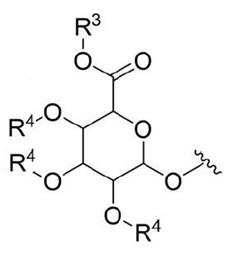
B는 활성제이며;
R1 및 R2는 각각 독립적으로 수소, C1-C8 알킬 또는 C3-C8 사이클로알킬이고;
W는 -C(O)-, -C(O)NR'-, -C(O)O-, -SO2NR'-, -P(O)R''NR'-, -SONR'- 또는 -PO2NR'-이고, 상기 C, S 또는 P는 직접적으로 페닐링(phenyl ring)에 결합하며, 상기 R' 및 R''는 각각 독립적으로 수소, C1-C8 알킬, C3-C8 사이클로알킬, C1-C8 알콕시, C1-C8 알킬티오, 모노- 또는 다이- C1-C8 알킬아미노, C3-C20 헤테로아릴 또는 C6-C20아릴인 화합물이며;
Z는 독립적으로 C1-C8 알킬, 할로겐, 시아노 또는 나이트로이고;
n은 0 내지 3의 정수이며;
L은, 하기 중 어느 하나이다:
A) C1-C50 알킬렌 또는 1-50 원자 헤테로알킬렌이며, 하기 중 하나 이상을 만족한다:
(i) L은 하나 이상의 불포화 결합을 포함하고;
(ii) L 내의 2 개의 원자가 치환체와 같은 2가 치환체로 치환되고; 이는 헤테로아릴렌(heteroarylene)을 완성시키며;
(iii) L은 1 내지 50 원자 헤테로알킬렌이고;
(iv) 상기 알킬렌은 하나 이상의 C1-20 알킬로 치환되고;
B) 이소프레노이드 트랜스퍼라제에 의하여 인식될 수 있는 하기 일반식 Ⅲ의 이소프레닐 유도체 유닛을 적어도 하나 이상 포함한다:
[일반식 Ⅲ]
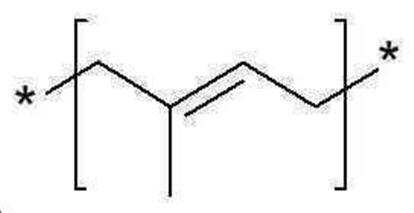
The antibody conjugate according to claim 1, wherein the linker has the structure of Formula II, or a pharmaceutically acceptable salt or solvate thereof:
[General Formula Ⅱ]
In the above formula,
G is a glucuronic acid moiety or
B is an active agent;
R 1 and R 2 are each independently hydrogen, C 1 -C 8 alkyl or C 3 -C 8 cycloalkyl;
W is -C(O)-, -C(O)NR'-, -C(O)O-, -SO 2 NR'-, -P(O)R''NR'-, -SONR'- or -PO 2 NR'-, wherein C, S or P is directly bonded to a phenyl ring, and R' and R'' are each independently hydrogen, C 1 -C 8 alkyl, C 3 - C 8 cycloalkyl, C 1 -C 8 alkoxy, C 1 -C 8 alkylthio, mono- or di- C 1 -C 8 alkylamino, C 3 -C 20 heteroaryl or C 6 -C 20 aryl; ;
Z is independently C 1 -C 8 alkyl, halogen, cyano or nitro;
n is an integer from 0 to 3;
L is any one of:
A) C 1 -C 50 alkylene or 1-50 membered heteroalkylene, satisfying one or more of the following:
(i) L contains one or more unsaturated bonds;
(ii) two atoms in L are substituted with a divalent substituent, such as a substituent; This completes heteroarylene;
(iii) L is 1 to 50 membered heteroalkylene;
(iv) wherein the alkylene is one or more C 1 - 20 alkyl which is substituted by;
B) at least one isoprenyl derivative unit of the general formula III, which can be recognized by an isoprenoid transferase:
[General Formula Ⅲ]

R3은 수소 또는 카복실 보호기이고,
상기 각각의 R4는 독립적으로 수소 또는 하이드록실 보호기인 것을 특징으로 하는, 항체 접합체 또는 이의 약학적으로 허용되는 염 또는 이의 용매화물.
20. The method of claim 19, wherein G is
R 3 is hydrogen or a carboxyl protecting group,
Each R 4 is independently hydrogen or a hydroxyl protecting group, characterized in that the antibody conjugate or a pharmaceutically acceptable salt or solvate thereof.
The antibody conjugate or a pharmaceutically acceptable salt or solvate thereof according to claim 19, wherein R 3 is hydrogen, and each R 4 is hydrogen.
20. The antibody conjugate according to claim 19, wherein R 1 and R 2 are hydrogen, or a pharmaceutically acceptable salt or solvate thereof.
The antibody conjugate according to claim 19, wherein Z is independently C 1 -C 8 alkyl, halogen, cyano or nitro, or a pharmaceutically acceptable salt or solvate thereof.
The antibody conjugate according to claim 19, wherein n is 0, or a pharmaceutically acceptable salt or solvate thereof.
20. The method of claim 19, wherein W is -C(O)-, -C(O)NR'-, -C(O)O-, -SO 2 NR'-, -P(O)R''NR' -, -SONR'- or -PO 2 NR'-, wherein C, S or P is directly bonded to a phenyl ring, and R' and R'' are each independently hydrogen, C 1 - C 8 alkyl, C 3 -C 8 cycloalkyl, C 1 -C 8 alkoxy, C 1 -C 8 alkylthio, mono- or di- C 1 -C 8 alkylamino, C 3 -C 20 heteroaryl or C 6 -C 20 aryl, characterized in that the antibody conjugate or a pharmaceutically acceptable salt or solvate thereof.
The method of claim 19, wherein W is -C(O)-, -C(O)NR'-, or -C(O)O-, characterized in that the antibody conjugate or a pharmaceutically acceptable salt thereof or a pharmaceutically acceptable salt thereof. Solvates.
The method according to claim 26, wherein W is -C(O)NR'-, wherein C(O) is bonded to a phenyl ring, and NR' is bonded to L. An acceptable salt or solvate thereof.

W는 -C(O)NR'- 이고, 상기 C(O)는 페닐링에 결합하고, NR'은 L에 결합하며,
R3 및 R4는 수소인 것을 특징으로 하는, 항체 접합체 또는 이의 약학적으로 허용되는 염 또는 이의 용매화물.
20. The method of claim 19, wherein G is
W is -C(O)NR'-, wherein C(O) is bonded to a phenyl ring, and NR' is bonded to L;
R 3 and R 4 are hydrogen, characterized in that the antibody conjugate or a pharmaceutically acceptable salt or solvate thereof.
(i) L은 하나 이상의 불포화 결합을 포함하고;
(ii) L 내의 2 개의 원자가 치환체와 같은 2가 치환체로 치환되고; 이는 헤테로아릴렌(heteroarylene)을 완성시키며;
(iii) L은 1 내지 50 원자 헤테로알킬렌이고; 및
(iv) 상기 알킬렌은 하나 이상의 C1-20 알킬로 치환된다.
According to claim 19, wherein L is C 1 -C 50 alkylene or 1-50 membered heteroalkylene, characterized in that one or more of the following is satisfied, the antibody conjugate or a pharmaceutically acceptable salt thereof or its Solvates:
(i) L contains one or more unsaturated bonds;
(ii) two atoms in L are substituted with a divalent substituent, such as a substituent; This completes heteroarylene;
(iii) L is 1 to 50 membered heteroalkylene; and
(iv) said alkylene is substituted with one or more C 1-20 alkyl.
30. The method of claim 29, wherein L is a nitrogen-containing 1-50 membered heteroalkylene, the linker comprises two or more atoms of a hydrophilic amino acid, and the nitrogen forms a peptide bond with the carbonyl of the hydrophilic amino acid. which is an antibody conjugate or a pharmaceutically acceptable salt or solvate thereof.
The antibody conjugate according to claim 19, wherein W is -C(O)NR'-, and the nitrogen of W is a nitrogen atom of a hydrophilic amino acid, or a pharmaceutically acceptable salt or solvate thereof.
32. The method of claim 30 or 31, wherein the hydrophilic amino acid is selected from the group consisting of arginine, aspartate, asparagine, glutamate, glutamine, histidine, lysine, ornithine, proline, serine and threonine. , an antibody conjugate or a pharmaceutically acceptable salt or solvate thereof.
The antibody conjugate according to claim 27 or 28, wherein the amino acid covalently bonds an oxime of the linker to a polyethylene glycol unit of the linker, or a pharmaceutically acceptable salt or solvate thereof.
34. The method of claim 33, wherein the amino acid is selected from the group consisting of arginine, aspartate, asparagine, glutamate, glutamine, histidine, lysine, ornithine, proline, serine and threonine. A pharmaceutically acceptable salt or solvate thereof.
The antibody conjugate or pharmaceutically acceptable salt thereof according to claim 30 or 31, wherein the hydrophilic amino acid is an amino acid comprising a side chain having a moiety that exhibits a charge at neutral pH in aqueous solution. solvates thereof.
36. The antibody conjugate according to claim 35, wherein the hydrophilic amino acid is aspartate or glutamate, or a pharmaceutically acceptable salt or solvate thereof.
36. The antibody conjugate according to claim 35, wherein the hydrophilic amino acid is ornithine or lysine, or a pharmaceutically acceptable salt or solvate thereof.
36. The antibody conjugate according to claim 35, wherein the hydrophilic amino acid is arginine, or a pharmaceutically acceptable salt or solvate thereof.
20. The method of claim 19, wherein the linker comprises a peptide, the peptide comprises at least one hydrophilic amino acid, and an amino acid comprising a side chain having a moiety that exhibits a charge at neutral pH in aqueous solution. , an antibody conjugate or a pharmaceutically acceptable salt or solvate thereof.
40. The method of claim 39, wherein each amino acid of the peptide is selected from the group consisting of alanine, aspartate, asparagine, glutamate, glutamine, glycine, lysine, ornithine, proline, serine and threonine. An antibody conjugate or a pharmaceutically acceptable salt or solvate thereof.
41. The antibody conjugate according to claim 40, wherein the peptide comprises at least one aspartate or glutamate, or a pharmaceutically acceptable salt or solvate thereof.
The antibody conjugate or a pharmaceutically acceptable salt thereof according to claim 19, wherein W is -C(O)NR'-, and the nitrogen of W is the nitrogen atom of the N-terminal amino acid of the peptide, or solvates thereof.
41. The antibody conjugate according to claim 40, wherein the peptide covalently bonds an oxime of the linker to a polyethylene glycol unit of the linker, or a pharmaceutically acceptable salt or solvate thereof.
44. The antibody conjugate according to any one of claims 39 to 43, wherein the peptide comprises 2 to 20 amino acids, or a pharmaceutically acceptable salt or solvate thereof.
The antibody conjugate or a pharmaceutically acceptable salt thereof according to claim 19, wherein L is covalently bonded to the antibody by a thioether bond, and the thioether bond comprises a sulfur atom of cysteine of the antibody. Solvates.
46. The method of claim 45, wherein the antibody comprises an amino acid motif at the C-terminus of the antibody that can be recognized by isoprenoid transferase, and wherein the thioether linkage comprises a sulfur atom of a cysteine of the amino acid motif. which is an antibody conjugate or a pharmaceutically acceptable salt or solvate thereof.
상기 티오에테르 결합은 상기 아미노산 모티프의 시스테인의 황원자를 포함하는 것을 특징으로 하는, 항체 접합체 또는 이의 약학적으로 허용되는 염 또는 이의 용매화물.
47. The method of claim 46, wherein the amino acid motif is a CYYX sequence, C is cysteine, Y is an aliphatic amino acid, and X is any one selected from the group consisting of glutamine, glutamate, serine, cysteine, methionine, alanine and leucine; and
The thioether bond is characterized in that it contains the sulfur atom of the cysteine of the amino acid motif, the antibody conjugate, or a pharmaceutically acceptable salt or solvate thereof.
48. The method of claim 47, wherein the amino acid motif is a CYYX sequence, Y is alanine, isoleucine, leucine, methionine, characterized in that any one selected from the group consisting of valine, the antibody conjugate or its pharmaceutically acceptable salts or solvates thereof.
49. The antibody conjugate according to claim 48, wherein the amino acid motif is a CVIM or CVLL sequence, or a pharmaceutically acceptable salt or solvate thereof.
50. The antibody conjugate according to any one of claims 46 to 49, wherein at least one of 1 to 20 amino acids preceding the amino acid motif is glycine.
51. The antibody conjugate or pharmaceutically acceptable salt or solvate thereof according to claim 50, wherein at least three of 1 to 20 amino acids preceding the amino acid motif are glycine or proline.
51. The method according to claim 50, wherein at least one of 1 to 20 amino acids preceding the amino acid motif is any one selected from the group consisting of glycine, aspartic acid, arginine, and serine. An acceptable salt or solvate thereof.
50. The method according to any one of claims 46 to 49, wherein 1, 2, 3, 4, 5, 6, 7, 8, 9 or 10 amino acids preceding the amino acid motif are each glycine. An antibody conjugate or a pharmaceutically acceptable salt or solvate thereof.
20. The antibody conjugate according to claim 19, wherein L comprises the amino acid sequence GGGGGGGCVIM at the C-terminus, or a pharmaceutically acceptable salt or solvate thereof.
[일반식 Ⅲ]
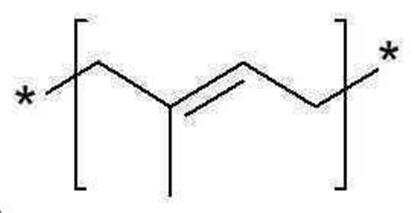
20. The antibody conjugate according to claim 19, wherein L comprises at least one isoprenyl derivative unit of the following general formula III, which can be recognized by isoprenoid transferase, or a pharmaceutically acceptable antibody conjugate thereof. Salt or solvate thereof:
[General Formula Ⅲ]
20. The method of claim 19, wherein L is 3 to 50 heteroalkylene comprising an oxime, wherein the oxygen atom of the oxime is on the side of L linked to W and the carbon atom of the oxime is on the side of L linked to Ab; Or the carbon atom of the oxime is on the side of L linked to W, and the oxygen atom of the oxime is on the side of L linked to Ab, Antibody conjugate or a pharmaceutically acceptable salt or solvate thereof.
57. The antibody conjugate or pharmaceutically acceptable salt or solvent thereof according to claim 55 or 56, wherein L comprises an oxime, and at least one isoprenyl unit covalently bonds the oxime to the Ab. freight.
[일반식 VIII]
-(CH2)r(V(CH2)p)q-
[일반식 IX]
-(CH2CH2X)w-
상기 V는 단일결합, -O-, -S-, -NR21-, -C(O)NR22-, -NR23C(O)-, -NR24SO2- 또는 -SO2NR25-이고;
X는 -O-, C1-C8 알킬렌 또는 -NR21-이고;
R21 내지 R25는 각각 독립적으로 수소, C1-C6 알킬, C1-C6 알킬 C6-C20 아릴 또는 C1-C6 알킬C3-C20 헤테로아릴이고;
r은 0 내지 10의 정수이고;
p는 0 내지 10의 정수이고;
q는 1 내지 20의 정수이고; 및
w는 1 내지 20의 정수이다.
20. The antibody conjugate according to claim 19, wherein L further comprises a linking unit represented by the general formula VIII or IX, or a pharmaceutically acceptable salt or solvate thereof:
[General Formula VIII]
-(CH 2 ) r (V(CH 2 ) p ) q -
[General Formula IX]
-(CH 2 CH 2 X) w -
V is a single bond, -O-, -S-, -NR 21 -, -C(O)NR 22 -, -NR 23 C(O)-, -NR 24 SO 2 - or -SO 2 NR 25 - ego;
X is —O—, C 1 -C 8 alkylene or —NR 21 —;
R 21 to R 25 are each independently hydrogen, C 1 -C 6 alkyl, C 1 -C 6 alkyl C 6 -C 20 aryl or C 1 -C 6 alkylC 3 -C 20 heteroaryl;
r is an integer from 0 to 10;
p is an integer from 0 to 10;
q is an integer from 1 to 20; and
w is an integer from 1 to 20;
59. The antibody conjugate according to claim 58, wherein q is an integer of 4 to 20, or a pharmaceutically acceptable salt or solvate thereof.
59. The antibody conjugate according to claim 58, wherein q is an integer of 2 to 12, or a pharmaceutically acceptable salt or solvate thereof.
59. The antibody conjugate according to claim 58, wherein q is an integer of 6 to 20, or a pharmaceutically acceptable salt or solvate thereof.
61. The antibody conjugate according to claim 60, wherein q is an integer of 2, 5 or 11, or a pharmaceutically acceptable salt or solvate thereof.
59. The antibody conjugate according to claim 58, wherein r is an integer of 2, or a pharmaceutically acceptable salt or solvate thereof.
59. The antibody conjugate according to claim 58, wherein p is an integer of 2, or a pharmaceutically acceptable salt or solvate thereof.
59. The antibody conjugate according to claim 58, wherein V is -O-, or a pharmaceutically acceptable salt or solvate thereof.
상기 r은 2의 정수이고;
상기 p은 2의 정수이며;
상기 q는 2, 5 또는 11의 정수이고; 및
상기 V는 -O-인 것을 특징으로 하는, 항체 접합체 또는 이의 약학적으로 허용되는 염 또는 이의 용매화물.
59. The method of claim 58,
wherein r is an integer of 2;
wherein p is an integer of 2;
wherein q is an integer of 2, 5 or 11; and
Wherein V is -O-, characterized in that the antibody conjugate or a pharmaceutically acceptable salt or solvate thereof.
59. The antibody conjugate according to claim 58, wherein X is -O-, or a pharmaceutically acceptable salt or solvate thereof.
59. The antibody conjugate according to claim 58, wherein w is an integer of 6 to 20, or a pharmaceutically acceptable salt or solvate thereof.
59. The antibody conjugate according to claim 58, wherein X is -O-, and w is an integer of 6 to 20, or a pharmaceutically acceptable salt or solvate thereof.


59. The method of claim 58, wherein L is
71. The method according to claim 70, wherein L is 1 to 12 -OCH 2 CH 2 - The antibody conjugate, or a pharmaceutically acceptable salt or solvate thereof, characterized in that it comprises a unit.
71. The method of claim 70, wherein L is 3 to 12 -OCH 2 CH 2 - characterized in that it comprises a unit, the antibody conjugate or a pharmaceutically acceptable salt or solvate thereof.
71. The method according to claim 70, wherein L is 5 to 12 -OCH 2 CH 2 - The antibody conjugate or a pharmaceutically acceptable salt or solvate thereof, characterized in that it comprises a unit.
71. The method of claim 70, wherein L is 6 to 12 -OCH 2 CH 2 - characterized in that it comprises a unit, the antibody conjugate or a pharmaceutically acceptable salt or solvate thereof.
71. The antibody conjugate or pharmaceutically acceptable salt or solvate thereof according to claim 70, wherein L is 3-OCH 2 CH 2 - comprising a unit.
59. The antibody conjugate or pharmaceutically acceptable salt or solvate thereof according to claim 58, wherein L comprises an oxime and at least one polyethylene glycol unit covalently bonds the oxime to the active agent.
20. The method of claim 19, wherein L is 1,3-dipolar cycloaddition reactions, hetero-diels reactions, nucloephilic substitution reactions, non -bonding units formed by nonaldol type carbonyl reactions, additions to carbon-carbon multiple bonds, oxidation reactions or click reactions An antibody conjugate or a pharmaceutically acceptable salt or solvate thereof, characterized in that it further comprises.
78. The antibody conjugate or a pharmaceutically acceptable salt thereof according to claim 77, wherein the binding unit is formed by a reaction of acetylene with an azide, or a reaction of an aldehyde or ketone group with hydrazine or hydroxylamine. or a solvate thereof.
[일반식 Ⅳ]
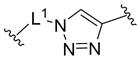
[일반식 Ⅴ]

[일반식 Ⅵ]
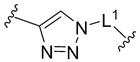
[일반식 Ⅶ]

상기 식에서,
상기 L1은 단일결합 또는 C1-C30의 알킬렌이고;
R11은 수소 또는 C1-C10의 알킬이다.
The method of claim 19, wherein L is an antibody conjugate or a pharmaceutically acceptable salt or solvate thereof, characterized in that it further comprises a binding unit represented by the following general formula IV, V, VI or VII:
[General Formula IV]
[General formula Ⅴ]
[General formula Ⅵ]
[General Formula VII]
In the above formula,
wherein L 1 is a single bond or C 1 -C 30 alkylene;
R 11 is hydrogen or C 1 -C 10 alkyl.
80. The antibody conjugate according to claim 79, wherein L 1 is a single bond, or a pharmaceutically acceptable salt or solvate thereof.
80. The antibody conjugate according to claim 79, wherein L 1 is C 11 alkylene, or a pharmaceutically acceptable salt or solvate thereof.
80. The antibody conjugate according to claim 79, wherein L 1 is C 12 alkylene, or a pharmaceutically acceptable salt or solvate thereof.

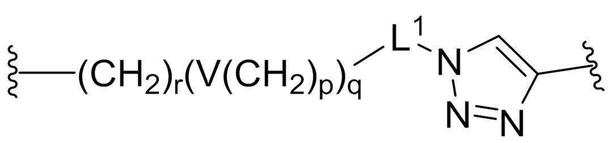
상기 V는 단일 결합 , -O-, -S-, -NR21-, -C(O)NR22-, -NR23C(O)-, -NR24SO2-, 또는 -SO2NR25- 이고;
R21 내지 R25 는 독립적으로 수소, C1-6 알킬, C1-6 알킬 C6-20 아릴, 또는 C1-6알킬 C3-20 헤테로아릴이며;
r은 1 내지 10의 정수이고;
p는 0 내지 10의 정수이며;
q는 1 내지 20의 정수이고; 및
L1은 단일결합인 것을 특징으로 하는 항체 접합체 또는 이의 약학적으로 허용되는 염 또는 이의 용매화물.
80. The method of claim 79, wherein L is
V is a single bond , -O-, -S-, -NR 21 -, -C(O)NR 22 -, -NR 23 C(O)-, -NR 24 SO 2 -, or -SO 2 NR 25 - ego;
R 21 to R 25 are independently hydrogen, C 1-6 alkyl, C 1-6 alkyl C 6-20 aryl, or C 1-6 alkyl C 3-20 heteroaryl;
r is an integer from 1 to 10;
p is an integer from 0 to 10;
q is an integer from 1 to 20; and
L 1 is an antibody conjugate, or a pharmaceutically acceptable salt or solvate thereof, characterized in that it is a single bond.
84. The antibody conjugate according to claim 83, wherein r is an integer of 2 or 3, or a pharmaceutically acceptable salt or solvate thereof.
84. The antibody conjugate of claim 83, wherein p is an integer of 1 or 2, or a pharmaceutically acceptable salt or solvate thereof.
84. The antibody conjugate according to claim 83, wherein q is an integer of 1 to 6, or a pharmaceutically acceptable salt or solvate thereof.
84. The method of claim 83, wherein r is an integer of 2 or 3; p is an integer of 1 or 2, and q is an integer of 1 to 6, characterized in that the antibody conjugate or a pharmaceutically acceptable salt or solvate thereof.
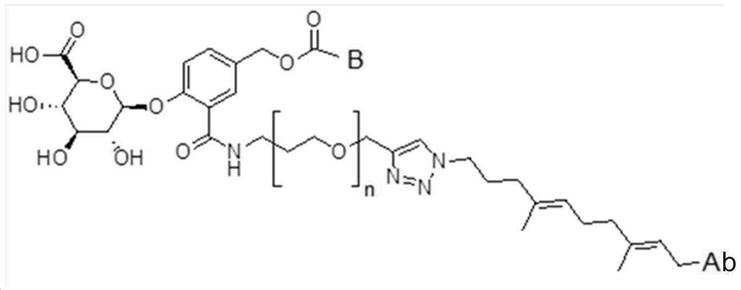
상기 Ab는 항-B7-H3 항체이고; B는 활성제이며, n은 1 내지 20의 정수인 것을 특징으로 하는, 항체 접합체 또는 이의 약학적으로 허용되는 염 또는 이의 용매화물.
84. The method of claim 83,
said Ab is an anti-B7-H3 antibody; B is an active agent, n is an integer from 1 to 20, characterized in that the antibody conjugate or a pharmaceutically acceptable salt or solvate thereof.

하며, 상기 Ab는 항-B7-H3 항체이고; B는 활성제이며, n은 1 내지 20의 정수인 것을 특징으로 하는, 항체 접합체 또는 이의 약학적으로 허용되는 염 또는 이의 용매화물.
84. The method of claim 83,
wherein Ab is an anti-B7-H3 antibody; B is an active agent, n is an integer from 1 to 20, characterized in that the antibody conjugate or a pharmaceutically acceptable salt or solvate thereof.

상기 Ab는 항-B7-H3 항체이고; B는 활성제이며, n은 0 내지 20의 정수인 것을 특징으로 하는, 항체 접합체 또는 이의 약학적으로 허용되는 염 또는 이의 용매화물.
84. The method of claim 83,
said Ab is an anti-B7-H3 antibody; B is an active agent, n is an integer from 0 to 20, characterized in that the antibody conjugate or a pharmaceutically acceptable salt or solvate thereof.

84. The method of claim 83,
The method of claim 19, wherein the isoprenoid transferase is farnesyl protein transferase (FTase) or geranylgeranyl transferase (GGTase), characterized in that the antibody conjugate, or a pharmaceutically acceptable salt thereof, or its Solvates.
i) 각각의 분지형 링커는 주링커(PL)에 의해 Ab에 공유 결합된 분지 유닛(BR)을 포함하고;
ii) 각각의 분지형 링커는 제 1 활성제를 분지 유닛에 결합시키고, 제 2 링커 (SL) 및 절단기(CG)를 포함하는 제 1 분지(B1)를 포함하며; 및
iii) 각각의 분지형 링커는 a) 제 2 활성제가 제 2 링커 (SL) 및 절단기(CG)에 의해 분지 유닛에 공유 결합 된 제 2 분지 (B2); 또는 b) 폴리에틸렌 글리콜 모이어티(moiety)가 분지 유닛에 공유 결합되어 있는 제 2 분지를 포함하고,
상기 각각의 절단기는 항체 접합체부터 활성제를 방출하기 위해 가수분해되는 것을 특징으로 하는 항체 접합체 또는 이의 약학적으로 허용되는 염 또는 이의 용매화물.
20. The method of claim 19, wherein L comprises one or more branched linkers covalently attached to Ab,
i) each branched linker comprises a branching unit (BR) covalently attached to the Ab by a main linker (PL);
ii) each branched linker binds the first active agent to the branching unit and comprises a first branch (B1) comprising a second linker (SL) and a cleavage group (CG); and
iii) each branched linker comprises: a) a second branch (B2) in which the second active agent is covalently bonded to the branching unit by a second linker (SL) and a cleavage group (CG); or b) a second branch in which a polyethylene glycol moiety is covalently bonded to the branching unit,
The antibody conjugate, or a pharmaceutically acceptable salt or solvate thereof, characterized in that each of the cleaving groups is hydrolyzed to release the active agent from the antibody conjugate.
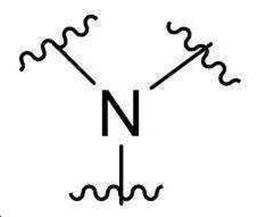

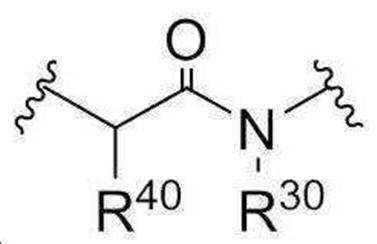
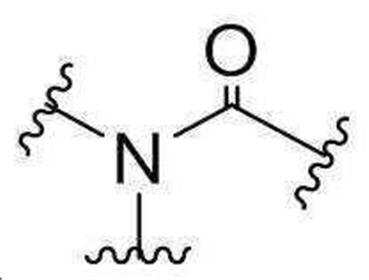
상기 L2, L3, L4 는 각각 독립적으로 직접 결합 또는 -CnH2n-이며, 상기 n은 1 내지 30의 정수이고,
상기 G1, G2, G3은 독립적으로 직접 결합,
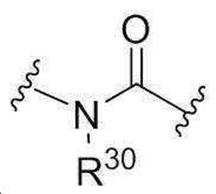

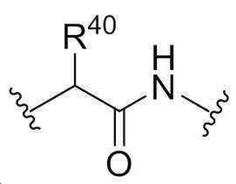
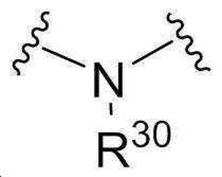
상기 R30은 수소 또는 C1-30 알킬; 및
상기 L5는 직접 결합 또는 C1-10 알킬렌, R50은 수소 C1-30 알킬인 것을 특징으로 하는, 항체 접합체 또는 이의 약학적으로 허용되는 염 또는 이의 용매화물.
94. The method of claim 93, wherein the branched linker is
The L 2 , L 3 , L 4 are each independently a direct bond or —C n H 2n —, wherein n is an integer from 1 to 30,
The G 1 , G 2 , G 3 are independently a direct bond,
wherein R 30 is hydrogen or C 1-30 alkyl; and
Wherein L 5 is a direct bond or C 1-10 alkylene, R 50 is hydrogen C 1-30 alkyl, characterized in that, the antibody conjugate or a pharmaceutically acceptable salt or solvate thereof.
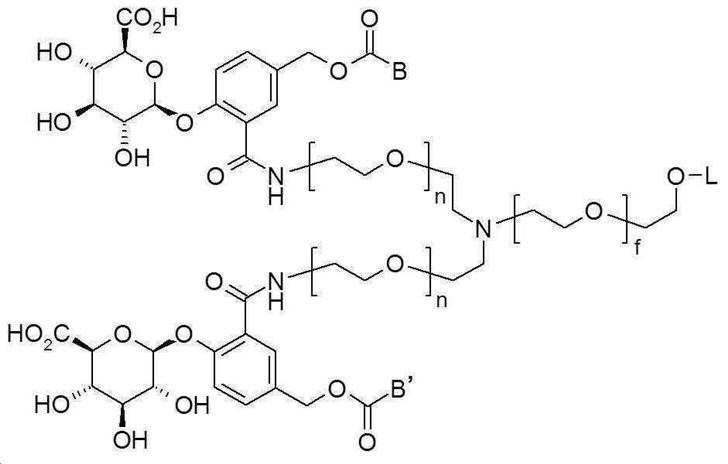
상기 B 및 B'는 동일하거나 상이할 수 있는 활성제를 나타내고;
n은 각각 독립적으로 0 내지 30의 정수를 나타내며;
f는 각각 독립적으로 0 내지 30의 정수를 나타내고; 및
L은 Ab에 대한 결합을 나타내는 것을 특징으로 하는, 항체 접합체 또는 이의 약학적으로 허용되는 염 또는 이의 용매화물.
95. The method of claim 94,
wherein B and B' represent active agents which may be the same or different;
each n independently represents an integer from 0 to 30;
f each independently represents an integer from 0 to 30; and
L is an antibody conjugate or a pharmaceutically acceptable salt or solvate thereof, characterized in that it represents binding to Ab.
96. The antibody conjugate according to claim 95, wherein n is an integer of 1 to 10, or a pharmaceutically acceptable salt or solvate thereof.
96. The antibody conjugate according to claim 95, wherein n is an integer of 4 to 20, or a pharmaceutically acceptable salt or solvate thereof.
96. The antibody conjugate or pharmaceutically acceptable salt or solvate thereof according to claim 95, wherein L comprises an oxime, and at least one polyethylene glycol unit covalently bonds the oxime to the active agent.
94. The antibody conjugate or pharmaceutically acceptable salt or solvate thereof according to claim 93, wherein the cleaving group is capable of being cleaved in a target cell.
95. The antibody conjugate of claim 93, wherein said cleaving group is capable of releasing one or more active agents, or a pharmaceutically acceptable salt or solvate thereof.
94. The method of claim 93, wherein the antibody conjugate comprises Ab; one or more branched linkers covalently attached to the Ab; and two or more active agents covalently bonded to a branched linker, an antibody conjugate or a pharmaceutically acceptable salt or solvate thereof.
102. The antibody conjugate or pharmaceutically acceptable salt or solvate thereof according to claim 101, wherein at least two branched linkers bind to Ab, and each branched linker binds to at least two active agents.
103. The antibody conjugate or pharmaceutically acceptable salt or solvate thereof according to claim 102, characterized in that the three branched linker binds to the Ab.
103. The antibody conjugate or pharmaceutically acceptable salt or solvate thereof according to claim 102, characterized in that the four branched linkers bind to Ab.
102. The antibody conjugate or pharmaceutically acceptable salt or solvate thereof according to claim 101, characterized in that the one branched linker binds to the Ab.
102. The antibody conjugate or pharmaceutically acceptable salt or solvate thereof according to claim 101, wherein each branched linker is associated with two active agents.
102. The antibody conjugate or pharmaceutically acceptable salt or solvate thereof according to claim 101, wherein the conjugate comprises two or more different active agents.
108. The antibody conjugate or pharmaceutically acceptable salt or solvate thereof according to claim 107, wherein at least one branched linker is coupled to at least two active agents.
102. The antibody conjugate or pharmaceutically acceptable salt or solvate thereof according to claim 101, wherein each active agent is linked to a branched linker by a cleavable bond.
102. The anti-B7-H3 antibody of claim 101, wherein each branched linker comprises a branched unit, and each active agent binds to the branched unit via a secondary linker, said branched unit primary linker via said anti-B7-H3 antibody An antibody conjugate or a pharmaceutically acceptable salt or solvate thereof, characterized in that it is bound to.
112. The antibody conjugate or pharmaceutically acceptable salt or solvate thereof according to claim 110, wherein the branched unit is a nitrogen atom.
112. The antibody conjugate or pharmaceutically acceptable salt or solvate thereof according to claim 110, wherein the Branched Unit is an amide and the primary linker comprises a carbonyl of the amide.
112. The antibody conjugate or pharmaceutically acceptable salt or solvate thereof according to claim 110, wherein the Branched Unit is an amide and the secondary linker comprises a carbonyl of the amide.
The antibody conjugate according to claim 110, wherein the branched unit is a lysine unit, or a pharmaceutically acceptable salt or solvate thereof.
The antibody conjugate according to claim 19, wherein B is an active agent, or a pharmaceutically acceptable salt or solvate thereof.
116. The antibody conjugate or pharmaceutically acceptable salt or solvate thereof according to claim 115, wherein the active agent is a chemotherapeutic agent or a toxin.
116. The antibody conjugate according to claim 115, wherein the active agent is an immunomodulatory compound, an anticancer agent, an antiviral agent, an antibacterial agent, an antifungal agent, an antiparasitic agent, or a combination thereof.
(a) 엘로티닙(erlotinib), 보르테조밉(bortezomib), 풀베스트란트(fulvestrant), 수텐트(sutent), 레트로졸(letrozole), 이마티닙 메실레이트(imatinib mesylate), PTK787/ZK 222584, 옥살리플라틴(oxaliplatin), 5-플루오로우라실(5-fluorouracil), 루코보린(leucovorin), 라파마이신(rapamycin), 라파티닙(lapatinib), 로나파르닙(lonafarnib), 소라페닙(sorafenib), 제피티닙(gefitinib), AG1478, AG1571, 티오테파(thiotepa), 사이클로포스파마이드(cyclophosphamide), 부술판(busulfan), 임프로술판(improsulfan), 피포술판(piposulfan), 벤조도파(benzodopa), 카르보콘(carboquone), 메츄도파(meturedopa), 유레도파(uredopa), 에틸렌이민(ethylenimine), 알트레타민(altretamine), 트리에틸렌멜라민(triethylenemelamine), 트리에틸렌포스포라미드(trietylenephosphoramide), 트리에틸렌티오포스포라미드(triethiylenethiophosphoramide), 트리메틸롤로멜라민(trimethylolomelamine), 불라타신(bullatacin), 불라타시논(bullatacinone), 캄토테신(camptothecin), 토포테칸(topotecan), 브리오스타틴(bryostatin), 칼리스타틴(callystatin), CC-1065, 아도젤레신(adozelesin), 카르젤레신(carzelesin), 비젤레신(bizelesin), 크립토피신 1(cryptophycin 1), 크립토피신 8(cryptophycin 8), 돌라스타틴(dolastatin), 듀오카마이신(duocarmycin), KW-2189, CB1-TM1, 엘루테로빈(eleutherobin), 판크라티스타틴(pancratistatin), 사르코딕티인(sarcodictyin), 스폰지스타틴(spongistatin), 클로람부실(chlorambucil), 클로르나파진(chlornaphazine), 클로로포스파미드(cholophosphamide), 에스트라무스틴(estramustine), 이포스파미드(ifosfamide), 메클로르에타민(mechlorethamine), 멜팔란(melphalan), 노벰비킨(novembichin), 페네스테린(phenesterine), 프레드니무스틴(prednimustine), 트로포스파미드(trofosfamide), 우라실 머스타드(uracil mustard), 카르무스틴(carmustine), 클로로코토신(chlorozotocin), 포테쿠스틴(fotemustine), 로무스틴(lomustine), 니무스틴(nimustine), 라니무스틴(ranimnustine), 칼리키아미신(calicheamicin), 칼리키아미신 감마 1(calicheamicin gamma 1), 칼리키아미신 오메가 1(calicheamicin omega 1), 디네미신(dynemicin), 디네미신 A(dynemicin A), 클로드로네이트(clodronate), 에스페르아미신(esperamicin), 네오카르지노스타틴크로모포어(neocarzinostatin chromophore), 아클라시노마이신(aclacinomysins), 악티노마이신(actinomycin), 안트르마이신(antrmycin), 아자세린(azaserine), 블레오마이신(bleomycins), 칵티노마이신(cactinomycin), 카라비신(carabicin), 카르니노마이신(carninomycin), 카르지노필린(carzinophilin), 크로모마이신(chromomycins), 닥티노마이신(dactinomycin), 다우노루비신(daunorubicin), 데토루부신(detorubucin), 6-디아조-5-옥소-L-노르루신(6-diazo-5-oxo-L-norleucine), 독소루비신(doxorubicin), 모르폴리노-독소루비신(morpholino-doxorubicin), 시아노모르폴리노-독소루비신(cyanomorpholino-doxorubicin), 2-피롤리노-독소루비신(2-pyrrolino-doxorubucin), 리포소말 독소루비신(liposomal doxorubicin), 데옥시독소루비신(deoxydoxorubicin), 에피루비신(epirubicin), 에소루비신(esorubicin), 마르셀로마이신(marcellomycin), 미토마이신 C(mitomycin C), 미코페놀산(mycophenolic acid), 노갈라마이신(nogalamycin), 올리보마이신(olivomycins), 페플로마이신(peplomycin), 포트피로마이신(potfiromycin), 퓨로마이신(puromycin), 쿠엘라마이신(quelamycin), 로도루비신(rodorubicin), 스트렙토미그린(streptomigrin), 스트렙토조신(streptozocin), 투베르시딘(tubercidin), 우베니멕스(ubenimex), 지노스타틴(zinostatin), 조루비신(zorubicin), 5-플루오로우라신(5-fluorouracil), 데노프테린(denopterin), 메토트렉세이트(methotrexate), 프테로프테린(pteropterin), 트리메트렉세이트(trimetrexate), 플루다라빈(fludarabine), 6-머캅토퓨린(6-mercaptopurine), 티아미프린(thiamiprine), 티구아닌(thiguanine), 안시타빈(ancitabine), 아자시티딘(azacitidine), 6-아자유리딘(6-azauridine), 카르모푸르(carmofur), 시타라빈(cytarabine), 디데옥시유리딘(dideoxyuridine), 독시플루리딘(doxifluridine), 에노시타빈(enocitabine), 플록수리딘(floxuridine), 칼루스테론(calusterone), 드로모스타놀론(dromostanolone),프로피오네이트(propionate), 에피티오스타놀(epitiostanol), 메피티오스테인(mepitiostane), 테스토락톤(testolactone), 아미노글루테티미드(aminoglutethimide), 미토테인(mitotane), 트릴로스테인(trilostane), 폴린산(folinic acid), 아세글라톤(aceglatone), 알도포스파미드 글리코사이드(aldophosphamide glycoside), 아미노레불린산(aminolevulinic acid), 에닐우라실(eniluracil), 암사크린(amsacrine), 베스트라부실(bestrabucil), 비산트렌(bisantrene), 에다트락세이트(edatraxate), 데포파민(defofamine), 데메콜신(demecolcine), 디아지콘(diaziquone), 엘포르니틴(elfornithine), 엘립티니움 아세테이트(elliptinium acetate), 에토글루시드(etoglucid), 갈리움 나이트레이트(gallium nitrate), 하이드록시우레아(hydroxyurea), 렌티난(lentinan), 로니다이닌(lonidainine), 메이탄신(maytansine), 안사미토신(ansamitocins), 미토구아존(mitoguazone), 미토잔트론(mitoxantrone), 모피단몰(mopidanmol), 니트라에린(nitraerine), 펜토스타틴(pentostatin), 페나메트(phenamet), 피라루비신(pirarubicin), 로소잔트론(losoxantrone), 2-에틸하이드라지드(2-ethylhydrazide), 프로카르바진(procarbazine), 폴리사카라이드-k(polysaccharidek), 라족세인(razoxane), 리조신(rhizoxin), 시조피란(sizofiran), 스피로게르마늄(spirogermanium), 테누아존산(tenuazonic acid), 트리아지콘(triaziquone),2,2',2''-트리클로로트리에틸아민(2,2',2''-trichlorotriethylamine), T-2 톡신, 베라큐린 A(verracurin A), 로리딘 A(roridin A), 안구이딘(anguidine), 우레탄(urethane), 빈데신(vindesine), 다카르바진(dacarbazine), 만노무스틴(mannomustine), 미토브로니톨(mitobronitol), 미토락톨(mitolactol), 피포브로만(pipobroman), 가시토신(gacytosine), 아라비노사이드(arabinoside), 사이클로포스파미드(cyclophosphamide), 티오테파(thiotepa), 파클리탁셀(paclitaxel), 파클리탁셀, 파클리탁셀의 알부민-엔지니어드 나노파티클(albumin-engineered nanoparticle formulation of paclitaxel), 도세탁셀, 클로람부실, 젬시타빈, 6-티오구아닌, 머캅토퓨린, 시스플라틴, 카보플라틴(carboplatin), 빈블라스틴(vinblastine), 플래티늄(platinum), 에토포사이드(etoposide), 이포스파미드(ifosfamide), 미톡산트론(mitoxantrone), 빈크리스틴, 비노렐빈(vinorelbine), 노반트론(novantrone), 테니포사이드(teniposide), 에다트렉세이트(edatrexate), 다우노마이신(daunomycin), 아미노프테린(aminopterin), 젤로다(xeloda), 이반드로네이트(ibandronate), CPT-11, 토포이소머라아제 저해제 RFS 2000, 디플루오로메틸오르니틴(difluoromethylornithine), 레티노산(retinoic acid), 카페시타빈(capecitabine), 또는 이의 약학적으로 허용되는 염, 용매화물 또는 산;
(b) 모노카인(monokine), 림포카인(lympokine), 폴리펩타이드 호르몬(traditional polypeptide hormone), 부갑상선 호르몬(parathyroid hormone), 티록신(thyroxine), 릴렉신(relaxin), 프로릴렉신(prorelaxin), 당단백 호르몬(glycoprotein hormone), 여포자극호르몬(follicle stimulating hormone), 갑상샘자극호르몬(thyroid stimulating hormone), 황체형성호르몬(luteinizing hormone), 간 성장인자 섬유모세포성장인자(hepatic growth factor fibroblast growth factor), 프롤락틴(prolactin), 태반성 락토젠(placental lactogen), 종양괴사인자 (tumor necrosis factor), 종양괴사인자-α, 종양괴사인자-β, 뮐러관 억제물질(mullerian inhibiting substance), 마우스 고나도트로핀-연관 펩타이드(mouse gonadotropin associated peptide), 인히빈(inhibin), 액티빈(activin), 혈관내피증식인자(vascular endothelial growth factor), 트롬보포이에틴(thrombopoietin), 에리스로포이에틴(erythropoietin), 골유도 인자(osteoinductive factor), 인터페론, 인터페론-α, 인터페론-β, 인터페론-γ, 콜로니자극인자(colony stimulating factor, CSF), 마크로파지-CSF, 과립구-마크로파지-CSF(granulocyte-macrophage-CSF), 과립구-CSF, 인터루킨(IL), IL-1, IL-1α, IL-2, IL-3, IL-4, IL-5, IL-6, IL-7, IL-8, IL-9, IL-10, IL-11, IL-12, 폴리펩타이드 인자, LIF, 키트 리간드(kit ligand), 또는 이들의배합물;
(c) 디프테리아 톡신, 보툴리눔 톡신, 테타누스 톡신, 디센터리 톡신, 콜레라 톡신, 아마니틴, α-아마니틴, 피롤로벤조디아제핀, 피롤로벤조디아제핀 유도체, 인돌리노벤조디아제핀, 피리디노벤조디아제핀, 테트로도톡신, 브레베톡신(brevetoxin), 시구아톡신(ciguatoxin), 리신(ricin), AM 톡신, 오리스타틴(auristatin), 투불리신(tubulysin), 겔다나마이신(geldanamycin), 메이탄시노이드(maytansinoid), 칼리케아마이신(calicheamycin), 다우노마이신(daunomycin), 독소루비신(doxorubicin), 메토트렉세이트(methotrexate), 빈데신(vindesine), SG2285, 돌라스타틴(dolastatin), 돌라스타틴유사체(dolastatin analog), 크립토피신(cryptophycin), 캄토테신(camptothecin), 리족신(rhizoxin), 리족신 유도체(rhizoxin derivatives), CC-1065, CC-1065 유사체 또는 유도체, 듀오카마이신(duocarmycin), 에네다인 항생제(enediyne antibiotic), 에스페라마이신(esperamicin), 에포틸론(epothilone), 톡소이드(toxoid), 또는 이들의 배합물;
(d) 친화성 리간드(affinity ligand), 여기에서 친화성 리간드는 기질, 저해제, 활성화제, 신경전달물질, 방사성 동위원소, 또는 이들의 배합물;
(e) 방사능표지(radioactive label), 32P, 35S, 형광다이, 전자밀도 반응제(electron dense reagent), 효소, 비오틴, 스트렙타비딘(streptavidin), 디옥시제닌(dioxigenin), 햅텐(hapten), 면역성 단백질(immunogenic protein), 타겟에 컴플러멘터리한 서열을 갖는 핵산 분자(nucleic acid molecule with a sequence complementary to a target) 또는 이들의 배합물;
(f) 면역조절 화합물(immunomodulatory compound), 항-암제(anti-cancer agent), 항-바이러스제(anti-viral agent), 항-박테리아제(anti-bacterial agent), 항-곰팡이제(anti-fungal agent), 및 항-기생충제(anti-parasitic agent), 또는 이들의 배합물;
(g) 타목시펜(tamoxifen), 랄록시펜(raloxifene), 드롤록시펜(droloxifene), 4-하이드록시타목시펜(4-hydroxytamoxifen), 트리옥시펜(trioxifene), 케옥시펜(keoxifene), LY117018, 오나프리스톤(onapristone) 또는 토레미펜(toremifene);
(h) 4(5)-이미다졸, 아미노글루테티미드(aminoglutethimide), 메제스톨 아세테이트(megestrol acetate), 엑스메스탄(exemestane), 레트로졸(letrozole), 또는 아나스트로졸(anastrozole)
(i) 플루타미드(flutamide), 닐루타미드(nilutamide), 비칼루타미드(bicalutamide), 리우프롤라이드(leuprolide), 고세렐린(goserelin), 또는 트록사시타빈(troxacitabine);
(j) 아로마타아제 저해제;
(k) 단백질 키나아제 저해제;
(l) 리피드 키나아제 저해제;
(m) 안티센스 올리고뉴클레오티드;
(n) 리보자임;
(o) 백신; 및
(p) 항-맥관형성제(anti-angiogenic agent).
116. The antibody conjugate according to claim 115, wherein the active agent is any one selected from the following, or a pharmaceutically acceptable salt or solvate thereof:
(a) erlotinib, bortezomib, fulvestrant, sutent, letrozole, imatinib mesylate, PTK787/ZK 222584, oxaliplatin ( oxaliplatin), 5-fluorouracil, leucovorin, rapamycin, lapatinib, lonafarnib, sorafenib, gefitinib , AG1478, AG1571, thiotepa, cyclophosphamide, busulfan, improsulfan, piposulfan, benzodopa, carboquone, Meturedopa, uredopa, ethylenimine, altretamine, triethylenemelamine, triethylenephosphoramide, triethylenethiophosphoramide , trimethylolomelamine, bullatacin, bullatacinone, camptothecin, topotecan, bryostatin, callistatin, CC-1065, ado Zelesin (adozelesin), carzelesin (carzelesin), bizelesin (bizelesin), cryptophycin 1 (cryptophycin 1), cryptophycin 8 (cryptophycin 8), dolastatin (dolastatin), duocarmycin (duocarmycin), KW- 2189, CB1-TM1, eleutherobin, pancratistatin, sarcodictyin, spongistatin, chlorambucil, chlornaphazine, cholophosphamide, estramustine, ifosfamide, meth Chlorethamine, melphalan, novembichin, phenesterine, prednimustine, trofosfamide, uracil mustard, carmustine (carmustine), chlorozotocin, fotemustine, lomustine, nimustine, ranimnustine, calicheamicin, calicheamicin gamma 1 ( calicheamicin gamma 1), calicheamicin omega 1, dynemicin, dynemicin A, clodronate, esperamicin, neocarzinostatin Neocarzinostatin chromophore, alacinomysins, actinomycin, anthrmycin, azaserine, bleomycins, cactinomycin, carabicin (carabicin), carninomycin, carzinophilin, chromomycins, dactinomycin, daunorubicin, detorubucin, 6-diazo -5-oxo-L-norleucine (6-diazo-5-oxo-L-norleucine), doxorubicin, morphol Rhino-doxorubicin, cyanomorpholino-doxorubicin, 2-pyrrolino-doxorubicin, liposomal doxorubicin, deoxydoxorubicin ), epirubicin, esorubicin, marcellomycin, mitomycin C, mycophenolic acid, nogalamycin, olivomycins , peplomycin, potfiromycin, puromycin, quelamycin, rodorubicin, streptomigrin, streptozocin, tuber Cidin, ubenimex, zinostatin, zorubicin, 5-fluorouracil, denopterin, methotrexate, pterop Terin (pteropterin), trimetrexate (trimetrexate), fludarabine (fludarabine), 6-mercaptopurine (6-mercaptopurine), thiamiprine (thiamiprine), thiguanine (thiguanine), ancitabine, Azacitidine, 6-azauridine, carmofur, cytarabine, dideoxyuridine, doxifluridine, enocitabine (enocitabine), floxuridine, calusterone, dromostanolone, propionate, Epithiostanol, mepitiostane, testolactone, aminoglutethimide, mitotane, trilostane, folinic acid, acegla aceglatone, aldophosphamide glycoside, aminolevulinic acid, eniluracil, amsacrine, bestrabucil, bisantrene, edatraxate, defofamine, demecolcine, diaziquone, elfornithine, elliptinium acetate, etoglucid, gallium nitrate, hydroxyurea, lentinan, lonidainine, maytansine, ansamitocins, mitoguazone, mitoxantrone (mitoxantrone), mopidanmol, nitraerine, pentostatin, phenamet, pirarubicin, losoxantrone, 2-ethylhydrazide (2) -ethylhydrazide), procarbazine, polysaccharide-k (polysaccharidek), razoxane, rhizoxin, sizofiran, spirogermanium, tenuazonic acid ), triaziquone, 2,2',2''-trichlorotriethylamine (2,2',2''-trichlorotriethylamine), T-2 toxin, verracurin A, roridin A, anguidine, urethane, vindesine, dacarbazine, mannomustine , mitobronitol, mitolactol, pipobroman, gacytosine, arabinoside, cyclophosphamide, thiotepa, paclitaxel ( paclitaxel), paclitaxel, albumin-engineered nanoparticle formulation of paclitaxel, docetaxel, chlorambucil, gemcitabine, 6-thioguanine, mercaptopurine, cisplatin, carboplatin, bean Vinblastine, platinum, etoposide, ifosfamide, mitoxantrone, vincristine, vinorelbine, novantrone, teniposide ), edatrexate, daunomycin, aminopterin, xeloda, ibandronate, CPT-11, topoisomerase inhibitor RFS 2000, difluoro lomethylornithine, retinoic acid, capecitabine, or a pharmaceutically acceptable salt, solvate or acid thereof;
(b) monokine, lymphokine, traditional polypeptide hormone, parathyroid hormone, thyroxine, relaxin, prorelaxin, glycoprotein hormone, follicle stimulating hormone, thyroid stimulating hormone, luteinizing hormone, hepatic growth factor fibroblast growth factor, prolactin (prolactin), placental lactogen, tumor necrosis factor, tumor necrosis factor-α, tumor necrosis factor-β, mullerian inhibiting substance, mouse gonadotropin- mouse gonadotropin associated peptide, inhibin, activin, vascular endothelial growth factor, thrombopoietin, erythropoietin, osteoinductive factor), interferon, interferon-α, interferon-β, interferon-γ, colony stimulating factor (CSF), macrophage-CSF, granulocyte-macrophage-CSF (granulocyte-macrophage-CSF), granulocyte-CSF, interleukin (IL), IL-1, IL-1α, IL-2, IL-3, IL-4, IL-5, IL-6, IL-7, IL-8, IL-9, IL-10, IL- 11, IL-12, polypeptide factor, LIF, kit ligand, or a combination thereof;
(c) diphtheria toxin, botulinum toxin, tetanus toxin, dicenritoxin, cholera toxin, amanitin, α-amanitine, pyrrolobenzodiazepine, pyrrolobenzodiazepine derivative, indolinobenzodiazepine, pyridinobenzodiazepine, tetrodotoxin, breve Toxin (brevetoxin), ciguatoxin (ciguatoxin), ricin (ricin), AM toxin, auristatin (auristatin), tubulysin (tubulysin), geldanamycin (geldanamycin), maytansinoid (maytansinoid), calichea Calicheamycin, daunomycin, doxorubicin, methotrexate, vindesine, SG2285, dolastatin, dolastatin analog, cryptophycin Camptothecin, rhizoxin, rhizoxin derivatives, CC-1065, CC-1065 analogs or derivatives, duocarmycin, enediyne antibiotic, esperamicin ( esperamicin), epothilone, toxoid, or combinations thereof;
(d) an affinity ligand, wherein the affinity ligand is a substrate, an inhibitor, an activator, a neurotransmitter, a radioactive isotope, or a combination thereof;
(e) radioactive label, 32P, 35S, fluorescent die, electron dense reagent, enzyme, biotin, streptavidin, dioxigenin, hapten, an immunogenic protein, a nucleic acid molecule with a sequence complementary to a target, or a combination thereof;
(f) immunomodulatory compounds, anti-cancer agents, anti-viral agents, anti-bacterial agents, anti-fungal agents agent), and an anti-parasitic agent, or a combination thereof;
(g) tamoxifen, raloxifene, droloxifene, 4-hydroxytamoxifen, trioxifene, keoxifene, LY117018, onapristone ( onapristone) or toremifene;
(h) 4(5)-imidazole, aminoglutethimide, megestrol acetate, exemestane, letrozole, or anastrozole
(i) flutamide, nilutamide, bicalutamide, leuprolide, goserelin, or troxacitabine;
(j) aromatase inhibitors;
(k) protein kinase inhibitors;
(l) lipid kinase inhibitors;
(m) antisense oligonucleotides;
(n) ribozymes;
(o) vaccines; and
(p) anti-angiogenic agents.
상기 Ab는 항-B7-H3 항체이고;
상기 활성제는 피롤로벤조디아제핀(pyrrolobenzodiazepine) 이량체이며;
상기 링커는 Ab를 피롤로벤조디아제핀 이량체의 N10 또는 N10' 위치와 연결시키고; 및
y는 1 내지 20의 정수인 것을 특징으로 하는, 항체 접합체 또는 이의 약학적으로 허용되는 염 또는 이의 용매화물.
The method of claim 1,
said Ab is an anti-B7-H3 antibody;
the active agent is a pyrrolobenzodiazepine dimer;
said linker connects the Ab to the N10 or N10' position of the pyrrolobenzodiazepine dimer; and
y is an integer from 1 to 20, characterized in that the antibody conjugate or a pharmaceutically acceptable salt or solvate thereof.
상기 활성제는 피롤로벤조디아제핀 이량체이고;
상기 피롤로벤조디아제핀 이량체는 N10 위치에서 X 또는 N10' 위치에서 X'로 치환되고, 여기서 X 또는 X'는 피롤로벤조디아제핀 이량체를 링커에 연결하며;
X 및 X'는 각각 독립적으로 -C(O)O-*, -S(O)O-*, -C(O)-*, -C(O)NRX-*, -S(O)2NRX-*, -(P(O)R')NRX-*, -S(O)NRX-*, 또는 PO2NRX-*이고;
RX는 H, C1-8 알킬, C3-8 사이클로알킬, C3-20 헤테로아릴, 또는 C5-20 아릴이며;
RX'는 OH, N3, CN, SH, C1-8 알킬, C3-8 사이클로알킬, C1-8 알콕시, C1-8 알킬티오, C3-20 헤테로아릴, C5-20 아릴, 또는 아미노이고; 및
*는 피롤로벤조디아제핀 이량체와 링커 사이의 결합 지점인 것을 특징으로 하는, 항체 접합체 또는 이의 약학적으로 허용되는 염 또는 이의 용매화물.
120. The method of claim 119,
the active agent is a pyrrolobenzodiazepine dimer;
wherein said pyrrolobenzodiazepine dimer is substituted with X at the N10 position or X' at the N10' position, wherein X or X' connects the pyrrolobenzodiazepine dimer to the linker;
X and X' are each independently -C(O)O-*, -S(O)O-*, -C(O)-*, -C(O)NR X -*, -S(O) 2 NR X -*, -(P(O)R')NR X -*, -S(O)NR X -*, or PO 2 NR X -*;
R X is H, C 1-8 alkyl, C 3-8 cycloalkyl, C 3-20 heteroaryl, or C 5-20 aryl;
R X 'is OH, N 3 , CN, SH, C 1-8 alkyl, C 3-8 cycloalkyl, C 1-8 alkoxy, C 1-8 alkylthio, C 3-20 heteroaryl, C 5-20 aryl, or amino; and
* is a binding point between the pyrrolobenzodiazepine dimer and the linker, characterized in that the antibody conjugate or a pharmaceutically acceptable salt or solvate thereof.
121. The antibody conjugate of claim 120, wherein X and X' are each independently -C(O)O-*, -C(O)-* or -C(O)NR X -*. A pharmaceutically acceptable salt or solvate thereof.
[일반식 X]
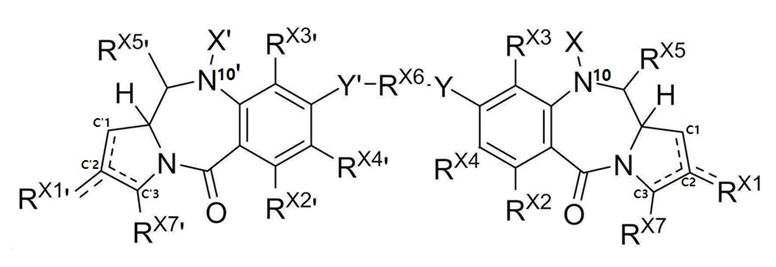
[일반식 XI]
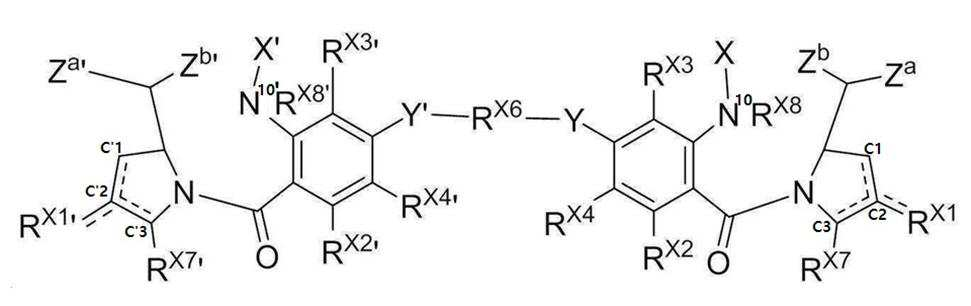
상기 식에서,
상기 점선은 C1과 C2 사이, C2와 C3 사이, C'1과 C'2 사이, 또는 C'2과 C'3 사이의 이중 결합의 선택적 존재를 나타내며;
RX1 및 RX1'는 독립적으로 H, OH, =O, =CH2, CN, Rm, ORm, =CH-Rm' =C(Rm')2, OSO2-Rm, CO2Rm, CORm, 할로 또는 디할로이고;
Rm'는 Rm, CO2Rm, CORm, CHO, CO2H 또는 할로이며,
각각의 Rm는 독립적으로 C1-12 알킬, C2-12 알케닐, C2-12 알키닐, C5-20 아릴, C5-20 헤테로아릴, C3-6 사이클로알킬, 3 내지 7-원 헤테로사이클릴, 3 내지 7-원 헤테로사이클로알킬, 또는 5 내지 7-원 헤테로아릴로이고;
RX2, RX2' RX3, RX3', RX5, 및 RX5'는 독립적으로 H, Rm, OH, ORm, SH, SRm, NH2, NHRm, NRm 2, NO2, Me3Sn 또는 할로이며;
RX4 및 RX4'는 독립적으로 H, Rm, OH, ORm, SH, SRm, NH2, NHRm, NRm 2, NO2, Me3Sn, 할로, C1-6 알킬 C1-6 알콕시, C2-6 알케닐, C2-6 알키닐, C3-6 사이클로알킬, 3 내지 7-원 헤테로사이클로알킬, C5-12 아릴, 5 내지 7-원 헤테로아릴, -CN, -NCO, -ORn, -OC(O)Rn, -OC(O)NRnRn', -OS(O)Rn, -OS(O)2Rn, -SRn, -S(O)Rn, -S(O)2Rn, -S(O)NRnRn', -S(O)2NRnRn', -OS(O)NRnRn', -OS(O)2NRnRn', -NRnRn', -NRnC(O)Ro, -NRnC(O)ORo, -NRnC(O)NRoRo', -NRnS(O)Ro, -NRnS(O)2Ro, -NRnS(O)NRoRo', -NRnS(O)2NRoRo', -C(O)Rn, -C(O)ORn 또는 -C(O)NRnRn'이고;
RX 및 RX'는 독립적으로 H, OH, N3, CN, NO2, SH, NH2, ONH2, NHNH2, 할로, C1-8 알킬, C3-8 사이클로 알킬, C1-8 알콕시, C1-8 알킬티오, C3-20 헤테로아릴, C5-20 아릴 또는 모노- 또는 디(di)-C1-8 알킬아미노이며;
Y 및 Y'는 독립적으로 O, S, 또는 N(H)이고;
RX6는 독립적으로 C3-12 알킬렌, C3-12 알케닐렌, 또는 C3-12 헤테로알킬렌이며;
RX7 및 RX7'는 독립적으로 H, C1-6 알킬, C2-6 알케닐, C2-6 알키닐, C3-6 사이클로알킬, 3 내지 7-원 헤테로사이클로알킬, C6-10 아릴, 5 내지 7-원 헤테로아릴, -ORr, -OC(O)Rr, -OC(O)NRrRr', -OS(O)Rr, -OS(O)2Rr, -SRr, -S(O)Rr, -S(O)2Rr, -S(O)NRrRr', -S(O)2NRrRr', -OS(O)NRrRr', -OS(O)2NRrRr', -NRrRr', -NRrC(O)Rs, -NRrC(O)ORs, -NRrC(O)NRsRs', -NRrS(O)Rs, -NRrS(O)2Rs, -NRrS(O)NRsRs', -NRrS(O)2NRsRs, -C(O)Rr, -C(O)ORs 또는 -C(O)NRrRr'이고;
각각의 Rr, Rr', Rs, 및 Rs' 은 독립적으로 H, C1-7 알킬, C2-7 알케닐, C2-7 알키닐, C3-13 사이클로알킬, 3 내지 7-원 헤테로사이클로알킬, C5-10 아릴 또는 5 내지 7-원 헤테로아릴로이며;
각 RX8 및 RX8'는 독립적으로 H, C1-6 알킬, C2-6 알케닐, C2-6 알키닐, C3-6 헤테로알킬, 3 내지 7-원 헤테로사이클로알킬, C5-10 아릴, 5 내지 7-원 헤테로아릴, -S(O)Rm, -S(O)2Rm, -S(O)NRmRm', -S(O)2NRmRm', -NRmRm', -NRmC(O)Rm, -NRmC(O)ORn, -NRmC(O)NRnRn', -NRmS(O)Rn, -NRmS(O)2Rn, -NRmS(O)NRnRn', -NRmS(O)2NRnRn', -C(O)Rm, -C(O)ORm 또는 -C(O)NRmRm'이고;
Za 는 ORX12a, NRX12aRX12a, 또는 SRX12a이며;
Zb 는 ORX13a, NRX13aRX13a, 또는 SRX13a이고;
Za'는 ORX12a, NRX12aRX12a, 또는 SRX12a이며;
Zb'는 ORX13a', NRX13'RX13a' 또는 SRX13a'이고;
각 RX12a, RX12a', RX13a' 및 RX13a'는 독립적으로 H, C1-6 알킬, C2-6 알케닐, C2-6 알키닐, C3-6 사이클로알킬, 3 to 7-원 헤테로사이클로알킬, C5-10 아릴, 5 내지 7-원 헤테아릴, -C(O)RX15a, -C(O)ORX15a 또는 -C(O)NRX15aRX15a'이며; 및
각각의 RX15a 및 RX15a' 는 독립적으로 C1-12 알킬, C2-12 알케닐, C2-12 알키닐, C5-20 아릴, C5-20 헤테로 아릴, C3-6 사이클로알킬, 3 내지 7-원 헤테로사이클릴, 3 내지 7-원 헤테로사이클로알킬, 또는 5 내지 7-원 헤테로아릴이고;
상기 RX13a 및 RX14a 는 이들이 부착된 원자와 함께 임의적으로 결합하여 3 내지 7-원 헤테로 사이클릴, 3 내지 7-원 헤테로 사이클로알킬, 또는 3 내지 7-원 헤테로 아릴을 형성하고, 및 RX13a' 및 RX14a'이들이 부착된 원자와 함께 임의적으로 결합하여 3 내지 7-원 헤테로 사이클릴, 3 내지 7-원 헤테로사이클로알킬, 또는 3 내지 7-원 헤테로 아릴을 형성하며; 및
상기 각각의 Rn, Rn', Ro, Ro', Rp, 및 Rp' 는 독립적으로 H, C1-7 알킬, C2-7 알케닐, C2-7 알키닐, C3-13 사이클로알킬, 3 내지 7-원 헤테로사이클로알킬, C5-10 아릴, 또는 5 내지 7-원 헤테로아릴이다.
121. The antibody conjugate or pharmaceutically acceptable salt or solvate thereof according to claim 120, wherein the pyrrolobenzodiazepine dimer is represented by the following general formula X or XI:
[General Formula X]
[General Formula XI]
In the above formula,
the dotted line indicates the optional presence of a double bond between C1 and C2, between C2 and C3, between C'1 and C'2, or between C'2 and C'3;
R X1 and R X1 ' are independently H, OH, =O, =CH 2 , CN, R m , OR m , =CH-R m ' =C(R m ') 2 , OSO 2 -R m , CO 2 R m , COR m , halo or dihalo;
R m ' is R m , CO 2 R m , COR m , CHO, CO 2 H or halo;
each R m is independently C 1-12 alkyl, C 2-12 alkenyl, C 2-12 alkynyl, C 5-20 aryl, C 5-20 heteroaryl, C 3-6 cycloalkyl, 3-7 - membered heterocyclyl, 3 to 7-membered heterocycloalkyl, or 5 to 7-membered heteroaryl;
R X2 , R X2 ' R X3 , R X3 ', R X5 , and R X5 ' are independently H, R m , OH, OR m , SH, SR m , NH 2 , NHR m , NR m 2 , NO 2 , Me 3 Sn or halo;
R X4 and R X4 ' are independently H, R m , OH, OR m , SH, SR m , NH 2 , NHR m , NR m 2 , NO 2 , Me 3 Sn, halo, C 1-6 alkyl C 1 -6 alkoxy, C 2-6 alkenyl, C 2-6 alkynyl, C 3-6 cycloalkyl, 3-7 membered heterocycloalkyl, C 5-12 aryl, 5-7 membered heteroaryl, -CN , -NCO, -OR n , -OC(O)R n , -OC(O)NR n R n ', -OS(O)R n , -OS(O) 2 R n , -SR n , -S (O)R n , -S(O) 2 R n , -S(O)NR n R n ', -S(O) 2 NR n R n ', -OS(O)NR n R n ', - OS(O) 2 NR n R n ', -NR n R n ', -NR n C(O)R o , -NR n C(O)OR o , -NR n C(O)NR o R o ' , -NR n S(O)R o , -NR n S(O) 2 R o , -NR n S(O)NR o R o ', -NR n S(O) 2 NR o R o ', - C(O)R n , -C(O)OR n or -C(O)NR n R n ';
R X and R X ' are independently H, OH, N 3 , CN, NO 2 , SH, NH 2 , ONH 2 , NHNH 2 , halo, C 1-8 alkyl, C 3-8 cycloalkyl, C 1 - 8 alkoxy, C 1-8 alkylthio, C 3-20 heteroaryl, C 5-20 aryl or mono- or di(di)-C 1-8 alkylamino;
Y and Y' are independently O, S, or N(H);
R X6 is independently C 3-12 alkylene, C 3-12 alkenylene, or C 3-12 heteroalkylene;
R X7 and R X7 ′ are independently H, C 1-6 alkyl, C 2-6 alkenyl, C 2-6 alkynyl, C 3-6 cycloalkyl, 3-7 membered heterocycloalkyl, C 6- 10 aryl, 5-7 membered heteroaryl, -OR r , -OC(O)R r , -OC(O)NR r R r ', -OS(O)R r , -OS(O) 2 R r , -SR r , -S(O)R r , -S(O) 2 R r , -S(O)NR r R r ', -S(O) 2 NR r R r ', -OS(O) NR r R r ', -OS(O) 2 NR r R r ', -NR r R r ', -NR r C(O)R s , -NR r C(O)OR s , -NR r C( O)NR s R s ', -NR r S(O)R s , -NR r S(O) 2 R s , -NR r S(O)NR s R s ', -NR r S(O) 2 NR s R s , -C(O)R r , -C(O)OR s or -C(O)NR r R r ';
each R r , R r ', R s , and R s ' is independently H, C 1-7 alkyl, C 2-7 alkenyl, C 2-7 alkynyl, C 3-13 cycloalkyl, 3 to 7-membered heterocycloalkyl, C 5-10 aryl or 5 to 7-membered heteroaryl;
each R X8 and R X8 ′ is independently H, C 1-6 alkyl, C 2-6 alkenyl, C 2-6 alkynyl, C 3-6 heteroalkyl, 3-7 membered heterocycloalkyl, C 5 -10 aryl, 5-7 membered heteroaryl, -S(O)R m , -S(O) 2 R m , -S(O)NR m R m ', -S(O) 2 NR m R m ', -NR m R m ', -NR m C(O)R m , -NR m C(O)OR n , -NR m C(O)NR n R n ', -NR m S(O)R n , -NR m S(O) 2 R n , -NR m S(O)NR n R n ', -NR m S(O) 2 NR n R n ', -C(O)R m , -C (O)OR m or —C(O)NR m R m ';
Z a is OR X12a , NR X12a R X12a , or SR X12a ;
Z b is OR X13a , NR X13a R X13a , or SR X13a ;
Z a ′ is OR X12a , NR X12a R X12a , or SR X12a ;
Z b 'is OR X13a ', NR X13 'R X13a ' or SR X13a ';
each R X12a , R X12a ', R X13a ' and R X13a ' is independently H, C 1-6 alkyl, C 2-6 alkenyl, C 2-6 alkynyl, C 3-6 cycloalkyl, 3 to 7 - membered heterocycloalkyl, C 5-10 aryl, 5-7 membered hetearyl , -C(O)R X15a , -C(O)OR X15a or -C(O)NR X15a R X15a '; and
each R X15a and R X15a ′ is independently C 1-12 alkyl, C 2-12 alkenyl, C 2-12 alkynyl, C 5-20 aryl, C 5-20 heteroaryl, C 3-6 cycloalkyl , 3 to 7-membered heterocyclyl, 3 to 7-membered heterocycloalkyl, or 5 to 7-membered heteroaryl;
wherein R X13a and R X14a are optionally taken together with the atoms to which they are attached to form a 3 to 7-membered heterocyclyl, 3 to 7-membered heterocycloalkyl, or 3 to 7-membered heteroaryl, and R X13a ' and R X14a ' taken together optionally with the atom to which they are attached form a 3 to 7-membered heterocyclyl, 3 to 7-membered heterocycloalkyl, or 3 to 7-membered heteroaryl; and
each of R n , R n ', R o , R o ', R p , and R p ' is independently H, C 1-7 alkyl, C 2-7 alkenyl, C 2-7 alkynyl, C 3-13 cycloalkyl, 3 to 7-membered heterocycloalkyl, C 5-10 aryl, or 5 to 7-membered heteroaryl.
상기 Rm는 추가적으로 C1-12 알킬, C2-12 알케닐, C2-12 알키닐, C5-20 아릴, C5-20 헤테로아릴, C3-6 사이클로알킬, 3 내지 7-원 헤테로사이클릴, 3 내지 7-원 헤테로사이클로알킬, 또는 5 내지 7-원 헤테로아릴로 치환되는 것을 특징으로 하는, 항체 접합체 또는 이의 약학적으로 허용되는 염 또는 이의 용매화물.
123. The method of claim 122, wherein R m is independently C 1-12 alkyl, C 2-12 alkenyl, C 2-12 alkynyl, C 5-20 aryl, C 5-20 heteroaryl, C 3-6 cyclo selected from the group consisting of alkyl, 3 to 7-membered heterocyclyl, 3 to 7-membered heterocycloalkyl, and 5 to 7-membered heteroaryl;
wherein R m is additionally C 1-12 alkyl, C 2-12 alkenyl, C 2-12 alkynyl, C 5-20 aryl, C 5-20 heteroaryl, C 3-6 cycloalkyl, 3 to 7-membered An antibody conjugate or a pharmaceutically acceptable salt or solvate thereof, characterized in that it is substituted with heterocyclyl, 3 to 7-membered heterocycloalkyl, or 5 to 7-membered heteroaryl.
상기 RX4 또는 RX4'는 C1-6 알킬, C1-6 알콕시, C2-6 알케닐, C2-6 알키닐, C3-6 사이클로알킬, 3 내지 7-원 헤테로사이클로알킬, C5-12 아릴 또는 5 내지 7-원 헤테로아릴이고, 추가적으로 하나 이상의 C1-6 알킬, C1-6 알콕시, C2-6 알케닐, C2-6 알키닐, C3-C6 사이클로알킬, 3 내지 7-원 헤테로사이클로알킬, C5-10 아릴, 5 내지 7-원 헤테로아릴, -ORp, -OC(O)Rp, -OC(O)NRpRp', -OS(O)Rp, -OS(O)2Rp, -SRp, -S(O)Rp, -S(O)2Rp, -S(O)NRpRp', -S(O)2NRpRp', -OS(O)NRpRp', -OS(O)2NRpRp', -NRpRp', -NRpC(O)Rq, -NRpC(O)ORq, -NRpC(O)NRqRq', -NRpS(O)Rq, -NRpS(O)2Rq, -NRpS(O)NRqRq', -NRpS(O)2NRqRq', -C(O)Rp, -C(O)ORp 또는 -C(O)NRpRp로 치환되는 것을 특징으로 하는, 항체 접합체 또는 이의 약학적으로 허용되는 염 또는 이의 용매화물.
123. The method of claim 122, wherein R X4 and R X4 ' are independently H, R m , OH, OR m , SH, SR m , NH 2 , NHR m , NR m R m ', NO 2 , Me 3 Sn, Halo, C 1-6 alkyl, C 1-6 alkoxy, C 2-6 alkenyl, C 2-6 alkynyl, C 3-6 cycloalkyl, 3-7 membered heterocycloalkyl, C 5-12 aryl, 5-7 membered heteroaryl, -CN, -NCO, -OR n , -OC(O)R n , -OC(O)NR n R n ', -OS(O)R n , -OS(O) 2 R n , -SR n , -S(O)R n , -S(O) 2 R n , -S(O)NR n R n ', -S(O) 2 NR n R n ', -OS (O)NR n R n ', -OS(O) 2 NR n R n ', -NR n R n ', -NR n C(O)R o , -NR n C(O)OR o , -NR n C(O)NR o R o ', -NR n S(O)R o , -NR n S(O) 2 R o , -NR n S(O)NR o R o ', -NR n S( O) 2 NR o R o ', -C(O)R n , -C(O)OR n and -C(O)NR n R n ';
wherein R X4 or R X4 ' is C 1-6 alkyl, C 1-6 alkoxy, C 2-6 alkenyl, C 2-6 alkynyl, C 3-6 cycloalkyl, 3-7 membered heterocycloalkyl, C 5-12 aryl or 5 to 7-membered heteroaryl, additionally one or more C 1-6 alkyl, C 1-6 alkoxy, C 2-6 alkenyl, C 2-6 alkynyl, C 3 -C 6 cyclo Alkyl, 3-7 membered heterocycloalkyl, C 5-10 aryl, 5-7 membered heteroaryl, -OR p , -OC(O)R p , -OC(O)NR p R p ', -OS (O)R p , -OS(O) 2 R p , -SR p , -S(O)R p , -S(O) 2 R p , -S(O)NR p R p ', -S( O) 2 NR p R p ', -OS(O)NR p R p ', -OS(O) 2 NR p R p ', -NR p R p ', -NR p C(O)R q , - NR p C(O)OR q , -NR p C(O)NR q R q ', -NR p S(O)R q , -NR p S(O) 2 R q , -NR p S(O) NR q R q ', -NR p S(O) 2 NR q R q ', -C(O)R p , -C(O)OR p or -C(O)NR p R p to an antibody conjugate or a pharmaceutically acceptable salt or solvate thereof.
상기 RX7 또는 RX7' 는 C1-6 알킬, C2-6 알케닐, C2-6 알키닐, C3-6 사이클로알킬, 3 내지 7-원 헤테로사이클로알킬, C6-10 아릴, 5 내지 7-원 헤테로아릴이고, 추가적으로 C1-6 알킬, C2-6 알케닐, C2-6 알키닐, C3-6 사이클로알킬, 3 내지 7-원 헤테로사이클로알킬, C6-10 아릴, 5 내지 7-원 헤테로아릴, -ORt, -OC(O)Rt, -OC(O)NRtRt', -OS(O)Rt, -OS(O)2Rt, -SRt, -S(O)Rt, -S(O)2Rt, -S(O)NRtRt', -S(O)2NRtRt', -OS(O)NRtRt', -OS(O)2NRtRt', -NRtRt', -NRtC(O)Ru, -NRtC(O)ORu, -NRtC(O)NRuRu', -NRtS(O)Ru, -NRtS(O)2Ru, -NRtS(O)NRuRu', -NRtS(O)2NRuRu', -C(O)Rt, -C(O)ORt 또는 -C(O)NRtRt'로 치환되며,
상기 Rr, Rr', Rs, Rs', Rt, Rt', Ru 및 Ru'는 독립적으로 H, C1-7 알킬, C2-7 알케닐, C2-7 알키닐, C3-13 사이클로알킬, 3 내지 7-원 헤테로사이클로알킬, C5-10 아릴, 및 5 내지 7-원 헤테로아릴로부터 선택되는 것을 특징으로 하는, 항체 접합체 또는 이의 약학적으로 허용되는 염 또는 이의 용매화물.
123. The method of claim 122, wherein R X7 and R X7 ' are independently H, C 1-6 alkyl, C 2-6 alkenyl, C 2-6 alkynyl, C 3-6 cycloalkyl, 3 to 7-membered. Heterocycloalkyl, C 6-10 aryl, 5-7 membered heteroaryl, -OR r , -OC(O)R r , -OC(O)NR r R r ', -OS(O)R r , - OS(O) 2 R r , -SR r , -S(O)R r , -S(O) 2 R r , -S(O)NR r R r ', -S(O) 2 NR r R r ', -OS(O)NR r R r ', -OS(O) 2 NR r R r ', -NR r R r ', -NR r C(O)R s , -NR r C(O)OR s , -NR r C(O)NR s R s ', -NR r S(O)R s , -NR r S(O) 2 R s , -NR r S(O)NR s R s ', - NR r S(O) 2 NR s R s , -C(O)R r , -C(O)OR s or -C(O)NR r R r ';
wherein R X7 or R X7 ' is C 1-6 alkyl, C 2-6 alkenyl, C 2-6 alkynyl, C 3-6 cycloalkyl, 3 to 7-membered heterocycloalkyl, C 6-10 aryl, 5 to 7-membered heteroaryl, additionally C 1-6 alkyl, C 2-6 alkenyl, C 2-6 alkynyl, C 3-6 cycloalkyl, 3 to 7-membered heterocycloalkyl, C 6-10 aryl, 5-7 membered heteroaryl, -OR t , -OC(O)R t , -OC(O)NR t R t ', -OS(O)R t , -OS(O) 2 R t , -SR t , -S(O)R t , -S(O) 2 R t , -S(O)NR t R t ', -S(O) 2 NR t R t ', -OS(O)NR t R t ', -OS(O) 2 NR t R t ', -NR t R t ', -NR t C(O)R u , -NR t C(O)OR u , -NR t C(O) )NR u R u ', -NR t S(O)R u , -NR t S(O) 2 R u , -NR t S(O)NR u R u ', -NR t S(O) 2 NR u R u ', -C(O)R t , -C(O)OR t or -C(O)NR t R t ';
wherein R r , R r ', R s , R s ', R t , R t ', R u and R u ' are independently H, C 1-7 alkyl, C 2-7 alkenyl, C 2-7 Alkynyl, C 3-13 cycloalkyl, 3 to 7-membered heterocycloalkyl, C 5-10 aryl, and 5 to 7-membered heteroaryl, characterized in that selected from the antibody conjugate or its pharmaceutically acceptable salts or solvates thereof.
Rm은 C1-6 알킬, C2-6 알케닐, C5-7 아릴 및 C3-6 헤테로아릴로 부터 선택되는 것을 특징으로 하는, 항체 접합체 또는 이의 약학적으로 허용되는 염 또는 이의 용매화물.
123. The method of claim 122, wherein R X1 and R X1 ' are independently selected from R m; and
R m is selected from C 1-6 alkyl, C 2-6 alkenyl, C 5-7 aryl and C 3-6 heteroaryl, characterized in that the antibody conjugate or a pharmaceutically acceptable salt thereof or a solvent thereof freight.
123. The antibody conjugate of claim 122, wherein R X2 , R X2 ', R X3 , R X3 ', R X5 , and R X5 ' are independently selected from H or OH. salts or solvates thereof.
Rm 은 C1-6 알콕시인 것을 특징으로 하는, 항체 접합체 또는 이의 약학적으로 허용되는 염 또는 이의 용매화물.
123. The method of claim 122, wherein R X4 and R X4 ' are independently selected from R m; and
R m is C 1-6 alkoxy, characterized in that the antibody conjugate or a pharmaceutically acceptable salt or solvate thereof.
123. The method according to claim 122, wherein R X4 and R X4 ' are independently selected from the group consisting of methoxy, ethoxy and butoxy. Solvates.
123. The antibody conjugate according to claim 122, wherein Y and Y' are O, or a pharmaceutically acceptable salt or solvate thereof.
상기 RXX는 H, OH, N3, CN, NO2, SH, NH2, ONH2, NHNH2, 할로, C1-8 알킬, C3-8 사이클로알킬, C1-8 알콕시, C1-8 알킬티오, C3-20 헤테로아릴, C5-20 아릴 또는 모노- 또는 디-C1-8 알킬 아미노이며; 및
n은 1 내지 6의 정수인 것을 특징으로 하는, 항체 접합체 또는 이의 약학적으로 허용되는 염 또는 이의 용매화물.
123. The method of claim 122, wherein R X6 is C 3-12 alkylene, C 3-12 alkenylene or C 3-12 heteroalkylene, and R X6 is -NH 2 , -NHR m , -NHC(O) R m , -NHC(O)CH 2 -[OCH 2 CH 2 ] n -R XX , or -[CH 2 CH 2 O] n -R XX ;
wherein R XX is H, OH, N 3 , CN, NO 2 , SH, NH 2 , ONH 2 , NHNH 2 , halo, C 1-8 alkyl, C 3-8 cycloalkyl, C 1-8 alkoxy, C 1 -8 alkylthio, C 3-20 heteroaryl, C 5-20 aryl or mono- or di-C 1-8 alkyl amino; and
n is an integer of 1 to 6, characterized in that the antibody conjugate or a pharmaceutically acceptable salt or solvate thereof.
[일반식 XII]
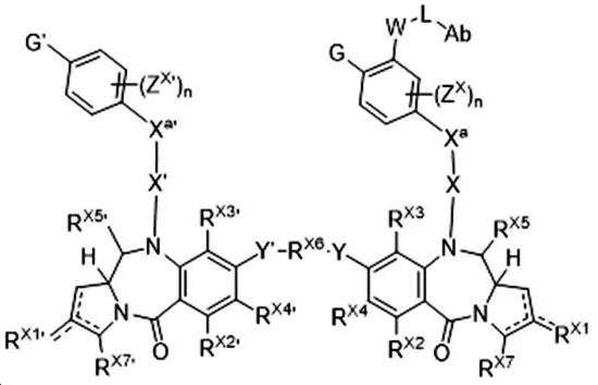
[일반식 XIII]

상기 Xa 및 Xa'는 독립적으로 결합 또는 C1-6 알킬렌으로부터 선택되고;
ZX' 및 ZX 는 독립적으로 수소, C1-8 알킬, 할로겐, 시아노, 나이트로,
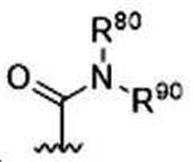
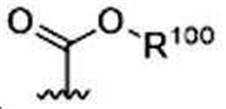
각각의 R80, R90 및 R100 는 수소, C1-8 알킬, C2-6 알케닐, 및 C1-6 알콕시로부터 선택되고; 및
m은 0 내지 12의 정수임.
123. The antibody conjugate or pharmaceutically acceptable salt or solvate thereof according to claim 122, wherein the active agent is a pyrrolobenzodiazepine dimer represented by the following general formula (XII) or general formula (XIII):
[General Formula XII]
[General Formula XIII]
wherein X a and X a ′ are independently selected from a bond or C 1-6 alkylene;
Z X ' and Z X are independently hydrogen, C 1-8 alkyl, halogen, cyano, nitro,
each of R 80 , R 90 and R 100 is selected from hydrogen, C 1-8 alkyl, C 2-6 alkenyl, and C 1-6 alkoxy; and
m is an integer from 0 to 12;


상기 각각의 R80, R90 및 R100 는 수소, C1-3 알킬 및 C1-3 알콕시로 이루어진 군으로부터 선택되는 어느 하나이며,
m은 1 내지 6의 정수인 것을 특징으로 하는, 항체 접합체 또는 이의 약학적으로 허용되는 염 또는 이의 용매화물.
134. The method of claim 132, wherein Z X ' and Z X are independently hydrogen;
Each of R 80 , R 90 and R 100 is any one selected from the group consisting of hydrogen, C 1-3 alkyl and C 1-3 alkoxy,
m is an integer of 1 to 6, characterized in that the antibody conjugate or a pharmaceutically acceptable salt or solvate thereof.


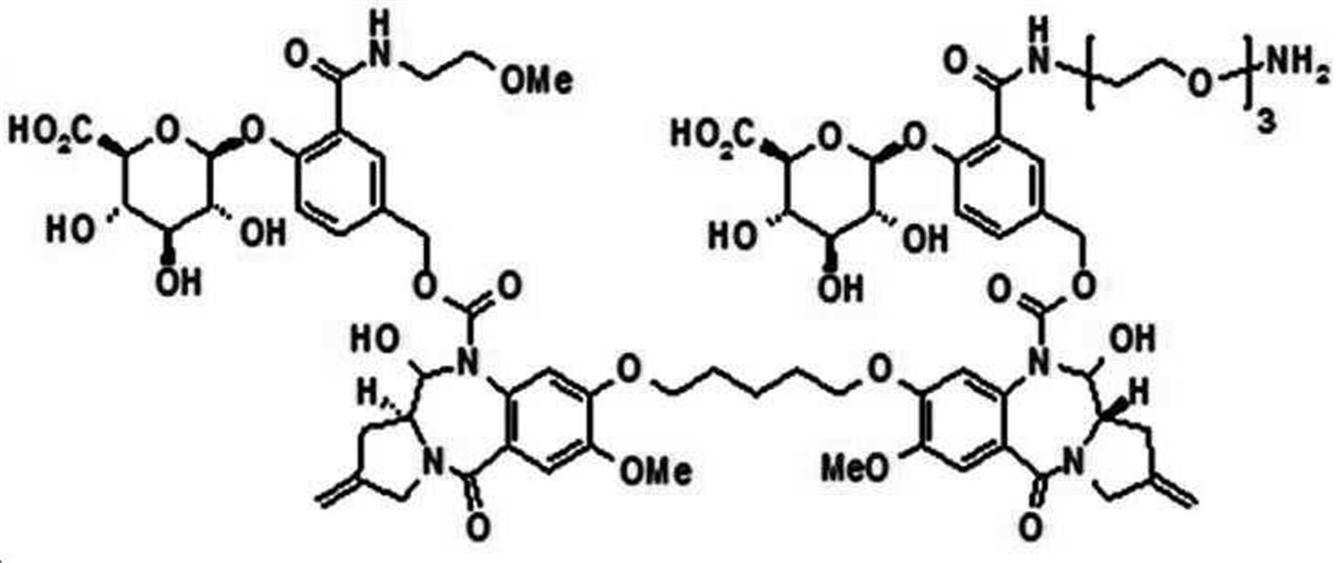

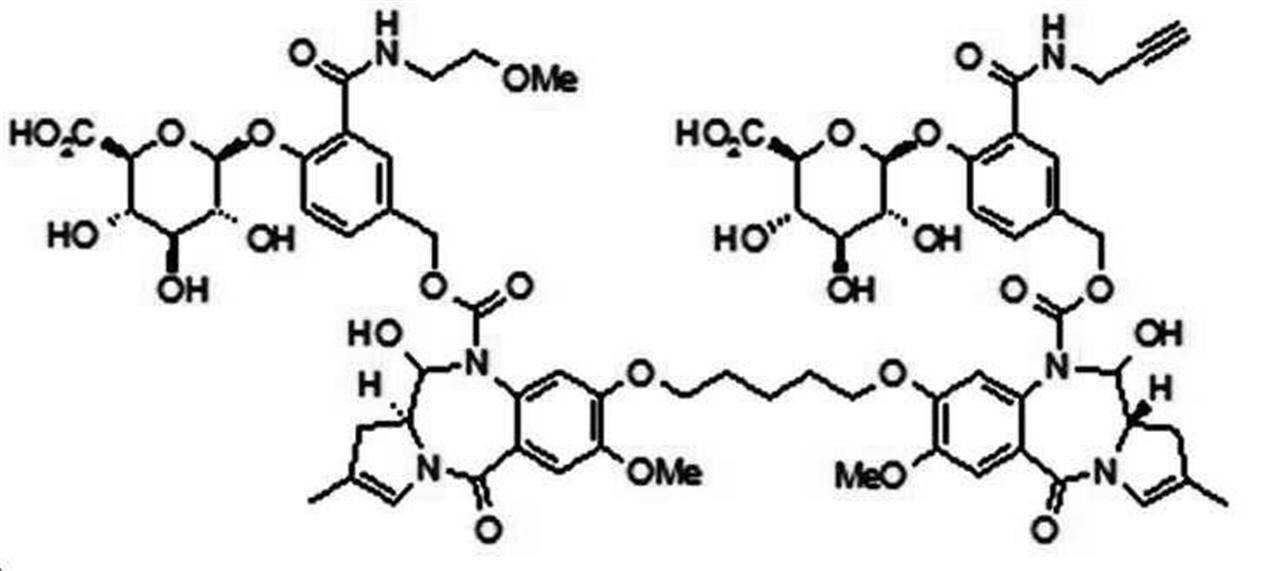
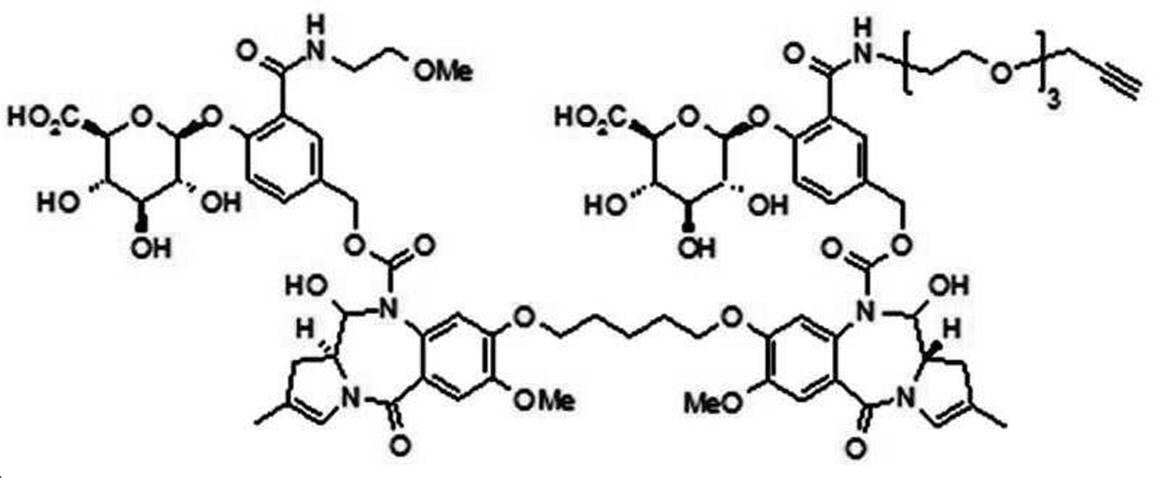
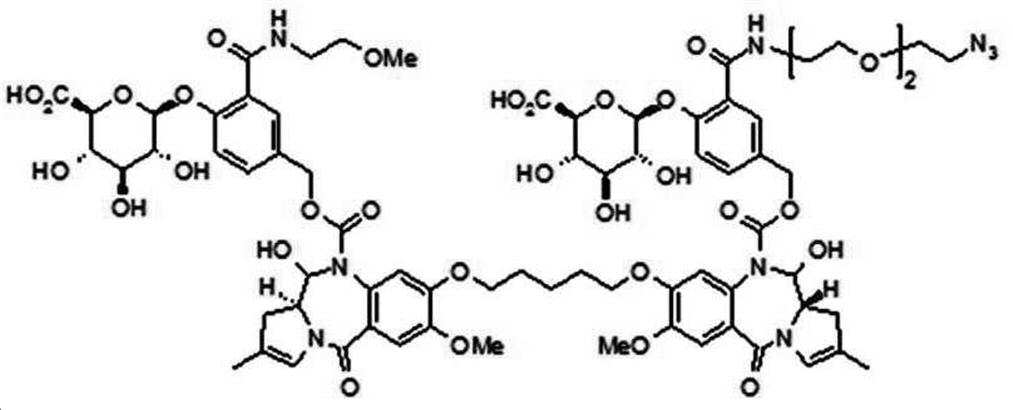
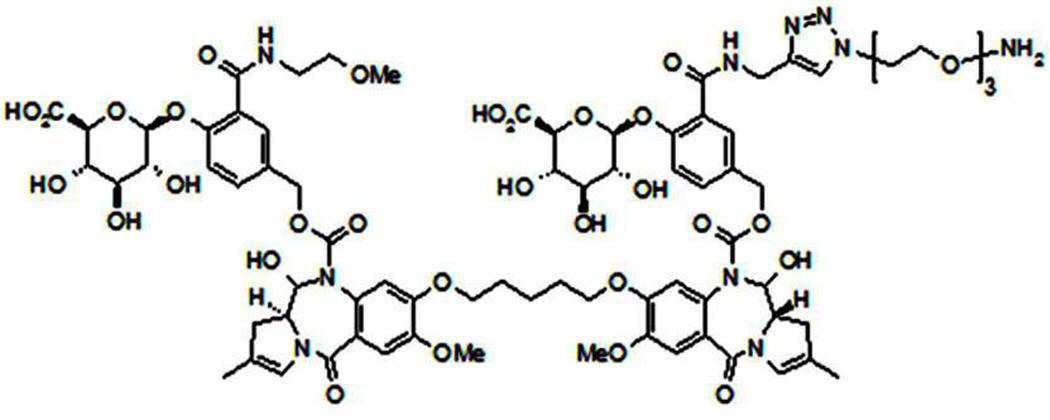
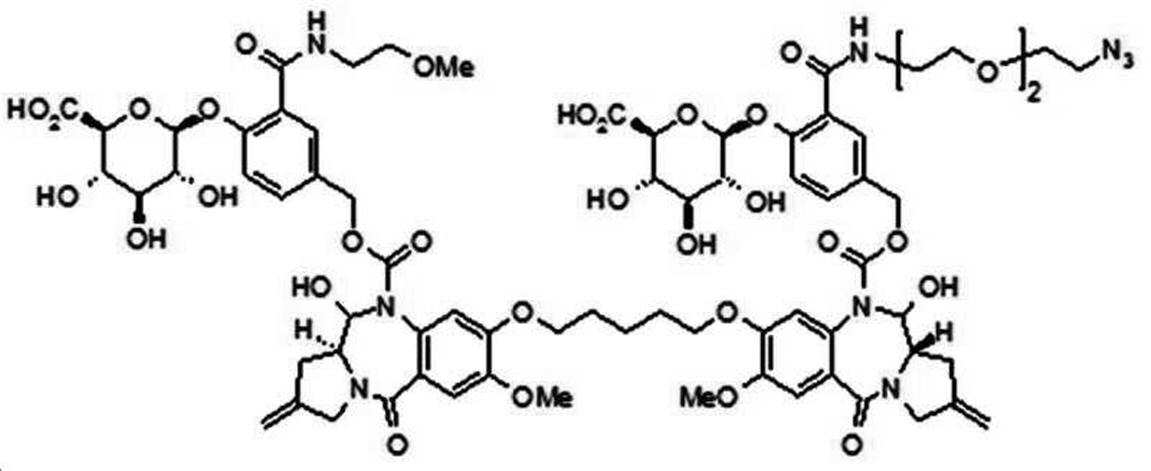
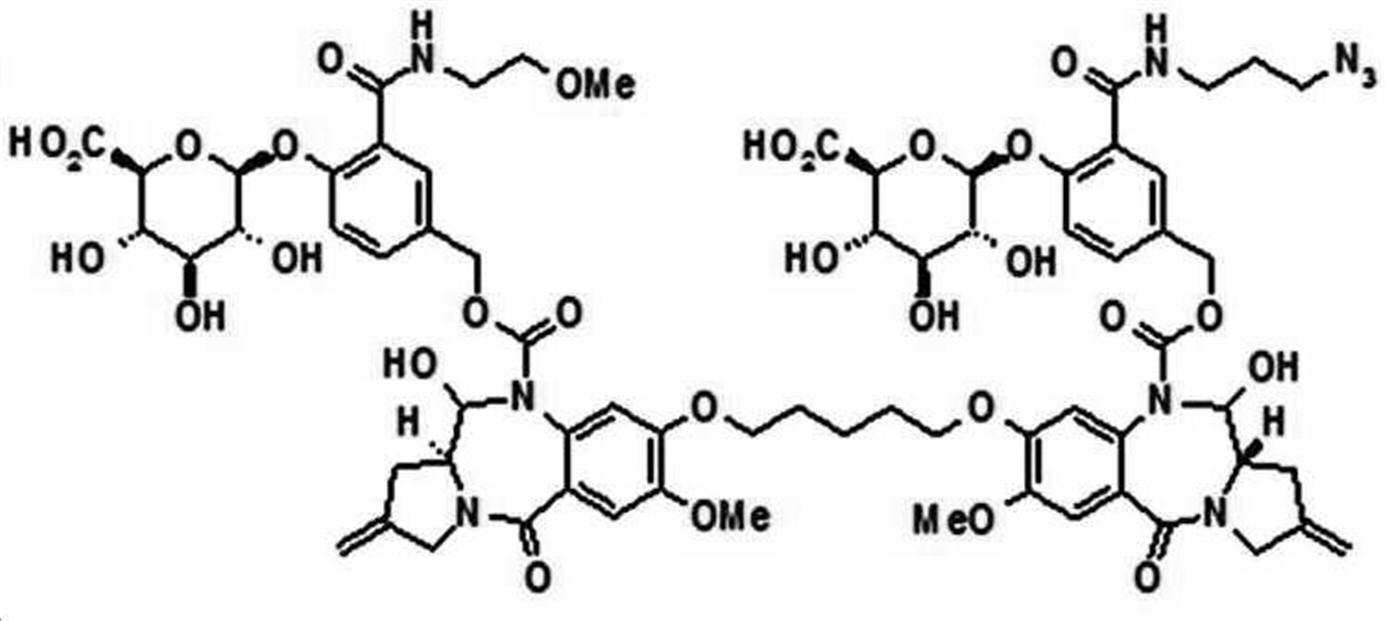

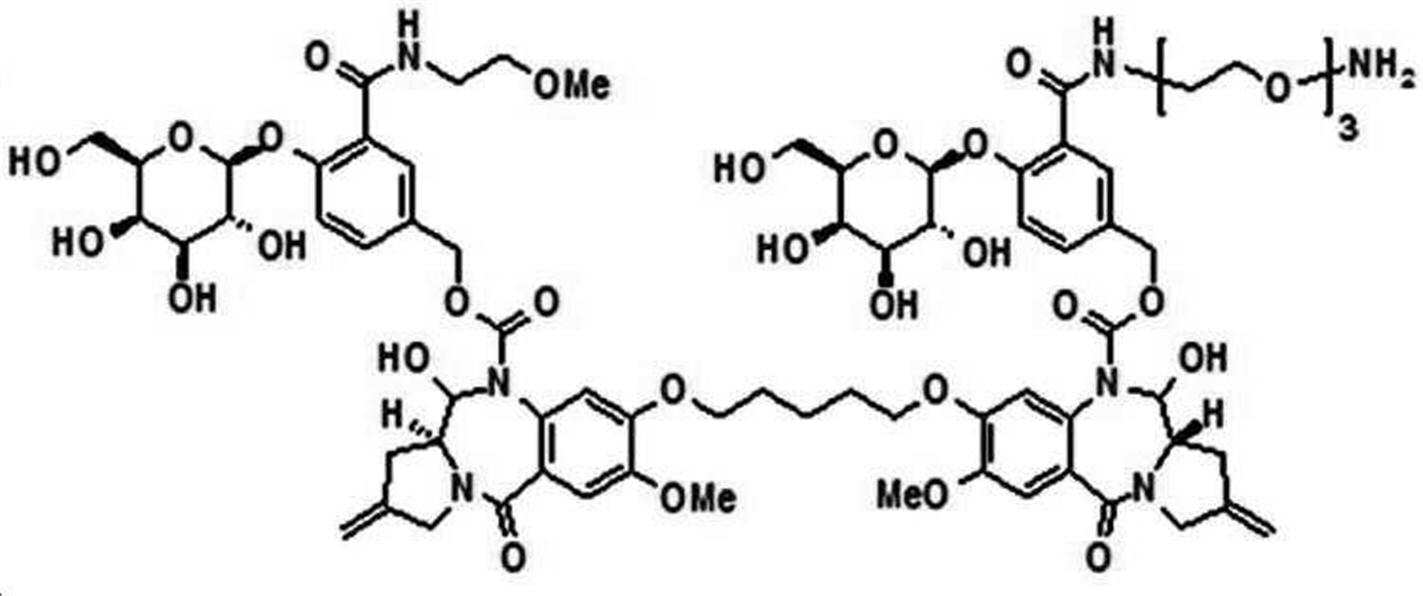


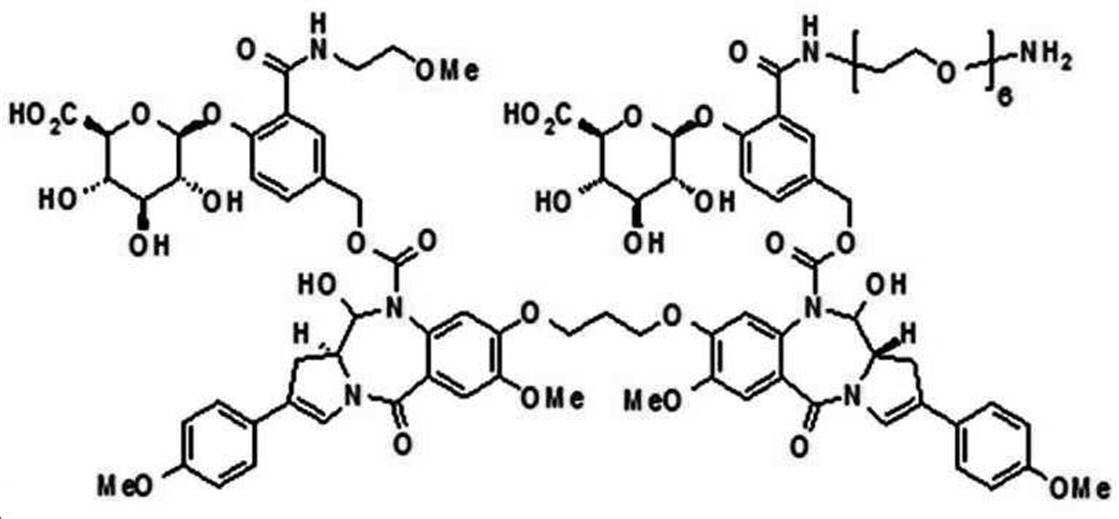
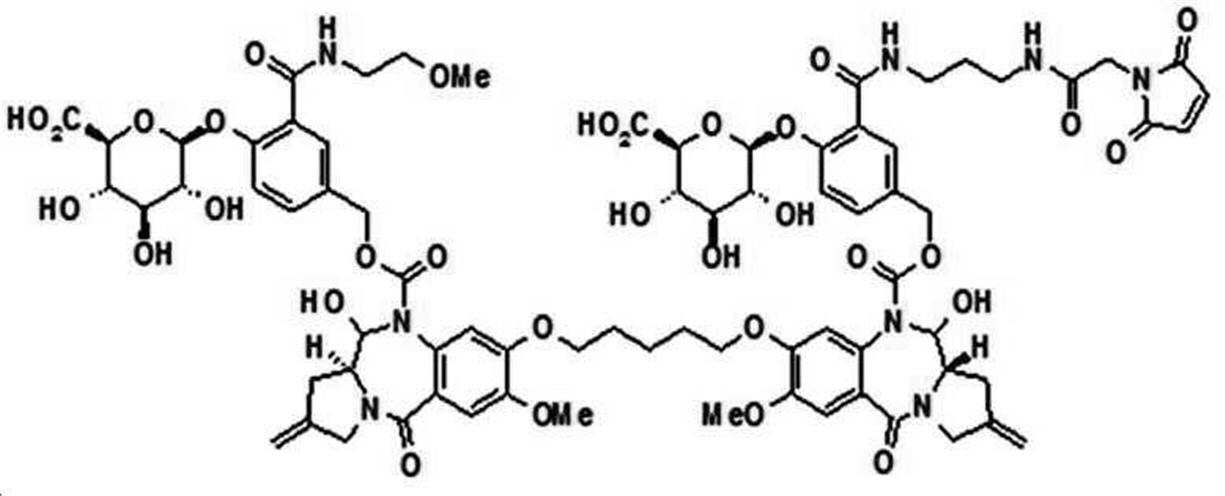

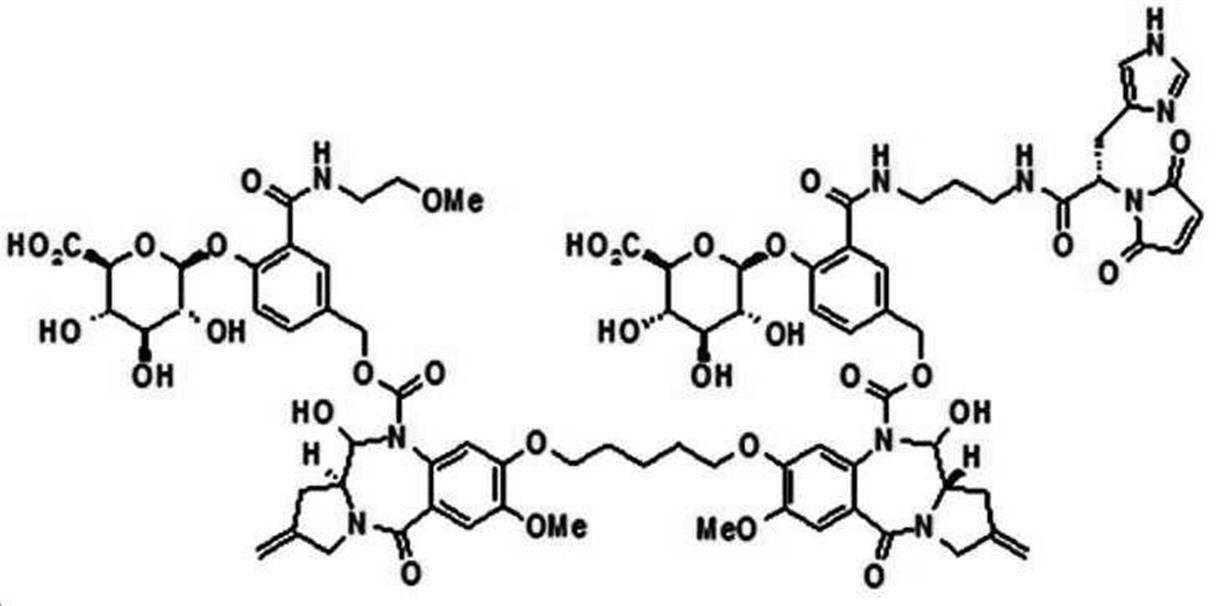
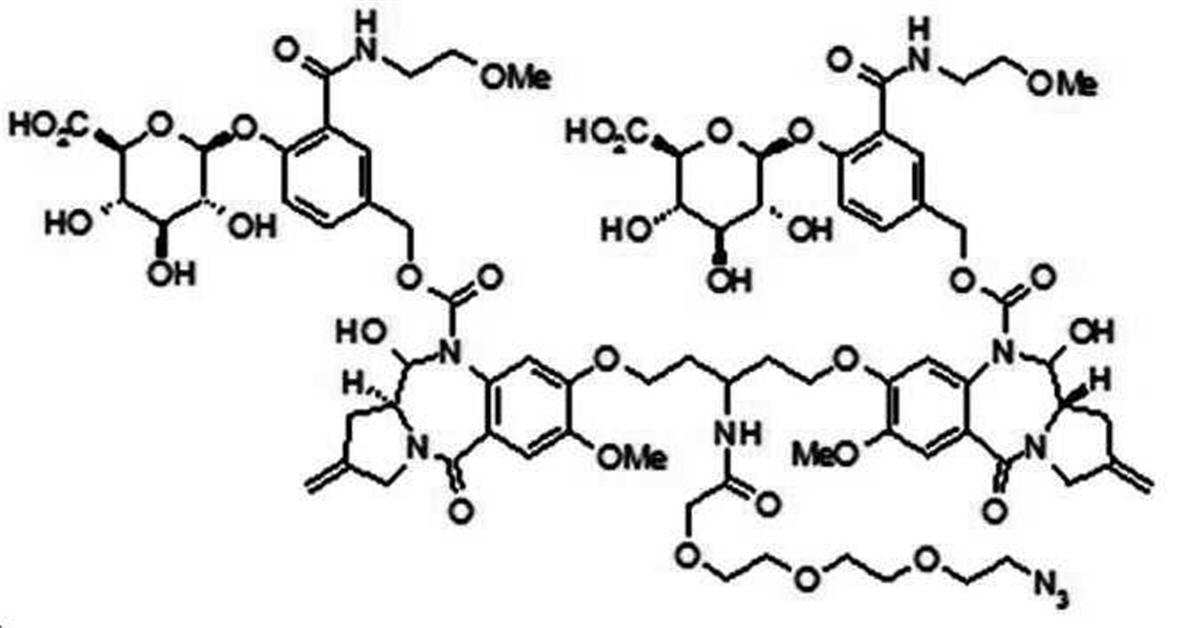
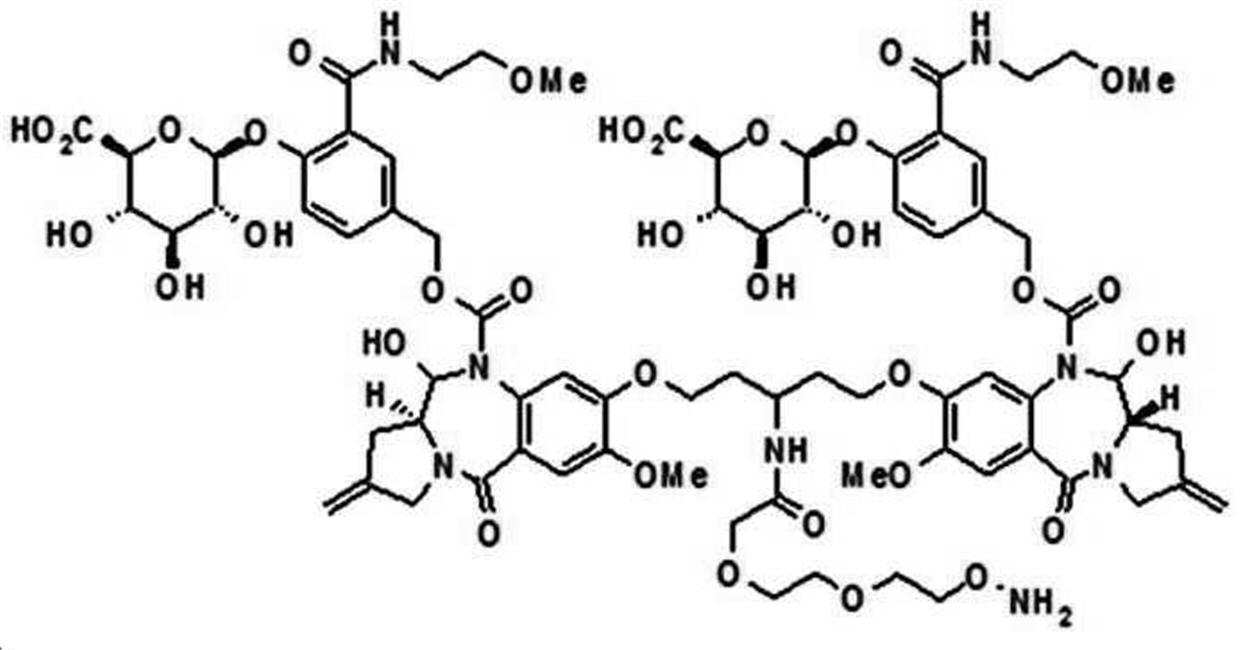
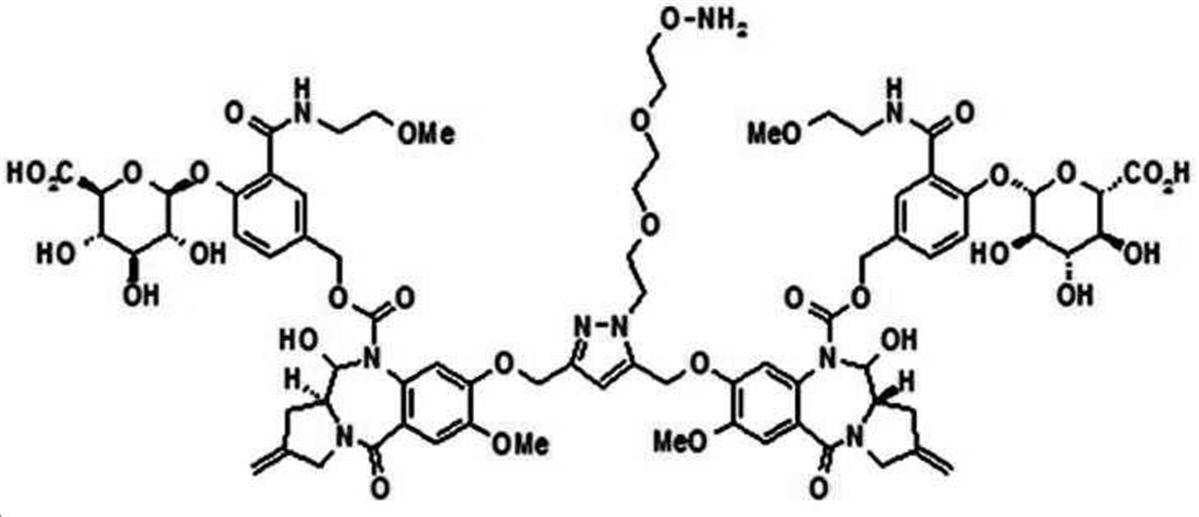
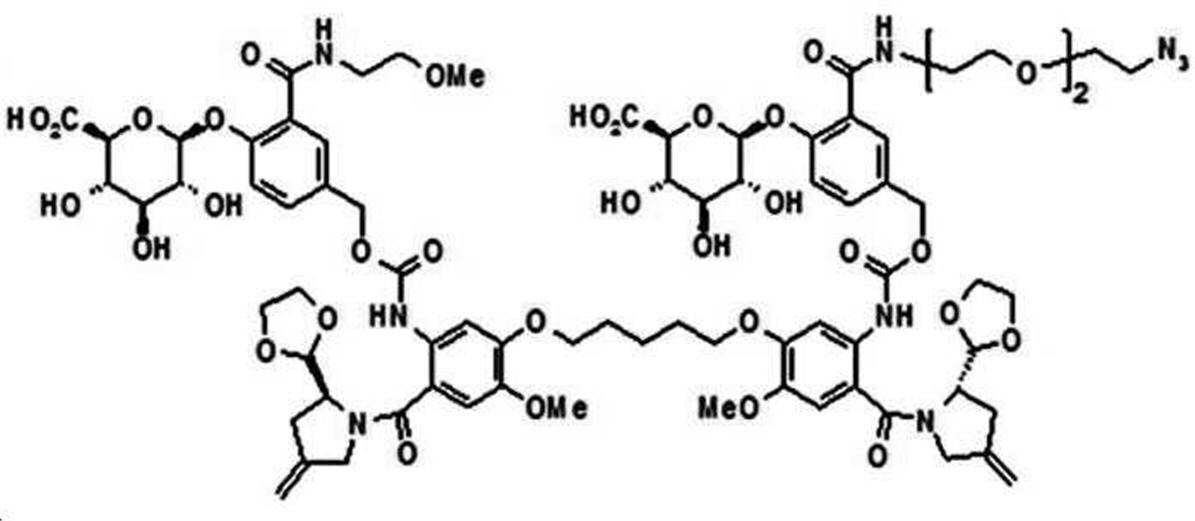
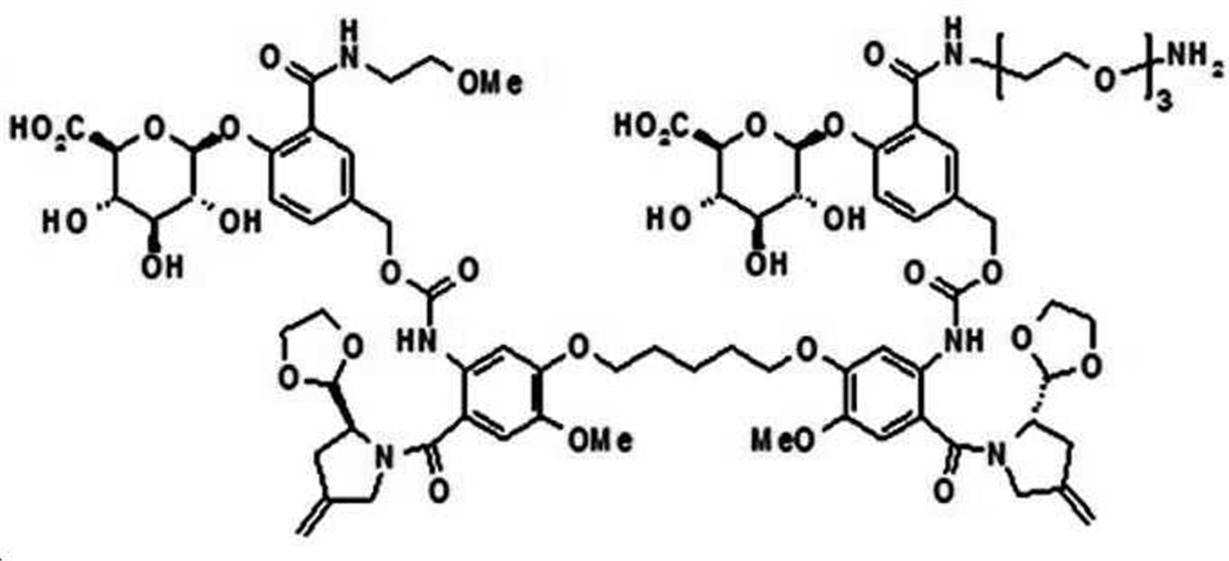
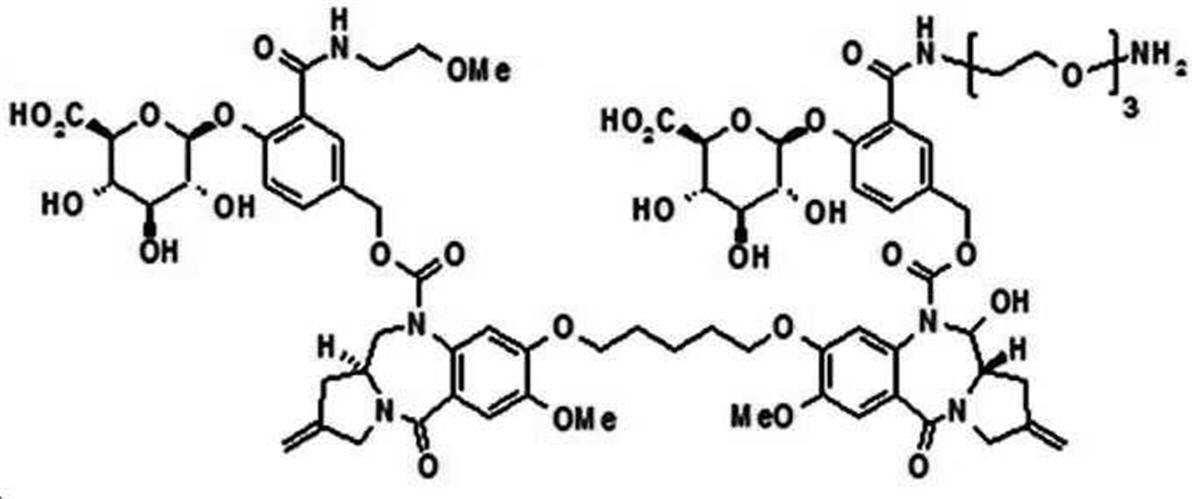


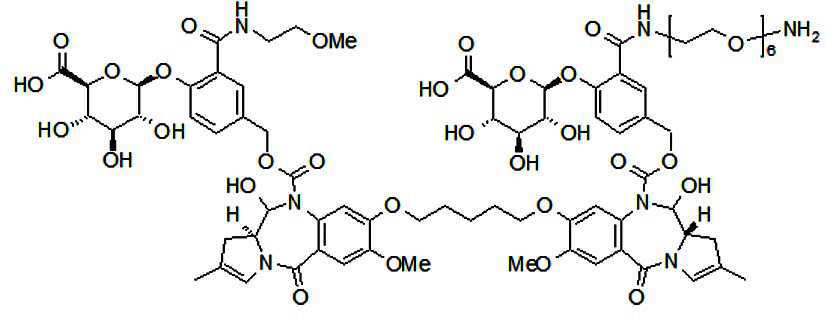
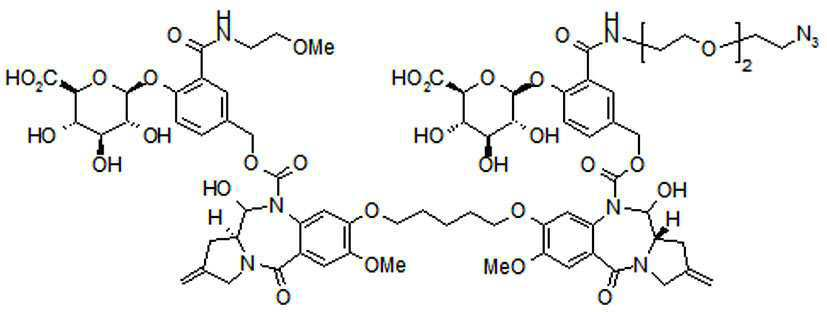
The method of claim 1, wherein the active agent is
18. The antibody conjugate according to any one of claims 1 to 17, wherein the antibody or antigen-binding fragment has specificity for one or more antigens in addition to the B7-H3. salts or solvates thereof.
137. The method according to any one of claims 1 to 17 and 135, wherein the antibody or antigen-binding fragment thereof induces antibody-dependent cytotoxicity, or inhibits B7-H3 immune checkpoint, resulting in B7-H3 immune checkpoint. An antibody conjugate or a pharmaceutically acceptable salt or solvate thereof, characterized in that it reactivates the inhibited T cell activity.
A composition comprising the antibody conjugate of claim 1 or a pharmaceutically acceptable salt or solvate thereof, and a pharmaceutically acceptable excipient.
137. The composition of claim 137, wherein the composition is a pharmaceutical composition for the treatment of a disease associated with B7-H3 overexpression.
139. The composition of claim 138, wherein the disease associated with B7-H3 overexpression is cancer.
140. The method of claim 139, wherein the cancer is a cancer that overexpresses B7-H3, and is breast cancer, thyroid cancer, prostate cancer, renal cancer, neuroblastoma, hepatocellular carcinoma, cervical cancer, osteosarcoma, oral cancer, bladder cancer, glioma, non-small cell cancer. solid cancers including lung cancer, pancreatic cancer, gastric cancer, ovarian cancer, colorectal cancer, bladder cancer, melanoma, endometrial cancer, head and neck cancer, urothelial cancer or spheroid cell cancer; or hematological cancer including acute leukemia or multiple myeloma.
The method according to any one of claims 137 to 140, wherein the composition is PD-1 (Programmed cell death protein 1), PD-L1 (Programmed Death Ligand 1), CTLA-4 (cytotoxic T-lymphocyte-associated protein 4) ), LAG-3 (Lymphocyte Activation Gene-3), CD28 (Cluster of Differentiation 28), CD122, 4-1BB (or CD137), TIM3 (T-cell Immunoglobulin domain and Mucin domain 3), OX-40 (or CD 134), OX40L (or CD252)), CD40, CD40L (or CD 154), LIGHT (or tumor necrosis factor superfamily member 14 (TNFSF14)), ICOS (Inducible T-cell costimulator or CD278), ICOSL (or CD275), GITR (glucocorticoid-induced TNFR-related protein), GITRL (or Tumor necrosis factor ligand superfamily member 18), TIGIT (T-cell immunoreceptor with Ig and ITIM domains), CD27, VISTA (V-domain Ig suppressor of T cell activation) , B7H3 (or CD276), B7H4 (or V-set domain-containing T-cell activation inhibitor 1), Herpes Virus Entry Mediator (HEVM) or B and T Lymphocyte Attenuator (BTLA), CD47 (or integrin associated protein (IAP)) ) or CD73 (or 5'-nucleotidase (5'-NT)), which binds specifically to one or more The composition, characterized in that it further comprises an antibody of.
141. The composition of any one of claims 137-140, further comprising a pharmaceutically effective amount of a chemotherapeutic agent.
A kit comprising the antibody conjugate of claim 1 or a pharmaceutically acceptable salt or solvate thereof, or the composition of claim 137.
145. The kit according to claim 143, wherein the kit is for administration for the treatment of a disease associated with overexpression of B7-H3 or for treatment of a disease associated with overexpression of B7-H3.
제 1항의 항체 접합체 또는 이의 약학적으로 허용되는 염 또는 이의 용매화물, 또는 제 137항의 조성물의 치료적 유효량을 상기 질환의 치료가 필요한 대상체에게 투여하는 단계를 포함하는, B7-H3의 과발현과 관련된 질환의 치료 방법.
A method of treating a disease associated with overexpression of B7-H3, the method comprising:
137. The method of claim 1, comprising administering a therapeutically effective amount of the antibody conjugate of claim 1, or a pharmaceutically acceptable salt or solvate thereof, or the composition of claim 137 to a subject in need of treatment for the disease. How to treat the disease.
The use of the antibody conjugate of claim 1 or a pharmaceutically acceptable salt or solvate thereof, or the composition of claim 137 for the treatment of a disease related to overexpression of B7-H3.
Priority Applications (1)
| Application Number | Priority Date | Filing Date | Title |
|---|---|---|---|
| KR1020190151539A KR20210063070A (en) | 2019-11-22 | 2019-11-22 | Antibody-drug conjugate comprising anti-B7-H3 antibody and its use |
Applications Claiming Priority (1)
| Application Number | Priority Date | Filing Date | Title |
|---|---|---|---|
| KR1020190151539A KR20210063070A (en) | 2019-11-22 | 2019-11-22 | Antibody-drug conjugate comprising anti-B7-H3 antibody and its use |
Publications (1)
| Publication Number | Publication Date |
|---|---|
| KR20210063070A true KR20210063070A (en) | 2021-06-01 |
Family
ID=76375957
Family Applications (1)
| Application Number | Title | Priority Date | Filing Date |
|---|---|---|---|
| KR1020190151539A Withdrawn KR20210063070A (en) | 2019-11-22 | 2019-11-22 | Antibody-drug conjugate comprising anti-B7-H3 antibody and its use |
Country Status (1)
| Country | Link |
|---|---|
| KR (1) | KR20210063070A (en) |
Cited By (3)
| Publication number | Priority date | Publication date | Assignee | Title |
|---|---|---|---|---|
| EP4149549A4 (en) * | 2020-05-12 | 2024-07-03 | MacroGenics, Inc. | METHODS OF USING A B7-H3 ANTIBODY-DRUG CONJUGATE ALONE OR IN COMBINATION |
| WO2025082449A1 (en) * | 2023-10-19 | 2025-04-24 | 江苏豪森药业集团有限公司 | Combined use of antibody-drug conjugate and immune checkpoint inhibitor |
| WO2025092983A1 (en) * | 2023-11-03 | 2025-05-08 | 信达生物制药(苏州)有限公司 | B7-h3-targeting antibody-drug conjugate and use thereof |
-
2019
- 2019-11-22 KR KR1020190151539A patent/KR20210063070A/en not_active Withdrawn
Cited By (3)
| Publication number | Priority date | Publication date | Assignee | Title |
|---|---|---|---|---|
| EP4149549A4 (en) * | 2020-05-12 | 2024-07-03 | MacroGenics, Inc. | METHODS OF USING A B7-H3 ANTIBODY-DRUG CONJUGATE ALONE OR IN COMBINATION |
| WO2025082449A1 (en) * | 2023-10-19 | 2025-04-24 | 江苏豪森药业集团有限公司 | Combined use of antibody-drug conjugate and immune checkpoint inhibitor |
| WO2025092983A1 (en) * | 2023-11-03 | 2025-05-08 | 信达生物制药(苏州)有限公司 | B7-h3-targeting antibody-drug conjugate and use thereof |
Similar Documents
| Publication | Publication Date | Title |
|---|---|---|
| JP7570474B2 (en) | Antibody-drug conjugates comprising antibodies against human rorr1 and uses thereof | |
| JP7776448B2 (en) | Antibodies to TIGIT | |
| CN109071666B (en) | Human poliovirus receptor (PVR) specific antibody | |
| JP2023085465A (en) | Anti-trop2 antibody-drug conjugate | |
| RU2571224C2 (en) | Humanised anti-axl antibodies | |
| KR20230038738A (en) | Camptothecin analogues conjugated to glutamine residues in proteins and uses thereof | |
| KR20200060471A (en) | Restoration of T cell activity through the CD39 / CD73 axis | |
| KR20220158181A (en) | ROR1 and B7-H3 binding antibody-drug conjugate and use thereof | |
| CA3129581A1 (en) | Antibody-drug conjugates including antibody against human dlk1, and use thereof | |
| KR20240052881A (en) | Antibodies to pmel17 and conjugates thereof | |
| KR20210063070A (en) | Antibody-drug conjugate comprising anti-B7-H3 antibody and its use | |
| CN115210261A (en) | Anti-galectin-9 antibodies and uses thereof | |
| JP2022513729A (en) | Humanized and affinity matured anti-CEACAM1 antibody | |
| WO2025036476A1 (en) | Anti-b7-h3 antibodies and uses thereof | |
| KR20210028556A (en) | Antibody-drug conjugate comprising antibody binding to antibody against human ROR1 and its use | |
| IL321781A (en) | Antibodies against CD79b and their uses | |
| CN116615252A (en) | anti-CD 48 antibodies, antibody drug conjugates and uses thereof | |
| RU2840864C2 (en) | Anti-trop2 antibody-drug conjugate | |
| US20250270318A1 (en) | Multispecific antibodies and uses thereof | |
| RU2831785C2 (en) | Pmel17 antibodies and conjugates based thereon | |
| HK40047371A (en) | Antibody-drug conjugate comprising antibody against human ror1, and use for the same | |
| HK40058602A (en) | Antibody-drug conjugate comprising antibody against human ror1, and use for the same | |
| EA049519B1 (en) | ANTIBODY-DRUG CONJUGATE CONTAINING ANTIBODY TO HUMAN ROR1 AND ITS USE |
Legal Events
| Date | Code | Title | Description |
|---|---|---|---|
| PA0109 | Patent application |
St.27 status event code: A-0-1-A10-A12-nap-PA0109 |
|
| PG1501 | Laying open of application |
St.27 status event code: A-1-1-Q10-Q12-nap-PG1501 |
|
| R18-X000 | Changes to party contact information recorded |
St.27 status event code: A-3-3-R10-R18-oth-X000 |
|
| PC1203 | Withdrawal of no request for examination |
St.27 status event code: N-1-6-B10-B12-nap-PC1203 |
|
| R18-X000 | Changes to party contact information recorded |
St.27 status event code: A-3-3-R10-R18-oth-X000 |
|
| PN2301 | Change of applicant |
St.27 status event code: A-3-3-R10-R13-asn-PN2301 St.27 status event code: A-3-3-R10-R11-asn-PN2301 |
|
| PN2301 | Change of applicant |
St.27 status event code: A-3-3-R10-R13-asn-PN2301 St.27 status event code: A-3-3-R10-R11-asn-PN2301 |