JP2009138270A - Recycling of carbon dioxide into methyl alcohol and related oxygenates or hydrocarbons - Google Patents
Recycling of carbon dioxide into methyl alcohol and related oxygenates or hydrocarbons Download PDFInfo
- Publication number
- JP2009138270A JP2009138270A JP2008308932A JP2008308932A JP2009138270A JP 2009138270 A JP2009138270 A JP 2009138270A JP 2008308932 A JP2008308932 A JP 2008308932A JP 2008308932 A JP2008308932 A JP 2008308932A JP 2009138270 A JP2009138270 A JP 2009138270A
- Authority
- JP
- Japan
- Prior art keywords
- carbon dioxide
- methyl alcohol
- water
- electrochemical cell
- oxygenated
- Prior art date
- Legal status (The legal status is an assumption and is not a legal conclusion. Google has not performed a legal analysis and makes no representation as to the accuracy of the status listed.)
- Granted
Links
- OKKJLVBELUTLKV-UHFFFAOYSA-N Methanol Chemical compound OC OKKJLVBELUTLKV-UHFFFAOYSA-N 0.000 title claims abstract description 135
- CURLTUGMZLYLDI-UHFFFAOYSA-N Carbon dioxide Chemical compound O=C=O CURLTUGMZLYLDI-UHFFFAOYSA-N 0.000 title claims abstract description 128
- 229910002092 carbon dioxide Inorganic materials 0.000 title claims abstract description 64
- 239000001569 carbon dioxide Substances 0.000 title claims abstract description 63
- 229930195733 hydrocarbon Natural products 0.000 title claims abstract description 41
- 150000002430 hydrocarbons Chemical class 0.000 title claims abstract description 41
- 238000004064 recycling Methods 0.000 title 1
- XLYOFNOQVPJJNP-UHFFFAOYSA-N water Substances O XLYOFNOQVPJJNP-UHFFFAOYSA-N 0.000 claims abstract description 35
- 229910001868 water Inorganic materials 0.000 claims abstract description 35
- 238000000034 method Methods 0.000 claims abstract description 30
- BDAGIHXWWSANSR-UHFFFAOYSA-N methanoic acid Natural products OC=O BDAGIHXWWSANSR-UHFFFAOYSA-N 0.000 claims abstract description 29
- 239000004215 Carbon black (E152) Substances 0.000 claims abstract description 19
- VUZPPFZMUPKLLV-UHFFFAOYSA-N methane;hydrate Chemical compound C.O VUZPPFZMUPKLLV-UHFFFAOYSA-N 0.000 claims abstract description 18
- QVGXLLKOCUKJST-UHFFFAOYSA-N atomic oxygen Chemical compound [O] QVGXLLKOCUKJST-UHFFFAOYSA-N 0.000 claims abstract description 17
- 239000001301 oxygen Substances 0.000 claims abstract description 17
- 229910052760 oxygen Inorganic materials 0.000 claims abstract description 17
- OSWFIVFLDKOXQC-UHFFFAOYSA-N 4-(3-methoxyphenyl)aniline Chemical compound COC1=CC=CC(C=2C=CC(N)=CC=2)=C1 OSWFIVFLDKOXQC-UHFFFAOYSA-N 0.000 claims abstract description 14
- 235000019253 formic acid Nutrition 0.000 claims abstract description 14
- 238000010248 power generation Methods 0.000 claims abstract description 7
- 239000006227 byproduct Substances 0.000 claims abstract description 5
- WSFSSNUMVMOOMR-NJFSPNSNSA-N methanone Chemical compound O=[14CH2] WSFSSNUMVMOOMR-NJFSPNSNSA-N 0.000 claims abstract description 5
- 239000000203 mixture Substances 0.000 claims abstract description 3
- 230000009467 reduction Effects 0.000 claims description 30
- TZIHFWKZFHZASV-UHFFFAOYSA-N methyl formate Chemical compound COC=O TZIHFWKZFHZASV-UHFFFAOYSA-N 0.000 claims description 14
- LCGLNKUTAGEVQW-UHFFFAOYSA-N Dimethyl ether Chemical compound COC LCGLNKUTAGEVQW-UHFFFAOYSA-N 0.000 claims description 8
- VGGSQFUCUMXWEO-UHFFFAOYSA-N Ethene Chemical compound C=C VGGSQFUCUMXWEO-UHFFFAOYSA-N 0.000 claims description 5
- 239000005977 Ethylene Substances 0.000 claims description 5
- 230000008569 process Effects 0.000 claims description 3
- BDAGIHXWWSANSR-UHFFFAOYSA-M Formate Chemical compound [O-]C=O BDAGIHXWWSANSR-UHFFFAOYSA-M 0.000 abstract 1
- 239000000446 fuel Substances 0.000 description 38
- 238000006722 reduction reaction Methods 0.000 description 31
- 230000001172 regenerating effect Effects 0.000 description 21
- WSFSSNUMVMOOMR-UHFFFAOYSA-N Formaldehyde Chemical compound O=C WSFSSNUMVMOOMR-UHFFFAOYSA-N 0.000 description 18
- 238000006243 chemical reaction Methods 0.000 description 12
- 239000001257 hydrogen Substances 0.000 description 10
- 229910052739 hydrogen Inorganic materials 0.000 description 10
- VNWKTOKETHGBQD-UHFFFAOYSA-N methane Chemical compound C VNWKTOKETHGBQD-UHFFFAOYSA-N 0.000 description 10
- 239000000047 product Substances 0.000 description 9
- 230000002441 reversible effect Effects 0.000 description 9
- UFHFLCQGNIYNRP-UHFFFAOYSA-N Hydrogen Chemical compound [H][H] UFHFLCQGNIYNRP-UHFFFAOYSA-N 0.000 description 8
- 150000001875 compounds Chemical class 0.000 description 8
- 230000005611 electricity Effects 0.000 description 8
- 239000007788 liquid Substances 0.000 description 8
- 229910052751 metal Inorganic materials 0.000 description 8
- 239000002184 metal Substances 0.000 description 8
- 230000003647 oxidation Effects 0.000 description 8
- 238000007254 oxidation reaction Methods 0.000 description 8
- 239000003054 catalyst Substances 0.000 description 7
- 239000000126 substance Substances 0.000 description 7
- MUBZPKHOEPUJKR-UHFFFAOYSA-N Oxalic acid Chemical compound OC(=O)C(O)=O MUBZPKHOEPUJKR-UHFFFAOYSA-N 0.000 description 6
- 238000005868 electrolysis reaction Methods 0.000 description 6
- 239000002803 fossil fuel Substances 0.000 description 5
- 238000004519 manufacturing process Methods 0.000 description 5
- KWYUFKZDYYNOTN-UHFFFAOYSA-M Potassium hydroxide Chemical compound [OH-].[K+] KWYUFKZDYYNOTN-UHFFFAOYSA-M 0.000 description 4
- 238000004146 energy storage Methods 0.000 description 4
- 239000012530 fluid Substances 0.000 description 4
- 239000007789 gas Substances 0.000 description 4
- 150000002739 metals Chemical class 0.000 description 4
- OKTJSMMVPCPJKN-UHFFFAOYSA-N Carbon Chemical compound [C] OKTJSMMVPCPJKN-UHFFFAOYSA-N 0.000 description 3
- 230000015572 biosynthetic process Effects 0.000 description 3
- 229910052799 carbon Inorganic materials 0.000 description 3
- 238000002485 combustion reaction Methods 0.000 description 3
- 239000010949 copper Substances 0.000 description 3
- 229910052738 indium Inorganic materials 0.000 description 3
- 239000011133 lead Substances 0.000 description 3
- 238000011084 recovery Methods 0.000 description 3
- 230000008929 regeneration Effects 0.000 description 3
- 238000011069 regeneration method Methods 0.000 description 3
- 239000000243 solution Substances 0.000 description 3
- 229910052718 tin Inorganic materials 0.000 description 3
- 235000019738 Limestone Nutrition 0.000 description 2
- QAOWNCQODCNURD-UHFFFAOYSA-N Sulfuric acid Chemical compound OS(O)(=O)=O QAOWNCQODCNURD-UHFFFAOYSA-N 0.000 description 2
- 239000007795 chemical reaction product Substances 0.000 description 2
- 239000003153 chemical reaction reagent Substances 0.000 description 2
- 239000003245 coal Substances 0.000 description 2
- 229910052802 copper Inorganic materials 0.000 description 2
- 230000018044 dehydration Effects 0.000 description 2
- 238000006297 dehydration reaction Methods 0.000 description 2
- 230000000694 effects Effects 0.000 description 2
- 230000007613 environmental effect Effects 0.000 description 2
- 238000000855 fermentation Methods 0.000 description 2
- 230000004151 fermentation Effects 0.000 description 2
- 229910052737 gold Inorganic materials 0.000 description 2
- 239000010931 gold Substances 0.000 description 2
- 150000002431 hydrogen Chemical class 0.000 description 2
- 230000006872 improvement Effects 0.000 description 2
- APFVFJFRJDLVQX-UHFFFAOYSA-N indium atom Chemical compound [In] APFVFJFRJDLVQX-UHFFFAOYSA-N 0.000 description 2
- 239000006028 limestone Substances 0.000 description 2
- 230000004048 modification Effects 0.000 description 2
- 238000012986 modification Methods 0.000 description 2
- 229910052750 molybdenum Inorganic materials 0.000 description 2
- 239000003345 natural gas Substances 0.000 description 2
- 239000003921 oil Substances 0.000 description 2
- 150000002894 organic compounds Chemical class 0.000 description 2
- 235000006408 oxalic acid Nutrition 0.000 description 2
- BWHMMNNQKKPAPP-UHFFFAOYSA-L potassium carbonate Chemical compound [K+].[K+].[O-]C([O-])=O BWHMMNNQKKPAPP-UHFFFAOYSA-L 0.000 description 2
- TYJJADVDDVDEDZ-UHFFFAOYSA-M potassium hydrogencarbonate Chemical compound [K+].OC([O-])=O TYJJADVDDVDEDZ-UHFFFAOYSA-M 0.000 description 2
- QQONPFPTGQHPMA-UHFFFAOYSA-N propylene Natural products CC=C QQONPFPTGQHPMA-UHFFFAOYSA-N 0.000 description 2
- 125000004805 propylene group Chemical group [H]C([H])([H])C([H])([*:1])C([H])([H])[*:2] 0.000 description 2
- 150000005838 radical anions Chemical class 0.000 description 2
- 229910052709 silver Inorganic materials 0.000 description 2
- 239000004332 silver Substances 0.000 description 2
- PYOKUURKVVELLB-UHFFFAOYSA-N trimethyl orthoformate Chemical compound COC(OC)OC PYOKUURKVVELLB-UHFFFAOYSA-N 0.000 description 2
- 229910052725 zinc Inorganic materials 0.000 description 2
- 239000011701 zinc Substances 0.000 description 2
- BGJSXRVXTHVRSN-UHFFFAOYSA-N 1,3,5-trioxane Chemical group C1OCOCO1 BGJSXRVXTHVRSN-UHFFFAOYSA-N 0.000 description 1
- GVNVAWHJIKLAGL-UHFFFAOYSA-N 2-(cyclohexen-1-yl)cyclohexan-1-one Chemical compound O=C1CCCCC1C1=CCCCC1 GVNVAWHJIKLAGL-UHFFFAOYSA-N 0.000 description 1
- 101150065749 Churc1 gene Proteins 0.000 description 1
- RYGMFSIKBFXOCR-UHFFFAOYSA-N Copper Chemical compound [Cu] RYGMFSIKBFXOCR-UHFFFAOYSA-N 0.000 description 1
- MYMOFIZGZYHOMD-UHFFFAOYSA-N Dioxygen Chemical compound O=O MYMOFIZGZYHOMD-UHFFFAOYSA-N 0.000 description 1
- LFQSCWFLJHTTHZ-UHFFFAOYSA-N Ethanol Chemical compound CCO LFQSCWFLJHTTHZ-UHFFFAOYSA-N 0.000 description 1
- ZOKXTWBITQBERF-UHFFFAOYSA-N Molybdenum Chemical compound [Mo] ZOKXTWBITQBERF-UHFFFAOYSA-N 0.000 description 1
- 102100038239 Protein Churchill Human genes 0.000 description 1
- PMZURENOXWZQFD-UHFFFAOYSA-L Sodium Sulfate Chemical compound [Na+].[Na+].[O-]S([O-])(=O)=O PMZURENOXWZQFD-UHFFFAOYSA-L 0.000 description 1
- ATJFFYVFTNAWJD-UHFFFAOYSA-N Tin Chemical compound [Sn] ATJFFYVFTNAWJD-UHFFFAOYSA-N 0.000 description 1
- 229910021536 Zeolite Inorganic materials 0.000 description 1
- HCHKCACWOHOZIP-UHFFFAOYSA-N Zinc Chemical compound [Zn] HCHKCACWOHOZIP-UHFFFAOYSA-N 0.000 description 1
- DSVGQVZAZSZEEX-UHFFFAOYSA-N [C].[Pt] Chemical compound [C].[Pt] DSVGQVZAZSZEEX-UHFFFAOYSA-N 0.000 description 1
- 238000009825 accumulation Methods 0.000 description 1
- 239000000809 air pollutant Substances 0.000 description 1
- 231100001243 air pollutant Toxicity 0.000 description 1
- 125000001931 aliphatic group Chemical class 0.000 description 1
- 229910052787 antimony Inorganic materials 0.000 description 1
- 239000007864 aqueous solution Substances 0.000 description 1
- 150000004945 aromatic hydrocarbons Chemical class 0.000 description 1
- LFYJSSARVMHQJB-QIXNEVBVSA-N bakuchiol Chemical compound CC(C)=CCC[C@@](C)(C=C)\C=C\C1=CC=C(O)C=C1 LFYJSSARVMHQJB-QIXNEVBVSA-N 0.000 description 1
- 230000001588 bifunctional effect Effects 0.000 description 1
- 229910052797 bismuth Inorganic materials 0.000 description 1
- 229910052793 cadmium Inorganic materials 0.000 description 1
- 238000001354 calcination Methods 0.000 description 1
- 229940075397 calomel Drugs 0.000 description 1
- 150000001720 carbohydrates Chemical class 0.000 description 1
- 235000014633 carbohydrates Nutrition 0.000 description 1
- 150000001732 carboxylic acid derivatives Chemical class 0.000 description 1
- 230000003197 catalytic effect Effects 0.000 description 1
- 238000004891 communication Methods 0.000 description 1
- 230000000295 complement effect Effects 0.000 description 1
- 239000000470 constituent Substances 0.000 description 1
- 230000008878 coupling Effects 0.000 description 1
- 238000010168 coupling process Methods 0.000 description 1
- 238000005859 coupling reaction Methods 0.000 description 1
- 238000010586 diagram Methods 0.000 description 1
- 238000009792 diffusion process Methods 0.000 description 1
- ZOMNIUBKTOKEHS-UHFFFAOYSA-L dimercury dichloride Chemical compound Cl[Hg][Hg]Cl ZOMNIUBKTOKEHS-UHFFFAOYSA-L 0.000 description 1
- NKDDWNXOKDWJAK-UHFFFAOYSA-N dimethoxymethane Chemical compound COCOC NKDDWNXOKDWJAK-UHFFFAOYSA-N 0.000 description 1
- IEJIGPNLZYLLBP-UHFFFAOYSA-N dimethyl carbonate Chemical compound COC(=O)OC IEJIGPNLZYLLBP-UHFFFAOYSA-N 0.000 description 1
- HNPSIPDUKPIQMN-UHFFFAOYSA-N dioxosilane;oxo(oxoalumanyloxy)alumane Chemical compound O=[Si]=O.O=[Al]O[Al]=O HNPSIPDUKPIQMN-UHFFFAOYSA-N 0.000 description 1
- 229910001882 dioxygen Inorganic materials 0.000 description 1
- 239000010411 electrocatalyst Substances 0.000 description 1
- 238000002848 electrochemical method Methods 0.000 description 1
- 238000003487 electrochemical reaction Methods 0.000 description 1
- 230000005518 electrochemistry Effects 0.000 description 1
- 239000007772 electrode material Substances 0.000 description 1
- 238000011156 evaluation Methods 0.000 description 1
- 238000010304 firing Methods 0.000 description 1
- -1 formate ions Chemical class 0.000 description 1
- 239000003502 gasoline Substances 0.000 description 1
- PCHJSUWPFVWCPO-UHFFFAOYSA-N gold Chemical compound [Au] PCHJSUWPFVWCPO-UHFFFAOYSA-N 0.000 description 1
- 239000005431 greenhouse gas Substances 0.000 description 1
- 229910052742 iron Inorganic materials 0.000 description 1
- 238000005184 irreversible process Methods 0.000 description 1
- 229910052745 lead Inorganic materials 0.000 description 1
- 239000000463 material Substances 0.000 description 1
- QSHDDOUJBYECFT-UHFFFAOYSA-N mercury Chemical compound [Hg] QSHDDOUJBYECFT-UHFFFAOYSA-N 0.000 description 1
- 229910052753 mercury Inorganic materials 0.000 description 1
- 125000002496 methyl group Chemical group [H]C([H])([H])* 0.000 description 1
- 239000011733 molybdenum Substances 0.000 description 1
- 229910052759 nickel Inorganic materials 0.000 description 1
- 230000001590 oxidative effect Effects 0.000 description 1
- 229910052763 palladium Inorganic materials 0.000 description 1
- 230000037361 pathway Effects 0.000 description 1
- 230000029553 photosynthesis Effects 0.000 description 1
- 238000010672 photosynthesis Methods 0.000 description 1
- 229910000027 potassium carbonate Inorganic materials 0.000 description 1
- AXSWDVPMPIZVKD-UHFFFAOYSA-L potassium sodium hydrogen carbonate chloride Chemical compound [Na+].[Cl-].[K+].OC([O-])=O AXSWDVPMPIZVKD-UHFFFAOYSA-L 0.000 description 1
- 230000036647 reaction Effects 0.000 description 1
- 239000012070 reactive reagent Substances 0.000 description 1
- 239000013535 sea water Substances 0.000 description 1
- 238000000926 separation method Methods 0.000 description 1
- 229910052938 sodium sulfate Inorganic materials 0.000 description 1
- 235000011152 sodium sulphate Nutrition 0.000 description 1
- 230000002269 spontaneous effect Effects 0.000 description 1
- 239000013589 supplement Substances 0.000 description 1
- 230000002194 synthesizing effect Effects 0.000 description 1
- 230000009466 transformation Effects 0.000 description 1
- 238000000844 transformation Methods 0.000 description 1
- 239000010457 zeolite Substances 0.000 description 1
Images

Classifications
-
- H—ELECTRICITY
- H01—ELECTRIC ELEMENTS
- H01M—PROCESSES OR MEANS, e.g. BATTERIES, FOR THE DIRECT CONVERSION OF CHEMICAL ENERGY INTO ELECTRICAL ENERGY
- H01M8/00—Fuel cells; Manufacture thereof
- H01M8/06—Combination of fuel cells with means for production of reactants or for treatment of residues
-
- C—CHEMISTRY; METALLURGY
- C25—ELECTROLYTIC OR ELECTROPHORETIC PROCESSES; APPARATUS THEREFOR
- C25B—ELECTROLYTIC OR ELECTROPHORETIC PROCESSES FOR THE PRODUCTION OF COMPOUNDS OR NON-METALS; APPARATUS THEREFOR
- C25B3/00—Electrolytic production of organic compounds
- C25B3/20—Processes
- C25B3/25—Reduction
-
- H—ELECTRICITY
- H01—ELECTRIC ELEMENTS
- H01M—PROCESSES OR MEANS, e.g. BATTERIES, FOR THE DIRECT CONVERSION OF CHEMICAL ENERGY INTO ELECTRICAL ENERGY
- H01M8/00—Fuel cells; Manufacture thereof
- H01M8/18—Regenerative fuel cells, e.g. redox flow batteries or secondary fuel cells
- H01M8/184—Regeneration by electrochemical means
-
- Y—GENERAL TAGGING OF NEW TECHNOLOGICAL DEVELOPMENTS; GENERAL TAGGING OF CROSS-SECTIONAL TECHNOLOGIES SPANNING OVER SEVERAL SECTIONS OF THE IPC; TECHNICAL SUBJECTS COVERED BY FORMER USPC CROSS-REFERENCE ART COLLECTIONS [XRACs] AND DIGESTS
- Y02—TECHNOLOGIES OR APPLICATIONS FOR MITIGATION OR ADAPTATION AGAINST CLIMATE CHANGE
- Y02E—REDUCTION OF GREENHOUSE GAS [GHG] EMISSIONS, RELATED TO ENERGY GENERATION, TRANSMISSION OR DISTRIBUTION
- Y02E60/00—Enabling technologies; Technologies with a potential or indirect contribution to GHG emissions mitigation
- Y02E60/30—Hydrogen technology
- Y02E60/50—Fuel cells
-
- Y—GENERAL TAGGING OF NEW TECHNOLOGICAL DEVELOPMENTS; GENERAL TAGGING OF CROSS-SECTIONAL TECHNOLOGIES SPANNING OVER SEVERAL SECTIONS OF THE IPC; TECHNICAL SUBJECTS COVERED BY FORMER USPC CROSS-REFERENCE ART COLLECTIONS [XRACs] AND DIGESTS
- Y10—TECHNICAL SUBJECTS COVERED BY FORMER USPC
- Y10S—TECHNICAL SUBJECTS COVERED BY FORMER USPC CROSS-REFERENCE ART COLLECTIONS [XRACs] AND DIGESTS
- Y10S204/00—Chemistry: electrical and wave energy
- Y10S204/04—Electrolysis cell combined with fuel cell
Landscapes
- Chemical & Material Sciences (AREA)
- Engineering & Computer Science (AREA)
- Electrochemistry (AREA)
- Chemical Kinetics & Catalysis (AREA)
- Sustainable Development (AREA)
- Sustainable Energy (AREA)
- Life Sciences & Earth Sciences (AREA)
- Manufacturing & Machinery (AREA)
- General Chemical & Material Sciences (AREA)
- Organic Chemistry (AREA)
- Materials Engineering (AREA)
- Metallurgy (AREA)
- Electrolytic Production Of Non-Metals, Compounds, Apparatuses Therefor (AREA)
- Organic Low-Molecular-Weight Compounds And Preparation Thereof (AREA)
Abstract
Description
本発明は、二酸化炭素を還元して、有機化合物を形成する方法、二酸化炭素の可逆的還元を利用して、エネルギーの貯蔵並びに放出系を得る方法、及びそのための再生式燃料電池系に関するものである。 The present invention relates to a method for reducing carbon dioxide to form an organic compound, a method for obtaining an energy storage and release system using reversible reduction of carbon dioxide, and a regenerative fuel cell system therefor. is there.
世界の増大しつづける人口及び次第に度を高める技術社会は、世界のエネルギー並びに物質的資源の消費速度を維持することを困難にしている。需要を満たし、結果として生活水準を維持し、もしくは改善するために、新たなかつより効率的な方法が必要となっている。将来の世代の利用のために、環境を保全しつつ、我々の資源に対する需要を満たす必要があることから、これら必要とされる資源の供給と環境の保護並びに改善との間の平衡を確立することが、社会の主な課題の一つとなっている。
発電用の発電プラント及び多くの他の工業的用途において、広く利用されている化石燃料、例えば石炭、石油及び天然ガス(即ち、炭化水素類)の燃焼は、二酸化炭素と水とを生成する。所謂光合成過程は、二酸化炭素と水とを炭水化物に再生し、かつ新たな植物の生命を再生するが、自然の化石燃料の形成は、有用な時間尺度では進行しない。あらゆる現実的な目的にとって、化石燃料の燃焼は、不可逆過程である。
The world's ever-growing population and increasingly technological society makes it difficult to maintain the speed of consumption of the world's energy and material resources. New and more efficient methods are needed to meet demand and consequently maintain or improve the standard of living. Establish an equilibrium between the supply of these required resources and the protection and improvement of the environment, as we need to meet the demand for our resources while conserving the environment for future generations This is one of the main issues of society.
Combustion of widely used fossil fuels such as coal, oil and natural gas (ie, hydrocarbons) in power generation plants and many other industrial applications produce carbon dioxide and water. The so-called photosynthesis process regenerates carbon dioxide and water into carbohydrates and regenerates new plant life, but the formation of natural fossil fuels does not proceed on a useful time scale. For all practical purposes, the burning of fossil fuels is an irreversible process.
更に、発電プラント及びその他の工業における、炭化水素の燃焼によって生成される二酸化炭素は、温室効果に寄与し、また更なる環境問題を引き起こす。二酸化炭素の有用な燃料への再生は、我々の減少しつつある炭化水素資源に係わる問題を緩和するのに役立つのみならず、同時にこの重大な環境破壊を軽減するためにも役立つはずである。
二酸化炭素を、酸素化された炭化水素に転化するためには、水素源が必要となる。海水は、無限の水素源を含むが、二酸化炭素を水素化する方法は、過去において、H2Oにおける酸素と結合した形態のものではなく、寧ろH2ガス形態にある水素を必要としていた。従って、水をその成分元素、即ち水素及び/又は酸素ガスに分離する必要があった。
エネルギー
H2O ――――――――――→ H2 +1/2O2
典型的には、水を分解するのに必要なエネルギーは、電気エネルギーであった(電解)。
しかし、電解は問題を残している。より安全かつクリーンな原子エネルギー並びに代替エネルギー源の利用可能性が、結局のところ、環境的かつ経済的に許容される価格での、水の電解に必要な電気の供給を可能としている可能性がある。例えば、太陽光エネルギーの利用が、適当な場所においては可能である。更に、風力、波力、潮力エネルギー及びその他の代替エネルギー源が、恐らく将来において、水から水素を得るのに利用できるであろう。
Furthermore, carbon dioxide produced by combustion of hydrocarbons in power plants and other industries contributes to the greenhouse effect and causes further environmental problems. Regeneration of carbon dioxide into useful fuels will not only help alleviate the problems associated with our declining hydrocarbon resources, but will also help to mitigate this serious environmental disruption.
In order to convert carbon dioxide to oxygenated hydrocarbons, a hydrogen source is required. Seawater contains an infinite source of hydrogen, but methods for hydrogenating carbon dioxide have in the past required hydrogen in the form of H 2 gas, rather than in the form combined with oxygen in H 2 O. Therefore, it was necessary to separate water into its constituent elements, namely hydrogen and / or oxygen gas.
energy
H 2 O ―――――――――― → H 2 + 1 / 2O 2
Typically, the energy required to decompose water was electrical energy (electrolysis).
However, electrolysis remains a problem. The availability of safer and cleaner atomic energy and alternative energy sources may ultimately enable the electricity required for water electrolysis at an environmentally and economically acceptable price. is there. For example, solar energy can be used at an appropriate place. In addition, wind, wave, tidal energy and other alternative energy sources will probably be available to obtain hydrogen from water in the future.
現時点においては、電気を効率よく貯蔵できないために、かなりの量のエネルギーが浪費されている。化石燃料の燃焼によるものであれ、また原子力を利用するものであれ、既存の発電プラントは、オフピーク期間において、実質的に過剰な能力を有している。従って、これらは水の電解に必要な電気量を生成し、接触的にCO2を還元して、酸素化された炭化水素又は炭化水素燃料並びに製品を得るのに必要な、水素を生成することを可能とする。このことは、間接的に電気の貯蔵を可能とし、かつこれと二酸化炭素の有用な燃料への再生において利用することを可能とし、更にこれを、エネルギー発生のために利用することを可能とする。しかしながら、この電解工程を完全に排除して、二酸化炭素及び水を、直接炭化水素に再生することが、有利であり、かつより高いエネルギー効率を与えるであろう。
水性CO2は、電気触媒的に還元して、蟻酸、ホルムアルデヒド及びメチルアルコールを生成し得ることは公知である。二酸化炭素の電気化学的還元に係わる初期の報告は、1870年代にさかのぼるが、この方法は、ハルモン(Halmon)が、水性二酸化炭素が、光励起電解還元反応において、p-型亜燐酸ガリウム等の半導体表面上で還元されて、蟻酸、ホルムアルデヒド及びメチルアルコールを生成し得ることを立証した際に初めて、最近における興味の対象となった(非特許文献1及びその引用文献を参照のこと)。しかし、この方法は、極めて低い電流密度(数mA/cm2) を生成し、かつ高い過電圧を必要とした。
At present, a significant amount of energy is wasted because electricity cannot be stored efficiently. Existing power plants, whether by fossil fuel combustion or using nuclear power, have substantially excess capacity during off-peak periods. Thus, they produce the electricity required for the electrolysis of water and catalytically reduce CO 2 to produce the hydrogen needed to obtain oxygenated hydrocarbons or hydrocarbon fuels and products. Is possible. This makes it possible to indirectly store electricity and to be used in the regeneration of this and carbon dioxide into useful fuels, which can also be used for energy generation. . However, it would be advantageous to completely eliminate this electrolysis step and regenerate carbon dioxide and water directly to hydrocarbons and would give higher energy efficiency.
It is known that aqueous CO 2 can be electrocatalytically reduced to produce formic acid, formaldehyde and methyl alcohol. Early reports on the electrochemical reduction of carbon dioxide date back to the 1870s. Only when it was proved that it could be reduced on the surface to produce formic acid, formaldehyde and methyl alcohol was of recent interest (see Non-Patent Document 1 and references cited therein). However, this method produced very low current density (several mA / cm 2 ) and required high overvoltage.
ホリ(Hori)は、二酸化炭素が、種々の金属上で電気化学的に還元できることを示し、また以下のような活性を観測した: インジウム>錫>亜鉛>鉛>銅>金(非特許文献2)。
ハッカーマン(Hackerman)は、塩化カリウム−重炭酸ナトリウム溶液における、錫及びインジウム上での二酸化炭素の還元を記載している(非特許文献3)。蟻酸形成に関して、90%なる電流効率が報告されている。100%もの高い電流効率が、水銀カソード上での、CO2の蟻酸イオンへの還元について報告されており、その電流効率は10-7〜10-2A/cm2の範囲内にある(非特許文献4)。フレーズ(Frese)は、二酸化炭素還元用の多数の異なる金属を報告しており、最大の電流効率は、銀上でのメチルアルコールの製造に関連する、78%であり、また炭素上でのメチルアルコールの製造に関連する約100%であった(非特許文献5)。
Hori has shown that carbon dioxide can be electrochemically reduced on various metals and has observed the following activities: indium>tin>zinc>lead>copper> gold (Non-Patent Document 2) ).
Hackerman describes the reduction of carbon dioxide on tin and indium in a potassium chloride-sodium bicarbonate solution (Non-Patent Document 3). A current efficiency of 90% has been reported for formic acid formation. High current efficiencies as high as 100% have been reported for reduction of CO 2 to formate ions on mercury cathodes, with current efficiencies in the range of 10 −7 to 10 −2 A / cm 2 (non- Patent Document 4). Frese reports a number of different metals for carbon dioxide reduction, with a maximum current efficiency of 78%, related to the production of methyl alcohol on silver, and methyl on carbon. It was about 100% related to the production of alcohol (Non-patent Document 5).
しかし、これら参考文献の何れも、二酸化炭素を再生して、有用な量のメチルアルコール及び関連する炭化水素を製造する方法として実施可能な、二酸化炭素の電気化学的反応を記載していない。水性CO2を電気化学的に還元した場合に、多くの公知の系において必要とされる大きな過電圧は、(反応溶液のpHに依存して)幾つかの水素発生反応の一つとの競合をもたらす。従って、電極材料は、水素発生率を最小とするように選択する必要があり、また達成される電流密度は、許容できないほどに低い。
幾つかの特許が、CO2の還元について許諾されている。特許文献1は、炭酸カリウム溶液を電解することによる、CO2からのメチルアルコールの合成法を開示している。CO2は、まず水酸化カリウム溶液によって吸収され、炭酸カリウムを生成する:
CO2 + 2KOH ――――――> K2CO3 + H2O
次に、この炭酸カリウム溶液を電解して、メチルアルコールと水酸化カリウムを生成する。次いで、これらを分離する必要がある。
K2CO3+ 3 H2O ――――――> CH3OH + 2KOH + 3/2 O2
However, none of these references describe an electrochemical reaction of carbon dioxide that can be implemented as a method of regenerating carbon dioxide to produce useful amounts of methyl alcohol and related hydrocarbons. When aqueous CO 2 is electrochemically reduced, the large overvoltage required in many known systems results in competition with one of several hydrogen evolution reactions (depending on the pH of the reaction solution) . Thus, the electrode material must be selected to minimize the hydrogen evolution rate and the current density achieved is unacceptably low.
Several patents are licensed for CO 2 reduction. Patent Document 1 discloses a method for synthesizing methyl alcohol from CO 2 by electrolyzing a potassium carbonate solution. CO 2 is first absorbed by the potassium hydroxide solution to produce potassium carbonate:
CO 2 + 2KOH ――――――> K 2 CO 3 + H 2 O
Next, this potassium carbonate solution is electrolyzed to produce methyl alcohol and potassium hydroxide. These then need to be separated.
K 2 CO 3 + 3 H 2 O ――――――> CH 3 OH + 2KOH + 3/2 O 2
特許文献2は、蟻酸及び蓚酸を包含するカルボン酸を、ガス伝達性電極を使用して、CO2を還元することによって製造するための、電気化学的方法を開示している。同様に、特許文献3号は、高い接触表面積をもつ多孔質ガス拡散性電極を使用して、CO2を蓚酸、蟻酸塩及びホルムアルデヒドに還元する方法を開示している。
特許文献4号は、高い過電圧を使用することなしに、硫酸ナトリウム又は硫酸溶液中で、モリブデン電極を使用して、CO2をメチルアルコールに還元する方法を開示している。しかし、達成される電流密度は、僅かにμA/cm2程度であるに過ぎなかった。
更に、補足的なメチルアルコール酸化燃料電池と共に、CO2の還元によって生成されるメチルアルコールを使用して、メチルアルコール/CO2に基づく再生式燃料電池系を提供することが望ましいであろう。従って、このような系は、過度の能力による電気エネルギー及び放出される望ましくないCO2の利用を可能とし、しかも効果的なエネルギー貯蔵系を提供する。
Patent Document 4 discloses a method of reducing CO 2 to methyl alcohol using a molybdenum electrode in sodium sulfate or a sulfuric acid solution without using a high overvoltage. However, the current density achieved was only on the order of μA / cm 2 .
Furthermore, it would be desirable to provide a methyl alcohol / CO 2 based regenerative fuel cell system using methyl alcohol produced by the reduction of CO 2 along with a complementary methyl alcohol oxidation fuel cell. Therefore, such a system is to enable electrical energy and use of undesirable CO 2 emitted due to excessive capacity, yet provides an effective energy storage systems.
再生式燃料電池を製造するための過去の努力は、例えば特許文献5に見られるように、水素/酸素燃料電池と組み合わせた、水の電解に基づく系に向けられていた。特許文献6及び7も、同様に加水分解−H2/O2エネルギー系を利用する、再生式燃料電池を開示している。しかしながら、これら再生式燃料電池系の何れも、メチルアルコール/ CO2サイクルで稼動しない。その上、このH2/O2/H2O系は、これらガスを使用するに際して、固有の欠点を有する。
従って、二酸化炭素を化学的に再生することによって、メチルアルコール及び誘導される酸素化物又は炭化水素類を製造するための新規な方法並びに化学的及び電気的なエネルギーを効率よく貯蔵するための、新規な型の再生式燃料電池に対する需要がある。
Past efforts to produce regenerative fuel cells have been directed to systems based on electrolysis of water in combination with hydrogen / oxygen fuel cells, as seen, for example, in US Pat. Patent Documents 6 and 7 similarly disclose a regenerative fuel cell that utilizes a hydrolysis-H 2 / O 2 energy system. However, none of these regenerative fuel cell systems operate with a methyl alcohol / CO 2 cycle. In addition, the H 2 / O 2 / H 2 O system has inherent disadvantages when using these gases.
Accordingly, a novel method for producing methyl alcohol and derived oxygenates or hydrocarbons by chemically regenerating carbon dioxide and a novel method for efficiently storing chemical and electrical energy. There is a need for new types of regenerative fuel cells.
一局面において、本発明は、再生式燃料電池系を提供し、該燃料電池系は、酸素化された炭化水素を、二酸化炭素及び水に酸化するための第一の電気化学電池、及び二酸化炭素を、酸素化された炭化水素及び酸素に還元するための第二の電気化学電池を含む。これら2つの電気化学電池は、相互に流体接続関係にあって、各電池の反応生成物は、反応試薬として使用するために、他方の電池に搬送される。好ましくは、該第一の電気化学電池は、液体供給(式)(liquid feed)燃料電池であり、また該第二の電気化学電池は、逆液体供給(式)(reversed liquid feed)燃料電池、即ち逆方向に作用し、エネルギーを生成すると言うよりも寧ろ消費する、液体供給燃料電池である。該酸素化された炭化水素は、メチルアルコール、蟻酸メチル、ホルムアルデヒド又は蟻酸であり得る。 In one aspect, the present invention provides a regenerative fuel cell system, the fuel cell system comprising a first electrochemical cell for oxidizing oxygenated hydrocarbons to carbon dioxide and water, and carbon dioxide. A second electrochemical cell for reducing oxygen to oxygenated hydrocarbons and oxygen. These two electrochemical cells are in fluid connection with each other, and the reaction product of each cell is transported to the other cell for use as a reaction reagent. Preferably, the first electrochemical cell is a liquid feed fuel cell, and the second electrochemical cell is a reversed liquid feed fuel cell, That is, it is a liquid supply fuel cell that acts in the opposite direction and consumes rather than generating energy. The oxygenated hydrocarbon can be methyl alcohol, methyl formate, formaldehyde or formic acid.
もう一つの局面において、本発明は、第一のゾーンにおいて、酸素化された炭化水素を二酸化炭素と水とに酸化し、第二のゾーンにおいて、二酸化炭素と水との混合物を、酸素化された炭化水素(好ましくは、上記と同一の化合物)に還元することによって、酸素化された炭化水素及び二酸化炭素を、可逆的に相互に転化する方法を包含する。これら2つのゾーンは、反応試薬として使用するために、各ゾーンにおける反応生成物が他のゾーンに搬送されるように、相互に流体接続状態にある。該酸素化された炭化水素は、メチルアルコール、蟻酸メチル、ホルムアルデヒド又は蟻酸であり得る。該還元段階は、電気エネルギーを消費し、該エネルギーは発電プラントのオフピーク発電から、該第二のゾーンに与えられる。このオフピークエネルギーは、このようにして効果的に貯蔵され、かつ必要な場合には、該第一のゾーンにおいて生成された電気エネルギーを回収することによって、回収することができる。 In another aspect, the present invention oxidizes oxygenated hydrocarbons to carbon dioxide and water in a first zone, and oxygenates a mixture of carbon dioxide and water in a second zone. A method of reversibly converting oxygenated hydrocarbon and carbon dioxide to each other by reduction to a hydrocarbon (preferably the same compound as described above). These two zones are in fluid connection with each other so that the reaction products in each zone are transported to other zones for use as reaction reagents. The oxygenated hydrocarbon can be methyl alcohol, methyl formate, formaldehyde or formic acid. The reduction stage consumes electrical energy, which is provided to the second zone from off-peak power generation of the power plant. This off-peak energy is thus effectively stored and can be recovered, if necessary, by recovering the electrical energy generated in the first zone.
もう一つの局面において、本発明は、二酸化炭素を還元して、酸素化された炭化水素を形成する方法、即ち二酸化炭素、水及び電気エネルギーを還元ゾーンに供給し、該二酸化炭素と水とを反応させて、酸素と該酸素化された炭化水素とを形成する方法をも包含する。該酸素化された炭化水素は、メチルアルコール、ホルムアルデヒド、蟻酸又は蟻酸メチルであり得る。二酸化炭素は、工業的な副産物として得ることができ、従って大気汚染物質として放出されるしかない二酸化炭素を再生して、有用な有機化合物を生成する手段が与えられる。使用する電気エネルギーは、好ましくは発電プラントのオフピーク発電から得られる。
更に別の局面において、本発明は、再生式燃料電池系を使用して、化学的エネルギーとして電気エネルギーを貯蔵し、該貯蔵された化学的エネルギーから電気エネルギーを再生する方法を包含する。エネルギー貯蔵モードにおいては、電気エネルギーを該第二の電気化学電池に供給して、二酸化炭素の還元を実施し、かつかくして生成する酸素化された炭化水素及び酸素を、該第一の電池に搬送する。エネルギー回収モードにおいては、該第一の電気化学電池における該酸素化された炭化水素を酸化し、かくして得られた二酸化炭素及び水を、該第二の電気化学電池に移し、このようにして生成する電気エネルギーを回収する。
In another aspect, the present invention provides a method for reducing carbon dioxide to form an oxygenated hydrocarbon, ie, supplying carbon dioxide, water and electrical energy to a reduction zone, the carbon dioxide and water being combined. Also included is a method of reacting to form oxygen and the oxygenated hydrocarbon. The oxygenated hydrocarbon can be methyl alcohol, formaldehyde, formic acid or methyl formate. Carbon dioxide can be obtained as an industrial by-product, thus providing a means to regenerate carbon dioxide that can only be released as air pollutants to produce useful organic compounds. The electrical energy used is preferably obtained from off-peak power generation in the power plant.
In yet another aspect, the present invention includes a method of storing electrical energy as chemical energy and regenerating electrical energy from the stored chemical energy using a regenerative fuel cell system. In the energy storage mode, electrical energy is supplied to the second electrochemical cell to perform carbon dioxide reduction and to transport the oxygenated hydrocarbons and oxygen thus produced to the first cell. To do. In the energy recovery mode, the oxygenated hydrocarbons in the first electrochemical cell are oxidized and the carbon dioxide and water thus obtained are transferred to the second electrochemical cell and thus produced. To recover electrical energy.
一局面において、本発明は、直接二酸化炭素から、メチルアルコール及び関連する酸素化物を製造する新規な方法を包含する。この還元は、水を前もって還元する必要なしに、水性電気触媒還元として達成される。我々の米国特許第5,559,638号に記載された直接酸化、液体供給燃料電池においては、メチルアルコールを、適当な金属触媒の存在下で、酸素又は空気と反応させて、電気を生成し、一方でCO2及びH2Oを形成する。
6e-
CH3OH + 1.5 O2 ―――――――――> CO2+ 2 H2O
驚いたことに、本発明によれば、メチルアルコールの酸化を、該液体供給燃料電池において逆向きに進行させて、適当な金属触媒の存在下で、CO2を水で還元することができることを見出した。
6e-
CO2+ 2 H2O ―――――――――> CH3OH + 1.5 O2
In one aspect, the present invention includes a novel process for producing methyl alcohol and related oxygenates directly from carbon dioxide. This reduction is accomplished as an aqueous electrocatalytic reduction without the need to reduce the water beforehand. In the direct oxidation, liquid feed fuel cell described in our US Pat. No. 5,559,638, methyl alcohol is reacted with oxygen or air in the presence of a suitable metal catalyst to produce electricity, while CO. 2 and H 2 O are formed.
6e -
CH 3 OH + 1.5 O 2 ――――――――― > CO 2 + 2 H 2 O
Surprisingly, according to the present invention, the oxidation of methyl alcohol can proceed in the reverse direction in the liquid feed fuel cell to reduce CO 2 with water in the presence of a suitable metal catalyst. I found it.
6e -
CO 2 + 2 H 2 O ――――――――― > CH 3 OH + 1.5 O 2
このようにして、本発明の方法では、二酸化炭素、水及び電気エネルギーを、該'638特許に記載された燃料電池のカソードに供給する。即ち、該'638特許に記載された燃料電池は、逆方向に動作して、CO2を還元する。
該逆方向に進行する燃料電池におけるCO2の電気触媒的還元は、メチルアルコールと関連する化合物とを生成する。上記のように、この反応は、メチルアルコールを生成するが、関連する酸素化された炭化水素、例えばホルムアルデヒド、蟻酸、蟻酸メチル、ジメトキシメタン、トリメトキシメタン、トリオキシメチレン、及び炭酸ジメチルも、本発明のこの方法にしたがって、容易に製造される。形成される特定の生成物は、印加された該電池の電位に依存する。従って、所定の生成物を製造するための、適当な該電池電位は、当業者によって容易に決定することができる。
有利には、該逆方向に進行する燃料電池は、水を電解するための電位の範囲外において、CO2の電気触媒的還元を達成する。
Thus, in the method of the present invention, carbon dioxide, water and electrical energy are supplied to the cathode of the fuel cell described in the '638 patent. That is, the fuel cell described in the '638 patent operates in the reverse direction to reduce CO 2 .
The electrocatalytic reduction of CO 2 in the reverse traveling fuel cell produces methyl alcohol and related compounds. As noted above, this reaction produces methyl alcohol, but related oxygenated hydrocarbons such as formaldehyde, formic acid, methyl formate, dimethoxymethane, trimethoxymethane, trioxymethylene, and dimethyl carbonate are also present. Manufactured easily according to this method of the invention. The particular product formed depends on the cell potential applied. Thus, the appropriate battery potential for producing a given product can be readily determined by one skilled in the art.
Advantageously, the fuel cell traveling in the reverse direction achieves electrocatalytic reduction of CO 2 outside the potential range for electrolyzing water.
本発明による二酸化炭素の該電気化学的還元は、メチルアルコールと関連する酸素化されたメタン誘導体を生成し、該誘導体は、直接酸化による液体供給燃料電池、例えば米国特許第5,599,638号に記載されている電池等における燃料として有用である。従って、本発明の方法は、減少しつつある我々の化石燃料資源を補充し、結局はこれに取って変わる、再生可能な炭素基剤を与える。
本発明において還元される二酸化炭素は、任意の入手可能な起源から得ることができる。現時点では、二酸化炭素は、大気ガスからの分離によって、経済性よく得ることはできない。というのは、該大気中の平均の二酸化炭素含有率は、極めて低い(約0.04%)からである。しかし、これは炭素質燃料(石炭、石油、天然ガス)を燃焼する発電プラントの放出物、発酵過程、石灰石の焼成、又はその他の工業的起源等の、種々の起源から容易に回収することができる。
The electrochemical reduction of carbon dioxide according to the present invention produces an oxygenated methane derivative associated with methyl alcohol, which is described in liquid feed fuel cells by direct oxidation, eg, US Pat. No. 5,599,638. It is useful as a fuel in a battery or the like. Thus, the method of the present invention provides a renewable carbon base that supplements and eventually replaces our declining fossil fuel resources.
The carbon dioxide reduced in the present invention can be obtained from any available source. At present, carbon dioxide cannot be obtained economically by separation from atmospheric gases. This is because the average carbon dioxide content in the atmosphere is very low (about 0.04%). However, it can be easily recovered from a variety of sources, such as emissions from power plants that burn carbonaceous fuels (coal, oil, natural gas), fermentation processes, limestone firing, or other industrial sources. it can.
CO2をメチルアルコールに再生する場合、引き続きジメチルエーテルを、簡単な2分子脱水工程によって、容易に得ることができる。
2CH3OH ―――――――→ CH3O CH3 + H2O
更に、ジメチルエーテルの接触的脱水は、エチレンを与える。
触媒
CH3O CH3 ―――――――→ CH2=CH2 + H2O
二酸化炭素のエチレンへの全体としての転化は、従って以下の通りである。
2 CO2 + 6 H2 ―――――→CH2=CH2 + 4 H2O
エチレンを更に反応させて、プロピレンを製造することも、公知である。
触媒
CH2=CH2 + CH3O CH3 ―――――→CH2=CHCH3 + CH3OH
When CO 2 is regenerated to methyl alcohol, dimethyl ether can be easily obtained by a simple bimolecular dehydration step.
2CH 3 OH ――――――― → CH 3 O CH 3 + H 2 O
Furthermore, catalytic dehydration of dimethyl ether gives ethylene.
catalyst
CH 3 O CH 3 ――――――― → CH 2 = CH 2 + H 2 O
The overall conversion of carbon dioxide to ethylene is thus as follows.
2 CO 2 + 6 H 2 ――――― → CH 2 = CH 2 + 4 H 2 O
It is also known to produce propylene by further reacting ethylene.
catalyst
CH 2 = CH 2 + CH 3 O CH 3 ――――― → CH 2 = CHCH 3 + CH 3 OH
これらの変換は、米国特許第4,373,109号に記載されたような担持2官能性酸−塩基触媒を使用して、あるいは種々のゼオライト触媒上で実施することができる。
二酸化炭素から製造したエチレン並びにプロピレンは、脂肪族(ガソリンを含む)及び芳香族炭化水素の全系列、並びにその誘導体を、容易に製造することを可能とする。
もう一つの局面において、本発明は、上記のCO2/CH3OH電気化学系(あるいは、上記のような関連する酸素化された炭化水素)に基づく、再生式電気化学電池又は再生式燃料電池に関する。
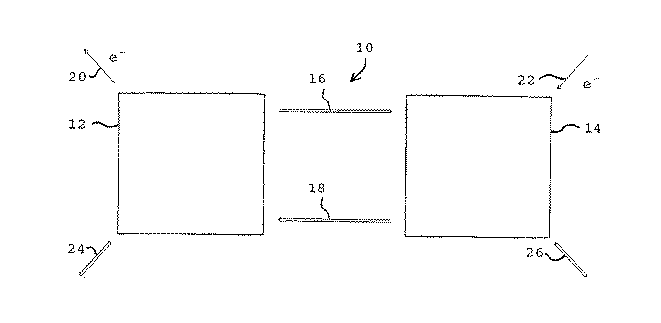
第1図を参照すると、本発明の再生式燃料電池系10は、第一の電気化学電池12と、第二の電気化学電池14とを含んでいる。該第一の電気化学電池12は、米国特許第5,599,638号に記載されたような、液体供給式燃料電池である。この特許を本発明の参考文献とする。この第一の電気化学電池12においては、メチルアルコール、蟻酸、ホルムアルデヒド又は蟻酸メチル等の酸素化された炭化水素を酸化して、二酸化炭素と水とを生成する。該第二の電気化学電池14においては、二酸化炭素を還元して、メチルアルコール、蟻酸、ホルムアルデヒド又は蟻酸メチル等の酸素化された炭化水素を生成する。好ましくは、該第一の電気化学電池12において酸化される該酸素化された炭化水素、及び該第二の電気化学電池14において、該還元反応によって生成される該酸素化される炭化水素は、同一の化合物である。最も好ましくは、該酸素化された炭化水素は、メチルアルコールである。
These transformations can be carried out using supported bifunctional acid-base catalysts as described in US Pat. No. 4,373,109 or on various zeolite catalysts.
Ethylene and propylene produced from carbon dioxide make it possible to easily produce the entire series of aliphatic (including gasoline) and aromatic hydrocarbons, and derivatives thereof.
In another aspect, the present invention relates to a regenerative electrochemical cell or a regenerative fuel cell based on the above-mentioned CO 2 / CH 3 OH electrochemical system (or related oxygenated hydrocarbons as described above). About.
Referring to FIG. 1, the regenerative
該第二の電気化学電池14は、該二酸化炭素の還元を行うように動作し得る、任意の電気化学電池であり得る。好ましくは、該第二の電気化学電池14は、上記'638特許に記載されている、逆方向に進行する液体供給型燃料電池である。
該第一及び第二の電気化学電池12及び14は、矢印16及び18で模式的に示されたように、相互に流体結合関係にある。従って、該第一の電気化学電池12で生成される二酸化炭素及び水は、矢印16によって示されるように、該第二の電気化学電池14に供給される。同様に、該第二の電気化学電池14において生成される、メチルアルコール又は該関連する酸素化された炭化水素及び酸素は、矢印18で示されるように、該第一の電気化学電池12に供給される。
本発明の再生式燃料電池10は、更に該第一の電気化学電池12において、メチルアルコール又は該関連する酸素化された炭化水素の酸化によって生成した、電気エネルギーを回収するための電気出力手段20及び該第二の電気化学電池14における、該二酸化炭素の還元反応を実施する、電気エネルギーを供給するための、電気入力手段22をも含む。このような電気化学的出力手段20及び電気化学的入力手段22は、電気エネルギーを受け取り及び供給するための任意の適当な手段であり得、これらは当分野において周知である。
The second
The first and second
The
本発明の再生式燃料電池系は、また第一及び第二の搬送手段24及び26をも含み、これらによって、必要に応じて化学成分を添加し、かつ除去することができる。従って、例えば該第一の搬送手段24を介して、追加のメチルアルコール及び/又は酸素反応試薬を、必要に応じて該第一の電気化学電池12に添加することができ、あるいは該CO2及び/又はH2O生成物の幾分か又はその全部を除去することができる。同様に、該第二の搬送手段26は、外部の起源からのCO2及び/又は水を添加し、及び/又はメチルアルコール及び/又は酸素生成物を除去することを可能とする。このような搬送手段は、当分野において周知である。
もう一つの局面において、本発明は、本発明の上記再生式電気化学電池系10を使用して、電気エネルギーを化学エネルギーとして貯蔵し、及び化学エネルギーから電気エネルギーを回収する方法にも関連する。エネルギー貯蔵モードにおいては、電気エネルギーを、該第二の電気化学電池14の該電気入力手段22に供給して、該電池反応を逆方向(非−自発的方向)に導いて、メチルアルコール及び/又は関連する酸素化された化合物を生成する。この還元反応の化学的生成物、例えばメチルアルコール及び酸素は、次いで該第一の電気化学電池12に供給される。
The regenerative fuel cell system of the present invention also includes first and second transport means 24 and 26 by which chemical components can be added and removed as needed. Thus, for example, via the first transport means 24, additional methyl alcohol and / or oxygen reactive reagents can be added to the first
In another aspect, the present invention also relates to a method of storing electrical energy as chemical energy and recovering electrical energy from chemical energy using the above regenerative
エネルギー回収モードにおいて、メチルアルコール又は関連する酸素化された炭化水素は、該第一の電気化学電池12において酸化されて、電気を発生し、この反応の生成物、即ち二酸化炭素及び水は、該第二の電気化学電池14に供給される。かくして、この系は、電力の可逆的な貯蔵デバイスとして機能する。電気は、依然としてバッテリー内に効率よく貯蔵することができないので、二酸化炭素の再生により作られたメチルアルコール又はその誘導体によって動作する、再充電可能なデバイスとして効率的に機能する、この再生式電気化学電池の使用は、高効率のクリーンな電力源与えるばかりでなく、同時に有害な温室ガスである二酸化炭素の、大気中での蓄積を減じるのに役立つ。
この貯蔵並びに回収法は何れの方向にも進行し得ることを理解すべきである。該第一の電気化学電池には、有機燃料を供給して、該反応を起こさしめ、電気を発生し、かくして該第二の電気化学電池にCO2及び水を供給することができる。あるいはまた、該第二の電気化学電池に、CO2及び水を供給し、かつ電気エネルギーを供給して、該反応を起こさしめ、かくして該第一の電気化学電池に、(例えば)メチルアルコール及び酸素を供給することができる。
In energy recovery mode, methyl alcohol or related oxygenated hydrocarbons are oxidized in the first
It should be understood that this storage and recovery process can proceed in either direction. The first electrochemical cell can be supplied with organic fuel to cause the reaction to generate electricity, thus supplying CO 2 and water to the second electrochemical cell. Alternatively, the second electrochemical cell is supplied with CO 2 and water and is supplied with electrical energy to cause the reaction, and thus the first electrochemical cell with (for example) methyl alcohol and Oxygen can be supplied.
好ましい態様においては、二酸化炭素を、工業的副産物として回収する。「工業的副産物」なる用語は、例えば発電プラント及びその他の炭化水素−消費源、石灰石の焼成、発酵過程及び二酸化炭素を発生する他の工業的プロセス等の、工業的起源のものを意味する。この回収された二酸化炭素は、該第二の搬送手段26を介して、メチルアルコール又は関連化合物に転化するための、該第二の電気化学電池14に供給される。このようにして生成したメチルアルコールは、該第一の電気化学電池に移し、及び/又は貯蔵又はその他の使用の目的で、外部に回収することができる。本発明の好ましい態様のもう一つの局面においては、該第二の電気化学電池14に供給される該電気エネルギーは、過度の能力をもつ発電プラント由来のオフピーク電力を回収することによって、供給される。
本発明の再生式燃料電池系は、また単一の電気化学電池を含むこともでき、該電池においては、該燃料の酸化(即ち、電力の発生)及び(燃料を得るための)CO2の還元両者は、該電池を前方にあるいはその逆方向に動作させることにより実施できる。
In a preferred embodiment, carbon dioxide is recovered as an industrial byproduct. The term “industrial by-product” refers to those of industrial origin, such as power plants and other hydrocarbon-consumption sources, limestone calcination, fermentation processes and other industrial processes that generate carbon dioxide. This recovered carbon dioxide is supplied to the second
The regenerative fuel cell system of the present invention can also include a single electrochemical cell, in which the oxidation of the fuel (ie, generation of power) and the CO 2 (to obtain fuel). Both reductions can be performed by operating the battery forward or in the opposite direction.
更に別の局面において、本発明は、可逆的に炭化水素と二酸化炭素とを相互転化する方法を包含する。この方法によれば、メチルアルコール又は関連する酸素化化合物、例えば上記のような化合物は、第一のゾーンにおいて二酸化炭素と水とに酸化され、かつ二酸化炭素と水は、第二のゾーンにおいて、メチルアルコール(又は関連する酸素化化合物)及び酸素に還元される。該第一及び第二のゾーンは、該第一のゾーンで生成した該二酸化炭素及び水を該第二のゾーンに供給するように、相互に流体接続関係にあり、また該第二のゾーンで生成する該メチルアルコール及び酸素は、該第一のゾーンに供給される。該第二のゾーンにおける該還元段階は、電気エネルギーを消費するが、該エネルギーは、任意の適当な起源から供給することができるが、発電プラントのオフピーク発電によって供給することが好ましい。
該二酸化炭素の還元は、2つの電子還元段階を含み、該段階は最終的に完全に還元された生成物としてのメタンに導くことができる。これら工程に対する、標準還元電位を以下の第1表に列挙する。
In yet another aspect, the present invention includes a method for reversibly interconverting hydrocarbon and carbon dioxide. According to this method, methyl alcohol or a related oxygenated compound, such as a compound as described above, is oxidized to carbon dioxide and water in the first zone, and carbon dioxide and water are Reduced to methyl alcohol (or related oxygenated compounds) and oxygen. The first and second zones are in fluid communication with each other so as to supply the carbon dioxide and water produced in the first zone to the second zone, and in the second zone The methyl alcohol and oxygen produced are fed to the first zone. The reduction stage in the second zone consumes electrical energy, which can be supplied from any suitable source, but is preferably supplied by off-peak power generation of the power plant.
The reduction of the carbon dioxide involves two electron reduction stages, which can ultimately lead to methane as a fully reduced product. Standard reduction potentials for these steps are listed in Table 1 below.
第1表:標準還元電位
水性溶液中において、二酸化炭素は、まずCO2 -.ラジカルアニオン(その標準還元電位の評価値は、標準カロメル電極(SCE)に対して約−1.89V である)に還元され、これは更に水の存在下で、HCOO.+ HO.に還元され、次いでHCOO-に還元される。種々のCO2還元反応に対する該標準還元電位は小さいが、金属上で観測される大きな過電圧は、恐らく該ラジカルアニオン中間体の形成によるものであると考えられる。二酸化炭素電気触媒の改善は、高い電流効率及び高い電流密度(>100mA/cm2)を維持しつつ、金属上の該過電圧を更に低下するであろう。
本発明の幾つかの態様及び特徴を、以下に例示するが、本発明は以下の実施例によって何等制限されない。
In aqueous solution, carbon dioxide is first CO 2 -. Radical anion (evaluation value of the standard reduction potential, a standard calomel electrode (about -1.89V is against SCE)) is reduced, this is more water in the presence of reduced HCOO + HO in, then HCOO -.. is reduced to. Although the standard reduction potential for various CO 2 reduction reactions is small, the large overvoltage observed on metals is probably due to the formation of the radical anion intermediate. Improvement of the carbon dioxide electrocatalyst will further reduce the overvoltage on the metal while maintaining high current efficiency and high current density (> 100 mA / cm 2 ).
Some aspects and features of the present invention are illustrated below, but the present invention is not limited in any way by the following examples.
CO2の電気化学的還元
CO2の水性電気化学的還元のために、米国特許第5,599,638号に記載された逆燃料電池を使用して、上記水の酸化経路を利用する。この記載された電気化学電池を利用して、炭素上に堆積した多くの金属、例えばSn、In、Bi、Sb、Cd、Zn、Cu、Pb、Ga、Ag、Au、Ni、Fe、Pd、Wo、Pt及びMo上で、CO2を還元する。アノードでの水の酸化は、Pt/C電極上で行う。カソードにおける該金属触媒は、種々の程度まで、CO2を還元して、蟻酸からメタンに及ぶ範囲の生成物を与えるように作用する。銀/炭素電極は、高い選択性でメチルアルコールを与えるのに最も有用である。この系の電池電位は、該カソード及びアノード過電圧における差違及びiR降下に等しく、これは、プラチナ−炭素を含む、酸素発生アノードについて、2ボルト程度の電池電圧を与える。Cu/Pd電極は、SCEに対する−1.6Vなる電位において、70%ファラデー効率で、蟻酸を生成するのに適している。
本明細書に記載し、かつ特許請求している本発明は、本明細書に記載した特定の態様によって、その範囲は制限されない。というのは、これら態様は、本発明の幾つかの局面を例示するためのものに過ぎないからである。如何なる等価な態様も、本発明の範囲内にあるものとする。事実、ここに提示されかつ説明された以外の、本発明の種々の変更は、上記の説明から当業者には明らかであろう。このような変更も、添付された請求の範囲に入るものである。
本特許出願において引用された全ての参考文献は、その全体を本発明の参考として本明細書に組み込む。
Electrochemical reduction of CO 2
For the aqueous electrochemical reduction of CO 2 , the above water oxidation pathway is utilized using the reverse fuel cell described in US Pat. No. 5,599,638. Many metals deposited on carbon using this described electrochemical cell, such as Sn, In, Bi, Sb, Cd, Zn, Cu, Pb, Ga, Ag, Au, Ni, Fe, Pd, Reduce CO 2 over Wo, Pt and Mo. Oxidation of water at the anode takes place on a Pt / C electrode. The metal catalyst at the cathode serves to reduce CO 2 to varying degrees to give products ranging from formic acid to methane. Silver / carbon electrodes are most useful for providing methyl alcohol with high selectivity. The cell potential of this system is equal to the difference in the cathode and anode overvoltage and the iR drop, which gives a cell voltage on the order of 2 volts for an oxygen generating anode containing platinum-carbon. The Cu / Pd electrode is suitable for producing formic acid with 70% Faraday efficiency at a potential of −1.6 V with respect to SCE.
The invention described and claimed herein is not limited in scope by the specific embodiments described herein. This is because these embodiments are merely illustrative of some aspects of the present invention. Any equivalent aspects are intended to be within the scope of this invention. In fact, various modifications of the invention other than those presented and described herein will be apparent to those skilled in the art from the foregoing description. Such modifications are also intended to fall within the scope of the appended claims.
All references cited in this patent application are incorporated herein by reference in their entirety.
10 再生式燃料電池系
12 第一の電気化学電池
14 第二の電気化学電池
20 電気出力手段
22 電気入力手段
24 第一の搬送手段
26 第二の搬送手段
DESCRIPTION OF
Claims (5)
Applications Claiming Priority (4)
| Application Number | Priority Date | Filing Date | Title |
|---|---|---|---|
| US4633597P | 1997-05-07 | 1997-05-07 | |
| US60/046,335 | 1997-05-07 | ||
| US09/072,585 | 1998-05-05 | ||
| US09/072,585 US5928806A (en) | 1997-05-07 | 1998-05-05 | Recycling of carbon dioxide into methyl alcohol and related oxygenates for hydrocarbons |
Related Parent Applications (1)
| Application Number | Title | Priority Date | Filing Date |
|---|---|---|---|
| JP54845898A Division JP4477146B2 (en) | 1997-05-07 | 1998-05-06 | Regeneration of carbon dioxide into methyl alcohol and related oxygenates or hydrocarbons |
Publications (2)
| Publication Number | Publication Date |
|---|---|
| JP2009138270A true JP2009138270A (en) | 2009-06-25 |
| JP5005664B2 JP5005664B2 (en) | 2012-08-22 |
Family
ID=26723797
Family Applications (2)
| Application Number | Title | Priority Date | Filing Date |
|---|---|---|---|
| JP54845898A Expired - Lifetime JP4477146B2 (en) | 1997-05-07 | 1998-05-06 | Regeneration of carbon dioxide into methyl alcohol and related oxygenates or hydrocarbons |
| JP2008308932A Expired - Lifetime JP5005664B2 (en) | 1997-05-07 | 2008-12-03 | Regeneration of carbon dioxide into methyl alcohol and related oxygenates or hydrocarbons |
Family Applications Before (1)
| Application Number | Title | Priority Date | Filing Date |
|---|---|---|---|
| JP54845898A Expired - Lifetime JP4477146B2 (en) | 1997-05-07 | 1998-05-06 | Regeneration of carbon dioxide into methyl alcohol and related oxygenates or hydrocarbons |
Country Status (6)
| Country | Link |
|---|---|
| US (1) | US5928806A (en) |
| EP (1) | EP0980592A4 (en) |
| JP (2) | JP4477146B2 (en) |
| AU (1) | AU7291498A (en) |
| CA (1) | CA2289098A1 (en) |
| WO (1) | WO1998050974A1 (en) |
Cited By (3)
| Publication number | Priority date | Publication date | Assignee | Title |
|---|---|---|---|---|
| JP2015535825A (en) * | 2012-09-19 | 2015-12-17 | リキッド・ライト・インコーポレーテッドLiquid Light Incorporated | An integrated method for producing carboxylic acids from carbon dioxide. |
| KR101832049B1 (en) | 2016-03-11 | 2018-02-26 | 중앙대학교 산학협력단 | The catalyst for reducing carbon dioxide and oxydizing formic acid and preparation therof |
| KR20210036789A (en) * | 2019-09-26 | 2021-04-05 | 한국과학기술원 | Hybrid sodium-carbon dioxide secondary battery capable of obtaining energy storage along with high value-added product by electrochemical carbon dioxide reduction and secondary battery system comprising the same |
Families Citing this family (114)
| Publication number | Priority date | Publication date | Assignee | Title |
|---|---|---|---|---|
| US7668658B2 (en) * | 1999-10-13 | 2010-02-23 | Sequenom, Inc. | Methods for generating databases and databases for identifying polymorphic genetic markers |
| US6331694B1 (en) | 1999-12-08 | 2001-12-18 | Lincoln Global, Inc. | Fuel cell operated welder |
| CN1439032A (en) | 2000-06-02 | 2003-08-27 | Sri国际公司 | Polymer composition |
| US6522955B1 (en) * | 2000-07-28 | 2003-02-18 | Metallic Power, Inc. | System and method for power management |
| US6492048B1 (en) | 2000-08-10 | 2002-12-10 | Siemens Westinghouse Power Corporation | Segregated exhaust fuel cell generator |
| US6610434B1 (en) | 2000-08-10 | 2003-08-26 | Siemens Westinghouse Power Corporation | Segregated exhaust SOFC generator with high fuel utilization capability |
| US6572996B1 (en) | 2000-08-10 | 2003-06-03 | Siemens Westinghouse Power Corporation | Electrochemical fuel depletion means for fuel cell generators |
| US7316855B2 (en) | 2001-06-01 | 2008-01-08 | Polyfuel, Inc. | Fuel cell assembly for portable electronic device and interface, control, and regulator circuit for fuel cell powered electronic device |
| WO2002099916A2 (en) | 2001-06-01 | 2002-12-12 | Polyfuel, Inc | Fuel cell assembly for portable electronic device and interface, control, and regulator circuit for fuel cell powered electronic device |
| WO2006113294A1 (en) * | 2005-04-15 | 2006-10-26 | University Of Southern California | Selective oxidative conversion of methane to methanol, dimethyl ether and derived products |
| KR101495085B1 (en) * | 2005-04-15 | 2015-02-24 | 유니버시티 오브 써던 캘리포니아 | Efficient selective conversion of carbon dioxide to methanol, dimethyl ether and derived products |
| US7608743B2 (en) * | 2005-04-15 | 2009-10-27 | University Of Southern California | Efficient and selective chemical recycling of carbon dioxide to methanol, dimethyl ether and derived products |
| US9180423B2 (en) | 2005-04-19 | 2015-11-10 | SDCmaterials, Inc. | Highly turbulent quench chamber |
| SE531126C2 (en) * | 2005-10-14 | 2008-12-23 | Morphic Technologies Ab Publ | Method and system for production, conversion and storage of energy |
| GB0615731D0 (en) * | 2006-08-08 | 2006-09-20 | Itm Fuel Cells Ltd | Fuel synthesis |
| US7378561B2 (en) * | 2006-08-10 | 2008-05-27 | University Of Southern California | Method for producing methanol, dimethyl ether, derived synthetic hydrocarbons and their products from carbon dioxide and water (moisture) of the air as sole source material |
| US7795175B2 (en) * | 2006-08-10 | 2010-09-14 | University Of Southern California | Nano-structure supported solid regenerative polyamine and polyamine polyol absorbents for the separation of carbon dioxide from gas mixtures including the air |
| WO2008047956A1 (en) * | 2006-10-18 | 2008-04-24 | Baretec Co., Ltd. | Recycling method of waste battery |
| KR20100031500A (en) * | 2007-05-04 | 2010-03-22 | 프린시플 에너지 솔루션스, 인코포레이티드 | Production of hydrocarbons from carbon and hydrogen sources |
| US8163066B2 (en) | 2007-05-21 | 2012-04-24 | Peter Eisenberger | Carbon dioxide capture/regeneration structures and techniques |
| US20140130670A1 (en) | 2012-11-14 | 2014-05-15 | Peter Eisenberger | System and method for removing carbon dioxide from an atmosphere and global thermostat using the same |
| US8500857B2 (en) | 2007-05-21 | 2013-08-06 | Peter Eisenberger | Carbon dioxide capture/regeneration method using gas mixture |
| US20080289495A1 (en) | 2007-05-21 | 2008-11-27 | Peter Eisenberger | System and Method for Removing Carbon Dioxide From an Atmosphere and Global Thermostat Using the Same |
| CA2690980C (en) * | 2007-07-13 | 2015-06-16 | University Of Southern California | Electrolysis of carbon dioxide in aqueous media to carbon monoxide and hydrogen for production of methanol |
| US8138380B2 (en) * | 2007-07-13 | 2012-03-20 | University Of Southern California | Electrolysis of carbon dioxide in aqueous media to carbon monoxide and hydrogen for production of methanol |
| US8481449B1 (en) | 2007-10-15 | 2013-07-09 | SDCmaterials, Inc. | Method and system for forming plug and play oxide catalysts |
| KR20110033110A (en) * | 2008-05-16 | 2011-03-30 | 유니버시티 오브 써던 캘리포니아 | How to alleviate or eliminate the carbon footprint of human activity |
| WO2009158085A2 (en) * | 2008-06-26 | 2009-12-30 | University Of Southern California | Stockpiling methanol and/or dimethyl ether for fuel and energy reserves |
| AU2009274316A1 (en) * | 2008-07-24 | 2010-01-28 | University Of Southern California | Producing methanol and its products exclusively from geothermal sources and their energy |
| EP2175518A1 (en) | 2008-10-07 | 2010-04-14 | Koninklijke Philips Electronics N.V. | A rechargeable fuel cell system and a method for recharging a rechargeable fuel cell system |
| US8948513B2 (en) * | 2009-01-27 | 2015-02-03 | Apple Inc. | Blurring based content recognizer |
| CA2749136A1 (en) | 2009-01-29 | 2010-08-05 | Princeton University | Conversion of carbon dioxide to organic products |
| BRPI0902650A2 (en) * | 2009-07-23 | 2011-04-12 | Wellington Saad Larcipretti | photochemical process for the generation of electricity from solar energy using formic aldehyde (ch2o) as an active component |
| US9149797B2 (en) | 2009-12-15 | 2015-10-06 | SDCmaterials, Inc. | Catalyst production method and system |
| US8557727B2 (en) | 2009-12-15 | 2013-10-15 | SDCmaterials, Inc. | Method of forming a catalyst with inhibited mobility of nano-active material |
| US8803025B2 (en) | 2009-12-15 | 2014-08-12 | SDCmaterials, Inc. | Non-plugging D.C. plasma gun |
| US9126191B2 (en) | 2009-12-15 | 2015-09-08 | SDCmaterials, Inc. | Advanced catalysts for automotive applications |
| US8652992B2 (en) | 2009-12-15 | 2014-02-18 | SDCmaterials, Inc. | Pinning and affixing nano-active material |
| US9039916B1 (en) | 2009-12-15 | 2015-05-26 | SDCmaterials, Inc. | In situ oxide removal, dispersal and drying for copper copper-oxide |
| US8721866B2 (en) * | 2010-03-19 | 2014-05-13 | Liquid Light, Inc. | Electrochemical production of synthesis gas from carbon dioxide |
| US8845877B2 (en) | 2010-03-19 | 2014-09-30 | Liquid Light, Inc. | Heterocycle catalyzed electrochemical process |
| US8500987B2 (en) * | 2010-03-19 | 2013-08-06 | Liquid Light, Inc. | Purification of carbon dioxide from a mixture of gases |
| CN101841051A (en) * | 2010-03-24 | 2010-09-22 | 苏州大学 | New CO2-based energy storage method and device |
| US9193593B2 (en) | 2010-03-26 | 2015-11-24 | Dioxide Materials, Inc. | Hydrogenation of formic acid to formaldehyde |
| US9012345B2 (en) | 2010-03-26 | 2015-04-21 | Dioxide Materials, Inc. | Electrocatalysts for carbon dioxide conversion |
| US9790161B2 (en) | 2010-03-26 | 2017-10-17 | Dioxide Materials, Inc | Process for the sustainable production of acrylic acid |
| US10173169B2 (en) | 2010-03-26 | 2019-01-08 | Dioxide Materials, Inc | Devices for electrocatalytic conversion of carbon dioxide |
| WO2016064440A1 (en) | 2014-10-21 | 2016-04-28 | Dioxide Materials | Electrolyzer and membranes |
| US20110237830A1 (en) | 2010-03-26 | 2011-09-29 | Dioxide Materials Inc | Novel catalyst mixtures |
| US20130015064A1 (en) | 2011-06-29 | 2013-01-17 | Masel Richard I | Sensors For Carbon Dioxide And Other End Uses |
| US8956990B2 (en) | 2010-03-26 | 2015-02-17 | Dioxide Materials, Inc. | Catalyst mixtures |
| US9815021B2 (en) | 2010-03-26 | 2017-11-14 | Dioxide Materials, Inc. | Electrocatalytic process for carbon dioxide conversion |
| US9957624B2 (en) | 2010-03-26 | 2018-05-01 | Dioxide Materials, Inc. | Electrochemical devices comprising novel catalyst mixtures |
| US9566574B2 (en) | 2010-07-04 | 2017-02-14 | Dioxide Materials, Inc. | Catalyst mixtures |
| US9028592B2 (en) | 2010-04-30 | 2015-05-12 | Peter Eisenberger | System and method for carbon dioxide capture and sequestration from relatively high concentration CO2 mixtures |
| PL2563495T3 (en) | 2010-04-30 | 2020-05-18 | Peter Eisenberger | Method for carbon dioxide capture |
| US8524066B2 (en) | 2010-07-29 | 2013-09-03 | Liquid Light, Inc. | Electrochemical production of urea from NOx and carbon dioxide |
| US20140021060A1 (en) * | 2010-07-29 | 2014-01-23 | Liquid Light, Inc. | Heterocycle Catalyzed Electrochemical Process |
| US8845878B2 (en) | 2010-07-29 | 2014-09-30 | Liquid Light, Inc. | Reducing carbon dioxide to products |
| CA3048781C (en) | 2010-09-24 | 2020-10-20 | Dnv Gl As | Method and apparatus for the electrochemical reduction of carbon dioxide |
| AU2011312682B2 (en) | 2010-10-04 | 2015-09-17 | University Of Southern California | Recycling carbon dioxide via capture and temporary storage to produce renewable fuels and derived products |
| US8568581B2 (en) | 2010-11-30 | 2013-10-29 | Liquid Light, Inc. | Heterocycle catalyzed carbonylation and hydroformylation with carbon dioxide |
| US8961774B2 (en) | 2010-11-30 | 2015-02-24 | Liquid Light, Inc. | Electrochemical production of butanol from carbon dioxide and water |
| US9090976B2 (en) | 2010-12-30 | 2015-07-28 | The Trustees Of Princeton University | Advanced aromatic amine heterocyclic catalysts for carbon dioxide reduction |
| US8669202B2 (en) | 2011-02-23 | 2014-03-11 | SDCmaterials, Inc. | Wet chemical and plasma methods of forming stable PtPd catalysts |
| US8562811B2 (en) | 2011-03-09 | 2013-10-22 | Liquid Light, Inc. | Process for making formic acid |
| KR20140050037A (en) | 2011-07-06 | 2014-04-28 | 리퀴드 라이트 인코포레이티드 | Carbon dioxide capture and conversion to organic products |
| JP2014518335A (en) | 2011-07-06 | 2014-07-28 | リキッド・ライト・インコーポレーテッド | Reduction of carbon dioxide to carboxylic acids, glycols, and carboxylates |
| US9662608B2 (en) * | 2011-08-08 | 2017-05-30 | The Trustees Of Columbia University In The City Of New York | Methods and systems for capturing carbon dioxide and producing a fuel using a solvent including a nanoparticle organic hybrid material and a secondary fluid |
| AU2012299065B2 (en) | 2011-08-19 | 2015-06-04 | SDCmaterials, Inc. | Coated substrates for use in catalysis and catalytic converters and methods of coating substrates with washcoat compositions |
| US20130095999A1 (en) | 2011-10-13 | 2013-04-18 | Georgia Tech Research Corporation | Methods of making the supported polyamines and structures including supported polyamines |
| US20130109888A1 (en) * | 2011-10-31 | 2013-05-02 | Korea Institute Of Science And Technology | Dme-fpso system for conversion of associated gas in oil fields and stranded gas in stranded gas fields, and process for production of dimethyl ether using the same |
| US9302247B2 (en) | 2012-04-28 | 2016-04-05 | Aspen Aerogels, Inc. | Aerogel sorbents |
| US8444844B1 (en) | 2012-07-26 | 2013-05-21 | Liquid Light, Inc. | Electrochemical co-production of a glycol and an alkene employing recycled halide |
| US8641885B2 (en) | 2012-07-26 | 2014-02-04 | Liquid Light, Inc. | Multiphase electrochemical reduction of CO2 |
| US20130105304A1 (en) | 2012-07-26 | 2013-05-02 | Liquid Light, Inc. | System and High Surface Area Electrodes for the Electrochemical Reduction of Carbon Dioxide |
| US9267212B2 (en) | 2012-07-26 | 2016-02-23 | Liquid Light, Inc. | Method and system for production of oxalic acid and oxalic acid reduction products |
| US10329676B2 (en) * | 2012-07-26 | 2019-06-25 | Avantium Knowledge Centre B.V. | Method and system for electrochemical reduction of carbon dioxide employing a gas diffusion electrode |
| US9175407B2 (en) | 2012-07-26 | 2015-11-03 | Liquid Light, Inc. | Integrated process for producing carboxylic acids from carbon dioxide |
| CA2883127C (en) * | 2012-09-14 | 2021-04-27 | Liquid Light, Inc. | Process and high surface area electrodes for the electrochemical reduction of carbon dioxide |
| CN104822861B (en) | 2012-09-24 | 2017-03-08 | 二氧化碳材料公司 | For carbon dioxide conversion is usable fuel and the apparatus and method of chemicals |
| US11059024B2 (en) | 2012-10-25 | 2021-07-13 | Georgia Tech Research Corporation | Supported poly(allyl)amine and derivatives for CO2 capture from flue gas or ultra-dilute gas streams such as ambient air or admixtures thereof |
| US9156025B2 (en) | 2012-11-21 | 2015-10-13 | SDCmaterials, Inc. | Three-way catalytic converter using nanoparticles |
| US9511352B2 (en) | 2012-11-21 | 2016-12-06 | SDCmaterials, Inc. | Three-way catalytic converter using nanoparticles |
| US10647652B2 (en) | 2013-02-24 | 2020-05-12 | Dioxide Materials, Inc. | Process for the sustainable production of acrylic acid |
| WO2015013545A1 (en) | 2013-07-25 | 2015-01-29 | SDCmaterials, Inc. | Washcoats and coated substrates for catalytic converters |
| EP3046172B1 (en) * | 2013-09-12 | 2021-06-02 | Japan Aerospace Exploration Agency | Solid polymer power generation method and system |
| JP6273601B2 (en) * | 2013-09-12 | 2018-02-07 | 国立研究開発法人宇宙航空研究開発機構 | Solid polymer power generation method and system. |
| JP6260952B2 (en) * | 2013-09-12 | 2018-01-17 | 国立研究開発法人宇宙航空研究開発機構 | Solid polymer electrolysis method and system. |
| US20150087041A1 (en) * | 2013-09-26 | 2015-03-26 | E I Du Pont De Nemours And Company | Production of ethanol with reduced contaminants in a cellulosic biomass based process |
| EP3060335A4 (en) | 2013-10-22 | 2017-07-19 | SDCMaterials, Inc. | Catalyst design for heavy-duty diesel combustion engines |
| EP3068517A4 (en) | 2013-10-22 | 2017-07-05 | SDCMaterials, Inc. | Compositions of lean nox trap |
| WO2015103401A1 (en) | 2013-12-31 | 2015-07-09 | Eisenberger, Peter And Chichilnisky, Graciela, Jointly | Rotating multi-monolith bed movement system for removing co2 from the atmosphere |
| JP6397502B2 (en) | 2014-01-31 | 2018-09-26 | フュエルセル エナジー, インコーポレイテッドFuelcell Energy, Inc. | Reformer / electrolyzer / refiner (REP) assembly for hydrogen production, system incorporating the assembly, and hydrogen production method |
| CN106470752A (en) | 2014-03-21 | 2017-03-01 | Sdc材料公司 | Compositions for passive NOx adsorption (PNA) systems |
| US10774431B2 (en) | 2014-10-21 | 2020-09-15 | Dioxide Materials, Inc. | Ion-conducting membranes |
| KR101926780B1 (en) * | 2014-12-30 | 2018-12-13 | 서강대학교산학협력단 | Intermittent electrochemical reduction system of carbon dioxide |
| US10975480B2 (en) | 2015-02-03 | 2021-04-13 | Dioxide Materials, Inc. | Electrocatalytic process for carbon dioxide conversion |
| PL3320576T3 (en) * | 2015-07-08 | 2022-05-02 | Agora Energy Technologies Ltd. | Redox flow battery with carbon dioxide based redox couple |
| WO2017087360A1 (en) * | 2015-11-17 | 2017-05-26 | Fuelcell Energy, Inc. | Fuel cell system having enhanced co 2 capture |
| US9963411B2 (en) | 2015-12-02 | 2018-05-08 | King Abdullah University Of Science And Technology | Utilization and recycling of emitted carbon dioxide |
| WO2017176600A1 (en) | 2016-04-04 | 2017-10-12 | Dioxide Materials, Inc. | Electrocatalytic process for carbon dioxide conversion |
| WO2017176599A1 (en) | 2016-04-04 | 2017-10-12 | Dioxide Materials, Inc. | Ion-conducting membranes |
| KR102291918B1 (en) | 2016-04-04 | 2021-08-23 | 디옥시드 머티리얼즈, 인크. | Catalyst bed and electrolyzer |
| JP6717015B2 (en) * | 2016-04-11 | 2020-07-01 | 三浦工業株式会社 | Hybrid fuel cell system |
| CA3021733C (en) | 2016-04-21 | 2020-12-29 | Fuelcell Energy, Inc. | Fluidized catalytic cracking unit system with integrated reformer-electrolyzer-purifier |
| JP2018153735A (en) * | 2017-03-16 | 2018-10-04 | 株式会社東芝 | Chemical reaction system |
| WO2019023532A1 (en) * | 2017-07-28 | 2019-01-31 | Board Of Trustees Of Michigan State University | Electrochemical reductive carboxylation of unsaturated organic substrates in ionically conductive mediums |
| US10897055B2 (en) | 2017-11-16 | 2021-01-19 | Fuelcell Energy, Inc. | Load following power generation and power storage using REP and PEM technology |
| US11495806B2 (en) | 2019-02-04 | 2022-11-08 | Fuelcell Energy, Inc. | Ultra high efficiency fuel cell power generation system |
| CN113594525A (en) * | 2020-05-02 | 2021-11-02 | 顾士平 | Energy storage, carbon sequestration and new energy recycling |
| KR20230010203A (en) | 2020-05-14 | 2023-01-18 | 닛토덴코 가부시키가이샤 | Carbon Dioxide Capture Treatment System and CO2 Negative Emission Plant |
| JP2025518138A (en) | 2022-05-27 | 2025-06-12 | ゼロ カーボン システムズ インコーポレイテッド | High Throughput Moving Panel Direct Air Capture System |
| CN116914207B (en) * | 2023-08-10 | 2025-11-11 | 安徽海螺洁能科技有限公司 | Vanadium-based energy storage medium-fuel cell coupling method |
Citations (5)
| Publication number | Priority date | Publication date | Assignee | Title |
|---|---|---|---|---|
| JPS62120489A (en) * | 1985-11-18 | 1987-06-01 | Kotaro Ogura | Indirect electrochemical reduction of carbon dioxide at ordinary temperature and pressure |
| JPH03101628A (en) * | 1989-09-14 | 1991-04-26 | Showa Shell Sekiyu Kk | Synthesis of lower olefin from methanol |
| JPH03111587A (en) * | 1989-03-31 | 1991-05-13 | United Technol Corp <Utc> | Electrolytic bath for reduction of carbon dioxide |
| JPH0558917A (en) * | 1991-08-30 | 1993-03-09 | Satoyuki Inui | Synthesis of lower olefins from methanol |
| JPH06116771A (en) * | 1992-10-01 | 1994-04-26 | Chubu Electric Power Co Inc | Method for producing ethanol |
Family Cites Families (21)
| Publication number | Priority date | Publication date | Assignee | Title |
|---|---|---|---|---|
| DE1255231B (en) * | 1956-12-08 | 1967-11-30 | Bayer Ag | Method of filling leather |
| US3113049A (en) * | 1961-01-03 | 1963-12-03 | Exxon Research Engineering Co | Direct production of electrical energy from liquid fuels |
| US3427235A (en) * | 1965-01-15 | 1969-02-11 | Pullman Inc | Electrolytic production of olefine oxides |
| US3839091A (en) * | 1970-07-02 | 1974-10-01 | United Aircraft Corp | Regenerative fuel cell |
| US3959094A (en) * | 1975-03-13 | 1976-05-25 | The United States Of America As Represented By The United States Energy Research And Development Administration | Electrolytic synthesis of methanol from CO2 |
| JPS54154048A (en) * | 1978-05-26 | 1979-12-04 | Hitachi Ltd | Disolving fuel battery |
| JPS5768142A (en) * | 1980-10-14 | 1982-04-26 | Hitachi Ltd | Electrode catalyst for fuel cell and its production |
| US4390603A (en) * | 1981-06-30 | 1983-06-28 | Hitachi, Ltd. | Methanol fuel cell |
| US4612261A (en) * | 1981-08-21 | 1986-09-16 | Hitachi, Ltd. | Fuel cell battery using acidic electrolyte |
| EP0081982B1 (en) * | 1981-12-11 | 1985-05-29 | The British Petroleum Company p.l.c. | Electrochemical organic synthesis |
| JPS58165266A (en) * | 1982-03-26 | 1983-09-30 | Hitachi Ltd | Fuel cell |
| JPS5923473A (en) * | 1982-07-30 | 1984-02-06 | Hitachi Ltd | Fuel cells and electrolyte structures for fuel cells |
| US4657829A (en) * | 1982-12-27 | 1987-04-14 | United Technologies Corporation | Fuel cell power supply with oxidant and fuel gas switching |
| JPS6062064A (en) * | 1983-09-14 | 1985-04-10 | Hitachi Ltd | liquid fuel cell |
| EP0181569B1 (en) * | 1984-10-31 | 1991-05-02 | Hitachi, Ltd. | Liquid fuel cell |
| US4673473A (en) * | 1985-06-06 | 1987-06-16 | Peter G. Pa Ang | Means and method for reducing carbon dioxide to a product |
| US4609441A (en) * | 1985-12-18 | 1986-09-02 | Gas Research Institute | Electrochemical reduction of aqueous carbon dioxide to methanol |
| US5306577A (en) * | 1992-07-15 | 1994-04-26 | Rockwell International Corporation | Regenerative fuel cell system |
| US5342702A (en) * | 1993-01-05 | 1994-08-30 | Integrated Energy Development Corp. | Synergistic process for the production of carbon dioxide using a cogeneration reactor |
| US5599638A (en) * | 1993-10-12 | 1997-02-04 | California Institute Of Technology | Aqueous liquid feed organic fuel cell using solid polymer electrolyte membrane |
| US5492777A (en) * | 1995-01-25 | 1996-02-20 | Westinghouse Electric Corporation | Electrochemical energy conversion and storage system |
-
1998
- 1998-05-05 US US09/072,585 patent/US5928806A/en not_active Expired - Lifetime
- 1998-05-06 CA CA002289098A patent/CA2289098A1/en not_active Abandoned
- 1998-05-06 AU AU72914/98A patent/AU7291498A/en not_active Abandoned
- 1998-05-06 EP EP98920309A patent/EP0980592A4/en not_active Withdrawn
- 1998-05-06 JP JP54845898A patent/JP4477146B2/en not_active Expired - Lifetime
- 1998-05-06 WO PCT/US1998/009262 patent/WO1998050974A1/en not_active Ceased
-
2008
- 2008-12-03 JP JP2008308932A patent/JP5005664B2/en not_active Expired - Lifetime
Patent Citations (5)
| Publication number | Priority date | Publication date | Assignee | Title |
|---|---|---|---|---|
| JPS62120489A (en) * | 1985-11-18 | 1987-06-01 | Kotaro Ogura | Indirect electrochemical reduction of carbon dioxide at ordinary temperature and pressure |
| JPH03111587A (en) * | 1989-03-31 | 1991-05-13 | United Technol Corp <Utc> | Electrolytic bath for reduction of carbon dioxide |
| JPH03101628A (en) * | 1989-09-14 | 1991-04-26 | Showa Shell Sekiyu Kk | Synthesis of lower olefin from methanol |
| JPH0558917A (en) * | 1991-08-30 | 1993-03-09 | Satoyuki Inui | Synthesis of lower olefins from methanol |
| JPH06116771A (en) * | 1992-10-01 | 1994-04-26 | Chubu Electric Power Co Inc | Method for producing ethanol |
Cited By (4)
| Publication number | Priority date | Publication date | Assignee | Title |
|---|---|---|---|---|
| JP2015535825A (en) * | 2012-09-19 | 2015-12-17 | リキッド・ライト・インコーポレーテッドLiquid Light Incorporated | An integrated method for producing carboxylic acids from carbon dioxide. |
| KR101832049B1 (en) | 2016-03-11 | 2018-02-26 | 중앙대학교 산학협력단 | The catalyst for reducing carbon dioxide and oxydizing formic acid and preparation therof |
| KR20210036789A (en) * | 2019-09-26 | 2021-04-05 | 한국과학기술원 | Hybrid sodium-carbon dioxide secondary battery capable of obtaining energy storage along with high value-added product by electrochemical carbon dioxide reduction and secondary battery system comprising the same |
| KR102319109B1 (en) | 2019-09-26 | 2021-10-29 | 한국과학기술원 | Hybrid sodium-carbon dioxide secondary battery capable of obtaining energy storage along with high value-added product by electrochemical carbon dioxide reduction and secondary battery system comprising the same |
Also Published As
| Publication number | Publication date |
|---|---|
| JP5005664B2 (en) | 2012-08-22 |
| EP0980592A1 (en) | 2000-02-23 |
| AU7291498A (en) | 1998-11-27 |
| JP2001524257A (en) | 2001-11-27 |
| CA2289098A1 (en) | 1998-11-12 |
| JP4477146B2 (en) | 2010-06-09 |
| EP0980592A4 (en) | 2001-05-02 |
| US5928806A (en) | 1999-07-27 |
| WO1998050974A1 (en) | 1998-11-12 |
Similar Documents
| Publication | Publication Date | Title |
|---|---|---|
| JP5005664B2 (en) | Regeneration of carbon dioxide into methyl alcohol and related oxygenates or hydrocarbons | |
| US8961774B2 (en) | Electrochemical production of butanol from carbon dioxide and water | |
| JP7297710B2 (en) | carbon dioxide reactor | |
| US8568581B2 (en) | Heterocycle catalyzed carbonylation and hydroformylation with carbon dioxide | |
| Chery et al. | Overview on CO2 valorization: challenge of molten carbonates | |
| US9090976B2 (en) | Advanced aromatic amine heterocyclic catalysts for carbon dioxide reduction | |
| Xie et al. | Advanced systems for enhanced CO 2 electroreduction | |
| Ren et al. | Continuous production of ethylene from carbon dioxide and water using intermittent sunlight | |
| JPS6122036B2 (en) | ||
| Irabien et al. | Electrochemical conversion of CO2 to value-added products | |
| JP2010533784A5 (en) | ||
| WO2008151060A1 (en) | Use of photoelectrochemical water splitting to generate materials for sequestering carbon dioxide | |
| KR101764797B1 (en) | Flow cell reactor apparatus for converting carbon dioxide into syngas | |
| US12104263B2 (en) | Methods and systems for producing carbon-neutral fuels from aragonite | |
| Xi et al. | Advancing photoelectrochemical systems for sustainable energy and chemical production: challenges and opportunities | |
| JP7686591B2 (en) | Carbon Dioxide Electrolysis Device | |
| Ruth et al. | An overview of photoelectrochemical cells (PEC): Mimicking nature to produce hydrogen for fuel cells | |
| Isa et al. | Perspective Chapter: Beyond the Beaker–The Reality of Splitting Water into a Sustainable Energy Source | |
| Olah et al. | Recycling of Carbon Dioxide Into Methyl Alcohol and Related Oxygenates for Hydrocarbons | |
| US20170137950A1 (en) | Electrochemical production of hydrogen with dye-sensitized solar cell-based anode | |
| Beschkov et al. | Carbon Dioxide Recycling for Fuels and Chemical Products | |
| Mohamed et al. | Role of Microorganisms in Bioelectrochemical Systems for Hydrogen and Bioelectricity Production | |
| RU2410324C2 (en) | System of energy production | |
| Isa et al. | Perspective Chapter: Beyond the Beaker–The Reality of Splitting Water into a Sustainable Energy | |
| Ko | Electrochemical conversion of carbon dioxide to alcohols |
Legal Events
| Date | Code | Title | Description |
|---|---|---|---|
| A131 | Notification of reasons for refusal |
Free format text: JAPANESE INTERMEDIATE CODE: A131 Effective date: 20110602 |
|
| A601 | Written request for extension of time |
Free format text: JAPANESE INTERMEDIATE CODE: A601 Effective date: 20110902 |
|
| A602 | Written permission of extension of time |
Free format text: JAPANESE INTERMEDIATE CODE: A602 Effective date: 20110907 |
|
| A521 | Request for written amendment filed |
Free format text: JAPANESE INTERMEDIATE CODE: A523 Effective date: 20111202 |
|
| A131 | Notification of reasons for refusal |
Free format text: JAPANESE INTERMEDIATE CODE: A131 Effective date: 20120315 |
|
| A521 | Request for written amendment filed |
Free format text: JAPANESE INTERMEDIATE CODE: A523 Effective date: 20120413 |
|
| TRDD | Decision of grant or rejection written | ||
| A01 | Written decision to grant a patent or to grant a registration (utility model) |
Free format text: JAPANESE INTERMEDIATE CODE: A01 Effective date: 20120517 |
|
| A01 | Written decision to grant a patent or to grant a registration (utility model) |
Free format text: JAPANESE INTERMEDIATE CODE: A01 |
|
| A61 | First payment of annual fees (during grant procedure) |
Free format text: JAPANESE INTERMEDIATE CODE: A61 Effective date: 20120523 |
|
| FPAY | Renewal fee payment (event date is renewal date of database) |
Free format text: PAYMENT UNTIL: 20150601 Year of fee payment: 3 |
|
| R150 | Certificate of patent or registration of utility model |
Free format text: JAPANESE INTERMEDIATE CODE: R150 |
|
| R250 | Receipt of annual fees |
Free format text: JAPANESE INTERMEDIATE CODE: R250 |
|
| R250 | Receipt of annual fees |
Free format text: JAPANESE INTERMEDIATE CODE: R250 |
|
| R250 | Receipt of annual fees |
Free format text: JAPANESE INTERMEDIATE CODE: R250 |
|
| EXPY | Cancellation because of completion of term |