JP2004358495A - Jig for cold drawing and lubricating oil composition used therefor - Google Patents
Jig for cold drawing and lubricating oil composition used therefor Download PDFInfo
- Publication number
- JP2004358495A JP2004358495A JP2003158007A JP2003158007A JP2004358495A JP 2004358495 A JP2004358495 A JP 2004358495A JP 2003158007 A JP2003158007 A JP 2003158007A JP 2003158007 A JP2003158007 A JP 2003158007A JP 2004358495 A JP2004358495 A JP 2004358495A
- Authority
- JP
- Japan
- Prior art keywords
- group
- jig
- lubricating oil
- cold drawing
- oil composition
- Prior art date
- Legal status (The legal status is an assumption and is not a legal conclusion. Google has not performed a legal analysis and makes no representation as to the accuracy of the status listed.)
- Pending
Links
- 0 CC(*)(CCC(N1**)=O)C1=O Chemical compound CC(*)(CCC(N1**)=O)C1=O 0.000 description 1
Images

Landscapes
- Metal Extraction Processes (AREA)
- Lubricants (AREA)
Abstract
【課題】接触部の摩擦係数が低く、加工用治具自体の耐久性、特に耐摩耗性に優れ、押出し成形加工時にアルミニウムやアルミニウム合金が加工治具に焼き付いたり、製品表面が荒れる等の問題が発生しない冷間引抜き加工用治具、冷間引抜き加工方法及びこれに用いる潤滑油組成物を提供すること。
【解決手段】アルミニウム合金の冷間引抜き加工に用い、DLC材料を膜厚0.2〜2μmで被覆し、仕上げ面粗度がRa0.2μm以下である冷間引抜き加工用治具である。
冷間引抜き加工するに当たり、潤滑油組成物を注油して成形加工する。
冷間引抜き加工用治具に注油され、脂肪酸エステル系無灰摩擦調整剤及び/又は脂肪族アミン系無灰摩擦調整剤を組成物全量基準で0.05〜3.0%含有し、これらが炭素数6〜30の炭化水素基を含有している潤滑油組成物である。
【選択図】 なしAn object of the present invention is to reduce the coefficient of friction of a contact portion, to excel in the durability of a processing jig itself, particularly excellent abrasion resistance, and to seize aluminum or an aluminum alloy on the processing jig during extrusion molding, or to roughen the product surface. Provided are a cold drawing jig, a cold drawing method, and a lubricating oil composition used for the jig, which does not cause cracking.
A jig for cold drawing which is used for cold drawing of an aluminum alloy, is coated with a DLC material in a thickness of 0.2 to 2 μm, and has a finished surface roughness of Ra 0.2 μm or less.
In cold drawing, the lubricating oil composition is lubricated and molded.
The jig for cold drawing is lubricated and contains 0.05 to 3.0% of fatty acid ester-based ashless friction modifier and / or aliphatic amine-based ashless friction modifier based on the total amount of the composition. It is a lubricating oil composition containing a hydrocarbon group having 6 to 30 carbon atoms.
[Selection diagram] None
Description
【0001】
【発明の属する技術分野】
本発明は、冷間引抜き加工用治具、冷間引抜き加工方法及びこれに用いる潤滑油組成物に係り、更に詳細には、特定の潤滑油存在下において極めて優れた低摩擦特性を示すダイヤモンドライクカーボン(以下、「DLC」と称する)材料を被覆した冷間引抜き加工用治具、冷間引抜き加工方法及びこれに用いる潤滑油組成物に関する。
【0002】
【従来の技術】
従来、アルミニウム合金等の軟質金属の成型加工には、金属の塑性変形を利用した圧延加工、しごき加工、絞り加工及び曲げ加工等の加工方法が用いられている。これらの加工は、加工用治具を被加工金属表面と点接触、線接触又は面接触させて、被加工物である金属表面に応力を付与した状態で行われる。また、場合によっては、摺動しながら加工治具に当接して、被加工物を塑性変形させながら所定の成形加工が行われる。
このような加工には、例えば冷間加工用のマンドレル、ダイス及びポンチ等の加工用治具が利用されている(例えば特許文献1)。
【0003】
【特許文献1】
特開平6−218425号公報
【0004】
ここで、冷間加工に利用される治具は、被加工物である金属表面に応力を付与した状態又は摺動しながら被加工物を塑性変形させるため、接触部での摩擦係数が低いこと、及び加工用の治具自体の耐久性、特に耐摩耗性に優れることが要求される。
このため、従来から、摺動特性を向上させて塑性加工性を挙げる手段としては、鉄系の治具に焼き入れを行ったり、また窒化処理を行い治具の耐摩耗性を向上させることが一般的に行われている。
【0005】
しかし、このような鉄系の治具を用いた場合には、工具表面においてアルミニウム等の軟質金属が焼き付いたり、また被加工物の表面が荒れるなどの問題点があった。なお、この対応策として、固体潤滑剤又は液体潤滑剤を用いることが考えられるが、潤滑油そのものの耐久性に問題があり、十分ではなかった。
【0006】
本発明は、このような従来技術の有する課題に鑑みてなされたものであり、その目的とするところは、接触部の摩擦係数が低く、加工用治具自体の耐久性、特に耐摩耗性に優れ、押出し成形加工時にアルミニウムやアルミニウム合金が加工治具に焼き付いたり、製品表面が荒れる等の問題が発生しない冷間引抜き加工用治具、冷間引抜き加工方法及びこれに用いる潤滑油組成物を提供することにある。
【0007】
【課題を解決するための手段】
本発明者らは、上記課題を解決すべく鋭意研究を重ねた結果、摺動部にダイヤモンドライクカーボン材料を所定の厚さで被覆すること、及び摺動部に所定の潤滑油組成物を注油することにより、上記課題が解決できることを見出し、本発明を完成するに至った。
【0008】
【発明の実施の形態】
以下、本発明の冷間引抜き加工用治具について、詳細に説明する。なお、本明細書において「%」は、特記しない限り質量百分率を示すものとする。
【0009】
上述の如く、本発明の冷間引抜き加工用治具は、鉄基材料などにダイヤモンドライクカーボン(以下「DLC」という。)材料を被覆して成り、アルミニウム合金の冷間引抜き加工に用いられる。代表的には、マンドレル、ダイス及びポンチ等が例示できる。
また、上記DLC材料は、少なくとも当該治具の絞り部(入り口傾斜部)に被覆され、その膜厚を0.2〜2μm、仕上げ面粗度をRa0.2μm以下とする。これより、アルミニウム合金の摺動を安定させて成形できる。かかるDLC膜は、イオンプレーティング又はマグネトロンスパッタリングにより形成できる。一方、上記範囲を外れると、局部的にスカッフィングを形成したり、摩擦係数が向上する。
【0010】
ここで、上記DLC材料は、炭素元素を主として構成された非晶質のものであり、炭素同士の結合形態がダイヤモンド構造(SP3結合)とグラファイト結合(SP2結合)の両方から成る。具体的には、炭素元素だけから成るa−C(アモルファスカーボン)、水素を含有するa−C:H(水素アモルファスカーボン)、及びチタン(Ti)やモリブデン(Mo)等の金属元素を一部に含むMeCが挙げられるが、本発明においては、上記DLC材料として、大幅な摩擦低減効果を発揮させる観点から、水素含有量が少ないものほど好ましく、水素含有量が原子比で1%以下、更には水素を含まないa−C系(アモルファスカーボン系)材料を好適に用いることができる。
【0011】
また、被覆されたDLC材料は、表面硬さが、マイクロビッカース硬さ(10g荷重)でHv1000〜3500、厚さが0.3〜2.0μmであることが望ましく、鉄基部材の上記DLC材料との摺動面については、表面硬さが、ロックウェル硬さ(Cスケール)でHRC45〜60であることが望ましい。この場合は、700MPa程度の高面圧下の摺動条件においても、膜の耐久性を維持できるので有効である。DLC材料による被覆面の表面硬さ及び厚さが上記範囲から外れると、Hv1000未満、厚さ0.3μm未満では摩滅し、逆にHv3500、厚さ2.0μmを超えると剥離し易くなり、相手部材としての鉄基部材の表面硬さが上記から外れると、HRC45未満では高面圧下で座屈し易くなることがある一方、HRC60を超えても摩擦低減への更なる効果は認められない。
【0012】
次に、本発明の冷間引抜き加工方法について詳細に説明する。
かかる方法は、上述の冷間引抜き加工用治具を使用して冷間引抜き加工する際に、少なくとも当該治具の絞り部に潤滑油組成物を注油して成形加工するものである。即ち、アルミニウム合金を、脂肪酸エステル系無灰摩擦調整剤及び/又は脂肪族アミン系無灰摩擦調整剤などを含有する潤滑油組成物の存在下で摺動させることにより、極めて低摩擦で摺動させて加工成形できる。なお、潤滑油組成物は、絞り部のみならず摺動面へ常に注油されるのが望ましい。
【0013】
次に、本発明の潤滑油組成物について詳細に説明する。
かかる潤滑油組成物は、上述した冷間引抜き加工用治具の加工成形において被加工物との摺動面に注油して用いられるものであり、潤滑油基油に、脂肪酸エステル系無灰摩擦調整剤、脂肪族アミン系無灰摩擦調整剤のいずれか一方又は双方を含有して成る。
また、これら脂肪酸エステル系無灰摩擦調整剤及び脂肪族アミン系無灰摩擦調整剤は、炭素数6〜30の炭化水素基を有し、組成物全量基準で0.05〜3.0%含有されており、この範囲内にあるものを使用することが有効である。上記添加剤は過剰に添加しても不溶成分となって摺動性向上には寄与しない。
【0014】
ここで、上記潤滑油基油としては特に限定されるものではなく、鉱油、合成油、油脂及びこれらの混合物など、潤滑油組成物の基油として通常使用されるものであれば、種類を問わず使用することができる。
鉱油としては、具体的には、原油を常圧蒸留及び減圧蒸留して得られた潤滑油留分を溶剤脱れき、溶剤抽出、水素化分解、溶剤脱ろう、水素化精製、硫酸洗浄、白土処理等の精製処理等を適宜組み合わせて精製したパラフィン系又はナフテン系等の油やノルマルパラフィン等が使用でき、溶剤精製、水素化精製処理したものが一般的であるが、芳香族分をより低減することが可能な高度水素化分解プロセスやGTL Wax(ガス・トウー・リキッド・ワックス)を異性化した手法で製造したものを用いることがより望ましい。
【0015】
合成油としては、具体的には、ポリ−α−オレフィン(例えば、1−オクテンオリゴマー、1−デセンオリゴマー、エチレン−プロピレンオリゴマー等)、ポリ−α−オレフィンの水素化物、イソブテンオリゴマー、イソブテンオリゴマーの水素化物、イソパラフィン、アルキルベンゼン、アルキルナフタレン、ジエステル(例えば、ジトリデシルグルタレート、ジオクチルアジペート、ジイソデシルアジペート、ジトリデシルアジペート、ジオクチルセバケート等)、ポリオールエステル(例えば、トリメチロールプロパンカプリレート、トリメチロールプロパンペラルゴネート、トリメチロールプロパンイソステアリネート等のトリメチロールプロパンエステル;ペンタエリスリトール2−エチルヘキサノエート、ペンタエリスリトールペラルゴネート等のペンタエリスリトールエステル)、ポリオキシアルキレングリコール、ジアルキルジフェニルエーテル、ポリフェニルエーテル等が挙げられる。中でも、1−オクテンオリゴマー、1−デセンオリゴマー等のポリ−α−オレフイン又はその水素化物が望ましい例として挙げられる。
【0016】
本発明の潤滑油組成物における基油は、鉱油系基油又は合成系基油を単独あるいは混合して用いる以外に、2種類以上の鉱油系基油、あるいは2種類以上の合成系基油の混合物であっても差し支えない。また、上記混合物における2種類以上の基油の混合比も特に限定されず任意に選ぶことができる。
【0017】
潤滑油基油中の硫黄分について、特に制限はないが、基油全量基準で、0.2%以下であることが望ましい、より望ましくは0.1%以下、更には0.05%以下であることが望ましい。特に、水素化精製鉱油や合成系基油の硫黄分は、0.005%以下、あるいは実質的に硫黄分を含有していない(5ppm以下)ことから、これらを基油として用いることが望ましい。
【0018】
また、潤滑油基油中の芳香含有量についても、特に制限はないが、内燃機関用潤滑油組成物として長期間低摩擦特性を維持するためには、全芳香族含有量が15%以下であることが望ましい、より望ましくは10%以下、更には5%以下であることが望ましい。即ち、潤滑油基油の全芳香族含有量が15%を超える場合には、酸化安定性が劣るため望ましくない。
なお、ここで言う全芳香族含有量とは、ASTM D2549に規定される方法に準拠して測定される芳香族留分(aromatics fraction)含有量を意味している。
【0019】
潤滑油基油の動粘度にも、特に制限はないが、内燃機関用潤滑油組成物として使用する場合には、100℃における動粘度が2mm2/s以上であることが望ましく、より望ましくは3mm2/s以上である。一方、その動粘度は、20mm2/s以下であることが望ましく、10mm2/s以下、特に8mm2/s以下であることが望ましい。潤滑油基油の100℃における動粘度が2mm2/s未満である場合には、十分な耐摩耗性が得られない上に蒸発特性が劣る可能性があるため望ましくない。一方、動粘度が20mm2/sを超える場合には低摩擦性能を発揮しにくく、低温性能が悪くなる可能性があるため望ましくない。本発明においては、上記基油の中から選ばれる2種以上の基油を任意に混合した混合物等が使用でき、100℃における動粘度が上記の好ましい範囲内に入る限りにおいては、基油単独の動粘度が上記以外のものであっても使用可能である。
【0020】
また、潤滑油基油の粘度指数にも、特別な制限はないが、80以上であることが望ましく、100以上であることが更に望ましく、特に内燃機関用潤滑油組成物として使用する場合には、120以上であることが望ましい。潤滑油基油の粘度指数を高めることでよりオイル消費が少なく、低温粘度特性、省燃費性能に優れた内燃機関用潤滑油組成物を得ることができる。
【0021】
上記脂肪酸エステル系無灰摩擦調整剤及び/又は脂肪族アミン系無灰摩擦調整剤としては、炭素数6〜30、望ましくは炭素数8〜24、特に望ましくは炭素数10〜20の直鎖状又は分枝状炭化水素基を有する脂肪酸エステル、脂肪酸アミン化合物、及びこれらの任意混合物を挙げることができる。炭素数が6〜30の範囲外のときは、摩擦低減効果が十分に得られない可能性がある。
【0022】
炭素数6〜30の直鎖状又は分枝状炭化水素基としては、具体的には、へキシル基、ヘプチル基、オクチル基、ノニル基、デシル基、ウンデシル基、ドデシル基、トリデシル基、テトラデシル基、ペンタデシル基、ヘキサデシル基、ヘプタデシル基、オクタデシル基、ノナデシル基、イコシル基、ヘンイコシル基、ドコシル基、トリコシル基、テトラコシル基、ペンタコシル基、ヘキサコシル基、ヘプタコシル基、オクタコシル基、ノナコシル基、トリアコンチル基等のアルキル基、ヘキセニル基、ヘプテニル基、オクテニル基、ノネニル基、デセニル基、ウンデセニル基、ドデセニル基、トリデセニル基、テトラデセニル基、ペンタデセニル基、ヘキサデセニル基、ヘプタデセニル基、オクタデセニル基、ノナデセニル基、イコセニル基、ヘンイコセニル基、ドコセニル基、トリコセニル基、テトラコセニル基、ペンタコセニル基、ヘキサコセニル基、ヘプタコセニル基、オクタコセニル基、ノナコセニル基、トリアコンテニル基等のアルケニル基などを挙げることができる。
なお、上記アルキル基及びアルケニル基には、考えられる全ての直鎖状構造及び分枝状構造が含まれ、また、アルケニル基における二重結合の位置は任意である。
【0023】
また、上記脂肪酸エステルとしては、かかる炭素数6〜30の炭化水素基を有する脂肪酸と脂肪族1価アルコール又は脂肪族多価アルコールとのエステルなどを例示でき、具体的には、グリセリンモノオレート、グリセリンジオレート、ソルビタンモノオレート、ソルビタンジオレートなどを特に望ましい例として挙げることができる。
上記脂肪族アミン化合物としては、脂肪族モノアミン又はそのアルキレンオキシド付加物、脂肪族ポリアミン、イミダゾリン化合物等、及びこれらの誘導体等を例示できる。具体的には、ラウリルアミン、ラウリルジエチルアミン、ラウリルジエタノールアミン、ドデシルジプロパノールアミン、パルミチルアミン、ステアリルアミン、ステアリルテトラエチレンペンタミン、オレイルアミン、オレイルプロピレンジアミン、オレイルジエタノールアミン、N−ヒドロキシエチルオレイルイミダゾリン等の脂肪族アミン化合物や、これら脂肪族アミン化合物のN,N−ジポリオキシアルキレン−N−アルキル(又はアルケニル)(炭素数6〜28)等のアミンアルキレンオキシド付加物、これら脂肪族アミン化合物に炭素数2〜30のモノカルボン酸(脂肪酸等)や、シュウ酸、フタル酸、トリメリット酸、ピロメリット酸等の炭素数2〜30のポリカルボン酸を作用させて、残存するアミノ基及び/又はイミノ基の一部又は全部を中和したりアミド化した、いわゆる酸変性化合物等が挙げられる。好適な例としては、N,N−ジポリオキシエチレン−N−オレイルアミン等が挙げられる。
【0024】
また、本発明に用いる潤滑油組成物に含まれる脂肪酸エステル系無灰摩擦調整剤及び/又は脂肪族アミン系無灰摩擦調整剤の含有量は、特に制限はないが、組成物全量基準で、0.05〜3.0%であることが望ましく、更に望ましくは0.1〜2.0%、特に望ましくは0.5〜1.4%であることがよい。上記含有量が0.05%未満であると摩擦低減効果が小さくなり易く、3.0%を超えると潤滑油への溶解性や貯蔵安定性が著しく悪化し、沈殿物が発生し易いので、望ましくない。
【0025】
一方、本発明に用いる潤滑油組成物は、ポリブテニルコハク酸イミド及び/又はその誘導体を含有することが好適である。
上記ポリブテニルコハク酸イミドとしては、次の一般式(1)及び(2)
【0026】
【化1】
【化2】
で表される化合物が挙げられる。これら一般式におけるPIBは、ポリブテニル基を示し、高純度イソブテン又は1−ブテンとイソブテンの混合物をフッ化ホウ素系触媒又は塩化アルミニウム系触媒で重合させて得られる数平均分子量が900〜3500、望ましくは1000〜2000のポリブテンから得られる。上記数平均分子量が900未満の場合は清浄性効果が劣り易く、3500を超える場合は低温流動性に劣り易いため、望ましくない。
また、上記一般式におけるnは、清浄性に優れる点から1〜5の整数、より望ましくは2〜4の整数であることがよい。更に、上記ポリブテンは、製造過程の触媒に起因して残留する微量のフッ素分や塩素分を吸着法や十分な水洗等の適切な方法により、50ppm以下、より望ましくは10ppm以下、特に望ましくは1ppm以下まで除去してから用いることもよい。
【0029】
更に、上記ポリブテニルコハク酸イミドの製造方法としては、特に限定はないが、例えば、上記ポリブテンの塩素化物又は塩素やフッ素が充分除去されたポリブテンと無水マレイン酸とを100〜200℃で反応させて得られるポリブテニルコハク酸を、ジエチレントリアミン、トリエチレンテトラミン、テトラエチレンペンタミン、ペンタエチレンヘキサミン等のポリアミンと反応させることにより得ることができる。
【0030】
一方、上記ポリブテニルコハク酸イミドの誘導体としては、上記般式(1)又は(2)で表される化合物に、ホウ素化合物や含酸素有機化合物を作用させて、残存するアミノ基及び/又はイミノ基の一部又は全部を中和したり、アミド化した、いわゆるホウ素変性又は酸変性化合物を例示できる。その中でもホウ素含有ポリブテニルコハク酸イミド、特にホウ素含有ビスポリブテニルコハク酸イミドが最も好ましいものとして挙げられる。
【0031】
上記ホウ素化合物としては、ホウ酸、ホウ酸塩、ホウ酸エステル等が挙げられる。具体的には、上記ホウ酸として、オルトホウ酸、メタホウ酸及びテトラホウ酸などが挙げられる。また、上記ホウ酸塩としては、アンモニウム塩等、具体的には、例えばメタホウ酸アンモニウム、四ホウ酸アンモニウム、五ホウ酸アンモニウム、八ホウ酸アンモニウム等のホウ酸アンモニウムが好適例として挙げられる。また、ホウ酸エステルとしては、ホウ酸と好ましくは炭素数1〜6のアルキルアルコールとのエステル、より具体的には例えば、ホウ酸モノメチル、ホウ酸ジメチル、ホウ酸トリメチル、ホウ酸モノエチル、ホウ酸ジエチル、ホウ酸トリエチル、ホウ酸モノプロピル、ホウ酸ジプロピル、ホウ酸トリププロピル、ホウ酸モノブチル、ホウ酸ジブチル、ホウ酸トリブチル等が好適例として挙げられる。なお、ホウ素含有ポリブテニルコハク酸イミドにおけるホウ素含有量Bと窒素含有量Nとの質量比「B/N」は、通常0.1〜3であり、好ましくは、0.2〜1である。
また、上記含酸素有機化合物としては、具体的には、例えばぎ酸、酢酸、グリコール酸、プロピオン酸、乳酸、酪酸、吉草酸、カプロン酸、エナント酸、カプリル酸、ペラルゴン酸、カプリン酸、ウンデシル酸、ラウリン酸、トリデカン酸、ミリスチン酸、ペンタデカン酸、パルミチン酸、マルガリン酸、ステアリン酸、オレイン酸、ノナデカン酸、エイコサン酸等の炭素数1〜30のモノカルボン酸や、シュウ酸、フタル酸、トリメリット酸、ピロメリット酸等の炭素数2〜30のポリカルポン酸並びにこれらの無水物、又はエステル化合物、炭素数2〜6のアルキレンオキサイド、ヒドロキシ(ポリ)オキシアルキレンカーボネート等が挙げられる
【0032】
なお、本発明に用いる潤滑油組成物において、ポリブテニルコハク酸イミド及び/又はその誘導体の含有量は特に制限されないが、0.1〜15%が好ましく、より好ましくは1.0〜12%であることがよい。0.1%未満では清浄性効果に乏しくなることがあり、15%を超えると含有量に見合う清浄性効果が得られにくく、抗乳化性が悪化し易い。
【0033】
更にまた、本発明に用いる潤滑油組成物は、次の一般式(3)
【0034】
【化3】
で表されるジチオリン酸亜鉛を含有することが好適である。
上記式(3)中のR4、R5、R6及びR7は、それぞれ別個に炭素数1〜24の炭化水素基を示す。これら炭化水素基としては、炭素数1〜24の直鎖状又は分枝状のアルキル基、炭素数3〜24の直鎖状又は分枝状のアルケニル基、炭素数5〜13のシクロアルキル基又は直鎖状若しくは分枝状のアルキルシクロアルキル基、炭素数6〜18のアリール基又は直鎖状若しくは分枝状のアルキルアリール基、炭素数7〜19のアリールアルキル基等のいずれかであることが望ましい。また、アルキル基やアルケニル基は、第1級、第2級及び第3級のいずれであってもよい。
【0036】
上記R4、R5、R6及びR7としては、具体的には、メチル基、エチル基、プロピル基、ブチル基、ペンチル基、へキシル基、ヘプチル基、オクチル基、ノニル基、デシル基、ウンデシル基、ドデシル基、トリデシル基、テトラデシル基、ペンタデシル基、ヘキサデシル基、ヘプタデシル基、オクタデシル基、ノナデシル基、イコシル基、ヘンイコシル基、ドコシル基、トリコシル基、テトラコシル基等のアルキル基、プロペニル基、イソプロペニル基、ブテニル基、ブタジエニル基、ペンテニル基、ヘキセニル基、ヘプテニル基、オクテニル基、ノネニル基、デセニル基、ウンデセニル基、ドデセニル基、トリデセニル基、テトラデセニル基、ペンタデセニル基、ヘキサデセニル基、ヘプタデセニル基、オレイル基等のオクタデセニル基、ノナデセニル基、イコセニル基、ヘンイコセニル基、ドコセニル基、トリコセニル基、テトラコセニル基等のアルケニル基、シクロペンチル基、シクロへキシル基、シクロヘプチル基等のシクロアルキル基、メチルシクロペンチル基、ジメチルシクロペンチル基、エチルシクロペンチル基、プロピルシクロペンチル基、エチルメチルシクロペンチル基、トリメチルシクロペンチル基、ジエチルシクロペンチル基、エチルジメチルシクロペンチル基、プロピルメチルシクロペンチル基、プロピルエチルシクロペンチル基、ジ−プロピルシクロペンチル基、プロピルエチルメチルシクロペンチル基、メチルシクロへキシル基、ジメチルシクロへキシル基、エチルシクロへキシル基、プロピルシクロへキシル基、エチルメチルシクロへキシル基、トリメチルシクロへキシル基、ジエチルシクロヘキシル基、エチルジメチルシクロヘキシル基、プロピルメチルシクロヘキシル基、プロピルエチルシクロヘキシル基、ジ−プロピルシクロへキシル基、プロピルエチルメチルシクロヘキシル基、メチルシクロヘプチル基、ジメチルシクロヘプチル基、エチルシクロヘプチル基、プロピルシクロヘプチル基、エチルメチルシクロヘプチル基、トリメチルシクロヘプチル基、ジエチルシクロヘプチル基、エチルジメチルシクロヘプチル基、プロピルメチルシクロヘプチル基、プロピルエチルシクロヘプチル基、ジ−プロピルシクロヘプチル基、プロピルエチルメチルシクロヘプチル基等のアルキルシクロアルキル基、フェニル基、ナフチル基等のアリール基、トリル基、キシリル基、エチルフェニル基、プロピルフェニル基、エチルメチルフェニル基、トリメチルフェニル基、ブチルフェニル基、プロピルメチルフェニル基、ジエチルフェニル基、エチルジメチルフェニル基、テトラメチルフェニル基、ペンチルフェニル基、ヘキシルフェニル基、ヘプチルフェニル基、オクチルフェニル基、ノニルフェニル基、デシルフェニル基、ウンデシルフェニル基、ドデシルフェニル基等のアルキルアリール基、ベンジル基、メチルベンジル基、ジメチルベンジル基、フェネチル基、メチルフェネチル基、ジメチルフェネチル基等のアリールアルキル基、等が例示できる。
なお、R4、R5、R6及びR7がとり得る上記炭化水素基には、考えられる全ての直鎖状構造及び分枝状構造をが含まれ、また、アルケニル基の二重結合の位置、アルキル基のシクロアルキル基への結合位置、アルキル基のアリール基への結合位置、及びアリール基のアルキル基への結合位置は任意である。また、上記炭化水素基の中でも、その炭化水素基が、直鎖状又は分柱状の炭素数1〜18のアルキル基である場合若しくは炭素数6〜18のアリール基、又は直鎖状若しくは分枝状アルキルアリール基である場合が特に好ましい。
【0037】
上記ジチオリン酸亜鉛の好適な具体例としては、例えば、ジイソプロピルジチオリン酸亜鉛、ジイソブチルジチオリン酸亜鉛、ジ−sec−ブチルジチオリン酸亜鉛、ジ−sec−ペンチルジチオリン酸亜鉛、ジ−n−ヘキシルジチオリン酸亜鉛、ジ−sec−ヘキシルジチオリン酸亜鉛、ジ−オクチルジチオリン酸亜鉛、ジ−2−エチルヘキシルジチオリン酸亜鉛、ジ−n−デシルジチオリン酸亜鉛、ジ−n−ドデシルジチオリン酸亜鉛、ジイソトリデシルジチオリン酸亜鉛、及びこれらの任意の組合せに係る混合物等が挙げられる。
【0038】
また、上記ジチオリン酸亜鉛の含有量は、特に制限されないが、より高い摩擦低減効果を発揮させる観点から、組成物全量基準且つリン元素換算量で、0.1%以下であることが好ましく、また0.06%以下であることがより好ましく、更にはジチオリン酸亜鉛が含有されないことが特に好ましい。ジチオリン酸亜鉛の含有量がリン元素換算量で0.1%を超えると、DLC部材と鉄基部材との摺動面における上記脂肪酸エステル系無灰摩擦調整剤や上記脂肪族アミン系無灰摩擦調整剤の優れた摩擦低減効果が阻害されるおそれがある。
【0039】
上記ジチオリン酸亜鉛の製造方法としては、従来方法を任意に採用することができ、特に制限されないが、具体的には、例えば、上記R4、R5、R6及びR7に対応する炭化水素基を持つアルコール又はフェノールを五二硫化りんと反応させてジチオリン酸とし、これを酸化亜鉛で中和させることにより合成することができる。なお、上記ジチオリン酸亜鉛の構造は、使用する原料アルコールによって異なることは言うまでもない。
本発明においては、上記一般式(3)に包含される2種以上のジチオリン酸亜鉛を任意の割合で混合して使用することもできる。
【0040】
上述のように、本発明の潤滑油組成物は、DLC部材と鉄基材料から成る部材との摺動面に用いた場合に、極めて優れた低摩擦特性を示すものであるが、特に内燃機関用潤滑油組成物として必要な性能を高める目的で、金属系清浄剤、酸化防止剤、粘度指数向上剤、他の無灰摩擦調整剤、他の無灰分散剤、磨耗防止剤若しくは極圧剤、防錆剤、非イオン系界面活性剤、抗乳化剤、金属不活性化剤、消泡剤等を単独で又は複数種を組合せて配合し、必要な性能を高めることができる。
【0041】
上記金属系清浄剤としては、潤滑油用の金属系清浄剤として通常用いられる任意の化合物が使用できる。例えば、アルカリ金属又はアルカリ土類金属のスルホネート、フェネート、サリシレートナフテネート等を単独で又は複数種を組合せて使用できる。ここで、上記アルカリ金属としてはナトリウム(Na)やカリウム(K)等、上記アルカリ土類金属としてはカルシウム(Ca)やマグネシウム(Mg)等が例示できる。また、具体的な好適例としては、Ca又はMgのスルフォネート、フェネート及びサリシレートが挙げられる。
なお、これら金属系清浄剤の全塩基価及び添加量は、要求される潤滑油の性能に応じて任意に選択できる。通常、全塩基価は、過塩素酸法で0〜500mgKOH/g、望ましくは150〜400mgKOH/gであり、その添加量は組成物全量基準で、通常0.1〜10%である。
【0042】
また、上記酸化防止剤としては、潤滑油用の酸化防止剤として通常用いられる任意の化合物を使用できる。例えば、4,4’−メチレンビス(2,6−ジ−tert−ブチルフェノール)、オクタデシル−3−(3,5−ジ−tert−ブチル−4−ヒドロキシフェニル)プロピオネート等のフェノール系酸化防止剤、フェニル−α−ナフチルアミン、アルキルフェニル−α−ナフチルアミン、アルキルジフェニルアミン等のアミン系酸化防止剤、並びにこれらの任意の組合せに係る混合物等が挙げられる。また、かかる酸化防止剤の添加量は、組成物全量基準で、通常0.01〜5%である。
【0043】
更に、上記粘度指数向上剤としては、具体的には、各種メタクリル酸エステルから選ばれる1種又は2種以上のモノマーの共重合体やその水添物等のいわゆる非分散型粘度指数向上剤、及び更に窒素化合物を含む各種メタクリル酸エステルを共重合させたいわゆる分散型粘度指数向上剤等が例示できる。また、他の粘度指数向上剤の具体例としては、非分散型又は分散型エチレン−α−オレフィン共重合体(α−オレフィンとしては、例えばプロピレン、1−ブテン、1−ペンテン等)及びその水素化物、ポリイソブチレン及びその水添物、スチレン−ジエン水素化共重合体、スチレン−無水マレイン酸エステル共重合体、並びにポリアルキルスチレン等も例示できる。
これら粘度指数向上剤の分子量は、せん断安定性を考慮して選定することが必要である。具体的には、粘度指数向上剤の数平均分子量は、例えば分散型及び非分散型ポリメタクリレートでは5000〜1000000、好ましくは100000〜800000がよく、ポリイソブチレン又はその水素化物では800〜5000、エチレン−α−オレフィン共重合体又はその水素化物では800〜300000、好ましくは10000〜200000がよい。また、かかる粘度指数向上剤は、単独で又は複数種を任意に組合せて含有させることができるが、通常その含有量は、潤滑油組成物基準で0.1〜40.0%であることが望ましい。
【0044】
更にまた、他の無灰摩擦調整剤としては、ホウ酸エステル、高級アルコール、脂肪族エーテル等の無灰摩擦調整剤、ジチオリン酸モリブデン、ジチオカルバミン酸モリブデン、二硫化モリブデン等の金属系摩擦調整剤等が挙げられる。
また、他の無灰分散剤としては、数平均分子量が900〜3500のポリブテニル基を有するポリブテニルベンジルアミン、ポリブテニルアミン、数平均分子量が900未満のポリブテニル基を有するポリブテニルコハク酸イミド等及びそれらの誘導体等が挙げられる。
更に、上記磨耗防止剤又は極圧剤としては、ジスルフィド、硫化油脂、硫化オレフィン、炭素数2〜20の炭化水素基を1〜3個含有するリン酸エステル、チオリン酸エステル、亜リン酸エステル、チオ亜リン酸エステル及びこれらのアミン塩等が挙げられる。
更にまた、上記防錆剤としては、アルキルベンゼンスルフォネート、ジノニルナフタレンスルフォネート、アルケニルコハク酸エステル、多価アルコールエステル等が挙げられる。
また、上記非イオン系界面活性剤及び抗乳化剤としては、ポリオキシエチレンアルキルエーテル、ポリオキシエチレンアルキルフェニルエーテル、ポリオキシエチレンアルキルナフチルエーテル等のポリアルキレングリコール系非イオン系界面活性剤等が挙げられる。
更に、上記金属不活性化剤としては、イミダゾリン、ピリミジン誘導体、チアジアゾール、ベンゾトリアゾール、チアジアゾール等が挙げられる。
更にまた、上記消泡剤としては、シリコーン、フルオロシリコーン、フルオロアルキルエーテル等が挙げられる。
なお、これら添加剤を本発明の潤滑油組成物に含有させる場合には、その含有量は、組成物全量基準で、他の摩擦調整剤、他の無灰分散剤、磨耗防止剤又は極圧剤、防錆剤、及び抗乳化剤については0.01〜5%、金属不活性剤については0.005〜1%、消泡剤については0.0005〜1%の範囲から適宜選択できる。
【0045】
【実施例】
以下、本発明を実施例及び比較例により更に詳述するが、本発明はこれらの実施例に限定されるものではない。
【0046】
<試験片の作製>
冷間引抜き加工用治具の絞り部の一例として、図1に示すようなピンオンディスク単体摩擦用の試験片を作製した。この単体試験片は、3つのピンと、円板からなり、以下の方法により作製したものである。
・ピン材料
以下のSUJ2材料から所定のピン形状に研磨加工後、ラッピングテープを用いた研磨によってピンを様々な表面粗さ(Ra0.2μm以下)に仕上げた。
・円板材料
種々のアルミニウム合金から成る円板形状素材に、所定の時効硬化処理後、ピンとの摺動表面を研磨によって、種々の表面粗さに仕上げた。
・表面処理
上記により仕上げられたピン材料の表面に、PVD処理又はCVD処理によって以下の材料を様々な膜厚となるようにコーティングした。コーティングされた表面は更にラッピングテープを用いた研磨によって様々な表面粗さ(Ra0.11μm以下)に仕上げた。
▲1▼a−C
▲2▼TiN
▲3▼CrN
▲4▼DLC(a−C:H)
これら試験片について表1に示す。
【0047】
【表1】
<潤滑油組成物の調製>
・オイル1
潤滑油基油として水素化分解鉱油(100℃動粘度:5.0mm2/s、粘度指数:120、全芳香族含有量:5.5%)を用い、それにエステル系摩擦調整剤(グリセリンモノオレート)を1%、無灰系分散剤(ポリブテニルコハク酸イミド(窒素含有量:1.2%))を5.0%、金属系清浄剤としてカルシウムスルホネート(全塩基価:300mgKOH/g、カルシウム含有量:12.0%)を0.5%及びカルシウムフェネート(全塩基価:255mgKOH/g、カルシウム含有量:9.2%)を0.9%、その他添加剤として粘度指数向上剤、酸化防止剤、防錆剤、抗乳化剤、非イオン系界面活性剤、金属不活性化剤、消泡剤等を合計量で7.0%配合し調製した。
・オイル2
ジアルキルジチオリン酸亜鉛(亜鉛含有量:9.3%、リン含有量:8.5%、アルキル基:第2級ブチル基又は第2級へキシル基)をリン元素換算量で0.047%添加した以外は、オイル1と同様の操作を繰り返して調製した。
・オイル3
潤滑油基油として1−デセンオリゴマー水素化物(100℃動粘度:3.9mm2/s、粘度指数:124、全芳香族含有量:0.0%)を用いた以外は、オイル2と同様の操作を繰り返して調製した。
・オイル4
エステル系摩擦調整剤を添加せず、アミン系摩擦調整剤(N,N−ジポリオキシエチレン−N−オレイルアミン)を1.0%添加した以外は、オイル1と同様の操作を繰り返して調製した。
・オイル5
ジアルキルジチオリン酸亜鉛(亜鉛含有量:9.3%、リン含有量:8.5%、アルキル基:第2級ブチル基又は第2へキシル基)をリン元素換算量で0.094%とした以外は、オイル2と同様の操作を繰り返して調製した。
・オイル6
アミン系摩擦調整剤(N,N−ジポリオキシエチレン−N−オレイルアミン)を0.5%添加した以外は、オイル5と同様の操作を繰り返して調製した。
・オイル7
エステル系摩擦調整剤(グリセリンモノオレート)を0.2%とした以外は、オイル2と同様の操作を繰り返して調製した。
・オイル8
エステル系摩擦調整剤を添加しない以外は、オイル5と同様の操作を繰り返して調製した。
・オイル9
エステル系摩擦調整剤を添加せず、モリブデンジチオカーバメイト(モリブデン含有率:4.1%)を1.1%添加した以外は、オイル5と同様の操作を繰り返して調製した。
これら潤滑油組成物の組成とそのオイル性状を表2に示す。
【0049】
【表2】
(実施例1〜9)
表1の実施例1〜9に示すピン及び円板を組合わせた単体試験片を作製し、表1の各実施例に併記した各潤滑油組成物(上記オイル1〜7)を用いて、以下の単体摩擦試験を実施した。この結果を合わせて表1に示す。
<単体摩擦試験条件>
最大ヘルツ圧力 :80MPa
円板回転速度 :30rpm
オイル供給方法 :油浴
供給オイル温度 :80℃
試験時間 :60min
【0051】
(比較例1〜5)
上記と同様に、表1の比較例1〜5に示すピン及び円板を組合わせた単体試験片を作製し、表1の各実施例に併記した各潤滑油組成物(上記オイル5、8又は9)を用いて、以下の単体摩擦試験を実施した。この結果を合わせて表1に示す。
表1より、実施例1〜9で得られた単体試験片は、いずれも優れた低摩擦係数を示すことがわかる。例えば、これらは、エンジンに使われている鉄系材料とアルミニウム合金材料の組合せを用いた比較例1の単体試験片に比べて、約40〜60%の摩擦低減効果が得られた。
更に、実施例1、2及び6の結果から、ジチオリン酸亜鉛の含有量が少ないほど摩擦低減効果に優れることがわかる。
尚、実施例1〜9で得られた単体試験片の材料組合せは、試験後の表面形状に何ら問題はなく、耐磨耗性にも非常に優れ、安定した低摩擦特性を示す。
【0052】
尚、本発明の好適範囲外である実施例5で得られた単体試験片は、表1から明らかなように摩擦低減効果認められるものの、水素を含まないa−C材を用いた他の実施例ほどの効果は見られない。
【0053】
一方、比較例1の単体試験片材料組合せは、SU2材のピンとAC2A材の円板をラッピングテープで研磨仕上げしたものの組合せであり、当該ピンに表面コーティングをしていない組合せである。また、この単体試験では、本発明で用いる摩擦調整剤を含まない潤滑油組成物(オイル8)を用いている。従って、摩擦係数が0.1を超えてしまい摩擦特性に劣る。これは、摺動面にZnDTPを主体とする反応皮膜が形成されたためと推定できる。
また、比較例2の単体試験片材料組合せは、比較例1と同様の構成である。この単体試験では、本発明で用いる摩擦調整剤を含む潤滑油組成物(オイル5)を用いており、多少の摩擦低減効果があるものの、摩擦係数が0.1程度と高く摩擦特性に劣る。これは、摺動面にZnDTPを主体とする反応皮膜が形成されたためと推定できる。
更に、比較例3の単体試験片材料組合せは、実施例4と同様の構成であるが、潤滑油組成物として従来の鋼材料間の摺動面に最も有効であった有機モリブデンを配合した省燃費エンジン油(オイル9)を用いても、摩擦係数が0.1に近い高い摩擦係数を示す。これは、摺動面に二硫化モリブデン被膜が形成されないためと推定できる。
更にまた、比較例4の単体試験片材料組合せでは、TiNコーティングしたピンと本発明で用いる摩擦調整剤を含む潤滑油組成物(オイル5)を用いており、摩擦係数は低減したものの、その絶対値は0.1に近いままであった。また、比較例5の単体試験片材料組合せでは、ピンをCrNコーティングにしてみたが、TiNピンと摩擦低減効果に大差は認められなかった。
【0054】
実施例1〜9より、本発明のようにDLC材、特に好適範囲で作製された水素を含まないa−C系DLC材を用いたピンを、好適なアルミニウム合金材料と特定の摩擦調整剤を所定量添加した潤滑油組成物潤滑下で摺動させるときは、世界トップレベルの低摩擦係数が得られ、且つ耐磨耗性に優れている。また、このような顕著な摩擦低減効果は、工業的に極めて有益であり、エンジン摺動部品等の摩擦損失の大幅な低減、即ちエンジンの燃費改善に有効である。
【0055】
(実施例10〜12、比較例6〜8)
アルミニウム合金の冷間引抜き加工形用ダイス鋼の入り口部表面にイオンプレーティングにより硬質炭素薄膜を施した後に、研磨を行い、所定の仕上げ粗さとした。
<ダイス寿命及び寸法安定性試験>
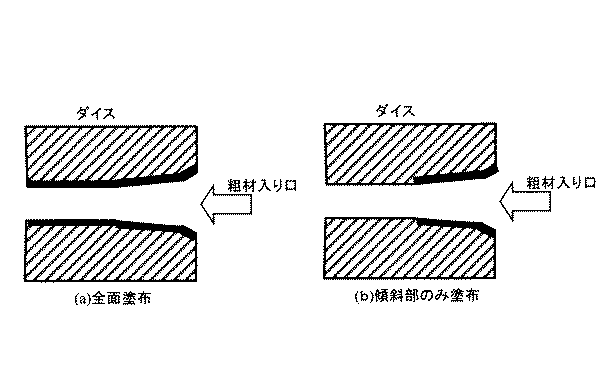
このダイスを用いてJIS1000系アルミニウム合金を断面減少率20%で冷間引き抜きした際の、ダイス寿命及び寸法安定性について解析した。なお、引抜き用潤滑油組成物には油脂をベース油とし、エステル系又はアミン系無灰摩擦調整剤を添加したものを用いた(一般に、引抜き潤滑油のベースは油脂、合成油、鉱物油及び高級脂肪酸から成る群より選ばれる少なくとも1種のものが用いられる。)。ダイスへ注油した潤滑油組成物の概略を図2に示す。また、この結果を表3に示す。
【0056】
【表3】
表3より、実施例10〜12のダイス寿命は、比較例7、8に示すTiNや窒化被膜に対して大幅に向上することを確認した。また、硬質炭素皮膜の膜厚が2μmを超えると、引抜き時のアルミとの摺動により硬質炭素被膜が剥離することが認められた。
【0058】
【発明の効果】
以上説明してきたように、本発明によれば、摺動部にダイヤモンドライクカーボン材料を所定の厚さで被覆すること、及び摺動部に所定の潤滑油組成物を注油することとしたため、接触部の摩擦係数が低く、加工用治具自体の耐久性、特に耐摩耗性に優れ、押出し成形加工時にアルミニウムやアルミニウム合金が加工治具に焼き付いたり、製品表面が荒れる等の問題が発生しない冷間引抜き加工用治具、冷間引抜き加工方法及びこれに用いる潤滑油組成物を提供することができる。
【図面の簡単な説明】
【図1】ピンオン摩擦試験機の概略を示す図である。
【図2】ダイス及び注油する潤滑油の概略を示す図である。[0001]
TECHNICAL FIELD OF THE INVENTION
The present invention relates to a jig for cold drawing, a cold drawing method, and a lubricating oil composition used for the same, and more particularly, to a diamond-like diamond exhibiting extremely excellent low friction characteristics in the presence of a specific lubricating oil. The present invention relates to a cold drawing jig coated with a carbon (hereinafter, referred to as “DLC”) material, a cold drawing method, and a lubricating oil composition used for the same.
[0002]
[Prior art]
2. Description of the Related Art Conventionally, for forming a soft metal such as an aluminum alloy, a processing method such as rolling, ironing, drawing and bending utilizing plastic deformation of the metal has been used. These processes are performed in a state where the processing jig is brought into point contact, line contact, or surface contact with the surface of the metal to be processed and stress is applied to the metal surface as the workpiece. In some cases, a predetermined forming process is performed while a workpiece is plastically deformed while slidingly contacting a processing jig.
For such processing, a processing jig such as a mandrel, die, and punch for cold working is used (for example, Patent Document 1).
[0003]
[Patent Document 1]
JP-A-6-218425
Here, the jig used for cold working should have a low coefficient of friction at the contact part because the work is plastically deformed while applying stress or sliding on the metal surface as the work. , And the jig itself for processing is required to be excellent in durability, particularly in wear resistance.
For this reason, conventionally, as a means for improving the sliding characteristics and improving the plastic workability, quenching an iron-based jig or nitriding treatment to improve the wear resistance of the jig. Generally done.
[0005]
However, when such an iron-based jig is used, there is a problem that a soft metal such as aluminum is seized on the tool surface, and the surface of the workpiece is roughened. As a countermeasure, it is conceivable to use a solid lubricant or a liquid lubricant, but there was a problem in the durability of the lubricating oil itself, which was not sufficient.
[0006]
The present invention has been made in view of such problems of the prior art, and has as its object to reduce the coefficient of friction of the contact portion and reduce the durability of the processing jig itself, particularly the abrasion resistance. A jig for cold drawing, a method for cold drawing, and a lubricating oil composition used for the same, which do not cause problems such as aluminum or aluminum alloy sticking to the processing jig during extrusion molding and roughening of the product surface. To provide.
[0007]
[Means for Solving the Problems]
The present inventors have conducted intensive studies to solve the above problems, and as a result, coating the sliding portion with a diamond-like carbon material at a predetermined thickness, and injecting a predetermined lubricating oil composition into the sliding portion. As a result, they have found that the above-mentioned problems can be solved, and have completed the present invention.
[0008]
BEST MODE FOR CARRYING OUT THE INVENTION
Hereinafter, the jig for cold drawing of the present invention will be described in detail. In this specification, “%” indicates mass percentage unless otherwise specified.
[0009]
As described above, the jig for cold drawing of the present invention is formed by coating a diamond-like carbon (hereinafter referred to as "DLC") material on an iron-based material or the like, and is used for cold drawing of an aluminum alloy. Typically, a mandrel, a die, a punch and the like can be exemplified.
Further, the DLC material is coated at least on the drawn portion (entrance inclined portion) of the jig, and has a thickness of 0.2 to 2 μm and a finished surface roughness of Ra 0.2 μm or less. Thereby, the sliding of the aluminum alloy can be stabilized and formed. Such a DLC film can be formed by ion plating or magnetron sputtering. On the other hand, if it is out of the above range, scuffing is locally formed and the coefficient of friction is improved.
[0010]
Here, the DLC material is an amorphous material mainly composed of a carbon element, and the bonding form between carbons includes both a diamond structure (SP 3 bond) and a graphite bond (SP 2 bond). Specifically, aC (amorphous carbon) consisting only of carbon element, aC: H (hydrogen amorphous carbon) containing hydrogen, and metal elements such as titanium (Ti) and molybdenum (Mo) are partially used. However, in the present invention, from the viewpoint of exhibiting a significant friction reduction effect, the DLC material preferably has a lower hydrogen content, and has a hydrogen content of 1% or less in terms of atomic ratio. Is preferably an aC (amorphous carbon) material containing no hydrogen.
[0011]
The coated DLC material preferably has a surface hardness of Hv1000 to 3500 in terms of micro Vickers hardness (10 g load) and a thickness of 0.3 to 2.0 μm. It is preferable that the surface hardness is HRC 45 to 60 in Rockwell hardness (C scale). This case is effective because the durability of the film can be maintained even under sliding conditions under a high surface pressure of about 700 MPa. When the surface hardness and the thickness of the surface coated with the DLC material are out of the above ranges, the surface is worn out when the thickness is less than Hv1000 and the thickness is less than 0.3 μm. If the surface hardness of the iron-based member as a member deviates from the above, buckling may easily occur under a high surface pressure when the surface hardness is less than HRC45, but no further effect on friction reduction is observed even when the surface hardness exceeds HRC60.
[0012]
Next, the cold drawing method of the present invention will be described in detail.
In this method, at the time of performing the cold drawing using the above-described jig for cold drawing, the lubricating oil composition is lubricated at least to the drawn portion of the jig and formed. That is, by sliding the aluminum alloy in the presence of a lubricating oil composition containing a fatty acid ester-based ashless friction modifier and / or an aliphatic amine-based ashless friction modifier, the aluminum alloy slides with extremely low friction. It can be processed and formed. It is desirable that the lubricating oil composition is always lubricated not only on the drawn portion but also on the sliding surface.
[0013]
Next, the lubricating oil composition of the present invention will be described in detail.
Such a lubricating oil composition is used by lubricating a sliding surface with a workpiece in processing the cold drawing jig described above. It comprises one or both of a modifier and an aliphatic amine-based ashless friction modifier.
Further, these fatty acid ester-based ashless friction modifiers and aliphatic amine-based ashless friction modifiers have a hydrocarbon group having 6 to 30 carbon atoms and contain 0.05 to 3.0% based on the total amount of the composition. It is effective to use one within this range. Even if the above additives are added excessively, they become insoluble components and do not contribute to the improvement of the sliding property.
[0014]
Here, the lubricating base oil is not particularly limited, and may be of any type, such as mineral oil, synthetic oil, fats and oils, and mixtures thereof, as long as they are commonly used as base oils for lubricating oil compositions. Can be used without.
As the mineral oil, specifically, a lubricating oil fraction obtained by distilling crude oil under normal pressure and reduced pressure is subjected to solvent removal, solvent extraction, hydrocracking, solvent dewaxing, hydrorefining, hydrorefining, sulfuric acid washing, and clay. Oils such as paraffinic or naphthenic oils and normal paraffins, which are purified by appropriately combining purification treatments such as treatment, can be used, and those which have been subjected to solvent purification and hydrorefining treatment are generally used, but aromatics are further reduced. It is more preferable to use an advanced hydrocracking process which can be performed, or a product produced by an isomerized technique of GTL Wax (gas to liquid wax).
[0015]
Specific examples of the synthetic oil include poly-α-olefins (for example, 1-octene oligomer, 1-decene oligomer, ethylene-propylene oligomer, etc.), hydrides of poly-α-olefin, isobutene oligomer, and isobutene oligomer. Hydride, isoparaffin, alkylbenzene, alkylnaphthalene, diester (eg, ditridecyl glutarate, dioctyl adipate, diisodecyl adipate, ditridecyl adipate, dioctyl sebacate, etc.), polyol ester (eg, trimethylol propane caprylate, trimethylol propane peralago) And trimethylolpropane esters such as trimethylolpropane isostearate; pentaerythritol 2-ethylhexanoate, pentaerythritol Pentaerythritol ester such as argonate), polyoxyalkylene glycol, dialkyldiphenyl ether, polyphenyl ether and the like. Among them, poly-α-olefins such as 1-octene oligomers and 1-decene oligomers and hydrides thereof are preferred.
[0016]
The base oil in the lubricating oil composition of the present invention may be a mixture of two or more mineral base oils or two or more synthetic base oils, in addition to using a mineral base oil or a synthetic base oil alone or as a mixture. It can be a mixture. The mixing ratio of two or more base oils in the mixture is not particularly limited, and can be arbitrarily selected.
[0017]
The sulfur content in the lubricating base oil is not particularly limited, but is preferably 0.2% or less, more preferably 0.1% or less, further preferably 0.05% or less based on the total amount of the base oil. Desirably. In particular, since the sulfur content of hydrorefined mineral oil and synthetic base oil is 0.005% or less, or substantially does not contain sulfur (5 ppm or less), it is desirable to use these as a base oil.
[0018]
The aromatic content in the lubricating base oil is also not particularly limited, but in order to maintain low friction characteristics for a long period of time as a lubricating oil composition for an internal combustion engine, the total aromatic content should be 15% or less. Desirably, more preferably 10% or less, further preferably 5% or less. That is, when the total aromatic content of the lubricating base oil exceeds 15%, the oxidation stability is poor, which is not desirable.
In addition, the total aromatic content here means the aromatic fraction (aromatics fraction) content measured based on the method prescribed | regulated to ASTM D2549.
[0019]
The kinematic viscosity of the lubricating base oil is not particularly limited, but when used as a lubricating oil composition for an internal combustion engine, the kinematic viscosity at 100 ° C. is preferably 2 mm 2 / s or more, more preferably. 3 mm 2 / s or more. On the other hand, the kinematic viscosity is desirably 20 mm 2 / s or less, desirably 10 mm 2 / s or less, and particularly desirably 8 mm 2 / s or less. If the kinematic viscosity at 100 ° C. of the lubricating base oil is less than 2 mm 2 / s, it is not desirable because sufficient abrasion resistance cannot be obtained and evaporation characteristics may be inferior. On the other hand, when the kinematic viscosity exceeds 20 mm 2 / s, low friction performance is difficult to be exhibited, and low-temperature performance may be undesirably deteriorated. In the present invention, a mixture obtained by arbitrarily mixing two or more kinds of base oils selected from the above base oils can be used, and as long as the kinematic viscosity at 100 ° C. falls within the preferred range described above, the base oil alone may be used. Can be used even if the kinematic viscosity is other than the above.
[0020]
The viscosity index of the lubricating base oil is also not particularly limited, but is preferably 80 or more, more preferably 100 or more, especially when used as a lubricating oil composition for an internal combustion engine. , 120 or more. By increasing the viscosity index of the lubricating base oil, it is possible to obtain a lubricating oil composition for an internal combustion engine that consumes less oil and has excellent low-temperature viscosity characteristics and fuel-saving performance.
[0021]
As the fatty acid ester-based ashless friction modifier and / or the aliphatic amine-based ashless friction modifier, a straight-chain having 6 to 30 carbon atoms, preferably 8 to 24 carbon atoms, and particularly preferably 10 to 20 carbon atoms. Alternatively, a fatty acid ester having a branched hydrocarbon group, a fatty acid amine compound, and an arbitrary mixture thereof can be exemplified. When the carbon number is out of the range of 6 to 30, the friction reducing effect may not be sufficiently obtained.
[0022]
As the linear or branched hydrocarbon group having 6 to 30 carbon atoms, specifically, hexyl group, heptyl group, octyl group, nonyl group, decyl group, undecyl group, dodecyl group, tridecyl group, tetradecyl group Group, pentadecyl group, hexadecyl group, heptadecyl group, octadecyl group, nonadecyl group, icosyl group, henycosyl group, docosyl group, tricosyl group, tetracosyl group, pentacosyl group, hexacosyl group, heptacosyl group, octacosyl group, nonacosyl group, triacontyl group, etc. Alkyl group, hexenyl group, heptenyl group, octenyl group, nonenyl group, decenyl group, undecenyl group, dodecenyl group, tridecenyl group, tetradecenyl group, pentadecenyl group, hexadecenyl group, heptadecenyl group, octadecenyl group, nonadecenyl group, icocenyl group, N'ikoseniru group include docosenyl, tricosenyl group, tetracosenyl group, Pentakoseniru group, Hekisakoseniru group, Heputakoseniru group, Okutakoseniru group, Nonakoseniru group, an alkenyl group such as tri container group.
The alkyl group and the alkenyl group include all conceivable linear and branched structures, and the position of the double bond in the alkenyl group is arbitrary.
[0023]
Examples of the fatty acid ester include esters of such a fatty acid having a hydrocarbon group having 6 to 30 carbon atoms with an aliphatic monohydric alcohol or an aliphatic polyhydric alcohol, and specifically, glycerin monooleate, Glycerindiolate, sorbitan monooleate, sorbitandiolate and the like can be mentioned as particularly desirable examples.
Examples of the aliphatic amine compound include an aliphatic monoamine or an alkylene oxide adduct thereof, an aliphatic polyamine, an imidazoline compound, and the like, and derivatives thereof. Specifically, fats such as laurylamine, lauryldiethylamine, lauryldiethanolamine, dodecyldipropanolamine, palmitylamine, stearylamine, stearyltetraethylenepentamine, oleylamine, oleylpropylenediamine, oleyldiethanolamine, N-hydroxyethyloleylimidazoline and the like Aliphatic amine compounds, amine alkylene oxide adducts of these aliphatic amine compounds such as N, N-dipolyoxyalkylene-N-alkyl (or alkenyl) (6-28 carbon atoms), and carbon atoms of these aliphatic amine compounds A residual amino group and / or imino is reacted with a monocarboxylic acid having 2 to 30 carbon atoms (such as fatty acid) or a polycarboxylic acid having 2 to 30 carbon atoms such as oxalic acid, phthalic acid, trimellitic acid, and pyromellitic acid. Base Some or amidated or neutralize all, so-called acid-modified compounds, and the like. Suitable examples include N, N-dipolyoxyethylene-N-oleylamine.
[0024]
The content of the fatty acid ester-based ashless friction modifier and / or the aliphatic amine-based ashless friction modifier contained in the lubricating oil composition used in the present invention is not particularly limited, but is based on the total amount of the composition. The content is preferably 0.05 to 3.0%, more preferably 0.1 to 2.0%, and particularly preferably 0.5 to 1.4%. When the content is less than 0.05%, the friction reducing effect tends to be small, and when the content is more than 3.0%, the solubility in lubricating oil and the storage stability are remarkably deteriorated, and a precipitate is easily generated. Not desirable.
[0025]
On the other hand, the lubricating oil composition used in the present invention preferably contains polybutenyl succinimide and / or a derivative thereof.
As the polybutenyl succinimide, the following general formulas (1) and (2)
[0026]
Embedded image
Embedded image
The compound represented by these is mentioned. PIB in these general formulas represents a polybutenyl group, and has a number average molecular weight of 900 to 3500, preferably a number average molecular weight obtained by polymerizing high-purity isobutene or a mixture of 1-butene and isobutene with a boron fluoride-based catalyst or an aluminum chloride-based catalyst. Obtained from 1000 to 2000 polybutenes. When the number average molecular weight is less than 900, the cleansing effect tends to be inferior, and when it exceeds 3500, the low-temperature fluidity tends to deteriorate, which is not desirable.
Further, n in the above general formula is preferably an integer of 1 to 5, more preferably an integer of 2 to 4 from the viewpoint of excellent cleanliness. Further, the polybutene is used to remove trace amounts of fluorine and chlorine remaining due to the catalyst in the production process by an appropriate method such as an adsorption method or a sufficient washing with water, to be 50 ppm or less, more preferably 10 ppm or less, particularly preferably 1 ppm or less. It is also possible to use after removing to the following.
[0029]
Furthermore, the method for producing the polybutenyl succinimide is not particularly limited. For example, the chlorinated product of the polybutene or the polybutene from which chlorine or fluorine has been sufficiently removed is reacted with maleic anhydride at 100 to 200 ° C. The resulting polybutenyl succinic acid can be obtained by reacting it with a polyamine such as diethylenetriamine, triethylenetetramine, tetraethylenepentamine, and pentaethylenehexamine.
[0030]
On the other hand, as the derivative of the polybutenyl succinimide, a boron compound or an oxygen-containing organic compound is allowed to act on the compound represented by the general formula (1) or (2), and the remaining amino group and / or So-called boron-modified or acid-modified compounds in which some or all of the imino groups are neutralized or amidated can be exemplified. Among them, boron-containing polybutenyl succinimide, particularly boron-containing bispolybutenyl succinimide, is the most preferred.
[0031]
Examples of the boron compound include boric acid, borate, borate and the like. Specifically, examples of the boric acid include orthoboric acid, metaboric acid, and tetraboric acid. Preferred examples of the borate include ammonium salts and the like, specifically, ammonium borate such as ammonium metaborate, ammonium tetraborate, ammonium pentaborate and ammonium octaborate. As the borate ester, an ester of boric acid and preferably an alkyl alcohol having 1 to 6 carbon atoms, more specifically, for example, monomethyl borate, dimethyl borate, trimethyl borate, monoethyl borate, boric acid Preferable examples include diethyl, triethyl borate, monopropyl borate, dipropyl borate, trippropyl borate, monobutyl borate, dibutyl borate, tributyl borate, and the like. In addition, the mass ratio "B / N" of the boron content B and the nitrogen content N in the boron-containing polybutenyl succinimide is usually 0.1 to 3, preferably 0.2 to 1. .
Examples of the oxygen-containing organic compound include, for example, formic acid, acetic acid, glycolic acid, propionic acid, lactic acid, butyric acid, valeric acid, caproic acid, enanthic acid, caprylic acid, pelargonic acid, capric acid, undecyl Acid, lauric acid, tridecanoic acid, myristic acid, pentadecanoic acid, palmitic acid, margaric acid, stearic acid, oleic acid, nonadecanoic acid, monocarboxylic acids having 1 to 30 carbon atoms such as eicosanoic acid, oxalic acid, phthalic acid, Examples thereof include polycarbonic acids having 2 to 30 carbon atoms, such as trimellitic acid and pyromellitic acid, and anhydrides or ester compounds thereof, alkylene oxides having 2 to 6 carbon atoms, and hydroxy (poly) oxyalkylene carbonates.
In the lubricating oil composition used in the present invention, the content of polybutenyl succinimide and / or a derivative thereof is not particularly limited, but is preferably 0.1 to 15%, more preferably 1.0 to 12%. It is good to be. If it is less than 0.1%, the detergency effect may be poor, and if it exceeds 15%, it is difficult to obtain a detergency effect commensurate with the content, and the demulsification properties are likely to deteriorate.
[0033]
Furthermore, the lubricating oil composition used in the present invention has the following general formula (3)
[0034]
Embedded image
It is preferable to contain zinc dithiophosphate represented by
R 4 , R 5 , R 6 and R 7 in the above formula (3) each independently represent a hydrocarbon group having 1 to 24 carbon atoms. Examples of these hydrocarbon groups include linear or branched alkyl groups having 1 to 24 carbon atoms, linear or branched alkenyl groups having 3 to 24 carbon atoms, and cycloalkyl groups having 5 to 13 carbon atoms. Or a linear or branched alkylcycloalkyl group, an aryl group having 6 to 18 carbon atoms, a linear or branched alkylaryl group, an arylalkyl group having 7 to 19 carbon atoms, or the like. It is desirable. Further, the alkyl group or alkenyl group may be any of primary, secondary and tertiary.
[0036]
Specific examples of the above R 4 , R 5 , R 6 and R 7 include a methyl group, an ethyl group, a propyl group, a butyl group, a pentyl group, a hexyl group, a heptyl group, an octyl group, a nonyl group, and a decyl group. An undecyl group, a dodecyl group, a tridecyl group, a tetradecyl group, a pentadecyl group, a hexadecyl group, a heptadecyl group, an octadecyl group, a nonadecyl group, an icosyl group, an alkyl group such as a henycosyl group, a docosyl group, a tricosyl group, a tetracosyl group, a propenyl group, Isopropenyl, butenyl, butadienyl, pentenyl, hexenyl, heptenyl, octenyl, nonenyl, decenyl, undecenyl, dodecenyl, tridecenyl, tetradecenyl, pentadecenyl, hexadecenyl, heptadecenyl, oleyl Octadeseni such as base Group, nonadecenyl group, icosenyl group, henicocenyl group, docosenyl group, tricosenyl group, alkenyl group such as tetracosenyl group, cyclopentyl group, cyclohexyl group, cycloalkyl group such as cycloheptyl group, methylcyclopentyl group, dimethylcyclopentyl group, ethyl Cyclopentyl, propylcyclopentyl, ethylmethylcyclopentyl, trimethylcyclopentyl, diethylcyclopentyl, ethyldimethylcyclopentyl, propylmethylcyclopentyl, propylethylcyclopentyl, di-propylcyclopentyl, propylethylmethylcyclopentyl, methylcyclohexyl Group, dimethylcyclohexyl group, ethylcyclohexyl group, propylcyclohexyl group, ethylmethylcyclohexyl , Trimethylcyclohexyl group, diethylcyclohexyl group, ethyldimethylcyclohexyl group, propylmethylcyclohexyl group, propylethylcyclohexyl group, di-propylcyclohexyl group, propylethylmethylcyclohexyl group, methylcycloheptyl group, dimethylcycloheptyl group, Ethylcycloheptyl group, propylcycloheptyl group, ethylmethylcycloheptyl group, trimethylcycloheptyl group, diethylcycloheptyl group, ethyldimethylcycloheptyl group, propylmethylcycloheptyl group, propylethylcycloheptyl group, di-propylcycloheptyl group Alkylcycloalkyl groups such as propylethylmethylcycloheptyl group, aryl groups such as phenyl group and naphthyl group, tolyl group, xylyl group, ethylphenyl Nyl, propylphenyl, ethylmethylphenyl, trimethylphenyl, butylphenyl, propylmethylphenyl, diethylphenyl, ethyldimethylphenyl, tetramethylphenyl, pentylphenyl, hexylphenyl, heptylphenyl , Octylphenyl group, nonylphenyl group, decylphenyl group, undecylphenyl group, alkylaryl group such as dodecylphenyl group, benzyl group, methylbenzyl group, dimethylbenzyl group, phenethyl group, methylphenethyl group, dimethylphenethyl group, etc. An arylalkyl group and the like can be exemplified.
The hydrocarbon group which can be taken by R 4 , R 5 , R 6 and R 7 includes all conceivable linear structures and branched structures, and further includes a double bond of an alkenyl group. The position, the bonding position of the alkyl group to the cycloalkyl group, the bonding position of the alkyl group to the aryl group, and the bonding position of the aryl group to the alkyl group are arbitrary. Further, among the above hydrocarbon groups, when the hydrocarbon group is a linear or columnar alkyl group having 1 to 18 carbon atoms, or an aryl group having 6 to 18 carbon atoms, or a linear or branched alkyl group. Particularly preferred is an alkylaryl group.
[0037]
Preferable specific examples of the zinc dithiophosphate include, for example, zinc diisopropyldithiophosphate, zinc diisobutyldithiophosphate, zinc di-sec-butyldithiophosphate, zinc di-sec-pentyldithiophosphate, and zinc di-n-hexyldithiophosphate. Zinc di-sec-hexyldithiophosphate, zinc di-octyldithiophosphate, zinc di-2-ethylhexyldithiophosphate, zinc di-n-decyldithiophosphate, zinc di-n-dodecyldithiophosphate, zinc diisotridecyldithiophosphate And mixtures according to any combination thereof.
[0038]
The content of the zinc dithiophosphate is not particularly limited, but is preferably 0.1% or less, based on the total amount of the composition and in terms of phosphorus element, from the viewpoint of exhibiting a higher friction reducing effect. It is more preferable that the content is 0.06% or less, and it is particularly preferable that zinc dithiophosphate is not contained. When the content of zinc dithiophosphate exceeds 0.1% in terms of phosphorus element, the fatty acid ester-based ashless friction modifier or the aliphatic amine-based ashless friction on the sliding surface between the DLC member and the iron-based member is used. The excellent friction reducing effect of the modifier may be impaired.
[0039]
As a method for producing the zinc dithiophosphate, a conventional method can be arbitrarily adopted, and is not particularly limited. Specifically, for example, hydrocarbons corresponding to the above R 4 , R 5 , R 6 and R 7 It can be synthesized by reacting an alcohol or phenol having a group with phosphorus pentasulfide to form dithiophosphoric acid, which is neutralized with zinc oxide. It goes without saying that the structure of the zinc dithiophosphate varies depending on the starting alcohol used.
In the present invention, two or more kinds of zinc dithiophosphates included in the above general formula (3) can be mixed and used at an arbitrary ratio.
[0040]
As described above, the lubricating oil composition of the present invention exhibits extremely excellent low friction characteristics when used on a sliding surface between a DLC member and a member made of an iron-based material. For the purpose of enhancing the performance required as a lubricating oil composition for use, metal-based detergents, antioxidants, viscosity index improvers, other ashless friction modifiers, other ashless dispersants, antiwear agents or extreme pressure agents, The required performance can be enhanced by blending a rust inhibitor, a nonionic surfactant, a demulsifier, a metal deactivator, an antifoaming agent, etc. alone or in combination of a plurality of kinds.
[0041]
As the metal-based detergent, any compound usually used as a metal-based detergent for lubricating oil can be used. For example, alkali metal or alkaline earth metal sulfonates, phenates, salicylate naphthenates and the like can be used alone or in combination of two or more. Here, examples of the alkali metal include sodium (Na) and potassium (K), and examples of the alkaline earth metal include calcium (Ca) and magnesium (Mg). Specific preferred examples include sulfonates, phenates and salicylates of Ca or Mg.
The total base number and the amount of these metal-based detergents can be arbitrarily selected according to the required lubricating oil performance. Usually, the total base number is 0 to 500 mgKOH / g, desirably 150 to 400 mgKOH / g by the perchloric acid method, and the amount of addition is usually 0.1 to 10% based on the total amount of the composition.
[0042]
Further, as the antioxidant, any compound which is usually used as an antioxidant for lubricating oil can be used. For example, phenolic antioxidants such as 4,4'-methylenebis (2,6-di-tert-butylphenol) and octadecyl-3- (3,5-di-tert-butyl-4-hydroxyphenyl) propionate; Examples thereof include amine antioxidants such as -α-naphthylamine, alkylphenyl-α-naphthylamine, and alkyldiphenylamine, and mixtures of any combination thereof. The amount of the antioxidant added is usually 0.01 to 5% based on the total amount of the composition.
[0043]
Further, as the viscosity index improver, specifically, a so-called non-dispersion type viscosity index improver such as a copolymer of one or two or more monomers selected from various methacrylates or a hydrogenated product thereof, And a so-called dispersion-type viscosity index improver obtained by copolymerizing various methacrylic esters containing a nitrogen compound. Specific examples of other viscosity index improvers include non-dispersible or dispersed ethylene-α-olefin copolymers (α-olefins include, for example, propylene, 1-butene, 1-pentene, etc.) and hydrogen And polyisobutylene and its hydrogenated product, hydrogenated styrene-diene copolymer, styrene-maleic anhydride copolymer, and polyalkylstyrene.
It is necessary to select the molecular weight of these viscosity index improvers in consideration of shear stability. Specifically, the number average molecular weight of the viscosity index improver is, for example, 5,000 to 1,000,000, preferably 100,000 to 800,000 for dispersion type and non-dispersion type polymethacrylate, and 800 to 5,000 for polyisobutylene or a hydride thereof, ethylene- 800 to 300,000, preferably 10,000 to 200,000 is preferable for the α-olefin copolymer or its hydride. Further, such a viscosity index improver can be contained singly or in any combination of two or more kinds. Usually, the content is 0.1 to 40.0% based on the lubricating oil composition. desirable.
[0044]
Further, other ashless friction modifiers include ashless friction modifiers such as boric acid esters, higher alcohols and aliphatic ethers, metal-based friction modifiers such as molybdenum dithiophosphate, molybdenum dithiocarbamate, and molybdenum disulfide. Is mentioned.
Other ashless dispersants include polybutenylbenzylamine having a polybutenyl group having a number average molecular weight of 900 to 3500, polybutenylamine, and polybutenylsuccinimide having a polybutenyl group having a number average molecular weight of less than 900. And their derivatives.
Further, as the wear inhibitor or extreme pressure agent, disulfide, sulfurized oil and fat, sulfurized olefin, phosphate ester containing 1 to 3 hydrocarbon groups having 2 to 20 carbon atoms, thiophosphate ester, phosphite ester, And thiophosphites and amine salts thereof.
Furthermore, examples of the rust preventive include alkyl benzene sulfonate, dinonyl naphthalene sulfonate, alkenyl succinate, and polyhydric alcohol ester.
Examples of the nonionic surfactant and demulsifier include polyalkylene glycol nonionic surfactants such as polyoxyethylene alkyl ether, polyoxyethylene alkyl phenyl ether, and polyoxyethylene alkyl naphthyl ether. .
Furthermore, examples of the metal deactivator include imidazoline, pyrimidine derivatives, thiadiazole, benzotriazole, and thiadiazole.
Furthermore, examples of the antifoaming agent include silicone, fluorosilicone, and fluoroalkyl ether.
When these additives are contained in the lubricating oil composition of the present invention, the content thereof is, based on the total amount of the composition, other friction modifiers, other ashless dispersants, antiwear agents or extreme pressure agents. , A rust preventive and a demulsifier, 0.01-5%, a metal deactivator, 0.005-1%, and a defoamer, 0.0005-1%.
[0045]
【Example】
Hereinafter, the present invention will be described in more detail with reference to Examples and Comparative Examples, but the present invention is not limited to these Examples.
[0046]
<Preparation of test piece>
As an example of the drawn portion of the jig for cold drawing, a test piece for pin-on-disk single friction as shown in FIG. 1 was produced. This unit test piece was composed of three pins and a disk, and was manufactured by the following method.
-Pin material After polishing the SUJ2 material below to a predetermined pin shape, the pin was finished to various surface roughness (Ra 0.2 µm or less) by polishing using a wrapping tape.
Disc material A disc-shaped material made of various aluminum alloys was subjected to a predetermined age hardening treatment, and then a sliding surface with a pin was finished to various surface roughness by polishing.
Surface treatment The surface of the pin material finished as described above was coated with the following materials to have various film thicknesses by PVD treatment or CVD treatment. The coated surface was further finished to various surface roughnesses (Ra 0.11 μm or less) by polishing using a wrapping tape.
(1) a-C
(2) TiN
(3) CrN
(4) DLC (a-C: H)
Table 1 shows these test pieces.
[0047]
[Table 1]
<Preparation of lubricating oil composition>
・ Oil 1
Hydrocracked mineral oil (100 ° C. kinematic viscosity: 5.0 mm 2 / s, viscosity index: 120, total aromatic content: 5.5%) was used as a lubricating base oil, and an ester friction modifier (glycerin monooleate) was used. ), 5.0% of an ashless dispersant (polybutenylsuccinimide (nitrogen content: 1.2%)), calcium sulfonate (total base number: 300 mgKOH / g, 0.5% calcium content: 12.0%), 0.9% calcium phenate (total base number: 255 mg KOH / g, calcium content: 9.2%), viscosity index improver as other additives , An antioxidant, a rust inhibitor, a demulsifier, a nonionic surfactant, a metal deactivator, an antifoaming agent, etc. in a total amount of 7.0%.
・ Oil 2
Addition of 0.047% of zinc dialkyldithiophosphate (zinc content: 9.3%, phosphorus content: 8.5%, alkyl group: secondary butyl group or secondary hexyl group) in terms of elemental phosphorus The same procedure as in Oil 1 was repeated except that the preparation was carried out.
・ Oil 3
Same as Oil 2 except that 1-decene oligomer hydride (100 ° C. kinematic viscosity: 3.9 mm 2 / s, viscosity index: 124, total aromatic content: 0.0%) was used as the lubricating base oil It was prepared by repeating the procedure.
・ Oil 4
It was prepared by repeating the same operation as for Oil 1 except that the ester friction modifier was not added and the amine friction modifier (N, N-dipolyoxyethylene-N-oleylamine) was added at 1.0%. .
・ Oil 5
Zinc dialkyldithiophosphate (zinc content: 9.3%, phosphorus content: 8.5%, alkyl group: secondary butyl group or secondary hexyl group) was adjusted to 0.094% in terms of elemental phosphorus. Except for the above, oil was prepared by repeating the same operation as for oil 2.
・ Oil 6
It was prepared by repeating the same operation as for Oil 5, except that 0.5% of an amine friction modifier (N, N-dipolyoxyethylene-N-oleylamine) was added.
・ Oil 7
It was prepared by repeating the same operation as for Oil 2, except that the ester friction modifier (glycerin monooleate) was 0.2%.
・ Oil 8
The oil was prepared by repeating the same operation as for Oil 5, except that no ester-based friction modifier was added.
・ Oil 9
The oil was prepared by repeating the same operation as for Oil 5, except that the ester friction modifier was not added and molybdenum dithiocarbamate (molybdenum content: 4.1%) was added at 1.1%.
Table 2 shows the composition of these lubricating oil compositions and their oil properties.
[0049]
[Table 2]
(Examples 1 to 9)
A unit test piece was prepared by combining the pin and the disk shown in Examples 1 to 9 of Table 1, and each lubricating oil composition (the above oils 1 to 7) described in each example of Table 1 was used. The following single friction test was performed. The results are shown in Table 1.
<Single friction test conditions>
Maximum Hertz pressure: 80MPa
Disk rotation speed: 30 rpm
Oil supply method: Oil bath supply oil temperature: 80 ° C
Test time: 60min
[0051]
(Comparative Examples 1 to 5)
In the same manner as described above, unit test pieces were prepared by combining the pins and disks shown in Comparative Examples 1 to 5 in Table 1, and the respective lubricating oil compositions (the above oils 5 and 8) described in Examples in Table 1 were also used. Or 9), the following single friction test was performed. The results are shown in Table 1.
From Table 1, it can be seen that all of the unit test pieces obtained in Examples 1 to 9 show excellent low friction coefficients. For example, in these, a friction reduction effect of about 40 to 60% was obtained as compared with the unit test piece of Comparative Example 1 using a combination of an iron-based material and an aluminum alloy material used in an engine.
Furthermore, from the results of Examples 1, 2 and 6, it can be seen that the smaller the content of zinc dithiophosphate, the better the friction reducing effect.
In addition, the material combination of the unit test pieces obtained in Examples 1 to 9 has no problem in the surface shape after the test, has excellent abrasion resistance, and shows stable low friction characteristics.
[0052]
In addition, the unit test piece obtained in Example 5, which is out of the preferable range of the present invention, shows a friction reducing effect as is clear from Table 1, but shows another test using an aC material containing no hydrogen. Not as effective as usual.
[0053]
On the other hand, the unit test piece material combination of Comparative Example 1 is a combination of a pin made of SU2 material and a disk made of AC2A material polished with a wrapping tape, and the pin is not coated with a surface. In this unit test, a lubricating oil composition (oil 8) containing no friction modifier used in the present invention was used. Therefore, the friction coefficient exceeds 0.1 and the friction characteristics are inferior. This is presumed to be because a reaction film mainly composed of ZnDTP was formed on the sliding surface.
Further, the material combination of the single test piece of Comparative Example 2 has the same configuration as that of Comparative Example 1. In this unit test, the lubricating oil composition (oil 5) containing the friction modifier used in the present invention is used, and although it has a slight friction reducing effect, the friction coefficient is as high as about 0.1 and the friction characteristics are inferior. This is presumed to be because a reaction film mainly composed of ZnDTP was formed on the sliding surface.
Further, the unit test piece material combination of Comparative Example 3 has the same configuration as that of Example 4, except that the organic molybdenum that was most effective as the lubricating oil composition on the sliding surface between the conventional steel materials was omitted. Even when a fuel-efficient engine oil (oil 9) is used, the friction coefficient shows a high friction coefficient close to 0.1. This is presumably because no molybdenum disulfide coating is formed on the sliding surface.
Furthermore, in the unit specimen material combination of Comparative Example 4, the lubricating oil composition (oil 5) containing the TiN-coated pin and the friction modifier used in the present invention was used, and although the friction coefficient was reduced, its absolute value was Remained close to 0.1. In addition, in the single test piece material combination of Comparative Example 5, the pins were formed with CrN coating, but no significant difference was observed between the TiN pins and the friction reducing effect.
[0054]
From Examples 1 to 9, a pin using a DLC material as in the present invention, in particular, an aC-based DLC material containing no hydrogen produced in a suitable range, a suitable aluminum alloy material and a specific friction modifier were used. When sliding under lubrication of a lubricating oil composition to which a predetermined amount has been added, a world-leading low coefficient of friction is obtained and the abrasion resistance is excellent. Further, such a remarkable friction reduction effect is extremely useful industrially, and is effective for greatly reducing friction loss of engine sliding parts and the like, that is, for improving fuel efficiency of the engine.
[0055]
(Examples 10 to 12, Comparative Examples 6 to 8)
After a hard carbon thin film was applied by ion plating to the entrance surface of a die steel for cold drawing of an aluminum alloy, polishing was performed to a predetermined finish roughness.
<Die life and dimensional stability test>
The dies life and dimensional stability when the JIS 1000-based aluminum alloy was cold-drawn using this die at a cross-sectional reduction rate of 20% were analyzed. The lubricating oil composition for drawing used oils and fats as base oils and added with an ester-based or amine-based ashless friction modifier (generally, the bases of drawing-out lubricating oils are oils, fats, synthetic oils, mineral oils and mineral oils). At least one member selected from the group consisting of higher fatty acids is used.) FIG. 2 schematically shows the lubricating oil composition lubricated into the dies. Table 3 shows the results.
[0056]
[Table 3]
From Table 3, it was confirmed that the die life of Examples 10 to 12 was significantly improved with respect to the TiN and nitride films shown in Comparative Examples 7 and 8. When the thickness of the hard carbon film exceeded 2 μm, it was recognized that the hard carbon film was peeled off due to sliding with aluminum at the time of drawing.
[0058]
【The invention's effect】
As described above, according to the present invention, the sliding portion is coated with the diamond-like carbon material at a predetermined thickness, and the sliding portion is lubricated with the predetermined lubricating oil composition. The friction coefficient of the part is low, the durability of the processing jig itself, especially the abrasion resistance is excellent, and there are no problems such as aluminum or aluminum alloy sticking to the processing jig during extrusion molding and the product surface roughening etc. A jig for cold drawing, a cold drawing method, and a lubricating oil composition used for the same can be provided.
[Brief description of the drawings]
FIG. 1 is a view schematically showing a pin-on friction tester.
FIG. 2 is a diagram schematically showing a die and lubricating oil to be lubricated.
Claims (9)
少なくとも当該治具の絞り部にダイヤモンドライクカーボン材料を膜厚0.2〜2μmとなるように被覆し、仕上げ面粗度がRa0.2μm以下であることを特徴とする冷間引抜き加工用治具。In a jig for cold drawing used for cold drawing of aluminum alloy,
A jig for cold drawing, wherein at least a drawn portion of the jig is coated with a diamond-like carbon material to a thickness of 0.2 to 2 μm, and a finished surface roughness is Ra 0.2 μm or less. .
少なくとも当該治具の絞り部に潤滑油組成物を注油して成形加工することを特徴とする冷間引抜き加工方法。In cold-drawing using the cold-drawing jig according to any one of claims 1 to 4,
A cold drawing method characterized by lubricating a lubricating oil composition to at least a drawn portion of the jig and forming the lubricating oil composition.
上記潤滑油組成物が、脂肪酸エステル系無灰摩擦調整剤及び/又は脂肪族アミン系無灰摩擦調整剤を組成物全量基準で0.05〜3.0%含有して成り、これらが炭素数6〜30の炭化水素基を有していることを特徴とする潤滑油組成物。A lubricating oil composition to be lubricated to at least a drawn portion of the jig for cold drawing according to any one of claims 1 to 4,
The lubricating oil composition contains a fatty acid ester-based ashless friction modifier and / or an aliphatic amine-based ashless friction modifier in an amount of 0.05 to 3.0% based on the total amount of the composition. A lubricating oil composition having 6 to 30 hydrocarbon groups.
Priority Applications (1)
| Application Number | Priority Date | Filing Date | Title |
|---|---|---|---|
| JP2003158007A JP2004358495A (en) | 2003-06-03 | 2003-06-03 | Jig for cold drawing and lubricating oil composition used therefor |
Applications Claiming Priority (1)
| Application Number | Priority Date | Filing Date | Title |
|---|---|---|---|
| JP2003158007A JP2004358495A (en) | 2003-06-03 | 2003-06-03 | Jig for cold drawing and lubricating oil composition used therefor |
Publications (1)
| Publication Number | Publication Date |
|---|---|
| JP2004358495A true JP2004358495A (en) | 2004-12-24 |
Family
ID=34051556
Family Applications (1)
| Application Number | Title | Priority Date | Filing Date |
|---|---|---|---|
| JP2003158007A Pending JP2004358495A (en) | 2003-06-03 | 2003-06-03 | Jig for cold drawing and lubricating oil composition used therefor |
Country Status (1)
| Country | Link |
|---|---|
| JP (1) | JP2004358495A (en) |
Cited By (10)
| Publication number | Priority date | Publication date | Assignee | Title |
|---|---|---|---|---|
| CN100425365C (en) * | 2006-12-29 | 2008-10-15 | 浙江万马电缆股份有限公司 | Aluminum wiredrawing process |
| JP2009269059A (en) * | 2008-05-08 | 2009-11-19 | Bridgestone Corp | Method of producing steel cord for reinforcing rubber article |
| JP2009298958A (en) * | 2008-06-16 | 2009-12-24 | Bridgestone Corp | Lubricant composition for steel, and method of manufacturing steel cord for reinforcing rubber article using the same |
| JP2011167732A (en) * | 2010-02-19 | 2011-09-01 | Showa Denko Kk | Drawing device for tubular workpiece |
| CN102191116A (en) * | 2010-03-19 | 2011-09-21 | 株式会社丰田中央研究所 | Processing oil, additive for processing oil, and processing method |
| WO2012115142A1 (en) * | 2011-02-24 | 2012-08-30 | 株式会社豊田中央研究所 | Lubricant for machining, additive for machining, and machining method |
| JP2012236943A (en) * | 2011-05-13 | 2012-12-06 | Toyota Central R&D Labs Inc | Processing oil agent, and cold plastic working method using the same |
| CN106739286A (en) * | 2016-11-16 | 2017-05-31 | 苏州大学 | Aluminum alloy based on magnetron sputtering diamond-like carbon film and its preparation method and application |
| CN106739277A (en) * | 2016-11-16 | 2017-05-31 | 苏州大学 | Preparation method and application of metal profile with magnetron sputtering diamond-like carbon film |
| WO2020175595A1 (en) * | 2019-02-28 | 2020-09-03 | 出光興産株式会社 | Metal processing oil composition |
-
2003
- 2003-06-03 JP JP2003158007A patent/JP2004358495A/en active Pending
Cited By (21)
| Publication number | Priority date | Publication date | Assignee | Title |
|---|---|---|---|---|
| CN100425365C (en) * | 2006-12-29 | 2008-10-15 | 浙江万马电缆股份有限公司 | Aluminum wiredrawing process |
| JP2009269059A (en) * | 2008-05-08 | 2009-11-19 | Bridgestone Corp | Method of producing steel cord for reinforcing rubber article |
| JP2009298958A (en) * | 2008-06-16 | 2009-12-24 | Bridgestone Corp | Lubricant composition for steel, and method of manufacturing steel cord for reinforcing rubber article using the same |
| JP2011167732A (en) * | 2010-02-19 | 2011-09-01 | Showa Denko Kk | Drawing device for tubular workpiece |
| CN102191116A (en) * | 2010-03-19 | 2011-09-21 | 株式会社丰田中央研究所 | Processing oil, additive for processing oil, and processing method |
| JP2011213995A (en) * | 2010-03-19 | 2011-10-27 | Toyota Central R&D Labs Inc | Processing oil, additive for processing oil and processing method |
| CN103391990B (en) * | 2011-02-24 | 2016-02-17 | 株式会社丰田中央研究所 | Lubricants for use in processing, processing additive and working method |
| CN103391990A (en) * | 2011-02-24 | 2013-11-13 | 株式会社丰田中央研究所 | Lubricant for machining, additive for machining, and machining method |
| JPWO2012115142A1 (en) * | 2011-02-24 | 2014-07-07 | 株式会社豊田中央研究所 | Processing lubricant, processing additive and processing method |
| WO2012115142A1 (en) * | 2011-02-24 | 2012-08-30 | 株式会社豊田中央研究所 | Lubricant for machining, additive for machining, and machining method |
| JP2012236943A (en) * | 2011-05-13 | 2012-12-06 | Toyota Central R&D Labs Inc | Processing oil agent, and cold plastic working method using the same |
| CN106739277B (en) * | 2016-11-16 | 2018-08-07 | 苏州大学 | Preparation method of metal profile with magnetron sputtering diamond-like carbon film |
| CN106739277A (en) * | 2016-11-16 | 2017-05-31 | 苏州大学 | Preparation method and application of metal profile with magnetron sputtering diamond-like carbon film |
| CN106739286A (en) * | 2016-11-16 | 2017-05-31 | 苏州大学 | Aluminum alloy based on magnetron sputtering diamond-like carbon film and its preparation method and application |
| CN106739286B (en) * | 2016-11-16 | 2018-08-07 | 苏州大学 | Preparation method of aluminum alloy based on magnetron sputtering diamond-like carbon film |
| CN108909088A (en) * | 2016-11-16 | 2018-11-30 | 苏州大学 | Aluminium alloy and its application based on Magnetron Sputtered Diamond-like Thin Carbon Films |
| WO2020175595A1 (en) * | 2019-02-28 | 2020-09-03 | 出光興産株式会社 | Metal processing oil composition |
| JPWO2020175595A1 (en) * | 2019-02-28 | 2020-09-03 | ||
| CN113438999A (en) * | 2019-02-28 | 2021-09-24 | 出光兴产株式会社 | Metalworking oil composition |
| JP7431213B2 (en) | 2019-02-28 | 2024-02-14 | 出光興産株式会社 | metalworking oil composition |
| CN113438999B (en) * | 2019-02-28 | 2024-02-27 | 出光兴产株式会社 | Metalworking oil composition |
Similar Documents
| Publication | Publication Date | Title |
|---|---|---|
| JP3555891B2 (en) | Low friction sliding material and lubricating oil composition used therefor | |
| JP4973971B2 (en) | Sliding member | |
| JP5058331B2 (en) | Low friction sliding member | |
| JP2004360649A (en) | Engine piston pin | |
| JP2005054617A (en) | Valve mechanism | |
| JP2005090489A (en) | Valve lifter for internal combustion engine | |
| JP3594190B2 (en) | Low friction sliding material and lubricating oil composition used therefor | |
| JP2005008851A (en) | Cutting oil for machining tool with hard carbon thin film and machining tool with hard carbon thin film | |
| JP3594193B1 (en) | Low friction sliding member and lubricating oil composition used for the same | |
| JP3965694B2 (en) | Low friction sliding cam / follower combination and lubricating oil composition used therefor | |
| JP2004358495A (en) | Jig for cold drawing and lubricating oil composition used therefor | |
| JP4212954B2 (en) | Hard carbon coating sliding member | |
| JP4915891B2 (en) | Low friction sliding member | |
| JP3594194B1 (en) | Low friction sliding mechanism and lubricating oil composition used therefor | |
| JP2005002888A (en) | Piston ring for automobile engine and lubricating oil composition used therefor | |
| JP2005069249A (en) | Piston and crankshaft connection structure | |
| JP2005003094A (en) | Automotive engine | |
| JP3753324B2 (en) | Cold drawing jig and lubricating oil composition used therefor | |
| JP2005069008A (en) | Combination of cylinder and piston of internal combustion engine | |
| JP2005090738A (en) | Rolling bearing | |
| JP4600719B2 (en) | Differential unit | |
| JP2005048801A (en) | Sealing device | |
| JP4006644B2 (en) | Valve mechanism for internal combustion engine | |
| JP4458228B2 (en) | Belt type continuously variable transmission | |
| JP3912539B2 (en) | Self-guided reamer |
Legal Events
| Date | Code | Title | Description |
|---|---|---|---|
| A977 | Report on retrieval |
Free format text: JAPANESE INTERMEDIATE CODE: A971007 Effective date: 20050615 |
|
| A131 | Notification of reasons for refusal |
Free format text: JAPANESE INTERMEDIATE CODE: A131 Effective date: 20070601 |
|
| A521 | Written amendment |
Free format text: JAPANESE INTERMEDIATE CODE: A523 Effective date: 20070730 |
|
| A02 | Decision of refusal |
Free format text: JAPANESE INTERMEDIATE CODE: A02 Effective date: 20080321 |