ES2894871T3 - Methods for conferring or enhancing herbicide resistance on plants and/or algae with protoporphyrinogen oxidase variants - Google Patents
Methods for conferring or enhancing herbicide resistance on plants and/or algae with protoporphyrinogen oxidase variants Download PDFInfo
- Publication number
- ES2894871T3 ES2894871T3 ES15870320T ES15870320T ES2894871T3 ES 2894871 T3 ES2894871 T3 ES 2894871T3 ES 15870320 T ES15870320 T ES 15870320T ES 15870320 T ES15870320 T ES 15870320T ES 2894871 T3 ES2894871 T3 ES 2894871T3
- Authority
- ES
- Spain
- Prior art keywords
- herbicide
- amino acid
- resistant
- acid sequence
- gene
- Prior art date
- Legal status (The legal status is an assumption and is not a legal conclusion. Google has not performed a legal analysis and makes no representation as to the accuracy of the status listed.)
- Active
Links
- 239000004009 herbicide Substances 0.000 title claims abstract description 327
- 230000002363 herbicidal effect Effects 0.000 title claims abstract description 262
- 108020001991 Protoporphyrinogen Oxidase Proteins 0.000 title claims abstract description 132
- 102000005135 Protoporphyrinogen oxidase Human genes 0.000 title claims abstract description 126
- 238000000034 method Methods 0.000 title claims abstract description 70
- 241000195493 Cryptophyta Species 0.000 title claims abstract description 55
- 230000002708 enhancing effect Effects 0.000 title claims abstract description 12
- 108090000623 proteins and genes Proteins 0.000 claims abstract description 199
- 125000003275 alpha amino acid group Chemical group 0.000 claims abstract description 141
- 210000004027 cell Anatomy 0.000 claims abstract description 33
- 210000001938 protoplast Anatomy 0.000 claims abstract description 17
- 206010020649 Hyperkeratosis Diseases 0.000 claims abstract description 16
- 230000001131 transforming effect Effects 0.000 claims abstract description 13
- 108090000765 processed proteins & peptides Proteins 0.000 claims description 116
- 102000004196 processed proteins & peptides Human genes 0.000 claims description 97
- 229920001184 polypeptide Polymers 0.000 claims description 85
- 108010000700 Acetolactate synthase Proteins 0.000 claims description 28
- 239000002773 nucleotide Substances 0.000 claims description 25
- 125000003729 nucleotide group Chemical group 0.000 claims description 25
- 230000002401 inhibitory effect Effects 0.000 claims description 24
- GNHDVXLWBQYPJE-UHFFFAOYSA-N saflufenacil Chemical compound C1=C(Cl)C(C(=O)NS(=O)(=O)N(C)C(C)C)=CC(N2C(N(C)C(=CC2=O)C(F)(F)F)=O)=C1F GNHDVXLWBQYPJE-UHFFFAOYSA-N 0.000 claims description 21
- 239000005562 Glyphosate Substances 0.000 claims description 19
- BGZZWXTVIYUUEY-UHFFFAOYSA-N fomesafen Chemical compound C1=C([N+]([O-])=O)C(C(=O)NS(=O)(=O)C)=CC(OC=2C(=CC(=CC=2)C(F)(F)F)Cl)=C1 BGZZWXTVIYUUEY-UHFFFAOYSA-N 0.000 claims description 19
- 229940097068 glyphosate Drugs 0.000 claims description 19
- LUBJCRLGQSPQNN-UHFFFAOYSA-N 1-Phenylurea Chemical compound NC(=O)NC1=CC=CC=C1 LUBJCRLGQSPQNN-UHFFFAOYSA-N 0.000 claims description 18
- IAJOBQBIJHVGMQ-UHFFFAOYSA-N 2-amino-4-[hydroxy(methyl)phosphoryl]butanoic acid Chemical compound CP(O)(=O)CCC(N)C(O)=O IAJOBQBIJHVGMQ-UHFFFAOYSA-N 0.000 claims description 18
- 239000005561 Glufosinate Substances 0.000 claims description 17
- 101150103518 bar gene Proteins 0.000 claims description 15
- XDDAORKBJWWYJS-UHFFFAOYSA-N glyphosate Chemical compound OC(=O)CNCP(O)(O)=O XDDAORKBJWWYJS-UHFFFAOYSA-N 0.000 claims description 15
- 239000005590 Oxyfluorfen Substances 0.000 claims description 14
- OQMBBFQZGJFLBU-UHFFFAOYSA-N Oxyfluorfen Chemical compound C1=C([N+]([O-])=O)C(OCC)=CC(OC=2C(=CC(=CC=2)C(F)(F)F)Cl)=C1 OQMBBFQZGJFLBU-UHFFFAOYSA-N 0.000 claims description 14
- USIUVYZYUHIAEV-UHFFFAOYSA-N diphenyl ether Chemical class C=1C=CC=CC=1OC1=CC=CC=C1 USIUVYZYUHIAEV-UHFFFAOYSA-N 0.000 claims description 12
- OORLZFUTLGXMEF-UHFFFAOYSA-N sulfentrazone Chemical compound O=C1N(C(F)F)C(C)=NN1C1=CC(NS(C)(=O)=O)=C(Cl)C=C1Cl OORLZFUTLGXMEF-UHFFFAOYSA-N 0.000 claims description 12
- 108010060806 Photosystem II Protein Complex Proteins 0.000 claims description 11
- FOUWCSDKDDHKQP-UHFFFAOYSA-N flumioxazin Chemical compound FC1=CC=2OCC(=O)N(CC#C)C=2C=C1N(C1=O)C(=O)C2=C1CCCC2 FOUWCSDKDDHKQP-UHFFFAOYSA-N 0.000 claims description 11
- -1 triazolinones Chemical class 0.000 claims description 11
- 239000005588 Oxadiazon Substances 0.000 claims description 10
- CHNUNORXWHYHNE-UHFFFAOYSA-N Oxadiazon Chemical compound C1=C(Cl)C(OC(C)C)=CC(N2C(OC(=N2)C(C)(C)C)=O)=C1Cl CHNUNORXWHYHNE-UHFFFAOYSA-N 0.000 claims description 10
- NUFNQYOELLVIPL-UHFFFAOYSA-N acifluorfen Chemical compound C1=C([N+]([O-])=O)C(C(=O)O)=CC(OC=2C(=CC(=CC=2)C(F)(F)F)Cl)=C1 NUFNQYOELLVIPL-UHFFFAOYSA-N 0.000 claims description 10
- UPMXNNIRAGDFEH-UHFFFAOYSA-N 3,5-dibromo-4-hydroxybenzonitrile Chemical compound OC1=C(Br)C=C(C#N)C=C1Br UPMXNNIRAGDFEH-UHFFFAOYSA-N 0.000 claims description 9
- 108010020183 3-phosphoshikimate 1-carboxyvinyltransferase Proteins 0.000 claims description 9
- 239000005489 Bromoxynil Substances 0.000 claims description 9
- 239000005504 Dicamba Substances 0.000 claims description 9
- IHHMUBRVTJMLQO-UHFFFAOYSA-N Pyraclonil Chemical compound C#CCN(C)C1=C(C#N)C=NN1C1=NN(CCCC2)C2=C1Cl IHHMUBRVTJMLQO-UHFFFAOYSA-N 0.000 claims description 9
- IWEDIXLBFLAXBO-UHFFFAOYSA-N dicamba Chemical compound COC1=C(Cl)C=CC(Cl)=C1C(O)=O IWEDIXLBFLAXBO-UHFFFAOYSA-N 0.000 claims description 9
- JZPKLLLUDLHCEL-UHFFFAOYSA-N pentoxazone Chemical compound O=C1C(=C(C)C)OC(=O)N1C1=CC(OC2CCCC2)=C(Cl)C=C1F JZPKLLLUDLHCEL-UHFFFAOYSA-N 0.000 claims description 9
- 239000005605 Pyraflufen-ethyl Substances 0.000 claims description 8
- APTZNLHMIGJTEW-UHFFFAOYSA-N pyraflufen-ethyl Chemical group C1=C(Cl)C(OCC(=O)OCC)=CC(C=2C(=C(OC(F)F)N(C)N=2)Cl)=C1F APTZNLHMIGJTEW-UHFFFAOYSA-N 0.000 claims description 8
- 229940100389 Sulfonylurea Drugs 0.000 claims description 7
- 210000002706 plastid Anatomy 0.000 claims description 7
- YROXIXLRRCOBKF-UHFFFAOYSA-N sulfonylurea Chemical class OC(=N)N=S(=O)=O YROXIXLRRCOBKF-UHFFFAOYSA-N 0.000 claims description 7
- MFUPLJQNEXUUDW-UHFFFAOYSA-N 2-phenylisoindole-1,3-dione Chemical class O=C1C2=CC=CC=C2C(=O)N1C1=CC=CC=C1 MFUPLJQNEXUUDW-UHFFFAOYSA-N 0.000 claims description 6
- 108010028143 Dioxygenases Proteins 0.000 claims description 6
- 102000016680 Dioxygenases Human genes 0.000 claims description 6
- 239000013604 expression vector Substances 0.000 claims description 6
- 108010039239 glyphosate N-acetyltransferase Proteins 0.000 claims description 6
- OVSKIKFHRZPJSS-UHFFFAOYSA-N 2,4-D Chemical compound OC(=O)COC1=CC=C(Cl)C=C1Cl OVSKIKFHRZPJSS-UHFFFAOYSA-N 0.000 claims description 5
- 150000004866 oxadiazoles Chemical class 0.000 claims description 4
- 150000001475 oxazolidinediones Chemical class 0.000 claims description 4
- 150000008048 phenylpyrazoles Chemical class 0.000 claims description 4
- 108010082527 phosphinothricin N-acetyltransferase Proteins 0.000 claims description 4
- 150000008512 pyrimidinediones Chemical class 0.000 claims description 4
- 150000004867 thiadiazoles Chemical class 0.000 claims description 4
- IPPAUTOBDWNELX-UHFFFAOYSA-N (2-ethoxy-2-oxoethyl) 5-[2-chloro-4-(trifluoromethyl)phenoxy]-2-nitrobenzoate Chemical group C1=C([N+]([O-])=O)C(C(=O)OCC(=O)OCC)=CC(OC=2C(=CC(=CC=2)C(F)(F)F)Cl)=C1 IPPAUTOBDWNELX-UHFFFAOYSA-N 0.000 claims description 3
- NYHLMHAKWBUZDY-QMMMGPOBSA-N (2s)-2-[2-chloro-5-[2-chloro-4-(trifluoromethyl)phenoxy]benzoyl]oxypropanoic acid Chemical compound C1=C(Cl)C(C(=O)O[C@@H](C)C(O)=O)=CC(OC=2C(=CC(=CC=2)C(F)(F)F)Cl)=C1 NYHLMHAKWBUZDY-QMMMGPOBSA-N 0.000 claims description 3
- 108010041188 2,4-dichlorophenoxyacetic acid monooxygenase Proteins 0.000 claims description 3
- YHKBGVDUSSWOAB-UHFFFAOYSA-N 2-chloro-3-{2-chloro-5-[4-(difluoromethyl)-3-methyl-5-oxo-4,5-dihydro-1H-1,2,4-triazol-1-yl]-4-fluorophenyl}propanoic acid Chemical compound O=C1N(C(F)F)C(C)=NN1C1=CC(CC(Cl)C(O)=O)=C(Cl)C=C1F YHKBGVDUSSWOAB-UHFFFAOYSA-N 0.000 claims description 3
- DVOODWOZJVJKQR-UHFFFAOYSA-N 5-tert-butyl-3-(2,4-dichloro-5-prop-2-ynoxyphenyl)-1,3,4-oxadiazol-2-one Chemical group O=C1OC(C(C)(C)C)=NN1C1=CC(OCC#C)=C(Cl)C=C1Cl DVOODWOZJVJKQR-UHFFFAOYSA-N 0.000 claims description 3
- 239000002890 Aclonifen Substances 0.000 claims description 3
- 239000005484 Bifenox Substances 0.000 claims description 3
- 108090000489 Carboxy-Lyases Proteins 0.000 claims description 3
- 108010015742 Cytochrome P-450 Enzyme System Proteins 0.000 claims description 3
- 102000002004 Cytochrome P-450 Enzyme System Human genes 0.000 claims description 3
- 102100033573 Doublesex- and mab-3-related transcription factor A1 Human genes 0.000 claims description 3
- IRECWLYBCAZIJM-UHFFFAOYSA-N Flumiclorac pentyl Chemical group C1=C(Cl)C(OCC(=O)OCCCCC)=CC(N2C(C3=C(CCCC3)C2=O)=O)=C1F IRECWLYBCAZIJM-UHFFFAOYSA-N 0.000 claims description 3
- SUSRORUBZHMPCO-UHFFFAOYSA-N MC-4379 Chemical compound C1=C([N+]([O-])=O)C(C(=O)OC)=CC(OC=2C(=CC(Cl)=CC=2)Cl)=C1 SUSRORUBZHMPCO-UHFFFAOYSA-N 0.000 claims description 3
- 108010074633 Mixed Function Oxygenases Proteins 0.000 claims description 3
- 102000008109 Mixed Function Oxygenases Human genes 0.000 claims description 3
- 108010033272 Nitrilase Proteins 0.000 claims description 3
- 102000004316 Oxidoreductases Human genes 0.000 claims description 3
- 108090000854 Oxidoreductases Proteins 0.000 claims description 3
- 101710096655 Probable acetoacetate decarboxylase 1 Proteins 0.000 claims description 3
- DDBMQDADIHOWIC-UHFFFAOYSA-N aclonifen Chemical compound C1=C([N+]([O-])=O)C(N)=C(Cl)C(OC=2C=CC=CC=2)=C1 DDBMQDADIHOWIC-UHFFFAOYSA-N 0.000 claims description 3
- XOEMATDHVZOBSG-UHFFFAOYSA-N azafenidin Chemical compound C1=C(OCC#C)C(Cl)=CC(Cl)=C1N1C(=O)N2CCCCC2=N1 XOEMATDHVZOBSG-UHFFFAOYSA-N 0.000 claims description 3
- JEDYYFXHPAIBGR-UHFFFAOYSA-N butafenacil Chemical compound O=C1N(C)C(C(F)(F)F)=CC(=O)N1C1=CC=C(Cl)C(C(=O)OC(C)(C)C(=O)OCC=C)=C1 JEDYYFXHPAIBGR-UHFFFAOYSA-N 0.000 claims description 3
- 101150081794 bxn gene Proteins 0.000 claims description 3
- DNUAYCRATWAJQE-UHFFFAOYSA-N flufenpyr-ethyl Chemical group C1=C(Cl)C(OCC(=O)OCC)=CC(N2C(C(C)=C(C=N2)C(F)(F)F)=O)=C1F DNUAYCRATWAJQE-UHFFFAOYSA-N 0.000 claims description 3
- CONWAEURSVPLRM-UHFFFAOYSA-N lactofen Chemical compound C1=C([N+]([O-])=O)C(C(=O)OC(C)C(=O)OCC)=CC(OC=2C(=CC(=CC=2)C(F)(F)F)Cl)=C1 CONWAEURSVPLRM-UHFFFAOYSA-N 0.000 claims description 3
- LYPWWQLKWQNQKV-UHFFFAOYSA-N methyl 2-[5-ethyl-2-[[4-[3-methyl-2,6-dioxo-4-(trifluoromethyl)pyrimidin-1-yl]phenoxy]methyl]phenoxy]propanoate Chemical compound COC(=O)C(C)OC1=CC(CC)=CC=C1COC1=CC=C(N2C(N(C)C(=CC2=O)C(F)(F)F)=O)C=C1 LYPWWQLKWQNQKV-UHFFFAOYSA-N 0.000 claims description 3
- FKLQIONHGSFYJY-UHFFFAOYSA-N propan-2-yl 5-[4-bromo-1-methyl-5-(trifluoromethyl)pyrazol-3-yl]-2-chloro-4-fluorobenzoate Chemical compound C1=C(Cl)C(C(=O)OC(C)C)=CC(C=2C(=C(N(C)N=2)C(F)(F)F)Br)=C1F FKLQIONHGSFYJY-UHFFFAOYSA-N 0.000 claims description 3
- HZKBYBNLTLVSPX-UHFFFAOYSA-N 6-[(6,6-dimethyl-5,7-dihydropyrrolo[2,1-c][1,2,4]thiadiazol-3-ylidene)amino]-7-fluoro-4-prop-2-ynyl-1,4-benzoxazin-3-one Chemical compound C#CCN1C(=O)COC(C=C2F)=C1C=C2N=C1SN=C2CC(C)(C)CN21 HZKBYBNLTLVSPX-UHFFFAOYSA-N 0.000 claims description 2
- 101150092987 CYP76B1 gene Proteins 0.000 claims description 2
- NNKKTZOEKDFTBU-YBEGLDIGSA-N cinidon ethyl Chemical compound C1=C(Cl)C(/C=C(\Cl)C(=O)OCC)=CC(N2C(C3=C(CCCC3)C2=O)=O)=C1 NNKKTZOEKDFTBU-YBEGLDIGSA-N 0.000 claims description 2
- 210000003311 CFU-EM Anatomy 0.000 claims 1
- 101100294112 Caenorhabditis elegans nhr-47 gene Proteins 0.000 claims 1
- 102100023072 Neurolysin, mitochondrial Human genes 0.000 claims 1
- 101100222704 Neurospora crassa (strain ATCC 24698 / 74-OR23-1A / CBS 708.71 / DSM 1257 / FGSC 987) csr-1 gene Proteins 0.000 claims 1
- 108050003773 Photosystem II protein D1 Proteins 0.000 claims 1
- 101150113864 pat gene Proteins 0.000 claims 1
- 241000196324 Embryophyta Species 0.000 description 146
- 239000002609 medium Substances 0.000 description 55
- 239000013598 vector Substances 0.000 description 50
- 230000009036 growth inhibition Effects 0.000 description 45
- 102000004169 proteins and genes Human genes 0.000 description 41
- 241000219195 Arabidopsis thaliana Species 0.000 description 37
- 230000009466 transformation Effects 0.000 description 18
- 229920001817 Agar Polymers 0.000 description 17
- 239000008272 agar Substances 0.000 description 17
- 210000003763 chloroplast Anatomy 0.000 description 17
- 230000014509 gene expression Effects 0.000 description 17
- 239000006870 ms-medium Substances 0.000 description 16
- 101150054546 ppo gene Proteins 0.000 description 16
- 230000000694 effects Effects 0.000 description 15
- 241000589158 Agrobacterium Species 0.000 description 14
- 230000012010 growth Effects 0.000 description 14
- 239000000243 solution Substances 0.000 description 14
- 241000588724 Escherichia coli Species 0.000 description 13
- XLYOFNOQVPJJNP-UHFFFAOYSA-N water Chemical compound O XLYOFNOQVPJJNP-UHFFFAOYSA-N 0.000 description 13
- FAPWRFPIFSIZLT-UHFFFAOYSA-M Sodium chloride Chemical compound [Na+].[Cl-] FAPWRFPIFSIZLT-UHFFFAOYSA-M 0.000 description 12
- 238000002474 experimental method Methods 0.000 description 12
- 239000007788 liquid Substances 0.000 description 12
- 229960005091 chloramphenicol Drugs 0.000 description 11
- WIIZWVCIJKGZOK-RKDXNWHRSA-N chloramphenicol Chemical compound ClC(Cl)C(=O)N[C@H](CO)[C@H](O)C1=CC=C([N+]([O-])=O)C=C1 WIIZWVCIJKGZOK-RKDXNWHRSA-N 0.000 description 11
- 239000001963 growth medium Substances 0.000 description 11
- 239000000203 mixture Substances 0.000 description 11
- 239000006137 Luria-Bertani broth Substances 0.000 description 10
- 150000001413 amino acids Chemical class 0.000 description 10
- 241001289523 Halothece Species 0.000 description 9
- 241000208125 Nicotiana Species 0.000 description 9
- 235000002637 Nicotiana tabacum Nutrition 0.000 description 9
- 241000894007 species Species 0.000 description 9
- 230000001276 controlling effect Effects 0.000 description 8
- 238000012360 testing method Methods 0.000 description 8
- 108091005957 yellow fluorescent proteins Proteins 0.000 description 8
- 238000002835 absorbance Methods 0.000 description 7
- 239000000872 buffer Substances 0.000 description 7
- 238000003786 synthesis reaction Methods 0.000 description 7
- IJGRMHOSHXDMSA-UHFFFAOYSA-N Atomic nitrogen Chemical compound N#N IJGRMHOSHXDMSA-UHFFFAOYSA-N 0.000 description 6
- 125000003412 L-alanyl group Chemical group [H]N([H])[C@@](C([H])([H])[H])(C(=O)[*])[H] 0.000 description 6
- 230000015572 biosynthetic process Effects 0.000 description 6
- 230000002950 deficient Effects 0.000 description 6
- 230000035784 germination Effects 0.000 description 6
- 238000005204 segregation Methods 0.000 description 6
- 239000011780 sodium chloride Substances 0.000 description 6
- 241000589155 Agrobacterium tumefaciens Species 0.000 description 5
- KSFOVUSSGSKXFI-GAQDCDSVSA-N CC1=C/2NC(\C=C3/N=C(/C=C4\N\C(=C/C5=N/C(=C\2)/C(C=C)=C5C)C(C=C)=C4C)C(C)=C3CCC(O)=O)=C1CCC(O)=O Chemical compound CC1=C/2NC(\C=C3/N=C(/C=C4\N\C(=C/C5=N/C(=C\2)/C(C=C)=C5C)C(C=C)=C4C)C(C)=C3CCC(O)=O)=C1CCC(O)=O KSFOVUSSGSKXFI-GAQDCDSVSA-N 0.000 description 5
- 108020004705 Codon Proteins 0.000 description 5
- 239000012153 distilled water Substances 0.000 description 5
- 230000001404 mediated effect Effects 0.000 description 5
- 238000002360 preparation method Methods 0.000 description 5
- 229950003776 protoporphyrin Drugs 0.000 description 5
- 108091008146 restriction endonucleases Proteins 0.000 description 5
- 239000005631 2,4-Dichlorophenoxyacetic acid Substances 0.000 description 4
- 241000701489 Cauliflower mosaic virus Species 0.000 description 4
- 241001134698 Lyngbya Species 0.000 description 4
- 108700019146 Transgenes Proteins 0.000 description 4
- 238000005119 centrifugation Methods 0.000 description 4
- 229930002875 chlorophyll Natural products 0.000 description 4
- 235000019804 chlorophyll Nutrition 0.000 description 4
- ATNHDLDRLWWWCB-AENOIHSZSA-M chlorophyll a Chemical compound C1([C@@H](C(=O)OC)C(=O)C2=C3C)=C2N2C3=CC(C(CC)=C3C)=[N+]4C3=CC3=C(C=C)C(C)=C5N3[Mg-2]42[N+]2=C1[C@@H](CCC(=O)OC\C=C(/C)CCC[C@H](C)CCC[C@H](C)CCCC(C)C)[C@H](C)C2=C5 ATNHDLDRLWWWCB-AENOIHSZSA-M 0.000 description 4
- 238000010586 diagram Methods 0.000 description 4
- 238000003780 insertion Methods 0.000 description 4
- 230000037431 insertion Effects 0.000 description 4
- 230000010534 mechanism of action Effects 0.000 description 4
- 239000012528 membrane Substances 0.000 description 4
- 239000013642 negative control Substances 0.000 description 4
- 108020004707 nucleic acids Proteins 0.000 description 4
- 102000039446 nucleic acids Human genes 0.000 description 4
- 150000007523 nucleic acids Chemical class 0.000 description 4
- 239000013612 plasmid Substances 0.000 description 4
- 239000013641 positive control Substances 0.000 description 4
- 239000000047 product Substances 0.000 description 4
- UHSGPDMIQQYNAX-UHFFFAOYSA-N protoporphyrinogen Chemical compound C1C(=C(C=2C=C)C)NC=2CC(=C(C=2CCC(O)=O)C)NC=2CC(N2)=C(CCC(O)=O)C(C)=C2CC2=C(C)C(C=C)=C1N2 UHSGPDMIQQYNAX-UHFFFAOYSA-N 0.000 description 4
- 150000003839 salts Chemical class 0.000 description 4
- 239000002689 soil Substances 0.000 description 4
- 238000005507 spraying Methods 0.000 description 4
- 238000001262 western blot Methods 0.000 description 4
- OEDUIFSDODUDRK-UHFFFAOYSA-N 5-phenyl-1h-pyrazole Chemical compound N1N=CC=C1C1=CC=CC=C1 OEDUIFSDODUDRK-UHFFFAOYSA-N 0.000 description 3
- CSCPPACGZOOCGX-UHFFFAOYSA-N Acetone Chemical compound CC(C)=O CSCPPACGZOOCGX-UHFFFAOYSA-N 0.000 description 3
- 235000000832 Ayote Nutrition 0.000 description 3
- 240000004244 Cucurbita moschata Species 0.000 description 3
- 235000009854 Cucurbita moschata Nutrition 0.000 description 3
- 235000009804 Cucurbita pepo subsp pepo Nutrition 0.000 description 3
- 108010066133 D-octopine dehydrogenase Proteins 0.000 description 3
- 108020004414 DNA Proteins 0.000 description 3
- IAZDPXIOMUYVGZ-UHFFFAOYSA-N Dimethylsulphoxide Chemical compound CS(C)=O IAZDPXIOMUYVGZ-UHFFFAOYSA-N 0.000 description 3
- KCXVZYZYPLLWCC-UHFFFAOYSA-N EDTA Chemical compound OC(=O)CN(CC(O)=O)CCN(CC(O)=O)CC(O)=O KCXVZYZYPLLWCC-UHFFFAOYSA-N 0.000 description 3
- 102000004190 Enzymes Human genes 0.000 description 3
- 108090000790 Enzymes Proteins 0.000 description 3
- 241000208421 Ericaceae Species 0.000 description 3
- HVLSXIKZNLPZJJ-TXZCQADKSA-N HA peptide Chemical compound C([C@@H](C(=O)N[C@@H](CC(O)=O)C(=O)N[C@@H](C(C)C)C(=O)N1[C@@H](CCC1)C(=O)N[C@@H](CC(O)=O)C(=O)N[C@@H](CC=1C=CC(O)=CC=1)C(=O)N[C@@H](C)C(O)=O)NC(=O)[C@H]1N(CCC1)C(=O)[C@@H](N)CC=1C=CC(O)=CC=1)C1=CC=C(O)C=C1 HVLSXIKZNLPZJJ-TXZCQADKSA-N 0.000 description 3
- 125000000570 L-alpha-aspartyl group Chemical group [H]OC(=O)C([H])([H])[C@]([H])(N([H])[H])C(*)=O 0.000 description 3
- 235000007688 Lycopersicon esculentum Nutrition 0.000 description 3
- 241000219071 Malvaceae Species 0.000 description 3
- 241000264662 Microcoleus vaginatus Species 0.000 description 3
- 240000007594 Oryza sativa Species 0.000 description 3
- 235000007164 Oryza sativa Nutrition 0.000 description 3
- 241000792153 Oscillatoria nigro-viridis PCC 7112 Species 0.000 description 3
- 241000013557 Plantaginaceae Species 0.000 description 3
- 240000003768 Solanum lycopersicum Species 0.000 description 3
- 235000002595 Solanum tuberosum Nutrition 0.000 description 3
- 244000061456 Solanum tuberosum Species 0.000 description 3
- ISAKRJDGNUQOIC-UHFFFAOYSA-N Uracil Chemical compound O=C1C=CNC(=O)N1 ISAKRJDGNUQOIC-UHFFFAOYSA-N 0.000 description 3
- 240000008042 Zea mays Species 0.000 description 3
- 235000002017 Zea mays subsp mays Nutrition 0.000 description 3
- 238000007792 addition Methods 0.000 description 3
- 230000004075 alteration Effects 0.000 description 3
- 239000003242 anti bacterial agent Substances 0.000 description 3
- 230000003115 biocidal effect Effects 0.000 description 3
- 230000004071 biological effect Effects 0.000 description 3
- 210000000170 cell membrane Anatomy 0.000 description 3
- 239000003795 chemical substances by application Substances 0.000 description 3
- 229940088598 enzyme Drugs 0.000 description 3
- IZBNNCFOBMGTQX-UHFFFAOYSA-N etoperidone Chemical compound O=C1N(CC)C(CC)=NN1CCCN1CCN(C=2C=C(Cl)C=CC=2)CC1 IZBNNCFOBMGTQX-UHFFFAOYSA-N 0.000 description 3
- 229960005437 etoperidone Drugs 0.000 description 3
- ZCNQYNHDVRPZIH-UHFFFAOYSA-N fluthiacet-methyl Chemical group C1=C(Cl)C(SCC(=O)OC)=CC(N=C2N3CCCCN3C(=O)S2)=C1F ZCNQYNHDVRPZIH-UHFFFAOYSA-N 0.000 description 3
- 239000000499 gel Substances 0.000 description 3
- 150000003278 haem Chemical class 0.000 description 3
- 238000005286 illumination Methods 0.000 description 3
- 230000010354 integration Effects 0.000 description 3
- 229960000318 kanamycin Drugs 0.000 description 3
- 229930027917 kanamycin Natural products 0.000 description 3
- SBUJHOSQTJFQJX-NOAMYHISSA-N kanamycin Chemical compound O[C@@H]1[C@@H](O)[C@H](O)[C@@H](CN)O[C@@H]1O[C@H]1[C@H](O)[C@@H](O[C@@H]2[C@@H]([C@@H](N)[C@H](O)[C@@H](CO)O2)O)[C@H](N)C[C@@H]1N SBUJHOSQTJFQJX-NOAMYHISSA-N 0.000 description 3
- 229930182823 kanamycin A Natural products 0.000 description 3
- 239000003550 marker Substances 0.000 description 3
- 239000000463 material Substances 0.000 description 3
- 229910052757 nitrogen Inorganic materials 0.000 description 3
- WCPAKWJPBJAGKN-UHFFFAOYSA-N oxadiazole Chemical compound C1=CON=N1 WCPAKWJPBJAGKN-UHFFFAOYSA-N 0.000 description 3
- 230000003647 oxidation Effects 0.000 description 3
- 238000007254 oxidation reaction Methods 0.000 description 3
- 235000015136 pumpkin Nutrition 0.000 description 3
- 235000009566 rice Nutrition 0.000 description 3
- 238000011218 seed culture Methods 0.000 description 3
- 230000007226 seed germination Effects 0.000 description 3
- 230000035945 sensitivity Effects 0.000 description 3
- 229960000268 spectinomycin Drugs 0.000 description 3
- UNFWWIHTNXNPBV-WXKVUWSESA-N spectinomycin Chemical compound O([C@@H]1[C@@H](NC)[C@@H](O)[C@H]([C@@H]([C@H]1O1)O)NC)[C@]2(O)[C@H]1O[C@H](C)CC2=O UNFWWIHTNXNPBV-WXKVUWSESA-N 0.000 description 3
- 239000000126 substance Substances 0.000 description 3
- 238000006467 substitution reaction Methods 0.000 description 3
- 230000008685 targeting Effects 0.000 description 3
- VLLMWSRANPNYQX-UHFFFAOYSA-N thiadiazole Chemical compound C1=CSN=N1.C1=CSN=N1 VLLMWSRANPNYQX-UHFFFAOYSA-N 0.000 description 3
- LWTDZKXXJRRKDG-KXBFYZLASA-N (-)-phaseollin Chemical compound C1OC2=CC(O)=CC=C2[C@H]2[C@@H]1C1=CC=C3OC(C)(C)C=CC3=C1O2 LWTDZKXXJRRKDG-KXBFYZLASA-N 0.000 description 2
- BMUDPLZKKRQECS-UHFFFAOYSA-K 3-[18-(2-carboxyethyl)-8,13-bis(ethenyl)-3,7,12,17-tetramethylporphyrin-21,24-diid-2-yl]propanoic acid iron(3+) hydroxide Chemical compound [OH-].[Fe+3].[N-]1C2=C(C)C(CCC(O)=O)=C1C=C([N-]1)C(CCC(O)=O)=C(C)C1=CC(C(C)=C1C=C)=NC1=CC(C(C)=C1C=C)=NC1=C2 BMUDPLZKKRQECS-UHFFFAOYSA-K 0.000 description 2
- 102100029457 Adenine phosphoribosyltransferase Human genes 0.000 description 2
- 108010024223 Adenine phosphoribosyltransferase Proteins 0.000 description 2
- 241000219317 Amaranthaceae Species 0.000 description 2
- 241000208173 Apiaceae Species 0.000 description 2
- 241000208327 Apocynaceae Species 0.000 description 2
- 241000209524 Araceae Species 0.000 description 2
- 241000208340 Araliaceae Species 0.000 description 2
- 241000894006 Bacteria Species 0.000 description 2
- 241000219310 Beta vulgaris subsp. vulgaris Species 0.000 description 2
- 240000007124 Brassica oleracea Species 0.000 description 2
- 235000003899 Brassica oleracea var acephala Nutrition 0.000 description 2
- 235000011301 Brassica oleracea var capitata Nutrition 0.000 description 2
- 235000001169 Brassica oleracea var oleracea Nutrition 0.000 description 2
- 235000010149 Brassica rapa subsp chinensis Nutrition 0.000 description 2
- 244000221633 Brassica rapa subsp chinensis Species 0.000 description 2
- 240000004160 Capsicum annuum Species 0.000 description 2
- 235000008534 Capsicum annuum var annuum Nutrition 0.000 description 2
- 235000007862 Capsicum baccatum Nutrition 0.000 description 2
- 241000195628 Chlorophyta Species 0.000 description 2
- YASYEJJMZJALEJ-UHFFFAOYSA-N Citric acid monohydrate Chemical compound O.OC(=O)CC(O)(C(O)=O)CC(O)=O YASYEJJMZJALEJ-UHFFFAOYSA-N 0.000 description 2
- 244000241235 Citrullus lanatus Species 0.000 description 2
- 235000012828 Citrullus lanatus var citroides Nutrition 0.000 description 2
- 241000142975 Cornaceae Species 0.000 description 2
- 240000008067 Cucumis sativus Species 0.000 description 2
- 235000010799 Cucumis sativus var sativus Nutrition 0.000 description 2
- 241000192700 Cyanobacteria Species 0.000 description 2
- 235000002767 Daucus carota Nutrition 0.000 description 2
- 244000000626 Daucus carota Species 0.000 description 2
- 241000362749 Ettlia oleoabundans Species 0.000 description 2
- 239000005532 Flumioxazine Substances 0.000 description 2
- 235000016623 Fragaria vesca Nutrition 0.000 description 2
- 240000009088 Fragaria x ananassa Species 0.000 description 2
- 235000011363 Fragaria x ananassa Nutrition 0.000 description 2
- 235000010469 Glycine max Nutrition 0.000 description 2
- 244000068988 Glycine max Species 0.000 description 2
- 101000693970 Homo sapiens Scavenger receptor class A member 3 Proteins 0.000 description 2
- 241001113566 Hydrocharitaceae Species 0.000 description 2
- XEEYBQQBJWHFJM-UHFFFAOYSA-N Iron Chemical compound [Fe] XEEYBQQBJWHFJM-UHFFFAOYSA-N 0.000 description 2
- 125000003440 L-leucyl group Chemical group O=C([*])[C@](N([H])[H])([H])C([H])([H])C(C([H])([H])[H])([H])C([H])([H])[H] 0.000 description 2
- 125000002842 L-seryl group Chemical group O=C([*])[C@](N([H])[H])([H])C([H])([H])O[H] 0.000 description 2
- 125000000769 L-threonyl group Chemical group [H]N([H])[C@]([H])(C(=O)[*])[C@](O[H])(C([H])([H])[H])[H] 0.000 description 2
- 239000006142 Luria-Bertani Agar Substances 0.000 description 2
- 241000219991 Lythraceae Species 0.000 description 2
- 229910017621 MgSO4-7H2O Inorganic materials 0.000 description 2
- 108091028043 Nucleic acid sequence Proteins 0.000 description 2
- 229910019142 PO4 Inorganic materials 0.000 description 2
- 239000002033 PVDF binder Substances 0.000 description 2
- 244000046052 Phaseolus vulgaris Species 0.000 description 2
- 229940124158 Protease/peptidase inhibitor Drugs 0.000 description 2
- 108010076504 Protein Sorting Signals Proteins 0.000 description 2
- 244000088415 Raphanus sativus Species 0.000 description 2
- 235000006140 Raphanus sativus var sativus Nutrition 0.000 description 2
- 241000218998 Salicaceae Species 0.000 description 2
- 102100027192 Scavenger receptor class A member 3 Human genes 0.000 description 2
- 235000009337 Spinacia oleracea Nutrition 0.000 description 2
- 244000300264 Spinacia oleracea Species 0.000 description 2
- 241001464990 Stanieria Species 0.000 description 2
- 229930006000 Sucrose Natural products 0.000 description 2
- CZMRCDWAGMRECN-UGDNZRGBSA-N Sucrose Chemical compound O[C@H]1[C@H](O)[C@@H](CO)O[C@@]1(CO)O[C@@H]1[C@H](O)[C@@H](O)[C@H](O)[C@@H](CO)O1 CZMRCDWAGMRECN-UGDNZRGBSA-N 0.000 description 2
- 241001060368 Symplocaceae Species 0.000 description 2
- 241000192584 Synechocystis Species 0.000 description 2
- 102000005924 Triose-Phosphate Isomerase Human genes 0.000 description 2
- 108700015934 Triose-phosphate isomerases Proteins 0.000 description 2
- 235000021307 Triticum Nutrition 0.000 description 2
- 244000098338 Triticum aestivum Species 0.000 description 2
- 241000233945 Typhaceae Species 0.000 description 2
- 235000016383 Zea mays subsp huehuetenangensis Nutrition 0.000 description 2
- OJOBTAOGJIWAGB-UHFFFAOYSA-N acetosyringone Chemical compound COC1=CC(C(C)=O)=CC(OC)=C1O OJOBTAOGJIWAGB-UHFFFAOYSA-N 0.000 description 2
- 230000009471 action Effects 0.000 description 2
- 230000003321 amplification Effects 0.000 description 2
- 230000006696 biosynthetic metabolic pathway Effects 0.000 description 2
- 229940041514 candida albicans extract Drugs 0.000 description 2
- 239000001728 capsicum frutescens Substances 0.000 description 2
- 230000032823 cell division Effects 0.000 description 2
- 238000006243 chemical reaction Methods 0.000 description 2
- 108010031100 chloroplast transit peptides Proteins 0.000 description 2
- 238000004587 chromatography analysis Methods 0.000 description 2
- 229960002303 citric acid monohydrate Drugs 0.000 description 2
- 210000004748 cultured cell Anatomy 0.000 description 2
- 238000012258 culturing Methods 0.000 description 2
- 210000000805 cytoplasm Anatomy 0.000 description 2
- 230000001086 cytosolic effect Effects 0.000 description 2
- 238000012217 deletion Methods 0.000 description 2
- 230000037430 deletion Effects 0.000 description 2
- 238000010790 dilution Methods 0.000 description 2
- 239000012895 dilution Substances 0.000 description 2
- 239000003814 drug Substances 0.000 description 2
- 235000013399 edible fruits Nutrition 0.000 description 2
- 238000001962 electrophoresis Methods 0.000 description 2
- 238000005516 engineering process Methods 0.000 description 2
- 108091006047 fluorescent proteins Proteins 0.000 description 2
- 102000034287 fluorescent proteins Human genes 0.000 description 2
- 239000004459 forage Substances 0.000 description 2
- 230000002068 genetic effect Effects 0.000 description 2
- XLYOFNOQVPJJNP-ZSJDYOACSA-N heavy water Substances [2H]O[2H] XLYOFNOQVPJJNP-ZSJDYOACSA-N 0.000 description 2
- 229940109738 hematin Drugs 0.000 description 2
- 230000006698 induction Effects 0.000 description 2
- 238000002955 isolation Methods 0.000 description 2
- 235000021332 kidney beans Nutrition 0.000 description 2
- 239000011777 magnesium Substances 0.000 description 2
- 235000009973 maize Nutrition 0.000 description 2
- 230000007246 mechanism Effects 0.000 description 2
- 238000002156 mixing Methods 0.000 description 2
- 108010058731 nopaline synthase Proteins 0.000 description 2
- 238000003199 nucleic acid amplification method Methods 0.000 description 2
- COWNFYYYZFRNOY-UHFFFAOYSA-N oxazolidinedione Chemical compound O=C1COC(=O)N1 COWNFYYYZFRNOY-UHFFFAOYSA-N 0.000 description 2
- 239000008188 pellet Substances 0.000 description 2
- 239000000137 peptide hydrolase inhibitor Substances 0.000 description 2
- NBIIXXVUZAFLBC-UHFFFAOYSA-K phosphate Chemical compound [O-]P([O-])([O-])=O NBIIXXVUZAFLBC-UHFFFAOYSA-K 0.000 description 2
- 239000010452 phosphate Substances 0.000 description 2
- 230000029553 photosynthesis Effects 0.000 description 2
- 238000010672 photosynthesis Methods 0.000 description 2
- 230000000243 photosynthetic effect Effects 0.000 description 2
- 230000037039 plant physiology Effects 0.000 description 2
- 230000008488 polyadenylation Effects 0.000 description 2
- 150000004032 porphyrins Chemical class 0.000 description 2
- 238000000746 purification Methods 0.000 description 2
- 239000011541 reaction mixture Substances 0.000 description 2
- 230000002441 reversible effect Effects 0.000 description 2
- 239000005720 sucrose Substances 0.000 description 2
- 239000006228 supernatant Substances 0.000 description 2
- 239000012137 tryptone Substances 0.000 description 2
- 239000012138 yeast extract Substances 0.000 description 2
- 101150084750 1 gene Proteins 0.000 description 1
- 108020005345 3' Untranslated Regions Proteins 0.000 description 1
- FWMNVWWHGCHHJJ-SKKKGAJSSA-N 4-amino-1-[(2r)-6-amino-2-[[(2r)-2-[[(2r)-2-[[(2r)-2-amino-3-phenylpropanoyl]amino]-3-phenylpropanoyl]amino]-4-methylpentanoyl]amino]hexanoyl]piperidine-4-carboxylic acid Chemical compound C([C@H](C(=O)N[C@H](CC(C)C)C(=O)N[C@H](CCCCN)C(=O)N1CCC(N)(CC1)C(O)=O)NC(=O)[C@H](N)CC=1C=CC=CC=1)C1=CC=CC=C1 FWMNVWWHGCHHJJ-SKKKGAJSSA-N 0.000 description 1
- YTMSIVKCVBMPFF-UHFFFAOYSA-N 4-phenylisoindole-1,3-dione Chemical compound O=C1NC(=O)C2=C1C=CC=C2C1=CC=CC=C1 YTMSIVKCVBMPFF-UHFFFAOYSA-N 0.000 description 1
- 108020003589 5' Untranslated Regions Proteins 0.000 description 1
- 241000207965 Acanthaceae Species 0.000 description 1
- 241001143500 Aceraceae Species 0.000 description 1
- 235000009434 Actinidia chinensis Nutrition 0.000 description 1
- 244000298697 Actinidia deliciosa Species 0.000 description 1
- 235000009436 Actinidia deliciosa Nutrition 0.000 description 1
- 241000219066 Actinidiaceae Species 0.000 description 1
- 241000208834 Adoxaceae Species 0.000 description 1
- 241000746976 Agavaceae Species 0.000 description 1
- 241000589156 Agrobacterium rhizogenes Species 0.000 description 1
- 241000219479 Aizoaceae Species 0.000 description 1
- 241000209514 Alismataceae Species 0.000 description 1
- 241000234282 Allium Species 0.000 description 1
- 235000002732 Allium cepa var. cepa Nutrition 0.000 description 1
- 235000008553 Allium fistulosum Nutrition 0.000 description 1
- 244000257727 Allium fistulosum Species 0.000 description 1
- 241000234270 Amaryllidaceae Species 0.000 description 1
- 241000091673 Amphiprora Species 0.000 description 1
- 241000611184 Amphora Species 0.000 description 1
- 244000144730 Amygdalus persica Species 0.000 description 1
- 241000208223 Anacardiaceae Species 0.000 description 1
- 241000192698 Aphanocapsa Species 0.000 description 1
- 240000007087 Apium graveolens Species 0.000 description 1
- 235000015849 Apium graveolens Dulce Group Nutrition 0.000 description 1
- 235000010591 Appio Nutrition 0.000 description 1
- 241000209034 Aquifoliaceae Species 0.000 description 1
- 241000219194 Arabidopsis Species 0.000 description 1
- 244000105624 Arachis hypogaea Species 0.000 description 1
- 240000005528 Arctium lappa Species 0.000 description 1
- 235000003130 Arctium lappa Nutrition 0.000 description 1
- 235000008078 Arctium minus Nutrition 0.000 description 1
- 241000758795 Aristolochiaceae Species 0.000 description 1
- 241000973855 Arthronema Species 0.000 description 1
- 241001495180 Arthrospira Species 0.000 description 1
- 241000208838 Asteraceae Species 0.000 description 1
- 235000007319 Avena orientalis Nutrition 0.000 description 1
- 244000075850 Avena orientalis Species 0.000 description 1
- 241001116272 Balsaminaceae Species 0.000 description 1
- 241000218999 Begoniaceae Species 0.000 description 1
- 241000133570 Berberidaceae Species 0.000 description 1
- 241000219495 Betulaceae Species 0.000 description 1
- 241001090347 Bignoniaceae Species 0.000 description 1
- 241001474374 Blennius Species 0.000 description 1
- 241000207959 Blennothrix Species 0.000 description 1
- 108010006654 Bleomycin Proteins 0.000 description 1
- 241001072256 Boraginaceae Species 0.000 description 1
- 241001536324 Botryococcus Species 0.000 description 1
- 241001014907 Botryosphaerella sudetica Species 0.000 description 1
- 240000002791 Brassica napus Species 0.000 description 1
- 235000000536 Brassica rapa subsp pekinensis Nutrition 0.000 description 1
- 235000004977 Brassica sinapistrum Nutrition 0.000 description 1
- 241000219193 Brassicaceae Species 0.000 description 1
- 241000231390 Burmanniaceae Species 0.000 description 1
- 241000208195 Buxaceae Species 0.000 description 1
- 241000209432 Cabombaceae Species 0.000 description 1
- 241000219357 Cactaceae Species 0.000 description 1
- UXVMQQNJUSDDNG-UHFFFAOYSA-L Calcium chloride Chemical compound [Cl-].[Cl-].[Ca+2] UXVMQQNJUSDDNG-UHFFFAOYSA-L 0.000 description 1
- 241000208671 Campanulaceae Species 0.000 description 1
- 244000025254 Cannabis sativa Species 0.000 description 1
- 241000234586 Cannaceae Species 0.000 description 1
- 241000873224 Capparaceae Species 0.000 description 1
- 241000208828 Caprifoliaceae Species 0.000 description 1
- 241000049608 Capsosira Species 0.000 description 1
- OKTJSMMVPCPJKN-UHFFFAOYSA-N Carbon Chemical compound [C] OKTJSMMVPCPJKN-UHFFFAOYSA-N 0.000 description 1
- 241000219321 Caryophyllaceae Species 0.000 description 1
- 241000208365 Celastraceae Species 0.000 description 1
- 241001453446 Ceratophyllaceae Species 0.000 description 1
- 241000758793 Cercidiphyllaceae Species 0.000 description 1
- 241000091751 Chaetoceros muellerii Species 0.000 description 1
- 241001611009 Chamaesiphon Species 0.000 description 1
- 235000021538 Chard Nutrition 0.000 description 1
- 241000195585 Chlamydomonas Species 0.000 description 1
- 241000195597 Chlamydomonas reinhardtii Species 0.000 description 1
- 241000758719 Chloranthaceae Species 0.000 description 1
- 241000195649 Chlorella <Chlorellales> Species 0.000 description 1
- 240000009108 Chlorella vulgaris Species 0.000 description 1
- 235000007089 Chlorella vulgaris Nutrition 0.000 description 1
- 241000192703 Chlorogloeopsis Species 0.000 description 1
- 241000122820 Chondrocystis Species 0.000 description 1
- 241000192699 Chroococcales Species 0.000 description 1
- 241000531074 Chroococcidiopsis Species 0.000 description 1
- 241001219477 Chroococcus Species 0.000 description 1
- 241000048321 Chroogloeocystis Species 0.000 description 1
- 235000007516 Chrysanthemum Nutrition 0.000 description 1
- 235000007871 Chrysanthemum coronarium Nutrition 0.000 description 1
- 244000067456 Chrysanthemum coronarium Species 0.000 description 1
- 244000189548 Chrysanthemum x morifolium Species 0.000 description 1
- 241000722206 Chrysotila carterae Species 0.000 description 1
- 241000207199 Citrus Species 0.000 description 1
- 241000758346 Clethraceae Species 0.000 description 1
- 241000546193 Clusiaceae Species 0.000 description 1
- 229910021094 Co(NO3)2-6H2O Inorganic materials 0.000 description 1
- 108700010070 Codon Usage Proteins 0.000 description 1
- 241000701515 Commelina yellow mottle virus Species 0.000 description 1
- 241000233833 Commelinaceae Species 0.000 description 1
- 241000207782 Convolvulaceae Species 0.000 description 1
- 229920000742 Cotton Polymers 0.000 description 1
- 241000220284 Crassulaceae Species 0.000 description 1
- 241000973888 Crinalium Species 0.000 description 1
- 241000065719 Crocosphaera Species 0.000 description 1
- 244000241257 Cucumis melo Species 0.000 description 1
- 235000009842 Cucumis melo Nutrition 0.000 description 1
- 235000015001 Cucumis melo var inodorus Nutrition 0.000 description 1
- 240000002495 Cucumis melo var. inodorus Species 0.000 description 1
- 241000219104 Cucurbitaceae Species 0.000 description 1
- 241001464430 Cyanobacterium Species 0.000 description 1
- 241000414116 Cyanobium Species 0.000 description 1
- 241000410565 Cyanodictyon Species 0.000 description 1
- 241000023723 Cyanosarcina Species 0.000 description 1
- 241000159506 Cyanothece Species 0.000 description 1
- 241000234646 Cyperaceae Species 0.000 description 1
- YAHZABJORDUQGO-NQXXGFSBSA-N D-ribulose 1,5-bisphosphate Chemical compound OP(=O)(O)OC[C@@H](O)[C@@H](O)C(=O)COP(O)(O)=O YAHZABJORDUQGO-NQXXGFSBSA-N 0.000 description 1
- 240000004585 Dactylis glomerata Species 0.000 description 1
- 241000721041 Dactylococcopsis Species 0.000 description 1
- 241000530784 Dermocarpella Species 0.000 description 1
- 235000009355 Dianthus caryophyllus Nutrition 0.000 description 1
- 240000006497 Dianthus caryophyllus Species 0.000 description 1
- 241000758335 Diapensiaceae Species 0.000 description 1
- 241000234272 Dioscoreaceae Species 0.000 description 1
- MYMOFIZGZYHOMD-UHFFFAOYSA-N Dioxygen Chemical compound O=O MYMOFIZGZYHOMD-UHFFFAOYSA-N 0.000 description 1
- 241000123586 Dipsacaceae Species 0.000 description 1
- 241000208711 Droseraceae Species 0.000 description 1
- 241000195634 Dunaliella Species 0.000 description 1
- 241000792913 Ebenaceae Species 0.000 description 1
- 241001117772 Elaeagnaceae Species 0.000 description 1
- 241001112083 Elaeocarpaceae Species 0.000 description 1
- 241000563967 Elatinaceae Species 0.000 description 1
- YQYJSBFKSSDGFO-UHFFFAOYSA-N Epihygromycin Natural products OC1C(O)C(C(=O)C)OC1OC(C(=C1)O)=CC=C1C=C(C)C(=O)NC1C(O)C(O)C2OCOC2C1O YQYJSBFKSSDGFO-UHFFFAOYSA-N 0.000 description 1
- 241001112007 Eriocaulaceae Species 0.000 description 1
- 244000004281 Eucalyptus maculata Species 0.000 description 1
- 241000208686 Eucommiaceae Species 0.000 description 1
- 241000195619 Euglena gracilis Species 0.000 description 1
- 241000221017 Euphorbiaceae Species 0.000 description 1
- 241000220485 Fabaceae Species 0.000 description 1
- 241000219428 Fagaceae Species 0.000 description 1
- VTLYFUHAOXGGBS-UHFFFAOYSA-N Fe3+ Chemical compound [Fe+3] VTLYFUHAOXGGBS-UHFFFAOYSA-N 0.000 description 1
- 241000234643 Festuca arundinacea Species 0.000 description 1
- 241000701484 Figwort mosaic virus Species 0.000 description 1
- 241000192601 Fischerella Species 0.000 description 1
- 241000692361 Fistulifera saprophila Species 0.000 description 1
- 241000233866 Fungi Species 0.000 description 1
- 241000892911 Geitlerinema Species 0.000 description 1
- 108700039691 Genetic Promoter Regions Proteins 0.000 description 1
- 241001071804 Gentianaceae Species 0.000 description 1
- 241000208150 Geraniaceae Species 0.000 description 1
- 241000735332 Gerbera Species 0.000 description 1
- 241001112537 Gesneriaceae Species 0.000 description 1
- 241000245654 Gladiolus Species 0.000 description 1
- 241001464795 Gloeobacter violaceus Species 0.000 description 1
- 241000952335 Gloeobacteria Species 0.000 description 1
- 241001464427 Gloeocapsa Species 0.000 description 1
- 241001134702 Gloeothece Species 0.000 description 1
- 244000299507 Gossypium hirsutum Species 0.000 description 1
- 241000168517 Haematococcus lacustris Species 0.000 description 1
- 241000534640 Haemodoraceae Species 0.000 description 1
- 241000681677 Halomicronema Species 0.000 description 1
- 241001106479 Haloragaceae Species 0.000 description 1
- 241000549847 Halospirulina Species 0.000 description 1
- 241000918547 Halothece sp. PCC 7418 Species 0.000 description 1
- 241000142952 Hamamelidaceae Species 0.000 description 1
- 241000350665 Hapalosiphon Species 0.000 description 1
- 241001143502 Hippocastanaceae Species 0.000 description 1
- 240000005979 Hordeum vulgare Species 0.000 description 1
- 235000007340 Hordeum vulgare Nutrition 0.000 description 1
- 241000568637 Hydrocoleum Species 0.000 description 1
- 101150062179 II gene Proteins 0.000 description 1
- 244000017020 Ipomoea batatas Species 0.000 description 1
- 235000002678 Ipomoea batatas Nutrition 0.000 description 1
- 241001113425 Iridaceae Species 0.000 description 1
- 241001501873 Isochrysis galbana Species 0.000 description 1
- 241000789819 Jaaginema Species 0.000 description 1
- 241000051648 Johannesbaptistia Species 0.000 description 1
- 241000758791 Juglandaceae Species 0.000 description 1
- 241000731961 Juncaceae Species 0.000 description 1
- 241000542895 Juncaginaceae Species 0.000 description 1
- 241000378111 Katagnymene Species 0.000 description 1
- 241001118683 Komvophoron Species 0.000 description 1
- 125000001176 L-lysyl group Chemical group [H]N([H])[C@]([H])(C(=O)[*])C([H])([H])C([H])([H])C([H])([H])C(N([H])[H])([H])[H] 0.000 description 1
- OUYCCCASQSFEME-QMMMGPOBSA-N L-tyrosine Chemical compound OC(=O)[C@@H](N)CC1=CC=C(O)C=C1 OUYCCCASQSFEME-QMMMGPOBSA-N 0.000 description 1
- 125000003580 L-valyl group Chemical group [H]N([H])[C@]([H])(C(=O)[*])C(C([H])([H])[H])(C([H])([H])[H])[H] 0.000 description 1
- 235000003228 Lactuca sativa Nutrition 0.000 description 1
- 240000008415 Lactuca sativa Species 0.000 description 1
- 241000207923 Lamiaceae Species 0.000 description 1
- 241001083838 Lardizabalaceae Species 0.000 description 1
- 241000218195 Lauraceae Species 0.000 description 1
- 241000207990 Lentibulariaceae Species 0.000 description 1
- 241000215457 Leptolyngbya Species 0.000 description 1
- ROHFNLRQFUQHCH-UHFFFAOYSA-N Leucine Natural products CC(C)CC(N)C(O)=O ROHFNLRQFUQHCH-UHFFFAOYSA-N 0.000 description 1
- 108090000364 Ligases Proteins 0.000 description 1
- 102000003960 Ligases Human genes 0.000 description 1
- 241000234280 Liliaceae Species 0.000 description 1
- 241000209510 Liliopsida Species 0.000 description 1
- 241000234435 Lilium Species 0.000 description 1
- 241000913084 Limnothrix Species 0.000 description 1
- 241000208202 Linaceae Species 0.000 description 1
- 241001113846 Loganiaceae Species 0.000 description 1
- 241000209082 Lolium Species 0.000 description 1
- 241000221040 Loranthaceae Species 0.000 description 1
- 241000530268 Lycaena heteronea Species 0.000 description 1
- FYYHWMGAXLPEAU-UHFFFAOYSA-N Magnesium Chemical compound [Mg] FYYHWMGAXLPEAU-UHFFFAOYSA-N 0.000 description 1
- 241000218377 Magnoliaceae Species 0.000 description 1
- 244000081841 Malus domestica Species 0.000 description 1
- 235000011430 Malus pumila Nutrition 0.000 description 1
- 235000015103 Malus silvestris Nutrition 0.000 description 1
- 241000243405 Mastigocladopsis Species 0.000 description 1
- 241001148150 Mastigocladus Species 0.000 description 1
- 240000004658 Medicago sativa Species 0.000 description 1
- 235000017587 Medicago sativa ssp. sativa Nutrition 0.000 description 1
- 241000158728 Meliaceae Species 0.000 description 1
- 241000218164 Menispermaceae Species 0.000 description 1
- 241001105566 Menyanthaceae Species 0.000 description 1
- 241000520876 Merismopedia Species 0.000 description 1
- 241000179980 Microcoleus Species 0.000 description 1
- 241000192701 Microcystis Species 0.000 description 1
- 241000218231 Moraceae Species 0.000 description 1
- 240000005561 Musa balbisiana Species 0.000 description 1
- 235000018290 Musa x paradisiaca Nutrition 0.000 description 1
- 241000234615 Musaceae Species 0.000 description 1
- 241001115514 Myricaceae Species 0.000 description 1
- 241000758344 Myrsinaceae Species 0.000 description 1
- 241000511380 Myxosarcina Species 0.000 description 1
- 229910018890 NaMoO4 Inorganic materials 0.000 description 1
- 241000196305 Nannochloris Species 0.000 description 1
- 241001250129 Nannochloropsis gaditana Species 0.000 description 1
- 241000159660 Nannochloropsis oculata Species 0.000 description 1
- 241000224476 Nannochloropsis salina Species 0.000 description 1
- 241001579016 Nanoa Species 0.000 description 1
- 229930193140 Neomycin Natural products 0.000 description 1
- 206010028980 Neoplasm Diseases 0.000 description 1
- 241001104995 Nitzschia communis Species 0.000 description 1
- 241000905109 Nitzschia palea Species 0.000 description 1
- 241000192543 Nostocaceae Species 0.000 description 1
- 241000192522 Nostocales Species 0.000 description 1
- 241000219469 Nyctaginaceae Species 0.000 description 1
- 241000209477 Nymphaeaceae Species 0.000 description 1
- 235000000365 Oenanthe javanica Nutrition 0.000 description 1
- 240000006243 Oenanthe sarmentosa Species 0.000 description 1
- 241000207834 Oleaceae Species 0.000 description 1
- 241000219929 Onagraceae Species 0.000 description 1
- 241000233855 Orchidaceae Species 0.000 description 1
- 241000308150 Orobanchaceae Species 0.000 description 1
- 241000192497 Oscillatoria Species 0.000 description 1
- 241000205851 Oscillatoria nigro-viridis Species 0.000 description 1
- 241000192494 Oscillatoriales Species 0.000 description 1
- 241000208165 Oxalidaceae Species 0.000 description 1
- 235000019482 Palm oil Nutrition 0.000 description 1
- 235000005035 Panax pseudoginseng ssp. pseudoginseng Nutrition 0.000 description 1
- 235000003140 Panax quinquefolius Nutrition 0.000 description 1
- 241000218180 Papaveraceae Species 0.000 description 1
- 241000218995 Passifloraceae Species 0.000 description 1
- 241000206766 Pavlova Species 0.000 description 1
- 241000207960 Pedaliaceae Species 0.000 description 1
- 235000010104 Perilla sp Nutrition 0.000 description 1
- 244000062780 Petroselinum sativum Species 0.000 description 1
- 241000206744 Phaeodactylum tricornutum Species 0.000 description 1
- 241000199919 Phaeophyceae Species 0.000 description 1
- 101710163504 Phaseolin Proteins 0.000 description 1
- 241000192608 Phormidium Species 0.000 description 1
- 241000131786 Phrymaceae Species 0.000 description 1
- 241000425347 Phyla <beetle> Species 0.000 description 1
- 241000219505 Phytolaccaceae Species 0.000 description 1
- 235000008331 Pinus X rigitaeda Nutrition 0.000 description 1
- 235000011613 Pinus brutia Nutrition 0.000 description 1
- 241000018646 Pinus brutia Species 0.000 description 1
- 241000758706 Piperaceae Species 0.000 description 1
- 235000010582 Pisum sativum Nutrition 0.000 description 1
- 240000004713 Pisum sativum Species 0.000 description 1
- 241001092092 Pittosporaceae Species 0.000 description 1
- 241000913090 Planktothricoides Species 0.000 description 1
- 241000530769 Planktothrix Species 0.000 description 1
- 241000209464 Platanaceae Species 0.000 description 1
- 241000192665 Plectonema Species 0.000 description 1
- 241000179979 Pleurocapsa Species 0.000 description 1
- 241000511381 Pleurocapsales Species 0.000 description 1
- 241000209454 Plumbaginaceae Species 0.000 description 1
- 241000209504 Poaceae Species 0.000 description 1
- 241001105552 Polemoniaceae Species 0.000 description 1
- 239000002202 Polyethylene glycol Substances 0.000 description 1
- 241000208977 Polygalaceae Species 0.000 description 1
- 241000219050 Polygonaceae Species 0.000 description 1
- 229920001213 Polysorbate 20 Polymers 0.000 description 1
- 241000757039 Pontederiaceae Species 0.000 description 1
- 241000219304 Portulacaceae Species 0.000 description 1
- 241000756999 Potamogetonaceae Species 0.000 description 1
- 241000208476 Primulaceae Species 0.000 description 1
- 241000192135 Prochloraceae Species 0.000 description 1
- 102100029028 Protoporphyrinogen oxidase Human genes 0.000 description 1
- 235000009827 Prunus armeniaca Nutrition 0.000 description 1
- 244000018633 Prunus armeniaca Species 0.000 description 1
- 235000006040 Prunus persica var persica Nutrition 0.000 description 1
- 241000192511 Pseudanabaena Species 0.000 description 1
- 241000122887 Pseudophormidium Species 0.000 description 1
- 235000009984 Pterocarpus indicus Nutrition 0.000 description 1
- 244000086363 Pterocarpus indicus Species 0.000 description 1
- CZPWVGJYEJSRLH-UHFFFAOYSA-N Pyrimidine Chemical compound C1=CN=CN=C1 CZPWVGJYEJSRLH-UHFFFAOYSA-N 0.000 description 1
- 235000014443 Pyrus communis Nutrition 0.000 description 1
- 240000001987 Pyrus communis Species 0.000 description 1
- 241000410561 Radiocystis Species 0.000 description 1
- 241000218201 Ranunculaceae Species 0.000 description 1
- 102000007056 Recombinant Fusion Proteins Human genes 0.000 description 1
- 108010008281 Recombinant Fusion Proteins Proteins 0.000 description 1
- 241000051643 Rhabdoderma Species 0.000 description 1
- 241000219100 Rhamnaceae Species 0.000 description 1
- 241000206572 Rhodophyta Species 0.000 description 1
- 235000004443 Ricinus communis Nutrition 0.000 description 1
- 241000192688 Rivulariaceae Species 0.000 description 1
- 241000220317 Rosa Species 0.000 description 1
- 235000004789 Rosa xanthina Nutrition 0.000 description 1
- 241000220222 Rosaceae Species 0.000 description 1
- 241000700141 Rotifera Species 0.000 description 1
- 241001107098 Rubiaceae Species 0.000 description 1
- 241001093501 Rutaceae Species 0.000 description 1
- 241001083952 Sabiaceae Species 0.000 description 1
- 240000000111 Saccharum officinarum Species 0.000 description 1
- 235000007201 Saccharum officinarum Nutrition 0.000 description 1
- 241000221035 Santalaceae Species 0.000 description 1
- 241001093760 Sapindaceae Species 0.000 description 1
- 241000758742 Saururaceae Species 0.000 description 1
- 241000220151 Saxifragaceae Species 0.000 description 1
- 241000195663 Scenedesmus Species 0.000 description 1
- 244000249201 Scenedesmus obliquus Species 0.000 description 1
- 235000007122 Scenedesmus obliquus Nutrition 0.000 description 1
- 241001122838 Scheuchzeriaceae Species 0.000 description 1
- 241000758724 Schisandraceae Species 0.000 description 1
- 241000158928 Scolochloa festucacea Species 0.000 description 1
- 241000192667 Scytonemataceae Species 0.000 description 1
- MTCFGRXMJLQNBG-UHFFFAOYSA-N Serine Natural products OCC(N)C(O)=O MTCFGRXMJLQNBG-UHFFFAOYSA-N 0.000 description 1
- 235000003434 Sesamum indicum Nutrition 0.000 description 1
- 244000040738 Sesamum orientale Species 0.000 description 1
- 241001093962 Simaroubaceae Species 0.000 description 1
- 241000794718 Snowella Species 0.000 description 1
- 241000208292 Solanaceae Species 0.000 description 1
- 235000002597 Solanum melongena Nutrition 0.000 description 1
- 244000061458 Solanum melongena Species 0.000 description 1
- 241000269899 Solentia Species 0.000 description 1
- 240000003829 Sorghum propinquum Species 0.000 description 1
- 235000011684 Sorghum saccharatum Nutrition 0.000 description 1
- 241001671215 Staphyleaceae Species 0.000 description 1
- 229920002472 Starch Polymers 0.000 description 1
- 241000973891 Starria Species 0.000 description 1
- 241000243446 Stigonema Species 0.000 description 1
- 241001060310 Styracaceae Species 0.000 description 1
- 235000021536 Sugar beet Nutrition 0.000 description 1
- 241000724803 Sugarcane bacilliform virus Species 0.000 description 1
- 241000243385 Symphyonema Species 0.000 description 1
- 241001512067 Symploca Species 0.000 description 1
- 241000192707 Synechococcus Species 0.000 description 1
- 241000192581 Synechocystis sp. Species 0.000 description 1
- 241000893011 Tamaricaceae Species 0.000 description 1
- 241000264606 Tetradesmus dimorphus Species 0.000 description 1
- 241000894100 Tetraselmis chuii Species 0.000 description 1
- 241000405713 Tetraselmis suecica Species 0.000 description 1
- 241001122767 Theaceae Species 0.000 description 1
- 241001313706 Thermosynechococcus Species 0.000 description 1
- 241001313699 Thermosynechococcus elongatus Species 0.000 description 1
- 241001534930 Thymelaeaceae Species 0.000 description 1
- 241000266829 Tolypothrichaceae Species 0.000 description 1
- 241000192118 Trichodesmium Species 0.000 description 1
- 235000015724 Trifolium pratense Nutrition 0.000 description 1
- 239000013504 Triton X-100 Substances 0.000 description 1
- 229920004890 Triton X-100 Polymers 0.000 description 1
- 241001530121 Trollius Species 0.000 description 1
- 241000208236 Tropaeolaceae Species 0.000 description 1
- 241000722921 Tulipa gesneriana Species 0.000 description 1
- 241000530641 Tychonema Species 0.000 description 1
- 108090000848 Ubiquitin Proteins 0.000 description 1
- 102000044159 Ubiquitin Human genes 0.000 description 1
- 241000218220 Ulmaceae Species 0.000 description 1
- 241001520827 Umezakia Species 0.000 description 1
- 241000218215 Urticaceae Species 0.000 description 1
- 241000792902 Valerianaceae Species 0.000 description 1
- 241001073567 Verbenaceae Species 0.000 description 1
- 240000004922 Vigna radiata Species 0.000 description 1
- 235000010721 Vigna radiata var radiata Nutrition 0.000 description 1
- 235000011469 Vigna radiata var sublobata Nutrition 0.000 description 1
- 241001106476 Violaceae Species 0.000 description 1
- 241000219094 Vitaceae Species 0.000 description 1
- 235000009754 Vitis X bourquina Nutrition 0.000 description 1
- 235000012333 Vitis X labruscana Nutrition 0.000 description 1
- 240000006365 Vitis vinifera Species 0.000 description 1
- 235000014787 Vitis vinifera Nutrition 0.000 description 1
- 241000243390 Westiellopsis Species 0.000 description 1
- 241000794698 Woronichinia Species 0.000 description 1
- 241000511385 Xenococcus Species 0.000 description 1
- 235000005824 Zea mays ssp. parviglumis Nutrition 0.000 description 1
- 241000234299 Zingiberaceae Species 0.000 description 1
- 244000126002 Ziziphus vulgaris Species 0.000 description 1
- 235000008529 Ziziphus vulgaris Nutrition 0.000 description 1
- 241001123264 Zosteraceae Species 0.000 description 1
- 241000159213 Zygophyllaceae Species 0.000 description 1
- RCITVHFNWJIDNA-UHFFFAOYSA-K [NH4+].[NH4+].[NH4+].[Fe+3].[O-]C(=O)CC(O)(CC([O-])=O)C([O-])=O.[O-]C(=O)CC(O)(CC([O-])=O)C([O-])=O Chemical compound [NH4+].[NH4+].[NH4+].[Fe+3].[O-]C(=O)CC(O)(CC([O-])=O)C([O-])=O.[O-]C(=O)CC(O)(CC([O-])=O)C([O-])=O RCITVHFNWJIDNA-UHFFFAOYSA-K 0.000 description 1
- 238000010521 absorption reaction Methods 0.000 description 1
- 238000009825 accumulation Methods 0.000 description 1
- 239000002253 acid Substances 0.000 description 1
- 239000004480 active ingredient Substances 0.000 description 1
- 238000005377 adsorption chromatography Methods 0.000 description 1
- 230000002411 adverse Effects 0.000 description 1
- 238000001042 affinity chromatography Methods 0.000 description 1
- 102000004139 alpha-Amylases Human genes 0.000 description 1
- 108090000637 alpha-Amylases Proteins 0.000 description 1
- 229940024171 alpha-amylase Drugs 0.000 description 1
- 229910052782 aluminium Inorganic materials 0.000 description 1
- XAGFODPZIPBFFR-UHFFFAOYSA-N aluminium Chemical compound [Al] XAGFODPZIPBFFR-UHFFFAOYSA-N 0.000 description 1
- 125000000539 amino acid group Chemical group 0.000 description 1
- 229940088710 antibiotic agent Drugs 0.000 description 1
- 238000003556 assay Methods 0.000 description 1
- QVGXLLKOCUKJST-UHFFFAOYSA-N atomic oxygen Chemical compound [O] QVGXLLKOCUKJST-UHFFFAOYSA-N 0.000 description 1
- 230000003816 axenic effect Effects 0.000 description 1
- NUPIYIXBLUEVRR-UHFFFAOYSA-N benzenecarbothioic s-acid;pyrimidine Chemical compound C1=CN=CN=C1.OC(=S)C1=CC=CC=C1 NUPIYIXBLUEVRR-UHFFFAOYSA-N 0.000 description 1
- 239000012620 biological material Substances 0.000 description 1
- 229960001561 bleomycin Drugs 0.000 description 1
- OYVAGSVQBOHSSS-UAPAGMARSA-O bleomycin A2 Chemical compound N([C@H](C(=O)N[C@H](C)[C@@H](O)[C@H](C)C(=O)N[C@@H]([C@H](O)C)C(=O)NCCC=1SC=C(N=1)C=1SC=C(N=1)C(=O)NCCC[S+](C)C)[C@@H](O[C@H]1[C@H]([C@@H](O)[C@H](O)[C@H](CO)O1)O[C@@H]1[C@H]([C@@H](OC(N)=O)[C@H](O)[C@@H](CO)O1)O)C=1N=CNC=1)C(=O)C1=NC([C@H](CC(N)=O)NC[C@H](N)C(N)=O)=NC(N)=C1C OYVAGSVQBOHSSS-UAPAGMARSA-O 0.000 description 1
- 230000000903 blocking effect Effects 0.000 description 1
- 210000000081 body of the sternum Anatomy 0.000 description 1
- 239000001110 calcium chloride Substances 0.000 description 1
- 235000011148 calcium chloride Nutrition 0.000 description 1
- 229910001628 calcium chloride Inorganic materials 0.000 description 1
- 229960003669 carbenicillin Drugs 0.000 description 1
- FPPNZSSZRUTDAP-UWFZAAFLSA-N carbenicillin Chemical compound N([C@H]1[C@H]2SC([C@@H](N2C1=O)C(O)=O)(C)C)C(=O)C(C(O)=O)C1=CC=CC=C1 FPPNZSSZRUTDAP-UWFZAAFLSA-N 0.000 description 1
- 229910052799 carbon Inorganic materials 0.000 description 1
- 230000030833 cell death Effects 0.000 description 1
- 235000020971 citrus fruits Nutrition 0.000 description 1
- 230000002860 competitive effect Effects 0.000 description 1
- 150000001875 compounds Chemical class 0.000 description 1
- 238000004590 computer program Methods 0.000 description 1
- ARUVKPQLZAKDPS-UHFFFAOYSA-L copper(II) sulfate Chemical compound [Cu+2].[O-][S+2]([O-])([O-])[O-] ARUVKPQLZAKDPS-UHFFFAOYSA-L 0.000 description 1
- 229910000366 copper(II) sulfate Inorganic materials 0.000 description 1
- 235000005822 corn Nutrition 0.000 description 1
- 238000010219 correlation analysis Methods 0.000 description 1
- 230000001419 dependent effect Effects 0.000 description 1
- 238000011161 development Methods 0.000 description 1
- 230000018109 developmental process Effects 0.000 description 1
- 238000000502 dialysis Methods 0.000 description 1
- 229940079593 drug Drugs 0.000 description 1
- 230000009977 dual effect Effects 0.000 description 1
- 238000004520 electroporation Methods 0.000 description 1
- 239000000284 extract Substances 0.000 description 1
- 238000000605 extraction Methods 0.000 description 1
- 230000006126 farnesylation Effects 0.000 description 1
- 239000003925 fat Substances 0.000 description 1
- XWROTTLWMHCFEC-LGMDPLHJSA-N fluthiacet Chemical compound C1=C(Cl)C(SCC(=O)O)=CC(\N=C/2N3CCCCN3C(=O)S\2)=C1F XWROTTLWMHCFEC-LGMDPLHJSA-N 0.000 description 1
- 239000011888 foil Substances 0.000 description 1
- 235000013305 food Nutrition 0.000 description 1
- 238000007710 freezing Methods 0.000 description 1
- 230000008014 freezing Effects 0.000 description 1
- 239000000446 fuel Substances 0.000 description 1
- 230000006870 function Effects 0.000 description 1
- 230000004927 fusion Effects 0.000 description 1
- 238000002523 gelfiltration Methods 0.000 description 1
- 238000012239 gene modification Methods 0.000 description 1
- 230000005017 genetic modification Effects 0.000 description 1
- 235000013617 genetically modified food Nutrition 0.000 description 1
- 235000003869 genetically modified organism Nutrition 0.000 description 1
- 235000008434 ginseng Nutrition 0.000 description 1
- IAJOBQBIJHVGMQ-BYPYZUCNSA-N glufosinate-P Chemical compound CP(O)(=O)CC[C@H](N)C(O)=O IAJOBQBIJHVGMQ-BYPYZUCNSA-N 0.000 description 1
- 230000013595 glycosylation Effects 0.000 description 1
- 238000006206 glycosylation reaction Methods 0.000 description 1
- 239000005431 greenhouse gas Substances 0.000 description 1
- 210000004276 hyalin Anatomy 0.000 description 1
- 238000009396 hybridization Methods 0.000 description 1
- 238000003384 imaging method Methods 0.000 description 1
- YAMHXTCMCPHKLN-UHFFFAOYSA-N imidazolidin-2-one Chemical compound O=C1NCCN1 YAMHXTCMCPHKLN-UHFFFAOYSA-N 0.000 description 1
- 239000012742 immunoprecipitation (IP) buffer Substances 0.000 description 1
- 238000011534 incubation Methods 0.000 description 1
- 230000001939 inductive effect Effects 0.000 description 1
- 239000003262 industrial enzyme Substances 0.000 description 1
- 230000005764 inhibitory process Effects 0.000 description 1
- 238000004255 ion exchange chromatography Methods 0.000 description 1
- 229910052742 iron Inorganic materials 0.000 description 1
- 125000001909 leucine group Chemical group [H]N(*)C(C(*)=O)C([H])([H])C(C([H])([H])[H])C([H])([H])[H] 0.000 description 1
- 150000002632 lipids Chemical class 0.000 description 1
- 238000011068 loading method Methods 0.000 description 1
- 229910052749 magnesium Inorganic materials 0.000 description 1
- 108010086470 magnesium chelatase Proteins 0.000 description 1
- DCUGZOBNIZLALZ-UHFFFAOYSA-N magnesium;dihydrate Chemical compound O.O.[Mg] DCUGZOBNIZLALZ-UHFFFAOYSA-N 0.000 description 1
- 230000004060 metabolic process Effects 0.000 description 1
- 229910052751 metal Inorganic materials 0.000 description 1
- 239000002184 metal Substances 0.000 description 1
- 150000002739 metals Chemical class 0.000 description 1
- 229930182817 methionine Natural products 0.000 description 1
- 125000001360 methionine group Chemical group N[C@@H](CCSC)C(=O)* 0.000 description 1
- 230000011987 methylation Effects 0.000 description 1
- 238000007069 methylation reaction Methods 0.000 description 1
- 239000011859 microparticle Substances 0.000 description 1
- 238000013508 migration Methods 0.000 description 1
- 230000005012 migration Effects 0.000 description 1
- 210000003470 mitochondria Anatomy 0.000 description 1
- 230000004048 modification Effects 0.000 description 1
- 238000012986 modification Methods 0.000 description 1
- 238000001823 molecular biology technique Methods 0.000 description 1
- 239000002808 molecular sieve Substances 0.000 description 1
- 229960004927 neomycin Drugs 0.000 description 1
- 235000016709 nutrition Nutrition 0.000 description 1
- 238000005457 optimization Methods 0.000 description 1
- 210000000056 organ Anatomy 0.000 description 1
- 230000002018 overexpression Effects 0.000 description 1
- 239000001301 oxygen Substances 0.000 description 1
- 229910052760 oxygen Inorganic materials 0.000 description 1
- 239000002540 palm oil Substances 0.000 description 1
- 230000037361 pathway Effects 0.000 description 1
- 235000012162 pavlova Nutrition 0.000 description 1
- 235000020232 peanut Nutrition 0.000 description 1
- 235000011197 perejil Nutrition 0.000 description 1
- LWTDZKXXJRRKDG-UHFFFAOYSA-N phaseollin Natural products C1OC2=CC(O)=CC=C2C2C1C1=CC=C3OC(C)(C)C=CC3=C1O2 LWTDZKXXJRRKDG-UHFFFAOYSA-N 0.000 description 1
- 230000026731 phosphorylation Effects 0.000 description 1
- 238000006366 phosphorylation reaction Methods 0.000 description 1
- 230000008635 plant growth Effects 0.000 description 1
- 239000004033 plastic Substances 0.000 description 1
- 229920003023 plastic Polymers 0.000 description 1
- 101150111743 po gene Proteins 0.000 description 1
- 229920001223 polyethylene glycol Polymers 0.000 description 1
- 239000000256 polyoxyethylene sorbitan monolaurate Substances 0.000 description 1
- 229920013637 polyphenylene oxide polymer Polymers 0.000 description 1
- 229920000136 polysorbate Polymers 0.000 description 1
- 229920002981 polyvinylidene fluoride Polymers 0.000 description 1
- 239000011148 porous material Substances 0.000 description 1
- 239000000843 powder Substances 0.000 description 1
- 230000001376 precipitating effect Effects 0.000 description 1
- 230000008569 process Effects 0.000 description 1
- 235000013526 red clover Nutrition 0.000 description 1
- 230000002829 reductive effect Effects 0.000 description 1
- 230000001105 regulatory effect Effects 0.000 description 1
- 238000011160 research Methods 0.000 description 1
- PYWVYCXTNDRMGF-UHFFFAOYSA-N rhodamine B Chemical compound [Cl-].C=12C=CC(=[N+](CC)CC)C=C2OC2=CC(N(CC)CC)=CC=C2C=1C1=CC=CC=C1C(O)=O PYWVYCXTNDRMGF-UHFFFAOYSA-N 0.000 description 1
- 238000009938 salting Methods 0.000 description 1
- 229920006395 saturated elastomer Polymers 0.000 description 1
- 238000012216 screening Methods 0.000 description 1
- 238000000926 separation method Methods 0.000 description 1
- 238000002864 sequence alignment Methods 0.000 description 1
- 230000001568 sexual effect Effects 0.000 description 1
- 235000020183 skimmed milk Nutrition 0.000 description 1
- URGAHOPLAPQHLN-UHFFFAOYSA-N sodium aluminosilicate Chemical compound [Na+].[Al+3].[O-][Si]([O-])=O.[O-][Si]([O-])=O URGAHOPLAPQHLN-UHFFFAOYSA-N 0.000 description 1
- 238000002415 sodium dodecyl sulfate polyacrylamide gel electrophoresis Methods 0.000 description 1
- 239000001488 sodium phosphate Substances 0.000 description 1
- 229910000162 sodium phosphate Inorganic materials 0.000 description 1
- 239000007787 solid Substances 0.000 description 1
- 230000006641 stabilisation Effects 0.000 description 1
- 238000011105 stabilization Methods 0.000 description 1
- 238000010561 standard procedure Methods 0.000 description 1
- 235000019698 starch Nutrition 0.000 description 1
- 239000008107 starch Substances 0.000 description 1
- 239000000758 substrate Substances 0.000 description 1
- 230000019635 sulfation Effects 0.000 description 1
- 238000005670 sulfation reaction Methods 0.000 description 1
- 230000004083 survival effect Effects 0.000 description 1
- 239000000725 suspension Substances 0.000 description 1
- 238000013518 transcription Methods 0.000 description 1
- 230000035897 transcription Effects 0.000 description 1
- 230000005030 transcription termination Effects 0.000 description 1
- 230000002103 transcriptional effect Effects 0.000 description 1
- 238000012546 transfer Methods 0.000 description 1
- 230000007704 transition Effects 0.000 description 1
- YWYZEGXAUVWDED-UHFFFAOYSA-N triammonium citrate Chemical compound [NH4+].[NH4+].[NH4+].[O-]C(=O)CC(O)(CC([O-])=O)C([O-])=O YWYZEGXAUVWDED-UHFFFAOYSA-N 0.000 description 1
- 150000003852 triazoles Chemical class 0.000 description 1
- RYFMWSXOAZQYPI-UHFFFAOYSA-K trisodium phosphate Chemical compound [Na+].[Na+].[Na+].[O-]P([O-])([O-])=O RYFMWSXOAZQYPI-UHFFFAOYSA-K 0.000 description 1
- OUYCCCASQSFEME-UHFFFAOYSA-N tyrosine Natural products OC(=O)C(N)CC1=CC=C(O)C=C1 OUYCCCASQSFEME-UHFFFAOYSA-N 0.000 description 1
- 238000000108 ultra-filtration Methods 0.000 description 1
- 235000013311 vegetables Nutrition 0.000 description 1
- 230000017260 vegetative to reproductive phase transition of meristem Effects 0.000 description 1
- 108700026220 vif Genes Proteins 0.000 description 1
- NWONKYPBYAMBJT-UHFFFAOYSA-L zinc sulfate Chemical compound [Zn+2].[O-]S([O-])(=O)=O NWONKYPBYAMBJT-UHFFFAOYSA-L 0.000 description 1
- 229910000368 zinc sulfate Inorganic materials 0.000 description 1
- 239000011686 zinc sulphate Substances 0.000 description 1
- 235000009529 zinc sulphate Nutrition 0.000 description 1
Classifications
-
- C—CHEMISTRY; METALLURGY
- C12—BIOCHEMISTRY; BEER; SPIRITS; WINE; VINEGAR; MICROBIOLOGY; ENZYMOLOGY; MUTATION OR GENETIC ENGINEERING
- C12N—MICROORGANISMS OR ENZYMES; COMPOSITIONS THEREOF; PROPAGATING, PRESERVING, OR MAINTAINING MICROORGANISMS; MUTATION OR GENETIC ENGINEERING; CULTURE MEDIA
- C12N9/00—Enzymes; Proenzymes; Compositions thereof; Processes for preparing, activating, inhibiting, separating or purifying enzymes
- C12N9/0004—Oxidoreductases (1.)
- C12N9/001—Oxidoreductases (1.) acting on the CH-CH group of donors (1.3)
-
- C—CHEMISTRY; METALLURGY
- C12—BIOCHEMISTRY; BEER; SPIRITS; WINE; VINEGAR; MICROBIOLOGY; ENZYMOLOGY; MUTATION OR GENETIC ENGINEERING
- C12N—MICROORGANISMS OR ENZYMES; COMPOSITIONS THEREOF; PROPAGATING, PRESERVING, OR MAINTAINING MICROORGANISMS; MUTATION OR GENETIC ENGINEERING; CULTURE MEDIA
- C12N15/00—Mutation or genetic engineering; DNA or RNA concerning genetic engineering, vectors, e.g. plasmids, or their isolation, preparation or purification; Use of hosts therefor
- C12N15/09—Recombinant DNA-technology
- C12N15/63—Introduction of foreign genetic material using vectors; Vectors; Use of hosts therefor; Regulation of expression
- C12N15/79—Vectors or expression systems specially adapted for eukaryotic hosts
- C12N15/82—Vectors or expression systems specially adapted for eukaryotic hosts for plant cells, e.g. plant artificial chromosomes (PACs)
- C12N15/8241—Phenotypically and genetically modified plants via recombinant DNA technology
- C12N15/8261—Phenotypically and genetically modified plants via recombinant DNA technology with agronomic (input) traits, e.g. crop yield
- C12N15/8271—Phenotypically and genetically modified plants via recombinant DNA technology with agronomic (input) traits, e.g. crop yield for stress resistance, e.g. heavy metal resistance
- C12N15/8274—Phenotypically and genetically modified plants via recombinant DNA technology with agronomic (input) traits, e.g. crop yield for stress resistance, e.g. heavy metal resistance for herbicide resistance
-
- A—HUMAN NECESSITIES
- A01—AGRICULTURE; FORESTRY; ANIMAL HUSBANDRY; HUNTING; TRAPPING; FISHING
- A01N—PRESERVATION OF BODIES OF HUMANS OR ANIMALS OR PLANTS OR PARTS THEREOF; BIOCIDES, e.g. AS DISINFECTANTS, AS PESTICIDES OR AS HERBICIDES; PEST REPELLANTS OR ATTRACTANTS; PLANT GROWTH REGULATORS
- A01N43/00—Biocides, pest repellants or attractants, or plant growth regulators containing heterocyclic compounds
- A01N43/48—Biocides, pest repellants or attractants, or plant growth regulators containing heterocyclic compounds having rings with two nitrogen atoms as the only ring hetero atoms
- A01N43/54—1,3-Diazines; Hydrogenated 1,3-diazines
-
- C—CHEMISTRY; METALLURGY
- C12—BIOCHEMISTRY; BEER; SPIRITS; WINE; VINEGAR; MICROBIOLOGY; ENZYMOLOGY; MUTATION OR GENETIC ENGINEERING
- C12N—MICROORGANISMS OR ENZYMES; COMPOSITIONS THEREOF; PROPAGATING, PRESERVING, OR MAINTAINING MICROORGANISMS; MUTATION OR GENETIC ENGINEERING; CULTURE MEDIA
- C12N1/00—Microorganisms, e.g. protozoa; Compositions thereof; Processes of propagating, maintaining or preserving microorganisms or compositions thereof; Processes of preparing or isolating a composition containing a microorganism; Culture media therefor
- C12N1/12—Unicellular algae; Culture media therefor
-
- C—CHEMISTRY; METALLURGY
- C12—BIOCHEMISTRY; BEER; SPIRITS; WINE; VINEGAR; MICROBIOLOGY; ENZYMOLOGY; MUTATION OR GENETIC ENGINEERING
- C12N—MICROORGANISMS OR ENZYMES; COMPOSITIONS THEREOF; PROPAGATING, PRESERVING, OR MAINTAINING MICROORGANISMS; MUTATION OR GENETIC ENGINEERING; CULTURE MEDIA
- C12N15/00—Mutation or genetic engineering; DNA or RNA concerning genetic engineering, vectors, e.g. plasmids, or their isolation, preparation or purification; Use of hosts therefor
- C12N15/09—Recombinant DNA-technology
- C12N15/11—DNA or RNA fragments; Modified forms thereof; Non-coding nucleic acids having a biological activity
- C12N15/52—Genes encoding for enzymes or proenzymes
-
- C—CHEMISTRY; METALLURGY
- C12—BIOCHEMISTRY; BEER; SPIRITS; WINE; VINEGAR; MICROBIOLOGY; ENZYMOLOGY; MUTATION OR GENETIC ENGINEERING
- C12N—MICROORGANISMS OR ENZYMES; COMPOSITIONS THEREOF; PROPAGATING, PRESERVING, OR MAINTAINING MICROORGANISMS; MUTATION OR GENETIC ENGINEERING; CULTURE MEDIA
- C12N15/00—Mutation or genetic engineering; DNA or RNA concerning genetic engineering, vectors, e.g. plasmids, or their isolation, preparation or purification; Use of hosts therefor
- C12N15/09—Recombinant DNA-technology
- C12N15/63—Introduction of foreign genetic material using vectors; Vectors; Use of hosts therefor; Regulation of expression
- C12N15/79—Vectors or expression systems specially adapted for eukaryotic hosts
-
- C—CHEMISTRY; METALLURGY
- C12—BIOCHEMISTRY; BEER; SPIRITS; WINE; VINEGAR; MICROBIOLOGY; ENZYMOLOGY; MUTATION OR GENETIC ENGINEERING
- C12Y—ENZYMES
- C12Y103/00—Oxidoreductases acting on the CH-CH group of donors (1.3)
- C12Y103/03—Oxidoreductases acting on the CH-CH group of donors (1.3) with oxygen as acceptor (1.3.3)
- C12Y103/03004—Protoporphyrinogen oxidase (1.3.3.4)
-
- C—CHEMISTRY; METALLURGY
- C12—BIOCHEMISTRY; BEER; SPIRITS; WINE; VINEGAR; MICROBIOLOGY; ENZYMOLOGY; MUTATION OR GENETIC ENGINEERING
- C12Y—ENZYMES
- C12Y103/00—Oxidoreductases acting on the CH-CH group of donors (1.3)
-
- Y—GENERAL TAGGING OF NEW TECHNOLOGICAL DEVELOPMENTS; GENERAL TAGGING OF CROSS-SECTIONAL TECHNOLOGIES SPANNING OVER SEVERAL SECTIONS OF THE IPC; TECHNICAL SUBJECTS COVERED BY FORMER USPC CROSS-REFERENCE ART COLLECTIONS [XRACs] AND DIGESTS
- Y02—TECHNOLOGIES OR APPLICATIONS FOR MITIGATION OR ADAPTATION AGAINST CLIMATE CHANGE
- Y02P—CLIMATE CHANGE MITIGATION TECHNOLOGIES IN THE PRODUCTION OR PROCESSING OF GOODS
- Y02P20/00—Technologies relating to chemical industry
- Y02P20/50—Improvements relating to the production of bulk chemicals
- Y02P20/55—Design of synthesis routes, e.g. reducing the use of auxiliary or protecting groups
Landscapes
- Health & Medical Sciences (AREA)
- Life Sciences & Earth Sciences (AREA)
- Genetics & Genomics (AREA)
- Engineering & Computer Science (AREA)
- Chemical & Material Sciences (AREA)
- Organic Chemistry (AREA)
- Wood Science & Technology (AREA)
- Zoology (AREA)
- Bioinformatics & Cheminformatics (AREA)
- General Engineering & Computer Science (AREA)
- Biotechnology (AREA)
- Biomedical Technology (AREA)
- General Health & Medical Sciences (AREA)
- Biochemistry (AREA)
- Molecular Biology (AREA)
- Microbiology (AREA)
- Plant Pathology (AREA)
- Physics & Mathematics (AREA)
- Biophysics (AREA)
- Cell Biology (AREA)
- Medicinal Chemistry (AREA)
- Environmental Sciences (AREA)
- Tropical Medicine & Parasitology (AREA)
- Botany (AREA)
- Agronomy & Crop Science (AREA)
- Pest Control & Pesticides (AREA)
- Dentistry (AREA)
- Virology (AREA)
- Breeding Of Plants And Reproduction By Means Of Culturing (AREA)
- Micro-Organisms Or Cultivation Processes Thereof (AREA)
- Agricultural Chemicals And Associated Chemicals (AREA)
- Catching Or Destruction (AREA)
- Enzymes And Modification Thereof (AREA)
- Cultivation Of Plants (AREA)
Abstract
Un método para conferir o mejorar la resistencia a los herbicidas sobre una planta o alga, el método incluye transformar una planta, alga, célula vegetal, protoplasto, callo, hipocótilo, semilla, cotiledón, o brote con un gen que codifica que consiste en una secuencia de aminoácidos de la SEQ ID NO: 5 o una secuencia de aminoácidos que tiene 95% o más de homología con la misma, en el que el herbicida es un herbicida que inhibe la protoporfirinógeno oxidasa.A method of conferring or enhancing herbicide resistance on a plant or algae, the method includes transforming a plant, algae, plant cell, protoplast, callus, hypocotyl, seed, cotyledon, or shoot with a gene encoding consisting of a amino acid sequence of SEQ ID NO: 5 or an amino acid sequence having 95% or more homology thereto, wherein the herbicide is a herbicide that inhibits protoporphyrinogen oxidase.
Description
DESCRIPCIÓNDESCRIPTION
Métodos para conferir o mejorar la resistencia a los herbicidas sobre plantas y/o algas con variantes de protoporfirinógeno oxidasaMethods for conferring or enhancing herbicide resistance on plants and/or algae with protoporphyrinogen oxidase variants
[Campo Técnico][Technical Field]
Se proporcionan métodos para conferir y/o mejorar la resistencia a los herbicidas sobre plantas y/o algas que incluyen cultivos agrícolas al introducir variantes de protoporfirinógeno oxidasa derivadas de procariotas.Methods are provided for conferring and/or enhancing herbicide resistance on plants and/or algae including agricultural crops by introducing prokaryotic-derived variants of protoporphyrinogen oxidase.
[Técnica Antecedente][Background Technique]
Una ruta biosintética de porfirina sirve para la síntesis de clorofila y hemo que desempeñan una función vital en el metabolismo de las plantas y tiene lugar en el cloroplasto. En esta ruta, la protoporfirinógeno IX oxidasa (en lo sucesivo, PPO; EC: 1.3.3.4) cataliza la oxidación del protoporfirinógeno IX a protoporfirina IX. Después de la oxidación del protoporfirinógeno IX a protoporfirina IX, la protoporfirina IX se une al magnesio mediante Mg-quelatasa para sintetizar la clorofila, y se une al hierro mediante la Fe-quelatasa para sintetizar el hemo.A porphyrin biosynthetic pathway serves the synthesis of chlorophyll and heme which play a vital role in plant metabolism and takes place in the chloroplast. In this pathway, protoporphyrinogen IX oxidase (hereafter PPO; EC: 1.3.3.4) catalyzes the oxidation of protoporphyrinogen IX to protoporphyrin IX. After oxidation of protoporphyrinogen IX to protoporphyrin IX, protoporphyrin IX binds magnesium by Mg-chelatase to synthesize chlorophyll, and binds iron by Fe-chelatase to synthesize heme.
Por lo tanto, cuando se inhibe la actividad de PPO, se inhibe la síntesis de clorofilas y hemo y el sustrato de protoporfirinógeno IX sale de la ruta biosintética normal de porfirina, lo que da como resultado la rápida exportación de protoporfirinógeno IX desde el cloroplasto hasta el citoplasma y la acumulación de protoporfirina IX citoplasmática provocada por la oxidación. La protoporfirina IX acumulada de esta genera oxígeno singlete altamente reactivo (1O2) en presencia de moléculas de luz y oxígeno para destruir la membrana celular, lo que conduce rápidamente a la muerte de las células vegetales. En base a este principio, se han desarrollado herbicidas que inhiben la actividad de la PPO. Hasta el momento existen 9 familias de herbicidas, que incluyen pirimidinadionas, difenil-éteres, fenilpirazoles, N-fenilftalimidas, tiadiazoles, oxadiazoles, triazolinonas, oxazolidinadionas y otros herbicidas, que se clasifican de acuerdo con sus estructuras químicas.Thus, when PPO activity is inhibited, chlorophyll and heme synthesis are inhibited and protoporphyrinogen IX substrate leaves the normal porphyrin biosynthetic pathway, resulting in the rapid export of protoporphyrinogen IX from the chloroplast to the cytoplasm and the accumulation of cytoplasmic protoporphyrin IX caused by oxidation. Accumulated protoporphyrin IX from it generates highly reactive singlet oxygen (1O 2 ) in the presence of light and oxygen molecules to destroy the cell membrane, rapidly leading to plant cell death. Based on this principle, herbicides that inhibit PPO activity have been developed. So far there are 9 families of herbicides, including pyrimidinediones, diphenyl ethers, phenylpyrazoles, N-phenylphthalimides, thiadiazoles, oxadiazoles, triazolinones, oxazolidinediones and other herbicides, which are classified according to their chemical structures.
El documento US 8129589 B2 se refiere a protoporfirinógeno oxidasas que tienen actividad de impartir resistencia contra acifluorfen y genes del mismo.US 8129589 B2 relates to protoporphyrinogen oxidases having activity of imparting resistance against acifluorfen and genes thereof.
El documento WO 2010/027506 se refiere a la resistencia a herbicidas diseñados genéticamente para mantener cultivos axénicos.WO 2010/027506 relates to resistance to genetically engineered herbicides to maintain axenic crops.
El número de acceso de EBI. EMBL: AFZ43049 se refiere a protoporfirinógeno oxidasa de Halothece sp. PCC 7418. Lermontova et al. (PLANT PHYSIOLOGY, vol. 122, n° 1, 1 de enero de 2000 (2000-01-01), páginas 75-84) se refiere a la sobreexpresión de protoporfirinógeno IX oxidasa de plastidios que conduce a resistencia al herbicida de difeniléter acifluorfen.The EBI access number. EMBL: AFZ43049 refers to protoporphyrinogen oxidase from Halothece sp. PCC 7418. Lermontova et al. (PLANT PHYSIOLOGY, vol. 122, no. 1, January 1, 2000 (2000-01-01), pages 75-84) refers to overexpression of plastid protoporphyrinogen IX oxidase leading to resistance to the diphenyl ether herbicide acifluorfen .
El documento WO 2013/189984 A2 se refiere a plantas que tienen una mayor tolerancia a herbicidas.WO 2013/189984 A2 refers to plants that have a higher tolerance to herbicides.
El número de acceso de EBI. EMBL: AFZ07847 se refiere a la protoporfirinógeno oxidasa de Oscillatoria nigro-viridis PCC 7112.The EBI access number. EMBL: AFZ07847 refers to protoporphyrinogen oxidase from Oscillatoria nigro-viridis PCC 7112.
Kato et al. (PROCEEDINGS OF THE NATIONAL ACADEMY OF SCIENCES, vol. 107, no. 38, 7 de septiembre de 2010, páginas 16649-16654) se refiere a la identificación de un gen para la actividad de protoporfirinógeno IX oxidasa en la cianobacteria Synechocystis sp. PCC6803.Kato et al. (PROCEEDINGS OF THE NATIONAL ACADEMY OF SCIENCES, vol. 107, no. 38, September 7, 2010, pages 16649-16654) relates to the identification of a gene for protoporphyrinogen IX oxidase activity in the cyanobacterium Synechocystis sp. PCC6803.
Adicionalmente, para prevenir los efectos de estos herbicidas sobre el crecimiento de los cultivos mientras se utilizan los herbicidas, subsiste la necesidad de proporcionar resistencia a los herbicidas para los cultivos.Additionally, to prevent the effects of these herbicides on crop growth while the herbicides are being used, there remains a need to provide herbicide resistance for crops.
Mientras tanto, como organismos fotosintéticos, las algas tienen la capacidad de transformar la luz solar en energía que se puede utilizar para sintetizar una variedad de compuestos útiles. A través de la fijación fotosintética de carbono, las algas pueden convertir CO2 en azúcar, almidón, lípidos, grasas u otras biomoléculas, por ejemplo, eliminando de esta manera un gas de efecto invernadero de la atmósfera. Adicionalmente, se pueden utilizar cultivos de algas a gran escala para producir una variedad de biomoléculas para uso como enzimas industriales, compuestos terapéuticos y proteínas, productos nutricionales, productos comerciales o productos combustibles, por ejemplo.Meanwhile, as photosynthetic organisms, algae have the ability to transform sunlight into energy that can be used to synthesize a variety of useful compounds. Through photosynthetic carbon fixation, algae can convert CO 2 into sugar, starch, lipids, fats or other biomolecules, for example, thereby removing a greenhouse gas from the atmosphere. Additionally, large-scale algal cultures can be used to produce a variety of biomolecules for use as industrial enzymes, therapeutics and proteins, nutritional products, commercial products, or fuel products, for example.
Un problema importante en los cultivos de algas a gran escala en biorreactores o estanques abiertos o cerrados es que se pueden contaminar por otras especies de algas, hongos y bacterias altamente competitivas pero no deseadas, así como por rotíferos y otros zooplancton que devoran las especies deseadas en los cultivos.A major problem with large-scale algae cultures in open or closed bioreactors or ponds is that they can become contaminated by other highly competitive but unwanted species of algae, fungi, and bacteria, as well as by rotifers and other zooplankton that devour the desired species. in crops.
Por tanto, subsiste la necesidad de conferir resistencia a herbicidas a las algas, con el fin de que las algas resistentes a herbicidas puedan crecer en presencia del herbicida a una concentración que impide el crecimiento de organismos competidores que no albergan el gen de resistencia a herbicidas. Thus, there remains a need to confer herbicide resistance to algae, so that herbicide-resistant algae can grow in the presence of the herbicide at a concentration that prevents the growth of competing organisms that do not harbor the herbicide-resistance gene. .
[Divulgación][Divulgation]
[Problema técnico][Technical issue]
Se observa que el gen PPO de tipo hemY derivado de procariotas confería una amplia resistencia a herbicidas contra 9 tipos de herbicidas que inhiben PPO. Además, se verifica que este gen se expresa en plantas o algas, y confiere un rasgo de resistencia a herbicidas en las plantas o algas. En base a esto, se proporcionan métodos para conferir y/o mejorar la resistencia a los herbicidas sobre plantas que incluyen cultivos agrícolas o algas al introducir variantes de protoporfirinógeno oxidasa derivadas de procariotas que consisten en una secuencia de aminoácidos de la SEQ ID NO: 5 o una secuencia de aminoácidos que tiene 95% o más de homología con la misma, en la que el herbicida es un herbicida que inhibe la protoporfirinógeno oxidasa.It is found that the prokaryotic-derived hemY-type PPO gene conferred broad herbicide resistance against 9 kinds of PPO-inhibiting herbicides. Furthermore, it is verified that this gene is expressed in plants or algae, and confers a herbicide resistance trait on the plants or algae. Based on this, methods are provided for conferring and/or enhancing herbicide resistance on plants including agricultural crops or algae by introducing prokaryotic-derived protoporphyrinogen oxidase variants consisting of an amino acid sequence of SEQ ID NO: 5 or an amino acid sequence having 95% or more homology thereto, wherein the herbicide is a herbicide that inhibits protoporphyrinogen oxidase.
La presente invención proporciona métodos, transformantes y progenie de plantas como se define en las reivindicaciones adjuntas.The present invention provides methods, transformants and plant progeny as defined in the appended claims.
En un aspecto , la invención proporciona un método para conferir o mejorar la resistencia a los herbicidas sobre una planta o alga, el método incluye transformar una planta, alga, célula vegetal, protoplasto, callo, hipocótilo, semilla, cotiledón, o brote con un gen que codifica un polipéptido que consiste en una secuencia de aminoácidos de la SEQ ID NO: 5 o una secuencia de aminoácidos que tiene 95% o más de homología con la misma, en el que el herbicida es un herbicida que inhibe la protoporfirinógeno oxidasa.In one aspect, the invention provides a method of conferring or enhancing herbicide resistance on a plant or algae, the method includes transforming a plant, algae, plant cell, protoplast, callus, hypocotyl, seed, cotyledon, or shoot with a gene encoding a polypeptide consisting of an amino acid sequence of SEQ ID NO: 5 or an amino acid sequence having 95% or more homology thereto, wherein the herbicide is a protoporphyrinogen oxidase-inhibiting herbicide.
En una realización, el gen es un gen que consiste en una secuencia de nucleótidos de la SEQ ID NO: 6 o una secuencia de nucleótidos que tiene 95% o más de homología con la misma.In one embodiment, the gene is a gene consisting of a nucleotide sequence of SEQ ID NO: 6 or a nucleotide sequence having 95% or greater homology thereto.
En otro aspecto, la invención proporciona un transformante que tiene resistencia a un herbicida que inhibe la protoporfirinógeno oxidasa, en el que el transformante comprende un gen que codifica un polipéptido que consiste en una secuencia de aminoácidos de la SEQ ID NO: 5 o una secuencia de aminoácidos que tiene 95% o más de homología con la misma, y en el que el transformante es una planta, célula vegetal, protoplasto, callo, hipocótilo, semilla, cotiledón, brote, o, alga.In another aspect, the invention provides a transformant having resistance to a herbicide that inhibits protoporphyrinogen oxidase, wherein the transformant comprises a gene encoding a polypeptide consisting of an amino acid sequence of SEQ ID NO: 5 or a sequence of amino acids having 95% or more homology thereto, and wherein the transformant is a plant, plant cell, protoplast, callus, hypocotyl, seed, cotyledon, shoot, or, alga.
En otro aspecto, la invención proporciona una progenie de la planta transformante de la invención, en la que dicha progenie comprende un gen que codifica un polipéptido que consiste en una secuencia de aminoácidos de la SEQ ID NO: 5 o una secuencia de aminoácidos que tiene 95% o más de homología con la misma, y en la que dicha progenie muestra resistencia a un herbicida que inhibe la protoporfirinógeno oxidasa.In another aspect, the invention provides a progeny of the transformant plant of the invention, wherein said progeny comprises a gene encoding a polypeptide consisting of an amino acid sequence of SEQ ID NO: 5 or an amino acid sequence having 95% or more homology thereto, and wherein said progeny show resistance to a herbicide that inhibits protoporphyrinogen oxidase.
El gen del método, transformante o progenie de la invención puede incluir un gen que contiene una secuencia de nucleótidos de la SEQ ID NO: 6 o una secuencia de nucleótidos que tiene 95% o más de homología con la misma. The gene of the method, transformant or progeny of the invention may include a gene containing a nucleotide sequence of SEQ ID NO: 6 or a nucleotide sequence having 95% or more homology thereto.
En una realización de ejemplo, el gen del método, transformante o progenie de la invención se puede incluir en un vector de casete de gen de expresión de planta recombinante o un vector de casete de gen de expresión de algas recombinante.In an exemplary embodiment, the gene of the method, transformant, or progeny of the invention may be included in a recombinant plant expression gene cassette vector or a recombinant algal expression gene cassette vector.
El herbicida es un herbicida que inhibe la protoporfirinógeno oxidasa.The herbicide is an herbicide that inhibits protoporphyrinogen oxidase.
En otra realización de ejemplo, el herbicida puede ser uno o más seleccionado del grupo que consiste en pirimidinadionas, difenil-éteres, fenilpirazoles, N-fenilftalimidas, tiadiazoles, oxadiazoles, triazolinonas, oxazolidinadionas, y cualquier combinación de los mismos.In another exemplary embodiment, the herbicide may be one or more selected from the group consisting of pyrimidinediones, diphenyl ethers, phenylpyrazoles, N-phenylphthalimides, thiadiazoles, oxadiazoles, triazolinones, oxazolidinediones, and any combination thereof.
En otra realización de ejemplo, el herbicida puede ser uno o más seleccionado del grupo que consiste en butafenacilo, saflufenacilo, benzfendizona, tiafenacilo, fomesafeno, oxifluorfeno, aclonifen, acifluorfen, bifenox, etoxifeno, lactofeno, clometoxifeno, clorintrofeno, fluoroglicofeno-etilo, halosafeno, piraflufeno-etilo, fluazolato, flumioxazin, cinidonetilo, flumiclorac-pentilo, flutiacet, tidiazimin, oxadiargilo, oxadiazon, carfentrazona, sulfentrazona, azafenidin, pentoxazona, piraclonil, flufenpir-etilo, profluazol y cualquier combinación de los mismos.In another exemplary embodiment, the herbicide may be one or more selected from the group consisting of butafenacil, saflufenacil, benzfendizone, thiafenacil, fomesafen, oxyfluorfen, aclonifen, acifluorfen, bifenox, ethoxyfen, lactofen, clomethoxyfen, chlorintrofen, fluoroglycofen-ethyl, halosaphen , pyraflufen-ethyl, fluazolate, flumioxazin, cinidonetil, flumiclorac-pentyl, flutiacet, thidiazimin, oxadiargyl, oxadiazon, carfentrazone, sulfentrazone, azafenidin, pentoxazone, pyraclonil, flufenpyr-ethyl, profluazole, and any combination thereof.
En otra realización de ejemplo, la planta puede ser de plantas monocotiledóneas, plantas dicotiledóneas, plantas herbáceas, o/y plantas leñosas.In another exemplary embodiment, the plant may be monocotyledonous plants, dicotyledonous plants, herbaceous plants, or/and woody plants.
En otra realización de ejemplo, la planta o el alga se puede diseñar genéticamente para contener adicionalmente un segundo polipéptido o un segundo gen que codifica los correspondientes péptidos, que por lo tanto tiene más amp0lia resistencia a los herbicidas contra el segundo herbicida.In another exemplary embodiment, the plant or algae may be genetically engineered to additionally contain a second polypeptide or a second gene encoding the corresponding peptides, thereby having broader herbicide resistance against the second herbicide.
En otra realización de ejemplo, el segundo herbicida puede incluir un herbicida que inhibe la división celular, un herbicida que inhibe la fotosíntesis, un herbicida que inhibe la síntesis de aminoácidos, un herbicida que inhibe los plastidios, y un herbicida que inhibe la membrana celular, pero no se limita a estos. In another exemplary embodiment, the second herbicide can include a herbicide that inhibits cell division, a herbicide that inhibits photosynthesis, a herbicide that inhibits amino acid synthesis, a herbicide that inhibits plastids, and a herbicide that inhibits cell membrane. , but not limited to these.
En otra realización de ejemplo, el segundo herbicida se puede4 ejemplificar por glifosato, glufosinato, dicamba, 2,4-D(ácido 2,4-Diclorofenoxiacético), isoxaflutol, herbicida que inhibe la ALS (acetolactato sintasa), un herbicida que inhibe el fotosistema II, un herbicida a base de fenilurea, un herbicida a base de bromoxinil o cualquier combinación de los mismos, pero no se limita a estos.In another exemplary embodiment, the second herbicide can be exemplified by glyphosate, glufosinate, dicamba, 2,4-D(2,4-Dichlorophenoxyacetic acid), isoxaflutol, an ALS (acetolactate synthase) inhibiting herbicide, an ALS (acetolactate synthase) inhibiting herbicide, photosystem II, a phenylurea-based herbicide, a bromoxynil-based herbicide, or any combination thereof, but not limited to these.
En otra realización de ejemplo, el segundo polipéptido que confiere resistencia a herbicida en una planta o un alga se puede ejemplificar por los péptidos que confieren resistencia a los herbicidas con uno o más seleccionados del grupo que consiste en EPSPS (5-enolpiruvilshikimato-3-fosfato sintasa resistente a glifosato) resistente a herbicidas de glifosato, GOX (glifosato oxidasa), GAT (glifosato-N-acetiltransferasa), o glifosato descarboxilasa; PAT (fosfinotricina-N-acetiltransferasa resistente herbicida a glufosinato); DMO (monooxigenasa) resistente a herbicida dicamba; 2,4-D monooxigenasa o AAD (ariloxialcanoato dioxigenasa) resistente a herbicida 2,4-D; ALS (Acetolactato sintasa) resistente a herbicida a base de sulfonilurea que inhibe ALS, AHAS (acetohidroxiácido sintasa), o AtAHASL (Subunidad Grande de Acetohidroxiácido sintasa); herbicida que inhibe la proteína DI del fotosistema II resistente al fotosistema II; citocromo P450 resistente a herbicida a base de fenilurea; HPPD (Hidroxilfenilpiruvato dioxigenasa) resistente a herbicida que inhibe plastidios; nitrilasa resistente al herbicida bromoxinil; y cualquier combinación de los mismos, pero no se limita a estos.In another exemplary embodiment, the second herbicide resistance conferring polypeptide in a plant or algae can be exemplified by herbicide resistance conferring peptides with one or more selected from the group consisting of EPSPS (5-enolpyruvylshikimate-3- glyphosate-resistant phosphate synthase) resistant to glyphosate herbicides, GOX (glyphosate oxidase), GAT (glyphosate-N-acetyltransferase), or glyphosate decarboxylase; PAT (glufosinate herbicide resistant phosphinothricin-N-acetyltransferase); DMO (monooxygenase) resistant to herbicide dicamba; 2,4-D monooxygenase or AAD (aryloxyalkanoate dioxygenase) resistant to 2,4-D herbicide; ALS (Acetolactate synthase) resistant to a sulfonylurea-based herbicide that inhibits ALS, AHAS (acetohydroxyacid synthase), or AtAHASL (Large Subunit of Acetohydroxyacid synthase); herbicide that inhibits photosystem II resistant photosystem II DI protein; phenylurea-based herbicide resistant cytochrome P450; Herbicide-resistant HPPD (Hydroxylphenylpyruvate dioxygenase) that inhibits plastids; nitrilase resistant to the herbicide bromoxynil; and any combination thereof, but not limited to these.
Adicionalmente, el gen que codifica el segundo polipéptido que confiere resistencia a herbicida se puede ejemplificar por uno o más seleccionados del grupo de nucleótidos que consiste en los genes CP4 EPSPS, EPSPS(AG), MEPSPS, 2MEPSPS, GOXV247, GAT4601, o GAT4621 resistentes al herbicida glifosato; gen BAR, PAT, o PAT(SYN) resistente al herbicida glufosinato; gen DMO resistente a herbicida dicamba; gen AAD-1 o AAD-12 resistente al herbicida 2,4-D; ALS, GM-HRA, S4-HRA, ZM-HRA, CSR1, CSR1-1, CSR1-2, SURA, o SURB resistentes a herbicida a base de sulfonilurea que inhibe ALS; gen PSBA resistente a herbicida que inhibe el fotosistema II; gen CYP76B 1 resistente al herbicida fenilurea; gen HPPDPF W336 resistente al herbicida de isoxaflutol; gen BXN resistente al herbicida bromoxinil; y cualquier combinación de los mismos, pero no se limita a estos.Additionally, the gene encoding the second polypeptide conferring herbicide resistance can be exemplified by one or more selected from the group of nucleotides consisting of the CP4 EPSPS, EPSPS(AG), MEPSPS, 2MEPSPS, GOXV247, GAT4601, or GAT4621 resistant genes. to the herbicide glyphosate; BAR, PAT, or PAT(SYN) gene resistant to the herbicide glufosinate; DMO gene resistant to herbicide dicamba; 2,4-D herbicide resistant AAD-1 or AAD-12 gene; ALS, GM-HRA, S4-HRA, ZM-HRA, CSR1, CSR1-1, CSR1-2, SURA, or SURB resistant to sulfonylurea-based herbicide that inhibits ALS; herbicide resistant PSBA gene that inhibits photosystem II; CYP76B 1 gene resistant to the herbicide phenylurea; isoxaflutol herbicide resistant HPPDPF W336 gene; BXN gene resistant to the herbicide bromoxynil; and any combination thereof, but not limited to these.
Se divulga un organismo genéticamente modificado que alberga una resistencia a los herbicidas nueva o novedosa o/y mejorada, o clon o progenies del mismo, el transformante o el clon o progenie del mismo que expresa uno o más seleccionados del grupo que consiste en los polipéptidos que contienen la secuencia de aminoácidos de la SEQ ID NO: 1 o la secuencia de aminoácidos que tiene 95% o más de homología con la misma, o el gen que codifica el polipéptido; el polipéptido que contiene la secuencia de aminoácidos de la SEQ ID NO: 3 o la secuencia de aminoácidos que tiene 95% o más de homología con la misma, o el gen que codifica el polipéptido; el polipéptido que contiene la secuencia de aminoácidos de la SEQ ID NO: 5 o la secuencia de aminoácidos que tiene 95% o más de homología con la misma, o el gen que codifica el polipéptido; el polipéptido que contiene la secuencia de aminoácidos de la SEQ ID NO: 7 o la secuencia de aminoácidos que tiene 95% o más de homología con la misma, o el gen que codifica el polipéptido; y cualquier combinación de los mismos.A genetically modified organism harboring new or novel or/and improved herbicide resistance, or clone or progeny thereof, the transformant or the clone or progeny thereof expressing one or more selected from the group consisting of polypeptides is disclosed. containing the amino acid sequence of SEQ ID NO: 1 or the amino acid sequence having 95% or more homology thereto, or the gene encoding the polypeptide; the polypeptide containing the amino acid sequence of SEQ ID NO: 3 or the amino acid sequence having 95% or more homology thereto, or the gene encoding the polypeptide; the polypeptide containing the amino acid sequence of SEQ ID NO: 5 or the amino acid sequence having 95% or more homology thereto, or the gene encoding the polypeptide; the polypeptide containing the amino acid sequence of SEQ ID NO: 7 or the amino acid sequence having 95% or more homology thereto, or the gene encoding the polypeptide; and any combination thereof.
Las dianas para la modificación genética son un alga, célula vegetal, protoplasto, callo, hipocótilo, semilla, cotiledón, brote, o planta.The targets for genetic modification are an algae, plant cell, protoplast, callus, hypocotyl, seed, cotyledon, shoot, or plant.
Se divulga un método para generar una planta o un alga modificada genéticamente que muestra un resistencia a los herbicidas novedosa o novedosa o/y mejorada, los métodos incluyen los procedimientos de transformar un alga, célula vegetal, protoplasto, callo, hipocótilo, semilla, cotiledón, brote, o planta que expresa uno o más seleccionados del grupo que consiste en el polipéptido que contiene la secuencia de aminoácidos de la SEQ ID NO: 1 o la secuencia de aminoácidos que tiene 95% o más de homología con la misma, o el gen que codifica el polipéptido correspondiente; el polipéptido que contiene la secuencia de aminoácidos de la SEQ ID NO: 3 o la secuencia de aminoácidos que tiene 95% o más de homología con la misma, o el gen que codifica el polipéptido correspondiente; el polipéptido que contiene la secuencia de aminoácidos de la SEQ ID NO: 5 o la secuencia de aminoácidos que tiene 95% o más de homología con la misma, o el gen que codifica el polipéptido correspondiente; el polipéptido que consiste en la secuencia de aminoácidos de la SEQ ID NO: 7 o la secuencia de aminoácidos que tiene 95% o más de homología con la misma, o el gen que codifica el polipéptido correspondiente; y cualquier combinación de los mismos.A method for generating a genetically modified plant or alga that exhibits novel or novel or/and improved herbicide resistance is disclosed, the methods include the methods of transforming an algae, plant cell, protoplast, callus, hypocotyl, seed, cotyledon , shoot, or plant expressing one or more selected from the group consisting of the polypeptide containing the amino acid sequence of SEQ ID NO: 1 or the amino acid sequence having 95% or more homology thereto, or the gene encoding the corresponding polypeptide; the polypeptide containing the amino acid sequence of SEQ ID NO: 3 or the amino acid sequence having 95% or more homology thereto, or the gene encoding the corresponding polypeptide; the polypeptide containing the amino acid sequence of SEQ ID NO: 5 or the amino acid sequence having 95% or more homology thereto, or the gene encoding the corresponding polypeptide; the polypeptide consisting of the amino acid sequence of SEQ ID NO: 7 or the amino acid sequence having 95% or more homology thereto, or the gene encoding the corresponding polypeptide; and any combination thereof.
Otra realización proporciona un método para conferir y/o mejorar la resistencia a los herbicidas en una planta o un alga, el método incluye transformar un alga, célula vegetal, protoplasto, callo, un hipocótilo, semilla, cotiledón, brote, o planta con un gen que codifica un polipéptido que consiste en la secuencia de aminoácidos de la SEQ ID NO: 5 o una secuencia de aminoácidos que tiene 95% o más de homología con la misma, en el que el herbicida es un herbicida que inhibe la protoporfirinógeno oxidasa. El método puede comprender adicionalmente transformar la planta, alga, célula vegetal, protoplasto, callo, hipocótilo, semilla, cotiledón, o brote con un gen que codifica un polipéptido que consiste en una secuencia de aminoácidos de la SEQ ID NO: 3 o una secuencia de aminoácidos que tiene 95% o más de homología con la misma, o un polipéptido que consiste en una secuencia de aminoácidos de la SEQ ID NO: 7 o una secuencia de aminoácidos que tiene 95% o más de homología con la misma.Another embodiment provides a method of conferring and/or enhancing herbicide resistance in a plant or an algae, the method includes transforming an algae, plant cell, protoplast, callus, a hypocotyl, seed, cotyledon, shoot, or plant with a gene encoding a polypeptide consisting of the amino acid sequence of SEQ ID NO: 5 or an amino acid sequence having 95% or more homology thereto, wherein the herbicide is a protoporphyrinogen oxidase-inhibiting herbicide. The method may further comprise transforming the plant, algae, plant cell, protoplast, callus, hypocotyl, seed, cotyledon, or shoot with a gene encoding a polypeptide consisting of an amino acid sequence of SEQ ID NO: 3 or a sequence amino acid sequence having 95% or more homology thereto, or a polypeptide consisting of an amino acid sequence of SEQ ID NO: 7 or an amino acid sequence having 95% or more homology thereto.
Se divulga un método para controlar malezas en una tierra de cultivo. El método incluye el procedimiento de proporcionar a la tierra de cultivo una planta modificada genéticamente que contiene el polipéptido o gen seleccionado del grupo que consiste en el polipéptido que contiene la secuencia de aminoácidos de la SEQ ID NO: 1 o la secuencia de aminoácidos que tiene 95% o más de homología con la misma o el gen que codifica el polipéptido correspondiente; el polipéptido que contiene la secuencia de aminoácidos de la SEQ ID NO: 3 o la secuencia de aminoácidos que tiene 95% o más de homología con la misma, o el gen que codifica el polipéptido; el polipéptido que contiene la secuencia de aminoácidos de la SEQ ID NO: 5 o la secuencia de aminoácidos que tiene 95% o más de homología con la misma, o el gen que codifica el polipéptido; el polipéptido que contiene la secuencia de aminoácidos de la SEQ ID NO: 7 o la secuencia de aminoácidos que tiene 95% o más de homología con la misma, o el gen que codifica el polipéptido; y cualquier combinación de los mismos, y luego aplicar una dosificación efectiva del herbicida que inhibe la protoporfirinógeno oxidasas a la tierra de cultivo.A method for controlling weeds in a farmland is disclosed. The method includes the method of providing a genetically modified plant containing the polypeptide or gene selected from the group consisting of the polypeptide containing the amino acid sequence of SEQ ID NO: 1 or the amino acid sequence having 95% or more homology to the same or the gene encoding the corresponding polypeptide; the polypeptide containing the amino acid sequence of SEQ ID NO: 3 or the amino acid sequence having 95% or more homology thereto, or the gene encoding the polypeptide; the polypeptide containing the amino acid sequence of SEQ ID NO: 5 or the amino acid sequence having 95% or more homology thereto, or the gene encoding the polypeptide; the polypeptide containing the amino acid sequence of SEQ ID NO: 7 or the amino acid sequence having 95% or more homology thereto, or the gene encoding the polypeptide; and any combination thereof, and then applying an effective dosage of the protoporphyrinogen oxidase-inhibiting herbicide to the cropland.
En una divulgación, se puede realizar la aplicación de una dosificación efectiva de un herbicida que inhibe la protoporfirinógeno oxidasa a la tierra de cultivo al aplicar dos o más de los herbicidas que inhiben la protoporfirinógeno oxidasa en combinación en una dosificación efectiva de los mismos, de forma secuencial o simultánea.In one disclosure, application of an effective dosage of a protoporphyrinogen oxidase-inhibiting herbicide to cropland can be accomplished by applying two or more of the protoporphyrinogen oxidase-inhibiting herbicides in combination at an effective dosage thereof, of sequentially or simultaneously.
En otra realización de ejemplo, la planta se puede modificar genéticamente para expresar un segundo polipéptido que confiere resistencia a herbicida o un gen que codifica los correspondientes péptidos. En una divulgación, dos herbicidas, herbicida que inhibe la protoporfirinógeno oxidasa y el segundo herbicida, se pueden aplicar a la tierra de cultivo en una dosificación efectiva de los mismos, de forma secuencial o simultánea.In another exemplary embodiment, the plant may be genetically modified to express a second polypeptide that confers herbicide resistance or a gene encoding the corresponding peptides. In one disclosure, two herbicides, protoporphyrinogen oxidase-inhibiting herbicide and the second herbicide, can be applied to the cropland at an effective dosage thereof, sequentially or simultaneously.
Se divulga un método para controlar especies acuáticas no deseadas en un medio de cultivo. El método incluye el procedimiento de proporcionar al medio de cultivo un alga modificada genéticamente que contiene el polipéptido o gen seleccionado del grupo que consiste en el polipéptido que contiene la secuencia de aminoácidos de la SEQ ID NO: 1 o la secuencia de aminoácidos que tiene 95% o más de homología con la misma o el gen que codifica el polipéptido correspondiente; el polipéptido que contiene la secuencia de aminoácidos de la SEQ ID NO: 3 o la secuencia de aminoácidos que tiene 95% o más de homología con la misma, o el gen que codifica el polipéptido; el polipéptido que contiene la secuencia de aminoácidos de la SEQ ID NO: 5 o la secuencia de aminoácidos que tiene 95% o más de homología con la misma, o el gen que codifica el polipéptido; el polipéptido que contiene la secuencia de aminoácidos de la SEQ ID NO: 7 o la secuencia de aminoácidos que tiene 95% o más de homología con la misma, o el gen que codifica el polipéptido; y cualquier combinación de los mismos, y luego aplicar una dosificación efectiva del herbicidas que inhiben la protoporfirinógeno oxidasa al medio de cultivo.A method for controlling unwanted aquatic species in a culture medium is disclosed. The method includes the method of providing the culture medium with a genetically modified algae containing the polypeptide or gene selected from the group consisting of the polypeptide containing the amino acid sequence of SEQ ID NO: 1 or the amino acid sequence having 95 % or more homology to the same or the gene encoding the corresponding polypeptide; the polypeptide containing the amino acid sequence of SEQ ID NO: 3 or the amino acid sequence having 95% or more homology thereto, or the gene encoding the polypeptide; the polypeptide containing the amino acid sequence of SEQ ID NO: 5 or the amino acid sequence having 95% or more homology thereto, or the gene encoding the polypeptide; the polypeptide containing the amino acid sequence of SEQ ID NO: 7 or the amino acid sequence having 95% or more homology thereto, or the gene encoding the polypeptide; and any combination thereof, and then apply an effective dosage of the protoporphyrinogen oxidase-inhibiting herbicide to the culture medium.
[Solución Técnica][Technical Solution]
Se divulga un polipéptido para uso en conferir y/o mejorar la resistencia a los herbicidas sobre una planta o un alga, el polipéptido es uno o más seleccionado del grupo que consiste en un polipéptido que comprende, consiste esencialmente en, o que consiste en una secuencia de aminoácidos de la SEQ ID NO: 1 o una secuencia de aminoácidos que tiene 95% o más de homología con la misma; un polipéptido que comprende, consiste esencialmente en, o que consiste en una secuencia de aminoácidos de la SEQ ID NO: 3 o una secuencia de aminoácidos que tiene 95% o más de homología con la misma; un polipéptido que comprende, consiste esencialmente en, o que consiste en una secuencia de aminoácidos de la SEQ ID NO: 5 o una secuencia de aminoácidos que tiene 95% o más de homología con la misma; polipéptido que comprende, consiste esencialmente en, o que consiste en una secuencia de aminoácidos de la SEQ ID n O: 7 o una secuencia de aminoácidos que tiene 95% o más de homología con la misma; y cualquier combinación de los mismos.A polypeptide for use in conferring and/or enhancing herbicide resistance on a plant or algae is disclosed, the polypeptide being one or more selected from the group consisting of a polypeptide comprising, consisting essentially of, or consisting of a amino acid sequence of SEQ ID NO: 1 or an amino acid sequence having 95% or more homology thereto; a polypeptide comprising, consisting essentially of, or consisting of an amino acid sequence of SEQ ID NO: 3 or an amino acid sequence having 95% or greater homology thereto; a polypeptide comprising, consisting essentially of, or consisting of an amino acid sequence of SEQ ID NO: 5 or an amino acid sequence having 95% or greater homology thereto; polypeptide comprising, consisting essentially of, or consisting of an amino acid sequence of SEQ ID No: 7 or an amino acid sequence having 95% or greater homology thereto; and any combination thereof.
Se divulga un gen para uso en conferir y/o mejorar la resistencia a los herbicidas sobre una planta o un alga, el gen es uno o más seleccionado del grupo que consiste en un gen que codifica el polipéptido correspondiente que comprende, que consiste esencialmente en, o que consiste en la secuencia de aminoácidos de la SEQ ID NO: 1 o la secuencia de aminoácidos que tiene 95% o más de homología con la misma; un gen que codifica el polipéptido correspondiente que comprende, que consiste esencialmente en, o que consiste en la secuencia de aminoácidos de la SEQ ID NO: 3 o la secuencia de aminoácidos que tiene 95% o más de homología con la misma; un gen que codifica el polipéptido correspondiente que comprende, que consiste esencialmente en, o que consiste en la secuencia de aminoácidos de la s Eq ID NO: 5 o la secuencia de aminoácidos que tiene 95% o más de homología con la misma; un gen que codifica el polipéptido correspondiente que comprende, que consiste esencialmente en, o que consiste en la secuencia de aminoácidos de la SEQ ID NO: 7 o la secuencia de aminoácidos que tiene 95% o más de homología con la misma; y cualquier combinación de los mismos.A gene for use in conferring and/or enhancing herbicide resistance on a plant or algae is disclosed, the gene being one or more selected from the group consisting of a gene encoding the corresponding polypeptide comprising, consisting essentially of , or consisting of the amino acid sequence of SEQ ID NO: 1 or the amino acid sequence having 95% or more homology thereto; a gene encoding the corresponding polypeptide comprising, consisting essentially of, or consisting of the amino acid sequence of SEQ ID NO: 3 or the amino acid sequence having 95% or more homology thereto; a gene encoding the corresponding polypeptide comprising, consisting essentially of, or consisting of the amino acid sequence of s Eq ID NO: 5 or the amino acid sequence having 95% or more homology thereto; a gene encoding the corresponding polypeptide comprising, consisting essentially of, or consisting of the amino acid sequence of SEQ ID NO: 7 or the amino acid sequence having 95% or more homology thereto; and any combination thereof.
Aún otras realizaciones proporcionan un transformante que tiene resistencia a un herbicida que inhibe la protoporfirinógeno oxidasa, el transformante es transformado con un gen que codifica un polipéptido que consiste en una secuencia de aminoácidos de la SEQ ID NO: 5 o una secuencia de aminoácidos que tiene 95% o más de homología con la misma, y en el que el transformante es una planta, célula vegetal, protoplasto, callo, hipocótilo, semilla, cotiledón, brote, o, alga.Still other embodiments provide a transformant having resistance to a herbicide that inhibits protoporphyrinogen oxidase, the transformant is transformed with a gene encoding a polypeptide consisting of an amino acid sequence of SEQ ID NO: 5 or an amino acid sequence having 95% or more homology thereto, and wherein the transformant is a plant, plant cell, protoplast, callus, hypocotyl, seed, cotyledon, shoot, or, alga.
Aún otras realizaciones proporcionan un método para preparar una planta o un alga que tiene resistencia a los herbicidas, el método incluye transformar un alga, una célula vegetal, un protoplasto, un callo, un hipocótilo, una semilla, un cotiledón, un brote o una planta con un gen que codifica un polipéptido que consiste en una secuencia de aminoácidos de la SEQ ID NO: 5 o una secuencia de aminoácidos que tiene 95% o más de homología con la misma, en el que el herbicida es un herbicida que inhibe la protoporfirinógeno oxidasa. Still other embodiments provide a method of preparing a plant or algae having herbicide resistance, the method includes transforming an algae, plant cell, protoplast, callus, hypocotyl, seed, cotyledon, shoot, or seed. plant with a gene encoding a polypeptide consisting of an amino acid sequence of SEQ ID NO: 5 or an amino acid sequence having 95% or more homology thereto, wherein the herbicide is a herbicide that inhibits the protoporphyrinogen oxidase.
Las realizaciones proporcionan un método para conferir y/o mejorar la resistencia a los herbicidas sobre una planta o un alga, el método incluye transformar un alga, una célula vegetal, un protoplasto, un callo, un hipocótilo, una semilla, un cotiledón, un brote, o una planta con un gen que codifica un polipéptido que consiste en una secuencia de aminoácidos de la SEQ ID NO: 5 o una secuencia de aminoácidos que tiene 95% o más de homología con la misma, en el que el herbicida es un herbicida que inhibe la protoporfirinógeno oxidasa.Embodiments provide a method of conferring and/or enhancing herbicide resistance on a plant or algae, the method includes transforming an algae, a plant cell, a protoplast, a callus, a hypocotyl, a seed, a cotyledon, a shoot, or a plant with a gene encoding a polypeptide consisting of an amino acid sequence of SEQ ID NO: 5 or an amino acid sequence having 95% or more homology thereto, wherein the herbicide is a herbicide that inhibits protoporphyrinogen oxidase.
En adelante, la presente invención se describirá en más detalle.Hereinafter, the present invention will be described in more detail.
Se divulga PPO derivada de Oscillatoria nigro-viridis PCC 7112, que se denomina CyPP02, una secuencia de aminoácidos de la misma representada por la SEQ ID NO: 1, y un gen que codifica los correspondientes péptidos representado por una secuencia de nucleótidos de la SEQ ID NO: 2.PPO derived from Oscillatoria nigro-viridis PCC 7112, which is named CyPP02, an amino acid sequence thereof represented by SEQ ID NO: 1, and a gene encoding corresponding peptides represented by a nucleotide sequence of SEQ ID NO: 2.
Se divulga la PPO derivada de la cepa Lyngbya sp. PCC 8106, que se denomina CyPP04, una secuencia de aminoácidos de la misma representada por la SEQ ID NO: 3, y un gen que codifica los correspondientes péptidos representado por una secuencia de nucleótidos de la SEQ ID NO: 4.PPO derived from the strain Lyngbya sp. PCC 8106, which is named CyPP04, an amino acid sequence thereof represented by SEQ ID NO: 3, and a gene encoding corresponding peptides represented by a nucleotide sequence of SEQ ID NO: 4.
Se divulgan la PPO derivada de la cepa Halothece sp. PCC 7418, que se denomina CyPP08, una secuencia de aminoácidos de la misma representada por la SEQ ID NO: 5, y un gen que codifica los correspondientes péptidos representado por una secuencia de nucleótidos de la SEQ ID NO: 6.PPO derived from the strain Halothece sp. PCC 7418, which is named CyPP08, an amino acid sequence thereof represented by SEQ ID NO: 5, and a gene encoding corresponding peptides represented by a nucleotide sequence of SEQ ID NO: 6.
Se divulgan la PPO derivada de la cepa Microcoleus vaginatus, que se denomina CyPPO12, una secuencia de aminoácidos de la misma representada por la SEQ ID NO: 7, y un gen que codifica los correspondientes péptidos representado por una secuencia de nucleótidos de la SEQ ID NO: 8. La secuencia de aminoácidos de CyPP012 tiene 94% de homología de secuencia con aquel de CyPPO2.PPO derived from Microcoleus vaginatus strain, which is named CyPPO12, an amino acid sequence thereof represented by SEQ ID NO: 7, and a gene encoding corresponding peptides represented by a nucleotide sequence of SEQ ID NO: 7, are disclosed. NO: 8. The amino acid sequence of CyPP012 has 94% sequence homology to that of CyPPO2.
Las secuencias del listado de secuencias, que no forman parte de las reivindicaciones, son solo con propósitos ilustrativos.The sequences in the sequence listing, which do not form part of the claims, are for illustrative purposes only.
Las proteínas de PPO resistentes a herbicida del método, transformante o progenie de la invención en el presente documento puede incluir una alteración que no altera generalmente la actividad de las moléculas que proporcionan dicha proteína consiste en una secuencia de aminoácidos de la SEQ ID NO: 5 o una secuencia de aminoácidos que tiene 95% o más de homología con la misma. Dicha alteración puede incluir la sustitución, supresión, adición, y/o inserción de aminoácidos. Por ejemplo, los intercambios de aminoácidos en proteínas y péptidos, que no alteran generalmente la actividad de las moléculas, son conocidos en la técnica. Los intercambios que ocurren más comúnmente son Ala/Ser, Val/Ile, Asp/Glu, Thr/Ser, Ala/Gly, Ala/Thr, Ser/Asn, Ala/Val, Ser/Gly, Thr/Phe, Ala/Pro, Lys/Arg, Asp/Asn, Leu/Ile, Leu/Val, Ala/Glu, Asp/Gly, en ambas direcciones, pero no se limitan a ellas. La proteína, si se desea, se puede modificar mediante fosforilación, sulfatación, acrilación, glicosilación, metilación, farnesilación, etc. Además, las variantes de proteína pueden incluir una proteína que tiene una estabilidad estructural aumentada contra calor, pH, etc. o tiene una actividad aumentada por alteración o modificación de la secuencia de aminoácidos.Herbicide resistant PPO proteins of the method, transformant or progeny of the invention herein may include an alteration that does not generally alter the activity of the molecules providing said protein consisting of an amino acid sequence of SEQ ID NO: 5 or an amino acid sequence having 95% or more homology thereto. Such alteration may include amino acid substitution, deletion, addition, and/or insertion. For example, amino acid exchanges in proteins and peptides, which do not generally alter the activity of the molecules, are known in the art. The most commonly occurring exchanges are Ala/Ser, Val/Ile, Asp/Glu, Thr/Ser, Ala/Gly, Ala/Thr, Ser/Asn, Ala/Val, Ser/Gly, Thr/Phe, Ala/Pro , Lys/Arg, Asp/Asn, Leu/Ile, Leu/Val, Ala/Glu, Asp/Gly, in both directions, but not limited to. The protein, if desired, can be modified by phosphorylation, sulfation, acrylation, glycosylation, methylation, farnesylation, etc. Furthermore, protein variants can include a protein that has increased structural stability against heat, pH, etc. or has an activity increased by alteration or modification of the amino acid sequence.
Adicionalmente, la proteína de PPO resistente a herbicidas puede ser una variante que tiene una actividad biológica equivalente a aquella del polipéptido que consiste en la secuencia de aminoácidos de la SEQ ID NO: 5. La variante puede incluir la sustitución, supresión, adición, y/o inserción de aminoácidos, en comparación con una proteína tipo silvestre o de punto de referencia, y tiene una actividad biológica similar o equivalente a aquella de la proteína tipo silvestre o de referencia. En este contexto, el término “homología de secuencia” se refiere al grado de similitud a secuencia de aminoácidos o secuencia de nucleótidos tipo silvestre o de referencia. Cualquier proteína se puede incluir en el alcance de la presente invención, siempre y cuando incluya residuos de aminoácidos que tienen 95% o más, 98% o más, o 99% o más de identidad con la secuencia de aminoácidos de la proteína de PPO resistente a herbicidas del método, transformante o progenie de la invención en el presente documento (es decir de la SEQ ID NO: 5), y también retiene una actividad biológica equivalente al polipéptido que consiste en la secuencia de aminoácidos de la SEQ ID NO: 5. Dicha proteína equivalente puede incluir un sitio activo equivalente a aquel de la proteína deseada. Las comparaciones de homología se pueden realizar visualmente o con la ayuda de programas de comparación fácilmente disponibles. Estos programas informáticos disponibles comercialmente pueden calcular el porcentaje (%) de homología entre dos o más secuencias, y la homología (%) se puede calcular sobre secuencias contiguas. El alineamiento de secuencias para comparación se puede realizar mediante métodos conocidos en la técnica, por ejemplo, GAP, BESTFIT, BLAST, FASTA y TFASTA.Additionally, the herbicide resistant PPO protein may be a variant having a biological activity equivalent to that of the polypeptide consisting of the amino acid sequence of SEQ ID NO: 5. The variant may include substitution, deletion, addition, and /or amino acid insertion, as compared to a wild-type or reference protein, and has biological activity similar or equivalent to that of the wild-type or reference protein. In this context, the term "sequence homology" refers to the degree of similarity to the wild-type or reference amino acid sequence or nucleotide sequence. Any protein may be included within the scope of the present invention, as long as it includes amino acid residues that have 95% or more, 98% or more, or 99% or more identity to the amino acid sequence of the resistant PPO protein. to herbicides of the method, transformant or progeny of the invention herein (i.e. of SEQ ID NO: 5), and also retains a biological activity equivalent to the polypeptide consisting of the amino acid sequence of SEQ ID NO: 5 Said protein equivalent may include an active site equivalent to that of the desired protein. Homology comparisons can be performed visually or with the help of readily available comparison programs. These commercially available computer programs can calculate the percent (%) homology between two or more sequences, and the homology (%) can be calculated over contiguous sequences. Sequence alignment for comparison can be performed by methods known in the art, eg, GAP, BESTFIT, BLAST, FASTA, and TFASTA.
Adicionalmente, el gen de PPO resistente a herbicida utilizado puede incluir una molécula de ácido nucleico que incluye codones funcionalmente equivalentes a la secuencia de nucleótidos del gen que codifica el polipéptido correspondiente que consiste en la secuencia de aminoácidos de SEQ ID NO: 5, o codones que codifican los aminoácidos idénticos (mediante degeneración de codones) o codones que codifican aminoácidos biológicamente equivalentes. Adicionalmente, el alcance del método, transformante o progenie de la presente invención también puede incluir una molécula de ácido nucleico, que codifica una proteína que retiene una actividad biológicamente equivalente a aquella de la proteína de PPO resistente a herbicidas, y también incluye nucleótidos que tienen al menos 95% o más, 98% o más, o 99% o más de identidad con los mismos cuando la secuencia de nucleótidos del gen que codifica la proteína es PPO resistente a herbicidas del método, transformante o progenie de la invención en el presente documento y cualquier otra secuencia de nucleótidos diferente se alinean para un máximo de emparejamiento, y las secuencias alineadas se analizan utilizando un algoritmo generalmente utilizado en la técnica.Additionally, the herbicide resistant PPO gene used may include a nucleic acid molecule including codons functionally equivalent to the nucleotide sequence of the gene encoding the corresponding polypeptide consisting of the amino acid sequence of SEQ ID NO: 5, or codons that code for identical amino acids (via codon degeneracy) or codons that code for biologically equivalent amino acids. Additionally, the scope of the method, transformant or progeny of the present invention may also include a nucleic acid molecule, which encodes a protein that retains activity biologically equivalent to that of the herbicide resistant PPO protein, and also includes nucleotides having at least 95% or more, 98% or more, or 99% or more identity therewith when the nucleotide sequence of the gene encoding the protein is herbicide-resistant PPO of the method, transformant, or progeny of the present invention document and any other different nucleotide sequences are aligned for maximum matching, and the aligned sequences are analyzed using an algorithm generally used in the art.
En una realización de ejemplo, la proteína de PPO resistente a herbicidas del método, transformante o progenie de la invención en el presente documento incluye un polipéptido que consiste en una secuencia de aminoácidos de la SEQ ID NO: 5 o una secuencia de aminoácidos que tiene 95% o 98% o más de homología con la misma.In an exemplary embodiment, the herbicide resistant PPO protein of the method, transformant or progeny of the invention herein includes a polypeptide consisting of an amino acid sequence of SEQ ID NO: 5 or an amino acid sequence having 95% or 98% or more homology thereto.
Adicionalmente, el gen PPO resistente a herbicidas del método, transformante o progenie de la invención incluye un gen que codifica el polipéptido correspondiente que consiste en la secuencia de aminoácidos de la SEQ ID NO: 5 o la secuencia de aminoácidos que tiene 95% o 98% o más de homología con la misma.Additionally, the herbicide resistant PPO gene of the method, transformant or progeny of the invention includes a gene encoding the corresponding polypeptide consisting of the amino acid sequence of SEQ ID NO: 5 or the amino acid sequence having 95% or 98 % or more homology thereto.
El gen puede ser, por ejemplo un gen que consiste en una secuencia de nucleótidos de la SEQ ID NO: 6 o una secuencia de nucleótidos que tiene 95% o 98% o más de homología con la misma.The gene may be, for example, a gene consisting of a nucleotide sequence of SEQ ID NO: 6 or a nucleotide sequence having 95% or 98% or more homology thereto.
La proteína de PPO resistente a herbicidas se puede obtener de una fuente natural mediante extracción y purificación utilizando métodos ampliamente conocidos en la técnica. Alternativamente, se puede obtener como una proteína sintética preparada mediante síntesis química o como una proteína recombinante preparada mediante una tecnología de recombinación genética. Cuando se sintetiza químicamente, la proteína se puede obtener mediante un método de síntesis de polipéptidos ampliamente conocido en la técnica. Cuando se utiliza la tecnología de recombinación genética, el ácido nucleico que codifica la proteína de PPO resistente a herbicidas se inserta en un vector de expresión adecuado, este vector se transforma en una célula anfitriona, la célula anfitriona se cultiva para expresar la proteína deseada y luego la proteína resistente a herbicidas. La proteína de PPO se recupera de la célula anfitriona. Después de que la proteína se expresa en una célula anfitriona seleccionada, se pueden utilizar técnicas generales de separación bioquímica, por ejemplo, tratamiento con un agente de precipitación de proteínas (salificación), centrifugación, disrupción ultrasónica, ultrafiltración, diálisis, cromatografía tal como cromatografía de tamiz molecular (filtración en gel), cromatografía de adsorción, cromatografía de intercambio iónico, cromatografía de afinidad y similares para el aislamiento y purificación de los mismos. Generalmente, para separar la proteína con una alta pureza, estos métodos se pueden utilizar en combinación.Herbicide resistant PPO protein can be obtained from a natural source by extraction and purification using methods well known in the art. Alternatively, it can be obtained as a synthetic protein prepared by chemical synthesis or as a recombinant protein prepared by recombinant genetic technology. When chemically synthesized, the protein can be obtained by a method of polypeptide synthesis well known in the art. When recombinant genetic technology is used, the nucleic acid encoding the herbicide resistant PPO protein is inserted into a suitable expression vector, this vector is transformed into a host cell, the host cell is cultured to express the desired protein and then the herbicide resistant protein. The PPO protein is recovered from the host cell. After the protein is expressed in a selected host cell, general biochemical separation techniques can be used, for example, treatment with a protein precipitating (salting) agent, centrifugation, ultrasonic disruption, ultrafiltration, dialysis, chromatography such as chromatography. molecular sieve (gel filtration), adsorption chromatography, ion exchange chromatography, affinity chromatography and the like for isolation and purification thereof. Generally, to separate protein with high purity, these methods can be used in combination.
La molécula de ácido nucleico de PPO resistente a herbicidas se puede aislar o preparar utilizando técnicas de biología molecular estándar, por ejemplo, un método de síntesis química o recombinación. Alternativamente, se puede utilizar uno disponible comercialmente.The herbicide-resistant PPO nucleic acid molecule can be isolated or prepared using standard molecular biology techniques, eg, a recombinant or chemical synthesis method. Alternatively, a commercially available one can be used.
Se encontró que las proteínas de PPO exhiben una amplia resistencia a herbicidas contra 9 familias representativas de herbicidas que inhiben la actividad de PPO clasificados de acuerdo con sus estructuras químicas en un sistema de prueba de resistencia a herbicidas que utiliza E. coli BT3 deficiente en PPO (APPO). También se encontró que las proteínas se pueden expresar en hojas de tabaco mediante transformación mediada por Agrobacterium, y también se pueden expresar en el cloroplasto de una planta al utilizar un péptido de tránsito (TP). Adicionalmente, se encontró que las proteínas de PPO también se pueden expresar en Arabidopsis thaliana (ecotipo Columbia) mediante un vector de expresión vegetal. Aunque las plantas transformadas se tratan con herbicidas inhibidores de la actividad de PPO, se observa la germinación y el crecimiento de las plantas. Adicionalmente, un estudio de herencia confirmó la herencia de los rasgos resistentes a herbicidas anteriores a la siguiente generación.PPO proteins were found to exhibit broad herbicide resistance against 9 representative families of herbicides that inhibit PPO activity classified according to their chemical structures in a herbicide resistance test system using PPO-deficient E. coli BT3 (APPO). It was also found that the proteins can be expressed in tobacco leaves by Agrobacterium-mediated transformation, and can also be expressed in the chloroplast of a plant using a transit peptide (TP). Additionally, it was found that PPO proteins can also be expressed in Arabidopsis thaliana (Columbia ecotype) by means of a plant expression vector. Although the transformed plants are treated with herbicides inhibiting PPO activity, germination and growth of the plants are observed. Additionally, an inheritance study confirmed the inheritance of previous herbicide resistant traits to the next generation.
Por tanto, la proteína de PPO del método, transformante o progenie de la presente invención se puede introducir en una planta o un alga, utilizándose de esta manera para potenciar la resistencia a herbicidas de la planta o el alga de la invención.Therefore, the PPO protein of the method, transformant or progeny of the present invention can be introduced into a plant or an algae, thereby being used to enhance the herbicide resistance of the plant or algae of the invention.
Como se utiliza en el presente documento, el “herbicida” se refiere a un ingrediente activo que destruye, controla o modifica adversamente de otro modo el crecimiento de plantas o algas y es un herbicida que inhibe la protoporfirinógeno oxidasa. Como se utiliza en el presente documento, la “tolerancia a herbicidas” o “resistencia a herbicidas” significa que incluso después del tratamiento de un herbicida que normalmente destruye una planta o alga normal o de tipo silvestre o normalmente inhibe el crecimiento de la misma, la inhibición del crecimiento de la planta o alga se debilita o elimina, en comparación con el de la planta o alga normal o de tipo silvestre, y por lo tanto, la planta o el alga continúa creciendo. El herbicida es un herbicida que inhibe la protoporfirinógeno oxidasa (PPO) de una planta. As used herein, "herbicide" refers to an active ingredient that kills, controls, or otherwise adversely modifies the growth of plants or algae and is a protoporphyrinogen oxidase-inhibiting herbicide. As used herein, "herbicide tolerance" or "herbicide resistance" means that even after treatment with a herbicide that normally kills or normally inhibits the growth of a normal or wild-type plant or algae, the growth inhibition of the plant or algae is weakened or eliminated, compared to that of the normal or wild-type plant or algae, and therefore the plant or algae continues to grow. The herbicide is a herbicide that inhibits the protoporphyrinogen oxidase (PPO) of a plant.
Dicho herbicida inhibidor de PPO se puede clasificar en pirimidindionas, difeniléteres, fenilpirazoles, N-fenilftalimidas, tiadiazoles, oxadiazoles, triazolinonas, oxazolidindionas y otros herbicidas de acuerdo con sus estructuras químicas. Said PPO-inhibiting herbicide can be classified into pyrimidinediones, diphenylethers, phenylpyrazoles, N-phenylphthalimides, thiadiazoles, oxadiazoles, triazolinones, oxazolidinediones and other herbicides according to their chemical structures.
En una realización de ejemplo, el herbicida a base de pirimidindiona incluye butafenacilo, saflufenacilo, benzfendizona y tiafenacilo, pero no se limita a estos.In an exemplary embodiment, the pyrimidinedione-based herbicide includes, but is not limited to, butaphenacil, saflufenacil, benzfendizone, and thiaphenacil.
El herbicida a base de difenil-éter incluye fomesafeno, oxifluorfeno, aclonifen, acifluorfen, bifenox, etoxifeno, lactofeno, clorometoxifeno, clorintrofeno, fluoroglicofeno-etilo y halosafeno, pero no se limita a estos.The diphenyl ether-based herbicide includes but is not limited to fomesafen, oxyfluorfen, aclonifen, acifluorfen, bifenox, ethoxyfen, lactofen, chloromethoxyfen, chlorointrofen, fluoroglycofen-ethyl and halosaphen.
El herbicida a base de fenilpirazol incluye piraflufen-etilo y fluazolato, pero no se limita a estos. The phenylpyrazole-based herbicide includes, but is not limited to, pyraflufen-ethyl and fluazolate.
El herbicida a base de fenilftalimida incluye flumioxazina, cinidon-etilo y flumiclorac-pentilo, pero no se limita a estos. The phenylphthalimide-based herbicide includes but is not limited to flumioxazine, cinidon-ethyl and flumiclorac-pentyl.
El herbicida a base de tiadiazol incluye flutiacet y tidiazimina, pero no se limita a estos.Thiadiazole-based herbicide includes but is not limited to fluthiacet and thidiazimine.
El herbicida a base de oxadiazol incluye oxadiargilo y oxadiazon, pero no se limita a estos.The oxadiazole-based herbicide includes, but is not limited to, oxadiargyl and oxadiazon.
El herbicida a base de triazolinona incluye carfentrazona, sulfentrazona y azafenidina, pero no se limita a estos. The triazolinone-based herbicide includes but is not limited to carfentrazone, sulfentrazone and azafenidine.
El herbicida a base de oxazolidindiona incluye pentoxazona, pero no se limita a este.The oxazolidinedione-based herbicide includes, but is not limited to, pentoxazone.
Otros herbicidas incluyen piraclonil, flufenpir-etilo y profluazol, pero no se limita a estos.Other herbicides include, but are not limited to, pyraclonil, flufenpyr-ethyl, and profluazole.
El gen PPO resistente a herbicidas del método, transformante o progenie de la presente invención se puede introducir en la planta o las algas mediante varios métodos conocidos en la técnica, y preferiblemente, utilizando un vector de expresión para la transformación de plantas o algas.The herbicide resistant PPO gene of the method, transformant or progeny of the present invention can be introduced into the plant or algae by various methods known in the art, and preferably, using an expression vector for transformation of plants or algae.
Un promotor apropiado que se puede incluir en el vector puede ser cualquier promotor generalmente utilizado en la técnica para la introducción del gen en la planta o el alga. Por ejemplo, el promotor para la transformación de plantas puede incluir un promotor SP6, un promotor T7, un promotor T3, un promotor PM, un promotor de ubiquitina de maíz, un promotor 35S del virus del mosaico de la coliflor (CaMV), un promotor de nopalina sintasa (nos), un promotor 35S del virus del mosaico de la escrofularia, un promotor del virus baciliforme de la caña de azúcar, un promotor del virus del moteado amarillo de la commelina, un promotor inducible por luz de la subunidad pequeña de la ribulosa-1,5-bisfosfato carboxilasa (ssRUBISCO), un promotor de la triosefosfato isomerasa citosólica del arroz (TPI), un promotor de adenina fosforribosiltransferasa (APRT) de Arabidopsis, un promotor de octopina sintasa y un promotor de BCB (proteína de unión a cobre azul), pero no se limita a estos.An appropriate promoter that can be included in the vector can be any promoter generally used in the art for introduction of the gene into the plant or algae. For example, the promoter for plant transformation may include an SP6 promoter, a T7 promoter, a T3 promoter, a PM promoter, a maize ubiquitin promoter, a cauliflower mosaic virus (CaMV) 35S promoter, a nopaline synthase (nos) promoter, a Figwort mosaic virus 35S promoter, a sugarcane bacilliform virus promoter, a commelina yellow mottle virus promoter, a small subunit light-inducible promoter a ribulose-1,5-bisphosphate carboxylase (ssRUBISCO) promoter, a rice cytosolic triosephosphate isomerase (TPI) promoter, an Arabidopsis adenine phosphoribosyltransferase (APRT) promoter, an octopine synthase promoter, and a BCB promoter. blue copper bonding), but not limited to these.
Adicionalmente, el vector para la transformación de plantas puede incluir una secuencia de señal poli A que provoca la poliadenilación del terminal 3' y, por ejemplo, puede incluir el extremo 3' de NOS derivado de un gen de nopalina sintasa de Agrobacterium tumefaciens, un terminador de octopina sintasa derivado de un gen de octopina sintasa de Agrobacterium tumefaciens, extremo 3' del gen inhibidor de proteasa I o II de tomate o papa, un terminador CaMV 35S, un terminador de a-amilasa de arroz RAmyl A y un terminador de faseolina, pero no se limita a estos.Additionally, the vector for plant transformation may include a poly A signal sequence that causes polyadenylation of the 3' terminus and, for example, may include the 3' end of NOS derived from a nopaline synthase gene from Agrobacterium tumefaciens, a octopine synthase terminator derived from an Agrobacterium tumefaciens octopine synthase gene, 3' end of tomato or potato protease inhibitor I or II gene, a CaMV 35S terminator, a rice α-amylase terminator RAmyl A and a phaseolin, but not limited to these.
Adicionalmente, el promotor para la transformación de algas puede ser un promotor específico de cloroplasto, un promotor nuclear, un promotor constitutivo o un promotor inducible. El gen que codifica la PPO resistente a herbicidas del método, transformante o progenie de la invención en el presente documento se puede ligar operativamente a una UTR 5' o UTR 3' que funciona en el núcleo del alga. Adicionalmente, el vector para la transformación de algas puede incluir una secuencia reguladora de la transcripción para la expresión del gen en el núcleo del alga. Un gen recombinante que confiere resistencia a herbicidas se puede integrar en el genoma nuclear o el genoma del cloroplasto de un alga anfitriona. Un gen recombinante que confiere resistencia a herbicidas se puede integrar en el genoma nuclear o genoma del cloroplasto de un alga anfitriona eucariota.Additionally, the promoter for algal transformation may be a chloroplast-specific promoter, a nuclear promoter, a constitutive promoter, or an inducible promoter. The gene encoding the herbicide resistant PPO of the method, transformant or progeny of the invention herein can be operably linked to a 5' UTR or 3' UTR that functions in the nucleus of the alga. Additionally, the algal transformation vector may include a transcriptional regulatory sequence for expression of the gene in the algal nucleus. A recombinant gene that confers herbicide resistance can be integrated into the nuclear genome or the chloroplast genome of a host algae. A recombinant gene that confers herbicide resistance can be integrated into the nuclear genome or chloroplast genome of a eukaryotic host algae.
En el vector, un péptido de tránsito necesario para dirigirse a los cloroplastos se puede ligar al extremo 5' del gen PPO para expresar el gen PPO resistente a herbicidas en los cloroplastos.In the vector, a transit peptide necessary for chloroplast targeting can be ligated to the 5' end of the PPO gene to express the herbicide resistant PPO gene in chloroplasts.
Opcionalmente, el vector puede incluir adicionalmente un gen que codifica el marcador seleccionable como molécula informadora, y el ejemplo del marcador seleccionable puede incluir antibióticos (por ejemplo, neomicina, carbenicilina, kanamicina, espectinomicina, higromicina, bleomicina, cloranfenicol, etc.) o genes resistentes a herbicidas (glifosato, glufosinato, fosfinotricina, etc.), pero no se limita a estos.Optionally, the vector may further include a gene encoding the selectable marker as a reporter molecule, and the example of the selectable marker may include antibiotics (eg, neomycin, carbenicillin, kanamycin, spectinomycin, hygromycin, bleomycin, chloramphenicol, etc.) or genes. resistant to herbicides (glyphosate, glufosinate, phosphinothricin, etc.), but not limited to these.
Adicionalmente, el vector recombinante para la expresión de plantas puede incluir un vector binario de Agrobacterium, un vector de cointegración o un vector general que no tiene región de T-ADN pero que está diseñado para expresarse en la planta. De ellos, el vector binario se refiere a un vector que contiene dos sistemas de vectores separados que albergan un plásmido responsable de la migración que consiste en el borde izquierdo (LB) y el borde derecho (RB) en el plásmido Ti (inducible por tumor), y el otro plásmido para la transferencia de genes diana, y el vector puede incluir una región promotora y una secuencia señal de poliadenilación para la expresión en plantas.Additionally, the recombinant vector for plant expression may include an Agrobacterium binary vector, a cointegration vector, or a general vector which has no T-DNA region but is designed to be expressed in plant. Of them, binary vector refers to a vector containing two separate vector systems harboring a plasmid responsible for migration consisting of left border (LB) and right border (RB) in Ti plasmid (tumor-inducible ), and the other plasmid for target gene transfer, and the vector may include a promoter region and a polyadenylation signal sequence for expression in plants.
Cuando se utiliza el vector binario o el vector de cointegración, una cepa para la transformación del vector recombinante en la planta es preferiblemente Agrobacterium (transformación mediada por Agrobacterium). A este respecto, se pueden utilizar Agrobacterium tumefaciens o Agrobacterium rhizogenes. Además, cuando se utiliza el vector que no tiene región de T-ADN, se puede utilizar electroporación, bombardeo de micropartículas, absorción mediada por polietilenglicol, etc. para la introducción del plásmido recombinante en la planta.When the binary vector or the cointegrating vector is used, a strain for the transformation of the recombinant vector into the plant is preferably Agrobacterium (Agrobacterium-mediated transformation). In this connection, Agrobacterium tumefaciens or Agrobacterium rhizogenes can be used. In addition, when the vector having no T-DNA region is used, electroporation, microparticle bombardment, polyethylene glycol-mediated absorption, etc. can be used. for the introduction of the recombinant plasmid into the plant.
La planta transformada con el gen mediante el método anterior se puede volver a diferenciar en una planta mediante inducción de callos, rizogénesis y aclimatación del suelo utilizando una técnica estándar conocida en el arte. The plant transformed with the gene by the above method can be differentiated back into a plant by callus induction, rhizogenesis and soil acclimation using a standard technique known in the art.
La planta sometida a transformación en el presente documento se entiende por un significado que incluye una célula vegetal (que contiene una célula cultivada en suspensión), un protoplasto, un callo, un hipocótilo, una semilla, un cotiledón, un brote y una planta madura.The plant subjected to transformation in the present document is understood by a meaning that includes a plant cell (containing a cultured cell in suspension), a protoplast, a callus, a hypocotyl, a seed, a cotyledon, a shoot and a mature plant. .
Adicionalmente, el alcance del transformante vegetal incluye un transformante introducido con el gen así como un clon o progenie del mismo (generación T1, generación T2 o cualquier generación posterior). Por ejemplo, la planta transformada también incluye una planta que tiene los rasgos heredados de resistencia a herbicidas como progenie sexual y asexual de la planta transformada con el gen que codifica un polipéptido que consiste en una secuencia de aminoácidos de la SEQ ID NO: 5 o una secuencia de aminoácidos que tiene 95 % o mayor homología con el mismo. El alcance de la presente invención también incluye todos los mutantes y variantes que muestran las características de la planta transformada inicial, junto con todos los productos de hibridación y fusión de la planta transformada con el gen que codifica un polipéptido que consiste en una secuencia de aminoácidos de la SEQ ID NO: 5. o una secuencia de aminoácidos que tiene una homología del 95% o más con la misma. Adicionalmente, el alcance de la presente invención también incluye una parte de la planta, tal como una semilla, una flor, un tallo, un fruto, una hoja, una raíz, un tubérculo, una raíz tuberosa, que se origina a partir de una planta transformada. que se transforma de antemano mediante el método de la presente invención, o una progenie del mismo, y se compone de al menos una parte de las células transformadas.Additionally, the scope of plant transformant includes a transformant introduced with the gene as well as a clone or progeny thereof (T1 generation, T2 generation, or any subsequent generation). For example, the transformed plant also includes a plant having the herbicide resistance traits inherited as sexual and asexual progeny of the plant transformed with the gene encoding a polypeptide consisting of an amino acid sequence of SEQ ID NO: 5 or an amino acid sequence having 95% or greater homology thereto. The scope of the present invention also includes all mutants and variants that display the characteristics of the initial transformed plant, together with all hybridization and fusion products of the transformed plant with the gene encoding a polypeptide consisting of an amino acid sequence of SEQ ID NO: 5. or an amino acid sequence having 95% or more homology therewith. Additionally, the scope of the present invention also includes a plant part, such as a seed, a flower, a stem, a fruit, a leaf, a root, a tuber, a tuberous root, which originates from a transformed plant. which is transformed in advance by the method of the present invention, or a progeny thereof, and consists of at least a part of the transformed cells.
La planta a la que se aplica la presente invención no se limita particularmente a plantas monocotiledóneas o dicotiledóneas, sino que las incluye. Adicionalmente, la planta incluye plantas herbáceas o plantas leñosas. La planta monocotiledónea puede incluir plantas que pertenecen a la familia Alismataceae, Hydrocharitaceae, Juncaginaceae, Scheuchzeriaceae, Potamogetonaceae, Najadaceae, Zosteraceae, Liliaceae, Haemodoraceae, Agavaceae, Amaryllidaceae, Dioscoreaceae, Pontederiaceae, Iridaceae, Burmanniaceae, Juncaceae, Commelinaceae, Eriocaulaceae, Gramineae Poaceae, Araceae, Lemnaceae, Sparganiaceae, Typhaceae, Cyperaceae, Musaceae, Zingiberaceae, Cannaceae, Orchidaceae, pero no se limita a estas.The plant to which the present invention is applied is not particularly limited to monocotyledonous or dicotyledonous plants, but includes them. Additionally, the plant includes herbaceous plants or woody plants. Monocot plant may include plants belonging to the family Alismataceae, Hydrocharitaceae, Juncaginaceae, Scheuchzeriaceae, Potamogetonaceae, Najadaceae, Zosteraceae, Liliaceae, Haemodoraceae, Agavaceae, Amaryllidaceae, Dioscoreaceae, Pontederiaceae, Iridaceae, Burmanniaceae, Juncaceae, Commelinaceae, Eriocaulaceae, Gramineae Poaceae, Araceae, Lemnaceae, Sparganiaceae, Typhaceae, Cyperaceae, Musaceae, Zingiberaceae, Cannaceae, Orchidaceae, but not limited to these.
La planta dicotiledónea puede incluir plantas que pertenecen a la familia Diapensiaceae, Clethraceae, Pyrolaceae, Ericaceae, Myrsinaceae, Primulaceae, Plumbaginaceae, Ebenaceae, Styracaceae, Symplocaceae, Symplocaceae, Oleaceae, Loganiaceae, Gentianaceae, Menyanthaceae, Apocynaceae, Asclepiadaceae, Rubiaceae, Polemoniaceae, Convolvulaceae, Boraginaceae, Verbenaceae, Labiatae, Solanaceae, Scrophulariaceae, Bignoniaceae, Acanthaceae, Pedaliaceae, Orobanchaceae, Gesneriaceae, Lentibulariaceae, Phrymaceae, Plantaginaceae, Caprifoliaceae, Adoxaceae, Valerianaceae, Dipsacaceae, Campanulaceae, Compositae, Myricaceae, Juglandaceae, Salicaceae, Betulaceae, Fagaceae, Ulmaceae, Moraceae, Urticaceae, Santalaceae, Loranthaceae, Polygonaceae, Phytolaccaceae, Nyctaginaceae, Aizoaceae, Portulacaceae, Caryophyllaceae, Chenopodiaceae, Amaranthaceae, Cactaceae, Magnoliaceae, Illiciaceae, Lauraceae, Cercidiphyllaceae, Ranunculaceae, Berberidaceae, Lardizabalaceae, Menispermaceae, Nymphaeaceae, Ceratophyllaceae, Cabombaceae, Saururaceae, Piperaceae, Chloranthaceae, Aristolochiaceae, Actinidiaceae, Theaceae, Guttiferae, Droseraceae, Papaveraceae, Capparidaceae, Cruciferae, Platanaceae, Hamamelidaceae, Crassulaceae, Saxifragaceae, Eucommiaceae, Pittosporaceae, Rosaceae, Leguminosae, Oxalidaceae, Geraniaceae, Tropaeolaceae, Zygophyllaceae, Linaceae, Euphorbiaceae, Callitrichaceae, Rutaceae, Simaroubaceae, Meliaceae, Polygalaceae, Anacardiaceae, Aceraceae, Sapindaceae, Hippocastanaceae, Sabiaceae, Balsaminaceae, Aquifoliaceae, Celastraceae, Staphyleaceae, Buxaceae, Empetraceae, Rhamnaceae, Vitaceae, Elaeocarpaceae, Tiliaceae, Malvaceae, Sterculiaceae, Thymelaeaceae, Elaeagnaceae, Flacourtiaceae, Violaceae, Passifloraceae, Tamaricaceae, Elatinaceae, Begoniaceae, Cucurbitaceae, Lythraceae, Punicaceae, Onagraceae, Haloragaceae, Alangiaceae, Cornaceae, Araliaceae, Umbelliferae(Apiaceae), pero no se limita a estas.Dicotyledonous plant may include plants belonging to the family Diapensiaceae, Clethraceae, Pyrolaceae, Ericaceae, Myrsinaceae, Primulaceae, Plumbaginaceae, Ebenaceae, Styracaceae, Symplocaceae, Symplocaceae, Oleaceae, Loganiaceae, Gentianaceae, Menyanthaceae, Apocynaceae, Asclepiadaceae, Rubiaceae, Polemoniaceae, Convolvulaceae , Boraginaceae, Verbenaceae, Labiatae, Solanaceae, Scrophulariaceae, Bignoniaceae, Acanthaceae, Pedaliaceae, Orobanchaceae, Gesneriaceae, Lentibulariaceae, Phrymaceae, Plantaginaceae, Caprifoliaceae, Adoxaceae, Valerianaceae, Dipsacaceae, Campanulaceae, Compositae, Myricaceae, Juglandaceae, Salicaceae, Betulaceae, Fagaceae, Ulmaceae , Moraceae, Urticaceae, Santalaceae, Loranthaceae, Polygonaceae, Phytolaccaceae, Nyctaginaceae, Aizoaceae, Portulacaceae, Caryophyllaceae, Chenopodiaceae, Amaranthaceae, Cactaceae, Magnoliaceae, Illiciaceae, Lauraceae, Cercidiphyllaceae, Ranunculaceae, Berberidaceae, Lardizabalaceae, Menispermaceae, Nymphaeaceae, Ceratophyll aceae, Cabombaceae, Saururaceae, Piperaceae, Chloranthaceae, Aristolochiaceae, Actinidiaceae, Theaceae, Guttiferae, Droseraceae, Papaveraceae, Capparidaceae, Cruciferae, Platanaceae, Hamamelidaceae, Crassulaceae, Saxifragaceae, Eucommiaceae, Pittosporaceae, Rosaceae, Leguminosae, Oxalidaceae, Geraniaceae, Tropaeolaceae, Zygophyllaceae, Linaceae, Euphorbiaceae, Callitrichaceae, Rutaceae, Simaroubaceae, Meliaceae, Polygalaceae, Anacardiaceae, Aceraceae, Sapindaceae, Hippocastanaceae, Sabiaceae, Balsaminaceae, Aquifoliaceae, Celastraceae, Staphyleaceae, Buxaceae, Empetraceae, Rhamnaceae, Vitaceae, Elaeocarpaceae, Tiliaceae, Malvaceae, Sterculiaceae, Thymelaeaceae, Elaeagnaceae, Flacourtiaceae, Violaceae, Passifloraceae, Tamaricaceae, Elatinaceae, Begoniaceae, Cucurbitaceae, Lythraceae, Punicaceae, Onagraceae, Haloragaceae, Alangiaceae, Cornaceae, Araliaceae, Umbelliferae(Apiaceae), but not limited to these.
En una realización de ejemplo, la planta incluye cultivos alimenticios tales como arroz, trigo, cebada, maíz, soja, patata, trigo, fríjol rojo, avena y sorgo; cultivos de hortalizas tales como Arabidopsis thaliana, col china, rábano, pimiento rojo, fresa, tomate, sandía, pepino, col, melón oriental, calabaza, cebolla galesa, cebolla y zanahoria; cultivos para uso especial tales como ginseng, tabaco, algodón, suelo, forrajes, sésamo, caña de azúcar, remolacha azucarera, Perilla sp., maní, colza, pasto y ricino; árboles frutales tales como árbol de manzano, árbol de pera, árbol de azufaifo, árbol de melocotón, árbol de kiwi, árbol de uva, árbol de cítricos, árbol de palosanto, árbol de ciruela, árbol de albaricoque y árbol de plátano; plantas leñosas tales como pino, aceite de palma y eucalipto; cultivos con flores tales como rosa, gladiolo, gerbera, clavel, crisantemo, lirio y tulipán; y cultivos forrajeros tales como raigrás, trébol rojo, hierba huerta, alfalfa, festuca alta y riograss perenne, pero no se limita a estos. Ejemplos específicos de la planta pueden incluir plantas dicotiledóneas tales como Arabidopsis thaliana, patata, berenjena, tabaco, pimiento rojo, tomate, bardana, margarita corona, lechuga, flor de globo, espinaca, acelga, batata, apio, zanahoria, apio de agua, perejil, repollo chino, repollo, rábano, sandía, melón oriental, pepino, calabaza, zapallo, fresa, soja, frijoles mungo, fríjol rojo y guisantes, pero no se limita a estos.In an exemplary embodiment, the plant includes food crops such as rice, wheat, barley, corn, soybeans, potato, wheat, kidney beans, oats, and sorghum; vegetable crops such as Arabidopsis thaliana, Chinese cabbage, radish, red pepper, strawberry, tomato, watermelon, cucumber, cabbage, oriental melon, pumpkin, Welsh onion, onion and carrot; special use crops such as ginseng, tobacco, cotton, soil, forages, sesame, sugarcane, sugar beet, Perilla sp., peanuts, rapeseed, grass and castor; fruit trees such as apple tree, pear tree, jujube tree, peach tree, kiwi tree, grape tree, citrus tree, rosewood tree, plum tree, apricot tree and banana tree; woody plants such as pine, palm oil and eucalyptus; flowering crops such as rose, gladiolus, gerbera, carnation, chrysanthemum, lily and tulip; and forage crops such as, but not limited to, ryegrass, red clover, orchard grass, alfalfa, tall fescue, and perennial rivergrass. Specific examples of the plant may include dicotyledonous plants such as Arabidopsis thaliana, potato, eggplant, tobacco, red pepper, tomato, burdock, crown daisy, lettuce, globe flower, spinach, Swiss chard, sweet potato, celery, carrot, water celery, but not limited to parsley, bok choy, cabbage, radish, watermelon, honeydew melon, cucumber, pumpkin, pumpkin, strawberry, soybean, mung beans, kidney beans and peas.
El alga, a la que se aplica la presente invención, no se limita particularmente a, pero incluye alga procariota o alga eucariota. En algunas realizaciones, el alga puede ser cianobacteria, algas verdes, algas rojas, algas pardas, macroalgas o microalgas.The alga, to which the present invention is applied, is not particularly limited to, but includes prokaryotic algae or eukaryotic algae. In some embodiments, the algae can be cyanobacteria, green algae, red algae, brown algae, macroalgae, or microalgae.
La cianobacteria puede ser de los filos Chroococcales (que incluyen Aphanocapsa, Aphanotece, Chamaesiphon, Chondrocystis, Chroococcus, Chroogloeocystis, Crocosphaera, Cyanobacterium, Cyanobium, Cyanodictyon, Cyanosarcina, Cyanothece, Dactylococcopsis, Gloeocapsa, Gloeothece, Halothece, Johannesbaptistia, Merismopedia, Microcystis, Radiocystis, Rhabdoderma, Snowella, Synechococcus, Synechocystis, Thermosynechococcus, Woronichinia), Gloeobacteria, Nostocales (que incluyen Microchaetaceae, Nostocaceae, Rivulariaceae, Scytonemataceae), Oscillatoriales (que incluyen Arthronema, Arthrospira, Blennothrix, Crinalium, Geitlerinema, Halomicronema, Halospirulina, Hydrocoleum, Jaaginema, Katagnymene, Komvophoron, Leptolyngbya, Limnothrix, Lyngbya, Microcoleus,Oscillatoria, Phormidium, Planktothricoides, Planktothrix, Plectonema, Pseudanabaena, Pseudophormidium, Schizothrix, Spirulina, Starria, Symploca, Trichodesmium, Tychonema), Pleurocapsales (que incluyen Chroococcidiopsis, Dermocarpa, Dermocarpella, Myxosarcina, Pleurocapsa, Solentia, Stanieria, Xenococcus), Proclorales, o Stigonematales (que incluyen Capsosira, Clorogloeopsis, Fischerella, Hapalosiphon, Mastigocladopsis, Mastigocladus, Nostochopsis, Stigonema, Symphyonema, Symphonemopsis, Umezakia, Westiellopsis).Cyanobacteria may be from the phyla Chroococcales (which includes Aphanocapsa, Aphanotece, Chamaesiphon, Chondrocystis, Chroococcus, Chroogloeocystis, Crocosphaera, Cyanobacterium, Cyanobium, Cyanodictyon, Cyanosarcina, Cyanothece, Dactylococcopsis, Gloeocapsa, Gloeothece, Halothece, Johannesbaptistia, Merismopedia, Microcystis, Radiocystis, Rhabdoderma, Snowella, Synechococcus, Synechocystis, Thermosynechococcus, Woronichinia), Gloeobacteria, Nostocales (including Microchaetaceae, Nostocaceae, Rivulariaceae, Scytonemataceae), Oscillatoriales ( including Arthronema, Arthrospira, Blennothrix, Crinalium, Geitlerinema, Halomicronema, Halospirulina, Hydrocoleum, Jaaginema, Katagnymene, Komvophoron, Leptolyngbya, Limnothrix, Lyngbya, Microcoleus, Oscillatoria, Phormidium, Planktothricoides, Planktothrix, Plectonema, Pseudanabaena, Pseudophormidium, Schrizothrulina, Starria, Symploca, Trichodesmium, Tychonema), Pleurocapsales (including Chroococcidiopsis, Dermocarpa, Dermocarpella, Myxosarcina, Pleurocapsa, Solentia, Stanieria, Xenococcus), Prochlorales, or Stigonematales (including Capsosira, Chlorogloeopsis, Fischerella, Hapalosiphon, Mastigocladopsis, Mastigocladus, Nostochops is, Stigonema, Symphyonema, Symphonemopsis, Umezakia, Westiellopsis).
El alga puede comprender además una especie de Chlorophyta, Chlamydomonas, Volvacales, Dunaliella, Scenedesmus, Chlorella o Hematococcm.The algae may further comprise a Chlorophyta, Chlamydomonas, Volvacales, Dunaliella, Scenedesmus, Chlorella or Hematococcal species.
El alga también puede comprender Phaeodactylum tricornutum, Amphiprora hyaline, Amphora spp., Chaetoceros muelleri, Navicula saprophila, Nitzschia communis, Scenedesmus dimorphus, Scenedesmus obliquus, Tetraselmis suecica, Chlamydomonas reinhardtii, Chlorella vulgaris, Haematococcus pluvialis, Neochloris oleoabundans, Synechococcus elongatus, Botryococcus braunii, Gloeobacter violaceus, Synechocystis, Thermosynechococcus elongatus, Nannocloropsis oculata, Nannochloropsis salina, Nannochloropsis gaditana, Isochrysis galbana, Botryococcus sudeticus, Euglena gracilis, Neochloris oleoabundans, Nitzschia palea, Pleurochrysis carterae, Tetraselmis chuii, Pavlova spp., Aphanocapsa spp., Synechosystis spp. Nannochloris spp. Sin embargo, para un experto en la técnica está claro que esta lista no es exclusiva, sino que también se pueden utilizar otros géneros y especies.The alga may also include Phaeodactylum tricornutum, Amphiprora hyaline, Amphora spp., Chaetoceros muelleri, Navicula saprophila, Nitzschia communis, Scenedesmus dimorphus, Scenedesmus obliquus, Tetraselmis suecica, Chlamydomonas reinhardtii, Chlorella vulgaris, Haematococcus pluvialis, Neochloris oleoabundans, Synechocunioccus elongatus, Botryococcus bra , Gloeobacter violaceus, Synechocystis, Thermosynechococcus elongatus, Nannochloropsis oculata, Nannochloropsis salina, Nannochloropsis gaditana, Isochrysis galbana, Botryococcus sudeticus, Euglena gracilis, Neochloris oleoabundans, Nitzschia palea, Pleurochrysis Carterae, Tetraselmis chuii, Pavlova spp., Synchrysis ocapsa spp. Nannochloris spp. However, it is clear to a person skilled in the art that this list is not exclusive, but other genera and species can also be used.
La planta o el alga introducida con la PPO resistente a herbicida del método, transformante o progenie de la invención en el presente documento pueden exhibir resistencia contra dos o más de herbicidas que inhiben la PPO.The plant or alga introduced with the herbicide-resistant PPO of the method, transformant or progeny of the invention herein may exhibit resistance against two or more herbicides that inhibit PPO.
Por lo tanto, en una divulgación, se pueden utilizar dos o más de los herbicidas que inhiben PPO de forma secuencial o simultánea para controlar malezas y/o especies acuáticas no deseadas.Thus, in one disclosure, two or more of the PPO-inhibiting herbicides may be used sequentially or simultaneously to control weeds and/or unwanted aquatic species.
Por ejemplo, se divulgan métodos para controlar malezas en una tierra de cultivo, el método incluye proporcionar a la tierra de cultivo una planta que incluye la proteína de PPO resistente a herbicidas o el gen que codifica los correspondientes péptidos, y luego aplicar dos o más de los herbicidas que inhiben la protoporfirinógeno oxidasa a la tierra de cultivo en una dosificación efectiva de forma secuencial o simultánea.For example, methods for controlling weeds in a farmland are disclosed, the method includes providing the farmland with a plant that includes the herbicide-resistant PPO protein or the gene encoding the corresponding peptides, and then applying two or more of protoporphyrinogen oxidase-inhibiting herbicides to cropland in an effective dosage sequentially or simultaneously.
Adicionalmente, se divulgan métodos para controlar especies acuáticas no deseadas en un medio de cultivo, el método incluye proporcionar el medio de cultivo con un alga que incluye la proteína de PPO resistente a herbicidas o el gen que codifica los correspondientes péptidos, y luego aplicar dos o más de los herbicidas que inhiben la protoporfirinógeno oxidasa al medio de cultivo en una dosificación efectiva de forma secuencial o simultánea.Additionally, methods for controlling unwanted aquatic species in a culture medium are disclosed, the method includes providing the culture medium with an algae that includes the herbicide-resistant PPO protein or the gene encoding the corresponding peptides, and then applying two or more of the herbicides that inhibit protoporphyrinogen oxidase to the culture medium in an effective dosage sequentially or simultaneously.
Adicionalmente, se puede utilizar la proteína o gen de PPO resistente a herbicidas del método, transformante o progenie de la invención en el presente documento en combinación de un segundo polipéptido resistente a herbicida o un gen que codifica los correspondientes péptidos.Additionally, the herbicide resistant PPO protein or gene of the method, transformant or progeny of the invention may be used herein in combination with a second herbicide resistant polypeptide or a gene encoding the corresponding peptides.
Por lo tanto, la planta o el alga introducidos con la PPO resistente a herbicidas del método, transformante o progenie de la presente invención pueden exhibir resistencia contra dos o más herbicidas que son diferentes entre sí en el mecanismo de acción. Se pueden utilizar de forma secuencial o simultánea dos o más herbicidas diferentes, que incluyen el herbicida que inhibe la PPO, que son diferentes entre sí en el mecanismo de acción, controlando de esta manera las malezas y/o especies acuáticas no deseadas. En lo sucesivo, el herbicida que es diferente del herbicida que inhibe la PPO en el mecanismo de acción se denomina “segundo herbicida”.Therefore, the plant or alga introduced with the herbicide-resistant PPO of the method, transformant or progeny of the present invention may exhibit resistance against two or more herbicides that are different from each other in mechanism of action. Two or more different herbicides, including the PPO-inhibiting herbicide, which are different from each other in mechanism of action, may be used sequentially or simultaneously, thereby controlling unwanted weeds and/or aquatic species. Hereinafter, the herbicide which is different from the PPO-inhibiting herbicide in the mechanism of action is referred to as the "second herbicide".
Se divulga una composición de péptidos o nucleótidos para conferir o/y mejorar la resistencia a herbicidas en una planta o un alga, la composición incluye la proteína de PPO resistente a herbicidas descrita anteriormente o un gen que codifica el péptido correspondiente; y el segundo polipéptido resistente a herbicidas o gen que codifica el péptido correspondiente.A peptide or nucleotide composition for conferring and/or enhancing herbicide resistance in a plant or algae is disclosed, the composition includes the herbicide resistant PPO protein described above or a gene encoding the corresponding peptide; and the second herbicide resistant polypeptide or gene encoding the corresponding peptide.
En las realizaciones, se proporcionan un transformante o una progenie de la planta transformante como se describió anteriormente, que tiene resistencia a los herbicidas novedosa o/y mejorada, el transformante, o la progenie de la planta transformante, incluye un gen que codifica un polipéptido que consiste en una secuencia de aminoácidos de la SEQ ID NO: 5 o una secuencia de aminoácidos que tiene 95% o más de homología con la misma; y el segundo polipéptido resistente a herbicida o un gen que codifica el péptido correspondiente.In embodiments, a transformant or a progeny of the transformant plant as described above, having novel or/and improved herbicide resistance, is provided, the transformant, or the progeny of the transformant plant, includes a gene encoding a polypeptide which consists of an amino acid sequence of SEQ ID NO: 5 or an amino acid sequence having 95% or more homology thereto; and the second herbicide resistant polypeptide or a gene encoding the corresponding peptide.
Adicionalmente, se proporcionan métodos para preparar una planta o un alga que tiene resistencia a los herbicidas novedosa o/y mejorada como se describió anteriormente, el método incluye transformar un alga, una célula vegetal, protoplasto, callo, hipocótilo, semilla, cotiledón, brote o planta con un gen que codifica un polipéptido que consiste en una secuencia de aminoácidos de la SEQ ID NO: 5 o una secuencia de aminoácidos que tiene 95% o más de homología con la misma; y el segundo polipéptido resistente a herbicida o un gen que codifica el péptido correspondiente.Additionally, methods are provided for preparing a plant or an algae having novel or/and improved herbicide resistance as described above, the method including transforming an algae, plant cell, protoplast, callus, hypocotyl, seed, cotyledon, shoot or plant with a gene encoding a polypeptide consisting of an amino acid sequence of SEQ ID NO: 5 or an amino acid sequence having 95% or more homology thereto; and the second herbicide resistant polypeptide or a gene encoding the corresponding peptide.
Se divulgan métodos para controlar malezas en una tierra de cultivo, el método incluye proporcionar a la tierra de cultivo la planta que incluye la proteína de PPO resistente a herbicidas descrita anteriormente o un gen que codifica el péptido correspondiente; y el segundo polipéptido resistente a herbicida o un gen que codifica el péptido correspondiente, y aplicar el herbicida que inhibe la protoporfirinógeno oxidasa y el segundo herbicida a la tierra de cultivo en una dosificación efectiva de los mismos, de forma secuencial o simultánea.Methods for controlling weeds in a farmland are disclosed, the method includes providing the plant including the above-described herbicide-resistant PPO protein or a gene encoding the corresponding peptide to the farmland; and the second herbicide-resistant polypeptide or a gene encoding the corresponding peptide, and applying the protoporphyrinogen oxidase-inhibiting herbicide and the second herbicide to the cropland in an effective dosage thereof, sequentially or simultaneously.
Se divulgan métodos para controlar especies acuáticas no deseadas en un medio de cultivo, el método incluye proporcionar un medio de cultivo con el alga que incluye la proteína de PPO resistente a herbicidas descrita anteriormente o un gen que codifica el péptido correspondiente; y el segundo polipéptido resistente a herbicida o un gen que codifica el péptido correspondiente, y aplicar el herbicida que inhibe la protoporfirinógeno oxidasa y el segundo herbicida al medio de cultivo en una dosificación efectiva de los mismos, de forma secuencial o simultánea.Methods for controlling unwanted aquatic species in a culture medium are disclosed, the method includes providing a culture medium with the algae including the herbicide resistant PPO protein described above or a gene encoding the corresponding peptide; and the second herbicide-resistant polypeptide or a gene encoding the corresponding peptide, and applying the protoporphyrinogen oxidase-inhibiting herbicide and the second herbicide to the culture medium in an effective dosage thereof, sequentially or simultaneously.
En una realización de ejemplo, la planta o el alga pueden incluir adicionalmente el segundo polipéptido resistente a herbicida o un gen que codifica el péptido correspondiente, que por lo tanto tiene resistencia novedosa o/y mejorada contra el segundo herbicida.In an exemplary embodiment, the plant or alga may additionally include the second herbicide resistant polypeptide or a gene encoding the corresponding peptide, thereby having novel or/and improved resistance against the second herbicide.
En otra realización de ejemplo, el segundo herbicida puede incluir herbicidas que inhiben la división celular, herbicidas que inhiben la fotosíntesis, herbicidas que inhiben la síntesis de aminoácidos, herbicidas que inhiben los plastidios, herbicidas que inhiben la membrana celular, y/o cualquier combinación de los mismos, pero no se limita a estos. El segundo herbicida se puede ejemplificar por glifosato, glufosinato, dicamba, 2,4-D(ácido 2,4-Diclorofenoxiacético), herbicidas que inhiben la ALS (acetolactato sintasa) (por ejemplo, imidazolidinona, sulfonilurea, triazol pirimidina, sulfonanilida, pirimidina tiobenzoato, etc.), herbicidas que inhiben el fotosistema II, herbicidas a base de fenilurea, herbicidas que inhiben los plastidios, herbicida a base de bromoxinilos, y/o cualquier combinación de los mismos, pero no se limita a estos.In another exemplary embodiment, the second herbicide can include herbicides that inhibit cell division, herbicides that inhibit photosynthesis, herbicides that inhibit amino acid synthesis, herbicides that inhibit plastids, herbicides that inhibit cell membrane, and/or any combination. of them, but not limited to these. The second herbicide can be exemplified by glyphosate, glufosinate, dicamba, 2,4-D(2,4-Dichlorophenoxyacetic acid), ALS (acetolactate synthase) inhibiting herbicides (for example, imidazolidinone, sulfonylurea, triazole pyrimidine, sulfonanilide, pyrimidine thiobenzoate, etc.), photosystem II inhibiting herbicides, phenylurea-based herbicides, plastid-inhibiting herbicides, bromoxynil-based herbicide, and/or any combination thereof, but not limited to these.
En aún otra realización de ejemplo, se puede ejemplificar el segundo polipéptido resistente a herbicida seleccionado del grupo que consiste en EPSPS resistente a herbicidas de glifosato(5-enolpiruvilshikimato-3-fosfato sintasa resistente a glifosato), GOX(glifosato oxidasa), GAT (glifosato-N-acetiltransferasa) o glifosato descarboxilasa; PAT (fosfinotricina-N-acetiltransferasa resistente herbicida a glufosinato); DMO (monooxigenasa) resistente a herbicida dicamba; 2,4-D monooxigenasa o AAD (ariloxialcanoato dioxigenasa) resistente a herbicida 2,4-D; ALS(Acetolactato sintasa), AHAS (acetohidroxiácido sintasa), o AtAHASL (subunidad Grande de Acetohidroxiácido ) resistentes a herbicidas a base de sulfonilurea que inhiben la ALS; herbicida que inhibe la proteína DI del fotosistema II resistente al fotosistema II; citocromo P450 resistente a herbicidas a base de fenilurea; HPPD (Hidroxilfenilpiruvato dioxigenasa) resistente a herbicida que inhibe los plastidios; nitrilasa resistente al herbicida bromoxinil; y cualquier combinación de los mismos, pero no se limita a estos.In yet another exemplary embodiment, one can exemplify the second herbicide resistant polypeptide selected from the group consisting of glyphosate herbicide resistant EPSPS (glyphosate resistant 5-enolpyruvylshikimate-3-phosphate synthase), GOX (glyphosate oxidase), GAT ( glyphosate-N-acetyltransferase) or glyphosate decarboxylase; PAT (glufosinate herbicide resistant phosphinothricin-N-acetyltransferase); DMO (monooxygenase) resistant to herbicide dicamba; 2,4-D monooxygenase or AAD (aryloxyalkanoate dioxygenase) resistant to 2,4-D herbicide; ALS (Acetolactate synthase), AHAS (acetohydroxy acid synthase), or AtAHASL (Large Acetohydroxy acid subunit) resistant to sulfonylurea-based herbicides that inhibit ALS; herbicide that inhibits photosystem II resistant photosystem II DI protein; cytochrome P450 resistant to phenylurea-based herbicides; Herbicide-resistant HPPD (Hydroxylphenylpyruvate dioxygenase) that inhibits plastids; nitrilase resistant to the herbicide bromoxynil; and any combination thereof, but not limited to these.
Adicionalmente, se puede ejemplificar el gen que codifica el segundo polipéptido resistente a herbicida seleccionado del grupo que consiste en, los genes EPSPS(AG), MEPSPS, 2MEPSPS, GOXV247, GAT4601 o GAT4621 CP4 EPSPS resistentes al herbicida glifosato; genes BAR, PAT o PAT(SYN) resistentes al herbicida glufosinato; gen DMO resistente a herbicida dicamba ; gen AAD-1 o AAD-12 resistente al herbicida 2,4-D; ALS, GM-HRA, S4-HRA, ZM-HRA, CSR1, CSR1-1, CSR1-2, SURA o SURB resistentes a herbicidas a base de sulfonilurea que inhiben la ALS; gen PSBA resistente a herbicida que inhibe el fotosistema II; gen CYP76B1 resistente al herbicida fenilurea; gen HPPDPF W336 resistente al herbicida isoxaflutol; gen BXN resistente al herbicida bromoxinil; y cualquier combinación de los mismos, pero no se limita a estos.Additionally, the gene encoding the second herbicide resistant polypeptide selected from the group consisting of, EPSPS(AG), MEPSPS, 2MEPSPS, GOXV247, GAT4601 or GAT4621 CP4 EPSPS genes resistant to herbicide glyphosate; BAR, PAT or PAT(SYN) genes resistant to the herbicide glufosinate; DMO gene resistant to herbicide dicamba; 2,4-D herbicide resistant AAD-1 or AAD-12 gene; ALS, GM-HRA, S4-HRA, ZM-HRA, CSR1, CSR1-1, CSR1-2, SURA, or SURB resistant to sulfonylurea-based herbicides that inhibit ALS; herbicide resistant PSBA gene that inhibits photosystem II; CYP76B1 gene resistant to the herbicide phenylurea; HPPDPF W336 gene resistant to the herbicide isoxaflutol; BXN gene resistant to the herbicide bromoxynil; and any combination thereof, but not limited to these.
Como se utiliza en el presente documento, las formas singulares “un”, “una” y “el” pretenden incluir las formas plurales también, a menos que el contexto indique claramente lo contrario. Se entenderá adicionalmente que los términos “comprende” y/o “que comprende” o “incluye” y/o “que incluye” cuando se utilizan en esta especificación, especifican la presencia de características, elementos y/o componentes declarados, pero que no excluye la presencia o adición de una o más características, elementos o componentes y/o grupos de los mismos.As used herein, the singular forms "a", "an", and "the" are intended to include the plural forms as well, unless the context clearly indicates otherwise. It will be further understood that the terms "comprise" and/or "comprising" or "includes" and/or "including" when used in this specification, specify the presence of features, elements and/or components declared, but not excludes the presence or addition of one or more characteristics, elements or components and/or groups thereof.
[Efecto de la invención][Effect of invention]
Se aplica un PPO resistente a herbicidas del método, transformante o progenie de la presente invención a plantas o algas que incluyen cultivos comerciales, y luego se realiza un control selectivo utilizando rasgos de resistencia a herbicidas y herbicidas, controlando de esta manera económicamente las malezas.A herbicide resistant PPO of the method, transformant or progeny of the present invention is applied to plants or algae including commercial crops, and then selective control is performed using herbicide and herbicide resistance traits, thereby economically controlling weeds.
[Breve descripción de los dibujos][Brief description of the drawings]
La FIG. 1 es una fotografía que muestra el crecimiento de Halothece sp. Cepa PCC 7418 que se cultivó durante 8 días en un medio CRBIP (Institut Pasteur, Francia) agregado sin Tiafenacilo o con Tiafenacilo 2 pM o 10 pM. FIG. 1 is a photograph showing the growth of Halothece sp. Strain PCC 7418 that was cultivated for 8 days in CRBIP medium (Institut Pasteur, France) added without Thiaphenacil or with Thiaphenacil 2 pM or 10 pM.
La FIG. 2 muestra una estructura del vector pACBB utilizado en E. coli BT3(APPO) de la presente invención. La eGFP se eliminó antes de uso, cuando se clonó cada gen de PPO en el vector.FIG. 2 shows a structure of the pACBB vector used in E. coli BT3(APPO) of the present invention. The eGFP was removed before use, when each PPO gene was cloned into the vector.
La FIG. 3 es una fotografía que muestra la inhibición del crecimiento de las respectivas cepas de BT3(APPO) transformadas con los genes AtPPOI de tipo silvestre (indicado por WT) y AtPPOI mutante (indicado por MT) después de colocarlos en medio de agar que contenía Tiafenacilo 0~25 j M, y cultivarlos bajo condiciones de luz y oscuridad. La FIG. 4 es una fotografía que muestra la inhibición del crecimiento de las respectivas cepas de BT3(APPO) transformadas con los genes AtPPOI de tipo silvestre (indicado por WT), AtPPOI mutante (indicado por MT), CyPPO2 (indicado por 2), CyPP04 (indicado por 4) y CyPP08 (indicado por 8) en medio de agar que contenía 0~25 j M de un herbicida a base de pirimidinadiona, Tiafenacilo, Saflufenacilo o butafenacilo, o un herbicida de PPO a base de N-fenilftalimida, Flumioxazina. V indica una cepa preparada al transformar BT3(APPO) con el vector pACBB vacío. La FIG. 5 es una fotografía que muestra la inhibición del crecimiento de las respectivas cepas de BT3(APPO) transformadas con los genes AtPPOI de tipo silvestre (indicado por WT), AtPPOI mutante (indicado por MT), CyPPO2 (indicado por 2), CyPP04 (indicado por 4) y CyPP08 (indicado por 8) sobre medio de agar que contenía 0~400 j M de un herbicida de p Po a base de difenil éter, Fomesafeno, Acifluorfen u Oxifluorfeno. V indica una cepa preparada al transformar BT3(APPO) con el vector pACBB vacío.FIG. 3 is a photograph showing growth inhibition of respective BT3(APPO) strains transformed with the wild-type AtPPOI (indicated by WT) and mutant AtPPOI (indicated by MT) genes after placing them on agar medium containing Thiaphenacil. 0~25 j M, and cultivate them under light and dark conditions. FIG. 4 is a photograph showing growth inhibition of respective BT3(APPO) strains transformed with AtPPOI wild-type (indicated by WT), mutant AtPPOI (indicated by MT), CyPPO2 (indicated by 2), CyPP04 ( indicated by 4) and CyPP08 (indicated by 8) on agar medium containing 0~25 jM of a pyrimidinedione-based herbicide, Thiaphenacil, Safluphenacil or butaphenacil, or an N-phenylphthalimide-based PPO herbicide, Flumioxazine. V indicates a strain prepared by transforming BT3(APPO) with the empty pACBB vector. FIG. 5 is a photograph showing growth inhibition of respective BT3(APPO) strains transformed with AtPPOI wild-type (indicated by WT), mutant AtPPOI (indicated by MT), CyPPO2 (indicated by 2), CyPP04 ( indicated by 4) and CyPP08 (indicated by 8) on agar medium containing 0~400 jM of a pPo herbicide based on diphenyl ether, Fomesafen, Acifluorfen or Oxyfluorfen. V indicates a strain prepared by transforming BT3(APPO) with the empty pACBB vector.
La FIG. 6 es una fotografía que muestra la inhibición del crecimiento de las respectivas cepas de BT3(APPO) transformadas con los genes AtPPOI de tipo silvestre (indicado por WT), AtPPOI mutante (indicado por MT), CyPPO2 (indicado por 2), CyPP04 (indicado por 4) y CyPPO8 (indicado por 8) sobre medio de agar que contenía 0~400 j M de un herbicida de PPO a base de triazolinona, Sulfentrazona, un herbicida de PPO a base de oxizolidinadiona, Pentoxazona, un herbicida de PPO a base de fenilpirazol, Piraflufen-etilo, un herbicida de PPO a base de oxadiazol, Oxadiazon, un herbicida de PPO a base de tiadiazol, Flutiacet-metilo, u otro herbicida de PPO, Piraclonil. V indica una cepa preparada al transformar BT3(APPO) con el vector pACBB vacío.FIG. 6 is a photograph showing growth inhibition of respective BT3(APPO) strains transformed with AtPPOI wild-type (indicated by WT), mutant AtPPOI (indicated by MT), CyPPO2 (indicated by 2), CyPP04 ( indicated by 4) and CyPPO8 (indicated by 8) on agar medium containing 0~400 jM of a triazolinone-based PPO herbicide, Sulfentrazone, an oxyzolidinedione-based PPO herbicide, Pentoxazone, a PPO herbicide a phenylpyrazole base, Pyraflufen-ethyl, an oxadiazole-based PPO herbicide, Oxadiazon, a thiadiazole-based PPO herbicide, Fluthiacet-methyl, or another PPO herbicide, Pyraclonil. V indicates a strain prepared by transforming BT3(APPO) with the empty pACBB vector.
La FIG. 7 es una fotografía que muestra la inhibición del crecimiento de las respectivas cepas de BT3(APPO) transformadas con el gen AtPPOI de tipo silvestre (indicado por WT), AtPPOI mutante (indicado por MT) y CyPP012 sobre medio de agar que contenía 0~40o j M de Tiafenacilo, Saflufenacilo, Flumioxazin, Fomesafeno u Oxifluorfeno. La FIG. 8 es una fotografía que muestra la inhibición del crecimiento de las respectivas cepas de BT3(APPO) transformadas con el gen AtPPOI de tipo silvestre (indicado por WT), AtPPOI mutante (indicado por MT) y CyPP012 sobre medio de agar que contenía 0~40o j M de Piraflufen-etilo, Oxadiazon, Sulfentrazona, Pentoxazona o Piraclonil. La FIG. 9 es un gráfico que muestra la inhibición del crecimiento de las respectivas cepas de BT3(APPO) transformadas con los genes AtPPOI de tipo silvestre (indicado por WT), AtPPOI mutante (indicado por MT), CyPPO2 y CyPPO4 en medio líquido LB que contenía 0~100 j M de Tiafenacilo durante el tiempo de cultivo.FIG. 7 is a photograph showing the growth inhibition of the respective BT3(APPO) strains transformed with the wild-type AtPPOI gene (indicated by WT), mutant AtPPOI (indicated by MT), and CyPP012 on agar medium containing 0~ 40o j M of Thiafenacil, Saflufenacil, Flumioxazin, Fomesafen or Oxyfluorfen. FIG. 8 is a photograph showing the growth inhibition of the respective BT3(APPO) strains transformed with the wild-type AtPPOI gene (indicated by WT), mutant AtPPOI (indicated by MT), and CyPP012 on agar medium containing 0~ 40o j M of Pyraflufen-ethyl, Oxadiazon, Sulfentrazone, Pentoxazone or Piraclonil. FIG. 9 is a graph showing growth inhibition of respective BT3(APPO) strains transformed with AtPPOI wild-type (indicated by WT), mutant AtPPOI (indicated by MT), CyPPO2 and CyPPO4 genes in LB liquid medium containing 0~100 jM Thiaphenacil during culture time.
La FIG. 10 es un gráfico que muestra la inhibición del crecimiento de las respectivas cepas de BT3(APPO) transformadas con los genes AtPPOI de tipo silvestre (indicado por WT), AtPPOI mutante (indicado por MT), CyPPO2, CyPPO4 y CyPPO8 en medio líquido LB que contenía 0~100 j M de Saflufenacilo durante el tiempo de cultivo. La FIG. 11 es un gráfico que muestra la inhibición del crecimiento de las respectivas cepas de BT3(APPO) transformadas con los genes AtPPOI de tipo silvestre (indicado por WT), AtPPOI mutante (indicado por MT), CyPP02, CyPPO4 y CyPPO8 en medio líquido LB que contenía 0~100 j M de Fomesafeno durante el tiempo de cultivo.FIG. 10 is a graph showing growth inhibition of respective BT3(APPO) strains transformed with AtPPOI wild-type (indicated by WT), mutant AtPPOI (indicated by MT), CyPPO2, CyPPO4 and CyPPO8 genes in LB liquid medium. containing 0~100 jM Saflufenacil during the culture time. FIG. 11 is a graph showing growth inhibition of respective BT3(APPO) strains transformed with AtPPOI wild-type (indicated by WT), mutant AtPPOI (indicated by MT), CyPP02, CyPPO4 and CyPPO8 genes in LB liquid medium. containing 0~100 jM Fomesafen during the culture time.
La FIG. 12 es un diagrama esquemático que muestra una estructura de un vector de expresión vegetal que se utilizó para examinar la expresión del gen PPO en cloroplastos de hojas de tabaco.FIG. 12 is a schematic diagram showing a structure of a plant expression vector that was used to examine the expression of the PPO gene in tobacco leaf chloroplasts.
La FIG. 13 muestra el resultado de examinar las expresiones de los genes YFP, AtPPO1 de tipo silvestre (indicado por WT), CyPPO2, CyPPO4 y CyPPO8 en cloroplastos de planta, después de que cada uno de ellos se subclonó en el vector de la FIG. 12, y luego se introduce en la planta.FIG. 13 shows the result of examining the expressions of YFP, wild-type AtPPO1 (indicated by WT), CyPPO2, CyPPO4 and CyPPO8 genes in plant chloroplasts, after each of them was subcloned into the vector of FIG. 12, and then introduced into the plant.
La FIG. 14 es un diagrama esquemático que muestra una estructura de un vector para la transformación de plantas, que se utilizó para la transformación de Arabidopsis thaliana con el gen PPO.FIG. 14 is a schematic diagram showing a structure of a plant transformation vector, which was used for the transformation of Arabidopsis thaliana with the PPO gene.
La FIG. 15 es el resultado de examinar la germinación de semillas de las respectivas semillas T2 de Arabidopsis thaliana transformadas con los genes AtPPO1 mutantes (indicados por MT), CyPPO2 y CyPPO8 en medio 1/2 MS o 1/2 MS que contiene 70 nM de tiafenacilo. El AtPPO1 mutante (indicado por Mt ) como control fue una semilla (T2) que se transformó con el gen que tenía resistencia contra un herbicida a base de PPO mediante reemplazo de aminoácidos.FIG. 15 is the result of examining seed germination of respective Arabidopsis thaliana T2 seeds transformed with mutant AtPPO1 genes (indicated by MT), CyPPO2 and CyPPO8 in 1/2 MS or 1/2 MS medium containing 70 nM thiaphenacil. . Mutant AtPPO1 (indicated by Mt ) as a control was a seed (T2) which was transformed with the gene having resistance against a PPO-based herbicide by amino acid replacement.
La FIG. 16 muestra el resultado de la transferencia Western de cada estirpe de la generación T2 de Arabidopsis thaliana transformada con el gen CyPPO2 para examinar si la expresión de la proteína CyPPO2 se mantiene en la siguiente generación. CyPPO2 (R) indica la estirpe transformante resistente a herbicidas y CyPP02 (S) indica la estirpe transformante sensible a herbicidas. El panel inferior de la FIG. 16 muestra el resultado de la PCR para examinar la inserción del gen BAR en un vector binario.FIG. 16 shows the result of Western blot of each strain of the T2 generation of Arabidopsis thaliana transformed with the CyPPO2 gene to examine whether the expression of the CyPPO2 protein is maintained in the next generation. CyPPO2 (R) indicates the herbicide resistant transformant line and CyPP02 (S) indicates the herbicide sensitive transformant line. The bottom panel of FIG. 16 shows the result of the PCR to examine the insertion of the BAR gene in a binary vector.
La FIG. 17 muestra el resultado de la transferencia Western de cada estirpe de la generación T2 de Arabidopsis thaliana transformada con el gen CyPPO8 para examinar si la expresión de la proteína CyPPO8 se mantiene en la siguiente generación. CyPPO8 (R) indica la estirpe transformante resistente a herbicidas y CyPPO8 (S) indica la estirpe transformante sensible a herbicidas. El panel inferior de la FIG. 17 muestra el resultado de la PCR para examinar la inserción del gen BAR en un vector binario.FIG. 17 shows the result of Western blotting of each strain of the T2 generation of Arabidopsis thaliana transformed with the CyPPO8 gene to examine whether the expression of the CyPPO8 protein is maintained in the next generation. CyPPO8 (R) indicates the herbicide resistant transformant line and CyPPO8 (S) indicates the herbicide sensitive transformant line. The bottom panel of FIG. 17 shows the result of the PCR to examine the insertion of the BAR gene in a binary vector.
La FIG. 18 muestra el resultado de examinar el crecimiento de las respectivas generaciones T2 de Arabidopsis thaliana transformadas con genes CyPPO2, CyPPO4 y CyPPO8 y un gen AtPPO1 mutante de control (indicado por MT) 7 días después de pulverizar Tiafenacilo 1 j M al mismo. WT indica el resultado de Arabidopsis thaliana de tipo silvestre. La FIG. 19 muestra el resultado de examinar el crecimiento de las respectivas generaciones T2 de Arabidopsis thaliana transformadas con los genes CyPP02, CyPP04 y CyPPO8 y el gen AtPPO1 mutante de control (indicado por MT) 7 días después de la pulverización de Tiafenacilo 0.5 j M, Saflufenacilo 1 j M o Fomesafeno 3 j M al mismo. WT indica el resultado de Arabidopsis thaliana de tipo silvestre. FIG. 18 shows the result of examining the growth of respective T2 generations of Arabidopsis thaliana transformed with CyPPO2, CyPPO4 and CyPPO8 genes and a control mutant AtPPO1 gene (indicated by MT) 7 days after spraying Thiaphenacil 1 j M thereto. WT indicates the result of wild-type Arabidopsis thaliana. FIG. 19 shows the result of examining the growth of the respective T2 generations of Arabidopsis thaliana transformed with the CyPP02, CyPP04 and CyPPO8 genes and the control mutant AtPPO1 gene (indicated by MT) 7 days after spraying Thiaphenacil 0.5 j M, Saflufenacil 1 j M or Fomesafeno 3 j M to the same. WT indicates the result of wild-type Arabidopsis thaliana.
La FIG. 20 muestra el resultado de cultivar semillas respectivas de transformante de Arabidopsis thaliana insertado en el gen CyPPO2 y BAR y transformante de Arabidopsis thaliana insertado en el gen CyPPO8 y BAR en un medio con adición de glufosinato, medio con adición de tiafenacilo o medio con adición de glufosinato y Tiafenacilo.FIG. 20 shows the result of culturing respective seeds of CyPPO2 and BAR gene inserted Arabidopsis thaliana transformant and CyPPO8 and BAR gene inserted Arabidopsis thaliana transformant in glufosinate-added medium, thiaphenacil-added medium or thiaphenacil-added medium. glufosinate and thiaphenacil.
La FIG. 21 muestra el resultado de cultivar la semilla del transformante de Arabidopsis thaliana insertado en el gen CyPPO2 o CyPPO8 en un medio con adición de Tiafenacilo, medio con adición de Saflufenacilo o medio con adición de Tiafenacilo y Saflufenacilo.FIG. 21 shows the result of culturing the seed of the transformant of Arabidopsis thaliana inserted in the CyPPO2 or CyPPO8 gene in Thiaphenacil-added medium, Saflufenacil-added medium or Thiaphenacil-Saflufenacil-added medium.
La FIG. 22 muestra el resultado de examinar una relación entre la homología de aminoácidos de la proteína CyPP02, CyPPO4 o CyPPO8 y la resistencia a herbicidas, y es una fotografía que muestra la inhibición del crecimiento de las respectivas cepas de BT3(APPO) transformadas con los genes de la variante de secuencia de aminoácidos de CyPPO2 (indicada por 2M), variante de secuencia de aminoácidos de CyPPO4 (indicada por 4M) y variante de secuencia de aminoácidos de CyPPO8 (indicada por 8M) en medio de agar con concentraciones variables de Tiafenacilo, Saflufenacilo y Butafenacilo. Como grupo de control para determinar la inhibición del crecimiento, se utilizaron AtPPOI de tipo silvestre (indicado por WT) y AtPPOI mutante (indicado por MT).FIG. 22 shows the result of examining a relationship between amino acid homology of CyPP02, CyPPO4 or CyPPO8 protein and herbicide resistance, and is a photograph showing growth inhibition of respective BT3(APPO) strains transformed with the genes of CyPPO2 amino acid sequence variant (indicated by 2M), CyPPO4 amino acid sequence variant (indicated by 4M) and CyPPO8 amino acid sequence variant (indicated by 8M) on agar medium with varying concentrations of Thiaphenacyl, Saflufenacil and Butafenacil. As a control group for growth inhibition, wild-type AtPPOI (indicated by WT) and mutant AtPPOI (indicated by MT) were used.
La FIG. 23 es una fotografía que muestra la inhibición del crecimiento de las respectivas cepas de BT3(APPO) transformadas con los genes de la variante de secuencia de aminoácidos de CyPPO2 (indicada por 2M), variante de secuencia de aminoácidos de CyPPO4 (indicada por 4M) y variante de secuencia de aminoácidos de CyPPO8 (indicada por 8M) en medio de agar con concentraciones variables de Acifluorfen, Oxifluorfeno y Fomesafeno. Como grupo de control para determinar la inhibición del crecimiento, se utilizaron AtPPOI de tipo silvestre (indicado por WT) y AtPPOI mutante (indicado por MT).FIG. 23 is a photograph showing growth inhibition of respective BT3(APPO) strains transformed with the genes of CyPPO2 amino acid sequence variant (indicated by 2M), CyPPO4 amino acid sequence variant (indicated by 4M) and CyPPO8 amino acid sequence variant (indicated by 8M) on agar medium with varying concentrations of Acifluorfen, Oxyfluorfen and Fomesafen. As a control group for growth inhibition, wild-type AtPPOI (indicated by WT) and mutant AtPPOI (indicated by MT) were used.
La FIG. 24 es una fotografía que muestra la inhibición del crecimiento de las respectivas cepas de BT3(APPO) transformadas con los genes de la variante de secuencia de aminoácidos CyPPO2 (indicada por 2M), variante de secuencia de aminoácidos CyPPO4 (indicada por 4M) y variante de secuencia de aminoácidos CyPPO8 (indicada por 8M) en medios de agar con concentraciones variables de Sulfentrazona, Oxadiazon, Pentoxazona y Piraclonil. Como grupo de control para determinar la inhibición del crecimiento, se utilizaron AtPPOI de tipo silvestre (indicado por WT) y AtPPOI mutante (indicado por MT).FIG. 24 is a photograph showing growth inhibition of the respective BT3(APPO) strains transformed with the genes of CyPPO2 amino acid sequence variant (indicated by 2M), CyPPO4 amino acid sequence variant (indicated by 4M) and variant CyPPO8 amino acid sequence (indicated by 8M) in agar media with varying concentrations of Sulfentrazone, Oxadiazon, Pentoxazone and Piraclonil. As a control group for growth inhibition, wild-type AtPPOI (indicated by WT) and mutant AtPPOI (indicated by MT) were used.
La FIG. 25 es una fotografía que muestra la inhibición del crecimiento de las respectivas cepas de BT3(APPO) transformadas con los genes de la variante de secuencia de aminoácidos CyPPO2 (indicada por 2M), variante de secuencia de aminoácidos de CyPPO4 (indicada por 4M) y variante de secuencia de aminoácidos de CyPPO8 (indicada por 8M) en medios de agar con concentraciones variables de Flutiacet-metilO, Piraflufen-etilo y Flumioxazin. Como grupo de control para determinar la inhibición del crecimiento, se utilizaron AtPPOI de tipo silvestre (indicado por WT) y AtPPOI mutante (indicado por MT).FIG. 25 is a photograph showing growth inhibition of respective BT3(APPO) strains transformed with the genes of CyPPO2 amino acid sequence variant (indicated by 2M), CyPPO4 amino acid sequence variant (indicated by 4M) and amino acid sequence variant of CyPPO8 (indicated by 8M) on agar media with varying concentrations of Fluthiacet-methylO, Piraflufen-ethyl, and Flumioxazin. As a control group for growth inhibition, wild-type AtPPOI (indicated by WT) and mutant AtPPOI (indicated by MT) were used.
[Descripción detallada de las realizaciones][Detailed description of embodiments]
A continuación, la presente invención se describirá en detalle con referencia a los Ejemplos. Sin embargo, estos ejemplos tienen solo fines ilustrativos y no se pretende que la invención quede limitada por estos ejemplos.Hereinafter, the present invention will be described in detail with reference to Examples. However, these examples are for illustrative purposes only and the invention is not intended to be limited by these examples.
Ejemplo 1. Aislamiento del gen PPO de procariotasExample 1. Isolation of the PPO gene from prokaryotes
Se proporcionaron la cepa de Oscillatoria nigro-viridis PCC 7112, Lyngbya sp. PCC 8106 y la cepa Halothece sp. PCC 7418 por el Institut Pasteur, (Francia), y los genes PPO se aislaron de la misma mediante PCR utilizando los cebadores de la Tabla 1. Se aisló ADN genómico de cada cepa, y el gen PPO se aisló y amplificó utilizando los cebadores de la Tabla 1. La secuencia del gen PPO de Microcoleus vaginatus (GenScript) se sintetizó mediante la optimización del uso de codones de Arabidopsis thaliana utilizando la información de la base de datos de Genbank y se amplificó utilizando los cebadores de la Tabla 1. Se prepararon 50 pl de mezcla de reacción de PCR al mezclar 1 pl de cada plantilla (ADN genómico de cada cepa), 5 pl de tampón 10X, 2 pl de mezcla de dNTP (cada 10 mM), 3 pl de un cebador directo (10 pM), 3 pl de un cebador inverso (10 pM), 35.5 pl de DDW, y 0.5 pl de Pfu-X (Solgent, 2.5 unidades/pl) o EF-taq (Solgent, 2.5 u/pl), y la amplificación se realizó bajo condiciones de a 94 °C durante 4 minutos y 30 ciclos (a 94 °C durante 30 segundos, a 56 °C durante 30 segundos y a 72 °C durante 1.5 minutos), a 72 °C durante 5 minutos y a 4 °C durante 5 minutos. La PPO aislada de Oscillatoria nigro-viridis PCC 7112 se denominó CyPPO2, PPO aislada de la cepa Lyngbya sp. PCC 8106 se designó como CyPPO4, PPO aislado de la cepa Halothece sp. PCC 7418 se denominó CyPPO8 y la PPO aislada de Microcoleus vaginatus se designó CyPPO12.Oscillatoria nigro-viridis strain PCC 7112, Lyngbya sp. PCC 8106 and the strain Halothece sp. PCC 7418 by Institut Pasteur, (France), and the PPO genes were isolated from it by PCR using the primers in Table 1. Genomic DNA was isolated from each strain, and the PPO gene was isolated and amplified using the primers from Table 1. The Microcoleus vaginatus PPO gene sequence (GenScript) was synthesized by Arabidopsis thaliana codon usage optimization using information from the Genbank database and amplified using the primers in Table 1. 50 μl of PCR reaction mix by mixing 1 μl of each template (genomic DNA from each strain), 5 μl of 10X buffer, 2 μl of dNTP mix (each 10 mM), 3 μl of a forward primer (10 pM ), 3 pl of a reverse primer (10 pM), 35.5 pl of DDW, and 0.5 pl of Pfu-X (Solgent, 2.5 units/pl) or EF-taq (Solgent, 2.5 u/pl), and amplification was performed under conditions of 94 °C for 4 minutes and 30 cycles (at 94 °C for 30 seconds, at 56 °C for 30 seconds and at 72 °C for 1 .5 minutes), at 72 °C for 5 minutes and at 4 °C for 5 minutes. The PPO isolated from Oscillatoria nigro-viridis PCC 7112 was named CyPPO2, PPO isolated from the strain Lyngbya sp. PCC 8106 was designated CyPPO4, PPO isolated from strain Halothece sp. PCC 7418 was designated CyPPO8 and the PPO isolated from Microcoleus vaginatus was designated CyPPO12.
Adicionalmente, se examinaron las respectivas secuencias de aminoácidos y secuencias de nucleótidos de CyPPO2, CyPPO4, CyPPO8 y CyPPO12, y se representaron mediante las SEQ ID NO:1 a 8, y en particular, la secuencia de aminoácidos de CyPPO2 mostró un 94% de homología de secuencia con aquella de CyPPO12. Additionally, the respective amino acid sequences and nucleotide sequences of CyPPO2, CyPPO4, CyPPO8 and CyPPO12 were examined, and represented by SEQ ID NO:1 to 8, and in particular, the amino acid sequence of CyPPO2 showed 94% sequence homology to that of CyPPO12.
T l 11Tl 11

Ejemplo 2. Prueba de resistencia a herbicidas de la cepa Halothece sp. PCC 7418Example 2. Herbicide resistance test of the strain Halothece sp. PCC 7418
La cepa Halothece sp. PCC 7418 se cultivó en Medio CRBIP 1538 (Institut Pasteur, Francia). El medio CRBIP 1538 es un medio mixto de ASNIII y Sales de Turks Island 4X en una relación de 1:1 (v/v), y el medio ASNIII estaba compuesto por 25.0 g de NaCl, 3.5 g de MgSO4-7H2O, 2.0 g de M g C h ^^O , 0.5 g de KCl, 0.5 g de CaCh2H2O, 0.75 g de NaNOa, 0.02 g de K2 HPO4 3 H2O, 0.04 g de NaCO3 , 2.5 ml de solución de citrato de amonio y hierro (III)/monohidrato de ácido cítrico [una mezcla de 300 mg de citrato de amonio hierro (III), 300 mg de monohidrato de ácido cítrico y 250 ml de agua destilada], 2.5 ml de solución de dihidrato de magnesio titriplex [una mezcla de 0.1 g de Mg EDTA y 500 ml de agua destilada], 1 ml de metales traza A5 Co [una mezcla de 2.86 g de H3 BO3, 1.81 g de MnCl2-4H2O, 0.222 g de ZnSO4'7H2O, 0.39 g de NaMoO4'2H2O, 0.079 g de CuSO4'5H2O, 0.049 g de Co(NO3)2 6 H2O y 1000 ml de agua destilada] y 1000 ml de agua destilada. Las sales de Turks 4X estaban compuestas por 112 g de NaCl, 2.68 g de KCl, 22 g de M gC h^^O , 27.7 g de MgSO4-7H2O, 5.8 g de CaCh-2 H2O, y 1000 ml de agua destilada. El medio ASNIII y las sales de Tursk Island 4X se esterilizaron en autoclave a 120°C durante 20 minutos, respectivamente, y luego se mezclaron en una relación de 1:1 (v/v).The strain Halothece sp. PCC 7418 was cultured in CRBIP 1538 Medium (Institut Pasteur, France). The CRBIP 1538 medium is a mixed medium of ASNIII and Turks Island Salts 4X in a ratio of 1:1 (v/v), and the ASNIII medium was composed of 25.0 g NaCl, 3.5 g MgSO4-7H2O, 2.0 g of M g C h ^^O , 0.5 g of KCl, 0.5 g of CaCh2H2O, 0.75 g of NaNOa, 0.02 g of K 2 HPO 4 3 H 2 O, 0.04 g of NaCO 3 , 2.5 ml of ammonium citrate solution and iron(III)/citric acid monohydrate [a mixture of 300 mg iron(III) ammonium citrate, 300 mg citric acid monohydrate, and 250 mL distilled water], 2.5 mL titriplex magnesium dihydrate solution [ a mixture of 0.1 g of Mg EDTA and 500 ml of distilled water], 1 ml of trace metals A5 Co [a mixture of 2.86 g of H 3 BO 3 , 1.81 g of MnCl2-4H2O, 0.222 g of ZnSO4'7H2O, 0.39 g of NaMoO4'2H2O, 0.079 g of CuSO4'5H2O, 0.049 g of Co(NO 3 ) 2 6 H 2 O and 1000 ml of distilled water] and 1000 ml of distilled water. The 4X Turks salts were composed of 112 g NaCl, 2.68 g KCl, 22 g MgC h^^O , 27.7 g MgSO4-7H2O, 5.8 g CaCh- 2H2O , and 1000 mL water distilled. ASNIII medium and 4X Tursk Island salts were sterilized by autoclaving at 120°C for 20 minutes, respectively, and then mixed in a 1:1 (v/v) ratio.
Se agregaron 5 ml del medio de cultivo anterior a un tubo de ensayo, y se agregaron o no al mismo 2 o 10 pM de Tiafenacilo. Se agregó la cepa de Halothece sp. PCC 7418 cultivada en semillas a cada tubo de ensayo a un volumen igual y se examinó el crecimiento de la cepa durante 8 días. Como resultado, el crecimiento de la cepa Halothece sp.PCC 7418 se mantuvo incluso 8 días después del tratamiento con Tiafenacilo 10 pM, lo que indica que esta cepa tiene resistencia a herbicidas (FIG. 1).5 ml of the above culture medium was added to a test tube, and 2 or 10 pM Thiafenacil was added or not added thereto. The strain of Halothece sp. PCC 7418 was grown on seeds to each test tube at an equal volume and the growth of the strain was examined for 8 days. As a result, the growth of Halothece sp.PCC 7418 strain was maintained even 8 days after treatment with 10 pM Thiafenacil, indicating that this strain has herbicide resistance (FIG. 1).
Ejemplo 3. Prueba de resistencia a herbicidas de CyPPO2, CyPPO4, CyPPO8 y CyPPO12 en E. coli deficiente en PPO (medio Agar)Example 3. Herbicide resistance test of CyPPO2, CyPPO4, CyPPO8 and CyPPO12 in E. coli deficient in PPO (Agar medium)
Para probar la resistencia a herbicidas de CyPP02, CyPPO4, CyPPO8 y CyPP012 aislados en el Ejemplo 1, E. coli BT3 deficiente en PPO [en lo sucesivo, denominado BT3(APPo )] se transformó con el gen CyPPO2, CyPPO4, CyPPO8 o CyPPO12, respectivamente, y luego se cultivó en presencia de herbicidas para examinar la inhibición del crecimiento de la E. coli transformada. Como control negativo, se utilizó PPO de tipo silvestre derivada de Arabidopsis thaliana (AtPPO1 de tipo silvestre), y la AtPPO1 de tipo silvestre tiene sensibilidad a los herbicidas a base de PPO y su información de secuencia está disponible en el número de acceso de GeneBank. AX084732 (una secuencia de nucleótidos del gen se representa por la SEQ ID NO:10, y una secuencia de aminoácidos de la misma se representa por la SEQ ID NO: 9). Como control positivo, se utilizó AtPPO1 mutante, en el que los reemplazos de aminoácidos de Y426M (reemplazo de tirosina por metionina en la posición 426) y S305L (reemplazo de serina por leucina en la posición 305) ocurren en la secuencia de aminoácidos de la AtPPO1 tipo silvestre (una secuencia de aminoácidos se representa por la SEQ ID NO:11) (Li X, Volrath SL., N D B.G., Chilcott CE, Johnson MA, Ward ER, Law MD (2003) Development of protoporphyrinogen oxidase as an efficient selection marker for agrobacterium tumefaciens-mediated transformation of maize. Plant physiology 133:736-747).To test the herbicide resistance of CyPP02, CyPPO4, CyPPO8 and CyPP012 isolated in Example 1, PPO-deficient E. coli BT3 [hereinafter referred to as BT3(APPo )] was transformed with the CyPPO2, CyPPO4, CyPPO8 or CyPPO12 gene. , respectively, and then cultured in the presence of herbicides to examine growth inhibition of the transformed E. coli. Wild-type PPO derived from Arabidopsis thaliana (wild-type AtPPO1) was used as a negative control, and wild-type AtPPO1 has sensitivity to PPO-based herbicides and its sequence information is available at GeneBank accession number . AX084732 (a nucleotide sequence of the gene is represented by SEQ ID NO:10, and an amino acid sequence thereof is represented by SEQ ID NO:9). As a positive control, mutant AtPPO1 was used, in which the amino acid replacements of Y426M (replacement of tyrosine by methionine at position 426) and S305L (replacement of serine by leucine at position 305) occur in the amino acid sequence of the Wild-type AtPPO1 (an amino acid sequence is represented by SEQ ID NO:11) (Li X, Volrath SL., ND BG, Chilcott CE, Johnson MA, Ward ER, Law MD (2003) Development of protoporphyrinogen oxidase as an efficient selection marker for agrobacterium tumefaciens-mediated transformation of maize. Plant physiology 133:736-747).
La cepa de BT3(APPO) se proporcionó por la Universidad de Hokkaido (Japón) y es una cepa de E. coli que es deficiente en PPO de tipo hemG y tiene resistencia a la kanamicina (Watanabe et al., (2001) Dual targeting of spinach protoporphyrinogen oxidase II to mitochondria and chloroplasts by alternative use of two in-frame inhibition codons. JBC 20474-20481).BT3(APPO) strain was provided by Hokkaido University (Japan) and is an E. coli strain that is deficient in heme-type PPO and has resistance to kanamycin (Watanabe et al., (2001) Dual targeting of spinach protoporphyrinogen oxidase II to mitochondria and chloroplasts by alternative use of two in-frame inhibition codons, JBC 20474-20481).
3-1. Preparación de materiales e instrumentos experimentales. 3-1. Preparation of experimental materials and instruments.
Se utilizaron autoclave HVE-50 de Hirayama, balanza electrónica HS2100A de Hansung Instrument, banco limpio CB-30V de Jeio Tech, incubadora JSI-200CL de JSR, espectrofotómetro UV-visible tipo 1210 de Thermo Fisher Scientific, fotómetro MQ-200 de Apogee y Bio-Rad MyCycler como máquina de PCR. El autoclave se utilizó bajo condiciones de 121 °C y 15 minutos, y la incubadora se utilizó a 37 °C con iluminación de 160~200 pmol itt2 s_1 para un tiempo de cultivo de 14~20 horas. Se utilizaron medio LB (10 g/L de Bacto-Triptona, 5 g/L de extracto de levadura, 10 g/L de cloruro de sodio, 15 g/L de agar Bacto) y un antibiótico Cloranfenicol (Duchefa). Los herbicidas utilizados en el experimento se dan en la siguiente Tabla.Hirayama HVE-50 autoclave, Hansung Instrument HS2100A electronic balance, Jeio Tech CB-30V clean bench, JSR JSI-200CL incubator, Thermo Fisher Scientific type 1210 UV-visible spectrophotometer, Apogee MQ-200 photometer and Bio-Rad MyCycler as a PCR machine. The autoclave was used under conditions of 121 °C and 15 minutes, and the incubator was used at 37 °C with illumination of 160~200 pmol itt2 s_1 for a culture time of 14~20 hours. LB medium (10 g/L Bacto-Tryptone, 5 g/L yeast extract, 10 g/L sodium chloride, 15 g/L Bacto agar) and an antibiotic Chloramphenicol (Duchefa) were used. The herbicides used in the experiment are given in the following Table.
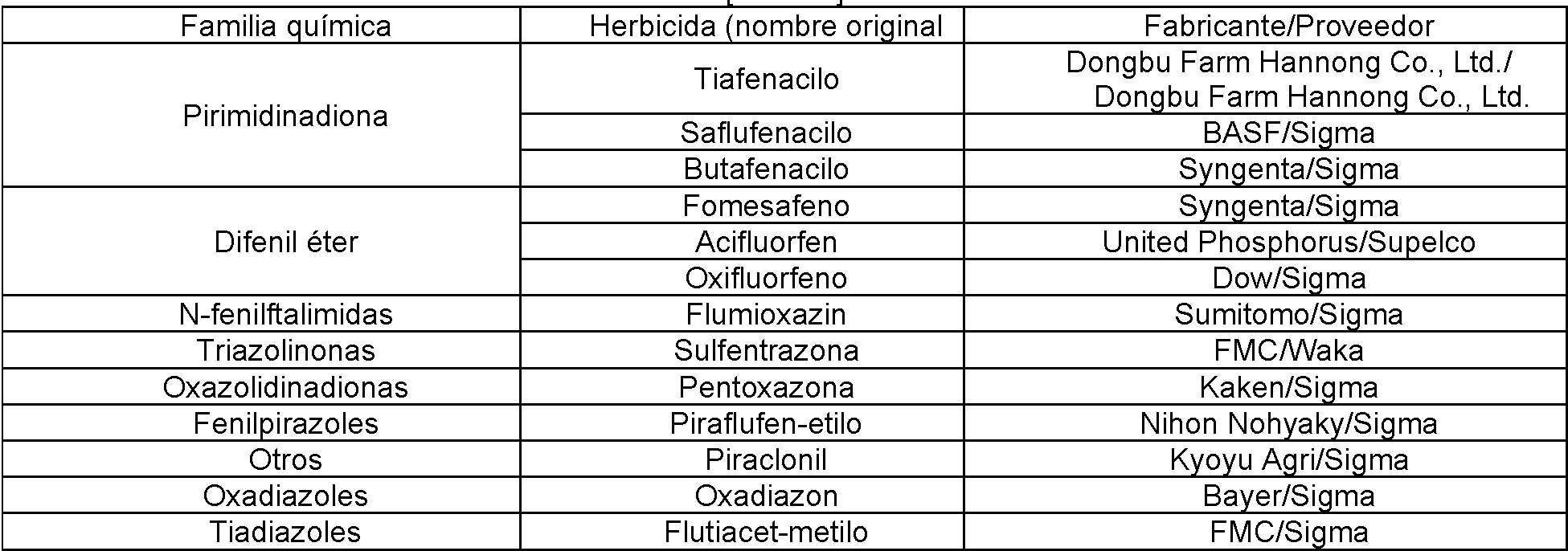
3-2. Método experimental3-2. experimental method
Para clonar cada uno de los genes CyPPO2, CyPPO4, CyPPO8 y CyPP012 aislados y amplificados en el Ejemplo 1 en pACBB (su estructura se muestra en la FIG. 2), se preparó 10 pl de una solución que contiene 4 pl de cada gen PPO, 3.5 pl de vector pACBB, 1 pl de tampón A 10X, 1 pl de tampón B 10X, 1 pl de ligasa (RBC, 3 unidades/pl) y se dejó reaccionar a 22°C durante 30 minutos. La solución de reacción se agregó a 100 pl de células competentes DH5 alfa y se dejó reaccionar en hielo durante 20 minutos y luego se dejó a 42°C durante 40 segundos. Después de eso, las células se dejaron en hielo durante 2 minutos, y luego se agregó a las mismas 1 ml de caldo LB, seguido por incubación con agitación a 37°C durante 1 hora. Las cepas que tenían cada gen inserto en el medio de cultivo se recolectaron y luego se cultivaron sobre medio de agar lB que contenía cloranfenicol.To clone each of the CyPPO2, CyPPO4, CyPPO8, and CyPP012 genes isolated and amplified in Example 1 into pACBB (its structure is shown in FIG. 2), 10 pl of a solution containing 4 pl of each PPO gene was prepared. , 3.5 μl of pACBB vector, 1 μl of 10X buffer A, 1 μl of 10X buffer B, 1 μl of ligase (RBC, 3 units/μl) and allowed to react at 22°C for 30 minutes. The reaction solution was added to 100 µl of DH5 alpha competent cells and allowed to react on ice for 20 minutes and then left at 42°C for 40 seconds. After that, the cells were left on ice for 2 minutes, and then 1 ml of LB broth was added thereto, followed by incubation with shaking at 37°C for 1 hour. Strains having each gene inserted in the culture medium were harvested and then cultured on IB agar medium containing chloramphenicol.
Para el cultivo de semillas de E. coli transformado con los genes respectivos, se cultivaron colonias individuales de las mismas en 3 ml de caldo LB que contenía cloranfenicol durante la noche, y cada 100 pl del mismo se subcultivó en 3 ml de caldo LB fresco hasta que la absorbancia (OD600) alcanzó 0.5~1. Se diluyeron con caldo LB hasta una absorbancia (OD600) de 0.5. Se realizó una dilución de 10 veces de esta solución diluida con caldo LB cinco veces. A continuación, se vertieron 10 pl de la solución diluida del cultivo de E. coli transformado sobre medio de agar LB (placa de Petri) que contenía cloranfenicol y una variedad de reservas de herbicidas a diferentes concentraciones (0~400 pM). Las placas de agar LB se incubaron a 37 °C. A los 16~20 horas después del cultivo, la inhibición del crecimiento se examinó a simple vista. Además, se examinó la inhibición del crecimiento de las cepas cultivadas en un medio que contenía Tiafenacilo bajo condiciones de luz (iluminación de 169 pmol m 'V ) y oscuridad.For seed culture of E. coli transformed with the respective genes, single colonies thereof were grown in 3 ml of LB broth containing chloramphenicol overnight, and each 100 μl thereof was subcultured in 3 ml of fresh LB broth. until the absorbance (OD 600 ) reached 0.5~1. They were diluted with LB broth to an absorbance (OD 600 ) of 0.5. A 10-fold dilution of this five-fold diluted solution with LB broth was made. Next, 10 µl of the diluted solution of the transformed E. coli culture was poured onto LB agar medium (Petri dish) containing chloramphenicol and a variety of herbicide stocks at different concentrations (0~400 pM). LB agar plates were incubated at 37°C. At 16~20 hours after cultivation, growth inhibition was examined with the naked eye. In addition, growth inhibition of strains cultured in a medium containing Thiafenacil was examined under light (169 pmol m 'V illumination) and dark conditions.
3-3. Resultado experimental3-3. Experimental result
Las FIGS. 4 a 6 muestran los resultados de examinar la resistencia a herbicidas de CyPPO2, CyPPO4 y CyPPO8, y las FIGS. 7 y 8 muestran los resultados de examinar la resistencia a herbicidas de CyPPO12.FIGS. 4 to 6 show the results of examining the herbicide resistance of CyPPO2, CyPPO4 and CyPPO8, and FIGS. 7 and 8 show the results of examining the herbicide resistance of CyPPO12.
Como se muestra en la FIG. 3, el crecimiento de la cepa transformada con AtPPO1 de tipo silvestre se inhibió en el medio que contenía Tiafenacilo bajo condiciones de luz y oscuridad, y se observó una inhibición del crecimiento más fuerte bajo condiciones de luz que bajo condiciones de oscuridad. Por ejemplo, el crecimiento de la cepa transformada con AtPPO1 de tipo silvestre se inhibió casi completamente a 1 pM de Tiafenacilo bajo condiciones de luz, pero su crecimiento se mantuvo más bien bajo condiciones de oscuridad. Sin embargo, el crecimiento se inhibió completamente a 5 pM o más de Tiafenacilo tanto bajo condiciones de luz como de oscuridad. Como tal, el crecimiento de la cepa transformada con AtPPO1 de tipo silvestre se inhibió de una manera dependiente de la concentración de Tiafenacilo, lo que indica sensibilidad a herbicidas. No se observó inhibición del crecimiento de la cepa transformada con el AtPPO1 mutante incluso a 25 pM de Tiafenacilo, lo que indica resistencia a herbicidas.As shown in FIG. 3, the growth of the wild-type AtPPO1-transformed strain was inhibited in the medium containing Thiaphenacil under light and dark conditions, and stronger growth inhibition was observed under light conditions than under dark conditions. For example, the growth of the wild-type AtPPO1-transformed strain was almost completely inhibited by 1 pM Thiaphenacil under light conditions, but its growth was rather maintained under dark conditions. However, growth was completely inhibited at 5 pM or more Thiafenacil under both light and dark conditions. As such, growth of the wild-type AtPPO1-transformed strain was inhibited in a Thiaphenacil concentration-dependent manner, indicating herbicide sensitivity. No growth inhibition of the strain transformed with the mutant AtPPO1 was observed even at 25 pM Thiaphenacil, indicating herbicide resistance.
Por lo tanto, el AtPPO1 de tipo silvestre se empleó como referencia para PPO sensible a herbicidas, y el AtPPO1 mutante se empleó como referencia para PPO resistente a herbicidas y se examinó la resistencia a herbicidas de CyPPO2, CyPPO4 o CyPPO8 contra las familias de PPO representativas. Therefore, wild-type AtPPO1 was used as a reference for herbicide-sensitive PPO, and mutant AtPPO1 was used as a reference for herbicide-resistant PPO, and the herbicide resistance of CyPPO2, CyPPO4, or CyPPO8 against the PPO families was examined. representative.
La FIG. 4 muestra los resultados después del tratamiento con concentraciones variables de herbicidas de PPO a base de pirimidindiona representativos, Tiafenacilo, Saflufenacilo y Butafenacilo, y un herbicida de PPO representativo a base de N-fenilftalimida, flumioxazin. Tras el tratamiento de Tiafenacilo y Saflufenacilo, las inhibiciones del crecimiento de la cepa transformada con el AtPPO1 mutante, la cepa transformada con CyPPO2, la cepa transformada con CyPPO4 y la cepa transformada con CyPP08 apenas se observaron incluso a 25 pM de Tiafenacilo o Saflufenacilo. Tras el tratamiento de Butafenacilo, las inhibiciones del crecimiento de la cepa transformada con el AtPPOI mutante, la cepa transformada con CyPPO2 y la cepa transformada con CyPPO8 apenas se observaron incluso a 25 pM de Butafenacilo. Tras el tratamiento de Flumioxazin, las inhibiciones del crecimiento de la cepa transformada con CyPPO2, la cepa transformada con CyPPO4 y la cepa transformada con CyPPO8 apenas se observaron incluso a 25 pM de Flumioxazin. Tras el tratamiento de cada uno de los cuatro herbicidas, la inhibición del crecimiento de la cepa transformada con AtPPOI de tipo silvestre comenzó a 0.5 pM y apenas creció a 5 pM o más.FIG. 4 shows the results after treatment with varying concentrations of representative pyrimidinedione-based PPO herbicides, Thiaphenacil, Saflufenacil and Butaphenacil, and a representative N-phenylphthalimide-based PPO herbicide, flumioxazin. Following treatment with Thiaphenacil and Saflufenacil, growth inhibitions of the mutant AtPPO1-transformed strain, CyPPO2-transformed strain, CyPPO4-transformed strain and CyPP08-transformed strain were barely observed even at 25 pM Thiaphenacil or Saflufenacil. Following Butaphenacil treatment, growth inhibitions of the mutant AtPPOI-transformed strain, the CyPPO2-transformed strain and the CyPPO8-transformed strain were barely observed even at 25 pM Butaphenacil. Following Flumioxazin treatment, growth inhibitions of CyPPO2-transformed strain, CyPPO4-transformed strain and CyPPO8-transformed strain were barely observed even at 25 pM Flumioxazin. Following treatment with each of the four herbicides, growth inhibition of the wild-type AtPPOI-transformed strain started at 0.5 pM and barely grew at 5 pM or more.
La FIG. 5 muestra los resultados después del tratamiento con concentraciones variables de herbicidas representativos de PPO a base de difenil éter, Fomesafeno, Acifluorfen y Oxifluorfeno. Tras el tratamiento con Fomesafeno, no se observó inhibición del crecimiento de la cepa transformada con el AtPPOI mutante por 25 pM, y apenas se observaron inhibiciones del crecimiento de la cepa transformada con CyPPO2, la cepa transformada con CyPPO4 y la cepa transformada con CyPPO8 incluso a 400 pM de Fomesafeno. Tras el tratamiento con Acifluorfen, las inhibiciones del crecimiento de la cepa transformada con CyPPO2, la cepa transformada con CyPPO4 y la cepa transformada con CyPP08 apenas se observaron incluso a 400 pM de Acifluorfen. Tras el tratamiento con oxifluorfeno, apenas se observaron inhibiciones del crecimiento de la cepa transformada con CyPPO2, la cepa transformada con CyPPO4 y la cepa transformada con CyPPO8 incluso a 400 pM de Oxifluorfeno. Tras el tratamiento de cada uno de los tres herbicidas, la cepa transformada con AtPPOI de tipo silvestre apenas creció a 5 pM o más.FIG. 5 shows the results after treatment with varying concentrations of representative PPO herbicides based on diphenyl ether, Fomesafen, Acifluorfen and Oxyfluorfen. After fomesafen treatment, no growth inhibition was observed for the strain transformed with the mutant AtPPOI by 25 pM, and hardly any growth inhibition was observed for the strain transformed with CyPPO2, the strain transformed with CyPPO4 and the strain transformed with CyPPO8 even at 400 pM Fomesafen. After treatment with Acifluorfen, growth inhibitions of CyPPO2-transformed strain, CyPPO4-transformed strain and CyPP08-transformed strain were barely observed even at 400 pM Acifluorfen. Upon oxyfluorfen treatment, growth inhibitions of CyPPO2-transformed strain, CyPPO4-transformed strain and CyPPO8-transformed strain were hardly observed even at 400 pM Oxyfluorfen. After treatment with each of the three herbicides, the wild-type AtPPOI-transformed strain barely grew at 5 pM or more.
La FIG. 6 muestra los resultados después del tratamiento con concentraciones variables de un herbicida de PPO representativo a base de triazolinona Sulfentrazona, un herbicida de PPO representativo a base de oxazolidindiona Pentoxazona, un herbicida de PPO representativo a base de fenilpirazol Piraflufen-etilo, un herbicida de PPO representativo a base de oxadiazol Oxadiazon, un herbicida de PPO a base de tiadiazol representativo Flutiacet-metilo, y otro herbicida de PPO Piraclonil. Tras el tratamiento con sulfentrazona, apenas se observaron inhibiciones del crecimiento de la cepa transformada con CyPPO2, la cepa transformada con CyPPO4 y la cepa transformada con CyPPO8 incluso a 400 pM de sulfentrazona. Tras el tratamiento de Pentoxazona, Piraflufen-etilo, Oxadiazon, Flutiacetmetilo y Piraclonil, las inhibiciones del crecimiento de la cepa transformada con CyPP02 y la cepa transformada con CyPP08 apenas se observaron incluso a 400 pM de Oxifluorfeno. Tras el tratamiento de cada uno de los siete herbicidas, la cepa transformada con AtPPOI de tipo silvestre apenas creció a 5 pM o más.FIG. 6 shows the results after treatment with varying concentrations of a representative triazolinone-based PPO herbicide Sulfentrazone, a representative oxazolidinedione-based PPO herbicide Pentoxazone, a representative phenylpyrazole-based PPO herbicide Piraflufen-ethyl, a PPO herbicide representative oxadiazole-based Oxadiazon, a representative thiadiazole-based PPO herbicide Fluthiacet-methyl, and another PPO herbicide Pyraclonil. Upon treatment with sulfentrazone, growth inhibitions of CyPPO2-transformed strain, CyPPO4-transformed strain and CyPPO8-transformed strain were hardly observed even at 400 pM sulfentrazone. After treatment of Pentoxazone, Pyraflufen-ethyl, Oxadiazon, Fluthiacetmethyl and Pyraclonil, growth inhibitions of CyPP02-transformed strain and CyPP08-transformed strain were barely observed even at 400 pM Oxyfluorfen. After treatment with each of the seven herbicides, the wild-type AtPPOI-transformed strain barely grew at 5 pM or more.
La FIG. 7 muestra los resultados de examinar la resistencia a herbicidas de CyPPO12 tras el tratamiento de Tiafenacilo, Saflufenacilo, Flumioxazin, Fomesafeno y Oxifluorfeno. La inhibición del crecimiento de la cepa transformada con CyPPO12 apenas se observó incluso a cada 25 pM de Tiafenacilo, Saflufenacilo, Flumioxazin, Fomesafeno y Oxifluorfeno, y la inhibición del crecimiento de los mismos apenas se observó incluso a 400 pM de Fomesafeno u Oxifluorfeno. Tras el tratamiento con oxifluorfeno, la inhibición del crecimiento de la cepa transformada con el AtPPOI mutante comenzó a 5 pM. La inhibición del crecimiento del mismo apenas se observó incluso a 25 pM de otros herbicidas. Por el contrario, la inhibición del crecimiento de la cepa transformada con AtPPOI de tipo silvestre comenzó en cada 0.5 pM de los cuatro herbicidas excluyendo Fomesafeno, y apenas creció a 5 pM o más. Tras el tratamiento de Fomesafeno, se observó inhibición del crecimiento de la cepa transformada con AtPPOI de tipo silvestre a 5 pM.FIG. 7 shows the results of examining the herbicide resistance of CyPPO12 after treatment with Thiafenacil, Saflufenacil, Flumioxazin, Fomesafen and Oxyfluorfen. The growth inhibition of the CyPPO12-transformed strain was hardly observed even at each 25 pM Thiafenacil, Saflufenacil, Flumioxazin, Fomesafen and Oxyfluorfen, and the growth inhibition thereof was hardly observed even at 400 pM Fomesafen or Oxyfluorfen. Following oxyfluorfen treatment, growth inhibition of the strain transformed with the mutant AtPPOI began at 5 pM. Growth inhibition thereof was hardly observed even at 25 pM of other herbicides. In contrast, growth inhibition of the wild-type AtPPOI-transformed strain began at each 0.5 pM of all four herbicides excluding Fomesafen, and hardly grew at 5 pM or more. Following Fomesafen treatment, growth inhibition of the transformed strain was observed with wild-type AtPPOI at 5 pM.
La FIG. 8 muestra los resultados de examinar la resistencia a herbicidas de CyPPO12 tras el tratamiento de Piraflufenetilo, Oxadiazon, Sulfentrazona, Pentoxazona y Piraclonil. No se observaron inhibiciones del crecimiento de la cepa transformada con el AtPPOI mutante y la cepa transformada con CyPPO12 incluso a 25 pM, y tampoco se observaron inhibiciones del crecimiento de las mismas incluso a cada 400 pM de los cuatro herbicidas excluyendo la sulfentrazona. Por el contrario, tras el tratamiento de Piraflufen-etilo, Oxadiazon, Sulfentrazona o Piraclonil, la inhibición del crecimiento de la cepa transformada con AtPPOI de tipo silvestre comenzó a 0.5 pM. Tras el tratamiento de Piraclonil, la inhibición del crecimiento del mismo comenzó a 5 pM y apenas creció a 25 pM.FIG. 8 shows the results of examining the herbicide resistance of CyPPO12 after treatment with Pyraflufenethyl, Oxadiazon, Sulfentrazone, Pentoxazone and Pyraclonil. No growth inhibition was observed for the strain transformed with the mutant AtPPOI and the strain transformed with CyPPO12 even at 25 pM, and no growth inhibition thereof was observed even at each 400 pM of the four herbicides excluding sulfentrazone. In contrast, after treatment with Pyraflufen-ethyl, Oxadiazon, Sulfentrazone, or Pyraclonil, growth inhibition of the transformed strain with wild-type AtPPOI began at 0.5 pM. After Pyraclonil treatment, the growth inhibition of the same started at 5 pM and hardly increased at 25 pM.
Ejemplo 4. Ensayo de resistencia a herbicidas de CyPPO2, CyPPO4 y CyPPO8 en E. coli deficiente en PPO (medio de caldo LB)Example 4. CyPPO2, CyPPO4 and CyPPO8 Herbicide Resistance Assay in PPO Deficient E. coli (LB Broth Medium)
En el Ejemplo 3, se investigó la resistencia a herbicidas de las respectivas cepas de BT3(APPO) transformadas con el gen AtPPOI de tipo silvestre, AtPPOI mutante, CyPPO2, CyPP04 o CyPPO8 sobre medios de agar que contenían diferentes herbicidas, y en este Ejemplo, la resistencia a herbicidas de las cepas se investigaron en medios líquidos LB que contenían diferentes herbicidas.In Example 3, the herbicide resistance of the respective BT3(APPO) strains transformed with the wild-type AtPPOI gene, mutant AtPPOI, CyPPO2, CyPP04 or CyPPO8 on agar media containing different herbicides was investigated, and in this Example , herbicide resistance of the strains were investigated in LB liquid media containing different herbicides.
4-1. Preparación de materiales e instrumentos experimentales.4-1. Preparation of experimental materials and instruments.
Se utilizaron autoclave HV-50 de Hirayama, balanza electrónica HS2100A de Hansung Instrument, banco limpio CB-30V de Jeio Tech, incubadora JSI-200CL de JSR, fotómetro MQ-200 de Apogee y espectrofotómetro UV-visible tipo 1210 de Thermo Fisher Scientific. El autoclave se utilizó bajo condiciones de 121 °C y 15 minutos, y la incubadora se utilizó a 37 °C con luz de 160~200 |jmol m-2s-1 durante un tiempo de cultivo de 13.5 horas. El espectrofotómetro UV-visible se utilizó a 600 nm.Hirayama HV-50 autoclave, Hansung Instrument HS2100A electronic balance, Jeio Tech CB-30V clean bench, JSR JSI-200CL incubator, Apogee MQ-200 photometer and Thermo Fisher Scientific type 1210 UV-visible spectrophotometer were used. The autoclave was used under conditions of 121 °C and 15 minutes, and the incubator was used at 37 °C with light of 160~200 μmol m-2s-1 for a culture time of 13.5 hours. UV-visible spectrophotometer was used at 600 nm.
El Tiafenacilo (P.M. 511.87 g/mol), el Saflufenacilo (P.M. 500,85 g/mol) y Fomesafeno (P.M. 438.76 g/mol) utilizados en el experimento se adquirieron de Dongbu Farm Hannong Co., Ltd, Sigma y Sigma, respectivamente. Estos fármacos se prepararon a una concentración de 200 mM en acetona al 100% y se almacenaron a -20 °C, respectivamente. Se utilizaron medio Luria-Bertani (LB) (10 g/L de Bacto-Triptona, 5 g/L de extracto de levadura, 10 g/L de cloruro de sodio) y un antibiótico Cloranfenicol (Duchefa).Thiafenacil (MW 511.87 g/mol), Saflufenacil (MW 500.85 g/mol) and Fomesafen (MW 438.76 g/mol) used in the experiment were purchased from Dongbu Farm Hannong Co., Ltd, Sigma and Sigma, respectively. . These drugs were prepared at a concentration of 200 mM in 100% acetone and stored at -20 °C, respectively. Luria-Bertani (LB) medium (10 g/L Bacto-Tryptone, 5 g/L yeast extract, 10 g/L sodium chloride) and an antibiotic Chloramphenicol (Duchefa) were used.
4-2. Método experimental4-2. experimental method
Para el cultivo de siembra de E. coli transformado con los genes respectivos, se cultivaron colonias individuales de las mismas en 3 ml de caldo LB que contenía cloranfenicol durante 12 horas, y se diluyeron con caldo LB hasta una absorbancia (OD600) de 1.5. A continuación, se agregaron cloranfenicol y 500 j l del cultivo de siembra de la E. coli transformada a 250 ml de medio líquido LB, y se agregaron 50 ml del cultivo a cada matraz de 250 ml. Cada matraz se trató con concentraciones variables (0, 10 jM , 50 jM , 100 jM ) de reservas de herbicidas (Tiafenacilo, Saflufenacilo, Fomesafeno) y luego se incubó a 37 °C y 200 rpm. La absorbancia (OD600) se midió utilizando un espectrofotómetro cada 1.5 horas. El experimento se repitió tres veces y los valores medios del mismo se dieron en un gráfico. Las barras de error representan el error estándar de tres repeticiones.For the seed culture of E. coli transformed with the respective genes, single colonies thereof were grown in 3 ml of LB broth containing chloramphenicol for 12 hours, and diluted with LB broth to an absorbance (OD 600 ) of 1.5. . Chloramphenicol and 500 μl of the transformed E. coli seed culture were then added to 250 ml of LB liquid medium, and 50 ml of the culture was added to each 250 ml flask. Each flask was treated with variable concentrations (0, 10 jM, 50 jM, 100 jM) of herbicide stocks (Thiaphenacyl, Saflufenacil, Fomesafen) and then incubated at 37 °C and 200 rpm. Absorbance (OD 600 ) was measured using a spectrophotometer every 1.5 hours. The experiment was repeated three times and the mean values thereof were given in a graph. Error bars represent the standard error of three replicates.
4- 3. Resultado experimental4- 3. Experimental result
El AtPPO1 de tipo silvestre se empleó como referencia para la PPO sensible a herbicidas, y la AtPPO1 mutante se empleó como referencia para la PPO resistente a herbicidas.Wild-type AtPPO1 was used as a reference for herbicide-sensitive PPO, and mutant AtPPO1 was used as a reference for herbicide-resistant PPO.
El resultado del tratamiento con Tiafenacilo se muestra en la FIG. 9.The result of treatment with Thiafenacil is shown in FIG. 9.
La cepa transformada con AtPPO1 de tipo silvestre apenas creció a 10 jM de Tiafenacilo o más, mientras que la cepa transformada con el AtPPO1 mutante creció a 10 jM de Tiafenacilo, pero se observó inhibición del crecimiento de la misma a 50 jM de Tiafenacilo o más. Adicionalmente, la cepa transformada con CyPPO2 y la cepa transformada con CyPP04 crecieron normalmente en 100 jM de Tiafenacilo.The wild-type AtPPO1-transformed strain barely grew at 10 mM Thiaphenacil or more, while the mutant AtPPO1-transformed strain grew at 10 mM Thiaphenacil, but growth inhibition was observed at 50 mM Thiaphenacil or more. . Additionally, the CyPPO2-transformed strain and the CyPP04-transformed strain grew normally on 100 jM Thiaphenacil.
El resultado del tratamiento con Saflufenacilo se muestra en la FIG. 10.The result of treatment with Saflufenacil is shown in FIG. 10.
En todas las cepas transformadas, la presencia o ausencia de resistencia fue similar al resultado del tratamiento con Tiafenacilo, pero se observó una alta resistencia en las cepas tratadas con Saflufenacilo, en comparación con las tratadas con Tiafenacilo. La cepa transformada con la AtPPO1 de tipo silvestre apenas creció a 10 jM de Saflufenacilo o más, mientras que la cepa transformada con la AtPPO1 mutante, la cepa transformada con CyPPO2, la cepa transformada con CyPPO4 y la cepa transformada con CyPPO8 normalmente creció en 100 jM .In all transformed strains, the presence or absence of resistance was similar to the result of thiaphenacil treatment, but high resistance was observed in saflufenacil-treated strains compared to thiaphenacil-treated strains. The wild-type AtPPO1-transformed strain barely grew at 10 µM Saflufenacil or more, whereas the mutant AtPPO1-transformed strain, CyPPO2-transformed strain, CyPPO4-transformed strain, and CyPPO8-transformed strain normally grew at 100 µM. jM.
El resultado del tratamiento con Fomesafeno se muestra en la FIG. 11.The result of Fomesafen treatment is shown in FIG. eleven.
La inhibición del crecimiento de la cepa transformada con la AtPPO1 de tipo silvestre comenzó a 50 jM , mientras que la cepa transformada con la AtPPO1 mutante, la cepa transformada con CyPPO2, la cepa transformada con CyPP04 y la cepa transformada con CyPPO8 normalmente crecieron por 100 jM .Growth inhibition of the wild-type AtPPO1-transformed strain began at 50 mM, whereas the mutant AtPPO1-transformed strain, CyPPO2-transformed strain, CyPP04-transformed strain, and CyPPO8-transformed strain normally grew by 100 mM. jM.
Ejemplo 5. Expresión de CyPPO2, CyPPO4 y CyPPO8 en plantaExample 5. Expression of CyPPO2, CyPPO4 and CyPPO8 in plant
Se realizaron experimentos para expresar CyPP02, CyPPO4 y CyPPO8 en plantas, de las cuales se había demostrado resistencia contra varios herbicidas de PPO en los Ejemplos 3 y 4, y se utilizó proteína fluorescente (proteína amarilla fluorescente, YFP) para confirmar las expresiones de proteínas de PPO.Experiments were performed to express CyPP02, CyPPO4 and CyPPO8 in plants, of which resistance against several PPO herbicides had been demonstrated in Examples 3 and 4, and fluorescent protein (yellow fluorescent protein, YFP) was used to confirm protein expressions. of PPOs.
5- 1. Método experimental5- 1. Experimental method
Para preparar células competentes de Agrobacterium, se cultivó la cepa GV3101 de Agrobacterium tumefaciens (Korea Research Institute of Bioscience & Biotechnology) en 5 ml de medio LB a 30°C y 200 rpm durante 12 horas. Este caldo de cultivo se agregó a 200 ml de medio LB y luego se cultivó a 30 °C y 200 rpm durante 3~4 horas, seguido de centrifugación a 3000 g, 4 °C durante 20 minutos. El sedimento se lavó con agua destilada estéril y luego se resuspendió en 20 ml de medio LB. Se congelaron instantáneamente 200 j l de una alícuota del mismo en nitrógeno líquido y luego se almacenaron en un congelador.To prepare competent Agrobacterium cells, Agrobacterium tumefaciens strain GV3101 (Korea Research Institute of Bioscience & Biotechnology) was cultured in 5 ml of LB medium at 30°C and 200 rpm for 12 hours. This culture broth was added to 200 ml of LB medium and then cultured at 30°C and 200 rpm for 3~4 hours, followed by centrifugation at 3000g, 4°C for 20 minutes. The pellet was washed with sterile distilled water and then resuspended in 20 ml of LB medium. 200 μl of an aliquot thereof was flash frozen in liquid nitrogen and then stored in a freezer.
Para preparar los vectores respectivos que se clonaron con los genes AtPPO1, CyPPO2, CyPPO4 y CyPPO8 de tipo silvestre, se trató un vector que contenía un promotor CaMV 35S, un terminador YFP y NOS con las enzimas de restricción XbaI y XhoI y un gen de péptido de tránsito. (SEQ ID NO: 26) amplificado por PCR se trató con enzimas de restricción XbaI y XhoI, y luego el vector y el gen del péptido de tránsito se ligaron entre sí para insertar el péptido de tránsito que está implicado en la transición del cloroplasto al vector. Adicionalmente, las enzimas de restricción XhoI y BamHI se utilizaron para digerir los genes PPO respectivos (genes AtPPOI, CyPP02, CyPPO4 y CyPPO8 de tipo silvestre) y el vector, y luego se ligaron entre sí para insertar los genes PPO respectivos en el vector. Como resultado, el péptido de tránsito se ligó al extremo 5' del gen PPO y el gen YFP se unió al extremo 3' del mismo. Un diagrama esquemático del vector final se muestra en la FIG. 12.To prepare the respective vectors that were cloned with the wild-type AtPPO1, CyPPO2, CyPPO4 and CyPPO8 genes, a vector containing a CaMV 35S promoter, a YFP terminator and NOS was treated with the restriction enzymes XbaI and XhoI and a transit peptide. (SEQ ID NO: 26) amplified by PCR was treated with restriction enzymes XbaI and XhoI, and then the vector and the transit peptide gene were ligated together to insert the transit peptide which is involved in the transition from chloroplast to chloroplast. vector. Additionally, the restriction enzymes XhoI and BamHI were used to digest the respective PPO genes (wild-type AtPPOI, CyPP02, CyPPO4 and CyPPO8 genes) and the vector, and then ligated together to insert the respective PPO genes into the vector. As a result, the transit peptide was bound to the 5' end of the PPO gene and the YFP gene was bound to the 3' end thereof. A schematic diagram of the final vector is shown in FIG. 12.
A continuación, para la transformación mediada por Agrobacterium, las células competentes de Agrobacterium preparadas anteriormente se descongelaron en hielo y luego se mezclaron con 3~5 pl de los vectores que albergan los genes de PPO respectivos, seguido de congelación rápida en nitrógeno líquido durante 2~3 minutos. Después de eso, las células se descongelaron a 37°C durante 5 minutos, se agregó a las mismas 1 ml de medio LB y se incubaron a 30°C durante 2 horas. Cada cultivo resultante se sembró en medio LB/espectinomicina y se incubó a 30°C durante 2 días.Next, for Agrobacterium-mediated transformation, the above-prepared Agrobacterium competent cells were thawed on ice and then mixed with 3~5 pl of the vectors harboring the respective PPO genes, followed by quick freezing in liquid nitrogen for 2 ~3 minutes. After that, the cells were thawed at 37°C for 5 minutes, 1 ml of LB medium was added thereto, and they were incubated at 30°C for 2 hours. Each resulting culture was seeded in LB/spectinomycin medium and incubated at 30°C for 2 days.
Para inocular hojas de tabaco con Agrobacterium, se cultivaron colonias individuales de Agrobacterium transformadas con los respectivos vectores insertados en PPO en medio LB/espectinomicina a 30°C, 200 rpm durante 12 horas y se centrifugaron a 7000 rpm durante 2 minutos. Los sedimentos resultantes se resuspendieron en MgCh 10 mM, respectivamente. Después de ajustar su absorbancia (OD600) a 0.5, se agregó acetosiringona 200 pM y se almacenó a temperatura ambiente durante 2 horas. Se infiltró Agrobacterium en hojas de tabaco cultivadas normalmente utilizando una jeringa de 1 ml y se cultivó durante 2-5 días.To inoculate tobacco leaves with Agrobacterium, single Agrobacterium colonies transformed with the respective inserted vectors were grown in PPO in LB/spectinomycin medium at 30°C, 200 rpm for 12 hours and centrifuged at 7000 rpm for 2 minutes. The resulting pellets were resuspended in 10 mM MgCh, respectively. After adjusting its absorbance (OD 600 ) to 0.5, 200 pM acetosyringone was added and stored at room temperature for 2 hours. Agrobacterium was infiltrated into normally cultured tobacco leaves using a 1 ml syringe and cultured for 2-5 days.
A continuación, para aislar protoplastos de hojas de tabaco, se preparó una solución de enzima como en la composición de la Tabla 3 o 5.Next, to isolate protoplasts from tobacco leaves, an enzyme solution was prepared as in the composition of Table 3 or 5.
T l 1Tl 1

El pH de la solución anterior se ajustó a 5,8 y se esterilizó utilizando un filtro que tenía un tamaño de poro de 0.22 pm.The pH of the above solution was adjusted to 5.8 and sterilized using a filter having a pore size of 0.22 µm.

______________ _________________________ ___________
T l 1Tl 1
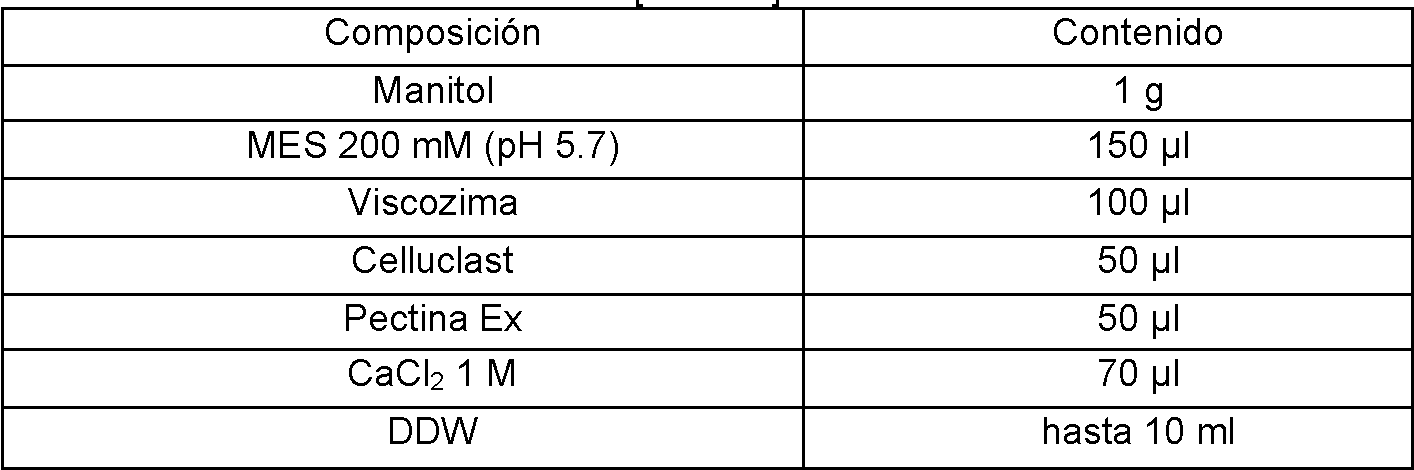
Las hojas de tabaco se cortaron en tiras con una cuchilla de afeitar y las tiras de hojas se suspendieron en la solución de enzima preparada, se cubrieron con papel de aluminio y se agitaron a temperatura ambiente a 40-50 rpm durante 3-5 horas. Se utilizaron un microscopio (Carl Zeiss Observer Z1) y un sistema de análisis de correlación de biomateriales (Zeiss LSM710) para examinar las células de protoplasto con tres tipos de filtros, DIC, YFP y rodamina. Las imágenes se capturaron utilizando una herramienta de formación de imágenes y luego se procesaron con un programa ZEN lite 2012 (Carl Zeiss). The tobacco leaves were cut into strips with a razor blade and the leaf strips were suspended in the prepared enzyme solution, covered with aluminum foil and stirred at room temperature at 40-50 rpm for 3-5 hours. A microscope (Carl Zeiss Observer Z1) and a biomaterial correlation analysis system (Zeiss LSM710) were used to examine protoplast cells with three types of filters, DIC, YFP and rhodamine. Images were captured using an imaging tool and then processed with ZEN lite 2012 software (Carl Zeiss).
La proteína fluorescente (YFP) expresada con la proteína CyPPO2, CyPP04 o CyPPO8 se examinó mediante transferencia Western. Con este fin, las muestras se congelaron y almacenaron en nitrógeno líquido, y luego se rompieron con un micropistilo. Se agregó tampón IP [Tris-Cl 50 mM (pH 7.5), NaCl 75 mM, EDTA 5 mM, Triton X-100 al 1%, DTT 1 mM, inhibidor de proteasa 1x] (40 j l para pocillo grande) y se agitó con vórtex, y luego se deja sobre hielo durante 10 minutos o más. Después de centrifugar a 4 °C durante 10 minutos, el sobrenadante se transfirió a un nuevo tubo de 1.5 ml. Se le agregó un colorante de carga de proteínas, se hirvió a 100°C durante 5 minutos y luego se dejó en hielo. Después de la centrifugación, se utilizó el sobrenadante. Para la electroforesis, se cargó una solución de eXtracto de proteína sobre un gel de SDS-PAGE al 7.5% y las proteínas se separaron a 100 V para un gel de apilamiento y a 150 V para un gel de separación. Las proteínas sometidas a electroforesis se transfirieron a una membrana de PVDF (fluoruro de polivinilideno) y se bloquearon con un tampón de bloqueo (leche desnatada en polvo al 4%, fosfato de sodio 10 mM, NaCl 0,15 M, Tween-20 al 0,05%, pH 7.5) durante 1 hora. Luego, se agregó anticuerpo anti-GFP (conjugado con HRP) (SantaCruz) a una dilución 1/2000 y se hizo reaccionar a temperatura ambiente durante 2 horas. Después de la reacción del anticuerpo, la membrana se lavó con tampón PBS-T (solución salina tamponada con fosfato-Tween) durante 10 minutos tres veces, y se pulverizaron 500 j l de solución de ECL (electroquimioluminiscencia) (composición de tampón o proveedor: Bio-Rad) y se dejaron durante 1 minuto. La membrana se cubrió con una película OHP, se expuso a una película de rayos X y luego se reveló la película.Fluorescent protein (YFP) expressed with CyPPO2, CyPP04 or CyPPO8 protein was examined by Western blot. For this purpose, the samples were frozen and stored in liquid nitrogen, and then broken with a micropistil. IP buffer [50 mM Tris-Cl (pH 7.5), 75 mM NaCl, 5 mM EDTA, 1% Triton X-100, 1 mM DTT, 1x protease inhibitor] (40 µL for large well) was added and vortexed. vortexed, and then left on ice for 10 minutes or more. After centrifugation at 4 °C for 10 min, the supernatant was transferred to a new 1.5 ml tube. Protein loading dye was added, boiled at 100°C for 5 minutes, and then left on ice. After centrifugation, the supernatant was used. For electrophoresis, protein extract solution was loaded onto a 7.5% SDS-PAGE gel and proteins separated at 100 V for a stacking gel and 150 V for a separating gel. Electrophoresed proteins were blotted onto a PVDF (polyvinylidene fluoride) membrane and blocked with blocking buffer (4% skimmed milk powder, 10 mM sodium phosphate, 0.15 M NaCl, al-Tween-20). 0.05%, pH 7.5) for 1 hour. Then, anti-GFP antibody (HRP-conjugated) (SantaCruz) was added at 1/2000 dilution and reacted at room temperature for 2 hours. After the antibody reaction, the membrane was washed with PBS-T buffer (phosphate buffered saline-Tween) for 10 minutes three times, and 500 jl of ECL (electrochemiluminescence) solution was sprayed (buffer composition or supplier: Bio-Rad) and left for 1 minute. The membrane was covered with OHP film, exposed to X-ray film, and then the film was developed.
5-2. Resultado experimental5-2. Experimental result
Los resultados de examinar las expresiones de los genes AtPPO1, CyPPO2, CyPPO4 y CyPPO8 de tipo silvestre respectivos después de la introducción en plantas se muestran en la FlG. 13. Se observó la formación de colonias de Agrobacterium en las respectivas plantas transformadas con los genes PPO. No se observó la orientación de la proteína YFP de control negativo a los cloroplastos y se observó su expresión en el citoplasma y el núcleo. La imagen fusionada de la proteína de PPO y la autofluorescencia de clorofila mostró que las señales de fluorescencia se superpusieron entre sí, lo que indica que el cTP (péptido de tránsito del cloroplasto) se dirige a los cloroplastos, que se ligan al terminal N con el fin de dirigirse al cloroplasto.The results of examining the expressions of the respective wild-type genes AtPPO1, CyPPO2, CyPPO4 and CyPPO8 after introduction into plants are shown in FlG. 13. The formation of Agrobacterium colonies was observed in the respective plants transformed with the PPO genes. Targeting of the negative control YFP protein to chloroplasts was not observed and its expression was observed in the cytoplasm and nucleus. The merged image of PPO protein and chlorophyll autofluorescence showed that the fluorescence signals overlapped with each other, indicating that cTP (chloroplast transit peptide) targets chloroplasts, which bind at the N-terminus with in order to go to the chloroplast.
Ejemplo 6. Preparación del vector de transformación de planta y transformanteExample 6. Preparation of plant transformation vector and transformant
Para la selección de transformación de plantas, se preparó y usó un vector binario que albergaba el ORF del gen BAR (gen de resistencia al glufosinato) y el ORF del gen CyPPO2, CyPPO4 o CyPPO8 respectivo. El gen BAR se utilizó para examinar los efectos del tratamiento cruzado de otros herbicidas que tienen un mecanismo de acción diferente al de los herbicidas basados en PPO. Este gen también se utilizó para examinar si se producía una herencia estable en la siguiente generación. Para expresar el gen BAR, se utilizó un promotor NOS y se utilizó un terminador E9 para terminar la transcripción. Mientras tanto, para la inducción de la expresión de CyPPO2, CyPPO4 y CyPPO8 en plantas, se utilizó un promotor CaMV35S, y para dirigir las proteínas a los cloroplastos, se insertó una región de péptido de tránsito (TP) del gen AtPPO1 utilizando las enzimas de restricción Xbal y Xhol. Adicionalmente, para confirmar las proteínas expresadas, se insertó una etiqueta de hemaglutinina (HA) en el extremo 3' utilizando enzimas de restricción BamHI y Sacl. La región del péptido de tránsito insertada en el vector se representa por la SEQ ID NO: 27 y la secuencia de etiqueta HA insertada se representa por la SEQ ID NO: 28. Los genes CyPP02 y CyPP08 se insertaron entre el péptido de tránsito y la etiqueta Ha utilizando enzimas de restricción Xhol y BamHI, y el terminador NOS se insertó detrás de la etiqueta HA para inducir la terminación de la transcripción del gen PPO. En la FIG. 14 se muestra un diagrama esquemático que muestra la estructura del vector binario de transformación de plantas.For plant transformation selection, a binary vector harboring the ORF of the BAR gene (glufosinate resistance gene) and the ORF of the respective CyPPO2, CyPPO4 or CyPPO8 gene was prepared and used. The BAR gene was used to examine the cross-treatment effects of other herbicides that have a different mechanism of action than PPO-based herbicides. This gene was also used to examine whether stable inheritance occurred in the next generation. To express the BAR gene, a NOS promoter was used and an E9 terminator was used to terminate transcription. Meanwhile, for the induction of CyPPO2, CyPPO4, and CyPPO8 expression in plants, a CaMV35S promoter was used, and to target the proteins to chloroplasts, a transit peptide (TP) region of the AtPPO1 gene was inserted using the enzymes of Xbal and Xhol restriction. Additionally, to confirm the expressed proteins, a hemagglutinin (HA) tag was inserted at the 3' end using BamHI and Sacl restriction enzymes. The transit peptide region inserted into the vector is represented by SEQ ID NO: 27 and the inserted HA tag sequence is represented by SEQ ID NO: 28. The CyPP02 and CyPP08 genes were inserted between the transit peptide and the Ha tag using Xhol and BamHI restriction enzymes, and the NOS terminator was inserted behind the HA tag to induce transcription termination of the PPO gene. In FIG. 14 is a schematic diagram showing the structure of the plant transformation binary vector.
Mientras tanto, el transformante de planta se preparó como sigue. Primero, se seleccionó Agrobacterium transformado en un medio antibiótico y luego se cultivaron las colonias en un medio líquido. Se recolectaron células de Agrobacterium y se suspendieron en una solución que contenía sacarosa al 5% y Silwet L-77 al 0.05%. La absorbancia (OD600) se ajustó a 0.8, y luego se puso un órgano floral de Arabidopsis thaliana cultivado durante aproximadamente 5-6 semanas en la solución de Agrobacterium. Para mantener la humedad, la maceta se cubrió con una bolsa de plástico y se dejó durante un día en la oscuridad. La Arabidopsis thaliana inoculada con Agrobacterium se cultivó adicionalmente durante 1-2 meses, y las semillas se maduraron y luego se recogieron. Debido a que las semillas recolectadas de la planta transformada eran una mezcla de semillas transformadas y no transformadas, se requiere un proceso de selección de semillas transformadas de las semillas recolectadas.Meanwhile, the plant transformant was prepared as follows. First, transformed Agrobacterium was selected on antibiotic medium, and then colonies were cultured on liquid medium. Agrobacterium cells were harvested and suspended in a solution containing 5% sucrose and 0.05% Silwet L-77. The absorbance (OD 600 ) was adjusted to 0.8, and then a flower organ of Arabidopsis thaliana cultivated for about 5-6 weeks was placed in the Agrobacterium solution. To maintain humidity, the pot was covered with a plastic bag and left for one day in the dark. The Agrobacterium-inoculated Arabidopsis thaliana was further cultivated for 1-2 months, and the seeds were matured and then collected. Because the seeds collected from the transformed plant were a mixture of transformed and non-transformed seeds, a selection process for transformed seeds from the collected seeds is required.
De acuerdo con lo anterior, se utilizó el gen BAR que se insertó para la selección de individuos transformados durante la preparación del vector para seleccionar transformantes (los transformantes se seleccionaron utilizando glufosinato), que se trasplantaron al suelo y se cultivaron para obtener una planta T1.According to the above, the BAR gene that was inserted for the selection of transformed individuals during vector preparation was used to select transformants (transformants were selected using glufosinate), which were transplanted into the soil and cultivated to obtain a T1 plant. .
Para examinar la resistencia de las plantas T1 trasplantadas contra herbicidas a base de PPO, las plantas se cultivaron durante aproximadamente 3-4 semanas y luego se trataron con herbicidas antes del alargamiento del tallo de la flor. Se encontró que el ecotipo Col-0 de Arabidopsis thaliana se destruye cuando se trata con 2-3 ml de tiafenacilo 1 jM (+ Silwet L-77 al 0.05%) por planta. Por lo tanto, se aplicó tiafenacilo 1 jM uniformemente en una cantidad adecuada para el número de plantas individuales. Después de 7 días, se examinó la resistencia de los transformantes frente a herbicidas a base de PPO. Las plantas que mostraron resistencia y por lo tanto sobrevivieron se cultivaron continuamente y sus semillas (semilla T2) se cosecharon y las semillas t 2 se cultivaron en medio 1/2 MS durante una semana y luego se trasplantaron al suelo para obtener una planta T2. To examine the resistance of transplanted T1 plants against PPO-based herbicides, plants were grown for about 3-4 weeks and then treated with herbicides prior to flower stem elongation. The Col-0 ecotype of Arabidopsis thaliana was found to be destroyed when treated with 2-3 ml of 1 jM thiaphenacil (+0.05% Silwet L-77) per plant. Therefore, 1 µM thiaphenacil was applied uniformly in an amount suitable for the number of individual plants. After 7 days, the resistance of the transformants against PPO-based herbicides was examined. The plants that showed resistance and therefore survived were grown continuously and their seeds (T2 seed) were harvested and the t 2 seeds were grown in 1/2 MS medium for one week and then transplanted to soil to obtain a T2 plant.
Ejemplo 7. Prueba de germinaciónExample 7. Germination test
Para examinar la resistencia al tiafenacilo de las semillas de la generación T2 que sobrevivieron bajo el tratamiento de tiafenacilo 1 j M, entre los transformantes CyPPO2 y CyPPO8, se sembraron semillas de Arabidopsis thaliana en medio 1/2 MS (1.125 g/L de sal MS, 10 g/L de sacarosa, 7 g/L de agar) que contenías tiafenacilo 70 nM. La Arabidopsis thaliana de tipo silvestre (Col-0; ecotipo Columbia-0) mostró una germinación reducida de la semilla en medio 1/2 MS que contenía tiafenacilo 50 nM, y Col-0 no mostró una germinación normal de la semilla y se destruyó ató en medio 1/2 MS que contenía tiafenacilo70 nM. Por lo tanto, la supervivencia por debajo de tiafenacilo 70 nM significa que una planta tiene resistencia contra tiafenacilo.To examine the resistance to thiaphenacil of the seeds of the T2 generation that survived under the 1 jM thiaphenacil treatment, among the CyPPO2 and CyPPO8 transformants, Arabidopsis thaliana seeds were sown in 1/2 MS medium (1.125 g/L of salt MS, 10 g/L sucrose, 7 g/L agar) containing 70 nM thiaphenacil. Wild-type Arabidopsis thaliana (Col-0; ecotype Columbia-0) showed reduced seed germination in 1/2 MS medium containing 50 nM thiaphenacil, and Col-0 did not show normal seed germination and was destroyed. bound in 1/2 MS medium containing 70 nM thiaphenacil. Therefore, survival below 70 nM thiaphenacil means that a plant has resistance against thiaphenacil.
Como resultado, como se muestra en la FIG. 5, no. 1 y 49 entre las estirpes de generación T2 de los transformantes CyPPO2 mostraron germinación, y no. 6, 16 y 40 entre las estirpes de generación T2 de los transformantes CyPPO8 mostraron germinación en medio 1/2 MS que contenía tiafenacilo 70 nM. Adicionalmente, la semilla de Arabidopsis thaliana (Col-0) de tipo silvestre utilizada como control negativo no mostró germinación en medio 1/2 MS que contenía tiafenacilo 70 nM. El transformante AtPPO1 mutante utilizado como control positivo mostró germinación incluso en medio 1/2 MS que contenía tiafenacilo 70 nM.As a result, as shown in FIG. 5, no. 1 and 49 among the T2 generation lines of CyPPO2 transformants showed germination, and did not. 6, 16 and 40 among the T2 generation lines of CyPPO8 transformants showed germination in 1/2 MS medium containing 70 nM thiaphenacil. Additionally, wild-type Arabidopsis thaliana (Col-0) seed used as a negative control did not show germination in 1/2 MS medium containing 70 nM thiaphenacil. The mutant AtPPO1 transformant used as a positive control showed germination even in 1/2 MS medium containing 70 nM thiaphenacil.
Ejemplo 8. Prueba de herenciaExample 8. Proof of inheritance
8-1. Examen de la relación de segregación de la semilla de la generación T28-1. Examination of the segregation ratio of the seed of the T2 generation
El rasgo de resistencia a herbicidas se observó en la siguiente generación de Arabidopsis thaliana transformada y, por lo tanto, para determinar la herencia, se determinaron las relaciones de segregación de semillas T2 sensibles y resistentes al gen BAR en cada estirpe.The herbicide resistance trait was observed in the next generation of transformed Arabidopsis thaliana and therefore, to determine inheritance, the segregation ratios of T2 seeds sensitive and resistant to the BAR gene in each strain were determined.
En el caso del transformante CyPP02, se obtuvo una relación de segregación cercana a 3:1 en la estirpe no. 10, 20, 38 y 40 entre 10 estirpes, lo que indica que una sola copia del transgén se integró en el genoma y se segregó y expresó de acuerdo con el mendeliano. Las 6 estirpes restantes no mostraron una relación de segregación de 3:1, lo que implica una copia doble o más.In the case of the CyPP02 transformant, a segregation ratio close to 3:1 was obtained in the strain no. 10, 20, 38, and 40 among 10 lineages, indicating that a single copy of the transgene integrated into the genome and was segregated and expressed according to the Mendelian. The remaining 6 strains did not show a 3:1 segregation ratio, implying a double copy or more.
En el caso del transformante CyPPO8, se obtuvo una relación de segregación cercana a 3:1 en la estirpe no. 6, 16 y 40 entre 5 estirpes, lo que indica que una sola copia del transgén se integró en el genoma, y se segregó y expresó de acuerdo con el mendeliano. Las 2 estirpes restantes mostraron una relación de segregación inferior a 3:1.In the case of the CyPPO8 transformant, a segregation ratio close to 3:1 was obtained in the strain no. 6, 16 and 40 among 5 lineages, indicating that a single copy of the transgene was integrated into the genome, and was segregated and expressed according to the Mendelian. The 2 remaining strains showed a segregation ratio of less than 3:1.
T l 1Tl 1

T l 71Tl 71
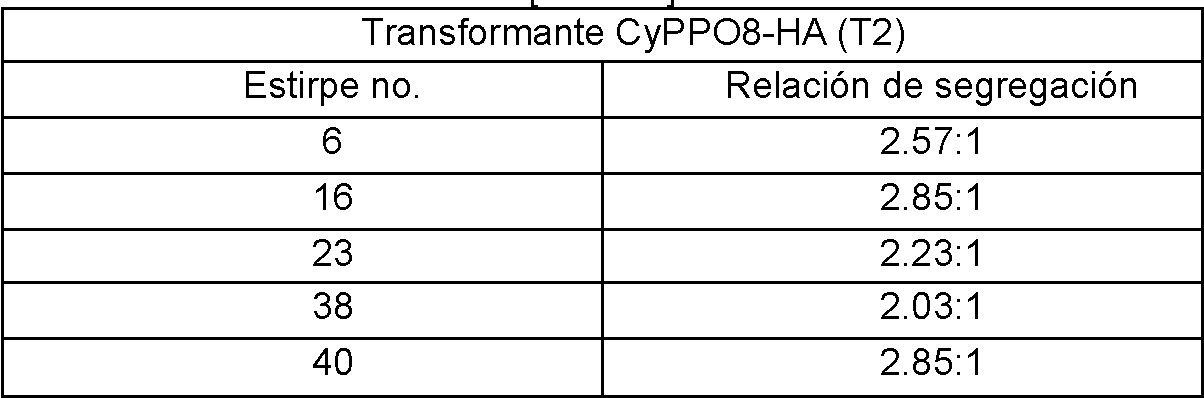
8-2. Examen de las expresiones de las proteínas CyPPO2 y CyPPO8 en semillas de generación T2 resistentes a herbicidas 8-2. Examination of CyPPO2 and CyPPO8 protein expressions in herbicide resistant T2 generation seeds
Para examinar si las expresiones de las proteínas CyPPO2 y CyPPO8 se mantienen en la siguiente generación, se extrajeron proteínas de cada estirpe de transformantes de generación T2, seguido de transferencia Western. Para detectar las cantidades de proteínas de PPO etiquetadas con HA, se extrajeron proteínas de aproximadamente 100 mg de hoja de Arabidopsis thaliana, seguido de electroforesis. Las proteínas se transfirieron a una membrana de PVDF y luego se realizó una transferencia de Western utilizando anticuerpo anti-HA. Se pulverizó tiafenacilo 1 pM sobre plantas de generación T1. Las plantas que sobrevivieron se clasificaron como resistentes y las plantas que se destruyeron se clasificaron como sensibles.To examine whether CyPPO2 and CyPPO8 protein expressions are maintained in the next generation, proteins were extracted from each line of T2 generation transformants, followed by Western blotting. To detect the amounts of HA-tagged PPO proteins, proteins were extracted from approximately 100 mg of Arabidopsis thaliana leaf, followed by electrophoresis. Proteins were blotted onto a PVDF membrane and then Western blotted using anti-HA antibody. Thiaphenacil 1 pM was sprayed on T1 generation plants. The plants that survived were classified as resistant and the plants that were destroyed were classified as sensitive.
En el caso del transformante CyPPO2, las proteínas de PPO se detectaron en la estirpe no. 8, 23, 30, 38, 40 y 49 que mostraron resistencia luego de rociar herbicidas a las mismas y no se detectaron en estirpes sensibles (FIG. 16). En el caso del transformante CyPPO8, las proteínas de PPO se detectaron en la estirpe no. 6, 23, 38 y 40 que tienen resistencia a herbicidas y no se detectan en estirpes sensibles (FIG. 17). Estos resultados sugieren que las expresiones de las proteínas CyPPO2 y CyPP08 se mantuvieron en las próximas generaciones de estirpes resistentes, proporcionando resistencia.In the case of the CyPPO2 transformant, PPO proteins were detected in line no. 8, 23, 30, 38, 40 and 49 that showed resistance after spraying herbicides to them and were not detected in sensitive strains (FIG. 16). In the case of the CyPPO8 transformant, PPO proteins were detected in line no. 6, 23, 38 and 40 that have resistance to herbicides and are not detected in sensitive strains (FIG. 17). These results suggest that the expressions of the CyPPO2 and CyPP08 proteins were maintained in the next generations of resistant strains, providing resistance.
8-3. Examen de la herencia estable de transgén utilizando el gen BAR8-3. Examination of stable transgene inheritance using the BAR gene
Se investigó la herencia estable del transgén a la siguiente generación al examinar la integración del gen transformado, BAR en el genoma. Los ADN genómicos se aislaron de 100 mg de las hojas de los transformantes CyPPO2 y CyPPO8, y luego se examinó la integración del gen BAR mediante PCR. Como resultado, se observó la integración del genoma del gen BAR en las estirpes tanto sensibles como resistentes al tiafenacilo del transformante CyPPO2 y del transformante CyPPO8, lo que indica una herencia estable de los genes transformados a la siguiente generación. Stable inheritance of the transgene to the next generation was investigated by examining the integration of the transformed gene, BAR, into the genome. Genomic DNAs were isolated from 100 mg of the leaves of the CyPPO2 and CyPPO8 transformants, and then the integration of the BAR gene was examined by PCR. As a result, genome integration of the BAR gene was observed in both the thiaphenacil-sensitive and thiaphenacil-resistant lines of the CyPPO2 transformant and the CyPPO8 transformant, indicating stable inheritance of the transformed genes to the next generation.
Ejemplo 9. Examen de la resistencia a herbicidas de Arabidopsis thaliana transformadaExample 9. Screening for Herbicide Resistance of Transformed Arabidopsis thaliana
Para examinar si los rasgos de resistencia a herbicidas se mantienen en las próximas generaciones de plantas, las respectivas plantas de la generación T2 de Arabidopsis thaliana que se transformaron con genes CyPPO2, CyPPO4 y CyPPO8 se sometieron a una prueba de resistencia a herbicidas. Se pulverizaron 2~3 ml de Tiafenacilo 0.5 pM, Saflufenacilo 1 pM, o Fomesafeno 3 pM en cada planta de Arabidopsis thaliana cultivada durante aproximadamente 4 semanas. A los 7 días después de la pulverización, se destruyeron las plantas Col-0 de tipo silvestre, mientras que el control positivo, el transformante AtPPO1 mutante y los grupos experimentales, el transformante CyPPO2, el transformante CyPP04 y el transformante CyPPO8 continuaron creciendo sin daño (FIGS. 18 y 19), lo que indica que los rasgos de resistencia a herbicidas de las plantas T1 se mantuvieron bien para proporcionar a las generaciones T2 resistencia a herbicidas.To examine whether the herbicide resistance traits are maintained in the next plant generations, the respective Arabidopsis thaliana T2 generation plants that were transformed with CyPPO2, CyPPO4 and CyPPO8 genes were subjected to a herbicide resistance test. 2~3 ml of 0.5 pM Thiaphenacil, 1 pM Saflufenacil, or 3 pM Fomesafen were sprayed on each Arabidopsis thaliana plant grown for about 4 weeks. At 7 days after spraying, wild-type Col-0 plants were killed, while the positive control, mutant AtPPO1 transformant, and experimental groups, CyPPO2 transformant, CyPP04 transformant, and CyPPO8 transformant continued to grow without damage. (FIGS. 18 and 19), indicating that the herbicide resistance traits of the T1 plants were well maintained to provide the T2 generations with herbicide resistance.
• Ejemplo 10. Experimento de uso cruzado de herbicidas plurales con diferentes mecanismos de acción• Example 10. Cross-use experiment of plural herbicides with different mechanisms of action
En el transformante de Arabidopsis thaliana que incluye el gen CyPPO2 o CyPPO8, que se obtuvo mediante transformación utilizando el vector de transformación de planta preparado en el Ejemplo 6, el gen resistente a herbicidas que inhiben la actividad PPO y el gen resistente al glufosinato se expresan al mismo tiempo. Por lo tanto, se examinó si el tratamiento cruzado del transformante de Arabidopsis thaliana con dos herbicidas, a saber, el herbicida que inhibe la actividad de PPO y el glufosinato, es eficaz para el control de malezas. Con este fin, las semillas del transformante de Arabidopsis thaliana insertado en el gen CyPP02 y BAR, o del transformante de Arabidopsis thaliana insertado en el gen CyPPO8 y BAR se esterilizaron y trataron a baja temperatura de 4°C durante 2 días. Las semillas se sembraron en un medio 1/2 MS (Duchefa), un medio 1/2 MS que contenía Tiafenacilo 70 nM, un medio 1/2 MS que contenía glufosinato 50 uM o un medio 1/2 MS que contenía Tiafenacilo 70 nM y glufosinato 50 uM, y se cultivaron a 23 °C bajo condiciones de 16 horas de luz/8 horas de oscuridad durante 7~14 días. La Arabidopsis thaliana sobre el medio herbicida fue semilla transformada con CyPPO2 o CyPPO8 y la ColO de tipo silvestre como control, respectivamente. El transformante y el control se cultivaron en medio herbicida. Después de 2 semanas, fueron examinados. Como resultado, CyPPO2 y CyPP08 crecieron normalmente en un medio con adición de glufosinato, un medio con adición de Tiafenacilo o un medio con adición de glufosinato y Tiafenacilo, mientras que el ColO de control no germinó (ver FIG. 20).In the Arabidopsis thaliana transformant including the CyPPO2 or CyPPO8 gene, which was obtained by transformation using the plant transformation vector prepared in Example 6, the PPO activity-inhibiting herbicide-resistant gene and the glufosinate-resistant gene are expressed. at the same time. Therefore, it was examined whether the cross-treatment of Arabidopsis thaliana transformant with two herbicides, namely the herbicide that inhibits PPO activity and glufosinate, is effective for weed control. For this purpose, the seeds of the transformant of Arabidopsis thaliana inserted in the gene CyPP02 and BAR, or of the transformant of Arabidopsis thaliana inserted in the gene CyPPO8 and BAR were sterilized and treated at a low temperature of 4°C for 2 days. Seeds were sown on 1/2 MS medium (Duchefa), 1/2 MS medium containing 70 nM Thiaphenacil, 1/2 MS medium containing 50 uM glufosinate, or 1/2 MS medium containing 70 nM Thiaphenacil. and 50 uM glufosinate, and cultured at 23°C under 16 hours light/8 hours dark conditions for 7~14 days. The Arabidopsis thaliana on the herbicide medium was seed transformed with CyPPO2 or CyPPO8 and the wild-type ColO as a control, respectively. The transformant and control were grown in herbicidal medium. After 2 weeks, they were examined. As a result, CyPPO2 and CyPP08 grew normally in glufosinate-added medium, Thiaphenacil-added medium or glufosinate-Thiaphenacil-added medium, while the control ColO did not germinate (see FIG. 20).
Estos resultados muestran que cuando se preparan plantas transformadas mediante la recombinación del gen PPO resistente al herbicida de la presente invención y el gen BAR en un vector binario, y se realiza el tratamiento cruzado o doble de estas plantas GM con herbicidas que tienen diferentes mecanismos de una acción, se pueden controlar las plantas no deseadas.These results show that when transformed plants are prepared by recombining the PPO gene resistant to the herbicide of the present invention and the BAR gene in a binary vector, and cross- or double-treating these GM plants with herbicides having different mechanisms of one action, unwanted plants can be controlled.
En este ejemplo, el gen BAR introducido como un gen recombinante, junto con el gen CyPPO, es ilustrativo solo para un gen resistente, y no hay limitación en el tipo de gen que se va a utilizar en la presente invención. Es evidente para aquellos expertos en la técnica que cuando un gen resistente adecuado para el propósito y CyPPO 2, 4, 8 o 12 se recombinan con el vector binario, y los herbicidas a los que los genes respectivos son resistentes se tratan de forma cruzada, se puede obtener la resistencia deseada. In this example, the BAR gene introduced as a recombinant gene, together with the CyPPO gene, is illustrative only for a resistant gene, and there is no limitation on the type of gene to be used in the present invention. It is apparent to those skilled in the art that when a fit-for-purpose resistance gene and CyPPO 2, 4, 8, or 12 are recombined with the binary vector, and the herbicides to which the respective genes are resistant are cross-treated, desired resistance can be obtained.
Ejemplo 11. Experimento de uso cruzado de herbicidas de PPO pluralesExample 11 Plural PPO Herbicide Cross-Use Experiment
En el Ejemplo 9, se confirmó que el transformante de Arabidopsis thaliana preparado en la presente invención tiene resistencia contra los dos herbicidas a base de PPO, Tiafenacilo y Saflufenacilo al mismo tiempo, y por lo tanto, se probó si el tratamiento cruzado del transformante de Arabidopsis thaliana con Tiafenacilo y Saflufenacilo es eficaz para el control de malezas. Con este fin, se esterilizaron semillas de transformante de Arabidopsis thaliana insertado en el gen CyPPO2 o CyPPO8 y se trataron a baja temperatura de 4°C durante 2 días. Las semillas se sembraron en un medio 1/2 MS, un medio 1/2 MS que contenía Tiafenacilo 70 nM, un medio 1/2 MS que contenía Saflufenacilo 70 nM o un medio 1/2 MS que contenía Tiafenacilo 35 nM y Saflufenacilo 35 nM, y se cultivaron a 23 °C bajo condiciones de 16 horas de luz/8 horas de oscuridad durante 7~14 días. La Arabidopsis thaliana sobre el medio herbicida fue semilla transformada con CyPPO2 o CyPPO8 y la ColO de tipo silvestre como control, respectivamente. El transformante y el control se cultivaron en medio herbicida. Después de 2 semanas, fueron examinados. Como resultado, CyPP02 y CyPPO8 crecieron normalmente sobre un medio con Tiafenacilo agregado, un medio con Saflufenacilo agregado o un medio con Tiafenacilo y Saflufenacilo agregado, mientras que el ColO de control no germinó (véase FIG. 21).In Example 9, it was confirmed that the transformant of Arabidopsis thaliana prepared in the present invention has resistance against the two PPO-based herbicides Thiaphenacil and Saflufenacil at the same time, and therefore, it was tested whether cross-treatment of the transformant of Arabidopsis thaliana Arabidopsis thaliana with Thiafenacil and Saflufenacil is effective for weed control. For this purpose, seeds of Arabidopsis thaliana transformant inserted in the CyPPO2 or CyPPO8 gene were sterilized and treated at a low temperature of 4°C for 2 days. Seeds were sown on 1/2 MS medium, 1/2 MS medium containing 70 nM Thiaphenacil, 1/2 MS medium containing 70 nM Saflufenacil, or 1/2 MS medium containing 35 nM Thiaphenacil and 35 Safluphenacil. nM, and cultured at 23°C under 16 hours light/8 hours dark conditions for 7~14 days. The Arabidopsis thaliana on the herbicide medium was seed transformed with CyPPO2 or CyPPO8 and the wild-type ColO as a control, respectively. The transformant and control were grown in herbicidal medium. After 2 weeks, they were examined. As a result, CyPP02 and CyPPO8 grew normally on Thiaphenacil-added medium, Saflufenacil-added medium, or Thiaphenacil-Saflufenacil-added medium, while the control ColO did not germinate (see FIG. 21).
Estos resultados muestran que cuando se preparan plantas GM utilizando genes resistentes a herbicidas de PPO de la presente invención, y se realiza un tratamiento cruzado o doble de varios herbicidas basados en PPO, así como un tratamiento único de herbicidas basados en PPO, se pueden controlar las plantas no deseadas.These results show that when GM plants are prepared using PPO herbicide resistant genes of the present invention, and cross or double treatment of several PPO-based herbicides, as well as single treatment of PPO-based herbicides, can be controlled. unwanted plants.
Ejemplo 12. Examen de la resistencia a herbicidas de acuerdo con la homología de secuencia de aminoácidos de CyPPO2, CyPPO4 y CyPPO8Example 12. Examination of herbicide resistance according to amino acid sequence homology of CyPPO2, CyPPO4 and CyPPO8
Para investigar el rango de homología de secuencias de aminoácidos de CyPPO2, CyPPO4 y CyPPO8 que mantienen la resistencia a herbicidas, una parte de la secuencia de aminoácidos de la proteína CyPP02, CyPP04 o CyPPO8 se reemplazó por una parte de la secuencia de aminoácidos de NtPPO (gen p Po derivado de tabaco). Como resultado, la secuencia de aminoácidos de la variante CyPPO2 resultante se representa por la SEQ ID NO:12, y su secuencia de nucleótidos de la misma se representa por la SEQ ID NO:13. La secuencia de aminoácidos y la secuencia de nucleótidos de la variante CyPPO2 mostraron 98 % de homología de secuencia con las de CyPPO2, respectivamente. Adicionalmente, la secuencia de aminoácidos de la variante CyPPO4 se representa por la SEQ ID NO:14, y su secuencia de nucleótidos se representa por la SEQ ID NO:15. La secuencia de aminoácidos y la secuencia de nucleótidos de la variante CyPPO4 mostraron 98% de homología de secuencia con aquella de CyPPO4, respectivamente. Adicionalmente, la secuencia de aminoácidos de la variante CyPP08 se representa por la SEQ ID NO:16, y su secuencia de nucleótidos se representa por la SEQ ID NO:17. La secuencia de aminoácidos y la secuencia de nucleótidos de la variante CyPP08 mostraron 98% de homología de secuencia con aquellas de CyPPO8, respectivamente.To investigate the range of amino acid sequence homology of CyPPO2, CyPPO4, and CyPPO8 that maintain herbicide resistance, a part of the amino acid sequence of the CyPP02, CyPP04, or CyPPO8 protein was replaced by a part of the amino acid sequence of NtPPO. (p Po gene derived from tobacco). As a result, the amino acid sequence of the resulting CyPPO2 variant is represented by SEQ ID NO:12, and its nucleotide sequence thereof is represented by SEQ ID NO:13. The amino acid sequence and nucleotide sequence of the CyPPO2 variant showed 98% sequence homology to those of CyPPO2, respectively. Additionally, the amino acid sequence of the CyPPO4 variant is represented by SEQ ID NO:14, and its nucleotide sequence is represented by SEQ ID NO:15. The amino acid sequence and the nucleotide sequence of the CyPPO4 variant showed 98% sequence homology to that of CyPPO4, respectively. Additionally, the amino acid sequence of the CyPP08 variant is represented by SEQ ID NO:16, and its nucleotide sequence is represented by SEQ ID NO:17. The amino acid sequence and nucleotide sequence of the CyPP08 variant showed 98% sequence homology to those of CyPPO8, respectively.
Se investigó la resistencia a herbicidas de la variante de secuencia de aminoácidos de CyPPO2, la variante de secuencia de aminoácidos de CyPPO4 y la variante de secuencia de aminoácidos de CyPPO8 en E. coli BT3 deficiente en PPO. [BT3(APPO)], y un método experimental específico es similar al del Ejemplo 3. De la misma manera que en el Ejemplo 3, como control negativo, se empleó la PPO de tipo silvestre (AtPPO1 de tipo silvestre) de Arabidopsis thaliana como referencia para la sensibilidad a los herbicidas. Como control positivo, el AtPPO1 mutante que se preparó mediante la sustitución de aminoácidos de Y426M y S305L en la secuencia de aminoácidos de tipo silvestre se empleó como referencia para la resistencia a herbicidas.The herbicide resistance of CyPPO2 amino acid sequence variant, CyPPO4 amino acid sequence variant and CyPPO8 amino acid sequence variant in PPO-deficient E. coli BT3. [BT3(APPO)], and a specific experimental method is similar to that of Example 3. In the same way as in Example 3, as a negative control, wild-type PPO (wild-type AtPPO1) from Arabidopsis thaliana was used as reference for herbicide sensitivity. As a positive control, mutant AtPPO1 which was prepared by amino acid substitution of Y426M and S305L in the wild-type amino acid sequence was used as a reference for herbicide resistance.
12-1. Preparación de materiales e instrumentos experimentales.12-1. Preparation of experimental materials and instruments.
Se utilizó un autoclave bajo condiciones de 121°C y 15 minutos, y se utilizó una incubadora a 37°C con iluminación de 169 |jmol m-2 s-1 durante un tiempo de cultivo de 14~16 horas.An autoclave was used under conditions of 121°C and 15 minutes, and an incubator at 37°C with illumination of 169 µmol m-2 s-1 was used for a culture time of 14~16 hours.
Se utilizó un espectrofotómetro UV-visible a 600 nm. La PCR se realizó bajo condiciones de a 94 °C durante 4 minutos y 25 ciclos (a 94 °C durante 30 segundos, a 56~60 °C durante 30 segundos y a 72 °C durante 3 minutos), a 72 °C durante 5 minutos ya 4 °C durante 5 minutos. Los herbicidas utilizados en el experimento se dan en la siguiente Tabla 8. Los herbicidas respectivos se prepararon a una concentración de 200 mM en DMSO y se almacenaron a -20 °C. Antes de uso, los herbicidas se diluyeron y se agregaron al medio de caldo LB (que contenía 34 mg/ml de cloranfenicol).A UV-visible spectrophotometer at 600 nm was used. The PCR was performed under the conditions of 94 °C for 4 minutes and 25 cycles (94 °C for 30 seconds, 56~60 °C for 30 seconds and 72 °C for 3 minutes), 72 °C for 5 minutes and at 4 °C for 5 minutes. The herbicides used in the experiment are given in Table 8 below. The respective herbicides were prepared at a concentration of 200 mM in DMSO and stored at -20 °C. Before use, herbicides were diluted and added to LB broth medium (containing 34 mg/ml chloramphenicol).
T lTl

continuacióncontinuation
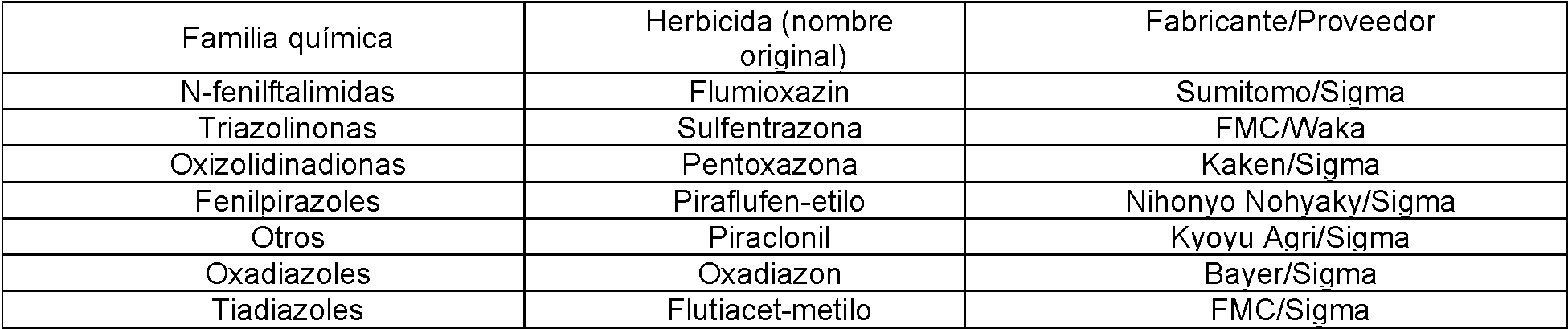
12-2. Método experimental12-2. experimental method
Se inocularon células saturadas en 3 ml de medio líquido LB que contenía cloranfenicol y luego se cultivaron a 37°C, 200 rpm durante 5 horas. La densidad de las células cultivadas se midió a 600 nm y los transformantes se diluyeron con medio líquido LB para tener la misma absorbancia (OD600) por 1 ml de las mismas (OD600 = 0.5). Se agregó agar al medio líquido LB a una concentración del 1% y luego se esterilizó en autoclave. Se agregaron y mezclaron cloranfenicol (34 pg/ml) y herbicida. Las células diluidas por igual se diluyeron a una densidad de 10°, 10-1, 10-2, 10-3, 10-4 y 10-5. Cada 10 pl de las células se vertieron en agar al 1%, medio sólido LB, y se cultivaron en una incubadora a 37 °C durante 14~16 horas (condición de luz: 169 pmol m-2 s-1).Saturated cells were inoculated into 3 ml of LB liquid medium containing chloramphenicol and then cultured at 37°C, 200 rpm for 5 hours. The density of the cultured cells was measured at 600 nm, and the transformants were diluted with LB liquid medium to have the same absorbance (OD 600 ) per 1 ml of them (OD 600 = 0.5). Agar was added to LB liquid medium at a concentration of 1% and then autoclaved. Chloramphenicol (34 pg/ml) and herbicide were added and mixed. Equally diluted cells were diluted to 10°, 10-1, 10-2, 10-3, 10-4 and 10-5 density. Each 10 μl of the cells were poured into 1% agar, LB solid medium, and cultured in a 37°C incubator for 14~16 hours (light condition: 169 pmol m-2 s-1).
Se utilizaron pACBB-CyPP02, pACBB-CyPPO4 y pACBB-CyPPO8 como plantillas para preparar cebadores para la región que se va a reemplazar (Tabla 9), y se realizó la PCR para preparar los vectores de la variante pACBB-CyPPO2, la variante pACBB-CyPPO4 y la variante de pACBB-CyPPO8. Se prepararon 50 pl de mezcla de reacción de PCR al mezclar 1 pl de cada plantilla (pACBB-CyPPO2, pACBB-CyPPO4 y pAcBB-CyPpO8 original), 5 pl de tampón 10X, 1 pl de mezcla de dNTP (cada 10 mM), 1 pl de un cebador directo (10 pM), 1 pl de un cebador inverso (10 pM), 35 pl de DDW y 1 pl de Pfu-X (Solgent, 2.5 unidades/pl), y la amplificación se realizó bajo condiciones de 94 °C durante 4 minutos y 25 ciclos (a 94 °C durante 30 segundos, a 56 °C durante 30 segundos y a 72 °C durante 3 minutos), a 72 °C durante 5 minutos y a 4 °C durante 5 minutos.pACBB-CyPP02, pACBB-CyPPO4 and pACBB-CyPPO8 were used as templates to prepare primers for the region to be replaced (Table 9), and PCR was performed to prepare pACBB-CyPPO2 variant vectors, pACBB variant -CyPPO4 and the pACBB-CyPPO8 variant. 50 pl of PCR reaction mix was prepared by mixing 1 pl of each template (pACBB-CyPPO2, pACBB-CyPPO4 and original pAcBB-CyPpO8), 5 pl of 10X buffer, 1 pl of dNTP mix (each 10 mM), 1 pl of a forward primer (10 pM), 1 pl of a reverse primer (10 pM), 35 pl of DDW and 1 pl of Pfu-X (Solgent, 2.5 units/pl), and amplification was performed under conditions of 94°C for 4 minutes and 25 cycles (94°C for 30 seconds, 56°C for 30 seconds and 72°C for 3 minutes), 72°C for 5 minutes and 4°C for 5 minutes.
[Tabla 9][Table 9]

Para preparar células competentes BT3(APPO), se agregó la cepa BT3(APPO) a 5 ml de caldo LB que contenía 50 pg/ml de kanamicina y 20 pg/ml de hematina, y se cultivó en una incubadora con agitación a 37 °C durante 12 horas en la oscuridad. A continuación, se agregaron 5 ml del cultivo a 100 ml de caldo LB que contenía 20 pg/ml de hematina y se cultivaron en una incubadora con agitación a 37°C en la oscuridad hasta que la DO600 alcanzó 0.5. Se prepararon células competentes BT3(APPO) a partir de E. coli cultivada utilizando CaCl2 de acuerdo con protocolos para preparar células competentes. A continuación, para transformar la cepa BT3(APPO) con los vectores respectivos que albergan la variante CyPPO2, la variante CyPPO4 y la variante CyPPO8, se agregaron 5 pl del vector a 100 pl de células competentes BT3(APPO) y la mezcla se mezcló bien, se dejó reaccionar sobre hielo durante 20 minutos y luego se dejó a 42 °C durante 40 segundos. Después de la estabilización sobre hielo durante 2 minutos, se agregó 1 ml de To prepare BT3(APPO) competent cells, strain BT3(APPO) was added to 5 mL of LB broth containing 50 pg/mL kanamycin and 20 pg/mL hematin, and grown in a 37° shaking incubator. C for 12 hours in the dark. Next, 5 ml of the culture was added to 100 ml of LB broth containing 20 pg/ml hematin and grown in a 37°C shaking incubator in the dark until the OD 600 reached 0.5. BT3(APPO) competent cells were prepared from cultured E. coli using CaCl2 according to protocols for preparing competent cells. Next, to transform the BT3(APPO) strain with the respective vectors harboring CyPPO2 variant, CyPPO4 variant and CyPPO8 variant, 5 μl of the vector was added to 100 μl of BT3(APPO) competent cells and the mixture was mixed. well, it was allowed to react on ice for 20 minutes and then left at 42 °C for 40 seconds. After stabilization on ice for 2 min, 1 mL of
Claims (11)
Applications Claiming Priority (2)
| Application Number | Priority Date | Filing Date | Title |
|---|---|---|---|
| KR20140181791 | 2014-12-16 | ||
| PCT/KR2015/013812 WO2016099153A1 (en) | 2014-12-16 | 2015-12-16 | Methods for conferring or enhancing herbicide resistance on plants and/or alga with protoporphyrinogen oxidase variants |
Publications (1)
| Publication Number | Publication Date |
|---|---|
| ES2894871T3 true ES2894871T3 (en) | 2022-02-16 |
Family
ID=56126950
Family Applications (2)
| Application Number | Title | Priority Date | Filing Date |
|---|---|---|---|
| ES15870320T Active ES2894871T3 (en) | 2014-12-16 | 2015-12-16 | Methods for conferring or enhancing herbicide resistance on plants and/or algae with protoporphyrinogen oxidase variants |
| ES19169943T Active ES2900515T3 (en) | 2014-12-16 | 2015-12-16 | Methods for conferring or enhancing herbicide resistance on plants and/or algae with protoporphyrinogen oxidase variants |
Family Applications After (1)
| Application Number | Title | Priority Date | Filing Date |
|---|---|---|---|
| ES19169943T Active ES2900515T3 (en) | 2014-12-16 | 2015-12-16 | Methods for conferring or enhancing herbicide resistance on plants and/or algae with protoporphyrinogen oxidase variants |
Country Status (15)
| Country | Link |
|---|---|
| US (2) | US10717985B2 (en) |
| EP (2) | EP3234129B1 (en) |
| JP (1) | JP6499292B2 (en) |
| KR (2) | KR101827545B1 (en) |
| CN (1) | CN107466321B (en) |
| AR (1) | AR103056A1 (en) |
| AU (2) | AU2015363925B2 (en) |
| BR (1) | BR112017012666A2 (en) |
| CA (1) | CA2967935C (en) |
| CL (1) | CL2017001564A1 (en) |
| ES (2) | ES2894871T3 (en) |
| IL (1) | IL252586A0 (en) |
| MX (1) | MX385624B (en) |
| PH (2) | PH12017501047B1 (en) |
| WO (1) | WO2016099153A1 (en) |
Families Citing this family (25)
| Publication number | Priority date | Publication date | Assignee | Title |
|---|---|---|---|---|
| US10370677B2 (en) | 2015-08-03 | 2019-08-06 | Monsanto Technology Llc | Methods and compositions for herbicide tolerance in plants |
| US11339404B2 (en) * | 2016-06-16 | 2022-05-24 | Farmhannong Co., Ltd. | Protoporphyrinogen oxidase variants and methods and compositions for conferring and/or enhancing herbicide tolerance using the same |
| JP7118047B2 (en) | 2016-07-29 | 2022-08-15 | モンサント テクノロジー エルエルシー | Methods and compositions for gene expression in plants |
| KR102227354B1 (en) * | 2017-12-15 | 2021-03-15 | 주식회사 팜한농 | Methods and Compositions for Conferring and/or Enhancing Herbicide Tolerance Using PPO Variants |
| WO2019117579A2 (en) * | 2017-12-15 | 2019-06-20 | 주식회사 팜한농 | Composition and method for conferring and/or enhancing herbicide tolerance using protoporphyrinogen ix oxidase variants derived from synechocystis |
| KR102057445B1 (en) * | 2018-03-06 | 2020-01-14 | 주식회사 팜한농 | Herbicidal compositions containing a pyrimidinedione type compound |
| KR102015925B1 (en) * | 2018-05-03 | 2019-08-29 | 한국해양과학기술원 | An enzyme solution for the isolation of Colobanthus quitensis protoplasts and a method for isolation protoplasts from olobanthus quitensis using this solution |
| CN109964743A (en) * | 2019-04-10 | 2019-07-05 | 达州市农业科学研究院 | A kind of herbicidal methods suitable for day lily cultivation |
| PH12021553123A1 (en) * | 2019-06-14 | 2022-11-21 | Farmhannong Co Ltd | Methods and compositions for conferring and/or enhancing herbicide tolerance using protoporphyrinogen ix oxidase of various cyanobacteria or variant thereof |
| CA3197526A1 (en) | 2020-11-24 | 2022-06-02 | William Guy Whittingham | Herbicidal compounds |
| EP4320122A1 (en) | 2021-04-07 | 2024-02-14 | Syngenta Crop Protection AG | Herbicidal compounds |
| CN115336534A (en) * | 2021-05-12 | 2022-11-15 | 北京大北农生物技术有限公司 | Use of protoporphyrinogen oxidase |
| KR102616008B1 (en) * | 2021-09-01 | 2023-12-21 | 대한민국 | Positive control nucleic acid construct for screening living modified organism and uses thereof |
| US20250212879A1 (en) | 2022-03-11 | 2025-07-03 | Syngenta Crop Protection Ag | Herbicidal compounds |
| WO2023222589A1 (en) | 2022-05-20 | 2023-11-23 | Syngenta Crop Protection Ag | Herbicidal compounds |
| AR129821A1 (en) | 2022-07-13 | 2024-10-02 | Syngenta Crop Protection Ag | HERBICIDE COMPOUNDS |
| WO2024020316A2 (en) * | 2022-07-22 | 2024-01-25 | Monsanto Technology Llc | Methods and compositions for ppo herbicide tolerance |
| WO2024160989A1 (en) | 2023-02-03 | 2024-08-08 | Syngenta Crop Protection Ag | Herbicide resistant plants |
| AU2024225839A1 (en) | 2023-02-24 | 2025-08-07 | Syngenta Crop Protection Ag | Herbicidal compositions |
| WO2024175476A1 (en) | 2023-02-24 | 2024-08-29 | Syngenta Crop Protection Ag | Herbicidal compositions |
| CN120752221A (en) | 2023-03-17 | 2025-10-03 | 先正达农作物保护股份公司 | Herbicidal triazine derivatives |
| WO2024218220A1 (en) | 2023-04-19 | 2024-10-24 | Syngenta Crop Protection Ag | Herbicide resistant plants |
| CN121443148A (en) | 2023-07-20 | 2026-01-30 | 先正达农作物保护股份公司 | Herbicides |
| CN121443146A (en) | 2023-07-20 | 2026-01-30 | 先正达农作物保护股份公司 | Herbicidal composition |
| WO2025118900A1 (en) * | 2023-12-07 | 2025-06-12 | 青岛清原种子科学有限公司 | Use of hemg ppo enzyme in generating or improving tolerance to ppo-inhibiting herbicides |
Family Cites Families (15)
| Publication number | Priority date | Publication date | Assignee | Title |
|---|---|---|---|---|
| US6808904B2 (en) | 1994-06-16 | 2004-10-26 | Syngenta Participations Ag | Herbicide-tolerant protox genes produced by DNA shuffling |
| US6084155A (en) | 1995-06-06 | 2000-07-04 | Novartis Ag | Herbicide-tolerant protoporphyrinogen oxidase ("protox") genes |
| US5859348A (en) * | 1996-07-17 | 1999-01-12 | Board Of Trustees Operating Michigan State University | Imidazolinone and sulfonyl urea herbicide resistant sugar beet plants |
| KR100559155B1 (en) | 2004-04-12 | 2006-03-13 | 전남대학교산학협력단 | Synthetic protoporpynogen oxidase gene and method for increasing herbicide resistance of plants using the same |
| JP4720223B2 (en) | 2004-05-18 | 2011-07-13 | 住友化学株式会社 | Plants resistant to herbicidal active compounds |
| CN101278049B (en) * | 2005-09-26 | 2011-11-30 | 日本曹达株式会社 | Protoporphyrinogen oxidase having activity of conferring resistance to acifluorfen and gene thereof |
| CA2686835C (en) | 2007-05-09 | 2020-04-21 | Dow Agrosciences Llc | Novel herbicide resistance genes |
| PE20100269A1 (en) * | 2008-09-05 | 2010-04-30 | TransAlgae Ltd | HERBICIDE RESISTANCE TO MAINTAIN AXENIC CROPS BY GENETIC MANIPULATION |
| WO2011085221A2 (en) | 2010-01-07 | 2011-07-14 | Basf Agro B.V., Arnhem (Nl), Zweigniederlassung Wadenswil | Herbicide-tolerant plants |
| CN102438285B (en) | 2010-09-29 | 2017-04-05 | 中兴通讯股份有限公司 | The method and system of Access Control are carried out in terminal switching process to terminal |
| JP6334169B2 (en) | 2010-12-16 | 2018-05-30 | ビーエーエスエフ アグロ ベー.ブイ. | Plants with increased herbicide tolerance |
| CN102321640B (en) | 2011-08-18 | 2013-08-07 | 杭州瑞丰生物科技有限公司 | Herbicide resistant gene, and application of herbicide resistant gene in genetically modified crops |
| AR091489A1 (en) | 2012-06-19 | 2015-02-11 | Basf Se | PLANTS THAT HAVE A GREATER TOLERANCE TO HERBICIDES INHIBITORS OF PROTOPORFIRINOGENO OXIDASA (PPO) |
| CN103740663B (en) | 2013-12-24 | 2016-04-20 | 北京大北农科技集团股份有限公司 | Herbicide resistance protein, its encoding gene and purposes |
| CN103740664B (en) | 2013-12-24 | 2016-05-18 | 北京大北农科技集团股份有限公司 | Herbicid resistant protein, its encoding gene and purposes |
-
2015
- 2015-12-16 CN CN201580067367.8A patent/CN107466321B/en not_active Expired - Fee Related
- 2015-12-16 EP EP15870320.7A patent/EP3234129B1/en not_active Not-in-force
- 2015-12-16 BR BR112017012666A patent/BR112017012666A2/en not_active Application Discontinuation
- 2015-12-16 CA CA2967935A patent/CA2967935C/en active Active
- 2015-12-16 PH PH1/2017/501047A patent/PH12017501047B1/en unknown
- 2015-12-16 US US15/532,194 patent/US10717985B2/en active Active
- 2015-12-16 AR ARP150104115A patent/AR103056A1/en not_active Application Discontinuation
- 2015-12-16 ES ES15870320T patent/ES2894871T3/en active Active
- 2015-12-16 JP JP2017533480A patent/JP6499292B2/en not_active Expired - Fee Related
- 2015-12-16 AU AU2015363925A patent/AU2015363925B2/en not_active Ceased
- 2015-12-16 EP EP19169943.8A patent/EP3540058B1/en not_active Not-in-force
- 2015-12-16 KR KR1020150180467A patent/KR101827545B1/en not_active Expired - Fee Related
- 2015-12-16 MX MX2017007888A patent/MX385624B/en unknown
- 2015-12-16 WO PCT/KR2015/013812 patent/WO2016099153A1/en not_active Ceased
- 2015-12-16 ES ES19169943T patent/ES2900515T3/en active Active
-
2016
- 2016-12-13 KR KR1020160169920A patent/KR101862795B1/en active Active
-
2017
- 2017-05-30 IL IL252586A patent/IL252586A0/en unknown
- 2017-06-15 CL CL2017001564A patent/CL2017001564A1/en unknown
-
2019
- 2019-07-09 AU AU2019204916A patent/AU2019204916B2/en not_active Ceased
-
2020
- 2020-05-12 US US15/930,240 patent/US11130960B2/en not_active Expired - Fee Related
- 2020-11-25 PH PH12020552021A patent/PH12020552021A1/en unknown
Also Published As
Similar Documents
| Publication | Publication Date | Title |
|---|---|---|
| ES2894871T3 (en) | Methods for conferring or enhancing herbicide resistance on plants and/or algae with protoporphyrinogen oxidase variants | |
| US11466286B2 (en) | Methods and compositions for conferring and/or enhancing herbicide tolerance using protoporphyrinogen oxidase or variant thereof | |
| CA3085594C (en) | Composition and method for conferring and/or enhancing tolerance against herbicides by using variants of ppo | |
| US11339404B2 (en) | Protoporphyrinogen oxidase variants and methods and compositions for conferring and/or enhancing herbicide tolerance using the same | |
| US11219221B2 (en) | Composition and method for conferring and/or enhancing herbicide tolerance using variants of protoporphyrinogen IX oxidase from cyanobacteria | |
| US20230175004A1 (en) | Methods and compositions for conferring and/or enhancing herbicide tolerance using protoporphyrinogen ix oxidase of various cyanobacteria or variant thereof | |
| BR122024000155B1 (en) | USES FOR CONFERRING OR INCREASING THE TOLERANCE OF A PLANT OR ALGAE TO A PROTOPORPHYRINOGEN IX OXIDASE INHIBITOR HERBICIDE | |
| BR112021025163B1 (en) | METHODS AND COMPOSITIONS FOR CONFERRING AND/OR INCREASING HERBICIDE TOLERANCE USING PROTOPORPHYRINOGEN IX OXIDASE FROM VARIOUS CYANOBACTERIA OR VARIANTS THEREOF | |
| BR112018076029B1 (en) | POLYPEPTIDE, POLYNUCLEOTIDE, RECOMBINANT VECTOR, COMPOSITIONS AND METHODS FOR CONFERRING OR IMPROVING HERBICIDE TOLERANCE OF A PLANT OR ALGAE |