CN107466321B - Methods of conferring or enhancing herbicide resistance to plants and/or algae by protoporphyrinogen oxidase variants - Google Patents
Methods of conferring or enhancing herbicide resistance to plants and/or algae by protoporphyrinogen oxidase variants Download PDFInfo
- Publication number
- CN107466321B CN107466321B CN201580067367.8A CN201580067367A CN107466321B CN 107466321 B CN107466321 B CN 107466321B CN 201580067367 A CN201580067367 A CN 201580067367A CN 107466321 B CN107466321 B CN 107466321B
- Authority
- CN
- China
- Prior art keywords
- leu
- herbicide
- gly
- ala
- val
- Prior art date
- Legal status (The legal status is an assumption and is not a legal conclusion. Google has not performed a legal analysis and makes no representation as to the accuracy of the status listed.)
- Expired - Fee Related
Links
Images


Classifications
-
- C—CHEMISTRY; METALLURGY
- C12—BIOCHEMISTRY; BEER; SPIRITS; WINE; VINEGAR; MICROBIOLOGY; ENZYMOLOGY; MUTATION OR GENETIC ENGINEERING
- C12N—MICROORGANISMS OR ENZYMES; COMPOSITIONS THEREOF; PROPAGATING, PRESERVING, OR MAINTAINING MICROORGANISMS; MUTATION OR GENETIC ENGINEERING; CULTURE MEDIA
- C12N15/00—Mutation or genetic engineering; DNA or RNA concerning genetic engineering, vectors, e.g. plasmids, or their isolation, preparation or purification; Use of hosts therefor
- C12N15/09—Recombinant DNA-technology
- C12N15/63—Introduction of foreign genetic material using vectors; Vectors; Use of hosts therefor; Regulation of expression
- C12N15/79—Vectors or expression systems specially adapted for eukaryotic hosts
- C12N15/82—Vectors or expression systems specially adapted for eukaryotic hosts for plant cells, e.g. plant artificial chromosomes (PACs)
- C12N15/8241—Phenotypically and genetically modified plants via recombinant DNA technology
- C12N15/8261—Phenotypically and genetically modified plants via recombinant DNA technology with agronomic (input) traits, e.g. crop yield
- C12N15/8271—Phenotypically and genetically modified plants via recombinant DNA technology with agronomic (input) traits, e.g. crop yield for stress resistance, e.g. heavy metal resistance
- C12N15/8274—Phenotypically and genetically modified plants via recombinant DNA technology with agronomic (input) traits, e.g. crop yield for stress resistance, e.g. heavy metal resistance for herbicide resistance
-
- C—CHEMISTRY; METALLURGY
- C12—BIOCHEMISTRY; BEER; SPIRITS; WINE; VINEGAR; MICROBIOLOGY; ENZYMOLOGY; MUTATION OR GENETIC ENGINEERING
- C12N—MICROORGANISMS OR ENZYMES; COMPOSITIONS THEREOF; PROPAGATING, PRESERVING, OR MAINTAINING MICROORGANISMS; MUTATION OR GENETIC ENGINEERING; CULTURE MEDIA
- C12N9/00—Enzymes; Proenzymes; Compositions thereof; Processes for preparing, activating, inhibiting, separating or purifying enzymes
- C12N9/0004—Oxidoreductases (1.)
- C12N9/001—Oxidoreductases (1.) acting on the CH-CH group of donors (1.3)
-
- A—HUMAN NECESSITIES
- A01—AGRICULTURE; FORESTRY; ANIMAL HUSBANDRY; HUNTING; TRAPPING; FISHING
- A01N—PRESERVATION OF BODIES OF HUMANS OR ANIMALS OR PLANTS OR PARTS THEREOF; BIOCIDES, e.g. AS DISINFECTANTS, AS PESTICIDES OR AS HERBICIDES; PEST REPELLANTS OR ATTRACTANTS; PLANT GROWTH REGULATORS
- A01N43/00—Biocides, pest repellants or attractants, or plant growth regulators containing heterocyclic compounds
- A01N43/48—Biocides, pest repellants or attractants, or plant growth regulators containing heterocyclic compounds having rings with two nitrogen atoms as the only ring hetero atoms
- A01N43/54—1,3-Diazines; Hydrogenated 1,3-diazines
-
- C—CHEMISTRY; METALLURGY
- C12—BIOCHEMISTRY; BEER; SPIRITS; WINE; VINEGAR; MICROBIOLOGY; ENZYMOLOGY; MUTATION OR GENETIC ENGINEERING
- C12N—MICROORGANISMS OR ENZYMES; COMPOSITIONS THEREOF; PROPAGATING, PRESERVING, OR MAINTAINING MICROORGANISMS; MUTATION OR GENETIC ENGINEERING; CULTURE MEDIA
- C12N1/00—Microorganisms, e.g. protozoa; Compositions thereof; Processes of propagating, maintaining or preserving microorganisms or compositions thereof; Processes of preparing or isolating a composition containing a microorganism; Culture media therefor
- C12N1/12—Unicellular algae; Culture media therefor
-
- C—CHEMISTRY; METALLURGY
- C12—BIOCHEMISTRY; BEER; SPIRITS; WINE; VINEGAR; MICROBIOLOGY; ENZYMOLOGY; MUTATION OR GENETIC ENGINEERING
- C12N—MICROORGANISMS OR ENZYMES; COMPOSITIONS THEREOF; PROPAGATING, PRESERVING, OR MAINTAINING MICROORGANISMS; MUTATION OR GENETIC ENGINEERING; CULTURE MEDIA
- C12N15/00—Mutation or genetic engineering; DNA or RNA concerning genetic engineering, vectors, e.g. plasmids, or their isolation, preparation or purification; Use of hosts therefor
- C12N15/09—Recombinant DNA-technology
- C12N15/11—DNA or RNA fragments; Modified forms thereof; Non-coding nucleic acids having a biological activity
- C12N15/52—Genes encoding for enzymes or proenzymes
-
- C—CHEMISTRY; METALLURGY
- C12—BIOCHEMISTRY; BEER; SPIRITS; WINE; VINEGAR; MICROBIOLOGY; ENZYMOLOGY; MUTATION OR GENETIC ENGINEERING
- C12N—MICROORGANISMS OR ENZYMES; COMPOSITIONS THEREOF; PROPAGATING, PRESERVING, OR MAINTAINING MICROORGANISMS; MUTATION OR GENETIC ENGINEERING; CULTURE MEDIA
- C12N15/00—Mutation or genetic engineering; DNA or RNA concerning genetic engineering, vectors, e.g. plasmids, or their isolation, preparation or purification; Use of hosts therefor
- C12N15/09—Recombinant DNA-technology
- C12N15/63—Introduction of foreign genetic material using vectors; Vectors; Use of hosts therefor; Regulation of expression
- C12N15/79—Vectors or expression systems specially adapted for eukaryotic hosts
-
- C—CHEMISTRY; METALLURGY
- C12—BIOCHEMISTRY; BEER; SPIRITS; WINE; VINEGAR; MICROBIOLOGY; ENZYMOLOGY; MUTATION OR GENETIC ENGINEERING
- C12Y—ENZYMES
- C12Y103/00—Oxidoreductases acting on the CH-CH group of donors (1.3)
- C12Y103/03—Oxidoreductases acting on the CH-CH group of donors (1.3) with oxygen as acceptor (1.3.3)
- C12Y103/03004—Protoporphyrinogen oxidase (1.3.3.4)
-
- C—CHEMISTRY; METALLURGY
- C12—BIOCHEMISTRY; BEER; SPIRITS; WINE; VINEGAR; MICROBIOLOGY; ENZYMOLOGY; MUTATION OR GENETIC ENGINEERING
- C12Y—ENZYMES
- C12Y103/00—Oxidoreductases acting on the CH-CH group of donors (1.3)
-
- Y—GENERAL TAGGING OF NEW TECHNOLOGICAL DEVELOPMENTS; GENERAL TAGGING OF CROSS-SECTIONAL TECHNOLOGIES SPANNING OVER SEVERAL SECTIONS OF THE IPC; TECHNICAL SUBJECTS COVERED BY FORMER USPC CROSS-REFERENCE ART COLLECTIONS [XRACs] AND DIGESTS
- Y02—TECHNOLOGIES OR APPLICATIONS FOR MITIGATION OR ADAPTATION AGAINST CLIMATE CHANGE
- Y02P—CLIMATE CHANGE MITIGATION TECHNOLOGIES IN THE PRODUCTION OR PROCESSING OF GOODS
- Y02P20/00—Technologies relating to chemical industry
- Y02P20/50—Improvements relating to the production of bulk chemicals
- Y02P20/55—Design of synthesis routes, e.g. reducing the use of auxiliary or protecting groups
Landscapes
- Health & Medical Sciences (AREA)
- Life Sciences & Earth Sciences (AREA)
- Genetics & Genomics (AREA)
- Engineering & Computer Science (AREA)
- Chemical & Material Sciences (AREA)
- Organic Chemistry (AREA)
- Wood Science & Technology (AREA)
- Zoology (AREA)
- Bioinformatics & Cheminformatics (AREA)
- General Engineering & Computer Science (AREA)
- Biotechnology (AREA)
- Biomedical Technology (AREA)
- General Health & Medical Sciences (AREA)
- Biochemistry (AREA)
- Molecular Biology (AREA)
- Microbiology (AREA)
- Plant Pathology (AREA)
- Physics & Mathematics (AREA)
- Biophysics (AREA)
- Cell Biology (AREA)
- Medicinal Chemistry (AREA)
- Environmental Sciences (AREA)
- Tropical Medicine & Parasitology (AREA)
- Botany (AREA)
- Agronomy & Crop Science (AREA)
- Pest Control & Pesticides (AREA)
- Dentistry (AREA)
- Virology (AREA)
- Breeding Of Plants And Reproduction By Means Of Culturing (AREA)
- Micro-Organisms Or Cultivation Processes Thereof (AREA)
- Agricultural Chemicals And Associated Chemicals (AREA)
- Catching Or Destruction (AREA)
- Enzymes And Modification Thereof (AREA)
- Cultivation Of Plants (AREA)
Abstract
通过利用原核生物衍生原卟啉原氧化酶变体赋予和/或增强包括农作物在内的植物或藻类的除草剂抗性。
Conferring and/or enhancing herbicide resistance in plants or algae, including crops, by utilizing prokaryotic-derived protoporphyrinogen oxidase variants.
Description
Technical Field
The present invention provides methods of conferring or enhancing herbicide resistance to plants and/or algae, including crops, using prokaryotic cell-derived protoporphyrinogen oxidase variants.
Background
The porphyrin biosynthesis pathway, which is completed in chloroplasts, is a process of synthesizing chlorophyll and heme, which play a very important role in plant metabolic processes. During the synthesis, protoporphyrinogen IX oxidase (hereinafter referred to as "PPO"; EC: 1.3.3.4) catalyzes the oxidation of protoporphyrinogen IX to protoporphyrin IX. After oxidation of protoporphyrinogen IX to protoporphyrin IX, protoporphyrin IX synthesizes chlorophyll by magnesium chelatase and iron and heme by iron chelatase.
When PPO activity is resisted, chlorophyll and heme are also resisted, and matrix protoporphyrinogen IX is separated from a normal porphyrin biosynthesis pathway, rapidly separated from chlorophyll into cytoplasm, oxidized into protoporphyrin IX and accumulated on a cell membrane. The accumulated protoporphyrin IX produces highly reactive singlet oxygen under the action of light and oxygen molecules: (1O2) Destroying the cell membrane, rapidly leading to the death of the plant cell. According to the principle, a herbicide capable of resisting PPO activity is developed. Nowadays, herbicides are classified into 9 general categories according to their chemical structures. Which comprises the following steps: pyrimidinediones, diphenyl ethers, phenylpyrazoles, N-phenylimides, thiadiazoles, oxadiazoles, triazolinones, oxazolidinediones and other herbicides.
In the case of using herbicides, it is necessary to impart herbicide resistance to crops in order to protect the target crops from the effects of the herbicides.
Similarly, algae also belong to the family of photosynthetic organisms, and can convert light energy into energy for the synthesis of a variety of useful compounds. The algae can convert carbon dioxide (CO) by photosynthesis2) Conversion to sugars, starches, fats or other biomolecules, such as these, can eliminate greenhouse gases from the atmosphere. Large-scale cultivation of algae can produce a wide variety of different types of biomolecules for our use, including industrial enzymes, therapeutic compound proteins, nutritional products, commodities, fuel products, and the like.
The biggest problem encountered in large scale cultivation of algae in bioreactors, open or closed ponds is contamination by other highly competitive and undesirable algal fungi and bacteria. Like rotifers and other plankton, phagocytose all species during the culture process.
It is therefore necessary to confer herbicide resistance to algae, both because the herbicide is resistant to competing microorganisms that do not have a herbicide resistance gene, and because the algae, which are herbicide resistant, are allowed to grow in the environment in which the herbicide is present.
Disclosure of Invention
[ problem of the invention ]
It has been demonstrated that hemY-type PPO genes derived from prokaryotes confer herbicide resistance to 9 major types of PPO-resistant herbicides over a wide range. The gene is embodied by a plant or algae, and can endow the plant or algae with herbicide resistance. In light of the above, the herbicide resistance of plants, including crops and algae, can be conferred and/or enhanced by prokaryotic derivation of protoporphyrinogen oxidase variants.
In one embodiment, compounds are provided that can confer and/or enhance herbicide resistance on a plant or algae. Such compounds include a peptide selected from the group consisting of SEQ ID NO: 1 one or more polypeptides having an amino acid sequence with a homology of more than 95% to the amino acid sequence; comprises the amino acid sequence shown in SEQ ID NO: 3 one or more polypeptides having an amino acid sequence with a homology of more than 95% to the amino acid sequence; comprises the amino acid sequence shown in SEQ ID NO:5 one or more polypeptides having an amino acid sequence with a homology of more than 95% to the amino acid sequence; comprises the amino acid sequence shown in SEQ ID NO: 7 and one or more polypeptides having an amino acid sequence with a homology of more than 95%.
Another embodiment provides compounds that can confer and/or enhance herbicide resistance on a plant or algae. The compound comprises a polypeptide group selected from a plurality of genes encoding corresponding polypeptides comprising the amino acid sequence shown in SEQ ID NO: 1 one or more genes whose amino acid sequence has a homology of more than 95% to the amino acid sequence; comprises the amino acid sequence shown in SEQ ID NO: 3 one or more genes whose amino acid sequence has a homology of more than 95% to the amino acid sequence; comprises the amino acid sequence shown in SEQ ID NO:5 amino acid sequence and more than 95% of the homology of the amino acid sequence of one or more genes; comprises the amino acid sequence shown in SEQ ID NO: 7 and one or more genes whose amino acid sequence has a homology of more than 95% to the amino acid sequence.
In an exemplary embodiment, a nucleic acid molecule comprising one of SEQ ID NOs: 2 nucleotide sequence or nucleotide sequence with homology higher than 95%; comprises a sequence of SEQ ID NO: 4 nucleotide sequence and the nucleotide sequence with homology higher than 95 percent; comprises a sequence of SEQ ID NO:6 or a gene comprising a nucleotide sequence of SEQ ID NO: 8 nucleotide sequence and nucleotide sequence with homology higher than 95%.
In another exemplary embodiment, a recombinant plant gene expression cassette vector or a recombinant algal gene expression cassette vector is included.
In another exemplary embodiment the herbicide is a protoporphyrinogen oxidase (protox) resistant herbicide.
In another exemplary embodiment the herbicide is one or more herbicide types selected from the group consisting of pyrimidinediones, diphenyl ethers, phenylpyrazoles, N-phenylimides, thiadiazoles, oxadiazoles, triazolinones, oxazolidinediones, and any combination thereof.
In another exemplary embodiment the herbicide is one or more selected from the group consisting of butafenacil, saflufenacil, topramezone, uracils, fomesafen, oxyfluorfen, aclonifen, acifluorfen, lactofen, metofen, cumyl ether, fluorofluralin, nitrofen, pyraflufen, isoxaflufen, flumioxazin, indoxacarb, flumiclorac, metribuzin, thiadiazolidinyl, oxadiargyl, oxadiazon, carfentrazone, sulfentrazone, pentoxazone, pyraclonil, fluazinam, flumetsulam, and any combination thereof.
In another exemplary embodiment the plant is selected from a monocot, a dicot, a herbaceous plant, or/and a woody plant.
In another exemplary embodiment the plant or algae comprises a gene transfer into a second polypeptide and a second gene encoding a corresponding polypeptide having extended herbicide resistance to a second herbicide.
In another exemplary embodiment the second herbicide comprises, but is not limited to, herbicides that resist cell division, herbicides that resist photosynthesis, herbicides that resist amino acid synthesis, herbicides that resist chromoplasts, and herbicides that resist cell membranes.
An expanded selection range of second herbicides in another exemplary embodiment includes, but is not limited to, glyphosate, glufosinate, dicamba, 2,4-D (2, 4-dichlorophenoxyacetic acid), isoxaflutole, ALS (acetolactate synthase) -resistant herbicides, photosynthetic system II-resistant herbicides, phenylurea herbicides, bromoxynil herbicides, or any combination thereof.
In another exemplary embodiment, the expanded selection range of the second polypeptide that confers herbicide resistance to a plant or algae is not limited to a variety of polypeptides that can confer herbicide resistance, including glyphosate herbicide resistant EPSPS (glyphosate resistant 5-enolpyruvylshikimate-3-phosphate), GOX (glyphosate oxidase), GAT (glyphosate-N-acetyltransferase), or glyphosate decarboxylase; anti-glufosinate herbicide PAT (glufosinate-N-acetyltransferase); dicamba herbicide-resistant DMO (monooxygenase); 2,4-D herbicide-resistant 2,4-D monooxygenase or AAD (aryloxyalkenoate dioxygenase); ALS-resistant sulfonylurea herbicides ALS (acetolactate synthase), AHAS (acetol synthase) or ataheasl (acetol synthase large subunit); photosynthetic system II protein D1 resistant to photosynthetic system II herbicide; cytochrome P450 resisting phenylurea herbicides; anti-chromoplast, herbicide-resistant HPPD (hydroxyphenylpyruvate dioxygenase); one or more of a bromoxynil herbicide nitrilase and any combination thereof.
An extended range of genes that confer herbicide resistance encoding the second polypeptide includes, but is not limited to, the glyphosate resistant herbicide CP4 EPSPS, EPSPS (AG), meppss, 2 meppss, GOXV247, GAT4601 or GAT4621 genes; a glufosinate-resistant herbicide BAR, PAT, or PAT (syn) gene; a dicamba herbicide-resistant DMO gene; resistance to the 2,4-D herbicide AAD-1 or AAD-12 gene; ALS, GM-HRA, S4-HRA, ZM-HRA, CSR1, CSRl-1, CSR1-2, SURA or SURB which are anti-ALS sulfonylureas and anti-herbicide; PSBA gene resisting photosynthesis system II and herbicide; CYP76B1 gene for resisting phenylurea and herbicides; isoxaflutole-resistant herbicide-resistant HPDPF W336 gene; bromoxynil-resistant herbicide-resistant BXN gene and any combination thereof.
In another embodiment, transgenic organisms or clones or progeny thereof are provided that can harbor new or abnormal or/and enhanced herbicide resistance. The transgenic organism or clone or progeny thereof expresses a polypeptide comprising an amino acid sequence selected from the group consisting of SEQ ID NO: 1 one or more polypeptides having an amino acid sequence with a homology of more than 95% to the amino acid sequence; comprises the amino acid sequence shown in SEQ ID NO: 3 one or more polypeptides having an amino acid sequence with a homology of more than 95% to the amino acid sequence; comprises the amino acid sequence shown in SEQ ID NO:5 amino acid sequence and more than 95% of the amino acid sequence of one or more polypeptides; comprises the amino acid sequence shown in SEQ ID NO: 7 and one or more polypeptides of amino acid sequence with homology higher than 95% and any combination thereof.
In another exemplary embodiment the transgenic target may be an algae, plant cell, protoplast, callus, hypocotyl, seed, cotyledon, shoot, or plant.
In another embodiment, methods are provided for gene transfer plants or algae that exhibit novel or/and enhanced herbicide resistance. The method includes a process of transferring to an alga, plant cell, protoplast, callus, hypocotyl, seed, cotyledon, shoot, or plant. Expression comprises a polypeptide comprising SEQ ID NO: 1 and one or more polypeptides having an amino acid sequence with a homology of more than 95% to the amino acid sequence; comprises the amino acid sequence shown in SEQ ID NO: 3 and one or more polypeptides having an amino acid sequence with a homology of more than 95% to the amino acid sequence; comprises the amino acid sequence shown in SEQ ID NO:5 amino acid sequence and one or more polypeptides having more than 95% homology with the amino acid sequence; comprises the amino acid sequence shown in SEQ ID NO: 7 and one or more polypeptides having an amino acid sequence with a homology of more than 95% to the amino acid sequence and any combination thereof.
In another embodiment, a method is provided that can confer and/or enhance herbicide resistance to a plant or algae. The method includes a process of transferring to an algae, plant cell, protoplast, callus, hypocotyl, seed, cotyledon, shoot, or plant by one or more genes. The gene is selected from the group consisting of polypeptides corresponding to gene codes and containing SEQ ID NO: 1 one or more polypeptides having an amino acid sequence with a homology of more than 95% to the amino acid sequence; comprises the amino acid sequence shown in SEQ ID NO: 3 one or more polypeptides having an amino acid sequence with a homology of more than 95% to the amino acid sequence; comprises the amino acid sequence shown in SEQ ID NO:5 amino acid sequence and more than 95% of the amino acid sequence of one or more polypeptides; comprises the amino acid sequence shown in SEQ ID NO: 7 and one or more polypeptides of amino acid sequence with homology higher than 95% and any combination thereof.
In another embodiment, a method for controlling weeds in a cultivated area is provided. The method comprises providing a cultivation area with a process comprising polypeptide and gene transfer to plants. These polypeptides include polypeptides comprising SEQ ID NO: 1 one or more polypeptides having an amino acid sequence with greater than 95% homology thereto; comprises the amino acid sequence shown in SEQ ID NO: 3 one or more polypeptides whose amino acid sequence has greater than 95% homology to the amino acid sequence; comprises the amino acid sequence shown in SEQ ID NO:5 amino acid sequence and more than 95% homologous amino acid sequence of one or more polypeptides; comprises the amino acid sequence shown in SEQ ID NO: 7 and one or more polypeptides of an amino acid sequence having greater than 95% homology thereto, and any combination thereof; also provided are effective dosages of protoporphyrinogen oxidase enzyme-inhibiting herbicides when used in agricultural areas.
In another exemplary embodiment, an effective amount of protoporphyrinogen oxidase enzyme-inhibiting herbicide is provided for use in the above-described agricultural area by a method of using two or more of the protoporphyrinogen oxidase enzyme-inhibiting herbicides in a metered combination, either sequentially or simultaneously, in the above-described agricultural area.
In another exemplary embodiment, the second polypeptide or gene that confers herbicide resistance to the above-described plants is transferred or encodes a corresponding polypeptide. The two herbicides, i.e. protoporphyrinogen oxidase enzyme-inhibiting herbicide and the second herbicide, are used in the same effective dose in the above-mentioned agricultural area either sequentially or simultaneously.
Another embodiment would provide a method for controlling undesirable aquatic species by a culture medium. The method includes obtaining culture medium by transforming the algae. The transgenic algae contain polypeptides or genes selected from the group consisting of SEQ ID NOs: 1 one or more polypeptides having an amino acid sequence with a homology of more than 95% to the amino acid sequence; comprises the amino acid sequence shown in SEQ ID NO: 3 one or more polypeptides having an amino acid sequence with a homology of more than 95% to the amino acid sequence; comprises the amino acid sequence shown in SEQ ID NO:5 amino acid sequence and more than 95% of the amino acid sequence of one or more polypeptides; comprises the amino acid sequence shown in SEQ ID NO: 7 or one or more polypeptides selected from the group consisting of amino acid sequences having a homology of more than 95% or amino acid sequences, or polypeptides corresponding to gene codes and any combinations thereof, and using an effective amount of a protoporphyrinogen oxidase enzyme-inhibiting herbicide in a culture medium.
[ solution of problems ]
One embodiment provides a composition that confers and/or enhances herbicide resistance to a plant or algae. The composition includes one or more polypeptides. The polypeptide mainly comprises a polypeptide containing SEQ ID NO: 1 and one or more polypeptides having an amino acid sequence with a homology of more than 95% to the amino acid sequence; comprises the amino acid sequence shown in SEQ ID NO: 3 and an amino acid sequence having a homology of more than 95% to the polypeptide(s); comprises the amino acid sequence shown in SEQ ID NO:5 amino acid sequence and more than 95% homologous amino acid sequence; comprises the amino acid sequence shown in SEQ ID NO: 7 amino acid sequence and amino acid sequence more than 95% homologous with one or more polypeptides; and any combination thereof.
Another embodiment provides a composition that confers and/or enhances herbicide resistance to a plant or algae. The composition includes one or more genes. The gene should be selected from the group consisting essentially of the polypeptides corresponding to the gene codes comprising SEQ ID NO: 1 one or more polypeptides having an amino acid sequence with a homology of more than 95% to the amino acid sequence; comprises the amino acid sequence shown in SEQ ID NO: 3 one or more polypeptides having an amino acid sequence with a homology of more than 95% to the amino acid sequence; comprises the amino acid sequence shown in SEQ ID NO:5 amino acid sequence and one or more polypeptides having more than 95% homology of the amino acid sequence; comprises the amino acid sequence shown in SEQ ID NO: 7 amino acid sequence and one or more polypeptides having more than 95% homology of the amino acid sequence; and any combination thereof.
Another embodiment also provides a polypeptide for conferring and/or enhancing herbicide resistance to a plant or algae. The polypeptide is selected from one or more polypeptides including a polypeptide comprising SEQ ID NO: 1 one or more polypeptides having an amino acid sequence with a homology of more than 95% to the amino acid sequence; comprises the amino acid sequence shown in SEQ ID NO: 3 one or more polypeptides having an amino acid sequence with a homology of more than 95% to the amino acid sequence; comprises the amino acid sequence shown in SEQ ID NO:5 amino acid sequence and more than 95% of the amino acid sequence of one or more polypeptides; comprises the amino acid sequence shown in SEQ ID NO: 7 amino acid sequence and its homology is more than one or more polypeptide of amino acid sequence of 95% above; and any combination thereof.
Another embodiment also provides a gene for conferring and/or enhancing herbicide resistance to a plant or algae. The gene is selected from one or more polypeptides including a polypeptide comprising SEQ ID NO: 1 one or more polypeptides having an amino acid sequence with a homology of more than 95% to the amino acid sequence; comprises the amino acid sequence shown in SEQ ID NO: 3 one or more polypeptides having an amino acid sequence with a homology of more than 95% to the amino acid sequence; comprises the amino acid sequence shown in SEQ ID NO:5 amino acid sequence and more than 95% of the amino acid sequence of one or more polypeptides; comprises the amino acid sequence shown in SEQ ID NO: 7 amino acid sequence and its homology is more than one or more polypeptide of amino acid sequence of 95% above; and any combination thereof.
Another embodiment also provides a transporter having herbicide resistance by gene transfer.
Another embodiment also includes a method of transferring the above gene to an alga, plant cell, protoplast, callus, hypocotyl, seed, cotyledon, shoot or plant. Thereby obtaining the herbicide-resistant plants or algae.
Another embodiment also includes a method of transferring the above gene to an alga, plant cell, protoplast, callus, hypocotyl, seed, cotyledon, shoot or plant. Thereby providing a preparative method for conferring and/or enhancing herbicide resistance on a plant or algae.
The specific details of the invention are as follows:
the Oscillatoria virescens (Oscillatoria nigro-viridis) PCC 7112-derived PPO provided in the present invention is named "CyPPO 2" and its amino acid sequence number is set to SEQ ID NO: 1, the nucleotide sequence of the gene coding the corresponding peptide is set as SEQ ID NO: 2.
the spirulina sp (Lyngbya sp.) PCC8106 strain derived PPO provided in the present invention is named "CyPPO 4" and its amino acid sequence number is set to SEQ ID NO: 3, the nucleotide sequence of the gene coding the corresponding peptide is set as SEQ ID NO: 4.
the Halothece sp.PCC7418 strain-derived PPO provided by the invention is named as CyPPO8, and the amino acid sequence number of the strain-derived PPO is set as SEQ ID NO:5, the nucleotide sequence of the gene coding the corresponding peptide is set as SEQ ID NO: 6.
the PPO derived from Microcoleus vaginatus (Microcoleus vaginatus) strain provided by the invention is named as CyPPO12, and the amino acid sequence number of the PPO is set as SEQ ID NO: 7, the nucleotide sequence of the gene coding the corresponding peptide is set as SEQ ID NO: 8. The CyPPO12 amino acid sequence has 94% amino acid sequence homology with CyPPO 2.
The herbicide-resistant PPO protein provided by the invention contains an additional variation within the range of not changing the molecular activity as a whole. Such variations include amino acid substitutions, deletions, additions and/or insertions. For example: amino acid substitutions in proteins and peptides that do not change the activity of the molecule as a whole fall into this category. The most common types of substitutions include, but are not limited to, bidirectional substitutions of Ala/Ser, Val/Ile, Asp/Glu, Thr/Ser, Ala/Gly, Ala/Thr, Ser/Asn, Ala/Val, Ser/Gly, Thr/Phe, Ala/Pro, Lys/Arg, Asp/Asn, Leu/Ile, Leu/Val, Ala/Glu, Asp/Gly. If desired, the proteins may be modified by phosphorylation, sulfation, acrylation, glycosylation, methylation, farnesylation, etc. This also includes the structural stability or activity enhancement of proteins due to variations and modifications in amino acid sequence, such as heat, pH, etc.
Herbicide-resistant PPO proteins comprise variants composed of polypeptides having certain bioactive equivalents. Consisting essentially of SEQ ID NO: 1. SEQ ID NO: 3. SEQ ID NO:5 or SEQ ID NO: 7 amino acid sequence. These variants include amino acid substitutions, deletions, additions and/or insertions, as compared to the wild-type and the reference protein of interest. Has the same or similar biological activity with wild type and the reference protein. The term "sequence homology" refers to the degree of similarity to a wild-type or a target amino acid sequence or nucleotide sequence. The amino acid sequence of the herbicide-resistant PPO protein contains more than 60%, more than 65%, more than 70%, more than 75%, more than 80%, more than 85%, more than 90%, more than 95%, more than 98% or more than 99% of amino acid residues, and consists of polypeptides with fixed bioactivity equivalent. Comprises the amino acid sequence of SEQ ID NO: 1. SEQ ID NO: 3. SEQ ID NO:5 or SEQ ID NO: 7 amino acid sequence. Such an equivalent of protein has the same activity equivalent as that of the essential protein, and any protein having the above conditions is considered to be a protein within the scope of the present invention. Homology comparisons should be performed by eye or by purchasing an easy comparison program. These commercially available computer programs can calculate the percent (%) homology of two or more sequences and also calculate the percent (%) homology of adjacent sequences. The method of comparing the sequences will be performed using methods well known in the art. For example: GAP, BESTFIT, BLAST, FASTA and TFASTA, etc.
The herbicide resistant PPO gene used in the present invention includes the above-mentioned SEQ ID NO: 1. SEQ ID NO: 3. SEQ ID NO:5 or SEQ ID NO: 7, the nucleotide sequence of the polypeptide-encoding gene which must be composed according to this sequence, or consists of these sequences, the codons of which are functionally balanced; or (by codon regression) codons having the same amino acid coding; or codons with a balanced amino acid coding in biology. Also included within the scope of the present invention are protein-encoding nucleic acid molecules that retain the same activity as the herbicide-resistant PPO protein. The gene coding nucleotide sequence of the herbicide resistant PPO protein is matched with other different nucleotide sequences in an arrangement manner to the maximum extent, and after the aligned sequences are analyzed by the most common calculation method in the industry, the aligned sequences contain at least more than 60%, more than 65%, more than 70%, more than 75%, more than 80%, more than 85%, more than 90%, more than 95%, more than 98% or more than 99% of the same nucleotides. For example, it is within the scope of the present invention to encode the herbicide resistant PPO proteins described above.
In another exemplary embodiment, the herbicide-resistant PPO protein of the invention comprises SEQ ID NO: 1 or an amino acid sequence which is 95% or more than 98% homologous thereto, or a polypeptide which consists essentially of such a sequence; comprises the amino acid sequence of SEQ ID NO: 3 or an amino acid sequence which is 95% or more than 98% homologous thereto, necessarily consisting of this sequence, or a polypeptide consisting of this sequence; comprises the amino acid sequence of SEQ ID NO:5 or an amino acid sequence which is 95% or more than 98% homologous thereto, or a polypeptide which consists of such a sequence; comprises SEQ ID NO: 7 or an amino acid sequence which is more than 95% or 98% homologous thereto, one or more polypeptides selected from a plurality of polypeptide compositions, which polypeptides must consist of this sequence, or consist of polypeptides of this sequence and any combination thereof.
In another exemplary embodiment, the herbicide-resistant PPO gene of the present invention is one or more genes selected from the following polypeptide compositions. Including the amino acid sequence of SEQ ID NO: 1 or an amino acid sequence which is 95% or more than 98% homologous thereto, or a polypeptide consisting of such a sequence; comprises the amino acid sequence of SEQ ID NO: 3 or an amino acid sequence which is 95% or more than 98% homologous thereto, or a polypeptide consisting of such a sequence; comprises the amino acid sequence of SEQ ID NO:5 or an amino acid sequence which is 95% or more than 98% homologous thereto, or a polypeptide consisting of such a sequence; comprises the amino acid sequence of SEQ ID NO: 7 amino acid sequence or an amino acid sequence which is more than 95% or 98% homologous to the amino acid sequence, or a polypeptide which consists of the amino acid sequence and any combination thereof.
The above genes include, but are not limited to, for example: SEQ ID NO: 2 or a nucleotide sequence which is more than 95% or 98% homologous with the nucleotide sequence, and must be composed of the sequence or a gene combination composed of the sequence; SEQ ID NO: 4 nucleotide sequence or a nucleotide sequence having 95% or more than 98% homology thereto, which must be composed of this sequence, or a combination of genes composed of this sequence; SEQ ID NO:6 nucleotide sequence or a nucleotide sequence having 95% or more than 98% homology thereto, which must be composed of this sequence, or a combination of genes composed of this sequence; SEQ ID NO: 8 nucleotide sequence or nucleotide sequence with more than 95 percent or 98 percent of homology with the 8 nucleotide sequence must be composed of the sequence, or a gene combination composed of the sequence and/or any combination of the sequences.
The herbicide resistant PPO proteins are obtained by natural extraction and refinement, which are the most common in the industry. The protein can also be obtained by chemical synthesis or recombinant protein by gene recombination. When a chemical synthesis mode is used, the protein is obtained by a polypeptide synthesis method commonly used in the industry. When using genetic recombination techniques, the nucleic acid encoding the herbicide-resistant PPO protein will be inserted by means of a suitable expression vector, which will be transformed into a host cell. After the host cell is cultured to express the target protein, the herbicide-resistant PPO protein can be found and obtained in the host cell. After the protein is expressed in the selected host cell, it is isolated using general biochemistry. Isolation and purification by processes of the type such as protein precipitants (salting out), centrifugal separation, ultrasonic ablation, ultrafiltration, dialysis, molecular sieve chromatography (gel filtration), adsorption chromatography, ion exchange chromatography, affinity chromatography, etc. Usually, several methods among the above-mentioned methods can be combined to obtain a high-purity isolated protein.
Herbicide resistant PPO nucleic acid molecules can be isolated and prepared by standard molecular biology methods. For example: chemical synthesis or recombination techniques. Can be carried out by selecting one of the commercial methods.
In particular examples, the PPO proteins described above were found in the PPO-deficient E bacillus (e.coli) BT3(Δ PPO) herbicide resistance test system to have very broad herbicide resistance against herbicides that are active against PPO classified into 9 major classes according to herbicide chemistry. The above protein can be found in tobacco leaves after transformation by Agrobacterium medium, and can also be found in chloroplasts of plants by Transport Peptide (TP). The PPO protein can also be found in Arabidopsis thaliana (Columbia type) which is a plant expression vector. Although the transferred plants were treated with PPO activity against the herbicide, it was still observed that the plants germinated and grew. Genetic studies have also demonstrated that the resistance to herbicides can be extended to the next generation.
The obtained PPO protein can be transferred to plants or/and algae to enhance the herbicide resistance of the plants or algae.
"herbicide" in the context of the present invention refers to an active ingredient that is capable of killing or controlling or otherwise adversely affecting the growth of transformed plants or algae. "herbicide tolerance" or "herbicide resistance" in the present invention means that even if a herbicide that kills general or wild plants or algae, or resists plant growth, or allows the plant or algae to have a growth ability weakened or stopped compared to wild plants or algae is used, the plant or algae continues to grow. Such herbicides include plant herbicides against protoporphyrinogen oxidase (PPO). Such PPO-resistant herbicides can be divided into pyrimidinediones (pyrimidinodiones), diphenyl ethers (diphenylethers), phenylpyrazoles (phenylpyrazoles), N-phenylimides (N-phenylthioamides), thiadiazoles (thiadiazoles), oxadiazoles (oxadiazoles), triazolinones (triazolinones), oxazolidinediones (oxazolidinediones) and other herbicides of different chemical structures.
In another exemplary embodiment, the pyrimidinedione herbicides include, but are not limited to, butafenacil, pyriminostrobin, topramezone, uracils.
Diphenyl ether herbicides include, but are not limited to, fomesafen, oxyfluorfen, aclonifen, acifluorfen, aclonifen, lactofen, metoxyfen, cumylether, fluoroglycofen and fluoroniflumamide.
Phenylpyrazole herbicides include, but are not limited to, pyraflufen-ethyl and pyraflufen-ethyl.
The phenylimide herbicides include, but are not limited to, flumioxazin, cinidon-ethyl and fluminooxalic acid.
Thiadiazole herbicides include, but are not limited to, metribuzin and thiadiazolyl.
Oxadiazole herbicides include, but are not limited to, oxadiargyl and oxadiazon.
Triazolinone herbicides include, but are not limited to, carfentrazone-ethyl, sulfentrazone and carfentrazone-ethyl.
Oxazolidinedione herbicides include, but are not limited to, pentoxazone.
Other herbicides include, but are not limited to, pyraclonil, fluazifop-p-butyl, and flumetsulam.
The above-mentioned herbicide-resistant PPO gene can be transferred to plants or algae according to a method commonly used in the art, and can be transferred to an expression vector by an appropriate plant or algae.
The selection of any suitable promoter, including vectors, is a common method in the industry for gene transfer in plants or algae. For example: plant transfer promoters include, but are not limited to, the SP6 promoter, the T7 promoter, the T3 promoter, the PM promoter, the maize ubiquitin promoter, the cauliflower mosaic virus (CaMV)35S promoter, the nopaline synthase (nos) promoter, the brown ginseng mosaic virus 35S promoter, the sugarcane bacilliform virus promoter, the chikura flaviviridae promoter, the light-induced promoter ribulose-l, 5-ketocarboxylase (ssRUBISCO small subunit), the rice cytosolic triosephosphate isomerase (TPI) promoter, the arabidopsis thaliana Adenine Phosphoribosyltransferase (APRT) promoter, the octopine synthase promoter, and the BCB (blue copper binding protein) promoter.
The plant transfer vector includes a polyadenylation signal sequence which causes polyadenylation of the 3' -terminus. For example: he includes, but is not limited to, the NOS 3 '-terminal derivative of the nopaline synthase gene of Agrobacterium, the octopine synthase terminal derivative of the octopine synthase gene of Agrobacterium, the 3' -terminal of the tomato or potato protease resistance agent I or II gene, the CaMV35S terminal, the rice a-amylase terminal, RAMy 1A and the phaseolin terminal.
The algal transfer promoter can be a chloroplast specific promoter, a nuclear promoter, a constitutive promoter, or an inducible promoter. The gene of the above herbicide-resistant PPO gene encodes a5 'UTR or a 3' UTR that can be linked to the core function of algae. The algal transfer vector includes a transcription regulatory sequence of an algal nuclear expression gene. The recombinant gene conferring herbicide resistance may integrate into the nuclear genome or chloroplast genome of the eukaryotic host algae.
In order to express the herbicide-resistant PPO gene in chloroplast, the above-mentioned vector may have a transit peptide targeted to chloroplast linked to the 5' -end of the PPO gene.
The vector may also include a gene encoding a selectable marker, such as but not limited to, an antibiotic (e.g., neomycin, carbenicillin, kanamycin, spectinomycin, hygromycin, bleomycin, chloramphenicol, etc.) or herbicide resistance (glyphosate, glufosinate, etc.) gene.
The recombinant vector for plant expression includes binary vectors of Agrobacterium in plants, comprehensive vectors or general vectors designed to express plants without T-DNA region. Among them, the binary vector means a vector comprising two independent vector systems, in which a plasmid responsible for movement consisting of Left Border (LB) and Right Border (RB) is contained among Ti (tumor inducing) plasmids, and other plasmids responsible for targeting transgenes, and these vectors include a promoter region and a polyadenylation signal sequence for expression in plants.
When a binary vector or a comprehensive vector is used, the strain used to transfer the recombinant vector to a plant is most suitable for selection of the genus Agrobacterium (Agrobacterium medium transformation). Therefore, Agrobacterium or Agrobacterium rhizogenes can be used. When a vector having no T-DNA region is used, it is necessary to introduce the recombinant plasmid into a plant by electroporation, microparticle bombardment, polyethylene glycol-mediated uptake, or the like.
The gene transfer plant obtained by the above method is transferred to a standard method such as callus, hairy root and soil environment adaptation by a method generally used in the industry, and is differentiated into a plant again.
The subject transfer plants of the present invention include plant cells (including suspension culture cells), protoplasts, callus, hypocotyls, seeds, cotyledons, shoots, and mature plant bodies.
The scope of the transformant includes not only the transformant into which the gene was introduced but also its clone and its progeny (generation T1, generation T2 or later). For example: the transgenic plants having the gene of the present invention, which are obtained as progeny by sexual and apomictic reproduction and which have the characteristic of resistance to genetic herbicides, are also included. The scope of the present invention also includes all mutants and variants of the above gene transfer plants which show the characteristics of the primary transfer plant after crossing and fusing. The scope of the present invention also includes a part of a plant, such as seeds, flowers, stems, fruits, leaves, roots, tubers, tuberous stems, which part is derived from a transferred plant previously transferred by the method mentioned in the present invention, or its progeny, at least consisting of a part of the transferred cell.
The plant used in the present invention is not particularly limited, and includes monocotyledons or dicotyledons. Plants also include herbaceous plants or woody plants. Monocotyledonous plants include, but are not limited to, plants of the families Alismataceae, Amyda sinensis, Amyda japonica, Ganodermaceae, Zosteraceae, Liliaceae, Cortinaceae, Agavaceae, Amaryllidaceae, Dioscoreaceae, Populaceae, Iridaceae, Hosta plantaginea, Juncaceae, Commiphagaceae, Eriocaulaceae, Gramineae, Araceae, Lemnaceae, Blackthree-leaf Sparganiaceae, Typhaceae, Cyperaceae, Musaceae, Zingiberaceae, Canadaceae, and Orchidaceae.
Dicotyledonous plants include, but are not limited to, the families of the families Ribes, Salicaceae, Pyrolaceae, Ericaceae, Myrsinaceae, primula, Cyperaceae, Ebenaceae, benzoin, Symplocos, Oleaceae, Loganiaceae, Gentianaceae, Nymphaeaceae, Apocynaceae, Asclepiadaceae, Rubiaceae, Alliaceae, Convolvulaceae, Boraginaceae, Verbenaceae, Labiatae, Solanaceae, Scrophulariaceae, Bignoniaceae, Acanthaceae, Pedaliaceae, Orobanchaceae, Palmaceae, Plantaginaceae, Caprifoliaceae, Valeriaceae, Clonopsis, Campanulaceae, Myrtaceae, Salicaceae, Betulaceae, Fagaceae, Ulmaceae, Moraceae, Urticaceae, Santalaceae, Taxaceae, Polygonaceae, Phytolaceae, Salicaceae, Amaranthaceae, Caryophyllaceae, and Gentianaceae, Lamiaceae, Caucaceae, Caryophyllaceae, and Caryophyllaceae, and Caryophyllaceae, etc, Magnoliaceae, Octagaceae, Lauraceae, Liquidaceae, Ranunculaceae, berberidaceae, Akebia, Menispermaceae, Nymphaeaceae, Chrysophytaceae, Brazilianaceae, Saururaceae, Piperaceae, Chloranthaceae, Aristolochiaceae, Actinidiaceae, Theaceae, Guttiferae, Imperatae, Papaveris, daylily, Brassicaceae, Convallariaceae, Hamamelidaceae, Crassulaceae, Saxifragaceae, Eucheuma, Rosaceae, Leguminosae, Oxalidaceae, Geraniaceae, Ecliptae, Zygophyllaceae, Linaceae, Davidae, Ononiaceae, Rutaceae, Meliaceae, Polygalaceae, Lactuca, Aceraceae, Sapindaceae, Aesculaceae, Sapotaceae, Rhamnaceae, Vitaceae, Myrtaceae, Palmaceae, Sapindaceae, and Hymenopterdaceae, Elaeagnaceae, Hydrangeaceae, Violaceae, Tamaricaceae, Stellariaceae, Begoniaceae, Cucurbitaceae, Dolabridaceae, Punicaceae, Onagraceae, Ericaceae, Alangilicaceae, Cornaceae, Araliaceae, Umbelliferae.
In another exemplary embodiment, the plant includes, but is not limited to, food crops such as: rice, wheat, barley, corn, soybean, potato, wheat, red bean, oat, sorghum; vegetable crops, such as: arabidopsis, chinese cabbage, radish, paprika, strawberry, tomato, watermelon, cucumber, Chinese cabbage, melon, pumpkin, green Chinese onion, onion and carrot; specialty crops, such as: ginseng, tobacco, cotton, greenfeed, feed, sesame, sugarcane, sugar beet, perilla, peanut, rape, grass and castor bean; fruit trees, such as: apple trees, pear trees, jujube trees, peach trees, kiwi trees, grape trees, citrus trees, persimmon trees, plum trees, apricot trees, and banana trees; woody plants, such as: pine, palm oil, eucalyptus; flowering crops, such as: rose, gladiolus, gerbera, carnation, chrysanthemum, lily and tulip; feed crops, such as: ryegrass, red clover, dactylus glomerata, alfalfa, tall fescue and perennial ryegrass. Specific examples of plants include, but are not limited to, dicotyledonous plants such as Arabidopsis, potato, eggplant, tobacco, red pepper, tomato, burdock, daisy, lettuce, Platycodon grandiflorum, spinach, swiss chard, sweet potato, celery, carrot, cress, parsley, Chinese cabbage, radish, watermelon, melon, cucumber, pumpkin, gourd, strawberry, soybean, mung bean, kidney bean, and pea.
The algae used in the present invention is not particularly limited and includes prokaryotic algae or eukaryotic algae. In some embodiments, the algae can be blue algae, green algae, red algae, macroalgae, or microalgae.
The cyanobacteria may be of the order Menispermales (including Cryptococcus, Angiosphaera, Chondrocystis, Chroothecis, crocodiles, cyanobacteria, Cyanobium, Cyanodotype, Cyanosarcina, Lancetera, Cyanococcus, Halothecene, 's algae, Sclerotium, Microcystis, Radiocystis (including Microcystis), Corynebacterium, Snowa, Synechococcus, Synechocystis, Thermoynechococcus, oolong algae), Gloeobacteria, Nostocales (including Microchaetaceae, Nostocales, Gloeophyceae, Phycomyceae, Pseudoceronaceae, Phormidium, Sphingomonas, Sphaerothecaceae, Pseudocerophyces, Sphaeria, Sphaerotheca, Phormidium, Sphaerotheca, Photinus, Sphaemaphyllum, Sphaemaphila, Phomophora, Photinus, Phycomycephalaea, Photinus, Phymatodinaria, Photinus, Phycomyces, Phymatodinaria, Photinus, Phymatodes, Photinus, Phymatodes, etc., and Photinus, Phymatodes, etc., all, Phymatodes, etc., or other, etc., Naemarrhiza, Phymatodes, etc., or Photinus, etc., those of the order, etc., the order, or Photinus, or P, Photinus, etc., the order, Pseudotinus, Photinus, or P, or P, Spirulina, Starria, Aphanizomenon, Aphanothece, Thermoascus), Chlorococcales (including Synechococcus, Pectinophyta, Microphyceae, Gliocladium, Calycopsis, Cyanophyceae, Stachys, Strobilanthes, Isococcales), Prochlorales or Isocladoniales (including Bochrophyces, Chlorophyta, Pleurospora, Sphaeranthophyceae, Mastigocladopsis, Verticillium, Phyllanthus, Eucladosporium, Synechocystis, Symphonemopsis, Umezakia, Whitespotted cyanobacteria).
Algae may also be composed of species such as green algae, Chlamydomonas, Volvacales, Dunaliella, Scenedesmus, Chlorella, or Hematococcus.
The algae may also be selected from Sinonovacula constricta, Amphiprorora hyaline, Sp.sp.saxatilis, Chaetoceros muelleri, Navicornia naviculata, Nitzschia communis, Scenedesmus obliquus, plankton, Chlamydomonas reinhardtii, Chlorella vulgaris, Haematococcus pluvialis, Neochloris fulvescens, Haematococcus elongatus, Vitis vinifera, gloeophorus deltoides, Synechocystis, cyanobacteria, Nannochloropsis oculata, Nannochloropsis gaditana (Nannochloropsis oceanica), Isochrysophyces globulus, Staphylus sudeticus, Euglena, Neochloridum fulvus, Cryptococcus sp.sp., Coccoli Sp sp.sp.sp.sp.sp.sp.sp.sp.. It is to be understood, however, that the techniques outlined in the above-mentioned industries are not absolute and that many other different biological genera and species can be used.
The above-described plants or algae that transfer herbicide-resistant PPO may exhibit resistance to two or more PPO-resistant herbicides.
In another exemplary embodiment, two or more PPO-resistant herbicides are used sequentially or simultaneously to control weeds and/or undesirable aquatic species.
For example: the present invention provides a method of controlling weeds in a cultivated area. Comprising providing a cultivated area with a plant possessing herbicide resistant PP0 protein or a gene encoding the corresponding peptide, and providing to the cultivated area two or more protoporphyrinogen oxidase enzyme-inhibiting herbicides which are effective sequentially or simultaneously.
The present invention provides methods for controlling undesirable aquatic organisms in a culture medium. Comprising providing an alga possessing a herbicide-resistant PPO protein or a gene encoding a corresponding peptide to a culture medium, and providing two or more protoporphyrinogen oxidase enzyme-inhibiting herbicides which may be effective sequentially or simultaneously to the culture medium.
The PPO proteins or genes provided in the present invention that possess herbicide resistance may be used in combination with a second herbicide resistant polypeptide or gene encoding the corresponding peptide.
The above-described herbicide-resistant PPO transferred to plants or algae in the present invention may exhibit resistance to two or more herbicides having different mechanisms and actions from each other. In the present invention, two or more PPO-containing, resistant herbicides that differ in mechanism and action can be used sequentially or simultaneously to control weeds and/or undesirable aquatic species. In the following, PPO-resistant herbicides that differ in mechanism and action are simply referred to as "second herbicides".
For example: the peptide or nucleotide compositions of the present invention are useful for conferring and/or enhancing the provision of herbicide resistance in plants or algae. Including the herbicide-resistant PPO protein or gene encoding the corresponding peptide and the second herbicide-resistant polypeptide or gene encoding the corresponding peptide in the above description.
The present invention provides a transformant, its clone and progeny possessing the above-described herbicide-resistant PPO protein or a corresponding peptide encoded by a gene to acquire new/enhanced herbicide resistance, a transformant, its clone and progeny; a second herbicide resistance polypeptide or gene encoding the corresponding peptide may also be present.
The present invention provides a method of conferring new or/and enhanced herbicide resistance to a plant or algae comprising transfer to algae, plant cells, protoplasts, callus, hypocotyls, seeds, cotyledons, shoots, or plants possessing the above described herbicide resistant PPO protein or gene encoding the corresponding peptide; and plants possessing a second herbicide resistance polypeptide or gene encoding a corresponding peptide.
The present invention provides a method of controlling weeds in a cultivated area. Comprises providing a cultivated area with a plant possessing the above-mentioned herbicide-resistant PPO protein or a gene encoding a corresponding peptide; and plants possessing a second herbicide resistance polypeptide or gene encoding a corresponding peptide, by providing to the area of cultivation a protoporphyrinogen oxidase enzyme-inhibiting herbicide and a second herbicide that can be effective sequentially or simultaneously.
The present invention provides methods for controlling undesirable aquatic species in a culture medium. Comprising providing to a culture medium an alga possessing a herbicide-resistant PPO protein as described above or a gene encoding a corresponding peptide; and a second herbicide-resistant polypeptide or an alga whose gene encodes a corresponding peptide, to provide to the culture medium a protoporphyrinogen oxidase enzyme-inhibiting herbicide and a second herbicide that can be effective sequentially or simultaneously.
In another exemplary embodiment, the plant or algae may include a second herbicide resistance polypeptide or gene encoding a corresponding peptide to obtain new and/or enhanced resistance to the second herbicide.
In another exemplary embodiment, the second herbicide includes, but is not limited to, a herbicide that is resistant to cell division, a herbicide that is resistant to photosynthesis, a herbicide that is resistant to amino acid synthesis, a chromoplast-inhibiting herbicide, a cell membrane-inhibiting herbicide, and/or any combination thereof. The second herbicide extends the scope including, but not limited to, glyphosate, glufosinate, dicamba, 2,4-D (2, 4-dichlorophenoxyacetic acid), ALS (acetolactate synthase) inhibiting herbicides (e.g., imidazolinones, sulfonylureas, triazolopyrimidines, sulfonanilides, pyrimidinethiobenzoic acids, etc.), photosynthetic system II inhibiting herbicides, phenylurea herbicides, chromoplast inhibiting herbicides, bromoxynil herbicides, and/or any combination thereof.
In another exemplary embodiment, the second herbicide resistance polypeptide can extend in scope, and is selected from, but not limited to, the following types. Including glyphosate herbicide resistance EPSPS (glyphosate resistant 5-enolpyruvylshikimate-3-phosphate), GOX (glyphosate oxidase), GAT (glyphosate-N-acetyltransferase), or glyphosate decarboxylase; glufosinate herbicide resistant PAT (glufosinate-N-acetyltransferase); dicamba herbicide resistant DMO (monooxygenase); 2,4-D herbicide resistant 2,4-D monooxygenase or AAD (aryloxyalkanoate (; ALS-inhibiting sulfonylurea herbicide-resistant ALS (acetolactate synthase), AHAS (acetol synthase) or atahaasl (acetol synthase large subunit); photosystem II inhibitor herbicide resistant photosystem II protein D1; a phenylurea herbicide resistant cytochrome P450; a chromogen-inhibited herbicide-resistant HPPD (hydroxyphenylpyruvate dioxygenase); bromoxynil herbicide resistant nitrilases and any combination thereof.
The gene encoding the second herbicide resistance polypeptide may be extended and selected from, but not limited to, the following types. Comprising the glyphosate herbicide resistance CP4 EPSPS, EPSPS (AG), MEPSPS, 2MEPSPS, GOXV247, GAT4601 or GAT4621 gene; a glufosinate herbicide resistant BAR, PAT, or PAT (syn) gene; dicamba herbicide resistant DMO gene; a 2,4-D herbicide resistant AAD-1 or AAD-12 gene; ALS-inhibiting sulfonylurea herbicide-resistant ALS, GM-HRA, S4-HRA, ZM-HRA, CSR1, CSR1-1, CSR1-2, SURA or SURB; photosynthetic system II inhibitory herbicide resistance PSBA gene; a urea herbicide resistant CYP76B1 gene; isoxaflutole herbicide resistant hpdpf W336 gene; bromoxynil herbicide resistant BXN genes and any combination thereof.
This invention may be embodied in many different forms and should not be construed as limited to the embodiments set forth herein. The embodiments provided above are intended to provide a thorough and complete understanding of the scope of the invention, which will be apparent to those skilled in the art. Like reference numerals refer to like elements throughout the description.
The terms "first," "second," and "third" are used herein to describe various elements and components, and these elements and components are not limited by these terms. These terms are used to distinguish one element or component from another element or component.
The terminology used herein is for the purpose of describing particular embodiments and is not intended to be limiting. The use of "a," "an," and "the" in the above-described versions of the invention also includes the plural forms thereof, unless the context clearly dictates otherwise. The terms "comprises," "comprising," "includes," "including," "includes," and/or "including," as used herein, specify the presence of the features, elements, and/or components described herein, but do not preclude the presence or addition of one or more other features, elements, and components. The term "and/or" as used in the above disclosure includes all items in one or more combined lists.
The present invention has been described in detail through a series of embodiments, but the present invention is not limited to the embodiments that have been disclosed above. Any number of variations, alterations, substitutions, and the like are not set forth herein or may be modified as desired for use in the cultivation of the luminaire.
The invention has the beneficial effects that: the herbicide-resistant PPO can be used on plants and algae including cash crops, and is selected according to the herbicide-resistant characteristic and the herbicide, so that the aim of economically controlling the growth of weeds is fulfilled.
Drawings
FIG. 1 is a photograph showing the growth of Halotece sp.PCC7418 strain after 8 days of culture in CRBIP medium (Pasteur institute, France) without the addition of uracil or with the addition of 2. mu.M or 10. mu.M of uracil;
FIG. 2 shows the structure of the pACBB vector used in the present invention in E.bacillus BT3(Δ PPO); when the PPO gene was cloned into the vector, eGFP was removed prior to use;
FIG. 3 is a photograph showing growth resistance exhibited after wild AtPPO1 (expressed by WT) and mutant AtPPO1 (expressed by MT) genes were each transferred into BT3(Δ P PO) strain, titrated into an agar medium containing 0 to 25 μ M uracils, and cultured under light and black conditions;
FIG. 4 is a photograph showing growth resistance in agar media each containing 0 to 25. mu.M of a pyrimidinedione type herbicide, uracil, saflufenacil or butafenacil, or a PPO herbicide of the N-phenylimide type, flumioxazin, after genes of wild AtPPO1 (denoted by WT), mutant AtPPO1 (denoted by MT), CyPPO2 (denoted by 2), CyPPO4 (denoted by 4), and CyPPO8 (denoted by 8) were each transferred to a BT3(Δ PPO) strain; v represents a strain in which the pACBB vector without inserted PPO was transferred to BT3(Δ PPO);
FIG. 5 is a photograph showing growth resistance in agar media each containing 0 to 400. mu.M of diphenyl ether type PPO herbicide, fomesafen, acifluorfen or oxyfluorfen, each after gene transfer from wild AtPPO1 (as WT), mutant AtPPO1 (as MT), CyPPO2 (as 2), C yPPO4 (as 4) and CyPPO8 (as 8) to BT3 (. DELTA. PPO) strain. V represents a strain in which the pACBB vector without inserted PPO was transferred to BT3(Δ PPO);
FIG. 6 is a photograph showing growth resistance of wild AtPPO1 (expressed by WT), mutant AtPPO1 (expressed by MT), CyPPO2 (expressed by 2), C yPPO4 (expressed by 4) and CyPPO8 (expressed by 8) after gene transfer into BT3(Δ PPO) strains in agar media containing 0 to 400 μ M each of a triazolinone type PPO herbicide, sulfentrazone, oxizolidinedione type PPO herbicide, pentoxazone, phenylpyrazole type PPO herbicide, pyraflufen-ethyl, oxadiazol type PPO herbicide, oxadiargyl, thiadiazole type PPO herbicide, fluthiacet-ethyl or other PPO herbicide, pyraclonil; v represents a strain in which the pACBB vector without inserted PPO was transferred to BT3(Δ PPO);
FIG. 7 is a photograph showing growth resistance of wild AtPPO1 (expressed by WT), mutant AtPPO1 (expressed by MT) and CyPPO12 genes each self-transferred into BT3(Δ PPO) strain in an agar medium containing 0 to 400 μ M of uracil, saflufenacil, flumioxazin, fomesafen or oxyfluorfen;
FIG. 8 is a graph showing growth resistance of wild AtPPO1 (expressed by WT), mutant AtPPO1 (expressed by MT) and CyPPO12 genes each self-transferred into BT3(Δ PPO) strain in agar medium containing 0-400 μ M of pyraflufen, oxadiargyl, sulfentrazone, pentoxazone or pyraclonil;
FIG. 9 is a graph showing growth resistance curves when cultured in liquid LB medium containing 0 to 100. mu.M of uracil species, after the genes of wild AtPPO1 (expressed by WT), mutant AtPPO1 (expressed by MT), CyPPO2 and CyPPO4 were each transferred into BT3 (. DELTA.PPO) strains;
FIG. 10 is a graph showing growth resistance when wild AtPPO1 (expressed by WT), mutant AtPPO1 (expressed by MT), CyPPO2, CyPPO4 and CyPPO8 genes were each transferred to BT3(Δ PPO) strain and cultured in a liquid LB medium containing saflufenacil at 0-100 μ M;
FIG. 11 is a graph showing growth resistance when wild AtPPO1 (expressed by WT), mutant AtPPO1 (expressed by MT), CyPPO2, CyPPO4 and C yPPO8 genes were each transferred to BT3(Δ PPO) strain and cultured in liquid LB medium containing 0 to 100 μ M fomesafen;
FIG. 12 is a schematic diagram of the structure of a plant expression vector used to examine the PPO gene expressed in the chloroplast of tobacco leaves;
FIG. 13 shows the results of examination of the expression of YFP, wild AtPPO1 (by WT), CyPPO2, CyPPO4 and CyPPO8 genes in plant chloroplasts, and after they have been subcloned into the vector of FIG. 12, transferred to plants;
FIG. 14 is a schematic diagram showing the structure of a vector used for plant transfer when Arabidopsis thaliana is transferred using PPO gene;
FIG. 15 is the results of examining seed germination after sowing in medium 1/2MS containing 70nM of uracil species 1/2MS after transfer of each of AtPPO1 (indicated by MT), CyPPO2 and CyPPO8 genes to Arabidopsis T2 seeds; the control mutant, AtPPO1 (denoted by MT), used a gene-transferred seed (T2) with resistance to PPO-type herbicides transferred by amino acid substitution;
FIG. 16 is the result of Western blotting of Arabidopsis T2 progeny harboring the CyPPO2 gene per row in order to verify the expression of CyPPO2 protein in the progeny; CyPPO2(R) indicates the row of herbicide resistant transporters, CyPPO2(S) indicates the row of herbicide sensitive transporters; the lower part of FIG. 16 shows the result of PCR examination after insertion of the BAR gene in the binary vector;
FIG. 17 is the result of Western blotting of Arabidopsis thaliana T2 progeny possessing the CyPPO8 gene per row in order to verify the expression of CyPPO8 protein in the progeny; CyPPO8(R) indicates the row of herbicide resistant transporters, CyPPO8(S) indicates the row of herbicide sensitive transporters; the lower part of FIG. 17 shows the result of PCR examination after insertion of the BAR gene in the binary vector;
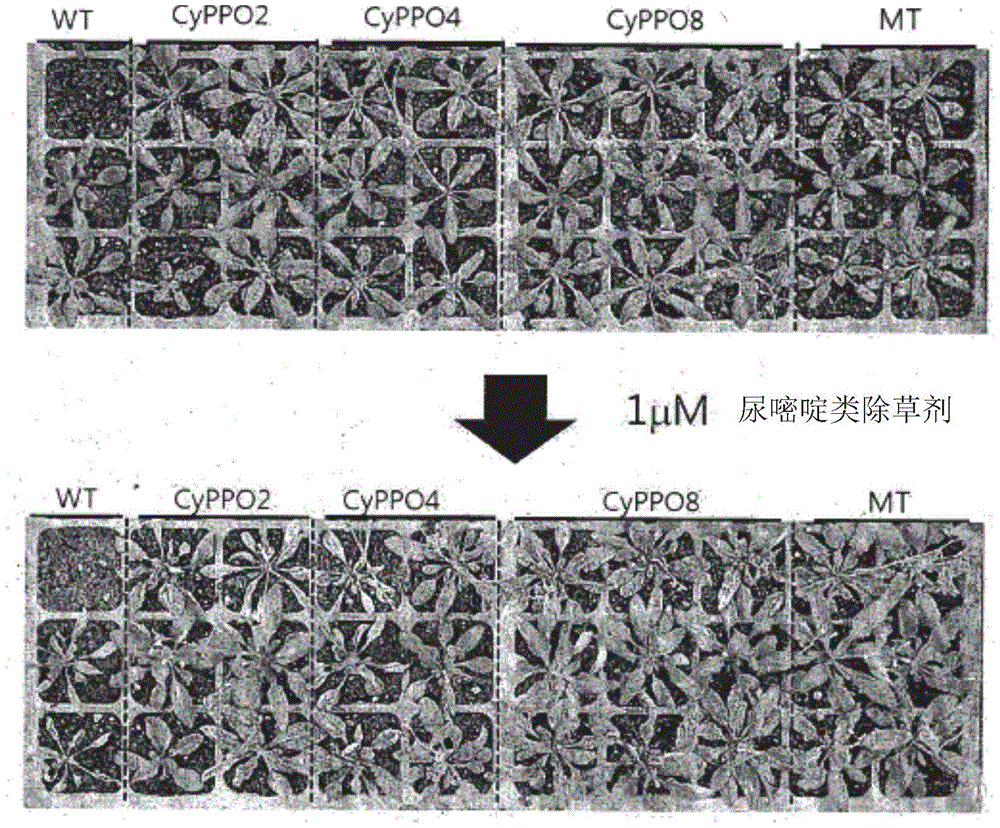
FIG. 18 shows the growth results of 7 days after spraying 1. mu.M uracil with each of the CyPPO2, CyPPO4 and CyPPO8 genes, and the control group mutant AtPPO1 (indicated by MT) gene, which were self-transferred to the Arabidopsis thaliana T2 offspring. WT means the result of wild Arabidopsis;
FIG. 19 shows the growth results of 7 days after the genes CyPPO2, CyPPO4 and CyPPO8 and the control group mutant AtPPO1 (indicated by MT) were each transferred to the progeny of Arabidopsis T2, after spraying with 0.5. mu.M uracil, 1. mu.M saflufenacil or 3. mu.M fomesafen; WT means the result of wild Arabidopsis;
FIG. 20 shows the results of culturing seeds of CyPPO2 and BAR insertional transgenic Arabidopsis thaliana and seeds of CyPPO8 and BAR insertional transgenic Arabidopsis thaliana, respectively, in a medium of adding glufosinate, a medium of adding uracil, or glufosinate and a medium of adding uracil;
FIG. 21 shows the results of culturing seeds of transgenic Arabidopsis thaliana with inserted genes CyPPO2 or CyPPO8, respectively, in the presence of a uracil-based medium, in the presence of a saflufenacil-based medium, or in the presence of both a uracil-based medium and a saflufenacil-based medium;
FIG. 22 shows graphs showing growth resistance in agar media containing uracils, saflufenacil and butafenacil at different concentrations, after transfer of the CyPPO2 amino acid sequence variation (M is denoted by 2), CyPPO4 amino acid sequence variation (M is denoted by 4) and CyPPO8 amino acid sequence variation (M is denoted by 8) genes, each to the BT3(Δ PPO) strain, from tests of the relationship between amino acid homology of the CyPPO2, CyPPO4 or CyPPO8 proteins and herbicide resistance; wild-type AtPPO1 (expressed as WT) and mutant AtPPO1 (expressed as MT) were used as controls for determining growth resistance;
FIG. 23 shows graphs showing growth resistance in agar media containing different concentrations of acifluorfen, oxyfluorfen and fomesafen after the amino acid sequence variation of CyPPO2 (M represented by 2), CyPPO4 (M represented by 4) and CyPPO8 (M represented by 8) were each transferred into BT3 (. DELTA.PPO) strain; wild-type AtPPO1 (expressed as WT) and mutant AtPPO1 (expressed as MT) were used as controls for determining growth resistance;
FIG. 24 shows a graph of growth resistance exhibited in agar media containing different concentrations of sulfentrazone, oxadiazon, pentoxazone and pyraclonil after transfer of each of the CyPPO2 amino acid sequence variation (M represented by 2), CyPPO4 amino acid sequence variation (M represented by 4) and CyPPO8 amino acid sequence variation (M represented by 8) to the BT3(Δ PPO) strain; wild-type AtPPO1 (expressed as WT) and mutant AtPPO1 (expressed as MT) were used as controls for determining growth resistance;
FIG. 25 is a graph showing the growth resistance exhibited by agar media containing mefenacet, pyraflufen-ethyl and flumioxazin at different concentrations after transfer of the CyPPO2 amino acid sequence variation (M represented by 2), CyPPO4 amino acid sequence variation (M represented by 4) and CyPPO8 amino acid sequence variation (M represented by 8) genes, respectively, into the BT3(Δ PPO) strain; wild-type AtPPO1 (denoted by WT) and mutant AtPPO1 (denoted by MT) were used as controls for determining growth resistance.
Detailed Description
The following is a detailed description of the present invention by way of examples. However, these examples are merely illustrative of the present invention, and the scope of the present invention is not limited to the examples given herein.
Example 1 isolation of PPO Gene from prokaryotes
The oscillatoria nigro-viridis PCC 7112, the algae sp.pcc8106 strain and the halotech sp.pcc7418 strain were provided by the pasteur institute (france), and the PPO genes were isolated by PCR from the primers in the table 1 contents. Genomes were isolated from each strain and PPO genes were isolated and amplified from the primers in table 1. The PPO gene sequence of coleus vaginatus (chrysosporium) was optimally synthesized for arabidopsis thaliana codons by gene bank database information and amplified using the primers in table 1. Mu.l of 5. mu.l of 10 Xbuffer, 2. mu.l of dNTP mix (per 10mM), 3. mu.l of forward primer (10. mu.M), 3. mu.l of reverse primer (10. mu.M), 35.5. mu.l of DDW and 0.5. mu.l of Pfu-X (Solgent, 2.5 units/. mu.l) or EF-taq (Solgent, 2.5 units/. mu.l) were added to each template (genome of each strain) in 50. mu.l of PCR reaction mixture, and amplification was carried out at 94 ℃ for 4 minutes, 30 cycles (30 seconds at 94 ℃, 30 seconds at 56 ℃, 1.5 minutes at 72 ℃), 5 minutes at 72 ℃ and 5 minutes at4 ℃. PPO isolated from the alga oscillatoria nigro-viridis PCC 7112 was designated CyPPO2, PPO isolated from the alga coc 8106 strain was designated CyPPO4, PPO isolated from the alga halotech sp PCC7418 strain was designated CyPPO8, and PPO isolated from the alga micrococcus vaginalis was designated CyPPO 12.
CyPPO2, CyPPO4, CyPPO8 and CyPPO12 of amino acid sequence and nucleotide sequence were respectively examined, and the sequences were identified by SEQ ID NOS: 1 to 8, it is noted that the amino acid sequence of CyPPO2 shows 94% sequence homology with its CyPPO 12.
[ Table 1]

Example 2 herbicide resistance test of Halothece sp.PCC7418 Strain
The halotech sp.pcc7418 strain was cultured from CRBIP media 1538 (institute of pasteur, france). The CRBIP medium 1538 is a mixed medium of ASNIII and Turks Island Salts 4X in a ratio of 1: 1 (v/v). Wherein the ASNIII medium is composed of 25.0g sodium chloride (NaCl), 3.5g magnesium sulfate heptahydrate (MgSO)4·7H2O), 2.0g of magnesium chloride hexahydrate (MgCl)2·6H2O), 0.5g of potassium chloride (KCl), 0.5g of calcium chloride dihydrate (CaCl)2·2H2O), 0.75g of sodium nitrate (NaNO)3)0.02g of dipotassium hydrogenphosphate trihydrate (K)2HPO4·3H2O), 0.04g of sodium carbonate (NaCO)3) 2.5ml of a solution of iron ammonium (III) citrate/citric acid monohydrate [ mixture of 300mg of iron ammonium (III) citrate, 300mg of citric acid monohydrate and 250ml of distilled water]2.5ml of edetic acid dihydrate solution [ mixture of 0.1g of Mg EDTA and 500ml of distilled water]1ml of trace metal A5+ Co [2.86g of boric acid (H)3BO3) 1.81g of manganous chloride (MnCl)2·4H2O), 0.222g of zinc sulfate heptahydrate (ZnSO)4·7H2O), 0.39g of sodium molybdate (NaMoO)4·2H2O), 0.079g of copper sulfate pentahydrate (CuSO)4·5H2O), 0.049g of cobalt nitrate hexahydrate (Co (NO)3)2·6H2O) and 1000ml of distilled water]And 1000ml of distilled water. Turks Island Salts 4X was prepared from was compounded of 112g of sodium chloride (NaCl), 2.68 g of potassium chloride (KCl), 22g of magnesium chloride hexahydrate (MgCl)2·6 H2O), 27.7g of magnesium sulfate heptahydrate (MgSO)4·7 H2O), 5.8g of calcium chloride dihydrate (CaCl)2·2 H2O) and 1000ml of distilled water. ASNIII medium and Tursk Island Salts 4X were separately autoclaved at 120 ℃ for 20 minutes and mixed at a ratio of 1: 1 (v/v).
5ml of the above culture medium is added to the test tube, without addition of, or with addition of, 2 or 10. mu.M each of uracils. The same volume of seed culture Halothece sp.PCC7418 strain was added to each tube and growth of the strain was examined for 8 consecutive days. The results of the tests showed that the Halothecec sp.PCC7418 strain still grew after 8 consecutive days of addition of 10. mu.M uracil, indicating that the strain is herbicide resistant (FIG. 1).
Example 3 testing of CyPPO2, CyPPO4, CyPPO8 and bacillus by PPO deletion e
Herbicide resistance of CyPPO12
To test the herbicide resistance of CyPPO2, CyPPO4, CyPPO8 and CyPPO12 isolated from example 1, CyPPO2, CyPPO4, CyPPO8 or CyPPO12 genes were each transferred to PPO-deficient bt3e. bacillus [ hereinafter referred to as "BT 3(Δ PPO)" ] and cultured in the presence of a herbicide to examine whether to resist the growth of e.coli. The use of arabidopsis derived wild PPO (wild-type ppop 1) as negative control showed that wild-type PPO1 was sensitive to PPO herbicide response and its sequence information was registered in the genbank under the accession number: no. AX084732 (the nucleotide sequence of the gene is represented by SEQ ID NO: 10, and the above amino acid sequence is represented by SEQ ID NO: 9). As a positive control, the mutant AtPPO1 was used, in which the amino acid substitution of Y426M (methionine for the substitution of tyrosine at position 426) and S305L (leucine for the substitution of serine at position 305) occurred in the wild AtPPO1 amino acid sequence (amino acid sequence represented by SEQ ID NO: 11) (Li X, Volrath SL., N D B.G., Chilcott CE, Johnson MA, Ward ER, Law MD (2003) Development of a prorpyrophilic oxidase as an effective selection marker for the aggregation of bacteria tissue-mediated transformation of main plant physiology 133: 736. 747).
The BT3(Δ PPO) strain is provided by the university of Hokkaido (Japan) and is a hemG-type PPO-deleted E.bacillus resistant to kanamycin (Watanabe et al, (2001) Dual targeting of cementitious oxidase II to mitochondoria and chloroplasts by alternative use of two in-frame inhibition codes, JBC 20474-20481).
3-1. preparation of Experimental materials and Equipment
In the present invention, the HVE-50 autoclave of Hirayama, HS2100A electronic scale of Hansung Instrument, CB-30V sterile console of Jeott, JSI-200CL bacterial culture of JSR, 1210 type UV-Vis spectrophotometer of Sammer Feishel, MQ-200 photometer of Apogee, and Bio-Rad MyCycler were used as PCR instruments. The autoclave is used for 15 minutes at 121 ℃, the indicator is used in an environment at 37 ℃, and the illumination unit is 160-200 mu mol m when each 14-20 hours is one culture time-2 s-1f. LB medium (10g/L tryptone, 5g/L yeast extract, 10g/L sodium chloride, 15g/L agar for bacteria) and the antibiotic chloramphenicol (Duchefa) were also used in the present invention. The herbicide providers used in this experiment are as follows:
[ Table 2]


3-2. Experimental methods
Each clone of CyPPO2, CyPPO4, CyPPO8 and CyPPO12 genes was isolated and amplified to pACBB in example 1 (structure shown in FIG. 2), and 10. mu.l of a solution containing 4. mu.l of each PPO gene, 3.5. mu.l of pACBB vector, 1. mu.l of 10 Xbuffer A, 1. mu.l of 10 Xbuffer B, 1. mu.l of ligase (RBC, 3 units/. mu.l) was prepared and allowed to react at 22 ℃ for 30 minutes. The reaction solution was added to 100. mu.l of DH5 competent cells, reacted on ice for 20 minutes, and left at 42 ℃ for 40 seconds. The cells were placed on ice for 2 minutes, and l ml of LB liquid medium was added to the above solution, and the solution was put into a bacterial incubator and shaken at 37 ℃ for 1 hour. Harvesting of inserted various genes the strains were cultured in a culture medium and cultured continuously in LB agar medium containing chloramphenicol.
E. Bacillus seeds transferred by various gene cultures, each of the above clones was placed in 3ml of LB liquid medium containing chloramphenicol overnight, and each of the above clones was subcultured in 3ml of fresh LB liquid medium every 100. mu.l until absorption rate (OD)600) 0.5 to 1. Dilution with LB liquid Medium until absorption Rate (OD)600) Up to 0.5. This diluted solution was diluted 5 times at a ratio of 10 times with LB liquid medium. And dripping 10 mu l of cultured E.coli diluted solution into a chloramphenicol LB agar medium (culture dish) and a plurality of herbicide stock seeds with different concentrations (0-400 mu M). The LB agar medium vessel was incubated at 37 ℃. After 16-20 hours of culture, it can be detected by naked eyes whether the growth is resisted or not. Also under bright conditions (light unit is 169 μmol m)-2 s-1) And in dark conditions, the strains were tested for resistance to growth in media containing uracils.
3-3. results of the experiment
Fig. 4 to 6 show the results of examination of CyPPO2, CyPPO4 and CyPPO8 for herbicide resistance, and fig. 7 and 8 show the results of examination of CyPPO12 for herbicide resistance.
As shown in FIG. 3, the wild AtPPO 1-transferred strain was resistant to growth in the medium containing uracil species, both in bright and dark conditions, and exhibited higher resistance to growth in bright conditions than in dark conditions. For example: the wild-AtPPO 1 transferred strain was completely resistant to growth under bright conditions containing 1. mu.M uracil, but growth was essentially maintained to some extent under dark conditions. However, growth was completely resisted under both bright and dark conditions with 5 μ M uracils. It can be seen that the resistance to growth of the strain transferred from wild AtPPO1 can be manifested in a medium containing uracil at a certain concentration, and the sensitivity of the herbicide can be examined. No growth resistance was observed in 25. mu.M uracils for the wild-type strain of AtPPO1, nor was herbicide resistance detectable.
Wild AtPPO1 can be used as a reference of herbicide-sensitive PPO, mutant AtPPO1 can be used as a reference of herbicide-resistant PPO, and the herbicide resistance of different PPO families is detected by CyPPO2, CyPPO4 or CyPPO 8.
Figure 4 shows the respective results after using different concentrations of pyrimidinedione PPO herbicides, uracils, saflufenacil and butafenacil and typical PPO herbicides of the N-phenylimide type, flumioxazin. The mutants, AtPPO1 transferred strain, CyPPO2 transferred strain and CyPPO4 transferred strain and CyPPO8 transferred strain, hardly observed the growth resistance phenomenon in 25 μ M of uracil or saflufenacil when treated with these. The mutants AtPPO1 transferred strain, CyPPO2 transferred strain, CyPPO8 transferred strain were hardly observed in the case of treatment with butafenacil, at 25. mu.M. In the treatment with flumioxazin, the strain transferred with CyPPO2, the strain transferred with CyPPO4, and the strain transferred with CyPPO8 hardly observed the growth resistance phenomenon in 25 μ M of flumioxazin. In the treatment with the four herbicides, it was found that the wild-type strain of AtPPO1 transferred began to exhibit the growth resistance phenomenon at 0.5. mu.M, and hardly grew at 5. mu.M or more.
FIG. 5 shows the results of different treatments with different concentrations of the diphenyl ether PPO herbicide, fomesafen, acifluorfen and oxyfluorfen. The transferred strain of the mutant AtPPO1 did not see growth resistance at 25. mu.M when treated with fomesafen. The CyPPO2 transferred strain, CyPPO4 transferred strain, and CyPPO8 transferred strain were hardly observed in 400. mu.M fomesafen for growth resistance. The CyPP02 transferred strain, CyPPO4 transferred strain, and CyPPO8 transferred strain were hardly observed in the 400. mu.M acifluorfen when treated with acifluorfen. When treated with oxyfluorfen, the CyPPO 2-transferred strain, the CyPPO 4-transferred strain, and the CyPPO 8-transferred strain were hardly observed in the 400. mu.M oxyfluorfen. Upon treatment with the four herbicides, it was found that the wild-type AtPPO1 transferred strain began to develop growth resistance at 0.5. mu.M, and hardly grew above 5. mu.M.
FIG. 6 shows the results of different concentrations of the triazolinone PPO herbicide sulfentrazone, typical oxazolidinedione PPO herbicide pentoxazone, typical phenylpyrazole PPO herbicide pyriproxyfen, typical oxadiazole PPO herbicide oxadiazoline, typical thiadiazole PPO herbicide fluthiacet-methyl and other PPO herbicides pyraclonil after treatment. The CyPPO2 transferred strain, CyPPO4 transferred strain, and CyPPO8 transferred strain were hardly observed in 400. mu.M of sulfentrazone when treated with sulfentrazone. The CyPPO2 transferred strain and the CyPPO8 transferred strain were barely observed in 400 μ M oxyfluorfen when treated with pentoxazone, pyraflufen, oxadiargyl, fluthiacet-ethyl and pyraclonil. The wild-type strain of AtPPO1 transferred was found to grow little above 5. mu.M when treated with seven herbicides.
FIG. 7 shows the results of measurements of CyPPO12 herbicide resistance when treated with uracils, saflufenacil, flumioxazin, fomesafen and oxyfluorfen. The strain transferred by CyPPO12 hardly has growth resistance phenomenon observed when 25 mu M of uracils, saflufenacil, flumioxazin, fomesafen and oxyfluorfen are treated; almost no growth resistance was observed with 400 μ M fomesafen or oxyfluorfen treatment. The strain to which the mutant AtPPO1 was transferred began to observe growth resistance at 5. mu.M when treated with oxyfluorfen. Almost no growth resistance was observed with 25 μ M other herbicide treatments. In contrast, the strain transferred from wild AtPPO1 began to develop growth resistance phenomenon at 0.5. mu.M among the four herbicides other than fomesafen, and hardly grew at 5. mu.M or more. Growth resistance was observed at 5 μ M for the wild-type strain of AtPPO1 transferred when treated with fomesafen.
Figure 8 shows the results of CyPPO12 herbicide resistance detected after treatment with pyraflufen, oxadiargyl, sulfentrazone, pentoxazone and pyraclonil. No growth resistance was observed at all in the strains transferred with the mutant AtPPO1 and in the strain transferred with CyPPO12 treated at 25. mu.M; at 400 μ M, no growth resistance was observed at all under the four herbicide treatments except sulfentrazone. In contrast, the wild-type strain of AtPPO1 transferred began to develop growth resistance at 0.5. mu.M when treated with pyraflufen-ethyl, oxadixyl, sulfentrazone or pyraclonil. When treated with pyraclonil, the growth resistance phenomenon was detected at 5. mu.M, and hardly observed at 25. mu.M.
Example 4 testing of herbicide resistance to CyPPO2, CyPPO4 and CyPPO8 by PPO-deficient e
Body culture Medium)
In example 3, the wild-type strain of AtPPO1, mutant AtPPO1, CyPPO2, CyPPO4 or CyPPO8, each from transferred BT3(Δ PPO) was tested for herbicide resistance in various mixed agar media containing herbicides, in this example, the strains were tested for herbicide resistance in LB liquid media containing different herbicides.
4-1. preparation of Experimental materials and Equipment
In the present invention, the HVE-50 autoclave of Hirayama, the HS2100A electronic scale of Hansung Instrument, the CB-30V sterile console of Jeott, the JSI-200CL bacterial culture of JSR, the MQ-200 photometer of Apogee, and the model 1210 UV-visible spectrophotometer of Sammer Feishal were used. The autoclave is used for 15 minutes at 121 ℃, the indicator is used in an environment at 37 ℃, and the illumination unit is 160-200 mu mol m when each 13.5 hours is one culture time-2 s-1f. The UV-Vis spectrophotometer was used at 600 nm.
The uracils (M.W.511.87g/mol), saflufenacil (M.W.500.85g/mol) and fomesafen (M.W.438.76g/mol) used in the present invention were purchased from Dongbu Farm Hanong Co., Ltd, Sigma, and Sigma, respectively. These drugs were prepared at 200mM concentrations in 100% acetone and stored at-20 ℃. LB (Luria-Bertani) medium (10g/L of tryptone, 5g/L of yeast extract, 10g/L of sodium chloride) and the antibiotic chloramphenicol (Duchefa) were also used in the present invention.
4-2. Experimental methods
E. Bacillus seed culture for each gene transfer, the above single strain was cultured in 3ml LB liquid medium containing chloramphenicol for 12 hours, and diluted with LB liquid medium to an absorption rate (OD)600) Is 1.5. Chloramphenicol and 500. mu.l of seed culture transferred E.bacillus were added to 250ml of LB liquid medium, and 250 ml-flasks were filled per 50 cultures. Each flask was treated with a different concentration of herbicide stock (uracil, saflufenacil, fomesafen) (0, 10. mu.M, 50. mu.M, 100. mu.M) and incubated at 37 ℃ in an environment of 200 rpm. The absorption rate (OD) was measured with a spectrophotometer every 1.5 hours600). The experiments were repeated three times and the average of the experiments is shown in the graph. Error bars represent the standard error of three replicates.
4-3. results of the experiment
Wild-type AtPPO1 can be used as a reference for herbicide-sensitive PPO, and mutant AtPPO1 can be used as a reference for herbicide-resistant PPO.
The results of uracil treatment are shown in FIG. 9.
The strain transferred with wild AtPPO1 hardly grew above 10. mu.M of uracil, whereas the strain transferred with mutant AtPPO1 grew above 10. mu.M of uracil, and the above-mentioned growth resistance phenomenon was detected above 50. mu.M of uracil. The strain transferred by CyPPO2 and the strain transferred by CyPPO4 generally grew at 100 μ M of uracils.
The results of saflufenacil treatment are shown in fig. 10.
The appearance and absence of resistance for all transferred strains was similar to the uracil treatment, but higher resistance was detected with saflufenacil compared to the uracil treatment. The wild AtPPO1 transferred strain hardly grew at 10. mu.M saflufenacil, but the mutant AtPPO1 transferred strain, CyPPO2 transferred strain, CyPPO4 transferred strain, CyPPO8 transferred strain usually grew normally at 100. mu.M.
The fomesafen treatment results are shown in fig. 11.
The growth resistance phenomenon was detected at 50. mu.M for the strain transferred from wild-type AtPPO1, but normally for the mutant AtPPO1 transferred strain, CyPPO2 transferred strain, CyPPO4 transferred strain and CyPPO8 transferred strain at 100. mu.M.
Experiment 5. expression of CyPPO2, CyPPO4 and CyPPO8 on plants
The aim of this experiment was to find out the expression of CyPPO2, CyPPO4 and CyPPO8 on plants through the proven resistance to PPO herbicides in experiments 3 and 4, in which the expression of PPO proteins was verified by fluorescent proteins (yellow fluorescent protein, YFP).
5-1. Experimental methods
Agrobacterium competent cells were prepared, and Agrobacterium GV3101 strain (Korean institute of Life sciences) was cultured in 5ml of LB medium at 30 ℃ for 12 hours at 200 rpm. Adding the culture liquid culture medium into 200ml of LB medium, and culturing for 3-4 hours at 30 ℃ and 200 rpm; centrifugation was carried out at 3000g for 20 minutes at4 ℃. The original particles were washed with sterile distilled water and resuspended in 20ml of LB medium. The solution was frozen in 200. mu.L portions in liquid nitrogen and stored in a deep freezer.
Vectors for respective clones of wild-type AtPPO1, CyPPO2, CyPPO4 and CyPPO8 genes were prepared, and the vectors containing CaMV35S promoter, YFP and NOS ends were treated with XbaI and XhoI restriction enzymes. The PCR amplified transit peptide gene (SEQ ID NO: 26) was treated with XbaI and XhoI restriction enzymes. After binding the above-mentioned vector and the transit peptide gene together, the transit peptide is inserted into a vector involved in transferring chloroplast into the vector. XhoI and BamHI restriction enzymes were used to digest the individual PPO genes (wild-type AtPPO1, CyPPO2, CyPPO4 and CyPPO8 genes s) and the vector, and after they were bundled together, the individual PPO genes were inserted into the vector. The results showed that the transit peptide was linked to the 5 '-end of the PPO gene and the YFP gene was linked to its 3' -end. The schematic of the final vector is shown in FIG. 12.
Next, Agrobacterium medium transformation was performed by thawing Agrobacterium competent cells on ice, mixing 3-5. mu.L of the cells with vectors into which each PPO gene was inserted, and snap-freezing the mixture in liquid nitrogen for 2-3 minutes. The cells were thawed at 37 ℃ for 5 minutes, 1ml of LB medium was added, and the cells were cultured at 30 ℃ for 2 hours. Each of the cultured results was placed in LB/spectinomycin medium and cultured at 30 ℃ for 2 days.
Grafting tobacco leaves and agrobacterium, placing single colonies of agrobacterium transferred by each PPO insertion vector in LB/spectinomycin medium, culturing for 12 hours in the environment of 30 ℃ and 200rpm, and centrifuging for 2 minutes at 7000 rpm. The obtained raw particles were respectively placed in 10mM MgCl2And (4) resuspending. At absorption rate (OD)600) After adjusting to 0.5, 200. mu.M acetosyringone was added and stored at room temperature for 2 hours. The Agrobacterium was infiltrated onto normal growing tobacco leaves with a 1ml syringe and cultured for 2-5 days.
Protoplasts were isolated from tobacco leaves, and enzyme-concentrated solutions were prepared according to the compounds listed in Table 3 or 5.
[ Table 3]
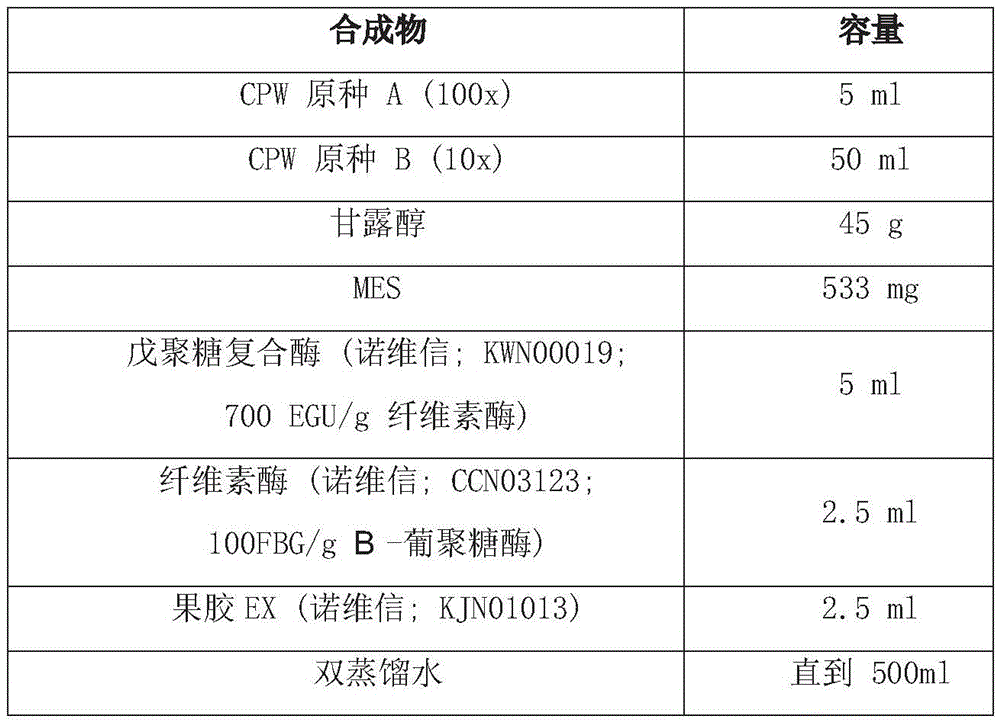
The solution was adjusted to 5.8, and then sterilized and filtered through a 0.22 μm pore.
[ Table 4]


[ Table 5]
| Composition of | Capacity of |
| Mannitol | 1g |
| 200mM MES(pH 5.7) | 150μL |
| Pentosan complex enzyme | 100μL |
| Cellulase enzymes | 50μL |
| Pectin EX | 50μL |
| 1M calcium chloride (CaCl)2) | 70μL |
| Double distilled water | Up to 10ml |
Cutting tobacco leaves into strips by using a razor blade, putting the tobacco leaves strips in prepared enzyme concentrated solution, covering the tobacco leaves strips with tinfoil paper, and stirring for 3-5 hours at 40-50rpm in a normal temperature environment. Protoplast cells were detected here by three filters, DIC, YFP and rhodamine, using a microscope (carl. zeiss Observer Z1) and a biomaterial-dependent analysis system (zeiss LSM 710). After the image was acquired by the imaging tool, it was processed using the ZEN lite 2012 (carl zeiss) program.
Fluorescent Protein (YFP) expressed with CyPPO2, CyPPO4 or CyPPO8 proteins was detected by western blotting. The samples were stored frozen in liquid nitrogen and ground with a micro-grinding bar. IP buffer [50mM Tris-Cl (pH7.5), 75mM NaCl, 5mM EDTA, 1% Triton X-100, 1 mM DTT, 1 Xprotease inhibitor ] (up to 40. mu.L) was added and vortexed and placed on ice for 10 minutes or more. After centrifugation at4 ℃ for 10 minutes, the supernatant was introduced into a new 1.5ml tube. Protein loaded dye was added to the above solution, boiled at 100 ℃ for 5 minutes, and then placed on ice. Its supernatant was used after centrifugation. During electrophoresis, the protein extract was loaded on a 7.5% SDS-PAGE gel, the gel was concentrated at 100V, and the protein was separated from the gel at 150V. The electrophoresed proteins were transferred to PVDF (polyvinylidene fluoride) membrane, and then they were lumped for 1 hour with a blocking buffer (4% skimmed milk powder, 10mM sodium phosphate, 0.15M NaCl l, 0.05% Tween-20, pH 7.5). A1/2000-diluted product of a green fluorescent egg (anti-GFP) antibiotic (HRP-conjugated) (Santa Cruz) was added and reacted at room temperature for 2 hours. After the antibiotic reaction, the membrane was washed with PBS-T (phosphate buffered saline Tween) buffer for 10 minutes three times, sprayed with 500. mu.L of ECL (electrochemiluminescence) solution (buffer composition or supplier: Bio-Rad) and left for 1 minute. The film is covered by OHP film, developed by X-ray, and developed.
5-2. experimental results
The detection expression results of the wild AtPPO1, CyPPO2, CyPPO4 and CyPPO8 genes transferred to plants are shown in FIG. 13. Among the PPO genes transferred from the individual plants, the formation of colonies of Agrobacterium was observed. No negative control YFP protein was observed targeting chlorophyll, but his expression was observed in cytoplasm and nucleus. Images of the fluorescent fusion of the PPO protein and chlorophyll were observed, and it was found that their fluorescent signals overlap each other and, for chloroplast targeting, were targeted on chloroplasts under the influence of cTP (chloroplast transit peptide) attached to the N-terminus.
Example 6 preparation of plant transfer vectors and transformants
For plant transfer selection, a binary vector of ORF after combination of BAR gene (glufosinate-ammonium resistance gene) and ORF of each of CyPPO2, CyPPO4 or CyPPO8 gene was prepared and used. The BAR gene is used for detecting the cross-treatment effect of the PPO herbicides under different respective action mechanisms. This gene was also used to test whether the next generation could stably inherit the relevant characteristics. Expression of the BAR gene requires the use of the NOS promoter, end E9 for termination of transcription. Meanwhile, CyPPO2, CyPPO4 and CyPPO8 are expressed and transferred to the plants, and a CaMV35S promoter is used; the protein was mobilised and targeted to the chloroplast and inserted into the Transit Peptide (TP) region of the AtPPO1 gene by XbaI and XhoI restriction enzymes. No expression of the protein was confirmed, and a Hemagglutinin (HA) tag was inserted into the 3' -end by BamHI and SacI restriction enzymes. Insertion of the transit peptide region into the vector was determined using SEQ ID NO: 27, and the inserted HA tag sequence is represented by SEQ ID NO: indicated at 28. The genes CyPPO2 and CyPPO8 are inserted between transit peptide and HA marker by XhoI and BamHI restriction enzyme, and NOS end is inserted into HA marker to guide PPO gene to stop transcription. A schematic diagram of the binary vector structure for plant transfer is shown in FIG. 14.
The procedure for preparing plant transformants was as follows: first, transferred Agrobacterium is selected in an antibiotic medium, and colonies are cultured in a liquid medium. Agrobacterium cells were obtained and pelleted in suspension in a solution containing 5% sucrose and 0.05% silicone super-expander L-77. Absorption rate (OD)600) Adjusting the growth period to 0.8, and putting the arabidopsis thaliana flower pot growing for 5-6 weeks into the agrobacterium solution. The flowerpot was covered with a plastic bag for maintaining humidity and placed in the dark for one day. And (3) growing the arabidopsis grafted by the agrobacterium for 1-2 months, and culturing seeds to harvest the seeds. Seeds harvested from the transferred plants are mixed together with transferred and non-transferred seeds, and the transferred seeds need to be screened out of these seeds.
In the preparation of vectors for selection of transformants (selection of transformants by glufosinate), the BAR gene for selection of transformants was inserted and transplanted into soil for growth to obtain T1 plants.
The transplanted T1 plant was tested for resistance to PPO herbicides, and the plants were grown for 3-4 weeks before the flower stalks were extended. Arabidopsis thaliana ecotype Col-0 was found to be killed when 2-3ml of 1. mu.M uracils (+ 0.05% silicone super extender L-77) was used per plant. It is necessary to uniformly apply 1. mu.M uracils in equivalent amounts to each plant. After 7 days, the antibody of the PPO herbicide transfersome is detected. Those plants showing resistance survived and continued to grow, then their seeds (T2 seeds) were harvested, T2 seeds were placed in 1/2MS medium for one week and transplanted into the soil to obtain T2 plants.
Example 7 Germination test
To monitor the uracil-like resistance of seeds of the T2 generation that survived treatment with 1. mu.M uracil-like, Arabidopsis seeds were sown in 1/2MS medium (1.125g/L MS salt, 10g/L sucrose, 7g/L agar) containing 70nM uracil-like in CyPPO2 and CyPPO8 transformants. Wild Arabidopsis thaliana (Col-0; Columbia type-0 ecotype) found reduced seed germination in 1/2MS medium containing 50nM uracil, and Col-0 found no normal seed germination and total mortality in 1/2MS medium containing 70nM uracil. Thus, survival at 70nM of the uracil group means that the plant possesses uracil resistance.
As the results in figure 5 show, CyPPO2 transfer T2 germinated in 1/2MS medium containing 70nM uracils, with CyPPO8 transfer T2 germinated in rows 1 and 49, and CyPPO8 transfer T2 germinated in rows 6, 16 and 40. Wild Arabidopsis thaliana (Col-0) seeds did not germinate as a negative control comparison group in 1/2MS medium containing 70nM uracils. The AtPPO1 transfer mutant was germinated as a positive control comparison group in 1/2MS medium containing 70nM uracils.
Example 8 genetic testing
T2 generation seed separation ratio detection
Judgment of whether herbicide resistance characteristics can be inherited was observed in the next generation of transferred Arabidopsis thaliana, which was judged by T2 seed BAR gene resistance and sensitivity segregation ratios per line.
Segregation ratios of numbers 10, 20, 38 and 40 among the 10 lines of the CyPPO2 transformants were close to 3: 1, showing that a single copy transgene was inserted into each genome and isolated and expressed according to the Mendelian method. The remaining 6 rows did not show a 3: 1 segregation ratio, and more than two copies of the gene were possible.
Segregation ratios of numbers 6, 16 and 40 among the 5 row CyPP08 transformants were close to 3: 1, showing that a single copy transgene was inserted into each genome and isolated and expressed according to mendelian method. The split ratio of the remaining 2 rows was below 3: 1.
[ Table 6]
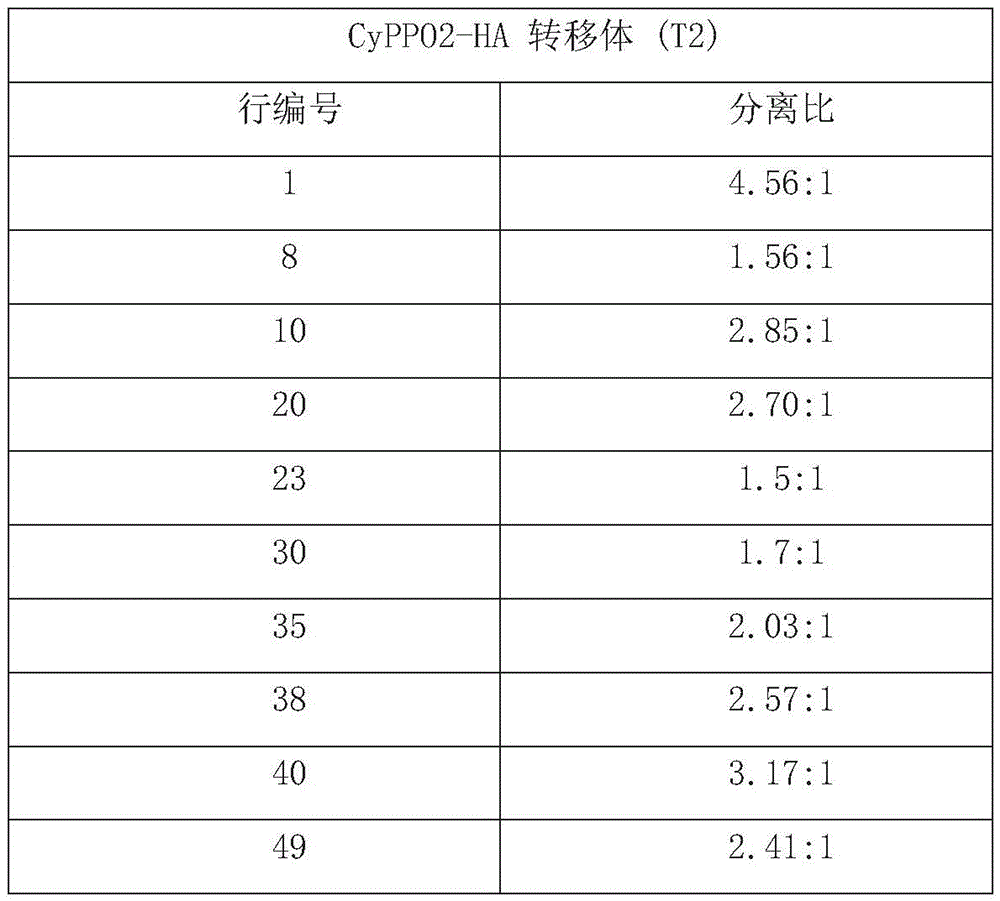
[ Table 7]

8-2. detection of herbicide resistance T2 generation seed CyPP02 and CyPPO8 protein expression
To examine whether the expression of CyPPO2 and CyPPO8 proteins will remain in the next generation, Western blotting was performed at T2 for each row of the extracted transfer body proteins. The amount of HA-labeled PPO protein was determined, and the protein was extracted from 100mg of Arabidopsis leaves and electrophoresed. Proteins were transferred to PVDF membranes and Western blots were performed with anti-HA antibiotics. mu.M of uracils were sprayed onto plants of the T1 generation. Surviving plants are classified as resistant and killed plants are sensitive.
The CyPPO2 transformants, after spraying with the above herbicide, detected PPO proteins on lines numbered 8, 23, 30, 38, 40 and 49, but no proteins on the sensitive line (fig. 16). The PPO proteins were detected in the CyPPO8 transporters, numbered 6, 23, 38 and 40, with the resistant line, but no proteins were detected in the sensitive line (fig. 17). Taken together, the expression of the proteins CyPP02 and CyPPO8 was expressed in the next resistance line, providing resistance.
8-3. detection of Stable inheritance of transgene Using BAR Gene
The stable inheritance of the transgene in the next generation is detected by inserting a transgene, and a BAR into the genome. The genome was isolated from 100mg of CyPPO2 and CyPPO8 transferred leaves and tested for BAR gene insertion by PCR. The results showed that insertion of BAR gene into the genome could be observed in both uracil-resistance and sensitivity lines in CyPPO2 and CyPPO8 transformants, demonstrating that the transgene could be stably inherited to the next generation.
Example 9 herbicide resistance assay of transferred Arabidopsis thaliana
And (3) detecting whether the herbicide resistance characteristic can be reserved in the next generation of plants, and performing a herbicide resistance experiment on T2 generation plant Arabidopsis thaliana subjected to gene transfer of CyPPO2, CyPPO4 and CyPPO 8. 2-3ml of 0.5 mu M uracil, 1 mu M saflufenacil or 3 mu M fomesafen is sprayed on each Arabidopsis plant growing for about 4 weeks. After 7 days of spraying, wild Col-0 plants died, but the positive control comparison group, the atoppo 1 transporter mutant and the experimental group, the CyPPO2 transporter, the CyPPO4 transporter and the CyPPO8 transporter did not damage and continued to grow (fig. 18 and 19), demonstrating that the herbicide resistance characteristics of T1 plants can be retained in T2 generation.
EXAMPLE 10 Cross-use of various herbicides with different mechanisms of action
In the Arabidopsis thaliana transformants containing the CyPPO2 or CyPPO8 gene obtained by the transfer of the plant transfer vector of example 6, the PPO activity resistance herbicide resistance gene and the glufosinate-resistance gene were simultaneously expressed. Thus, Arabidopsis thaliana metastases were tested by cross-treatment with two herbicides, i.e., to determine whether PPO activity against both the herbicide and glufosinate could be used simultaneously for weed control. The results show that CyPPO2 seeds and BAR insertional transgenic Arabidopsis thaliana or CyPPO8 and BAR insertional transgenic Arabidopsis thaliana were sterilized and treated at4 ℃ for 2 days. Seeds were sown in 1/2MS medium (Duchefa), 1/2MS medium containing 70nM uracil, 1/2MS medium containing 50uM glufosinate-ammonium, 1/2MS medium containing 70nM uracil and 50uM glufosinate-ammonium, respectively, grown at 23 ℃ for 7-14 days under bright conditions of 16 hours/8 hours in dark conditions. Arabidopsis thaliana in herbicide medium was individually CyPPO2 or CyPPO8 transferred seeds and wild Col0 control group. The transfer and control groups were cultured in herbicide medium. The examination was performed after 2 weeks. The results showed that normal growth was observed in both the glufosinate-added medium, the uracil-added medium, or both the glufosinate-and uracil-added medium for CyPPO2 and CyPPO8, but that the ColO of the control group did not germinate (see fig. 20).
In summary, the binary vectors of the PPO herbicide resistance gene and the BAR gene of the present invention are recombined to obtain the transferred plants, and the GM plants are treated with herbicides of different mechanisms of action in a crossed or double way, so that the undesired plants can be controlled.
In this example, the BAR gene recombined with the CyPPO gene is only a resistance gene, and the type of gene used in the present invention is not limited. From the reasoning principles well known in the industry, it can be concluded that when the resistance gene meets the needs of the purpose, it is recommended to use a CyPPO2, 4, 8 or 12 binary vector, which also has resistance to the respective gene when the herbicide is cross-treated, and the desired resistance can be obtained.
Example 11 Cross-use experiments with various PPO herbicides
In example 9, it has been demonstrated that Arabidopsis thaliana transporters of the present invention are simultaneously resistant to two PPO-type herbicides, uracil and saflufenacil. This example was conducted to examine whether cross-treatment of Arabidopsis thaliana transformants with uracils and saflufenacil could effectively control weeds. Finally, it was found that seeds of the Arabidopsis transformants with the CyPPO2 or CyPPO8 gene inserted therein were sterilized and treated at4 ℃ for 2 days. The seeds are respectively sown in 1/2MS medium, 1/2MS medium containing 70nM uracil, 1/2MS medium containing 70nM saflufenacil or 1/2MS medium containing 35nM uracil and 35nM bensulfuron-methyl, and are grown for 7-14 days under the bright condition of 16 hours/8 hours and the dark condition in the environment of 23 ℃. Arabidopsis thaliana in the herbicide medium was CyPPO2 or CyPPO 8-transfer seeds and wild ColO control group, respectively. The transfer and control groups were cultured in herbicide medium. The assay was performed after 2 weeks. The results show that CyPPO2 and CyPPO8 can grow normally with the addition of a uracil-based medium, with the addition of a saflufenacil medium, or with the addition of a uracil-based and saflufenacil medium, but the control group ColO did not germinate (see fig. 21).
In summary, in the present invention, by treating GM plants of the PPO herbicide resistance gene with multiple PPO herbicides, either cross-or double, or with one PPO herbicide alone, the undesired plants can be controlled.
Example 12 examination of herbicide resistance based on the homology of the amino acids CvPPO2, CvPPO4 and CvPPO8
The homology range of amino acid sequences of CyPPO2, CyPPO4 and CyPPO8 which retain herbicide resistance is detected, and partial amino acid sequences of CyPPO2, CyPPO4 or CyPPO8 proteins are replaced by partial NtPO (derived PPO gene of tobacco). Results of the CyPPO2 variation the amino acid sequence was determined using SEQ ID NO: 12, the nucleotide sequence of which is represented by SEQ ID NO: and 13, respectively. The CyPPO2 variant amino acid sequence and nucleotide sequence showed 98% sequence homology with CyPPO2 respectively. CyPPO4 variant amino acid sequence is represented by SEQ ID NO: 14, the nucleotide sequence of which is represented by SEQ ID NO: and 15, respectively. The CyPPO4 variant amino acid sequence and nucleotide sequence showed 98% sequence homology with CyPPO4 respectively. CyPPO8 variant amino acid sequence is represented by SEQ ID NO: 16, the nucleotide sequence of which is represented by SEQ ID NO: and 17. The CyPPO8 variant amino acid sequence and nucleotide sequence showed 98% sequence homology with CyPPO8 respectively. .
The specific experimental methods of detecting the herbicide resistance of CyPPO2 amino acid sequence variation, CyPPO4 amino acid sequence variation and CyPPO amino acid sequence variation by PPO deletion BT3E. bacillus [ BT3 (delta PPO) ], are the same as those in example 3. The same procedure as in example 3 was used, Arabidopsis thaliana wild PPO (wild AtPPO1) as a negative control herbicide sensitivity control. The mutants of AtPPOI, i.e., Y426M and S305L, as positive control group, which were amino acid substitutions from the wild amino acid sequence, served as herbicide-resistant control groups.
12-1 Experimental Material and Equipment preparation
The method is carried out for 15 minutes at 121 ℃ by using an autoclave, and the illumination intensity of the bacteria incubator is 169 mu mol m at 37 DEG C-2 s-1The culture is carried out in the environment for 14 to 16 hours. An ultraviolet-visible spectrophotometer was used at 600 nm. The PCR was carried out at 94 ℃ for a period of time of4 minutes, 25 cycles (30 seconds at 94 ℃, 30 seconds at 56-60 ℃, 3 minutes at 72 ℃), 5 minutes at 72 ℃, and 5 minutes at4 ℃. The herbicides used in the experiments were prepared according to the following table 8. Each herbicide required a density of 200mM in DMSO and was stored in an environment at-20 ℃. Before use, the herbicide was diluted and added to LB liquid medium (containing 34 mg/ml of chloramphenicol).
[ Table 8]
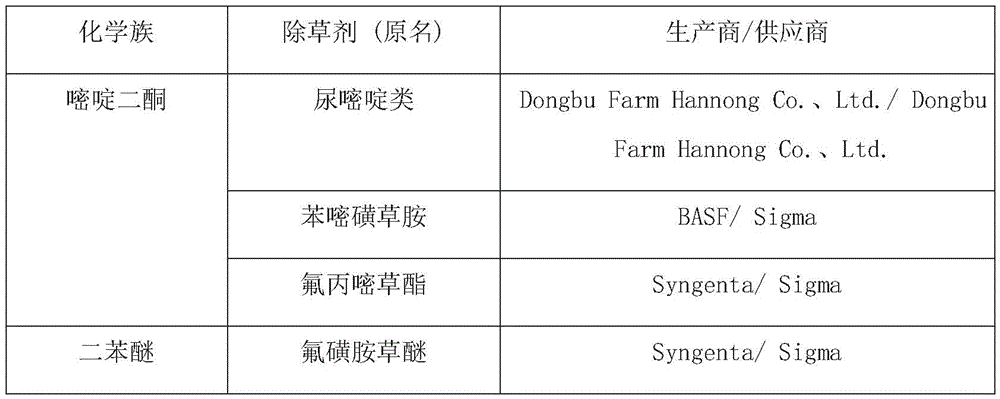
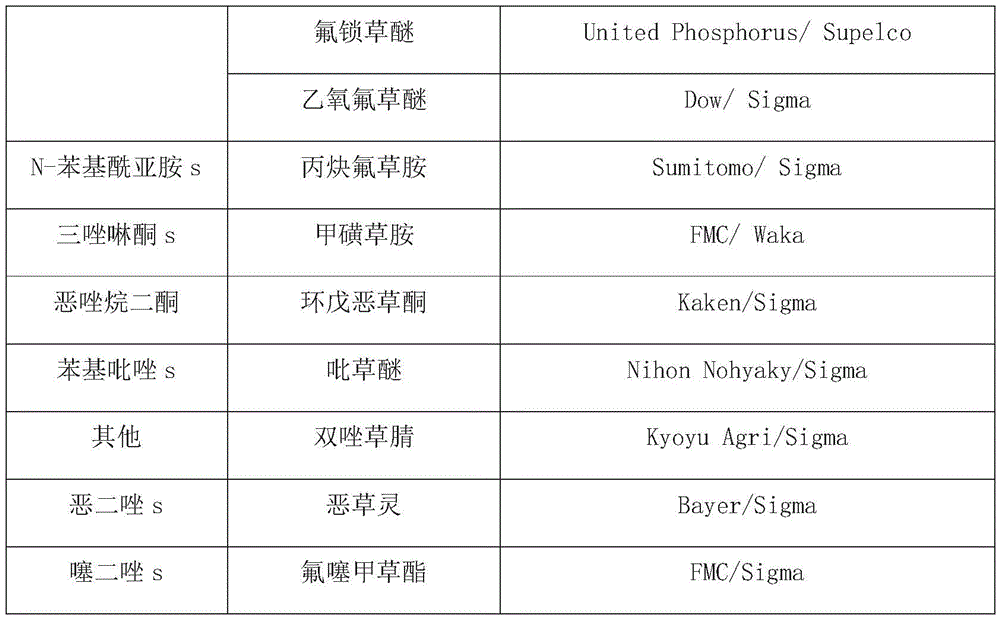
12-2. Experimental methods
The grafted standard cells were placed in 3ml of LB liquid medium containing chloramphenicol, and cultured at 37 ℃ for 5 hours at 200 rpm. The cultured cell density was set at 600nm, and the transfer was diluted with LB liquid medium to an absorption rate (OD)600)/ml (OD6000.5). Agar was added to the LB liquid medium at a density of 1% and the autoclave was conducted. Chloramphenicol (34. mu.g/ml) and herbicide were added and mixed. Diluting the cells to 100、10-1、10-2、10-3、10-4And 10-5Different densities. Dripping 1% agar and LB solid medium into 10 μ l of cells, culturing in a bacterial culture apparatus at 37 deg.C for 14-16 hr (light condition: 169 μmol m)-2 s-1)。
pACBB-CyPPO2, pACBB-CyPPO4 and pACBB-CyPPO8 were used as templates to provide the substitution sites as primers (Table 9), and pACBB-CyPPO2, pACBB-CyPPO4 and pACBB-CyPPO8 variant vectors were prepared by PCR. The PCR reaction mixture was mixed with 1. mu.l of each primer (stock solutions of pACBB-CyPPO2, pACBB-CyPPO4 and pACBB-CyPPO 8), 5. mu.l of 10 Xbuffer, 1. mu.l of dNTP mix (each 10mM), 50. mu.l of a reaction solution prepared from 1. mu.l of forward primer (10. mu.M), 1. mu.l of a reverse primer (10. mu.M), 35. mu.l of DDW and 1. mu.l of Pfu-X (Solgent, 2.5 units/. mu.l), reacted at 94 ℃ for 4 minutes, followed by 25 cycles (30 seconds at 94 ℃, 30 seconds at 56 ℃, 3 minutes at 72 ℃), 5 minutes at 72 ℃ and finally 5 minutes at4 ℃ followed by amplification.
[ Table 9]

BT3 (. DELTA.PPO) competent cells were prepared, and BT3 (. DELTA.PPO) strain was added to 5ml of LB liquid medium containing 50. mu.g/ml kanamycin and hemoglobin, and cultured in a shaking bacterial incubator at 37 ℃ under dark conditions for 12 hours. 5ml of the culture was also added to 100ml of LB liquid medium containing 20. mu.g/ml hemoglobin, and the bacterial culture was shaken at 37 ℃ and cultured in the dark until OD was reached600Up to 0.5. Using CaCl2BT3(Δ PPO) competent cells were prepared according to the method of using the method to obtain competent cells from cultured e. Each vector containing a CyPPO2 variation, a CyPPO4 variation and a CyPPO8 variation was obtained from the BT3(Δ PPO) strain, 5. mu.l of the vector was added to 100. mu.l of BT3(Δ PPO) competent cells, and the mixture was uniformly mixed, left on ice to react for 20 minutes, and left at 42 ℃ for 40 seconds. After being kept stably on ice for 2 minutes, 1ml of LB liquid medium was added to BT3 (. DELTA.PPO), and cultured with shaking at 37 ℃ for 1 hour. The cells cultured in the medium were collected according to the type of the inserted gene, dispersed on LB solid medium containing chloramphenicol (34. mu.g/ml), and cultured at 37 ℃ for 12 hours or more. The single colonies were cultured in LB liquid medium. Growth resistance was measured according to herbicide treatment standards under bright conditions and strains transferred from BT3 cultured in LB solid medium were tested with various densities of herbicide compared to BT3 transferred strains cultured in LB solid medium without herbicide.
12-3. results of the experiment
FIGS. 22 to 25 show the results of herbicide resistance measurements of the CyPPO2, CyPPO4 and CyPPO8 variant genes with 98% sequence homology to the original sequences of CyPPO2, CyPPO4 and CyPPO8, respectively. Wild-type AtPPO1 was used as a reference negative control group for herbicide sensitivity. The mutant AtPPO1 was referenced as a herbicide resistance to the positive control group. If a strain shows the same or higher resistance to the above as the strain-transferred mutant AtPPO1, this means that the strain has herbicide resistance.
In summary, a total of 13 herbicides from the 9 major families (uracils, saflufenacil, butafenacil, fomesafen, acifluorfen, oxyfluorfen, flumioxazin, sulfentrazone, pentoxazone, pyraflufen, pyraclonil, oxadiazon, thifenmethyl) under bright conditions, the transferred CyPPO2, CyPPO4 and CyPPO8 variations of the BT3 strain all grew normally and they all showed herbicide resistance equal to or higher than that of the controlling mutant AtPPO1 (growth resistance was hardly observed at 25 μ M).
Thus, the CyPPO2, CyPPO4 and CyPPO8 variations, which have 98% sequence homology with CyPPO2, CyPPO4 and CyPPO8, also show equal or higher resistance than CyPPO2, CyPPO4 and CyPPO8, although some changes in the sequence of CyPPO2, CyPPO4 or CyPPO8 occur, but the PPO function and the herbicide resistance and biological activity are maintained.
<110> Fua mother Korea company
<120> method for conferring or enhancing herbicide resistance to plants and/or algae by protoporphyrinogen oxidase variants
<150> KR10-2014-0181791
<151> 2014-12-16
<160> 34
<170> KopatentIn 1.71
<210> 1
<211> 486
<212> PRT
<213> Oscillatoria nigroviridis PCC 7112
<220>
<221> PEPTIDE
<222> (1)..(486)
<223> CyPPO2
<400> 1
Met Glu Leu Leu Asp Thr Leu Ile Val Gly Ala Gly Ile Ser Gly Leu
1 5 10 15
Ser Leu Ala His Ala Leu His Lys Glu Ala Thr Ser Ala Ser Pro Leu
20 25 30
Lys Ile Leu Val Ala Glu Ser Gln Gly Arg Val Gly Gly Asn Ile Thr
35 40 45
Thr Val Thr Ala Glu Gly Phe Leu Trp Glu Glu Gly Pro Asn Ser Phe
50 55 60
Ser Pro Thr Pro Glu Leu Met Lys Leu Ala Val Asp Val Gly Leu Lys
65 70 75 80
Gln Glu Leu Ile Phe Ala Asp Arg Lys Leu Pro Arg Phe Val Tyr Trp
85 90 95
Glu Asn Lys Leu Gln Pro Val Pro Met Thr Pro Pro Ala Met Ile Gln
100 105 110
Ser Gln Leu Leu Ser Phe Pro Gly Lys Leu Arg Ala Leu Phe Gly Ala
115 120 125
Leu Gly Phe Val Ala Pro Ala Met Gly Asp Arg Leu Ser Gln Gln Gly
130 135 140
Asn Glu Glu Thr Val Ser Gln Phe Phe Arg Arg His Leu Gly Thr Glu
145 150 155 160
Val Met Gln Arg Leu Val Glu Pro Phe Val Ser Gly Val Tyr Ala Gly
165 170 175
Asp Pro Gln Gln Leu Ser Ala Ala Ala Ala Phe Gly Arg Val Ala Lys
180 185 190
Met Ala Asp Val Gly Gly Gly Leu Val Ala Gly Ala Leu Leu Ser Ala
195 200 205
Lys Asn Arg Pro Lys Lys Met Pro Ala Asp Pro Asn Val Pro Lys Thr
210 215 220
Lys Pro Gly Glu Leu Gly Ser Phe Lys Gln Gly Leu Lys Ala Leu Pro
225 230 235 240
Glu Ala Ile Ala Ala Lys Leu Gly Asp Arg Val Lys Leu Asn Trp His
245 250 255
Leu Thr Arg Leu Gln Arg Thr Glu Arg Glu Thr Tyr Ile Ala Glu Phe
260 265 270
Ser Thr Pro Asp Gly Gln Gln Glu Val Glu Ala Arg Thr Val Val Leu
275 280 285
Thr Thr Pro Ala Tyr Val Thr Ala Asp Leu Leu Gln Pro Leu Glu Pro
290 295 300
Gln Val Ser Ser Ala Leu Gln Ala Phe Thr Tyr Pro Thr Val Ala Ser
305 310 315 320
Val Val Leu Ala Tyr Pro Gln Ser Asp Val Lys Gly Lys Leu Val Gly
325 330 335
Phe Gly Asn Leu Ile Pro Arg Gly Gln Gly Ile Arg Cys Leu Gly Thr
340 345 350
Ile Trp Thr Ser Ser Leu Phe Pro Asp Arg Ala Pro Ala Gly Trp Gln
355 360 365
Thr Leu Thr Ser Tyr Ile Gly Gly Ala Thr Asp Ser Glu Ile Gly Asn
370 375 380
Leu Asp Ser Glu Gln Ile Val Arg Glu Val His Arg Asp Leu Ser Arg
385 390 395 400
Ile Leu Leu Lys Pro Asp Val Pro Gln Pro Lys Val Leu Thr Val Lys
405 410 415
Leu Trp Lys Arg Ala Ile Pro Gln Tyr Asn Leu Gly His Phe Asp Arg
420 425 430
Leu Gln Gln Ile Asp Glu Gly Leu Lys Ser Leu Pro Gly Val Tyr Leu
435 440 445
Cys Ser Asn Tyr Val Gly Gly Val Ala Leu Gly Asp Cys Val Arg Arg
450 455 460
Gly Phe Asp Arg Ala Arg Glu Val Gly Glu Tyr Leu Gln Lys Lys Gln
465 470 475 480
Ser Asp Thr Arg Ser Ile
485
<210> 2
<211> 1461
<212> DNA
<213> Oscillatoria nigroviridis PCC 7112
<220>
<221> gene
<222> (1)..(1461)
<223> CyPPO2
<400> 2
atggaactat tagatacctt gattgtgggt gcgggtatta gcggtttgag tttggcgcac 60
gcacttcaca aggaagcaac gagtgcatcg ccgctgaaga ttttagtcgc tgagagtcag 120
ggacgtgtgg gcgggaacat cacgactgtg acagcagagg ggtttctctg ggaggagggc 180
ccgaacagtt tttcgccgac gccggaattg atgaagttgg ctgtggatgt gggattgaag 240
caggagttga tttttgccga tcgcaaattg cctcgttttg tgtattggga aaataagctg 300
caaccggtgc cgatgactcc accggcgatg attcagtctc agttgctgag ttttccgggg 360
aaactgcggg cgttgttcgg ggctttgggg tttgtcgcgc cggcaatggg cgatcgactt 420
tcgcagcagg gtaacgagga aacagtttct caatttttcc gccgtcatct cggtacggaa 480
gtgatgcagc ggttggtgga accttttgtt tctggggttt atgccggcga tccgcaacaa 540
cttagcgcgg cggcggcttt tggccgggta gccaagatgg ctgatgtggg tggcgggctg 600
gtggcggggg cgctgctttc tgctaaaaac agaccgaaga aaatgcctgc agacccgaat 660
gttcctaaaa ctaagccggg ggagttgggt tcgttcaagc aggggttgaa ggctttgcca 720
gaggcgatcg ctgctaagtt gggcgatcga gtgaaactca actggcactt gactcgcctc 780
cagcgcacag aacgcgaaac ttacattgct gaattctcga cgcccgacgg acagcaggaa 840
gttgaggcgc gcaccgtggt tttgacaacg cccgcttacg ttacagccga tttgttgcaa 900
cctctggaac cgcaagttag cagcgcttta caagctttta cttatcctac ggttgcctcc 960
gttgtcttag catacccgca gtcggatgtc aagggtaaat tagtgggttt tggaaattta 1020
attccgaggg ggcagggaat tcgctgtctc gggacgattt ggacatcgag tttatttccc 1080
gatcgcgcgc ctgcagggtg gcaaactctc accagttaca tcggcggggc aacagactcg 1140
gaaattggca atctcgactc agaacaaatc gttcgggagg tacaccgaga tttgtctcgg 1200
attttgctga aaccagatgt gccacagcca aaagttttaa cggtgaagct gtggaaacgg 1260
gcgattcctc agtacaattt ggggcatttc gatcgcctgc aacaaatcga tgagggctta 1320
aaatctttgc ctggagtgta tttgtgcagc aactacgttg gcggagtggc tttgggagat 1380
tgcgtgcgaa ggggtttcga tcgtgcgcga gaagtgggcg agtatttgca gaagaaacaa 1440
tcagatactc gatcgatctg a 1461
<210> 3
<211> 479
<212> PRT
<213> Lyngbya sp. PCC 8106
<220>
<221> PEPTIDE
<222> (1)..(479)
<223> CyPPO4
<400> 3
Met Thr His Val Leu Asp Ser Leu Ile Val Gly Ala Gly Ile Ser Gly
1 5 10 15
Leu Ala Leu Ala His Ala Leu His Gln Asn Gln Asp His Gln Leu Pro
20 25 30
Leu Asn Ile Leu Val Ser Glu His Gln Gly Arg Val Gly Gly Asn Ile
35 40 45
Thr Thr Val Ser Glu Gly Glu Phe Leu Trp Glu Glu Gly Pro Asn Ser
50 55 60
Phe Ser Pro Thr Pro Glu Leu Leu Lys Leu Ala Val Glu Val Gly Leu
65 70 75 80
Lys Pro Glu Leu Val Phe Ala Asp Arg Lys Leu Pro Arg Tyr Val Tyr
85 90 95
Trp Asn Gly Gln Leu Met Pro Val Pro Met Ser Pro Pro Ala Leu Leu
100 105 110
Ser Thr Lys Leu Leu Ser Pro Gly Gly Lys Leu Arg Ala Leu Thr Gly
115 120 125
Ala Leu Gly Phe Val Gln Pro Ala Met Gly Glu Ser Leu Ser Gln Gln
130 135 140
Asn Gly Glu Glu Thr Ile Ser Gln Phe Phe Glu Arg His Leu Gly Ser
145 150 155 160
Glu Val Leu Lys Arg Leu Val Glu Pro Phe Val Ser Gly Val Tyr Ala
165 170 175
Gly Asp Pro Gln Gln Leu Glu Ile Ser Ser Ala Phe Ala Arg Val Ala
180 185 190
Arg Met Ala Tyr Ser Gly Gly Gly Leu Val Ala Gly Ala Val Leu Ser
195 200 205
Arg Arg Gln Asn Lys Ser Pro Arg Ser Pro Ala Asp Pro Ser Ile Pro
210 215 220
Gln Thr Lys Arg Gly Glu Leu Gly Ser Phe Arg Gln Gly Ile Gly Ala
225 230 235 240
Leu Pro Asn Ala Ile Ala Lys Gln Leu Gly Asp Gln Leu Lys Leu Asn
245 250 255
Trp Gln Leu Thr Arg Leu Glu Arg Thr Glu Asn Gln Thr Tyr Arg Ala
260 265 270
Glu Phe Ser Thr Pro Glu Gly Val Gln Gln Val Glu Thr Arg Thr Val
275 280 285
Val Leu Thr Thr Pro Ala Tyr Val Thr Ala Glu Ile Leu Lys Pro Leu
290 295 300
Gln Leu Gln Val Ser Gln Thr Leu Thr Glu Ile Pro Tyr Pro Pro Val
305 310 315 320
Ala Cys Val Val Leu Ala Tyr Pro Val Ser Ala Leu Lys Gln Lys Leu
325 330 335
Thr Gly Phe Gly Asn Leu Val Pro Arg Gly Gln Gly Ile Arg Thr Leu
340 345 350
Gly Thr Ile Trp Thr Ser Ser Leu Phe Pro Gly Arg Ala Pro Gln Gly
355 360 365
Trp Gln Val Leu Thr Ser Tyr Ile Gly Gly Ala Thr Asp Pro Glu Ile
370 375 380
Gly Glu Leu Glu Asp Asp Gln Ile Val Glu Ala Val His Gln Asp Leu
385 390 395 400
Arg His Ile Leu Leu Lys Glu Asp Ile Ser Pro Lys Val Leu Ala Val
405 410 415
His Leu Trp Lys Arg Ala Ile Pro Gln Tyr Asn Leu Gly His Gln Gln
420 425 430
Arg Leu Gln His Val Asn Glu Gly Leu Glu Ala Met Pro Gly Leu Tyr
435 440 445
Leu Cys Ser Asn Tyr Ile Asp Gly Val Ala Leu Gly Asp Cys Val Arg
450 455 460
Arg Ser Ile Gly Gln Ala Asn Glu Ile Leu Ser Phe Leu Gly Gln
465 470 475
<210> 4
<211> 1440
<212> DNA
<213> Lyngbya sp. PCC 8106
<220>
<221> gene
<222> (1)..(1440)
<223> CyPPO4
<400> 4
atgactcacg tactcgatag tttaatcgtc ggtgcaggca ttagcggcct ggcgttagct 60
catgctctcc atcagaacca agatcatcaa ttgcctctca acattcttgt cagcgagcat 120
caaggacggg taggaggaaa tataaccaca gtatccgaag gagaatttct ttgggaagaa 180
ggccccaata gtttttctcc aacccctgag ttactgaagt tagcggtaga agtaggtctt 240
aagcctgagc tagtctttgc cgatcgcaag ttacctcggt acgtttactg gaatggtcaa 300
ctcatgcctg tgccgatgag tcctccggct ttgttgagta caaaactctt aagtcctgga 360
ggtaaacttc gagcattaac gggggcattg gggtttgtac aacccgcgat gggagaatcg 420
ttaagtcaac aaaatgggga agaaacgatc tcgcagtttt ttgagcgtca tttgggttca 480
gaagttctca agcgactggt tgaacccttt gtttctggtg tttatgcagg cgatccccag 540
caactcgaaa ttagctcggc ttttgcccga gtcgcacgta tggcttacag tggcggtgga 600
ttggttgctg gagcggtttt atcgcgtcgt cagaacaaat ctccgcgatc gcctgccgac 660
ccgtctattc cccaaactaa acggggagag ttggggtctt ttcgtcaggg gattggagcc 720
ttacccaatg cgatcgccaa acagttaggc gatcaactca aattaaactg gcaactcacc 780
cgtctcgaac ggactgaaaa ccaaacctat cgggctgaat tttcgactcc agaaggggtt 840
caacaggtag aaactcgaac ggtggtgttg acgactccgg cctatgtcac agcagaaatt 900
ctcaaaccgt tgcaactcca agtcagtcaa acgttaactg aaattcccta tcccccggtg 960
gcttgcgtcg ttttagccta tcccgtttca gctttaaagc agaaattaac cggatttggc 1020
aatttagttc cccgaggaca agggattcgg acgttaggca cgatttggac atcgagttta 1080
tttcctggtc gcgcccccca aggctggcaa gtcctcacca gttatattgg cggagcgacg 1140
gatccagaaa ttggagagtt agaagatgat caaattgttg aggcggttca tcaagatttg 1200
cgtcacattt tactcaaaga agatatctct cccaaagtgc tagccgtgca tctgtggaaa 1260
cgtgctatcc ctcaatacaa tctcggacac caacaacggt tacaacacgt taatgagggt 1320
ctagaggcaa tgccggggtt atatctgtgt agcaactata tcgacggtgt agcgttggga 1380
gattgtgtgc gtcgttctat cggacaagct aacgaaattc tcagtttttt gggtcaatag 1440
1440
<210> 5
<211> 466
<212> PRT
<213> Halothece sp. PCC 7418
<220>
<221> PEPTIDE
<222> (1)..(466)
<223> CyPPO8
<400> 5
Met Ile Asp Thr Leu Ile Val Gly Ala Gly Ile Ser Gly Leu Ser Ala
1 5 10 15
Ala Tyr Arg Leu Asp Glu Lys Gln Arg Gln Val Leu Val Ala Glu Lys
20 25 30
Arg Asp Arg Ala Gly Gly Asn Ile Thr Ser Gln Gln Ser Gly Asp Phe
35 40 45
Leu Trp Glu Glu Gly Pro Asn Ser Phe Ser Pro Thr Pro Glu Leu Leu
50 55 60
Lys Leu Ala Val Asp Ala Gly Leu Arg Asn Glu Leu Ile Phe Ala Asp
65 70 75 80
Arg Gly Leu Pro Arg Tyr Val Tyr Trp Glu Gly Lys Leu Arg Pro Val
85 90 95
Pro Met Ser Pro Pro Thr Ala Val Thr Ser Gln Leu Leu Ser Pro Ile
100 105 110
Gly Lys Leu Arg Ala Leu Thr Gly Ala Leu Gly Phe Ile Pro Pro Gln
115 120 125
Val Ser Ser Gln Glu Glu Thr Val Ala Asp Phe Phe Thr Arg His Leu
130 135 140
Gly Ser Glu Val Ala Gln Arg Leu Val Ser Pro Phe Val Ser Gly Val
145 150 155 160
Tyr Ala Gly Asp Val Asp Gln Leu Ser Ala Glu Ala Ala Phe Gly Arg
165 170 175
Val Thr Gln Leu Ala Asp Val Gly Gly Gly Leu Val Ala Gly Ala Ile
180 185 190
Leu Cys Arg Arg Gln Lys Pro Lys Ser Thr Pro Lys Thr Ala Lys Pro
195 200 205
Ser Asp Ile Pro Glu Thr Lys Ser Gly Gln Leu Gly Ser Phe Lys Glu
210 215 220
Gly Leu Gln Gln Leu Pro Ser Ala Ile Val Ser Gln Leu Gly Asp Lys
225 230 235 240
Val Lys Phe Gln Trp Glu Leu Lys Asn Ile Ser Pro His Pro Glu Ser
245 250 255
Gly Tyr Val Ala Thr Phe Ser Thr Pro Glu Gly Glu Gln Thr Val Glu
260 265 270
Ala Lys Thr Val Ile Leu Thr Thr Pro Ala Tyr Val Thr Ala Ser Leu
275 280 285
Val Lys Asp Leu Ser Pro Gln Ala Ser Gln Ala Leu Asn Glu Ile Ser
290 295 300
Tyr Pro Pro Val Ala Cys Val Val Leu Ala Tyr Pro Asp Glu Ala Leu
305 310 315 320
Arg Phe Pro Leu Lys Gly Phe Gly Asn Leu Asn Pro Arg Ser Gln Gly
325 330 335
Ile Arg Thr Leu Gly Thr Ile Trp Ser Ser Thr Leu Phe Pro Gly Arg
340 345 350
Thr Pro Lys Gly Trp His Leu Leu Thr Asn Phe Ile Gly Gly Ala Thr
355 360 365
Asp Pro Ala Ile Ala Glu Leu Ser Glu Asp Gln Ile Ile Glu Gln Val
370 375 380
His Gln Asp Leu Gln Gln Ala Val Ile Lys Ser Gly Ser Ile Pro Lys
385 390 395 400
Pro Leu Ala Val His Leu Trp Ser Lys Ala Ile Pro Gln Tyr Asn Leu
405 410 415
Gly His Leu Lys Arg Leu Glu Thr Ile Arg Asn His Leu Lys Pro Phe
420 425 430
Ser Gly Leu Phe Leu Ser Ser Asn Tyr Leu Asp Gly Val Ala Leu Gly
435 440 445
Asp Cys Val Arg Arg Gly Glu Glu Ser Ser Gln Ala Val Leu Asp Tyr
450 455 460
Leu Gly
465
<210> 6
<211> 1401
<212> DNA
<213> Halothece sp. PCC 7418
<220>
<221> gene
<222> (1)..(1401)
<223> CyPPO8
<400> 6
atgatagata ctttaattgt gggagcaggg attagtggtt taagtgctgc gtatcgactc 60
gatgagaagc agcgccaagt gctggttgca gaaaagcgcg atcgcgctgg gggaaatatc 120
accagccaac aaagtggcga tttcctctgg gaagaaggac cgaacagttt ttctcccaca 180
ccagaactcc taaaactagc ggttgatgcg ggcttaagaa atgagttaat ctttgctgat 240
cgcggacttc cccgttatgt ttattgggag gggaaactgc gccctgttcc tatgagtccc 300
cccacagccg tgacatccca gttgctgagt ccaatcggga aactacgggc gttaacgggt 360
gcattaggct ttattccccc gcaagtgtcg agtcaggaag aaacggttgc ggactttttt 420
acccgtcatc tcggttcaga agtagcccaa cggttagtga gtccgtttgt gtctggggtt 480
tatgcagggg atgtggatca actcagtgcg gaagctgcat ttggacgagt tacccaactg 540
gcggatgtgg gcggtggact ggtcgcaggt gcgattttat gtcgtcgtca aaagccaaag 600
tcaaccccaa aaacggctaa accgtctgat attccagaaa caaagtctgg acagttaggt 660
tcatttaagg aaggattaca acaattaccc agcgcgatcg tttctcaact gggagacaaa 720
gtaaagtttc aatgggaact gaaaaatatc tcccctcatc cagaatcggg ttacgtcgcg 780
acattttcca caccagaggg agaacaaaca gtcgaagcca aaaccgttat cctcaccact 840
cccgcctacg ttaccgcctc tctggtcaaa gatttatcac ctcaagccag tcaagcctta 900
aacgaaattt cctatccccc cgtagcttgt gtggtcttag cctatcccga tgaagccctc 960
cgttttcccc tcaaaggatt tggtaatctt aaccctcgca gtcaaggaat ccgcactctt 1020
ggtacaattt ggagttcaac actctttcca ggacgcacgc cgaaaggttg gcatctctta 1080
accaatttta ttggcggtgc aactgatccc gcaattgctg aactcagtga agatcaaatt 1140
attgaacaag tccatcaaga cttacaacaa gcggtgatta aatcgggaag tatcccgaaa 1200
cccttagccg ttcatttgtg gtcaaaagcg attccgcaat acaatctcgg acatctgaaa 1260
cggttagaaa ccatccgcaa tcacttaaaa cccttctctg gactcttttt atcgagtaac 1320
tatctcgatg gcgttgcgtt gggtgattgt gtgcgccgag gggaagagag tagtcaagcc 1380
gtgttagatt atttgggtta a 1401
<210> 7
<211> 486
<212> PRT
<213> Microcoleus vaginatus
<220>
<221> PEPTIDE
<222> (1)..(486)
<223> CyPPO12
<400> 7
Met Glu Leu Leu Asp Thr Leu Ile Val Gly Ala Gly Ile Ser Gly Leu
1 5 10 15
Ser Leu Ala His Ala Leu His Lys Glu Ala Thr Ser Pro Ser Ser Leu
20 25 30
Lys Ile Leu Val Ala Glu Ser Gln Gly Arg Val Gly Gly Asn Ile Thr
35 40 45
Thr Val Thr Ala Glu Gly Phe Leu Trp Glu Glu Gly Pro Asn Ser Phe
50 55 60
Ser Pro Thr Pro Glu Leu Met Lys Leu Ala Val Asp Val Gly Leu Lys
65 70 75 80
Gln Glu Leu Ile Phe Ala Asp Arg Lys Leu Pro Arg Phe Val Tyr Trp
85 90 95
Gln Asn Lys Leu Gln Pro Val Pro Met Thr Pro Pro Ala Met Ile Gln
100 105 110
Ser Gln Leu Leu Ser Phe Pro Gly Lys Leu Arg Ala Leu Phe Gly Ala
115 120 125
Leu Gly Phe Val Ala Pro Ala Ile Gly Ser Gly Leu Ser Gln Gln Gly
130 135 140
Asp Glu Glu Thr Val Ser Gln Phe Phe Arg Arg His Leu Gly Thr Glu
145 150 155 160
Val Met Gln Arg Leu Val Glu Pro Phe Val Ser Gly Val Tyr Ala Gly
165 170 175
Asp Pro Gln Gln Leu Ser Ala Ala Ala Ala Phe Gly Arg Val Thr Lys
180 185 190
Met Ala Asp Val Gly Gly Gly Leu Met Ala Gly Ala Leu Leu Ser Ala
195 200 205
Arg Lys Arg Pro Lys Gln Met Pro Ala Asp Pro Asn Val Pro Ser Thr
210 215 220
Arg Pro Gly Glu Leu Gly Ser Phe Lys Gln Gly Leu Lys Ala Leu Pro
225 230 235 240
Glu Ala Ile Ala Ala Gln Leu Gly Asp Arg Val Lys Val Asn Trp His
245 250 255
Leu Thr Arg Leu Gln Arg Thr Glu Arg Glu Thr Tyr Ile Ala Val Phe
260 265 270
Ser Thr Pro Asp Gly Gln Gln Glu Val Glu Ala Arg Thr Val Val Leu
275 280 285
Thr Thr Pro Ala Tyr Ile Thr Ala Glu Leu Leu Gln Pro Leu Gln Pro
290 295 300
Lys Val Ser Ser Ala Leu Gln Ala Phe Thr Tyr Pro Thr Val Ala Cys
305 310 315 320
Val Val Leu Ala Tyr Pro Gln Ser Asp Val Lys Asp Lys Leu Val Gly
325 330 335
Phe Gly Asn Leu Ile Pro Arg Gly Gln Gly Ile Arg Thr Leu Gly Thr
340 345 350
Ile Trp Thr Ser Ser Leu Phe Ala Asp Arg Ala Pro Ala Gly Trp Gln
355 360 365
Thr Leu Ser Ser Tyr Ile Gly Gly Ala Thr Asp Ser Glu Ile Gly Asn
370 375 380
Leu Asp Ser Glu Gln Ile Val Arg Glu Val His Arg Asp Leu Ser Arg
385 390 395 400
Ile Leu Leu Lys Pro Asp Val Pro Gln Pro Lys Val Leu Ala Val Asn
405 410 415
Val Trp Lys Arg Ala Ile Pro Gln Tyr Asn Leu Gly His Phe Asp Arg
420 425 430
Leu Gln Gln Ile Asp Glu Gly Leu Lys Ser Leu Pro Gly Val Tyr Leu
435 440 445
Cys Ser Asn Tyr Val Gly Gly Val Ala Leu Gly Asp Cys Val Arg Arg
450 455 460
Gly Phe Glu Arg Ala Arg Glu Val Gly Glu Tyr Leu Gln Asn Lys Gln
465 470 475 480
Ser Asp Thr Arg Ser Ile
485
<210> 8
<211> 1461
<212> DNA
<213> Microcoleus vaginatus
<220>
<221> gene
<222> (1)..(1461)
<223> CyPPO12
<400> 8
atggaactct tggatactct cattgttgga gcaggtattt caggactttc tctcgcacac 60
gctttacata aggaggctac ttcaccatct tcacttaaga ttttggttgc tgaatctcaa 120
ggtagagtgg gaggtaatat cactacagtt accgctgagg gttttctttg ggaagaggga 180
cctaacagtt tctctcctac tccagaactc atgaagttag ctgttgatgt gggacttaaa 240
caggagttga tttttgcaga tagaaaactt ccaagattcg tgtattggca aaacaaactt 300
caacctgttc caatgacacc tccagctatg atccaatctc agcttctttc ttttcctgga 360
aaacttagag ctttgtttgg tgcacttgga ttcgttgctc cagcaatagg ttcaggattg 420
agtcaacagg gagatgaaga gactgtttct caatttttca gaaggcatct cggaacagaa 480
gttatgcaga gattagtgga gccatttgtt agtggtgtgt acgctggaga tcctcaacag 540
ctttctgctg ctgctgcttt cggtagggtt acaaaaatgg ctgatgtggg aggtggattg 600
atggctggag cactcttatc tgctagaaag aggccaaaac aaatgcctgc tgatcctaat 660
gttccttcaa ctagacctgg tgaattggga agttttaagc aaggtctcaa ggctcttcca 720
gaggcaatag ctgcacagct cggagataga gttaaggtga actggcacct tacaagattg 780
caaaggactg aaagagagac atatattgct gtgttctcta ctcctgatgg acaacaggaa 840
gttgaggcaa gaacagttgt gcttaccact ccagcttaca tcaccgcaga acttttgcaa 900
ccacttcagc ctaaagttag ttctgctttg caagcattca catatccaac cgttgcttgt 960
gttgtgttgg cataccctca gtcagatgtt aaggataaac tcgtgggttt tggaaatctt 1020
attcctagag gtcaaggaat caggactctc ggtacaatat ggacctcaag tttattcgct 1080
gatagagcac ctgctggatg gcaaaccctt tcttcatata ttggtggagc tactgatagt 1140
gagatcggta acctcgattc tgaacagata gttagggagg tgcatagaga tttgtcaaga 1200
attttgctca agcctgatgt tcctcaacca aaagtgttgg ctgttaatgt gtggaagaga 1260
gcaataccac agtacaacct tggacacttt gataggttgc aacagattga tgaaggtctc 1320
aaatctttac ctggagttta tctctgttca aactacgttg gtggagtggc tttaggagat 1380
tgcgttagaa ggggattcga gagggcaaga gaggttggag aatacttaca aaacaaacaa 1440
tctgatacca ggtcaatctg a 1461
<210> 9
<211> 537
<212> PRT
<213> Arabidopsis thaliana
<220>
<221> PEPTIDE
<222> (1)..(537)
<223> Wild type AtPPO1
<400> 9
Met Glu Leu Ser Leu Leu Arg Pro Thr Thr Gln Ser Leu Leu Pro Ser
1 5 10 15
Phe Ser Lys Pro Asn Leu Arg Leu Asn Val Tyr Lys Pro Leu Arg Leu
20 25 30
Arg Cys Ser Val Ala Gly Gly Pro Thr Val Gly Ser Ser Lys Ile Glu
35 40 45
Gly Gly Gly Gly Thr Thr Ile Thr Thr Asp Cys Val Ile Val Gly Gly
50 55 60
Gly Ile Ser Gly Leu Cys Ile Ala Gln Ala Leu Ala Thr Lys His Pro
65 70 75 80
Asp Ala Ala Pro Asn Leu Ile Val Thr Glu Ala Lys Asp Arg Val Gly
85 90 95
Gly Asn Ile Ile Thr Arg Glu Glu Asn Gly Phe Leu Trp Glu Glu Gly
100 105 110
Pro Asn Ser Phe Gln Pro Ser Asp Pro Met Leu Thr Met Val Val Asp
115 120 125
Ser Gly Leu Lys Asp Asp Leu Val Leu Gly Asp Pro Thr Ala Pro Arg
130 135 140
Phe Val Leu Trp Asn Gly Lys Leu Arg Pro Val Pro Ser Lys Leu Thr
145 150 155 160
Asp Leu Pro Phe Phe Asp Leu Met Ser Ile Gly Gly Lys Ile Arg Ala
165 170 175
Gly Phe Gly Ala Leu Gly Ile Arg Pro Ser Pro Pro Gly Arg Glu Glu
180 185 190
Ser Val Glu Glu Phe Val Arg Arg Asn Leu Gly Asp Glu Val Phe Glu
195 200 205
Arg Leu Ile Glu Pro Phe Cys Ser Gly Val Tyr Ala Gly Asp Pro Ser
210 215 220
Lys Leu Ser Met Lys Ala Ala Phe Gly Lys Val Trp Lys Leu Glu Gln
225 230 235 240
Asn Gly Gly Ser Ile Ile Gly Gly Thr Phe Lys Ala Ile Gln Glu Arg
245 250 255
Lys Asn Ala Pro Lys Ala Glu Arg Asp Pro Arg Leu Pro Lys Pro Gln
260 265 270
Gly Gln Thr Val Gly Ser Phe Arg Lys Gly Leu Arg Met Leu Pro Glu
275 280 285
Ala Ile Ser Ala Arg Leu Gly Ser Lys Val Lys Leu Ser Trp Lys Leu
290 295 300
Ser Gly Ile Thr Lys Leu Glu Ser Gly Gly Tyr Asn Leu Thr Tyr Glu
305 310 315 320
Thr Pro Asp Gly Leu Val Ser Val Gln Ser Lys Ser Val Val Met Thr
325 330 335
Val Pro Ser His Val Ala Ser Gly Leu Leu Arg Pro Leu Ser Glu Ser
340 345 350
Ala Ala Asn Ala Leu Ser Lys Leu Tyr Tyr Pro Pro Val Ala Ala Val
355 360 365
Ser Ile Ser Tyr Pro Lys Glu Ala Ile Arg Thr Glu Cys Leu Ile Asp
370 375 380
Gly Glu Leu Lys Gly Phe Gly Gln Leu His Pro Arg Thr Gln Gly Val
385 390 395 400
Glu Thr Leu Gly Thr Ile Tyr Ser Ser Ser Leu Phe Pro Asn Arg Ala
405 410 415
Pro Pro Gly Arg Ile Leu Leu Leu Asn Tyr Ile Gly Gly Ser Thr Asn
420 425 430
Thr Gly Ile Leu Ser Lys Ser Glu Gly Glu Leu Val Glu Ala Val Asp
435 440 445
Arg Asp Leu Arg Lys Met Leu Ile Lys Pro Asn Ser Thr Asp Pro Leu
450 455 460
Lys Leu Gly Val Arg Val Trp Pro Gln Ala Ile Pro Gln Phe Leu Val
465 470 475 480
Gly His Phe Asp Ile Leu Asp Thr Ala Lys Ser Ser Leu Thr Ser Ser
485 490 495
Gly Tyr Glu Gly Leu Phe Leu Gly Gly Asn Tyr Val Ala Gly Val Ala
500 505 510
Leu Gly Arg Cys Val Glu Gly Ala Tyr Glu Thr Ala Ile Glu Val Asn
515 520 525
Asn Phe Met Ser Arg Tyr Ala Tyr Lys
530 535
<210> 10
<211> 1614
<212> DNA
<213> Arabidopsis thaliana
<220>
<221> gene
<222> (1)..(1614)
<223> Wild type AtPPO1
<400> 10
atggagttat ctcttctccg tccgacgact caatcgcttc ttccgtcgtt ttcgaagccc 60
aatctccgat taaatgttta taagcctctt agactccgtt gttcagtggc cggtggacca 120
accgtcggat cttcaaaaat cgaaggcgga ggaggcacca ccatcacgac ggattgtgtg 180
attgtcggcg gaggtattag tggtctttgc atcgctcagg cgcttgctac taagcatcct 240
gatgctgctc cgaatttaat tgtgaccgag gctaaggatc gtgttggagg caacattatc 300
actcgtgaag agaatggttt tctctgggaa gaaggtccca atagttttca accgtctgat 360
cctatgctca ctatggtggt agatagtggt ttgaaggatg atttggtgtt gggagatcct 420
actgcgccaa ggtttgtgtt gtggaatggg aaattgaggc cggttccatc gaagctaaca 480
gacttaccgt tctttgattt gatgagtatt ggtgggaaga ttagagctgg ttttggtgca 540
cttggcattc gaccgtcacc tccaggtcgt gaagaatctg tggaggagtt tgtacggcgt 600
aacctcggtg atgaggtttt tgagcgcctg attgaaccgt tttgttcagg tgtttatgct 660
ggtgatcctt caaaactgag catgaaagca gcgtttggga aggtttggaa actagagcaa 720
aatggtggaa gcataatagg tggtactttt aaggcaattc aggagaggaa aaacgctccc 780
aaggcagaac gagacccgcg cctgccaaaa ccacagggcc aaacagttgg ttctttcagg 840
aagggacttc gaatgttgcc agaagcaata tctgcaagat taggtagcaa agttaagttg 900
tcttggaagc tctcaggtat cactaagctg gagagcggag gatacaactt aacatatgag 960
actccagatg gtttagtttc cgtgcagagc aaaagtgttg taatgacggt gccatctcat 1020
gttgcaagtg gtctcttgcg ccctctttct gaatctgctg caaatgcact ctcaaaacta 1080
tattacccac cagttgcagc agtatctatc tcgtacccga aagaagcaat ccgaacagaa 1140
tgtttgatag atggtgaact aaagggtttt gggcaattgc atccacgcac gcaaggagtt 1200
gaaacattag gaactatcta cagctcctca ctctttccaa atcgcgcacc gcccggaaga 1260
attttgctgt tgaactacat tggcgggtct acaaacaccg gaattctgtc caagtctgaa 1320
ggtgagttag tggaagcagt tgacagagat ttgaggaaaa tgctaattaa gcctaattcg 1380
accgatccac ttaaattagg agttagggta tggcctcaag ccattcctca gtttctagtt 1440
ggtcactttg atatccttga cacggctaaa tcatctctaa cgtcttcggg ctacgaaggg 1500
ctatttttgg gtggcaatta cgtcgctggt gtagccttag gccggtgtgt agaaggcgca 1560
tatgaaaccg cgattgaggt caacaacttc atgtcacggt acgcttacaa gtaa 1614
<210> 11
<211> 537
<212> PRT
<213> Artificial Sequence
<220>
<223> Mutant type AtPPO1
<400> 11
Met Glu Leu Ser Leu Leu Arg Pro Thr Thr Gln Ser Leu Leu Pro Ser
1 5 10 15
Phe Ser Lys Pro Asn Leu Arg Leu Asn Val Tyr Lys Pro Leu Arg Leu
20 25 30
Arg Cys Ser Val Ala Gly Gly Pro Thr Val Gly Ser Ser Lys Ile Glu
35 40 45
Gly Gly Gly Gly Thr Thr Ile Thr Thr Asp Cys Val Ile Val Gly Gly
50 55 60
Gly Ile Ser Gly Leu Cys Ile Ala Gln Ala Leu Ala Thr Lys His Pro
65 70 75 80
Asp Ala Ala Pro Asn Leu Ile Val Thr Glu Ala Lys Asp Arg Val Gly
85 90 95
Gly Asn Ile Ile Thr Arg Glu Glu Asn Gly Phe Leu Trp Glu Glu Gly
100 105 110
Pro Asn Ser Phe Gln Pro Ser Asp Pro Met Leu Thr Met Val Val Asp
115 120 125
Ser Gly Leu Lys Asp Asp Leu Val Leu Gly Asp Pro Thr Ala Pro Arg
130 135 140
Phe Val Leu Trp Asn Gly Lys Leu Arg Pro Val Pro Ser Lys Leu Thr
145 150 155 160
Asp Leu Pro Phe Phe Asp Leu Met Ser Ile Gly Gly Lys Ile Arg Ala
165 170 175
Gly Phe Gly Ala Leu Gly Ile Arg Pro Ser Pro Pro Gly Arg Glu Glu
180 185 190
Ser Val Glu Glu Phe Val Arg Arg Asn Leu Gly Asp Glu Val Phe Glu
195 200 205
Arg Leu Ile Glu Pro Phe Cys Ser Gly Val Tyr Ala Gly Asp Pro Ser
210 215 220
Lys Leu Ser Met Lys Ala Ala Phe Gly Lys Val Trp Lys Leu Glu Gln
225 230 235 240
Asn Gly Gly Ser Ile Ile Gly Gly Thr Phe Lys Ala Ile Gln Glu Arg
245 250 255
Lys Asn Ala Pro Lys Ala Glu Arg Asp Pro Arg Leu Pro Lys Pro Gln
260 265 270
Gly Gln Thr Val Gly Ser Phe Arg Lys Gly Leu Arg Met Leu Pro Glu
275 280 285
Ala Ile Ser Ala Arg Leu Gly Ser Lys Val Lys Leu Ser Trp Lys Leu
290 295 300
Leu Gly Ile Thr Lys Leu Glu Ser Gly Gly Tyr Asn Leu Thr Tyr Glu
305 310 315 320
Thr Pro Asp Gly Leu Val Ser Val Gln Ser Lys Ser Val Val Met Thr
325 330 335
Val Pro Ser His Val Ala Ser Gly Leu Leu Arg Pro Leu Ser Glu Ser
340 345 350
Ala Ala Asn Ala Leu Ser Lys Leu Tyr Tyr Pro Pro Val Ala Ala Val
355 360 365
Ser Ile Ser Tyr Pro Lys Glu Ala Ile Arg Thr Glu Cys Leu Ile Asp
370 375 380
Gly Glu Leu Lys Gly Phe Gly Gln Leu His Pro Arg Thr Gln Gly Val
385 390 395 400
Glu Thr Leu Gly Thr Ile Tyr Ser Ser Ser Leu Phe Pro Asn Arg Ala
405 410 415
Pro Pro Gly Arg Ile Leu Leu Leu Asn Met Ile Gly Gly Ser Thr Asn
420 425 430
Thr Gly Ile Leu Ser Lys Ser Glu Gly Glu Leu Val Glu Ala Val Asp
435 440 445
Arg Asp Leu Arg Lys Met Leu Ile Lys Pro Asn Ser Thr Asp Pro Leu
450 455 460
Lys Leu Gly Val Arg Val Trp Pro Gln Ala Ile Pro Gln Phe Leu Val
465 470 475 480
Gly His Phe Asp Ile Leu Asp Thr Ala Lys Ser Ser Leu Thr Ser Ser
485 490 495
Gly Tyr Glu Gly Leu Phe Leu Gly Gly Asn Tyr Val Ala Gly Val Ala
500 505 510
Leu Gly Arg Cys Val Glu Gly Ala Tyr Glu Thr Ala Ile Glu Val Asn
515 520 525
Asn Phe Met Ser Arg Tyr Ala Tyr Lys
530 535
<210> 12
<211> 473
<212> PRT
<213> Artificial Sequence
<220>
<223> CyPPO2 mutant
<400> 12
Met Glu Leu Leu Asp Thr Leu Ile Val Gly Ala Gly Ile Ser Gly Leu
1 5 10 15
Ser Leu Ala His Ala Leu His Lys Glu Ala Thr Ser Ala Ser Pro Leu
20 25 30
Lys Ile Leu Val Ala Glu Ser Gln Gly Arg Val Gly Gly Asn Ile Thr
35 40 45
Thr Val Thr Ala Glu Gly Phe Leu Trp Glu Glu Gly Pro Asn Ser Phe
50 55 60
Ser Pro Thr Pro Glu Leu Met Lys Leu Ala Val Asp Val Gly Leu Lys
65 70 75 80
Gln Glu Leu Ile Phe Ala Asp Arg Lys Leu Pro Arg Phe Val Tyr Trp
85 90 95
Glu Asn Lys Leu Gln Pro Leu Ser Phe Pro Gly Lys Leu Arg Ala Leu
100 105 110
Phe Gly Ala Leu Gly Phe Val Ala Pro Ala Met Gly Asp Arg Leu Ser
115 120 125
Gln Gln Gly Asn Glu Glu Thr Val Ser Gln Phe Phe Arg Arg His Leu
130 135 140
Gly Thr Glu Val Met Gln Arg Leu Val Glu Pro Phe Val Ser Gly Val
145 150 155 160
Tyr Ala Gly Asp Pro Gln Gln Leu Ser Ala Ala Ala Ala Phe Gly Arg
165 170 175
Val Ala Lys Met Ala Asp Val Gly Gly Gly Leu Val Ala Gly Ala Leu
180 185 190
Leu Ser Ala Lys Asn Arg Pro Lys Lys Met Pro Ala Asp Pro Asn Val
195 200 205
Pro Lys Thr Lys Pro Gly Glu Leu Gly Ser Phe Lys Gln Gly Leu Lys
210 215 220
Ala Leu Pro Glu Ala Ile Ala Ala Lys Leu Gly Asp Arg Val Lys Leu
225 230 235 240
Asn Trp His Leu Thr Arg Leu Gln Arg Thr Glu Arg Glu Thr Tyr Ile
245 250 255
Ala Glu Phe Ser Thr Pro Asp Gly Gln Gln Glu Val Glu Ala Arg Thr
260 265 270
Val Val Leu Thr Thr Pro Ala Tyr Val Thr Ala Asp Leu Leu Gln Pro
275 280 285
Leu Glu Pro Gln Val Ser Ser Ala Leu Gln Ala Phe Thr Tyr Pro Thr
290 295 300
Val Ala Ser Val Val Leu Ala Tyr Pro Gln Ser Asp Val Lys Gly Lys
305 310 315 320
Leu Val Gly Phe Gly Asn Leu Ile Pro Arg Gly Gln Gly Ile Arg Cys
325 330 335
Leu Gly Thr Ile Trp Thr Ser Ser Leu Phe Pro Asp Arg Ala Pro Ala
340 345 350
Gly Trp Gln Thr Leu Thr Ser Tyr Ile Gly Gly Ala Thr Asp Ser Glu
355 360 365
Ile Gly Asn Leu Asp Ser Glu Gln Ile Val Arg Glu Val His Arg Asp
370 375 380
Leu Ser Arg Ile Leu Leu Lys Pro Asp Val Pro Gln Pro Lys Val Leu
385 390 395 400
Thr Val Lys Leu Trp Lys Arg Ala Ile Pro Gln Tyr Asn Leu Gly His
405 410 415
Phe Asp Arg Leu Gln Gln Ile Asp Glu Gly Leu Lys Ser Leu Pro Gly
420 425 430
Val Tyr Leu Cys Ser Asn Tyr Val Gly Gly Val Ala Leu Gly Asp Cys
435 440 445
Val Arg Arg Gly Phe Asp Arg Ala Arg Glu Val Gly Glu Tyr Leu Gln
450 455 460
Lys Lys Gln Ser Asp Thr Arg Ser Ile
465 470
<210> 13
<211> 1422
<212> DNA
<213> Artificial Sequence
<220>
<223> CyPPO2 mutant
<400> 13
atggaactat tagatacctt gattgtgggt gcgggtatta gcggtttgag tttggcgcac 60
gcacttcaca aggaagcaac gagtgcatcg ccgctgaaga ttttagtcgc tgagagtcag 120
ggacgtgtgg gcgggaacat cacgactgtg acagcagagg ggtttctctg ggaggagggc 180
ccgaacagtt tttcgccgac gccggaattg atgaagttgg ctgtggatgt gggattgaag 240
caggagttga tttttgccga tcgcaaattg cctcgttttg tgtattggga aaataagctg 300
caaccgctga gttttccggg gaaactgcgg gcgttgttcg gggctttggg gtttgtcgcg 360
ccggcaatgg gcgatcgact ttcgcagcag ggtaacgagg aaacagtttc tcaatttttc 420
cgccgtcatc tcggtacgga agtgatgcag cggttggtgg aaccttttgt ttctggggtt 480
tatgccggcg atccgcaaca acttagcgcg gcggcggctt ttggccgggt agccaagatg 540
gctgatgtgg gtggcgggct ggtggcgggg gcgctgcttt ctgctaaaaa cagaccgaag 600
aaaatgcctg cagacccgaa tgttcctaaa actaagccgg gggagttggg ttcgttcaag 660
caggggttga aggctttgcc agaggcgatc gctgctaagt tgggcgatcg agtgaaactc 720
aactggcact tgactcgcct ccagcgcaca gaacgcgaaa cttacattgc tgaattctcg 780
acgcccgacg gacagcagga agttgaggcg cgcaccgtgg ttttgacaac gcccgcttac 840
gttacagccg atttgttgca acctctggaa ccgcaagtta gcagcgcttt acaagctttt 900
acttatccta cggttgcctc cgttgtctta gcatacccgc agtcggatgt caagggtaaa 960
ttagtgggtt ttggaaattt aattccgagg gggcagggaa ttcgctgtct cgggacgatt 1020
tggacatcga gtttatttcc cgatcgcgcg cctgcagggt ggcaaactct caccagttac 1080
atcggcgggg caacagactc ggaaattggc aatctcgact cagaacaaat cgttcgggag 1140
gtacaccgag atttgtctcg gattttgctg aaaccagatg tgccacagcc aaaagtttta 1200
acggtgaagc tgtggaaacg ggcgattcct cagtacaatt tggggcattt cgatcgcctg 1260
caacaaatcg atgagggctt aaaatctttg cctggagtgt atttgtgcag caactacgtt 1320
ggcggagtgg ctttgggaga ttgcgtgcga aggggtttcg atcgtgcgcg agaagtgggc 1380
gagtatttgc agaagaaaca atcagatact cgatcgatct ga 1422
<210> 14
<211> 466
<212> PRT
<213> Artificial Sequence
<220>
<223> CyPPO4 mutant
<400> 14
Met Thr His Val Leu Asp Ser Leu Ile Val Gly Ala Gly Ile Ser Gly
1 5 10 15
Leu Ala Leu Ala His Ala Leu His Gln Asn Gln Asp His Gln Leu Pro
20 25 30
Leu Asn Ile Leu Val Ser Glu His Gln Gly Arg Val Gly Gly Asn Ile
35 40 45
Thr Thr Val Ser Glu Gly Glu Phe Leu Trp Glu Glu Gly Pro Asn Ser
50 55 60
Phe Ser Pro Thr Pro Glu Leu Leu Lys Leu Ala Val Glu Val Gly Leu
65 70 75 80
Lys Pro Glu Leu Val Phe Ala Asp Arg Lys Leu Pro Arg Tyr Val Tyr
85 90 95
Trp Asn Gly Gln Leu Met Pro Leu Ser Pro Gly Gly Lys Leu Arg Ala
100 105 110
Leu Thr Gly Ala Leu Gly Phe Val Gln Pro Ala Met Gly Glu Ser Leu
115 120 125
Ser Gln Gln Asn Gly Glu Glu Thr Ile Ser Gln Phe Phe Glu Arg His
130 135 140
Leu Gly Ser Glu Val Leu Lys Arg Leu Val Glu Pro Phe Val Ser Gly
145 150 155 160
Val Tyr Ala Gly Asp Pro Gln Gln Leu Glu Ile Ser Ser Ala Phe Ala
165 170 175
Arg Val Ala Arg Met Ala Tyr Ser Gly Gly Gly Leu Val Ala Gly Ala
180 185 190
Val Leu Ser Arg Arg Gln Asn Lys Ser Pro Arg Ser Pro Ala Asp Pro
195 200 205
Ser Ile Pro Gln Thr Lys Arg Gly Glu Leu Gly Ser Phe Arg Gln Gly
210 215 220
Ile Gly Ala Leu Pro Asn Ala Ile Ala Lys Gln Leu Gly Asp Gln Leu
225 230 235 240
Lys Leu Asn Trp Gln Leu Thr Arg Leu Glu Arg Thr Glu Asn Gln Thr
245 250 255
Tyr Arg Ala Glu Phe Ser Thr Pro Glu Gly Val Gln Gln Val Glu Thr
260 265 270
Arg Thr Val Val Leu Thr Thr Pro Ala Tyr Val Thr Ala Glu Ile Leu
275 280 285
Lys Pro Leu Gln Leu Gln Val Ser Gln Thr Leu Thr Glu Ile Pro Tyr
290 295 300
Pro Pro Val Ala Cys Val Val Leu Ala Tyr Pro Val Ser Ala Leu Lys
305 310 315 320
Gln Lys Leu Thr Gly Phe Gly Asn Leu Val Pro Arg Gly Gln Gly Ile
325 330 335
Arg Thr Leu Gly Thr Ile Trp Thr Ser Ser Leu Phe Pro Gly Arg Ala
340 345 350
Pro Gln Gly Trp Gln Val Leu Thr Ser Tyr Ile Gly Gly Ala Thr Asp
355 360 365
Pro Glu Ile Gly Glu Leu Glu Asp Asp Gln Ile Val Glu Ala Val His
370 375 380
Gln Asp Leu Arg His Ile Leu Leu Lys Glu Asp Ile Ser Pro Lys Val
385 390 395 400
Leu Ala Val His Leu Trp Lys Arg Ala Ile Pro Gln Tyr Asn Leu Gly
405 410 415
His Gln Gln Arg Leu Gln His Val Asn Glu Gly Leu Glu Ala Met Pro
420 425 430
Gly Leu Tyr Leu Cys Ser Asn Tyr Ile Asp Gly Val Ala Leu Gly Asp
435 440 445
Cys Val Arg Arg Ser Ile Gly Gln Ala Asn Glu Ile Leu Ser Phe Leu
450 455 460
Gly Gln
465
<210> 15
<211> 1401
<212> DNA
<213> Artificial Sequence
<220>
<223> CyPPO4 mutant
<400> 15
atgactcacg tactcgatag tttaatcgtc ggtgcaggca ttagcggcct ggcgttagct 60
catgctctcc atcagaacca agatcatcaa ttgcctctca acattcttgt cagcgagcat 120
caaggacggg taggaggaaa tataaccaca gtatccgaag gagaatttct ttgggaagaa 180
ggccccaata gtttttctcc aacccctgag ttactgaagt tagcggtaga agtaggtctt 240
aagcctgagc tagtctttgc cgatcgcaag ttacctcggt acgtttactg gaatggtcaa 300
ctcatgcctt taagtcctgg aggtaaactt cgagcattaa cgggggcatt ggggtttgta 360
caacccgcga tgggagaatc gttaagtcaa caaaatgggg aagaaacgat ctcgcagttt 420
tttgagcgtc atttgggttc agaagttctc aagcgactgg ttgaaccctt tgtttctggt 480
gtttatgcag gcgatcccca gcaactcgaa attagctcgg cttttgcccg agtcgcacgt 540
atggcttaca gtggcggtgg attggttgct ggagcggttt tatcgcgtcg tcagaacaaa 600
tctccgcgat cgcctgccga cccgtctatt ccccaaacta aacggggaga gttggggtct 660
tttcgtcagg ggattggagc cttacccaat gcgatcgcca aacagttagg cgatcaactc 720
aaattaaact ggcaactcac ccgtctcgaa cggactgaaa accaaaccta tcgggctgaa 780
ttttcgactc cagaaggggt tcaacaggta gaaactcgaa cggtggtgtt gacgactccg 840
gcctatgtca cagcagaaat tctcaaaccg ttgcaactcc aagtcagtca aacgttaact 900
gaaattccct atcccccggt ggcttgcgtc gttttagcct atcccgtttc agctttaaag 960
cagaaattaa ccggatttgg caatttagtt ccccgaggac aagggattcg gacgttaggc 1020
acgatttgga catcgagttt atttcctggt cgcgcccccc aaggctggca agtcctcacc 1080
agttatattg gcggagcgac ggatccagaa attggagagt tagaagatga tcaaattgtt 1140
gaggcggttc atcaagattt gcgtcacatt ttactcaaag aagatatctc tcccaaagtg 1200
ctagccgtgc atctgtggaa acgtgctatc cctcaataca atctcggaca ccaacaacgg 1260
ttacaacacg ttaatgaggg tctagaggca atgccggggt tatatctgtg tagcaactat 1320
atcgacggtg tagcgttggg agattgtgtg cgtcgttcta tcggacaagc taacgaaatt 1380
ctcagttttt tgggtcaata g 1401
<210> 16
<211> 453
<212> PRT
<213> Artificial Sequence
<220>
<223> CyPPO8 mutant
<400> 16
Met Ile Asp Thr Leu Ile Val Gly Ala Gly Ile Ser Gly Leu Ser Ala
1 5 10 15
Ala Tyr Arg Leu Asp Glu Lys Gln Arg Gln Val Leu Val Ala Glu Lys
20 25 30
Arg Asp Arg Ala Gly Gly Asn Ile Thr Ser Gln Gln Ser Gly Asp Phe
35 40 45
Leu Trp Glu Glu Gly Pro Asn Ser Phe Ser Pro Thr Pro Glu Leu Leu
50 55 60
Lys Leu Ala Val Asp Ala Gly Leu Arg Asn Glu Leu Ile Phe Ala Asp
65 70 75 80
Arg Gly Leu Pro Arg Tyr Val Tyr Trp Glu Gly Lys Leu Arg Pro Leu
85 90 95
Ser Pro Ile Gly Lys Leu Arg Ala Leu Thr Gly Ala Leu Gly Phe Ile
100 105 110
Pro Pro Gln Val Ser Ser Gln Glu Glu Thr Val Ala Asp Phe Phe Thr
115 120 125
Arg His Leu Gly Ser Glu Val Ala Gln Arg Leu Val Ser Pro Phe Val
130 135 140
Ser Gly Val Tyr Ala Gly Asp Val Asp Gln Leu Ser Ala Glu Ala Ala
145 150 155 160
Phe Gly Arg Val Thr Gln Leu Ala Asp Val Gly Gly Gly Leu Val Ala
165 170 175
Gly Ala Ile Leu Cys Arg Arg Gln Lys Pro Lys Ser Thr Pro Lys Thr
180 185 190
Ala Lys Pro Ser Asp Ile Pro Glu Thr Lys Ser Gly Gln Leu Gly Ser
195 200 205
Phe Lys Glu Gly Leu Gln Gln Leu Pro Ser Ala Ile Val Ser Gln Leu
210 215 220
Gly Asp Lys Val Lys Phe Gln Trp Glu Leu Lys Asn Ile Ser Pro His
225 230 235 240
Pro Glu Ser Gly Tyr Val Ala Thr Phe Ser Thr Pro Glu Gly Glu Gln
245 250 255
Thr Val Glu Ala Lys Thr Val Ile Leu Thr Thr Pro Ala Tyr Val Thr
260 265 270
Ala Ser Leu Val Lys Asp Leu Ser Pro Gln Ala Ser Gln Ala Leu Asn
275 280 285
Glu Ile Ser Tyr Pro Pro Val Ala Cys Val Val Leu Ala Tyr Pro Asp
290 295 300
Glu Ala Leu Arg Phe Pro Leu Lys Gly Phe Gly Asn Leu Asn Pro Arg
305 310 315 320
Ser Gln Gly Ile Arg Thr Leu Gly Thr Ile Trp Ser Ser Thr Leu Phe
325 330 335
Pro Gly Arg Thr Pro Lys Gly Trp His Leu Leu Thr Asn Phe Ile Gly
340 345 350
Gly Ala Thr Asp Pro Ala Ile Ala Glu Leu Ser Glu Asp Gln Ile Ile
355 360 365
Glu Gln Val His Gln Asp Leu Gln Gln Ala Val Ile Lys Ser Gly Ser
370 375 380
Ile Pro Lys Pro Leu Ala Val His Leu Trp Ser Lys Ala Ile Pro Gln
385 390 395 400
Tyr Asn Leu Gly His Leu Lys Arg Leu Glu Thr Ile Arg Asn His Leu
405 410 415
Lys Pro Phe Ser Gly Leu Phe Leu Ser Ser Asn Tyr Leu Asp Gly Val
420 425 430
Ala Leu Gly Asp Cys Val Arg Arg Gly Glu Glu Ser Ser Gln Ala Val
435 440 445
Leu Asp Tyr Leu Gly
450
<210> 17
<211> 1362
<212> DNA
<213> Artificial Sequence
<220>
<223> CyPPO8 mutant
<400> 17
atgatagata ctttaattgt gggagcaggg attagtggtt taagtgctgc gtatcgactc 60
gatgagaagc agcgccaagt gctggttgca gaaaagcgcg atcgcgctgg gggaaatatc 120
accagccaac aaagtggcga tttcctctgg gaagaaggac cgaacagttt ttctcccaca 180
ccagaactcc taaaactagc ggttgatgcg ggcttaagaa atgagttaat ctttgctgat 240
cgcggacttc cccgttatgt ttattgggag gggaaactgc gccctctgag tccaatcggg 300
aaactacggg cgttaacggg tgcattaggc tttattcccc cgcaagtgtc gagtcaggaa 360
gaaacggttg cggacttttt tacccgtcat ctcggttcag aagtagccca acggttagtg 420
agtccgtttg tgtctggggt ttatgcaggg gatgtggatc aactcagtgc ggaagctgca 480
tttggacgag ttacccaact ggcggatgtg ggcggtggac tggtcgcagg tgcgatttta 540
tgtcgtcgtc aaaagccaaa gtcaacccca aaaacggcta aaccgtctga tattccagaa 600
acaaagtctg gacagttagg ttcatttaag gaaggattac aacaattacc cagcgcgatc 660
gtttctcaac tgggagacaa agtaaagttt caatgggaac tgaaaaatat ctcccctcat 720
ccagaatcgg gttacgtcgc gacattttcc acaccagagg gagaacaaac agtcgaagcc 780
aaaaccgtta tcctcaccac tcccgcctac gttaccgcct ctctggtcaa agatttatca 840
cctcaagcca gtcaagcctt aaacgaaatt tcctatcccc ccgtagcttg tgtggtctta 900
gcctatcccg atgaagccct ccgttttccc ctcaaaggat ttggtaatct taaccctcgc 960
agtcaaggaa tccgcactct tggtacaatt tggagttcaa cactctttcc aggacgcacg 1020
ccgaaaggtt ggcatctctt aaccaatttt attggcggtg caactgatcc cgcaattgct 1080
gaactcagtg aagatcaaat tattgaacaa gtccatcaag acttacaaca agcggtgatt 1140
aaatcgggaa gtatcccgaa acccttagcc gttcatttgt ggtcaaaagc gattccgcaa 1200
tacaatctcg gacatctgaa acggttagaa accatccgca atcacttaaa acccttctct 1260
ggactctttt tatcgagtaa ctatctcgat ggcgttgcgt tgggtgattg tgtgcgccga 1320
ggggaagaga gtagtcaagc cgtgttagat tatttgggtt aa 1362
<210> 18
<211> 39
<212> DNA
<213> Artificial Sequence
<220>
<223> PCC7112_BmHIF primer
<400> 18
ccccggatcc atggaactat tagatacctt gattgtggg 39
<210> 19
<211> 30
<212> DNA
<213> Artificial Sequence
<220>
<223> PCC7112_StuIR primer
<400> 19
cccaggcctg atcgatcgag tatctgattg 30
<210> 20
<211> 33
<212> DNA
<213> Artificial Sequence
<220>
<223> PCC7418_BmHIF primer
<400> 20
ccccggatcc atgatagata ctttaattgt ggg 33
<210> 21
<211> 30
<212> DNA
<213> Artificial Sequence
<220>
<223> PCC7418_XhoIR primer
<400> 21
ccccctcgag acccaaataa tctaacacgg 30
<210> 22
<211> 30
<212> DNA
<213> Artificial Sequence
<220>
<223> PCC8106_BglIIF primer
<400> 22
ccccagatct atgactcacg tactcgatag 30
<210> 23
<211> 34
<212> DNA
<213> Artificial Sequence
<220>
<223> PCC8106_XhoIR primer
<400> 23
ccccctcgag ttgacccaaa aaactgagaa tttc 34
<210> 24
<211> 30
<212> DNA
<213> Artificial Sequence
<220>
<223> CyPPO12_BamHIF primer
<400> 24
ccccggatcc atggaactct tggatactct 30
<210> 25
<211> 30
<212> DNA
<213> Artificial Sequence
<220>
<223> CyPPO12_XhoIR primer
<400> 25
ccccctcgag gattgacctg gtatcagatt 30
<210> 26
<211> 212
<212> DNA
<213> Artificial Sequence
<220>
<223> cTP (chloroplast transit peptide) PCR product
<400> 26
tctagaatgg agttatctct tctccgtccg acgactcaat cgcttcttcc gtcgttttcg 60
aagcccaatc tccgattaaa tgtttataag cctcttagac tccgttgttc agtggccggt 120
ggaccaaccg tcggatcttc aaaaatcgaa ggcggaggag gcctcgaggc gcgccgggcc 180
caggcctacg cgtttaatta aacctaggat cc 212
<210> 27
<211> 156
<212> DNA
<213> Artificial Sequence
<220>
<223> cTP(chloroplast transit peptide)
<400> 27
atggagttat ctcttctccg tccgacgact caatcgcttc ttccgtcgtt ttcgaagccc 60
aatctccgat taaatgttta taagcctctt agactccgtt gttcagtggc cggtggacca 120
accgtcggat cttcaaaaat cgaaggcgga ggaggc 156
<210> 28
<211> 72
<212> DNA
<213> Artificial Sequence
<220>
<223> HA(hemaglutinin) tag
<400> 28
atgtatcctt atgatgttcc agattatgct agtcttatgt acccatacga cgtgcctgac 60
tacgcatcat tg 72
<210> 29
<211> 39
<212> DNA
<213> Artificial Sequence
<220>
<223> CyPPO2Nt98%_F primer
<400> 29
atctgatcaa aagcaatttt ctgagttttc cggggaaac 39
<210> 30
<211> 38
<212> DNA
<213> Artificial Sequence
<220>
<223> CyPPO2Nt98%_R primer
<400> 30
caattggatt tgaaggtaac ggttgcagct tattttcc 38
<210> 31
<211> 40
<212> DNA
<213> Artificial Sequence
<220>
<223> CyPPO4-Nt-98%_F primer
<400> 31
atctgatcaa aagcaatttt ttaagtcctg gaggtaaact 40
<210> 32
<211> 38
<212> DNA
<213> Artificial Sequence
<220>
<223> CyPPO4-Nt-98%_R primer
<400> 32
caattggatt tgaaggtaaa ggcatgagtt gaccattc 38
<210> 33
<211> 39
<212> DNA
<213> Artificial Sequence
<220>
<223> CyPPO8_Nt98%-F primer
<400> 33
atctgatcaa aagcaatttt ctgagtccaa tcgggaaac 39
<210> 34
<211> 39
<212> DNA
<213> Artificial Sequence
<220>
<223> CyPPO8_Nt98%-R primer
<400> 34
caattggatt tgaaggtaaa gggcgcagtt tcccctccc 39
Claims (16)
1. Use of a derived PPO derived from the halotech sp.pcc7418 strain consisting of a polypeptide of the amino acid sequence of SEQ ID No. 5 to confer or enhance herbicide resistance to a plant or algae;
the herbicide is a protoporphyrinogen oxidase enzyme inhibition type herbicide.
2. The use according to claim 1, wherein the gene encoding said polypeptide consists of the nucleotide sequence of SEQ ID NO 6.
3. Use according to claim 1, characterized in that the gene encoding the polypeptide consists of a recombinant plant expression vector or in the form of a recombinant algal expression vector.
4. The use according to claim 1, wherein the herbicide is one or more selected from the group consisting of pyrimidinediones, diphenyl ethers, phenylpyrazoles, N-phenylimides, thiadiazoles, oxadiazoles, triazolinones, oxazolidinediones, and any combination thereof.
5. The use according to claim 1, wherein the herbicide is one or more selected from the group consisting of butafenacil, saflufenacil, topramezone, uracils, fomesafen, oxyfluorfen, aclonifen, acifluorfen, aclonifen, lactofen, metosulfen, cumyl ether, fluoroglycofen, nitrofen, pyraflufen, isoxaflufen, flumioxazin, cinidon, flumiclorafen, flumioxazin, flumiclorafen, metribuzin, oxadiargyl, carfentrazone, sulfentrazone, topramezone, pentoxazone, pyraclonil, pyrafluazifop-ethyl, flumetsulam, and any combination thereof.
6. The use according to claim 1, wherein the plant is a monocotyledonous or dicotyledonous plant.
7. The use of claim 1, wherein the plant or algae further comprises a second herbicide resistance polypeptide or a gene encoding a corresponding peptide, thereby having new or enhanced resistance to a second herbicide.
8. The use of claim 7, wherein said second herbicide is one or more selected from the group consisting of glyphosate, glufosinate, dicamba, 2, 4-dichlorophenoxyacetic acid, isoxaflutole, acetolactate synthase-resistant herbicides, photosystem II-resistant herbicides, phenylurea-based herbicides, bromoxynil-based herbicides, and any combination thereof.
9. The use of claim 7, wherein said second herbicide-resistant polypeptide is selected from the group consisting of glyphosate herbicide-resistant glyphosate 5-enolpyruvylshikimate-3-phosphate synthase, glyphosate oxidase, glyphosate-N-acetyltransferase, and glyphosate decarboxylase;
glufosinate herbicide resistant glufosinate-N-acetyltransferase;
dicamba herbicide resistant monooxygenase;
2, 4-dichlorophenoxyacetic acid herbicide resistant 2,4-D monooxygenase or aryloxyalkanoate dioxygenase;
acetolactate synthase-inhibited sulfonylurea herbicide-resistant acetol synthase or acetol synthase major subunit;
photosystem II inhibitor herbicide resistant photosystem II protein D1;
a phenylurea herbicide resistant cytochrome P450;
a chromosome-resistant herbicide-resistant hydroxyphenylpyruvate dioxygenase;
bromoxynil herbicide resistant nitrilase and combinations thereof.
10. Use according to claim 7, wherein the gene encoding the second herbicide resistance polypeptide is selected from the group consisting of the glyphosate herbicide resistance CP4 EPSPS, MEPSPS, 2MEPSPS, GOXV247, GAT4601 or GAT4621 gene;
a glufosinate herbicide resistant BAR or PAT gene;
dicamba herbicide resistant DMO gene;
2, 4-dichlorophenoxyacetic acid herbicide resistant AAD-1 or AAD-12 gene;
isoxaflutole herbicide resistant hpdpf W336 gene;
sulfonylurea herbicide resistance ALS, Csr1, Csr1-1, Csr1-2, GM-HRA, S4-HRA, ZM-HRA, SURA or SURB;
photosynthetic system II inhibitory herbicide resistance PSBA gene;
a urea herbicide resistant CYP76B1 gene;
bromoxynil herbicide resistant BXN gene and any combination thereof.
11. A method for preparing a herbicide resistant plant or algae, the method comprising transforming algae, plant cells, protoplasts, calluses, hypocotyls, seeds, cotyledons, buds, or plants including commercial crops with the polypeptide for use of claim 1 or the gene for use of claim 2.
12. A method of conferring or enhancing herbicide resistance to a plant or an alga, the method comprising transforming an alga, a plant cell, a protoplast, a callus, an hypocotyl, a seed, a cotyledon, a shoot, or a plant including a commercial crop with the polypeptide in use of claim 1 or the gene in use of claim 2.
13. A method of controlling weeds in a cultivated area, comprising the step of providing a plant comprising a polypeptide for use according to claim 1 or a gene for use according to claim 2 to the cultivated area; and applying an effective amount of a protoporphyrinogen oxidase enzyme-inhibiting herbicide to the cultivated area.
14. The method according to claim 13, wherein the effective amount of protoporphyrinogen oxidase-inhibiting herbicide is sprayed onto the cultivated area, and two or more combinations of protoporphyrinogen oxidase-inhibiting herbicides are sprayed sequentially or simultaneously according to the effective amount.
15. The method of claim 13, wherein the plant in the method is a plant further comprising a second herbicide resistance polypeptide or a gene encoding a corresponding peptide, and the protoporphyrinogen oxidase enzyme-inhibiting herbicide and the second herbicide are applied to the locus of cultivation sequentially or simultaneously in effective doses.
16. A method of controlling undesirable aquatic species in a culture medium, the method comprising providing to the culture medium an alga comprising the polypeptide for use of claim 1 or the gene for use of claim 2, and applying to the culture medium an effective dose of a protoporphyrinogen oxidase enzyme-inhibiting herbicide.
Applications Claiming Priority (3)
| Application Number | Priority Date | Filing Date | Title |
|---|---|---|---|
| KR20140181791 | 2014-12-16 | ||
| KR10-2014-0181791 | 2014-12-16 | ||
| PCT/KR2015/013812 WO2016099153A1 (en) | 2014-12-16 | 2015-12-16 | Methods for conferring or enhancing herbicide resistance on plants and/or alga with protoporphyrinogen oxidase variants |
Publications (2)
| Publication Number | Publication Date |
|---|---|
| CN107466321A CN107466321A (en) | 2017-12-12 |
| CN107466321B true CN107466321B (en) | 2021-07-20 |
Family
ID=56126950
Family Applications (1)
| Application Number | Title | Priority Date | Filing Date |
|---|---|---|---|
| CN201580067367.8A Expired - Fee Related CN107466321B (en) | 2014-12-16 | 2015-12-16 | Methods of conferring or enhancing herbicide resistance to plants and/or algae by protoporphyrinogen oxidase variants |
Country Status (15)
| Country | Link |
|---|---|
| US (2) | US10717985B2 (en) |
| EP (2) | EP3234129B1 (en) |
| JP (1) | JP6499292B2 (en) |
| KR (2) | KR101827545B1 (en) |
| CN (1) | CN107466321B (en) |
| AR (1) | AR103056A1 (en) |
| AU (2) | AU2015363925B2 (en) |
| BR (1) | BR112017012666A2 (en) |
| CA (1) | CA2967935C (en) |
| CL (1) | CL2017001564A1 (en) |
| ES (2) | ES2894871T3 (en) |
| IL (1) | IL252586A0 (en) |
| MX (1) | MX385624B (en) |
| PH (2) | PH12017501047B1 (en) |
| WO (1) | WO2016099153A1 (en) |
Families Citing this family (25)
| Publication number | Priority date | Publication date | Assignee | Title |
|---|---|---|---|---|
| US10370677B2 (en) | 2015-08-03 | 2019-08-06 | Monsanto Technology Llc | Methods and compositions for herbicide tolerance in plants |
| US11339404B2 (en) * | 2016-06-16 | 2022-05-24 | Farmhannong Co., Ltd. | Protoporphyrinogen oxidase variants and methods and compositions for conferring and/or enhancing herbicide tolerance using the same |
| JP7118047B2 (en) | 2016-07-29 | 2022-08-15 | モンサント テクノロジー エルエルシー | Methods and compositions for gene expression in plants |
| KR102227354B1 (en) * | 2017-12-15 | 2021-03-15 | 주식회사 팜한농 | Methods and Compositions for Conferring and/or Enhancing Herbicide Tolerance Using PPO Variants |
| WO2019117579A2 (en) * | 2017-12-15 | 2019-06-20 | 주식회사 팜한농 | Composition and method for conferring and/or enhancing herbicide tolerance using protoporphyrinogen ix oxidase variants derived from synechocystis |
| KR102057445B1 (en) * | 2018-03-06 | 2020-01-14 | 주식회사 팜한농 | Herbicidal compositions containing a pyrimidinedione type compound |
| KR102015925B1 (en) * | 2018-05-03 | 2019-08-29 | 한국해양과학기술원 | An enzyme solution for the isolation of Colobanthus quitensis protoplasts and a method for isolation protoplasts from olobanthus quitensis using this solution |
| CN109964743A (en) * | 2019-04-10 | 2019-07-05 | 达州市农业科学研究院 | A kind of herbicidal methods suitable for day lily cultivation |
| PH12021553123A1 (en) * | 2019-06-14 | 2022-11-21 | Farmhannong Co Ltd | Methods and compositions for conferring and/or enhancing herbicide tolerance using protoporphyrinogen ix oxidase of various cyanobacteria or variant thereof |
| CA3197526A1 (en) | 2020-11-24 | 2022-06-02 | William Guy Whittingham | Herbicidal compounds |
| EP4320122A1 (en) | 2021-04-07 | 2024-02-14 | Syngenta Crop Protection AG | Herbicidal compounds |
| CN115336534A (en) * | 2021-05-12 | 2022-11-15 | 北京大北农生物技术有限公司 | Use of protoporphyrinogen oxidase |
| KR102616008B1 (en) * | 2021-09-01 | 2023-12-21 | 대한민국 | Positive control nucleic acid construct for screening living modified organism and uses thereof |
| US20250212879A1 (en) | 2022-03-11 | 2025-07-03 | Syngenta Crop Protection Ag | Herbicidal compounds |
| WO2023222589A1 (en) | 2022-05-20 | 2023-11-23 | Syngenta Crop Protection Ag | Herbicidal compounds |
| AR129821A1 (en) | 2022-07-13 | 2024-10-02 | Syngenta Crop Protection Ag | HERBICIDE COMPOUNDS |
| WO2024020316A2 (en) * | 2022-07-22 | 2024-01-25 | Monsanto Technology Llc | Methods and compositions for ppo herbicide tolerance |
| WO2024160989A1 (en) | 2023-02-03 | 2024-08-08 | Syngenta Crop Protection Ag | Herbicide resistant plants |
| AU2024225839A1 (en) | 2023-02-24 | 2025-08-07 | Syngenta Crop Protection Ag | Herbicidal compositions |
| WO2024175476A1 (en) | 2023-02-24 | 2024-08-29 | Syngenta Crop Protection Ag | Herbicidal compositions |
| CN120752221A (en) | 2023-03-17 | 2025-10-03 | 先正达农作物保护股份公司 | Herbicidal triazine derivatives |
| WO2024218220A1 (en) | 2023-04-19 | 2024-10-24 | Syngenta Crop Protection Ag | Herbicide resistant plants |
| CN121443148A (en) | 2023-07-20 | 2026-01-30 | 先正达农作物保护股份公司 | Herbicides |
| CN121443146A (en) | 2023-07-20 | 2026-01-30 | 先正达农作物保护股份公司 | Herbicidal composition |
| WO2025118900A1 (en) * | 2023-12-07 | 2025-06-12 | 青岛清原种子科学有限公司 | Use of hemg ppo enzyme in generating or improving tolerance to ppo-inhibiting herbicides |
Family Cites Families (15)
| Publication number | Priority date | Publication date | Assignee | Title |
|---|---|---|---|---|
| US6808904B2 (en) | 1994-06-16 | 2004-10-26 | Syngenta Participations Ag | Herbicide-tolerant protox genes produced by DNA shuffling |
| US6084155A (en) | 1995-06-06 | 2000-07-04 | Novartis Ag | Herbicide-tolerant protoporphyrinogen oxidase ("protox") genes |
| US5859348A (en) * | 1996-07-17 | 1999-01-12 | Board Of Trustees Operating Michigan State University | Imidazolinone and sulfonyl urea herbicide resistant sugar beet plants |
| KR100559155B1 (en) | 2004-04-12 | 2006-03-13 | 전남대학교산학협력단 | Synthetic protoporpynogen oxidase gene and method for increasing herbicide resistance of plants using the same |
| JP4720223B2 (en) | 2004-05-18 | 2011-07-13 | 住友化学株式会社 | Plants resistant to herbicidal active compounds |
| CN101278049B (en) * | 2005-09-26 | 2011-11-30 | 日本曹达株式会社 | Protoporphyrinogen oxidase having activity of conferring resistance to acifluorfen and gene thereof |
| CA2686835C (en) | 2007-05-09 | 2020-04-21 | Dow Agrosciences Llc | Novel herbicide resistance genes |
| PE20100269A1 (en) * | 2008-09-05 | 2010-04-30 | TransAlgae Ltd | HERBICIDE RESISTANCE TO MAINTAIN AXENIC CROPS BY GENETIC MANIPULATION |
| WO2011085221A2 (en) | 2010-01-07 | 2011-07-14 | Basf Agro B.V., Arnhem (Nl), Zweigniederlassung Wadenswil | Herbicide-tolerant plants |
| CN102438285B (en) | 2010-09-29 | 2017-04-05 | 中兴通讯股份有限公司 | The method and system of Access Control are carried out in terminal switching process to terminal |
| JP6334169B2 (en) | 2010-12-16 | 2018-05-30 | ビーエーエスエフ アグロ ベー.ブイ. | Plants with increased herbicide tolerance |
| CN102321640B (en) | 2011-08-18 | 2013-08-07 | 杭州瑞丰生物科技有限公司 | Herbicide resistant gene, and application of herbicide resistant gene in genetically modified crops |
| AR091489A1 (en) | 2012-06-19 | 2015-02-11 | Basf Se | PLANTS THAT HAVE A GREATER TOLERANCE TO HERBICIDES INHIBITORS OF PROTOPORFIRINOGENO OXIDASA (PPO) |
| CN103740663B (en) | 2013-12-24 | 2016-04-20 | 北京大北农科技集团股份有限公司 | Herbicide resistance protein, its encoding gene and purposes |
| CN103740664B (en) | 2013-12-24 | 2016-05-18 | 北京大北农科技集团股份有限公司 | Herbicid resistant protein, its encoding gene and purposes |
-
2015
- 2015-12-16 CN CN201580067367.8A patent/CN107466321B/en not_active Expired - Fee Related
- 2015-12-16 EP EP15870320.7A patent/EP3234129B1/en not_active Not-in-force
- 2015-12-16 BR BR112017012666A patent/BR112017012666A2/en not_active Application Discontinuation
- 2015-12-16 CA CA2967935A patent/CA2967935C/en active Active
- 2015-12-16 PH PH1/2017/501047A patent/PH12017501047B1/en unknown
- 2015-12-16 US US15/532,194 patent/US10717985B2/en active Active
- 2015-12-16 AR ARP150104115A patent/AR103056A1/en not_active Application Discontinuation
- 2015-12-16 ES ES15870320T patent/ES2894871T3/en active Active
- 2015-12-16 JP JP2017533480A patent/JP6499292B2/en not_active Expired - Fee Related
- 2015-12-16 AU AU2015363925A patent/AU2015363925B2/en not_active Ceased
- 2015-12-16 EP EP19169943.8A patent/EP3540058B1/en not_active Not-in-force
- 2015-12-16 KR KR1020150180467A patent/KR101827545B1/en not_active Expired - Fee Related
- 2015-12-16 MX MX2017007888A patent/MX385624B/en unknown
- 2015-12-16 WO PCT/KR2015/013812 patent/WO2016099153A1/en not_active Ceased
- 2015-12-16 ES ES19169943T patent/ES2900515T3/en active Active
-
2016
- 2016-12-13 KR KR1020160169920A patent/KR101862795B1/en active Active
-
2017
- 2017-05-30 IL IL252586A patent/IL252586A0/en unknown
- 2017-06-15 CL CL2017001564A patent/CL2017001564A1/en unknown
-
2019
- 2019-07-09 AU AU2019204916A patent/AU2019204916B2/en not_active Ceased
-
2020
- 2020-05-12 US US15/930,240 patent/US11130960B2/en not_active Expired - Fee Related
- 2020-11-25 PH PH12020552021A patent/PH12020552021A1/en unknown
Also Published As
Similar Documents
| Publication | Publication Date | Title |
|---|---|---|
| CN107466321B (en) | Methods of conferring or enhancing herbicide resistance to plants and/or algae by protoporphyrinogen oxidase variants | |
| CN111712567B (en) | Compositions and methods for conferring and/or enhancing herbicide tolerance using protoporphyrinogen IX oxidase variants from cyanobacteria | |
| KR102250017B1 (en) | Methods and Compositions for Conferring and/or Enhancing Herbicide Tolerance Using Protoporphyrinogen Oxidase or Variant Thereof | |
| JP7111798B2 (en) | Protoporphyrinogen oxidase mutants and compositions and methods for conferring and/or enhancing herbicide tolerance using the same | |
| CA3085594C (en) | Composition and method for conferring and/or enhancing tolerance against herbicides by using variants of ppo | |
| CN114008196B (en) | Methods and compositions for conferring and/or enhancing herbicide tolerance using protoporphyrinogen IX oxidase of various cyanobacteria or variants thereof | |
| BR112021025163B1 (en) | METHODS AND COMPOSITIONS FOR CONFERRING AND/OR INCREASING HERBICIDE TOLERANCE USING PROTOPORPHYRINOGEN IX OXIDASE FROM VARIOUS CYANOBACTERIA OR VARIANTS THEREOF | |
| BR122024000155B1 (en) | USES FOR CONFERRING OR INCREASING THE TOLERANCE OF A PLANT OR ALGAE TO A PROTOPORPHYRINOGEN IX OXIDASE INHIBITOR HERBICIDE | |
| BR112018076029B1 (en) | POLYPEPTIDE, POLYNUCLEOTIDE, RECOMBINANT VECTOR, COMPOSITIONS AND METHODS FOR CONFERRING OR IMPROVING HERBICIDE TOLERANCE OF A PLANT OR ALGAE |
Legal Events
| Date | Code | Title | Description |
|---|---|---|---|
| PB01 | Publication | ||
| PB01 | Publication | ||
| SE01 | Entry into force of request for substantive examination | ||
| SE01 | Entry into force of request for substantive examination | ||
| GR01 | Patent grant | ||
| GR01 | Patent grant | ||
| CF01 | Termination of patent right due to non-payment of annual fee | ||
| CF01 | Termination of patent right due to non-payment of annual fee |
Granted publication date: 20210720 |