ES2882570T3 - Human antibodies to PCSK9 for use in methods of treatment of particular groups of subjects - Google Patents
Human antibodies to PCSK9 for use in methods of treatment of particular groups of subjects Download PDFInfo
- Publication number
- ES2882570T3 ES2882570T3 ES18162658T ES18162658T ES2882570T3 ES 2882570 T3 ES2882570 T3 ES 2882570T3 ES 18162658 T ES18162658 T ES 18162658T ES 18162658 T ES18162658 T ES 18162658T ES 2882570 T3 ES2882570 T3 ES 2882570T3
- Authority
- ES
- Spain
- Prior art keywords
- antibody
- antigen
- binding fragment
- subject
- administered
- Prior art date
- Legal status (The legal status is an assumption and is not a legal conclusion. Google has not performed a legal analysis and makes no representation as to the accuracy of the status listed.)
- Active
Links
- 238000000034 method Methods 0.000 title claims abstract description 88
- 241000282414 Homo sapiens Species 0.000 title claims abstract description 84
- 101001098868 Homo sapiens Proprotein convertase subtilisin/kexin type 9 Proteins 0.000 title claims abstract description 36
- 102100038955 Proprotein convertase subtilisin/kexin type 9 Human genes 0.000 title description 182
- 238000011282 treatment Methods 0.000 title description 123
- 230000027455 binding Effects 0.000 claims abstract description 436
- 239000012634 fragment Substances 0.000 claims abstract description 420
- 239000000427 antigen Substances 0.000 claims abstract description 419
- 102000036639 antigens Human genes 0.000 claims abstract description 419
- 108091007433 antigens Proteins 0.000 claims abstract description 419
- 239000002552 dosage form Substances 0.000 claims abstract description 83
- 239000008194 pharmaceutical composition Substances 0.000 claims abstract description 60
- 239000003937 drug carrier Substances 0.000 claims abstract description 19
- 239000000546 pharmaceutical excipient Substances 0.000 claims abstract description 16
- 239000000203 mixture Substances 0.000 claims description 112
- 238000009472 formulation Methods 0.000 claims description 70
- 125000003275 alpha amino acid group Chemical group 0.000 claims description 53
- 239000012669 liquid formulation Substances 0.000 claims description 32
- 239000000243 solution Substances 0.000 claims description 29
- 239000007924 injection Substances 0.000 claims description 22
- 238000002347 injection Methods 0.000 claims description 22
- XLYOFNOQVPJJNP-UHFFFAOYSA-N water Substances O XLYOFNOQVPJJNP-UHFFFAOYSA-N 0.000 claims description 21
- 238000001802 infusion Methods 0.000 claims description 18
- 239000000843 powder Substances 0.000 claims description 18
- 239000003708 ampul Substances 0.000 claims description 17
- 239000012141 concentrate Substances 0.000 claims description 11
- 239000008176 lyophilized powder Substances 0.000 claims description 10
- 229940071643 prefilled syringe Drugs 0.000 claims description 10
- 229940090047 auto-injector Drugs 0.000 claims description 9
- 238000004090 dissolution Methods 0.000 claims description 7
- 238000007920 subcutaneous administration Methods 0.000 claims description 3
- 229940121710 HMGCoA reductase inhibitor Drugs 0.000 description 216
- 101710180553 Proprotein convertase subtilisin/kexin type 9 Proteins 0.000 description 181
- HVYWMOMLDIMFJA-DPAQBDIFSA-N cholesterol Chemical compound C1C=C2C[C@@H](O)CC[C@]2(C)[C@@H]2[C@@H]1[C@@H]1CC[C@H]([C@H](C)CCCC(C)C)[C@@]1(C)CC2 HVYWMOMLDIMFJA-DPAQBDIFSA-N 0.000 description 161
- 239000002471 hydroxymethylglutaryl coenzyme A reductase inhibitor Substances 0.000 description 144
- 208000037265 diseases, disorders, signs and symptoms Diseases 0.000 description 135
- 230000009467 reduction Effects 0.000 description 119
- 108010028554 LDL Cholesterol Proteins 0.000 description 116
- 201000010099 disease Diseases 0.000 description 111
- 230000002354 daily effect Effects 0.000 description 91
- 208000035150 Hypercholesterolemia Diseases 0.000 description 89
- 239000003814 drug Substances 0.000 description 76
- 230000000694 effects Effects 0.000 description 69
- 210000002966 serum Anatomy 0.000 description 64
- 229940079593 drug Drugs 0.000 description 60
- 230000002459 sustained effect Effects 0.000 description 58
- XUKUURHRXDUEBC-UHFFFAOYSA-N Atorvastatin Natural products C=1C=CC=CC=1C1=C(C=2C=CC(F)=CC=2)N(CCC(O)CC(O)CC(O)=O)C(C(C)C)=C1C(=O)NC1=CC=CC=C1 XUKUURHRXDUEBC-UHFFFAOYSA-N 0.000 description 46
- 229960005370 atorvastatin Drugs 0.000 description 46
- 108010007622 LDL Lipoproteins Proteins 0.000 description 42
- 102000007330 LDL Lipoproteins Human genes 0.000 description 42
- XUKUURHRXDUEBC-KAYWLYCHSA-N Atorvastatin Chemical compound C=1C=CC=CC=1C1=C(C=2C=CC(F)=CC=2)N(CC[C@@H](O)C[C@@H](O)CC(O)=O)C(C(C)C)=C1C(=O)NC1=CC=CC=C1 XUKUURHRXDUEBC-KAYWLYCHSA-N 0.000 description 41
- 208000024172 Cardiovascular disease Diseases 0.000 description 38
- 208000031226 Hyperlipidaemia Diseases 0.000 description 38
- 208000017170 Lipid metabolism disease Diseases 0.000 description 37
- 241001465754 Metazoa Species 0.000 description 37
- 241000283984 Rodentia Species 0.000 description 37
- 201000001320 Atherosclerosis Diseases 0.000 description 36
- 208000032928 Dyslipidaemia Diseases 0.000 description 36
- 206010045261 Type IIa hyperlipidaemia Diseases 0.000 description 36
- 230000014509 gene expression Effects 0.000 description 36
- 238000004519 manufacturing process Methods 0.000 description 36
- 102100035360 Cerebellar degeneration-related antigen 1 Human genes 0.000 description 34
- 230000001225 therapeutic effect Effects 0.000 description 34
- 102100024640 Low-density lipoprotein receptor Human genes 0.000 description 28
- 210000004369 blood Anatomy 0.000 description 27
- 239000008280 blood Substances 0.000 description 27
- 108010047041 Complementarity Determining Regions Proteins 0.000 description 26
- 235000001014 amino acid Nutrition 0.000 description 26
- 208000035475 disorder Diseases 0.000 description 24
- 230000035772 mutation Effects 0.000 description 24
- 238000012360 testing method Methods 0.000 description 24
- 210000004027 cell Anatomy 0.000 description 23
- 150000001875 compounds Chemical class 0.000 description 23
- 238000002560 therapeutic procedure Methods 0.000 description 22
- 108090000623 proteins and genes Proteins 0.000 description 21
- 208000000563 Hyperlipoproteinemia Type II Diseases 0.000 description 20
- 150000001413 amino acids Chemical class 0.000 description 20
- 201000001386 familial hypercholesterolemia Diseases 0.000 description 20
- 238000006467 substitution reaction Methods 0.000 description 20
- LFQSCWFLJHTTHZ-UHFFFAOYSA-N Ethanol Chemical compound CCO LFQSCWFLJHTTHZ-UHFFFAOYSA-N 0.000 description 19
- 229940024606 amino acid Drugs 0.000 description 19
- 235000012000 cholesterol Nutrition 0.000 description 19
- ULGZDMOVFRHVEP-RWJQBGPGSA-N Erythromycin Chemical compound O([C@@H]1[C@@H](C)C(=O)O[C@@H]([C@@]([C@H](O)[C@@H](C)C(=O)[C@H](C)C[C@@](C)(O)[C@H](O[C@H]2[C@@H]([C@H](C[C@@H](C)O2)N(C)C)O)[C@H]1C)(C)O)CC)[C@H]1C[C@@](C)(OC)[C@@H](O)[C@H](C)O1 ULGZDMOVFRHVEP-RWJQBGPGSA-N 0.000 description 18
- 108060003951 Immunoglobulin Proteins 0.000 description 18
- 125000000539 amino acid group Chemical group 0.000 description 18
- 102000018358 immunoglobulin Human genes 0.000 description 18
- 239000005022 packaging material Substances 0.000 description 18
- PCZOHLXUXFIOCF-UHFFFAOYSA-N Monacolin X Natural products C12C(OC(=O)C(C)CC)CC(C)C=C2C=CC(C)C1CCC1CC(O)CC(=O)O1 PCZOHLXUXFIOCF-UHFFFAOYSA-N 0.000 description 17
- TUZYXOIXSAXUGO-UHFFFAOYSA-N Pravastatin Natural products C1=CC(C)C(CCC(O)CC(O)CC(O)=O)C2C(OC(=O)C(C)CC)CC(O)C=C21 TUZYXOIXSAXUGO-UHFFFAOYSA-N 0.000 description 17
- RYMZZMVNJRMUDD-UHFFFAOYSA-N SJ000286063 Natural products C12C(OC(=O)C(C)(C)CC)CC(C)C=C2C=CC(C)C1CCC1CC(O)CC(=O)O1 RYMZZMVNJRMUDD-UHFFFAOYSA-N 0.000 description 17
- 229960005110 cerivastatin Drugs 0.000 description 17
- 229960003765 fluvastatin Drugs 0.000 description 17
- 229960004844 lovastatin Drugs 0.000 description 17
- QLJODMDSTUBWDW-UHFFFAOYSA-N lovastatin hydroxy acid Natural products C1=CC(C)C(CCC(O)CC(O)CC(O)=O)C2C(OC(=O)C(C)CC)CC(C)C=C21 QLJODMDSTUBWDW-UHFFFAOYSA-N 0.000 description 17
- 229960002797 pitavastatin Drugs 0.000 description 17
- 229960002965 pravastatin Drugs 0.000 description 17
- 238000002360 preparation method Methods 0.000 description 17
- 108090000765 processed proteins & peptides Proteins 0.000 description 17
- 229960000672 rosuvastatin Drugs 0.000 description 17
- 229960002855 simvastatin Drugs 0.000 description 17
- 241000699666 Mus <mouse, genus> Species 0.000 description 16
- FAPWRFPIFSIZLT-UHFFFAOYSA-M Sodium chloride Chemical compound [Na+].[Cl-] FAPWRFPIFSIZLT-UHFFFAOYSA-M 0.000 description 16
- DDRJAANPRJIHGJ-UHFFFAOYSA-N creatinine Chemical compound CN1CC(=O)NC1=N DDRJAANPRJIHGJ-UHFFFAOYSA-N 0.000 description 16
- 150000007523 nucleic acids Chemical group 0.000 description 16
- 102100036475 Alanine aminotransferase 1 Human genes 0.000 description 15
- 108010082126 Alanine transaminase Proteins 0.000 description 15
- 108010003415 Aspartate Aminotransferases Proteins 0.000 description 15
- 102000004625 Aspartate Aminotransferases Human genes 0.000 description 15
- 239000004480 active ingredient Substances 0.000 description 15
- 230000003908 liver function Effects 0.000 description 15
- 208000001072 type 2 diabetes mellitus Diseases 0.000 description 15
- 206010020772 Hypertension Diseases 0.000 description 14
- 238000008214 LDL Cholesterol Methods 0.000 description 14
- 108091028043 Nucleic acid sequence Proteins 0.000 description 14
- 235000018102 proteins Nutrition 0.000 description 14
- 102000004169 proteins and genes Human genes 0.000 description 14
- 239000011780 sodium chloride Substances 0.000 description 14
- 241000699800 Cricetinae Species 0.000 description 13
- 108010010234 HDL Lipoproteins Proteins 0.000 description 13
- 102000015779 HDL Lipoproteins Human genes 0.000 description 13
- 241000894007 species Species 0.000 description 13
- 239000003826 tablet Substances 0.000 description 13
- ZGGHKIMDNBDHJB-NRFPMOEYSA-M (3R,5S)-fluvastatin sodium Chemical compound [Na+].C12=CC=CC=C2N(C(C)C)C(\C=C\[C@@H](O)C[C@@H](O)CC([O-])=O)=C1C1=CC=C(F)C=C1 ZGGHKIMDNBDHJB-NRFPMOEYSA-M 0.000 description 12
- PEDCQBHIVMGVHV-UHFFFAOYSA-N Glycerine Chemical compound OCC(O)CO PEDCQBHIVMGVHV-UHFFFAOYSA-N 0.000 description 12
- SEERZIQQUAZTOL-ANMDKAQQSA-N cerivastatin Chemical compound COCC1=C(C(C)C)N=C(C(C)C)C(\C=C\[C@@H](O)C[C@@H](O)CC(O)=O)=C1C1=CC=C(F)C=C1 SEERZIQQUAZTOL-ANMDKAQQSA-N 0.000 description 12
- 239000003112 inhibitor Substances 0.000 description 12
- 150000002632 lipids Chemical class 0.000 description 12
- PCZOHLXUXFIOCF-BXMDZJJMSA-N lovastatin Chemical compound C([C@H]1[C@@H](C)C=CC2=C[C@H](C)C[C@@H]([C@H]12)OC(=O)[C@@H](C)CC)C[C@@H]1C[C@@H](O)CC(=O)O1 PCZOHLXUXFIOCF-BXMDZJJMSA-N 0.000 description 12
- VGYFMXBACGZSIL-MCBHFWOFSA-N pitavastatin Chemical compound OC(=O)C[C@H](O)C[C@H](O)\C=C\C1=C(C2CC2)N=C2C=CC=CC2=C1C1=CC=C(F)C=C1 VGYFMXBACGZSIL-MCBHFWOFSA-N 0.000 description 12
- 229920001184 polypeptide Polymers 0.000 description 12
- TUZYXOIXSAXUGO-PZAWKZKUSA-N pravastatin Chemical compound C1=C[C@H](C)[C@H](CC[C@@H](O)C[C@@H](O)CC(O)=O)[C@H]2[C@@H](OC(=O)[C@@H](C)CC)C[C@H](O)C=C21 TUZYXOIXSAXUGO-PZAWKZKUSA-N 0.000 description 12
- 102000004196 processed proteins & peptides Human genes 0.000 description 12
- BPRHUIZQVSMCRT-VEUZHWNKSA-N rosuvastatin Chemical compound CC(C)C1=NC(N(C)S(C)(=O)=O)=NC(C=2C=CC(F)=CC=2)=C1\C=C\[C@@H](O)C[C@@H](O)CC(O)=O BPRHUIZQVSMCRT-VEUZHWNKSA-N 0.000 description 12
- RYMZZMVNJRMUDD-HGQWONQESA-N simvastatin Chemical compound C([C@H]1[C@@H](C)C=CC2=C[C@H](C)C[C@@H]([C@H]12)OC(=O)C(C)(C)CC)C[C@@H]1C[C@@H](O)CC(=O)O1 RYMZZMVNJRMUDD-HGQWONQESA-N 0.000 description 12
- 206010067584 Type 1 diabetes mellitus Diseases 0.000 description 11
- 239000002775 capsule Substances 0.000 description 11
- 208000002672 hepatitis B Diseases 0.000 description 11
- 208000003532 hypothyroidism Diseases 0.000 description 11
- 230000002989 hypothyroidism Effects 0.000 description 11
- 210000000987 immune system Anatomy 0.000 description 11
- 229940126585 therapeutic drug Drugs 0.000 description 11
- 108010021625 Immunoglobulin Fragments Proteins 0.000 description 10
- 102000008394 Immunoglobulin Fragments Human genes 0.000 description 10
- DCXYFEDJOCDNAF-REOHCLBHSA-N L-asparagine Chemical compound OC(=O)[C@@H](N)CC(N)=O DCXYFEDJOCDNAF-REOHCLBHSA-N 0.000 description 10
- OUYCCCASQSFEME-QMMMGPOBSA-N L-tyrosine Chemical compound OC(=O)[C@@H](N)CC1=CC=C(O)C=C1 OUYCCCASQSFEME-QMMMGPOBSA-N 0.000 description 10
- 241000124008 Mammalia Species 0.000 description 10
- 208000021642 Muscular disease Diseases 0.000 description 10
- 239000011149 active material Substances 0.000 description 10
- 239000005557 antagonist Substances 0.000 description 10
- 238000013459 approach Methods 0.000 description 10
- 235000008504 concentrate Nutrition 0.000 description 10
- 210000003734 kidney Anatomy 0.000 description 10
- 210000004185 liver Anatomy 0.000 description 10
- 239000002773 nucleotide Substances 0.000 description 10
- 125000003729 nucleotide group Chemical group 0.000 description 10
- XMAYWYJOQHXEEK-OZXSUGGESA-N (2R,4S)-ketoconazole Chemical compound C1CN(C(=O)C)CCN1C(C=C1)=CC=C1OC[C@@H]1O[C@@](CN2C=NC=C2)(C=2C(=CC(Cl)=CC=2)Cl)OC1 XMAYWYJOQHXEEK-OZXSUGGESA-N 0.000 description 9
- CABVTRNMFUVUDM-VRHQGPGLSA-N (3S)-3-hydroxy-3-methylglutaryl-CoA Chemical compound O[C@@H]1[C@H](OP(O)(O)=O)[C@@H](COP(O)(=O)OP(O)(=O)OCC(C)(C)[C@@H](O)C(=O)NCCC(=O)NCCSC(=O)C[C@@](O)(CC(O)=O)C)O[C@H]1N1C2=NC=NC(N)=C2N=C1 CABVTRNMFUVUDM-VRHQGPGLSA-N 0.000 description 9
- SGTNSNPWRIOYBX-UHFFFAOYSA-N 2-(3,4-dimethoxyphenyl)-5-{[2-(3,4-dimethoxyphenyl)ethyl](methyl)amino}-2-(propan-2-yl)pentanenitrile Chemical compound C1=C(OC)C(OC)=CC=C1CCN(C)CCCC(C#N)(C(C)C)C1=CC=C(OC)C(OC)=C1 SGTNSNPWRIOYBX-UHFFFAOYSA-N 0.000 description 9
- VHVPQPYKVGDNFY-DFMJLFEVSA-N 2-[(2r)-butan-2-yl]-4-[4-[4-[4-[[(2r,4s)-2-(2,4-dichlorophenyl)-2-(1,2,4-triazol-1-ylmethyl)-1,3-dioxolan-4-yl]methoxy]phenyl]piperazin-1-yl]phenyl]-1,2,4-triazol-3-one Chemical compound O=C1N([C@H](C)CC)N=CN1C1=CC=C(N2CCN(CC2)C=2C=CC(OC[C@@H]3O[C@](CN4N=CN=C4)(OC3)C=3C(=CC(Cl)=CC=3)Cl)=CC=2)C=C1 VHVPQPYKVGDNFY-DFMJLFEVSA-N 0.000 description 9
- ITPDYQOUSLNIHG-UHFFFAOYSA-N Amiodarone hydrochloride Chemical compound [Cl-].CCCCC=1OC2=CC=CC=C2C=1C(=O)C1=CC(I)=C(OCC[NH+](CC)CC)C(I)=C1 ITPDYQOUSLNIHG-UHFFFAOYSA-N 0.000 description 9
- QAGYKUNXZHXKMR-UHFFFAOYSA-N CPD000469186 Natural products CC1=C(O)C=CC=C1C(=O)NC(C(O)CN1C(CC2CCCCC2C1)C(=O)NC(C)(C)C)CSC1=CC=CC=C1 QAGYKUNXZHXKMR-UHFFFAOYSA-N 0.000 description 9
- 229940127291 Calcium channel antagonist Drugs 0.000 description 9
- 229920002911 Colestipol Polymers 0.000 description 9
- PMATZTZNYRCHOR-CGLBZJNRSA-N Cyclosporin A Chemical compound CC[C@@H]1NC(=O)[C@H]([C@H](O)[C@H](C)C\C=C\C)N(C)C(=O)[C@H](C(C)C)N(C)C(=O)[C@H](CC(C)C)N(C)C(=O)[C@H](CC(C)C)N(C)C(=O)[C@@H](C)NC(=O)[C@H](C)NC(=O)[C@H](CC(C)C)N(C)C(=O)[C@H](C(C)C)NC(=O)[C@H](CC(C)C)N(C)C(=O)CN(C)C1=O PMATZTZNYRCHOR-CGLBZJNRSA-N 0.000 description 9
- 108010036949 Cyclosporine Proteins 0.000 description 9
- LTMHDMANZUZIPE-AMTYYWEZSA-N Digoxin Natural products O([C@H]1[C@H](C)O[C@H](O[C@@H]2C[C@@H]3[C@@](C)([C@@H]4[C@H]([C@]5(O)[C@](C)([C@H](O)C4)[C@H](C4=CC(=O)OC4)CC5)CC3)CC2)C[C@@H]1O)[C@H]1O[C@H](C)[C@@H](O[C@H]2O[C@@H](C)[C@H](O)[C@@H](O)C2)[C@@H](O)C1 LTMHDMANZUZIPE-AMTYYWEZSA-N 0.000 description 9
- IECPWNUMDGFDKC-UHFFFAOYSA-N Fusicsaeure Natural products C12C(O)CC3C(=C(CCC=C(C)C)C(O)=O)C(OC(C)=O)CC3(C)C1(C)CCC1C2(C)CCC(O)C1C IECPWNUMDGFDKC-UHFFFAOYSA-N 0.000 description 9
- HEMJJKBWTPKOJG-UHFFFAOYSA-N Gemfibrozil Chemical compound CC1=CC=C(C)C(OCCCC(C)(C)C(O)=O)=C1 HEMJJKBWTPKOJG-UHFFFAOYSA-N 0.000 description 9
- 108010023302 HDL Cholesterol Proteins 0.000 description 9
- 208000005176 Hepatitis C Diseases 0.000 description 9
- 241000725303 Human immunodeficiency virus Species 0.000 description 9
- 244000141009 Hypericum perforatum Species 0.000 description 9
- 235000017309 Hypericum perforatum Nutrition 0.000 description 9
- 230000002159 abnormal effect Effects 0.000 description 9
- 229960005260 amiodarone Drugs 0.000 description 9
- 229940069428 antacid Drugs 0.000 description 9
- 239000003159 antacid agent Substances 0.000 description 9
- 239000003242 anti bacterial agent Substances 0.000 description 9
- 230000000843 anti-fungal effect Effects 0.000 description 9
- 229940088710 antibiotic agent Drugs 0.000 description 9
- 229940121375 antifungal agent Drugs 0.000 description 9
- 229940125715 antihistaminic agent Drugs 0.000 description 9
- 239000000739 antihistaminic agent Substances 0.000 description 9
- 238000009534 blood test Methods 0.000 description 9
- 239000000480 calcium channel blocker Substances 0.000 description 9
- 229960001265 ciclosporin Drugs 0.000 description 9
- 229960002626 clarithromycin Drugs 0.000 description 9
- AGOYDEPGAOXOCK-KCBOHYOISA-N clarithromycin Chemical compound O([C@@H]1[C@@H](C)C(=O)O[C@@H]([C@@]([C@H](O)[C@@H](C)C(=O)[C@H](C)C[C@](C)([C@H](O[C@H]2[C@@H]([C@H](C[C@@H](C)O2)N(C)C)O)[C@H]1C)OC)(C)O)CC)[C@H]1C[C@@](C)(OC)[C@@H](O)[C@H](C)O1 AGOYDEPGAOXOCK-KCBOHYOISA-N 0.000 description 9
- 229960002604 colestipol Drugs 0.000 description 9
- GMRWGQCZJGVHKL-UHFFFAOYSA-N colestipol Chemical compound ClCC1CO1.NCCNCCNCCNCCN GMRWGQCZJGVHKL-UHFFFAOYSA-N 0.000 description 9
- 229930182912 cyclosporin Natural products 0.000 description 9
- 206010012601 diabetes mellitus Diseases 0.000 description 9
- LTMHDMANZUZIPE-PUGKRICDSA-N digoxin Chemical compound C1[C@H](O)[C@H](O)[C@@H](C)O[C@H]1O[C@@H]1[C@@H](C)O[C@@H](O[C@@H]2[C@H](O[C@@H](O[C@@H]3C[C@@H]4[C@]([C@@H]5[C@H]([C@]6(CC[C@@H]([C@@]6(C)[C@H](O)C5)C=5COC(=O)C=5)O)CC4)(C)CC3)C[C@@H]2O)C)C[C@@H]1O LTMHDMANZUZIPE-PUGKRICDSA-N 0.000 description 9
- 229960005156 digoxin Drugs 0.000 description 9
- LTMHDMANZUZIPE-UHFFFAOYSA-N digoxine Natural products C1C(O)C(O)C(C)OC1OC1C(C)OC(OC2C(OC(OC3CC4C(C5C(C6(CCC(C6(C)C(O)C5)C=5COC(=O)C=5)O)CC4)(C)CC3)CC2O)C)CC1O LTMHDMANZUZIPE-UHFFFAOYSA-N 0.000 description 9
- HSUGRBWQSSZJOP-RTWAWAEBSA-N diltiazem Chemical compound C1=CC(OC)=CC=C1[C@H]1[C@@H](OC(C)=O)C(=O)N(CCN(C)C)C2=CC=CC=C2S1 HSUGRBWQSSZJOP-RTWAWAEBSA-N 0.000 description 9
- 229960004166 diltiazem Drugs 0.000 description 9
- 229940042399 direct acting antivirals protease inhibitors Drugs 0.000 description 9
- 229960003276 erythromycin Drugs 0.000 description 9
- 229960004675 fusidic acid Drugs 0.000 description 9
- IECPWNUMDGFDKC-MZJAQBGESA-N fusidic acid Chemical compound O[C@@H]([C@@H]12)C[C@H]3\C(=C(/CCC=C(C)C)C(O)=O)[C@@H](OC(C)=O)C[C@]3(C)[C@@]2(C)CC[C@@H]2[C@]1(C)CC[C@@H](O)[C@H]2C IECPWNUMDGFDKC-MZJAQBGESA-N 0.000 description 9
- 229960003627 gemfibrozil Drugs 0.000 description 9
- 235000015201 grapefruit juice Nutrition 0.000 description 9
- 210000004408 hybridoma Anatomy 0.000 description 9
- 229960004130 itraconazole Drugs 0.000 description 9
- 229960004125 ketoconazole Drugs 0.000 description 9
- 210000003205 muscle Anatomy 0.000 description 9
- 229960000884 nelfinavir Drugs 0.000 description 9
- QAGYKUNXZHXKMR-HKWSIXNMSA-N nelfinavir Chemical compound CC1=C(O)C=CC=C1C(=O)N[C@H]([C@H](O)CN1[C@@H](C[C@@H]2CCCC[C@@H]2C1)C(=O)NC(C)(C)C)CSC1=CC=CC=C1 QAGYKUNXZHXKMR-HKWSIXNMSA-N 0.000 description 9
- 229940127234 oral contraceptive Drugs 0.000 description 9
- 239000003539 oral contraceptive agent Substances 0.000 description 9
- 239000000137 peptide hydrolase inhibitor Substances 0.000 description 9
- 230000029058 respiratory gaseous exchange Effects 0.000 description 9
- 230000033764 rhythmic process Effects 0.000 description 9
- JQXXHWHPUNPDRT-WLSIYKJHSA-N rifampicin Chemical compound O([C@](C1=O)(C)O/C=C/[C@@H]([C@H]([C@@H](OC(C)=O)[C@H](C)[C@H](O)[C@H](C)[C@@H](O)[C@@H](C)\C=C\C=C(C)/C(=O)NC=2C(O)=C3C([O-])=C4C)C)OC)C4=C1C3=C(O)C=2\C=N\N1CC[NH+](C)CC1 JQXXHWHPUNPDRT-WLSIYKJHSA-N 0.000 description 9
- 229960001225 rifampicin Drugs 0.000 description 9
- 230000035945 sensitivity Effects 0.000 description 9
- 238000010998 test method Methods 0.000 description 9
- 229960001722 verapamil Drugs 0.000 description 9
- 229960005080 warfarin Drugs 0.000 description 9
- PJVWKTKQMONHTI-UHFFFAOYSA-N warfarin Chemical compound OC=1C2=CC=CC=C2OC(=O)C=1C(CC(=O)C)C1=CC=CC=C1 PJVWKTKQMONHTI-UHFFFAOYSA-N 0.000 description 9
- 102100040202 Apolipoprotein B-100 Human genes 0.000 description 8
- 108020004414 DNA Proteins 0.000 description 8
- DHMQDGOQFOQNFH-UHFFFAOYSA-N Glycine Chemical compound NCC(O)=O DHMQDGOQFOQNFH-UHFFFAOYSA-N 0.000 description 8
- 108010001831 LDL receptors Proteins 0.000 description 8
- CVSVTCORWBXHQV-UHFFFAOYSA-N creatine Chemical compound NC(=[NH2+])N(C)CC([O-])=O CVSVTCORWBXHQV-UHFFFAOYSA-N 0.000 description 8
- 229940109239 creatinine Drugs 0.000 description 8
- 235000005911 diet Nutrition 0.000 description 8
- 230000037213 diet Effects 0.000 description 8
- 230000004048 modification Effects 0.000 description 8
- 238000012986 modification Methods 0.000 description 8
- -1 phosphoryl groups Chemical group 0.000 description 8
- UFTFJSFQGQCHQW-UHFFFAOYSA-N triformin Chemical compound O=COCC(OC=O)COC=O UFTFJSFQGQCHQW-UHFFFAOYSA-N 0.000 description 8
- DCXXMTOCNZCJGO-UHFFFAOYSA-N tristearoylglycerol Chemical compound CCCCCCCCCCCCCCCCCC(=O)OCC(OC(=O)CCCCCCCCCCCCCCCCC)COC(=O)CCCCCCCCCCCCCCCCC DCXXMTOCNZCJGO-UHFFFAOYSA-N 0.000 description 8
- 241000282412 Homo Species 0.000 description 7
- 208000029578 Muscle disease Diseases 0.000 description 7
- 230000003213 activating effect Effects 0.000 description 7
- 238000002617 apheresis Methods 0.000 description 7
- 230000004071 biological effect Effects 0.000 description 7
- 230000003197 catalytic effect Effects 0.000 description 7
- 239000000725 suspension Substances 0.000 description 7
- 101710095342 Apolipoprotein B Proteins 0.000 description 6
- 101001072081 Homo sapiens Proprotein convertase subtilisin/kexin type 5 Proteins 0.000 description 6
- ROHFNLRQFUQHCH-YFKPBYRVSA-N L-leucine Chemical compound CC(C)C[C@H](N)C(O)=O ROHFNLRQFUQHCH-YFKPBYRVSA-N 0.000 description 6
- 102100036365 Proprotein convertase subtilisin/kexin type 5 Human genes 0.000 description 6
- ZMANZCXQSJIPKH-UHFFFAOYSA-N Triethylamine Chemical compound CCN(CC)CC ZMANZCXQSJIPKH-UHFFFAOYSA-N 0.000 description 6
- 238000010521 absorption reaction Methods 0.000 description 6
- 210000003719 b-lymphocyte Anatomy 0.000 description 6
- 230000037396 body weight Effects 0.000 description 6
- 210000004899 c-terminal region Anatomy 0.000 description 6
- 239000000969 carrier Substances 0.000 description 6
- 230000003203 everyday effect Effects 0.000 description 6
- 210000004602 germ cell Anatomy 0.000 description 6
- 230000001965 increasing effect Effects 0.000 description 6
- 239000007788 liquid Substances 0.000 description 6
- 238000005259 measurement Methods 0.000 description 6
- 210000000440 neutrophil Anatomy 0.000 description 6
- 239000000902 placebo Substances 0.000 description 6
- 229940068196 placebo Drugs 0.000 description 6
- 208000024891 symptom Diseases 0.000 description 6
- 229940124597 therapeutic agent Drugs 0.000 description 6
- 230000009261 transgenic effect Effects 0.000 description 6
- MTCFGRXMJLQNBG-REOHCLBHSA-N (2S)-2-Amino-3-hydroxypropansäure Chemical compound OC[C@H](N)C(O)=O MTCFGRXMJLQNBG-REOHCLBHSA-N 0.000 description 5
- 102000005666 Apolipoprotein A-I Human genes 0.000 description 5
- 108010059886 Apolipoprotein A-I Proteins 0.000 description 5
- 102000018616 Apolipoproteins B Human genes 0.000 description 5
- 108010027006 Apolipoproteins B Proteins 0.000 description 5
- 241000271566 Aves Species 0.000 description 5
- WQZGKKKJIJFFOK-GASJEMHNSA-N Glucose Natural products OC[C@H]1OC(O)[C@H](O)[C@@H](O)[C@@H]1O WQZGKKKJIJFFOK-GASJEMHNSA-N 0.000 description 5
- CKLJMWTZIZZHCS-REOHCLBHSA-N L-aspartic acid Chemical compound OC(=O)[C@@H](N)CC(O)=O CKLJMWTZIZZHCS-REOHCLBHSA-N 0.000 description 5
- AYFVYJQAPQTCCC-GBXIJSLDSA-N L-threonine Chemical compound C[C@@H](O)[C@H](N)C(O)=O AYFVYJQAPQTCCC-GBXIJSLDSA-N 0.000 description 5
- 241000270322 Lepidosauria Species 0.000 description 5
- 239000013543 active substance Substances 0.000 description 5
- 230000001668 ameliorated effect Effects 0.000 description 5
- 230000008901 benefit Effects 0.000 description 5
- 230000008859 change Effects 0.000 description 5
- 239000003085 diluting agent Substances 0.000 description 5
- 238000005516 engineering process Methods 0.000 description 5
- 230000006870 function Effects 0.000 description 5
- 238000001727 in vivo Methods 0.000 description 5
- 239000000463 material Substances 0.000 description 5
- 208000010125 myocardial infarction Diseases 0.000 description 5
- 150000003839 salts Chemical group 0.000 description 5
- 238000012216 screening Methods 0.000 description 5
- 239000002904 solvent Substances 0.000 description 5
- 238000002198 surface plasmon resonance spectroscopy Methods 0.000 description 5
- VBICKXHEKHSIBG-UHFFFAOYSA-N 1-monostearoylglycerol Chemical compound CCCCCCCCCCCCCCCCCC(=O)OCC(O)CO VBICKXHEKHSIBG-UHFFFAOYSA-N 0.000 description 4
- GUBGYTABKSRVRQ-XLOQQCSPSA-N Alpha-Lactose Chemical compound O[C@@H]1[C@@H](O)[C@@H](O)[C@@H](CO)O[C@H]1O[C@@H]1[C@@H](CO)O[C@H](O)[C@H](O)[C@H]1O GUBGYTABKSRVRQ-XLOQQCSPSA-N 0.000 description 4
- 241000700199 Cavia porcellus Species 0.000 description 4
- 240000000560 Citrus x paradisi Species 0.000 description 4
- 101710112752 Cytotoxin Proteins 0.000 description 4
- LYCAIKOWRPUZTN-UHFFFAOYSA-N Ethylene glycol Chemical compound OCCO LYCAIKOWRPUZTN-UHFFFAOYSA-N 0.000 description 4
- KDXKERNSBIXSRK-YFKPBYRVSA-N L-lysine Chemical compound NCCCC[C@H](N)C(O)=O KDXKERNSBIXSRK-YFKPBYRVSA-N 0.000 description 4
- COLNVLDHVKWLRT-QMMMGPOBSA-N L-phenylalanine Chemical compound OC(=O)[C@@H](N)CC1=CC=CC=C1 COLNVLDHVKWLRT-QMMMGPOBSA-N 0.000 description 4
- GUBGYTABKSRVRQ-QKKXKWKRSA-N Lactose Natural products OC[C@H]1O[C@@H](O[C@H]2[C@H](O)[C@@H](O)C(O)O[C@@H]2CO)[C@H](O)[C@@H](O)[C@H]1O GUBGYTABKSRVRQ-QKKXKWKRSA-N 0.000 description 4
- KDXKERNSBIXSRK-UHFFFAOYSA-N Lysine Natural products NCCCCC(N)C(O)=O KDXKERNSBIXSRK-UHFFFAOYSA-N 0.000 description 4
- PVNIIMVLHYAWGP-UHFFFAOYSA-N Niacin Chemical compound OC(=O)C1=CC=CN=C1 PVNIIMVLHYAWGP-UHFFFAOYSA-N 0.000 description 4
- 241000283973 Oryctolagus cuniculus Species 0.000 description 4
- 229920002472 Starch Polymers 0.000 description 4
- KZSNJWFQEVHDMF-UHFFFAOYSA-N Valine Natural products CC(C)C(N)C(O)=O KZSNJWFQEVHDMF-UHFFFAOYSA-N 0.000 description 4
- 239000002671 adjuvant Substances 0.000 description 4
- 230000002411 adverse Effects 0.000 description 4
- 238000010171 animal model Methods 0.000 description 4
- 230000010056 antibody-dependent cellular cytotoxicity Effects 0.000 description 4
- 239000003529 anticholesteremic agent Substances 0.000 description 4
- 102000025171 antigen binding proteins Human genes 0.000 description 4
- 108091000831 antigen binding proteins Proteins 0.000 description 4
- WQZGKKKJIJFFOK-VFUOTHLCSA-N beta-D-glucose Chemical compound OC[C@H]1O[C@@H](O)[C@H](O)[C@@H](O)[C@@H]1O WQZGKKKJIJFFOK-VFUOTHLCSA-N 0.000 description 4
- 239000003795 chemical substances by application Substances 0.000 description 4
- 210000004978 chinese hamster ovary cell Anatomy 0.000 description 4
- 230000004540 complement-dependent cytotoxicity Effects 0.000 description 4
- 238000013270 controlled release Methods 0.000 description 4
- 230000000875 corresponding effect Effects 0.000 description 4
- 229960003624 creatine Drugs 0.000 description 4
- 239000006046 creatine Substances 0.000 description 4
- 231100000599 cytotoxic agent Toxicity 0.000 description 4
- 239000002619 cytotoxin Substances 0.000 description 4
- 238000012217 deletion Methods 0.000 description 4
- 230000037430 deletion Effects 0.000 description 4
- 238000011161 development Methods 0.000 description 4
- 238000010494 dissociation reaction Methods 0.000 description 4
- 230000005593 dissociations Effects 0.000 description 4
- 239000000839 emulsion Substances 0.000 description 4
- 229940127121 immunoconjugate Drugs 0.000 description 4
- 238000000338 in vitro Methods 0.000 description 4
- 230000002401 inhibitory effect Effects 0.000 description 4
- 230000005764 inhibitory process Effects 0.000 description 4
- NOESYZHRGYRDHS-UHFFFAOYSA-N insulin Chemical compound N1C(=O)C(NC(=O)C(CCC(N)=O)NC(=O)C(CCC(O)=O)NC(=O)C(C(C)C)NC(=O)C(NC(=O)CN)C(C)CC)CSSCC(C(NC(CO)C(=O)NC(CC(C)C)C(=O)NC(CC=2C=CC(O)=CC=2)C(=O)NC(CCC(N)=O)C(=O)NC(CC(C)C)C(=O)NC(CCC(O)=O)C(=O)NC(CC(N)=O)C(=O)NC(CC=2C=CC(O)=CC=2)C(=O)NC(CSSCC(NC(=O)C(C(C)C)NC(=O)C(CC(C)C)NC(=O)C(CC=2C=CC(O)=CC=2)NC(=O)C(CC(C)C)NC(=O)C(C)NC(=O)C(CCC(O)=O)NC(=O)C(C(C)C)NC(=O)C(CC(C)C)NC(=O)C(CC=2NC=NC=2)NC(=O)C(CO)NC(=O)CNC2=O)C(=O)NCC(=O)NC(CCC(O)=O)C(=O)NC(CCCNC(N)=N)C(=O)NCC(=O)NC(CC=3C=CC=CC=3)C(=O)NC(CC=3C=CC=CC=3)C(=O)NC(CC=3C=CC(O)=CC=3)C(=O)NC(C(C)O)C(=O)N3C(CCC3)C(=O)NC(CCCCN)C(=O)NC(C)C(O)=O)C(=O)NC(CC(N)=O)C(O)=O)=O)NC(=O)C(C(C)CC)NC(=O)C(CO)NC(=O)C(C(C)O)NC(=O)C1CSSCC2NC(=O)C(CC(C)C)NC(=O)C(NC(=O)C(CCC(N)=O)NC(=O)C(CC(N)=O)NC(=O)C(NC(=O)C(N)CC=1C=CC=CC=1)C(C)C)CC1=CN=CN1 NOESYZHRGYRDHS-UHFFFAOYSA-N 0.000 description 4
- 239000008101 lactose Substances 0.000 description 4
- HQKMJHAJHXVSDF-UHFFFAOYSA-L magnesium stearate Chemical compound [Mg+2].CCCCCCCCCCCCCCCCCC([O-])=O.CCCCCCCCCCCCCCCCCC([O-])=O HQKMJHAJHXVSDF-UHFFFAOYSA-L 0.000 description 4
- 229960003512 nicotinic acid Drugs 0.000 description 4
- 235000001968 nicotinic acid Nutrition 0.000 description 4
- 239000011664 nicotinic acid Substances 0.000 description 4
- 239000003921 oil Substances 0.000 description 4
- 229940012843 omega-3 fatty acid Drugs 0.000 description 4
- 235000020660 omega-3 fatty acid Nutrition 0.000 description 4
- 239000006014 omega-3 oil Substances 0.000 description 4
- 229940124531 pharmaceutical excipient Drugs 0.000 description 4
- 229940096701 plain lipid modifying drug hmg coa reductase inhibitors Drugs 0.000 description 4
- 229920001223 polyethylene glycol Polymers 0.000 description 4
- 230000002265 prevention Effects 0.000 description 4
- 230000000069 prophylactic effect Effects 0.000 description 4
- 230000001105 regulatory effect Effects 0.000 description 4
- 239000008107 starch Substances 0.000 description 4
- 235000019698 starch Nutrition 0.000 description 4
- 239000008227 sterile water for injection Substances 0.000 description 4
- 239000003981 vehicle Substances 0.000 description 4
- FWMNVWWHGCHHJJ-SKKKGAJSSA-N 4-amino-1-[(2r)-6-amino-2-[[(2r)-2-[[(2r)-2-[[(2r)-2-amino-3-phenylpropanoyl]amino]-3-phenylpropanoyl]amino]-4-methylpentanoyl]amino]hexanoyl]piperidine-4-carboxylic acid Chemical compound C([C@H](C(=O)N[C@H](CC(C)C)C(=O)N[C@H](CCCCN)C(=O)N1CCC(N)(CC1)C(O)=O)NC(=O)[C@H](N)CC=1C=CC=CC=1)C1=CC=CC=C1 FWMNVWWHGCHHJJ-SKKKGAJSSA-N 0.000 description 3
- 241000251468 Actinopterygii Species 0.000 description 3
- 241000283690 Bos taurus Species 0.000 description 3
- 241000282836 Camelus dromedarius Species 0.000 description 3
- 241000283707 Capra Species 0.000 description 3
- 241000283074 Equus asinus Species 0.000 description 3
- 241000283073 Equus caballus Species 0.000 description 3
- 241000282326 Felis catus Species 0.000 description 3
- 108010010803 Gelatin Proteins 0.000 description 3
- 108010054477 Immunoglobulin Fab Fragments Proteins 0.000 description 3
- 102000001706 Immunoglobulin Fab Fragments Human genes 0.000 description 3
- ZDXPYRJPNDTMRX-VKHMYHEASA-N L-glutamine Chemical compound OC(=O)[C@@H](N)CCC(N)=O ZDXPYRJPNDTMRX-VKHMYHEASA-N 0.000 description 3
- HNDVDQJCIGZPNO-YFKPBYRVSA-N L-histidine Chemical compound OC(=O)[C@@H](N)CC1=CN=CN1 HNDVDQJCIGZPNO-YFKPBYRVSA-N 0.000 description 3
- 208000001145 Metabolic Syndrome Diseases 0.000 description 3
- 241001494479 Pecora Species 0.000 description 3
- 241000009328 Perro Species 0.000 description 3
- DNIAPMSPPWPWGF-UHFFFAOYSA-N Propylene glycol Chemical compound CC(O)CO DNIAPMSPPWPWGF-UHFFFAOYSA-N 0.000 description 3
- 241000700159 Rattus Species 0.000 description 3
- 241000282898 Sus scrofa Species 0.000 description 3
- 201000000690 abdominal obesity-metabolic syndrome Diseases 0.000 description 3
- 238000004458 analytical method Methods 0.000 description 3
- 239000003524 antilipemic agent Substances 0.000 description 3
- 239000002246 antineoplastic agent Substances 0.000 description 3
- 238000003556 assay Methods 0.000 description 3
- 230000000295 complement effect Effects 0.000 description 3
- 230000001419 dependent effect Effects 0.000 description 3
- 238000013461 design Methods 0.000 description 3
- 239000006185 dispersion Substances 0.000 description 3
- 238000011156 evaluation Methods 0.000 description 3
- 229920000159 gelatin Polymers 0.000 description 3
- 235000019322 gelatine Nutrition 0.000 description 3
- 235000011852 gelatine desserts Nutrition 0.000 description 3
- 239000008103 glucose Substances 0.000 description 3
- 108010089804 glycyl-threonine Proteins 0.000 description 3
- 108010050848 glycylleucine Proteins 0.000 description 3
- HNDVDQJCIGZPNO-UHFFFAOYSA-N histidine Natural products OC(=O)C(N)CC1=CN=CN1 HNDVDQJCIGZPNO-UHFFFAOYSA-N 0.000 description 3
- 229940072221 immunoglobulins Drugs 0.000 description 3
- 230000003993 interaction Effects 0.000 description 3
- 239000002502 liposome Substances 0.000 description 3
- 238000002156 mixing Methods 0.000 description 3
- 230000003472 neutralizing effect Effects 0.000 description 3
- 102000039446 nucleic acids Human genes 0.000 description 3
- 108020004707 nucleic acids Proteins 0.000 description 3
- 235000019198 oils Nutrition 0.000 description 3
- 238000004806 packaging method and process Methods 0.000 description 3
- 230000007170 pathology Effects 0.000 description 3
- 239000006187 pill Substances 0.000 description 3
- 238000012552 review Methods 0.000 description 3
- 102220117530 rs112626848 Human genes 0.000 description 3
- 102220238658 rs1468529365 Human genes 0.000 description 3
- 102220268018 rs201210997 Human genes 0.000 description 3
- 238000009738 saturating Methods 0.000 description 3
- 239000008159 sesame oil Substances 0.000 description 3
- 235000011803 sesame oil Nutrition 0.000 description 3
- 239000003549 soybean oil Substances 0.000 description 3
- 235000012424 soybean oil Nutrition 0.000 description 3
- 230000009870 specific binding Effects 0.000 description 3
- 239000000829 suppository Substances 0.000 description 3
- 210000001519 tissue Anatomy 0.000 description 3
- HSINOMROUCMIEA-FGVHQWLLSA-N (2s,4r)-4-[(3r,5s,6r,7r,8s,9s,10s,13r,14s,17r)-6-ethyl-3,7-dihydroxy-10,13-dimethyl-2,3,4,5,6,7,8,9,11,12,14,15,16,17-tetradecahydro-1h-cyclopenta[a]phenanthren-17-yl]-2-methylpentanoic acid Chemical compound C([C@@]12C)C[C@@H](O)C[C@H]1[C@@H](CC)[C@@H](O)[C@@H]1[C@@H]2CC[C@]2(C)[C@@H]([C@H](C)C[C@H](C)C(O)=O)CC[C@H]21 HSINOMROUCMIEA-FGVHQWLLSA-N 0.000 description 2
- 101150028074 2 gene Proteins 0.000 description 2
- MIJDSYMOBYNHOT-UHFFFAOYSA-N 2-(ethylamino)ethanol Chemical compound CCNCCO MIJDSYMOBYNHOT-UHFFFAOYSA-N 0.000 description 2
- SDZRIBWEVVRDQI-CIUDSAMLSA-N Ala-Lys-Asp Chemical compound [H]N[C@@H](C)C(=O)N[C@@H](CCCCN)C(=O)N[C@@H](CC(O)=O)C(O)=O SDZRIBWEVVRDQI-CIUDSAMLSA-N 0.000 description 2
- 241001466460 Alveolata Species 0.000 description 2
- QGZKDVFQNNGYKY-UHFFFAOYSA-O Ammonium Chemical compound [NH4+] QGZKDVFQNNGYKY-UHFFFAOYSA-O 0.000 description 2
- 108010032595 Antibody Binding Sites Proteins 0.000 description 2
- 108010008150 Apolipoprotein B-100 Proteins 0.000 description 2
- KWTVWJPNHAOREN-IHRRRGAJSA-N Arg-Asn-Phe Chemical compound [H]N[C@@H](CCCNC(N)=N)C(=O)N[C@@H](CC(N)=O)C(=O)N[C@@H](CC1=CC=CC=C1)C(O)=O KWTVWJPNHAOREN-IHRRRGAJSA-N 0.000 description 2
- 239000004475 Arginine Substances 0.000 description 2
- 208000008439 Biliary Liver Cirrhosis Diseases 0.000 description 2
- 208000033222 Biliary cirrhosis primary Diseases 0.000 description 2
- OYPRJOBELJOOCE-UHFFFAOYSA-N Calcium Chemical compound [Ca] OYPRJOBELJOOCE-UHFFFAOYSA-N 0.000 description 2
- 206010008635 Cholestasis Diseases 0.000 description 2
- FBPFZTCFMRRESA-KVTDHHQDSA-N D-Mannitol Chemical compound OC[C@@H](O)[C@@H](O)[C@H](O)[C@H](O)CO FBPFZTCFMRRESA-KVTDHHQDSA-N 0.000 description 2
- 238000002965 ELISA Methods 0.000 description 2
- 241000196324 Embryophyta Species 0.000 description 2
- 241000233866 Fungi Species 0.000 description 2
- 241000287828 Gallus gallus Species 0.000 description 2
- QCTLGOYODITHPQ-WHFBIAKZSA-N Gly-Cys-Ser Chemical compound [H]NCC(=O)N[C@@H](CS)C(=O)N[C@@H](CO)C(O)=O QCTLGOYODITHPQ-WHFBIAKZSA-N 0.000 description 2
- 102000017011 Glycated Hemoglobin A Human genes 0.000 description 2
- 108010014663 Glycated Hemoglobin A Proteins 0.000 description 2
- 241000282575 Gorilla Species 0.000 description 2
- 241000238631 Hexapoda Species 0.000 description 2
- DGAQECJNVWCQMB-PUAWFVPOSA-M Ilexoside XXIX Chemical compound C[C@@H]1CC[C@@]2(CC[C@@]3(C(=CC[C@H]4[C@]3(CC[C@@H]5[C@@]4(CC[C@@H](C5(C)C)OS(=O)(=O)[O-])C)C)[C@@H]2[C@]1(C)O)C)C(=O)O[C@H]6[C@@H]([C@H]([C@@H]([C@H](O6)CO)O)O)O.[Na+] DGAQECJNVWCQMB-PUAWFVPOSA-M 0.000 description 2
- 108700005091 Immunoglobulin Genes Proteins 0.000 description 2
- 102000006496 Immunoglobulin Heavy Chains Human genes 0.000 description 2
- 108010019476 Immunoglobulin Heavy Chains Proteins 0.000 description 2
- 108010067060 Immunoglobulin Variable Region Proteins 0.000 description 2
- 102000017727 Immunoglobulin Variable Region Human genes 0.000 description 2
- 102000004877 Insulin Human genes 0.000 description 2
- 108090001061 Insulin Proteins 0.000 description 2
- WHUUTDBJXJRKMK-VKHMYHEASA-N L-glutamic acid Chemical compound OC(=O)[C@@H](N)CCC(O)=O WHUUTDBJXJRKMK-VKHMYHEASA-N 0.000 description 2
- AGPKZVBTJJNPAG-WHFBIAKZSA-N L-isoleucine Chemical compound CC[C@H](C)[C@H](N)C(O)=O AGPKZVBTJJNPAG-WHFBIAKZSA-N 0.000 description 2
- 241000880493 Leptailurus serval Species 0.000 description 2
- UCRJTSIIAYHOHE-ULQDDVLXSA-N Leu-Tyr-Arg Chemical compound CC(C)C[C@@H](C(=O)N[C@@H](CC1=CC=C(C=C1)O)C(=O)N[C@@H](CCCN=C(N)N)C(=O)O)N UCRJTSIIAYHOHE-ULQDDVLXSA-N 0.000 description 2
- 235000019738 Limestone Nutrition 0.000 description 2
- 229930195725 Mannitol Natural products 0.000 description 2
- 241001529936 Murinae Species 0.000 description 2
- GXCLVBGFBYZDAG-UHFFFAOYSA-N N-[2-(1H-indol-3-yl)ethyl]-N-methylprop-2-en-1-amine Chemical compound CN(CCC1=CNC2=C1C=CC=C2)CC=C GXCLVBGFBYZDAG-UHFFFAOYSA-N 0.000 description 2
- 206010028980 Neoplasm Diseases 0.000 description 2
- 206010029164 Nephrotic syndrome Diseases 0.000 description 2
- 208000008589 Obesity Diseases 0.000 description 2
- 240000007594 Oryza sativa Species 0.000 description 2
- 235000007164 Oryza sativa Nutrition 0.000 description 2
- 102000004316 Oxidoreductases Human genes 0.000 description 2
- 108090000854 Oxidoreductases Proteins 0.000 description 2
- 241000282576 Pan paniscus Species 0.000 description 2
- 241000282577 Pan troglodytes Species 0.000 description 2
- 235000019483 Peanut oil Nutrition 0.000 description 2
- 102000035195 Peptidases Human genes 0.000 description 2
- 108091005804 Peptidases Proteins 0.000 description 2
- ZLMJMSJWJFRBEC-UHFFFAOYSA-N Potassium Chemical compound [K] ZLMJMSJWJFRBEC-UHFFFAOYSA-N 0.000 description 2
- 208000012654 Primary biliary cholangitis Diseases 0.000 description 2
- 240000004808 Saccharomyces cerevisiae Species 0.000 description 2
- OOKCGAYXSNJBGQ-ZLUOBGJFSA-N Ser-Asn-Asn Chemical compound [H]N[C@@H](CO)C(=O)N[C@@H](CC(N)=O)C(=O)N[C@@H](CC(N)=O)C(O)=O OOKCGAYXSNJBGQ-ZLUOBGJFSA-N 0.000 description 2
- VYPSYNLAJGMNEJ-UHFFFAOYSA-N Silicium dioxide Chemical compound O=[Si]=O VYPSYNLAJGMNEJ-UHFFFAOYSA-N 0.000 description 2
- 108010003723 Single-Domain Antibodies Proteins 0.000 description 2
- 229930006000 Sucrose Natural products 0.000 description 2
- CZMRCDWAGMRECN-UGDNZRGBSA-N Sucrose Chemical compound O[C@H]1[C@H](O)[C@@H](CO)O[C@@]1(CO)O[C@@H]1[C@H](O)[C@@H](O)[C@H](O)[C@@H](CO)O1 CZMRCDWAGMRECN-UGDNZRGBSA-N 0.000 description 2
- 210000001744 T-lymphocyte Anatomy 0.000 description 2
- FEWJPZIEWOKRBE-UHFFFAOYSA-N Tartaric Acid Chemical class [H+].[H+].[O-]C(=O)C(O)C(O)C([O-])=O FEWJPZIEWOKRBE-UHFFFAOYSA-N 0.000 description 2
- YGZWVPBHYABGLT-KJEVXHAQSA-N Thr-Pro-Tyr Chemical compound C[C@@H](O)[C@H](N)C(=O)N1CCC[C@H]1C(=O)N[C@H](C(O)=O)CC1=CC=C(O)C=C1 YGZWVPBHYABGLT-KJEVXHAQSA-N 0.000 description 2
- 102000011923 Thyrotropin Human genes 0.000 description 2
- 108010061174 Thyrotropin Proteins 0.000 description 2
- KSGKJSFPWSMJHK-JNPHEJMOSA-N Tyr-Tyr-Thr Chemical compound [H]N[C@@H](CC1=CC=C(O)C=C1)C(=O)N[C@@H](CC1=CC=C(O)C=C1)C(=O)N[C@@H]([C@@H](C)O)C(O)=O KSGKJSFPWSMJHK-JNPHEJMOSA-N 0.000 description 2
- 210000001015 abdomen Anatomy 0.000 description 2
- 150000001450 anions Chemical class 0.000 description 2
- 230000000890 antigenic effect Effects 0.000 description 2
- 239000012736 aqueous medium Substances 0.000 description 2
- 239000007864 aqueous solution Substances 0.000 description 2
- 229940009098 aspartate Drugs 0.000 description 2
- 229940049950 atorvastatin 10 mg Drugs 0.000 description 2
- 239000003613 bile acid Substances 0.000 description 2
- 230000000903 blocking effect Effects 0.000 description 2
- 239000011575 calcium Substances 0.000 description 2
- 229910052791 calcium Inorganic materials 0.000 description 2
- 238000004422 calculation algorithm Methods 0.000 description 2
- 201000011510 cancer Diseases 0.000 description 2
- 229940090045 cartridge Drugs 0.000 description 2
- 230000015556 catabolic process Effects 0.000 description 2
- 150000001768 cations Chemical class 0.000 description 2
- 239000001913 cellulose Substances 0.000 description 2
- 229920002678 cellulose Polymers 0.000 description 2
- 238000012512 characterization method Methods 0.000 description 2
- 229940044683 chemotherapy drug Drugs 0.000 description 2
- 238000003776 cleavage reaction Methods 0.000 description 2
- 208000029078 coronary artery disease Diseases 0.000 description 2
- 230000003013 cytotoxicity Effects 0.000 description 2
- 231100000135 cytotoxicity Toxicity 0.000 description 2
- 230000007423 decrease Effects 0.000 description 2
- 230000003247 decreasing effect Effects 0.000 description 2
- 238000006731 degradation reaction Methods 0.000 description 2
- 230000001627 detrimental effect Effects 0.000 description 2
- 239000008121 dextrose Substances 0.000 description 2
- 239000000539 dimer Substances 0.000 description 2
- 239000012636 effector Substances 0.000 description 2
- 239000003995 emulsifying agent Substances 0.000 description 2
- 230000002708 enhancing effect Effects 0.000 description 2
- 238000002474 experimental method Methods 0.000 description 2
- 229940125753 fibrate Drugs 0.000 description 2
- 235000013312 flour Nutrition 0.000 description 2
- 102000037865 fusion proteins Human genes 0.000 description 2
- 108020001507 fusion proteins Proteins 0.000 description 2
- 239000000499 gel Substances 0.000 description 2
- 239000008273 gelatin Substances 0.000 description 2
- 230000002068 genetic effect Effects 0.000 description 2
- YQEMORVAKMFKLG-UHFFFAOYSA-N glycerine monostearate Natural products CCCCCCCCCCCCCCCCCC(=O)OC(CO)CO YQEMORVAKMFKLG-UHFFFAOYSA-N 0.000 description 2
- SVUQHVRAGMNPLW-UHFFFAOYSA-N glycerol monostearate Natural products CCCCCCCCCCCCCCCCC(=O)OCC(O)CO SVUQHVRAGMNPLW-UHFFFAOYSA-N 0.000 description 2
- 230000013595 glycosylation Effects 0.000 description 2
- 238000006206 glycosylation reaction Methods 0.000 description 2
- 108010010147 glycylglutamine Proteins 0.000 description 2
- 102000053786 human PCSK9 Human genes 0.000 description 2
- 150000004679 hydroxides Chemical class 0.000 description 2
- WGCNASOHLSPBMP-UHFFFAOYSA-N hydroxyacetaldehyde Natural products OCC=O WGCNASOHLSPBMP-UHFFFAOYSA-N 0.000 description 2
- 230000000871 hypocholesterolemic effect Effects 0.000 description 2
- 229960003444 immunosuppressant agent Drugs 0.000 description 2
- 230000001861 immunosuppressant effect Effects 0.000 description 2
- 239000003018 immunosuppressive agent Substances 0.000 description 2
- 229940125396 insulin Drugs 0.000 description 2
- 230000033227 intestinal cholesterol absorption Effects 0.000 description 2
- 238000001990 intravenous administration Methods 0.000 description 2
- 229960000310 isoleucine Drugs 0.000 description 2
- JJWLVOIRVHMVIS-UHFFFAOYSA-N isopropylamine Chemical compound CC(C)N JJWLVOIRVHMVIS-UHFFFAOYSA-N 0.000 description 2
- 230000002147 killing effect Effects 0.000 description 2
- 239000006028 limestone Substances 0.000 description 2
- 230000000670 limiting effect Effects 0.000 description 2
- 125000005647 linker group Chemical group 0.000 description 2
- 230000001926 lymphatic effect Effects 0.000 description 2
- 210000004698 lymphocyte Anatomy 0.000 description 2
- 239000012931 lyophilized formulation Substances 0.000 description 2
- ZLNQQNXFFQJAID-UHFFFAOYSA-L magnesium carbonate Chemical compound [Mg+2].[O-]C([O-])=O ZLNQQNXFFQJAID-UHFFFAOYSA-L 0.000 description 2
- 239000001095 magnesium carbonate Substances 0.000 description 2
- 229910000021 magnesium carbonate Inorganic materials 0.000 description 2
- 235000019359 magnesium stearate Nutrition 0.000 description 2
- 239000000594 mannitol Substances 0.000 description 2
- 235000010355 mannitol Nutrition 0.000 description 2
- 239000011159 matrix material Substances 0.000 description 2
- 230000007246 mechanism Effects 0.000 description 2
- 239000002609 medium Substances 0.000 description 2
- 239000002480 mineral oil Substances 0.000 description 2
- 235000010446 mineral oil Nutrition 0.000 description 2
- 230000007935 neutral effect Effects 0.000 description 2
- 235000020824 obesity Nutrition 0.000 description 2
- 239000002674 ointment Substances 0.000 description 2
- 239000006179 pH buffering agent Substances 0.000 description 2
- 239000006072 paste Substances 0.000 description 2
- 239000000312 peanut oil Substances 0.000 description 2
- 229940090048 pen injector Drugs 0.000 description 2
- 239000003208 petroleum Substances 0.000 description 2
- 239000008024 pharmaceutical diluent Substances 0.000 description 2
- 239000011591 potassium Substances 0.000 description 2
- 229910052700 potassium Inorganic materials 0.000 description 2
- 230000003389 potentiating effect Effects 0.000 description 2
- MFDFERRIHVXMIY-UHFFFAOYSA-N procaine Chemical compound CCN(CC)CCOC(=O)C1=CC=C(N)C=C1 MFDFERRIHVXMIY-UHFFFAOYSA-N 0.000 description 2
- 229960004919 procaine Drugs 0.000 description 2
- 230000001737 promoting effect Effects 0.000 description 2
- 238000011321 prophylaxis Methods 0.000 description 2
- QQONPFPTGQHPMA-UHFFFAOYSA-N propylene Natural products CC=C QQONPFPTGQHPMA-UHFFFAOYSA-N 0.000 description 2
- 125000004805 propylene group Chemical group [H]C([H])([H])C([H])([*:1])C([H])([H])[*:2] 0.000 description 2
- 235000019833 protease Nutrition 0.000 description 2
- 102000005962 receptors Human genes 0.000 description 2
- 108020003175 receptors Proteins 0.000 description 2
- 230000002829 reductive effect Effects 0.000 description 2
- 239000011347 resin Substances 0.000 description 2
- 229920005989 resin Polymers 0.000 description 2
- 230000004044 response Effects 0.000 description 2
- 235000009566 rice Nutrition 0.000 description 2
- 102200148758 rs116840795 Human genes 0.000 description 2
- CVHZOJJKTDOEJC-UHFFFAOYSA-N saccharin Chemical compound C1=CC=C2C(=O)NS(=O)(=O)C2=C1 CVHZOJJKTDOEJC-UHFFFAOYSA-N 0.000 description 2
- 230000007017 scission Effects 0.000 description 2
- 238000004904 shortening Methods 0.000 description 2
- 239000000741 silica gel Substances 0.000 description 2
- 229910002027 silica gel Inorganic materials 0.000 description 2
- 235000020183 skimmed milk Nutrition 0.000 description 2
- 239000011734 sodium Substances 0.000 description 2
- 229910052708 sodium Inorganic materials 0.000 description 2
- RYYKJJJTJZKILX-UHFFFAOYSA-M sodium octadecanoate Chemical compound [Na+].CCCCCCCCCCCCCCCCCC([O-])=O RYYKJJJTJZKILX-UHFFFAOYSA-M 0.000 description 2
- 239000007929 subcutaneous injection Substances 0.000 description 2
- 238000010254 subcutaneous injection Methods 0.000 description 2
- 239000000126 substance Substances 0.000 description 2
- 239000005720 sucrose Substances 0.000 description 2
- 238000013268 sustained release Methods 0.000 description 2
- 239000012730 sustained-release form Substances 0.000 description 2
- 230000002195 synergetic effect Effects 0.000 description 2
- 230000009885 systemic effect Effects 0.000 description 2
- 239000000454 talc Substances 0.000 description 2
- 229910052623 talc Inorganic materials 0.000 description 2
- 235000002906 tartaric acid Nutrition 0.000 description 2
- 238000011830 transgenic mouse model Methods 0.000 description 2
- 239000004474 valine Substances 0.000 description 2
- 235000013311 vegetables Nutrition 0.000 description 2
- 235000012431 wafers Nutrition 0.000 description 2
- 238000009736 wetting Methods 0.000 description 2
- 239000000080 wetting agent Substances 0.000 description 2
- XVZCXCTYGHPNEM-IHRRRGAJSA-N (2s)-1-[(2s)-2-[[(2s)-2-amino-4-methylpentanoyl]amino]-4-methylpentanoyl]pyrrolidine-2-carboxylic acid Chemical compound CC(C)C[C@H](N)C(=O)N[C@@H](CC(C)C)C(=O)N1CCC[C@H]1C(O)=O XVZCXCTYGHPNEM-IHRRRGAJSA-N 0.000 description 1
- BEJKOYIMCGMNRB-GRHHLOCNSA-N (2s)-2-amino-3-(4-hydroxyphenyl)propanoic acid;(2s)-2-amino-3-phenylpropanoic acid Chemical compound OC(=O)[C@@H](N)CC1=CC=CC=C1.OC(=O)[C@@H](N)CC1=CC=C(O)C=C1 BEJKOYIMCGMNRB-GRHHLOCNSA-N 0.000 description 1
- NFGXHKASABOEEW-UHFFFAOYSA-N 1-methylethyl 11-methoxy-3,7,11-trimethyl-2,4-dodecadienoate Chemical compound COC(C)(C)CCCC(C)CC=CC(C)=CC(=O)OC(C)C NFGXHKASABOEEW-UHFFFAOYSA-N 0.000 description 1
- 101150033839 4 gene Proteins 0.000 description 1
- 101150039504 6 gene Proteins 0.000 description 1
- 206010069754 Acquired gene mutation Diseases 0.000 description 1
- WRDANSJTFOHBPI-FXQIFTODSA-N Ala-Arg-Cys Chemical compound C[C@@H](C(=O)N[C@@H](CCCN=C(N)N)C(=O)N[C@@H](CS)C(=O)O)N WRDANSJTFOHBPI-FXQIFTODSA-N 0.000 description 1
- YBPLKDWJFYCZSV-ZLUOBGJFSA-N Ala-Asn-Cys Chemical compound C[C@@H](C(=O)N[C@@H](CC(=O)N)C(=O)N[C@@H](CS)C(=O)O)N YBPLKDWJFYCZSV-ZLUOBGJFSA-N 0.000 description 1
- WCBVQNZTOKJWJS-ACZMJKKPSA-N Ala-Cys-Glu Chemical compound [H]N[C@@H](C)C(=O)N[C@@H](CS)C(=O)N[C@@H](CCC(O)=O)C(O)=O WCBVQNZTOKJWJS-ACZMJKKPSA-N 0.000 description 1
- OYJCVIGKMXUVKB-GARJFASQSA-N Ala-Leu-Pro Chemical compound C[C@@H](C(=O)N[C@@H](CC(C)C)C(=O)N1CCC[C@@H]1C(=O)O)N OYJCVIGKMXUVKB-GARJFASQSA-N 0.000 description 1
- IORKCNUBHNIMKY-CIUDSAMLSA-N Ala-Pro-Glu Chemical compound C[C@H](N)C(=O)N1CCC[C@H]1C(=O)N[C@@H](CCC(O)=O)C(O)=O IORKCNUBHNIMKY-CIUDSAMLSA-N 0.000 description 1
- OEVCHROQUIVQFZ-YTLHQDLWSA-N Ala-Thr-Ala Chemical compound C[C@H](N)C(=O)N[C@@H]([C@H](O)C)C(=O)N[C@@H](C)C(O)=O OEVCHROQUIVQFZ-YTLHQDLWSA-N 0.000 description 1
- REWSWYIDQIELBE-FXQIFTODSA-N Ala-Val-Ser Chemical compound [H]N[C@@H](C)C(=O)N[C@@H](C(C)C)C(=O)N[C@@H](CO)C(O)=O REWSWYIDQIELBE-FXQIFTODSA-N 0.000 description 1
- ZDILXFDENZVOTL-BPNCWPANSA-N Ala-Val-Tyr Chemical compound [H]N[C@@H](C)C(=O)N[C@@H](C(C)C)C(=O)N[C@@H](CC1=CC=C(O)C=C1)C(O)=O ZDILXFDENZVOTL-BPNCWPANSA-N 0.000 description 1
- 241000272525 Anas platyrhynchos Species 0.000 description 1
- 241000272814 Anser sp. Species 0.000 description 1
- VENMDXUVHSKEIN-GUBZILKMSA-N Arg-Ser-Arg Chemical compound NC(N)=NCCC[C@H](N)C(=O)N[C@@H](CO)C(=O)N[C@@H](CCCN=C(N)N)C(O)=O VENMDXUVHSKEIN-GUBZILKMSA-N 0.000 description 1
- PDQBXRSOSCTGKY-ACZMJKKPSA-N Asn-Ala-Gln Chemical compound C[C@@H](C(=O)N[C@@H](CCC(=O)N)C(=O)O)NC(=O)[C@H](CC(=O)N)N PDQBXRSOSCTGKY-ACZMJKKPSA-N 0.000 description 1
- QQEWINYJRFBLNN-DLOVCJGASA-N Asn-Ala-Phe Chemical compound NC(=O)C[C@H](N)C(=O)N[C@@H](C)C(=O)N[C@H](C(O)=O)CC1=CC=CC=C1 QQEWINYJRFBLNN-DLOVCJGASA-N 0.000 description 1
- QGNXYDHVERJIAY-ACZMJKKPSA-N Asn-Gln-Cys Chemical compound C(CC(=O)N)[C@@H](C(=O)N[C@@H](CS)C(=O)O)NC(=O)[C@H](CC(=O)N)N QGNXYDHVERJIAY-ACZMJKKPSA-N 0.000 description 1
- ULRPXVNMIIYDDJ-ACZMJKKPSA-N Asn-Glu-Ala Chemical compound C[C@@H](C(=O)O)NC(=O)[C@H](CCC(=O)O)NC(=O)[C@H](CC(=O)N)N ULRPXVNMIIYDDJ-ACZMJKKPSA-N 0.000 description 1
- GBAWQWASNGUNQF-ZLUOBGJFSA-N Asp-Ala-Cys Chemical compound C[C@@H](C(=O)N[C@@H](CS)C(=O)O)NC(=O)[C@H](CC(=O)O)N GBAWQWASNGUNQF-ZLUOBGJFSA-N 0.000 description 1
- XACXDSRQIXRMNS-OLHMAJIHSA-N Asp-Asn-Thr Chemical compound C[C@H]([C@@H](C(=O)O)NC(=O)[C@H](CC(=O)N)NC(=O)[C@H](CC(=O)O)N)O XACXDSRQIXRMNS-OLHMAJIHSA-N 0.000 description 1
- CSEJMKNZDCJYGJ-XHNCKOQMSA-N Asp-Gln-Pro Chemical compound C1C[C@@H](N(C1)C(=O)[C@H](CCC(=O)N)NC(=O)[C@H](CC(=O)O)N)C(=O)O CSEJMKNZDCJYGJ-XHNCKOQMSA-N 0.000 description 1
- AYFVRYXNDHBECD-YUMQZZPRSA-N Asp-Leu-Gly Chemical compound [H]N[C@@H](CC(O)=O)C(=O)N[C@@H](CC(C)C)C(=O)NCC(O)=O AYFVRYXNDHBECD-YUMQZZPRSA-N 0.000 description 1
- QSFHZPQUAAQHAQ-CIUDSAMLSA-N Asp-Ser-Leu Chemical compound [H]N[C@@H](CC(O)=O)C(=O)N[C@@H](CO)C(=O)N[C@@H](CC(C)C)C(O)=O QSFHZPQUAAQHAQ-CIUDSAMLSA-N 0.000 description 1
- QOJJMJKTMKNFEF-ZKWXMUAHSA-N Asp-Val-Ser Chemical compound OC[C@@H](C(O)=O)NC(=O)[C@H](C(C)C)NC(=O)[C@@H](N)CC(O)=O QOJJMJKTMKNFEF-ZKWXMUAHSA-N 0.000 description 1
- DCXYFEDJOCDNAF-UHFFFAOYSA-N Asparagine Natural products OC(=O)C(N)CC(N)=O DCXYFEDJOCDNAF-UHFFFAOYSA-N 0.000 description 1
- 241000272201 Columbiformes Species 0.000 description 1
- 208000035473 Communicable disease Diseases 0.000 description 1
- PKNIZMPLMSKROD-BIIVOSGPSA-N Cys-Ala-Pro Chemical compound C[C@@H](C(=O)N1CCC[C@@H]1C(=O)O)NC(=O)[C@H](CS)N PKNIZMPLMSKROD-BIIVOSGPSA-N 0.000 description 1
- LDIKUWLAMDFHPU-FXQIFTODSA-N Cys-Cys-Arg Chemical compound [H]N[C@@H](CS)C(=O)N[C@@H](CS)C(=O)N[C@@H](CCCNC(N)=N)C(O)=O LDIKUWLAMDFHPU-FXQIFTODSA-N 0.000 description 1
- UFOBYROTHHYVGW-CIUDSAMLSA-N Cys-Cys-His Chemical compound [H]N[C@@H](CS)C(=O)N[C@@H](CS)C(=O)N[C@@H](CC1=CNC=N1)C(O)=O UFOBYROTHHYVGW-CIUDSAMLSA-N 0.000 description 1
- NIXHTNJAGGFBAW-CIUDSAMLSA-N Cys-Lys-Ser Chemical compound C(CCN)C[C@@H](C(=O)N[C@@H](CO)C(=O)O)NC(=O)[C@H](CS)N NIXHTNJAGGFBAW-CIUDSAMLSA-N 0.000 description 1
- ALTQTAKGRFLRLR-GUBZILKMSA-N Cys-Val-Val Chemical compound CC(C)[C@@H](C(=O)N[C@@H](C(C)C)C(=O)O)NC(=O)[C@H](CS)N ALTQTAKGRFLRLR-GUBZILKMSA-N 0.000 description 1
- 241000252212 Danio rerio Species 0.000 description 1
- BWGNESOTFCXPMA-UHFFFAOYSA-N Dihydrogen disulfide Chemical compound SS BWGNESOTFCXPMA-UHFFFAOYSA-N 0.000 description 1
- 241000255601 Drosophila melanogaster Species 0.000 description 1
- 206010061822 Drug intolerance Diseases 0.000 description 1
- 206010059866 Drug resistance Diseases 0.000 description 1
- 102100038132 Endogenous retrovirus group K member 6 Pro protein Human genes 0.000 description 1
- 108010067770 Endopeptidase K Proteins 0.000 description 1
- 101710121417 Envelope glycoprotein Proteins 0.000 description 1
- 102000010911 Enzyme Precursors Human genes 0.000 description 1
- 108010062466 Enzyme Precursors Proteins 0.000 description 1
- 241000588724 Escherichia coli Species 0.000 description 1
- 108010008177 Fd immunoglobulins Proteins 0.000 description 1
- RZSLYUUFFVHFRQ-FXQIFTODSA-N Gln-Ala-Glu Chemical compound [H]N[C@@H](CCC(N)=O)C(=O)N[C@@H](C)C(=O)N[C@@H](CCC(O)=O)C(O)=O RZSLYUUFFVHFRQ-FXQIFTODSA-N 0.000 description 1
- PRBLYKYHAJEABA-SRVKXCTJSA-N Gln-Arg-Leu Chemical compound [H]N[C@@H](CCC(N)=O)C(=O)N[C@@H](CCCNC(N)=N)C(=O)N[C@@H](CC(C)C)C(O)=O PRBLYKYHAJEABA-SRVKXCTJSA-N 0.000 description 1
- LOJYQMFIIJVETK-WDSKDSINSA-N Gln-Gln Chemical compound NC(=O)CC[C@H](N)C(=O)N[C@@H](CCC(N)=O)C(O)=O LOJYQMFIIJVETK-WDSKDSINSA-N 0.000 description 1
- NVEASDQHBRZPSU-BQBZGAKWSA-N Gln-Gln-Gly Chemical compound [H]N[C@@H](CCC(N)=O)C(=O)N[C@@H](CCC(N)=O)C(=O)NCC(O)=O NVEASDQHBRZPSU-BQBZGAKWSA-N 0.000 description 1
- PNENQZWRFMUZOM-DCAQKATOSA-N Gln-Glu-Leu Chemical compound [H]N[C@@H](CCC(N)=O)C(=O)N[C@@H](CCC(O)=O)C(=O)N[C@@H](CC(C)C)C(O)=O PNENQZWRFMUZOM-DCAQKATOSA-N 0.000 description 1
- JXFLPKSDLDEOQK-JHEQGTHGSA-N Gln-Gly-Thr Chemical compound C[C@@H](O)[C@@H](C(O)=O)NC(=O)CNC(=O)[C@@H](N)CCC(N)=O JXFLPKSDLDEOQK-JHEQGTHGSA-N 0.000 description 1
- OSCLNNWLKKIQJM-WDSKDSINSA-N Gln-Ser-Gly Chemical compound [H]N[C@@H](CCC(N)=O)C(=O)N[C@@H](CO)C(=O)NCC(O)=O OSCLNNWLKKIQJM-WDSKDSINSA-N 0.000 description 1
- SYZZMPFLOLSMHL-XHNCKOQMSA-N Gln-Ser-Pro Chemical compound C1C[C@@H](N(C1)C(=O)[C@H](CO)NC(=O)[C@H](CCC(=O)N)N)C(=O)O SYZZMPFLOLSMHL-XHNCKOQMSA-N 0.000 description 1
- OTQSTOXRUBVWAP-NRPADANISA-N Gln-Ser-Val Chemical compound [H]N[C@@H](CCC(N)=O)C(=O)N[C@@H](CO)C(=O)N[C@@H](C(C)C)C(O)=O OTQSTOXRUBVWAP-NRPADANISA-N 0.000 description 1
- HNAUFGBKJLTWQE-IFFSRLJSSA-N Gln-Val-Thr Chemical compound C[C@H]([C@@H](C(=O)O)NC(=O)[C@H](C(C)C)NC(=O)[C@H](CCC(=O)N)N)O HNAUFGBKJLTWQE-IFFSRLJSSA-N 0.000 description 1
- MXOODARRORARSU-ACZMJKKPSA-N Glu-Ala-Ser Chemical compound C[C@@H](C(=O)N[C@@H](CO)C(=O)O)NC(=O)[C@H](CCC(=O)O)N MXOODARRORARSU-ACZMJKKPSA-N 0.000 description 1
- AVZHGSCDKIQZPQ-CIUDSAMLSA-N Glu-Arg-Ala Chemical compound C[C@H](NC(=O)[C@H](CCCNC(N)=N)NC(=O)[C@@H](N)CCC(O)=O)C(O)=O AVZHGSCDKIQZPQ-CIUDSAMLSA-N 0.000 description 1
- MUSGDMDGNGXULI-DCAQKATOSA-N Glu-Glu-Leu Chemical compound CC(C)C[C@@H](C(O)=O)NC(=O)[C@H](CCC(O)=O)NC(=O)[C@@H](N)CCC(O)=O MUSGDMDGNGXULI-DCAQKATOSA-N 0.000 description 1
- AIGROOHQXCACHL-WDSKDSINSA-N Glu-Gly-Ala Chemical compound [H]N[C@@H](CCC(O)=O)C(=O)NCC(=O)N[C@@H](C)C(O)=O AIGROOHQXCACHL-WDSKDSINSA-N 0.000 description 1
- GGJOGFJIPPGNRK-JSGCOSHPSA-N Glu-Gly-Trp Chemical compound C1=CC=C2C(C[C@H](NC(=O)CNC(=O)[C@H](CCC(O)=O)N)C(O)=O)=CNC2=C1 GGJOGFJIPPGNRK-JSGCOSHPSA-N 0.000 description 1
- XIKYNVKEUINBGL-IUCAKERBSA-N Glu-His-Gly Chemical compound [H]N[C@@H](CCC(O)=O)C(=O)N[C@@H](CC1=CNC=N1)C(=O)NCC(O)=O XIKYNVKEUINBGL-IUCAKERBSA-N 0.000 description 1
- VSRCAOIHMGCIJK-SRVKXCTJSA-N Glu-Leu-Arg Chemical compound OC(=O)CC[C@H](N)C(=O)N[C@@H](CC(C)C)C(=O)N[C@@H](CCCN=C(N)N)C(O)=O VSRCAOIHMGCIJK-SRVKXCTJSA-N 0.000 description 1
- RFTVTKBHDXCEEX-WDSKDSINSA-N Glu-Ser-Gly Chemical compound [H]N[C@@H](CCC(O)=O)C(=O)N[C@@H](CO)C(=O)NCC(O)=O RFTVTKBHDXCEEX-WDSKDSINSA-N 0.000 description 1
- LZEUDRYSAZAJIO-AUTRQRHGSA-N Glu-Val-Glu Chemical compound [H]N[C@@H](CCC(O)=O)C(=O)N[C@@H](C(C)C)C(=O)N[C@@H](CCC(O)=O)C(O)=O LZEUDRYSAZAJIO-AUTRQRHGSA-N 0.000 description 1
- UGVQELHRNUDMAA-BYPYZUCNSA-N Gly-Ala-Gly Chemical compound [NH3+]CC(=O)N[C@@H](C)C(=O)NCC([O-])=O UGVQELHRNUDMAA-BYPYZUCNSA-N 0.000 description 1
- LJPIRKICOISLKN-WHFBIAKZSA-N Gly-Ala-Ser Chemical compound NCC(=O)N[C@@H](C)C(=O)N[C@@H](CO)C(O)=O LJPIRKICOISLKN-WHFBIAKZSA-N 0.000 description 1
- QSDKBRMVXSWAQE-BFHQHQDPSA-N Gly-Ala-Thr Chemical compound C[C@@H](O)[C@@H](C(O)=O)NC(=O)[C@H](C)NC(=O)CN QSDKBRMVXSWAQE-BFHQHQDPSA-N 0.000 description 1
- PYUCNHJQQVSPGN-BQBZGAKWSA-N Gly-Arg-Cys Chemical compound C(C[C@@H](C(=O)N[C@@H](CS)C(=O)O)NC(=O)CN)CN=C(N)N PYUCNHJQQVSPGN-BQBZGAKWSA-N 0.000 description 1
- JVACNFOPSUPDTK-QWRGUYRKSA-N Gly-Asn-Phe Chemical compound NCC(=O)N[C@@H](CC(N)=O)C(=O)N[C@H](C(O)=O)CC1=CC=CC=C1 JVACNFOPSUPDTK-QWRGUYRKSA-N 0.000 description 1
- PABFFPWEJMEVEC-JGVFFNPUSA-N Gly-Gln-Pro Chemical compound C1C[C@@H](N(C1)C(=O)[C@H](CCC(=O)N)NC(=O)CN)C(=O)O PABFFPWEJMEVEC-JGVFFNPUSA-N 0.000 description 1
- DHDOADIPGZTAHT-YUMQZZPRSA-N Gly-Glu-Arg Chemical compound NCC(=O)N[C@@H](CCC(O)=O)C(=O)N[C@H](C(O)=O)CCCN=C(N)N DHDOADIPGZTAHT-YUMQZZPRSA-N 0.000 description 1
- FIQQRCFQXGLOSZ-WDSKDSINSA-N Gly-Glu-Asp Chemical compound [H]NCC(=O)N[C@@H](CCC(O)=O)C(=O)N[C@@H](CC(O)=O)C(O)=O FIQQRCFQXGLOSZ-WDSKDSINSA-N 0.000 description 1
- GDOZQTNZPCUARW-YFKPBYRVSA-N Gly-Gly-Glu Chemical compound NCC(=O)NCC(=O)N[C@H](C(O)=O)CCC(O)=O GDOZQTNZPCUARW-YFKPBYRVSA-N 0.000 description 1
- QITBQGJOXQYMOA-ZETCQYMHSA-N Gly-Gly-Lys Chemical compound NCCCC[C@@H](C(O)=O)NC(=O)CNC(=O)CN QITBQGJOXQYMOA-ZETCQYMHSA-N 0.000 description 1
- CLNSYANKYVMZNM-UWVGGRQHSA-N Gly-Lys-Arg Chemical compound NCCCC[C@H](NC(=O)CN)C(=O)N[C@H](C(O)=O)CCCN=C(N)N CLNSYANKYVMZNM-UWVGGRQHSA-N 0.000 description 1
- WNZOCXUOGVYYBJ-CDMKHQONSA-N Gly-Phe-Thr Chemical compound C[C@H]([C@@H](C(=O)O)NC(=O)[C@H](CC1=CC=CC=C1)NC(=O)CN)O WNZOCXUOGVYYBJ-CDMKHQONSA-N 0.000 description 1
- NVTPVQLIZCOJFK-FOHZUACHSA-N Gly-Thr-Asp Chemical compound [H]NCC(=O)N[C@@H]([C@@H](C)O)C(=O)N[C@@H](CC(O)=O)C(O)=O NVTPVQLIZCOJFK-FOHZUACHSA-N 0.000 description 1
- ZZWUYQXMIFTIIY-WEDXCCLWSA-N Gly-Thr-Leu Chemical compound [H]NCC(=O)N[C@@H]([C@@H](C)O)C(=O)N[C@@H](CC(C)C)C(O)=O ZZWUYQXMIFTIIY-WEDXCCLWSA-N 0.000 description 1
- IZVICCORZOSGPT-JSGCOSHPSA-N Gly-Val-Tyr Chemical compound [H]NCC(=O)N[C@@H](C(C)C)C(=O)N[C@@H](CC1=CC=C(O)C=C1)C(O)=O IZVICCORZOSGPT-JSGCOSHPSA-N 0.000 description 1
- 239000004471 Glycine Substances 0.000 description 1
- 206010019233 Headaches Diseases 0.000 description 1
- DZMVESFTHXSSPZ-XVYDVKMFSA-N His-Ala-Ser Chemical compound [H]N[C@@H](CC1=CNC=N1)C(=O)N[C@@H](C)C(=O)N[C@@H](CO)C(O)=O DZMVESFTHXSSPZ-XVYDVKMFSA-N 0.000 description 1
- HYWZHNUGAYVEEW-KKUMJFAQSA-N His-Phe-Ser Chemical compound C1=CC=C(C=C1)C[C@@H](C(=O)N[C@@H](CO)C(=O)O)NC(=O)[C@H](CC2=CN=CN2)N HYWZHNUGAYVEEW-KKUMJFAQSA-N 0.000 description 1
- FFYYUUWROYYKFY-IHRRRGAJSA-N His-Val-Leu Chemical compound [H]N[C@@H](CC1=CNC=N1)C(=O)N[C@@H](C(C)C)C(=O)N[C@@H](CC(C)C)C(O)=O FFYYUUWROYYKFY-IHRRRGAJSA-N 0.000 description 1
- 101000891982 Homo sapiens Alpha-crystallin B chain Proteins 0.000 description 1
- 208000030673 Homozygous familial hypercholesterolemia Diseases 0.000 description 1
- 241000713772 Human immunodeficiency virus 1 Species 0.000 description 1
- 206010020751 Hypersensitivity Diseases 0.000 description 1
- ZLFNNVATRMCAKN-ZKWXMUAHSA-N Ile-Ser-Gly Chemical compound CC[C@H](C)[C@@H](C(=O)N[C@@H](CO)C(=O)NCC(=O)O)N ZLFNNVATRMCAKN-ZKWXMUAHSA-N 0.000 description 1
- 108010065920 Insulin Lispro Proteins 0.000 description 1
- PMGDADKJMCOXHX-UHFFFAOYSA-N L-Arginyl-L-glutamin-acetat Natural products NC(=N)NCCCC(N)C(=O)NC(CCC(N)=O)C(O)=O PMGDADKJMCOXHX-UHFFFAOYSA-N 0.000 description 1
- XUJNEKJLAYXESH-REOHCLBHSA-N L-Cysteine Chemical compound SC[C@H](N)C(O)=O XUJNEKJLAYXESH-REOHCLBHSA-N 0.000 description 1
- IBMVEYRWAWIOTN-UHFFFAOYSA-N L-Leucyl-L-Arginyl-L-Proline Natural products CC(C)CC(N)C(=O)NC(CCCN=C(N)N)C(=O)N1CCCC1C(O)=O IBMVEYRWAWIOTN-UHFFFAOYSA-N 0.000 description 1
- QNAYBMKLOCPYGJ-REOHCLBHSA-N L-alanine Chemical compound C[C@H](N)C(O)=O QNAYBMKLOCPYGJ-REOHCLBHSA-N 0.000 description 1
- UGTHTQWIQKEDEH-BQBZGAKWSA-N L-alanyl-L-prolylglycine zwitterion Chemical compound C[C@H](N)C(=O)N1CCC[C@H]1C(=O)NCC(O)=O UGTHTQWIQKEDEH-BQBZGAKWSA-N 0.000 description 1
- ODKSFYDXXFIFQN-BYPYZUCNSA-P L-argininium(2+) Chemical compound NC(=[NH2+])NCCC[C@H]([NH3+])C(O)=O ODKSFYDXXFIFQN-BYPYZUCNSA-P 0.000 description 1
- SHZGCJCMOBCMKK-DHVFOXMCSA-N L-fucopyranose Chemical group C[C@@H]1OC(O)[C@@H](O)[C@H](O)[C@@H]1O SHZGCJCMOBCMKK-DHVFOXMCSA-N 0.000 description 1
- KFKWRHQBZQICHA-STQMWFEESA-N L-leucyl-L-phenylalanine Natural products CC(C)C[C@H](N)C(=O)N[C@H](C(O)=O)CC1=CC=CC=C1 KFKWRHQBZQICHA-STQMWFEESA-N 0.000 description 1
- FFEARJCKVFRZRR-BYPYZUCNSA-N L-methionine Chemical compound CSCC[C@H](N)C(O)=O FFEARJCKVFRZRR-BYPYZUCNSA-N 0.000 description 1
- QIVBCDIJIAJPQS-VIFPVBQESA-N L-tryptophane Chemical compound C1=CC=C2C(C[C@H](N)C(O)=O)=CNC2=C1 QIVBCDIJIAJPQS-VIFPVBQESA-N 0.000 description 1
- KZSNJWFQEVHDMF-BYPYZUCNSA-N L-valine Chemical compound CC(C)[C@H](N)C(O)=O KZSNJWFQEVHDMF-BYPYZUCNSA-N 0.000 description 1
- MJOZZTKJZQFKDK-GUBZILKMSA-N Leu-Ala-Gln Chemical compound CC(C)C[C@H](N)C(=O)N[C@@H](C)C(=O)N[C@H](C(O)=O)CCC(N)=O MJOZZTKJZQFKDK-GUBZILKMSA-N 0.000 description 1
- WMTOVWLLDGQGCV-GUBZILKMSA-N Leu-Glu-Cys Chemical compound CC(C)C[C@@H](C(=O)N[C@@H](CCC(=O)O)C(=O)N[C@@H](CS)C(=O)O)N WMTOVWLLDGQGCV-GUBZILKMSA-N 0.000 description 1
- JRJLGNFWYFSJHB-HOCLYGCPSA-N Leu-Gly-Trp Chemical compound [H]N[C@@H](CC(C)C)C(=O)NCC(=O)N[C@@H](CC1=CNC2=C1C=CC=C2)C(O)=O JRJLGNFWYFSJHB-HOCLYGCPSA-N 0.000 description 1
- XVZCXCTYGHPNEM-UHFFFAOYSA-N Leu-Leu-Pro Natural products CC(C)CC(N)C(=O)NC(CC(C)C)C(=O)N1CCCC1C(O)=O XVZCXCTYGHPNEM-UHFFFAOYSA-N 0.000 description 1
- XWEVVRRSIOBJOO-SRVKXCTJSA-N Leu-Pro-Gln Chemical compound [H]N[C@@H](CC(C)C)C(=O)N1CCC[C@H]1C(=O)N[C@@H](CCC(N)=O)C(O)=O XWEVVRRSIOBJOO-SRVKXCTJSA-N 0.000 description 1
- KIZIOFNVSOSKJI-CIUDSAMLSA-N Leu-Ser-Cys Chemical compound CC(C)C[C@@H](C(=O)N[C@@H](CO)C(=O)N[C@@H](CS)C(=O)O)N KIZIOFNVSOSKJI-CIUDSAMLSA-N 0.000 description 1
- VUBIPAHVHMZHCM-KKUMJFAQSA-N Leu-Tyr-Ser Chemical compound CC(C)C[C@H](N)C(=O)N[C@H](C(=O)N[C@@H](CO)C(O)=O)CC1=CC=C(O)C=C1 VUBIPAHVHMZHCM-KKUMJFAQSA-N 0.000 description 1
- TUIOUEWKFFVNLH-DCAQKATOSA-N Leu-Val-Cys Chemical compound CC(C)C[C@H](N)C(=O)N[C@@H](C(C)C)C(=O)N[C@@H](CS)C(O)=O TUIOUEWKFFVNLH-DCAQKATOSA-N 0.000 description 1
- MVJRBCJCRYGCKV-GVXVVHGQSA-N Leu-Val-Gln Chemical compound [H]N[C@@H](CC(C)C)C(=O)N[C@@H](C(C)C)C(=O)N[C@@H](CCC(N)=O)C(O)=O MVJRBCJCRYGCKV-GVXVVHGQSA-N 0.000 description 1
- QESXLSQLQHHTIX-RHYQMDGZSA-N Leu-Val-Thr Chemical compound CC(C)C[C@H](N)C(=O)N[C@@H](C(C)C)C(=O)N[C@@H]([C@@H](C)O)C(O)=O QESXLSQLQHHTIX-RHYQMDGZSA-N 0.000 description 1
- ROHFNLRQFUQHCH-UHFFFAOYSA-N Leucine Natural products CC(C)CC(N)C(O)=O ROHFNLRQFUQHCH-UHFFFAOYSA-N 0.000 description 1
- SKRGVGLIRUGANF-AVGNSLFASA-N Lys-Leu-Glu Chemical compound [H]N[C@@H](CCCCN)C(=O)N[C@@H](CC(C)C)C(=O)N[C@@H](CCC(O)=O)C(O)=O SKRGVGLIRUGANF-AVGNSLFASA-N 0.000 description 1
- PDIDTSZKKFEDMB-UWVGGRQHSA-N Lys-Pro-Gly Chemical compound [H]N[C@@H](CCCCN)C(=O)N1CCC[C@H]1C(=O)NCC(O)=O PDIDTSZKKFEDMB-UWVGGRQHSA-N 0.000 description 1
- DNWBUCHHMRQWCZ-GUBZILKMSA-N Lys-Ser-Gln Chemical compound NCCCC[C@H](N)C(=O)N[C@@H](CO)C(=O)N[C@H](C(O)=O)CCC(N)=O DNWBUCHHMRQWCZ-GUBZILKMSA-N 0.000 description 1
- NYTDJEZBAAFLLG-IHRRRGAJSA-N Lys-Val-Lys Chemical compound NCCCC[C@H](N)C(=O)N[C@@H](C(C)C)C(=O)N[C@@H](CCCCN)C(O)=O NYTDJEZBAAFLLG-IHRRRGAJSA-N 0.000 description 1
- 239000004472 Lysine Substances 0.000 description 1
- UYAKZHGIPRCGPF-CIUDSAMLSA-N Met-Glu-Ala Chemical compound C[C@@H](C(=O)O)NC(=O)[C@H](CCC(=O)O)NC(=O)[C@H](CCSC)N UYAKZHGIPRCGPF-CIUDSAMLSA-N 0.000 description 1
- 241000699660 Mus musculus Species 0.000 description 1
- 241000699670 Mus sp. Species 0.000 description 1
- 201000009623 Myopathy Diseases 0.000 description 1
- WUGMRIBZSVSJNP-UHFFFAOYSA-N N-L-alanyl-L-tryptophan Natural products C1=CC=C2C(CC(NC(=O)C(N)C)C(O)=O)=CNC2=C1 WUGMRIBZSVSJNP-UHFFFAOYSA-N 0.000 description 1
- SITLTJHOQZFJGG-UHFFFAOYSA-N N-L-alpha-glutamyl-L-valine Natural products CC(C)C(C(O)=O)NC(=O)C(N)CCC(O)=O SITLTJHOQZFJGG-UHFFFAOYSA-N 0.000 description 1
- XZFYRXDAULDNFX-UHFFFAOYSA-N N-L-cysteinyl-L-phenylalanine Natural products SCC(N)C(=O)NC(C(O)=O)CC1=CC=CC=C1 XZFYRXDAULDNFX-UHFFFAOYSA-N 0.000 description 1
- AJHCSUXXECOXOY-UHFFFAOYSA-N N-glycyl-L-tryptophan Natural products C1=CC=C2C(CC(NC(=O)CN)C(O)=O)=CNC2=C1 AJHCSUXXECOXOY-UHFFFAOYSA-N 0.000 description 1
- 241000282579 Pan Species 0.000 description 1
- QMMRHASQEVCJGR-UBHSHLNASA-N Phe-Ala-Pro Chemical compound C([C@H](N)C(=O)N[C@@H](C)C(=O)N1[C@@H](CCC1)C(O)=O)C1=CC=CC=C1 QMMRHASQEVCJGR-UBHSHLNASA-N 0.000 description 1
- HTTYNOXBBOWZTB-SRVKXCTJSA-N Phe-Asn-Asn Chemical compound C1=CC=C(C=C1)C[C@@H](C(=O)N[C@@H](CC(=O)N)C(=O)N[C@@H](CC(=O)N)C(=O)O)N HTTYNOXBBOWZTB-SRVKXCTJSA-N 0.000 description 1
- PDUVELWDJZOUEI-IHRRRGAJSA-N Phe-Cys-Arg Chemical compound [H]N[C@@H](CC1=CC=CC=C1)C(=O)N[C@@H](CS)C(=O)N[C@@H](CCCNC(N)=N)C(O)=O PDUVELWDJZOUEI-IHRRRGAJSA-N 0.000 description 1
- BPCLGWHVPVTTFM-QWRGUYRKSA-N Phe-Ser-Gly Chemical compound [H]N[C@@H](CC1=CC=CC=C1)C(=O)N[C@@H](CO)C(=O)NCC(O)=O BPCLGWHVPVTTFM-QWRGUYRKSA-N 0.000 description 1
- KLYYKKGCPOGDPE-OEAJRASXSA-N Phe-Thr-Leu Chemical compound [H]N[C@@H](CC1=CC=CC=C1)C(=O)N[C@@H]([C@@H](C)O)C(=O)N[C@@H](CC(C)C)C(O)=O KLYYKKGCPOGDPE-OEAJRASXSA-N 0.000 description 1
- IEIFEYBAYFSRBQ-IHRRRGAJSA-N Phe-Val-Ser Chemical compound CC(C)[C@@H](C(=O)N[C@@H](CO)C(=O)O)NC(=O)[C@H](CC1=CC=CC=C1)N IEIFEYBAYFSRBQ-IHRRRGAJSA-N 0.000 description 1
- 206010035226 Plasma cell myeloma Diseases 0.000 description 1
- 229920003171 Poly (ethylene oxide) Polymers 0.000 description 1
- 239000002202 Polyethylene glycol Substances 0.000 description 1
- 239000001747 Potassium fumarate Substances 0.000 description 1
- 241000288906 Primates Species 0.000 description 1
- IWNOFCGBMSFTBC-CIUDSAMLSA-N Pro-Ala-Glu Chemical compound [H]N1CCC[C@H]1C(=O)N[C@@H](C)C(=O)N[C@@H](CCC(O)=O)C(O)=O IWNOFCGBMSFTBC-CIUDSAMLSA-N 0.000 description 1
- XQLBWXHVZVBNJM-FXQIFTODSA-N Pro-Ala-Ser Chemical compound OC[C@@H](C(O)=O)NC(=O)[C@H](C)NC(=O)[C@@H]1CCCN1 XQLBWXHVZVBNJM-FXQIFTODSA-N 0.000 description 1
- JARJPEMLQAWNBR-GUBZILKMSA-N Pro-Asp-Arg Chemical compound [H]N1CCC[C@H]1C(=O)N[C@@H](CC(O)=O)C(=O)N[C@@H](CCCNC(N)=N)C(O)=O JARJPEMLQAWNBR-GUBZILKMSA-N 0.000 description 1
- UPJGUQPLYWTISV-GUBZILKMSA-N Pro-Gln-Glu Chemical compound [H]N1CCC[C@H]1C(=O)N[C@@H](CCC(N)=O)C(=O)N[C@@H](CCC(O)=O)C(O)=O UPJGUQPLYWTISV-GUBZILKMSA-N 0.000 description 1
- NXEYSLRNNPWCRN-SRVKXCTJSA-N Pro-Glu-Leu Chemical compound [H]N1CCC[C@H]1C(=O)N[C@@H](CCC(O)=O)C(=O)N[C@@H](CC(C)C)C(O)=O NXEYSLRNNPWCRN-SRVKXCTJSA-N 0.000 description 1
- GFHOSBYCLACKEK-GUBZILKMSA-N Pro-Pro-Asn Chemical compound [H]N1CCC[C@H]1C(=O)N1CCC[C@H]1C(=O)N[C@@H](CC(N)=O)C(O)=O GFHOSBYCLACKEK-GUBZILKMSA-N 0.000 description 1
- UCTIUWKCVNGEFH-OBJOEFQTSA-N Pro-Val-Gly-Pro Chemical compound N([C@@H](C(C)C)C(=O)NCC(=O)N1[C@@H](CCC1)C(O)=O)C(=O)[C@@H]1CCCN1 UCTIUWKCVNGEFH-OBJOEFQTSA-N 0.000 description 1
- KHRLUIPIMIQFGT-AVGNSLFASA-N Pro-Val-Leu Chemical compound [H]N1CCC[C@H]1C(=O)N[C@@H](C(C)C)C(=O)N[C@@H](CC(C)C)C(O)=O KHRLUIPIMIQFGT-AVGNSLFASA-N 0.000 description 1
- 108010044159 Proprotein Convertases Proteins 0.000 description 1
- 102000006437 Proprotein Convertases Human genes 0.000 description 1
- 108010076504 Protein Sorting Signals Proteins 0.000 description 1
- 241000382353 Pupa Species 0.000 description 1
- 108010079005 RDV peptide Proteins 0.000 description 1
- 108020004511 Recombinant DNA Proteins 0.000 description 1
- SRTCFKGBYBZRHA-ACZMJKKPSA-N Ser-Ala-Glu Chemical compound [H]N[C@@H](CO)C(=O)N[C@@H](C)C(=O)N[C@@H](CCC(O)=O)C(O)=O SRTCFKGBYBZRHA-ACZMJKKPSA-N 0.000 description 1
- VQBLHWSPVYYZTB-DCAQKATOSA-N Ser-Arg-His Chemical compound C1=C(NC=N1)C[C@@H](C(=O)O)NC(=O)[C@H](CCCN=C(N)N)NC(=O)[C@H](CO)N VQBLHWSPVYYZTB-DCAQKATOSA-N 0.000 description 1
- QVOGDCQNGLBNCR-FXQIFTODSA-N Ser-Arg-Ser Chemical compound [H]N[C@@H](CO)C(=O)N[C@@H](CCCNC(N)=N)C(=O)N[C@@H](CO)C(O)=O QVOGDCQNGLBNCR-FXQIFTODSA-N 0.000 description 1
- CTLVSHXLRVEILB-UBHSHLNASA-N Ser-Asn-Trp Chemical compound C1=CC=C2C(=C1)C(=CN2)C[C@@H](C(=O)O)NC(=O)[C@H](CC(=O)N)NC(=O)[C@H](CO)N CTLVSHXLRVEILB-UBHSHLNASA-N 0.000 description 1
- CTRHXXXHUJTTRZ-ZLUOBGJFSA-N Ser-Asp-Cys Chemical compound C([C@@H](C(=O)N[C@@H](CS)C(=O)O)NC(=O)[C@H](CO)N)C(=O)O CTRHXXXHUJTTRZ-ZLUOBGJFSA-N 0.000 description 1
- FMDHKPRACUXATF-ACZMJKKPSA-N Ser-Gln-Ser Chemical compound OC[C@H](N)C(=O)N[C@@H](CCC(N)=O)C(=O)N[C@@H](CO)C(O)=O FMDHKPRACUXATF-ACZMJKKPSA-N 0.000 description 1
- YMTLKLXDFCSCNX-BYPYZUCNSA-N Ser-Gly-Gly Chemical compound OC[C@H](N)C(=O)NCC(=O)NCC(O)=O YMTLKLXDFCSCNX-BYPYZUCNSA-N 0.000 description 1
- KDGARKCAKHBEDB-NKWVEPMBSA-N Ser-Gly-Pro Chemical compound C1C[C@@H](N(C1)C(=O)CNC(=O)[C@H](CO)N)C(=O)O KDGARKCAKHBEDB-NKWVEPMBSA-N 0.000 description 1
- UIGMAMGZOJVTDN-WHFBIAKZSA-N Ser-Gly-Ser Chemical compound OC[C@H](N)C(=O)NCC(=O)N[C@@H](CO)C(O)=O UIGMAMGZOJVTDN-WHFBIAKZSA-N 0.000 description 1
- NBUKGEFVZJMSIS-XIRDDKMYSA-N Ser-His-Trp Chemical compound C1=CC=C2C(=C1)C(=CN2)C[C@@H](C(=O)O)NC(=O)[C@H](CC3=CN=CN3)NC(=O)[C@H](CO)N NBUKGEFVZJMSIS-XIRDDKMYSA-N 0.000 description 1
- VXYQOFXBIXKPCX-BQBZGAKWSA-N Ser-Met-Gly Chemical compound CSCC[C@@H](C(=O)NCC(=O)O)NC(=O)[C@H](CO)N VXYQOFXBIXKPCX-BQBZGAKWSA-N 0.000 description 1
- BMKNXTJLHFIAAH-CIUDSAMLSA-N Ser-Ser-Leu Chemical compound [H]N[C@@H](CO)C(=O)N[C@@H](CO)C(=O)N[C@@H](CC(C)C)C(O)=O BMKNXTJLHFIAAH-CIUDSAMLSA-N 0.000 description 1
- ILZAUMFXKSIUEF-SRVKXCTJSA-N Ser-Ser-Phe Chemical compound OC[C@H](N)C(=O)N[C@@H](CO)C(=O)N[C@H](C(O)=O)CC1=CC=CC=C1 ILZAUMFXKSIUEF-SRVKXCTJSA-N 0.000 description 1
- RXUOAOOZIWABBW-XGEHTFHBSA-N Ser-Thr-Arg Chemical compound OC[C@H](N)C(=O)N[C@@H]([C@H](O)C)C(=O)N[C@H](C(O)=O)CCCN=C(N)N RXUOAOOZIWABBW-XGEHTFHBSA-N 0.000 description 1
- SOACHCFYJMCMHC-BWBBJGPYSA-N Ser-Thr-Cys Chemical compound C[C@H]([C@@H](C(=O)N[C@@H](CS)C(=O)O)NC(=O)[C@H](CO)N)O SOACHCFYJMCMHC-BWBBJGPYSA-N 0.000 description 1
- SNXUIBACCONSOH-BWBBJGPYSA-N Ser-Thr-Ser Chemical compound OC[C@H](N)C(=O)N[C@@H]([C@H](O)C)C(=O)N[C@@H](CO)C(O)=O SNXUIBACCONSOH-BWBBJGPYSA-N 0.000 description 1
- MTCFGRXMJLQNBG-UHFFFAOYSA-N Serine Natural products OCC(N)C(O)=O MTCFGRXMJLQNBG-UHFFFAOYSA-N 0.000 description 1
- 241000270295 Serpentes Species 0.000 description 1
- 101710135785 Subtilisin-like protease Proteins 0.000 description 1
- NINIDFKCEFEMDL-UHFFFAOYSA-N Sulfur Chemical compound [S] NINIDFKCEFEMDL-UHFFFAOYSA-N 0.000 description 1
- 241000270666 Testudines Species 0.000 description 1
- 241000270708 Testudinidae Species 0.000 description 1
- LVHHEVGYAZGXDE-KDXUFGMBSA-N Thr-Ala-Pro Chemical compound C[C@H]([C@@H](C(=O)N[C@@H](C)C(=O)N1CCC[C@@H]1C(=O)O)N)O LVHHEVGYAZGXDE-KDXUFGMBSA-N 0.000 description 1
- XSLXHSYIVPGEER-KZVJFYERSA-N Thr-Ala-Val Chemical compound [H]N[C@@H]([C@@H](C)O)C(=O)N[C@@H](C)C(=O)N[C@@H](C(C)C)C(O)=O XSLXHSYIVPGEER-KZVJFYERSA-N 0.000 description 1
- XVNZSJIKGJLQLH-RCWTZXSCSA-N Thr-Arg-Met Chemical compound C[C@H]([C@@H](C(=O)N[C@@H](CCCN=C(N)N)C(=O)N[C@@H](CCSC)C(=O)O)N)O XVNZSJIKGJLQLH-RCWTZXSCSA-N 0.000 description 1
- JNQZPAWOPBZGIX-RCWTZXSCSA-N Thr-Arg-Val Chemical compound CC(C)[C@@H](C(O)=O)NC(=O)[C@@H](NC(=O)[C@@H](N)[C@@H](C)O)CCCN=C(N)N JNQZPAWOPBZGIX-RCWTZXSCSA-N 0.000 description 1
- JBHMLZSKIXMVFS-XVSYOHENSA-N Thr-Asn-Phe Chemical compound [H]N[C@@H]([C@@H](C)O)C(=O)N[C@@H](CC(N)=O)C(=O)N[C@@H](CC1=CC=CC=C1)C(O)=O JBHMLZSKIXMVFS-XVSYOHENSA-N 0.000 description 1
- FKIGTIXHSRNKJU-IXOXFDKPSA-N Thr-His-Lys Chemical compound NCCCC[C@@H](C(O)=O)NC(=O)[C@@H](NC(=O)[C@@H](N)[C@H](O)C)CC1=CN=CN1 FKIGTIXHSRNKJU-IXOXFDKPSA-N 0.000 description 1
- BVOVIGCHYNFJBZ-JXUBOQSCSA-N Thr-Leu-Ala Chemical compound [H]N[C@@H]([C@@H](C)O)C(=O)N[C@@H](CC(C)C)C(=O)N[C@@H](C)C(O)=O BVOVIGCHYNFJBZ-JXUBOQSCSA-N 0.000 description 1
- VRUFCJZQDACGLH-UVOCVTCTSA-N Thr-Leu-Thr Chemical compound [H]N[C@@H]([C@@H](C)O)C(=O)N[C@@H](CC(C)C)C(=O)N[C@@H]([C@@H](C)O)C(O)=O VRUFCJZQDACGLH-UVOCVTCTSA-N 0.000 description 1
- BIBYEFRASCNLAA-CDMKHQONSA-N Thr-Phe-Gly Chemical compound C[C@@H](O)[C@H](N)C(=O)N[C@H](C(=O)NCC(O)=O)CC1=CC=CC=C1 BIBYEFRASCNLAA-CDMKHQONSA-N 0.000 description 1
- BCYUHPXBHCUYBA-CUJWVEQBSA-N Thr-Ser-His Chemical compound C[C@@H](O)[C@H](N)C(=O)N[C@@H](CO)C(=O)N[C@@H](Cc1cnc[nH]1)C(O)=O BCYUHPXBHCUYBA-CUJWVEQBSA-N 0.000 description 1
- UQCNIMDPYICBTR-KYNKHSRBSA-N Thr-Thr-Gly Chemical compound [H]N[C@@H]([C@@H](C)O)C(=O)N[C@@H]([C@@H](C)O)C(=O)NCC(O)=O UQCNIMDPYICBTR-KYNKHSRBSA-N 0.000 description 1
- CKHWEVXPLJBEOZ-VQVTYTSYSA-N Thr-Val Chemical compound CC(C)[C@@H](C([O-])=O)NC(=O)[C@@H]([NH3+])[C@@H](C)O CKHWEVXPLJBEOZ-VQVTYTSYSA-N 0.000 description 1
- BTAJAOWZCWOHBU-HSHDSVGOSA-N Thr-Val-Trp Chemical compound C1=CC=C2C(C[C@H](NC(=O)[C@@H](NC(=O)[C@@H](N)[C@@H](C)O)C(C)C)C(O)=O)=CNC2=C1 BTAJAOWZCWOHBU-HSHDSVGOSA-N 0.000 description 1
- AYFVYJQAPQTCCC-UHFFFAOYSA-N Threonine Natural products CC(O)C(N)C(O)=O AYFVYJQAPQTCCC-UHFFFAOYSA-N 0.000 description 1
- 239000004473 Threonine Substances 0.000 description 1
- ATJFFYVFTNAWJD-UHFFFAOYSA-N Tin Chemical compound [Sn] ATJFFYVFTNAWJD-UHFFFAOYSA-N 0.000 description 1
- MDDYTWOFHZFABW-SZMVWBNQSA-N Trp-Gln-Leu Chemical compound C1=CC=C2C(C[C@H](N)C(=O)N[C@@H](CCC(N)=O)C(=O)N[C@@H](CC(C)C)C(O)=O)=CNC2=C1 MDDYTWOFHZFABW-SZMVWBNQSA-N 0.000 description 1
- CSOBBJWWODOYGW-ILWGZMRPSA-N Trp-Phe-Pro Chemical compound C1C[C@@H](N(C1)C(=O)[C@H](CC2=CC=CC=C2)NC(=O)[C@H](CC3=CNC4=CC=CC=C43)N)C(=O)O CSOBBJWWODOYGW-ILWGZMRPSA-N 0.000 description 1
- QIVBCDIJIAJPQS-UHFFFAOYSA-N Tryptophan Natural products C1=CC=C2C(CC(N)C(O)=O)=CNC2=C1 QIVBCDIJIAJPQS-UHFFFAOYSA-N 0.000 description 1
- DXYWRYQRKPIGGU-BPNCWPANSA-N Tyr-Ala-Val Chemical compound CC(C)[C@@H](C(O)=O)NC(=O)[C@H](C)NC(=O)[C@@H](N)CC1=CC=C(O)C=C1 DXYWRYQRKPIGGU-BPNCWPANSA-N 0.000 description 1
- QOIKZODVIPOPDD-AVGNSLFASA-N Tyr-Cys-Gln Chemical compound [H]N[C@@H](CC1=CC=C(O)C=C1)C(=O)N[C@@H](CS)C(=O)N[C@@H](CCC(N)=O)C(O)=O QOIKZODVIPOPDD-AVGNSLFASA-N 0.000 description 1
- QUILOGWWLXMSAT-IHRRRGAJSA-N Tyr-Gln-Gln Chemical compound [H]N[C@@H](CC1=CC=C(O)C=C1)C(=O)N[C@@H](CCC(N)=O)C(=O)N[C@@H](CCC(N)=O)C(O)=O QUILOGWWLXMSAT-IHRRRGAJSA-N 0.000 description 1
- ZYVAAYAOTVJBSS-GMVOTWDCSA-N Tyr-Trp-Ala Chemical compound [H]N[C@@H](CC1=CC=C(O)C=C1)C(=O)N[C@@H](CC1=CNC2=C1C=CC=C2)C(=O)N[C@@H](C)C(O)=O ZYVAAYAOTVJBSS-GMVOTWDCSA-N 0.000 description 1
- DDRBQONWVBDQOY-GUBZILKMSA-N Val-Ala-Arg Chemical compound CC(C)[C@H](N)C(=O)N[C@@H](C)C(=O)N[C@@H](CCCN=C(N)N)C(O)=O DDRBQONWVBDQOY-GUBZILKMSA-N 0.000 description 1
- TZVUSFMQWPWHON-NHCYSSNCSA-N Val-Asp-Leu Chemical compound CC(C)C[C@@H](C(=O)O)NC(=O)[C@H](CC(=O)O)NC(=O)[C@H](C(C)C)N TZVUSFMQWPWHON-NHCYSSNCSA-N 0.000 description 1
- UMPVMAYCLYMYGA-ONGXEEELSA-N Val-Leu-Gly Chemical compound CC(C)[C@H](N)C(=O)N[C@@H](CC(C)C)C(=O)NCC(O)=O UMPVMAYCLYMYGA-ONGXEEELSA-N 0.000 description 1
- QPPZEDOTPZOSEC-RCWTZXSCSA-N Val-Met-Thr Chemical compound C[C@H]([C@@H](C(=O)O)NC(=O)[C@H](CCSC)NC(=O)[C@H](C(C)C)N)O QPPZEDOTPZOSEC-RCWTZXSCSA-N 0.000 description 1
- PZTZYZUTCPZWJH-FXQIFTODSA-N Val-Ser-Ser Chemical compound CC(C)[C@@H](C(=O)N[C@@H](CO)C(=O)N[C@@H](CO)C(=O)O)N PZTZYZUTCPZWJH-FXQIFTODSA-N 0.000 description 1
- LCHZBEUVGAVMKS-RHYQMDGZSA-N Val-Thr-Leu Chemical compound CC(C)C[C@H](NC(=O)[C@@H](NC(=O)[C@@H](N)C(C)C)[C@@H](C)O)C(O)=O LCHZBEUVGAVMKS-RHYQMDGZSA-N 0.000 description 1
- 241000700605 Viruses Species 0.000 description 1
- 206010047700 Vomiting Diseases 0.000 description 1
- 241000269368 Xenopus laevis Species 0.000 description 1
- 239000002253 acid Substances 0.000 description 1
- 230000009471 action Effects 0.000 description 1
- 230000001154 acute effect Effects 0.000 description 1
- 238000007792 addition Methods 0.000 description 1
- 238000001261 affinity purification Methods 0.000 description 1
- 235000004279 alanine Nutrition 0.000 description 1
- 238000012867 alanine scanning Methods 0.000 description 1
- 108010008685 alanyl-glutamyl-aspartic acid Proteins 0.000 description 1
- 108010069020 alanyl-prolyl-glycine Proteins 0.000 description 1
- 108010005233 alanylglutamic acid Proteins 0.000 description 1
- 108010044940 alanylglutamine Proteins 0.000 description 1
- 125000001931 aliphatic group Chemical group 0.000 description 1
- KOSRFJWDECSPRO-UHFFFAOYSA-N alpha-L-glutamyl-L-glutamic acid Natural products OC(=O)CCC(N)C(=O)NC(CCC(O)=O)C(O)=O KOSRFJWDECSPRO-UHFFFAOYSA-N 0.000 description 1
- 230000004075 alteration Effects 0.000 description 1
- 150000001408 amides Chemical class 0.000 description 1
- 230000006229 amino acid addition Effects 0.000 description 1
- 125000000129 anionic group Chemical group 0.000 description 1
- 230000009830 antibody antigen interaction Effects 0.000 description 1
- 230000007503 antigenic stimulation Effects 0.000 description 1
- ODKSFYDXXFIFQN-UHFFFAOYSA-N arginine Natural products OC(=O)C(N)CCCNC(N)=N ODKSFYDXXFIFQN-UHFFFAOYSA-N 0.000 description 1
- 108010013835 arginine glutamate Proteins 0.000 description 1
- 108010008355 arginyl-glutamine Proteins 0.000 description 1
- 108010068380 arginylarginine Proteins 0.000 description 1
- 125000003118 aryl group Chemical group 0.000 description 1
- 229960001230 asparagine Drugs 0.000 description 1
- 235000009582 asparagine Nutrition 0.000 description 1
- 108010069205 aspartyl-phenylalanine Proteins 0.000 description 1
- 230000003143 atherosclerotic effect Effects 0.000 description 1
- 239000012752 auxiliary agent Substances 0.000 description 1
- SESFRYSPDFLNCH-UHFFFAOYSA-N benzyl benzoate Chemical compound C=1C=CC=CC=1C(=O)OCC1=CC=CC=C1 SESFRYSPDFLNCH-UHFFFAOYSA-N 0.000 description 1
- 229960002903 benzyl benzoate Drugs 0.000 description 1
- 239000013060 biological fluid Substances 0.000 description 1
- 230000015572 biosynthetic process Effects 0.000 description 1
- 238000006664 bond formation reaction Methods 0.000 description 1
- 239000000872 buffer Substances 0.000 description 1
- 102220349284 c.287A>T Human genes 0.000 description 1
- 238000004364 calculation method Methods 0.000 description 1
- 239000004359 castor oil Substances 0.000 description 1
- 235000019438 castor oil Nutrition 0.000 description 1
- 108020001778 catalytic domains Proteins 0.000 description 1
- 125000002091 cationic group Chemical group 0.000 description 1
- 238000012412 chemical coupling Methods 0.000 description 1
- 238000007385 chemical modification Methods 0.000 description 1
- 239000003153 chemical reaction reagent Substances 0.000 description 1
- 230000001684 chronic effect Effects 0.000 description 1
- 238000011260 co-administration Methods 0.000 description 1
- 230000009137 competitive binding Effects 0.000 description 1
- 230000004154 complement system Effects 0.000 description 1
- 230000003750 conditioning effect Effects 0.000 description 1
- 238000011443 conventional therapy Methods 0.000 description 1
- 230000002596 correlated effect Effects 0.000 description 1
- 239000006071 cream Substances 0.000 description 1
- 239000013078 crystal Substances 0.000 description 1
- XUJNEKJLAYXESH-UHFFFAOYSA-N cysteine Natural products SCC(N)C(O)=O XUJNEKJLAYXESH-UHFFFAOYSA-N 0.000 description 1
- 235000018417 cysteine Nutrition 0.000 description 1
- 125000000151 cysteine group Chemical group N[C@@H](CS)C(=O)* 0.000 description 1
- 108010004073 cysteinylcysteine Proteins 0.000 description 1
- 229940127089 cytotoxic agent Drugs 0.000 description 1
- 230000002950 deficient Effects 0.000 description 1
- 238000000502 dialysis Methods 0.000 description 1
- 230000035487 diastolic blood pressure Effects 0.000 description 1
- 238000009826 distribution Methods 0.000 description 1
- 208000002173 dizziness Diseases 0.000 description 1
- 238000002651 drug therapy Methods 0.000 description 1
- 230000001804 emulsifying effect Effects 0.000 description 1
- 238000005538 encapsulation Methods 0.000 description 1
- 230000012202 endocytosis Effects 0.000 description 1
- 210000002472 endoplasmic reticulum Anatomy 0.000 description 1
- 230000007717 exclusion Effects 0.000 description 1
- 238000000605 extraction Methods 0.000 description 1
- 229940029140 ezetimibe 10 mg Drugs 0.000 description 1
- 238000000684 flow cytometry Methods 0.000 description 1
- 230000004927 fusion Effects 0.000 description 1
- 229930195712 glutamate Natural products 0.000 description 1
- ZDXPYRJPNDTMRX-UHFFFAOYSA-N glutamine Natural products OC(=O)C(N)CCC(N)=O ZDXPYRJPNDTMRX-UHFFFAOYSA-N 0.000 description 1
- 108010057083 glutamyl-aspartyl-leucine Proteins 0.000 description 1
- 108010055341 glutamyl-glutamic acid Proteins 0.000 description 1
- ZEMPKEQAKRGZGQ-XOQCFJPHSA-N glycerol triricinoleate Natural products CCCCCC[C@@H](O)CC=CCCCCCCCC(=O)OC[C@@H](COC(=O)CCCCCCCC=CC[C@@H](O)CCCCCC)OC(=O)CCCCCCCC=CC[C@H](O)CCCCCC ZEMPKEQAKRGZGQ-XOQCFJPHSA-N 0.000 description 1
- 108010027668 glycyl-alanyl-valine Proteins 0.000 description 1
- 108010084389 glycyltryptophan Proteins 0.000 description 1
- 108010037850 glycylvaline Proteins 0.000 description 1
- 239000008187 granular material Substances 0.000 description 1
- 231100000869 headache Toxicity 0.000 description 1
- 230000002440 hepatic effect Effects 0.000 description 1
- 238000013537 high throughput screening Methods 0.000 description 1
- 108010040030 histidinoalanine Proteins 0.000 description 1
- 108010025306 histidylleucine Proteins 0.000 description 1
- 102000045069 human CRYAB Human genes 0.000 description 1
- 210000005260 human cell Anatomy 0.000 description 1
- 238000011577 humanized mouse model Methods 0.000 description 1
- 230000000260 hypercholesteremic effect Effects 0.000 description 1
- 230000028993 immune response Effects 0.000 description 1
- 230000005847 immunogenicity Effects 0.000 description 1
- 230000001976 improved effect Effects 0.000 description 1
- 238000000099 in vitro assay Methods 0.000 description 1
- 238000005462 in vivo assay Methods 0.000 description 1
- 208000015181 infectious disease Diseases 0.000 description 1
- 238000003780 insertion Methods 0.000 description 1
- 230000037431 insertion Effects 0.000 description 1
- 210000004347 intestinal mucosa Anatomy 0.000 description 1
- 238000007918 intramuscular administration Methods 0.000 description 1
- 239000007927 intramuscular injection Substances 0.000 description 1
- 238000010255 intramuscular injection Methods 0.000 description 1
- 238000007912 intraperitoneal administration Methods 0.000 description 1
- AGPKZVBTJJNPAG-UHFFFAOYSA-N isoleucine Natural products CCC(C)C(N)C(O)=O AGPKZVBTJJNPAG-UHFFFAOYSA-N 0.000 description 1
- 239000000644 isotonic solution Substances 0.000 description 1
- 230000003907 kidney function Effects 0.000 description 1
- 238000002372 labelling Methods 0.000 description 1
- 108010044056 leucyl-phenylalanine Proteins 0.000 description 1
- 239000008297 liquid dosage form Substances 0.000 description 1
- 239000006210 lotion Substances 0.000 description 1
- 108010009298 lysylglutamic acid Proteins 0.000 description 1
- 238000013507 mapping Methods 0.000 description 1
- 239000002207 metabolite Substances 0.000 description 1
- 229930182817 methionine Natural products 0.000 description 1
- 239000004530 micro-emulsion Substances 0.000 description 1
- 244000005700 microbiome Species 0.000 description 1
- 239000003094 microcapsule Substances 0.000 description 1
- 239000011859 microparticle Substances 0.000 description 1
- 238000000302 molecular modelling Methods 0.000 description 1
- 230000000877 morphologic effect Effects 0.000 description 1
- 210000002200 mouth mucosa Anatomy 0.000 description 1
- 201000000050 myeloid neoplasm Diseases 0.000 description 1
- 239000002736 nonionic surfactant Substances 0.000 description 1
- 230000000444 normolipidemic effect Effects 0.000 description 1
- 230000005257 nucleotidylation Effects 0.000 description 1
- 230000003287 optical effect Effects 0.000 description 1
- 238000005457 optimization Methods 0.000 description 1
- 230000001151 other effect Effects 0.000 description 1
- 230000037361 pathway Effects 0.000 description 1
- 230000007030 peptide scission Effects 0.000 description 1
- 230000002085 persistent effect Effects 0.000 description 1
- 238000002823 phage display Methods 0.000 description 1
- 239000008177 pharmaceutical agent Substances 0.000 description 1
- 230000000144 pharmacologic effect Effects 0.000 description 1
- COLNVLDHVKWLRT-UHFFFAOYSA-N phenylalanine Natural products OC(=O)C(N)CC1=CC=CC=C1 COLNVLDHVKWLRT-UHFFFAOYSA-N 0.000 description 1
- 108010070409 phenylalanyl-glycyl-glycine Proteins 0.000 description 1
- 108010051242 phenylalanylserine Proteins 0.000 description 1
- 230000004962 physiological condition Effects 0.000 description 1
- 239000002504 physiological saline solution Substances 0.000 description 1
- 210000002381 plasma Anatomy 0.000 description 1
- 239000000244 polyoxyethylene sorbitan monooleate Substances 0.000 description 1
- 235000010482 polyoxyethylene sorbitan monooleate Nutrition 0.000 description 1
- 229920000053 polysorbate 80 Polymers 0.000 description 1
- 229940068968 polysorbate 80 Drugs 0.000 description 1
- 239000002243 precursor Substances 0.000 description 1
- 230000002028 premature Effects 0.000 description 1
- 125000002924 primary amino group Chemical group [H]N([H])* 0.000 description 1
- 238000012545 processing Methods 0.000 description 1
- 238000004393 prognosis Methods 0.000 description 1
- 108010070643 prolylglutamic acid Proteins 0.000 description 1
- 108010053725 prolylvaline Proteins 0.000 description 1
- 238000000159 protein binding assay Methods 0.000 description 1
- 238000003127 radioimmunoassay Methods 0.000 description 1
- 238000002708 random mutagenesis Methods 0.000 description 1
- 230000010837 receptor-mediated endocytosis Effects 0.000 description 1
- 238000010188 recombinant method Methods 0.000 description 1
- 238000004153 renaturation Methods 0.000 description 1
- 230000000717 retained effect Effects 0.000 description 1
- 238000002702 ribosome display Methods 0.000 description 1
- 102220210869 rs1057524586 Human genes 0.000 description 1
- 102220220520 rs1060503090 Human genes 0.000 description 1
- 102220206698 rs142514490 Human genes 0.000 description 1
- 102220325921 rs1555376589 Human genes 0.000 description 1
- 102220142694 rs192332456 Human genes 0.000 description 1
- 102200164344 rs63751661 Human genes 0.000 description 1
- 230000003248 secreting effect Effects 0.000 description 1
- 230000028327 secretion Effects 0.000 description 1
- 108010026333 seryl-proline Proteins 0.000 description 1
- 238000002741 site-directed mutagenesis Methods 0.000 description 1
- 239000007787 solid Substances 0.000 description 1
- 239000007909 solid dosage form Substances 0.000 description 1
- 239000008247 solid mixture Substances 0.000 description 1
- 230000037439 somatic mutation Effects 0.000 description 1
- 239000007921 spray Substances 0.000 description 1
- 238000010561 standard procedure Methods 0.000 description 1
- 238000003860 storage Methods 0.000 description 1
- 238000013517 stratification Methods 0.000 description 1
- 150000005846 sugar alcohols Polymers 0.000 description 1
- 125000000472 sulfonyl group Chemical group *S(*)(=O)=O 0.000 description 1
- 239000011593 sulfur Substances 0.000 description 1
- 229910052717 sulfur Inorganic materials 0.000 description 1
- 238000003786 synthesis reaction Methods 0.000 description 1
- 239000006188 syrup Substances 0.000 description 1
- 235000020357 syrup Nutrition 0.000 description 1
- 230000035488 systolic blood pressure Effects 0.000 description 1
- 108010061238 threonyl-glycine Proteins 0.000 description 1
- 230000000699 topical effect Effects 0.000 description 1
- 238000012546 transfer Methods 0.000 description 1
- 238000011269 treatment regimen Methods 0.000 description 1
- 108010038745 tryptophylglycine Proteins 0.000 description 1
- 108010044292 tryptophyltyrosine Proteins 0.000 description 1
- OUYCCCASQSFEME-UHFFFAOYSA-N tyrosine Natural products OC(=O)C(N)CC1=CC=C(O)C=C1 OUYCCCASQSFEME-UHFFFAOYSA-N 0.000 description 1
- 208000019553 vascular disease Diseases 0.000 description 1
- 230000008673 vomiting Effects 0.000 description 1
- 239000001993 wax Substances 0.000 description 1
Classifications
-
- A—HUMAN NECESSITIES
- A61—MEDICAL OR VETERINARY SCIENCE; HYGIENE
- A61K—PREPARATIONS FOR MEDICAL, DENTAL OR TOILETRY PURPOSES
- A61K39/00—Medicinal preparations containing antigens or antibodies
-
- A—HUMAN NECESSITIES
- A61—MEDICAL OR VETERINARY SCIENCE; HYGIENE
- A61K—PREPARATIONS FOR MEDICAL, DENTAL OR TOILETRY PURPOSES
- A61K39/00—Medicinal preparations containing antigens or antibodies
- A61K39/395—Antibodies; Immunoglobulins; Immune serum, e.g. antilymphocytic serum
-
- A—HUMAN NECESSITIES
- A61—MEDICAL OR VETERINARY SCIENCE; HYGIENE
- A61J—CONTAINERS SPECIALLY ADAPTED FOR MEDICAL OR PHARMACEUTICAL PURPOSES; DEVICES OR METHODS SPECIALLY ADAPTED FOR BRINGING PHARMACEUTICAL PRODUCTS INTO PARTICULAR PHYSICAL OR ADMINISTERING FORMS; DEVICES FOR ADMINISTERING FOOD OR MEDICINES ORALLY; BABY COMFORTERS; DEVICES FOR RECEIVING SPITTLE
- A61J1/00—Containers specially adapted for medical or pharmaceutical purposes
- A61J1/05—Containers specially adapted for medical or pharmaceutical purposes for collecting, storing or administering blood, plasma or medical fluids ; Infusion or perfusion containers
-
- A—HUMAN NECESSITIES
- A61—MEDICAL OR VETERINARY SCIENCE; HYGIENE
- A61K—PREPARATIONS FOR MEDICAL, DENTAL OR TOILETRY PURPOSES
- A61K31/00—Medicinal preparations containing organic active ingredients
- A61K31/21—Esters, e.g. nitroglycerine, selenocyanates
- A61K31/215—Esters, e.g. nitroglycerine, selenocyanates of carboxylic acids
-
- A—HUMAN NECESSITIES
- A61—MEDICAL OR VETERINARY SCIENCE; HYGIENE
- A61K—PREPARATIONS FOR MEDICAL, DENTAL OR TOILETRY PURPOSES
- A61K31/00—Medicinal preparations containing organic active ingredients
- A61K31/33—Heterocyclic compounds
- A61K31/335—Heterocyclic compounds having oxygen as the only ring hetero atom, e.g. fungichromin
- A61K31/365—Lactones
- A61K31/366—Lactones having six-membered rings, e.g. delta-lactones
-
- A—HUMAN NECESSITIES
- A61—MEDICAL OR VETERINARY SCIENCE; HYGIENE
- A61K—PREPARATIONS FOR MEDICAL, DENTAL OR TOILETRY PURPOSES
- A61K31/00—Medicinal preparations containing organic active ingredients
- A61K31/33—Heterocyclic compounds
- A61K31/395—Heterocyclic compounds having nitrogen as a ring hetero atom, e.g. guanethidine or rifamycins
- A61K31/40—Heterocyclic compounds having nitrogen as a ring hetero atom, e.g. guanethidine or rifamycins having five-membered rings with one nitrogen as the only ring hetero atom, e.g. sulpiride, succinimide, tolmetin, buflomedil
- A61K31/403—Heterocyclic compounds having nitrogen as a ring hetero atom, e.g. guanethidine or rifamycins having five-membered rings with one nitrogen as the only ring hetero atom, e.g. sulpiride, succinimide, tolmetin, buflomedil condensed with carbocyclic rings, e.g. carbazole
- A61K31/404—Indoles, e.g. pindolol
-
- A—HUMAN NECESSITIES
- A61—MEDICAL OR VETERINARY SCIENCE; HYGIENE
- A61K—PREPARATIONS FOR MEDICAL, DENTAL OR TOILETRY PURPOSES
- A61K31/00—Medicinal preparations containing organic active ingredients
- A61K31/33—Heterocyclic compounds
- A61K31/395—Heterocyclic compounds having nitrogen as a ring hetero atom, e.g. guanethidine or rifamycins
- A61K31/435—Heterocyclic compounds having nitrogen as a ring hetero atom, e.g. guanethidine or rifamycins having six-membered rings with one nitrogen as the only ring hetero atom
-
- A—HUMAN NECESSITIES
- A61—MEDICAL OR VETERINARY SCIENCE; HYGIENE
- A61K—PREPARATIONS FOR MEDICAL, DENTAL OR TOILETRY PURPOSES
- A61K31/00—Medicinal preparations containing organic active ingredients
- A61K31/33—Heterocyclic compounds
- A61K31/395—Heterocyclic compounds having nitrogen as a ring hetero atom, e.g. guanethidine or rifamycins
- A61K31/435—Heterocyclic compounds having nitrogen as a ring hetero atom, e.g. guanethidine or rifamycins having six-membered rings with one nitrogen as the only ring hetero atom
- A61K31/47—Quinolines; Isoquinolines
-
- A—HUMAN NECESSITIES
- A61—MEDICAL OR VETERINARY SCIENCE; HYGIENE
- A61K—PREPARATIONS FOR MEDICAL, DENTAL OR TOILETRY PURPOSES
- A61K31/00—Medicinal preparations containing organic active ingredients
- A61K31/33—Heterocyclic compounds
- A61K31/395—Heterocyclic compounds having nitrogen as a ring hetero atom, e.g. guanethidine or rifamycins
- A61K31/495—Heterocyclic compounds having nitrogen as a ring hetero atom, e.g. guanethidine or rifamycins having six-membered rings with two or more nitrogen atoms as the only ring heteroatoms, e.g. piperazine or tetrazines
- A61K31/505—Pyrimidines; Hydrogenated pyrimidines, e.g. trimethoprim
-
- A—HUMAN NECESSITIES
- A61—MEDICAL OR VETERINARY SCIENCE; HYGIENE
- A61K—PREPARATIONS FOR MEDICAL, DENTAL OR TOILETRY PURPOSES
- A61K39/00—Medicinal preparations containing antigens or antibodies
- A61K39/395—Antibodies; Immunoglobulins; Immune serum, e.g. antilymphocytic serum
- A61K39/39533—Antibodies; Immunoglobulins; Immune serum, e.g. antilymphocytic serum against materials from animals
- A61K39/3955—Antibodies; Immunoglobulins; Immune serum, e.g. antilymphocytic serum against materials from animals against proteinaceous materials, e.g. enzymes, hormones, lymphokines
-
- A—HUMAN NECESSITIES
- A61—MEDICAL OR VETERINARY SCIENCE; HYGIENE
- A61P—SPECIFIC THERAPEUTIC ACTIVITY OF CHEMICAL COMPOUNDS OR MEDICINAL PREPARATIONS
- A61P3/00—Drugs for disorders of the metabolism
-
- A—HUMAN NECESSITIES
- A61—MEDICAL OR VETERINARY SCIENCE; HYGIENE
- A61P—SPECIFIC THERAPEUTIC ACTIVITY OF CHEMICAL COMPOUNDS OR MEDICINAL PREPARATIONS
- A61P3/00—Drugs for disorders of the metabolism
- A61P3/06—Antihyperlipidemics
-
- A—HUMAN NECESSITIES
- A61—MEDICAL OR VETERINARY SCIENCE; HYGIENE
- A61P—SPECIFIC THERAPEUTIC ACTIVITY OF CHEMICAL COMPOUNDS OR MEDICINAL PREPARATIONS
- A61P43/00—Drugs for specific purposes, not provided for in groups A61P1/00-A61P41/00
-
- A—HUMAN NECESSITIES
- A61—MEDICAL OR VETERINARY SCIENCE; HYGIENE
- A61P—SPECIFIC THERAPEUTIC ACTIVITY OF CHEMICAL COMPOUNDS OR MEDICINAL PREPARATIONS
- A61P5/00—Drugs for disorders of the endocrine system
-
- A—HUMAN NECESSITIES
- A61—MEDICAL OR VETERINARY SCIENCE; HYGIENE
- A61P—SPECIFIC THERAPEUTIC ACTIVITY OF CHEMICAL COMPOUNDS OR MEDICINAL PREPARATIONS
- A61P7/00—Drugs for disorders of the blood or the extracellular fluid
-
- A—HUMAN NECESSITIES
- A61—MEDICAL OR VETERINARY SCIENCE; HYGIENE
- A61P—SPECIFIC THERAPEUTIC ACTIVITY OF CHEMICAL COMPOUNDS OR MEDICINAL PREPARATIONS
- A61P9/00—Drugs for disorders of the cardiovascular system
-
- A—HUMAN NECESSITIES
- A61—MEDICAL OR VETERINARY SCIENCE; HYGIENE
- A61P—SPECIFIC THERAPEUTIC ACTIVITY OF CHEMICAL COMPOUNDS OR MEDICINAL PREPARATIONS
- A61P9/00—Drugs for disorders of the cardiovascular system
- A61P9/10—Drugs for disorders of the cardiovascular system for treating ischaemic or atherosclerotic diseases, e.g. antianginal drugs, coronary vasodilators, drugs for myocardial infarction, retinopathy, cerebrovascula insufficiency, renal arteriosclerosis
-
- C—CHEMISTRY; METALLURGY
- C07—ORGANIC CHEMISTRY
- C07K—PEPTIDES
- C07K14/00—Peptides having more than 20 amino acids; Gastrins; Somatostatins; Melanotropins; Derivatives thereof
- C07K14/435—Peptides having more than 20 amino acids; Gastrins; Somatostatins; Melanotropins; Derivatives thereof from animals; from humans
- C07K14/46—Peptides having more than 20 amino acids; Gastrins; Somatostatins; Melanotropins; Derivatives thereof from animals; from humans from vertebrates
- C07K14/47—Peptides having more than 20 amino acids; Gastrins; Somatostatins; Melanotropins; Derivatives thereof from animals; from humans from vertebrates from mammals
- C07K14/4701—Peptides having more than 20 amino acids; Gastrins; Somatostatins; Melanotropins; Derivatives thereof from animals; from humans from vertebrates from mammals not used
- C07K14/4702—Regulators; Modulating activity
- C07K14/4703—Inhibitors; Suppressors
-
- C—CHEMISTRY; METALLURGY
- C07—ORGANIC CHEMISTRY
- C07K—PEPTIDES
- C07K16/00—Immunoglobulins [IGs], e.g. monoclonal or polyclonal antibodies
- C07K16/40—Immunoglobulins [IGs], e.g. monoclonal or polyclonal antibodies against enzymes
-
- G—PHYSICS
- G01—MEASURING; TESTING
- G01N—INVESTIGATING OR ANALYSING MATERIALS BY DETERMINING THEIR CHEMICAL OR PHYSICAL PROPERTIES
- G01N33/00—Investigating or analysing materials by specific methods not covered by groups G01N1/00 - G01N31/00
- G01N33/48—Biological material, e.g. blood, urine; Haemocytometers
- G01N33/50—Chemical analysis of biological material, e.g. blood, urine; Testing involving biospecific ligand binding methods; Immunological testing
- G01N33/92—Chemical analysis of biological material, e.g. blood, urine; Testing involving biospecific ligand binding methods; Immunological testing involving lipids, e.g. cholesterol, lipoproteins, or their receptors
-
- A—HUMAN NECESSITIES
- A61—MEDICAL OR VETERINARY SCIENCE; HYGIENE
- A61K—PREPARATIONS FOR MEDICAL, DENTAL OR TOILETRY PURPOSES
- A61K39/00—Medicinal preparations containing antigens or antibodies
- A61K2039/505—Medicinal preparations containing antigens or antibodies comprising antibodies
-
- A—HUMAN NECESSITIES
- A61—MEDICAL OR VETERINARY SCIENCE; HYGIENE
- A61K—PREPARATIONS FOR MEDICAL, DENTAL OR TOILETRY PURPOSES
- A61K39/00—Medicinal preparations containing antigens or antibodies
- A61K2039/545—Medicinal preparations containing antigens or antibodies characterised by the dose, timing or administration schedule
-
- A—HUMAN NECESSITIES
- A61—MEDICAL OR VETERINARY SCIENCE; HYGIENE
- A61K—PREPARATIONS FOR MEDICAL, DENTAL OR TOILETRY PURPOSES
- A61K45/00—Medicinal preparations containing active ingredients not provided for in groups A61K31/00 - A61K41/00
- A61K45/06—Mixtures of active ingredients without chemical characterisation, e.g. antiphlogistics and cardiaca
-
- C—CHEMISTRY; METALLURGY
- C07—ORGANIC CHEMISTRY
- C07K—PEPTIDES
- C07K2317/00—Immunoglobulins specific features
- C07K2317/20—Immunoglobulins specific features characterized by taxonomic origin
- C07K2317/21—Immunoglobulins specific features characterized by taxonomic origin from primates, e.g. man
-
- C—CHEMISTRY; METALLURGY
- C07—ORGANIC CHEMISTRY
- C07K—PEPTIDES
- C07K2317/00—Immunoglobulins specific features
- C07K2317/70—Immunoglobulins specific features characterized by effect upon binding to a cell or to an antigen
- C07K2317/76—Antagonist effect on antigen, e.g. neutralization or inhibition of binding
-
- G—PHYSICS
- G01—MEASURING; TESTING
- G01N—INVESTIGATING OR ANALYSING MATERIALS BY DETERMINING THEIR CHEMICAL OR PHYSICAL PROPERTIES
- G01N2800/00—Detection or diagnosis of diseases
- G01N2800/04—Endocrine or metabolic disorders
- G01N2800/044—Hyperlipemia or hypolipemia, e.g. dyslipidaemia, obesity
Landscapes
- Health & Medical Sciences (AREA)
- Chemical & Material Sciences (AREA)
- Life Sciences & Earth Sciences (AREA)
- Medicinal Chemistry (AREA)
- General Health & Medical Sciences (AREA)
- Animal Behavior & Ethology (AREA)
- Pharmacology & Pharmacy (AREA)
- Veterinary Medicine (AREA)
- Public Health (AREA)
- Organic Chemistry (AREA)
- Engineering & Computer Science (AREA)
- Epidemiology (AREA)
- Bioinformatics & Cheminformatics (AREA)
- Immunology (AREA)
- Chemical Kinetics & Catalysis (AREA)
- General Chemical & Material Sciences (AREA)
- Nuclear Medicine, Radiotherapy & Molecular Imaging (AREA)
- Hematology (AREA)
- Molecular Biology (AREA)
- Diabetes (AREA)
- Biophysics (AREA)
- Biochemistry (AREA)
- Microbiology (AREA)
- Proteomics, Peptides & Aminoacids (AREA)
- Genetics & Genomics (AREA)
- Obesity (AREA)
- Mycology (AREA)
- Endocrinology (AREA)
- Urology & Nephrology (AREA)
- Heart & Thoracic Surgery (AREA)
- Cardiology (AREA)
- Emergency Medicine (AREA)
- Biomedical Technology (AREA)
- Vascular Medicine (AREA)
- Pathology (AREA)
- Gastroenterology & Hepatology (AREA)
- General Physics & Mathematics (AREA)
- Physics & Mathematics (AREA)
- Food Science & Technology (AREA)
- Cell Biology (AREA)
Abstract
Método de preparación de una forma de dosificación unitaria que comprende administrar una cantidad de una composición farmacéutica que comprende un anticuerpo o un fragmento de unión al antígeno del mismo que se une específicamente a proproteína convertasa subtilisina/kexina tipo 9 humana (PCSK9h) junto con un excipiente o vehículo farmacéuticamente aceptable, en el que el anticuerpo o fragmento de unión al antígeno del mismo comprende las tres CDRs de la cadena pesada expuestas en SEQ ID NO: 76, 78, y 80 y las tres CDRs de la cadena ligera expuestas en SEQ ID NO: 84, 86, y 88, y adaptar la composición farmacéutica como unidades físicamente discretas adecuadas como dosificaciones unitarias para administración humana, en la que la forma de dosificación unitaria comprende 75 mg, 150 mg o 300 mg del anticuerpo o fragmento de unión al antígeno del mismo.Method of preparing a unit dosage form comprising administering an amount of a pharmaceutical composition comprising an antibody or an antigen-binding fragment thereof that specifically binds to human proprotein convertase subtilisin/kexin type 9 (PCSK9h) together with a pharmaceutically acceptable carrier or excipient, wherein the antibody or antigen-binding fragment thereof comprises the three heavy chain CDRs set forth in SEQ ID NO: 76, 78, and 80 and the three light chain CDRs set forth in SEQ ID NOs: 84, 86, and 88, and adapting the pharmaceutical composition as physically discrete units suitable as unit dosages for human administration, wherein the unit dosage form comprises 75 mg, 150 mg, or 300 mg of the antibody or binding fragment to its antigen.
Description
DESCRIPCIÓNDESCRIPTION
Anticuerpos humanos contra PCSK9 para su uso en métodos de tratamiento de grupos de sujetos particulares La presente invención se refiere a métodos de preparación de una forma de dosificación unitaria.Human PCSK9 Antibodies for Use in Methods of Treating Particular Subject Groups The present invention relates to methods of preparing a unit dosage form.
ANTECEDENTES DE LA INVENCIÓNBACKGROUND OF THE INVENTION
La proproteína convertasa subtilisina/kexina tipo 9 (PCSK9) es una proproteína convertasa que pertenece a la subfamilia de la proteinasa K de la familia de subtilasas secretoras. La proteína codificada se sintetiza como un zimógeno soluble que experimenta procesamiento intramolecular autocatalítico en el retículo endoplásmico. La evidencia sugiere que PCSK9 aumenta el colesterol de LDL en plasma promoviendo la degradación del receptor de LDL, que media en la endocitosis de LDL en el hígado, la principal vía de eliminación de LDL de la circulación. La estructura de la proteína PCSK9 muestra que tiene una secuencia señal, seguida de un prodominio, un dominio catalítico que contiene una tríada conservada de restos (D186, H226 y S386) y un dominio de extremo C. Se sintetiza como un precursor de 74 kDa soluble que experimenta escisión autocatalítica en el RE, generando un prodominio de 14 kDa y fragmento catalítico de 60 kDa. Se ha mostrado que la actividad autocatalítica se requiere para la secreción. Después de la escisión, el prodominio sigue fuertemente asociado al dominio catalítico.Proprotein convertase subtilisin/kexin type 9 (PCSK9) is a proprotein convertase that belongs to the proteinase K subfamily of the secretory subtilase family. The encoded protein is synthesized as a soluble zymogen that undergoes autocatalytic intramolecular processing in the endoplasmic reticulum. Evidence suggests that PCSK9 increases plasma LDL cholesterol by promoting LDL receptor degradation, which mediates endocytosis of LDL in the liver, the main pathway for removal of LDL from the circulation. The structure of PCSK9 protein shows that it has a signal sequence, followed by a prodomain, a catalytic domain containing a conserved triad of residues (D186, H226, and S386), and a C-terminal domain. It is synthesized as a 74 kDa precursor. soluble that undergoes autocatalytic cleavage in the ER, generating a 14 kDa prodomain and a 60 kDa catalytic fragment. Autocatalytic activity has been shown to be required for secretion. After cleavage, the prodomain remains strongly associated with the catalytic domain.
Anticuerpos frente a PCSK9 se describen en, por ejemplo, los documentos WO 2008/057457, WO 2008/057458, WO 2008/057459, WO 2008/063382, WO 2008/125623 y US 2008/0008697. Los anticuerpos anti-PCSK9 que son particularmente muy aptos para la práctica de la presente invención se desvelan en el documento US 2010/0166768 A1.Antibodies against PCSK9 are described in, for example, WO 2008/057457, WO 2008/057458, WO 2008/057459, WO 2008/063382, WO 2008/125623 and US 2008/0008697. Anti-PCSK9 antibodies that are particularly well suited to the practice of the present invention are disclosed in US 2010/0166768 A1.
PROBLEMAS TÉCNICOS SUBYACENTES A LA PRESENTE INVENCIÓNTECHNICAL PROBLEMS UNDERLYING THE PRESENT INVENTION
Las estatinas se encuentran entre los fármacos más ampliamente usados en el mundo. Aunque las estatinas generalmente presentan un excelente perfil de seguridad, se desea optimizar adicionalmente el perfil de seguridad reduciendo la tasa ya baja de efectos secundarios no deseados (tales como miopatías).Statins are among the most widely used drugs in the world. Although statins generally have an excellent safety profile, it is desired to further optimize the safety profile by reducing the already low rate of unwanted side effects (such as myopathies).
A pesar de la generalizada disponibilidad de agentes hipolipemiantes tales como estatinas, aproximadamente el 30 % de todos los pacientes adultos tratados para hipercolesterolemia en los Estados Unidos entre 1999 y 2006 dejaron de lograr sus objetivos de C-LDL recomendados. Motivos para esto incluyen mal cumplimiento terapéutico con la terapia, resistencia/intolerancia a fármacos y la relación positiva entre tasas de acontecimientos adversos y aumento de la dosis. Además, como los agentes hipolipemiantes más eficaces pueden solo reducir los niveles de C-LDL hasta el 55 %, las tasas de obtención de objetivos en pacientes que requieren reducciones sustanciales en C-LDL, tales como aquellos con hipercolesterolemia familiar, son frecuentemente significativamente más bajas de las que podrían esperarse. Por tanto, se requieren agentes hipolipemiantes y pautas de tratamiento más eficaces para mejorar las tasas de obtención de objetivos en estos pacientes.Despite the widespread availability of lipid-lowering agents such as statins, approximately 30% of all adult patients treated for hypercholesterolemia in the United States between 1999 and 2006 failed to achieve their recommended LDL-C goals. Reasons for this include poor adherence to therapy, drug resistance/intolerance, and the positive relationship between adverse event rates and dose escalation. Furthermore, as the most effective lipid-lowering agents may only reduce LDL-C levels by up to 55%, goal achievement rates in patients who require substantial reductions in LDL-C, such as those with familial hypercholesterolemia, are often significantly higher. lower than might be expected. Therefore, more effective lipid-lowering agents and treatment regimens are required to improve goal achievement rates in these patients.
Bastante sorprendentemente, los inventores de la presente invención encontraron que la administración de anticuerpos anti-PCSK9 o fragmentos de los mismos aumenta la actividad reductora de colesterol de LDL de las estatinas, cuando se administran en pautas posológicas particulares y/o a grupos particulares de pacientes.Quite surprisingly, the inventors of the present invention found that administration of anti-PCSK9 antibodies or fragments thereof increases the LDL cholesterol lowering activity of statins, when administered at particular dosage schedules and/or to particular groups of patients.
Así, la co-administración de anticuerpos anti-PCSK9 o fragmentos de los mismos potencia la eficacia de una terapia con estatinas y permite una reducción en la dosificación de estatinas, reduciendo así los efectos secundarios no deseados.Thus, the co-administration of anti-PCSK9 antibodies or fragments thereof enhances the efficacy of statin therapy and allows a reduction in statin dosage, thus reducing unwanted side effects.
Además, los inventores de la presente invención encontraron que pautas posológicas particulares de anticuerpos anti-PCSK9 y/o estatinas son más adecuadas para reducir los niveles de colesterol de LDL que otras. Los inventores también encontraron que algunos subgrupos de pacientes se benefician más que otros de un tratamiento con anticuerpos anti-PCSK9 o fragmentos de los mismos y/o estatinas. Los inventores encontraron además que el tratamiento con anticuerpos anti-PCSK9 o fragmentos de los mismos y/o estatinas está contraindicado para algunos sub-grupos de pacientes.Furthermore, the inventors of the present invention found that particular dosage regimens of anti-PCSK9 antibodies and/or statins are more suitable for lowering LDL cholesterol levels than others. The inventors also found that some patient subgroups benefit more than others from treatment with anti-PCSK9 antibodies or fragments thereof and/or statins. The inventors further found that treatment with anti-PCSK9 antibodies or fragments thereof and/or statins is contraindicated for some sub-groups of patients.
La visión general anterior no describe necesariamente todos los problemas resueltos por la presente invención. SUMARIO DE LA INVENCIÓNThe above overview does not necessarily describe all of the problems solved by the present invention. SUMMARY OF THE INVENTION
El alcance de la presente invención se define en el conjunto adjunto de reivindicaciones.The scope of the present invention is defined in the attached set of claims.
En un primer aspecto, la presente divulgación se refiere a un método de tratamiento de una enfermedad o afección en la que la expresión o actividad de PCSK9 causa un impacto, que comprende:In a first aspect, the present disclosure relates to a method of treating a disease or condition in which the expression or activity of PCSK9 causes an impact, comprising:
administrar una cantidad terapéutica de un anticuerpo o un fragmento de unión al antígeno del mismo que se une específicamente a PCSK9h (proproteína convertasa subtilisina/kexina tipo 9 humana) a un sujeto en necesidad del mismo, en el que el anticuerpo o fragmento de unión al antígeno del mismo se administra en una cantidad de dosis que oscila de 5 mg a 500 mg, y administering a therapeutic amount of an antibody or antigen-binding fragment thereof that specifically binds human PCSK9h (proprotein convertase subtilisin/kexin type 9) to a subject in need thereof, wherein the antibody or antigen-binding fragment thereof antigen thereof is administered in a dose amount ranging from 5 mg to 500 mg, and
administrar una cantidad terapéutica de un inhibidor de HMG-CoA reductasa a dicho sujeto, en el que el inhibidor de HMG-CoA reductasa se administra en una cantidad de dosis que oscila de 0,05 mg a 100 mg. En un segundo aspecto, la presente divulgación se refiere a un anticuerpo o un fragmento de unión al antígeno del mismo que se une específicamente a PCSK9h (proproteína convertasa subtilisina/kexina tipo 9 humana) para su uso en el tratamiento de una enfermedad o afección en que la expresión o actividad de PCSK9 causa un impacto, en el que el anticuerpo o fragmento de unión al antígeno del mismo es para administración en una cantidad de dosis que oscila de 5 mg a 500 mg,administering a therapeutic amount of an HMG-CoA reductase inhibitor to said subject, wherein the HMG-CoA reductase inhibitor is administered in a dosage amount ranging from 0.05 mg to 100 mg. In a second aspect, the present disclosure relates to an antibody or an antigen-binding fragment thereof that specifically binds to PCSK9h (human proprotein convertase subtilisin/kexin type 9) for use in the treatment of a disease or condition in that the expression or activity of PCSK9 causes an impact, wherein the antibody or antigen-binding fragment thereof is for administration in a dose amount ranging from 5 mg to 500 mg,
en el que el anticuerpo o fragmento de unión al antígeno del mismo es además para administración en combinación con un inhibidor de HMG-CoA reductasa a una cantidad de dosis que oscila de 0,05 mg a 100 mg.wherein the antibody or antigen-binding fragment thereof is further for administration in combination with an HMG-CoA reductase inhibitor at a dose amount ranging from 0.05 mg to 100 mg.
En un tercer aspecto, la presente divulgación se refiere a un artículo de fabricación que comprende:In a third aspect, the present disclosure relates to an article of manufacture comprising:
(a) un material de envasado; (b) un anticuerpo o un fragmento de unión al antígeno del mismo que se une específicamente a PCSK9h; y (c) una etiqueta o prospecto contenido dentro del material de envasado que indica que los pacientes que reciben tratamiento con dicho anticuerpo o fragmento de unión al antígeno pueden tratarse para una enfermedad o afección seleccionada del grupo que consiste en hipercolesterolemia, hiperlipidemia, dislipidemia, aterosclerosis y enfermedades cardiovasculares.(a) a packaging material; (b) an antibody or antigen-binding fragment thereof that specifically binds to PCSK9h; and (c) a label or package insert contained within the packaging material stating that patients receiving treatment with said antibody or antigen-binding fragment may be treated for a disease or condition selected from the group consisting of hypercholesterolemia, hyperlipidemia, dyslipidemia, atherosclerosis and cardiovascular diseases.
En un cuarto aspecto, la presente divulgación se refiere a un artículo de fabricación que comprende:In a fourth aspect, the present disclosure relates to an article of manufacture comprising:
(a) un material de envasado; (b) un anticuerpo o un fragmento de unión al antígeno del mismo que se une específicamente a PCSK9h; y (c) una etiqueta o prospecto contenido dentro del material de envasado que indica el tratamiento de pacientes con dicho anticuerpo o fragmento de unión al antígeno del mismo junto con la aplicación de una estatina.(a) a packaging material; (b) an antibody or antigen-binding fragment thereof that specifically binds to PCSK9h; and (c) a label or package insert contained within the packaging material indicating the treatment of patients with said antibody or antigen-binding fragment thereof in conjunction with the application of a statin.
En un quinto aspecto, la presente divulgación se refiere a un artículo de fabricación que comprende (a) un material de envasado; (b) un anticuerpo o un fragmento de unión al antígeno del mismo que se une específicamente a PCSK9h; y (c) una etiqueta o prospecto que indica que el tratamiento de pacientes con dicho anticuerpo o fragmento de unión al antígeno del mismo junto con una estatina está contraindicado para pacientes que pertenecen a uno o más de los siguientes grupos: (i) fumadores; (ii) personas de 70 años o mayores; (iii) personas que padecen hipertensión; (iv) mujeres que están embarazadas; (v) mujeres que están intentando quedarse embarazadas; (vi) mujeres que están dando de mamar; (vii) personas que tienen o han tenido alguna vez una enfermedad que afecta al hígado; (viii) personas que tuvieron algún análisis de sangre anormal inexplicado para la función hepática; (ix) personas que beben excesivas cantidades de alcohol; (x) personas que tienen problemas de riñón; (xi) personas que padecen hipotiroidismo; (xii) personas que padecen trastornos musculares; (xiii) personas que han tenido problemas musculares previos durante el tratamiento con medicina hipolipemiante; (xiv) personas que tienen graves problemas con su respiración; (xv) personas que toman una o más de las siguientes medicinas: medicinas que alteran la forma en la que trabajan los sistemas inmunitarios (por ejemplo, ciclosporina o antihistamínicos), antibióticos o medicinas antifúngicas (por ejemplo, eritromicina, claritromicina, ketoconazol, itraconazol, rifampicina, ácido fusídico), medicinas que regulan los niveles de lípidos (por ejemplo, gemfibrozilo, colestipol), bloqueantes de los canales de calcio (por ejemplo, verapamilo, diltiazem), medicinas que regulan el ritmo cardíaco (digoxina, amiodarona), inhibidores de la proteasa usados en el tratamiento de VIH (por ejemplo, nelfinavir), warfarina, anticonceptivos orales, antiácidos o hierba de san Juan; o (xvi) personas que beben más de 0,1 l de zumo de pomelo al día; (xvii) personas que tienen un índice de masa corporal (IMC) superior a 40; (xviii) personas que tienen un índice de masa corporal (IMC) inferior a 18; (xix) personas que padecen diabetes de tipo 1 o diabetes de tipo 2; (xx) personas positivas para hepatitis B o hepatitis C; o (xxi) personas que tienen una sensibilidad conocida a fármacos terapéuticos de anticuerpos monoclonales.In a fifth aspect, the present disclosure relates to an article of manufacture comprising (a) a packaging material; (b) an antibody or antigen-binding fragment thereof that specifically binds to PCSK9h; and (c) a label or package insert stating that treatment of patients with said antibody or antigen-binding fragment thereof in conjunction with a statin is contraindicated for patients belonging to one or more of the following groups: (i) smokers; (ii) persons 70 years of age or older; (iii) people suffering from hypertension; (iv) women who are pregnant; (v) women who are trying to become pregnant; (vi) women who are breastfeeding; (vii) people who have or have ever had a disease that affects the liver; (viii) people who had any unexplained abnormal blood tests for liver function; (ix) people who drink excessive amounts of alcohol; (x) people who have kidney problems; (xi) people suffering from hypothyroidism; (xii) people suffering from muscle disorders; (xiii) people who have had previous muscle problems during treatment with lipid-lowering medicine; (xiv) people who have serious problems with their breathing; (xv) people taking one or more of the following medicines: medicines that alter the way the immune systems work (for example, cyclosporine or antihistamines), antibiotics, or antifungal medicines (for example, erythromycin, clarithromycin, ketoconazole, itraconazole , rifampicin, fusidic acid), medicines that regulate lipid levels (such as gemfibrozil, colestipol), calcium channel blockers (such as verapamil, diltiazem), medicines that regulate heart rhythm (digoxin, amiodarone), protease inhibitors used to treat HIV (such as nelfinavir), warfarin, oral contraceptives, antacids, or St. John's wort; or (xvi) people who drink more than 0.1 l of grapefruit juice per day; (xvii) people who have a body mass index (BMI) greater than 40; (xviii) people who have a body mass index (BMI) less than 18; (xix) persons suffering from type 1 diabetes or type 2 diabetes; (xx) persons positive for hepatitis B or hepatitis C; or (xxi) persons who have a known sensitivity to monoclonal antibody therapeutic drugs.
En un sexto aspecto, la presente divulgación se refiere a un método de prueba de la eficacia de un anticuerpo o un fragmento de unión al antígeno del mismo que se une específicamente a PCSK9h para el tratamiento de una enfermedad o afección seleccionada del grupo que consiste en hipercolesterolemia, hiperlipidemia, dislipidemia, aterosclerosis y enfermedades cardiovasculares, comprendiendo dicho método:In a sixth aspect, the present disclosure relates to a method of testing the efficacy of an antibody or an antigen-binding fragment thereof that specifically binds to PCSK9h for the treatment of a disease or condition selected from the group consisting of hypercholesterolemia, hyperlipidemia, dyslipidemia, atherosclerosis and cardiovascular diseases, said method comprising:
tratar una población de pacientes seleccionada con dicho anticuerpo o fragmento de unión al antígeno del mismo, en el que cada paciente en dicha población tiene un nivel de colesterol de C-LDL superior a 100 mg/dl; ytreating a selected population of patients with said antibody or antigen-binding fragment thereof, wherein each patient in said population has an LDL-C cholesterol level greater than 100 mg/dL; Y
determinar la eficacia de dicho anticuerpo o fragmento de unión al antígeno del mismo determinando el nivel de C-LDL en la población de pacientes antes y después de la administración de dicho anticuerpo o fragmento de unión al antígeno del mismo, en el que una reducción del nivel de C-LDL de al menos el 25 % con respecto a un nivel predosis en al menos el 75 % de la población de pacientes indica que dicho anticuerpo o fragmento de unión al antígeno del mismo es eficaz para el tratamiento de dicha enfermedad o afección en dicha población de pacientes. determining the efficacy of said antibody or antigen-binding fragment thereof by determining the level of LDL-C in the patient population before and after administration of said antibody or antigen-binding fragment thereof, wherein a reduction in LDL-C level of at least 25% relative to a pre-dose level in at least 75% of the patient population indicates that said antibody or antigen-binding fragment thereof is effective for the treatment of said disease or condition in this patient population.
En un séptimo aspecto, la presente divulgación se refiere a un método de prueba de la eficacia de un anticuerpo o un fragmento de unión al antígeno del mismo que se une específicamente a PCSK9h para el tratamiento de una enfermedad o afección seleccionada del grupo que consiste en hipercolesterolemia, hiperlipidemia, dislipidemia, aterosclerosis y enfermedades cardiovasculares, comprendiendo dicho método:In a seventh aspect, the present disclosure relates to a method of testing the efficacy of an antibody or an antigen-binding fragment thereof that specifically binds to PCSK9h for the treatment of a disease or condition selected from the group consisting of hypercholesterolemia, hyperlipidemia, dyslipidemia, atherosclerosis and cardiovascular diseases, said method comprising:
determinar la eficacia de un anticuerpo o fragmento de unión al antígeno del mismo que se ha usado para el tratamiento de una población de pacientes seleccionada con dicho anticuerpo o fragmento de unión al antígeno del mismo, en el que cada paciente en dicha población tiene un nivel de colesterol de C-LDL superior a 100 mg/dl determinando el nivel de C-LDL en la población de pacientes antes y después de la administración de dicho anticuerpo o fragmento de unión al antígeno del mismo, en el que una reducción del nivel de C-LDL de al menos el 25 % con respecto a un nivel predosis en al menos el 75 % de la población de pacientes indica que dicho anticuerpo o fragmento de unión al antígeno del mismo es eficaz para el tratamiento de dicha enfermedad o afección en dicha población de pacientes.determining the efficacy of an antibody or antigen-binding fragment thereof that has been used for the treatment of a selected patient population with said antibody or antigen-binding fragment thereof, wherein each patient in said population has a level LDL-C cholesterol greater than 100 mg/dl by determining the level of LDL-C in the patient population before and after administration of said antibody or antigen-binding fragment thereof, wherein a reduction in the level of LDL-C of at least 25% relative to a pre-dose level in at least 75% of the patient population indicates that said antibody or antigen-binding fragment thereof is effective for the treatment of said disease or condition in said patient population.
En un octavo aspecto, la presente divulgación se refiere a un envase que comprende un anticuerpo o fragmento de unión al antígeno del mismo que se une específicamente a PCSK9h (véase la sección "Anticuerpos preferidos") y una etiqueta, comprendiendo dicha etiqueta una declaración impresa que informa al paciente de que el tratamiento del anticuerpo junto con una estatina se indica en una o más de las indicaciones seleccionadas del grupo que consiste en hipercolesterolemia, hiperlipidemia, dislipidemia, aterosclerosis y enfermedades cardiovasculares.In an eighth aspect, the present disclosure relates to a package comprising an antibody or antigen-binding fragment thereof that specifically binds to PCSK9h (see "Preferred Antibodies" section) and a label, said label comprising a printed statement informing the patient that antibody treatment in conjunction with a statin is indicated in one or more of the indications selected from the group consisting of hypercholesterolemia, hyperlipidemia, dyslipidemia, atherosclerosis, and cardiovascular disease.
En un noveno aspecto, la presente divulgación se refiere a un envase que comprende un anticuerpo o fragmento de unión al antígeno del mismo que se une específicamente a PCSK9h (véase sección "Anticuerpos preferidos") y una etiqueta, comprendiendo dicha etiqueta una declaración impresa que informa al paciente de que el tratamiento del anticuerpo junto con una estatina está contraindicado para pacientes que pertenecen a uno o más de los siguientes grupos: (i) fumadores; (ii) personas de 70 años o mayores; (iii) personas que padecen hipertensión; (iv) mujeres que están embarazadas; (v) mujeres que están intentando quedarse embarazadas; (vi) mujeres que están dando de mamar; (vii) personas que tienen o han tenido alguna vez una enfermedad que afecta al hígado; (viii) personas que tuvieron algún análisis de sangre anormal inexplicado para la función hepática; (ix) personas que beben excesivas cantidades de alcohol; (x) personas que tienen problemas de riñón; (xi) personas que padecen hipotiroidismo; (xii) personas que padecen trastornos musculares; (xiii) personas que han tenido problemas musculares previos durante el tratamiento con medicina hipolipemiante; (xiv) personas que tienen graves problemas con su respiración; (xv) personas que toman una o más de las siguientes medicinas: medicinas que alteran la forma en la que trabajan los sistemas inmunitarios (por ejemplo, ciclosporina o antihistamínicos), antibióticos o medicinas antifúngicas (por ejemplo, eritromicina, claritromicina, ketoconazol, itraconazol, rifampicina, ácido fusídico), medicinas que regulan los niveles de lípidos (por ejemplo, gemfibrozilo, colestipol), bloqueantes de los canales de calcio (por ejemplo, verapamilo, diltiazem), medicinas que regulan el ritmo cardíaco (digoxina, amiodarona), inhibidores de la proteasa usados en el tratamiento de VIH (por ejemplo, nelfinavir), warfarina, anticonceptivos orales, antiácidos o hierba de san Juan; o (xvi) personas que beben más de 0,1 l de zumo de pomelo al día; (xvii) personas que tienen un índice de masa corporal (IMC) superior a 40; (xviii) personas que tienen un índice de masa corporal (IMC) inferior a 18; (xix) personas que padecen diabetes de tipo 1 o diabetes de tipo 2; (xx) personas positivas para hepatitis B o hepatitis C; o (xxi) personas que tienen una sensibilidad conocida a fármacos terapéuticos de anticuerpos monoclonales.In a ninth aspect, the present disclosure relates to a package comprising an antibody or antigen-binding fragment thereof that specifically binds to PCSK9h (see "Preferred Antibodies" section) and a label, said label comprising a printed statement that informs the patient that antibody treatment in conjunction with a statin is contraindicated for patients who belong to one or more of the following groups: (i) smokers; (ii) persons 70 years of age or older; (iii) people suffering from hypertension; (iv) women who are pregnant; (v) women who are trying to become pregnant; (vi) women who are breastfeeding; (vii) people who have or have ever had a disease that affects the liver; (viii) people who had any unexplained abnormal blood tests for liver function; (ix) people who drink excessive amounts of alcohol; (x) people who have kidney problems; (xi) people suffering from hypothyroidism; (xii) people suffering from muscle disorders; (xiii) people who have had previous muscle problems during treatment with lipid-lowering medicine; (xiv) people who have serious problems with their breathing; (xv) people taking one or more of the following medicines: medicines that alter the way the immune systems work (for example, cyclosporine or antihistamines), antibiotics, or antifungal medicines (for example, erythromycin, clarithromycin, ketoconazole, itraconazole , rifampicin, fusidic acid), medicines that regulate lipid levels (such as gemfibrozil, colestipol), calcium channel blockers (such as verapamil, diltiazem), medicines that regulate heart rhythm (digoxin, amiodarone), protease inhibitors used to treat HIV (such as nelfinavir), warfarin, oral contraceptives, antacids, or St. John's wort; or (xvi) people who drink more than 0.1 l of grapefruit juice per day; (xvii) people who have a body mass index (BMI) greater than 40; (xviii) people who have a body mass index (BMI) less than 18; (xix) persons suffering from type 1 diabetes or type 2 diabetes; (xx) persons positive for hepatitis B or hepatitis C; or (xxi) persons who have a known sensitivity to monoclonal antibody therapeutic drugs.
En un décimo aspecto, la presente divulgación se refiere a un método de regulación del nivel de LDL en la sangre que comprende:In a tenth aspect, the present disclosure relates to a method of regulating the level of LDL in the blood comprising:
administrar una cantidad terapéutica de un anticuerpo o un fragmento de unión al antígeno del mismo que se une específicamente a PCSK9h (proproteína convertasa subtilisina/kexina tipo 9 humana) a un sujeto en necesidad del mismo, en el que el anticuerpo o fragmento de unión al antígeno del mismo se administra en una cantidad de dosis que oscila de 5 mg a 500 mg, yadministering a therapeutic amount of an antibody or antigen-binding fragment thereof that specifically binds human PCSK9h (proprotein convertase subtilisin/kexin type 9) to a subject in need thereof, wherein the antibody or antigen-binding fragment thereof antigen thereof is administered in a dose amount ranging from 5 mg to 500 mg, and
administrar una cantidad terapéutica de un inhibidor de HMG-CoA reductasa a dicho sujeto, en el que el inhibidor de HMG-CoA reductasa se administra en una cantidad de dosis que oscila de 0,05 mg a 100 mg. En un décimo primer aspecto, la presente divulgación se refiere a un método de prevención de los efectos de un nivel de LDL (persistentemente) elevado en la sangre que comprende:administering a therapeutic amount of an HMG-CoA reductase inhibitor to said subject, wherein the HMG-CoA reductase inhibitor is administered in a dosage amount ranging from 0.05 mg to 100 mg. In an eleventh aspect, the present disclosure relates to a method of preventing the effects of a (persistently) elevated LDL level in the blood comprising:
administrar una cantidad terapéutica de un anticuerpo o un fragmento de unión al antígeno del mismo que se une específicamente a PCSK9h (proproteína convertasa subtilisina/kexina tipo 9 humana) a un sujeto en necesidad del mismo, en el que el anticuerpo o fragmento de unión al antígeno del mismo se administra en una cantidad de dosis que oscila de 5 mg a 500 mg, yadministering a therapeutic amount of an antibody or antigen-binding fragment thereof that specifically binds human PCSK9h (proprotein convertase subtilisin/kexin type 9) to a subject in need thereof, wherein the antibody or antigen-binding fragment thereof antigen thereof is administered in a dose amount ranging from 5 mg to 500 mg, and
administrar una cantidad terapéutica de un inhibidor de HMG-CoA reductasa a dicho sujeto, en el que el inhibidor de HMG-CoA reductasa se administra en una cantidad de dosis que oscila de 0,05 mg a 100 mg. En un décimo segundo aspecto, la presente divulgación se refiere a un método de determinación de si un compuesto farmacéutico es utilizable para corregir, mejorar, inhibir o prevenir una enfermedad o afección en la que la actividad o expresión de PCSK9 tiene un impacto que comprende: administering a therapeutic amount of an HMG-CoA reductase inhibitor to said subject, wherein the HMG-CoA reductase inhibitor is administered in a dosage amount ranging from 0.05 mg to 100 mg. In a twelfth aspect, the present disclosure relates to a method of determining whether a pharmaceutical compound is usable to correct, ameliorate, inhibit or prevent a disease or condition in which the activity or expression of PCSK9 has an impact, comprising:
(a) administrar a un sujeto un compuesto que se une específicamente a PCSK9, preferentemente un anticuerpo o fragmento de unión al antígeno del mismo que se une específicamente a PCSK9, y(a) administering to a subject a compound that specifically binds to PCSK9, preferably an antibody or antigen-binding fragment thereof that specifically binds to PCSK9, and
(b) determinar qué fracción de PCSK9 en la sangre está unida al compuesto de (a).(b) determining what fraction of PCSK9 in the blood is bound to the compound of (a).
En un décimo tercer aspecto, la presente divulgación se refiere a un método de tratamiento de una enfermedad o afección en la que la expresión o actividad de PCSK9 causa un impacto que comprendeIn a thirteenth aspect, the present disclosure relates to a method of treating a disease or condition in which the expression or activity of PCSK9 causes an impact comprising
administrar una cantidad terapéutica de un anticuerpo o un fragmento de unión al antígeno del mismo que se une específicamente a PCSK9h (proproteína convertasa subtilisina/kexina tipo 9 humana) a un sujeto en necesidad del mismo,administering a therapeutic amount of an antibody or an antigen-binding fragment thereof that specifically binds to PCSK9h (human proprotein convertase subtilisin/kexin type 9) to a subject in need thereof,
en el que el sujeto en necesidad del mismo se clasifica en uno o más de los siguientes grupos de sujetos: (i) sujetos que tienen un nivel de colesterol de C-LDL en suero de al menos 100 mg/dl; (ii) sujetos que tienen un nivel de HDL-C en suero inferior a 40 mg/dl; (iii) sujetos que tienen un nivel de colesterol en suero de al menos 200 mg/dl; (iv) sujetos que tienen un nivel de triacilgliceroles en suero de al menos 150 mg/dl, en el que dicho nivel de triacilgliceroles se determina después de ayunar durante al menos 8 horas; (v) sujetos que tienen al menos 35 años; (vi) sujetos más jóvenes de 75 años; (vii) sujetos que tienen un IMC de 25 o más; (viii) sujetos masculinos; (ix) sujetos femeninos; (x) sujetos en los que la administración de dicho anticuerpo o fragmento de unión al antígeno del mismo conduce a una reducción en el nivel de C-LDL en suero de al menos 30 mg/dl con respecto al nivel predosis; o (xi) sujetos en los que la administración de dicho anticuerpo o fragmento de unión al antígeno del mismo conduce a una reducción en el nivel de C-LDL en suero de al menos el 20 % con respecto al nivel predosis.wherein the subject in need thereof is classified into one or more of the following groups of subjects: (i) subjects having a serum LDL-C cholesterol level of at least 100 mg/dl; (ii) subjects who have a serum HDL-C level of less than 40 mg/dl; (iii) subjects who have a serum cholesterol level of at least 200 mg/dl; (iv) subjects having a serum triacylglycerol level of at least 150 mg/dl, wherein said triacylglycerol level is determined after fasting for at least 8 hours; (v) subjects who are at least 35 years old; (vi) subjects younger than 75 years; (vii) subjects who have a BMI of 25 or more; (viii) male subjects; (ix) female subjects; (x) subjects in which administration of said antibody or antigen-binding fragment thereof leads to a reduction in serum LDL-C level of at least 30 mg/dl relative to the pre-dose level; or (xi) subjects in which administration of said antibody or antigen-binding fragment thereof leads to a reduction in serum LDL-C level of at least 20% relative to the pre-dose level.
En un décimo cuarto aspecto, la presente divulgación se refiere a un método de tratamiento de una enfermedad o afección en la que la expresión o actividad de PCSK9 causa un impacto que comprendeIn a fourteenth aspect, the present disclosure relates to a method of treating a disease or condition in which the expression or activity of PCSK9 causes an impact comprising
administrar una cantidad terapéutica de un anticuerpo o un fragmento de unión al antígeno del mismo que se une específicamente a PCSK9h (proproteína convertasa subtilisina/kexina tipo 9 humana) a un sujeto en necesidad del mismo,administering a therapeutic amount of an antibody or an antigen-binding fragment thereof that specifically binds to PCSK9h (human proprotein convertase subtilisin/kexin type 9) to a subject in need thereof,
en el que el sujeto en necesidad del mismo no se clasifica en uno o más de los siguientes grupos de sujetos: (i) fumadores; (ii) personas de 70 años o mayores; (iii) personas que padecen hipertensión; (iv) mujeres que están embarazadas; (v) mujeres que están intentando quedarse embarazadas; (vi) mujeres que están dando de mamar; (vii) personas que tienen o han tenido alguna vez una enfermedad que afecta al hígado; (viii) personas que tuvieron algún análisis de sangre anormal inexplicado para la función hepática; (ix) personas que beben excesivas cantidades de alcohol; (x) personas que tienen problemas de riñón; (xi) personas que padecen hipotiroidismo; (xii) personas que padecen trastornos musculares; (xiii) personas que han tenido problemas musculares previos durante el tratamiento con medicina hipolipemiante; (xiv) personas que tienen graves problemas con su respiración; (xv) personas que toman una o más de las siguientes medicinas: medicinas que alteran la forma en la que trabajan los sistemas inmunitarios (por ejemplo, ciclosporina o antihistamínicos), antibióticos o medicinas antifúngicas (por ejemplo, eritromicina, claritromicina, ketoconazol, itraconazol, rifampicina, ácido fusídico), medicinas que regulan los niveles de lípidos (por ejemplo, gemfibrozilo, colestipol), bloqueantes de los canales de calcio (por ejemplo, verapamilo, diltiazem), medicinas que regulan el ritmo cardíaco (digoxina, amiodarona), inhibidores de la proteasa usados en el tratamiento de VIH (por ejemplo, nelfinavir), warfarina, anticonceptivos orales, antiácidos o hierba de san Juan; o (xvi) personas que beben más de 0,1 l de zumo de pomelo al día; (xvii) personas que tienen un índice de masa corporal (IMC) superior a 40; (xviii) personas que tienen un índice de masa corporal (IMC) inferior a 18; (xix) personas que padecen diabetes de tipo 1 o diabetes de tipo 2; (xx) personas positivas para hepatitis B o hepatitis C; o (xxi) personas que tienen una sensibilidad conocida a fármacos terapéuticos de anticuerpos monoclonales.wherein the subject in need thereof is not classified in one or more of the following groups of subjects: (i) smokers; (ii) persons 70 years of age or older; (iii) people suffering from hypertension; (iv) women who are pregnant; (v) women who are trying to become pregnant; (vi) women who are breastfeeding; (vii) people who have or have ever had a disease that affects the liver; (viii) people who had any unexplained abnormal blood tests for liver function; (ix) people who drink excessive amounts of alcohol; (x) people who have kidney problems; (xi) people suffering from hypothyroidism; (xii) people suffering from muscular disorders; (xiii) people who have had previous muscle problems during treatment with lipid-lowering medicine; (xiv) people who have serious problems with their breathing; (xv) people taking one or more of the following medicines: medicines that alter the way the immune systems work (for example, cyclosporine or antihistamines), antibiotics, or antifungal medicines (for example, erythromycin, clarithromycin, ketoconazole, itraconazole , rifampicin, fusidic acid), medicines that regulate lipid levels (such as gemfibrozil, colestipol), calcium channel blockers (such as verapamil, diltiazem), medicines that regulate heart rhythm (digoxin, amiodarone), protease inhibitors used to treat HIV (such as nelfinavir), warfarin, oral contraceptives, antacids, or St. John's wort; or (xvi) people who drink more than 0.1 l of grapefruit juice per day; (xvii) people who have a body mass index (BMI) greater than 40; (xviii) people who have a body mass index (BMI) less than 18; (xix) persons suffering from type 1 diabetes or type 2 diabetes; (xx) persons positive for hepatitis B or hepatitis C; or (xxi) persons who have a known sensitivity to monoclonal antibody therapeutic drugs.
En un décimo quinto aspecto, la presente divulgación se refiere a un anticuerpo o un fragmento de unión al antígeno del mismo que se une específicamente a PCSK9h (proproteína convertasa subtilisina/kexina tipo 9 humana), en el que el anticuerpo se caracteriza por una o más de las siguientes características tras la administración a un sujeto, preferentemente un mamífero humano o no humano:In a fifteenth aspect, the present disclosure relates to an antibody or an antigen-binding fragment thereof that specifically binds to human PCSK9h (proprotein convertase subtilisin/kexin type 9), wherein the antibody is characterized by one or more of the following characteristics upon administration to a subject, preferably a human or non-human mammal:
1. reducción de los niveles de lipoproteína de baja densidad (C-LDL) de al menos aproximadamente el -25 % a aproximadamente el -40 % con respecto a un nivel predosis con una reducción sostenida durante al menos un periodo de 14 días, en el que la reducción sostenida es preferentemente al menos el -25 % y más preferentemente al menos el -30 % con respecto a un nivel predosis, particularmente si se administra en una dosis de aproximadamente 40 a aproximadamente 60 mg, preferentemente aproximadamente 45 a aproximadamente 55 mg y más preferentemente aproximadamente 50 mg en una pauta de administración bisemanal (cada dos semanas, E2W),1. reduction in low-density lipoprotein (LDL-C) levels by at least about -25% to about -40% relative to a pre-dose level with a sustained reduction over at least a 14-day period, in wherein the sustained reduction is preferably at least -25% and more preferably at least -30% relative to a pre-dose level, particularly if administered in a dose of from about 40 to about 60 mg, preferably about 45 to about 55 mg. mg and more preferably about 50 mg in a bi-weekly (every other week, E2W) dosing schedule,
2. reducción de lipoproteína de baja densidad (C-LDL) de al menos aproximadamente el -50 % a aproximadamente el -65 % con respecto a un nivel predosis con una reducción sostenida durante al menos un periodo de 14 días, en el que la reducción sostenida es preferentemente al menos el -40 % y más preferentemente al menos el -45 % con respecto a un nivel predosis, particularmente si se administra en una dosis de aproximadamente 100 mg E2W,2. Low-density lipoprotein (LDL-C) reduction of at least about -50% to about -65% relative to a pre-dose level with a reduction sustained over at least a 14-day period, in which the sustained reduction is preferably at least -40% and more preferably at least -45% relative to a pre-dose level, particularly if administered in a dose of approximately 100 mg E2W,
3. reducción de lipoproteína de baja densidad (C-LDL) de al menos aproximadamente el -60 % a al menos aproximadamente el -75 % [por ejemplo, al menos aproximadamente el -60 %, al menos aproximadamente el -65 %, al menos aproximadamente el -70 o al menos aproximadamente el -75 %] con respecto a un nivel predosis con una reducción sostenida durante al menos un periodo de 14 días, en el que la reducción sostenida es preferentemente al menos el -55 % y más preferentemente al menos el -60 % con respecto a un nivel predosis, particularmente cuando se administra en una dosis de aproximadamente 150 mg E2W,3. reduction in low-density lipoprotein (LDL-C) from at least about -60% to at least about -75% [eg, at least about -60%, at least about -65%, at least about -70 or at least about -75%] relative to a pre-dose level with a sustained reduction over at least a 14-day period, wherein the sustained reduction is preferably at least -55% and more preferably at least -60% from a pre-dose level, particularly when administered at a dose of approximately 150 mg E2W,
4. reducción de lipoproteína de baja densidad (C-LDL) de al menos aproximadamente el 40 % a aproximadamente el 75 % con respecto a un nivel predosis con una reducción sostenida durante al menos un periodo de 28 días, en el que la reducción sostenida es preferentemente al menos el -35 % y más preferentemente al menos el -40 % con respecto a un nivel predosis, particularmente cuando se administra en una dosis de aproximadamente 200 mg E4W,4. reduction in low-density lipoprotein (LDL-C) from at least about 40% to about 75% relative to a pre-dose level with a sustained reduction for at least a 28-day period, in which the sustained reduction is preferably at least -35% and more preferably at least -40% relative to a pre-dose level, particularly when administered in a dose of about 200 mg E4W,
5. reducción de lipoproteína de baja densidad (C-LDL) de al menos aproximadamente el -50 % a aproximadamente el -75 % con respecto a un nivel predosis con una reducción sostenida durante al menos un periodo de 28 días, en el que la reducción sostenida es preferentemente al menos el -40 % y más preferentemente al menos el -45 % con respecto a un nivel predosis, particularmente cuando se administra en una dosis de aproximadamente 300 mg E4W,5. Low-density lipoprotein (LDL-C) reduction of at least about -50% to about -75% relative to a pre-dose level with a reduction sustained over at least a 28-day period, where the sustained reduction is preferably at least -40% and more preferably at least -45% relative to a pre-dose level, particularly when administered in a dose of about 300 mg E4W,
6. aumento de los niveles de colesterol de HDL en suero de al menos el 2 %, al menos el 2,5 %, al menos el 3 %, al menos el 3,5 %, al menos el 4 %, al menos el 4,5 %, al menos el 5 % o al menos el 5,5 % con respecto a un nivel predosis, particularmente cuando se administra en una dosis de aproximadamente 150 mg E2W, 7. reducción de colesterol total en suero de al menos aproximadamente el 25 % a aproximadamente el 35 % con respecto a un nivel predosis con una reducción sostenida durante al menos un periodo de 24 días,6. increase in serum HDL cholesterol levels of at least 2%, at least 2.5%, at least 3%, at least 3.5%, at least 4%, at least 4.5%, at least 5%, or at least 5.5% relative to a pre-dose level, particularly when given at a dose of about 150 mg E2W, 7. reduction in serum total cholesterol of at least about 25% to approximately 35% of a pre-dose level with a sustained reduction over at least a 24-day period,
8. reducción de colesterol total en suero de al menos aproximadamente el 65 % a aproximadamente el 80 % con respecto a un nivel predosis con una reducción sostenida durante al menos un periodo de 24 días,8. Reduction in serum total cholesterol of at least about 65% to about 80% relative to a pre-dose level with a reduction sustained over at least a 24-day period,
9. reducción de los niveles de triglicéridos en suero de al menos aproximadamente el 25 % a aproximadamente el 40 % con respecto a un nivel predosis,9. reduction of serum triglyceride levels by at least about 25% to about 40% relative to a pre-dose level,
10. poco efecto o no medible sobre la función hepática, como se ha determinado por mediciones de ALT y AST,10. little or no measurable effect on liver function, as determined by ALT and AST measurements,
11. poco efecto o no medible sobre los niveles de troponinas,11. little or no measurable effect on troponin levels,
12. aumento de uno o más de: niveles de colesterol total, niveles de ApoB, niveles de C-no HDL, relación Apo-B/ApoA-1,12. Increased one or more of: total cholesterol levels, ApoB levels, non-HDL-C levels, Apo-B/ApoA-1 ratio,
En un décimo sexto aspecto, la presente divulgación se refiere a un anticuerpo o un fragmento de unión al antígeno del mismo que se une específicamente a PCSK9h (proproteína convertasa subtilisina/kexina tipo 9 humana) para su uso en el tratamiento de una enfermedad o afección en la que la expresión o actividad de PCSK9 causa un impacto, en el que el anticuerpo o fragmento de unión al antígeno del mismo es para administración en una dosis de aproximadamente 50 a 500 mg.In a sixteenth aspect, the present disclosure relates to an antibody or an antigen-binding fragment thereof that specifically binds to PCSK9h (human proprotein convertase subtilisin/kexin type 9) for use in the treatment of a disease or condition. wherein the expression or activity of PCSK9 is impacted, wherein the antibody or antigen-binding fragment thereof is for administration in a dose of about 50 to 500 mg.
En un décimo séptimo aspecto, la presente divulgación se refiere a un anticuerpo o un fragmento de unión al antígeno del mismo que se une específicamente a PCSK9h (proproteína convertasa subtilisina/kexina tipo 9 humana).In a seventeenth aspect, the present disclosure relates to an antibody or an antigen-binding fragment thereof that specifically binds to PCSK9h (human proprotein convertase subtilisin/kexin type 9).
para su uso en el tratamiento de una enfermedad o afección en la que la expresión o actividad de PCSK9 causa un impacto.for use in the treatment of a disease or condition in which the expression or activity of PCSK9 causes an impact.
en el que el anticuerpo o fragmento de unión al antígeno del mismo es para administración a un sujeto que se encuentra en al menos uno de los siguientes grupos de sujetos: (i) sujetos que tienen un nivel de colesterol de LDL en suero de al menos 100 mg/dl (es decir, al menos 2,6 mmol/l) o de al menos 115 mg/dl (es decir, al menos 3,0 mmol/l); (ii) sujetos que tienen un nivel de C-HDL en suero inferior a 40 mg/dl; (iii) sujetos que tienen un nivel de colesterol en suero de al menos 200 mg/dl; (iv) sujetos que tienen un nivel de triacilgliceroles en suero de al menos 150 mg/dl, en el que dicho nivel de triacilgliceroles se determina después de ayunar durante al menos 8 horas; (v) sujetos que tienen al menos 18, 24 o 35 años; (vi) sujetos que tienen 75 años o más jóvenes; (vii) sujetos que tienen un IMC de 25 o más o de 30 o más; (viii) sujetos masculinos; (ix) sujetos femeninos; (x) sujetos en los que la administración de dicho anticuerpo o fragmento de unión al antígeno del mismo conduce a una reducción en el nivel de C-LDL en suero de al menos 30 mg/dl, al menos 40 mg/dl, al menos 45 mg/dl o al menos 50 mg/dl con respecto al nivel predosis (especialmente después de 12 semanas de tratamiento); o (xi) sujetos en los que la administración de dicho anticuerpo o fragmento de unión al antígeno del mismo conduce a una reducción en el nivel de C-LDL en suero de al menos el 20 %, al menos 25 %, al menos el 30 %, al menos 35 %, al menos el 40 %, al menos el 45 %, al menos el 50 %, al menos el 55 %, al menos el 60 %, al menos el 65 % o al menos el 70 % con respecto al nivel predosis especialmente después de 12 semanas de tratamiento).wherein the antibody or antigen-binding fragment thereof is for administration to a subject who is in at least one of the following groups of subjects: (i) subjects who have a serum LDL cholesterol level of at least 100 mg/dl (ie at least 2.6 mmol/l) or at least 115 mg/dl (ie at least 3.0 mmol/l); (ii) subjects having a serum HDL-C level less than 40 mg/dl; (iii) subjects who have a serum cholesterol level of at least 200 mg/dl; (iv) subjects having a serum triacylglycerol level of at least 150 mg/dl, wherein said triacylglycerol level is determined after fasting for at least 8 hours; (v) subjects who are at least 18, 24 or 35 years old; (vi) subjects who are 75 years of age or younger; (vii) subjects who have a BMI of 25 or more or 30 or more; (viii) male subjects; (ix) female subjects; (x) subjects in which the administration of said antibody or antigen-binding fragment thereof leads to a reduction in serum LDL-C level of at least 30 mg/dl, at least 40 mg/dl, at least 45 mg/dl or at least 50 mg/dl from the pre-dose level (especially after 12 weeks of treatment); or (xi) subjects in which the administration of said antibody or antigen-binding fragment thereof leads to a reduction in the level of LDL-C in serum of at least 20%, at least 25%, at least 30%, at least 35%, at least 40%, at least 45%, at least 50%, at least 55%, at least 60%, at least 65%, or at least 70% of the pre-dose level especially after 12 weeks of treatment).
En un décimo octavo aspecto, la presente divulgación se refiere a un anticuerpo o un fragmento de unión al antígeno del mismo que se une específicamente a PCSK9h (proproteína convertasa subtilisina/kexina tipo 9 humana) para su uso en el tratamiento de una enfermedad o afección en la que la expresión o actividad de PCSK9 causa un impacto, en el que el anticuerpo o fragmento de unión al antígeno del mismo es para administración a un sujeto que no se clasifica en uno o más de los siguientes grupos de sujetos: (i) fumadores; (ii) personas de 70 años o mayores; (iii) personas que padecen hipertensión; (iv) mujeres que están embarazadas; (v) mujeres que están intentando quedarse embarazadas; (vi) mujeres que están dando de mamar; (vii) personas que tienen o han tenido alguna vez una enfermedad que afecta al hígado; (viii) personas que tuvieron algún análisis de sangre anormal inexplicado para la función hepática; (ix) personas que beben excesivas cantidades de alcohol; (x) personas que tienen problemas de riñón; (xi) personas que padecen hipotiroidismo; (xii) personas que padecen trastornos musculares; (xiii) personas que han tenido problemas musculares previos durante el tratamiento con medicina hipolipemiante; (xiv) personas que tienen graves problemas con su respiración; (xv) personas que toman una o más de las siguientes medicinas: medicinas que alteran la forma en la que trabajan los sistemas inmunitarios (por ejemplo, ciclosporina o antihistamínicos), antibióticos o medicinas antifúngicas (por ejemplo, eritromicina, claritromicina, ketoconazol, itraconazol, rifampicina, ácido fusídico), medicinas que regulan los niveles de lípidos (por ejemplo, gemfibrozilo, colestipol), bloqueantes de los canales de calcio (por ejemplo, verapamilo, diltiazem), medicinas que regulan el ritmo cardíaco (digoxina, amiodarona), inhibidores de la proteasa usados en el tratamiento de VIH (por ejemplo, nelfinavir), warfarina, anticonceptivos orales, antiácidos o hierba de san Juan; o (xvi) personas que beben más de 0,1 l de zumo de pomelo al día; (xvii) personas que tienen un índice de masa corporal (IMC) superior a 40; (xviii) personas que tienen un índice de masa corporal (IMC) inferior a 18; (xix) personas que padecen diabetes de tipo 1 o diabetes de tipo 2; (xx) personas positivas para hepatitis B o hepatitis C; o (xxi) personas que tienen una sensibilidad conocida a fármacos terapéuticos de anticuerpos monoclonales.In an eighteenth aspect, the present disclosure relates to an antibody or an antigen-binding fragment thereof that specifically binds to PCSK9h (human proprotein convertase subtilisin/kexin type 9) for use in the treatment of a disease or condition. wherein the expression or activity of PCSK9 causes an impact, wherein the antibody or antigen-binding fragment thereof is for administration to a subject that does not fall into one or more of the following groups of subjects: (i) smokers; (ii) persons 70 years of age or older; (iii) people suffering from hypertension; (iv) women who are pregnant; (v) women who are trying to become pregnant; (vi) women who are breastfeeding; (vii) people who have or have ever had a disease that affects the liver; (viii) people who had any unexplained abnormal blood tests for liver function; (ix) people who drink excessive amounts of alcohol; (x) people who have kidney problems; (xi) people suffering from hypothyroidism; (xii) people suffering from muscle disorders; (xiii) people who have had previous muscle problems during treatment with lipid-lowering medicine; (xiv) people who have serious problems with their breathing; (xv) people taking one or more of the following medicines: medicines that alter the way the immune systems work (for example, cyclosporine or antihistamines), antibiotics, or antifungal medicines (for example, erythromycin, clarithromycin, ketoconazole, itraconazole , rifampicin, fusidic acid), medicines that regulate lipid levels (such as gemfibrozil, colestipol), calcium channel blockers (such as verapamil, diltiazem), medicines that regulate heart rhythm (digoxin, amiodarone), protease inhibitors used to treat HIV (such as nelfinavir), warfarin, oral contraceptives, antacids, or St. John's wort; or (xvi) people who drink more than 0.1 l of grapefruit juice per day; (xvii) people who have a body mass index (BMI) greater than 40; (xviii) people who have a body mass index (BMI) less than 18; (xix) persons suffering from type 1 diabetes or type 2 diabetes; (xx) persons positive for hepatitis B or hepatitis C; or (xxi) persons who have a known sensitivity to monoclonal antibody therapeutic drugs.
En undécimo noveno aspecto, la presente divulgación se refiere a una composición farmacéutica que comprende el anticuerpo o fragmento de unión al antígeno del mismo desvelado en el presente documento junto con un excipiente o vehículo farmacéuticamente aceptable.In the eleventh aspect, the present disclosure relates to a pharmaceutical composition comprising the antibody or antigen-binding fragment thereof disclosed herein together with a pharmaceutically acceptable carrier or excipient.
En un vigésimo aspecto, la presente divulgación se refiere a una disolución para inyección como se describe en el presente documento que comprende el anticuerpo o fragmento de unión al antígeno del mismo desvelado en el presente documento, y preferentemente que comprende aproximadamente 40 mg a aproximadamente 200 mg o aproximadamente 50 a aproximadamente 200 mg, por ejemplo, aproximadamente 40 mg, aproximadamente 50 mg, aproximadamente 75 mg, aproximadamente 100 mg, aproximadamente 150 mg o aproximadamente 200 mg del anticuerpo o fragmento de unión al antígeno del mismo por 1 ml de volumen.In a twentieth aspect, the present disclosure relates to a solution for injection as described herein comprising the antibody or antigen-binding fragment thereof disclosed herein, and preferably comprising about 40 mg to about 200 mg. mg or about 50 to about 200 mg, eg, about 40 mg, about 50 mg, about 75 mg, about 100 mg, about 150 mg, or about 200 mg of the antibody or antigen-binding fragment thereof per 1 mL volume .
En un vigésimo primer aspecto, la presente divulgación se refiere a una formulación seca como se describe en el presente documento que comprende el anticuerpo o fragmento de unión al antígeno del mismo desvelado en el presente documento, y preferentemente que comprende aproximadamente 40 mg a aproximadamente 500 mg, 50 a aproximadamente 500 mg, aproximadamente 50 a aproximadamente 400, aproximadamente 50 a aproximadamente 300 por ejemplo, aproximadamente 40 mg, aproximadamente 50 mg, aproximadamente 75 mg, aproximadamente 100 mg, aproximadamente 150 mg, aproximadamente 200 mg, aproximadamente 250 mg, aproximadamente 300 mg, aproximadamente 350 mg, aproximadamente 400 mg, aproximadamente 450 mg o aproximadamente 500 mg y más preferentemente aproximadamente 50 mg, aproximadamente 100 mg, aproximadamente 150 mg, aproximadamente 200 mg, aproximadamente 250 mg, aproximadamente 300 mg e incluso más preferentemente aproximadamente 150 mg, aproximadamente 200 mg o aproximadamente 300 mg del anticuerpo o fragmento de unión al antígeno del mismo por dosis.In a twenty-first aspect, the present disclosure relates to a dry formulation as described herein comprising the antibody or antigen-binding fragment thereof disclosed herein, and preferably comprising about 40 mg to about 500 mg. mg, 50 to about 500 mg, about 50 to about 400, about 50 to about 300 for example, about 40 mg, about 50 mg, about 75 mg, about 100 mg, about 150 mg, about 200 mg, about 250 mg, about 300 mg, about 350 mg, about 400 mg, about 450 mg, or about 500 mg, and more preferably about 50 mg, about 100 mg, about 150 mg, about 200 mg, about 250 mg, about 300 mg, and even more preferably about 150 mg, about 200 mg, or about 300 mg of the an antibody or antigen-binding fragment thereof per dose.
En un vigésimo segundo aspecto, la presente divulgación se refiere a un anticuerpo o fragmento de unión al antígeno del mismo comprendido en una de las composiciones farmacéuticas según el décimo noveno aspecto. En un vigésimo tercer aspecto, la presente divulgación se refiere a una forma de dosificación unitaria que comprende el anticuerpo, fragmento de unión al antígeno del mismo o composición farmacéutica desvelada en el presente documento.In a twenty-second aspect, the present disclosure relates to an antibody or antigen-binding fragment thereof comprised in one of the pharmaceutical compositions according to the nineteenth aspect. In a twenty-third aspect, the present disclosure relates to a unit dosage form comprising the antibody, antigen-binding fragment thereof, or pharmaceutical composition disclosed herein.
En un vigésimo cuarto aspecto, la presente divulgación se refiere a un artículo de fabricación que comprende la composición farmacéutica desvelada en el presente documento, la formulación líquida desvelada en el presente documento o la formulación seca desvelada en el presente documento, el anticuerpo o fragmento de unión al antígeno del mismo desvelado en el presente documento o una o más formas de dosificación unitaria desveladas en el presente documento y un recipiente o envase.In a twenty-fourth aspect, the present disclosure relates to an article of manufacture comprising the pharmaceutical composition disclosed herein, the liquid formulation disclosed herein, or the dry formulation disclosed herein, the antibody or fragment of antigen binding thereof disclosed herein or one or more unit dosage forms disclosed herein and a container or packaging.
En un vigésimo quinto aspecto, la presente divulgación se refiere a un artículo de fabricación que comprende: (a) un material de envasado; (b) un anticuerpo o un fragmento de unión al antígeno del mismo que se une específicamente a PCSK9h; y (c) una etiqueta o prospecto contenido dentro del material de envasado que indica que los pacientes que reciben tratamiento con dicho anticuerpo o fragmento de unión al antígeno pueden tratarse para una enfermedad o afección seleccionada del grupo que consiste en hipercolesterolemia, hiperlipidemia, dislipidemia, aterosclerosis y enfermedades cardiovasculares y adicionalmente que indica que pueden tratarse sujetos que se encuentran en uno o más grupos de sujetos como se cita en el décimo tercer aspecto.In a twenty-fifth aspect, the present disclosure relates to an article of manufacture comprising: (a) a packaging material; (b) an antibody or antigen-binding fragment thereof that specifically binds to PCSK9h; and (c) a label or package insert contained within the packaging material indicating that patients receiving treatment with said antibody or antigen-binding fragment may be treated for a disease or condition selected from the group consisting of hypercholesterolemia, hyperlipidemia, dyslipidemia, atherosclerosis, and cardiovascular diseases and further indicating that subjects who are in one or more groups of subjects as cited in the thirteenth aspect.
En un vigésimo sexto aspecto, la presente divulgación se refiere a un artículo de fabricación que comprende: (a) un material de envasado; (b) un anticuerpo o un fragmento de unión al antígeno del mismo que se une específicamente a PCSK9h; y (c) una etiqueta o prospecto contenido dentro del material de envasado que indica que los pacientes que reciben tratamiento con dicho anticuerpo o fragmento de unión al antígeno pueden tratarse para una enfermedad o afección seleccionada del grupo que consiste en hipercolesterolemia, hiperlipidemia, dislipidemia, aterosclerosis y enfermedades cardiovasculares y adicionalmente que indica que el tratamiento de pacientes con dicho anticuerpo o fragmento de unión al antígeno del mismo está contraindicado para pacientes que pertenecen a uno o más grupos de sujetos como se cita en el décimo cuarto aspecto.In a twenty-sixth aspect, the present disclosure relates to an article of manufacture comprising: (a) a packaging material; (b) an antibody or antigen-binding fragment thereof that specifically binds to PCSK9h; and (c) a label or package insert contained within the packaging material stating that patients receiving treatment with said antibody or antigen-binding fragment may be treated for a disease or condition selected from the group consisting of hypercholesterolemia, hyperlipidemia, dyslipidemia, atherosclerosis and cardiovascular diseases and further indicating that the treatment of patients with said antibody or antigen-binding fragment thereof is contraindicated for patients belonging to one or more groups of subjects as cited in the fourteenth aspect.
En un vigésimo séptimo aspecto, la presente divulgación se refiere a una composición farmacéutica o anticuerpo o fragmento de unión al antígeno del mismo desvelado en el presente documento, tal como según el décimo quinto o décimo noveno aspecto de la presente divulgación, para su uso en el tratamiento de una enfermedad o afección en la que la expresión o actividad de PCSK9 causa un impacto.In a twenty-seventh aspect, the present disclosure relates to a pharmaceutical composition or antibody or antigen-binding fragment thereof disclosed herein, such as according to the fifteenth or nineteenth aspect of the present disclosure, for use in the treatment of a disease or condition in which the expression or activity of PCSK9 causes an impact.
En un vigésimo octavo aspecto, la presente divulgación se refiere a un método de preparación de una composición farmacéutica desvelada en el presente documento, por ejemplo, según el décimo noveno aspecto, que comprende mezclar el anticuerpo o fragmento de unión al antígeno del mismo y opcionalmente el inhibidor de HMG-CoA reductasa con uno o más excipientes farmacéuticos o vehículos.In a twenty-eighth aspect, the present disclosure relates to a method of preparing a pharmaceutical composition disclosed herein, for example, according to the nineteenth aspect, comprising mixing the antibody or antigen-binding fragment thereof and optionally the HMG-CoA reductase inhibitor with one or more pharmaceutical excipients or carriers.
En un vigésimo noveno aspecto, la presente divulgación se refiere a un método de preparación de una forma de dosificación unitaria que comprende administrar una cantidad de la composición farmacéutica, del anticuerpo o fragmento de unión al antígeno del mismo, de la formulación líquida o de la formulación seca desvelada en el presente documento que comprende una o más dosis del anticuerpo o fragmento de antígeno del mismo y opcionalmente del inhibidor de HMG-CoA reductasa y adaptarlos como unidades físicamente discretas adecuadas como dosificaciones unitarias para administración humana y/o animal.In a twenty-ninth aspect, the present disclosure relates to a method of preparing a unit dosage form comprising administering an amount of the pharmaceutical composition, the antibody or antigen-binding fragment thereof, the liquid formulation or the dry formulation disclosed herein comprising one or more doses of the antibody or antigen fragment thereof and optionally of the HMG-CoA reductase inhibitor and adapted as physically discrete units suitable as unitary dosages for human and/or animal administration.
En un trigésimo aspecto, la presente divulgación se refiere a un método de preparación o ensamblaje de un artículo de fabricación desvelado en el presente documento que comprende envasar la composición farmacéutica, del anticuerpo según, de la formulación líquida, de la formulación seca según o de o más de las formas de dosificación unitaria desveladas en el presente documento en un recipiente, opcionalmente junto con una o más de lo siguiente: una etiqueta, instrucciones para su uso, un dispositivo de administración.In a thirtieth aspect, the present disclosure relates to a method of preparing or assembling an article of manufacture disclosed herein comprising packaging the pharmaceutical composition, the antibody according to, the liquid formulation, the dry formulation according to or or more of the unit dosage forms disclosed herein in a container, optionally together with one or more of the following: a label, instructions for use, an administration device.
En un trigésimo primer aspecto, la presente divulgación se refiere a un método de prueba de la eficacia de un anticuerpo o un fragmento de unión al antígeno del mismo que se une específicamente a PCSK9h para el tratamiento de una enfermedad o afección seleccionada del grupo que consiste en hipercolesterolemia, hiperlipidemia, dislipidemia, aterosclerosis y enfermedades cardiovasculares, comprendiendo dicho método:In a thirty-first aspect, the present disclosure relates to a method of testing the efficacy of an antibody or an antigen-binding fragment thereof that specifically binds to PCSK9h for the treatment of a disease or condition selected from the group consisting of in hypercholesterolemia, hyperlipidemia, dyslipidemia, atherosclerosis and cardiovascular diseases, said method comprising:
tratar una población de pacientes seleccionada con dicho anticuerpo o fragmento de unión al antígeno del mismo, en el que cada paciente en dicha población tiene un nivel de colesterol de C-LDL superior a 100 mg/dl; ytreating a selected population of patients with said antibody or antigen-binding fragment thereof, wherein each patient in said population has an LDL-C cholesterol level greater than 100 mg/dL; Y
determinar la eficacia de dicho anticuerpo o fragmento de unión al antígeno del mismo determinando el nivel de C-LDL en la población de pacientes antes y después de la administración de dicho anticuerpo o fragmento de unión al antígeno del mismo, en el que una reducción del nivel de C-LDL de al menos el 25 % con respecto a un nivel predosis en al menos el 75 % de la población de pacientes indica que dicho anticuerpo o fragmento de unión al antígeno del mismo es eficaz para el tratamiento de dicha enfermedad o afección en dicha población de pacientes;determining the efficacy of said antibody or antigen-binding fragment thereof by determining the level of LDL-C in the patient population before and after administration of said antibody or antigen-binding fragment thereof, wherein a reduction in LDL-C level of at least 25% relative to a pre-dose level in at least 75% of the patient population indicates that said antibody or antigen-binding fragment thereof is effective for the treatment of said disease or condition in said patient population;
en el que cada paciente se clasifica en uno o más grupos de sujetos como se cita en el décimo tercer aspecto. En un trigésimo segundo aspecto, la presente divulgación se refiere a un método de prueba de la eficacia de un anticuerpo o un fragmento de unión al antígeno del mismo que se une específicamente a PCSK9h para el tratamiento de una enfermedad o afección seleccionada del grupo que consiste en hipercolesterolemia, hiperlipidemia, dislipidemia, aterosclerosis y enfermedades cardiovasculares, comprendiendo dicho método:wherein each patient is classified into one or more subject groups as recited in the thirteenth aspect. In a thirty-second aspect, the present disclosure relates to a method of testing the efficacy of an antibody or an antigen-binding fragment thereof that specifically binds to PCSK9h for the treatment of a disease or condition selected from the group consisting of in hypercholesterolemia, hyperlipidemia, dyslipidemia, atherosclerosis and cardiovascular diseases, said method comprising:
determinar la eficacia de un anticuerpo o fragmento de unión al antígeno del mismo que se ha usado para el tratamiento de una población de pacientes seleccionada de dicho anticuerpo o fragmento de unión al antígeno del mismo, en el que cada paciente en dicha población tiene un nivel de colesterol de C-LDL superior a 100 mg/dl determinando el nivel de C-LDL en la población de pacientes antes y después de la administración de dicho anticuerpo o fragmento de unión al antígeno del mismo, en el que una reducción del nivel de C-LDL de al menos el 25 % con respecto a un nivel predosis en al menos el 75 % de la población de pacientes indica que dicho anticuerpo o fragmento de unión al antígeno del mismo es eficaz para el tratamiento de dicha enfermedad o afección en dicha población de pacientes; determining the efficacy of an antibody or antigen-binding fragment thereof that has been used for the treatment of a selected patient population of said antibody or antigen-binding fragment thereof, wherein each patient in said population has a level LDL-C cholesterol greater than 100 mg/dl by determining the level of LDL-C in the patient population before and after administration of said antibody or antigen-binding fragment thereof, wherein a reduction in the level of LDL-C of at least 25% relative to a pre-dose level in at least 75% of the patient population indicates that said antibody or antigen-binding fragment thereof is effective for the treatment of said disease or condition in said patient population;
en el que cada paciente se clasifica en uno o más grupos de sujetos como se cita en el décimo tercer aspecto. En un trigésimo tercer aspecto, la presente divulgación se refiere a un método de prueba de la eficacia de un compuesto en reducir los niveles de colesterol en un sujeto, que comprende las etapas: (a) proporcionar un roedor; (b) administrar un anticuerpo o un fragmento de unión al antígeno del mismo que se une específicamente a PCSK9 al roedor; (c) administrar un compuesto de prueba a dicho roedor; (d) determinar el efecto del compuesto de prueba en el roedor, en el que una reducción del nivel de colesterol en el roedor en comparación con el nivel de colesterol de un animal de control indica que el compuesto de prueba es eficaz en reducir los niveles de colesterol en un sujeto, en el que el animal de control es de la misma especie que dicho roedor, y en el que el animal de control no ha sido expuesto al compuesto de prueba.wherein each patient is classified into one or more subject groups as recited in the thirteenth aspect. In a thirty-third aspect, the present disclosure relates to a method of testing the efficacy of a compound in reducing cholesterol levels in a subject, comprising the steps of: (a) providing a rodent; (b) administering an antibody or antigen-binding fragment thereof that specifically binds PCSK9 to the rodent; (c) administering a test compound to said rodent; (d) determining the effect of the test compound on the rodent, wherein a reduction in the cholesterol level in the rodent as compared to the cholesterol level in a control animal indicates that the test compound is effective in reducing cholesterol levels of cholesterol in a subject, wherein the control animal is of the same species as said rodent, and wherein the control animal has not been exposed to the test compound.
En un trigésimo cuarto aspecto, la presente divulgación se refiere a un método de potenciamiento de la actividad de reducción de C-LDL en un sujeto que recibe la terapia de estatinas, comprendiendo el método administrar al sujeto un anticuerpo, o fragmento de unión al antígeno del mismo, que se une específicamente a proproteína convertasa subtilisina/kexina tipo 9 humana (PCSK9h), en el que el anticuerpo o fragmento de unión al antígeno del mismo se administra en una cantidad de dosis dentro del intervalo de aproximadamente 5 mg a aproximadamente 500 mg, potenciando así la actividad reductora de C-LDL de la terapia de estatinas en el sujeto.In a thirty-fourth aspect, the present disclosure relates to a method of enhancing LDL-C lowering activity in a subject receiving statin therapy, the method comprising administering to the subject an antibody, or antigen-binding fragment thereof, which specifically binds human proprotein convertase subtilisin/kexin type 9 (hPCSK9), wherein the antibody or antigen-binding fragment thereof is administered in a dose amount within the range of from about 5 mg to about 500 mg, thereby potentiating the LDL-C lowering activity of statin therapy in the subject.
En un trigésimo quinto aspecto, la presente divulgación se refiere a un kit para tratar niveles elevados de colesterol de lipoproteína de baja densidad (C-LDL) en un sujeto, comprendiendo el kit (a) forma farmacéutica de dosificación unitaria que comprende un anticuerpo, o fragmento de unión al antígeno del mismo, que se une específicamente a PCSK9h; y vehículo farmacéuticamente aceptable, en el que el anticuerpo o fragmento de unión al antígeno está presente en una cantidad de dosis dentro del intervalo de aproximadamente 5 mg a aproximadamente 500 mg; y (b) una etiqueta o prospecto con instrucciones para su uso.In a thirty-fifth aspect, the present disclosure relates to a kit for treating high levels of low-density lipoprotein cholesterol (LDL-C) in a subject, the kit comprising (a) unit dosage form comprising an antibody, or antigen-binding fragment thereof, which specifically binds hPCSK9; and pharmaceutically acceptable carrier, wherein the antibody or antigen-binding fragment is present in a dosage amount within the range of from about 5 mg to about 500 mg; and (b) a label or package insert with instructions for use.
En un trigésimo sexto aspecto, la presente divulgación se refiere a un método de tratamiento de un sujeto que padece una enfermedad o trastorno caracterizado por niveles elevados de colesterol de lipoproteína de baja densidad (C-LDL), comprendiendo el método:In a thirty-sixth aspect, the present disclosure relates to a method of treating a subject suffering from a disease or disorder characterized by elevated levels of low-density lipoprotein cholesterol (LDL-C), the method comprising:
(a) seleccionar un sujeto con un nivel de C-LDL en sangre superior a 100 mg/dl; y(a) selecting a subject with a blood LDL-C level greater than 100 mg/dl; Y
(b) administrar a dicho sujeto una composición que comprende un anticuerpo o fragmento de unión al antígeno del mismo que se une específicamente a proproteína convertasa subtilisina/kexina tipo 9 humana (PCSK9h); reduciéndose así los niveles de colesterol en el sujeto en necesidad del mismo.(b) administering to said subject a composition comprising an antibody or antigen-binding fragment thereof that specifically binds human proprotein convertase subtilisin/kexin type 9 (hPCSK9); thus reducing cholesterol levels in the subject in need thereof.
En un vigésimo sexto aspecto, la presente divulgación se refiere a un método de reducción de los niveles de colesterol en un sujeto en necesidad del mismo, que comprende:In a twenty-sixth aspect, the present disclosure relates to a method of reducing cholesterol levels in a subject in need thereof, comprising:
(a) seleccionar un sujeto con un nivel de colesterol de lipoproteína de baja densidad (C-LDL) en sangre superior a 100 mg/dl; y(a) selecting a subject with a blood low-density lipoprotein cholesterol (LDL-C) level greater than 100 mg/dl; Y
(b) administrar a dicho sujeto una composición que comprende un anticuerpo o fragmento de unión al antígeno del mismo que se une específicamente a proproteína convertasa subtilisina/kexina tipo 9 humana (PCSK9h); reduciéndose así los niveles de colesterol en el sujeto en necesidad del mismo.(b) administering to said subject a composition comprising an antibody or antigen-binding fragment thereof that specifically binds human proprotein convertase subtilisin/kexin type 9 (hPCSK9); thus reducing cholesterol levels in the subject in need thereof.
Otras realizaciones serán evidentes a partir de una revisión de la siguiente descripción detallada.Other embodiments will become apparent from a review of the following detailed description.
BREVE DESCRIPCIÓN DE LOS DIBUJOSBRIEF DESCRIPTION OF THE DRAWINGS
La Fig. 1 muestra el porcentaje de reducción en los niveles de colesterol de LDL (C-LDL) con respecto al nivel inicial para tres grupos de pacientes tras el tratamiento con el anticuerpo anti-PCSK9 316P. Estos grupos de pacientes son: (1) pacientes con hipercolesterolemia familiar (HeFH); (2) pacientes con otras formas de hipercolesterolemia primaria (no FH) con dieta y con terapia de atorvastatina estable; y (3) pacientes con otras formas de hipercolesterolemia primaria (no FH) con dieta solo. Se administró una dosis de 50 mg del anticuerpo anti-PCSK9 por vía subcutánea en los días 1, 29 y 43. Los resultados de los grupos de pacientes que recibieron el anticuerpo (50-mg-FH-no; 50-mg-FH-Sí; 50-mg-combinado) se muestran en líneas continuas, mientras que los resultados de los pacientes que recibieron un placebo (PBO-FH-no; PBO-FH-Sí; PBO-combinado) se muestran en líneas discontinuas.Fig. 1 shows the percentage reduction in LDL cholesterol (LDL-C) levels from baseline for three groups of patients after treatment with anti-PCSK9 316P antibody. These patient groups are: (1) patients with familial hypercholesterolemia (HeFH); (2) patients with other forms of primary hypercholesterolemia (non-FH) on diet and stable atorvastatin therapy; and (3) patients with other forms of primary hypercholesterolemia (not FH) on diet alone. A 50-mg dose of the anti-PCSK9 antibody was administered subcutaneously on days 1, 29, and 43. The results of the patient groups receiving the antibody (50-mg-FH-no; 50-mg-FH- Yes; 50-mg-combined) are shown in solid lines, while results for patients who received a placebo (PBO-FH-no; PBO-FH-Yes; PBO-combined) are shown in dashed lines.
La Fig. 2 muestra el porcentaje de reducción en los niveles de colesterol de LDL (C-LDL) con respecto al nivel inicial para tres grupos de pacientes tras el tratamiento con el anticuerpo anti-PCSK9 316P. Estos grupos de pacientes son: (1) pacientes con hipercolesterolemia familiar (HeFH); (2) pacientes con otras formas de hipercolesterolemia primaria (no FH) con dieta y con terapia de atorvastatina estable; y (3) pacientes con otras formas de hipercolesterolemia primaria (no FH) con dieta solo. Se administró una dosis de 100 mg del anticuerpo anti-PCSK9 por vía subcutánea en los días 1, 29 y 43. Los resultados de los grupos de pacientes que recibieron el anticuerpo (100-mg-FH-no; 100-mg-FH-Sí; 100-mg-combinado) se muestran en líneas continuas, mientras que los resultados de los pacientes que recibieron un placebo (PBO-FH-no; PBO-FH-Sí; PBO-combinado) se muestran en líneas discontinuas. Fig. 2 shows the percentage reduction in LDL cholesterol (LDL-C) levels from baseline for three groups of patients after treatment with anti-PCSK9 316P antibody. These patient groups are: (1) patients with familial hypercholesterolemia (HeFH); (2) patients with other forms of primary hypercholesterolemia (non-FH) on diet and stable atorvastatin therapy; and (3) patients with other forms of primary hypercholesterolemia (not FH) on diet alone. A 100-mg dose of the anti-PCSK9 antibody was administered subcutaneously on days 1, 29, and 43. The results of the patient groups receiving the antibody (100-mg-FH-no; 100-mg-FH- Yes; 100-mg-combined) are shown in solid lines, while results for patients who received a placebo (PBO-FH-no; PBO-FH-Yes; PBO-combined) are shown in dashed lines.
La Fig. 3 muestra el porcentaje reducción en los niveles de colesterol de LDL (C-LDL) con respecto al nivel inicial para tres grupos de pacientes tras el tratamiento con el anticuerpo anti-PCSK9 316P. Estos grupos de pacientes son: (1) pacientes con hipercolesterolemia familiar (HeFH); (2) pacientes con otras formas de hipercolesterolemia primaria (no FH) con dieta y con terapia de atorvastatina estable; y (3) pacientes con otras formas de hipercolesterolemia primaria (no FH) con dieta solo. Se administró una dosis de 150 mg del anticuerpo anti-PCSK9 por vía subcutánea en los días 1, 29 y 43. Los resultados de los grupos de pacientes que recibieron el anticuerpo (150-mg-FH-no; 150-mg-FH-Sí; 150-mg-combinado) se muestran en líneas continuas, mientras que los resultados de los pacientes que recibieron un placebo (PBO-FH-no; PBO-FH-Sí; PBO-combinado) se muestran en líneas discontinuas.Fig. 3 shows the percentage reduction in LDL cholesterol (LDL-C) levels from baseline for three groups of patients after treatment with anti-PCSK9 316P antibody. These patient groups are: (1) patients with familial hypercholesterolemia (HeFH); (2) patients with other forms of primary hypercholesterolemia (non-FH) on diet and stable atorvastatin therapy; and (3) patients with other forms of primary hypercholesterolemia (not FH) on diet alone. A 150-mg dose of the anti-PCSK9 antibody was administered subcutaneously on days 1, 29, and 43. The results of the patient groups receiving the antibody (150-mg-FH-no; 150-mg-FH- Yes; 150-mg-combined) are shown in solid lines, while results for patients who received a placebo (PBO-FH-no; PBO-FH-Yes; PBO-combined) are shown in dashed lines.
La Fig. 4 muestra el diseño de estudio del estudio 2 para el grupo de los pacientes que reciben un tratamiento hipolipemiante distinto de atorvastatina o no a dosis estable de atorvastatina 10 mg durante al menos 6 semanas antes de la selección, o pacientes sin fármaco previo.Fig. 4 shows the study design of Study 2 for the group of patients receiving lipid-lowering therapy other than atorvastatin or not at a stable dose of atorvastatin 10 mg for at least 6 weeks prior to screening, or prior drug-naïve patients. .
El Fig. 5 muestra el diseño de estudio del estudio 2 para el grupo de los pacientes que reciben atorvastatina 10 mg a dosis estable durante al menos 6 semanas antes de la selección.Fig. 5 shows the study design of study 2 for the group of patients receiving atorvastatin 10 mg at a stable dose for at least 6 weeks prior to screening.
La Fig. 6 muestra la distribución de los valores medios de C-LDL de pacientes del estudio 1 que reciben anticuerpo 316P en el tratamiento de atorvastatina estable durante 12 semanas y LOCF (arrastre del último dato). El estudio se diseñó para evaluar la eficacia y seguridad del anticuerpo 316P en pacientes con hipercolesterolemia con C-LDL elevado (> 100 mg/dl o 2,59 mmol/l) tratados con dosis estable de atorvastatina (10 mg, 20 mg o 40 mg). Durante el periodo de preinclusión, los pacientes se estabilizaron al tratamiento de atorvastatina (10 mg, 20 mg o 40 mg) si no lo estaban todavía. Después de una semana adicional, los pacientes se aleatorizaron centralmente mediante IVRS/IWRS en una relación 1:1:1:1:1:1 con respecto a uno de los 6 grupos de tratamiento (placebo, 316P 50 mg E2W, 316P 100 mg E2W, 316P 150 mg E2W, 316P 200 mg E4W, 316P 300 mg E4W) y se trataron en una forma de doble ciego durante aproximadamente 12 semanas. La aleatorización se estratifica por la dosis de atorvastatina recibida antes de la aleatorización. Durante el periodo de tratamiento de doble ciego, los pacientes volvieron al sitio cada 2 semanas para recibir el tratamiento de estudio (316P o placebo). El periodo de tratamiento de doble ciego fue entonces seguido por un periodo de seguimiento de 8 semanas. Como puede obtenerse de la Figura 6, todos los grupos de tratamiento, excepto el grupo de los pacientes que recibió placebo, tuvieron una reducción significativa y persistente de los niveles de C-LDL con respecto al periodo de estudio completo.Fig. 6 shows the distribution of mean LDL-C values of study 1 patients receiving 316P antibody in stable atorvastatin treatment for 12 weeks and LOCF (carryover of last data). The study was designed to evaluate the efficacy and safety of the 316P antibody in hypercholesterolemic patients with elevated LDL-C (> 100 mg/dl or 2.59 mmol/l) treated with a stable dose of atorvastatin (10 mg, 20 mg or 40 mg). During the run-in period, patients were stabilized on atorvastatin treatment (10 mg, 20 mg, or 40 mg) if they were not already stabilized. After an additional week, patients were centrally randomized by IVRS/IWRS in a 1:1:1:1:1:1 ratio to one of 6 treatment groups (placebo, 316P 50 mg E2W, 316P 100 mg E2W, 316P 150 mg E2W, 316P 200 mg E4W, 316P 300 mg E4W) and treated in a double-blind fashion for approximately 12 weeks. Randomization is stratified by the dose of atorvastatin received prior to randomization. During the double-blind treatment period, patients returned to the site every 2 weeks to receive study treatment (316P or placebo). The double-blind treatment period was then followed by a follow-up period of 8 weeks. As can be seen from Figure 6, all treatment groups except the placebo group of patients had a significant and persistent reduction in LDL-C levels over the entire study period.
DESCRIPCIÓN DETALLADA DE LA INVENCIÓNDETAILED DESCRIPTION OF THE INVENTION
DefinicionesDefinitions
Antes de que la presente invención se describa en detalle a continuación, debe entenderse que la terminología usada en el presente documento es con el fin de describir realizaciones particulares solo, y no pretende limitar el alcance de la presente invención que se limitará solo por las reivindicaciones adjuntas. A menos que se defina de otro modo, todos los términos técnicos y científicos usados en el presente documento tienen los mismos significados que comúnmente son entendidos por un experto habitual en la materia a la que pertenece la presente invención. Preferentemente, los términos usados en el presente documento se definen como se describe en "A multilingual glossary of biotechnological terms: (IUPAC Recommendations)", Leuenberger, H.G.W, Nagel, B. y Kolbl, H. eds. (1995), Helvetica Chimica Acta, CH-4010 Basilea, Suiza).Before the present invention is described in detail below, it is to be understood that the terminology used herein is for the purpose of describing particular embodiments only, and is not intended to limit the scope of the present invention which shall be limited only by the claims. attached. Unless otherwise defined, all technical and scientific terms used herein have the same meanings as are commonly understood by one of ordinary skill in the art to which the present invention pertains. Preferably, the terms used herein are defined as described in "A multilingual glossary of biotechnological terms: (IUPAC Recommendations)", Leuenberger, H.G.W, Nagel, B. and Kolbl, H. eds. (1995), Helvetica Chimica Acta, CH-4010 Basel, Switzerland).
En toda esta memoria descriptiva y las reivindicaciones que siguen, a menos que el contexto lo requiera de otro modo, se entenderá que la palabra "comprender", y variaciones tales como "comprende" y "que comprende", implican la inclusión de un número entero establecido o etapa o grupo de números enteros o etapas, pero no la exclusión de cualquier otro número entero o etapa o grupo de número entero o etapa.Throughout this specification and the claims that follow, unless the context otherwise requires, the word "comprise", and variations such as "comprise" and "comprising", shall be understood to imply the inclusion of a number established integer or stage or group of integers or stages, but not to the exclusion of any other integer or stage or group of integers or stages.
Se citan varios documentos (por ejemplo: patentes, solicitudes de patente, publicaciones científicas, especificaciones del fabricante, instrucciones, presentaciones de secuencias con número de acceso de GenBank) en todo el texto de esta memoria descriptiva. Nada en el presente documento debe interpretarse como una admisión de que la invención no tenga derecho a anteceder tal divulgación en virtud de la invención previa. En caso de un conflicto entre las definiciones o enseñanzas de tales referencias y las definiciones incorporadas o enseñanzas citadas en la presente memoria descriptiva, el texto de la presente memoria descriptiva tiene prioridad.Various documents (eg, patents, patent applications, scientific publications, manufacturer's specifications, instructions, GenBank accession number sequence filings) are cited throughout the text of this specification. Nothing herein should be construed as an admission that the invention is not entitled to precede such disclosure by virtue of prior invention. In the event of a conflict between the definitions or teachings of such references and the incorporated definitions or teachings cited herein, the text of the present specification takes precedence.
Secuencias: Todas las secuencias citadas en el presente documento se desvelan en el listado de secuencias adjunto que, con su contenido y divulgación completos, es una parte de esta memoria descriptiva.Sequences: All sequences cited herein are disclosed in the attached sequence listing which, with its full content and disclosure, is a part of this specification.
El término "aproximadamente", cuando se usa a propósito de un valor numérico, se indica para englobar valores numéricos dentro de un intervalo que tiene un límite inferior que es el 5 % más pequeño que el valor numérico indicado y que tiene un límite superior que es el 5 % más grande que el valor numérico indicado. The term "approximately", when used in connection with a numerical value, is intended to encompass numerical values within a range having a lower bound that is 5% smaller than the stated numerical value and having an upper bound that is 5% larger than the indicated numeric value.
El término "proproteína convertasa subtilisina/kexina tipo 9 humana" o "PCSK9h", como se usa en el presente documento, se refiere a PCSK9h que tiene la secuencia de ácidos nucleicos mostrada en SEQ ID NO: 754 y la secuencia de aminoácidos de SEQ ID NO: 755, o un fragmento biológicamente activo de las mismas.The term "human proprotein convertase subtilisin/kexin type 9" or "PCSK9h", as used herein, refers to PCSK9h having the nucleic acid sequence shown in SEQ ID NO: 754 and the amino acid sequence of SEQ ID NO: 755, or a biologically active fragment thereof.
Los términos "se une específicamente a", "unión específica" o similares, significan que un anticuerpo o fragmento de unión al antígeno del mismo forma un complejo con un antígeno que es relativamente estable en condiciones fisiológicas. La unión específica puede caracterizarse por una constante de disociación en equilibrio de al menos aproximadamente 1x10⁻⁶ M o menos (por ejemplo, una Kd más pequeña indica una unión más fuerte). Métodos de determinación de si dos moléculas se unen específicamente son muy conocidos en la técnica e incluyen, por ejemplo, diálisis en equilibrio, resonancia de plasmones superficiales. Un anticuerpo aislado que se une específicamente a PCSK9h puede, sin embargo, presentar reactividad cruzada con otros antígenos tales como moléculas de PCSK9 de otras especies. Además, anticuerpos multi-específicos (por ejemplo, biespecíficos) que se unen a PCSK9h y uno o más antígenos adicionales se consideran, sin embargo, anticuerpos que "se unen específicamente" a PCSK9h, como se usa en el presente documento.The terms "specifically binds", "specific binding", or the like, mean that an antibody or antigen-binding fragment thereof forms a complex with an antigen that is relatively stable under physiological conditions. Specific binding can be characterized by an equilibrium dissociation constant of at least about 1x10 -6 M or less (eg, smaller K d indicates stronger binding). Methods of determining whether two molecules bind specifically are well known in the art and include, for example, equilibrium dialysis, surface plasmon resonance. An isolated antibody that specifically binds hPCSK9 may, however, be cross-reactive with other antigens such as PCSK9 molecules from other species. In addition, multi-specific (eg, bispecific) antibodies that bind to PCSK9h and one or more additional antigens are, however, considered antibodies that "specifically bind" to PCSK9h, as used herein.
El término "Kd", como se usa en el presente documento, pretende referirse a la constante de disociación en equilibrio de una interacción anticuerpo-antígeno particular. La constante de disociación en equilibrio normalmente se mide en "mol/l" (abreviada "M").The term "K d ", as used herein, is intended to refer to the equilibrium dissociation constant of a particular antibody-antigen interaction. The equilibrium dissociation constant is usually measured in "mol/l" (abbreviated "M").
Por el término "velocidad de disociación", "Kdis' o "kd" se indica un anticuerpo que se disocia de PCSK9h con una constante de velocidad de 1 x 10⁻³ s-1 o menos, preferentemente 1 x 10⁻⁴ s-1 o menos, como se ha determinado por resonancia de plasmones superficiales, por ejemplo, BIACORE™.By the term "dissociation rate", "Kdis' or "kd" is meant an antibody that dissociates from PCSK9h with a rate constant of 1 x 10⁻³ s-1 or less, preferably 1 x 10⁻⁴ s-1. 1 or less, as determined by surface plasmon resonance, eg, BIACORE™.
El término anticuerpo de "alta afinidad" se refiere a aquellos mAb que tienen una afinidad de unión a PCSK9h de al menos 10-10 M; preferentemente 10-11 M; incluso más preferentemente 10-12 M, como se mide por resonancia de plasmones superficiales, por ejemplo, BIACORE™ o ELISA de afinidad en disolución.The term "high affinity" antibody refers to those mAbs that have a PCSK9h binding affinity of at least 10-10 M; preferably 10-11M; even more preferably 10-12 M, as measured by surface plasmon resonance, eg, BIACORE™ or solution affinity ELISA.
El término "resonancia de plasmones superficiales", como se usa en el presente documento, se refiere a un fenómeno óptico que permite el análisis de interacciones bioespecíficas en tiempo real por detección de alteraciones en las concentraciones de proteína dentro de una matriz de biosensores, por ejemplo, usando el sistema BIACORE™ (Pharmacia Biosensor AB, Uppsala, Suecia y Piscataway, N.J.).The term "surface plasmon resonance", as used herein, refers to an optical phenomenon that enables the analysis of biospecific interactions in real time by detecting alterations in protein concentrations within a biosensor array, e.g. for example, using the BIACORE™ system (Pharmacia Biosensor AB, Uppsala, Sweden and Piscataway, NJ).
Un "epítope", también conocido como determinante antigénico, es la región de un antígeno que es reconocida por el sistema inmunitario, específicamente por anticuerpos, linfocitos B o linfocitos T. Como se usa en el presente documento, un "epítope" es la parte de un antígeno capaz de unirse a un anticuerpo o fragmento de unión al antígeno del mismo como se describe en el presente documento. En este contexto, el término "unión" se refiere preferentemente a una "unión específica", como se define en el presente documento. Los epítopes normalmente consisten en agrupaciones superficiales químicamente activas de moléculas tales como aminoácidos, cadenas laterales de azúcar, grupos fosforilo o grupos sulfonilo, y pueden tener características estructurales tridimensionales específicas y/o características de carga específicas. Epítopes conformacionales y no conformacionales pueden distinguirse en que la unión al primero, pero no al último, se pierde en presencia de disolventes desnaturalizantes. Un "paratope" es la parte de un anticuerpo que se une específicamente al epítope.An "epitope", also known as an antigenic determinant, is the region of an antigen that is recognized by the immune system, specifically by antibodies, B cells, or T cells. As used herein, an "epitope" is the part of an antigen capable of binding an antibody or antigen-binding fragment thereof as described herein. In this context, the term "binding" preferably refers to "specific binding", as defined herein. Epitopes typically consist of chemically active surface clusters of molecules such as amino acids, sugar side chains, phosphoryl groups, or sulfonyl groups, and may have specific three-dimensional structural features and/or specific charge characteristics. Conformational and nonconformational epitopes can be distinguished in that binding to the former, but not the latter, is lost in the presence of denaturing solvents. A "paratope" is the part of an antibody that specifically binds to the epitope.
El término "anticuerpo", como se usa en el presente documento, pretende referirse a moléculas de inmunoglobulina que comprenden cuatro cadenas de polipéptidos, dos cadenas pesadas (H) y dos cadenas ligeras (L), interconectadas por enlaces disulfuro. El término "anticuerpo" también incluye todas las formas recombinantes de anticuerpos, en particular de los anticuerpos descritos en el presente documento, por ejemplo, anticuerpos expresados en procariotas, anticuerpos sin glucosilar, y cualquier fragmento de anticuerpo de unión al antígeno y derivados como se describe más adelante. Cada cadena pesada está comprendida de una región variable de la cadena pesada ("HCVR" o "VH") y una región constante de la cadena pesada (comprendida de los dominios CH1, CH2 y CH3). Cada cadena ligera está comprendida de una región variable de la cadena ligera ("LCVR o "VL") y una región constante de la cadena ligera (CL). Las regiones VH y VL pueden subdividirse adicionalmente en regiones de hipervariabilidad, llamadas regiones determinantes de la complementariedad (CDR), intercaladas con regiones que están más conservadas, llamadas regiones estructurales (FR). Cada VH y VL está compuesta por tres CDRs y cuatro FRs, dispuestas del extremo amino al extremo carboxi en el siguiente orden: FR1, CDR1, FR2, CDR2, FR3, CDR3, FR4. Las regiones variables de las cadenas pesadas y ligeras contienen un dominio de unión que interacciona con un antígeno. Las regiones constantes de los anticuerpos pueden mediar en la unión de la inmunoglobulina a tejidos o factores de hospedador, que incluyen diversas células del sistema inmunitario (por ejemplo, células efectoras) y el primer componente (C1 q) del sistema del complemento clásico.The term "antibody" as used herein is intended to refer to immunoglobulin molecules comprising four polypeptide chains, two heavy (H) chains and two light (L) chains, interconnected by disulfide bonds. The term "antibody" also includes all recombinant forms of antibodies, in particular the antibodies described herein, for example, prokaryotic-expressed antibodies, non-glycosylated antibodies, and any antigen-binding antibody fragments and derivatives as described herein. describes later. Each heavy chain is comprised of a heavy chain variable region ("HCVR" or "VH") and a heavy chain constant region (comprised of the CH1, CH2, and CH3 domains). Each light chain is comprised of a light chain variable region ("LCVR" or "VL") and a light chain constant region (CL). The VH and VL regions can be further subdivided into regions of hypervariability, called G-determining regions. Complementarity (CDR), interspersed with regions that are more conserved, called framework regions (FR).Each VH and VL is composed of three CDRs and four FRs, arranged from the amino terminus to the carboxy terminus in the following order: FR1, CDR1, FR2, CDR2, FR3, CDR3, FR4 Variable regions of heavy and light chains contain a binding domain that interacts with an antigen Constant regions of antibodies can mediate binding of immunoglobulin to tissues or host factors , which include various cells of the immune system (eg, effector cells) and the first component (C1 q) of the classical complement system.
También es posible la sustitución de uno o más restos de CDRs o la omisión de uno o más CDRs. Se han descrito anticuerpos en la bibliografía científica en los que puede prescindirse de una o dos CDR para la unión. Padlan et al. (1995 FASEB J. 9:133-139) analizaron las regiones de contacto entre anticuerpos y sus antígenos, basándose en estructuras cristalinas publicadas, y llegaron a la conclusión de que solo aproximadamente de un quinto a un tercio de los restos de CDRs se ponen en realidad en contacto con el antígeno. Padlan también encontró muchos anticuerpos en los que una o dos CDR no tenían aminoácidos en contacto con un antígeno (véase, por tanto, Vajdos et al. 2002 J Mol Biol 320:415-428).Substitution of one or more CDR residues or omission of one or more CDRs is also possible. Antibodies have been described in the scientific literature in which one or two CDRs can be dispensed with for binding. Padlan et al. (1995 FASEB J. 9:133-139) analyzed the contact regions between antibodies and their antigens, based on published crystal structures, and concluded that only approximately one-fifth to one-third of the CDR residues become actually in contact with the antigen. Padlan also found many antibodies in which one or two CDRs did not have amino acids in contact with an antigen (see, therefore, Vajdos et al. 2002 J Mol Biol 320:415-428).
Pueden identificarse restos de CDR que no se ponen en contacto con el antígeno basándose en estudios previos (por ejemplo, los restos H60-H65 en CDRH2 no son frecuentemente requeridos), de regiones de CDRs de Kabat que se encuentran fuera de las regiones de Chothia, por modelado molecular y/o empíricamente. Si se omite una CDRs o resto(s) de la misma, normalmente se sustituye con un aminoácido que ocupa la posición correspondiente en otra secuencia de anticuerpo humano o una consenso de tales secuencias. Posiciones para sustitución dentro de CDR y aminoácidos a sustituir también pueden seleccionarse empíricamente. Sustituciones empíricas pueden ser sustituciones conservativas o no conservativas.CDR residues that do not contact antigen can be identified based on previous studies (for example, residues H60-H65 in CDRH2 are not frequently required), from regions of Kabat CDRs that lie outside the Chothia regions. , by molecular modeling and/or empirically. If a CDRs or residue(s) thereof is omitted, it is usually substituted with an amino acid occupying the corresponding position in another human antibody sequence or a consensus of such sequences. Positions for substitution within CDRs and amino acids to be substituted can also be selected empirically. Empirical substitutions may be conservative or non-conservative substitutions.
El término "fragmento de unión al antígeno" de un anticuerpo (o simplemente "porción de unión"), como se usa en el presente documento, se refiere a uno o más fragmentos de un anticuerpo que retienen la capacidad para unirse específicamente a PCSK9h. Se ha mostrado que la función de unión al antígeno de un anticuerpo puede realizarse por fragmentos de un anticuerpo de longitud completa. Ejemplos de fragmentos de unión englobados dentro del término "fragmento de unión al antígeno" de un anticuerpo incluyen (i) fragmentos Fab, fragmentos monovalentes que consisten en los dominios VL, VH, CL y CH; (ii) fragmentos F(ab')2, fragmentos bivalentes que comprenden dos fragmentos Fab unidos por un puente disulfuro en la región bisagra; (iii) fragmentos Fd que consiste en los dominios VH y CH; (iv) fragmentos Fv que consiste en los dominios VL y VH de un único brazo de un anticuerpo, (v) fragmentos dAb (Ward et al., (1989) Nature 341: 544-546), que consisten en un dominio VH; (vi) regiones determinantes de la complementariedad (CDR) aisladas, y (vii) combinaciones de dos o más CDRs aisladas que pueden opcionalmente unirse por un conector sintético. Además, aunque los dos dominios del fragmento Fv, VL y VH, están codificados por genes separados, pueden unirse, usando métodos recombinantes, por un conector sintético que les permite prepararse como una proteína de una sola cadena en la que el par de regiones VL y VH forma moléculas monovalentes (conocidas como Fv monocatenaria (scFv); véase, por ejemplo, Bird et al. (1988) Science 242: 423-426; y Huston et al. (1988) Proc. Natl. Acad. Sci. USA 85: 5879-5883). Tales anticuerpos monocatenarios también pretenden estar englobados dentro del término "fragmento de unión al antígeno" de un anticuerpo. Un ejemplo adicional es una proteína de fusión de inmunoglobulina de dominio de unión que comprende (i) un polipéptido de dominio de unión que está fusionado con un polipéptido de la región bisagra de inmunoglobulina, (ii) una región constante de la cadena pesada de la inmunoglobulina CH2 fusionada con la región bisagra, y (iii) una región constante de la cadena pesada de la inmunoglobulina CH3 fusionada con la región constante CH2. El polipéptido del dominio de unión puede ser una región variable de la cadena pesada o una región variable de la cadena ligera. Las proteínas de fusión de inmunoglobulina del dominio de unión se desvelan además en los documentos US 2003/0118592 y US 2003/0133939. Estos fragmentos de anticuerpos se obtienen usando técnicas convencionales conocidas para aquellos expertos en la técnica, y los fragmentos se criban para utilidad del mismo modo que los anticuerpos intactos. Ejemplos adicionales de "fragmentos de unión al antígeno" son los llamados microanticuerpos, que derivan de CDRs individuales. Por ejemplo, Heap et al. describen un microanticuerpo de 17 restos de aminoácido derivado de la CDR3 de la cadena pesada de un anticuerpo dirigido contra la glucoproteína de la envuelta gp120 de VIH-1 (Heap CJ et al. (2005) J. Gen. Virol. 86:1791-1800). Otros ejemplos incluyen miméticos de anticuerpos pequeños que comprenden dos o más regiones CDR que están fusionadas entre sí, preferentemente por regiones estructurales relacionadas. Un mimético de anticuerpos pequeño tal que comprende CDR1 de VH y CDR3 de VL unidas por la FR2 de VH relacionada se ha descrito por Qiu et al. (Qiu X-Q, et al. (2007) Nature biotechnology 25(8):921-929).The term "antigen-binding fragment" of an antibody (or simply "binding portion"), as used herein, refers to one or more fragments of an antibody that retain the ability to specifically bind hPCSK9. It has been shown that the antigen binding function of an antibody can be performed by fragments of a full length antibody. Examples of binding fragments encompassed within the term "antigen-binding fragment" of an antibody include (i) Fab fragments, monovalent fragments consisting of the VL, VH, CL and CH domains; (ii) F(ab')2 fragments, bivalent fragments comprising two Fab fragments linked by a disulfide bond at the hinge region; (iii) Fd fragments consisting of the VH and CH domains; (iv) Fv fragments consisting of the VL and VH domains of a single arm of an antibody, (v) dAb fragments (Ward et al., (1989) Nature 341: 544-546), consisting of a VH domain; (vi) isolated complementarity determining regions (CDRs), and (vii) combinations of two or more isolated CDRs which may optionally be joined by a synthetic linker. Furthermore, although the two domains of the Fv fragment, VL and VH, are encoded by separate genes, they can be joined, using recombinant methods, by a synthetic linker that allows them to be prepared as a single-chain protein in which the pair of VL regions and VH forms monovalent molecules (known as single-chain Fvs (scFvs); see, for example, Bird et al. (1988) Science 242: 423-426; and Huston et al. (1988) Proc. Natl. Acad. Sci. USA 85: 5879-5883). Such single chain antibodies are also intended to be encompassed within the term "antigen-binding fragment" of an antibody. A further example is a binding domain immunoglobulin fusion protein comprising (i) a binding domain polypeptide that is fused to an immunoglobulin hinge region polypeptide, (ii) an immunoglobulin heavy chain constant region immunoglobulin CH2 fused to the hinge region, and (iii) an immunoglobulin heavy chain constant region CH3 fused to the constant region CH2. The binding domain polypeptide may be a heavy chain variable region or a light chain variable region. Binding domain immunoglobulin fusion proteins are further disclosed in US 2003/0118592 and US 2003/0133939 . These antibody fragments are obtained using standard techniques known to those skilled in the art, and the fragments are screened for utility in the same manner as intact antibodies. Additional examples of "antigen-binding fragments" are so-called microantibodies, which are derived from individual CDRs. For example, Heap et al. describe a 17 amino acid residue microantibody derived from CDR3 of the heavy chain of an antibody directed against the gp120 envelope glycoprotein of HIV-1 (Heap CJ et al. (2005) J. Gen. Virol. 86:1791- 1800). Other examples include small antibody mimetics that comprise two or more CDR regions that are fused together, preferably by related framework regions. One such small antibody mimetic comprising VH CDR1 and VL CDR3 linked by the related VH FR2 has been described by Qiu et al. (Qiu X-Q, et al. (2007) Nature biotechnology 25(8):921-929).
Así, el término "anticuerpo o fragmento de unión al antígeno del mismo', como se usa en el presente documento, se refiere a moléculas de inmunoglobulina y porciones inmunológicamente activas de moléculas de inmunoglobulina, es decir, moléculas que contienen un sitio de unión al antígeno que se unen inmunoespecíficamente a un antígeno. Thus, the term "antibody or antigen-binding fragment thereof" as used herein refers to immunoglobulin molecules and immunologically active portions of immunoglobulin molecules, that is, molecules that contain an antibody-binding site. antigen that bind immunospecifically to an antigen.
Anticuerpos y fragmentos de unión al antígeno de los mismos utilizables en la invención pueden ser de cualquier origen animal que incluye aves y mamíferos. Preferentemente, los anticuerpos o fragmentos son de origen humano, de chimpancé, roedor (por ejemplo, ratón, rata, cobaya o conejo), pollo, pavo, cerdo, oveja, cabra, camello, vaca, caballo, burro, gato o perro. Es particularmente preferido que los anticuerpos sean de origen humano o murino. Los anticuerpos desvelados en el presente documento también incluyen moléculas quiméricas en las que una región constante de anticuerpo derivada de una especie, preferentemente humana, se combina con el sitio de unión al antígeno derivado de otra especie, por ejemplo, ratón. Además, los anticuerpos desvelados en el presente documento incluyen moléculas humanizadas en las que los sitios de unión al antígeno de un anticuerpo derivado de una especie no humana (por ejemplo, de ratón) se combinan con regiones constantes y estructurales de origen humano.Antibodies and antigen-binding fragments thereof usable in the invention may be of any animal origin including birds and mammals. Preferably, the antibodies or fragments are of human, chimpanzee, rodent (eg, mouse, rat, guinea pig, or rabbit), chicken, turkey, pig, sheep, goat, camel, cow, horse, donkey, cat, or dog origin. It is particularly preferred that the antibodies are of human or murine origin. The antibodies disclosed herein also include chimeric molecules in which an antibody constant region derived from one species, preferably human, is combined with the antigen binding site derived from another species, eg, mouse. In addition, the antibodies disclosed herein include humanized molecules in which the antigen-binding sites of an antibody derived from a non-human species (eg, mouse) are combined with constant and framework regions of human origin.
Como se ejemplifica en el presente documento, los anticuerpos desvelados en el presente documento pueden obtenerse directamente de hibridomas que expresan el anticuerpo, o pueden clonarse y expresarse recombinantemente en una célula hospedadora (por ejemplo, una célula CHO, o una célula linfocítica). Ejemplos adicionales de células hospedadoras son microorganismos, tales como E. coli, y hongos, tales como levadura. Alternativamente, pueden producirse recombinantemente en un animal no humano transgénico o planta.As exemplified herein, the antibodies disclosed herein may be obtained directly from hybridomas expressing the antibody, or may be cloned and recombinantly expressed in a host cell (eg, a CHO cell, or a lymphocyte cell). Additional examples of host cells are microorganisms, such as E. coli, and fungi, such as yeast. Alternatively, they may be recombinantly produced in a transgenic non-human animal or plant.
El término "anticuerpo quimérico" se refiere a aquellos anticuerpos en los que una porción de cada una de las secuencias de aminoácidos de cadenas pesadas y ligeras es homóloga a secuencias correspondientes en anticuerpos derivados de una especie particular o que pertenecen a una clase particular, mientras que el segmento restante de la cadena es homólogo a secuencias correspondientes en otra especie o clase. Normalmente, la región variable de tanto las cadenas ligeras como pesadas imita las regiones variables de anticuerpos derivados de una especie de mamíferos, mientras que las porciones constantes son homólogas a secuencias de anticuerpos derivadas de otra. Una clara ventaja de tales formas quiméricas es que la región variable puede derivar convenientemente de fuentes presentemente conocidas usando linfocitos B fácilmente disponibles o hibridomas de organismos hospedadores no humanos en combinación con regiones constantes derivadas de, por ejemplo, preparaciones de células humanas. Aunque la región variable tiene la ventaja de facilidad de preparación y la especificidad no está afectada por la fuente, es menos probable que la región constante que es humana provoque una respuesta inmunitaria de un sujeto humano cuando los anticuerpos se inyectan que lo que haría la región constante de una fuente no humana.The term "chimeric antibody" refers to those antibodies in which a portion of each of the heavy and light chain amino acid sequences is homologous to corresponding sequences in antibodies derived from a particular species or belonging to a particular class, while the remaining segment of the chain is homologous to corresponding sequences in another species or class. Typically, the variable region of both the light and heavy chains mimics the variable regions of antibodies derived from one mammalian species, while the constant portions are homologous to antibody sequences derived from another. A clear advantage of such chimeric forms is that the variable region can be conveniently derived from presently known sources using readily available B lymphocytes or hybridomas from non-human host organisms in combination with constant regions derived from, for example, human cell preparations. Although the variable region has the advantage of ease of preparation and the specificity is not affected by the source, the constant region that is human is less likely to elicit an immune response from a human subject when antibodies are injected than would the constant region. constant from a non-human source.
El término "anticuerpo humanizado" se refiere a una molécula que tiene un sitio de unión al antígeno que deriva sustancialmente de una inmunoglobulina de una especie no humana, en el que la restante estructura de inmunoglobulina de la molécula se basa en la estructura y/o secuencia de una inmunoglobulina humana. El sitio de unión al antígeno puede o bien comprender dominios variables completos fusionados en dominios constantes, o solo las regiones determinantes de la complementariedad (CDR) injertadas en regiones estructurales apropiadas en los dominios variables. Sitios de unión al antígeno pueden estar no mutados o modificados por una o más sustituciones de aminoácidos, por ejemplo, modificadas para parecerse a inmunoglobulinas humanas más estrechamente. Algunas formas de anticuerpos humanizados preservan todas las secuencias de CDR (por ejemplo, un anticuerpo de ratón humanizado que contiene las seis CDRs del anticuerpo de ratón). Otras formas tienen una o más CDRs que son CDRs que están alteradas con respecto al anticuerpo original.The term "humanized antibody" refers to a molecule that has an antigen-binding site that is substantially derived from an immunoglobulin of a non-human species, wherein the remaining immunoglobulin structure of the molecule is based on the structure and/or sequence of a human immunoglobulin. The antigen binding site may either comprise entire variable domains fused to constant domains, or only the complementarity determining regions (CDRs) grafted onto appropriate framework regions on the variable domains. Antigen binding sites may be unmutated or modified by one or more amino acid substitutions, eg, modified to more closely resemble human immunoglobulins. Some forms of humanized antibodies preserve all CDR sequences (for example, a humanized mouse antibody contains all six CDRs of the mouse antibody). Other forms have one or more CDRs which are CDRs that are altered from the original antibody.
Diferentes métodos para humanizar anticuerpos son conocidos para el experto, como se revisa por Almagro y Fransson (Almagro JC y Fransson J (2008) Frontiers in Bioscience 13:1619-1633). Almagro y Fransson distinguen entre enfoques racionales y enfoques empíricos. Los enfoques racionales se caracterizan por generar algunas variantes del anticuerpo modificado y evaluar su unión o cualquier otra propiedad de interés. Si las variantes diseñadas no producen los resultados esperados, se inicia un nuevo ciclo de diseño y evaluación de la unión. Enfoques racionales incluyen injerto de CDR, acondicionamiento superficial, superhumanización y optimización del contenido de cadenas humanas. A diferencia, los enfoques empíricos se basan en la generación de grandes bibliotecas de variantes humanizadas y selección de los mejores clones usando tecnologías de enriquecimiento o cribado de alto rendimiento. Por consiguiente, los enfoques empíricos dependen de una selección fiable y/o sistema de cribado que es capaz de buscar a través de un amplio espacio de variantes de anticuerpo. Las tecnologías de presentación in vitro, tales como presentación en fagos y presentación en ribosomas, cumplen estos requisitos y son muy conocidas para el experto. Enfoques empíricos incluyen bibliotecas de FR, selección guiada, barajado de regiones estructurales y Humaneering.Different methods for humanizing antibodies are known to the skilled person, as reviewed by Almagro and Fransson (Almagro JC and Fransson J (2008) Frontiers in Bioscience 13:1619-1633). Almagro and Fransson distinguish between rational approaches and empirical approaches. Rational approaches are characterized by generating some variants of the modified antibody and evaluating their binding or any other property of interest. If the designed variants do not produce the expected results, a new joint design and evaluation cycle is started. Rational approaches include CDR grafting, surface conditioning, superhumanization, and optimization of human string content. In contrast, empirical approaches rely on generating large libraries of humanized variants and selecting the best clones using high-throughput screening or enrichment technologies. Consequently, empirical approaches depend on a reliable selection and/or screening system that is capable of searching across a wide space of antibody variants. In vitro display technologies, such as phage display and ribosome display, meet these requirements and are well known to the skilled person. Empirical approaches include FR libraries, guided selection, framework region shuffling, and Humaneering.
El término "anticuerpo humano", como se usa en el presente documento, pretende incluir anticuerpos que tienen regiones variables y constantes derivadas de secuencias de inmunoglobulina de la línea germinal humana. Los mAb humanos desvelados en el presente documento pueden incluir restos de aminoácidos no codificados por secuencias de inmunoglobulina de la línea germinal humana (por ejemplo, mutaciones introducidas por mutagénesis al azar o específica de sitio in vitro o por mutación somática in vivo), por ejemplo, en las CDRs y en particular CDR3. Sin embargo, el término "anticuerpo humano", como se usa en el presente documento, no pretende incluir mAb en los que secuencias de CDR derivadas de la línea germinal de otras especies de mamífero (por ejemplo, ratón), hayan sido injertadas en secuencias de FR humanas. Los anticuerpos humanos desvelados en el presente documento incluyen anticuerpos aislados de bibliotecas de inmunoglobulina humana o de animales transgénicos para una o más inmunoglobulinas humanas y que no expresan inmunoglobulinas endógenas, como se describe, por ejemplo, en la patente de EE.UU. N.° 5.939.598 por Kucherlapati y Jakobovits.The term "human antibody", as used herein, is intended to include antibodies having variable and constant regions derived from human germline immunoglobulin sequences. The human mAbs disclosed herein may include amino acid residues not encoded by human germline immunoglobulin sequences (eg, mutations introduced by random or site-specific mutagenesis in vitro or by somatic mutation in vivo), e.g. , in the CDRs and in particular CDR3. However, the term "human antibody", as used herein, is not intended to include mAbs in which CDR sequences derived from the germ line of other mammalian species (eg, mouse), have been grafted onto DNA sequences. of human RFs. Human antibodies disclosed herein include antibodies isolated from animal or human immunoglobulin libraries that are transgenic for one or more human immunoglobulins and do not express endogenous immunoglobulins, as described, for example, in US Patent No. 5,939,598 by Kucherlapati and Jakobovits.
El término "anticuerpo monoclonal", como se usa en el presente documento, se refiere a una preparación de moléculas de anticuerpo de composición molecular única. Un anticuerpo monoclonal muestra una única especificidad de unión y afinidad por un epítope particular. En una realización, los anticuerpos monoclonales se producen por un hibridoma que incluye un linfocito B obtenido de un animal no humano, por ejemplo, ratón, fusionado con una célula inmortalizada.The term "monoclonal antibody" as used herein refers to a preparation of antibody molecules of single molecular composition. A monoclonal antibody displays a single binding specificity and affinity for a particular epitope. In one embodiment, the monoclonal antibodies are produced by a hybridoma that includes a B lymphocyte obtained from a non-human animal, eg, mouse, fused with an immortalized cell.
El término "anticuerpo recombinante", como se usa en el presente documento, incluye todos los anticuerpos que se preparan, expresan, crean o aíslan por medios recombinantes, tales como (a) anticuerpos aislados de un animal (por ejemplo, un ratón) que es transgénico o transcromosómico con respecto a los genes de inmunoglobulina o un hibridoma preparado a partir de los mismos, (b) anticuerpos aislados de una célula hospedadora transformada para expresar el anticuerpo, por ejemplo, a partir de un transfectoma, (c) anticuerpos aislados a partir de una biblioteca de anticuerpos combinatoria recombinante, y (d) anticuerpos preparados, expresados, creados o aislados por cualquier otro medio que implica el corte y empalme de secuencia de los genes de inmunoglobulina con otras secuencias de ADN.The term "recombinant antibody," as used herein, includes all antibodies that are prepared, expressed, created, or isolated by recombinant means, such as (a) antibodies isolated from an animal (eg, a mouse) that is transgenic or transchromosomal with respect to the immunoglobulin genes or a hybridoma prepared therefrom, (b) antibodies isolated from a host cell transformed to express the antibody, eg, from a transfectoma, (c) antibodies isolated from a recombinant combinatorial antibody library, and (d) antibodies prepared, expressed, created, or isolated by any other means involving sequence splicing of the immunoglobulin genes with other DNA sequences.
El término "transfectoma", como se usa en el presente documento, incluye células hospedadoras eucariotas recombinantes que expresan un anticuerpo, tal como células CHO, células NS/0, células HEK293, células HEK293T, células vegetales, u hongos, que incluyen células de levadura. The term "transfectoma", as used herein, includes recombinant eukaryotic host cells that express an antibody, such as CHO cells, NS/0 cells, HEK293 cells, HEK293T cells, plant cells, or fungi, including cells from yeast.
Como se usa en el presente documento, un "anticuerpo heterólogo" se define en relación a un organismo transgénico que produce un anticuerpo tal. Este término se refiere a un anticuerpo que tiene una secuencia de aminoácidos o una secuencia de ácidos nucleicos codificante correspondiente a la encontrada en un organismo que no consiste en el organismo transgénico, y que deriva generalmente de una especie distinta del organismo transgénico.As used herein, a "heterologous antibody" is defined in relation to a transgenic organism that produces such an antibody. This term refers to an antibody having an encoding amino acid sequence or nucleic acid sequence corresponding to that found in an organism other than the transgenic organism, and generally derived from a species other than the transgenic organism.
Como se usa en el presente documento, un "anticuerpo heterohíbrido" se refiere a un anticuerpo que tiene cadenas ligeras y pesadas de diferentes orígenes de organismo. Por ejemplo, un anticuerpo que tiene una cadena pesada humana asociada a una cadena ligera murina es un anticuerpo heterohíbrido.As used herein, a "heterohybrid antibody" refers to an antibody that has heavy and light chains from different organismal origins. For example, an antibody that has a human heavy chain associated with a murine light chain is a heterohybrid antibody.
Así, "anticuerpos y fragmentos de unión al antígeno de los mismos" adecuados para su uso en la presente invención incluyen anticuerpos policlonales, monoclonales, monovalentes, biespecíficos, heteroconjugados, multiespecíficos, recombinantes, heterólogos, heterohíbridos, quiméricos, humanizados (en particular injertados en CDR), desinmunizados, o humanos, fragmentos Fab, fragmentos Fab', fragmentos F(ab')2, fragmentos producidos por una biblioteca de expresión de Fab, Fd, Fv, Fvs unidos por disulfuro (dsFv), anticuerpos monocatenarios (por ejemplo, scFv), diacuerpos o tetracuerpos (Holliger P. et al. (1993) Proc. Natl. Acad. Sci. U.S.A. 90(14), 6444-6448), nanocuerpos (también conocidos como anticuerpos de un solo dominio), anticuerpos antiidiotípicos (anti-Id) (incluyendo, por ejemplo, anticuerpos anti-Id para los anticuerpos desvelados en el presente documento) y fragmentos de unión a epítope de cualquiera de los anteriores.Thus, "antibodies and antigen-binding fragments thereof" suitable for use in the present invention include polyclonal, monoclonal, monovalent, bispecific, heteroconjugate, multispecific, recombinant, heterologous, heterohybrid, chimeric, humanized (particularly grafted on CDR), deimmunized, or human, Fab fragments, Fab' fragments, F(ab')2 fragments, fragments produced by an expression library of Fab, Fd, Fv, disulfide-linked Fvs (dsFv), single-chain antibodies (eg , scFv), diabodies or tetrabodies (Holliger P. et al. (1993) Proc. Natl. Acad. Sci. USA 90(14), 6444-6448), nanobodies (also known as single domain antibodies), anti-idiotypic antibodies (anti-Id) (including, for example, anti-Id antibodies to the antibodies disclosed herein) and epitope-binding fragments of any of the foregoing.
Los anticuerpos descritos en el presente documento son preferentemente aislados. Un "anticuerpo aislado", como se usa en el presente documento, pretende referirse a un anticuerpo que está sustancialmente libre de otros mAb que tienen diferentes especificidades antigénicas (por ejemplo, un anticuerpo aislado que se une específicamente a PCSK9h está sustancialmente libre de mAb que se unen específicamente a antígenos distintos de PCSK9h). Un anticuerpo aislado que se une específicamente a PCSK9h puede, sin embargo, tener reactividad cruzada con otros antígenos, tales como moléculas de PCSK9 de otras especies.The antibodies described herein are preferably isolated. An "isolated antibody," as used herein, is intended to refer to an antibody that is substantially free of other mAbs that have different antigen specificities (for example, an isolated antibody that specifically binds to PCSK9h is substantially free of mAbs that have different antigenic specificities). specifically bind to antigens other than PCSK9h). An isolated antibody that specifically binds to PCSK9h may, however, be cross-reactive with other antigens, such as PCSK9 molecules from other species.
Como se usa en el presente documento, un "antagonista de PCSK9" indica un compuesto que inhibe al menos una actividad biológica de PCSK9, preferentemente la actividad de proteinasa de PCSK9. Antagonistas de PCSK9 preferidos se caracterizan porque se unen del 10 % al 100 % (preferentemente del 50 % al 100 %) de PCSK9 presente en la sangre cuando se usan en cantidades estequiométricas. Los antagonistas de PCSK9 preferidos desvelados en el presente documento son anticuerpos neutralizantes.As used herein, a "PCSK9 antagonist" denotes a compound that inhibits at least one biological activity of PCSK9, preferably the proteinase activity of PCSK9. Preferred PCSK9 antagonists are characterized in that they bind 10% to 100% (preferably 50% to 100%) of PCSK9 present in the blood when used in stoichiometric amounts. Preferred PCSK9 antagonists disclosed herein are neutralizing antibodies.
Un "anticuerpo neutralizante", como se usa en el presente documento (o un "anticuerpo que neutraliza la actividad de PCSK9"), pretende referirse a un anticuerpo cuya unión a PCSK9h produce la inhibición de al menos una actividad biológica de PCSK9, preferentemente la inhibición de la actividad de proteinasa de PCSK9. Esta inhibición de la actividad biológica de PCSK9 puede evaluarse midiendo uno o más indicadores de la actividad biológica de PCSK9 por uno o más de varios ensayos in vitro o in vivo estándar conocidos en la técnica. Tales ensayos se describen, por ejemplo, en el documento US 2010/0166768 A1.A "neutralizing antibody", as used herein (or an "antibody that neutralizes PCSK9 activity"), is intended to refer to an antibody whose binding to PCSK9h results in the inhibition of at least one biological activity of PCSK9, preferably that of PCSK9. inhibition of proteinase activity of PCSK9. This inhibition of PCSK9 biological activity can be assessed by measuring one or more indicators of PCSK9 biological activity by one or more of a number of standard in vitro or in vivo assays known in the art. Such assays are described, for example, in US 2010/0166768 A1.
Como PCSK9 aumenta el colesterol de LDL en plasma promoviendo la degradación del receptor de LDL, la actividad de PCSK9 tiene un efecto sobre varias enfermedades asociadas a elevados niveles de colesterol de LDL en plasma. Por consiguiente, antagonistas de PCSK9, tales como anticuerpos anti-PCSK9h neutralizantes o fragmentos de unión al antígeno de los mismos, son útiles para reducir el elevado colesterol total, colesterol no HDL, colesterol de LDL y/o apolipoproteína B100 (ApoB100). Por consiguiente, los antagonistas de PCSK9 son útiles para mejorar, corregir, inhibir o prevenir varias de tales enfermedades, que incluyen sin limitación hipercolesterolemia, hiperlipidemia, dislipidemia, aterosclerosis y enfermedades cardiovasculares.Since PCSK9 increases plasma LDL cholesterol by promoting LDL receptor degradation, PCSK9 activity has an effect on several diseases associated with elevated plasma LDL cholesterol levels. Accordingly, antagonists of PCSK9, such as neutralizing anti-PCSK9h antibodies or antigen-binding fragments thereof, are useful for lowering elevated total cholesterol, non-HDL cholesterol, LDL cholesterol, and/or apolipoprotein B100 (ApoB100). Accordingly, PCSK9 antagonists are useful for ameliorating, correcting, inhibiting, or preventing a number of such diseases, including without limitation hypercholesterolemia, hyperlipidemia, dyslipidemia, atherosclerosis, and cardiovascular diseases.
En realizaciones específicas, los anticuerpos anti-PCSK9 o fragmentos de unión al antígeno de los mismos descritos en el presente documento pueden conjugarse con un resto terapéutico ("inmunoconjugado"), tales como una citotoxina, un fármaco quimioterapéutico, un inmunosupresor o un radioisótopo.In specific embodiments, the anti-PCSK9 antibodies or antigen-binding fragments thereof described herein may be conjugated to a therapeutic moiety ("immunoconjugate"), such as a cytotoxin, chemotherapeutic drug, immunosuppressant, or radioisotope.
Una "sustitución de aminoácidos conservativa" es una en la que un resto de aminoácido está sustituido por otro resto de aminoácido que tiene una cadena lateral (grupo R) con propiedades químicas similares (por ejemplo, carga o hidrofobia). En general, una sustitución de aminoácidos conservativa no cambiará sustancialmente las propiedades funcionales de una proteína. En casos en los que dos o más secuencias de aminoácidos se diferencian entre sí por sustituciones conservativas, el porcentaje o grado de similitud puede ajustarse por lo alto para corregir la naturaleza conservativa de la sustitución. Medios de preparación de este ajuste son muy conocidos para aquellos expertos en la materia. Véase, por ejemplo, Pearson (1994) Methods Mol. Biol. 24: 307- 331. Ejemplos de grupos de aminoácidos que tienen cadenas laterales con propiedades químicas similares incluyenA "conservative amino acid substitution" is one in which one amino acid residue is substituted for another amino acid residue having a side chain (R group) with similar chemical properties (eg, charge or hydrophobicity). In general, a conservative amino acid substitution will not substantially change the functional properties of a protein. In cases where two or more amino acid sequences differ from each other by conservative substitutions, the percentage or degree of similarity can be adjusted higher to correct for the conservative nature of the substitution. Means of preparing this setting are well known to those skilled in the art. See, eg, Pearson (1994) Methods Mol. Biol. 24: 307-331. Examples of groups of amino acids that have side chains with similar chemical properties include
1) cadenas laterales alifáticas: glicina, alanina, valina, leucina e isoleucina;1) aliphatic side chains: glycine, alanine, valine, leucine and isoleucine;
2) cadenas laterales de hidroxilo alifáticas: serina y treonina;2) aliphatic hydroxyl side chains: serine and threonine;
3) cadenas laterales que contienen amida: asparagina y glutamina;3) amide-containing side chains: asparagine and glutamine;
4) cadenas laterales aromáticas: fenilalanina, tirosina y triptófano; 4) aromatic side chains: phenylalanine, tyrosine and tryptophan;
5) cadenas laterales básicas: lisina, arginina e histidina;5) basic side chains: lysine, arginine and histidine;
6) cadenas laterales ácidas: aspartato y glutamato, y6) acid side chains: aspartate and glutamate, and
7) cadenas laterales que contienen azufre: cisteína y metionina.7) sulfur-containing side chains: cysteine and methionine.
Grupos de sustitución conservativa de aminoácidos preferidos son: valina-leucina-isoleucina, fenilalanina-tirosina, lisina-arginina, alanina-valina, glutamato-aspartato y asparagina-glutamina. Alternativamente, una sustitución conservativa es cualquier cambio que tiene un valor positivo en la matriz de probabilidad logarítmica PAM250 desvelada en Gonnet et al. (1992) Science 256: 1443-45. Una sustitución "moderadamente conservativa" es cualquier cambio que tiene un valor no negativo en la matriz de probabilidad logarítmica PAM250. Dado el código genético conocido, y técnicas de ADN recombinante y sintético, el científico experto puede construir fácilmente ADNs que codifican variantes de aminoácidos conservativas.Preferred conservative amino acid substitution groups are: valine-leucine-isoleucine, phenylalanine-tyrosine, lysine-arginine, alanine-valine, glutamate-aspartate, and asparagine-glutamine. Alternatively, a conservative substitution is any change that has a positive value in the PAM250 log-likelihood matrix disclosed in Gonnet et al. (1992) Science 256: 1443-45. A "moderately conservative" substitution is any change that has a non-negative value in the PAM250 log-likelihood matrix. Given the known genetic code, and synthetic and recombinant DNA techniques, the skilled scientist can easily construct DNAs encoding conservative amino acid variants.
Como se usa en el presente documento, "sustituciones no conservativas" o "intercambios de aminoácidos no conservativos" se definen como intercambios de un aminoácido por otro aminoácido enumerado en un grupo diferente de los siete grupos de aminoácidos estándar 1) a 7) mostrados anteriormente.As used herein, "non-conservative substitutions" or "non-conservative amino acid exchanges" are defined as exchanges of one amino acid for another amino acid listed in a group other than the seven standard amino acid groups 1) to 7) shown above. .
El término "identidad sustancial" o "sustancialmente idéntico", cuando se refiere a un ácido nucleico o fragmento del mismo, indica que, cuando se alinea óptimamente con inserciones o deleciones de nucleótidos apropiadas con otro ácido nucleico (o su hebra complementaria), hay identidad de secuencia de nucleótidos en al menos aproximadamente el 90 %, y más preferentemente al menos aproximadamente el 95 %, 96 %, 97 %, 98 % o 99 % de las bases de nucleótidos, como se mide por cualquier algoritmo de identidad de secuencia muy conocido, tal como FASTA, BLAST o GAP, como se trata más adelante.The term "substantial identity" or "substantially identical", when referring to a nucleic acid or fragment thereof, indicates that, when optimally aligned with appropriate nucleotide insertions or deletions with another nucleic acid (or its complementary strand), there is nucleotide sequence identity to at least about 90%, and more preferably at least about 95%, 96%, 97%, 98%, or 99% of the nucleotide bases, as measured by any sequence identity algorithm well known, such as FASTA, BLAST or GAP, as discussed below.
Como se aplica a polipéptidos, el término "similitud sustancial" o "sustancialmente similar" significa que dos secuencias de péptidos, cuando se alinean óptimamente, tal como por los programas GAP o BESTFIT usando pesos de huecos por defecto, comparten al menos el 90 % de identidad de secuencia, incluso más preferentemente al menos el 95 %, 98 % o el 99 % de identidad de secuencia. Preferentemente, posiciones de restos que no son idénticas se diferencian por sustituciones conservativas de aminoácidos.As applied to polypeptides, the term "substantial similarity" or "substantially similar" means that two peptide sequences, when optimally aligned, such as by the GAP or BESTFIT programs using default gap weights, share at least 90% of sequence identity, even more preferably at least 95%, 98% or 99% sequence identity. Preferably, residue positions that are not identical are distinguished by conservative amino acid substitutions.
La similitud de secuencias para polipéptidos normalmente se mide usando software de análisis de secuencias. El software de análisis de proteínas hace coincidir secuencias similares usando mediciones de similitud asignadas a diversas sustituciones, deleciones y otras modificaciones, que incluyen sustituciones de aminoácidos conservativas. Por ejemplo, el software GCG contiene programas tales como GAP y BESTFIT que pueden usarse con parámetros por defecto para determinar la homología de secuencias o identidad de secuencias entre polipéptidos estrechamente relacionados, tales como polipéptidos homólogos de diferentes especies de organismos o entre una proteína natural y una muteína de la misma. Véase, por ejemplo, GCG Versión 6.1. También pueden compararse secuencias de polipéptidos usando FASTA con parámetros por defecto o recomendados; un programa en GCG Versión 6.1. FASTA (por ejemplo, FASTA2 y FASTA3) proporciona alineamientos y porcentaje de identidad de secuencias de las regiones del mejor solapamiento entre las secuencias de consulta y de búsqueda (Pearson (2000) arriba). Otro algoritmo preferido cuando se compara una secuencia desvelada en el presente documento con una base de datos que contiene un gran número de secuencias de diferentes organismos es el programa informático BLAST, especialmente BLASTP o TBLASTN, usando parámetros por defecto. Véase, por ejemplo, Altschul et al. (1990) J. Mol. Biol. 215: 403410 y (1997) Nucleic Acids Res. 25:3389402.Sequence similarity for polypeptides is typically measured using sequence analysis software. Protein analysis software matches similar sequences using similarity measurements assigned to various substitutions, deletions, and other modifications, including conservative amino acid substitutions. For example, the GCG software contains programs such as GAP and BESTFIT that can be used with default parameters to determine sequence homology or sequence identity between closely related polypeptides, such as homologous polypeptides from different species of organisms or between a naturally occurring protein and a mutein thereof. See, for example, GCG Version 6.1. Polypeptide sequences can also be compared using FASTA with default or recommended parameters; a program in GCG Version 6.1. FASTA (eg, FASTA2 and FASTA3) provides alignments and percent sequence identity of the regions of best overlap between query and search sequences (Pearson (2000) above). Another preferred algorithm when comparing a sequence disclosed herein to a database containing a large number of sequences from different organisms is the BLAST software, especially BLASTP or TBLASTN, using default parameters. See, for example, Altschul et al. (1990) J. Mol. Biol. 215:403410 and (1997) Nucleic Acids Res. 25:3389402.
Cuando se refiere a los porcentajes de identidad de secuencia en la presente solicitud, estos porcentajes se calculan en relación con la longitud completa de la secuencia más larga, si no se indica específicamente de otro modo. Este cálculo en relación con la longitud completa de la secuencia más larga se aplica tanto a secuencias de ácidos nucleicos como a secuencias de polipéptidos.When referring to percentages of sequence identity in the present application, these percentages are calculated relative to the full length of the longest sequence, if not specifically stated otherwise. This calculation relative to the full length of the longest sequence applies to both nucleic acid sequences and polypeptide sequences.
Como se usa en el presente documento, "tratan", "tratar" o "tratamiento" de una enfermedad o trastorno significa realizar uno o más de lo siguiente: (a) reducir la gravedad y/o duración del trastorno; (b) limitar o prevenir el desarrollo de síntomas característicos del (de los) trastorno(s) que están tratándose; (c) inhibir el empeoramiento de síntomas característicos del (de los) trastorno(s) que están tratándose; (d) limitar o prevenir la reaparición del (de los) trastorno(s) en pacientes que han tenido previamente el (los) trastorno(s); y (e) limitar o prevenir la reaparición de los síntomas en pacientes que fueron previamente sintomáticos para el (los) trastorno(s).As used herein, "treat", "treat" or "treatment" of a disease or disorder means to do one or more of the following: (a) reduce the severity and/or duration of the disorder; (b) limit or prevent the development of symptoms characteristic of the disorder(s) being treated; (c) inhibit the worsening of symptoms characteristic of the disorder(s) being treated; (d) limit or prevent the recurrence of the disorder(s) in patients who have previously had the disorder(s); and (e) limiting or preventing the recurrence of symptoms in patients who were previously symptomatic for the disorder(s).
Como se usa en el presente documento, "previenen", "prevenir", "prevención" o "profilaxis" de una enfermedad o trastorno significa prevenir que un trastorno se produzca en el sujeto.As used herein, "prevent", "prevent", "prevention" or "prophylaxis" of a disease or disorder means prevent a disorder from occurring in the subject.
Como se usa en el presente documento, las expresiones "es para administración" y "es para ser administrado" tienen el mismo significado que "se prepara para ser administrado". En otras palabras, la declaración de que un compuesto activo "es para administración" tiene que entenderse en que dicho compuesto activo ha sido formulado y preparado en dosis de manera que dicho compuesto activo está en un estado capaz de ejercer su actividad terapéutica. As used herein, the terms "is for administration" and "is to be administered" have the same meaning as "is prepared to be administered." In other words, the statement that an active compound "is for administration" is to be understood that said active compound has been formulated and dosed such that said active compound is in a state capable of exerting its therapeutic activity.
Los términos "cantidad terapéuticamente eficaz" o "cantidad terapéutica" pretenden significar que la cantidad de un fármaco o agente farmacéutico que provocará la respuesta biológica o médica de un tejido, un sistema, animal o humano que está siendo buscada por un investigador, veterinario, doctor médico u otro profesional clínico. El término "cantidad profilácticamente eficaz" pretende significar que la cantidad de un fármaco farmacéutico que prevendrá o reducirá el riesgo de aparición del acontecimiento biológico o medico que se busca prevenir en un tejido, un sistema, animal o humano por un investigador, veterinario, doctor médico u otro profesional clínico. Particularmente, la dosificación que un paciente recibe puede seleccionarse para lograr la cantidad de reducción de colesterol de LDL (lipoproteína de baja densidad) deseada; la dosificación que un paciente recibe también puede valorarse con el tiempo con el fin de alcanzar un nivel de LDL objetivo. La pauta posológica que utiliza un anticuerpo o un fragmento de unión al antígeno del mismo como se describe en el presente documento está seleccionada según una variedad de factores que incluyen tipo, especie, edad, peso, índice de masa corporal, sexo y afección médica del paciente; la gravedad de la afección que va a tratarse; la potencia del compuesto elegido para ser administrado; la vía de administración; el fin de la administración; y la función renal y hepática del paciente.The terms "therapeutically effective amount" or "therapeutic amount" are intended to mean that amount of a drug or pharmaceutical agent that will elicit the biological or medical response of a tissue, system, animal, or human that is being sought by a researcher, veterinarian, medical doctor or other clinical professional. The term "prophylactically effective amount" is intended to mean that amount of a pharmaceutical drug that will prevent or reduce the risk of occurrence of the biological or medical event sought to be prevented in a tissue, system, animal or human by a researcher, veterinarian, physician physician or other clinician. Particularly, the dosage a patient receives can be selected to achieve the amount of LDL (low-density lipoprotein) cholesterol reduction desired; the dosage a patient receives can also be titrated over time in order to reach a target LDL level. The dosage regimen utilizing an antibody or antigen-binding fragment thereof as described herein is selected based on a variety of factors including type, species, age, weight, body mass index, gender, and medical condition of the patient. patient; the severity of the condition to be treated; the potency of the compound chosen to be administered; the route of administration; the end of the administration; and the patient's kidney and liver function.
Como se usa en el presente documento, un "paciente" significa cualquier animal humano o no humano, tal como mamífero, reptil o ave que puede beneficiarse de un tratamiento con los anticuerpos y fragmentos de unión al antígeno de los mismos descritos en el presente documento. Preferentemente, un "paciente" está seleccionado del grupo que consiste en animales de laboratorio (por ejemplo, ratón o rata), animales domésticos (incluyendo, por ejemplo, cobaya, conejo, pollo, pavo, cerdo, oveja, cabra, camello, vaca, caballo, burro, gato o perro), roedor o primates que incluyen chimpancé, gorila, bonobo y seres humanos. Es particularmente preferido que el "paciente" sea un ser humano.As used herein, a "patient" means any human or non-human animal, such as mammal, reptile, or avian, that may benefit from treatment with the antibodies and antigen-binding fragments thereof described herein. . Preferably, a "patient" is selected from the group consisting of laboratory animals (eg, mouse or rat), domestic animals (including, for example, guinea pig, rabbit, chicken, turkey, pig, sheep, goat, camel, cow , horse, donkey, cat, or dog), rodent, or primates including chimpanzees, gorillas, bonobos, and humans. It is particularly preferred that the "patient" is a human.
Los términos "sujeto" o "individuo" se usan indistintamente en el presente documento. Como se usa en el presente documento, un "sujeto" se refiere a un ser humano o animal no humano (por ejemplo, un mamífero, aviar, reptil, pez, anfibio o invertebrado; preferentemente un individuo que puede o bien beneficiarse de uno de los diferentes aspectos desvelados en el presente documento (por ejemplo, un método de tratamiento o un fármaco identificado por los presentes métodos) o que puede usarse como animal de laboratorio para la identificación o caracterización de un fármaco o un método de tratamiento. El individuo puede, por ejemplo, ser un ser humano, un animal salvaje, animal doméstico o animal de laboratorio; ejemplos comprenden: mamífero, por ejemplo, ser humano, primate no humano (chimpancé, bonobo, gorila), perro, gato, roedor (por ejemplo, ratón, cobaya, rata, hámster o conejo, caballo, burro, vaca, oveja, cabra, cerdo, camello; aviar, tal como pato, paloma, pavo, ganso o pollito; reptil tal como: tortuga, galápago, culebra, lagarto, anfibio tal como rana (por ejemplo, Xenopus laevis); pez tal como koi o pez cebra; invertebrado tal como un gusano (por ejemplo, C. elegans) o un insecto (tal como una mosca, por ejemplo, Drosophila melanogaster). El término individuo también comprende las diferentes etapas de desarrollo morfológico de aviares, peces, reptiles o insectos, tales como huevo, pupa, larva o imago. Se prefiere además si el sujeto es un "paciente".The terms "subject" or "individual" are used interchangeably herein. As used herein, a "subject" refers to a human or non-human animal (for example, a mammal, avian, reptile, fish, amphibian, or invertebrate; preferably an individual who can either benefit from one of the the various aspects disclosed herein (for example, a method of treatment or a drug identified by the present methods) or that can be used as a laboratory animal for the identification or characterization of a drug or a method of treatment. , for example, being a human, wild animal, domestic animal, or laboratory animal; examples include: mammal, for example, human, non-human primate (chimpanzee, bonobo, gorilla), dog, cat, rodent (for example, , mouse, guinea pig, rat, hamster or rabbit, horse, donkey, cow, sheep, goat, pig, camel; avian, such as duck, pigeon, turkey, goose or chick; reptile such as: tortoise, turtle, snake, lizard , amphibian such as frog (for example, Xenopus laevis); fish such as koi or zebra fish; invertebrate such as a worm (eg C. elegans) or an insect (such as a fly, eg Drosophila melanogaster). The term individual also includes the different stages of morphological development of birds, fish, reptiles or insects, such as egg, pupa, larva or imago. It is further preferred if the subject is a "patient".
Como se usa en el presente documento, "forma de dosificación unitaria" se refiere a unidades físicamente discretas adecuadas como dosificaciones unitarias para sujetos humanos y/o animales, conteniendo cada unidad una cantidad predeterminada de material activo (por ejemplo, aproximadamente 50 a aproximadamente 500 mg de anticuerpo contra PCSK5 y/o de por ejemplo, 0,05 mg a 100 mg de inhibidor de HMG-CoA reductasa) calculado para producir el efecto terapéutico deseado en asociación con el diluyente, soporte o vehículo farmacéutico requerido. Las especificaciones para las novedosas formas de dosificación unitaria de la presente divulgación están impuestas por y son directamente dependientes de (a) las características únicas del material activo y el efecto terapéutico particular que va a lograrse, y (b) la limitación inherente en la técnica de combinar un material activo tal para uso terapéutico en animales o seres humanos, como se desvela en esta memoria descriptiva, siendo estas características de la presente divulgación. Ejemplos de formas de dosificación unitaria adecuadas según la presente divulgación son viales, comprimidos, cápsulas, trociscos, supositorios, sobres de polvo, obleas, sellos, ampollas, múltiplos segregados de cualquiera de los anteriores, y otras formas como se describe en el presente documento o generalmente conocidas en la técnica. Una o más de tales formas de dosificación unitaria del anticuerpo pueden estar comprendidas en un artículo de fabricación desvelado en el presente documento, que opcionalmente comprende además una o más formas de dosificación unitaria de un inhibidor de HMG-CoA reductasa (por ejemplo, un envase alveolado de comprimidos que comprenden como principio activo el inhibidor de HMG-CoA reductasa). As used herein, "unit dosage form" refers to physically discrete units suitable as unitary dosages for human and/or animal subjects, each unit containing a predetermined quantity of active material (eg, about 50 to about 500 mg PCSK5 antibody and/or eg 0.05 mg to 100 mg HMG-CoA reductase inhibitor) calculated to produce the desired therapeutic effect in association with the required pharmaceutical diluent, carrier or vehicle. The specifications for the novel unit dosage forms of the present disclosure are dictated by and are directly dependent on (a) the unique characteristics of the active material and the particular therapeutic effect to be achieved, and (b) the limitation inherent in the art. of combining such an active material for therapeutic use in animals or humans, as disclosed in this specification, these being features of the present disclosure. Examples of suitable unit dosage forms according to the present disclosure are vials, tablets, capsules, troches, suppositories, powder packets, wafers, cachets, ampoules, segregated multiples of any of the foregoing, and other forms as described herein. or generally known in the art. One or more such unit dosage forms of the antibody may be comprised in an article of manufacture disclosed herein, optionally further comprising one or more unit dosage forms of an HMG-CoA reductase inhibitor (eg, a container alveolate of tablets that comprise as active ingredient the HMG-CoA reductase inhibitor).
El término "material activo" se refiere a cualquier material con actividad terapéutica, tal como uno o más principios activos. Los principios activos que van a emplearse como agentes terapéuticos pueden ser fácilmente preparados en tal forma de dosificación unitaria con el empleo de materiales farmacéuticos que ellos mismos están disponibles en la técnica y pueden prepararse por procedimientos establecidos.The term "active material" refers to any material with therapeutic activity, such as one or more active ingredients. The active ingredients to be used as therapeutic agents can be readily prepared in such unit dosage form using pharmaceutical materials which are themselves available in the art and can be prepared by established procedures.
Las siguientes preparaciones son ilustrativas de la preparación de las formas de dosificación unitaria de la presente divulgación, y no como una limitación de las mismas. Pueden prepararse varias formas de dosificación que forman parte de presente divulgación. Por ejemplo, una dosificación unitaria por vial puede contener 0,5 ml, 1 ml, 2 ml, 3 ml, 4 ml, 5 ml, 6 ml, 7 ml, 8 ml, 9 ml, 10 ml, 15 ml o 20 ml de anticuerpo contra PCSK5 o un fragmento del mismo que oscila de aproximadamente 40 a aproximadamente 500 mg de anticuerpo contra PCSK5. Si fuera necesario, estas preparaciones pueden ajustarse a una concentración deseada añadiendo un diluyente estéril a cada vial. En una realización, los componentes de formulación desvelados en el presente documento se suministran ya sea por separado o mezclados juntos en forma de dosificación unitaria, por ejemplo, como un polvo liofilizado seco o concentrado sin agua en un envase herméticamente sellado tal como un vial, una ampolla o sobre que indica la cantidad de agente activo. Donde la composición va a administrarse por infusión, puede ser dispensada con una botella de infusión que contiene agua de calidad farmacéutica estéril o solución salina. Donde la composición se administra mediante inyección, puede proporcionarse una ampolla de agua estéril para inyección o solución salina de manera que los componentes puedan mezclarse antes de la administración.The following preparations are illustrative of the preparation of the unit dosage forms of the present disclosure, and not a limitation thereof. Various dosage forms can be prepared which form part of this disclosure. For example, a unit dosage per vial may contain 0.5 ml, 1 ml, 2 ml, 3 ml, 4 ml, 5 ml, 6 ml, 7 ml, 8 ml, 9 ml, 10 ml, 15 ml or 20 ml. of PCSK5 antibody or a fragment thereof ranging from about 40 to about 500 mg of PCSK5 antibody. If necessary, these preparations can be adjusted to a desired concentration by adding a sterile diluent to each vial. In one embodiment, the formulation components disclosed herein are supplied either separately or mixed together in unit dosage form, for example, as a dry or lyophilized powder. waterless concentrate in a hermetically sealed container such as a vial, ampoule, or sachet indicating the amount of active agent. Where the composition is to be administered by infusion, it may be dispensed with an infusion bottle containing sterile pharmaceutical grade water or saline. Where the composition is administered by injection, an ampoule of sterile water for injection or saline may be provided so that the components can be mixed prior to administration.
Las formulaciones desveladas en el presente documento incluyen composiciones de fármaco a granel útiles en la fabricación de composiciones farmacéuticas (por ejemplo, composiciones que son adecuadas para administración a un sujeto o paciente) que pueden usarse en la preparación de formas de dosificación unitaria. En una realización preferida, una composición desvelada en el presente documento es una composición farmacéutica. Tales composiciones comprenden una cantidad profilácticamente o terapéuticamente eficaz de uno o más agentes profilácticos o terapéuticos (por ejemplo, un anticuerpo desvelado en el presente documento u otro agente profiláctico o terapéutico), y un vehículo farmacéuticamente aceptable. Preferentemente, las composiciones farmacéuticas se formulan para ser adecuadas para la vía de administración a un sujeto.The formulations disclosed herein include bulk drug compositions useful in the manufacture of pharmaceutical compositions (eg, compositions that are suitable for administration to a subject or patient) that can be used in the preparation of unit dosage forms. In a preferred embodiment, a composition disclosed herein is a pharmaceutical composition. Such compositions comprise a prophylactically or therapeutically effective amount of one or more prophylactic or therapeutic agents (eg, an antibody disclosed herein or another prophylactic or therapeutic agent), and a pharmaceutically acceptable carrier. Preferably, the pharmaceutical compositions are formulated to be suitable for the route of administration to a subject.
Los materiales o componentes activos (por ejemplo, anticuerpos o fragmentos de los mismos e inhibidores de HMG-CoA reductasa) pueden formularse como diversas formas de dosificación que incluyen formas de dosificación sólidas para administración por vía oral tales como cápsulas, comprimidos, píldoras, polvos y gránulos, formas de dosificación líquidas para administración por vía oral tales como emulsiones, microemulsiones, disoluciones, suspensiones, jarabes y elixires farmacéuticamente aceptables, preparaciones inyectables, por ejemplo, suspensiones acuosas u oleaginosas inyectables estériles, composiciones para administración rectal o vaginal, preferentemente supositorios, y formas de dosificación para administración tópica o transdérmica tales como pomadas, pastas, cremas, lociones, geles, polvos, disoluciones, esprays, inhalantes o parches.The active materials or components (eg, antibodies or fragments thereof and HMG-CoA reductase inhibitors) can be formulated as various dosage forms including solid dosage forms for oral administration such as capsules, tablets, pills, powders. and granules, liquid dosage forms for oral administration such as pharmaceutically acceptable emulsions, microemulsions, solutions, suspensions, syrups and elixirs, injectable preparations, for example, sterile injectable aqueous or oleaginous suspensions, compositions for rectal or vaginal administration, preferably suppositories , and dosage forms for topical or transdermal administration such as ointments, pastes, creams, lotions, gels, powders, solutions, sprays, inhalants, or patches.
En una realización específica, el término "farmacéuticamente aceptable" significa autorizado por una agencia reguladora del gobierno federal de los EE.UU. o estatal o la AEM (Agencia Europea del Medicamento) o enumerada en la Farmacopea de los EE.UU. (United States Pharmacopeia-33/National Formulary-28 Reissue, publicado por United States Pharmacopeia Convention, Inc., Rockville Md., fecha de publicación: Abril de 2010) u otra farmacopea generalmente reconocida para su uso en animales, y más particularmente en seres humanos. El término "vehículo" se refiere a un diluyente, adyuvante {por ejemplo, adyuvante de Freund (completo y incompleto)), excipiente, o vehículo con el que se administra el fármaco terapéutico. Tales vehículos farmacéuticos pueden ser líquidos estériles, tales como agua y aceites, que incluyen aquellos de origen de petróleo, animal, vegetal o sintético, tales como aceite de cacahuete, aceite de soja, aceite mineral, aceite de sésamo. El agua es un vehículo preferido cuando la composición farmacéutica se administra por vía intravenosa. También pueden emplearse soluciones salinas y disoluciones acuosas de dextrosa y glicerol como vehículos líquidos, particularmente para soluciones inyectables. Excipientes farmacéuticos adecuados incluyen almidón, glucosa, lactosa, sacarosa, gelatina, malta, arroz, harina, caliza, gel de sílice, estearato de sodio, monoestearato de glicerol, talco, cloruro sódico, leche desnatada en polvo, glicerol, propileno, glicol, agua, etanol. Para el uso de excipientes (adicionales) y su uso, véase también "Handbook of Pharmaceutical Excipients", quinta edición, R.C. Rowe, P.J. Seskey y S.C. Owen, Pharmaceutical Press, London, Chicago. La composición, si se desea, también puede contener cantidades menores de agentes humectantes o emulsionantes, o agentes de tamponamiento del pH. Estas composiciones pueden tomar la forma de soluciones, suspensiones, emulsión, comprimidos, píldoras, cápsulas, polvos, formulaciones de liberación sostenida. La formulación oral puede incluir vehículos estándar tales como grados farmacéuticos de manitol, lactosa, almidón, estearato de magnesio, sacarina sódica, celulosa, carbonato de magnesio. Ejemplos de vehículos farmacéuticos adecuados se describen en "Remington's Pharmaceutical Sciences" por E. W. Martin. Tales composiciones contendrán una cantidad profilácticamente o terapéuticamente eficaz del anticuerpo, preferentemente en forma purificada, junto con una cantidad adecuada de vehículo de manera que se proporcione la forma para la apropiada administración al paciente. La formulación debe adaptarse al modo de administración.In a specific embodiment, the term "pharmaceutically acceptable" means licensed by a US federal or state government regulatory agency or the EMA (European Medicines Agency) or listed in the United States Pharmacopeia. States Pharmacopeia-33/National Formulary-28 Reissue, published by the United States Pharmacopeia Convention, Inc., Rockville Md., publication date: April 2010) or other generally recognized pharmacopeia for use in animals, and more particularly in humans . The term "vehicle" refers to a diluent, adjuvant {eg, Freund's adjuvant (complete and incomplete)), excipient, or vehicle with which the therapeutic drug is administered. Such pharmaceutical carriers can be sterile liquids, such as water and oils, including those of petroleum, animal, vegetable, or synthetic origin, such as peanut oil, soybean oil, mineral oil, sesame oil. Water is a preferred carrier when the pharmaceutical composition is administered intravenously. Saline solutions and aqueous solutions of dextrose and glycerol can also be used as liquid carriers, particularly for injectable solutions. Suitable pharmaceutical excipients include starch, glucose, lactose, sucrose, gelatin, malt, rice, flour, limestone, silica gel, sodium stearate, glycerol monostearate, talc, sodium chloride, skimmed milk powder, glycerol, propylene, glycol, water, ethanol. For the use of (additional) excipients and their use, see also "Handbook of Pharmaceutical Excipients", fifth edition, R.C. Rowe, PJ. Seskey and S.C. Owen, Pharmaceutical Press, London, Chicago. The composition, if desired, may also contain minor amounts of wetting or emulsifying agents, or pH buffering agents. These compositions can take the form of solutions, suspensions, emulsion, tablets, pills, capsules, powders, sustained release formulations. The oral formulation may include standard carriers such as pharmaceutical grades of mannitol, lactose, starch, magnesium stearate, sodium saccharin, cellulose, magnesium carbonate. Examples of suitable pharmaceutical carriers are described in "Remington's Pharmaceutical Sciences" by E. W. Martin. Such compositions will contain a prophylactically or therapeutically effective amount of the antibody, preferably in purified form, together with a suitable amount of carrier so as to provide the form for proper administration to the patient. The formulation must be adapted to the mode of administration.
Generalmente, los componentes de composiciones desvelados en el presente documento se suministran ya sea por separado o mezclados juntos en forma de dosificación unitaria, por ejemplo, como una formulación seca para disolución tal como un polvo liofilizado, polvo secado por congelación o concentrado sin agua en un envase herméticamente sellado tal como una ampolla o sobre que indica la cantidad de agente activo. Los componentes de composiciones desvelados en el presente documento también pueden suministrarse como formulación líquida mezclada (es decir, disolución para inyección o infusión) en un envase herméticamente sellado tal como una ampolla, sobre, una jeringa precargada o autoinyector, o un cartucho para una jeringa o aplicador reutilizable (por ejemplo, pluma o autoinyector). Donde la composición va a administrarse por infusión, puede dispensarse con una botella para infusión que contiene agua estéril de calidad farmacéutica o solución salina. Donde la composición se administra mediante inyección, puede proporcionarse una ampolla de agua estéril para inyección o solución salina de manera que los componentes puedan mezclarse antes de la administración.Generally, the components of compositions disclosed herein are supplied either separately or mixed together in unit dosage form, for example, as a dry formulation for dissolution such as a lyophilized powder, freeze-dried powder, or water-free concentrate in a hermetically sealed container such as an ampoule or sachet indicating the amount of active agent. The components of compositions disclosed herein may also be supplied as a mixed liquid formulation (i.e., solution for injection or infusion) in a hermetically sealed container such as an ampoule, sachet, prefilled syringe or autoinjector, or cartridge for a syringe. or reusable applicator (for example, pen or autoinjector). Where the composition is to be administered by infusion, it may be dispensed from an infusion bottle containing sterile pharmaceutical grade water or saline. Where the composition is administered by injection, an ampoule of sterile water for injection or saline may be provided so that the components can be mixed prior to administration.
La divulgación también proporciona que la formulación se envase en un envase herméticamente sellado tal como una ampolla o sobre que indica la cantidad de anticuerpo. En una realización, la formulación desvelada en el presente documento que comprende un anticuerpo se suministra como una formulación seca, tal como un polvo liofilizado esterilizado, polvo secado por congelación, polvo secado por pulverización o concentrado sin agua en un envase herméticamente sellado y puede reconstituirse, por ejemplo, con agua o solución salina a la concentración apropiada para administración a un sujeto. En otra realización, el anticuerpo o fragmento de unión al antígeno del mismo se suministra como una formulación líquida tal como una disolución para inyección o infusión. En una realización, la formulación desvelada en el presente documento que comprende un anticuerpo se suministra como una formulación seca o como una formulación líquida en un envase herméticamente sellado a una dosificación unitaria de al menos 40 mg, al menos 50 mg, más preferentemente al menos 75 mg, al menos 100 mg, al menos 150 mg, al menos 200 mg, al menos 250 mg, al menos 300 mg, al menos 350 mg, al menos 400 mg, al menos 450 mg, o al menos 500 mg, de anticuerpo o fragmento de unión al antígeno del mismo. La formulación liofilizada desvelada en el presente documento que comprende un anticuerpo debe almacenarse a entre 2 y 8 °C en su recipiente original y el anticuerpo debe administrarse en el plazo de 12 horas, preferentemente en el plazo de 6 horas, en el plazo de 5 horas, en el plazo de 3 horas, o en el plazo de 1 hora después de ser reconstituido. La formulación desvelada en el presente documento que comprende anticuerpos pueden formularse como formas neutras o de sal. Sales farmacéuticamente aceptables incluyen aquellas formadas con aniones tales como aquellas derivadas de ácidos clorhídrico, fosfórico, acético, oxálico, tartárico, y aquellas formadas con cationes tales como aquellas derivadas de hidróxidos de sodio, potasio, amonio, calcio, férricos, isopropilamina, trietilamina, 2-etilaminoetanol, histidina, procaína.The disclosure also provides that the formulation is packaged in a hermetically sealed container such as an ampoule or sachet indicating the amount of antibody. In one embodiment, the formulation disclosed herein comprising an antibody is supplied as a dry formulation, such as a sterile lyophilized powder, freeze-dried powder, spray-dried powder, or concentrate without water in a hermetically sealed container and may be reconstituted. , for example, with water or saline at the appropriate concentration for administration to a subject. In another embodiment, the antibody or antigen-binding fragment of the It is supplied as a liquid formulation such as a solution for injection or infusion. In one embodiment, the formulation disclosed herein comprising an antibody is supplied as a dry formulation or as a liquid formulation in a hermetically sealed container at a unit dosage of at least 40 mg, at least 50 mg, more preferably at least 75 mg, at least 100 mg, at least 150 mg, at least 200 mg, at least 250 mg, at least 300 mg, at least 350 mg, at least 400 mg, at least 450 mg, or at least 500 mg, of antibody or antigen-binding fragment thereof. The lyophilized formulation disclosed herein comprising an antibody should be stored at 2-8°C in its original container and the antibody should be administered within 12 hours, preferably within 6 hours, within 5 hours, within 3 hours, or within 1 hour after reconstitution. The formulation disclosed herein comprising antibodies may be formulated as neutral or salt forms. Pharmaceutically acceptable salts include those formed with anions such as those derived from hydrochloric, phosphoric, acetic, oxalic, tartaric acids, and those formed with cations such as those derived from sodium, potassium, ammonium, calcium, ferric hydroxides, isopropylamine, triethylamine, 2-ethylaminoethanol, histidine, procaine.
Sujetos adultos se caracterizan por tener "hipertensión" o una hipertensión arterial cuando tienen una tensión arterial sistólica superior a 140 mmHg y/o una tensión arterial diastólica superior a 90 mmHg.Adult subjects are characterized as having "hypertension" or high blood pressure when they have a systolic blood pressure greater than 140 mmHg and/or a diastolic blood pressure greater than 90 mmHg.
Poblaciones específicas tratables por los métodos terapéuticos desvelados en el presente documento incluyen sujetos con uno o más de las siguientes afecciones: sujetos indicados para aféresis de LDL, sujetos con mutaciones activantes de PCSK9 (mutaciones de aumento de función, "GOF"), sujetos con niveles elevados de colesterol total, sujetos con niveles elevados de colesterol de lipoproteína de baja densidad (C-LDL), sujetos con hipercolesterolemia primaria, tales como sujetos primarios con hipercolesterolemia familiar o no familiar, sujetos con hipercolesterolemia familiar heterocigótica (heFH); sujetos con hipercolesterolemia, especialmente hipercolesterolemia primaria, que son intolerantes a las estatinas o no controlados con estatinas; y sujetos en riesgo de desarrollar hipercolesterolemia que puede ser tratada preventivamente. Otras indicaciones incluyen hiperlipidemia y dislipidemia, especialmente si están asociadas con causas secundarias tales como diabetes mellitus de tipo 2, enfermedades hepáticas colestáticas (cirrosis biliar primaria), síndrome nefrótico, hipotiroidismo, obesidad; y la prevención y el tratamiento de aterosclerosis y enfermedades cardiovasculares, tales como enfermedad cardíaca coronaria (ECC). Las afecciones o trastornos como se enumeran para las poblaciones o sujetos anteriores son afecciones o trastornos, para los que se desvela que el tratamiento con el anticuerpo en el presente documento es especialmente adecuado.Specific populations treatable by the therapeutic methods disclosed herein include subjects with one or more of the following conditions: subjects indicated for LDL apheresis, subjects with activating mutations of PCSK9 (increase-of-function, "GOF" mutations), subjects with elevated total cholesterol levels, subjects with elevated low-density lipoprotein cholesterol (LDL-C) levels, subjects with primary hypercholesterolemia, such as primary subjects with familial or non-familial hypercholesterolemia, subjects with heterozygous familial hypercholesterolemia (heFH); subjects with hypercholesterolemia, especially primary hypercholesterolemia, who are statin intolerant or not controlled on statins; and subjects at risk of developing hypercholesterolemia that can be treated preventively. Other indications include hyperlipidemia and dyslipidemia, especially if associated with secondary causes such as type 2 diabetes mellitus, cholestatic liver diseases (primary biliary cirrhosis), nephrotic syndrome, hypothyroidism, obesity; and the prevention and treatment of atherosclerosis and cardiovascular diseases, such as coronary heart disease (CHD). Conditions or disorders as recited for the above populations or subjects are conditions or disorders, for which treatment with the antibody herein is disclosed to be especially suitable.
Sin embargo, dependiendo de la gravedad de las enfermedades y afecciones anteriormente mencionadas, el tratamiento de los sujetos con los anticuerpos y fragmentos de unión al antígeno desvelados en el presente documento puede estar contraindicado para ciertas enfermedades y afecciones.However, depending on the severity of the aforementioned diseases and conditions, treatment of subjects with the antibodies and antigen-binding fragments disclosed herein may be contraindicated for certain diseases and conditions.
El término "efecto adverso" (o efecto secundario) se refiere a un efecto perjudicial y no deseado resultante de una medicación. Un efecto adverso puede llamarse un "efecto secundario", cuando se evalúa que es secundario a un efecto principal o terapéutico. Algunos efectos adversos se producen solo cuando se empieza, aumenta o interrumpe un tratamiento. Los efectos adversos pueden producir complicaciones médicas de una enfermedad y afectar negativamente su pronóstico. Ejemplos de efectos secundarios son reacciones alérgicas, vómitos, cefaleas o mareos o cualquier otro efecto descrito en el presente documento.The term "adverse effect" (or side effect) refers to a detrimental and unwanted effect resulting from a medication. An adverse effect may be called a "side effect", when it is assessed to be secondary to a main or therapeutic effect. Some side effects occur only when a treatment is started, increased or stopped. Adverse effects can cause medical complications of a disease and negatively affect its prognosis. Examples of side effects are allergic reactions, vomiting, headaches or dizziness or any other effect described herein.
Como se usa en el presente documento, "tratan", "tratar" o "tratamiento" de una enfermedad o trastorno significa realizar uno o más de los siguiente: (a) reducir la gravedad y/o duración del trastorno; (b) limitar o prevenir el desarrollo de síntomas característicos del (de los) trastorno(s) que están tratándose; (c) inhibir el empeoramiento de síntomas característicos del (de los) trastorno(s) que están tratándose; (d) limitar o prevenir la reaparición del (de los) trastorno(s) en pacientes que han tenido previamente el (los) trastorno(s); y (e) limitar o prevenir la reaparición de síntomas en pacientes que fueron previamente sintomáticos para el (los) trastorno(s).As used herein, "treat", "treat" or "treatment" of a disease or disorder means to do one or more of the following: (a) reduce the severity and/or duration of the disorder; (b) limit or prevent the development of symptoms characteristic of the disorder(s) being treated; (c) inhibit the worsening of symptoms characteristic of the disorder(s) being treated; (d) limit or prevent the recurrence of the disorder(s) in patients who have previously had the disorder(s); and (e) limiting or preventing the recurrence of symptoms in patients who were previously symptomatic for the disorder(s).
Como se usa en el presente documento, "previenen", "prevenir", "prevención" o "profilaxis" de una enfermedad, afección o trastorno significa prevenir que un trastorno, enfermedad o afección se produzca en el sujeto.As used herein, "prevent", "prevent", "prevention" or "prophylaxis" of a disease, condition or disorder means prevent a disorder, disease or condition from occurring in the subject.
Niveles elevados de colesterol total son entendidos en el contexto de la presente divulgación para ser preferentemente niveles de colesterol total de 200 mg/dl o más, especialmente 240 mg/dl o más. Las pautas internaciones de tratamiento recomiendan reducir C-LDL a <2,0-2,6 mmol/l (<77-100 mg/dl) en pacientes con enfermedades cardiovasculares establecidas (ECV) y a <1,8-2,0 mmol/l (<70-77 mg/dl) en grupos de alto riesgo tales como aquellos con ECV más diabetes, fumador, hipertensión mal controlada, síndrome metabólico o infarto de miocardio previo. Niveles elevados de C-LDL sin así entendidos en el contexto de la presente divulgación por ser niveles de C-LDL de 77 mg/dl o más (especialmente para pacientes con una o más de las siguientes características: ECV establecidas y uno o más de [diabetes, con fumador, hipertensión mal controlada, síndrome metabólico o infarto de miocardio previo]) y 100 mg/dl o más (especialmente para pacientes con ECV establecidas), 130 mg/dl o más, o 160 mg/dl o 190 mg/dl o más. Niveles bajos de lipoproteína de alta densidad (niveles de HDL) en el contexto de la presente divulgación son entendidos por ser preferentemente inferiores a aproximadamente 40 mg/dl.Elevated total cholesterol levels are understood in the context of the present disclosure to be preferably total cholesterol levels of 200 mg/dl or more, especially 240 mg/dl or more. International treatment guidelines recommend lowering LDL-C to <2.0-2.6 mmol/l (<77-100 mg/dl) in patients with established cardiovascular disease (CVD) and to <1.8-2.0 mmol /l (<70-77 mg/dl) in high-risk groups such as those with CVD plus diabetes, smoker, poorly controlled hypertension, metabolic syndrome, or previous myocardial infarction. Elevated LDL-C levels without thus being understood in the context of this disclosure to be LDL-C levels of 77 mg/dl or more (especially for patients with one or more of the following characteristics: established CVD and one or more of [diabetes, smoker, poorly controlled hypertension, metabolic syndrome, or previous myocardial infarction]) and 100 mg/dl or more (especially for patients with established CVD), 130 mg/dl or more, or 160 mg/dl or 190 mg /dl or more. Low levels of high-density lipoprotein (HDL levels) in the context of the present disclosure are understood to be preferably less than about 40 mg/dl.
Los términos "no controlado por estatinas" o "resistente a estatinas", especialmente en el contexto de hiperlipidemia, hipercolesterolemia, se usan sinónimamente en el presente documento y se refieren a afecciones tales como hiperlipidemia, en las que el tratamiento con una estatina (es decir, administración regular de una estatina tal como atorvastatina a un paciente) no reduce significativamente el colesterol total o C-LDL o no es suficiente para establecer niveles normolipidémicos para el paciente o para establecer un nivel lipidémico (por ejemplo, colesterol total o C-LDL) que no es un factor de riesgo significativo de desarrollo de enfermedades cardiovasculares. Esto significa, por ejemplo, que el tratamiento con estatinas no es suficiente para establecer niveles inferiores a 130 mg/dl en general, o inferiores a 100 mg/dl (por ejemplo, aproximadamente >77 mg/dl a aproximadamente 100 mg/dl), especialmente en pacientes con enfermedades cardiovasculares establecidas, o para establecer niveles de aproximadamente inferiores a 77 mg/dl (por ejemplo, aproximadamente >70-77 mg/dl), especialmente en grupos de alto riesgo tales como aquellos con ECV más diabetes, fumador, hipertensión mal controlada, síndrome metabólico, o infarto de miocardio previo. En el contexto de la presente divulgación, resistencia a estatinas se refiere preferentemente a resistencia a atorvastatina.The terms "statin uncontrolled" or "statin resistant," especially in the context of hyperlipidemia, hypercholesterolemia, are used synonymously herein and refer to conditions such as hyperlipidemia, in which treatment with a statin (i.e., regular administration of a statin such as atorvastatin to a patient) does not significantly lower total cholesterol or LDL-C or is not sufficient to establish normolipidemic levels for the patient or to establish a lipid level (for example, total cholesterol or LDL-C) that is not a significant risk factor for the development of cardiovascular diseases. This means, for example, that statin therapy is not sufficient to establish levels below 130 mg/dl in general, or below 100 mg/dl (for example, about >77 mg/dl to about 100 mg/dl). , especially in patients with established cardiovascular disease, or to establish levels approximately below 77 mg/dl (eg, approximately >70-77 mg/dl), especially in high-risk groups such as those with CVD plus diabetes, smoker , poorly controlled hypertension, metabolic syndrome, or previous myocardial infarction. In the context of the present disclosure, statin resistance preferably refers to resistance to atorvastatin.
En los siguientes pasajes se definen en más detalle diferentes aspectos de la divulgación. Cada aspecto así definido puede combinarse con cualquier otro aspecto o aspectos, a menos que se indique claramente lo contrario. En particular, cualquier característica indicada por ser preferida o ventajosa puede combinarse con cualquier otra característica o características indicadas por ser preferidas o ventajosas, a menos que se indique claramente lo contrario.Different aspects of the disclosure are defined in more detail in the following passages. Each aspect so defined may be combined with any other aspect or aspects, unless otherwise clearly indicated. In particular, any feature indicated to be preferred or advantageous may be combined with any other feature(s) indicated to be preferred or advantageous, unless otherwise clearly indicated.
En un primer aspecto, la presente divulgación se refiere a un método de tratamiento de una enfermedad o afección en la que la expresión o actividad de PCSK9 causa un, que comprende:In a first aspect, the present disclosure relates to a method of treating a disease or condition in which the expression or activity of PCSK9 causes an, comprising:
administrar una cantidad terapéutica de un anticuerpo o un fragmento de unión al antígeno del mismo que se une específicamente a PCSK9h (proproteína convertasa subtilisina/kexina tipo 9 humana) a un sujeto en necesidad del mismo, en el que el anticuerpo o fragmento de unión al antígeno del mismo se administra en una cantidad de dosis que oscila de 5 mg a 500 mg, yadministering a therapeutic amount of an antibody or antigen-binding fragment thereof that specifically binds human PCSK9h (proprotein convertase subtilisin/kexin type 9) to a subject in need thereof, wherein the antibody or antigen-binding fragment thereof antigen thereof is administered in a dose amount ranging from 5 mg to 500 mg, and
administrar una cantidad terapéutica de un inhibidor de HMG-CoA reductasa a dicho sujeto, en el que el inhibidor de HMG-CoA reductasa se administra preferentemente en una cantidad de dosis que oscila de 0,05 mg a 100 mg.administering a therapeutic amount of an HMG-CoA reductase inhibitor to said subject, wherein the HMG-CoA reductase inhibitor is preferably administered in a dosage amount ranging from 0.05 mg to 100 mg.
En el contexto de la presente solicitud, el término "una enfermedad o afección en la que la expresión o actividad de PCSK9 causa un impacto" se entiende que comprende cualquier enfermedad o afección en la que la aplicación de un anticuerpo contra PCSK-9 causa un impacto.In the context of the present application, the term "a disease or condition in which the expression or activity of PCSK9 causes an impact" is understood to include any disease or condition in which the application of an antibody against PCSK-9 causes an impact. impact.
En realizaciones preferidas del primer y los otros aspectos desvelados en el presente documento, la enfermedad o afección en la que la expresión o actividad de PCSK9 causa un impacto se mejora, corrige, inhibe o previene con un antagonista de PCSK9.In preferred embodiments of the first and other aspects disclosed herein, the disease or condition impacted by PCSK9 expression or activity is ameliorated, corrected, inhibited, or prevented with a PCSK9 antagonist.
En realizaciones preferidas adicionales del primer y los otros aspectos desvelados en el presente documento, la enfermedad o afección está seleccionada del grupo que consiste en: niveles elevados de colesterol total, niveles elevados de colesterol de lipoproteína de baja densidad (C-LDL), hipercolesterolemia, particularmente hipercolesterolemia no controlada por estatinas, hiperlipidemia, dislipidemia, aterosclerosis, enfermedades cardiovasculares, hipercolesterolemia primaria, tal como hipercolesterolemia primaria familiar o hipercolesterolemia primaria no familiar, hipercolesterolemia (especialmente hipercolesterolemia primaria) no controlada por estatinas (particularmente no controlada por atorvastatina).In further preferred embodiments of the first and other aspects disclosed herein, the disease or condition is selected from the group consisting of: elevated total cholesterol levels, elevated low-density lipoprotein cholesterol (LDL-C) levels, hypercholesterolemia , particularly hypercholesterolemia not controlled by statins, hyperlipidemia, dyslipidemia, atherosclerosis, cardiovascular diseases, primary hypercholesterolemia, such as familial primary hypercholesterolemia or non-familial primary hypercholesterolemia, hypercholesterolemia (especially primary hypercholesterolemia) not controlled by statins (particularly not controlled by atorvastatin).
En realizaciones preferidas del primer y los otros aspectos desvelados en el presente documento, el sujeto en necesidad del mismo es un sujeto indicado para aféresis de LDL, un sujeto con mutaciones activantes de PCSK9, un sujeto con hipercolesterolemia familiar heterocigótica, un sujeto con hipercolesterolemia primaria, un sujeto con hipercolesterolemia primaria que no es controlada con estatinas, un sujeto en riesgo de desarrollar hipercolesterolemia, un sujeto con hipercolesterolemia, un sujeto con hiperlipidemia, un sujeto con dislipidemia, un sujeto con aterosclerosis o un sujeto con enfermedades cardiovasculares. Lo más preferentemente, el sujeto en necesidad del mismo es un sujeto humano.In preferred embodiments of the first and other aspects disclosed herein, the subject in need thereof is a subject indicated for LDL apheresis, a subject with activating mutations of PCSK9, a subject with heterozygous familial hypercholesterolemia, a subject with primary hypercholesterolemia , a subject with primary hypercholesterolemia that is not controlled with statins, a subject at risk of developing hypercholesterolemia, a subject with hypercholesterolemia, a subject with hyperlipidemia, a subject with dyslipidemia, a subject with atherosclerosis, or a subject with cardiovascular diseases. Most preferably, the subject in need thereof is a human subject.
En algunas realizaciones del primer y los otros aspectos desvelados en el presente documento, el inhibidor de HMG-CoA reductasa se administra tres veces por día, dos veces por día, o una vez por día. En algunas realizaciones del primer y los otros aspectos desvelados en el presente documento, el inhibidor de HMG-CoA reductasa se administra cada día, cada dos días, cada tercer día, cada cuarto día, cada quinto día, o cada sexto día. En algunas realizaciones del primer y los otros desvelados en el presente documento, el inhibidor de HMG-CoA reductasa se administra cada semana, cada dos semanas, cada tres semanas, o cada cuatro semanas. En algunas realizaciones del primer y los otros aspectos desvelados en el presente documento, el inhibidor de HMG-CoA reductasa se administra por la mañana, al mediodía o por la tarde. En realizaciones preferidas, el inhibidor de HMG-CoA reductasa se administra una vez por día, preferentemente por vía oral, preferentemente por la tarde.In some embodiments of the first and other aspects disclosed herein, the HMG-CoA reductase inhibitor is administered three times per day, twice per day, or once per day. In some embodiments of the first and other aspects disclosed herein, the HMG-CoA reductase inhibitor is administered every day, every other day, every third day, every fourth day, every fifth day, or every sixth day. In some embodiments of the first and others disclosed herein, the HMG-CoA reductase inhibitor is administered every week, every two weeks, every three weeks, or every four weeks. In some embodiments of the first and other aspects disclosed herein, the HMG-CoA reductase inhibitor is administered in the morning, at noon, or in the evening. In preferred embodiments, the HMG-CoA reductase inhibitor is administered once daily, preferably orally, preferably in the evening.
Preferentemente, el inhibidor de HMG-CoA reductasa es una estatina. Más preferentemente, la estatina está seleccionada del grupo que consiste en cerivastatina, atorvastatina, simvastatina, pitavastatina, rosuvastatina, fluvastatina, lovastatina y pravastatina. Preferably, the HMG-CoA reductase inhibitor is a statin. More preferably, the statin is selected from the group consisting of cerivastatin, atorvastatin, simvastatin, pitavastatin, rosuvastatin, fluvastatin, lovastatin, and pravastatin.
En realizaciones más preferidas del primer y los otros aspectos desvelados en el presente documento, la estatina es - cerivastatina administrada en una dosis diaria de entre 0,05 mg y 2 mg, preferentemente en una dosis diaria de 0,2 mg, 0,4 mg, o 0,8 mg;In more preferred embodiments of the first and other aspects disclosed herein, the statin is -cerivastatin administered at a daily dose of between 0.05 mg and 2 mg, preferably at a daily dose of 0.2 mg, 0.4 mg, or 0.8mg;
- atorvastatina administrada en una dosis diaria de entre 2 mg y 100 mg, preferentemente en una dosis diaria de 10 mg, 20 mg, 40 mg, u 80 mg;- atorvastatin administered in a daily dose between 2 mg and 100 mg, preferably in a daily dose of 10 mg, 20 mg, 40 mg, or 80 mg;
- simvastatina administrada en una dosis diaria de entre 2 mg y 100 mg, preferentemente en una dosis diaria de 5 mg, 10 mg, 20 mg, 40 mg, u 80 mg;- simvastatin administered in a daily dose of between 2 mg and 100 mg, preferably in a daily dose of 5 mg, 10 mg, 20 mg, 40 mg, or 80 mg;
- pitavastatina administrada en una dosis diaria de entre 0,2 mg y 100 mg, preferentemente en una dosis diaria de 1 mg, 2 mg, 5 mg, 10 mg, o 20 mg;- pitavastatin administered in a daily dose between 0.2 mg and 100 mg, preferably in a daily dose of 1 mg, 2 mg, 5 mg, 10 mg, or 20 mg;
- rosuvastatina administrada en una dosis diaria de entre 2 mg y 100 mg, preferentemente en una dosis diaria de 5 mg, 10 mg, 20 mg, o 40 mg;- rosuvastatin administered in a daily dose between 2 mg and 100 mg, preferably in a daily dose of 5 mg, 10 mg, 20 mg, or 40 mg;
- fluvastatina administrada en una dosis diaria de entre 2 mg y 100 mg, preferentemente en una dosis diaria de 20 mg, 40 mg, u 80 mg;- fluvastatin administered in a daily dose between 2 mg and 100 mg, preferably in a daily dose of 20 mg, 40 mg, or 80 mg;
- lovastatina administrada en una dosis diaria de entre 2 mg y 100 mg, preferentemente en una dosis diaria de 10 mg, 20 mg, 40 mg, u 80 mg; o- lovastatin administered in a daily dose between 2 mg and 100 mg, preferably in a daily dose of 10 mg, 20 mg, 40 mg, or 80 mg; or
- pravastatina administrada en una dosis diaria de entre 2 mg y 100 mg, preferentemente en una dosis diaria de 10 mg, 20 mg, 40 mg, u 80 mg.- pravastatin administered in a daily dose between 2 mg and 100 mg, preferably in a daily dose of 10 mg, 20 mg, 40 mg, or 80 mg.
En realizaciones preferidas del primer y los otros aspectos desvelados en el presente documento, el anticuerpo o fragmento de unión al antígeno del mismo se administra al sujeto cada dos semanas, cada cuatro semanas o una vez al mes. Se prefiere la administración cada cuatro semanas o administración una vez al mes (es decir, una vez por mes de calendario, por ejemplo, cada primer, segundo, etc. día del mes o cada primer, segundo, tercer lunes, martes, etc., cada mes, a diferencia de la administración cada cuatro semanas) en vista del cumplimiento del paciente. Se prefiere la administración cada dos semanas en vista de una variación muy baja de los niveles de colesterol en sangre. Otros programas de tiempo adecuados para administración del anticuerpo o fragmento de unión al antígeno del mismo incluyen sin limitación una administración una vez por día, cada dos días, cada tercer día, cada cuarto día, cada quinto día, cada sexto día, cada semana, cada tres semanas, cada quinta semana, cada sexta semana, cada octava semana, cada décima semana, y cada duodécima semana.In preferred embodiments of the first and other aspects disclosed herein, the antibody or antigen-binding fragment thereof is administered to the subject every two weeks, every four weeks, or once a month. Administration every four weeks or administration once a month (i.e., once per calendar month, eg, every first, second, etc. day of the month or every first, second, third Monday, Tuesday, etc., is preferred). , every month, as opposed to every four weeks) in view of patient compliance. Administration every two weeks is preferred in view of very low variation in blood cholesterol levels. Other suitable time schedules for administration of the antibody or antigen-binding fragment thereof include without limitation administration once daily, every other day, every third day, every fourth day, every fifth day, every sixth day, every week, every three weeks, every fifth week, every sixth week, every eighth week, every tenth week, and every twelfth week.
En realizaciones preferidas del primer y los otros aspectos desvelados en el presente documento, el anticuerpo o fragmento de unión al antígeno del mismo se administra en una cantidad de dosis que oscila por ejemplo, de aproximadamente 40 mg a aproximadamente 500 mg, de aproximadamente 50 mg a aproximadamente 500 mg, de aproximadamente 50 mg a 300 mg o de aproximadamente 100 mg a 200 mg. En realizaciones más preferidas, el anticuerpo o fragmento de unión al antígeno del mismo se administra en una cantidad de dosis de aproximadamente 50 mg, de aproximadamente 100 mg, de aproximadamente 150 mg, de aproximadamente 200 mg, de aproximadamente 250 mg, de aproximadamente 300 mg, de aproximadamente 350 mg, de aproximadamente 400 mg, de aproximadamente 450 mg o de aproximadamente 500 mg. Dosis de aproximadamente 50 a aproximadamente 200 mg, por ejemplo, de aproximadamente 50 mg, aproximadamente 100 mg, aproximadamente 150 mg o aproximadamente 200 mg son especialmente adecuadas para una pauto posológica bisemanal (es decir, la administración cada dos semanas), dosis de aproximadamente 150 mg a aproximadamente 400 mg, por ejemplo, aproximadamente 150 mg, aproximadamente 200 mg, aproximadamente 250 mg, aproximadamente 300 mg aproximadamente 350 mg o aproximadamente 400 mg son especialmente adecuadas para una pauta de administración con intervalos más largos, por ejemplo, una administración cada tercera o cada cuatro semanas o una vez al mes.In preferred embodiments of the first and other aspects disclosed herein, the antibody or antigen-binding fragment thereof is administered in a dosage amount ranging, for example, from about 40 mg to about 500 mg, from about 50 mg to about 500 mg, from about 50 mg to 300 mg, or from about 100 mg to 200 mg. In more preferred embodiments, the antibody or antigen-binding fragment thereof is administered in a dosage amount of about 50 mg, about 100 mg, about 150 mg, about 200 mg, about 250 mg, about 300 mg, mg, about 350 mg, about 400 mg, about 450 mg, or about 500 mg. Doses of about 50 to about 200 mg, for example, about 50 mg, about 100 mg, about 150 mg, or about 200 mg are especially suitable for a bi-weekly (i.e., bi-weekly) dosing regimen, doses of about 150 mg to about 400 mg, for example, about 150 mg, about 200 mg, about 250 mg, about 300 mg, about 350 mg, or about 400 mg are especially suitable for a longer-interval administration schedule, for example, an administration every third or every four weeks or once a month.
Los anticuerpos y fragmentos de unión al antígeno de los mismos que pueden usarse para poner en práctica el primer y los otros aspectos desvelados en el presente documento se describen en la sección "Anticuerpos preferidos".Antibodies and antigen-binding fragments thereof that can be used to practice the first and other aspects disclosed herein are described in the "Preferred Antibodies" section.
En un segundo aspecto, la presente divulgación se refiere a un anticuerpo o un fragmento de unión al antígeno del mismo que se une específicamente a PCSK9h (proproteína convertasa subtilisina/kexina tipo 9 humana) para su uso en el tratamiento de una enfermedad o afección en la que la expresión o actividad de PCSK9 causa un impacto, en el que el anticuerpo o fragmento de unión al antígeno del mismo es para administración en una cantidad de dosis que oscila de 5 mg a 500 mg,In a second aspect, the present disclosure relates to an antibody or an antigen-binding fragment thereof that specifically binds to PCSK9h (human proprotein convertase subtilisin/kexin type 9) for use in the treatment of a disease or condition in wherein the expression or activity of PCSK9 causes an impact, wherein the antibody or antigen-binding fragment thereof is for administration in a dose amount ranging from 5 mg to 500 mg,
en el que el anticuerpo o fragmento de unión al antígeno del mismo es además para administración en combinación con un inhibidor de HMG-CoA reductasa a una cantidad de dosis que oscila de 0,05 mg a 100 mg. wherein the antibody or antigen-binding fragment thereof is further for administration in combination with an HMG-CoA reductase inhibitor at a dose amount ranging from 0.05 mg to 100 mg.
En realizaciones preferidas del segundo y los otros aspectos desvelados en el presente documento, la enfermedad o afección en la que la expresión o actividad de PCSK9 causa un impacto se mejora, corrige, inhibe o previene con un antagonista de PCSK9.In preferred embodiments of the second and other aspects disclosed herein, the disease or condition impacted by PCSK9 expression or activity is ameliorated, corrected, inhibited, or prevented with a PCSK9 antagonist.
En realizaciones preferidas adicionales del segundo y los otros aspectos desvelados en el presente documento, la enfermedad o afección está seleccionada del grupo que consiste en: niveles elevados de colesterol de lipoproteína de baja densidad (C-LDL), hipercolesterolemia, particularmente hipercolesterolemia no controlada por estatinas, hiperlipidemia, dislipidemia, aterosclerosis y enfermedades cardiovasculares, particularmente hipercolesterolemia primaria tal como hipercolesterolemia primaria familiar o hipercolesterolemia primaria no familiar.In further preferred embodiments of the second and other aspects disclosed herein, the disease or condition is selected from the group consisting of: elevated levels of low-density lipoprotein cholesterol (LDL-C), hypercholesterolemia, particularly hypercholesterolemia not controlled by statins, hyperlipidemia, dyslipidemia, atherosclerosis and cardiovascular diseases, particularly primary hypercholesterolemia such as familial primary hypercholesterolemia or non-familial primary hypercholesterolemia.
En realizaciones preferidas del segundo y los otros aspectos desvelados en el presente documento, el anticuerpo o fragmento de unión al antígeno del mismo es para administración a un sujeto indicado para aféresis de LDL, un sujeto con mutaciones activantes de PCSK9, un sujeto con hipercolesterolemia familiar heterocigótica, un sujeto con hipercolesterolemia primaria, un sujeto con hipercolesterolemia primaria que no es controlada con estatinas, un sujeto en riesgo de desarrollar hipercolesterolemia, un sujeto con hipercolesterolemia, un sujeto con hiperlipidemia, un sujeto con dislipidemia, un sujeto con aterosclerosis o un sujeto con enfermedades cardiovasculares. Lo más preferentemente, el sujeto es un sujeto humano.In preferred embodiments of the second and other aspects disclosed herein, the antibody or antigen-binding fragment thereof is for administration to a subject indicated for LDL apheresis, a subject with activating mutations of PCSK9, a subject with familial hypercholesterolemia heterozygous, a subject with primary hypercholesterolemia, a subject with primary hypercholesterolemia that is not controlled with statins, a subject at risk of developing hypercholesterolemia, a subject with hypercholesterolemia, a subject with hyperlipidemia, a subject with dyslipidemia, a subject with atherosclerosis, or a subject with cardiovascular diseases. Most preferably, the subject is a human subject.
En algunas realizaciones del segundo y los otros aspectos desvelados en el presente documento, el anticuerpo o fragmento de unión al antígeno del mismo es para administración en combinación con un inhibidor de HMG-CoA reductasa, que va a administrarse tres veces por día, dos veces por día, o una vez por día. En algunas realizaciones del segundo y los otros aspectos desvelados en el presente documento, el inhibidor de HMG-CoA reductasa va a administrarse cada día, cada dos días, cada tercer día, cada cuarto día, cada quinto día, o cada sexto día. En algunas realizaciones del segundo y los otros aspectos desvelados en el presente documento, el inhibidor de HMG-CoA reductasa va a administrarse cada semana, cada dos semanas, cada tres semanas, o cada cuatro semanas. En algunas realizaciones del segundo y los otros aspectos desvelados en el presente documento, el inhibidor de HMG-CoA reductasa va a administrarse por la mañana, al mediodía o por la tarde. En realizaciones preferidas, el inhibidor de HMG-CoA reductasa va a administrarse una vez por día, preferentemente por vía oral, preferentemente por la tarde.In some embodiments of the second and other aspects disclosed herein, the antibody or antigen-binding fragment thereof is for administration in combination with an HMG-CoA reductase inhibitor, to be administered three times per day, twice per day, or once per day. In some embodiments of the second and other aspects disclosed herein, the HMG-CoA reductase inhibitor is to be administered every day, every other day, every third day, every fourth day, every fifth day, or every sixth day. In some embodiments of the second and other aspects disclosed herein, the HMG-CoA reductase inhibitor is to be administered every week, every two weeks, every three weeks, or every four weeks. In some embodiments of the second and other aspects disclosed herein, the HMG-CoA reductase inhibitor is to be administered in the morning, at noon, or in the evening. In preferred embodiments, the HMG-CoA reductase inhibitor is to be administered once a day, preferably orally, preferably in the evening.
En realizaciones preferidas del segundo y los otros aspectos desvelados en el presente documento, el inhibidor de HMG-CoA reductasa es una estatina. Más preferentemente, la estatina está seleccionada del grupo que consiste en cerivastatina, atorvastatina, simvastatina, pitavastatina, rosuvastatina, fluvastatina, lovastatina y pravastatina.In preferred embodiments of the second and other aspects disclosed herein, the HMG-CoA reductase inhibitor is a statin. More preferably, the statin is selected from the group consisting of cerivastatin, atorvastatin, simvastatin, pitavastatin, rosuvastatin, fluvastatin, lovastatin, and pravastatin.
En realizaciones más preferidas del segundo y los otros aspectos desvelados en el presente documento, la estatina esIn more preferred embodiments of the second and other aspects disclosed herein, the statin is
- cerivastatina que va a administrarse en una dosis diaria de entre 0,05 mg y 2 mg, preferentemente en una dosis diaria de 0,2 mg, 0,4 mg, o 0,8 mg;- cerivastatin to be administered in a daily dose of between 0.05 mg and 2 mg, preferably in a daily dose of 0.2 mg, 0.4 mg, or 0.8 mg;
- atorvastatina que va a administrarse en una dosis diaria de entre 2 mg y 100 mg, preferentemente en una dosis diaria de 10 mg, 20 mg, 40 mg, u 80 mg;- atorvastatin to be administered in a daily dose of between 2 mg and 100 mg, preferably in a daily dose of 10 mg, 20 mg, 40 mg, or 80 mg;
- simvastatina que va a administrarse en una dosis diaria de entre 2 mg y 100 mg, preferentemente en una dosis diaria de 5 mg, 10 mg, 20 mg, 40 mg, u 80 mg;- simvastatin to be administered in a daily dose of between 2 mg and 100 mg, preferably in a daily dose of 5 mg, 10 mg, 20 mg, 40 mg, or 80 mg;
- pitavastatina que va a administrarse en una dosis diaria de entre 0,2 mg y 100 mg, preferentemente en una dosis diaria de 1 mg, 2 mg, 5 mg, 10 mg, o 20 mg;- pitavastatin to be administered in a daily dose of between 0.2 mg and 100 mg, preferably in a daily dose of 1 mg, 2 mg, 5 mg, 10 mg, or 20 mg;
- rosuvastatina que va a administrarse en una dosis diaria de entre 2 mg y 100 mg, preferentemente en una dosis diaria de 5 mg, 10 mg, 20 mg, o 40 mg;- rosuvastatin to be administered in a daily dose of between 2 mg and 100 mg, preferably in a daily dose of 5 mg, 10 mg, 20 mg, or 40 mg;
- fluvastatina que va a administrarse en una dosis diaria de entre 2 mg y 100 mg, preferentemente en una dosis diaria de 20 mg, 40 mg, u 80 mg;- fluvastatin to be administered in a daily dose of between 2 mg and 100 mg, preferably in a daily dose of 20 mg, 40 mg, or 80 mg;
- lovastatina que va a administrarse en una dosis diaria de entre 2 mg y 100 mg, preferentemente en una dosis diaria de 10 mg, 20 mg, 40 mg, u 80 mg; o- lovastatin to be administered in a daily dose of between 2 mg and 100 mg, preferably in a daily dose of 10 mg, 20 mg, 40 mg, or 80 mg; or
- pravastatina que va a administrarse en una dosis diaria de entre 2 mg y 100 mg, preferentemente en una dosis diaria de 10 mg, 20 mg, 40 mg, u 80 mg.- pravastatin to be administered in a daily dose between 2 mg and 100 mg, preferably in a daily dose of 10 mg, 20 mg, 40 mg, or 80 mg.
En realizaciones preferidas del segundo y los otros aspectos desvelados en el presente documento, el anticuerpo o fragmento de unión al antígeno del mismo es para administración al sujeto cada dos semanas, cada cuatro semanas o una vez al mes. Se prefiere la administración cada cuatro semanas o administración una vez al mes en vista del cumplimiento del paciente. Se prefiere la administración cada dos semanas en vista de una variación muy baja de los niveles de colesterol en sangre. Otros programas de tiempo adecuados para la administración del anticuerpo o fragmento de unión al antígeno del mismo incluyen, sin limitación, una administración una vez por día, cada dos días, cada tercer día, cada cuarto día, cada quinto día, cada sexto día, cada semana, cada tres semanas, cada quinta semana, cada sexta semana, cada octava semana, cada décima semana, y cada duodécima semana.In preferred embodiments of the second and other aspects disclosed herein, the antibody or antigen-binding fragment thereof is for administration to the subject every two weeks, every four weeks, or once a month. Administration every four weeks or administration once a month is preferred in view of patient compliance. Administration every two weeks is preferred in view of very low variation in blood cholesterol levels. Other suitable timing schedules for administration of the antibody or antigen-binding fragment thereof include, without limitation, administration once daily, every other day. days, every third day, every fourth day, every fifth day, every sixth day, every week, every three weeks, every fifth week, every sixth week, every eighth week, every tenth week, and every twelfth week.
En realizaciones preferidas del segundo y los otros aspectos desvelados en el presente documento, el anticuerpo o fragmento de unión al antígeno del mismo es para administración en una cantidad de dosis que oscila de aproximadamente 40 mg a aproximadamente 500 mg o de aproximadamente 50 mg a aproximadamente 500 mg o de aproximadamente 50 mg a aproximadamente 400 mg o de aproximadamente 50 mg a aproximadamente 300 mg, o de aproximadamente 100 mg a aproximadamente 300 mg o de aproximadamente 100 mg a aproximadamente 200 mg. En realizaciones más preferidas, el anticuerpo o fragmento de unión al antígeno del mismo es para administración en una cantidad de dosis de aproximadamente 50 mg, de aproximadamente 100 mg, de aproximadamente 150 mg, de aproximadamente 200 mg, de aproximadamente 250 mg, de aproximadamente 300 mg, de aproximadamente 350 o de aproximadamente 400 mg.In preferred embodiments of the second and other aspects disclosed herein, the antibody or antigen-binding fragment thereof is for administration in a dosage amount ranging from about 40 mg to about 500 mg or from about 50 mg to about 500 mg or from about 50 mg to about 400 mg or from about 50 mg to about 300 mg, or from about 100 mg to about 300 mg or from about 100 mg to about 200 mg. In more preferred embodiments, the antibody or antigen-binding fragment thereof is for administration in a dosage amount of about 50 mg, about 100 mg, about 150 mg, about 200 mg, about 250 mg, about 300 mg, about 350 or about 400 mg.
En realizaciones preferidas del segundo y los otros aspectos desvelados en el presente documento, el anticuerpo o fragmento de unión al antígeno del mismo es para administración en una cantidad de dosis (es decir, una pauta posológica) que oscila de aproximadamente 50 mg a aproximadamente 200 mg cada dos semanas (E2W), preferentemente aproximadamente 50 mg E2W, aproximadamente 100 mg E2W, aproximadamente 150 mg E2W, aproximadamente 200 mg E2W, aproximadamente 250 mg E2W o aproximadamente 300 mg E2W, siendo incluso más preferida aproximadamente 50 mg E2W, aproximadamente 100 mg E2W, aproximadamente 150 mg E2W, aproximadamente 200 mg E2W. Según una realización especialmente ventajosa del segundo y los otros aspectos desvelados en el presente documento, el anticuerpo o fragmento de unión al antígeno del mismo es para administración en una cantidad de dosis (es decir, una pauta posológica) E2W de aproximadamente 50 mg a aproximadamente 200 mg, de aproximadamente 100 mg a aproximadamente 180 mg, de aproximadamente 130 mg a aproximadamente 170 mg, de aproximadamente 140 a aproximadamente 160 mg o aproximadamente 90, aproximadamente 100, aproximadamente 110, aproximadamente 120, aproximadamente 130, aproximadamente 140, aproximadamente 145, aproximadamente 150, aproximadamente 155, aproximadamente 160, aproximadamente 170, aproximadamente 180, aproximadamente 190 o aproximadamente 200 mg E2W, perteneciendo las pautas posológicas de aproximadamente 145 mg a aproximadamente 155 mg E2W y particularmente aproximadamente 150 mg E2W a las realizaciones particularmente preferidas.In preferred embodiments of the second and other aspects disclosed herein, the antibody or antigen-binding fragment thereof is for administration in a dosage amount (ie, dosage regimen) ranging from about 50 mg to about 200 mg. mg every other week (E2W), preferably about 50 mg E2W, about 100 mg E2W, about 150 mg E2W, about 200 mg E2W, about 250 mg E2W, or about 300 mg E2W, with about 50 mg E2W, about 100 even more preferred. mg E2W, approximately 150 mg E2W, approximately 200 mg E2W. According to an especially advantageous embodiment of the second and other aspects disclosed herein, the antibody or antigen-binding fragment thereof is for administration in an E2W dose amount (ie, dosage regimen) of from about 50 mg to about 200 mg, from about 100 mg to about 180 mg, from about 130 mg to about 170 mg, from about 140 to about 160 mg, or about 90, about 100, about 110, about 120, about 130, about 140, about 145, about 150, about 155, about 160, about 170, about 180, about 190, or about 200 mg E2W, with dosage regimens of about 145 mg to about 155 mg E2W and particularly about 150 mg E2W belonging to particularly preferred embodiments.
En otras realizaciones preferidas del segundo y los otros aspectos desvelados en el presente documento, el anticuerpo o fragmento de unión al antígeno del mismo es para administración en una cantidad de dosis que oscila de aproximadamente 100 mg a aproximadamente 400 mg cada cuatro semanas (E4W), preferentemente aproximadamente 100 mg E4W, aproximadamente 150 mg E4W, aproximadamente 200 mg E4W, aproximadamente 250 mg E4W, aproximadamente 300 mg E4W, aproximadamente 350 mg E4W o aproximadamente 400 mg E4W, perteneciendo cantidades de dosis de aproximadamente 190 a aproximadamente 310 E4W, de aproximadamente 200 a aproximadamente 300 mg E4W, aproximadamente 190 a aproximadamente 210 E4W, aproximadamente 195 a aproximadamente 205 E4W, aproximadamente 290 a aproximadamente 310 E4W, aproximadamente 295 a aproximadamente 305 E4W, aproximadamente 200 mg E4W o aproximadamente 300 mg E4W a las realizaciones particularmente preferidas. Estas cantidades de dosis indicadas para administración E4W también son adecuadas para administración una vez al mes.In other preferred embodiments of the second and other aspects disclosed herein, the antibody or antigen-binding fragment thereof is for administration in a dosage amount ranging from about 100 mg to about 400 mg every four weeks (E4W). , preferably about 100 mg E4W, about 150 mg E4W, about 200 mg E4W, about 250 mg E4W, about 300 mg E4W, about 350 mg E4W or about 400 mg E4W, with dosage amounts of about 190 to about 310 E4W belonging to about 200 to about 300 mg E4W, about 190 to about 210 E4W, about 195 to about 205 E4W, about 290 to about 310 E4W, about 295 to about 305 E4W, about 200 mg E4W or about 300 mg E4W to particularly preferred embodiments . These dosage amounts listed for E4W administration are also suitable for once-monthly administration.
Anticuerpos y fragmentos de unión al antígeno de los mismos que pueden usarse para poner en práctica el segundo y otros aspectos desvelados en el presente documento se describen en la sección "Anticuerpos preferidos".Antibodies and antigen-binding fragments thereof that can be used to practice the second and other aspects disclosed herein are described in the "Preferred Antibodies" section.
En un tercer aspecto, la presente divulgación se refiere a un artículo de fabricación que comprende: (a) un material de envasado; (b) un anticuerpo o un fragmento de unión al antígeno del mismo que se une específicamente a PCSK9h; y (c) una etiqueta o prospecto contenido dentro del material de envasado que indica que los pacientes que reciben tratamiento con dicho anticuerpo o fragmento de unión al antígeno pueden tratarse para una enfermedad o afección seleccionada del grupo que consiste en hipercolesterolemia, hiperlipidemia, dislipidemia, aterosclerosis y enfermedades cardiovasculares.In a third aspect, the present disclosure relates to an article of manufacture comprising: (a) a packaging material; (b) an antibody or antigen-binding fragment thereof that specifically binds to PCSK9h; and (c) a label or package insert contained within the packaging material stating that patients receiving treatment with said antibody or antigen-binding fragment may be treated for a disease or condition selected from the group consisting of hypercholesterolemia, hyperlipidemia, dyslipidemia, atherosclerosis and cardiovascular diseases.
En un cuarto aspecto, la presente divulgación se refiere a un artículo de fabricación que comprende: (a) un material de envasado; (b) un anticuerpo o un fragmento de unión al antígeno del mismo que se une específicamente a PCSK9h; y (c) una etiqueta o prospecto contenido dentro del material de envasado que indica el tratamiento de pacientes con dicho anticuerpo o fragmento de unión al antígeno del mismo junto con la administración de un inhibidor de HMG-CoA tal como una estatina.In a fourth aspect, the present disclosure relates to an article of manufacture comprising: (a) a packaging material; (b) an antibody or antigen-binding fragment thereof that specifically binds to PCSK9h; and (c) a label or package insert contained within the packaging material indicating the treatment of patients with said antibody or antigen-binding fragment thereof in conjunction with the administration of an HMG-CoA inhibitor such as a statin.
En un quinto aspecto, la presente divulgación se refiere a un artículo de fabricación que comprende (a) un material de envasado; (b) un anticuerpo o un fragmento de unión al antígeno del mismo que se une específicamente a PCSK9h; y (c) una etiqueta o prospecto que indica que el tratamiento de pacientes con dicho anticuerpo o fragmento de unión al antígeno del mismo junto con un inhibidor de HMG-CoA tal como una estatina está contraindicado para pacientes que pertenecen a uno o más de los siguientes grupos: (i) fumadores; (ii) personas de 70 años o mayores; (iii) personas que padecen hipertensión; (iv) mujeres que están embarazadas; (v) mujeres que están intentando quedarse embarazadas; (vi) mujeres que están dando de mamar; (vii) personas que tienen o han tenido alguna vez una enfermedad que afecta al hígado; (viii) personas que tuvieron algún análisis de sangre anormal inexplicado para la función hepática; (ix) personas que beben excesivas cantidades de alcohol; (x) personas que tienen problemas de riñón; (xi) personas que padecen hipotiroidismo; (xii) personas que padecen trastornos musculares; (xiii) personas que han tenido problemas musculares previos durante el tratamiento con medicina hipolipemiante; (xiv) personas que tienen graves problemas con su respiración; (xv) personas que toman una o más de las siguientes medicinas: medicinas que alteran la forma en la que trabajan los sistemas inmunitarios (por ejemplo, ciclosporina o antihistamínicos), antibióticos o medicinas antifúngicas (por ejemplo, eritromicina, claritromicina, ketoconazol, itraconazol, rifampicina, ácido fusídico), medicinas que regulan los niveles de lípidos (por ejemplo, gemfibrozilo, colestipol), bloqueantes de los canales de calcio (por ejemplo, verapamilo, diltiazem), medicinas que regulan el ritmo cardíaco (digoxina, amiodarona), inhibidores de la proteasa usados en el tratamiento de VIH (por ejemplo, nelfinavir), warfarina, anticonceptivos orales, antiácidos o hierba de san Juan; o (xvi) personas que beben más de 0,1 l de zumo de pomelo al día o que comen más de medio pomelo por día; (xvii) personas que tienen un índice de masa corporal (IMC) superior a 40; (xviii) personas que tienen un índice de masa corporal (IMC) inferior a 18; (xix) personas que padecen diabetes de tipo 1 o diabetes de tipo 2; (xx) personas positivas para hepatitis B o hepatitis C; (xxi) personas que tienen una sensibilidad conocida a fármacos terapéuticos de anticuerpos monoclonales; (xxii) personas que tienen una concentración de neutrófilos inferior a 1500/mm3; (xxiii) personas que tienen una concentración de plaquetas inferior a 100000/mm3; (xxiv) varones que tiene un nivel de creatinina en suero mayor de 1,5 x ULN (límite superior de la normalidad); (xxv) mujeres que tienen un nivel de creatinina en suero mayor de 1,4 x ULN (límite superior de la normalidad); (xxvi) personas que tienen un nivel de alanina transaminasa (ALT) o nivel de aspartato transaminasa (AST) mayor de 2 x ULN; o (xxvii) personas que tienen un nivel de CPK mayor de 3 x ULN.In a fifth aspect, the present disclosure relates to an article of manufacture comprising (a) a packaging material; (b) an antibody or antigen-binding fragment thereof that specifically binds to PCSK9h; and (c) a label or package insert stating that treatment of patients with said antibody or antigen-binding fragment thereof in conjunction with an HMG-CoA inhibitor such as a statin is contraindicated for patients belonging to one or more of the following groups: (i) smokers; (ii) persons 70 years of age or older; (iii) people suffering from hypertension; (iv) women who are pregnant; (v) women who are trying to become pregnant; (vi) women who are breastfeeding; (vii) people who have or have ever had a disease that affects the liver; (viii) people who had any unexplained abnormal blood tests for liver function; (ix) people who drink excessive amounts of alcohol; (x) people who have problems with kidney; (xi) people suffering from hypothyroidism; (xii) people suffering from muscle disorders; (xiii) people who have had previous muscle problems during treatment with lipid-lowering medicine; (xiv) people who have serious problems with their breathing; (xv) people taking one or more of the following medicines: medicines that alter the way the immune systems work (for example, cyclosporine or antihistamines), antibiotics, or antifungal medicines (for example, erythromycin, clarithromycin, ketoconazole, itraconazole , rifampicin, fusidic acid), medicines that regulate lipid levels (such as gemfibrozil, colestipol), calcium channel blockers (such as verapamil, diltiazem), medicines that regulate heart rhythm (digoxin, amiodarone), protease inhibitors used to treat HIV (such as nelfinavir), warfarin, oral contraceptives, antacids, or St. John's wort; or (xvi) people who drink more than 0.1 l of grapefruit juice per day or who eat more than half a grapefruit per day; (xvii) people who have a body mass index (BMI) greater than 40; (xviii) people who have a body mass index (BMI) less than 18; (xix) persons suffering from type 1 diabetes or type 2 diabetes; (xx) persons positive for hepatitis B or hepatitis C; (xxi) persons who have a known sensitivity to monoclonal antibody therapeutic drugs; (xxii) people who have a neutrophil concentration of less than 1500/mm3; (xxiii) people who have a platelet concentration of less than 100,000/mm3; (xxiv) males having a serum creatinine level greater than 1.5 x ULN (upper limit of normal); (xxv) women who have a serum creatinine level greater than 1.4 x ULN (upper limit of normal); (xxvi) persons who have an alanine transaminase (ALT) level or aspartate transaminase (AST) level greater than 2 x ULN; or (xxvii) individuals who have a CPK level greater than 3 x ULN.
En realizaciones preferidas del tercer, cuarto y quinto aspecto, el anticuerpo o fragmento de unión al antígeno es un anticuerpo o fragmento de unión al antígeno como se especifica más adelante en la sección "Anticuerpos preferidos".In preferred embodiments of the third, fourth, and fifth aspects, the antibody or antigen-binding fragment is an antibody or antigen-binding fragment as specified below in the "Preferred Antibodies" section.
La etiqueta o prospecto según los diferentes aspectos y realizaciones desvelados en el presente documento, particularmente respecto a los diferentes artículos de fabricación desvelados en el presente documento, puede ser cualquier tipo de soporte de datos adecuado para ser dispuesto dentro del envase o recipiente o sobre el exterior del envase o recipiente. Preferentemente, los soporte de datos (es decir, etiqueta o, chip, código de barras o panfleto o etiqueta que comprende un código de barras) comprende información tal comoThe label or package insert according to the different aspects and embodiments disclosed herein, particularly with respect to the different articles of manufacture disclosed herein, may be any type of data carrier suitable for being disposed within the package or container or on the outside of the package or container. Preferably, the data carrier (i.e. tag, chip, barcode or pamphlet or label comprising a barcode) comprises information such as
(i) composición, formulación, concentración y cantidad total, identidad del (de los ) principio(s) activo(s) contenido(s) en el artículo de fabricación, es decir, del anticuerpo o fragmentos de antígeno, inhibidor de HMG-CoA reductasa, composición farmacéutica, forma de dosificación unitaria o formulación desvelada en el presente documento(i) composition, formulation, concentration and total amount, identity of the active ingredient(s) contained in the article of manufacture, that is, of the antibody or antigen fragments, HMG-inhibitor CoA reductase, pharmaceutical composition, unit dosage form or formulation disclosed herein
(ii) número y composición de la forma de dosificación unitaria contenida en el artículo de fabricación(ii) number and composition of unit dosage form contained in the article of manufacture
(iii) indicaciones, contraindicaciones del anticuerpo o fragmentos de antígeno, composición farmacéutica, forma de dosificación unitaria o formulación desvelada en el presente documento(iii) indications, contraindications for the antibody or antigen fragments, pharmaceutical composition, unit dosage form or formulation disclosed herein
(iv) (ii) sujetos/pacientes o poblaciones de sujetos/pacientes indicadas o contraindicadas para el tratamiento con el anticuerpo o fragmentos de antígeno, composición farmacéutica, forma de dosificación unitaria o formulación desvelada en el presente documento(iv) (ii) subjects/patients or populations of subjects/patients indicated or contraindicated for treatment with the antibody or antigen fragments, pharmaceutical composition, unit dosage form or formulation disclosed herein
(v) instrucciones para su uso, pautas posológicas y/o pautas de administración(v) instructions for use, dosage schedules and/or administration schedules
(vi) información de calidad tal como información sobre el número de partida/lote del anticuerpo o fragmentos de antígeno, composición farmacéutica, forma de dosificación unitaria o formulación desvelada en el presente documento, el sitio de fabricación o ensamblaje o la caducidad o la fecha límite de venta,(vi) quality information such as information on the batch/lot number of the antibody or antigen fragments, pharmaceutical composition, unit dosage form or formulation disclosed herein, site of manufacture or assembly, or expiration or date sell Limit,
(vii) información referente al correcto almacenamiento o manipulación del artículo de fabricación, del dispositivo para administración, o del anticuerpo o fragmentos de antígeno, composición farmacéutica, forma de dosificación unitaria o formulación desvelada en el presente documento,(vii) information regarding the proper storage or handling of the article of manufacture, delivery device, or antibody or antigen fragments, pharmaceutical composition, unit dosage form, or formulation disclosed herein,
(iv) información referente a la composición del (de los) tampón (tampones), diluyente(s), reactivo(s), excipientes, vehículos, formulaciones del anticuerpo o fragmentos de antígeno, composición farmacéutica, forma de dosificación unitaria o formulación desvelada en el presente documento,(iv) information regarding the composition of the buffer(s), diluent(s), reagent(s), excipients, carriers, formulations of the antibody or antigen fragments, pharmaceutical composition, unit dosage form or formulation disclosed in the present document,
(vi) una advertencia referente a posibles consecuencias cuando se administra una dosificación inadecuada o pautas de administración y/o uso en indicaciones contraindicadas de poblaciones de pacientes.(vi) a warning regarding possible consequences when inappropriate dosage or administration schedules are administered and/or use in contraindicated patient populations.
En realizaciones preferidas del tercer, cuarto y quinto aspecto, la etiqueta o prospecto contiene referencia a un método de tratamiento o uso médico según el primer o segundo aspecto y las realizaciones del primer o segundo aspecto como se describe en el presente documento.In preferred embodiments of the third, fourth and fifth aspects, the label or package insert contains reference to a method of treatment or medical use according to the first or second aspect and the embodiments of the first or second aspect as described herein.
Una realización preferida adicional de la presente divulgación combina las características del tercer aspecto y el cuarto aspecto como se describe en el presente documento. A further preferred embodiment of the present disclosure combines the features of the third aspect and the fourth aspect as described herein.
Una realización preferida adicional de la presente divulgación combina las características del tercer aspecto y el quinto aspecto como se describe en el presente documento.A further preferred embodiment of the present disclosure combines the features of the third aspect and the fifth aspect as described herein.
Una realización preferida adicional de la presente divulgación combina las características del cuarto aspecto y el quinto aspecto como se describe en el presente documento.A further preferred embodiment of the present disclosure combines the features of the fourth aspect and the fifth aspect as described herein.
Una realización preferida adicional de la presente divulgación combina las características del tercer aspecto, el cuarto aspecto y el quinto aspecto como se describe en el presente documento.A further preferred embodiment of the present disclosure combines the features of the third aspect, the fourth aspect and the fifth aspect as described herein.
En un sexto aspecto, la presente divulgación se refiere a un método de prueba de la eficacia de un anticuerpo o un fragmento de unión al antígeno del mismo que se une específicamente a PCSK9h para el tratamiento de una enfermedad o afección seleccionada del grupo que consiste en hipercolesterolemia, hiperlipidemia, dislipidemia, aterosclerosis y enfermedades cardiovasculares o cualquiera de las otras afecciones o enfermedades según el primer o segundo aspecto desvelado en el presente documento, comprendiendo dicho método:In a sixth aspect, the present disclosure relates to a method of testing the efficacy of an antibody or an antigen-binding fragment thereof that specifically binds to PCSK9h for the treatment of a disease or condition selected from the group consisting of hypercholesterolemia, hyperlipidemia, dyslipidemia, atherosclerosis and cardiovascular diseases or any of the other conditions or diseases according to the first or second aspect disclosed herein, said method comprising:
tratar una población de pacientes seleccionada con dicho anticuerpo o fragmento de unión al antígeno del mismo, en el que cada paciente en dicha población tiene un nivel de colesterol de (C-LDL) superior a 100 mg/dl; ytreating a selected patient population with said antibody or antigen-binding fragment thereof, wherein each patient in said population has a cholesterol (LDL-C) level greater than 100 mg/dl; Y
determinar la eficacia de dicho anticuerpo o fragmento de unión al antígeno del mismo determinando el nivel de C-LDL en la población de pacientes antes y después de la administración de dicho anticuerpo o fragmento de unión al antígeno del mismo, en el que una reducción del nivel de C-LDL de al menos el 25 % con respecto a un nivel predosis en al menos el 75 % de la población de pacientes indica que dicho anticuerpo o fragmento de unión al antígeno del mismo es eficaz para el tratamiento de dicha enfermedad o afección en dicha población de pacientes.determining the efficacy of said antibody or antigen-binding fragment thereof by determining the level of LDL-C in the patient population before and after administration of said antibody or antigen-binding fragment thereof, wherein a reduction in LDL-C level of at least 25% relative to a pre-dose level in at least 75% of the patient population indicates that said antibody or antigen-binding fragment thereof is effective for the treatment of said disease or condition in this patient population.
En un séptimo aspecto, la presente divulgación se refiere a un método de prueba de la eficacia de un anticuerpo o un fragmento de unión al antígeno del mismo que se une específicamente a PCSK9h para el tratamiento de una enfermedad o afección seleccionada del grupo que consiste en hipercolesterolemia, hiperlipidemia, dislipidemia, aterosclerosis y enfermedades cardiovasculares o cualquiera de las otras afecciones o enfermedades según el primer o segundo aspecto desvelado en el presente documento, comprendiendo dicho método:In a seventh aspect, the present disclosure relates to a method of testing the efficacy of an antibody or an antigen-binding fragment thereof that specifically binds to PCSK9h for the treatment of a disease or condition selected from the group consisting of hypercholesterolemia, hyperlipidemia, dyslipidemia, atherosclerosis and cardiovascular diseases or any of the other conditions or diseases according to the first or second aspect disclosed herein, said method comprising:
determinar la eficacia de un anticuerpo o fragmento de unión al antígeno del mismo que se ha usado para el tratamiento de una población de pacientes seleccionada con dicho anticuerpo o fragmento de unión al antígeno del mismo, en el que cada paciente en dicha población tiene un nivel de colesterol de (C-LD)L superior a 100 mg/dl determinando el nivel de C-LDL en la población de pacientes antes y después de la administración de dicho anticuerpo o fragmento de unión al antígeno del mismo, en el que una reducción del nivel de C-LDL de al menos el 25 % con respecto a un nivel predosis en al menos el 75 % de la población de pacientes indica que dicho anticuerpo o fragmento de unión al antígeno del mismo es eficaz para el tratamiento de dicha enfermedad o afección en dicha población de pacientes.determining the efficacy of an antibody or antigen-binding fragment thereof that has been used for the treatment of a selected patient population with said antibody or antigen-binding fragment thereof, wherein each patient in said population has a level (C-LD)L cholesterol greater than 100 mg/dl by determining the level of LDL-C in the patient population before and after administration of said antibody or antigen-binding fragment thereof, wherein a reduction LDL-C level of at least 25% relative to a pre-dose level in at least 75% of the patient population indicates that said antibody or antigen-binding fragment thereof is effective for the treatment of said disease or condition in this patient population.
En realizaciones preferidas del sexto y séptimo aspecto, cada paciente en dicha población ha recibido un tratamiento hipolipemiante por administración de un inhibidor de HMG-CoA, tal como una estatina durante al menos 6 semanas antes del tratamiento con dicho anticuerpo o fragmento de unión al antígeno del mismo.In preferred embodiments of the sixth and seventh aspect, each patient in said population has received lipid-lowering treatment by administration of an HMG-CoA inhibitor, such as a statin for at least 6 weeks prior to treatment with said antibody or antigen-binding fragment. of the same.
En realizaciones preferidas del sexto y séptimo aspecto, el anticuerpo o fragmento de unión al antígeno es un anticuerpo o fragmento de unión al antígeno como se especifica más adelante en la sección "Anticuerpos preferidos".In preferred embodiments of the sixth and seventh aspects, the antibody or antigen-binding fragment is an antibody or antigen-binding fragment as specified below in the "Preferred Antibodies" section.
En realizaciones preferidas del sexto y séptimo aspecto, la población de pacientes seleccionada se trata con un método de tratamiento según el primer aspecto y las realizaciones del primer o segundo aspecto como se describe en el presente documento.In preferred embodiments of the sixth and seventh aspects, the selected patient population is treated with a method of treatment according to the first aspect and the embodiments of the first or second aspect as described herein.
En un octavo aspecto, la presente divulgación se refiere a un envase que comprende un anticuerpo o fragmento de unión al antígeno del mismo que se une específicamente a PCSK9h y una etiqueta, comprendiendo dicha etiqueta una declaración impresa que informa al paciente de que el tratamiento del anticuerpo junto con un inhibidor de HMG-CoA reductasa tal como una estatina se indica en una o más de las indicaciones seleccionadas del grupo que consiste en hipercolesterolemia, hiperlipidemia, dislipidemia, aterosclerosis y enfermedades cardiovasculares o cualquiera de las otras afecciones o enfermedades según el primer o segundo aspecto desvelado en el presente documento. Anticuerpos y fragmentos de unión al antígeno de los mismos que pueden usarse para poner en práctica el octavo aspecto de la presente divulgación se describen en la sección "Anticuerpos preferidos".In an eighth aspect, the present disclosure relates to a package comprising an antibody or antigen-binding fragment thereof that specifically binds to PCSK9h and a label, said label comprising a printed statement informing the patient that treatment of the antibody in conjunction with an HMG-CoA reductase inhibitor such as a statin is indicated in one or more of the indications selected from the group consisting of hypercholesterolemia, hyperlipidemia, dyslipidemia, atherosclerosis, and cardiovascular diseases or any of the other conditions or diseases according to the first or second aspect disclosed herein. Antibodies and antigen-binding fragments thereof that can be used to practice the eighth aspect of the present disclosure are described in the "Preferred Antibodies" section.
En un noveno aspecto, la presente divulgación se refiere a un envase que comprende un anticuerpo o fragmento de unión al antígeno del mismo que se une específicamente a PCSK9h y una etiqueta, comprendiendo dicha etiqueta una declaración impresa que informa al paciente de que el tratamiento del anticuerpo junto con una estatina está contraindicado para pacientes que pertenecen a uno o más de los siguientes grupos: (i) fumadores; (ii) personas de 70 años o mayores; (iii) personas que padecen hipertensión; (iv) mujeres que están embarazadas; (v) mujeres que están intentando quedarse embarazadas; (vi) mujeres que están dando de mamar; (vii) personas que tienen o han tenido alguna vez una enfermedad que afecta al hígado; (viii) personas que tuvieron algún análisis de sangre anormal inexplicado para la función hepática; (ix) personas que beben excesivas cantidades de alcohol; (x) personas que tienen problemas de riñón; (xi) personas que padecen hipotiroidismo; (xii) personas que padecen trastornos musculares; (xiii) personas que han tenido problemas musculares previos durante el tratamiento con medicina hipolipemiante; (xiv) personas que tienen graves problemas con su respiración; (xv) personas que toman una o más de las siguientes medicinas: medicinas que alteran la forma en la que trabajan los sistemas inmunitarios (por ejemplo, ciclosporina o antihistamínicos), antibióticos o medicinas antifúngicas (por ejemplo, eritromicina, claritromicina, ketoconazol, itraconazol, rifampicina, ácido fusídico), medicinas que regulan los niveles de lípidos (por ejemplo, gemfibrozilo, colestipol), bloqueantes de los canales de calcio (por ejemplo, verapamilo, diltiazem), medicinas que regulan el ritmo cardíaco (digoxina, amiodarona), inhibidores de la proteasa usados en el tratamiento de VIH (por ejemplo, nelfinavir), warfarina, anticonceptivos orales, antiácidos o hierba de san Juan; o (xvi) personas que beben más de 0,1 l de zumo de pomelo al día o que comen más de medio pomelo por día; (xvii) personas que tienen un índice de masa corporal (IMC) superior a 40; (xviii) personas que tienen un índice de masa corporal (IMC) inferior a 18; (xix) personas que padecen diabetes de tipo 1 o diabetes de tipo 2; (xx) personas positivas para hepatitis B o hepatitis C; (xxi) personas que tienen una sensibilidad conocida a fármacos terapéuticos de anticuerpos monoclonales; (xxii) personas que tienen una concentración de neutrófilos inferior a 1500/mm3; (xxiii) personas que tienen una concentración de plaquetas inferior a 100000/mm3; (xxiv) varones que tiene un nivel de creatinina en suero mayor de 1,5 x ULN (límite superior de la normalidad); (xxv) mujeres que tienen un nivel de creatinina en suero mayor de 1,4 x ULN (límite superior de la normalidad); (xxvi) personas que tienen un nivel de alanina transaminasa (ALT) o nivel de aspartato transaminasa (AST) mayor de 2 x ULN; o (xxvii) personas que tienen un nivel de CPK mayor de 3 x ULN. Anticuerpos y fragmentos de unión al antígeno de los mismos que pueden usarse para poner en práctica el noveno aspecto de la presente divulgación se describen en la sección "Anticuerpos preferidos".In a ninth aspect, the present disclosure relates to a package comprising an antibody or antigen-binding fragment thereof that specifically binds to PCSK9h and a label, said label comprising a printed statement informing the patient that treatment of the antibody in conjunction with a statin is contraindicated for patients belonging to one or more of the following groups: (i) smokers; (ii) persons 70 years of age or older; (iii) people suffering from hypertension; (iv) women who are pregnant; (v) women who are trying to become pregnant; (vi) women who are breastfeeding; (vii) persons who have or have ever had a disease that affects the liver; (viii) people who had any unexplained abnormal blood tests for liver function; (ix) people who drink excessive amounts of alcohol; (x) people who have kidney problems; (xi) people suffering from hypothyroidism; (xii) people suffering from muscle disorders; (xiii) people who have had previous muscle problems during treatment with lipid-lowering medicine; (xiv) people who have serious problems with their breathing; (xv) people taking one or more of the following medicines: medicines that alter the way the immune systems work (for example, cyclosporine or antihistamines), antibiotics, or antifungal medicines (for example, erythromycin, clarithromycin, ketoconazole, itraconazole , rifampicin, fusidic acid), medicines that regulate lipid levels (such as gemfibrozil, colestipol), calcium channel blockers (such as verapamil, diltiazem), medicines that regulate heart rhythm (digoxin, amiodarone), protease inhibitors used to treat HIV (such as nelfinavir), warfarin, oral contraceptives, antacids, or St. John's wort; or (xvi) people who drink more than 0.1 l of grapefruit juice per day or who eat more than half a grapefruit per day; (xvii) people who have a body mass index (BMI) greater than 40; (xviii) people who have a body mass index (BMI) less than 18; (xix) persons suffering from type 1 diabetes or type 2 diabetes; (xx) persons positive for hepatitis B or hepatitis C; (xxi) persons who have a known sensitivity to monoclonal antibody therapeutic drugs; (xxii) people who have a neutrophil concentration of less than 1500/mm3; (xxiii) people who have a platelet concentration of less than 100,000/mm3; (xxiv) males having a serum creatinine level greater than 1.5 x ULN (upper limit of normal); (xxv) women who have a serum creatinine level greater than 1.4 x ULN (upper limit of normal); (xxvi) persons who have an alanine transaminase (ALT) level or aspartate transaminase (AST) level greater than 2 x ULN; or (xxvii) individuals who have a CPK level greater than 3 x ULN. Antibodies and antigen-binding fragments thereof that can be used to practice the ninth aspect of the present disclosure are described in the "Preferred Antibodies" section.
Una realización preferida adicional de la presente divulgación combina las características del octavo aspecto y el noveno aspecto como se describe en el presente documento.A further preferred embodiment of the present disclosure combines the features of the eighth aspect and the ninth aspect as described herein.
En un décimo aspecto, la presente divulgación se refiere a un método de regulación del nivel de LDL en la sangre que comprende:In a tenth aspect, the present disclosure relates to a method of regulating the level of LDL in the blood comprising:
administrar una cantidad terapéutica de un anticuerpo o un fragmento de unión al antígeno del mismo que se une específicamente a PCSK9h (proproteína convertasa subtilisina/kexina tipo 9 humana) a un sujeto en necesidad del mismo, en el que el anticuerpo o fragmento de unión al antígeno del mismo se administra en una cantidad de dosis que oscila de 5 mg a 500 mg, yadministering a therapeutic amount of an antibody or antigen-binding fragment thereof that specifically binds human PCSK9h (proprotein convertase subtilisin/kexin type 9) to a subject in need thereof, wherein the antibody or antigen-binding fragment thereof antigen thereof is administered in a dose amount ranging from 5 mg to 500 mg, and
administrar una cantidad terapéutica de un inhibidor de HMG-CoA reductasa a dicho sujeto, en el que el inhibidor de HMG-CoA reductasa se administra preferentemente en una cantidad de dosis que oscila de 0,05 mg a 100 mg.administering a therapeutic amount of an HMG-CoA reductase inhibitor to said subject, wherein the HMG-CoA reductase inhibitor is preferably administered in a dosage amount ranging from 0.05 mg to 100 mg.
En un décimo primer aspecto, la presente divulgación se refiere a un método de prevención de efectos de un nivel de LDL (persistentemente) elevado en la sangre que comprende:In an eleventh aspect, the present disclosure relates to a method of preventing the effects of a (persistently) elevated LDL level in the blood comprising:
administrar una cantidad terapéutica de un anticuerpo o un fragmento de unión al antígeno del mismo que se une específicamente a PCSK9h (proproteína convertasa subtilisina/kexina tipo 9 humana) a un sujeto en necesidad del mismo, en el que el anticuerpo o fragmento de unión al antígeno del mismo se administra en una cantidad de dosis que oscila de 5 mg a 500 mg, yadministering a therapeutic amount of an antibody or antigen-binding fragment thereof that specifically binds human PCSK9h (proprotein convertase subtilisin/kexin type 9) to a subject in need thereof, wherein the antibody or antigen-binding fragment thereof antigen thereof is administered in a dose amount ranging from 5 mg to 500 mg, and
administrar una cantidad terapéutica de un inhibidor de HMG-CoA reductasa a dicho sujeto, en el que el inhibidor de HMG-CoA reductasa se administra preferentemente en una cantidad de dosis que oscila de 0,05 mg a 100 mg.administering a therapeutic amount of an HMG-CoA reductase inhibitor to said subject, wherein the HMG-CoA reductase inhibitor is preferably administered in a dosage amount ranging from 0.05 mg to 100 mg.
En realizaciones preferidas del décimo y décimo primer aspecto, la enfermedad o afección en la que la expresión o actividad de PCSK9 causa un impacto se mejora, corrige, inhibe o previene con un antagonista de PCSK9. En realizaciones preferidas adicionales del décimo y décimo primer aspecto, la enfermedad o afección en la que la expresión o actividad de PCSK9 causa un impacto está seleccionada del grupo que consiste en: niveles elevados de C-LDL, hipercolesterolemia, hiperlipidemia, dislipidemia, aterosclerosis y enfermedades cardiovasculares o cualquiera de las otras afecciones o enfermedades según el primer o segundo aspecto desvelado en el presente documento.In preferred embodiments of the tenth and eleventh aspects, the disease or condition impacted by PCSK9 expression or activity is ameliorated, corrected, inhibited, or prevented with a PCSK9 antagonist. In further preferred embodiments of the tenth and eleventh aspects, the disease or condition impacted by PCSK9 expression or activity is selected from the group consisting of: elevated LDL-C, hypercholesterolemia, hyperlipidemia, dyslipidemia, atherosclerosis, and cardiovascular diseases or any of the other conditions or diseases according to the first or second aspect disclosed herein.
En realizaciones preferidas del décimo y décimo primer aspecto, el sujeto en necesidad del mismo es un sujeto indicado para aféresis de LDL, un sujeto con mutaciones activantes de PCSK9, un sujeto con hipercolesterolemia familiar heterocigótica, un sujeto con hipercolesterolemia primaria que no es controlada con estatinas, un sujeto en riesgo de desarrollar hipercolesterolemia, un sujeto con hipercolesterolemia, un sujeto con hiperlipidemia, un sujeto con dislipidemia, un sujeto con aterosclerosis o un sujeto con enfermedades cardiovasculares o cualquiera de los sujetos como se describe en el primer o segundo aspecto desvelado en el presente documento. Lo más preferentemente, el sujeto en necesidad del mismo es un sujeto humano.In preferred embodiments of the tenth and eleventh aspects, the subject in need thereof is a subject indicated for LDL apheresis, a subject with activating mutations of PCSK9, a subject with heterozygous familial hypercholesterolemia, a subject with primary hypercholesterolemia that is not controlled with statins, a subject at risk of developing hypercholesterolemia, a subject with hypercholesterolemia, a subject with hyperlipidemia, a subject with dyslipidemia, a subject with atherosclerosis or a subject with cardiovascular diseases or any of the subjects as described in the first or second disclosed aspect in the present document. Most preferably, the subject in need thereof is a human subject.
En algunas realizaciones del décimo y décimo primer aspecto, el inhibidor de HMG-CoA reductasa se administra tres veces por día, dos veces por día, o una vez por día. En algunas realizaciones, el inhibidor de HMG-CoA reductasa se administra cada día, cada dos días, cada tercer día, cada cuarto día, cada quinto día, o cada sexto día. En algunas realizaciones, el inhibidor de HMG-CoA reductasa se administra cada semana, cada dos semanas, cada tres semanas, cada cuatro semanas, o cada mes. En algunas realizaciones, el inhibidor de HMG-CoA reductasa se administra por la mañana, al mediodía o por la tarde. En realizaciones preferidas, el inhibidor de HMG-CoA reductasa se administra una vez por día, preferentemente por vía oral, preferentemente por la tarde. Pautas de administración adecuadas adicionales se describen en el primer o segundo aspecto.In some embodiments of the tenth and eleventh aspects, the HMG-CoA reductase inhibitor is administered three times per day, twice per day, or once per day. In some embodiments, the HMG-CoA reductase inhibitor it is given every day, every other day, every third day, every fourth day, every fifth day, or every sixth day. In some embodiments, the HMG-CoA reductase inhibitor is administered every week, every two weeks, every three weeks, every four weeks, or every month. In some embodiments, the HMG-CoA reductase inhibitor is administered in the morning, at noon, or in the evening. In preferred embodiments, the HMG-CoA reductase inhibitor is administered once daily, preferably orally, preferably in the evening. Additional suitable administration schedules are described in the first or second aspect.
Preferentemente, el inhibidor de HMG-CoA reductasa es una estatina. Más preferentemente, la estatina está seleccionada del grupo que consiste en cerivastatina, atorvastatina, simvastatina, pitavastatina, rosuvastatina, fluvastatina, lovastatina y pravastatina.Preferably, the HMG-CoA reductase inhibitor is a statin. More preferably, the statin is selected from the group consisting of cerivastatin, atorvastatin, simvastatin, pitavastatin, rosuvastatin, fluvastatin, lovastatin, and pravastatin.
En realizaciones más preferidas del décimo y décimo primer aspecto, la estatina esIn more preferred embodiments of the tenth and eleventh aspects, the statin is
- cerivastatina administrada en una dosis diaria de entre 0,05 mg y 2 mg, preferentemente en una dosis diaria de 0,2 mg, 0,4 mg, o 0,8 mg;- cerivastatin administered in a daily dose of between 0.05 mg and 2 mg, preferably in a daily dose of 0.2 mg, 0.4 mg, or 0.8 mg;
- atorvastatina administrada en una dosis diaria de entre 2 mg y 100 mg, preferentemente en una dosis diaria de 10 mg, 20 mg, 40 mg, u 80 mg;- atorvastatin administered in a daily dose between 2 mg and 100 mg, preferably in a daily dose of 10 mg, 20 mg, 40 mg, or 80 mg;
- simvastatina administrada en una dosis diaria de entre 2 mg y 100 mg, preferentemente en una dosis diaria de 5 mg, 10 mg, 20 mg, 40 mg, u 80 mg;- simvastatin administered in a daily dose of between 2 mg and 100 mg, preferably in a daily dose of 5 mg, 10 mg, 20 mg, 40 mg, or 80 mg;
- pitavastatina administrada en una dosis diaria de entre 0,2 mg y 100 mg, preferentemente en una dosis diaria de 1 mg, 2 mg, 5 mg, 10 mg, o 20 mg;- pitavastatin administered in a daily dose between 0.2 mg and 100 mg, preferably in a daily dose of 1 mg, 2 mg, 5 mg, 10 mg, or 20 mg;
- rosuvastatina administrada en una dosis diaria de entre 2 mg y 100 mg, preferentemente en una dosis diaria de 5 mg, 10 mg, 20 mg, o 40 mg;- rosuvastatin administered in a daily dose between 2 mg and 100 mg, preferably in a daily dose of 5 mg, 10 mg, 20 mg, or 40 mg;
- fluvastatina administrada en una dosis diaria de entre 2 mg y 100 mg, preferentemente en una dosis diaria de 20 mg, 40 mg, u 80 mg;- fluvastatin administered in a daily dose between 2 mg and 100 mg, preferably in a daily dose of 20 mg, 40 mg, or 80 mg;
- lovastatina administrada en una dosis diaria de entre 2 mg y 100 mg, preferentemente en una dosis diaria de 10 mg, 20 mg, 40 mg, u 80 mg; o- lovastatin administered in a daily dose between 2 mg and 100 mg, preferably in a daily dose of 10 mg, 20 mg, 40 mg, or 80 mg; or
- pravastatina administrada en una dosis diaria de entre 2 mg y 100 mg, preferentemente en una dosis diaria de 10 mg, 20 mg, 40 mg, u 80 mg.- pravastatin administered in a daily dose between 2 mg and 100 mg, preferably in a daily dose of 10 mg, 20 mg, 40 mg, or 80 mg.
En realizaciones preferidas del décimo y décimo primer aspecto, el anticuerpo o fragmento de unión al antígeno del mismo se administra al sujeto cada dos semanas, cada cuatro semanas o una vez al mes. Se prefiere la administración cada cuatro semanas o cada mes en vista del cumplimiento del paciente. Se prefiere la administración cada dos semanas en vista de una variación muy baja de los niveles de colesterol en sangre. Otros programas de tiempo adecuados para administración del anticuerpo o fragmento de unión al antígeno del mismo incluyen, sin limitación, una administración una vez por día, cada dos días, cada tercer día, cada cuarto día, cada quinto día, cada sexto día, cada semana, cada tres semanas, cada quinta semana, cada sexta semana, cada octava semana, cada décima semana, y cada duodécima semana.In preferred embodiments of the tenth and eleventh aspects, the antibody or antigen-binding fragment thereof is administered to the subject every two weeks, every four weeks, or once a month. Administration every four weeks or every month is preferred in view of patient compliance. Administration every two weeks is preferred in view of very low variation in blood cholesterol levels. Other suitable time schedules for administration of the antibody or antigen-binding fragment thereof include, without limitation, administration once daily, every other day, every third day, every fourth day, every fifth day, every sixth day, every week, every three weeks, every fifth week, every sixth week, every eighth week, every tenth week, and every twelfth week.
En realizaciones preferidas del décimo y décimo primer aspecto, el anticuerpo o fragmento de unión al antígeno del mismo se administra en una cantidad de dosis que oscila de 50 mg a 300 mg, por ejemplo, de 100 mg a 200 mg. En realizaciones más preferidas, el anticuerpo o fragmento de unión al antígeno del mismo se administra en una cantidad de dosis de aproximadamente 50 mg, de aproximadamente 100 mg, de aproximadamente 150 mg, de aproximadamente 200 mg, o de aproximadamente 300 mg. Pautas posológicas adecuados y preferidas adicionales se describen en el primer o segundo aspecto.In preferred embodiments of the tenth and eleventh aspects, the antibody or antigen-binding fragment thereof is administered in a dose amount ranging from 50 mg to 300 mg, eg, 100 mg to 200 mg. In more preferred embodiments, the antibody or antigen-binding fragment thereof is administered in a dosage amount of about 50 mg, about 100 mg, about 150 mg, about 200 mg, or about 300 mg. Additional suitable and preferred dosage regimens are described in the first or second aspect.
Anticuerpos y fragmentos de unión al antígeno de los mismos que pueden usarse para poner en práctica el décimo y décimo primer aspecto de la presente divulgación se describen en la sección "Anticuerpos preferidos".Antibodies and antigen-binding fragments thereof that can be used to practice the tenth and eleventh aspects of the present disclosure are described in the "Preferred Antibodies" section.
En un décimo segundo aspecto, la presente divulgación se refiere a un método de determinación de si un compuesto farmacéutico es utilizable para mejorar, corregir, inhibir o prevenir una enfermedad o afección en la que la actividad o expresión de PCSK9 tiene un impacto que comprende:In a twelfth aspect, the present disclosure relates to a method of determining whether a pharmaceutical compound is usable for ameliorating, correcting, inhibiting, or preventing a disease or condition in which PCSK9 activity or expression has an impact, comprising:
(a) administrar a un sujeto un compuesto que se une específicamente a PCSK9, preferentemente un anticuerpo o fragmento de unión al antígeno del mismo que se une específicamente a PCSK9, y(a) administering to a subject a compound that specifically binds to PCSK9, preferably an antibody or antigen-binding fragment thereof that specifically binds to PCSK9, and
(b) determinar qué fracción de PCSK9 en la sangre está unida al compuesto de (a).(b) determining what fraction of PCSK9 in the blood is bound to the compound of (a).
Normalmente, los compuestos que se unen específicamente del 10 % al 100 % (preferentemente del 20 % al 100 %, más preferentemente del 30 % al 100 %, más preferentemente del 40 % al 100 %, más preferentemente del 50 % al 100 %) de PCSK9 presente en la sangre cuando se usa en cantidades estequiométricas, serán utilizables para mejorar, corregir, inhibir o prevenir una enfermedad o afección en la que la actividad o expresión de PCSK9 tiene un impacto.Typically, compounds that specifically bind 10% to 100% (preferably 20% to 100%, more preferably 30% to 100%, more preferably 40% to 100%, most preferably 50% to 100%) of PCSK9 present in the blood when used in stoichiometric amounts, will be usable for ameliorate, correct, inhibit or prevent a disease or condition in which the activity or expression of PCSK9 has an impact.
Preferentemente, la enfermedad o afección en la que la expresión o actividad de PCSK9 tiene un impacto está seleccionada del grupo que consiste en: niveles elevados de C-LDL, hipercolesterolemia, hiperlipidemia, dislipidemia, aterosclerosis y enfermedades cardiovasculares o cualquiera de las otras enfermedades descritas en el primer o segundo aspecto.Preferably, the disease or condition in which PCSK9 expression or activity has an impact is selected from the group consisting of: elevated LDL-C, hypercholesterolemia, hyperlipidemia, dyslipidemia, atherosclerosis, and cardiovascular disease or any of the other diseases described in the first or second aspect.
Anticuerpos y fragmentos de unión al antígeno de los mismos que pueden usarse para poner en práctica el décimo segundo aspecto de la presente divulgación se describen en la sección "Anticuerpos preferidos".Antibodies and antigen-binding fragments thereof that can be used to practice the twelfth aspect of the present disclosure are described in the "Preferred Antibodies" section.
En un décimo tercer aspecto, la presente divulgación se refiere a un método de tratamiento de una enfermedad o afección en la que la expresión o actividad de PCSK9 causa un impacto que comprendeIn a thirteenth aspect, the present disclosure relates to a method of treating a disease or condition in which the expression or activity of PCSK9 causes an impact comprising
administrar una cantidad terapéutica de un anticuerpo o un fragmento de unión al antígeno del mismo que se une específicamente a PCSK9h (proproteína convertasa subtilisina/kexina tipo 9 humana) a un sujeto en necesidad del mismo,administering a therapeutic amount of an antibody or an antigen-binding fragment thereof that specifically binds to PCSK9h (human proprotein convertase subtilisin/kexin type 9) to a subject in need thereof,
en el que el sujeto en necesidad del mismo se clasifica en uno o más de los siguientes grupos de sujetos: (i) sujetos que tienen un nivel de colesterol de (C-LDL) en suero de al menos 100 mg/dl, preferentemente al menos 130 mg/dl, más preferentemente al menos 160 mg/dl, incluso más preferentemente al menos 200 mg/dl; (ii) sujetos que tienen un nivel de C-HDL en suero inferior a 40 mg/dl; (iii) sujetos que tienen un nivel de colesterol en suero de al menos 200 mg/dl, preferentemente al menos 240 mg/dl; (iv) sujetos que tienen un nivel de triacilgliceroles en suero de al menos 150 mg/dl, por ejemplo, al menos 200 mg/dl o al menos 500 mg/dl, en el que dicho nivel de triacilgliceroles se determina después de ayunar durante al menos 8 horas; (v) sujetos que tienen al menos 35 años, por ejemplo, al menos 40 años, al menos 45 años, al menos 50 años, al menos 55 años, al menos 60 años, al menos 65 años, o al menos 75 años; (vi) sujetos más jóvenes de 75 años, por ejemplo, más jóvenes de 70 años, más jóvenes de 65 años, más jóvenes de 60 años, más jóvenes de 55 años, más jóvenes de 50 años, más jóvenes de 45 años, o más jóvenes de 40 años; (vii) sujetos que tienen un IMC de 25 o más (por ejemplo, 26 o más, 27 o más, 28 o más, 29 o más, 30 o más, 31 o más, 32 o más, 33 o más, 34 o más, 35 o más, 36 o más, 37 o más, 38 o más, o 39 o más); (viii) sujetos masculinos; (ix) sujetos femeninos; (x) sujetos en los que la administración de dicho anticuerpo o fragmento de unión al antígeno del mismo conduce a una reducción en el nivel de C-LDL en suero de al menos 30 mg/dl, preferentemente de al menos 40 mg/dl, más preferentemente de al menos 50 mg/dl, más preferentemente de al menos 60 mg/dl, más preferentemente de al menos 70 mg/dl, con respecto al nivel predosis; o (xi) sujetos en los que la administración de dicho anticuerpo o fragmento de unión al antígeno del mismo conduce a una reducción en el nivel de C-LDL en suero de al menos el 20 %, preferentemente de al menos el 30 %, más preferentemente de al menos el 40 %, más preferentemente de al menos el 50 %, más preferentemente de al menos el 60 %, con respecto al nivel predosis.wherein the subject in need thereof is classified into one or more of the following groups of subjects: (i) subjects having a serum cholesterol (LDL-C) level of at least 100 mg/dl, preferably at less than 130 mg/dl, more preferably at least 160 mg/dl, even more preferably at least 200 mg/dl; (ii) subjects having a serum HDL-C level less than 40 mg/dl; (iii) subjects who have a serum cholesterol level of at least 200 mg/dl, preferably at least 240 mg/dl; (iv) subjects having a serum triacylglycerol level of at least 150 mg/dl, eg, at least 200 mg/dl or at least 500 mg/dl, wherein said triacylglycerol level is determined after fasting for at least 8 hours; (v) subjects who are at least 35 years old, for example, at least 40 years old, at least 45 years old, at least 50 years old, at least 55 years old, at least 60 years old, at least 65 years old, or at least 75 years old; (vi) subjects younger than 75 years, for example, younger than 70 years, younger than 65 years, younger than 60 years, younger than 55 years, younger than 50 years, younger than 45 years, or younger than 40 years; (vii) subjects who have a BMI of 25 or more (for example, 26 or more, 27 or more, 28 or more, 29 or more, 30 or more, 31 or more, 32 or more, 33 or more, 34 or more, 35 or more, 36 or more, 37 or more, 38 or more, or 39 or more); (viii) male subjects; (ix) female subjects; (x) subjects in which the administration of said antibody or antigen-binding fragment thereof leads to a reduction in serum LDL-C level of at least 30 mg/dl, preferably at least 40 mg/dl, more preferably at least 50 mg/dl, more preferably at least 60 mg/dl, most preferably at least 70 mg/dl, relative to the pre-dose level; or (xi) subjects in which administration of said antibody or antigen-binding fragment thereof leads to a reduction in serum LDL-C level of at least 20%, preferably at least 30%, plus preferably at least 40%, more preferably at least 50%, most preferably at least 60%, relative to the pre-dose level.
En un décimo cuarto aspecto, la presente divulgación se refiere a un método de tratamiento de una enfermedad o afección en la que la expresión o actividad de PCSK9 causa un impacto que comprendeIn a fourteenth aspect, the present disclosure relates to a method of treating a disease or condition in which the expression or activity of PCSK9 causes an impact comprising
administrar una cantidad terapéutica de un anticuerpo o un fragmento de unión al antígeno del mismo que se une específicamente a PCSK9h (proproteína convertasa subtilisina/kexina tipo 9 humana) a un sujeto en necesidad del mismo,administering a therapeutic amount of an antibody or an antigen-binding fragment thereof that specifically binds to PCSK9h (human proprotein convertase subtilisin/kexin type 9) to a subject in need thereof,
en el que el sujeto en necesidad del mismo no se clasifica en uno o más de los siguientes grupos de sujetos: (i) fumadores; (ii) personas de 70 años o mayores; (iii) personas que padecen hipertensión; (iv) mujeres que están embarazadas; (v) mujeres que están intentando quedarse embarazadas; (vi) mujeres que están dando de mamar; (vii) personas que tienen o han tenido alguna vez una enfermedad que afecta al hígado; (viii) personas que tuvieron algún análisis de sangre anormal inexplicado para la función hepática; (ix) personas que beben excesivas cantidades de alcohol; (x) personas que tienen problemas de riñón; (xi) personas que padecen hipotiroidismo; (xii) personas que padecen trastornos musculares; (xiii) personas que han tenido problemas musculares previos durante el tratamiento con medicina hipolipemiante; (xiv) personas que tienen graves problemas con su respiración; (xv) personas que toman una o más de las siguientes medicinas: medicinas que alteran la forma en la que trabajan los sistemas inmunitarios (por ejemplo, ciclosporina o antihistamínicos), antibióticos o medicinas antifúngicas (por ejemplo, eritromicina, claritromicina, ketoconazol, itraconazol, rifampicina, ácido fusídico), medicinas que regulan los niveles de lípidos (por ejemplo, gemfibrozilo, colestipol), bloqueantes de los canales de calcio (por ejemplo, verapamilo, diltiazem), medicinas que regulan el ritmo cardíaco (digoxina, amiodarona), inhibidores de la proteasa usados en el tratamiento de VIH (por ejemplo, nelfinavir), warfarina, anticonceptivos orales, antiácidos o hierba de san Juan; o (xvi) personas que beben más de 0,1 l de zumo de pomelo al día o que comen más de medio pomelo por día; (xvii) personas que tienen un índice de masa corporal (IMC) superior a 40; (xviii) personas que tienen un índice de masa corporal (IMC) inferior a 18; (xix) personas que padecen diabetes de tipo 1 o diabetes de tipo 2; (xx) personas positivas para hepatitis B o hepatitis C; (xxi) personas que tienen una sensibilidad conocida a fármacos terapéuticos de anticuerpos monoclonales; (xxii) personas que tienen una concentración de neutrófilos inferior a 1500/mm3; (xxiii) personas que tienen una concentración de plaquetas inferior a 100000/mm3; (xxiv) varones que tiene un nivel de creatinina en suero mayor de 1,5 x ULN (límite superior de la normalidad); (xxv) mujeres que tienen un nivel de creatinina en suero mayor de 1,4 x ULN (límite superior de la normalidad); (xxvi) personas que tienen un nivel de alanina transaminasa (ALT) o nivel de aspartato transaminasa (AST) mayor de 2 x ULN; o (xxvii) personas que tienen un nivel de CPK mayor de 3 x ULN.wherein the subject in need thereof is not classified in one or more of the following groups of subjects: (i) smokers; (ii) persons 70 years of age or older; (iii) people suffering from hypertension; (iv) women who are pregnant; (v) women who are trying to become pregnant; (vi) women who are breastfeeding; (vii) people who have or have ever had a disease that affects the liver; (viii) people who had any unexplained abnormal blood tests for liver function; (ix) people who drink excessive amounts of alcohol; (x) people who have kidney problems; (xi) people suffering from hypothyroidism; (xii) people suffering from muscular disorders; (xiii) people who have had previous muscle problems during treatment with lipid-lowering medicine; (xiv) people who have serious problems with their breathing; (xv) people taking one or more of the following medicines: medicines that alter the way the immune systems work (for example, cyclosporine or antihistamines), antibiotics, or antifungal medicines (for example, erythromycin, clarithromycin, ketoconazole, itraconazole , rifampicin, fusidic acid), medicines that regulate lipid levels (such as gemfibrozil, colestipol), calcium channel blockers (such as verapamil, diltiazem), medicines that regulate heart rhythm (digoxin, amiodarone), protease inhibitors used to treat HIV (such as nelfinavir), warfarin, oral contraceptives, antacids, or St. John's wort; or (xvi) people who drink more than 0.1 l of grapefruit juice per day or who eat more than half a grapefruit per day; (xvii) people who have a body mass index (BMI) greater than 40; (xviii) people who have a body mass index (BMI) less than 18; (xix) persons suffering from type 1 diabetes or type 2 diabetes; (xx) persons positive for hepatitis B or hepatitis C; (xxi) persons who have a known sensitivity to monoclonal antibody therapeutic drugs; (xxii) people who have a neutrophil concentration of less than 1500/mm3; (xxiii) people who have a platelet concentration of less than 100,000/mm3; (xxiv) males having a serum creatinine level greater than 1.5 x ULN (upper limit of normal); (xxv) women who have a level of serum creatinine greater than 1.4 x ULN (upper limit of normal); (xxvi) persons who have an alanine transaminase (ALT) level or aspartate transaminase (AST) level greater than 2 x ULN; or (xxvii) individuals who have a CPK level greater than 3 x ULN.
En realizaciones preferidas del décimo tercer y el décimo cuarto aspecto, la enfermedad o afección en la que la expresión o actividad de PCSK9 causa un impacto se mejora, corrige, inhibe o previene con un antagonista de PCSK9.In preferred embodiments of the thirteenth and fourteenth aspects, the disease or condition impacted by PCSK9 expression or activity is ameliorated, corrected, inhibited, or prevented with a PCSK9 antagonist.
En realizaciones preferidas del décimo tercer y el décimo cuarto aspecto, la enfermedad o afección en la que la expresión o actividad de PCSK9 causa un impacto está seleccionada del grupo que consiste en: niveles elevados de C-LDL, hipercolesterolemia, hiperlipidemia, dislipidemia, aterosclerosis y enfermedades cardiovasculares o cualquiera de las otras enfermedades o afecciones descritas en los otros aspectos desvelados en el presente documento, tal como el primer o segundo aspecto.In preferred embodiments of the thirteenth and fourteenth aspects, the disease or condition in which PCSK9 expression or activity causes an impact is selected from the group consisting of: elevated LDL-C, hypercholesterolemia, hyperlipidemia, dyslipidemia, atherosclerosis and cardiovascular diseases or any of the other diseases or conditions described in the other aspects disclosed herein, such as the first or second aspect.
En realizaciones preferidas del décimo tercer y el décimo cuarto aspecto, el sujeto en necesidad del mismo es un sujeto indicado para aféresis de LDL, un sujeto con mutaciones activantes de PCSK9, un sujeto con hipercolesterolemia familiar heterocigótica, un sujeto con hipercolesterolemia primaria, por ejemplo, un sujeto con hipercolesterolemia familiar primaria o no familiar primaria, un sujeto con hipercolesterolemia tal como hipercolesterolemia primaria que no es controlada con estatinas, un sujeto en riesgo de desarrollar hipercolesterolemia, un sujeto con hipercolesterolemia, un sujeto con hiperlipidemia, un sujeto con dislipidemia, un sujeto con aterosclerosis o un sujeto con enfermedades cardiovasculares, o cualquiera de los otros sujetos descritos en el primer o segundo aspectos. Lo más preferentemente, el sujeto en necesidad del mismo es un sujeto humano. Sujetos preferidos o adecuados adicionales se describen en los otros aspectos desvelados en el presente documento.In preferred embodiments of the thirteenth and fourteenth aspects, the subject in need thereof is a subject indicated for LDL apheresis, a subject with activating mutations of PCSK9, a subject with heterozygous familial hypercholesterolemia, a subject with primary hypercholesterolemia, for example , a subject with primary familial or non-familial primary hypercholesterolemia, a subject with hypercholesterolemia such as primary hypercholesterolemia that is not controlled with statins, a subject at risk of developing hypercholesterolemia, a subject with hypercholesterolemia, a subject with hyperlipidemia, a subject with dyslipidemia, a subject with atherosclerosis or a subject with cardiovascular diseases, or any of the other subjects described in the first or second aspects. Most preferably, the subject in need thereof is a human subject. Additional preferred or suitable subjects are described in the other aspects disclosed herein.
Anticuerpos y fragmentos de unión al antígeno de los mismos que pueden usarse para poner en práctica el décimo tercer y décimo cuarto aspecto y los otros aspectos de la presente divulgación se describen en la sección "Anticuerpos preferidos".Antibodies and antigen-binding fragments thereof that can be used to practice the thirteenth and fourteenth aspect and the other aspects of the present disclosure are described in the "Preferred Antibodies" section.
En realizaciones preferidas del décimo tercer y el décimo cuarto aspecto, el método comprende además: administrar una cantidad terapéutica de un inhibidor de HMG-CoA reductasa al sujeto en una dosificación de entre 0,05 mg y 100 mg. En algunas realizaciones, el inhibidor de HMG-CoA reductasa se administra tres veces por día, dos veces por día, o una vez por día. En algunas realizaciones, el inhibidor de HMG-CoA reductasa se administra cada día, cada dos días, cada tercer día, cada cuarto día, cada quinto día, o cada sexto día. En algunas realizaciones, el inhibidor de HMG-CoA reductasa se administra cada semana, cada dos semanas, cada tres semanas, o cada cuatro semanas. En algunas realizaciones, el inhibidor de HMG-CoA reductasa se administra por la mañana, al mediodía o por la tarde. En realizaciones preferidas, el inhibidor de HMG-CoA reductasa se administra una vez por día, preferentemente por vía oral, preferentemente por la tarde. Preferentemente, el inhibidor de HMG-CoA reductasa es una estatina. Más preferentemente, la estatina está seleccionada del grupo que consiste en cerivastatina, atorvastatina, simvastatina, pitavastatina, rosuvastatina, fluvastatina, lovastatina y pravastatina. En realizaciones preferidas adicionales del décimo tercer y el décimo cuarto aspecto, el método comprende administrar una cantidad terapéutica de una estatina al sujeto, en el que la estatina es:In preferred embodiments of the thirteenth and fourteenth aspects, the method further comprises: administering a therapeutic amount of an HMG-CoA reductase inhibitor to the subject in a dosage of between 0.05 mg and 100 mg. In some embodiments, the HMG-CoA reductase inhibitor is administered three times per day, twice per day, or once per day. In some embodiments, the HMG-CoA reductase inhibitor is administered every day, every other day, every third day, every fourth day, every fifth day, or every sixth day. In some embodiments, the HMG-CoA reductase inhibitor is administered every week, every two weeks, every three weeks, or every four weeks. In some embodiments, the HMG-CoA reductase inhibitor is administered in the morning, at noon, or in the evening. In preferred embodiments, the HMG-CoA reductase inhibitor is administered once daily, preferably orally, preferably in the evening. Preferably, the HMG-CoA reductase inhibitor is a statin. More preferably, the statin is selected from the group consisting of cerivastatin, atorvastatin, simvastatin, pitavastatin, rosuvastatin, fluvastatin, lovastatin, and pravastatin. In further preferred embodiments of the thirteenth and fourteenth aspects, the method comprises administering a therapeutic amount of a statin to the subject, wherein the statin is:
- cerivastatina administrada en una dosis diaria de entre 0,05 mg y 2 mg, preferentemente en una dosis diaria de 0,2 mg, 0,4 mg, o 0,8 mg;- cerivastatin administered in a daily dose of between 0.05 mg and 2 mg, preferably in a daily dose of 0.2 mg, 0.4 mg, or 0.8 mg;
- atorvastatina administrada en una dosis diaria de entre 2 mg y 100 mg, preferentemente en una dosis diaria de 10 mg, 20 mg, 40 mg, u 80 mg;- atorvastatin administered in a daily dose between 2 mg and 100 mg, preferably in a daily dose of 10 mg, 20 mg, 40 mg, or 80 mg;
- simvastatina administrada en una dosis diaria de entre 2 mg y 100 mg, preferentemente en una dosis diaria de 5 mg, 10 mg, 20 mg, 40 mg, u 80 mg;- simvastatin administered in a daily dose of between 2 mg and 100 mg, preferably in a daily dose of 5 mg, 10 mg, 20 mg, 40 mg, or 80 mg;
- pitavastatina administrada en una dosis diaria de entre 0,2 mg y 100 mg, preferentemente en una dosis diaria de 1 mg, 2 mg, 5 mg, 10 mg, o 20 mg;- pitavastatin administered in a daily dose between 0.2 mg and 100 mg, preferably in a daily dose of 1 mg, 2 mg, 5 mg, 10 mg, or 20 mg;
- rosuvastatina administrada en una dosis diaria de entre 2 mg y 100 mg, preferentemente en una dosis diaria de 5 mg, 10 mg, 20 mg, o 40 mg;- rosuvastatin administered in a daily dose between 2 mg and 100 mg, preferably in a daily dose of 5 mg, 10 mg, 20 mg, or 40 mg;
- fluvastatina administrada en una dosis diaria de entre 2 mg y 100 mg, preferentemente en una dosis diaria de 20 mg, 40 mg, u 80 mg;- fluvastatin administered in a daily dose between 2 mg and 100 mg, preferably in a daily dose of 20 mg, 40 mg, or 80 mg;
- lovastatina administrada en una dosis diaria de entre 2 mg y 100 mg, preferentemente en una dosis diaria de 10 mg, 20 mg, 40 mg, u 80 mg; o- lovastatin administered in a daily dose between 2 mg and 100 mg, preferably in a daily dose of 10 mg, 20 mg, 40 mg, or 80 mg; or
- pravastatina administrada en una dosis diaria de entre 2 mg y 100 mg, preferentemente en una dosis diaria de 10 mg, 20 mg, 40 mg, u 80 mg. - pravastatin administered in a daily dose between 2 mg and 100 mg, preferably in a daily dose of 10 mg, 20 mg, 40 mg, or 80 mg.
Una realización preferida adicional de la presente divulgación combina las características del décimo tercer aspecto y el décimo cuarto aspecto como se describe en el presente documento.A further preferred embodiment of the present disclosure combines the features of the thirteenth aspect and the fourteenth aspect as described herein.
En un décimo quinto aspecto, la presente divulgación se refiere a un anticuerpo o un fragmento de unión al antígeno del mismo que se une específicamente a PCSK9h (proproteína convertasa subtilisina/kexina tipo 9 humana), en el que el anticuerpo se caracteriza por una o más de las siguientes características tras la administración a un sujeto, preferentemente un mamífero humano o no humano:In a fifteenth aspect, the present disclosure relates to an antibody or an antigen-binding fragment thereof that specifically binds to human PCSK9h (proprotein convertase subtilisin/kexin type 9), wherein the antibody is characterized by one or more of the following characteristics upon administration to a subject, preferably a human or non-human mammal:
13. reducción de los niveles de lipoproteína de baja densidad (C-LDL) de al menos aproximadamente el -25 % a aproximadamente el -40 % con respecto a un nivel predosis con una reducción sostenida durante al menos un periodo de 14 días, en el que la reducción sostenida es preferentemente al menos el -25 % y más preferentemente al menos el -30 % con respecto a un nivel predosis, particularmente si se administra en una dosis de aproximadamente 40 a aproximadamente 60 mg, preferentemente aproximadamente 45 a aproximadamente 55 mg y más preferentemente aproximadamente 50 mg en una pauta de administración bisemanal (cada dos semanas, E2W),13. reduction in low-density lipoprotein (LDL-C) levels by at least about -25% to about -40% relative to a pre-dose level with a reduction sustained over at least a 14-day period, in wherein the sustained reduction is preferably at least -25% and more preferably at least -30% relative to a pre-dose level, particularly if administered in a dose of from about 40 to about 60 mg, preferably about 45 to about 55 mg. mg and more preferably about 50 mg in a bi-weekly (every other week, E2W) dosing schedule,
14. reducción de lipoproteína de baja densidad (C-LDL) de al menos aproximadamente el -50 % a aproximadamente el -65 % con respecto a un nivel predosis con una reducción sostenida durante al menos un periodo de 14 días, en el que la reducción sostenida es preferentemente al menos el -40 % y más preferentemente al menos el -45 % con respecto a un nivel predosis, particularmente si se administra en una dosis de aproximadamente 100 mg E2W,14. Low-density lipoprotein (LDL-C) reduction of at least about -50% to about -65% relative to a pre-dose level with a reduction sustained over at least a 14-day period, in which the sustained reduction is preferably at least -40% and more preferably at least -45% relative to a pre-dose level, particularly if administered in a dose of about 100 mg E2W,
15. reducción de lipoproteína de baja densidad (C-LDL) de al menos aproximadamente el -60 % a al menos aproximadamente el -75 % [por ejemplo, al menos aproximadamente el -60 %, al menos aproximadamente el -65 %, al menos aproximadamente el -70 o al menos aproximadamente el -75 %] con respecto a un nivel predosis con una reducción sostenida durante al menos un periodo de 14 días, en el que la reducción sostenida es preferentemente al menos el -55 % y más preferentemente al menos el -60 % con respecto a un nivel predosis, particularmente cuando se administra en una dosis de aproximadamente 150 mg E2W, 16. reducción de lipoproteína de baja densidad (C-LDL) de al menos aproximadamente el 40 % a aproximadamente el 75 % con respecto a un nivel predosis con una reducción sostenida durante al menos un periodo de 28 días, en el que la reducción sostenida es preferentemente al menos el -35 % y más preferentemente al menos el -40 % con respecto a un nivel predosis, particularmente cuando se administra en una dosis de aproximadamente 200 mg E4W,15. reduction in low-density lipoprotein (LDL-C) from at least about -60% to at least about -75% [eg, at least about -60%, at least about -65%, at least about -70 or at least about -75%] relative to a pre-dose level with a sustained reduction over at least a 14-day period, wherein the sustained reduction is preferably at least -55% and more preferably at least -60% from a pre-dose level, particularly when administered at a dose of approximately 150 mg E2W, 16. low-density lipoprotein (LDL-C) reduction of at least about 40% to about 75 % relative to a pre-dose level with a sustained reduction for at least a 28-day period, wherein the sustained reduction is preferably at least -35% and more preferably at least -40% relative to a pre-dose level, particularly when admin istra at a dose of about 200 mg E4W,
17. reducción de lipoproteína de baja densidad (C-LDL) de al menos aproximadamente el -50 % a aproximadamente el -75 % con respecto a un nivel predosis con una reducción sostenida durante al menos un periodo de 28 días, en el que la reducción sostenida es preferentemente al menos el -40 % y más preferentemente al menos el -45 % con respecto a un nivel predosis, particularmente cuando se administra en una dosis de aproximadamente 300 mg E4W,17. Low-density lipoprotein (LDL-C) reduction of at least about -50% to about -75% relative to a pre-dose level with a reduction sustained over at least a 28-day period, in which the sustained reduction is preferably at least -40% and more preferably at least -45% relative to a pre-dose level, particularly when administered in a dose of about 300 mg E4W,
18. aumento de los niveles de colesterol de HDL en suero de al menos el 2 %, al menos el 2,5 %, al menos el 3 %, al menos el 3,5 %, al menos el 4 %, al menos el 4,5 %, al menos el 5 % o al menos el 5,5 % con respecto a un nivel predosis, particularmente cuando se administra en una dosis de aproximadamente 150 mg E2W, 19. reducción de colesterol total en suero de al menos aproximadamente el 25 % a aproximadamente el 35 % con respecto a un nivel predosis con una reducción sostenida durante al menos un periodo de 24 días, 20. reducción de colesterol total en suero de al menos aproximadamente el 65 % a aproximadamente el 80 % con respecto a un nivel predosis con una reducción sostenida durante al menos un periodo de 24 días, 21. reducción de los niveles de triglicéridos en suero de al menos aproximadamente el 25 % a aproximadamente el 40 % con respecto a un nivel predosis,18. increase in serum HDL cholesterol levels of at least 2%, at least 2.5%, at least 3%, at least 3.5%, at least 4%, at least 4.5%, at least 5%, or at least 5.5% relative to a pre-dose level, particularly when given at a dose of about 150 mg E2W, 19. reduction in serum total cholesterol of at least about 25% to about 35% relative to a predose level with a reduction sustained over at least a 24-day period, 20. Reduction in serum total cholesterol of at least about 65% to about 80% relative to a pre-dose level with a sustained reduction over at least a 24-day period, 21. reduction in serum triglyceride levels of at least about 25% to about 40% relative to a pre-dose level,
22. poco efecto o no medible sobre la función hepática, como se ha determinado por mediciones de ALT y AST,22. little or no measurable effect on liver function, as determined by ALT and AST measurements,
23. poco efecto o no medible sobre los niveles de troponinas,23. little or no measurable effect on troponin levels,
24. aumento de uno o más de: niveles de colesterol total, niveles de ApoB, niveles de C-no HDL, relación Apo-B/ApoA-1,24. increase in one or more of: total cholesterol levels, ApoB levels, non-HDL-C levels, Apo-B/ApoA-1 ratio,
El anticuerpo del décimo quinto aspecto desvelado en el presente documento presenta las propiedades anteriores preferentemente si se administra en combinación con un tratamiento con inhibidor de HMG-CoA reductasa. Realizaciones preferidas de los inhibidores de HMG-CoA reductasa que van a usarse conjuntamente con el anticuerpo desvelado en el presente documento y pautas de dosificación y administración de los mismos pueden encontrarse en toda la memoria descriptiva, particularmente como se describe en aspectos 1,2 o 19. The antibody of the fifteenth aspect disclosed herein exhibits the above properties preferably if administered in combination with HMG-CoA reductase inhibitor treatment. Preferred embodiments of the HMG-CoA reductase inhibitors to be used in conjunction with the antibody disclosed herein and dosage and administration schedules thereof can be found throughout the specification, particularly as described in aspects 1, 2 or 19.
Según una realización preferida de los anticuerpos y fragmentos de unión al antígeno de los mismos desvelados en el presente documento, particularmente del anticuerpo o fragmento de unión al antígeno según el décimo quinto aspecto, el anticuerpo o fragmento de unión al antígeno del mismo tiene una o más de las siguiente características:According to a preferred embodiment of the antibodies and antigen-binding fragments thereof disclosed herein, particularly of the antibody or antigen-binding fragment according to the fifteenth aspect, the antibody or antigen-binding fragment thereof has one or more of the following features:
(i) El anticuerpo o el fragmento de unión al antígeno comprende CDRs de la cadena pesada y ligera de un par de secuencias de aminoácidos de HCVR/LCVR como se muestra en SEQ ID NO: 90/92.(i) The antibody or antigen-binding fragment comprises heavy and light chain CDRs of a pair of HCVR/LCVR amino acid sequences as shown in SEQ ID NO: 90/92.
(ii) El anticuerpo o fragmento de unión al antígeno del mismo comprende un par de secuencias de aminoácidos de HCVR/LCVR como se muestra en SEQ ID NO: 90/92.(ii) The antibody or antigen-binding fragment thereof comprises an HCVR/LCVR amino acid sequence pair as shown in SEQ ID NO: 90/92.
(iii) El anticuerpo o fragmento de unión al antígeno del mismo compite por unirse a PCSK9h con un anticuerpo o fragmento de unión al antígeno que comprende un par de secuencias de aminoácidos de HCVR/LCVR como se muestra en SEQ ID NO: 90/92.(iii) The antibody or antigen-binding fragment thereof competes for binding to PCSK9h with an antibody or antigen-binding fragment comprising an HCVR/LCVR amino acid sequence pair as shown in SEQ ID NO: 90/92 .
Según otra realización preferida de los anticuerpos y fragmentos de unión al antígeno de los mismos desvelados en el presente documento, particularmente del anticuerpo o fragmento de unión al antígeno según el décimo quinto aspecto, el anticuerpo o fragmento de unión al antígeno del mismo tiene una o más de las siguiente características:According to another preferred embodiment of the antibodies and antigen-binding fragments thereof disclosed herein, particularly of the antibody or antigen-binding fragment according to the fifteenth aspect, the antibody or antigen-binding fragment thereof has one or more of the following features:
(i) vence la resistencia a estatinas en mamíferos, especialmente en roedores tales como hámster(i) overcomes statin resistance in mammals, especially rodents such as hamsters
(ii) aumento en la expresión de LDLR en mamíferos, particularmente en roedores tales como hámster (iii) disminución de C-LDL en suero en roedores tales como hámster(ii) increased expression of LDLR in mammals, particularly rodents such as hamsters (iii) decreased serum LDL-C in rodents such as hamsters
(iv) disminución sinérgica de C-LDL conjuntamente con la administración de inhibidor de HMG-CoA reductasa, particularmente en roedores tales como hámster, en el que el inhibidor de HMG-CoA reductasa es preferentemente atorvastatina.(iv) synergistic LDL-C lowering in conjunction with HMG-CoA reductase inhibitor administration, particularly in rodents such as hamsters, wherein the HMG-CoA reductase inhibitor is preferably atorvastatin.
Características y características estructurales adecuadas adicionales del anticuerpo desvelado en el presente documento y particularmente del anticuerpo del décimo quinto aspecto, además de anticuerpos y fragmentos de unión al antígeno de los mismos que pueden usarse para poner en práctica el décimo quinto aspecto y los otros aspectos de la presente divulgación, se describen en la sección "Preferidos".Additional suitable structural features and characteristics of the antibody disclosed herein and particularly the antibody of the fifteenth aspect, as well as antibodies and antigen-binding fragments thereof that can be used to practice the fifteenth aspect and the other aspects of this disclosure, are described in the "Preferred" section.
El anticuerpo desvelado en el presente documento, tal como el anticuerpo según el décimo quinto aspecto, se formula preferentemente como una formulación farmacéuticamente administrable como se conoce en la técnica, y específicamente como se describe en el presente documento, tales como formulación seca para disolución o formulación líquida, por ejemplo, como se describe en el vigésimo primero o vigésimo segundo aspecto.The antibody disclosed herein, such as the antibody according to the fifteenth aspect, is preferably formulated as a pharmaceutically administrable formulation as known in the art, and specifically as described herein, such as a dry formulation for solution or liquid formulation, for example, as described in the twenty-first or twenty-second aspect.
En un décimo sexto aspecto, la presente divulgación se refiere a un anticuerpo o un fragmento de unión al antígeno del mismo que se une específicamente a PCSK9h (proproteína convertasa subtilisina/kexina tipo 9 humana) para su uso en el tratamiento de una enfermedad o afección en la que la expresión o actividad de PCSK9 causa un impacto, en el que el anticuerpo o fragmento de unión al antígeno del mismo es para administración en una dosis de aproximadamente 50 a 500 mg.In a sixteenth aspect, the present disclosure relates to an antibody or an antigen-binding fragment thereof that specifically binds to PCSK9h (human proprotein convertase subtilisin/kexin type 9) for use in the treatment of a disease or condition. wherein the expression or activity of PCSK9 is impacted, wherein the antibody or antigen-binding fragment thereof is for administration in a dose of about 50 to 500 mg.
Realizaciones preferidas del décimo sexto aspecto desvelado en el presente documento se describen en el décimo quinto aspecto. Anticuerpos y fragmentos de unión al antígeno de los mismos que pueden usarse para poner en práctica el décimo sexto aspecto de la presente divulgación se describen en la sección "Anticuerpos preferidos". Según otra realización preferida del décimo sexto aspecto, el anticuerpo o fragmento de unión al antígeno del mismo es para administración en una dosis de aproximadamente 50, 100, 150, 200, 250, 300, 350, 400, 450 o 500 mg y preferentemente de aproximadamente 150, 200 o 300 mg.Preferred embodiments of the sixteenth aspect disclosed herein are described in the fifteenth aspect. Antibodies and antigen-binding fragments thereof that can be used to practice the sixteenth aspect of the present disclosure are described in the "Preferred Antibodies" section. According to another preferred embodiment of the sixteenth aspect, the antibody or antigen-binding fragment thereof is for administration in a dose of about 50, 100, 150, 200, 250, 300, 350, 400, 450 or 500 mg and preferably of about 150, 200 or 300 mg.
Según otra realización preferida del décimo sexto aspecto, la enfermedad o afección está seleccionada del grupo que consiste en: niveles elevados de colesterol total, niveles elevados de lipoproteína de baja densidad (C-LDL), hipercolesterolemia, hiperlipidemia, dislipidemia y aterosclerosis, particularmente hipercolesterolemia primaria, hipercolesterolemia familiar o hipercolesterolemia que no es controlada por estatinas.According to another preferred embodiment of the sixteenth aspect, the disease or condition is selected from the group consisting of: elevated total cholesterol levels, elevated low-density lipoprotein (LDL-C) levels, hypercholesterolemia, hyperlipidemia, dyslipidemia, and atherosclerosis, particularly hypercholesterolemia primary, familial hypercholesterolemia, or hypercholesterolemia that is not controlled by statins.
Según otra realización preferida del décimo sexto aspecto, el anticuerpo o fragmento de unión al antígeno del mismo se administra al sujeto cada dos semanas (E2W), cada cuatro semanas (E4W) o una vez al mes.According to another preferred embodiment of the sixteenth aspect, the antibody or antigen-binding fragment thereof is administered to the subject every two weeks (E2W), every four weeks (E4W), or once a month.
Según otra realización preferida del décimo sexto aspecto, el anticuerpo o fragmento de unión al antígeno del mismo tiene una o más de las siguiente características:According to another preferred embodiment of the sixteenth aspect, the antibody or antigen-binding fragment thereof has one or more of the following characteristics:
(i) Es para su uso en la reducción de los niveles de lipoproteína de baja densidad (C-LDL) de al menos aproximadamente el -25 % a aproximadamente el -40 % con respecto a un nivel predosis con una reducción sostenida durante al menos un periodo de 14 días, en el que la reducción sostenida es preferentemente al menos el -25 % y más preferentemente al menos el -30 % con respecto a un nivel predosis, en el que el anticuerpo o fragmento de unión al antígeno del mismo se administra preferentemente en una dosis de aproximadamente 40 a aproximadamente 60 mg, aproximadamente 45 a aproximadamente 55 mg o aproximadamente 50 mg E2W.(i) Is for use in reducing low-density lipoprotein (LDL-C) levels by at least about -25% to about -40% relative to a pre-dose level with a reduction sustained for at least a period of 14 days, in which the sustained reduction is preferably at least -25% and more preferably at least -30% relative to a pre-dose level, in which the antibody or antigen-binding fragment thereof is preferably administered in a dose of about 40 to about 60 mg, about 45 to about 55 mg, or about 50 mg E2W.
(ii) Es para su uso en la reducción de lipoproteína de baja densidad (C-LDL) de al menos aproximadamente el -50 % a aproximadamente el -65 % con respecto a un nivel predosis con una reducción sostenida durante al menos un periodo de 14 días, en el que la reducción sostenida es preferentemente al menos el -40 % y más preferentemente al menos el -45 % con respecto a un nivel predosis, en el que el anticuerpo o fragmento del mismo se administra preferentemente en una dosis de aproximadamente 100 mg E2W.(ii) Is for use in reducing low-density lipoprotein (LDL-C) from at least about -50% to about -65% relative to a pre-dose level with a reduction sustained over at least a period of 14 days, wherein the sustained reduction is preferably at least -40% and more preferably at least -45% relative to a pre-dose level, wherein the antibody or fragment thereof is preferably administered at a dose of about 100mg E2W.
(iii) Es para su uso en la reducción de lipoproteína de baja densidad (C-LDL) de al menos aproximadamente el -60 % a al menos aproximadamente el -75 % [por ejemplo, al menos aproximadamente el -60 %, al menos aproximadamente el -65 %, al menos aproximadamente el -70 o al menos aproximadamente el -75 %] con respecto a un nivel predosis con una reducción sostenida durante al menos un periodo de 14 días, en el que la reducción sostenida es preferentemente al menos el -55 % y más preferentemente al menos el -60 % con respecto a un nivel predosis, en el que el anticuerpo o fragmento del mismo se administra preferentemente en una dosis de aproximadamente 150 mg E2W.(iii) Is for use in lowering low-density lipoprotein (LDL-C) from at least about -60% to at least about -75% [eg, at least about -60%, at least about -65%, at least about -70, or at least about -75%] relative to a pre-dose level with a sustained reduction over at least a 14-day period, wherein the sustained reduction is preferably at least -55% and more preferably at least -60% relative to a pre-dose level, wherein the antibody or fragment thereof is preferably administered in a dose of about 150 mg E2W.
(iv) Es para su uso en la reducción de lipoproteína de baja densidad (C-LDL) de al menos aproximadamente el 40 % a aproximadamente el 75 % con respecto a un nivel predosis con una reducción sostenida durante al menos un periodo de 28 días, en el que la reducción sostenida es preferentemente al menos el -35 % y más preferentemente al menos el -40 % con respecto a un nivel predosis, en el que el anticuerpo o fragmento del mismo se administra preferentemente en una dosis de aproximadamente 200 mg E4W.(iv) Is for use in reducing low-density lipoprotein (LDL-C) from at least about 40% to about 75% relative to a pre-dose level with a reduction sustained over at least a 28-day period , wherein the sustained reduction is preferably at least -35% and more preferably at least -40% relative to a pre-dose level, wherein the antibody or fragment thereof is preferably administered in a dose of about 200 mg E4W.
(v) Es para su uso en la reducción de lipoproteína de baja densidad (C-LDL) de al menos aproximadamente el -50 % a aproximadamente el -75 % con respecto a un nivel predosis con una reducción sostenida durante al menos un periodo de 28 días, en el que la reducción sostenida es preferentemente al menos el -40 % y más preferentemente al menos el -45 % con respecto a un nivel predosis, en el que el anticuerpo o fragmento del mismo se administra preferentemente en una dosis de aproximadamente 300 mg E4W.(v) Is for use in reducing low-density lipoprotein (LDL-C) from at least about -50% to about -75% relative to a pre-dose level with a sustained reduction for at least a period of 28 days, wherein the sustained reduction is preferably at least -40% and more preferably at least -45% relative to a pre-dose level, wherein the antibody or fragment thereof is preferably administered at a dose of about 300mg E4W.
(vi) Es para su uso en el aumento de los niveles de colesterol de HDL en suero de al menos el 2 %, al menos el 2.5 %, al menos el 3 %, al menos el 3,5 %, al menos el 4 %, al menos el 4,5 %, al menos el 5 % o al menos el 5.5 % con respecto a un nivel predosis.(vi) Is for use in raising serum HDL cholesterol levels by at least 2%, at least 2.5%, at least 3%, at least 3.5%, at least 4 %, at least 4.5%, at least 5%, or at least 5.5% relative to a pre-dose level.
(vii) Es para su uso en la reducción de colesterol total en suero al menos aproximadamente el 25 % a aproximadamente el 35 % con respecto a un nivel predosis con reducción sostenida durante al menos un periodo de 24 días.(vii) Is for use in reducing serum total cholesterol by at least about 25% to about 35% relative to a pre-dose level with sustained reduction over at least a 24-day period.
(viii) Es para su uso en la reducción de colesterol total en suero al menos aproximadamente el 65 % a aproximadamente el 80 % con respecto a un nivel predosis con reducción sostenida durante al menos un periodo de 24 días.(viii) Is for use in reducing serum total cholesterol by at least about 65% to about 80% relative to a pre-dose level with sustained reduction over at least a 24-day period.
25. Es para su uso en la reducción de los niveles de triglicéridos en suero de al menos aproximadamente el 25 % a aproximadamente el 40 % con respecto a un nivel predosis.25. It is for use in reducing serum triglyceride levels by at least about 25% to about 40% relative to a pre-dose level.
26. Tiene poco efecto o no medible sobre la función hepática, como se ha determinado por mediciones de ALT y AST, o sobre los niveles de troponinas.26. Has little or no measurable effect on liver function, as determined by ALT and AST measurements, or on troponin levels.
27. Es para su uso en el aumento de uno o más de: niveles de colesterol total, niveles de ApoB, niveles de C-no HDL, relación Apo-B/ApoA-1.27. It is for use in increasing one or more of: total cholesterol levels, ApoB levels, non-HDL-C levels, Apo-B/ApoA-1 ratio.
Según otra realización preferida del décimo sexto aspecto, el anticuerpo o fragmento de unión al antígeno del mismo es para su uso junto con un inhibidor de HMG-CoA reductasa, en el que el inhibidor de HMG-CoA reductasa se administra preferentemente en una cantidad de dosis en el intervalo de aproximadamente 0,05 mg a aproximadamente 100 mg y es preferentemente una estatina, en el que la estatina está seleccionada preferentemente del grupo que consiste en: cerivastatina, atorvastatina, simvastatina, pitavastatina, rosuvastatina, fluvastatina, lovastatina o pravastatina.According to another preferred embodiment of the sixteenth aspect, the antibody or antigen-binding fragment thereof is for use in conjunction with an HMG-CoA reductase inhibitor, wherein the HMG-CoA reductase inhibitor is preferably administered in an amount of dosage in the range of about 0.05 mg to about 100 mg and is preferably a statin, wherein the statin is preferably selected from the group consisting of: cerivastatin, atorvastatin, simvastatin, pitavastatin, rosuvastatin, fluvastatin, lovastatin or pravastatin.
Según otra realización preferida del décimo sexto aspecto, la estatina se administra según una o más de las siguientes pautas de dosificación o administración:According to another preferred embodiment of the sixteenth aspect, the statin is administered according to one or more of the following dosage or administration schedules:
(i) la estatina se administra una vez por día,(i) the statin is administered once daily,
(ii) la estatina se administra a una dosis de aproximadamente 0,5 a aproximadamente 100 mg, aproximadamente 5 a aproximadamente 90 mg, de aproximadamente 10, 20, 40 u 80 mg y es preferentemente atorvastatina.(ii) the statin is administered at a dose of from about 0.5 to about 100 mg, about 5 to about 90 mg, about 10, 20, 40 or 80 mg, and is preferably atorvastatin.
Pautas de dosificación y administración adicionales del anticuerpo, fragmento de antígeno del mismo o inhibidor de HMG-CoA reductasa se describen en los otros aspectos desvelados en el presente documento y preferentemente en el primer, segundo o décimo noveno aspecto. Additional dosage and administration schedules of the antibody, antigen fragment thereof, or HMG-CoA reductase inhibitor are described in the other aspects disclosed herein and preferably in the first, second, or nineteenth aspects.
En un décimo séptimo aspecto, la presente divulgación se refiere a un anticuerpo o un fragmento de unión al antígeno del mismo que se une específicamente a PCSK9h (proproteína convertasa subtilisina/kexina tipo 9 humana) para su uso en el tratamiento de una enfermedad o afección en la que la expresión o actividad de PCSK9 causa un impacto,In a seventeenth aspect, the present disclosure relates to an antibody or an antigen-binding fragment thereof that specifically binds to PCSK9h (human proprotein convertase subtilisin/kexin type 9) for use in the treatment of a disease or condition. in which the expression or activity of PCSK9 causes an impact,
en el que el anticuerpo o fragmento de unión al antígeno del mismo es para administración a un sujeto que se encuentra en al menos uno de los siguientes grupos de sujetos: (i) sujetos que tienen un nivel de colesterol de (C-LDL) en suero de al menos 100 mg/dl, preferentemente al menos 130 mg/dl, más preferentemente al menos 160 mg/dl, incluso más preferentemente al menos 200 mg/dl; (ii) sujetos que tienen un nivel de HDL-C en suero inferior a 40 mg/dl; (iii) sujetos que tienen un nivel de colesterol en suero de al menos 200 mg/dl, preferentemente al menos 240 mg/dl; (iv) sujetos que tienen un nivel de triacilgliceroles en suero de al menos 150 mg/dl, por ejemplo, al menos 200 mg/dl o al menos 500 mg/dl, en el que dicho nivel de triacilgliceroles se determina después de ayunar durante al menos 8 horas; (v) sujetos que tienen al menos 35 años, por ejemplo, al menos 40 años, al menos 45 años, al menos 50 años, al menos 55 años, al menos 60 años, al menos 65 años, o al menos 75 años; (vi) sujetos más jóvenes de 75 años, por ejemplo, más jóvenes de 70 años, más jóvenes de 65 años, más jóvenes de 60 años, más jóvenes de 55 años, más jóvenes de 50 años, más jóvenes de 45 años, o más jóvenes de 40 años; (vii) sujetos que tienen un IMC de 25 o más (por ejemplo, 26 o más, 27 o más, 28 o más, 29 o más, 30 o más, 31 o más, 32 o más, 33 o más, 34 o más, 35 o más, 36 o más, 37 o más, 38 o más, o 39 o más); (viii) sujetos masculinos; (ix) sujetos femeninos; (x) sujetos en los que la administración de dicho anticuerpo o fragmento de unión al antígeno del mismo conduce a una reducción en el nivel de C-LDL en suero de al menos 30 mg/dl, preferentemente de al menos 40 mg/dl, más preferentemente de al menos 50 mg/dl, más preferentemente de al menos 60 mg/dl, más preferentemente de al menos 70 mg/dl, con respecto al nivel predosis; o (xi) sujetos en los que la administración de dicho anticuerpo o fragmento de unión al antígeno del mismo conduce a una reducción en el nivel de C-LDL en suero de al menos el 20 %, preferentemente de al menos el 30 %, más preferentemente de al menos el 40 %, más preferentemente de al menos el 50 %, más preferentemente de al menos el 60 %, con respecto al nivel predosis. wherein the antibody or antigen-binding fragment thereof is for administration to a subject who is in at least one of the following groups of subjects: (i) subjects who have a cholesterol (LDL-C) level in serum at least 100 mg/dl, preferably at least 130 mg/dl, more preferably at least 160 mg/dl, even more preferably at least 200 mg/dl; (ii) subjects who have a serum HDL-C level of less than 40 mg/dl; (iii) subjects who have a serum cholesterol level of at least 200 mg/dl, preferably at least 240 mg/dl; (iv) subjects having a serum triacylglycerol level of at least 150 mg/dl, eg, at least 200 mg/dl or at least 500 mg/dl, wherein said triacylglycerol level is determined after fasting for at least 8 hours; (v) subjects who are at least 35 years old, for example, at least 40 years old, at least 45 years old, at least 50 years old, at least 55 years old, at least 60 years old, at least 65 years old, or at least 75 years old; (vi) subjects younger than 75 years, for example, younger than 70 years, younger than 65 years, younger than 60 years, younger than 55 years, younger than 50 years, younger than 45 years, or younger than 40 years; (vii) subjects who have a BMI of 25 or more (for example, 26 or more, 27 or more, 28 or more, 29 or more, 30 or more, 31 or more, 32 or more, 33 or more, 34 or more, 35 or more, 36 or more, 37 or more, 38 or more, or 39 or more); (viii) male subjects; (ix) female subjects; (x) subjects in which the administration of said antibody or antigen-binding fragment thereof leads to a reduction in serum LDL-C level of at least 30 mg/dl, preferably at least 40 mg/dl, more preferably at least 50 mg/dl, more preferably at least 60 mg/dl, most preferably at least 70 mg/dl, relative to the pre-dose level; or (xi) subjects in which administration of said antibody or antigen-binding fragment thereof leads to a reduction in serum LDL-C level of at least 20%, preferably at least 30%, plus preferably at least 40%, more preferably at least 50%, most preferably at least 60%, relative to the pre-dose level.
En un décimo octavo aspecto, la presente divulgación se refiere a un anticuerpo o un fragmento de unión al antígeno del mismo que se une específicamente a PCSK9h (proproteína convertasa subtilisina/kexina tipo 9 humana) para su uso en el tratamiento de una enfermedad o afección en la que la expresión o actividad de PCSK9 causa un impacto, In an eighteenth aspect, the present disclosure relates to an antibody or an antigen-binding fragment thereof that specifically binds to PCSK9h (human proprotein convertase subtilisin/kexin type 9) for use in the treatment of a disease or condition. in which the expression or activity of PCSK9 causes an impact,
en el que el anticuerpo o fragmento de unión al antígeno del mismo es para administración a un sujeto que no se clasifica en uno o más de los siguientes grupos de sujetos: (i) fumadores; (ii) personas de 70 años o mayores; (iii) personas que padecen hipertensión; (iv) mujeres que están embarazadas; (v) mujeres que están intentando quedarse embarazadas; (vi) mujeres que están dando de mamar; (vii) personas que tienen o han tenido alguna vez una enfermedad que afecta al hígado; (viii) personas que tuvieron algún análisis de sangre anormal inexplicado para la función hepática; (ix) personas que beben excesivas cantidades de alcohol; (x) personas que tienen problemas de riñón; (xi) personas que padecen hipotiroidismo; (xii) personas que padecen trastornos musculares; (xiii) personas que han tenido problemas musculares previos durante el tratamiento con medicina hipolipemiante; (xiv) personas que tienen graves problemas con su respiración; (xv) personas que toman una o más de las siguientes medicinas: medicinas que alteran la forma en la que trabajan los sistemas inmunitarios (por ejemplo, ciclosporina o antihistamínicos), antibióticos o medicinas antifúngicas (por ejemplo, eritromicina, claritromicina, ketoconazol, itraconazol, rifampicina, ácido fusídico), medicinas que regulan los niveles de lípidos (por ejemplo, gemfibrozilo, colestipol), bloqueantes de los canales de calcio (por ejemplo, verapamilo, diltiazem), medicinas que regulan el ritmo cardíaco (digoxina, amiodarona), inhibidores de la proteasa usados en el tratamiento de VIH (por ejemplo, nelfinavir), warfarina, anticonceptivos orales, antiácidos o hierba de san Juan; o (xvi) personas que beben más de 0,1 l de zumo de pomelo al día o que comen más de medio pomelo por día; (xvii) personas que tienen un índice de masa corporal (IMC) superior a 40; (xviii) personas que tienen un índice de masa corporal (IMC) inferior a 18; (xix) personas que padecen diabetes de tipo 1 o diabetes de tipo 2; (xx) personas positivas para hepatitis B o hepatitis C; (xxi) personas que tienen una sensibilidad conocida a fármacos terapéuticos de anticuerpos monoclonales; (xxii) personas que tienen una concentración de neutrófilos inferior a 1500/mm3; (xxiii) personas que tienen una concentración de plaquetas inferior a 100000/mm3; (xxiv) varones que tiene un nivel de creatinina en suero mayor de 1,5 x ULN (límite superior de la normalidad); (xxv) mujeres que tienen un nivel de creatinina en suero mayor de 1,4 x ULN (límite superior de la normalidad); (xxvi) personas que tienen un nivel de alanina transaminasa (ALT) o nivel de aspartato transaminasa (AST) mayor de 2 x ULN; o (xxvii) personas que tienen un nivel de CPK mayor de 3 x ULN.wherein the antibody or antigen-binding fragment thereof is for administration to a subject who does not fall into one or more of the following groups of subjects: (i) smokers; (ii) persons 70 years of age or older; (iii) people suffering from hypertension; (iv) women who are pregnant; (v) women who are trying to become pregnant; (vi) women who are breastfeeding; (vii) people who have or have ever had a disease that affects the liver; (viii) people who had any unexplained abnormal blood tests for liver function; (ix) people who drink excessive amounts of alcohol; (x) people who have kidney problems; (xi) people suffering from hypothyroidism; (xii) people suffering from muscle disorders; (xiii) people who have had previous muscle problems during treatment with lipid-lowering medicine; (xiv) people who have serious problems with their breathing; (xv) people taking one or more of the following medicines: medicines that alter the way the immune systems work (for example, cyclosporine or antihistamines), antibiotics, or antifungal medicines (for example, erythromycin, clarithromycin, ketoconazole, itraconazole , rifampicin, fusidic acid), medicines that regulate lipid levels (such as gemfibrozil, colestipol), calcium channel blockers (such as verapamil, diltiazem), medicines that regulate heart rhythm (digoxin, amiodarone), protease inhibitors used to treat HIV (such as nelfinavir), warfarin, oral contraceptives, antacids, or St. John's wort; or (xvi) people who drink more than 0.1 l of grapefruit juice per day or who eat more than half a grapefruit per day; (xvii) people who have a body mass index (BMI) greater than 40; (xviii) people who have a body mass index (BMI) less than 18; (xix) persons suffering from type 1 diabetes or type 2 diabetes; (xx) persons positive for hepatitis B or hepatitis C; (xxi) persons who have a known sensitivity to monoclonal antibody therapeutic drugs; (xxii) people who have a neutrophil concentration of less than 1500/mm3; (xxiii) people who have a platelet concentration of less than 100,000/mm3; (xxiv) males having a serum creatinine level greater than 1.5 x ULN (upper limit of normal); (xxv) women who have a serum creatinine level greater than 1.4 x ULN (upper limit of normal); (xxvi) persons who have an alanine transaminase (ALT) level or aspartate transaminase (AST) level greater than 2 x ULN; or (xxvii) individuals who have a CPK level greater than 3 x ULN.
En realizaciones preferidas del décimo quinto a décimo octavo aspecto, la enfermedad o afección en la que la expresión o actividad de PCSK9 causa un impacto se mejora, corrige, inhibe o previene con un antagonista de PCSK9.In preferred embodiments of the fifteenth through eighteenth aspects, the disease or condition impacted by PCSK9 expression or activity is ameliorated, corrected, inhibited, or prevented with a PCSK9 antagonist.
En realizaciones preferidas del décimo quinto a décimo octavo aspecto, la enfermedad o afección en la que la expresión o actividad de PCSK9 causa un impacto está seleccionada del grupo que consiste en: niveles elevados de C-LDL, hipercolesterolemia, hiperlipidemia, dislipidemia, aterosclerosis y enfermedades cardiovasculares, o cualquiera otra de las enfermedades y afecciones descritas en el primer o segundo aspecto.In preferred embodiments of the fifteenth to eighteenth aspects, the disease or condition in which PCSK9 expression or activity causes an impact is selected from the group consisting of: elevated LDL-C, hypercholesterolemia, hyperlipidemia, dyslipidemia, atherosclerosis, and cardiovascular diseases, or any other of the diseases and conditions described in the first or second aspect.
En realizaciones preferidas del décimo quinto a décimo octavo aspecto, el anticuerpo o fragmento de unión al antígeno del mismo es para administración a un sujeto indicado para aféresis de LDL, un sujeto con mutaciones activantes de PCSK9, un sujeto con hipercolesterolemia familiar heterocigótica, un sujeto con hipercolesterolemia primaria, por ejemplo, un sujeto con hipercolesterolemia familiar primaria o no familiar primaria, un sujeto con hipercolesterolemia tal como hipercolesterolemia primaria que no es controlada con estatinas, un sujeto en riesgo de desarrollar hipercolesterolemia, un sujeto con hipercolesterolemia, un sujeto con hiperlipidemia, un sujeto con dislipidemia, un sujeto con aterosclerosis o un sujeto con enfermedades cardiovasculares o cualquier otro de los sujetos como se describe en el primer o segundo aspecto. Lo más preferentemente, el sujeto es un sujeto humano. Anticuerpos y fragmentos de unión al antígeno de los mismos que pueden usarse para poner en práctica el décimo quinto a décimo octavo aspecto de la presente divulgación se describen en la sección "Anticuerpos preferidos". En realizaciones preferidas del décimo sexto a décimo octavo aspecto, el anticuerpo o fragmento de unión al antígeno del mismo es para administración en combinación con una dosificación de entre 0,05 mg y 100 mg de un inhibidor de HMG-CoA reductasa. En algunas realizaciones, el inhibidor de HMG-CoA reductasa va a administrarse tres veces por día, dos veces por día, o una vez por día. En algunas realizaciones, el inhibidor de HMG-CoA reductasa va a administrarse cada día, cada dos días, cada tercer día, cada cuarto día, cada quinto día, o cada sexto día. En algunas realizaciones, el inhibidor de HMG-CoA reductasa va a administrarse cada semana, cada dos semanas, cada tres semanas, o cada cuatro semanas. En algunas realizaciones, el inhibidor de HMG-CoA reductasa va a administrarse por la mañana, al mediodía o por la tarde. En realizaciones preferidas, el inhibidor de HMG-CoA reductasa va a administrarse una vez por día, preferentemente por vía oral, preferentemente por la tarde. Preferentemente, el inhibidor de HMG-CoA reductasa es una estatina. Más preferentemente, la estatina está seleccionada del grupo que consiste en cerivastatina, atorvastatina, simvastatina, pitavastatina, rosuvastatina, fluvastatina, lovastatina y pravastatina. En realizaciones preferidas adicionales del décimo sexto a décimo octavo aspecto, el anticuerpo o fragmento de unión al antígeno del mismo es para administración en combinación con una estatina, en el que la estatina esIn preferred embodiments of the fifteenth through eighteenth aspects, the antibody or antigen-binding fragment thereof is for administration to a subject indicated for LDL apheresis, a subject with activating mutations of PCSK9, a subject with heterozygous familial hypercholesterolemia, a subject with hypercholesterolemia primary, for example, a subject with primary familial or non-familial primary hypercholesterolemia, a subject with hypercholesterolemia such as primary hypercholesterolemia that is not controlled by statins, a subject at risk of developing hypercholesterolemia, a subject with hypercholesterolemia, a subject with hyperlipidemia, a a subject with dyslipidemia, a subject with atherosclerosis or a subject with cardiovascular diseases or any other of the subjects as described in the first or second aspect. Most preferably, the subject is a human subject. Antibodies and antigen-binding fragments thereof that can be used to practice the fifteenth through eighteenth aspects of the present disclosure are described in the "Preferred Antibodies" section. In preferred embodiments of the sixteenth to eighteenth aspects, the antibody or antigen-binding fragment thereof is for administration in combination with a dosage of between 0.05 mg and 100 mg of an HMG-CoA reductase inhibitor. In some embodiments, the HMG-CoA reductase inhibitor is to be administered three times per day, twice per day, or once per day. In some embodiments, the HMG-CoA reductase inhibitor is to be administered every day, every other day, every third day, every fourth day, every fifth day, or every sixth day. In some embodiments, the HMG-CoA reductase inhibitor is to be administered every week, every two weeks, every three weeks, or every four weeks. In some embodiments, the HMG-CoA reductase inhibitor is to be administered in the morning, at noon, or in the evening. In preferred embodiments, the HMG-CoA reductase inhibitor is to be administered once a day, preferably orally, preferably in the evening. Preferably, the HMG-CoA reductase inhibitor is a statin. More preferably, the statin is selected from the group consisting of cerivastatin, atorvastatin, simvastatin, pitavastatin, rosuvastatin, fluvastatin, lovastatin, and pravastatin. In further preferred embodiments of the sixteenth to eighteenth aspects, the antibody or antigen-binding fragment thereof is for administration in combination with a statin, wherein the statin is
- cerivastatina que va a administrarse en una dosis diaria de entre 0,05 mg y 2 mg, preferentemente en una dosis diaria de 0,2 mg, 0,4 mg, o 0,8 mg;- cerivastatin to be administered in a daily dose of between 0.05 mg and 2 mg, preferably in a daily dose of 0.2 mg, 0.4 mg, or 0.8 mg;
- atorvastatina que va a administrarse en una dosis diaria de entre 2 mg y 100 mg, preferentemente en una dosis diaria de 10 mg, 20 mg, 40 mg, u 80 mg;- atorvastatin to be administered in a daily dose of between 2 mg and 100 mg, preferably in a daily dose of 10 mg, 20 mg, 40 mg, or 80 mg;
- simvastatina que va a administrarse en una dosis diaria de entre 2 mg y 100 mg, preferentemente en una dosis diaria de 5 mg, 10 mg, 20 mg, 40 mg, u 80 mg;- simvastatin to be administered in a daily dose of between 2 mg and 100 mg, preferably in a daily dose of 5 mg, 10 mg, 20 mg, 40 mg, or 80 mg;
- pitavastatina que va a administrarse en una dosis diaria de entre 0,2 mg y 100 mg, preferentemente en una dosis diaria de 1 mg, 2 mg, 5 mg, 10 mg, o 20 mg;- pitavastatin to be administered in a daily dose of between 0.2 mg and 100 mg, preferably in a daily dose of 1 mg, 2 mg, 5 mg, 10 mg, or 20 mg;
- rosuvastatina que va a administrarse en una dosis diaria de entre 2 mg y 100 mg, preferentemente en una dosis diaria de 5 mg, 10 mg, 20 mg, o 40 mg;- rosuvastatin to be administered in a daily dose of between 2 mg and 100 mg, preferably in a daily dose of 5 mg, 10 mg, 20 mg, or 40 mg;
- fluvastatina que va a administrarse en una dosis diaria de entre 2 mg y 100 mg, preferentemente en una dosis diaria de 20 mg, 40 mg, u 80 mg;- fluvastatin to be administered in a daily dose of between 2 mg and 100 mg, preferably in a daily dose of 20 mg, 40 mg, or 80 mg;
- lovastatina que va a administrarse en una dosis diaria de entre 2 mg y 100 mg, preferentemente en una dosis diaria de 10 mg, 20 mg, 40 mg, u 80 mg; o- lovastatin to be administered in a daily dose of between 2 mg and 100 mg, preferably in a daily dose of 10 mg, 20 mg, 40 mg, or 80 mg; or
- pravastatina que va a administrarse en una dosis diaria de entre 2 mg y 100 mg, preferentemente en una dosis diaria de 10 mg, 20 mg, 40 mg, u 80 mg.- pravastatin to be administered in a daily dose between 2 mg and 100 mg, preferably in a daily dose of 10 mg, 20 mg, 40 mg, or 80 mg.
Una realización preferida adicional de la presente divulgación combina las características del décimo sexto y décimo séptimo o el décimo sexto y décimo octavo o el décimo séptimo y décimo octavo o el décimo sexto y décimo séptimo y décimo octavo aspecto como se describe en el presente documento.A further preferred embodiment of the present disclosure combines the features of the sixteenth and seventeenth or the sixteenth and eighteenth or the seventeenth and eighteenth or the sixteenth and seventeenth and eighteenth aspects as described herein.
En un décimo noveno aspecto, la presente divulgación se refiere a una composición farmacéutica que comprende el anticuerpo o fragmento de unión al antígeno del mismo desvelado en el presente documento junto con un excipiente o vehículo farmacéuticamente aceptable.In a nineteenth aspect, the present disclosure relates to a pharmaceutical composition comprising the antibody or antigen-binding fragment thereof disclosed herein together with a pharmaceutically acceptable carrier or excipient.
Según una realización preferida del décimo noveno aspecto, el anticuerpo o fragmento del mismo es como se describe en el décimo quinto, primero o segundo aspecto; características adecuadas adicionales del anticuerpo se describen en la sección "Anticuerpos preferidos".According to a preferred embodiment of the nineteenth aspect, the antibody or fragment thereof is as described in the fifteenth, first or second aspect; Additional suitable characteristics of the antibody are described in the "Preferred Antibodies" section.
Según otra realización preferida, la composición farmacéutica comprende aproximadamente aproximadamente 40 a aproximadamente 500 mg del anticuerpo o fragmento de unión al antígeno por dosis.According to another preferred embodiment, the pharmaceutical composition comprises about 40 to about 500 mg of the antibody or antigen-binding fragment per dose.
Según otra realización preferida, la composición farmacéutica comprende aproximadamente aproximadamente 50 mg a aproximadamente 500 mg, aproximadamente 50 mg a aproximadamente 300 mg, aproximadamente 50 mg, aproximadamente 100 mg, aproximadamente 150 mg, aproximadamente 200 mg, aproximadamente 250 mg, aproximadamente 300 mg, aproximadamente 350 mg, de aproximadamente 400 mg, aproximadamente 450 mg o aproximadamente 500 mg del anticuerpo o fragmento de unión al antígeno del mismo. According to another preferred embodiment, the pharmaceutical composition comprises about 50 mg to about 500 mg, about 50 mg to about 300 mg, about 50 mg, about 100 mg, about 150 mg, about 200 mg, about 250 mg, about 300 mg, about 350 mg, about 400 mg, about 450 mg, or about 500 mg of the antibody or antigen-binding fragment thereof.
Según otra realización preferida, la composición farmacéutica comprende aproximadamente 150, 200 o 300 mg del anticuerpo o fragmento de unión al antígeno del mismo.According to another preferred embodiment, the pharmaceutical composition comprises about 150, 200 or 300 mg of the antibody or antigen-binding fragment thereof.
Según otra realización preferida, la composición farmacéutica comprende una dosis eficaz de un anticuerpo o un fragmento de unión al antígeno del mismo que se une específicamente a PCSK9h (proproteína convertasa subtilisina/kexina tipo 9 humana), en el que la dosis es suficiente para reducción sostenida de los niveles de lipoproteína de baja densidad (C-LDL) durante un periodo de al menos 14, al menos 15, al menos 16, al menos 17, al menos18, al menos 19, al menos 20, al menos 21, al menos 22, al menos 23 o al menos 28 días después de la administración, junto con un excipiente o vehículo farmacéuticamente aceptable. Según otra realización preferida, la dosis es suficiente para reducción sostenida de niveles de C-LDL durante un periodo de al menos 14 días, 28 días o 1 mes.According to another preferred embodiment, the pharmaceutical composition comprises an effective dose of an antibody or an antigen-binding fragment thereof that specifically binds to PCSK9h (human proprotein convertase subtilisin/kexin type 9), wherein the dose is sufficient to reduce sustained low-density lipoprotein (LDL-C) levels over a period of at least 14, at least 15, at least 16, at least 17, at least 18, at least 19, at least 20, at least 21, at at least 22, at least 23 or at least 28 days after administration, together with a pharmaceutically acceptable carrier or excipient. According to another preferred embodiment, the dose is sufficient for sustained reduction of LDL-C levels for a period of at least 14 days, 28 days or 1 month.
Según otra realización preferida, la composición farmacéutica comprende una cantidad eficaz de un inhibidor de HMG-CoA reductasa.According to another preferred embodiment, the pharmaceutical composition comprises an effective amount of an HMG-CoA reductase inhibitor.
Según otra realización preferida, la composición farmacéutica se dispone junto con una cantidad eficaz de un inhibidor de HMG-CoA reductasa.According to another preferred embodiment, the pharmaceutical composition is provided together with an effective amount of an HMG-CoA reductase inhibitor.
Según otra realización preferida, el inhibidor de HMG-CoA reductasa es una estatina, seleccionada preferentemente de la lista que consiste en: cerivastatina, atorvastatina, simvastatina, pitavastatina, rosuvastatina, fluvastatina, lovastatina o pravastatina y es preferentemente atorvastatina.According to another preferred embodiment, the HMG-CoA reductase inhibitor is a statin, preferably selected from the list consisting of: cerivastatin, atorvastatin, simvastatin, pitavastatin, rosuvastatin, fluvastatin, lovastatin or pravastatin and is preferably atorvastatin.
Según otra realización preferida, la composición farmacéutica comprende aproximadamente 0,05 mg a aproximadamente 100 mg, aproximadamente 0,5 mg a aproximadamente 100 mg, aproximadamente 5 mg a aproximadamente 90 mg, aproximadamente 10 mg, aproximadamente 20 mg, aproximadamente 40 mg o aproximadamente 80 mg de inhibidor de HMG-CoA reductasa y preferentemente aproximadamente 10, aproximadamente 20, aproximadamente 40 o aproximadamente 80 mg.According to another preferred embodiment, the pharmaceutical composition comprises about 0.05 mg to about 100 mg, about 0.5 mg to about 100 mg, about 5 mg to about 90 mg, about 10 mg, about 20 mg, about 40 mg or about 80 mg of HMG-CoA reductase inhibitor, and preferably about 10, about 20, about 40, or about 80 mg.
Según otra realización preferida, la composición farmacéutica comprende una dosis eficaz de inhibidor de HMG-CoA reductasa para reducir los niveles de LDL-D por administración una vez por día.According to another preferred embodiment, the pharmaceutical composition comprises an effective dose of HMG-CoA reductase inhibitor to reduce LDL-D levels by administration once a day.
El anticuerpo o fragmento de unión al antígeno del mismo que va a usarse para la composición farmacéutica desvelada en el presente documento puede ser cualquier anticuerpo como se describe en el presente documento, tal como en la sección "Anticuerpos preferidos” o en el décimo quinto y aspectos adicionales.The antibody or antigen-binding fragment thereof to be used for the pharmaceutical composition disclosed herein may be any antibody as described herein, such as in the "Preferred Antibodies" section or in the fifteenth and additional aspects.
Según una realización preferida, el anticuerpo o fragmento de unión al antígeno del mismo tiene una o más de las siguiente características cuando se administra a un sujeto, tal como un mamífero humano o no humano:According to a preferred embodiment, the antibody or antigen-binding fragment thereof has one or more of the following characteristics when administered to a subject, such as a human or non-human mammal:
a. reducción de los niveles de lipoproteína de baja densidad (C-LDL) de al menos aproximadamente el -25 % a aproximadamente el -40 % con respecto a un nivel predosis con una reducción sostenida durante al menos un periodo de 14 días tras la administración a un sujeto, en el que la reducción sostenida es preferentemente al menos el -25 % y más preferentemente al menos el -30 % con respecto a un nivel predosis, particularmente si se administra en una dosis de aproximadamente 40 a aproximadamente 60 mg, preferentemente aproximadamente 45 a aproximadamente 55 mg y más preferentemente aproximadamente 50 mg en una pauta de administración bisemanal (cada dos semanas, E2W);to. reduction in low-density lipoprotein (LDL-C) levels by at least about -25% to about -40% relative to a pre-dose level with a reduction sustained for at least a 14-day period after administration to a subject, wherein the sustained reduction is preferably at least -25% and more preferably at least -30% relative to a pre-dose level, particularly if administered in a dose of from about 40 to about 60 mg, preferably about 45 to about 55 mg, and more preferably about 50 mg in a bi-weekly (every other week, E2W) dosing schedule;
b. reducción de lipoproteína de baja densidad (C-LDL) de al menos aproximadamente el -50 % a aproximadamente el -65 % con respecto a un nivel predosis con una reducción sostenida durante al menos un periodo de 14 días tras la administración a un sujeto, en el que la reducción sostenida es preferentemente al menos el -40 % y más preferentemente al menos el -45 % con respecto a un nivel predosis, particularmente si se administra en una dosis de aproximadamente 100 mg E2W.b. low-density lipoprotein (LDL-C) reduction of at least about -50% to about -65% relative to a pre-dose level with a reduction sustained for at least a 14-day period after administration to a subject, wherein the sustained reduction is preferably at least -40% and more preferably at least -45% relative to a pre-dose level, particularly if administered in a dose of about 100 mg E2W.
c. reducción de lipoproteína de baja densidad (C-LDL) de al menos aproximadamente el -60 % a al menos aproximadamente el -75 % [por ejemplo, al menos aproximadamente el -60 %, al menos aproximadamente el -65 %, al menos aproximadamente el -70 o al menos aproximadamente el -75 %] con respecto a un nivel predosis con una reducción sostenida durante al menos un periodo de 14 días tras la administración a un sujeto, en el que la reducción sostenida es preferentemente al menos el -55 % y más preferentemente al menos el -60 % con respecto a un nivel predosis, particularmente cuando se administra en una dosis de aproximadamente 150 mg E2W,c. low-density lipoprotein (LDL-C) reduction from at least about -60% to at least about -75% [eg, at least about -60%, at least about -65%, at least about -70 or at least about -75%] relative to a pre-dose level with a sustained reduction for at least a 14-day period after administration to a subject, wherein the sustained reduction is preferably at least -55 % and more preferably at least -60% relative to a pre-dose level, particularly when administered in a dose of about 150 mg E2W,
d. reducción de lipoproteína de baja densidad (C-LDL) de al menos aproximadamente el 40 % a aproximadamente el 75 % con respecto a un nivel predosis con una reducción sostenida durante al menos un periodo de 28 días, en el que la reducción sostenida es preferentemente al menos el -35 % y más preferentemente al menos el -40 % con respecto a un nivel predosis, particularmente cuando se administra en una dosis de aproximadamente 200 mg E4Wd. low-density lipoprotein (LDL-C) reduction of at least about 40% to about 75% relative to a pre-dose level with a sustained reduction for at least a 28-day period, wherein the sustained reduction is preferably at least -35% and more preferably at least -40% relative to a pre-dose level, particularly when administered in a dose of approximately 200 mg E4W
e. reducción de lipoproteína de baja densidad (C-LDL) de al menos aproximadamente el -50 % a aproximadamente el -75 % con respecto a un nivel predosis con una reducción sostenida durante al menos un periodo de 28 días tras la administración a un sujeto, en el que la reducción sostenida es preferentemente al menos el -40 % y más preferentemente al menos el -45 % con respecto a un nivel predosis, particularmente cuando se administra en una dosis de aproximadamente 300 mg E4W,and. reduction in low-density lipoprotein (LDL-C) by at least about -50% to about -75% relative to a pre-dose level with a reduction sustained for at least one 28-day period after administration to a subject, wherein the sustained reduction is preferably at least -40% and more preferably at least -45% relative to a pre-dose level, particularly when administered at a dose of about 300mg E4W,
f. aumento de los niveles de colesterol de HDL en suero de al menos el 2 %, al menos el 2,5 %, al menos el 3 %, al menos el 3,5 %, al menos el 4 %, al menos el 4,5 %, al menos el 5 % o al menos el 5,5 % con respecto a un nivel predosis tras la administración a un sujeto, particularmente cuando se administra en una dosis de aproximadamente 150 mg E2W,F. increased serum HDL cholesterol levels of at least 2%, at least 2.5%, at least 3%, at least 3.5%, at least 4%, at least 4, 5%, at least 5%, or at least 5.5% relative to a pre-dose level after administration to a subject, particularly when administered at a dose of approximately 150 mg E2W,
g. poco efecto o no medible sobre los niveles de troponinas tras la administración a un sujeto,g. little or no measurable effect on troponin levels after administration to a subject,
h. aumento de uno o más de: niveles de colesterol total, niveles de ApoB, niveles de C-no HDL, relación Apo-B/ApoA-1, tras la administración a un sujeto.h. increase in one or more of: total cholesterol levels, ApoB levels, non-HDL-C levels, Apo-B/ApoA-1 ratio, following administration to a subject.
Según otra realización preferida, el anticuerpo o fragmento de unión al antígeno del mismo es capaz de vencer la resistencia a estatinas cuando se administra a un sujeto con hipercolesterolemia resistente a estatinas.According to another preferred embodiment, the antibody or antigen-binding fragment thereof is capable of overcoming statin resistance when administered to a subject with statin-resistant hypercholesterolemia.
Según otra realización preferida, el anticuerpo o fragmento de unión al antígeno del mismo comprende las CDRs de la cadena pesada y ligera de un par de secuencias de aminoácidos de HCVR/LCVR como se muestra en SEQ ID NO: 90/92 o un par de secuencias sustancialmente idénticas que tienen al menos el 98 % o el 99 % de identidad con las mismas.According to another preferred embodiment, the antibody or antigen-binding fragment thereof comprises the heavy and light chain CDRs of a pair of HCVR/LCVR amino acid sequences as shown in SEQ ID NO: 90/92 or a pair of substantially identical sequences that have at least 98% or 99% identity thereto.
Según otra realización preferida, el anticuerpo o fragmento de unión al antígeno del mismo comprende un par de secuencias de aminoácidos de HCVR/LCVR como se muestra en SEQ ID NO: 90/92 o un par de secuencias sustancialmente idénticas que tienen al menos el 98 % o el 99 % de identidad con las mismas.According to another preferred embodiment, the antibody or antigen-binding fragment thereof comprises a pair of HCVR/LCVR amino acid sequences as shown in SEQ ID NO: 90/92 or a pair of substantially identical sequences having at least 98 % or 99% identity with them.
Según otra realización preferida, el anticuerpo o fragmento de unión al antígeno del mismo compite por unirse a PCSK9h con un anticuerpo o fragmento de unión al antígeno que comprende un par de secuencias de aminoácidos de HCVR/LCVR como se muestra en SEQ ID NO: 90/92.According to another preferred embodiment, the antibody or antigen-binding fragment thereof competes for binding to PCSK9h with an antibody or antigen-binding fragment comprising a pair of HCVR/LCVR amino acid sequences as shown in SEQ ID NO: 90 /92.
Según otra realización preferida, el anticuerpo o fragmento de unión al antígeno del mismo une un epítope que comprende el resto de aminoácido 238 de PCSK9h (SEQ ID NO: 755).According to another preferred embodiment, the antibody or antigen-binding fragment thereof binds an epitope comprising amino acid residue 238 of PCSK9h (SEQ ID NO: 755).
Según otra realización preferida, el anticuerpo o fragmento de unión al antígeno del mismo une un epítope que comprende uno o más de los restos de aminoácidos en las posiciones 238, 153, 159 y 343 de PCSK9h (SEQ ID NO: 755).According to another preferred embodiment, the antibody or antigen-binding fragment thereof binds an epitope comprising one or more of the amino acid residues at positions 238, 153, 159 and 343 of PCSK9h (SEQ ID NO: 755).
Según otra realización preferida, el anticuerpo o fragmento de unión al antígeno del mismo une un epítope que no comprende un resto de aminoácido en las posiciones 192, 194, 197 y/o 237 de PCSK9h (SEQ ID NO: 755).According to another preferred embodiment, the antibody or antigen-binding fragment thereof binds an epitope that does not comprise an amino acid residue at positions 192, 194, 197 and/or 237 of PCSK9h (SEQ ID NO: 755).
La composición farmacéutica puede formularse según cualquiera formulación farmacéuticamente administrable como se conoce en la técnica, y específicamente como se describe en el presente documento, tales como formulación seca para disolución o formulación líquida. Formulaciones adecuadas de anticuerpos se conocen en la técnica y comprenden formulaciones secas (por ejemplo, secadas por congelación, secadas por pulverización o liofilizadas, concentrado sin agua), además de formulaciones líquidas (por ejemplo, disoluciones). Formulaciones adecuadas de estatinas son muy conocidos en la técnica y comprenden formulaciones secas, además de formulaciones líquidas, por ejemplo, suspensiones, dispersiones y disoluciones (para una referencia véase, por ejemplo, "Statins therapy: a review on conventional and novel formulation approaches" R. Tiwari y K. Pathak, Journal of Pharmacy and Pharmacology, 2011, que se incorpora por este documento en totalidad).The pharmaceutical composition may be formulated according to any pharmaceutically administrable formulation as known in the art, and specifically as described herein, such as a dry formulation for solution or a liquid formulation. Suitable formulations of antibodies are known in the art and comprise dry formulations (eg freeze-dried, spray-dried or lyophilized, water-free concentrate), as well as liquid formulations (eg solutions). Suitable formulations of statins are well known in the art and comprise dry formulations as well as liquid formulations, eg, suspensions, dispersions, and solutions (for reference see, eg, "Statins therapy: a review on conventional and novel formulation approaches" R. Tiwari and K. Pathak, Journal of Pharmacy and Pharmacology, 2011, which is hereby incorporated in its entirety).
Según una realización preferida, la composición farmacéutica comprende el anticuerpo o fragmento de unión al antígeno del mismo como formulación seca para disolución tal como un polvo liofilizado, polvo secado por congelación o secado por pulverización o concentrado sin agua.According to a preferred embodiment, the pharmaceutical composition comprises the antibody or antigen-binding fragment thereof as a dry formulation for dissolution such as a lyophilized powder, freeze-dried or spray-dried powder or water-free concentrate.
Según otra realización preferida, la composición farmacéutica comprende el anticuerpo o fragmento de unión al antígeno del mismo como formulación líquida, por ejemplo, disolución para inyección o infusión.According to another preferred embodiment, the pharmaceutical composition comprises the antibody or antigen-binding fragment thereof as a liquid formulation, eg, solution for injection or infusion.
Según otra realización preferida, la composición farmacéutica comprende el inhibidor de HMG-CoA reductasa como formulación oral o peroral, por ejemplo, cápsula o comprimido, o como formulación líquida, por ejemplo, suspensión, dispersión o disolución, por ejemplo, para administración peroral, inyección o infusión.According to another preferred embodiment, the pharmaceutical composition comprises the HMG-CoA reductase inhibitor as an oral or peroral formulation, for example, capsule or tablet, or as a liquid formulation, for example, suspension, dispersion or solution, for example, for peroral administration, injection or infusion.
Según otra realización preferida, la composición farmacéutica es para su uso en el tratamiento de una enfermedad o trastorno para su uso en el tratamiento de una enfermedad o afección en la que la expresión o actividad de PCSK9 causa un impacto o para reducir los niveles elevados de colesterol total o elevados de C-LDL. Usos adicionalmente preferidos, pautas posológicas, pautas de administración del anticuerpo o fragmento del mismo o del inhibidor de HMG-CoA reductasa, o poblaciones que van a tratarse con la composición farmacéutica se describen en la presente solicitud, por ejemplo, en los otros aspectos desvelados en el presente documento tales como el primer o segundo aspecto. According to another preferred embodiment, the pharmaceutical composition is for use in the treatment of a disease or disorder for use in the treatment of a disease or condition in which the expression or activity of PCSK9 causes an impact or to reduce elevated levels of total cholesterol or elevated LDL-C. Further preferred uses, dosage regimens, administration regimens of the antibody or fragment thereof or of the HMG-CoA reductase inhibitor, or populations to be treated with the pharmaceutical composition are described in the present application, for example, in the other aspects disclosed. herein such as the first or second aspect.
En un vigésimo aspecto, la presente divulgación se refiere a una disolución para inyección como se describe en el presente documento que comprende el anticuerpo o fragmento de unión al antígeno del mismo desvelado en el presente documento, y preferentemente que comprende aproximadamente 40 mg a aproximadamente 200 mg o aproximadamente 50 a aproximadamente 200 mg, por ejemplo, aproximadamente 40 mg, aproximadamente 50 mg, aproximadamente 75 mg, aproximadamente 100 mg, aproximadamente 150 mg o aproximadamente 200 mg del anticuerpo o fragmento de unión al antígeno del mismo por 1 ml de volumen.In a twentieth aspect, the present disclosure relates to a solution for injection as described herein comprising the antibody or antigen-binding fragment thereof disclosed herein, and preferably comprising about 40 mg to about 200 mg. mg or about 50 to about 200 mg, eg, about 40 mg, about 50 mg, about 75 mg, about 100 mg, about 150 mg, or about 200 mg of the antibody or antigen-binding fragment thereof per 1 mL volume .
En un vigésimo primer aspecto, la presente divulgación se refiere a una formulación seca como se describe en el presente documento que comprende el anticuerpo o fragmento de unión al antígeno del mismo desvelado en el presente documento, y preferentemente que comprende aproximadamente 40 mg a aproximadamente 500 mg, 50 a aproximadamente 500 mg, aproximadamente 50 a aproximadamente 400, aproximadamente 50 a aproximadamente 300 por ejemplo, aproximadamente 40 mg, aproximadamente 50 mg, aproximadamente 75 mg, aproximadamente 100 mg, aproximadamente 150 mg, aproximadamente 200 mg, aproximadamente 250 mg, aproximadamente 300 mg, aproximadamente 350 mg, aproximadamente 400 mg, aproximadamente 450 mg o aproximadamente 500 mg y más preferentemente aproximadamente 50 mg, aproximadamente 100 mg, aproximadamente 150 mg, aproximadamente 200 mg, aproximadamente 250 mg, aproximadamente 300 mg e incluso más preferentemente aproximadamente 150 mg, aproximadamente 200 mg o aproximadamente 300 mg del anticuerpo o fragmento de unión al antígeno del mismo por dosis.In a twenty-first aspect, the present disclosure relates to a dry formulation as described herein comprising the antibody or antigen-binding fragment thereof disclosed herein, and preferably comprising about 40 mg to about 500 mg. mg, 50 to about 500 mg, about 50 to about 400, about 50 to about 300 for example, about 40 mg, about 50 mg, about 75 mg, about 100 mg, about 150 mg, about 200 mg, about 250 mg, about 300 mg, about 350 mg, about 400 mg, about 450 mg, or about 500 mg, and more preferably about 50 mg, about 100 mg, about 150 mg, about 200 mg, about 250 mg, about 300 mg, and even more preferably about 150 mg, about 200 mg, or about 300 mg of the an antibody or antigen-binding fragment thereof per dose.
Las formulaciones desveladas en el presente documento pueden comprender principios activos adicionales tales como un inhibidor de HMG-CoA reductasa como se describe en el presente documento. Realizaciones preferidas del 20° o 21° aspecto se describen en otras secciones de la presente solicitud, por ejemplo, en los otros aspectos desvelados en el presente documento tales como el décimo quinto, décimo noveno o vigésimo aspecto.The formulations disclosed herein may comprise additional active ingredients such as an HMG-CoA reductase inhibitor as described herein. Preferred embodiments of the 20th or 21st aspect are described in other sections of the present application, for example, in the other aspects disclosed herein such as the fifteenth, nineteenth or twentieth aspect.
Formulaciones adecuadas de anticuerpos se conocen en general en la técnica y comprenden formulaciones secas (por ejemplo, secadas por congelación, secadas por pulverización o liofilizadas, concentrado sin agua), además de formulaciones líquidas (por ejemplo, disoluciones). Formulaciones adecuadas de estatinas son muy conocidas en la técnica y comprenden formulaciones secas, además de formulaciones líquidas, por ejemplo, suspensiones, dispersiones y disoluciones (para una referencia véase, por ejemplo, "Statins therapy: a review on conventional and novel formulation approaches" R. Tiwari y K. Pathak, Journal of Pharmacy and Pharmacology, 2011, que se incorpora por este documento en totalidad).Suitable formulations of antibodies are generally known in the art and comprise dry formulations (eg freeze-dried, spray-dried or lyophilized, water-free concentrate) as well as liquid formulations (eg solutions). Suitable formulations of statins are well known in the art and comprise dry formulations as well as liquid formulations, eg, suspensions, dispersions, and solutions (for reference see, eg, "Statins therapy: a review on conventional and novel formulation approaches" R. Tiwari and K. Pathak, Journal of Pharmacy and Pharmacology, 2011, which is hereby incorporated in its entirety).
Según un vigésimo segundo aspecto, la presente divulgación se refiere a un anticuerpo o fragmento de unión al antígeno del mismo como está comprendido en una de las composiciones farmacéuticas según el décimo noveno aspecto.According to a twenty-second aspect, the present disclosure relates to an antibody or antigen-binding fragment thereof as comprised in one of the pharmaceutical compositions according to the nineteenth aspect.
En un vigésimo tercer aspecto, la presente divulgación se refiere a una forma de dosificación unitaria que comprende el anticuerpo, fragmento de unión al antígeno del mismo o composición farmacéutica desvelada en el presente documento. Realizaciones adecuadas del anticuerpo, composición farmacéutica o formulación que van a usarse para poner en práctica el vigésimo tercer aspecto desvelado en el presente documento puede obtenerse de las secciones respectivas de la presente solicitud, tales como el primer, segundo, décimo noveno, vigésimo, vigésimo primero o vigésimo segundo aspectos o de la sección "Anticuerpos preferidos".In a twenty-third aspect, the present disclosure relates to a unit dosage form comprising the antibody, antigen-binding fragment thereof, or pharmaceutical composition disclosed herein. Suitable embodiments of the antibody, pharmaceutical composition or formulation to be used to practice the twenty-third aspect disclosed herein can be obtained from the respective sections of the present application, such as the first, second, nineteenth, twentieth, twentieth first or twenty-second aspects or from the "Preferred Antibodies" section.
Según una realización preferida, la forma de dosificación unitaria comprende aproximadamente 40 mg, aproximadamente 50 mg, aproximadamente 75 mg, at aproximadamente 100 mg, aproximadamente 150 mg, aproximadamente 200 mg, aproximadamente 250 mg, aproximadamente 300 mg, aproximadamente 350 mg, aproximadamente 400 mg, aproximadamente 450 mg, o aproximadamente 500 mg del anticuerpo o fragmento de unión al antígeno del mismo.According to a preferred embodiment, the unit dosage form comprises about 40 mg, about 50 mg, about 75 mg, at about 100 mg, about 150 mg, about 200 mg, about 250 mg, about 300 mg, about 350 mg, about 400 mg, about 450 mg, or about 500 mg of the antibody or antigen-binding fragment thereof.
Según otra realización preferida, la forma de dosificación unitaria comprende el anticuerpo o fragmento del mismo como formulación seca para disolución en un envase herméticamente sellado tal como un vial, una ampolla o sobre. Según otra realización preferida, la forma de dosificación unitaria comprende el anticuerpo o fragmento del mismo como formulación líquida en un envase herméticamente sellado tal como un vial, un sobre, una jeringa precargada, autoinyector precargado o un cartucho para una jeringa o aplicador reutilizable.According to another preferred embodiment, the unit dosage form comprises the antibody or fragment thereof as a dry formulation for dissolution in a hermetically sealed container such as a vial, ampoule or sachet. According to another preferred embodiment, the unit dosage form comprises the antibody or fragment thereof as a liquid formulation in a hermetically sealed container such as a vial, sachet, prefilled syringe, prefilled autoinjector, or cartridge for a reusable syringe or applicator.
Según otra realización preferida, la cantidad de principio activo se indica en el envase herméticamente sellado. Como se usa en los diferentes aspectos y realizaciones desvelados en el presente documento y particularmente en el vigésimo tercer aspecto, el término "forma de dosificación unitaria" se refiere a unidades físicamente discretas adecuadas como dosificaciones unitarias para sujetos humanos y animales, conteniendo cada unidad una cantidad predeterminada de material activo (por ejemplo, aproximadamente 40 mg o aproximadamente 50 mg a aproximadamente 500 mg de anticuerpo contra PCSK5 y/o de, por ejemplo, 0,05 mg a 100 mg de inhibidor de HMG-CoA reductasa) calculada para producir el efecto terapéutico deseado en asociación con el diluyente, soporte o vehículo farmacéutico requerido. Las especificaciones para las novedosas formas de dosificación unitaria desveladas en el presente documento están impuestas por y son directamente dependientes de (a) las características únicas del material activo y el efecto terapéutico particular que va a lograrse, y (b) la limitación inherente en la materia de combinar un material activo tal para uso terapéutico en animales o seres humanos, como se desvela en esta memoria descriptiva, siendo éstas características de la presente divulgación. Ejemplos de formas de dosificación unitaria adecuadas según la presente divulgación son viales, comprimidos, cápsulas, trociscos, supositorios, envases de polvo, obleas, sellos, ampollas, múltiplos segregados de cualquiera de los anteriores, y otras formas como se describe en el presente documento o generalmente conocidas en la técnica.According to another preferred embodiment, the amount of active ingredient is indicated on the hermetically sealed container. As used in the various aspects and embodiments disclosed herein and particularly in the twenty-third aspect, the term "dosage unit form" refers to physically discrete units suitable as unitary dosages for human and animal subjects, each unit containing a predetermined amount of active material (eg, about 40 mg or about 50 mg to about 500 mg PCSK5 antibody and/or, eg, 0.05 mg to 100 mg HMG-CoA reductase inhibitor) calculated to produce the desired therapeutic effect in association with the required pharmaceutical diluent, carrier or vehicle. The specifications for the novel unit dosage forms disclosed herein are dictated by and are directly dependent on (a) the unique characteristics of the active material and the particular therapeutic effect to be achieved, and (b) the inherent limitation in the matter of combining such an active material for therapeutic use in animals or humans, such as disclosed in this specification, these being features of the present disclosure. Examples of suitable unit dosage forms according to the present disclosure are vials, tablets, capsules, troches, suppositories, powder packs, wafers, cachets, ampoules, segregated multiples of any of the foregoing, and other forms as described herein. or generally known in the art.
Uno o más de tales formas de dosificación unitaria del anticuerpo pueden estar comprendidas en un artículo de fabricación desvelado en el presente documento, que opcionalmente comprende además una o más formas de dosificación unitaria de un inhibidor de HMG-CoA reductasa (por ejemplo, un envase alveolado de comprimidos que comprenden como principio activo el inhibidor de HMG-CoA reductasa).One or more such unit dosage forms of the antibody may be comprised in an article of manufacture disclosed herein, optionally further comprising one or more unit dosage forms of an HMG-CoA reductase inhibitor (eg, a container alveolate of tablets that comprise as active ingredient the HMG-CoA reductase inhibitor).
El término "material activo" se refiere a cualquier material con actividad terapéutica, tal como uno o más principios activos. Los principios activos que van a emplearse como agentes terapéuticos pueden ser fácilmente preparados en tal forma de dosificación unitaria con el empleo de materiales farmacéuticos que ellos mismos están disponibles en la materia y pueden prepararse por procedimientos establecidos. Principios activos preferidos desvelados en el presente documento son el anticuerpo o fragmento del mismo o un inhibidor de HMG-CoA reductasa tal como una estatina.The term "active material" refers to any material with therapeutic activity, such as one or more active ingredients. The active ingredients to be used as therapeutic agents can be readily prepared in such unit dosage form using pharmaceutical materials which are themselves available in the art and can be prepared by established procedures. Preferred active ingredients disclosed herein are the antibody or fragment thereof or an HMG-CoA reductase inhibitor such as a statin.
En una realización preferida, la forma de dosificación unitaria comprende 40 - aproximadamente 500 mg del anticuerpo o un fragmento de unión al antígeno desvelado en el presente documento. Según otra realización preferida, la forma de dosificación unitaria comprende aproximadamente 40 mg, aproximadamente 50 mg, aproximadamente 75 mg, aproximadamente 100 mg, aproximadamente 150 mg, aproximadamente 200 mg, aproximadamente 250 mg, aproximadamente 300 mg, aproximadamente 350 mg, aproximadamente 400 mg, aproximadamente 450 mg, o aproximadamente 500 mg y más preferentemente aproximadamente 150 mg, aproximadamente 200 mg o aproximadamente 300 mg del anticuerpo o fragmento de unión al antígeno del mismo. Dosificaciones preferidas adicionales, y pautas posológicas, son como se describe en cualquier parte en la solicitud, tal como en el primer, segundo o décimo quinto a décimo noveno aspecto.In a preferred embodiment, the unit dosage form comprises 40-about 500 mg of the antibody or antigen-binding fragment disclosed herein. According to another preferred embodiment, the unit dosage form comprises about 40 mg, about 50 mg, about 75 mg, about 100 mg, about 150 mg, about 200 mg, about 250 mg, about 300 mg, about 350 mg, about 400 mg , about 450 mg, or about 500 mg, and more preferably about 150 mg, about 200 mg, or about 300 mg of the antibody or antigen-binding fragment thereof. Additional preferred dosages, and dosage regimens, are as described elsewhere in the application, such as in the first, second, or fifteenth through nineteenth aspects.
Según otro aspecto preferido, la forma de dosificación unitaria comprende el anticuerpo, fragmento de unión al antígeno del mismo o composición farmacéutica como formulación seca para disolución tal como un polvo liofilizado, polvo secado por congelación o concentrado sin agua. Según otra realización preferida, la formulación seca está comprendida en un envase herméticamente sellado tal como un vial, una ampolla o sobre.According to another preferred aspect, the unit dosage form comprises the antibody, antigen-binding fragment thereof, or pharmaceutical composition as a dry formulation for dissolution such as a lyophilized powder, freeze-dried powder, or water-free concentrate. According to another preferred embodiment, the dry formulation is contained in a hermetically sealed container such as a vial, ampoule or sachet.
Según otra realización preferida, la forma de dosificación unitaria comprende el anticuerpo, fragmento de unión al antígeno del mismo o composición farmacéutica como formulación líquida, por ejemplo, disolución para inyección o infusión. Según otra realización preferida, la formulación líquida está comprendida en un envase herméticamente sellado tal como un vial, un sobre, una jeringa precargada, un auto-inyector precargado o un cartucho para una jeringa o aplicador reutilizable.According to another preferred embodiment, the unit dosage form comprises the antibody, antigen-binding fragment thereof, or pharmaceutical composition as a liquid formulation, eg, solution for injection or infusion. According to another preferred embodiment, the liquid formulation is contained in a hermetically sealed container such as a vial, a sachet, a pre-filled syringe, a pre-filled auto-injector or a cartridge for a reusable syringe or applicator.
Es además preferido, si la cantidad de principio activo (por ejemplo, anticuerpo) se indica sobre el envase herméticamente sellado de la forma de dosificación unitaria.It is further preferred, if the amount of active ingredient (eg antibody) is indicated on the hermetically sealed container of the unit dosage form.
Las siguientes preparaciones son ilustrativas de la preparación de las formas de dosificación unitaria de la presente divulgación, y no como una limitación de las mismas. Pueden prepararse varias formas de dosificación que están integradas en la presente divulgación. Por ejemplo, una dosificación unitaria por vial puede contener 0,5 ml, 1 ml, 2 ml, 3 ml, 4 ml, 5 ml, 6 ml, 7 ml, 8 ml, 9 ml, 10 ml, 15 ml, o 20 ml de anticuerpo contra PCSK5 o un fragmento del mismo que oscila de aproximadamente 40 a aproximadamente 500 mg de anticuerpo contra PCSK5. Si fuera necesario, estas preparaciones pueden ajustarse a una concentración deseada añadiendo un diluyente estéril a cada vial.The following preparations are illustrative of the preparation of the unit dosage forms of the present disclosure, and not a limitation thereof. Various dosage forms can be prepared which are integrated into the present disclosure. For example, a unit dosage vial may contain 0.5 mL, 1 mL, 2 mL, 3 mL, 4 mL, 5 mL, 6 mL, 7 mL, 8 mL, 9 mL, 10 mL, 15 mL, or 20 mL. mL of PCSK5 antibody or fragment thereof ranging from about 40 to about 500 mg of PCSK5 antibody. If necessary, these preparations can be adjusted to a desired concentration by adding a sterile diluent to each vial.
En una realización, los componentes de la formulación desvelados en el presente documento se suministran ya sea por separado o mezclados juntos en forma de dosificación unitaria, por ejemplo, como una formulación seca para disolución o una formulación líquida. La preparación de formulaciones farmacéuticamente aceptables de biomoléculas proteináceas tales como anticuerpos o fragmentos de unión al antígeno de los mismos o de compuestos de molécula pequeña tales como estatinas es generalmente conocida en la técnica. Según una realización preferida, los principios activos, material activo o composición farmacéutica desvelados en el presente documento es una formulación seca para disolución en líquido, tal como un polvo liofilizado, polvo secado por congelación o concentrado sin agua, preferentemente comprendidos en un envase herméticamente sellado tal como un vial, una ampolla o sobre, y preferentemente que indica la cantidad de agente activo. Donde la composición va a administrarse por infusión, puede dispensarse con una botella de infusión que contiene agua estéril de calidad farmacéutica o solución salina. Donde la composición se administra mediante inyección, puede proporcionarse una ampolla de agua estéril para inyección o solución salina de manera que los componentes puedan mezclarse antes de la administración.In one embodiment, the formulation components disclosed herein are provided either separately or mixed together in unit dosage form, eg, as a dry solution formulation or a liquid formulation. The preparation of pharmaceutically acceptable formulations of proteinaceous biomolecules such as antibodies or antigen-binding fragments thereof or of small molecule compounds such as statins is generally known in the art. According to a preferred embodiment, the active ingredients, active material or pharmaceutical composition disclosed herein is a dry formulation for dissolution in liquid, such as a lyophilized powder, freeze-dried powder or concentrate without water, preferably contained in a hermetically sealed container. such as a vial, ampoule or sachet, and preferably indicating the amount of active agent. Where the composition is to be administered by infusion, it may be dispensed with an infusion bottle containing sterile pharmaceutical grade water or saline. Where the composition is administered by injection, an ampoule of sterile water for injection or saline may be provided so that the components can be mixed prior to administration.
Las formulaciones desveladas en el presente documento incluyen composiciones de fármaco a granel útiles en la fabricación de composiciones farmacéuticas (por ejemplo, composiciones que son adecuadas para administración a un sujeto o paciente) que pueden usarse en la preparación de formas de dosificación unitaria. En una realización preferida, una composición desvelada en el presente documento es una composición farmacéutica. Tales composiciones comprenden una cantidad profilácticamente o terapéuticamente eficaz de uno o más agentes profilácticos o terapéuticos (por ejemplo, un anticuerpo desvelado en el presente documento u otro agente profiláctico o terapéutico), y un vehículo farmacéuticamente aceptable. Preferentemente, las composiciones farmacéuticas se formulan para ser adecuadas para la vía de administración a un sujeto.The formulations disclosed herein include bulk drug compositions useful in the manufacture of pharmaceutical compositions (eg, compositions that are suitable for administration to a subject or patient) that can be used in the preparation of unit dosage forms. In a preferred embodiment, a composition disclosed herein is a pharmaceutical composition. Such Compositions comprise a prophylactically or therapeutically effective amount of one or more prophylactic or therapeutic agents (eg, an antibody disclosed herein or another prophylactic or therapeutic agent), and a pharmaceutically acceptable carrier. Preferably, the pharmaceutical compositions are formulated to be suitable for the route of administration to a subject.
En una realización específica, el término "farmacéuticamente aceptable" significa autorizado por una agencia reguladora del gobierno federal de los EE.UU. o estatal o la AEM (Agencia Europea del Medicamento) o enumerada en la Farmacopea de los EE.UU. (United States Pharmacopeia-33/National Formulary-28 Reissue, publicado por United States Pharmacopeia Convention, Inc., Rockville Md., fecha de publicación: Abril de 2010) u otra farmacopea generalmente reconocida para su uso en animales, y más particularmente en seres humanos.In a specific embodiment, the term "pharmaceutically acceptable" means licensed by a US federal or state government regulatory agency or the EMA (European Medicines Agency) or listed in the United States Pharmacopeia. States Pharmacopeia-33/National Formulary-28 Reissue, published by the United States Pharmacopeia Convention, Inc., Rockville Md., publication date: April 2010) or other generally recognized pharmacopeia for use in animals, and more particularly in humans .
El término "vehículo" se refiere a un diluyente, adyuvante {por ejemplo, adyuvante de Freund (completo y incompleto)), excipiente, o vehículo con el que se administra el fármaco terapéutico. Tales vehículos farmacéuticos pueden ser líquidos estériles, tales como agua y aceites, que incluyen aquellos de origen de petróleo, animal, vegetal o sintético, tales como aceite de cacahuete, aceite de soja, aceite mineral, aceite de sésamo. El agua es un vehículo preferido cuando la composición farmacéutica se administra por vía intravenosa. También pueden emplearse soluciones salinas y disoluciones acuosas de dextrosa y glicerol como vehículos líquidos, particularmente para disoluciones inyectables. Excipientes farmacéuticos adecuados incluyen almidón, glucosa, lactosa, sacarosa, gelatina, malta, arroz, harina, caliza, gel de sílice, estearato de sodio, monoestearato de glicerol, talco, cloruro sódico, leche desnatada en polvo, glicerol, propileno, glicol, agua, etanol. La composición, si se desea, también puede contener cantidades menores de agentes humectantes o emulsionantes, o agentes de tamponamiento del pH. Estas composiciones pueden tomar la forma de disoluciones, suspensiones, emulsión, comprimidos, píldoras, cápsulas, polvos, formulaciones de liberación sostenida. La formulación oral puede incluir vehículos estándar tales como calidades farmacéuticas de manitol, lactosa, almidón, estearato de magnesio, sacarina sódica, celulosa, carbonato de magnesio. Ejemplos de vehículos farmacéuticos adecuados se describen en "Remington's Pharmaceutical Sciences" por E. W. Martin. Tales composiciones contendrán una cantidad profilácticamente o terapéuticamente eficaz del anticuerpo, preferentemente en forma purificada, junto con una cantidad adecuada de vehículo de manera que se proporcione la forma para la apropiada administración al paciente. La composición puede contener además uno o varios de otros principios activos tales como un inhibidor de HMG-CoA reductasa. La formulación debe adaptarse al modo de administración.The term "vehicle" refers to a diluent, adjuvant {eg, Freund's adjuvant (complete and incomplete)), excipient, or vehicle with which the therapeutic drug is administered. Such pharmaceutical carriers can be sterile liquids, such as water and oils, including those of petroleum, animal, vegetable, or synthetic origin, such as peanut oil, soybean oil, mineral oil, sesame oil. Water is a preferred carrier when the pharmaceutical composition is administered intravenously. Saline solutions and aqueous solutions of dextrose and glycerol can also be used as liquid carriers, particularly for injectable solutions. Suitable pharmaceutical excipients include starch, glucose, lactose, sucrose, gelatin, malt, rice, flour, limestone, silica gel, sodium stearate, glycerol monostearate, talc, sodium chloride, skimmed milk powder, glycerol, propylene, glycol, water, ethanol. The composition, if desired, may also contain minor amounts of wetting or emulsifying agents, or pH buffering agents. These compositions can take the form of solutions, suspensions, emulsion, tablets, pills, capsules, powders, sustained release formulations. The oral formulation may include standard carriers such as pharmaceutical grades of mannitol, lactose, starch, magnesium stearate, sodium saccharin, cellulose, magnesium carbonate. Examples of suitable pharmaceutical carriers are described in "Remington's Pharmaceutical Sciences" by E. W. Martin. Such compositions will contain a prophylactically or therapeutically effective amount of the antibody, preferably in purified form, together with a suitable amount of carrier so as to provide the form for proper administration to the patient. The composition may also contain one or more other active ingredients, such as an HMG-CoA reductase inhibitor. The formulation must be adapted to the mode of administration.
Generalmente, los componentes de composiciones desvelados en el presente documento se suministran ya sea por separado o mezclados juntos en forma de dosificación unitaria, por ejemplo, como una formulación seca para disolución tal como un polvo liofilizado, polvo secado por congelación o concentrado sin agua en un envase herméticamente sellado tal como una ampolla o sobre que indica la cantidad de agente activo. Los componentes de composiciones desvelados en el presente documento también pueden suministrarse como formulación líquida mezclada (es decir, disolución para inyección o infusión) en un envase herméticamente sellado tal como una ampolla, sobre, una jeringa precargada o autoinyector, o un cartucho para una jeringa o aplicador reutilizable (por ejemplo, pluma o autoinyector). Donde la composición va a administrarse por infusión, puede dispensarse con una botella de infusión que contiene agua estéril de calidad farmacéutica o solución salina. Donde la composición se administra mediante inyección, puede proporcionarse una ampolla de agua estéril para inyección o solución salina de manera que los componentes puedan mezclarse antes de la administración. La composición también puede comprender dos o más principios activos que son cada uno formulados de una manera diferente o de la misma manera, por ejemplo, una combinación de un anticuerpo desvelado en el presente documento junto con un inhibidor de HMG-CoA reductasa desvelado en el presente documento.Generally, the components of compositions disclosed herein are supplied either separately or mixed together in unit dosage form, for example, as a dry formulation for dissolution such as a lyophilized powder, freeze-dried powder, or water-free concentrate in a hermetically sealed container such as an ampoule or sachet indicating the amount of active agent. The components of compositions disclosed herein may also be supplied as a mixed liquid formulation (i.e., solution for injection or infusion) in a hermetically sealed container such as an ampoule, sachet, prefilled syringe or autoinjector, or cartridge for a syringe. or reusable applicator (for example, pen or autoinjector). Where the composition is to be administered by infusion, it may be dispensed with an infusion bottle containing sterile pharmaceutical grade water or saline. Where the composition is administered by injection, an ampoule of sterile water for injection or saline may be provided so that the components can be mixed prior to administration. The composition may also comprise two or more active ingredients that are each formulated in a different way or in the same way, for example, a combination of an antibody disclosed herein together with an HMG-CoA reductase inhibitor disclosed in the this document.
La divulgación también proporciona que la formulación se envase en un envase herméticamente sellado tal como una ampolla o sobre que indica la cantidad de anticuerpo. En una realización, la formulación desvelada en el presente documento que comprende un anticuerpo se suministra como un polvo liofilizado esterilizado seco, polvo secado por congelación o concentrado sin agua en un envase herméticamente sellado y puede reconstituirse, por ejemplo, con agua o solución salina a la concentración apropiada para administración a un sujeto. En una realización, la formulación desvelada en el presente documento que comprende un anticuerpo se suministra como un polvo liofilizado estéril seco en un envase herméticamente sellado a una dosificación unitaria de al menos 40 mg, al menos 50 mg, más preferentemente al menos 75 mg, al menos 100 mg, al menos 150 mg, al menos 200 mg, al menos 250 mg, al menos 300 mg, al menos 350 mg, al menos 400 mg, al menos 450 mg, o al menos 500 mg, de anticuerpo o fragmento de unión al antígeno del mismo. La formulación liofilizada desvelada en el presente documento que comprende un anticuerpo debe almacenarse a entre 2 y 8 °C en su recipiente original y el anticuerpo debe administrarse en el plazo de 12 horas, preferentemente en el plazo de 6 horas, en el plazo de 5 horas, en el plazo de 3 horas, o en el plazo de 1 hora después de ser reconstituido. La formulación desvelada en el presente documento que comprende anticuerpos puede formularse como formas neutras o de sal. Sales farmacéuticamente aceptables incluyen aquellas formadas con aniones tales como aquellas derivadas de ácidos clorhídrico, fosfórico, acético, oxálico, tartárico, y aquellas formadas con cationes tales como aquellas derivadas de hidróxidos de sodio, potasio, amonio, calcio, férricos, isopropilamina, trietilamina, 2-etilaminoetanol, histidina, procaína.The disclosure also provides that the formulation is packaged in a hermetically sealed container such as an ampoule or sachet indicating the amount of antibody. In one embodiment, the formulation disclosed herein comprising an antibody is supplied as a dry sterilized lyophilized powder, freeze-dried powder, or concentrate without water in a hermetically sealed container and can be reconstituted, for example, with water or saline at the appropriate concentration for administration to a subject. In one embodiment, the formulation disclosed herein comprising an antibody is supplied as a dry sterile lyophilized powder in a hermetically sealed container at a unit dosage of at least 40 mg, at least 50 mg, more preferably at least 75 mg, at least 100 mg, at least 150 mg, at least 200 mg, at least 250 mg, at least 300 mg, at least 350 mg, at least 400 mg, at least 450 mg, or at least 500 mg, of antibody or fragment binding to its antigen. The lyophilized formulation disclosed herein comprising an antibody should be stored at 2-8°C in its original container and the antibody should be administered within 12 hours, preferably within 6 hours, within 5 hours, within 3 hours, or within 1 hour after reconstitution. The formulation disclosed herein comprising antibodies may be formulated as neutral or salt forms. Pharmaceutically acceptable salts include those formed with anions such as those derived from hydrochloric, phosphoric, acetic, oxalic, tartaric acids, and those formed with cations such as those derived from sodium, potassium, ammonium, calcium, ferric hydroxides, isopropylamine, triethylamine, 2-ethylaminoethanol, histidine, procaine.
En un vigésimo cuarto aspecto, la presente divulgación se refiere a un artículo de fabricación que comprende la composición farmacéutica desvelada en el presente documento, la formulación líquida desvelada en el presente documento o la formulación seca desvelada en el presente documento, el anticuerpo o fragmento de unión al antígeno del mismo desvelado en el presente documento, o una o más formas de dosificación unitaria desveladas en el presente documento y un recipiente o envase.In a twenty-fourth aspect, the present disclosure relates to an article of manufacture comprising the pharmaceutical composition disclosed herein, the liquid formulation disclosed herein, or the dry formulation disclosed herein, the antibody or fragment of union to antigen thereof disclosed herein, or one or more unit dosage forms disclosed herein and a container or package.
Según otra realización preferida, el artículo de fabricación comprende formas de dosificación unitaria suficientes de anticuerpo para un periodo de dos semanas (14 días), cuatro semanas (28 días) o un mes, con cualquiera de E2W, E4W o una pauta de administración de una vez al mes.According to another preferred embodiment, the article of manufacture comprises sufficient unit dosage forms of antibody for a period of two weeks (14 days), four weeks (28 days) or one month, with any of E2W, E4W or a schedule of administration of once a month.
El artículo de fabricación puede comprender una o más formas de dosificación unitaria que contienen tanto el anticuerpo como el inhibidor de HMG CoA, por ejemplo, una forma de dosificación unitaria que comprende una formulación líquida para inyección o infusión que comprende ambos principios activos. El artículo de fabricación también puede comprender el anticuerpo (o fragmento de unión al antígeno del mismo) y el inhibidor de HMG-CoA reductasa en dos o más formas de dosificación unitaria separadas.The article of manufacture may comprise one or more unit dosage forms containing both the antibody and the HMG CoA inhibitor, for example, a unit dosage form comprising a liquid formulation for injection or infusion comprising both active ingredients. The article of manufacture may also comprise the antibody (or antigen-binding fragment thereof) and the HMG-CoA reductase inhibitor in two or more separate unit dosage forms.
Según una realización, el artículo de fabricación comprende una o más formas de dosificación unitaria separadas del y el inhibidor de HMG-CoA reductasa desvelado en el presente documento.According to one embodiment, the article of manufacture comprises one or more separate unit dosage forms of the and the HMG-CoA reductase inhibitor disclosed herein.
Según una realización preferida, cada forma de dosificación unitaria del inhibidor de HMG-CoA reductasa comprende aproximadamente 0,05 mg a aproximadamente 100 mg de inhibidor de HMG-CoA reductasa.According to a preferred embodiment, each unit dosage form of HMG-CoA reductase inhibitor comprises about 0.05 mg to about 100 mg of HMG-CoA reductase inhibitor.
Según otra realización preferida, el inhibidor de HMG-CoA reductasa es una estatina, seleccionada preferentemente de la lista que contiene: cerivastatina, atorvastatina, simvastatina, pitavastatina, rosuvastatina, fluvastatina, lovastatina o pravastatina y preferentemente atorvastatina.According to another preferred embodiment, the HMG-CoA reductase inhibitor is a statin, preferably selected from the list containing: cerivastatin, atorvastatin, simvastatin, pitavastatin, rosuvastatin, fluvastatin, lovastatin or pravastatin, and preferably atorvastatin.
Según otra realización preferida, el inhibidor de HMG-CoA reductasa, por ejemplo, la estatina, está en una dosis eficaz para administración una vez por día.According to another preferred embodiment, the HMG-CoA reductase inhibitor, eg, statin, is in an effective dose for once-daily administration.
Según otra realización preferida, la forma de dosificación unitaria de inhibidor de HMG-CoA reductasa comprende aproximadamente 0,5 a aproximadamente 100 mg, aproximadamente 5 a aproximadamente 90 mg, de aproximadamente 10, 20, 40 u 80 mg de inhibidor de HMG-CoA reductasa.According to another preferred embodiment, the HMG-CoA reductase inhibitor unit dosage form comprises about 0.5 to about 100 mg, about 5 to about 90 mg, about 10, 20, 40 or 80 mg of HMG-CoA inhibitor. reductase.
Según otra realización preferida, el artículo de fabricación comprende formas de dosificación unitaria suficientes de inhibidor de HMG-CoA reductasa para una pauta de administración diaria.According to another preferred embodiment, the article of manufacture comprises sufficient unit dosage forms of HMG-CoA reductase inhibitor for a daily administration schedule.
Según otra realización preferida, la forma de dosificación unitaria que comprende el anticuerpo es un sobre, una jeringa precargada, un auto-inyector precargado o un cartucho para una jeringa o aplicador reutilizable, especialmente que comprende 1 ml o 2 ml de disolución para inyección.According to another preferred embodiment, the unit dosage form comprising the antibody is a sachet, a pre-filled syringe, a pre-filled auto-injector or a cartridge for a reusable syringe or applicator, especially comprising 1 ml or 2 ml of solution for injection.
Según otra realización, el artículo de fabricación comprende una o más de los siguientes componentes:According to another embodiment, the article of manufacture comprises one or more of the following components:
i. Una o más formas de dosificación unitaria que comprenden el anticuerpo desvelado en el presente documentoi. One or more unit dosage forms comprising the antibody disclosed herein
j. Una o más formas de dosificación unitaria que comprenden el inhibidor de HMG-CoA reductasa desvelado en el presente documento;J. One or more unit dosage forms comprising the HMG-CoA reductase inhibitor disclosed herein;
k. Instrucciones para su uso;k. Instructions for its use;
l. Un dispositivo para la administración del anticuerpo tal como una jeringa.l. A device for administration of the antibody such as a syringe.
Según otra realización preferida, el artículo de fabricación comprende formas de dosificación unitaria suficientes del anticuerpo y preferentemente también del inhibidor de HMG-CoA reductasa...According to another preferred embodiment, the article of manufacture comprises sufficient unit dosage forms of the antibody and preferably also of the HMG-CoA reductase inhibitor...
(a) para una única administración de anticuerpo e inhibidor de HMG-CoA reductasa, por ejemplo, que comprende una ampolla, sobre, vial, cartucho o jeringa precargada que comprende aproximadamente 50 mg, aproximadamente 100 mg, aproximadamente 150 mg, aproximadamente 200 mg, aproximadamente 250 mg, aproximadamente 300 mg, aproximadamente 350 mg, aproximadamente 400 mg, aproximadamente 450 mg o aproximadamente 500 mg de anticuerpo y preferentemente aproximadamente 150 mg de anticuerpo, aproximadamente 200 mg de anticuerpo o aproximadamente 300 mg de anticuerpo, junto con comprimido o cápsula, por ejemplo, para administración oral o peroral que comprende el inhibidor de HMG-CoA, por ejemplo, que comprende aproximadamente 10 mg, aproximadamente 20 mg, aproximadamente 40 mg o aproximadamente 80 mg del inhibidor de HMG-CoA tal como atorvastatina.(a) for a single administration of antibody and HMG-CoA reductase inhibitor, eg, comprising an ampoule, sachet, vial, cartridge, or prefilled syringe comprising about 50 mg, about 100 mg, about 150 mg, about 200 mg , about 250 mg, about 300 mg, about 350 mg, about 400 mg, about 450 mg, or about 500 mg of antibody, and preferably about 150 mg of antibody, about 200 mg of antibody, or about 300 mg of antibody, together with tablet or capsule, eg for oral or peroral administration comprising the HMG-CoA inhibitor, eg comprising about 10 mg, about 20 mg, about 40 mg or about 80 mg of the HMG-CoA inhibitor such as atorvastatin.
(b) para un tratamiento de dos semanas (es decir, 14 días) con el anticuerpo e inhibidor de HMG-CoA reductasa, por ejemplo, que comprende una ampolla, sobre, vial, cartucho o jeringa precargada que comprende aproximadamente 50 mg, aproximadamente 100 mg, aproximadamente 150 mg, aproximadamente 200 mg, aproximadamente 250 mg, aproximadamente 300 mg, aproximadamente 350 mg, aproximadamente 400 mg, aproximadamente 450 mg o aproximadamente 500 mg de anticuerpo y preferentemente aproximadamente 150 mg de anticuerpo, aproximadamente 200 mg de anticuerpo o aproximadamente 300 mg de anticuerpo; junto con unidades suficientes que comprenden de inhibidor de HMG-CoA reductasa (por ejemplo, comprimidos o cápsulas, por ejemplo, para administración oral o peroral) para un tratamiento de 14 días, por ejemplo, 14 unidades para una pauta de administración de una vez al día de inhibidor de HMG-CoA reductasa o 28 unidades para una pauta de administración de dos veces al día, en el que las unidades por día de inhibidor de HMG-CoA comprenden preferentemente aproximadamente 10 mg, aproximadamente 20 mg, aproximadamente 40 mg o aproximadamente 80 mg del inhibidor de HMG-CoA tal como atorvastatina. En el caso de que el anticuerpo vaya a administrarse en una dosificación superior a 200 mg, pueden ser preferibles dos formas de dosificación unitaria de anticuerpo juntas que comprenden la dosis total (por ejemplo, dos jeringas precargadas que comprenden aproximadamente 150 mg de anticuerpo en 1 ml de formulación líquida cada una para una administración total (por ejemplo, inyección subcutánea) de aproximadamente 300 mg de anticuerpo en dos inyecciones) (o dos unidades con aproximadamente 100 mg cada una para una administración total de aproximadamente 200 mg de anticuerpo, dos unidades con aproximadamente 175 mg para una administración total de aproximadamente 350 de anticuerpo).(b) for a two-week (i.e., 14 days) treatment with the antibody and HMG-CoA reductase inhibitor, eg, comprising an ampoule, sachet, vial, cartridge, or pre-filled syringe comprising about 50 mg, about 100 mg, about 150 mg, about 200 mg, about 250 mg, about 300 mg, about 350 mg, about 400 mg, about 450 mg, or about 500 mg of antibody, and preferably about 150 mg of antibody, about 200 mg of antibody, or about 300 mg of antibody; together with sufficient units comprising of HMG-CoA reductase inhibitor (eg, tablets or capsules, for example, for oral or peroral administration) for a 14-day treatment, for example, 14 units for a once-daily HMG-CoA reductase inhibitor schedule or 28 units for a twice daily, wherein the units per day of HMG-CoA inhibitor preferably comprise about 10 mg, about 20 mg, about 40 mg, or about 80 mg of the HMG-CoA inhibitor such as atorvastatin. In the event that the antibody is to be administered in a dosage greater than 200 mg, two unit dosage forms of antibody together comprising the total dose may be preferred (for example, two pre-filled syringes comprising approximately 150 mg of antibody in 1 ml of liquid formulation each for a total administration (for example, subcutaneous injection) of approximately 300 mg of antibody in two injections) (or two units with approximately 100 mg each for a total administration of approximately 200 mg of antibody, two units with approximately 175 mg for a total administration of approximately 350 of antibody).
(c) para un tratamiento de cuatro semanas (es decir, 28 días) con anticuerpo e inhibidor de HMG-CoA reductasa, por ejemplo,(c) for four weeks (i.e. 28 days) treatment with antibody and HMG-CoA reductase inhibitor, eg,
1. para una pauta de administración E2W del anticuerpo con aproximadamente 50 a aproximadamente 200 mg de anticuerpo durante dos semanas: que comprende dos formas de dosificación unitaria (por ejemplo, como se ejemplificó anteriormente) con cada uno de aproximadamente 50 mg, aproximadamente 100 mg, aproximadamente 150 mg o aproximadamente 200 mg de anticuerpo o fragmento de unión al antígeno del mismo junto con 28 formas de dosificación unitaria de inhibidor de HMG-CoA reductasa (como se ejemplifica anteriormente) para una pauta de administración diaria de una vez al día o junto con 56 formas de dosificación unitaria de inhibidor de HMG-CoA reductasa para una pauta de administración diaria de dos veces al día, preferentemente 28 formas de dosificación unitaria (por ejemplo, cápsulas o comprimidos) de aproximadamente 10 mg, aproximadamente 20 mg, aproximadamente 40 mg o aproximadamente 80 mg de atorvastatina1. for an E2W administration schedule of the antibody with about 50 to about 200 mg of antibody for two weeks: comprising two unit dosage forms (eg, as exemplified above) with each of about 50 mg, about 100 mg , about 150 mg or about 200 mg of antibody or antigen-binding fragment thereof together with 28 unit dosage forms of HMG-CoA reductase inhibitor (as exemplified above) for a once daily schedule of administration or together with 56 unit dosage forms of HMG-CoA reductase inhibitor for a twice daily administration schedule, preferably 28 unit dosage forms (eg, capsules or tablets) of about 10 mg, about 20 mg, about 40 mg or about 80 mg of atorvastatin
2. para una pauta de administración E4W del anticuerpo o fragmento del mismo con una administración de aproximadamente 200 mg durante cuatro semanas (28 días): por ejemplo, que comprende una forma de dosificación unitaria del anticuerpo con aproximadamente 200 mg de anticuerpo (por ejemplo, como se ejemplifica anteriormente) junto con 28 o 56, y preferentemente 28 formas de dosificación unitaria de inhibidor de HMG-CoA reductasa (por ejemplo, como se ejemplifica anteriormente)2. for an E4W administration schedule of the antibody or fragment thereof with approximately 200 mg administration over four weeks (28 days): for example, comprising a unit dosage form of the antibody with approximately 200 mg of antibody (for example , as exemplified above) together with 28 or 56, and preferably 28 unit dosage forms of HMG-CoA reductase inhibitor (eg, as exemplified above)
3. para una pauta de administración E4W del anticuerpo con más de 200 mg durante cuatro semanas (28 días): que comprende dos formas de dosificación unitaria que juntas comprenden la dosis total de anticuerpo (por ejemplo, dos jeringas precargadas que comprende cada una 1 ml de formulación líquida de anticuerpo con 150 mg de anticuerpo cada una) o que comprende una forma de dosificación unitaria que comprende la cantidad total de anticuerpo que va a administrarse (por ejemplo, un vial que comprende aproximadamente 300 mg de anticuerpo para disolución o un vial, cartucho o jeringa precargada que comprende aproximadamente 300 mg del anticuerpo en formulación líquida (es decir, aproximadamente 2 ml de formulación líquida, en el que 1 ml de formulación líquida comprende aproximadamente 150 mg del anticuerpo); junto con 28 o 56, y preferentemente 28 formas de dosificación unitaria de inhibidor de HMG-CoA reductasa (por ejemplo, como se ejemplifica anteriormente)3. for an E4W administration schedule of the antibody with more than 200 mg for four weeks (28 days): comprising two unit dosage forms that together comprise the total dose of antibody (for example, two pre-filled syringes each comprising 1 ml of liquid antibody formulation with 150 mg of antibody each) or comprising a unit dosage form comprising the total amount of antibody to be administered (for example, a vial comprising approximately 300 mg of antibody for solution or a vial, cartridge, or pre-filled syringe comprising approximately 300 mg of the antibody in liquid formulation (i.e., approximately 2 mL of liquid formulation, where 1 mL of liquid formulation comprises approximately 150 mg of the antibody); together with 28 or 56, and preferably 28 unit dosage forms of HMG-CoA reductase inhibitor (eg, as exemplified above)
(d) para un tratamiento de un mes con anticuerpo e inhibidor de HMG-CoA reductasa: que comprende los mismos números de formas de dosificación unitaria de anticuerpo que se ejemplifica en (c) para una administración de una vez o dos veces por mes, por ejemplo, cada primer día del mes o cada primer lunes etc., del mes para una administración de una vez al mes, o por ejemplo, cada primero y 14° o 15° día del mes para una pauta de administración de dos veces al mes; además, el artículo de fabricación comprende 31 formas de dosificación unitaria de inhibidor de HMG-CoA reductasa, preferentemente comprimidos o cápsulas dispuestas en un envase alveolado que contiene una numeración consecutiva de 1-31 para los días del mes (en el que los comprimidos o cápsulas superfluos para el exceso de días deben ser desechados).(d) for a one month treatment with antibody and HMG-CoA reductase inhibitor: comprising the same numbers of antibody unit dosage forms as exemplified in (c) for once or twice monthly administration, for example, every first day of the month or every first Monday, etc., of the month for a once-a-month administration, or for example, every first and 14th or 15th day of the month for a twice-a-month administration schedule month; furthermore, the article of manufacture comprises 31 HMG-CoA reductase inhibitor unit dosage forms, preferably tablets or capsules arranged in a blister pack containing consecutive numbering from 1-31 for the days of the month (in which the tablets or Superfluous capsules for excess days should be discarded).
En un vigésimo quinto aspecto, la presente divulgación se refiere a un artículo de fabricación que comprende: (a) un material de envasado; (b) un anticuerpo o un fragmento de unión al antígeno del mismo que se une específicamente a PCSK9h; y (c) una etiqueta o prospecto contenido dentro del material de envasado que indica que los pacientes que reciben tratamiento con dicho anticuerpo o fragmento de unión al antígeno pueden tratarse para una enfermedad o afección seleccionada del grupo que consiste en hipercolesterolemia, hiperlipidemia, dislipidemia, aterosclerosis y enfermedades cardiovasculares y adicionalmente que indica que pueden tratarse sujetos que se encuentran en uno o más grupos de sujetos como se cita en el décimo tercer aspecto.In a twenty-fifth aspect, the present disclosure relates to an article of manufacture comprising: (a) a packaging material; (b) an antibody or antigen-binding fragment thereof that specifically binds to PCSK9h; and (c) a label or package insert contained within the packaging material stating that patients receiving treatment with said antibody or antigen-binding fragment may be treated for a disease or condition selected from the group consisting of hypercholesterolemia, hyperlipidemia, dyslipidemia, atherosclerosis and cardiovascular diseases and further indicating that subjects who are in one or more groups of subjects as recited in the thirteenth aspect can be treated.
En un vigésimo sexto aspecto, la presente divulgación se refiere a un artículo de fabricación que comprende: (a) un material de envasado; (b) un anticuerpo o un fragmento de unión al antígeno del mismo que se une específicamente a PCSK9h; y (c) una etiqueta o prospecto contenido dentro del material de envasado que indica que los pacientes que reciben tratamiento con dicho anticuerpo o fragmento de unión al antígeno pueden tratarse para una enfermedad o afección seleccionada del grupo que consiste en hipercolesterolemia, hiperlipidemia, dislipidemia, aterosclerosis y enfermedades cardiovasculares y adicionalmente que indica que el tratamiento de pacientes con dicho anticuerpo o fragmento de unión al antígeno del mismo está contraindicado para pacientes que pertenecen a uno o más grupos de sujetos como se cita en el décimo cuarto aspecto.In a twenty-sixth aspect, the present disclosure relates to an article of manufacture comprising: (a) a packaging material; (b) an antibody or antigen-binding fragment thereof that specifically binds to PCSK9h; and (c) a label or package insert contained within the packaging material stating that patients receiving treatment with said antibody or antigen-binding fragment may be treated for a disease or condition selected from the group consisting of hypercholesterolemia, hyperlipidemia, dyslipidemia, atherosclerosis and cardiovascular diseases and additionally indicating that the treatment of patients with said antibody or antigen-binding fragment thereof is contraindicated for patients belonging to one or more groups of subjects as recited in the fourteenth aspect.
Anticuerpos y fragmentos de unión al antígeno de los mismos que pueden usarse para poner en práctica los diferentes artículos de fabricación de la presente divulgación se describen en la sección "Anticuerpos preferidos". En realizaciones preferidas del vigésimo cuarto, el vigésimo quinto o vigésimo sexto aspecto, la etiqueta o prospecto contiene una referencia a un método de tratamiento según el primer o los usos médicos según el segundo aspecto y las realizaciones del primero y segundo aspecto como se describe en el presente documento.Antibodies and antigen-binding fragments thereof that can be used to practice the various articles of manufacture of the present disclosure are described in the "Preferred Antibodies" section. In preferred embodiments of the twenty-fourth, twenty-fifth or twenty-sixth aspect, the label or package insert contains a reference to a method of treatment according to the first or medical uses according to the second aspect and the embodiments of the first and second aspects as described in This document.
Los artículos de fabricación descritos en el 24°, el 25° o el 26° aspecto pueden comprender además una o más de las características o componentes del artículo de fabricación como está comprendido en el 3°, 4° o 5° aspecto desvelado en el presente documento y viceversa. Una realización preferida adicional de la presente divulgación combina una o más de las características del 24° y el 25°, del 25° y el 26° o del 24° y el 25° y el 26° aspecto como se describe en el presente documento.The articles of manufacture described in the 24th, 25th or 26th aspect may further comprise one or more of the features or components of the article of manufacture as comprised in the 3rd, 4th or 5th aspect disclosed in the this document and vice versa. A further preferred embodiment of the present disclosure combines one or more of the features of the 24th and 25th, 25th and 26th, or 24th and 25th and 26th aspects as described herein. .
Según un 27° aspecto, la presente divulgación se refiere a una composición farmacéutica o anticuerpo o fragmento de unión al antígeno del mismo desvelado en el presente documento, tal como según el décimo noveno aspecto desvelado en el presente documento, para su uso en el tratamiento de una enfermedad o afección en la que la expresión o actividad de PCSK9 causa un impacto, preferentemente para su uso en la reducción de niveles elevados de C-LDL (lipoproteína C de baja densidad).According to a 27th aspect, the present disclosure relates to a pharmaceutical composition or antibody or antigen-binding fragment thereof disclosed herein, such as according to the nineteenth aspect disclosed herein, for use in treating of a disease or condition in which the expression or activity of PCSK9 causes an impact, preferably for use in reducing elevated LDL-C (low-density lipoprotein C) levels.
Según una realización preferida, la enfermedad o afección está seleccionada del grupo que consiste en: niveles elevados de colesterol total, niveles elevados de lipoproteína de baja densidad (C-LDL), hipercolesterolemia, hiperlipidemia, dislipidemia y aterosclerosis, particularmente hipercolesterolemia primaria, hipercolesterolemia familiar, o hipercolesterolemia que no es controlada por estatinasAccording to a preferred embodiment, the disease or condition is selected from the group consisting of: elevated total cholesterol levels, elevated low-density lipoprotein (LDL-C) levels, hypercholesterolemia, hyperlipidemia, dyslipidemia, and atherosclerosis, particularly primary hypercholesterolemia, familial hypercholesterolemia , or hypercholesterolemia that is not controlled by statins
Según otra realización preferida, la composición, el anticuerpo o fragmento de unión al antígeno del mismo se administra al sujeto cada dos semanas (E2W), cada cuatro semanas (E4W) o una vez al mes.According to another preferred embodiment, the composition, the antibody or antigen-binding fragment thereof is administered to the subject every two weeks (E2W), every four weeks (E4W) or once a month.
Según otra realización preferida, un inhibidor de HMG-CoA reductasa se co-administra con la composición farmacéutica, el anticuerpo o fragmento de unión al antígeno del mismo, preferentemente un inhibidor de HMG-CoA reductasa según uno de los diferentes aspectos desvelados en el presente documento, tal como según el primer o segundo aspecto.According to another preferred embodiment, an HMG-CoA reductase inhibitor is co-administered with the pharmaceutical composition, the antibody or antigen-binding fragment thereof, preferably an HMG-CoA reductase inhibitor according to one of the different aspects disclosed herein. document, such as according to the first or second aspect.
Según otra realización preferida, el inhibidor de HMG-CoA reductasa se administra una vez al día y preferentemente cada día.According to another preferred embodiment, the HMG-CoA reductase inhibitor is administered once a day and preferably every day.
En un vigésimo octavo aspecto, la presente divulgación se refiere a un método de preparación de una composición farmacéutica desvelada en el presente documento, por ejemplo, según el décimo noveno aspecto, que comprende mezclar el anticuerpo o fragmento de unión al antígeno del mismo y opcionalmente el inhibidor de HMG-CoA reductasa con uno o más excipientes o vehículos farmacéuticos.In a twenty-eighth aspect, the present disclosure relates to a method of preparing a pharmaceutical composition disclosed herein, for example, according to the nineteenth aspect, comprising mixing the antibody or antigen-binding fragment thereof and optionally the HMG-CoA reductase inhibitor with one or more pharmaceutical carriers or excipients.
En un vigésimo noveno aspecto, la presente divulgación se refiere a un método de preparación de una forma de dosificación unitaria de la presente que comprende mezclar una cantidad de la composición farmacéutica, del anticuerpo o fragmento de unión al antígeno del mismo, de la formulación líquida o de la formulación seca desvelada en el presente documento que comprende una o más dosis del anticuerpo o fragmento de antígeno del mismo y opcionalmente del inhibidor de HMG-CoA reductasa y adaptarlos como unidades físicamente discretas adecuadas como dosificaciones unitarias para administración humana y/o animal.In a twenty-ninth aspect, the present disclosure relates to a method of preparing a unit dosage form hereof comprising mixing an amount of the pharmaceutical composition, of the antibody or antigen-binding fragment thereof, of the liquid formulation or of the dry formulation disclosed herein comprising one or more doses of the antibody or antigen fragment thereof and optionally of the HMG-CoA reductase inhibitor and adapted as physically discrete units suitable as unitary dosages for human and/or animal administration .
En un trigésimo aspecto, la presente divulgación se refiere a un método de preparación o ensamblaje de un artículo de fabricación desvelado en el presente documento que comprende envasar la composición farmacéutica, del anticuerpo según, de la formulación líquida, de la formulación seca según o una o más de las formas de dosificación unitaria desveladas en el presente documento en un recipiente, opcionalmente junto con una o más de los siguientes: una etiqueta, instrucciones para su uso, un dispositivo de administración.In a thirtieth aspect, the present disclosure relates to a method of preparing or assembling an article of manufacture disclosed herein comprising packaging the pharmaceutical composition, the antibody according to, the liquid formulation, the dry formulation according to or a or more of the unit dosage forms disclosed herein in a container, optionally together with one or more of the following: a label, instructions for use, a delivery device.
En un trigésimo primer aspecto, la presente divulgación se refiere a un método de prueba de la eficacia de un anticuerpo o un fragmento de unión al antígeno del mismo que se une específicamente a PCSK9h para el tratamiento de una enfermedad o afección seleccionada del grupo que consiste en niveles elevados de C-LDL, hipercolesterolemia, hiperlipidemia, dislipidemia, aterosclerosis y enfermedades cardiovasculares, o cualquier otra enfermedad o afección descrita en el primer o segundo aspecto, comprendiendo dicho método:In a thirty-first aspect, the present disclosure relates to a method of testing the efficacy of an antibody or an antigen-binding fragment thereof that specifically binds to PCSK9h for the treatment of a disease or condition selected from the group consisting of in elevated levels of LDL-C, hypercholesterolemia, hyperlipidemia, dyslipidemia, atherosclerosis and cardiovascular diseases, or any other disease or condition described in the first or second aspect, said method comprising:
tratar una población de pacientes seleccionada con dicho anticuerpo o fragmento de unión al antígeno del mismo, en el que cada paciente en dicha población tiene un nivel de colesterol de (C-LDL) superior a 100 mg/dl; ytreating a selected patient population with said antibody or antigen-binding fragment thereof, wherein each patient in said population has a cholesterol (LDL-C) level greater than 100 mg/dl; Y
determinar la eficacia de dicho anticuerpo o fragmento de unión al antígeno del mismo determinando el nivel de C-LDL en la población de pacientes antes y después de la administración de dicho anticuerpo o fragmento de unión al antígeno del mismo, en el que una reducción del nivel de C-LDL de al menos el 25 % con respecto a un nivel predosis en al menos el 75 % de la población de pacientes indica que dicho anticuerpo o fragmento de unión al antígeno del mismo es eficaz para el tratamiento de dicha enfermedad o afección en dicha población de pacientes;determining the efficacy of said antibody or antigen-binding fragment thereof by determining the level of LDL-C in the patient population before and after administration of said antibody or fragment thereof antigen-binding thereof, wherein a reduction in LDL-C level of at least 25% relative to a pre-dose level in at least 75% of the patient population indicates that said antigen-binding antibody or fragment thereof is effective for the treatment of said disease or condition in said patient population;
en el que cada paciente se clasifica en uno o más grupos de sujetos como se cita en el décimo tercer aspecto. En un trigésimo segundo aspecto, la presente divulgación se refiere a un método de prueba de la eficacia de un anticuerpo o un fragmento de unión al antígeno del mismo que se une específicamente a PCSK9h para el tratamiento de una enfermedad o afección seleccionada del grupo que consiste en niveles elevados de C-LDL, hipercolesterolemia, hiperlipidemia, dislipidemia, aterosclerosis y enfermedades cardiovasculares (o cualquier otro método como se describe en el primer o segundo aspecto), comprendiendo dicho método:wherein each patient is classified into one or more subject groups as recited in the thirteenth aspect. In a thirty-second aspect, the present disclosure relates to a method of testing the efficacy of an antibody or an antigen-binding fragment thereof that specifically binds to PCSK9h for the treatment of a disease or condition selected from the group consisting of in elevated LDL-C levels, hypercholesterolemia, hyperlipidemia, dyslipidemia, atherosclerosis and cardiovascular diseases (or any other method as described in the first or second aspect), said method comprising:
determinar la eficacia de un anticuerpo o fragmento de unión al antígeno del mismo que se ha usado para el tratamiento de una población de pacientes seleccionada con dicho anticuerpo o fragmento de unión al antígeno del mismo, en el que cada paciente en dicha población tiene un nivel de colesterol de LDL superior a 100 mg/dl determinando el nivel de C-LDL en la población de pacientes antes y después de la administración de dicho anticuerpo o fragmento de unión al antígeno del mismo, en el que una reducción del nivel de C-LDL de al menos el 25 % con respecto a un nivel predosis en al menos el 75 % de la población de pacientes indica que dicho anticuerpo o fragmento de unión al antígeno del mismo es eficaz para el tratamiento de dicha enfermedad o afección en dicha población de pacientes;determining the efficacy of an antibody or antigen-binding fragment thereof that has been used for the treatment of a selected patient population with said antibody or antigen-binding fragment thereof, wherein each patient in said population has a level of LDL cholesterol greater than 100 mg/dl by determining the level of LDL-C in the patient population before and after the administration of said antibody or antigen-binding fragment thereof, wherein a reduction in the level of C- LDL of at least 25% relative to a pre-dose level in at least 75% of the patient population indicates that said antibody or antigen-binding fragment thereof is effective for the treatment of said disease or condition in said patient population. patients;
en el que cada paciente se clasifica en uno o más grupos de sujetos como se cita en el décimo tercer aspecto. En realizaciones preferidas del 31° o 32° aspecto, cada paciente en dicha población ha recibido un tratamiento hipolipemiante por administración de un inhibidor de HMG-CoA reductasa tal como una estatina durante al menos 6 semanas antes del tratamiento con dicho anticuerpo o fragmento de unión al antígeno del mismo.wherein each patient is classified into one or more subject groups as recited in the thirteenth aspect. In preferred embodiments of the 31st or 32nd aspect, each patient in said population has received lipid-lowering treatment by administration of an HMG-CoA reductase inhibitor such as a statin for at least 6 weeks prior to treatment with said antibody or binding fragment. to its antigen.
Anticuerpos y fragmentos de unión al antígeno de los mismos que pueden usarse para poner en práctica el décimo noveno y vigésimo aspecto de la presente divulgación se describen en la sección "Anticuerpos preferidos" u otra sección de la presente solicitud que describe anticuerpos desvelados en el presente documento, tal como por ejemplo, el décimo quinto aspecto.Antibodies and antigen-binding fragments thereof that can be used to practice the nineteenth and twentieth aspects of the present disclosure are described in the "Preferred Antibodies" section or another section of the present application that describes antibodies disclosed herein. document, such as for example, the fifteenth aspect.
En realizaciones preferidas del 31° o 32° aspecto, la población de pacientes seleccionada es o ha sido tratada con un método de tratamiento según el primer o segundo aspecto y las realizaciones del primer o segundo aspecto como se describe en el presente documento.In preferred embodiments of the 31st or 32nd aspect, the selected patient population is or has been treated with a method of treatment according to the first or second aspect and the embodiments of the first or second aspect as described herein.
En realizaciones preferidas adicionales del 31° o 32° aspecto, la eficacia de dicho anticuerpo o dicho fragmento de unión al antígeno del mismo se determina para subgrupos de dicha población de pacientes seleccionada, en el que dichos subgrupos han sido estratificados a partir de al menos un factor de estratificación seleccionado del grupo que consiste en: población con hipercolesterolemia familiar heterocigótica (heFH); historia previa de infarto de miocardio (MI); historia previa de accidente cerebrovascular; que recibe terapia de estatinas de alta intensidad; y región geográfica del paciente (por ejemplo, América del Norte, Europa occidental, Europa del este y el resto del mundo). En hámsteres y otros roedores, las estatinas no en eficaces en la eliminación de LDL de la sangre. Más específicamente, la administración de estatinas sola (por ejemplo, atorvastatina) no tiene efecto sobre la expresión del receptor de LDL (LDLR) en hámsteres u otros roedores, supuestamente debido a la actividad de PCSK9 endógeno. Los experimentos contenidos en la presente solicitud (véase el estudio 4) muestran que la inhibición de PCSK9 por administración de un anticuerpo anti-PCSK9 convierte los roedores (por ejemplo, hámsteres) en sensibles al tratamiento con estatinas. Por consiguiente, la presente solicitud proporciona un nuevo modelo animal para probar la eficacia de estatinas u otros fármacos que reducen los niveles de colesterol.In further preferred embodiments of the 31st or 32nd aspect, the efficacy of said antibody or said antigen-binding fragment thereof is determined for subgroups of said selected patient population, wherein said subgroups have been stratified from at least a stratification factor selected from the group consisting of: population with heterozygous familial hypercholesterolemia (heFH); previous history of myocardial infarction (MI); prior history of stroke; receiving high-intensity statin therapy; and geographic region of the patient (for example, North America, Western Europe, Eastern Europe, and the rest of the world). In hamsters and other rodents, statins are not effective in removing LDL from the blood. More specifically, administration of statins alone (eg, atorvastatin) has no effect on LDL receptor (LDLR) expression in hamsters or other rodents, presumably due to endogenous PCSK9 activity. The experiments contained in the present application (see study 4) show that inhibition of PCSK9 by administration of an anti-PCSK9 antibody renders rodents (eg, hamsters) sensitive to statin treatment. Therefore, the present application provides a new animal model to test the efficacy of statins or other cholesterol-lowering drugs.
Así, en un trigésimo tercer aspecto, la presente divulgación se refiere a un método de prueba de la eficacia de un compuesto en reducir los niveles de colesterol en un sujeto, que comprende las etapas:Thus, in a thirty-third aspect, the present disclosure relates to a method for testing the efficacy of a compound in reducing cholesterol levels in a subject, comprising the steps:
(a) proporcionar un roedor;(a) provide a rodent;
(b) administrar un anticuerpo o un fragmento de unión al antígeno del mismo que se une específicamente a PCSK9 al roedor;(b) administering an antibody or antigen-binding fragment thereof that specifically binds PCSK9 to the rodent;
(c) administrar un compuesto de prueba a dicho roedor;(c) administering a test compound to said rodent;
(d) determinar el efecto del compuesto de prueba en el roedor, en el que una reducción del nivel de colesterol en el roedor en comparación con el nivel de colesterol de un animal de control indica que el compuesto de prueba es eficaz en reducir los niveles de colesterol en un sujeto, en el que el animal de control es de la misma especie que dicho roedor, y en el que el animal de control no ha sido expuesto al compuesto de prueba.(d) determining the effect of the test compound on the rodent, wherein a reduction in the cholesterol level in the rodent as compared to the cholesterol level in a control animal indicates that the test compound is effective in reducing cholesterol levels of cholesterol in a subject, wherein the control animal is of the same species as said rodent, and wherein the control animal has not been exposed to the test compound.
En realizaciones preferidas del trigésimo tercer aspecto, el roedor está seleccionado del grupo que consiste en hámster, ratón, rata, cobaya y conejo. In preferred embodiments of the thirty-third aspect, the rodent is selected from the group consisting of hamster, mouse, rat, guinea pig, and rabbit.
Anticuerpos y fragmentos de unión al antígeno de los mismos que pueden usarse para poner en práctica el vigésimo primer aspecto de la presente divulgación se describen en las otras secciones de la presente solicitud tales como el décimo quinto aspecto en la sección "Anticuerpos preferidos". Preferentemente, el anticuerpo o fragmento de unión al antígeno del mismo se administra al roedor en una concentración de 1 mg/kg de peso corporal, 3 mg/kg de peso corporal, o 10 mg/kg de peso corporal.Antibodies and antigen-binding fragments thereof that can be used to practice the twenty-first aspect of the present disclosure are described in the other sections of the present application such as the fifteenth aspect in the "Preferred Antibodies" section. Preferably, the antibody or antigen-binding fragment thereof is administered to the rodent in a concentration of 1 mg/kg body weight, 3 mg/kg body weight, or 10 mg/kg body weight.
En realizaciones preferidas del 33° aspecto, la reducción del nivel de colesterol se determina midiendo el nivel de colesterol total en el suero. En realizaciones más preferidas, la reducción del nivel de colesterol se determina midiendo el nivel de colesterol de LDL (C-LDL) en el suero.In preferred embodiments of the 33rd aspect, the reduction in cholesterol level is determined by measuring the level of total cholesterol in the serum. In more preferred embodiments, the cholesterol level reduction is determined by measuring the level of LDL cholesterol (LDL-C) in the serum.
En realizaciones preferidas del 33° aspecto, el animal de control es de la misma cepa que el roedor. Preferentemente, el mismo anticuerpo o fragmento de unión al antígeno del mismo se administra al roedor y al animal de control. Preferentemente, la misma concentración (medida en mg/kg de peso corporal) del anticuerpo o fragmento de unión al antígeno del mismo se administra al roedor y al animal de control.In preferred embodiments of the 33rd aspect, the control animal is of the same strain as the rodent. Preferably, the same antibody or antigen-binding fragment thereof is administered to the rodent and the control animal. Preferably, the same concentration (measured in mg/kg body weight) of the antibody or antigen-binding fragment thereof is administered to the rodent and the control animal.
En una realización del 33° aspecto, el animal de control es un animal diferente, es decir, un individuo diferente, del roedor. También es posible determinar el nivel de colesterol en dos o más animales de control y calcular el valor medio del nivel de colesterol en estos dos o más animales de control. Asimismo, es posible exponer dos o más roedores al anticuerpo o fragmento de unión al antígeno del mismo, para determinar el nivel de colesterol en estos dos o más roedores y para calcular el valor medio del nivel de colesterol en estos dos o más roedores.In an embodiment of the 33rd aspect, the control animal is a different animal, ie, a different individual, from the rodent. It is also possible to determine the cholesterol level in two or more control animals and to calculate the mean value of the cholesterol level in these two or more control animals. Also, it is possible to expose two or more rodents to the antibody or antigen-binding fragment thereof, to determine the cholesterol level in these two or more rodents and to calculate the mean value of the cholesterol level in these two or more rodents.
En una realización alternativa del 33° aspecto, el animal de control es el mismo animal que el roedor pero se examina en un momento diferente. Más específicamente, el nivel de colesterol en el roedor después de la administración del compuesto de prueba puede compararse con un nivel de colesterol pre-dosis en el mismo animal. Preferentemente, dicho nivel de colesterol pre-dosis se determina entre las etapas (b) y (c) citadas anteriormente. Según el trigésimo cuarto aspecto, la presente divulgación se refiere a un método de potenciamiento de la actividad de reducción de C-LDL en un sujeto que recibe la terapia de estatinas, comprendiendo el método administrar al sujeto un anticuerpo, o fragmento de unión al antígeno del mismo, que se une específicamente a proproteína convertasa subtilisina/kexina tipo 9 humana (PCSK9h), en el que el anticuerpo o fragmento de unión al antígeno del mismo se administra en una cantidad de dosis dentro del intervalo de aproximadamente 5 mg a aproximadamente 500 mg, potenciando así la actividad reductora de C-LCL de la terapia de estatinas en el sujeto.In an alternate embodiment of the 33rd aspect, the control animal is the same animal as the rodent but is examined at a different time. More specifically, the cholesterol level in the rodent after administration of the test compound can be compared to a pre-dose cholesterol level in the same animal. Preferably, said pre-dose cholesterol level is determined between steps (b) and (c) above. According to the thirty-fourth aspect, the present disclosure relates to a method of enhancing LDL-C lowering activity in a subject receiving statin therapy, the method comprising administering to the subject an antibody, or antigen-binding fragment thereof, which specifically binds human proprotein convertase subtilisin/kexin type 9 (hPCSK9), wherein the antibody or antigen-binding fragment thereof is administered in a dose amount within the range of from about 5 mg to about 500 mg, thus potentiating the C-LCL lowering activity of statin therapy in the subject.
Según una realización preferida del 34° aspecto, el sujeto es resistente a la terapia de estatinas antes de la administración del anticuerpo.According to a preferred embodiment of the 34th aspect, the subject is resistant to statin therapy prior to administration of the antibody.
Según otra realización preferida, el sujeto padece una enfermedad o afección seleccionada del grupo que consiste en hipercolesterolemia, hiperlipidemia, dislipidemia y aterosclerosis.According to another preferred embodiment, the subject suffers from a disease or condition selected from the group consisting of hypercholesterolemia, hyperlipidemia, dyslipidemia, and atherosclerosis.
Según otra realización preferida, la patología es hipercolesterolemia primaria o hipercolesterolemia familiar.According to another preferred embodiment, the pathology is primary hypercholesterolemia or familial hypercholesterolemia.
Según otra realización preferida, el anticuerpo o fragmento de unión al antígeno se administra en una cantidad de dosis dentro del intervalo de aproximadamente 50 mg a aproximadamente 300 mg.According to another preferred embodiment, the antibody or antigen-binding fragment is administered in a dosage amount within the range of about 50 mg to about 300 mg.
Según otra realización preferida, el anticuerpo o fragmento de unión al antígeno se administra en una cantidad de dosis de aproximadamente 150 mg.According to another preferred embodiment, the antibody or antigen-binding fragment is administered in a dosage amount of about 150 mg.
Según otra realización preferida, el anticuerpo o fragmento de unión al antígeno del mismo se administra al sujeto cada dos semanas (E2W).According to another preferred embodiment, the antibody or antigen-binding fragment thereof is administered to the subject every two weeks (E2W).
Según otra realización preferida, el anticuerpo o fragmento de unión al antígeno del mismo se administra al sujeto cada cuatro semanas (E4W).According to another preferred embodiment, the antibody or antigen-binding fragment thereof is administered to the subject every four weeks (E4W).
Según otra realización preferida, el tratamiento reduce el colesterol total en suero al menos aproximadamente el 25 % a aproximadamente el 35 % con respecto a un nivel predosis y mantiene la reducción durante al menos un periodo de 24 días.According to another preferred embodiment, the treatment reduces serum total cholesterol by at least about 25% to about 35% relative to a pre-dose level and maintains the reduction for at least a 24-day period.
Según otra realización preferida, el tratamiento reduce el colesterol total en suero al menos aproximadamente el 65 % a aproximadamente el 80 % con respecto a un nivel predosis y mantiene la reducción durante al menos un periodo de 24 días.According to another preferred embodiment, the treatment reduces serum total cholesterol by at least about 65% to about 80% relative to a pre-dose level and maintains the reduction for at least a 24-day period.
Según otra realización preferida, el tratamiento reduce los niveles de triglicéridos en suero de al menos aproximadamente el 25 % a aproximadamente el 40 % con respecto a un nivel predosis.According to another preferred embodiment, the treatment reduces serum triglyceride levels by at least about 25% to about 40% relative to a pre-dose level.
Según otra realización preferida, el tratamiento redujo el colesterol de HDL en suero no más del 5 % con respecto a un nivel predosis.According to another preferred embodiment, the treatment reduced serum HDL cholesterol by no more than 5% relative to a pre-dose level.
Según otra realización preferida, el tratamiento tiene poco efecto o no medible sobre la función hepática, como se ha determinado por mediciones de ALT y AST. According to another preferred embodiment, the treatment has little or no measurable effect on liver function, as determined by ALT and AST measurements.
Según otra realización preferida, el anticuerpo o el fragmento de unión al antígeno comprende las CDRs de la cadena pesada y ligera de un par de secuencias de aminoácidos de HCVR/LCVR como se muestra en SEQ ID NO: 90/92.According to another preferred embodiment, the antibody or antigen-binding fragment comprises the heavy and light chain CDRs of an HCVR/LCVR amino acid sequence pair as shown in SEQ ID NO: 90/92.
Según otra realización preferida, el anticuerpo o fragmento de unión al antígeno comprende un par de secuencias de aminoácidos de HCVR/LCVR como se muestra en SEQ ID NO: 90/92.According to another preferred embodiment, the antibody or antigen-binding fragment comprises an HCVR/LCVR amino acid sequence pair as shown in SEQ ID NO: 90/92.
Según otra realización preferida, el anticuerpo o fragmento de unión al antígeno del mismo compite por unirse a PCSK9h con un anticuerpo o fragmento de unión al antígeno que comprende un par de secuencias de aminoácidos de HCVR/LCVR como se muestra en SEQ ID NO: 90/92.According to another preferred embodiment, the antibody or antigen-binding fragment thereof competes for binding to PCSK9h with an antibody or antigen-binding fragment comprising a pair of HCVR/LCVR amino acid sequences as shown in SEQ ID NO: 90 /92.
Según otra realización preferida, la estatina está seleccionada del grupo que consiste en cerivastatina, atorvastatina, simvastatina, pitavastatina, rosuvastatina, fluvastatina, lovastatina y pravastatina.According to another preferred embodiment, the statin is selected from the group consisting of cerivastatin, atorvastatin, simvastatin, pitavastatin, rosuvastatin, fluvastatin, lovastatin and pravastatin.
Según otra realización preferida, la estatina es atorvastatina administrada a una dosis de 10 mg, 20 mg, 40 mg u 80 mg.According to another preferred embodiment, the statin is atorvastatin administered at a dose of 10 mg, 20 mg, 40 mg or 80 mg.
En un trigésimo quinto aspecto, la presente divulgación se refiere a un kit para tratar niveles elevados de colesterol de lipoproteína de baja densidad (C-LDL) en un sujeto, comprendiendo el kit (a) forma farmacéutica de dosificación unitaria que comprende un anticuerpo, o fragmento de unión al antígeno del mismo, que se une específicamente a PCSK9h; y vehículo farmacéuticamente aceptable, en el que el anticuerpo o fragmento de unión al antígeno está presente en una cantidad de dosis dentro del intervalo de aproximadamente 5 mg a aproximadamente 500 mg; y (b) una etiqueta o prospecto con instrucciones para su uso.In a thirty-fifth aspect, the present disclosure relates to a kit for treating high levels of low-density lipoprotein cholesterol (LDL-C) in a subject, the kit comprising (a) unit dosage form comprising an antibody, or antigen-binding fragment thereof, which specifically binds hPCSK9; and pharmaceutically acceptable carrier, wherein the antibody or antigen-binding fragment is present in a dosage amount within the range of from about 5 mg to about 500 mg; and (b) a label or package insert with instructions for use.
Según una realización preferida del 35° aspecto, la etiqueta indica que los pacientes que reciben tratamiento con dicho anticuerpo o fragmento de unión al antígeno pueden tratarse para una enfermedad o afección seleccionada del grupo que consiste en hipercolesterolemia, hiperlipidemia, dislipidemia y aterosclerosis y enfermedades cardiovasculares.According to a preferred embodiment of the 35th aspect, the label indicates that patients receiving treatment with said antibody or antigen-binding fragment may be treated for a disease or condition selected from the group consisting of hypercholesterolemia, hyperlipidemia, dyslipidemia, and atherosclerosis and cardiovascular diseases. .
Según otra realización preferida, la enfermedad o afección es hipercolesterolemia primaria o hipercolesterolemia familiar. Según otra realización preferida, la enfermedad o afección es hipercolesterolemia que no es controlada por estatinas.According to another preferred embodiment, the disease or condition is primary hypercholesterolemia or familial hypercholesterolemia. According to another preferred embodiment, the disease or condition is hypercholesterolemia that is not controlled by statins.
Según otra realización preferida, el anticuerpo o fragmento de unión al antígeno está presente en una cantidad de dosis dentro del intervalo de aproximadamente 50 mg a aproximadamente 300 mg. Según otra realización preferida, el anticuerpo o fragmento de unión al antígeno está presente en una cantidad de dosis de aproximadamente 150 mg. Según otra realización preferida, la etiqueta o prospecto indica que el anticuerpo o fragmento de unión al antígeno del mismo se administra al sujeto cada dos semanas (E2W).According to another preferred embodiment, the antibody or antigen-binding fragment is present in a dosage amount within the range of about 50 mg to about 300 mg. According to another preferred embodiment, the antibody or antigen-binding fragment is present in a dosage amount of about 150 mg. According to another preferred embodiment, the label or package insert indicates that the antibody or antigen-binding fragment thereof is administered to the subject every two weeks (E2W).
Según otra realización preferida, la etiqueta o prospecto indica que el anticuerpo o fragmento de unión al antígeno del mismo se administra al sujeto cada cuatro semanas (E4W).According to another preferred embodiment, the label or package insert indicates that the antibody or antigen-binding fragment thereof is administered to the subject every four weeks (E4W).
Según otra realización preferida, el anticuerpo o el fragmento de unión al antígeno comprende las CDRs de la cadena pesada y ligera de un par de secuencias de aminoácidos de HCVR/LCVR como se muestra en SEQ ID NO: 90/92According to another preferred embodiment, the antibody or antigen-binding fragment comprises the heavy and light chain CDRs of an HCVR/LCVR amino acid sequence pair as shown in SEQ ID NO: 90/92
Según otra realización preferida, el anticuerpo o fragmento de unión al antígeno comprende un par de secuencias de aminoácidos de HCVR/LCVR como se muestra en SEQ ID NO: 90/92.According to another preferred embodiment, the antibody or antigen-binding fragment comprises an HCVR/LCVR amino acid sequence pair as shown in SEQ ID NO: 90/92.
Según otra realización preferida, el anticuerpo o fragmento de unión al antígeno del mismo compite por unirse a PCSK9h con un anticuerpo o fragmento de unión al antígeno que comprende un par de secuencias de aminoácidos de HCVR/LCVR como se muestra en SEQ ID NO: 90/92.According to another preferred embodiment, the antibody or antigen-binding fragment thereof competes for binding to PCSK9h with an antibody or antigen-binding fragment comprising a pair of HCVR/LCVR amino acid sequences as shown in SEQ ID NO: 90 /92.
Según otra realización preferida, el kit comprende además un inhibidor de HMG-CoA reductasa. Según otra realización preferida, el inhibidor está en una cantidad de dosis en el intervalo de aproximadamente 0,05 mg a 100 mg. Según otra realización preferida, el inhibidor de HMG-CoA reductasa es una estatina. Según otra realización preferida, la estatina está seleccionada del grupo que consiste en cerivastatina, atorvastatina, simvastatina, pitavastatina, rosuvastatina, fluvastatina, lovastatina y pravastatina.According to another preferred embodiment, the kit further comprises an HMG-CoA reductase inhibitor. According to another preferred embodiment, the inhibitor is in a dosage amount ranging from about 0.05 mg to 100 mg. According to another preferred embodiment, the HMG-CoA reductase inhibitor is a statin. According to another preferred embodiment, the statin is selected from the group consisting of cerivastatin, atorvastatin, simvastatin, pitavastatin, rosuvastatin, fluvastatin, lovastatin and pravastatin.
Según otra realización preferida, las instrucciones indican que la estatina es atorvastatina administrada a una dosis de 10 mg, 20 mg, 40 mg u 80 mg.According to another preferred embodiment, the instructions indicate that the statin is atorvastatin administered at a dose of 10 mg, 20 mg, 40 mg or 80 mg.
Según otra realización preferida, las instrucciones indican que el tratamiento con el anticuerpo o un está contraindicado para pacientes que pertenecen a uno o más de los siguientes grupos:According to another preferred embodiment, the instructions indicate that treatment with the antibody or an is contraindicated for patients belonging to one or more of the following groups:
(i) fumadores;(i) smokers;
(ii) personas de 70 años o mayores; (ii) persons 70 years of age or older;
(iii) personas que padecen hipertensión;(iii) people suffering from hypertension;
(iv) mujeres que están embarazadas;(iv) women who are pregnant;
(v) mujeres que están intentando quedarse embarazadas;(v) women who are trying to become pregnant;
(vi) mujeres que están dando de mamar;(vi) women who are breastfeeding;
(vii) personas que tienen o han tenido alguna vez una enfermedad que afecta al hígado;(vii) people who have or have ever had a disease that affects the liver;
(viii) personas que tuvieron algún análisis de sangre anormal inexplicado para la función hepática;(viii) people who had any unexplained abnormal blood tests for liver function;
(ix) personas que beben excesivas cantidades de alcohol;(ix) people who drink excessive amounts of alcohol;
(x) personas que tienen problemas de riñón;(x) people who have kidney problems;
(xi) personas que padecen hipotiroidismo;(xi) people suffering from hypothyroidism;
(xii) personas que padecen trastornos musculares;(xii) people suffering from muscle disorders;
(xiii) personas que han tenido problemas musculares previos durante el tratamiento con medicina hipolipemiante;(xiii) people who have had previous muscle problems during treatment with lipid-lowering medicine;
(xiv) personas que tienen graves problemas con su respiración;(xiv) people who have serious problems with their breathing;
(xv) personas que toman una o más de las siguientes medicinas: medicinas que alteran la forma en la que trabajan los sistemas inmunitarios (por ejemplo, ciclosporina o antihistamínicos), antibióticos o medicinas antifúngicas (por ejemplo, eritromicina, claritromicina, ketoconazol, itraconazol, rifampicina, ácido fusídico), medicinas que regulan los niveles de lípidos (por ejemplo, gemfibrozilo, colestipol), bloqueantes de los canales de calcio (por ejemplo, verapamilo, diltiazem), medicinas que regulan el ritmo cardíaco (digoxina, amiodarona), inhibidores de la proteasa usados en el tratamiento de VIH (por ejemplo, nelfinavir), warfarina, anticonceptivos orales, antiácidos o hierba de san Juan; o(xv) people taking one or more of the following medicines: medicines that alter the way the immune systems work (for example, cyclosporine or antihistamines), antibiotics, or antifungal medicines (for example, erythromycin, clarithromycin, ketoconazole, itraconazole , rifampicin, fusidic acid), medicines that regulate lipid levels (such as gemfibrozil, colestipol), calcium channel blockers (such as verapamil, diltiazem), medicines that regulate heart rhythm (digoxin, amiodarone), protease inhibitors used to treat HIV (such as nelfinavir), warfarin, oral contraceptives, antacids, or St. John's wort; or
(xvi) personas que beben más de 0,1 l de zumo de pomelo al día;(xvi) people who drink more than 0.1 l of grapefruit juice per day;
(xvii) personas que tienen un índice de masa corporal (IMC) superior a 40;(xvii) people who have a body mass index (BMI) greater than 40;
(xviii) personas que tienen un índice de masa corporal (IMC) inferior a 18;(xviii) people who have a body mass index (BMI) less than 18;
(xix) personas que padecen diabetes de tipo 1 o diabetes de tipo 2;(xix) persons suffering from type 1 diabetes or type 2 diabetes;
(xx) personas positivas para hepatitis B o hepatitis C; o(xx) persons positive for hepatitis B or hepatitis C; or
(xxi) personas que tienen una sensibilidad conocida a fármacos terapéuticos de anticuerpos monoclonales. En un trigésimo sexto aspecto, la presente divulgación se refiere a un método de tratamiento de un sujeto que padece una enfermedad o trastorno caracterizado por niveles elevados de colesterol de lipoproteína de baja densidad (C-LDL), comprendiendo el método:(xxi) persons who have a known sensitivity to monoclonal antibody therapeutic drugs. In a thirty-sixth aspect, the present disclosure relates to a method of treating a subject suffering from a disease or disorder characterized by elevated levels of low-density lipoprotein cholesterol (LDL-C), the method comprising:
(a) seleccionar un sujeto con un nivel de C-LDL en sangre superior a 100 mg/dl; y(a) selecting a subject with a blood LDL-C level greater than 100 mg/dl; Y
(b) administrar a dicho sujeto una composición que comprende un anticuerpo o fragmento de unión al antígeno del mismo que se une específicamente a proproteína convertasa subtilisina/kexina tipo 9 humana (PCSK9h); reduciéndose así los niveles de colesterol en el sujeto en necesidad del mismo.(b) administering to said subject a composition comprising an antibody or antigen-binding fragment thereof that specifically binds human proprotein convertase subtilisin/kexin type 9 (hPCSK9); thus reducing cholesterol levels in the subject in need thereof.
Según una realización preferida, la enfermedad o afección está seleccionada del grupo que consiste en: hipercolesterolemia, hiperlipidemia, dislipidemia y aterosclerosis.According to a preferred embodiment, the disease or condition is selected from the group consisting of: hypercholesterolemia, hyperlipidemia, dyslipidemia, and atherosclerosis.
Según otra realización preferida, la patología es hipercolesterolemia primaria o hipercolesterolemia familiar.According to another preferred embodiment, the pathology is primary hypercholesterolemia or familial hypercholesterolemia.
Según otra realización preferida, la enfermedad o afección es hipercolesterolemia que no es controlada por estatinas.According to another preferred embodiment, the disease or condition is hypercholesterolemia that is not controlled by statins.
Según otra realización preferida, el sujeto tiene un índice de masa corporal (IMC) inferior a 18 kg/m2 o superior a 40 kg/m2.According to another preferred embodiment, the subject has a body mass index (BMI) of less than 18 kg/m2 or greater than 40 kg/m2.
Según otra realización preferida, el sujeto no fue previamente informado para participar en una dieta hipocolesterolemiante.According to another preferred embodiment, the subject was not previously informed to participate in a hypocholesterolemic diet.
Según otra realización preferida, el sujeto no ha tomado previamente un fármaco hipocolesterolemiante excepto atorvastatina. According to another preferred embodiment, the subject has not previously taken a hypocholesterolemic drug except atorvastatin.
S e g ú n o tra rea liza c ió n p re fe rid a , la a to rv a s ta tin a se a d m in is tró a a p ro x im a d a m e n te 10 m g p o r d ía .A ccording to another preferred embodiment, the a t o rv a s ta tin a d m in is tr a d a p r o x im a d a l y 10 m g p o r day .
Según otra realización preferida, el fármaco hipocolesterolemiante está seleccionado del grupo que consiste en fibratos, resinas de ácidos biliares, niacina, bloqueantes de la absorción de colesterol intestinal (ICA) y ácidos grasos omega-3. Según otra realización preferida, la niacina se administra a más de 500 mg por día. Según otra realización preferida, los ácidos grasos omega-3 se administran a más de 1000 mg por día.According to another preferred embodiment, the hypocholesterolemic drug is selected from the group consisting of fibrates, bile acid resins, niacin, intestinal cholesterol absorption blockers (ICA) and omega-3 fatty acids. According to another preferred embodiment, the niacin is administered at more than 500 mg per day. According to another preferred embodiment, the omega-3 fatty acids are administered at more than 1000 mg per day.
Según otra realización preferida, el sujeto no padece diabetes. Según otra realización preferida, la diabetes es diabetes de tipo 1. Según otra realización preferida, la diabetes es diabetes de tipo 2. Según otra realización preferida, la diabetes de tipo 2 se trata con insulina.According to another preferred embodiment, the subject does not suffer from diabetes. According to another preferred embodiment, the diabetes is type 1 diabetes. According to another preferred embodiment, the diabetes is type 2 diabetes. According to another preferred embodiment, type 2 diabetes is treated with insulin.
Según otra realización preferida, el sujeto tiene una concentración de hemoglobina glicosilada en sangre superior o igual al 8,5 %.According to another preferred embodiment, the subject has a concentration of glycosylated hemoglobin in blood greater than or equal to 8.5%.
Según otra realización preferida, el sujeto es negativo para hepatitis B y antígeno de superficie C.According to another preferred embodiment, the subject is negative for hepatitis B and surface antigen C.
Según otra realización preferida, el sujeto tiene una concentración de triglicéridos en sangre superior a 350 mg/dl. Según otra realización preferida, el sujeto tiene menos de 1500 neutrófilos por mm cúbico de sangre.According to another preferred embodiment, the subject has a blood triglyceride concentration greater than 350 mg/dl. According to another preferred embodiment, the subject has less than 1500 neutrophils per cubic mm of blood.
Según otra realización preferida, el sujeto tiene menos de 100.000 plaquetas por mm cúbico de sangre.According to another preferred embodiment, the subject has less than 100,000 platelets per cubic mm of blood.
Según otra realización preferida, el sujeto es una hembra.According to another preferred embodiment, the subject is a female.
Según otra realización preferida, el sujeto no está embarazada.According to another preferred embodiment, the subject is not pregnant.
Según otra realización preferida, el sujeto tiene una concentración de hormona estimulante tiroidea en sangre que está por encima del límite inferior de la normalidad y por debajo del límite superior de la normalidad.According to another preferred embodiment, the subject has a blood thyroid stimulating hormone concentration that is above the lower limit of normal and below the upper limit of normal.
Según otra realización preferida, el sujeto tiene creatina en suero inferior a 1,4 del límite superior de la normalidad. Según otra realización preferida, el sujeto es un varón.According to another preferred embodiment, the subject has serum creatine less than 1.4 of the upper limit of normal. According to another preferred embodiment, the subject is a male.
Según otra realización preferida, el sujeto tiene creatina en suero inferior a 1,5 del límite superior de la normalidad. Según otra realización preferida, el sujeto tiene una cantidad de aspartato transaminasa que es inferior a dos veces el límite superior de la normalidad.According to another preferred embodiment, the subject has serum creatine less than 1.5 of the upper limit of normal. According to another preferred embodiment, the subject has an amount of aspartate transaminase that is less than twice the upper limit of normal.
Según otra realización preferida, el sujeto tiene una cantidad de alanina transaminasa que es inferior a dos veces el límite superior de la normalidad.According to another preferred embodiment, the subject has an amount of alanine transaminase that is less than twice the upper limit of normal.
Según otra realización preferida, el anticuerpo o fragmento de unión al antígeno se administra en una cantidad de dosis dentro del intervalo de aproximadamente 5 mg a aproximadamente 500 mg.According to another preferred embodiment, the antibody or antigen-binding fragment is administered in a dosage amount within the range of about 5 mg to about 500 mg.
Según otra realización preferida, el anticuerpo o fragmento de unión al antígeno se administra en una cantidad de dosis dentro del intervalo de aproximadamente 50 mg a aproximadamente 300 mg.According to another preferred embodiment, the antibody or antigen-binding fragment is administered in a dosage amount within the range of about 50 mg to about 300 mg.
Según otra realización preferida, el anticuerpo se administra a entre 200 y 300 mg cada cuatro semanas.According to another preferred embodiment, the antibody is administered at between 200 and 300 mg every four weeks.
Según otra realización preferida, el anticuerpo o fragmento de unión al antígeno se administra en una cantidad de dosis de aproximadamente 150 mg.According to another preferred embodiment, the antibody or antigen-binding fragment is administered in a dosage amount of about 150 mg.
Según otra realización preferida, el anticuerpo o fragmento de unión al antígeno del mismo se administra al sujeto cada dos semanas (E2W).According to another preferred embodiment, the antibody or antigen-binding fragment thereof is administered to the subject every two weeks (E2W).
Según otra realización preferida, el anticuerpo o fragmento de unión al antígeno del mismo se administra al sujeto cada cuatro semanas (E4W).According to another preferred embodiment, the antibody or antigen-binding fragment thereof is administered to the subject every four weeks (E4W).
Según otra realización preferida, el anticuerpo o el fragmento de unión al antígeno comprende las CDRs de la cadena pesada y ligera de un par de secuencias de aminoácidos de HCVR/LCVR como se muestra en SEQ ID NO: 90/92.According to another preferred embodiment, the antibody or antigen-binding fragment comprises the heavy and light chain CDRs of an HCVR/LCVR amino acid sequence pair as shown in SEQ ID NO: 90/92.
Según otra realización preferida, el anticuerpo o fragmento de unión al antígeno comprende un par de secuencias de aminoácidos de HCVR/LCVR como se muestra en SEQ ID NO: 90/92.According to another preferred embodiment, the antibody or antigen-binding fragment comprises an HCVR/LCVR amino acid sequence pair as shown in SEQ ID NO: 90/92.
Según otra realización preferida, el anticuerpo o fragmento de unión al antígeno del mismo compite por unirse a PCSK9h con un anticuerpo o fragmento de unión al antígeno que comprende un par de secuencias de aminoácidos de HCVR/LCVR como se muestra en SEQ ID NO: 90/92. Según otra realización preferida, el anticuerpo se administra por vía subcutánea. Según otra realización preferida, el anticuerpo se administra en el abdomen. According to another preferred embodiment, the antibody or antigen-binding fragment thereof competes for binding to PCSK9h with an antibody or antigen-binding fragment comprising a pair of HCVR/LCVR amino acid sequences as shown in SEQ ID NO: 90 /92. According to another preferred embodiment, the antibody is administered subcutaneously. According to another preferred embodiment, the antibody is administered to the abdomen.
S e g ú n o tra rea liza c ió n p re fe rid a , un in h ib id o r de H M G -C o A re d u c ta s a se a d m in is tra al su je to .According to another preferred embodiment, an in h i b i d o r of HMG-C o A red u c tas is administered to the subject.
Según otra realización preferida, el inhibidor de HMG-CoA reductasa se administra en una cantidad de dosis en el intervalo de aproximadamente 0,05 mg a 100 mg.According to another preferred embodiment, the HMG-CoA reductase inhibitor is administered in a dose amount ranging from about 0.05 mg to 100 mg.
Según otra realización preferida, el inhibidor de HMG-CoA reductasa es una estatina.According to another preferred embodiment, the HMG-CoA reductase inhibitor is a statin.
Según otra realización preferida, la estatina está seleccionada del grupo que consiste en cerivastatina, atorvastatina, simvastatina, pitavastatina, rosuvastatina, fluvastatina, lovastatina y pravastatina.According to another preferred embodiment, the statin is selected from the group consisting of cerivastatin, atorvastatin, simvastatin, pitavastatin, rosuvastatin, fluvastatin, lovastatin and pravastatin.
Según otra realización preferida, la estatina es atorvastatina administrada a una dosis de 10 mg u 80 mg.According to another preferred embodiment, the statin is atorvastatin administered at a dose of 10 mg or 80 mg.
Según otra realización preferida, la atorvastatina se administra a aproximadamente 10 mg por día y a 80 mg un día en un periodo de 8 semanas.According to another preferred embodiment, atorvastatin is administered at approximately 10 mg per day and at 80 mg one day in a period of 8 weeks.
En un trigésimo séptimo aspecto, la presente divulgación se refiere a un método de reducción de los niveles de colesterol en un sujeto en necesidad del mismo, que comprende:In a thirty-seventh aspect, the present disclosure relates to a method of reducing cholesterol levels in a subject in need thereof, comprising:
(a) seleccionar un sujeto con un nivel de colesterol de lipoproteína de baja densidad (C-LDL) en sangre superior a 100 mg/dl; y(a) selecting a subject with a blood low-density lipoprotein cholesterol (LDL-C) level greater than 100 mg/dl; Y
(b) administrar a dicho sujeto una composición que comprende un anticuerpo o fragmento de unión al antígeno del mismo que se une específicamente a proproteína convertasa subtilisina/kexina tipo 9 humana (PCSK9h); reduciéndose así los niveles de colesterol en el sujeto en necesidad del mismo.(b) administering to said subject a composition comprising an antibody or antigen-binding fragment thereof that specifically binds human proprotein convertase subtilisin/kexin type 9 (hPCSK9); thus reducing cholesterol levels in the subject in need thereof.
Según una realización preferida del 37° aspecto, la enfermedad o afección está seleccionada del grupo que consiste en: hipercolesterolemia, hiperlipidemia, dislipidemia y aterosclerosis.According to a preferred embodiment of the 37th aspect, the disease or condition is selected from the group consisting of: hypercholesterolemia, hyperlipidemia, dyslipidemia, and atherosclerosis.
Según otra realización preferida, la patología es hipercolesterolemia primaria o hipercolesterolemia familiar.According to another preferred embodiment, the pathology is primary hypercholesterolemia or familial hypercholesterolemia.
Según otra realización preferida, la enfermedad o afección es hipercolesterolemia que no es controlada por estatinas.According to another preferred embodiment, the disease or condition is hypercholesterolemia that is not controlled by statins.
Según otra realización preferida, el sujeto tiene un índice de masa corporal (IMC) inferior a 18 kg/m2 o superior a 40 kg/m2.According to another preferred embodiment, the subject has a body mass index (BMI) of less than 18 kg/m2 or greater than 40 kg/m2.
Según otra realización preferida, el sujeto no fue previamente informado para participar en una dieta hipocolesterolemiante.According to another preferred embodiment, the subject was not previously informed to participate in a hypocholesterolemic diet.
Según otra realización preferida, el sujeto no ha tomado previamente un fármaco hipocolesterolemiante excepto atorvastatina.According to another preferred embodiment, the subject has not previously taken a hypocholesterolemic drug except atorvastatin.
Según otra realización preferida, la atorvastatina se administró a aproximadamente 10 mg por día.According to another preferred embodiment, atorvastatin was administered at approximately 10 mg per day.
Según otra realización preferida, el fármaco hipocolesterolemiante está seleccionado del grupo que consiste en fibratos, resinas de ácidos biliares, niacina, bloqueantes de la absorción de colesterol intestinal (ICA) y ácidos grasos omega-3.According to another preferred embodiment, the hypocholesterolemic drug is selected from the group consisting of fibrates, bile acid resins, niacin, intestinal cholesterol absorption blockers (ICA) and omega-3 fatty acids.
Según otra realización preferida, la niacina se administra a más de 500 mg por día.According to another preferred embodiment, the niacin is administered at more than 500 mg per day.
Según otra realización preferida, los ácidos grasos omega-3 se administran a más de 1000 mg por día.According to another preferred embodiment, the omega-3 fatty acids are administered at more than 1000 mg per day.
Según otra realización preferida, el sujeto no padece diabetes.According to another preferred embodiment, the subject does not suffer from diabetes.
Según otra realización preferida, la diabetes es diabetes de tipo 1.According to another preferred embodiment, the diabetes is type 1 diabetes.
Según otra realización preferida, la diabetes es diabetes de tipo 2.According to another preferred embodiment, the diabetes is type 2 diabetes.
Según otra realización preferida, la diabetes de tipo 2 se trata con insulina.According to another preferred embodiment, type 2 diabetes is treated with insulin.
Según otra realización preferida, el sujeto tiene una concentración de hemoglobina glicosilada en sangre superior o igual al 8,5 %.According to another preferred embodiment, the subject has a concentration of glycosylated hemoglobin in blood greater than or equal to 8.5%.
Según otra realización preferida, el sujeto es negativo para hepatitis B y antígeno de superficie C.According to another preferred embodiment, the subject is negative for hepatitis B and surface antigen C.
Según otra realización preferida, el sujeto tiene una concentración de triglicéridos en sangre superior a 350 mg/dl. Según otra realización preferida, el sujeto tiene menos de 1500 neutrófilos por mm cúbico de sangre.According to another preferred embodiment, the subject has a blood triglyceride concentration greater than 350 mg/dl. According to another preferred embodiment, the subject has less than 1500 neutrophils per cubic mm of blood.
Según otra realización preferida, el sujeto tiene menos de 100.000 plaquetas por mm cúbico de sangre. According to another preferred embodiment, the subject has less than 100,000 platelets per cubic mm of blood.
S e g ú n o tra rea liza c ió n p re fe rid a , e l su je to es u n a hem bra .ACCORDING TO ANOTHER PREFERRED EMBODIMENT, THE SUBJECT IS A FEMALE.
Según otra realización preferida, el sujeto no está embarazada.According to another preferred embodiment, the subject is not pregnant.
Según otra realización preferida, el sujeto tiene una concentración de hormona estimulante tiroidea en sangre que está por encima del límite inferior de la normalidad y por debajo del límite superior de la normalidad.According to another preferred embodiment, the subject has a blood thyroid stimulating hormone concentration that is above the lower limit of normal and below the upper limit of normal.
Según otra realización preferida, el sujeto tiene creatina en suero inferior a 1,4 del límite superior de la normalidad. Según otra realización preferida, el sujeto es un varón.According to another preferred embodiment, the subject has serum creatine less than 1.4 of the upper limit of normal. According to another preferred embodiment, the subject is a male.
Según otra realización preferida, el sujeto tiene creatina en suero inferior a 1,5 del límite superior de la normalidad. Según otra realización preferida, el sujeto tiene una cantidad de aspartato transaminasa que es inferior a dos veces el límite superior de la normalidad.According to another preferred embodiment, the subject has serum creatine less than 1.5 of the upper limit of normal. According to another preferred embodiment, the subject has an amount of aspartate transaminase that is less than twice the upper limit of normal.
Según otra realización preferida, el sujeto tiene una cantidad de alanina transaminasa que es inferior a dos veces el límite superior de la normalidad.According to another preferred embodiment, the subject has an amount of alanine transaminase that is less than twice the upper limit of normal.
Según otra realización preferida, el anticuerpo o fragmento de unión al antígeno se administra en una cantidad de dosis dentro del intervalo de aproximadamente 5 mg a aproximadamente 500 mg.According to another preferred embodiment, the antibody or antigen-binding fragment is administered in a dosage amount within the range of about 5 mg to about 500 mg.
Según otra realización preferida, el anticuerpo o fragmento de unión al antígeno se administra en una cantidad de dosis dentro del intervalo de aproximadamente 50 mg a aproximadamente 300 mg.According to another preferred embodiment, the antibody or antigen-binding fragment is administered in a dosage amount within the range of about 50 mg to about 300 mg.
Según otra realización preferida, el anticuerpo se administra a entre 200 y 300 mg cada cuatro semanas.According to another preferred embodiment, the antibody is administered at between 200 and 300 mg every four weeks.
Según otra realización preferida, el anticuerpo o fragmento de unión al antígeno se administra en una cantidad de dosis de aproximadamente 150 mg.According to another preferred embodiment, the antibody or antigen-binding fragment is administered in a dosage amount of about 150 mg.
Según otra realización preferida, el anticuerpo o fragmento de unión al antígeno del mismo se administra al sujeto cada dos semanas (E2W).According to another preferred embodiment, the antibody or antigen-binding fragment thereof is administered to the subject every two weeks (E2W).
Según otra realización preferida, el anticuerpo o fragmento de unión al antígeno del mismo se administra al sujeto cada cuatro semanas (E4W).According to another preferred embodiment, the antibody or antigen-binding fragment thereof is administered to the subject every four weeks (E4W).
Según otra realización preferida, el anticuerpo o el fragmento de unión al antígeno comprende las CDRs de la cadena pesada y ligera de un par de secuencias de aminoácidos de HCVR/LCVR como se muestra en SEQ ID NO: 90/92. Según otra realización preferida, el anticuerpo o fragmento de unión al antígeno comprende un par de secuencias de aminoácidos de HCVR/LCVR como se muestra en SEQ ID NO: 90/92. Según otra realización preferida, el anticuerpo o fragmento de unión al antígeno del mismo compite por unirse a PCSK9h con un anticuerpo o fragmento de unión al antígeno que comprende un par de secuencias de aminoácidos de HCVR/LCVR como se muestra en SEQ ID NO: 90/92. Según otra realización preferida, el anticuerpo se administra por vía subcutánea. Según otra realización preferida, el anticuerpo se administra en el abdomen.According to another preferred embodiment, the antibody or antigen-binding fragment comprises the heavy and light chain CDRs of an HCVR/LCVR amino acid sequence pair as shown in SEQ ID NO: 90/92. According to another preferred embodiment, the antibody or antigen-binding fragment comprises an HCVR/LCVR amino acid sequence pair as shown in SEQ ID NO: 90/92. According to another preferred embodiment, the antibody or antigen-binding fragment thereof competes for binding to PCSK9h with an antibody or antigen-binding fragment comprising a pair of HCVR/LCVR amino acid sequences as shown in SEQ ID NO: 90 /92. According to another preferred embodiment, the antibody is administered subcutaneously. According to another preferred embodiment, the antibody is administered to the abdomen.
Según otra realización preferida, el método comprende además administrar un inhibidor de HMG-CoA reductasa al sujeto. Según otra realización preferida, el inhibidor de HMG-CoA reductasa se administra en una cantidad de dosis en el intervalo de aproximadamente 0,05 mg a 100 mg. Según otra realización preferida, el inhibidor de HMG-CoA reductasa es una estatina. Según otra realización preferida, la estatina está seleccionada del grupo que consiste en cerivastatina, atorvastatina, simvastatina, pitavastatina, rosuvastatina, fluvastatina, lovastatina y pravastatina. Según otra realización preferida, la estatina es atorvastatina administrada a una dosis de 10 mg, 20 mg, 40 mg u 80 mg. Según otra realización preferida, la atorvastatina se administra a aproximadamente 10 mg por día y a 80 mg un día en un periodo de 8 semanas.According to another preferred embodiment, the method further comprises administering an HMG-CoA reductase inhibitor to the subject. According to another preferred embodiment, the HMG-CoA reductase inhibitor is administered in a dose amount ranging from about 0.05 mg to 100 mg. According to another preferred embodiment, the HMG-CoA reductase inhibitor is a statin. According to another preferred embodiment, the statin is selected from the group consisting of cerivastatin, atorvastatin, simvastatin, pitavastatin, rosuvastatin, fluvastatin, lovastatin and pravastatin. According to another preferred embodiment, the statin is atorvastatin administered at a dose of 10 mg, 20 mg, 40 mg or 80 mg. According to another preferred embodiment, atorvastatin is administered at approximately 10 mg per day and at 80 mg one day in a period of 8 weeks.
Varios aspectos desvelados en el presente documento pueden combinarse entre sí. Por ejemplo, pueden combinarse el método de tratamiento de una enfermedad o afección según el primer aspecto y el método de tratamiento de una enfermedad o afección según el décimo tercer aspecto. Como resultado de esta combinación, la presente divulgación se refiere a un método de tratamiento de una enfermedad o afección que caracteriza el tratamiento de ciertos grupos de sujetos por ciertas pautas posológicas. De una manera análoga, el anticuerpo o fragmento de unión al antígeno para su uso en el tratamiento de una enfermedad o afección según el segundo aspecto puede combinarse con el anticuerpo o fragmento de unión al antígeno para su uso en el tratamiento de una enfermedad o afección según el décimo quinto aspecto. Como resultado de esta combinación, la presente divulgación se refiere a un anticuerpo o fragmento de unión al antígeno del mismo para su uso en el tratamiento de ciertos grupos de sujetos por ciertas pautas posológicas.Various aspects disclosed herein may be combined with one another. For example, the method of treating a disease or condition according to the first aspect and the method of treating a disease or condition according to the thirteenth aspect may be combined. As a result of this combination, the present disclosure relates to a method of treating a disease or condition that features the treatment of certain groups of subjects by certain dosage regimens. In an analogous manner, the antibody or antigen-binding fragment for use in treating a disease or condition according to the second aspect may be combined with the antibody or antigen-binding fragment for use in treating a disease or condition. according to the fifteenth aspect. As a result of this combination, the present disclosure relates to an antibody or antigen-binding fragment thereof for use in the treatment of certain groups of subjects by certain dosage regimens.
Según otro ejemplo, pueden combinarse el método de tratamiento de una enfermedad o afección según el primer aspecto y el método de tratamiento de una enfermedad o afección según el décimo cuarto aspecto. Como resultado de esta combinación, la presente divulgación se refiere a un método de tratamiento de una enfermedad o afección que excluye ciertos grupos de sujetos de un tratamiento por una cierta pauta posológica. De una manera análoga, el anticuerpo o fragmento de unión al antígeno para su uso en el tratamiento de una enfermedad o afección según el segundo aspecto puede combinarse con el anticuerpo o fragmento de unión al antígeno para su uso en el tratamiento de una enfermedad o afección según el décimo sexto aspecto. Como resultado de esta combinación, la presente divulgación se refiere a un anticuerpo o fragmento de unión al antígeno del mismo para su uso en el tratamiento por una cierta pauta posológica, en el que ciertos grupos de sujetos se excluyen del tratamiento.According to another example, the method of treating a disease or condition according to the first aspect and the method of treating a disease or condition according to the fourteenth aspect may be combined. As a result of this combination, the present disclosure relates to a method of treating a disease or condition that excludes certain groups of subjects from treatment by a certain dosage regimen. In an analogous way, the antibody or antigen-binding fragment for use in treating a disease or condition according to the second aspect may be combined with the antibody or antigen-binding fragment for use in treating a disease or condition according to the sixteenth aspect. As a result of this combination, the present disclosure relates to an antibody or antigen-binding fragment thereof for use in treatment by a certain dosage regimen, in which certain groups of subjects are excluded from treatment.
El experto reconocerá otras realizaciones preferidas resultantes de combinaciones adecuadas de diferentes aspectos y realizaciones desvelados en el presente documento.The skilled person will recognize other preferred embodiments resulting from suitable combinations of different aspects and embodiments disclosed herein.
Los usos farmacéuticos desvelados en el presente documento como se describe en el presente documento también se refieren a usos de un anticuerpo dado o fragmento de unión al antígeno del mismo, de la composición farmacéutica dada, para la fabricación de un medicamento para el tratamiento de una o más de las enfermedades o afecciones como se describe en el presente documento.Pharmaceutical uses disclosed herein as described herein also refer to uses of a given antibody or antigen-binding fragment thereof, of the given pharmaceutical composition, for the manufacture of a medicament for the treatment of a disease. or more of the diseases or conditions as described herein.
Anticuerpos preferidosPreferred antibodies
La siguiente sección describe características funcionales y estructurales de anticuerpos y fragmentos de unión al antígeno de los mismos que pueden usarse para poner en práctica los veintiún aspectos de la presente divulgación. Así, expresiones tales como "en realizaciones preferidas", "en algunas realizaciones", "en otra realización preferida" y expresiones similares deben entenderse como con referencia a realizaciones del primer aspecto de la presente divulgación, el segundo aspecto de la presente divulgación, el tercer aspecto de la presente divulgación, el cuarto aspecto de la presente divulgación, el quinto aspecto de la presente divulgación, el sexto aspecto de la presente divulgación, el séptimo aspecto de la presente divulgación, el octavo aspecto de la presente divulgación, el noveno aspecto de la presente divulgación, el décimo aspecto de la presente divulgación, el décimo primer aspecto de la presente divulgación, el décimo segundo aspecto de la presente divulgación, el décimo tercer aspecto de la presente divulgación, el décimo cuarto aspecto de la presente divulgación, el décimo quinto aspecto de la presente divulgación, el décimo sexto aspecto de la presente divulgación, el décimo séptimo aspecto de la presente divulgación, el décimo octavo aspecto de la presente divulgación, el décimo noveno aspecto de la presente divulgación, el vigésimo aspecto y el vigésimo primer aspecto de la presente divulgación, el vigésimo segundo aspecto de la presente divulgación, el vigésimo tercer aspecto de la presente divulgación, el vigésimo cuarto aspecto de la presente divulgación, el vigésimo quinto aspecto de la presente divulgación, el vigésimo sexto aspecto de la presente divulgación, el vigésimo séptimo aspecto de la presente divulgación, el vigésimo octavo aspecto de la presente divulgación, el vigésimo noveno aspecto de la presente divulgación, el trigésimo aspecto de la presente divulgación, el trigésimo primer aspecto de la presente divulgación, el trigésimo segundo aspecto de la presente divulgación, el trigésimo tercer aspecto de la presente divulgación, el trigésimo cuarto aspecto desvelado en el presente documento, el trigésimo quinto aspecto desvelado en el presente documento, el trigésimo sexto aspecto desvelado en el presente documento, el trigésimo séptimo aspecto desvelado en el presente documento.The following section describes functional and structural features of antibodies and antigen-binding fragments thereof that can be used to practice the twenty-one aspects of the present disclosure. Thus, expressions such as "in preferred embodiments", "in some embodiments", "in another preferred embodiment" and similar expressions are to be understood as referring to embodiments of the first aspect of the present disclosure, the second aspect of the present disclosure, the third aspect of the present disclosure, fourth aspect of the present disclosure, fifth aspect of the present disclosure, sixth aspect of the present disclosure, seventh aspect of the present disclosure, eighth aspect of the present disclosure, ninth aspect of the present disclosure, the tenth aspect of the present disclosure, the eleventh aspect of the present disclosure, the twelfth aspect of the present disclosure, the thirteenth aspect of the present disclosure, the fourteenth aspect of the present disclosure, the fifteenth aspect of the present disclosure, the sixteenth aspect of the present disclosure, the seventeenth aspect or of the present disclosure, the eighteenth aspect of the present disclosure, the nineteenth aspect of the present disclosure, the twenty-first aspect and the twenty-first aspect of the present disclosure, the twenty-second aspect of the present disclosure, the twenty-third aspect of the present disclosure, the twenty-fourth aspect of the present disclosure, the twenty-fifth aspect of the present disclosure, the twenty-sixth aspect of the present disclosure, the twenty-seventh aspect of the present disclosure, the twenty-eighth aspect of the present disclosure, the twenty-ninth aspect of the present disclosure, the thirty-third aspect of the present disclosure, the thirty-first aspect of the present disclosure, the thirty-second aspect of the present disclosure, the thirty-third aspect of the present disclosure, the thirty-fourth aspect disclosed in this document, the thirty-fifth aspect disclosed herein, the thirty-sixth aspect disclosed herein, the thirty-seventh aspect disclosed herein.
Todos los anticuerpos o fragmentos de unión al antígeno de los mismos adecuados para poner en práctica la presente invención se unen específicamente a PCSK9h. En realizaciones preferidas de cualquier aspecto de la presente divulgación, el anticuerpo o fragmento de unión al antígeno del mismo es un anticuerpo humano recombinante o fragmento del mismo. En realizaciones más específicas, el anticuerpo o fragmento de unión al antígeno del mismo es un anticuerpo monoclonal completamente humano o fragmento de unión al antígeno del mismo que se une específicamente a PCSK9h y neutraliza la actividad de PCSK9.All antibodies or antigen-binding fragments thereof suitable for practicing the present invention bind specifically to PCSK9h. In preferred embodiments of any aspect of the present disclosure, the antibody or antigen-binding fragment thereof is a recombinant human antibody or fragment thereof. In more specific embodiments, the antibody or antigen-binding fragment thereof is a fully human monoclonal antibody or antigen-binding fragment thereof that specifically binds hPCSK9 and neutralizes PCSK9 activity.
Los mAb utilizables en la presente divulgación puede ser de longitud completa (por ejemplo, un anticuerpo IgG1 o IgG4) o pueden comprender solo una porción de unión al antígeno (por ejemplo, un fragmento Fab, F(ab')2 o scFv), y pueden modificarse para afectar la funcionalidad, por ejemplo, para eliminar funciones efectoras residuales (Reddy et al. (2000) J. Immunol. 164:1925-1933).The mAbs usable in the present disclosure may be full-length (eg, an IgG1 or IgG4 antibody) or may comprise only an antigen-binding portion (eg, a Fab, F(ab')2, or scFv fragment), and can be modified to affect functionality, for example, to remove residual effector functions (Reddy et al. (2000) J. Immunol. 164:1925-1933).
En realizaciones preferidas, los anticuerpos desvelados en el presente documento se caracterizan por una o más de las siguientes características tras la administración a un sujeto, preferentemente un mamífero humano o no humano y más preferentemente un humano:In preferred embodiments, the antibodies disclosed herein are characterized by one or more of the following characteristics upon administration to a subject, preferably a human or non-human mammal, and more preferably a human:
- reducción de los niveles de lipoproteína de baja densidad-C (C-LDL) de al menos aproximadamente el -25 % a aproximadamente el -40 % con respecto a un nivel predosis con una reducción sostenida durante al menos un periodo de 14 días, en el que la reducción sostenida es preferentemente al menos el -25 % y más preferentemente al menos el -30 % con respecto a un nivel predosis, particularmente si se administra en una dosis de aproximadamente 40 a aproximadamente 60 mg, preferentemente aproximadamente 45 a aproximadamente 55 mg y más preferentemente aproximadamente 50 mg en una pauta de administración bisemanal (cada dos semanas, E2W),- reduction in low-density lipoprotein-C (LDL-C) levels by at least about -25% to about -40% relative to a pre-dose level with a reduction sustained over at least a 14-day period, wherein the sustained reduction is preferably at least -25% and more preferably at least -30% relative to a pre-dose level, particularly if administered in a dose of about 40 to about 60 mg, preferably about 45 to about 55 mg and more preferably about 50 mg in a bi-weekly (every other week, E2W) dosing schedule,
- reducción de lipoproteína de baja densidad-C (C-LDL) de al menos aproximadamente el -50 % a aproximadamente el -65 % con respecto a un nivel predosis con una reducción sostenida durante al menos un periodo de 14 días, en el que la reducción sostenida es preferentemente al menos el -40 % y más preferentemente al menos el -45 % con respecto a un nivel predosis, particularmente si se administra en una dosis de aproximadamente 100 mg E2W, - reduction in low-density lipoprotein-C (LDL-C) by at least about -50% to about -65% relative to a pre-dose level with a reduction sustained over at least a 14-day period, where the sustained reduction is preferably at least -40% and more preferably at least -45% relative to a pre-dose level, particularly if administered in a dose of about 100 mg E2W,
- reducción de lipoproteína de baja densidad-C (C-LDL) de al menos aproximadamente el -60 % a al menos aproximadamente el -75 % [por ejemplo, al menos aproximadamente el -60 %, al menos aproximadamente el -65 %, al menos aproximadamente el -70 o al menos aproximadamente el -75 %] con respecto a un nivel predosis con una reducción sostenida durante al menos un periodo de 14 días, en el que la reducción sostenida es preferentemente al menos el -55 % y más preferentemente al menos el -60 % con respecto a un nivel predosis, particularmente cuando se administra en una dosis de aproximadamente 150 mg E2W,- reduction in low-density lipoprotein-C (LDL-C) from at least about -60% to at least about -75% [eg, at least about -60%, at least about -65%, at least about -70 or at least about -75%] relative to a pre-dose level with a sustained reduction over at least a 14-day period, wherein the sustained reduction is preferably at least -55% and greater preferably at least -60% relative to a pre-dose level, particularly when administered in a dose of approximately 150 mg E2W,
- reducción de lipoproteína de baja densidad-C (C-LDL) de al menos aproximadamente el 40 % a aproximadamente el 75 % con respecto a un nivel predosis con una reducción sostenida durante al menos un periodo de 28 días, en el que la reducción sostenida es preferentemente al menos el -35 % y más preferentemente al menos el -40 % con respecto a un nivel predosis, particularmente cuando se administra en una dosis de aproximadamente 200 mg E4W,- reduction in low-density lipoprotein-C (LDL-C) from at least about 40% to about 75% relative to a pre-dose level with a reduction sustained over at least a 28-day period, in which the reduction sustained is preferably at least -35% and more preferably at least -40% relative to a pre-dose level, particularly when administered in a dose of about 200 mg E4W,
- reducción de lipoproteína de baja densidad-C (C-LDL) de al menos aproximadamente el -50 % a aproximadamente el -75 % con respecto a un nivel predosis con una reducción sostenida durante al menos un periodo de 28 días, en el que la reducción sostenida es preferentemente al menos el -40 % y más preferentemente al menos el -45 % con respecto a un nivel predosis, particularmente cuando se administra en una dosis de aproximadamente 300 mg E4W,- reduction in low-density lipoprotein-C (LDL-C) by at least about -50% to about -75% relative to a pre-dose level with a reduction sustained over at least a 28-day period, where the sustained reduction is preferably at least -40% and more preferably at least -45% relative to a pre-dose level, particularly when administered in a dose of about 300 mg E4W,
- aumento de los niveles de colesterol de HDL en suero de al menos el 2 %, al menos el 2,5 %, al menos el 3 %, al menos el 3,5 %, al menos el 4 %, al menos el 4,5 %, al menos el 5 % o al menos el 5,5 % con respecto a un nivel predosis, particularmente cuando se administra en una dosis de aproximadamente 150 mg E2W, - poco efecto o no detectable sobre los niveles de troponinas,- increase in serum HDL cholesterol levels of at least 2%, at least 2.5%, at least 3%, at least 3.5%, at least 4%, at least 4% 0.5%, at least 5%, or at least 5.5% relative to a pre-dose level, particularly when administered at a dose of approximately 150 mg E2W, - little or no detectable effect on troponin levels,
- aumento de uno o más de: niveles de colesterol total, niveles de ApoB, niveles de C-no HDL, relación Apo-B/ApoA-1,- increase in one or more of: total cholesterol levels, ApoB levels, non-HDL-C levels, Apo-B/ApoA-1 ratio,
Los anticuerpos según la presente divulgación presentan las propiedades anteriores preferentemente si se administran en combinación con un tratamiento con inhibidor de HMG-CoA reductasa. Realizaciones preferidas de los inhibidores de HMG-CoA reductasa que van a usarse conjuntamente con el anticuerpo desvelado en el presente documento y pautas de dosificación y administración de los mismos pueden encontrarse en toda la memoria descriptiva, particularmente como se describe en los aspectos relacionados con usos médicos y métodos de tratamiento.Antibodies according to the present disclosure exhibit the above properties preferably if administered in combination with HMG-CoA reductase inhibitor treatment. Preferred embodiments of the HMG-CoA reductase inhibitors to be used in conjunction with the antibody disclosed herein and dosage and administration schedules thereof can be found throughout the specification, particularly as described in aspects relating to uses. doctors and treatment methods.
Según otra realización preferida de los anticuerpos y fragmentos de unión al antígeno de los mismos desvelados en el presente documento, el anticuerpo o fragmento de unión al antígeno del mismo tiene una o más de las siguientes características:According to another preferred embodiment of the antibodies and antigen-binding fragments thereof disclosed herein, the antibody or antigen-binding fragment thereof has one or more of the following characteristics:
- El anticuerpo o el fragmento de unión al antígeno comprende las CDRs de la cadena pesada y ligera de un par de secuencias de aminoácidos de HCVR/LCVR como se muestra en SEQ ID NO: 90/92.- The antibody or antigen-binding fragment comprises the heavy and light chain CDRs of a pair of HCVR/LCVR amino acid sequences as shown in SEQ ID NO: 90/92.
- El anticuerpo o fragmento de unión al antígeno del mismo comprende un par de secuencias de aminoácidos de HCVR/LCVR como se muestra en SEQ ID NO: 90/92.- The antibody or antigen-binding fragment thereof comprises a pair of HCVR/LCVR amino acid sequences as shown in SEQ ID NO: 90/92.
- El anticuerpo o fragmento de unión al antígeno del mismo compite por unirse a PCSK9h con un anticuerpo o fragmento de unión al antígeno que comprende un par de secuencias de aminoácidos de HCVR/LCVR como se muestra en SEQ ID NO: 90/92.- The antibody or antigen-binding fragment thereof competes for binding to PCSK9h with an antibody or antigen-binding fragment comprising an HCVR/LCVR amino acid sequence pair as shown in SEQ ID NO: 90/92.
Según otra realización preferida de los anticuerpos y fragmentos de unión al antígeno de los mismos desvelados en el presente documento, el anticuerpo o fragmento de unión al antígeno del mismo tiene una o más de las siguientes características:According to another preferred embodiment of the antibodies and antigen-binding fragments thereof disclosed herein, the antibody or antigen-binding fragment thereof has one or more of the following characteristics:
- vence la resistencia a estatinas en mamíferos, especialmente en roedores tales como hámster- overcomes statin resistance in mammals, especially rodents such as hamsters
- aumento en la expresión de LDLR en mamíferos, particularmente en roedores tales como hámster- increased expression of LDLR in mammals, particularly in rodents such as hamsters
- disminuye C-LDL en suero en roedores tales como hámster- lowers serum LDL-C in rodents such as hamsters
- disminución sinérgica de C-LDL conjuntamente con la administración de inhibidores de HMG-CoA reductasa, particularmente en roedores tales como hámster, en el que el inhibidor de HMG-CoA reductasa es preferentemente atorvastatina.- synergistic lowering of LDL-C in conjunction with the administration of HMG-CoA reductase inhibitors, particularly in rodents such as hamsters, in which the HMG-CoA reductase inhibitor is preferably atorvastatin.
En realizaciones preferidas, el anticuerpo o el fragmento de unión al antígeno del mismo se caracteriza por uno o más de los siguientes:In preferred embodiments, the antibody or antigen-binding fragment thereof is characterized by one or more of the following:
(i) capaz de reducir el colesterol total en suero al menos aproximadamente del 25 a aproximadamente el 35 % y mantener la reducción durante al menos un periodo de 24 días con respecto a un nivel predosis, preferentemente la reducción en colesterol total en suero es al menos aproximadamente del 30-40 %; (ii) capaz de reducir el colesterol de LDL en suero al menos aproximadamente el 65-80 % y mantener la reducción durante al menos un periodo de 24 días con respecto a un nivel predosis;(i) capable of reducing serum total cholesterol by at least about 25 to about 35% and maintaining the reduction for at least a 24-day period relative to a predose level, preferably the reduction in serum total cholesterol is at minus about 30-40%; (ii) capable of reducing serum LDL cholesterol by at least about 65-80% and maintaining the reduction for at least a 24-day period relative to a pre-dose level;
(iii) capaz de reducir el triglicérido en suero al menos aproximadamente el 25-40 % con respecto al nivel predosis;(iii) capable of reducing serum triglyceride by at least about 25-40% relative to the pre-dose level;
(iv) logra uno o más de (i)-(iii) sin reducir el colesterol de HDL en suero o reducir el colesterol de HDL en suero no más del 5 % con respecto al nivel predosis;(iv) achieves one or more of (i)-(iii) without reducing serum HDL cholesterol or reducing serum HDL cholesterol by no more than 5% relative to the predose level;
(v) logra uno o más de (i)-(iii) con poco efecto o no medible sobre la función hepática, como se ha determinado por mediciones de ALT y AST.(v) achieves one or more of (i)-(iii) with little or no measurable effect on liver function, as determined by ALT and AST measurements.
En realizaciones preferidas, el anticuerpo o el fragmento de unión al antígeno del mismo se caracteriza por uno o más de los siguientes:In preferred embodiments, the antibody or antigen-binding fragment thereof is characterized by one or more of the following:
(i) capaz de reducir colesterol de LDL en suero al menos aproximadamente el 40-70 % y mantener la reducción durante al menos un periodo de 60 o 90 días con respecto a un nivel predosis;(i) capable of reducing serum LDL cholesterol by at least about 40-70% and maintaining the reduction for at least a 60 or 90 day period relative to a pre-dose level;
(ii) capaz de reducir el triglicérido en suero al menos aproximadamente el 25-40 % con respecto al nivel predosis;(ii) capable of reducing serum triglyceride by at least about 25-40% relative to the pre-dose level;
(iii) no reduce el colesterol de HDL en suero o reduce el colesterol de HDL en suero no más del 5 % con respecto al nivel predosis.(iii) Does not reduce serum HDL cholesterol or reduces serum HDL cholesterol by no more than 5% relative to the predose level.
En una realización, el anticuerpo o el fragmento de unión al antígeno del mismo se caracteriza por unir un epítope que comprende el resto de aminoácido 238 de PCSK9h (SEQ ID NO: 755). En una realización más específica, el anticuerpo o fragmento de unión al antígeno une un epítope que comprende uno o más de los restos de aminoácidos en las posiciones 238, 153, 159 y 343 de PCSK9h (SEQ ID NO: 755). En una realización más específica, el anticuerpo o fragmento del mismo se caracteriza por unir un epítope que no comprende un resto de aminoácido en las posiciones 192, 194, 197 y/o 237 de SEQ ID NO: 755.In one embodiment, the antibody or antigen-binding fragment thereof is characterized by binding an epitope comprising amino acid residue 238 of PCSK9h (SEQ ID NO: 755). In a more specific embodiment, the antibody or antigen-binding fragment binds an epitope comprising one or more of the amino acid residues at positions 238, 153, 159 and 343 of PCSK9h (SEQ ID NO: 755). In a more specific embodiment, the antibody or fragment thereof is characterized by binding an epitope that does not comprise an amino acid residue at positions 192, 194, 197 and/or 237 of SEQ ID NO: 755.
En una realización, el anticuerpo o el fragmento de unión al antígeno del mismo se caracteriza por unir un epítope que comprende el resto de aminoácido 366 de PCSK9h (SEQ ID NO: 755). En una realización más específica, el anticuerpo o fragmento de unión al antígeno une un epítope que comprende uno o más de los restos de aminoácidos en las posiciones 147, 366 y 380 de PCSK9h (SEQ ID NO: 755). En una realización más específica, el anticuerpo o fragmento de unión al antígeno de un anticuerpo se caracteriza por unir un epítope que no comprende un resto de aminoácido en la posición 215 o 238 de SEQ iD NO: 755.In one embodiment, the antibody or antigen-binding fragment thereof is characterized by binding an epitope comprising amino acid residue 366 of PCSK9h (SEQ ID NO: 755). In a more specific embodiment, the antibody or antigen-binding fragment binds an epitope comprising one or more of the amino acid residues at positions 147, 366 and 380 of PCSK9h (SEQ ID NO: 755). In a more specific embodiment, the antibody or antigen-binding fragment of an antibody is characterized by binding an epitope that does not comprise an amino acid residue at position 215 or 238 of SEQ iD NO: 755.
En una realización, el anticuerpo o el fragmento de unión al antígeno del mismo comprende una región variable de la cadena pesada (hCv R) seleccionada del grupo que consiste en SEQ ID NO: 2, 18, 22, 26, 42, 46, 50, 66, 70, 74, 90, 94, 98, 114, 118, 122, 138, 142, 146, 162, 166, 170, 186, 190, 194, 210, 214, 218, 234, 238, 242, 258, 262, 266, 282, 286, 290, 306, 310, 314, 330, 334, 338, 354, 358, 362, 378, 382, 386, 402, 406, 410, 426, 430, 434, 450, 454, 458, 474, 478, 482, 498, 502, 506, 522, 526, 530, 546, 550, 554, 570, 574, 578, 594, 598, 602, 618, 622, 626, 642, 646, 650, 666, 670, 674, 690, 694, 698, 714, 718, 722, 738 y 742, o una secuencia sustancialmente similar del mismo que tiene al menos el 90 %, al menos el 95 %, al menos el 98 % o al menos el 99 % de identidad de secuencia. En una realización, HCVR comprende una secuencia de aminoácidos seleccionada del grupo que consiste en SEQ ID NO: 50, 66, 70, 74, 90, 94, 122, 138, 142, 218, 234, 238, 242, 258, 262, 314, 330 y 334. En una realización más específica, HCVR comprende SEQ ID NO: 90 o 218.In one embodiment, the antibody or antigen-binding fragment thereof comprises a heavy chain variable region ( h C v R) selected from the group consisting of SEQ ID NO: 2, 18, 22, 26, 42, 46 , 50, 66, 70, 74, 90, 94, 98, 114, 118, 122, 138, 142, 146, 162, 166, 170, 186, 190, 194, 210, 214, 218, 234, 238, 242 , 258, 262, 266, 282, 286, 290, 306, 310, 314, 330, 334, 338, 354, 358, 362, 378, 382, 386, 402, 406, 410, 426, 430, 434, 450 , 454, 458, 474, 478, 482, 498, 502, 506, 522, 526, 530, 546, 550, 554, 570, 574, 578, 594, 598, 602, 618, 622, 626, 642, 646 , 650, 666, 670, 674, 690, 694, 698, 714, 718, 722, 738, and 742, or a substantially similar sequence thereof having at least 90%, at least 95%, at least 98 % or at least 99% sequence identity. In one embodiment, HCVR comprises an amino acid sequence selected from the group consisting of SEQ ID NO: 50, 66, 70, 74, 90, 94, 122, 138, 142, 218, 234, 238, 242, 258, 262, 314, 330 and 334. In a more specific embodiment, HCVR comprises SEQ ID NO: 90 or 218.
En una realización, el anticuerpo o el fragmento de unión al antígeno del mismo comprende además una región variable de la cadena ligera (LCVR) seleccionada del grupo que consiste en SEQ ID NO: 10, 20, 24, 34, 44, 48, 58, 68, 72, 82, 92, 96, 106, 116, 120, 130, 140, 144, 154, 164, 168, 178, 188, 192, 202, 212, 216, 226, 236, 240, 250, 260, 264, 274, 284, 288, 298, 308, 312, 322, 332, 336, 346, 356, 360, 370, 380, 384, 394, 404, 408, 418, 428, 432, 442, 452, 456, 466, 476, 480, 490, 500, 504, 514, 524, 528, 538, 548, 552, 562, 572, 576, 586, 596, 600, 610, 620, 624, 634, 644, 648, 658, 668, 672, 682, 692, 696, 706, 716, 720, 730, 740 y 744, o una secuencia sustancialmente similar del mismo que tiene al menos el 90 %, al menos el 95 %, al menos el 98 % o al menos el 99 % de identidad de secuencia. En una realización, LCVR comprende una secuencia de aminoácidos seleccionada del grupo que consiste en SEQ ID NO: 58, 68, 72, 82, 92, 96, 130, 140, 144, 226, 236, 240, 250, 260, 264, 322, 332 y 336. En una realización más específica, LCVR comprende SEQ ID NO: 92 o 226.In one embodiment, the antibody or antigen-binding fragment thereof further comprises a light chain variable region (LCVR) selected from the group consisting of SEQ ID NO: 10, 20, 24, 34, 44, 48, 58 , 68, 72, 82, 92, 96, 106, 116, 120, 130, 140, 144, 154, 164, 168, 178, 188, 192, 202, 212, 216, 226, 236, 240, 250, 260 , 264, 274, 284, 288, 298, 308, 312, 322, 332, 336, 346, 356, 360, 370, 380, 384, 394, 404, 408, 418, 428, 432, 442, 452, 456 , 466, 476, 480, 490, 500, 504, 514, 524, 528, 538, 548, 552, 562, 572, 576, 586, 596, 600, 610, 620, 624, 634, 644, 648, 658 , 668, 672, 682, 692, 696, 706, 716, 720, 730, 740, and 744, or a substantially similar sequence thereof that is at least 90%, at least 95%, at least 98%, or at least 99% sequence identity. In one embodiment, LCVR comprises an amino acid sequence selected from the group consisting of SEQ ID NO: 58, 68, 72, 82, 92, 96, 130, 140, 144, 226, 236, 240, 250, 260, 264, 322, 332 and 336. In a more specific embodiment, LCVR comprises SEQ ID NO: 92 or 226.
En realizaciones específicas, el anticuerpo o el fragmento de unión al antígeno del mismo comprende un par de secuencias de HCVR y LcVr (HCVR/LCVR) seleccionado del grupo que consiste en SEQ ID NO: 2/10, 18/20, 22/24 26/34 42/44 46/48 50/58 66/68 70/72 74/82 90/92 94/96 98/106 114/116 118/120 122/130 138/140In specific embodiments, the antibody or antigen-binding fragment thereof comprises an HCVR and LcVr (HCVR/LCVR) sequence pair selected from the group consisting of SEQ ID NO: 2/10, 18/20, 22/24 26/34 42/44 46/48 50/58 66/68 70/72 74/82 90/92 94/96 98/106 114/116 118/120 122/130 138/140

622/624, 626/634, 642/644, 646/648, 650/658, 666/668, 670/672, 674/682, 690/692, 694/696, 698/706, 714/716, 718/720, 722/730, 738/740 y 742/744. En una realización, el par de secuencias de HCVR y LCVR comprende una de SEQ ID NO: 50/58, 66/68, 70/72, 74/82, 90/92, 94/96, 122/130, 138/140, 142/144, 218/226, 234/236, 238/240, 242/250, 258/260, 262/264, 314/322, 330/332 y 334/336. En realizaciones preferidas, el anticuerpo o fragmento de unión al antígeno del mismo comprende una secuencia de aminoácidos de HCVR como se muestra en SEQ ID NO: 90 y una secuencia de aminoácidos de LCVR como se muestra en SEQ ID NO: 92. En otra realización preferida, el anticuerpo o fragmento de unión al antígeno del mismo comprende una secuencia de aminoácidos de HCVR como se muestra en SEQ ID NO: 218 y una secuencia de aminoácidos de LCVR como se muestra en SEQ ID NO: 226.622/624, 626/634, 642/644, 646/648, 650/658, 666/668, 670/672, 674/682, 690/692, 694/696, 698/706, 714/716, 718/ 720, 722/730, 738/740 and 742/744. In one embodiment, the HCVR and LCVR sequence pair comprises one of SEQ ID NOs: 50/58, 66/68, 70/72, 74/82, 90/92, 94/96, 122/130, 138/140 , 142/144, 218/226, 234/236, 238/240, 242/250, 258/260, 262/264, 314/322, 330/332 and 334/336. In preferred embodiments, the antibody or antigen-binding fragment thereof comprises an HCVR amino acid sequence as shown in SEQ ID NO: 90 and an LCVR amino acid sequence as shown in SEQ ID NO: 92. In another embodiment Preferably, the antibody or antigen-binding fragment thereof comprises an HCVR amino acid sequence as shown in SEQ ID NO: 218 and an LCVR amino acid sequence as shown in SEQ ID NO: 226.
En realizaciones preferidas, el anticuerpo o el fragmento de unión al antígeno del mismo comprende un dominio CDR3 de la cadena pesada (HCDR3) seleccionado del grupo que consiste en SEQ ID NO:8, 32, 56, 80, 104, 128, 152, 176, 200, 224, 248, 272, 296, 320, 344, 368, 392, 416, 440, 464, 488, 512, 536, 560, 584, 608, 632, 656, 680, 704 y 728, o una secuencia sustancialmente similar del mismo que tiene al menos el 90 %, al menos el 95 %, al menos el 98 % o al menos el 99 % de identidad de secuencia; y un dominio CDR3 de la cadena pesada (LCDR3) seleccionado del grupo que consiste en SEQ ID NO: 16, 40, 64, 88, 112, 136, 160, 184, 208, 232, 256, 280, 304, 328, 352, 376, 400, 424, 448, 472, 496, 520, 544, 568, 592, 616, 640, 664, 688, 712 y 736, o secuencias sustancialmente similares del mismo que tiene al menos el 90 %, al menos el 95 %, al menos el 98 % o al menos el 99 % de identidad de secuencia. En una realización, el par de secuencias de HCDR3/LCDR3 está seleccionado del grupo que consiste en SEQ ID NO: 56/64, 80/88, 128/136, 224/232, 248/256 y 320/328. En realizaciones más preferidas, el anticuerpo o el fragmento de unión al antígeno del mismo comprende un dominio HCDR3 como se muestra en SEQ ID NO: 80 y un dominio LCDR3 como se muestra en SEQ ID NO: 88. En otra realización preferida, el anticuerpo o el fragmento de unión al antígeno del mismo comprende un dominio HCDR3 como se muestra en SEQ ID NO: 224 y un dominio LCDR3 como se muestra en SEQ ID NO: 232.In preferred embodiments, the antibody or antigen-binding fragment thereof comprises a heavy chain CDR3 (HCDR3) domain selected from the group consisting of SEQ ID NO:8, 32, 56, 80, 104, 128, 152, 176,200,224,248,272,296,320,344,368,392,416,440,464,488,512,536,560,584,608,632,656,680,704 and 728, or a substantially similar sequence thereof having at least 90%, at least 95%, at least 98%, or at least 99% sequence identity; and a heavy chain CDR3 domain (LCDR3) selected from the group consisting of SEQ ID NO: 16, 40, 64, 88, 112, 136, 160, 184, 208, 232, 256, 280, 304, 328, 352 , 376, 400, 424, 448, 472, 496, 520, 544, 568, 592, 616, 640, 664, 688, 712 and 736, or substantially similar sequences thereof having at least 90%, at least 95%, at least 98%, or at least 99% sequence identity. In one embodiment, the HCDR3/LCDR3 sequence pair is selected from the group consisting of SEQ ID NOs: 56/64, 80/88, 128/136, 224/232, 248/256, and 320/328. In more preferred embodiments, the antibody or antigen-binding fragment thereof comprises an HCDR3 domain as shown in SEQ ID NO: 80 and an LCDR3 domain as shown in SEQ ID NO: 88. In another preferred embodiment, the antibody or the antigen-binding fragment thereof comprises an HCDR3 domain as shown in SEQ ID NO: 224 and an LCDR3 domain as shown in SEQ ID NO: 232.
En una realización adicional, el anticuerpo o el fragmento de unión al antígeno del mismo comprende además un dominio CDR1 de la cadena pesada (HCDR1) seleccionado del grupo que consiste en SEQ ID NO: 4, 28, 52, 76, 100, 124, 148, 172, 196, 220, 244, 268, 292, 316, 340, 364, 388, 412, 436, 460, 484, 508, 532, 556, 580, 604, 628, 652, 676, 700 y 724, o una secuencia sustancialmente similar del mismo que tiene al menos el 90 %, al menos el 95 %, al menos el 98 % o al menos el 99 % de identidad de secuencia; un dominio CDR2 de la cadena pesada (HCDR2) seleccionado del grupo que consiste en SEQ ID NO: 6, 30, 54, 78, 102, 126, 150, 174, 198, 222, 246, 270, 294, 318, 342, 366, 390, 414, 438, 462, 486, 510, 534, 558, 582, 606, 630, 654, 678, 702 y 726, o una secuencia sustancialmente similar del mismo que tiene al menos el 90 %, al menos el 95 %, al menos el 98 % o al menos el 99 % de identidad de secuencia; un dominio CDR1 de la cadena ligera (LCDR1) seleccionado del grupo que consiste en SEQ ID NO: 12, 36, 60, 84, 108, 132, 156, 180, 204, 228, 252, 276, 300, 324, 348, 372, 396, 420, 444, 468, 492, 516, 540, 564, 588, 612, 636, 660, 684, 708 y 732, o una secuencia sustancialmente similar del mismo que tiene al menos el 90 %, al menos el 95 %, al menos el 98 % o al menos el 99 % de identidad de secuencia; y un dominio CDR2 de la cadena ligera (LCDR2) seleccionado del grupo que consiste en SEQ ID NO: 14, 38, 62, 86, 110, 134, 158, 182, 206, 230, 254, 278, 302, 326, 350, 374, 398, 422, 446, 470, 494, 518, 542, 566, 590, 614, 638, 662, 686, 710 y 734, o una secuencia sustancialmente similar del mismo que tiene al menos el 90 %, al menos el 95 %, al menos el 98 % o al menos el 99 % de identidad de secuencia. En una realización, las secuencias de CDR de la cadena pesada y ligera comprenden una secuencia seleccionada del grupo que consiste en SEQ ID NO: 52, 54, 56, 60, 62, 64; 76, 78, 80, 84, 86, 88; 124, 126, 128, 132, 134, 136; 220, 222, 224, 228, 230, 232; 244, 246, 248, 252, 254, 256; y 316, 318, 320, 324, 326, 328. En realizaciones más específicas, las secuencias de CDR comprenden SeQ ID nO: 76, 78, 80, 84, 86, 88; o 220, 222, 224, 228, 230, 232. En realizaciones preferidas, el anticuerpo o fragmento de unión al antígeno del mismo comprende secuencias de aminoácidos de CDR de la cadena pesada y ligera como se muestra en SEQ ID NO: 76, 78, 80, 84, 86 y 88. En otra realización preferida, el anticuerpo o fragmento de unión al antígeno del mismo comprende secuencias de aminoácidos de CDR de la cadena pesada y ligera como se muestra en SEQ ID NO: 220, 222, 224, 228, 230 y 232.In a further embodiment, the antibody or antigen-binding fragment thereof further comprises a heavy chain CDR1 domain (HCDR1) selected from the group consisting of SEQ ID NO: 4, 28, 52, 76, 100, 124, 148, 172, 196, 220, 244, 268, 292, 316, 340, 364, 388, 412, 436, 460, 484, 508, 532, 556, 580, 604, 628, 652, 676, 700 and 724, or a substantially similar sequence thereof that has at least 90%, at least 95%, at least 98%, or at least 99% sequence identity; a heavy chain CDR2 domain (HCDR2) selected from the group consisting of SEQ ID NO: 6, 30, 54, 78, 102, 126, 150, 174, 198, 222, 246, 270, 294, 318, 342, 366, 390, 414, 438, 462, 486, 510, 534, 558, 582, 606, 630, 654, 678, 702 and 726, or a substantially similar sequence thereof having at least 90%, at least 95%, at least 98%, or at least 99% sequence identity; a light chain CDR1 domain (LCDR1) selected from the group consisting of SEQ ID NO: 12, 36, 60, 84, 108, 132, 156, 180, 204, 228, 252, 276, 300, 324, 348, 372, 396, 420, 444, 468, 492, 516, 540, 564, 588, 612, 636, 660, 684, 708 and 732, or a substantially similar sequence thereof having at least 90%, at least 95%, at least 98%, or at least 99% sequence identity; and a light chain CDR2 domain (LCDR2) selected from the group consisting of SEQ ID NO: 14, 38, 62, 86, 110, 134, 158, 182, 206, 230, 254, 278, 302, 326, 350 , 374, 398, 422, 446, 470, 494, 518, 542, 566, 590, 614, 638, 662, 686, 710 and 734, or a substantially similar sequence thereof having at least 90%, at least 95%, at least 98%, or at least 99% sequence identity. In one embodiment, the heavy and light chain CDR sequences comprise a sequence selected from the group consisting of SEQ ID NOs: 52, 54, 56, 60, 62, 64; 76, 78, 80, 84, 86, 88; 124, 126, 128, 132, 134, 136; 220, 222, 224, 228, 230, 232; 244, 246, 248, 252, 254, 256; and 316, 318, 320, 324, 326, 328. In more specific embodiments, the CDR sequences comprise SeQ ID no: 76, 78, 80, 84, 86, 88; or 220, 222, 224, 228, 230, 232. In preferred embodiments, the antibody or antigen-binding fragment thereof comprises heavy and light chain CDR amino acid sequences as shown in SEQ ID NO: 76, 78 , 80, 84, 86 and 88. In another preferred embodiment, the antibody or antigen-binding fragment thereof comprises heavy and light chain CDR amino acid sequences as shown in SEQ ID NO: 220, 222, 224, 228, 230 and 232.
En una realización relacionada, el anticuerpo o fragmento de unión al antígeno del mismo comprende dominios CDR de la cadena pesada y ligera contenidos dentro de pares de secuencias de la cadena pesada y ligera seleccionados del grupo que consiste en SEQ ID NO: 2/10, 18/20, 22/24, 26/34, 42/44, 46/48, 50/58, 66/68, 70/72, 74/82, 90/92, 94/96, 98/106, 114/116, 118/120, 122/130, 138/140, 142/144, 146/154, 162/164, 166/168, 170/178, 186/188, 190/192, 194/202, 210/212, 214/216, 218/226, 234/236, 238/240, 242/250, 258/260, 262/264, 266/274, 282/284, 286/288, 290/298, 306/308, 310/312, 314/322, 330/332, 334/336, 338/346, 354/356, 358/360, 362/370, 378/380, 382/384, 386/394, 402/404, 406/408, 410/418, 426/428, 430/432, 434/442, 450/452, 454/456, 458/466, 474/476, 478/480, 482/490, 498/500, 502/504, 506/514, 522/524, 526/528, 530/538, 546/548, 550/552, 554/562, 570/572, 574/576, 578/586, 594/596, 598/600, 602/610, 618/620, 622/624, 626/634, 642/644, 646/648, 650/658, 666/668, 670/672, 674/682, 690/692, 694/696, 698/706, 714/716, 718/720, 722/730, 738/740 y 742/744. En una realización, las secuencias de CDR están contenidas dentro de HCVR y LCVR seleccionadas de los pares de secuencias de aminoácidos de SEQ ID NO: 50/58, 66/68, 70/72, 74/82, 90/92, 94/96, 122/130, 138/140, 142/144, 218/226, 234/236, 238/240, 242/250, 258/260, 262/264, 314/322, 330/332 y 334/336. En realizaciones más específicas, las secuencias de CDR están comprendidas dentro de secuencias de HCVR/LCVR seleccionadas de SEQ ID NO: 90/92 o 218/226. En realizaciones preferidas, el anticuerpo o el fragmento de unión al antígeno del mismo comprende las CDRs de la cadena pesada y ligera de un par de secuencia de aminoácidos de HCVR/LCVR como se muestra en SEQ ID NO: 90/92. En otra realización preferida, el anticuerpo o el fragmento de unión al antígeno del mismo comprende las CDRs de la cadena pesada y ligera de un par de secuencias de aminoácidos de HCVR/LCVR como se muestra en SEQ ID NO: 218/226.In a related embodiment, the antibody or antigen-binding fragment thereof comprises heavy and light chain CDR domains contained within pairs of heavy and light chain sequences selected from the group consisting of SEQ ID NO: 2/10, 18/20, 22/24, 26/34, 42/44, 46/48, 50/58, 66/68, 70/72, 74/82, 90/92, 94/96, 98/106, 114/ 116, 118/120, 122/130, 138/140, 142/144, 146/154, 162/164, 166/168, 170/178, 186/188, 190/192, 194/202, 210/212, 214/216, 218/226, 234/236, 238/240, 242/250, 258/260, 262/264, 266/274, 282/284, 286/288, 290/298, 306/308, 310/ 312, 314/322, 330/332, 334/336, 338/346, 354/356, 358/360, 362/370, 378/380, 382/384, 386/394, 402/404, 406/408, 410/418, 426/428, 430/432, 434/442, 450/452, 454/456, 458/466, 474/476, 478/480, 482/490, 498/500, 502/504, 506/ 514, 522/524, 526/528, 530/538, 546/548, 550/552, 554/562, 570/572, 574/576, 578/586, 594/596, 598/600, 602/610, 618/620, 622/624, 626/634, 642/644, 646/648, 650/658, 666/668, 670/672, 674/682, 690/692, 694/696, 698/706, 714/716, 718/720, 722/730, 738/740, and 742/744. In one embodiment, CDR sequences are contained within HCVR and LCVR selected from the amino acid sequence pairs of SEQ ID NO: 50/58, 66/68, 70/72, 74/82, 90/92, 94/ 96, 122/130, 138/140, 142/144, 218/226, 234/236, 238/240, 242/250, 258/260, 262/264, 314/322, 330/332 and 334/336. In more specific embodiments, the CDR sequences are comprised within HCVR/LCVR sequences selected from SEQ ID NO: 90/92 or 218/226. In preferred embodiments, the antibody or antigen-binding fragment thereof comprises the heavy and light chain CDRs of an HCVR/LCVR amino acid sequence pair as shown in SEQ ID NO: 90/92. In another preferred embodiment, the antibody or antigen-binding fragment thereof comprises the heavy and light chain CDRs of an HCVR/LCVR amino acid sequence pair as shown in SEQ ID NO: 218/226.
En una realización específica, el anticuerpo o el fragmento de unión al antígeno del mismo comprende la región variable de la cadena pesada (HCVR) de SEQ ID NO: 90 o una secuencia sustancialmente similar de la misma que tiene al menos el 90 %, al menos el 95 %, al menos el 98 % o al menos el 99 % de identidad de secuencia.In a specific embodiment, the antibody or antigen-binding fragment thereof comprises the heavy chain variable region (HCVR) of SEQ ID NO: 90 or a substantially similar sequence thereof having at least 90%, at least 95%, at least 98%, or at least 99% sequence identity.
En una realización específica, el anticuerpo o el fragmento de unión al antígeno del mismo comprende además la región variable de la cadena ligera (LCVR) de SEQ ID NO: 92 o una secuencia sustancialmente similar de la misma que tiene al menos el 90 %, al menos el 95 %, al menos el 98 % o al menos el 99 % de identidad de secuencia. En realizaciones específicas, el anticuerpo o el fragmento de unión al antígeno del mismo comprende la secuencia de aminoácidos de HCVR como se muestra en SEQ ID NO: 90 y una secuencia de aminoácidos de LCVR como se muestra en SEQ ID NO: 92.In a specific embodiment, the antibody or antigen-binding fragment thereof further comprises the light chain variable region (LCVR) of SEQ ID NO: 92 or a substantially similar sequence thereof having at least 90%, at least 95%, at least 98%, or at least 99% sequence identity. In specific embodiments, the antibody or antigen-binding fragment thereof comprises the amino acid sequence of HCVR as shown in SEQ ID NO: 90 and an amino acid sequence of LCVR as shown in SEQ ID NO: 92.
En realizaciones específicas, el anticuerpo o el fragmento de unión al antígeno del mismo comprende un dominio CDR3 de la cadena pesada (HCDR3) de SEQ ID NO: 80 o una secuencia sustancialmente similar del mismo que tiene al menos el 90 %, al menos el 95 %, al menos el 98 % o al menos el 99 % de identidad de secuencia; y/o un dominio CDR3 de la cadena pesada (LCDR3) de SEQ ID NO: 88, o secuencias sustancialmente similares del mismo, que tiene al menos el 90 %, al menos el 95 %, al menos el 98 % o al menos el 99 % de identidad de secuencia. En una realización, el par de secuencias de HCDR3/LCDR3 es SEQ ID NO: 80/88. En realizaciones más preferidas, el anticuerpo o el fragmento de unión al antígeno del mismo comprende un dominio HCDR3 como se muestra en SEQ ID nO: 80 y un dominio LCDR3 como se muestra en SEQ ID NO: 88.In specific embodiments, the antibody or antigen-binding fragment thereof comprises a heavy chain CDR3 domain (HCDR3) of SEQ ID NO: 80 or a substantially similar sequence thereof having at least 90%, at least 95%, at least 98%, or at least 99% sequence identity; and/or a heavy chain CDR3 domain (LCDR3) of SEQ ID NO: 88, or substantially similar sequences thereof, having at least 90%, at least 95%, at least 98% or at least 99% sequence identity. In one embodiment, the HCDR3/LCDR3 sequence pair is SEQ ID NO: 80/88. In more preferred embodiments, the antibody or antigen-binding fragment thereof comprises an HCDR3 domain as shown in SEQ ID NO: 80 and an LCDR3 domain as shown in SEQ ID NO: 88.
En una realización adicional específica, el anticuerpo o el fragmento de unión al antígeno del mismo comprende además el dominio CDR1 de la cadena pesada (HCDR1) de SEQ ID NO: 76, o una secuencia sustancialmente similar del mismo que tiene al menos el 90 %, al menos el 95 %, al menos el 98 % o al menos el 99 % de identidad de secuencia; y/o el dominio CDR2 de la cadena pesada (HCDR2) de SEQ ID NO: 78 o una secuencia sustancialmente similar del mismo que tiene al menos el 90 %, al menos el 95 %, al menos el 98 % o al menos el 99 % de identidad de secuencia; y/o un dominio CDR1 de la cadena ligera (LCDR1) de SEQ ID NO: 84 o una secuencia sustancialmente similar del mismo que tiene al menos el 90 %, al menos el 95 %, al menos el 98 % o al menos el 99 % de identidad de secuencia; y/o un dominio CDR2 de la cadena ligera (LCDR2) de SEQ ID NO: 86, o una secuencia sustancialmente similar del mismo que tiene al menos el 90 %, al menos el 95 %, al menos el 98 % o al menos el 99 % de identidad de secuencia. En una realización, las secuencias de CDR de la cadena pesada y ligera comprenden una secuencia seleccionada del grupo que consiste en SEQ ID NO: 76, 78, 80, 84, 86, 88. En realizaciones preferidas, el anticuerpo o fragmento de unión al antígeno del mismo comprende secuencias de aminoácidos de CDR de la cadena pesada y ligera como se muestra en SEQ ID NO: 76, 78, 80, 84, 86 y 88.In a further specific embodiment, the antibody or antigen-binding fragment thereof further comprises the heavy chain CDR1 (HCDR1) domain of SEQ ID NO: 76, or a substantially similar sequence thereof having at least 90% , at least 95%, at least 98%, or at least 99% sequence identity; and/or the heavy chain CDR2 domain (HCDR2) of SEQ ID NO: 78 or a substantially similar sequence thereof having at least 90%, at least 95%, at least 98%, or at least 99% % sequence identity; and/or a light chain CDR1 domain (LCDR1) of SEQ ID NO: 84 or a substantially similar sequence thereof having at least 90%, at least 95%, at least 98% or at least 99 % sequence identity; and/or a light chain CDR2 domain (LCDR2) of SEQ ID NO: 86, or a substantially similar sequence thereof having at least 90%, at least 95%, at least 98% or at least 99% sequence identity. In one embodiment, the heavy and light chain CDR sequences comprise a sequence selected from the group consisting of SEQ ID NO: 76, 78, 80, 84, 86, 88. In preferred embodiments, the antibody or CDR-binding fragment antigen thereof comprises heavy and light chain CDR amino acid sequences as shown in SEQ ID NO: 76, 78, 80, 84, 86 and 88.
En otra realización específica, el anticuerpo o fragmento de unión al antígeno del mismo comprende dominios CDR de la cadena pesada y ligera contenidos dentro del par de secuencias de la cadena pesada y ligera de SEQ ID NO: 90/92.In another specific embodiment, the antibody or antigen-binding fragment thereof comprises heavy and light chain CDR domains contained within the pair of heavy and light chain sequences of SEQ ID NO: 90/92.
Una realización particularmente preferida se refiere a un anticuerpo que comprende secuencias de HCVR/LCVR SEQ ID NO: 90/92 y/o secuencias de CDR SEQ ID NO: 76, 78, 80 y/o secuencias de CDR SEQ ID NO: 84, 86, 88. Otra realización particularmente preferida se refiere a un anticuerpo que comprende las secuencias de HCVR/LCVR SEQ ID NO: 90/92 y las secuencias de CDR SEQ ID NO: 76, 78, 80 y las secuencias de CDR SEQ ID NO: 84, 86, 88 ("316P").A particularly preferred embodiment refers to an antibody comprising HCVR/LCVR sequences SEQ ID NO: 90/92 and/or CDR sequences SEQ ID NO: 76, 78, 80 and/or CDR sequences SEQ ID NO: 84, 86, 88. Another particularly preferred embodiment refers to an antibody comprising the sequences of HCVR/LCVR SEQ ID NO: 90/92 and the sequences of CDR SEQ ID NO: 76, 78, 80 and the sequences of CDR SEQ ID NO : 84, 86, 88 ("316P").
En una realización, el anticuerpo o fragmento de unión al antígeno del mismo comprende una HCVR codificada por una secuencia de ácidos nucleicos seleccionada del grupo que consiste en SEQ ID NO: 1, 17, 21,25, 41,45, 49, 65, 69, 73, 89, 93, 97, 113, 117, 121, 137, 141, 145, 161, 165, 169, 185, 189, 193, 209, 213, 217, 233, 237, 241, 257, 261, 265, 281, 285, 289, 305, 309, 313, 329, 333, 337, 353, 357, 361, 377, 381, 385, 401, 405, 409, 425, 429, 433, 449, 453, 457, 473, 477, 481,497, 501, 505, 521, 525, 529, 545, 549, 553, 569, 573, 577, 593, 597, 601, 617, 621, 625, 641, 645, 649, 665, 669, 673, 689, 693, 697, 713, 717, 721, 737 y 741, o una secuencia sustancialmente idéntica que tiene al menos el 90 %, al menos el 95 %, al menos el 98 %, o al menos 99 % de identidad de secuencia del mismo. En una realización, HCVR está codificado por una secuencia de ácidos nucleicos seleccionada del grupo que consiste en SEQ ID NO: 49, 65, 69, 73, 89, 93, 121, 137, 141, 217, 233, 237, 241, 257, 261,313, 329 y 333. En realizaciones más específicas, HCVR está codificada por una secuencia de ácidos nucleicos seleccionada del grupo que consiste en SEQ ID NO: 89 y 217.In one embodiment, the antibody or antigen-binding fragment thereof comprises an HCVR encoded by a nucleic acid sequence selected from the group consisting of SEQ ID NO: 1, 17, 21, 25, 41, 45, 49, 65, 69, 73, 89, 93, 97, 113, 117, 121, 137, 141, 145, 161, 165, 169, 185, 189, 193, 209, 213, 217, 233, 237, 241, 257, 261, 265, 281, 285, 289, 305, 309, 313, 329, 333, 337, 353, 357, 361, 377, 381, 385, 401, 405, 409, 425, 429, 433, 449, 453, 457, 473, 477, 481,497, 501, 505, 521, 525, 529, 545, 549, 553, 569, 573, 577, 593, 597, 601, 617, 621, 625, 641, 645, 649, 669, 669.5 673, 689, 693, 697, 713, 717, 721, 737, and 741, or a substantially identical sequence that has at least 90%, at least 95%, at least 98%, or at least 99% identity of sequence of it. In one embodiment, HCVR is encoded by a nucleic acid sequence selected from the group consisting of SEQ ID NOs: 49, 65, 69, 73, 89, 93, 121, 137, 141, 217, 233, 237, 241, 257 , 261,313, 329 and 333. In more specific embodiments, HCVR is encoded by a nucleic acid sequence selected from the group consisting of SEQ ID NO: 89 and 217.
En una realización, el anticuerpo o fragmento del mismo comprende además una LCVR codificada por una secuencia de ácidos nucleicos seleccionada del grupo que consiste en SEQ ID NO: 9, 19, 23, 33, 43, 47, 57, 67, 71, 81, 91, 95, 105, 115, 119, 129, 139, 143, 153, 163, 167, 177, 187, 191, 201,211, 215, 225, 235, 239, 249, 259, 263, 273, 283, 287, 297, 307, 311, 321, 331, 335, 345, 355, 359, 369, 379, 383, 393, 403, 407, 417, 427, 431, 441,451, 455, 465, 475, 479, 489, 499, 503, 513, 523, 527, 537, 547, 551, 561, 571, 575, 585, 595, 599, 609, 619, 623, 633, 643, 647, 657, 667, 671, 681, 691, 695, 705, 715, 719, 729, 739 y 743, o una secuencia sustancialmente idéntica que tiene al menos el 90 %, al menos el 95 %, al menos el 98 %, o al menos 99 % de identidad de secuencia del mismo. En una realización, la LCVR está codificada por una secuencia de ácidos nucleicos seleccionada del grupo que consiste en SEQ ID NO: 57, 67, 71, 81,91, 95, 129, 139, 143, 225, 235, 239, 249, 259, 263, 321, 331 y 335. En realizaciones más específicas, la LCVR está codificada por una secuencia de ácidos nucleicos seleccionada del grupo que consiste en SEQ ID NO: 91 y 225.In one embodiment, the antibody or fragment thereof further comprises an LCVR encoded by a nucleic acid sequence selected from the group consisting of SEQ ID NO: 9, 19, 23, 33, 43, 47, 57, 67, 71, 81 , 91, 95, 105, 115, 119, 129, 139, 143, 153, 163, 167, 177, 187, 191, 201,211, 215, 225, 235, 239, 249, 259, 263, 273, 28783 , 297, 307, 311, 321, 331, 335, 345, 355, 359, 369, 379, 383, 393, 403, 407, 417, 427, 431, 441,451, 455, 465, 475, 479, 499 , 503, 513, 523, 527, 537, 547, 551, 561, 571, 575, 585, 595, 599, 609, 619, 623, 633, 643, 647, 657, 667, 671, 681, 691, 695 , 705, 715, 719, 729, 739 and 743, or a substantially identical sequence having at least 90%, at least 95%, at least 98%, or at least 99% sequence identity thereto. In one embodiment, the LCVR is encoded by a nucleic acid sequence selected from the group consisting of SEQ ID NOs: 57, 67, 71, 81, 91, 95, 129, 139, 143, 225, 235, 239, 249, 259, 263, 321, 331 and 335. In more specific embodiments, the LCVR is encoded by a nucleic acid sequence selected from the group consisting of SEQ ID NOs: 91 and 225.
En una realización, el anticuerpo o fragmento de unión al antígeno del mismo comprende un dominio HCDR3 codificado por una secuencia de nucleótidos seleccionada del grupo que consiste en SEQ ID NO: 7, 31, 55, 79, 103,In one embodiment, the antibody or antigen-binding fragment thereof comprises an HCDR3 domain encoded by a nucleotide sequence selected from the group consisting of SEQ ID NO: 7, 31, 55, 79, 103,
127, 151, 175, 199, 223, 247, 271, 295, 319, 343, 367, 391, 415, 439, 463, 487, 511, 535, 559, 583, 607, 631, 655,127, 151, 175, 199, 223, 247, 271, 295, 319, 343, 367, 391, 415, 439, 463, 487, 511, 535, 559, 583, 607, 631, 655,
679, 703 y 727, o una secuencia sustancialmente idéntica que tiene al menos el 90 %, al menos el 95 %, al menos el679, 703, and 727, or a substantially identical sequence that is at least 90%, at least 95%, at least
98 %, o al menos 99 % de identidad de secuencia del mismo; y un dominio LCDR3 codificado por una secuencia de nucleótidos seleccionada del grupo que consiste en SEQ ID NO: 15, 39, 63, 87, 111, 135, 159, 183, 207, 231, 255,98%, or at least 99% sequence identity thereof; and an LCDR3 domain encoded by a nucleotide sequence selected from the group consisting of SEQ ID NO: 15, 39, 63, 87, 111, 135, 159, 183, 207, 231, 255,
279, 303, 327, 351, 375, 399, 423, 447, 471, 495, 519, 543, 567, 591, 615, 639, 663, 687, 711 y 735, o una secuencia sustancialmente idéntica que tiene al menos el 90 %, al menos el 95 %, al menos el 98 %, o al menos279, 303, 327, 351, 375, 399, 423, 447, 471, 495, 519, 543, 567, 591, 615, 639, 663, 687, 711, and 735, or a substantially identical sequence having at least the 90%, at least 95%, at least 98%, or at least
99 % de identidad de secuencia del mismo. En una realización, HCDR3 y LCDR3 comprenden un par de secuencias codificado por la secuencia de ácidos nucleicos de SEQ ID NO: 55/63, 79/87, 127/135, 223/231, 247/255 y 319/327, respectivamente. En realizaciones más específicas, HCDR3 y LCDR3 comprenden un par de secuencias codificado por la secuencia de ácidos nucleicos de s Eq ID NO: 79/87 y 223/231.99% sequence identity thereof. In one embodiment, HCDR3 and LCDR3 comprise a sequence pair encoded by the nucleic acid sequence of SEQ ID NO: 55/63, 79/87, 127/135, 223/231, 247/255 and 319/327, respectively. In more specific embodiments, HCDR3 and LCDR3 comprise a sequence pair encoded by the nucleic acid sequence of s Eq ID NO: 79/87 and 223/231.
En una realización adicional, el anticuerpo o fragmento de unión al antígeno del mismo comprende además: un dominio HCDR1 codificado por una secuencia de nucleótidos seleccionada del grupo que consiste en SEQ ID NO: 3,In a further embodiment, the antibody or antigen-binding fragment thereof further comprises: an HCDR1 domain encoded by a nucleotide sequence selected from the group consisting of SEQ ID NO: 3,
27, 51, 75, 99, 123, 147, 171, 195, 219, 243, 267, 291, 315, 339, 363, 387, 411, 435, 459, 483, 507, 531, 555, 579,27, 51, 75, 99, 123, 147, 171, 195, 219, 243, 267, 291, 315, 339, 363, 387, 411, 435, 459, 483, 507, 531, 555, 579,
603, 627, 651, 675, 699 y 723, o una secuencia sustancialmente idéntica que tiene al menos el 90 %, al menos el603, 627, 651, 675, 699 and 723, or a substantially identical sequence having at least 90%, at least
95 %, al menos el 98 %, o al menos 99 % de identidad de secuencia del mismo; un dominio HCDR2 codificado por una secuencia de nucleótidos seleccionada del grupo que consiste en SEQ ID NO: 5, 29, 53, 77, 101, 125, 149, 173,95%, at least 98%, or at least 99% sequence identity thereto; an HCDR2 domain encoded by a nucleotide sequence selected from the group consisting of SEQ ID NO: 5, 29, 53, 77, 101, 125, 149, 173,
197, 221,245, 269, 293, 317, 341, 365, 389, 413, 437, 461,485, 509, 533, 557, 581, 605, 629, 653, 677, 701 y 725, o una secuencia sustancialmente idéntica que tiene al menos el 90 %, al menos el 95 %, al menos el 98 %, o al menos 99 % de identidad de secuencia del mismo; un dominio LCDR1 codificado por una secuencia de nucleótidos seleccionada del grupo que consiste en SEQ ID NO: 11, 35, 59, 83, 107, 131, 155, 179, 203, 227, 251, 275, 299,197, 221,245, 269, 293, 317, 341, 365, 389, 413, 437, 461,485, 509, 533, 557, 581, 605, 629, 653, 677, 701 and 725, or a substantially identical sequence having at at least 90%, at least 95%, at least 98%, or at least 99% sequence identity thereof; an LCDR1 domain encoded by a nucleotide sequence selected from the group consisting of SEQ ID NO: 11, 35, 59, 83, 107, 131, 155, 179, 203, 227, 251, 275, 299,
323, 347, 371, 395, 419, 443, 467, 491, 515, 539, 563, 587, 611, 635, 659, 683, 707 y 731, o una secuencia sustancialmente idéntica que tiene al menos el 90 %, al menos el 95 %, al menos el 98 %, o al menos 99 % de identidad de secuencia del mismo; y un dominio LCDR2 codificado por una secuencia de nucleótidos seleccionada del grupo que consiste en SEQ ID NO: 13, 37, 61, 85, 109, 133, 157, 181, 205, 229, 253, 277, 301, 325, 349, 373,323, 347, 371, 395, 419, 443, 467, 491, 515, 539, 563, 587, 611, 635, 659, 683, 707 and 731, or a substantially identical sequence that is at least 90%, at at least 95%, at least 98%, or at least 99% sequence identity thereto; and an LCDR2 domain encoded by a nucleotide sequence selected from the group consisting of SEQ ID NO: 13, 37, 61, 85, 109, 133, 157, 181, 205, 229, 253, 277, 301, 325, 349, 373,
397, 421, 445, 469, 493, 517, 541, 565, 589, 613, 637, 661, 685, 709 y 733, o una secuencia sustancialmente idéntica que tiene al menos el 90 %, al menos el 95 %, al menos el 98 %, o al menos 99 % de identidad de secuencia del mismo. En una realización, las secuencias de CDR de la cadena pesada y ligera están codificadas por las secuencias de ácidos nucleicos de s Eq ID NO: 51,53, 55, 59, 61, 63; 75, 77, 79, 83, 85, 87; 123, 125, 127, 131,397, 421, 445, 469, 493, 517, 541, 565, 589, 613, 637, 661, 685, 709, and 733, or a substantially identical sequence that is at least 90%, at least 95%, al least 98%, or at least 99% sequence identity thereof. In one embodiment, the heavy and light chain CDR sequences are encoded by the nucleic acid sequences of s Eq ID NO: 51,53, 55, 59, 61, 63; 75, 77, 79, 83, 85, 87; 123, 125, 127, 131,
133, 135; 219, 221, 223, 227, 229, 231; 243, 245, 247, 251, 253, 255; y 315, 317, 319, 323, 325, 327. En realizaciones más específicas, las secuencias de CDR de la cadena pesada y ligera están codificadas por las secuencias de ácidos nucleicos de SEQ ID NO: 75, 77, 79, 83, 85, 87; y 219, 221,223, 227, 229, 231.133, 135; 219, 221, 223, 227, 229, 231; 243, 245, 247, 251, 253, 255; and 315, 317, 319, 323, 325, 327. In more specific embodiments, the heavy and light chain CDR sequences are encoded by the nucleic acid sequences of SEQ ID NO: 75, 77, 79, 83, 85 , 87; and 219, 221,223, 227, 229, 231.
En una realización adicional, el anticuerpo o fragmento de unión al antígeno del mismo comprende un HCDR3 y un LCDR3, en el que HCDR3 comprende una secuencia de aminoácidos de fórmula X1 - X2 - X3 - X4 - X5 - X6 X9 - X10 - X11 - X12 - X13 - X14 - X15 - X16 - X17 - X18 - X19 - X20 (SEQ ID NO: 747), en la que X1 es Ala, X2 es Arg o Lys,In a further embodiment, the antibody or antigen-binding fragment thereof comprises an HCDR3 and an LCDR3, wherein HCDR3 comprises an amino acid sequence of formula X1-X2-X3-X4-X5-X6 X9-X10-X11- X12 - X13 - X14 - X15 - X16 - X17 - X18 - X19 - X20 (SEQ ID NO: 747), wherein X1 is Ala, X2 is Arg or Lys,
X3 es Asp, X4 es Ser o Ile, X5 es Asn o Val, X6 es Leu o Trp, X7 es Gly o Met, X8 es Asn o Val, X9 es Phe o Tyr, X10 es Asp, X11 es Leu o Met, X12 es Asp o está ausente, X13 es Tyr o está ausente, X14 es Tyr o está ausente, X15 es Tyr o está ausente, X16 es Tyr o está ausente, X17 es Gly o está ausente, X18 es Met o está ausente, X19 es Asp o está ausente y X20 es Val o está ausente; y LCDR3 comprende una secuencia de aminoácidos de fórmula X1 - X2 - X3 - X4X3 is Asp, X4 is Ser or Ile, X5 is Asn or Val, X6 is Leu or Trp, X7 is Gly or Met, X8 is Asn or Val, X9 is Phe or Tyr, X10 is Asp, X11 is Leu or Met, X12 is Asp or absent, X13 is Tyr or absent, X14 is Tyr or absent, X15 is Tyr or absent, X16 is Tyr or absent, X17 is Gly or absent, X18 is Met or absent, X19 is Asp or absent and X20 is Val or absent; and LCDR3 comprises an amino acid sequence of formula X1-X2-X3-X4
- X5 - X6 - X7 - X8 - X9 (SEQ ID NO: 750), en la que X1 es Gln o Met, X2 es Gln, X3 es Tyr o Thr, X4 es Tyr o Leu, X5 es Thr o Gln, X6 es Thr, X7 es Pro, X8 es Tyr o Leu y X9 es Thr.- X5 - X6 - X7 - X8 - X9 (SEQ ID NO: 750), in which X1 is Gln or Met, X2 is Gln, X3 is Tyr or Thr, X4 is Tyr or Leu, X5 is Thr or Gln, X6 is Thr, X7 is Pro, X8 is Tyr or Leu, and X9 is Thr.
En una realización adicional, el anticuerpo o fragmento de unión al antígeno del mismo comprende además una secuencia de HCDR1 de fórmula X1 - X2 - X3 - X4 - X5 - X6 - X7 - X8 (SEQ ID NO: 745), en Phe, X3 es Thr, X4 es Phe, X5 es Ser o Asn, X6 es Ser o Asn, X7 es Tyr o His y X8 es Ala o Trp; una secuencia de HCDR2 de fórmula X1 - X2 - X3 - X4 - X5 - X6 - X7 - X8 (SEQ ID NO: 746), en la que X1 es Ile, X2 es Ser o Asn, X3 esIn a further embodiment, the antibody or antigen-binding fragment thereof further comprises an HCDR1 sequence of formula X1-X2-X3-X4-X5-X6-X7-X8 (SEQ ID NO: 745), in Phe, X3 is Thr, X4 is Phe, X5 is Ser or Asn, X6 is Ser or Asn, X7 is Tyr or His, and X8 is Ala or Trp; a HCDR2 sequence of formula X1-X2-X3-X4-X5-X6-X7-X8 (SEQ ID NO: 746), where X1 is Ile, X2 is Ser or Asn, X3 is
Gly o Gln, X4 es Asp o Ser, X5 es Gly, X6 es Ser o Gly, X7 es Thr o Glu y X8 es Thr o Lys; una secuencia de LCDR1 de fórmula X1 - X2 - X3 - X4 - X5 - X6 - X7 - X8 - X9 - X10 - X11 - X12 (SEQ ID NO: 748) en la que X1 es Gln, X2 es Ser, X3 es Val o Leu, X4 es Leu, X5 es His o Tyr, X6 es Arg o Ser, X7 es Ser o Asn, X8 es Asn o Gly, X9 es Asn, X10 es Arg oGly or Gln, X4 is Asp or Ser, X5 is Gly, X6 is Ser or Gly, X7 is Thr or Glu, and X8 is Thr or Lys; an LCDR1 sequence of formula X1 - X2 - X3 - X4 - X5 - X6 - X7 - X8 - X9 - X10 - X11 - X12 (SEQ ID NO: 748) wherein X1 is Gln, X2 is Ser, X3 is Val or Leu, X4 is Leu, X5 is His or Tyr, X6 is Arg or Ser, X7 is Ser or Asn, X8 is Asn or Gly, X9 is Asn, X10 is Arg or
Asn, X11 es Asn o Tyr y X12 es Phe o está ausente; una secuencia de LCDR2 de fórmula X1 - X2 - X3Asn, X11 is Asn or Tyr and X12 is Phe or absent; a sequence of LCDR2 of formula X1 - X2 - X3
(SEQ ID NO: 749) en la que X1 es Trp o Leu, X2 es Ala o Gly y X3 es Ser.(SEQ ID NO: 749) where X1 is Trp or Leu, X2 is Ala or Gly, and X3 is Ser.
En una realización adicional, el anticuerpo o fragmento de unión al antígeno del mismo es un anticuerpo anti-PCSK9 humana o fragmento de unión al antígeno del mismo que comprende una región variable de la cadena pesada (HCVR) codificada por los segmentos de la secuencia de nucleótidos derivados de las secuencias de la línea germinal Vh, Dh y Jh, y una región variable de la cadena ligera (LCVR) codificada por segmentos de la secuencia de nucleótidos derivados de secuencias de la línea germinal de Vk y Jk, en el que las secuencias de la línea germinal son (a) segmento del gen Vh 3-23, segmento del gen Dh 7-27, segmento del gen Jh 2, segmento del gen Vk 4-1 y segmento del gen Jk 2; o (b) segmento del gen Vh 3-7, segmento del gen Dh 2-8, segmento del gen Jh 6, segmento del gen Vk 2-28 y segmento del gen Jk 4.In a further embodiment, the antibody or antigen-binding fragment thereof is a human anti-PCSK9 antibody or antigen-binding fragment thereof comprising a heavy chain variable region (HCVR) encoded by sequence segments nucleotide sequences derived from germline V h, D h and J h, and a variable region light chain (LCVR) encoded by segments of the nucleotide sequence sequences derived from the germline V k and J k , wherein the germline sequences are (a) V h 3-23 gene segment, D h 7-27 gene segment, J h 2 gene segment, V k 4-1 gene segment, and J k 2 gene segment; or (b) V h 3-7 gene segment, D h 2-8 gene segment, J h 6 gene segment, V k 2-28 gene segment, and J k 4 gene segment.
En realizaciones preferidas, el anticuerpo o fragmento de unión al antígeno del mismo se une al mismo epítope en PCSK9h que un anticuerpo que comprende secuencias de aminoácidos de CDR de la cadena pesada y ligera como se muestra en SEQ ID NO: 76, 78, 80, 84, 86 y 88, o como se muestra en SEQ ID NO: 220, 222, 224, 228, 230 y 232.In preferred embodiments, the antibody or antigen-binding fragment thereof binds to the same epitope on PCSK9h as an antibody comprising heavy and light chain CDR amino acid sequences as shown in SEQ ID NO: 76, 78, 80 , 84, 86 and 88, or as shown in SEQ ID NO: 220, 222, 224, 228, 230 and 232.
En realizaciones preferidas, el anticuerpo o fragmento de unión al antígeno del mismo compite por unirse a PCSK9h con un anticuerpo que comprende secuencias de aminoácidos de CDR de la cadena pesada y ligera como se muestra en SEQ ID NO: 76, 78, 80, 84, 86 y 88, o como se muestra en SEQ ID NO: 220, 222, 224, 228, 230 y 232.In preferred embodiments, the antibody or antigen-binding fragment thereof competes for binding to PCSK9h with an antibody comprising heavy and light chain CDR amino acid sequences as shown in SEQ ID NO: 76, 78, 80, 84 , 86 and 88, or as shown in SEQ ID NO: 220, 222, 224, 228, 230 and 232.
La divulgación engloba anticuerpos anti-PCSK9 que tienen un patrón de glucosilación modificado. En algunas aplicaciones, la modificación para eliminar sitios de glucosilación no deseables puede ser útil, o por ejemplo, la eliminación de un resto de fucosa para aumentar la función de la citotoxicidad celular dependiente de anticuerpo (ADCC) (véase Shield et al. (2002) JBC 277:26733). En otras aplicaciones, puede hacerse la modificación de galactosilación con el fin de modificar la citotoxicidad dependiente del complemento (CDC).The disclosure encompasses anti-PCSK9 antibodies that have a modified glycosylation pattern. In some applications, modification to remove undesirable glycosylation sites may be useful, or for example, removal of a fucose moiety to enhance antibody-dependent cellular cytotoxicity (ADCC) function (see Shield et al. (2002). ) JBC 277:26733). In other applications, galactosylation modification may be made in order to modify complement dependent cytotoxicity (CDC).
Algunas secuencias preferidas relacionadas con los anticuerpos preferidos para poner en práctica la presente divulgación:Some preferred sequences related to preferred antibodies for practicing the present disclosure:
SEQ ID NO: 76: Gly Phe Thr Phe Asn Asn Tyr AlaSEQ ID NO: 76: Gly Phe Thr Phe Asn Asn Tyr Ala
SEQ ID NO: 78: Ile Ser Gly Ser Gly Gly Thr ThrSEQ ID NO: 78: Ile Ser Gly Ser Gly Gly Thr Thr
SEQ ID NO: 80: Ala Lys Asp Ser Asn Trp Gly Asn Phe Asp LeuSEQ ID NO: 80: Ala Lys Asp Ser Asn Trp Gly Asn Phe Asp Leu
SEQ ID NO: 84: Gln Ser Val Leu Tyr Arg Ser Asn Asn Arg Asn PheSEQ ID NO: 84: Gln Ser Val Leu Tyr Arg Ser Asn Asn Arg Asn Phe
SEQ ID NO: 86: Trp Ala SerSEQ ID NO: 86: Trp Wing Ser
SEQ ID NO: 88: Gln Gln Tyr Tyr Thr Thr Pro Tyr ThrSEQ ID NO: 88: Gln Gln Tyr Tyr Thr Thr Pro Tyr Thr
SEQ ID NO: 90:SEQ ID NO: 90:

100 105 110100 105 110
Leu Val Thr Val Ser SerLeu Val Thr Val Ser Ser
115115
SEQ ID NO: 92:SEQ ID NO: 92:
Asp lie Val Met Thr Gln Ser Pro Asp Ser Leu Ala Val Ser Leu GlyAsp lie Val Met Thr Gln Ser Pro Asp Ser Leu Ala Val Ser Leu Gly
1 5 10 151 5 10 15
Glu Arg Ala Thr lie A.sn Cys Lys Ser Ser Gln Ser Val Leu Tyr ArgGlu Arg Ala Thr lie A.sn Cys Lys Ser Ser Gln Ser Val Leu Tyr Arg
20 25 3020 25 30
Ser Asn Asn Arg Asn Phe Leu Gly Trp Tyr Gln Gln Lys Pro Gly GlnSer Asn Asn Arg Asn Phe Leu Gly Trp Tyr Gln Gln Lys Pro Gly Gln
35 40 4535 40 45
Pro Pro Asn Leu Leu lie Tyr Trp Ala Ser Thr Arg Glu Ser Gly ValPro Pro Asn Leu Leu lie Tyr Trp Ala Ser Thr Arg Glu Ser Gly Val
50 55 6050 55 60
Pro Asp Arg Phe Ser Gly Ser Gly Ser Gly Thr Asp Phe Thr Leu ThrPro Asp Arg Phe Ser Gly Ser Gly Ser Gly Thr Asp Phe Thr Leu Thr
65 70 75 8065 70 75 80
lie Ser Ser Leu Gln Ala Glu Asp Val Ala Val Tyr Tyr Cys Gln Glnlie Ser Ser Leu Gln Ala Glu Asp Val Ala Val Tyr Tyr Cys Gln Gln
85 90 9585 90 95
Tyr Tyr Thr Thr Pro Tyr Thr Phe Gly Gln Gly Thr Lys Leu Glu lieTyr Tyr Thr Thr Pro Tyr Thr Phe Gly Gln Gly Thr Lys Leu Glu lie
100 105 110100 105 110
Lys Lys
SEQ ID NO: 755 (PCSK9h):SEQ ID NO: 755 (PCSK9h):
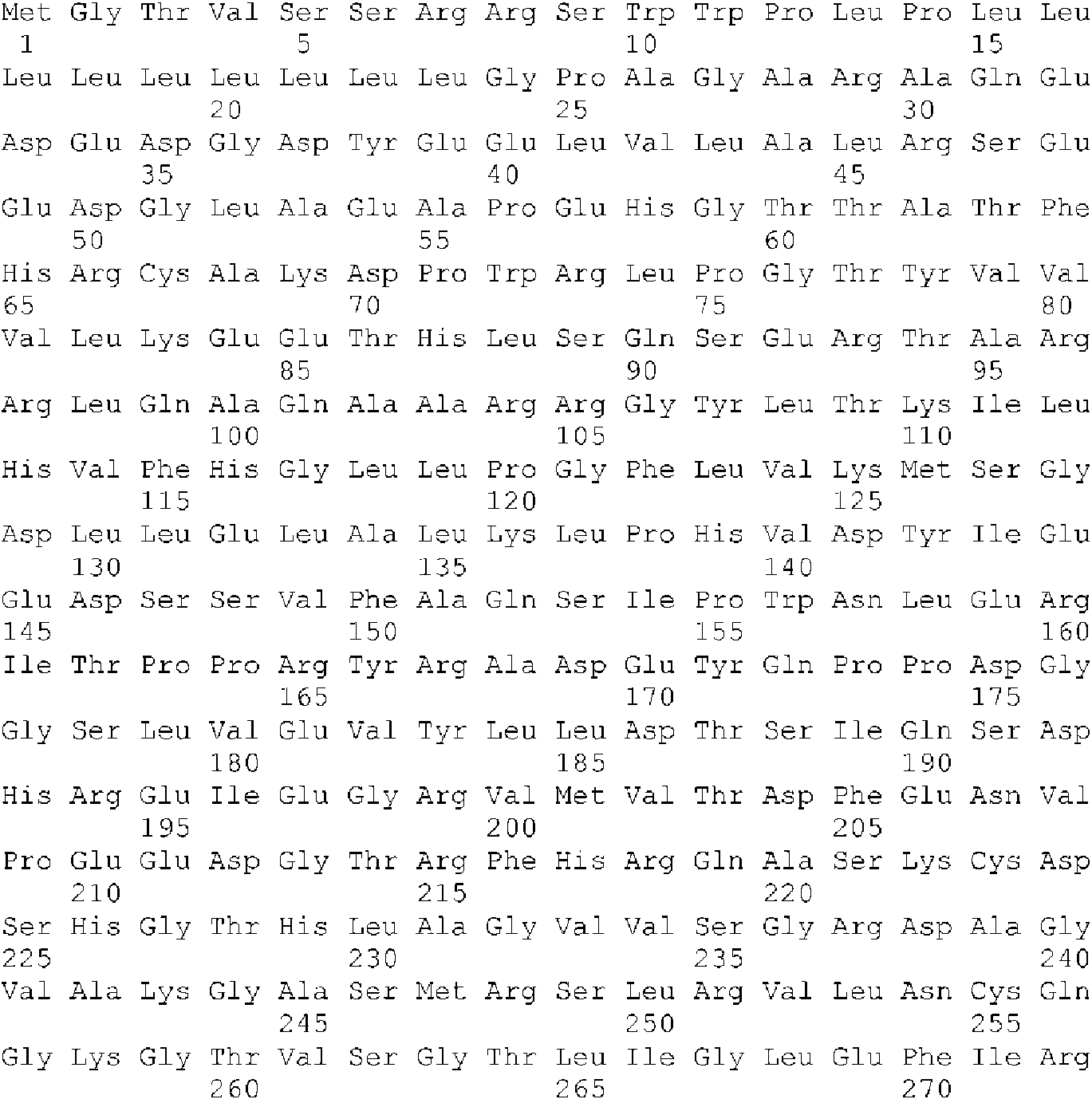
Lys Ser Gln Leu Val Gln Pro Val Gly Pro Leu Val Val Leu Leu ProLys Ser Gln Leu Val Gln Pro Val Gly Pro Leu Val Val Leu Leu Pro
275 280 285275 280 285
Leu Ala Gly Gly Tyr Ser Arg Val Leu Asn Ala Ala Cys Gln Arg LeuLeu Ala Gly Gly Tyr Ser Arg Val Leu Asn Ala Ala Cys Gln Arg Leu
290 295 300290 295 300
Ala Arg Ala Gly Val Val Leu Val Thr Ala Ala Gly Asn Phe Arg AspAla Arg Ala Gly Val Val Leu Val Thr Ala Ala Gly Asn Phe Arg Asp
305 310 315 320305 310 315 320
Asp Ala Cys Leu Tyr Ser Pro Ala Ser Ala Pro Glu Val lie Thr ValAsp Ala Cys Leu Tyr Ser Pro Ala Ser Ala Pro Glu Val lie Thr Val
325 330 335325 330 335
Gly Ala Thr Asn Ala Gln Asp Gln Pro Val Thr Leu Gly Thr Leu GlyGly Ala Thr Asn Ala Gln Asp Gln Pro Val Thr Leu Gly Thr Leu Gly
340 345 350340 345 350
Thr Asn Phe Gly Arg Cys Val Asp Leu Phe Ala Pro Gly Glu Asp lieThr Asn Phe Gly Arg Cys Val Asp Leu Phe Ala Pro Gly Glu Asp lie
355 360 365355 360 365
lie Gly Ala Ser Ser Asp Cys Ser Thr Cys Phe Val Ser Gln Ser Glylie Gly Ala Ser Ser Asp Cys Ser Thr Cys Phe Val Ser Gln Ser Gly
370 375 380370 375 380
Thr Ser Gln Ala Ala Ala Hrs Val Ala Gly lie Ala Ala Met Met LeuThr Ser Gln Ala Ala Ala Hrs Val Ala Gly lie Ala Ala Met Met Leu
385 390 395 400385 390 395 400
Ser Ala Glu Pro Glu Leu Thr Leu Ala Glu Leu Arg Gln Arg Leu lieSer Ala Glu Pro Glu Leu Thr Leu Ala Glu Leu Arg Gln Arg Leu lie
405 410 415405 410 415
His Phe Ser Ala Lys Asp Val lie Asn Glu Ala Trp Phe Pro Glu AspHis Phe Ser Ala Lys Asp Vallie Asn Glu Ala Trp Phe Pro Glu Asp
420 425 430420 425 430
Gln Arg Val Leu Thr Pro Asn Leu Val Ala Ala Leu Pro Pro Ser ThrGln Arg Val Leu Thr Pro Asn Leu Val Ala Ala Leu Pro Pro Ser Thr
435 440 445435 440 445
Hls Gly Ala Gly Trp Gln Leu Phe Cys Arg Thr Val Trp Ser Ala HlSHls Gly Ala Gly Trp Gln Leu Phe Cys Arg Thr Val Trp Ser Ala HlS
450 455 460450 455 460
Ser Gly Pro Thr Arg Met Ala Thr Ala Val Ala Arg Cys Ala Pro AspSer Gly Pro Thr Arg Met Ala Thr Ala Val Ala Arg Cys Ala Pro Asp
465 470 475 480465 470 475 480
Glu Glu Leu Leu Ser Cys Ser Ser Phe Ser Arg Ser Gly Lys Arg ArgGlu Glu Leu Leu Ser Cys Ser Ser Phe Ser Arg Ser Gly Lys Arg Arg
485 490 495485 490 495
Gly Glu Arg Met Glu Ala Gln Gly Gly Lys Leu Val Cys Arg Ala HlSGly Glu Arg Met Glu Ala Gln Gly Gly Lys Leu Val Cys Arg Ala HlS
500 505 510500 505 510
Asn Ala Phe Gly Gly Glu Gly Val Tyr Ala lie Ala Arg Cys Cys LeuAsn Ala Phe Gly Gly Glu Gly Val Tyr Ala lie Ala Arg Cys Cys Leu
515 520 525515 520 525
Leu Pro Gln Ala Asn Cys Ser Val HlS Thr Ala Pro Pro Ala Glu AlaLeu Pro Gln Ala Asn Cys Ser Val HlS Thr Ala Pro Pro Ala Glu Ala
530 535 540530 535 540
Ser Met Gly Thr Arg Val His Cys Hrs Gln Gln Gly His Val Leu ThrSer Met Gly Thr Arg Val His Cys Hrs Gln Gln Gly His Val Leu Thr
545 550 555 560545 550 555 560
Gly Cys Ser Ser His Trp Glu Val Glu Asp Leu Gly Thr His Lys ProGly Cys Ser Ser His Trp Glu Val Glu Asp Leu Gly Thr His Lys Pro
565 570 575565 570 575
Pro Val Leu Arg Pro A_rg Gly Gln Pro Asn Gln Cys Val Gly Hrs ArgPro Val Leu Arg Pro A_rg Gly Gln Pro Asn Gln Cys Val Gly Hrs Arg
580 585 590580 585 590
Glu Ala Ser lie His Ala Ser Cys Cys His Ala Pro Gly Leu Glu CysGlu Ala Ser lie His Ala Ser Cys Cys His Ala Pro Gly Leu Glu Cys
595 600 605595 600 605
Lys Val Lys Glu His Gly lie Pro Ala Pro Gln Glu Gln Val Thr ValLys Val Lys Glu His Gly lie Pro Wing Pro Gln Glu Gln Val Thr Val
610 615 620610 615 620
Ala Cys Glu Glu Gly Trp Thr Leu Thr Gly Cys Ser Ala Leu Pro GlyAla Cys Glu Glu Gly Trp Thr Leu Thr Gly Cys Ser Ala Leu Pro Gly
625 630 635 640625 630 635 640
Thr Ser His Val Leu Gly A.la Tyr Ala Val Asp Asn Thr Cys Val ValThr Ser His Val Leu Gly A.la Tyr Ala Val Asp Asn Thr Cys Val Val
645 650 655645 650 655
Arg Ser Arg Asp Val Ser Thr Thr Gly Ser Thr Ser Glu Gly Ala ValArg Ser Arg Asp Val Ser Thr Thr Gly Ser Thr Ser Glu Gly Ala Val
660 665 670660 665 670
Thr Ala Val Ala lie Cys Cys Arg Ser Arg His Leu Ala Gln Ala SerThr Ala Val Ala lie Cys Cys Arg Ser Arg His Leu Ala Gln Ala Ser
675 680 685675 680 685
Gln Glu Leu GlnGln Glu Leu Gln
690690
Preparación de anticuerpos humanosPreparation of human antibodies
Se conocen métodos de generación de anticuerpos humanos en ratones transgénicos (véase, por ejemplo, el documento US 6.596.541, Regeneron Pharmaceuticals, VELOCIMMUNE™). La tecnología VELOCiMm Un E™ implica la generación de un ratón transgénico que tiene un genoma que comprende regiones variables de las cadenas pesadas y ligeras humanas operativamente unidas a loci de región constante de ratón endógeno de forma que el ratón produzca un anticuerpo que comprende una región variable humana y una región constante de ratón en respuesta a estimulación antigénica. El ADN que codifica las regiones variables de las cadenas pesadas y ligeras del anticuerpo se aísla y une operativamente a ADN que codifica las regiones constantes de las cadenas pesada y ligera humanas. El ADN se expresa entonces en una célula capaz de expresar el anticuerpo completamente humano. En una realización específica, la célula es una célula CHO.Methods of generating human antibodies in transgenic mice are known (see, eg, US 6,596,541, Regeneron Pharmaceuticals, VELOCIMMUNE™). The VELOCiMm Un E™ technology involves the generation of a transgenic mouse having a genome comprising human heavy and light chain variable regions operably linked to endogenous mouse constant region loci such that the mouse produces an antibody comprising a region human variable and a mouse constant region in response to antigenic stimulation. DNA encoding the heavy and light chain variable regions of the antibody is isolated and operatively linked to DNA encoding the human heavy and light chain constant regions. The DNA is then expressed in a cell capable of expressing the fully human antibody. In a specific embodiment, the cell is a CHO cell.
Los anticuerpos pueden ser terapéuticamente útiles en bloquear una interacción ligando-receptor o inhibir la interacción del componente del receptor, en vez de destruir células mediante fijación del complemento y participación en la citotoxicidad dependiente de complemento (CDC), o destruir células mediante citotoxicidad celular dependiente de anticuerpo (ADCC). La región constante de un anticuerpo es así importante en la capacidad de un anticuerpo para fijar el complemento y mediar en la citotoxicidad dependiente de célula. Así, el isotipo de un anticuerpo puede seleccionarse basándose en si se desea que el anticuerpo medie en la citotoxicidad.Antibodies may be therapeutically useful in blocking a ligand-receptor interaction or inhibiting receptor component interaction, rather than killing cells by complement fixation and participation in complement-dependent cytotoxicity (CDC), or killing cells by antibody-dependent cellular cytotoxicity (ADCC). The constant region of an antibody is thus important in an antibody's ability to fix complement and mediate cell-dependent cytotoxicity. Thus, the isotype of an antibody can be selected based on whether the antibody is desired to mediate cytotoxicity.
Los anticuerpos humanos pueden existir en dos formas que están asociadas a heterogeneidad de la bisagra. En una forma, una molécula de anticuerpo comprende una construcción de cuatro cadenas estable de aproximadamente 150-160 kDa en la que los dímeros se mantienen juntos por un enlace disulfuro de cadena pesada intercatenario. En una segunda forma, los dímeros no están unidos mediante enlaces disulfuro intercatenarios y se forma una molécula de aproximadamente 75-80 kDa compuesta de una cadena ligera y pesada acopladas covalentemente (semianticuerpo). Estas formas han sido extremadamente difíciles de separar, incluso después de purificación por afinidad.Human antibodies can exist in two forms that are associated with hinge heterogeneity. In one form, an antibody molecule comprises a stable four chain construct of about 150-160 kDa in which the dimers are held together by an interchain heavy chain disulfide bond. In a second form, the dimers are not linked by interchain disulfide bonds and an approximately 75-80 kDa molecule composed of a covalently coupled light and heavy chain (half-antibody) is formed. These forms have been extremely difficult to separate, even after affinity purification.
La frecuencia de aparición de la segunda forma en diversos isotipos de IgG intacta es debida a diferencias estructurales asociadas al isotipo de región bisagra del anticuerpo. Una simple sustitución de aminoácidos en la región bisagra de la bisagra de lgG4 humana puede reducir significativamente la aparición de la segunda forma (Angal et al. (1993) Molecular Immunology 30:105) hasta niveles normalmente observados usando una bisagra de lgG1 humana. La presente divulgación engloba anticuerpos que tienen una o más mutaciones en la región bisagra, CH2 o CH3, que pueden ser deseables, por ejemplo, en la producción, para mejorar el rendimiento de la forma de anticuerpo deseada.The frequency of appearance of the second form in various isotypes of intact IgG is due to structural differences associated with the hinge region isotype of the antibody. A simple amino acid substitution in the hinge region of the human IgG4 hinge can significantly reduce the appearance of the second form (Angal et al. (1993) Molecular Immunology 30:105) to levels normally observed using a human IgG1 hinge. The present disclosure encompasses antibodies having one or more mutations in the hinge region, CH2 or CH3, which may be desirable, for example, in production, to improve the yield of the desired antibody form.
Generalmente, un ratón VELOCIMMUNE™ se expone al antígeno de interés, y células linfáticas (tales como linfocitos B) se recuperan de los ratones que expresan los anticuerpos. Las células linfáticas pueden fisionarse con una línea de células de mieloma para preparar líneas celulares de hibridoma inmortales, y tales líneas celulares de hibridoma se criban y seleccionan para identificar líneas celulares de hibridoma que producen anticuerpos específicos para el antígeno de interés. El ADN que codifica las regiones variables de la cadena pesada y cadena ligera puede aislarse y unirse a regiones constantes isotípicas deseables de la cadena pesada y cadena ligera. Una proteína de anticuerpo tal puede producirse en una célula, tal como una célula CHO. Alternativamente, el ADN que codifica los anticuerpos quiméricos específicos de antígeno o los dominios variables de las cadenas ligeras y pesadas pueden aislarse directamente de linfocitos específicos de antígeno.Generally, a VELOCIMMUNE™ mouse is challenged with the antigen of interest, and lymphatic cells (such as B cells) are recovered from the mice expressing the antibodies. Lymphatic cells can be fissioned with a myeloma cell line to prepare immortal hybridoma cell lines, and such hybridoma cell lines are screened and selected to identify hybridoma cell lines that produce antibodies specific for the antigen of interest. DNA encoding the heavy chain and light chain variable regions can be isolated and ligated to desirable heavy chain and light chain isotypic constant regions. Such an antibody protein can be produced in a cell, such as a CHO cell. Alternatively, DNA encoding antigen-specific chimeric antibodies or heavy and light chain variable domains can be isolated directly from antigen-specific lymphocytes.
Inicialmente, se aíslan anticuerpos quiméricos de alta afinidad que tienen una región variable humana y una región constante de ratón. Como se describe más adelante, los anticuerpos se caracterizan y se seleccionan por características deseables, incluyendo afinidad, selectividad, epítope. Las regiones constantes de ratón se reemplazan con una región constante humana deseada para generar el anticuerpo completamente humano desvelado en el presente documento, por ejemplo, lgG1 o lgG4 no mutante o modificado (por ejemplo, SEQ ID NO: 751, 752, 753). Aunque la región constante seleccionada puede variar según el uso específico, la unión al antígeno con alta afinidad y las características de especificidad por diana residen en la región variable.Initially, high affinity chimeric antibodies are isolated having a human variable region and a mouse constant region. As described below, antibodies are characterized and selected for desirable characteristics, including affinity, selectivity, epitope. Mouse constant regions are replaced with a desired human constant region to generate the fully human antibody disclosed herein, eg, non-mutant or modified IgG1 or IgG4 (eg, SEQ ID NOs: 751, 752, 753). Although the constant region selected may vary according to the specific use, the high affinity antigen binding and target specificity characteristics reside in the variable region.
Mapeo de epítopes y tecnologías relacionadasEpitope mapping and related technologies
Para seleccionar anticuerpos que se unen a un epítope particular (por ejemplo, aquellos que bloquean la unión de IgE a su receptor de alta afinidad), puede realizarse un ensayo de bloqueo cruzado rutinario tal como el descrito en Antibodies, Harlow and Lane (Cold Spring Harbor Press, Cold Spring Harb., NY). Otros métodos incluyen mutantes de barrido con alanina, transferencias de péptidos (Reineke (2004) Methods Mol Biol 248:443-63), o análisis por escisión de péptidos. Además, pueden emplearse métodos tales como escisión de epítopes, extracción de epítopes y modificación química de antígenos (Tomer (2000) Protein Science 9: 487-496).To select for antibodies that bind to a particular epitope (for example, those that block IgE from binding to its high-affinity receptor), a routine cross-blocking assay such as that described in Antibodies, Harlow and Lane (Cold Spring Harbor Press, Cold Spring Harb., NY). Other methods include alanine scanning mutants, peptide blots (Reineke (2004) Methods Mol Biol 248:443-63), or peptide cleavage analysis. In addition, methods such as epitope excision, epitope extraction, and chemical modification of antigens can be employed (Tomer (2000) Protein Science 9: 487-496).
El término "epítope" se refiere a un sitio sobre un antígeno al que responden los linfocitos B y/o T. Pueden formarse epítopes de linfocitos B tanto a partir tanto de aminoácidos contiguos como de aminoácidos no contiguos yuxtapuestos mediante el plegamiento terciario de una proteína. Los epítopes formados a partir de aminoácidos contiguos son normalmente retenidos por exposición a disolventes desnaturalizantes, mientras que los epítopes formados por plegamiento terciario normalmente se pierden en el tratamiento con disolventes desnaturalizantes. Un epítope normalmente incluye al menos 3, y más usualmente, al menos 5 u 8-10 aminoácidos en una única conformación espacial.The term "epitope" refers to a site on an antigen to which B and/or T cells respond. B cell epitopes can be formed from either contiguous amino acids or juxtaposed noncontiguous amino acids by tertiary folding of a protein. . Epitopes formed from contiguous amino acids are normally retained by exposure to denaturing solvents, whereas epitopes formed by tertiary folding are normally lost on treatment with denaturing solvents. An epitope typically includes at least 3, and more usually, at least 5 or 8-10 amino acids in a single spatial conformation.
El perfilado asistido por modificación (MAP), también conocido como perfilado de anticuerpo basado en la estructura del antígeno (ASAP), es un método que clasifica grandes números de anticuerpos monoclonales (mAbs) dirigidos frente al mismo antígeno según las similitudes del perfil de unión de cada anticuerpo a las superficies del antígeno modificadas química o enzimáticamente (documento US 2004/0101920). Cada categoría puede reflejar un epítope único bien claramente diferente de o bien parcialmente solapante con el epítope representado por otra categoría. Esta tecnología permite el filtrado rápido de mAbs genéticamente idénticos, tal que la caracterización pueda basarse en mAbs genéticamente distintos. Cuando se aplica al cribado del hibridoma, el MAP puede facilitar la identificación de clones raros de hibridoma que producen mAb que tienen las características deseadas. El MAP puede usarse para clasificar los mAbs anti-PCSK9 desvelados en el presente documento en grupos de mAb que unen diferentes epítopes. Modification-assisted profiling (MAP), also known as antigen structure-based antibody profiling (ASAP), is a method that classifies large numbers of monoclonal antibodies (mAbs) directed against the same antigen based on binding profile similarities of each antibody to chemically or enzymatically modified antigen surfaces (US 2004/0101920). Each category may reflect a single epitope either clearly different from or partially overlapping with the epitope represented by another category. This technology allows rapid screening of genetically identical mAbs, such that characterization can be based on genetically distinct mAbs. When applied to hybridoma screening, MAP can facilitate the identification of rare hybridoma clones that produce mAbs having the desired characteristics. MAP can be used to classify the anti-PCSK9 mAbs disclosed herein into groups of mAbs that bind different epitopes.
En diversas realizaciones, el anticuerpo anti-PCSK9h o fragmento de unión al antígeno de un anticuerpo une un epítope dentro del dominio catalítico, que es aproximadamente 153 a 425 de SEQ ID NO: 755); más específicamente, un epítope de aproximadamente 153 a aproximadamente 250 o de aproximadamente 250 a aproximadamente 425; más específicamente, el anticuerpo o fragmento de anticuerpo desvelado en el presente documento une un epítope dentro del fragmento de aproximadamente 153 a aproximadamente 208, de aproximadamente 200 a aproximadamente 260, de aproximadamente 250 a aproximadamente 300, de aproximadamente 275 a aproximadamente 325, de aproximadamente 300 a aproximadamente 360, de aproximadamente 350 a aproximadamente 400, y/o de aproximadamente 375 a aproximadamente 425.In various embodiments, the anti-PCSK9h antibody or antigen-binding fragment of an antibody binds an epitope within the catalytic domain, which is about 153 to 425 of SEQ ID NO: 755); more specifically, an epitope from about 153 to about 250 or from about 250 to about 425; more specifically, the antibody or antibody fragment disclosed herein binds an epitope within the fragment from about 153 to about 208, from about 200 to about 260, from about 250 to about 300, from about 275 to about 325, from about 300 to about 360, from about 350 to about 400, and/or from about 375 to about 425.
En diversas realizaciones, el anticuerpo anti-PCSK9h o fragmento de unión al antígeno de un anticuerpo une un epítope dentro del dominio de propéptido (restos 31 a 152 de SEQ ID NO: 755); más específicamente, un epítope de aproximadamente el resto 31 a aproximadamente el resto 90 o de aproximadamente el resto 90 a aproximadamente el resto 152; más específicamente, el anticuerpo o fragmento de anticuerpo desvelado en el presente documento une un epítope dentro del fragmento de aproximadamente el resto 31 a aproximadamente el resto 60, de aproximadamente el resto 60 a aproximadamente el resto 90, de aproximadamente el resto 85 a aproximadamente el resto 110, de aproximadamente el resto 100 a aproximadamente el resto 130, de aproximadamente el resto 125 a aproximadamente el resto 150, de aproximadamente el resto 135 a aproximadamente el resto 152, y/o de aproximadamente el resto 140 a aproximadamente el resto 152.In various embodiments, the anti-PCSK9h antibody or antigen-binding fragment of an antibody binds an epitope within the propeptide domain (residues 31 to 152 of SEQ ID NO: 755); more specifically, an epitope from about residue 31 to about residue 90 or from about residue 90 to about residue 152; more specifically, the antibody or antibody fragment disclosed herein binds an epitope within the fragment from about residue 31 to about residue 60, from about residue 60 to about residue 90, from about residue 85 to about residue residue 110, from about residue 100 to about residue 130, from about residue 125 to about residue 150, from about residue 135 to about residue 152, and/or from about residue 140 to about residue 152.
En algunas realizaciones, el anticuerpo anti-PCSK9h o fragmento de unión al antígeno de un anticuerpo une un epítope dentro del dominio del extremo C (restos 426 a 692 de SEQ ID NO: 755); más específicamente, un epítope de aproximadamente el resto 426 a aproximadamente el resto 570 o de aproximadamente el resto 570 a aproximadamente el resto 692; más específicamente, el anticuerpo o fragmento de anticuerpo desvelado en el presente documento une un epítope dentro del fragmento de aproximadamente el resto 450 a aproximadamente el resto 500, de aproximadamente el resto 500 a aproximadamente el resto 550, de aproximadamente el resto 550 a aproximadamente el resto 600, y/o de aproximadamente el resto 600 a aproximadamente el resto 692.In some embodiments, the anti-PCSK9h antibody or antigen-binding fragment of an antibody binds an epitope within the C-terminal domain (residues 426 to 692 of SEQ ID NO: 755); more specifically, an epitope from about residue 426 to about residue 570 or from about residue 570 to about residue 692; more specifically, the antibody or antibody fragment disclosed herein binds an epitope within the fragment from about residue 450 to about residue 500, from about residue 500 to about residue 550, from about residue 550 to about residue rest 600, and/or from about rest 600 to about rest 692.
En algunas realizaciones, el anticuerpo o fragmento de anticuerpo une un epítope que incluye más de uno de los epítopes enumerados dentro del dominio catalítico, de propéptido o del extremo C, y/o dentro de dos o tres dominios diferentes (por ejemplo, epítopes dentro de los dominios catalítico y del extremo C, o dentro de los dominios del propéptido y catalíticos, o dentro de los dominios del propéptido, catalítico y del extremo C.In some embodiments, the antibody or antibody fragment binds an epitope that includes more than one of the listed epitopes within the catalytic, propeptide, or C-terminal domain, and/or within two or three different domains (eg, epitopes within of the catalytic and C-terminal domains, or within the propeptide and catalytic domains, or within the propeptide, catalytic and C-terminal domains.
En algunas realizaciones, el anticuerpo o fragmento de unión al antígeno une
Como se muestra anteriormente (documento US 2010/0166768), una mutación en el resto de aminoácido 153, 159 o 343 produjo aproximadamente una disminución de 5 a 10 veces en la afinidad o acortamiento similar en T1/2. En realizaciones específicas, la mutación fue S153R, E159R y/o D343R.As shown above (US 2010/0166768), a mutation at amino acid residue 153, 159 or 343 produced approximately a 5- to 10-fold decrease in affinity or similar shortening in T1/2. In specific embodiments, the mutation was S153R, E159R, and/or D343R.
En algunas realizaciones, el anticuerpo o fragmentos de unión al antígeno une un epítope en PCSK9h que comprende el resto de aminoácido 366 de PCSK9h (SEQ ID NO: 755). Resultados experimentales (véase el documento US 2010/0166768) muestran que cuando E366 se mutó, la afinidad del mAb 300N presentó una disminución de aproximadamente 50 veces (~0,7 x10⁻⁹ M a ~36 x10-9 M) y un acortamiento similar en T1/2 (de ~ 120 a ~2 min). En una realización específica, la mutación es E366K.In some embodiments, the antibody or antigen-binding fragments bind an epitope on PCSK9h that comprises amino acid residue 366 of PCSK9h (SEQ ID NO: 755). Experimental results (see US 2010/0166768) show that when E366 was mutated, the affinity of the 300N mAb exhibited an approximately 50-fold decrease (~0.7 x10⁻⁹ M to ~36 x10-9 M) and a shortening similar at T1/2 (from ~120 to ~2 min). In a specific embodiment, the mutation is E366K.
La presente divulgación incluye anticuerpos anti-PCSK9 que unen al mismo epítope que cualquiera de los anticuerpos a modo de ejemplo específicos descritos en el presente documento. Similarmente, la presente divulgación también incluye anticuerpos anti-PCSK9 que compiten para unirse a PCSK9 o un fragmento de PCSK9 con cualquiera de los anticuerpos a modo de ejemplo específicos descritos en el presente documento.The present disclosure includes anti-PCSK9 antibodies that bind to the same epitope as any of the specific exemplary antibodies described herein. Similarly, the present disclosure also includes anti-PCSK9 antibodies that compete for binding to PCSK9 or a fragment of PCSK9 with any of the specific exemplary antibodies described herein.
Puede determinarse fácilmente si un anticuerpo se une al mismo epítope o no, o compite por la unión con un anticuerpo anti-PCSK9 de referencia usando métodos rutinarios conocidos en la técnica. Por ejemplo, para determinar si un anticuerpo de prueba se une al mismo epítope que un anticuerpo anti-PCSK9 de referencia desvelado en el presente documento, se deja que el anticuerpo de referencia se una a una proteína o péptido PCSK9 en condiciones de saturación. A continuación, se evalúa la capacidad de un anticuerpo de prueba para unirse a la molécula de PCSK9. Si el anticuerpo de prueba es capaz de unirse a PCSK9 tras la unión de saturación con el anticuerpo anti-PCSK9 de referencia, se puede sacar la conclusión de que el anticuerpo de prueba se une con un epítope diferente que el anticuerpo anti-PCSK9 de referencia. Por otro lado, si el anticuerpo de prueba no es capaz de unirse a la molécula de PCSK9 tras la unión de saturación con el anticuerpo anti-PCSK9 de referencia, entonces el anticuerpo de prueba puede unirse al mismo epítope que el epítope unido por el anticuerpo anti-PCSK9 de referencia desvelado en el presente documento. Whether or not an antibody binds to the same epitope or competes for binding with a reference anti-PCSK9 antibody can be readily determined using routine methods known in the art. For example, to determine whether a test antibody binds to the same epitope as a reference anti-PCSK9 antibody disclosed herein, the reference antibody is allowed to bind to a PCSK9 protein or peptide under saturating conditions. Next, the ability of a test antibody to bind to the PCSK9 molecule is evaluated. If the test antibody is able to bind PCSK9 upon saturation binding with the reference anti-PCSK9 antibody, it can be concluded that the test antibody binds with a different epitope than the reference anti-PCSK9 antibody. . On the other hand, if the test antibody is unable to bind to the PCSK9 molecule upon saturation binding with the reference anti-PCSK9 antibody, then the test antibody may bind to the same epitope as the epitope bound by the antibody. reference anti-PCSK9 disclosed herein.
Para determinar si un anticuerpo compite por la unión con un anticuerpo anti-PCSK9 de referencia, la metodología de unión anteriormente descrita se realiza en dos orientaciones: En una primera orientación, se deja que el anticuerpo de referencia se una a una molécula de PCSK9 en condiciones de saturación, seguido por la evaluación de la unión del anticuerpo de prueba a la molécula de PCSK9. En una segunda orientación, se deja que el anticuerpo de prueba se una a una molécula de PCSK9 en condiciones de saturación, seguido por la evaluación de la unión del anticuerpo de referencia a la molécula de PCSK9. Si, en ambas orientaciones, solamente el primer anticuerpo (de saturación) es capaz de unión a la molécula de PCSK9, entonces se llega a la conclusión de que el anticuerpo de prueba y el anticuerpo de referencia compiten por la unión a la PCSK9. Como se apreciará por un experto habitual en la materia, un anticuerpo que compite por la unión con un anticuerpo de referencia puede no unirse necesariamente al epítope idéntico que el anticuerpo de referencia, pero puede bloquear estéricamente la unión del anticuerpo de referencia mediante la unión con un epítope solapante o adyacente.To determine if an antibody competes for binding with a reference anti-PCSK9 antibody, the binding methodology described above is performed in two orientations: In a first orientation, the reference antibody is allowed to bind to a PCSK9 molecule in saturation conditions, followed by evaluation of the binding of the test antibody to the PCSK9 molecule. In a second orientation, the test antibody is allowed to bind to a PCSK9 molecule under saturating conditions, followed by evaluation of the binding of the reference antibody to the PCSK9 molecule. If, in both orientations, only the first (saturating) antibody is capable of binding to the PCSK9 molecule, then it is concluded that the test antibody and the reference antibody compete for binding to PCSK9. As will be appreciated by one of ordinary skill in the art, an antibody that competes for binding with a reference antibody may not necessarily bind to the identical epitope as the reference antibody, but may sterically block binding of the reference antibody by binding with an overlapping or adjacent epitope.
Dos anticuerpos se unen al mismo epítope o epítope de solapamiento si cada uno inhibe (bloquea) competitivamente la unión del otro al antígeno. Es decir, un exceso de 1, 5, 10, 20 o 100 veces de un anticuerpo inhibe la unión del otro al menos el 50 %, pero preferentemente el 75 %, 90 % o incluso el 99 % como se mide en un ensayo de unión competitiva (véase, por ejemplo, Junghans et al., Cancer Res. 1990 50: 1495-1502). Alternativamente, dos anticuerpos tienen el mismo epítope si esencialmente todas las mutaciones de aminoácidos en el antígeno que reducen o eliminan la unión de un anticuerpo reducen o eliminan la unión del otro. Dos anticuerpos tienen epítopes de solapamiento si algunas mutaciones de aminoácidos que reducen o eliminan la unión de un anticuerpo reducen o eliminan la unión del otro.Two antibodies bind to the same epitope or overlapping epitope if each competitively inhibits (blocks) the other's binding to antigen. That is, a 1-, 5-, 10-, 20-, or 100-fold excess of one antibody inhibits the binding of the other by at least 50%, but preferably 75%, 90%, or even 99% as measured in an assay. competitive binding (see, eg, Junghans et al., Cancer Res. 1990 50:1495-1502). Alternatively, two antibodies have the same epitope if essentially all amino acid mutations in the antigen that reduce or eliminate the binding of one antibody reduce or eliminate the binding of the other. Two antibodies have overlapping epitopes if amino acid mutations that reduce or eliminate the binding of one antibody reduce or eliminate the binding of the other.
Puede entonces llevarse a cabo experimentación rutinaria adicional (por ejemplo, mutación de péptidos y análisis de unión) para confirmar si la ausencia observada de unión del anticuerpo de prueba es de hecho debida a la unión al mismo epítope que el anticuerpo de referencia o si el bloqueo estérico (u otro fenómeno) es el responsable de la ausencia de unión observada. Pueden realizarse experimentos de este tipo usando ELISA, RIA, resonancia de plasmones superficiales, citometría de flujo o cualquier otro ensayo de unión de anticuerpo cuantitativo o cualitativo disponible en la materia.Further routine experimentation (eg peptide mutation and binding analysis) can then be carried out to confirm whether the observed lack of binding of the test antibody is in fact due to binding to the same epitope as the reference antibody or whether the steric blocking (or another phenomenon) is responsible for the observed lack of binding. Such experiments can be performed using ELISA, RIA, surface plasmon resonance, flow cytometry, or any other quantitative or qualitative antibody binding assay available in the art.
En una realización específica, la divulgación comprende un anticuerpo anti-PCSK9 o fragmento de unión al antígeno de un anticuerpo que se une a una proteína PCSK9 de SEQ ID NO: 755, en el que la unión entre el anticuerpo o fragmento del mismo a PCSK9 y una proteína PCSK9 de variante es inferior al 50 % de la unión entre el anticuerpo o fragmento y la proteína PCSK9 de SEQ ID NO: 755. En una realización específica, la proteína PCSK9 de variante comprende al menos una mutación de un resto en una posición seleccionada del grupo que consiste en 153, 159, 238 y 343. En una realización más específica, la al menos una mutación es S153R, E159R, D238R y/o D343R. En otra realización específica, la proteína PCSK9 de variante comprende al menos una mutación de un resto en una posición seleccionada del grupo que consiste en 366. En una realización específica, la proteína PCSK9 de variante comprende al menos una mutación de un resto en una posición seleccionada del grupo que consiste en 147, 366 y 380. En una realización más específica, la mutación es S147F, E366K y V380M.In a specific embodiment, the disclosure comprises an anti-PCSK9 antibody or antigen-binding fragment of an antibody that binds to a PCSK9 protein of SEQ ID NO: 755, wherein binding between the antibody or fragment thereof to PCSK9 and a variant PCSK9 protein is less than 50% binding between the antibody or fragment and the PCSK9 protein of SEQ ID NO: 755. In a specific embodiment, the variant PCSK9 protein comprises at least one mutation of one residue in a position selected from the group consisting of 153, 159, 238 and 343. In a more specific embodiment, the at least one mutation is S153R, E159R, D238R and/or D343R. In another specific embodiment, the variant PCSK9 protein comprises at least one mutation of a residue at a position selected from the group consisting of 366. In a specific embodiment, the variant PCSK9 protein comprises at least one mutation of a residue at a position selected from the group consisting of 147, 366 and 380. In a more specific embodiment, the mutation is S147F, E366K and V380M.
Inmunoconjugadosimmunoconjugates
La divulgación engloba un anticuerpo monoclonal anti-PCSK9 humana conjugado con un resto terapéutico (“inmunoconjugado”) tal como una citotoxina, un fármaco quimioterapéutico, un inmunosupresor o un radioisótopo. Agentes de citotoxina incluyen cualquier agente que sea perjudicial para las células. Ejemplos de agentes de citotoxina y agentes quimioterapéuticos adecuados para formar inmunoconjugados son conocidos en la técnica, véase, por ejemplo el documento WO 05/103081.The disclosure encompasses a human anti-PCSK9 monoclonal antibody conjugated to a therapeutic moiety ("immunoconjugate") such as a cytotoxin, chemotherapeutic drug, immunosuppressant, or radioisotope. Cytotoxin agents include any agent that is detrimental to cells. Examples of cytotoxin agents and chemotherapeutic agents suitable for forming immunoconjugates are known in the art, see for example WO 05/103081.
Biespecíficosbispecific
Los anticuerpos de la presente divulgación pueden ser monoespecíficos, biespecíficos o multiespecíficos. Los mAb multiespecíficos pueden ser específicos para diferentes epítopes de un polipéptido diana o pueden contener dominios de unión al antígeno específicos para más de un polipéptido diana. Véase, por ejemplo, Tutt et al. (1991) J. Immunol. 147:60-69. Los mAbs anti-PCSK9 humana pueden unirse o co-expresarse con otra molécula funcional, por ejemplo, otro péptido o proteína. Por ejemplo, un anticuerpo o fragmento del mismo puede unirse funcionalmente (por ejemplo, por acoplamiento químico, fusión genética, asociación no covalente o de otra forma) a una o más de otras entidades moleculares; tales como otro anticuerpo o fragmento de anticuerpo, para producir un anticuerpo biespecífico o multiespecífico con una segunda especificidad de unión.The antibodies of the present disclosure may be monospecific, bispecific, or multispecific. Multispecific mAbs may be specific for different epitopes on a target polypeptide or may contain antigen-binding domains specific for more than one target polypeptide. See, for example, Tutt et al. (1991) J. Immunol. 147:60-69. Human anti-PCSK9 mAbs can be linked or co-expressed with another functional molecule, eg, another peptide or protein. For example, an antibody or fragment thereof can be operatively linked (eg, by chemical coupling, genetic fusion, non-covalent association, or otherwise) to one or more other molecular entities; such as another antibody or antibody fragment, to produce a bispecific or multispecific antibody with a second binding specificity.
Un formato de anticuerpo biespecífico a modo de ejemplo que puede usarse en el contexto de la presente divulgación implica el uso de un primer dominio CH3 de inmunoglobulina (Ig) y un segundo dominio CH3 de Ig, en el que el primer y segundo dominios CH3 de Ig difieren entre sí en al menos un aminoácido, y en el que la diferencia de al menos un aminoácido reduce la unión del anticuerpo biespecífico a la proteína A en comparación con un anticuerpo biespecífico que carece de la diferencia de aminoácido. En una realización, el primer dominio CH3 de Ig se une a la proteína A y el segundo dominio CH3 de Ig contiene una mutación que reduce o suprime la unión a la proteína A tal como una modificación de H95R (por numeración de exones de IMGt ; H435R por numeración EU). El segundo CH3 puede comprender además una modificación Y96F (por IMGT; Y436F por EU). Modificaciones adicionales que se pueden encontrar dentro del segundo CH3 incluyen; D16E, L18M, N44S, K52N, V57M y V82I (por IMGT; D356E, L358M, N384S, K392N, V397M y V422I por EU) en el caso de anticuerpos lgG1; N44S, K52N y V82I (IMGT; N384S, K392N y V422I por EU) en el caso de anticuerpos lgG2; y Q15R, N44S, K52N, V57M, R69K, E79Q y V82I (por IMGT; Q355R, N384S, K392N, V397M, R409K, E419Q y V422I por Eu ) en el caso de anticuerpos lgG4. Variaciones del formato de anticuerpo bi-específico descrito anteriormente se contemplan dentro del alcance de la presente divulgación.An exemplary bispecific antibody format that can be used in the context of the present disclosure involves the use of a first immunoglobulin (Ig) CH3 domain and a second Ig CH3 domain, wherein the first and second CH3 domains of Ig differ from each other by at least one amino acid, and wherein the at least one amino acid difference reduces binding of the bispecific antibody to protein A compared to a bispecific antibody lacking the amino acid difference. In one embodiment, the first Ig CH3 domain binds protein A and the second Ig CH3 domain contains a mutation that reduces or abolishes protein A binding such as a modification of H95R (by IMGt exon numbering; H435R for EU numbering). The second CH3 may further comprise a Y96F (for IMGT; Y436F for EU) modification. Additional modifications that can be found within the second CH3 include; D16E, L18M, N44S, K52N, V57M and V82I (for IMGT; D356E, L358M, N384S, K392N, V397M and V422I by EU) in the case of IgG1 antibodies; N44S, K52N and V82I (IMGT; N384S, K392N and V422I by EU) in the case of IgG2 antibodies; and Q15R, N44S, K52N, V57M, R69K, E79Q and V82I (for IMGT; Q355R, N384S, K392N, V397M, R409K, E419Q and V422I for Eu) in the case of IgG4 antibodies. Variations of the bi-specific antibody format described above are contemplated within the scope of the present disclosure.
BioequivalentesBioequivalents
Los anticuerpos anti-PCSK9 y fragmentos de anticuerpos de la presente divulgación engloban proteínas que tienen secuencias de aminoácidos que varían de aquellas de los mAb descritos, pero que retienen la capacidad de unirse a PCSK9 humana. Tales mAbs de variante y fragmentos de anticuerpos comprenden una o más adiciones, deleciones o sustituciones de aminoácidos cuando se comparan con la secuencia de origen, pero presentan actividad biológica que es esencialmente equivalente a la de los mAbs descritos. Asimismo, las secuencias de ADN que codifican el anticuerpo anti-PCSK9 de la presente divulgación engloban secuencias que comprenden una o más adiciones, deleciones o sustituciones de nucleótidos cuando se comparan con la secuencia desvelada, pero que codifican un anticuerpo anti-PCSK9 o fragmento de anticuerpo que es esencialmente bioequivalente a un anticuerpo anti-PCSK9 o fragmento de anticuerpo desvelado en el presente documento. Ejemplos de tales secuencias de aminoácidos y de ADN de variante se tratan anteriormente.The anti-PCSK9 antibodies and antibody fragments of the present disclosure encompass proteins that have amino acid sequences that vary from those of the disclosed mAbs, but that retain the ability to bind human PCSK9. Such variant mAbs and antibody fragments comprise one or more amino acid additions, deletions, or substitutions when compared to the parent sequence, but exhibit biological activity that is essentially equivalent to that of the disclosed mAbs. Likewise, the anti-PCSK9 antibody-encoding DNA sequences of the present disclosure encompass sequences that comprise one or more nucleotide additions, deletions, or substitutions when compared to the disclosed sequence, but which encode an anti-PCSK9 antibody or fragment of antibody that is essentially bioequivalent to an anti-PCSK9 antibody or antibody fragment disclosed herein. Examples of such variant DNA and amino acid sequences are discussed above.
Dos proteínas de unión al antígeno, o anticuerpos, se consideran bioequivalentes si, por ejemplo, son equivalentes farmacéuticos o alternativas farmacéuticas cuya tasa y grado de absorción no muestran una diferencia significativa cuando se administran a la misma dosis molar bajo condiciones experimentales similares, tanto dosis únicas como dosis múltiples. Algunos anticuerpos se considerarán equivalentes o alternativas farmacéuticas si son equivalentes en el grado de su absorción, pero no en su tasa de absorción, y aún pueden considerarse bioequivalentes debido a que tales diferencias en la tasa de absorción son intencionadas y se reflejan en el marcado, no son esenciales para la obtención de concentraciones de fármaco en el cuerpo eficaces en, por ejemplo, uso crónico, y se consideran médicamente insignificativas para el medicamento particular estudiado. En una realización, dos proteínas de unión al antígeno son bioequivalentes si no hay diferencias clínicamente significativas en su seguridad, pureza y potencia. En una realización, dos proteínas de unión al antígeno son bioequivalentes si un paciente puede cambiarse una o más veces entre el producto de referencia y el producto biológico sin un aumento esperado en el riesgo de efectos adversos, que incluyen un cambio clínicamente significativo en la inmunogenicidad, o eficacia reducida, en comparación con la terapia continuada sin tal cambio.Two antigen-binding proteins, or antibodies, are considered bioequivalent if, for example, they are pharmaceutical equivalents or pharmaceutical alternatives whose rate and extent of absorption do not show a significant difference when administered at the same molar dose under similar experimental conditions, both doses single and multiple doses. Some antibodies will be considered pharmaceutical equivalents or alternatives if they are equivalent in the extent of their absorption, but not in their rate of absorption, and may still be considered bioequivalent because such differences in rate of absorption are intentional and are reflected in the labeling, they are not essential for obtaining effective drug concentrations in the body in, for example, chronic use, and are considered medically insignificant for the particular drug studied. In one embodiment, two antigen-binding proteins are bioequivalent if there are no clinically significant differences in their safety, purity, and potency. In one embodiment, two antigen-binding proteins are bioequivalent if a patient can be switched one or more times between the reference product and the biological product without an expected increase in the risk of adverse effects, including a clinically significant change in immunogenicity. , or reduced efficacy, compared to continued therapy without such a change.
En una realización, dos proteínas de unión al antígeno son bioequivalentes si ambas actúan por un mecanismo o mecanismos de acción comunes para la condición o condiciones de uso, hasta el punto que tales mecanismos sean conocidos.In one embodiment, two antigen-binding proteins are bioequivalent if they both act by a common mechanism(s) of action for the condition(s) of use, to the extent such mechanisms are known.
La bioequivalencia puede demostrarse por métodos in vivo e in vitro. Las medidas de bioequivalencia incluyen, por ejemplo, (a) una prueba in vivo en seres humanos u otros mamíferos, en la que la concentración de anticuerpo o sus metabolitos se mide en sangre, plasma, suero, u otro fluido biológico en función del tiempo; (b) una prueba in vitro que se ha correlacionado con y es razonablemente predictiva de datos de biodisponibilidad humana in vivo; (c) una prueba in vivo en seres humanos u otros mamíferos en la que se mide el efecto farmacológico agudo apropiado del anticuerpo (o su diana) en función del tiempo; y (d) en un ensayo clínico bien controlado que establece la seguridad, eficacia, o biodisponibilidad o bioequivalencia de un anticuerpo.Bioequivalence can be demonstrated by in vivo and in vitro methods. Bioequivalence measures include, for example, (a) an in vivo test in humans or other mammals, in which the concentration of antibody or its metabolites is measured in blood, plasma, serum, or other biological fluid as a function of time ; (b) an in vitro test that has been correlated with and is reasonably predictive of in vivo human bioavailability data; (c) an in vivo test in humans or other mammals in which the appropriate acute pharmacological effect of the antibody (or its target) is measured as a function of time; and (d) in a well-controlled clinical trial that establishes the safety, efficacy, or bioavailability or bioequivalence of an antibody.
Pueden construirse variantes bioequivalentes de anticuerpos anti-PCSK9 de la desvelados en el presente documento, por ejemplo, haciendo diversas sustituciones de restos o secuencias o delecionando restos terminales o internos o secuencias no necesarias para la actividad biológica. Por ejemplo, pueden delecionarse o sustituirse restos de cisteína no esenciales para la actividad biológica con otros aminoácidos para prevenir la formación de puentes disulfuro intramoleculares innecesarios o incorrectos tras la renaturalización.Bioequivalent variants of anti-PCSK9 antibodies disclosed herein can be constructed, for example, by making various residue or sequence substitutions or deleting terminal or internal residues or sequences not necessary for biological activity. For example, cysteine residues not essential for biological activity may be deleted or substituted with other amino acids to prevent unnecessary or incorrect intramolecular disulfide bond formation upon renaturation.
Población de tratamientoTreatment Population
La divulgación proporciona métodos terapéuticos para tratar un paciente humano en necesidad de una composición desvelada en el presente documento. Aunque modificaciones en el estilo de vida y el tratamiento con fármacos convencionales son frecuentemente satisfactorios en reducir los niveles de colesterol, no todos los pacientes son capaces de lograr los niveles de colesterol objetivo recomendados con tales enfoques. Diversas afecciones, tales como la hipercolesterolemia familiar (FH), parecen ser resistentes a reducir los niveles de C-LDL, a pesar del uso agresivo de terapia convencional. La hipercolesterolemia familiar homocigótica y heterocigótica (hoFH, heFH) es una afección asociada a enfermedad vascular aterosclerótica prematura. Sin embargo, los pacientes diagnosticados con hoFH son muy insensibles a la terapia con fármacos convencional y tienen opciones de tratamiento limitadas. Específicamente, el tratamiento con estatinas, que reducen C-LDL inhibiendo la síntesis del colesterol y regulando por incremento el receptor de LDL hepático, puede tener poco efecto en pacientes cuyos receptores de LDL son no existentes o defectuosos. Se ha informado recientemente de una reducción de C-LDL media de solo menos de aproximadamente el 20 % en pacientes con hoFH confirmada por genotipo tratados con la dosis máxima de estatinas. La adición de ezetimiba 10 mg/día a esta pauta produjo una reducción total de los niveles de C-LDL del 27 %, que está todavía muy lejos de la óptima. Asimismo, muchos pacientes son no sensibles a las estatinas, están poco controlados con la terapia con estatinas, o no pueden tolerar la terapia con estatinas; en general, estos pacientes son incapaces de lograr el control del colesterol con tratamientos alternativos. Hay una gran necesidad médica sin cumplir de nuevos tratamientos que puedan tratar los inconvenientes de las actuales opciones de tratamiento.The disclosure provides therapeutic methods for treating a human patient in need of a composition disclosed herein. Although lifestyle modifications and conventional drug treatment are frequently successful in lowering cholesterol levels, not all patients are able to achieve recommended target cholesterol levels with such approaches. Various conditions, such as familial hypercholesterolemia (FH), appear to be resistant to lowering LDL-C levels, despite aggressive use of conventional therapy. Homozygous and heterozygous familial hypercholesterolemia (hoFH, heFH) is a condition associated with premature atherosclerotic vascular disease. However, patients diagnosed with hoFH are highly unresponsive to conventional drug therapy and have limited treatment options. Specifically, treatment with statins, which lower LDL-C by inhibiting cholesterol synthesis and upregulating the hepatic LDL receptor, may have little effect in patients whose LDL receptors are missing or defective. A mean LDL-C reduction of only less than approximately 20% has recently been reported in patients with genotype-confirmed hoFH treated with the maximum dose of statins. The addition of ezetimibe 10 mg/day to this regimen produced a total reduction in LDL-C levels in the 27%, which is still far from optimal. Also, many patients are statin insensitive, poorly controlled on statin therapy, or unable to tolerate statin therapy; In general, these patients are unable to achieve cholesterol control with alternative treatments. There is a great unmet medical need for new treatments that can address the drawbacks of current treatment options.
Poblaciones específicas tratables por los métodos terapéuticos desvelados en el presente documento incluyen sujetos indicados para aféresis de LDL, sujetos con mutaciones activantes de PCSK9 (mutaciones de aumento de función, "GOF"), sujetos con hipercolesterolemia familiar heterocigótica (heFH); sujetos con hipercolesterolemia primaria que son intolerantes a las estatinas o no controlados con estatinas; y sujetos en riesgo de desarrollar hipercolesterolemia que puede ser tratada preventivamente. Otras indicaciones incluyen hiperlipidemia y dislipidemia asociada a causas secundarias tales como diabetes mellitus de tipo 2, enfermedades hepáticas colestáticas (cirrosis biliar primaria), síndrome nefrótico, hipotiroidismo, obesidad; y la prevención y el tratamiento de aterosclerosis y enfermedades cardiovasculares. Sin embargo, dependiendo de la gravedad de las enfermedades y afecciones anteriormente mencionadas, el tratamiento de sujetos con los anticuerpos y fragmentos de unión al antígeno desvelados en el presente documento puede estar contraindicado para ciertas enfermedades y afecciones.Specific populations treatable by the therapeutic methods disclosed herein include subjects indicated for LDL apheresis, subjects with activating mutations of PCSK9 (increase-of-function, "GOF" mutations), subjects with heterozygous familial hypercholesterolemia (heFH); subjects with primary hypercholesterolemia who are statin intolerant or not controlled on statins; and subjects at risk of developing hypercholesterolemia that can be treated preventively. Other indications include hyperlipidemia and dyslipidemia associated with secondary causes such as type 2 diabetes mellitus, cholestatic liver diseases (primary biliary cirrhosis), nephrotic syndrome, hypothyroidism, obesity; and the prevention and treatment of atherosclerosis and cardiovascular diseases. However, depending on the severity of the aforementioned diseases and conditions, treatment of subjects with the antibodies and antigen-binding fragments disclosed herein may be contraindicated for certain diseases and conditions.
Administración terapéutica y formulacionesTherapeutic administration and formulations
La divulgación proporciona composiciones terapéuticas que comprenden los anticuerpos anti-PCSK9 o fragmentos de unión al antígeno de los mismos desvelados en la presente invención. La administración de composiciones terapéuticas desveladas en el presente documento se administrará con vehículos adecuados, excipientes, y otros agentes que se incorporan en las formulaciones para proporcionar transferencia mejorada, administración, tolerancia. Puede encontrarse una multitud de formulaciones apropiadas en el formulario conocido para todos los químicos farmacéuticos: Remington's Pharmaceutical Sciences, Mack Publishing Company, Easton, PA. Estas formulaciones incluyen, por ejemplo, polvos, pastas, pomadas, gelatinas, ceras, aceites, lípidos, vesículas que contienen lípidos (catiónicos o aniónico) (tales como LIPOFECTIN™), conjugados de ADN, pastas de absorción anhidras, emulsiones de aceite en agua y de agua en aceite, emulsiones Carbowax (polietilenglicoles de diversos pesos moleculares), geles semi-sólidos y mezclas semi-sólidas que contienen Carbowax. Véase también Powell et al. "Compendium of excipients for parenteral formulations" PDA (1998) J Pharm Sci Technol 52:238-311.The disclosure provides therapeutic compositions comprising the anti-PCSK9 antibodies or antigen-binding fragments thereof disclosed in the present invention. Administration of therapeutic compositions disclosed herein will be administered with suitable carriers, excipients, and other agents that are incorporated into the formulations to provide improved transfer, delivery, tolerance. A multitude of suitable formulations can be found in the form known to all pharmaceutical chemists: Remington's Pharmaceutical Sciences, Mack Publishing Company, Easton, PA. These formulations include, for example, powders, pastes, ointments, gelatins, waxes, oils, lipids, lipid-containing vesicles (cationic or anionic) (such as LIPOFECTIN™), DNA conjugates, anhydrous absorption pastes, oil-in- water and water-in-oil, Carbowax emulsions (polyethylene glycols of various molecular weights), semi-solid gels and semi-solid mixtures containing Carbowax. See also Powell et al. "Compendium of excipients for parenteral formulations" PDA (1998) J Pharm Sci Technol 52:238-311.
La dosis puede variar dependiendo de la edad y el tamaño de un sujeto que va a administrarse, enfermedad objetivo, afecciones, vía de administración. Cuando el anticuerpo de la presente divulgación se usa para tratar diversas afecciones y enfermedades asociadas a PCSK9, que incluyen hipercolesterolemia, trastornos asociados a LDL y apolipoproteína B, y trastornos del metabolismo de los lípidos, en un paciente adulto, es ventajoso administrar por vía intravenosa el anticuerpo de la presente divulgación normalmente a una dosis única de aproximadamente 0,01 a aproximadamente 20 mg/kg de peso corporal, más preferentemente aproximadamente 0,02 a aproximadamente 7, aproximadamente 0,03 a aproximadamente 5, o aproximadamente 0,05 a aproximadamente 3 mg/kg de peso corporal. Dependiendo de la gravedad de la afección, pueden ajustarse la frecuencia y la duración del tratamiento.The dose may vary depending on the age and size of a subject to be administered, target disease, conditions, route of administration. When the antibody of the present disclosure is used to treat various PCSK9-associated conditions and diseases, including hypercholesterolemia, LDL- and apolipoprotein B-associated disorders, and lipid metabolism disorders, in an adult patient, it is advantageous to administer intravenously. the antibody of the present disclosure typically at a single dose of from about 0.01 to about 20 mg/kg of body weight, more preferably about 0.02 to about 7, about 0.03 to about 5, or about 0.05 to about 3 mg/kg of body weight. Depending on the severity of the condition, the frequency and duration of treatment may be adjusted.
Se conocen diversos sistemas de administración y pueden usarse para administrar las composiciones farmacéuticas desveladas en el presente documento, por ejemplo, encapsulación en liposomas, micropartículas, microcápsulas, células recombinantes capaces de expresar los virus mutantes, endocitosis mediada por receptor (véase, por ejemplo, Wu et al. (1987) J. Biol. Chem. 262:4429-4432). Los métodos de introducción incluyen vías intradérmica, intramuscular, intraperitoneal, intravenosa, subcutánea, intranasal, epidural, y oral y peroral. Si el anticuerpo desvelado en el presente documento se administra por inyección, se prefiere inyección subcutánea. Se prefiere administración oral o peroral para el inhibidor de HMG-CoA, por ejemplo, la estatina.Various delivery systems are known and can be used to deliver the pharmaceutical compositions disclosed herein, for example, encapsulation in liposomes, microparticles, microcapsules, recombinant cells capable of expressing the mutant viruses, receptor-mediated endocytosis (see, for example, Wu et al (1987) J Biol Chem 262:4429-4432). Methods of introduction include intradermal, intramuscular, intraperitoneal, intravenous, subcutaneous, intranasal, epidural, and oral and peroral routes. If the antibody disclosed herein is administered by injection, subcutaneous injection is preferred. Oral or peroral administration is preferred for the HMG-CoA inhibitor, eg, statin.
La composición puede administrarse por cualquier vía conveniente, por ejemplo por infusión o inyección en bolo, por absorción a través de los revestimientos epiteliales o mucocutáneos (por ejemplo, mucosa oral, mucosa rectal e intestinal) y puede administrarse junto con otros agentes biológicamente activos. La administración puede ser sistémica o local. La composición farmacéutica también puede administrarse en una vesícula, en particular un liposoma (véase Langer (1990) Science 249:1527-1533; Treat et al. (1989) en Liposomes in the Therapy of Infectious Disease and Cancer, Lopez Berestein and Fidler (eds.), Liss, New York, pp. 353-365; Lopez-Berestein, arriba, pp. 317-327; véase generalmente arriba).The composition may be administered by any convenient route, for example by infusion or bolus injection, by absorption through epithelial or mucocutaneous linings (eg oral mucosa, rectal and intestinal mucosa), and may be administered in conjunction with other biologically active agents. Administration can be systemic or local. The pharmaceutical composition can also be administered in a vesicle, in particular a liposome (see Langer (1990) Science 249:1527-1533; Treat et al. (1989) in Liposomes in the Therapy of Infectious Disease and Cancer, Lopez Berestein and Fidler ( eds.), Liss, New York, pp. 353-365; Lopez-Berestein, above, pp. 317-327; see generally above).
En ciertas situaciones, la composición farmacéutica puede administrarse en un sistema de liberación controlada. En una realización, puede usarse una bomba (véase Langer, arriba; Sefton (1987) CRC Crit. Ref. Biomed. Eng. 14:201). En otra realización, pueden usarse materiales poliméricos; véase, Medical Applications of Controlled Release, Langer and Wise (eds.), CRC Pres., Boca Raton, Florida (1974). En otra realización más, un sistema de liberación controlada puede colocarse en proximidad de la diana de la composición, requiriendo así solo una fracción de la dosis sistémica (véase, por ejemplo, Goodson, en Medical Applications of Controlled Release, arriba, vol. 2, pp. 115 138, 1984).In certain situations, the pharmaceutical composition can be administered in a controlled release system. In one embodiment, a pump may be used (see Langer, supra; Sefton (1987) CRC Crit. Ref. Biomed. Eng. 14:201). In another embodiment, polymeric materials may be used; see, Medical Applications of Controlled Release, Langer and Wise (eds.), CRC Pres., Boca Raton, Florida (1974). In yet another embodiment, a controlled release system can be placed in proximity to the target of the composition, thus requiring only a fraction of the systemic dose (see, eg, Goodson, in Medical Applications of Controlled Release, supra, vol. 2 , pp. 115-138, 1984).
Las preparaciones inyectables pueden incluir formas de dosificación para inyecciones intravenosa, subcutánea, intracutánea e intramuscular, infusiones por goteo. Estas preparaciones inyectables pueden prepararse por métodos públicamente conocidos. Por ejemplo, las preparaciones inyectables pueden prepararse, por ejemplo, disolviendo, suspendiendo o emulsionando el anticuerpo o su sal descrito anteriormente en un medio acuoso estéril o un medio aceitoso convencionalmente usado para inyecciones. Como medio acuoso para inyecciones, están, por ejemplo, solución salina fisiológica, una solución isotónica que contiene glucosa y otros agentes auxiliares, que pueden usarse en combinación con un agente solubilizante apropiado tal como un alcohol (por ejemplo, etanol), un polialcohol (por ejemplo, propilenglicol, polietilenglicol), un tensioactivo no iónico [por ejemplo, polisorbato 80, HCO-50 (aducto de polioxietileno (50 moles) de aceite de ricino hidrogenado)]. Como medio aceitoso se emplean, por ejemplo, aceite de sésamo, aceite de soja, que pueden usarse en combinación con un agente solubilizante tal como benzoato de bencilo, alcohol bencílico. La inyección así preparada se llena preferentemente en una ampolla apropiada. Una composición farmacéutica de la presente divulgación puede administrarse por vía subcutánea o por vía intravenosa con una aguja y jeringa convencionales. Además, con respecto a la administración subcutánea, un dispositivo de administración de pluma tiene fácilmente aplicaciones en la administración de una composición farmacéutica de la presente divulgación. Un dispositivo de administración de pluma tal puede ser reutilizable o desechable. Un dispositivo de administración de pluma reutilizable generalmente utiliza un cartucho reemplazable que contiene una composición farmacéutica. Una vez se ha administrado toda la composición farmacéutica dentro del cartucho y el cartucho está vacío, el cartucho vacío puede desecharse fácilmente y sustituirse con un cartucho nuevo que contiene la composición farmacéutica. El dispositivo de administración de pluma puede entonces reutilizarse. En un dispositivo de administración de pluma desechable, no hay cartucho sustituible. Más bien, el dispositivo de administración de pluma desechable viene precargado con la composición farmacéutica contenida en un recipiente dentro del dispositivo. Una vez se vacía el recipiente de la composición farmacéutica, se desecha el dispositivo entero.Injectable preparations may include dosage forms for intravenous, subcutaneous, intracutaneous and intramuscular injections, drip infusions. These injectable preparations can be prepared by methods publicly known. For example, injectable preparations can be prepared by, for example, dissolving, suspending or emulsifying the antibody or its salt described above in a sterile aqueous medium or an oily medium conventionally used for injections. As the aqueous medium for injection, there are, for example, physiological saline, an isotonic solution containing glucose and other auxiliary agents, which may be used in combination with an appropriate solubilizing agent such as an alcohol (for example, ethanol), a polyalcohol ( eg propylene glycol, polyethylene glycol), a non-ionic surfactant [eg polysorbate 80, HCO-50 (polyoxyethylene adduct (50 moles) of hydrogenated castor oil)]. As the oily medium, for example, sesame oil, soybean oil, which may be used in combination with a solubilizing agent such as benzyl benzoate, benzyl alcohol, are used. The injection thus prepared is preferably filled into an appropriate ampoule. A pharmaceutical composition of the present disclosure can be administered subcutaneously or intravenously with a conventional needle and syringe. Furthermore, with respect to subcutaneous administration, a pen administration device readily has applications in the administration of a pharmaceutical composition of the present disclosure. Such a pen delivery device may be reusable or disposable. A reusable pen delivery device generally uses a replaceable cartridge that contains a pharmaceutical composition. Once all of the pharmaceutical composition has been dispensed into the cartridge and the cartridge is empty, the empty cartridge can be easily disposed of and replaced with a fresh cartridge containing the pharmaceutical composition. The pen delivery device can then be reused. In a disposable pen delivery device, there is no replaceable cartridge. Rather, the disposable pen delivery device is pre-filled with the pharmaceutical composition contained in a container within the device. Once the container of the pharmaceutical composition is emptied, the entire device is discarded.
Numerosos dispositivos de administración de pluma y autoinyectores reutilizables tienen aplicaciones en la administración subcutánea de una composición farmacéutica de la presente divulgación. Ejemplos incluyen AUTOPEN™ (Owen Mumford, Inc., Woodstock, RU), pluma DISETRONIC™ (Disetronic Medical Systems, Burghdorf, Suiza), pluma HUMALOG MIX 75/25™, pluma HUMALOG™, pluma HUMALIN 70/30™ (Eli Lilly and Co., Indianápolis, IN), No VOPEN™ I, II y III (Novo Nordisk, Copenhague, Dinamarca), NOVOPEN JUNIOR™ (Novo Nordisk, Copenhague, Dinamarca), pluma BD™ (Becton Dickinson, Franklin Lakes, NJ), OPTIPEN™, OPTIPEN PRO™, OPTIPEN St ArLET™ y OpTICLIK™ (sanofi-aventis, Frankfurt, Alemania), por nombrar algunos. Ejemplos de dispositivos de administración de pluma desechables que tienen aplicaciones en la administración subcutánea de una composición farmacéutica de la presente divulgación incluyen pluma SOLOSTAR™ (sanofi-aventis), FLEXPEN™ (Novo Nordisk) y KWIKPEN™ (Eli Lilly).Numerous reusable pen and autoinjector delivery devices have applications in the subcutaneous administration of a pharmaceutical composition of the present disclosure. Examples include AUTOPEN™ (Owen Mumford, Inc., Woodstock, UK), DISETRONIC™ Pen (Disetronic Medical Systems, Burghdorf, Switzerland), HUMALOG MIX 75/25™ Pen, HUMALOG™ Pen, HUMALIN 70/30™ Pen (Eli Lilly and Co., Indianapolis, IN), N or VOPEN™ I, II, and III (Novo Nordisk, Copenhagen, Denmark), NOVOPEN JUNIOR™ (Novo Nordisk, Copenhagen, Denmark), BD™ pen (Becton Dickinson, Franklin Lakes, NJ ), OPTIPEN™, OPTIPEN PRO™, OPTIPEN S t A r LET™, and O p TICLIK™ (sanofi-aventis, Frankfurt, Germany), to name a few. Examples of disposable pen delivery devices that have applications in subcutaneous administration of a pharmaceutical composition of the present disclosure include SOLOSTAR™ pen (sanofi-aventis), FLEXPEN™ (Novo Nordisk), and KWIKPEN™ (Eli Lilly).
Ventajosamente, las composiciones farmacéuticas para uso oral o parenteral descritas anteriormente se preparan en formas de dosificación en una dosis unitaria adecuada para adecuarse a una dosis de los principios activos. Tales formas de dosificación en una dosis unitaria incluyen, por ejemplo, comprimidos, píldoras, cápsulas, inyecciones (ampollas), supositorios. La cantidad del anticuerpo anteriormente dicho contenida es generalmente aproximadamente 4 a aproximadamente 500 mg o de aproximadamente, de aproximadamente 5 a aproximadamente 500 mg por forma de dosificación en una dosis unitaria; especialmente en forma de inyección, se prefiere que el anticuerpo anteriormente dicho esté contenido en aproximadamente 5 a aproximadamente 100 mg o aproximadamente 5 a 400 mg (tal como de aproximadamente 50 a aproximadamente 200 mg por 1 ml de disolución para inyección) y en aproximadamente 10 a aproximadamente 250 mg o a aproximadamente 500 mg para las otras formas de dosificación.Advantageously, the pharmaceutical compositions for oral or parenteral use described above are prepared in dosage forms in a suitable unit dose to suit a dose of the active ingredients. Such unit dose dosage forms include, for example, tablets, pills, capsules, injections (ampoules), suppositories. The amount of the aforementioned antibody contained is generally about 4 to about 500 mg or about, about 5 to about 500 mg per dosage form in a unit dose; especially in the form of injection, it is preferred that the aforementioned antibody is contained in about 5 to about 100 mg or about 5 to 400 mg (such as about 50 to about 200 mg per 1 ml of injection solution) and about 10 to about 250 mg or to about 500 mg for the other dosage forms.
La divulgación proporciona métodos terapéuticos en los que el anticuerpo o fragmento de anticuerpo desvelado en el presente documento es útil para tratar hipercolesterolemia asociada a una variedad de afecciones que implican a PCSK9h. Los anticuerpos anti-PCSK9 o fragmentos de anticuerpos desvelados en el presente documento son particularmente útiles para el tratamiento de hipercolesterolemia. Las terapias de combinación pueden incluir el anticuerpo anti-PCSK9 desvelado en el presente documento con, por ejemplo, uno o más de cualquier agente que (1) induce un agotamiento celular de la síntesis de colesterol inhibiendo la 3-hidroxi-3-metilglutaril (HMG)-coenzima A (CoA) reductasa, tal como cerivastatina, atorvastatina, simvastatina, pitavastatina, rosuvastatina, fluvastatina, lovastatina, pravastatina; (2) inhibe la captación de colesterol y o re-absorción de ácidos biliares; (3) aumenta el catabolismo de lipoproteínas (tales como niacina); y activadores del factor de transcripción de LXR que desempeña una función en la eliminación de colesterol tales como 22-hidroxicolesterol o combinaciones fijas tales como ezetimiba más simvastatina; una estatina con una resina biliar (por ejemplo, colestiramina, colestipol, colesevelam), una combinación fija de niacina más una estatina (por ejemplo, niacina con lovastatina); o con otros agentes hipolipemiantes tales como ésteres etílicos de ácidos grasos omega-3 (por ejemplo, omacor).The disclosure provides therapeutic methods in which the antibody or antibody fragment disclosed herein is useful for treating hypercholesterolemia associated with a variety of conditions involving PCSK9h. The anti-PCSK9 antibodies or antibody fragments disclosed herein are particularly useful for the treatment of hypercholesterolemia. Combination therapies can include the anti-PCSK9 antibody disclosed herein with, for example, one or more of any agent that (1) induces a cellular depletion of cholesterol synthesis by inhibiting 3-hydroxy-3-methylglutaryl ( HMG)-coenzyme A (CoA) reductase, such as cerivastatin, atorvastatin, simvastatin, pitavastatin, rosuvastatin, fluvastatin, lovastatin, pravastatin; (2) inhibits cholesterol uptake and/or bile acid re-absorption; (3) increases the catabolism of lipoproteins (such as niacin); and LXR transcription factor activators that play a role in cholesterol removal such as 22-hydroxycholesterol or fixed combinations such as ezetimibe plus simvastatin; a statin with a bile resin (eg, cholestyramine, colestipol, colesevelam), a fixed combination of niacin plus a statin (eg, niacin with lovastatin); or with other lipid-lowering agents such as omega-3 fatty acid ethyl esters (eg, omacor).
EJEMPLOSEXAMPLES
Los siguientes ejemplos se exponen de manera que se proporcione a aquellos expertos habituales en la materia de una divulgación y descripción completas de cómo preparar y usar los métodos y composiciones desvelados en el presente documento. Se han hecho esfuerzos para garantizar la exactitud con respecto a los números usados, pero deben tenerse en cuenta algunos errores experimentales y desviaciones. A menos que se indique lo contrario, el peso molecular es peso molecular promedio, la temperatura es en grados centígrados y la presión es atmosférica o próxima a atmosférica. The following examples are set forth so as to provide those of ordinary skill in the art with a full disclosure and description of how to prepare and use the methods and compositions disclosed herein. Efforts have been made to ensure accuracy with respect to the numbers used, but some experimental errors and deviations must be taken into account. Unless otherwise indicated, molecular weight is weight average molecular weight, temperature is in degrees Centigrade, and pressure is at or near atmospheric.
Estudio 1Study 1
Éste fue un estudio de 12 semanas multicéntrico, aleatorizado, de doble ciego, de grupos paralelos, controlado por placebo, para evaluar la eficacia y seguridad del anticuerpo 316P en pacientes con un elevado colesterol de lipoproteína de baja densidad (C-LDL) (> 100 mg/dl o 2,59 mmol/l), cuando se tratan con atorvastatina (10 mg, 20 mg, o 40 mg) a una dosis estable durante al menos 6 semanas. La aleatorización se estratificó por la dosis de atorvastatina recibida antes de la aleatorización. Después del periodo de doble ciego, los pacientes fueron seguidos durante un periodo de tratamiento de 8 semanas. El objetivo primario del estudio era evaluar el efecto del anticuerpo 316P sobre los niveles de C-LDL después de 12 semanas de tratamiento en comparación con placebo en pacientes con C-LDL (> 100 mg/dl o 2,59 mmol/l) con terapia de atorvastatina estable continua.This was a 12-week, multicenter, randomized, double-blind, parallel-group, placebo-controlled study to evaluate the efficacy and safety of the 316P antibody in patients with elevated low-density lipoprotein cholesterol (LDL-C) (> 100 mg/dl or 2.59 mmol/l), when treated with atorvastatin (10 mg, 20 mg, or 40 mg) at a stable dose for at least 6 weeks. Randomization was stratified by the dose of atorvastatin received prior to randomization. After the double-blind period, patients were followed up for an 8-week treatment period. The primary objective of the study was to assess the effect of the 316P antibody on LDL-C levels after 12 weeks of treatment compared to placebo in patients with LDL-C (>100 mg/dl or 2.59 mmol/l) with continuous stable atorvastatin therapy.
Se evaluaron las siguientes dosis/pautas de dosis: 50 mg, 100 mg y 150 mg cada 2 semanas (E2W), 200 mg y 300 mg cada 4 semanas (E4W) en comparación con placebo.The following doses/dose schedules were evaluated: 50 mg, 100 mg and 150 mg every 2 weeks (E2W), 200 mg and 300 mg every 4 weeks (E4W) compared to placebo.
El presente estudio comprendió un total de 122 pacientes (20 en placebo, 19 en el grupo de 50 mg E2W, 20 en el grupo de 100 mg E2W, 20 en el grupo de 150 mg E2W, 22 en el grupo de 200 mg E4W y 21 en el grupo de 300 mg E4W). Cuarenta y seis (37,7 %) de estos pacientes se aleatorizaron en el estrato atorvastatina 10 mg, 43 (35,2 %) en el estrato atorvastatina 20 mg y 33 (27,0 %) en el estrato atorvastatina 40 mg.The present study comprised a total of 122 patients (20 on placebo, 19 on the 50 mg E2W group, 20 on the 100 mg E2W group, 20 on the 150 mg E2W group, 22 on the 200 mg E4W group and 21 in the 300 mg E4W group). Forty-six (37.7%) of these patients were randomized to the atorvastatin 10 mg stratum, 43 (35.2%) to the atorvastatin 20 mg stratum, and 33 (27.0%) to the atorvastatin 40 mg stratum.
Selección de pacientesPatient Selection
Criterios de inclusión:Inclusion criteria:
- Pacientes (pacientes que reciben un tratamiento hipolipemiante distinto de atorvastatina/ o no a dosis estable de atorvastatina 10 mg, 20 mg o 40 mg durante al menos 6 semanas antes del periodo de selección o pacientes sin tratamiento previo con el fármaco) con hipercolesterolemia primaria que probablemente tengan colesterol de lipoproteína de baja densidad (C-LDL) > 100 mg/dl (> 2,59 mmol/l) al final del periodo de preinclusión en la terapia de atorvastatina (Semana-1).- Patients (patients receiving lipid-lowering therapy other than atorvastatin/ or not on a stable dose of atorvastatin 10 mg, 20 mg, or 40 mg for at least 6 weeks prior to the screening period or patients naïve to drug therapy) with primary hypercholesterolemia who are likely to have low-density lipoprotein cholesterol (LDL-C) > 100 mg/dL (> 2.59 mmol/L) at the end of the atorvastatin therapy run-in period (Week-1).
OOR
- Pacientes con hipercolesterolemia primaria tratados con atorvastatina a dosis estable de 10 mg, 20 mg o 40 mg durante al menos 6 semanas antes del periodo de selección y que probablemente tengan C-LDL > 100 mg/dl (> 2,59 mmol/l) en la Semana -1 de la visita de selección.- Patients with primary hypercholesterolemia treated with atorvastatin at a stable dose of 10 mg, 20 mg or 40 mg for at least 6 weeks before the screening period and who are likely to have LDL-C > 100 mg/dl (> 2.59 mmol/l ) at Week -1 of the screening visit.
Criterios de exclusión:Exclusion criteria:
- C-LDL < 100 mg/dl (< 2,59 mmol/l) en la Semana-1 (V1):- LDL-C < 100 mg/dl (< 2.59 mmol/l) at Week-1 (V1):
° Después del periodo de preinclusión con atorvastatina (10 mg, 20 mg o 40 mg) para los pacientes que reciben un tratamiento hipolipemiante distinto de atorvastatina/ o no a dosis estable de atorvastatina 10 mg, 20 mg o 40 mg durante al menos 6 semanas antes del periodo de selección, o pacientes sin tratamiento previo con el fármaco.° After the atorvastatin run-in period (10 mg, 20 mg, or 40 mg) for patients receiving lipid-lowering therapy other than atorvastatin/ or not on a stable dose of atorvastatin 10 mg, 20 mg, or 40 mg for at least 6 weeks before the screening period, or patients without previous treatment with the drug.
OOR
° En la primera visita para pacientes que están tratándose con dosis estable de atorvastatina (10 mg, 20 mg o 40 mg) durante al menos 6 semanas antes de la Semana-1 de la visita de selección.° At the first visit for patients who are on a stable dose of atorvastatin (10 mg, 20 mg, or 40 mg) for at least 6 weeks prior to Screening Visit Week-1.
- Uso de una estatina distinta de atorvastatina 10 mg, 20 mg o 40 mg, o uso de otros fármacos hipolipemiantes que incluyen fibratos, resinas de ácidos biliares, niacina > 500 mg, bloqueantes de la absorción de colesterol intestinal (ICA), o ácidos grasos omega-3 a dosis > 1000 mg durante el periodo de selección.- Use of a statin other than atorvastatin 10 mg, 20 mg, or 40 mg, or use of other lipid-lowering drugs including fibrates, bile acid resins, niacin > 500 mg, intestinal cholesterol absorption blockers (ICAs), or acid omega-3 fatty acids at doses > 1000 mg during the screening period.
- Índice de masa corporal (IMC) < 18 o > 40 kg/m2 en la Semana-7 o Semana-1.- Body mass index (BMI) < 18 or > 40 kg/m2 at Week-7 or Week-1.
- Pacientes no previamente aconsejados sobre una dieta hipocolesterolemiante.- Patients not previously advised on a hypocholesterolemic diet.
- Pacientes con diabetes de tipo 1.- Patients with type 1 diabetes.
- Pacientes con diabetes de tipo 2 tratados con insulina.- Patients with type 2 diabetes treated with insulin.
- Pacientes con diabetes de tipo 2 y con un HbA1c > 8,5 % en la Semana-7 o Semana-1 (considerados poco controlados).- Patients with type 2 diabetes and HbA1c > 8.5% at Week-7 or Week-1 (considered poorly controlled).
- Datos de laboratorio medidos antes de la aleatorización:- Laboratory data measured before randomization:
° Prueba positiva para antígeno de superficie de la hepatitis B y/o anticuerpo contra la hepatitis C.° Positive test for hepatitis B surface antigen and/or hepatitis C antibody.
° Triglicéridos (TG) > 350 mg/dl (> 3,95 mmol/l) en la Semana -7 o Semana -1. ° Triglycerides (TG) > 350 mg/dl (> 3.95 mmol/l) at Week -7 or Week -1.
° Neutrófilos < 1.500/mm3 y/o plaquetas < 100.000/mm3.° Neutrophils < 1,500/mm3 and/or platelets < 100,000/mm3.
° Prueba de embarazo en suero u orina positiva en mujeres en potencial de procrear.° Positive serum or urine pregnancy test in women of childbearing potential.
° Nivel de TSH sensible anormal (> ULN o < LLN) según los valores normales del laboratorio central ° Evidencia de insuficiencia renal como se ha determinado por:° Abnormal sensitive TSH level (> ULN or < LLN) based on central laboratory normal values ° Evidence of renal insufficiency as determined by:
■ Hombres: creatinina en suero > 1,5 x ULN.■ Men: serum creatinine > 1.5 x ULN.
■ Mujeres: creatinina en suero > 1,4 x ULN.■ Women: serum creatinine > 1.4 x ULN.
o ALT o AST > 2 x ULN.or ALT or AST > 2 x ULN.
° CPK > 3 x ULN (se permite 1 laboratorio de repetición).° CPK > 3 x ULN (1 repeat lab allowed).
- Todas las contraindicaciones a la terapia de base exigida por el protocolo (es decir, atorvastatina) o advertencia/precaución de uso (cuando convenga) como se presenta en la ficha técnica nacional respectiva que se usó para definir estos criterios de exclusión.- All contraindications to protocol-mandated background therapy (ie, atorvastatin) or warning/caution for use (where appropriate) as presented in the respective national label that was used to define these exclusion criteria.
- Sensibilidad conocida a productos terapéuticos de anticuerpos monoclonales.- Known sensitivity to monoclonal antibody therapeutics.
- Mujeres embarazadas o dando de mamar.- Pregnant or breastfeeding women.
- Mujeres en potencial de procrear sin método anticonceptivo eficaz.- Women of childbearing potential without an effective contraceptive method.
Población de pacientes:Patient population:
Las características demográficas e iniciales fueron generalmente similares a través de los grupos de tratamiento. La mediana de la edad de los pacientes fue 58,0 años (28,7 % de los pacientes tuvieron > 65 años de edad) con pacientes de edades 24-75 años. El intervalo medio para C-LDL y C total iniciales entre los grupos de tratamiento fue similar y osciló entre 3,214 mmol/l y 3,500 mmol/l para C-LDL y entre 5,284 mmol/l y 5,521 mmol/l para C total. El IMC (kg/m2) fue entre 19,7 y 40,5 con un valor medio de 29,04 y una mediana del valor de 28,4 (teniendo el 63,6 % de los pacientes un IMC de <30 y teniendo el 36,4 % de los pacientes un IMC de >30). 80 (65,6 %) de los 122 pacientes tuvieron hiperlipoproteinemia tipo IIa (hipercolesterolemia familiar) según la clasificación de Fredrickson, 41 (33,6 %) tipo IIb (hiperlipidemia combinada) y 1 (0,8 %) tipo IV (hiperlipidemia endógena). En general, el 82 % de los pacientes habían recibido tratamiento previo con un agente hipolipemiante, mientras que el 22 % no.Baseline and demographic characteristics were generally similar across treatment groups. Median patient age was 58.0 years (28.7% of patients were >65 years of age) with patients ranging in age from 24-75 years. The mean range for baseline LDL-C and total C between treatment groups was similar, ranging from 3.214 mmol/L to 3.500 mmol/L for LDL-C and 5.284 mmol/L to 5.521 mmol/L for total C. The BMI (kg/m2) was between 19.7 and 40.5 with a mean value of 29.04 and a median value of 28.4 (with 63.6% of the patients having a BMI of <30 and having 36.4% of patients a BMI of >30). 80 (65.6%) of the 122 patients had hyperlipoproteinemia type IIa (familial hypercholesterolemia) according to the Fredrickson classification, 41 (33.6%) type IIb (combined hyperlipidemia), and 1 (0.8%) type IV (hyperlipidemia). endogenous). Overall, 82% of patients had received prior treatment with a lipid-lowering agent, while 22% had not.
Duración del periodo de estudio por sujeto:Duration of the study period per subject:
La duración de la participación en el estudio dependió del estado del paciente en la selección:The duration of study participation depended on the patient's status at screening:
• Para los pacientes que reciben atorvastatina 10 mg, 20 mg o 40 mg a una dosis estable durante al menos 6 semanas antes de la selección, la participación en el estudio fue aproximadamente 21 semanas incluyendo un periodo de selección de 1 semana, un periodo de tratamiento de doble ciego de 12 semanas y un periodo de seguimiento de 8 semanas.• For patients receiving atorvastatin 10 mg, 20 mg, or 40 mg at a stable dose for at least 6 weeks prior to screening, study participation was approximately 21 weeks including a 1-week screening period, a 1-week screening period, double-blind treatment of 12 weeks and a follow-up period of 8 weeks.
• Para los pacientes que reciben un tratamiento hipolipemiante distinto de atorvastatina/ o no a dosis estable de atorvastatina 10 mg, 20 mg o 40 mg durante al menos 6 semanas antes de la selección, o pacientes sin tratamiento previo con el fármaco, la participación en el estudio fue aproximadamente 27 semanas incluyendo un periodo de selección de 7 semanas (incluyendo un periodo de preinclusión de 6 semanas), un periodo de tratamiento de doble ciego de 12 semanas y un periodo de seguimiento de 8 semanas.• For patients receiving lipid-lowering therapy other than atorvastatin/ or not on a stable dose of atorvastatin 10 mg, 20 mg, or 40 mg for at least 6 weeks prior to screening, or drug-naïve patients, participation in the study was approximately 27 weeks long including a 7-week screening period (including a 6-week run-in period), a 12-week double-blind treatment period, and an 8-week follow-up period.
Compuestos activos:Active compounds:
Anticuerpo 316P:316P antibody:
El anticuerpo 316P es un anticuerpo completamente humano que comprende una HCVR como se muestra en SEQ ID NO: 90 y LCVR como se muestra en SEQ ID NO: 92 del listado de secuencias. Las secuencias de CDR se muestran en SEQ ID NO: 76, 78 y 80 (CDR1, CDR2, CDR3 de la cadena pesada), además de en SEQ ID NO: 84, 86 y 88 (CDR1, CDR2, CDR3 de la cadena ligera).Antibody 316P is a fully human antibody comprising an HCVR as shown in SEQ ID NO: 90 and LCVR as shown in SEQ ID NO: 92 of the sequence listing. CDR sequences are shown in SEQ ID NO: 76, 78 and 80 (heavy chain CDR1, CDR2, CDR3), as well as in SEQ ID NO: 84, 86 and 88 (light chain CDR1, CDR2, CDR3 ).
Anticuerpo 300N:300N antibody:
El anticuerpo 300N es un anticuerpo completamente humano que comprende una HCVR como se muestra en SEQ ID NO: 218 y LCVR como se muestra en SEQ ID NO: 226 del listado de secuencias. Las secuencias de CDR se muestran en SEQ ID NO: 220, 222, y 224 (CDR1, CDR2, CDR3 de la cadena pesada), además de en SEQ ID NO: 228, 230 y 232 (CDR1, CDR2, CDR3 de la cadena ligera).Antibody 300N is a fully human antibody comprising an HCVR as shown in SEQ ID NO: 218 and LCVR as shown in SEQ ID NO: 226 of the sequence listing. CDR sequences are shown in SEQ ID NO: 220, 222, and 224 (heavy chain CDR1, CDR2, CDR3), as well as in SEQ ID NO: 228, 230 and 232 (heavy chain CDR1, CDR2, CDR3). light).
Brazos del estudio: Study Arms:
Brazo 1: El primer grupo de pacientes recibió dos inyecciones de 1 ml cada una de anticuerpo 316P, administrada por vía subcutánea en el abdomen, con una pauta de dosis a 50 mg, cada dos semanas, durante un periodo de tratamiento de 12 semanas;Arm 1: The first group of patients received two injections of 1 ml each of 316P antibody, administered subcutaneously in the abdomen, with a dose schedule of 50 mg, every two weeks, during a treatment period of 12 weeks;
Se administró atorvastatina una vez por día a una dosis estable de 10 mg, 20 mg o 40 mg como terapia de fondo.Atorvastatin was administered once daily at a stable dose of 10 mg, 20 mg, or 40 mg as background therapy.
Brazo 2: El segundo grupo de pacientes recibió dos inyecciones de 1 ml cada una de anticuerpo 316P, administrada por vía subcutánea en el abdomen, con una pauta de dosis a 100 mg, cada dos semanas, durante un periodo de tratamiento de 12 semanas;Arm 2: The second group of patients received two injections of 1 ml each of 316P antibody, administered subcutaneously in the abdomen, with a dose schedule of 100 mg, every two weeks, during a treatment period of 12 weeks;
Se administró atorvastatina una vez por día a una dosis estable de 10 mg, 20 mg o 40 mg como terapia de fondo.Atorvastatin was administered once daily at a stable dose of 10 mg, 20 mg, or 40 mg as background therapy.
Brazo 3: El tercer grupo de pacientes recibió dos inyecciones de 1 ml cada una de anticuerpo 316P, administrada por vía subcutánea en el abdomen, con una pauta de dosis a 150 mg, cada dos semanas, durante un periodo de tratamiento de 12 semanas;Arm 3: The third group of patients received two injections of 1 ml each of 316P antibody, administered subcutaneously in the abdomen, with a dose schedule of 150 mg, every two weeks, during a treatment period of 12 weeks;
Se administró atorvastatina una vez por día a una dosis estable de 10 mg, 20 mg o 40 mg como terapia de fondo.Atorvastatin was administered once daily at a stable dose of 10 mg, 20 mg, or 40 mg as background therapy.
Brazo 4: El cuarto grupo de pacientes recibió dos inyecciones de 1 ml cada una de una disolución de placebo, administrada por vía subcutánea en el abdomen, cada dos semanas, durante un periodo de tratamiento de 12 semanas;Arm 4: The fourth group of patients received two injections of 1 ml each of a placebo solution, administered subcutaneously in the abdomen, every two weeks, during a treatment period of 12 weeks;
Se administró atorvastatina una vez por día a dosis estable de 10 mg, 20 mg o 40 mg como terapia de fondo. Brazo 5: El quinto grupo de pacientes recibió dos inyecciones de 1 ml cada una de anticuerpo 316P, administrada por vía subcutánea en el abdomen, con una pauta de dosis a 200 mg, cada cuatro semanas, durante un periodo de tratamiento de 12 semanas;Atorvastatin was administered once daily at a stable dose of 10 mg, 20 mg, or 40 mg as background therapy. Arm 5: The fifth group of patients received two injections of 1 ml each of 316P antibody, administered subcutaneously in the abdomen, with a dose schedule of 200 mg, every four weeks, during a treatment period of 12 weeks;
Se administró una disolución de placebo alternando con la administración de anticuerpo 316P de manera que el paciente tuviera el mismo esquema de inyección que los pacientes en los brazos 1 a 4, es decir, el paciente recibió dos inyecciones de 1 ml cada una de una disolución de placebo en las semanas 2, 6, y 10 y dos inyecciones de 1 ml cada una de anticuerpo 316P en las semanas 0, 4, 8 y 12;A placebo solution was administered alternating with the administration of 316P antibody so that the patient had the same injection schedule as the patients in arms 1 to 4, that is, the patient received two injections of 1 ml each of a solution. placebo at weeks 2, 6, and 10 and two injections of 1 mL each of 316P antibody at weeks 0, 4, 8, and 12;
Se administró atorvastatina una vez por día a una dosis estable de 10 mg, 20 mg o 40 mg como terapia de fondo.Atorvastatin was administered once daily at a stable dose of 10 mg, 20 mg, or 40 mg as background therapy.
Brazo 6: El sexto grupo de pacientes recibió dos inyecciones de 1 ml cada una de anticuerpo 316P, administrada por vía subcutánea en el abdomen, con una pauta de dosis a 300 mg, cada cuatro semanas, durante un periodo de tratamiento de 12 semanas;Arm 6: The sixth group of patients received two injections of 1 ml each of 316P antibody, administered subcutaneously in the abdomen, with a dose schedule of 300 mg, every four weeks, during a treatment period of 12 weeks;
Se administró una disolución de placebo alternando con la administración de anticuerpo 316P de manera que el paciente tuviera el mismo esquema de inyección que los pacientes en los brazos 1 a 4, es decir, el paciente recibió dos inyecciones de 1 ml cada una de una disolución de placebo en las semanas 2, 6 y 10 y dos inyecciones de 1 ml cada una de anticuerpo 316P en las semanas 0, 4, 8 y 12;A placebo solution was administered alternating with the administration of 316P antibody so that the patient had the same injection schedule as the patients in arms 1 to 4, that is, the patient received two injections of 1 ml each of a solution. placebo at weeks 2, 6, and 10 and two injections of 1 mL each of 316P antibody at weeks 0, 4, 8, and 12;
Se administró atorvastatina una vez por día a una dosis estable de 10 mg, 20 mg o 40 mg como terapia de fondo.Atorvastatin was administered once daily at a stable dose of 10 mg, 20 mg, or 40 mg as background therapy.
Criterios de valoración primarios y secundarios clave:Key primary and secondary endpoints:
La variable de eficacia primaria es el porcentaje de variación en C-LDL calculado desde el nivel inicial hasta la Semana 12, que se define como: 100x (valor de C-LDL calculado en la Semana 12 - valor de C-LDL calculado en el nivel inicial)/ valor de C-LDL calculado en el nivel inicial.The primary efficacy variable is the percentage change in calculated LDL-C from baseline to Week 12, defined as: 100x (calculated LDL-C value at Week 12 - calculated LDL-C value at Week 12). baseline)/ LDL-C value calculated at baseline.
En caso de valor de C-LDL calculado no disponible en la Semana 12 como se ha definido anteriormente, entonces se usará el último valor de C-LDL calculado medido durante el periodo de eficacia y antes de la ventana de tiempo de la Semana 12 para atribuir el valor de C-LDL calculado de la Semana 12 ausente (procedimiento de arrastre del último dato [LOCF]).In case of unavailable calculated LDL-C value at Week 12 as defined above, then the last calculated LDL-C value measured during the efficacy period and before the Week 12 time window will be used for impute missing Week 12 calculated LDL-C value (carry-over of last data [LOCF] procedure).
Los criterios de valoración de eficacia secundarios son:Secondary efficacy endpoints are:
La variación absoluta (mmol/l y mg/dl) desde el nivel inicial en C-LDL calculado hasta la Semana 12, definido como: (valor de C-LDL calculado en la Semana 12 - valor de C-LDL calculado en el nivel inicial), usando las mismas definiciones y reglas de atribución que para el criterio de valoración primario. The absolute change (mmol/l and mg/dL) from baseline in calculated LDL-C through Week 12, defined as: (calculated LDL-C value at Week 12 - calculated LDL-C value at baseline ), using the same definitions and attribution rules as for the primary endpoint.
El porcentaje de pacientes con C-LDL calculado <70 mg/dl (1,81 mmol/l) y <100 mg/dl (2,59 mmol/l) en la Semana 12.The percentage of patients with calculated LDL-C <70 mg/dl (1.81 mmol/l) and <100 mg/dl (2.59 mmol/l) at Week 12.
Porcentaje de variación en ApoB desde el nivel inicial hasta la Semana 12: mismas definiciones y reglas que para C-LDL, excepto por el valor inicial que será el valor de ApoB medido en la visita de aleatorización (Visita 2) y antes de la primera inyección IP, o, si falta, el último valor sin programar obtenido de la Visita 1 (Semana-1) hasta antes de la primera inyección IP.Percent Change in ApoB from Baseline through Week 12: Same definitions and rules as for LDL-C, except for Baseline which will be the ApoB value measured at Randomization Visit (Visit 2) and prior to the first IP injection, or, if missing, the last unscheduled value obtained from Visit 1 (Week-1) up to before the first IP injection.
Porcentaje y variación absoluta (mmol/l y mg/dl) en C-no HDL desde el nivel inicial hasta la Semana 12: mismas definiciones y reglas que para C-LDL.Percentage and absolute change (mmol/l and mg/dl) in non-HDL-C from baseline to Week 12: same definitions and rules as for LDL-C.
Porcentaje y variación absoluta (mmol/l y mg/dl) en triglicéridos en ayunas desde el nivel inicial hasta la Semana 12: mismas definiciones y reglas que para C-LDL, excluyendo mediciones en pacientes no en ayunas o mediciones con estado de ayunas ausente.Percentage and absolute change (mmol/L and mg/dL) in fasting triglycerides from baseline to Week 12: same definitions and rules as for LDL-C, excluding measurements in non-fasting patients or measurements with absent fasting status.
Porcentaje de variación en ApoA-1 desde el nivel inicial hasta la Semana 12: mismas definiciones y reglas que para AboB.Percent change in ApoA-1 from baseline to Week 12: same definitions and rules as for AboB.
Variación absoluta en la relación AboB/ApoA-1 desde el nivel inicial hasta la Semana 12: mismas definiciones y reglas que para AboB.Absolute change in AboB/ApoA-1 ratio from baseline to Week 12: Same definitions and rules as for AboB.
Porcentaje de la variación en Lp(a) desde el nivel inicial hasta la Semana 12: mismas definiciones y reglas que para ApoB. En el caso de valor de Lp(a) por debajo del límite de detección, se usará un valor a la mitad de camino entre cero y el límite de detección para el cálculoPercent change in Lp(a) from baseline to Week 12: same definitions and rules as for ApoB. In the case of a value of Lp(a) below the detection limit, a value halfway between zero and the detection limit will be used for the calculation.
Resultados:Results:
Eficacia del tratamiento de 316P sobre la reducción del nivel de C-LDLEfficacy of 316P treatment on LDL-C level reduction
Tabla 1 - C-LDL en mmol/l (mg/dl) en la Semana 12Table 1 - LDL-C in mmol/l (mg/dl) at Week 12
Colesterol de LDL mmol/l (mg/dl) Placebo 50 mg 200 mg 100 mg 300 mg 150 mgLDL cholesterol mmol/l (mg/dl) Placebo 50 mg 200 mg 100 mg 300 mg 150 mg
E2W E4W E2W E4W E2W Número de pacientes N=20 N=19 N=20 N=20 N=21 N=18E2W E4W E2W E4W E2W Number of patients N=20 N=19 N=20 N=20 N=21 N=18
Nivel inicialInitial level
Media 3,489 3,214 3,318 3,422 3,500 3,238Mean 3,489 3,214 3,318 3,422 3,500 3,238
(134,7) (124,1) (128,1) (132,1) (135,1) (125,0) Mediana 3,134 3,121 3,225 3,225 3,250 3,121(134.7) (124.1) (128.1) (132.1) (135.1) (125.0) Median 3.134 3.121 3.225 3.225 3.250 3.121
(121) (120,5) (124,5) (124,5) (125,5) (120,5) Semana 12(121) (120.5) (124.5) (124.5) (125.5) (120.5) Week 12
Media 3,173 1,859 1,722 1,251 1,766 0,860Mean 3.173 1.859 1.722 1.251 1.766 0.860
(122,5) (71,8) (66,5) (48,3) (68,2) (33,2) Mediana 3,121 1,813 1,567 1,101 1,632 0,984(122.5) (71.8) (66.5) (48.3) (68.2) (33.2) Median 3.121 1.813 1.567 1.101 1.632 0.984
(120,5) (70,0) (60,5) (42,5) (63,0) (38,0) Semana 12 - variación con respecto al nivel inicial(120.5) (70.0) (60.5) (42.5) (63.0) (38.0) Week 12 - change from baseline
Media -0,317 -1,355 -1,595 -2,171 -1,733 -2,378Mean -0.317 -1.355 -1.595 -2.171 -1.733 -2.378
(-12,2) (-52,3) (-61,6) (-83,8) (-66,9) (-91,8) Mediana -0,265 -1,295 -1,593 -2,117 -1,904 -2,363(-12.2) (-52.3) (-61.6) (-83.8) (-66.9) (-91.8) Median -0.265 -1.295 -1.593 -2.117 -1.904 -2.363
(-10,3) (-50,0) (-61,5) (-81,8) (-73,5) (-91,3) Semana 12 - % variación con respecto al nivel inicial(-10.3) (-50.0) (-61.5) (-81.8) (-73.5) (-91.3) Week 12 - % change from baseline
Media -6,08 -41,06 -47,23 -63,90 -48,29 -72,68 Mediana -6,92 -37,04 -49,46 -64,28 -51,98 -74,83Mean -6.08 -41.06 -47.23 -63.90 -48.29 -72.68 Median -6.92 -37.04 -49.46 -64.28 -51.98 -74.83
Se observaron disminuciones estadísticamente significativas en el porcentaje de variación con respecto al nivel inicial en C-LDL a las 12 semanas en todos los grupos en comparación con el grupo de placebo. Se observó la mayor disminución en los grupos de 100 mg E2W (-63,90 %) y 150 mg E2W (-72,68 %) en comparación con una ligera disminución en el grupo de placebo (-6,08 %) (diferencia media de LS frente a placebo del -58,36 % y -68,78 %, respectivamente); estas disminuciones observadas después de la primera inyección se mantuvieron durante todo el estudio y más particularmente durante todo el periodo de intervalo entre las inyecciones. También se observaron grandes disminuciones desde el nivel inicial en C-LDL a las 12 semanas en el grupo de 200 mg y 300 mg E4Ws (-47,23 % y 48,29 %, respectivamente con una diferencia media de LS frente a placebo del -42,53 % y - 42,26 %) con también disminución significativa de al menos aproximadamente el -40 % durante los periodos de intervalo. De entre los 18 pacientes en el grupo de 150 mg E2W, 17 tuvieron una reducción de C-LDL desde el nivel inicial > 50 % en la Semana 12.Statistically significant decreases in percent change from baseline in LDL-C were observed at 12 weeks in all groups compared to the placebo group. It was observed the greater decrease in the 100 mg E2W (-63.90%) and 150 mg E2W (-72.68%) groups compared to a slight decrease in the placebo group (-6.08%) (mean difference from LS versus placebo -58.36% and -68.78%, respectively); these decreases observed after the first injection were maintained throughout the study and more particularly throughout the interval period between injections. Large decreases from baseline in LDL-C were also seen at 12 weeks in the 200 mg and 300 mg E4Ws group (-47.23% and 48.29%, respectively, with a mean difference in LS vs. placebo of -42.53% and -42.26%) with also significant decrease of at least about -40% during the interval periods. Among the 18 patients in the 150 mg E2W group, 17 had an LDL-C reduction from baseline > 50% at Week 12.
Efectos del tratamiento de 316P sobre otros criterios de valoración de la eficacia claveEffects of 316P treatment on other key efficacy endpoints
Placebo 50 mg 200 mg 100 mg 300 mg 150 mg E2W E4W E2W E4W E2W Número de pacientes N=20 N=19 N=20 N=20 N=21 N=18 Colesterol mmol/lPlacebo 50 mg 200 mg 100 mg 300 mg 150 mg E2W E4W E2W E4W E2W Number of patients N=20 N=19 N=20 N=20 N=21 N=18 Cholesterol mmol/l
Nivel inicialInitial level
Media 5,521 5,286 5,305 5,386 5,416 5,388 Mediana 5,458 5,232 5,394 5,199 5,180 5,361 Semana 12Mean 5,521 5,286 5,305 5,386 5,416 5,388 Median 5,458 5,232 5,394 5,199 5,180 5,361 Week 12
Media 5,378 3,974 3,709 3,288 3,778 2,922 Mediana 5,258 3,937 3,587 3,238 3,393 2,823 Semana 12 - variación con respecto al nivel inicialMean 5,378 3,974 3,709 3,288 3,778 2,922 Median 5,258 3,937 3,587 3,238 3,393 2,823 Week 12 - change from baseline
Media -0,143 -1,313 -1,596 -2,098 -1,638 -2,466 Mediana -0,188 -1,399 -1,716 -2,163 -2,020 -2,331 Semana 12Mean -0.143 -1.313 -1.596 -2.098 -1.638 -2.466 Median -0.188 -1.399 -1.716 -2.163 -2.020 -2.331 Week 12
% de variación con respecto al nivel inicial% variation from baseline
Media -1,47 -24,21 -29,54 -38,97 -29,61 -45,21 Mediana -3,73 -23,34 -29,51 -40,21 -33,48 -45,03 Colesterol no HDL (mmol/l)Mean -1.47 -24.21 -29.54 -38.97 -29.61 -45.21 Median -3.73 -23.34 -29.51 -40.21 -33.48 -45.03 Non-HDL cholesterol (mmol/l)
Semana 12week 12
% de variación con respecto al nivel inicial% variation from baseline
Media -2-29 -35,23 -40,07 -54,78 -41,17 -63,71 Mediana -4,71 -36,62 -39,91 -55,91 -45,55 -65,94Mean -2-29 -35.23 -40.07 -54.78 -41.17 -63.71 Median -4.71 -36.62 -39.91 -55.91 -45.55 -65.94
Se observaron resultados coherentes (disminución) para C total, ApoB, C-no HDL. Para HDL-C hubo una tendencia de aumento en todos los grupos, se observó un patrón similar para ApoA-1. El anticuerpo 316P fue bien tolerado durante las 12 semanas de tratamiento en todas las dosis / pautas de dosis probadas. Significativamente, no se observó cambio en los niveles de troponinas en ninguno de los grupos de tratamiento.Consistent results (decrease) were seen for total C, ApoB, non-HDL-C. For HDL-C there was an increasing trend in all groups, a similar pattern was observed for ApoA-1. The 316P antibody was well tolerated through 12 weeks of treatment at all doses/dose schedules tested. Significantly, no change in troponin levels was observed in any of the treatment groups.
Conclusión:Conclusion:
Los resultados de este estudio mostraron que las pautas posológicas con los esquemas de administración E2W o E4W y diferentes dosis del anticuerpo anti-PCSK 9 316P como se usa en este estudio son terapias eficientes y seguras para reducir los niveles de C-LDL en pacientes con hiperlipoproteinemia y o hiperlipidemia y así para el tratamiento de hiperlipoproteinemia y/o hiperlipidemia. Se lograron los mejores resultados globales usando la pauta posológica de 150 mg E2W. Sin embargo, teniendo en cuenta la comodidad del paciente en solo obtener tratamientos de anticuerpo una vez al mes, también ambas pautas posológicas de E4W probadas en el presente estudio proporcionaron resultados muy buenos. The results of this study showed that dosing regimens with E2W or E4W administration schedules and different doses of anti-PCSK 9 316P antibody as used in this study are efficient and safe therapies for lowering LDL-C levels in patients with hyperlipoproteinemia and or hyperlipidemia and so on for the treatment of hyperlipoproteinemia and/or hyperlipidemia. The best overall results were achieved using the 150 mg E2W dosage regimen. However, considering the patient's comfort in only getting antibody treatments once a month, both E4W dosage regimens tested in the present study also provided very good results.
Estudio 2Study 2
Éste fue un estudio de 8 semanas aleatorizado, de doble ciego, de 3 grupos paralelos, controlado por placebo, dosis fija/ pauta de dosis, multicéntrico, en sujetos con hipercolesterolemia primaria, de edades 18-75 años. Un objetivo de este estudio era evaluar la eficacia y seguridad de 316P en pacientes con un elevado C-LDL (> 100 mg/dl o 2,59 mmol/l) tratados con una dosis estable de atorvastatina 10 mg.This was an 8-week, randomized, double-blind, 3-parallel-group, placebo-controlled, fixed-dose/dose schedule, multicenter study in subjects with primary hypercholesterolemia, aged 18-75 years. An objective of this study was to evaluate the efficacy and safety of 316P in patients with high LDL-C (> 100 mg/dl or 2.59 mmol/l) treated with a stable dose of atorvastatin 10 mg.
Durante el periodo de selección, los pacientes tuvieron que estabilizarse a atorvastatina 10 mg durante al menos 6 semanas, si ya no están. Entonces, después de 1 semana de selección adicional, los pacientes se aleatorizaron centralmente mediante IVRS/IWRS en una relación 1:1:1 a uno de los 3 grupos de tratamiento (placebo para 316P atorvastatina 80 mg, 316P 150 mg E2W atorvastatina 80 mg, 316P 150 mg E2W atorvastatina 10 mg) y se trataron en un modo de de doble ciego durante aproximadamente 8 semanas. Se administró 316P cada 2 semanas in situ mediante inyección subcutánea y se administró atorvastatina por vía oral una vez al día por la tarde en casa. El periodo de tratamiento de doble ciego fue entonces seguido de un periodo de tratamiento de 8 semanas.During the screening period, patients had to be stabilized on atorvastatin 10 mg for at least 6 weeks, if they are no longer on it. Then, after 1 week of further screening, patients were centrally randomized by IVRS/IWRS in a 1:1:1 ratio to one of 3 treatment groups (placebo for 316P atorvastatin 80 mg, 316P 150 mg E2W atorvastatin 80 mg , 316P 150 mg E2W atorvastatin 10 mg) and treated in a double-blind fashion for approximately 8 weeks. 316P was administered every 2 weeks in situ by subcutaneous injection, and atorvastatin was administered orally once daily in the evening at home. The double-blind treatment period was then followed by an 8-week treatment period.
Se reclutaron aproximadamente 90 pacientes (30 pacientes por grupo de tratamiento) y se aleatorizaron de aproximadamente 20 sitios.Approximately 90 patients (30 patients per treatment group) were recruited and randomized from approximately 20 sites.
Objetivosgoals
Objetivo primarioprimary objective
Evaluar el efecto de 316P sobre los niveles de colesterol de lipoproteína de baja densidad (C-LDL) en comparación con el placebo cuando se co-administra con 80 mg de atorvastatina después de 8 semanas de tratamiento en pacientes con C-LDL > 100 mg/dl (> 2,59 mmol/l) con atorvastatina 10 mg.To assess the effect of 316P on low-density lipoprotein cholesterol (LDL-C) levels compared to placebo when co-administered with atorvastatin 80 mg after 8 weeks of treatment in patients with LDL-C > 100 mg /dl (> 2.59 mmol/l) with atorvastatin 10 mg.
Objetivo secundarioSecondary Objective
Los objetivos secundarios clave presentados en este KRM son:The key secondary objectives presented in this KRM are:
• Evaluar los efectos de 316P sobre otros niveles de lípidos en comparación con placebo, cuando se co administra con 80 mg de atorvastatina después de 8 semanas de tratamiento• To assess the effects of 316P on other lipid levels compared to placebo, when co-administered with atorvastatin 80 mg after 8 weeks of treatment.
• Evaluar la eficacia de 316P cuando se co-administra con una alta dosis de atorvastatina (80 mg) frente a atorvastatina 10 mg• Evaluate the efficacy of 316P when co-administered with high dose atorvastatin (80 mg) versus atorvastatin 10 mg
• Evaluar la seguridad y tolerabilidad de 316P cuando se co-administra con 2 dosis diferentes de atorvastatina • Evaluar los efectos de 316P sobre otros criterios de valoración exploratorios: glucosa en plasma en ayunas, hemoglobina glicosilada A1c (HbA1c), proteína C reactiva de alta sensibilidad (hs-CRP).• To assess the safety and tolerability of 316P when co-administered with 2 different doses of atorvastatin • To assess the effects of 316P on other exploratory endpoints: fasting plasma glucose, glycosylated hemoglobin A1c (HbA1c), high C-reactive protein sensitivity (hs-CRP).
Selección de pacientes:Patient selection:
Criterios de inclusión:Inclusion criteria:
- Pacientes (los pacientes que reciben un tratamiento hipolipemiante distinto de atorvastatina/ o no a dosis estable de atorvastatina 10 mg durante al menos 6 semanas antes del periodo de selección, o pacientes sin tratamiento previo con el fármaco) con hipercolesterolemia primaria que probablemente tengan colesterol de lipoproteína de baja densidad (C-LDL) > 100 mg/dl (> 2,59 mmol/l) al final del periodo de preinclusión con terapia de atorvastatina (Semana -1).- Patients (patients receiving lipid-lowering therapy other than atorvastatin/ or not on a stable dose of atorvastatin 10 mg for at least 6 weeks prior to the screening period, or drug-naïve patients) with primary hypercholesterolemia who are likely to have cholesterol low-density lipoprotein (LDL-C) > 100 mg/dl (> 2.59 mmol/l) at the end of the atorvastatin therapy run-in period (Week -1).
OOR
- Pacientes con hipercolesterolemia primaria tratados con dosis estable de atorvastatina 10 mg durante al menos 6 semanas antes del periodo de selección y que probablemente tengan colesterol de lipoproteína de baja densidad (C-LDL) > 100 mg/dl (> 2,59 mmol/l) en la visita de selección (Semana -1).- Patients with primary hypercholesterolemia treated with a stable dose of atorvastatin 10 mg for at least 6 weeks prior to the screening period and who are likely to have low-density lipoprotein cholesterol (LDL-C) > 100 mg/dl (> 2.59 mmol/l). l) at the screening visit (Week -1).
Criterios de exclusión:Exclusion criteria:
- C-LDL < 100 mg/dl (< 2,59 mmol/l) en la Semana -1 (V1):- LDL-C < 100 mg/dl (< 2.59 mmol/l) at Week -1 (V1):
° Después del periodo de preinclusión con atorvastatina 10 mg para los pacientes que reciben un tratamiento hipolipemiante distinto de atorvastatina/ o no a dosis estable de atorvastatina 10 mg durante al menos 6 semanas antes del periodo de selección, o pacientes sin tratamiento previo con el fármaco.° After the atorvastatin 10 mg run-in period for patients receiving lipid-lowering therapy other than atorvastatin/ or not on a stable dose of atorvastatin 10 mg for at least 6 weeks prior to the screening period, or patients naive .
OOR
° En la primera visita para pacientes que están tratándose con atorvastatina 10 mg a dosis estable durante al menos 6 semanas antes de la Semana -1 de la visita de selección. ° At the first visit for patients who are being treated with atorvastatin 10 mg at a stable dose for at least 6 weeks prior to Week -1 of the screening visit.
- Índice de masa corporal (IMC) < 18 o > 40 kg/m2 en la Semana -7 o Semana -1.- Body mass index (BMI) < 18 or > 40 kg/m2 at Week -7 or Week -1.
- Pacientes no previamente aconsejados sobre una dieta hipocolesterolemiante.- Patients not previously advised on a hypocholesterolemic diet.
- Uso de una estatina distinta de atorvastatina 10 mg, o uso de otros fármacos hipolipemiantes que incluyen fibratos, resinas de ácidos biliares, niacina > 500 mg, bloqueantes de la absorción de colesterol intestinal (ICA) o ácidos grasos omega-3 a dosis > 1000 mg durante el periodo de selección.- Use of a statin other than atorvastatin 10 mg, or use of other lipid-lowering drugs including fibrates, bile acid resins, niacin > 500 mg, intestinal cholesterol absorption blockers (ICA) or omega-3 fatty acids at doses > 1000 mg during the screening period.
- Pacientes con diabetes de tipo 1.- Patients with type 1 diabetes.
- Pacientes con diabetes de tipo 2 tratados con insulina.- Patients with type 2 diabetes treated with insulin.
- Pacientes con diabetes de tipo 2 y con un HbAlc > 8,5 % en la Semana -7 o Semana -1 (considerados poco controlados).- Patients with type 2 diabetes and HbAlc > 8.5% at Week -7 or Week -1 (considered poorly controlled).
- Datos de laboratorio medidos antes de la aleatorización:- Laboratory data measured before randomization:
° Prueba positiva para antígeno de superficie de la hepatitis B y/o anticuerpo contra la hepatitis C.° Positive test for hepatitis B surface antigen and/or hepatitis C antibody.
° Triglicéridos (TG) > 350 mg/dl (> 3,95 mmol/l) en la Semana -7 o Semana -1.° Triglycerides (TG) > 350 mg/dl (> 3.95 mmol/l) at Week -7 or Week -1.
° Neutrófilos < 1.500/mm3 y/o plaquetas < 100.000/mm3.° Neutrophils < 1,500/mm3 and/or platelets < 100,000/mm3.
° Prueba de embarazo en suero u orina positiva en mujeres en potencial de procrear.° Positive serum or urine pregnancy test in women of childbearing potential.
° Nivel de TSH sensible anormal (> ULN o < LLN) según los valores normales del laboratorio central.° Abnormal sensitive TSH level (> ULN or < LLN) according to normal central laboratory values.
° Evidencia de insuficiencia renal como se ha determinado por:° Evidence of renal insufficiency as determined by:
■ Hombres: creatinina en suero > 1,5 x ULN.■ Men: serum creatinine > 1.5 x ULN.
■ Mujeres: creatinina en suero > 1,4 x ULN.■ Women: serum creatinine > 1.4 x ULN.
° ALT o AST > 2 x ULN (se permite 1 laboratorio de repetición).° ALT or AST > 2 x ULN (1 repeat lab is allowed).
° CPK > 3 x ULN (se permite 1 laboratorio de repetición).° CPK > 3 x ULN (1 repeat lab allowed).
- Todas las contraindicaciones a la terapia de base exigida por el protocolo (es decir, atorvastatina) o advertencia/precaución de uso (cuando convenga) como se presenta en la ficha técnica nacional respectiva que se usó para definir estos criterios de exclusión.- All contraindications to protocol-mandated background therapy (ie, atorvastatin) or warning/caution for use (where appropriate) as presented in the respective national label that was used to define these exclusion criteria.
- Sensibilidad conocida a fármacos terapéuticos de anticuerpos monoclonales.- Known sensitivity to monoclonal antibody therapeutic drugs.
- Mujer embarazada o dando de mamar.- Pregnant or breastfeeding woman.
- Mujeres en potencial de procrear sin método anticonceptivo eficaz.- Women of childbearing potential without an effective contraceptive method.
Duración del periodo de estudio por sujeto:Duration of the study period per subject:
La duración de la participación en el estudio dependerá del estado del paciente en la selección:The duration of study participation will depend on the patient's status at screening:
• Para los pacientes que reciben atorvastatina 10 mg a dosis estable durante al menos 6 semanas antes de la selección, la participación en el estudio será aproximadamente 17 semanas que incluyen un periodo de selección de 1 semana, un periodo de tratamiento de doble ciego de 8 semanas y un periodo de seguimiento de 8 semanas (véase la Fig. 5).• For patients receiving stable-dose atorvastatin 10 mg for at least 6 weeks prior to screening, study participation will be approximately 17 weeks including a 1-week screening period, an 8-week double-blind treatment weeks and a follow-up period of 8 weeks (see Fig. 5).
• Para los pacientes que reciben un tratamiento hipolipemiante distinto de atorvastatina/ o no a dosis estable de atorvastatina 10 mg durante al menos 6 semanas antes de la selección, o pacientes sin tratamiento previo con el fármaco, la participación en el estudio será aproximadamente 23 semanas con un periodo de selección de 7 semanas (incluyendo un periodo de preinclusión de 6 semanas), un periodo de tratamiento de doble ciego de 8 semanas y un periodo de seguimiento de 8 semanas (véase la Fig. 4).• For patients receiving lipid-lowering therapy other than atorvastatin/ or not on a stable dose of atorvastatin 10 mg for at least 6 weeks prior to screening, or patients naive, study participation will be approximately 23 weeks with a 7-week screening period (including a 6-week run-in period), an 8-week double-blind treatment period, and an 8-week follow-up period (see Fig. 4).
Compuestos activos:Active compounds:
Anticuerpo 316P316P antibody
El anticuerpo 316P es un anticuerpo completamente humano que comprende una HCVR como se muestra en SEQ ID NO: 90 y LCVR como se muestra en SEQ ID NO: 92 del listado de secuencias. Las secuencias de CDR se muestran en SEQ ID NO: 76, 78 y 80 (CDR1, CDR2, CDR3 de la cadena pesada), además de en SEQ ID NO: 84, 86 y 88 (CDR1, CDR2, CDR3 de la cadena ligera). Antibody 316P is a fully human antibody comprising an HCVR as shown in SEQ ID NO: 90 and LCVR as shown in SEQ ID NO: 92 of the sequence listing. CDR sequences are shown in SEQ ID NO: 76, 78 and 80 (heavy chain CDR1, CDR2, CDR3), as well as in SEQ ID NO: 84, 86 and 88 (light chain CDR1, CDR2, CDR3 ).
Anticuerpo 300N300N antibody
El anticuerpo 300N es un anticuerpo completamente humano que comprende una HCVR como se muestra en SEQ ID NO: 218 y LCVR como se muestra en SEQ ID NO: 226 del listado de secuencias. Las secuencias de CDR se muestran en SEQ ID NO: 220, 222 y 224 (CDR1, CDR2, CDR3 de la cadena pesada), además de en SEQ ID NO: 228, 230 y 232 (CDR1, CDR2, CDR3 de la cadena ligera).Antibody 300N is a fully human antibody comprising an HCVR as shown in SEQ ID NO: 218 and LCVR as shown in SEQ ID NO: 226 of the sequence listing. CDR sequences are shown in SEQ ID NO: 220, 222 and 224 (heavy chain CDR1, CDR2, CDR3), as well as in SEQ ID NO: 228, 230 and 232 (light chain CDR1, CDR2, CDR3 ).
Brazos del estudio:Study Arms:
Brazo 1: El primer grupo de pacientes recibe una inyección subcutánea de 1 ml de anticuerpo 316P, administrada en el abdomen cada dos semanas, con una pauta de dosis a 150 mg, para un periodo de tratamiento de doble ciego de 8 semanas;Arm 1: The first group of patients receives a subcutaneous injection of 1 ml of 316P antibody, administered in the abdomen every two weeks, with a dose schedule of 150 mg, for a double-blind treatment period of 8 weeks;
Se administra atorvastatina una vez por día a una dosis estable de 10 mg como terapia de fondo.Atorvastatin is given once daily at a stable dose of 10 mg as background therapy.
Se administra atorvastatina a una dosis de 80 mg una vez durante el periodo de tratamiento de doble ciego de 8 semanas.Atorvastatin is administered at a dose of 80 mg once during the 8-week double-blind treatment period.
Brazo 2: El segundo grupo de pacientes recibe una inyección subcutánea de 1 ml de una disolución de placebo, administrada en el abdomen cada dos semanas, con una pauta de dosis a 150 mg, para un periodo de tratamiento de doble ciego de 8 semanas;Arm 2: The second group of patients receives a subcutaneous injection of 1 ml of a placebo solution, administered in the abdomen every two weeks, with a dose schedule of 150 mg, for a double-blind treatment period of 8 weeks;
Se administra atorvastatina una vez por día a una dosis estable de 10 mg como terapia de fondo.Atorvastatin is given once daily at a stable dose of 10 mg as background therapy.
Se administra atorvastatina a una dosis de 80 mg (2 comprimidos de 40 mg de atorvastatina con encapsulado adicional) una vez durante el periodo de tratamiento de doble ciego de 8 semanas.Atorvastatin is administered at a dose of 80 mg (2 x 40 mg atorvastatin extra-encapsulated tablets) once during the 8-week double-blind treatment period.
Brazo 3: El tercer grupo de pacientes recibe una inyección subcutánea de 1 ml de anticuerpo 316P, administrada en el abdomen cada dos semanas, con una pauta de dosis a 150 mg, para un periodo de tratamiento de doble ciego de 8 semanas;Arm 3: The third group of patients receives a subcutaneous injection of 1 ml of 316P antibody, administered in the abdomen every two weeks, with a dose schedule of 150 mg, for a double-blind treatment period of 8 weeks;
Se administra atorvastatina una vez por día a una dosis estable de 10 mg como terapia de fondo.Atorvastatin is given once daily at a stable dose of 10 mg as background therapy.
Se administra atorvastatina a una dosis de 10 mg (1 comprimido de 10 mg de atorvastatina con encapsulado adicional 1 comprimido de placebo de correspondencia) una vez durante el periodo de tratamiento de doble ciego de 8 semanas.Atorvastatin is administered at a dose of 10 mg (1 atorvastatin 10 mg tablet with additional encapsulation 1 matching placebo tablet) once during the 8-week double-blind treatment period.
Criterios de valoración primarios y secundarios claveKey Primary and Secondary Endpoints
Criterios de valoración primariosPrimary endpoints
La variable de eficacia primaria es el porcentaje de variación en C-LDL calculado desde el nivel inicial hasta la Semana 8, que se define como: 100x (valor de C-LDL calculado en la Semana 8 - valor de C-LDL calculado en el nivel inicial) / valor de C-LDL calculado en el nivel inicial.The primary efficacy variable is the percentage change in calculated LDL-C from baseline to Week 8, defined as: 100x (calculated LDL-C value at Week 8 - calculated LDL-C value at Week 8). baseline) / LDL-C value calculated at baseline.
En caso de valor de C-LDL calculado no disponible en la Semana 8 como se ha definido anteriormente, entonces se usó el último valor de C-LDL calculado medido durante el periodo de eficacia y antes de la ventana de tiempo de la Semana 8 para atribuir el valor de C-LDL calculado de la Semana 8 ausente (procedimiento de arrastre del último dato [LOCF]).In case of calculated LDL-C value not available at Week 8 as defined above, then the last calculated LDL-C value measured during the efficacy period and prior to the Week 8 time window was used for impute missing Week 8 calculated LDL-C value (carry-over of last data [LOCF] procedure).
Criterios de valoración secundarios claveKey Secondary Endpoints
Las variables de eficacia secundarias son:Secondary efficacy variables are:
• La variación absoluta (mmol/l y mg/dl) desde el nivel inicial en C-LDL calculado hasta la Semana 8, definido como: (valor de C-LDL calculado en la Semana 8 - valor de C-LDL calculado en el nivel inicial)• The absolute change (mmol/l and mg/dl) from baseline in calculated LDL-C through Week 8, defined as: (calculated LDL-C value at Week 8 - calculated LDL-C value at baseline initial)
• El porcentaje de pacientes con C-LDL calculado < 70 mg/dl (1,81 mmol/l) y < 100 mg/dl (2,59 mmol/l) en la Semana 8• The percentage of patients with calculated LDL-C < 70 mg/dl (1.81 mmol/l) and < 100 mg/dl (2.59 mmol/l) at Week 8
• Porcentaje de variación en ApoB desde el nivel inicial hasta la Semana 8• Percent change in ApoB from baseline through Week 8
• Porcentaje y variación absoluta (mmol/l y mg/dl) en C-no HDL desde el nivel inicial hasta la Semana 8• Percentage and absolute change (mmol/l and mg/dl) in non-HDL-C from baseline to Week 8
• Porcentaje y variación absoluta (mmol/l y mg/dl) en colesterol total desde el nivel inicial hasta la Semana 8 • Porcentaje y variación absoluta (mmol/l y mg/dl) en HDL-C desde el nivel inicial hasta la Semana 8 • Percentage and absolute change (mmol/l and mg/dl) in total cholesterol from baseline through Week 8 • Percentage and absolute change (mmol/l and mg/dl) in HDL-C from baseline through Week 8
• Porcentaje y variación absoluta (mmol/l y mg/dl) en triglicéridos en ayunas desde el nivel inicial hasta la Semana 8• Percentage and absolute change (mmol/l and mg/dl) in fasting triglycerides from baseline to Week 8
• Porcentaje de variación en ApoA-1 desde el nivel inicial hasta la Semana 8• Percent change in ApoA-1 from baseline to Week 8
• Variación absoluta en la relación ApoB/ApoA-1 desde el nivel inicial hasta la Semana 8• Absolute change in ApoB/ApoA-1 ratio from baseline to Week 8
• Porcentaje de variación en Lp(a) desde el nivel inicial hasta la Semana 8.• Percentage change in Lp(a) from baseline to Week 8.
Suposiciones en el cálculo del tamaño de muestraAssumptions in the calculation of the sample size
Se esperaba que el estudio enrolara aproximadamente 90 pacientes.The study was expected to enroll approximately 90 patients.
Para detectar una diferencia del 20 % en el porcentaje de variación de C-LDL desde el nivel inicial hasta la Semana 8 entre el grupo de 316P 150 mg atorvastatina 80 mg y placebo para 316P grupo de atorvastatina 80 mg, suponiendo una tasa del 5 % de criterio de valoración primario no evaluable, se estimó que 30 pacientes por brazo produjeron el 95 % de potencia, con una desviación estándar del 20 %, y usando una prueba de la t bilateral al nivel de significancia de 0,05.To detect a 20% difference in LDL-C percent change from baseline through Week 8 between the 316P 150 mg atorvastatin 80 mg group and placebo for the 316P atorvastatin 80 mg group, assuming a 5% rate As a non-evaluable primary endpoint, 30 patients per arm were estimated to produce 95% power, with a standard deviation of 20%, and using a two-sided t-test at the 0.05 level of significance.
Los cálculos se hicieron usando nQuery Advisor 6.01.Calculations were done using nQuery Advisor 6.01.
Métodos estadísticosStatistical methods
Poblaciones de análisisAnalysis Populations
Poblaciones de eficaciaEfficacy Populations
La población del análisis de eficacia primario es la población por intención de tratar modificada (mITT).The primary efficacy analysis population is the modified intent-to-treat (mITT) population.
Población por intención de tratar modificadaModified intent-to-treat population
Población ITT modificada (mITT): Población aleatorizada con un criterio de valoración primario evaluable.Modified ITT Population (mITT): Randomized population with an evaluable primary endpoint.
El criterio de valoración primario fue evaluable cuando se cumplen ambas de las siguientes condiciones:The primary endpoint was evaluable when both of the following conditions were met:
• Disponibilidad de al menos un valor de C-LDL calculado a partir de la Visita 1 (Semana -1) y hasta antes de la primera inyección IP.• Availability of at least one calculated LDL-C value from Visit 1 (Week -1) and up to before the first IP injection.
• Disponibilidad de al menos un valor de C-LDL calculado durante el periodo de eficacia y, en el plazo de o antes de la ventana de tiempo de la Semana 8.• Availability of at least one calculated LDL-C value during the efficacy period and on or before the Week 8 time window.
Se analizaron pacientes en la población de mITT según el grupo de tratamiento asignado por aleatorización.Patients in the mITT population were analyzed according to the treatment group assigned by randomization.
Población por protocoloPopulation by protocol
La población por protocolo (PP) es un subconjunto de la población de mITT, excluyendo los pacientes:The per protocol (PP) population is a subset of the mITT population, excluding patients:
• con desviaciones importante del protocolo que afectan al nivel inicial de C-LDL o la evaluación de C-LDL en la Semana 8,• with major protocol deviations affecting baseline LDL-C or LDL-C assessment at Week 8,
• que reciben terapia prohibida que posiblemente afecta los niveles de lípidos durante el periodo de pretratamiento o durante el periodo de eficacia antes de la evaluación del criterio de valoración primario• receiving prohibited therapy possibly affecting lipid levels during the pretreatment period or during the efficacy period prior to evaluation of the primary endpoint
• con un mal cumplimiento con las administraciones IP de 316P.• with poor compliance with 316P IP administrations.
• con un mal cumplimiento con atorvastatina no IP durante el periodo de pretratamiento o sin cumplimiento con atorvastatina IP durante los 3 días precedentes a la evaluación del criterio de valoración primario.• with poor compliance with non-IP atorvastatin during the pretreatment period or no compliance with IP atorvastatin during the 3 days preceding the evaluation of the primary endpoint.
Población de seguridadsecurity population
La población de seguridad se define como la población aleatorizada que en realidad recibió al menos una dosis o dosis parcial de 316P IP analizado según el tratamiento en realidad recibido. Los pacientes tratados sin ser aleatorizados no se considerarían como aleatorizados y no se incluirían en ninguna población. La experiencia de seguridad de pacientes tratados y no aleatorizados se informaría por separado.The safety population is defined as the randomized population that actually received at least one dose or partial dose of 316P IP analyzed by treatment actually received. Patients treated without being randomized would not be considered randomized and would not be included in any population. The safety experience of treated and non-randomized patients would be reported separately.
Análisis de eficacia primariaPrimary Efficacy Analysis
Se analizó el porcentaje de variación con respecto al nivel inicial en C-LDL calculado en la Semana 8-LOCF como se ha definido anteriormente en la población mITT usando un modelo de análisis de la covarianza (ANCOVA) con grupo de tratamiento como el efecto fijo y C-LDL inicial como covariable. El factor de grupo de tratamiento tuvo tres niveles: placebo atorvastatina 80 mg, 316P 150 mg E2W atorvastatina 10 mg y 316P 150 mg E2W atorvastatina 80 mg. Durante todo el modelo ANCOVA, se comparó el grupo 316P 150 mg E2W atorvastatina 80 mg con el grupo placebo atorvastatina 80 mg usando contraste apropiado y se proporcionó el intervalo de confianza (IC) del 95 % de la diferencia.Percent change from baseline in calculated LDL-C at Week 8-LOCF as defined above in the mITT population was analyzed using an analysis of covariance (ANCOVA) model with group of treatment as the fixed effect and baseline LDL-C as a covariate. The treatment group factor had three levels: placebo atorvastatin 80 mg, 316P 150 mg E2W atorvastatin 10 mg, and 316P 150 mg E2W atorvastatin 80 mg. Throughout the ANCOVA model, the 316P 150 mg E2W atorvastatin 80 mg group was compared to the placebo atorvastatin 80 mg group using appropriate contrast, and the 95% confidence interval (CI) of the difference was provided.
No se realizó comparación formal con el grupo 316P 150 mg E2W atorvastatina 10 mg: solo se proporcionó el 95 % de IC para diferencia frente a los otros brazos.No formal comparison was made with the 316P 150 mg E2W atorvastatin 10 mg group: only 95% CIs were given for difference versus the other arms.
Análisis de eficacia secundaria claveKey Secondary Efficacy Analysis
Se analizaron variables de eficacia secundaria continuas en la población mITT usando el mismo modelo ANCOVA que para el criterio de valoración primario. Para triglicéridos y LP(a) que se sabe que no tienen distribución gaussiana, se usó el método de ANCOVA basado en el rango.Continuous secondary efficacy variables in the mITT population were analyzed using the same ANCOVA model as for the primary endpoint. For triglycerides and LP(a) known to not have a Gaussian distribution, the rank-based ANCOVA method was used.
Se analizaron variables de eficacia secundaria binaria en la población mITT usando un modelo de regresión logística condicional exacto con grupo de tratamiento y nivel de C-LDL inicial como efectos.Binary secondary efficacy variables in the mITT population were analyzed using an exact conditional logistic regression model with treatment group and baseline LDL-C level as effects.
Análisis de seguridadSecurity analysis
El análisis de seguridad se basó en acontecimientos adversos informados (AE) (si los hubo) y otra información de seguridad, tal como datos de laboratorio clínico, constantes vitales y ECG.The safety analysis was based on reported adverse events (AEs) (if any) and other safety information, such as clinical laboratory data, vital signs, and ECG.
El periodo de TEAE se definió como el tiempo desde la primera inyección IP hasta la última inyección IP 70 días (10 semanas).The TEAE period was defined as the time from the first IP injection to the last IP injection 70 days (10 weeks).
Los AE de interés incluyeron los siguientes términos:The EAs of interest included the following terms:
• Posible reacción del sitio de inyección (HLT "Reacciones del sitio de inyección")• Possible injection site reaction (HLT "Injection Site Reactions")
• Posibles acontecimientos alérgicos (HLGT "Afecciones alérgicas")• Potential Allergic Events (HLGT "Allergic Conditions")
• Pacientes con C-LDL <25 mg/dl (si los hay) o C-LDL <15 mg/dl (si los hay).• Patients with LDL-C <25 mg/dl (if any) or LDL-C <15 mg/dl (if any).
Otros análisis de evaluaciónOther evaluation analyzes
Otros criterios de valoración de evaluación definidos a continuación son variables exploratorias. Incluyen parámetros metabólicos e inflamatorios:Other evaluation endpoints defined below are exploratory variables. They include metabolic and inflammatory parameters:
• Variación absoluta en HbAlc (%) desde el nivel inicial hasta la Semana 8• Absolute change in HbAlc (%) from baseline to Week 8
• Variación absoluta desde el nivel inicial en glucosa en plasma en ayunas (mmol/l) hasta la Semana 8• Absolute change from baseline in fasting plasma glucose (mmol/L) through Week 8
• Porcentaje de variación con respecto al nivel inicial en hs-CRP hasta la Semana 8.• Percentage change from baseline in hs-CRP through Week 8.
Aquellos criterios de valoración se resumieron en la población m-ITT por momentos de tiempo usando estadística descriptiva. El perfil de tiempo (incluyendo el valor de LOCF) de cada parámetro también se representó por grupo de tratamiento con los errores estándar correspondientes.Those endpoints were summarized in the m-ITT population by time points using descriptive statistics. The time profile (including LOCF value) of each parameter was also plotted by treatment group with corresponding standard errors.
También se resumió el criterio de PCSA para hs-CRP por grupo de tratamiento usando estadística descriptiva. ResultadosPCSA criteria for hs-CRP were also summarized by treatment group using descriptive statistics. Results
El estudio 2 fue un estudio de 8 semanas multicéntrico, aleatorizado, de doble ciego, de grupos paralelos, controlado por placebo, realizado en los Estados Unidos para evaluar la eficacia y seguridad de 316P en pacientes con elevado colesterol de lipoproteína de baja densidad (C-LDL) (> 100 mg/dl o 2,59 mmol/l), tratados con una dosis estable de atorvastatina 10 mg durante al menos 6 semanas. Después del periodo de doble ciego de 8 semanas, los pacientes fueron seguidos durante un periodo de tratamiento de 8 semanas.Study 2 was a multicenter, randomized, double-blind, parallel-group, placebo-controlled, 8-week study conducted in the United States to evaluate the efficacy and safety of 316P in patients with elevated low-density lipoprotein cholesterol (C -LDL) (> 100 mg/dl or 2.59 mmol/l), treated with a stable dose of atorvastatin 10 mg for at least 6 weeks. After the 8-week double-blind period, patients were followed for an 8-week treatment period.
El objetivo primario del estudio era evaluar el efecto de 316P sobre los niveles de C-LDL en comparación con placebo cuando se co-administra con 80 mg de atorvastatina después de 8 semanas de tratamiento en pacientes con C-LDL > 100 mg/dl (> 2,59 mmol/l) previamente con atorvastatina 10 mg. La evaluación de la eficacia de la co administración de 316P con esta alta dosis de atorvastatina (80 mg) en comparación con la co-administración de 316P con atorvastatina 10 mg fue uno de los objetivos secundarios. Se evaluó la pauta de dosis de 150 mg cada 2 semanas (E2W) en comparación con placebo.The primary objective of the study was to evaluate the effect of 316P on LDL-C levels compared to placebo when co-administered with atorvastatin 80 mg after 8 weeks of treatment in patients with LDL-C > 100 mg/dl ( > 2.59 mmol/l) previously with atorvastatin 10 mg. Evaluation of the efficacy of co-administration of 316P with this high-dose atorvastatin (80 mg) compared to co-administration of 316P with atorvastatin 10 mg was one of the secondary objectives. The 150 mg every 2 weeks (E2W) dose regimen was evaluated in comparison to placebo.
Se realizaron análisis de eficacia en 88 pacientes (29 en el grupo de placebo atorvastatina 80 mg, 29 en el grupo de 316P 150 mg atorvastatina 10 mg y 30 en el grupo de 316P 150 mg atorvastatina 80 mg). Efficacy analyzes were performed on 88 patients (29 in the atorvastatin 80 mg placebo group, 29 in the 316P 150 mg atorvastatin 10 mg group, and 30 in the 316P 150 mg atorvastatin 80 mg group).
Las características demográficas e iniciales fueron similares a través de los grupos de tratamiento. La mediana de la edad de los pacientes fue 58,0 años (25,0 % de pacientes tuvieron > 65 años de edad). El nivel inicial medio de C-LDL y C total osciló entre 3,101 mmol/l y 3,288 mmol/l, y entre 5,447 mmol/l y 5,200 mmol/l, respectivamente.Baseline and demographic characteristics were similar across treatment groups. The median age of the patients was 58.0 years (25.0% of patients were >65 years of age). The mean initial level of LDL-C and total C ranged between 3.101 mmol/l and 3.288 mmol/l, and between 5.447 mmol/l and 5.200 mmol/l, respectively.
Eficacia:Effectiveness:
Se observó una disminución estadísticamente significativa en el porcentaje de variación con respecto al nivel inicial en C-LDL a las 8 semanas en el grupo de 316P 150 mg atorvastatina 80 mg en comparación con el grupo de placebo atorvastatina 80 mg (diferencia media de LS de -55,8 %; p < 0,0001). Debido a la distribución no gaussiana y no homogeneidad de la varianza del criterio de valoración de eficacia primaria, también se realizó un análisis de sensibilidad usando análisis de la covarianza basado en el rango que mostró resultados similares: estimación del tamaño del efecto de 316P 150 mg atorvastatina 80 mg frente a placebo atorvastatina 80 mg del -54,5 %, p < 0,0001. Se observaron grandes disminuciones desde el nivel inicial en ambos grupos de tratamiento donde 316P 150 mg se co-administró con atorvastatina, con una mediana de la reducción del -70,4 % para el grupo de 316P 150 mg atorvastatina 10 mg y del -70,6 % para el grupo de 316P 150 mg atorvastatina 80 mg en comparación con una mediana de la reducción del -26,9 % en el grupo de placebo atorvastatina 80 mg.A statistically significant decrease in percent change from baseline in LDL-C was observed at 8 weeks in the 316P 150 mg atorvastatin 80 mg group compared to the placebo atorvastatin 80 mg group (LS mean difference of -55.8%, p < 0.0001). Due to the non-Gaussian distribution and inhomogeneity of variance of the primary efficacy endpoint, a sensitivity analysis using range-based analysis of covariance was also performed and showed similar results: effect size estimate of 316P 150 mg atorvastatin 80 mg vs placebo atorvastatin 80 mg -54.5%, p < 0.0001. Large decreases from baseline were observed in both treatment groups where 316P 150 mg was co-administered with atorvastatin, with a median reduction of -70.4% for the 316P 150 mg atorvastatin 10 mg group and -70 .6% for the 316P 150 mg atorvastatin 80 mg group compared to a median reduction of -26.9% in the placebo atorvastatin 80 mg group.
Se observaron resultados coherentes para C total, ApoB, C-no HDL y relación Apo-B/ApoA-1. Para HDL-C, se observó un aumento en el porcentaje de variación con respecto al nivel inicial en ambos grupos de tratamiento donde 316P 150 mg se co-administró con atorvastatina 10 mg u 80 mg (media de LS 2,6 %, y 5,8 %, respectivamente) en comparación con una disminución en el grupo de placebo atorvastatina 80 mg (media de LS -3,6 %).Consistent results were observed for total C, ApoB, non-HDL-C, and Apo-B/ApoA-1 ratio. For HDL-C, an increase in percent change from baseline was observed in both treatment groups where 316P 150 mg was co-administered with atorvastatin 10 mg or 80 mg (mean LS 2.6%, and 5 .8%, respectively) compared to a decrease in the atorvastatin 80 mg placebo group (mean LS -3.6%).
Seguridad:Security:
316P fue bien tolerado durante las 8 semanas de tratamiento en todos los grupos de tratamiento. Significativamente, no se observó cambio en los niveles de troponinas en ninguno de los grupos de tratamiento.316P was well tolerated through 8 weeks of treatment in all treatment groups. Significantly, no change in troponin levels was observed in any of the treatment groups.
Conclusión:Conclusion:
Hubo una disminución estadísticamente significativa en el porcentaje de variación con respecto al nivel inicial en C-LDL a las 8 semanas en el grupo de 316P 150 mg atorvastatina 80 mg en comparación con el grupo de placebo atorvastatina 80 mg (diferencia media de LS del -55,8 %; p < 0,0001). Se observó una magnitud similar del efecto observado con 316P independientemente de la dosis de atorvastatina (10 mg u 80 mg) con una disminución sustancial en C-LDL cuando se co-administra a estas 2 dosis de atorvastatina.There was a statistically significant decrease in percent change from baseline in LDL-C at 8 weeks in the 316P 150 mg atorvastatin 80 mg group compared to the placebo atorvastatin 80 mg group (LS mean difference of - 55.8%, p < 0.0001). A similar magnitude of effect was seen with 316P regardless of atorvastatin dose (10 mg or 80 mg) with a substantial decrease in LDL-C when co-administered at these 2 doses of atorvastatin.
Se observaron resultados coherentes para C total, ApoB, C-no HDL y relación Apo-B/ApoA-1. Para HDLC, hubo una tendencia de aumento en ambos grupos de tratamiento donde 316P 150 mg se co-administró con atorvastatina 10 mg u 80 mg.Consistent results were observed for total C, ApoB, non-HDL-C, and Apo-B/ApoA-1 ratio. For HDLC, there was an increasing trend in both treatment groups where 316P 150 mg was co-administered with atorvastatin 10 mg or 80 mg.
316P 150 mg E2W fue bien tolerado durante las 8 semanas de tratamiento en todos los grupos de tratamiento. No se observó señal de seguridad particular.316P 150 mg E2W was well tolerated through 8 weeks of treatment in all treatment groups. No particular security signal was observed.
Se confirmaron la eficacia de 316P 150 mg E2W, además de su buen perfil de seguridad, en este estudio independientemente de la dosis de atorvastatina administrada (10 mg u 80 mg).The efficacy of 316P 150 mg E2W, in addition to its good safety profile, was confirmed in this study regardless of the dose of atorvastatin administered (10 mg or 80 mg).
Estudio 3Study 3
Éste es un ensayo clínico aleatorizado, de doble ciego, controlado por placebo, de múltiples dosis ascendentes, multicéntrico en sujetos con hipercolesterolemia primaria.This is a randomized, double-blind, placebo-controlled, multiple ascending dose, multicenter clinical trial in subjects with primary hypercholesterolemia.
El objetivo de este estudio era determinar si un anticuerpo monoclonal completamente humano contra PCSK9 (316P) era eficaz y seguro como o bien un agente primario o adicional para reducir C-LDL en pacientes con hipercolesterolemia familiar heterocigótica (HeFH) u otras formas de hipercolesterolemia primaria (no FH). Se enrolaron en este ensayo clínico 61 adultos con ya fuera HeFH documentada (n=21) o no FH (n=30), con dieta más terapia de atorvastatina estable (atorvaRx) o no FH (n=10) con dieta solo. Los sujetos con terapia de atorvastatina estable tuvieron C-LDL >2,6 mmol/l y aquellos con dieta solo tuvieron C-LDL >3,4 mmol/l. Se administró 316P a la dosis de 50, 100 y 150 mg por vía subcutánea (sc) a los 1, 29 y 43 días. El criterio de valoración primario fue la incidencia y gravedad de los acontecimientos adversos emergentes del tratamiento (TEAE). El criterio de valoración de eficacia primaria fue el porcentaje y la variación absoluta en suero C-LDL desde el nivel inicial hasta cada visita. Criterios de valoración adicionales incluyeron apolipoproteína (apo) B, colesterol total, HDL-C, VLDL-C, y la relación de apoB con respecto a apoA1. Se seleccionaron 109 pacientes, y se aleatorizaron 61 pacientes (14 a placebo, 47 a 316P) completando el 100 % de los 148 /-7 días de tratamiento y seguimiento. En comparación con la cohorte no FH, el grupo FH fue más joven (media 40 frente a 52 años), tuvo más varones (81 % frente al 57 %) y estuvo con dosis de atorvastatina más alta (52 % con 40 mg frente al 3 %). C-LDL inicial fue 3,45, 2,88 y 4,46 mmol/l en los grupos FH, no FH atorvaRx y no FH dieta solo, respectivamente. El tratamiento con 316P produjo reducciones en el % medio en C-LDL, además de las estatinas en el día 57 del 35,6 %, 50,2 % y 57,5 % a las dosis de 50, 100 y 150 mg, respectivamente, en las poblaciones de FH y no FH combinadas. Aunque no se realizó análisis estadístico, no pareció haber diferencias en la respuesta entre FH y no FH o aquellos con o no con la terapia de estatinas. La respuesta a 316P se muestra en las Figuras 1, 2 y 3. Se observaron cambios favorables en HDL-C y apoA1. No se observaron graves acontecimientos adversos y el tratamiento fue generalmente bien tolerado. No se observaron efectos adversos relacionados con el fármaco sobre la prueba de la función hepática u otros parámetros de laboratorio.The objective of this study was to determine whether a fully human monoclonal antibody against PCSK9 (316P) was effective and safe as either a primary or additional agent to lower LDL-C in patients with heterozygous familial hypercholesterolemia (HeFH) or other forms of primary hypercholesterolemia. (not FH). Sixty-one adults with either documented HeFH (n=21) or no FH (n=30), on diet plus stable atorvastatin (atorvaRx) therapy, or no FH (n=10) on diet alone were enrolled in this clinical trial. Subjects on stable atorvastatin therapy had LDL-C >2.6 mmol/l and those on diet alone had LDL-C >3.4 mmol/l. 316P was administered at the dose of 50, 100 and 150 mg subcutaneously (sc) at 1, 29 and 43 days. The primary endpoint was the incidence and severity of treatment-emergent adverse events (TEAEs). The primary efficacy endpoint was the percentage and absolute change in serum LDL-C from baseline to each visit. Additional endpoints included apolipoprotein (apo) B, total cholesterol, HDL-C, VLDL-C, and the ratio of apoB to apoA1. A total of 109 patients were selected, and 61 patients were randomized (14 to placebo, 47 to 316P) completing 100% of the 148/-7 days of treatment and follow-up. Compared to the non-FH cohort, the FH group was younger (mean 40 vs. 52 years), had more males (81% vs. 57%), and was on a higher dose of atorvastatin (52% on 40 mg vs. 3 %). Baseline LDL-C was 3.45, 2.88, and 4.46 mmol/L in the FH, non-FH atorvaRx, and non-FH diet alone groups, respectively. Treatment with 316P produced mean % reductions in LDL-C, plus statins at day 57 of 35.6%, 50.2%, and 57.5% at the 50, 100, and 150 mg doses, respectively. , in the FH and non-FH populations combined. Although no statistical analysis was performed, there appeared to be no difference in response between FH and non-FH or those with or without statin therapy. The response to 316P is shown in Figures 1, 2 and 3. Favorable changes in HDL-C and apoA1 were observed. No serious adverse events were observed and the treatment was generally well tolerated. No drug-related adverse effects on liver function test or other laboratory parameters were observed.
Este primer ensayo de múltiples dosis de prueba de concepto de un inhibidor de PCSK9, en FH y no FH con terapia de estatinas estable, muestra que el tratamiento con un anticuerpo anti-PCSK9, tal como 316P, es una opción terapéutica prometedora para pacientes con o sin HeFH con colesterol elevado con la terapia de estatinas.This first multi-dose proof-of-concept trial of a PCSK9 inhibitor, in FH and non-FH on stable statin therapy, shows that treatment with an anti-PCSK9 antibody, such as 316P, is a promising therapeutic option for patients with or without HeFH with elevated cholesterol on statin therapy.
Estudio 4Study 4
Éste es un estudio animal sobre el efecto hipocolesterolemiante de 316P, un anticuerpo monoclonal bloqueante contra PCSK9 completamente humano en hámster sirio macho.This is an animal study on the cholesterol-lowering effect of 316P, a fully human blocking monoclonal antibody against PCSK9, in male Syrian hamsters.
IntroducciónIntroduction
El receptor de LDL hepático (LDLR) es el componente clave para la homeostasis del colesterol. PCSK9 regula los niveles de LDLR hepático potenciando su degradación. La transcripción de tanto LDLR como PCSK9 está regulada por incremento por estatinas mediante SREBP-2, limitando así el grado al que las estatinas pueden reducir el colesterol de LDL (C-LDL) en seres humanos e incluso más en roedores donde las estatinas no son eficaces en reducir C-LDL.The hepatic LDL receptor (LDLR) is the key component for cholesterol homeostasis. PCSK9 regulates hepatic LDLR levels, enhancing its degradation. The transcription of both LDLR and PCSK9 is upregulated by statins via SREBP-2, thus limiting the extent to which statins can lower LDL cholesterol (LDL-C) in humans and even more so in rodents where statins are not. effective in lowering LDL-C.
ObjetivoTarget
El objetivo de este estudio era investigar el efecto de 316P, un anticuerpo monoclonal humano contra PCSK9 humana, solo y en combinación con estatinas sobre la expresión de LDLR hepático y los efectos resultantes sobre C-LDL en suero.The aim of this study was to investigate the effect of 316P, a human monoclonal antibody against human PCSK9, alone and in combination with statins on hepatic LDLR expression and the resulting effects on serum LDL-C.
ResultadosResults
En hámster, una única inyección s.c. de 316P (1/3/10 mg/kg) produjo una disminución dependiente de la dosis en C-LDL que duró más de 2 semanas. Se observó el máximo efecto sobre C-LDL (-17/-27/-60 %) en el plazo de 7 días. Los datos PC de 316P están en línea con el efecto dependiente de la dosis sobre C-LDL. El tratamiento con atorvastatina hasta la máxima dosis tolerada no tiene efecto sobre la expresión de LDLR hepático y no disminuyó C-LDL. 316P, además de atorvastatina, pudo vencer la resistencia a estatinas, elevada expresión de LDLR y reducido C-LDL en suero. El tratamiento de combinación fue más eficaz que el tratamiento individual con 316P solo, aunque la atorvastatina sola no tuvo efecto.In hamsters, a single s.c. of 316P (1/3/10 mg/kg) produced a dose-dependent decrease in LDL-C that lasted for more than 2 weeks. The maximum effect on LDL-C (-17/-27/-60%) was seen within 7 days. The PC data of 316P are in line with the dose-dependent effect on LDL-C. Treatment with atorvastatin up to the maximum tolerated dose had no effect on hepatic LDLR expression and did not lower LDL-C. 316P, in addition to atorvastatin, was able to overcome statin resistance, elevated LDLR expression, and reduced serum LDL-C. Combination therapy was more effective than individual therapy with 316P alone, although atorvastatin alone had no effect.
Conclusiónconclusion
La inhibición de PCSK9 produjo reducción de C-LDL relacionada con la dosis en hámsteres. Sin embargo, cuando se administró en combinación con una dosis normalmente ineficaz de atorvastatina, se observó una reducción potenciada en C-LDL. Estos datos sugieren que la neutralización de PCSK9 es eficaz en vencer la resistencia a estatinas observada en el modelo de hámster. Estos datos son según los resultados de un estudio en fase I en seres humanos, donde la reducción de C-LDL superó el 60 % y duró durante 30 días tras una única administración i.v. Esto confirma que el hámster es un modelo adecuado para investigar fármacos dirigidos a PCSK9.Inhibition of PCSK9 produced a dose-related reduction in LDL-C in hamsters. However, when given in combination with a normally ineffective dose of atorvastatin, an enhanced reduction in LDL-C was observed. These data suggest that PCSK9 neutralization is effective in overcoming statin resistance observed in the hamster model. These data are based on the results of a phase I study in humans, where LDL-C reduction exceeded 60% and lasted for 30 days after a single i.v. This confirms that the hamster is a suitable model to investigate drugs targeting PCSK9.
Estudio 5Study 5
Éste es un estudio aleatorizado, de doble ciego, controlado por placebo, no equilibrado (2:1, 316P:placebo), de grupos paralelos con una extensión de etiqueta abierta.This is a randomized, double-blind, placebo-controlled, unbalanced (2:1, 316P:placebo), parallel-group study with an open-label extension.
Objetivo(s)Goals)
El objetivo primario de este estudio es evaluar la seguridad y la tolerabilidad a largo plazo de 316P durante el periodo de tratamiento principal en pacientes hipercolesterolémicos en riesgo de enfermedad cardiovascular no adecuadamente controlada con su tratamiento hipolipemiante.The primary objective of this study is to evaluate the long-term safety and tolerability of 316P during the main treatment period in hypercholesterolemic patients at risk of cardiovascular disease not adequately controlled with their lipid-lowering treatment.
Los objetivos secundarios sonSecondary goals are
• Evaluar la seguridad y tolerabilidad a largo plazo de 316P durante la duración completa del estudio.• To assess the long-term safety and tolerability of 316P over the entire duration of the study.
• Evaluar el efecto de 316P sobre los niveles de colesterol de lipoproteína de baja densidad (C-LDL) después de 12 semanas de tratamiento en comparación con placebo.• To assess the effect of 316P on low-density lipoprotein cholesterol (LDL-C) levels after 12 weeks of treatment compared to placebo.
• Evaluar la eficacia a largo plazo de 316P sobre los niveles de colesterol de lipoproteína de baja densidad (C-LDL). • Evaluate the long-term efficacy of 316P on low-density lipoprotein cholesterol (LDL-C) levels.
• Evaluar el efecto de 316P sobre el colesterol total (TC), colesterol no de lipoproteína de alta densidad (C-no HDL), apolipoproteína B (ApoB), HDL-C, triglicéridos (TG), apolipoproteína A-1 (ApoA-1), relación ApoB/ApoA-1 y lipoproteína a (Lp (a)) después de 12 semanas de tratamiento en comparación con placebo y después del tratamiento a largo plazo• Evaluate the effect of 316P on total cholesterol (TC), non-high-density lipoprotein cholesterol (non-HDL-C), apolipoprotein B (ApoB), HDL-C, triglycerides (TG), apolipoprotein A-1 (ApoA- 1), ApoB/ApoA-1 ratio, and lipoprotein a (Lp(a)) after 12 weeks of treatment compared to placebo and after long-term treatment
• Evaluar el desarrollo de anticuerpos anti-316P.• Evaluate the development of anti-316P antibodies.
• Evaluar la farmacocinética (PC) de 316P.• Evaluate the pharmacokinetics (PC) of 316P.
• Explorar el efecto de 316P sobre los acontecimientos cardiovasculares adjudicados durante el periodo de tratamiento principal en comparación con placebo y durante la duración completa del estudio.• To explore the effect of 316P on adjudicated cardiovascular events during the main treatment period compared to placebo and over the full duration of the study.
Diseño del estudioStudy design
Los pacientes se estratificarán según población de hipercolesterolemia familiar heterocigótica (heFH), historia previa de infarto de miocardio (MI) o accidente cerebrovascular, terapia de estatinas de alta intensidad (es decir, atorvastatina 40 a 80 mg diariamente o rosuvastatina 20 a 40 mg diariamente) y región geográfica. Los pacientes aleatorizados a 316P recibirán 150 mg subcutáneos (sc) cada 2 semanas. Esta dosis/pauta de dosis, evaluada en el programa de fase 1, también es una de las dosis/pautas de dosis que se evalúa en el programa de fase 2. Para el presente estudio, se ha seleccionado la administración de 150 mg subcutáneos cada 2 semanas como la dosis/pauta de dosis que proporciona la exposición sistémica más alta a 316P en el intervalo de dosis/pautas que es probable que sea eficaz. Esta dosis y pauta pueden ajustarse, si se necesita, a un dosis/frecuencia de dosis diferente durante la evolución del estudio, a través de una enmienda del protocolo, cuando esté disponible el conjunto de datos completo del hallazgo de dosis/pauta.Patients will be stratified according to heterozygous familial hypercholesterolemia (heFH) population, prior history of myocardial infarction (MI) or stroke, high-intensity statin therapy (ie, atorvastatin 40 to 80 mg daily or rosuvastatin 20 to 40 mg daily ) and geographic region. Patients randomized to 316P will receive 150 mg subcutaneous (sc) every 2 weeks. This dose/dose regimen, evaluated in the phase 1 schedule, is also one of the doses/dose regimens that are evaluated in the phase 2 schedule. For the present study, the administration of 150 mg subcutaneously every 2 weeks as the dose/dose schedule that provides the highest systemic exposure to 316P in the dose/schedule range that is likely to be effective. This dose and schedule may be adjusted, if needed, to a different dose/dose frequency during the course of the study, through a protocol amendment, when the full dose/schedule finding dataset becomes available.
El estudio consiste en:The study consists of:
• Un periodo de selección de hasta 2 semanas, que incluye una visita intermedia durante la que el paciente u otra persona designada (tal como esposa, pariente, etc.) serán adiestrados para autoinyectarse/inyectar el placebo.• A screening period of up to 2 weeks, including an interim visit during which the patient or another designated person (such as spouse, relative, etc.) will be trained to self-inject/inject placebo.
• Un periodo de tratamiento de estudio de doble ciego de 18 meses con 316P o placebo para todos los pacientes.• An 18-month double-blind study treatment period with 316P or placebo for all patients.
- El periodo de tratamiento principal se define con el fin del análisis primario y este periodo termina 12 meses después de aleatorizar el último paciente en (LPI), e incluye pacientes con duración variable del tratamiento de doble ciego entre 12 meses y 18 meses.- The main treatment period is defined for the purpose of the primary analysis and this period ends 12 months after randomizing the last patient in (LPI), and includes patients with variable duration of double-blind treatment between 12 months and 18 months.
• Un periodo de etiqueta abierta (OLP) que consiste en el tratamiento de estudio con 316P en pacientes que han completado el periodo de doble ciego de 18 meses. El OLP será de duración variable y termina para todos los pacientes a 24 meses después del LPI o 39 meses después del FPI, sea cual sea el primero.• An open-label period (OLP) consisting of study treatment with 316P in patients who have completed the 18-month double-blind period. The OLP will be of variable duration and ends for all patients at 24 months after the LPI or 39 months after the FPI, whichever comes first.
• Un periodo de seguimiento (fuera de tratamiento) de 8 semanas después del fin del periodo de etiqueta abierta. Los pacientes serán instruidos para permanecer en una dieta estable (NCEP-ATPIII TLC o dieta equivalente) durante toda la duración del estudio completo desde la selección. La dosis de estatina, además de la dosis de otro(s) tratamiento(s) hipolipemiante(s) (si es aplicable), debe ser estable durante toda la duración del estudio completo. Durante el periodo de doble ciego, se permiten modificaciones en ciertas condiciones. Durante el periodo de etiqueta abierta, la modificación se basa en el criterio del investigador. No se permiten fibratos distintos de fenofibrato durante el estudio. Los parámetros lipídicos serán ciegos durante el periodo de doble ciego.• A follow-up period (off treatment) of 8 weeks after the end of the open-label period. Patients will be instructed to remain on a stable diet (NCEP-ATPIII TLC or equivalent diet) for the duration of the entire study from Screening. The statin dose, in addition to the dose of other lipid-lowering treatment(s) (if applicable), must be stable throughout the duration of the entire study. During the double-blind period, modifications are permitted under certain conditions. During the open-label period, the modification is based on the discretion of the investigator. Fibrates other than fenofibrate are not allowed during the study. Lipid parameters will be blinded during the double-blind period.
Población de estudio:Study population:
Criterios de inclusiónInclusion criteria
Cualquiera de A o B a continuación Y no adecuadamente controlados con una dosis estable máximamente tolerada de estatina durante al menos 6 semanas antes de la visita de selección (Semana -2) con o sin otra terapia hipolipemiante (LLT).Any of A or B below AND not adequately controlled on a stable maximally tolerated dose of a statin for at least 6 weeks prior to the Screening Visit (Week -2) with or without other lipid-lowering therapy (LLT).
A) Pacientes con hipercolesterolemia familiar heterocigótica (heFH)A) Patients with heterozygous familial hypercholesterolemia (heFH)
OOR
B) Pacientes con hipercolesterolemia no familiar (no FH) con enfermedad cardíaca coronaria establecida (CHD) o equivalentes de riesgo de CHD B) Patients with non-familial hypercholesterolemia (non-FH) with established coronary heart disease (CHD) or CHD risk equivalents
Nota:Note:
- Toda la LLT de fondo, que incluye terapia distinta de estatinas, debe ser a una dosis estable durante al menos 6 semanas antes de la visita de selección (semana -2).- All background LLT, including non-statin therapy, must be at a stable dose for at least 6 weeks prior to the screening visit (week -2).
- Las únicas estatinas que son permisibles en la inclusión del estudio son simvastatina, atorvastatina y rosuvastatina tomadas diariamente.- The only statins that are permissible in study inclusion are simvastatin, atorvastatin, and rosuvastatin taken daily.
- Los pacientes son elegibles para el estudio si están con estatina máximamente tolerada aunque ésta no sea estatina de alta intensidad. Estatina máximamente tolerada se define como cualquier dosis diaria de simvastatina, atorvastatina y rosuvastatina que es máximamente tolerada. Estatina de alta intensidad se define como atorvastatina 40 a 80 mg diariamente o rosuvastatina 20 a 40 mg diariamente.- Patients are eligible for the study if they are on a maximally tolerated statin even if it is not a high-intensity statin. Maximally tolerated statin is defined as any daily dose of simvastatin, atorvastatin, and rosuvastatin that is maximally tolerated. High-intensity statin is defined as atorvastatin 40 to 80 mg daily or rosuvastatin 20 to 40 mg daily.
- Si el paciente no está con estatina de alta intensidad durante la selección, entonces el motivo necesita ser documentado (es decir, mialgias, anomalías enzimáticas del hígado, etc.).- If the patient is not on high-intensity statin therapy at screening, then the reason needs to be documented (ie, myalgias, liver enzyme abnormalities, etc.).
- Si C-LDL de selección (visita de la Semana -2) es >160 mg/dl (4,14 mmol/l), se debía haber ofrecido a los pacientes otra LLT en el pasado, además de su estatina máximamente tolerada. Además, si los pacientes están con terapia de estatinas máximamente toleradas solo, entonces el motivo necesita ser documentado; tales pacientes todavía son elegibles para el estudio y no se excluyen.- If screening LDL-C (Week -2 visit) is >160 mg/dL (4.14 mmol/L), patients should have been offered another LLT in the past, in addition to their maximally tolerated statin. Also, if patients are on maximally tolerated statin therapy alone, then the reason needs to be documented; such patients are still eligible for the study and are not excluded.
- No están permitidas dosis diarias por encima de simvastatina 80 mg, atorvastatina 80 mg o rosuvastatina 40 mg para la inclusión del estudio.- Daily doses above simvastatin 80 mg, atorvastatin 80 mg, or rosuvastatin 40 mg are not permitted for study inclusion.
- Debe usarse simvastatina 80 mg solo en pacientes que han estado tomando esta dosis durante 12 meses o más sin evidencia de lesión muscular (miopatía) y no debe comenzarse en nuevos pacientes, que incluyen pacientes que ya toman dosis inferiores del fármaco.- Simvastatin 80 mg should be used only in patients who have been taking this dose for 12 months or more without evidence of muscle damage (myopathy) and should not be started in new patients, including patients already taking lower doses of the drug.
- Prescripciones de otras LLT deben ser según la ficha técnica nacional.- Prescriptions for other LLTs must be according to the national data sheet.
Criterios de exclusión claveKey exclusion criteria
• C-LDL <70 mg/dl (<1,8 mmol/l) en la visita de selección (Semana-2).• LDL-C <70 mg/dl (<1.8 mmol/l) at screening visit (Week-2).
• TG >350 mg/dl (>3,95 mmol/l) en la visita de selección (Semana-2)• TG >350 mg/dl (>3.95 mmol/l) at screening visit (Week-2)
• Uso de fibratos distintos de fenofibrato en el plazo de 6 semanas antes de la visita de selección (Semana -2) o plan para recibirlo.• Use of fibrates other than fenofibrate within 6 weeks prior to screening visit (Week -2) or plan to receive it.
Número esperado total de pacientes:Total expected number of patients:
Aproximadamente 2100 aleatorizados (1400:700, 316P:placebo)Approximately 2100 randomized (1400:700, 316P:placebo)
Tratamiento(s) del estudioStudy treatment(s)
Medicamento(s) en investigación: Anticuerpo 316P y placebo para 316PInvestigational Drug(s): 316P Antibody and Placebo for 316P
El anticuerpo 316P es un anticuerpo completamente humano que comprende una HCVR como se muestra en SEQ ID NO: 90 y LCVR como se muestra en SEQ ID NO: 92 del listado de secuencias. Las secuencias de CDR se muestran en SEQ ID NO: 76, 78 y 80 (CDR1, CDR2, CDR3 de la cadena pesada), además de en SEQ ID NO: 84, 86 y 88 (CDR1, CDR2, CDR3 de la cadena ligera).Antibody 316P is a fully human antibody comprising an HCVR as shown in SEQ ID NO: 90 and LCVR as shown in SEQ ID NO: 92 of the sequence listing. CDR sequences are shown in SEQ ID NO: 76, 78 and 80 (heavy chain CDR1, CDR2, CDR3), as well as in SEQ ID NO: 84, 86 and 88 (light chain CDR1, CDR2, CDR3 ).
Alternativamente, el estudio puede llevarse a cabo con el anticuerpo 300N (=compuesto de apoyo) en lugar del anticuerpo 316P. El anticuerpo 300N es un anticuerpo completamente humano que comprende una HCVR como se muestra en SEQ ID NO: 218 y LCVR como se muestra en SEQ ID NO: 226 del listado de secuencias. Las secuencias de CDR se muestran en SEQ ID NO: 220, 222, y 224 (CDR1, CDR2, CDR3 de la cadena pesada), además de en SEQ ID NO: 228, 230 y 232 (CDR1, CDR2, CDR3 de la cadena ligera).Alternatively, the study can be carried out with the 300N antibody (=supporting compound) instead of the 316P antibody. Antibody 300N is a fully human antibody comprising an HCVR as shown in SEQ ID NO: 218 and LCVR as shown in SEQ ID NO: 226 of the sequence listing. CDR sequences are shown in SEQ ID NO: 220, 222, and 224 (heavy chain CDR1, CDR2, CDR3), as well as in SEQ ID NO: 228, 230 and 232 (heavy chain CDR1, CDR2, CDR3). light).
FormulaciónFormulation
Jeringas precargadas: 316P 150 mg/ml, o placebo para 316P.Prefilled syringes: 316P 150 mg/ml, or placebo for 316P.
Vía(s) de administración:Route(s) of administration:
- Subcutánea (SC)- Subcutaneous (SC)
- Volumen de inyección: 1 ml en total para la dosis de 150 mg- Injection volume: 1 ml total for the 150 mg dose
- Una inyección de 1 ml subcutánea en el abdomen, muslo, o área externa del brazo (es decir, región deltoide). - One 1 ml subcutaneous injection in the abdomen, thigh, or outer arm area (ie deltoid region).
Pauta de dosis: Dosis de 150 mg cada 2 semanasDosage schedule: 150 mg dose every 2 weeks
Criterio(s) de valoración primario(s) y secundario(s)Primary and Secondary Endpoint(s)
Criterios de valoración primarios:Primary endpoints:
Parámetros de seguridad (acontecimientos adversos [que incluyen acontecimientos cardiovasculares adjudicados], datos de laboratorio, constantes vitales y ECG) evaluados durante todo el periodo de tratamiento principal.Safety parameters (adverse events [including adjudicated cardiovascular events], laboratory data, vital signs, and ECG) evaluated throughout the primary treatment period.
Principales criterios de valoración secundarios:Primary Secondary Endpoints:
- Parámetros de seguridad (acontecimientos adversos [que incluyen acontecimientos cardiovasculares adjudicados], datos de laboratorio, constantes vitales y ECG) evaluados durante toda la duración del estudio completo- Safety parameters (adverse events [including adjudicated cardiovascular events], laboratory data, vital signs, and ECG) evaluated throughout the duration of the entire study
- El porcentaje de variación en C-LDL desde el nivel inicial hasta la Semana 12 (como momento principal).- The percentage change in LDL-C from baseline to Week 12 (as the primary time point).
- Anticuerpos anti-316P- Anti-316P antibodies
- Concentraciones de 316P en suero- 316P concentrations in serum
Programa de evaluaciónEvaluation Program
Evaluaciones del paciente en el período de selección:Patient assessments at screening period:
- Visitas in situ: Semana -2 (visita de selección), Semana -1 (visita de adiestramiento para inyección).- On-site visits: Week -2 (screening visit), Week -1 (injection training visit).
Evaluaciones del paciente en el periodo de doble ciego:Patient evaluations in the double-blind period:
- Visitas in situ: Semana 0 (visita de aleatorización = nivel inicial), Semana 4, Semana 8, Semana 12, Semana 16, Semana 24, Semana 36, Semana 52/Mes 12, Semana 64/Mes 15, Semana 78/Mes 18 (final del periodo de doble ciego).- On-site visits: Week 0 (randomization visit = Baseline), Week 4, Week 8, Week 12, Week 16, Week 24, Week 36, Week 52/Month 12, Week 64/Month 15, Week 78/Month 18 (end of double-blind period).
- Llamadas telefónicas: Semana 2*, Semana 20, Semana 28, Semana 32, Semana 40, Semana 44, Semana 48, Semana 56, Semana 60, Semana 68, Semana 72 y Semana 76.- Telephone calls: Week 2*, Week 20, Week 28, Week 32, Week 40, Week 44, Week 48, Week 56, Week 60, Week 68, Week 72 and Week 76.
* Nota: La Semana 2 podría producirse una visita in situ para un adiestramiento para inyección adicional con la inyección programada al paciente del kit del tratamiento de estudio doble ciego asignado por IVRS, según se necesite.*Note: Week 2 may result in an additional injection training on-site visit with scheduled patient injection of the assigned double-blind study treatment kit by IVRS, as needed.
Evaluaciones del paciente en el período de etiqueta abierta:Patient evaluations in the open-label period:
- Visitas in situ: Cada 12 semanas después del final de la visita del periodo de doble ciego y hasta el final de la visita del periodo de etiqueta abierta.- On-site visits: Every 12 weeks after the end of the double-blind period visit and until the end of the open-label period visit.
- Llamadas telefónicas: Cada 4 semanas entre las visitas in situ.- Phone calls: Every 4 weeks between on-site visits.
Nota: Durante el transcurso del estudio, a través de las revisiones de seguridad en curso, el Comité de Control de Datos (DMC) evaluará la adecuación de la frecuencia de visitas y procedimientos correspondientes para el periodo de etiqueta abierta y realizará recomendaciones apropiadas.Note: During the course of the study, through ongoing safety reviews, the Data Monitoring Committee (DMC) will assess the adequacy of the frequency of visits and corresponding procedures for the open-label period and make appropriate recommendations.
Evaluaciones del paciente en el período de seguimiento:Patient evaluations in the follow-up period:
- Visita in situ: 8 semanas después del final de la visita del periodo de etiqueta abierta.- On-site visit: 8 weeks after the end of the open label period visit.
Consideraciones estadísticasStatistical considerations
Para la evaluación de seguridad, un tamaño de muestra de 2100 pacientes (relación de aleatorización 2:1, es decir, 316P: 1400 y placebo: 700) permitirá tener datos de seguridad a largo plazo en una base de datos amplia. Con este tamaño de muestra, se espera que 1050 y 364 pacientes sean expuestos a 316P durante un mínimo de 12 meses y 18 meses, respectivamente, en el momento del análisis primario (12 meses después de la entrada del último paciente). Además, con 1400 pacientes tratados con 316P, se detectarán acontecimientos con una tasa >0,002 con el 95 % de confianza.For safety evaluation, a sample size of 2100 patients (randomization ratio 2:1, ie 316P: 1400 and placebo: 700) will allow long-term safety data in a large database. With this sample size, 1050 and 364 patients are expected to be exposed to 316P for a minimum of 12 months and 18 months, respectively, at the time of the primary analysis (12 months after the last patient entry). Furthermore, with 1400 patients treated with 316P, events will be detected at a rate >0.002 with 95% confidence.
Los factores de estratificación incluyen población heFH, historia previa de MI o accidente cerebrovascular, estatina de alta intensidad y región (América del Norte, Europa occidental, Europa del este, resto del mundo).Stratification factors include heFH population, prior history of MI or stroke, high-intensity statin, and region (North America, Western Europe, Eastern Europe, Rest of World).
El resumen de variables de seguridad se realizará basándose en la población de seguridad. La población de seguridad consiste en la población aleatorizada que en realidad recibió al menos una dosis o dosis parcial del medicamento en investigación (IMP) analizado según el tratamiento en realidad recibido. The summary of security variables will be performed based on the security population. The safety population consists of the randomized population that actually received at least one dose or partial dose of the tested investigational medicinal product (IMP) based on the treatment actually received.
Se usará estadística descriptiva para el resumen de variables de seguridad de este estudio. Para acontecimientos adversos, además de las tablas resumen presentadas con tasas en bruto, se proporcionará la tabla de todos los TEAE usando las tasas de incidencia ajustadas a paciente-año. Si se detecta cualquier señal clínicamente significativa y se necesita caracterización adicional o para acontecimiento adverso o anomalía potencialmente clínicamente significativa (PCSA) de interés, se realizará un análisis de tiempo a acontecimiento usando metodología de Kaplan-Meier. Además, se proporcionará la frecuencia de acontecimiento adverso o PCSA de interés con el tiempo. El análisis de seguridad primario se hará en los acontecimientos de seguridad que pueden atribuirse a la administración de tratamiento de doble ciego durante el periodo de tratamiento principal. Se realizarán análisis de seguridad secundarios en los acontecimientos de seguridad observados durante el periodo de doble ciego y el periodo de etiqueta abierta.Descriptive statistics will be used for the summary of safety variables of this study. For adverse events, in addition to the summary tables presented with raw rates, the table of all TEAEs using patient-year adjusted incidence rates will be provided. If any clinically significant signal is detected and further characterization is needed or for adverse event or potentially clinically significant abnormality (PCSA) of interest, a time-to-event analysis will be performed using Kaplan-Meier methodology. In addition, the frequency of the adverse event or PCSA of interest over time will be provided. The primary safety analysis will be done on safety events that can be attributed to the administration of double-blind treatment during the main treatment period. Secondary safety analyzes will be performed on the safety events observed during the double-blind period and the open-label period.
La población para el análisis de la eficacia será la población con intención de tratar modificada (mITT), definida como la población ITT (es decir, población aleatorizada) con un criterio de valoración de C-LDL evaluable. Este criterio de valoración se considerará como evaluable cuando se cumplan ambas de las siguientes condiciones:The population for efficacy analysis will be the modified intent-to-treat (mITT) population, defined as the ITT population (ie, randomized population) with an evaluable LDL-C endpoint. This assessment criterion will be considered evaluable when both of the following conditions are met:
• Está disponible el valor de C-LDL inicial.• Initial LDL-C value is available.
• Está disponible al menos un valor de C-LDL recogido en el periodo de eficacia principal.• At least one LDL-C value collected in the primary efficacy period is available.
El periodo de eficacia principal se definirá como:The main efficacy period will be defined as:
• El tiempo desde la primera inyección de IMP (excluyendo la inyección de adiestramiento) hasta 21 días después de la última inyección IMP para pacientes que interrumpen permanentemente el IMP antes de la Semana 12.• The time from the first IMP injection (excluding the training injection) to 21 days after the last IMP injection for patients who permanently discontinue IMP before Week 12.
• El tiempo desde la primera inyección IMP (excluyendo la inyección de adiestramiento) hasta la Semana 12 para pacientes que se trataron al menos 12 semanas.• The time from the first IMP injection (excluding the training injection) to Week 12 for patients treated for at least 12 weeks.
Los pacientes de la población mITT se analizarán según el grupo de tratamiento asignado por aleatorización.Patients in the mITT population will be analyzed according to the treatment group assigned by randomization.
Se analizará el porcentaje de variación en C-LDL desde el nivel inicial hasta la Semana 12 (criterio de valoración secundario principal) y en otros momentos de tiempo durante todo el estudio (otros criterios de valoración secundarios) usando un modelo de análisis de la covarianza (ANCOVA) con grupo de tratamiento y cada factor de estratificación (población heFH, historia previa de MI o accidente cerebrovascular, estatina de alta intensidad, región) como efecto fijo y C-LDL inicial como covariable. El factor del grupo de tratamiento tendrá 2 niveles: placebo y 316P. Durante todo el modelo de ANCOVA, el grupo de 316P se comparará con el placebo usando contraste apropiado, y se proporcionará el 95 % de IC de la diferencia.Percent change in LDL-C from baseline to Week 12 (primary secondary endpoint) and at other time points throughout the study (other secondary endpoints) will be analyzed using an analysis of covariance model (ANCOVA) with treatment group and each stratification factor (heFH population, prior history of MI or stroke, high-intensity statin, region) as a fixed effect and baseline LDL-C as a covariate. The treatment group factor will have 2 levels: placebo and 316P. Throughout the ANCOVA model, the 316P group will be compared to placebo using appropriate contrast, and the 95% CI of the difference will be provided.
En caso de faltar el valor de C-LDL de la Semana 12 en el tratamiento, se usará el principio de arrastre del último dato (LOCF).If the LDL-C value for Week 12 is missing in treatment, the last data carryover principle (LOCF) will be used.
Duración del periodo de estudio (por paciente)Duration of the study period (per patient)
La duración del estudio para cada paciente es variable. La duración máxima del estudio incluye hasta 2 semanas de periodo de selección, tratamiento de estudio de 18 meses durante el periodo de doble ciego, hasta 21 meses de tratamiento con 316P en el periodo de etiqueta abierta (dependiendo de cuándo se aleatorizó el paciente en el estudio y la duración de reclutamiento) y 8 semanas de periodo de seguimiento. Así, la duración máxima del estudio es hasta ~ 42 meses para el primer paciente aleatorizado en el estudio y hasta ~ 27 meses para el último paciente aleatorizado en el estudio.The duration of the study for each patient is variable. The maximum study duration includes up to a 2-week screening period, 18-month study treatment during the double-blind period, up to 21 months of 316P treatment in the open-label period (depending on when the patient was randomized in the study and duration of recruitment) and 8-week follow-up period. Thus, the maximum study duration is up to ~42 months for the first randomized patient in the study and up to ~27 months for the last randomized patient in the study.
Estudio 6Studio 6
Un ensayo aleatorizado, de doble ciego, multi-dosis, controlado por placebo, de 75 pacientes en pacientes con hipercolesterolemia familiar heterocigótica (heFH). En este ensayo, los pacientes deben cumplir los criterios de la Organización Mundial de la Salud para heFH, estar en una pauta de estatinas diaria estable durante al menos 6 semanas antes de entrar en el ensayo y tener niveles de C-LDL en suero > 100 mg/dl. Se permitió que los pacientes tomaran ezetimiba, además de una estatina diaria. El criterio de valoración primario del estudio es la variación en el colesterol de LDL desde el nivel inicial en comparación con el placebo durante el periodo de estudio de 12 semanas. Un análisis provisional del estudio 6 en pacientes con hipercolesterolemia familiar heterocigótica con colesterol elevado (C-LDL>100 mg/dl) con dosis estable de estatinas con o sin ezetimida demostró que los pacientes tratados con 316P cada dos o cuatro semanas lograron reducciones medias de C-LDL significativamente mayores a las 12 semanas en comparación con pacientes tratados con placebo. Los pacientes tratados con diferentes dosis de 316P lograron reducciones medias de C-LDL de aproximadamente el 30 % a superiores al 60 % desde el nivel inicial a las 12 semanas en comparación con una reducción del 10 % con placebo (p<0,01), que era el criterio de valoración primario del estudio. El análisis provisional se realizó cuando todos los pacientes completaron el criterio de valoración primario a las 12 semanas. A 75-patient, randomized, double-blind, multi-dose, placebo-controlled trial in patients with heterozygous familial hypercholesterolemia (heFH). In this trial, patients must meet the World Health Organization criteria for heFH, be on a stable daily statin regimen for at least 6 weeks prior to trial entry, and have serum LDL-C levels > 100 mg/dl. Patients were allowed to take ezetimibe in addition to a daily statin. The primary endpoint of the study is the change in LDL cholesterol from baseline compared to placebo over the 12-week study period. An interim analysis of study 6 in patients with heterozygous familial hypercholesterolemia with elevated cholesterol (LDL-C>100 mg/dl) on stable doses of statins with or without ezetimide showed that patients treated with 316P every two or four weeks achieved mean reductions in LDL-C significantly higher at 12 weeks compared to patients treated with placebo. Patients treated with different doses of 316P achieved mean LDL-C reductions of approximately 30% to greater than 60% from baseline at 12 weeks compared with a 10% reduction with placebo (p<0.01) , which was the study's primary endpoint. Interim analysis was performed when all patients completed the primary endpoint at 12 weeks.
Claims (13)
Applications Claiming Priority (10)
| Application Number | Priority Date | Filing Date | Title |
|---|---|---|---|
| EP11305088.4A EP2650016A1 (en) | 2011-01-28 | 2011-01-28 | Human antibodies to PSCK9 for use in methods of treatment based on particular dosage regimens (11565) |
| EP11305089A EP2481758A1 (en) | 2011-01-28 | 2011-01-28 | Human antibodies to PSCK9 for use in methods of treating particular groups of subjects (11566) |
| EP11305513 | 2011-04-29 | ||
| EP11305514 | 2011-04-29 | ||
| EP11306040 | 2011-08-12 | ||
| EP11306039 | 2011-08-12 | ||
| EP11306202 | 2011-09-22 | ||
| EP11306201 | 2011-09-22 | ||
| EP11306450 | 2011-11-08 | ||
| EP11306449 | 2011-11-08 |
Publications (1)
| Publication Number | Publication Date |
|---|---|
| ES2882570T3 true ES2882570T3 (en) | 2021-12-02 |
Family
ID=45529125
Family Applications (3)
| Application Number | Title | Priority Date | Filing Date |
|---|---|---|---|
| ES18162658T Active ES2882570T3 (en) | 2011-01-28 | 2012-01-27 | Human antibodies to PCSK9 for use in methods of treatment of particular groups of subjects |
| ES17196008T Active ES2873273T3 (en) | 2011-01-28 | 2012-01-27 | Pharmaceutical compositions comprising human antibodies against PCSK9 |
| ES12701742.4T Active ES2674600T3 (en) | 2011-01-28 | 2012-01-27 | Human antibodies against PCSK9 for use in methods of treating particular subject groups |
Family Applications After (2)
| Application Number | Title | Priority Date | Filing Date |
|---|---|---|---|
| ES17196008T Active ES2873273T3 (en) | 2011-01-28 | 2012-01-27 | Pharmaceutical compositions comprising human antibodies against PCSK9 |
| ES12701742.4T Active ES2674600T3 (en) | 2011-01-28 | 2012-01-27 | Human antibodies against PCSK9 for use in methods of treating particular subject groups |
Country Status (37)
| Country | Link |
|---|---|
| US (7) | US9561155B2 (en) |
| EP (4) | EP2668211A1 (en) |
| JP (8) | JP6375113B2 (en) |
| KR (6) | KR20200133826A (en) |
| CN (4) | CN103476797A (en) |
| AR (3) | AR084937A1 (en) |
| AU (5) | AU2012210480B2 (en) |
| BR (2) | BR112013018877A2 (en) |
| CA (2) | CA2825778A1 (en) |
| CL (2) | CL2013002162A1 (en) |
| CO (2) | CO6751276A2 (en) |
| CR (1) | CR20130406A (en) |
| CY (1) | CY1121236T1 (en) |
| DK (1) | DK2668212T3 (en) |
| DO (1) | DOP2013000170A (en) |
| EC (1) | ECSP13012792A (en) |
| ES (3) | ES2882570T3 (en) |
| GT (1) | GT201300186A (en) |
| HR (1) | HRP20180959T1 (en) |
| HU (1) | HUE039258T2 (en) |
| IL (5) | IL227657B (en) |
| LT (1) | LT2668212T (en) |
| MA (1) | MA34923B1 (en) |
| MX (5) | MX366458B (en) |
| MY (2) | MY165159A (en) |
| NI (1) | NI201300064A (en) |
| PE (2) | PE20140372A1 (en) |
| PH (3) | PH12013501576A1 (en) |
| PL (3) | PL2668212T3 (en) |
| PT (1) | PT2668212T (en) |
| RS (1) | RS57339B1 (en) |
| RU (4) | RU2016142273A (en) |
| SG (2) | SG192118A1 (en) |
| SI (1) | SI2668212T1 (en) |
| TW (3) | TW201242613A (en) |
| WO (3) | WO2012101252A2 (en) |
| ZA (2) | ZA201305524B (en) |
Families Citing this family (145)
| Publication number | Priority date | Publication date | Assignee | Title |
|---|---|---|---|---|
| JOP20080381B1 (en) | 2007-08-23 | 2023-03-28 | Amgen Inc | Antigen Binding Proteins to Proprotein Convertase subtillisin Kexin type 9 (pcsk9) |
| US20130064834A1 (en) | 2008-12-15 | 2013-03-14 | Regeneron Pharmaceuticals, Inc. | Methods for treating hypercholesterolemia using antibodies to pcsk9 |
| JO3672B1 (en) | 2008-12-15 | 2020-08-27 | Regeneron Pharma | High Affinity Human Antibodies to PCSK9 |
| MX392179B (en) | 2009-03-18 | 2025-03-21 | Resverlogix Corp | NEW ANTI-INFLAMMATORY AGENTS. |
| PL2668212T3 (en) | 2011-01-28 | 2018-08-31 | Sanofi Biotechnology | Human antibodies to pcsk9 for use in methods of treating particular groups of subjects |
| JOP20200043A1 (en) | 2011-05-10 | 2017-06-16 | Amgen Inc | Ways to treat or prevent cholesterol disorders |
| HK1202804A1 (en) * | 2011-07-14 | 2015-10-09 | 辉瑞公司 | Treatment with anti-pcsk9 antibodies |
| AR087305A1 (en) | 2011-07-28 | 2014-03-12 | Regeneron Pharma | STABILIZED FORMULATIONS CONTAINING ANTI-PCSK9 ANTIBODIES, PREPARATION METHOD AND KIT |
| PL4252857T3 (en) | 2011-09-16 | 2025-03-03 | Regeneron Pharmaceuticals, Inc. | Methods for reducing lipoprotein(a) levels by administering an inhibitor of proprotein convertase subtilisin kexin-9 (pcsk9) |
| US9255154B2 (en) | 2012-05-08 | 2016-02-09 | Alderbio Holdings, Llc | Anti-PCSK9 antibodies and use thereof |
| WO2013188855A1 (en) | 2012-06-15 | 2013-12-19 | Genentech, Inc. | Anti-pcsk9 antibodies, formulations, dosing, and methods of use |
| EP2882778B1 (en) * | 2012-08-13 | 2018-04-11 | Regeneron Pharmaceuticals, Inc. | Anti-pcsk9 antibodies with ph-dependent binding characteristics |
| EP2703008A1 (en) * | 2012-08-31 | 2014-03-05 | Sanofi | Human antibodies to PCSK9 for use in methods of treating particular groups of subjects |
| EP2703009A1 (en) * | 2012-08-31 | 2014-03-05 | Sanofi | Combination treatments involving antibodies to human PCSK9 |
| EP2706070A1 (en) * | 2012-09-06 | 2014-03-12 | Sanofi | Combination treatments involving antibodies to human PCSK9 |
| AU2013348071B2 (en) | 2012-11-21 | 2018-05-24 | Amgen Inc. | Drug delivery device |
| TWI639453B (en) | 2013-03-15 | 2018-11-01 | 美商安美基公司 | Cassette for an injector |
| JP6643977B2 (en) | 2013-03-15 | 2020-02-12 | アムゲン・インコーポレーテッド | Automatic injector device adaptable to body contours |
| JP6336564B2 (en) | 2013-03-15 | 2018-06-06 | アムゲン・インコーポレーテッド | Drug cassette, auto-injector, and auto-injector system |
| CN113559363B (en) | 2013-03-22 | 2023-10-31 | 美国安进公司 | Syringe and method of assembly |
| US10111953B2 (en) | 2013-05-30 | 2018-10-30 | Regeneron Pharmaceuticals, Inc. | Methods for reducing remnant cholesterol and other lipoprotein fractions by administering an inhibitor of proprotein convertase subtilisin kexin-9 (PCSK9) |
| EP2810955A1 (en) * | 2013-06-07 | 2014-12-10 | Sanofi | Methods for inhibiting atherosclerosis by administering an inhibitor of PCSK9 |
| ES2901400T3 (en) * | 2013-06-07 | 2022-03-22 | Regeneron Pharma | Methods for inhibiting atherosclerosis by administering a PCSK9 inhibitor |
| WO2014197752A1 (en) | 2013-06-07 | 2014-12-11 | Regeneron Pharmaceuticals, Inc. | Methods fo inhibting atherosclerosis by administering an inhibitor of pcsk9 |
| EP2862877A1 (en) * | 2013-10-18 | 2015-04-22 | Sanofi | Methods for inhibiting atherosclerosis by administering an inhibitor of PCSK9 |
| CA2916259C (en) * | 2013-06-28 | 2024-02-20 | Amgen Inc. | Methods for treating homozygous familial hypercholesterolemia |
| WO2015050158A1 (en) | 2013-10-01 | 2015-04-09 | 国立大学法人三重大学 | T cell-inducing vaccine containing interepitope sequence promoting antigen presentation |
| US20150140002A1 (en) * | 2013-10-11 | 2015-05-21 | Sanofi | Use of a pcsk9 inhibitor to treat hyperlipidemia |
| ES2779126T3 (en) * | 2013-10-11 | 2020-08-13 | Sanofi Biotechnology | Using a PCSK9 Inhibitor to Treat Hyperlipidemia |
| EP3789064B1 (en) | 2013-10-24 | 2024-11-27 | Amgen Inc. | Injector and method of assembly |
| WO2015061389A1 (en) | 2013-10-24 | 2015-04-30 | Amgen Inc. | Drug delivery system with temperature-sensitive control |
| TWI670077B (en) | 2013-11-12 | 2019-09-01 | 賽諾菲生物技術公司 | Dosing regimens for use with pcsk9 inhibitors |
| US8945560B1 (en) | 2014-07-15 | 2015-02-03 | Kymab Limited | Method of treating rheumatoid arthritis using antibody to IL6R |
| US9034332B1 (en) | 2014-07-15 | 2015-05-19 | Kymab Limited | Precision medicine by targeting rare human PCSK9 variants for cholesterol treatment |
| US9023359B1 (en) | 2014-07-15 | 2015-05-05 | Kymab Limited | Targeting rare human PCSK9 variants for cholesterol treatment |
| US9051378B1 (en) | 2014-07-15 | 2015-06-09 | Kymab Limited | Targeting rare human PCSK9 variants for cholesterol treatment |
| US8986694B1 (en) | 2014-07-15 | 2015-03-24 | Kymab Limited | Targeting human nav1.7 variants for treatment of pain |
| US8992927B1 (en) | 2014-07-15 | 2015-03-31 | Kymab Limited | Targeting human NAV1.7 variants for treatment of pain |
| US9017678B1 (en) | 2014-07-15 | 2015-04-28 | Kymab Limited | Method of treating rheumatoid arthritis using antibody to IL6R |
| US8980273B1 (en) | 2014-07-15 | 2015-03-17 | Kymab Limited | Method of treating atopic dermatitis or asthma using antibody to IL4RA |
| US9045545B1 (en) | 2014-07-15 | 2015-06-02 | Kymab Limited | Precision medicine by targeting PD-L1 variants for treatment of cancer |
| US8986691B1 (en) | 2014-07-15 | 2015-03-24 | Kymab Limited | Method of treating atopic dermatitis or asthma using antibody to IL4RA |
| US9067998B1 (en) | 2014-07-15 | 2015-06-30 | Kymab Limited | Targeting PD-1 variants for treatment of cancer |
| US8883157B1 (en) | 2013-12-17 | 2014-11-11 | Kymab Limited | Targeting rare human PCSK9 variants for cholesterol treatment |
| US9045548B1 (en) | 2014-07-15 | 2015-06-02 | Kymab Limited | Precision Medicine by targeting rare human PCSK9 variants for cholesterol treatment |
| DE112014005975T5 (en) * | 2013-12-17 | 2016-09-15 | Kymab Limited | Human goals |
| US9914769B2 (en) | 2014-07-15 | 2018-03-13 | Kymab Limited | Precision medicine for cholesterol treatment |
| WO2015119906A1 (en) | 2014-02-05 | 2015-08-13 | Amgen Inc. | Drug delivery system with electromagnetic field generator |
| WO2015123423A2 (en) * | 2014-02-14 | 2015-08-20 | Regeneron Pharmaceuticals, Inc | Methods for treating patients with hypercholesterolemia that is not adequately controlled by moderate-dose statin therapy |
| GB201403775D0 (en) | 2014-03-04 | 2014-04-16 | Kymab Ltd | Antibodies, uses & methods |
| JP2017509624A (en) * | 2014-03-17 | 2017-04-06 | サノフィ・バイオテクノロジー | How to reduce cardiovascular risk |
| WO2015140079A1 (en) * | 2014-03-17 | 2015-09-24 | Sanofi | Methods for treating subjects with primary hypercholesterolemia that is not adequately controlled |
| US10872313B2 (en) | 2015-06-02 | 2020-12-22 | ROCA Medical Ltd. | Method for repurposing NDC codes in a pharmaceutical database for venom derived allergens involved in venom immunotherapy |
| SG11201609219QA (en) | 2014-05-07 | 2016-12-29 | Amgen Inc | Autoinjector with shock reducing elements |
| US20170124285A1 (en) | 2014-06-03 | 2017-05-04 | Amgen Inc. | Devices and methods for assisting a user of a drug delivery device |
| EP3169710A1 (en) * | 2014-07-14 | 2017-05-24 | Amgen Inc. | Crystalline antibody formulations |
| US9139648B1 (en) | 2014-07-15 | 2015-09-22 | Kymab Limited | Precision medicine by targeting human NAV1.9 variants for treatment of pain |
| US9150660B1 (en) | 2014-07-15 | 2015-10-06 | Kymab Limited | Precision Medicine by targeting human NAV1.8 variants for treatment of pain |
| RU2735521C2 (en) * | 2014-07-16 | 2020-11-03 | Санофи Байотекнолоджи | Methods of treating patients with heterozygous familial hypercholesterolemia (hefh) |
| CN114306592A (en) * | 2014-07-16 | 2022-04-12 | 赛诺菲生物技术公司 | Method for treating patients with high cardiovascular risk of hypercholesterolemia |
| EP3197492A1 (en) | 2014-09-23 | 2017-08-02 | Pfizer Inc | Treatment with anti-pcsk9 antibodies |
| MX392725B (en) | 2014-10-14 | 2025-03-24 | Amgen Inc | DRUG INJECTION DEVICE WITH VISUAL AND AUDIBLE INDICATORS. |
| WO2016100055A1 (en) | 2014-12-19 | 2016-06-23 | Amgen Inc. | Drug delivery device with live button or user interface field |
| JP6716566B2 (en) | 2014-12-19 | 2020-07-01 | アムジエン・インコーポレーテツド | Drug delivery device with proximity sensor |
| US10583245B2 (en) | 2015-02-17 | 2020-03-10 | Amgen Inc. | Drug delivery device with vacuum assisted securement and/or feedback |
| ES2905870T3 (en) | 2015-02-27 | 2022-04-12 | Amgen Inc | Drug delivery device having a needle guard mechanism with an adjustable threshold resistance to movement of the needle guard |
| KR20170123345A (en) | 2015-03-20 | 2017-11-07 | 오르후스 우니베르시테트 | Inhibitors of PCSK9 for the treatment of lipid protein metabolism disorders |
| CN104861071B (en) * | 2015-04-27 | 2019-04-12 | 南京师范大学 | Variable region gene and its application for the full human monoclonal antibody of PCSK9 |
| US10548974B2 (en) * | 2015-06-02 | 2020-02-04 | ROCA Medical Ltd. | Therapeutic treatment kit for allergies based on DNA profiles |
| AU2016308111A1 (en) | 2015-08-18 | 2018-03-01 | Regeneron Pharmaceuticals, Inc. | Anti-PCSK9 inhibitory antibodies for treating patients with hyperlipidemia undergoing lipoprotein apheresis |
| WO2017039786A1 (en) | 2015-09-02 | 2017-03-09 | Amgen Inc. | Syringe assembly adapter for a syringe |
| CN105348390B (en) * | 2015-10-26 | 2018-08-28 | 北京智仁美博生物科技有限公司 | Anti-human PCSK9 monoclonal antibodies |
| WO2017100501A1 (en) | 2015-12-09 | 2017-06-15 | Amgen Inc. | Auto-injector with signaling cap |
| US10793643B2 (en) | 2015-12-31 | 2020-10-06 | Jiangsu Hengrui Medicine Co., Ltd. | PCSK9 antibody, antigen-binding fragment thereof, and medical application thereof |
| WO2017118307A1 (en) | 2016-01-05 | 2017-07-13 | 江苏恒瑞医药股份有限公司 | Pcsk9 antibody, antigen-binding fragment thereof, and medical uses thereof |
| WO2017120178A1 (en) | 2016-01-06 | 2017-07-13 | Amgen Inc. | Auto-injector with signaling electronics |
| ES2814287T3 (en) | 2016-03-15 | 2021-03-26 | Amgen Inc | Reduce the likelihood of glass breakage in drug delivery devices |
| WO2017189089A1 (en) | 2016-04-29 | 2017-11-02 | Amgen Inc. | Drug delivery device with messaging label |
| US11389588B2 (en) | 2016-05-02 | 2022-07-19 | Amgen Inc. | Syringe adapter and guide for filling an on-body injector |
| AU2017263558B2 (en) | 2016-05-13 | 2022-12-22 | Amgen Inc. | Vial sleeve assembly |
| US11238150B2 (en) | 2016-05-16 | 2022-02-01 | Amgen Inc. | Data encryption in medical devices with limited computational capability |
| EP3465124B1 (en) | 2016-06-03 | 2026-02-11 | Amgen Inc. | Impact testing apparatuses and methods for drug delivery devices |
| SG11201810509PA (en) | 2016-06-20 | 2018-12-28 | Kymab Ltd | Anti-pd-l1 antibodies |
| WO2018004842A1 (en) | 2016-07-01 | 2018-01-04 | Amgen Inc. | Drug delivery device having minimized risk of component fracture upon impact events |
| US20190328965A1 (en) | 2016-08-17 | 2019-10-31 | Amgen Inc. | Drug delivery device with placement detection |
| EP3525820A4 (en) * | 2016-10-17 | 2020-09-16 | Vanderbilt University | HUMAN RESPIRATORY SYNCYTIAL VIRUS ANTIBODIES AND METHOD OF USING THEREOF |
| EP3532127A1 (en) | 2016-10-25 | 2019-09-04 | Amgen Inc. | On-body injector |
| JOP20190095A1 (en) * | 2016-10-27 | 2019-04-28 | Janssen Pharmaceutica Nv | Cyclic peptide tyrosine tyrosine compounds as modulators of neuropeptide y receptors |
| US11779604B2 (en) | 2016-11-03 | 2023-10-10 | Kymab Limited | Antibodies, combinations comprising antibodies, biomarkers, uses and methods |
| EP3570917A1 (en) | 2017-01-17 | 2019-11-27 | Amgen Inc. | Injection devices and related methods of use and assembly |
| AU2018220538B2 (en) | 2017-02-17 | 2023-12-14 | Amgen Inc. | Drug delivery device with sterile fluid flowpath and related method of assembly |
| WO2018152073A1 (en) | 2017-02-17 | 2018-08-23 | Amgen Inc. | Insertion mechanism for drug delivery device |
| WO2018165143A1 (en) | 2017-03-06 | 2018-09-13 | Amgen Inc. | Drug delivery device with activation prevention feature |
| IL268478B2 (en) | 2017-03-07 | 2023-10-01 | Amgen Inc | Needle insertion by overpressure |
| MX2019010671A (en) | 2017-03-09 | 2019-10-21 | Amgen Inc | Insertion mechanism for drug delivery device. |
| KR102651078B1 (en) | 2017-03-28 | 2024-03-22 | 암겐 인코포레이티드 | Plunger rod and syringe assembly system and method |
| JP7050807B2 (en) | 2017-04-13 | 2022-04-08 | カディラ ヘルスケア リミティド | New peptide-based PCSK9 vaccine |
| EP3634546A1 (en) | 2017-06-08 | 2020-04-15 | Amgen Inc. | Torque driven drug delivery device |
| CA3061982A1 (en) | 2017-06-08 | 2018-12-13 | Amgen Inc. | Syringe assembly for a drug delivery device and method of assembly |
| AU2018288604B2 (en) | 2017-06-22 | 2023-12-21 | Amgen Inc. | Device activation impact/shock reduction |
| MA49461A (en) | 2017-06-23 | 2020-04-29 | Amgen Inc | ELECTRONIC DRUG DELIVERY DEVICE INCLUDING A CAP ACTIVATED BY A SWITCH ASSEMBLY |
| JP7408398B2 (en) | 2017-07-14 | 2024-01-05 | アムジエン・インコーポレーテツド | Needle insertion and retraction system with dual torsion spring system |
| WO2019018169A1 (en) | 2017-07-21 | 2019-01-24 | Amgen Inc. | Gas permeable sealing member for drug container and methods of assembly |
| MA49677A (en) | 2017-07-25 | 2021-04-21 | Amgen Inc | DRUG DELIVERY DEVICE WITH GEAR MODULE AND ASSOCIATED ASSEMBLY PROCESS |
| JP7242562B2 (en) | 2017-07-25 | 2023-03-20 | アムジエン・インコーポレーテツド | Drug delivery device with container access system and associated method of assembly |
| US12318593B2 (en) | 2017-08-09 | 2025-06-03 | Amgen Inc. | Hydraulic-pneumatic pressurized chamber drug delivery system |
| WO2019036181A1 (en) | 2017-08-18 | 2019-02-21 | Amgen Inc. | Wearable injector with sterile adhesive patch |
| US11103636B2 (en) | 2017-08-22 | 2021-08-31 | Amgen Inc. | Needle insertion mechanism for drug delivery device |
| MA50611A (en) | 2017-10-04 | 2020-08-12 | Amgen Inc | FLOW ADAPTER FOR A DRUG DELIVERY DEVICE |
| CN111132711B (en) | 2017-10-06 | 2022-07-01 | 安进公司 | Drug delivery device with interlocking components and related assembly methods |
| EP3694578B1 (en) | 2017-10-09 | 2025-09-24 | Amgen Inc. | Drug delivery device with drive assembly and related method of assembly |
| IL273663B2 (en) | 2017-11-03 | 2025-05-01 | Amgen Inc | System and approaches for sterilizing a drug delivery device |
| ES2994389T3 (en) | 2017-11-06 | 2025-01-23 | Amgen Inc | Drug delivery device with placement and flow sensing |
| WO2019090303A1 (en) | 2017-11-06 | 2019-05-09 | Amgen Inc. | Fill-finish assemblies and related methods |
| MA50557A (en) | 2017-11-10 | 2020-09-16 | Amgen Inc | PISTONS FOR DRUG DELIVERY DEVICES |
| JP7747438B2 (en) | 2017-11-16 | 2025-10-01 | アムジエン・インコーポレーテツド | Autoinjector with stall and end-point detection |
| JP7370969B2 (en) | 2017-11-16 | 2023-10-30 | アムジエン・インコーポレーテツド | Door latch mechanism for drug delivery devices |
| JP6639463B2 (en) * | 2017-12-21 | 2020-02-05 | アムジエン・インコーポレーテツド | Methods of treating homozygous familial hypercholesterolemia |
| EP3762026A1 (en) * | 2018-03-06 | 2021-01-13 | Sanofi Biotechnology | Use of pcsk9 inhibitor for reducing cardiovascular risk |
| KR20210010890A (en) * | 2018-05-16 | 2021-01-28 | 립 테라퓨틱스, 엘엘씨 | Compositions containing PCSK9 binding molecules and methods of use |
| ES2986389T3 (en) * | 2018-05-21 | 2024-11-11 | Chugai Pharmaceutical Co Ltd | Lyophilized formulation sealed in a glass vial |
| US10835685B2 (en) | 2018-05-30 | 2020-11-17 | Amgen Inc. | Thermal spring release mechanism for a drug delivery device |
| US11083840B2 (en) | 2018-06-01 | 2021-08-10 | Amgen Inc. | Modular fluid path assemblies for drug delivery devices |
| MA53379A (en) | 2018-07-24 | 2021-06-02 | Amgen Inc | ADMINISTRATION DEVICES FOR THE ADMINISTRATION OF MEDICINES |
| WO2020023336A1 (en) | 2018-07-24 | 2020-01-30 | Amgen Inc. | Hybrid drug delivery devices with grip portion |
| US12303677B2 (en) | 2018-07-24 | 2025-05-20 | Amgen Inc. | Hybrid drug delivery devices with optional grip portion and related method of preparation |
| WO2020023451A1 (en) | 2018-07-24 | 2020-01-30 | Amgen Inc. | Delivery devices for administering drugs |
| MA53320A (en) | 2018-07-31 | 2021-11-03 | Amgen Inc | FLUID PATH ASSEMBLY FOR DRUG DELIVERY DEVICE |
| MA53724A (en) | 2018-09-24 | 2021-12-29 | Amgen Inc | INTERVENTIONAL DOSING SYSTEMS AND METHODS |
| CA3110371A1 (en) | 2018-09-28 | 2020-04-02 | Amgen Inc. | Muscle wire escapement activation assembly for a drug delivery device |
| CN117159846A (en) | 2018-10-02 | 2023-12-05 | 安进公司 | Injection systems for drug delivery with internal force transmission |
| WO2020072846A1 (en) | 2018-10-05 | 2020-04-09 | Amgen Inc. | Drug delivery device having dose indicator |
| AR116704A1 (en) | 2018-10-15 | 2021-06-02 | Amgen Inc | DRUG ADMINISTRATION DEVICE WITH CUSHIONING MECHANISM |
| SG11202101824VA (en) | 2018-10-15 | 2021-03-30 | Amgen Inc | Platform assembly process for drug delivery device |
| TWI831847B (en) | 2018-11-01 | 2024-02-11 | 美商安進公司 | Drug delivery devices with partial needle retraction and methods for operating the same |
| IL281908B2 (en) | 2018-11-01 | 2025-06-01 | Amgen Inc | Drug delivery devices with partial drug delivery unit withdrawal |
| ES3010833T3 (en) | 2018-11-01 | 2025-04-04 | Amgen Inc | Drug delivery devices with partial drug delivery member retraction |
| HUE069590T2 (en) | 2019-01-18 | 2025-03-28 | Astrazeneca Ab | PCSK9 inhibitor 6'-[[(1s,3s)-3-[[5-(difluoromethoxy)-2-pyrimidinyl]amino]cyclopentyl]amino][1(2h),3'-bipyridin]-2-one and methods for its use |
| EP3923896A1 (en) * | 2019-02-12 | 2021-12-22 | Amgen Inc. | Systems and approaches for drug delivery device reconstitution |
| US20220160972A1 (en) | 2019-04-24 | 2022-05-26 | Amgen Inc. | Syringe sterilization verification assemblies and methods |
| US12264366B2 (en) | 2019-05-17 | 2025-04-01 | Regeneron Pharmaceuticals, Inc. | Genome-based methods for reducing cardiovascular risk |
| EP4017560A2 (en) | 2019-08-23 | 2022-06-29 | Amgen, Inc | Drug delivery device with configurable needle shield engagement components and related methods |
| JP2022551738A (en) * | 2019-10-18 | 2022-12-13 | アムジエン・インコーポレーテツド | Systems and techniques for drug delivery device reconfiguration |
| JP2021041262A (en) * | 2020-12-17 | 2021-03-18 | 株式会社三洋物産 | Game machine |
| MX2023013640A (en) | 2021-05-21 | 2023-11-30 | Amgen Inc | Method of optimizing a filling recipe for a drug container. |
Family Cites Families (183)
| Publication number | Priority date | Publication date | Assignee | Title |
|---|---|---|---|---|
| JPH0747045B2 (en) | 1986-10-15 | 1995-05-24 | 株式会社大協精工 | Stacked syringe stopper |
| US5670373A (en) | 1988-01-22 | 1997-09-23 | Kishimoto; Tadamitsu | Antibody to human interleukin-6 receptor |
| US5171840A (en) | 1988-01-22 | 1992-12-15 | Tadamitsu Kishimoto | Receptor protein for human B cell stimulatory factor-2 |
| FI94339C (en) | 1989-07-21 | 1995-08-25 | Warner Lambert Co | Process for the preparation of pharmaceutically acceptable [R- (R *, R *)] - 2- (4-fluorophenyl) -, - dihydroxy-5- (1-methylethyl) -3-phenyl-4 - [(phenylamino) carbonyl] -1H- for the preparation of pyrrole-1-heptanoic acid and its pharmaceutically acceptable salts |
| US5859205A (en) | 1989-12-21 | 1999-01-12 | Celltech Limited | Humanised antibodies |
| DK0463151T3 (en) | 1990-01-12 | 1996-07-01 | Cell Genesys Inc | Generation of xenogenic antibodies |
| US5016784A (en) | 1990-02-15 | 1991-05-21 | Dexus Research Inc. | Applicator for highly reactive materials |
| JP3370324B2 (en) | 1991-04-25 | 2003-01-27 | 中外製薬株式会社 | Reshaped human antibodies to human interleukin-6 receptor |
| JP2648897B2 (en) | 1991-07-01 | 1997-09-03 | 塩野義製薬株式会社 | Pyrimidine derivatives |
| WO1993000807A1 (en) | 1991-07-03 | 1993-01-21 | Cryolife, Inc. | Method for stabilization of biomaterials |
| JP3100727B2 (en) | 1992-01-23 | 2000-10-23 | 株式会社大協精工 | Modified polysiloxane composition and sanitary rubber product coated with the composition |
| AU670793B2 (en) | 1992-04-30 | 1996-08-01 | Alpha Therapeutic Corporation | Improved solubilization and stabilization of factor VIII complex |
| AU687763B2 (en) | 1992-10-20 | 1998-03-05 | Central Laboratory Of The Netherlands Red Cross Blood Transfusion Service | Interleukin-6 receptor antagonists |
| US6177401B1 (en) | 1992-11-13 | 2001-01-23 | Max-Planck-Gesellschaft Zur Forderung Der Wissenschaften | Use of organic compounds for the inhibition of Flk-1 mediated vasculogenesis and angiogenesis |
| US5888511A (en) | 1993-02-26 | 1999-03-30 | Advanced Biotherapy Concepts, Inc. | Treatment of autoimmune diseases, including AIDS |
| US5888510A (en) | 1993-07-21 | 1999-03-30 | Chugai Seiyaku Kabushiki Kaisha | Chronic rheumatoid arthritis therapy containing IL-6 antagonist as effective component |
| GB9410534D0 (en) | 1994-05-26 | 1994-07-13 | Lynxvale Ltd | Improvements in or relating to growth factor inhibitors |
| CZ296979B6 (en) | 1994-10-21 | 2006-08-16 | Chugai Seiyaku Kabushiki Kaisha | Pharmaceutical composition for prevention or treatment of Castleman's disease |
| DE69525971T3 (en) | 1994-12-29 | 2013-01-10 | Chugai Seiyaku K.K. | USE OF A PM-1 ANTIBODY OR AN MH 166 ANTIBODY FOR REINFORCING THE ANTI-TUMOR EFFECT OF CISPLATINE OR CARBOPLATIN |
| AU693318B2 (en) | 1995-02-13 | 1998-06-25 | Chugai Seiyaku Kabushiki Kaisha | Muscle protein decomposition inhibitor containing IL-6 receptor antibody |
| JP3172057B2 (en) | 1995-04-05 | 2001-06-04 | 株式会社大協精工 | Laminated rubber stopper |
| US6685940B2 (en) | 1995-07-27 | 2004-02-03 | Genentech, Inc. | Protein formulation |
| US6267958B1 (en) | 1995-07-27 | 2001-07-31 | Genentech, Inc. | Protein formulation |
| CA2226575C (en) | 1995-07-27 | 2011-10-18 | Genentech, Inc. | Stabile isotonic lyophilized protein formulation |
| JPH09154588A (en) | 1995-10-07 | 1997-06-17 | Toagosei Co Ltd | Vegf-binding polypeptide |
| CA2250570A1 (en) | 1996-03-26 | 1997-10-02 | Eli Lilly And Company | Formulations of ob protein |
| US6100071A (en) | 1996-05-07 | 2000-08-08 | Genentech, Inc. | Receptors as novel inhibitors of vascular endothelial growth factor activity and processes for their production |
| AU3276297A (en) | 1996-06-27 | 1998-01-14 | Chugai Seiyaku Kabushiki Kaisha | Remedies for myeloma to be used together with nitrogen mustard antitumor agents |
| EP0852951A1 (en) | 1996-11-19 | 1998-07-15 | Roche Diagnostics GmbH | Stable lyophilized monoclonal or polyclonal antibodies containing pharmaceuticals |
| US7312196B2 (en) | 1997-01-08 | 2007-12-25 | Amylin Pharmaceuticals, Inc. | Formulations for amylin agonist peptides |
| US20070224663A1 (en) | 1997-03-07 | 2007-09-27 | Human Genome Sciences, Inc. | Human Secreted Proteins |
| US6171586B1 (en) | 1997-06-13 | 2001-01-09 | Genentech, Inc. | Antibody formulation |
| US20020187150A1 (en) | 1997-08-15 | 2002-12-12 | Chugai Seiyaku Kabushiki Kaisha | Preventive and/or therapeutic agent for systemic lupus erythematosus comprising anti-IL-6 receptor antibody as an active ingredient |
| JP4549529B2 (en) | 1998-01-30 | 2010-09-22 | サイオス,インコーポレーテッド | Controlled release delivery of peptides or proteins |
| ES2299241T3 (en) | 1998-03-17 | 2008-05-16 | Chugai Seiyaku Kabushiki Kaisha | PREVENTIVES OR REMEDIES FOR INFLAMMATORY INTESTINAL DISEASES CONTAINING ANTAGONIST ANTIBODIES OF THE IL-6 RECEIVER. |
| JP3512349B2 (en) | 1999-01-29 | 2004-03-29 | 株式会社大協精工 | Mold for columnar rubber element |
| US7001892B1 (en) | 1999-06-11 | 2006-02-21 | Purdue Research Foundation | Pharmaceutical materials and methods for their preparation and use |
| EP1514933A1 (en) | 1999-07-08 | 2005-03-16 | Research Association for Biotechnology | Secretory protein or membrane protein |
| US7129338B1 (en) | 1999-07-08 | 2006-10-31 | Research Association For Biotechnology | Secretory protein or membrane protein |
| US7029895B2 (en) | 1999-09-27 | 2006-04-18 | Millennium Pharmaceuticals, Inc. | 27411, a novel human PGP synthase |
| WO2001027116A2 (en) | 1999-10-07 | 2001-04-19 | Eli Lilly And Company | Condensed dihydroquinolinone derivatives for inhibiting mrp1 |
| EP1257572A2 (en) | 2000-02-07 | 2002-11-20 | Millennium Pharmaceuticals, Inc. | Narc-1, subtilase-like homologs |
| US6659982B2 (en) | 2000-05-08 | 2003-12-09 | Sterling Medivations, Inc. | Micro infusion drug delivery device |
| US6629949B1 (en) | 2000-05-08 | 2003-10-07 | Sterling Medivations, Inc. | Micro infusion drug delivery device |
| US7148197B2 (en) | 2000-08-24 | 2006-12-12 | The Regents Of The University Of California | Orally administered small peptides synergize statin activity |
| ES2276822T3 (en) | 2000-09-08 | 2007-07-01 | Massachusetts Institute Of Technology | METHODS AND COMPOSITIONS WITH ANALOGS OF THE G-CSF. |
| DE60139944D1 (en) | 2000-10-12 | 2009-10-29 | Genentech Inc | LOW VISCOSIS CONCENTRATED PROTEIN FORMULATIONS |
| EP1334731B1 (en) | 2000-10-25 | 2008-02-27 | Chugai Seiyaku Kabushiki Kaisha | Preventives or remedies for psoriasis containing as the active ingredient il-6 antagonist |
| AU2000279625A1 (en) | 2000-10-27 | 2002-05-15 | Chugai Seiyaku Kabushiki Kaisha | Blood mmp-3 level-lowering agent containing il-6 antgonist as the active ingredient |
| US6596541B2 (en) | 2000-10-31 | 2003-07-22 | Regeneron Pharmaceuticals, Inc. | Methods of modifying eukaryotic cells |
| US7754208B2 (en) | 2001-01-17 | 2010-07-13 | Trubion Pharmaceuticals, Inc. | Binding domain-immunoglobulin fusion proteins |
| US20030133939A1 (en) | 2001-01-17 | 2003-07-17 | Genecraft, Inc. | Binding domain-immunoglobulin fusion proteins |
| JP2002209975A (en) | 2001-01-19 | 2002-07-30 | Daikyo Seiko Ltd | Laminated rubber stopper for medical vial |
| UA80091C2 (en) | 2001-04-02 | 2007-08-27 | Chugai Pharmaceutical Co Ltd | Remedies for infant chronic arthritis-relating diseases and still's disease which contain an interleukin-6 (il-6) antagonist |
| CA2454587C (en) | 2001-07-25 | 2012-11-13 | Protein Design Labs, Inc. | Stable lyophilized pharmaceutical formulation of igg antibodies |
| US20040033228A1 (en) | 2002-08-16 | 2004-02-19 | Hans-Juergen Krause | Formulation of human antibodies for treating TNF-alpha associated disorders |
| US20060078533A1 (en) | 2004-10-12 | 2006-04-13 | Omoigui Osemwota S | Method of prevention and treatment of aging and age-related disorders including atherosclerosis, peripheral vascular disease, coronary artery disease, osteoporosis, arthritis, type 2 diabetes, dementia, alzheimer's disease and cancer |
| US20060078531A1 (en) | 2004-10-12 | 2006-04-13 | Osemwota Sota | Method of prevention and treatment of atherosclerosis, peripheral vascular disease, coronary artery disease, and age-related disorders including osteoporosis, arthritis, type 2 diabetes, dementia and Alzheimer's disease |
| US20060078532A1 (en) | 2004-10-12 | 2006-04-13 | Omoigui Osemwota S | Method of prevention and treatment of Atherosclerosis, Peripheral vascular disease, Coronary artery disease, aging and age-related disorders including osteoporosis, arthritis, type 2 diabetes, dementia and Alzheimer's disease |
| US20060275294A1 (en) | 2002-08-22 | 2006-12-07 | Omoigui Osemwota S | Method of prevention and treatment of aging, age-related disorders and/or age-related manifestations including atherosclerosis, peripheral vascular disease, coronary artery disease, osteoporosis, arthritis, type 2 diabetes, dementia, alzheimers disease and cancer |
| US20040101920A1 (en) | 2002-11-01 | 2004-05-27 | Czeslaw Radziejewski | Modification assisted profiling (MAP) methodology |
| AU2003293543A1 (en) | 2002-12-13 | 2004-07-09 | Abgenix, Inc. | System and method for stabilizing antibodies with histidine |
| US7534427B2 (en) | 2002-12-31 | 2009-05-19 | Immunomedics, Inc. | Immunotherapy of B cell malignancies and autoimmune diseases using unconjugated antibodies and conjugated antibodies and antibody combinations and fusion proteins |
| PL1610820T5 (en) | 2003-04-04 | 2014-01-31 | Genentech Inc | High concentration antibody and protein formulations |
| EP1471152A1 (en) | 2003-04-25 | 2004-10-27 | Institut National De La Sante Et De La Recherche Medicale (Inserm) | Mutations in the human PCSK9 gene associated to hypercholesterolemia |
| GB2401040A (en) | 2003-04-28 | 2004-11-03 | Chugai Pharmaceutical Co Ltd | Method for treating interleukin-6 related diseases |
| DE10355251A1 (en) | 2003-11-26 | 2005-06-23 | Merck Patent Gmbh | Water-based pharmaceutical preparation for treatment of tumors has active ingredient effective against receptor of endothelial growth factor receptor |
| US8617550B2 (en) | 2003-12-19 | 2013-12-31 | Chugai Seiyaku Kabushiki Kaisha | Treatment of vasculitis with IL-6 antagonist |
| WO2005080429A2 (en) | 2004-02-11 | 2005-09-01 | Warner-Lambert Company Llc | Methods of treating osteoarthritis with anti-il-6 or anti-il6 receptor antibodies |
| JP5848861B2 (en) | 2004-04-20 | 2016-01-27 | ジェンマブ エー/エスGenmab A/S | Human monoclonal antibody against CD20 |
| US8647625B2 (en) | 2004-07-26 | 2014-02-11 | Biogen Idec Ma Inc. | Anti-CD154 antibodies |
| US20110313024A1 (en) | 2004-08-20 | 2011-12-22 | Leonid Beigelman | RNA INTERFERENCE MEDIATED INHIBITION OF PROPROTEIN CONVERTASE SUBTILISIN KEXIN 9 (PCSK9) GENE EXPRESSION USING SHORT INTERFERING NUCLEIC ACID (siNA) |
| US20070036788A1 (en) | 2004-09-22 | 2007-02-15 | Ahmed Sheriff | Use of a compound for reducing the biological effectiveness of il-6 |
| JO3000B1 (en) | 2004-10-20 | 2016-09-05 | Genentech Inc | Antibody Formulations. |
| BRPI0517202A (en) | 2004-12-16 | 2008-09-30 | Genentech Inc | method of treating an autoimmune disorder, use of a tccr agonist, methods for increasing expression of il-10 and socs3 in lymphocytes, method for selection of tccr agonists, monoclonal antibody, hybridoma cell line, methods of treatment or suppression of an immune response and method of inhibiting the production of il-17, il-6 or gm-csf |
| US20060147945A1 (en) | 2005-01-06 | 2006-07-06 | Edmonds Brian T | Novel secreted proteins and their uses |
| US20070237758A1 (en) | 2005-11-22 | 2007-10-11 | Anthony Barry | Immunoglobulin fusion protein formulations |
| US20080131374A1 (en) | 2006-04-19 | 2008-06-05 | Medich John R | Uses and compositions for treatment of rheumatoid arthritis |
| CN101489565A (en) | 2006-05-05 | 2009-07-22 | Isis药物公司 | Compounds and methods for modulating expression of gccr |
| ES2386578T3 (en) | 2006-05-05 | 2012-08-23 | Isis Pharmaceuticals, Inc. | Compounds and procedures to modulate PCSK9 expression |
| EP2194128B1 (en) | 2006-05-11 | 2012-08-01 | Alnylam Pharmaceuticals Inc. | Compositions and methods for inhibiting expression of the PCSK9 gene |
| MX2008014804A (en) | 2006-06-02 | 2009-01-27 | Regeneron Pharma | High affinity antibodies to human il-6 receptor. |
| US8080248B2 (en) | 2006-06-02 | 2011-12-20 | Regeneron Pharmaceuticals, Inc. | Method of treating rheumatoid arthritis with an IL-6R antibody |
| KR101406811B1 (en) | 2006-06-16 | 2014-06-12 | 리제너론 파마슈티칼스 인코포레이티드 | Vegf antagonist formulations suitable for intravitreal administration |
| US7572618B2 (en) | 2006-06-30 | 2009-08-11 | Bristol-Myers Squibb Company | Polynucleotides encoding novel PCSK9 variants |
| US7608693B2 (en) | 2006-10-02 | 2009-10-27 | Regeneron Pharmaceuticals, Inc. | High affinity human antibodies to human IL-4 receptor |
| US20100040610A1 (en) | 2006-11-07 | 2010-02-18 | Ayesha Sitlani | Antagonists of pcsk9 |
| JP5588175B2 (en) | 2006-11-07 | 2014-09-10 | メルク・シャープ・アンド・ドーム・コーポレーション | PCSK9 antagonist |
| WO2008057458A2 (en) | 2006-11-07 | 2008-05-15 | Merck & Co., Inc. | Antagonists of pcsk9 |
| WO2008057457A2 (en) | 2006-11-07 | 2008-05-15 | Merck & Co., Inc. | Antagonists of pcsk9 |
| US8084437B2 (en) | 2006-11-27 | 2011-12-27 | Isis Pharmaceuticals, Inc. | Methods for treating hypercholesterolemia |
| US8093222B2 (en) | 2006-11-27 | 2012-01-10 | Isis Pharmaceuticals, Inc. | Methods for treating hypercholesterolemia |
| CN101589143A (en) | 2006-11-27 | 2009-11-25 | Isis药物公司 | Methods for treating hypercholesterolemia |
| JP5100101B2 (en) | 2006-12-12 | 2012-12-19 | キヤノン株式会社 | Image forming apparatus |
| MX2009010957A (en) * | 2007-04-13 | 2009-10-29 | Novartis Ag | Molecules and methods for modulating proprotein convertase subtilisin/kexin type 9 (pcsk9). |
| JP5425056B2 (en) | 2007-05-15 | 2014-02-26 | エフ.ホフマン−ラ ロシュ アーゲー | Antibody to G protein coupled receptor (GPCR) |
| JOP20080381B1 (en) | 2007-08-23 | 2023-03-28 | Amgen Inc | Antigen Binding Proteins to Proprotein Convertase subtillisin Kexin type 9 (pcsk9) |
| US20100286021A1 (en) | 2007-09-25 | 2010-11-11 | Qun-Yong Zhou | Methods of Modulating Prokineticin 2 for Treatment of Stress Response and Anxiety-Related Disorders |
| PE20140132A1 (en) | 2007-09-26 | 2014-02-14 | Chugai Pharmaceutical Co Ltd | IL-6 ANTI-RECEPTOR ANTIBODY |
| MX2010004454A (en) | 2007-10-26 | 2010-07-28 | Schering Corp | Anti-pcsk9 and methods for treating lipid and cholesterol disorders. |
| PE20091174A1 (en) | 2007-12-27 | 2009-08-03 | Chugai Pharmaceutical Co Ltd | LIQUID FORMULATION WITH HIGH CONCENTRATION OF ANTIBODY CONTENT |
| AR070315A1 (en) | 2008-02-07 | 2010-03-31 | Merck & Co Inc | ANTIBODIES 1B20 ANTAGONISTS OF PCSK9 |
| AR070316A1 (en) | 2008-02-07 | 2010-03-31 | Merck & Co Inc | PCSK9 ANTAGONISTS (SUBTILISINE-KEXINA TYPE 9 PROPROTEIN) |
| UA121453C2 (en) | 2008-04-11 | 2020-06-10 | Чугей Сейяку Кабусікі Кайся | METHOD OF PREPARATION OF PHARMACEUTICAL COMPOSITION CONTAINING ANTIBODY |
| TWI445716B (en) | 2008-09-12 | 2014-07-21 | Rinat Neuroscience Corp | Pcsk9 antagonists |
| EP3329911A1 (en) | 2008-09-19 | 2018-06-06 | Pfizer Inc | Stable liquid antibody formulation |
| JP5524967B2 (en) | 2008-09-19 | 2014-06-18 | エフ.ホフマン−ラ ロシュ アーゲー | New antibody formulation |
| TWI440469B (en) | 2008-09-26 | 2014-06-11 | Chugai Pharmaceutical Co Ltd | Improved antibody molecules |
| WO2010068526A1 (en) | 2008-12-12 | 2010-06-17 | Merck Sharp & Dohme Corp. | Pcsk9 immunoassay |
| US20130064834A1 (en) | 2008-12-15 | 2013-03-14 | Regeneron Pharmaceuticals, Inc. | Methods for treating hypercholesterolemia using antibodies to pcsk9 |
| JO3672B1 (en) | 2008-12-15 | 2020-08-27 | Regeneron Pharma | High Affinity Human Antibodies to PCSK9 |
| US8357371B2 (en) | 2008-12-15 | 2013-01-22 | Regeneron Pharmaceuticals, Inc. | Methods for treating hypercholesterolemia using antibodies to PCSK9 |
| US20100216667A1 (en) | 2008-12-17 | 2010-08-26 | Meyer Brian K | Method for determining compatibility of an active pharmaceutical ingredient with materials |
| SG174258A1 (en) | 2009-03-06 | 2011-10-28 | Genentech Inc | Antibody formulation |
| CN102458366B (en) | 2009-06-15 | 2015-02-11 | 阿尔尼拉姆医药品有限公司 | Lipid-formulated DSRNA targeting the PCSK9 gene |
| AU2010263058A1 (en) | 2009-06-18 | 2012-01-12 | Wyeth Llc | Lyophilized formulations for small modular immunopharmaceuticals |
| WO2011006000A1 (en) | 2009-07-08 | 2011-01-13 | Haiyan Liu | Berberine derivatives useful for modulating lipid levels and their methods of synthesis |
| US8563528B2 (en) | 2009-07-21 | 2013-10-22 | Santaris Pharma A/S | Antisense oligomers targeting PCSK9 |
| WO2011028938A1 (en) | 2009-09-02 | 2011-03-10 | Alnylam Pharmaceuticals, Inc. | Methods for lowering serum cholestrol in a subject using inhibition of pcsk9 |
| WO2011037791A1 (en) | 2009-09-25 | 2011-03-31 | Merck Sharp & Dohme Corp. | Antagonists of pcsk9 |
| US20120264146A1 (en) | 2009-10-02 | 2012-10-18 | The Regents Of The University Of California | Combination of spla2 activity and lp(a) cardiovascular risk factors for the diagnosis/prognosis of a cardiovascular disease/event |
| CN102596249A (en) | 2009-10-30 | 2012-07-18 | 默沙东公司 | AX1 and AX189 PCSK9 antagonists and variants |
| IN2012DN03824A (en) | 2009-10-30 | 2015-08-28 | Merck Sharp & Dohme | |
| EP3721904B1 (en) | 2009-11-20 | 2021-10-13 | Biocon Limited | Formulations of t1h antibody |
| AR079336A1 (en) | 2009-12-11 | 2012-01-18 | Irm Llc | ANTAGONISTS OF THE PRO-PROTEIN CONVERTASE-SUBTILISINE / TYPE 9 QUEXINE (PCSK9) |
| JO3274B1 (en) | 2009-12-24 | 2018-09-16 | Regeneron Pharma | Human Antibodies To Human Angiopoietin-Like Protein 4 |
| JO3417B1 (en) | 2010-01-08 | 2019-10-20 | Regeneron Pharma | Stabilized formulations containing anti-interleukin-6 receptor (il-6r) antibodies |
| KR20150002894A (en) | 2010-03-11 | 2015-01-07 | 리나트 뉴로사이언스 코프. | ANTIBODIES WITH pH DEPENDENT ANTIGEN BINDING |
| GB201005005D0 (en) | 2010-03-25 | 2010-05-12 | Angeletti P Ist Richerche Bio | New vaccine |
| AU2011202239C1 (en) | 2010-05-19 | 2017-03-16 | Sanofi | Long-acting formulations of insulins |
| DE102010024698A1 (en) | 2010-06-23 | 2011-12-29 | Eads Deutschland Gmbh | Method, device and arrangement for removing organic pollution from the flow areas of an aircraft |
| US10023657B2 (en) | 2010-10-01 | 2018-07-17 | Ludwig Institute For Cancer Research Ltd. | Reversible protein multimers, methods for their production and use |
| PT2624865T (en) | 2010-10-06 | 2018-11-05 | Regeneron Pharma | STABILIZED FORMULATIONS CONTAINING INTERLEUCIN-4 (IL-4R) ANTI-RECEIVER ANTIBODIES |
| WO2012054438A1 (en) * | 2010-10-22 | 2012-04-26 | Schering Corporation | Anti-pcsk9 |
| CA2817015A1 (en) * | 2010-11-09 | 2012-05-18 | Altimab Therapeutics, Inc. | Protein complexes for antigen binding and methods of use |
| JO3756B1 (en) | 2010-11-23 | 2021-01-31 | Regeneron Pharma | Human antibodies to the glucagon receptor |
| US8771696B2 (en) | 2010-11-23 | 2014-07-08 | Regeneron Pharmaceuticals, Inc. | Method of reducing the severity of stress hyperglycemia with human antibodies to the glucagon receptor |
| WO2012076670A2 (en) | 2010-12-10 | 2012-06-14 | Novartis Ag | Antibody formulation |
| SG191219A1 (en) | 2010-12-22 | 2013-07-31 | Genentech Inc | Anti-pcsk9 antibodies and methods of use |
| PL2668212T3 (en) | 2011-01-28 | 2018-08-31 | Sanofi Biotechnology | Human antibodies to pcsk9 for use in methods of treating particular groups of subjects |
| CA2827091A1 (en) | 2011-02-11 | 2012-08-16 | Irm Llc | Pcsk9 antagonists |
| US8440890B1 (en) | 2011-03-09 | 2013-05-14 | Pioneer Hi Bred International Inc | Maize variety inbred PH1D0D |
| CA3021845C (en) | 2011-04-20 | 2022-03-29 | Amgen Inc. | Autoinjector apparatus |
| AR088782A1 (en) | 2011-04-29 | 2014-07-10 | Sanofi Sa | TEST SYSTEMS AND METHODS TO IDENTIFY AND CHARACTERIZE HYPOLIPEMIATING PHARMACOS |
| CN108969761A (en) | 2011-05-02 | 2018-12-11 | 米伦纽姆医药公司 | The preparation of 4 β of anti alpha, 7 antibody |
| JOP20200043A1 (en) | 2011-05-10 | 2017-06-16 | Amgen Inc | Ways to treat or prevent cholesterol disorders |
| US20140004122A1 (en) | 2011-05-10 | 2014-01-02 | Amgen Inc. | Methods for treating or preventing cholesterol related disorders |
| WO2012168491A1 (en) | 2011-06-10 | 2012-12-13 | Novartis Ag | Pharmaceutical formulations of pcsk9 antagonists |
| CA2746171C (en) | 2011-07-13 | 2018-11-06 | William Jani | Retrievable stimulation frac (rsf) plug |
| HK1202804A1 (en) | 2011-07-14 | 2015-10-09 | 辉瑞公司 | Treatment with anti-pcsk9 antibodies |
| AR087305A1 (en) | 2011-07-28 | 2014-03-12 | Regeneron Pharma | STABILIZED FORMULATIONS CONTAINING ANTI-PCSK9 ANTIBODIES, PREPARATION METHOD AND KIT |
| PL4252857T3 (en) | 2011-09-16 | 2025-03-03 | Regeneron Pharmaceuticals, Inc. | Methods for reducing lipoprotein(a) levels by administering an inhibitor of proprotein convertase subtilisin kexin-9 (pcsk9) |
| AR087715A1 (en) | 2011-09-16 | 2014-04-09 | Lilly Co Eli | ANTI PCSK9 ANTIBODIES AND USES OF THE SAME |
| TWI589299B (en) | 2011-10-11 | 2017-07-01 | 再生元醫藥公司 | Composition for treating rheumatoid arthritis and method of use thereof |
| US9943594B2 (en) | 2011-10-11 | 2018-04-17 | Sanofi Biotechnology | Methods for the treatment of rheumatoid arthritis |
| RS54644B1 (en) | 2012-03-08 | 2016-08-31 | F. Hoffmann-La Roche Ag | ABET ANTIBODY FORMULATION |
| JP2015515279A (en) | 2012-04-19 | 2015-05-28 | アセチロン ファーマシューティカルズ インコーポレイテッドAcetylon Pharmaceuticals,Inc. | Biomarkers identifying patients who respond to treatment and treatment of such patients |
| EA039663B1 (en) | 2012-05-03 | 2022-02-24 | Амген Инк. | Use of an anti-pcsk9 antibody for lowering serum cholesterol ldl and treating cholesterol related disorders |
| US9255154B2 (en) | 2012-05-08 | 2016-02-09 | Alderbio Holdings, Llc | Anti-PCSK9 antibodies and use thereof |
| AU2013266087A1 (en) | 2012-05-25 | 2014-12-04 | Catabasis Pharmaceuticals, Inc. | Methods of lowering proprotein convertase subtilisin/kexin type 9 (PCSK9) |
| EP2882778B1 (en) | 2012-08-13 | 2018-04-11 | Regeneron Pharmaceuticals, Inc. | Anti-pcsk9 antibodies with ph-dependent binding characteristics |
| EP2703008A1 (en) | 2012-08-31 | 2014-03-05 | Sanofi | Human antibodies to PCSK9 for use in methods of treating particular groups of subjects |
| EP2703009A1 (en) | 2012-08-31 | 2014-03-05 | Sanofi | Combination treatments involving antibodies to human PCSK9 |
| EP2706070A1 (en) | 2012-09-06 | 2014-03-12 | Sanofi | Combination treatments involving antibodies to human PCSK9 |
| RU2538801C2 (en) | 2013-02-07 | 2015-01-10 | Закрытое акционерное общество "Инновационный научно-производственный центр "Пептоген" | USING TETRAPEPTIDE Arg-Pro-Gly-Pro AS AGENT FOR PREVENTING AND TREATING HYPERCHOLESTEREMIA, METHOD FOR PREVENTING AND TREATING HYPERCHOLESTEREMIA, PHARMACEUTICAL COMPOSITION FOR PREVENTING AND TREATING HYPERCHOLESTEREMIA AND METHOD FOR PREPARING IT |
| TWI682780B (en) | 2013-05-30 | 2020-01-21 | 美商再生元醫藥公司 | Use of a pharmaceutical composition for the manufacture of a medicament for treating autosomal dominant hypercholesterolemia associated with pcsk9 gain-of-function mutations |
| US10111953B2 (en) | 2013-05-30 | 2018-10-30 | Regeneron Pharmaceuticals, Inc. | Methods for reducing remnant cholesterol and other lipoprotein fractions by administering an inhibitor of proprotein convertase subtilisin kexin-9 (PCSK9) |
| WO2014197752A1 (en) | 2013-06-07 | 2014-12-11 | Regeneron Pharmaceuticals, Inc. | Methods fo inhibting atherosclerosis by administering an inhibitor of pcsk9 |
| US20150140002A1 (en) | 2013-10-11 | 2015-05-21 | Sanofi | Use of a pcsk9 inhibitor to treat hyperlipidemia |
| TWI670077B (en) | 2013-11-12 | 2019-09-01 | 賽諾菲生物技術公司 | Dosing regimens for use with pcsk9 inhibitors |
| US8945560B1 (en) | 2014-07-15 | 2015-02-03 | Kymab Limited | Method of treating rheumatoid arthritis using antibody to IL6R |
| US8883157B1 (en) | 2013-12-17 | 2014-11-11 | Kymab Limited | Targeting rare human PCSK9 variants for cholesterol treatment |
| US9034332B1 (en) | 2014-07-15 | 2015-05-19 | Kymab Limited | Precision medicine by targeting rare human PCSK9 variants for cholesterol treatment |
| WO2015123423A2 (en) | 2014-02-14 | 2015-08-20 | Regeneron Pharmaceuticals, Inc | Methods for treating patients with hypercholesterolemia that is not adequately controlled by moderate-dose statin therapy |
| JP2017509624A (en) | 2014-03-17 | 2017-04-06 | サノフィ・バイオテクノロジー | How to reduce cardiovascular risk |
| WO2015140079A1 (en) | 2014-03-17 | 2015-09-24 | Sanofi | Methods for treating subjects with primary hypercholesterolemia that is not adequately controlled |
| RU2735521C2 (en) | 2014-07-16 | 2020-11-03 | Санофи Байотекнолоджи | Methods of treating patients with heterozygous familial hypercholesterolemia (hefh) |
| CN114306592A (en) | 2014-07-16 | 2022-04-12 | 赛诺菲生物技术公司 | Method for treating patients with high cardiovascular risk of hypercholesterolemia |
| AU2016308111A1 (en) | 2015-08-18 | 2018-03-01 | Regeneron Pharmaceuticals, Inc. | Anti-PCSK9 inhibitory antibodies for treating patients with hyperlipidemia undergoing lipoprotein apheresis |
| US10933134B2 (en) | 2017-03-16 | 2021-03-02 | Memorial Sloan Kettering Cancer Center | Combination therapies for treatment of cancer |
| US20190031774A1 (en) | 2017-06-09 | 2019-01-31 | Sanofi Biotechnology | Methods for treating hyperlipidemia in diabetic patients by administering a pcsk9 inhibitor |
| TW201904608A (en) | 2017-06-09 | 2019-02-01 | 法商賽諾菲生物技術公司 | Method for treating hyperlipemia in diabetic patients by administering PCSK9 inhibitor |
| EP3762026A1 (en) | 2018-03-06 | 2021-01-13 | Sanofi Biotechnology | Use of pcsk9 inhibitor for reducing cardiovascular risk |
-
2012
- 2012-01-27 PL PL12701742T patent/PL2668212T3/en unknown
- 2012-01-27 ES ES18162658T patent/ES2882570T3/en active Active
- 2012-01-27 CN CN2012800155711A patent/CN103476797A/en active Pending
- 2012-01-27 ES ES17196008T patent/ES2873273T3/en active Active
- 2012-01-27 MX MX2017005594A patent/MX366458B/en unknown
- 2012-01-27 SG SG2013056445A patent/SG192118A1/en unknown
- 2012-01-27 PE PE2013001712A patent/PE20140372A1/en not_active Application Discontinuation
- 2012-01-27 RU RU2016142273A patent/RU2016142273A/en not_active Application Discontinuation
- 2012-01-27 LT LTEP12701742.4T patent/LT2668212T/en unknown
- 2012-01-27 RU RU2013139727/15A patent/RU2603481C2/en active
- 2012-01-27 MY MYPI2013002740A patent/MY165159A/en unknown
- 2012-01-27 MX MX2013008672A patent/MX347602B/en active IP Right Grant
- 2012-01-27 KR KR1020207033437A patent/KR20200133826A/en not_active Ceased
- 2012-01-27 MY MYPI2017701720A patent/MY176600A/en unknown
- 2012-01-27 PH PH1/2013/501576A patent/PH12013501576A1/en unknown
- 2012-01-27 KR KR1020137022847A patent/KR20140012075A/en not_active Ceased
- 2012-01-27 WO PCT/EP2012/051320 patent/WO2012101252A2/en not_active Ceased
- 2012-01-27 US US13/982,373 patent/US9561155B2/en active Active
- 2012-01-27 KR KR1020137022848A patent/KR20140006013A/en not_active Ceased
- 2012-01-27 PT PT127017424T patent/PT2668212T/en unknown
- 2012-01-27 SI SI201231325T patent/SI2668212T1/en unknown
- 2012-01-27 RU RU2013139736/15A patent/RU2604139C2/en active
- 2012-01-27 KR KR1020197021479A patent/KR20190090055A/en not_active Ceased
- 2012-01-27 PE PE2018000400A patent/PE20181052A1/en unknown
- 2012-01-27 CA CA2825778A patent/CA2825778A1/en not_active Abandoned
- 2012-01-27 CA CA2825838A patent/CA2825838C/en active Active
- 2012-01-27 EP EP12701015.5A patent/EP2668211A1/en not_active Withdrawn
- 2012-01-27 HU HUE12701742A patent/HUE039258T2/en unknown
- 2012-01-27 AU AU2012210480A patent/AU2012210480B2/en active Active
- 2012-01-27 AR ARP120100274A patent/AR084937A1/en unknown
- 2012-01-27 PH PH1/2013/501577A patent/PH12013501577A1/en unknown
- 2012-01-27 WO PCT/EP2012/051318 patent/WO2012101251A1/en not_active Ceased
- 2012-01-27 KR KR1020227032979A patent/KR20220136466A/en not_active Ceased
- 2012-01-27 DK DK12701742.4T patent/DK2668212T3/en active
- 2012-01-27 MX MX2013008669A patent/MX367075B/en active IP Right Grant
- 2012-01-27 PL PL17196008T patent/PL3326648T3/en unknown
- 2012-01-27 CN CN2012800154776A patent/CN103476796A/en active Pending
- 2012-01-27 EP EP17196008.1A patent/EP3326648B1/en active Active
- 2012-01-27 JP JP2013550891A patent/JP6375113B2/en active Active
- 2012-01-27 ES ES12701742.4T patent/ES2674600T3/en active Active
- 2012-01-27 AU AU2012210481A patent/AU2012210481B2/en active Active
- 2012-01-27 AR ARP120100275A patent/AR084938A1/en unknown
- 2012-01-27 BR BR112013018877A patent/BR112013018877A2/en not_active Application Discontinuation
- 2012-01-27 JP JP2013550892A patent/JP2014508142A/en active Pending
- 2012-01-27 CN CN201711012165.0A patent/CN107899010A/en active Pending
- 2012-01-27 EP EP12701742.4A patent/EP2668212B1/en active Active
- 2012-01-27 RU RU2016142277A patent/RU2721279C2/en active
- 2012-01-27 BR BR112013018740A patent/BR112013018740A2/en not_active Application Discontinuation
- 2012-01-27 CN CN201910870270.0A patent/CN110711248A/en active Pending
- 2012-01-27 RS RS20180725A patent/RS57339B1/en unknown
- 2012-01-27 KR KR1020197015144A patent/KR20190062612A/en not_active Withdrawn
- 2012-01-27 HR HRP20180959TT patent/HRP20180959T1/en unknown
- 2012-01-27 PL PL18162658T patent/PL3395836T3/en unknown
- 2012-01-27 WO PCT/EP2012/051321 patent/WO2012101253A1/en not_active Ceased
- 2012-01-27 AR ARP120100276A patent/AR084939A1/en not_active Application Discontinuation
- 2012-01-27 MX MX2018003358A patent/MX385311B/en unknown
- 2012-01-27 US US13/982,381 patent/US9682013B2/en active Active
- 2012-01-27 EP EP18162658.1A patent/EP3395836B1/en active Active
- 2012-01-27 SG SG2013056437A patent/SG192117A1/en unknown
- 2012-01-30 TW TW101102966A patent/TW201242613A/en unknown
- 2012-01-30 TW TW105117797A patent/TWI635870B/en active
- 2012-01-30 TW TW101102967A patent/TWI625127B/en active
-
2013
- 2013-07-22 ZA ZA2013/05524A patent/ZA201305524B/en unknown
- 2013-07-23 ZA ZA2013/05565A patent/ZA201305565B/en unknown
- 2013-07-25 IL IL227657A patent/IL227657B/en active IP Right Grant
- 2013-07-25 IL IL227658A patent/IL227658A0/en active IP Right Grant
- 2013-07-26 EC ECSP13012792 patent/ECSP13012792A/en unknown
- 2013-07-26 NI NI201300064A patent/NI201300064A/en unknown
- 2013-07-26 CL CL2013002162A patent/CL2013002162A1/en unknown
- 2013-07-26 GT GT201300186A patent/GT201300186A/en unknown
- 2013-07-26 MX MX2019008245A patent/MX2019008245A/en unknown
- 2013-07-26 CL CL2013002161A patent/CL2013002161A1/en unknown
- 2013-07-26 DO DO2013000170A patent/DOP2013000170A/en unknown
- 2013-08-22 CR CR20130406A patent/CR20130406A/en unknown
- 2013-08-27 CO CO13203072A patent/CO6751276A2/en unknown
- 2013-08-27 MA MA36205A patent/MA34923B1/en unknown
- 2013-08-27 CO CO13203075A patent/CO6751277A2/en unknown
-
2016
- 2016-12-22 US US15/389,130 patent/US20170266079A1/en not_active Abandoned
-
2017
- 2017-01-06 JP JP2017000850A patent/JP2017095491A/en active Pending
- 2017-01-06 JP JP2017000849A patent/JP2017095490A/en active Pending
- 2017-05-15 US US15/595,373 patent/US20170340515A1/en not_active Abandoned
- 2017-08-17 AU AU2017216547A patent/AU2017216547A1/en not_active Abandoned
- 2017-08-17 AU AU2017216546A patent/AU2017216546B2/en active Active
-
2018
- 2018-06-21 CY CY20181100645T patent/CY1121236T1/en unknown
- 2018-09-10 JP JP2018168406A patent/JP6730388B2/en active Active
-
2019
- 2019-03-26 US US16/365,317 patent/US11246925B2/en active Active
- 2019-03-28 IL IL265707A patent/IL265707A/en unknown
- 2019-05-16 IL IL266682A patent/IL266682B/en active IP Right Grant
- 2019-09-11 AU AU2019229366A patent/AU2019229366B2/en active Active
-
2020
- 2020-07-02 JP JP2020114604A patent/JP7140800B2/en active Active
-
2021
- 2021-02-24 PH PH12021500018A patent/PH12021500018A1/en unknown
- 2021-04-11 IL IL282219A patent/IL282219B/en unknown
- 2021-12-23 US US17/560,402 patent/US12083176B2/en active Active
-
2022
- 2022-07-22 JP JP2022116860A patent/JP2022141869A/en active Pending
-
2024
- 2024-07-12 JP JP2024112158A patent/JP2024138473A/en active Pending
- 2024-07-31 US US18/790,032 patent/US20250064926A1/en active Pending
Also Published As
Similar Documents
| Publication | Publication Date | Title |
|---|---|---|
| US12083176B2 (en) | Human antibodies to PCSK9 for use in methods of treating particular groups of subjects | |
| HK1263065B (en) | Human antibodies to pcsk9 for use in methods of treating particular groups of subjects | |
| HK1263065A1 (en) | Human antibodies to pcsk9 for use in methods of treating particular groups of subjects | |
| HK1255729B (en) | Pharmaceutical compositions comprising human antibodies to PCSK9 | |
| HK1191956A (en) | Human antibodies to pcsk9 for use in methods of treating particular groups of subjects | |
| HK1191956B (en) | Human antibodies to pcsk9 for use in methods of treating particular groups of subjects |